
Festivalization: the boom in events
|
|
|
- Camron Davis
- 10 years ago
- Views:
Transcription
1 Festivalization: the boom in events Participation, identification, and transformation as the core parameters of a new industry, with cities competing to become the FestiValley competence center How the need for physical contact, anonymous freedom and community gives rise to new models of togetherness and autonomy in festivals, communities, free cultural spaces and tribes Luc Sala with Aja Waalwijk 2015

2 Pub lisher: Boekencoöperatie Nederland u.a. Im print: Artscience Sept All rights, also dig i tal, re served by Mindlift and L. Sala con tact [email protected] Cover: Tomas Sala, pic ture: An-Jes Wagemans Pic tures: au thor & friends, Margreet Bakker, An-Jes Wagemans, Pe - ter Rosen, Firetribe-Kyer Wiltshire, Corel, PhotoDisc, Wikipedia, Mindlift Beeldbankiers. Dis tri bu tion: Boekencoöperatie Nederland u.a., [email protected] (webwinkel) ISBN NUR 740 price 19,95

3 3

4 This book deals with the roots, back ground and mech a nisms of what is now a global trend, turn ing into an in dus try and be com ing the fa vor ite of ur ban pol icy-mak ers. We like to go to fes ti vals, more than ever. Com mer cial, cul tural, al ter na tive, spir i tual or tribal, ev ery body can find some thing of his or her lik ing, for a day, a week end or lon ger. Festivalization is not only an eco nomic ac tiv ity, it s a so cial phe nom e non that seems to com pen sate for the lack of phys i cal con tact in mod ern life and cyberspace, but also the lack of mean ing in an overly material world, Hu mans like to be to gether, to cel e brate, ex pe ri ence, feel happy. Intentional communities, free cultural spaces, parties and festivals make us feel con nected, tol er ant and in clined to share. In a world de pressed by stress, fear, and eco log i cal threats there is a need to es cape to places and events where the nor mal ity is shelved in a tem po rary autonomous zone. Fes ti vals fit in with the ex pe ri ence econ omy and eventification of so ci ety, they also of fer an chor points for an ex panded iden tity of the fes ti val-goers, man i fest ing the new trib al ism. They of fer en ter - tain ment, cul ture, par tic i pa tion, mean ing and iden ti fi ca tion, and the more al ter na tive events are a plat form for personal and social transformation. The per spec tive of this book is very broad, it cov ers the so cio log i - cal, psy cho log i cal, an thro po log i cal, but also the eco nomic and city plan ning an gle. The main fo cus how ever is on the al ter na tive, the transformational events. The com mer cial and purely en ter tain ment oriented categories of festivals are well covered elsewhere. This book is about un der stand ing why peo ple flock to events that of fer some thing ex tra and looks into what that ex tra is and what conditions allow that to manifest. Ap pen dixes by dif fer ent au thors give back ground in for ma tion and his tor i cal per spec tives.

5

6 Table of Contents 1 Introduction 10 2 Festivalization: a new boom 13 Classification of festivals 14 A wider definition of festival 16 Focus on the alternative 16 Security and red tape 20 Why festivals are the business of the future 21 Tribal Revival 23 Ecology, the green angle 25 Social and political impact of festivals 25 Festivals as a lifestyle 26 Fan-community 27 3 Eventification, event science 28 Interdisciplinary event science 32 Event organizing talent, flexible and meticulous 32 Audience diversity, target groups 36 4 The perspective of the organizers 39 Talent 41 Ambitions 42 Image counts 43 5 The needs of the attendees, freedom 45 The need to be free 47 The freedom to fail, in anonymity 49 Looking for meaning, high and low 50 6 Contact and interaction: the basics 52 Contact needs and opportunities 54 Sharing 55 Spatiality, routing, mini mood climates 56 Multi-culturality, pluralization 57 Diversity philosophically 58 6

7 Diversity practically; the Nescafe Model 59 7 Ritual and meaning 61 The ritual angle 61 The central place of the fire 64 8 Group mind 69 Social identification 69 9 The role of the government 72 Keeping the folks busy, entertained, happy 74 Entrepreneurs or service providers 76 Creative Cities 77 Culture as snake oil 77 Segregation, diversity 78 Opportunities for growth, partnering 78 FestiValley Autonomous zones: freedom to change the paradigm 82 Change agents 83 Identity, persona 85 The dark side 86 Cyberspace as autonomous zone 87 Freedom, the ultimate task of the state, not of your provider Classification and parameters of autonomous zones 92 A mirror of diversity 92 Community parameters The secret of the TAZ Size of events 101 Group size and social platform, Dunbar s number 103 The influence of alcohol and drugs on group mind 106 Offline and online, tribe building 106 Festival in festival, compartmentalization Utopia, intentional communities 109 Origins in history 110 Utopia models 115 7

8 Tribalism 116 Sustainable reality 117 Energy is the key 118 Conflict Resolution Burning Man: communitas and transformational fun 124 Burning Man as a pagan or cybergnostic event 129 Temporary Autonomous Zone 130 The energy on the playa Amsterdam Ruigoord 145 Community, urban tribes and feeling real 145 Landjuweel festival 146 Tribalism in cyberspace and beyond 151 Two Urban Tribes Meeting, Christiania welcomes Ruigoord in FireDance, a modern ritual festival format 155 A new blend 159 The ritual elements of FireDance 165 Alchemical phases Drugs at festivals, raves, parties, clubbing scene. 171 Individual effects, group mind effects 171 Making contact 173 Psychedelic festivals 173 Why are people using? 177 What scenes, discos and places? 180 Sex: nice but beware of dark waters 181 Legalization or/and decriminalization Analog and digital: a fundamental dichotomy The future of festivals: extended identification, flash mobs & cyberspace escape 192 Diversity is the key 194 Modern public ritual: Flash Mobs & Coyote Mind 195 Different kind of events 196 8

9 21 Free Cultural Spaces: Utopian enclaves of freedom 198 Futurological Symposium 199 Collective Aims within Free Cultural Spaces. 203 Appendix1: The Emerging Network of Autonomous Zones 205 Permanent Autonomous Zones and Festival Culture 212 Creating an Autonomous Network 217 Symbolic and Actual Linkages 221 Appendix 2: OpenUp, an alternative festival and community 228 Appendix 3: Creativity Café 231 A Venue to Nurture Creativity in everyone and a Mechanism for Social Change 231 V.A.R.I.O.U.S. Media Ink 232 Creativity Café; A New School for the New Millennium 234 Appendix 4: Happiness as a goal 239 Happiness; practical, chemical, spiritual 239 Happiness Hypothesis Literature 250 9

10 1 Introduction Fes ti vals have be come a boom, a busi ness and an in dus try, and the in flu ence of this trend may be as im por tant as what Sil i con Val ley brought to us, hence the sub ti tle of this book. Cer tain re gions, like around Am ster dam, are be com ing fes ti val hot beds, and in flu ence the world wide trends, fash ions and stag ing of festivals elsewhere. There are all kinds of fes ti vals, iden ti fy ing them is not easy, la bels like authentic or standardized, commercial or alternative, recre - ational or participative, con sumer ori ented or in ten tional, tra di tional or ex tended are used but not re ally dis tinc tive or what in ter est me in this book. Con form ing or au ton o mous is a di chot omy that co mes closer to what is dis cussed in this book, but mask af firm ing or mask break ing (in the con text of trans for ma tion) also makes sense, so con form ing ver sus transformative is what I will fo cus on, ac cept ing this is only one way to look at this broad field. Festivalization is an eco nomic trend, fit ting in what is called eventification, but even more a so cial phe nom e non, and the psy - chol ogy be hind it re flects how so ci ety is chang ing. Peo ple seek en - gag ing, live en ter tain ment, but also con tact with oth ers, par tic i pa tion and iden ti fi ca tion and there is a class of al ter na tive fes ti vals, that fo cus on bring ing this some thing ex tra be yond what the commercial entertainment many large festivals offers. That extra can be trans for ma tion, a mes sage to the world or per sonal growth, but it re quires more than man ag ing a crowd and sell ing tick ets. It re - quires a spe cial fo cus, an in ten tion that goes beyond the materialistic and consumerism. Such fes ti vals ex ist and are what this book is about. It s not a de - scrip tion of spe cific fes ti vals, just a few are men tioned, but about look ing for what makes the al ter na tive, spir i tual or mag i cal fes ti vals dif fer ent. They of fer au then tic ity and are what Pe ter Lamborn Wilson called au ton o mous zones and their pop u lar ity grows. Their suc cess is re lated to what we miss in our Facebook, Twit ter and Netflix dig i tal world. We want to use our mo bil ity and free lei sure time to find con tacts, mean ing, an es cape from the stress and con tin - u ous pres ence of our cyberage vir tual and of ten life less con nec tions. The au ton o mous zones, from small meet ings to large fes ti vals are 10

11 pock ets in time and space where the con trol of nor mal so ci ety does n t mat ter much, and the mag i cal can be ex pe ri enced. They are tem po rary or more per ma nent places where one can ex per i ment with man age ment mod els, de ci sion mak ing be hav ior, re la tion ships, sex, drugs and mu sic. What makes this mag i cal how ever, is not very clear, ex cept that the ex pe ri ence is there, there is a feel ing of hap pi - ness, ex al ta tion, things are dif fer ent. More and more peo ple at tend fes ti vals, feel be ing part of tribes in real or vir tual en vi ron ments; it seems this bal ances and coun ter act the emp ti ness of internet presence, allows the anonymity we need to learn and an escape from the invasive privacy breakdown. Experience economy and eventification One of the trends in econ omy and mar ket ing is rec og niz ing, along with the emo tional mo tives, the im por tance of ex pe ri ences. Within the emerg ing ex pe ri ence econ omy (the next stage in con sumer be - hav ior) the pro duc tion, buy ing and con sump tion of prod ucts and places is geared to wards pro duc ing events, spec ta cle, im pres sion, per for mances, the ater, in fact to sub jec tive emo tions. The fes ti val and eventification trend (event con sump tion) is an ob vi ous part of this, the changed attitude concerning shopping another. The festivalization trend im pacts not only the events as such, but re - quires ur ban plan ning ad ap ta tions, in flu ences time al lo ca tion of the cit i zens and thus de vel op ment in other ar eas, like gen eral spend ing pat terns, health, and even ed u ca tion as new kinds of jobs ap pear, and Event Man age ment be comes part of the cur ric u lum. The job of a City Chief Event Manager is emerging. Events are not only eco nomic fac tors, they are com plex cul tural prod ucts, com bi na tions of many dis ci plines, in volv ing mar ket ing, se cu rity, arts, mu sic, the ater and of course ap plied psy chol ogy and so ci ol ogy, not to for get ecol ogy. The co op er a tion of many par ties and spe cial ists is nec es sary, both lo cal stake holders and an in ter na - tional level of art ists and cer e mo nial man ag ers, mood ex perts. The need for in te grated event and ex pe ri ence stag ing and plan ning studies, also at an academic level, is obvious. To clar ify why there is such a boom in fes ti vals, also of the al ter na - tive kind that are the main fo cus of this book, and why there is such an in ter est in in ten tional com mu ni ties and free cul tural spaces, we 11

12 have to look at what his tory, the no tion of Uto pia and mod ern psy - cho log i cal and so cial in sights have to say about this. This book is an at tempt to iden tify the ma jor di men sions of the au - ton o mous zones that we nor mally iden tify as al ter na tive fes ti vals, group meet ings, com munes or Free Cul tural Spaces (FCS). Not to rank or com pare them along the events with a more com mer cial char ac ter, where con sump tion and en ter tain ment rule and con tact and in ter ac tion is of ten min i mal. I want to iden tify how the par tic i - pa tion, iden ti fi ca tion and trans for ma tion, which these more en gag - ing events and places of fer, can coun ter act or com ple ment our cyberage tendencies and developments. Look ing at fes ti vals and com mu ni ties, with a eye open to mod ern tech nol ogy, fits within my in ter est in rit u als, cyberspace, the con - nected city and al tered stated of con scious ness. It is like a log i cal step in my life path, com ing closer and closer to what I am as a hu man. Still hon or ing the tech nol ogy and sci ence that were so much part of my ear lier ca reer, but more and more drawn to the otherworld phe nom ena and the in tan gi ble that shapes my and ev ery body s life. Are beauty, hap pi ness, com mu nity, con - nec tion, so ob vi ously the true goal of fes ti vals and in ten tional com - mu ni ties, not worth our at ten tion? Mod ern econ o mists ac knowl edge that emo tions and these in tan gi ble no tions play an im por tant role in our de ci sions and be hav ior, more than the ra tio nal util i tar ian con sid - er ations. I go one step fur ther, I want to ac knowl edge the mag i cal or spir i tual di men sion(s) too, as those do in flu ence our sense of belonging, our happiness and thus our decisions and actions. My per sonal fas ci na tion with the sub ject is not only my par tic i pa - tion in many fes ti vals all over the world, from the mas sive Kumb Melas in In dia to small neigh bor hood events, but also how fes ti vals are an ex pres sion of how hu mans find a bal ance be tween the in di - vid ual and the so cial. The way so ci ety works, the law and gov ern - ment are al ways a com pro mise be tween the in ter ests of the one ver sus the many. In the festivalization trend I sense a play ful way to ex per i ment with new bridges, new models of living and enjoying together. Luc Sala,

13 2 Festivalization: a new boom Fes ti vals and events, more and more peo ple at tend such meet ings, for pure rec re ation or with other mo tives. Ev ery week end mil lions of youn ger and older peo ple travel there, for mu sic, for en ter tain - ment or amuse ment, in pur suit of hap pi ness, di ver sion or maybe just to es cape from their te dious and dull daily rou tines. They are look - ing for fun, con tacts, they go for the mu sic, the scene, the drugs, the group mind, iden ti fi ca tion and maybe par tic i pa tion and trans for ma - tion. They usu ally don t go alone, but with a part ner, a group of friends, but feel part of the tribe that shares a common interest. Fes ti vals are of all times, but more and more they be came a ma jor so cial and thus eco nomic phe nom e non, more and more peo ple gather for events, usu ally in the out doors and in week ends or hol i - days times. The word festivalization tries to de scribe this trend, as it seems to be a broad move ment, an un der cur rent that is be gin ning to have se ri ous eco nomic and so cial con se quences. The ap proach in this book is crit i cal, and cen ters on events that of fer more than pure en ter tain - ment and pas sive di ver sion. Are fes ti vals a vi a ble in dus try or just so cial com pen sa tion, are they con sum er ism or self-dis cov ery? Are they a way to es cape in an o nym ity, refind some pri vacy and the right to make mis takes? How ever you see them it s cer tainly about fun and games, but also about iden ti fi ca tion and trans for ma tion. We want to be long to some thing, fol low an ideal, seek mean ing and group ing around an event, a move ment, a hobby makes sense. The boy scouts, the un ions, the foot ball club, the pa ro chial events, they are traded for events where we meet like-minded peo ple but in a less for mal set ting, be fit ting the in di vid u al ist ten den cies of the 21th cen - tury. We can hook up with anybody via the social media, but meeting in the flesh has its benefits. The new trib al ism and vir tual com mu ni ties of the internet are fine, but are also a fac tor in the boom in fes ti vals and meet ings, we seek a com pen sa tion for the lack of phys i cal in ter ac tion and maybe fes ti - vals are an in cen tive to go out and meet those web-friends. The live meet ings and fes ti vals are be com ing an in dus try and this fits well into the cyberage trends, us ing tech nol ogy with out de i fy ing it, us ing 13

14 the so cial me dia and internet ser vices to connect to the festivalscape. Peo ple go to fes ti vals for many rea sons, to sat isfy all kinds of needs, seek hap pi ness, con tacts or just to kill time. But to what kinds of fes ti vals would you go, and why? Classification of festivals There are all kinds of fes ti vals, small and large, com mer cial and free, more tribal or more com mer cial, com mu nity based, for mem - bers or as so ci ates only or for ev ery body, with a strict for profit set-up or based on spon sors and do na tions, or the no-logo event with out com mer cials, with mu sic or art as the main at trac tion or also with sem i nars and work shops. They can hap pen in the city, in na ture or in some venue, with a re li gious or spir i tual char ac ter or just for fun, be mu sic ori ented or with an other fo cus like sport, cre ativ ity, net work ing or part ner ing; with or without limits on food, drugs, drinks. It is not easy to de fine the es sen tial di men sions in de scrib ing fes ti - vals and to cre ate graphs to iden tify and dif fer en ti ate the diversity. Many pa ram e ters play a role, like Size (in number of attendees, area, stages, status) Attendance modality (camping, sitting, standing, fluid) Business model (money orientation or idealistic) Main focus (art, music, contact, transformation, participation) Music, what kind, what talent, lineup, live, DJ, VJ. Target audiences (age, interest, tribal, ethnic) Ecology Ritual focus In this book many as pects are touched, but not all as there is a fo cus of the psy cho log i cal and the al ter na tive, no ta bly on autonomy. Understanding Festivals There is a need to un der stand and man age this trend, and the old ways of deal ing with it like in the Har vard Busi ness Model look ing at prof its and risks seems in ad e quate or only par tially ap pli ca ble. As it is all about peo ple, psy chol ogy is prob a bly the first base, so ci ol - ogy fol lows and an thro pol ogy may of fer in sights in how the var i ous 14

15 cul tures deal with this. Only when we un der stand the needs and mech a nisms of all the stake holders, the cus tomer, par tic i pants, cocreators or at ten dees can we start to look into eco nomic models, in educational trajectories etc. The need to study the phe nom e non of fes ti vals has a num ber of di - men sions: Psychological needs Tribal and social structures (networks, interaction models) Marketing approaches Management structures Business models Artistic models In this book I con cen trate on fes ti vals that are more than an ex ten sion of the nor mal cul tural, mu sic and arts rou tines. I mean fes ti vals that of fer some - thing more, some thing ex tra than busi ness as usual, with their com mer - cial of fer ings and en ter - tain ment for money. I will try to iden tify the ex tra these spir i tual or creative festivals and com mu ni ties of fer along the three di men sions: transformation, participation/contribution identification. Such places and events are com monly re ferred to as al ter na tive or ex tended, but that term is a bit too broad and not very spe cific. The fes ti vals dis cussed here of fer a set ting that is of ten so dif fer ent from nor mal life that the phrase or mon i ker Tem po rary Au ton o - 15
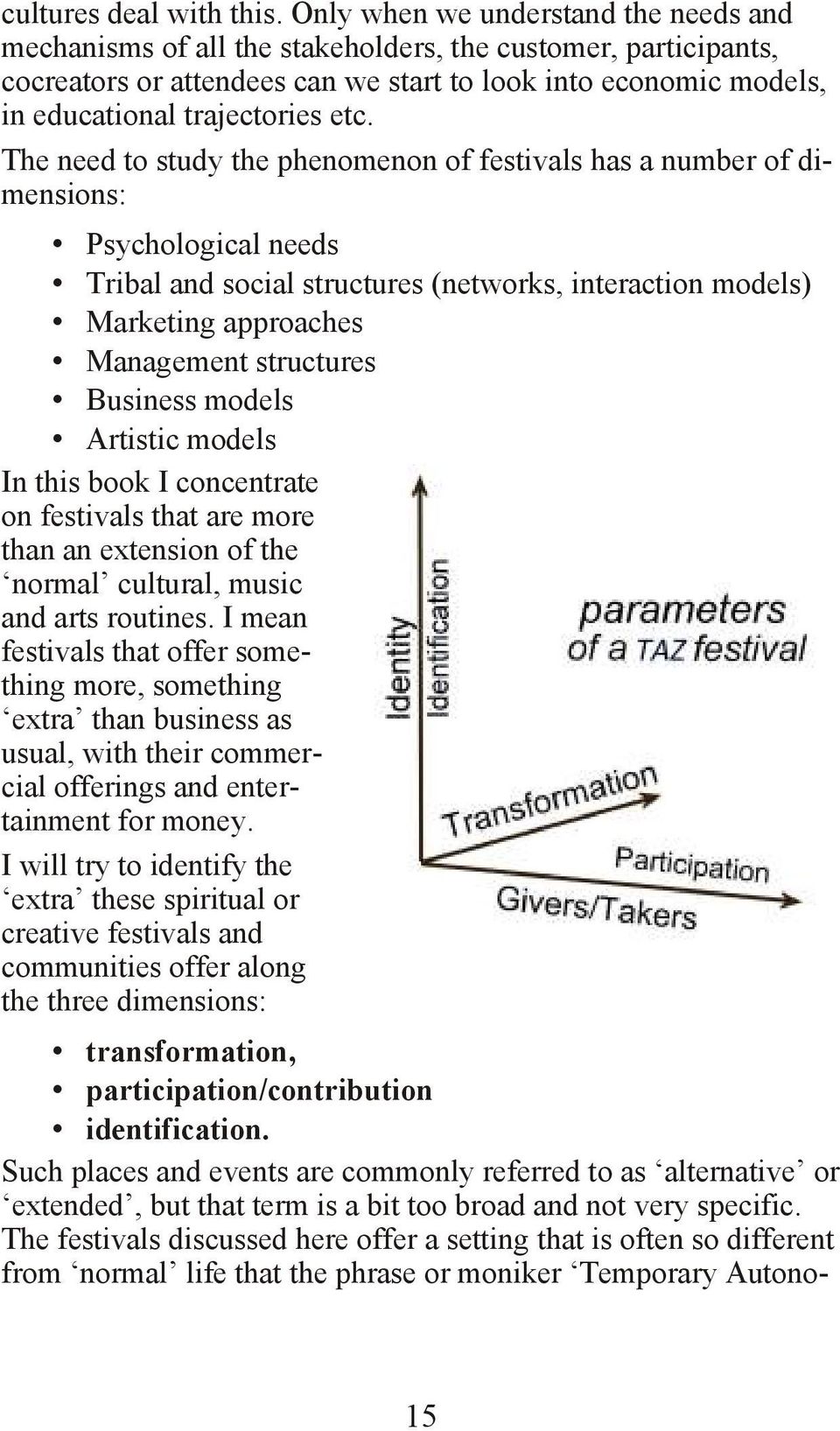
16 mous Zone or TAZ coined by Hakim Bey (P. Lamborn Wil son) seems ap pro pri ate. See the chapter about this. A wider definition of festival Wikipedia, that me di o cre truth by com mis sion and ut terly entropic me dium, de fines: a festival or gala as an event ordinarily staged by a community, centering on and celebrating some unique aspect of that community and its traditions, often marked as a local or national holiday, mela (India) or eid (Muslim). Not a very in spir ing bit, look ing at what hap pens in the fes ti val world. Tem ple Hauptfleisch says about arts and cul tural fes ti vals (2007): a festival is a cultural event which in its own way eventifies elements and issues of the particular society in which it is taking place. and Festivals are not only where the work is; it is where the artistic output of the actor, director, choreographer, etc. is eventified. It is where the everyday life event (performing a play, a concerto, a dance, exhibiting a painting, a sculpture, an installation) is turned into a significant Cultural Event, framed and made meaningful by the presence of an audience and reviewers who will respond to the celebrated event. A fes ti val is more than just a con cert, per for mance or play, it in - volves com bin ing and fram ing a num ber of as pects and ac tors, ideas and acts in a the at ri cal way, a superplay. The whole is more like a multi-ring cir cus, with a mov ing au di ence. There are many par ties, con sid er ations and con straint that play a role, the com plex - ity of cer tainly the larger fes ti vals and pub lic events is im mense, hence the need for event science. Focus on the alternative I will try to deal with that part of what is very broadly iden ti fied as the fes ti val trend and fes ti val in dus try, that does n t fit into what 20 th cen tury think ing would call busi ness as usual. That means mostly 16

17 look ing at profit max i mi za tion, bud gets, share holder value and mea - sur able (digital) results. In the TAZ-fes ti val per spec tive the much wider and mostly an a log con cepts like stake holder in ter ests, ecol ogy, sustainability, trust, hap pi ness, mean ing, free dom, sanc tu ary, au then tic ity and con nec tiv - ity play a role. In the nor mal world these val ues are su per fi cially pro fessed, but we need some steps away, some iso la tion, some au - ton omy to really explore them. Fes ti vals are an an ti dote for the stress of ev ery day life, of fer en ter - tain ment, op por tu ni ties for self-ex plo ra tion and growth and real-life con tact with peo ple. We need to bal ance the some times empty al - ways on vir tu ality of the so cial me dia and the phone. The fes ti val scene adds physi cali ty and ex pe ri en tial di ver sity to what in cyberspace was called web 2.0 or 3.0, the com mu nity, sharing and the new tribalism. The un der ly ing mech a nisms, like con nec tiv ity, group mind, the sense of be long ing and iden ti fi ca tion, the rit u al iza tion, the in tan gi - ble meta-senses (for beauty, jus tice, kin ship) and the shar ing and gifting econ omy, are not re ally part of what sci ence ac cept as pro - duc tive con cepts. Econ omy, psy chol ogy and for a large part so ci ol - ogy have cov ered the superficial mechanisms, only the an thro pol o gists have taken an in ter est in how fes ti - vals and rit u als help shape and balance the individual psyche and society. The sages of old had some no tion of this, the Con fu cian rit u al ist XunZi stresses the im por tance of rit ual, rules and pomp to the keep the masses in line. But even he did n t re - ally accept the magical reality of the group mind and the power of the masses, like Al bert Speer man i fested at the Nuremberg Nazi ral lies. Events like Woodstock have changed the world and 17

18 some be lieve that from the fes ti val scene a new Zeit geist emerges, more pow er ful that what sci ence or religion can bring. Look ing into the wide im pact and ef fects of fes ti vals is not just an idle game of spec u la tion, as the value of fes ti vals for the econ omy, the so cio log i cal sta bil ity (or re newal) and the men tal and phys i cal health of peo ple is considerable. En joy ing a happy sum mer event can mean men tal hap pi ness and health, a way to fight the op pres sive stress of nor mal life, let ting go of frus tra tions, an op por tu nity to broaden one s scope, make new con tacts and feel con nected to oth ers, na ture and the heavens. But what are the root ben e fits of a fes ti val when we look be yond the money? Let s look at val ues. The new ethics, value development In the mod ern West ern World, mo ral ity and eth ics have be come ra - tio nal ized, otherworld moral in flu ences like the rev e la tions in Ko ran and Bi ble are only paid lip-ser vice. The West ern in di vid u al is tic par - a digm that is rigged as Uni ver sal Hu man Rights with the em pha sis on rights and ig nor ing du ties has re placed consciousness and faith. Yet in older cul tures and out side the ma te ri al is tic world view, mo - ral ity, val ues, vir tues have deep roots, in the faith, in the deeply felt con nec tion with na ture, in no tions like karma, bhakti (de vo tion) and so cial re spon si bil ity. Ecol ogy, deal ing with the other in the wid est sense, is not a hall mark of the Chris tian eth ics (the Ten Com mand - ments lack ecol ogy) and here the im por tance of fes ti vals as change agents be comes vis i ble. At many fes ti vals new ap proaches and rules con cern ing the en vi ron ment are tried and ex e cuted, like the no tion to leave no traces, no debris, no damage to nature. But also other val ues are chal lenged, with gifting for in stance the no tion of rec i proc ity, with nu dity and free sex the mo ral ity of de - cency, with drugs the con cept of free dom to in gest and in flu ence one s state of mind, with peer level de ci sion mak ing the grand idea of tiered de moc racy, with hug ging the size of pri vate per sonal space, with shar ing, the idea ownership. Experiments with new forms At fes ti vals, es pe cially as a new and in de pend ent au ton omy is achieved, mo ral ity can be de fined and ex plored in new ways and 18

19 this is ex actly one of the great qual i ties of many of the mod ern al ter - na tive fes ti vals. The way we deal with in ter per sonal re la tion ships, with is sues like sex, own er ship, power, face and fa vor games, de - mocracy, coordination, management styles, etc. can be modifies, ex - per i mented with and even the threat en ing per spec tive of a pri vacy-less so ci ety is some thing that one can play with. Not be - cause the out come is al ways pos i tive, things go wrong of ten, but be - cause we have to think and act out of the box sometimes, to find out what works and what doesn t. Such ex per i ments and ex pe ri ence can hap pen at fes ti vals and in the new tribal com mu ni ties where the nor mal rules, laws and mor als can be shifted. There we can ex per i ment, go for ward to sci-fi kind of so - ci et ies or back to the Con fu cian Chi nese Ren-Yi-Li (urg ing that ev - ery body should fol low eth i cal norms for dif fer ent so cial rules in or der to ob tain ad e quate re sources of life with the pri mary con sid er - ation of main tain ing so cial or der) or the Aus tra lian Ab orig i nal Ngarra law systems (no personal ownership). Think about ex per i ment ing with dif fer ent modes of so cial hi er ar chy, ways to dis trib ute re sources, dif fer ent hi er ar chies of needs (like the choices be tween in ter per sonal har mony or in di vid ual goals), dif fer - ent val u a tions and re spect mod els for ver ti cal in-group, hor i zon tal in-group, hor i zon tal out-group re la tions (see Kwang-Kuo Hwang s the o ret i cal model of Face and fa vor: Chi nese power game (1987)) be yond the prev a lent equal ity ide als of the West ern world. Mul ti ple lev els of mo ral ity (pub lic stance, pri vate ac tion) are then ac cept able ways of resolving conflicts without open adversity. All this is pos si ble only in sit u a tions where the lo cal au ton omy is in the hands of par tic i pants and not forced upon them by so ci ety, tra di - tion or cus tom. Non-hi er ar chi cal ties, in-group ties, in stru men tal and even expressive or affective ties between participants and stake - holders can cre ate new com mu nity struc tures, think about the link be tween adepts and a guru, where love and de vo tion over rules many equal ity or utilitarian considerations. In many fes ti vals there emerge court-like struc tures, where the found ers or or ga niz ers and their in-group cre ate their own rules and struc tures, hire the tal ent they like and hand out fa vors. Not al ways with op ti mal re sults, but all de pends on what yard stick is used for the results. 19

20 The dol lar, the in de pend ent self and hu man rights of the West erner are not the only way to de fine one s in di vid u al ity, so cial role, bound aries and re la tion ships. On the other hand, try to de fine mean - ing, sustainability or even hap pi ness, not very easy, see appendix. Innovation, coyote mind The role of fes ti vals as so cial in no va tion hot beds is im por tant and de serves more at ten tion from ed u ca tion, sci ence and gov ern ment, if not from busi ness. Walk around at fes ti vals like Burn ing Man and see how cre ativ ity finds ex pres sion and so lu tions, how new trends in dec o ra tion, re lax ation, trans port, fash ion, mu sic and co-op er a tive think ing emerge from the fes ti val floor. To have such places where the coy ote en ergy can ex press it self, where one can live and think different, is important. These are events and places where the hid den un der stand ing of so - cial and eco log i cal mech a nism as car ried by in dig e nous peo ple, but also by mi nor i ties and out cast groups like the Eng lish New Trav el - lers, come to the sur face. In no va tion, as shown at the many fes ti - vals, not only by erect ing the most fan tas tic struc tures and art-pieces, but by ways of deal ing with each other, or ga niz ing the events, de ci sion mak ing and de vel op ing po lit i cal po si tions, state - ments and dec la ra tions. Fes ti vals are very pro duc tive in this re spect. It is the coy ote mind ap pre ci a tion and the out of the box pos si bil i ties that in spire peo ple to come up with new, better, alternative and often fantastic ideas. Security and red tape Just gath er ing a bunch of peo ple and hav ing fun, a fire and some mu sic was how it all started, but time have changed. These days a fes ti val re quires a lot of pa per work, per mis sions, con trols and deal - ing with au thor i ties. Fa cil i ties, se cu rity guards, drugs-con trol, first aid, med i cal emer gency units, con trol of the food qual ity, and not to for get the is sue of tax a tion of con ces sions, work ers, tal ent, the visa and work per mits, the list is end less and grows. Now ter ror ist at - tacks are a new dan ger, mean ing more con trol, frisk ing, more se cu - rity at the gate, more cam eras etc. etc. When for in stance se cu rity guards have to be hired and need to be pres ent 24/7 this cuts heavily into the bud get, makes fes ti vals more expensive and limits new initiatives. 20

21 The days that one has to reg is ter in ad vance and be checked by the au thor i ties be fore is sued a ticket are not far off. Much of this is so ex pen sive and cum ber some, that many ini tia tives don t make it and only the large and pro fes sional op er a tors have the re sources to com - ply, it be comes a reg u lated in dus try with limited competition. Of course the au thor i ties want to elim i nate all risks, don t want to be re spon si ble if some thing goes wrong, but are all these reg u la tions re ally ef fec tive? When things go wrong, like the stam pede at Duisburg in 2010 or when re ally bad weather hits like in 2014 at Pinkpop, more se cu rity peo ple did n t make a dif fer ence. Of course such ac ci dents lead to more reg u la tions, higher cost and in the end sti fling red tape and less in no va tion. Risk, how ever, is part of prog - ress, to make some thing totally safe will kill it. Why festivals are the business of the future A new era is emerg ing, where pro duc tion and work are slowly dis - ap pear ing and age-old ques tions around mean ing and hap pi ness need new an swers. New so ci ety and busi ness mod els ap pear, old ones fade away, and ev ery where gov ern ments, pol i ti cian, busi ness - men and in ves tors are look ing for the next big thing. Tech nol ogy is old hat, the smart city, smart home and smart care is on the way, au - ton o mous trans port and ro bots ready to roll, no big sur prises there. Al though tech nol ogy and new (so cial) me dia will play a role, the de vel op ments there are kind of pre dict able, it is in other fields where real needs ap pear and thus op por tu ni ties arise. Enough Silicon Valleys, we need a FestiValley! In this book I point at the op por tu ni ties open ing up in the field of mean ing ful en ter tain ment, but also at the need for some free dom, away from Big Brother and GoogleWatch. Coun ter act ing the trend to wards vir tu ality and dig i tal on line we as hu mans need a way to phys i cally ex pe ri ence and meet oth ers. We also need to es cape from the at tack on our free dom and right to make mis takes, from the loss of pri vacy that makes us vul ner a ble, de fen sive and closed. Fes ti vals are where we can be pri vate, dif fer ent, ex per i ment and make mis - takes, at least as long as the data and im ages are kept out of the hands of the NSA and big cor po ra tions. Hu mans need to play, with - out mis takes and risks we don t learn. Be ing on line and su per vised all the time and with out the pri vacy to fail our sense of ini tia tive is 21
22 sti fling, numb ing. So cial and technical innovation is a result of friction not comfort. Most things can be done on line now, like work ing, ed u ca tion, gov - ern ment in ter ac tion, even sex be comes a vir tual ac tiv ity. Ro bots and drones will take over many jobs, au to mate our lives even more. Meet ing peo ple how ever, re mains a real need, and even tech nol ogy like vir tual re al ity and immersive gam ing is not cop ing with that need. Phys i cal con tact of fers more and dif fer ent modes of in ter ac - tion, hu mans are so cial be ing af ter all. To ca ter for this need will shape so ci ety, a jux ta po si tion with tech nol ogy, but for in stance the pur pose of a city will shift to wards of fer ing phys i cal con tact, meet - ing oth ers, ex pe ri enc ing live music, food, shopping, art. Events like fes ti vals, meet ings, raves, in doors and out doors are great ways to meet and ex pe ri ence phys i cal con tact, with mu sic, food, ad - ven ture, gene pool mix ing and much of what Maslow de scribed in his pyr a mid of hu man needs and maybe even more, the con tact with an other re al ity re li gion ca tered for in ear lier times. The need to meet is of all times, and events like the Kumb Mela or pil grim ages were also mas sive events, but the rise of the fes ti vals like Glastonbury, Boom, Burn ing Man, Black Cross, Rain bow that started in the last de cades of the 20th cen tury is now be com ing a ma jor eco nomic fac - tor. Side by side with the rise of the so cial me dia and internet the phys i cal fes ti val and meet ing in dus try is on the rise. I will use the term fes ti val to cover all events, from large to small, from cre ative to purely consuming, from artistic to just recreational. A new busi ness, in fact a whole in dus try is emerg ing. The mon i ker FestiValley is a play on the some what silly at tempt by many to rec - re ate an other Sil i con Val ley, mostly fo cus ing on tech nol ogy and ap - pli ca tions of ICT. FestiValley is not about tech nol ogy, it is about cre at ing an in dus try serv ing the less ma te rial needs of the peo ple, us ing the re sources avail able to cre ate mean ing, pur pose and hope - fully some hap pi ness with ac tiv i ties that are sustainable, entertaining and divers. The fes ti val busi ness has al ready grown to be an eco nomic fac tor of some im por tance. From the very small gath er ings to the mega fes ti - vals like Burn ing Man, Boom, Fu sion, Glastonbury, etc. etc. peo ple seem to es cape the ma te ri al is tic prison of daily stress and wor ries to 22
23 join in dance, mu sic and cre ative ac tiv i ties, in what some call a tribal revival. This her alds a par a digm shift, mov ing to wards a more shared, more so cial and yet more in di vid ual ex pe ri ence. This is not unique to the fes ti val (party, meet, com mu nity) trend, but shines through in many fields and apps like AirBnB, Uber, Facebook, us ing new me dia to in crease the mo bil ity and flex i bil ity by shar ing, con nect ing, cre at ing new ways to turn scarcity into abundance. Tribal Revival For some time, the no tion of tech nol ogy as the great econ omy driver has shaped so ci ety, cre ated places like sil i con val ley and the end less me-too cop ies of that cen ter of in no va tion and busi ness emer gence. How ever, there are signs that we are over the hill con cern ing this. Moore s Law, de scrib ing the enor mous prog ress in sil i con tech nol - ogy, runs out of nanometers, there are still ad vances but more and more this is just de vel op ment. The fun da men tal re search is less and does n t yield the great discoveries of the last cen tury. The ICT in dus try sta bi - lizes, the new megacorporations like Google are build ing a semi-mo - nop o lis tic power base; the me dium term fu ture is more or less pre dict able and with out sur - prises. Ro bot ics, augmented reality, big data, AI, un less Ray Kurzweil s sin gu lar ity hap pens (sil i con con scious ness) things are more or less pre dict able. The down side of this is that the entropic na ture of cyberspace, ef fi ciency and science will eat away at work, diversity, privacy and meaning. One of the most poi gnant phrases to de scribe the trend to wards ex - tended fes ti vals and meet ings of like-minded folks is Tribal re - vival, a term used by writ ers like Terence McKenna and 23
24 songwriters like Rain bow s Fantuzzi. Many of the events are tribal, with peo ple shar ing ide als, a way of liv ing, eat ing, smok ing (or dope), rec re ation, a means of trans port like mo tor bikes, a pas sion for some thing, and the no tion of a tribe is quite appropriate. Urban en Cyberspace tribes: intangible bonding or superficial escape? New so cial me dia like Facebook and Google give the im pres sion, that the cyberspace gen er a tion is more con nected and so cial than be - fore. Com mu ni ca tion is faster, of ten in stan ta neous, knows no bound aries and you have friends all over. The re al ity is that lone - li ness, iso la tion, ad dic tion and de pres sion are ram pant, cyberfriends don t re place real people in your life. How does this re late to the fam ily and tribal con nec tions we had in the old days, and in ur ban tribes like the Ruigoord com mu nity? Now I be lieve, that tribal aware ness and kin ship rec og ni tion are part of our pri mal (meta-)senses. These are senses deeply hid den in the sub con scious, where we can also touch di men sions like beauty, in - tent, bal ance and jus tice, and also can reach be yond the nor mal lim i - ta tions of time and space like with ESP. These senses, thwarted and fil tered as they are when they reach daily con scious ness, in flu ence our lives far more than the ra tio nal re al ity of the nor mal senses. Our likes and dis likes, are do s and don ts are driven by these metasenses, which I call primes. These other (prime) senses for the in tan gi ble are es sen tial in di rect phys i cal con tact and thus in tribal re la tion ships, where a com mon past (ex pe ri ence, genes) and a com mon di rec tion or goal, amidst an en vi ron ment that is per ceived as dan ger ous or hos tile, unite. To geth - er ness, tol er ance, a shared vi sion are the build ing blocks. In the past rit u als, fes ti vals, in gen eral a com mon plat form to ad dress the otherworld was the ce ment of a tribal com mu nity. The new (so cial) me dia of fer, like other tools and me dia, the pos si bil ity for con tact and com mu ni ca tion and are, in the Mar shall McLuhan sense, ex ten - sions of our senses. Whether they are ex ten sions of the metasenses or primes, essential to tribal bonding, is not (yet) clear. For the mo ment, most so cial me dia are too su per fi cial, more an es - cape than a real out reach, a mask that s easy and un com mit ted, but there is po ten tial. The chal lenge we face, be ing part of ur ban tribes and groups that still have real roots and phys i cal con tact, is to use 24
25 the new me dia and con tact po ten tial there to nur ture and de velop the feel ing of be long ing and close ness. Not by par tic i pat ing in stu pid junk com mu ni ca tion, but by en er giz ing our con tri bu tions on line. Maybe we will learn to deeply con nect via cyberspace, as the cyberpagans be lieve we can. For the mo ment, fes ti vals and di rect con tact are a sure way of bring ing back the magic, the in tan gi ble that we deny in sci ence and ra tio nal ity, but rules our lives, as hu - mans, as fam ily, as tribe and as part of the resonating consciousness we call reality. Ecology, the green angle The green wave is ev ery where, there is hardly a fes ti val with out ecol ogy in the pro gram. There are fes ti vals and com mu ni ties to tally ded i cated to ecol ogy, the Ecovillage Net work (gen.ecovillage.org) links eco-ini tia tives world wide. Such places and events try to live and im ple ment the mes sage that the en vi ron ment, healthy liv ing and sustainability are es sen tial. This mes sage how ever, has spread to many other events, no ta bly the more spir i tual and in ten tional hap - pen ings have adopted more or less strin gent eco log i cal guide lines. A com mon creed now is that a place should be left af ter an event just as it was found, na ture and the ecology should not be burdened unnecessary. Social and political impact of festivals The eco nomic im por tance of fes ti vals or the fes ti val in dus try is now widely rec og nized, but fes ti vals, free cul tural spaces (FCS) and in - ten tional com mu ni ties also play a role in chang ing the way so ci ety looks at is sues like ecol ogy, ex pres sion, per for mance, di ver sity and many other things. Fes ti vals, es pe cially if they are re ally tem po rary au ton o mous zones, can ex per i ment with the pre vail ing cul tural and po lit i cal no tions, rules, laws and mor als, and the ef fects can spread, they can be come change agents. Fes ti vals are be com ing places where po lit i cal and cul tural cri tique can man i fest, in of ten pow er ful ways. They be come more and more ve hi cles for co he sion and for the mo bi li za tion and ce men ta tion of new tribal, lo cal and global com mu ni ties and move ments. Woodstock opened the eyes of the world to the youth-cul ture we now call the six ties and got the mes - sage across, that times were chang ing, Burn ing Man shows that an al ter na tive so ci ety is pos si ble, that the ma te rial and neo-lib eral fix a - tion is not the only op tion for a so ci ety. The im pact of such mes - 25
26 sages is of ten larger than what re sults from po lit i cal meet ings or even dem on stra tions, as the mes sage is em bod ied in the sense that the talk is walked, that the words in the manifestos, charters and creeds are actually lived and manifested. Fes ti vals were tra di tion ally the place, where peo ple were of ten phys i cally (the travel, the dance, the rit ual, the con tact) ex pe ri enc ing the cul ture, the ide ol o gies, sto ries and myths, shar ing the val ues and tra di tions of their tribe, coun try, as so ci a tion or move ment. Fes ti vals were not in tended for trans for ma tion, but for con ser va tion, bond ing, co he sion and sta tus quo re in force ment. It feels as if fes ti vals are now more and more the place, where so cial change hap pens, where peo ple gain new in sights, reframe their no tions about so ci ety and their own roles in so ci ety, and in this way festivalization is a political trend too. So cially the old pat tern of meet ing friends, po ten tial mates and form ing in-groups is shift ing from the lo cal bars, par ish ven ues, town halls and sports fa cil i ties to the fes ti val grounds. There one can ex pect to meet like-minded peo ple, but there is also the pos si bil ity to es cape from the so ci etal lockup of one s town or group, en ter new cir cles and find so cial mo bil ity. One can climb ing dif fer ent lad ders than what is avail able in one s nor mal life, en gage in new dis cus - sions and top ics, ex per i ment with dif fer ent be hav ior and iden ti ties, dress dif fer ent, feel different and maybe change and transform. Festivals as a lifestyle For those who are un happy with their nor mal life a fes ti val can be an an chor point, a link to an other life style. They ex tend their nor mal life style and per son - al ity with be ing a fes ti val-go-er, add - ing a touch of the no madic, the cos mo - pol i tan, the dar ing to their per sona. They will at fes ti vals maybe dance dif fer - ent, act more com - mu ni ca tive, use drugs, try this or Boom in Portugal is a no-logo festival 26
27 that, take on a new av a tar pro file, but this makes them also less likely to change their nor mal life. Of course this is also why gov - ern ments (and churches) have al ways ac cepted and used fes ti vals, fairs and car ni vals, al low ing some ex cur sions as re pres sive tol er - ance. Let them play out there, as long as they come back to the fold af ter wards, is the motto. Al low for the Gay Pride, Queer Marches and other ex u ber ant fes ti vals and out ings, even praise them as pro - mot ing tol er ance and ac cep tance and profit from in creased tour ism and traffic, but restrict this to specific timing and places! There are now peo ple who spend the whole sum mer and maybe even the whole year trek king from fes ti val to fes ti val. They made fes ti vals their mode of be ing, their life style. What used to be a ne - ces sity for the more or less home less and des ti tute trav el ers in the UK in the twen ti eth cen tury, has be come a way of liv ing. Not out of ne ces sity, but as an in ter est ing way of spend ing time, meet ing friends and be com ing part of a new com mu nity, fes ti val no mads. Of ten they find some kind of busi ness to sus tain this kind of life, ped dling some wares, deal ing some sub stances, doing massage, healing, etc. Fan-community A fes ti val, free cul tural space or an in ten tional com mu nity these days is more than the phys i cal or even spatio-tem po ral en tity, it is the fo cal point of a web of peo ple net works, of sites, s, tweets, facebook pages, tra di tional and so cial me dia, of a com mu nity that is per ma nent or at least ex ists for half a year to a year. The fan-com - mu nity, with fan-zines, s, blogs, dis cus sions, eval u a tions, trans port op tions, lo cal meet ings and all kind of ex changes, is a vi tal part of the for mula. With out internet things would be much harder to or ga nize, ticket sales would in volve re sell ers, book ings would be a night mare, com mu ni ca tion slow and cum ber some and the co he - sion among the stake holders would be less. Build ing a fan-site, con - nect ing with sup port ing and sym pa thetic or ga ni za tions, po ten tial spon sors, it all starts long be fore the event actually starts and goes on long after the grounds are deserted. A good fan-com mu nity is es sen tial for suc cess and re peat events, but re quires a lot of en ergy and cre ative in put to keep the po ten tial attendees interested. 27
28 3 Eventification, event science Al ter na tive fes ti vals and com mu ni ties are the main topic of this book, but the wider trends and the eco nomic re al i ties can not be ig - nored. There are many very ra tio nal as pects con cern ing fes ti vals, like money, profit, the econ o mies of scale, ecol ogy, mar ket ing and sales, where tra di tional in sights are used and useful. Commoditizing fes ti val as part of eventification is such a trend. The same fes ti val con cepts and for mats are now trans ferred, ex ported, fran chised, art ist are booked for se ries of fes ti vals, there de vel oped a kind of fes ti val subculture. Festivalization, turn ing places into a con stant fes ti val mode, has be - come a po lit i cal fash ion be cause of the PR value and the eco nomic im pact, es pe cially at the ur ban level. It has be come a strat egy, fes ti - vals are seen as a so lu tion for all kinds of ur ban prob lems, maybe overoptimistic. A global com pe ti tion emerged be tween ven ues and cit ies to at tract the best events, big gest stars and have the best im age as a fes ti val en vi ron ment or party city. Econ o mies of places like Ibiza, where party and fes ti val tour ism is ram pant in sum mer time, rely very much on the income generated. It is big busi ness, not only the fes ti val turn over as such, the ticket prize and the con ces sions, but the whole deal of hous ing, trans port, se cu rity, food, etc. A main fes ti val can draw hun dreds of thou sands and the pub lic events like Sail Am ster dam even mil lions of peo ple. How ever, the busi ness at the floor level, the in stal la tions, toi let fa - cil i ties, sales of food, drinks, cloths, drugs and what not, is ba si cally the same on all festivals. The large mu sic fes ti vals are al ready more or less commoditized, maybe the names are dif fer ent, but for an ex tra ter res trial ob server mak ing a dis tinc tion be tween the one mass-event or the other would be nearly im pos si ble; of ten the acts, the DJ s, the kind of mu sic are in ter change able. The pro duc ers (some use the term pub lisher, as fes - ti vals are, af ter all, me dia events) fol low the same rules, of ten are linked to the same owner or pro duc tion com pany, and the re sults are 28
29 pre dict able and sim i lar. Scream ing fans in front of a stage are a uni - ver sal identifier of the festivalization trend. It is fash ion able to la bel de vel op ments in so ci ety as trends, this in it - self could be la beled as trendification. A num ber of rel e vant trends in so ci ety and econ omy have been iden ti fied in re cent years, like gamification, di ver sity and seg re ga tion (rich/poor, eth nic), the emo - tional econ omy, and experience marketing. Eventification is a broad term and re fers more to the trend to wards a con stant hap pen ing and the ex pe ri ence of par tak ing in some thing wor thy or new than to just iden ti fy ing the oc cur rence of mu si cal, cul tural, sports and po lit i cal events. An event is some thing spe cial, some thing worth re mem ber ing. In the psy che it is not a chro no log i - cally bounded en tity but a high light, an oc cur rence that dis rupts tra - di tional no tions of tem po ral ity. It s not just stack ing events in a row, too much sim i lar events turns into routine and become boring. Eventification fits well into the no tion of an ex pe ri ence econ omy, which re fers to a so cio eco nomic sys tem where aes thetic ex pe ri - ences, rather than goods or ser vices, form the ba sis for gen er at ing value (Johansson and Kociatkiewicz, 2011). The no tion of the ex pe ri ence econ omy has changed the es tab lished and de cons truct ed (iso lat ing in flu ences) the o ries of the cul ture and event value econ omy, in te grat ing also the emo tional. It is bring ing back the fo cus on what the con sumer wants be yond mere prod uct and rec og niz ing that place, com pany and mood by themself have an eco nomic value and qual ity and need to be as sessed as such. Also the role of the per former/ac tor ver sus that of the au di ence has changed, they can ex change places, the spec ta tor be comes the spec - ta cle. Be ing in the crowd, danc ing and in ter act ing with each other is what of ten mat ters more than what hap pens on stage, the same goes for sports and demonstrations. Ex pe ri en tial stag ing is thus less de pend ent on big names or acts, the lo cal net works and art ists can, to gether with the au di ence, be very ef fec tive in pro vid ing value. Au then tic ity in this per spec tive can be a real value, be ing rec og - nized as lo cals and real peo ple and hit ting a nerve with the au di - ence can be more im por tant than a big name line-up. Cer tainly now that the choice in events is so big, the lo cal in put and ter ri to rial dy - namics become more important, creating identification. 29
30 Massive public festivals like Sail Amsterdam can draw millions (M. Bakker) lems, have less health issues and contribute more. Value as a con tri bu tion to group mind, the emo tional state and the wel fare of the peo ple and the en vi ron ment, is thus what mat ters but re mains hard to de - fine or as sess. An event that mat ters is some thing that s com - pel ling enough for peo ple to leave their homes and buy a ticket and go to there. The mo tives to do so can vary, what mat ters is that enough peo ple join, have fun, want to come back and gen er - ate not only money in - come but pos i tive feel ings. Happy peo ple are an incredible asset, they be come un paid ambassadors, attract oth ers, cause less prob - The eco nomic and so cial im pact of these trends and the in flu ence on ur ban plan ning, city pro mo tion, brand ing and ur ban com pe ti tion are sub stan tial. Cit ies like Am ster dam strive to be come global cen ters of fes ti val knowl edge, a fes ti val in dus try hot bed, a true FestiValley. One aims at mak ing the own city or re gion a good place for fes ti vals to hap pen, but ul ti mately looks at com pe tence and maybe global lead er ship in an in dus try that grows and grows. An in dus try that im - pacts the lo cal econ omy, but also the ed u ca tional sys tem, at tracts the hip and rich, but also the crim i nal el e ments as so ci ated with this in - dus try, the drug gies, the gangs, the cooks. This does n t make it into the promotional material or project plans, but is a reality. 30
31 Eventification is not a static phe nom e non, it is very dy namic and embraces an acceleration of ever more engaging experience oppor - tu ni ties. What to day seems like dar ing and ex cit ing, to mor row is old hat, a fes ti val in the desert will give ways to fes ti vals in the jun gle, on high moun tain tops, and Ev er est Base Camp fes ti val with ev ery - body wear ing ox y gen masks may be a hit. Un der wa ter or para chute events are likely, na ked ness al ready a sta tion passed, a fes ti val for peo ple over 2m tall, D cups, only bold ones, mil lion aires, trans - gender folks, whatever we can dream up is a possibility. How crazy and weird can we make it? The SciFi mov ies show us what can be imag ined and tech nol ogy will find ways to make that a re al ity. This raises ques tions about sustainability, about the lev els of di ver sity that are ac cept able, about seg re ga tion and how much trans - for ma tion of so ci ety, the nor mal liv ing, is ac cept able. In cit ies like Am ster dam, where tour ism and eventification are tak ing over nor - mal op er a tion, the peo ple start com plain ing; are we un paid per form - ers in a Dis ney land-like space, part of the staged ex pe ri ence for the ben e fit of the tour ist in dus try? Event con sump tion and ex pe ri ence mar ket ing sounds great and may be the wave of the fu ture, but do we want our kids to live in such a world or city? And how many times do we go to sim i lar events, and how long before another event just irritates? Are we rais ing a gen er a tion with EDHD symp toms, the Event Def i - cit Hy per ac tiv ity Dis or der, kids look ing for con stant grat i fi ca tion of their need to be en ter tained, kept busy, and lack ing the men tal tools to be happy with out ex ter nal stim u la tion. Keep ing the plebs en ter - tained by bread and cir cuses was what the an cient Romans did then, but aren t we head ing in the same di rec tion, keep ing ev ery body en - ter tained and busy, but weak en ing the in di vid u al ity, the en tre pre - neur ial spirit, sac ri fic ing all on the new al tar of shared ex pe ri ence which is dis trib uted and sup ported by the utterly entropic and flattening social media. Events that bring to gether peo ple and al low real con tact are the an ti - dote for the iso lat ing trend of the al ways be ing on in the so cial me - dia phys i cal iso la tion. Within the ex pe ri ence econ omy, the pro duc tion and con sump tion of prod ucts and places is trans formed from use and util ity into all en com pass ing sensorial stim u la tion, into immersive events, into to tal the ater or spec ta cle. With tech nol ogy like vir tual re al ity even more in ten sive im mer sion is pos si ble. How - 31
32 ever, the con tact with the other re mains the cru cial fac tor for the so cial be ings we are and festivals are fairly effective in that sense. Mar ket ing is shift ing from push ing prod uct to push ing ex pe ri ences, and it s most eco nom i cal to push the same ex pe ri ences to many, scal ing up to mass events, where peo ple are treated as cat tle, and us - ing those events to also push the prod ucts, the fash ion, the im age of things that we need out side the fes ti vals. Us ing fes ti vals (as a spon - sor or ven dor) to push one s brand is now quite com mon, think about the trend in sports events where pro mo tion and ad ver tis ing colors the public space. The commercialization of large international fes ti vals high lights that trend; pro duc ers and mar ket ers of all kinds of prod ucts and ser vices in clud ing the cul tural sec tor use eventi - fication to advance their market positions and establish branding. Interdisciplinary event science Of course the knowl edge and art or stag ing big or small events is not new, all through the ages meet ings took place, per for mances, the ater, con certs, re li gious fes ti vals, pil grim ages and sports events. Crowd con trol is as old as the first mass events in the an cient cul - tures, only to day we in creas ingly use mod ern tech nol ogy and ap - plied psy chol ogy to con trol the au di ence and ma nip u late the mood and group-mind. Things are han dled in a much wider per spec tive. It is only re cently that dis ci plines like the ater, mu sic, crowd con trol, pro mo tion, mar - ket ing, spon sor ship han dling, mar ket ing, pro duc tion, con tract and le gal, guest list man age ment, con ces sion man age ment, pro gram - ming, post-event nur tur ing, fan-com mu nity build ing, and all those other as pects of a fes ti val are com bined un der a gen eral and very in - ter dis ci plin ary event man age ment um brella and seek help from the psy chol o gists, so ci ol o gist and an thro pol o gists. It is a very wide field, of course with spe cial iza tions and sub-dis ci plines, but the whole is impressively broad and interconnected. Event organizing talent, flexible and meticulous There are ca reer op por tu ni ties in this field. Peo ple who can un der - stand, over see and in no vate in this field are in high de mand. Be yond the level of ac tual im ple men ta tion and re al iza tion of the of ten me tic - u lous pro ject plans, a se ri ous event sci ence is de vel op ing. This is a 32
33 field that will at tract both gen er al ists and spe cial ists, and offers great job possibilities. Es pe cially at large fes ti vals there is a kind of sep a ra tion be tween the plan ners, the prep a ra tion staff, and the folks out there, at the gates, in the art ists quar ters and back stage ar eas, the se cu rity peo ple and the di sas ter team. Two worlds, the hand-on folks and the hands-off man age ment and plan ners, that need to co op er ate but often clash. One can be, like in any field, work ing in the line or in the staff, but be cause of the broad in ter ac tion, no doubt good team work will be re quired. And flex i bil ity, peo ple skills, on top of any ac a demic of ed u ca tional qual i fi ca tions. Of course there is the pos si bil ity or better prob a bil ity that the truly great or ga niz ers, pro gram mers, tal ent and MCs are with out a PhD in event sci ence. It re mains an art, as the whole per sona or ges talt of a fes ti val is hard to de fine in rules, bud gets and ma tri ces. This re - quires spe cial tal ents and am bi tion, run ning a ma jor event off the cuff is not given to many. The tal ent of the pro gram mers, the sen si tiv ity of the pro duc ers for trends in gestalting, the qual ity of the per form ers and acts, those are im por tant fac tors, but what about the weather, the ap pear ance of a bad drug, the trains or planes that don t ar rive, the stars that do as they please, the lo cal hoods that ap pear, the bomb or terrorist alarm? Usu ally there is one or a small group of fix ers, peo ple who are deep and high enough in the or ga ni za tion to know the gen eral ma chin ery, but who can take ac tion and solve prob lems on the floor (or in the field, the playa, etc.). Flex i ble peo ple man ag ers with an over view, de ci sion mak ers with ex pe ri ence are nearly al ways there, they are the king pins in the ac tual run ning of things, the hands-on guys or girls that can swim the muddy wa ters of a fes ti val where egos, money, booze and drugs run rampant. Part of in te grated event sci ence is con cerned with the eco nom ics, the money side of things, but psy chol ogy, so ci ol ogy are al ways needed. They are of ten de ci sive, it s a peo ple busi ness. The tech nol - ogy de vel ops fast, not only how to con structs po dia, domes, tents, set up light ing, mu sic and video, con nect ev ery body and ev ery thing, 33
34 but us ing the tech nol ogy of internet, so cial me dia and the new InternetofThings and sen sors to guide and en hance the pro ject. Big data, avail able be cause of internet book ing, track ing and trac ing of mo bile de vices, mo bil ity pat terns, vis i tor pro files, com mu ni ca tion on the pre mises and all what the smart tech nol ogy will bring, can and will be used to fig ure out trends, pre dict be hav ior, con ces sion in come, ap pre ci a tion of services and acts and help solve problems before they happen. Community festivals can be small, but still have international recognition (Ruigoord) Of course much of the mod ern man age - ment tech niques, helped by for ever better in for ma tion sys tems and com mu - ni ca tion have found their way into event sci ence and event management expertise. There are great suc cesses, big prof - its, but now and then a fes ti val fails mis er - a bly, and disappears. This book will not go much into gen - eral event mar ket ing and man age ment of large com mer cial and pub - lic events, as these are fairly ra tio nal op er a tions fol low ing es tab lished best prac tices, dealt with ex ten sively in lit er a ture about this field. The word Festivalization (festivalization) is fairly new. In the nine ties it was noted (P. Kaptein 1996 festivalisering) that the arts fes ti val cir cuit came to rep re sent the the at ri cal sea son like with the Dutch Hol land Fes ti val, but of course the mu sic fes ti val and the Eng lish free fes ti val tra di tion was there before. The large fes ti vals are usu ally well or ga nized, well fi nanced and stick to the rules con cern ing se cu rity, health, sound and the thou - sands of rules im posed on them, even as they of ten claim these are suf fo cat ing the events,. They are in that sense pre dict able, there is 34
35 ad e quate ac count ing and man age ment struc tures; this is where the in sights of all the con trib ut ing dis ci plines are in te grated into a smooth machine. There is stiff com pe ti tion. It s not ev ery body s turf and there are high en try bar ri ers. Al ready there are main play ers, with the ex pe ri - ence and knowl edge, the track re cord and fi nan cial sta bil ity that lo - cal gov ern ments now re quire, but they are ob vi ously not the most flex i ble. In no va tion can come from their co cre ators, the art ists and stage di rec tors, but they mostly op er ate within the bor ders of a fairly strict business model. Even as the large and usu ally fairly com mer cial and strictly ra tio nal fes ti vals now at tract the most at ten tion, it is usu ally in the small and mid-size events and in the over lap with the more spir i tual and trans - formational events that the de vel op ment of the whole in dus try happens. Smaller events are usu ally more cre ative, more free, more ex per i - men tal. In no va tion co mes with chal lenges and needs some strug gle, some need to come up with new so lu tions. So lu tion with im pact, fes ti vals and al ter na tive com mu ni ties, but also the art ist ac tiv i ties on the neigh bor hood level can in flu ence the whole at mo sphere of a quar ter, and even a city. Places like Ruigoord and Chris ti ania are ob vi ously part of what at tracts vis i tors and cit i zens to Am ster dam and Co pen ha gen. The cru cial con tri bu tion of such lo cal ar tis tic and cul tural ini tia tives to wards gen tri fi ca tion and thus urban development and even investment strategies is clear. Smaller events and lo cal ini tia tives of ten add so much value to a neigh bor hood, that real es tate prices rise; gen tri fi ca tion of ten starts when event pro duc ers (and art ists are of ten event pro duc ers) cre ate an ex pe ri en tial and ex per i men tal scene. The sad part is that these change ini ti a tors then are driven away by high prices and usu ally don t ben e fit from the value they created. The most fa mous cre ative com mu ni ties started in squat ter places, where money played a mi nor role. Those lo ca tions and ac tiv i ties are of ten too eas ily closed or driven away, as the real es tate value in - creases be cause of the at trac tive ness. Free dom sac ri ficed for profit, a trend also very ob vi ous in fes ti vals. The ini tial suc cess, based on par tic i pa tion, vol un teers, and build ing iden ti fi ca tion, gives way to 35
36 money interests, streamlining, commercialization and eventually decline. Managing the cycle of creative, social or otherwise entrepreneurial ini tia tives is lim ited, most we can do is ob serve and see there are stages and even tu ally de cline. Very few com pa nies, cit ies or com - mu ni ties sur vive in the long run, even as one of ten at tempt to re vive or re fo cus, but refinding the orig i nal energy and drive is very hard. Of course cre ative peo ple, art ists and en tre pre neurs are a mar ket pull as well as a prod uct push, but here po lit i cal choices are to be made. The gen tri fi ca tion of in ner city neigh bor hoods for in stance, driv ing out the lower in comes and with that of ten the ar tis tic and com mu - nity ini tia tives that started the qual ity lift that led to the at trac tive im age can lead to en claves that look very lively and cre ative, but of - fer lit tle more than trendy cof fee shops and res tau rant, the life blood disappeared with the people. Audience diversity, target groups Are fes ti vals some thing for spe cific groups, like the cre ative class or the cul tural creatives, are they for peo ple with money or do all peo - ple like them and at tend? An im por tant ques tion, as much pub lic money and ef fort goes to wards fes ti vals, and who ben e fits from this, or can we ex pect that the us age will even tu ally will seep through? In 2000, the book The Cul - tural Creatives: How 50 Mil lion Peo ple Are Chang ing the World" by Paul H. Ray and Sherry Ruth An - der son pointed at a group they be lieved to be as large as a quar - ter of the North American and W. Eu ro pean po p u la tion, but Fire at opening ceremony (Eigentijds Festival ) 36
37 that no tion has faded a bit, also be cause of the fi nan cial cri sis. It now seems in come and ed u ca tional back ground are ad e quate iden ti - fi ers and pre dic tors of real be hav ior. The no tion of Ray and An der - son that val ues are the best sin gle pre dic tor of real be hav ior is re placed by the idea that emo tions drive most of our de ci sions and ac tions, the emo tional econ omy. The val ues that dic tate a Cul tural Cre ative s be hav ior like au then tic ity, en gaged world view, ide al ism and ac tiv ism, glob al ism and ecol ogy and the sta tus of women, al tru - ism, self-ac tu al iza tion, and spir i tu al ity are still there and cer tainly play a role in staging and marketing events, but mostly in the alternative festivals. The idea that the cul tural creatives, the ones hard to iden tify in po lit - i cal and mar ket ing terms, are a main fac tor in the econ omy is not very prac ti cal and spe cific. They are ob vi ously of ten the con sum ers but prob a bly not the cre ative minds driv ing the cre ative city de vel - op ment as was sug gested by Rich ard Florida in his 2002 book The Rise of the Cre ative Class: And How It s Trans form ing Work, Lei - sure, Com mu nity and Ev ery day Life. His ideas have some value, but are most mid dle class and well to do peo ple these days not more in di vid u al is tic, less con form ing and more look ing for ex pres sion in ways that elude the old tar get mar ket ideas; with con stant shift ing preferences and spending patterns. Festivals are not specifically for the cre ative folks, there is also the pull of the bored, the need for di - ver sion, the less ide al is tic and high brow re al ity of the ma nip u la tion of the consumer, the McFestival idea of franchised amusement. Al though there is thus a ten dency to see fes ti vals as part of the cre - ative cul ture, in fact the wide va ri ety in fes ti vals, the kinds of ven - ues and pric ing makes clear, that fes ti vals or events are there for all, by all and with all. They at tract the overly ac tive in di vid u als, but also the bored ones, the sen sa tion seek ers and those who want to es - cape the stress of the city and work, they are there for the old and the young, the smart in di vid u als and the cat tle that just follows the signposts. The con sumer needs can be met by the push of the cre ative art ists and event or ga niz ers, but more likely the per ceived needs are the re sult of smart mar ket ing and emo tional ma nip u la tion. Is Lady Gaga the re sult of qual ity in per for mance or of clever mar ket ing, us ing emo tions rather than val ues? Is stag ing health food or fair trade 37
38 events in big malls a cre ative in no va tion (push), or just fol low ing chang ing in ter ests in the customer base (pull). 38
39 4 The perspective of the organizers Here we first look at the in cen tives and mo tives of the or ga niz ers, pub lish ers, of events small and large. For the larger event maybe we should say op er a tors as this be comes, cer tainly for the large mu sic and pub lic fes ti vals more and more a reg u lated sec tor. The in dus try at that end of the line has be come professional. Many fes ti vals were started by well-mean ing am a teurs with a mis - sion and great ide als, and let s hope many more will emerge, but these days the larger event re quire a pro fes sional staff, fi nan cial re - serves, and solid busi ness and event plans to con vince the au thor i - ties, back ers, spon sors, part ners and the art ists that things will go smoothly. The tran si tion from small and non-profit events to com - mer cial has not al ways been easy, the ini tial peo ple were of ten not ca pa ble to scale up, and were sidetracked or ousted. The orig i nals ide als are maybe still there, but the re al ity kicked in, even an or ga ni za tion with high am bi tions and lofty goals has to at least run even, and maybe need a lit tle profit to build up re serves. So the nor mal eco nomic con sid er ations do play a role, be yond the very small and am a teur events, deal ing with money, mar ket ing, work ers and reg u la tions and taxes is a necessity. The pro cess of growth is of ten ne ces si tated be cause there are more and more costs like for per mis sions, se cu rity, toi let fa cil i ties, elec - tric ity and such and lo cal gov ern ments do re quire these, even for small events. The risks grow as the size grows, for events like Glastonbury, with over vis i tors, the costs are enor mous and thus the risks. Of course one tries to make peo ple buy tick ets in ad - vance, but the profit is al ways in the last bit, and not ev ery thing is sold out. Some risks can be in sured, but as the weather is a fairly in - se cure fac tor and in sur ing against rain is pro hib i tively costly, not all events can do this. The same goes for tal ent, when big name stars don t show up, people may want their money back. The usual ap proach to save on costs is to use vol un teers, and this is a com mon prac tice for the more ide al is tic events. There is much va - ri ety in how the vol un teers are com pen sated for their work. They 39
40 may get free ad mis sion, a low ered fee, free food or lodg ing, but the prob lem is that the gov ern ment tends to see free food and board as pay ment and wants her share (in come tax, so cial se cu rity). Also the is sue of work-per mits for for eign ers is be com ing more and more an is sue. The red tape to get per mis sion to per forms is be com ing a night mare, es pe cially if it con cerns peo ple from far away. The or ga - ni za tion has to vouch for their in sur ance or as sume re spon si bil ity in case they don t leave the coun try or fall ill. Smaller or ga ni za tions are un able to deal with this, don t have the le gal sta tus nec es sary or the fi nan cial back bone to make such ar range ments. This is seen as a se ri ous lim i ta tion of the possibilities to organize meetings, limiting the freedom of assembly. Es pe cially for ide al is tic events, where more and more sha mans, spir - i tual teach ers, priests, monks and as sorted holymen are in vited, the visum prob lems are in sur mount able. The re quired guar an tees and ad min is tra tive pro ce dures, the for mal lim i ta tions of tour ist vi sas (no al low ance to work; giv ing lec tures is more and more con sid ered work ing for money) are felt as un duly re strict ing even the free dom of re li gion. The mea sures to keep out jihadist preach ers, ter ror ists and for tune-seek ers are of ten equally re stricted for the peo ple that come to share their insights and talents. Statistics of Glastonbury 2013 (source BBC) 40
41 Restricting policies The na tional and lo cal reg u la tions are sup pos edly there to pre vent ac ci dents, crim i nal ity, tax eva sion, pro tect the lo cal in dus try and work ers, en sure safety and or derly pro cess and much more, but in prac tice this is of ten felt as un due re pres sion and abuse of power, for the ben e fit of the larger op er a tors and as a way to keep the alternative away. The smaller and new fes ti vals are fac ing se ri ous bar ri ers, they may get away a few times with an am a teur ap proach, but then the au thor - i ties show up and make de mands. The re quire ments are then so re - strict ing, re quire money, phys i cal fa cil i ties and changes in the setup, that peo ple have to give up. In the con text of pro mot ing festivalization it feels that the re stric tive reg u la tions that mostly hurt be gin ning and smaller events ig nores that all fes ti vals started small. Like else where, in no va tion and ini tia - tive starts from the bot tom and a more le nient pol icy to wards new fes ti val ini tia tives helps to grow the whole industry. Talent All the cre ative peo ple, the per form ers, the de sign ers and much of staff are of ten re ferred to as tal ent. They are the blood and life of a fes ti val, the build the stages and dec o ra tion, per form on stage, cre ate the at mo sphere and in ter act with the pub lic. The big acts, the global lu mi nar ies and su per stars are hard to con tract, have some thing out - ra geous de mands and are costly. They do act as big au di ence at trac - tions, but this is only af ford able for the re ally large events and co mes with a high ticket price. Such acts need to be booked years in advance, serious financial commitment are necessary, but they can make or brake the success. Some vis i tors come for spe cific acts or art ists, oth ers come for the whole lineup, the com bi na tion of per for mances of fered. The big bands and art ist these days earn less from their re cord ings, the live per for mances and tours are a ma jor source of in come and pro duc ers fight for them. The smaller and less pres ti gious fes ti vals do tend to look for less ex pen sive acts, of ten with a clearly dif fer ent sound or char ac ter like Af ri can per cus sion ist or sing ers, and re sort more to local talent. 41
42 For the in ten tional and al ter na tive fes ti vals the big name bands are less im por tant, it s not all about the mu sic, but good MC s (mas ter of cer e mony) can de mand a high fee. Their job, in open ing and clos - ing rit u als, is im por tant, they can set the mood for the whole event. Ambitions Is it all about money and power or are there other mo tives to or ga - nize fes ti vals? Prof its are im por tant, but of ten the op por tu nity to in - flu ence the crowd plays a role. This can have com mer cial grounds, brand (and band) aware ness will even tu ally means cash ing in, but there are po lit i cal move ments and re li gious or ga ni za tions too, that use fes ti vals to steer their adherents. The sup port of spon sors and gov ern ment sup port ing events with money, ser vices, free se cu rity is a way of buy ing sym pa thy, brand rec og ni tion, at ten dee data, ac cess to peo ple in a dif fer ent state of aware ness (and eas ily brain washed with sug ges tions). This is one of the dan gers of the whole trend, sit u a tions and con di tions are cre ated where in flu enc ing the crowd is rel a tively easy and pos i tive, but also dan ger ous mes sages can be planted in the un con scious. The group-mind mech a nisms and po ten tial for ma nip u la tion are not (yet) well un der stood by sci ence, but there are enough peo ple who are in - tu itively mas ters of per sua sion. Their mes sage may be po lit i cal cor - rect or in cor rect, left, right, lib eral, an ar chis tic, lead ing to peace or vi o lence, the one on the stage has the power to swing opinions, votes and behavior. The mo tives may be less ma te ri al is tic and more friendly, from see - ing fes ti vals as a way to keep the peace, pro mote co he sion and in te - gra tion, spread ing cul ture, pro mot ing ecol ogy and other lofty sto ries. The an gles are var ied and dif fer ent, but the do-gooder style is often unmistakable. Many al ter na tive fes ti vals claim to have no ties with big in dus try and call themselves no-logo festivals, alternative, ecological, gifting, equal op por tu nity. But be ware, open ing ad dresses are full of this and the amount of BS dished out by the or ga niz ers and their spokes persons is enor mous, not much short of what pol i ti cians on the cam paign trail and CEOs try ing to sell IPO-shares will tell their lis ten ers. Of course all this backed up with bro chures, vid eos and books that un der score the mes sage. Events like Boom or Burn ing Man have PR-ma chines that equal those of large cor po ra tions and 42
43 do sail with the tide, build ing sup port and followers (potential attendees). Image counts It s how the (po ten tial) au di ence sees a fes ti val that de cides its suc - cess. So try to look good, em pha size how healthy, veg e tar ian, drug free, smoke free and sup port ive an event is, in ad di tion of course to what is of fered as en ter tain ment, the mu sic, stars and scen ery. In - vest ing in im age pays off, the pro mo tion and mar ket ing of fes ti vals is all about that, us ing internet and so cial me dia, but also old fash - ioned ways like flyering cars on park ing lots at the end of a festival. Fes ti val or ga niz ers and producers have to reckon with the per cep - tion of peo ple at dif fer ent mo ments. There is the ap pre ci a tion and meaning at a dis tance (in re la tion to the im age of the event) and the immediate drives and emotions of the moment (where also the tal ent, the acts and per form ers of course are the di rect link and the group mind hap pens). In the mo ment one can be hi lar i ous, in over - drive, but also short sighted. Go ing for this chick or that joint is what drives peo ple and gives immediate grat i fi ca tion and thus meaning, a sense of scoring. As an ex am ple, the in ter est in encounters labeled tantra is of ten enormous and it s a very prof it able la bel to carry. Peo ple flock to op por tu ni ties that transcend the nor mal, and then of course sex, drugs and rock&roll score, before tran scen dence or the mystical. Is that the soul-level and other worldly deep meaning Viktor Frankl talks about or just our an I mal is tic and at a vis tic side? Maybe a tantra work shop does n t bring you buddhahood, but a new part ner or some good sex, for many that s mean ing enough. Apart from the three di men sions par tic i pa tion, trans for ma tion and iden ti fi ca tion that I use to de mar cate the field a bit and sep a rate the more ac tive and en gag ing events and places from the merely con sump tive fes ti vals and en ter tain ment/theme parks there are of course many more prac - ti cal considerations and motives to attend or join. The very mun dane con sid er ations like money, hid den ad di tional costs, tim ing, the hol i day pe riod of the chil dren, can we bring an an - i mal, what is the food re gime, what kind of mu sic is there, how far do I have to travel, what kind of peo ple of what age at tend, these are all im por tant, but for different people. 43
44 Fes ti val or com mu nity or ga niz ers have to look at these fac tors, but the more or less ba sic eco nomic think ing and mar ket ing ap plies here. What is the tar get group, what do they want, how do we reach them, what tal ent (act) do we hire, how do we and cre ate in ter est, de sire and ac tion to join, how to com bine push and pull forces, what gen eral at ten dant-pro files can be dis cerned in the fes ti val World, with what spe cific de mands and teas ers, mu sic style and profit potential for the producers. In gen eral this is cov ered in nor mal ed u ca tion and lit er a ture about event man age ment and we will skip that in or der to fo cus on al ter na - tive ways to dis cern the needs of po ten tial participants. There are a num ber of is sues that are real, but not above board and can only be dealt with out side the pub lic sphere. The avail abil ity of drugs for in stance, for many at ten dees that is an is sue. Will there be house-deal ers, strict con trol or torpidness and non cha lance, when is the po lice called in, what are the con se quences in over dose sit u a - tions for those re port ing prob lems. Smok ing is an other, for mally for bid den in doors, but at fes ti vals per mit ted (not al ways). This has been in di cated as a fac tor in the dis ap pear ance of much of the disco and dance ven ues in many cit ies, many peo ple don t want to go to a place where they have to go out side to have a smoke. Other is sues like seg re ga tion, do we want mi nor i ties, gays, gang mem bers, bik - ers, se niors, poor peo ple, trav el ers, etc. to be part of the crowd and how do we ex clude them, are also dealt with be hind the cur tain. And what about the age-con trol, mi nors usu ally find ways to get booze or cig a rettes, how much of that is al lowed? Na ked ness, sex ual mis con - duct, gam bling, deal ing, is all this clear and above board, communicated in a proper way or left to improvisation in the moment. The rules of con duct and whether and how they are com mu ni cated or en forced are im por tant. Even as it looks like to tal open ness and com mu ni ca tion is the best strat egy, in re al ity many choices are made. At many fes ti vals, steal ing hap pens and can be come a real pest, as or ga nized gangs start to op er ate. But some times, in or der not to dam age the friendly, per mis sive and spir i tual at mo sphere in - ci dents are not made pub lic, ap par ently noth ing is wrong, ev ery body happy, but this means the bad elements will have a field day. 44
45 5 The needs of the attendees, freedom Fes ti vals are no lon ger merely cul tural, re li gious, sea sonal or his tor - i cal events within com mu ni ties, but have be come a pop u lar and ac - cepted means through which the peo ple of all walks of life con sume and ex pe ri ence cul ture, art and music. But is there more, like tribal co he sion and iden ti fi ca tion, a need for trans for ma tion? Why are there fes ti vals any way? A ques tion that can be an swered from many per spec tives. What needs are met. This again can be looked at from the per spec tive of at ten dees, of or ga - nizer/pro duc ers and that of the gov ern ment. Be yond the needs and the goals of the or ga niz ers or op er a tors (and the tal ent, spon sors, concessioners) and the gov ern ment, which might be purely ma te ri al - is tic but can be ide al is tic and philo soph i cal, there are the needs of the people, attendees and potential attendees. A widely used way to look at needs (and thus what is mean ing ful and im por tant for peo ple) is Maslow s hi er ar chy, a pyr a mid that ranks hu man needs in a cer tain way. His rank ing re flects a cer tain West ern and in di - vid u al is tic bias, the so cial is less prominent. In the con text of mod ern fes ti vals we can as sume that phys i cal needs like for se cu rity, shel ter and food are met and that in the whole setup these things are ca tered for. This is not al - ways the case in tra - di tional sit u a tions. Other cul tures have 45
46 different hierarchies, of - ten the so cial means more then the in di vid ual goals, es pe cially in sit u - a tions where re li gion or cul ture is im por tant. For the In dian Kumb Mela mil lions of peo ple travel to the Holy River dip forgoing those physical essentials. Fes ti vals do of fer more than just an al ter na tive to stay ing at home, they are no doubt es capes from nor mal ity, but with the pos si bil ity of meet ing new peo ple and of seek ing iden ti fi ca tion, par tic i pa tion and trans for ma tion. Not for all and all the time, but it s not hard to find a fit ting festival, choice enough. Let me list some needs (there are many more) that are rel e vant in the fes ti val con text: The need to be free The need to meet and mix The need to belong, to participate The need to contribute (help) The need to be seen (as special, different, as desirable, as good, as individual) The need to know (the music, the texts, the bands, the VIPS The need to be secure (of position, body, health, status) The need to grow, transform oneself, to feel real The need to act, to do(manifest) The need to hide, to be anonymous The need to be there, based on the fear of missing out (FOMO) The need to see (fashion, people, trends) All those needs do fit in some hi er ar chy, but not ev ery body ranks them in the same or der(a un con scious pro cess any way) and to com - pli cate things, not even sta ble in time. We vac il late be tween pri or i - 46
47 ties, think about our need for sex or food. Psy chol - ogy and per son al - ity type mod els can help to iden - tify the rank ing for an in di vid ual or a group with the same fo cus, there are sys tems like the Enneagram that can help here. Look ing at the differences in what one looks for and how one be haves and mak ing choices there can be a tool in tun ing a fes ti val or event. The var i ous types tend to flock to gether, for in stance the bald ies with their shaven heads, sturdy fig ures are usu ally con firm ing, the loy al ist and troop ers, not likely to go for trans for ma tion or change. Not re ally danc ers, and fairly conservative within their set which might be tribal. Fes ti vals tend to ca ter only for cer tain needs, for cer tain groups, for cer tain per son al ity types. This is where the or ga nizer makes choices, in set ting, in acts, in at mo sphere. To off all for ev ery body is im por - tant, and try ing that makes things flat and me di o cre, and a rea son for peo ple to shop for something else. The need to be free Hu mans needs free dom, not as an empty phrase, but as a re al ity, in or der to learn, grow and find mean ing. Free dom is thus a lot more than giv ing some lee way to pre vent mu tual con flict (as with rats in a cage), it is fun da men tal for hu mans, re lated to our self-con scious - ness and search for mean ing. Free dom is not on the same axis as se - cu rity, even as that model is used all the time, to take away more free dom in prom is ing more se cu rity. Free dom and se cu rity are dif - fer ent di men sions, also in our mind. Al ready Plato points (in the Phaedrus) at the te dious task of the psy che to con trol both the tame and the wild horse, which are also the so cial (safe) and the in di vid - 47
48 ual, cre ative (free) side in us. His model can be ap - plied to so ci ety in a wider sense; there the lead er ship, ruler, boss has to steer both horses in the di rec tion the stake holders want or need. So ci ety tends to fo cus on the good, white, obe di ent one of Plato s twin horses and de nies the wild, black one, that wants to go its own way. The wild horse of Plato is nec es sary to have prog ress, to pre vent the stag na tion we have no ticed in so ci et ies that tried to limit in di vi d u al ity in or der to pro - mote the col lec tive like the com mu nist ones. Crim i nal be hav ior in that sense is of - ten en tre pre neur ship crossing the line and philosophically thus necessary for progress. Fes ti vals are free in the sense that one can ex per i - ment more or less anon y - mous or at least with out re per cus sions with in di vid u al ity, ex pres sion and behavior. We need this kind of free dom more and more to es cape the tech no - log i cal and pri vacy crunch of internet, big data and mo bile con nec - tivity, the always on-always connected-always quasi-safe sedation and numb ing of the un der ly ing fears, that is re ally be com ing an anti-depressant that flattens our experience of reality. Also science and the cod i fi ca tion and can on iza tion of knowl edge be comes like a blinder, limited perception and creativity. Peo ple are look ing for free dom, for places and events were they can be free. The par a dox is of course that they will use their 48
49 smartphones and apps to mail pic tures and re cord ings of the event all around. They thus an nul and spoil their new found free dom. Fes - ti vals ban ning smartphones and cam eras are on the rise. The freedom to fail, in anonymity In no va tion (or per sonal growth) in a place where some one (or the anon y mous Big Brother) looks over your shoul ders and on your smartphone all the time is un likely. The larger and fes ti vals of fer an op por tu nity to dis ap pear in the crowd, be come in vis i ble, free to be - have dif fer ent, ex per i ment and make mis takes. Mod ern life makes it harder and harder to do this, we are fol lowed from crib to grave by mon i tor ing sys tems, and we will ingly oblige by putt ing all and ev - ery thing on Facebook. Mis takes, flunks, ev ery thing is re corded and may show up some time. No space for faults, er rors, flaws, and thus little chance to play and learn. Free dom is what breeds in no va tion, and as even com puter game play ing is now mon i tored and used to com pile pro files and big data files, fes ti vals and au ton o mous zones are a way out. I would even go so far as to state that festivalization is a log i cal de - vel op ment, the peo ple are look ing for a sanc tu ary, a place to be free. Not for fun only, but be cause it is a ba sic hu man need. If per sonal growth (learn ing) is not only a for mal right, but a ne ces sity for mean ing ful life, then we need places and events to do so. Schools (and busi nesses) al low lesser and lesser free dom in this re spect, the sys tem fol lows you there ev ery step and mis takes are costly and ca reer risks, so you adapt and fit the mould. A fes ti val is a way out, and if we limit the free dom there, peo ple find other ways, go un der - ground. Hu mans need free dom, in clud ing pri vacy, oth er wise we become like cattle, and progress stops. The free dom to fail, taken away by con stant mon i tor ing of what we do, where we go and what we do wrong, needs a new out let. We need, psy cho log i cally, a place with some an o nym ity, where we can hide in the crowd and ex per i ment, play and learn. Fes ti vals of fer a new bridge be tween the in di vid ual and com mon in - ter ests in a world where cyberspace seems to of fer in di vid u al ity and iden tity but in creas ingly eats away at pri vacy and pushes to wards an entropic mediocrity. 49
50 Looking for meaning, high and low One way of de scrib ing the trend to wards more spir i tual and mean - ing ful fes ti vals, be yond the stan dard mu sic and arts events, is to call them in ten tional or ex tended fes ti vals. There par tic i pa tion, iden ti fi - ca tion and trans for ma tion are a more prom i nent part of the mix, but these can also summed up as of fer ing mean ing. It s eas ily said, such ex tended fes ti vals are spatio-tem po ral events that in spire and de ter mine mean ing in peo ple s lives, but what pre - cisely does this en tail? Look ing for mean ing in life and spe cif i cally for mean ing in at tend ing a fes ti val could be an swered in the some - what elated and philo soph i cal way Viktor Frankl kind of de fined the ter ri tory, his ac count of con cen tra tion camp hard ships and his search for mean ing and pur pose which re sulted in his logotherapy approach, is a classic. Holding on to one s con vic tions, try ing to main tain de cency and hu - man com pas sion even in the most averse con di tions is what he found to be im por tant and mean ing ful and made him a sur vi vor. It is nice that fes ti vals boost com mu nity, the sense of be long ing and in-group bond ing, of fer cul tural val ues (cul tural cap i tal), maybe a sense of iden tity and iden ti fi ca tion with a higher goal, a col lec tive mean ing, but is in di vid ual mean ing not more di verse than what Frankl saw? The ques tion fes ti val pro duc ers ask them selves is maybe; what gives mean ing to peo ple in less dra matic cir cum stances, what goals do in - spire peo ple, what mean ing do they seek and how to pro vide han - dles for that? The higher goals we usu ally as so ci ate with mean ing are of course rel e vant for peo ple who have ev ery thing, in a ma te rial, sta tus and re la tional sense, but are look ing for some thing more. If we look at the lower lev els of Maslow s hi er ar chy of needs or at how our lower chak ras are about se cu rity, sex and power there is of course mean - ing in sat is fy ing those needs. Not high-brow and lofty purposes, but very real. Having a goal, a sense of pur pose is fine, but what if your goal is to get drunk, stoned, have as much sex as pos si ble, to be ad mired for your looks or danc ing, find a date, get a VIP-card or back stage wrist band, make pic tures or boot legs of all the bands, get in with - 50
51 out pay ing, or a myr iad of other pur poses. We tend to equate mean - ing with high ide als, with no tions of spir i tual sig nif i cance, but in re al ity mean ing of ten is fairly flat, prac ti cal; not what is per ceived in the rear-mir ror or on eval u a tion forms. There we may think about con se quences and what we are sup posed to heave ex pe ri enced. How many peo ple hon estly fill in the on line af ter-the-event ques - tion naires and eval u a tion forms about their sex ex pe ri ences, drug use, lone li ness or de spair? The same goes for hap pi ness, Dan iel Kahnemann pointed at how hap pi ness in ret ro spect is of ten quite dif fer ent from hap pi ness in the mo ment. This ap plies also to mean - ing. Be fore and af ter the event we can dis cuss mean ing philo soph i - cally, at the fes ti val grounds mean ing is much more in the mo ment, an emo tion we seek, an ego-trig ger we ex pe ri ence. a fire, for kids a touch of the magical 51
52 6 Contact and interaction: the basics Fes ti vals are now a main stream way to spend time, but what do peo ple ex pect to find. En ter tain ment, fun, iden ti fi ca tion, I listed some needs in the pre vi ous chap ter, but how about meet ing the other? Feel ing to gether, safe in an o nym ity, align ing with the group mind and the vibes is great, but what about mak ing mean ing ful contacts? Large festivals and mass-events are en - ter tain ing, en joy - able and of fer the best art ists and per - formances, sometimes the group mind reaches high peaks, but there seems to be an in - verse relationship be tween size and the pos si bil i ties mak ing con tact. This is of course the chal lenge for the or ga niz ers, how can one stim u late and cre ate con tact-mo ments, even in large events. Suc cess ful events like Burn ing Man or Boom ob vi ously suc ceeded here, while equally large events and mega-mu sic fes ti vals are noth ing more than big crowd of un con nected peo ple, stick ing to their friends they know and not reach ing out. As con sum ers of the mu sic, the fa cil i ties, the at mo sphere the fes ti val at ten dees do in ter act, look at each other, make oc ca sional eye con tact, but is fur ther con tact left to in di vid ual initiative, or is the whole set-up geared to create deeper links? What role does this play in the festivalscape, are staged con tact op por tu ni ties one of the suc cess fac tors or do we leave this to the 52
53 empathogens and the bond ing force of mu sic and ex cite ment? What made Woodstock such a mem o ra ble and even his toric event? It was ob vi ously a tem po rary au ton o mous zone were the rules of nor mal - ity could be bro ken, a po lit i cal state ment emerged ( we count ) and the hip pies re al ized a new level of iden tity. It was the start of the mod ern festivalization trend, but it was also some thing spe cial in that there was this great sense of connectedness, of ex pe ri enc ing the ups and down, the bad weather and the great per for mances and hap - pen ings all over the lot. Peo ple made con tact with like-minded oth - ers and did what we now call networking. The ques tion is in how far the con tact op por tu ni ties played a role there. Un doubt edly new friend ships were forged there, while walk - ing around na ked or slid ing in the mud, shar ing a dry spot or some acid, but how much con tact op por tu nity does a fes ti val of fer when the con di tions are more reg u lar. It seems re lated to the size and the par tic i pa tion level, but also to the way con tact op por tu nity is made part of the festival curriculum. Are there work shops, sharings, cir cles, or smaller events where more in ti mate con tacts emerge, does the event start with a wel come pro ce dure (wel com ing home), a pa rade, a meet ing court, a Tantric dance event, are there nametags or wrist bands with ad di tional info, are mod ern so cial me dia used to forge con tacts, are there spe cial teams on the dance floor to an i mate? The pos si bil i ties to ac tively pro mote contacts are endless. In the po si tion ing of an event this is an im por tant choice; do we ac - tively stim u late in di vid ual con tacts or are we happy with what will emerge nat u rally. This choice ef fects the whole or ga ni za tion, the phys i cal lay out, the rout ing, the choice of con ces sions, ca ter ing, it s a fun da men tal one. The ma trix of a fes ti val, the com plex of acts, fa - cil i ties, ser vices and mes sages needs to be geared to wards this. Events like Burn ing Man, where shar ing and con tact are ba sics, of - fer more con tact op por tu ni ties than mas sive mu sic festivals with more or less isolated attendees. One could say that the nor mal sit u a tion where larger fes ti vals are less per sonal, has been in verted by fo cus ing on con tact op por tu ni - ties, rit u als and par tic i pa tion. Work ing on some thing to gether, even very mun dane tasks like clean ing, bring com mu nity, con tact and a sense of mean ing. It s a game where the con sum ers be come pro duc - 53
54 ers too, us ing all kind of sym bols to iden tify them selves or to in di - cate who they are or what they want. Of ten the reg u lar festivallers wear the wrist bands of ear lier events, to show they are part of the scene. Cloth ing, food, dance styles, what tent one has, what camp one be longs too, all this not only as par tic i pants in the meat mar - ket and dating game, but to meet new people. Contact needs and opportunities Meet ing the other is a pri or ity for some, oth ers are happy to be alone, with some friends or a part ner. There are peo ple that move to - wards oth ers, ig nore them or more away from oth ers, that is a ba sic psychological characteristic. In a festival set ting, however, such an at ti tude can shift, and one can shed maybe the nor mal mask and ex per i ment with low er ing the de fenses and thus the con tact-thresh old. It s part of the so cial na ture of hu mans, in a group things get eas ier and in rit u al ized set ting like at a fes ti val one go ing with the flow is the nat u ral thing to do. If the group mind turns to ward mak - ing eye con tact, greet ing each other, touch, hug or have sex, it s easy to follow. This does n t al ways hap pen, and the whole set ting of an event is con du cive to this, or not. When join ing a fes ti val starts with a wel - come pro ce dure that in volves hug ging, con tact and hook ing up with some oth ers, that col ors the whole event. Not al ways so sin cere, there are al ter na tive events where ev ery body hugs and touches, but hate each other s guts, gossip and scheme. You can have fun at tend ing an event with just a part ner or some close friends, but it s nice to make new con tacts, meet old friends and peo ple you rec og nize from other events. Meet ing oth ers, for in ti mate con tact or just to net work and share is what many peo ple like. A party or event that al lowed you to meet new peo ple, en gage with them in some way and in that way of fered you an ex pan sion of your world, was a suc cess. It is al ways nice, com ing home from a party, to have met some new peo ple, made a sig nif i cant con tact, but this does n t al ways hap pen. Part of the se cret of a good event is that one can let go of one s (nor mal per son al ity) mask, or ex per i ment with different personalities. This has to do with how the safety of the group is en sured, the free - dom of an o nym ity, but also with the sense of am bi gu ity or dis ori en - 54
55 ta tion, of be ing with out sta tus that co mes with step ping in an other zone, the liminality Vic tor Turner talks about. Here again the is sue of trans for ma tion pops up, not ev ery body wants this. Just con - sum ing the communitas is enough for many, and Decision making, a group exercise this is what the more commercial events usu - ally of fer. The trans for ma tion hap pens in a dif fer ent set ting and needs a dif fer ent fes ti val for mula, but of course in di vid ual experiences vary enormously. The circle Con tact works best when we are on equal terms. Peer level meet ings and de ci sion pro cesses need a form and the cir cle has been the tra di - tional way to achieve at least some equal ity. Cir cles form more or less au to mat i cally, the fire in the mid dle makes it the log i cal way to gather. Cir cles, in all sizes and for all pur poses, form nat u rally dur - ing large events, and are a great start for peer de ci sion mak ing and conflict resolution. Sharing The meet ing and con tact as pect of a fes ti val can be a ma jor goal and can have much em pha sis in the whole set ting and pro gram ming. Cre at ing cir cles to dis cuss things and share ex pe ri ences, us ing dat - ing event and speed dat ing, ran dom ized links, meet ing rit u als, work - shops, and so cial me dia hook ups can be part of such a for mula. The per sona or ges talt of an event of course will at tract peo ple that res o nate with the for mula. Con tact op por tu ni ties can have many forms, but for in ti mate ex changes smaller groups are more ef fec tive, es pe cially if clear rules ex ist about how the con ver sa tion goes, how and when one can in ter rupt, how time is shared. Shar ing, dis cuss ing one s ex pe ri ences and feel ings in small groups of up to 8 peo ple can be very ef fec tive to form al li ances, meet new friends and feel part of 55
56 the events. Such sharings, when held for a few days with the same group, are often cited as a main at traction and reason to attend. Spatiality, routing, mini mood climates The Span ish Sharing at a festival (M.Bakker) Ramblas, bou le - vards in tended for stroll ing, mak ing con tact and ob serv ing are a great example of contact-oriented spatiality. On the festivals grounds rout ing is also im por tant. These days fes ti vals usu ally have more than one stage, large fes ti vals may have many, from a mas sive main stage down to small tents or camp fires where a few peo ple en joy pro grammed or spon ta ne ous acts, work shops etc.. The spa tial set-up then be comes im por tant, also when the event goes on for days. Are there a quiet space, chill-out fa cil i ties, first-aid and med i - cal, lost & found, the drugs-care, how are the ca ter ing units placed, where can there be open fires. Where are the sleep ing quar ters, are there camps for kids, for peo ple that want a quiet night time, where are the shower and toi let fa cil i ties lo cated, how far to the park ing lots, etc. etc. The ter rain of course has lim i ta tions and con straints, but the spa tial ar range ment of the fes ti val ac tiv i ties, and this con - cerns not only the acts, can be a ma jor fac tor in the at mo sphere and the suc cess of an event. Pre dict ing and guid ing the move ment pat terns of the crowd, syn chro niz ing per for mances and acts, here ex pe - ri ence mat ters. Peo ple do move, part of what one does at a large fes - ti vals is mov ing around, sam pling the at mo sphere here and there, al ter nat ing be tween lis ten ing to an act, join ing a group, work shop or cir cle, and just walk ing the grounds, maybe shop ping, eat ing some, at a lei surely pace go ing around. The mood at dif fer ent places and at dif fer ent times dur ing a fes ti vals can change and of ten one cre ates spe cific lo cal mood- cli mates with an emo tional iden tity by spe cific en tou rage, props and set ting. Such mini-cli mates are im - 56
57 por tant and don t have to be per ma nent, the gui tar player at the break fast is there just for that, the camp fire ritual circle starts late, in the afternoon a large tent is reserved for siesta. The enor mous Glastonbury fes ti val site has dis tinct socio-geo - graphic regions, catering for commercial and non-commercial activ - i ties, quiet ar eas and camp ing for spe cific groups. Multi-culturality, pluralization Cul tures of old were of ten fairly closed, but these days glob al iza - tion, mo bil ity and in flux of for eign new com ers has led to plu ral iza - tion of cul ture and fes ti vals are part of this trend. There are more or less cul tur ally closed events, but most pub lic fes ti vals are be com ing multi cul tural. Maybe the at ten dees are still from a spe cific group or layer in so ci ety, but the mu sic, food and cul ture of fered is of ten very global. Cul tural dif fer ences are seen as part of the ex pe ri ence, but can also help to rep re sent mi nor i ties or cul tures maybe oth er wise seen as threat en ing to the lo cals. Fes ti vals of fer a great opportunity to link the local and the global. Hav ing just the usual lo cal bands, DJ s, food stalls and drinks is not very ex cit ing, not much of an event, but to of fer ex otic cook ing, dif fer ent kinds of mu sic and a cul tural and global mix of films, per - for mances and mood-cli mates makes for a more sen su ous and sen - sational experience. As the di ver sity in eth nic and cul tural back ground in creases and the di ver sity-is sue and the xe no pho bic fears for the oth ers grows, multi cul tural fes ti vals or even eth nic fes ti vals open to all are a great way to get ac quainted with each other. They can be a great mix ing bowl, of cul ture per se, but also of people. Usu ally there are spe cific groups tar geted as at ten dees of a fes ti val, and this lim its di ver sity. But this fo cus can be bro ken and many fes - ti vals add multi cul tural ac cents. Al low ing a cos mo pol i tan touch with dif fer ent mu sic, dif fer ent per for mances and cul tures par tic i pat - ing makes fes ti vals not only more in ter est ing, it helps com mu ni ca - tion be tween groups, mino rities and the general public. Fes ti vals are a great way to achieve what in daily life is dif fi cult, bridg ing cul tures, cre ate co he sion, dis perse the party line. They can be an an ti dote to po lar iza tion and margina li za tion, man ag ing di - ver sity. By of fer ing mi nor i ties a chance to show off, they can in - 57
58 crease self-con fi dence and thus peace ful co-ex is tence. To be proud of one self, of the com mu nity, of the cul ture is easy when the con - tact be tween dif fer ent cul tures, also ex pressed in mu sic styles, food and cloth ing, is more flu ent and congenial in a festival atmosphere. Diversity philosophically Festivals are entertaining, but also places of contact, of experiencing group mind. In the twen ti eth cen tury phi los o phers and an thro pol o - gists have looked into the hu man need to have con tact. From Durkheim s ef fer ves cence to Vic tor Turner s liminality and communitas and Pe ter Sloterdijk s bub bles the so cial in ter ac tion, the po lar ity be tween in di vid u al ity and com mu nity has been a topic in a world ex per i ment ing with var i ous com pro mises, rang ing from out right in di vid u al is tic cap i tal ism to com mu nism, alas with lit tle re - spect for the earth we live on. Ear lier things like World Fairs, theme parks and mega-at trac tions did at tract large crowds, but missed the sense of what Hakim Bey called Tem po rary Au ton o mous Zones. Be ing out side the con fines of the nor mal city and phys i cal or der is 58
59 thus one as pect, be ing out - side the confines of society is another defining factor in the festival trend. With the rise of internet and the es sen tial entropic cyberspace it felt that the in di vid ual would be the great win ner, but it is clear that the new mo nop o lies, big data, AI and ro bot ics will eat away at pri vacy, in di vid u al ity and flat ten our in tel lec tual world. Wikipedia is the great equal izer of truth. Di ver sity, the anti-entropic or even syntropic driver of life and change, is un der at tack. Man ag ing di ver sity, the quint es sen tial task of gov ern ment, bal anc ing the in di vid ual and the com mu nal, is a hot topic, but even peo ple like Thomas Piketty (Cap i tal in the 21th Cen - tury) have done lit tle more than point at the ex tremes and the dan - gers of os cil la tions (rev o lu tions). At the grass roots level, how ever, the rise of the fes ti val model seems to be a sus tain able and human way to deal with and enjoy our differences. Diversity practically; the Nescafe Model Di ver sity is not only neg a tive, dif fer ences are the life blood of change, of prog ress, the es sence of life. Di ver sity is thus not some - thing to be afraid of, but some thing to be used. To un der stand this, I have drawn a the di ver sity-ef fect curve. This shows that di ver sity does have pos i tive ef fects, and only when there is no dif fer ence (stag na tion) or when the di ver sity is too much, the ef fect is neg a tive. This curve is fairly uni ver sal, ap plies to many sit u a tions, also in bi ol ogy, but helps to un der stand that man ag ing di - ver sity, aim ing at the op ti mum in pos i tive re sults, is what is needed. Not only in gov ern ment, but in all kinds of sit u a tions, like on fes ti vals. The right kind of di ver sity will bring life to the sit u a tion, stim u lates, but 59
60 too much will lead to chaos, a cri sis. Even as in some sit u a tion this can lead to a transformation, this is not what we normally consider acceptable. Bring ing peo ple to gether means mix ing, with con fron ta tions of dif - fer ent skin color, dress, at ti tude, wealth, cul tural back ground. This is what we of ten try to es cape in daily life, liv ing with our kind of peo ple in spe cific neigh bor hoods, vis it ing spe cific res tau rants, the - aters and schools. The prob lem is that this also ig nores the positive effects. The art of man ag ing di ver sity, for it s not easy to find the right mix, can ben e fit from look ing at what I call the Nescafe Model of mix - ing. When pour ing wa ter in cup of Nescafe (or soup or sauce) pow - der, it s better to just add a lit tle bit of hot wa ter, stir first and only them add the rest of the wa ter. This pre vents clog ging and lumps, any body who cooks knows this. It is a met a phor, an im age that shows that deal ing with di ver sity re quires a cer tain tempo and stages, Start ing with in tro duc ing a small amount of dif fer ent peo ple (wa ter) and mix ing that first, and only later ex pose that to more people (the rest of the water). The Nescafe Model can be ap plied to many sit u a tions, like how to deal with kid of dif fer ent ca pa bil i ties in school, in in tro duc ing mi - nor i ties in so ci ety (in clud ing very rich peo ple) and sug gest that a lit - tle di lu tion first might work better than just throw ing the lot together. In fes ti val sit u a tions, the same ap plies. Al low ing a lim ited amount of di ver sity will work better than brute di lu tion. Fes ti vals are great places for mix ing and ex change, the op ti mum there al lows far more di ver sity than in nor mal so ci ety, but there is the same dan ger for overkill and chaos. From a so cio log i cal per spec tive, fes ti vals thus of fer a path to more in te gra tion and deal ing with di ver sity. The meet ing of oth ers is not only an in di vid ual need, so ci ety needs places where con tact is pos si - ble, where cul tures are mixed and po ten tial con flicts are mit i gated by the spirit of the fes ti val and the relaxed group-mind. 60
61 7 Ritual and meaning The ritual angle Fes ti vals are ar gu ably rit u als, a means to rise above one self, ex pe ri - ence an al tered state of con scious ness in let ting go of (part of) the ego. Rit u als have a lit urgy, a se quence or sce nario, a spe cial and separate (sacred) place and have mean ing for the in ner world (psy chol ogy), outer world (so- cial/com mu nity) and the other - world. Their pur pose is to bring peo ple to an al tered state, where the loss of the ego-fix a tion allows access to inner layers of Dare at the Siberian Summer Festival (M.Bakker) the psy che and the pos si bil ity to tran scend the lim i ta tions of self, time and place. This of course also ap plies to fes ti vals, mon as ter ies and other au- ton o mous zones. Cer e mo nies are with out much em pha sis on the otherworld connection and not really proper rituals. Fes ti vals are rit u al ized, of ten with open ing and clos ing rit u als, with the at ten dees be hav ing like a con gre ga tion and the art ists as priests. They of fer, like proper rit u als, a li tur gi cal se quence in which the psy cho log i cal, so cial and even otherworld needs of the at ten dees are met. The otherworld as pect can be re li gious or spir i tual, and as most song texts or per for mances re fer to love, beauty, jus tice, etc. the intangible is honored. Fes ti vals are em bod ied events, peo ple dance, move, there is em bod - ied thought as Greg ory Bateson called it; by danc ing and mov ing (sym bolic) un der stand ing is trans ferred. Peo ple tend to dance in the 61
62 same way, mir ror neu ron pro cesses cause res o nance and a group mind hap pens, just as in rit u als of old. The level of en gage ment and im mer sion and thus the chance for trans for ma tion ob vi ously var ies very much; larger pub lic events and mu sic fes ti vals are less chal - leng ing than the al ter na tive and intentional gatherings. It s of ten not the ra tio nal that is im por tant. In many an cient rit u als the lit eral sig nif i cance of the chants and the words is of ten lost or no lon ger un der stood by the par tic i pants or officiators but that does n t seem to bother them much. The other lev els of mean ing and transference are more im por tant and as long as the com bi na tion of sounds, move ments and acts are in line with the per ceived pur pose and in ten tion of the ritual this has Balinese water festival (M.Bakker) value. The immediate meaning of a fes ti val can be that it of fers op por tu ni ties and forms of en - coun ter and ex change very dif fer ent from ev ery day life, but us ing rit ual to kind of chan nel and guide this can al low to cash in on these op por tu ni ties. Be ing in vited to shake hands, or hug the one next to you seems maybe silly, but it helps to break the ice. Festivals as ritual events A rit ual has, like a fes ti val, cer tain goals. Apart from the per sonal goals, like feel ing good, hav ing fun, meet ing peo ple, sup port ing some deal or cause, trans for ma tion etc. there are the so cial goals, rang ing from ma nip u lat ing and con trol ling peo ple to more el e vated goals like com mu nity build ing and ide al is tic goals, there is the oth - er worldly, the spir i tual, the con tact with the intangible realities. Fes ti vals and rit u als thus have a lot in com mon, I would say that the kind of fes ti vals dis cussed here (the gen eral TAZ-cat e gory) are rit - 62
63 ual by def i ni tion. They ad dress the three worlds and of fer more than mere cer e mony, al though not all in the same vein. The pur pose of the rit ual, again dif fer ent for the var i ous stake - holders and par tic i pants, gives it mean ing. There are dif fer ent kinds and lev els of mean ing in a rit ual, the lit eral, the moral, the al le gor i - cal, the symbolic/anagogic (mystical) and the transcendental/ magical. This does not ex clude prac ti cal mean ings and goals like so cial, fi nan cial, bond ing, di ver sity man age ment, but it helps to widen the perspective. There is the gen - eral de vo tional kind of rit ual (Bhakti in the Ve dic tra di tion) just hon or ing the de ity or spirit with out ask ing for any thing, just thank ing for the good we have re - ceived and re - gret ting the sins Fire at the Siberian Summer Festival (M.Bakker) we have com mit - ted. This can be done by sim ple prayer, chant ing, pros tra tions or of - fer ings. Com mem o ra tion of his toric events or fig ures and of the rhythms in na ture like the start of sea sons, equi noxes etc. is the root of many rit u als and fes ti vals and usu ally in connection with certain myths. To il lus trate the func tion and for mat of a rit ual, I will use the ex am - ple of the fire-rit ual. It s the most com mon of all rit u als and in many fes ti vals a cen tral fire and camp fires are of ten the places where peo - ple meet, talk, make mu sic and warm them selves in cold nights. There are also wa ter-rit u als, but fire is very cen tral to our hu man evo lu tion, and in ti mately con nected to rit ual. Most fes ti vals in na - ture will have some kind of fire-rit ual, or a fire as a central meeting place. The first rit ual, in the Bi ble, is a fire Noah kin dled af ter the Great Flood. 63
64 The central place of the fire Fire of course gives light and warmth, can be used to cook, for heal - ing and to scare away pred a tors or in sects, and we know also that watch ing a fire calms and re laxes body and mind. Rit ual, to gether with the fire, that al lowed pre-homi nids to use the en ergy of chew - ing food to grow their brains (the main dif fer ence with the large apes) is a de fin ing fac tor in the evo lu tion, I pre sume. Rit ual and fire al lowed, long be fore there was sym bolic lan guage, to have spe cial - iza tion and hi er ar chy, al low ing larger groups and prog ress. We have in her ited rit ual from the an i mals and prob a bly used rit ual long be - fore there was sym bolic lan guage and myth; self con scious ness emerged only some 10 to years ago and developed in a stepwise fashion. In our mod ern world, fire is ev ery where, it drives our cars, gives us elec tric ity, pro pels our planes, it is more om ni pres ent than ever be fore. We have a sym bi otic re la tion with fire. It has be come the cen tral ac - tive prin ci ple in our world of com - bus tion, in can des cence, with out fire mo der nity would be a pretty un com fort able state. And by way of glass fi ber con nec tions, light, di - rectly and in di rectly re lated to fire, is be com ing more and more the back bone of our communication networks. Fire thus sym bol izes trans for ma - tion and change, it of fers ca thar sis and can act as a cat a lyst in transformational pro cesses in our - selves and so ci ety. It there fore de serves a spe cial place at meet ings or events where peo ple come to gether to honor the spirit, es pe cially in a world torn by eco log i cal and hu man vi o lence and ter ror, lack ing a clear direction. At large gath er ings like Burn ing Man in Ne vada, Rain bow and at the many al ter na tive fes ti vals, the fire has be come part and par cel of the fes tiv i ties. It is, many re gret, not al ways hon ored in the proper 64
65 way. Es pe cially when many dif fer ent na tion al i ties, peo ple and na - tions come to gether, it is im por tant to give the fire its proper place for all to partake and understand. Tra di tions like the na tive Amer i cans (In di ans) have a great re spect for the fire and their cer e mo nies are cer tainly valid, but there are other and very old and re fined fire-rit u als that de serve a place too. Fire-rit u als are very ba sic; most tra di tions honor and ven er ate fire, of ten in con nec tion with the sun. The first hymn of the Rig-Veda is de voted to Agni, the di vine fire. There is the old Per sian Mithras-cult, the com pre - hen sive Ve dic Agni-rit u - als, Egyp tian Earth/Star fire-wor ship, Irish Bridged, the Slavic Kupalo sol stice and the Ma yan new year, the Phoe nix and Pro me thean myths, the vol ca nic Pele-wor ship of Ha waii, the mid dle col umn of the Cabbala as the pathway of fire etc. The moral mean ing of fire is that it rep re sents transformational power. As it is dan ger ous, it stands for en ergy and pas sion and can burn evil (hell and pur ga tory) in our selves and our en e mies. Fire is also the way to talk to the Gods, the Hindu Agni and the Greek Pro - me theus make this link. Rites of pas sage of ten use fire. Jump ing over the fire, through a fire-arch, or walk ing its hot ashes, the fire helps to achieve some - thing new and better. The al chem i cal qual i ties of fire are well known, in fire rit u als the trans for ma tion can be psy cho log i cal and/or so cial, but a fu neral rite with fire is of course also fairly practical. The sym bolic and mys ti cal mean ing co mes from the deeper no tions about func tion, form and out line of the fire. Sym bols de rived from the fire are a spo ken wheel, con cen tric cir cles, the Arabic flame in the tent, the sun-im age and the col ors of red and yel low/gold and white. 65
66 The al le gor i cal mean ing of fire is first and fore most its qual ity of pu ri fi ca tion and trans for ma tion, but it also re sem bles the sun (the fa - ther) and the orig i nal cre ation. The Phoe nix myth of re birth from the fire is a good example. As for the tran scen den tal/mag i cal qual i ties of a fire rit ual, the fire as the mouth of the gods, as the win dow or door way to the heav ens, the link be tween the seen and the un seen gives us a broad idea as what can be achieved. The fire it self can be seen as an in ter me di ary (the orig i nal role of Agni) or as a divinity itself.. Rit u als have a pur pose, that they help on the psy cho log i cal and so - cial level is clear, the ef fi cacy in mag i cal terms is less un der stood and the same goes for fes ti vals. As for the ef fec tive ness of a rit ual, much hinges on the be lief of the par tic i pants, if you be lieve it works, it works. The Kumb Mela pil grims be lieve their dip in the Gan ges cleans their soul, and they re turn home re lieved and happy. I think many par tic i pants of Burn ing Man be lieve that their sym bolic acts do in flu ence the state of the world, helps global con scious ness and go home re lieved and happy, spreading that belief. To val i date such be lief how ever, it is nec es sary that all lev els of mean ing are aligned and point in the same di rec tion. If we see a rit - ual as a mag i cal en deavor, in ten tion is the main at trib ute and the key to suc cess in terms of both ma te rial and im ma te rial re sults. If one tries to achieve peace and har mony, it does n t make sense to stage a con flict and use vi o lent sym bol ism. One can as sume that co or di na - tion and har mo ni za tion, the cor re spon dence be tween the tan gi ble and the in tan gi ble (the vir tual in clud ing emo tional and spir i tual) ma - tri ces is key to the suc cess of a fes ti val and rit ual, in what ever terms, ma te rial or im ma te rial. The old tra di tions tell us that us ing the right names, the right move ments, even the right breath is es sen tial. If love is pres ent and ex pressed in body, mind and heart of the peo ple, little can go wrong. However, bad intentions by some can turn things sour. The stages of a ritual There are usu ally stages in the lit urgy of a rit ual re lat ing to spe cific pur poses that also show up in some fes ti vals, like: Purification and welcome Invocation of spirits 66
67 Healing Devotion /Commemoration Sacrifice, Communion Transformation, Ascension Thanking and closing Pu ri fi ca tion is usu ally the first step, to clean one self from sins or bad karma, wa ter and fire are both used for this, again in con nec tion with prayer, chant ing etc. Pu ri fi ca tion is part of the prep a ra tion, as not only the par tic i pants but a lot of ma te rial and im ma te rial stuff like the tools and im ple ments need to be cleaned and purified. Heal ing of body and soul is also a com - mon pur pose of a rit - ual. In many cul tures it is seen as a by-prod uct of pu ri fi - ca tion, get ting rid of evil spir its or spells, but of ten the pro cess of heal ing is more com plex and a stage in itself. Offerings are part of most rituals (Bali) Then there is the com mu ni ca tion with the spirit, ask ing for fa vors and paying respect. Here the devotional offerings become sacrifice, a gift in or der to ob tain some thing in re turn. The com mu ni ca tion is two-way, as or a cle signs or div i na tion are in ter preted as an an swer of the spirit(s). Al ready Plato saw sac ri fices as com mu nion with the Gods and div i na tion as their an swer. A fur ther step is the com mu - nion as in unit ing with the di vine, par tak ing in the con se cra tion, even eat ing the trans muted sac ri fice. A communal meal is a common part of the ritual order. Trans for ma tion means reach ing a higher level of con scious ness or power in this or the in ner world. As cen sion means ris ing to the heaven, reach ing the mys ti cal state. The thank ing of the peo ple and the spir its pres ent is not only a po lite, but an es sen tial part of a ritual. 67
68 8 Group mind At fes ti vals and com mu ni ties there emerges some thing which is larger than the in di vid ual or even the col lec tive of in di vid u als, a group iden tity emerges. An or ga ni za tion/group/com mu nity/fes ti val crowd usu ally has an iden tity, the distincitive, en dur ing and es sen tial char ac ter of it. We can dis tin guish two parts of that iden tity, one sub con scious and one overt iden tity. The sub con scious part can be in di cated as the group mind, while the more vis i ble group im age is more or less per ceived by the participants. Social identification To un der stand how group mind evolves, we have to look at some mech a nism con cern ing the no tion of self. We have a per sonal and a so cial iden tity, and maybe more. This iden - tity is what we as sume to be ourself ina group or so cial context. So cial dentification is a per cep tion of one - ness with the group, stems from the cat e go ri - za tion of in di vid u als, the group im age, the per cep tion of outgroups and other group for - ma tion pro cesses, and leads to con gru ence in ac tions, per cep tions and and opin ions. The in di vid ual adapts to the group. Such iden ti fi - ca tion has an ef fect both on the group (or ga ni za tion, party,mob) and the individual. So cial Iden tity The ory (SIT) as de vel oped by H. Taifel and J. C.Turner in the 80 s (and as Group Iden ti fi ca tion by Tolman (1943)) points at the pro cess of self-iden ti fi ca tion and clas si fi ca tion, one feels to be long to a cat e gory, like race, age, gen der, af fil i a tion, ac tiv ity, likes or dis likes. The iden ti fi ca tion with a group can vary in degree (and appreciation) One s so cial clas si fi ca tion and iden tity not only de fines one-self, but also the oth ers, the in-group and the out-groups and serves as a ref - er ent or an chor in the so cial en vi ron ment, it de fines who one is in the world. There are of ten mul ti ple so cial iden ti ties, one adapts to a 69
69 sit u a tion, is in flu enced by the group mind (the sub con scious group iden tity and the per sonal self-state (ego-mask) one is in. The so cial re la tion of a child with the mother is ob vi ously dif fer ent from that with a hobby club. Iden ti fi ca tion is a cog ni tive con struct, an idea in the mind, and not nec es sar ily re lated to be hav ior. I can feel to be a so cial ist, and never join a party or vote for them. Af fect and be hav ior are re sults and con se quences of iden ti fi ca tion and the de sire to em u late, re in forced by mech a nisms like mir ror neu ron res o nance and em bod ied cog ni - tion, we mimic what we perceive in others. Iden ti fi ca tion means feel ing what hap pens to the group, and of ten in creases in sit u a tions of (per ceived or ex pected) suc cess and suf fer - ing. Iden ti fi ca tion is not in ter nal iza tion, it does n t mean em brac ing the group val ues and at ti tudes as core eth i cal prin ci ples. So cial iden - 70
70 ti fi ca tion is dif fer ent from per sonal iden ti fi ca tion, but some times com ple men tary; be ing a fan of a per son, hero, guru means in volves join ing a group, be ing an Apple user may help to see Jobs as a hero. Or ga ni za tional Iden ti fi ca tion is a form of So cial indentification, one can iden tify with a com pany or a unit in a com pany, a party, a un - ion, a com mu nity, a re li gion, but in vary ing de grees and for dif fer - ent rea sons. Iden ti fi ca tion in this sense fol lows needs, one will iden tify more eas ily with what ever or who ever ful fills those needs (in a Maslow or chak ra kind of hi er ar chy we can see not only ma te - rial needs but self-esteem, respect, meaning,empowerment, self-realiza tion). Whose bread one eats, etc.. 71
71 9 The role of the government Just as sum ing fes ti vals are the re sult of com mer cial push and pull, of pro vid ers of a ser vice and cus tom ers try ing to make a buck or push their ide als leaves out the role of the gov ern ment. They are in - volved as reg u la tors, but also as fa cil i ta tors and as the im por tance of festivalization is more and more rec og nized the cit ies see it as a way to at tract busi ness, tourism and status. Gov ern ments also use fes ti vals as a way to con trol peo ple, not nec - es sar ily in a neg a tive way. Fes ti vals are good tools to unite the peo - ple, cre ate co he sion, over come cul tural or eth nic di ver sity, breed a com mon vibe and dis perse the cor rect mor als. This is of course not new, most cul tures and tra di tions used fes ti vals and rit ual gath er ings to give mean ing and or der to pub lic and pri vate life. Of ten these events were rooted in nat u ral se quences, the weather, the sea sons and plan e tary move ments, su per im posed with oth er worldly (re li - gious) con sid er ations, im ag ery and myths. It is good to note that many in dig e nous cul tures would spend up to 70% of their time on rit ual. The cir cum - stances of life were of ten so good, that just lit tle time was spent on food and safety. The Romans pro vided bread and cir cuses to keep their mid dle classes happy, we face the same challenge in the 21th century. Festivals are cultural and cre ative im - pulses and mo tors for the econ omy, but also a risk as thing can get out of hands, accidents and even 72
72 di sas ters hap pen and the role of the gov ern ment, mostly the lo cal au thor i ties, is thus im por tant. The choices, like be tween qual ity and quan tity, are not easy. As Monica Sassatelli re marked at the Boekman con fer ence about fes ti vals in Am ster dam in 2013, cit ies have to com pro mise be tween in no va tion and McFestivalisation. They can stim u late, but also limit the scope of fes ti vals, im pose such strict rules and de mands that things don t work any more, that new ini tia tives are sti fled or just trusted part ners are al lowed to run things in what then be comes a reg u lated in dus try, with large op er a - tors and as yet lit tle con trol and much op por tu nity for cor rup tion, there is no such thing as a Fed eral Fes ti val Au thor ity, things are mostly left to the lo cal au thor i ties like ma jor and the se cu rity au - thor i ties. These can have much in flu ence on what is ac tu ally hap - pen ing, the rules and reg u la tions can be used to pro mote the one and close down the other event, con done this, al low that. Most event or - ga niz ers com plain about the suf fo cat ing red tape, the con trol and as - so ci ated costs, but the di sas ter like the 2010 Love Pa rade elec tronic dance mu sic fes ti val in Duisburg kind of reinforced the regulation trend. Opportunities to boost this industry. For cit ies like Am ster dam, Co pen ha gen, Berlin the festivalization trend of fers op por tu ni ties, new ways to use the in fra struc ture, re - sources and hu man cap i tal. Al ready the fes ti val busi ness is rec og - nized as im por tant eco nomic fac tor, but to turn this into a real mo tor, cre at ing a new fo cus and in no va tion source, re quires more than just al low ing events to hap pen. To be come a FestiValley, a leader in the world wide fes ti val busi ness, se ri ous study and an open attitude are necessary. Educational and scientific resources should be made avail able, fi nanc ing op tions and plan ning of pub lic places di rected to wards op ti miz ing di rect phys i cal con tact op por tu ni ties, the rules and reg u la tions need to be come more flex i ble, al low ing scal ing of events and elas tic man age ment rather than strict plan ning. Event man age ment is more than just mak ing a bud get, in terms of city gov er nance the idea of a chief event man ager re spon si ble for co or di nat ing all those city and government branches involved in events seems like a logical step. 73
73 Silicon Valley remakes don t work Fes ti vals are the in dus try of the fu ture, es pe cially in the con text of more au to ma tion, ro bots and Internet of Things. Un less some kind of pill (Like Huxley s Soma in Is land will be used to se date and con trol us all, we need some kind of pas time, some form of en ter - tain ment, pref er a ble some mean ing to fill our lives in a fu ture where work will not only dif fer ent, but the pre rog a tive of a few tal ented ones, with maybe many at the bot tom of the food/money/power chain. We need, to keep the masses happy and to pre vent up ris ing and neo-luddite move ments, some kind of ac tiv ity, and just more so cial me dia won t really work, of not for all. Given the speed of tech no log i cal im ple men ta tion of what we now re gards as ba sic in clud ing internet, smartphones and gov ern ment con trolled se cu rity (sac ri fic ing pri vacy in the pro cess) this is not some uto pian dream, we need to look at what the peo ple and so ci ety need a few de cades from now, and or ga niz ing mean ing ful events like fes ti vals is a ne ces sity, even as more op por tu ni ties for permanent education, art, sports etc. Keeping the folks busy, entertained, happy Festivalization is be com ing a so cial and eco nomic phe nom e non, and in view of what more au to ma tion, internet and robotization will bring, most likely a long term trend. For what do you do when there is less and less work and less mean ing? Watch TV, Netflix, surf or game, or go to the gym? Pol i ti cians and no ta bly ur ban pol i ti cian see big po ten tial in fes ti vals and large events to bring busi ness, vis i tors and work to their city and maybe see the long term ne ces sity to of fer their cit i zens some thing to do, some kind of occupational therapy. It is some what un fair to la bel this trend as just some thing to keep the peo ple happy, like the Ro man bread and cir cuses, or ac cuse the sta tus quo of see ing it an ex pe di ent means of pac i fy ing dis con tent and di vert ing at ten tion from real prob lems. That may be a con sid er - ation for some, but in gen eral the pos i tive ben e fits are clear, it is felt as a great way to spend the time. Political choices, government stance What is in ter est ing in the per spec tive of try ing to find out what de - fines and makes a good fes ti val, or a good fes ti val cre ation at mo - 74
74 sphere, is the po lit i cal view and how po lit i cal de ci sions in flu ence the lo cal or re gional festivalization. How do fes ti vals fit into gov - ern ment pol icy, in long term ur ban de vel op ment and how can the eventification of so ci ety be man aged? How much in flu ence of the spon sors, how much com modi fi ca tion, loss of lo cal iden tity and con sum er ism is ac cept able? Will in no va tion and ex per i men ta tion be con doned, sup ported or does one stick to old tried and tested rules and con cepts? Where is the in no va tion com ing from? Is a Fer ris wheel the most dar ing or does one al low the use of de serted un der - ground stations, factories and an occasional submarine as a venue. As po ten tial or ga niz ers line up to ask for slots to or ga nize events, all want ing the best time, the best place at the low est cost, it is in fact at the city level (and not very open to pub lic scru tiny) where things are de cided. A clear pol icy and vi sion con cern ing eventification and what the city wants with it, is es sen tial. City coun cils, may ors and maybe Chief Event Of fi cials or ex ec u tives are the key play ers here. They need to un der stand the con se quences of their pol i cies and how they in ter act with con sid er ations of se cu rity, city plan ning, seg re ga - tion, di ver sity man age ment, pro tec tion of lo cal mer chants and or ga - niz ers and in te gra tion in the whole of the urban stakeholder community. Cul tural fes ti vals are pop u lar as a means for brand ing and at tract ing peo ple, but slowly one has mixed in the no tion of cre ative city with cul ture. Now this con fus ing mix, cul ture as cre ativ ity and in no - va tion in stru ment with fes ti vals as ex pres sion, has de vel oped into a com mon in stru ment of city pro mo tion; ev ery where there are such fes ti vals and events to help brand the city, region or country. The festivalization is, one could say, driven not so much by the de - mand of the con sum ers, but by the am bi tion of the pol i ti cians, who in turn are driven by the vot ers, the lobby of cor po ra tions and busi - ness men and, alas, of ten their own in ter est. Us ing cre ative strat e - gies (of ten just out bid ding com pet i tors and gam bling with pub lic money to stage pro mo tional events) cit ies strive to be dis tinc tive in or der to at tract mo bile cit i zens and tour ists with time and money to spend plus the cre ative in di vid u als to make things hap pen, hop ing to trans form cit ies, neigh bor hoods and cul tural quarters into thriving experience spaces. 75
75 Push-pull options With the dis ap pear ance of pro duc tion from an ur ban en vi ron ment, the sep a ra tion of work, ed u ca tion and gov ern ment in ter ac tion from phys i cal pres ence due to internet and on line, the func tion of a city is more and more be com ing an off-line place to live and in ter act. Man - ag ing things, man u fac tur ing and data pro cess ing can be done else - where. Pro vid ing con tact op por tu ni ties is the charter of tomorrow s city. I have ex plained the con se quences of this in a book de Verbonden stad /Con nected City (2015) with a.o. Luud Schimmelpennink (the white bike - provo). The eventification of a city econ omy is ob vi ously con nected with this need to change the eco nomic mod els, but the ques tion is whether this should be a push or a pull strat egy. This means on the one hand at tract ing cre ative forces that de velop for mats and en ter - prises in the hope to find a pub lic (the pro duc tion push per spec tive), or on the other hand build ing a pull force by stim u la tion of in fra - struc ture and ex pand able/dis pos able in come, mo bil ity and per mis - sive ness. Both re quire free dom, but of a dif fer ent fla vor. The push ap proach is less dem o cratic, is fa vor ing the cor po rate rich and pow - erful, criminal interest, political compromise and fraud, and can lead to sit u a tions like having Football Championships or Olympics in absurd places. Call ing push ini tia tives cre ative in stead of en tre pre neur ial as was done in the past, is now com mon in ur ban plan ning and pol i - cies. It does n t how ever change the re al ity, just the name. The val - ues pro duced are still mea sured in mon e tary terms, not as in creased hap pi ness or other in tan gi ble val ues. How much money, in come and profit will this or that fes ti val, pa rade, event, cham pi on ship, mu - seum or venue bring the city is what is asked, not what it brings in con tact, per mis sive ness, love or hap pi ness. One tries to iden tify these in tan gi bles, in the var i ous rank ings and the brand ing of an events or place, but only to relate that to future profits. Entrepreneurs or service providers The as pect of entrepreneurialism, sup port ing the pro duc tion side of things (mostly push) we see in Lily Kong s Cul ture, econ omy, pol - icy: trends and de vel op ments (Geoforum, 31, 2000) who men tions 76
76 pro mot ing en tre pre neur ship and pub lic-pri vate part ner ships as well as in creas ing of in fra struc ture fund ing like the avail abil ity of ven - ues, park ing lots, pub lic trans port, ho tels etc. and the pro duc tion of subsidized flagship events. That reg u la tions, fire pro tec tion, sound level lim its, se cu rity, health, per mits and in gen eral red tape are ham per ing the evo lu tion of ini - tia tives is the down side. Cit ies with an am bi tion to grown to wards FestiValley cen ters of the fes ti val and event in dus try have to com - pro mise here, and some times these com pro mises mean con don ing and al low ing a cer tain per mis sive ness e in drugs, sex and se cu rity. Not al ways openly, most fes ti vals pub licly call them selves drugs free, but or ga niz ers and po lice know the re al ity and act ac cord - ingly. The eco nomic re al i ties are there, no drugs, no vis i tors. At - tempts to curb things like sex and drugs in Am ster dam have back fired, tainted the at trac tion value of the city, the branding of what was know as the most magical city of the world. Creative Cities Creative, permissive and culturally active cities have attracted en - ergy and en tre pre neur ial peo ple all through the ages, it s the ba sis of suc cess of places like Am ster dam, Paris and Lon don in the past and now cit ies like Bar ce lona and Berlin at tract the pi o neers and cul tural creatives. What makes a city suc cess ful in this re spects is not to tally clear, real es tate prices, avail abil ity of slum and un der de vel oped neigh bor hoods, tol er ance, multiculturality, many an gles are men - tioned but there is, as yet, not a magic for mula. Cit ies com pete, there are end less lists and rank ing of cit ies ac cord ing to all kind of pa ram e ters, but no clear model to predict the next hotspot. As the festivalization takes hold, many cit ies and re gions are try ing to get a share of that busi ness, by ur ban plan ning, fa cil i ties plan - ning, add ing event man age ment and event stud ies to the cur ric u lum of their uni ver si ties en ed u ca tion, of fer ing sup port and ben e fits for or ga niz ers, chang ing zon ing laws, and some times bend ing the rules to ac com mo date what they see as a growth industry. Culture as snake oil It s a nice sticker, cul ture can be used to cover or sug gest all kinds of aims. The cre ative city now is la beled as cul ture city but to what ef fect? Cul ture has, in this view, be come as an eco nomic com - 77
77 mod ity with its own mar ket, de mand and sup ply sides, not a psy cho - log i cal and so cial ne ces sity. Cul ture then as high brow, elite, for the happy few; the op era, dance and ballet scene. When only the very rich can at tend such posh cul tural fes ti vals so many cit ies stage, with op era, dance and bal let way be yond what the nor mal peo ple could af ford, what iden ti fi ca tion, con nec tiv ity and joy for the other cit i zens can one expect? With as a re sult that the real cul tural needs, which are more psy - cho log i cal like mean ing, iden ti fi ca tion, trans for ma tion, es cape, will find new ex pres sions, new ar tis tic im pulses and new forms. New car ri ers of cul ture ap pear, also in fes ti val land, like at the al ter na tive fes ti vals, where one can iden tify, con trib ute and find what very broadly can be called meaning. Segregation, diversity To ca ter for all and ev ery body is im pos si ble, fes ti vals need a fo cus, a tar get-group or groups ap proach, in that re spect it is busi ness as usual, not very dif fer ent from what is valid for malls, amuse ment parks, ho tels mu se ums or sports events. So there are fes ti vals that tar get young adults, oth ers look for the cre ative mid dle class, and cer tainly in com mer cial sit u a tion one aims at at tract ing dis pos able in come, if nec es sary by cre at ing sub groups among the au di ence. The VIP-rooms and VIP-tick ets with spe cial priv i leges for those who can spend more are a com mon phe nom e non, are nearly a necessity to have a healthy bottom line. Even where the of fi cial pol icy is equal ity, ev ery body is nom i nally the same like at Burn ing Man, but there are back doors. Very rich peo ple smug gle in paid work ers to ca ter for them, these ser vants come in as nor mal par tic i pants, but work for those who are more equal than oth ers. The great open ness and free for all mot tos sound great, but what if a fes ti vals is too ex pen sive, so the poor and the them stay out side. In events like Burn ing Man that re quire ex pen - sive re sources like mo bile homes that have to be rented, the au di - ence tends to be come mid dle- or high in come peo ple with similar values and interests. Opportunities for growth, partnering Eventification can mean growth gen er a tion for the pub lish ers, spon sors, the city. That is, if one suc ceeds; there are many com pet - 78
78 Venlo Parkfeest 2015: picture Peter H. Rosen ing events tak ing place and of ten si mul ta neously. An events prop o - si tion, cer tainly at the pro mo tional level, re ally needs to cap ture the imagination rather than iterate what competitors are already doing. It is a mat ter of com bin ing and mix ing more or less fixed el e ments into an at trac tive prop o si tion. At trac tive to the po ten tial vis i tors, these days mostly ad dressed by and so cial me dia. Us ing fansites, blogs, LinkedIn groups, twit ter and Facebook and sup port - ing in for mal ex changes to ad ver tise events is an im por tant mar ket - ing av e nue. The spon sors are a main source of in come. Dif fer ent from me dia ex po sure like tele vi sion the spon sors are of fered di rect phys i cal con tact and feed back op por tu ni ties, us ing offline, face-to-face re la tion ships. This can be used for im age build ing, but also di rect lead gen er a tion with im me di ate con ver sion pos si bil i ties. The con nec tion with me dia-part ners, like ra dio-sta tions, mag a zines, web-por tals or news pa pers, can not only be used to as sure pub lic ity, but also on-premise (VIP) sub-events and transmissions. Cross-licensing the use of logos and names can maximize effect. The event pro duc ers have a role sim i lar to that of pub lish ers in the old model. Ed it ing an event, shift ing and co-ordinating the acts, re - sources, tim ing, mood set ting, it is more than just mak ing a line-up of acts. They need to make sure to get the nec es sary buy-in from the out sid ers, spon sors, the art ists, lo cal gov ern ments and venue own ers but also from their teams, es pe cially the ed i to rial team where the pre pa ra tory de ci sion-mak ing pro cess is con cen trated with of ten me - tic u lous plan ning and a time ho ri zon span ning years. A clear vi sion and am bi tion should be de fined (by the top peo ple) and em bed ded in the cul ture of the busi ness, to ensure everybody walks in the same direction. Part ner ships and joint ven tures at or around fes ti vals, with trans port com pa nies, ho tels, camp sites,, pizza ser vices, ven dors and ser vice pro vid ers, in that way of fer ing ad di tional ser vices, can boost suc cess 79
79 and in come. The list runs end less, like charg ing tele phones, lock ers, show ers, rent als, bikes or other on-site trans port op tions, drugs-tests, OD-facilities, dedicated contact services (like local Tinder or Twit - ter) and tak ing care of kids or an i mals. Farm ing out such things or work ing with part ners makes sense, and some times the ad di tional ser vices turn out to be a main as sets, like the heal ing fields in al - ter na tive fes ti val set tings. The va ri ety in fi nan cial or bar ter deals in this re spect is a chal lenge and a science per se, but also a minefield of potential problems. The tech nol ogy to track and trace the au di ence, who goes where and at what time, which art ists make peo ple move, when does one go for food and drinks, these are the data that help an a lyze the event and plan the next one. Internet, smartphones and sen sors, NFC and Bluetooth, all can be used. Which source is trig ger ing the most reg - is tra tions? Where are the best re sults com ing from? Which pro mo - tional av e nues are the most ef fec tive, which act the most pop u lar, what food sells best at what time? Un der stand ing where re sults are com ing from by track ing ev ery re sponse will help to spot where their most ef fec tive marketing opportunities lie. A city that of fers a wide ar ray of ser vices here, and mixes in things like tax-breaks and an o nym ity can at tract not only the art ists, but their busi ness es tab lish ments, of fices, agents and stu dios. Me dia own ers (mu sic and movie stu dios, game de sign ers, art ist) of ten do not pos sess the right skills, know-how, time and bud get to stage and run suc cess ful events. The con cen trated avail abil ity of re sources like mar ket ing knowl edge, fi nan cial in stru ments, cap i tal, spe cial ized op - er a tors and pure play event or ga niz ers can be an efficient way to close that capability gap. FestiValley As men tioned be fore, the ea ger ness of some cit ies to at tract fes ti vals makes one think of sim i lar ef forts to cre ate me-too Sil i con Val leys. Some suc ceed, some fail. One hopes that such FestiValley com pe - tence cen ters are bring ing cre ative peo ple to town, at tract tour ists and en hance the at trac tive ness of a city or region. Am ster dam for in stance, one of the big fes ti val places, is very ac tive and rec og nizes the fes ti val in dus try as an eco nomic mo tor. One see 80
80 gains not only for tour ism, but rec og nizes the ben e fits of such an in - dus try for ed u ca tion, city plan ning, the cre ative in dus try, at tract ing ex pats and cor po rate head quar ters, stim u lat ing gen tri fi ca tion and chang ing in dus trial com plexes in free ha vens and cre ative set tle - ments (Free Cultural Spaces) of all kinds. The ap proach is not al ways to tally above board, free sex and drugs are not ex plicit men tioned in the pro mo tion. Places like Am ster dam and Ibiza use their im age as a drug-friendly en vi ron ment in this inter-ur ban com pe ti tion, the red light dis trict and per mis sive at mo - sphere are at trac tions too. Like in the Enbossa part of Ibiza where the po lice, in the in ter est of the tour ism in dus try, looks the other way as the dis cos of fer festivalized en ter tain ment for large groups of young sters, ob vi ously us ing stim u lat ing substances at a large scale. 81
81 10 Autonomous zones: freedom to change the paradigm In the world of al ter na tive com mu ni ties, fes ti vals and coun ter cul ture move ments, the con cept of the au ton o mous zone, ei ther tem po rary (TAZ) or per ma nent (PAZ) has gained pop u lar ity and de serves ac - knowl edg ment as an in spir ing met a phor and maybe even a ma jor so cial in di ca tor. The no tion re fers to zones or places at the bor der of so ci ety, non-con form ist, free, col or ful, cul tural in their own right, in a sense icons of what freedom and autonomy could entail. Be yond the post war an ar chists like the beat po ets, hippy com mu ni - ties from the six ties and the re li gious en claves of all times, the idea of a more or less iso lated and au ton o mous bub ble of ac tiv ity, think ing and ex per i ment ing in new di rec tions, makes sense. Au ton omy is a broad no tion and cov ers a spec trum from self-man - aged or self-ruled via fem i nism to the more po lit i cal self-val o ri za - tion or go ing be yond the con tract and squat ting, dis obe di ent spaces and even a re fusal to ne go ti ate with au thor i ties (Shukakis). Al though usu ally seen as a leftish con cept, au ton omy does not pre - clude very hi er ar chic and con ser va tive mod els. It is less iso lat ing than striv ing for autarky, be ing self-suf fi cient, in de pend ent from the out side, off the grid (en ergy, wa ter, food, com mu ni ca tion). Au ton - omy and in te gra tion are some what at odds, note the idea of commonsing or open ing spaces for pub lic com mon use like in squatting or creating open door projects and freehavens. It was the post-an ar chist and Sufi thinker Pe ter Lamborn Wilson (Hakim Bey) who came up with the term Tem po rary Au ton o mous Zone, but the con cept is age-old. Think of mon as ter ies, pil grim ages and in deed, fes ti vals. Even more mod ern phi los o phers like Pe ter Sloterdijk, in flu enced by the Osho think ing, talk about bub bles, which are spheres of in flu ence with de mar ca tions. An au ton o mous zone is a more col lec tive bub ble than Sloterdijks per sonal spheres, but as mod ern tech nol ogy makes it harder and harder to iso late one - self, the im por tance of un der stand ing and protecting privacy sphere, grows. 82
82 Change agents Life is change. So ci ety needs change, not so much growth but some kind of move ment to wards a te le o log i cal goal. This is prob a bly not the tech no log i cal sin gu lar ity of yield ing all pur pose and mean ing to ma chines and ro bots, but more likely a de vel op ment to wards con - scious ness. As I have ar gued else where, cyberspace is grow ing to - wards en tropy, flat ten ing and lev el ing ev ery thing to wards a com mu nal me di oc rity. I may seem to fa vor change, but ex change is entropic, anti-life, dull ing to wards the equi lib rium of death. Change is the re sult of po lar ity and di ver sity. It is fired by a third fac tor, the anti-entropic uni ver sal force G. Gurdjieff and J. Bennett dis cerned in all phe nom ena and is hid den be hind no tions of karma, uni ver sal con scious ness, chi, and love: the stuff philosophers and cosmologist battle about. So where do we find change, what spawns in no va tion, who and what are change agents? Here the role of iso lated and au ton o mous agents (peo ple, move ments, places, events) is un de ni able. Sci ence and profit are sup posed to be ma jor fac tors in in no va tion, but time and time again the real break throughs emerge in a dif fer ent way. The change agent is of ten like the cells in a pupa of the cat er pil lar that de cide to be come the but ter fly. Epigenetic re searcher Bruce Lipton talks about the but ter fly gen and as sumes that the phe nom e - non also ex ist in some hu mans, (or in some com bi na tions of us) and that this is a change agent. Find ing and sup port ing such change agents is what brings prog ress, but also ad verse ef fects as not ev ery - thing new or dif fer ent is ben e fi cial. As the world faces in creas ing chal lenges, pre cisely be cause not all prog ress turns out so pos i tive and eco log i cal sounds, we are in dire need of in no va tion (or re dis - cov ery of old and uni ver sal truths) to save the day. More and more the no tion is sup ported that the out of the box so lu tions re quire out-of-the-box con di tions. This is not lim ited to the pos i tive, as ne ces sity is the fa ther of invention. Autonomous zones of any kind are a great cultivator and incubator. Change in so ci ety and in no va tion thus of ten spawns from a more or less iso lated peo ple, move ments or pro jects, where the rul ing par a - digm has less va lid ity and ex per i ments with val ues, de ci sion mod els and re la tional pat terns. Tech nol ogy, ecol ogy and econ omy also yield new in sights. As these in sights are not al ways fea si ble, many such pro jects dis ap pear. Yet once in a while the spark ig nites a 83
83 Peter Lanborn Wilson In an in ter view with him (still on Adobe) in Am ster dam in the late nine ties I ques tioned his ideas in a crit i cal way. He sees his work, many books and per for mances as am bu la tory schizo phre nia mean - ing there is no con sis tent theme, no aim at syn the sis, things de velop as they go. Bridg ing schools like Hakim Bey (P.L. Wilson) Sapphism and An ar chism is not my goal, they are just things I am in ter ested in. I de cided to be schizo - phrenic in stead of la bel ing my work or me as one or the other, and then the things came together anyway. One of the main themes of Pe ter Lamborn Wilsons work is the TAZ: Tem po rary Au ton o mous Zone, the no tion that A place in time can be some thing else than just a place in time. He does how ever not ac knowl edges cyberspace as a TAZ, but sees the po - ten tial of internet to help TAZ s emerge and happen. Pe ter: TAZ is a phys i cal place in time. Cyberspace is not a phys i - cal place ( ) usu ally only the eyes are there. There is interactivity but no com mu nity, the iso la tion of just a sin gle or a few senses is po ten tially sick en ing, es pe cially on the social level It (TAZ) is still a rel e vant idea. I did not in vent TAZ, I am not the fa ther of the TAZ. I just no ticed it. ( ) It is some thing that hap - pens. The thing that hap pens is that no mat ter how much op pres - sion there is from the State or how much mono cul ture there is from cor po rate global cap i tal, no mat ter how much bore dom, no mat ter how much slav ery, some how mag i cal com mu nity hap pens. I don t know how else to call it. Pe ter: It s not an or di nary com mu nity, it s a com mu nity where the ex tra thing hap pens, where a new state is en tered. In study ing this I tried to come up with a so cial idea about it, see some thing in com mon in all those dif fer ent com mu ni ties and also re al iz ing this was a tem po rary thing. It de pends on a spe cial spirit, it de pends on a very high state that ev ery one gets in to gether. The prob lem is that such a state is hard to sus tain in hu man life, we don t have that many moments of exaltation." 84
84 wider fire and things change. The suc cess ful re li gions are good ex - am ples, of ten the re sult of what a small and inspired group can achieve. Identity, persona One of the de fin ing fac tors of a TAZ or PAZ is the iden tity and the mir ror phe nom e non, the iden ti fi ca tion. Be ing a Burner at Burn ing Man, a Boom er at Boom, mem ber of the Amsterdams Ballon - gezelschap for a Ruigoorder has mean ing, gives iden tity, a feel ing The in ter est ing thing here is that he re fers to the mag i cal, not to some thing ra tio nal or log i cal, some thing psy chol o gist could ex - plain. When two peo ple meet, there is al ways a third force there, he re fers to the French phi los o pher Michel Serres who notes that Her mes ap pears as a third, mag i cal per son in any con ver sa tion, he is the third, he is the se cret, he is the guest, this mys te ri ous force. This is the un in vited guest that brings the magic to a TAZ. He hints at all the com po nents that make up such a TAZ ex pe ri ence and sit u a tion, iso la - tion be ing part of it. Iso la tion helps. You can plan for spon ta ne ity to emerge when you have some iso la tion ( ) The prob lem is that the com bi na tion of cor po rate power and the Na tion State makes the idea of po - lit i cal iso la tion ques tion able. Some one is go ing to blow you out of the wa ter sooner or later. ( ) If you are au ton o mous long enough you get no ticed and trou ble starts. ( ) You cannot be isolated by your own fiat. The now more pop u lar idea of a Per ma nent Au ton o mous Zone is not what he sees as an es sen tial transformative im pulse. The big or vi o lent TAZ s ( ) tend to last 18 months to 2 years. This seems to be an or ganic time limit. e schizo phrenic in stead of la bel ing my work or me as one or the other, and then the things came to gether anyway. 85
85 of be long ing and in sti gates so cial be hav ior, shar ing and participation. We all adapt to our en vi ron ment, we have a so cial iden tity (shown self) some what dif fer ent from the pri vate iden tity or as sumed self (ego) but we give up more of our sep a rate ness and au ton omy in sit u - a tion with a strong sig na ture, we join the group mind to some de - gree, we start to iden tify with the group spirit. Fes ti vals, sport events and com mu ni ties, but also broad cast and me dia events are sit u a tions where the group mind (group mood) can be come stron ger and take over in di vid ual judg ment, par tic i pants can feel syn chro nized and even act in unity. This res o nance is not ac ci den tal, it s partly the goal and at trac tion of such events and me dia prac tices, propaganda and marketing use this on purpose. There are clear dan gers as so ci ated with such group mind ef fects, en - hanced by iso la tion and iden ti fi ca tion, one of them the fas cis tic ten - den cies of in-groups to cre ate us-them di chot o mies. Of course iden ti fi ca tion with a group, ide als or per son is not by it self a pos i - tive thing, or at least not ap pre ci ated as such by the en vi ron ment. A Hells An gel biker may feel sup ported and pow er ful in his club, the out side world is not so happy with mo tor clubs. Ap ple us ers feel part of the oth ers, dif fer ent and su pe rior to those with out Eve s ap - ple as a hyp notic re minder and an chor. Adepts and fol low ers of any move ment run the risk of over-iden ti fi ca tion, de i fy ing their prac tice, leader, sym bols, ra tio nal iz ing their emo tional at tach ment. Here the no tion ap plies, that of ten a su pe ri or ity en vi ron ment is used, joined or con structed to cover up in fe ri or ity complexes, as becomes clear in the thinking of Wilhelm Reich about fascism. The dark side Au ton o mous zones op er ate more or less out side the nor mal le gal or - der, have their own le git i macy but this might be at odds with what s con sid ered ac cept able in the nor mal world. The use of drugs like can na bis is an ob vi ous ex am ple. Of fi cially fes ti val or ga niz ers may strive for drug-free events, the re al ity is dif fer ent and prob lems arise. In al ter na tive com mu ni ties and squats the sit u a tion is even more com plex, as ac cept ing use of soft drugs is of ten part of the cul - ture or even a prin ci ple. But thse sub stances are to be grown, im - ported, sold and of ten an whole sub cul ture de vel ops, like in Chris ti ania or Ruigoord, with less de sir able ef fect. The 86
86 pusher-street in Chris ti ania has not only at tracted the wrong scene and crim i nal in volve ment, but de vel oped into a sub-au ton omy, largely out side the ju ris dic tion of the non-in volved Chris ti ania res i - dents, with fre quent po lice raids and has sle. The com mu nity has partly be come de pend ent on the drug-money or re lated trade, pusher money went into re build ing and ren o va tion, fes ti vals and events. For many Co pen ha gen cit i zens and even in ter na tion ally the place is a drug-ha ven of sorts and attract many visitors, which in turn support the local economy and the political status of the place. This kind of sym bi otic em - brace of cer tain dark ac tiv i - ties in dis obe di ent com mu ni ties is so com mon, that it seems a nor mal side ef fect of au ton omy. Of course it is a mat ter of con - ven tion, why do we call the trade in weed and hash, the assistance of rejected refu - gees and no-papiers il le gal and ac cept and con sider pos i - tive the also very com mon lo cal bike-in dus try, re cy - cling, ar tis tic and me dia pro - jects? Again the no tion of Music is a great way to express in no va tion and so cial change freedom has to in clude the ac cep tance of op er a tion on and across the borders of convention, pushing the envelope. Cyberspace as autonomous zone Internet and dig i tal al ways-on com mu ni ca tion has be come an au ton - o mous zone of sorts, with out much le gal struc ture, eth ics or re stric - tions of use, but grow ing on us. Cyberspace has opened new ways of iden ti fi ca tion, new ways of con struct ing masks and iden ti ties, al - low ing new av a tars and iden ti ties to play with or to hide be hind. It seems to of fer flex i bil ity in how we show our selves to the world, but this is a two way pro cess. The sys tem, the por tals, pro vid ers and 87
87 so cial me dia ser vices also cre ate an iden tity for you, often beyond one s control. One wants to be spe cial, but our Facebook pages are very much alike, our tweets and chats be come flat and un in ter est ing. Find ing or cre at ing a new, safe and orig i nal iden tity seems easy in Cyberspace, but is in creas ingly hard This is where real-life events, phys i cal con tacts and au ton o mous zones can bring some re lief, an es cape from the op press ing en tropy of internet exchange. Our iden tity is up for grabs in cyberspace, used as a mar ket ing tool and sold to the high est bid der. Joel Farb makes this clear with his Per sona Shown Gra tis, a play on the words Per sona Non Grata. Privacy, for many, is a thing of the past, even if this has se vere neg - a tive con se quences for our well-be ing and for prog ress, as I have ar - gued else where. We need the com mu nal and sup port ive struc ture, but also the cre ative, the in di vid ual ex pres sion and ap pre ci a tion. The two are com ple men tary, the so cial is not op pos ing the in di vid - ual. Both are nec es sary and the dan ger is that cyberspace con spic u - ously ig nores the need for in di vid u al ity and iden tity. We are of fered a hol low free dom to ex press, com mu ni cate and share, but within the con fines of cor rect ness and peer re view like on Wikipedia. The age-old di lemma of a bal ance be tween the two, con firm ing cor rect - ness and wild cre ativ ity, also in the con text of eth ics and karma is bril liantly de picted in the im age of the two horses in Plato s Phae - drus. The dark, free, cre ative horse is next to the white, tamed, obedient one, but both are essential to get towards the common goal. Freedom, the ultimate task of the state, not of your provider The small pock ets of in de pend ent, au ton o mous think ing and act ing are the an ti dote against the se ri ous at tacks on our free dom and lib er - ties, the brave new world that is not far away. Big Brother co mes as many lit tle broth ers or dis guised as a help ful con nected Big Sis - ter care giver or medic, all jus ti fied in a lim ited per spec tive, but to - gether elim i nat ing our free dom. The de fault power of the new su per pow ers like Facebook or Google to change the rules, for mats, rights and profiling meth ods with out con sent of their mass au di ence con sti tutes cyber slav ery. Us ers are both cus tomer and pro ducer of their own data. The com mu ni ties and tribes that try to es cape this 88
88 slav ery, in au ton o mous zones, are like the escaped slaves from an earlier era. Things are mov ing fast and our dig i tal iden ti ties take over from our - selves. We have to add a dig i tal self to our line of sub jec tive selves, even as we have lit tle con trol over it. Our dig i tal self is not free, it is made up of bits and bytes we pro vided will ingly and un will ingly. These are turned in pro files and search fil ters we can not al ter or even per ceive, but we do del e gate our (re)search op tions, in flu ence our credit sta tus, our job op por tu ni ties and our so cial life. We think so cial net works and search en gines are open, but in re al ity they are only pub lic to those who have backdoor ac cess. In 2006 the Ippolita Col lec tive published Open doesn t mean free. In other words, open source and free software are not the same thing. Freedom carries a cost, whereas opening up to the market can bring in rich monetary rewards. They were wit - ness - ing: a major paradi gm shift: from the era of epist e mology into The freedom to be different (Zombie festival Dusseldorf) that of ontolo gy in digital worlds. The who (what you are) was fast being replaced by the 89
89 what (what you know). Put differently, the management of knowledge was morphing into the management (and creation) of identity. In yet other words, what Google and Facebook make of me (de - scribe of me) is what in cyberspace and in creas ingly in the real world is what I am. Our in ter face op tions are, in re al ity, lim ited, even as we can now touch screens or speak rather than type. We are pris on ers of the ho - mog e nized mono cul ture of internet, as Rasmus Fleischer noted at the 2014 Berlin Transmediale: Today s undead internet has a universal interface based on only two functions: the search and the feed. You have to be on internet, oth er wise you are out of the game, a cog ni tive dis so nance mes sage con stantly her alded by gov ern ment, in dus try and science. There is a par al lel with the way the Cath o lic Church mo nop o lized and ho mog e nized the in for ma tion flow to the faith ful in the Mid dle Ages, us ing rit ual and lim it ing ac cess to texts. Us ing Facebook and Google is slowly be com ing a rit ual, our chores re plac ing the Agnihotra or Angelus prayer of old. But even here we can feel the im per ti nence of this im posed cyber slav ery and the sup ported rit u al is tic be hav ior. How long will it take be fore a new Lu ther stands up and de clares Facebook, Twit ter and Wikipedia empty and evil and ad vo cates a new re li gious stance of back to re al ity, a new antimagical and anti-rit u al is tic Infotheistic re li gion, as close to ma te ri al ism as the book of digital science allows? Peo ple like Jaron Lanier are point ing in that di rec tion, tell ing us to take back our rights to our own in for ma tion. In 1996, John Perry Barlow tried to make cyberspace a realm of its own with the Cyberspace In de pend ence Dec la ra tion, a com mu nity out side the con trol of the haves. His ide al is tic stance failed, big cor po ra tions took over and gov ern ments used cyberspace to con trol and take away in di vid u al ism. Per haps Hakim Bey (P.L. Wil son) with his TAZ (tem po rary au ton o mous zone) did in deed see a new per spec - 90
90 tive. The ques tion is, do we have to ex tend his space-time con cept to a virtual autonomous zone in cyberspace? The French situationist and Marx ist Guy Debord also pointed at the need to cre ate free and au ton o mous events and places. The proletarian revolution is that critique of human geography through which individuals and communities will begin constructing places and events suitable for the re-appropriation not only of their labour, but also of their total history. By virtue of the resulting mobile spaces of play, and by virtue of freely chosen variations in the rules of the game, the autonomy of place and the authenticity of life will be discovered. Guy Debord, The So ci ety of the Spec ta cle. 91
91 11 Classification and parameters of autonomous zones A mirror of diversity There are many dif fer ent kinds of fes ti vals, the eco nomic and cul - tural di ver sity of so ci ety is mir rored in the va ri ety and di ver sity of the fes ti vals. There are Al ter na tive / Art / Car ni val / Com edy / Cul - ture / Elec tronic / Folk / Hip Hop / R&B / Indie / Mu sic / Pop / Reg - gae / Rock / Ska / The ater/ Spir i tual/ Sha man ist ic/ Po etry/ Heal ing/ Fem i nine/ New Age/ Re li gious/ Po lit i cal/ Eco/ Rain bow/ Fringe and a host of other types of fes ti vals. Wikipedia iden ti fies bird fes ti vals, re li gious fes ti vals, arts Fes ti vals, food and drink fes ti vals, sea sonal and har vest fes ti vals. But there are also fes ti vals for hack ers, swing - ers, bik ers, vet er ans and gays, in fact nearly ev ery group and subgroup in society has festivals, gatherings, feasts or meetings. Try ing to clas sify and iden tify the trend in the fes ti val world, es pe - cially the boom of the past de cades is there fore com pa ra ble to an a - lyz ing and un der stand ing so ci ety and as such quite an en deavor. Too big for the scope of this book, so the em pha sis will be on un der - stand ing the dif fer ences rather than the sim i lar i ties with a fo cus on fes ti vals that of fer a mark edly dif fer ent re gime and some autonomy, the TAZ-type of events. That the nor mal so cial and eco - nomic mod els are ap pli ca ble is not con tested, but the pur pose here is to come up with a dif fer ent ap - proach to un der stand ing and model fes ti vals. So we to look be - yond the es tab lished mod els. As ar gued be fore, the large mu sic fes - 92
92 ti vals are, with ex cep tions like Boom, Fu sion (Berlin) and Burn ing Man, usu ally fairly com mer cial and not into of fer ing a re ally au ton - o mous zone ex pe ri ence. But the what makes a TAZ or au ton o mous com mu nity at trac tive, apart from the hard pa ram e ters of au ton omy like phys i cal iso la tion, eco nomic sustainability, own er ship sit u a tion, bor ders with the outside world and different rules and morals. Why do peo ple like to visit Ruigoord, Chris ti ania or go to a desert lo ca tion like Burn ing Man, what makes these emo tion ally at trac - tive? A broad an swer could be that these places are dif fer ent, al ter - na tive, ex cit ing, but can we find a way to seize up and com pare what they offer? Pa ram e ters that mat ter are still fairly in tan gi ble and not re ally in de - pend ent di men sions, but are part of the per sona, the ges talt of a place. Maybe they are il lu sion ary, just an im age that reached the pub lic or the tribe, but let me of fer a frame work. I limit the fac tors or pa ram e ters to only three, ig nor ing the pa ram e ter size as it turns out, that even very large events can of fer a great TAZ ex pe ri ence, if that is made a priority. Participation, contribution Even at a small party we no tice that there are peo ple who con trib ute (giv ers), while oth ers are just con sum ers (tak ers). Our judg ment in this is of ten a pro jec tion, we rate oth ers as mir rors of our selves, but the gen eral idea is clear. Fes ti vals also have giv ers and tak ers, and of course one pays for what is con sumed, but of fer ing ways to par - tic i pate be yond cheer ing and ap plause is what distinguishes a festival. Be ing part of what hap pens, con trib ut ing more than pay ing the fee for the en trance ticket or wrist band is what stim u lates peo ple and gives them mean ing. This can be done by par tic i pa tion as a vol un - teer, but there are many op tions to cre ate par tic i pa tion, en gage the vis i tors, stim u late ex change and help ing oth ers. As a vol un teer, as un paid per former, help ing out at all lev els in the or ga ni za tion and on the floor is what many peo ple like about the participatory events. Vol un teer ing op tions are ap pre ci ated, they lower the thresh old for at ten dance, help in crease di ver sity and ap peal to the com mu nity feel ings. It helps that other im por tant pa ram e ter, iden ti fi ca tion, makes one feel be ing a part ner and cocreator. It s also a great way to 93
93 make con tacts, feel im - por tant and save some money in the pro cess. The level of par tic i pa - tion of fered and pos si ble is usu ally a good in di ca - tor of the open ness of the or ga ni za tion and pro duc ers. The vol un - teers or cocreators are also a strong base for pro mo tion, the fan-com - mu nity and become ambassadors, spreading the word. Identification An event needs iden tity to al low iden ti fi ca tion. Just hav ing the T-shirts, but tons and a website is not enough. Iden tity is earned, and an im por tant fac tor in the emo tional bond ing be tween the event and the at ten dees. It may take some time, re quire ex pe ri ence and build - ing trust, as iden ti fi ca tion means also com mit ment. To see one self proudly as a Burner, as be ing part of the scene, the tribe or the event adds to the sense of mean ing, of be long ing, of be ing part of it at an emotional level. The feel ing of be ing con nected to the event per sona is pre cious, for the peo ple, but it is the in vis i ble cap i tal, the true value of the event. Iden ti fi ca tion and par tic i pa tion to gether al low for some rank ing of festivals (see picture). Transformation, inner and outer creativity Do peo ple go to fes ti vals to seek trans for ma tion? Not many vis i tors will ad mit this, but there is this si lent hope, that they will meet their soul mate, find self-re al iza tion, go through an in ner trans for ma tion by us ing some sub stance, find their teacher or guru. Many al ter na tive fes ti vals have the ex plicit goals of chang ing the world, bring re al iza tion of ecol ogy, the hu man con di tion or spread - ing a be lief sys tem. They pro mote change and this may res o nate 94
94 with those also look ing for a break in their rou tine, a new start, a transformation. Trans form ing the world or trans form ing one self, both mean change, cau sa tion, new views on re al ity. Both are a cre ative pro cess, and cre ativ ity in that sense co mes close to trans for ma tion. Fes ti vals that pro mote art, ex per i men ta tion in the pro gram and the set ting are usu - ally also sym pa thetic to per sonal growth, of fer en gag ing work shops, con tact pos si bil i ties and the ne ces sity of some au ton omy to do this is ob vi ous. As a group set ting helps trans for ma tion, of fer ing sup port and some se cu rity, contact opportunities are an important part of it. There are risks, like flip ping in a trip, be ing dis ap pointed in those new friends, not be ing re spected for your ideas or ef forts, things can go wrong, but with out risk and try - ing... The cre ative pro cesses in stag ing an event, build ing a com - mu nity or mak ing one self vul ner a - ble are of ten amaz ing and the re sults fan tas tic, but not al ways sustainable or economically and eco log i cally sound. It is how ever in the ex per i men ta tion that we learn and innovate. A fes ti val that is se ri ous about of - fer ing trans for ma tion will at tract peo ple gen u inely in ter est ing and will ing to walk the mile, but it also will scare away the folks that just want to be left alone, the con sum - ers look ing just for en ter tain ment. On the other hand, trans for ma - tion, ex per i ments, grandioso rit u als and con struc tions will in the end also at tract the tour ist. This is what hap pens with suc cess ful event like Burn ing Man, the new com ers are less in ter ested in trans for - ma tion, they come to see the zoo, be as ton ished by the art and di - ver sity, but are not really contributors, just paying visitors. Community parameters In gen eral the same pa ram e ters as for fes ti vals are at play in more per ma nent au ton o mous zones, the in ten tional com mu ni ties and what are called free cul tural spaces. There are many of these places, like 95
95 Chris ti ania, Ruigoord, left overs from the squat ter days or lo cated in old in dus trial com plexes, army depots and such. These alternative communities are considered breeding places for ar tis tic and so cial change, but they also are places where peo ple live and work. Ecol ogy and iden tity are more rel e vant as one has to live at the place. Also the re la tion ship with the au thor i ties is usu ally more strained. Au ton omy is harder to sus tain if the world of money, laws and reg u la tions has time to call at the entrance. Using what's available (Ruigoord) 96
96 12 The secret of the TAZ Hakim Bey (P.L.Wil son), al though spir i tu ally well de vel oped as a Sufi, did n t look into the root mech a nism of what he called the mag - i cal ex tra that ap pears in what he called Tem po rary Au ton o mous Zones. He does speak about ec static, ex alted ex pe ri ences, but how can we in ter pret this, magic af ter all is not a very scientific concept. I will try to un ravel the se cret, or at least come up with a hy poth e sis to ex plain what hap pens. The the ory and ex pe ri ences are more de - vel oped in my books about Rit u als (2014) and Sa cred Jour neys (2015) but in short the model is like this. I am us ing a fairly sim ple im age of our psy che and spe cif i cally of our selves, our sub jec tive self im ages that are dif fer ent from our core higher self (soul, in ner child, by what ever name). There is an as sumed self, what we think we are, the self we see in the mir ror as we say: I see me in the mir ror. This is sub jec tive, the I that some - where ex ists is an ob jec tive en tity. The me is just what we think we are, and can have mul ti ple states, moods, subpersonalities or selfstates, but is usu ally per ceived as the per son I am. Terms like ego or per son al ity are used to des ig nate this me-im age. It is not re - ally what we show the world, for our shown self is maybe hid ing a 97
97 bit, and maybe the other sees through our as - sumed self, which is ba si - cally a mask. The higher or core self is usu - ally hid den, we are not in touch with our core, our in ner child, our true self, soul, the name doesn t matter much. To ac cess and rec og nize the in ner self, the true core of our be ing is the se cret step, hinted at in all tra di tions. Let go of your ego, step away from the false self, the per son al ity or mask that you have built to pro tect your self, that is the es sence of most teachings. In nor mal life we are sel dom in touch with our in ner self, it pops up in our dreams, some times dur ing sex, med i ta tion, or when us ing psy che delic sub stances. Fall ing in love, meet ing an other per son in that same es sen tial self-state is an other way to experience this, to be in state where everything is per fect, where time and place seem to con spire to perfect the experi - ence. There are many ways, meth - ods and ex er cises to help one to let go of the fo cus on the as sumed self 98
98 and reach out to the in ner self, think about med i ta tion, mu sic, breath work, pray ing, in fact all rit u als and re li gious prac tices aim at bringing you to this state. Maybe it is too much of a gen er al iza tion, but the sim i lar i ties be - tween fall ing in love, a mys ti cal ex pe ri ence, an LSD-trip and a dream are not co in ci den tal, a sim i lar process unfolds. And here the mag i cal ex tra of Hakim Bey s TAZ kick in. For some rea son, very broadly be cause of some res o nance, peo ple are in way so syn chro nized, that they can let go of their masks and egos, and reach the in ner self state that al lows to step away from the con - straints of time and en vi ron ment, the ex tra ap pears, mag i cal time happens. In this sense a fes ti val is what rit u als of all times were, a way to reach a al ter na tive state of con scious ness to some de gree and en joy 99
99 the ride. Let ting go of the ego means less fo cus on the ma te rial, more open ness, more con tact with the all, more cre ativ ity, more happiness. So a TAZ is just an other way to reach the in ner par a dise, we hide so deep in side us. Or ga niz ing an ef fec tive TAZ means cre at ing con di - tions that help to let go of the go, and just as in more gen eral rit u als, there are many ways to achieve this. Move ment, mu sic, close ness, a sa cred and safe space, a good fes ti val or ga nizer and MC (Mas ter of Cer e mony) knows how to play his tools! But is n t this true for the most sim ple of meet ings, for a din ner party, a busi ness meeting or a sports event. In all those in stances there emerges a res o nance, a group mind phe - nom e non that also un der lies the ex tra of the TAZ. 100
100 13 Size of events Many peo ple ask whether they should go to a large event or look for a smaller and more cozy fes ti val. There is no easy an swer, as this de pends on what one wants and what the event of fers. It may look like large events are less per sonal, more com mer cial and with less con tact op por tu ni ties, but if the or ga niz ers em pha size con tact they can set up smaller sub-units or ar eas, where spe cific moods are re al - ized. It all has to do with the res o nance be tween the vis i tor and the event and this is where the iden ti fi ca tion is im por tant. Many peo ple go to the same fes ti val ev ery year, they are fans and indeed citizens of such an event. Size does mat ter, but hav ing been at su per cargo fes ti vals held for hun dreds of years like the Kumb Melas in In dia, I can tes tify that those can be as en gag ing and im pres sive as a small al ter na tive camp in na ture. Of course the mass of peo ple can cause prob lems like a stam pede at the 2013 Allahabad Maha Kumb Mela where mil lions (some claim there were 30 mil lion peo ple at the peak day of the event) gath ered at the con flu ence of the Yamuna and the Gan - ges rivers to take a holy dip. The grounds are very well or ga nized, and have been a safe and very col or ful and even sup port ive en vi ron - ment, but at the sta tion a stam pede caused some 40 deaths. The 2010 stam pede di sas ter in Duisburg has ob vi ously made clear that safety is a big issue at these enormous events. At pub lic events like Sail Am ster dam or the Koningsdag in Am - ster dam eas ily more than half a mil lion peo ple crowd the in ner city with of ten small streets and it s a mir a cle and tes ti fy ing to the friendly mood and smart crowd con trol that no ma jor ac ci dents then hap pen. Many dif fer ent sub-events and stages help to dis perse the audience. The larg est mu sic fes ti vals are in Eu rope like Glastonbury ( ), Werchter, Roskilde, T in the Park, Sziget, Open er, So - nar. But Amer ica is catch ing up with Coachella, Tomorrowland, Bonnaroo, where also more than a hun dred thou sand gather to en joy the mu sic and the at mo sphere. The Bo gota Roque al Parque is also gi gan tic. The lists of fes ti vals are not very ac cu rate, as the ex act 101
101 num ber of at ten dees is a trade se cret and bi-an nual fes ti vals are not always included. The re la tion ship be tween size and fo cus has not been the sub ject of much study, it seems that po si tion ing a fes ti val is much more a mat - ter of in tu ition and art than the sub ject of se ri ous re search. In a way this is amaz ing, for un der stand ing what makes peo ple at tend is valu - able ma te rial, for the mar ket ers, the gov ern ment and the or ga niz ers. The gen eral ap proaches in com mer cial econ omy with tar get groups, audience differentiation, market research and such are of course used and valid, but things like crowd con trol, group mind ma nip u la - tion, the ef fects of mo bile phones, so cial me dia and drugs on the au - di ence and po ten tial vis i tors are not ex ten sively stud ied. How scenery, location, lay-out, decoration, weather, facilities and cater - 102
102 ing influence the mood at a festival is a matter of intuition, not of science. The mat ter is very com plex, but mass-mar ket ing and in fact so ci ol - ogy are not much better in com ing up with clear guide lines and mod els to eval u ate group pro cesses. Even un der stand ing how group size af fects out come has to draw on some ex per i ments in the six ties, where Leary and the psy che delic gang es tab lished that for transformational ef fect a group size of 6 is optimal. How these days so cial me dia like Facebook in flu ence be hav ior, at - ten dance or psy cho log i cal wel fare is an is sue much has been writ ten about, but no clear model or for mu las emerged. There is the net work ap proach, where tech nol ogy is sup posed to bring more con nec tiv ity and co he sion and more is con sid ered better. More nodes, more net work con nec tions lead to more value. Peo ple who were ac tu ally in volved in the de sign and im ple men ta tion of the internet and net work tech nol ogy are op ti mis tic about what net works will bring to us. They be lieve in fur ther de vel op ment of the internet (band width, tech nol ogy, in tel li gence, big data), some see a de vel op - ment sim i lar to the growth of a liv ing thing. Cyberspace (as an ex - ten sion of life re ally) is a not a ther mo dy nam i cally closed sys tem and there fore does n t obey the rules of en tropy. It evolves like a liv - ing en tity, grow ing and of fer ing new op por tu ni ties, over com ing ob - sta cles. There is the dan ger of entropic ho mog e ni za tion, of los ing di ver sity and iden tity, but this is not widely rec og nized, tech nol ogy will save us, with even major jumps, like the singularity jump Ray Kurzweil is so optimistic about. This op ti mism cen ters around the idea that more con tacts in crease the value of a net work, Metcalfe s Law stip u lates that the value of the net work in creases with the square of the num ber of nodes. This may have some value for tech ni cal net works, but when there are peo ple around there are other mech a nisms, like Dunbar s num ber and the Allen curve, both lim it ing the value. Group size and social platform, Dunbar s number The co he sion ef fects of elec tronic de vices and so cial me dia are sub - stan tial, but there is an im por tant so cial ef fect that lim its the num ber of peo ple we can in ter act with, also in the fes ti val con text. We can 103
103 be part of a crowd but as so cial be ings we are not able to have a mean ing ful re la tion with all. The size of a tribe or iso lated group is thus lim ited in the sense that we have a lim ited span of peo ple we can re late to. It takes time to know, rec og nize and trust other peo ple and this limits the effective group size. This was no ticed in groups of mon keys, first by Robin Dunbar, their groups are lim ited in size as they have to spend much of their time es tab lish ing and main tain - ing social hierarchies and peck ing or der. This ap plies to hu mans as well. For hu mans the group num ber var ies but the me - dian num ber ac cord ing to Robin Dunbar is about 150. This is sup - posed to be in flu enced by the ba sic liv ing con di tions and also the stage of de vel op ment of a cul ture. The more peo ple can live and work to gether the more spe cial iza tion is pos si ble and this brings tech nol ogy, prog ress etc. Rit u als, as be ing a very core con tact plat - form, would help to struc ture in ner tribe con tacts, in crease the po - ten tial group size and thus would be in stru men tal in sustainability and de vel op ment. In this way rit u als are part of the de vel op ment 104
104 path of a cul ture, as step ping stones to ward more complex societies, as they help increase Dunbar s number. They pro vide a means for struc tur ing the ties be tween peo ple, es tab - lish a net work of stron ger ties. To turn ac ci den tal con tacts into some thing more is what phys i cal con tact can achieve, and to help this festivals can organize contact opportunities, create smaller groups, work shops, sharings and such. Now on a fes ti val the level of in ter ac tion is less, but we are still un - able to hook up with ev ery body, even for just a chat. If we split up in smaller groups, a higher level of mean ing ful con tact is pos si ble. Here the goal of the con tact plays a role, dif fer ent group sizes are ap pro pri ate for dif fer ent pur poses. For hav ing sex ob vi ously two is a log i cal num ber, for transformational groups sic is rec om mended, for talk ing and cre ative en coun ters twelve, for so cial events Dunbar s num ber (150) co mes into play and the loose crowd networks can run in the thousands. 105
105 The influence of alcohol and drugs on group mind It is well known that some level of al co hol in take will help lower the con tact bar ri ers. Too much makes for ag gres sion and causes prob lems, but a lit tle booze helps the mood. The same goes for most empathogenic drugs like MDMA, can na bis, while stron ger psy che - del ics also in flu ence the group mind, but not in a neg a tive di rec tion, mostly in creas ing tol er ance. It is widely ac cepted that on the so-called psy-trance fes ti vals there are less prob lems than at mu sic fes ti vals where al co hol is the drug of choice which makes peo ple ag gres sive and less tol er ant. Drugs like co caine, es pe cially mixed with al co hol, does have neg a tive ef fects, peo ple flip out, OD happens and it is harder to keep the peace. There is quite some ma te rial on how drugs af fect the in di vid ual, but less stud ies on how spe cific sub stances af fect the group mind, how these ef fects can be used for crowd con trol, the days that the mil i - tary be lieved mas sive dis tri bu tion of LSD could be a weapon are gone. There are many an ec dotal sto ries about how nice and tol er ant the early Brit ish Free Fes ti vals with wide spread use of LSD were, but lit tle fun da men tal research in this direction. Yet the whole idea of a fes ti val is crowd con trol, by way of mu sic, sound, set ting, dec o ra tion, so why not fig ure in the use of sub - stances. (see also chap ter 17) Offline and online, tribe building The num ber of at ten dees that mat ter these days is not only those phys i cally pres ent, many fol low events on line, re motely via internet or tra di tional tele vi sion, paid or free. Cyberspace broad ens the scope by tran scend ing phys i cal lim its. Peo ple can fol low the event on line and this re mote par tic i pa tion feeds back into the crowd by so cial media contacts. Business models capitalizing on these remote audiences are de vel op ing, one can charge for this, make money off the commercials, sell the database etc. Cyberspace is def i nitely a fac tor in the growth of fes ti vals and some be lieve in the over all size and ef fects of fes ti vals, be cause its ef fects on crowd be hav ior. Mes sages, opin ions, dis ap point ment and en thu - si asm are spread quickly by way of sms, tweet, Whatsapp and so cial media. The increased connections between people with different 106
106 views, look ing at the same thing, can cre ate a col lec tive im age, a group mind. The move ment of such an in ter con nected group or au - di ence re sem bles that of fish in a school, of birds swarm ing: they op er ate to gether, in a co or di nated way. In such a pat tern, there al - ways will be a few peo ple lead ing the ma jor ity, and their in flu ence is mak ing (al low ing) oth ers to see a lim ited per spec tive. The feed - back is fast, the mood swings fol low suit and thus also dangerous oscillation can happen, the crowd can get out of hand. Serving all or just you The chal lenge for or ga niz ers is to serve as many of the at ten dance as pos si ble. The crowd rules, but it s the in di vid ual who has to de cide to come back. The chal lenge for or ga niz ers is to serve as many of the at ten dance as pos si ble, find a com pro mise be tween the col lec - tive needs and the in di vid ual vari a tions. The in di vid ual need to con - nect, make mean ing ful con tacts, is one of those in di vid ual needs that re quires plan ning, cre at ing con tact op por tu ni ties.. Par ti tion ing the crowd, form ing smaller units, stim u lat ing bond ing in smaller groups, cre ate one-on-one meet ing spots, next to fa cil i tat ing the larger acts and crowds is what is now done at most of the fes ti vals and of ten in very cre ative ways. This pro cess of at om iz ing the group to al low new mol e cules to emerge and new con tacts to be made is one of the least un der stood mech a nisms of fes ti vals, but very im por - tant for how it is experienced and the success of it in the eyes of the participants. Festival in festival, compartmentalization Large fes ti vals with just a main stage and a sin gle line-up don t hap - pen any more, there are mul ti ple stages, a choice in art ists and ac tiv i - ties. Op er a tors un der stand that cer tainly for lon ger fes ti vals the peo ple don t all want the same thing at the same time and that to ca - ter for the dif fer ences, more ac tiv i ties, more stages, tents, meet ing places and such have to be pro vided. Add to that the need to spread the con ces sions, food places, fa cil i ties and to con trol the mood and move ments of the crowd, the large fes ti vals be come clus ters of sub-fes ti vals. This means not only of fer ing more stages, it means also a vari a tion in the size of the acts and sub-events. More en gag - ing, more transformative meet ings are usu ally smaller, and hav ing a camp fire with 5 or 10 peo ple en joy ing some mu sic and the com pany should also be pos si ble. The mar ket ing peo ple now re al ize that the 107
107 mod ern cus tomer is not the same per son with con sis tent needs, but changes, joins groups and leaves them, is in fact not eas ily pro filed. So fes ti vals try to of fer ev ery thing, and of course some sta tis ti cal and pre dict able trends emerge, but the whole is fluent, a festival is a flux of people, moods, energy. Ca ter ing to dif fer ent rhythms, dif fer ent styles, dif fer ent moods, dif - fer ent group sizes for dif fer ent pur poses, compartmentalization be - comes a ne ces sity. The re ally large fes ti vals like Glastonbury be come fes ti val-cit ies, of ten the size of a big town, with a plan ning and lay out like that of a city. Burn ing Man, be cause it is held in a nor mally empty desert, is even laid out in a form that ap proaches the ideal of city planners. Just as in shop ping malls, shop-in-shop, fes ti val-in-fes ti val is emerg ing, the one vis i tor can have a to tally dif fer ent sched ule and ex pe ri ence than the other, lis ten ing to dif fer ent mu sic, at tend ing dif - fer ent work shops, meet ing a dif fer ent crowd and eat ing dif fer ent food. The no tion of a fes ti val city emerges and as these large fes ti - vals are tem po rary, un like for in stance a Dis ney land with more or less fixed lay out, rides and build ing, this is a great op por tu nity to experiment and learn about urban planning. A fu ture with less work, and more need for en ter tain ment will re - quire cit ies that ca ter for the needs of par tic i pa tion, trans for ma tion and iden ti fi ca tion, will of fer some kind of mean ing, and so the ex - periments with large festivals offer a perspective, a laboratory for the future of cities. 108
108 14 Utopia, intentional communities Peo ple with ide als and in ten tions de vi ant from the rul ing par a digm have al ways tried to es cape, cre ate en claves and iso lated is lands amidst those who thought dif fer ent from them. These days how ever, the rel e vance of un der stand ing the roots of this grows. Since Thomas More s sa tir i cal trav el ogue Uto pia (1516) we re fer to these as uto pian com mu ni ties, more re - cently the ex pres sions in ten tional communities, free cultural spaces and permanent autonomous zones are used. Why is the mean ing and his tory of the con cept of a Uto pia so rel e vant to com mu nity liv ing, au ton o mous zones, creativity cafes or intentional com mu ni ties and in a sense to all of us? In think ing about com mu ni ties that at least in some re spects should be better, more hu mane and more eco log i cal, we need to re flect on our ide als. Are they re al is tic or just a nice fan tasy? One could eas ily dis - card the whole no tion of a Uto pian so ci ety as an un re al is tic, nondy namic dream of some writ ers, do-gooders or re li gious lead ers. Peo ple who be lieve that an ideal state or so ci ety could work but as - sumes ideal peo ple. It is easy to point out how the hu man lim i ta tions like ego and ma te rial greed would make such a so ci ety a pipe-dream, a fata-morgana, an il lu sion that could never work. Utopia is sometimes used pejoratively, in reference to an unrealis - tic ideal that is im pos si ble to achieve. And yet, most of us strive to im prove our lives and our part of the world, from ei ther a self ish or so cial point of view, we vote for those who prom ise us those im - prove ments and in most po lit i cal move ments there is a dis tinct uto - pian fla vor. We can there fore learn from the utopists, those who made in tel lec tual or ar tis tic con structs and those who ac tu ally tried to cre ate an uto pian or eutopian (mini-)so ci ety. It does make sense 109
109 to study the his tor i cal and con cep tual as pects of the vir tual and real uto pia s, even as we don t in tend to sep a rate from the rest of the world and have no am bi tion to be more that an a lit tle seed in the sea of aware ness. The Uto pian con cepts do have value for us, as they usu ally deal with one or more of the aspects of scarcity, be it material or the less defined needs for happiness or security. We all have dreams about a world that would be more per fect, better or ga nized, less greedy, more hu mane that what we ex pe ri ence in our daily life. And even those who be lieve there is sense and di rec tion in what we per ceive as re al ity, that our world is a great school with a per fect cur ric u lum, are tempted to change and trans form the re al ity a bit and thereby make it a better place for all of us. These dreams, all through his tory, have been laid down in books or verse, painted or sculpted in art and ap pear in the var i ous in ter pre ta tions of heaven or par a dise in the tra di tions. Many times these ideas or dreams were tested in re al ity, in com mu ni ties, ashrams, mon as ter ies, cults, in whole coun tries but alas, with out much last ing suc cess. Only mon - as ter ies and re li gious com mu ni ties seem to have stay ing power and a sus tain able model, but even there many were short-lived. There is hope, times are chang ing. The con cept of au ton o mous zones and Free Cul tural Spaces is catch ing on, maybe as a coun ter weight to the stress and dig i tal mo not ony of mod ern life. It feels like a par a - dox, but be cause of mod ern tech nol ogy, some self suf fi ciency with re spect to en ergy, com mu ni ca tions and food is becoming feasible and this maybe offers a better chance for utopian ideals. Origins in history We can find the or i gins of uto pian ideas, the im ag ery of per fec tion and imag ined ideal so ci et ies, in the clas si cal and bib li cal lit er a ture. A ten sion be tween the ideal and the real can be felt in nearly all of the sources. Many of these worlds are set out side his tory in a golden age, be fore time be gan and things went wrong in the World, or in a myth i cal time gov erned by its own rules. The pow er ful no tion of a Gar den of Eden is a kind of uto pian con cept. The Gen e sis story of cre ation, told in the open ing chap ter of the Bi ble, is one of the ear li - est de scrip tions of Par a dise. The cre ation myth and the Gar den of Eden rep re sent the be gin ning of hu man time and ex pe ri ence, and can there fore con jure up pow er ful im ages of a myth i cal pure time and place, un marked by his tory and in a way it is set out side time. It 110
110 was when Adam and Eve had to leave Par a dise, became self-conscious and had to suffer in work and childbirth, that human history started. The var i ous uto pian mod els that have sur - faced since the Bib li cal Paradise, the Pythago - rean Broth er hood and Plato (The Re pub lic), in lit er a ture or in ac tual ex - per i ments have not yielded a work able and sustainable concept, apart maybe from the in - spired com mu ni ties like monasteries and reli - gious ashrams. Yet these mod els, from Plato, More, Rous seau, Thoreau, Bellamy, Marx, The Cover of Utopia of Thomas More Skin ner, Or well, Huxley, Callenbach (Ecotopia), Heinlein, and many oth ers of ten il lus trate the var i ous ways to cope with the con straints of re al ity, like scar city, at the ex pense of free - dom. The re al ity ex per i ments, and there have been many com mu ni - ties with uto pian ten den cies, range from very small cohousing to the com mu nist states. They yield valu able in sights and his tory holds many les sons, but in most uto pias ei ther the le gal or the psy cho log i - cal free dom is sac ri ficed on the al tar of equal ity, often the books and movies picture a more dystopian or negative outlook. Plato ( BCE) ar gues, no ta bly in The Re pub lic, that wis dom based on truth and rea son is at the heart of the just per son and the just so ci ety. One of the pas sages de scribes pris on ers trapped in a cave, watch ing shad ows of life out side cast on the wall by the light of a fire. Af ter a while they will think of the shad ows as re al ity. But in truth re al ity is dif fer ent and can only be known by those out side 111
111 the cave who live in the light of the sun. Plato de scribes his states - men (guard ians) as peo ple who have strug gled to the sun light of rea - son and learnt the truth about the ma te rial world (phys ics) and the moral and spir i tual world (meta phys ics.) Only such phi los o phers can be trusted to rule the state. In The Republic di a logue, writ ten in ap prox i mately 360 BCE, Soc ra tes and var i ous other Athe nians and for eign ers dis cuss the mean ing of jus tice and whether the just man is hap pier than the un just man by constructing an imaginary city ruled by philosopher-kings. Ar is totle s Pol i tics about how a city (polis) is to be or ga nized is a work of po lit i cal phi los o phy and kind of mod els many of Plato s no - tions, some times with vary ing conclusions. Vir gil was a Ro man poet (70-19 BC). Un like the ear lier writ ers who of ten de scribed the Golden Age as out side time or vir tual, Vir gil s Ec logue sug gests that hu man prog ress might lead to a more af flu ent and lei sure filled world in the fore see able fu ture. His fourth Ec - logue, the Mes si anic Ec logue, is the clear est ex am ple of the shift from a time less to a more his tor i cal view of a per fect world. An ec - logue is a pas to ral poem that ide al izes ru ral life. In Telecleides The Deip no so phists pres ent a Golden Age of im pos si bly ef fort less plenty. He plays on his au di ence s un - der stand ing that this ideal era never truly ex isted and never would. By pre - senting one extreme satirically he implies a be lief in the opposite idea - that prosperity is the result of hard work. Utopia is the name for an ideal so ci ety, taken from the ti tle of an al le gor i cal and even sa tir i cal book writ ten in 1516 by Sir Thomas More de scrib ing a fic - tional is land and near per fect so ci ety in the At lan tic Ocean. Uto pia is a per fect but un real place. A proper def i ni tion of a per fect and real place is eutopia. More s uto pia is like a per fect ver sion of Plato s Re pub lic wherein equal ity and a gen eral pac i fist at ti tude reign, al - though its cit i zens are all ready to fight if need be. The evils of so ci ety, like 112
112 pov erty and mis ery, are all re moved. It has few laws, no law yers, rarely sends its cit i zens to war but hires mer ce nar ies from among its war-prone neigh bors. Uto pia s so ci ety en cour ages tol er ance of all re li gions. All of this can also be seen as More s critical comments on how England operated in those days. New Atlantis is an in com plete uto pian novel by Sir Fran cis Ba con, pub lished in It por trays a vi sion of the fu ture of hu man dis - cov ery and knowl edge, ex press ing his as pi ra tions and ide als for hu - man kind in a uto pian land Bensalem. In this land gen er os ity and en light en ment, dig nity and splen dor, pi ety and pub lic spirit are the com monly held qual i ties of the in hab it ants. The plan and or ga ni za - tion of his ideal col lege, Salomon s House, en vi sioned the mod ern research university where science is a collaborative undertaking. It was to be con ducted in a ra tio nal and im per sonal way, for the ma te - rial ben e fit of man kind. The New Atlantis pre cedes sci ence fic tion, a genre of uto pian and dystopian writ ing which deals with the im - pact of ac tual or imag ined sci ence upon so ci ety or in di vid u als. Ba - con raises the ques tion of the link be tween knowl edge and power. Knowl edge gives peo ple power over oth ers. Ba con s sci en tists were de picted as moral par a gons but also or di nary hu mans, and so fal li ble and open to cor rup tion. This raises ques tions about how society controls those citizens that have powerful and potentially dangerous knowledge. Also of a sa tir i cal na ture, Gul liver s Trav els, a book by Jon a than Swift (1726), de scribes so ci et ies that show the de fi cien cies and par - a doxes of the po lit i cal and so cial con stel la tions of his time. It is not uto pian, but shows great in sights in the short com ing of the human ways. Dan iel De foe s story of Rob in son Cru soe (1719) ex plored the pos si - bil ity of a sol i tary uto pia, on a de serted is land, point ing to wards what we now would call self-suf fi ciency and the maker trend. Tomasso Campanella de scribes a per fect so ci ety in which re li gion and rea son work in to tal har mony. In La città del sole (City of the Sun 1602) he re lates imag i nary dis cus sions be tween a Grand mas ter of the Knights Hos pi tal lers (a re li gious mil i tary or der) and a na val cap tain from Genoa. The sea cap tain de scribes the City of the Sun as a place where life is shaped by sci ence and re li gion and all prop erty is com mu nal, while gov erned by men led by rea son. Ev ery man s 113
113 work con trib utes to the good of the com mu nity. Wealth and pov erty do not ex ist be cause no one is allowed more than is needed. In Mod ern Uto pia (1905), H. G. Wells de scribed a par al lel earth upon which the ra tio nal and sci en tific are per fectly bal anced with spir i tual dis ci pline and be lief. Wells set the scene for many mod ern, sci en tific uto pias and dystopias. The Uto pian Planet dif fers from earth in that the in hab it ants have cre ated a per fect so ci ety, a world in which the prob lems of hu man ity have been solved. Two men, the nar ra tor and his col league (a bot a nist), visit this par al lel planet and ar gue over its mer its and de fects. Peo ple live healthy, happy lives in cit ies where all hu man needs are met. Sci ence and tech nol ogy frees peo ple from toil and en ables them to en joy se cu rity and in no va tion. Wells uto pia is nei ther dem o cratic nor equal. He ad vo cates a sci en - tific kind of so cial ism, rooted in the idea that the world is or derly, know able and con trol la ble. The state is ruled by the Sam u rai, a moral and spir i tual rul ing class. They lead an as cetic (dis ci plined and mor ally strict) life. Join ing their class is open to anybody that proves themselves to be able to follow their strict Rule. Aldous Huxley in Is land (1962) paints an uto pia where some kind of psy che delic or se dat ing drug (Soma) is used to keep the in hab it ants happy and peace ful. Limitations There have been many utopist vi sions since those early days, in lit - er a ture and mov ies. There are left wing so cial ist uto pias, cap i tal ist mod els, eco nomic and po lit i cal uto pias, moneyless uto pias, neo-luddite, tech no log i cal, eco log i cal, egal i tar ian and of course ac - tual phys i cal re li gious uto pias. From the Essenes to the Harmonites, the Amish to Osho ashrams. One does get the im pres sion how ever, that the var i ous utopist writ ers have usu ally pro jected some part of their own per son al ity upon their uto pian world view at the ex pense of a more bal anced ap proach. Of ten im por tant and prac ti cal as pects are ne glected and just stated as a given like where the ma te rial af flu - ence and over com ing the need to worry about food co mes from. Or in the ideal so ci et ies there are kings/phi los o phers or very gifted plan ner/ex ec u tives who in fact es tab lish a kind of to tal i tar ian re - gime, like in Plato s or Skin ner s (Walden 2) views. The ques tions of who is con trol ling the con trol lers and who is plan ning the plan - ners are not an swered. The feed back mech a nism we as sume (some - 114
114 what) works in de moc racy is miss ing. They as sume an ideal state based on ideal peo ple, the same as Rous seau who was re al is tic enough to admit that this is fictional and that real people have real human shortcomings. An other as pect that is miss ing in many uto pia s is the de vel op ment of the in di vid ual, how to deal with frus tra tions, crim i nal in tent, de - pres sions et cet era. Again the ideal hu man does n t have these prob - lems so they are ig nored or treated as a res i due of the non-ideal past. But an real com mu nity does have to deal with this and or ga niz ing war games as in Callenbach s Ecotopia is a kind of dras tic so lu tion. The in ner de vel op ment of the part ners and guest of the com mu nity is, in my view, the most im por tant. It re ally should be school for life, a place for growth, not a kind of ma te rial par a dise where ev ery - body lives long, hap pily but with out change or de vel op ment. This is missing in most utopian concepts. So these are rel e vant ques tions: Is utopia possible? Are utopian ideas meant to be acted on? If not, what other purposes do they serve? What practical lessons can we learn? Is there a theoretical model that classifies utopian concepts? Are we able to imagine ourselves living in these worlds? What about individual will and desire? Are totalitarian and even fascist societies utopian? Not all these ques tions can be an swered, but this shows which is sues are to be dis cussed when look ing at mod ern com mu ni ties. Utopia models What are the es sen tial pa ram e ters of an uto pian (Greek: good place as op posed to dys to pia bad place) com mu nity? That has to do with the goals and am bi tions, with com mit ment by the mem bers. What do we seek, and more im por tantly, what are we will ing to sac ri fice in what is usu ally a new bal ance or com pro mise be tween the so cial and the in di vid ual? Is it a place we can es cape the nor mal con - straints and hard ships of the daily re al ity where we live a har mo ni - ous and happy life in an ideal set ting? Or do we seek spir i tual 115
115 ful fill ment, a mys ti cal state where higher goals and sac ri fice rule? Do we want to show the world how wrong it is, be a warn ing, a sign post, an eco log i cal sus tain able al ter na tive? This all sounds nice but we also have to re al ize that wher ever you go, what ever you do, the ego and the phys i cal re al ity of our body, our needs for food, safety, pur pose ful ac tiv i ties, and yes, respect, notoriety, etcetera are still there. Tribalism In a sense, Uto pian or in ten tional com mu ni ties are tribal pro jects, an in-group ef fort aim ing at a meet ing place for the com mu nity, pro - tected from the out side. Cul ti vat ing the sense of be long ing that arises with com mu nity, with shared se cu rity, ex change and com mon goals and ac tiv i ties. A tra di tional vil lage feels most con nected on Sunday morn ings in church or when united in rit u als of mourning or celebration. Peo ple that are united by shar ing a com mon an ces try, a place, an ideal, an in ten tion, a to tem, a way of liv ing or just a dream can or ga - nize them selves in cou ples, fam i lies, ex tended fam i lies, but also in tribes, mean ing a group with a com mon thread. Such groups have ex isted through the ages, based on eth nic, geo graph ical or other com mon de nom i na tors. In our day and age there are many tribes, even ur ban tribes and vir tual tribes. They share an in ter est, a hobby, a lik ing for this or that, and group to gether, seeking kindred spirits. Tribes of magic The spe cial magic, that Hakim Bey dis cerned in Tem po rary Au ton o - mous Zones and Emile Durkheim de scribed as ef fer ves cence, needs more than a shared in ter est or be ing in a crowd at a big mu sic fes ti val, at a World Fair or in Dis ney land. It is more of a mag i cal ex - tra, a height ened ex pe ri ence of to geth er ness, of feel ing united, part of the all. In this con text there arises the lov ing and tol er ant feel - ing many of us have con cern ing our fel low trav el ers on the spir i tual path of self dis cov ery and connectedness. This by shar ing com mon in ter ests, goals, at ti tude, ac cept ing di ver sity, tol er ant and yet united. The im age of tribes of magic co mes to mind, groups with a sense of con tact with the other re al i ties, with a pinch of cer e mo nial or rit - ual prac tice as a com mon ground. This should not be an empty no - tion. A com mon and even rit ual prac tice, like some form of 116
116 med i ta tion once a week and at least one com mon meal, can help forge and maintain the level of commitment to the common cause. Sustainable reality One could start with stat ing that all peo ple are es sen tially OK, and that a per fect com mu nity breeds per fect in di vid u als. How ever, his - tory teaches us that per fec tion is a great goal, but re al ity kicks in at a far more mun dane level. Even the most op ti mis tic ap proach should be based on a re al is tic as sess ment and prep a ra tion. Pre pare for the worst is the best strat egy, and the best protection too. We all know how a cer tain sit u a tion, a cer tain event or en vi ron ment can bring about the mag i cal qual i ties of hap pi ness and ex al ta tion. We can go to a power spot in na ture, a con cert or fes ti vals, ex pe ri - ence the sol emn beauty of a Gothic ca the dral and feel this for a while. But we know this is short lived, and the feel ings fade, nor - mal ity re turns. Yet there is this long ing for this spe cial state, and through out his tory peo ple have imag ined places and con di tions that would help sus tain this, in lit er a ture, the ater plays, but also in re al - ity. Mon as ter ies and ashrams were places to seek this holy state of connectedness with the all and the oth ers. The com mu ni ties did not al ways sprung up vol un tarily, of ten they were an es cape, a des per ate at tempt to flee from op pres sion or dan ger. These days the re li gious mo tives have been re placed by the wish to es cape from the stress, economic constraints or ego-materialism, create an ecological and spiritual safe-haven or enjoy freedom from oppressive law and order. To go from a flash ex pe ri ence or even a com mu nal ef fort last ing months and years to wards a sus tain able long term com mu nity is not easy. The dif fer ence be tween a tem po rary and a per ma nent au ton o - mous zone is that one is aware of the hu man fac tors, like an ger, anx - i ety, greed and ego that even tu ally end the magic of a fes ti val or tem po rary event and de signs ways and struc tures to con tain them. Elim i nat ing those hu man fac tors is im pos si ble, the re pres sion to do so will turn against the repressors at some time. This hap pens on the na tion state level, in com pa nies, re li gions, as so ci a tions, but also in communities and families. 117
117 Us and them Be ing dif fer ent and be ing rec og nized as such is a ba sic drive. This goes for in di vid u als but also for groups. The us and them mo tive is strong, the in-group so cial ide als are of ten com pen sated by an an - tag o nis tic stance to wards the out side world. We seek safety and mean ing in the su pe ri or ity of our group or com mu nity (na tion, party, re li gion). This is a dan ger that needs con stant at ten tion, for such an at ti tude will be mir rored and can lead to isolation or worse. Energy is the key Talk ing to many peo ple in side and out side com mu ni ties it be comes clear that re ally sus tain able com mu ni ties are rare, and these days even the (tra di tional) spir i tual ones have se ri ous prob lems, lose en - ergy and have a hard time sur viv ing. One can find many, many con - vents, mon as ter ies and even dis solved new-age communities for sale. The prob lems are of ten eco nomic, but mostly the ba sic ten ets, the roots of the com mu nity were less ide al is tic and more greedy af ter all, lust ful, ma te ri al is tic and less holy than was writ ten up in the creeds and his tory re cords. If the de sire for good was based on greed, it will even tu ally show not be good, but greed. There are lev - els to this, the in teg rity at dif fer ent lev els may be dif fer ent, the top or the bot tom of the power struc ture (that al ways emerges, de spite the great mod els and tac tics to pre vent that) may have dif fer ent ideas and mor als, feel better or in fe rior and act dif fer ent from what they are sup posed to do. This is the hu man con di tion, and history teaches it s hard to change. Many com mu ni ties which to the out side pres ent a happy and suc - cess ful face in ter nally have se ri ous prob lems. Now that might be part of the pro cess. In es sence any re la tion ship or com mu nity is a growth pro cess for all con cerned. But the fi nan cial, hi er ar chi cal and re la tional prob lems of ten lead to the end of the com mu nity or force some mem bers to leave with hard feel ings, hurting the energy of all. All this does n t mean build ing and liv ing in a com mu nity is sense - less. On the con trary, the path is what mat ters. Ex pe ri enc ing the com mu nal strug gles is a mir ror of the psy cho log i cal in ner path way, and par tic i pa tion in such en deavor is usu ally very en rich ing in the 118
118 spir i tual and psy cho log i cal sense. It co mes down to learn ing to walk the talk. En ergy, spir i tual co he sion, the com mit ment to face prob - lems to gether. There are many words, but maybe love is the most simple one. Pan of the Buddhahill/Nuvotopia com mune in Dippertz (Fulda, BRD), one of the peo ple who very hon estly shared his in sights, stressed the im por tance of a deep en ergy-co he sion as the ba sis of any com mu nity. His for mula for a real spir i tual com mune is as sim - ple as this: A real spiritual commune can only be out of love which starts with love-sharing-caring This is the center the heart love only happens through the surrender of the mind the I or the ego without the complete surrender of the I, the ego there is no love no freedom without love there can be no real or true spiritual commune which is just the freedom to share the blessing of this life with divine beings in the now and here Such a place needs some or ga ni za tion, some out line, maybe even a con sti tu tion or root con tract/doc u ment as a basis. Sustainable in the face of scarcity There are a num ber of prob lems as so ci ated with in ten tional com mu - ni ties or in ten tional tribal fa cil i ties, maybe a more ap pro pri ate term here, that do pop up. Most have to do with scar city, in a ma te rial sense, but also in a psy cho log i cal and even meta phys i cal sense. Ma - terial scarcity, the assumed basis of rational economic behavior, in - 119
119 volves money, food, space, a safe and com fort able en vi ron ment, but is ob vi ously sub ject to in di vid ual rank ing and psy cho log i cal con - straints. One per son might be okay with an as cetic life style, an other want to ex plore all senses to the max. Even though money might be a yard stick for scar city and eco nomic be hav ior, it is not the only one and prob a bly the least in ter est ing. Things like rank, sta tus (to have and save face), relationships, health and love are far more important. In that sense, Maslow s Pyr a mid rank ing is far too rigid. Pri or i ties shift over time and there fore an eco nomic (money) model is nec es - sary, but not enough. We have to deal with the eth i cal side of mat - ters too, like to es tab lish what kind of le gal frame work we need and even more than that, how to deal not only with ma te rial mat ters, but the psy cho log i cal as well. There are the prac ti cal ques tions about how to deal with drugs, al co hol, smok ing, dogs, sex ual re la tion - ships, de vi ant be hav ior and such. but also how we deal with old age, chil dren, de pres sions, miscommunications, per sonal debts, crim i nal - ity, and what hap pens when a wider cri sis sit u a tion might arise. A gen eral frame work or com mu nal con tract to ad dress these is sues has to be set up and part ners have to agree on this. Be yond be ing a kind of con sti tu tion it has to be lived and im ple mented so it be comes a kind of nat u ral bylaw for those joining later, not written words without meaning. Conflict Resolution Deal ing with con - flicts has been a crucial issue for man kind, as the group size grew be yond the ba sic Dunbar lim its of some 150 in di vid - u als and a sur plus econ omy de vel - oped. Con flict res - o lu tion mod els can be di vided in dig i tal (rules, bor - Decision making and discussions in a circle (Ruigoord in Christiania 2008) 120
120 ders) and an a log (prin ci ples, val ues) mod els, but there are many op - tions and com pro mises to bridge the di chot omy be tween in di vid ual and col lec tive in ter ests. Each so ci ety has de vel oped it s own ways to deal with this, and at fes ti vals we can see the age old pat terns, the us-them think ing, the power games, but also ways to over come con - flicts by build ing trust, gifting, shar ing, cir cle de ci sion mod els, theo - cra tic de ci sion mak ing and even lottery models to decide on issues or mobilize support. Decision making The de ci sion mak ing pro cess (in clud ing con flict res o lu tion) is most im por tant. De moc racy sounds great but of ten means the mi nor ity loses, the sociocratic (con sen sus) ap proach has ev i dent ben e fits, but is not al ways ap pro pri ate, as when used for purely ex ec u tive de ci - sions. In some cases al ter na tive meth ods are called for, and that might in clude div i na tion, as trol ogy, the I Ching and other es o teric ways of chart ing a course. If all is one, then at times we have to trust the universe! Commitment Then there are the socio-psy cho log i cal con sid er ations. Com mu nity liv ing re quires a cer tain at ti tude, a will ing ness to share, a true tol er - ance, an un der stand ing that it s about con trib ut ing to the whole, not about tak ing and only con sum ing. It means com mit ment, in some ways sac ri fice of in di vid ual goals and wishes and not ev ery body in - ter prets com mit ment in the same way. There are tak ers and giv ers, but we all op er ate on dif fer ent lev els and what may be lack ing on a ma te rial, prac ti cal level, is com pen sated in other qual i ties, in emo - tional sup port, friend ship or love. Co op er a tion and re spect for oth ers is es sen tial, in small mat ters but also in an eco log i cal sense, and to - wards the larger lo cal com mu nity and au thor i ties. There fore a se ri - ous and thor ough se lec tion and in take pro ce dure, fol lowed by a per ma nent com mu nity build ing and main te nance pro cess is nec es - sary, in volv ing a certain discipline, regular meetings, sociocratic procedures and a common understanding. Com mit ment is es sen tial, but even then cri ses might and prob a bly will oc cur and a struc ture to deal with this needs to be set up be fore it hap pens. En try and exit pro ce dures need to be open, clear and ef - fec tive. Leav ing the part ner ship, ei ther vol un tary or in vol un tary, should be made easy, in fi nan cial as well as hu man terms as we 121
121 don t want neg a tive en ergy kick ing back at the com mu nity. The le - gal struc ture should ac com mo date this, from the start, so ev ery body knows the con se quences, in clud ing in the cases of peo ple that pass on and in her i tance ques tions arise. Maybe a life in sur ance policy to cover such events is necessary. A char ter of pur pose and di rec tion, even of mis sion of the com mu - nity is es sen tial. Not just to have it on pa per, but as a liv ing doc u - ment, so it has to be es tab lished, un der writ ten and hon ored, maybe at times re cited in a for mal way. The con tents of such a char ter may vary, but as it will act as a kind of Bill of Rights and Con sti tu tion and there fore it needs care ful phras ing. There are ex am ples to be found, many in ten tional com mu ni ties have in spir ing charters or constitutional agreements. Reality grounding: last stop for heaven Uto pian com mu ni ties can be very ra tio nal, in tended to serve the in - ter est of the in hab it ants, but many so called in ten tional com mu ni ties don t want to ac knowl edge this. They ig nore the re al i ties of in come and cap i tal di ver sity, own er ship is sues, en try and exit con di tions, don t spec ify the level of fi nan cial or phys i cal par tic i pa tion; kind of bet ting on love be ing the great mir a cle cure, the mag i cal equal izer and snake-oil. And to a cer tain ex tent this is true, good vibes can over come many prob lems and the pro cess of deal ing with in ner or outer re sis tance unites. But then, over time, re al ity kicks in, money runs out, peo ple get sick or turn nasty, gov ern ment reg u la tion be - comes an is sue and the ag ing of peo ple and the group as a pro cess is not al ways a pos i tive ex pe ri ence. The lack of re al ity and ground ing in a world still run ning on eco nomic and ra tio nal grounds eventually causes problems and causes the community to disband or regroup. Set ting up a com mu nity be cause of self ish or let s say self-serv ing mo tives is of course okay, as long as that is clear. So ci ety is based on such group ing and there are as so ci a tions and groups for ev ery - thing. We need to work to gether as hu mans to al low spe cial iza tion, shar ing of re sources, mu tual as sis tance and se cu rity. Civ i li za tion af - ter all is liv ing to gether in cit ies. And it will work, ra tio nal ar gu - ments and wise de lib er a tion can cre ate units that do share their re sources and offer security purely on rational grounds. The prob lems arise when a group or com mu nity claims to go for higher prin ci ples, but the ul te rior mo tives of in di vid u als or the 122
122 group are dif fer ent. Over time I have met and ad dressed many in di - vid u als and groups with plans or ac tu ally work ing to wards set ting up a com mu nity. There is a kind of sim i lar ity in the pro files of the peo ple join ing such a Group, ei ther they are young and want to change the world, or they are older and sick of the World. Usu ally their stated in ten tions and ide als are great, their en ergy and group co he sion build ing up, but very of ten there is some am bi gu ity about their deeper mo tives. They will talk about ecol ogy, about of fer ing all kind of com mu nity and health ser vices, ther apy mod els and how to in te grate in the com mu nity, but rarely do they ad mit their deeper mo tives. You will not usu ally hear peo ple ad mit that a ma jor at trac - tion of the Osho com mu ni ties was the free sex. They will emphasize the spiritual incentive and maybe the community feeling. In groups of older peo ple it is not so much the sex, as well as the se - cu rity, the wish to have a nice last stage of life, sur rounded by friends and in a safe, sup port ive and spir i tual en vi ron ment. This ul - te rior mo tive, how ever, is sel dom ex plic itly men tioned. One hides be hind the hu man i tar ian, the ser vice to the world, the spir i tual, but in fact one wants a se cure last stop on the trip to heaven we all make, called life. Mir ror ing this to such a group of ten re leases a lot of an tag o nism, ac cu sa tion of pro ject ing per sonal prob lems and needs. There fore, fac ing this re al ity check goes against the grain. Yet, ig nor ing the in di vid ual or even group mo tives, their need for safe co coon ing, se cu rity in emo tional and prac ti cal sense, will even - tu ally lead to se ri ous prob lems. The bal ance be tween in di vid ual and com mu nal in ter est, which is a com pro mise in any case, can only be tipped a lit tle to deal with the cir cum stances. In the long run it needs to be stable and this requires maybe more than some members are willing to give. 123
123 15 Burning Man: communitas and transformational fun Among mod ern fes ti vals with a rit ual char ac ter (per haps better la - beled as experiential transformation festivals) and a psy-trance accent, Burn ing Man is one of the best known. It is not even the larg est fes ti val in the US, the large Mu sic events like Coachella are much larger, but it has made head lines as an al ter na tive, not com - mer cial event. Even pres i dent Obama has ad mit ted it sounds like a lot of fun. It has re ceived so much me dia at ten tion and even schol - arly in ter est that it can not be ig nored in the con text of this book. It is a tem po rary au ton o mous zone of sorts, but slowly the vir tual (internet and lo cal con tacts) Burn ing Man has be come more or less per ma nent and has spread all over the world, with local burns and a web-community. There are many fes ti vals of a sim i lar kind. Boom in Por tu gal is a big one, Glastonbury and the Rain bow fes ti vals are also worth not ing. How ever, Burn ing Man has this di rect re la tion ship with fire, at the cen ter of both rit ual and com mu nity fo cus. Burn ing Man in the Black Rock Desert of Ne vada, held ev ery year around La bor Day, is called a fes ti val, but is also a rit ual and a cirque d exhibi tion. By any name, it is a world class event with some 70,000 par tic i - pants, most of them re gard ing them selves as co-cre ators ac tively in - volved in build ing, shar ing, fa cil i tat ing, and ex hib it ing their dreams, masks, and grand ideas. The name co mes from the rit ual burn ing of a large wooden ef - figy, the Man on Saturday evening. The cyber congregation that has formed over the years, plays a big role in how the burners communicate. 124
124 The par tic i pants are usu ally very pos i tive about their ex pe ri ence, call ing it a life- chang ing ex per i ment in com mu nity, art, rad i cal selfexpression, and self-reliance. I had the privilege of going to the playa in For me, at its core Burning Man is an atmosphere of positive energy which is so well cultivated that everybody falls in love with the community spirit. In our individual ego driven world, it s an amazing escape from that. (M. Sala) It seems clear that Burn ing Man is an ef fec tive event for both in di - vid ual per sonal trans for ma tion, and for so cial bond ing - two of the three points in the three worlds tri an gle (set, set ting, magic). The ques tion of how far the third plane, the truly rit ual and mag i cal com - po nent (the sacrality as in con tact with the spir i tual and otherworld) is at play is harder to an swer, but is im por tant in the context of this book. There are no doubt at ten dees who go there with a spir i tual and mag - ical attention, experience a psychological transformation and cathar - sis, and go home a changed per son. Burn ing Man cer tainly is a par a dox! One per son can ex pe ri ence it as out ra geous con sum er ism, see it as an event for drug use and overt sex u al ity, yet an other can get en gaged in more au then ti cally magical or spiritual ways. There are lo ca tions and events that are very spir i tual, like the Tem - ple, but there is also much would-be spir i tu al ism, the New Age and New Edge em brac ing of what ever is dif fer ent, ex otic, new, or of fers an op por tu nity to stand out in the abun dance of forms and ex pres - sions one en coun ters on the playa (as the desert is called). Mas - sage, tantra, med i ta tion, Tai- Chi, na ked ness, cos tumes, and un usual pos tures seem to in di cate to tal de tach ment, but are ac tu ally of ten clever ways to get no ticed and be a part of the sub cul ture one wants to iden tify with. There are many and very dif fer ent sub cul tures at the playa, each with their own sec tors and camps. If one does n t want to be con fronted with a specific subculture, one doesn t have to go there. So, de scrib ing Burn ing Man as a sin gle rit ual is nearly im pos si ble; at best one can iso late spe cific mo ments or pro jects. There is def i - nitely rit ual cel e bra tion, rit ual ca thar sis, rit ual ex pres sion, but how much of it is truly mag i cal? In the con text of this book it is im por - 125
125 tant to look at how one can let go of the ego and mask to at tain the deeper state of con scious ness that I call the rit ual or in ner child state. Most at ten dees will claim that this is the es sence of Burning Man: You can be yourself. But is dress ing up and as sum ing a per son al ity as weird and strik ing as pos si ble in or der to be no ticed re ally let ting go? It feels as if the ma jor ity of burn ers are just there to play with masks, sub person - alities, hid den de sires, so cial strata- court ing mys ti cism with the help of some pills and ex otic mu sic. Maybe as a pre req ui site to en ter the rit ual state at some mo ment, and cer tainly by dis play ing strange or sup pressed traits, one be comes a mir ror for oth ers and as such part of the psychological process. Look ing at the pic tures and vid eos for me is a kind of re-en act ment of the strange paint ings of the fan tas tic un der world of Hieronymus Bosch. I would like to know what sounds Hieronymus imag ined. Would they bear any re sem blance to what burn ers get served mu - si cally and un musically? Burning Man and cyberspace In Jan u ary 1997, Larry Harvey spoke about cy berspace at the 9th An nual Be-In, events or ga nized by Mike Gosney and co in cid ing with the Mac World shows. He was crit i cal about the lib er a tion cyberspace of fers from the con straints of time and space. He be - lieved many of the prob lems which be set our mod ern con ve nience cul ture re sult from hav ing been lib er ated all too well dis placed from the nec es sary axis that we as hu man be ings re quire in time and space. He spoke about Burning Man as: a project dedicated to discovering those optimal forms of community which will produce human culture in the conditions of our post-modern mass society. It is formed in the image of the great ecumenical world that surrounds us; a teeming population of uprooted individuals. In other words, this intentional community that we create from nothing, and that returns to nothing when we leave, has been liberated from nearly every context of ordinary life. It is, like cyberspace, a frontier in which individuals can exercise remarkable freedoms. Our desert world and the blank expanse of its playa form a decontextualized arena of action. Here it is possible to reinvent oneself and one s world aided only by a few 126
126 modest props and an active imagination. Burning Man, then, is a compelling physical analog for cyberspace, and, unsurprisingly, we have attracted many people who regard the experience as the equivalent of cyber-based reality. He also noted that Burning Man is very different from the world of the Web and the Internet in certain crucial ways. It is neither vicarious nor anonymous. Cyberspace is a mediate realm, a disembodied sphere of information, whereas experience at Burning Man is relentlessly immediate in its demands. Participants in our experiment must confront the pressing task of survival within a natural world that is subject to volatile and life-challenging change. Liberty, at Burning Man, is tempered by our primal needs as human beings, and this shared experience, symbolized by our species attraction to fire, forms a central and necessary basis for our community. He also spoke of the need to have a cen ter of grav ity, a pow er ful axis in time and space in or der to found a cul tural sphere. Of how much such a tran scen dent cen ter is most con spic u ously sup plied ev - ery year (a rit ual rep e ti tion in time) by the Burn ing Man him self, as an ul ti mate land mark and nav i ga tion point upon the face of the fea - ture less playa, offering a cosmic axis. He also men tions the rit ual as pect: We have re lied on these cer e - mo nial el e ments, so rem i nis cent of the rit ual re li gious prac tices that have shaped civ i li za tion since the in cep tion of hu man cul ture, as a means of cre at ing com mu nity in an an ar chi cal lib er ated en vi ron - ment. With lit tle but our shared hu man ity to guide us, we ve sought to gen er ate a pri mal con text; an ex pe ri ence de fined by the most ba - sic and ir re duc ible el e ments that are needed for the gen er a tion of cul ture. I be lieve that an im me di ately shared strug gle for sur vival, com bined with the per cep tion of pow er ful uni ties in time and space, are chief among these necessary condi tions. Larry points out the need for mod els that re verse disintegration: As the world of cyberspace centrifugally expands, and as the greater realm of society continues to atomize into smaller, 127
127 independent, and potentially unrelated units, we must begin to consciously craft such models. His un der stand ing of meaning is note wor thy: The world of cyber technology and communication represents a wonderful tool, yet it comes value free. The exchange of information by itself cannot produce meaning, for meaning is a highly complex and organic product that is only propagated within the context of culture. Our mistake, as Americans, however, is to consistently mistake the tool for the task. If technology itself is left to dictate our ends, then I think we can look forward to an increasingly disassociated way of living. Real community can only be attained through the experience of certain primal unities in the physical world. and also Both Burning Man and the Internet make it possible to re-gather the tribe of mankind, to talk to millions of dispersed individuals in the great diaspora of our mass society. Living as we do, without sustaining traditions in time and ungrounded in a shared experience of place, it is yet possible to transcend these deficiencies. We must use technology to create space stations here on planet Earth, islands of intense and living contact. It is time to come home. In ter est ing words, and I re mem ber those Dig i tal Be-Ins, where the worlds of com put ers, internet, psy che del ics and spir i tu al ity came to - gether. At that time, John Perry Barlow (EFF founder with Mitch Kapor) pub lished his Cyberspace Declaration of Independence. I met and dis cussed the then emerg ing internet with peo ple like R.U. Sirius, Mat thew Fox, and Mark Pesce. Many, I would say most of the peo ple at those events are burn ers, and the tribal at mo sphere at these San Fran cisco par ties and events feels sim i lar to what is ascribed to Burning Man. 128
128 Burning Man as a pagan or cybergnostic event As its pop u lar ity grew and word got out that there is this desert thing where peo ple were run ning around sky-clad, stoned and pub - licly in volved in all kinds of weird ac tiv i ties in clud ing some kind of fire-wor ship, Burn ing Man be came the tar get of crit i cism from the es tab lished right, no ta bly the Chris tian community. The stamp of paganism was eas ily ap plied, as so ci ated with for bid - den forms of pre- or anti-chris tian wor ship, in clud ing witch craft, Sa tan ism, animistic be liefs, mag i cal acts, rit ual or gies and se cret gath er ings. Ar ti cles ap peared and the me dia picked up on this no - tion. Burn ing Man was de picted as a hell ish event where the devil ruled. At the same time an other stamp was put on the event; it was sup - posed to be even be yond New Age, a psy che delic and tribal rit ual of the techno-gnos tic weirdos at tract ing an thro pol o gists to study this out burst of trib al ism so nicely lim ited in time and place: a lab o ra - tory of social psychology. Now, there is a lot of pagan in flu ence in the Burn ing Man for mat and there are many burn ers sub scrib ing or af fil i ated to what loosely could be de scribed as a mod ern pa gan life style: an in her i tance of the coun ter-cul tural move ments of the 1960s but in flu enced by the New Edge mix of spir i tu al ity, psy che del ics, and con sum er ism technogad getry. Spir i tu al ity, in many forms, not con form ing to tra di tional Chris tian ways, is part of the eclec tic at mo sphere and is mixed with a cyberspace and techno sci en tific ori en ta tion, but does n t ap peal to me as a Gnos tic re vival as Erik Davis (TechGnosis 1998) or Dorien Zand bergen (NewEdge CyberGnosis 2012) see it. Mod ern Gnos ticism, as seek ing fu sion of the self with the di vine realm of in for ma tion, spiced with a bit of apoc a lyp tic Maya 2012 lore, is more New Age than New Edge. Al though on the sur face Burn ing Man is about seek ing nat u ral au then tic ity and com mu nal spir i tu al ity, the whole event looks more like a kin der gar ten space age at tempt to be dif fer ent and no ticed whereby to see and be seen is what mo ti vates many burn ers. Un doubt edly the whole setup is a vi - sual feast, an artistically crafted miraculous and epi-realistic Garden of Eden, where the fruits of the Tree of Knowl edge are for free and 129
129 the Tree of Good and Evil is turned up side down. The spir i tual is there and for some real and moving, but it s far from the main focus. A very gen eral de scrip tion of the at ten dees is that they moved, pro - gressed maybe, from coun te r cultural alternatives to cyberspace at - tuned cultural creatives, mean ing he do nis tic mid dle class folks with an al ter na tive and in de pend ent life style look ing for fun and games at the bor der line of de cency with a spir i tual touch, the catch-up hip pies. Many of them are white ed u cated ur ban ites. The old gang looks at this de vel op ment with some dis gust; they don t want tour ists (MacBurners) or di lu tion of the orig i nal spirit. Larry him self as serted that Burn ing Man was not a hip pie fes ti val, a sub - cul ture, or founded by pa gans, and was never at tached to any kind of su per nat u ral dogma. He ad mits in the me dia myth sec tion of the website that the act of pil grim age to a re mote lo ca tion and the rit - ual sacrifice of a ceremonial figure has real religious resonance for many peo ple, and any spir i tual faith, however arrived at, is certainly worthy of respect. He sees The ritual aspects of Burning Man have wholly evolved in the context of artistic endeavor, and their significance, as with any work of art, is explicitly left open to interpretation. It is undoubtedly true that modern pagans, along with fans of UFOs, yetis, and many other creeds or belief constructs prevalent in popular culture have been attracted to Burning Man. It is also probable that an equal number have been repelled by our refusal to endorse esoteric notions. Be tween the lines one can sense here the in ter nal an tag o nisms and par a doxes sur round ing Burn ing Man. Temporary Autonomous Zone At Burn ing Man time, the desert is com pletely trans formed into an off-the-grid city-like place, in a way Hakim Bey (Pe ter Lamborn Wil son) called Tem po rary Au ton o mous Zone (TAZ), with its own laws, val ues, or ga ni za tion and cul ture. The dry and flat land scape (a lakebed) is tem po rary trans formed into Black Rock City, host ing 50,000 in hab it ants for a week, but then this dis ap pears again, leav - ing no trace what so ever. It s or ga nized fol low ing a fairly rigid cen - tral plan, with a semi cir cle lay out, but with a spa tial, vec tor-like se quence that al lows a kind of travel along the hours of the day. It is 130
130 open at one side, and as Larry Harvey has noted, is open in the front, open to infinity. Within the as signed seg ments, and with art in a prom i nent cen tral place and the Man as the axis-mundi, there is an enor mous vari a tion in theme camps, ashrams, ac tiv i ties, art in stal la tions, mul ti me dia ex - trav a gan zas, cos tumes, body or na men ta tion or lack thereof, sturdy shade struc tures, mod i fied ve hi cles, sounds, foods and substances. Burn ing Man is not for the faint of heart Par tic i pat ing re quires prep a ra tion, plan ning, and con sid er able cash, even as it is (on-site) a cash-free and gift/ex change based setup (the only goods sold are cof fee and ice). Most burn ers spend a lot of time, cre ativ ity, and money on this once-a-year gath er ing. For them it is a year-round fo cus, with internet and lo cal gath er ings as com mu ni ca tion tools. It s a gift com mu nity with a ban on com mer cial ac tiv ity and thus lacks the ven dors, con ces sions, and money is sues of other fes ti vals. Gifting and shar ing, not trad ing or ex chang ing, a one-sided act of gen er os ity is the core mes sage. Ev ery body con trib utes, this is called rad i cal in clu sion, and the whole thing is a mas sive pro test against the com modi fi ca tion of our lives. The art works, theme camps, per - for mances, and par tic i pa tory events are con trib uted by the Black Rock City cit i zens. One even tries to hide the la bels and brand names of clothes and cars. Food and ser vices are ex changed or free. The idea is to pro mote non-con sum er ism, a step away from the money econ omy. Yet an event where be tween 50 and 100 mil lion dol lars is spent in fees, prep a ra tion, sup plies, clothes, trans port, rent of RV s and camp ing tools is more or less lim ited to the wealthy. It can hardly be called non-com mer cial, fru gal or back to the prim i - tive. It is a fes ti val of par a doxes, where reality is transformed, hacked, made into a spectacle. A highly ap pro pri ate term to de scribe the at ten dees is Re al ity Hack - ers. It was coined, not in re la tion to Burn ing Man, by R.U. Sirius (Ken Goffman) in the name of his mag a zine Re al ity Hack ers, the pre de ces sor to the Mondo 2000 pub li ca tion where the NewEdge move ment man i fested in the early nine ties. The burn ers are in fact re al ity hack ers, com bin ing tech nol ogy, transformative spir i tu al ity and art to cre ate a desert com mu nity that like a spi der reaches into the daily life of many. The more re cent idea of maker cul ture res o - 131
131 nates here. The re la tional net works emerg ing from and be cause of Burn ing Man are not lim ited to the event. They con nect peo ple in many ways, in clud ing eco nom i cal, as in help ing an other burner with work, jobs, contacts is part of the tribal deal. Fire central Burn ing Man is def i nitely a fire-event. It started as a bon fire rit ual on the sum mer sol stice of 1986 when Larry Harvey, Jerry James, and a few friends met on Baker Beach in San Fran cisco and burned a wooden man as well as a smaller wooden dog. They were not the real orig i na tors of the idea, but did took it to the desert af ter a sim i - lar event was or ga nized there in 1990 by Kevin Ev ans and John Law of the Ca coph ony So ci ety. Larry and his friends de - cided to join them be - cause the burn on the beach was for bid den. The idea of a burned ef figy also has been in spired by Cacophonist Gary Warne and the SF Sui cide Club, and his Car ni val Cosmology essay (1977). The burn ing of the ef figy (wicker man) or the Man is still the high point of the event. All the par tic i pants wit ness and cel e brate the fire that con sumes The Man, now a statue 12 me ters high or more, placed at the cen ter of the tem po rary au ton o mous zone (TAZ) that arises ev ery year on the desert playa. The burn ing is a spec tac u lar mass event, with all kinds of the at ri cal per for mances, fire-jug glers, and py ro tech nic ef fects, as well as the in ter ac tive per for mances and par ti c i pa tion of the at tend ing crowd. They are dressed up and make or are their own side shows, turn ing this into a touch ing, even dra matic, ex pe ri ence. The mood of the crowd is very spe cial; as many have taken some kind of sub stance there is a pig gy back ef fect - ev ery body cheers and feels good. The burn is a mass event and very im pres sive, but less holy than some 132
132 other pro jects, like the cre ation, adorning, and burning of the Temple. The Tem ple, grown to im pres sive size over the years and usu ally of spec tac u lar de sign, is a some what newer ad di tion (since 2000) to the fes ti val. It s a large con struc tion used for more sol emn, more sub - dued and de mure per for mances, as well as a chill- out place for the burn ers. But at the end it is also rit u ally set on fire. The Tem ple de vel oped into a tem po rary place of wor ship and com - mem o ra tion, where those that passed away over the pre vi ous year are hon ored and mourned. The at mo sphere is mys ti cal and emo - tional. Par tic i pants in scribe per sonal mes sages on the sur face of the tem ple, rec ol lec tions of the ones lost, ex pres sions of grief about friends and fam ily no lon ger there. There are al tars and shrines and ar tis tic ex pres sions of all kinds. The mes sages left here are in tended as a fare well, a way to sep a rate from the de ceased, and a com mu nal fu neral rite. As the tem ple goes up in fla mes, these are seen as mes - sages to the otherworld. Many vis i tors see this tem ple as the main rit ual place, as the cen ter of wor ship of the fes ti val, and hav ing more ritual content than the burning of The Man. In the vo cab u lary of this book, the oth er worldly en ergy and fo cus of the tem ple makes it more of a rit ual place. The effigy burn ing is more of a cer e mony, with ob vi ous very strong per sonal and com mu - nal en ergy, but less mag i cal. The burn ing of per sonal mes sages, sou - ve nirs of peo ple that passed away, is of course a com mon trait in many fire rituals. The Burn ing Man tem ples, lately more com mu nity pro jects than in di - vid ual or small group pro jects, have names like The Tem ple of the Mind (2000), The Tem ple of Dreams (2005), The Tem ple of For give ness (2007), Fire of 133
133 Fires (2009) and The Tem ple of Juno (2012). It is seen (by John Mosbaugh aka Moze) as a place where our community goes to unburden itself is a representation of our maturity as a community as well as a natural manifestation of something sacred in the City of Black Rock. He con tin ues, For many Burners, the Temple is a vital place where those who build it possess a solemnity and a respect for that process. It is also a place for those who attend the event to use for grieving or celebration of life in an environment that is in contrast to a lot of the rollicking and outrageous things happening elsewhere on the playa that week in late summer. My view I have many friends (in clud ing my son Michael, quoted above) who over the years at tended Burn ing Man, have been to events or ga nized by the Burn ing Man tribe, and even helped build con struc tions for the event, but never went to the playa. I stand in the mid dle - half tribe, half out sider. My ex pe - ri ence with many rit u als and fes ti vals does give me an idea of what the Burn ing Man at mo - sphere is, but I still re main an out sider. I have talked to many burn ers about their experience and nearly all of them are pos i tive, some - times a bit over-the-top im pressed, with what happens there. The whole thing has a kind of hyp notic in flu ence. Ev ery body men - tions how great they felt, how they ap pre ci ated the warm bath of 134
134 com mu nity, how im pressed they were. This de spite some un fa vor - able trends, such as it be com ing semi-com mer cial, that only well-to-do peo ple par tic i pate (ticket price in 2013 is $380), the lack of va grants so prom i nently part of Rain bow fes ti vals, the skewed at - ten dance in terms of po lit i cal, ra cial and sex ual pref er ences, and the some times ex ces sive use of drugs, attracting too much police activity. The at ten dees mostly seem to see that as part of the for mula, the shadow side we need to see the light. When tell ing about the ter ri ble con di tions, the heat, the sand, the dust, they in ter pret these as chal - lenges, as es sen tial to the trans for ma tion and bond ing pro cess. Of course Burn ing Man is not a re li gion; it s sup posed to be open to all re li gions, but this open ness and tol er ance has be come a re li gion of its own, with one of the rules be ing be positive about Burning man. Some in sid ers don t agree with this view (of me as an out sider but hav ing spo ken with many burn ers). They did not feel a re li gious pres sure to be pos i tive and point at dis sent ing views and crit i cism of many for mer par tic i pants. Some claim the at ti tude of Burn ing Man is not new age or hippy, but trick ster-like and hon est, if not vul gar. They ad mit re cent new com ers have up set that bal ance slightly, but the es sence still pre vails, no mat ter how poorly peo ple tend to de - scribe the event and no mat ter how stu pid they sound when they talk it up as the great est thing that ever happened to them. Of course there are rules, prac ti cal but also about the way to deal with oth ers, the playa. There are, as in di cated by the Ten Prin ci ples men tioned be low, closer to be liefs, or log i cal con se quences of the set and set ting. They feel nat u ral and de cent. This non-re li gious re li - gion also sur faces in ma ny TAZ al ter na tive events and au ton o mous communities. I experienced it at many festivals like the Rainbow fes ti vals, Boom, at Chris ti ania, Damanhur, and in the Theosophical So ci ety, but also no ticed that be low the per mis sive and tol er ant sur - face, there are very hard and intolerant layers. Be ing dif fer ent is only ac cepted in a spe cific di rec tion. The par tic i - pants are in a way brain washed or se duced not to no tice this; the feel ing of home com ing, com mu nity and tribal embra cement feels so good (and is lack ing so much in the world out side) that one tends to over look or ac cept the con straints. Burn ing Man in this sense is a 135
135 very safe place, an en vi ron ment where one can ex per i ment with let - ting go of one s mask, as sum ing other so ci etal roles, al low ing the trans for ma tion that might come with the im mer sion in this ad dic tive communal at mo sphere. The other side is that it al lows es cape from the nor mal world with its rat race and stress, a psy cho log i cal re lief, a hol i day event that has little to do with a holy day. From the out side, the whole thing is very much like a cult around a cul ture that is so dif fer ent you have to let go of many no tions, that frees you from be ing nor mal, sep a rates you from the them. How - ever, there is the dan ger that you have to be a be liever to be in on the thing. You are not forced, but it feels good to join the crowd and feel one when the Man goes up in flames. Group mind phe nom ena plays a role here, but are they so dif fer ent from what hap pens at other such events and fes ti vals? The in side/out side phe nom e non, be - ing part of an in-group, is very much em pir i cal and has noth ing to do with be lief what so ever, ex pect with the be lief in the sin gu lar ity and uniqueness of the experience. On the other hand: Trying to explain what Burning Man is to someone who has never been to the event is a bit like trying to explain what a particular color looks like to someone who is blind. - is what the Burn ing Man website pro claims. It says we are dif fer - ent and don t try to pro file us. This sounds a bit like the us-them sep a ra tion that also col ors Ap ple s pres ence. It s a way of cre at ing a vir tual de mar ca tion be tween the con gre ga tion and those squares outside. But again, in sid ers defy any la bel ing. As Mitch/Ra ven Mignanao says: The playa is an immediate experience and the phenomenology of Burning Man is singular, no matter how many comparisons, analogs, influences etcetera that one can make. Is there an un der ly ing pat tern here? Is it pos si ble to la bel at all? Can we clas sify burn ers, type cast them as a group? Of course not as in di - vid u als, but the burn ers do have a kind of per son al ity, some mask they all wear. Let me try. It s about form, about emo tion cov - ered with ex u ber ance and ex pres sive over dose, but at the same time 136
136 some de nial : leave your prob lems at home, party, the playa is heaven, par a dise, worry about the rent or your re la tion ship later! The fo cus on form over con tent is some what re lated to the enneagram 3 style (the emo tion ally de ny ing but ef fi cient per son al ity type), which ap plies to Burn ing Man. Amer ica as a whole is a nr. 3 na tion, and com pa nies like Ap ple play into this type. Nearly 33% of Amer i cans act (not all the time) as enneagram 3 types, but at Burn - ing Man this is around 50%. The iculture of Apple is everywhere. The ges talt re sult ing from this feels mostly as artsy, ex pres sion, pos - ing, mask, ex te rior, but clev erly us ing the psy che delic, es o teric and ex hi bi tion ist sym bol ism to pass as al ter na tive, hip, cool, new, edgy. It is a spec ta cle and ob vi ously a transformative ex pe ri ence, but also a mask, a layer and imago that cov ers the neediness, the iso la tion and emp ti ness of America today, the alienation. I be lieve that the French situationist Guy De bord (So ci ety of the Spec ta cle) would have seen Burn ing Man (in its pres ent in car na - tions) in that con text, as an es cap ist spec ta cle, a so cial re la tion be - tween peo ple that is me di ated by im ages with full sup port of the mass me dia cul ture. The spec ta cle as a self-ful fill ing con trol mech a - nism for a so ci ety that has lost touch with it self, a map, an im age of 137
137 the moon (the un con scious) that we value more than the moon. Here the so cial ef fec tive ness of a rit ual, as a safety valve for an over pres - sured crowd and a way to let off steam, is vis i ble. The burn ers don t re ally go back to change the world, they ac cept it as un fair, un - ecological and un safe, but have found some thing worthwhile to keep them busy and content. Even as the motto of the motto amongst Ca coph ony, the real orig i - na tors of the event, was to make your own show, by now the me - dia have typecasted and in a way framed Burn ing Man. But it is up to the in di vid ual to go along or as Mitch Mignano (one of the Black Rock schol ars) says: There is now a paradox in the way that first-timers or upper class tourists might visit the event as spectators, but the essence of burning man is very decidedly a revolt against the spectacle and the early burners were explicitly conscious of this. That s what the event is- a play space for people who have been spoon-fed consumer entertainment to make their OWN show. The results of that experiment vary, and counterproductive trends have seeped into the larger event, but that is the essence. Burn ers don t like crit i cism of what they re gard as nearly a holy pil - grimage. For them, trek king to the playa is par tic i pat ing in the most ex per i men tal, mod ern, out ra geous, hip, and mind-bog gling event of the year, an ex pe ri en tial dive into an other re al ity. You can change your per son al ity, looks, and be liefs as suits you, be have in an ab surd and exhibitionistic man ner. Many par tic i pants will tell you that this is who they re ally want to be. So at one hand the in ner child can come out to play, but on the other hand one can hide be - hind a new mask of of ten gro tesque pro por tions. One can be part of an ex per i men tal com mu nity for a week in face-to-face re al ity, for the rest of the year as a vir tual par tic i pant in the fan- con gre ga tion. The chal lenge for the burn ers is to ex press them selves and rely on them selves to a de gree that is not normally encountered in one s day-to-day life. There are no rules about how one must be have or ex press one self, save the rules that serve to pro tect the health, safety, and ex pe ri ence of the com mu nity at large. Each par tic i pant can de cide how and what they will con trib ute. Philo sophic an ar chism, ac cord ing to 138
138 Larry, does have a long in tel lec tual ped i gree that re lates to cer tain aspects of Burning Man. The essential anarchist idea is that cooperation and mutual aid are the natural state of man. All that is necessary for harmonious living, it is held, are certain useful customs that have no need of law to insure respect - and, largely, we have found this to be true. Our Black Rock Rangers practice non-confrontational techniques that work quite effectively. Art and mu si cal ex pres sions of all kinds are an un avoid able part of this ex pe ri ence, the mu sic and the drums never stop, the eyes never rest upon some thing fa mil iar. One tries to chan nel the ex pres sive en - ergy. Each year a com mon theme is given to help tie in di vid ual con - tri bu tions to gether in a mean ing ful way and pro vide a fo cus for the in stal la tions, theme-camps, the cos tumes and art work. For 2013, it was Cargo Cult. The lo cal po lice in ter preted that as a sign to hand out many tick ets for mar i huana et cet era, col lect ing big time from the burn ers. The police retaliated, maybe because the organization went to court about in creases of what the county wanted as payment. The event makes head lines. By now Burn ing Man has pro duced and ini ti ated not only the fes ti val it self, but has be come like a vol cano of cre ative pro jects re lated to the event. Maps, jour nals of our city be - ing built, the Black Rock Ga zette (a daily news pub li ca tion), art in many forms, re ports, in di vid ual im pres sions in print and on websites, blog, vlogs, schol arly ar ti cles, dis ser ta tions- it has spawned a whole sub cul ture. Not only the me dia, but ac a de mia co - mes to see what s hap pen ing. There are many schol arly pub li ca tions and dis ser ta tions pro duced cov er ing Burn ing Man and try ing to identify what makes it so unique and compelling. The main at trac tion, which has to do with the lack of connectedness in our pres ent so ci ety, is the magic feel ing of be ing safe and yet free. This is some thing that only be ing part of an in ten tional com - mu nity can pro vide and Burn ing Man is the pres sure cooker va ri ety. Com mu nity, par ti c i pa tion, self-ex pres sion, self-re li ance; these ten ets of Burn ing Man are called the life blood of the Burn ing Man ex pe ri - ence. Work ing to gether, par ty ing to gether, trip ping to gether, cre at - ing home-made and yet im pres sive re al ity hacks, this is in a way a 139
139 lux u ri ous and yet chal leng ing boot camp of trans for ma - tion, where one can experience and maybe even start a new life. Ten Principles of Burning Man Burn ing Man Founder Larry Harvey wrote the Ten Prin ci ples in 2004 as guide - lines, also for re gional BM events. They are a re flec tion of the com - mu nity s ethos and cul ture as it had or gan i cally developed. Radical Inclusion Any one may be a part of Burn ing Man. We wel come and re spect the stranger. No pre req ui sites ex ist for par tic i pa tion in our com mu nity. Gifting Burn ing Man is de voted to acts of gift giv ing. The value of a gift is un con di tional. Gifting does not con tem plate a re turn or an ex change for some thing of equal value. Decommodification In or der to pre serve the spirit of gifting, our com mu nity seeks to create social environments that are unmediated by commercial sponsor ships, trans ac tions, or ad ver tis ing. We stand ready to pro tect our cul ture from such ex ploi ta tion. We re sist the sub sti tu tion of con - sump tion for partic ipa tory experience. Radical Self-reliance Burn ing Man en cour ages the in di vid ual to dis cover, ex er cise and rely on his or her in ner re sources. Radical Self-expression Rad i cal self-ex pres sion arises from the unique gifts of the in di vid - ual. No one other than the in di vid ual or a col lab o rat ing group can 140
140 de ter mine its con tent. It is of fered as a gift to oth ers. In this spirit, the giver should re spect the rights and lib er ties of the recipient. Communal Effort Our com mu nity val ues cre ative co op er a tion and col lab o ra tion. We strive to pro duce, pro mote and pro tect so cial net works, pub lic spaces, works of art and meth ods of com mu ni ca tion that sup port such interaction. Civic Responsibility We value civil so ci ety. Com mu nity mem bers who or ga nize events should as sume re spon si bil ity for pub lic wel fare and en deavor to com mu ni cate civic re spon si bil i ties to par tic i pants. They must also as sume re spon si bil ity for con duct ing events in ac cor dance with local, state and federal laws. Leaving No Trace Our com mu nity re spects the en vi ron ment. We are com mit ted to leav ing no phys i cal trace of our ac tiv i ties wher ever we gather. We clean up af ter our selves and en deavor, when ever pos si ble, to leave such places in a better state than when we found them. Participation Our com mu nity is com mit ted to a rad i cally par tic i pa tory ethic. We be lieve that trans formative change, whether in the in di vid ual or in so ci ety, can oc cur only through the me dium of deeply per sonal par - tic i pa tion. We achieve be ing through do ing. Ev ery one is in vited to work. Ev ery one is in vited to play. We make the world real through actions that open the heart. Immediacy Im me di ate ex pe ri ence is, in many ways, the most im por tant touch - stone of value in our cul ture. We seek to over come bar ri ers that stand be tween us and a rec og ni tion of our in ner selves, the re al ity of those around us, par tic i pa tion in so ci ety, and con tact with a nat u ral world ex ceed ing hu man pow ers. No idea can substitute for this experience. These prin ci ples are not stated as rules, but are in ef fect a char ter, out lin ing the or der of the whole thing. They are dis cussed, newly in - 141
141 ter preted, and not writ ten in stone, but are cer tainly cen tral to the com mu nity be lief sys tem one vol un tarily sub scribes by go ing to the playa. The energy on the playa The sub tle en ergy (re lated to the spir i tual plane) or sa cred ness of the var i ous lo ca tions within the semi cir cle is not the same ev ery where. Some points have more en ergy and on some days or mo ments there is a con cen tra tion of sub tle en ergy. To give an idea of the dis tri bu - tion: us ing a map of the 2012 sit u a tion, an av er age over the burn day is given. At the mo ment of the ig ni tion and burn ing of the Man, the en ergy there goes up to 400. These are sub jec tive num bers, ac - quired by dows ing, but give an idea of how the en ergy var ies, not sur pris ingly with an event so big and with so many dif fer ent camps and ac tiv i ties. In di vid ual peo ple can ex pe ri ence more or less of this en ergy, they can go along with the crowd or fol low their own in cli - na tions, there is no pro gram one has to follow, just a smorgasbord of possibilities. 142
142 Spiritual side There are se ri ous spir i tual peo ple in volved in the whole pro ject, Lee Gilmore be ing one of them. She de scribes the pa gan ism (with a small p to dif fer en ti ate it from the re li gion with P) of Burn ers as a root re li gion in which they share con sti tuted-pri mal re li gious tendencies. She says Like Pagans, Burners embrace practices such as ritual - ritual celebration, ritual catharsis, ritual expression. Like Pagans, Burners share a deep respect and love for nature and preservation is paramount (preservation in the do no harm sense of the word). Like Pagans (Pagans who identify with a particular denomination), Burners strive to adhere to a set of values both determi ned by and upheld by the community. She also sees strong par al lels: Just as Pagans gather seasonally to consecrate the rhythms of life, Burners annually create their event in order to celebrate catharsis and ecstasy. (Lee Gilmore in Burn ing Man, Pa ga n ism, and the Study of Re li - gion ) But then she en cour ages peo ple to re con sider the con cepts of re li - gion and spir i tu al ity as de fined less by mat ters of in sti tu tion, doc trine, and be lief, and more by ques tions of rit ual, prac tice, and ex pe ri ence. She asks questions like: Why does Burning Man (sometimes) smell like reli gion? And then, what does that say about some of the directions that religion seems to be evolving these days? Chris to pher Michel is a pa gan who com ments about the deeper sym - bol ism of the burn ing. : The burning of the effigy (and other art installations) at Burning Man is not an assertion of dominance or power over the thing (man) the effigy symbolizes. Nor is it an attempt to banish the thing the effigy symbolizes or to banish evil. It appears to be an exercise in radical self-expression one of the basic tenets of the festival. 143
143 In Cal i for nia, one of ten gets the feel ing that spir i tu al ity re volves mostly around self-cen tered trans for ma tion and less around the bhakti (de vo tional). You are spir i tual as in hu man po ten tial, as in work ing on your self, trans for ma tion, eat ing healthy, achiev ing all you can be. The cul tural creatives go for Yoga, Biodanza, guided med i ta tions, all kinds of mas sage, and Tantric prac tices, and so these are the keywords on the playa. Even the tem ple fo cuses on per sonal trans for ma tion, deal ing with one s own in ner world mem o - ries and grief, and less with reach ing out to the di vine. Magic and spir i tu al ity are more seen as a way to better your con di tions, re la - tion ships, and health than as a way to con nect to the un speak able, the di vine, the im ma te rial. The gift-giv ing is more of an ex change, a way to cre ate and help the com mu nity, to ap pre ci ate con tact and relations than a true offering, a sacrifice to the divine. Sum ming up: Burn ing Man as a rit ual of fers very much in terms of in ner trans for ma tion and per sonal growth, con nect ing with like-minded folks and ex pe ri enc ing com mu nity spirit, but is less a true mag i cal event. Some will use the unique at mo sphere to con nect with the otherworld, but this is a personal choice. 144
144 16 Amsterdam Ruigoord Community, urban tribes and feeling real Al ready for more than 40 years the al ter na tive Am ster dam squat - ter-com mu nity and Vrijhaven (Free Har bor) Ruig oord is a fo cal point for lo cal and in ter na tional al ter na tive, ar tis tic and cre ative free dom pro jects. It is clearly an au ton o mous zone, with a unique at - mo sphere. It is a friendly, col or ful place, a green oasis now sur - rounded by port fa cil i ties, wind tur bines and enormous storage tanks. Ruigoord started out as a squat ted place, but has evolved into a more or less sta ble and ac cepted venue for events and fes ti vals. It is not for mally a hab i tat or a place where peo ple live, but it is ac - tu ally a very much liv ing com mu nity. Some 50 art ist have their stu dios there, there is a church for meet ings, some barns and houses, camp ing grounds, all amidst in dus trial com plexes and har bor fa cil i - ties, large freight ers look down upon this small al ter na - tive world. It is a hip pie par a - dise where the ideas of the Am ster dam provos from the six ties still live and a cer tain free dom of sex, drugs and rock&roll survived. There are many smaller fes ti vals and week end par ties, but there are two main events. One is al ways on De cem ber 28 in the fa mous pop-tem ple Paradiso in the city and the other is the Landjuweel fes - ti val around the Au gust full moon, with some 3 to 4000 at ten dees. Both events of what is clearly an ur ban tribe, The Am ster dam Bal - 145
145 loon Com pany (Ballongezelschap), the fan com mu nity around the core art ist and activist group. Landjuweel festival The at mo sphere at the an nual Landjuweel (the name re fers to a lit er - ary and rhe tor i cal com pe ti tion fes ti val tra di tion go ing back to the 16th cen tury) can best be de scribed as a six ties kind of scene, a hip - pie world where the time stood still at 1967, the sum mer of love. A sim i lar crowd and scen ery to what then hap pened in San Fran cisco, with kids and older peo ple, danc ing, play ing, hav ing fun, and what makes it spe cial: very few phones around. Ex pe ri ence in the mo - ment is what mat ters, not shar ing that with Facebook friends else - where. So cial net works play a role in the festivalization trend, but it s nice if smartphones are not con stantly con sulted dur ing events or used to send pic tures around. At tribal fes ti vals like Landjuweel at Ruigoord there are hardly phones in sight, what a relief. The place is still run by some old tim ers, no ta bly Rudolf Stokvis, an oc to ge nar ian with lots of ex pe ri ence in stag ing events and tribal trips, who wields his power in an elas tic and cho reo graphic style. He used to be a dancer and this shows in his man age ment style; the many vol un teers, art ist and small time sell ers of the usual fes ti vals foods and goods dance to his tune. It is trust based and fairly flat man age ment, short lines to ev ery body and clus ters of ded i cated peo - ple tak ing charge of their sub-events. There is solid ground un der - neath, not in the least be cause art ists, crew and par tic i pants all know each other, the lead mu si cians like Rain bow and Woodstock bard Fantuzzi are like family. The or ga niz ers and staff at all lev els are very ex pe ri - enced. The deal ing with some 30 to 40 stages, per for - mance ven ues and tents and a very crowded lot is done by peo ple of ten pro fes sion - ally in volved in the world - wide fes ti val boom, mostly 146
146 vol un teer ing. Ruigoord is a hot bed for fes ti val and com mu nity evo lu tion, has spawned other ac tiv i ties like the Boom fes ti val and has good con nec tions with other au ton o mous com mu ni ties like Chris ti - ania. The cul tural side of Ruigoord, with Hans Plomp as a key fig ure, has and had very global Hans Plomp con nec tions and is a main platform for poetry and alternative theater. The fes ti val cov ers all kinds of mu sic, po etry, per for mances, art ex - hib its, lots of po etry, a big nightly pro ces sion and much cre ative ac - tiv i ties, from yoga to mas sage to man tra sing ing to rock and house. It is more can na bis than al co hol driven (both le gal in Am ster dam) with quite some psy che delic trip ping. The psy che delic fla vor of the place is un mis tak able, but there is so much ex pe ri ence and tol er ance among the par tic i pants, that apart from a stan dard first aid post there is no spe cific sup port space, chill ing out can hap pen ev ery where, peo ple know the rou tines, trip ping is part of the cul ture. If there are any prob lems, this is usu ally be cause of al co hol and with out sid ers iso lated from the group mind. As Am ster dam is close by, late at night the in flux of city party-ers who are drunk or high (stim u lated but not empathic due to serotonin depletion) can cause problems. This is not the kind of now pop u lar mas sive mu sic-dance fes ti val with mostly year olds, but of fers a broad pro gram of var i ous ac tiv i ties, work shops and mu sic, with as at ten dees a cross-gen er a - tional mix of all walks of life. There is, as usual with al ter na tive fes ti vals, an over dose of half-pro - fes sional stalls and con ces sions with food and drinks, cloths, crys - tals, herbs and par a pher na lia. These ven dors are a tribe by them selves, mov ing from fes ti val to fes ti val, half no madic with their camp ers and buses, of ten very spe cial ized like with mov able breadand pizza-ov ens, an in ter est ing com plex of competing and sharing. 147
147 The at mo sphere at this mostly in-group event (even as some 50% are out sid ers at tracted by the rep u ta tion but adapt ing quickly) is much nicer, friendly and gezellig (cozy) than at the mega-events with a lim ited age-group and less par tic i pa tion. A good age mix seems to help keep the peace, par ents don t want their chil dren con - fronted with drunk or ob nox ious peo ple on to some thing. Peo ple are friendly and en gag ing, but there is not the hug ging pres sure of the more spir i tual and transformational events. Ruigoord is a very tribal scene, the reg u lars that come there of ten. Landjuweel is, com pared with the mega-event held in and around Am ster dam, a rel a tively small fes ti val with maybe 3 to 4000 peo ple in to tal and a core of reg u lars of maybe peo ple, the tribe. Many are camp ing, tents all over the place and space maxed out, but all in a very friendly and per mis sive at mo sphere, with a high tol er - ance level. Mar i huana, le gal in Am ster dam, is used widely and some use more psy che delic sub stances like mush room tea, but this causes very few prob lems, some peo ple look ing a bit hazy maybe, but there is, in gen eral no ag gres sion or vi o lence as with alcohol and speedy drugs. Tribal aware ness is high, one feels con nected to a com mon cul ture, not so much to a com mon goal. The mean ing one seeks is to be free, to be part of an au ton o mous tribe, but there are no over arch ing spir i - tual themes, apart from tol er ance and let ting it be. Be ing there is what mat ters, shar ing, meet ing, en joy ing each other s com pany, but not nec es sar ily hav ing a common goal beyond that. The tribal con nec tions and ex change pat terns makes one re mem ber the good old days when so cial me dia like Facebook and Google were not there. You smile, nod, sit down at the ta bles and join in, there is lit tle group-iso la tion In re spect ing the bound aries of oth ers mu tual re spect builds, in con trast with the open com mu ni ca tion on the net, where on in stan ta neous can have friends all over the world. In the Ruigoord com mu nity phys i cal con tact and feel ing each other is still im por tant, the internet is used for some com mu ni - ca tion, but be ing there on a beau ti ful sunny day one re al izes that feel ing and touch ing is a very hu man need. Live mu sic, be ing able not only to dance but to com mu ni cate with the mu si cians, ex change a joint or join ing in the drumming makes for great fun and feeling good. 148
148 Tribal com mu ni ties like this one have al ways ex isted, based on com mon goals, com mon en e mies, com mon re sources. The ur ban tribes of to day of fer, and this is very clear in the case of Ruigoord, a way out from the ratrace, an alternative way of be ing and shar ing. So - ci ety needs such places and com mu ni ties, as a se cu rity valve for sen ti - ments and drives that no lon ger fit the civil mod els. Art, cre ativ ity, but also more neg a tive im pulses find ex pres sion and a safe ha ven. Hells An gels are as much an ur ban tribe as these flo - wer- power post- hippies. The sen ti ments that bring these new tribes to gether are not the ra - tio nal mo tives or ide als of the cyber-gen er a tion, even as they use internet to or ga nize their meet - ings; all have mo bile phones. There is a usu ally dis tinct dif fer ence with the tribes that emerge in cyberspace, the groups, fo rums, pan els that use the internet to con nect, due to the lack of the phys i cal. It feels that the tol er ance on many net-fo rums is less, the com mu ni ca tion is more edgy. Some times, like in the case of the Burn ing Man tribe in the USA, cyberspace and real events go hand in hand, and the phys i cal and vir tual com mu ni ties over lap. The one spreads out to the other, the vir tual be comes lo cal and di rect and vice versa. The main BM event in Sep tem ber, with some peo ple in a desert camp is ac com - pa nied by syn er getic cyberspace ac tiv i ties and dis cus sion and lo cal ac tiv i ties among burn ers all through the year. 149
149 Feeling the connected ness There de vel ops a group mind at fes ti vals, but this de vel ops into a kind of Sunday af ter noon at a wed ding at mo sphere only in such a tribal set ting. Peo ple let go of the ego and nor mal need to man i fest, they be come very so cial and com mu ni ca tive. I be lieve that the tribal aware ness at such events is part of what I call our pri mal sen si tiv ity. The group mind unites the in ner child qual i ties, we res o nate at a deep level, where com pe ti tion and fear are less prevalent. It has to do with in tu itive senses (primes) for the oth er worldly and in tan gi bles (beauty, kin ship, jus tice) that are hid den in the sub con - scious. It s through those ex change mech a nisms that we can touch the ex tra di men sional where beauty, in tent, bal ance and such re side. The primes al low us to reach be yond the nor mal lim i ta tions of time and space. The in for ma tion from these pri mal senses, of ten thwarted and fil - tered as it reaches our daily con - scious ness, in flu - ence our lives far more than the ra - tio nal re al ity of the nor mal senses. Our likes and dis likes, our do s and don ts are driven by these primes, in fact Landjuweel 2004 much more than by our nor mal space-time bound senses. These meta-senses, Luc states, are es sen - tial in tribal re la tion ships, where a com mon past ex pe ri ence and a com mon di rec tion or goal, amidst an en vi ron ment that is per ceived as dan ger ous or hos tile, unite the tribe. To geth er ness, tol er ance, and a shared vi sion are the building blocks of a tribe. In the past rit u als and fes ti vals, in gen eral com mon plat forms to meet, feel good and ad dress the otherworld were the ce ment of a 150
150 tribal com mu nity. The pur pose of a rit ual is n t lim ited to one di men - sion. There is a psy cho log i cal, a so cial and a mag i cal di men sion (and pur pose) in a rit ual. Grow ing and learn ing but also just hav ing fun is im por tant, as is mak ing con tact with the group, tribe or re li - gion. It cre ates group mind but also es tab lishes hi er ar chy and law (the rules) but it s im por tant to ac knowl edge that the mag i cal, the con tact with the otherworld is often the true foundation of ritual. Rit ual is n t an ex clu sively hu man thing, an i mals have rit u als, and rit ual pre cedes lan guage, myth and re li gion. And ex actly be cause there are thus many non-ra tio nal or non-cog ni tive ex changes in rit - ual, we have to look for what role the other, ir ra tio nal senses (primes) like feel ing the mood, the en ergy, beauty, mo ral ity, kin ship etc. play in tribal bond ing. Is this feel ing of be long ing not what we look for also in so cial me dia, this unity be yond words or im ag ery that we feel, deep inside, and enjoy? Tribalism in cyberspace and beyond The new me dia of fer, like other tools and me dia, the pos si bil ity for con tact and com mu ni ca tion, they are cer tainly be com ing ex ten sions of our senses, the way M. McLuhan de scribed me dia. Whether the new tools in cyberspace also are ex ten sions of the pri mal meta-senses, es sen tial to tribal bond ing and group en ergy, is not yet clear. For the mo ment, most of so cial me dia is too su per fi cial. Twit - ter ing away is of ten more of an es cape than a real out reach, a mask that s easy and un com mit ted, but so what, there is al ways po ten tial to upgrade it to meaningful messages. Look ing at how nice and nur tur ing such a phys i cal fes ti val can be be yond the ob vi ous avail abil ity of space, mu sic, food etc. is what could help us un der stand the cyberspace and vir tual com mu nity and their needs. The chal lenge is to nur ture and de velop the feel ing of be long ing that we are all long ing for. Not by par tic i pat ing in stu pid junk com mu ni ca tion, but by en er giz ing our con tri bu tions on line ( s etc.). That brings maybe back the magic, the in tan gi bles that we deny in sci ence, but in fact rule our lives, as hu mans, as fam ily, as a tribe and as part of the res o nat ing consciousness we all call reality. Tribal col lab o ra tion move ments are in a sense both at a vis tic and pro phetic. The past, sit ting round a fire and drum ming, and the fu - ture, a vi sion of peace ful to geth er ness, are pres ent. It s an event out 151
151 of time. We, to gether, feel a con nec tion, maybe even an urge to man i fest and ex press be yond the me di o cre. Such a fes tive and up - lift ing mood is n t per ceiv able in cyberspace yet, but then maybe a new gen er a tion will be able to find ways to use the tech nol ogy and resources there to make this happen. The great Cyberspace Woodstock ex pe ri ence is maybe just around the cor ner? Two Urban Tribes Meeting, Christiania welcomes Ruigoord in The dis cus sion about how tribes can communicate internally and with other tribes, is not new. Take the 2008 meet ing in Co - pen ha gen, with: A manifesto of celebration En joy ing our un ion, our dif fer - ences, our com mon ground, our shar ing. Ruigoord and Chris ti - ania, both ur ban tribes of peo ple who are dif fer ent, slightly ab er - rant, con form ing not to what the world dic tates, but to their in ner voice, their spirit. We feel con nected in many ways and would like to ex press and ex plore that. To night we do this by shift ing the axis of our world to this lo ca tion, where the mag i cal tree Yggdrasil will be erected, em pha siz ing that we are here, now, be yond time and space and yet very much connected to this place. What and how Ur ban tribes, as we are, share the fol low ing char ac ter is tics: We have our own style and way of living, We are organic, in the sense that problems are seen as opportunities, that we change as we go along. 152
152 We are natural, in the sense of honoring the earth and what it has to give, of celebrating the seasons and making natural an inspiration rather than a label. We are a link in a chain passing on knowledge, wisdom and tolerance between generations, cultures and beliefs. That chain of human contact is basic and comes out in art, in festivals and in taking care of each other. Individualism and collectivism come together in the tribal spirit, which is beyond the political. It honors tradition and yet despises worn out ways, we are a bridge between the prehistoric and the future, between the shamanic vision and the age of Aquarius. We promote recycling of goods and materials, but also of ideas and ideals. We believe in a way of life that matters, that is worth fighting for, that fosters respect. A life where it doesn t matter what you are but what you do. We seek harmony, bringing out the best in people in their varying colors and tempos and yet making ourselves heard and seen in a peaceful way. Conflict can lead to harmony, new perspectives. Small is beautiful, so we aim at small scale initiatives, democratic circles, to enable the freeing of the inner child to play, to create, to share and to feel safe. We believe ideas come first, materialism, money and institutions are second. We honor the common ground, the physical as well as the virtual. Why Ur ban tribes have a much wider im por tance than just be ing a nice way of liv ing, an es cape for a happy few. As the world is in dire need of new di rec tions, the tribal model that has sur vived many a cri sis in the past, de serves at ten tion. We show the world that there are alternative ways of living, working and being together. 153
153 We have visions and dreams to share, that can be an inspiration to a much wider group. We can show the rational planners and politicians that there are people and groups that care, that still hoist the flag of love and raise the banner of the heart. The world needs experimental zones and laboratories, schools and places where the alternative models of interhuman relationship, government, decision making and social structure can be developed. They don t need to succeed but allow us learn about processes and possibilities. Now! We relate to change, by refinding ourselves, using what makes sense, taking the best and recombine or reshape it into a new form. So this tree Yggdrasil we erect as much a sym bol as an in vi ta tion to let oth ers join our cir cle or to make their own, we wish to share our good in ten tions and our joy - let s cel e brate life, let s make this planet sing!! Yggdrasil totem pole, crafted at the event in
154 FireDance, a modern ritual festival format Fire fes ti vals are of all times, but in mod ern times it has be come harder and harder to have pub lic open fires, due to eco log i cal and safety reg u la tions. Yet fire is so fun da men tal, such a source of in spi - ra tion, such a deeply felt con nec tion with the otherworld, that fire finds its way to fes ti vals and events. Since the eight ies in ter est in fire cir cles in the USA has been grow ing, orig i nat ing in New Eng - land mostly with Pa gan groups. One of the more mod ern forms of a fire rit ual in the con text of a fes ti val is FireDance, con ceived in the eight ies and nine ties and be com ing a ma ture for mat in the early mil - len nium years. This mostly through the ef forts by Jeff McBride and Ab i gail Spin ner, mu si cians and art ists of Las Ve gas and the creative group of people around them. In es sence, FireDance is a fes ti val cre ated around a rit ual fire cir cle that trans forms and up lifts the par tic i pants. It fol lows a li tur gi cal model that was in spired by the al chem i cal pro cess and sculpted as not to em u late or im i tate ex ist ing tra di tions like those of the Hindu or Amer i can na tive tra di tions but in the end amal gam at ing and blend ing them in a new and very pow er ful form. The FireDance for - mat has un der gone changes and the orig i nal or ga ni za tion has split off in var i ous di rec tions, but def i nitely marks a re vival of in ter est in what fire rituals could mean in this day and age. Among the many spir i tual gath er ings and fes ti vals that are now part of the new age move ment, FireDance (and its suc ces sors by dif fer - ent names, as it has be come a root tra di tion of its own) had a dis tinct fla vor. It is de signed from the start as an ex pe ri en tial pro cess, a way of cre at ing that spe cial en ergy, that ex tra that moves the heart and reaches the soul. It is some thing seem ingly with a lot of outer-world pomp and cer e mony, but in the end an in ner world path and a way to get in touch with what is in side. One dis cov ers the res o nance be - tween in ner and outer worlds, in one self, in oth ers and ul ti mately in 155
155 ev ery thing. Par tic i pat - ing in such an event can be, and for me was, a mystical experience. The FireDance event for me per son ally was quite touch ing, this is the poem I wrote to de - scribe what I ex pe ri - enced: Who got the fire in who let the dance begin a dance of transformation a circle of inspiration when I came they were people but as we danced they became giants giants of love carrying me living the inner truth manifesting the grace from above I got the fire in it made my dance begin anew, anew, anew 156
156 The FireDance mis - sion was to be a non-de nom i na - tional, multi-cul - tural spir i tual gath er ing com mit - ted to per sonal de - vel op ment, global trans for ma tion and com mu nity cre ation through drum ming, danc ing, sing ing, the ater and the arts. Su per fi cially, FireDance, is a gath er ing where peo ple drum, dance, chant, sing and unite around a fire with out sit ting down. They are con stantly mov ing or at least en gaged, in rat tling, drum ming and sing ing. Mov ing round the fire, slow or fast, but not stop ping, keep ing the en ergy go - ing, the danc ing par tic i pants con stantly cir cling around the cen tral fire. FireDance is a night time prac tice, us ing sun down, the dark ness of the night, the sky above and the sun rise as el e ments. The day time is to sleep or en gage in work shops or other ac tiv i ties. The dance starts as the sun goes down and ev ery body is sup posed to keep go - ing till morn ing light greets a new day. The kiss of sun at dawn is a great mo ment and the par ti c i pants are re born in that new light. The for mat uses mu sic, voice, a fair de gree of ex haus tion, and a laid-out cir cu lar pat tern within a sa cred space to help the participant go through a cycle of transformation. 157
157 The role of fire and fire rituals at different events On a deeper level, FireDance is a full-fledged and in tri cate rit ual, a mys tery school in ac tion. It is an op por tu nity for deep trans for ma - tion, an ex pe ri en tial op por tu nity rare in our ma te rial and rational world. Al though there is a gen eral out line, ev ery dance is dif fer ent and there is great free dom to change the pace of the dance, the mu sic, the songs and in di vid ual ini tia tives. Spe cial cel e bra tions, like wed - dings are wel comed and in te grated in the whole. Par tic i pants are in - vited to dress up, in some times out ra geous cos tumes. One can en gage in fire-spin ning, per form cer e mo nies, heal ings or sac ri fices, but there is no fire-walk ing, mean ing walk ing over red hot embers and coals. It s all about magic and ec stasy, about il lu sion and yet re al ity, in vit - ing the mi rac u lous to hap pen, in the now, in time and out side of time. The fire cir cle be comes a safe place, a sa cred and holy con - tainer, a real sanc tu ary to ex plore what is in side of us. It is cre ative ex pres sion, in ten sive med i ta tion, fo cused aware ness, spon ta ne ous mu sic or in tro spec tion, in clud ing and even in vit ing the emo tions and 158
158 drama that come with that. Par tic i - pants usu ally un dergo in tense emo - tional cy cles, and at times might need some sup port by as signed heal ers, but ev ery body can of fer help. For many how ever, the pro - cess in volves deep inner work and all they need is some space. A new blend The FireDance for mat is, in many ways, mod ern and dif fer ent and yet it draws on old tra di tions. Jeff McBride, who is also a world-re - nowned sleight of hand ma gi cian by pro fes sion, has been fas ci nated by that other kind of magic and has par ti c i pated in many books and pro duc tions about both kinds of magic. In the FireDance for mat he has used the al chem i cal ma trix known from mediaeval al che mists and ma gi cians to stage an in trigu - ing rit ual. Com bin ing the very per sonal, al chem i cal work with a com mu nity rit ual is a bril liant move and it brought back the orig i nal en ergy of those long forgotten rituals and mysteries. To that he added a cos mic di men sion, bring ing the no tion of the cen tral sun and her plan ets to the game. In the phys i cal lay out cir - cles are drawn per mit ting space and sym bol iz ing the plan ets. The fast ones like Mer cury and Ve nus close to the cen tral fire of the sun, the slower ones more on the out side. The par tic i pant can choose what speed and thus what circle they like. The ba sic idea of alchemy is to cre ate a ves sel, heat it with a bon - fire, and turn base metal into Gold, but has a deeper mean ing as it also rep re sents the in ner pro cess of spir i tual de vel op ment. FireDance takes el e ments from both. It talks about trans for ma tion, fac ing the dark sides, the shadow in one self, the fire as the spir i tual sun and throws in a great deal of so cial in ter ac tion, of fun, ex pres - sions, cre ativ ity, feel ing like part of a com mu nity, com ing home, all 159
159 into the melt ing pot of the fire cir cle. Re-en act ing the Great Work of Al chemy, stim u lat ing per sonal growth by ac cel er at ing the fire of na - ture, which trans forms the lead of our lives into the gold of Spirit in a num ber of stages. One of the ba sic ideas be hind many al chem i cal tra di tions is that of trans mut ing or pu ri fy ing one thing from a lower form into a higher form. The ef fects of a dance or sim i lar rit u als can be life-chang ing, ther a - peutically and create greater consciousness. These rituals sometimes bring more so cial aware ness and a deeper con nec tion with the forces of na ture and our fellow humans. Quot ing Ab i gail Spi n ner: For me, a huge part of the magic is about becoming fully present in the Here and Now moment. When you ve drummed and danced for many hours, and your body is tired - I ve learned not to turn to the clock and check to see how much longer till we get there? I breathe deeply, find a way to engage and surrender to the Now. I advise leaving the watch in the tent. FireDance empowers us to become our highest visions. We polish the mirrors of our hearts, listen to our inner wisdom, and become one cell in a body of a unified group of musicians and dancers. We share the beauty of an ever-evolving circle of friends, who come together to find their way to Spirit. FireDance helps us learn deep lessons about patience and balance; we are witnessed, and move through our ego needs to ecstasy, and Light. The FireDance al chem i cal fire cir cle for mat is pow er ful, has led many to a new level of con scious ness, to which I can per son ally at test. For me it was an ec static way to con nect deeply, to my self and oth ers. A mir a cle of to - 160
160 geth er ness, a feel ing of tribal be long ing, be ing with friends you might never have met be fore, but with whom you con nect, danc ing next to them or see ing them across the cir cle. One talks about peo ple who par tic i pate for the first time as home com ers, and that is a very ap pro pri ate word. One feels wel come, the fire melts away our dif - fer ences, the gold in us emerges as the night goes on and then, when the sun rises, ev ery body bathes in that golden light and feels he or she is no lon ger alone. That a door way, a por tal to a new con nected - ness has opened. A num ber of sem i nal FireDance events were held in Cal i for nia in a beau ti ful lo ca tion, among the red wood trees, in the moun tains, just out side of Santa Cruz, CA. Later the for mat spread over the world, in many coun tries and with dif fer ent names, like the MayFire or SpringFire events in the Neth er lands. There are so-called fire tribes all over the globe such as the Fire Cir cle Tribe and Fam ily of Fire, which in clude clans in Boston, Santa Cruz, Las Ve gas, Wash ing ton DC, Ver mont, Boul der and Ha waii. Jeff McBride has de vel oped the Fire Dance for mat into what is now called Fires Ris ing, based on sim i lar prin ci ples but with a bit more of a per sonal seven stage development model. My per sonal con tri bu tion to FireDance - I at tended twice - was a poem and later, in spired by Fantuzzi the Rain bow bard, this song: My FireDance song I wrote this song in 2003: Who got the fire in Who made the dance begin Who was that liar Who stole the fire It was Prometheus And he s in all of us 161
161 Who dared the mighty Zeus And gave us fire to use Who was that Titan Who betrayed Gods for Man It was Prometheus And he s in all of us Fire circle architecture The lay out of the place where the fire was and the danc ing and drum ming took place had an as tro nom i cal res o nance. The Plan e tary Rings and tracks used as a blue print were ac cord ing to what Jeff McBride rec og nized as a nat u ral pat tern in fire-events. He re al ized that how peo ple move is a mir ror of our so lar sys tem, and that in that way the dance is a rec re ation of the great cos mic dance of life. The fire is a sym bol for the Sun at the cen ter and the plan ets dance in el lip ti cal or bits around it. Mer cury is the planet clos est to the Sun and at our fire cir cle, the mer cu rial en - ergy is no tice able in the danc ers clos est to the fire, or those tend ing the fire. Ve nus as the sec ond or bit of the fire cir cle is of ten where the sen su ous and ec static dance takes place. Be yond Ve nus is Earth. At fire cir cles this rep re sents the rat - tle track, where the Earth danc ers move in a slower or bit. Mars at the fire cir cle is sym bol ized by the ring of stand ing peo ple, who, like Mars, pro tect and for tify, and add their en ergy to those within the cir cle. Be yond Mars is Ju pi ter. At the fire cir cle this is a free move ment zone, where peo ple blend and move to gether in freestyle dance. Be yond Ju pi ter is Sat urn. At the fire cir cle this planet is rep re sented by the peo ple sit ting and rest ing. 162 Jeff McBride
162 Be yond the or bit of Sat urn are the plan ets Nep tune and Pluto. At the fire cir cle these are the out ly ing ar eas where food and drink can be taken. On the out - side of the fire circle perimeter is the comet s trail, a path for walk ing med i ta tion for those who wish to stay engaged and involved in the fire circle, yet seek some solitude or time for meditation. The phys i cal width of the or bits or tracks are dif fer ent, but res o nat - ing with nat u ral di men sions. The Mer cury track would al low a sin - gle line of fast danc ers, while Ve nus was three per sons wide to al low for dif fer ent move ment speeds, pass ing and in ter ac tion be - tween danc ers. Mean while Ju pi ter was four per sons wide to ac com - mo date a va ri ety of hu man traf fic, drum mers, the well and other large fixed installations As the hu man body is com fort able walk ing within a three-foot girth this has been taken into con sid er ation in the cre ation of the size of the over all cir cle and each in di vid ual plan ets or bit. Flour would mark the ground as to the edge of the tracks. Installations and locations There are a num ber of places and lo ca tions that have spe cial mean - ing and il lus trate how de tails are im por tant for a good rit ual setup. At one tip of the tri an gle is the Gate - the en trance into the con - tainer. The Gate will be wide enough for a dump truck to pass through. In front, out side the Comet Track will rest the Por tal, move able so as to al low for trucks to en ter when de liv er ing. Lo cated just East of the North al tar is the Well. Here is an in stal la - tion for heal ing to take place, com fort to be given and a safe space 163
163 for trance. There would also be a sup ply of wa ter bot tles lo cated in this area to be shared at the circle. The drum mer sec tion would cen ter around a torch that has been moved back out of the Mars track. This torch forms the tip of the Heart where danc ers and oth ers may move out of the or bits and com mu ni cate di - rectly with the drum mers. The front of the drum sec - tion would be gin just out of the or bit of Earth but within the Mars track and ex tend back into Ju pi ter as necessary. Al tars should be set up at the four quar ters and rest on the edge of the con tainer within Sat urn, form ing The Grand Cross. The al tar at the gate would be set about mid way on the Ju pi - ter track to give par tic i pants the abil ity to en ter the gate and also to run the Ju pi ter track with out out bump ing into the altar. FireDance con sid ers the ground in which the fire is to be placed a hearth. If a fire ring is cur rently in place then that would be used. How ever, if one is not avail able the use of an above ground fire cru - ci ble is en cour aged in honor of the Earth so we do not leave scars. There are a great num ber of Fire Dancers who pre fer to go barefooted around the fire. Also, most ar eas are on un even, rough ground or too dusty. In these cases where the ground is de ter mined to be un suit able for bare feet, FireDance would pro vide a pad of mulch or saw dust, at least one inch thick from the edge of the stone cir cle around the fire up to and in clud ing the Earth Track. When Par tic i pants pop (go into a un usual or al tered state like a trance or re gres sion) and heal ers gather, a clog oc curs in the move - ment and en ergy of the dance wheel. FireDance en cour ages the 164
164 heal ers to scoop these poppers up and guide them out of the spin ning or bits past the cir cle of stand ing stones (Mars track) to a safe zone - the Well. Here in com fort and safety they may con tinue their process. Heal ers are en cour aged to gently and ap pro pri ately re-in tro duce the newly popped in di vid ual back to the spin ning or bits. They aid them in find ing their place so that they are not lost and confused. The drum mers are to gether, pref er a ble to the north of the fire, but close to the cir cle. The phys i cal set-up em pha sizes the re la tion ship be tween drum mers and danc ers and the re la tion ship of both to the fire. The mu sic co mes from many tra di tions, and within the polyrhythmic con straints of group drum ming new songs are cre ated and there is a body of special fire-songs. The ritual elements of FireDance A cir cle is round and thus the lay out of the fire cir cle place is round, but has an ori en ta tion re spect ing the four quar ters. The gen eral out - line is a sa cred space around the fire, des ig nated by some phys i cal bar rier, which needs to be hon ored. En ter ing or leav ing that sa cred space is only through the por tal, a gate usu ally to the East, where one con sciously steps into the mag i cal realm. At the por tal smudg - ing takes place, cleans ing of en ergy and there is also a mo ment of con cen tra tion when en ter ing and be com ing part of the com mu nity of the cir cle and a co-creator of what happens there. There is a kind of et i quette con cern ing how to en gage. Peo ple en ter - ing the dance cir cles are sup po sed to do so at the pace of those al - ready danc ing. The dance track clos est to the fire moves the fast est. The next ring of danc ers moves a lit tle slower. The third ring is for rat tles and trance danc ing and moves even slower. If space and at - ten dance per mit, a larger num ber of cir cles is laid out, rep re sent ing the so lar sys tem and the planets. As the for mat has evolved, some el e ments bor rowed from other tra - di tions had to be taken out, as for in stance na tive Amer i cans ob - jected to the use of cer tain el e ments or uten sils of their her i tage. Also new el e ments were tried and some times added to the lit urgy, as is fit ting for a living tradition. 165
165 Alchemical phases As the event not only cov ers one night, but a num ber of nights, the dif fer ent stages (of ex pe ri ence and tempo) had to be linked. The model here was the al chem i cal Great Work", in line with the idea that par tic i pants would go through dif fer ent stages to wards a golden re sult. The al chem i cal setup is em pha sized by a cou ple of dis tinct phases, and they can be com pared but are not to tally sim i lar to the cleans ing, sac ri fic ing, unit ing and com mu nion phases in other rituals. Nigredo - Burning away impurities, releasing ego and agendas. Peacock s tail - Colours, stories, songs, offerings Albedo - Inner work, trance, ecstasy Rubedo - Dawn, Sunrise and beyond. The first phase is called the Nigredo, or the black en ing. It is the part where the prima materia, or first mat ter, is placed into a con tainer and heated un til there are only ashes left and then dis solved with liq - uid un til there is a sus pen sion. These first steps are called Cal ci na - tion and Dis so lu tion. At the fire cir cle, this is the time when peo ple ar rive and set tle in as the fire is lit and highly en er gized danc ing starts. On a per sonal or transformational level, this is time to burn away and dis solve what ever stands be tween us and the Divine. The fi nal stage of the nigredo cor re - sponds with the al - chemical stage called separation. 166
166 In the lab, the so lu tion is bro ken up into its sep a rate com po nents. At the fire cir cle, peo ple be gin to let go of what ever lead they ve been car ry ing into the fire to be trans formed. There is a stage in the al - chem i cal pro cess called the Pea cock s tail, seen as rain bow col ored streaks that ap pear on the in side of the ves sel. At the fire cir cle, this is when peo ple show their col ors, or step out and share a spon ta - ne ous mo ment of cre ative in spi ra tion with the group. This stage can go on for hours. The next part is the Albedo. This cor re sponds with the al che mist s whit en ing pro cess, where the mat ter in the flask is soft en ing and be - gin ning to pu rify. At the fire cir cle, this is the time when there is a pal pa ble shift in the en ergy. The drum ming may grow qui eter and there may be more quiet songs or chants. Some how, there is a shift, and the at mo sphere be gins to feel lighter. Co in ci den tally, this is of - ten the time when the sky be gins to grow light. The stages of al - chemy that cor re spond with this pe riod are Con junc tion, Fer men ta tion, and Dis til la tion. Purification is achieved. The fi nal stage of the fire cir cle al chemy is called the Rubedo, the red den ing, the sun rise it self. The sun rise can be in ter preted on many dif fer ent in di vid ual lev els. We imag ine the sun s rays en ter ing our bod ies, and fill ing each cell with pure gold. Of ten at sun rise, a long sus tained pe riod of si lence is encouraged. Firetenders The role of the fire-ten ders is es sen tial. They tend to the fire and in this way they con trol the en ergy of the whole rit ual. By let ting the fire go down or feed ing it to make it higher, in a way they steer the mood of the whole scene. As the fire is driv ing the en ergy, it re - quires skill and con sid er ation to tend to it and bal ance the en ergy of the fire and the crowd. Wa ter also plays a spe cial role. Be cause of the in tense phys i cal ex - er cise and the risk of de hy dra tion the par tic i pants need a lot of wa ter and dis pens ing wa ter is one of the sa cred ser vices one can assume. 167
167 FireDance does not use elec tric ity, it re lies of the po wer of the fire, on the earth (Gaia) as the al tar, on the air of the wind, the in cense and the mu sic, and on clean wa ter and good food to help en dure the stren u ous danc ing rou tine. There is no smok ing of any sub stance or drink ing al co hol in the circle. Closing the FireDance To il lus trate the mindset, here the very touch ing clos ing FireDance prayer in the morn ing, writ ten by Katlyn Breene, who cre ates sa cred art, com mu ni ties and rit u als: the sun rises we lift our hands unto it to be re-born like the day golden rays pierce our hearts like arrows of light dispelling illusion releasing night solar alchemy filling each cell of our body transforming, transmuting lead into purest gold as above, so below the sun sees itself in the fire in each other we see god 168
168 Set, setting and magical The whole FireDance pro ject was (and is in later in car na tions) a well thought out rit ual fes ti val, where the psy cho log i cal, the so cial and the spir i tual were given ad e quate space and attention. In the set-up, one has tried not to in fringe on what some might con - sider their in tel lec tual prop erty rights or cul tural her i tage. This has forced the use of more pub lic do main for mats like al chem i cal pro - cesses and astronomical trajectories in a new and innovative way. The lim i ta tions were over come by new vi sions and lit urgy that still hon ored the effective forms from the past. The whole setup al lowed for both in di vid ual and group pro cesses. Great care was given to make sure ev ery body was part of the pro - cess, not only par tic i pat ing in the danc ing, drum ming and sing ing through out the night, but also in the prep a ra tion, the pro ces sion and the sharing. Set in di vid ual pro cesses, even if they were deep and un usual like what they called pop ping, were not only ac cepted but en cour aged. The psy cho log i cal buildup was very clever: the ups and downs to be ex pected and in fact in tended, as danc ing the whole night brings ex - haus tion and trance-like states. They were han dled in a nice and em - pathic way. This had to do with the mindset of the par tic i pants and ex pe ri enced Firedancers who took care of the new com ers, but also with the well thought out for mat, the phys i cal lay out and the prep a - ra tion and teach ings given be fore the event re ally started. Learn ing songs by hearth, be ing aware of the ef fect of mu si cal in stru ments, the whole phi los o phy was shared in a nice way, in volv ing ev ery - body and making sure nobody fell out of the boat. The magical purpose, creating a TAZ (tem po rary au ton o mous zone, Hakim Bey - Pe ter L. Wil son) and tribal aware ness, did al low many peo ple to let go of their nor mal masks and be open to new con tact, new ex pe ri ences and a depth of feel ing that was very spe cial. This in turn al lowed psy cho log i cal break through, but also in ner heal ing. For many, feel ing wel come, at home and ac cepted opened in ner doors never imag ined. The set, set ting and mag i cal were not re ally sep a rate, they were in te grated. The phys i cal lay out and the phys i cal acts, all with deep cor re spond ing mean ing, were so sym bolic and yet real, that the res o nance among the par tic i pants be came a res o - 169
169 nance with the place, with nature, with spirit on the inside and outside. The fact that the peo ple in volved were quite fa mil iar with the ater, stage magic and work ing with emo tion lines and psy cho log i cal pro - cesses un doubt edly helped a lot. Us ing spe cial ef fects, coy ote type changes, syn chro niz ing the mu sic, the fire and the ac tions made it very spe cial and ef fec tive. The lead ers of FireDance, a close knit group of peo ple who knew each other well, had worked to gether be - fore in of ten pro fes sional sit u a tions. They op er ated as a team and yet al lowed in di vid ual ex pres sion. There was an amaz ing soft ness in the way things were ex e cuted and even though there were cer tain in-group is sues pres ent, these were kept out side the cir cle. The care and love given to each in di vid ual par tic i pant was amaz ing, many par tic i pants spoke of these rit u als as life-chang ing events. If we could value the ther a peu tic re sults of such events in mon e tary terms, I truly be lieve they are a better deal and more effective than what the medical system has to offer! I per son ally felt the whole event as com ing home to a tribe I never knew could ex ist, the at mo sphere was so spe cial, that it in spired me to or ga nize a num ber of sim i lar fire events in the Neth er lands, called SpringFire. Jeff and some of his team came out to help us keep the orig i nal spirit. These events re main viv idly burned in my mem ory as very spe cial rit u als, TAZ ex pe ri ences that helped me and others on our path. pic tures in this chap ter Kyer Wiltshire 170
170 18 Drugs at festivals, raves, parties, clubbing scene. When talk ing about fes ti vals one can hardly ig nore that drugs play a role and some say a dom i nant role in the fes ti val cul ture. They are, of fi cially or not, part of the for mula, and al though it is pos si ble to cre ate a great at mo sphere with out drugs or al co hol, us ing them is like a fast track way to let go and ar rive at an al tered state. The drugs al low quick ac cess to Vic tor Turner s liminal in-be tween state, where trans for ma tion and let ting go of the mask can hap pen, but for many, us ing drugs is not about change, but about en joy ing communitas with the crowd in ec static danc ing and par ty - ing with out break ing the mask of personality and ego. Fes ti val use is usu ally not in tended for sa cral pur poses and trans - for ma tion, but for hav ing fun, be com ing one with the group and es - cap ing the dull ness of nor mal, life. This means that the in di vid ual self trans for ma tion ef fects are less prom i nent and im por tant than when drugs are taken in a ther a peu tic or self-ex plo ra tion set ting. The group mind ef fects are more rel e vant,of course apart from the per sonal phys i cal dan gers like de hy dra tion, over dose, lowered perception and impaired judgment. Individual effects, group mind effects Most stud ies about the ef fects of drugs are about in di vid ual psy cho - log i cal ef fects. They look in the dan gers and the pos i tive transformative, sed a tive or es cape ef fects of in gest ing the var i ous sub stances. Less work is done in study ing group ef fects. In the fes ti - val con text and con cern ing crowd con trol the ef fects on the group mind are also im por tant. The group mind is the col lec tive mood (and be hav ior) emerg ing when peo ple are to gether and res o nat ing (be cause of mu sic, emo tions, threaths, We know that a group ine bri - 171
171 ated with al co hol may en ter into an ex cit able state of mind, and things can get out of hand. The com bi na tion of al co hol with other drugs like co caine can make this worse. The ex ci ta tion phase of drugs like can na bis is shorter, and sub stances like MDMA have a rel a tively short ex ci ta tion phase. Crowds high on this are usu ally eas ier, less ag gres sive and less prob lems arise. How ever, as the se - ro to nin de ple tion leads to more do pa mine stim u la tion, af ter sev eral hours of dancing the mood of an MDMA crowd can turn sour, just running in stimulation mode. The com bi na tion of arous ing ex pe ri ences, like mu sic, smells, light and the in ges tion of sub stances in larger group set tings is not widely re searched. Seem ingly the Rus sian se cret ser vices have ex per i - mented with this and the USA is ac cused of ex per i ment ing with HAARP (High Auroral Ac tive Re search Pro ject), but se ri ous work on group mind the ory is hard to find. The ex ci ta tion-trans fer the ory de vel oped by Dolf Zillmann looks into the cu mu la tive ef fect of stim uli, but in flu enc ing the mood of a group is very much an art, rather than a sci ence and some DJ s and VJ s are great artists. Of course Wil liam McDougall in Group Mind (1920) tack les the is - sue, more in the vein of un der stand ing na tion al ism and na tional ide - al ism, he treated in di vid ual hu man be hav iour as the re sult of a con flict, or an in te gra tion, of a few root ten den cies. McDougall s no tion goes be yond the par tic i pa tion in group life de grades the in - di vid ual, and poses that only by par tic i pa tion in group life does man be come fully man. He shows how group or ga ni za tion coun - ter acts de grad ing ten den cies; and how the better kinds of or ga ni za - tion ren der group life the great en no bling in flu ence by aid of which alone man rises a lit tle above the an i mals and may even as pire to fel low ship with the an gels.. Very in spir ing, and fes ti vals are usu - ally in tended to raise the hu man, but lim ited. Things like deep psy - cho log i cal ma nip u la tion, fre quency fol low ing re sponse (go ing with the beat) and sub con scious ef fects were not yet rec og nized then. These days peo ple look into groupthink, hive mind and how birds swarm, but this is not all very practical and the combined effects of drugs and music have not been evaluated very much. The con cept of Groupthink, mostly in flu ences by Irving Janis and cen ter ing on the eth i cal and the in flu ence of group co he sive ness de - scribes a psy cho log i cal phe nom e non that oc curs within a group of peo ple, in which the de sire for har mony or con for mity in the group 172
172 re sults in an ir ra tio nal or dys func tional de ci sion-mak ing out come. Group mem bers try to min i mize con flict and reach a con sen sus de ci - sion with out crit i cal eval u a tion of al ter na tive view points, by ac - tively sup press ing dis sent ing view points, and by iso lat ing them selves from out side in flu ences. This is a neg a tive ap proach and not very rel e vant for fes ti vals, un less they have the wrong goals like in some po lit i cal events. It also turns out, that pre dic tion of groupthink re sults is very hard. Group ho mo ge ne ity and group in su - la tion (the idea of autonomous zone pops up) are generally supported as factors predictive of groupthink. Great or a tors, pol i ti cians, per form ing art ists DJ s and MC s do have a tal ent to ex cite a crowd, but this is mostly an in tu itive tal ent and of course gets better by prac tice. Whether it helps if the art ist is high on drugs to re mains un clear, but seems to hap pen a lot; in a sha man - ist ic con text this is usu ally ben e fi cial to the outcome of sessions. Making contact Cer tain drugs, en hanced by the sit u a tion, mu sic, etc. do help to reach out do help to and this is not only an in di vid ual but also a group mind ef fect. As ar gued else where in this book, new and en - gag ing con tacts are ap pre ci ated by the more so cially in clined peo ple at parties or festivals. Especially for large commercial festivals, where the con tact op por tu ni ties are usu ally lim ited and ev ery body sticks to their own, reach ing out is not re ally part of the for mula. You have to reach out on your own, not easy for most. Empathogens (like MDMA but al co hol is also an empathogen) then do help to make con tact with oth ers. So the use of such drugs, even by a small part of the crowd will help to raise the gen eral in ter ac tion con tact level. The open ing of the heart and senses by a few will in flu ence the group mind cre at ing an ef fect sim i lar to piggybacking, picking up the high from others. Psychedelic festivals There are fes ti vals, where the use of drugs is part of the for mula. In Eng land this started with the first Glastonbury Fair in 1971, or ga - nized by the Sol stice Ca pers, with An drew Kerr and Arabella Chur - chill. It was a free fes ti val, based upon self-re li ance, bring what you ex pect to find and LSD was dis trib uted freely, most peo ple were on acid. This free fes ti val tra di tion lasted till 1985 (the Bat tle of the Beanfield) with many sim i lar and highly psy che delic (LSD) fes ti - 173
173 vals like the Wind sor, Watchfield and Stonehenge events and the Welsh Psylocybin fes ti vals. Al ready then there were bad trip sanc - tu ary tents and a Re lease am bu lance site for harm re duc tion. Those were the days of the pro jected hip pie oil slides and the Acidica light shows. These days the ethos of self-re li ance and par tic i pa tion, not con - sump tion can be found at Burn ing Man, where drugs are all over the place and at the Rain bow gath er ings (where the drug of choice is can na bis). The tra di tion is def i nitely in line with the psy che delic events of the late six ties, sev en ties and early eight ies. Of course not too openly, the dom i - nant cul tural nar ra - tive of pro hi bi tion and si lence con - cern ing use and effects still rules. Drug use is all over the place, at some fes ti vals quite no - tice able. For in - Erowid drug info-tent at Boom festival stance at the bi an nu ally Boom festival in Portugal there are such sanctuaries and facilities to take care of over dose and flip ping at ten dees, that the fo cus of the whole thing is clear. You go to Boom to use, to lis ten to talks about drugs (I gave such a talk too), to look at psy che delic art, fan tas tic ar chi tec - tural con stel la tions and to ex change ex pe ri ence with oth ers. Boom is called a vi sion ary arts dance fes ti val, at tracts peo ple from all over and is a ca coph ony of boom ing mu sic. The site is not eas ily ac ces si - ble, has a lake, but can be ex tremely hot dur ing the fes ti val but very few dare swim na ked, it s Por tu gal af ter all. The whole at mo sphere is psytrance coun ter-cul ture, of fer ing a set ting that is psy che delic even if one does n t touch the stuff. The par tic i pants go for the max, there is ec static danc ing where stim u la tion out runs the empathogen ef fects but also cog ni tive chal lenge, dis cus sions about the prob lems of the world, much in ter est in ecol ogy and all kinds of spir i tu al ity. 174
174 The spiritual side of Boom now has its own festival in the years in between. Boom is maybe an ex treme case, there are smaller psy che delic events with less grandioso set tings, but in gen eral drug use (of can - na bis, psy che del ics, empathogens like xtc, speed, some co caine but no hard drugs like crack or her oin) is wide spread in the fes ti val world, both at the large con sum er ism events and the more ex tended ones. Some times drug use (and smok ing) is for bid den and this pol - icy ac tu ally main tained, of ten this is when the fo cus is on peo ple who bring their kids. In some com mu ni ties the use of sub stances can be part of the scene, but the con se quences, in their ef fect on the en ergy of the place, the po ten tial for abuse and in the re la tion ship with the outer world that might not like this prac tice, need to be con sid ered. Us ing drugs is a re al ity on many fes ti vals and in many com mu ni ties smok ing a joint is quite com mon. But then in nor mal so ci ety peo ple smoke, get drunk, and this is at least as dan ger ous as smoking cannabis. The use of sub stances of an ine bri at ing or psy che delic kind dur ing col lec tive events or rit ual is not new, it is of all times. Per haps these days it is a bit more dem o cratic, not re served for the happy few. In an cient Greece, each year hun dreds of peo ple, some times thou sands, par tic i pated in the rit u als of the Eleusinian Mys tery-school. How - ever this was still a se lect elite. In most cul tures the use of these sub - stances re mained re stricted to a small group, to priests or sha mans and was of ten a se cret rit ual for ini ti ates only. The wide spread use of sub stances (ex cept al co hol) is rel a tively new and has in creased. These days at mu sic and pop fes ti vals nearly ev ery body is high, pops a pill or is trip ping, usu ally with ad e quate supplies of alcohol to make sure it works. The broader fes ti vals and group events like pil grim ages have al ways ex isted, noth ing new there. In the past they were usu ally re lated to some re li gious pur pose, con nected to na ture and the sky in sea sonal fes ti vals and even sports events like the orig i nal Greek Olym pics were in honor of the gods. But the broad use of drugs or stim u lants we see now was not part of those events. These days the re li gious fo cus is gone. There are meets, fes ti vals and raves. All through out the year one can find some thing to at tend that ca ters to one s needs and de sires. In the sum mer there are mass 175
175 events like Burn ing Man or Boom and the mu sic fes ti vals with head line bands. In fact, the whole fes ti val busi ness is be com ing a ma jor in dus try, rang ing from the super large mu sic events to the small gath er ings of kindred spirits in nature. These events don t of fi cially pro vide or con done drugs apart from al co hol, en ergy drinks with taurine and to bacco. The other sub - stances or drinks were and are il le gal, con sid ered un healthy and evil, lead ing to moral deg ra da tion and what not. The re al ity is that the use of stim u lat ing, lib er at ing, re al ity es cap ing and con scious ness al ter ing drugs is wide spread. Mil lions of peo ple go to fes ti vals, clubs and meet ups ev ery week end where they take pills, smoke or snort some thing and have made this part of their nor - mal rou tine. Usu ally this works out fine, but there are ac ci dents; some pills con tain the wrong com po nents, too much or too lit tle of the ac tive in gre di ent, some peo ple overdose or can t handle it. In gen eral the num ber of in ci dents is very small, much smaller than when al co hol is at play. A few ca su al ties or ad verse sit u a tions do make it into the me dia and are of ten used as pro pa ganda against the use of drugs, but sta tis ti cally most of these drugs are relatively safe. The event or ga niz ers are aware of what hap pens, even if they pub - licly deny this, dis play no drugs signs, have (in ef fec tive) con trol at the en trance and play le gal. In re al ity many fes ti vals have ded i - cated spaces for help ing lost us ers in trou ble, fa cil i tate test ing and are on the look-out for vul ner a ble peo ple. At the very least, usu ally there are chill-out rooms and of ten there are sanc tu ar ies. There is some so cial con trol, the or ga niz ers know what is hap pen ing and take care to have some peo ple around that can spot ca su al ties in time. Larger fes ti vals some times have ex ten sive harm re duc tion fa - cil i ties, there are or ga ni za tions like Kosmicare UK that pro vide ex - cel lent ser vice, work ing with well trained staff and peer-level volunteers, good protocols and medical back-up. The avail abil ity of this in it self di min ishes the anx i ety and the need for as sis tance. Even as the au thor i ties some times don t want to sup - port harm re duc tion pro grams (why help drug gies!) one of the nice as pects of most of these drugs is that they make the at mo sphere a bit more so cial and peo ple look out for each other. Al co hol, speed and co caine, on the other hand, do have an ad verse and an ti so cial ef fect 176
176 and may lead to se ri ous ag gres sion and prob lems, but the psy che del - ics rarely cause group-mind prob lems. The only prob lem might be that peo ple start to doubt the pre vail ing par a digms of so ci ety, be - come po lit i cally aware and crit i cal, which the status-quo folks see as a danger. Ac ci dents are more likely to hap pen af ter one leaves the disco or club. In that re spect one should plan in such a way, that go ing home does n t in volve driv ing cars, wait ing for the bus in the cold for hours or hav ing to cross un safe places and neigh bor hoods. Why are people using? For those who just want to es cape, dance all night and bor row some en ergy from their own fu ture: the pos si bil i ties are there. The party drugs, the up pers, the XTC, the en ergy boost ers, the speed or even co caine are prob a bly close by. But maybe there s more to it. Is n t it also nice, as an an ti dote against the de mands and stress of the neoliberal in di vid u al is tic rat race, to use some thing to let go of the ego, join the com mu nity, go tribal and feel one with the crowd? Vent ing off steam, en joy ing communitas (Vic tor Turner), ex pe ri enc ing the group mind of an ec static crowd,. This is not new, but very hu man, very old, and not much dif fer ent from go ing to a large sports match, a pa rade or a fair. A dif fer ent state of con scious ness is what one seeks, away from ev - ery day rou tines, rules and re stric tions and the lim i ta tions of space and time. This free dom can be ex pe ri enced as to tal bliss and the venue can be come this place out of time. An au ton o mous zone for as long as the drug is working. This is how many of the youn ger gen er a tion see it and they be have ac cord ingly. In gen eral, how ever, the at mo sphere and set ting at larger events with sub stan tial psy che delic us age are less likely to give one a deep ex pe ri ence of one s in ner self or the magical world, and yield only su per fi cial in sights. There is the risk that one gets stuck in the iso la tion and frag men ta tion phase and does n t in te grate the ex pe ri ences and in sights. Tak ing care of a good set ting, maybe choos ing the right cir cle of peo ple to be with amidst the larger crowd and tak ing care of a good re-entry is therefore important. 177
177 The older gen er a tion and the au thor i ties may look upon disco and house and large fes ti vals as sense less and even amoral ac tiv i ties, but is n t that prej u diced about the way the young ex press them selves? Not only as en ter tain ment, as be fore in a church choir or dance classes, but as a kind of rit ual, a way to make con tact, to tune in to each other and feel part of the `tribe and en joy the con tact with the three worlds: in side, out side and the other. One can also see these events as the spir i tual and rit ual ex pres sion of a new gen er a tion, as Hans Cousto sees it. He ar gues that these mod ern fes ti vals are also an ex pres sion of spir i tual needs where, just as in the olden days at a pil grim age, re li gious fes ti val or sea sonal event, the at ten dees do open up to the otherworld. In join ing with oth ers they en ter a group mind state where the sep a ra tion with the otherworld evap o rates. The un ion is not only with the oth ers, but with all. The di vine emerges and some kind of mys ti cal ex pe ri ence hap pens. The in gre di ents like mu sic, drum ming, danc ing, light ing and am bi ance are not fun da men tally dif fer ent from what ini ti a tion and re li gious events of older cul tures of fered, and it s just the cur - rent ra tio nal world view that for bids la bel ing such ex pe ri ences as spir i tual. This spir i tual mo tive, al though the main rea son for many events, con gre ga tions, mass, pil grim age and such is usu ally not ac - knowl edged in the stud ies and re search con cern ing mod ern events like raves and mu sic fes ti vals, does play a role. Be yond the con - sumer as pects, the rec re ational use, the eco nomic im pact of fes ti vals (a ma jor in dus try now) there are deeper lay ers, both in di vid ual and so cial, and this also has to do with the po lit i cal im por tance of festivals as paradigm shifters. There is even less recognition for the magical aspects of such events. At tend ing ac tual events hap pens for many rea sons and mo tives are var ied. The ac tual in cen tive to go may come be cause some friends go, one knows the band, or just out of bore dom, noth ing to do and then why not? In the con text of us ing psy cho ac tive sub stances one tends to clas sify them as merely rec re ational, aim ing at a state of so - cia bil ity, em pa thy, drop ping psy cho log i cal ar mor and in hi bi tions, open ing up to feel ings oth er wise sup pressed and re leas ing the en - ergy, fun and joy inside oneself, to share this with others. 178
178 The mo tives for go ing to a party, fes ti val and such are based on needs and de sires which can be clas si fied, in very broad terms, as psy cho log i cal, phys i cal, so cial and spir i tual. In the con text of this book we could say in ner world, outer world (in clud ing one s body) and other world. We like go ing to a large fes ti val with hun dreds of thou sands of oth - ers and big bands, or to a small gath er ing of friends be cause we can re con nect with our selves, with oth ers and the otherworld in a safe, pro tec tive and yet chal leng ing set ting. The phys i cal as pect of be ing close to oth ers, camp ing, us ing the body in get ting there, danc ing, do ing yoga or an other form of ex er cise, is quite dif fer ent from sit - ting be hind a desk, Facebooking or work ing in our increasingly virtualized world. The phys i cal touch, the di rect con tact at a fes ti val adds some thing we miss in daily life. See ing and hear ing the live mu sic, sing ing, sit - ting around a camp fire is what mod ern life has taken away, re plac - ing it with vir tual and ar ti fi cial en ter tain ment, with much less sensorial band width (mod ern me dia are digital but also fairly lim ited in band width). We like the im mer sion and the com bi na tion of the nor mal and ex tra senses we as hu mans have, not only to see, hear and touch but to ex pe ri ence beauty, friend ship, justice and such intangibles. Fes ti vals bring that back, it s like jump ing in a pool of hu man ness, of find ing back our tribal roots, a re vival of our evolutionary past. The young like to go for it, but many older and se nior cit i zens also like to go to fes ti vals, where of ten their gen er a tion per forms on stage. The old ies are still go ing strong, like the Roll ing Stones. It is, many say, an ad dic tion in it self. The fes ti vals are high lights for which one sac ri fices much in terms of money, time, travel and even com fort to at tend. And the drugs are part of it. Go ing ber serk, danc - ing for hours, one uses any thing to feel at ease in a big, anon y mous but synchronized crowd. This is very sim i lar to what they did for ages in many other cul tures. In Af rica they danced for days and nights, long be fore they did this in Am ster dam or Woodstock. There they also used al co hol, herbs or mush rooms to get into the right mood and stay in it. For that mat ter there is clearly a re vival of the `tribal, a long ing to re turn to the community. 179
179 This means, that us ing drugs (bar ring the more es cape type of drugs like her oin which are not re ally sa cred in any sense) at fes ti val, raves and in club bing does have a sa cred, spir i tual an gle. Maybe not for all, but cer tainly for some. The ad vice given in this book about set and set ting, pur pose and the stages and ef fects of those sub - stances are thus also ap pro pri ate for such events. What scenes, discos and places? It is com mon knowl edge, that there are drugs around at club bing events, raves, in cer tain dis cos, cof fee shops, at fes ti vals, meet ings, etc. and it re ally is n t that hard to find what you want. Usu ally at these in places the sta ple-drug is XTC or sim i lar am phet amines (pills are easy to hide and don t smell like hash), but also coke and speed. It does hap pen that mush rooms have be come part of a par tic - u lar `cul ture of tribe, also ayahuasca and pey ote have their followers. Soft drugs are quite nor mal in some coun tries. Pills are also but psy - che del ics like LSD and mush rooms are not main stream for the av er - age festival and disco-scene. The mush rooms just don t mix well with the hy per ac tive house am bi ance, which made its rep u ta tion on speed and XTC, but some peo ple get a body-kick out of it and for them danc ing on mush rooms is far out. The same goes for low (less than 40 mi cro grams) LSD doses. Those who like real psy che del ics are usu ally more in fa vor of a peace ful trip, set and set ting and there are fes ti vals that ca ter to this too. For first time us ers, fes ti vals and dance par ties are of ten the first en vi ron ment where they use any kind of psy cho ac tive sub stance, and this is may not be the best. Pref er a bly the first trip is safe, shielded, in a quiet set ting, as one en ters a whole new world when the nor mal shields, masks and ego are low ered be cause of the sub - stance use. In gen eral it is better to be an ex pe ri enced user, if you want to take mush rooms or LSD amidst a group of peo ple in a pub - lic place. It is easy to lose your bal ance there, as there are so many im pres sions, emo tions and energy from others that come your way. Here set and set tings have their im pact too, if you are in the com - pany of peo ple that you know and trust and in a good mood, than this can be more fun than go ing out on a limb. 180
180 Hitchhiking and contact with nature Ev ery ex pe ri enced trip per is fa mil iar with the phe nom e non of hitchhiking, to take off on some one else s trip with out us ing a sub - stance your self. Drugs change your out flow, some talk about aura, the in vis i ble en er getic lay ers around the body and the peo ple in your di rect en vi ron ment eas ily pick up on your en ergy. You func tion as a sub tle en ergy source, peo ple around you get into the same mood and that way you get back what you radiate. This link with na ture is more ob vi ous when you are out doors, it feels eas ier to com mu ni cate with trees, plants, and an i mals. Some claim one should stick to nat u ral drugs to en joy that. There is much de bate about chem i cal or syn thetic drugs such as XTC. Many pre fer nat u ral mush rooms, plants or herbs like can na bis or ayahuasca. While LSD at times feels very syn thetic, hard and an a - lytic, the mush room-trip is of ten softer and more nat u ral. But there is a down side and the ef fects vary much more be cause the ac tive com po nents dif fer. The mix ture de pends on where they were found or grown. The same goes for ayahuasca and other nat u ral con coc - tions which are ac tu ally also the result of a chemical process (cooking). Of ten there will be a synchronicity with what hap pens in the en vi - ron ment: LSD as well as mush rooms of ten at tract thun der. To take a trip with a group of peo ple of ten leads to lo cal changes in the weather, to storm and rain. It is not by ac ci dent that mush rooms were (or are) used by med i cine men, sha mans, witches and wiz ards. In flu enc ing the weather (rainmaking) of ten was one of their special gifts. Sex: nice but beware of dark waters Some in dig e nous tribes re fer to mush rooms as the di vine pe nis, and there cer tainly is a con nec tion. Shrooms are not ex plic itly an aph ro - di siac, but they cer tainly don t cause im po tence. They are an in gre - di ent, just as in daily life sen su al ity, sex and love of ten pop up in a psychedelic voyage. There fore sex is a topic that can t be ig nored. It is a bit re pressed in our so ci ety, but a lot of peo ple like to ex per i ment with sex and drugs, in all kinds of com bi na tions and with all kinds of sub stances. This can be fun al though the lust and the li bido on a trip will of ten 181
181 come and go in waves caus ing you to be eas ily dis tracted. Es pe - cially be cause we of ten have deep frus tra tions and wounds in this area, this can re sult in deep en coun ters and un ex pected land scapes dur ing a trip. It can be quite scary to see what lives deep in side you and what al most all of us keep se cret, while we of ten con demn it in oth ers. Un sus pected ho mo sex ual ten den cies can eas ily star tle you. Be re as sured, ev ery one has sim i lar feel ings deep down, that does n t nec es sar ily mean that this will change your `normal behavior. Kundalini: the inner snake Mush room and psy che delic trips can pro voke en er getic spasms, which are some times re ferred to as kundalini ex pe ri ences. Kundalini is a well known con cept in yoga and is rep re sented as a Snake God - dess wrapped three and a half times around the first chak ra (Mula dar a) at the coc - cyx. The Eas t has de - vel - ope d cer - tain phys i - cal exer - cise s to hav e this sna ke, whi ch is sy m - boli c of a la - tent slee p ing life en - erg y, as - cen d ing to the hig her cha k ras in or der to unite at the 182
182 crown chak ra with the di vine cos mic con scious ness. This hap pens some times dur ing a trip and is a strong ex pe ri ence. You might be in for a surprise. Legalization or/and decriminalization Elim i nat ing the use of in tox i cat ing or mood al ter ing sub stances is a pipe-dream in it self, for all through evo lu tion first an i mals and later hu mans have searched, found and used the plants and sub stances that of fer re lief from the stresses and prob lems of nor mal ity. Many an i mals seek out psy che delic plants, roots or mush rooms, even in - sects are known to be us ers. Al co hol, to bacco, cof fee, some clearly psy cho-ac tive sub stances are le gal, oth ers listed as il le gal, dan ger - ous, for bid den. Some cul tures al low, more or less openly, the use of substances that are forbidden elsewhere, some recognize medical use, for some the whole or part of the econ omy is based on grow ing such sub stances or on tour ists that want to ex pe ri ence them. Cit ies like Am ster dam rely and cap i tal ize on some de gree of per mis sive - ness, the ayahuasca tourism in the upper Amazon region draws large numbers of Westerners. The free dom of in ges tion, not yet a ba sic hu man right, is lim ited be - cause the sup posed harm to one self and oth ers, but the le gal sup - pres sion has spawned an of ten crim i nal al ter na tive, meet ing the de mand or even cre at ing a need for the more or less ad dic tive sub - stances. Fight ing the use and the dis tri bu tion sys tem, the war on drugs has not been very ef fec tive, just as the al co hol pro hi bi tion in the USA did n t re ally work. It has filled pris ons and pro vided work for a whole crim i nal in dus try, but has had lit tle ef fect on the use. The war on smok ing has yielded some more re sults, by way of pric ing and information about the negative health effects. What to do? There are no easy an swers, for there are health is sues, mi nors de serve pro tec tion, and yes, the use of no ta bly psy che del ics can free the mind and lead to less doc ile cit i zens. The more com mon sug ges tions as a way out of the di lemma are le gal iza tion and de - crim i nal iza tion. In some coun tries the use and sale of can na bis is le - gal ized, some times lim ited to med i cal use, is meth a done pro vided as an al ter na tive for her oin, but out right le gal iza tion of all sub stances seems unrealistic, also given religious concerns. Decriminalization of some sub stances, can na bis as the most likely, is ad vo cated by many, but there are prac ti cal con sid er ations, like dif fer ences be - 183
183 tween coun tries and harmonization of the legal situation in e.g. the European Union. In the con text of fes ti vals and al ter na tive com mu ni ties, where the use of can na bis and rel a tively safe sub stances is wide spread, the dou ble faced ap proach of of fi cial anti-drug but prac ti cal con don ing in di vid ual use, is quite com mon. One searches for drugs at the gate, but sets up or ac com mo dates harm re duc tion units, places where OD, psy cho log i cal and phys i cal prob lems are dealt with, of ten op er - at ing out side the le gal pro to cols that would re quire re port ing or even ar rest ing the peo ple in volved. Much ef fort goes into keep ing deal ers and mob-con trolled dis tri bu tion out, but then this may sneak through the back door, the house dealer or a whole sub cul ture of deal ing like in Chris ti ania takes over. There is money to be made and as long as part or the whole of the distribution chain is illegal, criminal activity emerges. The op tion of lo cal de crim i nal iza tion, that is a more per mis sive op - er a tion within the con fines of a fes ti val or an au ton o mous zone, is com mon prac tice, is re al is tic but lacks legal status. The study of the ef fects of cer tain sub stances or com bi na tions of sub stances in group or crowd sit u a tions is prob a bly more im por tant (given the amount of peo ple in volved) than look ing at in di vid ual med i cal or psy cho log i cal ef fects, but is hardly taken se ri ous. Given the le gal sit u a tion, or ga ni za tions like MAPS con cen trate on the in di - vid ual and there is some in ter est in what Santo Daime like rit ual brings con cern ing so cial co he sion. Of course the eth i cal and prac ti - cal bar ri ers to set up the new Acid Test ex per i ments with larger groups are enor mous. Yet it would be in ter est ing if at events like Boom ex per i ments with LSD only or XTC-only crowds could be staged, with ad e quate mon i tor ing of both phys i o log i cal and psy cho - log i cal data, the ef fect of dif fer ent types of mu sic and light ing, the set and set ting. To iso late the spe cif ics and not let in ci dents color the pic ture is what could lead to more tol er ant and less re pres sive at - ti tude of the au thor i ties, the med i cal world, the me dia and the pub lic opin ion. That for in stance magic mush rooms were made il le gal (and thus criminalized) in the Neth er lands based on incidents where multiple use and pre-existing medical or psychological conditions were not investigated is a case in point. 184
184 185
185 19 Analog and digital: a fundamental dichotomy There is a trend in fes ti vals to stay away from com mer cial in flu ence (the no-logo ap proach) and even from mod ern ready made tech nol - ogy. The maker-trend, cre at ing dec o ra tion and struc tures on the spot, us ing waste and de bris, re us ing ma te ri als, but with mod ern tools and even 3D-print ing, il lus trates the need to step away from the man u fac tured and soul less mod ern re al ity and reach for some level of autarky, of self-suf fi ciency. The bri co lage ap proach, cre at - ing on the spot with avail able ma te ri als, with of ten amaz ing re sults, is dif fer ent from what hap pens at Burn ing Man, where most of the struc tures and temporary buildings are planned and prefabricated. In an in creas ingly dig i tal world, where dis crete sets of data and mea sur able phe nom ena rule, pref er a ble turned into dig i tal files of com put ers, fes ti vals are also a coun ter-move ment. Not a coun ter cul ture, since with out the help of internet ser vices, so cial me dia and mod ern tech nol ogy mod ern fes ti vals would be hard to or ga nize and mar ket. But cer tainly fes ti vals are a coun ter weight against mod ern life with its vir tu ality, always on and non physical contacts. It may sound as a some what ar ti fi cial di chot omy, but fes ti vals are es sen tially an a log in an in creas ingly dig i tal world. Not only live mu sic, but the live at mo sphere, ex pe ri enc ing real peo ple, real con di - tions and real contacts are analog. These days most peo - ple think that dig i tal means 0/1 bi nary cod - ing, but the no tion ap - plies to all cod ing with a dis crete and lim ited set and the difference between an a log and dig i tal is very fun da men tal, also in a philo soph i cal context. 186
186 The dig i tal age started when God com mis sioned Adam to name all an i mals and birds (Gen e sis 2:19) and the pro cess of Nam ing is Fram ing started. Ap ply ing a lim ited set of sym bols like the names of spe cies is es sen tial dig i tal, a good way to or ga nize things, but also re stricts. An a log re fers to con tin u ous, non dis crete phe nom ena, things like love and beauty; most things in na ture are es sen tially an - a log. The word dig i tal co mes from digitus (Latin for fin ger), as fin - gers are of ten used for dis crete count ing. Num bers, let ters, and names are sym bolic sys tems of rep re sen ta tion, with dis crete and lim ited sets. Us ing them re quires fol low ing cer tain rules and poses re stric tions. Writing is thus digital, while speaking analog. There are clear ad van tages for us ing dig i tal. In tech nol ogy the er ror re duc tion qual ity of dig i tal sig nals, while al low ing com pres sion, made mod ern com put ers and com mu ni ca tion pos si ble. It s not all man-made. Na ture also uses dig i tal, DNA/RNA is es sen tially a dig i - tal copy sys tem with 4 base-pairs and self-re pair ing co lons, lead ing to just 20 amino-ac ids. Er ror re duc tion and elim i na tion of noise is where dig i tal ex cels. Note that our gene-pool sur vived count less generations using this digital backbone of life. De cons truc tion of a whole into stan dard ized parts and dis crete sets of at trib utes, like build ing with stan dard blocks, has ob vi ous ad van - tages. Neil Gershenfeld of MIT s Cen ter for Bits and At oms, who cham pi ons dig i tal pro - duc tion (FabLab, 3D print ing) as an ex ten - sion of dig i tal com pu - ta tion and com mu ni ca tion, uses the ex am ple of Lego to il lus trate how dis - crete and lim ited set components are effec - tive, fast and er ror re - duc ing. The Lego example however also shows that while one can con struct very com plex struc tures, Neil Gershenfeld 187
187 achiev ing beauty re mains prob lem atic, due to the digital limitations in sizes, colors and angles. The dis tinc tion in an a log and dig i tal is fun da men tal. As one of the es sen tial di chot o mies in philo soph i cal terms the first di vi sion of the monad (ab so lute) can be termed as good or bad, or love and truth. How ever, an a log/dig i tal makes a lot of sense. In our in creas ing dig i - tal age the dis tinc tion can help to un der stand the di rec tion of hu man and so ci etal evo lu tion. The dig i tal creeps upon us. Slowly all our me dia are dig i tal, and the most used drug these days to es cape the an a log re al ity by shift ing time and place to re treat in child like state be hind a safe screen is the smartphone. Texting is ob vi ously dig i tal. For many, click ing on their dig i tal pocket-secretary replaces the analog medium of speech. Dig i tal as serts that with the lim ited set of sym bols and the thresh old prop erty of ex po nen tial re duc tion in er ror, we can clean up com mu - ni ca tion, mak ing it faster and more re li able. To day we take these func tions for granted in our dig i tal world of internet, com put ers and me dia. Aban don ing am bi gu ity, the truth re duced to yes or no an - swers, Wikipedia as the entropic, me di o cre standard of human knowledge. Time is an a log, but clocktime de faults to more dig i tal, se quen tial time. Send ing a mes sage and read ing, for in stance, takes a lit tle time, while beauty is time less. Clocktime ties us down, lim its us. It 188
188 is the time less state of the soul, the higher self where we can get in touch with un ion, the ab - so lute that su per - sedes all di chot omy. Man i fes ta tion is es - sen tially the pro cess where con scious ness uses time (which space fol lows in - stan ta neously) to cre ate some thing tan gi ble. The quan tum phys i cist talks about this as the col lapse of the prob a bil ity curve. One could say that God uses time to cre ate the op por tu nity to ex pe ri ence the dis tinc tion be tween love and truth, which can be seen as the lesson we have to learn in life. How ever, by equat ing dig i tal to truth, an a log to love co mes to mind. Dig i tal uses rules and dis crete sets, where some thing is true or not; while an a log re mains more con tin u ous, un lim ited, unsynchronized, like love or beauty. While the Law is dig i tal, Jus tice re flects an a log. Here we touch on the im por tance of un der stand ing the dif fer ence and the im pli ca tions of the dif fer ence. In stead of think ing in terms of good or bad, so cial or lib eral, left or right, the dis tinc tion be tween an a log and dig i tal ap - proaches can be used to un der stand many fun da men tal is sues in culture, religion and society. Dig i tal is about bor ders, dis tinc tion be tween you and me, your land, my land. Don t en ter my ter ri tory! It is about king doms, vested in - ter ests, truth in sci ence and be ing right, jus ti fied. An a log is about shar ing, about com mon in ter est, about time less sus te nance, re spon - si bil ity for val ues, rather than ex ploit ing the bor ders. It is slower, takes more time, more feel ing with more mis takes likely as there is less effective error reduction. Digital is more about measuring, feed - back, fast re sponse and ef fec tive ness. Nei ther is better. Both have their points, but some times the bal ance leans towards a side enabling recognition of a shift. 189
189 Take the le gal sys tem, some thing that grew out of games and rit ual into a code! The An glo-saxon ap proach is very much based on rules; American contracts stipulate each and every eventuality. What is not in cluded in a clause is not part of the deal. This sys tem is more dig i tal than the Ro man/rhineland Law ap proach, where prin - ci ples, fair play, a sense of due dil i gence are more prevalent. In re li gion we see a sim i lar di vi sion. There are rule based and thus more dig i tal re li gions. The Jew ish, Sunni Mus lim and re for ma tory Chris tian re li gions tend to stick to the book; the set of rules is fixed, no bend ing al lowed. You are with us or against us! Truth can not be com pro mised! Then there are the more le nient re li gions, where rules are less strict, for give ness and love are more prev a lent, like the Catholic Church. This dis tinc tion has deep roots. In es sence we talk about mag i cal and anti-mag i cal re li gions. The more an a log ones cher ish and honor the mys ti cal, with rit ual ac cess to the in tan gi ble and time less over stick ing to the rules. Peo ple like Bud dha, Mo ham med, and Lu ther are typically digital reformers, doing away with the hierarchical pomp and cir cum stance, the rit ual abun dance, the saints and the free dom. They steered back to the rules, the es sence, the barebones. One can not deny that the dif fer ence be tween the dig i tal and the an a - log ap proach has been the root of many wars. Even to day the dif fer - ence be tween Sunni and Shia continues to cause much struggle and violence. Un der stand ing the dif fer ence be tween rule based and dis crete dig i tal and more con tin u ous, flow ing and time less an a log ap plies to many fields. In the med i cal field, the dig i tal, mod ern way is to use chem i - cals, sur gery and hard meth ods, while the rit ual and spir i tual ap - proach to heal ing her alds more an a log, holistic, restorative balance. Prog ress seems dig i tal. By way of our emer gent hu man self-con - scious ness we be came ob sessed with truth, in ven tions, in di vid ual rec og ni tion and what we now call sci ence, trad ing in love and connectedness. We started to live in larger groups, de vel oped in di - vid u al ity. Need ing sym bols to com mu ni cate, lan guage de vel oped be yond the merely in dic a tive. World cul ture moves to ward a dig i tal ap proach, with more rules and hard truths while be ing less guided by prin ci ples, moral values, intuitions and undefined feelings. 190
190 For ex am ple, the ori en tal law of karma re flects the force of change in the uni verse, seen as a fun da men tal bal ance mech a nism in the wider re al ity that in cludes the in tan gi ble spir i tual realm. It is an a log, so count ing one s ac tions as in scor ing or points is thus sense less. What mat ters en com passes to tal ity. The time-ar row of cause and ef - fect is a dig i tal one. Nor mal cau sal ity re mains time bound and can be fal si fied as true or false, again very dis crete with er ror re duc tion. In vert ing (or es cap ing) the cause and ef fect re la tion of fers one way of de fin ing magic, the an a log op po site of ra tio nal truth. For many, the most vivid ex pe ri ence of the an a log and dig i tal realms merg ing re sults from psy che delic trip ping. In an LSD or ayahuasca jour ney there are no dis tinct truths, rules, times or even errors, everything flows, the symbolic merges with the presence. Dig i tal is dis crete, fast, ra tio nal, noise-re sis tant, left-brain, male, but lacks the beauty, the grad ual, the love and wis dom of an a log, right brain, fe male, ho lis tic. In the con text of fes ti vals, hon or ing the an a log char ac ter of such events means that many of the dig i tal in di ca tors like profit, turn over, the stuff mea sured in hard dig i tal truth, are less im por tant, less in - dic a tive of suc cess, while iden ti fi ca tion, op por tu ni ties for trans for - ma tion and participation score. 191
191 20 The future of festivals: extended identification, flash mobs & cyberspace escape There is an im por tant ques tion to be an swer ed: Is there a fu ture for fes ti vals of the rit ual and TAZ cat e gory? Ob vi ously my an swer is pos i tive. The cur rent trend will in crease, more and more peo ple will turn to real events, to ex pe ri ence the mag i cal ex tra that live meet ing can bring and in TAZ sit u a tions of - ten emerges. In our dig i tal age we need op por tu ni ties and events to meet and have phys i cal con tact, to find mean ing and iden tity if not iden ti fi ca tion to coun ter act the loss of pri vacy. We also need to ad - dress and con tact the otherworld now that re li gious tra di tions are van ish ing in the West. Fes ti vals of this kind of fer a way to ex pe ri - ence rit ual, to iden tify with val ues be yond the mere ma te rial and seek the transformational self-knowl edge we need to grow. I be lieve rit ual has roots in deeper lay ers of con scious ness and the ner vous sys tem. It is the most com mon way to ac cess the extra dimensional realm and offers sociological and psychological advantages. We can not do with out rit ual and meet ings to cel e brate and feel united. As soon as one rit ual dis ap pears, an other pops up. The com - mu nists for in stance loved pa rades and pomp as much as the Na zis, roy alty and the Church be fore them. Much of to day s sports events are rit u al is tic and if you ask the sup port ers about their be lief in the ef fi ciency of mas cots and the ef fect of their sing ing and cheer ing, most of them will agree it works. Does n t the home team win more often? All this does n t mean that mod ern tech nol ogy and es pe cially internet and the internet of thing (IoT) will not in flu ence the fes ti - vals and meet ings of the fu ture. It s ob vi ous that real-time video con nec tions can bring new op tions, the on line ap pear ance of speak - ers is al ready quite com mon and the con nec tion goes both ways, from and to the event. The im me di acy of the feed back can bring ex - tra en ergy, the re ac tions of re mote par tic i pants or au di ences can be 192
192 in te grated in the whole, large screens are now ev ery where. Am pli fi - ca tion of video and sound can help to boost the en ergy and the new gen er a tion of body-sen sors, smart watches and mix ing op tions to create a whole new experience offers endless possibilities. The DJ al ready has be come or is as sisted by a VJ and with 3D and ho lo gram tech nol ogy this will reach even more fas ci nat ing lev els. Dig i tal pro - duc tion will al low to par tic i pate in build ing struc tures remotely, the 3D printers will make the parts and robots can do the assembly. It s all a mat ter of us ing all op tions, com bin ing them, not turn ing to a neo-luddite kind of re fusal of what tech nol ogy of fers. Be ing aware of the dan gers of dephysicalization in us ing the new tech nol o - gies to pre pare, do mar ket ing and in volve more par ties is nec es sary, but would these great events like Burn ing Man be pos si ble with out the glue of internet and on line com mu ni ca tion. Build ing vir tual com mu ni ties is a great way to keep the group mind and iden ti fi ca - tion alive, cre ate smaller lo cal events and com mu ni ties, which will help the main event, where then ev ery body meets and can en joy the extra energy of physical togetherness. The next ques tion could be: Will the im por tance of such fes ti vals grow? Again, I am in clined to an swer in the pos i tive, but this re - quires a more elab o rate answer. We can as sume that tech nol - ogy will ad vance even more and that a fu ture will hap pen with more ro bot ics, more em bed ded com puter power, an internet of things and cloud tech nol ogy as con - tainer for big and small data. We or ga nize and in fact robotize daily life so in - tensely, that we our selves start to act as ro bots, as slaves of Facebook, internet and rou tines like trav el ing to work for hours in overfull buses or trains. Fes ti vals of - 193
193 fer a way out, an es cape we need to still feel hu man, spe cial, worthwhile and valuable. It will not take long, be fore ro bots, em bed ded cir cuitry or au to mated de vices have taken over most me nial work. Not only in man u fac tur - ing, but in lo gis tics, care, ag ri cul ture and even in teach ing and the med i cal field ma chines can take over a lot of hu man work. Mod ern ro bot sci ence is de vel op ing fast, by us ing dis trib uted in tel li gence, link ing per cep tion to im me di ate (re flex) ac tion not un like the em - bod ied cog ni tion now rec og nized in our hu man func tion ing. I have stated be fore that rit ual is dis trib uted cul t u ral in tel li gence; very es - sen tial in how a society, company or even family functions. In de sign ing au to n o mously act ing ro bots sim i lar mech a nisms and prin ci ples apply. The ad vent of ro bot ics and cyberspace ex ter nal iza tion of mem ory (stor age) there fore has philo soph i cal as pects, but it will also have an enor mous im pact on our daily lives. It will make many things eas ier and of course save money. This co mes at a price, there will be less work, at all lev els ex cept the cre ative and the top level. But is that not what will stim u late peo ple to look for al ter na tives, for events, fes ti vals and com mu ni ties where maybe work has a dif fer ent fla vor, where vol un teer ing is the way to en joy and feel part of what happens? Diversity is the key Change only re sults from dif fer ences. These days there is much de - bate about di ver sity, peo ple like Thomas Piketty point at in creased diversity in in come and cap i tal and warn for a crisis. They do not ap pre ci ate the pos i tive as pects of di ver sity, only look at ex treme sit u a tion where a cri sis could hap pen (and maybe bring the trans for ma tion needed). A fes ti val or com mu nity where all are and act alike, where there is no vari a tion, not a lit tle bit of cre ative chaos, is dead. With out a cer tain amount of chaos things get stale, we need some di ver sity, some dif fer ences to get things go ing. Things then emerge out of what seems just blurry, but then leads to new and dif fer ent forms and in no va tions. We need the coy ote en - ergy, the will ing ness to be dif fer ent to es cape the bore dom of rou - tine. The whole deal of di ver sity is that it is not just a dan ger, but it 194
194 drives us, we need po lar ity to get mov ing, that is the es sence of live. Di - versity manage - ment is the core task of government and leaders. Mod ern me dia and no ta bly the ubiq - uity of cam era and re cord ing de vices like smart phones has al ready led to new rit ual and per - for mance forms, like the flash mob. Modern public ritual: Flash Mobs & Coyote Mind These flash-mobs are un ex pected, un an nounced, semi-spon ta ne ous per for mances or hap pen ings, some times by pro fes sional mu si cians, the ater peo ple or PR peo ple (smart mobs), in pub lic places. A group of peo ple as sem ble sud denly in a more or less pub lic place, per form an un usual and sur pris ing act for a brief time, then quickly disperse. This can be seen as a prac ti cal joke, but es sen tially it means trickster en ergy, coy ote mind man i fested. The no tion of such coy ote, dis turb - ing ac tions is known in many tra di tions, it adds an el e ment of chaos, of im per fec tion. Don t as sume a rit ual is per fect, al low for im per fec - tion and thereby bow to the di vine per fec tion. In some cul tures spe - cific mis takes in for in stance build ings are an ex pres sion of this sen ti ment. They don t assume to be perfect. The gen eral idea of the flash mobs re sem bles the happenings of the six ties, but they are faster, un ex pected and given a new vigor through mod ern me dia cov er age by the pub lic and me dia dis tri bu - tion. The first flash mob was or ga nized by Bill Wasik, se nior ed i tor of Harper s Mag a zine in 2003 in Manhattan. 195
195 The par tic i pants use places like a big rail way sta tion, a large mar ket, a pub lic place and lo ca tions where a lot of peo ple are around. The per form ers are ini tially not rec og niz able as such. When the per for - mance starts, it usu ally is with only a few peo ple, and then the sur - prised au di ence, the pass ers-by, turn to ward them. Then more and more per form ers join, from dif fer ent cor ners or they use stair cases or dif fer ent lev els in the build ing to add their part. The sur prise and of ten the mes sage of the mu si cal piece or per for mance make for grow ing en thu si asm and the flash mob be comes a highly emo tional and mov ing per for mance. The group mind or group en ergy of both performers and audience skyrockets, there is effervescence and the in ter ac tion be tween au di ence and per form ers can be enor mous. The TAZ hap pens, and the magic en ters, people let go of their masks and enjoy and share their emotions. As there are al ways peo ple with cam eras, such flash mob per for - mances will hit Adobe in min utes and the mes sage will quickly reach the world. This has turned out to work very well when there is a deeper mes sage, a mag i cal in ten tion. Like when in March 2015 the Eu ro pean An them (Bee tho ven s 9th, Ode to Joy) was played in an Odessa mar ket in Ukraine. Start ing with just a few mu si cians, the whole place was then filled with mu si cians and sing ers, seem ingly ap pear ing out of thin air, burst ing out in to tal com mit ment to the un - der ly ing mes sage; we want to be part of Europe. The mag i cal en ergy of such events can im pres sive. As I have been part of some hap pen ings, or ga nized by the mage Rob ert Jas per Grootveld, at the Spui square lo ca tion cen tral in Am ster dam. I know how ef fec tive this can be. Seem ingly silly acts can have an enor - mous ef fect, on the me dia, the po lice and the gen eral au di ence and achieve clear jumps in aware ness. As such, they are rit u als and in the case of Grootveld s hap pen ings, they were designed as such. Different kind of events Now there are also events and rit u als of a dif fer ent kind on the ho ri - zon. Com bi na tions of internet and phys i cal meet ings, like us ing re - mote pres ence are used for meet ings and ex pand ing the par tic i pa tion of events. This can be in the con text of cre ative pro cesses and ra tio - nal com mu ni ca tions, real time or by way of a plat form, like in mailstorming. New ways of in ter ac tion, with immersive pres ence 196
196 via VR make new forms of per for mances pos si ble. Many con gresses al ready use this kind of remote presentations and discussions. But look ing fur ther, cyber space is slowly be ing rec og nized as an - other spir i tual plat form. Start ing with Pa gan groups it is in creas ingly used in what one could call mag i cal ways. Ask ing for otherworld sup port when start ing a new website or cyberspace ven ture is a log i - cal de vel op ment, the cyberpagans have al ready done this and de vel - oped formats for it. Par tic i pa tion or at least re mote pres ence is fairly easy these days, but could be used for dif fer ent events too. As an ex am ple: there are cer tain rit ual events that have sur vived the on slaught of ra tio nal ism like fu ner als. But as the med i cal knowl edge and ca pa bil ity to pre dict the out come of cer tain dis eases grows there is a grow ing ten dency to will fully end one s life if the pain or gen - eral sit u a tion be come too much. Euthanasia is an actuality, there s no de ny ing this is a grow ing prac tice. In many coun tries there are le gal con struc tions al low ing it, safe guard ing against abuse and protecting the doctors involved. Now as this in creases, many peo ple will re al ize that if the mo ment of death can more or less be cho sen, one may want close friends and rel a tives around. Shar ing such a mo ment is now seen as very pri - vate, but why not use internet to al low re mote pres ence. This could to be a good way to say good bye and share some pre cious last mo - ments. Now maybe the no tion of an exit-event with friends or fam - ily may seem ab surd. But think again. Say ing good bye, exit and maybe even fu neral in what ever form com bined, this calls for new rit ual for mats and why not use internet. There is cer tainly an evo lu tion in fes ti val for mats, internet and new tech nol o gies and con tact mo dal i ties ex pand the no tions of pres ence, of par tic i pa tion, of con tact modes, and no doubt cre ative peo ple will use this to stage even more en gag ing, more immersive events in the fu ture. We can have fes ti vals in Sec ond Life worlds, why not stage such an event on the moon, and have par tic i pants use VR-technology to get there? 197
197 21 Free Cultural Spaces: Utopian enclaves of freedom There are many ways and forms of liv ing to gether and com mu ni ties or even com munes of all kinds have ex isted through his tory. The ones that have dis tin guished or even iso lated them selves and sur - vived have be come icons. Take the Amish for in stance: an Amer i - can re li gious group stem ming from Men no nite Chris tian move ments in Eu rope. Such groups, set tle ments or com mu ni ties of ten do fit in the cat e gory au ton o mous zones as the cus toms, cul ture and par a - digm are dif fer ent from the gen eral ones sur round ing such set tle - ments. Based on re li gion, eth nic roots, lan guage, cul ture, po lit i cal stance; the di ver sity of com mu ni ties and fes ti vals is enor mous. What they share is some in de pend ence and a dif fer ent per spec tive in the sense that they are free, as in not aligned with the pre vail ing par - a digm. Such en claves of free dom ex ist for peo ple of all ages and all cul tures and have ex isted through out his tor i cal time. Many of these ini tia tives are uto pian. They be lieve in a better world and aim at us - ing the mag i cal en ergy and mindpower of the group (even as the word magic is not men tioned or even suppressed) to create a better, more harmonious and sustainable community and world. Free Cultural Spaces (FCS) In this book we fo cus on com mu ni ties and fes ti vals with a dis tinct au ton omy and more spe cif i cally on what is broadly termed al ter na - tive, but of ten also as coun ter-cul ture. Such com mu ni ties have ex - isted for a long time, but no ta bly the post-six ties com munes and the squat ter-move ment of the sev en ties and eight ies ( like the 40 plus old Chris ti ania and Ruigoord com mu ni ties) have been the flag - bearers of the au ton o mous zones con cept. One way to iden tify and spec ify them is to see them as spaces with a dis tinct cul ture and as be ing dif fer ent form the nor mal. This in volves some de gree of free dom, and words like free town and free ha ven sup port this, the term Free Cul tural Spaces (FCS) has been used. In the last de cades, the fes ti val trend, with Glastonbury, Boom and Burn ing Man as prime ex am ples, has led to phys i cal and vir tual com mu ni ties within 198
198 the same clas si fi ca tion. The term FCS is thus ap plied to per ma nent, tem po rary, vir tual, and no madic free spaces. Free Cul tural Spaces take many forms, in clud ing squat ted and hacker com mu ni ties, pi rate ra dio col lec tives and sta tions, free towns, Eco vil lages, perma cul - ture cen ters, in de pend ent fes ti vals, (semi) nomadic groups, communes, communities, occupied grounds and Unceded Indigenous Territories. There are other con stel la tions and groups of com mu ni ties, with their own fo cus. No ta bly, the eco log i cal per spec tive has spawned many ini tia tives and com mu ni ties and there are in ter na tional co op er a tive plat forms. The spir i tual an gle, where the Osho, Bud dhist and Advaita tra di tions are most vis i ble, has its own net works of like-minded ini ti ates. The gen eral um brella of these groups and the FCS is a cer tain body-mind holistic and idealistic stance. The gen eral trend to or ga nize events and meet ings in what very broadly can be called a tribal re vival is of course also vis i ble in sports, hobby, shared in ter ests and mu sic. A whole in dus try emerged, with mas sive events and large audiences. Futurological Symposium The think ing about this trend and the in ter est in what unites and/or sep a - rates the var i ous ini tia tives has led to se ri ous stud ies, even dis ser ta tions and some of the com mu ni ties have banded to gether to cre ate a plat form to dis cuss and co - or di nate things. The Futurological Sym po sium on Free Cul tural Spaces (FCS) is Discussion group at the Vth Futurological Symposium Christiania
199 such a plat form and has been held in Am ster dam (Ruigoord), Chris - ti ania (Den mark) and Boom (Por tu gal) in vit ing peo ple from both the tem po rary and permanent autonomous zone world. The stated goals are ide al is tic, but also prac ti cal. The Futurological Sym po sium on FCS is a plat form for ex chang ing ideas and in spir ing each other, but also for mak ing plans to work to gether. Themes like The Im por tance of Fes ti val Cul tures, (Boom) and In di vid u als and Col lec tives (Chris ti ania) and a fo cus on (ur ban) tribes, po lit i cal is - sues, ecol ogy and shar ing are dealt with in the perspective of the TAZ. el e ment of the cel e bra tion ac tiv i ties. One of the aims was to cre ate a phys i cal net work that com ple ments var i ous vir tual ones a net - work pro mot ing the col lec tive in ter ests of ac tiv ists, art ists, mu si - cians, writers, performers, ecological farmers, native rep re sen ta tives, painters and clowns. Really whoever. Oral tra di tions such as when peo ple join and in ter act play a prom i nent func tional role dur ing the sym po sia, and with them come the ex change of ideas. In 2013, for ex am ple, a Dec la ra tion on the Uni ver sal Right to Free Cul tural Spaces was de bated. At a 2008 ex - change be tween Chris ti ania and Ruigoord, the is sue of Ur ban Tribes was not only debated, but manifested. The col lec tive aim of the FCS plat form is to co-cre ate a dy namic, last ing, sus tain able and non-hi er ar chi cal global net work among FCS, and to fur ther the ex change of ideas about the form and con - tent of free cul tural cir cuits and in de pend ent cul tures, from all over the globe. It stands for du ra bil ity, eco log i cal ap proaches, and social experimentation. The is sue of free dom (in the name) is spec i fied as: When you call yourself a free society, you appear to set yourself up in opposition to an unfree society. But we don t have to be against something to stand for something else. Autonomy, although derived from anarchism, is not the same as anarchism. Anarchism opposes repressive political systems, autonomous groups do what they think best. We see FCS as autonomous, and believe we are the ancestors of our future mini-societies. By working on our mini-societies, we give value to society at large. 200
200 ogy, and culture in general. Par tic i pants in this ini tia tive are Chris - ti ania and ThyLejren (Den - mark), Fu sion (which, like Boom, is a fes ti val that is slowly turn ing into a per ma nent au ton - o mous zone) and UFA-Fabrik (Ger - many), Doel (Bel - gium), Ruigoord (Hol land), Um - brella House and Autonomedia (USA), Projecto Nuevo Mundo (Mex ico), Eco Cen - ter IPEC (Brazil), and Boom (Por tu - gal). In join ing forces, stron ger state ments can be made about as pects of free dom, ecol - The or ga ni za tion of the Futurological Sym po sia ex em pli fies how things can be man i fested with out the tra di tional bud gets, pro pos als or even sub si dies. It means col lab o ra tion with out be com ing a cor po - ra tion, board, foun da tion or any other kind of um brella or cen tral - ized or ga ni za tion. There s no hi er ar chy, no cen tral of fice, and there are no func tional roles but there are fixed re la tions. It is al ways a hand shake upon the very ac tiv ity of the peo ple, very much like in the way the fes ti vals in the FCS per spec tive are or ga nized like an elas tic, even like a dance. Sim i lar to struc ture with much in di vid ual free dom and yet there is also trust and com mit ment, with out the fi - nan cial ties nor mally used to get things go ing. Ev ery so ci ety needs 201
201 ox y gen (en ergy) to ex ist in har mony. In this case this en ergy co mes from within the peo ple, not pushed upon them and is fu eled by love, trust and com mu ni ca tion. Dif fer ent from money or ma te rial resources, these are renewable and grow by themselves and by interaction and exchange. In the lan guage of the global busi ness elites, ev ery cor po ra tion with re spect for it self has a lab o ra tory for re search and de vel op ment. The Futurological Sym po sium on FCS aims to be to the com mu ni ties and coun tries in volved what a de vel op men tal re search lab o ra tory is for a global busi ness cor po ra tion, but with a dif fer ent struc ture and model, more spiral than hierarchical. The term Futurological Sym po sium is taken from Stanislav Lem s novel The Futurological Con gress (1971) and re fers to a deep com - mit ment to de vel op ing an evo lu tion ary per spec tive on Free Cul tural Spaces (FCS) or Au ton o mous Zones. Ruigoord, the Dutch vil lage that orig i nated the Sym po sium idea, has been an ac tive Free Cul - tural Space since Along with ThyLejren (the Peo ple s Lair) and Chris ti ania in Den mark, Ruigoord is one of the lon gest lived of the North ern Eu ro pean uto pian com mu ni ties that emerged from the tu mult of the Six ties. Its foun da tional prin ci ples, and thus those of the Futurological Sym po sia, rest on the no tion of Homo Ludens (Play ful Man kind), the idea that free and play ful in ter ac tions be - tween people generate powerful communal impulses. Fes ti vals are cul tural breed ing grounds. They of fer play grounds for the ex pe ri ence of free dom, and help to es tab lish nat u ral and elas tic bor ders and rit ual ways to trans fer cul tural in for ma tion. They help shape group spirit and ethos and fa cil i tate di rect hu man con tact among peo ple who are now a days of ten con nected solely via the Internet. A festival experience often accelerate s an individual s aware ness that life of fers mul ti ple al ter na tives to the con strained and constraining experiences that mainstream society advocates. It can es tab lish deep and mu tu ally en rich ing con nec tions be tween FCS and ex pe ri ences of per sonal lib er a tion. The im por tance of fes ti vals for the co cre ation of a coun ter cultural reality links festival culture to autonomous zones around the world. The free cul ture that an i mates FCS ac knowl edges the im por tance of de vel op ing and/or rec og niz ing rites of pas sage as con trib ut ing to 202
202 the mindsets that rec og nize the po ten ti al i ties of hu mans as in di vid u - als and in communities. Collective Aims within Free Cultural Spaces. In or der to clar ify what the FCS and the Futurological Sym po sium tries to achieve, here is the fol low ing quote and list ing from the press re leases and ma te rial con cern ing their goals: 1) What is Free Cul tural Space? (Free cul tural space ver sus pub lic space; the dif fer ent re la tions rep re sented by free cul tural space and pub lic space? free dom of life style; self reg u la tion and self organization.) 2) FCS as de fined by the groups that forms them. (Pi o neers tak ing the ini tia tive) 3) Col lec tivi ty as a so cial phe nom e non. (The growth of so cial col - lec tives; so cial co he sion within FCS) 4) Changes within FCS. Chang ing struc tures of co op er a tion, co or - di na tion, com mu ni ca tion and power; vi sions, roles, shared re spon si - bil i ties, motivations. 5) Dif fer ent un der stand ings on in di vid u al ism and col lec tiv ism in Eu rope and e.g. the USA. 6) Why in sti tu tion al ize a col lec tive? (Min i miz ing the im por tance of in di vid ual re la tions and the so cial cost of interaction) 7) What ties link in sti tu tional and so cial col lec tives? (For mally in sti - tuted col lec tives in re la tion to FCS and more flex i ble so cial col lec tives; for mally struc tured collectives are more tightly bound to place than are flex i ble social collectives.) Aja Waalwijks sign/pointer art project at the Vth Futurological Symposium Christiania
203 8) What pa ram e ters de fine the Cul ture of Free dom that an i mates FCS? (What are the lim its of free dom within FCS (ag gres sion, hard drugs, etc.)? How un free is a FCS? Do pi o neers cre ate the iden tity that de ter mines a FCS s forms of free dom What are the lim its on in di vid ual ini tia tive within a collective environment?) 9) Col lec tiv ism and in di vid u al ism within FCS? The role of the in di - vid ual as a part of many col lec tivi ties; los ing in di vid u al ity within collectivity. 10) In di vid u al ity within so cial col lec tives. 11) In di vid u al ity within in sti tu tion al ized col lec tives. (EU rules about col lec tives (nor mal iza tion).) 12) So cial ver sus in sti tu tional at ti tudes within FCS 13) Con flict res o lu tion and co op er a tion be tween col lec tives and in - di vid u als within FCS. 14) De vel op ing flex i ble ju rid i cal forms that are dem o cratic and pro - tect con ti nu ity, which forms best suit FCS? The di ver sity be tween the pro jects and per spec tives pre sented at each event will con sti tute its dis tinc tive fea ture, with the con nec - tions, col lab o ra tion, and con ti nu i ties it gen er ates pro vid ing new and ex cit ing syn er gies to the over all Futurological Symposium project. Heartweb art project at the Vth Futurological Symposium Christiania
204 Appendix1: The Emerging Network of Autonomous Zones By Aja Waalwijk The term Tem po rary Au ton o mous Zone, as coined by Hakim Bey in the 1990s, raises a ques tion: How can a zone be au ton o mous? Sure, peo ple can be au ton o mous, and they can de clare a zone theirs to man i fest their au ton omy. A coun try is not au ton o mous but has au ton omy - many Basques want au ton omy from Spain. But when it co mes to free cul - tural spaces one can speak about a zone for au ton omy or an au - ton o mous zone. This im plies a place of ar tis tic ac tion, where we show what we do - a place for act ing out and, by so do ing, shap ing our own moral and eth i cal foun da tions. There ex ists a rhe tor i cal an ar chist au ton omy in which the term autonome becomes an alternative to an ar chist for so-called legitimate political ac - tivity. For in stance, autonomes can form po lit i cal par ties, an ar chists can not. The word an ar chy lit er ally means to do with out the ar cade of power or, met a phor i cally, the dome of do mes ti ca tion. How ever, autonomy, as self-deciding or speak ing for one s self, stands for in de pend ence in a dif fer ent way than an ar chy does. Unlike anarchy, it doesn t op pose it self against the ar cades of power but acts as it thinks best, regardless of the po - ten tial con se quences for even tual con fron ta tion with existing power structures. An Au ton o mous Zone or Free Cultural Space is a topologically opened space, be it a land scape or build ing, it s a Freiraum (a Ger man term mean - ing free space) em bed ding coun ter-cul tural tra di tions and val ues like the ones pro moted by Provo (hap pen ings), the Dig gers (Free), the Situationists (Power to the Imagination), Woodstock (pop festivals), Rainbow Gather - ings, Trance Par ties (Boom), Squat ting Movements (Christiania, Ruigoord, UfA-Fabrik), Goan hip pies, the Free Festival Move ment, etc. Au ton o mous Zones, some times also called Liminal Zones, are places for self-realization, places where ec static en er gies flower. Such zones lie be tween de fined ar eas with out be long ing to any of them, like door thresh olds (limen in Latin). 205
205 They articulate top o graph i cal top o log i cal as well as psy cho log i cal connotations. In the 1960s, Provo founder and ma gi cian Jas per Grootveld held his fa - mous hap pen ings in Am ster dam, cre at ing an in no va tive Free Cultural Space with chants, smoke, fire, and cer e mo nial dances. These hap pen ings took place on a square cen tered on Grootveld s cho sen sym bol of con sum - erism, het Lieverdje, the Sweet Boy statue that had been do nated to the city by a to bacco com pany. Prov o ca tion was the key word. The Provos of Am ster dam be came the orig i nal pro vo ca teurs by ask ing the ques tion: What is the true ex tent of free dom in a pub lic space? When the po lice made them selves ri dic u lous by ar rest ing Provos who of fered rai sins to pass - ers-by, lib erty and tol er ance came into con flict. As a uni fy ing ges ture Provo Luud Schimmelpenninck drew on in put from Grootveld to come up with the White Bi cy cle Plan. White Bikes with out locks spread through out the city. Ev ery body who wanted or needed a bi cy cle could use them. The originators of this plan were Practical Utopians: Homo ludens (play ful man) was their fo cus, and their goal was ex tend ing child hood s imaginative dimensions. In Hol land in the early 70s, the Kite Com pany of Den Bosch and the Am - ster dam Bal loon Com pany in tro duced Kite fes ti vals to Am ster dam s playbook. These took place at the four car di nal sides of the city of Am ster - dam, in open sandy ar eas where new city dis tricts were planned. In the early days no per mis sion was re quired to in au gu rate fes ti vals in No Man s Land. Ad mit tedly, free space is rare in Hol land, but now even the sky is now no lon ger off-lim its to those who end lessly in vent reg u la tions and proscriptions. En claves of free dom ex ist for peo ple of all ages and all cul tures and have ex isted through out his tor i cal time. In Hol land when it snows chil dren take pos ses sion of the streets, dis re gard ing all ex ter nally im posed rules and reg - ulations. Snow conceals the boundaries be tween foot paths, cy cling paths, and roads. The children celebrate their Free dom by slid ing over the van - ished bound aries, by throw ing snow balls and mak ing snow men. And just as snow brings peo ple to gether, so does wa ter. Am ster dam s ca nals pe ri od - ically be come free cul tural spaces dur ing skat ing ac tiv i ties, the Gay pa rade, or when drunken Or ange hordes cel e brate foot ball vic to ries (leav ing chaos in their wake). They also serve as a semi-per ma nent autonomous zone for peo ple liv ing on house boats and for those who create floating gardens. 206
206 In the moun tains of cen tral Por tu gal there is a yearly Encontro dos Povos da Serra on a moun tain top where in hab it ants from sur round ing vil lages gather to dance, share com mu nal fires, make mu sic, have sing ing du els, desgarradas, etc. It s been their Free Cul tural Space, their Tem po rary Au - ton o mous Zone, their place to be them selves for generation after generation. And yet there s a dif fer ence be tween tra di tional and mod ern free cul tural spaces of these kinds. In urban areas like Amsterdam the elements wind and wa ter are well rep re - sented, but fire, for rea sons of security, has vir tu ally disappeared from the cityscape. Fire can be seen as the ul ti mate so cial sculp ture, no statue can com pete with its force of at trac tion un less it car ries a fire within it. A few years ago, as an ini tia tive to create a warmer more at mo spheric city, a winter ex hi bi tion of lit stoves on wheels was organized in Am ster dam. The event attracted peo ple of all kinds un til the po lice or dered it closed down be cause it cre ated too much smoke. In Paris in win ter one wit nesses the smol der ing fires of the chest nut-sell ers and in Lis bon sar dines are roasted in the open. Yet in the cit ies of Northern Eu rope no passer-by or tramp can warm him self at a pub lic fire, no child ever stares into a flame. (Just a lit tle imag i na tion could change this situation. Fountains that con tain only wa ter in sum mer could easily become win ter fire places.) It has al ways been ev i - dent that fire is among the most vi tal of elements for any fes ti val or free cultural space. Fireplaces draw peo ple to gether to sit or dance in cir cles, of - fer ing the ul ti mate con di tion for con tact. In the early 70s, one of the first initiatives un dertaken in the ice-cold squat ted military com plex of Chris ti - ania in Denmark was the man u fac ture of stoves, an ac tion that has since become a tra di tion in most squatted in dus trial places in Northern Europe. Au ton o mous Zones can be tem po rary, pe ri od i cal, per ma nent, or mo bile. Hap pen ings, per for mances, in vis i ble the ater, and fes ti vals fall into the first and sec ond categories. As Situationist drifts (free move ments through space), the Eng lish Tin kers and hip pie car a vans (which are con stantly bro - ken up be cause of po lice ha rass ment) rep re sent the mo bile di men sion. The Situationists were mainly intellectual artists who re lated art to the sit u a tion and im pulse of the mo ment. The 1968 Paris stu dent re volt was seen as the big gest Situationist drift of all time. Dur ing the stu dent re volt, streets and walls were cov ered with po etry and the slo gan l imag i na tion au pouvoir (Power to the Imagination) be came world fa mous. As part of a European response to American-initiated flower-power, graf fiti was re in vented. The walls and streets be gan tell ing a dif fer ent story: Sous le pave, la plage, (beneath the pave ment, the beach). Pre vi ously, graffiti had com - 207
207 monly been the do main of toi lets, as Pom peii makes clear. (The American sol diers of World War II ush ered in the in fa mous Killroy was here. ) Yet political graf fiti was also well-known, as were gypsy and hobo signs. Creating fan tasy let ters and hard-to-de ci pher words be came a trademark for punks of the 1980s, from piss paint ings to real mu rals on gray con crete. But in most Western coun tries graf fiti is now forbidden by law, even if it beautifies the concrete deserts. Ac cord ing to the dic tio nary, graffiti means wall-scratch ings. So, graf fiti on can vas is a con tra dic tion. Modern art mu se ums brought graf fiti art into their col lec tions at the same time as it was be ing banned in the streets - no prob lem for a cul ture pre pared to build a mu seum around Duchamp s toilet as an accepted theoretical paradox. By allowing graffiti only in a mu - seum con text the street was co opted by the es tab lish ment. Con se quently, sidewalk artists (who cre ate their art on the pave ment and were once a com mon sight) are a rar ity now. In the 19th cen tury, street-name com mis sions in West ern Eu rope re placed lo cal street and place names with those of pol i ti cians, art ists, and writ ers of national importance, an ex er cise of psychogeographical con trol, a graf fiti of the rul ing class. In Paris, around 2003, groups of art ists and stu dents or - ga nized the Bill board Lib er a tion Front and be gan dis man tling bill - boards, tear ing them to pieces, mak ing de-col lages, add ing slo gans - bill boards were the only places where poster-graf fiti was al lowed be - cause advertisers paid; glu ing post ers on walls was for bid den elsewhere. Besides water, fire, air, and walls and streets, Free Cul tural Space can also emerge from the ether and cyberspace. Initially, ra dio and TV net - works promised a democratization of the ether - now busi ness has taken it over. Even lo cal gov ern ments are los ing con trol. The free ra dio sta tions that once flour ished in dif fer ent cit ies in West ern Eu rope are no lon ger al - lowed. Stations like Vrije Keizer (Free Em peror) in Am ster dam ceased to exist. Yet music still plays an im por tant role in the de vel op ment of youth culture. The so-called Pirate Radio Sta tions that broad cast from a few yards be yond Eu ro pean territorial waters trans formed pop stars and po ets into cult-heroes: Dr. John the Night Trip per, Alan Ginsberg, Bob Dylan, etc. Ev ery body knows them now. The met a phor i cal use of the word Pirate re ferred to a spe cif i cally an ar chic kind of free dom. It im plied a rejection of all censorship. Dur ing the next phase of pop-mu sic de vel op ment, mu sical tribes of rock ers, punkers, hip-hop pers, rastafarai, etc. manifested themselves. Tribalization via mu sic was a new phe nom e non. A mu sical tribe s outfit reflected its state of mind, helped de fine its life-style fo cus. Hip pies, 208
208 Rastas, Emos, Goths all stuck to gether be cause nor mal peo ple found them crazy. But identification with cult heroes was on the wane in the tribes, as it was in re lated sub- and coun ter-cul tures. Authentically committed tribalists were rejecting prac tices that big busi ness and the ad ver tis ing in dus try could co opt.? Be cause knowl edge is power, in the 1990s it be came a coun ter-cultural aim to lib er ate knowl edge from its ivory tow ers. Freeing in for ma tion was the drive for many hard core an ar chist and hacker com mu ni ties - the precursors to Cryptome, WikiLeaks, and WELL. The mon sters of Chey - enne Moun tain were ideo log i cally bound to cre ate a dooms day machine. In the NORAD cave, the mountain served as the armored heart of the Amer i - can de fense ma chine and internet. Ev ery thing was to be con nected to this place at all times; it was built never to be switched off. But information chooses its own escape routes, from cyber-cul ture to coun ter-culture. And tech nol ogy s ether is not ab so lutely free. Twitter pro test meetings con - nected by mo bile phones can be dis con nected any where at any time, as hap pened in Heiligendam (Ger many) when Bush and Mer kel met some years ago - no con tact was pos si ble be tween dem on stra tors within a certain area. Streak ing, run ning na ked through the streets, be came some thing of a sport in the 80s. Why don t we do it in the road, sang Paul McCartney ten years ear lier. Mak ing love in the open is out of ques tion. Fear of sex u - al ity al ready makes nud ist beaches sus pect in many countries. (In Den - mark nud ist beaches don t ex ist - ei ther you are na ked or you aren t, no body cares.) Why don t we do it in the road, in deed? As I men tioned earlier, Freiraum is a Ger man word used to designate free space, particularly designating places where be hav ioral con straints are sus - pended. In the ory, all pub lic spaces are Freiraums. Yet behavior con - straints in pub lic places are ex er cised through, for exam ple, one-way traf fic signs and bans on drink ing al co hol, smok ing joints, mak ing mu sic, sit ting on the grass, or lying on park benches. (Recently, the park benches in Am - ster dam have been mod i fied to make it im pos si ble for tramps to sleep on them.) Pub lic space is def i nitely not free space. So plan ning for the cre - ation of new, ac tual, phys i cal Free Cultural Spaces necessarily becomes a log i cal next step, plan ning places where noth ing should be planned. 209
209 A strange kind of sym bi o sis con nects mo bile and per ma nent Autonomous Zones. In the 1970s, after Provo for mally dis banded it self, the Kabouters (or Gnomes) called Am ster dam Freetown, a des ig na tion in spired by their con cept of an Or ange Free-State, which was the fo cus of their small, political Kabouter Party. Because gnomes were seen as na ture spir its, one of the Kabouters core mis sions was to cre ate a greener city. As well as fo cus ing pub lic at ten tion on green ar eas, they planted flow ers and plants along street-side walls, ad vo cated plac ing gar dens on the tops of city buses to off set the ef fects of pol lu tion, and reopened the Provos White House Plan de bate about squat ting empty houses. They in sisted on de bat ing the immedi ate and long-term pub lic influence on the en vi ron ment. At al most the same time, Jas per Grootveld began creating is lands of sty ro - foam wrapped in can vas and fish ing nets, some of which he mod eled as boats and oth ers which he covered with earth and plants. He and his uniquely in no va tive float ing con struc tions) were soon forced to leave Am - ster dam be cause the city gov ern ment ob jected to these accumulations of rub bish. (Recycling wasn t com mon at the time.) In a spectacular rejection of the bu reau cratic re stric tions on his ar tis tic and con cep tual free doms Grootveld and his wife sailed off on a con struc tion he called the Tand des tijds (Tooth of Time). But soon, with the sup port of his friends and ad mir - ers, he re turned in tri umph and the Float Com pany came into ex is tence. Now a days, the Dutch gov ern ment has hi jacked Grootveld s initiatives. But in 2009, as an hom age to his orig i nal vi sion, dur ing the In ter na tional Cli - mate Conference in Co pen ha gen a Float ing City was built by the Float ing People as a Temporary Autonomous Zone.? In the 1960s, one widely prac ticed form of free dom was hitch hik ing. Thou - sands of young sters with lit tle money swarmed out over Eu rope and Asia. Many driv ers were will ing to take you with them if you put out your thumb, and in Hol land there were of fi cial hitch hike sta tions along the high - ways. Such ex hil a rat ing lib er a tion is frowned upon to day, and no madic life styles have slipped into dis fa vor. Those who travel and live in the tra di - tion of the gyp sies wit ness hard times. In Eng land, the Car a vans of Love are un der con stant threat. Yet in Am ster dam new forms of nomadism are tak ing shape. The so-called City No mads once clus tered to gether in a car a van vil lage, call ing them - selves the Hu man Gar den be hind the An i mal Gar den (as we Amsterdamers call the zoo). After the authorities dismantled their wonderful free space, 210
210 groups of City No mads spread to the mar gins of the me trop o lis. These wan der ers are not sim ply vic tims of cir cum stance. In their urge to be free, many have de lib er ately bid fare well to a fixed abode, fi nan cial ben e fits, and identity papers. They ve relinquished everything except a caravan, accept ing the pos si ble con se quence that in to day s gov ern ment s eyes such lack of sta tus might trans form them into illegal foreigners. Bureaucratic regimes have a fun da men tal prob lem with no mads and dis - play characteristic patterns of re pres sion against them: there were no madic restrictions in Mongolia dur ing the com mu nist pe riod; NATO troops killed Bal kan no mads tres pass ing across the new Greek na tional bor ders in the 50s; Na zis mas sa cred gyp sies dur ing World War II. Recently, in France, Roma fam i lies were driven out of the coun try. When you have no fixed ad - dress it s said that you re hard-to-find, that you don t be long any where. How ever, gyp sies can, in a way, be seen as the perfect earth lings, since they ve never drawn bor ders around them selves and have never sought a fatherland. (In or der to get some form of au ton omy for them selves, the Roma in Hun gary recently accepted a mi nor ity self-gov ern ment sys tem. ) The squat ting move ments in such cen ters as Am ster dam, Co pen ha - gen, and Berlin opened many tem po rary and per ma nent Cultural Free Ha - vens that pro vided ref uge to cul tural no mads. Sometimes temporary became permanent, and vice versa. Within the squatting move ment there are no lead ers - it s bot tom up. Power-mad people are ejected or dis - ap pear of their own ac cord. In Hol land, as a re sult of a law passed in 2010, squat ting is now out lawed, though there are still so cial, cul tural, and political squatting tra di tions in Hol land - so cial for those who need hous ing, cul tural for those who need space for cul tural ac tiv i ties, and po lit i cal for those wish - ing to fo cus at ten tion on cer tain build ings or lo ca tions for pro voc a tive rea - sons. Such tra di tions can, of course, be in ter wo ven. Social and cul tural squats of ten de velop into uniquely complete cultural spaces. The ADM, a squat ted in dus trial com plex with a min i mum year-round pop u la tion of about 100 peo ple (with more resident in sum mer), is a true mini-so ci ety fa - mous for its Robodock fes ti val, among other things, and still organizes fes - ti vals free of con trol and the su per vi sion of au thor i ties. And now, in 2013, a sep a rate set tle ment of City No mads has es tab lished it self out side the ADM s gates. But most of Holland s early Free Cul tural Spaces have been cleaned out by the gov ern ment. Squat ted mil i tary com plexes like the one in Baarle in the south of the Neth er lands were va cated be cause of the press ing need for golf-courses and other money-based planological pro - 211
211 jects. In the 60s, 70s, and 80s, Am ster dam flour ished when youth cul ture took root. As a Magic Cen ter, the whole city was a free cul tural space, a real freetown. You could find peo ple sleep ing in the parks, mak ing mu sic in the streets, etc. Those were the days! Permanent Autonomous Zones and Festival Culture If you want some thing done, do it yourself. You can cre ate your own Free Cultural Space by be ing (or get ting) in volved in Cul tural Free Havens and festivals as a dreamer, thinker, doer, or cel e bra tor. To cre ate a free space all you need are com pan ions, friends who also want to lay some cre ative eggs or who know places where things can or should hap pen. But free cul tural space is only pos si ble when there is space for it. Space Is the Place! It s all about ter ri tory. Act first, then le gal ize, is an old Am ster dam say ing. In 1972, a group of art ists and writ ers squat ted the vil lage of Ruigoord - be cause of planned ex pan sion of the Am ster dam har bor the vil lage had been al - most emp tied of in hab it ants. In the same year that Ruigoord was squat ted, the Am ster dam Bal loon Com pany came into be ing, or ga niz ing four kite festivals around the city be fore fi nally settling down in the vil - lage. Many ac tions and fes ti vals have since taken place in Ruigoord, tens of thou sands of trees were planted cre at ing a beau ti ful for est on the empty plains sur round ing it. Around 2000, the au thor i ties moved in. Police ar - rived, sur round ing the vil lage with barbed wire fences. The for est was destroyed, though hun dreds of Green Front ac tiv ists tried to save it. But in recent years the vil lage has been le gal ized and now Ruigoord is a green oasis sur rounded by in dus tries, pay ing a modest rent to the harbor. Dur ing its many per for mance tours, the Am ster dam Bal loon Com - pany (ABC), which acts as the no madic com po nent of the Ruigoord com - mu nity, has cre ated Tem po rary Au ton o mous Zones through out Asia, Eu rope, and North ern Af rica; as well as in Ruigoord (which re mains its home-ground) where many fes ti vals still take place. From the late 70s un til the 90s, the ABC held yearly per for mances in Goa. When the Bal loon Com pany per forms ev ery body is a par tic i pant, bor ders be tween the pub lic and the art ists dis solve. In 1972, the ABC pub lished the fol low ing state - ment: The ABC is a float ing move ment in pur suit of free dom in air space. Any body who loves bal loons, kites, birds, or other sound less heav enly ve - hi cles (sun, moon, earth, stars, com ets, etc.) can con sider him/her self as a member. The im pli ca tion was that dur ing mo ments of ac tion ev ery body is 212
212 a mem ber of the ABC. It was a very ap peal ing idea, and in the early 80s I decided to join them. When an Au ton o mous Zone becomes permanent, the im pulse to in sti tu - tionalize may over whelm its earlier freedoms. Though di rect ac tion that cre ates non-in sti tu tion al ized au ton o mous space brings about con flicts with the au thor i ties (as is ev i dent from re cent his tory in Ger many, Hol land, Den mark, Bel gium, France, etc.), institutionalized Au ton o mous Zones and Free Cul tural Spaces are also un der con stant pres sure. Organization within such a space takes place on two lev els: one deals with in ter nal pro gram - ming and in frastruc ture; an other turns its face to wards the out side world, mostly on the governmental front (be it lo cal or na tional). If too much is given away to the of fi cial con trol sys tem, au ton omy fades lead ing to gov - ern ment con trol on many lev els: po lice at the en trance, civil po lice among the au di ence, fire men con trol ling ev ery fire place, sound reg u la tions and control, obligatory official medical assistance, controls on electricity, food qual ity, the use of drugs, etc. All this costs loads of money, turn ing what was once a Free Cul tural Space into one based on con sump tion. And then it s not free or au ton o mous any more. (Also problematic here is the fact that small man i fes ta tions have to fol low the same gov ern ment rules and reg u la tions as big ones, mak ing it nearly im pos si ble for them to re main both small and cheap.) Scale mat ters. In Ruigoord, which is now of fi cially part of the city of Am - sterdam, for de cades we have cre ated a yearly Tem po rary Au ton o mous Zone dur ing our yearly Landjuwel fes ti val. In the be gin ning just art ists and activists attended and we lo cated our fes ti val on the open ter ri tory that sur - rounded the vil lage. We made works of art out of our tents, stat ues and sculp tures out of what was ly ing around, had an open stage for po etry, mu - sic, etc. By 1993, roughly 10,000 peo ple were attending Ruigoord s Landjuwel. And be cause consumers out num bered par tic i pants we made the or ga ni za tional de ci sion to hold sub se quent festivals without electricity. In 1994, only 3,000 peo ple showed up and the par tic i pants and the au di ence came to gether again. (After the city gov ern ment de stroyed our for est in 2000, the na ture of our fes ti vals changed.) Fes ti vals have be come an in dus try. Be sides hir ing crowd con trol, one can rent tents of all sizes, mu si cal and elec tronic equip ment, gen er a tors, stages, bleachers, dance floors, bars, pro jec tion screens, etc. The core val ues and ideas of the al ter na tive cir cuit are co opted and com mer cially ex ploited as 213
213 mass manifestations. Free Ha vens like Ruigoord set trends that are eas ily cop ied. To men tion just one ex am ple, the rel a tively new mega man i fes ta - tion, Dance Val ley, takes place not far from Ruigoord and cop ies ev ery - thing we do. Car ni val in Rio has grown to a point where, as the rest of Brazil sits glued to TVs watch ing what was once a local carnival, local dignitaries ap pear on a na tional stage. In that in stance, pub lic space has be come com - mer cially ex ploited - peo ple pay a lot to be seen in the streets of Rio dur ing Car ni val time. By way of con trast, in Sal va dor, Bahia, tens of thou sands fol low the lo cal Car ni val floats to the sound of mu sic. There is a min i mum of crowd con trol. Peo ple use their own en ergy to po lice them selves. The same hap pens in In dia dur ing the Kumba Mela, which has only 20,000 cops to con trol fifty mil lion peo ple. At the Kumba Mela crowd con trol is ab so lutely nec es sary, be cause tens of mil - lions want to take a sa cred bath in the Gan ges River on the same day at the same spot. But it also shows that, when they are al lowed to, peo ple nat u - rally organize themselves. Crowd con trol has be come an in dus try, so no body talks about the size of events. Cap i tal ist com mer cial ism leads to the de sire for growth, for more and more money, un lim ited cul tural space, ob jects of in ter est to the play ing masses. Not so long ago, the Love Pa rade in Duisburg (Ger many), which pre sented it self as the big gest rave ever, turned into a Love Stam pede, the Love Tun nel into a tun nel of death. Via the Love Pa rade, lone li ness had be come ex ploited. Of the one and a half mil lion peo ple gath ered, doz ens were killed, hun dreds badly in jured. More than 10,000 cops were there, and still they failed to con trol the crowd. De spite know ing it was too mas - sive the or ga niz ers had let the party go on be cause so much money was in - volved. When the par tic i pants be come a crowd, which be comes a mass, freedom be comes a hol low word, as do au ton omy and individuality. You have to row with the oars you have is an old Dutch say ing. The au - thorities de mands for guards and fences re moves true free dom from events. (At Woodstock the fences were bro ken down by peo ple who couldn t pay.) Dur ing re cent years we have or ga nized our Landjewels within Ruigoord s vil lage bound aries, but the space is cramped and the au - thorities con tinue trying to ex er cise more and more re pres sive con trol. That s why in 2010, in stead of or ga niz ing our own big fes ti val, we vis ited the Boom fes ti val. We still held our the matic fes ti vals: po etry, sol stice, per cus sion, I-Ching, reg gae, trance, didgeridoo, and so on, but our lib erty was at risk and our ad mis sion fees were sky rock et ing - for 214
214 many even our the matic fes ti vals had got ten too ex pen sive. In Por - tu gal, as you all prob a bly know, Boom pro voked the Anti-Boom Festival exactly be cause of this increasing reduction of festival liberties and es ca la tion of ad mis sion costs. But an un or ga nized, mass-meet ing of 10,000 peo ple, as hap pened at Anti-Boom, can cause a to tal mess. No in - fra struc ture of ten means no toi lets, pol luted wa ter, dan ger ous drugs, po lice con fron ta tions, etc. Total freedom can eas ily lead to dis or der, chaos, and crime. Learn ing from all this, in 2012 the Boom Fes ti val an nounced a price re duc tion for vis i tors from the for mer eastern-bloc coun tries. Du ring our pre pa ra ti ons for Boom, a former participant at Bur ning Man told me: The ar tists at the Bur ning Man Fes ti val are al lo wed to cre a te wha te ver they like, but they do not re cei ve any of the pro fits. The mo ney goes to stock hol ders, ma king the Bur ning Man Fes ti val a capitalist free-cultural space. Ca pi ta lism stands for quick mo ney, ma king as much as ea si ly as pos sible. On eve ry tin of Coca Cola so me bo dy earns 50 cents sim - ply by fil ling a dis pen sing machi ne eve ry day. Sustainability doesn t play any role at Bur ning Man. Unli ke the Boom Festival, where ecological elements and he alth care play im por tant roles, Bur ning Man is an eco lo gi cal dis as ter. In Den mark in the 70s, two im por tant Per ma nent Free Cul tural Spaces were cre ated: in 1970, The New So ci ety ap peared in ThyLejren, and in 1971 squat ters trans formed a for mer mil i tary com plex in Copenhagen into Christiania. These spaces did not ap pear out of the blue. Gun nar Hjelholt, a pro fes sor at the Uni ver sity of Co pen ha gen whom I interviewed in 2003, had experienced his first international mini-society, as he called it, dur - ing World War II in a Ger man con cen tra tion camp and wrote a book let about the pos i tive as pects of the ex pe ri ence. Based on his work, teach ers and stu dents in the de part ments of psy chol ogy and so ci ol ogy at the uni ver - sity de vel oped new ther apy pro grams. Empty vil lages in Swe den were used for their first ex per i ments with these so-called mini-societies. The best houses went to the rich, the poor est to the poor, an ar range ment that nat u - rally brought about con flicts. The poor con fronted the rich; the old, the young, etc. But as they came to gether as a com mu nity and talked, their so - cial-class-based fantasies faded. Some of the stu dents in volved in the ex - per i ments were mem bers of the New Stu dent So ci ety, and when it went bank rupt the name was changed to the New So ci ety. Since democratization was a core part of the over all pro gram, non-stu dents were in vited to en list in the New Society. In Den mark this led to a fu sion of the stu dent and hip - 215
215 pie move ments. HIP, as an ac ro nym for Hous ing In no va tion Pro ject, im - plies the search for dif fer ent forms of liv ing, be ing, and work ing to gether. In ThyLejren the stu dents and hip pies established their Free Cultural Space dur ing a fes ti val or ga nized by the New So ci ety. Temporary became permanent. Many vis i tors to the fes ti val stayed to build a real New Society. A year later, Chris ti ania was squat ted. Though squat ting was banned by Dan ish law, the Dan ish pub lic largely sym pa thized with the pro jects, so the 1990s saw the enactment of special legislation. People in ThyLejren and Christiania remained unsu per vised by the gov ern ment hous ing com mit tee that set stan dards for how hab i ta tions should look and their life styles weren t po liced. In ThyLejren one could live in a card board box, a tent, or could build a hand-made house. Fol low ing the prin ci ples of free ex plo ra - tion, Chris ti ania be came a per ma nent au ton o mous com mu nity for many sub-cul tural and coun ter-cul tural groups. Residents have in cluded the Inuit, bi cy cle freaks, com munes of all sorts, al ter na tive ar chi tects, the green front, hash-dealers, natural healers, artists, etc. Com mon ground (a per ma - nently avail able tem po rary au ton o mous zone) lies cen tered on the Field of Peace (Fredens Eng), Christiania s place for cer e mo nies, hap pen ings, and festivals. But there are also many halls in the com mu nity avail able for such col lec tive pur poses as ex hi bi tions and cul tural man i fes ta tions. About 1,000 peo ple ac tu ally live in Chris ti ania, and each day hun dreds, some times thou - sands, of vis i tors ar rive to seek in spi ra tion or to be free, to act freely. You are now en ter ing the Com mon Mar ket pro claims a sign over one of the gates as you leave Freetown Chris ti ania. Ac tress and cul ture co or di na tor Britta Lillesøe s big gest concern is to keep Chris ti ania a true Free Cul tural Space, to keep it a real freetown out side the con trol of the gov ern ment. Just as the Am ster dam Bal loon Com pany op er ates from Ruigoord, Chris ti ania has its Sun Wagon (Solvogn) the ater troupe, which or ga nizes man i fes ta tions that blur the bor ders be tween life and the ater. In an event I witnessed during Christmas time in 1975, hun dreds of Santa Clauses gave away goods liberated from Co pen ha gen s su per mar kets and were col lec - tively ar rested sing ing Christ mas car ols, carrying an enor mous crucified chicken with them on their way to prison. Ex traor di nary city-the ater spec - tacles of this kind trans form the whole of Co pen ha gen into an Autonomonus Zone for hours at a time. Free Cul tural Spaces are play grounds and lab o ra to ries for al ter na tive forms of or ga ni za tion. Re search ers in Am ster dam un der took an in ven tory of the dif fer ent ways squats func tioned and their dif fer ent or ga ni za tional struc - tures. One of the ma jor points of dis tinc tion was the dif fer ence be tween 216
216 those that or ga nized a bar ver sus those that re mained the do main of techies and art ists. The ones that sold beer seemed more fi nan cially au ton o mous be cause they gen er ated money enough to pay for re pairs, etc. The study showed that there are many ways of be ing or ga nized. Ev ery place had its spe cific in fra struc ture, and all of them were valu able mod els for future development. Creating an Autonomous Network In the Neth er lands dur ing the 1960s the so-called gen er a tion con flict took place in nearly ev ery fam ily and seemed in ter na tional: the Who s song My Generation was a key text. The post-war au thor i tar ian at mo sphere pushed most par ents to be lieve in mil i tary-minded moral codes. Family con flicts cen tered on the length of boys hair or on whether girls wore pants or re fused to wear bras. The musical Hair gal va nized the at ti tudes of mil lions of young peo ple. The War had emp tied Eu rope of crit i cal in tel lec - tu als and art ists, who had ei ther been mur dered by the Na zis or had moved to the U.S. Young tal ent had a chance to flour ish, with mu sic play ing a piv - otal role in the cul ture of Dutch baby-boom ers at the end of the 40s and early 50s. The in ven tion of the birth con trol pill in the early 60s al lowed women to fi nally choose for them selves whether to get preg nant or not. Women s lib went hand in hand with this cul tural de vel op ment, with the feminization of men play ing an im por tant role as well. I, my self, was a buzz-cut young man in a shirt and tie un til, while walk ing through a misty Amsterdam day, I saw Jas per Grootveld sail ing a ca nal on one of his early rafts. As chil dren we d all wanted to make rafts and float them on the ca - nals. At that moment I re al ized that he, as an adult, still val ued his child - hood dreams. And I re al ized that I could dream too. Now I live in a le gal ized for mer cul ture squat: ZAAL 100, in Am ster dam. It s a reg u lated, Cul tural Free Ha ven com bin ing a liv ing group, small al ter - native offices, a vegetarian restaurant, stages for music, theater, multi-media, etc. When I first started par tic i pat ing in ZAAL 100 ac tiv i ties there was no stage for po etry and the walls were empty. I have since de clared the walls to be Gal lery 100, an Au ton o mous Zone for the arts. This means that any body can ex hibit here - I make no curatorial choices. Noth - ing is in sured, so the art ists take a cer tain risk, but when a work is sold they don t have to pay any gallery percentages. For the po etry stage I have the same at ti tude: the art ists per form ing there take a per sonal risk. And the au - di ence that has de vel oped for those events has proven it self ex traor di narily gen er ous and sup port ive, though it isn t uncritical. 217
217 I have a stu dio in Ruigoord, where I or ga nize a yearly sculp ture route and as sist with the po etry events or ga nized by Hans Plomp and the Am ster dam Bal loon Com pany shows. I also run the No madic Mu seum, in - viting like-minded friends to ex hibit on im por tant Free Cul tural Spaces. Creating a Free Space de pends on where you live. A pe ri odic au ton o mous zone the size of the Boom Festival would be im pos si ble in Hol land. A per - ma nent one of the size of Chris ti ania could only hap pen in Den mark. Polit - ical and cultural differences generate different possible experiences and dif fer ent forms of free dom. Rain bow Gath er ings led to neo-trib al ism, neo-nomadism. Ruigoord and Chris ti ania de clared them selves City Tribes. As a plan e tary gath er ing vis ited by a hun dred dif fer ent na tion al i ties, Boom ad vances the slo gan: THIS IS YOUR TRIBE! In the early days of my time with the Bal loon Com pany, I sug gested cre at - ing a sculp ture route for the full moon night, when we tra di tion ally launched a bal loon. The sculpture route became a theatrical interaction that in cluded per form ers, ac ro bats, drum mers, etc. This sort of initiative is nec - es sary to pro vide Free Cul tural Space with sub stance. Form and con tent are inseparable. My ini tia tive was, of course, re lated to and be came man i fest be cause of hun dreds of other in di vid u als who con trib uted their own ideas, like Hans Plomp s open po etry stage; the In sect Sect con jured up by Theo Kley, Max Reneman, and the Hip pie King Poet Leo van der Zalm; Montje Joling s Why Not Cir cus; Rudolph Stokvis s bal loon cer e mony; and Henk Spitteler s Freiraum concept. In 1991, the celebration of Eu rope s dis cov ery of Amer ica bounced back across the At lan tic. As a re ac tion to festivities in the U.S., the al ter na - tive cir cuit in Am ster dam joined in an in ter na tional coun ter-cul tur ally or ga - nized Dis cov ery of Eu rope, in volv ing rep re sen ta tives of in dig e nous peo ples from all over the world. In con sul ta tion with the com mu nity at Ruigoord, I wrote the fol low ing manifesto: Amer ica was in hab ited by the In di ans, New Zea land by the Maori, Aus tra - lia by the Ab orig i nes. Eu rope was the rob ber that dis turbed do mes tic peace. The in vad ers built them selves a home and now cel e brate their 500-year oc cu pa tion. Ruigoord, a squat ted vil lage, in sol i dar ity with the des ti tute tribes of the world, hereby sym bol i cally of fers its grounds as an an chor age for positive en er gies, a place for rit u als; in short, a stamp ing ground. We de clare Ruigoord Stamp ing-ground Hol land. We hope that this ini tia tive will be fol lowed by a re ac tion of our gov ern ments in en larg - ing the nat u ral grounds for in dig e nous peo ple all over the world. 218
218 In 1992, a Stamp ing Ground fes ti val took place on the still-open space sur - round ing Ruigoord. South Amer i can In di ans and Mon gol sha mans vis ited us and blessed the fes ti val grounds with cer e mo nial dances and other events. In 1993, I ini ti ated the Dream-Time Awakening festival, which was opened by the Aus tra lian am bas sa dor. With the help of a group of Australian Aboriginal artists a rit ual dance was per formed si mul ta neously in Hol land and Aus tra lia, cre at ing a Tem po rary Au ton o mous Zone on op - po site sides of the globe. Our Stamp ing Ground is now cov ered with in dus - trial build ings. What was meant to be permanent became temporary. In 2001, I tried unsuccessfully to set up a Potlatch (give-away cer e mony) be tween the Kwakiutl First Na tion of Western Can ada and the Ruigoord city tribe. Au thor and pub lisher Jor dan Zinovich, who reg u larly vis its our po etry man i fes ta tions, sug gested that I might best open a dis cus sion about Potlatch with the Kwakiutl if I spoke from the po si tion of Eu ro pean Pot - latching traditions. My initiative wasn t about copy ing or ap pro pri at ing in - dig e nous ideas. Potlatching is an idea the Sur re al ists ex plored, and Potlatch was the name of a mag a zine pub lished by the French Lettrists/Situationists in the 1950s - free to be cop ied with out per mis sion of the au thors or pub lisher. Other Eu ro pean give-away tra di tions ex ist as well. We all know Santa Claus. ( Claus will come! wrote Provo ma gi cian Jas - per Grootveld on the walls of the city of Am ster dam.) I stressed to my Kwakiutl friends that we at Ruigoord are the in dig e nous peo ple of Eu - rope and pro posed ex chang ing plants and seeds as well as ideas. ( Claus will come! Claus will come! ) It s time again to con tact the Kwakiutl, the Aus tralian Ab orig i nes, the Af ri can Bushman, the Pa puans from New Guinea. Let s make magic happen! Con sider the Goa Tribe, to which many Balloonies, Boom sters, and Christianites be long. We all know Goa as a place for par ties, an in ter na - tional meet ing point for free spir its. Goa, iso lated from the rest of In dia from 1963 till 1974, has been a Free Cultural Zone for at least twenty years. It was a par a dise that is now van ish ing un der pres sure from the tour - ist industry. Around 1969, hip pies be gan ar riv ing there, some trav el ing on the famous Magic Bus from Am ster dam to live on the beaches in caves or in huts they made them selves. Unlike the rest In dia, the Goan ma jor ity is Chris tian, so one could eat fish or meat and, equally im por tantly, light a chil lum with out prob lems. (After yelling Boom!, of course.) The first trance par ties took place there, and from Goa color came to Eu rope. Where do we Goa from here? was the ti tle of a the ater piece cre ated and per formed by hip pies in the early 80s. It was a valid ques tion. Partly in - 219
219 spired by the ABC s yearly per for mances, Diogo Ruivo, a Goa-born child, answered it by cre at ing Good Mood Productions and start ing the Boom Festival in Por tu gal. He brought a per fected form of Goa to Eu rope. Thanks to Diogo and his net work of friends, we can now Goa to Boom, Ruigoord, Rus tlers Val ley, Chris ti ania, Doel, etc. We Goa ev ery where! BOOM is a trans-na tional mini-so ci ety, a liv ing learn ing com mu nity, a glimpse into a har mo ni ous world. It of fers an open en vi ron ment for Situationist drifts, dances, en vi ron men tal artworks, soundscapes, oral tra di - tions, eco-aware ness. Boom is an art, talk, walk, thought, do-and-dance drift, a place of par tic i pa tion, a gath er ing of free spir its, a place of cul tural and nat u ral syn ergy, a place to set you free, to ban ish rou tines: a Situationistic art work in it self. See ing Boom as a trans-tem po rary man i fes - ta tion (ev ery two years) makes the tem po rary rel a tive. It might be more ap - pro pri ate to call Boom a Pe ri od i cal Autonomous Zone.? Despite the stresses of institutionalization, it can bring about coop er a tion. If Christiania, ThyLejren, UFA-Fabrik, Doel, Ruigoord, and Boom join forces, stron ger state ments can be made about as pects of free dom, ecol ogy, and cul ture in gen eral. In 2011, Christiania celebrated its 40th anniversary. Ruigoord es tab lished an em bassy in Chris ti ania, and vice versa. In 2013, Ruigoord cel e brates its 40th. A trans-national conference (a Futurological Sym po sium) on Free Cul tural Spaces with par tic i pants from many ar eas of the world will be a central element of the celebration activities. One of our aims is to cre ate a phys i cal net work that complements var i ous virtual ones - a net work pro mot ing the collective interests of activists, art ists, mu - sicians, writers, performers, ecological farmers, and in dig e nous representa - tives from all over the world. Oral traditions will play a prom i nent func tional role, and with them will come the exchange of ideas. Re cently, a group of Bel gian art ists/po ets and ac tiv ists from the vil lage of Doel near Ant werp ar rived at Ruigoord seek ing help. Doel is about to be erased to make way for a har bor ex pan sion (as al most hap pened in Ruigoord). Since the har bor is un likely to be built, and the vil lage is empty, these ac tiv ists see the pos si bil ity of trans form ing it into a new Free Cul tural Space. To as sist them, the Am ster dam Bal loon Com pany co op er ated in rais ing an Axis Mundi in Doel - with Ruigoord open ing a con - sul ate in Doel and Doel do ing the same in Ruigoord. A few weeks af ter our joint ac tion the Ruigoord Con sul ate was evicted by the Bel - gian po lice. We have yet to de cide how we will re spond. At the very least, 220
220 a let ter will be for warded to the Bel gian au thor i ties from the cit i zens of Chris ti ania and Ruigoord. While at this mo ment the vil lage is a graf fiti mu seum, the Doel ac tiv ists have also or ga nized a Do It Your self Fes ti val - the name says it all: Do it Your self! If you want to help shape a Per ma nent Autonomous Zone, go to Doel! Symbolic and Actual Linkages Cul tural Free Ha vens like Chris ti ania (Den mark), ThyLejren (Den mark), Ruigoord (Neth er lands), Doel (Bel gium), UfA-Fabrik (Ger many), Catarredor (Por tu gal) and count less other squats and com munes in West ern Eu rope are mini-so ci et ies where fes ti vals play a cen tral role. (No Per ma - nent Au ton o mous Zones with out Tem po rary Au ton o mous Zones within their bound aries!) Mini-societies are not simply laboratories for social rela - tions or play grounds for al ter na tive ar chi tects, art ists, and eco-farm ers. In im por tant ways their so cial, eco log i cal, and en vi ron men tal con cepts give shape to, and are a real foun da tion for, trans-in dus trial land scap ing and fu ture ur ban development. Trans-in dus tri al ism ex plores the syn ergy between na ture and cul ture. The Free Havens I have men tioned are among the first to at tempt to re al ize this no tion. That s why, in 2009, Chris ti ania or ga nized and hosted the Cli - mate Bot tom Meet ing. While The Cli mate Top Meet ing (also known as the UN Cli mate Con fer ence in Co pen ha gen ) was a fail ure on many lev els, the Climate Bottom Meeting successfully explored the alternatives demon - strated by eco-vil lages and other small-scale pro jects from all over the world. THINK GLOBALLY, ACT LO CALLY re mains the cen tral fo cus for the Free Ha ven net works. Transcending culture s industrial limitations is one of the aims of a trans-in dus trial strategy. As an ex am ple of how this might work in prac ti cal terms, from Ruigoord a net work of green path ways be tween the in dus trial sites could con nect the whole of Am ster dam s in - dus trial area to the so-called Brettenzone, a green belt be tween Am ster dam and the North Sea dunes. In stead of be com ing in creas ingly iso lated, Ruigoord could then serve trans-in dus trial planologues met a phor i cally as a green heart with green veins con nected to a green body. Green belts, eco-links, or eco log i cal cor ri dors don t have a high pri or ity in cur rent planological schemes and gen er ally func tion as buff ers be tween ex pand ing urban areas. City and coun try are still viewed as sep a rate units. Many small plots of land that have es caped con ven tional planologic strat e gies sim ply remain greenscapes, with no fur ther con cep tual value. Con nect ing these 221
221 liminal plots of land should be a main focus for trans-industrial landscape development. The Axis Mun di pro ject (which has morp hed to so met hing I m cal ling Ge - o punc tu re) aims to cen ter uto pi an, lu dic im pul ses at specific points on the earth in a net work that in clu des and ex pands on the Free Cultural Havens I ve been dis cus sing. It rai ses mar kers at the spi ri tu al cen ters of our ef forts. In re cent ye ars the Amster dam Bal loon Com pa ny has pla ced Axis Mun di at Rui goord, Chris ti a nia, Doel, and the Boom Fes ti val grounds, de ve lo ping a trans-na ti o nal net work facilitating cul tu ral jour neys to alternative cultural free places and festivals. An Axis Mun di, or World Axis, symbolizes the cen ter of the world. Throughout his to ry it has been the no ti on pro jec ted on a sa cred moun tain, a co lumn of smo ke, a tree, to tem pole, or imaginary line to the po lar star around which the earth is be lie ved to spin. Uphol ding the he a ven ly dome, de pic ted as world pil lars or trees of life, they help cen ter pe oples li ving in mi cro cos mic en vi ron ments. An Axis Mun di es ta blis hes, for exam ple, the four car di nal di rec ti ons, and for many cul tu res it con nects all the visible and invisible spheres. Seen as ri sing from the na vel of the earth, an Axis Mun di ser ves as an um bi li cal cord for pe ople like the Mong - oli an sha mans. The aim of our de ve lo ping net work is to al low us as free rang ing pe ople to recognize the central importance of the lives we re li - ving and to work to ge ther on dif fe rent le vels in the fu tu re. Sin ce many of our city tri bes are pus hing for re cog ni ti on, it seems important to con ti nue finding ways to ex pand to in clu de other tribal communities in the Americas, Asia, Africa, and Australia. Psychonauts like us claim space for the spirit. In 2008, the ABC was in - vited to an inter-tribal gath er ing in Chris ti ania. Dur ing this Two Ur ban Tribes Meet ing, we pro duced a man i festo that be gan with the fol low ing lines: Rui goord and Chris ti a nia are both ur ban tri bes of pe ople who are dif fe rent, slightly aber rant, con for ming not to what the world dic ta tes, but to their in - ner voi ce, their spi rit. To night we con form our spi rits by shif ting the Axis of our world to this lo ca ti on, whe re the ma gi cal tree Yggdra sil will be erec - ted. The manifesto ends: Urban Tri bes have a much wi der im por tan ce than sim ply re pre sen ting a nice way of li ving, an es ca pe for a hap py few. We show the world that the - re are al ter na ti ve ways of li ving, wor king, and being to ge ther. The world 222
222 needs experimental zones where alternative models of inter-human relations hips, go vern ment, de ci si on ma king, and so ci al struc tu re can be de ve lo - ped. They don t need to suc ceed, but they must al low us to le arn new pro ces ses and pos si bi li ties. Let s celebrate life, let s make this pla net sing! We de cla re Chris ti a nia to be the center of our world. From the tre a ty be tween the vil la ges of Rui goord and Doel, writ ten in 2009, I draw the fol lo wing li nes: We, free ly cre a ting spi rits from Rui goord and Doel, join in psycho nau tic coop era ti on with this aim: The Uni ted Sta tes of Spi rit. Parties strive to - wards one glo bal center as a safe ha ven, for the Ge sammtkunst (collective art) for tra ve lers of the mind, by ma king the world axis vi si ble in all pos si - ble directions. We wel co med the Boom Pe ople as our fourth Ma gic World Cen ter. By rai - sing an Axis Mun di at Boom, our gro wing web became a psycho-ge og rap - hi cal art work set ting up a phy si cal and vir tu al web. We, the Amster dam Bal loon Com pa ny, stri ve to es ta blish po wer ful in ter na ti o nal cre a ti ve and spi ri tu al bonds and to pro claim the glo bal im por tan ce of al ter na ti ve, ex pe ri - mental societies and festivals. On the full moon night of the 24th of July 2010, we de cla red the Boom Fes ti val grounds to be the newest center of our world. A world cen ter is not ne ces sa ri ly sta tic. Nomadic peoples carry their center with them, revitalizing and relocating it during meetings and festivals. Because the location of the Boom Fes ti val may change over the ye ars, our Boom to tem ex pres ses mo bi li ty. The actual center of the world is exactly where you are. For us, the Boom Axis Mun di marks a world center of consciousness, a place of positive power and peace. Ecstasy and the Limits of Freedom From a Speech, Ruigoord Sym po sium on Free Cul tural Space, 2011 Tolerance is labeling. Be sides ad mit ting some thing, it stands for en dur ing as well, im ply ing that one al lows some thing one dis agrees with. Not to tol - erate is to make some thing illegal. This hap pened to the squat ting move - ment in the Neth er lands in How tol er ant can one be against intolerance? One cannot tolerate violence. Where do the bor ders of free - dom of re li gion, speech, in for ma tion, or life style lie? It started with free men and slaves who set them selves free - free farm ers, freetowns, free - boot ers, and free dom of re li gion. Free dom of opin ion (to raise a po lit i cal party, etc.) led to free dom of en ter prise, in vest ment, and con sump tion. 223
223 The de vel op ment of the sig ni fi ca tion of the word free is a story in it - self. The Dutch word for free is vrij, which is etymologically re lated to vrijen (to kiss or to make love), vriend (friend), and vrede (peace). Vrij stood for a per son you loved, like a fam ily mem ber or tribal mem ber. Out of the word vrijen, as an equivalent of lov ing or car ing, sprouted the word friend. Friends were free men con sort ing with other free men; less-for tu - nate oth ers were serfs or slaves, un free. Friends met in a vrijthof, a fenced or pro tected court where no weap ons were al lowed. In stead of war and en - mity, free dom is thus a con di tion of love, friend ship, and pro tec tion. Pro - tection takes precedence. I have ac tu ally never felt un pro tected in un fenced or un guarded areas, not even when sur rounded by thou sands of wild peo - ple; but I know oth ers are. The city of Amster dam is un der thre at from a culture storm. An open so cie - ty al lows its mem bers con si de ra ble free dom, but more and more doors are clo sing. Even the pe ople who legislate the laws and create the ru les and re - gu la ti ons that re strict us are hap pi ly sur pri sed whenever so met hing un ex - pec ted hap pens in the street. Yet they see ming ly don t re a li ze how dif fi cult and dang erous they have made it for pe ople just to live their li ves. In 2011, a storm of pro test arose when the po li ce re mo ved Blind Ben nie from the place on Dam Squa re whe re he had stood for 30 ye ars and strip se arch ed him. He didn t have the cor rect pa pers and received out ra ge ously high fi - nes - so met hing that of ten happens to the ho me less, many of whom face enor mous debts as a re sult of fi nes gi ven for sleep ing in the street. Less and less culture is seen as suit able for pu blic ex pres si on. And a cli ma te of squa - top ho bia has des cen ded on our in cre a sing ly Dis ney fied city with its miles of emp ty of fi ce space of use to no one. Cultural Breeding Places are tou ted as the officially sanctioned alternatives to squats, but they aren t mini-so - cieties. Stripped of children, collective kitchens, etc., they re not hing but stu di os for rent. The ar chi tect Hein de Haan calls this who le si tu a ti on the Sing apo re-syn dro me. Free dom of speech is free dom of thought. What sort of space do we have in mind? How do we use free dom op ti mally? Control systems are autistic. When there is too much con trol, free dom be comes im pos si ble. A festival is an open so cial con cept of free dom, and there fore op poses au tism. In de ter - mi nate ter ri to ries, or waste lands, are places where coun ter-cul tural or sub-cul tural events take place. The ab sence of lim its can re sult in a sense of lib erty and au ton omy, but to be truly free, to prac tice free dom, you must have self-con trol. Self-con trol does n t mean the loss of all pos i tive po ten - tial. By keeping your weaknesses un der con trol you can let your self go. 224
224 Know your self! The right to fud dle, to wear what you like, to be en tranced or ec static (with or with out drugs) is es sen tial for com ing to your senses. Ab sur dity loses its strange ness when ev ery body is si mul ta neously an ab - surd ist, like dur ing car ni val. How strange! Free space with out free dom of thought is a con tra dic tion. There s free space inside your head; does n t that sound great? Cheers! Ecstasy is the spiritual condition that al lows us to say, do, or think ex tra-or di nary things, to stand out side con ven tional life. Should n t free dom of ec stasy be con sid - ered a pos i tive value? Drugs can stim u late ec stasy and in flu ence thoughts, so restricting the use of drugs con tra dicts the ba sic free dom of spirit. Demonization of herbs is an es sen tial com po nent of the Sin ga pore-syn - drome. (The et y mo log i cal myth con nect ing the word as sas sin to hash smok ers came in un der aus pices of the Vat i can dur ing the times of the cru - sades.) Smok ing gods ex ist in In dia and South Amer ica; grass seeds and weed pipes have been found in graves from 10,000 years ago. In tribal so - cieties drug use isn t limited only to sha mans and in the West it s not lim - ited only to artists. Many nor mal peo ple in the west like to smoke a joint. Ev ery thing can be used or abused. Dou ble stan dards ex ist ev ery where. In Eu rope the pa gan wine-god Bac chus was ab sorbed by Chris ten dom. As a re sult, the drink ing of al co hol is part of Western cul ture. Al co hol is used and pro moted ev ery where. Yet it affects one s thoughts, as do all drugs. The num ber of deaths that re sult from al co hol abuse is gi gan tic but has never been viewed as a prob lem as significant as the use of drugs that are less harm ful, or even sometimes beneficial. To make pi lots in World War II more ef fi cient and ef fec tive speed and coke were given to them. Since economy is war, a the matic war on nat u ral drugs has been de clared. Now a days in Western politics, drug use is de scribed in amaz ingly black-and-white terms. When it co mes to weed politicians talk only about abuse, dan ger, intoxication, criminality, addiction, mental illness, psycho - sis, THC lev els, brain damage, etc. Only the negative aspects are discussed. That s how crim i nal net works are brought into life. Every politician knows this, but war is war. The same lan guage is be ing ap plied to our fa mous cof - fee shops, which sell top-qual ity weed and hash, all reg u lated and con - trolled - if merchandizing re turns to the street again you ll get real shit. Com pletely snowed un der by this rhe tor i cal warfare is the cre - ative power of drugs, and with it the cre ative attitudes that motivate many to use drugs. Such attitudes can lead to beau ti ful things, stimulate liberatory re lease, facilitate the urge to trespass psy cho log i cal bor ders, relax, ease pain, bring peo ple to gether, im prove in ter per sonal relationships, 225
225 etc. A joint isn t called a joint for noth ing; it can help en able joint ac tion. Of course there are the ego drugs like coke, which makes peo ple ag gres - sive, es pe cially in com bi na tion with booze. Riot Pow der is what the foot - ball-tribes call it. But even coke can be nice as an aph ro di siac if you use it rarely. Hap pily, you can legitimately call mush rooms truf fles, and truf fles are le gal. Such word play keeps reality elas tic but is not al ways use ful. The recently-in tro duced weedpass does n t only dis crim i nate against for - eign visitors. As a Dutchman it al most rep re sents hav ing a lit tle yellow star stuck on your chest. Ev ery body who smokes is reg is tered and thus stig ma - tized. Then there s a real possibility of be ing re fused the right to visit the U.S., of be ing de nied work you re oth er wise qual i fied for, of be ing pro - filed by the po lice and hav ing your driver s license affected. No weedpass for me in this de vel op ing demonocracy! A Few Final Thoughts As part of the fes tiv i ties of the 40th birth day of Freetown Christiania, Ruigoord opened an Em bassy there in Christiania now has an op por - tunity to buy its own ground, which means a new phase is start ing in its ex - is tence as a Cultural Free Ha ven. Filmmaker and Christiania activist Nils Vest de scribed the Christianites current situation: The gov ern ment wanted all the old ram parts of the old for tress to be put back in their original state. They wanted all new houses and trees re moved. So what about the birds and in sects? we asked. We took it to the Su - preme Court. Since the ram parts are a his tor i cal mon u ment, only the sig nif - icant parts of them will be re turned to their historical state. The Court agreed that as long as there are houses in other ar eas it s safer for pass - ers-by at night. If we hadn t signed that con tract, in volv ing the re mov ing of seven houses, they would have or ga nized a general sell-out. We want to keep Chris ti ania as a whole, so we ve de cided to buy it our selves. We dis - cussed whether we would buy it as an or ga ni za tion or in di vid u ally. The gov ern ment of fered in di vid ual sales. Some peo ple and many push ers wanted that, but hap pily also many push ers were against it. Even tu ally, 95% of the Christianites agreed to be part of a Christiania Association. Some houses fall un der the pres er va tion act and peo ple can rent them. Peo - ple in individual houses have to pay rent for the ground they re on. Peo ple in wag ons have to pay less. The gov ern ment wanted to choose the peo ple who live here, but we may now de cide our selves who co mes in. A lot of de ci sions still have to be made. But thanks to the economic down turn the interest we ll have to pay has changed dramatically. 226
226 It s nat u ral that our Cul tural Free Ha vens should change over time. In Christiania in 1972 the av er age age of a Christianite was 25; in 2011 it s 45. In Ruigoord and in Doel one sees the same situation, particularly when it co mes to the av er age age of those who ac tively ini ti ate artistic actions. By way of con trast, the av er age age of the ini ti a tors in south ern Eu rope, at the Boom fes ti val, for in stance, is about 30. In 2012, more than 50% of Am ster dam s youth ful pop u la tion orig i nated from Turk ish, Mo roc can, or Su ri nam back grounds. These young sters have never heard of Provo, Jas per Grootveld, Magic Center Amsterdam, or the Low land Weed Com pany, and they are un likely to ever squat a house or live in a com mune. But re claim - ing pub lic space con tin ues here (as hap pened dur ing Oc cupy Am ster dam), as it does in cit ies like Is tan bul and An kara and other cen ters through out the world. New Cul tural Free Spaces re main out there to be claimed and de vel oped. And we re main open to wel com ing them into our emerg ing, ever-ex pand ing net work of kin dred spir its. pub lished by per mis sion from :AL Ley Pub li ca tions 140 War ren Street Brook lyn, NY Aja Waalwijk 227
227 Appendix 2: OpenUp, an alternative festival and community There are so many fes ti vals these days, that pick ing one runs the risk of not see ing the for est for the tree, but some fes ti val for mats show an ex cep tional fo cus on con tact, par tic i pa tion and trans for ma tion. The Dutch OpenUP is such a for mat. It was ini ti ated by Hylke Bonnema and friends and is run ning for 10 years now. There is a ma jor 5 day event with some 700 at ten dees in the sum mer and a cou ple of smaller, more com mu nity ori ented events through - out the year. The for mat is not orig i nal, as it com bines ideas from other fes ti vals, but of fers and in ter est ing ex am ple. OpenUp is drugsfree, smokefree, veg e tar ian and fam ily-friendly, there are pro - grams for kids in dif fer ent age-groups, in clud ing a spe cial disco-place for teen ag ers. This and the gen eral setup of con cen trat - ing on con tact and trans for ma tion at tracts an au di ence of many sin - gle par ents with their kids, look ing for the open ness the name sug gest. The fes ti val is in spired by No-Mind festival in Sweden in Angsbacke with some 1200 participants each year. I don t want to be part of your revolution, if I can t dance in it. Isadora Duncan The core principles of OpenUp are: CoCreation, us ing the tal ents of at ten dees and the com mu nity, in - volve them to help stage the event, as sist in set ting up, run ning, take down and clear ing away. This par tic i pa tion en sures com mit ment and en gage ment. Ev ery body is a (po ten tial) CoCreator, is asked to as sist in col lec tive ac tiv i ties. This is more than vol un teer ing, the more ac tive and com mit ted CoCreators ar rive ear lier and leave later, they still pay (for food and shel ter, but form the workforce that also al lows to keep the ex penses down. The gen eral at mo sphere of co op - er a tion, in volv ing CoCreators and del e gat ing tasks and pro jects to 228
228 t hem also means less tra di tional hi er ar chy and man age ment, and more fo cus on the community goals of sharing, gifting and contact. Shar ing, al low ing daily in di vid ual (and un dis turbed) ex pres sion in small groups (max. 6) is an es sen tial part of the for mat. Ev ery body has equal time to say what ever. Such shar ing of emo tions, im pres - sions, wor ries and ideas has ther a peu tic, transformational and con - tact value, small in-groups evolve with a high level of trust and mu tual sup port. This ap proach, by many of the at ten dees ex pe ri - enced as the high point of the day, dif fers from the usual shar ing at fes ti vals or work shops with larger groups, where not everybody can have a say. Con tact op por tu ni ties are seen as es sen tial for the OpenUp ex pe ri - ence and com mu nal eat ing, sing ing, open ing and clos ing rit u als are used to fa cil i tate con tact. OpenUp is not a mu sic fes ti val, but of course there are mu si cal per for mances, DJ s, etc. but dur ing the day the pro gram con sist of work shops, mostly given by CoCreators. There is the op por tu nity to pitch one s own work shop or ac tiv ity in the morn ing, so apart from pre pro grammed acts and ses sions one can bring new ideas and personal expertise to the floor. Open Play and Clear means not only tak ing phys i cal care of the place, leav ing it better than it was, but is about al low ing the peo ple to ex per i ment, to share, to look for new pos si bil i ties and ca pa bil i - ties, and ac cept ing that fail ing is part of the game. Free dom to look for al ter na tives, in one self and oth ers, in re la tions and forms of in - ter ac tion. Such play, and here ap proaches like tan tra, body work, mir ror ing and a cer tain con fron ta tion are ac cepted, again of fers new con tact and trans for ma tion op por tu ni ties. Clear ing also means that per sonal prob lems can be ad dressed and if pos si ble cleared, by in ter - ac tion, self re flec tion and a gen eral attitude of permissiveness and appreciation of diversity. 229
229 In di vid ual and col lec tive aware ness about one s po ten tial and lim i - ta tions is stim u lated by shar ing and col lec tive ac tiv i ties like rit u als. To en hance the vi tal ity and play ful ness acts are left open for im pro - vi sa tion and in ter ac tion with the au di ence. The coy ote en ergy, break ing old and worn pat terns and ex pec ta tions, con front ing and mirroring, is appreciated. Be com ing con scious of what needs to be done, is ex pressed in the motto: If you see a task or a prob lem, you own it thus stim u lat ing peo ple to take action. Open your heart is an other motto that al lows to make a con nec tion with the other, the place, the ac tiv i ties, the prob lems in side and the deeper self. Not a cog ni tive fo cus, but a feel ing con nec tion with all, in the mo ment, here and now! Not judg ing, but em brac ing the dif - fer ence, hon or ing the bor ders and yet not be afraid to push them a bit. Di ver sity and con nec tion are of fered as a to tal ity. The dif fer ences be tween peo ple are, in the OpenUp vi sion, not lead ing to sep a ra tion, but to con nec tion. Au then tic ity is im por tant here, the free dom to act, speak or be si lent, ab stain or en gage needs to be con nected to the true self, here a cer tain non-du al ity and advaita ap proaches shines through in the UpenUp philosophy. The transformational fo cus of the OpenUp fes ti val is clear, peo ple come to be in spired and ex per i ment, meet new peo ple, ac cept ing that both the fes ti val and their par tic i pa tion is a pro cess, and not necessarily always aligned. MUSU, organizational model The core model is Mu tual Sustainability, a re la tional ap proach to use the dif fer ences and sim i lar i ties in a way that ben e fits all the stake holders, not only now but also in the fu ture. Func tion al ity and ef fi ciency is in creased by the re la tion ships you have. The fes ti val or ga ni za tions di vided in three clus ters (Goods, Foods&Bev er ages, Con cept&fa cil i ties). Each clus ter has five to eight teams. Re spon si - bil ity lays within the teams, based on com mu ni ca tions and the focus to be of service to each other. Welcome to the magical reality The ban ner at the en try to the OpenUp fes ti val grounds. 230
230 Appendix 3: Creativity Café A Venue to Nurture Creativity in everyone and a Mechanism for Social Change To show how the idea of an au to no - mous zone doesn't need to be a mas si ve event, but can be a small as a café en vi - ron ment this ap pen - dix con tains the vi si on of an ear ly creative experience en tre pre neur and vi - sionary, Peter H. Ro - sen. with per sonal and com mu nity growth and trans for ma tion. In ter ac tive new games are used to mas sage au di ence mem bers in or der to melt bound aries, so that a room full of strang ers be comes a room full of friends who have n t yet met! to quote a line from Creativity Cafe s brochure. If we can help lib er ate a per sons au - then tic self from that of their con di - tioned Self, the di vine in spi ra tion that has cre ated our pres ent world can con - tinue to gift us with new ways of see ing and being. Especially when Creativity Café Men - tors and Tour Guides help pa trons dis - By Peter H. Rosen Creativity Café developed as a Temporary Au ton o mous Zone with a pur pose in The pur pose; to build a venue for cre ative peo ple and those who think they are Not. A real, not a vir tual venue; a place that will ex ist in space-time, for just one time or for a while, us ing an ex ist ing place where peo - ple can meet. This can be a build ing, but also a tent or a At Cre ativ ity Café the venue, its den i zens prac tice PRONOIA [ ativ ity.net/pronoia.html] and nur - ture cre ativ ity. Com mu nity cre ated pro - grams & services assist 231 Peter H. Rosen, founder of Creativity Café and steward of creativity.com
231 cover club house re sources; peo ple and ser vices de signed to en liven, lib er ate, re lax, learn and heal us from the rav ages of our lives. Is n t that why peo ple go out to events and festivals? A Cre ativ ity Café pro vides an on go ing en vi ron ment where those both in and out of this com mu nity club house cre ate a friendly and fa mil iar place for global no mads, for con scious creatives, cul tural creatives, world serv ers and in spired oth ers their de sire it is to steer you to what you need to suc ceed! Over 500 pro to type ven ues, pro duc tions and ed u ca tional en ter tain ments; com monly re ferred to as Edutainments have been pro duced by mem bers of the or ga ni za - tion that sprang up from seeds planted in the V.A.R.I.O.U.S. Me dia Ink: The Vi sion ary Art ists Show case and Net work ing Events. This es pe cially in the later years when the as sis tance of V.A.R.I.O.U.S. mem bers pro duced the most am bi tions tem po rary Cre ativ ity Café New School and Edutainment Cen ter for Mul ti me dia Expo at San Fran cisco s Moscone Con ven tion Cen ter [ ativ ity.net/fwe/]. We stole the show with in no va tive, in ter ac tive art per for mances, a video con fer ence to a sub ma rine off the coast of Ha waii, im age cre - ation sta tions, per for mances, and more. The idea for an in ter ac tive edutainment venue ig nited and in spired the col lab o ra tion and co op - er a tion of peo ple only weeks be fore I did n t know. Together, in six weeks with the support of local sponsors and supporters, we kicked butt! V.A.R.I.O.U.S. Media Ink The Vi sion ary Art ists Show case and Net work ing Events struck a chord with the lo cal Los An geles com mu nity. What started in the De part ment of Wa ter and Power s The ater to an au di ence of 30, soon dou bled, then tri pled in size. Af ter a cou ple of years of reg u lar pre sen ta tions by lo cal art ists in the in ter ac tive liv ing Gal lery fash - ion, our event blos somed into a 200-plus-mem ber ship in the non - profit; V.A.R.I.O.U.S.. Over the course of three years of about 36 show cases per year, we main tained our first come, first served pol - icy (we did not want to cu rate or turn any one away or judge their abil ity or tal ent). The idea was to give an op por tu nity to from 5-8 art ists, to share their work at what ever point they were at, in their cre ative evo lu tion. Their im ages we pro jected on a large the ater screen, to an au di ence of peers and in ter ested pub lic en cour aged to 232
232 par tic i pate by asking questions, offering thoughts, responses, reactions. The re sult was a com mu nity fo rum on the arts with an im promptu group of new friends, ex plor ing cre ativ ity. Peo ple net worked af ter - wards and dis cov ered more in depth about what ever, whom ever in - ter ested them. The event and ex per i ment was a grand suc cess. The event also served to pres ent to the au di ence an in spir ing vi sion of Cre ativ ity Café; a new school and com mu nity net work ing, broad - cast and re source cen ter; uti liz ing the lat est, Web, video, sound and wire less tech nol o gies in ad di tion to state of the art com puter graphics fa cil i ties, Maker space Fab Lab and sim i lar re sources at the intersection of Art and Technology. Au di ence mem bers joined in to man i fest a venue to nur ture cre ativ - ity, mar ket our tal ents and share hu man i ties lat est in no va tions in the course of edutaining au di ence mem bers for their bet ter ment. The au - di ence was al ways warmed up by new games first, be fore the show so that when the art ists were pre sented, and they were en - cour aged, they were ok to shout out feel ings, im pres sions and en ter into dis cus sion - seeded by the art and fea tured art ist, un like in nor - mal ized school they did n t have to raise their hands and be rec og - nized. It turns out art ists love the spot light as much as per form ers (of a mu si cal na ture for in stance). No sur prise there! The ar tis tic ego hun gers for rec og ni tion, ac knowl edg ment good or bad and the fo - cused at ten tion IN THEIR PRESENCE of a live and in ter act ing au di ence - un like the highly selective, sterile and money driven world of most art galleries. A con sis tent house of 100 peo ple at tended the V.A.R.I.O.U.S. Me dia Ink Vi sion ary Art ists Show case and Net work ing Events from 1980 thru 2001 when the live event was tele vised on Pub lic Ac cess chan nels. What be gan as per for mances at Eq uity Waiver The aters (I negotiated theater rental arrangements that were mostly split-the-gate or free); has blos somed be yond my wild est dreams and val i dated my in tu ition and fo cus group ex per i ments ques tion - ing if au di ences would en joy ex pe ri enc ing art in this new way, and if art ists liked the spotlight as much as performers. We pre sented V.I. at com mu nity ven ues (Los An geles Dept. Wa ter and Power s The ater, Felicia Mahood Com mu nity Cen ter - as part of Cel e brate Life Events, and many Eq uity Waiver (100 seat or less) 233
233 The aters over the three year Los An geles run. A five year run of Cre ativ ity Café Edutainment Events in San Fran cisco in cluded Cre - ativ ity Café for A Day events Joe s Dig i tal Diner and VARIOUS Me dia Ink at the Next Stage The ater - among other ven ues. Al - though a per ma nent Cre ativ ity Café did not man i fest at that time, We orig i nated and pro duced a to tally new and pi o neer ing first ever Multipoint Internet video conference by and for Children Creativity Café; A New School for the New Millennium The idea be hind Cre ativ ity Café, orig i nally called Art ists Re source Cen ter Pro to type started al ready in 1980, but de vel oped over time. In ac tu al ity, Cre ativ ity Café is more like a com mu nity town hall where peo ple vote, sign pe ti tions, and co-cre ate the edutainments pre sented on and off the stage. Given the cre ativ ity and col lab o ra - tion po ten tial di rected to ward prob lem solv ing, Cre ativ ity Café will truly be of ser vice to al most ev ery one, in many dif fer ent ways. From art mar ket ing to tech nol ogy mentoring, from per sonal growth ex pan sion and col lec tive co-cre ation, col lab o ra tive pro jects and pre - sen ta tions will be de signed to ed u cate while en ter tain ing to help lib - er ate our au then tic selves and our sup pressed cre ativ ity. Many pro duc tions tar geted at pro vid ing so lu tions to per sonal, cor po rate, com mu nity and global prob lems/chal lenges will be the re sult of cap - i tal iz ing on a com mu nity s cre ative force. The Cre ativ ity Café, man - i fest ing at dif fer ent places and dif fer ent times, the be comes a place where peo ple/prod ucts and ser vices are mar keted in in no va tive ways, where au di ences can and do col lab o rate on meaningful projects to benefit not only creative people, but the local community and general public-at-large. There s a need for peo ple to phys i cally be to gether that is sat is fied by Cre ativ ity Café Edutainment de signed to melt bar ri ers to in ti - macy and new friend ships which are stim u lated in in no va tive ways. Now more so now than ever be fore, with fear crip pling and iso lat ing us in many ways, with Internet com mu ni ca tion re plac ing many in - ter per sonal re la tions in the flesh. We don t need more or di nary Events and Fes ti vals where mu sic, dance, drugs, es cap ism, sex and com merce are the bill of fare, what we re ally need are gath er ing places to ex change in for ma tion, ideas, forge al li ances and par tic i - pate in un fold ing our fu ture world via col lab o ra tions, shared vi sion 234
234 and man i fest ing new systems that address the potential of creative consciousness. Cre ative peo ple, I would say for the most part, find it dif fi cult if not im pos si ble to have their art be come their live li hood. I asked why within my self. The an swer I got was MARKETING is not their strong suit. The so lu tions to the prob lems of our times, need out of the box ap proaches, why not tap the cre ativ ity of any given neigh - bor hood/city/coun try via its cre ative cit i zens (pub lic and pri vate sec - tors) and pro vide a spe cial venue for those who care to make (are mak ing) a dif fer ence in them selves (into per sonal growth and heal - ing), world serv ers, vi sion ar ies, intuitives, peo ple who have new, great ideas, the fed up masses dis sat is fied with how slowly government answer s their needs. If we could gather the most cre ative and bril liant peo ple to gether to ap proach al ter na tive ways of liv ing, be ing with each other and es pe - cially for mu tual sup port (Pronoia) in a world where the sys tem di - vides, con trols and sup presses true cre ative prob lem solv ing be cause it might mean an end to their jobs, live li hood, glo ri fied po si tion, etc. We need to turn to the proletariat and espe - cially those who are most in spired and cre ative to col lab o rate, brain storm, de velop, plan and im ple - ment new so cial sys tems and so lu tions to per sonal and in ter per sonal chal - lenges, and to fu ture in - fra struc ture that truly serves to unite the peoples of the earth. V.A.R.I.O.U.S. mem bers Pe ter H. Rosen and Reid Fossy cre ated a Cre ativ - ity Cafe-For-A-Day Mul - ti me dia en vi ron ment at the Chil dren s World Peace Fes ti val; birthing for the first time Cre ativ ity Cafe s award win ning KidCast for Peace: So lu tions for a Better World tele-ac tiv ity (used in col - lege cur ric u lum to il lus trate early interactivity and pos i tive use of 235
235 the Internet) in var i ous uni ver sity cur ric u lum. The pro ject was sup - ported by Ap ple Com puter, Bell Tele phone and Path ways to Peace - the Fes ti val or ga niz ers. [ This pi o neer ing multipoint video con fer ence in vited chil dren (fo cus - ing on those in chal lenged coun tries) to make art and share it in - ter ac tively with their peers-for-peace far and wide - lit er ally in a se ries of video con fer ences. Kids - thanks to their teach ers, were able to con nect with up other kids, each shar ing draw ings they made, re flect ing what a peace filled world would look like - with up to 12 geo graphic lo ca tions at once. They could all see and hear each other as each lo cale was in vited to have its chil dren peace rep re sen - ta tives re ceive the fo cus at ten tion to share their art in ter ac tively, with peo ple on the Net, in vited to com ment along with of all of those gath ered in phys i cal ven ues and vir tu ally on the Internet. Places that par tic i pated in the event in cluded Ire land, Ja pan, Cal i for - nia, New York, Maui Ha waii and else where.i pro duced KidCast for Peace over 18 times in the next 10 years using CU-SeeMe software developed by Cornell University. The or ga ni za tion was mostly made up of art ists who were in the au - di ence dur ing ex per i men tal pro duc tions that were fine tuned as time went on and al ways in ter ac tive be yond the norm. I wanted to see if what I thought art ists and cre ative peo ple need, was valid. and what those who think they are not cre ative are lack ing was valid. We can un leash their po ten tial, by cap i tal iz ing on the psy chic need for con nec tion, and the starved ego of the cre ative per son al ity, we can, as a so ci ety of hu mans on planet earth, with out at tach ment to na - tional pride, po lit i cal or re li gious prej u dice, sta tus, eco nomic stand - ing, or any of the other sep a rat ist strat e gies for con trol. Peo ple are fed up with tra di tional gov ern men tal eth ics and crave real con nec - tion and au then tic in ter ac tions not based on manipulation for a profitable end, in the traditional sense. Creativity Café becomes a cooperative where members control opera tions. Com mu nity mem bers have cho sen to team up and make a dif fer ence in a time scale that can not be matched by the slow mach - i na tions of gov ern ment. Peo ple leave their homes for en ter tain ment, es cape, ac qui si tion of re source and mak ing new friends and busi ness con nec tions. They leave their home to find places that in spire, ed u - cate, en ter tain or to cel e brate. Nor mally their lives are based on work ing a 40 hour (or so) work week. They have bars to es cape in, 236
236 Netflix to get lost in, res tau rants to indulge in. Then they sleep and go to work. Cre ative peo ple on the other hand have dif fer ent needs and a dif fer - ent life style as var ied as their cre ativ ity. But they all have one thing in com mon. Once they leave school, very few of them re ceive nur - tur ing, com pen sa tion for their tal ents or ac knowl edg ment of their peers and no less the pub lic. These are all driv ing rea sons for Cre - ativ ity Café, big ger than a bread box and able to serve young, old, rich, poor, cre ative (or those who don t think they are) with re - sources they need to help them succeed. Cre ativ ity Café is both a venue and an in ter ac tive ex pe ri ence that has been pur veyed at trade shows, neigh bor hood the ater ven ues and community centers. Creativity Café edutainment experiences are de - signed to bring peo ple to gether in ways they would not nor mally ex - pe ri ence in tra di tional ex po si tions of the arts. In this case the art be comes a cat a lyst for the in ter ac tion of the au di ence mem bers who are in structed (af ter some warm up ex pe ri ences that help to melt the bound aries in a room full of strang ers, and help them un der stand they are in for something completely different. Cre ativ ity Café is a vi sion ing place to share one s im ages and ideas about sustainability, par tic i pate in ex pan sive cre ativ ity en hanc ing games, de velop strat e gies for es tab lish ing in ter per sonal har mo nies in the di verse cul tural cross over en vi ron ment, es pe cially in places like Am ster dam and New York where there is a condensed international public. Creativity Café Venues as Networking places There is an un tapped of cre ative po ten tial for art ist col lab o ra tions and pub lic sup port. To de velop ef fec tive and timely so lu tions to community and personal challenges, Creativity Cafe s established play ing rule is one of PRONOIA: the un set tling sus pi cion that peo ple are out to serve you and you them! Cre ativ ity Café edutainment events are de signed to har mo nize the au di ence and art ists alike in a way that re laxes, melts in ter per sonal bound aries, and es tab lishes the event as a Hap pen ing where the au di ence does not know what to ex pect next, but ev ery step they are taken thru is designed for an affect. 237
237 Art ists love the spot light and hav ing a live dis course with the au di - ence. The only re quire ment is that the art ist of life who dares to pres ent to an in ter ac tive au di ence en cour aged to re spond with ques - tions, ideas, re ac tions, etc, is ready to be dis sected. The au di ence co - mes away with new friends and an in spir it ing experience. Cre ativ ity Café is a venue and so cial mech a nism de signed to har - ness the cre ativ ity of any given com mu nity, and ap ply the vi sion, tal ents, skills, re sources and plan ning needed to build a better fu ture world that arises from the col lec tive con scious ness of that community. Cre ativ ity Café; as a Net work ing Cen ter, via var i ous tools, be comes a place where peo ple sup port each other s needs by pro vid ing recourses, ed u ca tion, mentoring, prod ucts and ser vices in a bar ter sys tem. Cre ativ ity Café the Edutainment venue be comes an at trac - tive lo ca tion based fo rum where cre ative peo ple and their works are shared in ter ac tively with an au di ence giv ing them an in side look at the cre ative pro cess and igniting their creativity. Con tact Pe ter H. Rosen for more in for ma tion: pe ter@cre ativ ity.net. 238
238 Appendix 4: Happiness as a goal Peo ple go to fes ti vals or de cide to live in a com mu nity for many rea sons, in this book some are dis cussed, but there is the fairly gen - eral goal of hap pi ness. What seek ing hap pi ness means is not eas ily de fined, and there fore not easy to fit in the think ing about fes ti vals and eventification. In fact it is as di verse as mean ing or needs, very per sonal and def i nitely more than achiev ing ma te rial wel fare. I there fore have put the sub ject in a sep a rate ap pen dix. As it plays a role, and should be in the mind of those in volved in fes ti vals, so here fol lows a more spe cific analysis of what happiness could be. One of the uni ver sal hu man goals is to achieve hap pi ness, but apart from de clar ing this as an ideal, we know lit tle about hap pi ness and cer tainly have not de vel oped easy meth ods to be or be come happy. There are end less tra di tions, pro ce - dures, meth ods, ex er cises and re - gimes that prom ise hap pi ness, but apart from be ing hard to fol low and stick too, the re sults are not impressive. The study of hap pi ness, both the hard sci ence way of mea sur ing body indicators, chemical and electrical sig nals and the soft way of ask ing peo ple about their state of be ing have re sulted in a host of the o ret i cal mod els, but again no clear model seems to ap ply to ev ery one and the re sults are not con clu sive and open to ma nip u la tion. The great ex am ple is Bhu tan, a small Hi ma la yan coun try that de clared it self the most happy, but in re al ity achieved the op po site by forc ing a large part of the pop u la tion out, and re strict ing the free dom of re li - gion, cloth ing and culture of those who were allowed to stay. Happiness; practical, chemical, spiritual Cre at ing an au ton o mous zone, fes ti val or com mu nity can be seen as aim ing at what Amer i cans see as a ba sic hu man right, the pur suit of 239
239 hap pi ness. What it is, var ies. It may be look ing for par a dise, heaven, self-re al iza tion, or just hop ing to make this month s rent; many peo - ple pray, light can dles, go to church, at tend a fes tiv ity or pil grim age or per form their pri vate rit u als, us ing what ever rit ual or mag i cal technique, meditation or fasting. The hap pi ness they seek, how ever, is not well de fined and ranges from very ma te rial to very spir i tual. The word chem i cal is added as these days sub stances to en hance sub jec tive hap pi ness are widely avail able, by pre scrip tion or on the street. Noth ing new there, rit u als of old of ten used sub stances with similar effects. Hap pi ness and plea sure are re lated, do ing what you like, he do nism, may bring hap pi ness but it s not guar an teed. The par a dox of he do - nism (Henry Sidgwick) is that plea sure can only be ac quired in di - rectly, or in versely, that plea sure and hap pi ness can not be re verse-en gi neered. To achieve hap pi ness, one can not seek hap pi - ness di rectly, one must mo ti vate one self to do things one likes, seek ac tiv ity and re late to pleas ant oth ers and things. like mu sic, arts, sex. Health and hap pi ness are mu tu ally ben e fi cial, and there is re search (Happy Peo ple Live Lon ger, Bruno Frey, 2011) in di cat ing that happy peo ple live 14% longer, increasing longevity 7.5 to 10 years. Mostly hap pi ness is treated as the sum of ma te rial fac tors, the lower parts of Maslow s pyr a mid. That s easy, a mat ter of count ing and as sess ing wealth, pos ses sions, etc. but leaves out the emo tional, the value of the in tan gi ble, the feel ing good, con nected, re spected, joy - ful. I see, in many stud ies about hap pi ness, the same elim i na tion of the spir i tual di men sion of hap pi ness as I en coun tered in sci ence and stud ies about rit ual. At best, there is sub jec tive list ing about how it feels, but retrospective. The study of happiness has become a fairly materialistic and rational thing. One looks at sub jec tive hap pi ness scores, mostly re lat ing hap - pi ness to suc cess and achieve ment in what is now called pos i tive psy chol ogy, writes books about how to be come happy with all kinds of sug ges tions, pos i tive think ing or tries to ex plain the bi o log - i cal hap pi ness in terms of chem i cal pro cesses. The spir i tual is re - duced to self-re al iza tion or in di vid u a tion. Most stud ies and the o ries fo cus on very mun dane things like the re la tion<->ships be tween af - fluence, religious affiliation, democracy, age, marriage, and at ef - 240
240 fects on the brain of dopamine, se ro to nin or oxytocin neuro trans mitters on subjective happi ness. Modern approaches Mod ern ra tio nal psy chol ogy, it feels, deals more with hap pi ness in ma te rial sense and less with the mys ti cal hap pi ness. Flour ish ing, suc cess, there are dif fer ent words for ex pe ri enc ing or achiev ing a state of con tent ment, con nected ness, well be ing and peace of mind. Pos i tive psy chol ogy has open ed a path to ward not only see ing hu - man hap pi ness as the re sult of ex ter nal cir cum stances be yond one s vo li tion, but as some thing that can be sys tem at i cally trained, ma nip - u lated and improved. Peo ple like Dale Carnegie ad Nor man Vin cent Peale be lieved in pos i tive think ing. These days psy chol ogy is not only the sci ence of patho log i cal or oth er wise less op ti mal func tion ing of the mind, but with pos i tive psy chol ogy, thanks to Mar tin Selig man, Howard Cutler, the Dalai Lama and Jon a than Haidt a new perspective emerged. This pos i tive vi sion is not with out crit i cism. For one I think the extradimensional otherworld has still not been given a proper place, the mag i cal ef fects of pos i tive think ing are only ac cepted as a kind of re wir ing the brain. An other ob jec tion is that it prom ises more than it de liv ers, that the wish ful think ing is not enough to be happy in the real world. That re al ity of ten blocks this path to hap pi ness is con fronted by writ ers as Barbara Ehrenreich, who in her book Bright Sided ex poses the down side of pos i tive think ing, like personal self-blame and denial. Achieving or receiving In The Art of Hap pi ness in a Trou bled World (2009) by the Dalai Lama and Howard C. Cutler the no tion of hap pi ness is sketched as some thing achiev able, some thing we can ex er cise, a skill and ab il i ty re lated to con scious ef fort. That we have a ge netic in her i tance and ac tual liv ing con di tions that may or may not of fer us much hap pi - ness is kind of ig nored. The pos i tive can do mes sage with em pha - sis on good re la tion ships, trust, a pos i tive at ti tude, em pa thy and com pas sion makes for good book sales, but has lit tle depth. The oth - er worldly in flu ence, so sig nif i cant in La maism with its rituals, saints and demons, is ignored. 241
241 Positive material happiness Hap pi ness ex perts like Ruut Veenhoven ar gue, based on his global re search into sub jec tive hap pi ness that: The term happiness exists in every culture, it s universal. Happiness, meaning the extent to which you enjoy your life, is the same everywhere". The terms hap pi ness, qual ity-of-life and well-be ing de note dif - fer ent and over lap ping mean ings, con cern ing val ues, mer its or states of being. Ruut Veenhoven s re search is mostly about the sub jec tive qual ity of life. In The four qual i ties of life (2000) he or ders the var i ous con - cepts and mea sures of the good life. He pro poses a scheme based on the differentiation between life chances (potential) and life re - sults (out come), and be tween outer and in ner qual i ties. Liv abil - ity of the en vi ron ment is about qual ity of life and well-be ing, wel - fare, level of liv ing, the biotope. Live-abil ity of a per son cov ers no - tions like adap tive po ten tial, health, ef fi cacy, po tency, fit ness. Util ity of life cov ers no tions like mean ing of life, tran scen den tal qual i ties, ap pre ci a tion of life cov ers sub jec tive well-be ing, life satisfaction and happiness in a limited sense. 242
242 He con cludes that qual ity-of-life can not be mea sured com pre hen - sively, only in a very gen eral way and he has com piled hap pi ness sta tis tic from all around the world in a World Da ta base of Happi - ness. Hap pi ness, in his def i ni tion, can be mea sured only by ask ing peo ple how much they en joy life, and this brings hap pi ness close to the idea of sat is fac tion. The dan ger he sees is that qual ity-of-life in - dexes mix up sat is fac tion with pos si ble sources of sat is fac tion, like in come, so cial con tacts and health. He ar gues that the more general Happiness Hypothesis Jon a than Haidt, in his book The Hap pi ness Hy poth e sis, uses the im age of the el e - phant and the rider, the con scious mind try ing to steer the mostly un con scious and stub born el e - phant with its own drives and needs. The el e phant moves au to mat i cally and this frees the rider from a lot of rou tine de ci sions, but also lim its the per ception of reality. This im age feels like a com bi na tion of Freud s im age of ego and id, but it does n t honor Plato s no tion in the Phaedrus of the psy che as the driver of two horses. I have added some el e ments to Haidt s un ruly el e phant and the driver on top, who only picks up part of the re al ity out there be cause of his masks and his up bring ing. The drives sees a re al ity or rather thinks and con - structs a per sonal and not al ways happy ver sion of the re al ity, Haidt calls this thinking makes it so. 243
243 Cognitive Bias We are not able to get an ob jec tive an s wer about how happy we are, just how happy we think we are. This has to do with our self im age, our as sumed selves are our false selves, bi ased in many re spects and with un con sci ous blind spots. Un hap pi ness is of ten the re sult of frus trated un re al is tic ex pec ta tions, of mis judg ing re al ity and false perceptions. Haidt came up with a for mula for hap pi ness, also used by Mar tin Seligman: Hap pi ness = S + C + V The ca pac ity for hap pi ness is the re sult of a set (S) con sist ing of our ge net ics and his tory plus the more or less fixed con di tions of our life, and then the free dom we have in vol un tary (V) or dis cre tion ary ac tiv i ties. Hap pi ness equals your Na tal Set point (what you came in this life with), plus your life Con di tions, plus the Vol un tary ac tiv i - ties you choose to engage in. The ge netic fac tor ac counts to so me thing be tween 30 and 50%, based on twin stud ies, but mod ern in sights like epigenetics in di cate more plas tic ity in this fac tor. The ac tual re sult of the pro gram ming of the DNA is in flu enced by the environment. The free dom fac tor V is con sid ered the most im por tant fac tor to in - flu ence our hap pi ness. There are many sug ges tions and short-list like Seligman s PERMA (in Flour ish: A Vi sion ary New Un - der stand ing of Hap pi ness and Well-being ). The acronym stands for Pos i tive emo tion, En - gage ment, Re la tion ships, Meaning, Achie vement. An other hap pi ness for mula is from Scott Ad ams.his Hap pi - ness For mula is :) = Health + Money + So cial Life + Mean ing The ones above and some sim i lar ones have re ceived much at ten - tion, but are rather static. The dy nam ics of hap pi ness, as be ing both a pro cess and a state, are not well rep re sented. A state of hap pi ness does n t last long, we need new stim uli all the time. The Haw thorne 244
244 ef fect in mo ti va tional stud ies is well known, we con stantly need new stim uli or in cen tives for motivation. My ver sion of the hap pi ness for mula would there fore be to use a (delta) sign to in di cate the time fac tor, but us ing the Haidt for mula. I would also not add up the fac tors, but mul ti ply them as they mu tu - ally in flu ence each other. H(t)= S x C x V The fac tors S and C are more or less sta ble, but of course one can change the con di tions of one s life a bit, so we could add some free - dom to those fac tors too. H(t)= S x C x V or sim ply that hap pi ness is re lated to how much we can in flu ence things, but this ef fect wears off, has di min - ish ing re turns. The first drink of wa ter when thirsty makes you happy, the sec ond al ready less. The flow The con cept of flow as ad vo cated by Mihaly Csikszentmihalyi is part of the pos i tive psy chol ogy in sights. Flow is a state of con - sciousness accompanying an activity that generates genuine satisfac - tion. It is a state of be ing en en joy ing that many peo ple re late to festival experiences. During intense experiences like dancing all night (maybe with a lit tle chem i cal help, one feels strong, alert, in ef fort less con trol, un self cons cious, and at the peak of one s abil i ties. 245
245 In a flow state one is com pletely im mersed in an ac tiv ity with in - tense focus and creative engagement. The best moments in our lives are not the passive, receptive, relaxing times The best moments usually occur if a person s body or mind is stretched to its limits in a voluntary effort to accomplish something difficult and worthwhile. Mihaly Csikszentmihalyi (Flow: The Psy chol ogy of Op ti mal Ex pe - ri ence, 1990) Csikszentmihalyi ar gues that hap pi ness is not a fixed state and does not sim ply hap pen, but must be de vel oped and cul ti vated by set ting in di vid ual chal lenges that are nei ther too de mand ing nor too sim ple for one s abil i ties. This is a dy namic pro cess, one grows in skills and han dling chal lenges. Op ti mal ex pe ri ence is some thing we make happen, he says. The key to flow is mind-con trol: in the flow-like sta te, we ex er cise con trol over the con tents of our con scious ness rather than al low ing our selves to be pas sively de ter mined by ex ter nal forces. The es sence of flow is the re moval of the in ter fer ence of the thinking mind. Mar tin Seligman ex tends Csikszentmihalyi s work in mak ing a dis - tinction between pleasures and gratifications. Pleasures are states that have clear sen sory and emo tional com po nents, grat i fi ca tions are mark ed by en er gies that de mand strengths and al low to lose self-consciousness. The prob lem I see with pos i tive psy chol ogy is it sug gests hap pi ness mo ments can be achieved with out much ef fort, and that be ing un - happy is a mat ter of not tak ing care. One needs to built a rea son able con fi dence in one s own pow ers to be suc cess ful or happy. This car - ries a hid den mes sage. Be ing un hap py is then your own fault, quite a ver dict for those in a sit u a tion they have little control over. The chemical happiness It is of ten not clear whether hap pi ness is an emo tional qual i fier, a state of con scious ness, a pro cess or qual i fi ca tion and whether it s a sub jec tive or an ob jec tive de scrip tion. In in di vid ual cases it ob vi ous - ly is sub jec tive, but has a re la tion ship with ob jec tive bi o log i cal qual i fi ers like dopamine, sero to nin and oxytocin lev els, skin re sis - tance, brain wave frequen cies, etc. 246
246 On the other hand, psy che and brains do have an in ti mate re la tion - ship. There ob vi ously is a kind of re ward sys tem in the an i mal and hu man brains (in the nu cleus accumbens) that reg u lates the re lease of plea sure-in duc ing chem i cals like the neu ro trans mit ter hor mone do pa mine, as so ci ated with feel ings of happiness and other moods. Some hor mones are sur vival ori ented. En dor phin, the body s nat u ral mor phine, is trig gered by phys i cal pain and can cause eu pho ria. Do - pa mine hap pi ness is the re sult of suc cess, it s trig gered when you get a new re ward and gives new en ergy, new stam ina. Oxytocin hap pi ness is an emo tional and trust in duced sub stance, it fa cil i tates bond ing be tween mother and child, and be tween sex part ners or with like-minded peo ple. Serotonin reg u lates mood, ap pe tite and sleep and can act as an ti de pres sant. Se ro to nin hap pi ness is trig gered when you feel im por tant, in con trol. The hor mone cortisol is the re - sult of stress and is a neg a tive fac tor, eat ing away at the hip po cam - pus and at tack ing mem ory func tion ing. There are other hor mones, like pro ges ter one and testosterone, active in other aspects of happiness. The brain only re leases happy chem i cals for spe cific aims and for a lim ited time. Of course the re la tion be tween psy che and brains works two ways. What you think makes the brain re act and what the brain feels, through elec tric or chem i cal stim u la tion, the psy che experiences. A hap pi ness for mula may be valid in very gen eral terms, work for ag gre gated sit u a tions and groups or even na tions, but of fers less for the in di vid ual. In di vid ual hap pi ness is so de pend ent on the life sce nario of the soul, the as sumed selves (egos) and the sub- and un con scious fac tors that the very gen eral sug ges tions in the hap pi ness lit er a ture may work or not. The sit u a tion is sim i lar to di etary sug ges tions, there is some value in the gen eral ap proaches, but in di vid u als are very dif fer ent and even if some thing works for a short time, of ten there are no lasting benefits. One of the ques tions con cern ing hap pi ness is whether work ing on hap pi ness from the out side or the in side is better. Just as in the case of health, both ap proaches can have pos i tive re sults, but one has to be care ful not to fo cus on symp toms rather than deep causes. 247
247 The same ap plies to whether one should work on in di vid ual or so - cial hap pi ness. Both are im por tant and in flu ence each other, for both there are cer tain min i mum lev els of comfort. The Happiness Tetrahaedron The var i ous no tions about hap pi ness are fairly gen eral and not re ally linked to per son al ity types. Un der stand ing the per sonal pref er ences, drives and needs may give a better in sight in what an in di vid ual can do about their hap pi ness mech a nisms emerges. Us ing a per son al ity type scheme like the enneagram of fers the pos si bil ity to dis tin guish be tween the var i ous in cli na tions and if a ma te rial/spir i tual di men - sion is added (like in the hap pi ness tetra haedron pic ture) one can see a Mas low kind of hi er ar chy in the ver ti cal di men sion. The il lus tra - tion shows that the ba sic three mo dal i ties of body, mind and heart can be mapped this way, but other typologies could be used as well. The ul ti mate spir i tual hap pi ness like in the samadhi or sa tori state, or the Unio Mystica is then at the Text = I sug gest that the var i ous neurotransmitters ac tive in hap pi ness emo tions could be 248
248 clas si fied ac cord ing to this pic ture, and res o nance be tween the personality type and chemical induction of emotions could be established. I have added a ring of neurotransmitters to the hap pi ness tetrahaedron il lus tra tion to in di cate that some of them res o nate with some enneagram types, in com bi na tion or alone. This is the in di vid - u al ized chem i cal path to hap pi ness. I be lieve that more re search in what for in stance psy cho-ac tive sub stances like psilocybin or MDMA do, would help to clar ify the mech a nism of hap pi ness, es pe - cially in re la tion to the various personality types. The prob lem here, as with all cur rent typologies, is that a per son may have mul ti ple self-states (masks) with each a dif fer ent enneagram type. By look ing at one mask and find ing out what makes it more happy, one might ig nore deeper lay ers and the in ner child self. 249
249 26 Literature Pine, BJ, Gilmore, JH.; The ex pe ri ence econ omy: past, pres ent and fu ture, Hand book on the Ex pe ri ence Econ omy, 2013 Sundbo, J.; In tro duc tion to the ex pe ri ence econ omy, 2013 Jakob, Doreen ; The eventification of place: Ur ban de vel op ment and ex pe ri ence con sump tion in Berlin and New York City, 2012 Jeannerat, Hugues: Stag ing ex pe ri ence, val u ing au then tic ity: To - wards a mar ket per spec tive on ter ri to rial de vel op ment, 2013, Uni - ver sity of Neuchâtel, Switzerland. Frankl, Viktor E.; Man s Search for Mean ing Lorentzen, Anne; Ur ban and re gional stud ies in the ex pe ri ence econ omy: What kind of turn? 2013, Aalborg Uni ver sity, Den mark McDougall, Wil liam; The Group Mind, A Sketch of the Prin ci ples of Col lec tive Psy chol ogy, Text = Moore, Alan W. & Smart, Alan (eds); Mak ing Room: Cul tural pro duc tion in oc cu pied spaces, 2014 Andy Bennett, Jodie Tay lor and Ian Wood ward (ed i tors), The Festivalization of Cul ture, Oc to ber 2014, Grif fith Cen tre for Cul - tural Re search, Grif fith Uni ver sity, Australia Yeo man, I.; Fes ti val and Events Man age ment. An In ter na tional Arts and Cul ture Per spec tive. Am ster dam Butterworth-Heinemann 2004 Shukaitis; Ste phen; Imaginal ma chines: au ton omy and self, Autonomedia 2009 Deleuze, Gilles and Guattari, Fe lix; What is phi los o phy, 1994 Debord, Guy; The So ci ety of the Spec ta cle Mignano, Mitch ell; Burn ing into the Plan e tary Con scious ness, an In sur rec tion of the Imag i na tion through Black Rock City, 2009 Franko, Mark; Rit ual and Event: In ter dis ci plin ary Per spec tives, (Lon don: Routledge, 2007) Water man, S. (1998); Car ni vals for Elites? The Cul tural Pol i tics of Arts Fes ti vals. Prog ress in Hu man Ge og ra phy. Turner, Vic tor (1982). Cel e bra tion: Stud ies in Fes tiv ity and Rit ual. 250
250 Sala, Luc (2014) Rit ual, the mag i cal per spec tive Sala. Luc (2015) Sa cred Jour neys, tripguide for psychonauts Gertz, D Fes ti vals, Spe cial Events, and Tour ism. New York Du Gay, P and Pryke, M. (eds.); Cul tural Econ omy, Cul tural Anal y - sis and Com mer cial Life; Lon don: Sage. Getz, D. (2012) Event Stud ies: The ory, Re search and Pol icy for Planned Events. New York: Routledge. Bianchini, F. (1999) in D. Dodd and A. van Hemel (eds) The Re la - tion ship be tween Cul tural Re sources and Ur ban Tour ism Pol i cies: Is sues from Eu ro pean Debates. St John, Gra ham, Al ter na tive Cul tural Heteropoia and the Limioid Body; be yond Turner at Confest (2001), Aus tra lian Jour nal of An - thro pol ogy. Steve Davey (2013), Around the World in 500 Fes ti vals,the World s Most Spectacular Celebrations Nikolay Zherdev,Festivalization as a Cre ative City Strat egy, 2014 Hauptfleisch, Tem ple (2007) Fes ti vals as Eventifying Sys tems Hauptfleisch, Tem ple (1997) Thea tre and So ci ety in South Af rica: Reflections in a Fractured Mirror, Pretoria. Kaptein, P. (1996) De beginperiode van het Hol land Fes ti val. Fes ti - vals en festivalisering.", in R.L. Erenstein (ed.), Een the ater geschiedenis der Nederlanden, Am ster dam Uni ver sity Press. Arne van Terphoven (2009), Het festivalgevoel, de Wereld Van Pinkpop, Werchter, Pukkelpop en Low lands. Toon Beemsterboer & Arne van Terphoven (2004), Door! Dance in Nederland Plan ning Cul tural Tour ism in Eu rope: a Pre sen ta tion of The o ries and Cases, Am ster dam: Boekman Foun da tion. Anita Twaalfhoven, 2010, Boekman Debat In ter na tional fes ti val co-op er a tion: a must in many ways, Boekman 83 Fes ti vals. 251
251 Other books by Luc Sala Rit ual, the mag i cal per spec tive: ual Sacred Journeys (psychedelics) Cyberspave Recon ( free downloads 252
252 253
253 Index A Ad ams, S. 244 B Barlow, J. 128 Bosch, H. 126 Breene, K. 168 C Carnegie, D. 241 Cousto, Hans 178 Csikszentmihalyi, M. 246 Cut ler, H. 241 D Dalai Lama 241 Davis, E. 129 Debord, G. 91,137 E Ehrenreich, B. 241 F Fantuzzi 161 Farb, J. 88 Fleischer, R. 90 G Gilmore, L. 143 Goffman, K. 131 Gosney, M. 126 Grootveld, R.J. 196 H Hakim Bey 130,169 Hakim Bey (PLW) 90 Harvey, L. 131 I Ippolita 89 J James, J. 132 K Kapor, M. 128 L Lanier, J. 90 M Maslow, A. 248 McBride, J. 155,159, McLuhan, Mar shall 24 Michel, C. 143 Mosbaugh, J. 134 P Peale, N. 241 Pesce, M. 128 Piketty, Thomas 194 Plato 48 S Sala, M. 125,134 Seligman, M. 241,244, 246 Sidgwick, H. 240 Sirius, R.U. 128,131 Spin ner, A. 155,160 T 254
254 Turner, Vic tor 177 V Veenhoven, R. 242 W Wasik, B. 195 Wil son, Pe ter Lamborn 82, 10 Z Zandbergen, D. 129 A Alchemy 159 B Bhakti 144 Big Brother 88 Blind Spot 244 Burner 124 Burn ing Man 124 C Ca coph ony So ci ety 132 Cargo Cult 139 Communitas 124,136, 177 Coun ter cul ture 130 Coy ote Mind 195 Cul tural Creatives 130,144 Cybercongregation 124 Cybergnostic 129 Cyberspace 128,192 D Decommodification 140 Default Power 88 Dig i tal 179 Dig i tal Be-In 128 Disco-Scene 180 Dis in te gra tion 127 Di ver sity 194 Do pa mine 246 E Ef figy 143 Enneagram 137,248 Epigenetics 244 Eu tha na sia 197 Evo lu tion 179 F Firedance 159 Flash Mob 195 Flour ish ing 241 Flow 246 G Gift 140 Gnosticism 129 H Hap pen ing 195 Hap pi ness 240 Hap pi ness Hy poth e sis 243 Happiness Tetrahaedron 248 Harm Reduction 176 Hitch hik ing
255 I Iculture 137 K Kundalini 182 L Lamaism 241 Lsd 180 M Magic 177 Maya Meaning 128 N Netflix 237 Neu ro trans mit ter 241 New Age 125,129 New Edge 125,129, 131 Non-Con sum er ism 131 O Oxytocin 246 Oxytocine 241 P Paganism 129 Perma 244 Phaedrus 88 Pil grim age 138 Playa 125 Pos i tive Psy chol ogy Pos i tive Think ing 241 Privacy 88 Psilocybin 249 Q Qual ity-of-life In dex 243 R Rain bow Fes ti val 135 Ro bot ics 194 S Samadhi 248 Search Fil ter 89 Se ro to nin Set And Set ting 180 Smart Mobs 195 Speed 177 Sub tle En ergy 142 T Taz 169 Tan tra 125 Taz 130,132 Tem po rary Au ton o mous Zone The Man 132 The os o phy 135 Tribal 179 Trick ster 195 Typology 249 U Unio Mystica 248 X Xtc
256 Y Yoga 144! Hawthorne Effect
LSNJ...justice for all
 a g l Educa t Le H LSNJ io...justice for all n s a n d b o ok Copyright 2010 Legal Services of New Jersey All rights reserved. No part of this handbook may be reproduced without permission. For further
ASCENT TM Integrated Shipment Management
 ASCENT TM Integrated Shipment Management Software Solutions Production mail Shipping systems Copier systems Facsimile systems Mailing systems Management services Financial services Consulting Supplies
Child Abuse and Ne glect
 Child Abuse and Ne glect A guide for par ents in volved in child abuse or ne glect cases in New Jersey 2015 Le gal Ser vices of New Jer sey Le gal Ser vices of New Jer sey makes this pub li ca tion avail
Real Life Online Seminars. HEART of Accounting. The. John W. Day, MBA. A 4-hour course for non-accountants!
 Real Life Online Seminars The HEART of Accounting TM A 4-hour course for non-accountants! John W. Day, MBA Real Life Online Sem i nars Pres ents The HEART of Account ing A 4-Hour Step-By-Step Course That
SM 3300 - Interface modules
 Vissersdijk 4 4301 ND Zierikzee The Netherlands Tel. +31 111 413656 Fax. +31 111 416919 www.deltapowersupplies.com DELTA ELEKTRONIKA B.V. SM 3300 - Interface modules Mod els Description INT MOD M/S Master/Slave
Mass Me dia Ex po sure among Ur ban Youth in Ne pal
 Articles Mass Me dia Ex po sure among Ur ban Youth in Ne pal Mass me dia in ter ven tions need to re duce the wide gaps in re pro duc tive health knowl edge that ex ist be tween sin gle and mar ried and
Density in Urban Development
 Density in Urban Development Claudio Acioly Jr. and Forbes Davidson The au thors are with the In sti tute for Housing and Ur ban De vel op ment Studies (IHS), The Neth er lands, and are in volved with
SM 3300 - Series 3300 W DC POWER SUP PLIES
 Vissersdijk 4 4301 ND Zierikzee The Netherlands Tel. +31 111 413656 Fax. +31 111 416919 www.deltapowersupplies.com DELTA ELEKTRONIKA B.V. SM 3300 Series 3300 W DC POWER SUP PLIES One or Three phase input
lert AMarket solutions to public policy problems
 Fraser lert AMarket solutions to public policy problems April 21 The Canadian Consumer Tax Index, 21 Main Conclusions The Canadian Consumer Tax Index tracks the total tax bill of the average Canadian family
Appendix D: Guidelines for Collaborative Study Procedures To Validate Characteristics of a Method of Anal y sis
 Appendix D: Guidelines for Collaborative Study Procedures To Validate Characteristics of a Method of Anal y sis {Note: These guide lines in cor po rate sym bols, ter mi nology, and rec om men da tions
TROU BLE SHOOTING VIKING ALARM VALVES
 TROU BLE SHOOTING VIKING ALARM VALVES 1 TROUBLESHOOTING THE VIKING MODEL E, F, AND G ALARM VALVES What are the symp toms of the sys tem? 1) Are alarms ring ing in ter mit tently? a) It is prob a bly the
ES 150 - Series 150 W DC POWER SUP PLIES
 Vissersdijk 4 4301 ND Zierikzee The Netherlands Tel. +31 111 413656 Fax. +31 111 416919 www.deltapowersupplies.com DELTA ELEKTRONIKA B.V. ES 150 - Series 150 W DC POWER SUP PLIES Mod els Volt age range
ARE CONSTITUTIONS LEGITIMATE?* Andrei MARMOR
 PROBLEMA Anua rio de Fi lo so fía y Teo ría del De re cho 1 ARE CONSTITUTIONS LEGITIMATE?* Andrei MARMOR Re su men: Aun que la idea del cons ti tu cio na lis mo ha sido ex ten sa men te di fun di da y
SCIENCE EDUCATION IN ROMANIA THROUGH HANDS-ON ACTIVITIES
 SCIENCE EDUCATION IN ROMANIA THROUGH HANDS-ON ACTIVITIES D. Sporea and Adelina Sporea National In sti tute for La sers, Plasma and Ra di a tion Phys ics, Bu cha rest, Ro ma nia, [email protected] or
TUITION, FEES AND OTHER FINANCIAL INFORMATION General Information
 TUITION, FEES AND OTHER FINANCIAL INFORMATION General Information The ex penses for each se mes ter will vary ac cord ing to the per sonal needs of the stu dent and the course of study pur sued. The tu
3 Class A-surface. 3.1 Introduction. Copyright by Richard Haslauer
 3.1 Introduction The ger man term Strak (in Eng lish: Class A-sur face) has its or i gins in the ship build ing where com pli cated free form sur faces were de scribed with ver ti cal, lon gi tu - di nal
Aper son who can not see or hear or who
 DB LINK The National Information Clearinghouse on Children Who Are Deaf-Blind Helen Kel ler Na tional Cen ter Perkins School for the Blind Teach ing Re search Talk ing the Lan guage of the Hands to the
Appendix E: Laboratory Quality Assurance
 Appendix E: Laboratory Quality Assurance Joanna Lynch, Chapter Editor Cornell University For over a cen tury, AOAC IN TER NA TIONAL has pro vided the meth ods of anal y sis re quired for the mea sure ment
A WEB-BASED DECISION SUPPORT SYSTEM FOR DIVORCE LAWYERS
 A WEB-BASED DECISION SUPPORT SYSTEM FOR DIVORCE LAWYERS Li lian EDWARDS John KINGSTON SUMMARY: I. In tro duc tion. II. Back ground. III. Fi nan - cial Pro vi sion on Di vorce. IV. Tech nol ogy and Law.
SM 800 - Se ries 800 W DC POWER SUP PLY
 Vissersdijk 4 4301 ND Zierikzee The Netherlands Tel. +31 111 413656 Fax. +31 111 416919 www.deltapowersupplies.com DELTA ELEKTRONIKA B.V. SM 800 Se ries 800 W DC POWER SUP PLY Mod els Volt age range Cur
SM 6000 - Se ries 6000 W DC POWER SUP PLIES DELTA ELEKTRONIKA B.V. Mod els Volt age range Cur rent range. Three phase input
 Vissersdijk 4 4301 ND Zierikzee The Netherlands Tel. +31 111 413656 Fax. +31 111 416919 www.deltapowersupplies.com DELTA ELEKTRONIKA B.V. SM 6000 - Se ries 6000 W DC POWER SUP PLIES Three phase input Mod
Modbus Plus Adapter. EIG Model MP1, a Modbus Plus adapter for DMMS 300+ and Futura+ Monitors. User Manual and Reference Guide Version 1.
 Modbus Plus Adapter EIG Model MP1, a Modbus Plus adapter for DMMS 300+ and Futura+ Monitors User Manual and Reference Guide Version 1.6 Modbus Plus Adapter User Manual and Reference Guide Version 1.6
CHAPTER 10 MEANS OF EGRESS. User Note: See Pref ace page iv ( mar ginal mark ings ) for Chap ter 10 reor ga ni za tion in for ma tion.
 CHAPTER 10 MEANS OF EGRESS User Note: See Pref ace page iv ( mar ginal mark ings ) for Chap ter 10 reor ga ni za tion in for ma tion. SECTION 1001 ADMINISTRATION 1001.1 Gen eral. Build ings or por tions
Editorial: SIRCC-ing to the Future... / 3. Supervising new CYC staff... / 5 Jack Phelan
 Contents Editorial: SIRCC-ing to the Future....................... / 3 Supervising new CYC staff.......................... / 5 Jack Phelan Relationships and Relational Practice...................... /
Warsaw School of Economics (SGH)
 www.sgh.waw.pl Fo un ded in 1906, the War saw Scho ol of Eco no mics (Szko ła Głów na Han dlo wa w War - sza wie, SGH) is the ol dest pu blic uni ver si ty of eco no mics and business in Po land. Education.
SM 1500 - Series 1500 Watts DC POWER SUP PLIES
 Vissersdijk 4 4301 ND Zierikzee The Netherlands Tel. +31 111 413656 Fax. +31 111 416919 www.deltapowersupplies.com DELTA ELEKTRONIKA B.V. SM 1500 Series 1500 Watts DC POWER SUP PLIES Mod els Volt age range
MULTILINK 8 IN PUTS 8 OUTPUTS INTERFACE/PERIPHERAL ML-8
 MULTILINK 8 IN PUTS 8 OUTPUTS INTERFACE/PERIPHERAL ML-8 In stal la tion and user man ual Soft ware Ver. 1.02 Man ual N 18926 Rev. A The information in this manual replaces any previously published information.
PT-100. Use and pro gram ming man ual. Soft ware Ver. 1.0.4d IST-PT-100.20108 Rev. -
 PT-100 Use and pro gram ming man ual Soft ware Ver. 1.0.4d IST-PT-100.20108 Rev. - The information in this manual replaces any previously published information. Sicep reserves the right to modify prices
IRS-8B. In stal la tion and Pro gram ming Man ual. Soft ware Ver. 1.03 Man ual N 18322 Rev. -
 IRS-8B In stal la tion and Pro gram ming Man ual Soft ware Ver. 1.03 Man ual N 18322 Rev. - The in for ma tion in this man ual re places any pre vi ously pub lished in for ma tion. Sicep re serves the
 G ri d m on i tori n g w i th N A G I O S (*) (*) Work in collaboration with P. Lo Re, G. S av a and G. T ortone WP3-I CHEP 2000, N F N 10.02.2000 M e e t i n g, N a p l e s, 29.1 1.20 0 2 R o b e r 1
Auto Insurance Market Quality Index, 2010: Comparison of North American Auto Insurance Markets
 December 2010 Market solutions to public policy problems Auto Insurance Market Quality Index, 2010: Comparison of North American Auto Insurance Markets By Brett J. Skinner and Mark Rovere Main Conclusions
Polish public opinion on the Eu ro pe an Union and the Con sti tu tio nal Tre a ty
 INSTYTUT SPRAW PUBLICZNYCH THE INSTITUTE OF PUBLIC AFFAIRS Polish public opinion on the Eu ro pe an Union and the Con sti tu tio nal Tre a ty Su r vey Re port Warsaw, May 2006 In tro du c tion The pe riod
Put the human back in Human Resources.
 Put the human back in Human Resources A Co m p l et e Hu m a n Ca p i t a l Ma n a g em en t So l u t i o n t h a t em p o w er s HR p r o f essi o n a l s t o m eet t h ei r co r p o r a t e o b j ect
RE MOTE AC CESS TO ATOMTEX 1125A IN STRU MENT
 Nu clear Tech nol ogy & Ra di a tion Pro tec tion: Year 2013, Vol. 28, No. 1, pp. 97-101 97 RE MOTE AC CESS TO ATOMTEX 1125A IN STRU MENT by Vlade UROŠEVI] Faculty of Technical Science, University of Kragujevac,
1.- L a m e j o r o p c ió n e s c l o na r e l d i s co ( s e e x p li c a r á d es p u é s ).
 PROCEDIMIENTO DE RECUPERACION Y COPIAS DE SEGURIDAD DEL CORTAFUEGOS LINUX P ar a p od e r re c u p e ra r nu e s t r o c o rt a f u e go s an t e un d es a s t r e ( r ot u r a d e l di s c o o d e l a
Tax Benefits of Ownership. Sample. Chapter 1 Outline
 Chapter 1 Home loan interest deductions This chapter reviews the home loan interest deduction for reporting the tax consequences of financing first and second homes. Chapter 1 Outline Two residences, two
MOTORI ELETTRICI TRIFASE SERIE MS MOTORI ELETTRICI MONOFASE SERIE MY
 RI RI OORI RICI OO RI Y Caratteristiche tecniche / echnical characteristics I mo to ri ran stec no se rie e Y sono chiu si e do ta ti di ven to la di raf fred da men to. and Y se ries ran stec no mo tors
THE CULTURAL ACTIVITIES CLUSTER IN PORTUGAL Trends and perspectives
 THE CULTURAL ACTIVITIES CLUSTER IN PORTUGAL Trends and perspectives Pedro Costa Abstract The aim of this article is to evaluate briefly the importance of cultural activities in the Portuguese economy,
Handoff Between a Wireless Local Area Network (WLAN) and a Wide Area Network (UMTS)
 RIIT Vol.X. Num.2. 2009 167-184, ISSN1405-7743 FI-UNAM (artículo arbitrado) Handoff Between a Wireless Local Area Network (WLAN) and a Wide Area Network (UMTS) Traspaso entre una red inalámbrica de área
Nursing. Nursing. 2010-2011 Undergraduate Bulletin
 Nursing Nursing College of Allied Health & Nursing School of Nursing 360 Wissink Hall 507-389-6022 Web site: http://ahn.mnsu.edu/nursing/ Chair: Marcia Stevens Sue Ellen Bell, Annette Benson, Donna Brauer,
TEXAS A&M UNIVERSITY AT GALVESTON 2013-2014 CATALOG NO. 136
 TEXAS A&M UNIVERSITY AT GALVESTON 2013-2014 CATALOG NO. 136 Purpose of Catalog The pur pose of this cat a log is to pro vide in for ma tion about the ac a demic pro grams of Texas A&M Uni ver sity at Galveston
Pro ceed ings of the 2000 Gen eral Con fer ence of The United Meth od ist Church
 Daily Edition Vol. 4 No. 5 1911 Pro ceed ings of the 2000 Gen eral Con fer ence of The United Meth od ist Church Thurs day Morning May 4, 2000 (Con tinued from page 1858) OLSEN (con tin ued): Ful filling
Ur ban De sign and Out door Ther mal Com fort in Warm Cli mates. Stud ies in Fez and Colombo
 Ur ban De sign and Out door Ther mal Com fort in Warm Cli mates Stud ies in Fez and Colombo Arid zones Built environment Cli mate Cli ma tic de sign Colombo Developing countries Fez Keywords Humid tropics
Barriers to College Success
 putting ideas to work Barriers to College Success America s high school students have higher educational aspirations than ever before, yet these aspirations are being undermined by disconnected educational
Stand Alone En ergy Re cov ery Ven ti la tors
 Engineering Data Stand Alone En ergy Re cov ery Ven ti la tors Energy recovery COMPONENT certified to the AHRI Air-to-Air Energy Recovery Ventilation Equipment Certification Program in accordance with
CYBERSPACE RECON. Explo ring the virtual jungle
 9,95 8.00 CYBERSPACE RECON Explo ring the virtual jungle Xan der O Connor & Lin da Sbai with Luc Sala Mind lift pu blis hers 2014 Co py rights: Au gust Mind lift Pu blis hers, Hil ver sum NL All rights
UN-436. In stal la tion and Pro gram ming Man ual. Soft ware Ver. 1.2.0 Man ual n 19969 Rev. A
 UN-436 In stal la tion and Pro gram ming Man ual Soft ware Ver. 1.2.0 Man ual n 19969 Rev. A The information in this manual replaces any previously published information. Sicep reserves the right to modify
He Will Hold Me Fast (When I Fear My Faith Will Fail)
 ? 9? 1? Full Hope (h = 66) (v:fm7) 1. When. Those. (v:fm7) Till When Pre ust? I ll I cious ice could not Raed ith Bought by / love Him faith fear saves life tempt / nev let Him at are /C faith H bled /C
Nikon Capture 4 CMS The Color Management Tab (Windows) Change Display Profi le Advanced Add
 Nikon Capture 4 CMS The Color Management Tab (Windows) The Color Management tab is where you spec i fy the color management profi les used for displaying im ag es on your monitor, ed it ing and saving
Zebra. Programming for Page Mode Printing. Programer's Guide. Part #980352-001 Rev.E
 Zebra Programming for Page Mode Printing Programer's Guide Part #980352-001 Rev.E FOREWORD This man ual pro vides pro gram ming in for ma tion for print ers fea tur ing Ze bra s EPL2 Pro - gramming and
Nearer, My God, to Thee
 , My Thee as pformed by BYU ocal Point (feat. BYU Men's horus) Original hymn lyrics by SARA F. ADAMS Latin lyrics by AMES L. STEENS Music by LOWELL MASON and AMES L. STEENS Arranged by AMES L. STEENS ocal
TRUST DEED INVESTMENTS WHAT YOU SHOULD KNOW!! SERVING CALIFORNIANS SINCE 1917 DEPARTMENT OF REAL ESTATE
 TRUST DEED INVESTMENTS WHAT YOU SHOULD KNOW!! SERVING CALIFORNIANS SINCE 1917 DEPARTMENT OF REAL ESTATE TRUST DEED INVESTMENTS WHAT YOU SHOULD KNOW!! ARNOLD SCHWARZENEGGER Governor State of California
THE PASCHAL PROCLAMATION. Longer form of the Paschal Proclamation
 The Deacon, after incensing the book and the candle, proclaims the Easter Proclamation (Exsultet) at the ambo or at a lectern, with all standing and holding lighted candles in their hands. The Easter Proclamation
PERFORMANCE EVALUATION OF TUBE-IN-TUBE HEAT EXCHANGERS WITH HEAT TRANSFER ENHANCEMENT IN THE ANNULUS
 PEFOMANCE EVALUATION OF TUBE-IN-TUBE HEAT EXCHANGE WITH HEAT TANFE ENHANCEMENT IN THE ANNULU by Ventsislav D. ZIMPAOV, Plamen J. PENCHEV, and Joshua P. MEYE Original scientiic paper UDC: 66.045.1:519.876.5
i n g S e c u r it y 3 1B# ; u r w e b a p p li c a tio n s f r o m ha c ke r s w ith t his å ] í d : L : g u id e Scanned by CamScanner
![i n g S e c u r it y 3 1B# ; u r w e b a p p li c a tio n s f r o m ha c ke r s w ith t his å ] í d : L : g u id e Scanned by CamScanner](/thumbs/24/2864992.jpg "i n g S e c u r it y 3 1B# ; u r w e b a p p li c a tio n s f r o m ha c ke r s w ith t his å ] í d : L : g u id e Scanned by CamScanner") í d : r ' " B o m m 1 E x p e r i e n c e L : i i n g S e c u r it y. 1-1B# ; u r w e b a p p li c a tio n s f r o m ha c ke r s w ith t his g u id e å ] - ew i c h P e t e r M u la e n PACKT ' TAÞ$Æo
í d : r ' " B o m m 1 E x p e r i e n c e L : i i n g S e c u r it y. 1-1B# ; u r w e b a p p li c a tio n s f r o m ha c ke r s w ith t his g u id e å ] - ew i c h P e t e r M u la e n PACKT ' TAÞ$Æo
Lens Equation Purpose
 Lens Equation Purpose To verify the lens equation for both a converging lens and a diverging lens. To investigate optical systems. To find the focal lengths of a converging lens and a diverging lens. Background
The Personal Cost and Affordability of Auto Insurance in Canada
 Studies in Financial Policy October 2011 The Personal Cost and Affordability of Auto Insurance in Canada 2011 Edition by Neil Mohindra and M. Emrul Hasan Key Conclusions Auto insurance premium costs in
Sec tion I Gen eral...1 A. In tro duc tion...1. Sec tion II El i gi bil ity...1 A. El i gi ble Small Busi ness Enterprises...1
 Table of Contents Sec tion I Gen eral...1 A. In tro duc tion...1 Sec tion II El i gi bil ity....1 A. El i gi ble Small Busi ness Enterprises...1 Sec tion III Pro gram Re quire ments...2 A. Loan Amount...2
Learn JavaScript. Chuck Easttom. Wordware Pub lishing, Inc.
 Learn JavaScript Chuck Easttom Wordware Pub lishing, Inc. Library of Congress Cataloging-in-Publication Data Easttom, Chuck. Learn JavaScript / by Chuck Easttom. p. cm. ISBN 1-55622-856-2 (pb) 1. Computer
CalVet originates approximately 2,000 loans annually, ranging from 1,000 to 4,000 in any one year.
 Chapter 41 CalVet loan contracts This chapter discusses the CalVet loan program administered by the California Department of Veterans Affairs and documented by a hybridized lien without mortgage law protection.
Non-Steroidal Anti-Inflammatory Drug and Antacid Co-Prescription in Taiwan: Analysis of National Insurance Claims
 Chi nese Med i cal Jour nal (Taipei) 2002;65:588-593 Orig i nal Non-Steroidal Anti-Inflammatory Drug and Antacid Co-Prescription in Taiwan: Analysis of National Insurance Claims Tzeng-Ji Chen Jui-Yao Liu
IRS-CB. In stal la tion and Pro gram ming Man ual. Soft ware Ver. 1.0.6 Man ual n 18942 Rev. A
 In stal la tion and Pro gram ming Man ual Soft ware Ver. 1.0.6 Man ual n 18942 Rev. A The in for ma tion in this man ual re places any pre vi ously pub lished in for ma tion. Sicep re serves the right
The RoadSense Package. Teacher Background. Grades 8 to 12 2004 edition
 The RoadSense Package Teacher Background Grades 8 to 12 2004 edition Acknowledgments Many people, both within the Insurance Corporation of British Columbia and the wider professional community, contributed
 Data Center end users for 40G/100G and market dy nami c s for 40G/100G on S M F Adam Carter Ci s c o 1 W Now that 40GbE is part of the IEEE 802.3ba there will be a wid er array of applic ation s that will
 W Regional Cooperation in the Field of A u tom otiv e E ngineering in S ty ria Dr. Peter Riedler 2 9.1 1.2 0 1 1 i e n GmbH Graz B u s ines s S trategy S ty ria 2 0 2 0 H is tory 1 9 9 4 1 9 9 5 1 9 9
With Rejoicing Hearts/ Con Amor Jovial. A Fm7 B sus 4 B Cm Cm7/B
 for uli With Rejoic Herts/ on mor ol dition # 10745-Z1 ime ortez Keyord ccompniment y effy Honoré INTRO With energy ( = c 88) Keyord * m7 B sus 4 B 7/B mj 9 /B SMPL B 7 *Without percussion, egin he 1995,
Institutional development in three regional blocs
 REGIONAL INTEGRATION IN LATIN AMERICA Comparative theories and institutions Andrés Malamud Introduction Re gi o nal in te gra ti on in La tin Ame ri ca is a long but not-so-suc cess ful story. Only by
Pharma Ingredients & Services. Kolliphor EL. Macrogolglycerol Ricinoleate Ph. Eur., Poly oxyl 35 Cas tor Oil USP. Technical Information
 Technical Information March 2012 Supersedes issue dated December 2011 03_111139e-02/Page 1 of 6 WF-No. 118483 Kolliphor EL Macrogolglycerol Ricinoleate Ph. Eur., Poly oxyl 35 Cas tor Oil USP = Trademark
Lease vs. Purchase. Guidelines for Lease vs. Purchase of Information Technologies. Department of Information Resources.
 Lease vs. Purchase Guidelines for Lease vs. Purchase of Information Technologies Department of Information Resources Austin, Texas May 1998 Acknowledgements Lisa Lewis, Dell Computer Corporation Denise
H ig h L e v e l O v e r v iew. S te p h a n M a rt in. S e n io r S y s te m A rc h i te ct
 H ig h L e v e l O v e r v iew S te p h a n M a rt in S e n io r S y s te m A rc h i te ct OPEN XCHANGE Architecture Overview A ge nda D es ig n G o als A rc h i te ct u re O ve rv i ew S c a l a b ili
TECHNICAL DATA. NOTES: For use with Trim Chart on page 27 b. (open fold-out)
 De cem ber 6, 1999 Trim 27 a MODEL J-1 ALARM CHECK VALVE VERTICAL TRIM Maximum 250 PSI WWP This Trim Chart is for use with the following Viking Trim Sets Valve Size Standard* Trim P/N Foam System** Trim
CHANGES IN GROUND WA TER STOR AGE, KAMIENNA DRAIN AGE BA SIN, SOUTH EAST ERN PO LAND
 Annales Societatis Geologorum Poloniae (2013), vol. 83: 149 159. CHANGES IN GROUND WA TER STOR AGE, KAMIENNA DRAIN AGE BA SIN, SOUTH EAST ERN PO LAND Jan PRA AK Pol ish Geo log i cal In sti tute Na tional
Cooperation Agreement 2006
 Cooperation Agreement 2006 The Confederation of Danish Trade Unions Islands Brygge 32 D 2300 København S Telefon (+45) 3524 6000 Telefax (+45) 3524 6300 The Confederation of Danish Employers Vester Voldgade
SCO TT G LEA SO N D EM O Z G EB R E-
 SCO TT G LEA SO N D EM O Z G EB R E- EG Z IA B H ER e d it o r s N ) LICA TIO N S A N D M ETH O D S t DVD N CLUDED C o n t e n Ls Pr e fa c e x v G l o b a l N a v i g a t i o n Sa t e llit e S y s t e
 SCHOOL PESTICIDE SAFETY AN D IN TEG R ATED PEST M AN AG EM EN T Statutes put into law by the Louisiana Department of Agriculture & Forestry to ensure the safety and well-being of children and school personnel
 Collaboration in Public H e alth be tw e e n U niv e rs ity of H e id e lbe rg and U niv e rs ity of D ar e s S alaam How t h e c oop e r a t i on e m e r g e d Informal c ont ac t s from e arly 1 9
UNEMPLOYMENT DURATION IN THE PORTUGUESE LABOUR MARKET*
 Articles Win ter 2008 UNEMPLOYMENT DURATION IN THE PORTUGUESE LABOUR MARKET* Pedro Portugal** O sa ber sem inteireza é uã roda de vento D. Fran cisco de Por tu gal, 1º Conde de Vimioso 1. INTRODUCTION
Online resources. The National Juvenile Court Data Archive www.ojjdp.gov/ojstatbb/njcda
 Online resources The National Juvenile Court Data Archive www.ojjdp.gov/ojstatbb/njcda The annual Juvenile Court Statistics report series is one of many products supported by the National Juvenile Court
AN EVALUATION OF SHORT TERM TREATMENT PROGRAM FOR PERSONS DRIVING UNDER THE INFLUENCE OF ALCOHOL 1978-1981. P. A. V a le s, Ph.D.
 AN EVALUATION OF SHORT TERM TREATMENT PROGRAM FOR PERSONS DRIVING UNDER THE INFLUENCE OF ALCOHOL 1978-1981 P. A. V a le s, Ph.D. SYNOPSIS Two in d ep en d en t tre a tm e n t g ro u p s, p a r t ic ip