
HP Operations Manager Incident Web Service
|
|
|
- Mervin Ramsey
- 10 years ago
- Views:
Transcription
1 HP Operations Manager Incident Web Service for the UNIX and Windows operating systems Software Version: 8.00 Integration Guide Document Release Date: July 2008 Software Release Date: July 2008

2 Legal Notices Warranty The only warranties for HP products and services are set forth in the express warranty statements accompanying such products and services. Nothing herein should be construed as constituting an additional warranty. HP shall not be liable for technical or editorial errors or omissions contained herein. The information contained herein is subject to change without notice. Restricted Rights Legend Confidential computer software. Valid license from HP required for possession, use or copying. Consistent with FAR and , Commercial Computer Software, Computer Software Documentation, and Technical Data for Commercial Items are licensed to the U.S. Government under vendor's standard commercial license. Copyright Notices Copyright 2008 Hewlett-Packard Development Company, L.P. Trademark Notices Java is a US trademark of Sun Microsystems, Inc. Microsoft and Windows are U.S. registered trademarks of Microsoft Corporation. UNIX is a registered trademark of The Open Group. 2

3 Support You can visit the HP Software Support web site at: HP Software Support Online provides an efficient way to access interactive technical support tools. As a valued support customer, you can benefit by using the support site to: Search for knowledge documents of interest Submit and track support cases and enhancement requests Download software patches Manage support contracts Look up HP support contacts Review information about available services Enter into discussions with other software customers Research and register for software training Most of the support areas require that you register as an HP Passport user and sign in. Many also require a support contract. To find more information about access levels, go to: For more information about HP Passport, go to: 3

4 4

5 Contents 1 Introduction to the Incident Web Service Incident to Message Mappings XML Namespaces Endpoint References Installing and Configuring the Incident Web Service Installation on HPOM for UNIX Management Servers Deinstallation Service Configuration Port Configuration Operations Reference Get Put Create Close Reopen EnumerateOp PullOp ReleaseOp SubscribeOp UnsubscribeOp RenewOp OwnMany DisownMany GetAnnotations AddAnnotation UpdateAnnotation DeleteAnnotation SetCustomAttribute DeleteCustomAttribute CloseMany ReopenMany Security for Incident Web Service Clients User Authentication Secure HTTP Connections

6 5 Basic Troubleshooting Troubleshoot Connectivity Troubleshoot on HPOM for UNIX Troubleshoot on HPOM for Windows A SOAP Envelope Examples Index

7 1 Introduction to the Incident Web Service In HP Operations Manager (HPOM), a message is a structured, readable notification that HPOM generates after detecting, filtering, and correlating one or more events. These events relate to changes in application, system, network, or service status. HPOM messages are conceptually similar to incidents, as defined by the IT Infrastructure Library (ITIL) version 3 framework for service management. An ITIL-compliant incident is an event that could interrupt a service or degrade the quality of a service. The HP Operations Manager Incident Web Service exposes HPOM messages as ITIL-compliant incidents. The service enables remote clients that you develop to get incidents from HPOM, and update and create incidents in HPOM. Clients can also trigger incident state changes in HPOM, for example, to close an incident. The service provides the following features and benefits: Enables clients to access HPOM messages using industry-standard terminology and technical standards, instead of product-specific interfaces. Provides a consistent interface on both HP Operations Manager for UNIX and HP Operations Manager for Windows management servers. Clients can integrate seamlessly with HPOM management servers on both platforms. Complies with the Distributed Management Task Force (DMTF) Web Services for Management (WS-Management) standard. This compliance enables you to develop clients for the web service using tools that support WS-Management, for example Wiseman. Supports client development using other web service development tools (for example Apache Axis and Windows Communication Framework (WCF)). Provides operations that WS-Management specifies (for example Get, Put, Create), and in addition provides custom operations for incidents (for example Close, Reopen). Developing a client to access the HPOM Incident Web Service requires knowledge of the standards and tools that you will use. Discussion of these standards and tools is outside the scope of this document. You may want to consult the following external resources: Web services definition language: ITIL: WS-Management: (document number DSP0226) Wiseman: wiseman.dev.java.net Apache Axis: ws.apache.org WCF: msdn.microsoft.com 7

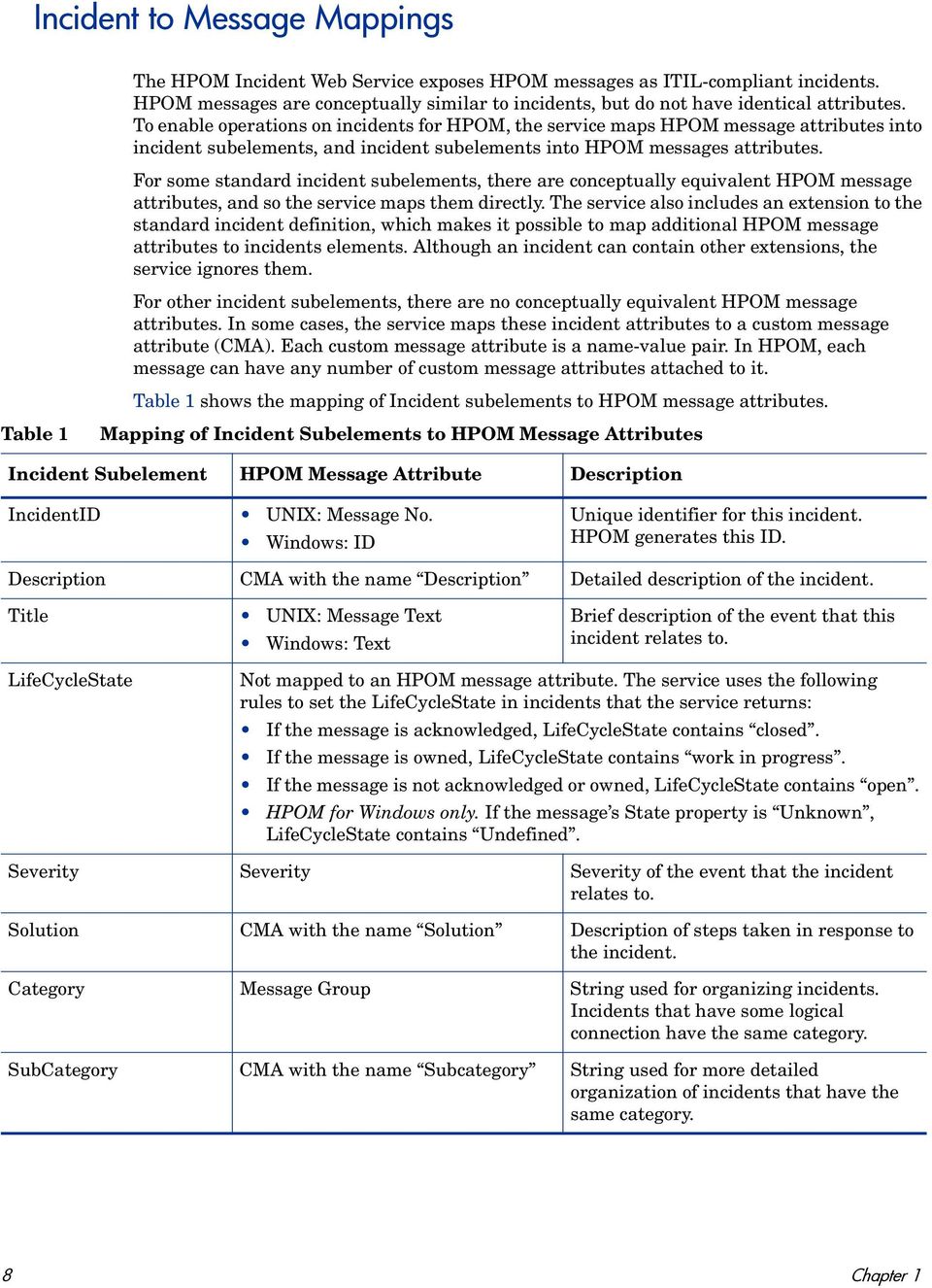
8 Incident to Message Mappings The HPOM Incident Web Service exposes HPOM messages as ITIL-compliant incidents. HPOM messages are conceptually similar to incidents, but do not have identical attributes. To enable operations on incidents for HPOM, the service maps HPOM message attributes into incident subelements, and incident subelements into HPOM messages attributes. For some standard incident subelements, there are conceptually equivalent HPOM message attributes, and so the service maps them directly. The service also includes an extension to the standard incident definition, which makes it possible to map additional HPOM message attributes to incidents elements. Although an incident can contain other extensions, the service ignores them. For other incident subelements, there are no conceptually equivalent HPOM message attributes. In some cases, the service maps these incident attributes to a custom message attribute (CMA). Each custom message attribute is a name-value pair. In HPOM, each message can have any number of custom message attributes attached to it. Table 1 shows the mapping of Incident subelements to HPOM message attributes. Table 1 Mapping of Incident Subelements to HPOM Message Attributes Incident Subelement HPOM Message Attribute Description IncidentID UNIX: Message No. Windows: ID Unique identifier for this incident. HPOM generates this ID. Description CMA with the name Description Detailed description of the incident. Title UNIX: Message Text Windows: Text Brief description of the event that this incident relates to. LifeCycleState Not mapped to an HPOM message attribute. The service uses the following rules to set the LifeCycleState in incidents that the service returns: If the message is acknowledged, LifeCycleState contains closed. If the message is owned, LifeCycleState contains work in progress. If the message is not acknowledged or owned, LifeCycleState contains open. HPOM for Windows only. If the message s State property is Unknown, LifeCycleState contains Undefined. Severity Severity Severity of the event that the incident relates to. Solution CMA with the name Solution Description of steps taken in response to the incident. Category Message Group String used for organizing incidents. Incidents that have some logical connection have the same category. SubCategory CMA with the name Subcategory String used for more detailed organization of incidents that have the same category. 8 Chapter 1
9 Table 1 Mapping of Incident Subelements to HPOM Message Attributes Incident Subelement HPOM Message Attribute Description ProductType CMA with the name Product Type String that may be used for integration with a service management product. The service management product defines the string s value and purpose. ProblemType CMA with the name Problem Type String that may be used for integration with a service management product. The service management product defines the string s value and purpose. CollaborationMode CMA with the name Collaboration Mode String that may be used for integration with a service management product. The service management product defines the string s value and purpose. EmittingCI.ID UNIX: Service Name Windows: Service Id EmittingNode.DnsName UNIX: Node Windows: Primary Node Name AssignedOperator.Name UNIX: Owner Windows: User of Last State Change ID of the service that the incident relates to. The severity of an incident can affect the status of a service that it relates to. Name of the node generating the incident. Name of the HPOM user that is currently responsible for the incident. If the incident has an owner, HPOM prevents other users from starting some tasks on that incident. AffectedCI RequesterReference Not mapped to HPOM messages Not mapped to HPOM messages Type Message Type String used for organizing incidents, for example, to group different types of incident within a category. Introduction to the Incident Web Service 9

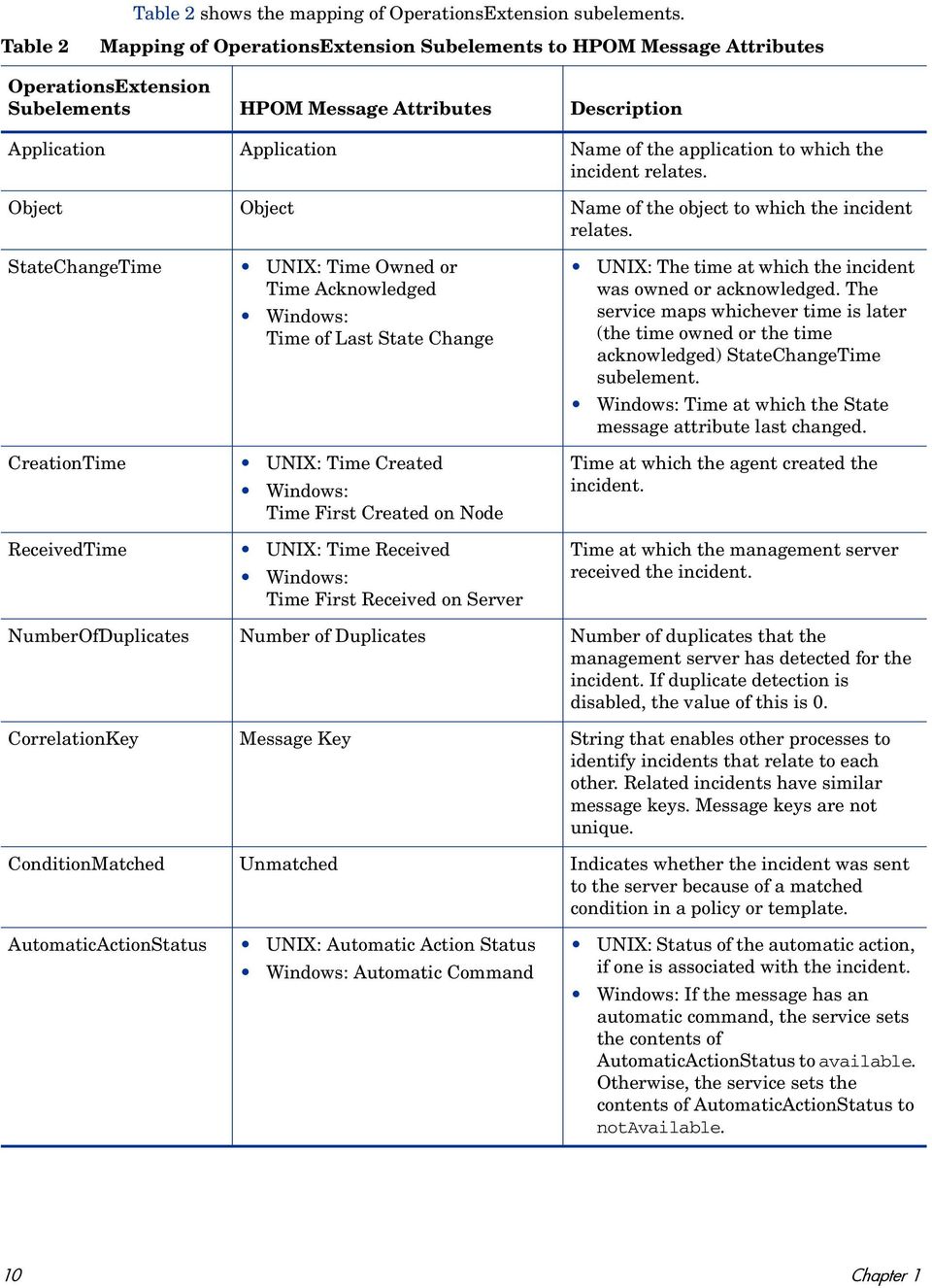
10 Table 2 shows the mapping of OperationsExtension subelements. Table 2 Mapping of OperationsExtension Subelements to HPOM Message Attributes OperationsExtension Subelements HPOM Message Attributes Description Application Application Name of the application to which the incident relates. Object Object Name of the object to which the incident relates. StateChangeTime UNIX: Time Owned or Time Acknowledged Windows: Time of Last State Change CreationTime UNIX: Time Created Windows: Time First Created on Node ReceivedTime UNIX: Time Received Windows: Time First Received on Server UNIX: The time at which the incident was owned or acknowledged. The service maps whichever time is later (the time owned or the time acknowledged) StateChangeTime subelement. Windows: Time at which the State message attribute last changed. Time at which the agent created the incident. Time at which the management server received the incident. NumberOfDuplicates Number of Duplicates Number of duplicates that the management server has detected for the incident. If duplicate detection is disabled, the value of this is 0. CorrelationKey Message Key String that enables other processes to identify incidents that relate to each other. Related incidents have similar message keys. Message keys are not unique. ConditionMatched Unmatched Indicates whether the incident was sent to the server because of a matched condition in a policy or template. AutomaticActionStatus UNIX: Automatic Action Status Windows: Automatic Command UNIX: Status of the automatic action, if one is associated with the incident. Windows: If the message has an automatic command, the service sets the contents of AutomaticActionStatus to available. Otherwise, the service sets the contents of AutomaticActionStatus to notavailable. 10 Chapter 1
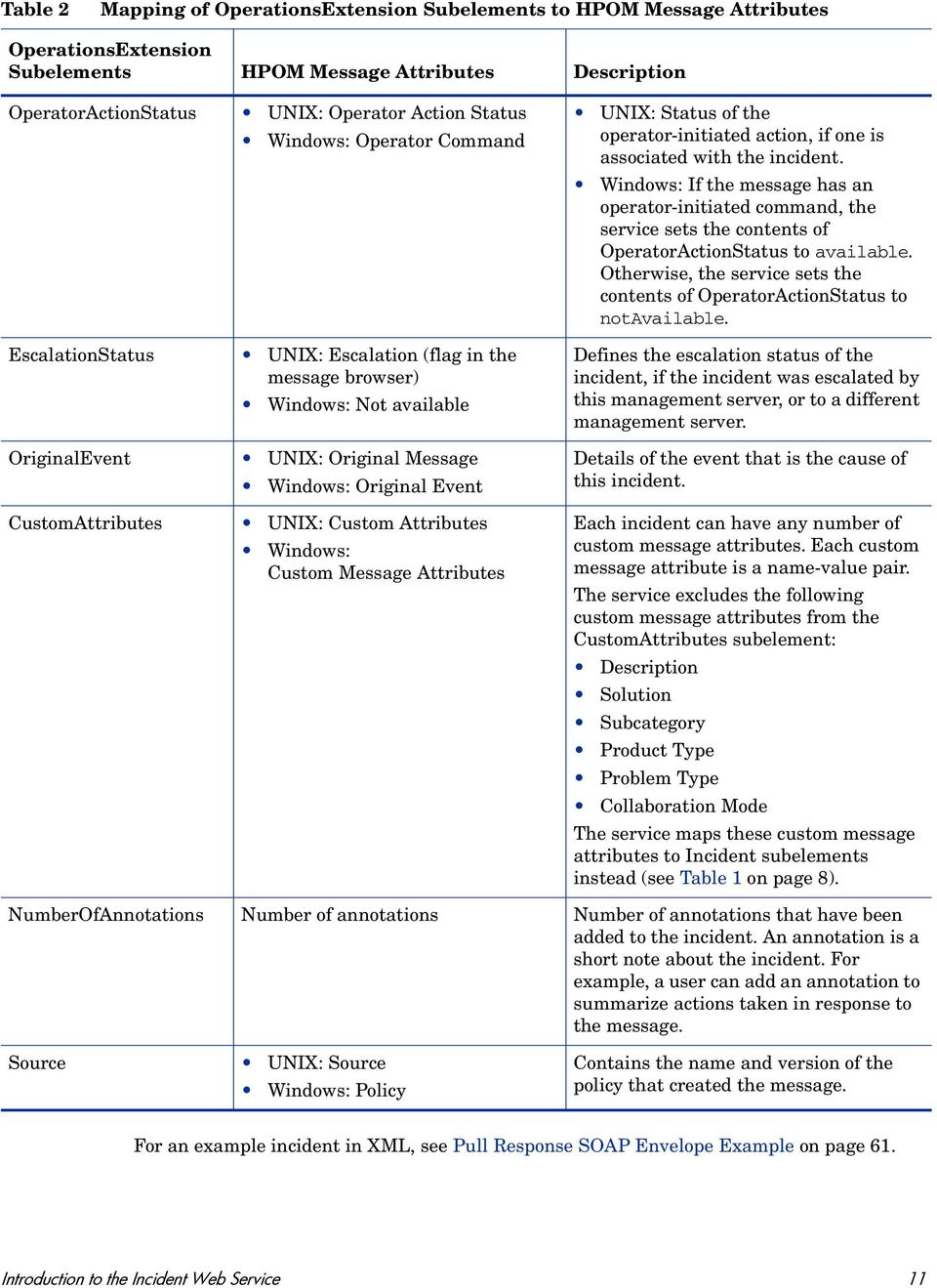
11 Table 2 Mapping of OperationsExtension Subelements to HPOM Message Attributes OperationsExtension Subelements HPOM Message Attributes Description OperatorActionStatus UNIX: Operator Action Status Windows: Operator Command EscalationStatus UNIX: Escalation (flag in the message browser) Windows: Not available OriginalEvent UNIX: Original Message Windows: Original Event CustomAttributes UNIX: Custom Attributes Windows: Custom Message Attributes UNIX: Status of the operator-initiated action, if one is associated with the incident. Windows: If the message has an operator-initiated command, the service sets the contents of OperatorActionStatus to available. Otherwise, the service sets the contents of OperatorActionStatus to notavailable. Defines the escalation status of the incident, if the incident was escalated by this management server, or to a different management server. Details of the event that is the cause of this incident. Each incident can have any number of custom message attributes. Each custom message attribute is a name-value pair. The service excludes the following custom message attributes from the CustomAttributes subelement: Description Solution Subcategory Product Type Problem Type Collaboration Mode The service maps these custom message attributes to Incident subelements instead (see Table 1 on page 8). NumberOfAnnotations Number of annotations Number of annotations that have been added to the incident. An annotation is a short note about the incident. For example, a user can add an annotation to summarize actions taken in response to the message. Source UNIX: Source Windows: Policy Contains the name and version of the policy that created the message. For an example incident in XML, see Pull Response SOAP Envelope Example on page 61. Introduction to the Incident Web Service 11
12 XML Namespaces Table 3 lists the prefixes used in this document to show the namespaces of element types. Table 3 Prefixes and XML Namespaces Used in this Document Prefix inc incext incfil ismci ismnode ismworkitem s wsa wse wsen wsman xs XML Namespace Chapter 1

13 Endpoint References The WS-Management specification uses WS-Addressing endpoint references (EPRs) as the addressing model for individual resource instances. Table 3 on page 12 lists the prefixes used in this section to show the namespace of each element type. An EPR is an XML element of the type wsa:endpointreferencetype. An EPR element contains subelements that, in combination, provide the full reference to a resource instance. In terms of the HPOM Incident Web Service, this means that an EPR provides the full reference to an individual incident on a particular management server. The following XML element shows an example of an EPR for the HPOM Incident Web Service: <wsa:endpointreference> <wsa:address> </wsa:address> <wsa:referenceparameters> <wsman:resourceuri> Incident </wsman:resourceuri> <wsman:selectorset> <wsman:selector Name="IncidentID"> 2b9cdf48-d6ca-71db-0d4b b0000 </wsman:selector> </wsman:selectorset> </wsa:referenceparameters> </wsa:endpointreference> The above EPR contains of the following conceptual elements: Address at which the service is available on a management server. This is in the format: Unique identifier for the type of resource. This is the following URI: Selector set that identifies an incident. This contains one selector, which contains an incident ID. When you create a new incident using the service, the service returns an EPR for the new incident. You can store this EPR, and use it to uniquely identify the incident if you need to update it later. (See Create on page 23.) WS-Addressing specifies that, to use an EPR in a request to a service, clients should add the contents of the EPR's wsa:address subelement as the contents of the wsa:to subelement in the SOAP header. Where possible, clients should not rely on the wsa:referenceparameters subelement containing any particular subelements. Clients should instead treat the wsa:referenceparameters subelement as opaque, by unwrapping its contents and adding them all to the SOAP header of the request. The following XML fragment shows an example of a SOAP header that contains the EPR of an incident: <s:header>... <wsa:to> Introduction to the Incident Web Service 13

14 </wsa:to> <wsman:resourceuri> Incident </wsman:resourceuri> <wsman:selectorset> <wsman:selector Name="IncidentID"> 2b9cdf48-d6ca-71db-0d4b b0000 </wsman:selector> </wsman:selectorset>... </s:header> 14 Chapter 1

15 2 Installing and Configuring the Incident Web Service Installation on HPOM for UNIX Management Servers The HPOM Incident Web Service is available to download and install for supported versions of HPOM for UNIX. (HPOM for Windows 8.10 and later installs the HPOM Incident Web Service by default with the management server.) Prerequisites HPOM for UNIX 8.30 or later. On HP-UX management servers, HP-UX patches are required for Java 5.0. These patches are available from the following web page: Install an HPOM for UNIX Incident Web Service The HPOM Incident Web Service is bundled with the HPOM SiteScope Integration installation package. Installation packages are available for the following management server platforms: HP-UX PA-RISC ProductImage-HPOprSam-<version>-HPUX11.0-release.tar.gz HP-UX Itanium ProductImage-HPOprSam-<version>-HPUX11.22_IPF32-release.tar.gz Solaris ProductImage-HPOprSam-<version>-SunOS5.7-release.tar.gz These installation packages are available to download from the following location: ftp://ovweb.external.hp.com/pub/cpe/ito/om-installation Although these packages include HPOM SiteScope Integration, you do not have to install HPOM SiteScope Integration to use the HPOM Incident Web Service. For more information about HPOM SiteScope Integration, see the HP Operations Manager SiteScope Administration Installation Guide. To install the HPOM Incident Web Service: 1 Copy the installation package to a temporary directory on the HPOM for UNIX management server. 2 In a shell, navigate to the temporary folder that contains the installation package. Type the following commands to decompress the package: 15

16 a b gunzip <package_name>.tar.gz tar xvf <package_name>.tar 3 Start the following program: HPOprSam_<version>_setup.bin The HP Software Installer wizard opens. Follow the instructions in the wizard. To install the HPOM Incident Web Service without the HPOM SiteScope Integration, select the custom installation type. The custom installation type enables you to deselect the HPOM SiteScope Integration installation option. 4 The installation wizard also installs or upgrades the required core packages: HPOvXpl HPOvJREB HPOvTomcatB To enable the HPOM Incident Web Service to connect to HPOM for UNIX, ensure that OvTomcatB is running as root user. Deinstallation To deinstall the service from an HPOM for UNIX management server, start the following program again: HPOprSam_<version>_setup.bin The HP Software Installer wizard opens. Follow the instructions in the wizard, and select the Uninstall option. 16 Chapter 2

17 Service Configuration The HPOM Incident Web Service provides several configuration parameters that enable you to configure how the service responds to client requests. You can change the values of these parameters to suit your environment. Table 4 lists the parameters that you can configure and their default values. On HPOM for UNIX management servers, you can configure the parameters using ovconfchg. The parameters are in the opc.webservice namespace. On HPOM for Windows management servers, you can configure the parameters in the Server Configuration dialog box. The parameters are in the Incident Web Service namespace. Table 4 Service Configuration Parameters Name Default Value Description EnumerationExpiration 10 (minutes) Default duration that enumeration contexts are valid for. (See EnumerateOp on page 27.) EnumerationExpirationMaximum 60 (minutes) Maximum duration that enumeration contexts are valid for. If a client specifies a longer duration, the service overrides the client and uses the value of this parameter instead. (See EnumerateOp on page 27.) SubscriptionExpiration 60 (minutes) Default duration that subscriptions are valid for. (See SubscribeOp on page 32.) SubscriptionExpirationMaximum 1440 (minutes) Maximum duration that subscriptions are valid for. If a client specifies a longer duration, the service overrides the client and uses the value of this parameter instead. (See SubscribeOp on page 32.) Installing and Configuring the Incident Web Service 17

18 Table 4 Name Service Configuration Parameters Default Value Description MaxItems 100 Maximum number of items that the service returns for a PullOp operation if the client does not specify a value. (See PullOp on page 29.) MaxItemsMaximum 500 Maximum number of items that service returns for a PullOp operation. If a client specifies a larger number, the service uses this value instead. (See PullOp on page 29.) Set this parameter to a value below A value of 5000 or higher may cause heap space exceptions. EventQueueSize 1000 Maximum number of events that an event queue can store. If the event queue contains the maximum number of events, and a new event occurs, the service discards the oldest event from the queue before it adds the new event to the end of the queue. Port Configuration The port that the HPOM Incident Web Service is available on depends on either the configuration of the Tomcat (B) servlet container on HPOM for UNIX management servers, or the configuration of Internet Information Services on HPOM for Windows management servers. The service listens for HTTPS connections on the following ports by default: HPOM for UNIX Port 8444 HPOM for Windows Port 443 On HPOM for UNIX management servers, the service also listens for insecure HTTP connections on port This can be useful for testing your client. You can configure the service to listen for HTTPS connections on a different port as follows: HPOM for UNIX Open a shell prompt on the management server, and then type the following command: ovtomcatbctl -sethttpsport <port number> HPOM for Windows In Microsoft Internet Information Services Manager, open the properties for the default web site, and change the SSL port. 18 Chapter 2

19 3 Operations Reference The HPOM Incident Web Service provides a Web Services Definition Language (WSDL) document, which describes the service. After you install the service, the WSDL is available from the following location on the HPOM management server: This WSDL document refers to the other WSDL documents and associated XML Schema Documents (XSDs), and gives their location on the management server. These documents provide complete information about the operations that the service supports. The details of how your client uses these operations depends on the web service client development toolkit that you choose. HP provides unsupported examples for several client development toolkits. The examples are also available on the HPOM management server after you install the service. The following read-me files provide more information on how to develop clients with each toolkit: Apache Axis2 <install_dir>/contrib/oprweb/clients/axis/readme.txt. Windows Communication Foundation <install_dir>/contrib/oprweb/clients/wcf/readme.txt. Wiseman <install_dir>/contrib/oprweb/clients/wiseman/readme.txt. Alternatively, you can develop a client using any other suitable toolkit or programming language. This chapter provides a generic reference to the operations that the service provides. For specific examples of SOAP envelopes that the service receives and sends, see Appendix A, SOAP Envelope Examples Table 3 on page 12 lists the prefixes used in this section to show the namespace of each element type. The WSDL document contains the following operations that the service does not actually support: Delete SubscriptionEndOp If your client attempts to use these operations, the service returns an ActionNotSupported fault. 19

20 Get This operation returns one incident, which is identified by the incident ID. Input SOAP Body Empty. SOAP Header Element wsa:action of type wsa:actiontype that contains the following string: Element wsman:resourceuri of type wsman:attributableuri Contains a string that identifies the resource type. You can use the element wsa:referenceparameters/wsman:resourceuri from an element of type wsa:endpointreferencetype. Alternatively, create a wsman:resourceuri element that contains the following string: Element wsman:selectorset of type wsman:selectorsettype Contains one element of type wsman:selectortype, which identifies the incident instance. You can use the element wsa:referenceparameters/wsman:selectorset from an element of type wsa:endpointreferencetype. (See Endpoint References on page 13.) Alternatively, create a wsman:selectorset that contains one wsman:selector element of type wsman:selectortype: wsman:selector attribute Name must have the value IncidentID. wsman:selector must contain the ID of the incident instance to get. Optional element wsman:operationtimeout of type wsman:attributableduration Contains a maximum duration within which you expect the service to respond. On an HPOM for UNIX management server, the service returns a TimedOut fault if it cannot respond in time. Output The SOAP body contains an element inc:incident of type inc:incident. Fault If it cannot return the incident, the service returns a fault according to the WS-Management standard. 20 Chapter 3

21 Put This operation updates an existing incident, which is identified by the incident ID. Input SOAP Body Element inc:incident of type inc:incident. inc:incident can contain any of the following the subelements to update on the server: Element inc:title of type xs:string. Element inc:severity of type xs:string. This can be one of the following strings: Normal Warning Minor Major Critical inc:incident can also contain other valid subelements, although this operation ignores them and returns an incident with the contents of those subelements unchanged. In other words, if Incident contains immutable subelements, the operation does not return a fault. SOAP Header Element wsa:action of type wsa:actiontype that contains the following string: Element wsan:resourceuri of type wsman:attributableuri Contains a string that identifies the resource type. You can use the element wsa:referenceparameters/wsman:resourceuri from an element of type wsa:endpointreferencetype. Alternatively, create a wsman:resourceuri element that contains the following string: Element wsman:selectorset of type wsman:selectorsettype Contains one element of type wsman:selectortype, which identifies the incident instance. You can use the element wsa:referenceparameters/wsman:selectorset from an element of type wsa:endpointreferencetype. (See Endpoint References on page 13.) Alternatively, create a wsman:selectorset that contains one wsman:selector element of type wsman:selectortype: wsman:selector attribute Name must have the value IncidentID. wsman:selector must contain the ID of the incident instance to get. Optional element wsman:operationtimeout of type wsman:attributableduration Contains a maximum duration within which you expect the service to respond. On an HPOM for UNIX management server, the service returns a TimedOut fault if it cannot respond in time. Operations Reference 21
22 Output The SOAP body contains an element inc:incident of type inc:incident, which contains the updated incident. Fault If it cannot update the incident, the service returns a fault according to the WS-Management standard. 22 Chapter 3
23 Create This operation stores a new incident on the management server. Input SOAP Body Element inc:incident of type inc:incident. inc:incident must contain the following subelements: inc:title inc:emittingnode/ismnode:dnsname Incident can contain any of the following subelements: inc:description inc:severity (default: Unknown ) inc:solution inc:category inc:subcategory inc:producttype inc:problemtype inc:collaborationmode (default: FYI ) inc:emittingci/ismci:id inc:type inc:extensions/incext:operationsextension/incext:application inc:extensions/incext:operationsextension/incext:object inc:extensions/incext:operationsextension/incext:creationtime (default: the current time) inc:extensions/incext:operationsextension/incext:correlationkey (default: null) inc:extensions/incext:operationsextension/incext:customattributes (default: an empty list) inc:incident can also contain other valid subelements, although this operation ignores them. SOAP Header Element wsa:action of type wsa:actiontype that contains the following string: Element wsman:resourceuri of type wsman:attributableuri Contains a string that identifies the resource type. You can use the element wsa:referenceparameters/wsman:resourceuri from an element of type wsa:endpointreferencetype. Alternatively, create a wsman:resourceuri element that contains the following string: Operations Reference 23
24 Element wsman:operationtimeout of type wsman:attributableduration Contains a maximum duration within which you expect the service to respond. On an HPOM for UNIX management server, the service returns a TimedOut fault if it cannot respond in time. For an example, see Create Request SOAP Envelope Example on page 57. Output The SOAP body contains an element wsa:endpointreference of type wsa:endpointreferencetype. This element contains the subelements wsman:resourceuri and wsman:selectorset, which you can use to uniquely identify the incident in subsequent operations. For an example, see Create Response SOAP Envelope Example on page 58. Fault If the service cannot store the incident, it returns a fault according to the WS-Management standard. 24 Chapter 3
25 Close This operation sets the lifecycle state of an existing incident to closed. The incident is identified by the incident ID. Alternatively, you can use the CloseMany operation to close multiple incidents in one operation. (See CloseMany on page 48.) Input SOAP Body Empty. SOAP Header Element wsa:action of type wsa:actiontype that contains the following string: Element wsman:resourceuri of type wsman:attributableuri Contains a string that identifies the resource type. You can use the element wsa:referenceparameters/wsman:resourceuri from an element of type wsa:endpointreferencetype. Alternatively, create a wsman:resourceuri element that contains the following string: Element wsman:selectorset of type wsman:selectorsettype Contains one element of type wsman:selectortype, which identifies the incident instance. You can use the element wsa:referenceparameters/wsman:selectorset from an element of type wsa:endpointreferencetype. (See Endpoint References on page 13.) Alternatively, create a wsman:selectorset that contains one wsman:selector element of type wsman:selectortype: wsman:selector attribute Name must have the value IncidentID. wsman:selector must contain the ID of the incident instance to close. Optional element wsman:operationtimeout of type wsman:attributableduration Contains a maximum duration within which you expect the service to respond. On an HPOM for UNIX management server, the service returns a TimedOut fault if it cannot respond in time. For an example, see Close Request SOAP Envelope Example on page 59. Output The SOAP body is empty. For an example, see Close Response SOAP Envelope Example on page 59. Fault If it cannot close the incident, the service returns a fault according to the WS-Management standard. Operations Reference 25
26 Reopen This operation sets the lifecycle state of a closed incident to open. The incident is identified by the incident ID. Alternatively, you can use the ReopenMany operation to open multiple incidents in one operation. (See ReopenMany on page 49.) Input SOAP Body Empty. SOAP Header Element wsa:action of type wsa:actiontype that contains the following string: Element wsman:resourceuri of type wsman:attributableuri Contains a string that identifies the resource type. You can use the element wsa:referenceparameters/wsman:resourceuri from an element of type wsa:endpointreferencetype. Alternatively, create a wsman:resourceuri element that contains the following string: Element wsman:selectorset of type wsman:selectorsettype Contains one element of type wsman:selectortype, which identifies the incident instance. You can use the element wsa:referenceparameters/wsman:selectorset from an element of type wsa:endpointreferencetype. (See Endpoint References on page 13.) Alternatively, create a wsman:selectorset that contains one wsman:selector element of type wsman:selectortype: wsman:selector attribute Name must have the value IncidentID. wsman:selector must contain the ID of the incident instance to reopen. Optional element wsman:operationtimeout of type wsman:attributableduration Contains a maximum duration within which you expect the service to respond. On an HPOM for UNIX management server, the service returns a TimedOut fault if it cannot respond in time. Output The SOAP body is empty. Fault If it cannot reopen the incident, the service returns a fault according to the WS-Management standard. The service returns a fault if the incident is already open. 26 Chapter 3
27 EnumerateOp This operation returns an enumeration context, which you can then use with the PullOp operation to get batches of incidents from the service. You can specify a filter, so that the enumeration context contains only specific incidents. Input SOAP Body Element Enumerate of type wsen:enumerate. This element can contain the following subelements: Optional element wsen:expires of type wsen:expirationtype. Contains a duration, for which the client requires the enumeration context. If you omit this subelement, the service uses the value of the EnumerationExpiration parameter on the management server. If you specify a duration that exceeds the value of the EnumerationExpirationMaximum parameter, the service uses the value of SubscriptionExpirationMaximum instead. (See Service Configuration on page 17.) Optional element wsen:filter of type wsen:filtertype or wsman:filter of type wsman:dialectablemixeddatatype. For compatibility with different toolkits, the service supports a filter of either type, but you must specify only one of them. Filter attribute Dialect must have the following value: IncidentFilter Filter must contain the subelement incfil:incidentenumerationfilter of type incfil:incidentenumerationfilter. IncidentEnumerationFilter can contain any of the following subelements: Optional element incfil:severity of type inc:severity_opentype Optional element incfil:emittingnode of type incfil:emittingnode Optional element incfil:category of type xs:string Optional element incfil:application of type xs:string Optional element incfil:object of type xs:string Optional element incfil:emittingci of type incfil:emittingci Optional element incfil:correlationkey of type xs:string Optional element incfil:escalationstatus of type xs:string Optional element incfil:conditionmatched of type xs:boolean Optional element incfil:receivedtime of type incfil:timefilter Optional element incfil:title of type incfil:keywordfilter Optional element incfil:customattributes of type incfil:customattributes The service enumerates incidents that match the contents of the incfil:incidentenumerationfilter subelements that you specify. For more details on incident attributes, see Incident to Message Mappings on page 8. Operations Reference 27
28 If you omit Filter, the service enumerates all incidents that have the status open or work in progress. SOAP Header Element wsa:action of type wsa:actiontype that contains the following string: Element wsman:resourceuri of type wsman:attributableuri Contains a string that identifies the resource type. You can use the element wsa:referenceparameters/wsman:resourceuri from an element of type wsa:endpointreferencetype. Alternatively, create a wsman:resourceuri element that contains the following string: Optional element wsman:operationtimeout of type wsman:attributableduration Contains a maximum duration within which you expect the service to respond. On an HPOM for UNIX management server, the service returns a TimedOut fault if it cannot respond in time. For an example, see Enumerate Request SOAP Envelope Example on page 60. Output The SOAP body contains an element wsen:enumerateresponse (of anonymous type), which contains the following subelements: Element wsen:expires of type wsen:expirationtype. Contains a duration, for which the enumeration context is valid. You can use the ReleaseOp operation to cancel the enumeration context early. (See ReleaseOp on page 31.) Element wsen:enumerationcontext of type wsen:enumerationcontexttype. Contains a string that identifies the enumeration context. Use wsen:enumerationcontext with the PullOp operation to get batches of incidents from the service. (See PullOp on page 29.) For an example, see Enumerate Response SOAP Envelope Example on page 60. Fault If it cannot return the enumeration context, the service returns a fault according to the WS-Management standard. 28 Chapter 3
29 PullOp This operation returns a batch of incidents from an enumeration context. Input SOAP Body Element wsen:pull (of anonymous type), which contains the following subelements: Element wsen:enumerationcontext of type wsen:enumerationcontexttype. Contains a string that identifies the enumeration context. Use a wsen:enumerationcontext that one of the following operations returns: EnumerateOp (see page 27) SubscribeOp (see page 32) PullOp (see below) Optional element wsen:maxelements of type xs:positiveinteger. Contains an integer that indicates the maximum number of incidents to return in this batch. If you omit this subelement, the service uses the value of the MaxItems parameter on the management server. (See Service Configuration on page 17.) The HPOM Incident Web Service does not support the subelements wsen:maxtime or wsen:maxcharacters. You should omit these subelements. SOAP Header Element wsa:action of type wsa:actiontype that contains the following string: Element wsman:resourceuri of type wsman:attributableuri Contains a string that identifies the resource type. You can use the element wsa:referenceparameters/wsman:resourceuri from an element of type wsa:endpointreferencetype. Alternatively, create a wsman:resourceuri element that contains the following string: Optional element wsman:operationtimeout of type wsman:attributableduration Contains a maximum duration within which you expect the service to respond. On an HPOM for UNIX management server, the service returns a TimedOut fault if it cannot respond in time. For enumeration contexts from the SubscribeOp operation, if the event queue remains empty for the specified OperationTimeout, PullOp returns a TimedOut fault. For an example, see Pull Request SOAP Envelope Example on page 61. Output The SOAP body contains an element wsen:pullresponse (of anonymous type), which contains the following subelements: Operations Reference 29
30 Element wsen:enumerationcontext of type wsen:enumerationcontexttype. Contains a string that identifies the enumeration context. This is the same as the input wsen:enumerationcontext. Element wsen:items of the type wsen:itemlisttype. Contains multiple inc:incident elements of type inc:incident. Optional element wsen:endofsequence of type wsen:attributableempty. This element is empty. If wsen:endofsequence is present, there are no remaining items to pull for this enumeration context and the enumeration context is no longer valid. For an example, see Pull Response SOAP Envelope Example on page 61. Fault If it cannot return the batch of incidents, the service returns a fault according to the WS-Management standard. 30 Chapter 3
31 ReleaseOp This operation cancels an existing enumeration context early (that is, before the client has pulled all the incidents, and before the enumeration context has expired.) You can use this operation to cancel an enumeration context from an enumerate operation. To cancel an enumeration context from a subscription operation, unsubscribe instead. (See UnsubscribeOp on page 35.) Input SOAP Body Element wsen:release (of anonymous type), which contains the subelement wsen:enumerationcontext of type wsen:enumerationcontexttype. wsen:enumerationcontext contains a string that identifies the enumeration context. Use a wsen:enumerationcontext that one of the following operations returns: EnumerateOp (see page 27) PullOp (see page 29) SOAP Header Element wsa:action of type wsa:actiontype that contains the following string: Element wsman:resourceuri of type wsman:attributableuri Contains a string that identifies the resource type. You can use the element wsa:referenceparameters/wsman:resourceuri from an element of type wsa:endpointreferencetype. Alternatively, create a wsman:resourceuri element that contains the following string: Optional element wsman:operationtimeout of type wsman:attributableduration Contains a maximum duration within which you expect the service to respond. On an HPOM for UNIX management server, the service returns a TimedOut fault if it cannot respond in time. Output The SOAP body is empty. Fault If it cannot release the enumeration context, the service returns a fault according to the WS-Management standard. Operations Reference 31
32 SubscribeOp This operation returns an enumeration context, which you can then use with the PullOp operation to get batches of new or updated incidents from the service. The service maintains an event queue of new or updated incidents. If an existing incident changes several times, the service adds the incident to the event queue several times (the service does not consolidate the events). The value of the EventQueueSize parameter on the management server constrains the size of the event queue. (See Service Configuration on page 17.) To prevent the service from deleting events from the queue, you must pull batches of updated incidents at appropriate intervals. Consider using the following procedure to manage a subscription: 1 Use the SubscribeOp operation to get an enumeration context. 2 Immediately after SubscribeOp returns the enumeration context, start a PullOp operation. As soon as the event queue contains events, PullOp returns a batch of incidents. If the event queue remains empty for the specified OperationTimeout, PullOp returns a TimedOut fault. 3 Immediately after the PullOp returns incidents or a fault, start another PullOp operation. This step ensures that you always have a PullOp running, which should prevent the event queue from becoming too large. If you restart the HPOM Incident Web Service, the service releases any enumeration contexts. The service does not maintain an event queue of new or updated incidents until the client subscribes again. This situation can also arise if the management server is part of a cluster and a failover occurs. Input SOAP Body Element wse:subscribe of type wse:subscribetype, which contains the following subelements: Element wse:delivery of type wse:deliverytype. wse:delivery attribute Mode must have the following value: Optional element wse:expires of type wse:expirationtype. Contains either a duration that specifies how long the client requires the subscription, or a date and time at which the subscription should expire. If you omit this subelement, the service uses the value of the SubscriptionExpiration parameter on the management server. If you specify a duration that exceeds the value of the SubscriptionExpirationMaximum parameter, the service uses the value of SubscriptionExpirationMaximum instead. (See Service Configuration on page 17.) Optional element wse:filter of type wse:filtertype or wsman:filter of type wsman:dialectablemixeddatatype. For compatibility with different toolkits, the service supports a filter of either type, but you must specify only one of them. Filter attribute Dialect must have the following value: IncidentFilter 32 Chapter 3
33 Filter must contain the subelement incfil:incidenteventingfilter of type incfil:incidenteventingfilter. IncidentEventingFilter can contain any of the following subelements: Optional element incfil:severity of type inc:severity_opentype Optional element incfil:emittingnode of type incfil:emittingnode Optional element incfil:category of type xs:string Optional element incfil:application of type xs:string Optional element incfil:object of type xs:string Optional element incfil:emittingci of type incfil:emittingci Optional element incfil:correlationkey of type xs:string Optional element incfil:type of type xs:string Optional element incfil:escalationstatus of type xs:string Optional element incfil:conditionmatched of type xs:boolean Optional element incfil:forwardtotroubleticket of type xs:boolean incfil:forwardtotroubleticket enables you to filter incidents, depending on whether the corresponding HPOM message is flagged for forwarding to an external trouble ticket system. Optional element incfil:forwardtonotification of type xs:boolean incfil:forwardtonotification enables you to filter incidents depending on whether the corresponding HPOM message is flagged for forwarding to an external notification system. Optional element incfil:title of type incfil:keywordfilter Optional elements incfil:changetype of type xs:string incfil:changetype enables you to filter incidents depending on how they have changed (whether they are new, updated, closed, or reopened). incfil:changetype must contain one of the following strings: new modified closed reopened For example, if you are interested in new incidents only, you specify a filter with a incfil:changetype subelement that contains new. To subscribe to a combination of change types, specify several incfil:changetype subelements. To subscribe to all change types, you can omit the incfil:changetype subelements. Optional element incfil:customattributes of type incfil:customattributes The service enumerates all incidents that match the contents of the incfil:incidenteventingfilter subelements that you specify. For more details on incident attributes, see Incident to Message Mappings on page 8. If you omit Filter, the service enumerates all incidents that have the status open or work in progress. Operations Reference 33
34 SOAP Header Element wsa:action of type wsa:actiontype that contains the following string: Element wsman:resourceuri of type wsman:attributableuri Contains a string that identifies the resource type. You can use the element wsa:referenceparameters/wsman:resourceuri from an element of type wsa:endpointreferencetype. Alternatively, create a wsman:resourceuri element that contains the following string: Optional element wsman:operationtimeout of type wsman:attributableduration Contains a maximum duration within which you expect the service to respond. On an HPOM for UNIX management server, the service returns a TimedOut fault if it cannot respond in time. For an example, see Subscribe Request SOAP Envelope Example on page 64. Output The SOAP body contains an element wse:subscriberesponse (of anonymous type), which contains the following subelements: Element wse:subscriptionmanager of type wsa:endpointreferencetype. Contains the subelement wsa:referenceparameters/wse:identifier of type wse:identifier, which you use to identify the subscription if you unsubscribe or renew it. (See UnsubscribeOp on page 35 and RenewOp on page 36.) Element wse:expires of type wse:expirationtype. Contains a duration, for which the service maintains the subscription. You can use the RenewOp operation to renew the subscription before it expires. (See RenewOp on page 36.) Element wsen:enumerationcontext of type wsen:enumerationcontexttype. Contains a string that identifies the enumeration context. Use EnumerationContext with the PullOp operation to get batches of updated incidents from the service. (See PullOp on page 29.) Fault If it cannot return the enumeration context, the service returns a fault according to the WS-Management standard. 34 Chapter 3
35 UnsubscribeOp This operation cancels a subscription before the subscription expires. Input SOAP Body Element wse:unsubscribe of type wse:unsubscribetype. This element is required, but should be empty. SOAP Header Element wsa:action of type wsa:actiontype that contains the following string: Element wse:identifier of type xs:anyuri. Contains the identifier of an active subscription. You can use the element wse:subscriptionmanager/wsa:referenceparameters/wse:identifier from the output of a SubscribeOp operation. (See SubscribeOp on page 32.) Element wsman:resourceuri of type wsman:attributableuri Contains a string that identifies the resource type. You can use the element wsa:referenceparameters/wsman:resourceuri from an element of type wsa:endpointreferencetype. Alternatively, create a wsman:resourceuri element that contains the following string: Optional element wsman:operationtimeout of type wsman:attributableduration Contains a maximum duration within which you expect the service to respond. On an HPOM for UNIX management server, the service returns a TimedOut fault if it cannot respond in time. Output The SOAP body is empty. Fault If it cannot cancel the subscription, the service returns a fault according to the WS-Management standard. Operations Reference 35
36 RenewOp This operation renews a subscription before it expires. Input SOAP Body Element wse:renew (of anonymous type), which contains the optional subelement wse:expires of type wse:expirationtype. Contains either a duration that specifies how long the client requires the subscription, or a date and time at which the subscription should expire. If you omit this subelement, the service uses the value of the SubscriptionExpiration parameter on the management server. If you specify a duration that exceeds the value of the SubscriptionExpirationMaximum parameter, the service uses the value of SubscriptionExpirationMaximum instead. (See Service Configuration on page 17.) SOAP Header Element wsa:action of type wsa:actiontype that contains the following string: Element wse:identifier of type xs:anyuri. Contains the identifier of an active subscription. You can use the element wse:subscriptionmanager/wsa:referenceparameters/wse:identifier from the output of a SubscribeOp operation. (See SubscribeOp on page 32.) Element wsman:resourceuri of type wsman:attributableuri Contains a string that identifies the resource type. You can use the element wsa:referenceparameters/wsman:resourceuri from an element of type wsa:endpointreferencetype. Alternatively, create a wsman:resourceuri element that contains the following string: Optional element wsman:operationtimeout of type wsman:attributableduration Contains a maximum duration within which you expect the service to respond. On an HPOM for UNIX management server, the service returns a TimedOut fault if it cannot respond in time. Output The SOAP body contains an element wse:renewresponse (of anonymous type), which contains the subelement wse:expires of type wse:expirationtype. wse:expires contains the new date and time at which the subscription expires. Fault If it cannot renew the subscription, the service returns a fault according to the WS-Management standard. 36 Chapter 3
37 OwnMany This operation sets the value of the ismworkitem:assignedoperator/ ismworkitem:personattributes/name element for one or more incidents. The incidents are identified by incident IDs. The operation sets value of the Name element to the user name of the currently authenticated HPOM user. (User Authentication on page 51.) Input SOAP Body Element incext:incidentids of type incext:incidentids, which contains any number of incext:id elements of type xs:string. Each incext:id contains the ID of an incident to own. SOAP Header Element wsa:action of type wsa:actiontype that contains the following string: Incident/OwnMany Element wsman:resourceuri of type wsman:attributableuri Contains a string that identifies the resource type. You can use the element wsa:referenceparameters/wsman:resourceuri from an element of type wsa:endpointreferencetype. Alternatively, create a wsman:resourceuri element that contains the following string: Optional element wsman:operationtimeout of type wsman:attributableduration Contains a maximum duration within which you expect the service to respond. On an HPOM for UNIX management server, the service returns a TimedOut fault if it cannot respond in time. Output The SOAP body is empty. Fault If it cannot own the incidents, the service returns a fault according to the WS-Management standard. Operations Reference 37
38 DisownMany This operation clears the value of the ismworkitem:assignedoperator/ ismworkitem:personattributes/name element for one or more incidents. The incidents are identified by incident IDs. Input SOAP Body Element incext:incidentids of type incext:incidentids, which contains any number of incext:id elements of type xs:string. Each incext:id contains the ID of an incident to disown. SOAP Header Element wsa:action of type wsa:actiontype that contains the following string: Incident/DisownMany Element wsman:resourceuri of type wsman:attributableuri Contains a string that identifies the resource type. You can use the element wsa:referenceparameters/wsman:resourceuri from an element of type wsa:endpointreferencetype. Alternatively, create a ResourceURI element that contains the following string: Optional element OperationTimeout of type wsman:attributableduration Contains a maximum duration within which you expect the service to respond. On an HPOM for UNIX management server, the service returns a TimedOut fault if it cannot respond in time. Output The SOAP body is empty. Fault If it cannot disown the incidents, the service returns a fault according to the WS-Management standard. 38 Chapter 3
39 GetAnnotations This operation returns the annotations for one incident, which is identified by the incident ID. Input SOAP Body Empty. SOAP Header Element wsa:action of type wsa:actiontype that contains the following string: Incident/GetAnnotations Element wsman:resourceuri of type wsman:attributableuri Contains a string that identifies the resource type. You can use the element wsa:referenceparameters/wsman:resourceuri from an element of type wsa:endpointreferencetype. Alternatively, create a wsman:resourceuri element that contains the following string: Element wsman:selectorset of type wsman:selectorsettype Contains one element of type wsman:selectortype, which identifies the incident instance. You can use the element wsa:referenceparameters/wsman:selectorset from an element of type wsa:endpointreferencetype. (See Endpoint References on page 13.) Alternatively, create a wsman:selectorset that contains one wsman:selector element of type wsman:selectortype: wsman:selector attribute Name must have the value IncidentID. wsman:selector must contain the ID of the incident instance to get annotations for. Optional element wsman:operationtimeout of type wsman:attributableduration Contains a maximum duration within which you expect the service to respond. On an HPOM for UNIX management server, the service returns a TimedOut fault if it cannot respond in time. Output The SOAP body contains an element incext:annotations of type incext:annotations, which contains any number of incext:annotation elements of type incext:annotation. Each incext:annotation contains the following subelements: Optional element incext:author of type xs:string. Element incext:text of type xs:string. Optional element incext:date of type xs:datetime. Optional element incext:id of type xs:string. Operations Reference 39
40 Fault If it cannot return the annotations, the service returns a fault according to the WS-Management standard. 40 Chapter 3
41 AddAnnotation This operation stores a new annotation to an existing incident. The incident is identified by incident ID. Input SOAP Body Element incext:annotationtext of type xs:string, which contains the text of the annotation to add. (HPOM sets the annotation s incext:id, incext:date, and incext:author automatically.) SOAP Header Element wsa:action of type wsa:actiontype that contains the following string: Incident/AddAnnotation Element wsman:resourceuri of type wsman:attributableuri Contains a string that identifies the resource type. You can use the element wsa:referenceparameters/wsman:resourceuri from an element of type wsa:endpointreferencetype. Alternatively, create a wsman:resourceuri element that contains the following string: Element wsman:selectorset of type wsman:selectorsettype Contains one element of type wsman:selectortype, which identifies the incident instance. You can use the element wsa:referenceparameters/wsman:selectorset from an element of type wsa:endpointreferencetype. (See Endpoint References on page 13.) Alternatively, create a wsman:selectorset that contains one wsman:selector element of type wsman:selectortype: wsman:selector attribute Name must have the value IncidentID. wsman:selector must contain the ID of the incident instance to add the annotation to. Optional element wsman:operationtimeout of type wsman:attributableduration Contains a maximum duration within which you expect the service to respond. On an HPOM for UNIX management server, the service returns a TimedOut fault if it cannot respond in time. Output The SOAP body contains element incext:annotationid of type xs:string. This is the ID that HPOM generates for the annotation. Fault If it cannot add the annotation, the service returns a fault according to the WS-Management standard. Operations Reference 41
42 UpdateAnnotation This operation updates an annotation to an existing incident. The annotation to update is identified by annotation ID. The existing incident is identified by incident ID. Input SOAP Body Element incext:updateannotation of type incext:updateannotation, which contains the following subelements: Element incext:annotationid of type xs:string. Contains the ID of the annotation to update. Element incext:annotationtext of type xs:string. Contains the updated text for the annotation. (HPOM updates the annotation s incext:date and incext:author automatically.) SOAP Header Element wsa:action of type wsa:actiontype that contains the following string: Incident/UpdateAnnotation Element wsman:resourceuri of type wsman:attributableuri Contains a string that identifies the resource type. You can use the element wsa:referenceparameters/wsman:resourceuri from an element of type wsa:endpointreferencetype. Alternatively, create a wsman:resourceuri element that contains the following string: Element wsman:selectorset of type wsman:selectorsettype Contains one element of type wsman:selectortype, which identifies the incident instance. You can use the element wsa:referenceparameters/wsman:selectorset from an element of type wsa:endpointreferencetype. (See Endpoint References on page 13.) Alternatively, create a wsman:selectorset that contains one wsman:selector element of type wsman:selectortype: wsman:selector attribute Name must have the value IncidentID. wsman:selector must contain the ID of the incident instance that contains the annotation. Optional element wsman:operationtimeout of type wsman:attributableduration Contains a maximum duration within which you expect the service to respond. On an HPOM for UNIX management server, the service returns a TimedOut fault if it cannot respond in time. 42 Chapter 3
43 Output The SOAP body is empty. Fault If it cannot update the annotation, the service returns a fault according to the WS-Management standard. Operations Reference 43
44 DeleteAnnotation This operation deletes an annotation from an existing incident. The annotation to delete is identified by annotation ID. The existing incident is identified by incident ID. Input SOAP Body Element incext:annotationid of type xs:string, which contains the ID of the annotation to delete. SOAP Header Element wsa:action of type wsa:actiontype that contains the following string: Incident/DeleteAnnotation Element wsman:resourceuri of type wsman:attributableuri Contains a string that identifies the resource type. You can use the element wsa:referenceparameters/wsman:resourceuri from an element of type wsa:endpointreferencetype. Alternatively, create a wsman:resourceuri element that contains the following string: Element wsman:selectorset of type wsman:selectorsettype Contains one element of type wsman:selectortype, which identifies the incident instance. You can use the element wsa:referenceparameters/wsman:selectorset from an element of type wsa:endpointreferencetype. (See Endpoint References on page 13.) Alternatively, create a wsman:selectorset that contains one wsman:selector element of type wsman:selectortype: wsman:selector attribute Name must have the value IncidentID. wsman:selector must contain the ID of the incident instance that contains the annotation to delete. Optional element wsman:operationtimeout of type wsman:attributableduration Contains a maximum duration within which you expect the service to respond. On an HPOM for UNIX management server, the service returns a TimedOut fault if it cannot respond in time. Output The SOAP body is empty. Fault If it cannot delete the annotation, the service returns a fault according to the WS-Management standard. 44 Chapter 3
45 SetCustomAttribute This operation creates or updates a custom attribute for an existing incident. The existing incident is identified by incident ID. Input SOAP Body Element incext:customattribute of type incext:customattribute, which contains the following subelements: Element incext:key of type xs:string. Contains the key for the custom attribute. If a custom attribute with this key exists, the operation updates the existing a custom attribute. If a custom attribute with the specified key does not exist, the operation stores an new custom attribute. Element incext:text of type xs:string. Contains the value of the custom attribute. SOAP Header Element wsa:action of type wsa:actiontype that contains the following string: Incident/SetCustomAttribute Element wsman:resourceuri of type wsman:attributableuri Contains a string that identifies the resource type. You can use the element wsa:referenceparameters/wsman:resourceuri from an element of type wsa:endpointreferencetype. Alternatively, create a wsman:resourceuri element that contains the following string: Element wsman:selectorset of type wsman:selectorsettype Contains one element of type wsman:selectortype, which identifies the incident instance. You can use the element wsa:referenceparameters/wsman:selectorset from an element of type wsa:endpointreferencetype. (See Endpoint References on page 13.) Alternatively, create a wsman:selectorset that contains one wsman:selector element of type wsman:selectortype: wsman:selector attribute Name must have the value IncidentID. wsman:selector must contain the ID of the incident instance that contains the custom attribute. Optional element wsman:operationtimeout of type wsman:attributableduration Contains a maximum duration within which you expect the service to respond. On an HPOM for UNIX management server, the service returns a TimedOut fault if it cannot respond in time. Operations Reference 45
46 Output The SOAP body is empty. Fault If it cannot create or update the custom attribute, the service returns a fault according to the WS-Management standard. 46 Chapter 3
47 DeleteCustomAttribute This operation deletes a custom attribute from an existing incident. The existing incident is identified by incident ID. Input SOAP Body Element incext:customattributekey of type xs:string, which contains the key of the custom attribute to delete. SOAP Header Element wsa:action of type wsa:actiontype that contains the following string: Incident/DeleteCustomAttribute Element wsman:resourceuri of type wsman:attributableuri Contains a string that identifies the resource type. You can use the element wsa:referenceparameters/wsman:resourceuri from an element of type wsa:endpointreferencetype. Alternatively, create a wsman:resourceuri element that contains the following string: Element wsman:selectorset of type wsman:selectorsettype Contains one element of type wsman:selectortype, which identifies the incident instance. You can use the element wsa:referenceparameters/wsman:selectorset from an element of type wsa:endpointreferencetype. (See Endpoint References on page 13.) Alternatively, create a wsman:selectorset that contains one wsman:selector element of type wsman:selectortype: wsman:selector attribute Name must have the value IncidentID. wsman:selector must contain the ID of the incident instance that contains the custom attribute to delete. Optional element wsman:operationtimeout of type wsman:attributableduration Contains a maximum duration within which you expect the service to respond. On an HPOM for UNIX management server, the service returns a TimedOut fault if it cannot respond in time. Output The SOAP body is empty. Fault If it cannot delete the custom attribute, the service returns a fault according to the WS-Management standard. Operations Reference 47
48 CloseMany This operation sets the lifecycle state of multiple existing incidents to closed. The incidents are identified by incident IDs. Input SOAP Body Element incext:incidentids of type incext:incidentids, which contains any number of incext:id elements of type xs:string. Each incext:id contains the ID of an incident to close. SOAP Header Element wsman:resourceuri of type wsman:attributableuri Contains a string that identifies the resource type. You can use the element wsa:referenceparameters/wsman:resourceuri from an element of type wsa:endpointreferencetype. Alternatively, create a wsman:resourceuri element that contains the following string: Optional element wsman:operationtimeout of type wsman:attributableduration Contains a maximum duration within which you expect the service to respond. On an HPOM for UNIX management server, the service returns a TimedOut fault if it cannot respond in time. Output The SOAP body is empty. Fault If it cannot close the incidents, the service returns a fault according to the WS-Management standard. 48 Chapter 3
49 ReopenMany This operation sets the lifecycle state of multiple closed incidents to open. The incidents are identified by incident IDs. Input SOAP Body Element incext:incidentids of type incext:incidentids, which contains any number of incext:id elements of type xs:string. Each incext:id contains the ID of an incident to close. SOAP Header Element wsman:resourceuri of type wsman:attributableuri Contains a string that identifies the resource type. You can use the element wsa:referenceparameters/wsman:resourceuri from an element of type wsa:endpointreferencetype. Alternatively, create a wsman:resourceuri element that contains the following string: Optional element wsman:operationtimeout of type wsman:attributableduration Contains a maximum duration within which you expect the service to respond. On an HPOM for UNIX management server, the service returns a TimedOut fault if it cannot respond in time. Output The SOAP body is empty. Fault If it cannot reopen the incidents, the service returns a fault according to the WS-Management standard. If any incident is already open, the service returns a fault and stops processing the list of incidents. The service does not roll back changes to incidents that it completed successfully before the fault occurred. Operations Reference 49
50 50 Chapter 3
51 4 Security for Incident Web Service Clients User Authentication A client must connect to the HPOM Incident Web Service using HTTP basic authentication. Use your normal client development toolkit to specify a username and password in the client s HTTP requests. The username and password that you specify must be those of a valid HPOM user. The user must have appropriate rights to perform the operations that the client attempts. If the user that you specify is an operator, the client s permissions depend on the platform: HPOM for UNIX The client has the same permissions as the operator would have in the HPOM console. For example, the EnumerateOp returns only incidents that the operator would see as messages in the console. HPOM for Windows The client may have more permissions than the operator would have in the HPOM console. In particular, any restrictions from user roles do not apply. The service can enumerate all messages, and change messages that are not already owned by another user. Secure HTTP Connections HP recommends that you connect to the HPOM Incident Web Service using HTTPS connections, which require a suitable certificate on the server. The management server installation creates a self-signed certificate for HTTPS communication, but you can replace this with a different certificate if necessary. The port that the service uses for HTTPS communication depends on the configuration of the HPOM management server. The default HTTPS port numbers are as follows: HPOM for UNIX Port 8444 HPOM for Windows Port 443 For further security, HP recommends that you verify the hostname and certificate for each HTTPS connection. To verify the certificate for an HTTPS connection, the client system must trust the server s certificate. You may need to export the server s certificate and import it to the client system. You can export the server s certificate from your management server as follows: 51
52 HPOM for UNIX a Open a shell and navigate to the directory that contains the keystore file: cd /var/opt/ov/certificates/tomcat/b b Export the certificate using the following command: /opt/ov/nonov/jre/b/bin/keytool -keystore tomcat.keystore -export -alias ovtomcatb -file /tmp/server.cer HPOM for Windows Export the certificate from the security settings in Internet Information Services Manager using the following options: Do not export the private key. Select the export format DER encoded binary X.509 (.CER). After you export the server s certificate from the management server, you must import it using the appropriate tools for your client environment. You can then program your client to verify HTTPS connections using the methods that your client development toolkit provides. 52 Chapter 4
53 5 Basic Troubleshooting Troubleshoot Connectivity Check the network connectivity from your client system to the HPOM management server. For example: Use nslookup to check that the client system can resolve the management server s hostname. Use ping to check that the client system can reach the management server. Check the connectivity from your client system to the HPOM Incident Web Service. Open a web browser and navigate to the following location on the HPOM management server: The port that the service is available on depends on the configuration of the HPOM management server. The default port numbers are as follows: HPOM for UNIX Port 8444 HPOM for Windows Port 443 You may need to accept a certificate and provide credentials for the HPOM management server. If your browser cannot open the WSDL document, check that the service is installed and running. (See Troubleshoot on HPOM for UNIX on page 54 and Troubleshoot on HPOM for Windows on page 54.) 53
54 Troubleshoot on HPOM for UNIX The service runs within the Tomcat (B) servlet container. Check the status of the ovtomcatb component by typing the following command: /opt/ov/bin/ovc -status ovtomcatb If ovtomcatb is not running, type the following command to start it: /opt/ov/bin/ovc -start ovtomcatb Check the installation of the HPOM Incident Web Service. Open a shell prompt or file browser, and then navigate to the following directory: /opt/ov/nonov/tomcat/b/www/webapps The directory should contain the files opr-webservice.war file and the subdirectory opr-webservice directory, If any of the files or directories are missing, type the following command: /opt/ov/bin/ovc -restart ovtomcatb If the files or folders are still missing, reinstall the service. (See Deinstallation on page 16.) Check the following log files for errors and warnings: /var/opt/ov/log/om/incident_ws.0.en /var/opt/ov/log/tomcat/ovtomcatb.out Troubleshoot on HPOM for Windows The service runs within Microsoft Internet Information Services (IIS). Check the status of the World Wide Web Publishing Service to ensure that it is started. The minimum you must do to restart the service is restart the default web site using Microsoft Internet Information Services Manager. To ensure a clean startup, you can restart the World Wide Web Publishing Service. Check the installation of the HPOM Incident Web Service as follows: Open Windows Explorer, and then navigate to the following folder: %OvInstallDir%www\webapps\omws-incident The folder should contain the files Incident.svc, PrecompiledApp.config, Web.config, and the subfolders bin and Metadata. The bin subfolder should contain nine DLL files. If any of the files or folders are missing, reinstall the service. Verify the configuration of Microsoft Internet Information Server (IIS): In the Internet Information Services Manager console tree, click Application Pools DefaultAppPool. Verify that the application HP Operations Manager Incident Web Service exists. In the console tree, click Web Sites Default Web Site. Check that the web site omws exists. 54 Chapter 5
55 If either the application or web site is missing, reinstall the service. To reinstall the service: a Copy the installation package (HPOprWsInc-<version>-WinNT4.0-release.msi) to temporary folder on the HPOM for Windows management server. b Open a command prompt, and navigate to the temporary folder that contains the installation package. Type the following command: msiexec /i HPOprWsInc-<version>-WinNT4.0-release.msi /qn Check the following log file for errors and warnings: %OvShareDir%server\log\om\incident-ws.trace.txt This file exists only after the service receives the first request from a client. Basic Troubleshooting 55
56 56 Chapter 5
57 57 A SOAP Envelope Examples The following examples show SOAP envelopes that the HPOM Incident Web Service receives and sends for various operations. Create Request SOAP Envelope Example <s:envelope xmlns:s=" xmlns:a=" <s:header> <a:action s:mustunderstand="1"> <h:operationtimeout xmlns:h=" xmlns=" PT10M0.00S </h:operationtimeout> <h:resourceuri xmlns:h=" xmlns=" </h:resourceuri> <a:messageid>urn:uuid:2be9d179-a8be-476d e5d2283b8</a:messageid> <a:replyto> <a:address> </a:replyto> <a:to s:mustunderstand="1"> </s:header> <s:body xmlns:xsi=" xmlns:xsd=" <Incident xmlns=" <Title>My custom app has serious problems</title> <Severity>Major</Severity> <Category>CustomApplications</Category> <CollaborationMode>fyi</CollaborationMode> <EmittingCI> <ConfigurationItemProperties xmlns=" <ID> </ID> </ConfigurationItemProperties> </EmittingCI> <EmittingNode> <NodeProperties xmlns=" <DnsName>host.example.com</DnsName> </NodeProperties> </EmittingNode> <Extensions> <OperationsExtension xmlns=" <Application>My custom app</application> <Object>Custom Apps</Object> <NumberOfDuplicates>0</NumberOfDuplicates>
58 58 <ConditionMatched>false</ConditionMatched> <AutomaticActionStatus>notAvailable</AutomaticActionStatus> <OperatorActionStatus>notAvailable</OperatorActionStatus> <EscalationStatus>notEscalated</EscalationStatus> <CustomAttributes> <CustomAttribute> <Key>Customer</Key> <Text>VIP</Text> </CustomAttribute> </CustomAttributes> <NumberOfAnnotations>0</NumberOfAnnotations> </OperationsExtension> </Extensions> </Incident> </s:body> </s:envelope> Create Response SOAP Envelope Example <s:envelope xmlns:s=" xmlns:a=" <s:header> <a:action s:mustunderstand="1"> <a:relatesto>urn:uuid:2be9d179-a8be-476d e5d2283b8</a:relatesto> <a:to s:mustunderstand="1"> </s:header> <s:body xmlns:xsi=" xmlns:xsd=" <ResourceCreated xmlns=" <a:address> <a:referenceparameters> <SelectorSet xmlns=" <Selector Name="IncidentID">a1a822f0-d485-40d5-96bb-2e42b6dd961a</Selector> </SelectorSet> <ResourceURI xmlns=" </ResourceURI> </a:referenceparameters> </ResourceCreated> </s:body> </s:envelope>
59 59 Close Request SOAP Envelope Example <s:envelope xmlns:s=" xmlns:a=" <s:header> <a:action s:mustunderstand="1"> <h:resourceuri xmlns:h=" xmlns=" </h:resourceuri> <h:selectorset xmlns:h=" xmlns=" xmlns:xsi=" xmlns:xsd=" <Selector Name="IncidentID">527c6290-c5b8-71dc </Selector> </h:selectorset> <h:operationtimeout xmlns:h=" xmlns=" PT10M0.00S </h:operationtimeout> <a:messageid>urn:uuid:73f6adda-7b30-4d4d-b1ae-d0c b9</a:messageid> <a:replyto> <a:address> </a:replyto> <a:to s:mustunderstand="1"> </s:header> <s:body xmlns:xsi=" xmlns:xsd=" /> </s:envelope> Close Response SOAP Envelope Example <s:envelope xmlns:s=" xmlns:a=" <s:header> <a:action s:mustunderstand="1"> <a:relatesto>urn:uuid:73f6adda-7b30-4d4d-b1ae-d0c b9</a:relatesto> <a:to s:mustunderstand="1"> </s:header> <s:body xmlns:xsi=" xmlns:xsd=" /> </s:envelope>
60 60 Enumerate Request SOAP Envelope Example <s:envelope xmlns:s=" xmlns:a=" <s:header> <a:action s:mustunderstand="1"> <h:operationtimeout xmlns:h=" xmlns=" PT10M0.00S </h:operationtimeout> <h:resourceuri xmlns:h=" xmlns=" </h:resourceuri> <a:messageid>urn:uuid:9e8b81d7-a af3-f c6</a:messageid> <a:replyto> <a:address> </a:replyto> <a:to s:mustunderstand="1"> </s:header> <s:body xmlns:xsi=" xmlns:xsd=" <Enumerate xmlns=" <Filter Dialect=" <IncidentEnumerationFilter xmlns=" <Severity>Critical</Severity> <Severity>Major</Severity> <Category>Database</Category> <CustomAttributes> <CustomAttribute> <Key>Customer</Key> <Text>VIP</Text> </CustomAttribute> </CustomAttributes> </IncidentEnumerationFilter> </Filter> </Enumerate> </s:body> </s:envelope> Enumerate Response SOAP Envelope Example <s:envelope xmlns:s=" xmlns:a=" <s:header> <a:action s:mustunderstand="1"> <a:relatesto>urn:uuid:f449fd93-be02-43cf-a8f3-2b32b3355ce8</a:relatesto> <a:to s:mustunderstand="1"> </s:header> <s:body xmlns:xsi=" xmlns:xsd="
61 61 <EnumerateResponse xmlns=" <Expires> T12:41: :00</Expires> <EnumerationContext>60d863fd-f058-41b bd458a</EnumerationContext> </EnumerateResponse> </s:body> </s:envelope> Pull Request SOAP Envelope Example <s:envelope xmlns:s=" xmlns:a=" <s:header> <a:action s:mustunderstand="1"> <h:operationtimeout xmlns:h=" xmlns=" PT1000M0.00S </h:operationtimeout> <h:resourceuri xmlns:h=" xmlns=" </h:resourceuri> <a:messageid>urn:uuid:42f16c88-6adc-49f fdecfecfe</a:messageid> <a:replyto> <a:address> </a:replyto> <a:to s:mustunderstand="1"> </s:header> <s:body xmlns:xsi=" xmlns:xsd=" <Pull xmlns=" <EnumerationContext>60d863fd-f058-41b bd458a</EnumerationContext> </Pull> </s:body> </s:envelope> Pull Response SOAP Envelope Example <s:envelope xmlns:s=" xmlns:a=" <s:header> <a:action s:mustunderstand="1"> <a:relatesto>urn:uuid:42f16c88-6adc-49f fdecfecfe</a:relatesto> <a:to s:mustunderstand="1"> </s:header> <s:body xmlns:xsi=" xmlns:xsd=" <PullResponse xmlns=" <EnumerationContext>60d863fd-f058-41b bd458a</EnumerationContext> <Items> <Incident xmlns=" <AssignedOperator xmlns=" <PersonAttributes>
62 62 <Name xmlns="" /> </PersonAttributes> </AssignedOperator> <IncidentID>527c6290-c5b8-71dc </IncidentID> <Title> MS IIS Server (WWW): (1013) A process serving application pool 'DefaultAppPool' exceeded time limits during shut down. The process id was '5736'. </Title> <Type /> <LifecycleState>open</LifecycleState> <Severity>Warning</Severity> <Category>WINOSSPI-INTERNET_SERVICE</Category> <CollaborationMode>fyi</CollaborationMode> <EmittingCI> <ConfigurationItemProperties xmlns=" <ID>WINOSSPI:IIS60@@{ B-3AA5-4F49-B6DE-CB654F5AD67B}</ID> </ConfigurationItemProperties> </EmittingCI> <EmittingNode> <NodeProperties xmlns=" <DnsName>host.example.com</DnsName> </NodeProperties> </EmittingNode> <Extensions> <OperationsExtension xmlns=" <Application>IIS 6.0</Application> <Object>W3SVC</Object> <StateChangeTime> T12:27:16</StateChangeTime> <CreationTime> T12:25:47</CreationTime> <ReceivedTime> T12:27:16</ReceivedTime> <NumberOfDuplicates>0</NumberOfDuplicates> <CorrelationKey>host.example.com:W3SVC:0x800003F5</CorrelationKey> <ConditionMatched>true</ConditionMatched> <AutomaticActionStatus>notAvailable</AutomaticActionStatus> <OperatorActionStatus>notAvailable</OperatorActionStatus> <EscalationStatus>notEscalated</EscalationStatus> <Source>WINOSSPI-IIS60_FwdAllSystemWarnError(10.0)</Source> <NumberOfAnnotations>0</NumberOfAnnotations> <OriginalEvent> Computer: host Source: W3SVC Category: None Type: Warning Event ID: 1013 Description: A process serving application pool 'DefaultAppPool' exceeded time limits during shut down. The process id was '5736'. </OriginalEvent> </OperationsExtension> </Extensions> </Incident> <Incident xmlns=" <AssignedOperator xmlns=" <PersonAttributes> <Name xmlns="" />
63 63 </PersonAttributes> </AssignedOperator> <IncidentID>a4669be0-c5b6-71dc </IncidentID> <Title>(ctrl-45) Component 'opcacta' with pid 4704 exited. Restarting component.</title> <Type /> <LifecycleState>open</LifecycleState> <Severity>Major</Severity> <Category>OpenView</Category> <CollaborationMode>fyi</CollaborationMode> <EmittingCI> <ConfigurationItemProperties xmlns=" <ID /> </ConfigurationItemProperties> </EmittingCI> <EmittingNode> <NodeProperties xmlns=" <DnsName>host.example.com</DnsName> </NodeProperties> </EmittingNode> <Extensions> <OperationsExtension xmlns=" <Application>OpenView</Application> <Object>ovcd</Object> <StateChangeTime> T12:15:14</StateChangeTime> <CreationTime> T12:15:14</CreationTime> <ReceivedTime> T12:15:14</ReceivedTime> <NumberOfDuplicates>0</NumberOfDuplicates> <CorrelationKey /> <ConditionMatched>true</ConditionMatched> <AutomaticActionStatus>notAvailable</AutomaticActionStatus> <OperatorActionStatus>notAvailable</OperatorActionStatus> <EscalationStatus>notEscalated</EscalationStatus> <Source></Source> <NumberOfAnnotations>0</NumberOfAnnotations> <OriginalEvent /> </OperationsExtension> </Extensions> </Incident> </Items> <EndOfSequence /> </PullResponse> </s:body> </s:envelope>
64 64 Subscribe Request SOAP Envelope Example <s:envelope xmlns:s=" xmlns:a=" <s:header> <a:action s:mustunderstand="1"> <h:resourceuri xmlns:h=" xmlns=" </h:resourceuri> <h:operationtimeout xmlns:h=" xmlns=" PT1000M0.00S </h:operationtimeout> <a:messageid>urn:uuid:2822dea3-af62-4e26-a1de-31d738f2bc59</a:messageid> <a:replyto> <a:address> </a:replyto> <a:to s:mustunderstand="1"> </s:header> <s:body xmlns:xsi=" xmlns:xsd=" <Subscribe xmlns=" <Delivery Mode=" <Filter Dialect=" <IncidentEventingFilter xmlns=" <Severity>Critical</Severity> <Severity>Major</Severity> <EmittingNode> <NodeProperties> <DnsName>host.example.com</DnsName> </NodeProperties> </EmittingNode> <CustomAttributes> <CustomAttribute> <Key>Customer</Key> <Text>VIP</Text> </CustomAttribute> </CustomAttributes> <ChangeType>new</ChangeType> <ChangeType>closed</ChangeType> </IncidentEventingFilter> </Filter> </Subscribe> </s:body> </s:envelope>
65 Index A addannotation operation, 41 annotations adding, 41 deleting, 44 getting, 39 updating, 42 Apace Axis, 19 authentication, 51 Axis, 19 C certificates, 51 closemany operation, 48 close operation, 25 CMAs, 8 configuring the service, 17 create operation, 23 custom message attributes, 8 creating, 45 deleting, 47 updating, 45 D deinstallation, 16 deleteannotations operation, 44 deletecustomattribute operation, 47 disownmany operation, 38 E endpoint references, 13 enumerate operation, 27 EnumerationExpiration, 17 EnumerationExpirationMaximum, 17 EPRs, 13 EventQueueSize, 18 G getannotations operation, 39 get operation, 20 H HTTPS connections, 51 I incident to message mappings, 8 installation on UNIX, 15 M MaxItems, 18 MaxItemsMaximum, 18 message to incident mappings, 8 O operations addannotation, 41 close, 25 closemany, 48 create, 23 deleteannotations, 44 deletecustomattribute, 47 disownmany, 38 enumerate, 27 get, 20 getannotations, 39 overview, 19 ownmany, 37 pullop, 29 put, 21 release, 31 renew, 36 reopen, 26 reopenmany, 49 setcustomattribute, 45 subscribe, 32 unsubscribe, 35 updateannotations, 42 65
66 ownmany operation, 37 P ports, 19 prerequisites, 15 pullop operation, 29 put operation, 21 X XPL parameters, 17 R registry keys, 17 release operation, 31 renew operation, 36 reopenmany operation, 49 reopen operation, 26 S security, 51 selector sets, 13 service configuration, 17 setcustomattribute operation, 45 SOAP envelope examples, 57 subscribe operation, 32 SubscriptionExpiration, 17 SubscriptionExpirationMaximum, 17 T troubleshoot connectivity, 53 on UNIX, 54 on Windows, 54 U uninstalling, 16 UNIX installation, 15 unsubscribe operation, 35 updateannotations operation, 42 user authentication, 51 W WCF, 19 Windows Communication Framework, 19 Wiseman, 19 WSDL location, 19 66
HP Operations Orchestration Software
 HP Operations Orchestration Software Software Version: 9.00 HP Operations Manager Incent Web Service Integration Gue Document Release Date: June 2010 Software Release Date: June 2010 Legal Notices Warranty
HP Business Availability Center
 HP Business Availability Center for the Windows and Solaris operating systems Software Version: 8.05 Business Process Monitor Administration Document Release Date:September 2010 Software Release Date:
HP Business Service Management
 HP Business Service Management for the Windows and Linux operating systems Software Version: 9.10 Business Process Insight Server Administration Guide Document Release Date: August 2011 Software Release
HP SiteScope. HP Vertica Solution Template Best Practices. For the Windows, Solaris, and Linux operating systems. Software Version: 11.
 HP SiteScope For the Windows, Solaris, and Linux operating systems Software Version: 11.23 HP Vertica Solution Template Best Practices Document Release Date: December 2013 Software Release Date: December
HP Service Manager. Software Version: 9.34 For the supported Windows and UNIX operating systems. Service Desk help topics for printing
 HP Service Manager Software Version: 9.34 For the supported Windows and UNIX operating systems Service Desk help topics for printing Document Release Date: July 2014 Software Release Date: July 2014 Legal
Customizing Asset Manager for Managed Services Providers (MSP) Software Asset Management
 HP Asset Manager Customizing Asset Manager for Managed Services Providers (MSP) Software Asset Management How To Manage Generic Software Counters and Multiple Companies Legal Notices... 2 Introduction...
HP Operations Orchestration Software
 HP Operations Orchestration Software Software Version: 9.00 HP Project and Portfolio Management Integration Guide Document Release Date: June 2010 Software Release Date: June 2010 Legal Notices Warranty
HP Server Automation Enterprise Edition
 HP Server Automation Enterprise Edition Software Version: 10.0 User Guide: Server Patching Document Release Date: June 13, 2013 Software Release Date: June 2013 Legal Notices Warranty The only warranties
HP Service Manager. Collaboration Guide. For the Supported Windows and UNIX operating systems. Software Version: 9.31
 HP Service Manager For the Supported Windows and UNIX operating systems Software Version: 9.31 Collaboration Guide Document Release Date: October 2012 Software Release Date: October 2012 Legal Notices
HP Asset Manager. Implementing Single Sign On for Asset Manager Web 5.x. Legal Notices... 2. Introduction... 3. Using AM 5.20... 3
 HP Asset Manager Implementing Single Sign On for Asset Manager Web 5.x Legal Notices... 2 Introduction... 3 Using AM 5.20... 3 Using AM 5.12... 3 Design Blueprint... 3 Technical Design... 3 Requirements,
HP Quality Center. Upgrade Preparation Guide
 HP Quality Center Upgrade Preparation Guide Document Release Date: November 2008 Software Release Date: November 2008 Legal Notices Warranty The only warranties for HP products and services are set forth
HP Business Service Management
 HP Business Service Management For the Windows and Linux operating systems Software Version: 9.23 High Availability Fine Tuning - Best Practices Document Release Date: December 2013 Software Release Date:
HP Service Manager. Service Desk help topics for printing. For the supported Windows and UNIX operating systems. Software Version: 9.
 HP Service Manager For the supported Windows and UNIX operating systems Software Version: 9.32 Service Desk help topics for printing Document Release Date: August 2013 Software Release Date: August 2013
HP Operations Orchestration Software
 HP Operations Orchestration Software Software Version: 9.00 HP Business Availability Center Integration Document Release Date: June 2010 Software Release Date: June 2010 Legal Notices Warranty The only
HP Enterprise Integration module for SAP applications
 HP Enterprise Integration module for SAP applications Software Version: 2.50 User Guide Document Release Date: May 2009 Software Release Date: May 2009 Legal Notices Warranty The only warranties for HP
HP Service Manager. Software Version: 9.40 For the supported Windows and Linux operating systems. Collaboration Guide
 HP Service Manager Software Version: 9.40 For the supported Windows and Linux operating systems Collaboration Guide Document Release Date: December 2014 Software Release Date: December 2014 Legal Notices
HP Service Manager. Software Version: 9.40 For the supported Windows and Linux operating systems. Application Setup help topics for printing
 HP Service Manager Software Version: 9.40 For the supported Windows and Linux operating systems Application Setup help topics for printing Document Release Date: December 2014 Software Release Date: December
HP Real User Monitor. Release Notes. For the Windows and Linux operating systems Software Version: 9.21. Document Release Date: November 2012
 HP Real User Monitor For the Windows and Linux operating systems Software Version: 9.21 Release Notes Document Release Date: November 2012 Software Release Date: November 2012 Legal Notices Warranty The
HP Project and Portfolio Management Center
 HP Project and Portfolio Management Center Software Version: 9.20 RESTful Web Services Guide Document Release Date: February 2013 Software Release Date: February 2013 Legal Notices Warranty The only warranties
FTP Server Configuration
 FTP Server Configuration For HP customers who need to configure an IIS or FileZilla FTP server before using HP Device Manager Technical white paper 2 Copyright 2012 Hewlett-Packard Development Company,
Connectivity Pack for Microsoft Guide
 HP Vertica Analytic Database Software Version: 7.0.x Document Release Date: 2/20/2015 Legal Notices Warranty The only warranties for HP products and services are set forth in the express warranty statements
HP Quality Center. Software Version: 10.00. Microsoft Word Add-in Guide
 HP Quality Center Software Version: 10.00 Microsoft Word Add-in Guide Document Release Date: February 2012 Software Release Date: January 2009 Legal Notices Warranty The only warranties for HP products
HP Device Manager 4.6
 Technical white paper HP Device Manager 4.6 FTP Server Configuration Table of contents Overview... 2 IIS FTP server configuration... 2 Installing FTP v7.5 for IIS... 2 Creating an FTP site with basic authentication...
HP Service Manager. Software Version: 9.34 For the supported Windows and UNIX operating systems. Incident Management help topics for printing
 HP Service Manager Software Version: 9.34 For the supported Windows and UNIX operating systems Incident Management help topics for printing Document Release Date: July 2014 Software Release Date: July
HP OpenView Smart Plug-in for Microsoft Exchange Server
 HP OpenView Smart Plug-in for Microsoft Exchange Server For the UNIX Operating System Release Notes Software version: 10.00 / November 2006 This document provides an overview of the changes made to HP
Plug-In for Informatica Guide
 HP Vertica Analytic Database Software Version: 7.0.x Document Release Date: 2/20/2015 Legal Notices Warranty The only warranties for HP products and services are set forth in the express warranty statements
HP Application Lifecycle Management
 HP Application Lifecycle Management Software Version: 11.00 Microsoft Word Add-in Guide Document Release Date: November 2010 Software Release Date: October 2010 Legal Notices Warranty The only warranties
HP Education Services Course Overview
 HP Education Services Course Overview HP Operations Manager for UNIX I (Administration) (H4356S) This five-day course is the first of three courses (H4356S + H4357S + UC342) on HP Operations 8.x Software
CA Spectrum and CA Service Desk
 CA Spectrum and CA Service Desk Integration Guide CA Spectrum 9.4 / CA Service Desk r12 and later This Documentation, which includes embedded help systems and electronically distributed materials, (hereinafter
HP SiteScope. Hadoop Cluster Monitoring Solution Template Best Practices. For the Windows, Solaris, and Linux operating systems
 HP SiteScope For the Windows, Solaris, and Linux operating systems Software Version: 11.23 Hadoop Cluster Monitoring Solution Template Best Practices Document Release Date: December 2013 Software Release
HP Software as a Service
 HP Software as a Service Software Version: 6.1 Federated SSO Document Release Date: August 2013 Legal Notices Warranty The only warranties for HP products and services are set forth in the express warranty
HP Operations Orchestration Software
 HP Operations Orchestration Software Software Version: 9.00 Use Cases for Integrations with HP Applications Document Release Date: June 2010 Software Release Date: June 2010 Legal Notices Warranty The
Managing Scalability of Web services
 HP Asset Manager Managing Scalability of Web services Legal Notices... 2 Introduction... 3 Objective of this document... 3 Prerequisites... 3 General Approach... 4 Context... 4 Process... 4 Comments...
HP Business Service Management
 HP Business Service Management Software Version: 9.26 Windows operating system RUM for Citrix - Best Practices Document Release Date: September 2015 Software Release Date: September 2015 RUM for Citrix
HP-UX Support Tools Manager (STM) Release Notes
 HP-UX Support Tools Manager (STM) Release Notes HP-UX 11i v3 Version: B.11.31.23.02 HP Part Number: 820365-001 Published: March 2015 Edition: 1 (April 2015) Legal Notices Copyright 2003, 2015 Hewlett-Packard
HP AppPulse Active. Software Version: 2.2. Real Device Monitoring For AppPulse Active
 HP AppPulse Active Software Version: 2.2 For AppPulse Active Document Release Date: February 2015 Software Release Date: November 2014 Legal Notices Warranty The only warranties for HP products and services
HP Service Manager. Software Version: 9.40 For the supported Windows and Linux operating systems. Request Management help topics for printing
 HP Service Manager Software Version: 9.40 For the supported Windows and Linux operating systems Request Management help topics for printing Document Release Date: December 2014 Software Release Date: December
HP Data Protector Integration with Autonomy IDOL Server
 HP Data Protector Integration with Autonomy IDOL Server Introducing e-discovery for HP Data Protector environments Technical white paper Table of contents Summary... 2 Introduction... 2 Integration concepts...
HP OpenView Internet Services. SNMP Integration with HP Operations Manager for Windows White Paper
 HP OpenView Internet Services SNMP Integration with HP Operations Manager for Windows White Paper Version: 1.00 Overview... 2 Prerequisites... 2 For HPOM Management Server... 2 For OVIS... 2 Configuration...
HP Universal CMDB. Software Version: 10.22. Data Flow Management Best Practices
 HP Universal CMDB Software Version: 10.22 Data Flow Management Best Practices Document Release Date: December 2015 Software Release Date: December 2015 Legal Notices Warranty The only warranties for HP
HP Application Lifecycle Management
 HP Application Lifecycle Management Software Version: 11.00 Installation Guide Document Release Date: October 2010 Software Release Date: October 2010 Legal Notices Warranty The only warranties for HP
HP Access Control Express Installation Guide
 HP Access Control Express Installation Guide 1 HP Access Control Express Installation Guide Reference number: 20111005 Edition: November 2011 2 Legal notices (c) Copyright 2011 Hewlett-Packard Development
HP LeftHand SAN Solutions
 HP LeftHand SAN Solutions Support Document Applications Notes Best Practices for Using SolarWinds' ORION to Monitor SANiQ Performance Legal Notices Warranty The only warranties for HP products and services
P4000 SAN/iQ software upgrade user guide
 HP StorageWorks P4000 SAN/iQ software upgrade user guide Abstract This guide provides information about upgrading the SAN/iQ software to release 8.5 Part number: AX696-96010 Second edition: March 2010
Web Services for Management (WS-Management)
 Web Services for Management (WS-Management) February 2005 Authors Akhil Arora, Sun Microsystems, Inc. Josh Cohen, Microsoft Corporation. Jim Davis, WBEM Solutions, Inc. Eugene Golovinsky, BMC Software,
HP AppPulse Mobile. Adding HP AppPulse Mobile to Your Android App
 HP AppPulse Mobile Adding HP AppPulse Mobile to Your Android App Document Release Date: April 2015 How to Add HP AppPulse Mobile to Your Android App How to Add HP AppPulse Mobile to Your Android App For
HP Operations Smart Plug-in for Virtualization Infrastructure
 HP Operations Smart Plug-in for Virtualization Infrastructure for HP Operations Manager for Windows Software Version: 1.00 Deployment and Reference Guide Document Release Date: October 2008 Software Release
HP Software as a Service. Federated SSO Guide
 HP Software as a Service Federated SSO Guide Document Release Date: July 2014 Legal Notices Warranty The only warranties for HP products and services are set forth in the express warranty statements accompanying
HP ALM. Software Version: 12.50. Tutorial
 HP ALM Software Version: 12.50 Tutorial Document Release Date: December 2015 Software Release Date: December 2015 Legal Notices Warranty The only warranties for HP products and services are set forth in
HP ThinPro. Table of contents. Connection Configuration for RDP Farm Deployments. Technical white paper
 Technical white paper HP ThinPro Connection Configuration for RDP Farm Deployments Table of contents Introduction... 2 Obtaining the Load Balance Information URL... 2 Single farm deployments... 2 Multiple
HP OpenView Smart Plug-in for Databases
 HP OpenView Smart Plug-in for Databases For HP OpenView Operations for UNIX Software Version: 10.40 Configuration Guide Document Release Date: November 2006 Software Release Date: November 2006 Legal Notices
Web Services for Management Perl Library VMware ESX Server 3.5, VMware ESX Server 3i version 3.5, and VMware VirtualCenter 2.5
 Technical Note Web Services for Management Perl Library VMware ESX Server 3.5, VMware ESX Server 3i version 3.5, and VMware VirtualCenter 2.5 In the VMware Infrastructure (VI) Perl Toolkit 1.5, VMware
HP Device Manager 4.7
 Technical white paper HP Device Manager 4.7 Database Troubleshooting Guide Table of contents Overview... 2 Using MS SQL Server... 2 Using PostgreSQL... 3 Troubleshooting steps... 3 Migrate Database...
HP Service Manager. Software Version: 9.40 For the supported Windows and Linux operating systems. Processes and Best Practices Guide (Codeless Mode)
 HP Service Manager Software Version: 9.40 For the supported Windows and Linux operating systems Processes and Best Practices Guide (Codeless Mode) Document Release Date: December, 2014 Software Release
HP Business Process Monitor
 HP Business Process Monitor For the Windows operating system Software Version: 9.23 BPM Monitoring Solutions Best Practices Document Release Date: December 2013 Software Release Date: December 2013 Legal
SAP HANA Client Installation and Update Guide
 PUBLIC SAP HANA Platform SPS 12 Document Version: 1.0 2016-05-11 Content 1 Introduction....3 1.1 Supported Platforms.... 3 1.2 Software Download.... 4 2 SAP HANA Client on UNIX or Linux....7 2.1 Planning
OMU350 Operations Manager 9.x on UNIX/Linux Advanced Administration
 OMU350 Operations Manager 9.x on UNIX/Linux Advanced Administration Instructor-Led Training For versions 9.0, 9.01, & 9.10 OVERVIEW This 5-day instructor-led course focuses on advanced administration topics
HP Service Manager. Software Version: 9.34 For the supported Windows and UNIX operating systems. Processes and Best Practices Guide
 HP Service Manager Software Version: 9.34 For the supported Windows and UNIX operating systems Processes and Best Practices Guide Document Release Date: July 2014 Software Release Date: July 2014 Legal
How To Login To The Mft Internet Server (Mft) On A Pc Or Macbook Or Macintosh (Macintosh) With A Password Protected (Macbook) Or Ipad (Macro) (For Macintosh) (Macros
 TIBCO MFT Internet Server User Guide Software Release 7.2.4 October 2014 Important Information SOME TIBCO SOFTWARE EMBEDS OR BUNDLES OTHER TIBCO SOFTWARE. USE OF SUCH EMBEDDED OR BUNDLED TIBCO SOFTWARE
HP Insight Diagnostics Online Edition. Featuring Survey Utility and IML Viewer
 Survey Utility HP Industry Standard Servers June 2004 HP Insight Diagnostics Online Edition Technical White Paper Featuring Survey Utility and IML Viewer Table of Contents Abstract Executive Summary 3
HP Quality Center. Software Version: 10.00. Microsoft Excel Add-in Guide
 HP Quality Center Software Version: 10.00 Microsoft Excel Add-in Guide Document Release Date: February 2012 Software Release Date: January 2009 Legal Notices Warranty The only warranties for HP products
DocuShare Installation Guide
 DocuShare Installation Guide Publication date: February 2011 This document supports DocuShare Release 6.6.1 Prepared by: Xerox Corporation DocuShare Business Unit 3400 Hillview Avenue Palo Alto, California
HP IMC Firewall Manager
 HP IMC Firewall Manager Configuration Guide Part number: 5998-2267 Document version: 6PW102-20120420 Legal and notice information Copyright 2012 Hewlett-Packard Development Company, L.P. No part of this
Siebel Installation Guide for UNIX. Siebel Innovation Pack 2013 Version 8.1/8.2, Rev. A April 2014
 Siebel Installation Guide for UNIX Siebel Innovation Pack 2013 Version 8.1/8.2, Rev. A April 2014 Copyright 2005, 2014 Oracle and/or its affiliates. All rights reserved. This software and related documentation
HP-UX Event Monitoring Service (EMS) Hardware Monitors Release Notes
 HP-UX Event Monitoring Service (EMS) Hardware Monitors Release Notes Version: B.11.23.15.03 for HP-UX 11i v2 HP Part Number:834958-001 Published: September 2015 Edition: 1 Legal Notices Copyright 2003,
Pre-Installation Instructions
 Agile Product Lifecycle Management PLM Mobile Release Notes Release 2.0 E49504-02 October 2014 These Release Notes provide technical information about Oracle Product Lifecycle Management (PLM) Mobile 2.0.
HP ProLiant Essentials Vulnerability and Patch Management Pack Release Notes
 HP ProLiant Essentials Vulnerability and Patch Management Pack Release Notes Supported platforms... 2 What s new in version 2.1... 2 What s new in version 2.0.3... 2 What s new in version 2.0.2... 2 What
CA SiteMinder. SAML Affiliate Agent Guide. 6.x QMR 6
 CA SiteMinder SAML Affiliate Agent Guide 6.x QMR 6 This documentation, which includes embedded help systems and electronically distributed materials, (hereinafter referred to as the Documentation ) is
Event Monitoring Service Version A.04.20.11 Release Notes
 Event Monitoring Service Version A.04.20.11 Release Notes HP-UX 11i v1 December 2006 Manufacturing Part Number: B7609-90039 December 2006 Copyright 2006 Hewlett-Packard Development Company, L.P. Legal
Authoring for System Center 2012 Operations Manager
 Authoring for System Center 2012 Operations Manager Microsoft Corporation Published: November 1, 2013 Authors Byron Ricks Applies To System Center 2012 Operations Manager System Center 2012 Service Pack
HP Data Protector Integration with Autonomy LiveVault
 HP Data Protector Integration with Autonomy LiveVault Introducing cloud backup for HP Data Protector environments Technical white paper Table of contents Summary... 2 Introduction... 2 Integration concepts...
fåíéêåéí=péêîéê=^çãáåáëíê~íçêûë=dìáçé
 fåíéêåéí=péêîéê=^çãáåáëíê~íçêûë=dìáçé Internet Server FileXpress Internet Server Administrator s Guide Version 7.2.1 Version 7.2.2 Created on 29 May, 2014 2014 Attachmate Corporation and its licensors.
Enhanced Connector Applications SupportPac VP01 for IBM WebSphere Business Events 3.0.0
 Enhanced Connector Applications SupportPac VP01 for IBM WebSphere Business Events 3.0.0 Third edition (May 2012). Copyright International Business Machines Corporation 2012. US Government Users Restricted
Radia Cloud. User Guide. For the Windows operating systems Software Version: 9.10. Document Release Date: June 2014
 Radia Cloud For the Windows operating systems Software Version: 9.10 User Guide Document Release Date: June 2014 Software Release Date: June 2014 Legal Notices Warranty The only warranties for products
HP OpenView AssetCenter
 HP OpenView AssetCenter Software version: 5.0 Integration with software distribution tools Build number: 50 Legal Notices Warranty The only warranties for HP products and services are set forth in the
TIBCO Spotfire Automation Services 6.5. Installation and Deployment Manual
 TIBCO Spotfire Automation Services 6.5 Installation and Deployment Manual Revision date: 17 April 2014 Important Information SOME TIBCO SOFTWARE EMBEDS OR BUNDLES OTHER TIBCO SOFTWARE. USE OF SUCH EMBEDDED
HP Service Manager 9.31 Mobile Applications
 HP Service Manager 9.31 Mobile Applications For the Supported Windows and UNIX operating systems Software Version: 1.0 User Guide Document Release Date: October 2012 Software Release Date: October 2012
HP Intelligent Management Center v7.1 Virtualization Monitor Administrator Guide
 HP Intelligent Management Center v7.1 Virtualization Monitor Administrator Guide Abstract This guide describes the Virtualization Monitor (vmon), an add-on service module of the HP Intelligent Management
CA Workload Automation Agent for Databases
 CA Workload Automation Agent for Databases Implementation Guide r11.3.4 This Documentation, which includes embedded help systems and electronically distributed materials, (hereinafter referred to as the
HP Operations Manager Software for Windows Integration Guide
 HP Operations Manager Software for Windows Integration Guide This guide documents the facilities to integrate EnterpriseSCHEDULE into HP Operations Manager Software for Windows (formerly known as HP OpenView
Vertica OnDemand Getting Started Guide HPE Vertica Analytic Database. Software Version: 7.2.x
 Vertica OnDemand Getting Started Guide HPE Vertica Analytic Database Software Version: 7.2.x Document Release Date: 12/15/2015 Legal Notices Warranty The only warranties for Hewlett Packard Enterprise
Cisco TelePresence Management Suite Extension for Microsoft Exchange Version 4.0.1
 Cisco TelePresence Management Suite Extension for Microsoft Exchange Version 4.0.1 Software Release Notes May 2014 Contents Introduction 1 Changes to interoperability 1 Product documentation 2 New features
[1]Oracle Communications Billing and Revenue Management Web Services Manager Release 7.5 E16724-11
![[1]Oracle Communications Billing and Revenue Management Web Services Manager Release 7.5 E16724-11](/thumbs/35/17199989.jpg "[1]Oracle Communications Billing and Revenue Management Web Services Manager Release 7.5 E16724-11") [1]Oracle Communications Billing and Revenue Management Web Services Manager Release 7.5 E16724-11 December 2015 Oracle Communications Billing and Revenue Management Web Services Manager, Release 7.5 E16724-11
[1]Oracle Communications Billing and Revenue Management Web Services Manager Release 7.5 E16724-11 December 2015 Oracle Communications Billing and Revenue Management Web Services Manager, Release 7.5 E16724-11
TIBCO ActiveMatrix BusinessWorks Plug-in for TIBCO Managed File Transfer Software Installation
 TIBCO ActiveMatrix BusinessWorks Plug-in for TIBCO Managed File Transfer Software Installation Software Release 6.0 November 2015 Two-Second Advantage 2 Important Information SOME TIBCO SOFTWARE EMBEDS
Cisco TelePresence Management Suite Extension for Microsoft Exchange Version 4.0
 Cisco TelePresence Management Suite Extension for Microsoft Exchange Version 4.0 Software Release Notes May 2014 Contents Introduction 1 Changes to interoperability 1 Product documentation 1 New features
HP Device Manager 4.6
 Technical white paper HP Device Manager 4.6 Installation and Update Guide Table of contents Overview... 3 HPDM Server preparation... 3 FTP server configuration... 3 Windows Firewall settings... 3 Firewall
HP IMC User Behavior Auditor
 HP IMC User Behavior Auditor Administrator Guide Abstract This guide describes the User Behavior Auditor (UBA), an add-on service module of the HP Intelligent Management Center. UBA is designed for IMC
Installing and Configuring vcenter Multi-Hypervisor Manager
 Installing and Configuring vcenter Multi-Hypervisor Manager vcenter Server 5.1 vcenter Multi-Hypervisor Manager 1.1 This document supports the version of each product listed and supports all subsequent
HP Quality Center. Software Version: 9.20. Microsoft Excel Add-in Guide
 HP Quality Center Software Version: 9.20 Microsoft Excel Add-in Guide Document Release Date: September 2008 Software Release Date: January 2008 Legal Notices Warranty The only warranties for HP products
HP Business Service Management
 HP Business Service Management For the Windows and Linux operating systems Software Version: 9.23 HP NNMi - HP BSM Topology Integration Best Practices Document Release Date: December 2013 Software Release
HP Quality Center. Software Version: 9.20. Version Control Add-in Guide
 HP Quality Center Software Version: 9.20 Version Control Add-in Guide Document Number: QCGENVC9.2/01 Document Release Date: May 2007 Software Release Date: May 2007 Legal Notices Warranty The only warranties
Veritas Operations Manager Release Notes. 3.0 Rolling Patch 1
 Veritas Operations Manager Release Notes 3.0 Rolling Patch 1 Veritas Operations Manager Release Notes The software described in this book is furnished under a license agreement and may be used only in
HP Business Service Management
 HP Business Service Management Software Version: 9.25 BPM Monitoring Solutions - Best Practices Document Release Date: January 2015 Software Release Date: January 2015 Legal Notices Warranty The only warranties
HP LeftHand SAN Solutions
 HP LeftHand SAN Solutions Support Document Installation Manuals Installation and Setup Guide Health Check Legal Notices Warranty The only warranties for HP products and services are set forth in the express
HP OpenView Service Desk
 HP OpenView Service Desk Installation Guide Software Version: 5.10 For Windows and UNIX Operating Systems Manufacturing Part Number: None Document Release Date: April 2007 Software Release Date: August
CA Clarity Project & Portfolio Manager
 CA Clarity Project & Portfolio Manager Using CA Clarity PPM with Open Workbench and Microsoft Project v12.1.0 This documentation and any related computer software help programs (hereinafter referred to
MIGS Payment Client Installation Guide. EGate User Manual
 MIGS Payment Client Installation Guide EGate User Manual April 2004 Copyright The information contained in this manual is proprietary and confidential to MasterCard International Incorporated (MasterCard)
HP Asset Manager. Software version: 5.20. Integration with software distribution and configuration management tools
 HP Asset Manager Software version: 5.20 Integration with software distribution and configuration management tools Document Release Date: 01 October 2009 Software Release Date: October 2009 Legal Notices