
Chapter 7 Antenna measurements.
|
|
|
- Bruno Webb
- 10 years ago
- Views:
Transcription
1 Chapter 7 Antenna measurements. This is the reason I think the most HAM's have bought the VNWA. I must say, it is indeed a handy little device for this. But let I warn you. This takes a lot of the magic (or voodoo if you want) out the whole of building and testing antennas. So if you love to run around an antenna, naked, under the full moon after ritual sacrificing a virgin (deep-frozen ones or fresh), while cutting pieces of wire and looking at strange mechanic devises (like things with a moving meter) and doing you magic hoping you get it right then do not read what comes next. I'm not responsible for mental damage after the shock. It can cost you some friends too. Most times oldtimers and experts in antenna voodoo that contradicts the laws of physics. You will see antennas are just simple things with known parameters that do follow the laws of physics. You sweep, look at your screen and you see why it is not working. Sounds a little boring :-) Warning But serious, first a real warning (not only for the lawyers in the USA) Your VNWA is a very delicate device, antennas can be dangerous because they can have a big static field or pick this up at any moment from the atmosphere. This risk is proportional to the size of the antenna. On my dipole (51 meters) I have seen sparks jumping between the feeders of my antenna. Most times before a thunderstorm but also once under a blue sky with one little cloud. I was working at my tuner and the feeders were hanging to my arm. I got a shock. It scared the hell out of me. I hung them away next to a grounded cabinet. Then I did see a spark jumping over (about 2 inch). A few minutes later a thunder-strike and that was all. But that could be just enough to kill your VWNA... or you!!! So be sure you know the weather forecast if the antenna is big and outside (they usually are if their big) This is not a tutorial about making an antenna or what is the best antenna. I do not care about that. There are plenty books and every situation is different. You will soon be able to sort that out yourself (I hope) But enough serious stuff, lets play.

2 A first simple measurement. First we need an antenna. Make a small one, you can use indoors. I you do not have an antenna. Do not worry. Just make a simple dipole from a banana-bnc adapter or solder it straight to a connector. It does not matter. Do not worry about resonance and VSWR, a perfect antenna is no fun measuring. You can also make a small vertical groundplane. Just from copperwire and your trusty dutholder. Here you see some examples: Make them short for, lets say 300 MHz or so. We use the cable that is part of our calibration so the antenna is at the reference level. I did this experiments on this nice little DUT plane antenna. You see, the antenna is just a jump cable with bananas and 4 radials soldered to the DUT holder

3 Some details. It does not matter what size. I just hooked up some material and made it look like an antenna. There is one thing you should remember; the most difficult antenna to make, is an antenna that does not radiate. But now you say, but Fred, that radials are not 45 degrees down and they are not the right size and how could a jumpwire stuck on such a strange device act like an antenna. And to make it worse it is on a metal box, next to a metal cabinet. All true, this is not the way to test a real antenna but the principle is the same and now you can do funny experiments. First I swept the antenna using the mastercall to see where it is useful. Normally you do this always. If you designed it for 145MHz then still sweep it broad first, so you see if it has strange resonances at other frequencies. Just to fill up space. My patch panel. Every tranceiver has it's own bnc connector. So have the antennas and tuners. When I'm not arround all antennas are disconnected in a second.

4 I integrated three measurements in one picture with the handy mem function. The first sweep is made while I was not on my chair and standing 1 meter away from the antenna. This is still to close by, not to influence the antenna but that does not matter in this case. We are curious about this effects. So we look at the trace made bij mem1 and marker 1. We see the green trace dipping at db. So the Return loss is 24.46dB (not , that is because it is a loss and a negative loss is gain) This is not bad, the VSWR is 1.13 (purple trace). We can hook it up without doing much more work to a 311MHz transmitter. But I just told, I was one meter away, what if I had sit there on my chair, or like you see often, with an antenna analyser at the foot of the antenna because that is the place you want to measure. OK, lets try shall we! Trace mem2 at your service. Here I sat in my chair lazy and satisfied with this superb antenna pushing the mouse button and enjoying the fruits of my hard labor, after sweating hours on building it (duh). But good grieves, what happened, it must be full moon, or did I sacrifice to much virgins? The VSWR is now 1.04 at 301MHz. I must have superpowers. No just kidding (am I?), in real live I placed a big conductive mass next to my antenna. That influences the impedance. So if you are sitting there with your MFJ at the foot of your antenna and cutting pieces of it, remember this effect. It is hard to cut your antenna longer again. Also this is a 300MHz antenna. 1 meter is already one wavelenght. An antenna has about three zones. The reactive field, the radiating near field and the radiating far field. The first is about a half wavelength. This antenna is 300MHz so that is a 1 meter wavelength. The first sweep I was outside the reactive field. I was in the near field. But the second brought me almost in the reactive field. The antenna has a huge impedance at the top. It forms a capacitor with the ground, (or my body) so that top has a reactance. The voltage there is high. If impedance is high, current must be low. But at the base of the antenna it is almost 50 ohms so current is high there and voltage low. We know that a current through a conductor makes a magnetic filed around that conductor. We also know a voltage causes an electrical field (like in a capacitor). So we have an electrical field that is max at the top and min at the bottom and a magnetic field that behaves just opposite. These

5 two fields will become a radio wave in time but in the reactive field they are just the forces made by the reactances of the antenna. They are not yet in time-phase. They do not reach their top and lowest value at the same time (cos Phi is low so the field is reactive) And if we are in that field we become part of the antenna. In this case I would say, stay there and use it. To bad this will not work. Although VSWR is perfect, do not forget electrons are lazy. They do not want to leave there friends and they are desperate searching for a quick way back to the set. While they return they are in such a hurry they throw away the package of energy (quanta) they transport and form the magnetic field and electric field and these two are needed to form our precious radiowave. If I sit in front of the antenna the electrons jump through me, a nice conducting surface and take the easy way home, but their energy will be lost because I do not radiate that well. I absorb the waves. So this is not a good idea. To show the effect better, at sweep 3 (S11, marker 3) I hold my hand at 10cm from the antenna (that is about 4 inch for the monolingual) and you see what happens. The influence is even bigger. Do not think, oh, it gets better because the SWR improves at the marker position. Normally you make an antenna for a certain frequency and now it is moved up about 10 MHz so VSWR at the wanted frequency is become worse. To be complete. The near field is the place the electric and magnetic field meet each other and become friends. But you can imagine that near the top the electric field is stronger and at the bottom the magnetic field is. But radiated energy is E times H already. However they have to find a balance to keep moving through space. This balance, where they are true radiowaves is in the far field. This starts somewhere between half a wave length (some antenna's do not really have a near field) and ten times a wave length. Formula : Far field starts between 2D2/λ and 10λ. But a dipole has almost no near field. D is the largest dimension of the antenna The next step: Now set the VNA on permanent sweep and move around the antenna. Look what happens if you move around it, hold your hand above or next to it, make the radiator a bit longer, touch it, bow the radials up and down ect. For all try to understand what is happening. So now we know the antenna we builded is not bad for 311MHz. But what if we want to use it at 350 or so. We have to tweak it and look at the VNA if the results go in the right direction. Now lets optimize it. First we make a calibration for a more narrow span, and with the cable we use, to be sure it is free standing. I have done this all just in front of me because I'm a bit lazy and you do not see it in the pictures. But if you build a real one, you want to measure it at the place it should be used. We have the luxury to calibrate our VNA after 10 meters of coax or use port extentions.

6 This is the same antenna, again at 311MHz but now swept with a span of 50Mhz after calibration. You see the antenna has a Return loss of 20dB and that is a 1.2 VSWR. Not bad but not good enough. Here you also see Real Z and imaginary Z being 41.3+j1.23 This tells us the antenna is almost in resonance but needs a bit more real resistance. If you want to see what to do, you now can just change a parameter and check. Making the radiator a bit longer gives more R but also more jx and moves the resonance point. The VWNA makes that simple, just try something and see the result. If you are clever you make notes about how it reacts on changes. That is handy for other experiments. About cable. After the calibration and sweep before I removed the cable and inserted 3 meter extra teflon mil specs RG58. We learned before a 50 ohm cable transforms values that are not 50 ohm. But it can never become 50 ohm. You see that here very nice. At 311MHz the antenna is still good. There is a small transformation more towards 50 ohms but that is more caused by the heavy metal BNC and cable then transformation. We added some capacitance. But look at 315MHz. The impedance changed a lot there to a Return loss of almost 40dB. It has become a nice wide band antenna this way. But with 6 meters or 10 meters of cable things also can come worse. But just connect, sweep and you know.

7 Now some other cool stuff you can do with the VNWA and antennas. We connect it to port 2 (RX) and choose Spectrum Analyser mode. Trace S21 and choose the right sweep and bandwidth. I coupled my signal generator to a small dipole and transmitted a signal of -10dBm to that dipole that was 150 cm away. We see the antenna picks up the signal at -40dB. So we lost 30dB between antenna and transmitter. Do not take this values to serious. The VNA can be calibrated to a known source but we are still in the near field and the antenna may have a nice VSWR, but it is not on a good place. Lots of metal around, reflections, me absorbing ect. The function of this picture is to show you the advantage of the SA function. This is the same setup but now I transmit at 150MHz. The signal is now only -77.8dB so you see it works better around the frequency where the return loss is good and a short antenna is rather deaf. It's length is now half of what it should be, the signal received too...

8 So now you know what to to if you want to hear more, just make it longer. Size does count, not only for the ladies. To be complete, this is how the antenna looks at 150Mhz j122 ohm. So if you want to transmit with it. The radiation resistants is very small and it is very capacitive. But this does not mean it is always capacitive as people often think. And inductive if to long. See down here if we invite mister Smith. We talked before about the circle of constant impedance. By making the cable 6 meters we get more transformation. Smith is the best way to see it. You see a constant circle. When we look at the chard we see that the antenna is first inductive, then becomes ohms but at the high R part. It then becomes capacitive until it passes the middle to become resonant again but this time having a low impedance. (remember VSWR has two values for Z, a low and high impedance) BUT I have not

9 calibrated after this six meters. So now you add a trace. Add Phase. You will see the resonant jump is not at the same frequency as in smith. Now calibrate after the 6 meters and sweep again. Alway remember. Cables transform if not terminated with their Zo. A Dipole on test: Do not look at the battlefield around it. This dipole is connected on a plastic pole on a small rotor made from a magnetron motor. So I can rotate it. I hooked it up through 3 meter cable and first swept to look where it is at and after that did a calibration.

10 The dipole is now around 250MHz and has a VSWR of 1.25 and that is an impedance of 51-j11 ohm. Lets make that better. What I did was form it into a sort of popovic antenna. A very simple and easy to make dipole with some directional working. You see VSWR is perfect now. Here you see what I meant with the phase. This is now exact at the resonance frequency in smith, return loss and phase. But you also see the top of the R trace is not resonance. So not always assume a peaking trace is the place to be. This is how it lookes now. But Fred, what about this direction thing. Is that true... lets find out.

11 We have a radar plot function for this. I connected the dipole to the generator at a fixed frequency and the VNA had a directional antenna at the RX port. I measured the time the rotor needs to go round one turn and set the sweep the same time. This is the result. You see the received signal at the right top being very weak. This is the back of the dipole. So there you have the proof. Oh you are no believer, what about the straight dipole, you are lucky, I have a suspicious mind too. So here is the dipole. This radiates nice round the clock. It has a little back/front difference because of the cable that runs behind it. Directional couplers and bridges: As told before, when we measure at full size antenna's it is safer to use a different way. For this there are two options. The first is a directional bridge. This is a well known design. Also known as 6dB hybride bridge. It is a resistive bridge with a current balun. The 6dB is the loss of the outgoing signal. The other option is a directional coupler. This is a construction like in a SWR meter. You have a loss-free path for the generator but the receiver is coupled by a conductor parallel at the transmission line conductor. The distance gives already a damping so most times is is called a XXdB directional coupler. So if you insert this device between TX and RX and attach a DUT you see the return loss attenuated XXdB. This means you have to calibrate it first. After that it gives you the same results as doing a normal S11 measurement using the internal bridge. The only problem is the bridge/coupler takes away 6 to 40dB of your dynamic range.

12 This is a directional coupler from HP. It is to be used between 1.9 and 4GHz but it works good from about 3MHz. I also have one from Ericson that is made for 800 MHz but that does not work well at lower frequencies. The HP is a very robust and well made coupler. The Ericson is more mass production. Left you see a bridge, right a coupler: If you use a bridge you can add 20 to 40dB between the bridge and the VNA to protect your VNA. This is not a protection against static but it will take the first blow. However your TX is unprotected. It is possible to add a attenuator there too. But keep in mind you need dynamic range. If this is 90dB and you sacrifice 40dB for the coupler or bridge then you have only 50dB left (most times more then enough) Suppose you build or buy one of them. Couplers are new very expensive. Bridges you can get from Mini-

13 circuits. But that is without a cabinet or connectors. Then you want to know if they are good. This is very easy to test. They have a few important things. They must give a very good isolation between ports. You do not want a part of the outgoing TX signal to be mixed with the reflections. In that case a perfect Return loss looks very bad. Besides that it has to have good directivity. There are three important situations. Open, short and load. Hé, this is like calibrating. Yep, it is. If you do an open or short, all signal is reflected, so the RX should see all signal coming back. There is no loss so the return loss is zero. But there is attenuation in the coupler/bridge. As long as the open and short give the same loss it is OK. If they do not, the thing stinks and is useless (a bit like 3dB or so is OK for HF). When you do a load nothing comes back, so the VNA does not hear a thing. OK it has noise, is leaky, the load is not perfect so it will hear something. If you have a return loss better then 25dB it is usable. A real good one, the one you only touch with silk gloves in a climate corrected room will be up to 50dB. The difference between the open/short and the load is the directivity. This must be around 30-40dB to be usable. Here, you see a calibrated homemade directional bridge, it has about db directivity upto 501MHz (measured before calibrating). After calibrating you do a short test. You remember, open short and load in smith and then three nice points at the right place. If this is the case you are ready to roll. (see picture above). Picture to the right: Directional bridge and balun coupled to dipole feeders. You do not need a measure balun but if there is normally a balun in the dipole, include it in your measurements. (and use current baluns, not voltage baluns). To show you the difference that you get from using a bridge with 20dB at the RX and 20dB at the TX. I measured my dipole. The pphoto is with balun. The sweep is done without one. But I tried both and there was (after calibration of cause, no difference of importance). You see the HP is usable but the attenuation at HF is much bigger then at high frequency. You

14 see at the noise the VNA is already at its limit. The HP coupler The home made bridge. You see the results are similar. Before we go to baluns just a few pictures to show you how easy it is to make an antenna. I have draw this small yagi in Mmana gal. You see this yagi in the picture at the beginning of this chapter. I made it from some weldingrods and a piece of wood. A small current balun and a BNC. Building was about 5 minutes work. Then I swept it to see how it was in real life:


15 The span in Mmana is max 80Mhz so I could not show the whole bandwidth but it was under VSWR 2 from 395 to 510MHz. You see here above this is a rather good simulation. The bandwidth is not that wide as in the simulation but you see, without altering any size I have a working Yagi for 70cm. Baluns Just some info about current baluns. The function of a balun it to go from balanced to unbalanced. That is why it is called balun. If we go from unbalanced to unbalanced we have an unun. This are the most common forms A 1:9 voltage unun is often used for an endfed antenna. A 1:1 current unun at the TX side of a tuner. The most important balun/unun however is the current choke. When radiating, the lazy electrons like to go the fastest and easiest way back to the transmitter. That easy way is in most cases the outside of the coax. Inside it is a transmission line, the outside is just a big conductor straight to ground (via your set) So we must block that way. By making a coil from the coax we make a big impedance for the signal on the outside. Because the inside stays transmission line it does not notice the braiding being a coil at the outside. But how we do that and how we measure it. Two many used forms are the coaxbalun and the choke made by ferite. The advantage of the first is it does not cost a lot and is easy to make. The downside is that it is big and

16 heavy and it must be right under the antenna where current and radiation is high. The other point is the coax introduces more loss as the ferite one. You need more meters. This is the coax one. To measure it I soldered the braiding to the centre of the BNC's so the signal from the VNA has to travel through the formed coil. Swept, this gives a red curve that is the reactance of the coil. It is 7dB at 160 meters and peaks at about 27dB. If this is enough is not so easy. 7DB attenuation is not much. If you have 100W travelling back to your TX it will not do much. But if you have just 10W travelling back 7dB could be just enough. It depends on your antenna. For the king of common mode currents, the OCF dipole (often called windom) this will not be close. For a perfect dipole this is more than needed. But you see the downside; 0,5 to 0.9dB loss because the extra meters.

17 Here you see both of them. The red trace is the ferite choke on the picture below. It is 8 turns, so not even a meter coax. You see the coax balun is better at low frequencies but if you want it really good there you need more then twice the size. If you take two 4C65 at each other or a 3E11 and a 4C65 it needs only slightly more cable but it becomes much better. Even better are three toroids after each other. So you make three coils. The first attenuates, say 10dB. The signal that passes is again attenuated bij 10dB and so on. Very effective. Not effective at all, but seen a lot: T200 toroids. Do not believe me, look at it yourself. Even twisted to the max it is virtually not there. So I hope this was a bit helpful to get a basis for doing your own testing and experimenting. But always think before you sweep. What should I expect to see. If you see something different you know you do something wrong. 73 Fred PA4TIM

Understanding SWR by Example
 Understanding SWR by Example Take the mystery and mystique out of standing wave ratio. Darrin Walraven, K5DVW It sometimes seems that one of the most mysterious creatures in the world of Amateur Radio
Using Sim Smith to Improve Antenna Matching
 Using Sim Smith to Improve Antenna Matching Jim Brown K9YC [email protected] http://audiosystemsgroup.com/publish.htm The Objectives Eliminate antenna tuners Improve match to our rigs Minimize losses Improve
Introduction to the Smith Chart for the MSA Sam Wetterlin 10/12/09 Z +
 Introduction to the Smith Chart for the MSA Sam Wetterlin 10/12/09 Quick Review of Reflection Coefficient The Smith chart is a method of graphing reflection coefficients and impedance, and is often useful
Just a Dipole. Gary Wescom N0GW July 16, 2007
 Just a Dipole Gary Wescom N0GW July 16, 2007 Often we will hear people describing their antennas as just a dipole. After all, a coax cable fed, half wavelength dipole is one of the simplest antennas to
MEASUREMENT SET-UP FOR TRAPS
 Completed on 26th of June, 2012 MEASUREMENT SET-UP FOR TRAPS AUTHOR: IW2FND Attolini Lucio Via XXV Aprile, 52/B 26037 San Giovanni in Croce (CR) - Italy [email protected] Trappole_01_EN 1 1 DESCRIPTION...3
DL-QRP-AG Lambda/2 no Counterpoise: Fuchs Antenna matching unit
 DL-QRP-AG Lambda/2 no Counterpoise: Fuchs Antenna matching unit QRPproject Molchstr. 15 12524 Berlin http://www.qrpproject.de Telefon: +49(30) 85 96 13 23 e-mail: [email protected] Handbucherstellung:
RigExpert AA-30 Antenna Analyzer (0.1 to 30 MHz) AA-54 Antenna Analyzer (0.1 to 54 MHz) User s manual
 RigExpert AA-30 Antenna Analyzer (0.1 to 30 MHz) AA-54 Antenna Analyzer (0.1 to 54 MHz) User s manual Table of contents 1. Description... 3 2. Specifications... 4 3. Precautions... 5 4. Operation... 6
Technician Licensing Class
 Technician Licensing Class Antennas Presented by Amateur Radio Technician Class Element 2 Course Presentation ELEMENT 2 SUB-ELEMENTS (Groupings) About Ham Radio Call Signs Control Mind the Rules Tech Frequencies
My Loop Antenna. Stephen E. Sussman-Fort, Ph.D. AB2EW. [email protected]
 Stephen E. Sussman-Fort, Ph.D. AB2EW [email protected] Outline Brief History Characteristics of Small Loop Antennas for HF My Loop for 40m 15m Receive/Transmit Properties of Elect.-Small Loops Loop
Spectrum Analyzers And Network Analyzers. The Whats, Whys and Hows...
 Spectrum Analyzers And Network Analyzers The Whats, Whys and Hows... Bertrand Zauhar, VE2ZAZ [email protected] June 2010 Today's Program Definitions of Spectrum and Network Analyzers, Differences between
Owners Manual For The PackTenna Mini
 Owners Manual For The PackTenna Mini By Nick Garner N3WG and George Zafiropoulos KJ6VU Quickstart With The 9:1 Random Wire Version You can identify this version because it has a yellow shrink wrap on the
Selecting Receiving Antennas for Radio Tracking
 Selecting Receiving Antennas for Radio Tracking Larry B Kuechle, Advanced Telemetry Systems, Inc. Isanti, Minnesota 55040 [email protected] The receiving antenna is an integral part of any radio location
The Antenna Balun. What is this thing and why do I need it?
 What is this thing and why do I need it? The Antenna Balun In this chapter we will look at a common component in some transmission systems the balun. It is quite common to see a balun in wire antennas
Impedance Matching and Matching Networks. Valentin Todorow, December, 2009
 Impedance Matching and Matching Networks Valentin Todorow, December, 2009 RF for Plasma Processing - Definition of RF What is RF? The IEEE Standard Dictionary of Electrical and Electronics Terms defines
Constructing a precision SWR meter and antenna analyzer. Mike Brink HNF, Design Technologist.
 Constructing a precision SWR meter and antenna analyzer. Mike Brink HNF, Design Technologist. Abstract. I have been asked to put together a detailed article on a SWR meter. In this article I will deal
RX-AM4SF Receiver. Pin-out. Connections
 RX-AM4SF Receiver The super-heterodyne receiver RX-AM4SF can provide a RSSI output indicating the amplitude of the received signal: this output can be used to create a field-strength meter capable to indicate
Measuring RF Parameters of Networks Bill Leonard NØCU
 Measuring RF Parameters of Networks Bill Leonard NØCU NAØTC - 285 TechConnect Radio Club http://www.naøtc.org/ What is a Network? A Network is a group of electrical components connected is a specific way
1. The Slotted Line. ECE 584 Microwave Engineering Laboratory Experiments. Introduction:
 ECE 584 Microwave Engineering Laboratory Experiments 1. The Slotted Line Introduction: In this experiment we will use a waveguide slotted line to study the basic behavior of standing waves and to measure
Coaxial Cable Feeder Influence on Yagi Antenna Dragoslav Dobričić, YU1AW [email protected]
 Coaxial Cable Feeder Influence on Yagi Antenna Dragoslav Dobričić, YU1AW [email protected] Introduction o far, in several previous articles [1, 2, 3], we investigated how boom radius and its S distance
Marine HF SSB Installation and Grounding. Anatomy of the Best Tour 2006
 Marine HF SSB Installation and Grounding Anatomy of the Best Tour 2006 Marine HF Installation Considerations This document is meant to be an overview of Marine HF radio installation For detailed installation
Basic Wire Antennas. Part II: Loops and Verticals
 Basic Wire Antennas Part II: Loops and Verticals A loop antenna is composed of a single loop of wire, greater than a half wavelength long. The loop does not have to be any particular shape. RF power can
Antenna Properties and their impact on Wireless System Performance. Dr. Steven R. Best. Cushcraft Corporation 48 Perimeter Road Manchester, NH 03013
 Antenna Properties and their impact on Wireless System Performance Dr. Steven R. Best Cushcraft Corporation 48 Perimeter Road Manchester, NH 03013 Phone (603) 627-7877 FAX: (603) 627-1764 Email: [email protected]
Tuning a Monopole Antenna Using a Network Analyzer
 11/21/11 Tuning a Monopole Antenna Using a Network Analyzer Chris Leonard Executive Summary: When designing a monopole antenna it is important to know at which frequency the antenna will be operating at.
Shielding Effectiveness Test Method. Harbour s LL, SB, and SS Coaxial Cables. Designs for Improved Shielding Effectiveness
 Shielding Effectiveness Test Method Harbour s LL, SB, and SS Coaxial Cables Designs for Improved Shielding Effectiveness Harbour Industries 4744 Shelburne Road Shelburne Vermont 05482 USA 802-985-3311
LDG DTS-4/4R Desktop Coaxial Switch / Remote
 LDG DTS-4/4R Desktop Coaxial Switch / Remote LDG Electronics 1445 Parran Road, PO Box 48 St. Leonard MD 20685-2903 USA Phone: 410-586-2177 Fax: 410-586-8475 [email protected] www.ldgelectronics.com
Flexible PCB Antenna with Cable Integration Application Note Version 2
 Flexible PCB Antenna with Cable Integration Application Note Version 2 CONTENTS 1. BASICS 2. APPLICATIONS 3. SIZE 4. SHAPE 5. GROUND PLANE SIZE 6. IMPEDANCE 7. BANDWIDTH 8. VSWR 9. GAIN 10. EFFICIENCY
Antenna Trainer EAN. www.edibon.com. Technical Teaching Equipment INTRODUCTION
 Antenna Trainer EAN Technical Teaching Equipment Products Products range Units 3.-Communications INTRODUCTION Antennas are the main element of aerial communications. They are the transition between a transmission
LVDS Technology Solves Typical EMI Problems Associated with Cell Phone Cameras and Displays
 AN-5059 Fairchild Semiconductor Application Note May 2005 Revised May 2005 LVDS Technology Solves Typical EMI Problems Associated with Cell Phone Cameras and Displays Differential technologies such as
Embedded FM/TV Antenna System
 1 Embedded FM/TV Antenna System Final Report Prepared for By January 21, 2011 2 Table of Contents 1 Introduction... 5 2 Technical Specification... 6 3 Prototype Antenna... 7 4 FASTROAD Active module fabrication...
Cheap Antennas for the AMSAT LEO's Kent Britain -- WA5VJB
 Cheap Antennas for the AMSAT LEO's Kent Britain -- WA5VJB Cheap LEO Antenna Drew, KO4MA, using the Cheap LEO antenna during a Dayton AMSAT LEO Demonstration Hand held dual band antennas are popular for
Experiment 7: Familiarization with the Network Analyzer
 Experiment 7: Familiarization with the Network Analyzer Measurements to characterize networks at high frequencies (RF and microwave frequencies) are usually done in terms of scattering parameters (S parameters).
RF data receiver super-reactive ASK modulation, low cost and low consumption ideal for Microchip HCS KEELOQ decoder/encoder family. 0.
 Receiver AC-RX2/CS RF data receiver super-reactive ASK modulation, low cost and low consumption ideal for Microchip HCS KEELOQ decoder/encoder family. Pin-out 38.1 3 Component Side 1 2 3 7 11 13 14 15
S-Parameters and Related Quantities Sam Wetterlin 10/20/09
 S-Parameters and Related Quantities Sam Wetterlin 10/20/09 Basic Concept of S-Parameters S-Parameters are a type of network parameter, based on the concept of scattering. The more familiar network parameters
Antenna Deployment Technical Brief
 ProCurve Networking Antenna Deployment Technical Brief Introduction... 2 Antenna types... 2 Omni directional antennas... 2 Directional antennas... 2 Diversity antennas... 3 High gain directional antennas...
MANUAL FOR RX700 LR and NR
 MANUAL FOR RX700 LR and NR 2013, November 11 Revision/ updates Date, updates, and person Revision 1.2 03-12-2013, By Patrick M Affected pages, ETC ALL Content Revision/ updates... 1 Preface... 2 Technical
Cellular Wireless Antennas
 Cellular Wireless Antennas A Technical Brief GarrettCom Inc., November 2010 Overview The Cellular Wireless Antenna Technical brief is provided to assist with the design and deployment of the DX940 Cellular
Applications in EMC testing. Outline. Antennas for EMC Testing. Terminology
 Antennas for EMC Testing Zhong Chen ETS-Lindgren 1301 Arrow Point Drive Cedar Park, TX 78613 [email protected] Outline EMC Terms and Definitions Typical EMC Antennas Calibration of EMC Antennas
LS RS. Figure 1: Assumed inductor model
 Characterizing Inductors at HF and VHF Inductors are a key component in RF circuits. Their performance makes a great difference in the operation of amplifiers, oscillators, and other circuit blocks --
VE3MLB Phased Double V Antenna for 75/80 Meter Band
 Jan. 17, 2008 VE3MLB Phased Double V Antenna for 75/80 Meter Band This is a story of a double inverted V antenna that I built in January 2008. I already had a full 80 meter Delta loop suspended from my
Utilizing Time Domain (TDR) Test Methods For Maximizing Microwave Board Performance
 The Performance Leader in Microwave Connectors Utilizing Time Domain (TDR) Test Methods For Maximizing Microwave Board Performance.050 *.040 c S11 Re REF 0.0 Units 10.0 m units/.030.020.010 1.0 -.010 -.020
Weekend Antennas No. 1 A Bobtail Curtain for 2m
 Weekend Antennas No. 1 A Bobtail Curtain for 2m Welcome to the first installment of my new column, which I hope will become a regular feature in Radio ZS. Each installment will present a practical and
EH-20 20m antenna. By VE3RGW
 EH-20 20m antenna By VE3RGW Equivalent circuit of EH-20 (prototype 2A) antenna system. Upper cylinder Lower cylinder Ground Counter pose Phasing coil Impedance transformer and tune circuit Tune coil Feed
An equivalent circuit of a loop antenna.
 3.2.1. Circuit Modeling: Loop Impedance A loop antenna can be represented by a lumped circuit when its dimension is small with respect to a wavelength. In this representation, the circuit parameters (generally
Measurement of Inductor Q with the MSA Sam Wetterlin 3/31/11. Equation 1 Determining Resonant Q from Inductor Q and Capacitor Q
 Measurement of Inductor with the MSA Sam Wetterlin 3/31/11 The of an inductor, which is its reactance divided by its internal series resistance, is used as an indication of how well it will perform at
An octave bandwidth dipole antenna
 An octave bandwidth dipole antenna Abstract: Achieving wideband performance from resonant structures is challenging because their radiation properties and impedance characteristics are usually sensitive
40m-10m DELTA LOOP ANTENNA - GU3WHN
 This simple broad band antenna is easy to build, has gain similar to that of a dipole and is tolerant of nearby objects. It can be erected in almost any configuration provided the wires are well separated
You will need the following pieces of equipment to complete this experiment:
 UNIVERSITY OF TORONTO FACULTY OF APPLIED SCIENCE AND ENGINEERING The Edward S. Rogers Sr. Department of Electrical and Computer Engineering ECE422H1S: RADIO AND MICROWAVE WIRELESS SYSTEMS EXPERIMENT 3:
Antenna Basic Concepts
 ANTENNA An antenna is a device to transmit and/or receive electromagnetic waves. Electromagnetic waves are often referred to as radio waves. Most antennas are resonant devices, which operate efficiently
Designing Log Periodic Antennas
 Designing Log Periodic Antennas By Glen Dash, Ampyx LLC, GlenDash at alum.mit.edu Copyright 2000, 2005 Ampyx LLC Lightweight and precise, the log periodic has become a favorite among EMC engineers. In
Small HF Antennas - - -- - - - -- - - ! The Small Space and Big Antenna Dilemma! Constraints
 Small HF Antennas! The Small Space and Big Antenna Dilemma! Constraints " Covenants " Restricted lot size " City Bylaws " Boards of Variance " Strata Rules " Neighbor complaints of unsightly structures
RF measurements, tools and equipment E. B. Boskamp, A. Nabetani, J. Tropp ([email protected])
 RF measurements, tools and equipment E. B. Boskamp, A. Nabetani, J. Tropp ([email protected]) INTRODUCTION I am often asked by researchers what kind of equipment is needed to set up an RF lab. The
Z-100 Automatic Antenna Tuner Manual Version 1.1
 Z-100 Automatic Antenna Tuner Manual Version 1.1 LDG Electronics 1445 Parran Road, PO Box 48 St. Leonard MD 20685-2903 USA Phone: 410-586-2177 Fax: 410-586-8475 [email protected] www.ldgelectronics.com
The Critical Length of a Transmission Line
 Page 1 of 9 The Critical Length of a Transmission Line Dr. Eric Bogatin President, Bogatin Enterprises Oct 1, 2004 Abstract A transmission line is always a transmission line. However, if it is physically
Design and Certification of ASH Radio Systems for Japan
 Design and Certification of ASH Radio Systems for Japan RFM s second-generation ASH radio hybrids are being used in a wide variety of applications in Japan, operating under the Japanese BIJAKU radio regulations.
Cable Impedance and Structural Return Loss Measurement Methodologies
 Cable Impedance and Structural Return Loss Measurement Methodologies Introduction Joe Rowell Joel Dunsmore and Les Brabetz Hewlett Packard Company Santa Rosa, California Two critical electrical specifications
The Sonometer The Resonant String and Timbre Change after plucking
 The Sonometer The Resonant String and Timbre Change after plucking EQUIPMENT Pasco sonometers (pick up 5 from teaching lab) and 5 kits to go with them BK Precision function generators and Tenma oscilloscopes
2 Meter Half-Wave J-Pole Antenna From 450 Ohm Ladder Line
 2 Meter Half-Wave J-Pole Antenna From 450 Ohm Ladder Line Photos: Copyright 2007 David Jordan WA3GIN. All rights reserved. This is a good rainy day antenna project for those of you who would like to home
Current Probes, More Useful Than You Think
 Current Probes, More Useful Than You Think Training and design help in most areas of Electrical Engineering Copyright 1998 Institute of Electrical and Electronics Engineers. Reprinted from the IEEE 1998
Avaya WLAN 9100 External Antennas for use with the WAO-9122 Access Point
 Avaya WLAN 9100 External Antennas for use with the WAO-9122 Access Point Overview To optimize the overall performance of a WLAN in an outdoor deployment it is important to understand how to maximize coverage
RFID Receiver Antenna Project for 13.56 Mhz Band
 RFID Receiver Antenna Project for 13.56 Mhz Band Fatih Eken TE 401 Microwave Course Term Project, Fall 2004 Supervised by Asst. Prof. İbrahim Tekin Telecommunication Program in Faculty of Engineering and
Grounding Demystified
 Grounding Demystified 3-1 Importance Of Grounding Techniques 45 40 35 30 25 20 15 10 5 0 Grounding 42% Case 22% Cable 18% Percent Used Filter 12% PCB 6% Grounding 42% Case Shield 22% Cable Shielding 18%
Predicting radiated emissions from cables in the RE02/RE102/DO- 160/SAE J113-41 test set up, using measured current in NEC and simple TX equations.
 Predicting radiated emissions from cables in the RE02/RE102/DO- 160/SAE J113-41 test set up, using measured current in NEC and simple TX equations. D. A. Weston RE02Tx.rep 14-6-2004 NARTE Certified EMC
RLC Resonant Circuits
 C esonant Circuits Andrew McHutchon April 20, 203 Capacitors and Inductors There is a lot of inconsistency when it comes to dealing with reactances of complex components. The format followed in this document
Techniques for Precise Cable and Antenna Measurements in the Field
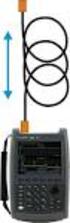 Techniques for Precise Cable and Antenna Measurements in the Field Using FieldFox handheld analyzers Application Note This application note introduces the practical aspects of cable and antenna testing,
RACEAIR REMOTE PAGER SYSTEM
 Computech Systems, Inc. 301-884-5712 30071 Business Center Dr. Charlotte Hall, MD 20622 RACEAIR REMOTE PAGER SYSTEM TM Introduction: Computech s RaceAir Remote Competition Weather Station with the Data
On Cables and Connections A discussion by Dr. J. Kramer
 KRAMER ELECTRONICS LTD. On Cables and Connections A discussion by Dr. J. Kramer We are frequently asked - "what length of cable can I use for a specific application?" Seemingly a simple question, but the
Cable Analysis and Fault Detection using the Bode 100
 Cable Analysis and Fault Detection using the Bode 100 By Stephan Synkule 2014 by OMICRON Lab V1.3 Visit www.omicron-lab.com for more information. Contact [email protected] for technical support.
Current Probes. User Manual
 Current Probes User Manual ETS-Lindgren L.P. reserves the right to make changes to any product described herein in order to improve function, design, or for any other reason. Nothing contained herein shall
Designing the NEWCARD Connector Interface to Extend PCI Express Serial Architecture to the PC Card Modular Form Factor
 Designing the NEWCARD Connector Interface to Extend PCI Express Serial Architecture to the PC Card Modular Form Factor Abstract This paper provides information about the NEWCARD connector and board design
Single Core Vs. Dual Core 4:1 Guanella BALUN
 Coax 12m Long and running straight down the pole. Not Grounded Coax straight down the pole B 12m Single Core BALUN (B5) Dual Core BALUN (B6) 21mA 7mA Comments: At this point, with just the antenna connected
Experiments with the DG8SAQ VNWA
 DG8SAQ VNWA Tutorial Experiments with the DG8SAQ VNWA and the SDR-Kits Test Board Tom BAIER DG8SAQ This is an excerpt from my Ham Radio 2013 presentation which has been slightly extended (slides 6, 20
LDG RBA-4:1Balun LDG RBA-1:1Balun
 LDG RBA-4:1Balun LDG RBA-1:1Balun Table of Contents Features 1 Specifications 1 Preparation 2 An important word about power levels: 2 Installation 2 Care and Maintenance 6 Technical Support 6 Warranty
There are at least six ways to go about loading a short vertical monopole.
 With a mobile installation and most base locations, the HF seems to pose problems especially using the top band. 160 meters is also known as the top band. It is the only frequency group in the MF band
How To Tune A Duplexer
 Understanding, Maintaining & Re-Tuning Antenna Duplexers By: William F. Lieske, Sr. Founder, EMR Corporation Forward A technical bulletin on this subject was prepared in 1990. Since then, antenna duplexers
UNDERSTANDING AND CONTROLLING COMMON-MODE EMISSIONS IN HIGH-POWER ELECTRONICS
 Page 1 UNDERSTANDING AND CONTROLLING COMMON-MODE EMISSIONS IN HIGH-POWER ELECTRONICS By Henry Ott Consultants Livingston, NJ 07039 (973) 992-1793 www.hottconsultants.com [email protected] Page 2 THE BASIC
A Low Frequency Adapter for your Vector Network Analyzer (VNA)
 Jacques Audet, VE2AZX 7525 Madrid St, Brossard, QC, Canada J4Y G3: [email protected] A Low Frequency Adapter for your Vector Network Analyzer (VNA) This compact and versatile unit extends low frequency
Engineering Sciences 151. Electromagnetic Communication Laboratory Assignment 3 Fall Term 1998-99
 Engineering Sciences 151 Electromagnetic Communication Laboratory Assignment 3 Fall Term 1998-99 WAVE PROPAGATION II: HIGH FREQUENCY SLOTTED LINE AND REFLECTOMETER MEASUREMENTS OBJECTIVES: To build greater
Basic Electrical Technology Dr. L. Umanand Department of Electrical Engineering Indian Institute of Science, Bangalore. Lecture - 33 3 phase System 4
 Basic Electrical Technology Dr. L. Umanand Department of Electrical Engineering Indian Institute of Science, Bangalore Lecture - 33 3 phase System 4 Hello everybody. So, in the last class we have been
ECE 435 INTRODUCTION TO THE MICROWAVE NETWORK ANALYZER
 ECE 435 INTRODUCTION TO THE MICROWAVE NETWORK ANALYZER Latest revision: October 1999 Introduction A vector network analyzer (VNA) is a device capable of measuring both the magnitude and phase of a sinusoidal
Impedance 50 (75 connectors via adapters)
 VECTOR NETWORK ANALYZER PLANAR TR1300/1 DATA SHEET Frequency range: 300 khz to 1.3 GHz Measured parameters: S11, S21 Dynamic range of transmission measurement magnitude: 130 db Measurement time per point:
The VHF / UHF «Eggbeater» Antenna ~ Revisited ~
 The VHF / UHF «Eggbeater» Antenna ~ Revisited ~ ON6WG / F5VIF A new simple way to build the Eggbeater Antenna Introduction Previous designs described in «VHF / UHF «Eggbeater» Antenna ~ Part 1» and «VHF
Understanding Power Factor and How it Affects Your Electric Bill. Presented by Scott Peele PE
 Understanding Power Factor and How it Affects Your Electric Bill Presented by Scott Peele PE Understanding Power Factor Definitions kva, kvar, kw, Apparent Power vs. True Power Calculations Measurements
Connectivity in a Wireless World. Cables Connectors 2014. A Special Supplement to
 Connectivity in a Wireless World Cables Connectors 204 A Special Supplement to Signal Launch Methods for RF/Microwave PCBs John Coonrod Rogers Corp., Chandler, AZ COAX CABLE MICROSTRIP TRANSMISSION LINE
HF Mobile gettin serious
 HF Mobile gettin serious I had some big noise problems on my HF rig using my new monoband centre loaded mobile whips. I read K0BG s excellent website dedicated to mobile issues and decided it was finally
DDX 7000 & 8003. Digital Partial Discharge Detectors FEATURES APPLICATIONS
 DDX 7000 & 8003 Digital Partial Discharge Detectors The HAEFELY HIPOTRONICS DDX Digital Partial Discharge Detector offers the high accuracy and flexibility of digital technology, plus the real-time display
ISS Minimalist Antenna
 ISS Minimalist Antenna The purpose of this project was to develop an antenna suggestion that would allow for a simple to duplicate, affordable antenna solution for reasonable access to signals transmitted
Circular Polarized antenna feed (For EME on 10GHz and 5.7GHz).
 Circular Polarized antenna feed (For EME on 10GHz and 5.7GHz). Luis Cupido - CT1DMK, Willi Bauer LX1DB On more than one occasion at the EME conferences, circular polarization was agreed to be to be the
EMC STANDARDS STANDARDS AND STANDARD MAKING BODIES. International. International Electrotechnical Commission (IEC) http://www.iec.
 EMC STANDARDS The EMC standards that a particular electronic product must meet depend on the product application (commercial or military) and the country in which the product is to be used. These EMC regulatory
Modifying the Yaesu FT-847 External 22.625 MHz Reference Input
 Modifying the Yaesu FT-847 External 22.625 MHz Reference Input David Smith VK3HZ Introduction This document describes the modification of an FT-847 to allow an external 22.625 MHz Reference oscillator
S-Band Low Noise Amplifier Using the ATF-10136. Application Note G004
 S-Band Low Noise Amplifier Using the ATF-10136 Application Note G004 Introduction This application note documents the results of using the ATF-10136 in low noise amplifier applications at S band. The ATF-10136
Title: Low EMI Spread Spectrum Clock Oscillators
 Title: Low EMI oscillators Date: March 3, 24 TN No.: TN-2 Page 1 of 1 Background Title: Low EMI Spread Spectrum Clock Oscillators Traditional ways of dealing with EMI (Electronic Magnetic Interference)
WiMo Antennen und Elektronik GmbH Am Gäxwald 14, D-76863 Herxheim Tel. (07276) 96680 FAX 9668-11
 The I-PRO Traveller part no. 11440 Thank you for your purchase, please take your time to digest some of the important building tips and the essential matching/adjustment techniques. You will need 8m of
PLEASE - Read this entire booklet and study the diagrams before building a Quad, it can save you unwarranted frustrations!
 VHF/UHF Quad Antenna The information in this article has come from many amateur sources, the most notable was from WA6TEY (sk 1985) Ray Frost, who was a pioneer of VHF Quad designs and one of the best
Technical Datasheet Scalar Network Analyzer Model 8003-10 MHz to 40 GHz
 Technical Datasheet Scalar Network Analyzer Model 8003-10 MHz to 40 GHz The Giga-tronics Model 8003 Precision Scalar Network Analyzer combines a 90 db wide dynamic range with the accuracy and linearity
Digital Systems Ribbon Cables I CMPE 650. Ribbon Cables A ribbon cable is any cable having multiple conductors bound together in a flat, wide strip.
 Ribbon Cables A ribbon cable is any cable having multiple conductors bound together in a flat, wide strip. Each dielectric configuration has different high-frequency characteristics. All configurations
Line Reactors and AC Drives
 Line Reactors and AC Drives Rockwell Automation Mequon Wisconsin Quite often, line and load reactors are installed on AC drives without a solid understanding of why or what the positive and negative consequences
Balanced vs. Unbalanced Audio Interconnections
 Revised 7/2/08 Balanced vs. Unbalanced Audio Interconnections In discussing the characteristics and performance of various interconnect systems; two points should be kept in mind. Balance is defined in
Vector Network Analyzer Techniques to Measure WR340 Waveguide Windows
 LS-296 Vector Network Analyzer Techniques to Measure WR340 Waveguide Windows T. L. Smith ASD / RF Group Advanced Photon Source Argonne National Laboratory June 26, 2002 Table of Contents 1) Introduction
MEASUREMENT UNCERTAINTY IN VECTOR NETWORK ANALYZER
 MEASUREMENT UNCERTAINTY IN VECTOR NETWORK ANALYZER W. Li, J. Vandewege Department of Information Technology (INTEC) University of Gent, St.Pietersnieuwstaat 41, B-9000, Gent, Belgium Abstract: Precision
Physics 6C, Summer 2006 Homework 2 Solutions
 Physics 6C, Summer 006 Homework Solutions All problems are from the nd edition of Walker. Numerical values are different for each student. Chapter 3 Problems. Figure 3-30 below shows a circuit containing