
EXHIBIT A SPECIFICATIONS FOR COMMUNICATIONS/CAD/AVL SYSTEM DEVELOPMENT
|
|
|
- Ferdinand Paul
- 10 years ago
- Views:
Transcription
1 EXHIBIT A SPECIFICATIONS FOR COMMUNICATIONS/CAD/AVL SYSTEM DEVELOPMENT Final: July 8, 2003 Prepared For: VOTRAN 950 Big Tree Road South Daytona, FL Prepared by: 10 Fawcett St. Cambridge, MA with TEI Engineers & Planners F I N A L i

2 TABLE OF CONTENTS SECTION 1. DOCUMENT PURPOSE AND OVERVIEW Purpose Overview ITS Functional Capabilities Service Development and Vehicle/Operations Management Radio Communications Vehicle Location System Reservations, Scheduling & Dispatch Automated Annunciation System Customer Information and Support System Phone System Web Site Revenue & Ridership Collection And Reporting Electronic Fareboxes Automated Passenger Counters Future Requirements SECTION 2. OVERVIEW OF VOTRAN SERVICES AND SYSTEMS Current Operations Future Operations Fleet Information Existing Communication System Legacy Systems Software Servers and Networks Transit Application Software and Hardware General Office Applications Network Printers Uninterruptible Power Supply (UPS) Other Hardware Dispatch Center SECTION 3. GENERAL FUNCTIONAL REQUIREMENTS SECTION 4. RADIO/DATA COMMUNICATION REQUIREMENTS Radio/Data Communication System Functionality General Functionality Communications Site Dispatch Center Mobile Equipment SECTION 5. AVL SYSTEM REQUIREMENTS AVL System Functionality General AVL Graphical Display AVL Tabular Display ii

3 5.1.4 Optional AVL Data Export Requirements AVL Data Recording and Retrieval Silent Alarm Optional Vehicle Systems Alarms Optional Wheelchair Lift/Ramp Alarm Optional Paratransit Call-ahead Feature Navigation Assistance Transfer Connection Protection Integration with VOTRAN s Scheduling Systems Communications Interface General Connection Data Type Definition Used by Trapeze Scheduling Suite Message Formats - General Message Header Message Body Other Messages Message Formats Hardware Requirements In-Vehicle Hardware Requirements Mobile Data Terminal (MDT) and Vehicle Logic Unit (VLU) Requirements GPS Equipment Requirements Electronic Speedometer Interface Module AVL/CAD Workstation Requirements Dispatcher Workstations Mobile, Read-Only Workstations Fixed Location Workstation and Network Access to AVL/CAD System AVL/CAD Computer System Hardware Requirements Communications Requirements General System Configuration Interfaces with Other VOTRAN Systems and On-Board Equipment SECTION 6. REAL-TIME BUS ARRIVAL REQUIREMENTS Real-Time Bus Arrival System Functionality General Optional: Real-Time Arrival Information for External Media Real-Time Bus Arrival System Display Real-Time Arrival Data Recording and Retrieval Provide Real-Time Information to Customer Service Representatives Hardware Requirements Bus Stop Display Signs and Monitors Requirements Central Dispatch Equipment Requirements Communications Requirements and Standards SECTION 7. AUTOMATED ANNUNCIATION/SIGNAGE REQUIREMENTS Automated Annunciation System Requirements General iii

4 7.2 Hardware Requirements In-Vehicle Hardware Requirements External Hardware Requirements SECTION 8. AUTOMATIC PASSENGER COUNTING REQUIREMENTS APC System Functionality General Hardware Requirements In-Vehicle Hardware Requirements On-Board APC Processor Unit On-Board APC Sensors AVL Interface Module SECTION 9. SOFTWARE REQUIREMENTS General Programming Languages System-Level Software and Functions Real-Time Database Maintenance Software Software Utilities Future Software Changes and Upgrades SECTION 10. INTERNET APPLICATIONS REQUIREMENTS Web Based Information Requirements Bus Service Information (propose as an option) Paratransit Service Information (propose as an option) Itinerary Trip Planning (propose as an option) SECTION 11. FUTURE REQUIREMENTS SECTION 12. PROTOTYPING AND INSTALLATION REQUIREMENTS Mobile Equipment Base/Dispatch Systems Electronic Display Signs and Video Monitors Contractor Responsibility Installation Time SECTION 13. TESTING REQUIREMENTS SECTION 14. DOCUMENTATION REQUIREMENTS SECTION 15. TRAINING REQUIREMENTS SECTION 16. MAINTENANCE REQUIREMENTS SECTION 17. PROJECT MANAGEMENT AND SCHEDULE SECTION 18. TECHNICAL WORK PLAN AND IMPLEMENTATION SCHEDULE SECTION 19. TECHNICAL EVALUATION OF PROPOSALS APPENDIX A MINIMUM SPECIFICATIONS FOR HARDWARE iv

5 LIST OF ABBREVIATIONS AND ACRONYMS ADA APC API ATIS AVL CAD DGPS DOT EIA ERP ERTT FCC GIS GPS GUI IEEE ISO ITS IVR LCD LED MDT NTCIP NTIA OEM OSF PC PCMCIA PRTT RFP RTT SAE TCIP TCP TIA VLU XML Americans with Disabilities Act Automatic Passenger Counter Application Programming Interface Advanced Traveler Information System Automatic Vehicle Location Computer-Aided Dispatch Differential Global Positioning System Department of Transportation Electronic Industries Association Effective Radiated Power Emergency Request to Talk Federal Communications Commission Geographic Information System Global Positioning System Graphical User Interface Institute of Electrical and Electronics Engineers International Standards Organization Intelligent Transportation Systems Interactive Voice Response Liquid Crystal Display Light-Emitting Diode Mobile Data Terminal National Transportation Communications for ITS Protocol National Telecommunications and Information Administration Original Equipment Manufacturer Open Systems Foundation Personal Computer Personal Computer Memory Card International Association Priority Request to Talk Request for Proposals Request to Talk Society of Automotive Engineers Transit Communications Interface Profiles Transfer Connection Protection Telecommunications Industry Association Vehicle Logic Unit Extensible Markup Language v

6 SECTION 1. DOCUMENT PURPOSE AND OVERVIEW 1.1 Purpose The purpose of this document is to specify intelligent transportation systems (ITS) hardware and software that will be procured, deployed and maintained by VOTRAN through their Advance Public Transportation Systems (APTS) program. The hardware and software discussed herein is intended to enhance the operation of VOTRAN services. Specifications are included in this document for the immediate acquisition of the following integrated applications: radio communications, wireless local area network, automatic vehicle location (AVL), mobile data communications, computer-aided dispatch (CAD), computer based scheduling (fixed route), passenger counting system, static web-based information applications, automated annunciation/signage, and replacement phone/ivr system. Through a future procurement, VOTRAN wishes to acquire and integrate the following applications into the systems previously identified: electronic fare collection system., automated trip planning/itinerary planning system, maintenance management system, traffic signal priority interface, variable messaging systems interface, advanced web-based information applications, Transfer Plaza stop/go hardware, and Smartcards. 1.2 Overview In August 2002, Multisystems, Inc. completed a Functional Design for VOTRAN in which it identified and recommended specific ITS technologies that would enhance VOTRAN s operations and customer service. The functional design document divided the systems to be acquired into three bundles that could be acquired in phases. These bundles are intended to provide a range of functional capabilities for VOTRAN. The bundles consist of the following: Service Development and Vehicle/Operations Management Radio Communications 6

7 Vehicle Location System Reservations, Scheduling & Dispatch o Fixed Route Scheduling o Computer Aided Dispatch o Mobile Data Communications o Automated Annunciation System Customer Information and Support System Phone System Web Site Revenue and Ridership Collection and Reporting Electronic Fareboxes Automated Passenger Counters The Contractor is responsible for acquiring and implementing a stable and reliable integrated system able to provide VOTRAN with the functional capabilities described herein. The computer based scheduling system is a critical element of the proposed applications. The Contractor will propose a scheduling software package to enhance VOTRAN s services and operations. The scheduling package is a core function of this procurement and must successfully be interfaced with other related applications as discussed herein. The proposed scheduling package will help VOTRAN with route planning, runcutting, driver scheduling, and vehicle assignments. The following is a description of the functional requirements for a suite of scheduling based software system applications. All requirements are to be satisfied by the Contractor under the resulting contract, except for those identified as future requirements. For future requirements, the Contractor must demonstrate the capability to satisfy the requirements outlined below in the future by describing how the hardware and software being provided under the resulting contract will interface with future functional capabilities identified in this RFP. It is the intent of this RFP that paratransit and fixed route scheduling and dispatch functions are interoperable. At a minimum, the following functionalities should be provided by the proposed scheduling software package: Be Geographic Information System (GIS) based; Integrate with the Automatic Vehicle Location and Mobile Data Communication systems; Integrate with the paratransit scheduling software (Trapeze PASS); Facilitate GIS based route and schedule building; Perform blocking and runcutting functions; Calculate distances and deadhead times; Accommodate interlining requirements; Create rosters; Establish and geocode time points and stops; Build timetables at any desired frequency; Integrate with an Information Voice Response (IVR) system; and 7

8 Interface with other systems to: o Automatically provide payroll and bid/dispatch information; o Provide navigational support to the driver, reservationist and dispatcher; o Support automatic annunciation; and o Provide accessibility to database information using common tools (such as SQL, Dbase, Access and Excel) by supporting ODBC data sources, thus allowing VOTRAN staff report generation, analysis and data inputs. The software will allow data to be easily extracted to support reliable interfaces with the following future systems and functional capabilities: Trip/Itinerary Planning create complete itineraries using origin and destination information and provide users with information about routes, stop locations, walking directions, number of transfers, and fare. Automatic Passenger Counter provide APC interface to acquire data for processing and analyzing ridership through graphs, charts, and route maps. The software provided shall comply with industry standards produced by national or international organizations, such as Institute of Electrical and Electronics Engineers (IEEE), International Standards Organization (ISO), or Open Systems Foundation (OSF). The applications programs and software shall use industry standard interfaces to the applications and compatible with Federal, State and Regional Architectures. All software shall be easily expandable to accommodate the future requirements described in this specification. Reassembly or recompilation of the software shall not be necessary to accommodate system additions specified in this RFP. All software shall be modular to minimize the time and complexity associated with making any change to any program. The modularity shall include the separation of hardware interface modules from other software modules. Logic and data shall be separated into distinct modules. 1.3 ITS Functional Capabilities The functionality of the VOTRAN ITS program shall be phased as described in the VOTRAN Final Functional Design Report dated August 29, 2002 and summarized herein Service Development and Vehicle/Operations Management The initial bundle creates a platform for further enhancements in the future and provides the core information needed by VOTRAN management. This first bundle of ITS capabilities will provide VOTRAN with the fundamental base upon which to build subsequent operations and management capabilities and must be developed to be expandable. The first bundle will provide the essential communications base for paratransit and fixed route operations. It will provide the building blocks and management control for service development (paratransit and fixed route) including route development, stop locations, mapping, and scheduling. For paratransit, the reservations process must be incorporated and integrated with AVL and MDT capabilities. Customer information regarding services will be provided in static (scheduled) and real-time 8

9 (actual) formats. Dispatching, service monitoring and real-time operations management (service coordination and manifest status checking) capabilities will be provided for paratransit and fixed route services. The historical record of service (scheduled to actual performance) will be captured and used for service planning purposes. The initial capabilities to be provided by the Contractor include: Radio Communications Radio communications is required for paratransit, fixed route and service vehicle operations. In summary, the Contractor will provide VOTRAN with a new, higher-power, six channel trunking repeater system with new console control systems with touch screens and new mobile voice and data radios, in conjunction with an AVL system. The Contractor is responsible for providing VOTRAN with a radio communications system to: Provide reliable uninterrupted communications coverage; Be deployed on all VOTRAN vehicles (directly operated and purchased); Provide trunking capabilities; Facilitate separate data and voice communications and define transmission rates and capacities; Provide for voice fall back capabilities (procedural measures); Support communications requirements for CAD/AVL based functions; Facilitate mobile data communications; and Support voice communications between base and vehicles Vehicle Location System The Contractor will provide VOTRAN with a DGPS-based automatic vehicle location system (AVL) that is integrated with the radio communications system and with a GIS based computerized reservations, scheduling and dispatch systems (fixed route and paratransit, described below). The AVL system will provide mobile data communications capabilities: to transmit information from/to the computerized reservations, scheduling and dispatch systems. to provide navigational support (not only where they are, but how to get to the next pickup location on the schedule or manifest), driver initiated panic signal and automatic dispatcher tracking of the vehicle, and trigger automatic stop annunciation for fixed route vehicles. The Contractor is responsible for providing VOTRAN with an AVL system to: Track the location of vehicles; Provide Differential GPS (DGPS) location data Stamp events and transmissions with date, time, direction, longitude, latitude, vehicle identification number, route number, block number and driver s identification number; 9

10 Poll vehicles individually and en masse (allow system administrator to adjust polling frequency as often as possible and to allow polling frequencies as little as 30 seconds or less); Poll active vehicles only; and Interface to other systems o Automated annunciation o Computer based scheduling o Route schedule adherence o Mobile data communications o Computer aided dispatch o Automated passenger counting (future option) o Real-time and static transit information systems (future option) o Fareboxes (future option) o Emergency alarm (future option) o Common GPS/AVL antennae with interface to relevant systems identified above o Future interface with signal priority hardware/software Reservations, Scheduling & Dispatch VOTRAN is has acquired Trapeze Software s PASS application to handle paratransit scheduling functions. Fixed route and paratransit reservations, scheduling and dispatching capabilities will need to be interoperable and compatible with the Trapeze product as described herein. Software solutions will share a common GIS base, integrate with the AVL system and mobile data communications system and include an integrated bid/payroll module interface with the VOTRAN payroll system (Volusia County). The Contractor is responsible for providing VOTRAN with an integrated scheduling/cad/avl system that provides the following functional capabilities: a. Fixed Route Scheduling Be GIS based; Integrates with the AVL and MDC systems; Integrates with the paratransit scheduling software; Facilitates GIS based route and schedule building; Performs blocking and run-cutting functions; Calculates distances, and deadhead times; Accommodates interlining requirements; and Interfaces with other systems: o Payroll and bid/dispatch; o Navigational support; o Automatic annunciation; o Computer based dispatch; and o Customer information and variable messaging (future option) b. Computer Aided Dispatch Manages and tracks the daily assignment of vehicles; Manages and tracks the daily assignment of drivers (including extraboard); 10

11 Manages and tracks pull-out and pull-in information; Monitors and manages fixed route and paratransit operations; Coordinates fixed route service connections/transfers; Allows for text messages to be exchanged with the MDT; Allows for the exchange of canned-messages with the MDT; Provides schedule adherence information functionality; Allows for creation of incident reports (electronically); Stamps events and transmissions with date, time, direction, longitude, latitude, vehicle identification number, route number, block number and, driver s number; Displays vehicles locations on a map on screen; Can create groups of vehicles to be displayed on a map; Allows dispatchers to communicate (by voice or data) with a single, group of, or all of vehicles; Polls vehicles individually and en masse; Can poll active vehicles only; Allows for off-line report generation; and Interfaces with other systems: o AVL system; o Computer based scheduling (fixed route and paratransit); o Mobile data communications; o Payroll and bid dispatch; and o Real-time and static transit information systems (future option) c Mobile Data Communications Communicates paratransit manifest between vehicle and base; Allows data access using common software database management programs/languages; Provides navigational support to paratransit and fixed route drivers; Provides emergency and panic support capabilities; Allows for schedule adherence information functionality; and Interfaces with other systems: o Computer based scheduling (fixed route & paratransit); o Automatic vehicle location; o Computer aided dispatch; o Radio communications; o Automated annunciation system; o Automatic passenger counting system (future option); o Head sign; o Farebox (future option); and o Vehicle maintenance system (future option) Automated Annunciation System Meets the requirements of the Americans with Disabilities Act (ADA); 11

12 Automatically announces and displays recorded information about each stop, major intersection, key locations, and route destination in each vehicle prior to arriving at that location and again upon arrival at that location; Upon vehicle s arrival at a bus stop and opening of doors, the system shall announce route and destination information to passengers waiting at that location. Provides the ability for authorized personnel to record the announcements and construct the related text at a centrally-located location and to have those announcements associated with the appropriate schedule; The annunciator system shall make ambient noise measurements to provide independent, automatic volume control for internal and external announcements; The system shall allow, through the PA microphone, instant operator-voice override for emergency or priority announcements. Announcement data uploads and downloads to/from the buses shall occur over a wireless LAN system. The purpose of this is to eliminate the need for routine manual exchange of cards and floppy disks and hard wire connections for programming, updates, and downloads; and Integrates with: o Automated vehicle location; o Computer based scheduling; o Customer information (future option); and o Mobile data communication units Customer Information and Support System The second bundle of the VOTRAN ITS/APTS program development will enhance customer information services. It includes acquisition of an enhanced phone system and development of web based applications to better serve customer inquiries and better facilitate paratransit trip reservation requests. Building upon the Bundle 1 capabilities, VOTRAN intends to provide static and real-time customer information services. Scheduled to actual fixed route and paratransit service information shall be provided to customers via the phone system, the Internet and variable messaging signs. The Contractor will be required to cull data from a combination of the scheduling systems (fixed route and paratransit), communications and AVL. The information, resident on the scheduling/avl servers, will be provided to customers via phone, web and variable message signs in the field (at bus stops and transfer centers) as relevant and important service updates. The Contractor will be required to provide enhanced capabilities via the phone system and Internet applications Phone System VOTRAN is interested in acquiring an enhanced phone system through a related procurement. The phone systems specifications are detailed separately. However, the phone system VOTRAN acquires is intended to have the following capabilities. A customer would get information about the relevant VOTRAN services and not need to be transferred. Paratransit reservations will be taken, booked and confirmed before the customer hangs up and the trip will be posted in the schedule/manifest. The caller id function will automatically access client records to speed the 12

13 booking process. The phone system will accommodate interactive customer queries about fixed route and paratransit services such as to find out if a vehicle is on schedule or to see how many minutes it is away from a stop or pick up location. VOTRAN expects to acquire a phone system capable of: Handling peak volume calls; Hunt and distribute calls efficiently; Supporting redial, speed dial, caller id functions, 3-way calling; Providing IVR menu options for customer service; Facilitating existing and expanded system reporting and report writing features; Providing direct access to client record; and Interfacing with other systems o Computer based scheduling (fixed route & paratransit) o Advanced travelor information systems o Computer aided dispatch o Paratransit reservations Web Site The Contractor will provide static and real-time service information through the web. Schedules, maps, and real time status information will thus be available on the Internet and displayed in text and graphical formats. Travel planning will be supported with the addition of trip itinerary software capabilities. Self-serve paratransit reservations will be facilitated for registered clients. The Contractor is responsible for providing VOTRAN with an Internet based customer service application capable of: Providing real-time service status information to the web site; Providing on-line schedule and route map information; Facilitating on-line reservations; Reporting meaningful web application use statistics; Facilitating on-line trip (itinerary) planning (future option); and Interfacing with other systems: o Advanced traveler information systems; o Computer based scheduling (paratransit and fixed route); and o Trip planning software (future option) Revenue & Ridership Collection And Reporting Future enhancements include improvements to revenue and ridership data collection and analyses. The Contractor will be required to provide for future integration between a new electronic farebox and the AVL system to provide VOTRAN with the ability to track the time and location of each fare paid. The purpose of this information is to better reconcile farebox receipts with bank deposits, better assess ridership and fare usage and as a means of better revenue control. In addition, the Contractor will be required to provide interface compatibility between the AVL system and a future APC application. 13

14 The APC system will be integrated with the AVL system and the electronic farebox to provide VOTRAN with time, location, fare information for boardings and alighting activity. The APC system will generate requisite information for National Transit Database collection, reporting and sampling of ridership. The Contractor will ensure that time and location information is attached to data events by the AVL system to allow activity to be mapped and analyzed longitudinally or in aggregate for a specific time period. Data generated through the APC system will be written into a common database that supports the management, analysis and output of NTD data and reports. APC system shall interface with scheduling package to allow accurate demand forecasts, and service plans using demographic, location and ridership data. Contractor must specify how this functionality will be accomplished Electronic Fareboxes The Contractor will provide VOTRAN with the capability to integrate existing or new registering fareboxes with the AVL system. The data collected will be marked with the AVL bus/time/date/location information and provided in a database format for planning and reconciliation purposes. VOTRAN will require the Contractor to be responsible for providing a fare collection system capable of: Collecting and recording passenger boarding and fare payment information; Downloading data from the buses (from farebox and APC) over a wireless LAN system offering the most effective security available. The purpose of this is to eliminate the need for routine manual exchange of removable media, probes and hard wire connections for programming, updates, and downloads; Reconciling fare payment with revenue collection; Facilitating electronic passes and transfers; Providing ridership information by route, run, direction, time of day and vehicle number; Providing a secure database for future retrieval and analysis; Integrating with AVL and APC data to facilitate combined analysis of both data sets; and Interfacing with other systems directly or via common database applications: o Automatic passenger counters (via WLAN); o Cash collection & reconciliation; o Automatic vehicle location; o GIS base map for analytical purposes; o Smartcard capabilities (future option); and o Automated passes and transfers (future option) Automated Passenger Counters The Contractor will provide automatic passenger counters (and wireless LAN) for the fixed route fleet and integrate these with the AVL system and the farebox to collect boarding and alighting data by bus/time/date/location/route number/direction to be used for purposes of revenue control, ridership and service planning analysis, and to fulfill NTD reporting requirements. VOTRAN will require the Contractor to be responsible for providing an APC system capable of: 14
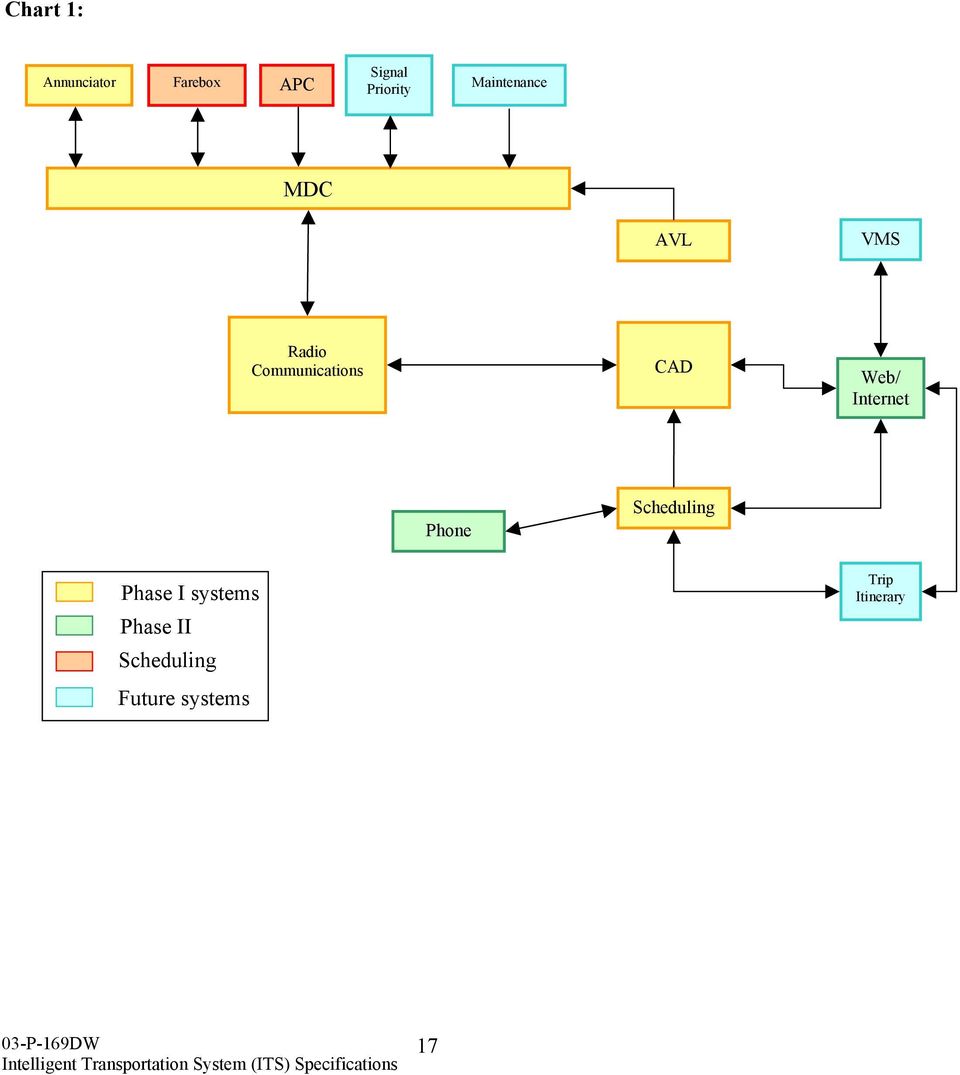
15 Collecting and recording passenger boarding and alighting counts on-board APCequipped vehicles. The system is to differentiate between passengers boardings and alighting; Calculating the total number of riders on-board at any given time; Stamping ridership records with date, time, direction, longitude, latitude, vehicle identification number, route number, block number, driver s number; Downloading passenger counts stored on the MDT from each APC-equipped vehicle after each day of operation over a wireless LAN system. The purpose of this is to eliminate the need for routine manual exchange of removable media and hard wire connections for programming, updates, and downloads; Storing downloaded data in a database for future retrieval and analysis; Integrating APC data with AVL data to facilitate combined analysis of both data sets; Facilitating and supporting NTD reporting and planning analyses; and The APC system shall accommodate interlining; Interfacing with other systems: o Electronic fareboxes and reconciliation processes; o Automatic vehicle location; and o GIS base maps. 1.4 Future Requirements VOTRAN has identified additional desired functional capabilities as ITS/APTS future options. These are referred to as future applications. These include: In-vehicle video monitoring (live video streaming capability including requisite communications infrastructure); Traffic signal priority (requires integration with local and state traffic signal systems); and Transit maintenance support (including scheduled and unscheduled maintenance and repairs, inventory monitoring, and ordering for fuels, fluids, parts and supplies). Other future development capabilities are addressed, at least in part, by this preliminary functional design. The following future capabilities will have been programmed for VOTRAN through this ITS/APTS design for future year implementation. That is, this plan lays the foundation for the following capabilities to be brought on line in the future: Transfer Plaza stop/go hardware; Smartcards; Automated trip itinerary planning; and Variable message signage. The following charts depict the phasing and relationships between the functional capabilities described. The Contractor should note the information for purposes of system planning, component integration and phasing. Chart 1 presents the system functional capabilities by phase 15

16 and reflects integration points. Chart 2 indicates how system relationships vary based on the nature of the application. 16

17 Chart 1: Annunciator Farebox APC Signal Priority Maintenance MDC AVL VMS Radio Communications CAD Web/ Internet Phone Scheduling Phase I systems Phase II Scheduling Future systems Trip Itinerary 17
18 Chart 2: On-site systems Fixed-route Scheduling Paratransit Scheduling Web/Internet Trip Planning Communications/ Dispatching Radio Communications CAD Wireless LAN Transit Vehicle Systems MDC AVL Annunciators APC Farebox Signal Priority Maintenance Wayside Systems VMS Phase I Phase II Phase III Future Signal 18

19 SECTION 2. OVERVIEW OF VOTRAN SERVICES AND SYSTEMS 2.1 Current Operations VOTRAN is an operating department of the Volusia County government with responsibilities to plan, operate and manage public transportation, paratransit and vanpool services in the County. VOTRAN operates fixed route and paratransit services in Volusia County. According to the U.S. Census Bureau, Volusia County had a 2000 population of 443,343 and an area of 1207 square miles. In 2001, VOTRAN operated a fleet of 137 vehicles, purchased and directly-operated combined. VOTRAN operates 45 fixed route buses and contracts service on another 3 fixed route buses. Paratransit services are operated directly (39 vehicles) and purchased (39 vehicles) by VOTRAN. VOTRAN operates 11 vehicles in vanpool service. The daily peak pullout requirement for fixed route service is 48 vehicles. Weekday ridership in 2001 averaged 12,516 unlinked trips per day for all modes, 4,166,883 annually. Annual fixed route service is comprised of 3,817,964 unlinked trips, paratransit services comprised 318,439 unlinked trips and vanpools comprised 30,480 unlinked trips. Weekday fixed route service is comprised of 11,793 unlinked trips, paratransit services comprised 1079 unlinked trips and vanpools comprised 40 unlinked trips 2.2 Future Operations VOTRAN desires to combine to the extent possible, paratransit and fixed route functions and operations using common GIS base mapping and scheduling and dispatching tools. Reservation and information requests will be handled by a common set of customer service representatives. Future operational capabilities are described in Section 1.4, Future Requirements. The combined paratransit and fixed route fleet, for planning purposes, should be sized at 200 vehicles. 2.3 Fleet Information Table 1 lists the fixed route vehicles that are to be equipped with relevant AVL hardware and software per this specification. 19

20 Table 1. Fixed Route Vehicles Year Vehicle Make Model Quantity J- Electronic ID Odometers Multiplex or Standard Wiring Owned By Gillig Low floor 8 Yes No Multiplex Votran Gillig Phantom 3 Yes No Multiplex Votran Supreme/ Trolley No Multiplex Votran Freightliner Gillig Phantom No Multiplex Votran Bluebird C1FE2509C 2 N/A No Multiplex Votran NOVA T No Multiplex Votran Flxible Metro 6 N/A No Multiplex Votran Table 2 lists the paratransit vehicles that are to be equipped with AVL hardware and software per this specification. Electronic Table 2. Paratransit Vehicles Year Vehicle Make Model Quantity J- Multiplex or Owned ID Odometers Standard By Wiring Ford Aerotech 7 N/A No Standard Votran Ford Aerotech 3 N/A No Standard Votran Ford Startrans 10 N/A No Standard Votran Ford Startrans 5 N/A No Standard Votran Ford Startrans 2 N/A No Standard Votran Ford Aerotech 8 N/A No Standard Votran Ford Turtle 3 N/A No Standard Votran Top Ford Turtle Top 4 N/A No Standard Votran 1 2 Society of Automotive Engineers (SAE) J-1708 (and J-1939) are open standards for multiplex bus systems. SAE J-1708 is a slow, low bandwidth multiplex bus standard, and SAE J-1939 has higher speed and greater bandwidth than J Society of Automotive Engineers (SAE) J-1708 (and J-1939) are open standards for multiplex bus systems. SAE J-1708 is a slow, low bandwidth multiplex bus standard, and SAE J-1939 has higher speed and greater bandwidth than J

21 Table 3 lists the supervisory and maintenance vehicles. Three of these vehicles are to be equipped with AVL hardware and software per this specification. Table 3. Supervisory and Maintenance Vehicles Year Vehicle Make Model Qty J- Electronic Multiplex or Owned ID 1708 Odometers Standard By Wiring Flexette Flexette 1 N/A No Standard Votran GMC Flatbed 1 N/A No Standard Votran Dodge B N/A No Standard Votran Ford Club 2 N/A No Standard Votran Wagon Ford Club 1 N/A No Standard Votran Wagon Ford Crown 1 N/A No Standard Votran Victoria Dodge N/A No Standard Votran Truck Ford Club 1 N/A No Standard Votran Wagon Dodge N/A No Standard Votran Truck Ford Club Wagon 3 N/A No Standard Votran 2.4 Existing Communication System An analysis of the current state of the radio system was performed. Test equipment was used to determine usable signal levels at various locations around the County, as well as to determine how much the systems were being used. The baseline results of the tests show that coverage is generally adequate from the single tower site, with the exception of the Deltona area, which is somewhat spotty. The system is heavily used, exceeding 50% of the channel capacity during peak hours. Much of the use is for digital status messaging, which occurs on the same channels as the voice traffic. The equipment being used is of various ages, with some exceeding the manufactures life cycle. Parts and repairs are becoming difficult to obtain for many of the radios. In addition, the current control consoles and phone line system which link the headquarters to the transmitter site often is the source of system failure. Operations are conducted in what can be best described as an informal style and much of the radio time is taken up with long descriptions of issues and time and radio checks. 21
22 Primarily because of the age of the equipment in use, and the desire for more data capabilities, such as AVL, VOTRAN has decided that a new system should be procured. 2.5 Legacy Systems VOTRAN is in the process of replacing their paratransit reservations, scheduling and dispatching software and hardware. VOTRAN has selected the Trapeze Software PASS paratransit solution. The hardware and software to be implemented and to be considered by the contractor to integrate with are described below Software Proprietary business applications currently in use include: Maintenance Management Software is the DPSI Fleet Maintenance 2000 package. Accounting and Financial Management Software is the Volusia County Financial Management System. Other relevant software applications include payroll for VOTRAN that is entered through the ADP PC system. The Contractor would need to interface work hours directly into the ADP PC payroll system Servers and Networks VOTRAN currently utilizes the following networks, servers and services: Accounting/payroll applications are resident on an NT server. Relevant network/lan applications consist of: WORD; WordPerfect; Excel; Lotus; ACCESS; and Crystal Report Writer version 8 or higher. Mail services consist of Groupwise and are resident on a Novell server. General operating system is Windows 98 and runs on NT and Novell and will be migrating to Windows 2000 Professional. 22
23 The reservations and manifesting functions prepared through the scheduling, dispatching, MDT processes will be interfaced with VOTRAN billing processes. The VOTRAN billing process is currently based on billing codes. The services provided daily will be aggregated daily by billing code and monthly. Currently VOTRAN uses the Lotus invoice templates as the format for invoicing. The Contractor will create automatic reporting for VOTRAN Transit Application Software and Hardware Trapeze PASS paratransit system applications are being acquired by VOTRAN. The Trapeze PASS applications will need to be interoperable with fixed route applications requested by VOTRAN and provided by the Contractor. The Trapeze paratransit applications will consist of: Fileserver (Domain Controller) (1) Pentium III 1Ghz or higher, supports up to 2 CPUs 100BaseT 32 bit PCI Network Card 768MB RAM or greater (3) 18GB SCSI Hard Drives (RAID-5) 32 bit PCI Caching Array Controller SVGA Monitor (14 or larger) Diskette Drive (1.44MB) CD ROM Microsoft Windows 2000 Server Database Server (1) Pentium III 1Ghz or higher, supports up to 2 CPUs 100BaseT 32 bit PCI Network Card 768MB RAM or greater (3) 18GB Ultra2/3 SCSI Hard Drives (RAID-5 or RAID-10) 32 bit PCI Caching Array Controller SVGA Monitor (14 or larger) Diskette Drive (1.44MB) CD ROM Microsoft Windows 2000 Server Trapeze Scheduling Server (1) Pentium III 1Ghz or higher, supports up to 2 CPUs 100BaseT 32 bit PCI Network Card 512B RAM or greater 32 bit PCI Hard Disk Controller (2) 9GB SCSI Hard Drivers SVGA Color Monitor (14 or larger) 32 bit SVGA Graphics Card Diskette Drive (1.44MB) CD ROM Microsoft Windows 2000 Server 23
24 Workstations Pentium III 1Ghz or higher 100BaseT 32 bit PCI Network Card 384MB RAM or greater 32 bit PCI Hard Disk Controller Hard Disk (4GB or greater) SVGA Color Monitor (17 or larger) 32 bit SVGA Graphics Card w/8mb Diskette Drive (1.44MB) CD ROM Multi-Outlet AC Surge Strip Microsoft Windows 2000/XP Professional Database Engines Microsoft SQL Server 2000 Backup, Security and Printing Printer (e.g. HP LaserJet Qulaity) Uninterruptible power supply w/ monitoring software (all servers) Tape Backup Unit (DAT or DLT) w/ backup software (e.g. Arcserve) Backup tapes (DAT or DLT format) Network Virus Detection Software (all workstations) Communications Support Symantec pcanywhere Modem/Fax (56Kbps or higher) Dedicated telephone line Cabling and Connectivity 100BaseT (100Mbps) Ethernet Multiport switch Category 5 patch cabling (CAT5) Category 5 Facility cabling (CAT5) Report Writer and Other Tools Crystal Report Writer v 8.0 or higher Miscellaneous TSG compatible format map data for service area (e.g. MapInfo, ArcInfo, Etak, etc.) General Office Applications VOTRAN workstations are generally equipped with the following applications: Operating system Windows 98 and 2000 Professional Spreadsheet applications Lotus and Excel 24
25 Word processing applications WORD and WordPerfect Database applications ACCESS Other applications ADP/PC, Fleet Maintenance 2000, ArcView Geographic Information system Network Printers VOTRAN has the following network printers: Gestetner c7004 (1) HP LaserJet 4plus (1) HP LaserJet 4 (3) HP LaserJet 4050 (1) HP LaserJet 4200N (1) HP LaserJet 2200d (1) HP LaserJet 2100 (1) A variety of other printers serve individual workstations Uninterruptible Power Supply (UPS) In addition to the requirements for the Trapeze Software applications mentioned previously, VOTRAN has 10 UPS units to protect against power outages on the following servers and workstations. Maintenance 2 Computer Room 4 Dispatch 2 Radio Room 1 Administration Other Hardware The successful Contractor is obligated to identify any additional and relevant hardware VOTRAN may be using and determine interface requirements, if any. 2.6 Dispatch Center Daily operations (paratransit and fixed route) are controlled from the Dispatch Center located at the 950 Big Tree Road facility. Paratransit and fixed route operations currently occur in side-byside glass partitioned dispatch rooms. The Contractor is expected to make recommendations concerning space requirements and operational/interoperational issues and practices to optimize 25
26 operations and dispatch functions for paratransit and fixed route services based on the functional capabilities afforded through this RFP. 26
27 SECTION 3. GENERAL FUNCTIONAL REQUIREMENTS The successful proposer, also known as the Contractor for purposes of this specification, shall be responsible for providing a complete, fully operational and integrated radio, AVL, Real-Time Bus Arrival System, Annunciation and APC systems. Failure on the part of VOTRAN to specify precisely each and every item necessary for the system shall not relieve the Contractor of total system responsibility. These specifications outline the functional, operational and minimum technical parameters of the required communications AVL/CAD deployment. These specifications are not restrictive in any way and are considered the minimum requirements of VOTRAN. The specifications cover all equipment and operational constraints to the maximum depth possible. They do not, however, in any way relieve the Contractor from its responsibility of providing a totally installed system including all brackets, nuts, bolts, connectors, and all installation services that are necessary to provide a completely operational system. Proposers will include in their proposals all costs required to design, provide, install, test, and maintain a complete communications AVL/CAD package in accordance with their offer. By submitting a proposal, a proposer warrants that all equipment quoted within shall constitute a complete system in accordance with its proposal, and insofar as system components exist, all such components are compatible with all other system components provided under this contract or compatible with components provided by others as an integral part of the system. The proposer further warrants that the system is fit for the use intended. The Contractor must specify whether all systems default to manual use in the event of a failure. 27
28 SECTION 4. RADIO/DATA COMMUNICATION REQUIREMENTS The following subsections describe the functional requirements of the Radio/Data Communication System. All of these requirements are to be satisfied by the Contractor under the resulting contract, except for those requirements that are identified as future requirements. For future requirements, the Contractor must demonstrate the capability to satisfy these requirements in the future by describing how hardware and software being provided under the resulting contract will interface with future hardware and software identified in this RFP. 4.1 Radio/Data Communication System Functionality General VOTRAN anticipates the AVL/CAD system to be capable of sending AVL data (at least latitude, longitude, speed, time, date and direction of travel) from the vehicle to dispatch at least once every five minutes, every time an alarm is activated, and every 30 seconds if the vehicle is considered off-route. VOTRAN also expects the AVL system to be capable of handling specialized polls (e.g., that require location reporting more frequently than once every two minutes, but not more frequent than once every 30 seconds) that are requested as needed. Furthermore, dispatcher-to-driver communications consisting of a maximum of 25 alphanumeric words at a minimum rate of 4 messages per hour for fixed route buses and 8 messages per hour for paratransit vans, and driver to dispatcher messages (each consisting of a numeric code, latitude, longitude, time and date) at a minimum rate of at least 10 messages per hour must be supported Functionality The mobile radios shall be used in the VOTRAN fixed route and paratransit vehicles for both conventional voice and conventional data communications. 4.2 Communications Site The VOTRAN communications system will consist of a new, 6 channel, and UHF trunking radio system. VOTRAN has applied for and received approval from the Federal Communications Commission for the following frequencies: Frequency Type MHz - FB MHz - FB MHz - FB MHz - FB8 28
29 MHz - FB MHz - FB8 The system will be configured as a logic-trunked radio (LTR) system or equivalent. The 5 centralized (FB8) frequencies will be configured as primary use with the non-centralized channel (FB6) automatically utilized for overflow conditions. All channels must be available for voice/data transmission. Use of a single channel (or rotating channels) for system control only will not be permitted Trunked Repeater System A Six (6) Channel Trunked Repeater System (TRS) shall be provided. The TRS shall consist of the following subassemblies: Six (6) UHF Repeaters Six (6) Trunking Controllers Two (2) Antennas One (1) Transmitter Combiner One (1) Receiver Multicoupler Antenna Feedlines Interconnect Cabling Repeaters The system will consist of 6 repeaters interconnected for LTR-type operation. Each repeater shall meet the following specifications: RF Power: 100 Watts Channel Spacing: 12.5 KHz Frequency Control: Software Based, fully synthesized Modulation: FM Maximum Deviation: +/- 2.5 KHz Sensitivity.35 uv for 12 db SINAD Mounting: 19 Rack Mount Trunking controllers The system shall include an LTR-type control system capable of trunking 6 UHF channels. The system shall include the following features: Support for EFJohnson / Uniden / Passport/ SmartTrunk protocols (any acceptable) FCC system ID functions for all repeaters Selectable polarity of COR signals 29
30 Selectable hang times for loss of COR and mobile data Programmable time out timers Busy-detect circuitry to allow trunking on non-centralized channels System wide time and hit counters Support for up to 250 user ids Support for up to 50 talkgroups Programmable though standard PC 19 Rack Mount The talkgroup programming shall be coordinated with VOTRAN. Initial groups are anticipated to be: Transit Dispatch Paratransit Dispatch Maintenance Supervisors Aux 1 Aux 2 MDT/AVL Data Private, unit-to-unit communications shall also be supported through the trunking system RF Combiner /Multicoupler The system shall include an RF transmitter combining system, and an RF receiver multicoupling system. The system shall meet the following specifications: Transmitter: Number of Channels: 6, expandable to 8 Power Input: 125 Watts/Channel Combiner Type: Cavity System Loss: < 4.5 db/channel Receiver: Number of Channels: 6, expandable to 8 Multicoupler type: Active System Gain: unity or better Repeater Antenna System The system shall include antennas for the transmitters and receivers. There shall be one transmit antenna and one receive antenna. The antennas can either be provided by the CONTRACTOR, or by the tower facility owner. The antennas shall be new, with new inch and five-eighths cable for feedline. It will not be permissible to use a shared antenna system. The VOTRAN antenna system shall be a new, dedicated system. The antennas shall be omnidirectional, gain type, 30
31 however the total system gain shall not exceed 154 Watts ERP. The antennas shall be vertically separated by 20 ft tip to tip Mobile Voice Radio Assembly (MVRA) The MVRA shall consist of the following sub-assemblies: Mobile Radio Control Head Microphone Speaker Antenna Connecting Cables Each item is specified below Mobile Voice Radio The Mobile Radio (MVR) will operate in the Mhz UHF range. It shall have the following minimum specifications: General: Trunk Format: Matching Repeater system Trunk Talkgroups: 15 Channel Spacing 12.5 KHz Frequency Stability: +/- 2.5 ppm Transmitter: RF Power Output: Watts, adjustable * Modulation Limiting: +/ KHz, Adjacent Channel Power: 12.5 KHz, Receiver: Sensitivity:.35 uv for 12 db SINAD Intermodulation: 75 db # 12.5 Adj Channel Selectivity: KHz Spurious Rejection: KHz Audio Output 3 Watts ID: Auto ID upon PTT, programmable (Not required if trunk system provides ID to dispatch console) The 100 Watt RF output power may be obtained by a combination of MR and external RF Power Amplifier MVRA Control Head 31
32 The MVRA shall include a control head for operation of the MVR. The control head shall include controls for volume, talkgroup select, and zone select. A Microphone jack shall be included on the Control Head MVRA Handset A matching handset shall be included which mates with the connector on the control head. The handset shall be a telephone style with integrated push-to-talk switch and shall disable the internal or external control head speaker when plugged in. The speaker audio will be routed to the handset when plugged in MVRA Speaker A Matching speaker shall be included with the assembly. The speaker may be either internal to the control head or external MVRA Mobile Antenna A low-profile Transit type antenna shall be supplied with each MRA. The antenna shall meet the following specifications: Gain: VSWR: Power: Bandwidth: Impedance: Cable type: Unity or better <1.5:1 10 Mhz 100W 10 Mhz 50 Ohms low-loss double shielded or superflex type. RG-58/8X Type NOT acceptable MVRA Connecting Cables All connecting cables shall be supplied with the MVRA. These shall include, but are not limited to: Control Head to Radio Radio to Amplifier (if applicable) Radio to Antenna Power Cables Microphone Cable Speaker Cable Any other cables necessary to make a complete and functional Mobile Radio Assembly shall also be included. All cables shall be industry standard for the type of cable. Coaxial Cables shall be factory connectorized and frequency swept, with results provided. 32
33 4.2.5 Mobile Data Radio Assembly (MDRA) The MDRA shall consist of the following sub-assemblies: Mobile Data Radio Antenna Connecting Cables Each item is specified below Mobile Data Radio The Mobile Data Radio (MDR) will operate in the Mhz UHF range. It shall have the following minimum specifications: General: Trunk Format: Matching trunked system Trunk Talkgroups: 15 Channel Spacing 12.5 KHz Frequency Stability: +/- 2.5 ppm Transmitter: RF Power Output: Watts, adjustable * Modulation Limiting: +/ KHz, Adjacent Channel Power: 12.5 KHz Receiver: Sensitivity: Intermodulation: Adj Channel Selectivity: Spurious Rejection: Audio Output Data interface: ID:.35 uv for 12 db SINAD or better 75 db # 12.5 KHz KHz KHz 3 Watts bps data capable Auto ID upon PTT, programmable (Not required if trunk system provides ID to dispatch console) The 100 Watt RF output power may be obtained by a combination of MR and external RF Power Amplifier MDR Antenna A low-profile Transit type antenna shall be supplied with each MRA. The antenna shall meet the following specifications: 33
34 Gain: Unity VSWR: <1.5:1 10 Mhz Power: 100W Bandwidth: 10 Mhz Impedance: 50 Ohms Cable type: low-loss double shielded or superflex type. RG-58/8X not acceptable MDR Connecting Cables All connecting cables shall be supplied with the MDRA. These shall include, but are not limited to: Radio to Amplifier (if applicable) Radio to Antenna Power Cables Any other cables necessary to make a complete and functional Mobile Radio Assembly shall also be included. All cables shall be industry standard for the type of cable. Coaxial Cables shall be factory connectorized and frequency swept, with results provided Control Station Radios The Control Station Radios (CSR) will operate in the Mhz UHF range. They shall have the following minimum specifications: General: Trunk Format: Matching Repeater system Trunk Talkgroups: 15 Channel Spacing 12.5 KHz Frequency Stability: +/- 2.5 ppm Transmitter: RF Power Output: Modulation Limiting: Adjacent Channel Power: 25 watts +/ KHz, 12.5 KHz, Receiver: Sensitivity:.35 uv for 12 db SINAD Intermodulation: 75 db # 12.5 Adj Channel Selectivity: KHz Spurious Rejection: KHz Audio Output 3 Watts ID: Auto ID upon PTT, programmable (Not required if trunk system provides ID to dispatch console) 34
35 The control station radios shall interface to the system CAD/AVL consoles, to provide voice and data connectivity to the system. The CSR radios shall be connected via directional antennas mounted on the VOTRAN dispatch center. The antennas shall be aimed at the trunked repeater tower. A total of 5 radios shall be provided. These are as follows: (1) voice radio for transit dispatch (1) data radio for transit MDT/AVL dispatch (1) voice radio for paratransit dispatch (1) data radio for paratransit MDT/AVL dispatch (1) voice radio for maintenance shop Each antenna for the voice/data radios shall be situated on the building to eliminate receiver desensitization from another radio s transmitter Portable Radios The CONTRACTOR shall supply 30 portable radios. The radios shall be complete with antenna, rapid charger, and battery. The radios shall meet or exceed the following specifications: General: Trunk Type: Matching Repeater System ID: Automatic on PTT Talkgroups: 15 Transmitter: Frequency: Mhz Power Output: 1-4 W adjustable Frequency Stability: +/- 2.5 ppm Channel Spacing 12.5 KHz Deviation: +/- 2.5 KHz Adjacent channel: -60db Receiver: Frequency: Sensitivity: Channel Spacing: Selectivity: Rated Audio: Mhz.25 uv for 12db SINAD 12.5 KHz 12.5 KHz.5 W 35
36 4.3 Dispatch Center The fixed end AVL/CAD workstations will be located in VOTRAN s central dispatch offices. Please note that due to the size of the current dispatch center offices and the side-by-side nature of the current operations, it may be necessary and/or desirable to renovate this office to accommodate AVL/CAD workstations and other fixed end AVL/CAD equipment. The successful proposer will be required to work with VOTRAN and to provide information regarding the scope and layout of all proposed new dispatch center equipment to VOTRAN within two months after a notice to proceed (NTP). This will ensure that VOTRAN can secure an appropriate design and perform the construction of the dispatch center, a separate procurement that is not the responsibility of this Contractor, in a timely manner and that disruption to the AVL/CAD project can be minimized. 4.4 Mobile Equipment The Contractor shall provide and install a mobile data terminal (MDT)/control head and vehicle logic unit (VLU) to provide the driver interface to the voice and data communications system. Integration of the MDT and VLU into a single unit is desirable. However, the MDT and VLU can be separate units if necessary. The VLU shall be equipped with sufficient RS-232/RS-485/SAE J-1708 or SAE J-1939 ports to provide for control and monitoring of onboard systems as called for in this RFP. The proposer shall provide technical documentation of the proposed MDT and VLU as part of his/her response to the RFP. The documentation shall include manufacturer information as well as operating parameters/instructions. The proposer shall also provide a diagram depicting the proposed configuration and integration of the mobile equipment. 36
37 SECTION 5. AVL SYSTEM REQUIREMENTS The following subsections describe the functional requirements of the AVL system. All of these requirements are to be satisfied by the Contractor under the resulting contract, except for those requirements that are identified as future requirements. For future requirements, the Contractor must demonstrate the capability to satisfy these requirements in the future by describing how hardware and software being provided under the resulting contract will interface with future hardware and software identified in this RFP. The AVL system shall provide the following major functions: Determine the location of each VOTRAN vehicle equipped with AVL/CAD hardware and software; Automatically transmit the location information on each vehicle to the VOTRAN central dispatch office; Display the most recent location of each VOTRAN vehicle on a computerized map of the VOTRAN service area at the central dispatch office; Determine the schedule and route adherence of each VOTRAN fixed route vehicle; Display schedule and route adherence information by exception to dispatch (e.g., bus running more than five minutes late); Display schedule adherence data continuously to the driver via an MDT; Provide transfer connection protection (see Section ); Provide navigation assistance to vehicle operators (see Section 5.1.9) Provide vehicle status and location data to the Internet in the future; Provide a single log-on for other on-board equipment (see Section 5.4); Provide the means for driver-dispatch data communication (via MDT); Optionally, monitor vehicle systems (e.g., engine oil pressure); Provide information to other on-board equipment (e.g., automated annunciators and APCs) (see Sections 7 and 8); Provide future transit signal priority functionality; and Integrate with other future on-board systems, such as an automated fare collection device. 37
38 5.1 AVL System Functionality General The AVL system shall provide accurate and reliable monitoring, display and recording of the location, and status of all equipped VOTRAN vehicles. The AVL function shall employ the Differential Global Positioning System (DGPS). The AVL system shall capable of locating a vehicle within a circle with a radius of 15 feet anywhere in the VOTRAN service area. Vehicle location information (i.e., latitude, longitude, speed, time, date and direction of travel) will be transmitted from each vehicle to dispatch (via the data communication system) at least once every two minutes, and at other times as described in Section Schedule and route adherence shall be determined on-board each fixed route vehicle or at central dispatch, whichever is more cost-effective. Schedule and route adherence information shall be displayed on a mobile data terminal (MDT) in each AVL-equipped fixed route vehicle for operator viewing. Schedule adherence of paratransit vehicles shall be determined by Trapeze Software s PASS software using real-time information provided by the AVL/CAD system (see Section ). The AVL system shall include an optional silent alarm feature, which, when activated by a vehicle operator, shall notify dispatch of an incident. The method of notification is described in Section Another optional feature of the AVL system shall be the monitoring of vehicle systems, such as engine oil temperature; engine oil pressure; transmission oil pressure; coolant temperature; generator output; and fire detection systems. This monitoring shall result in notification to dispatch if one or more vehicle systems are out of tolerance. The method of notification is described in Section Yet another optional feature of the AVL system shall be a wheelchair lift/ramp alarm that will indicate to dispatch when the lift/ramp has not been cycled at morning pull-out. Requirements for this alarm are described in Section The vehicle location information obtained via the AVL system shall be used to monitor, display and record vehicle location and status for all equipped VOTRAN vehicles, in addition to providing schedule and route adherence information for fixed route vehicles. If a VOTRAN vehicle is not AVL-equipped, its location shall be shown based on the vehicle s schedule, as described in Section Vehicle schedules will be developed using fixed route scheduling and runcutting software. The Contractor must provide an interface that provides the schedule data to the AVL system automatically. See Section for a detailed description of the requirements for interfacing with the Trapeze suite of products to be used at VOTRAN. Any vehicle that is determined to be off-schedule and/or off-route shall be highlighted on the AVL display in dispatch and recorded to a history log. The threshold values for declaring a vehicle to be off-schedule or off-route shall be determined by VOTRAN and shall be adjustable 38
39 by the VOTRAN system administrator. Initially, schedule deviations of over zero minutes early, and over three minutes late shall result in a schedule adherence notification to the vehicle operator (via the on-board MDT). Schedule deviations of over zero minutes early and over five minutes late shall result in a schedule adherence notification to the operator and to dispatch (on the AVL workstation monitors). Route deviations of 100 meters on either side of the route shall result in a route adherence notification to dispatch and to the vehicle operator. The proposer shall propose an appropriate system architecture for the AVL system. This architecture shall represent a fully interoperating collection of distinct systems, subsystems and components linked by standard, non-proprietary or third-party supported data communications protocols AVL Graphical Display Each AVL/CAD workstation described in Section shall include two types of displays: graphical and tabular. The graphical display of vehicle locations and status shall be provided on a detailed map of the VOTRAN service area. Displays showing the locations and schedule/route adherence status of all equipped vehicles shall be provided. The map display shall be based on a computerized geographic map of VOTRAN s service area, depicting the following features: All streets and highways (including their names); Major geographic features (rivers, lakes, mountains, etc.); Landmarks (bridges, airports, etc.); Jurisdictional boundaries; VOTRAN bus routes 3, bus stops 4 and transfer points; and Real-time locations of all vehicles. Pan and zoom capabilities shall be provided on this display to view VOTRAN s service area and the surrounding region in varying levels of detail. The range of display capability shall extend from displaying VOTRAN s entire service area at an overview level of detail to displaying a small portion of the service area in fine detail. Information shall be added/deleted at selected scale factors as the user zooms in or out on a selected area of the map. An overview of the entire service area shall be presented in the lower right corner of the display to serve as a navigation aid for the user when only a selected portion of the entire area is being displayed. The area currently being displayed by the user shall be highlighted on the overview navigation aid to identify the portion of the entire area being displayed in the viewport. The successful proposer will be required to use the Volusia County geographic information system (GIS) base map of the VOTRAN service area. Volusia County uses an ESRI product. The base map will encompass all of Volusia County and should be compatible (directly or 3 4 VOTRAN bus routes should be color-coded. VOTRAN staff will provide the color for each route. VOTRAN requires the ability to click on a specific bus stop and view a pull-down window that displays the attributes of the selected stop (e.g., address, shelter, ADA compliance). 39
40 through export) with GIS base maps used by Volusia County. Proposers should refer to the latest U.S. Census Bureau documentation relative to field types, structure, and data types. The Contractor is expected to be familiar with this source map and its related properties. Map projection is in longitude and latitude, as defined by the Federal Information Processing Standards (FIPS). Longitudes are positive in the Eastern Hemisphere and negative in the Western Hemisphere (including the area served by VOTRAN). Latitudes are positive in the Northern Hemisphere (including the area served by VOTRAN) and negative in the Southern Hemisphere. Latitude and longitude are represented as degrees and decimal parts of degrees and stored as integers, with 6 decimal places of implied precision. The Contractor is required to: use the Volusia County GIS map base, submit for VOTRAN review and approval a technical plan including tasks and schedule to show o an assessment of the adequacy of the Volusia GIS map base for the applications o what GIS layers are needed for the applications o what data are not required for the applications o what data are missing o how missing data will be provided o how map updates will be made using the Volusia GIS map base (update frequency and duration). A copy of the computerized geographic map display shall be included in the proposal as a sample of the map detail to be provided. The location of all VOTRAN vehicles shall be indicated on the graphical display by vehicle symbols, with the vehicle ID adjacent to the vehicle symbol. Users shall be able to select information to be displayed next to a vehicle. Users shall be able to display vehicle ID, route/run number, and driver s ID. The vehicle symbol shall indicate the status of the vehicles, including: Schedule status (out of service, early, on-time, or late) Silent emergency alarm conditions Vehicle systems alarm(s) conditions Route status (on- or off-route) Vehicle speed Direction of travel Various symbols and symbol colors shall be used to indicate the above conditions. For vehicles that are either not AVL-equipped or have equipment that is not operational, the vehicle locations shall be displayed based on the schedule. In the case of vehicles that are not AVL-equipped, the vehicle symbol shall be different than that used for equipped vehicles. Users shall be able to display additional information pertaining to a vehicle by selecting the vehicle s symbol on the display. Users shall also be able to selectively overlay the locations and status of all vehicles, and/or only VOTRAN vehicles on selected fixed routes. 40
41 5.1.3 AVL Tabular Display As described in Section , Dispatcher Workstations will have a second computer monitor to display tabular information. In the case of mobile workstations (see Section ) or fixed location workstations (see Section ), tabular information should be easily accessible by switching between the active windows on the unit display. At a minimum, the tabular display shall provide the capability to display windows that contain the following information: All vehicles equipped with AVL Early and late buses highlighted with different colors; Off-route vehicles; Characteristics of vehicle(s) that has/have activated a silent alarm condition; and Characteristics of vehicle(s) with vehicle systems alarm conditions. (As stated in 5.1.2, non AVL-equipped vehicles shall be displayed using a symbol different than that used to represent AVL-equipped vehicles.) VOTRAN requires proposers to submit sample tabular displays from their AVL systems Optional AVL Data Export Requirements The AVL system shall be capable of outputting data to external systems in real-time. These output data (all of which must be time stamped) will include: Vehicle and driver identification (i.e., ID numbers); Vehicle location, speed, direction of travel, and route/run number; Vehicle status (out of service, early, on-time, or late); Stop arrival times (see Section 6 for a description of determining stop arrival times); and Other messages to be displayed at stops (see Section 6.1.1). These data will be used by third parties for a variety of purposes, including: Graphical internet display of vehicle locations on a map; Textual and graphical display of vehicle status; Textual and voice presentation of arrival times at user selected locations; and Textual and voice presentation of vehicle status and arrival times. The AVL system shall output the requested data in Extensible Markup Language (XML) format using the HTTP protocol as indicated in Table 4. The output must be compatible with the importing requirements of the Trapeze software products PASS and FX. (See Section ) The ability to combine data from the AVL with data contained in these scheduling applications is a specific and fundamental requirement of the AVL system, although the XML output from the AVL system will also be utilized by a variety of other web-based products to be acquired or developed in the future. 41
42 The latency between receiving a request for data and delivering the required data shall be no more than 250 milliseconds except for vehicle location information that may have a latency of up to 2 seconds. The system shall support data access from up to 10 different devices or applications simultaneously. See Section 10 for general web/internet requirements. Table 4. AVL Output Data Data Type Query Parameters Output Data Vehicle Location and Status Route Number Location of each vehicle in service, including latitude, longitude, vehicle number/id, route vehicle is on, direction of travel, speed, driver s ID number, schedule status (on schedule or number of minutes early or late) Arrival Times ID(s) of stops of Stop ID, arrival time of next 3 buses interest Other Messages None Current messages from dispatch for public dissemination Stop list None List of each stop in the system including latitude, longitude, ID and name AVL Data Recording and Retrieval All vehicle location and status data transmitted to dispatch shall be maintained online or on removable backup media for a period of six months for future retrieval, display and printing. This historical information shall include all data transmitted from vehicles to dispatch (logon/log-off data, emergency alarms, vehicle system alarms, location data, and data transmitted from other equipment on-board the vehicles); and all user logins and log-offs. Online data will reside in a fault-tolerant storage system that ensures data integrity in the event of a drive failure. In addition, the system must include a means of backing up transaction data while the system is in operation; it should not be necessary to shut down the database to perform a successful backup. The stored data shall be time and date stamped, and shall contain sufficient information to enable selective sorting and retrieval based on user-specified selection criteria. At a minimum, the following sorting and selection criteria shall be supported for accessing the historical data from both the short-term and long-term archive storage: Operator ID Vehicle ID Route Number Run number Dispatcher ID Date and time 42
43 Type of data (e.g., off-schedule) Incident type (where needed) Historical data shall be read-only. That is, modification of this data shall not be permitted. Historical data shall be available in a format that is directly accessible by or importable into common database management and analysis tools Silent Alarm Each AVL-equipped vehicle shall be provided with a silent alarm switch in the future, to be located conveniently for the vehicle operator, but out of sight of passengers. If/when implemented, this switch shall be part of a supervised circuit capable of detecting either an open or a short circuit on the alarm switch wiring. In the event that supervised contact or any emergency alarm circuitry registers as faulty, an alarm faulty message shall be sent to dispatch and shall be treated as a vehicle system alarm. The alarm switch shall be a normally open contact to guard against vibration in the transit environment. Depression of this switch shall cause the transmission of an emergency alarm signal from the vehicle to dispatch. Dispatch shall be notified as to the receipt of this alarm both audibly and visually. During and after this alarm sequence, the in-vehicle MDT will give no indication that it has been activated. No facial change to any display or indicators (including the transmission light) on the MDT will take place. One approach that will be accepted by VOTRAN is changing the dots between the hours and minutes on the clock display to be blinking if they were originally not blinking (or vice versa) in the event that the driver has activated a silent alarm. Location of and type of alarm switch shall be subject to VOTRAN approval prior to installation. A lockout feature will prevent dispatch from accidentally calling a vehicle during an emergency situation. The driver may reset this lockout by activating a priority request to talk (PRTT) feature on the MDT (even though the voice and data communication systems are separate and not integrated). A microphone shall be activated once the emergency alarm has been activated. The location, directionality and sensitivity of this microphone shall be subject to VOTRAN approval. No facial change to any display or indicators will take place when monitoring occurs Optional Vehicle Systems Alarms Each MDT/VLU shall be capable of accepting up to seven vehicle system alarms in the future. Each occurrence of a valid vehicle system alarm is to be transmitted to dispatch in the next poll response. No audible alarm is required on receipt of a vehicle system alarm. Each alarm sensor shall consist of a form "A" relay contact closure to ground. The threshold values for declaring a vehicle system alarm shall be different for each vehicle system being monitored and shall be adjustable by the system administrator. The future vehicle system alarms shall be for: 43
44 Coolant temperature Oil pressure Transmission oil pressure Alternator output Farebox Fire/smoke detection systems Spare alarm Capabilities need to be created to tie into the data streams from the following systems: Detroit Diesel DDEC versions 3, 4, 5 Allison ATEC transmission Farebox GFI Amerex fire/smoke detection system ThermoKing Intelligair versions x, x, x DR500c+ voice annunciator system Optional Wheelchair Lift/Ramp Alarm The MDT/VLU shall be capable of accepting an input in the future from the wheelchair lift/ramp upon cycling. In all cases except the one described below, this cycling shall be ignored (either by the central computer or the MDT/VLU itself). In the event that a pullout occurs from the garage without a wheelchair-equipped vehicle cycling its lift, an alarm will be generated at dispatch. Proposers are required to submit an explanation of the operation of their wheelchair lift alarm Optional Paratransit Call-ahead Feature VOTRAN requests proposals to provide an optional call-ahead feature integrated with the paratransit reservation and scheduling software (Trapeze PASS) and the updated VOTRAN IVR system. The call-ahead feature should automatically ring clients in advance of the scheduled pick up and play a message informing the client that their vehicle is about to arrive. The proposer must provide a technical description, schedule and cost estimate for this feature Navigation Assistance VOTRAN desires navigation assistance capabilities for its paratransit fleet. The AVL/CAD system shall provide navigation assistance to a vehicle operator that is not familiar with an area in which he/she is operating. Proposers shall describe how this functionality will be accomplished. VOTRAN envisions two primary approaches to providing this functionality. One approach is for the vehicle operator, using an in-vehicle navigation device (e.g., Magellan s NeverLost system), to receive turn-by-turn directions from his/her location to find a passenger s pick up location (assuming that this location is a valid address in the proposed address database). If the proposal utilizes this approach, it must specify whether this functionality can be fully integrated with the AVL/CAD system, or will be provided as a stand-alone function. 44
45 A second approach is for VOTRAN to adopt a procedure that requires that drivers needing directions contact dispatch, that the dispatcher generate the directions using an Internet solution (e.g., MapBlast!, MapQuest ), and that the dispatcher sends the directions to the driver via the MDT in a data message. If proposers wish to offer an alternative approach to the two mentioned here, the proposer must describe whether their solution will be integrated with the AVL/CAD system or will be a standalone system Transfer Connection Protection The AVL/CAD system shall be designed to provide Transfer Connection Protection (TCP). In general, the TCP functionality required by VOTRAN is to maximize the effectiveness of bus-tobus transfers. This desired functionality is as follows. TCP is triggered when a passenger makes a transfer request to a vehicle operator. The operator enters the transfer request with the desired to route via the MDT. The AVL/CAD system receives and processes the request. It selects the appropriate vehicle on the to route, then determines whether the connection can be made based on the position and schedule adherence of both the to and from vehicles. In so doing, the process must consider several constraints 5. The AVL/CAD system then determines whether or not to accept the request. If it does, the requesting vehicle operator is notified via the MDT of the result and can communicate this to the passenger. The TCP function should also inform the operator of the to vehicle, to whom it issues operating instructions (e.g. hold two (2) minutes at transfer point ). The TCP function should be transparent to the dispatcher. However, proposers should clearly explain how dispatchers could oversee TCP requests. For example, the dispatcher should be able to override the AVL system s TCP decision on whether or not to accept a transfer request. The dispatcher should also be able to override the system s choice of a specific vehicle on the to route Integration with VOTRAN s Scheduling Systems The Contractor will be required to integrate the AVL/CAD system with VOTRAN s paratransit and fixed-route software suites. For example, the Contractor will be required to use schedule and route information from the paratransit software for route and schedule deviation/adherence calculations. VOTRAN requires that the Contractor integrate with all scheduling modules so that real-time changes to work assignments and vehicle assignments are incorporated into the daily functioning of the AVL/CAD system. The Trapeze databases have been designed to support integration with an AVL system, but the Contractor must determine the most appropriate repository for each type of data and the best way to achieve the required functionality. Please 5 For example, the system could take three constraints into account: 1) the to route headway, which determines how long the passenger would have to wait without intervention; 2) a preset maximum hold time for holding vehicles for a connection; and 3) a preset maximum passenger wait time (requests for connections which will result in wait times longer than this are not accepted). 45
46 note that the Contractor will be required to contract with Trapeze Software Group, the vendor of this software suite, in order to facilitate the development, deployment and maintenance of the necessary interfaces between the AVL/CAD system and the Trapeze software products. The Contractor shall take full responsibility for the Trapeze relationship during the term of this project and shall, in their proposal (both technical and cost) describe the involvement of Trapeze Software Group (TSG) in the project (i.e.: software modules purchased, licenses and maintenance agreements required, professional services required, user training to be provided by TSG, etc.). Upon final acceptance of the project, the Contractor shall assign any TSG license agreements, warranties, maintenance agreements, etc. to VOTRAN General VOTRAN utilizes the Trapeze Software Group s PASS product for paratransit scheduling, and anticipates using the FX product for fixed route runcutting and scheduling. The Contractor s hardware and software shall be fully and functionally integrated with Trapeze s Scheduling software suite. Proposers should refer to Section 5 for general functionality of the AVL/CAD and scheduling software interface. VOTRAN will consider alternative scheduling software products only if the Contractor can show full interoperability between the existing Trapeze PASS program, the proposed fixed route scheduling requirements and all other requirements stated herein Communications Interface General These specifications define the communication protocols to be used in exchanging information between the MDTs supplied by the Contractor and the Trapeze product PASS, installed at VOTRAN. The same MDT and radio interfaces are expected to be used for the FX fixed route scheduling product. As noted in Section , it is incumbent upon the Contractor to confer with Trapeze Software Group to define the communications interface protocols for the Trapeze Software PASS and FX scheduling products Connection Connection between the Trapeze PASS product and the Contractor s hardware and software will be via TCP/IP using socket connections. Messages will be formatted into XML (Extensible Markup Language) documents and sent as binary packages over the TCP/IP connection. Trapeze Software Suite products will create a stream socket and the Contractor s MDT will connect to the Trapeze software using a pre-determined IP address and port number Data Type Definition Used by Trapeze Scheduling Suite 46
47 XML does not define data types. The Contractor s software must be able to convert data to the proper data type upon parsing of a message. The data types shown in Table 5 are employed: Message Formats - General Messages must be formatted with a message header and message body. Trapeze software applications will create a stream socket and connect to the mobile data terminal using an IP address and port number to be established during the installation process. Table 5. Data Types Date Type Description Integer An integer in value in range from 32,768 to 32,767. Long An integer in value in range from 2,147, to 2,147,483,647. Boolean Can have values of 0 (No) or 1 (Yes), only first character will be analyzed if more than one character is passed. Date An integer containing date containing date as YYYYMMDD, where YYYY is year, MM is month, and DD is day. Time An integer containing time of the day in military format as HHMMSS, where HH is hours, MM is minutes, and SS is seconds. Time span An integer containing time of the day in military format as HHMMSS, where HH is hours, MM is minutes, and SS is seconds. Distance An integer containing distance in meters. Lat An integer containing latitude, see coordinates description in Section Lon An integer containing longitude, see coordinates description in Section Message Header This variable is a fixed length header with two fields that define the interface name and body length. The receiving application must not hardcode the starting position of the message header, as the new fields can be added to the header Message Body The message body is a string containing the actual XML script with a mobile data terminal message. VOTRAN will require that the Contractor s hardware and software be capable of providing certain information to VOTRAN s scheduling and information agent software during the course of daily operations. Messages must be two-way: messages from the scheduling software to the 47
48 Contractor s mobile data terminal (dispatch to vehicle) and messages from the data terminal back to scheduling software (vehicle to dispatch). Each message will have a distinguishing header to identify the type of transmission. Login message (vehicle to dispatch) Initial daily driver log-in at the start of a shift or run. Driver log-in will be accomplished by a single swipe card that will initialize all related systems. Vehicle status (dispatch to vehicle) Initial transmission from scheduling software that will set vehicle attributes, including interval for status reporting via the AVL/CAD. Vehicle status (vehicle to dispatch) At requested time intervals or on-demand, mobile data terminal will transmit: o AVL data o Odometer o Speed Itinerary/Trip Information (dispatch to vehicle) Scheduling software will send trip information to the mobile data terminal. Trip Cancel (dispatch to vehicle) Scheduling software will send a trip cancel notice to the mobile data terminal in the event that a scheduled trip is cancelled by the user. Trip No-Show (vehicle to dispatch) Driver notification to dispatch that passenger is a noshow. Perform Message (vehicle to dispatch) Transmission of data following the driver s performance of an event. Text Message (dispatch to vehicle) Dispatchers shall be able to send text messages to a single vehicle or a group of vehicles. Canned Messages (vehicle to dispatch) Contractor, working with scheduling software vendor, will develop canned messages that can be sent to the dispatcher. On-time status (vehicle to dispatch/customer service) Software will calculate based on AVL/GIS/schedule data. Refresh (vehicle to dispatch, and dispatch to vehicle) In the event that the MDT is shut off for any reason (e.g., accidental loss of power), the current tour itinerary will be refreshed along with anything else that was displayed on the MDT when it lost power. Log-out (driver to dispatch) End of run/tour message that will terminate further transmission of data to the vehicle Other Messages The Contractor and Trapeze will develop other message specifications as required by VOTRAN s functional requirements. 48
49 Message Formats The specific message content, arguments, and data types will be supplied by Trapeze to the successful vendor. 5.2 Hardware Requirements In-Vehicle Hardware Requirements All equipment modules, cables, mounting hardware and connectors shall be designed to withstand the full range of operating environments found in the areas in which they are to be installed, and shall not interfere with the operation of existing and future equipment. Each connector in a given physical location shall be keyed or otherwise configured as to prevent inadvertent mis-wiring during installation or maintenance. Each component/module/subsystem distinctly defined in these specifications shall be replaceable as a discrete unit. Each electronically addressable component/module/subsystem shall be electronically identified by a unique serial number. Electronic data interfaces between each distinct module and subsystem shall be optically isolated from all data input and output connectors. Electrical power for operation and data exchange shall be drawn from the power conditioning circuits within the AVL system. All data inputs and outputs, whether serial or parallel, shall be protected against intermittent low voltage, over-voltage and reverse polarity. This protection shall be designed to absorb routine intermittent low voltage, over-voltage and reverse polarity conditions, and to open respective circuits in the event of extraordinary conditions, sacrificing inexpensive and easily identifiable components as necessary to protect more expensive or less easily troubleshoot components. The Contractor must provide mobile hardware specifically designed for the harsh transit environment. Equipment provided shall be designed to operate effectively throughout temperature extremes of from -30 C to +60 C, and to withstand the vibration and shock forces associated with transit vehicles. Equipment shall meet the requirements of this specification under all conditions encountered in transit operations. All in-vehicle equipment shall be housed in splash-and tamper-proof enclosures. The in-vehicle AVL equipment must be interfaced to a variety of other in-vehicle equipment provided by a variety of suppliers and manufacturers. Further, in order to facilitate these interfaces, the AVL system must support either SAE J-1708 or J-1939 standard. Proposers are required to describe how the in-vehicle hardware can be configured to eliminate the possibility of anyone turning off or disconnecting the AVL system. 49
50 Mobile Data Terminal (MDT) and Vehicle Logic Unit (VLU) Requirements The Contractor shall provide one type of in-vehicle MDTs for all VOTRAN vehicles. The MDTs shall provide the following capabilities: Interface with the GPS equipment (see Section ), the in-vehicle communications system (currently, a radio), and other future in-vehicle technologies; A digital display that is capable of displaying, at minimum, information about the next three paratransit trips at the same time. This display must be readable: In varying light conditions; If the vehicle operator is wearing sunglasses; Function keys or on-screen buttons that will be used by the vehicle operator for logging into and out of the AVL system, for counting the number of wheelchairs being carried by the vehicle at each stop, and to communicate with dispatch. VOTRAN requires a minimum of eight function keys or on-screen buttons; MDT is to allow users to adjust text and background light intensity; MDT is to allow user to adjust unit s volume; and Indicators that show: Power on Acknowledge Call/message received Call/message sent Proposers are required to submit photos of MDTs that match the above criteria and are currently available for use with their AVL/CAD systems. The MDT may also have the capabilities of a vehicle logic unit (VLU) that ordinarily provides the interface between the MDT and GPS equipment and radio. If the proposer s MDT does not provide this capability, a separate VLU is required GPS Equipment Requirements The Contractor shall provide the GPS receivers, antennas and all necessary in-vehicle connections required to monitor the locations of all VOTRAN vehicles. The GPS receivers shall be parallel tracking receivers, capable of simultaneously tracking at least four GPS satellites in the best geometry for a position fix, serially tracking the four next best satellites and upcoming (rising) satellites, and providing time signals to the proposer s on-board equipment. The GPS receivers shall report latitude, longitude, speed, time and direction of travel. VOTRAN requires a GPS solution that provides the positional accuracy stated in Section The minimal positional accuracy desired by VOTRAN is 15 feet. That is, the actual vehicle location must be within 15 feet of the reported vehicle position at all times. This accuracy applies both to the positions used on-board the vehicles and the positions used by the central dispatch computer(s). 50
51 At times when one of the four best satellites for a position fix is obscured, the next best satellite shall be utilized. At times when the lines of sight to the satellites are obscured and a GPS location cannot be obtained, the vehicle location shall be calculated based on the last good reported GPS location and a reliable means of measuring the distance traveled from the last good reported GPS location (e.g., odometer inputs alone or in conjunction with gyroscopes, or other dead reckoning devices). When operating in this mode, the tracking method employed by the Contractor may rely on the assumption that the VOTRAN vehicles remain on their scheduled routes. In this mode, the tracking method shall be accurate to ±5% of the distance traveled. Once a good GPS signal returns, the vehicle tracking based on GPS signals shall resume. The proposers proposal shall explain how the vehicles would be tracked and displayed when operating in this mode. The proposer shall provide any additional hardware, software and services required to implement this backup to GPS. The GPS receiver shall have a cold start solution time of two minutes or less and a re-acquisition time of 15 seconds or less. The GPS equipment shall include multi-path rejection capabilities to eliminate spurious signals caused by reflections off of buildings or other structures. Velocity measurements provided by the GPS equipment shall be accurate to 0.1 meters per second when operating in the clear mode. The GPS receivers mounted on-board the vehicles shall provide time signals to other on-board equipment. The GPS time signals shall be accurate to ±1 ms. The GPS antenna shall be a six or more-channel, low-profile unit housed in a rugged, weather tight, roof-mounted enclosure. The GPS antenna shall be securely mounted on the exterior of the vehicle, clear of obstructions and interference-generating devices. The location of the GPS antennas shall be determined in collaboration with VOTRAN s staff. Such antennae and mountings shall be impervious to physical and chemical attack by automatic bus washing equipment Electronic Speedometer Interface Module An interface module will be required to connect the MDT/VLU with the electronic speedometers in order to assist in accurately determining vehicle location when GPS is unavailable AVL/CAD Workstation Requirements The AVL/CAD system will provide access to graphical and tabular AVL/CAD information on three different types of workstations, as defined below. The Contractor will ensure that all workstations will be connected via VOTRAN s existing LAN. In addition to the workstations described in this section, the Contractor must provide access to graphical and AVL/CAD information on existing Customer Service workstations. This access should be provided via a simple to use method, such as a window or windows on the workstation s screen that can be easily opened, minimized or closed. See Section for a description of the requirements for customer service agents accessing AVL/CAD information on their existing workstations. The Contractor is required to provide controlled access to the VOTRAN LAN. 51
52 Dispatcher Workstations The Contractor will provide four Dispatcher Workstations. The Dispatcher Workstations will consist of a commercial-off-the-shelf computer workstation and monitor using the same network operating system (NOS) and local operating system as other computers on the VOTRAN network, with at least the following minimum specifications (or better if required by the AVL/CAD system). Hardware for each workstation will include two (2) interchangeable 21 flat panel computer monitors, allowing the graphical and tabular information to be displayed at all times on either monitor. All computer hardware must be of the latest leading edge technology at the time of system installation and must be of the same brand that the VOTRAN network is using at that time unless otherwise approved. The Contractor shall be responsible for ensuring that the video adapter supports the use of two monitors simultaneously, and that it provides for more than sufficient video card memory to handle the graphical demands of the new radio and AVL/CAD system (e.g., 64Mb or higher of video RAM may be necessary.) All computer hardware provided by the successful Contractor must be approved in writing by VOTRAN s Information Systems Manager. The Contractor is required to provide controlled access to the VOTRAN LAN. Dispatcher Workstations will be located in the following places: Two in the existing VOTRAN dispatcher/radio room, for use by Radio Dispatchers. These two workstations shall be integrated with the voice communications control equipment located in the dispatcher/radio room; and Two in the existing VOTRAN Paratransit dispatcher/radio room, for use by Paratransit Dispatchers. These workstations shall be integrated with the voice communications control equipment located in the dispatcher/radio room and can be used as a backup for fixed route; The Contractor will provide one (1) industry networkable standard laser printer with an integrated Ethernet adapter for the dispatcher/radio room workstations and one (1) for the paratransit workstations. These will be networked over the agency s existing LAN. The Dispatcher Workstations will have the capability for the AVL/CAD System Administrator to: Setup individual network accounts for all AVL/CAD fixed and mobile workstations; Define, maintain, and change system security; Determine access and control levels for each workstation specified herein (e.g., read-only vs. write access); and Set and change all Administrator-definable AVL/CAD parameters (e.g., schedule and route adherence tolerances, static call groups, etc.) Mobile, Read-Only Workstations The Contractor shall provide three remote, mobile AVL/CAD workstations with read-only capabilities (except for one feature described below) for use by road supervisors and other 52
53 supervisory personnel. The remote workstations shall have the capability to switch between the same graphic and tabular displays provided on the Dispatcher Workstations to view real-time AVL/CAD data. They shall be equipped with a minimum of 15 TFT/active matrix LCD screens or equivalent. The mobile workstations will consist of a ruggedized laptop or portable notebook computer capable of withstanding normal wear and tear and weather conditions associated with field use inside a supervisory vehicle. These mobile workstations shall be securely installed in and locked to the road supervisors vehicles to prevent damage or theft. The Contractor will provide suitable dashboard mounting hardware that also allows mobile workstations to be easily unlocked and removed from vehicles by VOTRAN personnel and subsequently remounted and relocked. This procedure includes connecting and disconnecting from the MDT. Final specifications for the mobile computer workstation and monitor will be determined by VOTRAN s Information Systems Manager prior to contract award, but the equipment must be the latest in leading edge technology and must be of the same brand as VOTRAN s network computers at the time of installation unless otherwise approved in writing by the VOTRAN s Information Systems Manager. The units will use the same NOS and local operating system as other computer workstations specified herein. All mobile computer equipment must be of the highest possible quality and must meet or exceed the minimum specifications required by the AVL/CAD system. All computer hardware equipment must be approved in writing by VOTRAN s Information Systems Manager and Radio Project Manager. Proposers should pay special attention to providing sufficient video card memory to handle the graphical demands of the AVL/CAD system. (64Mb or higher of video RAM may be necessary.) In the case of the mobile workstations, given the mounting specifications described above and the fact that they will be primarily used in vehicles, weight and thickness should not be a concern. Each of the mobile workstations will come equipped with desktop battery rechargers and jacks to connect with vehicles DC power supplies through the cigarette lighter outlet or other means acceptable to VOTRAN. The cigarette lighter jack will be the primary power source for the mobile workstations while in the vehicle. The units will also come equipped with two (2) Lithium-Ion or equivalent batteries that can both be installed and charged in the workstations simultaneously providing a minimum of 10 hours of operation between charges as a back-up to the DC power supply. When removed from the vehicle, the units should be capable of operating on a typical 120V AC power supply and come equipped with any necessary adapters. The mobile workstations and the AVL/CAD system should be connected via an interface to the MDT of the vehicle and its radio equipment to allow real-time updates to AVL/CAD data to be communicated to the mobile units. The desired maximum data latency is less than 1 second. Connection to the radio system is preferred because it will enable field supervisors to have call group set-up capabilities. Proposers can recommend alternate wireless network connections via a separate, wideband wireless communication link such as cellular digital packet data (CDPD) or other medium but must clearly indicate how the call group capabilities will be available and what the expected additional annual charges of the separate medium are expected to be. 53
54 Fixed Location Workstation and Network Access to AVL/CAD System The Contractor will provide the necessary computer hardware and software for two identical fixed-location, read-only workstations that will provide redundancy in the event of a machine failure. These single processor, Intel Pentium 4-based units will be installed at a location to be determined jointly by VOTRAN management and the Contractor. These units, which should be a full tower computer form factor, will have access to both the graphical and tabular AVL/CAD information, as designated by the AVL System Administrator. It will be configured for viewing real-time information and querying stored and archived AVL/CAD and APC data. The Contractor will be responsible for providing and installing additional ports and in-wall cabling (consistent with local codes) necessary for the installation of the fixed workstations. Specifications for the computer and monitor will be determined by VOTRAN s Information Systems Manager after contract award, but the equipment must be the latest in leading edge technology at the time of installation and must be of the same brand as VOTRAN s network computers at the time of installation unless otherwise approved in writing by the VOTRAN s Information Systems Manager. All computer equipment must be of the highest quality possible and more than meet the minimum specifications required by the AVL/CAD system. All computer hardware equipment must be approved in writing by the VOTRAN s Information Systems Manager and VOTRAN s Radio Project Manager. Proposers should pay special attention to providing sufficient video adapter card memory and functionality to handle the graphical demands of the AVL/CAD system (i.e., support for dual monitors and 64Mb or higher of video RAM may be necessary.) VOTRAN staff will have access to both the graphical and tabular AVL/CAD information, as designated by the AVL System Administrator, on existing PC workstations as determined by VOTRAN management and the Contractor. These personnel will have access to viewing real-time information, and querying stored and archived AVL/CAD and APC data AVL/CAD Computer System Hardware Requirements The AVL/CAD computer system shall have the capability to handle all AVL and related systems functions, and other functions not covered by this specification such as compiling and interpreting data, creating reports, and communicating data and reports to non-operational personnel,. The proposed hardware must include an uninterruptible power supply (UPS) capable of supporting the system in full operation for at least 5 minutes in the event of a sustained loss of power (before VOTRAN s generators can be brought on line) In addition, the UPS must be able to accomplish a soft shutdown of the AVL/CAD computer system in the event that generator power is not available before the battery is depleted. The proposed hardware must include a 10/100 Mbps Ethernet adapter and be capable of being fully integrated into VOTRAN s existing network (Section 2.5). 54
55 Hardware procurement costs and annual hardware maintenance costs shall be completely specified by the proposer on the Cost Proposal Form included in the RFP package. Proposers are required to explain their choice of computer hardware in terms of functional and performance requirements specified elsewhere in this specification. The system should be able to handle as many as 200 vehicles with a polling capability at most every 90 seconds. Proposed hardware shall be available off-the-shelf. Local service shall be available on a fourhour response basis for disastrous failures (no operating capability) for all hardware. The proposer must describe and include hardware and software for appropriate back-up and crash recovery in their proposal. 5.3 Communications Requirements General The equipment installations required by this RFP include all of the equipment necessary to provide a fully functioning wireless data system as described by this RFP. VOTRAN will provide 120 volt AC wiring and other facilities normally associated with conventional buildings. Any additional wiring/cabling required for interfacing the equipment (e.g., grounding, audio, data, control, signal, and RF) shall be the responsibility of the Contractor. This includes any wiring/cabling for interfacing new equipment with VOTRAN s existing equipment. All installations shall be accomplished in accordance with good engineering practices. The end result will be a completely integrated and operating voice/data radio system. The Contractor will be required to provide rack mounts as appropriate to safely house equipment. VOTRAN shall provide space for the equipment. The Contractor shall install the equipment within this space and connect the units to commercial power as supplied by VOTRAN. The Contractor shall remove (de-install) all existing radio equipment at VOTRAN that is being replaced or disabled by new equipment under this RFP. The Contractor shall provide any excess equipment to VOTRAN for storage or disposition. Installation cost for each particular equipment item shall and must include hardware, external wiring, ancillary devices, procedures, and services required to install and/or interface existing components or equipment to create an operating system which fulfills the requirements of this specification. The Contractor is required to adhere to FCC Rules, local electrical code, and building regulations, and perform all work in a manner consistent with good engineering practices. The Contractor shall coordinate all installation and service cutover work with VOTRAN prior to commencement. The installation of each new mobile data terminal shall be coordinated with VOTRAN to arrive at an agreeable cutover schedule to minimize disruption of transit operations. All mobile radio upgrades will be conducted in accordance with a VOTRAN -approved work plan. 55
56 5.3.2 System Configuration The CONTRACTOR shall coordinate the installation of the trunked radio system at the current transmitter site. The CONTRACTOR shall contact the tower operator and obtain the necessary updated contracts for VOTRAN to install and operate the trunked repeater system using new equipment as specified herein. The tower information is as follows: TOWER LOCATION: INDIAN LAKE ROAD & RIMA RIDGE RD TOWER OWNER: PINNACLE TOWERS SITE ID: CONTACT NAME: STEVE JASTERMSKY CONTACT NUMBER: The system shall be configured for maximum system gain including losses from combiners, feedlines, etc, and gain from antennas. Maximum RF output may not exceed 154 Watts ERP. The receive antenna shall be placed as high as possible, with the transmit antenna below. The height of the transmit antenna shall not exceed 492 feet AGL, and the antenna gain shall not exceed 9db, as per the license. The system shall be controlled via radios at the VOTRAN dispatch center at 950 Big Tree Road. The radios shall be connected to the dispatch consoles specified in Section The mobile radio installation work shall be undertaken as a vehicle fleet radio upgrade. The Contractor shall coordinate with VOTRAN and proceed with the removal of the old radio and installation of the new MDTs, radios and VLUs in accordance with a VOTRAN -approved fleet radio change-out plan. The Contractor shall follow good engineering practice in the installation of the new mobile radio equipment. Of particular importance is the placement and ergonomics of the MDT, VLU radio unit, control head, handset/hang-up, and speaker. The vehicle operator must be able to reach the handset and operate the MDT and audio volume controls effortlessly, and without undue attention being drawn away from the operation of the vehicle. The first vehicle installation of each type shall be approved by VOTRAN, or an agent of VOTRAN, prior to proceeding with subsequent installations in that type of vehicle. The Contractor shall ensure that the mounting locations of radio unit, control head, and cables shall be in protected locations at least three inches above the floor to avoid water and chemical exposure during routine vehicle cleaning. 5.4 Interfaces with Other VOTRAN Systems and On-Board Equipment The AVL system shall provide a single log-on for and be capable of exchanging data with the following VOTRAN systems and on-board equipment: Vehicle headsigns (in the future); In-vehicle fare collection equipment (in the future); 56
57 Transit signal priority system (in the future); In-vehicle video monitoring; Vehicle component monitoring system (maintenance system); Electronic signage at selected stops to display real-time arrival data (see Section 6); In-vehicle automated annunciation/visual system (see Section 7); and In-vehicle automatic passenger counting (APC) equipment (see Section 8). Therefore, interface designs will be required in order to accommodate the exchange of data with the aforementioned systems and in-vehicle equipment. 57
58 SECTION 6. REAL-TIME BUS ARRIVAL REQUIREMENTS The following subsections describe the functional requirements of the Real-Time Bus Arrival System that may be acquired in the future. It is required that any proposed systems (i.e. CAD/AVL, scheduling, etc.) should have the capability to interface with the real-time bus arrival system. The Contractor must demonstrate the capability to satisfy these requirements in the future by describing how hardware and software provided under the resulting contract will interface with future hardware and software identified in this RFP. VOTRAN requires a Real-Time Bus Arrival System in order to: Provide information at selected locations throughout the VOTRAN service area about the route and destination of the next buses arriving at those locations; Inform VOTRAN customers about actual/predicted arrival time of the next bus at each selected location; Provide real-time information (actual/predicted arrival time of the next bus at each selected location, bus transfer status, paratransit manifest status) to VOTRAN s Customer Service Representatives; Provide information about operational delays of buses at selected locations; Provide information about real-time arrivals via external media (e.g., Internet); and Display VOTRAN system information and emergency messages at selected locations. 6.1 Real-Time Bus Arrival System Functionality General This system shall be used to display visual information to the public. The information displayed includes the following types of messages: Bus destination information (e.g., Next Bus on Route XX to Plaza A ) Time range within which next bus will arrive (e.g., Next Bus on XX to Plaza A in 5 to 10 minutes ) Operational delay information (e.g., Buses on Route XX Delayed ) Time of day (e.g., The Time is now 5:15pm ) System usage and safety information (e.g., Take Route XX to 3 rd Street ) Emergency messages (e.g., Emergency Routes in Effect ) All messages shall be either generated automatically or developed manually at VOTRAN central dispatch on a Dispatcher Workstation. All messages of the types described above shall be automatically generated according to the scheme shown in Table 6. 58
59 Table 6. Message Composition and Display Frequency Message Type Message Composition Display Frequency and Order Bus destination information Determined based upon sign Displayed first for 10 seconds. location and vehicle This information could be part information and location of a static sign in specific Time range within which next bus will arrive Operational delay information Determined as described below for each sign location Determined based on sign location and time range within which next bus will arrive at that sign location locations. Displayed for 10 seconds after bus destination information, unless bus destination information is part of a static sign. Displayed after time range within which next bus will arrive when there is more than a 5-minute delay in service. Time of day Directly from AVL server Displayed constantly System usage and safety Pre-determined messages Displayed every 5 minutes information Emergency messages Developed by VOTRAN dispatcher These messages take priority and override any other messages Automatically-generated messages shall be sent automatically to the appropriate electronic sign(s) and/or monitor(s) according to the frequency noted in Table 6. Manual messages shall be sent to the selected sign(s) and/or monitor(s) upon action from the dispatcher or other authorized personnel. All message types can be generated either automatically or manually. Real-time arrival messages shall be formulated as follows. The AVL system collects information on each bus latitude, longitude, speed, time, date and direction of travel (see Section 5.1.1). This information shall be used together with additional information regarding current bus schedules, traffic conditions, and other relevant data to predict when the next bus will arrive at each VOTRAN stop that has an electronic display sign or monitor. The prediction of next bus arrival shall be displayed on the electronic display signs and/or monitors as a range of time (e.g., 5-10 minutes until arrival). VOTRAN requires proposers to submit in their proposals a description of the algorithm(s) that would be utilized to predict next bus arrivals. All messages shall be transmitted via wireless or wireline communication to the electronic display sign and/or monitor located at equipped VOTRAN bus stops. In the future, the same prediction information shall be made available on the Internet. 59
60 The Contractor is required to provide an interface for dispatchers or other authorized personnel to formulate messages to be displayed on the electronic signs. Electronic display signs and video monitors shall be located at bus stops/locations to be determined by VOTRAN staff. Power and telephone service at each stop/location will be supplied by VOTRAN through a separate contractor. Table 7. Location of Electronic Signs and Video Monitors Stop Type of Display Power Supplied? Location Intermodal Transit Video Monitor Yes A!A at Seabreeze Facility - Beachside Daytona Beach Dunlauton Square Video Monitor Yes Port Orange Volusia Mall Video Monitor Yes Daytona Beach Market Place Plaza Video Monitor Yes Saxon Blvd West Volusia Transfer Plaza Video Monitor Yes Bethune at Palmetto Daytona Beach More electronic signs may be considered for installation at the other mini-hubs in the VOTRAN service area. The proposer shall propose an appropriate system architecture for the Real-Time Bus Arrival system. This architecture shall represent a fully interoperating collection of distinct systems, subsystems and components linked by standard, non-proprietary or third-party supported data communications protocols. In the case of temporary loss of GPS location of a vehicle, the system shall not revert to the prediction time. Instead, no information for that vehicle shall be provided until GPS location is restored. The proposed system shall accommodate Leap frogging phenomenon (when a bus goes ahead of another bus running the same route) and correctly display predicted arrival times of vehicles. The Contractor is required to provide controlled access to the VOTRAN LAN Optional: Real-Time Arrival Information for External Media This system shall be used to provide information on real-time arrivals for every identified bus stop in the VOTRAN system via external means at some point in the future, such as through an interactive voice response (IVR) system. Thus, in the future, real-time arrivals for the next three buses must be computed for each stop and made available to the AVL Output Data, as described 60
61 in Section Section 10 describes general requirements for web based and internet applications Real-Time Bus Arrival System Display At a minimum, an application program that provides a display window(s) on the AVL/CAD Dispatcher Workstation shall provide the capability to manually construct messages and control the automatic generation and dissemination of messages Real-Time Arrival Data Recording and Retrieval All messages transmitted from dispatch (automatically or manually) to all electronic display signs and monitors shall be recorded on-line for a period of six months for future retrieval, display and printing Provide Real-Time Information to Customer Service Representatives VOTRAN requires that customer service agents have direct access to real-time AVL/CAD information on their existing workstations (see Section 5.2.2) connected to VOTRAN s existing LAN. The selected vendor shall propose timely and cost-effective options for providing customer service agents access to information contained in the AVL/CAD system, including real-time vehicle location, schedule and route adherence information (indications of early, late, off-route, on-time and on-route vehicles) and real-time arrival information at selected stops, directly at their respective customer service workstations, on a real time basis. On-time performance is defined by VOTRAN policy. The Contractor is required to provide controlled access to the VOTRAN LAN. 6.2 Hardware Requirements All equipment modules, cables, mounting hardware and connectors shall be designed to withstand the full range of operating environments found in the areas in which they are to be installed, and shall not interfere with the operation of existing and future equipment. Each connector in a given physical location shall be keyed or otherwise configured as to prevent inadvertent mis-wiring during installation or maintenance. Each component/module/subsystem distinctly defined in these specifications shall be replaceable as a discrete unit. Each electronically addressable component/module/subsystem shall be electronically identified by a unique serial number. All data inputs and outputs, whether serial or parallel, shall be protected against over-voltage and reverse polarity. This protection shall be designed to absorb routine over-voltages and reverse polarity conditions, and to open respective circuits in the event of extraordinary conditions, sacrificing inexpensive and easily identifiable components as necessary to protect more expensive or less easily troubleshoot components. 61
62 6.2.1 Bus Stop Display Signs and Monitors Requirements The system shall consist of light-emitting diode (LED), liquid crystal display (LCD), or other appropriate types of displays and video monitors 6 at selected VOTRAN stops; a wireline or wireless connection to receive the messages from central dispatch to be displayed; message manager software to control and interface with the display signs and monitors (see Section 9.6); a weather-and vandal-proof enclosure to house the displays and monitors; and corrosion-resistant hardware to mount the displays and monitors. Signs may be solar-powered. The displays and video monitors shall be in full compliance with the Americans with Disabilities Act (ADA), and shall meet indoor and outdoor illumination requirements. The system shall operate in the harsh transit environment, including the effects of extreme weather conditions on outdoor-deployed equipment. The display signs and monitors shall be watertight and sealed against particulate matter invasion. The signs shall be of modular design, allowing display components, power supplies and faceplates to be interchangeable. The signs shall be adaptable to a variety of architectural conditions, including suspended mounting and pole mounting. The signs shall have front-face access for maintenance. VOTRAN requires that alternate means of communicating information on the display signs and monitors be provided for persons with visual impairments (e.g., audio announcements, Talking Signs technology, etc.). Proposers must describe in their proposals how they will comply with this requirement. The vertical position of the electronic display signs shall be at a height above ground that is appropriate for normal viewing. If a selected stop has a bus stop shelter, the vertical position of the sign shall be limited by the height of the bus shelter. The height and width of the signs shall allow a text message to be displayed with a minimum amount of scrolling. If the sign is being installed in a bus stop shelter, the height and width of the sign may be limited by the shelter design. The height of the text displayed on the signs shall allow maximum legibility (no less than 3 inches high if the sign is suspended overhead at a height of 80 inches or more 7 ). The font of the text display on the signs shall maximize readability (e.g., Arial font). The font and background colors shall also maximize readability in a variety of lighting conditions. An appropriate aspect ratio and character spacing shall be used for high quality viewing at multiple viewing angles within a 45 cone projected downward from the face of the sign. The signs shall accommodate from two to four lines of text that are at least 20 characters long, and shall have the capability to scroll the lines of text from bottom to top if there are more than two to four lines to display, respectively, and from left to right where more than 20 characters on one line. The signs can combine both static and dynamic information, with the dynamic information being displayed on the variable portion of the sign. For example, a sign that will 6 7 The video monitors, like the electronic signs, are designed to provide real-time arrival information as well as special informational messages. However, the monitors will have the ability to display a greater number of bus routes and arrival times. See Section and of Appendix A to Part 37 Standards for Accessible Transportation Facilities, pages and 45665, respectively, of Federal Register, Vol. 56, No. 173, Friday, September 6, 1991, Part IV Department of Transportation, 46 CFR Parts 27, 37 and 38, Transportation for Individuals with Disabilities; Final Rule. 62
63 be deployed at one of the mini-hubs could contain static elements, such as the route and destination of the next bus (if the same route will always stop at that mini-hub), and variable elements on an electronic sign, such as the number of minutes until the next bus arrives, the current time and a safety message. See Figure 6 for an example of a sign with both static and dynamic elements. Proposers are required to provide images of sample electronic signs that they have deployed for providing transit information. Figure 1. Real-time Arrival Sign with Static and Dynamic Elements Display signs and video monitors shall automatically adjust brightness for maximum readability in outdoor or other daylight conditions. Display signs and video monitors shall have antireflective and anti-glare provisions. The displays and monitors shall be modular and sensitive components shall be sealed using conformal coating qualified to MIL-I-46058C. The system shall conform to FCC part 15 Class A limits for conducted and radiated emissions of electromagnetic interference. Units shall be 63
64 tested and proven capable of withstanding power transients and radio frequency interference without degradation at levels that are known to exist in ordinary circumstances. Power and communications line and the sign chassis may be exposed to electrostatic discharges from personnel and the units shall be tested and proven resistant through testing in accordance with accepted industry procedures for testing computer equipment. In the event that a message is not successfully delivered to an electronic sign/video monitor, the Real-Time Bus Arrival system shall continue to send the message until it is successfully received. If necessary, electronic display signs and video monitors shall be capable of being locally programmed and maintained using a laptop computer or other portable programming device (e.g., via an RS-232 console port). These devices may also be used for performing routine diagnostic maintenance on the sign/monitor Central Dispatch Equipment Requirements Dispatcher Workstations located at central dispatch shall be used to monitor and control the Real-Time Arrival Sign System, and to provide authorized personnel with a way of constructing and sending messages to be displayed on the electronic signs and video monitors at the equipped stops. See Section for a description of these workstations. See Section 9.6 for a description of how the Message Manager shall operate. 6.3 Communications Requirements and Standards The Contractor is required to connect the signs/monitors to the local power and telephone lines provided at each sign/monitor location. In addition, proposers must estimate the operational costs of operating this equipment on an annual basis, including the communication line and electricity costs (see Cost Proposal Form). The Contractor is required to conform to the Level 1 requirements of the Transit Communications Interface Profiles (TCIP), which is part of the National Transportation Communication for ITS Protocol (NTCIP) standards. Level 1 requires that legacy systems/applications be able to translate between proprietary system and TCIP data elements. Note that TCIP is still under development (only Level 1 and 2 conformance are possible at this time). Currently, the TCIP framework and seven business area objects have been developed. (The relevant document for electronic signs/monitors is NTCIP Standard on Passenger Information Objects.) The current TCIP Dialogs effort (which will allow Level 3 conformity) will specify functional requirements for transaction sets and document format in which the dialog specifications will be documented. The development effort will leverage the work of existing application layer protocols, messaging profiles and application programming interfaces (APIs) used in other industries, and emerging standards efforts in the ITS arena, e.g., NTCIP C2F. 64
65 SECTION 7. AUTOMATED ANNUNCIATION/SIGNAGE REQUIREMENTS The following subsections describe the functional requirements of the Automated Annunciation/Signage System to be satisfied by the Contractor under the resulting contract, except for those requirements that are identified as future requirements. For future requirements, the Contractor must demonstrate the capability to satisfy these requirements in the future by describing how hardware and software will be provided under the resulting contract will interface with future hardware and software identified in this RFP. VOTRAN requires an Automated Annunciation/Signage System in order to: Automatically announce and display recorded information, internally, about each stop in each VOTRAN vehicle just prior to arriving and again upon arriving at the stop; Announce, to passengers waiting at a bus stop, route number and direction. Provide the ability for authorized personnel to record the announcements and construct the related text. 7.1 Automated Annunciation System Requirements General An automated annunciation/signage system shall be installed on each VOTRAN fixed-route vehicle. The system shall meet or exceed all Americans with Disabilities Act (ADA) requirements found in 49CFR Parts and The system shall provide audio and visual announcements to on-board riders and those waiting to board. The system shall be fully integrated with the on-board AVL system (see Section 5), using either SAE J-1708 or J-1939 vehicle communications protocols. The automated annunciation system shall function as follows. As each VOTRAN vehicle approaches a stop on its designated route, a digitally recorded announcement shall be automatically made over the on-board public address system speakers and displayed on an LED sign inside the vehicle to inform passengers about the next stop on the route that the vehicle is traveling on. The volume of the announcements shall be automatically adjusted according to the noise level in the vehicle at the time. No driver interaction shall be required to operate the annunciation system. However, the driver shall have the ability to manually operate the system whenever it is deemed appropriate to do so. Further, the driver s use of the on-board PA system shall override any automated announcements. In the event that a vehicle is operating off-route (see Section for a description of route adherence), the automated announcements/displays shall not be made. The system shall detect reacquisition of the route, at any point along the route, and automatically determine and announce the next valid bus stop. Off-route and on-route detection and recovery shall be automatic and not 65
66 require operator intervention or action, nor shall it require the vehicle to be driven to special reacquisition points. The next stop information announced/displayed shall be the name of the stop, the location of the stop (if different from the stop name) and other information to be determined at a later date (e.g., points of interest located close to the stop). The annunciation system shall use the vehicle location information from the AVL system (described in Section 5) to trigger these announcements on-board the vehicle whenever the vehicle enters the trigger zone on the route that the vehicle is traveling on. The trigger zone is a user-defined area that is located just prior to each stop location on each route. For example, the trigger zone may begin 800 feet before each stop on a route. In addition to next stop announcements/displays, the annunciation system shall be capable of making time-based, location-based and driver-initiated announcements/displays. Time-based announcements/displays shall be programmed to be made on-board the vehicle at specific times of the day, days of the week or within specified time periods. Location-based announcements/ displays shall be programmed to be made on-board the vehicle when that vehicle is at a specific location(s). Driver-initiated announcements/displays (e.g., safety-related announcements) shall be programmed to be made at the driver s discretion. The system shall be able to store at least 99 time-based, location-based and driver-initiated announcements/displays. The proposer shall propose an appropriate system architecture for the Automated Annunciation/Signage system. This architecture shall represent a fully interoperating collection of distinct systems, subsystems and components linked by standard, non-proprietary or thirdparty supported data communications protocols. 7.2 Hardware Requirements All equipment modules, cables, mounting hardware and connectors shall be designed to withstand the full range of operating environments found in the areas in which they are to be installed, and shall not interfere with the operation of existing and future equipment (see Section 10). Each connector in a given physical location shall be keyed or otherwise configured as to prevent inadvertent mis-wiring during installation or maintenance. Each component/module/subsystem distinctly defined in these specifications shall be replaceable as a discrete unit. Each electronically addressable component/module/subsystem shall be electronically identified by a unique serial number. Electronic data interfaces between each distinct module and subsystem shall be optically isolated from all data input and output connectors. Electrical power for operation and data exchange shall be drawn from the power conditioning circuits within the annunciation/signage system. All data inputs and outputs, whether serial or parallel, shall be protected against over-voltage and reverse polarity. This protection shall be designed to absorb routine over-voltages and reverse 66
67 polarity conditions, and to open respective circuits in the event of extraordinary conditions, sacrificing inexpensive and easily identifiable components as necessary to protect more expensive or less easily troubleshoot components In-Vehicle Hardware Requirements The annunciation system shall utilize the AVL MDT/VLU to the extent possible to provide the following capabilities: Coordinate audio announcements and sign displays; Communicate with the AVL system and other on-board systems, as necessary; and Provide the vehicle operator with manual control of the system 8, if necessary; Further hardware requirements for the annunciation system are as follows: Dual-channel high fidelity audio capable of playing simultaneous internal (and optional external) announcements; Two built-in 20-watt amplifiers; Noise-sensing device for each audio channel, which shall automatically and independently adjust each channel' volume as appropriate in response to ambient noise detected; and Independent automatic volume control for each audio channel; The internal display sign for each VOTRAN vehicle shall display coordinating text for next stop and other audio announcements. The sign shall meet all ADA requirements for internal signage. The proposer is required to describe the type of internal sign being proposed (LED is the preferred type), along with the sign s dimensions and programming characteristics. Further, the proposer is required to specify how displayed messages are scrolled and/or single frame modes are utilized. The internal display signs shall be constructed to withstand the harsh transit environment, as described in Communication requirements to perform wireless upgrades and uploads to vehicles will be specified and made part of the annunciator capabilities as described herein and proposed by the Contractor. The wireless communications capabilities will need to be provided at all VOTRAN vehicle maintenance yards. 8 This may require that the MDT/VLU have dedicated keys for annunciation functions (e.g., safety announcements, route selection, repeat last announcement; loop external announcement; increase/decrease display brightness). 67
68 External Hardware Requirements The Contractor must supply external speakers that meet or exceed relevant requirement s of the Americans with Disabilities Act and provide excellent sound quality with low distortion and are manufactured to be reliable and durable over a five-year period of commercial outdoor use. 68
69 SECTION 8. AUTOMATIC PASSENGER COUNTING REQUIREMENTS The following subsections describe the functional requirements of the automatic passenger counting (APC) system to be satisfied by the Contractor under the resulting contract, except for those requirements that are identified as future requirements. For future requirements, the Contractor must demonstrate the capability to satisfy these requirements in the future by describing how hardware and software provided under the resulting contract will interface with future hardware and software identified in this RFP. VOTRAN requires an APC system in order to: Determine the number of people boarding and alighting each VOTRAN fixed route vehicle at each stop; Collect boarding and alighting counts by stop; Calculate the total number of riders on-board at any given time; Upload passenger counts from each VOTRAN fixed route vehicle after each day of operation; Provide the capability to enter downloaded data into a common third-party database for future use. 8.1 APC System Functionality General The APC system, including on-board equipment, garage equipment, and associated software, shall perform its functions in a seamless fashion transparent to vehicle operators. Basic APC system functions include (in roughly sequential order): Acquire trip/run and route data from on-board AVL system; Record the actual time-stamped position of each vehicle at each stop; Detect, count and record the number of passengers boarding and alighting each vehicle at each door and at each stop; Calculate the number of passengers on-board after each stop; Optionally determine if the number of passengers on-board exceeds a user-specified threshold and if it does, send a message to dispatch indicating that this vehicle is full; Transfer on-board APC data file via WLAN to vehicle identifiable folder on hard disk drive as vehicle leaves and returns to the yard; Monitor uniformity and consistency of collected data; Monitor condition of APC equipment; Identify outlying data; 69
70 Detect and identify APC sensor units in need of calibration; and Generate standard reports and custom reports according to user specification. All data transmission, data base management, user interface and report generation equipment and software applications, and all data processing and manipulation applications, shall support interoperation with all related elements of VOTRAN s APC system environment, including any LAN. The Contractor shall ensure that all provided technology will work within the prevailing VOTRAN information system infrastructure at the time of system implementation. A standard, non-proprietary data format, such as non-encoded, non-compressed ASCII, shall be used for storage of APC-related data. The data structure(s) used to store this data is subject to approval by VOTRAN. The system must be capable of on-line storage, retrieval and analysis of all APC and related data collected in the preceding 12-month period of system operation, and must provide for storage (not necessarily on-line), retrieval and analysis of all data collected in the preceding five years of system operation. The system must also provide indefinite long-term tracking of critical ridership and performance statistics for each route and route segment by time of day, day of week, as defined by the user. The Contractor must ensure that APC and related information is provided in an accurate and easily interpreted form. In addition to provision of the raw APC field data, the Contractor shall ensure that the APC data can be electronically presented and analyzed using base map, transit route configuration, bus stop location and attribute data contained in VOTRAN s existing scheduling system, and shall provide statistical process control applications with automated summary and exception reporting capabilities, in both tabular and graphical forms, as well as statistical analysis and data base software which performs custom analyses as system users may desire. The system must provide on-screen as well as hard copy presentation (at users option) of all queries, reports and data analyses. The Contractor must ensure that the recording of data, such as bus number, route, run, trip, etc. in the on-board APC system utilizes an interface to VOTRAN s AVL on-board equipment. The system shall automatically identify and appropriately accommodate non-standard field conditions, including but not limited to: Bus is laying over prior to the start of a new run; Bus is told to run discharge only for a portion of its route; Bus is short-turned mid-route; Bus takes an unscheduled detour; Bus breaks down, passengers are transferred to other bus(es); Bus relieves bus that has broken down; and Interlining. 70
71 The Contractor shall ensure that the only possible source of inaccuracy in the APC passenger count data is that inherent in the APC passenger count sensor and it s associated on-board passenger counting algorithm. No data errors shall be introduced down stream of the on-board passenger counting algorithm. In addition to the ability to look up raw sample data at will, the overall system should provide information collection, correlation, retrieval and data analysis capabilities especially with respect to APC and GIS attribute data which, at a minimum, enable VOTRAN staff to quickly and easily query, filter, sort, display, analyze and report processed data of sufficient significance and clarity to enable them to answer at a glance a wide range of common transit management questions. Common forms of APC data queries include, but are not limited to: Mean, mode, median, number of samples and standard deviation of user-defined parameters for user-defined filters (e.g., inbound, outbound, all, over-utilized, under-utilized, late, early, on-time, weekday, Saturday, Sunday, holiday) trips (commencing/ending/operating) between time1 and time2, from day1 to day2, for routes route 1 route n or within specific geographical boundaries. Difference between mean, mode, median, number of samples and standard deviation of userdefined parameters for any two user-defined groups of samples. Common transit management questions for which the system shall be capable of providing information support include, but are not limited to, those in the following categories: Ridership; Service development; Running time; Work analysis; Route configuration; National Transit Database reporting (e.g., passenger mile statistical reporting); APC system management; Environmental questions; and Value, performance and efficiency questions. The system will generate reports automatically for VOTRAN to file the full complement of NTD operating reports. The Contractor shall propose appropriate system architecture for the APC system. This architecture shall represent a fully interoperating collection of distinct systems, subsystems and components linked by standard, non-proprietary or third-party supported data communications protocols. The Contractor is required to provide maximum security to protect access between the wireless LAN and the VOTRAN LAN. 71
72 8.2 Hardware Requirements In-Vehicle Hardware Requirements All equipment modules, cables, mounting hardware and connectors shall be designed to withstand the full range of operating environments found in the areas in which they are to be installed, and shall not interfere with the operation of existing and future equipment (see Section 10). Each connector in a given physical location shall be keyed or otherwise configured as to prevent inadvertent mis-wiring during installation or maintenance. Each component/module/subsystem distinctly defined in these specifications shall be replaceable as a discrete unit. Each electronically addressable component/module/subsystem shall be electronically identified by a unique serial number. Electronic data interfaces between each distinct module and subsystem shall be optically isolated from all data input and output connectors. Electrical power for operation and data exchange shall be drawn from the power conditioning circuits within the APC processor unit. All data inputs and outputs, whether serial or parallel, shall be protected against over-voltage and reverse polarity. This protection shall be designed to absorb routine over-voltages and reverse polarity conditions, and to open respective circuits in the event of extraordinary conditions, sacrificing inexpensive and easily identifiable components as necessary to protect more expensive or less easily troubleshoot components. Each module and subsystem shall include protection against damage due to electrical overload per SAE J1292. In case of electrical overload, such protection shall open the electrical supply circuit of affected modules and subsystems before additional damage to said modules and subsystems, or to other modules, subsystems or power supplies, can occur. Over load protection devices in modules and subsystems shall not be automatically reset. The respective current rating of any overload protection device shall be clearly indicated on each such device On-Board APC Processor Unit The on-board APC processor shall be a standard configuration suitable for use in any bus. It shall incorporate power conditioning and monitoring equipment; a proven interface to the AVL system for determining vehicle position, direction and speed; a system processor; data storage, input/output (I/O) buffers; I/O isolation module; I/O controller, and a means of manual data transfer, all integrated as distinct modules within the processor enclosure. It shall receive and process information from various on-board sensors to determine and record a wide variety of passenger activity parameters; make this information accessible in database applications. The on-board APC system shall self-initialize upon activation or restoration of bus electrical system at nominal voltage levels. The criteria for acceptability are to initialize: Within 15 seconds of power application or restoration; With all subsystems in an operating state; 72
73 With all buffers and registers in a ready state; With location subsystem reporting last known position and heading; And function without manual intervention; and And begin collecting data without manual intervention. The on-board APC system shall shut down in an orderly, reproducible manner without damage or loss of data upon shut-off, loss, or operationally significant fluctuation of electrical power. The criteria for acceptability are to: Shut down without loss of data; Shut down without "hanging" internal software; Retain last known position information; Continue to monitor bus supply voltage in "sleep mode" whenever bus supply potential is above 10 volts; and Restore APC system when bus supply voltage returns to nominal levels. The on-board APC system shall record the date, time and location of system initialization and shutdown events. The system shall accept and record information transmitted from the on-board AVL system, and record corresponding APC event information. The criteria for acceptability are: No operationally significant degradation of on-board AVL system performance; 100% data integrity: no data errors introduced; AVL interface isolated to prevent ground fault effects; Accept data in broadcast mode, without acknowledgement; Accept all correctly transmitted data in 100% of cases; and Information to be accepted and recorded from on-board AVL system is as follows: Bus number/id Trip data (route, run and trip numbers) Time and date Location (latitude and longitude) Speed Direction of travel Information to be recorded from on-board APC equipment upon receipt of aforementioned AVL data includes current passenger load. The on-board APC equipment shall record boarding and alighting passengers at each VOTRAN stop, with the following criteria for acceptability: Separate counts recorded for the vehicle doorway and wheelchair lift; No data errors introduced beyond those inherent in the passenger count sensor technology employed; Multiple doorway monitoring capability; 73
74 Counts in progress as doors close are correctly processed; Counts in progress as doors open are correctly processed; Counts attributed to passenger activity which occurs entirely while doors are closed are not processed; Counts in progress as doors close are attributed to proper stop; and Counts in progress as doors open are attributed to proper stop. The on-board APC equipment shall compute and record passenger load (number of passengers on-board at departure from stop) at each VOTRAN stop. The health of the APC system and associated equipment shall be monitored. Data sufficient to make the condition of all installed APC system components readily apparent upon the analysis of this data must be provided. The on-board APC system shall provide event records under the following conditions: Deceleration to zero speed condition; Door opening; Door closing; Acceleration from zero speed; Bus engine start; and Bus engine shut-off. The on-board APC system shall provide the means for data download, diagnostic monitoring and system file update via Electronic Industries Association/Telecommunications Industry Association (EIA/TIA)-232-E standard. (An EIA/TIA-232-E port is required if a seriallyconnected separate processor such as a laptop is used for data download, etc.) Further, the system shall support means (as a backup) for the manual transfer of data and configuration files to and from the APC-equipped vehicles On-Board APC Sensors On-board sensors shall support the APC system by detecting passenger activity, and door and wheelchair lift position. The sensors may consist of discrete wired components, integrated modules, or both, at the Contractor s option. The on-board sensors shall detect passenger boarding and alighting activity at each vehicle doorway; and make this information available for transmission to the on-board APC processor unit. The sensors shall sense the position of each door at each vehicle doorway, and make this information available to the on-board APC processor unit via a standard wiring harness. The sensors shall sense wheelchair lift actuation and wheelchair lift position, and make this information available to the on-board APC processor unit via a standard wiring harness. The passenger count sensors shall be configured, positioned and adjusted as to reliably detect the presence and direction of each passenger's movement, whether boarding or alighting from the bus. The passenger count sensors may be either discrete components that merely feed digital signal information to the on-board processor unit, or integrated modules that interpret sensor signals and transmit processed passenger count information, at the vendor's option. 74
75 The passenger count sensor shall consist of a remote sensing electro-optical device. Operation of the passenger count sensor shall at no time require physical contact with the passengers being counted. Treadles are specifically prohibited. The passenger count sensors shall be supported within a sealed enclosure, and linked to the APC wiring harness by a standard connector. The door position and wheelchair lift position sensors shall consist of a micro switch, proximity switch or electro-optical devices. The APC system may utilize existing door and wheelchair lift position sensors if spare electrically isolated outputs are available. The door position and wheelchair lift position sensors may be either discrete components that merely feed digital signal information to the on-board processor unit, or integrated modules which interpret sensor signals and transmit coded door position information to the APC processor unit (and integrated passenger count sensor modules, if used), at the vendor's option. The wheelchair lift actuation sensor shall consist of a micro switch or electrical contact that is electrically energized whenever the bus operator has commanded wheelchair lift activation. The APC system may utilize contacts on existing wheelchair operation controls if spare electrically isolated outputs are available. The wheelchair lift actuation sensor may be either a discrete component that merely feeds digital signal information to the on-board processor unit, or an integrated module that interprets wheelchair control signals and transmits coded wheelchair actuation information to the APC processor unit (and integrated passenger count sensor modules, if used), at the vendor's option AVL Interface Module The AVL Interface Module shall receive digital information as it is released from the on-board AVL system. The Contractor shall electrically isolate the on-board AVL equipment or other onboard equipment from remaining on-board APC equipment. The Interface Module shall perform an orderly shutdown of module function upon loss or interruption of electrical power to either the on-board AVL equipment or the APC processor unit, or both. The Module shall operate with no loss of module function upon restoration of electrical power after electrical power loss. The Module shall transmit information to the APC processor unit via a standard wiring harness. 75
76 SECTION 9. SOFTWARE REQUIREMENTS 9.1 General The Contractor shall provide standard software wherever possible to meet the functional requirements set forth in this specification. All standard software and any new software that must be developed to meet these requirements must be approved by VOTRAN prior to selection and development, respectively. The software provided shall comply with industry standards produced by national or international organizations, such as Institute of Electrical and Electronics Engineers (IEEE), International Standards Organization (ISO), or Open Systems Foundation (OSF). The applications programs and software shall use industry standard interfaces to the applications. All operating system, database management systems, utilities, and network software shall be commercially available, standard off-the-shelf products produced by well-established and reputable suppliers. Third-party support and training shall be available for all standard commercially available software. All software shall be easily expandable to accommodate the future requirements described in this specification. Reassembly or recompilation of the software shall not be necessary to accommodate system additions specified in this RFP. All software shall be modular to minimize the time and complexity associated with making any change to any program. The modularity shall include the separation of hardware interface modules from other software modules. Logic and data shall be separated into distinct modules. The AVL software design shall be expandable to include all necessary interfaces to support the subsystems described in Sections 6, 7 and 8, as well as other future functions described in Section 10 of this specification. The Real-Time Bus Arrival System, Automated Annunciation/Signage System and APC System software designs shall be expandable to include all necessary interfaces to support the subsystems described in Section 5, as well as other future functions described in Section 10 of this specification. A fourth-generation, SQL-based language or other common database format (as specified as VOTRAN) shall be provided for selecting, retrieving, sorting, analyzing, and reporting data stored in the AVL system. The database platform s operating system shall be Windows 2000 Server or later. 9.2 Programming Languages The computer programming languages provided by the Contractor shall include industry standard high-level languages and any other programming languages used for the software supplied with all systems. All languages shall include their associated compilers, assemblers, and loading facilities needed to add new programs written in the language. 76
77 All custom software shall be written using high-level languages conforming to industry recognized standards. Data access and manipulation facilities in each language shall provide complete access and control of the data from each system. 9.3 System-Level Software and Functions The system-level software provided shall include an operating system with real-time capabilities and device input/output control programs. The time of day shall be maintained in 24-hour format in hours, minutes and seconds. The date shall be maintained as month, day and year; the day of the week; and the day of the year. Leap years and holidays shall be recognized. Orderly adjustments for time changeovers between standard and daylight saving time on system reports, historical files, and other time-oriented functions shall be made, accommodating 23-hour and 25- hour days. Only authorized users shall be able to change the system time and date. The AVL, Real-Time Bus Arrival System, Automated Annunciation/Signage and APC systems shall all use the same system time of day and date and shall all be automatically synchronized. Software shall be provided in each system and processor to continuously monitor hardware and software performance and gather performance statistics in real-time with a minimum of interference with the normal AVL and Real-Time Bus Arrival System systems functions. The time period over which the statistics are gathered and saved shall be adjustable by the VOTRAN system administrator. The accumulated statistics, after storage in a save file, shall be reset at the start of each period. The AVL, Real-Time Bus Arrival System, Automated Annunciation/Signage and APC systems shall employ on-line error monitoring. System devices shall be monitored for both recoverable and non-recoverable errors at all times, even if a backup device is available. The AVL system shall monitor all devices and types of errors normally monitored by the operating system software. Error monitoring statistics shall not be lost upon failover or restart. Any system components that connect to VOTRAN s LAN must be fully interoperable in that environment. This includes supporting TCP/IP connections over 100BaseT Ethernet. The Contractor is required to provide controlled access to the VOTRAN LAN. 9.4 Real-Time Database The AVL system shall include a comprehensive database that maintains data as described in Section This database shall be expandable so that data generated from the functions described in Sections 6, 7 and 8 can be easily added. Further, this expandable database must release hard drive space after deletions or compression. The database management system must provide for strict control of individual user access to data and data modification. It must support multiple concurrent user access through the use of multilevel data locking techniques. It must include the ability to roll back uncommitted transactions, 77
78 and provide for automatic recovery from abnormal shutdowns without loss of committed transactions. 9.5 Maintenance Software The Contractor shall provide on-line and off-line software for the maintenance of display screens, reports, the AVL map and electronic signs/video monitors. A security code will be required to access and use this software (only authorized users shall have access). The Contractor shall provide the means for generating new display screens and editing existing display screens. The Contractor must provide documentation that describes the procedures required to build and integrate a new display and to modify an existing display. The Contractor shall provide the means for authorized users to create new report formats and edit existing report formats. The report generator shall provide the capabilities for the user to construct ad hoc queries, and define reports for elected data via interactive procedures from any workstation. The capability to format reports for both monitor screens and printers shall be provided. Executing the report generating function shall not interfere with the on-line functions of the AVL system. The Real-Time Bus Arrival System shall provide the capability to automatically diagnose problems with the electronic signs and video monitors. The Contractor must provide the software necessary to perform the diagnostic procedures and report the results of the diagnosis to central dispatch. A fourth-generation, SQL-based language or other common database format (as specified by VOTRAN) shall be provided for selecting, retrieving, sorting, analyzing, and reporting data stored in the AVL system. The operating system shall be Windows 2000 Server or later. Software should be compatible with both Windows 2000 and 2003 Server (for server-based applications) and Windows 2000 and XP Professional (for the desktop components). 9.6 Software Utilities The Contractor shall provide well-documented and user-oriented software utilities to maintain and modify the AVL, Real-Time Bus Arrival System, Automated Annunciation/Signage and APC systems software. The utility software shall be accessible from workstations, processor terminals, programming terminals, and from command files in auxiliary memory. Multiple users shall have concurrent access to each utility program task, provided there are no conflicts in the use of peripheral devices. The message manager software (in the Real-Time Bus Arrival System) shall manage the data displayed on the electronic display signs and video monitors located at selected VOTRAN bus 78
79 stops, shall provide utilities for efficient maintenance of stored messages, and provide for command and control of the user-designated messages. The message manager software shall manage remote electronic display signs by causing userdesignated messages to appear on selected signs as described in Section Messages shall be scheduled as shown in Section User-selected and user-constructed messages shall appear on selected signs by addressing the message destination in the following ways: All signs; Individual signs; and Designated sign groups (e.g., all signs on VOTRAN Route 2). The message manager software shall provide for 50 populated groups and each group shall accommodate from 1 to the maximum number of signs in the system. The system shall store 50 predefined messages for user use in addition to an ad hoc message creation capability. The user will create ad hoc messages and the system will store 10 userdefined messages for each AVL workstation. User-created messages entered on one workstation shall be available for viewing, editing and transmission on all other workstations. User-created messages on one workstation shall not reduce the ten ad hoc message capacity of other workstations. Predefined message files shall be maintained via a system password access. Only users in possession of the system password shall be authorized to modify predefined messages, or to create new messages. For the Real-Time Bus Arrival System, utilities shall be provided that efficiently perform message maintenance such as distributing files to all workstations, spell checking, blocking of selected words and phrases, printing messages, and rapidly searching and locating specific messages in the message database. An efficient and user-friendly editor shall be provided for permanent and user message creation and maintenance. AVL workstations shall serve as message manager workstations for the Real-Time Bus Arrival System, and shall be configured with utility software that performs operation and maintenance functions for the management of the workstation operating system, network system, devices, files and message manager software. Message manager software shall provide for operating system commands, remote sign/monitor control and diagnostics, display message control, display parameters, execute request, command progress status, and utilization logs, and report generation. Users shall not be required to understand or use operating system commands to effect the system command and control. Application software shall perform information hiding and present all options to operators in an application context-based graphical user interface (GUI). Users shall 79
80 not be able to obtain user system access unless they are in possession of the system password. The password must be alphanumeric and at least six characters long. 9.7 Future Software Changes and Upgrades The Contractor shall provide VOTRAN with all announcements and notices pertaining to all software updates, upgrades and improvements provided by the Contractor and/or third-party suppliers. Solutions to system problems discovered and corrected on any of the systems shall be documented and supplied to VOTRAN at no charge for a period of five years from final system acceptance. 80
81 SECTION 10. INTERNET APPLICATIONS REQUIREMENTS 10.1 Web Based Information Requirements It is VOTRAN s intent to use static and real-time data from the systems described in this document to support a variety of web-based applications. The Contractor must submit as part of their proposal an approach for providing VOTRAN static bus schedules and route maps and show real time bus service status information on the Internet via the VOTRAN web site. This information must be portrayed in meaningful text and graphical formats. The anticipated webbased applications must be capable of providing VOTRAN with appropriate tools to administer and manage the applications, to monitor and report application use and performance and to provide expandability for future applications. Future applications will include (among others) on-line bus trip (itinerary) planning capabilities as described in Sections 10.4 and The web based applications must interface with AVL, bus schedule and paratransit reservation and manifest systems. The Contractor should propose costs and approach for the following as options. The Contractor is required to provide controlled access to the VOTRAN LAN Bus Service Information (propose as an option) The Contractor is responsible for providing VOTRAN with the data to support an Internet based fixed route bus customer service application capable of: Providing bus schedules by route for weekday, Saturday, Sunday/Holiday service; Providing bus route maps for weekday, Saturday, Sunday/Holiday service; Providing real-time schedule status information at selected time points along a bus route for each bus operating on each bus route as follows: o for selected time points along route, show next bus arrives in XX minutes, o for selected time points along route, show next bus is XX minutes early/late. The Contractor s responsibility will include calculating and providing bus service status for selected time points along each route. The selected time points should provide a fair representation of vehicle progress along the route and thus should be reasonably spaced and differentiate between in bound and out bound travel. The operating principle in determining the design of the application is to provide clarity to the user (the public) in interpreting whether the subject bus route is running on-time compared to schedule and how soon (in minutes) buses on the subject route will arrive at their next time point Paratransit Service Information (propose as an option) In addition to bus service information, the Contractor must provide a means to allow clients to determine the status of their reserved trip and to make self-serve paratransit reservations via 81
82 phone and, optionally, via the VOTRAN web site. The trip status information and self-serve reservations capabilities need only be facilitated for registered clients. The Contractor is responsible for providing VOTRAN with an Internet based paratransit customer service application capable of: Providing clients to see the real-time status of their reservation(s) (reserved with pick-up and drop-off times and locations and on-time status, or not yet reserved, cancelled, no show, other); Providing clients with the ability to see on a map where their vehicle is and how long (in minutes) until the vehicle arrives for the client s pick-up Itinerary Trip Planning (propose as an option) Travel planning on-line is a capability that VOTRAN desires to be supported with the addition of trip itinerary software capabilities to the scheduling, AVL and web applications described herein. Trip itinerary software must be compatible with software and system applications described herein and acquired by VOTRAN through this procurement. The application is envisioned to provide the following capabilities: Determine best travel option between two points based on either desired departure or arrival times and supply user with: o bus route(s), o pick-up (bus arrival) times, o drop-off (bus arrival) times, o transfer information (bus route numbers, transfer location, drop-off and pick up times, elapsed wait time), o total travel time, o total fare. Provide user with real-time status of subject bus route(s). 82
83 SECTION 11. FUTURE REQUIREMENTS As mentioned elsewhere in this document, there are several technologies that may be considered for implementation on VOTRAN vehicles in the future. These include: Electronic headsigns (see Section 5.4); Options on the AVL system, including: - Silent alarm feature, including a covert microphone (see Section 5.1.6); - Vehicle component monitoring (see Section 5.1.7); - Wheelchair lift/ramp alarm (see Section 5.1.8); Optional workstation for the Automated Annunciation/Signage System to record announcements, specify text for the interior signs and define route-stop structures (see Section 7.2.2); and Additional real-time arrival signs (see Section 6.1.1). The hardware and software provided by the Contractor must be capable of being expanded and enhanced in a modular fashion to include the aforementioned technologies. The proposer s proposal must provide an explanation of how these future technologies would be integrated into the basic systems after initial implementation of the basic systems. 83
84 SECTION 12. PROTOTYPING AND INSTALLATION REQUIREMENTS The Contractor shall be responsible for the installation of all equipment furnished under the resulting contract. The Contractor shall provide engineers to supervise and technicians to perform the installations, as well as a full-time project manager for the duration of the project. All work shall be performed according to local conditions, and best managed to secure safety to life, person and property; to assure the safe and continuous operation of VOTRAN; and to minimize any interference with the public and with other Contractors in or about the property where the work will be accomplished. VOTRAN requires that all design work to support in-vehicle equipment installation be completed no later than 60 days after a Notice to Proceed (NTP) has been issued to the Contractor. Additional installation requirements are as follows: All in-vehicle equipment installation must be done during non-revenue hours, which are generally between 11 pm and 5 am and periods during weekends. In-vehicle equipment installations shall not in any way disrupt the operation of the vehicles. If electrical or any other problems resulting from the installations is detected, causing the vehicle to be non-operational, the problem(s) must be fixed immediately or within two hours of problem detection. Normal voice communications must be maintained during the in-vehicle equipment installation. This shall be accomplished by setting voice communications as the primary mode of communications until all installations have been complete and the data communications system is ready to be brought on-online. All in-vehicle equipment installation must be completed by nine months after NTP Mobile Equipment The Contractor shall perform one prototype installation in each type of vehicle of the on-board AVL, Automated Annunciation and APC equipment. A VOTRAN -designated representative will participate in these installations and will provide written approval upon satisfactory completion of each prototype installation. The Contractor will provide "as built" drawings which indicate the locations of each subcomponent of the AVL, Automated Annunciation and APC systems, location of wiring runs, conduit and interconnect points. The MDT shall be mounted on a solid, screw-down mounting tray or bracket, and shall not interfere with or impede access to other system components. All reachable cabling in the passenger compartment shall be enclosed in conduit. All exposed equipment shall be covered to protect from vandalism. All equipment shall be effectively shielded and filtered from transient voltage spikes and electronic noise emanating from the vehicle electrical system. Power filtering will be sufficient to (1) prevent transients and noise from the vehicle electrical system from affecting the operation of the radio and microprocessor, and (2) prevent operation of the radio from affecting other aspects of the operation of the vehicle. All equipment shall be protected against accidental reversal of polarity and voltage overload. 84
85 12.2 Base/Dispatch Systems The Contractor shall provide detailed drawings showing location of equipment, power, antennas and audio wiring and full details on switch routing of power or audio equipment to VOTRAN for prior approval. All combiners and multicouplers shall be interconnected with double shielded cable to prevent coupling with other transmitters or the pickup of stray RF fields. Proper equipment rack and antennae grounding shall be performed. Equipment installations shall be done in a professional workmanlike manner and in accordance with all applicable codes. No loose wiring or wiring not properly contained in a trough, conduit or like-raceway will be acceptable. All main equipment shall have suitable breaker panels installed, properly terminated and shall be in accordance with applicable codes Electronic Display Signs and Video Monitors The Contractor shall perform one prototype installation of an electronic sign and a video monitor. A VOTRAN -designated representative will participate in these installations and will provide written approval upon satisfactory completion of each prototype. The Contractor shall provide detailed drawings showing location of electronic signs and video monitors, power, antennas and audio wiring and full details on switch routing of power or audio equipment to VOTRAN for prior approval. All combiners and multicouplers shall be interconnected with double shielded cable to prevent coupling with other transmitters or the pickup of stray RF fields. The hardware shall be installed according to the requirements described in Section 6.2. Equipment installations shall be done in a professional workmanlike manner and in accordance with all applicable codes. No loose wiring or wiring not properly contained in a trough, conduit or like-raceway will be acceptable Contractor Responsibility The Contractor is responsible for the installation of all equipment, systems and parts thereof in accordance with the requirement of a complete system installation. Any damage caused by the Contractor shall be immediately reported to VOTRAN. The Contractor shall repair damage so caused at the Contractor s expense, or if the Contractor fails to repair such within 30 days, VOTRAN may undertake the repair and withhold such monies from any monies due and seek reimbursement should such monies not cover the said repair cost. For database requirements (described in Sections 5.1.5), the Contractor shall certify that he/she fully understands the responsibility for correcting/updating the database(s) during the implementation phase. The Contractor will be responsible for loading all initial data and information into the AVL, annunciation and APC systems. VOTRAN will provide files in existing formats, when possible, for Contractor use. The Contractor is fully responsible for providing a completely operational system at the costs quoted. The Contractor shall provide all labor, materials, parts, cables, required signs, software, documentation, instructions, warranty, training and maintenance in accordance with the intent of these specifications. 85
86 12.5 Installation Time Installation of all systems shall be completed by nine months after NTP, with testing and acceptance testing to follow. Proposers shall submit a detailed installation schedule with the proposal (see additional requirements in Section 16) that satisfies this installation requirement. In the event that the Contractor fails to complete the fully integrated system on time as specified and VOTRAN has not provided a written extension, VOTRAN shall, at its option, impose liquidated damages in the amount of $5,000 in accordance with the terms and conditions for every week or part thereof that the system remains incomplete from the scheduled completion time. VOTRAN reserves the right to require that the Contractor assume responsibility for any over-run costs that are not due to VOTRAN, including but not limited to, staff time, consulting costs, and equipment costs in lieu of the liquidated damages. Requests for time extensions must be written and will require a written justification documenting reasons for the extension. 86
87 SECTION 13. TESTING REQUIREMENTS The Contractor will be required to submit a Test Plan for each of the following types of tests within the stated time frames for the AVL, Real-Time Arrival Sign, Automated Annunciation and APC systems: Factory acceptance test within six months of NTP First article test for all prototypes within six months of NTP Functional hardware and software tests within nine months of NTP Integrated system tests within 10 months of NTP Acceptance test within 11 months of NTP The following information must be included in each Test Plan 9 : Test schedule Identification of all tests to be performed, the purpose of each test and the identification of the functional requirement(s) being tested; Identification of hardware and software to be tested; Description of test procedures; Description of measures of effectiveness or pass/fail criteria; Description of the methods and equipment used to record the test and test results; Description of the corrective actions, parties responsible for the corrective actions and re-testing procedures; and Identification of special testing conditions. Each Test Plan is subject to approval by VOTRAN. VOTRAN and/or VOTRAN -designated personnel reserves the right to witness any or all tests, without charge, and may include a check for compliance with all requirements set forth in this RFP and the resulting contract. VOTRAN is expecting to have a project management oversight consultant involved in many of the installation and testing activities. Specific requirements regarding Acceptance Testing are as follows. A thirty-(30) day Acceptance Testing period shall commence when the following minimum conditions are met: 1. All fixed end hardware and system software shall be fully installed and operating without apparent problem for a minimum of seven days; 2. The Contractor shall certify and VOTRAN shall have reason to believe that all mobile equipment is installed and operating without apparent problem, and that mobile equipment not 9 NOTE: The contents of the Test Plan should generally follow IEEE Standard
88 passing the test shall be no more than marginally greater in number than that which should be expected during normal operation of the system after acceptance; 3. The Contractor's proposed Acceptance Test Plan shall have been received, reviewed and approved by VOTRAN; and 4. The Contractor's proposed date for commencement of Acceptance Testing shall be compatible with the schedules of VOTRAN staff and consultants who shall be directly involved in such monitoring and testing. VOTRAN expects, when notified by the Contractor that the system is ready for testing, the acceptance testing shall commence and will be completed with a "punch" list for error correction. VOTRAN shall designate an organization to perform one set of full acceptance testing for this project. In the event that more than one set of acceptance testing is necessary due to the failure on the part of the Contractor, VOTRAN reserves the right to require the Contractor to reimburse VOTRAN for such costs. The final acceptance of the system shall be granted upon successful completion of all work called for by this specification and all related documents, in addition to the successful completion of the integration system tests which the Contractor shall be required to develop and provide to VOTRAN. The integration system tests shall be subject to the approval of VOTRAN and shall include, as a minimum, the following: 1. Functional tests to ensure hardware and software compatibility. Procedures for these tests shall include descriptions of all functions and the steps taken to demonstrate each. 2. Hardware and/or software tests to provide proof of performance for all equipment furnished to ensure that the functional and technical requirements of the various units and subsystems have been met. 3. System availability tests to ensure that the actual availability is sufficient to not impede operational functions. 4. Throughput acceptance test to verify that the wireless radio system will meet the expected throughput capability and expected operational speed as submitted by the Contractor in his/her proposal. The Contractor shall guarantee a favorable failure rate for all equipment such that on the average, less than 1 equipped vehicle will experience a failure of any on-board system components, and less than 1 electronic display and less than 1 video monitor will experience a failure over a three-month period. A failure shall be defined as a malfunction of the Contractor-supplied equipment resulting from component failure in said equipment under normal operating conditions. Maintenance records kept and certified by the Contractor, and provided to VOTRAN during a 60 to 120 days test period shall determine this. VOTRAN reserves the right to audit and inspect such records, as it deems necessary. If the required reliability cannot be demonstrated during this period, the Contractor will have 60 days to rectify the problem. Such records shall be submitted in an agreed-to format on a floppy disk. 88
89 If any particular component within any of the equipment furnished under the resulting contract has a failure rate of 10% or greater during the twelve month period of the original warranty period, that component or components shall be considered to have failed 100% in all units and the Contractor shall either remove and replace all such items or make appropriate modifications to eliminate the cause of the failures; all without additional cost to VOTRAN. 89
90 SECTION 14. DOCUMENTATION REQUIREMENTS The Contractor must provide documentation of the radio, AVL, Real-Time Bus Arrival System, Annunciation and APC systems. The types and quantities of documents shown in Table 8 are required to be developed and provided to VOTRAN. Further, the Contractor must provide two review copies of each document to VOTRAN and must provide each document in machinereadable format. Documents will also be provided in PDF format and posted on a web application for access from the web. Table 8. Documentation Requirements Type of Documentation Description Final Copies System description documentation High-level description of AVL, Real-Time 2 Bus Arrival System, annunciation and APC system hardware, software and firmware, and functions performed by each Hardware documentation, including: Installation drawings Drawings that show how on-board and 2 central hardware is to be installed Wiring drawings Detailed installation wiring and cabling 2 diagrams Hardware inventory Inventory of all hardware, including 2 Reference manuals and instruction books Maintenance manuals Software documentation, including: Standard software documentation Software functional requirements document information to be specified by VOTRAN Hardware descriptions, specifications, concept of operation, installation information and drawings For equipment to be maintained by VOTRAN, information required for maintenance and preventative maintenance Existing documentation and user manuals 2 for 3 rd -party and custom software Description of all software functions and 2 algorithms, relationships between functions, and data exchanged between functions Software design documentation Software logic, database, inputs, outputs, 2 interfaces with other software, and software limitations Program listings and code 1 Software inventory Inventory of all software, including 2 information to be specified by VOTRAN
91 Type of Documentation Description Final Copies Database documentation Structure of all databases, including a 2 complete data dictionary indicating each data item, its data type, description, default values or range/set of acceptable values, and relational constraints. Descriptive information must be sufficient to allow VOTRAN to develop a full range of ad-hoc reports against the database using this information. User s manual Concept of operations, hardware and 2 software descriptions for system users Dispatcher s documentation Detailed operating instructions and 10 procedures for dispatcher Vehicle operator documentation Detailed operating instructions and 200 procedures for in-vehicle equipment for vehicle operators System programmer documentation Guidance for VOTRAN system 2 administrator to generate and update the systems Test documentation Described in Section 13 2 Training documentation Described in Section
92 SECTION 15. TRAINING REQUIREMENTS The Contractor shall provide a comprehensive training program just prior to full deployment of the radio, AVL/CAD, Real-Time Bus Arrival System, annunciation and APC systems system to enable VOTRAN employees to operate and maintain the radio, AVL, Real-Time Bus Arrival System, annunciation and APC systems. The approach to training shall be for the Contractor to provide train-the-trainer instruction so that several VOTRAN employees can train drivers and dispatchers. VOTRAN requires that the Contractor set-up a fully-functional training station in VOTRAN s offices to provide hands-on and live training to vehicle operators prior to them using the on-board equipment in the field. This training station should be incorporated into classroom training as much as possible. Proposers are required to submit a sample Training Plan or a Training Plan outline as part of their proposal for VOTRAN review. VOTRAN will require the successful proposer to submit an Installation and Training Plan as a deliverable The purpose is to involve key VOTRAN personnel in the installation process as well as train them in the use and operation of systems. The following courses are required to be developed and offered by the Contractor: Key persons by functional area will be included in the installation process; Vehicle operator training; Dispatcher training; In-vehicle hardware training for maintenance personnel; Customer Service personnel training including phone system features; Reports (including both system reports and ad-hoc reporting capabilities) and displays training; and Software training for systems and/or programming personnel, including basic troubleshooting. The proposer must identify how many people can be accommodated in each course and when these courses will be offered as part of the overall project schedule. All courses will take place at VOTRAN offices. Course instructors must have prior training experience and intimate familiarity with all aspects of the systems, training materials, and training aids. The Contractor must identify who will perform the training, and their background in training. Further, trainers must be available on first and second shifts in order to provide adequate staff availability. The Contractor must submit all training materials, including the Training Plan, to VOTRAN for approval prior to training. Reference manuals, maintenance manuals and user s manuals may be used as supplementary training material but not as primary training material. The Contractor 92
93 must submit an original of all training materials to VOTRAN, and must provide training materials for participants in the quantities specified in Section 14. The following areas shall be covered as a minimum in the vehicle operator, dispatcher, and maintenance personnel training: The configuration of the new and upgraded equipment and its operational modes; Operational theory of the data communications system and its integration with the voice radio system; Hands-on familiarization with all communications control functions; Proper conventional voice and data radio operations, including multi-channel techniques; Basic dispatcher maintenance and troubleshooting; and Additional training shall be provided by the Contractor at no cost to VOTRAN under the following circumstances: Major modifications to the software and/or hardware made after the initial training due to system(s) defect(s) and/or upgrade(s) within one year of installation; and Delays in systems deployment after initial training for which the Contractor is responsible. 93
94 SECTION 16. MAINTENANCE REQUIREMENTS The Contractor shall furnish a one (1) year service and warranty policy on all new equipment, services, and software purchased under this contract after system acceptance by VOTRAN. Proposers are required to price a second year of service and an extended warranty and maintenance agreement on the Cost Proposal Form. Further, proposers must identify their service facility in their proposals. VOTRAN reserves the right to approve or disapprove the service facility specified by the proposer. All equipment, installation and software shall be warranted against defective material and workmanship for a period of at least one year after successful completion of a 30-day test period and acceptance of equipment by VOTRAN. Proposers must propose a quantity of spares for all equipment in their proposals along with the price of those spares. The number of spares for each type of equipment should be based upon past experience with the equipment as well as maximum failure rates specified in Section 12. Mobile units must be serviced by a local area service center designated by the Contractor. Servicing of all other supplied equipment will be accomplished at the location of the equipment by the Contractor s designated service provider. Proposers must identify this service provider. VOTRAN reserves the right to approve or disapprove the service provider. VOTRAN requires a turn-around time in the service facility not to exceed 2 normal working days. The spare mobile units will be maintained at VOTRAN 's operating location, and VOTRAN will change-out a spare unit for an inoperable mobile unit. The Contractor s service provider will pickup the inoperable units and drop-off either spare units or those that have been repaired. Service response times shall be as follows: Central dispatch (on failure) 4 hour response time. Central dispatch (capable of operating in backup) - same-day response time. Mobile equipment - next-day response time. The one-year warranty shall maintain at no cost all equipment, services and software from contract award to 1 year after acceptance. 94
95 SECTION 17. PROJECT MANAGEMENT AND SCHEDULE All systems shall be installed, integrated, tested and fully operational by one year after NTP. Other significant project milestones are as follows: Design work supporting in-vehicle equipment installation must be completed within three months of NTP; All in-vehicle equipment installation must be completed by nine months after NTP; Testing of all systems shall be completed by 10 months after NTP; Acceptance testing shall be completed by 11 months after NTP; and Training shall be initiated one month prior to full deployment of the system. The project management function shall be a continuous, on-going function. Proposers are required to provide a full project schedule in their proposals. (As stated in Section 4.3, proposers must factor the timeline for renovation of the Dispatch Center office into their project schedule.) This project schedule should reflect the most logical implementation phasing. VOTRAN considers the following order to be the most logical phasing: All communications requirements should be fulfilled first; All AVL/CAD system functionality should be fully implemented next; Automated annunciation system functionality should be implemented next; Real-time bus arrival system functionality should be implemented next; APC system functionality should be implemented next; and Full system integration should be performed last. VOTRAN will consider alternate implementation phasing. If the proposer recommends a different implementation phasing, the recommended phasing must be described in the proposal and must be reflected in the project schedule. The Contractor's project manager is required to revise the proposed project schedule within 14 calendar days of NTP. This schedule, which can be presented in Gantt/Pert format, will show all major tasks, milestones and the relationship among tasks. Project performance and schedule adherence data shall be available and maintained on project management software approved by VOTRAN. Proposers are required to provide, in their proposals, a preliminary Risk Management Plan, detailing their understanding of the most likely institutional and technological sources of possible failure and degraded performance inherent in this project. This plan must include a discussion of any appropriate preventive measures, as well as early warnings to be expected if these conditions should nonetheless begin to occur. This Plan must also identify corrective actions that might then be appropriate in minimizing the impact of these conditions. 95
96 The proposer is required to submit with their proposal the name and resumé of a proposed project manager. This project manager shall be responsible for the project, and will be fully experienced in the deployment of radio, AVL, Real-Time Bus Arrival System, Annunciation and APC systems. The project manager shall have completed at least one radio, AVL, Real-Time Bus Arrival System, Annunciation and APC system successfully and shall provide appropriate references to indicate such. The project manager appointment will be subject to the approval of VOTRAN. In the event that VOTRAN does not approve the project manager, the Contractor shall propose a new project manager. Throughout the project, VOTRAN will retain the right to request a change in the project manager. This request shall prompt the Contractor to propose a new project manager within seven days for approval by VOTRAN. All on-site Contractor staff and subcontractors shall report to the project manager who shall have full control over all schedules, staff and on-site decisions. The project manager shall be present at all project meetings and shall be fully responsible for the management of the project from inception to completion. Meetings with VOTRAN and its consultants shall be undertaken on a regular basis. Such meetings shall be called at the discretion of VOTRAN. The Contractor may also request such meetings that will be subject to the approval of VOTRAN. Proposers should be aware that, if convenient to VOTRAN, project meetings may occasionally be held at locations other than the VOTRAN facilities. 96
97 SECTION 18. TECHNICAL WORK PLAN AND IMPLEMENTATION SCHEDULE VOTRAN requires respondents to prepare and provide a technical work plan that adequately addresses and explains how the APTS functions, systems, interface and integration requirements outlined in this document will be delivered and presents an implementation schedule for same. The respondent must demonstrate the ability to deliver the APTS capabilities and demonstrate a sound plan and schedule for doing so. This effort shall include adequate quality control tools, client reviews and approvals, and similar efforts on the part of the respondent to assure system soundness and that the products are delivered on time and perform as promised. To this end, the respondent must present technically qualified and experienced staff to develop, install, and implement the APTS applications procured by VOTRAN through this contract. 97
98 SECTION 19. TECHNICAL EVALUATION OF PROPOSALS VOTRAN will evaluate proposals based on the following: Experience with similar system implementations Qualifications of the key personnel proposed References of relevant clients Implementation plan and schedule Total Cost Total Technical Evaluation 30 points 20 points 20 points 20 points 10 points 100 points 98
99 APPENDIX A MINIMUM SPECIFICATIONS FOR HARDWARE 99
100 Minimum Specifications for Microcomputer Servers and Personal Computers The following specifications represent the minimum acceptable configurations for servers and workstations supplied to VOTRAN. Specific application, usage, or performance requirements may necessitate systems that exceed these minimum standards. In addition, requirements specified in a Request for Proposals may expand upon the requirements stated here. 1. File/Print Servers File and print servers provided to VOTRAN must meet or exceed the following minimum specification: Major (first tier) brand server certified to support Microsoft Windows 2000 Server and 2003 Server (upon release) Standard rack mountable Support for two or more Intel Pentium processors At least 512KB L2 cache per processor 400 MHz front side bus At least 512 MB of installed memory, expandable to at least 4 GB 15 inch or larger color monitor keyboard mouse 2 USB 2.0, 1 serial, 1 parallel, video, mouse, and keyboard ports 3.5 inch high density (1.44Mb) floppy drive CD-ROM drive Redundant Ethernet adapters (100 Mb/s or 1000 Mb/s) with full-duplex support Dual channel Ultra3 SCSI (160 Mb/s) SCSI RAID controller supporting RAID 1 and RAID 5 with battery backup Support for at least 5 hot-swap hard drives (internally or via external storage) RAID 1 drive array (2x18 GB or larger/10,000 RPM containing the operating system, any application software, and other storage as appropriate). Additional RAID 1 or RAID 5 drive arrays as appropriate. DLT, SDLT, or AIT tape drive or changer with enterprise backup software (unless this server will be backed up over the network by another device) Redundant power supplies UPS support sufficient for at least 5 minutes of operation in the event of an extended loss of power, with software to accomplish a soft shutdown of the server, insuring that files are closed properly and the server is ready to reboot cleanly when power is restored. 3-year, 24x7, 4-hour response, on-site support 100
101 2. Database Servers Database servers provided to VOTRAN must meet or exceed the following minimum specification: Major (first tier) brand server certified to support Microsoft Windows 2000 Server, 2003 Server (upon release) and SQL Server 2000 Standard rack mountable Support for two or more Intel Pentium or Xeon processors At least 512KB L2 cache per processor 400 MHz front side bus 1 GB installed memory or more, depending on application, expandable to at least 4 GB 15 inch or larger color monitor keyboard mouse 2 USB 2.0, 1 serial, 1 parallel, video, mouse, and keyboard ports 3.5 inch high density (1.44Mb) floppy drive CD-ROM drive Redundant Ethernet adapters (100 Mb/s or 1000 Mb/s) with full-duplex support Dual channel Ultra3 SCSI (160 Mb/s) SCSI RAID controller supporting RAID 1 and RAID 5 with battery backup Support for at least 5 hot-swap hard drives (internally or via external storage) RAID 1 drive array (2x18 GB or larger/10,000 RPM containing the operating system, the database management system operating files and database log files). RAID 1 or 5 drive array of drives (sized according to application requirements) containing all database tables and indexes. DLT, SDLT, or AIT tape drive or changer with enterprise backup software (unless this server will be backed up over the network by another device) Redundant power supplies UPS support sufficient for at least 5 minutes of operation in the event of an extended loss of power, with software to accomplish a soft shutdown of the server, insuring that files are closed properly and the server is ready to reboot cleanly when power is restored. 3-year, 24x7, 4-hour response, on-site support 101
102 3. Application Servers Application servers provided to VOTRAN must meet or exceed the following minimum specification: Major (first tier) brand server certified to support Microsoft Windows 2000 Server and 2003 Server (upon release) Standard rack mountable Support for two or more Intel Pentium or Xeon processors At least 512KB L2 cache per processor 400 MHz front side bus Installed memory dependent on application, expandable to at least 4 GB 15 inch or larger color monitor keyboard mouse 2 USB 2.0, 1 serial, 1 parallel, video, mouse, and keyboard ports 3.5 inch high density (1.44Mb) floppy drive CD-ROM drive Redundant Ethernet adapters (100 Mb/s or 1000 Mb/s) with full-duplex support Dual channel Ultra3 SCSI (160 Mb/s) SCSI RAID controller supporting RAID 1 and RAID 5 with battery backup Support for at least 5 hot-swap hard drives (internally or via external storage) RAID 1 drive array (2x18 GB drive or larger/10,000 RPM containing the operating system, application software, and other storage as appropriate). Additional RAID 1 or RAID 5 drive arrays as appropriate. Redundant power supplies UPS support sufficient for at least 5 minutes of operation in the event of an extended loss of power, with software to accomplish a soft shutdown of the server, insuring that files are closed properly and the server is ready to reboot cleanly when power is restored. 3-year, 24x7, 4-hour response, on-site support 102
103 4. Workstation Specifications Personal computers (i.e., workstations) provided to VOTRAN must meet or exceed the following minimum specification: Major brand desktop or laptop machine (not a white box) 2.4 GHz Pentium 4 processor 256 MB DDR memory (minimum) expandable to at least 1 GB Ultra ATA/100 controller and 40 GB hard drive operating at 7200 RPM Color monitor/display: 17 (at least 15.9 viewable) flat screen CRT (1024x768@72 Hz) monitor with 0.27mm dot pitch, or 17 (17.0 viewable) LCD flat panel display (1280x2064@60 Hz) with 0.295mm pixel pitch, 30ms response, 350:1 contrast ratio, 250 nits brightness, analog RGB input 64 MB AGP graphics adapter (with support for dual monitors where indicated) keyboard (PS/2 or USB) mouse (PS/2 or USB) 4 USB 2.0, 1 serial, 1 parallel, 3.5 inch high density (1.44Mb) floppy drive CD-ROM drive 10/100BaseT Ethernet adapter with full duplex support Sound card and speakers Microsoft Windows 2000 or XP Professional operating system 3 year, next business day, on-site support 103
Lesson 2: Technology Applications Major Transit Technologies Grouped by Function
 Technology Tool Accounting Software Automatic Passenger Counters (APC) Automated Scheduling and Routing Software Automated Vehicle Location Systems (AVL) Communications Computer-Assisted Software for Demand
4. Technology Assessment
 4. Technology Assessment KAT Transit Development Plan A technology study for KAT was prepared in 2005. That work provides the basis for this chapter as much of the information is germane and tied to the
Montgomery County Bus Rapid Transit System Information Technology Needs
 Montgomery County Bus Rapid Transit System Information Technology Needs Department of Technology Services Department of Transportation Montgomery County Government, MD 3/7/2012 2011 by Montgomery County
Appendix A - Cost Estimate Spreadsheet
 CCTV Camera, PTZ Per Each $18,500 $1,250 12 $33,500 Closed circuit television (CCTV) camera with pan, tilt, zoom (PTZ) functionality in a dome enclosure. CCTV Camera, Fixed Per Each $14,000 $1,250 12 $29,000
Vendor Questions regarding Valley Transit District RFP No. 017 Demand Response System Management Software Solution and Mobile Data Computers
 RESPONSES TO: 1 Vendor Questions regarding Valley Transit District RFP No. 017 Demand Response System Management Software Solution and Mobile Data Computers Vendor #1 1. Will VTD provide a list of firms
Advanced Transit Fleet Management Transfer Of European Systems And Solutions Into North American Environment
 Advanced Transit Fleet Management Transfer Of European Systems And Solutions Into North American Environment Roland Staib and Horst Gerland INIT Innovations in Transportation Karlsuhe, Germany ABSTRACT
ATTACHMENT G PRICE PROPOSAL FORM REVISED AND ISSUED 10/26/2011. Williamsburg Area Transit Authority Solicitation Number 12-005
 ATTACHMENT G PRICE PROPOSAL FORM REVISED AND ISSUED 10/26/2011 Williamsburg Area Transit Authority Solicitation Number 12-005 PRICE SCHEDULE 1 PRICING FOR CORE SYSTEM COMPONENTS Offerors must complete
FLEET MANAGEMENT & CAR SECURITY SYSTEM GPRS/GPS
 FLEET MANAGEMENT & CAR SECURITY SYSTEM FOR PROVIDERS AND CUSTOMERS The Tracker Server Communication Program for data collection The Tracker Client Map Program intended for dispatching desks The GSM/GPRS
RFP 15-10 Automatic Vehicle Locator (AVL) Questions/Clarifications due June 05, 2015
 Birmingham-Jefferson County Transit Authority 2121 Rev Abraham Woods Jr Blvd; Birmingham, Alabama 35203 Phone (205) 521-0161 www.bjcta.org RFP 15-10 Automatic Vehicle Locator (AVL) 1. Question: Would BJCTA
CMS Central Monitoring System
 General In This Section CMS for Windows CMS Hardware CMS Functional Spec Relational Database Monitoring Interface Communication Network CMS Central Monitoring System General CMS Central Monitoring System
RouteMatch Fixed Route
 RouteMatch Fixed Route Computer aided Dispatch Intelligent Vehicles Analysis and Reporting Advanced Fixed Route ITS Solutions Fixed route operators are faced with challenges as to how to improve service
FREDericksburg Regional Transit (FRED) REAL-TIME SCHEDULING SOFTWARE, BUS STOP ANNUNCIATOR AND TRANSIT WEBSITE PROCUREMENT
 FREDericksburg Regional Transit (FRED) REAL-TIME SCHEDULING SOFTWARE, BUS STOP ANNUNCIATOR AND TRANSIT WEBSITE PROCUREMENT Technical Memorandum and Concept of Operations Prepared for: Prepared by: March
Los Angeles County Metropolitan Transportation Authority. (Metro) Advanced Transportation Management System (ATMS) Overview
 Los Angeles County Metropolitan Transportation Authority Los Angeles County Metropolitan Transportation Authority (Metro) Advanced Transportation Management System (ATMS) Overview June, 2010 ATMS is Supported
Estimating Light-Rail Ridership from APC Data
 Estimating Light-Rail Ridership from APC Data Zach Van Gemert, Service Development Applications Expert, Denver RTD Richard Lehman, Senior Applications Developer, RSM Services Corporation The Denver RTD
Scheduling Review Technical Memorandum
 Scheduling Review Technical Memorandum City of Colorado Springs Mountain Metropolitan Transit Comprehensive Operational Analysis Introduction As part of the Colorado Springs Comprehensive Operations Analysis,
ITEM 683.1603 11-ITS ASSET INVENTORY MANAGEMENT(SYSTEM) ITEM 683.1604 11-ITS ASSET INVENTORY MANAGEMENT(TAGGING)
 DESCRIPTION This work shall consist of furnishing and installing a new, fully functional ITS Asset Inventory Management System capable of creating, updating, and maintaining RFID electronic records and
From: HDR Engineering & Oz Engineering Project: AZTech TM Transit Data Integration Concepts of Operation. Date: July 29, 2009 Job No: 105240
 To: Faisal Saleem, MCDOT James Book, RPTA Technical Memo From: HDR Engineering & Oz Engineering Project: AZTech TM Transit Data Integration Concepts of Operation CC: Tomas Guerra Saroja Devarakonda, File
REQUEST FOR PROPOSAL (RFP) GPS AUTOMATIC VEHICLE LOCATING SYSTEM
 REQUEST FOR PROPOSAL (RFP) GPS AUTOMATIC VEHICLE LOCATING SYSTEM START BUS 450 WEST SNOW KING AVE PO BOX 1687 JACKSON, WY 83001 AUGUST 25, 2014 TABLE OF CONTENTS 1. SUMMARY AND BACKGROUND... 2 2. PROPOSAL
Bid Specifications. FDMA / FSK Digital Radio Communications System. Bid must include the following:
 Bid Specifications FDMA / FSK Digital Radio Communications System Bid must include the following: 1. FDMA/FSK Digital Mobile Radios 2. FDMA/FSK Digital Portable Radios 3. FDMA/FSK Repeaters for Conventional/Trunked
SYSTEM OVERVIEW. In this overview
 SYSTEM OVERVIEW In this overview VERSION 5.4 Introduction Base Asset Management Asset Tracking and Data Collection Work Management Commercial Services Materials Management Barcode Purchasing Budget Management
Meridian 1 Meridian 1 Attendant PC LAN Interface Installation Guide
 Meridian 1 Meridian 1 Attendant PC LAN Interface Installation Guide Document Number: P0874391 Document Release: Standard 1.00 Date: November 1997 Year Publish FCC TM 1997 All rights reserved Printed in
Chapter 5 Cubix XP4 Blade Server
 Chapter 5 Cubix XP4 Blade Server Introduction Cubix designed the XP4 Blade Server to fit inside a BladeStation enclosure. The Blade Server features one or two Intel Pentium 4 Xeon processors, the Intel
American Public Transit Association Bus & Paratransit Conference
 American Public Transit Association Bus & Paratransit Conference Intelligent Transportation Systems Integrating Technologies for Mobility Management & Transportation Coordination May 24, 2011 RouteMatch
Profit Tools for Trucking General System Requirements. Requirements For Hardware, Network, Software and Communications
 Revised 01/02/14 Profit Tools for Trucking General System Requirements Requirements For Hardware, Network, Software and Communications Hardware and Network Requirements: CLIENTS 1. Practical Minimum Client
Discrete Wireless MARCUS Product Overview
 Discrete Wireless MARCUS Product Overview Company Background Discrete Wireless, Inc. is a dynamic leader in GPS Fleet Management products and services. Discrete Wireless was incorporated May 12, 2000.
Automated Waste Management System Solution. Technical Specifications
 Automated Waste Management System Solution Technical Specifications Contained herein are the technical specifications for an Automated Waste Management Solution for the Public Sector. Ron Pettit 6/3/2013
TRANSPORTATION ROUTING MANAGEMENT SOFTWARE REQUEST FOR PROPOSAL SPECIFICATIONS SPECIFICATION DESCRIPTION YES NO COMMENTS
 GENERAL SYSTEM CHARACTERISTICS The software should be a true Windows Client/Server program. The software should be currently installed and operational under any Microsoft supported Windows operating system.
ADVANCED TRANSPORTATION MANAGEMENT SYSTEM (ATMS) COMPUTER AIDED DISPATCH UPGRADE
 Yktropdbar- One catway plaza t13.g2~.2000 ' Los Angel- CA 90012-2952 metro.net 47 OPERATIONS COMMITTEE MARCH 18,2010 SU WECT: ACTION: ADVANCED TRANSPORTATION MANAGEMENT SYSTEM (ATMS) COMPUTER AIDED DISPATCH
DCS Data and communication server
 8 58 PLD.TOWER PLD.RACK VISONIK DCS Data and communication server PLD.TOWER PLD.RACK Data and communication servers (DCS) are used as management stations in building automation and control (BAC). With
Phire Architect Hardware and Software Requirements
 Phire Architect Hardware and Software Requirements Copyright 2014, Phire. All rights reserved. The Programs (which include both the software and documentation) contain proprietary information; they are
1 FIXED ROUTE OVERVIEW
 1 FIXED ROUTE OVERVIEW Thirty transit agencies in Ohio operate fixed route or deviated fixed route service, representing a little less than half of the 62 transit agencies in Ohio. While many transit agencies
Cisco Mobile Network Solutions for Commercial Transit Agencies
 Cisco Mobile Network Solutions for Commercial Transit Agencies Overview Commercial transit agencies provide a vital service to our communities. Their goal is to provide safe, affordable, and convenient
Item Minimum Required Recommended Notes
 Carestream Dental strongly adheres to compliance with Microsoft Windows operating systems and hardware compatibility (HCL), which can be found at www.microsoft.com/whdc/hcl/default.mspx. Only operating
SPEX for Windows Client Server Version 8.3. Pre-Requisite Document V1.0 16 th August 2006 SPEX CS 8.3
 SPEX for Windows Client Server Version 8.3 Pre-Requisite Document V1.0 16 th August 2006 Please read carefully and take note of the applicable pre-requisites contained within this document. It is important
A&E Specifications RoadRunner Video Surveillance Systems for School Transportation Applications
 RoadRunner Video Surveillance Systems for School Transportation Applications A. Digital Video Recorder (DVR) System: 1. The system shall be provided in compatible and interchangeable formats that support
Radiological Assessment Display and Control System
 Features Fast, real-time data acquisition and control Highly reliable communication with remote terminal units Collecting, converting, integrating and analyzing data from all monitors Detecting, annunciating
Wharf T&T Limited Report of Wireless LAN Technology Trial Version: 1.0 Date: 26 Jan 2004. Wharf T&T Limited. Version: 1.0 Date: 26 January 2004
 Wharf T&T Limited Version: 1.0 Date: 26 January 2004 This document is the property of Wharf T&T Limited who owns the copyright therein. Without the written consent of Wharf T&T Limited given by contract
GLOSSARY of Paratransit Terms
 Innovation in Transit GLOSSARY of Paratransit Terms January 2007 FORWARD: ABOUT PACE PARATRANSIT SERVICES Pace provides a variety of public transportation services. ADA Paratransit, which operates in the
Questions and Responses For Vehicle Tracking System, Software & Maintenance Service T-23189
 1.0) 1. 2.0 2.1.1 20 2. 2.0 2.1.2 20 3. 2.0 2.1.7 20 4. s and s Should the unit be MIL spec or is there a definition of extremely durable? This should be waterproof to how many atmospheres? 1. Is the purpose
DCS110 CATVisor COMMANDER
 Broadband Cable Networks April 13, 2006 1(5) DCS110 CATVisor COMMANDER Introduction CATVisor Commander is the standalone software tool for configuring, adjusting and monitoring Teleste Headend and HFC
Network Design. Yiannos Mylonas
 Network Design Yiannos Mylonas Physical Topologies There are two parts to the topology definition: the physical topology, which is the actual layout of the wire (media), and the logical topology, which
v1 System Requirements 7/11/07
 v1 System Requirements 7/11/07 Core System Core-001: Windows Home Server must not exceed specified sound pressure level Overall Sound Pressure level (noise emissions) must not exceed 33 db (A) SPL at ambient
A guide to CLARiSUITE TM network solutions
 Technical FAQ s CLARiSUITE Code Assurance A guide to CLARiSUITE TM network solutions Overview IT infrastructure security, integrity and stability are primary concerns of Videojet and its customers. Management
WINNEBAGO COUNTY INFORMATION TECHNOLOGY STANDARDS 2014/2015
 WINNEBAGO COUNTY INFORMATION TECHNOLOGY STANDARDS 2014/2015 Platform Architecture Standards: End User Software Platform Architecture Standards: End User Hardware Platform Architecture Standards: Hand Held
APPLICATION NOTE. The DMP Software Family DMP COMPUTER SOFTWARE PROGRAMS
 APPLICATION NOTE Contents The DMP Software Family... 1 Stand-Alone Link Software... 1 Add-on Modules for Link Software... 1 System Link End-User Panel Management Software... 2 Simple Registration and Activation...
JKW-IP. IP Video Entry System. QuikStart Guide
 1210 JKW-IP IP Video Entry System QuikStart Guide This is an abbreviated instruction manual for installation purposes. Please see the JKW-IP Installation Manual and JKW-IP Operation Manual for complete
Request For Information (RFI) For
 Request For Information (RFI) For Metro - Bus Line Real Time Next Bus IVR Module Project No. 31MG1216 Metropolitan Transportation Center 181 Ellicott Street Buffalo, New York 14203 Date: December 12, 2012
Technology Integration Of Fixed-R Service
 Technology Integration Of Fixed-R ed-route And Paratransit Service Dr. Jurgen Greschner INIT Innovations in Transportation, Inc. Chesapeake, VA ABSTRACT For many years, people have designed concepts to
SafeMobile, Inc. 3601 E. Algonquin Road, Rolling Meadows, IL 60008 Tel: (847) 818-1649 Fax: (847) 818-9190 E-mail: safemobile@safemobile.
 SafeDispatch Mobile SafeMobile, Inc. 3601 E. Algonquin Road, Rolling Meadows, IL 60008 Tel: (847) 818-1649 Fax: (847) 818-9190 E-mail: [email protected] Website: www.safemobile.com Communication
Delphi+ System Requirements
 Delphi+ System Requirements Revision 1.1 Newmarket International, Inc. October 24, 2013 Delphi+ System Requirements Users Up to 15 Up to 25 Up to 50 Up to 90 Up to 200 Over 200 Minimum 2008 Server Hardware
HARDWARE AND SOFTWARE REQUIREMENTS
 HARDWARE AND SOFTWARE REQUIREMENTS WINDOWS SPECIFICATIONS File Server Pentium 4 64 - Bit Dual Core, 3.2 GHZ or better (dual/quad Xeon processors recommended) 4GB of RAM or better Two 72GB or better fast
Guide for wireless environments
 Sanako Study Guide for wireless environments 1 Contents Sanako Study... 1 Guide for wireless environments... 1 What will you find in this guide?... 3 General... 3 Disclaimer... 3 Requirements in brief...
Request for Proposals. For a. Fire Station Alerting System
 Request for Proposals For a Fire Station Alerting System SouthCom Combined Dispatch Center 21113 Dettmering Dr., Matteson, IL. 60443 Ph: (708) 283-6631 Fax: (708) 283-6641 REQUEST FOR PROPOSALS 911 EMERGENCY
A-307. Mobile Data Terminal. Android OS Platform Datasheet
 A-307 Mobile Data Terminal Android OS Platform Datasheet Revision 1.1 July, 2013 Introduction A-307 Platform Overview Introduction A-307 Platform Overview The A-307 provides Original Equipment Manufacturers
D.N.A. 5.6 MANAGEMENT APPLICATIONS
 D.N.A. 5.6 MANAGEMENT APPLICATIONS The D.N.A. suite of is composed of management specific and end user. The management allow administrators to maintain, monitor, and adjust configurations and data to maximize
Computer Hardware, Network and Software Recommendations
 Computer Hardware, Network and Software Recommendations The Right IT Person The right IT person, computer consultant is important, very similar to a technician they have varying skill sets and understanding
Computer Aided Dispatch & Mobile Digital Communicator
 Computer Aided Dispatch & Mobile Digital Communicator Fast - Reliable - Secure Application Overview The Crimestar Computer Aided Dispatch (CAD) and Mobile Digital Communicator (MDC) are two separate and
WIRELESS INSTRUMENTATION TECHNOLOGY
 BS&B WIRELESS, L.L.C. BS&B WIRELESS, L.L.C. WIRELESS INSTRUMENTATION TECHNOLOGY Printed February 2004 BS&B WIRELESS, L.L.C. 7422-B East 46th Place, Tulsa, OK74145 Phone: 918-622-5950 Fax: 918-665-3904
TRIDENT7 ELEMENT MANAGEMENT SUITE
 TRIDENT7 ELEMENT MANAGEMENT SUITE Enablence is a market leader in optical device technology and its Systems Division is a driving force in Fiber-To- The-Premises (FTTP) optical access technology. We have
Updated: May 2008. Copyright 2005-2008 DBA Software Inc. All rights reserved. 2 Getting Started Guide
 Updated: May 2008 Copyright 2005-2008 DBA Software Inc. All rights reserved. 2 Getting Started Guide Table of Contents Welcome 4 Support Center Subscription 5 1. System Requirements 7 2. Installing the
Common Questions & Answers
 Common Questions & Answers Summary of Advantages Honeywell has proven manufacturing and design capability, distribution expertise and the field training/ support necessary for a successful partnership
Developing Fleet and Asset Tracking Solutions with Web Maps
 Developing Fleet and Asset Tracking Solutions with Web Maps Introduction Many organizations have mobile field staff that perform business processes away from the office which include sales, service, maintenance,
INTELLIGENT TRANSPORT IN REAL TIME BUILDING CONFIDENCE, IMPROVING PERFORMANCE
 INTELLIGENT TRANSPORT IN REAL TIME BUILDING CONFIDENCE, IMPROVING PERFORMANCE ABOUT CONNEXIONZ THE SMART SOLUTION TO TRANSPORT MANAGEMENT S mart phones, smart grids, smart cars the list of smart technologies
Operating System 32-bit or 64-bit Pentium III (Pentium IV recommended) or compatible processor. Hard Disk Space
 TRBOnet.Watch The Best Dispatch Solution Solution for administering digital radio systems TRBOnet.Watch is a client-server Windows application that LIVE MONITORING monitors all traffic on Motorola MOTOTRBO
How To Use A Gps 130 With A Gps-130
 GPS-130 L 130 LOCATION INTELLIGENCE/ / ASSET TRACKING / A The GPS-130 is a commercial, low cost asset and vehicle location device compatible with conventional and Trunking radio systems. Radio specific
English. Trapeze Rail System. www.trapezegroup.com
 English Trapeze Rail System www.trapezegroup.com Trapeze Rail System Enabling future railway, tram and metro transport The worldwide growth in demand for travel and increasing competition between all modes
REQUEST FOR PROPOSAL FY15-R-011
 REQUEST FOR PROPOSAL FY15-R-011 for PARATRANSIT SCHEDULING SYSTEM for DES MOINES REGIONAL TRANSIT AUTHORITY Addendum 2 Date: January 16, 2015 Attachment 1: Questions and Answers to the RFP RFP Questions
PCMCIA Wireless LAN Card User s Manual
 PCMCIA Wireless LAN Card User s Manual Rev 1.0 Regulatory compliance FCC Warning This equipment has been tested and found to comply with the limits for a Class B digital device, pursuant to part 15 of
Implementing Offline Digital Video Storage using XenData Software
 using XenData Software XenData software manages data tape drives, optionally combined with a tape library, on a Windows Server 2003 platform to create an attractive offline storage solution for professional
SECTION 16911 WEB-BASED POWER MONITORING COMMUNICATIONS SYSTEM
 WEB-BASED POWER MONITORING COMMUNICATIONS SYSTEM PART 1 GENERAL 01 02 03 04 SCOPE This section describes the metering, communications, and visualization requirements for a modular, scalable Web-based Power
SAN Conceptual and Design Basics
 TECHNICAL NOTE VMware Infrastructure 3 SAN Conceptual and Design Basics VMware ESX Server can be used in conjunction with a SAN (storage area network), a specialized high speed network that connects computer
S&C IntelliTeam CNMS Communication Network Management System Table of Contents Overview Topology
 S&C IntelliTeam CNMS Communication Network Management System Operation Topology Table of Contents Section Page Section Page Overview.... 2 Topology Discovery... 4 Viewing the Network.... 4 Add Entire Network
BusBoss Professional Highlights Transportation Management Software
 System Characteristics Number of Programs Needed to Run Transportation Software Networkable System Requirements BusBoss is a True Windows program, and as such, it is very easy to use and all of the screens
Terms of Reference Microsoft Exchange and Domain Controller/ AD implementation
 Terms of Reference Microsoft Exchange and Domain Controller/ AD implementation Overview Maldivian Red Crescent will implement it s first Microsoft Exchange server and replace it s current Domain Controller
Sage MAS 200 ERP Level 3.71 Version 4.30 Supported Platform Matrix
 The information in this document applies to Sage MAS 200 ERP Level 3.71 through version 4.30. Sage generally supports only the current Sage MAS 200 level and one prior major level. As of the version 4.10
Updated: April 2010. Copyright 2005-2010 DBA Software Inc. All rights reserved. 2 Getting Started Guide
 Updated: April 2010 Copyright 2005-2010 DBA Software Inc. All rights reserved. 2 Getting Started Guide Table of Contents Welcome 4 Support Center Subscription 5 1. System Requirements 8 2. Installing the
Cisco ROSA Video Service Manager (VSM) Version 05.03
 Data Sheet Cisco ROSA Video Service Manager (VSM) Version 05.03 The Cisco ROSA Video Service Management (VSM) system provides service providers with a complete, powerful solution for the management of
REQUEST FOR PROPOSALS FOR
 Community Action Program Belknap-Merrimack Counties, Inc. REQUEST FOR PROPOSALS FOR TRANSIT SCHEDULING, ROUTING, AUTOMATIC VEHICLE LOCATOR, AUTOMATED PASSENGER COUNTER, MOBILE DATA COMMUNICATION, CUSTOMER
OAISYS and ShoreTel: Call Recording Solution Configuration. An OAISYS White Paper
 OAISYS and ShoreTel: Call Recording Solution Configuration An OAISYS White Paper Table of Contents Introduction... 3 ShoreTel Networks... 4 Trunk Side Recording... 4 Station Side Recording... 6 Active
SAP Business One Hardware Requirements Guide
 Hardware Requirements Guide Document Version: 1.04 2014-08-25 Release 8.8 and higher Typographic Conventions Type Style Example Description Words or characters quoted from the screen. These include field
TRADING SYSTEM - HKATS
 TRADING SYSTEM - HKATS The History The Futures Exchange s first electronic screen-based trading system, the Automated Trading System was introduced in November 1995. The system was subsequently upgraded
Overview Why is the use of smart bus technology important? How does the technology support LTC s Long Term Growth Strategy?
 Overview Why is the use of smart bus technology important? Smart bus technology is critical to building an effective and efficient transit system. The technology supports improved customer service and
How To Design A School Communication System
 Integrated School Communications Curt Brautigan East Region Manager, Calypso Systems Seminar Agenda A bit about me (Who is this person talking and where is he from?) Changing dynamics / requirements in
Integration of PTC and Ride Quality Data. Presented by: Wabtec Railway Electronics, I-ETMS PTC Supplier. and
 Integration of PTC and Ride Quality Data Presented by: Wabtec Railway Electronics, I-ETMS PTC Supplier and dfuzion, Inc., rmetrix Ride Performance Assessment System Supplier The FRA mandate to implement
When EP terminates the use of Hosting CC OG, EP is required to erase the content of CC OG application at its own cost.
 Explanatory Note 1 (Hosting CC OG - For Trading) Section A Notes to the Application a. China Connect Open Gateway (CC OG) : CC OG is a hardware and software component operated by the Exchange Participant,
Distributed in Canada by Omega Communications Ltd. 1-888-860-8016 [email protected] http://omegacom.ca
 Distributed in Canada by Omega Communications Ltd. 1-888-860-8016 [email protected] http://omegacom.ca Dispatchers can connect and control UHF, VHF, 800Mhz, conventional, trunked, P25, iden, satellite
Attachment III Scope of Work Tehama Count Dept of Social Services Phone System Replacement RFP 2014
 Attachment III Scope of Work Tehama Count Dept of Social Services Phone System Replacement RFP 2014 1. Scope of work a. The proposed system will be installed at three TCDSS offices in Red Bluff and Corning,
CribMaster Database and Client Requirements
 FREQUENTLY ASKED QUESTIONS CribMaster Database and Client Requirements GENERAL 1. WHAT TYPE OF APPLICATION IS CRIBMASTER? ARE THERE ANY SPECIAL APPLICATION SERVER OR USER INTERFACE REQUIREMENTS? CribMaster
Network device management solution
 iw Management Console Network device management solution iw MANAGEMENT CONSOLE Scalability. Reliability. Real-time communications. Productivity. Network efficiency. You demand it from your ERP systems
Minimum Hardware Specifications Upgrades
 Minimum Hardware Specifications Upgrades http://www.varian.com/hardwarespecs Eclipse TM treatment planning system Hardware V 11.0 1 TPS Version 11.0 Minimum Hardware Specifications [DELL OS supported upgrade
COMMUNICATION SERVER 1000 COMMUNICATION SERVER 1000 TELEPHONY MANAGER
 COMMUNICATION SERVER 1000 COMMUNICATION SERVER 1000 TELEPHONY MANAGER TECHNICAL SPECIFICATIONS Communication Server 1000 Telephony Manager 3.2 Communication Server 1000 Telephony Manager 3.0 Communication
Setting Up the Cisco Unified IP Phone
 CHAPTER 3 This chapter includes the following topics, which help you install the Cisco Unified IP Phone on an IP telephony network: Before You Begin, page 3-1 Understanding the Cisco Unified IP Phone 7962G
7 MEGAPIXEL 180 DEGREE IP VIDEO CAMERA
 Scallop Imaging is focused on developing, marketing and manufacturing its proprietary video imaging technology. All our activities are still proudly accomplished in Boston. We do product development, marketing
Small Business Server Part 1
 Small Business Server Part 1 Presented by : Robert Crane BE MBA MCP [email protected] Computer Information Agency http://www.ciaops.com Agenda Week 1 What is SBS / Setup Week 2 Using & configuring SBS