
INFORMATION TECHNOLOGY SPECIALIST COMPETENCIES - GENERAL QUALIFICATIONS:
|
|
|
- Juniper Sparks
- 10 years ago
- Views:
Transcription
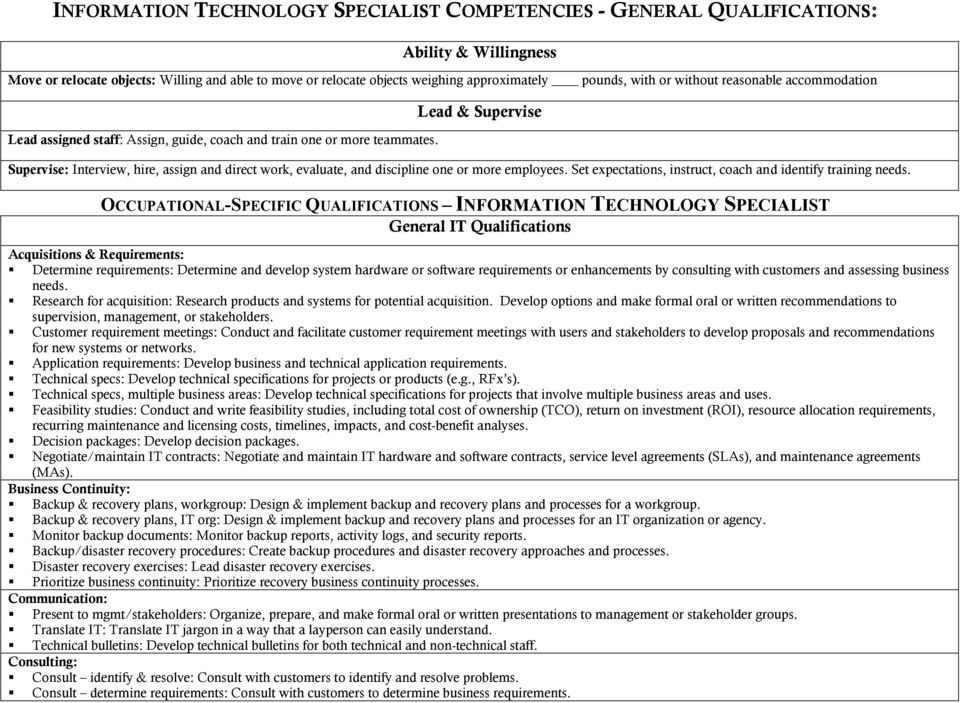
1 INFORMATION TECHNOLOGY SPECIALIST COMPETENCIES - GENERAL QUALIFICATIONS: Ability & Willingness Move or relocate objects: Willing and able to move or relocate objects weighing approximately pounds, with or without reasonable accommodation Lead assigned staff: Assign, guide, coach and train one or more teammates. Lead & Supervise Supervise: Interview, hire, assign and direct work, evaluate, and discipline one or more employees. Set expectations, instruct, coach and identify training needs. OCCUPATIONAL-SPECIFIC QUALIFICATIONS INFORMATION TECHNOLOGY SPECIALIST General IT Qualifications Acquisitions & Requirements: Determine requirements: Determine and develop system hardware or software requirements or enhancements by consulting with customers and assessing business needs. Research for acquisition: Research products and systems for potential acquisition. Develop options and make formal oral or written recommendations to supervision, management, or stakeholders. Customer requirement meetings: Conduct and facilitate customer requirement meetings with users and stakeholders to develop proposals and recommendations for new systems or networks. Application requirements: Develop business and technical application requirements. Technical specs: Develop technical specifications for projects or products (e.g., RFx s). Technical specs, multiple business areas: Develop technical specifications for projects that involve multiple business areas and uses. Feasibility studies: Conduct and write feasibility studies, including total cost of ownership (TCO), return on investment (ROI), resource allocation requirements, recurring maintenance and licensing costs, timelines, impacts, and cost-benefit analyses. Decision packages: Develop decision packages. Negotiate/maintain IT contracts: Negotiate and maintain IT hardware and software contracts, service level agreements (SLAs), and maintenance agreements (MAs). Business Continuity: Backup & recovery plans, workgroup: Design & implement backup and recovery plans and processes for a workgroup. Backup & recovery plans, IT org: Design & implement backup and recovery plans and processes for an IT organization or agency. Monitor backup documents: Monitor backup reports, activity logs, and security reports. Backup/disaster recovery procedures: Create backup procedures and disaster recovery approaches and processes. Disaster recovery exercises: Lead disaster recovery exercises. Prioritize business continuity: Prioritize recovery business continuity processes. Communication: Present to mgmt/stakeholders: Organize, prepare, and make formal oral or written presentations to management or stakeholder groups. Translate IT: Translate IT jargon in a way that a layperson can easily understand. Technical bulletins: Develop technical bulletins for both technical and non-technical staff. Consulting: Consult identify & resolve: Consult with customers to identify and resolve problems. Consult determine requirements: Consult with customers to determine business requirements.
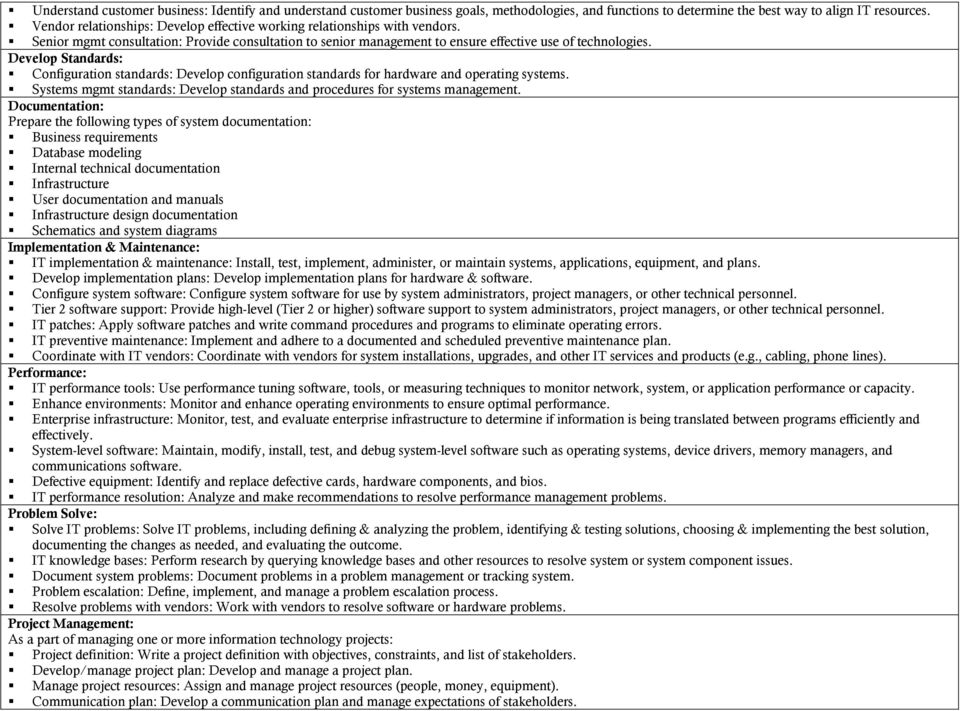
2 Understand customer business: Identify and understand customer business goals, methodologies, and functions to determine the best way to align IT resources. Vendor relationships: Develop effective working relationships with vendors. Senior mgmt consultation: Provide consultation to senior management to ensure effective use of technologies. Develop Standards: Configuration standards: Develop configuration standards for hardware and operating systems. Systems mgmt standards: Develop standards and procedures for systems management. Documentation: Prepare the following types of system documentation: Business requirements Database modeling Internal technical documentation Infrastructure User documentation and manuals Infrastructure design documentation Schematics and system diagrams Implementation & Maintenance: IT implementation & maintenance: Install, test, implement, administer, or maintain systems, applications, equipment, and plans. Develop implementation plans: Develop implementation plans for hardware & software. Configure system software: Configure system software for use by system administrators, project managers, or other technical personnel. Tier 2 software support: Provide high-level (Tier 2 or higher) software support to system administrators, project managers, or other technical personnel. IT patches: Apply software patches and write command procedures and programs to eliminate operating errors. IT preventive maintenance: Implement and adhere to a documented and scheduled preventive maintenance plan. Coordinate with IT vendors: Coordinate with vendors for system installations, upgrades, and other IT services and products (e.g., cabling, phone lines). Performance: IT performance tools: Use performance tuning software, tools, or measuring techniques to monitor network, system, or application performance or capacity. Enhance environments: Monitor and enhance operating environments to ensure optimal performance. Enterprise infrastructure: Monitor, test, and evaluate enterprise infrastructure to determine if information is being translated between programs efficiently and effectively. System-level software: Maintain, modify, install, test, and debug system-level software such as operating systems, device drivers, memory managers, and communications software. Defective equipment: Identify and replace defective cards, hardware components, and bios. IT performance resolution: Analyze and make recommendations to resolve performance management problems. Problem Solve: Solve IT problems: Solve IT problems, including defining & analyzing the problem, identifying & testing solutions, choosing & implementing the best solution, documenting the changes as needed, and evaluating the outcome. IT knowledge bases: Perform research by querying knowledge bases and other resources to resolve system or system component issues. Document system problems: Document problems in a problem management or tracking system. Problem escalation: Define, implement, and manage a problem escalation process. Resolve problems with vendors: Work with vendors to resolve software or hardware problems. Project Management: As a part of managing one or more information technology projects: Project definition: Write a project definition with objectives, constraints, and list of stakeholders. Develop/manage project plan: Develop and manage a project plan. Manage project resources: Assign and manage project resources (people, money, equipment). Communication plan: Develop a communication plan and manage expectations of stakeholders.
3 Project status reports: Produce project status reports for an executive sponsor or information technology manager. Implementation date: Develop a product that has a specific implementation date. Change control process: Manage the change control process. Implement successful project: Implement a successful project on time and on budget. Project Management tools: Use project management tools (e.g., MS Project, PrimaVera Team Plan, PS8). Security: Security standards & oversight: Develop security policies, guidelines, and standards and provide security oversight. Security access: Analyze and design security access. Security environments: Establish and implement security environments, such as firewalls. Intrusion response plans: Create security intrusion response plans or procedures. Security software: Install or administer security software. Detect intrusions, documents: Analyze technical and billing reports and logs to detect violations or intrusions. Detect intrusions, tools: Use specialized tools to perform audits and forensics to detect violations and intrusions. IT security audits: Conduct formal IT security audits or assessments. Testing & Quality Assurance: Test & assure quality: Perform testing & quality assurance. Quality assurance methodologies: Apply and use information technology quality assurance methodologies (i.e., CMM, ISO, ITIL). Training: IT training, internal business: Conduct IT training for groups of internal business customers. IT training, technical staff: Conduct technical training for groups of IT technical staff. IT training development: Design and develop curriculum and materials (courseware) for classroom or web-based IT training courses of two or more hours in length. Other: Conceptual view of systems: Maintain a conceptual or big picture view of current and planned work and recognize the impacts of change on systems. Architecture, working knowledge: Possess a working knowledge of tools, methods, and practices for developing architecture, including programming languages and industry standards. Architecture, advanced: Possess advanced knowledge of tools, methods, and practices for developing architecture, including programming languages and industry standards. IT systems, working knowledge: Possess a working knowledge of a broad range of information technology systems, including legacy systems. IT systems, advanced knowledge: Possess advanced knowledge of a broad range of information technology systems, including legacy systems. IT Functional Area Qualifications Data & Database Administration: Data/Database Qualifications: - Manage data: Analyze, define, optimize, or manage data. - DBMS research & requirements: Define requirements and perform market research for the purchase of a new database management system (DBMS). - Enterprise database backup: Develop and implement backup procedures for enterprise databases. - Database recovery: Develop and implement database recovery procedures for enterprise data due to media, system, or application failure. - Data/database security plans: Develop security plans for accessing and updating data on a database. - Data mgmt standards: Plan, direct, and coordinate the development of standards and procedures for data management. - Database disaster recovery: Develop and implement a database disaster recovery plan. Data Administration: - Conceptual & logical models: Develop conceptual and logical data models. - Data analysis meetings: Facilitate data analysis meetings with enterprise customers. - CASE tools: Use data modeling Computer Aided Software Engineering (CASE) tools.

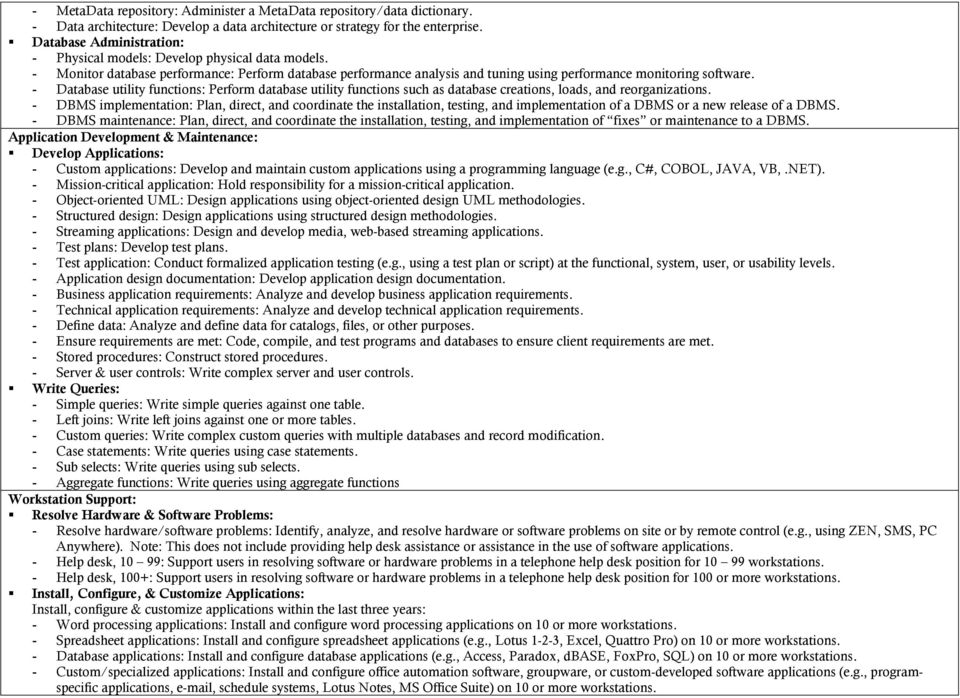
4 - MetaData repository: Administer a MetaData repository/data dictionary. - Data architecture: Develop a data architecture or strategy for the enterprise. Database Administration: - Physical models: Develop physical data models. - Monitor database performance: Perform database performance analysis and tuning using performance monitoring software. - Database utility functions: Perform database utility functions such as database creations, loads, and reorganizations. - DBMS implementation: Plan, direct, and coordinate the installation, testing, and implementation of a DBMS or a new release of a DBMS. - DBMS maintenance: Plan, direct, and coordinate the installation, testing, and implementation of fixes or maintenance to a DBMS. Application Development & Maintenance: Develop Applications: - Custom applications: Develop and maintain custom applications using a programming language (e.g., C#, COBOL, JAVA, VB,.NET). - Mission-critical application: Hold responsibility for a mission-critical application. - Object-oriented UML: Design applications using object-oriented design UML methodologies. - Structured design: Design applications using structured design methodologies. - Streaming applications: Design and develop media, web-based streaming applications. - Test plans: Develop test plans. - Test application: Conduct formalized application testing (e.g., using a test plan or script) at the functional, system, user, or usability levels. - Application design documentation: Develop application design documentation. - Business application requirements: Analyze and develop business application requirements. - Technical application requirements: Analyze and develop technical application requirements. - Define data: Analyze and define data for catalogs, files, or other purposes. - Ensure requirements are met: Code, compile, and test programs and databases to ensure client requirements are met. - Stored procedures: Construct stored procedures. - Server & user controls: Write complex server and user controls. Write Queries: - Simple queries: Write simple queries against one table. - Left joins: Write left joins against one or more tables. - Custom queries: Write complex custom queries with multiple databases and record modification. - Case statements: Write queries using case statements. - Sub selects: Write queries using sub selects. - Aggregate functions: Write queries using aggregate functions Workstation Support: Resolve Hardware & Software Problems: - Resolve hardware/software problems: Identify, analyze, and resolve hardware or software problems on site or by remote control (e.g., using ZEN, SMS, PC Anywhere). Note: This does not include providing help desk assistance or assistance in the use of software applications. - Help desk, 10 99: Support users in resolving software or hardware problems in a telephone help desk position for workstations. - Help desk, 100+: Support users in resolving software or hardware problems in a telephone help desk position for 100 or more workstations. Install, Configure, & Customize Applications: Install, configure & customize applications within the last three years: - Word processing applications: Install and configure word processing applications on 10 or more workstations. - Spreadsheet applications: Install and configure spreadsheet applications (e.g., Lotus 1-2-3, Excel, Quattro Pro) on 10 or more workstations. - Database applications: Install and configure database applications (e.g., Access, Paradox, dbase, FoxPro, SQL) on 10 or more workstations. - Custom/specialized applications: Install and configure office automation software, groupware, or custom-developed software applications (e.g., programspecific applications, , schedule systems, Lotus Notes, MS Office Suite) on 10 or more workstations.
5 - Install/configure browsers: Install and configure browsers (e.g, Internet Explorer, Netscape) on 10 or more workstations. - Customize applications: Customize word processing, spreadsheet, database, or other applications (e.g., create formulas, macros, templates, reports, queries). Operating Systems & PC Imaging: - Operating systems: Install and configure operating systems (e.g., Windows, DOS, Macintosh). This does not include PC imaging. - PC images: Design and successfully implement two or more PC images within the last three years. Install & Configure External Devices: Install & configure external devices & device software 10 or more times within the last three years: - USB devices: Install and configure USB devices (i.e., bar code equipment, camera, external drive, scanner, and PDA). - Plotters & printers: Install and configure plotters and printers. - Tape backup drives: Install and configure tape backup drives. - External modems: Install and configure external modems. Install & Configure Internal Devices: Install & configure internal devices & device software 10 or more times within the last three years: - Install drives & tape backup units: CD, DVD, floppy, and hard drives and tape backup units. - Install mother boards: Install and configure mother boards. - Install internal modems: Install and configure internal modems. - Install cards: Install and configure network interface, controller, sound, and video cards. - Install RAM: Install RAM. - Install CPU: Install CPU. Network Administration & Support: Network Administration: Within the last three years: - Install DHCP: Install, configure, and maintain DHCP. - Install DNS: Install, configure, and maintain DNS. - Install Install, configure, and maintain enterprise messaging systems ( ). - Install firewalls: Install, configure, and maintain firewall systems. - Install network-based software: Install, configure, and maintain network-based software on a server (e.g., word processing, spreadsheet, database, ). - Install VPPN: Install, configure, and maintain VPPN. - Install proxy server products: Install, configure, and maintain proxy server software products. - Install RAS or DUN: Install, configure, and maintain RAS or DUN. - Install web server software: Install, configure, and maintain web server software (e.g., Netscape, IIS). - Maintain TCP/IP: Maintain TCP/IP addressing schemes. - Install WINS: Install, configure, and maintain WINS. - Install network operating system: Install a network operating system (e.g., Novell Netware, WIN 2003 Server, Windows Active Directory). - Maintain network operating system: Maintain a network operating system (e.g., partition drives, apply software patches, assign frame types, install and configure antivirus software, administer security). - Install server hardware: Install and configure server hardware (e.g., BIOS upgrade, CD devices, CPU, memory, modem, network interface card, RAID array, SCSI devices, tape backup drive). - Install wireless products: Install and configure wireless access points, wireless security, and wireless protocols. - Evaluate network performance: Use and interpret data produced by one or more network management utilities (e.g., Sun Net Manager, Lattis Net, Optivity, Sniffer, LANalyzer) to evaluate network performance. Administer Network Access & Resolve Problems: Within the last three years - Administer network access: Administer access and services for a network of workstations or terminals including adding and deleting users, setting up print queues, and maintaining security levels.

6 - Network printing, connectivity, access: Identify, analyze, and resolve problems in network printing, connectivity, and access. - Communication protocol: Identify, analyze, and resolve communication protocol (e.g., TCP/IP, IPX) problems. Multiple Servers: - Multiple servers, administer access: One or more years of experience within the last three years administering access and services for a network of 20 or more workstations or terminals with servers located at two or more connected sites, or with five or more servers in a single network. - Multiple servers, resolve problems: One or more years of experience within the last three years analyzing and resolving problems in network printing, connectivity, and access for a network with servers located at two or more connected sites, or with five or more servers in a single network. Infrastructure: Within the last three years: Design LAN, 20+ workstations: Design a LAN for 20 or more workstations or terminals. Design LAN, 100+ workstations: Design a LAN for 100 or more workstations or terminals. Design LAN, 5+ servers: Design a LAN involving 5 or more servers. Implement LAN, 20+ workstations: Successfully implement a LAN design for 20 or more workstations or terminals. Implement LAN, 100+ workstations: Successfully implement a LAN design for 100 or more workstations or terminals. Implement LAN, 5+ servers: Successfully implement a LAN design involving 5 or more servers. WAN: Design a WAN consisting of two or more connected sites. Cross-LATA WAN: Design or successfully implement a cross-lata (e.g., statewide) WAN. High-speed network: Successfully design or implement a high-speed network (e.g., ATM, SONET, TDM). Video conferencing systems: Design and successfully implement video conferencing systems. Voice communications equipment: Successfully install, configure, administer, and support data or voice communications equipment (e.g., routers, switches, host gateways, bridges, concentrators, hubs). Mainframe & Mid-Range Support: Troubleshooting: Identify and resolve hardware or software problems on a mainframe or mid-range system within the last eight years. Install/Configure Software Packages: Successfully install or configure the following types of software packages on a mainframe or mid-range system: - Database - Middleware - Operating system - Performance - Security - Storage management - System control (e.g., job scheduling, tape management, electronic distribution report) - System library - Telecommunications - Transaction interface - Utility Other: - Evaluation criteria: Develop evaluation criteria for mainframe systems. - Develop installation scripts: Develop installation script documentation for mainframe systems. - Develop software enhancements: Develop software enhancement documentation for mainframe systems. - Develop testing scripts: Develop testing script documentation for mainframe systems. - User documentation: Develop user documentation for mainframe systems. - Mainframe backup/recovery: Implement and update backup and recovery procedures for mainframe systems. - Mainframe configuration: Modify mainframe or vendor source code or configuration parameters to satisfy site-unique requirements for products. - Mainframe performance tools: Use performance tuning software or measuring techniques to monitor system or application performance or capacity. Telephony: Installation & Implementation: - Telephony system requirements: Consult with customers and analyze their requirements for telephony systems, including voice mail, long distance and local telephone services, and related hardware and software. - Telephony project mgmt, : Serve as the project manager or project team leader for the implementation of a telephone system that included stations.

7 - Telephony project mgmt, 300+: Serve as the project manager or project team leader for the implementation of a telephone system that included 300 or more stations. - Telecommunications wiring system: Install or coordinate the installation of a building or multi-building telecommunications wiring system. - Fiber optic/copper wire system: Install or coordinate the installation of a fiber optic or Category 5 copper wire system. Maintenance & Technical Support: - Administer/maintain telephony: Administer or maintain a telephony system (e.g., ACD, IVR, Key, PBX, voice mail, central office or interchange company switching). Identify and resolve problems and perform moves, adds, and changes. - Telephony performance tools: Use system management performance monitoring tools (e.g., ASA, AIM, MAT, Optivity) to identify potential fraud, identify hardware or software problems, or analyze traffic reports to optimize system performance of a telephony system. - PBX repair: Troubleshoot and repair PBX hardware or software. - Telephony configuration: Program system level configurations or data structures such as Classes of Restriction, Classes of Service, trunking, or routing. - Isolate problems with call flows: Troubleshoot and isolate problems with complex call flows or equivalent programming logic. IT Specialty Areas Workstation Systems: Successfully install and configure or maintain the following: - CorelPerfect Office Suite - Desktop Publishing (e.g., Adobe, - Desktop Operating Systems (e.g., DOS, Pagemaker) Windows) - Mini or mainframe emulation - MS Office Suite Server Platforms: Successfully install and configure, maintain, administer, or monitor and resolve problems with the following: - AS Remote Access Server (e.g., MS RAS, - Mini Computers (e.g., HP, Sun, IBM) Novell Netware-Connect, PPP) - MS Server (e.g., NT, 2000, 2003, Windows - Server Hardware (e.g., Raid, SCSI, Cards, Professional) CPUS) - Network Storage (SAN, NAS) - System 390 (e.g., Z/Os) - Novell Netware Network Systems & Services: Successfully design, install and configure, maintain, or administer the following: - Active Directory - Backup Recovery Systems (e.g., Backup Exec, ARC-SERV, Omniback) - Exchange - Groupwise - MS SMS - Network & Shared Printing - NDS or e-directory - Problem Management Software (e.g., Heat, Remedy) - System Management Products (e.g., HP Openview, Tivoli, Netview 6000, Spectrum) Network Infrastructure: Successfully design, install and configure, maintain, or administer the following network components: - ATM - Frame Relay - Bridges - Gateways - Cabling - Hubs, Concentrators - Computer Telephony Integration (e.g., - Interface Unit (e.g., CSU/DSU) VOIP) - Network Protocols (e.g., TCP/IP, - Digital Circuits (e.g., T-1, DS3) IPX/SPX, SNMP,SNA, VTAM, NCP) - Ethernet - Network Test Equipment (e.g., Cable, - OS/x - PC Hardware (e.g., Notebook, Desktop) - PDA (e.g., Pocket PC) - Workstation (e.g., HP, Sun, IBM, MS) - Tandem (e.g., HP-Nonstop, Guardian) - TIP (Transaction Instruction Processing) - Unisys - Unix (e.g., Sun, DEC, IBM/AIX, SCO, Linux) - Terminal Services (e.g., Windows, Citrix) - Web Server (e.g., Netscape, Apache, IIS, Ecommerce, Domino, Websphere) - WINS, DHCP, SNA Server - Routers (e.g., CISCO) - Sonet - Switches - Token Ring - Wireless (802.11x)

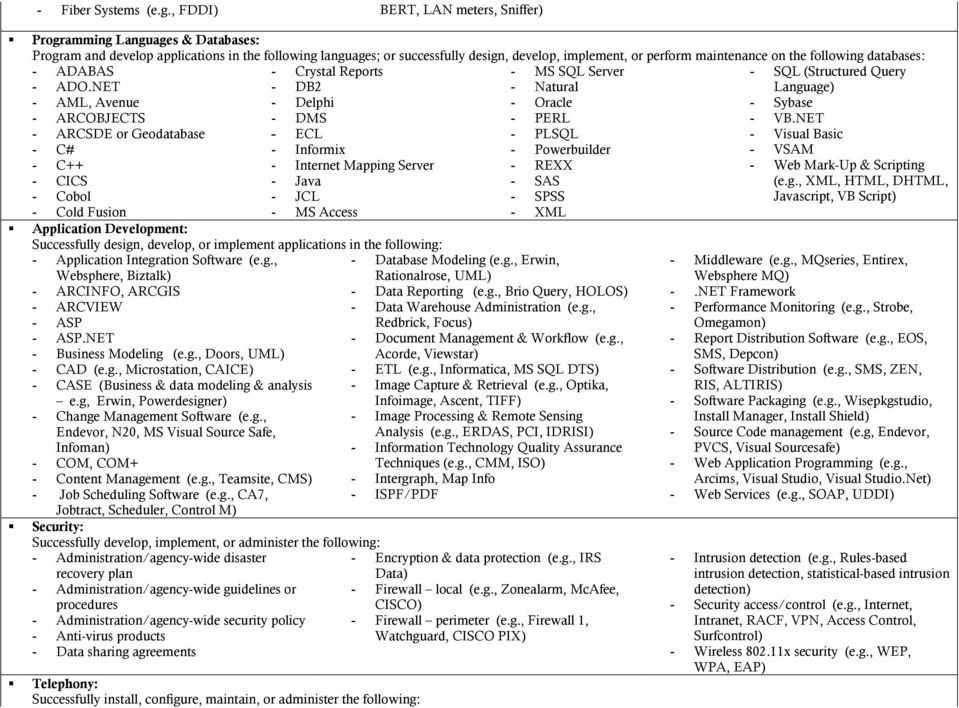
8 - Fiber Systems (e.g., FDDI) BERT, LAN meters, Sniffer) Programming Languages & Databases: Program and develop applications in the following languages; or successfully design, develop, implement, or perform maintenance on the following databases: - ADABAS - Crystal Reports - MS SQL Server - SQL (Structured Query - ADO.NET - DB2 - Natural Language) - AML, Avenue - Delphi - Oracle - Sybase - ARCOBJECTS - DMS - PERL - VB.NET - ARCSDE or Geodatabase - ECL - PLSQL - Visual Basic - C# - Informix - Powerbuilder - VSAM - C++ - Internet Mapping Server - REXX - Web Mark-Up & Scripting - CICS - Java - SAS (e.g., XML, HTML, DHTML, - Cobol - JCL - SPSS Javascript, VB Script) - Cold Fusion - MS Access - XML Application Development: Successfully design, develop, or implement applications in the following: - Application Integration Software (e.g., Websphere, Biztalk) - ARCINFO, ARCGIS - ARCVIEW - ASP - ASP.NET - Business Modeling (e.g., Doors, UML) - CAD (e.g., Microstation, CAICE) - CASE (Business & data modeling & analysis e.g, Erwin, Powerdesigner) - Change Management Software (e.g., Endevor, N20, MS Visual Source Safe, Infoman) - COM, COM+ - Content Management (e.g., Teamsite, CMS) - Job Scheduling Software (e.g., CA7, Jobtract, Scheduler, Control M) Security: Successfully develop, implement, or administer the following: - Administration/agency-wide disaster recovery plan - Administration/agency-wide guidelines or procedures - Administration/agency-wide security policy - Anti-virus products - Data sharing agreements Telephony: Successfully install, configure, maintain, or administer the following: - Database Modeling (e.g., Erwin, Rationalrose, UML) - Data Reporting (e.g., Brio Query, HOLOS) - Data Warehouse Administration (e.g., Redbrick, Focus) - Document Management & Workflow (e.g., Acorde, Viewstar) - ETL (e.g., Informatica, MS SQL DTS) - Image Capture & Retrieval (e.g., Optika, Infoimage, Ascent, TIFF) - Image Processing & Remote Sensing Analysis (e.g., ERDAS, PCI, IDRISI) - Information Technology Quality Assurance Techniques (e.g., CMM, ISO) - Intergraph, Map Info - ISPF/PDF - Encryption & data protection (e.g., IRS Data) - Firewall local (e.g., Zonealarm, McAfee, CISCO) - Firewall perimeter (e.g., Firewall 1, Watchguard, CISCO PIX) - Middleware (e.g., MQseries, Entirex, Websphere MQ) -.NET Framework - Performance Monitoring (e.g., Strobe, Omegamon) - Report Distribution Software (e.g., EOS, SMS, Depcon) - Software Distribution (e.g., SMS, ZEN, RIS, ALTIRIS) - Software Packaging (e.g., Wisepkgstudio, Install Manager, Install Shield) - Source Code management (e.g, Endevor, PVCS, Visual Sourcesafe) - Web Application Programming (e.g., Arcims, Visual Studio, Visual Studio.Net) - Web Services (e.g., SOAP, UDDI) - Intrusion detection (e.g., Rules-based intrusion detection, statistical-based intrusion detection) - Security access/control (e.g., Internet, Intranet, RACF, VPN, Access Control, Surfcontrol) - Wireless x security (e.g., WEP, WPA, EAP)
9 - Automatic Call Distribution (ACD) System - AVAYA (Lucent) PBX - Call Accounting System - Central Office (CO) System - Competitive Acquisitions - Documentation Software (e.g., VISIO, Autocad) - Interactive Voice Response (IVR) System - Key System (KSU or EKTS) - Long Distance Services - Network ACD Management System (e.g., Genesys, ICM) - Nortel DMS 250/500 Switches - Nortel PBX - Other PBX - PBX ACD Management System (e.g., AVAYA CMS, Nortel Symposium) - Tandem Voice Network - Unified Messaging - Video - Voice Mail - Voice Over IP - Wireless/PCS Cellular Media & Storage Management: Successfully install and configure, maintain, or administer the following: - Media Management (e.g., CD Towers, DVD Carousel) - Storage Management (e.g., ADSM, DMS, HSM) Certifications Completed all of the requirements for and have the following current professional certifications: - CISCO (e.g., CCNA, CCNE, CCNP) - Global Information Assurance Certifications (e.g., GSEC, GCFW, GSLC) - Information Systems Audit & Control Association (e.g., CISA, CISM) - Microsoft (e.g., A+, Network+, MCP, MCSE) - Novell (e.g., CNA, CNE) - Project Management (e.g., PMI, University of Washington) - RCDD - Software or Usability Testing (e.g., University of Washington) - Web Administration (e.g., University of Washington) - International Information Systems Security Certification Consortium (e.g., CISSP)

NETWORK ADMINISTRATOR
 JOB DESCRIPTION Title: NETWORK ADMINISTRATOR Department: Information Systems Class Code: 1821 FLSA Status: Exempt Effective Date: February 13, 1997 (Rev. 07/2012) Grade Number: 26 GENERAL PURPOSE Under
NETWORK SYSTEMS ENGINEER II
 NETWORK SYSTEMS ENGINEER II DEFINITION Under direction, provides technical support for the County s infrastructure of Local Area Networks (LANs), Wide Area Network (WAN) and other related data network
INFORMATION TECHNOLOGY ENGINEER V
 1464 INFORMATION TECHNOLOGY ENGINEER V NATURE AND VARIETY OF WORK This is senior level lead administrative, professional and technical engineering work creating, implementing, and maintaining the County
English Requirement: You must be able to understand and be understood in English.
 MICHAEL R. BLOOMBERG Mayor MARTHA K. HIRST Commissioner THE CITY OF NEW YORK DEPARTMENT OF CITYWIDE ADMINISTRATIVE SERVICES APPLICATIONS CENTER 18 WASHINGTON STREET NEW YORK, NY 10004 N O T I C E O F E
Associate in Science Degree in Computer Network Systems Engineering
 Moorpark College Associate in Science Degree in Computer Network Systems Engineering To earn an Associate in Science Degree with a major in Computer Network Systems Engineering, students complete 40.5-45
n2grate Open Positions March 2015
 n2grate Open Positions March 2015 Table of Contents 1. CMS Centers for Medicare & Medicaid Services Roles... 1 1.1 Role 012 Computer System Analysts II...1 1.1.1 Location: Dallas, Texas... 1 1.3 Role 013
Module 5 Introduction to Processes and Controls
 IT Terminology 1. General IT Environment The general IT environment is the umbrella over the following IT processes: 1. Operating Systems 2. Physical and Logical Security 3. Program Changes 4. System Development
IT Application Support Engineer (Database, Web & User)
 IT Application Support Engineer (Database, Web & User) Analysis, design, implementation, and testing of web-shared databases. These databases are mainly administrative oriented and are used to support
CLASS SPECIFICATION Systems Support Analyst II
 San Diego Unified Port District Class Code: B211-UE03 CLASS SPECIFICATION Systems Support Analyst II FLSA Status: EEOC Job Category: Classified: Union Representation: Exempt Professionals No Unrepresented
Presented By: Daniel Chetty [email protected] 01628 771 811
 Candidate Name: Raymond - 145175 Job Applied For: Availability: Key Skills: 1 st /2 nd Line Support Interview: Immediate Start: immediate An experienced IT professional with a proven track record of supporting
HELP DESK SUPERVISOR
 HELP DESK SUPERVISOR Occupational Code: 1551 Salary Range: 28A Status: Classified FLSA: Exempt Established: 7/04 Revised: 11/05 2/06 4/06 NATURE OF WORK: Technical specialized work responsible for supervising
THE INFORMATION TECHNOLOGY INFRASTRUCTURE IN WIPO
 THE INFORMATION TECHNOLOGY INFRASTRUCTURE IN WIPO Yves Le Borgne 24/06/98 The IT infrastructure in WIPO Table of Contents IT infrastructure strategies IT challenges in 1998 The IT Department activities
Complete Assessment Catalog
 Complete Assessment Catalog 2015 www.reviewnet.net Flex Spec Multi-Topic Customized Assessments FlexSpec Assessments allow you to easily create customized assessments choosing the from over 160 different
Select IT Consulting Services RFP 11-01 Technical and Network Support Specialist Services (Lot Group C)
 Computer/Application Support Specialist Computer/Application Support Specialist 1 Typical Functions: Preferred This function requires business work experience with Windows XP, IT experience, work experience
Available Certification Exams at AACC
 Available Certification Exams at AACC Certiport Certification IC3 Mous Microsoft Certification MS Access 2003 Ms Access Expert 2003 Ms Excel 2003 Ms Excel Expert 2003 Ms Outlook 2003 Ms Outlook Expert
Labor Category Descriptions
 LCD Page 1 of 20 Labor Category Descriptions Applications Programmer Devises or modifies procedures to solve complex problems considering computer equipment capacity and limitations, operating time, and
Local Area Networks (LANs) Blueprint (May 2012 Release)
 Local Area Networks (LANs) The CCNT Local Area Networks (LANs) Course April 2012 release blueprint lists the following information. Courseware Availability Date identifies the availability date for the
Job Description Information Services Coordinator
 Job Description Position Title: Information Services Coordinator Department: Reports To: Technology & Infrastructure Manager Purpose The Information Services Coordinators role is to ensure the stability,
SUMMARY EXPERIENCE PROFILE
 TERRY L. COOPER Capacity Planning and Performance Engineering Consultant 513-608-2921 - [email protected] 2854 Ridgewood Avenue, Cincinnati, OH 45213 SUMMARY Senior Information Technologist with
WINNEBAGO COUNTY INFORMATION TECHNOLOGY STANDARDS 2014/2015
 WINNEBAGO COUNTY INFORMATION TECHNOLOGY STANDARDS 2014/2015 Platform Architecture Standards: End User Software Platform Architecture Standards: End User Hardware Platform Architecture Standards: Hand Held
The WestNet Advantage: -- Textbooks, ebooks, ecourses -- Instructor Resourse Center -- Student Resource Center
 The WestNet Advantage: -- Textbooks, ebooks, ecourses -- Instructor Resourse Center -- Student Resource Center The entire cost of the program is funded by the textbook, ebook or ecourse purchase by your
Please Note: Temporary Graduate 485 skills assessments applicants should only apply for ANZSCO codes listed in the Skilled Occupation List above.
 ANZSCO Descriptions This ANZSCO description document has been created to assist applicants in nominating an occupation for an ICT skill assessment application. The document lists all the ANZSCO codes that
138 To satisfy a prerequisite, the student must have earned a letter grade of A, B, C or CR in the prerequisite course, unless otherwise stated.
 Computer Science and Information Systems: Information Technology - Networking CSIT 131 Word (1) (Formerly CSIS 127) Word word processing software. Prepares individuals who are seeking to become a Microsoft
ICT Category Sub Category Description Architecture and Design
 A A01 Architecture and Design Architecture and Design Enterprise & Business Architecture A02 Architecture and Design Information Architecture A03 Architecture and Design Solution Architecture B Benchmarking
Australian Computer Society ANZSCO ICT Code descriptions v1.0 01.07.2011 Further updates will be issued in 2011-2012
 Australian Computer Society ANZSCO ICT Code descriptions v1.0 01.07.2011 Further updates will be issued in 2011-2012 The Australian Computer Society is the gazetted authority within Australia to undertake
Candidate CV - 99692. Interview: Immediate Start: Monday 25 th June 2012. Technical Skills:
 Candidate Name: Job Applied For: Availability: Key Skills: Candidate CV - 99692 1 st /2 nd Line Support Engineer Interview: Immediate Start: Monday 25 th June 2012 Technical Skills: Active Directory, Hardware
CLASS SPECIFICATION Systems Support Analyst I
 San Diego Unified Port District Class Code: B837-UE03 CLASS SPECIFICATION Systems Support Analyst I FLSA Status: EEOC Job Category: Classified: Union Representation: Exempt Professionals No Unrepresented
SCHOOL DISTRICT OF MARION COUNTY JOB CLASSIFICATION DESCRIPTION LEVEL/POSITION: COMPUTER NETWORK SPECIALIST 4.78
 SCHOOL DISTRICT OF MARION COUNTY JOB CLASSIFICATION DESCRIPTION LEVEL/POSITION: COMPUTER NETWORK SPECIALIST 4.78 AREA(S): DATA CENTER OPERATIONS POSITION SUMMARY: The Network Specialist s role is to install,
Proven Technical and Management skills over a career spanning more than 10 years. Brunswick Vic 3056 Australia
 Resume: Michael McNab Systems Administrator and Web Support Proven Technical and Management skills over a career spanning more than 10 years Name: Address: Phone: Email Address: Website: Michael McNab
FBLA: NETWORKING CONCEPTS. Competency: General Network Terminology and Concepts
 Competency: General Network Terminology and Concepts 1. Demonstrate knowledge of the purposes, benefits, and risks for installing a network. 2. Identify types of networks (e.g., LAN, WAN, MAN) and their
SENIOR SYSTEMS ANALYST
 CITY OF MONTEBELLO 109 DEFINITION Under general administrative direction of the City Administrator, provides advanced professional support to departments with very complex computer systems, programs and
More than 6 years of experience in IT Projects/Networking /Systems
 Mohammed Riyas. V.P Email: [email protected] [email protected] Abu Dhabi Mobile: 055 6693840 U.A.E Passport No: G9871465 Career Objective CURRICULUM VITAE Highly motivated IT Engineer with sound professional
NETWORK SYSTEMS ENGINEER III
 NETWORK SYSTEMS ENGINEER III DEFINITION Under direction, provides technical support for the County s infrastructure of Local Area Networks (LANs), Wide Area Network (WAN) and other related data network
Information Technology Cluster
 Network Systems Pathway Information Technology Cluster Assistant Network Technician -- This major prepares students to install, configure, operate, and connections to remote sites in a wide area network
Level: 3 Credit value: 9 GLH: 80. QCF unit reference R/507/8351. This unit has 6 learning outcomes.
 This unit has 6 learning outcomes. 1. Know telephony principles. 1.1. Demonstrate application of traffic engineering concepts Prioritization of voice traffic Trunking requirements Traffic shaping. 1.2.
CUSTOMER RELATIONSHIP MANAGEMENT (CRM) SERVICES
 NETWORK DESIGN CABLING SERVICES HARDWARE AND SOFTWARE TECHNICAL TRAINING SYSTEMS SUPPORT INTERNET / INTRANET SERVICES CUSTOMER RELATIONSHIP MANAGEMENT (CRM) SERVICES SOFTWARE DEVELOPMENT AND CONSULTATION
IT Networking and Security
 elearning Course Outlines IT Networking and Security powered by Calibrate elearning Course Outline CompTIA A+ 801: Fundamentals of Computer Hardware/Software www.medallionlearning.com Fundamentals of Computer
Enterprise Governance and Planning
 GEORGIA TECHNOLOGY AUTHORITY Title: Enterprise Operational Environment PSG Number: SO-10-003.02 Topical Area: Operations / Performance and Capacity Document Type: Standard Pages: 5 Issue Date: July 15,
MCSE SYLLABUS. Exam 70-290 : Managing and Maintaining a Microsoft Windows Server 2003:
 MCSE SYLLABUS Course Contents : Exam 70-290 : Managing and Maintaining a Microsoft Windows Server 2003: Managing Users, Computers and Groups. Configure access to shared folders. Managing and Maintaining
Course Descriptions. preparation.
 Course Descriptions CS 101 Intro to Computer Science An introduction to computer science concepts and the role of computers in society. Topics include the history of computing, computer hardware, operating
Functional Area 3. Skill Level 301: Applications Systems Analysis and Programming Supervisor (Mercer 1998 Job 011)
 Functional Area 3 Skill Level 301: Applications Systems Analysis and Programming Supervisor (Mercer 1998 Job 011) Description: Supervises activities of all applications systems analysis and programming
SENIOR INFORMATION SYSTEMS MANAGER
 CITY OF PORTLAND Multiple SENIOR INFORMATION SYSTEMS MANAGER FLSA Status: Union Representation: Exempt Nonrepresented DEFINITION To plan, manage, supervise and coordinate information systems activities
CompTIA Network+ (Exam N10-005)
 CompTIA Network+ (Exam N10-005) Length: Location: Language(s): Audience(s): Level: Vendor: Type: Delivery Method: 5 Days 182, Broadway, Newmarket, Auckland English, Entry Level IT Professionals Intermediate
capabilities statement
 capabilities statement GSA Schedule 70 Contract Holder: Contract #: GS-35F-0649Y Duns#: 824940121 Cage Code#: 6B5K3 SIN Codes: 132-34 Maintenance of Software 132-51 Information Technology Professional
Network Systems Administrator/Analyst
 Network Systems Administrator/Analyst A+, MCP, MCSA 2003, CCNA, Business Mgmt. National Aboriginal IT Skills Development Program Career opportunities continue to grow for Information Technology (IT) professionals
LAS VEGAS - CLARK COUNTY LIBRARY DISTRICT
 DEFINITION SYSTEMS AND NETWORK SUPERVISOR (Range 128) Performs installation, monitoring, maintenance, operations, optimization, supervision and modification of network, minicomputer and microcomputer systems
Job Description. Job Title: Systems Engineer / Network Admin II Reports To: VP of Accounting Department: IT
 Job Description Job Title: Systems Engineer / Network Admin II Reports To: VP of Accounting Department: IT Summary: The Systems Engineer/Admin support position manages, reviews, evaluates, implements and
Sample Career Ladder/Lattice for Information Technology
 Click on a job title to see examples of descriptive information about the job. Click on a link between job titles to see the critical development experiences needed to move to that job on the pathway.
FUNCTIONAL AREA 12. Network Administration (NET)
 FUNCTIONAL AREA 12 Network Administration (NET) Incumbents in this functional area address interoperability issues related to hardware, software, and connectivity of communications such as cable, fiber
MINNEAPOLIS PARK AND RECREATION BOARD JOB DESCRIPTION JOB TITLE: Network & Operations Coordinator
 MINNEAPOLIS PARK AND RECREATION BOARD JOB DESCRIPTION JOB TITLE: Network & Operations Coordinator Job Number: 07229P Date Finalized: 7/14/11 Service Department: Information Accountable To: Director, Information
CHAPTER 2: Staffing ROLES OF STAFF. Roles Required to Provide Tech Support
 Roles Required to Provide Tech Support The type and number of staff required to meet a district s technical support needs will vary widely based on the size of the district and the quality and quantity
Advanced Certificate in Networking (Microsoft) G5J9 17. Group Award Requirements
 Advanced Certificate in Networking (Microsoft) G5J9 17 Group Award Requirements Advanced Certificate in Networking (NT4) Professional Development Award (PDA) Advanced Certificate in Networking Group Award
STATE OF NEVADA Department of Administration Division of Human Resource Management CLASS SPECIFICATION
 STATE OF NEVADA Department of Administration Division of Human Resource Management LASS SPEIFIATION TITLE GRADE EEO-4 ODE IT TEHNIIAN SUPERVISOR 37 7.927 SERIES ONEPT Information Technology (IT) Technicians
Managed Services The. The Road to Revenue. Pravin Mahajan [email protected]. Session Number Presentation_ID
 Managed Services The The Road to Revenue Pravin Mahajan [email protected] Session Number 1 Agenda Managed Services Introduction Solution Offerings Market to Services Mapping Summary 2 High Business Interest
Implementing a Microsoft Windows 2000 Network Infrastructure
 Course Outline Implementing a Microsoft Windows 2000 Network Infrastructure Other Information MS2153 Days 5 Starting Time 9:00 Finish Time 4:30 Lunch & refreshments are included with this course. Implementing
IS Careers. MIS 4133 Software Systems
 IS Careers MIS 4133 Software Systems Outline CS and MIS Salaries Core competencies Hot technical skills IS job titles Employment outlook Careers in CS and MIS Computer Science Focuses on the development
Program: Systems Engineering Certificate. Prerequisite: None. Hardware/Software required:
 Program: Systems Engineering Certificate Prerequisite: None Hardware/Software required: 1. PC or Mac Any device capable of running remote software. 2. Audio output capable PC so that you can interact with/listen
NETWORK ADMINISTRATOR I/II
 NETWORK ADMINISTRATOR I/II DEFINITION To administer Local Area and Wide Area Networks by providing support and consultation to assigned County departments; to oversee maintenance and technical support
General Dynamics One Source, LLC Alliant GS00Q09BGD0030 Labor Category Descriptions April 21. 2007
 General Dynamics One Source, LLC Alliant GS00Q09BGD0030 Labor Category Descriptions April 21. 2007 Knowledge/Skill Levels: Many functional labor categories below (marked with # ) are further subdivided
DATABASE ANALYST I DATABASE ANALYST II
 CITY OF ROSEVILLE DATABASE ANALYST I DATABASE ANALYST II DEFINITION To perform professional level work in designing, installing, managing, updating, and securing a variety of database systems, including
PCISS-1. Job Description: Key Responsibilities: I. Perform troubleshooting& support:
 PCISS-1 Job Description: Perform hardware and software installation, configuration, and upgrades Monitoring systems to ensure system availability to all users and performing necessary maintenance to support
VoIP Survivor s s Guide
 VoIP Survivor s s Guide Can you really save $, improve operations, AND achieve greater security and availability? Presented by Peggy Gritt, Founder and CEO of the VoIP A non-biased organization for the
Course Description and Outline. IT Essential II: Network Operating Systems V2.0
 Course Description and Outline IT Essential II: Network Operating Systems V2.0 Course Outline 1. Operating System Fundamentals 1.1 Operating System Basics 1.1.1 Overview of PC operating systems 1.1.2 PCs
Connections II Award #: GS00Q12NSD0019
 J.1 Labor Categories The following labor categories are included on the Connections II contract. Additional categories may be requested for inclusion by the contractor. Fields are taken from Table -5 Labor_Table;
BIT Course Description
 BIT Course Description Introduction to Operating Systems BTEC 101 This course follows a systematic approach to operating systems explaining why they are needed and what they do. Topics include the basic
IT LABOR CATEGORY REQUIREMENTS AND DESCRIPTIONS
 IT LABOR CATEGORY REQUIREMENTS AND DESCRIPTIONS 1QUALIFICATION REQUIREMENTS. To perform on this schedule, contractor personnel must meet the minimum requirement for the skill categories described herein.
VERITAS Backup Exec 9.0 for Windows Servers
 WHITE PAPER Data Protection Solutions for Network Attached Storage VERITAS Backup Exec 9.0 for Windows Servers VERSION INCLUDES TABLE OF CONTENTS STYLES 1 TABLE OF CONTENTS Background...3 Why Use a NAS
Department of Labour PO Box 3705 Wellington New Zealand
 1 Department of Labour PO Box 3705 Wellington New Zealand 2 Contents 1 Executive summary... 4 2 Purpose of this report... 6 3 What we found... 8 ICT management... 8 ICT training, business and marketing...
How To Write An Ets Request For Proposal (Rfp)
 Oregon Enterprise Technology Services (ETS) Customer Requests ETS customers issuing RFPs to support application development initiatives often have hardware requirements. Standards and guidelines for equipment
Information Technology Standards Document
 Information Technology Standards Document The Information Technology Standards Policy lists all technologies supported by the organization and serves as a guideline for all technology purchasing and use
JOB DESCRIPTION Network Systems Technician I/II
 CITY OF DEL MAR JOB DESCRIPTION Network Systems Technician I/II GENERAL PURPOSE Under supervision, provides liaison and technical assistance to system users for computer and network related problems; consults
Computer Network Engineering
 226 Computer Network Engineering Computer Network Engineering Degrees, Certificates and Awards Associate in Science: Computer Network Engineering Certificate of Achievement: Computer Network Engineering
OCR LEVEL 3 CAMBRIDGE TECHNICAL
 Cambridge TECHNICALS OCR LEVEL 3 CAMBRIDGE TECHNICAL CERTIFICATE/DIPLOMA IN IT COMPUTER NETWORKS R/601/7320 LEVEL 3 UNIT 7 GUIDED LEARNING HOURS: 60 UNIT CREDIT VALUE: 10 COMPUTER NETWORKS R/601/7320 LEVEL
PCI Compliance - A Realistic Approach. Harshul Joshi, CISM, CISA, CISSP Director, Information Technology CBIZ MHM [email protected]
 PCI Compliance - A Realistic Approach Harshul Joshi, CISM, CISA, CISSP Director, Information Technology CBIZ MHM [email protected] What What is PCI A global forum launched in September 2006 for ongoing enhancement
Information Technology Resource Services
 Information Technology Resource Services RTI specializes in resource solutions ranging from Help Desk, Workstation, Network Infrastructure and Telecommunications services to Software and Web Site Developers.
Learning Objectives. Chapter 1: Networking with Microsoft Windows 2000 Server. Basic Network Concepts. Learning Objectives (continued)
 Chapter 1: Networking with Microsoft Learning Objectives Plan what network model to apply to your network Compare the differences between Windows 2000 Professional, Server, Advanced Server, and Datacenter