
SSC - Communication and Networking Java Socket Programming (II)
|
|
|
- Julianna Jones
- 10 years ago
- Views:
Transcription
1 SSC - Communication and Networking Java Socket Programming (II) Shan He School for Computational Science University of Birmingham Module : SSC

2 Outline Outline of Topics Multicast in Java

3 User Datagram Protocol (UDP) Sends independent packets of data (called datagrams) between computers without guarantees about arrival and sequencing. Transaction-oriented: suitable for simple query-response protocols, Examples: clock server, Domain Name System,... Not connection-oriented (point-to-point) like TCP: suitable for very large numbers of clients Examples: streaming media applications, e.g., IPTV Faster: no acknowledge of receiving packets, no flow control and very simple error control (only check errors but no correction). Examples: Voice over IP, online games,...

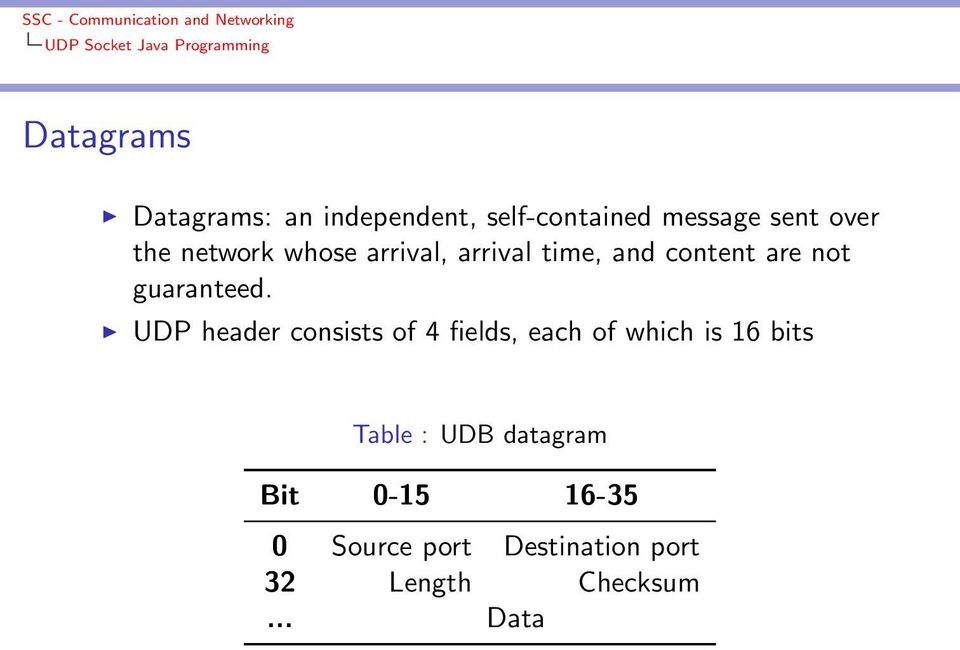
4 Datagrams Datagrams: an independent, self-contained message sent over the network whose arrival, arrival time, and content are not guaranteed. UDP header consists of 4 fields, each of which is 16 bits Table : UDB datagram Bit Source port Destination port 32 Length Checksum... Data
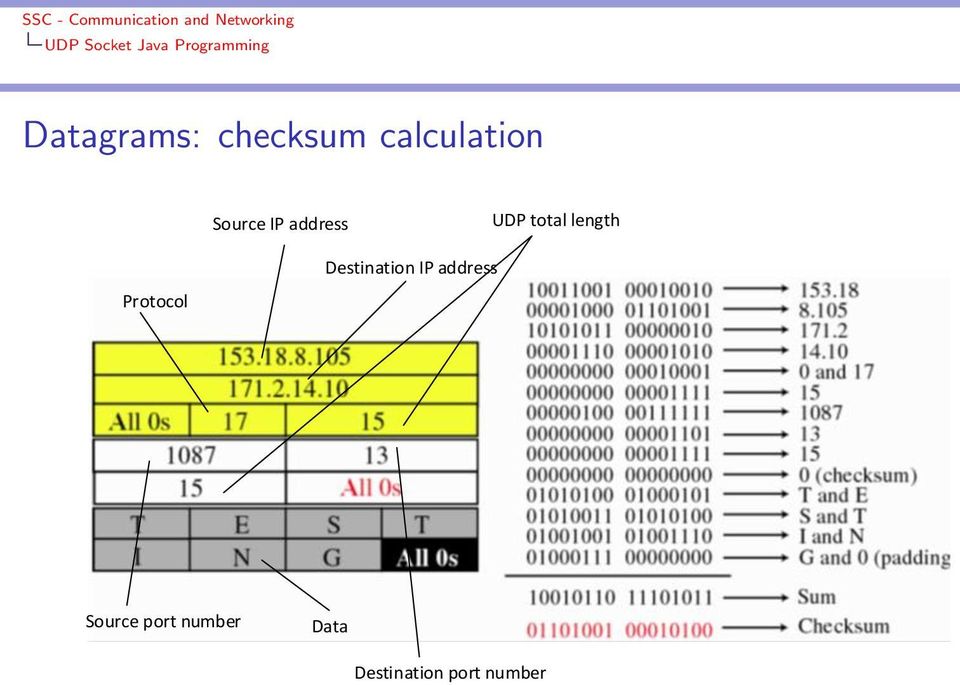
5 Datagrams: checksum Used for error-checking of the UDP header and data Also include IP address to prevent misrouting Basic idea: the complement of a 16-bit sum calculated over an IP pseudo-header and the actual UDP data. A pseudo-header: the IP header and the UDP header without checksum field At the receiver end: all the 16-bit words of the headers plus data area are added together = Sum Sum + Checksum =

6 Datagrams: checksum calculation Source IP address UDP total length Protocol Destination IP address Source port number Data Destination port number
7 UDP datagram communication in Java Two packages in java.net package: DatagramPacket : contains several constructors for creating datagram packet object Example: DatagramPacket(byte[] buf, int length, InetAddress address, int port); DatagramSocket : provides various methods for transmitting or receiving datagrams over the network Example: void send(datagrampacket p) or void receive(datagrampacket p)
![Example: DatagramPacket(byte[] buf, int length, InetAddress address, int port); DatagramSocket :](/docs-images/44/12089237/images/page_7.jpg "provides various methods for transmitting or receiving datagrams over the network Example: void")
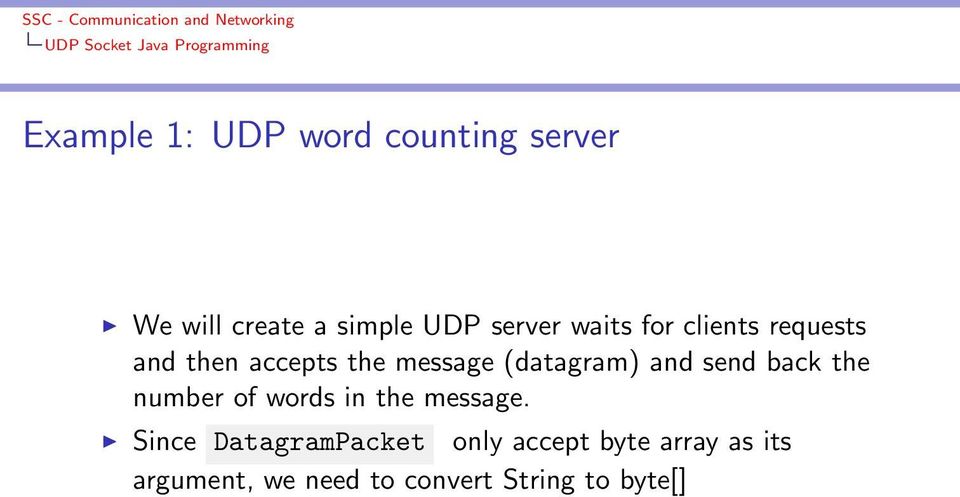
8 Example 1: UDP word counting server We will create a simple UDP server waits for clients requests and then accepts the message (datagram) and send back the number of words in the message. Since DatagramPacket only accept byte array as its argument, we need to convert String to byte[]
9 Multicast in Java Multicast Imaging you need to send data to a group of 1,000 clients What s wrong with TCP? Connection-based: you need 1,000 connections which consume a lot of processing power on sender! Flow control: The arrival time is not the same for every clients Multicast is a special feature of UDP protocol that enable programmer to send data to a group of receivers on a specific multicast IP address and port. One-to-many and many-to-many real-time communication over internet Send data only once to any number of any receivers The data is also called multicast packets

10 Multicast in Java Multicast: Java example A multicast group is specified by a class-d IP address and by a standard UDP port number. Class-D IP addresses are in the range to , inclusive. Receivers must join multicast group to receive data Multicast IP address Sender Joint to receive multicast message Receivers

11 Multicast in Java Multicast: Java example MulticastSocket class: sending and receiving multicast packets MulticastSocket class is inherited from the DatagramSocket class, with additional capabilities for joining groups of other multicast hosts on the internet. For Android App development, you can also use MulticastSocket class More information can be found at Oracle s webpage

12 Multicast in Java Multicast: Java example Steps of using MulticastSocket to receive data Step 1: create a MulticastSocket object with the desired port Step 2: join a group using the joingroup(inetaddress groupaddr) Step 3: leave the group using leavegroup(inetaddress addr) method. method

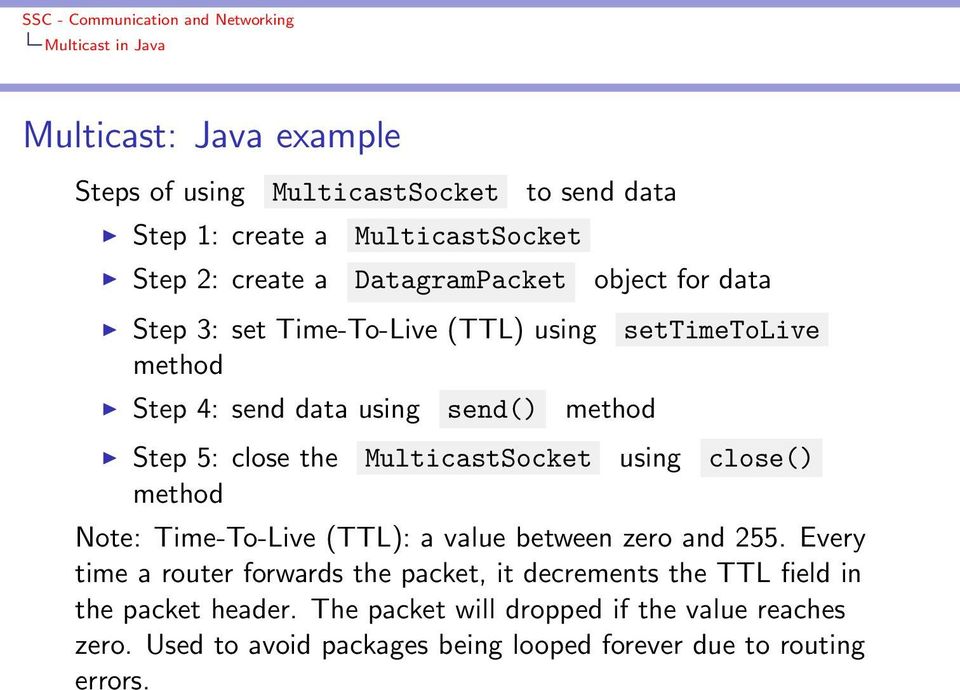
13 Multicast in Java Multicast: Java example Steps of using MulticastSocket to send data Step 1: create a MulticastSocket Step 2: create a DatagramPacket object for data Step 3: set Time-To-Live (TTL) using method Step 4: send data using send() method settimetolive Step 5: close the MulticastSocket using close() method Note: Time-To-Live (TTL): a value between zero and 255. Every time a router forwards the packet, it decrements the TTL field in the packet header. The packet will dropped if the value reaches zero. Used to avoid packages being looped forever due to routing errors.
Chapter 11. User Datagram Protocol (UDP)
 Chapter 11 User Datagram Protocol (UDP) The McGraw-Hill Companies, Inc., 2000 1 CONTENTS PROCESS-TO-PROCESS COMMUNICATION USER DATAGRAM CHECKSUM UDP OPERATION USE OF UDP UDP PACKAGE The McGraw-Hill Companies,
Network-based Applications. Pavani Diwanji David Brown JavaSoft
 Network-based Applications Pavani Diwanji David Brown JavaSoft Networking in Java Introduction Datagrams, Multicast TCP: Socket, ServerSocket Issues, Gotchas URL, URLConnection Protocol Handlers Q & A
Network layer: Overview. Network layer functions IP Routing and forwarding
 Network layer: Overview Network layer functions IP Routing and forwarding 1 Network layer functions Transport packet from sending to receiving hosts Network layer protocols in every host, router application
Data Communication & Networks G22.2262-001
 Data Communication & Networks G22.2262-001 Session 10 - Main Theme Java Sockets Dr. Jean-Claude Franchitti New York University Computer Science Department Courant Institute of Mathematical Sciences 1 Agenda
Indian Institute of Technology Kharagpur. TCP/IP Part I. Prof Indranil Sengupta Computer Science and Engineering Indian Institute of Technology
 Indian Institute of Technology Kharagpur TCP/IP Part I Prof Indranil Sengupta Computer Science and Engineering Indian Institute of Technology Kharagpur Lecture 3: TCP/IP Part I On completion, the student
The difference between TCP/IP, UDP/IP and Multicast sockets. How servers and clients communicate over sockets
 Network Programming Topics in this section include: What a socket is What you can do with a socket The difference between TCP/IP, UDP/IP and Multicast sockets How servers and clients communicate over sockets
Network Programming using sockets
 Network Programming using sockets TCP/IP layers Layers Message Application Transport Internet Network interface Messages (UDP) or Streams (TCP) UDP or TCP packets IP datagrams Network-specific frames Underlying
IP Network Layer. Datagram ID FLAG Fragment Offset. IP Datagrams. IP Addresses. IP Addresses. CSCE 515: Computer Network Programming TCP/IP
 CSCE 515: Computer Network Programming TCP/IP IP Network Layer Wenyuan Xu Department of Computer Science and Engineering University of South Carolina IP Datagrams IP is the network layer packet delivery
NAT & IP Masquerade. Internet NETWORK ADDRESS TRANSLATION INTRODUCTION. NAT & IP Masquerade Page 1 of 5. Internal PC 192.168.0.25
 NAT & IP Masquerade Page 1 of 5 INTRODUCTION Pre-requisites TCP/IP IP Address Space NAT & IP Masquerade Protocol version 4 uses a 32 bit IP address. In theory, a 32 bit address space should provide addresses
Chapter 3. TCP/IP Networks. 3.1 Internet Protocol version 4 (IPv4)
 Chapter 3 TCP/IP Networks 3.1 Internet Protocol version 4 (IPv4) Internet Protocol version 4 is the fourth iteration of the Internet Protocol (IP) and it is the first version of the protocol to be widely
User Datagram Protocol - Wikipedia, the free encyclopedia
 Página 1 de 6 User Datagram Protocol From Wikipedia, the free encyclopedia User Datagram Protocol (UDP) is one of the core protocols of the Internet protocol suite. Using UDP, programs on networked computers
Network Layer IPv4. Dr. Sanjay P. Ahuja, Ph.D. Fidelity National Financial Distinguished Professor of CIS. School of Computing, UNF
 Network Layer IPv4 Dr. Sanjay P. Ahuja, Ph.D. Fidelity National Financial Distinguished Professor of CIS School of Computing, UNF IPv4 Internet Protocol (IP) is the glue that holds the Internet together.
IP - The Internet Protocol
 Orientation IP - The Internet Protocol IP (Internet Protocol) is a Network Layer Protocol. IP s current version is Version 4 (IPv4). It is specified in RFC 891. TCP UDP Transport Layer ICMP IP IGMP Network
IP Subnetting and Addressing
 Indian Institute of Technology Kharagpur IP Subnetting and Addressing Prof Indranil Sengupta Computer Science and Engineering Indian Institute of Technology Kharagpur Lecture 6: IP Subnetting and Addressing
Lecture 2-ter. 2. A communication example Managing a HTTP v1.0 connection. G.Bianchi, G.Neglia, V.Mancuso
 Lecture 2-ter. 2 A communication example Managing a HTTP v1.0 connection Managing a HTTP request User digits URL and press return (or clicks ). What happens (HTTP 1.0): 1. Browser opens a TCP transport
Mobile IP Network Layer Lesson 02 TCP/IP Suite and IP Protocol
 Mobile IP Network Layer Lesson 02 TCP/IP Suite and IP Protocol 1 TCP/IP protocol suite A suite of protocols for networking for the Internet Transmission control protocol (TCP) or User Datagram protocol
Network Communication
 Network Communication Outline Sockets Datagrams TCP/IP Client-Server model OSI Model Sockets Endpoint for bidirectional communication between two machines. To connect with each other, each of the client
NETWORKING FEATURES OF THE JAVA PROGRAMMING LANGUAGE
 50-20-44 DATA COMMUNICATIONS MANAGEMENT NETWORKING FEATURES OF THE JAVA PROGRAMMING LANGUAGE John P. Slone INSIDE Java s Target Environment, Networking Basics, Java Networking Primitives, Connection-Oriented
Transport layer protocols. Message destination: Socket +Port. Asynchronous vs. Synchronous. Operations of Request-Reply. Sockets
 Transport layer protocols Interprocess communication Synchronous and asynchronous comm. Message destination Reliability Ordering Client Server Lecture 15: Operating Systems and Networks Behzad Bordbar
IP addressing and forwarding Network layer
 The Internet Network layer Host, router network layer functions: IP addressing and forwarding Network layer Routing protocols path selection RIP, OSPF, BGP Transport layer: TCP, UDP forwarding table IP
Subnetting,Supernetting, VLSM & CIDR
 Subnetting,Supernetting, VLSM & CIDR WHAT - IP Address Unique 32 or 128 bit Binary, used to identify a system on a Network or Internet. Network Portion Host Portion CLASSFULL ADDRESSING IP address space
Chapter 3. Internet Applications and Network Programming
 Chapter 3 Internet Applications and Network Programming 1 Introduction The Internet offers users a rich diversity of services none of the services is part of the underlying communication infrastructure
cnds@napier Slide 1 Introduction cnds@napier 1 Lecture 6 (Network Layer)
 Slide 1 Introduction In today s and next week s lecture we will cover two of the most important areas in networking and the Internet: IP and TCP. These cover the network and transport layer of the OSI
Internet Packets. Forwarding Datagrams
 Internet Packets Packets at the network layer level are called datagrams They are encapsulated in frames for delivery across physical networks Frames are packets at the data link layer Datagrams are formed
Basic Networking Concepts. 1. Introduction 2. Protocols 3. Protocol Layers 4. Network Interconnection/Internet
 Basic Networking Concepts 1. Introduction 2. Protocols 3. Protocol Layers 4. Network Interconnection/Internet 1 1. Introduction -A network can be defined as a group of computers and other devices connected
Socket Programming in Java
 Socket Programming in Java Learning Objectives The InetAddress Class Using sockets TCP sockets Datagram Sockets Classes in java.net The core package java.net contains a number of classes that allow programmers
Network-Oriented Software Development. Course: CSc4360/CSc6360 Instructor: Dr. Beyah Sessions: M-W, 3:00 4:40pm Lecture 2
 Network-Oriented Software Development Course: CSc4360/CSc6360 Instructor: Dr. Beyah Sessions: M-W, 3:00 4:40pm Lecture 2 Topics Layering TCP/IP Layering Internet addresses and port numbers Encapsulation
EITF25 Internet Techniques and Applications L5: Wide Area Networks (WAN) Stefan Höst
 EITF25 Internet Techniques and Applications L5: Wide Area Networks (WAN) Stefan Höst Data communication in reality In reality, the source and destination hosts are very seldom on the same network, for
Gary Hecht Computer Networking (IP Addressing, Subnet Masks, and Packets)
 Gary Hecht Computer Networking (IP Addressing, Subnet Masks, and Packets) The diagram below illustrates four routers on the Internet backbone along with two companies that have gateways for their internal
Network Layer: Network Layer and IP Protocol
 1 Network Layer: Network Layer and IP Protocol Required reading: Garcia 7.3.3, 8.1, 8.2.1 CSE 3213, Winter 2010 Instructor: N. Vlajic 2 1. Introduction 2. Router Architecture 3. Network Layer Protocols
CS 457 Lecture 19 Global Internet - BGP. Fall 2011
 CS 457 Lecture 19 Global Internet - BGP Fall 2011 Decision Process Calculate degree of preference for each route in Adj-RIB-In as follows (apply following steps until one route is left): select route with
Note! The problem set consists of two parts: Part I: The problem specifications pages Part II: The answer pages
 Part I: The problem specifications NTNU The Norwegian University of Science and Technology Department of Telematics Note! The problem set consists of two parts: Part I: The problem specifications pages
Socket Programming. Announcement. Lectures moved to
 Announcement Lectures moved to 150 GSPP, public policy building, right opposite Cory Hall on Hearst. Effective Jan 31 i.e. next Tuesday Socket Programming Nikhil Shetty GSI, EECS122 Spring 2006 1 Outline
Chapter 9. IP Secure
 Chapter 9 IP Secure 1 Network architecture is usually explained as a stack of different layers. Figure 1 explains the OSI (Open System Interconnect) model stack and IP (Internet Protocol) model stack.
Module 7 Internet And Internet Protocol Suite
 Module 7 Internet And Internet Protocol Suite Lesson 21 Internet and IPv4 LESSON OBJECTIVE General The lesson will discuss a popular network layer protocol, i.e. the Internet Protocol Specific The focus
IP Multicasting. Applications with multiple receivers
 IP Multicasting Relates to Lab 10. It covers IP multicasting, including multicast addressing, IGMP, and multicast routing. 1 Applications with multiple receivers Many applications transmit the same data
Transport Layer. Chapter 3.4. Think about
 Chapter 3.4 La 4 Transport La 1 Think about 2 How do MAC addresses differ from that of the network la? What is flat and what is hierarchical addressing? Who defines the IP Address of a device? What is
Network Layer. Introduction Datagrams and Virtual Circuits Routing Traffic Control. Data delivery from source to destination.
 Layer Introduction Datagrams and Virtual ircuits Routing Traffic ontrol Main Objective Data delivery from source to destination Node (Router) Application Presentation Session Transport Data Link Data Link
Transport Layer Protocols
 Transport Layer Protocols Version. Transport layer performs two main tasks for the application layer by using the network layer. It provides end to end communication between two applications, and implements
2057-15. First Workshop on Open Source and Internet Technology for Scientific Environment: with case studies from Environmental Monitoring
 2057-15 First Workshop on Open Source and Internet Technology for Scientific Environment: with case studies from Environmental Monitoring 7-25 September 2009 TCP/IP Networking Abhaya S. Induruwa Department
DNS: Domain Names. DNS: Domain Name System. DNS: Root name servers. DNS name servers
 DNS: Domain Name System DNS: Domain Names People: many identifiers: SSN, name, Passport # Internet hosts, routers: Always: IP address (32 bit) - used for addressing datagrams Often: name, e.g., nifc14.wsu.edu
ICOM 5026-090: Computer Networks Chapter 6: The Transport Layer. By Dr Yi Qian Department of Electronic and Computer Engineering Fall 2006 UPRM
 ICOM 5026-090: Computer Networks Chapter 6: The Transport Layer By Dr Yi Qian Department of Electronic and Computer Engineering Fall 2006 Outline The transport service Elements of transport protocols A
Scaling the Network: Subnetting and Other Protocols. Networking CS 3470, Section 1
 Scaling the Network: Subnetting and Other Protocols Networking CS 3470, Section 1 Today CIDR Subnetting Private IP addresses ICMP, IMAP, and DHCP Protocols 2 Packet Encapsulation ** Creative Commons: http://en.wikipedia.org/wiki/file:udp_encapsulation.svg
8.2 The Internet Protocol
 TCP/IP Protocol Suite HTTP SMTP DNS RTP Distributed applications Reliable stream service TCP UDP User datagram service Best-effort connectionless packet transfer Network Interface 1 IP Network Interface
NETWORK LAYER/INTERNET PROTOCOLS
 CHAPTER 3 NETWORK LAYER/INTERNET PROTOCOLS You will learn about the following in this chapter: IP operation, fields and functions ICMP messages and meanings Fragmentation and reassembly of datagrams IP
Course Overview: Learn the essential skills needed to set up, configure, support, and troubleshoot your TCP/IP-based network.
 Course Name: TCP/IP Networking Course Overview: Learn the essential skills needed to set up, configure, support, and troubleshoot your TCP/IP-based network. TCP/IP is the globally accepted group of protocols
Ethernet. Ethernet. Network Devices
 Ethernet Babak Kia Adjunct Professor Boston University College of Engineering ENG SC757 - Advanced Microprocessor Design Ethernet Ethernet is a term used to refer to a diverse set of frame based networking
ICT SEcurity BASICS. Course: Software Defined Radio. Angelo Liguori. SP4TE lab. [email protected]
 Course: Software Defined Radio ICT SEcurity BASICS Angelo Liguori [email protected] SP4TE lab 1 Simple Timing Covert Channel Unintended information about data gets leaked through observing the
04 Internet Protocol (IP)
 SE 4C03 Winter 2007 04 Internet Protocol (IP) William M. Farmer Department of Computing and Software McMaster University 29 January 2007 Internet Protocol (IP) IP provides a connectionless packet delivery
Network Programming TDC 561
 Network Programming TDC 561 Lecture # 1 Dr. Ehab S. Al-Shaer School of Computer Science & Telecommunication DePaul University Chicago, IL 1 Network Programming Goals of this Course: Studying, evaluating
Internet Protocol (IP) IP - Network Layer. IP Routing. Advantages of Connectionless. CSCE 515: Computer Network Programming ------ IP routing
 Process Process Process Layer CSCE 515: Computer Network Programming ------ IP routing Wenyuan Xu ICMP, AP & AP TCP IP UDP Transport Layer Network Layer Department of Computer Science and Engineering University
How To Understand The Internet Of S (Netware)
 Summer Workshop on Cyber Security Computer s Security (Part 1) Dr. Hamed Mohsenian-Rad University of California at Riverside and Texas Tech University August 12-16, 2013 Supported by National Science Foundation
Overview. Securing TCP/IP. Introduction to TCP/IP (cont d) Introduction to TCP/IP
 Overview Securing TCP/IP Chapter 6 TCP/IP Open Systems Interconnection Model Anatomy of a Packet Internet Protocol Security (IPSec) Web Security (HTTP over TLS, Secure-HTTP) Lecturer: Pei-yih Ting 1 2
Technical Support Information Belkin internal use only
 The fundamentals of TCP/IP networking TCP/IP (Transmission Control Protocol / Internet Protocols) is a set of networking protocols that is used for communication on the Internet and on many other networks.
IP address format: Dotted decimal notation: 10000000 00001011 00000011 00011111 128.11.3.31
 IP address format: 7 24 Class A 0 Network ID Host ID 14 16 Class B 1 0 Network ID Host ID 21 8 Class C 1 1 0 Network ID Host ID 28 Class D 1 1 1 0 Multicast Address Dotted decimal notation: 10000000 00001011
Encapsulating Voice in IP Packets
 Encapsulating Voice in IP Packets Major VoIP Protocols This topic defines the major VoIP protocols and matches them with the seven layers of the OSI model. Major VoIP Protocols 15 The major VoIP protocols
Understanding TCP/IP. Introduction. What is an Architectural Model? APPENDIX
 APPENDIX A Introduction Understanding TCP/IP To fully understand the architecture of Cisco Centri Firewall, you need to understand the TCP/IP architecture on which the Internet is based. This appendix
PART OF THE PICTURE: The TCP/IP Communications Architecture
 PART OF THE PICTURE: The / Communications Architecture 1 PART OF THE PICTURE: The / Communications Architecture BY WILLIAM STALLINGS The key to the success of distributed applications is that all the terminals
Transport and Network Layer
 Transport and Network Layer 1 Introduction Responsible for moving messages from end-to-end in a network Closely tied together TCP/IP: most commonly used protocol o Used in Internet o Compatible with a
CS335 Sample Questions for Exam #2
 CS335 Sample Questions for Exam #2.) Compare connection-oriented with connectionless protocols. What type of protocol is IP? How about TCP and UDP? Connection-oriented protocols Require a setup time to
What is CSG150 about? Fundamentals of Computer Networking. Course Outline. Lecture 1 Outline. Guevara Noubir [email protected].
 What is CSG150 about? Fundamentals of Computer Networking Guevara Noubir [email protected] CSG150 Understand the basic principles of networking: Description of existing networks, and networking mechanisms
Tutorial on Socket Programming
 Tutorial on Socket Programming Computer Networks - CSC 458 Department of Computer Science Seyed Hossein Mortazavi (Slides are mainly from Monia Ghobadi, and Amin Tootoonchian, ) 1 Outline Client- server
Компјутерски Мрежи NAT & ICMP
 Компјутерски Мрежи NAT & ICMP Riste Stojanov, M.Sc., Aleksandra Bogojeska, M.Sc., Vladimir Zdraveski, B.Sc Internet AS Hierarchy Inter-AS border (exterior gateway) routers Intra-AS interior (gateway) routers
Layer Four Traceroute (and related tools) A modern, flexible path-discovery solution with advanced features for network (reverse) engineers
 Layer Four Traceroute (and related tools) A modern, flexible path-discovery solution with advanced features for network (reverse) engineers So, what is path discovery and why is it important? Path discovery
(Refer Slide Time: 02:17)
 Internet Technology Prof. Indranil Sengupta Department of Computer Science and Engineering Indian Institute of Technology, Kharagpur Lecture No #06 IP Subnetting and Addressing (Not audible: (00:46)) Now,
Lecture 15. IP address space managed by Internet Assigned Numbers Authority (IANA)
 Lecture 15 IP Address Each host and router on the Internet has an IP address, which consist of a combination of network number and host number. The combination is unique; no two machines have the same
Multiple Choice Questions
 Comp18112: VoIP Examples/Revision 1 Barry 7/03/11 University of Manchester School of Computer Science COMP18112: Foundations of Distributed Computing 2011 Voice over Internet Protocol (VoIP) Questions
NETWORK PROGRAMMING IN JAVA USING SOCKETS
 NETWORK PROGRAMMING IN JAVA USING SOCKETS Prerna Malik, Poonam Rawat Student, Dronacharya College of Engineering, Gurgaon, India Abstract- Network programming refers to writing programs that could be processed
Lecture 28: Internet Protocols
 Lecture 28: Internet Protocols 15-110 Principles of Computing, Spring 2016 Dilsun Kaynar, Margaret Reid-Miller, Stephanie Balzer Reminder: Exam 2 Exam 2 will take place next Monday, on April 4. Further
Objectives of Lecture. Network Architecture. Protocols. Contents
 Objectives of Lecture Network Architecture Show how network architecture can be understood using a layered approach. Introduce the OSI seven layer reference model. Introduce the concepts of internetworking
Improved Digital Media Delivery with Telestream HyperLaunch
 WHITE PAPER Improved Digital Media Delivery with Telestream THE CHALLENGE Increasingly, Internet Protocol (IP) based networks are being used to deliver digital media. Applications include delivery of news
Internet Control Protocols Reading: Chapter 3
 Internet Control Protocols Reading: Chapter 3 ARP - RFC 826, STD 37 DHCP - RFC 2131 ICMP - RFC 0792, STD 05 1 Goals of Today s Lecture Bootstrapping an end host Learning its own configuration parameters
Network Layer: and Multicasting. 21.1 Copyright The McGraw-Hill Companies, Inc. Permission required for reproduction or display.
 Chapter 21 Network Layer: Address Mapping, Error Reporting, and Multicasting 21.1 Copyright The McGraw-Hill Companies, Inc. Permission required for reproduction or display. 21-1 ADDRESS MAPPING The delivery
Network Address Translation (NAT)
 Network Address Translation (NAT) Relates to Lab 7. Module about private networks and NAT. Taken from http://www.cs.virginia.edu/~itlab/ book/slides/module17-nat.ppt 1 Private Network Private IP network
Overview of TCP/IP. TCP/IP and Internet
 Overview of TCP/IP System Administrators and network administrators Why networking - communication Why TCP/IP Provides interoperable communications between all types of hardware and all kinds of operating
Internet Infrastructure Measurement: Challenges and Tools
 Internet Infrastructure Measurement: Challenges and Tools Internet Infrastructure Measurement: Challenges and Tools Outline Motivation Challenges Tools Conclusion Why Measure? Why Measure? Internet, with
4m. MONITORING OF ETHERNET/IP NETWORK TRAFFIC.
 4m. MONITORING OF ETHERNET/IP NETWORK TRAFFIC. Wireshark (see Section 6) is a network packet analyser. It is used to: troubleshoot network problems, examine security problems, debug protocol implementations,
VoIP Bandwidth Calculation
 VoIP Bandwidth Calculation AI0106A VoIP Bandwidth Calculation Executive Summary Calculating how much bandwidth a Voice over IP call occupies can feel a bit like trying to answer the question; How elastic
Generalised Socket Addresses for Unix Squeak 3.9 11
 Generalised Socket Addresses for Unix Squeak 3.9 11 Ian Piumarta 2007 06 08 This document describes several new SocketPlugin primitives that allow IPv6 (and arbitrary future other) address formats to be
Note! The problem set consists of two parts: Part I: The problem specifications pages Part II: The answer pages
 Part I: The problem specifications NTNU The Norwegian University of Science and Technology Department of Telematics Note! The problem set consists of two parts: Part I: The problem specifications pages
Protocols and Architecture. Protocol Architecture.
 Protocols and Architecture Protocol Architecture. Layered structure of hardware and software to support exchange of data between systems/distributed applications Set of rules for transmission of data between
IP addressing. Interface: Connection between host, router and physical link. IP address: 32-bit identifier for host, router interface
 IP addressing IP address: 32-bit identifier for host, router interface Interface: Connection between host, router and physical link routers typically have multiple interfaces host may have multiple interfaces
Computer Networks UDP and TCP
 Computer Networks UDP and TCP Saad Mneimneh Computer Science Hunter College of CUNY New York I m a system programmer specializing in TCP/IP communication protocol on UNIX systems. How can I explain a thing
Network Intrusion Detection Systems. Beyond packet filtering
 Network Intrusion Detection Systems Beyond packet filtering Goal of NIDS Detect attacks as they happen: Real-time monitoring of networks Provide information about attacks that have succeeded: Forensic
Per-Flow Queuing Allot's Approach to Bandwidth Management
 White Paper Per-Flow Queuing Allot's Approach to Bandwidth Management Allot Communications, July 2006. All Rights Reserved. Table of Contents Executive Overview... 3 Understanding TCP/IP... 4 What is Bandwidth
ICS 351: Today's plan. IP addresses Network Address Translation Dynamic Host Configuration Protocol Small Office / Home Office configuration
 ICS 351: Today's plan IP addresses Network Address Translation Dynamic Host Configuration Protocol Small Office / Home Office configuration IP address exhaustion IPv4 addresses are 32 bits long so there
Internet Protocols. Background CHAPTER
 CHAPTER 3 Internet Protocols Background The Internet protocols are the world s most popular open-system (nonproprietary) protocol suite because they can be used to communicate across any set of interconnected
Computer Networks 1 (Mạng Máy Tính 1) Lectured by: Dr. Phạm Trần Vũ
 Computer Networks 1 (Mạng Máy Tính 1) Lectured by: Dr. Phạm Trần Vũ 1 Lecture 7: Network Layer in the Internet Reference: Chapter 5 - Computer Networks, Andrew S. Tanenbaum, 4th Edition, Prentice Hall,
The OSI and TCP/IP Models. Lesson 2
 The OSI and TCP/IP Models Lesson 2 Objectives Exam Objective Matrix Technology Skill Covered Exam Objective Exam Objective Number Introduction to the OSI Model Compare the layers of the OSI and TCP/IP
Java Programming: Sockets in Java
 Java Programming: Sockets in Java Manuel Oriol May 10, 2007 1 Introduction Network programming is probably one of the features that is most used in the current world. As soon as people want to send or
Protocol Data Units and Encapsulation
 Chapter 2: Communicating over the 51 Protocol Units and Encapsulation For application data to travel uncorrupted from one host to another, header (or control data), which contains control and addressing
APPENDIX B. Routers route based on the network number. The router that delivers the data packet to the correct destination host uses the host ID.
 APPENDIX B IP Subnetting IP Addressing Routers route based on the network number. The router that delivers the data packet to the correct destination host uses the host ID. IP Classes An IP address is
TCP/IP Fundamentals. OSI Seven Layer Model & Seminar Outline
 OSI Seven Layer Model & Seminar Outline TCP/IP Fundamentals This seminar will present TCP/IP communications starting from Layer 2 up to Layer 4 (TCP/IP applications cover Layers 5-7) IP Addresses Data
Networking Test 4 Study Guide
 Networking Test 4 Study Guide True/False Indicate whether the statement is true or false. 1. IPX/SPX is considered the protocol suite of the Internet, and it is the most widely used protocol suite in LANs.
[Prof. Rupesh G Vaishnav] Page 1
![[Prof. Rupesh G Vaishnav] Page 1](/thumbs/26/7709048.jpg "[Prof. Rupesh G Vaishnav] Page 1") Basics The function of transport layer is to provide a reliable end-to-end communications service. It also provides data transfer service for the user layers above and shield the upper layers from the
Basics The function of transport layer is to provide a reliable end-to-end communications service. It also provides data transfer service for the user layers above and shield the upper layers from the
Access Control: Firewalls (1)
 Access Control: Firewalls (1) World is divided in good and bad guys ---> access control (security checks) at a single point of entry/exit: in medieval castles: drawbridge in corporate buildings: security/reception
Internetworking. Problem: There is more than one network (heterogeneity & scale)
 Internetworking Problem: There is more than one network (heterogeneity & scale) Hongwei Zhang http://www.cs.wayne.edu/~hzhang Internetworking: Internet Protocol (IP) Routing and scalability Group Communication