
Freescale Semiconductor, I MC Integrated EC000 Processor User s Manual
|
|
|
- Janis Johnston
- 10 years ago
- Views:
Transcription
1 nc. MC68306 Integrated EC000 Processor User s Manual Motorola reserves the right to make changes without further notice to any products herein. Motorola makes no warranty, representation or guarantee regarding the suitability of its products for any particular purpose, nor does Motorola assume any liability arising out of the application or use of any product or circuit, and specifically disclaims any and all liability, including without limitation consequential or incidental damages. "Typical" parameters can and do vary in different applications. All operating parameters, including "Typicals" must be validated for each customer application by customer's technical experts. Motorola does not convey any license under its patent rights nor the rights of others. Motorola products are not designed, intended, or authorized for use as components in systems intended for surgical implant into the body, or other applications intended to support or sustain life, or for any other application in which the failure of the Motorola product could create a situation where personal injury or death may occur. Should Buyer purchase or use Motorola products for any such unintended or unauthorized application, Buyer shall indemnify and hold Motorola and its officers, employees, subsidiaries, affiliates, and distributors harmless against all claims, costs, damages, and expenses, and reasonable attorney fees arising out of, directly or indirectly, any claim of personal injury or death associated with such unintended or unauthorized use, even if such claim alleges that Motorola was negligent regarding the design or manufacture of the part. Motorola and µ are registered trademarks of Motorola, Inc. Motorola, Inc. is an Equal Opportunity/Affirmative Action Employer. MOTOROLA, 1993

2 nc. PREFACE The complete documentation package for the MC68306 consists of the MC68306UM/AD, MC68306 EC000 Integrated Processor User s Manual, M68000PM/AD, MC68000 Family Programmer s Reference Manual, and the MC68306P/D, MC68306 EC000 Integrated Processor Product Brief. The MC68306 EC000 Integrated Processor User s Manual describes the programming, capabilities, registers, and operation of the MC68306; the MC68000 Family Programmer s Reference Manual provides instruction details for the MC68306; and the MC68306 EC000 Integrated Processor Product Brief provides a brief description of the MC68306 capabilities. This user s manual is organized as follows: Section 1 Introduction Section 2 Signal Descriptions Section Bus Operation Description Section 4 EC000 Core Processor Section 5 System Operation Section 6 Serial Module Section 7 IEEE Test Access Port Section 8 Electrical Specifications Section 9 Ordering Information and Mechanical Data 68K FAX-IT Documentation Comments FAX Documentation Comments Only The Motorola High-End Technical Publications Department provides a fax number for you to submit any questions or comments about this document or how to order other documents. We welcome your suggestions for improving our documentation. Please do not fax technical questions. Please provide the part number and revision number (located in upper right-hand corner of the cover) and the title of the document. When referring to items in the manual, please reference by the page number, paragraph number, figure number, table number, and line number if needed. When sending a fax, please provide your name, company, fax number, and phone number including area code. Applications and Technical Information For questions or comments pertaining to technical information, questions, and applications, please contact one of the following sales offices nearest you.

3 nc. Sales Offices UNITED STATES ALABAMA, Huntsville (205) ARIZONA, Tempe (602) CALIFORNIA, Agoura Hills (818) CALIFORNIA, Los Angeles (310) CALIFORNIA, Irvine (714) CALIFORNIA, Rosevllle (916) CALIFORNIA, San Diego (619) CALIFORNIA, Sunnyvale (408) COLORADO, Colorado Springs (719) COLORADO, Denver (303) CONNECTICUT, Wallingford (203) FLORIDA, Maitland (407) FLORIDA, Pompano Beach/ Fort Lauderdale (305) FLORIDA, Clearwater (813) GEORGlA, Atlanta (404) IDAHO, Boise (208) ILLINOIS, Chicago/Hoffman Estates (708) INDlANA, Fort Wayne (219) INDIANA, Indianapolis (317) INDIANA, Kokomo (317) IOWA, Cedar Rapids (319) KANSAS, Kansas City/Mission (913) MARYLAND, Columbia (410) MASSACHUSETTS, Marborough (508) MASSACHUSETTS, Woburn (617) MICHIGAN, Detroit (313) MINNESOTA, Minnetonka (612) MISSOURI, St. Louis (314) NEW JERSEY, Fairfield (201) NEW YORK, Fairport (716) NEW YORK, Hauppauge (516) NEW YORK, Poughkeepsie/Fishkill (914) NORTH CAROLINA, Raleigh (919) OHIO, Cleveland (216) OHIO, Columbus Worthington (614) OHIO, Dayton (513) OKLAHOMA, Tulsa (800) OREGON, Portland (503) PENNSYLVANIA, Colmar (215) Philadelphia/Horsham (215) TENNESSEE, Knoxville (615) TEXAS, Austin (512) TEXAS, Houston (800) TEXAS, Plano (214) VIRGINIA, Richmond (804) WASHINGTON, Bellevue (206) Seattle Access (206) WISCONSIN, Milwaukee/Brookfield (414) Field Applications Engineering Available Through All Sales Offices CANADA BRITISH COLUMBIA, Vancouver (604) ONTARIO, Toronto (416) ONTARIO, Ottawa (613) QUEBEC, Montreal (514) INTERNATIONAL AUSTRALIA, Melbourne (61-3) AUSTRALIA, Sydney (61(2) BRAZIL, Sao Paulo 55(11) CHINA, Beijing FINLAND, Helsinki Car Phone 358(49) FRANCE, Paris/Vanves 33(1) GERMANY, Langenhagen/ Hanover 49(511) GERMANY, Munich GERMANY, Nuremberg GERMANY, Sindelfingen GERMANY,Wiesbaden HONG KONG, Kwai Fong Tai Po INDIA, Bangalore (91-812) ISRAEL, Tel Aviv 972(3) ITALY, Milan 39(2)82201 JAPAN, Aizu 81(241) JAPAN, Atsugi 81(0462) JAPAN, Kumagaya 81(0485) JAPAN, Kyushu 81(092) JAPAN, Mito 81(0292) JAPAN, Nagoya 81(052) JAPAN, Osaka 81(06) JAPAN, Sendai 81(22) JAPAN, Tachikawa 81(0425) JAPAN, Tokyo 81(03) JAPAN, Yokohama 81(045) KOREA, Pusan 82(51) KOREA, Seoul 82(2) MALAYSIA, Penang 60(4) MEXICO, Mexico City 52(5) MEXICO, Guadalajara 52(36) Marketing 52(36) Customer Service 52(36) NETHERLANDS, Best (31) PUERTO RICO, San Juan (809) SINGAPORE (65) SPAIN, Madrid 34(1) or 34(1) SWEDEN, Solna 46(8) SWITZERLAND, Geneva 41(22) SWITZERLAND, Zurich 41(1) TAlWAN, Taipei 886(2) THAILAND, Bangkok (66-2) UNITED KINGDOM, Aylesbury 44(296) FULL LINE REPRESENTATIVES COLORADO, Grand Junction Cheryl Lee Whltely (303) KANSAS, Wichita Melinda Shores/Kelly Greiving (316) NEVADA, Reno Galena Technology Group (702) NEW MEXICO, Albuquerque S&S Technologies, lnc. (505) UTAH, Salt Lake City Utah Component Sales, Inc. (801) WASHINGTON, Spokane Doug Kenley (509) ARGENTINA, Buenos Aires Argonics, S.A. (541) HYBRID COMPONENTS RESELLERS Elmo Semiconductor (818) Minco Technology Labs Inc. (512) Semi Dice Inc. (310)

4 nc. TABLE OF CONTENTS Paragraph Page Number Title Number Section 1 Introduction 1.1 MC68EC000 Core processor On-Chip Peripherals Serial Module DRAM Controller Chip Selects Parallel Ports Interrupt Controller Clock Bus Timeout Monitor Mode Controller IEEE Test Section 2 Signal Descriptions 2.1 Bus Signals Address Bus (A23 A1) Address Strobe (AS) Bus Error (BERR ) Bus Request (BR) Bus Grant (BG ) Bus Grant Acknowledge (BGACK) Data Bus (D15 D0) Data Transfer Acknowledge (DTACK) DRAM Multiplexed Address Bus (DRAMA14 DRAMA0) Processor Function Codes (FC2 FC0) Halt (HALT) Read/Write (R/W) Upper And Lower Data Strobes (UDS, LDS ) Upper Byte Write (UW) Lower Byte Write (LW) Output Enable (OE) Reset (RESET ) Chip Select Signals MOTOROLA MC68306 USER'S MANUAL v

5 nc. TABLE OF CONTENTS (Continued) Paragraph Page Number Title Number 2.3 DRAM Controller Signals Column Address Strobe (CAS1 CAS0 ) Row Address Strobe (RAS1 RAS0) DRAM Write Signal (DRAMW) Interrupt Control and Parallel Port Signals Interrupt Request (IRQ7 IRQ1) Interrupt Acknowledge (IACK7 IACK1) Port A Signals (PA7 PA0) Port B (PB7 PB0) Clock and Mode Control Signals Crystal Oscillator (EXTAL, XTAL) Clock Out (CLKOUT) Address Mode (AMODE) Serial Module Signals Channel A Receiver Serial-Data Input (RxDA) Channel A Transmitter Serial-Data Output (TxDA) Channel B Receiver Serial-Data Input (RxDB) Channel B Transmitter Serial-Data Output (TxDB) CTSA RTSA CTSB RTSB Crystal Oscillator (X1, X2) IP OP JTAG Port Test Signals Test Clock (TCK) Test Mode Select (TMS) Test Data In (TDI) Test Data Out (TDO) Test Reset (TRST) Section Bus Operation Description 3.1 Data Transfer Operations Read Cycle Write Cycle Read-Modify-Write Cycle CPU Space Cycle vi MC68306 USER'S MANUAL MOTOROLA
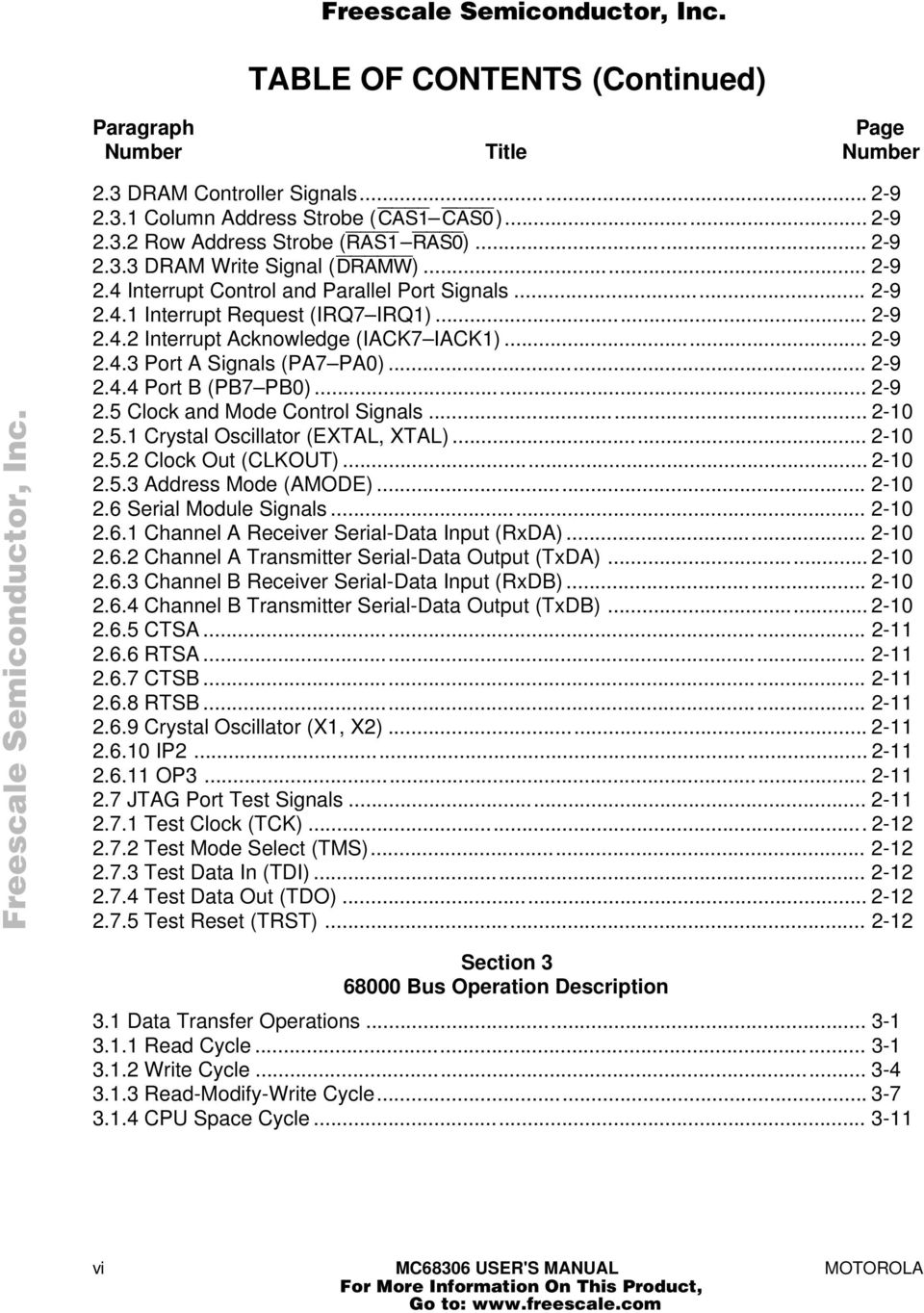
6 nc. TABLE OF CONTENTS (Continued) Paragraph Page Number Title Number 3.2 Bus Arbitration Requesting the Bus Receiving the Bus Grant Acknowledgment of Mastership (3-Wire Bus Arbitration Only) Bus Arbitration Control Bus Error and Halt Operation Bus Error Operation Retrying the Bus Cycle Halt Operation Double Bus Fault Reset Operation The Relationship of DTACK, BERR, and HALT Asynchronous Operation Synchronous Operation Section 4 EC000 Core Processor 4.1 Features Processing States Programming Model Data Format Summary Addressing Capabilities Summary Notation Conventions EC000 Core Instruction Set Overview Exception Processing Exception Vectors Processing of Specific Exceptions Reset Exception Interrupt Exceptions Uninitialized Interrupt Exception Spurious Interrupt Exception Instruction Traps Illegal and Unimplemented Instructions Privilege Violations Tracing Bus Error Address Error Multiple Exceptions MOTOROLA MC68306 USER'S MANUAL vii
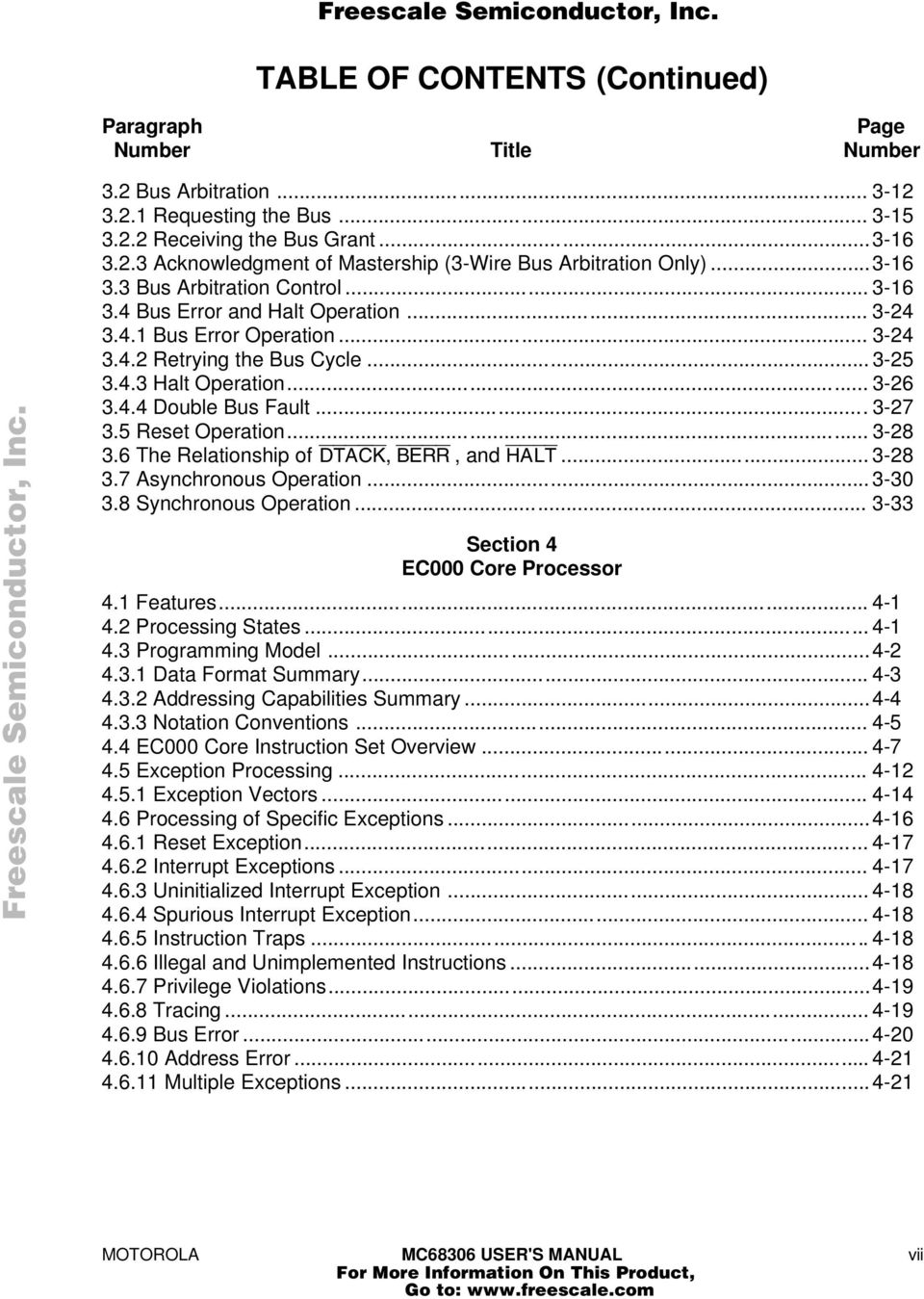
7 nc. TABLE OF CONTENTS (Continued) Paragraph Page Number Title Number Section 5 System Operation 5.1 MC68306 Address Space Register Description System Register Timer Vector Register Bus Timeout Period Register Interrupt Registers Interrupt Control Register Interrupt Status Register I/O Port Registers Port Pins Register Port Direction Register Port Data Register Chip Selects Chip Select Configuration Registers (High Half) Chip Select Configuration Registers (Low Half) DRAM Control Registers DRAM Refresh Register DRAM Bank Configuration Register (High Half) DRAM Bank Configuration Register (Low Half) Automatic DTACK Generation Crystal Oscillator Section 6 Serial Module 6.1 Module Overview Serial Communication Channels A and B Baud Rate Generator Logic Timer/Counter Interrupt Control Logic Comparison of Serial Module to MC Serial Module Signal Definitions Channel A Transmitter Serial Data Output (TxDA) Channel A Receiver Serial Data Input (RxDA) Channel B Transmitter Serial Data Output (TxDB) Channel B Receiver Serial Data Input (RxDB) Channel A Request-To-Send (RTSA/OP0) RTSA OP Channel B Request-To-Send (RTSB/OP1) viii MC68306 USER'S MANUAL MOTOROLA
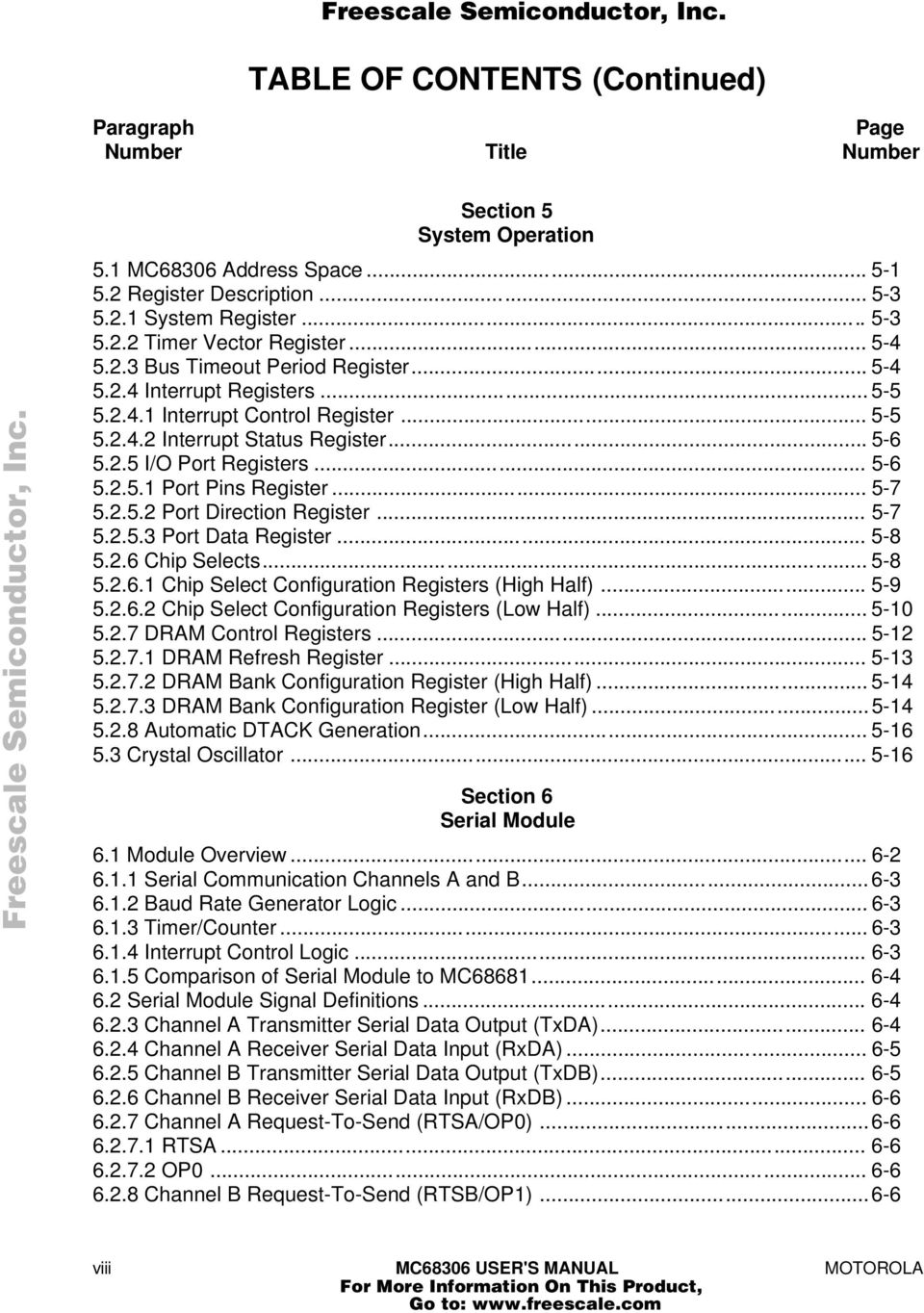
8 nc. TABLE OF CONTENTS (Continued) Paragraph Page Number Title Number RTSB OP Channel A Clear-To-Send (CTSA/IP0) CTSA IP Channel B Clear-To-Send (CTSB/IP1) CTSB IP Operation Baud Rate Generator Transmitter and Receiver Operating Modes Transmitter Receiver FIFO Stack Looping Modes Automatic Echo Mode Local Loopback Mode Remote Loopback Mode Multidrop Mode Counter/Timer Counter Mode Timer Mode Bus Operation Read Cycles Write Cycles Interrupt Acknowledge Cycles Register Description and Programming Register Description Mode Register 1 (DUMR1) Mode Register 2 (DUMR2) Status Register (DUSR) Clock-Select Register (DUCSR) Command Register (DUCR) Receiver Buffer (DURB) Transmitter Buffer (DUTB) Input Port Change Register (DUIPCR) Auxiliary Control Register (DUACR) Interrupt Status Register (DUISR) Interrupt MASK Register (DUIMR) Count Register Current MSB of Counter (DUCUR) Count Register Current LSB of Counter (DUCLR) Counter/Timer Upper Preload Register (CTUR) MOTOROLA MC68306 USER'S MANUAL ix
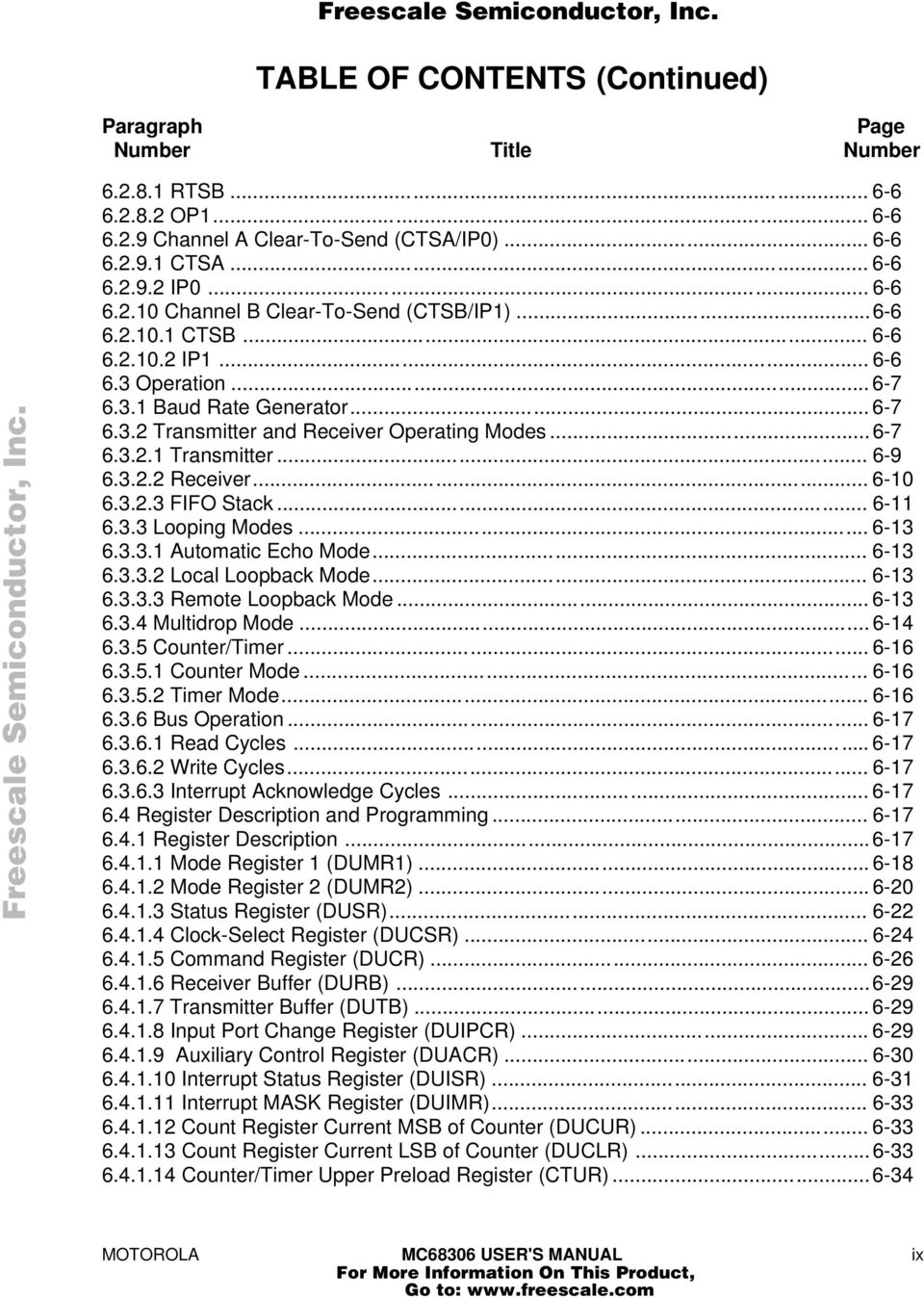
9 nc. TABLE OF CONTENTS (Continued) Paragraph Page Number Title Number Counter/Timer Lower Pimer Register (CTLR) Interrupt Vector Register (DUIVR) Input Port Register Output Port Control Register (DUOPCR) Output Port Data Register (DUOP) Start Counter Command Register Stop Counter Command Register Programming Serial Module Initialization I/O Driver Example Interrupt Handling Serial Module Initialization Sequence Section 7 IEEE Test Access Port 7.1 Overview TAP Controller Boundary Scan Register Instruction Register EXTEST (000) SAMPLE/PRELOAD (110) BYPASS (010, 101, 111) CLAMP (011) MC68306 Restrictions Non-IEEE Operation Section 8 Electrical Specifications 8.1 Maximum Ratings Thermal Characteristics Power Considerations AC Electrical Specification Definitions DC Electrical Specifications AC Electrical Specifications Clock Timing AC Electrical Specifications Read and Write AC Electrical Specifications Chip Selects AC Electrical Specifications Bus Arbitration Bus Operation DRAM Accesses AC Timing Specifications Serial Module Electrical Characteristics Serial Module AC Electrical Characteristics Clock Timing AC Electrical Characteristics Port Timing AC Electrical Characteristics Interrupt Reset x MC68306 USER'S MANUAL MOTOROLA
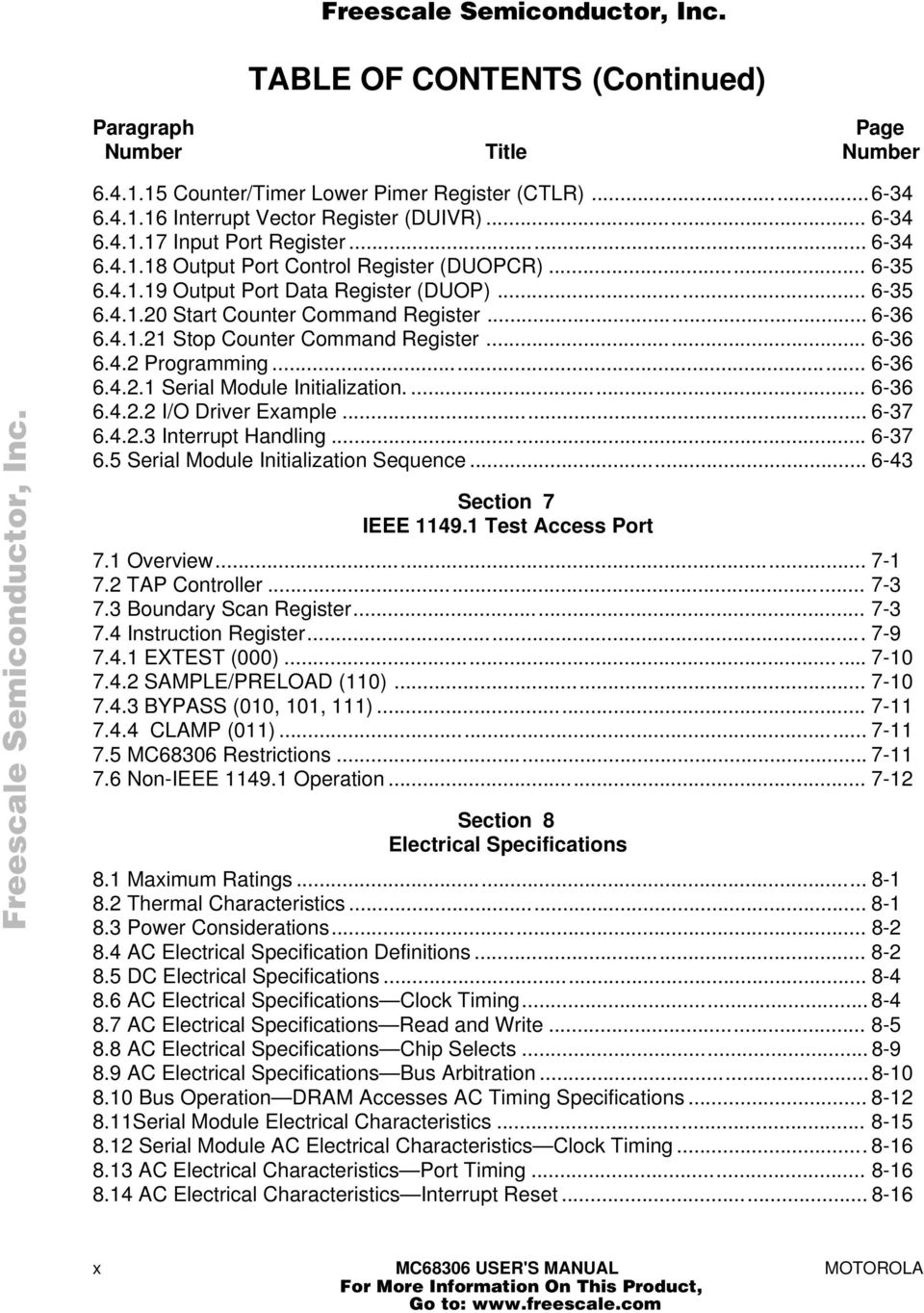
10 nc. TABLE OF CONTENTS (Continued) Paragraph Page Number Title Number 8.14 AC Electrical Characteristics Interrupt Reset AC Electrical Characteristics Transmitter Timing AC Electrical Characteristics Receiver Timing IEEE Electrical Characteristics Section 9 Ordering Information and Mechanical Data 9.1 Standard Ordering Information Pin Assignments MOTOROLA MC68306 USER'S MANUAL xi
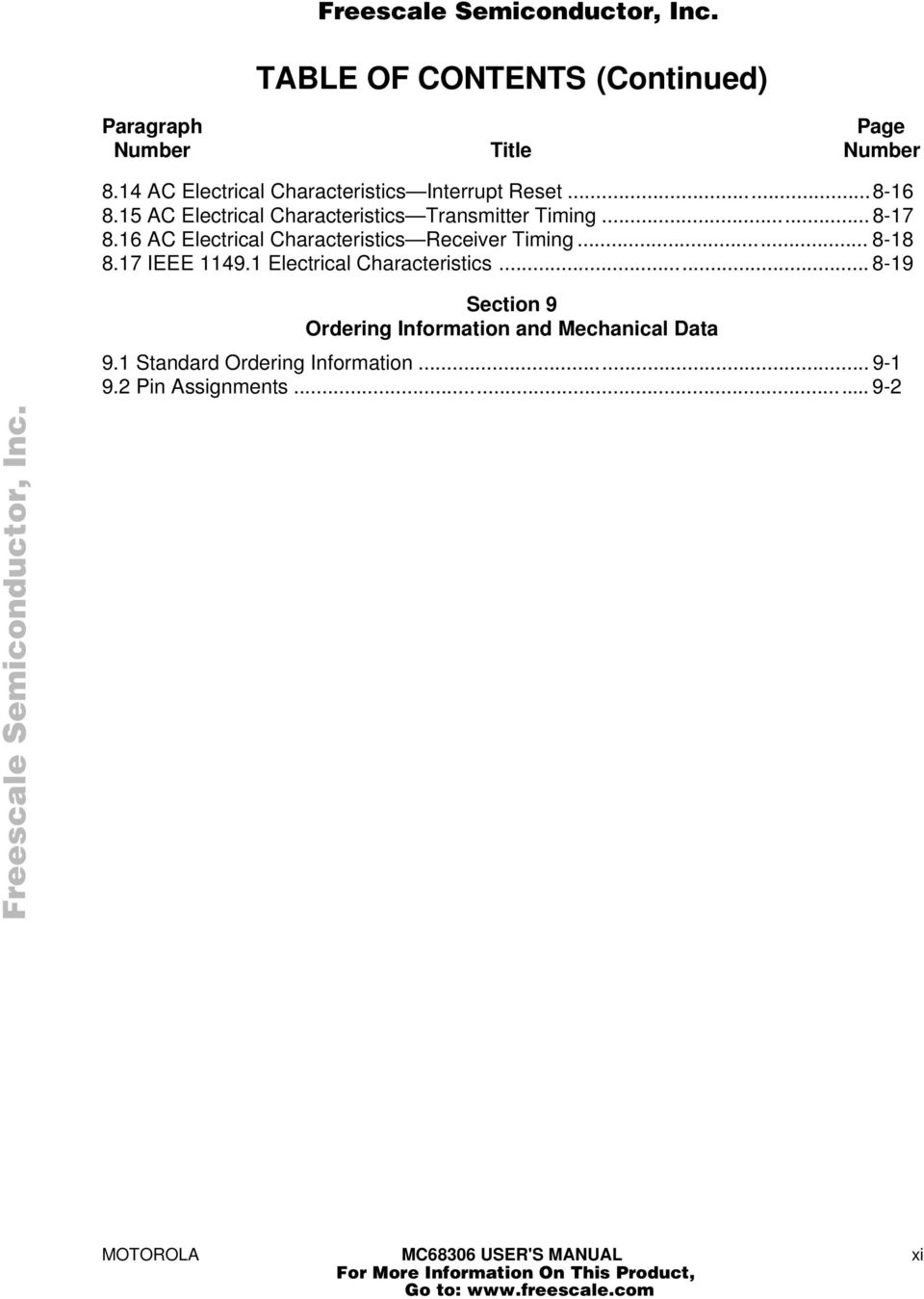
11 nc. LIST OF ILLUSTRATIONS Figure Page Number Title Number Figure 1-1. MC68306 Simplified Block Diagram Figure 2-1. MC68306 Detailed Block Diagram Figure 3-1. Word Read Cycle Flowchart Figure 3-2. Byte Read Cycle Flowchart Figure 3-3. Read and Write Cycle Timing Diagram Figure 3-4. Word and Byte Read Cycle Timing Diagram Figure 3-5. Word Write Cycle Flowchart Figure 3-6. Byte Write Cycle Flowchart Figure 3-7. Word and Byte Write Cycle Timing Diagram Figure 3-8. Read-Modify-Write Cycle Flowchart Figure 3-9. Read-Modify-Write Cycle Timing Diagram Figure Interrupt Acknowledge Cycle Figure Interrupt Acknowledge Cycle Timing Diagram Figure Three-Wire Bus Arbitration Cycle Flowchart Figure Two-Wire Bus Arbitration Cycle Flowchart Figure Three-Wire Bus Arbitration Timing Diagram Figure Two-Wire Bus Arbitration Timing Diagram Figure External Asynchronous Signal Synchronization Figure Bus Arbitration Unit State Diagrams Figure Three-Wire Bus Arbitration Timing Diagram Processor Active Figure Three-Wire Bus Arbitration Timing Diagram Bus Inactive Figure Three-Wire Bus Arbitration Timing Diagram Special Case Figure Two-Wire Bus Arbitration Timing Diagram Processor Active Figure Two-Wire Bus Arbitration Timing Diagram Bus Inactive Figure Two-Wire Bus Arbitration Timing Diagram Special Case Figure Bus Error Timing Diagram Figure Retry Bus Cycle Timing Diagram Figure Halt Operation Timing Diagram Figure Reset Operation Timing Diagram Figure 3-28 Fully Asynchronous Read Cycle Figure Fully Asynchronous Write Cycle Figure Pseudo-Asynchronous Read Cycle Figure Pseudo-Asynchronous Write Cycle Figure Synchronous Read Cycle Figure Synchronous Write Cycle xii MC68306 USER'S MANUAL MOTOROLA
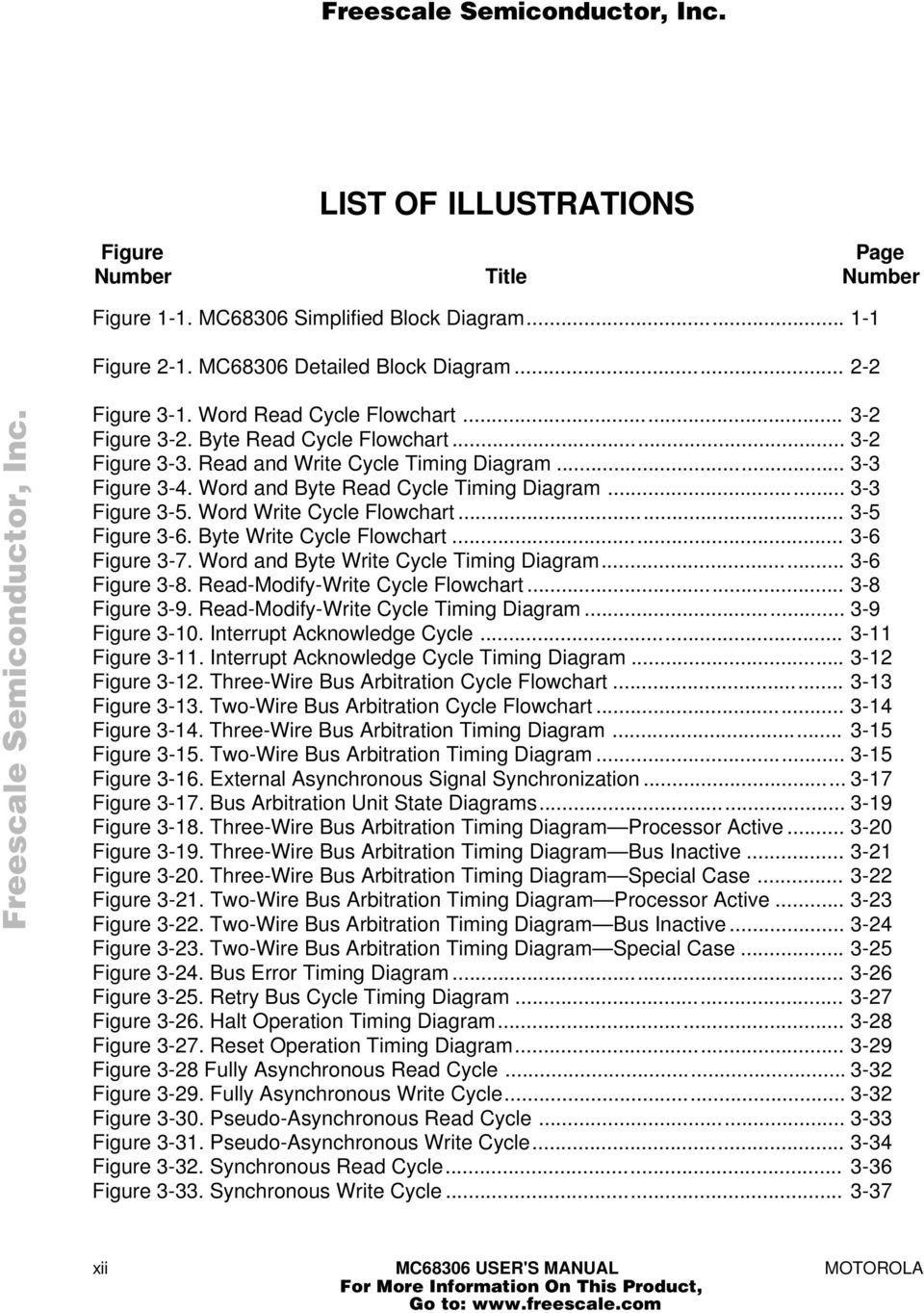
12 nc. LIST OF ILLUSTRATIONS (Continued) Figure Page Number Title Number Figure 4-1. Programmer's Model Figure 4-2. Status Register Figure 4-3. General Exception Processing Flowchart Figure 4-4. General Form of Exception Stack Frame Figure 4-5. Exception Vector Format Figure 4-6. Address Translated from 8-Bit Vector Number Figure 4-7. Supervisor Stack Order for Bus or Address Error Exception Figure 5-1. Chip Select Expansion Figure 5-2. Oscillator Circuit Diagram Figure 6-1. Simplified Block Diagram Figure 6-2. External and Internal Interface Signals Figure 6-3. Baud Rate Generator Block Diagram Figure 6-4. Transmitter and Receiver Functional Diagram Figure 6-5. Transmitter Timing Diagram Figure 6-6. Receiver Timing Diagram Figure 6-7. Looping Modes Functional Diagram Figure 6-8. Multidrop Mode Timing Diagram Figure 6-9. Serial Module Programming Model Figure Serial Module Programming Flowchart Figure 7-1. Test Access Port Block Diagram Figure 7-2. TAP Controller State Machine Figure 7-3. Output Cell (O.Cell) Figure 7-4. Input Cell (I.Cell) Figure 7-5. Output Control Cell (En.Cell) Figure 7-6. Bidirectional Cell (IO.Cell) Figure 7-7. Bidirectional Cell (IOx0.Cell) Figure 7-8. General Arrangement for Bidirectional Pins Figure 7-9. Bypass Register Figure 8-1. Drive Levels and Test Points for AC Specifications Figure 8-2. Clock Output Timing Figure 8-3. Read Cycle Timing Diagram Figure 8-4. Write Cycle Timing Diagram Figure 8-5. Chip Select and Interrupt Acknowledge Timing Diagram Figure 8-6. Bus Arbitration Timing Diagram Figure 8-7. Bus Arbitration Timing Diagram Figure 8-8. DRAM Timing 0-Wait Read, No Refresh Figure 8-9. DRAM Timing 1-Wait Write, No Refresh Figure DRAM Timing 0- and 1-Wait Refresh MOTOROLA MC68306 USER'S MANUAL xiii

13 nc. LIST OF ILLUSTRATIONS (Continued) Figure Page Number Title Number Figure DRAM Timing 1-Wait, Test and Set Figure Clock Timing Figure Port Timing Figure Interrupt Reset Timing Figure Transmit Timing Figure Receive Timing Figure Test Clock Input Timing Diagram Figure Boundary Scan Timing Diagram Figure Test Access Port Timing Diagram xiv MC68306 USER'S MANUAL MOTOROLA

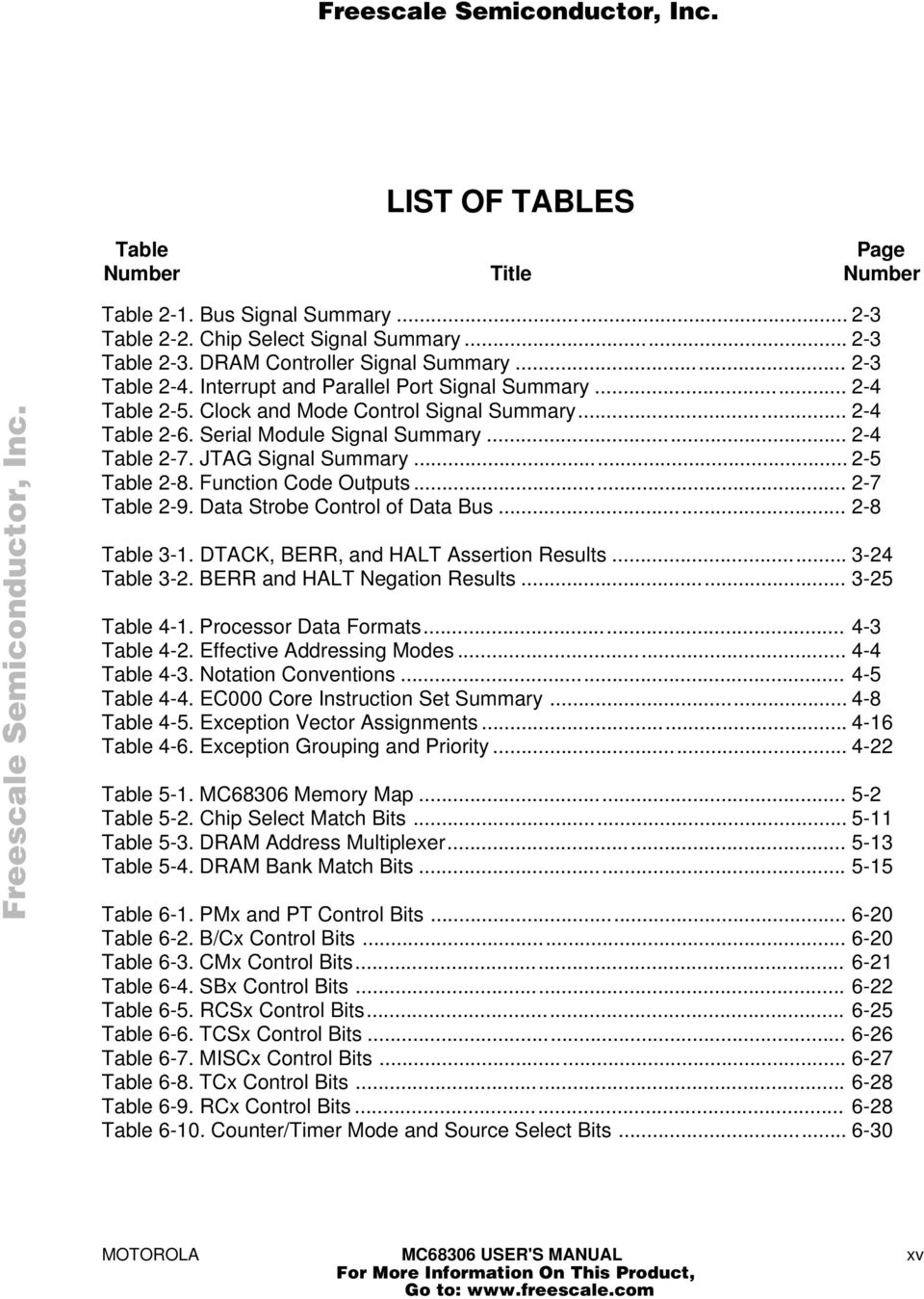
14 nc. LIST OF TABLES Table Page Number Title Number Table 2-1. Bus Signal Summary Table 2-2. Chip Select Signal Summary Table 2-3. DRAM Controller Signal Summary Table 2-4. Interrupt and Parallel Port Signal Summary Table 2-5. Clock and Mode Control Signal Summary Table 2-6. Serial Module Signal Summary Table 2-7. JTAG Signal Summary Table 2-8. Function Code Outputs Table 2-9. Data Strobe Control of Data Bus Table 3-1. DTACK, BERR, and HALT Assertion Results Table 3-2. BERR and HALT Negation Results Table 4-1. Processor Data Formats Table 4-2. Effective Addressing Modes Table 4-3. Notation Conventions Table 4-4. EC000 Core Instruction Set Summary Table 4-5. Exception Vector Assignments Table 4-6. Exception Grouping and Priority Table 5-1. MC68306 Memory Map Table 5-2. Chip Select Match Bits Table 5-3. DRAM Address Multiplexer Table 5-4. DRAM Bank Match Bits Table 6-1. PMx and PT Control Bits Table 6-2. B/Cx Control Bits Table 6-3. CMx Control Bits Table 6-4. SBx Control Bits Table 6-5. RCSx Control Bits Table 6-6. TCSx Control Bits Table 6-7. MISCx Control Bits Table 6-8. TCx Control Bits Table 6-9. RCx Control Bits Table Counter/Timer Mode and Source Select Bits MOTOROLA MC68306 USER'S MANUAL xv
15 nc. LIST OF TABLES (Continued) Table Page Number Title Number Table 7-1. Boundary Scan Control Bits Table 7-2. Boundary Scan Bit Definitions Table 7-3. Instructions xvi MC68306 USER'S MANUAL MOTOROLA

16 nc. SECTION 1 INTRODUCTION The MC68306 is an integrated processor containing an MC68EC000 processor and elements common to many MC and MC68EC000-based systems. Designers of virtually any application requiring MC68000-class performance will find that the MC68306 reduces design time by providing valuable system elements integrated in one chip. The combination of peripherals offered in the MC68306 can be found in a diverse range of microprocessor-based systems, including embedded control and general computing. Systems requiring serial communication and dynamic random access memory (DRAM) can especially benefit from using the MC The MC68306's high level of functional integration results in significant reductions in component count, power consumption, board space, and cost while yielding much higher system reliability and shorter design time. Complete code compatibility with the MC68000 affords the designer access to a broad base of established real-time kernels, operating systems, languages, applications, and development tools, many of which are oriented towards embedded control. Figure 1-1 shows a simplified block diagram of the MC DRAM CONTROLLER CHIP SELECTS INTERRUPT CONTROLLER CLOCK 8 PORT A EC000 CORE PROCESSOR MODE CONTROLLER JTAG PORT PORT B 16-BIT TIMER TWO-CHANNEL SERIAL I/O 8 Figure 1-1. MC68306 Simplified Block Diagram MOTOROLA MC68306 USER'S MANUAL 1-1

17 nc. The primary features of the MC68306 are as follows: Functional Integration on a Single Piece of Silicon EC000 Core Identical to MC68EC000 Microprocessor Complete Code Compatibility with MC68000 and MC68EC000 High Performance 2.4 MIPS Extended Internal Address Range to 4 Gbyte Two-Channel Universal Synchronous/Asynchronous Receiver/Transmitter (DUART) Baud Rate Generators Modem Control Compatible with MC68681/MC2681 Integrated 16-Bit Timer/Counter DRAM Controller Supports up to 16 Mbytes using 4M x 1 DRAMs, 64 Mbytes using 16M x 1 DRAMs Provides Zero Wait State Interface to 80-ns DRAMs Programmable Refresh Timer Provides CAS-before-RAS Refresh Chip Selects Eight Programmable Chip Select Signals Provide Eight Separate 1-Mbyte Spaces or Four Separate 16-Mbyte Spaces Programmable Wait States Programmable Interrupt Controller Bus Timeout 24 Address Lines, 16 Data Lines MHz, 5 Volt Operation 144-Pin Thin Quad Flat Pack (TQFP)or 132-Pin Plastic Quad Flat Pack (PQFP) 1.1 MC68EC000 CORE PROCESSOR The MC68EC000 is a core implementation of the MC bit microprocessor architecture. The programmer can use any of the eight 32-bit data registers for fast manipulation of data and any of the eight 32-bit address registers for indexing data in memory. Flexible instructions support data movement, arithmetic functions, logical operations, shifts and rotates, bit set and clear, conditional and unconditional program branches, and overall system control. The MC68EC000 core can operate on data types of single bits, binary-coded decimal (BCD) digits, and 8, 16, and 32 bits. The integrated chip selects allow peripherals and data in memory to reside anywhere in the 4-Gbyte linear address space. A supervisor operating mode protects system-level resources from the more restricted user mode, allowing a true virtual environment to be developed. Many addressing modes complement 1-2 MC68306 USER'S MANUAL MOTOROLA

18 nc. these instructions, including predecrement and postincrement, which allow simple stack and queue maintenance and scaled indexing for efficient table accesses. Data types and addressing modes are supported orthogonally by all data operations and with all appropriate addressing modes. Position-independent code is easily written. Like all M68000 family processors, the MC68EC000 core recognizes interrupts of seven different priority levels and allows either an automatic vector or a peripheral-supplied vector to direct the processor to the desired service routine. Internal trap exceptions ensure proper instruction execution with good addresses and data, allow operating system intervention in special situations, and permit instruction tracing. Hardware signals can either terminate or rerun bad memory accesses before instructions process data incorrectly. The EC000 core provides 2.4 MIPS at MHz. 1.2 ON-CHIP PERIPHERALS To improve total system throughput and reduce part count, board size, and cost of system implementation, the M68300 family integrates on-chip, intelligent peripheral modules and typical glue logic. The functions on the MC68306 include two serial channels, a timer/counter, a DRAM controller, a parallel port, and system glue logic Serial Module Most digital systems use serial I/O to communicate with host computers, operator terminals, or remote devices. The MC68306 contains a two-channel, full-duplex UART with an integrated timer. An on-chip baud rate generator provides standard baud rates up the 38.4K baud to each channel's receiver and transmitter. The serial module is identical to the MC68681/MC2681 DUART. Each communication channel is completely independent. Data formats can be 5, 6, 7, or 8 bits with even, odd, or no parity and stop bits up to 2 in 1/16 increments. Four-byte receive buffers and two-byte transmit buffers minimize CPU service calls. Each channel provides a wide variety of error detection and maskable interrupt capability. Full-duplex, autoecho loopback, local loopback, and remote loopback modes can be selected. Multidrop applications are also supported. A MHz crystal drives the baud rate generators. Each transmit and receive channel can be programmed for a different baud rate. Full modem support is provided with separate request-to-send (RTS) and clear-to-send (CTS) signals for each channel. The integrated 16-bit timer/counter can operate in a counter mode or a timer mode. The timer/counter can function as a system stopwatch, a real-time single interrupt generator, or a device watchdog when in counter mode. In timer mode, the timer/counter can be used as a programmable clock source for channels A and B, a periodic interrupt generator, or a variable duty cycle square-wave generator DRAM Controller DRAM is used in many systems since it is the least expensive form of high-speed storage available. However, considerable design effort is often spent designing the interface MOTOROLA MC68306 USER'S MANUAL 1-3

19 nc. between the processor and DRAM. The MC68306 contains a full DRAM controller, greatly reducing design time and complexity. The DRAM controller provides row address strobe (RAS) and column address strobe (CAS) signals for two separate banks of DRAMs. Each bank can include up to 16 devices; up to 15 multiplexed address lines are also available. Thus, using 4M x 1 DRAMs, up to 16 Mbytes of DRAM are supported; with 16M x 1 DRAMs, up to 64 Mbytes of DRAM are supported. A programmable refresh timer provides CAS-before-RAS refreshes at designated intervals. The DRAM controller has its own address registers that control the address range selected by each RAS and CAS signal, leaving the eight integrated chip selects free for other system peripherals. DRAM accesses are zero wait states using 80-ns DRAMs Chip Selects The MC68306 provides up to eight programmable chip select outputs, in most cases eliminating the need for external address decoding. All handshaking and timing signals are provided, with up to 950-ns access times. Each chip select can access a 16 Mbyte address space located anywhere in the 4-Gbyte address range. Internal registers allow the base address, range, and cycle duration of each chip select to be independently programmed. After reset, chip select (CS0) responds to all accesses until the chip selects have been properly programmed. Four of the chip selects are multiplexed with the most significant address bits (A23 A20). The address mode (AMODE) input determines the functions of these outputs Parallel Ports Two 8-bit parallel ports are provided. The port pins can be individually programmed to be inputs or outputs. If the pins are programmed to be inputs, the value on those pins can be read by accessing an on-board register. If the pins are programmed to be outputs, the pins will reflect the value programmed into another on-board register. The port B pins are multiplexed with four interrupt request and four interrupt acknowledge lines. The function of these pins is controlled by the internal registers Interrupt Controller Seven input signals are provided to trigger an external interrupt, one for each of the seven priority levels supported. Each input can be programmed to be active high or active low. Seven separate outputs indicate the priority level of the interrupt being serviced. Interrupts at each priority level can be pre-programmed to go to the default service routine. For maximum flexibility, interrupts can be vectored to the correct service routine by the interrupting device Clock To save on system costs, the MC68306 has an on-board oscillator that can be driven with a MHz crystal. A bus clock output is provided by a CLKOUT pin. Alternatively, an 1-4 MC68306 USER'S MANUAL MOTOROLA
20 nc. external MHz oscillator can be used, with a tight skew between the input clock signal and the bus clock on the CLKOUT pin Bus Timeout Monitor A bus timeout monitor is provided to automatically terminate and report as erroneous any bus cycle that is not normally terminated after a pre-programmed length of time. The user can program this timeout period to be up to 4096 clocks IEEE Test To aid in system diagnostics, the MC68306 includes dedicated user-accessible test logic that is fully compliant with the IEEE standard for boundary scan testability, often referred to as JTAG (Joint Test Action Group). MOTOROLA MC68306 USER'S MANUAL 1-5
21 nc. SECTION 2 SIGNAL DESCRIPTION This section contains a brief description of the input and output signals, with reference (if applicable) to other sections which give greater detail on its use. Figure 2-1 provides a detailed diagram showing the integrated peripherals and signals, and Tables provides a quick reference for determining a signal's name, mnemonic, its use as an input or output, active state, and type identification. NOTE The terms assertion and negation will be used extensively. This is done to avoid confusion when dealing with a mixture of active low and active high signals. The term assert or assertion is used to indicate that a signal is active or true, independent of whether that level is represented by a high or low voltage. The term negate or negation is used to indicate that a signal is inactive or false. MOTOROLA MC68306 USER'S MANUAL 2-1
22 nc. CS0 CS1 CS2 CS3 CS4/A20 CS5/A21 CS6/A22 CS7/A23 DRAMW RAS1 RAS0 CAS1 CAS0 EXTAL XTAL CLKOUT AMODE TCK TMS TDI TDO TRST IRQ7 IRQ4 IRQ1 IACK7 IACK4 IACK1 IRQ6/PB7 IRQ5/PB6 IRQ3/PB5 IRQ2/PB4 IACK6/PB3 IACK5/PB2 IACK3/PB1 IACK2/PB0 DRAM CONTROLLER CLOCK MODE CONTROLLER JTAG PORT INTERRUPT CONTROLLER PORT B CHIP SELECTS PORT A PA7 PA6 PA5 PA4 PA3 PA2 PA1 PA0 16-BIT TIMER/ COUNTER EC000 CORE PROCESSOR TWO- CHANNEL SERIAL I/O FLOW CONTROL Figure 2-1. MC68306 Detailed Block Diagram IP2 OP3 A19 A16 A15/DRAMA14 A1/DRAMA0 D15 D0 FC2 FC0 RESET BERR HALT AS UDS LDS R/W UW LW OE DTACK BR BG BGACK X2 X1/CLK RxDA TxDA RxDB TxDB RTSB/OP1 RTSA/OP0 CTSB/IP1 CTSA/IP0 2-2 MC68306 USER'S MANUAL MOTOROLA
23 nc. Table 2-1. Bus Signal Summary Signal Name Mnemonic Input/ Output Three-State During Bus Arbitration Address Signals A23 A1 Output Yes Pullup Required Address Strobe AS Output Yes 4.7 K Bus Error BERR I/O 2.2 K Bus Grant BG Output No Bus Grant Acknowledge BGACK Input (1) Bus Request BR Input (1) Data Bus D15 D0 I/O Yes Data Transfer Acknowledge DTACK I/O 2.2 K DRAM Multiplexed Address14 0 DRAMA14 DRAMA0 Output Yes Function Codes FC2 FC0 Output Yes Halt HALT I/O 2.2 K Lower Data Strobe LDS I/O Yes 4.7 K Upper Data Strobe UDS I/O Yes 4.7 K Lower-Byte Write Strobe LW Output No Upper-Byte Write Strobe UW Output No Output Enable OE Output No Read/Write R/ W Output Yes Reset RESET I/O 2.2 K NOTES: 1. Pullup may be required, value depends on individual application. Must not be left floating. Signal Name Table 2-2. Chip Select Signal Summary Mnemonic Input/ Output Three-State During Bus Arbitration Pullup Required Chip Select CS3 CS0 Output Yes 4.7 K Chip Select 4 7/Address Port CS7 CS4/ A23 A20 Output Yes 4.7 K Signal Name Table 2-3. DRAM Controller Signal Summary Mnemonic Input/ Output Three-State During Bus Arbitration Pullup Required Column Address Strobe CAS1 CAS0 Output Yes 4.7 K Row Address Strobe RAS1 RAS0 Output Yes 4.7 K DRAM Write Signal DRAMW Output Yes MOTOROLA MC68306 USER'S MANUAL 2-3
24 nc. Table 2-4. Interrupt and Parallel Port Signal Summary Signal Name Mnemonic Input/ Output Three-State During Bus Arbitration Pullup Required Interrupt Request Level 7, 4, 1 IRQ7, IRQ4, IRQ1 Input (2) Interrupt Request Level 6/Port B 7 IRQ6/PB7 I/O (2) Interrupt Request Level 5/Port B 6 IRQ5/PB6 I/O (2) Interrupt Request Level 3/Port B 5 IRQ3/PB5 I/O (2) Interrupt Request Level 2/Port B 4 IRQ2/PB4 I/O (2) Interrupt Acknowledge 7, 4, 1 IACK7, IACK4, IACK1 Output Interrupt Acknowledge 6/Port B 7 IACK6 /PB3 I/O (2) Interrupt Acknowledge 5/Port B 6 IACK5 /PB2 I/O (2) Interrupt Acknowledge 3/Port B 5 IACK3 /PB1 I/O (2) Interrupt Acknowledge 2/Port B 4 IACK2 /PB0 I/O (2) Port A PA7 PA0 I/O (2) NOTES: 2. Pullup or pulldown may be required, value depends on individual application. Signal Name Crystal Oscillator or External Clock Table 2-5. Clock and Mode Control Signal Summary Mnemonic Input/ Output Three-State During Bus Arbitration EXTAL Input Crystal Oscillator XTAL Output System Clock CLKOUT Output No Address Mode AMODE Input Pullup Required 2-4 MC68306 USER'S MANUAL MOTOROLA
25 nc. Table 2-6. Serial Module Signal Summary Signal Name Mnemonic Input/ Output Three-State During Bus Arbitration Channel A Receiver Serial Data RxDA Input Channel A Transmitter Serial Data TxDA Output No Channel B Receiver Serial Data RxDB Input Channel B Transmitter Serial Data TxDB Output No Pullup Required Channel A Clear-to-Send CTSA /IP0 Input (1) Channel A Request-to-Send RTSA /OP0 Output No Channel B Clear-to-Send CTSB /IP1 Input (1) Channel B Request-to-Send RTSB /OP1 Output No Crystal Output X2 Output No Crystal Input or External Clock X1/CLK Input Parallel Input 2 IP2 Input (1) Parallel Output 3 OP3 Output No NOTES: 1. Pullup may be required, value depends on individual application. Must not be left floating. Signal Name Table 2-7. JTAG Signal Summary Mnemonic Input/ Output Three-State During Bus Arbitration Test Clock TCK Input Test Data Input TDI Input Test Data Output TDO Output Test Mode Select TMS Input Pulldown Required Test Reset TRST Input 4.7 K (3) NOTES: 3. Pin has internal pullup, but external pulldown may be required for correct initialization. 2.1 BUS SIGNALS The following signals are used for the MC68306 bus Address Bus (A23 A1) This 23-bit, unidirectional, three-state bus is capable of addressing 16 Mbytes of data. This bus provides the address for bus operation during all cycles except interrupt acknowledge cycles. During interrupt acknowledge cycles, address lines A1, A2, and A3 provide the level number of the interrupt being acknowledged, and address lines A23 A4 MOTOROLA MC68306 USER'S MANUAL 2-5
26 nc. are driven to logic high. A23 A20 are only available in address mode (AMODE=0). A15 A1 are multiplexed with DRAM address Address Strobe (AS) Assertion of this three-state signal indicates that the information on the address bus is a valid address Bus Error (BERR) Assertion of this bi-directional, open-drain signal indicates a problem in the current bus cycle. The MC68306 can assert this signal to terminate a bus cycle when no external response is received. An external source can assert BERR to indicate a problem such as: 1. No response from a device 2. No interrupt vector number returned 3. An illegal access request rejected by a memory management unit 4. Some other application-dependent error Either the processor retries the bus cycle or performs exception processing, as determined by interaction between the bus error signal and the halt signal Bus Request (BR) This input can be wire-ored with bus request signals from all other devices that could be bus masters. Assertion of this signal indicates to the processor that some other device needs to become the bus master. Bus requests can be issued at any time during a bus cycle or between cycles Bus Grant (BG ) This output signal indicates to all other potential bus master devices that the processor will relinquish bus control at the end of the current bus cycle Bus Grant Acknowledge (BGACK ) Assertion of this input indicates that some other device has become the bus master. This signal should not be asserted until the following conditions are met: 1. A bus grant has been received. 2. Address strobe is inactive, which indicates that the microprocessor is not using the bus. 3. Data transfer acknowledge is inactive, which indicates that neither memory nor peripherals are using the bus. 4. Bus grant acknowledge is inactive, which indicates that no other device is claiming bus mastership. 2-6 MC68306 USER'S MANUAL MOTOROLA
27 nc. BGACK can be negated (pulled high), and the MC68306 will operate in a two-wire bus arbitration system Data Bus (D15 D0) This bi-directional, three-state bus is the general-purpose data path. It is 16 bits wide and can transfer and accept data of either word or byte length. During an interrupt acknowledge cycle, an external device can supply the interrupt vector number on data lines D7 D Data Transfer Acknowledge (DTACK ) Assertion of this bi-directional, open-drain signal indicates the completion of the data transfer. When the processor recognizes DTACK during a read cycle, data is latched, and the bus cycle is terminated. When DTACK is recognized during a write cycle, the bus cycle is terminated. The MC68306 generates DTACK for all internal cycles, DRAM cycles, and autovector IACK cycles, and can be programmed to generate DTACK for any chip select cycle. (Refer to 3.7 Asynchronous Operation and 3.8 Synchronous Operation.) DRAM Multiplexed Address Bus (DRAMA14 DRAMA0) These signals provide fifteen multiplexed address bits used during row address strobe Processor Function Codes (FC2 FC0) These function code outputs indicate the mode (user or supervisor) and the address space type currently being accessed, as shown in Table 2-8. The function code outputs are valid whenever AS is asserted. Table 2-8. Function Code Outputs Function Code Output FC2 FC1 FC0 Address Space Type Low Low Low (Undefined, Reserved) Low Low High User Data Low High Low User Program Low High High (Undefined, Reserved) High Low Low (Undefined, Reserved) High Low High Supervisor Data High High Low Supervisor Program High High High CPU Space Halt (HALT) External assertion of this bi-directional signal causes the processor to stop bus activity at the completion of the bus cycle for which the input met set-up time requirements (i.e., current or next cycle). This operation places all control signals in the inactive state. For MOTOROLA MC68306 USER'S MANUAL 2-7
28 nc. additional information about the interaction between HALT and RESET, refer to 3.5 Reset Operation and for more information on HALT and BERR, refer to 3.4 Bus Error and Halt Operation. Processor assertion of HALT indicates a double bus fault condition. This condition is unrecoverable; the MC68306 must be externally reset to resume operation Read/Write (R/W) This three-state, bi-directional signal defines the data bus transfer as a read or write cycle. The R/W signal relates to the data strobe signals described in the following paragraphs Upper And Lower Data Strobes (UDS, LDS ) These three-state, bi-directional signals and R/W control the flow of data on the data bus. Table 2-9 lists the combinations of these signals, the corresponding data on the bus, and the OE, LW, and UW signals. When the R/W line is high, the processor reads from the data bus. When the R/W line is low, the processor drives the data bus. When another bus master controls the bus, the UDS, LDS, and R/ W pins become inputs and the OE, LW, and UW signals are still decoded as shown in Table 2-9. Table 2-9. Data Strobe Control of Data Bus UDS LDS R/ W D8 D15 D0 D7 OE UW LW High High No Valid Data No Valid Data High High High Low Low High Valid Data Bits 15 8 Valid Data Bits 7 0 High Low High No Valid Data Valid Data Bits 7 0 Low High High Valid Data Bits 15 8 Low Low Low Valid Data Bits 15 8 High Low Low Valid Data Bits 7 0* Low High Low Valid Data Bits 15 8 Low High High Low High High No Valid Data Low High High Valid Data Bits 7 0 Valid Data Bits 7 0 Valid Data Bits 15 8* *These conditions are a result of current implementation and may not appear on future devices. High Low Low High High Low High Low High Upper-Byte Write (UW ) This signal is a combination of R/W low and UDS low for writing the upper-byte of a 16-bit port. This signal simplifies memory system design by explicitly signalling that data is valid on the upper portion of the data bus on a write operation. UW is also decoded for external bus masters. 2-8 MC68306 USER'S MANUAL MOTOROLA
29 Lower-Byte Write (LW) This signal is a combination of R/W low and LDS low for writing the lower-byte of a 16-bit port. This signal simplifies memory system design by explicitly signalling that data is valid on the lower portion of the data bus on a write operation. LW is also decoded for external bus masters Output Enable (OE) nc. OE is a combination of R/W high and an active data strobe (UDS or LDS ). OE is also decoded for external bus masters Reset (RESET ) The external assertion of this bi-directional, open-drain signal can start a system initialization sequence by resetting the processor. The processor assertion of RESET (from executing a RESET instruction) resets all external devices of a system without affecting the internal state of the processor. The interaction of internal and external RESET, and the HALT signal is described in paragraph 3.5 Reset Operation. 2.2 CHIP SELECT SIGNALS These eight three-state signals provide address decodes with programmable base and range. CS7 CS4 are only available in chip select mode (AMODE bit =1). CS3 CS0 are always available. 2.3 DRAM CONTROLLER SIGNALS The following signals are used to control an external DRAM for the MC Column Address Strobe (CAS1 CAS0 ) These three-state signals provide column address strobe timing for external DRAM. CAS0 controls data lines D15 D8 and CAS1 controls D7 D Row Address Strobe (RAS1 RAS0 ) These three-state signals provide row address strobe timing for external DRAM. Each RAS controls a separate bank of DRAM DRAM Write Signal (DRAMW ) This signal provides write control for external DRAM. 2.4 INTERRUPT CONTROL AND PARALLEL PORT SIGNALS The following signals are used for interrupt control on the MC MOTOROLA MC68306 USER'S MANUAL 2-9
30 2.4.1 Interrupt Request (IRQ7 IRQ1) nc. Three input signals (IRQ7, IRQ4, IRQ1) notify the core processor of an interrupt request. Four additional interrupt request lines (IRQ6, IRQ5, IRQ3, and IRQ2) are shared with parallel port B pins and may be individually programmed as interrupts Interrupt Acknowledge (IACK7 IACK1 ) Three output signals (IACK7, IACK4, IACK1 ) indicate an interrupt acknowledge cycle. Four additional interrupt acknowledge lines (IACK6, IACK5, IACK3, and IACK2) are shared with parallel port B pins and may be individually programmed as interrupt acknowledges Port A Signals (PA7 PA0) These eight pins serve as port A parallel input/output signals Port B (PB7 PB0) These eight pins are shared with IRQ6, IRQ5, IRQ3, IRQ2 and IACK6, IACK5, IACK3, IACK2, and can be individually programmed to serve as port B parallel input/output signals. 2.5 CLOCK AND MODE CONTROL SIGNALS These four pins are used to connect an external crystal to the on-chip oscillator and define the four multifunction pins Crystal Oscillator (EXTAL, XTAL) These two pins are the connections for an external crystal to the internal oscillator circuit. If an external oscillator is used, it should be connected to EXTAL, with XTAL left open, and must drive CMOS levels. A crystal or clock input must be supplied at all times Clock Out (CLKOUT) This output signal is the system clock output and is used as the bus timing reference by external devices Address Mode (AMODE) This input signal provides mode control for the multi-function chip select pins. When set to zero, A23 A20 is selected and when set to one, CS7 CS4 is selected. The mode selection is static: AMODE is latched at the end of any system reset. 2.6 SERIAL MODULE SIGNALS The following paragraphs describe the signals used by the serial module on the MC MC68306 USER'S MANUAL MOTOROLA
31 nc Channel A Receiver Serial-Data Input (RxDA) This signal is the receiver serial-data input for channel A. The least-significant bit is received first. Data on this pin is sampled on the rising edge of the programmed clock source Channel A Transmitter Serial-Data Output (TxDA) This signal is the transmitter serial-data output for channel A. The least-significant bit is transmitted first. This output is held high (mark condition) when the transmitter is disabled, idle, or operating in the local loopback mode. (Mark is high and space is low). Data is shifted out this pin on the falling edge of the programmed clock source Channel B Receiver Serial-Data Input (RxDB) This signal is the receiver serial-data input for channel B. The least-significant bit is received first. Data on this pin is sampled on the rising edge of the programmed clock source Channel B Transmitter Serial-Data Output (TxDB) This signal is the transmitter serial-data output for channel B. The least-significant bit is transmitted first. This output is held high (mark condition) when the transmitter is disabled, idle, or operating in the local loopback mode. Data is shifted out of this pin on the falling edge of the programmed clock source CTSA This input can be used as the channel A clear-to-send active low input (CTSA) or generalpurpose input (IP0). A change-of-state detector is also associated with this input RTSA This output can be used as the channel A active low request-to-send (RTSA) output, or a general-purpose output (OP0). When used as RTSA, it is automatically negated and reasserted by either the receiver or transmitter CTSB This input can be used as the channel B clear-to-send active low input (CTSB) or general - purpose input. A change-of-state detector is also associated with this input RTSB This output can be used as a general-purpose output or the channel B active low requestto-send (RTSB) output. When used for this function, it is automatically negated and reasserted by either the receiver or transmitter. MOTOROLA MC68306 USER'S MANUAL 2-11
32 2.6.9 Crystal Oscillator (X1/CLK, X2) These two pins are the connections for an external crystal to the internal oscillator circuit. If an external oscillator is used, it should be connected to X1/CLK, with X2 left floating, and must drive CMOS levels. A crystal or clock input must be supplied at all times IP2 nc. This input can be used as a general-purpose input, the channel B receiver external clock input (RxCB), or the counter/timer external clock input. When this input is used as the external clock by the receiver, the received data is sampled on the rising edge of the clock. A change-of-state detector is also associated with this input OP3 This output can be used as a general-purpose output, the open-drain active low counterready output, the open-drain timer output, the channel B transmitter 1X-clock output, or the channel B receiver 1X-clock output. 2.7 JTAG PORT TEST SIGNALS The following signals are used with the on-chip test logic defined by the IEEE standard. See IEEE Test Access Port for more information on the use of these signals Test Clock (TCK) This input provides a clock for on-chip test logic defined by the IEEE standard Test Mode Select (TMS) This input controls test mode operations for on-chip test logic defined by the IEEE standard. Connecting TMS to VCC disables the test controller, making all JTAG circuits transparent to the system Test Data In (TDI) This input is used for serial test instructions and test data for on-chip test logic defined by the IEEE standard Test Data Out (TDO) This output is used for serial test instructions and test data for on-chip test logic defined by the IEEE standard Test Reset (TRST ) This input is the master reset for on-chip test logic defined by the IEEE standard MC68306 USER'S MANUAL MOTOROLA
33 nc. SECTION BUS OPERATION DESCRIPTION This section describes control signal and bus operation during data transfer operations, bus arbitration, bus error and halt conditions, and reset operation. NOTE The terms assertion and negation are used extensively in this manual to avoid confusion when describing a mixture of "active-low" and "active-high" signals. The term assert or assertion is used to indicate that a signal is active or true, independently of whether that level is represented by a high or low voltage. The term negate or negation is used to indicate that a signal is inactive or false. 3.1 DATA TRANSFER OPERATIONS Transfer of data between devices involves the following signals: 1. Address bus A1 through A31 2. Data bus D0 through D7 and/or D8 through D15 3. Control signals The address and data buses are separate parallel buses used to transfer data using an asynchronous bus structure. In all cases, the bus master must deskew all signals it issues at both the start and end of a bus cycle. In addition, the bus master must deskew the acknowledge and data signals from the slave device. The following paragraphs describe the read, write, read-modify-write, and CPU space cycles. The indivisible read-modify-write cycle implements interlocked multiprocessor communications. A CPU space cycle is a special processor cycle Read Cycle During a read cycle, the processor receives either one or two bytes of data from the memory or from a peripheral device. If the instruction specifies a word or long-word operation, the processor reads both upper and lower bytes simultaneously by asserting both upper and lower data strobes. A long-word read is accomplished by two consecutive word reads. When the instruction specifies byte operation, the processor uses the internal A0 bit to determine which byte to read and issues the appropriate data strobe. When A0 is zero, the upper data strobe is issued; when A0 is one, the lower data strobe is issued. When the data is received, the processor internally positions the byte appropriately. MOTOROLA MC68306 USER'S MANUAL 3-1
34 nc. The word read cycle flowchart is shown in Figure 3-1. The byte read cycle flowchart is shown in Figure 3-2. The read and write cycle timing is shown in Figure 3-3. Figure 3-4 shows the word and byte read cycle timing diagram. BUS MASTER ADDRESS THE DEVICE 1) SET R/W TO READ 2) PLACE FUNCTION CODE ON FC2 FC0 3) PLACE ADDRESS ON ADDRESS BUS 4) ASSERT ADDRESS STROBE (AS) 5) ASSERT UPPER DATA STROBE (UDS) AND LOWER DATA STROBE (LDS) ACQUIRE THE DATA 1) LATCH DATA 2) NEGATE UDS AND LDS 3) NEGATE AS START NEXT CYCLE BUS MASTER ADDRESS THE DEVICE 1) SET R/W TO READ 2) PLACE FUNCTION CODE ON FC2 FC0 3) PLACE ADDRESS ON ADDRESS BUS 4) ASSERT ADDRESS STROBE (AS) 5) ASSERT UPPER DATA STROBE (UDS) OR LOWER DATA STROBE (LDS) (BASED ON A0) ACQUIRE THE DATA SLAVE OUTPUT THE DATA 1) DECODE ADDRESS 2) PLACE DATA ON D15 D0 3) ASSERT DATA TRANSFER ACKNOWLEDGE (DTACK) Figure 3-1. Word Read Cycle Flowchart TERMINATE THE CYCLE 1) REMOVE DATA FROM D15 D0 2) NEGATE DTACK SLAVE OUTPUT THE DATA 1) DECODE ADDRESS 2) PLACE DATA ON D7 D0 OR D15 D8 (BASED ON UDS OR LDS) 3) ASSERT DATA TRANSFER ACKNOWLEDGE (DTACK) 1) LATCH DATA 2) NEGATE UDS AND LDS 3) NEGATE AS TERMINATE THE CYCLE 1) REMOVE DATA FROM D7 D0 OR D15 D8 2) NEGATE DTACK START NEXT CYCLE Figure 3-2. Byte Read Cycle Flowchart 3-2 MC68306 USER'S MANUAL MOTOROLA
35 nc. CLK S0 S1 S2 S3 S4 S5 S6 S7 S0 S1 S2 S3 S4 S5 S6 S7 S0 S1 S2 S3 S4 w w w w S5 S6 S7 FC2 FC0 A31 A1 AS UDS LDS R/W DTACK D15 D8 D7 D0 CLK FC2 FC0 A31 A1 A0 * AS UDS LDS R/W DTACK READ WRITE 2 WAIT STATE READ Figure 3-3. Read and Write Cycle Timing Diagram S0 S1 S2 S3 S4 S5 S6 S7 S0 S1 S2 S3 S4 S5 S6 S7 S0 S1 S2 S3 S4 S5 S6 S7 D15 D8 D7 D0 *Internal Signal Only READ WRITE READ Figure 3-4. Word and Byte Read Cycle Timing Diagram MOTOROLA MC68306 USER'S MANUAL 3-3
36 nc. A bus cycle consists of eight states. The various signals are asserted during specific states of a read cycle as follows: STATE 0 STATE 1 STATE 2 STATE 3 STATE 4 STATE 5 STATE 6 STATE 7 STATE 5 STATE 6 STATE 7 STATE 8 STATE 9 The read cycle starts in state 0 (S0). The processor places valid function codes on FC0 FC2, a valid address on the bus, and drives R/W high to identify a read cycle. During state 1 (S1), no bus signals are altered. On the rising edge of state 2 (S2), the processor asserts AS and UDS/LDS. During state 3 (S3), no bus signals are altered. During state 4 (S4), the processor waits for a cycle termination signal (DTACK or BERR ). If neither termination signal is asserted before the falling edge at the end of S4, the processor inserts wait states (full clock cycles) until either DTACK or BERR is asserted. Case 1: DTACK received, with or without BERR. During state 5 (S5), no bus signals are altered. Sometime between state 2 (S2) and state 6 (S6), data from the device is driven onto the data bus. On the falling edge of the clock entering state 7 (S7), the processor latches data from the addressed device and negates AS and UDS, LDS. The device negates DTACK or BERR at this time. Case 2: BERR received without DTACK. During state 5 (S5), no bus signals are altered. During state 6 (S6), no bus signals are altered. During state 7 (S7), no bus signals are altered. During state 8 (S8), no bus signals are altered. AS and UDS/LDS negated. Slave negates BERR Write Cycle During a write cycle, the processor sends bytes of data to the memory or peripheral device. If the instruction specifies a word or long-word operation, the processor issues both UDS and LDS and writes both bytes. A long-word write is accomplished by two consecutive word writes. When the instruction specifies a byte operation, the processor uses the internal A0 bit to determine which byte to write and issues the appropriate data 3-4 MC68306 USER'S MANUAL MOTOROLA
37 nc. strobe. When the A0 bit equals zero, UDS is asserted; when the A0 bit equals one, LDS is asserted. The word write cycle flowchart is shown in Figure 3-5. The byte write cycle flowchart is shown in Figure 3-6. The word and byte write cycle timing is shown in Figure 3-7. BUS MASTER ADDRESS THE DEVICE 1) PLACE FUNCTION CODE ON FC2 FC0 2) PLACE ADDRESS ON ADDRESS BUS 3) ASSERT ADDRESS STROBE (AS) 4) SET R/W TO WRITE 5) PLACE DATA ON D15 D0 6) ASSERT UPPER DATA STROBE (UDS) AND LOWER DATA STROBE (LDS) TERMINATE OUTPUT TRANSFER SLAVE INPUT THE DATA 1) DECODE ADDRESS 2) LATCH DATA ON D15 D0 3) ASSERT DATA TRANSFER ACKNOWLEDGE (DTACK) 1) NEGATE UDS AND LDS 2) NEGATE AS 3) REMOVE DATA FROM D15 D0 4) SET R/W TO READ START NEXT CYCLE TERMINATE THE CYCLE 1) NEGATE DTACK Figure 3-5. Word Write Cycle Flowchart MOTOROLA MC68306 USER'S MANUAL 3-5
38 nc. BUS MASTER ADDRESS THE DEVICE SLAVE 1) PLACE FUNCTION CODE ON FC2 FC0 2) PLACE ADDRESS ON ADDRESS BUS 3) ASSERT ADDRESS STROBE (AS) 4) SET R/W TO WRITE 5) PLACE DATA ON D0 D7 OR D15 D8 (ACCORDING TO INTERNAL A0) 6) ASSERT UPPER DATA STROBE (UDS) OR LOWER DATA STROBE (LDS) (BASED ON INTERNAL A0) TERMINATE OUTPUT TRANSFER INPUT THE DATA 1) DECODE ADDRESS 2) LATCH DATA ON D7 D0 IF LDS IS ASSERTED. LATCH DATA ON D15 D8 IF UDS IS ASSERTED 3) ASSERT DATA TRANSFER ACKNOWLEDGE (DTACK) 1) NEGATE UDS AND LDS 2) NEGATE AS 3) REMOVE DATA FROM D7-D0 OR D15-D8 4) SET R/W TO READ TERMINATE THE CYCLE 1) NEGATE DTACK CLK FC2 FC0 A31 A1 A0* AS UDS LDS R/W START NEXT CYCLE Figure 3-6. Byte Write Cycle Flowchart S0 S1 S2 S3 S4 S5 S6 S7 S0 S1 S2 S3 S4 S5 S6 S7 S0 S1 S2 S3 S4 S5 S6 S7 DTACK D15 D8 D7 D0 *INTERNAL SIGNAL ONLY WORD WRITE ODD BYTE WRITE EVEN BYTE WRITE Figure 3-7. Word and Byte Write Cycle Timing Diagram 3-6 MC68306 USER'S MANUAL MOTOROLA
39 nc. The descriptions of the eight states of a write cycle are as follows: STATE 0 The write cycle starts in S0. The processor places valid function codes on FC2 FC0, a valid address on the address bus, and drives R/W high (if a preceding write cycle has left R/W low). STATE 1 STATE 2 STATE 3 STATE 4 STATE 5 STATE 6 STATE 7 STATE 5 STATE 6 STATE 7 STATE 8 STATE 9 During S1, no bus signals are altered. On the rising edge of S2, the processor asserts AS and drives R/W low. During S3, the data bus is driven out of the high-impedance state as the data to be written is placed on the bus. At the rising edge of S4, the processor asserts UDS and/or LDS;. The processor waits for a cycle termination signal (DTACK or BERR ). If neither termination signal is asserted before the falling edge at the end of S4, the processor inserts wait states (full clock cycles) until either DTACK or BERR is asserted. Case 1: DTACK received, with or without BERR. During S5, no bus signals are altered. During S6, no bus signals are altered. On the falling edge of the clock entering S7, the processor negates AS, UDS, and/or LDS. As the clock rises at the end of S7, the processor places the data bus in the high-impedance state, and drives R/W high. The device negates DTACK or BERR at this time. Case 2: BERR received without DTACK. During state 5 (S5), no bus signals are altered. During state 6 (S6), no bus signals are altered. During state 7 (S7), no bus signals are altered. During state 8 (S8), no bus signals are altered. AS and UDS/LDS negated. Slave negates BERR. At the end of S9, threestate data and drive R/W high Read-Modify-Write Cycle The read-modify-write cycle performs a read operation, modifies the data in the arithmetic logic unit, and writes the data back to the same address. The address strobe (AS) remains asserted throughout the entire cycle, making the cycle indivisible. The test and set (TAS) instruction uses this cycle to provide a signaling capability without deadlock between processors in a multiprocessing environment. The TAS instruction (the only instruction MOTOROLA MC68306 USER'S MANUAL 3-7
40 nc. that uses the read-modify-write cycle) only operates on bytes. Thus, all read-modify-write cycles are byte operations. The read-modify-write flowchart is shown in Figure 3-8 and the timing diagram is shown in Figure 3-9. BUS MASTER ADDRESS THE DEVICE 1) SET R/W TO READ 2) PLACE FUNCTION CODE ON FC2 FC0 3) PLACE ADDRESS ON ADDRESS BUS 4) ASSERT ADDRESS STROBE (AS) 5) ASSERT UPPER DATA STROBE (UDS) OR LOWER DATA STROBE (LDS) ACQUIRE THE DATA 1) LATCH DATA 1) NEGATE UDS AND LDS 2) START DATA MODIFICATION START OUTPUT TRANSFER 1) SET R/W TO WRITE 2) PLACE DATA ON D7 D0 OR D15 D8 3) ASSERT UPPER DATA STROBE (UDS) OR LOWER DATA STROBE (LDS) TERMINATE OUTPUT TRANSFER 1) NEGATE UDS OR LDS 2) NEGATE AS 3) REMOVE DATA FROM D7 D0 OR D15 D8 4) SET R/W TO READ START NEXT CYCLE SLAVE OUTPUT THE DATA 1) DECODE ADDRESS 2) PLACE DATA ON D7 D0 OR D15 D0 3) ASSERT DATA TRANSFER ACKNOWLEDGE (DTACK) TERMINATE THE CYCLE 1) REMOVE DATA FROM D7 D0 OR D15 D8 2) NEGATE DTACK INPUT THE DATA 1) STORE DATA ON D7 D0 OR D15 D8 2) ASSERT DATA TRANSFER ACKNOWLEDGE (DTACK) TERMINATE THE CYCLE 1) NEGATE DTACK Figure 3-8. Read-Modify-Write Cycle Flowchart 3-8 MC68306 USER'S MANUAL MOTOROLA
41 nc. CLK S0 S1 S2 S3 S4 S5 S6 S7 S8 S9 S10 S11 S12 S13 S14 S15 S16 S17 S18 S19 A31 A1 AS UDS OR LDS R/W DTACK D15 D8 OR D7 D0 FC2 FC0 INDIVISIBLE CYCLE Figure 3-9. Read-Modify-Write Cycle Timing Diagram The descriptions of the read-modify-write cycle states are as follows: STATE 0 The read cycle starts in S0. The processor places valid function codes on FC2 FC0, a valid address on the address bus, and drives R/W high to identify a read cycle. STATE 1 STATE 2 STATE 3 STATE 4 STATE 5 During S1, no bus signals are altered. On the rising edge of S2, the processor asserts AS and UDS /LDS. During S3, no bus signals are altered. During S4, the processor waits for a cycle termination signal (DTACK or BERR ). If neither termination signal is asserted before the falling edge at the end of S4, the processor inserts wait states (full clock cycles) until either DTACK or BERR is asserted. Case R1: DTACK only. During S5, no bus signals are altered. STATE 6 STATE 7 During S6, data from the device are driven onto the data bus. On the falling edge of the clock entering S7, the processor accepts data from the device and negates UDS /LDS. The device negates DTACK at this time. STATES 8 11 The bus signals are unaltered during S8 S11, during which the arithmetic logic unit makes appropriate modifications to the data. MOTOROLA MC68306 USER'S MANUAL 3-9
42 nc. STATE 12 STATE 13 STATE 14 STATE 15 STATE 16 STATE 17 STATE 18 STATE 19 STATE 5 STATE 6 STATE 7 STATE 5 STATE 6 STATE 7 STATE 8 STATE 9 The write portion of the cycle starts in S12. The valid function codes on FC2 FC0, the address bus lines, AS, and R/W remain unaltered. During S13, no bus signals are altered. On the rising edge of S14, the processor drives R/W low. During S15, the data bus is driven out of the high-impedance state as the data to be written are placed on the bus. At the rising edge of S16, the processor asserts UDS /LDS. The processor waits for DTACK or BERR. If neither termination signal is asserted before the falling edge at the close of S16, the processor inserts wait states (full clock cycles) until either DTACK or BERR is asserted. Case W1: DTACK with or without BERR. During S17, no bus signals are altered. During S18, no bus signals are altered. On the falling edge of the clock entering S19, the processor negates AS and UDS /LDS. As the clock rises at the end of S19, the processor places the data bus in the high-impedance state, and drives R/W high. The device negates DTACK or BERR at this time. Case R2: DTACK and BERR on read. During S5, no bus signals are altered. During S6, no bus signals are altered, and data from the device is ignored. AS and UDS/LDS are negated. The cycle terminates without the write portion. Case R3: BERR only on read. During S5, no bus signals are altered. During S6, no bus signals are altered.. During S7, no bus signals are altered. During S8, no bus signals are altered. AS and UDS/LDS are negated. The cycle terminates without the write portion. Case W2: BERR only on write MC68306 USER'S MANUAL MOTOROLA
43 nc. STATE 17 STATE 18 STATE 19 STATE 20 STATE 21 During S17, no bus signals are altered. During S18, no bus signals are altered. During S19, no bus signals are altered. During S20. no bus signals are altered. The processor negates AS and UDS /LDS CPU Space Cycle A CPU space cycle, indicated when the function codes are all high, is a special processor cycle. In the 68EC000 core, CPU space is used only for interrupt acknowledge cycles. Figure 3-10 shows the encoding of an interrupt acknowledge cycle. INTERRUPT ACKNOWLEDGE LEVEL 1 Figure Interrupt Acknowledge Cycle The interrupt acknowledge cycle places the level of the interrupt being acknowledged on address bits A3 A1 and drives all other address lines high. The interrupt acknowledge cycle reads a vector number when the device places a vector number on the data bus. The timing diagram for an interrupt acknowledge cycle is shown in Figure MOTOROLA MC68306 USER'S MANUAL 3-11
44 nc. IPL2 IPL0 VALID INTERNALLY IPL2 IPL0 SAMPLED IPL2 IPL0 TRANSITION CLK S0 S1 S2 S3 S4 S5 S6 S7 S0 S1 S2 S3 S4 SW SW S5 S6 S7 S0 S1 S2 S3 S4 S5 S6 FC2 FC0 A23 A4 A3 A1 AS UDS* LDS IACK R/W DTACK D15 D8 D7 D0 IPL2 IPL0 LAST BUS CYCLE OF INSTRUCTION (READ OR WRITE) STACK PCL (SSP) IACK CYCLE (VECTOR NUMBER ACQUISITION) STACK AND VECTOR FETCH * Although a vector number is one byte, both data strobes are asserted due to the microcode used for exception processing. The processor does not recognize anything on data lines D8 through D15 at this time. Figure Interrupt Acknowledge Cycle Timing Diagram 3.2 BUS ARBITRATION Bus arbitration is a technique used by bus master devices to request, to be granted, and to acknowledge bus mastership. Bus arbitration consists of the following: 1. Asserting a bus mastership request 2. Receiving a grant indicating that the bus is available at the end of the current cycle 3. Acknowledging that mastership has been assumed Figure 3-12 is a flowchart showing the bus arbitration cycle of the EC000 core. Figure 3-13 is a timing diagram of the bus arbitration cycle charted in Figure This technique allows processing of bus requests during data transfer cycles MC68306 USER'S MANUAL MOTOROLA
45 nc. There are two ways to arbitrate the bus, 3-wire and 2-wire bus arbitration. The EC000 core can do either 2-wire or 3-wire bus arbitration. Figures 3-12 and 3-14 show 3-wire bus arbitration and Figures 3-13 and 5-15 show 2-wire bus arbitration. BGACK must be pulled high for 2-wire bus arbitration. PROCESSOR REQUESTING DEVICE REQUEST THE BUS 1) ASSERT BUS REQUEST (BR) GRANT BUS ARBITRATION 1) ASSERT BUS GRANT (BG) TERMINATE ARBITRATION 1) NEGATE BG (AND WAIT FOR BGACK TO BE NEGATED) 2) IF BR REMAINS ASSERTED AFTER BGACK ASSERTED, RE-ASSERT BG. REARBITRATE OR RESUME PROCESSOR OPERATION ACKNOWLEDGE BUS MASTERSHIP 1) EXTERNAL ARBITRATION DETER- MINES NEXT BUS MASTER 2) NEXT BUS MASTER WAITS FOR CURRENT CYCLE TO COMPLETE 3) NEXT BUS MASTER ASSERTS BUS GRANT ACKNOWLEDGE (BGACK) TO BECOME NEW MASTER 4) BUS MASTER NEGATES BR OPERATE AS BUS MASTER 1) PERFORM DATA TRANSFERS (READ AND WRITE CYCLES) ACCORDING TO THE SAME RULES THE PRO- CESSOR USES RELEASE BUS MASTERSHIP 1) NEGATE BGACK Figure Three-Wire Bus Arbitration Cycle Flowchart MOTOROLA MC68306 USER'S MANUAL 3-13
46 nc. PROCESSOR REQUESTING DEVICE REQUEST THE BUS 1) ASSERT BUS REQUEST (BR) GRANT BUS ARBITRATION 1) ASSERT BUS GRANT (BG) OPERATE AS BUS MASTER 1) EXTERNAL ARBITRATION DETER- MINES NEXT BUS MASTER 2) NEXT BUS MASTER WAITS FOR CURRENT CYCLE TO COMPLETE ACKNOWLEDGE RELEASE OF BUS MASTERSHIP 1) NEGATE BUS GRANT (BG) RELEASE BUS MASTERSHIP 1) NEGATE BUS REQUEST (BR) REARBITRATE OR RESUME PROCESSOR OPERATION Figure Two-Wire Bus Arbitration Cycle Flowchart 3-14 MC68306 USER'S MANUAL MOTOROLA
47 nc. CLK FC2 FC0 A31 A1 AS LDS/ UDS R/W DTACK D15 D0 BR BG BGACK CLK FC2 FC0 A19 A0 AS DS R/W DTACK D7 D0 BR BG PROCESSOR DMA DEVICE PROCESSOR DMA DEVICE S0 Figure Three-Wire Bus Arbitration Timing Diagram S2 S4 S6 S0 S2 S4 S6 S0 S2 S4 S6 S0 S2 S4 S6 PROCESSOR DMA DEVICE PROCESSOR DMA DEVICE Figure Two-Wire Bus Arbitration Timing Diagram MOTOROLA MC68306 USER'S MANUAL 3-15
48 nc. The timing diagram in Figure 3-14 shows that the bus request is negated at the time that an acknowledge is asserted. This type of operation applies to a system consisting of a processor and one other device capable of becoming bus master. In systems having several devices that can be bus masters, bus request lines from these devices can be wire-ored at the processor, and more than one bus request signal could occur. The bus grant signal is negated a few clock cycles after the assertion of the bus grant acknowledge signal. However, if bus requests are pending, the processor reasserts bus grant for another request a few clock cycles after bus grant (for the previous request) is negated. In response to this additional assertion of bus grant, external arbitration circuitry selects the next bus master before the current bus master has completed the bus activity. The timing diagram in Figure 3-15 also applies to a system consisting of a processor and one other device capable of becoming bus master. Since the 2-wire bus arbitration scheme does not use a bus grant acknowledge signal, the external master must continue to assert BR until it has completed its bus activity. The processor negates bus grant when BR is negated Requesting the Bus External devices capable of becoming bus masters assert BR to request the bus. This signal can be wire-ored (not necessarily constructed from open-collector devices) from any of the devices in the system that can become bus master. The processor, which is at a lower bus priority level than the external devices, relinquishes the bus after it completes the current bus cycle Receiving the Bus Grant The processor asserts BG as soon as possible. Normally, this process immediately follows internal synchronization, except when the processor has made an internal decision to execute the next bus cycle but has not yet asserted AS for that cycle. In this case, BG is delayed until AS is asserted to indicate to external devices that a bus cycle is in progress. BG can be routed through a daisy-chained network or through a specific priority-encoded network. Any method of external arbitration that observes the protocol can be used Acknowledgment of Mastership (3-Wire Bus Arbitration Only) Upon receiving BG, the requesting device waits until AS, DTACK, and BGACK are negated before asserting BGACK. The negation of AS indicates that the previous bus master has completed its cycle. (No device is allowed to assume bus mastership while AS is asserted.) The negation of BGACK indicates that the previous master has released the bus. The negation of DTACK indicates that the previous slave has terminated the connection to the previous master. (In some applications, DTACK might not be included in this function; general-purpose devices would be connected using AS only.) When BGACK is asserted, the asserting device is bus master until it negates BGACK. BGACK should not be negated until after the bus cycle(s) is complete. A device relinquishes control of the bus by negating BGACK MC68306 USER'S MANUAL MOTOROLA
49 nc. The bus request from the granted device should be negated after BGACK is asserted. If another bus request is pending, BG is reasserted within a few clocks, as described in 3.3 Bus Arbitration Control. The processor does not perform any external bus cycles before reasserting BG. 3.3 BUS ARBITRATION CONTROL All asynchronous bus arbitration signals to the processor are synchronized before being used internally. As shown in Figure 3-16, synchronization requires a maximum of one and a half cycles of the system clock. The input asynchronous signal is sampled on the falling edge of the clock and is valid internally after the next rising edge. This synchronization scheme is used for all other asynchronous inputs also: RESET, HALT, DTACK, BERR, IPL2 IPL0. INTERNAL SIGNAL VALID EXTERNAL SIGNAL SAMPLED CLK BR (EXTERNAL) BR (internal) 47 Figure External Asynchronous Signal Synchronization Bus arbitration control is implemented with a finite state machine (see Figure 3-17). In Figure 3-17, input signals R and A are the internally synchronized versions of BR and BGACK. The BG output is shown as G, and the internal three-state control signal is shown as T. If T is true, the address, data, and control buses are placed in the high-impedance state when AS is negated. All signals are shown in positive logic (active high), regardless of their true active voltage level. State changes (valid outputs) occur on the next rising edge of the clock after the internal signal is valid. A timing diagram of the bus arbitration sequence during a processor bus cycle is shown in Figure The bus arbitration timing while the bus is inactive (e.g., the processor is performing internal operations for a multiply instruction) is shown in Figure MOTOROLA MC68306 USER'S MANUAL 3-17
50 nc. When a bus request is made after the MPU has begun a bus cycle and before AS has been asserted (S0), the special sequence shown in Figure 3-20 applies. Instead of being asserted on the next rising edge of clock, BG is delayed until the second rising edge following its internal assertion. RA 1 RA GT 1 XA RA GT RA GT RA RA X XX GT GT STATE 1 RA R+A RX GT XA RA GT RA RA XX GT RA (a) 3-Wire Bus Arbitration R R GT R STATE 0 R GT STATE 4 GT X STATE 3 GT STATE 2 R R R = Bus Request Internal A = Bus Grant Acknowledge Internal G = Bus Grant T = Three-state Control to Bus Control Logic X = Don't Care (b) 2-Wire Bus Arbitration Notes: 1. State machine will not change if the bus is S0 or S1. Refer to BUS ARBITRATION CONTROL The address bus will be placed in the high-impedance state if T is asserted and AS is negated. Figure Bus Arbitration Unit State Diagrams 3-18 MC68306 USER'S MANUAL MOTOROLA
51 nc. Figures 3-18, 3-19, and 3-20 apply to processors using 3-wire bus arbitration. Figures 3-21, 3-22, and 3-23 apply to processors using 2-wire bus arbitration. BUS THREE-STATED BG ASSERTED BR VALID INTERNAL BR SAMPLED BR ASSERTED BUS RELEASED FROM THREE STATE AND PROCESSOR STARTS NEXT BUS CYCLE BGACK NEGATED INTERNAL BGACK SAMPLED BGACK NEGATED CLK BR S0 S1 S2 S3 S4 S5 S6 S7 S0 S1 S2 S3 S4 S5 S6 S7 S0 S1 BG BGACK FC2 FC0 A31 A1 AS UDS LDS R/W DTACK D15 D0 PROCESSOR ALTERNATE BUS MASTER PROCESSOR Figure Three-Wire Bus Arbitration Timing Diagram Processor Active MOTOROLA MC68306 USER'S MANUAL 3-19
52 nc. BUS RELEASED FROM THREE STATE AND PROCESSOR STARTS NEXT BUS CYCLE BGACK NEGATED BG ASSERTED AND BUS THREE STATED BR VALID INTERNAL BR SAMPLED BR ASSERTED CLK BR S0 S1 S2 S3 S4 S5 S6 S7 S0 S1 S2 S3 S4 BG BGACK FC2 FC0 A31 A1 AS UDS LDS R/W DTACK D15 D0 PROCESSOR BUS INACTIVE ALTERNATE BUS MASTER PROCESSOR Figure Three-Wire Bus Arbitration Timing Diagram Bus Inactive 3-20 MC68306 USER'S MANUAL MOTOROLA
53 nc. BUS THREE-STATED BG ASSERTED BR VALID INTERNAL BR SAMPLED BR ASSERTED BUS RELEASED FROM THREE STATE AND PROCESSOR STARTS NEXT BUS CYCLE BGACK NEGATED INTERNAL BGACK SAMPLED BGACK NEGATED CLK S0 S2 S4 S6 S0 S2 S4 S6 S0 BR BG BGACK FC2 FC0 A31 A1 AS UDS LDS R/W DTACK D15 D0 PROCESSOR ALTERNATE BUS MASTER PROCESSOR Figure Three-Wire Bus Arbitration Timing Diagram Special Case MOTOROLA MC68306 USER'S MANUAL 3-21
54 nc. BUS THREE-STATED BG ASSERTED BR VALID INTERNAL BR SAMPLED BR ASSERTED BUS RELEASED FROM THREE STATE AND PROCESSOR STARTS NEXT BUS CYCLE BR NEGATED INTERNAL BR SAMPLED BR NEGATED CLK BR S0 S1 S2 S3 S4 S5 S6 S7 S0 S1 S2 S3 S4 S5 S6 S7 S0 S1 BG BGACK FC2 FC0 A31 A1 AS UDS LDS R/W DTACK D15 D0 PROCESSOR ALTERNATE BUS MASTER PROCESSOR Figure Two-Wire Bus Arbitration Timing Diagram Processor Active 3-22 MC68306 USER'S MANUAL MOTOROLA
55 nc. BUS RELEASED FROM THREE STATE AND PROCESSOR STARTS NEXT BUS CYCLE BR NEGATED BG ASSERTED AND BUS THREE STATED BR VALID INTERNAL BR SAMPLED BR ASSERTED CLK BR S0 S1 S2 S3 S4 S5 S6 S7 S0 S1 S2 S3 S4 BG BGACK FC2 FC0 A31 A1 AS UDS LDS R/W DTACK D15 D0 PROCESSOR BUS INACTIVE ALTERNATE BUS MASTER PROCESSOR Figure Two-Wire Bus Arbitration Timing Diagram Bus Inactive MOTOROLA MC68306 USER'S MANUAL 3-23
56 nc. BUS THREE-STATED BG ASSERTED BR VALID INTERNAL BR SAMPLED BR ASSERTED BUS RELEASED FROM THREE STATE AND PROCESSOR STARTS NEXT BUS CYCLE BR NEGATED INTERNAL BR SAMPLED BR NEGATED CLK S0 S2 S4 S6 S0 S2 S4 S6 S0 BR BG BGACK FC2 FC0 A31 A1 AS UDS LDS R/W DTACK D15 D0 PROCESSOR ALTERNATE BUS MASTER PROCESSOR Figure Two-Wire Bus Arbitration Timing Diagram Special Case 3.4 BUS ERROR AND HALT OPERATION In a bus architecture that requires a handshake from an external device, such as the asynchronous bus used in the M68000 Family, the handshake may not always occur. A bus error input is provided to terminate a bus cycle in error when the expected signal is not asserted. Different systems and different devices within the same system require different maximum-response times. External circuitry can be provided to assert the bus error signal after the appropriate delay following the assertion of address strobe Bus Error Operation A bus error is recognized when BERR is asserted, HALT is negated, and DTACK is not asserted before BERR (or not at all). When the bus error condition is recognized, the current bus cycle is terminated in S7 (DTACK and BERR together) or S9 (BERR alone) for a read cycle, a write cycle, or the read portion of a read-modify-write cycle. For the write portion of a read-modify-write cycle, the current bus cycle is terminated in S19 (DTACK and BERR together) or S MC68306 USER'S MANUAL MOTOROLA
57 nc. (BERR alone). As long as BERR remains asserted, the data bus is in the high-impedance state. Figure 3-24 shows the timing for the normal bus error. CLK S0 S2 S4 w w w w S6 S8 FC2 FC0 A31 A1 AS LDS/UDS R/W DTACK D15 D0 BERR HALT INITIATE READ RESPONSE FAILURE BUS ERROR DETECTION Figure Bus Error Timing Diagram INITIATE BUS ERROR STACKING After the aborted bus cycle is terminated and BERR is negated, the processor enters exception processing for the bus error exception. During the exception processing sequence, the following information is placed on the supervisor stack: 1. Status register 2. Program counter (two words, which may be up to five words past the instruction being executed) 3. Error information The first two items are identical to the information stacked by any other exception. The EC000 core stacks bus error information to help determine and to correct the error. After the processor has placed the required information on the stack, the bus error exception vector is read from vector table entry 2 (offset $08) and placed in the program counter. The processor resumes execution at the address in the vector, which is the first instruction in the bus error handler routine Retrying the Bus Cycle The assertion of the bus error signal during a bus cycle in which HALT is also asserted by an external device initiates a retry operation. Figure 3-25 is a timing diagram of the retry operation. MOTOROLA MC68306 USER'S MANUAL 3-25
58 nc. CLK S0 S2 S4 S6 S8 S0 S2 S4 S6 FC2-FC0 A23 A1 AS LDS/UDS R/W DTACK D15 D0 BERR HALT 1 CLOCK PERIOD READ HALT RETRY Figure Retry Bus Cycle Timing Diagram The processor terminates the bus cycle, and remains in this state until HALT is negated. Then the processor retries the preceding cycle using the same function codes, address, and data (for a write operation). BERR should be negated at least one clock cycle before HALT is negated Halt Operation NOTE To guarantee that the entire read-modify-write cycle runs correctly and that the write portion of the operation is performed without negating the address strobe, the processor does not retry a read-modify-write cycle. When BERR occurs during a read-modify-write operation, a bus error operation is performed whether or not HALT is asserted. HALT performs a halt/run/single-step operation. When HALT is asserted by an external device, the processor halts and remains halted as long as the signal remains asserted, as shown in Figure While the processor is halted, bus arbitration is performed as usual. Should a bus error occur while HALT is asserted, the processor performs the retry operation previously described. NOTE If a RESET instruction is executed while HALT is asserted, the CPU will be reset MC68306 USER'S MANUAL MOTOROLA
59 nc. CLK S0 S2 S4 S6 S0 S2 S4 S6 FC2 FC0 A31 A1 AS LDS/UDS R/W DTACK D15 D0 HALT READ HALT READ Figure Halt Operation Timing Diagram The single-step mode is derived from correctly timed transitions of HALT. HALT is negated to allow the processor to begin a bus cycle, then asserted to enter the halt mode when the cycle completes. The single-step mode proceeds through a program one bus cycle at a time for debugging purposes. The halt operation and the hardware trace capability allow tracing of either bus cycles or instructions one at a time. These capabilities and a software debugging package provide total debugging flexibility Double Bus Fault When a bus error exception occurs, the processor begins exception processing by stacking information on the supervisor stack. If another bus error occurs during exception processing (i.e., before execution of another instruction begins) the processor halts and asserts HALT. This is called a double bus fault. Only an external reset operation can restart a processor halted due to a double bus fault. A retry operation does not initiate exception processing; a bus error during a retry operation does not cause a double bus fault. The processor can continue to retry a bus cycle indefinitely if external hardware requests. A double bus fault occurs during a reset operation when a bus error occurs while the processor is reading the vector table (before the first instruction is executed). The reset operation is described in the following paragraph. 3.5 RESET OPERATION RESET is asserted externally for the initial processor reset. Subsequently, the signal can be asserted either externally or internally (executing a RESET instruction). MOTOROLA MC68306 USER'S MANUAL 3-27
60 nc. After the processor is reset, it reads the reset vector table entry (address $00000) and loads the contents into the supervisor stack pointer (SSP). Next, the processor loads the contents of address $00004 (vector table entry 1) into the program counter. Then the processor initializes the interrupt level in the status register to a value of seven. No other register is affected by the reset sequence. Figure 3-27 shows the timing of the reset operation. CLK + 5 VOLTS V CC RESET HALT T 100 MILLISECONDS BUS CYCLES NOTES: 1. Internal start-up time 2. SSP high read in here 3. SSP low read in here T < 4 CLOCKS 4. PC High read in here 5. PC Low read in here 6. First instruction fetched here 1 Bus State Unknown: All Control Signals Inactive. Data Bus in Read Mode: Figure Reset Operation Timing Diagram The active-low RESET signal is asserted by the EC000 core when a RESET instruction is executed. This signal should reset all external devices (the EC000 core itself is not affected). The processor drives RESET for 124 clock periods. The RESET signal is asserted by an external source to reset the EC000 core. RESET by itself will reset the EC000 core unless the processor is executing a RESET instruction. To guarantee a reset of the core, RESET must be asserted for at least 132 clocks (i.e., longer than the maximum duration of the RESET instruction), or RESET and HALT must be asserted together for at least 10 clocks. 3.6 THE RELATIONSHIP OF DTACK, BERR, AND HALT To properly control termination of a bus cycle for a retry or a bus error condition, DTACK, BERR, and HALT should be asserted and negated on the rising edge of the processor clock. This relationship assures that when two signals are asserted simultaneously, the required setup time (specification #47, AC Electrical SpecificationsÑRead and Write Cycles) for both of them is met during the same bus state. External circuitry should be designed to incorporate this precaution. A related specification, #48, can be ignored when DTACK, BERR, and HALT are asserted and negated on the rising edge of the processor clock MC68306 USER'S MANUAL MOTOROLA
61 nc. The possible bus cycle terminations can be summarized as follows (case numbers refer to Table 3-1). Normal Termination: DTACK is asserted. BERR and HALT remain negated (case 1). Halt Termination: HALT is asserted coincident with or preceding DTACK, and BERR remains negated (case 2). Bus Error Termination: BERR is asserted in lieu of, coincident with, or preceding DTACK (case 3). Retry Termination: HALT and BERR asserted in lieu of, coincident with, or before DTACK (case 5). Table 3-1 shows the details of the resulting bus cycle terminations for various combinations of signal sequences. LEGEND: Case No. Table 3-1. DTACK, BERR, and HALT Assertion Results Control Signal 1 DTACK BERR HALT 2 DTACK BERR HALT 3 DTACK BERR HALT 4 DTACK BERR HALT 5 DTACK BERR HALT 6 DTACK BERR HALT Asserted on Rising Edge of State N N+2 A NA NA A NA A/S X A NA A NA NA X A A/S A NA NA S NA X S NA S X S NA S A NA X S S S A A EC000 Core Results Normal cycle terminate and continue. Normal cycle terminate and halt. Continue when HALT negated. Terminate and take bus error trap. Normal cycle terminate and continue. Terminate and retry when HALT removed. Normal cycle terminate and continue. N The number of the current even bus state (e.g., S4, S6, etc.) A Signal asserted in this bus state NA Signal not asserted in this bus state X Don't care S Signal asserted in preceding bus state and remains asserted in this state NOTE: All operations are subject to relevant setup and hold times. MOTOROLA MC68306 USER'S MANUAL 3-29
62 nc. The negation of BERR and HALT under several conditions is shown in Table 3-2. (DTACK is assumed to be negated normally in all cases; for reliable operation, both DTACK and BERR should be negated when address strobe is negated). EXAMPLE A: A system uses a watchdog timer to terminate accesses to unused address space. The timer asserts BERR after timeout (case 3). EXAMPLE B: A system uses error detection on random-access memory (RAM) contents. The system designer may: 1. Delay DTACK until the data is verified. If data is invalid, return BERR and HALT simultaneously to retry the error cycle (case 5). 2. Delay DTACK until the data is verified. If data is invalid, return BERR at the same time as DTACK (case 3). Conditions of Termination in Table 3-2. BERR and HALT Negation Results Negated on Rising Edge of State Table 4-4 Control Signal N N+2 Results Next Cycle Bus Error Rerun Rerun Normal Normal BERR HALT BERR HALT BERR HALT BERR HALT = Signal is negated in this bus state. or or Takes bus error trap. or Illegal sequence; usually traps to vector number 0. or BERR HALT or 3.7 ASYNCHRONOUS OPERATION none Reruns the bus cycle. May lengthen next cycle. If next cycle is started, it will be terminated as a bus error. To achieve clock frequency independence at a system level, the bus can be operated in an asynchronous manner. Asynchronous bus operation uses the bus handshake signals to control the transfer of data. The handshake signals are AS, UDS, LDS, DTACK, BERR, and HALT. AS indicates the start of the bus cycle, and UDS and LDS signal valid data for a write cycle. After placing the requested data on the data bus (read cycle) or latching the data (write cycle), the slave device (memory or peripheral) asserts DTACK to terminate the bus cycle. If no device responds or if the access is invalid, external control logic asserts BERR, or BERR and HALT, to abort or retry the cycle. Figure 3-28 shows the use of the bus handshake signals in a fully asynchronous read cycle. Figure 3-29 shows a fully asynchronous write cycle MC68306 USER'S MANUAL MOTOROLA
63 nc. ADDR AS R/W UDS/LDS DATA DTACK Figure 3-28 Fully Asynchronous Read Cycle ADDR AS R/W UDS/LDS DATA DTACK Figure Fully Asynchronous Write Cycle In the asynchronous mode, the accessed device operates independently of the frequency and phase of the system clock. For example, the MC68681 dual universal asynchronous receiver/transmitter (DUART) does not require any clock-related information from the bus master during a bus transfer. Asynchronous devices are designed to operate correctly with processors at any clock frequency when relevant timing requirements are observed. A device can use a clock at the same frequency as the system clock (e.g., 8, 10, or 12.5 MHz), but without a defined phase relationship to the system clock. This mode of operation is pseudo-asynchronous; it increases performance by observing timing parameters related to the system clock frequency without being completely synchronous with that clock. A memory array designed to operate with a particular frequency processor but not driven by the processor clock is a common example of a pseudo-asynchronous device. The designer of a fully asynchronous system can make no assumptions about address setup time, which could be used to improve performance. With the system clock frequency known, the slave device can be designed to decode the address bus before recognizing an address strobe. Parameter #11 (refer to AC Electrical Specifications Read and Write Cycles) specifies the minimum time before address strobe during which the address is valid. MOTOROLA MC68306 USER'S MANUAL 3-31
64 nc. In a pseudo-asynchronous system, timing specifications allow DTACK to be asserted for a read cycle before the data from a slave device is valid. The length of time that DTACK may precede data is specified as parameter #31. This parameter must be met to ensure the validity of the data latched into the processor. No maximum time is specified from the assertion of AS to the assertion of DTACK. During this unlimited time, the processor inserts wait cycles in one-clock-period increments until DTACK is recognized. Figure 3-30 shows the important timing parameters for a pseudo-asynchronous read cycle. ADDR 11 AS R/W UDS/LDS DATA DTACK 17 A Figure Pseudo-Asynchronous Read Cycle During a write cycle, after the processor asserts AS but before driving the data bus, the processor drives R/W low. Parameter #55 specifies the minimum time between the transition of R/W and the driving of the data bus, which is effectively the maximum turnoff time for any device driving the data bus. After the processor places valid data on the bus, it asserts the data strobe signal(s). A data setup time, similar to the address setup time previously discussed, can be used to improve performance. Parameter #26 is the minimum time a slave device can accept valid data before recognizing a data strobe. The slave device asserts DTACK after it accepts the data. Parameter #25 is the minimum time after negation of the strobes during which the valid data remains on the address bus. Parameter #28 is the maximum time between the negation of the strobes by the processor and the negation of DTACK by the slave device. If DTACK remains asserted past the time specified by parameter #28, the processor may recognize it as being asserted early in the next bus cycle and may terminate that cycle prematurely. Figure 3-31 shows the important timing specifications for a pseudo-asynchronous write cycle MC68306 USER'S MANUAL MOTOROLA
65 nc. ADDR 11 AS 20A R/W 22 UDS/LDS DATA DTACK Figure Pseudo-Asynchronous Write Cycle 3.8 SYNCHRONOUS OPERATION In some systems, external devices use the system clock to generate DTACK and other asynchronous input signals. This synchronous operation provides a closely coupled design with maximum performance, appropriate for frequently accessed parts of the system. For example, memory can operate in the synchronous mode, but peripheral devices operate asynchronously. For a synchronous device, the designer uses explicit timing information shown in AC Electrical Specifications Read and Write Cycles. These specifications define the state of all bus signals relative to a specific state of the processor clock. The standard M68000 bus cycle consists of four clock periods (eight bus cycle states) and, optionally, an integral number of clock cycles inserted as wait states. Wait states are inserted as required to allow sufficient response time for the external device. The following state-by-state description of the bus cycle differs from those descriptions in Read Cycle and Write Cycle by including information about the important timing parameters that apply in the bus cycle states. C STATE 0 The bus cycle starts in S0, during which the clock is high. At the rising edge of S0, the function code for the access is driven externally. Parameter #6A defines the delay from this rising edge until the function codes are valid. Also, the R/W signal is driven high; parameter #18 defines the delay from the same rising edge to the transition of R/W. The minimum value for parameter #18 applies to a read cycle preceded by a write cycle; this value is the maximum hold time for a low on R/W beyond the initiation of the read cycle. MOTOROLA MC68306 USER'S MANUAL 3-33
66 nc. STATE 1 STATE 2 STATE 3 STATE 4 STATE 5 STATE 6 STATE 7 Entering S1, a low period of the clock, the address of the accessed device is driven externally with an assertion delay defined by parameter #6. On the rising edge of S2, a high period of the clock, AS is asserted. During a read cycle, UDS and/or LDS is also asserted at this time. Parameter #9 defines the assertion delay for these signals. For a write cycle, the R/W signal is driven low with a delay defined by parameter #20. On the falling edge of the clock entering S3, the data bus is driven out of the high-impedance state with the data being written to the accessed device (in a write cycle). Parameter #23 specifies the data assertion delay. In a read cycle, no signal is altered in S3. Entering the high clock period of S4, UDS/LDS is asserted (during a write cycle) on the rising edge of the clock. As in S2 for a read cycle, parameter #9 defines the assertion delay from the rising edge of S4 for UDS/LDS. In a read cycle, no signal is altered by the processor during S4. Until the falling edge of the clock at the end of S4 (beginning of S5), no response from any external device except RESET is acknowledged by the processor. If either DTACK or BERR is asserted before the falling edge of S4 and satisfies the input setup time defined by parameter #47, the processor enters S5 and the bus cycle continues. If either DTACK or BERR is asserted but without meeting the setup time defined by parameter #47, the processor may recognize the signal and continue the bus cycle; the result is unpredictable. If neither DTACK nor BERR is asserted before the next rise of clock, the bus cycle remains in S4, and wait states (complete clock cycles) are inserted until one of the bus cycle terminations is met. S5 is a low period of the clock, during which the processor does not alter any signal. S6 is a high period of the clock, during which data for a read operation is set up relative to the falling edge (entering S7). Parameter #27 defines the minimum period by which the data must precede the falling edge. For a write operation, the processor changes no signal during S6. On the falling edge of the clock entering S7, the processor latches data and negates AS and UDS/ LDS during a read cycle. The hold time for these strobes from this falling edge is specified by parameter #12. The hold time for data relative to the negation of AS and UDS/LDS is specified by parameter #29. For a write cycle, only AS and UDS /LDS, are negated; timing parameter #12 also applies MC68306 USER'S MANUAL MOTOROLA
67 nc. On the rising edge of the clock, at the end of S7 (which may be the start of S0 for the next bus cycle), the processor places the address bus in the high-impedance state. During a write cycle, the processor also places the data bus in the high-impedance state and drives R/W high. External logic circuitry should respond to the negation of the AS and UDS /LDS by negating DTACK and/or BERR. Parameter #28 is the hold time for DTACK, and parameter #30 is the hold time for BERR. Figure 3-32 shows a synchronous read cycle and the important timing parameters that apply. The timing for a synchronous read cycle, including relevant timing parameters, is shown in Figure S0 S1 S2 S3 S4 S5 S6 S7 S0 CLOCK ADDR AS UDS/LDS R/W DTACK DATA Figure Synchronous Read Cycle MOTOROLA MC68306 USER'S MANUAL 3-35
68 nc. S0 S1 S2 S3 S4 S5 S6 S7 S0 CLOCK 6 9 ADDR AS UDS/LDS 18 R/W 47 DTACK DATA Figure Synchronous Write Cycle A key consideration when designing in a synchronous environment is the timing for the assertion of DTACK and BERR by an external device. To properly use external inputs, the processor must synchronize these signals to the internal clock. The processor must sample the external signal, which has no defined phase relationship to the CPU clock, which may be changing at sampling time, and must determine whether to consider the signal high or low during the succeeding clock period. Successful synchronization requires that the internal machine receives a valid logic level, whether the input is high, low, or in transition. Parameter #47 of AC Electrical Specifications Read and Write Cycles is the asynchronous input setup time. Signals that meet parameter #47 are guaranteed to be recognized at the next falling edge of the system clock. However, signals that do not meet parameter #47 are not guaranteed to be recognized. In addition, if DTACK is recognized on a falling edge, valid data is latched into the processor (during a read cycle) on the next falling edge, provided the data meets the setup time required (parameter #27). When parameter #27 has been met, parameter #31 may be ignored. If DTACK is asserted with the required setup time before the falling edge of S4, no wait states are incurred, and the bus cycle runs at its maximum speed of four clock periods MC68306 USER'S MANUAL MOTOROLA
69 nc. SECTION 4 EC000 CORE PROCESSOR The EC000 core has a 16-bit data bus and 32-bit address bus while the full architecture provides for 32-bit address and data register operations. 4.1 FEATURES The following resources are available to the EC000 core: 8 32-Bit Address Registers 8 32-Bit Data Registers 4-Gbyte Direct Addressing Range 56 Powerful Instructions Operations on Five Main Data Types Memory-Mapped Input/Output (I/O) 14 Addressing Modes 4.2 PROCESSING STATES The processor is always in one of three states: normal processing, exception processing, or halted. It is in the normal processing state when executing instructions, fetching instructions and operands, and storing instruction results. Exception processing is the transition from program processing to system, interrupt, and exception handling. Exception processing includes fetching the exception vector, stacking operations, and refilling the instruction pipe after an exception. The processor enters exception processing when an exceptional internal condition arises such as tracing an instruction, an instruction results in a trap, or executing specific instructions. External conditions, such as interrupts and access errors, also cause exceptions. Exception processing ends when the first instruction of the exception handler begins to execute. The processor halts when it receives an access error or generates an address error while in the exception processing state. For example, if during exception processing of one access error another access error occurs, the processor is unable to complete the transition to normal processing and cannot save the internal state of the machine. The processor assumes that the system is not operational and halts. Only an external reset can restart a halted processor. Note that when the processor executes a STOP instruction, it is in a special type of normal processing state, one without bus cycles. The processor stops, but it does not halt. MOTOROLA MC68306 USER'S MANUAL 4-1
70 4.3 PROGRAMMING MODEL nc. The EC000 core executes instructions in one of two modes user mode or supervisor mode. The user mode provides the execution environment for the majority of application programs. The supervisor mode, which allows some additional instructions and privileges, is used by the operating system and other system software. To provide upward compatibility of code written for a specific implementation of the EC000 core, the user programmer's model, illustrated in Figure 4-1, is common to all implementations. In the user programmer's model, the EC000 core offers 16, 32-bit, general-purpose registers (D0 D7, A0 A7), a 32-bit program counter, and an 8-bit condition code register. The first eight registers (D0 D7) are used as data registers for byte (8-bit), word (16-bit), and long-word (32-bit) operations. The second set of seven registers (A0 A6) and the user stack pointer (USP) can be used as software stack pointers and base address registers. In addition, the address registers can be used for word and long-word operations. All of the 16 registers can be used as index registers. The supervisor programmer's model consists of supplementary registers used in the supervisor mode D0 D1 D2 D3 D4 D5 D6 D7 A0 A1 A2 A3 A4 A5 A6 A7/USP PC CCR DATA REGISTERS ADDRESS REGISTERS USER PROGRAMMING MODEL USER STACK POINTER PROGRAM COUNTER CONDITION CODE REGISTER 31 0 SSP (CCR) SR SUPERVISOR STACK POINTER STATUS REGISTER (CCR IS ALSO SHOWN IN THE USER PROGRAMMING MODEL) SUPERVISOR PROGRAMMING MODEL EC1 Figure 4-1. Programmer's Model 4-2 MC68306 USER'S MANUAL MOTOROLA
71 nc. The status register, illustrated in Figure 4-2, contains the interrupt mask (eight levels available) and the following condition codes: overflow (V), zero (Z), negative (N), carry (C), and extend (X). Additional status bits indicate that the processor is in the trace (T) mode and/or in the supervisor (S) state. SYSTEM BYTE USER BYTE (CONDITION CODE REGISTER) T 0 S 0 0 I2 I1 I X N Z V C TRACE MODE SUPERVISOR/USER STATE INTERRUPT PRIORITY MASK EXTEND NEGATIVE ZERO OVERFLOW CARRY Data Format Summary Figure 4-2. Status Register The processor supports the basic data formats of the M68000 family. The instruction set supports operations on other data formats such as memory addresses. The operand data formats supported by the integer unit (IU) are the standard twoscomplement data formats defined in the M68000 family architecture. Registers, memory, or instructions themselves can contain IU operands. The operand size for each instruction is either explicitly encoded in the instruction or implicitly defined by the instruction operation. Table 4-1 lists the data formats for the processor. Refer to M68000PM/AD, M68000 Family Programmer s Reference Manual, for details on data format organization in registers and memory. EC2 Table 4-1. Processor Data Formats Operand Data Format Size Notes Bit 1 Bit Binary-Coded Decimal (BCD) 8 Bits Packed: 2 Digits/Byte; Unpacked: 1 Digit/Byte Byte Integer 8 Bits Word Integer 16 Bits Long-Word Integer 32 Bits MOTOROLA MC68306 USER'S MANUAL 4-3
72 nc Addressing Capabilities Summary The EC000 core supports the basic addressing modes of the M68000 family. The register indirect addressing modes support postincrement, predecrement, offset, and indexing, which are particularly useful for handling data structures common to sophisticated applications and high-level languages. The program counter indirect mode also has indexing and offset capabilities. This addressing mode is typically required to support position-independent software. Besides these addressing modes, the processor provides index sizing and scaling features. An instruction s addressing mode can specify the value of an operand, a register containing the operand, or how to derive the effective address of an operand in memory. Each addressing mode has an assembler syntax. Some instructions imply the addressing mode for an operand. These instructions include the appropriate fields for operands that use only one addressing mode. Table 4-2 lists a summary of the effective addressing modes for the processor. Refer to M68000PM/AD, M68000 Family Programmer s Reference Manual, for details on instruction format and addressing modes. Table 4-2. Effective Addressing Modes Addressing Modes Register Direct Addressing Data Register Direct Address Register Direct Absolute Data Addressing Absolute Short Absolute Long Program Counter Relative Addressing Relative with Offset Relative with Index and Offset Register Indirect Addressing Register Indirect Postincrement Register Indirect Predecrement Register Indirect Register Indirect with Offset Indexed Register Indirect with Offset Immediate Data Addressing Immediate Quick Immediate Implied Addressing Implied Register EA=Dn EA=An Syntax EA=(Next Word) EA=(Next Two Words) EA=(PC)+d16 EA=(PC)+d8 EA=(An) EA=(An), An An+N An An N, EA=(An) EA=(An)+d16 EA=(An)+(Xn)+d 8 DATA=Next Word(s) Inherent Data EA=SR, USP, SSP, PC, VBR, SFC, DFC 4-4 MC68306 USER'S MANUAL MOTOROLA
73 nc Notation Conventions Table 4-3 lists the notation conventions used in this manual unless otherwise specified. Table 4-3. Notation Conventions Single and Double Operand Operations + Arithmetic addition or postincrement indicator. Arithmetic subtraction or predecrement indicator. Arithmetic multiplication. Arithmetic division or conjunction symbol. ~ Invert; operand is logically complemented. Λ V <op> <operand>tested sign-extended TRAP STOP <operand>10 If <condition> then <operations> else <operations> Logical AND Logical OR Logical exclusive OR Source operand is moved to destination operand. Two operands are exchanged. Any double-operand operation. Operand is compared to zero and the condition codes are set appropriately. All bits of the upper portion are made equal to the high-order bit of the lower portion. Other Operations Equivalent to Format Offset Word (SSP); SSP 2 SSP; PC (SSP); SSP 4 SSP; SR (SSP); SSP 2 SSP; (Vector) PC Enter the stopped state, waiting for interrupts. The operand is BCD; operations are performed in decimal. Test the condition. If true, the operations after then are performed. If the condition is false and the optional else clause is present, the operations after else are performed. If the condition is false and else is omitted, the instruction performs no operation. Refer to the Bcc instruction description as an example. Register Specification An Any Address Register n (example: A3 is address register 3) Ax, Ay BR Dc Dh, Dl Source and destination address registers, respectively. Base Register An, PC, or suppressed. Data register D7 D0, used during compare. Data registers high- or low-order 32 bits of product. Dn Any Data Register n (example: D5 is data register 5) Dr, Dq Du Dx, Dy Rn Rx, Ry Xn Data register s remainder or quotient of divide. Data register D7 D0, used during update. Source and destination data registers, respectively. Any Address or Data Register Any source and destination registers, respectively. Index Register An, Dn, or suppressed. MOTOROLA MC68306 USER'S MANUAL 4-5
74 nc. Table 4-3. Notation Conventions (Continued) Data Format And Type <fmt> Operand Data Format: Byte (B), Word (W), Long (L), or Packed (P). B, W, L Specifies a signed integer data type (twos complement) of byte, word, or long word. k #<xxx> or #<data> A twos complement signed integer ( 64 to +17) specifying a number s format to be stored in the packed decimal format. Subfields and Qualifiers Immediate data following the instruction word(s). ( ) Identifies an indirect address in a register. [ ] Identifies an indirect address in memory. bd dn LSB LSW MSB MSW od SCALE SIZE {offset:width} CCR PC SR Base Displacement Displacement Value, n Bits Wide (example: d16 is a 16-bit displacement). Least Significant Bit Least Significant Word Most Significant Bit Most Significant Word Outer Displacement A scale factor (1, 2, 4, or 8, for no-word, word, long-word, or quad-word scaling, respectively). The index register s size (W for word, L for long word). Bit field selection. Register Names Condition Code Register (lower byte of status register) Program Counter Status Register 4-6 MC68306 USER'S MANUAL MOTOROLA
75 nc. * General Case. Table 4-3. Notation Conventions (Concluded) Register Codes C cc FC N U V X Z Carry Bit in CCR Condition Codes from CCR Function Code Negative Bit in CCR Undefined, Reserved for Motorola Use. Overflow Bit in CCR Extend Bit in CCR Zero Bit in CCR Not Affected or Applicable. SP SSP USP <ea> <label> <list> LB m m n UB Active Stack Pointer Supervisor Stack Pointer User Stack Pointer Effective Address Assemble Program Label Stack Pointers Miscellaneous List of registers, for example D3 D0. Lower Bound Bit m of an Operand Bits m through n of Operand Upper Bound 4.4 EC000 CORE INSTRUCTION SET OVERVIEW Design of the instruction set gives special emphasis to support of structured, high-level languages and to ease of assembly language programming. Each instruction, with a few exceptions, operates on bytes, words, and long words, and most instructions can use any of the 14 addressing modes. Over 1000 useful instructions are provided by combining instruction types, data types, and addressing modes. These instructions include signed and unsigned multiply and divide, "quick" arithmetic operations, BCD arithmetic, and expanded operations (through traps). Additionally, the highly symmetric, proprietary microcoded structure of the instruction set provides a sound, flexible base for the future. The EC000 core instruction set is listed in Table 4-4. For detailed information on the EC000 core instruction set, refer to M68000PM/AD, M68000 Programmer's Reference Manual. MOTOROLA MC68306 USER'S MANUAL 4-7
76 nc. Table 4-4. EC000 Core Instruction Set Summary Opcode Operation Syntax ABCD BCD Source + BCD Destination + X Destination ABCD Dy,Dx ABCD (Ay), (Ax) ADD Source + Destination Destination ADD <ea>,dn ADD Dn,<ea> ADDA Source + Destination Destination ADDA <ea>,an ADDI Immediate Data + Destination Destination ADDI #<data>,<ea> ADDQ Immediate Data + Destination Destination ADDQ #<data>,<ea> ADDX Source + Destination + X Destination ADDX Dy,Dx ADDX (Ay), (Ax) AND Source Λ Destination Destination AND <ea>,dn AND Dn,<ea> ANDI Immediate Data Λ Destination Destination ANDI #<data>,<ea> ANDI to CCR Source Λ CCR CCR ANDI #<data>,ccr ANDI to SR If supervisor state then Source Λ SR SR else TRAP ANDI #<data>,sr ASL, ASR Destination Shifted by count Destination ASd Dx,Dy 1 ASd #<data>,dy 1 ASd <ea> 1 Bcc If condition true then PC + dn PC BCHG ~(bit number of Destination) Z; ~(bit number of Destination) (bit number) of Destination BCLR ~(bit number of Destination) Z; 0 bit number of Destination Bcc <label> BCHG Dn,<ea> BCHG #<data>,<ea> BCLR Dn,<ea> BCLR #<data>,<ea> BRA PC + dn PC BRA <label> BSET ~(bit number of Destination) Z; 1 bit number of Destination BSET Dn,<ea> BSET #<data>,<ea> BSR SP 4 SP; PC (SP); PC + dn PC BSR <label> BTST (bit number of Destination) Z; BTST Dn,<ea> BTST #<data>,<ea> CHK If Dn < 0 or Dn > Source then TRAP CHK <ea>,dn CLR 0 Destination CLR <ea> CMP Destination Source cc CMP <ea>,dn CMPA Destination Source CMPA <ea>,an CMPI Destination Immediate Data CMPI #<data>,<ea> 4-8 MC68306 USER'S MANUAL MOTOROLA
77 nc. Table 4-4. EC000 Core Instruction Set Summary (Continued) Opcode Operation Syntax CMPM Destination Source cc CMPM (Ay)+,(Ax)+ DBcc If condition false then (Dn 1 Dn; If Dn 1 then PC + dn PC) DBcc Dn,<label> DIVS Destination Source Destination DIVS.W <ea>,dn r:16q DIVS.L <ea>,dq q DIVS.L <ea>,dr:dq r:32q DIVU Destination Source Destination DIVU.W <ea>,dn r:16q DIVU.L <ea>,dq q DIVU.L <ea>,dr:dq r:32q EOR Source Destination Destination EOR Dn,<ea> EORI Immediate Data Destination Destination EORI #<data>,<ea> EORI to CCR Source CCR CCR EORI #<data>,ccr EORI to SR If supervisor state then Source SR SR else TRAP EORI #<data>,sr EXG Rx Ry EXG Dx,Dy EXG Ax,Ay EXG Dx,Ay EXG Ay,Dx EXT Destination Sign Extended Destination EXT.W Dn extend byte to word EXT.L Dn extend word to long word JMP Destination Address PC JMP <ea> JSR SP 4 SP; PC (SP) Destination Address PC JSR <ea> LEA <ea> An LEA <ea>,an LINK SP 4 SP; An (SP) SP An, SP+d SP LINK An,dn LSL, LSR Destination Shifted by count Destination LSd Dx,Dy 1 LSd #<data>,dy 1 LSd <ea> 1 MOVE Source Destination MOVE <ea>,<ea> MOVE from SR If supervisor state then SR Destination else TRAP MOVE SR,<ea> MOVE to CCR Source CCR MOVE <ea>,ccr MOVE to SR MOVE USP If supervisor state then Source SR else TRAP If supervisor state then USP An or An USP else TRAP MOVE <ea>,sr MOVE USP,An MOVE An,USP MOTOROLA MC68306 USER'S MANUAL 4-9
78 nc. Table 4-4. EC000 Core Instruction Set Summary (Continued) Opcode Operation Syntax MOVEA Source Destination MOVEA <ea>,an MOVEM Registers Destination Source Registers MOVEM <list>,<ea> 2 MOVEM <ea>,<list> 2 MOVEP Source Destination MOVEP Dx,(d n,ay) MOVEP (dn,ay),dx MOVEQ Immediate Data Destination MOVEQ #<data>,dn MULS Source Destination Destination MULS.W <ea>,dn MULS.L <ea>,dl MULS.L <ea>,dh Dl MULU Source Destination Destination MULU.W <ea>,dn MULU.L <ea>,dl MULU.L <ea>,dh Dl NBCD 0 (Destination10) X Destination NBCD <ea> NEG 0 (Destination) Destination NEG <ea> NEGX 0 (Destination) X Destination NEGX <ea> NOP None NOP NOT ~ Destination Destination NOT <ea> OR Source V Destination Destination OR <ea>,dn OR Dn,<ea> ORI Immediate Data V Destination Destination ORI #<data>,<ea> ORI to CCR Source V CCR CCR ORI #<data>,ccr ORI to SR If supervisor state then Source V SR SR else TRAP ORI #<data>,sr PEA SP 4 SP; <ea> (SP) PEA <ea> RESET If supervisor state then Assert RSTO Line else TRAP RESET ROL, ROR Destination Rotated by count Destination ROd Rx,Dy 1 ROd #<data>,dy 1 ROXL, ROXR Destination Rotated with X by count Destination ROXd Dx,Dy 1 ROXd #<data>,dy 1 ROXd <ea> 1 RTE RTR If supervisor state then (SP) SR; SP + 2 SP; (SP) PC; SP + 4 SP; restore state and deallocate stack according to (SP) else TRAP (SP) CCR; SP + 2 SP; (SP) PC; SP + 4 SP RTE RTR RTS (SP) PC; SP + 4 SP RTS 4-10 MC68306 USER'S MANUAL MOTOROLA
79 nc. Table 4-4. EC000 Core Instruction Set Summary (Concluded) Opcode Operation Syntax SBCD Destination10 Source10 X Destination SBCD Dx,Dy SBCD (Ax), (Ay) Scc STOP If condition true then 1s Destination else 0s Destination If supervisor state then Immediate Data SR; STOP else TRAP Scc <ea> STOP #<data> SUB Destination Source Destination SUB <ea>,dn SUB Dn,<ea> SUBA Destination Source Destination SUBA <ea>,an SUBI Destination Immediate Data Destination SUBI #<data>,<ea> SUBQ Destination Immediate Data Destination SUBQ #<data>,<ea> SUBX Destination Source X Destination SUBX Dx,Dy SUBX (Ax), (Ay) SWAP Register Register 15 0 SWAP Dn TAS TRAP TRAPV Destination Tested Condition Codes; 1 bit 7 of Destination SSP 2 SSP; Format Offset (SSP); SSP 4 SSP; PC (SSP); SSP 2 SSP; SR (SSP); Vector Address PC If V then TRAP TAS <ea> TRAP #<vector> TRAPV TST Destination Tested Condition Codes TST <ea> UNLK An SP; (SP) An; SP + 4 SP UNLK An NOTES: 1. d is direction, left or right. 2. List refers to register. MOTOROLA MC68306 USER'S MANUAL 4-11
80 4.5 EXCEPTION PROCESSING nc. This section describes the processing for each type of exception, exception priorities, the return from an exception, and bus fault recovery. This section also describes the formats of the exception stack frames. Exception processing is the activity performed by the processor in preparing to execute a special routine for any condition that causes an exception. In particular, exception processing does not include the execution of the routine itself. Exception processing is the transition from the normal processing of a program to the processing required for any special internal or external condition that preempts normal processing. External conditions that cause exceptions are interrupts from external devices, bus errors, and resets. Internal conditions that cause exceptions are instructions, address errors, and tracing. For example, the TRAP, TRAPV, CHK, RTE, and DIV instructions can generate exceptions as part of their normal execution. In addition, illegal instructions and privilege violations cause exceptions. Exception processing uses an exception vector table and an exception stack frame. Exception processing occurs in four functional steps. However, all individual bus cycles associated with exception processing (vector acquisition, stacking, etc.) are not guaranteed to occur in the order in which they are described in this section. Figure 4-3 illustrates a general flowchart for the steps taken by the processor during exception processing. During the first step, the processor makes an internal copy of the status register (SR). Then the processor changes to the supervisor mode by setting the S-bit and inhibits tracing of the exception handler by clearing the trace enable (T) bit in the SR. For the reset and interrupt exceptions, the processor also updates the interrupt priority mask in the SR. During the second step, the processor determines the vector number for the exception. For interrupts, the processor performs an interrupt acknowledge bus cycle to obtain the vector number. For all other exceptions, internal logic provides the vector number. This vector number is used in the last step to calculate the address of the exception vector. Throughout this section, vector numbers are given in decimal notation MC68306 USER'S MANUAL MOTOROLA
81 nc. ENTRY SAVE INTERNAL COPY OF SR S 1 T 0 (SEE NOTE) FETCH VECTOR NUMBER OTHERWISE SAVE CONTENTS TO STACK FRAME (SEE NOTE) OTHERWISE EXECUTE EXCEPTION HANDLER OTHERWISE BEGIN INSTRUCTION EXECUTION BUS ERROR BUS ERROR BUS ERROR OR ADDRESS ERROR (DOUBLE BUS FAULT) (DOUBLE BUS FAULT) (DOUBLE BUS FAULT) EXIT EXIT NOTE: These blocks vary for reset and interrupt exceptions. EC28 Figure 4-3. General Exception Processing Flowchart MOTOROLA MC68306 USER'S MANUAL 4-13
82 nc. The third step is to save the current processor contents for all exceptions other than reset exception, which does not stack information. The processor creates an exception stack frame on the active supervisor stack and fills it with information appropriate for the type of exception. Other information can also be stacked, depending on which exception is being processed and the state of the processor prior to the exception. Figure 4-4 illustrates the general form of the exception stack frame. SSP EVEN BYTE ODD BYTE STATUS REGISTER PROGRAM COUNTER HIGH HIGHER ADDRESS PROGRAM COUNTER LOW Figure 4-4. General Form of Exception Stack Frame The last step initiates execution of the exception handler. The new program counter value is fetched from the exception vector. The processor then resumes instruction execution. The instruction at the address in the exception vector is fetched, and normal instruction decoding and execution is started Exception Vectors An exception vector is a memory location from which the processor fetches the address of a routine to handle an exception. Each exception type requires a handler routine and a unique vector. All exception vectors are two words in length (see Figure 4-5), except for the reset vector, which is four words long. All exception vectors reside in the supervisor data space, except for the reset vector, which is in the supervisor program space. A vector number is an 8-bit number that is multiplied by four to obtain the offset of an exception vector. Vector numbers are generated internally or externally, depending on the cause of the exception. For interrupts, during the interrupt acknowledge bus cycle, a peripheral provides an 8-bit vector number (see Figure 4-6) to the processor on data bus lines D7 D0. The processor forms the vector offset by left-shifting the vector number two bit positions and zero-filling the upper-order bits to obtain a 32-bit long-word vector offset. In the EC000 core this offset is used as the absolute address to obtain the exception vector itself, which is illustrated in Figure MC68306 USER'S MANUAL MOTOROLA
83 nc. EVEN BYTE (A0=0) ODD BYTE (A0=0) WORD 0 NEW PROGRAM COUNTER (HIGH) A1=0 WORD 1 NEW PROGRAM COUNTER (LOW) A1=1 EC30 Figure 4-5. Exception Vector Format A31 A10 A0 ALL ZEROES v7 v6 v5 v4 v3 v2 v1 v0 0 0 Figure 4-6. Address Translated from 8-Bit Vector Number The actual address on the address bus is truncated to the number of address bits available on the bus of the particular implementation of the M68000 architecture. In the EC000 core, this is 24 address bits. The memory map for exception vectors is shown in Table 4-5. The vector table is 512 words long (1024 bytes), starting at address 0 (decimal) and proceeding through address 1023 (decimal). The vector table provides 255 unique vectors, some of which are reserved for trap and other system function vectors. Of the 255, 192 are reserved for user interrupt vectors. However, the first 64 entries are not protected, so user interrupt vectors may overlap at the discretion of the systems designer. MOTOROLA MC68306 USER'S MANUAL 4-15
84 nc. Table 4-5. Exception Vector Assignments Vector Number(s) Vector Offset (Hex) Space 6 Assignment C C C C SP SP SD SD SD SD SD SD SD SD SD SD SD SD Reset Initial Interrupt Stack Pointer 2 Reset Initial Program Counter 2 Bus Error Address Error Illegal Instruction Integer Divide by Zero CHK Instruction TRAPV Instruction Privilege Violation Trace Line 1010 Emulator (Unimplemented A-Line Opcode) Line 1111 Emulator (Unimplemented F-Line Opcode) (Unassigned, Reserved) (Unassigned, Reserved) Format Error 5 Uninitialized Interrupt Vector C (Unassigned, Reserved) C C SD SD SD SD SD SD SD SD Spurious Interrupt 3 Level 1 Interrupt Autovector Level 2 Interrupt Autovector Level 3 Interrupt Autovector Level 4 Interrupt Autovector Level 5 Interrupt Autovector Level 6 Interrupt Autovector Level 7 Interrupt Autovector BC SD TRAP #0 15 Instruction Vectors C0 0FC (Unassigned, Reserved) FC SD User Defined Vectors NOTES: 1. Vector numbers 12, 13, 16 23, and are reserved for future enhancements by Motorola. No user peripheral devices should be assigned these numbers. 2. Reset vector (0) requires four words, unlike the other vectors which only require two words, and is located in the supervisor program space. 3. The spurious interrupt vector is taken when there is a bus error indication during interrupt processing. 4. TRAP #n uses vector number 32+ n. 5. Reserved. 6. SP denotes supervisor program space, and SD denotes supervisor data space. 4.6 PROCESSING OF SPECIFIC EXCEPTIONS The exceptions are classified according to their sources, and each type is processed differently. The following paragraphs describe in detail the types of exceptions and the processing of each type MC68306 USER'S MANUAL MOTOROLA
85 nc Reset Exception The reset exception corresponds to the highest exception level. The processing of the reset exception is performed for system initiation and recovery from catastrophic failure. Any processing in progress at the time of the reset is aborted and cannot be recovered. The processor is forced into the supervisor state, and the trace state is forced off. The interrupt priority mask is set at level 7. The vector number is internally generated to reference the reset exception vector at location 0 in the supervisor program space. Because no assumptions can be made about the validity of register contents, in particular the SSP, neither the program counter nor the status register are saved. The address in the first two words of the reset exception vector is fetched as the initial SSP, and the address in the last two words of the reset exception vector is fetched as the initial program counter. Finally, instruction execution is started at the address in the program counter. The initial program counter should point to the power-up/restart code. The RESET instruction does not cause a reset exception; it asserts the RESET signal to reset external devices, which allows the software to reset the system to a known state and continue processing with the next instruction Interrupt Exceptions Seven levels of interrupt priorities are provided, numbered from 1 7. Level 7 has the highest priority. Devices can be chained externally within interrupt priority levels, allowing an unlimited number of peripheral devices to interrupt the processor. The status register contains a 3-bit mask indicating the current interrupt priority, and interrupts are inhibited for all priority levels less than or equal to the current priority. Priority level 7 is a special case. Level 7 interrupts cannot be inhibited by the interrupt priority mask, thus providing a non-maskable interrupt capability. An interrupt is generated each time the interrupt request level changes from some lower level to level 7. A level 7 interrupt may still be caused by the level comparison if the request level is a 7 and the processor priority is set to a lower level by an instruction. An interrupt request is made to the processor by encoding the interrupt request level on the IPL2 IPL0; a zero indicates no interrupt request. Interrupt requests arriving at the processor do not force immediate exception processing, but the requests are made pending. Pending interrupts are detected between instruction executions. If the priority of the pending interrupt is lower than or equal to the current processor priority, execution continues with the next instruction, and the interrupt exception processing is postponed until the priority of the pending interrupt becomes greater than the current processor priority. If the priority of the pending interrupt is greater than the current processor priority, the exception processing sequence is started. A copy of the status register is saved; the privilege mode is set to supervisor mode; tracing is suppressed; and the processor priority level is set to the level of the interrupt being acknowledged. The processor fetches the vector number from the interrupting device by executing an interrupt acknowledge cycle, which displays the level number of the interrupt being acknowledged on the address bus. If external logic requests an automatic vector, the processor internally generates a vector number corresponding to the interrupt level number. If external logic indicates a bus error, MOTOROLA MC68306 USER'S MANUAL 4-17
86 nc. the interrupt is considered spurious, and the generated vector number references the spurious interrupt vector. The processor then proceeds with the usual exception processing. The saved value of the program counter is the address of the instruction that would have been executed had the interrupt not been taken. The appropriate interrupt vector is fetched and loaded into the program counter, and normal instruction execution commences in the interrupt handling routine Uninitialized Interrupt Exception An interrupting device provides a EC000 core interrupt vector number and asserts data transfer acknowledge (DTACK) or bus error ( BERR ) during an interrupt acknowledge cycle by the EC000 core. If the vector register has not been initialized, the responding M68000 family peripheral provides vector number 15, the uninitialized interrupt vector. This response conforms to a uniform way to recover from a programming error Spurious Interrupt Exception During the interrupt acknowledge cycle, if no device responds by asserting DTACK, BERR should be asserted to terminate the vector acquisition. The processor separates the processing of this error from bus error by forming a short format exception stack and fetching the spurious interrupt vector instead of the bus error vector. The processor then proceeds with the usual exception processing Instruction Traps Traps are exceptions caused by instructions; they occur when a processor recognizes an abnormal condition during instruction execution or when an instruction is executed that normally traps during execution. Exception processing for traps is straightforward. The status register is copied; the supervisor mode is entered; and tracing is turned off. The vector number is internally generated; for the TRAP instruction, part of the vector number comes from the instruction itself. The program counter, and the copy of the status register are saved on the supervisor stack. The saved value of the program counter is the address of the instruction following the instruction that generated the trap. Finally, instruction execution commences at the address in the exception vector. Some instructions are used specifically to generate traps. The TRAP instruction always forces an exception and is useful for implementing system calls for user programs. The TRAPV and CHK instructions force an exception if the user program detects a run-time error, which may be an arithmetic overflow or a subscript out of bounds. A signed divide (DIVS) or unsigned divide (DIVU) instruction forces an exception if a division operation is attempted with a divisor of zero Illegal and Unimplemented Instructions Illegal instruction is the term used to refer to any of the word bit patterns that do not match the bit pattern of the first word of a legal processor instruction. If such an instruction is fetched, an illegal instruction exception occurs. Motorola reserves the right to define 4-18 MC68306 USER'S MANUAL MOTOROLA
87 nc. instructions using the opcodes of any of the illegal instructions. Three bit patterns always force an illegal instruction trap on all M68000 family-compatible microprocessors. The patterns are: $4AFA, $4AFB, and $4AFC. Two of the patterns, $4AFA and $4AFB, are reserved for Motorola system products. The third pattern, $4AFC, is reserved for customer use (as the take illegal instruction trap (ILLEGAL) instruction). Word patterns with bits equaling 1010 or 1111 are distinguished as unimplemented instructions, and separate exception vectors are assigned to these patterns to permit efficient emulation. These separate vectors allow the operating system to emulate unimplemented instructions in software. Exception processing for illegal instructions is similar to that for traps. After the instruction is fetched and decoding is attempted, the processor determines that execution of an illegal instruction is being attempted and starts exception processing. The exception stack frame is then pushed on the supervisor stack, and the illegal instruction vector is fetched Privilege Violations To provide system security, various instructions are privileged. An attempt to execute one of the privileged instructions while in the user mode causes an exception. The privileged instructions are as follows: AND Immediate to SR MOVE USP EOR Immediate to SR OR Immediate to SR MOVE to SR RESET MOVE from SR RTE MOVEC STOP MOVES Exception processing for privilege violations is nearly identical to that for illegal instructions. After the instruction is fetched and decoded and the processor determines that a privilege violation is being attempted, the processor starts exception processing. The status register is copied; the supervisor mode is entered; and tracing is turned off. The vector number is generated to reference the privilege violation vector, and the current program counter and the copy of the status register are saved on the supervisor stack. The saved value of the program counter is the address of the first word of the instruction causing the privilege violation. Finally, instruction execution commences at the address in the privilege violation exception vector Tracing To aid in program development, the EC000 core includes a facility to allow tracing following each instruction. When tracing is enabled, an exception is forced after each instruction is executed. Thus, a debugging program can monitor the execution of the program under test. The trace facility is controlled by the T-bit in the supervisor portion of the status register. If the T-bit is cleared (off), tracing is disabled and instruction execution proceeds from instruction to instruction as normal. If the T-bit is set (on) at the beginning of the execution of an instruction, a trace exception is generated after the instruction is completed. If the MOTOROLA MC68306 USER'S MANUAL 4-19
88 nc. instruction is not executed because an interrupt is taken or because the instruction is illegal or privileged, the trace exception does not occur. The trace exception also does not occur if the instruction is aborted by a reset, bus error, or address error exception. If the instruction is executed and an interrupt is pending on completion, the trace exception is processed before the interrupt exception. During the execution of the instruction, if an exception is forced by that instruction, the exception processing for the instruction exception occurs before that of the trace exception. As an extreme illustration of these rules, consider the arrival of an interrupt during the execution of a TRAP instruction while tracing is enabled. First, the trap exception is processed, then the trace exception, and finally the interrupt exception. Instruction execution resumes in the interrupt handler routine. After the execution of the instruction is complete and before the start of the next instruction, exception processing for a trace begins. A copy is made of the status register. The transition to supervisor mode is made, and the T-bit of the status register is turned off, disabling further tracing. The vector number is generated to reference the trace exception vector, and the current program counter and the copy of the status register are saved on the supervisor stack. The saved value of the program counter is the address of the next instruction. Instruction execution commences at the address contained in the trace exception vector Bus Error When a bus error exception occurs, the current bus cycle is aborted. The current processor activity, whether instruction or exception processing, is terminated, and the processor immediately begins exception processing. Exception processing for a bus error follows the usual sequence of steps. The status register is copied, the supervisor mode is entered, and tracing is turned off. The vector number is generated to refer to the bus error vector. Since the processor is fetching the instruction or an operand when the error occurs, the context of the processor is more detailed. To save more of this context, additional information is saved on the supervisor stack. The program counter and the copy of the status register are saved. The value saved for the program counter is advanced 2 10 bytes beyond the address of the first word of the instruction that made the reference causing the bus error. If the bus error occurred during the fetch of the next instruction, the saved program counter has a value in the vicinity of the current instruction, even if the current instruction is a branch, a jump, or a return instruction. In addition to the usual information, the processor saves its internal copy of the first word of the instruction being processed and the address being accessed by the aborted bus cycle. Specific information about the access is also saved: type of access (read or write), processor activity (processing an instruction), and function code outputs when the bus error occurred. The processor is processing an instruction if it is in the normal state or processing a group 2 exception; the processor is not processing an instruction if it is processing a group 0 or a group 1 exception. Figure 4-7 illustrates how this information is organized on the supervisor stack. If a bus error occurs during the last step of exception processing, while either reading the exception vector or fetching the instruction, the value of the program counter is the address of the exception vector. Although this information is not generally sufficient to effect full recovery from the bus 4-20 MC68306 USER'S MANUAL MOTOROLA
89 nc. error, it does allow software diagnosis. Finally, the processor commences instruction processing at the address in the vector. It is the responsibility of the error handler routine to clean up the stack and determine where to continue execution. If a bus error occurs during the exception processing for a bus error, an address error, or a reset, the processor halts and all processing ceases. This halt simplifies the detection of a catastrophic system failure, since the processor removes itself from the system to protect memory contents from erroneous accesses. Only an external reset operation can restart a halted processor. LOWER ADDRESS 15 5 ACCESS ADDRESS 4 R/W I/N FUNCTION CODE INSTRUCTION REGISTER STATUS REGISTER HIGH PROGRAM COUNTER LOW R/W (READ/WRITE): WRITE = 0, READ = 1. I/N (INSTRUCTION/NOT): INSTRUCTION = 0, NOT = 1. EC HIGH LOW Figure 4-7. Supervisor Stack Order for Bus or Address Error Exception Address Error An address error exception occurs when the processor attempts to access a word or longword operand or an instruction at an odd address. An address error is similar to an internally generated bus error. The bus cycle is aborted, and the processor ceases current processing and begins exception processing. The exception processing sequence is the same as that for a bus error, including the information to be stacked, except that the vector number refers to the address error vector. Likewise, if an address error occurs during the exception processing for a bus error, address error, or reset, the processor is halted Multiple Exceptions When multiple exceptions occur simultaneously, they are processed according to a fixed priority. Table 4-6 lists the exceptions, grouped by characteristics, with group 0 as the highest priority. Within group 0, reset has highest priority, followed by address error and then bus error. Within group 1, trace has priority over external interrupts, which in turn takes priority over illegal instruction and privilege violation. Since only one instruction can be executed at a time, no priority relationship applies within group 2. 0 MOTOROLA MC68306 USER'S MANUAL 4-21
90 nc. Table 4-6. Exception Grouping and Priority Group Exception Processing 0 Reset, Address Error, and Bus Error 1 Trace, Interrupt, Illegal, and Privilege 2 TRAP, TRAPV, CHK, and DIV Exception processing begins within two clock cycles. Exception processing begins before the next instruction. Exception processing is started by normal instruction execution. The priority relationship between two exceptions determines which is taken, or taken first, if the conditions for both arise simultaneously. Therefore, if a bus error occurs during a TRAP instruction, the bus error takes precedence, and the TRAP instruction processing is aborted. In another example, if an interrupt request occurs during the execution of an instruction while the T-bit in the status register (SR) is asserted, the trace exception has priority and is processed first. Before instruction execution resumes, however, the interrupt exception is also processed, and instruction processing finally commences in the interrupt handler routine. As a general rule, the lower the priority of an exception, the sooner the handler routine for that exception executes. This rule does not apply to the reset exception; its handler is executed first even though it has the highest priority, because the reset operation clears all other exceptions MC68306 USER'S MANUAL MOTOROLA
91 nc. SECTION 5 SYSTEM OPERATION This section contains detailed descriptions and programming information for the system functions and registers outside the EC000 core in the MC NOTE None of the MC68306 internal resources are accessible by an external bus master. The following address map and operation descriptions apply only to accesses by the internal EC000 core. The effect of the RESET instruction and external assertion of the hardware RESET signal on MC68306 components is: External RESET RESET Instruction EC000 Core Yes No Serial Module Yes Yes MC68306 Registers See Individual Descriptions No 5.1 MC68306 ADDRESS SPACE The full 32-bit address capability of the MC68306 (corresponding to a 4-Gbyte address space) is decoded internally. A small portion of this address space is devoted to internal resources such as the serial module, configuration registers, and parallel ports. Table 5-1 is a memory map of the MC MOTOROLA MC68306 USER'S MANUAL 5-1
92 nc. Table 5-1. MC68306 Memory Map FC A(31 0) D(15 8) (EVEN ADDRESS) D(7 0) (ODD ADDRESS) 5 FFFFFFFE/F SYSTEM TIMER VECTOR 5 FFFFFFFC/D REFRESH RATE BUS TIMEOUT PERIOD 5 FFFFFFFA INTERRUPT CONTROL REGISTER 5 FFFFFFF8 INTERRUPT STATUS REGISTER 5 FFFFFFF6 RESERVED 2 5 FFFFFFF4/5 PORT A PIN ASSIGNMENT PORT B PIN ASSIGNMENT 5 FFFFFFF2/3 PORT A DATA DIRECTION PORT B DATA DIRECTION 5 FFFFFFF0/1 PORT A DATA PORT B DATA 5 FFFFFFEF FFFFFFE8 5 FFFFFFE6 FFFFFFE4 5 FFFFFFE2 FFFFFFE0 5 FFFFFFDE FFFFFFDC 5 FFFFFFDA FFFFFFD8 5 FFFFFFD6 FFFFFFD4 5 FFFFFFD2 FFFFFFD0 5 FFFFFFCE FFFFFFCC 5 FFFFFFCA FFFFFFC8 5 FFFFFFC6 FFFFFFC4 5 FFFFFFC2 FFFFFFC0 5 FFFFFFBF FFFFF800 5 FFFFF7FF FFFFF7E0 5 FFFFF7DF FFFFF000 1, 2, 6 FFFFFFFF FFFFF000 1, 2, 5, 6 FFFFEFFF RESERVED 2 DRAM BANK 1 CONFIGURATION (LOW) DRAM BANK 1 CONFIGURATION (HIGH) DRAM BANK 0 CONFIGURATION (LOW) DRAM BANK 0 CONFIGURATION (HIGH) CHIP SELECT 7 CONFIGURATION (LOW) CHIP SELECT 7 CONFIGURATION (HIGH) CHIP SELECT 6 CONFIGURATION (LOW) CHIP SELECT 6 CONFIGURATION (HIGH) CHIP SELECT 5 CONFIGURATION (LOW) CHIP SELECT 5 CONFIGURATION (HIGH) CHIP SELECT 4 CONFIGURATION (LOW) CHIP SELECT 4 CONFIGURATION (HIGH) CHIP SELECT 3 CONFIGURATION (LOW) CHIP SELECT 3 CONFIGURATION (HIGH) CHIP SELECT 2 CONFIGURATION (LOW) CHIP SELECT 2 CONFIGURATION (HIGH) CHIP SELECT 1 CONFIGURATION (LOW) CHIP SELECT 1 CONFIGURATION (HIGH) CHIP SELECT 0 CONFIGURATION (LOW) CHIP SELECT 0 CONFIGURATION (HIGH) RESERVED 2 RESERVED 3 RESERVED 4 AVAILABLE FOR CHIP SELECT/DRAM AVAILABLE FOR CHIP SELECT/DRAM SERIAL MODULE 7 INTERRUPT ACKNOWLEDGE: VECTOR SUPPLIED ON D7 D0 1. A(31 24) are copied from A23 (sign-extended) in 16 Mbyte emulation mode. 2. Write data ignored, read data indeterminate. 3. Duplicate of FFFFFFC0 FFFFFFFF. 4. Duplicate of FFFF7FE0 FFFF7FFF 5-2 MC68306 USER'S MANUAL MOTOROLA
93 nc. 5.2 REGISTER DESCRIPTION The following paragraphs describe the registers in the MC The address of the register is listed above the register. The numbers in the first row are the bit positions of each bit in the register. The second row is the bit mnemonic. The reset value for each bit is listed beneath the bit mnemonic. Where the reset value is U, the value is indeterminate after power-up, and not affected by reset System Register The system register controls system functions. The value of the AMODE bit after reset is the value of the AMODE pin latched at reset. FFFFFFFE BTERR BTEN 0 AMOD E RESET : AMOD E 0 DUIPL 2 DUIPL 1 DUIPL SUPERVISOR ONLY BTERR Bus Timeout Error This bit is read-only, and is cleared when read. Writes to this bit are ignored. 0 = No bus timeout bus error. 1 = Bus timeout bus error occurred. BTEN Bus Timeout Enable This bit is used to enable the bus timeout timer. 0 = Bus timeout timer is disabled. 1 = Bus timeout timer is enabled. AMODE Address Mode This bit selects the function of the multiplexed address and chip select pins. The address mode pin is latched at the end of reset, so the value must be valid and stable at this time. Writes to this bit are ignored. 0 = Address lines selected. 1 = Chip select lines selected. MOTOROLA MC68306 USER'S MANUAL 5-3
94 nc. DUIPL2 0 DUART Interrupt Priority Level This bit selects the interrupt priority level for the serial module. 000 = Reserved 001 = Interrupt priority level = Interrupt priority level = Interrupt priority level = Interrupt priority level = Interrupt priority level = Interrupt priority level = Interrupt priority level Timer Vector Register FFFFFFFF TVEC 7 RESE T: 0 TVEC 6 TVEC 5 TVEC 4 TVEC 3 TVEC 2 TVEC 1 TVEC SUPERVISOR ONLY TVEC7 0 Timer Vector The value set in this field supplies the vector for the DUART timer interrupt handler Bus Timeout Period Register FFFFFFFC BT7 BT6 BT5 BT4 BT3 BT2 BT1 BT0 RESE T: U U U U U U U U SUPERVISOR ONLY A programmable-period timer can generate a bus error to terminate any bus cycle after 16 to 4096 wait states, programmable in 16-wait state increments. The bus timeout timer is enabled by the BTEN bit in the system register. The bus timeout timer restarts between the read and write portions of a TAS indivisible cycle. BT7 0 Bus Timeout Period The value set in this field supplies the bus timeout timer period. The bus timeout timer period can be calculated from the equation: Period = (16 (register value +1)) EXTAL 5-4 MC68306 USER'S MANUAL MOTOROLA
95 nc. Where: EXTAL is the crystal period in nanoseconds and period is in nanoseconds Interrupt Registers Up to seven prioritized external interrupts can be supported by programming the following registers. More interrupt sources can be supported by external daisy-chaining. The interrupt inputs are internally synchronized. Edge-triggered interrupts are not supported. Each interrupt can be either active-high or active-low. The active level is self-programmed during reset, with no software intervention. Every interrupt must be at its inactive level at the end of reset. Each interrupt can be enabled or disabled by programming the corresponding bit in the interrupt control register. Each interrupt can be auto-vectored, by programming the interrupt control register. Autovectored interrupt acknowledge cycles are zero wait states. If no active interrupt is present at the level being acknowledged, the MC68306 automatically generates a spurious interrupt vector, which is a zero wait state. Interrupt input synchronization is frozen during an interrupt acknowledge cycle, so the acknowledge can safely be used to automatically negate the interrupt INTERRUPT CONTROL REGISTER FFFFFFFA/B IENT IEN7 IEN6 IEN5 IEN4 IEN3 IEN2 IEN1 AVEC 7 RESE T: 0 AVEC6 AVEC5 AVEC4 AVEC3 AVEC IENT Timer Interrupt Enable This bit enables the DUART timer interrupt. 0 = Interrupts disabled. 1 = Interrupts enabled. AVEC 1 SUPERVISOR ONLY IEN7 1 Interrupt Enable 7 through 1 These bits enable interrupt 7, 6, 5, 4, 3, 2, and 1. 0 = Interrupt disabled. 1 = Interrupt enabled. AVEC7 1 Autovector Enable 7 through 1 These bits enable autovectoring for interrupts 7, 6, 5, 4, 3, 2, and 1. 0 = No autovector. MOTOROLA MC68306 USER'S MANUAL 5-5
96 nc. 1 = Autovector INTERRUPT STATUS REGISTER. An enabled, active interrupt appears as a one in the interrupt status register, regardless of the active voltage level programmed at reset. This register is read-only, writes to this register are ignored. FFFFFFF8/ IRQT IRQ7 IRQ6 IRQ5 IRQ4 IRQ3 IRQ2 IRQ1 IRQD IX7 IX6 IX5 IX4 IX3 IX2 IX1 RESE T: IRQ7 PB7/IR Q6 PB6/IR Q5 IRQ4 PB5/IR Q3 PB4/IR Q2 IRQ1 SUPERVISOR ONLY IRQT DUART Timer Interrupt State 0 = No interrupt. 1 = Interrupt asserted. IRQ7 1 Interrupt Request 7 through 1 These bits indicate interrupt status for the external interrupts 7, 6, 5, 4, 3, 2, and 1. 0 = No interrupt. 1 = Interrupt asserted. IRQD DUART Interrupt State This bit indicates the DUART interrupt state. 0 = No DUART interrupt. 1 = DUART interrupt asserted IX7 1 Reset (inactive) level of external interrupts 7 through 1. 0 = Active high interrupt pin. 1 = Active low interrupt pin I/O Port Registers The following paragraphs describe the registers controlling the parallel ports. All port pins are reset to input by a system reset, so pullup or pulldown resistors should be added externally as needed. To enable a port A bit as an output, write a one to the appropriate bit position of the port direction register. If a bit is programmed as an output, the data written to the port data register appears in true form at the pin. The data read back from the port pins register is the same level as appears at the pin. The data read from the port data register is the last value written to the register, regardless of the level at the pin. The port data register is not affected by any reset, so it should be initialized before enabling any bits as outputs. 5-6 MC68306 USER'S MANUAL MOTOROLA
97 nc. Port B pins can be individually programmed as either IRQ, IACK or parallel port signals. To use any of the port B pins PB7 PB4 as interrupt request signals (IRQ6, IRQ5, IRQ3, IRQ2) be sure the bit is programmed as an input. Interrupt enables are provided for each interrupt level. To use any of the port B pins PB3 PB0 as IACK6, IACK5, IACK3, or IACK2, program the port data bit and the autovector bit to zero. To use any of the port B pins PB3 PB0 as port inputs, ensure that the autovector bit is one. Open-drain or open-source operation can be emulated by programming the appropriate fixed data (e.g. 0 = open-drain) and toggling the direction control. PB7 PB4 pins can be programmed as outputs even when enabled as interrupt inputs, allowing inputs to be tested or emulated if the interrupt is open-drain or open-source. The active interrupt level is the inverse of the IX register bit PORT PINS REGISTER FFFFFFF4/ PA7 PA6 PA5 PA4 PA3 PA2 PA1 PA0 PB7 PB6 PB5 PB4 PB3 PB2 PB1 PB0 RESE T: PA7 PA6 PA5 PA4 PA3 PA2 PA1 PA0 PB7 PB6 PB5 PB4 PB3 PB2 PB1 PB0 SUPERVISOR ONLY The port pin register bits are the data at the port pins, regardless of pin direction. The port pins register is read-only, writes are ignored PORT DIRECTION REGISTER FFFFFFF2/ PADIR 7 RESE T: 0 PADIR 6 PADIR 5 PADIR 4 PADIR 3 PADIR 2 PADIR 1 PADIR 0 PBDIR 7 PBDIR 6 PBDIR5 PBDIR4 PBDIR3 PBDIR2 PBDIR PBDIR 0 SUPERVISOR ONLY The port direction register bits determine the direction of data flow at the port pins. PADIR7 0 Port A Direction Register Bit 7 0 This bit determines the direction of data flow at port A pins 7 through 0. 0 = Input. 1 = Output. PBDIR7 0 Port B Direction Register Bit 7 0 MOTOROLA MC68306 USER'S MANUAL 5-7
98 nc. This bit determines the direction of data flow at port B pins = Input. 1 = Output PORT DATA REGISTER. The port data register bits return the value as written, regardless of the direction register and pin state. For pins configured as outputs, the corresponding value in the port data register is driven externally. FFFFFFF0/ PAD7 PAD6 PAD5 PAD4 PAD3 PAD2 PAD1 PAD0 PBD7 PBD6 PBD5 PBD4 PBD3 PBD2 PBD1 PBD0 RESE T: U U U U U U U U U U U U U U U U PAD7 0 Port A Data Bit 7 through 0. PBD7 0 Port B Data Bit 7 through 0. SUPERVISOR ONLY Chip Selects The chip-select outputs are all active-low decodes of the high fifteen internal address bits (A31 A17), the three function code bits, and the read/write cycle type. The active duration of any chip select is the period of the address strobe low and either a data strobe or read/write low. Thus there are separate chip select pulses for the read and write portions of a read-modify-write cycle. The four mask bits (CSM3 CSM0) are decoded to an n-of-15 mask, where n is the binary value of CSM3 CSM0. On every bus cycle, the n most significant address bits of the range A31 A17 are compared, and the remaining less significant bits are ignored. The fifteen address bits are first masked by each chip select mask, then compared with each chip select base address (CSA31 CSA17). All CSAx bits not used in the comparison must be zero. The function code is matched with the CSFC qualifiers, and the cycle type is matched with the CSR/CSW qualifiers. If all three qualifiers are successful for any chip select, the cycle is a hit. If the cycle hits multiple chip selects, the lowest numbered chip select has priority. All chip selects have priority over DRAM. After reset, CS0 responds to the entire 4 Gbyte address space, except for the range dedicated to internal resources, i.e., CS0 responds to FFFFEFFF. The other chip selects are not affected by any reset, and must be explicitly programmed. This applies to all chip selects, whether used or not. 5-8 MC68306 USER'S MANUAL MOTOROLA
99 nc. NOTE Unused chip selects must be disabled to prevent interference with other chip selects, DRAM, or externally decoded resources. There are three ways to disable a chip select, corresponding to the three match conditions: 1. All CSFCx bits are zero 2. Both CSW/CSR are zero 3. Any unused CSAx bit is one. Chip selects 7 through 4 are still matched even if running in address mode (AMODE = 0). They can be disabled, or they can be used to provide automatic DTACK timing for externally decoded resources. If more decodes are necessary than are supplied on the MC68306, one of the existing chip selects should be used (Figure 5-1) to enable the external decoding, since some signals used to qualify the chip selects are not available externally. The registers listed below allow the base address, range, and cycle duration of each chip select to be independently programmed. The chip select configuration registers do not support byte writes. The registers can be written as either 16-bit or 32-bit, but 32-bit accesses are preferred. Any write access affects all 16 bits of the high half or low half register. Only chip select 0 is affected by reset CHIP SELECT CONFIGURATION REGISTERS (HIGH HALF) FFFFFFC0 (CS0) CSA31 CSA3 0 CSA2 9 CSA2 8 CSA2 7 CSA2 6 CSA2 5 CSA2 4 CSA2 3 CSA22 CSA21 CSA20 CSA19 CSA18 CSA17 CSW RESE T: SUPERVISOR ONLY FFFFFFDC (CS7), FFFFFFD8 (CS6), FFFFFFD4 (CS5), FFFFFFD0 (CS4), FFFFFFCC (CS3), FFFFFFC8 (CS2), FFFFFFC4 (CS1) CSA31 CSA3 0 CSA2 9 CSA2 8 CSA2 7 CSA2 6 CSA2 5 CSA2 4 CSA2 3 CSA22 CSA21 CSA20 CSA19 CSA18 CSA17 CSW RESE T: U U U U U U U U U U U U U U U U SUPERVISOR ONLY CSA31 CSA17 Chip Select Address This bit field selects the base address for each chip select. MOTOROLA MC68306 USER'S MANUAL 5-9
100 nc. CSW Chip Select Write This bit determines whether write cycles are permitted to chip select space. If read and write cycles are both inhibited, chip select is inhibited. 0 = Write cycles are inhibited to chip select space 1 = Write cycles are permitted to chip select space CHIP SELECT CONFIGURATION REGISTERS (LOW HALF) FFFFFFC2 (CS0) CSR RESE T: 0 CSFC 6 CSFC 5 CSFC 2 CSFC 1 CSM3 CSM2 CSM1 CSM0 CSDT3 CSDT2 CSDT CSDT 0 SUPERVISOR ONLY FFFFFFDE (CS7), FFFFFFDA (CS6), FFFFFFD6 (CS5), FFFFFFD2 (CS4), FFFFFFCE (CS3), FFFFFFCA (CS2), FFFFFFC6 (CS1) CSR CSFC 6 CSFC 5 CSFC 2 CSFC 1 CSM3 CSM2 CSM1 CSM0 CSDT3 CSDT2 CSDT 1 CSDT 0 RESE T: U U U U U U U U U U U U U U U U SUPERVISOR ONLY CSR Chip Select Read This bit determines whether read cycles are permitted to chip select space. If read and write cycles are both inhibited, chip select is inhibited. 0 = Read cycles are inhibited to chip select space 1 = Read cycles are permitted to chip select space CSFC 6, 5, 2, 1 Chip Select Function Code Enable This bit determines which function code accesses are permitted to chip select space. If all function code cycles are inhibited, chip select is inhibited. 0 = Function code n cycles are inhibited to chip select space 1 = Function code n cycles are permitted to chip select space CSM3 0 Chip Select Address Match This field determines which chip select bits must match address bits for chip select to occur. CSA bits not included in match must be set to zero, or else this chip select is inhibited = A31 A17 ignored in chip select address match 0001 = A31 must match CSA31; A30 A17 ignored in chip select address match 0010 = A31 A30 must match CSA31 CSA30; A29 A17 ignored in chip select address match 5-10 MC68306 USER'S MANUAL MOTOROLA
101 nc = A31 A17 must match CSA31 CSA17 in chip select address match Table 5-2 shows the entire range of address bits that must match for a chip select to occur. Table 5-2. Chip Select Match Bits A31 A30 A29 A28 A27 A26 A25 A24 A23 A22 A21 A20 A19 A18 A x x x x x x x x x x x x x x x 0001 x x x x x x x x x x x x x x 0010 x x x x x x x x x x x x x 0011 x x x x x x x x x x x x 0100 x x x x x x x x x x x 0101 x x x x x x x x x x 0110 x x x x x x x x x 0111 x x x x x x x x 1000 x x x x x x x 1001 x x x x x x 1010 x x x x x 1011 x x x x 1100 x x x 1101 x x 1110 x 1111 x = Address bit is a don t care, CSA bit must be 0 to allow match. = Address bit must match CSA bit for chip select to occur. CSDT3 0 Chip Select DTACK Wait State Selection This field determines whether automatic DTACK is returned, and how many wait states are inserted if automatic DTACK is enabled. When automatic DTACK is selected, the write portion of a TAS indivisible cycle is the same length as a normal write cycle to the same location. Any external DTACK generation circuit must recognize that AS remains asserted throughout a read-write indivisible cycle, if it supports TAS = Automatic DTACK, 0 wait states 1000 = Automatic DTACK, 8 wait states 0001 = Automatic DTACK, 1 wait state 1001 = Automatic DTACK, 9 wait states 0010 = Automatic DTACK, 2 wait states 1010 = Automatic DTACK, 10 wait states 0011 = Automatic DTACK, 3 wait states 1011 = Automatic DTACK, 11 wait states 0100 = Automatic DTACK, 4 wait states 1100 = Automatic DTACK, 12 wait states 0101 = Automatic DTACK, 5 wait states 1101 = Automatic DTACK, 13 wait states 0110 = Automatic DTACK, 6 wait states 1110 = Automatic DTACK, 14 wait states 0111 = Automatic DTACK, 7 wait states 1111 = No automatic DTACK, external DTACK required MOTOROLA MC68306 USER'S MANUAL 5-11
102 nc. Figure 5-1 shows a method of expanding the number of chip selects in case more are required for the application. MC68306 ADDR 74F KBYTE ADDRESS SPACE EACH } AMODE CS0 CS1 CS2 CS3 CS4 CS5 CS6 CS7 } 1 MBYTE ADDRESS SPACE EACH A15 A16 A17 A18 A A0 A1 A2 E1 E2 E3 Figure 5-1. Chip Select Expansion Q0 Q1 Q2 Q3 Q4 Q5 Q6 Q7 EXCS0 ($080XXX) EXCS1 ($088XXX) EXCS2 ($090XXX) EXCS3 ($098XXX) EXCS4 ($0A0XXX) EXCS5 ($0A8XXX) EXCS6 ($0B0XXX) EXCS7 ($0B8XXX) DRAM Control Registers The DRAM address space decode mechanism is identical to the chip select mechanism. Bank 0 has priority over bank 1, but all chip selects have priority over DRAM. The MC68306 DRAM controller provides CAS-before-RAS refresh only. The refresh timer is a programmable period counter that generates a refresh request every 16 to 4096 EXTAL periods, programmable in 16 EXTAL period increments. Programming the refresh rate is described in paragraph When a refresh is pending, a refresh cycle is inserted at the earliest availability of the RAS/CAS signals. Both banks and both bytes are refreshed together. The refresh timer is not affected by any reset, and refresh cycles will appear under reset. The refresh timer is initialized by a write to the refresh rate register. When this register is written, the first refresh occurs immediately, so the refresh rate should be programmed after the DRAM configuration register DRDT bit. After power-up, the refresh rate register value is random. If power consumption is critical, the refresh rate should be set as soon as possible. In a system with soft-reset recovery, the hard/soft reset decision could take a long time. A safe algorithm is to read the register first; if it contains the correct value, do nothing. This will not disturb the timer, and the reset recovery can proceed at leisure. Refresh stops only when the MC68306 is arbitrated off the bus. If the internal EC000 BG signal is asserted while a refresh cycle is in progress, the external BG signal is delayed until the refresh is complete. However, no refresh will occur during another master's tenure of the bus if the BG or BGACK signals are recognized before a refresh cycle starts. The task of DRAM refresh must be assumed by any other bus master. The refresh timer is not suspended while the bus is arbitrated away, so a refresh cycle is likely when the 5-12 MC68306 USER'S MANUAL MOTOROLA
103 nc regains bus ownership. Only one refresh cycle occurs after bus ownership is regained, regardless of the time the bus was granted away. The DRAM controller provides RAS/CAS timing, 15 multiplexed address bits, and refresh timing. All DRAM accesses are either zero or one wait state cycles, unless delayed by a refresh. Zero wait state operation supports DRAMs up to 80 ns RAS access, and one wait state cycles supports DRAMs up to 120 ns RAS access (at MHz). External DTACK is not allowed on DRAM accesses. A refresh can add up to three extra wait-states to zero wait-state accesses or 4 extra wait-states to one-wait state accesses. Read-modify-write cycles to DRAM use page mode, and the write portion is always zero wait-state, regardless of the DRDT bit setting. The organization of external DRAM is one or two banks, by two bytes. CAS0 controls the high byte (D15 D8) and CAS1 controls the low byte (D7 D0). The minimum bank size is 128 Kbytes (64K 2 bytes), because of the address multiplexer, shown in Table 5-3. Value Of: Table 5-3. DRAM Address Multiplexer At RAS When DRSZ2 0 Is: At CAS: DRAMA14 A30 A29 A28 A27 A26 A25 A24 A23 A15 DRAMA13 A29 A28 A27 A26 A25 A24 A23 A22 A14 DRAMA12 A28 A27 A26 A25 A24 A23 A22 A21 A13 DRAMA11 A27 A26 A25 A24 A23 A22 A21 A20 A12 DRAMA10 A26 A25 A24 A23 A22 A21 A20 A19 A11 DRAMA9 A25 A24 A23 A22 A21 A20 A19 A18 A10 DRAMA8 A24 A23 A22 A21 A20 A19 A18 A17 A9 DRAMA7 A23 A22 A21 A20 A19 A18 A17 A16 A8 DRAMA6 A22 A21 A20 A19 A18 A17 A16 A15 A7 DRAMA5 A21 A20 A19 A18 A17 A16 A15 A14 A6 DRAMA4 A20 A19 A18 A17 A16 A15 A14 A13 A5 DRAMA3 A19 A18 A17 A16 A15 A14 A13 A12 A4 DRAMA2 A18 A17 A16 A15 A14 A13 A12 A11 A3 DRAMA1 A17 A16 A15 A14 A13 A12 A11 A10 A2 DRAMA0 A16 A15 A14 A13 A12 A11 A10 A9 A1 Because the DRAM address multiplexer provides contiguous address bits to the full 15-bit DRAMA bus width during RAS, more banks can be supported by externally decoding bits beyond the RAS address width of the DRAMs. If this is done, the DRAMA, CAS, and DRAMW signals should be buffered. This will almost certainly require the wait state. Also, DRAMs with more row address pins than column address pins are supported. MOTOROLA MC68306 USER'S MANUAL 5-13
104 nc DRAM REFRESH REGISTER. The refresh timer is a programmable period counter that generates a refresh request every 16 to 4096 EXTAL periods, programmable in 16 EXTAL period increments. FFFFFFFC RR7 RR6 RR5 RR4 RR3 RR2 RR1 RR0 RESET : U U U U U U U U SUPERVISOR ONLY RR7 0 Refresh Rate Period The value set in this field supplies the refresh rate for the DRAM controller. The refresh rate can be calculated from the equation: Period = (16 (register value +1)) EXTAL Where: EXTAL is the crystal period in nanoseconds and period is in nanoseconds DRAM BANK CONFIGURATION REGISTER (HIGH HALF). The DRAM configuration registers are not affected by any reset, and must be explicitly programmed. This applies to both banks, whether used or not. Unused banks must be disabled to prevent interference with other address decodes. FFFFFFE4/5 (DR1), FFFFFFE0/1 (DR0) DRA31 DRA3 0 DRA2 9 DRA2 8 DRA2 7 DRA2 6 DRA2 5 DRA2 4 DRA2 3 DRA2 2 DRA21 DRA20 DRA19 DRA18 DRA1 7 DRW RESE T: U U U U U U U U U U U U U U U U DRA31 DRA17 DRAM Bank Address This bit field selects the base address for DRAM bank. SUPERVISOR ONLY DRW DRAM Write This bit determines whether write cycles are permitted to DRAM bank space. If read and write cycles are both inhibited, the DRAM bank is inhibited. 0 = Write cycles are inhibited to DRAM bank space 1 = Write cycles are permitted to DRAM bank space NOTE Never perform a TAS instruction to DRAM if the DRAM is configured as write-only MC68306 USER'S MANUAL MOTOROLA
105 nc DRAM BANK CONFIGURATION REGISTER (LOW HALF) FFFFFFE6/7 (DR1), FFFFFFE2/3 (DR0) DRR RESE T: U DRFC 6 DRFC 5 DRFC 2 DRFC 1 DRM3 DRM2 DRM1 DRM0 DRSZ2 DRSZ1 DRSZ 0 U U U U U U U U U U U U U U U DRDT SUPERVISOR ONLY DRR DRAM Read This bit determines whether read cycles are permitted to DRAM bank space. If read and write cycles are both inhibited, DRAM bank is inhibited. 0 = Read cycles are inhibited to DRAM bank space 1 = Read cycles are permitted to DRAM bank space DRFC6, 5, 2, 1 DRAM Bank Function Code 6, 5, 2, 1 Enable This bit determines which function code accesses are permitted to DRAM bank space. If all function code cycles are inhibited, the DRAM bank is inhibited. 0 = Function code n cycles are inhibited to DRAM bank space 1 = Function code n cycles are permitted to DRAM bank space DRM3 0 DRAM Bank Address Match This field determines which DRAM bank address bits must match address bits for DRAM bank to occur. DRA bits not included in match must be set to zero, or else DRAM bank is inhibited = A31 A17 ignored in DRAM bank address match 0001 = A31 must match DRA31; A30 A17 ignored in DRAM bank address match 0010 = A31 A30 must match DRA31 DRA30; A29 A17 ignored in DRAM bank address match = A31 A17 must match DRA31 DRA17 in DRAM bank address match Table 5-4 shows the entire range of address bits that must match for a DRAM bank to occur. MOTOROLA MC68306 USER'S MANUAL 5-15
106 nc. Table 5-4. DRAM Bank Match Bits A31 A30 A29 A28 A27 A26 A25 A24 A23 A22 A21 A20 A19 A18 A x x x x x x x x x x x x x x x 0001 x x x x x x x x x x x x x x 0010 x x x x x x x x x x x x x 0011 x x x x x x x x x x x x 0100 x x x x x x x x x x x 0101 x x x x x x x x x x 0110 x x x x x x x x x 0111 x x x x x x x x 1000 x x x x x x x 1001 x x x x x x 1010 x x x x x 1011 x x x x 1100 x x x 1101 x x 1110 x 1111 x = Address bit is a don t care, DRA bit must be 0 to allow match. = Address bit must match DRA bit for DRAM bank to occur. DRSZ DRAM Size DRAM address multiplexer provides (8 + DRSZ2 0) CAS address bits. NOTE Both DRAM banks must be the same size and speed. The DRAM logic uses the DRSZ and DRDT values programmed in the bank 0 configuration register only. These bits in the bank 1 configuration register are ignored. DRDT DRAM Automatic DTACK Response 0 = Automatic DTACK, 0 wait states 1 = Automatic DTACK, 1 wait state NOTE The write portion of a TAS is always 0-wait, regardless of the state of DRDT MC68306 USER'S MANUAL MOTOROLA
107 5.2.8 Automatic DTACK Generation nc. All eight chip selects and both DRAM banks can be independently programmed for automatic DTACK generation. Chip select accesses can be programmed for 0 to 14 wait states or external DTACK, supporting memories as slow as 960 ns (at MHz) with no external logic. Programming the automatic DTACK for chip selects is described in paragraph Programming the automatic DTACK for DRAM banks is described in paragraph For the chip select address spaces, if automatic DTACK is enabled, the write portion of a TAS (test and set) indivisible cycle is the same length as a normal write to the same location. Any external DTACK generation circuit must recognize that AS remains asserted throughout a read-write indivisible cycle if it supports TAS. For the DRAM address spaces, the write portion of a TAS is always 0-wait, regardless of DRDT. 5.3 CRYSTAL OSCILLATOR The oscillator circuit is designed for applications using a crystal or ceramic resonator operating from 1 MHz to 20 MHz. The bias resistor and small startup capacitors are integrated into the oscillator circuit, shown in Figure 5-2. Depending on the crystal and application, an additional external capacitor may be required (consult crystal vendor for specific information). The following equation can be used to calculate the size of external capacitance: C L = C P + C IN Χ C OUT C IN + C OUT Where: C P is the parasitic capacitance, which can be neglected in most cases. C IN is the total input capacitance, consisting of C ext + C1. C OUT is the total output capacitance, consisting of C2 and external parasitic capacitances (e.g., board and package capacitances). MOTOROLA MC68306 USER'S MANUAL 5-17
108 nc. + C EXT EXTAL, X1 XTAL, X2 10 M + C pf MC68306 C2 12 pf Figure 5-2. Oscillator Circuit Diagram 5-18 MC68306 USER'S MANUAL MOTOROLA
109 . nc. SECTION 6 SERIAL MODULE The MC68306 serial module is a dual universal asynchronous/synchronous receiver/ transmitter that interfaces directly to the CPU. The serial module, shown in Figure 6-1, consists of the following major functional areas: Two Independent Serial Communication Channels (A and B) Baud Rate Generator Logic Sixteen Bit Timer/Counter Internal Channel Control Logic Interrupt Control Logic SERIAL COMMUNICATIONS CHANNELS A AND B BAUD RATE GENERATOR LOGIC 16-BIT TIMER/COUNTER IP0 IP1 IP2 OP0 OP1 OP3 RxDA TxDA RxDB TxDB X1/CLK X2 INTERNAL CHANNEL CONTROL LOGIC INTERRUPT CONTROL. LOGIC. Figure 6-1. Simplified Block Diagram MOTOROLA MC68306 USER'S MANUAL 6-1
110 nc. 6.1 MODULE OVERVIEW Features of the serial module are as follows: Two, Independent, Full-Duplex Asynchronous/Synchronous Receiver/Transmitter Channels Quadruple-Buffered Receiver Double-Buffered Transmitter Independently Programmable Baud Rate for Each Receiver and Transmitter Selectable from: 18 Fixed Rates: 50 to 38.4 kbaud Timer-Generated Baud Rate Up to 170 kbaud Programmable Data Format: Five to Eight Data Bits Plus Parity Odd, Even, No Parity, or Force Parity Nine-Sixteenths to Two Stop Bits Programmable in One-Sixteenth Bit Increments Programmable Channel Modes: Normal (Full Duplex) Automatic Echo Local Loopback Remote Loopback Automatic Wakeup Mode for Multidrop Applications Multi-Function Three-Bit Input Port Can Be Clock or Control Inputs Change of State Detection Available Multi-Function Three-Bit Output Port Individual Bit Set/Reset Capability Can Be Status or Interrupt Signal Multi-Function Sixteen-Bit Programmable Counter/Timer Eight Maskable Interrupt Conditions Timer/Counter Interrupt Can Be Independently Programmed Parity, Framing, and Overrun Error Detection False-Start Bit Detection Line-Break Detection and Generation Detection of Breaks Originating in the Middle of a Character Start/End Break Interrupt/Status 6-2 MC68306 USER'S MANUAL MOTOROLA
111 nc Serial Communication Channels A and B Each communication channel provides a full-duplex asynchronous/synchronous receiver and transmitter using an operating frequency independently selected from a baud rate generator or an external clock input. The transmitter accepts parallel data from the bus, converts it to a serial bit stream, inserts the appropriate start, stop, and optional parity bits, then outputs a composite serial data stream on the channel transmitter serial data output (TxDx). Refer to Transmitter for additional information. The receiver accepts serial data on the channel receiver serial data input (RxDx), converts it to parallel format, checks for a start bit, stop bit, parity (if any), or break condition, and transfers the assembled character onto the bus during read operations. Refer to Receiver for additional information Baud Rate Generator Logic The crystal oscillator operates directly from a MHz crystal connected across the X1/CLK input and the X2 output or from an external clock of the same frequency connected to X1/CLK. The clock serves as the basic timing reference for the baud rate generator and other internal circuits. The baud rate generator operates from the oscillator or external CMOS clock input and is capable of generating 18 commonly used data communication baud rates ranging from 50 to 38.4k by producing internal clock outputs at 16 times the actual baud rate. Refer to 6.2 Serial Module Signal Definitions and Baud Rate Generator for additional information Timer/Counter The timer/counter provides for an input which bypasses the baud rate generator, and provides a synchronous clock mode of operation when used as a divide-by-1 clock and an asynchronous clock mode when used as a divide-by-16 clock. The external clock input allows the user to use the external input as the only clock source for the serial module if multiple baud rates are not required Interrupt Control Logic Two interrupt request signals (IRQ and TIRQ) are provided to notify the CPU of an interrupt condition. The IRQ output is the logical NOR of all (up to eight) unmasked interrupt status bits in the interrupt status register (DUISR). The TIRQ output is the inverted counter/timer ready interrupt status. TIRQ can be masked by the IENT bit of the interrupt control register external to the serial module. The interrupt level of the serial module IRQ is programmed in the system register external to the serial module. When an interrupt at this level is acknowledged, the serial module is serviced before the external IRQ7 of the same level. MOTOROLA MC68306 USER'S MANUAL 6-3
112 nc. The TIRQ interrupt (if enabled) is fixed at level seven. When a level seven interrupt is acknowledged, the TIRQ interrupt is serviced before the external IRQ7. If the serial module IRQ is also programmed at level seven, the TIRQ interrupt is serviced first, then the serial module IRQ, then the external IRQ7 last. If the TIRQ interrupt is enabled, the serial module counter/timer ready interrupt in the DUISR should be masked, and the IRQ service routine should not service the counter/timer ready condition Comparison of Serial Module to MC68681 The serial module is code compatible with the MC68681 with some modifications, but OP2, OP4 7, and IP3 5 are not pinned out. A new interrrupt output (TIRQ) is available. 6.2 SERIAL MODULE SIGNAL DEFINITIONS The following paragraphs contain a brief description of the serial module signals. Figure 6-2 shows both the external and internal signal groups. NOTE The terms assertion and negation are used throughout this section to avoid confusion when dealing with a mixture of active-low and active-high signals. The term assert or assertion indicates that a signal is active or true, independent of the level represented by a high or low voltage. The term negate or negation indicates that a signal is inactive or false Crystal Input or External Clock (X1/CLK) This input is one of two connections to a crystal or a single connection to an external clock. A crystal or an external clock signal, at MHz, must be supplied when using the baud rate generator. If a crystal is used, a capacitor of approximately 10 pf should be connected from this signal to ground. If this input is not used, it must be connected to V CC or GND Crystal Output (X2) This output is the additional connection to a crystal. If a crystal is used, a capacitor of approximately 5 pf should be connected from this signal to ground. If an external CMOSlevel clock is used on X1/CLK, the X2 output must be left open Channel A Transmitter Serial Data Output (TxDA) This signal is the transmitter serial data output for channel A. The output is held high ('mark' condition) when the transmitter is disabled, idle, or operating in the local loopback mode. Data is shifted out on this signal on the falling edge of the clock source, with the least significant bit transmitted first. 6-4 MC68306 USER'S MANUAL MOTOROLA
113 . nc. ADDRESS BUS INTERFACE TO CPU CONTROL DATA D7 D0 INTERNAL CONTROL LOGIC S E R I A L BAUD RATE GENERATOR LOGIC CHANNEL A X1/CLK X2 TIRQ IRQ M O D U L E I N T E R N A L B U S FOUR-CHARACTER RECEIVE BUFFER TWO-CHARACTER TRANSMIT BUFFER 16-BIT. COUNTER/TIMER. INPUT PORT OUTPUT PORT CHANNEL B FOUR-CHARACTER RECEIVE BUFFER TWO-CHARACTER TRANSMIT BUFFER Figure 6-2. External and Internal Interface Signals RxDA TxDA RxDB TxDB EXTERNAL INTERFACE SIGNALS Channel A Receiver Serial Data Input (RxDA) This signal is the receiver serial data input for channel A. Data received on this signal is sampled on the rising edge of the clock source, with the least significant bit received first Channel B Transmitter Serial Data Output (TxDB) This signal is the transmitter serial data output for channel B. The output is held high ('mark' condition) when the transmitter is disabled, idle, or operating in the local loopback mode. Data is shifted out on this signal at the falling edge of the clock source, with the least significant bit transmitted first. MOTOROLA MC68306 USER'S MANUAL 6-5
114 nc Channel B Receiver Serial Data Input (RxDB) This signal is the receiver serial data input for channel B. Data on this signal is sampled on the rising edge of the clock source, with the least significant bit received first Channel A Request-To-Send (RTSA/OP0) This active-low output signal is programmable as the channel A request-to-send or as a dedicated parallel output RTSA. When used for this function, this signal can be programmed to be automatically negated and asserted by either the receiver or transmitter. When connected to the clear-to-send (CTS ) input of a transmitter, this signal can be used to control serial data flow OP0. When used for this function, this output is controlled by bit 0 in the output port data register (DUOP) Channel B Request-To-Send (RTSB/OP1) This active-low output signal is programmable as the channel B request-to-send or as a dedicated parallel output RTSB. When used for this function, this signal can be programmed to be automatically negated and asserted by either the receiver or transmitter. When connected to the CTS input of a transmitter, this signal can be used to control serial data flow OP1. When used for this function, this output is controlled by bit 1 in the DUOP register Channel A Clear-To-Send (CTSA/IP0) This active-low input is programmable as the channel A clear-to-send or as a dedicated parallel input. It can generate an interrupt on change-of-state CTSA. When used for this function, this signal is the channel A clear-to-send input IP0. When used for this function, this signal is a general-purpose input Channel B Clear-To-Send (CTSB/ IP1) This active-low input is programmable as the channel B clear-to-send or as a dedicated parallel input. It can generate an interrupt on change-of-state CTSB. When used for this function, this signal is the channel B clear-to-send input IP1. When used for this function, this signal is a general-purpose input. 6-6 MC68306 USER'S MANUAL MOTOROLA
115 . nc. 6.3 OPERATION The following paragraphs describe the operation of the baud rate generator, transmitter and receiver, and other functional operating modes of the serial module Baud Rate Generator The baud rate generator consists of a crystal oscillator, baud rate generator, and clock selectors (see Figure 6-3). The crystal oscillator operates directly from a MHz crystal or from an external clock of the same frequency. Baud rates are selected by programming the clock-select register (DUCSR) for each channel. BAUD RATE GENERATOR LOGIC CRYSTAL OSCILLATOR BAUD RATE GENERATOR CLOCK SELECTORS EXTERNAL INTERFACE Figure 6-3. Baud Rate Generator Block Diagram Transmitter and Receiver Operating Modes The functional block diagram of the transmitter and receiver, including command and operating registers, is shown in Figure 6-4. The paragraphs that follow contain descriptions for both these functions in reference to this diagram. For detailed register information, refer to 6.4 Register Description and Programming. X1 X2 MOTOROLA MC68306 USER'S MANUAL 6-7
116 nc. CHANNEL A EXTERNAL INTERFACE COMMAND REGISTER (CRA) W MODE REGISTER 1 (MR1A) R/W MODE REGISTER 2 (MR2A) R/W STATUS REGISTER (SRA) R TRANSMIT BUFFER (TBA) (2 REGISTERS) TRANSMIT HOLDING REGISTER TRANSMIT SHIFT REGISTER W TxDA TRANSMIT BUFFER (TBB) (2 REGISTERS) RECEIVE BUFFER (RBA) (4 REGISTERS) RECEIVER HOLDING REGISTER 1 RECEIVER HOLDING REGISTER 2 RECEIVER HOLDING REGISTER 3 RECEIVER SHIFT REGISTER CHANNEL B COMMAND REGISTER (CRB) MODE REGISTER 1 (MR1B) MODE REGISTER 2 (MR2B) STATUS REGISTER (SRB) TRANSMIT HOLDING REGISTER TRANSMIT SHIFT REGISTER R W R/W R/W R W FIFO RxDA TxDB RECEIVER HOLDING REGISTER 1 R FIFO RECEIVER HOLDING REGISTER 2 RECEIVE BUFFER (RBB) (4 REGISTERS) RECEIVER HOLDING REGISTER 3 RECEIVER SHIFT REGISTER RxDB NOTE: R/W = READ/WRITE R = READ... W = WRITE Figure 6-4. Transmitter and Receiver Functional Diagram 6-8 MC68306 USER'S MANUAL MOTOROLA
117 nc TRANSMITTER. The transmitters are enabled through their respective command registers (DUCR) located within the serial module. The serial module signals the CPU when it is ready to accept a character by setting the transmitter-ready bit (TxRDY) in the channel's status register (DUSR). Functional timing information for the transmitter is shown in Figure 6-5. The transmitter converts parallel data from the CPU to a serial bit stream on TxDx. It automatically sends a start bit followed by the programmed number of data bits, an optional parity bit, and the programmed number of stop bits. The least significant bit is sent first. Data is shifted from the transmitter output on the falling edge of the clock source. TxDx C1 IN TRANSMISSION C1 C2 C3 BREAK C4 C6 TRANSMITTER ENABLED TxRDY (SR2) CS CTS 1 (IP0) RTS 2 (OP0) NOTES: 1. TIMING SHOWN FOR MR2(4) = 1 2. TIMING SHOWN FOR MR2(5) = 1 3. C N = TRANSMIT CHARACTER 4. W = WRITE W W W W W W W W C1 C2 C3 START C4 STOP BREAK BREAK MANUALLY ASSERTED BY BIT- SET COMMAND C5 NOT TRANSMITTED C6 MANUALLY ASSERTED Figure 6-5. Transmitter Timing Diagram Following transmission of the stop bits, if a new character is not available in the transmitter holding register, the TxDx output remains high ('mark' condition), and the transmitter empty bit (TxEMP) in the DUSR is set. Transmission resumes and the TxEMP bit is cleared when the CPU loads a new character into the transmitter buffer (DUTB). If a disable command is sent to the transmitter, it continues operating until the character in the MOTOROLA MC68306 USER'S MANUAL 6-9
118 nc. transmit shift register, if any, is completely sent out. If the transmitter is reset through a software command, operation ceases immediately (refer to Command Register (DUCR)). The transmitter is re-enabled through the DUCR to resume operation after a disable or software reset. If clear-to-send operation is enabled, CTS (IP0 for channel A, IP1 for channel B) must be asserted for the character to be transmitted. If CTS is negated in the middle of a transmission, the character in the shift register is transmitted, and TxDx remains in the 'mark' state until CTS is asserted again. If the transmitter is forced to send a continuous low condition by issuing a send break command, the state of CTS is ignored by the transmitter. The transmitter can be programmed to automatically negate request-to-send (RTS : OP0 for channel A, OP1 for channel B) outputs upon completion of a message transmission. If the transmitter is programmed to operate in this mode, RTS must be manually asserted before a message is transmitted. In applications in which the transmitter is disabled after transmission is complete and RTS is appropriately programmed, RTS is negated one bit time after the character in the shift register is completely transmitted. The transmitter must be manually re-enabled by reasserting RTS before the next message is to be sent RECEIVER. The receivers are enabled through their respective DUCRs located within the serial module. Functional timing information for the receiver is shown in Figure 6-6. The receiver looks for a high-to-low (mark-to-space) transition of the start bit on RxDx. When a transition is detected, the state of RxDx is sampled each 16 clock for eight clocks, starting one-half clock after the transition (asynchronous operation) or at the next rising edge of the bit time clock (synchronous operation). If RxDx is sampled high, the start bit is invalid, and the search for the valid start bit begins again. If RxDx is still low, a valid start bit is assumed, and the receiver continues to sample the input at one-bit time intervals, at the theoretical center of the bit, until the proper number of data bits and parity, if any, is assembled and one stop bit is detected. Data on the RxDx input is sampled on the rising edge of the programmed clock source. The least significant bit is received first. The data is then transferred to a receiver holding register, and the RxRDY bit in the appropriate DUSR is set. If the character length is less than eight bits, the most significant unused bits in the receiver holding register are cleared. After the stop bit is detected, the receiver immediately looks for the next start bit. However, if a nonzero character is received without a stop bit (framing error) and RxDx remains low for one-half of the bit period after the stop bit is sampled, the receiver operates as if a new start bit is detected. The parity error (PE), framing error (FE), overrun error (OE), and received break (RB) conditions (if any) set error and break flags in the appropriate DUSR at the received character boundary and are valid only when the RxRDY bit in the DUSR is set. If a break condition is detected (RxDx is low for the entire character including the stop bit), a character of all zeros is loaded into the receiver holding register, and the RB and RxRDY bits in the DUSR are set. The RxDx signal must return to a high condition for at least one-half bit time before a search for the next start bit begins MC68306 USER'S MANUAL MOTOROLA
119 nc. RxD C1 C2 C3 C4 C5 C6 C7 C8 C6, C7, C8 ARE LOST RECEIVER ENABLED RxRDY (SR0) FFULL (SR1) CS OVERRUN (SR4) 1 RTS (OP0) OPR(0) = 1 STATUS DATA STATUS DATA STATUS DATA C1 C2 C3 C4 C5 LOST NOTES: 1. Timing shown for MR1(7) = 1 2. Timing shown for OPCR(4) = 1 and MR1(6) = 0 3. R = Read 4. C = Received Character N R R R R R R R R Figure 6-6. Receiver Timing Diagram STATUS DATA RESET BY COMMAND The receiver detects the beginning of a break in the middle of a character if the break persists through the next character time. When the break begins in the middle of a character, the receiver places the damaged character in the receiver first-in-first-out (FIFO) stack and sets the corresponding error conditions and RxRDY bit in the DUSR. Then, if the break persists until the next character time, the receiver places an all-zero character into the receiver FIFO and sets the corresponding RB and RxRDY bits in the DUSR FIFO STACK. The FIFO stack is used in each channel's receiver buffer logic. The stack consists of three receiver holding registers. The receive buffer consists of the FIFO and a receiver shift register connected to the RxDx (refer to Figure 6-4). Data is assembled in the receiver shift register and loaded into the top empty receiver holding MOTOROLA MC68306 USER'S MANUAL 6-11
120 nc. register position of the FIFO. Thus, data flowing from the receiver to the CPU is quadruple buffered. In addition to the data byte, three status bits, PE, FE, and RB, are appended to each data character in the FIFO; OE is not appended. By programming the ERR bit in the channel's mode register (DUMR1), status is provided in character or block modes. The RxRDY bit in the DUSR is set whenever one or more characters are available to be read by the CPU. A read of the receiver buffer produces an output of data from the top of the FIFO stack. After the read cycle, the data at the top of the FIFO stack and its associated status bits are 'popped', and new data can be added at the bottom of the stack by the receiver shift register. The FIFO-full status bit (FFULL) is set if all three stack positions are filled with data. Either the RxRDY or FFULL bit can be selected to cause an interrupt. In the character mode, status provided in the DUSR is given on a character-by-character basis and thus applies only to the character at the top of the FIFO. In the block mode, the status provided in the DUSR is the logical OR of all characters coming to the top of the FIFO stack since the last reset error command. A continuous logical OR function of the corresponding status bits is produced in the DUSR as each character reaches the top of the FIFO stack. The block mode is useful in applications where the software overhead of checking each character's error cannot be tolerated. In this mode, entire messages are received, and only one data integrity check is performed at the end of the message. This mode allows a data-reception speed advantage, but does have a disadvantage since each character is not individually checked for error conditions by software. If an error occurs within the message, the error is not recognized until the final check is performed, and no indication exists as to which character in the message is at fault. In either mode, reading the DUSR does not affect the FIFO. The FIFO is 'popped' only when the receive buffer is read. The DUSR should be read prior to reading the receive buffer. If all three of the FIFO's receiver holding registers are full when a new character is received, the new character is held in the receiver shift register until a FIFO position is available. If an additional character is received during this state, the contents of the FIFO are not affected. However, the character previously in the receiver shift register is lost, and the OE bit in the DUSR is set when the receiver detects the start bit of the new overrunning character. To support control flow capability, the receiver can be programmed to automatically negate and assert RTS. When in this mode, RTS is automatically negated by the receiver when a valid start bit is detected and the FIFO stack is full. When a FIFO position becomes available, RTS is asserted by the receiver. Using this mode of operation, overrun errors are prevented by connecting the RTS to the CTS input of the transmitting device. If the FIFO stack contains characters and the receiver is disabled, the characters in the FIFO can still be read by the CPU. If the receiver is reset, the FIFO stack and all receiver status bits, corresponding output ports, and interrupt request are reset. No additional characters are received until the receiver is re-enabled MC68306 USER'S MANUAL MOTOROLA
121 6.3.3 Looping Modes nc. Each serial module channel can be configured to operate in various looping modes as shown in Figure 6-7. These modes are useful for local and remote system diagnostic functions. The modes are described in the following paragraphs with further information available in 6.4 Register Description and Programming. The channel's transmitter and receiver should both be disabled when switching between modes. The selected mode is activated immediately upon mode selection, regardless of whether a character is being received or transmitted AUTOMATIC ECHO MODE. In this mode, the channel automatically retransmits the received data on a bit-by-bit basis. The local CPU-to-receiver communication continues normally, but the CPU-to-transmitter link is disabled. While in this mode, received data is clocked on the receiver clock and retransmitted on TxDx. The receiver must be enabled, but the transmitter need not be enabled. Since the transmitter is not active, the DUSR TxEMP and TxRDY bits are inactive, and data is transmitted as it is received. Received parity is checked, but not recalculated for transmission. Character framing is also checked, but stop bits are transmitted as received. A received break is echoed as received until the next valid start bit is detected LOCAL LOOPBACK MODE. In this mode, TxDx is internally connected to RxDx. This mode is useful for testing the operation of a local serial module channel by sending data to the transmitter and checking data assembled by the receiver. In this manner, correct channel operations can be assured. Also, both transmitter and CPU-to-receiver communications continue normally in this mode. While in this mode, the RxDx input data is ignored, the TxDx is held marking, and the receiver is clocked by the transmitter clock. The transmitter must be enabled, but the receiver need not be enabled REMOTE LOOPBACK MODE. In this mode, the channel automatically transmits received data on the TxDx output on a bit-by-bit basis. The local CPU-to-transmitter link is disabled. This mode is useful in testing receiver and transmitter operation of a remote channel. While in this mode, the receiver clock is used for the transmitter. Since the receiver is not active, received data cannot be read by the CPU, and the error status conditions are inactive. Received parity is not checked and is not recalculated for transmission. Stop bits are transmitted as received. A received break is echoed as received until the next valid start bit is detected. MOTOROLA MC68306 USER'S MANUAL 6-13
122 nc. Rx RxDx INPUT CPU DISABLED Tx DISABLED TxDx OUTPUT (a) Automatic Echo Rx DISABLED RxDx INPUT CPU Tx (b) Local Loopback DISABLED TxDx OUTPUT CPU Multidrop Mode DISABLED DISABLED Rx Tx DISABLED DISABLED (c) Remote Loopback RxDx INPUT TxDx OUTPUT Figure 6-7. Looping Modes Functional Diagram A channel can be programmed to operate in a wakeup mode for multidrop or multiprocessor applications. Functional timing information for the multidrop mode is shown in Figure 6-8. The mode is selected by setting bits 3 and 4 in mode register 1 (DUMR1). This mode of operation allows the master station to be connected to several slave stations (maximum of 256). In this mode, the master transmits an address character followed by a block of data characters targeted for one of the slave stations. The slave stations have their channel receivers disabled. However, they continuously monitor the data stream sent out by the master station. When an address character is sent by the master, the slave receiver channel notifies its respective CPU by setting the RxRDY bit in the DUSR and generating an interrupt (if programmed to do so). Each slave station CPU then compares the received address to its station address and enables its receiver if it wishes to receive the subsequent data characters or block of data from the master station. Slave stations not addressed continue to monitor the data stream for the next address character. Data fields in the data stream are separated by an address character. After a slave receives a block of data, the slave station's CPU disables the receiver and initiates the process again MC68306 USER'S MANUAL MOTOROLA
123 nc. MASTER STATION TxD ADDR 1 A/D A/D A/D 1 C0 0 ADDR 2 1 TRANSMITTER ENABLED TxRDY (SR2) CS PERIPHERAL STATION RxD RECEIVER ENABLED CS W W W W W W MR1(4:3) = 11 MR1(2) = 1 ADDR1 MR1(2) = 0 MR1(2) = 1 A/D A/D A/D A/D A/D 0 ADDR 1 1 C0 0 ADDR 2 1 W ENABLE ADDR2 W R R R R R MR1(4 3) = 11 ADDR STATUS DATA STATUS DATA Figure 6-8. Multidrop Mode Timing Diagram A transmitted character from the master station consists of a start bit, a programmed number of data bits, an address/data (A/D) bit flag, and a programmed number of stop bits. The A/D bit identifies the type of character being transmitted to the slave station. The character is interpreted as an address character if the A/D bit is set or as a data character if the A/D bit is cleared. The polarity of the A/D bit is selected by programming bit 2 of the DUMR1. The DUMR1 should be programmed before enabling the transmitter and loading the corresponding data bits into the transmit buffer. C0 ADDR 0 In multidrop mode, the receiver continuously monitors the received data stream, regardless of whether it is enabled or disabled. If the receiver is disabled, it sets the RxRDY bit and loads the character into the receiver holding register FIFO stack provided the received A/D bit is a one (address tag). The character is discarded if the received A/D bit is a zero (data tag). If the receiver is enabled, all received characters are transferred to the CPU via the receiver holding register stack during read operations. MOTOROLA MC68306 USER'S MANUAL 6-15
124 nc. In either case, the data bits are loaded into the data portion of the stack while the A/D bit is loaded into the status portion of the stack normally used for a parity error (DUSR bit 5). Framing error, overrun error, and break detection operate normally. The A/D bit takes the place of the parity bit; therefore, parity is neither calculated nor checked. Messages in this mode may still contain error detection and correction information. One way to provide error detection, if 8-bit characters are not required, is to use software to calculate parity and append it to the 5-, 6-, or 7-bit character Counter/Timer The 16-bit counter/timer can operate in a counter mode or a timer mode. In either mode, the counter/timer clock source can be programmed to come from several sources and the counter/timer output can be programmed to appear on output port pin OP3 (inverted). The preload value stored in the concatenation of the counter/timer upper register (DUCTUR) and the counter/timer lower register (DUCTLR) can be from $0002 through $FFFF and this value can be changed at any time. In the counter mode, the counter/timer can be started and stopped by the CPU. Thus, this mode allows the counter/timer to be used as a system stopwatch, a real-time single interrupt generator, or a device watchdog. In the timer mode, the counter/timer runs continuously and cannot be started or stopped by the CPU. Instead, the CPU only resets the counter/timer. Thus, this mode allows the counter/timer to be used as a programmable clock source for channels A and B, periodic interrupt generator, or a variable duty cycle square-wave generator. Upon power-up and after reset, the counter/timer operates in counter mode COUNTER MODE. In the counter mode, the counter/timer counts down from the preload value using the programmed counter clock source. The counter clock source can be the X1/CLK pin, the channel A transmitter clock, the channel B transmitter clock, or an external clock on the input port pin IP2. The CPU can start and stop the counter and can read the count value (DUCUR:DUCLR). When a read at the start counter command address is performed, the counter initializes itself with the preload value and begins a countdown sequence. Upon reaching $0000 (terminal count), the counter sets the counter/timer-output and the counter/timer ready bit in the interrupt status register (DUISR[3]), rolls over from $0000 to $FFFF, and continues counting. The counter can be programmed to generate an interrupt request for this condition on the IRQ or TIRQ output. If the preload value is changed by the CPU, the counter will not recognize the new value until it receives the next start counter command (and must reinitialize itself). When a read at the stop counter command address is performed, the counter stops the countdown sequence and clears the C/T output and DUISR[3]. The count value should only be read while the counter is stopped. This is because only one of the count registers (either DUCUR or DUCLR) can be read at a time and if the counter is running, a decrement of DUCLR that requires a borrow from the DUCUR could take place between the two reads TIMER MODE. In the timer mode, the counter/timer generates a square-wave output derived from the programmed timer input (clock source). The timer clock source is X1/CLK or an external input on input port pin IP2, divided by one or sixteen. The square wave generated by the timer has a period of twice the preload value times the period of the clock source, is available as a clock source for both communications channels, and 6-16 MC68306 USER'S MANUAL MOTOROLA
125 nc. can be programmed to appear on output pin OP3 (inverted). The timer runs continuously and cannot be stopped by the CPU. Because the timer cannot be stopped, the count value (DUCUR/DUCLR) should not be read. When a read at the start counter command address is performed, the timer terminates the current countdown sequence, clears its output, reinitializes itself with the preload value, and begins a new countdown sequence. Upon reaching $0000 (terminal count), the timer inverts its output, reinitializes itself with the preload value, and repeats the countdown sequence. If the timer output toggled from one to zero, the CTR/TMR_RDY bit (DUISR[3]) is also set. The timer can be programmed to generate an interrupt request for this condition on the IRQ or TIRQ output. If the preload value is changed by the CPU, the timer will not recognize the new value until it reaches the next terminal count (and must reinitialize itself). This feature is very useful when generating variable duty cycle square waves. When a read at the stop counter command address is performed, the timer clears DUISR bit 3 but does not stop. Because in timer mode the counter/timer runs continuously, it should be completely configured (preload value loaded and start counter command issued) before programming the timer output to appear on OP Bus Operation This section describes the operation of the bus during read, write, and interrupt acknowledge cycles to the serial module. All serial module registers must be accessed as bytes READ CYCLES. The serial module is accessed by the CPU with a variable number of wait states, depending on the relative phase of the CPU and serial module clocks. The maximum number of wait states for a MHz CPU clock and MHz serial module clock is six. The serial module responds to reads with byte data on D7 D0. Reserved registers return logic zero during reads WRITE CYCLES. The serial module is accessed by the CPU with a variable number of wait states, up to six. The serial module accepts write data on D7 D0. Write cycles to read-only registers and reserved registers complete in a normal manner without exception processing; however, the data is ignored INTERRUPT ACKNOWLEDGE CYCLES. The serial module is capable of arbitrating for interrupt servicing and supplying the interrupt vector when it has successfully won arbitration. The vector number must be provided if interrupt servicing is necessary; thus, the interrupt vector register (DUIVR) must be initialized. If the DUIVR is not initialized, a spurious interrupt exception will be taken if interrupts are generated. 6.4 REGISTER DESCRIPTION AND PROGRAMMING This section contains a detailed description of each register and its specific function as well as flowcharts of basic serial module programming Register Description The operation of the serial module is controlled by writing control bytes into the appropriate registers. A list of serial module registers and their associated addresses is MOTOROLA MC68306 USER'S MANUAL 6-17
126 nc. shown in Figure 6-9. The mode, status, command, and clock-select registers are duplicated for each channel to provide independent operation and control. NOTE All serial module registers are only accessible as bytes. The contents of the mode registers (DUMR1 and DUMR2), clockselect register (DUCSR), and the auxiliary control register (DUACR) bit 7 should only be changed after the receiver/transmitter is issued a software RESET command i.e., channel operation must be disabled. Care should also be taken if the register contents are changed during receiver/transmitter operations, as undesirable results may be produced. In the registers discussed in the following pages, the numbers above the register description represent the bit position in the register. The register description contains the mnemonic for the bit. The values shown below the register description are the values of those register bits after a hardware reset. A value of U indicates that the bit value is unaffected by reset. The read/write status is shown in the last line. Address Register Read (R/W = 1) Register Write (R/W = 0) FFFFF7E1 MODE REGISTER A (DUMR1A, DUMR2A) MODE REGISTER A (DUMR1A, DUMR2A) FFFFF7E3 STATUS REGISTER A (DUSRA) CLOCK-SELECT REGISTER A (DUCSRA) FFFFF7E5 DO NOT ACCESS 1 COMMAND REGISTER A (DUCRA) FFFFF7E7 RECEIVER BUFFER A (DURBA) TRANSMITTER BUFFER A (DUTBA) FFFFF7E9 INPUT PORT CHANGE REGISTER (DUIPCR) AUXILIARY CONTROL REGISTER (DUACR) FFFFF7EB INTERRUPT STATUS REGISTER (DUISR) INTERRUPT MASK REGISTER (DUIMR) FFFFF7ED COUNTER MODE:CURRENT MSB OF COUNTER COUNTER/TIMER UPPER REGISTER FFFFF7EF COUNTER MODE:CURRENT LSB OF COUNTER COUNTER/TIMER LOWER REGISTER FFFFF7F1 MODE REGISTER B (DUMR1B, DUMR2B) MODE REGISTER B (DUMR1B, DUMR2B) FFFFF7F3 STATUS REGISTER B (DUSRB) CLOCK-SELECT REGISTER B (DUCSRB) FFFFF7F5 DO NOT ACCESS 1 COMMAND REGISTER B (DUCRB) FFFFF7F7 RECEIVER BUFFER B (DURBB) TRANSMITTER BUFFER B (DUTBB) FFFFF7F9 INTERRUPT VECTOR REGISTER (DUIVR) INTERRUPT VECTOR REGISTER (DUIVR) FFFFF7FB INPUT PORT REGISTER (DUIP) OUTPUT PORT CONFIGURATION REGISTER (DUOPCR) FFFFF7FD START COUNTER COMMAND 2 OUTPUT PORT (DUOP) 2 BIT SET FFFFF7FF STOP COUNTER COMMAND 2 OUTPUT PORT (DUOP) 2 BIT RESET NOTES: 1. This address is used for factory testing and should not be read. Reading this location wiill result in undesired effects and possible incorrect transmission or reception of characters. Register contents may also be changed. 2. Address-triggered commands Figure 6-9. Serial Module Programming Model MODE REGISTER 1 (DUMR1). DUMR1 controls some of the serial module configuration. This register can be read or written at any time. It is accessed when the 6-18 MC68306 USER'S MANUAL MOTOROLA
127 nc. channel A mode register pointer points to DUMR1. The pointer is set to DUMR1 by RESET or by a set pointer command, using control register A. After reading or writing DUMR1A, the pointer points to DUMR2A. DUMR1A, DUMR1B RxRTS RxIRQ ERR PM1 PM0 PT B/C1 B/C0 RESET: Read/Write RxRTS Receiver Request-to-Send Control 1 = Upon receipt of a valid start bit, RTS is negated if the channel's FIFO is full. RTS is reasserted when the FIFO has an empty position available. 0 = The receiver has no effect on RTS. This feature can be used for flow control to prevent overrun in the receiver by using the RTS output to control the CTS input of the transmitting device. If both the receiver and transmitter are programmed for RTS control, RTS control will be disabled for both since this configuration is incorrect. See Mode Register 2 for information on programming the transmitter RTS control. RxIRQ Receiver Interrupt Select 1 = FFULL is the source that generates IRQ. 0 = RxRDY is the source that generates IRQ. ERR Error Mode This bit controls the meaning of the three FIFO status bits (RB, FE, and PE) in the DUSR for the channel. 1 = Block mode The values in the channel DUSR are the accumulation (i.e., the logical OR) of the status for all characters coming to the top of the FIFO since the last reset error status command for the channel was issued. Refer to Command Register (DUCR) for more information on serial module commands. 0 = Character mode The values in the channel DUSR reflect the status of the character at the top of the FIFO. NOTE ERR = 0 must be used to get the correct A/D flag information when in multidrop mode. PM1 PM0 Parity Mode These bits encode the type of parity used for the channel (see Table 6-1). The parity bit is added to the transmitted character, and the receiver performs a parity check on incoming data. These bits can alternatively select multidrop mode for the channel. MOTOROLA MC68306 USER'S MANUAL 6-19
128 nc. PT Parity Type This bit selects the parity type if parity is programmed by the parity mode bits, and if multidrop mode is selected, it configures the transmitter for data character transmission or address character transmission. Table 6-1 lists the parity mode and type or the multidrop mode for each combination of the parity mode and the parity type bits. Table 6-1. PMx and PT Control Bits PM1 PM0 Parity Mode PT Parity Type 0 0 With Parity 0 Even Parity 0 0 With Parity 1 Odd Parity 0 1 Force Parity 0 Low Parity 0 1 Force Parity 1 High Parity 1 0 No Parity X No Parity 1 1 Multidrop Mode 0 Data Character 1 1 Multidrop Mode 1 Address Character B/C1 B/C0 Bits per Character These bits select the number of data bits per character to be transmitted. The character length listed in Table 6-2 does not include start, parity, or stop bits. Table 6-2. B/Cx Control Bits B/C1 B/C0 Bits/Character 0 0 Five Bits 0 1 Six Bits 1 0 Seven Bits 1 1 Eight Bits MODE REGISTER 2 (DUMR2). DUMR2 controls some of the serial module configuration. It is accessed when the channel A mode register pointer points to DUMR2, which ocurs after any access to DUMR1. Accesses to DUMR2 do not change the pointer. DUMR2A, DUMR2B CM1 CM0 TxRTS TxCTS SB3 SB2 SB1 SB0 RESET: Read/Write CM1 CM0 Channel Mode These bits select a channel mode as listed in Table 6-3. See Looping Modes for more information on the individual modes MC68306 USER'S MANUAL MOTOROLA
129 nc. Table 6-3. CMx Control Bits CM1 CM0 Mode 0 0 Normal 0 1 Automatic Echo 1 0 Local Loopback 1 1 Remote Loopback TxRTS Transmitter Ready-to-Send This bit controls the negation of the RTSA or RTSB signals. The output is normally asserted by setting OP0 or OP1 and negated by clearing OP0 or OP1 (see Output Port Control Register (DUOPCR)). 1 = In applications where the transmitter is disabled after transmission is complete, setting this bit causes the particular OP bit to be cleared automatically one bit time after the characters, if any, in the channel transmit shift register and the transmitter holding register are completely transmitted, including the programmed number of stop bits. This feature is used to automatically terminate transmission of a message. If both the receiver and the transmitter in the same channel are programmed for RTS control, RTS control is disabled for both since this is an incorrect configuration. 0 = The transmitter has no effect on RTS. TxCTS Transmitter Clear-to-Send 1 = Enables clear-to-send operation. The transmitter checks the state of the CTS input each time it is ready to send a character. If CTS is asserted, the character is transmitted. If CTS is negated, the channel TxDx remains in the high state, and the transmission is delayed until CTS is asserted. Changes in CTS while a character is being transmitted do not affect transmission of that character. If both TxCTS and TxRTS are enabled, TxCTS controls the operation of the transmitter. 0 = The CTS has no effect on the transmitter. SB3 SB0 Stop-Bit Length Control These bits select the length of the stop bit appended to the transmitted character as listed in Table 6-4. Stop-bit lengths of nine-sixteenth to two bits, in increments of onesixteenth bit, are programmable for character lengths of six, seven, and eight bits. For a character length of five bits, one and one-sixteenth to two bits are programmable in increments of one-sixteenth bit. In all cases, the receiver only checks for a high condition at the center of the first stop-bit position i.e., one bit time after the last data bit or after the parity bit, if parity is enabled. If an external 1 clock is used for the transmitter, DUMR2 bit 3 = 0 selects one stop bit, and DUMR2 bit 3 = 1 selects two stop bits for transmission. MOTOROLA MC68306 USER'S MANUAL 6-21
130 nc. Table 6-4. SBx Control Bits SB3 SB2 SB1 SB0 Length 6-8 Bits Length 5 Bits STATUS REGISTER (DUSR). The DUSR indicates the status of the characters in the FIFO and the status of the channel transmitter and receiver. DUSRA, DUSRB RB FE PE OE TxEMP TxRDY FFULL RxRDY RESET: Read Only RB Received Break 1 = An all-zero character of the programmed length has been received without a stop bit. The RB bit is only valid when the RxRDY bit is set. Only a single FIFO position is occupied when a break is received. Further entries to the FIFO are inhibited until the channel RxDx returns to the high state for at least one-half bit time, which is equal to two successive edges of the internal or external 1 clock or 16 successive edges of the external 16 clock. The received break circuit detects breaks that originate in the middle of a received character. However, if a break begins in the middle of a character, it must persist until the end of the next detected character time. 0 = No break has been received MC68306 USER'S MANUAL MOTOROLA
131 nc. FE Framing Error 1 = A stop bit was not detected when the corresponding data character in the FIFO was received. The stop-bit check is made in the middle of the first stop-bit position. The bit is valid only when the RxRDY bit is set. 0 = No framing error has occurred. PE Parity Error 1 = When the with parity or force parity mode is programmed in the DUMR1, the corresponding character in the FIFO was received with incorrect parity. When the multidrop mode is programmed, this bit stores the received A/D bit. This bit is valid only when the RxRDY bit is set. 0 = No parity error has occurred. OE Overrun Error 1 = One or more characters in the received data stream have been lost. This bit is set upon receipt of a new character when the FIFO is full and a character is already in the shift register waiting for an empty FIFO position. When this occurs, the character in the receiver shift register and its break detect, framing error status, and parity error, if any, are lost. This bit is cleared by the reset error status command in the DUCR. 0 = No overrun has occurred. TxEMP Transmitter Empty 1 = The channel transmitter has underrun (both the transmitter holding register and transmitter shift registers are empty). This bit is set after transmission of the last stop bit of a character if there are no characters in the transmitter holding register awaiting transmission. 0 = The transmitter buffer is not empty. Either a character is currently being shifted out, or the transmitter is disabled. The transmitter is enabled/disabled by programming the TCx bits in the DUCR. TxRDY Transmitter Ready This bit is duplicated in the DUISR; bit 0 for channel A and bit 4 for channel B. 1 = The transmitter holding register is empty and ready to be loaded with a character. This bit is set when the character is transferred to the transmitter shift register. This bit is also set when the transmitter is first enabled. Characters loaded into the transmitter holding register while the transmitter is disabled are not transmitted. 0 = The transmitter holding register was loaded by the CPU, or the transmitter is disabled. FFULL FIFO Full 1 = A character has been received in channel B and is waiting in the receiver buffer FIFO. 0 = The FIFO is not full, but may contain up to two unread characters. MOTOROLA MC68306 USER'S MANUAL 6-23
132 nc. RxRDY Receiver Ready 1 = One or more characters has been received in channel B and is waiting in the receiver buffer FIFO. 0 = The CPU has read the receiver buffer, and no characters remain in the FIFO after this read CLOCK-SELECT REGISTER (DUCSR). The DUCSR selects the baud rate clock for the channel receiver and transmitter. DUCSRA, DUCSRB RCS3 RCS2 RCS1 RCS0 TCS3 TCS2 TCS1 TCS0 RESET: Write Only RCS3 RCS0 Receiver Clock Select These bits select the baud rate clock for the channel receiver from a set of baud rates listed in Table 6-5. The baud rate set selected depends upon the auxiliary control register (DUACR) bit 7. Set 1 is selected if DUACR bit 7 = 0, and set 2 is selected if DUACR bit 7 = 1. The receiver clock is always 16 times the baud rate shown in this list, except when the clock select bits = MC68306 USER'S MANUAL MOTOROLA
133 nc. Table 6-5. RCSx Control Bits RCS3 RCS2 RCS1 RCS0 Set 1 Set k 19.2k TIMER TIMER TCS3 TCS0 Transmitter Clock Select These bits select the baud rate clock for the channel transmitter from a set of baud rates listed in Table 6-6 The baud rate set selected depends upon DUACR bit 7. Set 1 is selected if DUACR bit 7 = 0, and set 2 is selected if DUACR bit 7 = 1. The transmitter clock is always 16 times the baud rate shown in this list, except when the clock select bits = MOTOROLA MC68306 USER'S MANUAL 6-25
134 nc. Table 6-6. TCSx Control Bits TCS3 TCS2 TCS1 TCS0 Set 1 Set k 19.2k TIMER TIMER COMMAND REGISTER (DUCR). The DUCR is used to supply commands to the channel. Multiple commands can be specified in a single write to the DUCR if the commands are not conflicting e.g., reset transmitter and enable transmitter commands cannot be specified in a single command. DUCRA, DUCRB MISC2 MISC1 MISC0 TC1 TC0 RC1 RC0 RESET: Write Only MISC3 MISC0 Miscellaneous Commands These bits select a single command as listed in Table MC68306 USER'S MANUAL MOTOROLA
135 nc. Table 6-7. MISCx Control Bits MISC2 MISC1 MISC0 Command No Command Reset Mode Register Pointer Reset Receiver Reset Transmitter Reset Error Status Reset Break-Change Interrupt Start Break Stop Break Reset Mode Register Pointer The reset mode register pointer command causes the mode register pointer to point to DUMR1. Reset Receiver The reset receiver command resets the channel receiver. The receiver is immediately disabled, the FFULL and RxRDY bits in the DUSR are cleared, and the receiver FIFO pointer is reinitialized. All other registers are unaltered. This command should be used in lieu of the receiver disable command whenever the receiver configuration is changed because it places the receiver in a known state. Reset Transmitter The reset transmitter command resets the channel transmitter. The transmitter is immediately disabled, and the TxEMP and TxRDY bits in the DUSR are cleared. All other registers are unaltered. This command should be used in lieu of the transmitter disable command whenever the transmitter configuration is changed because it places the transmitter in a known state. Reset Error Status The reset error status command clears the channel's RB, FE, PE, and OE bits (in the DUSR). This command is also used in the block mode to clear all error bits after a data block is received. Reset Break-Change Interrupt The reset break-change interrupt command clears the delta break (DBx) bits in the DUISR. Start Break The start break command forces the channel's TxDx low. If the transmitter is empty, the start of the break conditions can be delayed up to one bit time. If the transmitter is active, the break begins when transmission of the character is complete. If a character is in the transmitter shift register, the start of the break is delayed until the character is transmitted. If the transmitter holding register has a character, that character is transmitted after the break. The transmitter must be enabled for this command to be accepted. The state of the CTS input is ignored for this command. Stop Break The stop break command causes the channel's TxDx to go high (mark) within two bit times. Characters stored in the transmitter buffer, if any, are transmitted. TC1 TC0 Transmitter Commands These bits select a single command as listed in Table 6-8. MOTOROLA MC68306 USER'S MANUAL 6-27
136 nc. Table 6-8. TCx Control Bits TC1 TC0 Command 0 0 No Action Taken 0 1 Enable Transmitter 1 0 Disable Transmitter 1 1 Do Not Use No Action Taken The no action taken command causes the transmitter to stay in its current mode. If the transmitter is enabled, it remains enabled; if disabled, it remains disabled. Transmitter Enable The transmitter enable command enables operation of the channel's transmitter. The TxEMP and TxRDY bits in the DUSR are also set. If the transmitter is already enabled, this command has no effect. Transmitter Disable The transmitter disable command terminates transmitter operation and clears the TxEMP and TxRDY bits in the DUSR. However, if a character is being transmitted when the transmitter is disabled, the transmission of the character is completed before the transmitter becomes inactive. If the transmitter is already disabled, this command has no effect. Do Not Use Do not use this bit combination because the result is indeterminate. RC1 RC0 Receiver Commands These bits select a single command as listed in Table 6-9. Table 6-9. RCx Control Bits RC1 RC0 Command 0 0 No Action Taken 0 1 Enable Receiver 1 0 Disable Receiver 1 1 Do Not Use No Action Taken The no action taken command causes the receiver to stay in its current mode. If the receiver is enabled, it remains enabled; if disabled, it remains disabled. Receiver Enable The receiver enable command enables operation of the channel's receiver. If the serial module is not in multidrop mode, this command also forces the receiver into the search-for-start-bit state. If the receiver is already enabled, this command has no effect. Receiver Disable The receiver disable command disables the receiver immediately. Any character being received is lost. The command has no effect on the receiver status bits or any other control register. If the serial module is programmed to operate in the 6-28 MC68306 USER'S MANUAL MOTOROLA
137 nc. local loopback mode or multidrop mode, the receiver operates even though this command is selected. If the receiver is already disabled, this command has no effect. Do Not Use Do not use this bit combination because the result is indeterminate RECEIVER BUFFER (DURB). The receiver buffer contains three receiver holding registers and a serial shift register. The channel's RxDx pin is connected to the serial shift register. The holding registers act as a FIFO. The CPU reads from the top of the stack while the receiver shifts and updates from the bottom of the stack when the shift register has been filled (see Figure 6-4). DURBA, DURBB RB7 RB6 RB5 RB4 RB3 RB2 RB1 RB0 RESET: Read Only RB7 RB0 These bits contain the character in the receiver buffer TRANSMITTER BUFFER (DUTB). The transmitter buffer consists of two registers, the transmitter holding register and the transmitter shift register (see Figure 6-4). The holding register accepts characters from the bus master if the TxRDY bit in the channel's DUSR is set. A write to the transmitter buffer clears the TxRDY bit, inhibiting any more characters until the shift register is ready to accept more data. When the shift register is empty, it checks to see if the holding register has a valid character to be sent (TxRDY bit cleared). If there is a valid character, the shift register loads the character and reasserts the TxRDY bit in the channel's DUSR. Writes to the transmitter buffer when the channel's DUSR TxRDY bit is clear and when the transmitter is disabled have no effect on the transmitter buffer. DUTBA, DUTBB TB7 TB6 TB5 TB4 TB3 TB2 TB1 TB0 RESET: Write Only TB7 TB0 These bits contain the character in the transmitter buffer INPUT PORT CHANGE REGISTER (DUIPCR). The DUIPCR shows the current state and the change-of-state for the IP0, IP1, and IP2 pins. DUIPCR COS2 COS1 COS0 1 IP2 IP1 IP0 RESET: IP2 IP1 IP0 Read Only MOTOROLA MC68306 USER'S MANUAL 6-29
138 nc. Bits 7, 6, 3, 2 Reserved COS2, COS1, COS0 Change-of-State 1 = A change-of-state (high-to-low or low-to-high transition), lasting longer than µs has occurred at the corresponding IPx input. When these bits are set, the DUACR can be programmed to generate an interrupt to the CPU. 0 = No change-of-state has occurred since the last time the CPU read the DUIPCR. A read of the DUIPCR also clears the DUISR COS bit. IP2, IP1, IP0 Current State Starting two serial clock periods after reset, the IPx bits reflect the state of the IPx pins. If a CTS pin is detected as asserted at that time, the associated COSx bit will be set, which will initiate an interrupt if the corresponding IECx bit of the DUACR register is enabled. 1 = The current state of the respective IPx input is logic one (negated, if used as CTS ). 0 = The current state of the respective IPx input is logic zero (asserted, if used as CTS ) AUXILIARY CONTROL REGISTER (DUACR). The DUACR selects which baud rate is used and controls the handshake of the transmitter/receiver. DUACR BRG CTMS2 CTMS1 CTMS0 IEC2 IEC1 IEC0 RESET: Write Only BRG Baud Rate Generator Set Select 1 = Set 2 of the available baud rates is selected. 0 = Set 1 of the available baud rates is selected. Refer to Clock-Select Register (DUCSR) for more information on the baud rates. CTMS2 0 Counter/Timer Mode and Source Select Table 6-10 lists the counter/timer mode and source select bit fields MC68306 USER'S MANUAL MOTOROLA
139 nc. Table Counter/Timer Mode and Source Select Bits MISC2 MISC1 MISC0 Mode Command Clock Source Select Command Counter External IP Counter TxCA Counter TxCB Counter Crystal or External Clock Timer External IP Timer External IP2 Divided by Timer Crystal or External Clock Timer External Clock Divided by 16 IEC2, IEC1, IEC0 Input Enable Control 1 = DUISR bit 7 will be set and an interrupt will be generated when the corresponding bit in the DUIPCR (COS2, COS1, or COS0) is set by an external transition on the IPx input (if bit 7 of the interrupt mask register (DUIMR) is set to enable interrupts). 0 = Setting the corresponding bit in the DUIPCR has no effect on DUISR bit INTERRUPT STATUS REGISTER (DUISR). The DUISR provides status for all potential interrupt sources. The contents of this register are masked by the DUIMR. If a flag in the DUISR is set and the corresponding bit in DUIMR is also set, the IRQ output is asserted. If the corresponding bit in the DUIMR is cleared, the state of the bit in the DUISR has no effect on the output. NOTE The IDUMR does not mask reading of the DUISR. True status is provided regardless of the contents of DUIMR. The contents of DUISR are cleared when the serial module is reset. DUISR COS DBB RxRDYB TxRDYB CTR/TM R _RDY DBA RxRDYA TxRDYA RESET: Read Only COS Change-of-State 1 = A change-of-state has occurred at one of the IPx inputs and has been selected to cause an interrupt by programming bit 2, 1 and/or bit 0 of the DUACR. 0 = No selected COSx in the DUIPCR. MOTOROLA MC68306 USER'S MANUAL 6-31
140 nc. DBB Delta Break B 1 = The channel B receiver has detected the beginning or end of a received break. 0 = No new break-change condition to report. Refer to Command Register (DUCR) for more information on the reset break-change interrupt command. RxRDYB Channel B Receiver Ready or FIFO Full The function of this bit is programmed by DUMR1B bit 6. It is a duplicate of either the FFULL or RxRDY bit of DUSRB. TxRDYB Channel B Transmitter Ready This bit is the duplication of the TxRDY bit in DUSRB. 1 = The transmitter holding register is empty and ready to be loaded with a character. 0 = The transmitter holding register was loaded by the CPU, or the transmitter is disabled. Characters loaded into the transmitter holding register when TxRDYx=0 are not transmitted. CTR/TMR_RDY Counter/Timer Ready 1 = Counter/timer ready. 0 = Counter/timer not ready. DBA Delta Break A. See DBB. RxRDYA Channel A Receiver Ready or FIFO Full. See RxRDYB. The function of this bit is programmed by DUMR1A bit 6. TxRDYA Channel A Transmitter Ready. See TxRDYB. This bit is the duplication of the TxRDY bit in DUSRA INTERRUPT MASK REGISTER (DUIMR). The DUIMR selects the corresponding bits in the DUISR that cause an interrupt output (IRQ). If one of the bits in the DUISR is set and the corresponding bit in the DUIMR is also set, the IRQ output is asserted. If the corresponding bit in the DUIMR is zero, the state of the bit in the DUISR has no effect on the IRQ output. The DUIMR does not mask the reading of the DUISR. DUIMR COS DBB FFULLB TxRDYB CTR/TM R _RDY DBA FFULLA TxRDYA COS Change-of-State 1 = Enable interrupt 0 = Disable interrupt RESET: Write Only 6-32 MC68306 USER'S MANUAL MOTOROLA
141 nc. DBB Delta Break B 1 = Enable interrupt 0 = Disable interrupt FFULLB Channel B FIFO Full 1 = Enable interrupt 0 = Disable interrupt TxRDYB, TxRDYA Transmitter Ready 1 = Enable interrupt 0 = Disable interrupt CTR/TMR_RDY Counter/Timer Ready 1 = Enable interrupt 0 = Disable interrupt DBA Delta Break A 1 = Enable interrupt 0 = Disable interrupt FFULLA Channel A FIFO Full 1 = Enable interrupt 0 = Disable interrupt COUNT REGISTER: CURRENT MSB OF COUNTER (DUCUR). This register holds the most-significant byte of the current value in the counter/timer. It should only be read when the counter/timer is in counter mode and the counter is stopped. See Counter/Timer for further information COUNT REGISTER: CURRENT LSB OF COUNTER (DUCLR). This register holds the least-significant byte of the current value in the counter/timer. It should only be read when the counter/timer is in counter mode and the counter is stopped. See Counter/Timerfor further information COUNTER/TIMER UPPER PRELOAD REGISTER (DUCTUR). This register holds the eight most-significant bits of the preload value to be used by the conter/timer in either the count or timer mode. The minimum value that can be loaded on the concatenation of DUCTUR with DUCTLR is 0002 (hex). This register is write only and cannot be read by the CPU COUNTER/TIMER LOWER PRELOAD REGISTER (DUCTLR). This register holds the eight least-significant bits of the preload value to be used by the conter/timer in either the count or timer mode. The minimum value that can be loaded on the concatenation of DUCTUR with DUCTLR is 0002 (hex). This register is write only and cannot be read by the CPU. MOTOROLA MC68306 USER'S MANUAL 6-33
142 nc INTERRUPT VECTOR REGISTER (DUIVR). The DUIVR contains the 8-bit vector number of the IRQ interrupt. DUIVR IVR7 IVR6 IVR5 IVR4 IVR3 IVR2 IVR1 IVR0 RESET: Read /Write IVR7 IVR0 Interrupt Vector Bits Each module that generates interrupts can have an interrupt vector field. This 8-bit number indicates the offset from the base of the vector table where the address of the exception handler for the specified interrupt is located. The DUIVR is reset to $0F, which indicates an uninitialized interrupt condition. See Section 4 EC000 Core Processor for more information INPUT PORT REGISTER. The DUIP register shows the current state of the IPx inputs. DUIP IP5 IP4 IP3 IP2 IP1 IP IP2 IP1 IP0 Read Only IP5, IP4, IP3, IP2, IP1, IP0 Current State 1 = The current state of the respective IP input is logic one. 0 = The current state of the respective IP input is logic zero. The information contained in these bits is latched and reflects the state of the input pins at the time that the DUIP is read. NOTE These bits have the same function and value of the DUIPCR bits 1 and 0. IP5, IP4, and IP3 are not pinned out on the MC68306, and are internally set to logic one OUTPUT PORT CONTROL REGISTER (DUOPCR). The DUOPCR configures six bits of the 8-bit parallel DUOP for general-purpose use or for auxiliary functions serving the communication channels MC68306 USER'S MANUAL MOTOROLA
143 nc. DUOPCR OP7 T RDYB OP6 T RDYA OP5 R RDYB OP4 R RDYA OP3 OP2 RESET: Write Only NOTE OP bits 7, 6, 5, 4, and 2 are not pinned out on the MC68306; thus changing bits 7, 6, 5, 4, 1, and 0 of this register has no effect. OPCR3 OPCR2 Output Port 3 Function Select 00 = OPR bit 3 01 = Counter/timer output 10 = TxCB (1X) 11 = RxCB (1X) NOTE OP3 is open-drain in this mode, and an external pullup is required. OPCR1 OPCR0 Output Port 2 Function Select 00 = OPR bit 2 01 = TxCA (16X) 10 = TxCA (1X) 11 = RxCA (1X) MOTOROLA MC68306 USER'S MANUAL 6-35
144 nc OUTPUT PORT DATA REGISTER (DUOP). The bits in the DUOP register are set by performing a bit set command (writing to $FFFFF7FD) and are cleared by performing a bit reset command (writing to offset $FFFFF7FF). DUOP Bit Set OP7 OP6 OP5 OP4 OP3 OP2 OP1 OP0 RESET: Write Only NOTE The output port bits are inverted at the pins. OP bits 7, 6, 5, 4, and 2 are not pinned out on the MC68306; thus, changing these bits has no effect. OP3, OP1, OP0 Output Port Parallel Outputs 1 = A write cycle to the OP bit set command address sets all OP bits corresponding to one bits on the data bus. 0 = These bits are not affected by writing a zero to this address. DUOP Bit Reset OP7 OP6 OP5 OP4 OP3 OP2 OP1 OP0 RESET: Write Only OP3, OP1, OP0 Output Port Parallel Outputs 1 = A write cycle to the OP bit reset command address clears all OP bits corresponding to one bits on the data bus. 0 = These bits are not affected by writing a zero to this address Start Counter Command Register. A read at this address starts the counter/timer. The read data has no meaning Stop Counter Command Register. A read at this address stops the counter and clears the counter output (visible on OP3) if counter mode is selected. A read at this address also clears DUISR CTR/TMR_RDY bit in counter or timer mode. The read data has no meaning MC68306 USER'S MANUAL MOTOROLA
145 6.4.2 Programming nc. The basic interface software flowchart required for operation of the serial module is shown in Figure The routines are divided into three categories: Serial Module Initialization I/O Driver Interrupt Handling SERIAL MODULE INITIALIZATION. The serial module initialization routines consist of SINIT and CHCHK. SINIT is called at system initialization time to check channel A and channel B operation. Before SINIT is called, the calling routine allocates two words on the system stack. Upon return to the calling routine, SINIT passes information on the system stack to reflect the status of the channels. If SINIT finds no errors in either channel A or channel B, the respective receivers and transmitters are enabled. The CHCHK routine performs the actual channel checks as called from the SINIT routine. When called, SINIT places the specified channel in the local loopback mode and checks for the following errors: Transmitter Never Ready Receiver Never Ready Parity Error Incorrect Character Received I/O DRIVER EXAMPLE. The I/O driver routines consist of INCH and OUTCH. INCH is the terminal input character routine and gets a character from the channel receiver. OUTCH is used to send a character to the channel transmitter INTERRUPT HANDLING. The interrupt handling routine consists of SIRQ, which is executed after the serial module generates an interrupt caused by a channel A changein-break (beginning of a break). SIRQ then clears the interrupt source, waits for the next change-in-break interrupt (end of break), clears the interrupt source again, then returns from exception processing to the system monitor. MOTOROLA MC68306 USER'S MANUAL 6-37
146 nc. SERIAL MODULE SINIT ENABLA INITIATE: CHANNEL A CHANNEL B INTERRUPTS CHK1 ANY ERRORS IN CHANNEL A? N Y POINT TO CHANNEL A ENABLE CHANNEL A'S RECEIVER CALL CHCHK SAVE CHANNEL A STATUS CHK2 POINT TO CHANNEL B CALL CHCHK SAVE CHANNEL B STATUS ASSERT CHANNEL A REQUEST TO SEND ENABLB ANY ERRORS IN CHANNEL B? ENABLE CHANNEL B'S TRANSMITTER SINITR N RETURN Figure Serial Module Programming Flowchart (1 of 5) Y 6-38 MC68306 USER'S MANUAL MOTOROLA
147 nc. CHCHK CHCHK PLACE CHANNEL IN LOCAL LOOPBACK MODE ENABLE CHANNEL'S TRANSMITTER CLEAR CHANNEL STATUS WORD TxCHK IS TRANSMITTER READY? SNDCHR Y SEND CHARACTER TO TRANSMITTER RxCHK HAS RECEIVER RECEIVED CHARACTER? A Y N N N WAITED TOO LONG? N WAITED TOO LONG? Y Y SET TRANSMITTER- NEVER-READY FLAG SET RECEIVER- NEVER-READY FLAG Figure Serial Module Programming Flowchart (2 of 5) B MOTOROLA MC68306 USER'S MANUAL 6-39
148 nc. A B FRCHK RSTCHN HAVE FRAMING ERROR? N DISABLE CHANNEL'S TRANSMITTER Y SET FRAMING ERROR FLAG PRCHK RESTORE CHANNEL TO ORIGINAL MODE RETURN HAVE PARITY ERROR? SET PARITY ERROR FLAG A CHRCHK B Y GET CHARACTER FROM RECEIVER SAME AS CHARACTER TRANSMITTED? N SET INCORRECT CHARACTER FLAG N Y Figure Serial Module Programming Flowchart (3 of 5) 6-40 MC68306 USER'S MANUAL MOTOROLA
149 nc. SIRQ INCH ABRKI WAS IRQx CAUSED BY BEGINNING OF A BREAK? Y N DOES CHANNEL A RECEIVER HAVE A CHARACTER? Y N CLEAR CHANGE-IN- BREAK STATUS BIT SAVE IN SYSTEM BUFFER ABRKI1 HAS END-OF-BREAK IRQx ARRIVED YET? Y CLEAR CHANGE-IN- BREAK STATUS BIT REMOVE BREAK CHARACTER FROM RECEIVER FIFO REPLACE RETURN ADDRESS ON SYSTEM STACK AND MONITOR WARM START ADDRESS SIRQR RTE N RETURN Figure Serial Module Programming Flowchart (4 of 5) MOTOROLA MC68306 USER'S MANUAL 6-41
150 nc. OUTCH IS CHANNEL TRANSMITTER READY? N Y SEND CHARACTER TO CHANNEL TRANSMITTER RETURN Figure Serial Module Programming Flowchart (5 of 5) 6-42 MC68306 USER'S MANUAL MOTOROLA
151 nc. 6.5 SERIAL MODULE INITIALIZATION SEQUENCE If the serial capability of the MC68306 is being used, the following steps are required to properly initialize the serial module. NOTE The serial module registers can be accessed by word or byte operations, but only the data byte D7 D0 is valid. Command Register (DUCR) Reset the receiver and transmitter for each channel. The following steps program both channels: Interrupt Vector Register (DUIVR) Program the vector number for a serial module interrupt. Interrupt Mask Register (DUIMR) Enable the desired interrupt sources. Auxiliary Control Register (DUACR) Select baud rate set (BRG bit). Initialize the input enable control (IEC bits). Select counter/timer mode and clock source if necessary. Output Port Control Register (DUOPCR) Select the function of the output port pins. The following steps are channel specific: Clock Select Register (DUCSR) Select the receiver and transmitter clock. Mode Register 1 (DUMR1) If desired, program operation of receiver ready-to-send (RxRTS bit). Select receiver-ready or FIFO-full notification (R/F bit). Select character or block error mode (ERR bit). Select parity mode and type (PM and PT bits). Select number of bits per character (B/Cx bits). Mode Register 2 (DUMR2) Select the mode of channel operation (CMx bits). If desired, program operation of transmitter ready-to-send (TxRTS bit). MOTOROLA MC68306 USER'S MANUAL 6-43
152 nc. If desired, program operation of clear-to-send (TxCTS bit). Select stop-bit length (SBx bits). Command Register (DUCR) Enable the receiver and transmitter MC68306 USER'S MANUAL MOTOROLA
153 nc. SECTION 7 IEEE TEST ACCESS PORT The MC68306 includes dedicated user-accessible test logic that is fully compatible with the IEEE Standard Test Access Port and Boundary Scan Architecture. Problems associated with testing high-density circuit boards have led to development of this standard under the sponsorship of the Test Technology Committee of IEEE and the Joint Test Action Group (JTAG). The MC68306 implementation supports circuit-board test strategies based on this standard. The test logic includes a test access port (TAP) consisting of five dedicated signal pins, a 16-state controller, an instruction register, and four test data registers. A boundary scan register links all device signal pins into a single shift register. The test logic, implemented using static logic design, is independent of the device system logic. The MC68306 implementation provides the following capabilities: a. Perform boundary scan operations to test circuit-board electrical continuity b. Sample the MC68306 system pins during operation and transparently shift out the result in the boundary scan register c. Bypass the MC68306 for a given circuit-board test by effectively reducing the boundary scan register to a single bit d. Disable the output drive to pins during circuit-board testing e. Drive output pins to stable levels 7.1 OVERVIEW NOTE Certain precautions must be observed to ensure that the IEEE test logic does not interfere with non-test operation. See 7.6 Non-IEEE Operation for details. NOTE This description is not intended to be used without the supporting IEEE document. The discussion includes those items required by the standard and provides additional information specific to the MC68306 implementation. For internal details and applications of the standard, refer to the IEEE document. MOTOROLA MC68306 USER'S MANUAL 7-1
154 nc. An overview of the MC68306 implementation of IEEE is shown in Figure 7-1. The MC68306 implementation includes a 16-state controller, a 3-bit instruction register, and four test registers (a 1-bit bypass register, a 124-bit boundary scan register, a 3-bit module mode register, and a 32-bit ID register). This implementation includes a dedicated TAP consisting of the following signals: TRST active low JTAG logic reset (with pullup). TCK test clock input to synchronize the test logic (with pulldown). TMS test mode select input (with an internal pullup resistor) that is sampled on the rising edge of TCK to sequence the TAP controller's state machine. TDI test data input (with an internal pullup resistor) that is sampled on the rising edge of TCK. TDO three-state test data output that is actively driven in the shift-ir and shift-dr controller states. TDO changes on the falling edge of TCK. TDI TRST TMS TAP CTLR TEST DATA REGISTERS BOUNDARY SCAN REGISTER (124 BITS) BYPASS DECODER BIT INSTRUCTION REGISTER 2 0 MODE 31 0 ID M U X ID = D M U X TDO TCK Figure 7-1. Test Access Port Block Diagram 7-2 MC68306 USER'S MANUAL MOTOROLA
155 7.2 TAP CONTROLLER nc. The TAP controller is responsible for interpreting the sequence of logical values on the TMS signal. It is a synchronous state machine that controls the operation of the JTAG logic. The state machine is shown in Figure 7-2; the value shown adjacent to each arc represents the value of the TMS signal sampled on the rising edge of the TCK signal. For a description of the TAP controller states, please refer to the IEEE document. 1 TEST LOGIC RESET 0 0 RUN-TEST/IDLE 1 SELECT-DR_SCAN 1 0 SELECT-IR_SCAN CAPTURE-DR 0 SHIFT-DR 1 EXIT1-DR 0 PAUSE-DR 1 EXIT2-DR 1 UPDATE-DR CAPTURE-IR 0 SHIFT-IR 1 EXIT1-IR 0 PAUSE-IR 1 EXIT2-IR 1 UPDATE -IR Figure 7-2. TAP Controller State Machine 7.3 BOUNDARY SCAN REGISTER The MC68306 IEEE implementation has a 124-bit boundary scan register. This register contains bits for all device signal and clock pins and associated control signals. MOTOROLA MC68306 USER'S MANUAL 7-3
156 nc. The XTAL and X2 pins are associated with analog signals and are not included in the boundary scan register. All MC68306 bidirectional pins, except the open-drain I/O pins (HALT, DTACK, BERR, and RESET ), have a single register bit for pin data and an associated control bit in the boundary scan register. All open drain I/O pins have a single register bit for pin data and no associated control bit. To ensure proper operation, the open-drain pins require external pullups. Twenty-four control bits in the boundary scan register define the output enable signal for associated groups of bidirectional and three-state pins. The control bits and their bit positions are listed in Table 7-1. Table 7-1. Boundary Scan Control Bits Name Bit Number Name Bit Number Name Bit Number OPOE3 8 PPOE15 26 PPOE7 42 PPOE8 12 PPOE0 28 DOE 58 PPOE9 14 PPOE1 30 HiZ 67 PPOE10 16 PPOE2 32 DRAMWOE 86 PPOE11 18 PPOE3 34 DRAMOE 88 PPOE12 20 PPOE4 36 CPMOE 97 PPOE13 22 PPOE5 38 CSOE 100 PPOE14 24 PPOE6 40 AOE 118 Boundary scan bit definitions are shown in Table 7-2. The first column in Table 7-2 defines the bit's ordinal position in the boundary scan register. The shift register bit nearest TDO (i.e., first to be shifted out) is defined as bit 0; the last bit to be shifted out is bit 123. The second column references one of the five MC68306 cell types depicted in Figures , which describe the cell structure for each type. The third column lists the pin name for all pin-related bits or defines the name of bidirectional control register bits. The last column indicates the associated boundary scan register control bit. Bidirectional pins include a single scan bit for data (IO.Cell) as depicted in Figure 7-7. These bits are controlled by one of the two bits shown in Figures 7-5 and 7-6. The value of the control bit determines whether the bidirectional pin is an input or an output. One or more bidirectional data bits can be serially connected to a control bit as shown in Figure 7-8. Note that, when sampling the bidirectional data bits, the bit data can be interpreted only after examining the IO control bit to determine pin direction. 7-4 MC68306 USER'S MANUAL MOTOROLA
157 nc. Table 7-2. Boundary Scan Bit Definitions Bit Num Cell Type Signal Control Bit Num Cell Type Signal Control 0 O.Cell OP1 HiZ 34 En.Cell PPOE3 1 O.Cell OP0 HiZ 35 IO.Cell PB3/IACK6 PPOE3 2 I.Cell IP1 36 En.Cell PPOE4 3 I.Cell IP0 37 IO.Cell PB4/IRQ2 PPOE4 4 O.Cell TXDB HiZ 38 En.Cell PPOE5 5 I.Cell RXDB 39 IO.Cell PB5/IRQ3 PPOE5 6 O.Cell TXDA HiZ 40 En.Cell PPOE6 7 I.Cell RXDA 41 IO.Cell PB6/IRQ5 PPOE6 8 En.Cell OPOE3 42 En.Cell PPOE7 9 O.Cell OP3 OPOE3 43 IO.Cell PB7/IRQ6 PPOE7 10 I.Cell IP2 44 O.Cell IACK1 HiZ 11 I.Cell X1 45 O.Cell IACK4 HiZ 12 En.Cell PPOE8 46 O.Cell IACK7 HiZ 13 IO.Cell PA0 PPOE8 47 I.Cell IRQ1 14 En.Cell PPOE9 48 I.Cell IRQ4 15 IO.Cell PA1 PPOE9 49 I.Cell IRQ7 16 En.Cell PPOE10 50 IO.Cell D0 DOE 17 IO.Cell PA2 PPOE10 51 IO.Cell D1 DOE 18 En.Cell PPOE11 52 IO.Cell D2 DOE 19 IO.Cell PA3 PPOE11 53 IO.Cell D3 DOE 20 En.Cell PPOE12 54 IO.Cell D4 DOE 21 IO.Cell PA4 PPOE12 55 IO.Cell D5 DOE 22 En.Cell PPOE13 56 IO.Cell D6 DOE 23 IO.Cell PA5 PPOE13 57 IO.Cell D7 DOE 24 En.Cell PPOE14 58 En.Cell DOE 25 IO.Cell PA6 PPOE14 59 IO.Cell D8 DOE 26 En.Cell PPOE15 60 IO.Cell D9 DOE 27 IO.Cell PA7 PPOE15 61 IO.Cell D10 DOE 28 En.Cell PPOE0 62 IO.Cell D11 DOE 29 IO.Cell PB0/IACK2 PPOE0 63 IO.Cell D12 DOE 30 En.Cell PPOE1 64 IO.Cell D13 DOE 31 IO.Cell PB1/IACK3 PPOE1 65 IO.Cell D14 DOE 32 En.Cell PPOE2 66 IO.Cell D15 DOE 33 IO.Cell PB2/IACK5 PPOE2 67 En.Cell HiZ MOTOROLA MC68306 USER'S MANUAL 7-5
158 nc. Table 7-2. Boundary Scan Bit Definitions (Continued) Bit Num Cell Type Signal Control Bit Num Cell Type Signal Control 68 IO.Cell BERR BERR 96 O.Cell CS3 CSOE 69 IO.Cell DTACK DTACK 97 En.Cell CPMOE 70 IO.Cell FC0 CPMOE 98 O.Cell A20/ CS4 CSOE 71 IO.Cell FC1 CPMOE 99 O.Cell A21/ CS5 CSOE 72 IO.Cell FC2 CPMOE 100 En.Cell CSOE 73 IOx0.Cell RESET RESET 101 O.Cell A22 CS6 CSOE 74 IOx0.Cell HALT HALT 102 O.Cell A23 CS7 CSOE 75 O.Cell CLKOUT HiZ 103 IO.Cell A1/DRAMA0 CPMOE 76 I.Cell BR 104 IO.Cell A2/DRAMA1 CPMOE 77 O.Cell BG HiZ 105 IO.Cell A3/DRAMA2 CPMOE 78 I.Cell BGACK 106 IO.Cell A4/DRAMA3 CPMOE 79 IO.Cell AS CPMOE 107 IO.Cell A5/DRAMA4 CPMOE 80 IO.Cell R/ W CPMOE 108 IO.Cell A6/DRAMA5 CPMOE 81 IO.Cell UDS CPMOE 109 IO.Cell A7/DRAMA6 CPMOE 82 IO.Cell LDS CPMOE 110 IO.Cell A8/DRAMA7 CPMOE 83 O.Cell UW HiZ 111 IO.Cell A9/DRAMA8 CPMOE 84 O.Cell LW HiZ 112 IO.Cell A10/DRAMA9 CPMOE 85 O.Cell OE HiZ 113 IO.Cell A11/DRAMA10 CPMOE 86 En.Cell DRAMWOE 114 IO.Cell A12/DRAMA11 CPMOE 87 O.Cell DRAMW DRAMWOE 115 IO.Cell A13/DRAMA12 CPMOE 88 En.Cell DRAMOE 116 IO.Cell A14/DRAMA13 CPMOE 89 O.Cell RAS1 DRAMOE 117 IO.Cell A15/DRAMA14 CPMOE 90 O.Cell RAS0 DRAMOE 118 En.Cell AOE 91 O.Cell CAS1 DRAMOE 119 O.Cell A16 AOE 92 O.Cell CAS0 DRAMOE 120 O.Cell A17 AOE 93 O.Cell CS0 CSOE 121 O.Cell A18 AOE 94 O.Cell CS1 CSOE 122 O.Cell A19 AOE 95 O.Cell CS2 CSOE 123 I.Cell AMODE 7-6 MC68306 USER'S MANUAL MOTOROLA
159 nc. 1 EXTEST 0 OTHERWISE SHIFT DR TO NEXT CELL DATA FROM SYSTEM LOGIC G1 1 MUX 1 TO OUTPUT BUFFER G1 1 1 MUX 1 D C1 1 D C1 TO DEVICE LOGIC TO NEXT CELL FROM LAST CELL CLOCK DR UPDATE DR Figure 7-3. Output Cell (O.Cell) 1D C1 CLOCK DR MUX G1 1 1 FROM LAST CELL SHIFT DR INPUT PIN Figure 7-4. Input Cell (I.Cell) MOTOROLA MC68306 USER'S MANUAL 7-7
160 nc. 1 EXTEST 0 OTHERWISE TO NEXT CELL OUTPUT CONTROL FROM SYSTEM LOGIC G1 1 MUX 1 TO OUTPUT ENABLE G1 1 1 MUX 1D C1 1D C1 OUTPUT FROM SYSTEM LOGIC G1 1 1 SHIFT DR MUX FROM LAST CELL CLOCK DR UPDATE DR Figure 7-5. Output Control Cell (En.Cell) 1 EXTEST 0 OTHERWISE SHIFT DR FROM PIN G1 1 1 MUX 1D C1 TO NEXT CELL 1D C1 TO OUTPUT DRIVER INPUT TO SYSTEM LOGIC FROM LAST CELL CLOCK DR UPDATE DR Figure 7-6. Bidirectional Cell (IO.Cell) 7-8 MC68306 USER'S MANUAL MOTOROLA
161 nc. 1 EXTEST 0 OTHERWISE SHIFT DR TO NEXT CELL OUTPUT FROM SYSTEM LOGIC G1 1 MUX 1 TO OUTPUT DRIVER G1 FROM PIN 1 1 MUX 1D C1 1D C1 OUTPUT ENABLE OUTPUT DATA INPUT DATA FROM PREVIOUS CELL CLOCK DR Figure 7-7. Bidirectional Cell (IOx0.Cell) TO NEXT CELL EN.CELL * IO.CELL FROM LAST CELL EN UPDATE DR I/O PIN INPUT TO SYSTEM LOGIC NOTE: More than one lo.cell could be serially connected and controlled by a single En.Cell. Figure 7-8. General Arrangement for Bidirectional Pins 7.4 INSTRUCTION REGISTER The MC68306 IEEE implementation includes the three mandatory public instructions (EXTEST, SAMPLE/PRELOAD, and BYPASS), the optional public ID instruction, plus one additional public instruction (CLAMP) defined by IEEE The MOTOROLA MC68306 USER'S MANUAL 7-9
162 nc. MC68306 includes a 3-bit instruction register without parity, consisting of a shift register with three parallel outputs. Data is transferred from the shift register to the parallel outputs during the update-ir controller state. The three bits are used to decode the six unique instructions listed in Table 7-3. The parallel output of the instruction register is reset to 001 in the test-logic-reset controller state. Note that this preset state is equivalent to the ID instruction. Table 7-3. Instructions Code B2 B1 B0 Instruction EXTEST ID BYPASS CLAMP MODULE MODE BYPASS SAMPLE/PRELOAD BYPASS During the capture-ir controller state, the parallel inputs to the instruction shift register are loaded with the 3-bit binary value (001). The parallel outputs, however, remain unchanged by this action since an update-ir signal is required to modify them EXTEST (000) The external test (EXTEST) instruction selects the 124-bit boundary scan register. EXTEST asserts internal reset for the MC68306 system logic to force a predictable benign internal state while performing external boundary scan operations. By using the TAP, the register is capable of a) scanning user-defined values into the output buffers, b) capturing values presented to input pins, c) controlling the direction of bidirectional pins, and d) controlling the output drive of three-state output pins. For more details on the function and uses of EXTEST, please refer to the IEEE document SAMPLE/PRELOAD (110) The SAMPLE/PRELOAD instruction selects the 124-bit boundary scan register and provides two separate functions. First, it provides a means to obtain a snapshot of system data and control signals. The snapshot occurs on the rising edge of TCK in the capture- DR controller state. The data can be observed by shifting it transparently through the boundary scan register MC68306 USER'S MANUAL MOTOROLA
163 nc. NOTE Since there is no internal synchronization between the IEEE clock (TCK) and the system clock (CLKOUT), the user must provide some form of external synchronization to achieve meaningful results. The second function of SAMPLE/PRELOAD is to initialize the boundary scan register output bits prior to selection of EXTEST. This initialization ensures that known data will appear on the outputs when entering the EXTEST instruction BYPASS (010, 101, 111) The BYPASS instruction selects the single-bit bypass register as shown in Figure 7-9. This creates a shift-register path from TDI to the bypass register and, finally, to TDO, circumventing the 124-bit boundary scan register. This instruction is used to enhance test efficiency when a component other than the MC68306 becomes the device under test. SHIFT DR 0 FROM TDI G1 1 1 MUX CLOCK DR 1 D C1 Figure 7-9. Bypass Register When the bypass register is selected by the current instruction, the shift-register stage is set to a logic zero on the rising edge of TCK in the capture-dr controller state. Therefore, the first bit to be shifted out after selecting the bypass register will always be a logic zero CLAMP (011) When the CLAMP instruction is invoked, the boundary scan multiplexer control signal EXTEST is asserted, and the BYPASS register is selected. CLAMP should be invoked after valid data has been shifted into the boundary scan register, e.g. by SAMPLE/PRELOAD. CLAMP allows static levels to be presented at the MC68306 output and bidirectional pins, like EXTEST, but without the shift latency of the boundary scan register from TDI to TDO. TO TDO 7.5 MC68306 RESTRICTIONS The control afforded by the output enable signals using the boundary scan register and the EXTEST instruction requires a compatible circuit-board test environment to avoid device-destructive configurations. The user must avoid situations in which the MC68306 output drivers are enabled into actively driven networks. Overdriving the TDO driver when it is active is not recommended. MOTOROLA MC68306 USER'S MANUAL 7-11
164 nc. Also, the MC68306 contains dynamic logic, so EXTAL must be driven by a free-running clock at all times. 7.6 NON-IEEE OPERATION In non-ieee operation, the IEEE test logic must be kept transparent to the system logic by forcing the TAP controller into the test-logic-reset state. This requires either: 1. An active (low) signal applied to TRST. 2. A minimum of five consecutive TCK rising edges withh TMS high. TMS has an internal pullup, and may be left unconnected. If TMS either remains unconnected or is connected to VCC, then the TAP controller cannot leave the test-logic-reset state, regardless of the state of TCK or TRST MC68306 USER'S MANUAL MOTOROLA
165 nc. SECTION 8 ELECTRICAL CHARACTERISTICS This section contains detailed information on power considerations, DC/AC electrical characteristics, and AC timing specifications of the MC Refer to Section 9 Ordering Information and Mechanical Data for specific part numbers corresponding to voltage, frequency, and temperature ratings. 8.1 MAXIMUM RATINGS Rating Symbol Value Unit Supply Voltage 1, 2 VCC 0.3 to V Input Voltage 1, 2 Vin 0.3 to V Operating Temperature Range TA 0 to 70 C Storage Temperature Range Tstg 55 to +150 C NOTES: 1. Permanent damage can occur if maximum ratings are exceeded. Exposure to voltages or currents in excess of recommended values affects device reliability. Device modules may not operate normally while being exposed to electrical extremes. 2. Although sections of the device contain circuitry to protectagainst damage from high static voltages or electrical fields, take normal precautions to avoid exposure to voltages higher than maximum-rated voltages. This device contains protective circuitry against damage due to high static voltages or electrical fields; however, it is advised that normal precautions be taken to avoid application of any voltages higher than maximum-rated voltages to this high-impedance circuit. Reliability of operation is enhanced if unused inputs are tied to an appropriate logic voltage level (e.g., either GND or VCC ). The following ratings define a range of conditions in which the device will operate without being damaged. However, sections of the device may not operate normally while being exposed to the electrical extremes. 8.2 THERMAL CHARACTERISTICS Characteristic Symbol Value Unit Thermal Resistance Junction to Case Plastic 132-Pin QFP Plastic 144-Pin Thin QFP θ JC 20* 20* C/W Thermal Resistance Junction to Ambient Plastic 132-Pin QFP Plastic 144-Pin Thin QFP * Estimated θ JA 42* 42* C/W MOTOROLA MC68306 USER'S MANUAL 8-1
166 8.3 POWER CONSIDERATIONS nc. The average chip-junction temperature, TJ, in C can be obtained from: TJ = TA + (PD θja) (1) where: TA = Ambient Temperature, C θja = Package Thermal Resistance, Junction-to-Ambient, C/W PD = PINT + PI/O PINT = IC C x VCC, Watts Chip Internal Power PI/O = Power Dissipation on Input and Output Pins User Determined For most applications, PI/O < PINT and can be neglected. An approximate relationship between PD and TJ (if PI/O is neglected) is: Solving Equations (1) and (2) for K gives: PD = K (TJ C) K = PD (TA C) + θja PD 2 where K is a constant pertaining to the particular part. K can be determined from equation (3) by measuring PD (at thermal equilibrium) for a known TA. Using this value of K, the values of PD and TJ can be obtained by solving Equations (1) and (2) iteratively for any value of TA. 8.4 AC ELECTRICAL SPECIFICATION DEFINITIONS The AC specifications presented consist of output delays, input setup and hold times, and signal skew times. All signals are specified relative to an appropriate edge of the clock and possibly to one or more other signals. The measurement of the AC specifications is defined by the waveforms shown in Figure 8-1. To test the parameters guaranteed by Motorola, inputs must be driven to the voltage levels specified in that figure. Outputs are specified with minimum and/or maximum limits, as appropriate, and are measured as shown in Figure 8-1. Inputs are specified with minimum setup and hold times and are measured as shown. Finally, the measurement for signal-to-signal specifications is also shown. NOTE The testing levels used to verify conformance to the AC specifications do not affect the guaranteed DC operation of the device as specified in the DC electrical specifications. 8-2 MC68306 USER'S MANUAL MOTOROLA
167 nc. CLKOUT 2.0 V 0.8 V 2.0 V 0.8 V B A OUTPUTS(1) 2.0 V 2.0 V VALID OUTPUT n VALID 0.8 V OUTPUT n V A B OUTPUTS(2) VALID OUTPUT n 2.0 V 0.8 V 2.0 V 0.8 V VALID OUTPUT n+1 C D INPUTS(3) 2.0 V 0.8 V VALID INPUT 2.0 V 0.8 V INPUTS(4) ALL SIGNALS(5) 2.0 V 0.8 V E F 2.0 V 0.8 V 2.0 V 0.8 V VALID INPUT NOTES: 1. This output timing is applicable to all parameters specified relative to the rising edge of the clock. 2. This output timing is applicable to all parameters specified relative to the falling edge of the clock. 3. This input timing is applicable to all parameters specified relative to the rising edge of the clock. 4. This input timing is applicable to all parameters specified relative to the falling edge of the clock. 5. This timing is applicable to all parameters specified relative to the assertion/negation of another signal. LEGEND: A. Maximum output delay specification. B. Minimum output hold time. C. Minimum input setup time specification. D. Minimum input hold time specification. E. Signal valid to signal valid specification (maximum or minimum). F. Signal valid to signal invalid specification (maximum or minimum). Figure 8-1. Drive Levels and Test Points for AC Specifications C D 2.0 V 0.8 V DRIVE TO 2.4 V DRIVE TO 0.5 V MOTOROLA MC68306 USER'S MANUAL 8-3
168 nc. 8.5 DC ELECTRICAL SPECIFICATIONS (The electrical specifications in this document are preliminary) Characteristic Symbol Min Max Unit Input High Voltage (except clock) VIH 2.0 VCC V Input Low Voltage VIL GND V Clock Input High Voltage VIHC 0.7*(V CC ) V CC +0.3 V Input Leakage Current (All Input Only Pins) 1 Vin = VCC or GND Iin µa Three-State (Off State) Input 2.4 V/0.4 V Output High Voltage (IOH = Rated Maximum) ITSI 20 µa VOH VCC 0.75 V Output Low Voltage (IOL = Rated Maximum) VOL 0.5 Current Drain 2 TA = 70 C, VCC = 5.25 V, f = MHz ID 100 ma Power Dissipation f = MHz PD 0.5 W Input Capacitance 3 All Input-Only Pins All I/O Pins Load Capacitance 3 CL 100 pf 1. Not including internal pullup or pulldown 2. Currents listed are with no loading. 3. Capacitance is periodically sampled rather than 100% tested. 8.6 AC ELECTRICAL SPECIFICATIONS CLOCK TIMING (The electrical specifications in this document are preliminary; see Figure 8-2.) Num. Characteristic Symbol Min Max Unit Frequency of Operation f MHz 1 Cycle time tcyc ns Crystal Oscillator Start-Up Time tgidyup TBD ms 2 EXTAL Pulse Width Low t CW ns 3 EXTAL Pulse Width High t CW ns 4,5 EXTAL Rise and Fall Times tcr tcf 1A External Clock to CLKOUT Skew (Typical) 8 ns 2A CLKOUT Pulse Width Low ns Cin ns V pf 3A CLKOUT Pulse Width High ns 8-4 MC68306 USER'S MANUAL MOTOROLA
169 nc EXTAL 3.8 V 1.5 V 0.8 V 3.8 V 1.5 V 0.8 V 4 5 1A 1A 2A 1 3A CLKOUT 1.5 V 1.5 V 1.5 V 1.5 V NOTE: Timing measurements are referenced to and from a low voltage of 0.8 V and a high voltage of 3.8 V, unless otherwise noted. The voltage swing through this range should start outside and pass through the range such that the rise or fall will be linear between 0.8 V and 3.8 V. Figure 8-2. Clock Output Timing 8.7 AC ELECTRICAL SPECIFICATIONS READ AND WRITE CYCLES (The electrical specifications in this document are preliminary; see Figures 8-3 and 8-4) MHz Num Characteristic Min Max Unit 6 CLKOUT Low to Address Valid (Row Address for DRAM Cycle) 30 ns 6A CLKOUT High to FC Valid 30 ns 7 CLKOUT High to Data Bus High Impedance (Maximum) 50 ns 8 CLKOUT High to Address, FC Invalid (Minimum) 0 ns 9 1 CLKOUT High to AS, LDS, UDS Asserted 3 30 ns 9A UDS, LDS Asserted to OE, UW, LW Asserted 0 15 ns 11 2 Address Valid to AS, LDS, UDS Asserted (Read)/ AS Asserted (Write) 11A 2 FC Valid to AS, LDS, UDS Asserted (Read)/ AS, Asserted (Write) 15 ns 45 ns 12 1 CLKOUT Low to AS, LDS, UDS Negated 3 30 ns 12A UDS, LDS Negated to OE, UW, LW Negated 0 15 ns 13 2 AS, LDS, UDS Negated to Address, FC Invalid 15 ns 14 2 AS (and LDS, UDS Read) Width Asserted 120 ns 14A 2 LDS, UDS, Width Asserted (Write) 50 ns 15 2 AS, LDS, UDS Width Negated 60 ns 16 CLKOUT High to Control Bus High Impedance 50 ns 17 2 AS, LDS, UDS Negated to R/W Invalid 15 ns 18 1 CLKOUT High to R/W High (Read) 0 30 ns 20 1 CLKOUT High to R/W Low (Write) 0 30 ns MOTOROLA MC68306 USER'S MANUAL 8-5
170 nc. 8.7 AC ELECTRICAL SPECIFICATIONS READ AND WRITE CYCLES (Continued) MHz Num Characteristic Min Max Unit 20A 6 AS Asserted to R/W Low (Write) 10 ns 21 2 Address Valid to R/W Low (Write) 0 ns 21A 2 FC Valid to R/W Low (Write) 30 ns 22 2 R/ W Low to LDS, UDS Asserted (Write) 30 ns 23 CLKOUT Low to Data-Out Valid (Write) 30 ns 25 2 AS, LDS, UDS Negated to Data-Out Invalid (Write) 15 ns 26 2 Data-Out Valid to LDS, UDS Asserted (Write) 15 ns 27 5 Data-In Valid to CLKOUT Low (Setup Time on Read) 5 ns 28 2 AS, LDS, UDS Negated to DTACK Negated (Asynchronous Hold) ns 29 AS, LDS, UDS Negated to Data-In Invalid (Hold Time on Read) 0 ns 29A AS, LDS, UDS Negated to Data-In High Impedance 90 ns 30 AS, LDS, UDS Negated to BERR Negated 0 ns 31 2,5 DTACK Asserted to Data-In Valid (Setup Time) 50 ns 32 HALT and RESET Input Transition Time 150 ns 47 5 Asynchronous Input Setup Time 5 ns 48 3 BERR Asserted to DTACK Asserted 10 ns 53 Data-Out Hold from CLKOUT High 0 ns 55 R/ W Asserted to Data Bus Impedance Change 0 ns 56 4 HALT/RESET Pulse Width 10 Clks NOTES: 1. For a loading capacitance of less than or equal to 50 pf, subtract 5 ns from the value given in the maximum columns. 2. Actual value depends on clock period. 3. If #47 is satisfied for both DTACK and BERR, #48 may be ignored. In the absence of DTACK, BERR is an asynchronous input using the asynchronous input setup time (#47). 4. For power-up, the MC68306 must be held in the reset state for 100 ms to allow stabilization of on-chip circuitry. After the system is powered up, #56 refers to the minimum pulse width required to reset the controller. 5. If the asynchronous input setup time (#47) requirement is satisfied for DTACK, the DTACK asserted to data setup time (#31) requirement can be ignored. The data must only satisfy the data-in to clock low setup time (#27) for the following clock cycle. 6. When AS and R/W are equally loaded (±20%), subtract 5 ns from the values given in these columns. 7. The processor will negate BG and begin driving the bus again if external arbitration logic negates BR before asserting BGACK. 8. The minimum value must be met to guarantee proper operation. If the maximum value is exceeded, BG may be reasserted. 9. AS is always asserted, regardless of whether it is mapped to internal or external resources. If the designer wishes to decode more chip selects than are provided, use one of CS0 7 as the enable for the external decode. 8-6 MC68306 USER'S MANUAL MOTOROLA
171 nc. S0 S1 S2 S3 S4 S5 S6 S7 CLKOUT 6A FC2 FC0 8 6 A23 A1 12 AS A 11 LDS / UDS R/W OE DTACK DATA IN BERR / BR (NOTE 2) A A A HALT / RESET ASYNCHRONOUS INPUTS (NOTE 1) NOTES: 1. Setup time (#47) for asynchronous inputs (HALT, RESET, BR, BGACK, DTACK, BERR, IRQx) guarantees their recognition at the next falling edge of the clock. 2. BR need fall at this time only to ensure being recognized at the end of the bus cycle. Figure 8-3. Read Cycle Timing Diagram MOTOROLA MC68306 USER'S MANUAL 8-7
172 nc. S0 S1 S2 S3 S4 S5 S6 S7 CLKOUT FC2 FC0 8 6 A23 A AS (NOTE 2) LDS / UDS R/W (NOTE 2) UW, LW DTACK DATA OUT BERR / BR (NOTE 3) A A A A 12A 9A HALT / RESET ASYNCHRONOUS INPUTS (NOTE 1) NOTES: 1. Setup time (#47) for asynchronous inputs (HALT, RESET, BR, BGACK, DTACK, BERR, IRQx) guarantees their recognition at the next falling edge of the clock. 2. Because of loading variations, R/W may be valid after AS even though both are initiated by the rising edge of S2 (specification #20A). 3. BR need fall at this time only to ensure being recognized at the end of the bus cycle. Figure 8-4. Write Cycle Timing Diagram 8-8 MC68306 USER'S MANUAL MOTOROLA
173 nc. 8.8 AC ELECTRICAL SPECIFICATIONS CHIP SELECTS AND INTERRUPT ACKNOWLEDGE (The electrical specifications in this document are preliminary.) MHz Num Characteristic Min Max Unit 61 Address Valid to CS Asserted (Read or Write) 15 ns 61A FC Valid to CS Asserted (Read or Write) 45 ns 62 AS V DS to CS 0 5 ns 63 AS V R/ W to CS 0 5 ns 64 CS Width Asserted 120 ns 65 CS Negated to FC, Addess Invalid 15 ns 66 CS Negated to R/ W Invalid 15 ns 67 Data-Out Valid to CS Negated (Write) 90 ns 68 CS Negated to Data-Out Invalid (Write) 15 ns 69 CS Negated to Data-In High Impedance 90 ns 70 CLKOUT High to IACK Asserted 0 30 ns 70A LDS High to IACK Negated 0 10 ns V = Boolean OR CLKOUT FC2 FC0, A23 A0 AS (NOTE 1) LDS / UDS R/W CS S0 S1 S2 S3 S4 S5 S A READ WRITE S12 S13 S14 S15 S16 S17 S A (NOTE 1) IACKx 70 70A DATA IN OUT 9A 12A OE 9A 12A UW, LW NOTE: THE WRITE CYCLE ILLUSTRATED IS PART OF A TEST AND SET INSTRUCTION. Figure 8-5. Chip Select and Interrupt Acknowledge Timing Diagram MOTOROLA MC68306 USER'S MANUAL 8-9
174 nc. 8.9 AC ELECTRICAL SPECIFICATIONS BUS ARBITRATION (The electrical specifications in this document are preliminary. See Figures ) MHz Num Characteristic Min Max Unit 7 CLKOUT High to Address, Data Bus High Impedance (Maximum) 50 ns 16 CLKOUT High to Control Bus High Impedance 50 ns 33 CLKOUT High to BG Asserted 40 ns 34 CLKOUT High to BG Negated 40 ns 35 BR Asserted to BG Asserted Clks 36 BR Negated to BG Negated Clks 37 BGACK Asserted to BG Negated Clks 37A 2 BGACK Asserted to BR Negated 20 ns 1.5 Clks 38 BG Asserted to Control, Address, Data Bus High Impedance (AS Negated) 50 ns 39 BG Width Negated 1.5 Clks 47 Asynchronous Input Setup Time 10 ns 57 BGACK Negated to Bus Driven 1 Clks 58 BR Negated to Bus Driven 1 Clks CLK BR BG AS 16 DS R/W 34 FC2 FC0 A19 A0 7 D7 D0 Figure 8-6. Bus Arbitration Timing Diagram 8-10 MC68306 USER'S MANUAL MOTOROLA
175 nc. STROBES AND R/W BR 37A 36 BGACK BG CLK NOTE: Setup time to the clock (#47) for the asynchronous inputs BERR, BGACK, BR, DTACK, HALT, RESET, and IRQx guarantees their recognition at the next falling edge of the clock. Figure 8-7. Bus Arbitration Timing Diagram MOTOROLA MC68306 USER'S MANUAL 8-11
176 nc BUS OPERATION DRAM ACCESSES AC TIMING SPECIFICATIONS (The electrical specifications in this document are preliminary. See Figures ) MHz 0-Wait 1-Wait Num. Characteristic Min Max Min Max Unit 71 CLKOUT High to RAS Asserted (0 Wait State Operation) 0 30 ns 71A AS Asserted to RAS Asserted (0 Wait State Operation) 0 10 ns 72 CLKOUT Low to RAS Asserted (1 Wait State Operation) 0 25 ns 73 CLKOUT Low to Row Address Valid ns 74 Row Address Valid to RAS Asserted ns 75 RAS Asserted to Row Address Invalid ns 76 CLKOUT High to Row Address Invalid (0 Wait State Operation) 0 ns 77 CLKOUT Low to Row Address Invalid (1 Wait State Operation) 0 ns 78 RAS Width Asserted (Non-Page Mode) ns 79 RAS Width Asserted (Page Mode) ns 80 RAS Width Negated (Back to Back Cycles) ns 81 RAS Asserted to CAS Asserted ns 82 CLKOUT High to Column Address Valid (0 Wait State Operation) 0 30 ns 83 CLKOUT Low to Column Address Valid (1 Wait State Operation) 0 30 ns 84 CLKOUT Low to CAS Asserted (0 Wait State Operation) 0 20 ns 85 CLKOUT High to CAS Asserted (1 Wait State Operation) 0 20 ns 86 Column Address Valid to CAS Asserted ns 87 CAS Asserted to Column Address Invalid ns 88 CAS Width Asserted ns 89 CLKOUT Low to RAS /CAS Negated ns 89A AS Negated to RAS /CAS Negated ns 90 CAS Width Negated (Back to Back Cycles) ns 91 CAS Width Negated (Page Mode 2 ) ns 92 UDS/LDS Asserted to CAS Asserted 1 (Page Mode 2 ) ns 93 DRAMW Low to CAS Asserted (Write) ns 94 Data Out Valid to CAS Asserted (Write) ns 95 CLKOUT Low to CAS Asserted (Refresh Cycle) ns 96 CLKOUT High to CAS Negated (Refresh Cycle) ns 97 CAS Width Asserted (Refresh Cycle) ns 98 CAS Asserted to RAS Asserted (Refresh Cycle) ns 99 CLKOUT High to RAS Asserted (Refresh Cycle) ns 100 CLKOUT Low to RAS Negated (Refresh Cycle) ns 101 RAS Width Asserted (Refresh Cycle) ns 102 DRAMW High to RAS Asserted (Refresh Cycle) ns 103 DRAMW High Hold After RAS Asserted (Refresh Cycle) ns NOTES: 1. On write portion of TAS, CAS assertion is gated by UDS/LDS (not CLKOUT as in all other operation). 2. Page mode is used on Read-Modify-Write (TAS instruction) cycles only MC68306 USER'S MANUAL MOTOROLA
177 nc. CLKOUT FC0 FC2 A15/DRAMA 14 A1/DRAMA 0 AS UDS, LDS R/W UW, LW OE DTACK 71A 75 D15 D0 74 DRAMW RAS CAS Figure 8-8. DRAM Timing 0-Wait Read, No Refresh 89 89A MOTOROLA MC68306 USER'S MANUAL 8-13
178 nc. CLKOUT FC0 FC2 A15/DRAMA 14 A1/DRAMA 0 AS UDS, LDS R/W UW, LW CLKOUT DRAMW RAS CAS OE DTACK 71A 75 D15 D DRAMW RAS CAS Figure 8-9. DRAM Timing 1-Wait Write, No Refresh 1-WAIT STATE 0-WAIT STATE A Figure DRAM Timing 0- and 1-Wait Refresh 8-14 MC68306 USER'S MANUAL MOTOROLA
179 nc. CLKOUT FC0 FC2 A15/DRAMA 14 A1/DRAMA 0 AS UDS, LDS R/W UW, LW OE DTACK D15 D0 DRAMW RAS CAS * NOTE: TAS IS A BYTE-ONLY INSTRUCTION, THEREFORE ONLY ONE OF UW, LW AND ONLY ONE CAS WILL BE ASSERTED. Figure DRAM Timing 1-Wait, Test and Set 8.11 SERIAL MODULE ELECTRICAL CHARACTERISTICS (TA = 0 C to 70 C, VCC = 5.0 V ±5%, See Note 1) 79 Characteristic Symbol Min Max Unit X1/CLK Input Leakage Current IX1L 2.5 µa X1/CLK Frequency (see Note 2) fclk MHz Counter/Timer Clock Frequency (IP2) fctc MHz NOTES: 1. All voltage measurements are referenced to ground (GND). For testing, all input signals except X1/CLK swing between 0.4 V and 2.4 V with a maximum transition time of 20 ns. For X1/CLK, this swing is between 0.4 V and 4.4 V. All time measurements are referenced at input and output voltages of 0.8 V and 2.0 V as appropriate. Test conditions for outputs: CL = 150 pf, RL = 750 Ω to VCC. 2. To use the standard baud rates selected by the clock-select register given in Tables 6-5 and 6-6, the X1/CLK frequency should be set to MHz or a MHz crystal should be connected across pins X1/CLK and X2. 3. IP5 2 for RxC, TxC are not supported in the MC MOTOROLA MC68306 USER'S MANUAL 8-15
180 nc SERIAL MODULE AC ELECTRICAL CHARACTERISTICS CLOCK TIMING (See Figure 8-12.) Characteristic Symbol Min Max Unit Counter/Timer Clock High or Low Time tctc 25 ns Clock Rise Time tr 20 ns Clock Fall Time tf 20 ns t CLK t CTC t CLK t CTC X1/CLK IP2 FOR C/T CLK t r Figure Clock Timing 8.13 AC ELECTRICAL CHARACTERISTICS PORT TIMING (See Figure 8-13 and Note.) t f Characteristic Symbol Min Max Unit Port Input Setup Time to LDS Asserted tps 0 ns Port Input Hold Time from LDS Negated tph 0 ns Port Output Valid from LDS Negated tpd 60 ns NOTE: Test conditions for port outputs: CL = 50 pf, RL = 27 kω to VCC. LDS t PS t PH IP0-IP2 t PD OP0, OP1, OP3 OLD DATA NEW DATA Figure Port Timing 8-16 MC68306 USER'S MANUAL MOTOROLA
181 nc AC ELECTRICAL CHARACTERISTICS INTERRUPT RESET TIMING (See Figure 8-14 and Note) Characteristic Symbol Min Max Unit OP3 High (When Used as Counter Interrupt) from LDS Negated After Stop Counter Command NOTE: Test conditions for interrupt output: CL = 50 pf, RL = 2 kω to VCC. tir 100 ns LDS t IR OP3 * * When used as counter interrupt output. Figure Interrupt Reset Timing 8.15 AC ELECTRICAL CHARACTERISTICS TRANSMITTER TIMING (See Figure 8-15 and Note) Characteristic Symbol Min Max Unit TxD Output Valid from TxC Low ttxd 100 ns CTS Input Setup to Tx Clock High * tcs 30 ns CTS Input Hold from Tx Clock High * tch 30 ns RTS Output Valid from Tx Clock ttrd 100 ns * CTS is an asynchronous input. This specification is only provided to guarantee CTS recognition on a particular Tx clock edge. Tx CLOCK SOURCE (X1 OR IP2) t TxD 1 BIT TIME t TxD TxD t TRD OP0, OP1 WHEN USED AS TxRTS t CH IP0, IP1 WHEN USED AS CTS t CS Figure Transmit Timing MOTOROLA MC68306 USER'S MANUAL 8-17
182 nc AC ELECTRICAL CHARACTERISTICS RECEIVER TIMING (See Figure 8-16 and Note) Characteristic Symbol Min Max Unit RxD Data Setup Time to RxC High trxs 240 ns RxD Data Hold Time from RxC High trxh 200 ns RTS Output Valid from Rx Clock trrd 100 ns Rx CLOCK SOURCE (X1 OR IP2) RxD OP0, OP1 * * When used as RxRTS t RxS Figure Receive Timing t RRD t RxH 8-18 MC68306 USER'S MANUAL MOTOROLA
183 nc IEEE ELECTRICAL CHARACTERISTICS (The electrical specifications in this document are preliminary; see Figures ) Num. Characteristic Min Max Unit TCK Frequency of Operation MHz 1 TCK Cycle Time 100 ns 2 TCK Clock Pulse Width Measured at 1.5 V 45 ns 3 TCK Rise and Fall Times 0 5 ns 6 Boundary Scan Input Data Setup Time 15 ns 7 Boundary Scan Input Data Hold Time 15 ns 8 TCK Low to Output Data Valid 0 80 ns 9 TCK Low to Output High Impedance 0 80 ns 10 TMS, TDI Data Setup Time 15 ns 11 TMS, TDI Data Hold Time 15 ns 12 TCK Low to TDO Data Valid 0 30 ns 13 TCK Low to TDO High Impedance 0 30 ns 14 TRST Width Low 80 ns TCK VIH VIL 3 3 Figure Test Clock Input Timing Diagram MOTOROLA MC68306 USER'S MANUAL 8-19
184 nc. TCK VIL VIH 6 7 DATA INPUTS INPUT DATA VALID 8 DATA OUTPUTS OUTPUT DATA VALID 9 DATA OUTPUTS DATA OUTPUTS TCLK TDI TMS TDO TDO 8 OUTPUT DATA VALID Figure Boundary Scan Timing Diagram VIH VIL INPUT DATA VALID 12 OUTPUT DATA VALID TDO OUTPUT DATA VALID Figure Test Access Port Timing Diagram 8-20 MC68306 USER'S MANUAL MOTOROLA
185 nc. SECTION 9 ORDERING INFORMATION AND MECHANICAL DATA This section contains the ordering information, pin assignments, and package dimensions for the MC STANDARD ORDERING INFORMATION Package Type Frequency (MHz) Temperature Order Number 132-Lead Plastic Quad Flat Pack (FC Suffix) C to 70 C MC68306FC Lead Thin Quad Flat Pack (PV Suffix) C to 70 C MC68306PV16 MOTOROLA MC68306 USER'S MANUAL 9-1
186 nc. 9.2 PIN ASSIGNMENTS 132-Lead Plastic Quad Flat Pack (PQFP) A21/CS5 A20/CS4 CS3 CS2 GND CS1 CS0 CAS0 CAS1 RAS0 VDD RAS1 DRAMW OE LW UW GND LDS UDS R/W AS BGACK VDD BG BR EXTAL XTAL CLKOUT GND HALT RESET FC2 N/C 34 FC1 N/C A22/CS6 A23/CS7 A1/DRAMA0 GND A2/DRAMA1 A3/DRAMA2 A4/DRAMA3 A5/DRAMA4 A6/DRAMA5 VDD A7/DRAMA6 FC0 DTACK BERR GND D15 D14 D13 D12 D11 VDD D10 A8/DRAMA7 A9/DRAMA8 A10/DRAMA9 A11/DRAMA10 GND A12/DRAMA TOP VIEW 67 A13/DRAMA12 A14/DRAMA13 A15/DRAMA14 A16 VDD A17 A18 A19 AMODE TDO GND TDI TMS TCK TRST D9 D8 D7 D6 GND D5 D4 D3 D2 D1 VDD D0 IRQ7 IRQ4 IRQ1 IACK7 GND IACK4 IACK1 PB7/IRQ N/C N/C OP1/RTSB OP0/RTSA IP1/CTSB GND IP0/CTSA TXDB RXDB TXDA RXDA VDD OP3 IP2 X2 X1 PA0 GND PA1 PA2 PA3 PA4 PA5 VDD PA6 PA7 PB0/IACK2 PB1/IACK3 PB2/IACK5 GND PB3/IACK6 PB4/IRQ2 PB5/IRQ3 PB6/IRQ5 9-2 MC68306 USER'S MANUAL MOTOROLA
187 nc. 144-Lead Thin Quad Flat Pack (TQFP) GND A12/DRAMA11 A14/DRAMA13 A15/DRAMA14 A16 VCC A17 A18 A19 AMODE TDO GND TDI TMS TCK TRST N/C N/C OP1/RTSB OP0/RTSA IP1/CTSB GND IP0/CTSA TXDB RXDB TXDA RXDA VCC OP3 IP2 X2 X1 PA0 GND PA1 PA2 PA3 PA4 PA5 VCC PA6 PA7 PB0/IACK2 PB1/IACK3 PB2/IACK5 GND PB3/IACK6 PB4/IRQ2 PB5/IRQ3 PB6/IRQ5 N/C N/C FC1 FC0 DTACK BERR GND D15 D14 D13 D12 D11 VCC D9 D8 D7 D6 GND D5 D4 D3 D2 D1 VCC D0 IRQ7 IRQ4 IRQ1 IACK7 GND IACK4 IACK1 PB7/IRQ6 N/C N/C A22/CS6 A23/CS7 A1/DRAMA0 GND A2/DRAMA1 A3/DRAMA2 A4/DRAMA3 A5/DRAMA4 A6/DRAMA5 VCC A7/DRAMA6 A8/DRAMA7 A9/DRAMA8 A10/DRAMA9 A11/DRAMA10 N/C N/C A21/CS5 A20/CS4 CS3 CS2 GND CS1 CS0 CAS0 CAS1 RAS0 VCC RAS1 DRAMW OE LW UW GND LDS UDS R/W AS BGACK VCC BG BR EXTAL XTAL CLKOUT GND HALT RESET FC2 N/C N/C MC PIN TQFP (TOP VIEW) D10 N/C N/C A13/DRAMA12 N/C N/C N/C N/C MOTOROLA MC68306 USER'S MANUAL 9-3
188 nc. 9.3 PACKAGE DIMENSIONS 132 Pin PQFP (FC Suffix) CASE 831A (0.010) S T X S Y S Z S 0.05 (0.002) N S 0.20 (0.008) S T X S Y S Z S A G Z PIN 1 INDENT T.10 (0.004) R SEATING PLANE B L C X 0.25 (0.010) S T X S Y S Z S (0.002) 0.20 (0.008) S T X S Y S Z S H W J D 132 PL 0.20 (0.008) S T X S Y S Z S K M P P SECTION P-P Y V DIM A B C D G H J K L M N R S V MILLIMETERS INCHES MIN MAX MIN MAX BSC BSC REF REF NOTES: 1. DIMENSIONING AND TOLERANCING PER ANSI Y14.5M, CONTROLLING DIMENSION: INCH 3. DIMENSIONS A, B, N, AND R DO NOT INCLUDE MOLD PROTRUSION. ALLOWABLE MOLD PROTRUSION FOR DIMENSIONS A AND B IS 0.25 (0.010), FOR DIMENSIONS N AND R IS 0.18 (0.007). 4. DATUM PLANE -W- IS LOCATED AT THE UNDERSIDE OF LEADS WHERE LEADS EXIT PACKAGE BODY. 5. DATUMS -X-, -Y-, AND -Z- TO BE DETERMINED WHERE CENTER LEADS EXIT PACKAGE BODY AT DATUM -W-. 6. DIMENSIONS S AND V TO BE DETERMINED AT SEATING PLANE, DATUM -T-. 7. DIMENSIONS A, B, N AND R TO BE DETERMINED AT DATUM PLANE -W MC68306 USER'S MANUAL MOTOROLA
189 nc. 144-Lead Thin Quad Flat Pack (PV Suffix) MOTOROLA MC68306 USER'S MANUAL 9-5
190 nc. INDEX A Access Error, 4-1 Exception, 4-21 Addressing Modes, 4-4 Index Sizing and Scaling, 4-4 Indexing, 4-4 Postincrement, Predecrement, Offset, and Program Counter Indirect, 4-4 Register Indirect, 4-4 AS, 3-4, 3-7, 3-16 Asynchronous Bus Arbitration Signals, 3-17 Asynchronous Mode, 3-32 Autovector, 5-5 Automatic DTACK Generation, 5-16 B Baud Rate Generator, 6-3, 6-4, 6-7 BERR, 3-4, 3-7, 3-10, 3-37 BG, 3-16 Boundary Scan Bit Definitions, 7-5 Boundary Scan, 7-1 Bit Definitions, 7-5 Bus Arbitration, 3-12 Bus Error Exception, 3-28, 4-20 Bus Grant Signal, 3-16 Bus Timeout Period Register, 5-4 Byte Read Cycle Flowchart, 3-2 C Chip Select Configuration Register, 5-9 Counter Mode, 6-16 Counter/Timer, 6-16 CTLR, 6-34 CTUR, 6-34 D Data Formats, 4-3 Data Types Access Errors, 4-1 M-bit, 4-14 Denormalized Numbers, 4-3 Infinities, 4-3 NANs, 4-3 Normalized Numbers, 4-3 Zeros, 4-3 Double Bus Fault, 3-29 DRAM Configuration Register, 5-14 Refresh Register, 5-13 DTACK, 3-4, 3-7, 3-10, 3-33, 3-37 DUACR, 6-30 DUCR, 6-26 DUCSR, 6-24 DUCUR, 6-33 DUIMR, 6-33 DUIP, 6-34 DUIPCR, 6-29 DUISR, 6-31 DUIVR, 6-34 DUMR1, 6-18 DUMR2, 6-20 DUOP, 6-35 DUOPCR, 6-35 DURBA, 6-29 DURBB, 6-29 DUSR, 6-22 DUTBA, 6-29 DUTBB, 6-29 Exception Handler, 4-14 Exceptions, 4-12 Exception Vector, 4-14 Table, 4-12 FC2 FC0, 3-4, 3-7 FIFO Stack, 6-11 HALT, 3-28 E F H I I/O Driver Routines, 6-37 Initialization Routines, 6-36 Instructions STOP, 4-1 TRAP, TRAPV, CHK, RTE, and DIV, 4-12 Interrupt, 4-1 Acknowledge Bus Cycle, 4-12 Control Register, 5-5 Handling Routine, 6-37 Priorities, 4-17 Priority Mask, 4-12 Request Signals, 6-3 Request, 4-17 Status Register, 5-6 Priority Mask, 4-12 MOTOROLA MC68306 USER S MANUAL Index-1
191 nc. JTAG, 7-1 J Timer/Counter, 6-3 Trace Exception, 4-19 Two-Wire Bus Arbitration, 3-12 LDS, 3-7 Level 7 Interrupts, 4-17 Looping Modes, 6-13 L U UDS, 3-7 UDS/LDS, 3-4, 3-10 Uninitialized Interrupt Vector, 4-18 N V Non-IEEE Operation, 7-12 Operand Size, 4-3 Oscillator Circuit, 5-16 O P Package Dimensions, 9-1 Pin Assignments, 9-1 Port Data Register, 5-8 Port Direction Register, 5-7 Port Pin Register, 5-7 Privileged Instructions, 4-19 Processing States Normal, Exception, Halted, 4-1 R R/W, 3-4, 3-7 Read Cycle, 3-1 Read-Modify-Write Cycle, 3-7 Reset Exception, 4-17 Retry Operation, 3-28 S Serial Module Counter/Timer Interrupt, 6-4 Single Step, 3-28 Stack Frame, 4-14 Status Register, 4-12 System Register, 5-3 Valid Start Bit, 6-10 Vector Number, 4-12 W Word Read Cycle Flowchart, 3-2 Write Cycle, 3-4 T TAP, 7-1 TAS, 3-7 Three-Wire Bus Arbitration, 3-12 Timer Mode, 6-16 Timer Vector Register, 5-4 Index-2 MC68306 USER S MANUAL MOTOROLA
Freescale Semiconductor, Inc. Product Brief Integrated Portable System Processor DragonBall ΤΜ
 nc. Order this document by MC68328/D Microprocessor and Memory Technologies Group MC68328 MC68328V Product Brief Integrated Portable System Processor DragonBall ΤΜ As the portable consumer market grows
AND8336. Design Examples of On Board Dual Supply Voltage Logic Translators. Prepared by: Jim Lepkowski ON Semiconductor. http://onsemi.
 Design Examples of On Board Dual Supply Voltage Logic Translators Prepared by: Jim Lepkowski ON Semiconductor Introduction Logic translators can be used to connect ICs together that are located on the
Programming Audio Applications in the i.mx21 MC9328MX21
 Freescale Semiconductor Application Note Document Number: AN2628 Rev. 1, 10/2005 Programming Audio Applications in the MC9328MX21 by: Alfred Sin 1 Abstract The MC9328MX21 () processor has two dedicated
etpu Host Interface by:
 Freescale Semiconductor Application Note AN2821 Rev. 2, 08/2007 etpu Host Interface by: David Paterson Ming Li MCD Applications 1 Introduction This application note discusses the enhanced Time Processing
MICROPROCESSOR. Exclusive for IACE Students www.iace.co.in iacehyd.blogspot.in Ph: 9700077455/422 Page 1
 MICROPROCESSOR A microprocessor incorporates the functions of a computer s central processing unit (CPU) on a single Integrated (IC), or at most a few integrated circuit. It is a multipurpose, programmable
AN141 SMBUS COMMUNICATION FOR SMALL FORM FACTOR DEVICE FAMILIES. 1. Introduction. 2. Overview of the SMBus Specification. 2.1.
 SMBUS COMMUNICATION FOR SMALL FORM FACTOR DEVICE FAMILIES 1. Introduction C8051F3xx and C8051F41x devices are equipped with an SMBus serial I/O peripheral that is compliant with both the System Management
MCF54418 NAND Flash Controller
 Freescale Semiconductor Application Note Document Number: AN4348 Rev. 0, 09/2011 MCF54418 NAND Flash Controller by: Liew Tsi Chung Applications Engineer 1 Introduction The ColdFire MCF5441x family is the
PowerQUICC II Pro (MPC83xx) PCI Agent Initialization
 Freescale Semiconductor Application Note Document Number: AN3373 Rev. 0, 04/2007 PowerQUICC II Pro (MPC83xx) PCI Agent Initialization by: David Smith Field Application Engineering Raleigh, NC In many designs,
COMPUTER HARDWARE. Input- Output and Communication Memory Systems
 COMPUTER HARDWARE Input- Output and Communication Memory Systems Computer I/O I/O devices commonly found in Computer systems Keyboards Displays Printers Magnetic Drives Compact disk read only memory (CD-ROM)
MPC8245/MPC8241 Memory Clock Design Guidelines: Part 1
 Freescale Semiconductor AN2164 Rev. 4.1, 03/2007 MPC8245/MPC8241 Memory Clock Design Guidelines: Part 1 by Esther C. Alexander RISC Applications, CPD Freescale Semiconductor, Inc. Austin, TX This application
Command Processor for MPSSE and MCU Host Bus Emulation Modes
 Future Technology Devices International Ltd. Application Note AN_108 Command Processor for MPSSE and MCU Host Bus Emulation Modes Document Reference No.: FT_000109 Version 1.5 Issue Date: 2011-09-09 This
Understanding LCD Memory and Bus Bandwidth Requirements ColdFire, LCD, and Crossbar Switch
 Freescale Semiconductor Application Note Document Number: AN3606 Rev. 0, 03/2008 Understanding LCD Memory and Bus Bandwidth Requirements ColdFire, LCD, and Crossbar Switch by: Melissa Hunter TSPG Applications
SIM SYSTEM INTEGRATION MODULE REFERENCE MANUAL
 nc. SIM SYSTEM INTEGRATION MODULE REFERENCE MANUAL For More Information On This Product, nc. MOTOROLA PART NUMBER -2 For More Information On This Product, MANUAL TYPE nc. TABLE OF CONTENTS Paragraph Title
Flexible Active Shutter Control Interface using the MC1323x
 Freescale Semiconductor Document Number: AN4353 Application Note Rev. 0, 9/2011 Flexible Active Shutter Control Interface using the MC1323x by: Dennis Lui Freescale Hong Kong 1 Introduction This application
150127-Microprocessor & Assembly Language
 Chapter 3 Z80 Microprocessor Architecture The Z 80 is one of the most talented 8 bit microprocessors, and many microprocessor-based systems are designed around the Z80. The Z80 microprocessor needs an
Design of a High Speed Communications Link Using Field Programmable Gate Arrays
 Customer-Authored Application Note AC103 Design of a High Speed Communications Link Using Field Programmable Gate Arrays Amy Lovelace, Technical Staff Engineer Alcatel Network Systems Introduction A communication
HANDLING SUSPEND MODE ON A USB MOUSE
 APPLICATION NOTE HANDLING SUSPEND MODE ON A USB MOUSE by Microcontroller Division Application Team INTRODUCTION All USB devices must support Suspend mode. Suspend mode enables the devices to enter low-power
AVR319: Using the USI module for SPI communication. 8-bit Microcontrollers. Application Note. Features. Introduction
 AVR319: Using the USI module for SPI communication Features C-code driver for SPI master and slave Uses the USI module Supports SPI Mode 0 and 1 Introduction The Serial Peripheral Interface (SPI) allows
AN974 APPLICATION NOTE
 AN974 APPLICATION NOTE Real time clock with ST7 Timer Output Compare By MCD Application Team 1 INTRODUCTION The purpose of this note is to present how to use the ST7 Timer output compare function. As an
Initializing the TSEC Controller
 Freescale Semiconductor Application Note Document Number: AN2925 Rev. 0, 11/2005 Initializing the TSEC Controller by Ahsan Kabir Digital Systems Division Freescale Semiconductor, Inc. Austin, TX This application
SC16C652B. 1. General description. 2. Features. 5 V, 3.3 V and 2.5 V dual UART, 5 Mbit/s (max.) with 32-byte FIFOs and infrared (IrDA) encoder/decoder
 5 V, 3.3 V and 2.5 V dual UART, 5 M/s (max.) with 32-byte FIFOs and infrared (IrDA) encoder/decoder Rev. 04 1 September 2005 Product data sheet 1. General description 2. Features The is a 2 channel Universal
Freescale Semiconductor, I
 nc. SEMICONDUCTOR APPLICATION NOTE ARCHIVED BY FREESCALE SEMICONDUCTOR, INC. 00 Order this document by AN8/D by: Eric Jacobsen and Jeff Baum Systems Engineering Group Sensor Products Division Motorola
NOTE: The Flatpak version has the same pinouts (Connection Diagram) as the Dual In-Line Package.
 PRESETTABLE BCD/DECADE UP/DOWN COUNTERS PRESETTABLE 4-BIT BINARY UP/DOWN COUNTERS The SN54/74LS190 is a synchronous UP/DOWN BCD Decade (8421) Counter and the SN54/74LS191 is a synchronous UP/DOWN Modulo-
USER GUIDE EDBG. Description
 USER GUIDE EDBG Description The Atmel Embedded Debugger (EDBG) is an onboard debugger for integration into development kits with Atmel MCUs. In addition to programming and debugging support through Atmel
Hardware Configurations for the i.mx Family USB Modules
 Freescale Semiconductor Application Note Document Number: AN4136 Rev. 0, 06/2010 Hardware Configurations for the i.mx Family USB Modules by Multimedia Applications Division Freescale Semiconductor, Inc.
Software Real Time Clock Implementation on MC9S08LG32
 Freescale Semiconductor Document Number: AN4478 Rev. 0, 03/2012 Software Real Time Clock Implementation on MC9S08LG32 by: Nitin Gupta Automotive and Industrial Solutions Group 1 Introduction The MC9S08LG32
ZL30136 GbE and Telecom Rate Network Interface Synchronizer
 be and Telecom Rate Network Interface Synchronizer Features rovides synchronous clocks for network interface cards that support synchronous Ethernet (SyncE) in addition to telecom interfaces (T1/E1, DS3/E3,
UW Madison Massive Open Online Courses (MOOCs): Preliminary Participant Demographics
 UW Madison Massive Open Online Courses (MOOCs): Preliminary Participant Demographics Clare Huhn, UW Madison MOOC Data Coordinator Starting in Fall 2013, UW Madison will offer four MOOCs using the Coursera
Data Movement Between Big-Endian and Little-Endian Devices
 Freescale Semiconductor Application Note AN2285 Rev. 2.2, 3/2008 Data Movement Between Big-Endian and Little-Endian Devices by Kyle Aubrey, Field Technical Leader Ashan Kabir, System Engineering Freescale
Local Interconnect Network (LIN) Physical Interface
 Freescale Semiconductor Engineering Bulletin EB215 Rev. 1.0, 03/2005 Local Interconnect Network (LIN) Physical Interface Difference Between MC33399 and MC33661 Introduction This engineering bulletin highlights
DS1721 2-Wire Digital Thermometer and Thermostat
 www.dalsemi.com FEATURES Temperature measurements require no external components with ±1 C accuracy Measures temperatures from -55 C to +125 C; Fahrenheit equivalent is -67 F to +257 F Temperature resolution
How To Control A Motor Control On An Hvac Platform
 Freescale Semiconductor Document Number:AN4616 Application Note Rev. 0, 10/2012 Flap Motor Control Based On HVAC Platform by: Shawn Shi, Albert Chen, Alex Liu 1 Introduction According to the world market
Computer Systems Structure Main Memory Organization
 Computer Systems Structure Main Memory Organization Peripherals Computer Central Processing Unit Main Memory Computer Systems Interconnection Communication lines Input Output Ward 1 Ward 2 Storage/Memory
Memory unit. 2 k words. n bits per word
 9- k address lines Read n data input lines Memory unit 2 k words n bits per word n data output lines 24 Pearson Education, Inc M Morris Mano & Charles R Kime 9-2 Memory address Binary Decimal Memory contents
Production Flash Programming Best Practices for Kinetis K- and L-series MCUs
 Freescale Semiconductor Document Number:AN4835 Application Note Rev 1, 05/2014 Production Flash Programming Best Practices for Kinetis K- and L-series MCUs by: Melissa Hunter 1 Introduction This application
LOW POWER SCHOTTKY. http://onsemi.com GUARANTEED OPERATING RANGES ORDERING INFORMATION
 The TTL/MSI SN74LS151 is a high speed 8-input Digital Multiplexer. It provides, in one package, the ability to select one bit of data from up to eight sources. The LS151 can be used as a universal function
SEMICONDUCTOR TECHNICAL DATA
 SEMICONDUCTOR TECHNICAL DATA Order this document by MPX5050/D The MPX5050 series piezoresistive transducer is a state of the art monolithic silicon pressure sensor designed for a wide range of applications,
ARM Thumb Microcontrollers. Application Note. Software ISO 7816 I/O Line Implementation. Features. Introduction
 Software ISO 7816 I/O Line Implementation Features ISO 7816-3 compliant (direct convention) Byte reception and transmission with parity check Retransmission on error detection Automatic reception at the
Spreadsheet Estimation of CPU-DRAM Subsystem Power Consumption
 AN1272 2196 Application Note Spreadsheet Estimation of CPU-DRAM Subsystem Power Consumption As the energy efficiency of computers becomes more important to consumers, the early estimation, preferably during
MAX II ISP Update with I/O Control & Register Data Retention
 MAX II ISP Update with I/O Control & Register Data Retention March 2006, ver 1.0 Application Note 410 Introduction MAX II devices support the real-time in-system mability (ISP) feature that allows you
CONTROL DATA" 3200 Computer system / ~eal Time Applications
 CONTROL DATA" 3200 Computer system / ~eal Time Applications At this precise moment, events in science and industry are occurring which demand solutions and control. Among these events- in-real-time are
Public School Teacher Experience Distribution. Public School Teacher Experience Distribution
 Public School Teacher Experience Distribution Lower Quartile Median Upper Quartile Mode Alabama Percent of Teachers FY Public School Teacher Experience Distribution Lower Quartile Median Upper Quartile
DS1621 Digital Thermometer and Thermostat
 www.maxim-ic.com FEATURES Temperature measurements require no external components Measures temperatures from -55 C to +125 C in 0.5 C increments. Fahrenheit equivalent is -67 F to 257 F in 0.9 F increments
DS1621 Digital Thermometer and Thermostat
 Digital Thermometer and Thermostat www.dalsemi.com FEATURES Temperature measurements require no external components Measures temperatures from 55 C to +125 C in 0.5 C increments. Fahrenheit equivalent
MainStay Funds Income Tax Information Notice
 The information contained in this brochure is being furnished to shareholders of the MainStay Funds for informational purposes only. Please consult your own tax advisor, who will be most familiar with
8-Bit Flash Microcontroller for Smart Cards. AT89SCXXXXA Summary. Features. Description. Complete datasheet available under NDA
 Features Compatible with MCS-51 products On-chip Flash Program Memory Endurance: 1,000 Write/Erase Cycles On-chip EEPROM Data Memory Endurance: 100,000 Write/Erase Cycles 512 x 8-bit RAM ISO 7816 I/O Port
AN1754 APPLICATION NOTE
 AN1754 APPLICATION NOTE DATA LOGGING PROGRAM FOR TESTING ST7 APPLICATIONS VIA ICC by Microcontroller Division Application Team INTRODUCTION Data logging is the process of recording data. It is required
CSE2102 Digital Design II - Topics CSE2102 - Digital Design II
 CSE2102 Digital Design II - Topics CSE2102 - Digital Design II 6 - Microprocessor Interfacing - Memory and Peripheral Dr. Tim Ferguson, Monash University. AUSTRALIA. Tel: +61-3-99053227 FAX: +61-3-99053574
Technical Note. Micron NAND Flash Controller via Xilinx Spartan -3 FPGA. Overview. TN-29-06: NAND Flash Controller on Spartan-3 Overview
 Technical Note TN-29-06: NAND Flash Controller on Spartan-3 Overview Micron NAND Flash Controller via Xilinx Spartan -3 FPGA Overview As mobile product capabilities continue to expand, so does the demand
Computer Architecture
 Computer Architecture Random Access Memory Technologies 2015. április 2. Budapest Gábor Horváth associate professor BUTE Dept. Of Networked Systems and Services [email protected] 2 Storing data Possible
LC898300XA. Functions Automatic adjustment to the individual resonance frequency Automatic brake function Initial drive frequency adjustment function
 Ordering number : A2053 CMOS LSI Linear Vibrator Driver IC http://onsemi.com Overview is a Linear Vibrator Driver IC for a haptics and a vibrator installed in mobile equipments. The best feature is it
LOW POWER NARROWBAND FM IF
 Order this document by MC336B/D The MC336B includes an Oscillator, Mixer, Limiting Amplifier, Quadrature Discriminator, Active Filter, Squelch, Scan Control and Mute Switch. This device is designed for
Information About Filing a Case in the United States Tax Court. Attached are the forms to use in filing your case in the United States Tax Court.
 Information About Filing a Case in the United States Tax Court Attached are the forms to use in filing your case in the United States Tax Court. It is very important that you take time to carefully read
IRTC Compensation and 1 Hz Clock Generation
 Freescale Semiconductor Document Number: AN4257 Application Note Rev. 0, January 2011 IRTC Compensation and 1 Hz Clock Generation by: Derek Liu Applications Engineering Shanghai 1 Introduction The MC9S08GW64
MPC603/MPC604 Evaluation System
 nc. MPC105EVB/D (Motorola Order Number) 7/94 Advance Information MPC603/MPC604 Evaluation System Big Bend Technical Summary This document describes an evaluation system that demonstrates the capabilities
Elettronica dei Sistemi Digitali Costantino Giaconia SERIAL I/O COMMON PROTOCOLS
 SERIAL I/O COMMON PROTOCOLS RS-232 Fundamentals What is RS-232 RS-232 is a popular communications interface for connecting modems and data acquisition devices (i.e. GPS receivers, electronic balances,
MC10SX1190. Fibre Channel Coaxial Cable Driver and Loop Resiliency Circuit
 Fibre Channel Coaxial Cable Driver and Loop Resiliency Circuit Description The MC10SX1190 is a differential receiver, differential transmitter specifically designed to drive coaxial cables. It incorporates
Serial Communications
 Serial Communications 1 Serial Communication Introduction Serial communication buses Asynchronous and synchronous communication UART block diagram UART clock requirements Programming the UARTs Operation
Microcontroller Based Low Cost Portable PC Mouse and Keyboard Tester
 Leonardo Journal of Sciences ISSN 1583-0233 Issue 20, January-June 2012 p. 31-36 Microcontroller Based Low Cost Portable PC Mouse and Keyboard Tester Ganesh Sunil NHIVEKAR *, and Ravidra Ramchandra MUDHOLKAR
Performance Monitor on PowerQUICC II Pro Processors
 Freescale Semiconductor Application Note Document Number: AN3359 Rev. 0, 05/2007 Performance Monitor on PowerQUICC II Pro Processors by Harinder Rai Network Computing Systems Group Freescale Semiconductor,
AVR317: Using the Master SPI Mode of the USART module. 8-bit Microcontrollers. Application Note. Features. Introduction
 AVR317: Using the Master SPI Mode of the USART module Features Enables Two SPI buses in one device Hardware buffered SPI communication Polled communication example Interrupt-controlled communication example
AVR305: Half Duplex Compact Software UART. 8-bit Microcontrollers. Application Note. Features. 1 Introduction
 AVR305: Half Duplex Compact Software UART Features 32 Words of Code, Only Handles Baud Rates of up to 38.4 kbps with a 1 MHz XTAL Runs on Any AVR Device Only Two Port Pins Required Does Not Use Any Timer
LOW POWER SCHOTTKY. http://onsemi.com GUARANTEED OPERATING RANGES ORDERING INFORMATION PLASTIC N SUFFIX CASE 648 SOIC D SUFFIX CASE 751B
 The SN74LS47 are Low Power Schottky BCD to 7-Segment Decoder/ Drivers consisting of NAND gates, input buffers and seven AND-OR-INVERT gates. They offer active LOW, high sink current outputs for driving
APPLICATION NOTE. Atmel AVR134: Real Time Clock (RTC) Using the Asynchronous Timer. Atmel AVR 8-bit Microcontroller. Introduction.
 APPLICATION NOTE Atmel AVR134: Real Time Clock (RTC) Using the Asynchronous Timer Introduction Atmel AVR 8-bit Microcontroller This application note describes how to implement a real time counter (RTC)
Display Message on Notice Board using GSM
 Advance in Electronic and Electric Engineering. ISSN 2231-1297, Volume 3, Number 7 (2013), pp. 827-832 Research India Publications http://www.ripublication.com/aeee.htm Display Message on Notice Board
Genesi Pegasos II Setup
 Freescale Semiconductor Application Note AN2666 Rev. 0, 07/2004 Genesi Pegasos II Setup by Maurie Ommerman CPD Applications Freescale Semiconductor, Inc. Austin, TX This application note is the first in
AN4128 Application note
 Application note Demonstration board for Bluetooth module class 1 SBT2632C1A.AT2 Introduction This document describes the STEVAL-SPBT4ATV3 demonstration board (dongle) for the Bluetooth class 1 SPBT2632C1A.AT2
8051 hardware summary
 8051 hardware summary 8051 block diagram 8051 pinouts + 5V ports port 0 port 1 port 2 port 3 : dual-purpose (general-purpose, external memory address and data) : dedicated (interfacing to external devices)
AN3265 Application note
 Application note Handling hardware and software failures with the STM8S-DISCOVERY Application overview This application is based on the STM8S-DISCOVERY. It demonstrates how to use the STM8S window watchdog
SCN68681 Dual asynchronous receiver/transmitter (DUART)
 INTEGRATED CIRCUITS Dual asynchronous receiver/transmitter (DUART) Supersedes data of 1995 May 01 IC19 Data Handbook 1998 Sep 04 DESCRIPTION The Philips Semiconductors Dual Universal Asynchronous Receiver/Transmitter
DS1307ZN. 64 x 8 Serial Real-Time Clock
 DS137 64 x 8 Serial Real-Time Clock www.maxim-ic.com FEATURES Real-time clock (RTC) counts seconds, minutes, hours, date of the month, month, day of the week, and year with leap-year compensation valid
ST19NP18-TPM-I2C. Trusted Platform Module (TPM) with I²C Interface. Features
 Trusted Platform Module (TPM) with I²C Interface Data brief Features Single-chip Trusted Platform Module (TPM) Embedded TPM 1.2 firmware I²C communication interface (Slave mode) Architecture based on ST19N
AN3332 Application note
 Application note Generating PWM signals using STM8S-DISCOVERY Application overview This application user manual provides a short description of how to use the Timer 2 peripheral (TIM2) to generate three
Develop a Dallas 1-Wire Master Using the Z8F1680 Series of MCUs
 Develop a Dallas 1-Wire Master Using the Z8F1680 Series of MCUs AN033101-0412 Abstract This describes how to interface the Dallas 1-Wire bus with Zilog s Z8F1680 Series of MCUs as master devices. The Z8F0880,
AVR151: Setup and Use of the SPI. Introduction. Features. Atmel AVR 8-bit Microcontroller APPLICATION NOTE
 Atmel AVR 8-bit Microcontroller AVR151: Setup and Use of the SPI APPLICATION NOTE Introduction This application note describes how to set up and use the on-chip Serial Peripheral Interface (SPI) of the
Software User Guide UG-461
 Software User Guide UG-461 One Technology Way P.O. Box 9106 Norwood, MA 02062-9106, U.S.A. Tel: 781.329.4700 Fax: 781.461.3113 www.analog.com ezlinx icoupler Isolated Interface Development Environment
In-System Programming Design TM. Guidelines for ispjtag Devices. Introduction. Device-specific Connections. isplsi 1000EA Family.
 In-System Design TM February 2002 Introduction In-system programming (ISP ) has often been billed as a direct replacement for configuring a device through a programmer. The idea that devices can simply
********************
 THE SURETY & FIDELITY ASSOCIATION OF AMERICA 1101 Connecticut Avenue, N.W., Suite 800 Washington, D. C. 20036 Phone: (202) 463-0600 Fax: (202) 463-0606 Web page: www.surety.org APPLICATION Application
Data Cables. Schmitt TTL LABORATORY ELECTRONICS II
 Data Cables Data cables link one instrument to another. Signals can attenuate or disperse on long wires. A direct wire works best for short cables of less than 10 ft. A TTL cable connection can use a Schmitt
8-bit Microcontroller. Application Note. AVR134: Real-Time Clock (RTC) using the Asynchronous Timer. Features. Theory of Operation.
 AVR134: Real-Time Clock (RTC) using the Asynchronous Timer Features Real-Time Clock with Very Low Power Consumption (4µA @ 3.3V) Very Low Cost Solution Adjustable Prescaler to Adjust Precision Counts Time,
Detecting a CPM Overload on the PowerQUICC II
 Freescale Semiconductor Application Note Document Number: AN2547 Rev. 1, 11/2006 Detecting a CPM Overload on the PowerQUICC II by Qiru Zou NCSD Applications Freescale Semiconductor, Inc. Austin, TX This
AN3998 Application note
 Application note PDM audio software decoding on STM32 microcontrollers 1 Introduction This application note presents the algorithms and architecture of an optimized software implementation for PDM signal
Introduction the Serial Communications Huang Sections 9.2, 10.2 SCI Block User Guide SPI Block User Guide
 Introduction the Serial Communications Huang Sections 9.2, 10.2 SCI Block User Guide SPI Block User Guide Parallel Data Transfer Suppose you need to transfer data from one HCS12 to another. How can you
INDUSTRIAL CONTROL TECHNOLOGY. A Handbook for Engineers and Researchers. Peng Zhang. Beijing Normal University, People's Republic of China
 INDUSTRIAL CONTROL TECHNOLOGY A Handbook for Engineers and Researchers Peng Zhang Beijing Normal University, People's Republic of China Ш I William I Andrew Norwich, NY, USA Contents Preface 1 Sensors
PC Base Adapter Daughter Card UART GPIO. Figure 1. ToolStick Development Platform Block Diagram
 TOOLSTICK VIRTUAL TOOLS USER S GUIDE RELEVANT DEVICES 1. Introduction The ToolStick development platform consists of a ToolStick Base Adapter and a ToolStick Daughter card. The ToolStick Virtual Tools
Lizy Kurian John Electrical and Computer Engineering Department, The University of Texas as Austin
 BUS ARCHITECTURES Lizy Kurian John Electrical and Computer Engineering Department, The University of Texas as Austin Keywords: Bus standards, PCI bus, ISA bus, Bus protocols, Serial Buses, USB, IEEE 1394
APPLICATION. si32library. Callback CMSIS HARDWARE. Figure 1. Firmware Layer Block Diagram
 PRECISION32 SOFTWARE DEVELOPMENT KIT CODE EXAMPLES OVERVIEW 1. Introduction The Precision32 code examples are part of the Software Development Kit (SDK) installed with the Precision32 software package
Am186ER/Am188ER AMD Continues 16-bit Innovation
 Am186ER/Am188ER AMD Continues 16-bit Innovation 386-Class Performance, Enhanced System Integration, and Built-in SRAM Problem with External RAM All embedded systems require RAM Low density SRAM moving
M68EVB908QL4 Development Board for Motorola MC68HC908QL4
 M68EVB908QL4 Development Board for Motorola MC68HC908QL4! Axiom Manufacturing 2813 Industrial Lane Garland, TX 75041 Email: [email protected] Web: http://www.axman.com! CONTENTS CAUTIONARY NOTES...3 TERMINOLOGY...3
PQ-MDS-T1 Module. HW Getting Started Guide. Contents. About This Document. Required Reading. Definitions, Acronyms, and Abbreviations
 HW Getting Started Guide PQ-MDS-T1 Module April 2006: Rev. 0.3 Contents Contents................................................................................. 1 About This Document.......................................................................
The Boundary Scan Test (BST) technology
 The Boundary Scan Test () technology J. M. Martins Ferreira FEUP / DEEC - Rua Dr. Roberto Frias 42-537 Porto - PORTUGAL Tel. 35 225 8 748 / Fax: 35 225 8 443 ([email protected] / http://www.fe.up.pt/~jmf) Objectives
PART B QUESTIONS AND ANSWERS UNIT I
 PART B QUESTIONS AND ANSWERS UNIT I 1. Explain the architecture of 8085 microprocessor? Logic pin out of 8085 microprocessor Address bus: unidirectional bus, used as high order bus Data bus: bi-directional
HCF4056B BCD TO 7 SEGMENT DECODER /DRIVER WITH STROBED LATCH FUNCTION
 BCD TO 7 SEGMENT DECODER /DRIVER WITH STROBED LATCH FUNCTION QUIESCENT CURRENT SPECIF. UP TO 20V OPERATION OF LIQUID CRYSTALS WITH CMOS CIRCUITS PROVIDES ULTRA LOW POWER DISPLAY. EQUIVALENT AC OUTPUT DRIVE
OpenSPARC T1 Processor
 OpenSPARC T1 Processor The OpenSPARC T1 processor is the first chip multiprocessor that fully implements the Sun Throughput Computing Initiative. Each of the eight SPARC processor cores has full hardware
Chex Systems, Inc. does not currently charge a fee to place, lift or remove a freeze; however, we reserve the right to apply the following fees:
 Chex Systems, Inc. does not currently charge a fee to place, lift or remove a freeze; however, we reserve the right to apply the following fees: Security Freeze Table AA, AP and AE Military addresses*
Application Note AN_209. AN_209 PDIUSBD12 to FT120 Migration Guide
 AN_209 AN_209 PDIUSBD12 to FT120 Migration Guide Issue Date: 2012-12-14 The FT120 is a cost and feature optimized USB Full-Speed device controller. It communicates with a micro-controller over a generic
Software engineering for real-time systems
 Introduction Software engineering for real-time systems Objectives To: Section 1 Introduction to real-time systems Outline the differences between general-purpose applications and real-time systems. Give
Chapter 6 PLL and Clock Generator
 Chapter 6 PLL and Clock Generator The DSP56300 core features a Phase Locked Loop (PLL) clock generator in its central processing module. The PLL allows the processor to operate at a high internal clock
UMBC. ISA is the oldest of all these and today s computers still have a ISA bus interface. in form of an ISA slot (connection) on the main board.
 Bus Interfaces Different types of buses: ISA (Industry Standard Architecture) EISA (Extended ISA) VESA (Video Electronics Standards Association, VL Bus) PCI (Periheral Component Interconnect) USB (Universal