
OPTIONAL COURSES IN ACADEMIC YEAR 2009/10
|
|
|
- Gerald Nicholson
- 10 years ago
- Views:
Transcription
1 OPTIONAL COURSES IN ACADEMIC YEAR 20 ZAPISY Aby uczęszczać na zajęcia w języku obcym należy ponadto albo: 1. przedstawić dziekanowi i uzyskać zatwierdzenie indywidualnego planu studiów, bądź 2. wybrać kopię przedmiotu z własnego standardowego planu studiów i w tym przypadku należy zgłosić nauczycielowi zaliczanie wykładu w języku obcym; 3. przedmioty te można wybierać również jako przedmioty wolnego wyboru, Szczegółowe i wiążące informacje można otrzymać tylko w dziekanacie. ECONOMICS, INTERNATIONAL RELATIONS AND SOCIAL SCIENCES N o Code Title Person ECTS Hours Term Kopia AN INTRODUCTION TO IECL Winter 1. THE EUROPEAN Dr Anna Jenik 4 30 nie or spring COMMUNITY LAW BPE CSUC DRDLS ESM ECGL ECSO EOR EPS EUIN FTD FDI FRA GCC HIG INOR BUSINESS ETHICS mgr Karol Fjałkowski Dr Stanisław Kamiński CIVIL SOCIETY UTOPIA OR CHANCE DETERMINANTS OF REGIONAL Dr Katarzyna DEVELOPMENT ON THE Miszczak EXAMPLE OF LOWER SILESIA ECONOMIA ESPANOLA Y mgr Jarosław MUNDIAL Chuchla ECONOMIC GLOBALISATION: Dr Bożena CONCEPT, INDICATORS Baborska AND GOVERNANCE PROBLEMS Dr hab. Wiesław ECONOMIC SOCIOLOGY Wątroba mgr Karol ECONOMICS OF RELIGION Fjałkowski ECONOMICS OF THE Dr Mikołaj PUBLIC SECTOR Klimczak 2 15 Winter or spring tak 2 15 Winter nie 2 15 Spring nie 4 30 Spring nie 2 15 Winter or spring nie 2 15 Winter nie 2 15 EUROPEAN INTEGRATION Dr Anna Jenik 4 30 FAIR TRADE VS. DEVELOPMENT FOREIGN DIRECT INVESTMENT IN THEORY AND PRACTICE FRANCHISING GLOBALIZATION AND CONSUMER CULTURE HOW TO IMPROVE MECHANISM OF GLOBALIZATION? INDUSTRIAL ORGANISATION Mgr Sebastian Bobowski Dr Zbigniew Mogiła Mgr Barbara Mróz Dr hab. Wiesław Wątroba Mgr Sebastian Bobowski Dr Mikołaj Klimczak Winter or spring nie 4 30 Spring nie Winter or spring Winter or spring Winter or spring tak nie nie 2 15 Spring nie 2 15 Spring nie Winter or spring Winter or spring nie tak

2 ISED IRDE INSEC1 INSEC2 INBU IDSE INTEC INEC MACR MICR OPEU RKBE RERP SPO SPPL SESIC DIOE EAC TCPME INFRASTRUCTURE IN SOCIAL AND ECONOMIC DEVELOPMENT INNOVATIONS IN REGIONAL DEVELOPMENT INSTITUTIONAL ECONOMICS (EXTENDED COURSE) INSTITUTIONAL ECONOMICS (SHORT COURSE) INTERNATIONAL BUSINESS INTERNATIONAL DETERMINANTS OF SPATIAL ECONOMY INTERNATIONAL ECONOMICS INTERNATIONALIZATION OF NET ECONOMY MACROECONOMICS MICROECONOMICS OVERVIEW OF POLISH, EU AND WORLD ECONOMY REGION IN THE KNOWLEDGE BASED ECONOMY REGIONAL ECONOMICS AND REGIONAL POLICY SOCIAL POLICY SPATIAL PLANNING SVILUPPO ECONOMICO E STRATEGIE DELLE IMPRESE. CONCORRENZIALITA E INNOVAZIONE NEL MERCATO GLOBALE THE DILEMMAS OF THE OPEN ECONOMIES THE ECONOMICS OF THE ARTS TRANSITION FROM CENTRALLY PLANNED- TO MARKET ECONOMY Dr Małgorzata Rogowska Mgr Niki Derlukiewicz, dr Katarzyna Miszczak Dr Bożena Baborska, Mgr Karol Fjałkowski Dr Bożena Baborska Mgr Artur Klimek Dr Małgorzata Pięta Kanurska Dr Zbigniew Mogiła, mgr Sebastian Bobowski Dr Katarzyna Miszczak Dr Wiktor Szydło Dr Bożena Baborska, Dr Mikolaj Klimczak Dr Wiktor Szydło Mgr Anna Mempel-Śnieżyk, dr Katarzyna Miszczak 4 30 Spring nie 4 30 Winter nie Winter or spring Winter or spring Winter or spring nie nie tak 4 30 Spring nie 7 60 Winter or spring tak 2 15 Spring tak 7 60 Winter or spring tak 9 60 Full year tak 2 10 Dr Anna Jenik 2 15 Dr Stanisław Kamiński Mgr Piotr Hajduga, dr Katarzyna Miszczak prof. Giuseppe Calzoni dr Szymon Mazurek Mgr Alicja Doniec Dr Bożena Baborska Winter or spring nie 4 30 Spring nie Winter or spring nie 2 15 Spring tak 4 30 Spring nie 3 20 Winter nie 4 30 Winter or spring nie 2 15 Spring nie 2 15 Winter nie

3 FINANCE, ACCOUNTING AND BANKING N o Code Title Person ECTS Hours Term Kopia ANALYSIS, USING AND 36. AUFSF UNDERSTANDING Dr Grzegorz FINANCIAL STATEMENTS Michalski 3 18 Winter nie OF THE FIRM BRMB BUBU CNTR CBAI CAM RKMU FAFI FIACC1 FIACC2 FCNGO FLM FIMA FMNO FIPL FRIAS FFD IAS IACBD BANK RISK MANAGEMENT UNDER BASEL II BUSINESS BUDGETING CONTROLLING COST-BENEFIT ANALYSIS OF INVESTMENT PROJECTS CURRENT ASSETS MANAGEMENT: VALUE BASED WORKING CAPITAL DECISIONS DIE RECHNUNGSWESEN KLEINES UND MITTELES UNTERNEHMEN FAMILY FINANCE FINANCIAL ACCOUNTING Dr Ewa Kania 4 30 dr Joanna Dyczkowska dr Tomasz Dyczkowski dr Magdalena Ligus Dr Grzegorz Michalski dr Angelika Kaczmarczyk Dr Grzegorz Michalski Dr Wojciech Hasik Winter or spring Winter or spring Winter or spring Winter or spring nie nie nie nie 3 18 Winter nie 4 30 Winter or spring nie 3 18 Spring nie 4 30 Winter nie FINANCIAL ACCOUNTING dr Adrian Ryba 2 15 Winter tak FINANCIAL CHALLENGES FOR NON-PROFIT ORGANISATIONS FINANCIAL LIQUIDITY MANAGEMENT FINANCIAL MANAGEMENT FINANCIAL MANAGEMENT FOR NONPROFIT ORGANIZATIONS FINANCIAL PLANNING FINANCIAL REPORTING IN CONTEXT IAS/IFRS FIRMS FINANCING DECISIONS IAS/IFRS IN FIRMS INVESTMENT APPRAISAL CAPITAL BUDGETING dr Tomasz Dyczkowski Dr Grzegorz Michalski dr Tomasz Słoński, mgr Karolina Daszyńska- Żygadło Dr Grzegorz Michalski dr Tomasz Słoński, mgr Karolina Daszyńska- Żygadło Dr Maria Niewiadoma dr Tomasz Słoński, mgr Karolina Daszyńska- Żygadło Dr Maria Niewiadoma dr Tomasz Słoński, mgr 4 30 Winter or spring nie 3 18 Spring nie 7 60 Winter tak 3 18 Spring nie 4 30 Spring nie 3 20 Spring nie 4 30 Spring nie 5 40 Spring nie 4 30 Winter nie

4 MAFI MACO PEA PUFI RFSFA SMA VAL BUJB DECISIONS MANAGEMENT ACCOUNTING IN FINANCIAL INSTITUTIONS MARKETING CONTROLLING PROFESSIONAL ETHICS IN ACCOUNTING PUBLIC FINANCE READING FINANCIAL STATEMENTS FINANCIAL ANALYSIS AND CREATIVE ACCOUNTING STRATEGIC MANAGEMENT ACCOUNTING VALUATION БУХГАЛТЕРСКИЙ УЧЁТ - ЯЗЫК БИЗНЕСА (ЛЕКЦИИ НА РУССКОМ ЯЗЫКЕ) Karolina Daszyńska- Żygadło Dr Magdalena Chmielowiec - Lewczuk 4 30 Winter nie Dr Marta Nowak 4 30 Winter nie Dr Wojciech Hasik Dr Wiktor Szydło Dr Wojciech Hasik dr Bartłomiej Nita dr Tomasz Słoński, mgr Karolina Daszyńska- Żygadło др Иоанна Кочар 4 30 Winter nie 4 30 Winter or Spring nie 4 30 Spring nie 4 30 Winter nie 4 30 Spring nie 4 30 Winter or spring nie INFORMATICS (COMPUTER SCIENCE) AND ECONOMETRICS (QUANTITATIVE METHODS) N o Code Title Person ECTS Hours Term Kopia ARTIFICIAL 63. AIFE INTELLIGENCE IN Prof. dr hab. FINANCE AND Jerzy KORCZAK 4 30 Winter tak ECONOMICS BUFO DATBA ECMR ECMAP EASI INTE INSYS GAWS BUSINESS FORECASTING DATABASES ECONOMETRICS ECONOMETRICS APPLICATIONS ENTERPRISE APPLICATION AND SYSTEMS INTEGRATION INFORMATION TECHNOLOGIES INTELLIGENT SYSTEMS INTRODUCTION TO GOOGLE ADWORDS Dr Aleksandra Szpulak, dr Ewa Szabela Pasierbińska Mieczysław Owoc Ph.D. hab. Prof. Józef Dziechciarz, Mgr Anna Król Prof. Józef Dziechciarz, Mgr Anna Król Dr. Andrzej Niesler Prof. dr hab. Jerzy KORCZAK Mieczysław Owoc Ph.D. Prof Katarzyna Lechki 4 30 Winter tak 4 30 Winter or spring tak 7 60 Spring tak 7 60 Winter nie 2 15 Spring nie 4 30 Winter tak 4 30 Winter or spring nie 2 15 Winter nie

5 LIAL MNIS MRIS MAAN MATH MFD OOPS PROB SMWB STAC STAK WAHR LINEAR ALGEBRA Dr Jan Florek 4 30 Winter tak MANAGEMENT INFORMATION SYSTEMS MARKETING INFORMATION SYSTEMS MATHEMATICAL ANALYSIS MATHEMATICS MINING OF FINANCIAL DATABASES OBJECT-ORIENTED PROGRAMMING/SYSTEMS PROBABILITY SEMANTIC WEB STATISTICS STATISTIK WAHRSCHEINLICHKEIT Dr hab. inż. Jacek Unold, prof. UE Dr hab. inż. Jacek Unold, prof. UE Dr hab. Wojciech Rybicki, prof.nadzw Dr inż. Zbigniew Michna Prof. dr hab. Jerzy KORCZAK Mieczysław Owoc Ph.D. Prof Dr.Eng. Albert Gardoń Dr. Andrzej Niesler Dr.Eng. Albert Gardoń Dr.Eng. Albert Gardoń Dr.Eng. Albert Gardoń 4 30 Winter nie 4 30 Spring nie 4 30 Full year tak 7 60 Winter or spring tak 4 30 Spring tak Winter or spring Winter or spring tak tak 2 15 Winter nie Winter or spring Winter or spring Winter or spring tak tak tak MANAGEMENT SCIENCES N o Code Title Person ECTS Hours Term Kopia 84. BAMA Dr hab. Ewa Winter BASICS OF MANAGEMENT 4 30 Stańczyk Hugiet or spring tak 85. BRMA Dr hab. Ryszard BRAND MANAGEMENT Kłeczek 4 30 Spring tak 86. BUCO Dr Anna Witek- BUSINESS CONSULTING Crabb 2 15 Spring tak 87. BCM BUSINESS CREATIVITY dr Tomasz Winter 7 50 MODULE Dyczkowski or spring nie 88. Dr Arkadiusz BUNE BUSINESS NEGOTIATIONS Wierzbic Dr Adela Barabasz 4 30 Winter tak CSA CCIM DAM EMCSR GEMA CREATIVE STRATEGY IN ADVERTISING CULTURAL CONTEXT OF THE INTERNATIONAL MANAGEMENT DECISION ANALYSIS FOR MANAGEMENT EFFICIENT MANAGEMENT OF CORPORATE SOCIAL RESPONSIBILITY GENERAL MANAGEMENT Dr hab. Ryszard Kłeczek Dr Sylwia Przytuła Prof. Dr habil. Ing.Ewa Konarzewska- Gubała Dr Magdalena Rojek- Nowosielska Dr Janusz Marek Lichtarski 4 30 Spring tak Winter or spring Winter or spring nie tak 2 15 Spring nie 2 15 Spring nie 94. HRM HUMAN RESOURCES Dr Marzena Stor 6 45 Winter tak

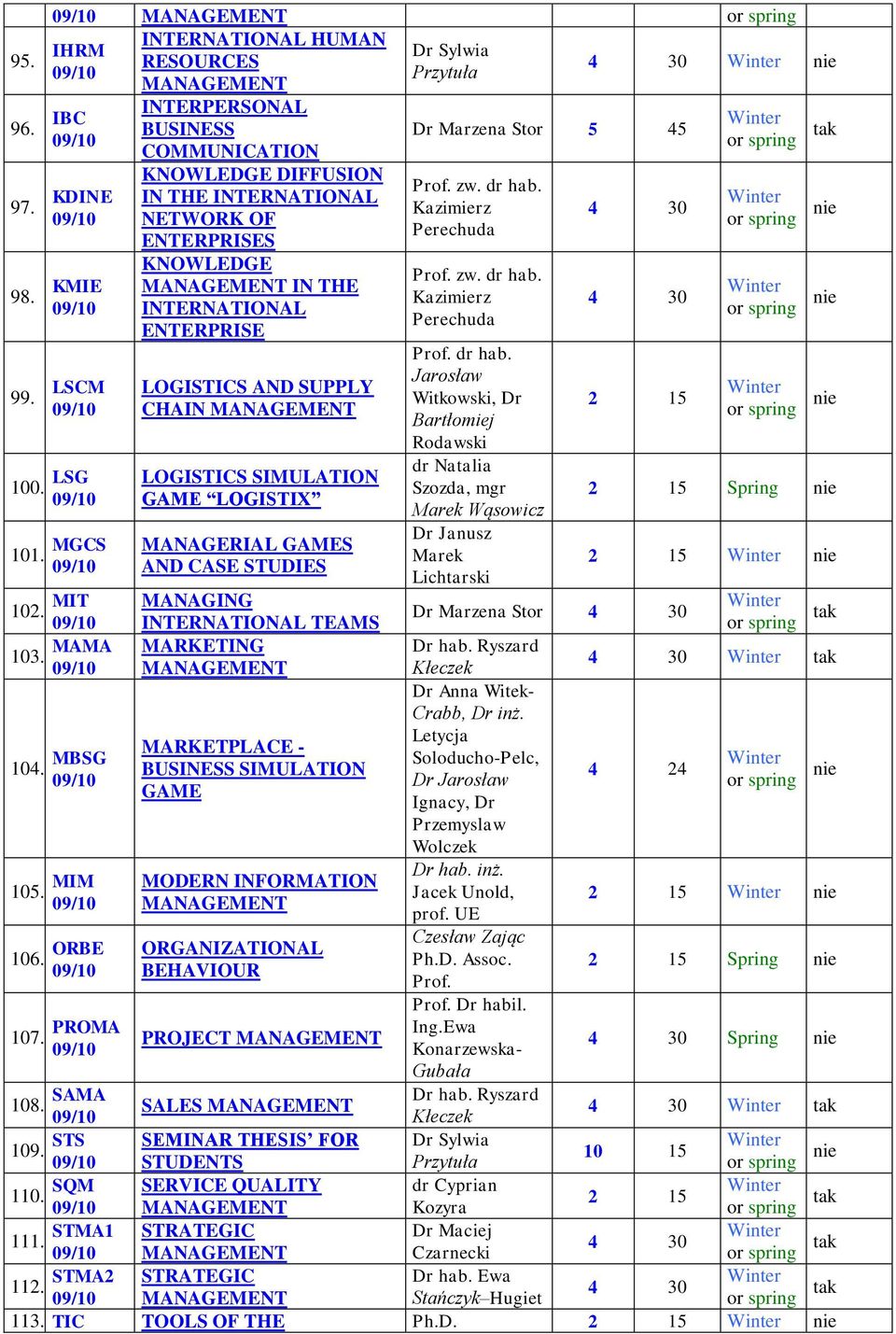
6 MANAGEMENT or spring INTERNATIONAL HUMAN IHRM Dr Sylwia RESOURCES 4 30 Winter nie Przytuła MANAGEMENT IBC KDINE KMIE LSCM 100. LSG 101. MGCS INTERPERSONAL BUSINESS COMMUNICATION KNOWLEDGE DIFFUSION IN THE INTERNATIONAL NETWORK OF ENTERPRISES KNOWLEDGE MANAGEMENT IN THE INTERNATIONAL ENTERPRISE LOGISTICS AND SUPPLY CHAIN MANAGEMENT LOGISTICS SIMULATION GAME LOGISTIX MANAGERIAL GAMES AND CASE STUDIES Dr Marzena Stor 5 45 Prof. zw. dr hab. Kazimierz Perechuda Prof. zw. dr hab. Kazimierz Perechuda Prof. dr hab. Jarosław Witkowski, Dr Bartłomiej Rodawski dr Natalia Szozda, mgr Marek Wąsowicz Dr Janusz Marek Lichtarski Winter or spring Winter or spring Winter or spring Winter or spring tak nie nie nie 2 15 Spring nie 2 15 Winter nie 102. MIT MANAGING Winter Dr Marzena Stor 4 30 INTERNATIONAL TEAMS or spring tak 103. MAMA MARKETING Dr hab. Ryszard MANAGEMENT Kłeczek 4 30 Winter tak Dr Anna Witek- Crabb, Dr inż. Letycja 104. MBSG MARKETPLACE - Soloducho-Pelc, Winter BUSINESS SIMULATION 4 24 Dr Jarosław or spring GAME Ignacy, Dr nie Przemyslaw Wolczek 105. MIM Dr hab. inż. MODERN INFORMATION Jacek Unold, MANAGEMENT prof. UE 2 15 Winter nie 106. ORBE Czesław Zając ORGANIZATIONAL Ph.D. Assoc. BEHAVIOUR Prof Spring nie Prof. Dr habil PROMA Ing.Ewa PROJECT MANAGEMENT Konarzewska Spring nie Gubała 108. SAMA Dr hab. Ryszard SALES MANAGEMENT Kłeczek 4 30 Winter tak 109. STS SEMINAR THESIS FOR Dr Sylwia Winter STUDENTS Przytuła or spring nie 110. SQM SERVICE QUALITY dr Cyprian Winter 2 15 MANAGEMENT Kozyra or spring tak 111. STMA1 STRATEGIC Dr Maciej Winter 4 30 MANAGEMENT Czarnecki or spring tak 112. STMA2 STRATEGIC Dr hab. Ewa Winter 4 30 MANAGEMENT Stańczyk Hugiet or spring tak 113. TIC TOOLS OF THE Ph.D Winter nie
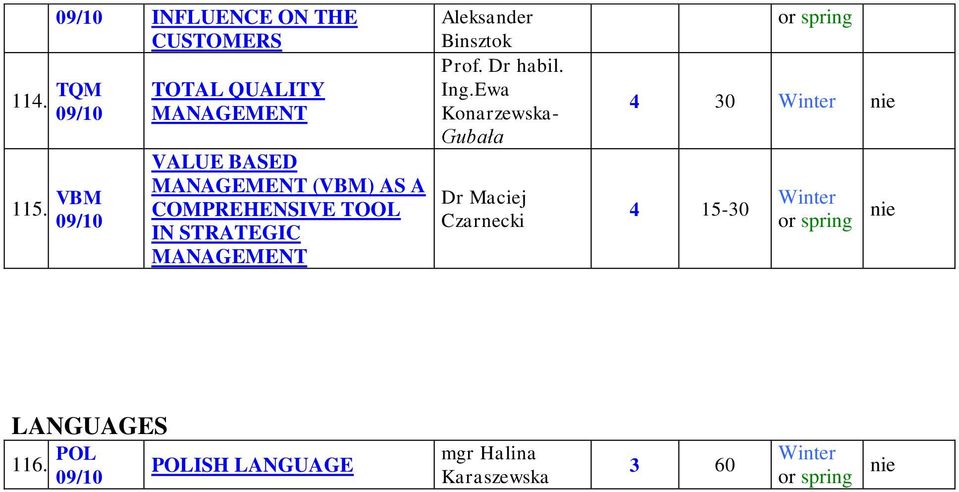
7 INFLUENCE ON THE CUSTOMERS 114. TQM 115. VBM TOTAL QUALITY MANAGEMENT VALUE BASED MANAGEMENT (VBM) AS A COMPREHENSIVE TOOL IN STRATEGIC MANAGEMENT Aleksander Binsztok Prof. Dr habil. Ing.Ewa Konarzewska- Gubała Dr Maciej Czarnecki or spring 4 30 Winter nie Winter or spring nie LANGUAGES 116. POL POLISH LANGUAGE mgr Halina Karaszewska 3 60 Winter or spring nie
8 ECONOMICS, INTERNATIONAL RELATIONS AND SOCIAL SCIENCES AN INTRODUCTION TO THE EUROPEAN COMMUNITY LAW Code: IECL Lecture hours: 30 (15 hours of lectures and 15 hours of classes) Study period: Winter or spring Advanced students Examination: Exam written in English Prerequisites: Microeconomics, Macroeconomics and European Integration courses Part one: Sources of the law in the EU, general principles of Community law, primary and secondary law, supremacy and direct applicability in Community law, institutional law, common market law (Community trade law, free movement of workers,,freedom of establishment, free movement of services, free movement of capital, ) competition law, European citizenship within an Area of Freedom,Security,and Justice. Part two: Analysis of cases concerning institutional and material law Contact person: Dr. Anna Jenik [email protected] S.Weatherill, Cases and Materials on EU Law, Oxford University Press, 2006 C.Barnard, The Substantive Law of the EU. The Four Freedoms Oxford University Press,2007 Karen Davies, Understanding European Union Law, Routledge Cavendish, 2007 All students according to their preferences BUSINESS ETHICS Code: BPE ECTS credits: 2 Lecture hours: 15 hours of workshop Study period: Winter or Spring Basic Examination: Attendance and Essay Prerequisites: -- I Introduction to Business Ethics Morality and ethics; Business Ethics: its scope and purpose; Ethical theory: utilitarianism, Kantian ethics, personalism, responsibility, justice II The Nature of the Firm and Purposes of Managers

9 Contact person: Purposes and forms of business activity and the role of profit, Managerial capitalism vs. Social responsibility of corporations III Ethical Treatment of Employees Employee rights and employee duties; Hiring and firing; The fair wage; Occupational risk; Diversity and discrimination; Workplace privacy; Mobbing and sexual harassment; Trade unions; Whistle-blowing IV Relations with Suppliers and Customers. Fair Competition Information in business relations; Marketing; Advertising; Consumer risk; Principles of positive competition; Fair and unfair competition V Ethical Issues in Finance, Banking and Accounting Fiduciary duties; Creative accountancy; Banking issues: credit and confidentiality; Information and manipulation in capital markets; Responsibility of investors, Ethical standards of finance professionals VI Ethical Issues Regarding the Natural Environment Business and environmental obligations; Environmental friendliness VII Ethical Issues in International Business Moral relativism vs. moral universalism; Multinational corporations; Sweatshops and bribery; International business ethics initiatives VIII Making Ethics Work in Managing a Firm Tools of ethical management; Corporate culture; Codes of ethics; Structures and procedures; Problems of Corporate Social Responsibility mgr Karol Fjałkowski [email protected] Ethical Theory and Business, Edited by T.L. Beauchamp, N.E. Bowie and D.G. Arnold, Upper Saddle River, Seventh Edition (2004) or Eight Edition (2009) An Introduction to Business Ethics, Edited by G.D. Chryssides and J.K. Kaler, London 1993 All CIVIL SOCIETY UTOPIA OR CHANCE Code: CSUC ECTS credits: 2 Lecture hours: 15 (lecture) Study period: Winter Basic Examination: End-of-term paper Prerequisites: none 1. Idea of civil society 2. Philosophical background 3. To trust or not to trust - social capital 4. Bowling alone - modern observations 5. Above the borders - world of NGOs 6. Informal social ties Contact person: dr Stanisław Kamiński, Department of Sociology and Social Policy, [email protected]

10 Putnam R.D., Bowling Alone, Simon&Schuster, New York 2000 Putnam R.D. (ed.), Democracies in Flux, Oxford University Press, New York 2002 Salamon L.M. and others, Global Civil Society: Dimensions of the Nonprofit Sector, Kumarian Press, Bloomfield 2004 all DETERMINANTS OF REGIONAL DEVELOPMENT ON THE EXAMPLE OF LOWER SILESIA Code: DRDLS ECTS credits: 2 Lecture hours: 15 Study period: Spring Master studies Examination: Credit on mark (presentation and/or test) Prerequisites: Microeconomy, Macroeconomy Contact person: Basic definitions in field of regional and local development. Determinants of competitiveness and attractiveness of particular regions Policy of regional and local development. Analysis of endogenous and exogenous determinants of regional development in Lower Silesia. Examples of localization selected investments in Lower Silesia. Dr Katarzyna Miszczak, tel , [email protected] 1. Recent Advances in Urban and Regional Studies, ed. R. Domański, KPZK PAN, vol. XII. 2. Spatial Aspects of Entrepreneurship, KPZK PAN, vol. XIII. 3. M.E. Porter, The Competitive Advantage of Nations, MacMillan, London Regions, Globalisation, and the Knowledge-Based Economy, ed. by J.H. Dunning, Oxford University Press, New York Incentives and Foreign Direct Investment, UNCTAD/DTCI/28, New York and Geneva S. Barios, H. Goerg, E. Strobl, Multinationals Location Choice, Agglomeration Economies and Public Incentives, Research Paper Series, Internalization of Economic Policy, the University of Nottingham 33/ J.H. Dunning, The Globalization of Business. The Challenge of the 1990s, Routledge, London and New York World Investment Report FDI Policies for Development: National and International Perspectives, UN - UNCTAD, New York, Geneva International relations

11 ECONOMIA ESPANOLA Y MUNDIAL Code: ESM Lecture hours: 30 hours of workshop Study period: Spring - verano Basic - Fundamentos Examination: Student s Work & Projects Evaluation La evaluación de trabajo y proyectos de los estudiantes Language: Spanish - español Prerequisites: Spanish conocimiento de la lengua Tema 1.- Introducción a la Economia Espanola Tema 2.- La economía española desde la perspectiva histórica Tema 3.- El mercado de trabajo espańol y sistema financiero Tema 4.- El sector del turismo Tema 5.- Mapa general de la economía mundial Tema 6.- La Unión Europea Tema 7.- Los paises del este europeo y las economias emergentes Tema 8.- El cambio tecnológico. Las TIC Tema 9.- La globalización Tema 10.- Medio ambiente y desarrollo sostenible Contact person: Jarosław Chuchla, [email protected], 706Z 1. ALONSO J.A. (Dir). Lecciones sobre economía mundial. Introducción al desarrolo y a las relaciones económicas internacionales. Madrid. Thomson Civitas AURIOLES, J. y E. MANZANERA (coor). Cuestiones clave de la economía española.perspectivas actuales, Madrid. Pirámide.Centra TUGORES, J. Economía Internacional, globalización e integración regional. Madrid. Ed Mac Graw Hill REQUEIJO, J. Y Otros.Economía española. Madrid.Delta All students todos los estudiantes Course title: ECONOMIC GLOBALISATION: CONCEPT, INDICATORS AND GOVERNANCE PROBLEMS Code: ECGL ECTS credits: 2 Lecture hours: 15 hrs lectures Study period: Winter or spring semester Intermediate / Advanced Location: Wroclaw Examination: Written test Prerequisites: Completed basic economics The aim of this short course is to show some problems economists faced in attempting to give scientific explanation of the nature of economic globalisation, its expected benefits and threats for developed and developing economies, with special emphasis on the current slowdown in

12 Contact person: the world economy in result of the 2008 Year global financial system crisis. From a wide range of problems course will be focused on the global governance problems and globalisation measurement problems. Proposed by the OECD set of indicators related to foreign direct investment, activity of multinational firms, trade globalisation and knowledge dissemination will be presented. Dr Bozena Baborska [email protected] 1. H. Bünz, A. Kukliński (Eds): Globalisation. Experiences and Prospects. Friedrich Ebert Stifung, 2001,(chosen chapters). 2. Hirst, P. Thompson, G: Globalization in Question: The International Economy and the Possibilities for Governance. Blackwell, M. Lewis,. R. Fitzgerald and Ch. Harvey: The Growth of Nations. Culture, Competitiveness, and the Problem of Globalisation. Bristol University Press, OECD Handbook on Economic Globalisation Indicators. OECD, J.E Stiglitz: Making Globalization Work. Allen Lane, The IMF and the World Bank chosen information and commentaries on the 2008 year global financial crisis and its consequences for world economy (selected from internet).s For all ECONOMIC SOCIOLOGY Code: ECSO ECTS credits: 2 Lecture hours: 15 Study period: Winter Intermediate Examination: Examination papers or oral exminations Prerequisites: Contact person: One year of education in economics The course consists of series of lectures presenting social aspects of economic activity, focused on the main trends of contemporary capitalism. Post-industrial society, consumer culture and consumerism, organizational culture, corporate management and information society, are among the basic topics of the course. Dr hab. Wiesław Wątroba [email protected] Contact the lecturer for information All students ECONOMICS OF RELIGION

13 Code: EOR ECTS credits: 2 Lecture hours: 15 hours of workshop Study period: Winter or Spring Basic Examination: Attendance and Essay Prerequisites: Microeconomics This course explains principles of the social-scientific study of religion, with special emphasis on the economic and New Institutional Economics approaches. Whereas psychologists and sociologists usually interpret religious belief and behaviour in terms of ignorance, irrationality and indoctrination, economists claim that rational self-interest shapes the choices of religious consumers and producers. The course presents economic theories of the interrelation of religion and economic behaviour as well as of the role of religion in contemporary society. Main topics: Social-scientific and economic approaches to the study of religion, Economic theories of individual religious belief and non-belief, Economics of religious institutions, The influence of religion on markets and economic behaviour, The influence of religion on economic and social outcomes. Contact person: mgr Karol Fjałkowski [email protected] L. Iannaccone, Introduction to the Economics of Religion, Journal of Economic Literature, 1998, 36 (3), pp R. Hardin, The Economics of Religious Belief, Journal of Theoretical and Institutional Economics, 1997, 153 (March), pp B.B. Hull and F. Bold, Towards an Economic Theory of the Church, International Journal of Social Economics, 1989, 16 (7), pp C. Azzi and R. Ehrenberg, Household Allocation of Time and Church Attendance, Journal of Political Economy, 1975, 83 (1), pp L. Guiso, P. Sapienza and L. Zingales, People's Opium? Religion and Economic Attitudes, Journal of Monetary Economics, 2003, 50 (1), pp U. Blum and L. Dudley, Religion and Economic Growth: Was Weber Right?, Journal of Evolutionary Economics, 2001, 11 (2), pp All Code: EPS Lecture hours: Lecture: 30 hours Study period: Location: ECONOMICS OF THE PUBLIC SECTOR Spring semester Intermediate Wroclaw

14 Examination: Language: Prerequisites: Contact person: Case study, essay and attendance English Microeconomics and Macroeconomics This course s main goal is to provide the basis for economic analysis of public policy issues and focus on the economic role of the public sector (i.e. government) in the economy. The course will start with the general discussion about market efficiency connected with market and government failure analysis. This will lead to the brief description of public and publicly provided goods and finally a public choice theory and the analysis of bureaucracy. The next major topic will be externalities and its impact on public policy. Within the scope of these theories we will discuss specific policies of public sector: healthcare, education, social insurance, welfare programs etc. We will finish this part of the course with the analysis of taxation theories. Last part of the course will be dedicated towards voting and political decisions as basic to all public choices. Dr Mikolaj Klimczak Department of Microeconomics and Institutional Economics Phone: [email protected] Joseph E. Stiglitz, Economics of the Public Sector, Third Edition, W. W. Norton & Company, 2000 Supplementary books and articles may be used. All EUROPEAN INTEGRATION Code: EUIN Lecture hours: 30 hours(15 hours lectures and 15 hours workshop) Study period: Winter or spring beginners Examination: Test written in English Prerequisites: Microeconomics and Macroeconomics Part one: Fundamental concepts, origins and development of the European Communities,European Union(three pillars structure,the basis for the EU law) European Union s stages of integration,common policies, principle of subsidiarity,institutional structure and decision making processes in the EU,budget of the EC,revenues and expenditures,evolution of the budget,financial perspective ,structural operations, common market (benefits and cost)trade liberalization,free movement of people,freedom of establishment, competition rules, monetary union(cost and benefits) history of EMU, three stages of the

15 Contact person: EMU,convergence criteria., institutions responsible for EMU, practice of the monetary integration. EU reform treaty and the future of the EU Part two: Students will discuss the current problems connected with the main policy areas of the European Community like: regional policy agriculture policy social policy etc. and with functioning of the common market and the monetary union. Dr. Anna Jenik Ali M. El-Agra The European Union (eight edition) Cambridge University Press, 2007 T.Hitiris The European Union Economics, The Pearson Education Ltd, 2003 Zoltan Horvath, Handbook of the European Union, HVG-ORAC Publishing House Ltd, 2007 A.Baneth, G.Cserey, The Ultimate EU test Book, John Harper Publishing, 2007 All FAIR TRADE VS. DEVELOPMENT Code: FTD ECTS credits: 2 Lecture hours: 15 (tutorials) Study period: winter or spring basic Examination: attendance, short presentation Language: english Prerequisites: principles of macroeconomics and microeconomics 1. Vision of fair development by World Bank. 2. Fair trade. The role of WTO. 3. Priorities of Development Round. 4. Achievements of Doha. 5. The basis of a fair agreement. 6. Special treatment for developing countries. 7. Fair Trade Agenda. 8. Trade system. 9. Institutional reforms. 10. Trade liberalization and its costs Contact person: mgr Sebastian Bobowski; [email protected] 1. Joseph E. Stiglitz, Making globalization work, Oxford University Press, Joseph E. Stiglitz, Globalization and Its Discontents, Oxford University Press, Andrew Charlton, Joseph E. Stiglitz, Fair trade for all. How trade can promote development, Oxford University Press, Joseph E. Stiglitz, Wizja sprawiedliwej globalizacji. Propozycje usprawnień, Wydawnictwo Naukowe PWN, Warszawa 2007

16 5. Joseph E. Stiglitz, Globalizacja, Wydawnictwo Naukowe PWN, Warszawa Andrew Charlton, Joseph E. Stiglitz, Fair trade. Szansa dla wszystkich, Wydawnictwo Naukowe PWN, Warszawa Jan Rymarczyk, Internacjonalizacja i globalizacja przedsiębiorstwa, PWE, Warszawa Jan Rymarczyk (red.), Międzynarodowe stosunki gospodarcze, PWE, Warszawa Adam Budnikowski, Międzynarodowe stosunki gospodarcze,, Wydawnictwo Naukowe PWN, Warszawa 2006 all students FOREIGN DIRECT INVESTMENT IN THEORY AND PRACTICE Code: FDI ECTS credits: 2 Lecture hours: 15h ( lectures) Study period: Winter and Spring semester Basic Location: Wroclaw Examination: Essay Language: Prerequisites: English Principles of International Economics The course will examine the following subjects: 1) theoretical aspects of foreign direct investment (FDI): - definitions; - measurement; - micro- and macro-level theories; - costs and benefits of FDI; 2) FDI flows and stock- global trends: - historical aspects; - geographical and sectoral structure; - mergers and acquisitions versus greenfield investment; 3) transnational corporations: - types; - strategies; - the OECD guidelines for multinational enterprises; 4) consequences of FDI for source and host countries: - implications for the balance of payments and macroeconomic policy; - FDI and labour market; - FDI as a source of new technologies; - negative aspects of FDI; 5) relocation and FDI: - offshoring and outsourcing;

17 - determinants and consequences; - global trends; 6) means of attracting FDI: - FDI policies, - international agreements on FDI; - examples of the FDI incentives- with special reference to Poland; 7) the impact of economic integration on FDI the example of the European Union: - the interdependence between FDI and foreign trade; - static and dynamic effects of economic integration; - investment creation and diversion effects; 8) FDI and Central and Eastern Europe - with special reference to Poland; Contact person: dr Zbigniew Mogiła - [email protected] 1) Bezpośrednie inwestycje zagraniczne w Polsce, red. Z. Olesiński, PWE, Warszawa 1998; 2) Dunning J.H., A rose by any other name...? FDI theory in retrospect an prospect, University of Reading and Rutgers University 2000; 3) Dynamic Interdependence between Foreign Direct Investment and Foreign Trade in the Context of the European Integration Process with Special Reference to Central and East European Countries, red. J. Witkowska, Z. Wysokińska, Wydawnictwo Uniwersytetu Łódzkiego, Łódź 1998; 4) Egger P., Pfaffermayer M., Foreign Direct Investment and European Integration in the 90 s., University of Innsbruck, Innsbruck 2002; 5) European Union Foreign Direct Investment Yearbook, Eurostat, Luksemburg- different series; 6) Hansen M.W., Economic Theories of Transnational Corporations, Environment and Development, Copenhagen Business School, Kopenhaga 1998; 7) Hein P., Vork A., Foreign Direct Investments and European Integration: Implications for CEEC, University of Tartu, Tartu 2000; 8) Inwestycje zagraniczne w Polsce. Raport roczny, red. J. Chojna, IKiCHZ, Warszawa 2006; 9) Rymarczyk J., Internacjonalizacja i globalizacja przedsiębiorstwa, PWE, Warszawa 2004; 10) Witkowska J., Rynek czynników produkcji w procesie integracji europejskiej, Wydawnictwo Uniwersytetu Łódzkiego, Łódź ) World Investment Report,UNCTAD, Geneva different series ( ); All students

18 FRANCHISING Code: FRA ECTS credits: 2 Lecture hours: 15 hours of workshop Study period: Spring Advanced Examination: Project Prerequisites: Principles of International economics 1.The history of Franchising in the USA 2.Development of Franchising in Europe 3.The definition and different kinds of Franchising 4.Stregthness and weakness of Franchising 5.Franchising in the European law 6.The contents of the Agreement 7. Legal character of the Agreement 8.Franchising and similar legal solutions 9.Expiry and dissolution of the Agreement 10.Examples of Franchising Networks in the USA and Europe 11.Examples of Franchising Networks in Poland Contact person: Barbara Mróz ([email protected]), Katedra MSG 1. Blair Roger O., The Economic of Franchising, Cambridge University Press, Pokorska B. Leksykon Franczyzy, Difin, Warszawa, Banachowicz E., Franchising- skorzystaj z tej szansy Poltext,Warszawa, Bagan-Kurluta K., Umowa Franchisingu C.H.Beck,Warszawa Mendelsohn M., How to Buy a Franchise 6. Mendelsohn M., How to Franchise Your Business All students GLOBALIZATION AND CONSUMER CULTURE Code: GCC ECTS credits: 2 Lecture hours: 15 Study period: Spring Advanced Examination: Examination papers or oral exminations Prerequisites: Two years of education in economics The course examines the social aspects of globalization and consumer culture. Influence of social postmodernism on post-industrial society,
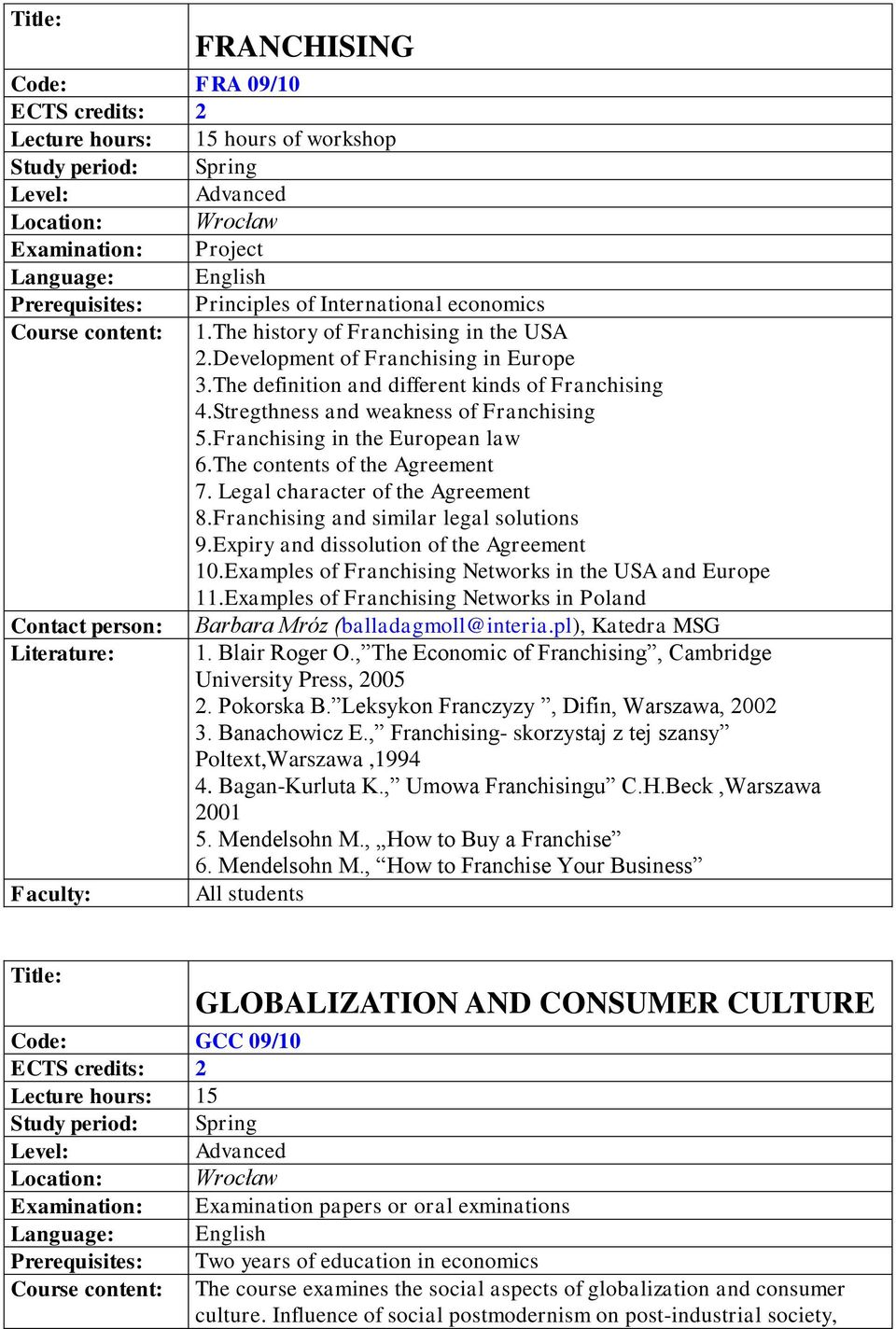
19 Contact person: globalization, post-modern consumption, influence of media on global society, weakening role of nation states and social policy, consumer ethnocentrism, social restratification, these are the main topics of the course. Dr hab. Wiesław Wątroba Contact the lecturer for information All students HOW TO IMPROVE MECHANISM OF GLOBALIZATION? Code: HIG ECTS credits: 2 Lecture hours: 15 (tutorials) Study period: winter or spring basic Examination: attendance, short presentation Language: english Prerequisites: principles of macroeconomics and microeconomics Contact person: 1. Globalization as a process. Introduction. 2. Vision of fair development by World Bank. 3. Making trade fair. Trade agreement, the role of WTO. 4. Intelectual property and its limits. 5. Lifting the resource curse. 6. Global warming. 7. Corporate governance. 8. Burden of debt. 9. Reforming global reserve system. 10. Democratizing globalization. mgr Sebastian Bobowski; [email protected] 1. Joseph E. Stiglitz, Making globalization work, Oxford University Press, Joseph E. Stiglitz, Globalization and Its Discontents, Oxford University Press, Andrew Charlton, Joseph E. Stiglitz, Fair trade for all. How trade can promote development, Oxford University Press, Joseph E. Stiglitz, Wizja sprawiedliwej globalizacji. Propozycje usprawnień, Wydawnictwo Naukowe PWN, Warszawa Joseph E. Stiglitz, Globalizacja, Wydawnictwo Naukowe PWN, Warszawa Andrew Charlton, Joseph E. Stiglitz, Fair trade. Szansa dla wszystkich, Wydawnictwo Naukowe PWN, Warszawa Jan Rymarczyk, Internacjonalizacja i globalizacja przedsiębiorstwa, PWE, Warszawa Jan Rymarczyk (red.), Międzynarodowe stosunki gospodarcze, PWE, Warszawa 2006

20 9. Adam Budnikowski, Międzynarodowe stosunki gospodarcze,, Wydawnictwo Naukowe PWN, Warszawa 2006 all students INDUSTRIAL ORGANISATION Code: INOR Lecture hours: Lecture and case study: 30 hours Study period: Location: Examination: Language: Prerequisites: Contact person: Winter or spring semester Intermediate Wroclaw Case study, essay and attendance English Microeconomics and Macroeconomics In economics, studies in the field of the industrial organisation consist of the analysis of imperfect competitive markets, i.e., markets where a company is able to apply market power and establish a price above marginal cost. Industrial organisation uses microeconomics' models (both static and dynamic) as well as the game theory to describe various aspects of firms, industries and markets. The ultimate goal of the course is to discuss the influence of government on markets, exerted to create more competitive structures. Throughout the course we will discuss case studies mainly from our European markets rather then American ones. The course will start with the overview of the theory of firms and costs and the description of different market structures. This will be applied to the analysis of monopolies and monopoly practices. The course will also discuss concentration in individual markets, entry and exit issues and mergers. The next part of the course will begin from the short overview of game theory and its application to the analysis of oligopolistic behaviour together with basic microeconomics tools we will study cartels and the entry in both pricing and non-pricing strategies. The last part of the course will give an overview of business practices product differentiation and advertising strategies, research and development, price discrimination and vertical relationships and integration. The course will end with the discussion about regulation and deregulation. Mikolaj Klimczak Department of Microeconomics and Institutional Economics Phone: [email protected] 1. D.E.Waldman, E.J.Jensen: Industrial Organisation. Theory and Practice. 3rd Edition. Pearsons Education 2006.
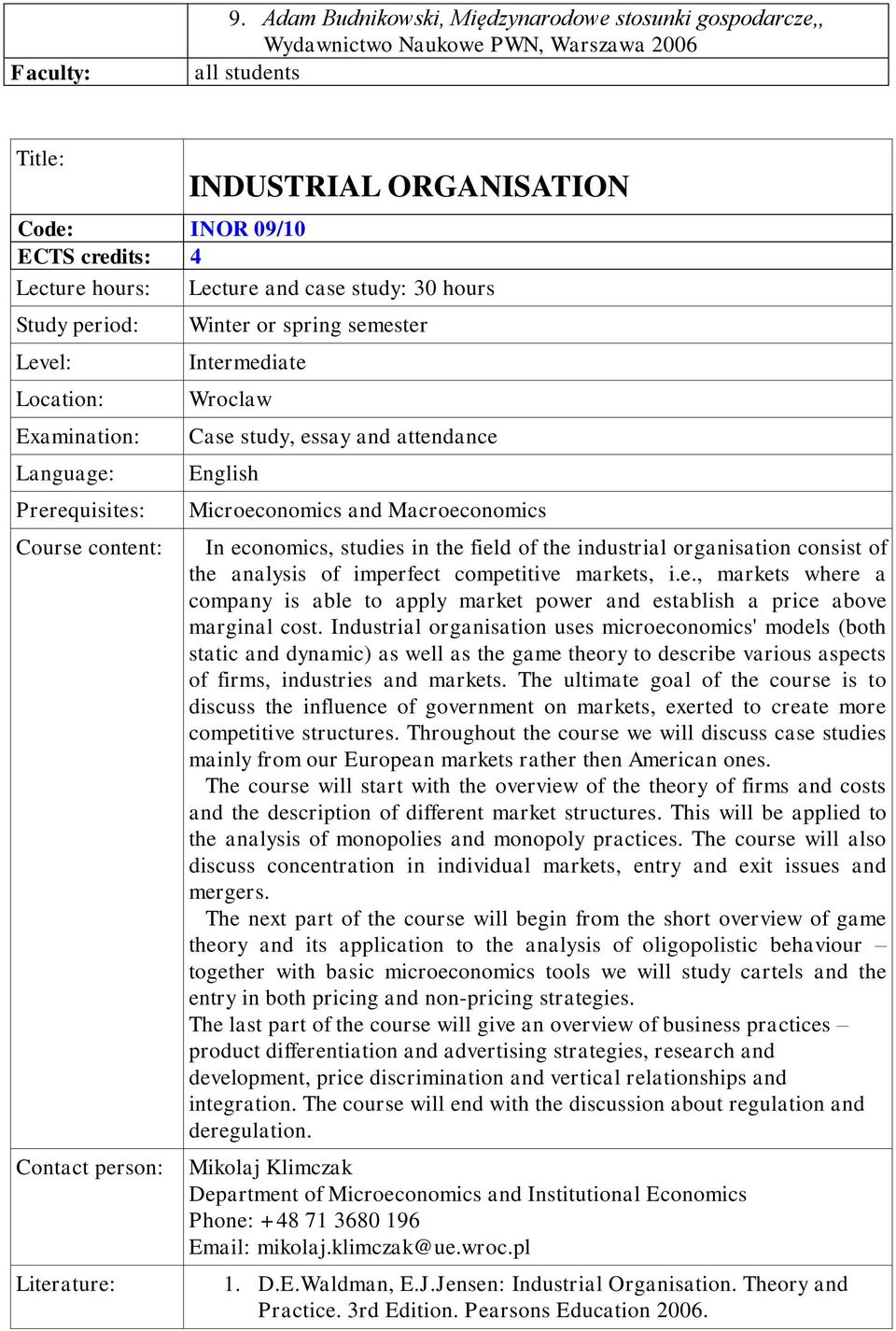
21 2. D.W.Carlton, J.F.Perloff. Modern Industrial Organization. (last edition) Harper-Collins. 3. S.Douma, H.Schreuder, Economic Approaches to Organizations. (last edition) Prentice Hall Inc. 4. L.Pepall, D.Richards, G.Norman, Industrial Organization: Contemporary Theory and Practice, Thomson Learning, 3rd Edition, H.R.Varian. Intermediate Microeconomics. A Modern Approach. 3rd edition. W.W.Norton and Company 1993 (or newer 4th or 5th edition). Supplementary books and articles may be used. All INFRASTRUCTURE IN SOCIAL AND ECONOMIC DEVELOPMENT Code: ISED Lecture hours: 30 hours Study period: Spring Master studies Location: Wroclaw Examination: Written work and its presentation during the lecture Prerequisites: Microeconomics, macroeconomics Contact person: The aim of this lecture is to show the significance of technical and social infrastructure mainly by presenting its place in local and regional development, and in the latest theories concerning economic growth. The infrastructure should be fitted to other developmental factors (also nonmaterial) so that it amplifies the development. Only an active approach to infrastructure gives an opportunity to use the whole development potential, therefore it is one of the most important tasks of the local and regional authorities. The specific character of infrastructure requires special tools to carry out and to finance infrastructural investments. All of these aspects will be discussed during the classes. The student will acquire the knowledge which will contribute to the better understanding of the problems concerning the meaning of infrastructure in spatial development process. Dr Małgorzata Rogowska Department of Spatial Economy and Selfgoverned Administration Phone: [email protected] 1. M. Ratajczak, Infrastruktura w gospodarce rynkowej, Wyd. AE w Poznaniu, Poznań Infrastructure in Europe and Central Asia Region approaches to sustainable services, World Bank, Municipal and environmental infrastructure, European Bank for Reconstruction and Development, 1999.
22 4. Public-Private Partnership in the New UE Member States, World Bank, European Bank for Reconstruction and Development, All students Code: IRDE Lecture hours: 30 Study period: Winter Basic Examination: On mark Prerequisites: Contact person: INNOVATIONS IN REGIONAL DEVELOPMENT Microeconomy, makroeconomy 1. Basic information of regional development 2. Regional policy in European Union 3. Towards a Knowledge Economy 4. A Regional Perspective on Innovation: From Theory to Strategy 5. Developing Regional Innovation Strategies 6. Regional Innovation Strategies in European Union countries (examples) 7. Innovation policy in regions 8. Regional Innovation Systems mgr Niki Derlukiewicz Department of Spatial Economy and Self-governed Administration Phone: or dr Katarzyna Miszczak Department of Spatial Economy and Self-governed Administration Phone: [email protected] 1. Kevin Morgan, Claire Nauwelaers: Regional Innovation Strategies. The Challenge for Less-Favoured Regions, Routledge Hans-Joachim Braczyk, Philip Cooke, Martin Heidenreich: Regional Innovation Systems. The Role of Governances in a Globalized World, Routledge Philip Cooke, Andrea Piccaluga: Regional Development in the Knowledge Economy, Routledge R. Domański: Recent Advances in Urban and Regional Studies, KPZK PAN, vol. XII. all INSTITUTIONAL ECONOMICS (EXTENDED COURSE) Code: INSEC1
23 Lecture hours: 15 hrs lectures and 15 hrs classes Study period: Spring Intermediate / Advanced Examination: Final test Prerequisites: Completed basic economics course The purpose of the course is to introduce students into a relatively new field in the economic theory the institutional economics (IE), mainly its part called the New Institutional Economics (NIE). Lectures contents: Some basic terms. IE versus orthodox economics. Old and new institutional economics superficial comparison. Basic concepts of NIE. Transaction costs economics. Firms and markets as institutions. Property-rights analysis. Two types of economic theories of contracts: the agency theory and relational and incomplete contract theory. Some sample applications of NIE concepts to the economic analysis of such problems of system transformation as privatisation of former state-owned firms, development of markets and their institutional environment. Classes will be focused on the following problems: Old versus New IE. Informal institutions. Economic theory of social capital. The NIE of the state. Constitutional economics. Performance of institutional systems. D.C. North s concept of institutional change. Controversies and perspectives of the NIE. Contact person: Dr Bożena Baborska (lectures) - [email protected] Mgr Karol Fjałkowski (classes) - [email protected] E.G. Furubotn and R. Richter, Institutions and Economic Theory. The Contribution of the New Institutional Economics. The University of Michigan Press 1997 C. Menard (ed): Institutions, Contracts and Organizations. Perspectives from New Institutional Economics. Edward Elgar Publ D.C. North: Economic Performance Through Time. American Economic Review, 1994, vol. 84, no. 3, pp O.E. Williamson: The New Institutional Economics: Taking Stock, Looking Ahead. Journal of Economic Literature, 2000, vol. 38 pp All INSTITUTIONAL ECONOMICS (SHORT COURSE) Code: INSEC2 ECTS credits: 2 Lecture hours: 15 hrs lectures Study period: Winter or spring semester Intermediate / Advanced Location: Wroclaw
24 Examination: Language: Prerequisites: Contact person: Final test English Completed basic economics The purpose of the course is to introduce students in relatively new field in the economic theory - the institutional economics (IE), mainly its stream called the New Institutional Economics (NIE).Lectures contents: Some basic terms. IE versus orthodox economics. Old and new institutional economics superficial comparison. Basic concepts of NIE. Transaction costs economics. Firms and markets as institutions. Propertyrights analysis. Two types of economic theories of contracts: the agency theory and relational and incomplete contract theory. Some samples of NIE concepts applications to the economic analysis of such systemic transformation problems as former state-owned firms privatisation, development of markets and their institutional environment. Dr Bożena Baborska [email protected] 1. E.G. Furubotn and R. Richter: Institutions and Economic Theory. The Contribution of the New Institutional Economics. The University of Michigan Press 1997, 2. E.G. Furubotn and R. Richter (editors): The New Institutional Economics. Mohr, C. Menard(ed): Institutions, Contracts and Organizations. Perspectives from New Institutional Economics. Edward Elger Publ., 2000, 4. C. Menard and M.M. Shirley (editors): Handbook of New Institutional Economics. Springer O.E. Williamson: The Economic Institution of Capitalism. The Free Press, 1985 All INTERNATIONAL BUSINESS Code: INBU Lecture hours: 15h (seminars) + 15h (tutorials) Study period: Winter and spring semester Basic Location: Wrocław Examination: Projects prepared by students + final multiple test Prerequisites: Principles of economics The module will allow students to develop their understanding of international business. Thanks to the course students will identify the crucial factors of international environment like financial systems, entry barriers and risk assessment which affect firms in their markets, acquisition of materials or labour supply in various parts of the
25 world. Each topic consists of lectures and tutorials, when case studies will be analyzed. Topic 1: International Business Nature Topic 2: World Financial System Topic 3: Multinational Corporations Topic 4: International Market Entry Modes Topic 5: Country Evaluation and Selection Topic 5: Managing International Operations Contact person: Topic 6: Ethics of International Business mgr Artur Klimek International business : global competition from a European perspective / Andrew Harrison, Ertugrul Dalkiran, Ena Elsey. - Oxford : Oxford University Press, 2000 International business : environment and operations / John D. Daniels, Lee H. Radebaugh. - 4th ed. - Reading, MA : Addison- Wesley Publishing Company, latest edition International business / Michael R. Czinkota, Ilkka A. Ronkainen, Michael K. Moffett. - 3rd ed. - Fort Worth, TX : Dryden Press, Students should also monitor current issues in international business by reading The Financial Times and The Economist All students INTERNATIONAL DETERMINANTS OF SPATIAL ECONOMY Code: IDSE Lecture hours: 30 Study period: Spring Master s studies Examination: The conditon of gaining final grade is the written work. Prerequisites: Contact person: Macroeconomic, microeconomic The aim of this lecture is to acquaint students with contemporary problems of spatial economy. The subject of the lecture is connected with experiences of shaping the spatial economy so far and the directions of its development in the future in choosen national economies, especially in European space. This considerations are conducted both on the theory ground, as well as usuing practical examples. Dr Małgorzata Pięta Kanurska [email protected]
26 1. Bűnz H., Kukliński A., Globalization. Experiences and Prospects, The Friedrich Ebert Foundation, Warsaw Gorzelak G., Ehrlich E., Faltan L., Illner M., Central Europe in Transition Towards EU Membership, Regional Studies Association, Polish Section, Warsaw Castells M., The Rise of the Network Society, Blackwell Publ., Cambridge, Massachusetts, Myrdal G., Economic Theory and Under Developed Regions. Duckworth, London Sassen S., The global city. New York, London, Tokio. Wyd. Princeton University Press, Princeton New Yersey All INTERNATIONAL ECONOMICS Code: INTEC ECTS credits: 7 Lecture hours: 30h ( lectures) + 30h ( tutorials) Study period: Location: Examination: Language: Prerequisites: Winter and Spring semester Basic Wroclaw Written examination English Principles of macroeconomics and microeconomics The course will examine the following subjects: 1) the reasons for international trade: - early trade theories; - classical theories based on the principle of comparative advantage; - neoclassical trade theories; - new trade theories; 2) international factor movements: - labour movements; - capital and technology movements; - foreign direct investment and multinationals; 3) international trade policy: - the instruments of trade policy; - free trade versus protectionism; 4) international financial markets: - international financial instruments; - foreign exchange market; - various exchange rate regimes; - exchange rates and open-economy macroeconomics; - the international monetary system; - capital flows and financial crises;
27 Contact person: 5) the balance of payments accounts; 6) international economic integration: - theoretical aspects of economic integration; - examples of trade blocs in America and Asia; - the European Union; 7) international economic institutions such as the World Bank, the International Monetary Fund, the World Trade Organization; 8) economic globalization: - causes, consequences and challenges of the globalization process; - international competitiveness of countries and companies in the global economy; - the impact of globalization on developed and developing countries; - the European Union in the global economy - with special reference to Poland; dr Zbigniew Mogiła - [email protected]; mgr Sebastian Bobowski [email protected] 1) Appleyard D., Field A.,Cobb S., International Economics, McGraw-Hill, 2005; 2) Carbaugh R., International Economics,International Thomson Publishing, ) Krugman P., Obstfeld M., International Economics. Theory and Policy (7 th Edition), Addison Wesley Publishing Company, 2006; 4) Międzynarodowe stosunki gospodarcze, red. J. Rymarczyk, Polskie Wydawnictwo Ekonomiczne, Warszawa 2006; 5) Współczesna gospodarka światowa, red. A. B. Kisiel-Łowczyc, Wydawnictwo Uniwersytetu Gdańskiego, Gdańsk All students Code: INEC ECTS credits: 2 Lecture hours: 15 Study period: Spring Master studies Examination: on mark Prerequisites: INTERNATIONALIZATION OF NET ECONOMY Microeconomy, Macroeconomy The purpose of the lecture is presentation problems of net economy`s functioning on all three-dimensional (spatial) levels, it means from enterprise and city for multinational corporations and global economy. There are identified sources of new relations` creation in spatial economic development on background of modern trends and processes occuring in world economy (for example globalization). Then it is performed characteristic of directions, scale and structure of transformations caused by horizontal net connections.
28 Contact person: Dr Katarzyna Miszczak, tel , mail: 1. Toffler A.H.: Budowa Nowej Cywilizacji - Polityka Trzeciej Fali, Poznań, Wyd. Zysk i Ska, Kelly K.: Nowe reguły nowej gospodarki, Warszawa, Wyd. WIG-Press, Andersson Å.E., Batten D.F., Johansson B., Nijkamp P.:.Advances in Spatial Theory and Dynamics. Studies in Regional Science and Urban Economics nr 20, Wyd. Elsevier Science Publishers B.V. North-Holland-Amsterdam Domański R., Marciniak A.: Sieciowe koncepcje gospodarki miast i regionów, Warszawa, Wyd. Komitet Przestrzennego Zagospodarowania Kraju PAN, Studia Tom CXIII, Brown L.M.: Diffusion dynamics. A review and revision of the quantitative theory of the spatial diffusion of innovation. Lund Studies in Geography, Ser. B. Human Geography, vol. 29, C. W. K. Gleerup, Lund Kukliński A.: Gospodarka oparta na wiedzy. Wyzwanie dla Polski XXI wieku, Warszawa, Wyd. Komitet Badań Naukowych, Domański R., Gospodarka przestrzenna, Warszawa, Wyd. PWN, Matusiak K. B., Stawasz E.: Przedsiębiorczość i transfer technologii polska perspektywa, śyrardów, Wyd. Łódzkie, Castells M.: The Information Age. Economy, Society and Culture The rise of network society. T. 2. Blackwell Publishers, Oxford Hingel A.J.: A New Model of European Development. Innovation. Technological Development and Network-led Integration. W: Science - Technology - Economy. Red. A. Kukliński Science and Government Series, Vol. 3, State Committee for Scientific Research, Warsaw Schumpeter J.A.: Business Cycles. New York Breault R.: Global Networking of Regional Optics Clusters. The International Society for Optical Engineering Denver, Kolorado Zuskovitch E., Justman M.: Networks, sustainable differentiation and economic development. W: Network in action. Communication, economics and human knowledge. Red. D. Batten, J. Casti, R. Thord. Wyd. Springer-Verlag, Berlin 1995 All MACROECONOMICS Code: MACR ECTS credits: 7 Lecture hours: Total 60 h (30 h - lectures, 30 h classes) Study period: Winter or spring Basic Examination: Multiple choice test plus some exercises Prerequisites: Preferably the completion of microeconomics course 1. Introduction research area, review of main theories and definitions, simple economy model 2. National income accounting 3. Economic growth and development 4. Consumption functions and consumption demand theories 5. Investment model of accelerator, investment project evaluation
29 Contact person: 6. Fiscal policy function, brief overview of the tax system in Poland, Laffer curve, government spending, crowding out, deficit, Public Debt EU s budget, fiscal policy in OECD countries 7. Monetary policy instruments, effectiveness, central banks (National Bank of Poland, Fed, European Central Bank) 8. Money functions, demand and supply 9. IS-LM model 10. AS-AD model 11. Inflation 12. Unemployment; the tradeoffs between unemployment and inflation 13. Macroeconomics in the Open Economy analysis of balance o payment, protectionism, exchange rates regimes, globalization Dr Wiktor Szydło ( [email protected]) - R. Dornbusch, S. Fischer, R. Startz, Macroeconomics, McGraw-Hill (9th international edition, 2004) - N.Gregory Mankiw, Macroeconomics - 4th ed. - New York, NY : Worth Publishers, 2000 Recent texts and articles on the subject given to students Course for all faculties MICROECONOMICS Code: MICR ECTS credits: 9 Lecture hours: Full year course: 30 hrs lectures( dr Bożena Baborska) 30 hrs classes (dr Bożena Baborska, dr Mikołaj Klimczak) Study period: Full academic year Basic Location: Wroclaw Examination: For Polish students compulsory participation in classes and semesters evaluation with grades. Final written examination Prerequisites: None; the course is addressed to beginners The course (lectures and classes) is an alternative for the course Mikroekonomia, which is compulsory for all first year students of Wroclaw University of Economics. It starts with an introduction to economics as a science, brief characteristic of its main fields: micro- and macroeconomics as well as with a fair review of the major findings of contemporary microeconomics. Contents in brief: theory of price. Elasticity of demand and supply. Market equilibrium. Government intervention in markets: reasons and effects. Consumer choice theories. Economic theory of production costs. Perfectly competitive firm and monopolistic firm equilibrium. Elements of imperfect competition theories. Elements of factors markets theories. Overview of modern microeconomic theories of a firm and market structures. Market failures and market imperfections. Contact person: Dr Bozena Baborska [email protected] Dr Mikolaj Klimczak
30 Begg D., Fischer s, Dornbusch R.: Economics. McGrow-Hill 2003 or later edition Begg D., Ward D.: Economics. Student Workbook.. McGrow-Hill 2003 or later edition All OVERVIEW OF POLISH, EU AND WORLD ECONOMY Code: OPEU ECTS credits: 2 Lecture hours: 10 h Study period: Winter or Spring term Basic to intermediate Examination: Short essay in English Prerequisites: Preferably the completion of macroeconomics course Discussion of recent state and development of Polish economy in comparison with other emerging economies - both from Europe (new EU Member States) and outside Europe (Latin America, South East Asia, etc.) Brief overview of world economy with special attention to credit crunch speculative bubbles, inflation/deflation, unemployment, fiscal situation, exchange rates trends and exchange rate regimes, etc. Contact person: Dr Wiktor Szydło ( [email protected]) Telephone Recent texts, articles and reports on the subject given to students Course for all faculties REGION IN THE KNOWLEDGE BASED ECONOMY Code: RKBE Lecture hours: 30 Study period: Spring term Specialization Examination: Credit on mark (presentation and/or test) Prerequisites: microeconomics, macroeconomics, spatial economy Local and regional development is an increasingly global issue. The one of the aim of the lecture is attempt to presentation meaning of the local development. Basic definitions in field of regional and local development.
31 Contact person: Determinants of competitiveness and attractiveness of particular regions Policy of regional and local development. The lecture concern also the processes such as globalization and the increasing role of innovation as the foundation for a knowledge-based economy. The main resource of the new economy knowledge, its feature and attribute. We are now an information society in a knowledge economy where knowledge management is essentials. Mgr Anna Mempel-Śnieżyk Department of Spatial Economy and Selfgoverned Administration Phone: [email protected] or dr Katarzyna Miszczak Department of Spatial Economy and Self-governed Administration Phone: [email protected] 1. Regions, Globalisation, and the Knowledge-Based Economy, ed. by J.H. Dunning, Oxford University Press, New York Kukliński A.: Gospodarka oparta na wiedzy. Wyzwanie dla Polski XXI wieku, Warszawa, Wyd. Komitet Badań Naukowych, Hingel A.J.: A New Model of European Development. Innovation. Technological Development and Network-led Integration. W: Science - Technology - Economy. Red. A. Kukliński Science and Government Series, Vol. 3, State Committee for Scientific Research, Warsaw Kelly K.: Nowe reguły nowej gospodarki, Warszawa, Wyd. WIG- Press, Korenik S.: Gospodarka oparta na wiedzy skali regionu, [w:] Przybyła Z. (red.) 2007 Gospodarka przestrzenna X. Wydawnictwo Akademii Ekonomicznej we Wrocławiu, Wrocław Bourdieu P., 1985, The Forms of Capital. 7. Kosiedowski W.(red.), Zarządzanie rozwojem regionalnym i lokalnym. Problemy teorii i praktyki. Wyd. Tonik, Stowarzyszenie Wyższej Uczelni Dom Organizatora w Toruniu Parysek J.J., Podstawy gospodarki lokalnej. Wyd. Naukowe UAM, Poznań Pike, Andy, Rodriguez-Pose, AndresTomaney, John: Local and Regional Development. Wyd. Routledge, Anno Rooney, D., Hearn, G., & Ninan, A. 2005: Handbook on the Knowledge Economy. Edward Elgar, Cheltenham International relations REGIONAL ECONOMICS AND REGIONAL POLICY Code: RERP ECTS credits: 2 Lecture hours: 15 hours of lectures Study period: Winter or spring Advanced
32 Location: Examination: Language: Prerequisites: Contact person: Wrocław Open test written in English (10-20 questions) English Microeconomics and Macroeconomics The course of 15 hours, one hour a week divided into three parts: 1. Theory of regional development 2. Regional policy in Europe: case study of different countries 3. Regional policy on supranational level (European union regional policy) Dr. Anna Jenik [email protected] H. Armstrong and Jim Taylor: Regional Economics and Policy ; Blackwell Publishers Oxford 2000 All students according to their interest SOCIAL POLICY Code: SPO ECTS credits: 2 Lecture hours: 15 (lecture) Study period: Spring Basic Examination: Multiple choice test Prerequisites: none Contact person: 1. Introduction to social policy 2. Welfare regimes 3. Social policy institutions 4. Social policy issues: social security, employment, education, etc. 5. Social policy in Poland 6. Globalisation and social policy dr Stanisław Kamiński, Department of Sociology and Social Policy, [email protected] Hill M., Social Policy in the Modern World, Blackwell, Oxford 2006 Spicker P., Social Policy. Themes and Approaches, The Policy Press, Bristol 2008 all SPATIAL PLANNING Code: SPPL Lecture hours: 30 hours Study period: Spring semester Basic
33 Location: Examination: Language: Prerequisites: Contact person: Wrocław Written test and short essay English Listeners must have knowledge of subjects: basis of microeconomics and macroeconomics and basis of spatial economy. 1. Principles of farming and management space and stocks. 2. Spatial planning - general notions and basic informations of spatial planning, purpose, range. 3. Act on Spatial Planning and Management - basic definitions, range. 4. Spatial planning on national grade - general characteristic. 5. Spatial planning in voivodship - general characteristic. 6. Spatial planning and development in commune. 7. Study of local conditions affecting local planning and perspectives for spatial development - notion and character, content and procedure of creation. 8. Local land-use plan - notion and character, content and procedure of creation. 9. Legal effects of adoption of a land-use plan. 10. Questions of environmental protection with reference to land-use plans. 11. Decision of condition of building and developing of field. 12. Localization of investment of public purpose. Mgr Piotr Hajduga Department of Spatial Economy and Self-governed Administration Phone: [email protected] or dr Katarzyna Miszczak Department of Spatial Economy and Self-governed Administration Phone: [email protected] 1. Abler R., Adams J.S., Gould P., Spatial organization. The geographer s view of the world. Prentice-Hall, INC, Englewood Cliff, New Jersey Hall P., Urban and regional planning - 2nd ed. Harmondsworth, Penguin Books, Buckingham-Hatfield S., Evan B., Environmental planning and sustainability Chichester, J. Wiley, Barnes W.R., Ledebur L.C., The new regional economics. SAGE Publication, London Fujita M., Krugman P., Venables A.J., The spatial economy: Cities, Regions, and international trade. The MIT Press, Cambridge Mass Domański R., Gospodarka przestrzenna. Podstawy teoretyczne. PWN, Warszawa Podstawy gospodarki przestrzennej - wybrane aspekty, red. S. Korenik, J. Słodczyk, Wydawnictwo Akademii Ekonomicznej im. Oskara Langego we Wrocławiu, Wrocław Niewiadomski Z., Planowanie przestrzenne. Zarys systemu. Wydawnictwo Prawnicze LexisNexis, Warszawa 2004.
34 9. Szwajdler W., Bąkowski T., Proces inwestycyjno-budowlany. Zagadnienia administracyjno-prawne. Toruń All students SVILUPPO ECONOMICO E STRATEGIE DELLE IMPRESE. CONCORRENZIALITA E INNOVAZIONE NEL MERCATO GLOBALE Code: SESIC ECTS credits: 3 Lecture hours: 20 Study period: Invernale Avanzato Examination: Discussione su argomenti del corso e valutazione dei candidati da 0 a 5 Language: Italian Prerequisites: Conoscenza di base delle seguenti materie: microeconomia, macroeconomia, politica economica, gestione dell impresa Nuova istituzione Lo sviluppo economico nel pensiero degli economisti e nella realtà attuale. L impresa e lo sviluppo economico: primi elementi di strategia dell impresa. Le strategie d impresa nell evoluzione del pensiero economico. Il concetto di strategia e il processo di gestione strategica. Obiettivi e vincoli della gestione strategica. Le strategie d ingresso in un mercato nuovo. Le strategie delle imprese nei mercati globali: vantaggi competitivi e concorrenza. Strategie dei gruppi di imprese. Globalizzazione, mercato del lavoro e strategie produttive: il caso dell Italia. Internazionalizzazione e strategia delle imprese minori nei settori tradizionali: il caso delle Marche. La strategia della delocalizzazione all estero nel settore della moda: il caso di Vicenza. Strategie d impresa e mercato: le performance delle piccole e medie imprese italiane nel mercato globale. Le strategie d impresa nel pensiero degli economisti. Qualità dell imprenditore, innovazione e credito per l affermazione dell impresa del mercato globale. Contact person: prof. Giuseppe Calzoni, Facoltà: Economia. Dipartimento di Politica Economica e Studi Regionali Europei. e.mail [email protected] fornito dall insegnante. tutti gli studenti Code: DIOE Lecture hours: Lecture: 30 hours Study period: Spring or Winter THE DILEMMAS OF THE OPEN ECONOMIES
35 Location: Examination: Language: Prerequisites: Intermediate Wrocław Cases (work group), small essay or test (to be announced) english Microeconomics and Macroeconomics This course main goal is to show difficulties in deciding what is the best economic policy for an economy in today s world. We will discuss specific policies and different approaches to manage economic openness of a country. Content: 1. Defining open economy. Measuring openness 2. Does regionalization obstruct globalization? 3. Free trade vs. protectionism 4. Agricultural subsidies, food prices and the third world 5. Do FDI in developing countries hurt workers in high-wage countries? 6. Exchange rate regimes: fixed or float? 7. ERM2, Euro and the theory of optimum currency areas 8. International capital movements: opportunity or curse? 9. International transmission of crises (contagion) 10. Moral hazard in global economy 11. Energy security 12. Small or big, close or open? Economic policy case studies Contact person: dr Szymon Mazurek [email protected] P. Krugman, M. Obstfeld, International Economics N. G. Mankiw, Macroeconomics or polish translations all THE ECONOMICS OF THE ARTS Code: EAC ECTS credits: 2 Lecture hours: 15 hours of workshop Study period: Spring semester Intermediate Examination: Written test, German Prerequisites: Microeconomics Course contenet: The scope of cultural economics course is: 1. Introduction to the arts and media industries. (Economic history of the arts) 2. Basic economic characteristics of cultural goods and services. 3. Artists' labour markets. 4.Production in the performing arts and the productivity lag Baumol's cost disease. 5. Superstar phenomenon
36 Contact person: what makes a star? 6. Copyright and contracts in the arts. 7. Public subsidy for the arts why and how much? 8. The role of the arts in the local economy. mgr Alicja Doniec, [email protected] 1. A Handbook of Cultural Economics, edit. By R.Towse, Edward Elgar Cheltenham, UK, The Economics of Art and Culture, J.Heilbrun, CH.M.Gray, Cambridge University Press 2001, 3. The Economics of the Performing Arts, C.D. Throsby, G.A. Whiters, Edward Arnold Publishers LTD, London,1979. TRANSITION FROM CENTRALLY PLANNED- TO MARKET ECONOMY Code: TCPME ECTS credits: 2 Lecture hours: 15 Study period: Winter semester Intermediate /Advanced Location: Wroclaw Examination: Short essay Prerequisites: Contact person: Completed microeconomics or macroeconomics course Historical background: characteristic features of centrally planned economy(cpe); chosen examples: Polish- and Soviet Union economy. First period of transition: liberalisation, deregulation and privatisation. Emerging markets. Process of markets development. External costs of economy transformation: market imperfection, government imperfection, grey economy, corruption. Path dependency and expectation dependency Dr Bożena Baborska. [email protected] 1. K.J. Arrow: Economic Transition: Speed and Scope. Journal of Institutional and Theoretical Economics no.156/1, European Commission DG for Economic and Financial Affairs: Growth and Competitiveness in the Polish Economy: the Road to Real Convergence. European Economy no.27, November IMF: An IMF Perspective on Progress and Prospects of Transition Economies. 2000, 4. D.K. Rossati (ed.): New Europe. Report on Transformation. [Publisher:] Institute for Eastern Studies World Bank: From Plan to Market. World Bank Development Report 1996 All
37 FINANCE, ACCOUNTING AND BANKING ANALYSIS, USING AND UNDERSTANDING FINANCIAL STATEMENTS OF THE FIRM Code: AUFSF ECTS credits: 3 Lecture hours: 18 Study period: Winter Basic Examination: Written test Prerequisites: none Contact person: In the lecture will be shown and explained the role of true understanding and profitable use of financial statements. Will be discussed their role in the prediction close and far future health of the firm. Grzegorz Michalski, [email protected]; tel Michalski G., Prediction cooperator future condition using financial statements (In Polish: Ocena kontrahenta na podstawie sprawozdań finansowych), ODDK, Gdańsk, White G. I., A. C. Sondhi, D. Fried, The Analysis and Use of Financial Statements, Wiley, New York Michalski G., Liquidity management in small enterprises (in Polish: Płynność finansowa w małych i średnich przedsiębiorstwach), WN PWN, Warszawa, Peterson P. P., F. J. Fabozzi, Analysis of Financial Statements, Wiley, New York Michalski G., Financial strategies of the firm (In Polish: Strategie finansowe przedsiębiorstw), ODDK, Gdańsk, Wilson M., Reading the Financial Pages For Dummies, Wiley, New York All BANK RISK MANAGEMENT UNDER BASEL II Code: BRMB Lecture hours: 30 Study period: Winter or spring Advanced Examination: Written test Prerequisites: Banking management, financial markets and instruments 1. What is risk? Expected and unexpected risk in banking industry. Sources of risk. 2. Interest rate risk. 3. Duration, convexity. 4. Hedging interest rate risk. 5. Risk Metrics model, BIS regulations and bank internal models. 6. Credit risk and its measurement. 7. Newer models of credit risk measurement and pricing. Basel II framework for credit risk drivers. 8. Credit Metrics. Credit Risk+. Loan portfolio diversification and modern portfolio theory: KMV model, regulatory models.
38 9. Hedging credit risk with futures and forwards, credit swaps and options. 10. Sources of operational risk. 11. Foreign exchange risk exposure. Hedging FX risk with forwards, futures and currency swaps and options. 12. Liquidity risk of banks. 13. The causes of banks insolvencies. Capital and insolvency risk, capital adequacy in the commercial banking industry, risk-based capital ratios. 14. The bank loan sales market. Innovations in securitization. 15. Current review of the Basel new capital accord, implementation of Basel II into European law, EU directives on capital adequacy, CRD. Contact person: Dr Ewa Kania, Department of Banking 411Z phone (071) Basel Committee on Banking Supervision, International Convergence of Capital Measurement and Capital Standards, Basel: BIS 2006; 2. Saunders A., Credit risk measurement: new approaches to value at risk and other paradigms, New York, NY: J. Wiley, Saunders A., Financial institutions management: a modern perspective, Boston, MA: Irwin/McGraw-Hill, Uyemura D.G., D.R. Van Deventer, Financial risk in banking management: the theory and application of asset and liabilities management, Burr Ridge, IL: Irwin, 1993 Finance and Banking majors BUSINESS BUDGETING Code: BUBU Lecture hours: 10 hours of lectures 20 hours of IT-workshops Study period: both winter and spring terms advanced (Master Studies) Examination: Written report Prerequisites: Fundamentals of Accounting The course combines theoretical and analytical approaches to budgetingrelated issues. Lectures presenting a general concept of business budgeting are supplemented with IT-workshops in MS Excel environment, where students become acquainted with analytical techniques necessary for planning business activities. The whole course is supported with numerous case studies presenting a budgeting process from a practical perspective. Contents: 1) Role of budgeting in an enterprise 2) Principles of budgeting 3) Phases of a budgeting process (formation and realisation of budgets, budgetary control) 4) Different methods of budgeting (bottom-up, incremental, zero-based
39 Contact person: budgeting) 5) Structure of a master budget and analysis of its elements 6) Envisaged financial statements dr Joanna Dyczkowska tel.: (071) , [email protected] Materials will be submitted by the instructor Recommended books: 1) Robert Rachlin: Total Business Budgeting: A Step-by-Step Guide with Forms, 2nd Edition, Willey ) William R. Lalli (Editor): Handbook of Budgeting, 5th Edition, Willey ) Nils H. Rasmussen, Christopher J. Eichorn: Budgeting: Technology, Trends, Software Selection, and Implementation, Willey ) Janice M. Roehl-Anderson, Steven M. Bragg: The Controller's Function: The Work of the Managerial Accountant, 3rd Edition, Willey ) Steven M. Bragg: Controller's Guide to Planning and Controlling Operations, Willey 2004 Everyone is invited CONTROLLING Code: CNTR Lecture hours: 10 hours of lectures 20 hours of IT-workshops Study period: both winter and spring terms advanced Examination: written report Prerequisites: Fundamentals of Accounting, Fundamentals of Management The course offers a practice-oriented approach to planning, control, coordination and reporting problems in an enterprise. It provides participants with necessary knowledge and skills to cope with tasks which controllers or managerial accountants have to face. Lectures, presenting a general background to controlling, are supported with IT-workshops in MS Excel environment, where students become acquainted with application of accounting and financial tools in various areas of business activity. Contents: 1) Budgeting integrating financial and non-financial plans; working with budgets 2) Planning for Project Management action planning; co-ordination of time schedules and budgets; feasibility analysis
40 Contact person: 3) Sales Analysis customers profiles (financial and non-financial measures); volumeand time-structures of sales 4) Purchasing Analysis suppliers profiles (ratio analysis); suppliers selection (evaluation forms) 5) Production Modelling implementation of JIT standard 6) Financial Monitoring data mining; cash flow modelling; scenario analysis 7) Controllers Reports data formats; designing financial reports; visualisation techniques dr Tomasz Dyczkowski phone: , Materials will be submitted by the instructor Recommended supplementary readings: 1) S. M Bragg: Controller's Guide: Roles and Responsibilities for the First Years, Willey: ) Handbook of Budgeting, W. R. Lalli (ed.), Willey: ) N. H. Rasmussen (et al.): Budgeting: Technology, Trends, Software Selection, and Implementation, Willey: ) J. M. Roehl -Anderson (et al.): The Controller's Function: The Work of the Managerial Accountant, Willey: Everyone is invited COST-BENEFIT ANALYSIS OF INVESTMENT PROJECTS Code: CBAI ECTS credits: 3 Lecture hours: 10h lecture +10h workshop Study period: Winter or Spring Advanced Location: Wroclaw Examination: Written test Prerequisites: Basic accounting, basic investment decisions Cost-benefit analysis (CBA) is one of the economic analyses methods, which purpose is to help evaluate a project or proposal. In this sense it could be perceived as an investment decision tool. It shows if the project will increase the common wealth and it helps to identify value for money solutions that meet the objectives of government policies. In broad socioeconomic sense the analysis will tackle not only financial aspects of an investment but also other aspects that are not explicit in market prices. CBA of investment projects is explicitly required by the new EU regulations for different funds for major projects. CBA is also useful in many different situations connected with collecting funds to run investment projects.
41 The lecture combines theory and practical applications. An understanding of financial methods for project appraisal is essential if one is to develop and implement the methods of project economic (social) effectiveness appraisal. Therefore, lectures begin with basic concepts, including background on the economic and financial environment, financial and economic analysis, risk analysis, and the valuation process. With this background one can understand how specific techniques and decision rules can be used for appraisal of projects from investor and social point of view. Lectures will cover following subjects: 1 What is Cost-Benefit Analysis differences between financial and economic analysis (theory of distortions). 2 An agenda for the project examiner Provides operational tools for both the preparation and the appraisal of the project. 3 Financial analysis This section explains how to conduct the study, from the definition of the main items to include in the analysis to the calculation of the financial IRR and NPV (both of the investment and of the equity). 4 Economic analysis Starting from the financial analysis and the table of financial flows, the aim is to assess a standard methodology for the four steps for the definition of the table for the economic analysis: correction for fiscal aspects; correction for externalities; the determination of the conversion factors; the determination of social discount rate. The section focuses on how to calculate the social costs and benefits of a project and how they can influence the final result. It provides guidance on how to calculate economic IRR and economic (social) NPV and to understand its economic meaning for project appraisal. 5 Multicriteria analysis This section will cover situations in which the IRR and NPV criteria are insufficient as impact indicators and complementary analysis is needed. 6. Sensitivity and risk analysis The section gives an outline on the treatment of uncertainty in investment projects. Contact person: dr Magdalena Ligus [email protected] Boardman A.E., Greenberg D.H.: Cost-benefit analysis. Concepts and practice. Third edition. Prentice Hall, New Jersey Guide to cost-benefit analysis of investment projects. (Structural Fund ERDF, Cohesion Fund and ISPA). Prepared for: Evaluation Unit DG Regional Policy European Commission, Guidelines for preparing economic analysis. U.S. Environmental Protection Agency, Mitchell R.C., Carson R.T.: Using surveys to value public goods: the
42 contingent valuation method. Resources for the Future, Washington D.C Hanley N., Spash C.L.: Cost-benefit analysis and the environment. Edward Elgar, all Code: CAM ECTS credits: 3 Lecture hours: 18 Study period: Winter Basic Examination: Written test Prerequisites: CURRENT ASSETS MANAGEMENT: VALUE BASED WORKING CAPITAL DECISIONS none Current assets management should use a combination of policies and techniques leading to firm value creation. Cash management identify the cash balances (transaction, precautionary and speculative) which allows for the business to meet day to day expenses, but reduces cash holding and managing costs. Inventory management identify the level of inventories and allow uninterrupted production but optimize the investment in materials and optimizes reordering costs. Accounts receivable management identify the best trade credit policy, i.e. credit terms which will be offered to customers. Corporate Net Working Capital management strategies Cash conversion cycle and operating cycle Inventory management (ABC, EOQ, POQ, VBEOQ, VBPOQ) Accounts receivable management Cash budget & cash management models. Contact person: Grzegorz Michalski, [email protected]; tel Maness T. S., J. T. Zietlow, Short-Term Financial Management, The Dryden Press, Michalski G., Liquidity management in small enterprises (in Polish: Płynność finansowa w małych i średnich przedsiębiorstwach), WN PWN, Warszawa, Pluta W., G. Michalski, Short-run financial management. (in Polish: Krótkoterminowe zarządzanie kapitałem), CH Beck, Warszawa Zietlow J.T., A. Seidner, Cash and Investment Management for Nonprofit Organizations, John Wiley & Sons, New York All Code: RKMU Lecture hours: 30 Study period: Winter or Spring Basic DIE RECHNUNGSWESEN KLEINES UND MITTELES UNTERNEHMEN
43 Location: Examination: Language: Prerequisites: Contact person: Wrocław written test German Die Kentniesse der Grunde Rechnungswesen Die Unternehmen unterscheiden sich vor allem hinsichtlich ihrer Rechtsform und ihrer Grosse. Um die Unternehmen hinsichtlich die Grosse zu teilen, kónnen wir z.b. Anzahlkriterium annehmen. In Literatur konnen wir viel Anzahlkriterium finden, jede Land hat eigene Definitionen kleine, mittele und grosse Unternehmen. Kleine Unternehmen beschaftigen bis 50 Mitarbeiter (Angestellte), und mittele bis 250 Angestellte. Dass Anzahlkriterium sind nicht genugend. Man soll noch andere Kriterium finden. Und jezt die zweite Teilung: hinsichtlich Rechtsform. In Deutschland unterscheidet man Rechtsformen des offentlichen Rechts und privaten Rechts. Die Vorlesung zeigt, wie sieht die Rechnungswesen in kleines und mitteles Unternehmen aus. dr Angelika Kaczmarczyk, tel , room 521Z All FAMILY FINANCE Code: FAFI ECTS credits: 3 Lecture hours: 18 Study period: Spring Basic Examination: Written test Prerequisites: None During this lectures we will learn how to identify family best values and how to choose family financial goals. We will use long-run and short-run financial decision approach knowing that our decisions are fixed in conditions of risk and uncertainty. Contact person: Grzegorz Michalski, [email protected]; tel Bajtelsmit V. L., Personal Finance: Planning and Implementing Your Financial Goals, Wiley Douglas A., E. Lewin, Family Finance, Dearborn Trade Woerheide W., Core Concepts of Personal Finance, Wiley Fletcher D. E., Understanding the Small Family Business, Routledge Millar R., A Complete Guide to Family Finance, Kogan Page Publishers Israelsen C. L., R. O. Weagley, Personal & Family Finance Workbook, Kendall Hunt Pub Callaghan G., I. Fribbance, M. Higginson, Personal Finance, Wiley All
44 FINANCIAL ACCOUNTING Code: FIACC1 Lecture hours: 30 hours Study period: Winter semester Basic Examination: Written work at home and in class assignments Prerequisites: Listeners must have knowledge of subjects: basis of accounting, microeconomics and basis of law. The lecture is addressed to all students who plan their careers in multinational companies or public listed companies, particularly candidates to positions in financial departments of all kinds of companies. It is essential for all students of finance and accounting. Scope and objectives: The main purpose of this course is to introduce students to Anglo-Saxon professional accounting (and business in general) terminology by: Contact person: explaining the basic rules and concepts of financial accounting and financial statements preparation, introducing the meaning of all major accounting terminology, introducing key features of Anglo-Saxon accounting philosophy as a opposed to continental accounting, emphasizing on the ambiguity of English economic terms, explaining differences between British and American English, and English used in International Financial Reporting Standards. Key words: financial statement, users of financial statements, qualitative characteristics of financial statements, accounting standardization and harmonization, International Financial Reporting Standards (IFRS) dr Wojciech Hasik, [email protected] 1. Alexander D., Nobes C., Financial Accounting an International Introduction, 2nd edn., Financial Times, Prentice Hall, Black G., Applied Financial Accounting and Reporting, Oxford, Choi F. D. S., Frost C. A., Meek G. K., International Accounting, Prentice Hall, Upper Saddle River Sutton T., Corporate Financial Accounting and Reporting, 2nd edn., Prentice Hall, Robinson T. R., Munter P., Grant J., Financial Statement Analysis a Global Perspective, Pearson Education, Prentice Hall, Weygandt J. J., Kieso D. E., Kimmel P. D., Financial Accounting, fifth edn. Wiley, All students
45 FINANCIAL ACCOUNTING Code: FIACC2 ECTS credits: 2 Lecture hours: 15 hours Study period: Winter Basic Examination: Written Prerequisites: Basis of Accounting 1. Recording and Valuation of Plant and Intangible Assets. 2. Depreciation of Plant and Intangible Assets. 3. Recording and Valuation of Liabilities and Receivables. 4. Accounting for Salaries 5. Recording and Valuation of Investments. 6. Recognition and Measurement of Income 7. Presentation of Financial Statements Prepared According to IAS IRFS (including Accounting Policy). Contact person: dr Adrian Ryba 517 Z tel Elliott B, Elliott J., Financial Accounting and Reporting, 12th ed., Person, 2007/ Kimmel P.D., Jerry J., Financial Accounting : Tools for Business Decision Making, 3rd ed., intern.ed. - New York, NY : J.Wiley, Needles B, E. Jr, Powers M., Financial Accounting, 8th ed.,boston, Houghton Mifflin Company, All students FINANCIAL CHALLENGES FOR NON-PROFIT ORGANISATIONS Code: FCNGO Lecture hours: 10 hours of lectures 20 hours of workshops Study period: both winter and spring terms advanced Examination: written exam Prerequisites: Fundamentals of Management The course offers a practical approach to finance-related problems in non-
46 profit organisations (NPOs) and provides participants with necessary knowledge and skills to cope with tasks which managers of modern NPOs have to face. Lectures presenting general background to non-profit-oriented activities and requirements for financial management and reporting in NPOs are supported with workshops, where students become acquainted with application of managerial tools adjusted to non-profit environment. Contact person: Contents: 1) Non-profit organisations in contemporary economy a) Non-profit sector as an economic power. b) Legal and organisational framework. c) Challenges for NPOs financial stability; relationships with stakeholders; effectiveness and efficiency of non-profit oriented activities. 2) Financial management in non-profit organisations a) Information needs of NPOs objectives and requirements for information systems; internal and external sources of information; financial and non-financial data b) Managerial accounting for NPOs cost-estimates; fundraising objectives; budgeting; costs-benefits analysis; financial and non-financial ratios c) Financial monitoring for NPOs analytical techniques; evaluation criteria; budgetary control; contents of managerial reports dr Tomasz Dyczkowski phone: , Materials will be submitted by the instructor Recommended supplementary readings: 1) Charity Commission [online]: various publications and reports 2) S. A. Finkler: Financial Management For Public Health and Not-for- Profit Organizations. Prentice Hall: ) J. Kendall: The Voluntary Sector. Routledge: ) W. A. Schneider (et al.): The Practical Guide to Managing Nonprofit Assets. Wiley: ) K. Sprinkel Grace: Beyond Fundraising New Strategies for Nonprofit Innovation and Investment. Wiley: ) E. Young: Management Control in Non-profit Organizations; McGraw-Hill: Everyone is invited FINANCIAL LIQUIDITY MANAGEMENT Code: FLM ECTS credits: 3 Lecture hours: 18 Study period: Spring
47 Basic Examination: Written test Prerequisites: none Financial Liquidity Management (FLM) involves managing the relationship between a firm's short-term assets and its short-term liabilities. The best FLM mix uses a combination of policies and techniques which lead to firm value maximization. These policies aim at managing the current assets (i.e. cash and its equivalents, accounts receivables and inventories) and the short term financing. Cash management identify the cash balances (transaction, precautionary and speculative) which allows for the business to meet day to day expenses, but reduces cash holding and managing costs. Inventory management identify the level of inventories and allow uninterrupted production but optimize the investment in materials and optimizes reordering costs. Accounts receivable management identify the best trade credit policy, i.e. credit terms which will be offered to customers. Short term financing identify the best source of financing and analyzes the best net working capital policy firm should chose to maximize its value. Financial liquidity and its measurement Corporate Net Working Capital management strategies Cash conversion cycle and operating cycle Inventory management (ABC, EOQ, POQ, VBEOQ, VBPOQ) Accounts receivable management Cash budget & cash management models. Contact person: Grzegorz Michalski, [email protected]; tel Maness T. S., J. T. Zietlow, Short-Term Financial Management, The Dryden Press, Michalski G., Liquidity management in small enterprises (in Polish: Płynność finansowa w małych i średnich przedsiębiorstwach), WN PWN, Warszawa, Pluta W., G. Michalski, Short-run financial management. (in Polish: Krótkoterminowe zarządzanie kapitałem), CH Beck, Warszawa Zietlow J.T., A. Seidner, Cash and Investment Management for Nonprofit Organizations, John Wiley & Sons, New York All FINANCIAL MANAGEMENT Code: FIMA ECTS credits: 7 Lecture hours: 30h lecture + 30h workshop Study period: winter intermediate Examination: Written exam Prerequisites: basic accounting, financial mathematics Understanding of principles of finance theory is indispensable to develop and implement effective financial strategies. Lectures take students through the basic concepts, including background on the economic and financial environment, financial statement analysis, risk analysis, and the valuation process. With this portion of knowledge one can understand how specific techniques and decision rules can be used in the process of value maximization of the company. Lectures will cover following
48 Contact person: subjects: 1 Basic Concepts in Finance Objective and Scope of Finance. Agency Problems. Capital Market and Portfolio Theories. Analysis of Financial Statements. 2 Capital Budgeting Decisions The Capital Budgeting Process. Cash Flows Analysis. Capital Budgeting without Capital Constraints: NPV, IRR, Payback, and Accounting Rate of Return. Capital Budgeting Under Capital Rationing: Profitability Index, Mathematical Programming. Risk-Adjusted NPV Model: Risk-Adjusted Discount Rate and Certainty Equivalent Approaches. Risk Analysis Techniques: Sensitivity Analysis, Simulation, and Decision Trees. Impact of Inflation. Dependence of Cash Flows over Time. Correlation among Investment Projects. Agency Problem. 3 Cost of Capital Weighted Average Cost of Capital. Marginal Cost of Capital. Application of the CAPM. 4 Capital Structure Decisions Short to Medium-Term Debt Financing. Long-Term Debt Financing. Equity Capital. Quasi-Equity Capital. Agency Problem of External Financing. Financial Leverage and Financial Risk. Capital Structure Theories: Traditional Approaches and The Modigliani-Miller Theory. Impact of Market Imperfections: Taxes and Agency Problem. Optimal Capital Structure. 5 Dividend Policies Dividend Decisions and Shareholder Wealth. Modigliani-Miller Irrelevance Argument. Taxes, Clientele Effects, and Announcement Effects. Factors Affecting Dividend Policies. Types Of Dividend Policies. 6 Working Capital Management Liquidity. Managing Cash, Marketable Securities Portfolio, Accounts Receivables, and Inventory. 7 Basics of Value Based Management dr Tomasz Słoński, tel. (71) , [email protected], mgr Karolina Daszyńska-Żygadło, tel. (71) , [email protected] Ross, S.A., Westerfield, R.W. and Jordan, B.D., Fundamentals of Corporate Finance, Irving Mc-Graw-Hill. Supplementary reading E.Brigham, L.Gapenski: Financial Management:. The Dryden Press, Chicago R. Brealey, S. Myers Principles of Financial Management (5th Edition), McGraw-Hill,1996 S. Lumby: Investment appraisal and financing decisions, Chapman & Hall, A. Damodaran: Corporate Finance. Theory and practice John Wiley and Sons, Inc Cases J. Sulock, J. Dunkelberg: Cases in Financial Management John Wiley and Sons, Inc, 2002
49 All Code: FMNO ECTS credits: 3 Lecture hours: 18 Study period: Spring Basic Examination: Written test Prerequisites: Contact person: FINANCIAL MANAGEMENT FOR NONPROFIT ORGANIZATIONS None This lecture will cover the theory and practice of nonprofit financial policies and strategies. Our purpose will be to show how to choose and use financial management strategies for nonprofit organization. We will present how nonprofit organizations should use cash flow sources, borrowing, risk management, short-run and long-run financial planning. Grzegorz Michalski, [email protected]; tel Zietlow J., J.A. Hankin, A.G. Seidner, Financial Management for Nonprofit Organizations: Policies and Practices, Wiley Herman M.L., G.L. Head, P.M. Jackson, T.E. Fogarty, Managing Risk in Nonprofit Organizations: A Comprehensive Guide, Wiley Bryce H.J., Financial and Strategic Management for Nonprofit Organizations: A Comprehensive Reference to Legal, Financial, Management, and Operations Rules and Guidelines for Nonprofits, Wiley Hankin J.A., A.G. Seidner, J. Zietlow, Financial Management for Nonprofit Organizations, Wiley Maddox D.C., Budgeting for Not-for-Profit Organizations, Wiley Zietlow J.T., A. Seidner, Cash and Investment Management for Nonprofit Organizations, John Wiley & Sons, New York All FINANCIAL PLANNING Code: FIPL Lecture hours: 15h lecture + 15h workshop Study period: spring intermediate Examination: Written exam Prerequisites: basic accounting, financial mathematics The lecture combines theory and practical applications. An understanding of finance theory is absolutely essential if one is to develop and implement effective financial strategies. Therefore, lectures begin with basic concepts, including background on the economic and financial
50 environment, financial statement analysis, risk analysis, and the valuation process. With this background one can understand how specific techniques and decision rules can be used to help maximize the value of the enterprise. Lectures will cover following subjects: Contact person: 1 What is Financial Planning its role and functions 2 Financial Planning Models Components of Financial Planning Model, Sustainable Growth Model, Percentage of Sales Model, 3 Risk measuring methods Break-even Point Analysis, Sensitivity Analysis, Scenario Analysis 4 Working Capital Management and Short-Term Planning Working Capital Components and Management Strategies, Cash Conversion Cycle, Current Assets Planning, Cash Budgeting, Short-Term Financing Plan, Sources of Short-Term Financing dr Tomasz Słoński, tel , [email protected] mgr Karolina Daszyńska-Żygadło, tel , [email protected] A. Damodaran: Corporate Finance. Theory and practice John Wiley and Sons, Inc E.Brigham, L.Gapenski: Financial Management. The Dryden Press, Chicago R. Brealey, S. Myers, A. Marcus Fundamentals of Corporate Finance (4th Edition), McGraw-Hill, 2004 Cases J. Sulock, J. Dunkelberg: Cases in Financial Management John Wiley and Sons, Inc, All Code: FRIAS ECTS credits: 3 Lecture hours: 20 Study period: Spring Basic Location: Wroclaw Examination: Written work at home Prerequisites: None FINANCIAL REPORTING IN CONTEXT IAS/IFRS External and internal destinators of financial statements. Financial reports for decision making. Recording transactions. Adjusting the accounts and preparing financial statements based on IAS and IFRS. Introduction to financial reporting (based on IAS and IFRS) in international companies. Analysis and interpretation of financial statements. Profit and loss account/statement in variant with classification of costs by type; in variant with classification of costs by function except banks and insurers and especially in banks. Cash flow statement except banks and insurers and especially in banks. Horizontal analysis of balance sheet in firms and in banks. Vertical analysis of balance sheet in firms and in banks. Horizontal, vertical and joined horizontal and vertical analysis of financial statements. Additional information for financial statements. Different ratios for
51 Contact person: analysis the positions from financial statements. IFRS for Investment Funds: More Than Just Accounting and Reporting. Reviewing and Revising Corporate Interim Reporting. Especially cases in possibility to reduce falsification the financial statements and reduce fraud risk in firms. room 517 building Z phone (71) ) Atrill P., McLaney E.: Accounting and Finance for Non-Specialists, Prentice Hall, London-Amsterdam-Sydney ) Czinkota M.R., Ronkainen I.A., Moffett H.M.: International Business, Thomson Learning, United Kingdom ) Robertson J.: Power and Politics Afre Financial Crisis Rethinking, Pallgrave MacMillan 2007 UK. 4) Niewiadoma M.: English-Polish Dictionary for Managers, FRRwP Warsaw ) Niewiadoma M.: Polish-English Dictionary for Managers, Ekspert Wroclaw ) Niewiadoma M.: Słownik skrótów ekonomicznych. Angielsko-polskie kompendium skrótów dla biznesu w Unii Europejskiej (Business English), PWN Warsaw 2006 ( version - ) 7) Niewiadoma M.: Vademecum for Economists, Ekspert Wroclaw ) Brian P. West: Professionalism and Accounting Rules, Routledge London 2003 All students FIRMS FINANCING DECISIONS Code: FFD Lecture hours: 15h lecture + 15h workshop Study period: spring intermediate Examination: Written exam Prerequisites: basic accounting, financial mathematics The emphasis is on setting forth clearly and succinctly the most important concepts in the field of Corporate Financing. The particular attention is given to testable propositions and to the literature that has developed empirical tests of important elements of financing decisions. In addition, the nature and uses of firm s financing decisions can be better understood because of an application examples. 1 Overview of Corporate Financing 2 Sources of Financing and Cost of Capital Short to Medium-Term Debt Financing. Long-Term Debt Financing. Equity Capital. Quasi-Equity Capital. Agency Problem of External Financing. Weighted Average Cost of Capital. Marginal Cost of Capital. Application of the CAPM. 3 Capital Structure Decisions Financial Leverage and Financial Risk. Capital Structure Theories: Traditional Approaches and The Modigliani-Miller Theorem. Impact of Market Imperfections: Taxes and Agency Problem. Optimal Capital Structure. 4 Dividend Policies Dividend Decisions and Shareholder Wealth. Modigliani-Miller
52 Contact person: Irrelevance Argument. Taxes, Clientele Effects, and Announcement Effects. Factors Affecting Dividend Policies. Types Of Dividend Policies. dr Tomasz Słoński, tel. (71) , mgr Karolina Daszyńska-Żygadło, tel. (71) , E.Brigham, L.Gapenski: Financial Management:. The Dryden Press, Chicago J. Sulock, J. Dunkelberg: Cases in Financial Management John Wiley and Sons, Inc, R. Brealey, S. Myers Principles of Financial Management (9th Edition), McGraw-Hill,2004 S. Lumby: Investment appraisal and financing decisions, Chapman & Hall, All Code: IAS ECTS credits: 5 ECTS credits: 5 IAS/IFRS IN FIRMS Lecture hours: Study period: Winter + Spring Basic Location: Wroclaw Examination: Written work at home Prerequisites: None Contact person: Basic concepts, conventions and principles of accounting. Adjustments for financial statements in context IAS and IFRS problems (except banks and insurers). Implications of adoption IAS/IFRSs for the companies. The parts of the lecture will be connected with the: objective, interpretation, effective date of first realization and special cases in practice the most important IAS/IFRS as: Presentation of Financial Statements (IAS 1) prescribe the procedures when an entity adopts IFRSs for the first time as the basis for preparing its general-purpose financial statements; The most important parts of inventories (IAS 2; Cash Flow Statements (IAS 7); Possibility to Changes Accounting Policies and so on (IAS 8); Events After the Balance Sheet Date (IAS 10); Elements of Income Taxes (IAS 12); Property, Plant and Equipment (IAS 16); Revenue (IAS 18); Accounting for Government Grants and Disclosure of Government Assistance (IAS 20); Consolidated and Separate Financial Statements (IAS 27); Disclosures in the Financial Statements of Banks and Similar Financial Institutions (IAS 30); Earnings per Share (IAS 33); Provisions, Contingent Liabilities and Contingent Assets (IAS 37); Intangible Assets (IAS 38). Financial Instruments: Recognition and Measurement (IAS 39); Investment Property (IAS 40); First-time Adoption of International Financial Reporting Standards (IFRS 1); Share-based Payment (IFRS 2); Business Combinations (IFRS 3); IFRS No 7 (Financial Instruments Disclosures) and more new information about IFRS 8 Operating Segments. [email protected] room 517 building Z phone(71) ) International Financial Reporting Standards, IASB London ) Mc Laney E., Atrill P.: Accounting. An Introduction, Edinburgh Gate Ltd ) Niewiadoma M.: Accountancy. General theory and cases (Rachunkowość. Teoria ogólna i zadania z rozwiązaniami), DIFIN Warsaw 2008 Financial Statement (Rachunkowość. Od operacji gospodarczej do sprawozdania
53 finansowego), Wroclaw University of Economics ) Niewiadoma M.: English-Polish Dictionary for Managers, FRRwP Warsaw ) Niewiadoma M.: Vademecum for Economists, Ekspert Wroclaw ) Niewiadoma M.: Polish-English Dictionary for Managers, Ekspert Wroclaw ) Niewiadoma M.: Słownik skrótów ekonomicznych. Angielsko-polskie kompendium dla biznesu w Unii Europejskiej (Business English), PWN Warsaw 2006 ( version - 8) West Brian P.: Professionalism and Accounting Rules, Routledge London 2003 All students INVESTMENT APPRAISAL CAPITAL BUDGETING DECISIONS Code: IACBD Lecture hours: 15h lecture + 15h workshop Study period: winter intermediate Examination: Written exam Prerequisites: basic accounting, financial mathematics Contact person: The emphasis is on setting forth clearly and succinctly the most important concepts in capital budgeting theory. The particular attention is given to testable propositions and to the literature that has developed empirical tests of important elements of finance theory.. In addition, the nature and uses of capital budgeting theory can be better understood because of an application examples. 1. The Importance of Investment Decisions in Value Based Management Process. 2 Capital Budgeting Decisions under Certainty The Capital Budgeting Process. Cash Flows Analysis. Capital Budgeting without Capital Constraints: NPV, IRR, Payback, and Accounting Rate of Return. Capital Budgeting Under Capital Rationing: Profitability Index, Mathematical Programming. 3 Capital Budgeting Decisions under Uncertainty Risk-Adjusted NPV Model: Risk-Adjusted Discount Rate and Certainty Equivalent Approaches. Risk Analysis Techniques: Sensitivity Analysis, Simulation, and Decision Trees. Impact of Inflation. Dependence of Cash Flows over Time. Correlation among Investment Projects. Agency Problem. 4 Cost of Capital Weighted Average Cost of Capital. Marginal Cost of Capital. Application of the CAPM. dr Tomasz Słoński, tel. (71) , [email protected] mgr Karolina Daszyńska-Żygadło, tel. (71) , [email protected] E.Brigham, L.Gapenski: Financial Management:. The Dryden Press,
54 Chicago J. Sulock, J. Dunkelberg: Cases in Financial Management John Wiley and Sons, Inc, R. Brealey, S. Myers Principles of Financial Management (7th Edition), McGraw-Hill,2004 S. Lumby: Investment appraisal and financing decisions, Chapman & Hall, 1993 All MANAGEMENT ACCOUNTING IN FINANCIAL INSTITUTIONS Code: MAFI Lecture hours: 30h Study period: winter elementary Location: Wroclaw Examination: presentation Language: english Prerequisites: Cost accounting, Management accounting, Banking, Insurance Tools of management accounting in insurance company, bank, investment fund, pension fund (activity based costing, product life cycle costing, budgeting, short-term account, financial product cost calculation, accounts for making decisions) Contact person: Dr Magdalena Chmielowiec - Lewczuk - All students MARKETING CONTROLLING Code: MACO Lecture hours: 30 lecture (with workshop elements) Study period: Winter advanced Examination: active participation in the lecture or oral exam Students who participate in the lecture actively do not have to take the exam! Language: Prerequisites: English Accounting, management marketing strategies and tools of a company, marketing controlling concept, marketing costs, accounting and financial statements as a database for marketing controlling, the role of a marketing controller in a company, marketing responsibility centers of a company, cost budgeting
55 in marketing controlling, capital budgeting in marketing controlling, balanced scorecard in marketing controlling, relational equity scorecard in marketing controlling, marketing audit, ABC analysis in marketing controlling, XYZ analysis in marketing controlling, stakeholder analysis in a marketing controlling, SWOT analysis in marketing controlling, portfolio analysis in a marketing controlling, lifetime cycle analysis in marketing controlling, sector analysis in marketing controlling Contact person: dr Marta Nowak ([email protected] ) 1) Nowak M., 2007, Controlling działalności marketingowej, PWE, Warszawa. 2) Rachlin R., 1991, Total Business Budgeting, John Wiley&Sons, New York. 3) Welsh, G.A., Hilton, R.W., Gordon P.N., 1988, Budgeting. Profit planning and control, Prentice-Hall Europe, London. All faculties PROFESSIONAL ETHICS IN ACCOUNTING Code: PEA Lecture hours: 30 hours Study period: Winter semester Basic Examination: Written work at home and in class assignments Prerequisites: Listeners must have knowledge of subjects: basis of accounting, financial accounting, microeconomics and basis of law.. This lecture is based on empirical research conducted in countries with well developed capital markets (U.S.A., Great Britain, New Zeeland, etc.). It introduces the most typical conflicts and dilemmas that accountants must face in praxis of public listed companies. The scope of the lecture is enhanced by behavioral accounting research results explaining the behavior (decision making process) of individual investor in capital market. The lecture comprises valuable study for future: financial managers, financial analytics, chief accountants, bank analysts. Knowledge of ethical dilemmas in finance and accounting is priceless for current or future stock exchange investors. Is it worthy to study ethics in accounting professions? The issues of professional ethics in accounting are strongly emphasized in CPA and ACCA courses (internationally recognized title of Certified Public Accountant and qualifications of Association of Chartered Certified Accountants). They are crucial for individuals planning their career in accounting and finance. Implementation of International Financial Reporting Standards (IFRS) into legal systems of all EU countries causes the serious growth of accountants professional responsibility and results in identification of numerous ethical dilemmas which were unknown before in continental Europe.
56 Contact person: Key words: professional ethics, ethics in accounting, ethical dilemmas of accountants, behavioral accounting dr Wojciech Hasik, 7. Gowthorpe C., Blake J. [ed.], Ethical issues in accounting, Routledge, Schroeder R. G., Clark M. W., Cathey J. M., Financial Accounting Theory and Analysis, eight edn. Wiley, Sutton T., Corporate Financial Accounting and Reporting, 2nd edn., Prentice Hall, All students PUBLIC FINANCE Code: PUFI Lecture hours: Lectures 30 h Study period: Winter or spring Basic to intermediate Examination: Multiple choice test (2 h) Prerequisites: After microeconomics 1. Government at a glance 2. Tools of Public finance - Tools of positive analysis - Tools of normative analysis 3. Market failure and public goods 4. Externalities 5. Public choice 6. Evaluating programs using benefit cost analysis 7. Government transfer programs 8. The basic theory of taxation - Overview of taxes in Poland and other countries - Taxes on personal incomes - Income taxes and household behaviour - The corporation tax - Taxes on consumption and wealth - Budget surpluses and deficits 9. State and local public finance 10. EU budget versus Polish budget Contact person: dr Wiktor Szydło ( [email protected]); Telephone Neil Bruce, Public finance and the American Economy, Addison-Wesley Longman, second edition, 2001 Harvey S. Rosen, Public finance, 4th edition, Irvin, 1995 Owsiak S. Finanse publiczne. Teoria I praktyka. PWN, Warszawa 2005 Wiesława Ziółkowska, Finanse publiczne. Teoria i zastosowanie, Wydawnictwo WSB w Poznaniu, Wydanie III, 2005
57 Recent texts and articles on public finance given to students All students READING FINANCIAL STATEMENTS FINANCIAL ANALYSIS AND CREATIVE ACCOUNTING Code: RFSFA Lecture hours: 30 hours Study period: Spring semester Basic Examination: Written work at home and in class assignments Prerequisites: Listeners must have knowledge of subjects: basis of accounting, financial accounting, microeconomics and basis of law. The lecture covers two strictly connected issues regarding reading and understanding financial statements: financial analysis and creative accounting. It is essential for all students of finance and accounting. The basic source of information to assess companies, their financial condition, efficiency and financial risks are financial statements. And the method of decoding that information is financial analysis. On the other hand, every company is trying to manipulate its financial statement. This practice is so common that it earned many names: creative accounting, aggressive accounting or window dressing. The lecture introduces the listeners to the most common practices of creative accounting, though it focuses only on the legal actions. The knowledge of possibilities, legal and ethical conditions and economic results of creative accounting is essential for all students who plan their careers on positions in financial departments of all kind of companies, and particularly for future: financial managers, financial analytics, chief accountants, bank analytics. Students will achieve the knowledge and ability to analyze in practice financial statements of real companies. The lecture comprises methodological workshops on public companies assessment on the basis on all publicly accessible information. Key words: financial statement, financial analysis, comparative analysis, fundamental analysis, creative accounting, tools of creative accounting, goals of creative accounting, positive accounting theory Contact person: dr Wojciech Hasik, Black G., Applied Financial Accounting and Reporting, Oxford, Sutton T., Corporate Financial Accounting and Reporting, 2nd edn., Prentice Hall, Schroeder R. G., Clark M. W., Cathey J. M., Financial Accounting Theory and Analysis, eight edn. Wiley, Robinson T. R., Munter P., Grant J., Financial Statement Analysis
58 a Global Perspective, Pearson Education, Prentice Hall, All students STRATEGIC MANAGEMENT ACCOUNTING Code: SMA Lecture hours: 30 hours Study period: Winter semester Intermediate/Advanced Examination: Attendance Prerequisites: Students should have basic knowledge in management, strategic management, accounting and corporate finance Goal of the course: The course has strong strategic emphasis. Students should learn how to measure and report financial and non-financial information that helps managers make decisions and fulfill the goals of a corporate. Students should also recognize and understand theories and concepts of strategic cost and management accounting which they can then apply when analyzing, evaluating and taking business decisions. Content of the course: Management Accounting and Strategy an Overview Balanced Scorecard Value Chain Analysis Cost Planning for Product Life Cycle Target Costing Theory of Constraints and Long-Term Pricing Strategic Profitability Analysis Management Control and Strategic Performance Measurement Management Compensation and Business Valuation Accounting Information for Strategic Positioning Strategic Cost Driver Analysis (Structural and Executional Cost Drivers) Contact person: dr Bartłomiej Nita, bartł[email protected] E. Blocher, K. Chen, G. Cokins, T. Lin, Cost Management. A Strategic Emphasis, McGraw Hill, third edition, 2004 J.K. Shank, V. Govindarajan, Strategic Cost Management, The Free Press, 12 th edition, 2005 C.T. Horngren, S.M. Datar, G. Foster, Cost Accounting: A Managerial Emphasis. Prentice Hall, 12 th edition, 2005 All students VALUATION Code: VAL
59 Lecture hours: 15h lecture + 15h workshop Study period: spring advanced Examination: Written exam Prerequisites: basic accounting, financial mathematics, financial management The lecture combines theory and practical applications. An understanding of finance theory is absolutely essential if one is to develop and implement effective financial strategies. Therefore, lectures begin with basic concepts, including background on the economic and financial environment, financial statement analysis, risk analysis, and the valuation process. With this background one can understand how specific techniques and decision rules can be used to help maximize the value of the enterprise. Lectures will cover following subjects: 1 The Concept and Importance of Company s Value 2 Discounted Cash Flow Methods of Company s Valuation Presentation of Methods, Analysis of Past Financial Results, Forecasting Future Financial Results, Estimation of Weighted Cost of Capital, Estimation of Residual Value, Calculating the Shareholders Value 3 Multiple methods of Company s Valuation 4 Value Based Management Contact person: dr Tomasz Słoński, tel. (71) , [email protected] mgr Karolina Daszyńska-Żygadło, tel. (71) , [email protected] A. Damodaran: Corporate Finance. Theory and practice John Wiley and Sons, Inc A. Damodaran: Damodaran on Valuation John Wiley and Sons, Inc T. Copeland, T. Koller, J. Murrin Valuation. Measuring and Managing the Value of Companies (3rd edition), McKinsey & Co, Inc., 2000 S. Benninga, O. Sarig Corporate Finance: A Valuation Approach, McGraw-Hill Cases J. Sulock, J. Dunkelberg: Cases in Financial Management John Wiley and Sons, Inc, All БУХГАЛТЕРСКИЙ УЧЁТ - ЯЗЫК БИЗНЕСА (ЛЕКЦИИ НА РУССКОМ ЯЗЫКЕ) Rachunkowość język biznesu Accountancy business language Code: BUJB Lecture hours: 30 часов
60 Study period: Location: Examination: Language: Prerequisites: Contact person: зимний или летний курс элементарный Вроцлав самостоятельная писменная работа русский компендий знаний бухгалтерского учѐта Международное сотрудничество в области торговли, производства и услуг требует знания языка бизнеса. Таким языком является располагающий определѐнным кругом понятий бухгалтерский учѐт. Геополитическое положение Польши предназначает нас поддерживать сотружество и быть посредником между Западом и Востоком Европы. Дла этого необходимо знание языка бизнеса, которым является бухгалтерский учѐт - лекции на русском языке. Dr Joanna Koczar Hendriksen, Breda, Teoria rachunkowości (wydanie rosyjskojęzyczne) Э.С.Хендриксен, М.Ф.Ван Бреда: Теория бухгалтерского учѐта все специальности
61 INFORMATICS (COMPUTER SCIENCE) AND ECONOMETRICS (QUANTITATIVE METHODS) ARTIFICIAL INTELLIGENCE IN FINANCE AND ECONOMICS Code: AIFE Lecture hours: 20 hrs of lecture + 10 hrs labs Study period: Winter advanced Examination: written exam Prerequisites: Foundations in finance, economics, computer science Contact person: The objective of the lecture to give a comprehensive overview of the field of Artificial Intelligence and its application in finance and economics. The lecture will be founded on computational machine learning theory, knowledge representation models and data mining algorithms. Inductive systems, neural network models and evolution-based algorithms will be discussed and evaluated. Different evaluation criteria and performance measures will be detailed such as accuracy, confusion matrix, ROC graphs, efficiency. To illustrate AI approaches the examples using financial databases will be given, in particular on time series analysis, pattern discovery, credit scoring, decision making and stock trading. Regarding the novelty and abundance of available techniques, a special part of the lecture will be devoted to a description of data mining modelling techniques. In the lecture, a number of software tools oriented toward financial applications will be presented using real-world data. Prof. dr hab. Jerzy KORCZAK Haykin S., Neural Networks: Comprehensive Foundation, Prentice Hall 2007 Korczak J., Roger P., Stock Timing using Genetic Algorithms, [in] Journal of Stochastic Models in Business and Industry, 18, pp , Reichmann T., Learning in Economics: Analysis and Application of Genetic Algorithms, Physica Verlag, 2001 Voges K, Pope L., Business Application and Computational Intelligence, Idea Group Pub., 2006 Witten, J., Eibe, F. : Data Mining: Practical Machine Learning Tools and Techniques with Java Implementations, Morgan Kaufmann, All students Code: BUFO BUSINESS FORECASTING
62 Lecture hours: 24 lecture + 8 workshops Study period: Winter Basic Examination: Test Prerequisites: Basic statistics and econometrics 1. Basic concepts of forecasting (forecast functions, forecast and forecasting, forecast basis, types of forecast, steps in the forecasting task) 2. Forecasting data statistical adjustment and analysis (transformation, aggregation, completion of the missing data, identifying outlying observations, turning points, and data pattern ACF and PACF functions) 3. Time series decomposition (principles of decomposition, moving averages, classical decomposition, Census Bureau methods) 4. Forecasting based on smoothing methods (averaging: mean-as-forecast, moving average, double moving average; exponential smoothing methods: single exponential smoothing, adaptive-response-rate single exponential smoothing, Holt s linear model, Winter s model) 5. Trend line forecasting (choosing a curve, building and evaluating a model, setting a forecast, setting a predicting interval) 6. Trend seasonality forecasting (types of seasonal pattern, building and evaluating a model with seasonal rates) 7. Forecasting using ARIMA models (model identification ACF and PACF function, estimating and evaluating a model, setting a forecast) 8. Forecasting using simple and multiple regression (forecasting assumptions, building and evaluating a model, setting a forecast, measuring forecast accuracy setting a predicting interval) 9. Qualitative variables in regression analysis (probit transformation, regression of seasonality) 10. Forecasting the long term (analogies, leading indicators) 11. Judgmental forecasting (choosing the experts, testing the level of agreement among experts, the Delphi Method, the Brain Storm Method, personal probability, formal models II type) 12. Scenario building (types of scenarios, construction steps, examples) 13. Corporate forecasting system (system s function and construction, combining statistical and judgmental forecast, forecast monitoring and revision) Contact person: dr Aleksandra Szpulak, Department of Economic Analysis and Forecasting dr Ewa Szabela Pasierbińska, Department of Economic Analysis and Forecasting 1. M.P. Clements, D.F. Hendry: A companion to economic forecasting Blackwell Publishers J.C. Compton, S.B. Compton: Successful business forecasting Liberty Hall Press C.W.J. Granger: Forecasting in business and economics Academic Press, San Diego S. Makridakis, S.C. Weelwright, R.J. Hyndman Forecasting. Methods and Applications John Wiley & Sons. Inc., New York 1998 Finance, marketing, management
63 DATABASES Code: DATBA Lecture hours: 15 lectures + 15 labs Study period: whole year basic Examination: Written form: Report prepared by students confirming performed database applications and/or multiple choice question single answer test Prerequisites: Fundamentals of computer science and optionally: Information Systems Design, Computer Networks Basic concepts of databases. Database infrastructure. Query languages overview. SQL an universal access language to modern databases. Query and transaction processing. Advances topics of databases: distributed databases, post-relational databases. Universal DBMS server and future trends in databases. Contact person: Mieczysław Owoc Ph.D. prof., phone: , building Z, room Elamsri R., Shamkant B.N.: Fundamentals of Database Systems Date C.J., Darwen H.: A Guide to the SQL Standard. Addison- Wesley, Kroenke D.M.: Database Processing. Fundamentals Design and Implementation. Prentice-Hall, Englewood Cliffs, Maciaszek L.A.: Database Design and Implementation. Prentice-Hall, Englewood Cliffs Loney K.: Oracle Database 10g: The Complete Reference. Oracle Press Series, 2004 All students ECONOMETRICS Code: ECMR ECTS credits: 7 Lecture hours: Lectures: 20 hours Classes: 20 hours Laboratories: 20 hours Study period: Spring Term Basic Location: Wroclaw Examination: Examination Test, Case Studies Prerequisites: Mathematics, Statistics
64 Contact person: Lectures and Classes: Correlation. Simple Regression Model. Ordinary Least Squares (OLS) Estimation. Assumptions Underlying Classical Linear Regression Model. Multiple Regression Model. Properties of the OLS Estimators. Goodness of Fit. Hypothesis Testing: t-test, F-test. Normality of the Disturbance Term. Heteroscedasticity. Autocorrelation. Specification Analysis and Model Selection. Multicollinearity. Transformation of Variables. Nonlinear Regression Models. Dummy Variables. Binary Choice Models. Maximum Likelihood (ML) Estimation. Simultaneous-Equations Models. Introduction to Time-Series Models. Laboratories: Application of Econometric Methods in Economics, Finance and Business with the Use of Computer Tools: MS Excel and Econometric Computer Package GRETL. Prof. Józef Dziechciarz, Mgr Anna Król [1] Maddala G.S.: Introduction to Econometrics, John Wiley & Sons [2] Dougherty Ch.: Introduction to Econometrics, Oxford University Press [3] Greene W.H.: Econometric Analysis, Prentice Hall [4] Johnston J., Dinardo J.: Econometrics Methods, McGraw- Hill/Irwin [5] Davidson R., MacKinnon J.G.: Econometric Theory and Methods, Oxford University Press [6] Brooks Ch.: Introductory Econometrics for Finance, Cambridge University Press All Faculties ECONOMETRICS APPLICATIONS Code: ECMAP ECTS credits: 7 Lecture hours: Lectures: 20 hours Classes: 20 hours Laboratories: 20 hours Study period: Winter Term Advanced Location: Wroclaw Examination: Examination Test, Case Studies Prerequisites: Mathematics, Statistics, Econometrics Lectures and Classes: Simple Regression Model. Ordinary Least Squares (OLS) Estimation. Assumptions Underlying Classical Linear Regression Model. Multiple Regression Model. Properties of the OLS Estimators. Diagnostic Tests. Specification Analysis and Model Selection. Transformation of Variables. Nonlinear Regression Models. Discrete and Limited Dependent Variable Models. Maximum Likelihood (ML) Estimation.
65 Simultaneous-Equations Models. Time-Series and Dynamic Models. Applications in Marketing, Microeconomics, Macroeconomics and Finance. Laboratories: Application of Econometric Methods in Marketing, Microeconomics, Macroeconomics and Finance with the Use of Econometric Computer Package GRETL. Contact person: Prof. Józef Dziechciarz, Mgr Anna Król [1] Maddala G.S.: Introduction to Econometrics, John Wiley & Sons [2] Heij Ch., de Boer P., Franses P.H., Kloek T., van Dijk H.K.: Econometric Methods with Application in Business and Economics, Oxford University Press [3] Greene W.H.: Econometric Analysis, Prentice Hall [4] Johnston J., Dinardo J.: Econometrics Methods, McGraw- Hill/Irwin [5] Brooks Ch.: Introductory Econometrics for Finance, Cambridge University Press [6] Davidson R., MacKinnon J.G.: Econometric Theory and Methods, Oxford University Press All Faculties ENTERPRISE APPLICATION AND SYSTEMS INTEGRATION Code: EASI ECTS credits: 2 Lecture hours: 15 Study period: spring term advanced Location: Wroclaw Examination: multiple-choice test Prerequisites: Management Information Systems Contact person: Introduction and Overview Enterprise Integration Design Objectives Defining the Enterprise Integration Architecture Integration Technology Landscape Data-Level Integration and Database Middleware Distributed Transaction and Messaging Middleware Object-Oriented Middleware EDI and XML Integration B2B Application Integration Web Services and Service-Oriented Architectures Performance and Scalability Security and Systems Management Dr. Andrzej Niesler
66 Linthicum D. S. Next Generation Application Integration, Cummins F. A. Enterprise Integration, Britton Ch. IT Architectures and Middleware CS & Econometrics INFORMATION TECHNOLOGIES Code: INTE Lecture hours: 15 lectures + 15 instructions Study period: Winter basic Examination: written exam Prerequisites: Notions in Computer Science Information technology refers to the collection of tools that make it easier to use, create, manage and exchange information. In particular, IT deals with the use of computers and computer software to convert, store, protect, process, transmit, and retrieve information. The Internet is the latest of a long series of information technologies, which includes printing, mail, radio, television and the telephone. The course comprises three parts. The first provides an overview of the current state of information technology, and more importantly, its use for and by business. The second examines the domains in which these technologies are being applied, and the potential directions in which they may be developed. In particular, the lectures will be focused on data management, computer networking, databases, software design, MIS. The third considers the strategic illications of IT for future business practice. The selected IT applications in finance and trading will be presented covering financial portals, e-commerce, electronic payment, financial models and modeling financial data, risk management and controlling, planning and business processes, security, algorithms and complexity. Contact person: Prof. dr hab. Jerzy KORCZAK J. Hopcroft, R. Motwani, J. Ullman, Introduction to Automata Theory, Languages and Computation, Addison Wesley, J.A. Senn, Information Technology: Principles, Practices, and Opportunities, Prentice Hall, D.Seese, C. Weinhardt (eds.) Handbook on Information Technology in Finance, IHIS, All students Code: INSYS INTELLIGENT SYSTEMS
67 Lecture hours: Study period: Location: Examination: Language: Prerequisites: 15 lectures + 15 labs Whole year Basic Wrocław Written form: Report prepared by students confirming performed intelligent applications and/or multiple choice question single answer test English Databases, Basics of Problem-Solving Introduction to artificial intelligence. Problems and solutions, universal problem solver concepts. Taxonomy and properties of intelligent systems. Approaches to intelligent systems development. Knowledge representation and validation techniques. Architecture of expert systems. Machine learning and inductive knowledge. Modern intelligent systems and its applications: neural nets, evolution algorithms, agent systems. Contact person: Mieczysław Owoc Ph.D. Prof., phone: , building Z, room Darlington K., The Essence of Expert Systems. Prentice Hall, Jackson P.: Introduction to Expert Systems. Addison Wesley Turban E., Aronson J.E, Liang T-P: Decision Support Systems and Intelligent Systems (7th Edition). Pearsons, Prentice Hall, Russell S., Norvig P.: Artificial Intelligence: A Modern Approach. Prentice-Hall, Negnevitsky M.: Artificial Intelligence: A Guide to Intelligent Systems. Addison-Wesley, 2004 All Students INTRODUCTION TO GOOGLE ADWORDS Code: GAWS ECTS credits: 2 Lecture Hours: Interactive lectures: 10, self study: 5 Study Period: Winter semester Advanced Location: University of Economics, Wrocław Examination: Google AdWords Professional Exam, attendance, forum participation Prerequisites: 4th and 5th year students, proficient in English language, passion for the Internet and online marketing Course Content: Introduction to Google AdWords - Google AdWords Professional exam Google AdWords is an online advertising program that allows companies to manage cost effective, trackable and flexible online advertising campaigns. The program is used widely by local and multi-national companies as well as advertising agencies. Using the Google Advertising Professionals Program, an internationally recognized stamp of approval for individuals showing extensive AdWords knowledge, students will go through a multimedia study of Google AdWords. The e-learning course will contain:
68 Lectures, lesson modules from the Google Learning Center Forum discussions with other students moderated by Google staff Q&A sessions Advertising practice in real AdWords accounts and optimization of the real accounts Webinars (Google e-learning platform) Contact Person: Content: 1. Introduction to AdWords. 2. Getting Started with AdWords 3. Targeting 4. Costs and Billing 5. Tracking Ad Performance 6. Optimizing Ad Performance 7. The AdWords Toolbox 8. Google Analytics 9. Managing Client Accounts Katarzyna Lechki or Karen Schultz Google Wroclaw, Bema Plaza, V pietro, Ul. Gen. J. Bema 2, Wroclaw +48 (71) Google Learning Center Modules (Online Library), Google AdWords Help Centers, Online Resources All LINEAR ALGEBRA Code: LIAL Lecture hours: 30 hours per academic year Study period: Winter semester basic Examination: Written exam Prerequisites: Mathematics at the secondary school level Complex numbers. Polynomials, rational functions, partial fractions, decomposition of rational functions into partial fractions. Systems of linear equations, Gauss method. Llinear space, base, linear subspace. Matrices, algebra of matrices, determinant, rank of matrix, inverse matrix. Linear operators, eigenvalues, eigenvectors. Quadratic forms. Contact person: Jan Florek 1) A. Kurosh, Higher Algebra, Moscow, Mir Publishers, ) B. Noble, J.W. Daniel, Applied Linear Algebra, third edition, 1988, Prentice Hall, New York. All students
69 MANAGEMENT INFORMATION SYSTEMS Code: MNIS Lecture hours: 30 lectures Study period: Winter 2009 advanced Examination: examination Prerequisites: Basic Computer Science, Introduction to Management Setting the scene of MIS, hardware fundamentals and trends, business software, business information systems, communication and networks, systems integration-information systems at work, introduction to systems development, strategic IS management, managing the IS functions, e- business, Web commerce development, personal productivity with IS. Contact person: Dr hab. inż. Jacek Unold, prof. UE; 1. Benson S., Standing C. (2008): Information Systems: A Business Approach. John Wiley & Sons Australia Ltd. 2. Unold J. (2005): Marketing information systems (in Polish). AE Wrocław Inter-faculty (All students) MARKETING INFORMATION SYSTEMS Code: MRIS Lecture hours: 30 lectures Study period: Spring semestr 2010 advanced Examination: examination Prerequisites: Basic Computer Science, Introduction to Management This course provides an overview of the most significant concepts and experiences in the area of modern Marketing Information Systems, and offers its own theoretical and methodological proposals. It is aimed at two groups of participants. The first group is university students who study computer-aided management and marketing. The other group is strategic level managers who wish to utilize the enormous potential of electronic markets and want to implement the most recent orientation of electronic marketing in their companies. Contact person: Dr hab. inż. Jacek Unold, prof. UE; [email protected] 1. Benson S., Standing C. (2008): Information Systems: A Business Approach. John Wiley & Sons Australia Ltd. 2. Unold J. (2005): Marketing information systems (in Polish). AE
70 Wrocław Inter-faculty (All students) Code: MAAN Lecture hours: 30 Study period: Examination: Written exam Prerequisites: Contact person: MATHEMATICAL ANALYSIS Winter and spring ( hours) Introductory (basic) Extended course in mathematics of secondary school The objective of the course is to provide some basic formal tools, which have became necessary for understanding quantitative aspects of economics. It contains the elements of modern mathematical analysis as well as the classical calculus: first of all those appearing in marginal analysis supporting almost all reasoning of microeconomics. The subject of lectures: -the role mathematical analysis in economics (examples and historical remarks) -the survey of functions useful for modeling of economic phenomena -basic notions of logic and set theory -Cartesian products and relations: preference ordering and equivalence relation -functions as particular classes of relations -real functions of one real variable, real sequences and financial mathematics -continuity, differentiation and economic interpretation -elements of metric spaces (open and closed sets, compactness) -convexity and optimization applications of differential calculus in economics -differentiation of functions of several variables, -inverse images and indifference surfaces, - extremes and conditional extremes. elements of comparative static -indefinite integrals and primitive functions, integration by parts, changing of variables -definite integrals and valuations of bounds of commodities and streams of goods -information on multiple integrals some ideas and technicalities -summation and integration, power series -introduction to difference and differential equations as a description of rules of Nature -Linear differential equations with constant coefficients (first and second order) dr hab. Wojciech Rybicki, prof.nadzw. A.E. [email protected] Proposed series of lectures do not fit exactly with one specified text-book or monograph because their character of self-contained lecture composed originally by author according to directives of Ministry. However the following text-books are recommended: Mathematical Analysis and Convexity with Applications to Economics by J. Green and W.P. Heller (contained in Handbook of Mathematical Economics vol.1, eds.k.j. Arrow and M.D. Intriligator) New York 1981; Mathematics in Economics. Models and Methods by Adam Ostaszewski. Based on lecture notes by K.G. Binmore and A. Ostaszewski, Blackwell. Oxford 1993 Management and Computer Science MATHEMATICS Code: MATH
71 ECTS credits: 7 Lecture hours: 60 hours per academic year Study period: winter semester and spring semester basic Examination: written and oral exam Prerequisites: mathematics at the secondary school level Logic, set theory, relations, complex numbers, linear space, matrix, linear operators, systems of linear equations, determinant, rank of matrix, quadratic forms, eigenvalue vectors, polynomials, rational functions, partial fractions, decomposition of rational functions into partial fractions, metric space, sequences, limits, function limit, multiply variable functions, continuous functions, derivative of one variable functions, partial derivatives, derivatives of multiply variable functions, second and higher order derivatives, Taylor expansion for one and multiply variable functions, extremes of one and multiply variable functions, conditional extremes, primitive function, indefinite integral Contact person: dr inż. Zbigniew Michna [email protected] 1) L. Hogben,,Handbook of Linear Algebra'', Chapman and Hall, ) L. Rade and B. Westergren,,Mathematics Handbook for Science and Engineering'', Springer, ) W. Rudin,,Principles of Mathematical Analysis'', McGraw-Hill, ) A. C. Chiang,,Fundamental Methods of Mathematical Economics'', second edition, McGraw-Hill, all students Code: MFD Lecture hours: 30 Study period: Spring advanced Examination: written exam Prerequisites: MINING OF FINANCIAL DATABASES Foundations in finance, economics, computer science, databases This lecture introduces to a data mining process, its algorithms and applications applied in finance. Definition of particular activities of knowledge discovery will be given, with more detailed picture of most important techniques, applications and technical terms. The computational intelligence theory, models and algorithms will be detailed. Topics will include the role of metadata, how to handle missing data, and data preprocessing. The software tools such as Oracle Financial Analyzer, Oracle Expert, Ibert will be presented and used on real-life
72 Contact person: data. The lecture will be focussed on financial databases such as Bloomberg, Datastreams, FINDATA, Osiris. A special attention will be given to rule discovery from databases and frequent pattern recognition. The examples will be given using client transaction databases, ecommerce and Web data. Prof. dr hab. Jerzy KORCZAK Hand D., J., Mannila H., Smyth P., Principles of Data Mining, The MIT Press Mitchel T., Machine Learning, McGraw Hill, Pyle D., Data Preparation for Data Mining, Morgan Kaufmann, Weiss, S., Indurkkhya, N.: Predictive Data Mining - A practical guide, Morgan Kaufmann Pub. Inc, Witten, J., Eibe, F.: Data Mining: Practical Machine Learning tools and techniques wit Java implementations, Morgan Kaufmann, Goldberg D.G., Algorytmy genetyczne i ich zastosowania, WNT Korczak J., Roger P., Stock Timing using Genetic Algorithms, [in] Journal of Stochastic Models in Business and Industry, 18, pp , All students OBJECT-ORIENTED PROGRAMMING/SYSTEMS Code: OOPS Lecture hours: 15 lectures + 15 labs Study period: Whole year Specialised Examination: Written form: Report prepared by students confirming performed applications and/or multiple choice question single answer test Prerequisites: Fundamentals of Computer Science, Databases, Information Systems Design and Computer Networks Basic concepts of object-oriented (O-O) approach. UML as the platform of object-oriented programming. Java language fundamentals. Class properties and application programming in different environments. Advanced topics of object-oriented programming (exception services and concurrent programming, JavaBeans, database programming in Java). Contact person: Mieczysław Owoc Ph.D. Prof., phone: , building Z, room Lemay L., Cadenhead R.: Java 2 for Everybody. McGraw-Hill, Eckel B.: Thinking in Java. Prentice Hall, Maciaszek L., Liong B.L: Practical Software Engineering. A Case- Study Approach, Addison-Wesley, Dale N.B, Joyce D.T., Weems Ch.: Object-oriented Structures using Java. Prentice Hall, 2001
73 Major: Computer Science and Econometrics PROBABILITY Code: PROB Lecture hours: 30 (20+10) Study period: Both spring and winter terms Basic Examination: Test (in writing) Prerequisites: Algebra, Analysis Probability space, random events as sets; Definitions of probability measures; Conditional probability and Bayes rule; Independence of random events; Distributions and their parameters; Correlation and independence of random variables; Limit theorems. Contact person: Dr.Eng. Albert Gardoń, Z-418, Pitman J. Probability. Springer, New York Lupton R. Statistics in Theory and Practice. Princeton U. P McClave J.T., Dietrich F.H. Statistics. Dellen, San Francisco All SEMANTIC WEB Code: SMWB ECTS credits: 2 Lecture hours: 15 Study period: winter term advanced Location: Wroclaw Examination: multiple-choice test Prerequisites: Algorithms and Data Structures, Introductory Programming (advisable, but not mandatory) Introduction and Overview Structuring Web Documents (XML) Namespaces and Identifiers Describing Web Resources (RDF) Query Languages (SPARQL) Web Ontology Language (OWL) Logic and Inference Rules
74 Contact person: Ontology Engineering Web Service Modeling Language Semantic Web Services Lowercase Semantic Web: Microformats Technology, Tools and Infrastructure Case Studies and Applications Dr. Andrzej Niesler Antoniou G., van Harmelen F. A Semantic Web Primer CS & Econometrics STATISTICS Code: STAC Lecture hours: 30 (20+10) Study period: Both spring and winter terms Basic Examination: Test (in writing) Prerequisites: Probability Ordering statistical data, empirical density and distribution functions; Estimation, basic statistical measures (mean, variance, skewness, correlation); Properties of estimators, Cramer-Rao inequality; Statistical tests (parametric and non-parametric); Linear regression model. Contact person: Dr.Eng. Albert Gardoń, Z-418, [email protected] Lupton R. Statistics in Theory and Practice. Princeton U. P McClave J.T., Benson P.G. Statistics for Business and Economics. Dellen, San Francisco All STATISTIK Code: STAK Lecture hours: 30 (20+10) Study period: Sommer- und Wintersemester Grundlagen Examination: Schriftliche Klausur Language: Deutsch Prerequisites: Wahrscheinlichkeit Einordnen der statistischen Daten, empirische Dichte und Verteilungsfunktion;
75 Schaetzung, elementaere statistische Masse (Mittel, Varianz, Asymetrie, Korrelation); Eigenschaften der Schaetzer, Cramer-Rao Schranke; Statistische Teste (parametrisch und nichtparametricsch); Lineares Regressionsmodell. Contact person: Dr.Eng. Albert Gardoń, Z-418, Lupton R. Statistics in Theory and Practice. Princeton U. P McClave J.T., Benson P.G. Statistics for Business and Economics. Dellen, San Francisco Alle WAHRSCHEINLICHKEIT Code: WAHR Lecture hours: 30 (20+10) Study period: Winter- und Sommersemester Grundlagen Examination: Schriftliche Klausur Language: Deutsch Prerequisites: Algebra, Analysis Wahrscheinlichkeitraum, zufaellige Ereignisse als Mengen; Definitionen des Wahrscheinlichkeitsmasses; Bedingte Wahrscheinlichkeit und Bayessche Formel; Unabhaengigkeit der zufaelligen Vorkommen; Verteilungen und ihre Parameters; Korrelation und unabhaengigkeit der Zufallsvariablen; Grenzsaetze. Contact person: Dr.Eng. Albert Gardoń, Z-418, Pitman J. Probability. Springer, New York Lupton R. Statistics in Theory and Practice. Princeton U. P McClave J.T., Dietrich F.H. Statistics. Dellen, San Francisco Alle
76 MANAGEMENT SCIENCES BASICS OF MANAGEMENT Code: BAMA Lecture hours: Lectures 30hours/ classes 30 hours e-learning Study period: Winter/Spring basic Examination: Written test/cases Language: english Prerequisites: none Contact person: Organizations operating in the 21st Century face many challenges, including: Profitability, Adaptability, Competitiveness, Growth, Globalization, Technology, Speed of Change. All of these are significant challenges. The good organizations will have processes, procedures and standards of performance to meet these challenges especially understand the nature and meaning of management, work and work organization; influence of changing technology on management processes and practices; the motivation of people to achieve organizational objectives; social relations in the work place; organizational culture and control; conflict, its regulation and management; cross-cultural dimensions; global trends. List of topics: Evolution of Management, Managers and managing, Organizational Environment, Planning, Decision Making, Organizing, Human Resource Management, Innovation and Change, Groups and Teams, Motivating, Leading, Communicating, Controlling, Organizational Culture. Ewa Stańczyk Hugiet, Jones G.R., Hill J.M. (2008), Contemporary Management, McGraw-Hill. Management, Computer Science and Finance BRAND MANAGEMENT Code: BRMA Lecture hours: Lecture: 15 hours; cases: 15 hours Study period: Spring semester advanced Examination: Cases, small essay, test Prerequisites: Basic marketing and marketing research courses 1. Brand equity, 2. Measuring brand strength sources (awareness, image - qualitative and quantitative research) 3. Brand position mapping,image audit and tracking; 3. Introducing new brand (analyses, position
77 Contact person: selection, selection of brand elements: name, logo, slogan, packaging); 4. Brand portfolio management. Image transfer. 5. Brand values and financial aspects of brand management (marketing decisions and brand value; 6. Corporate brand image management. dr hab. Ryszard Kłeczek, prof. UE 1. K.L Keller: Strategic Brand Management. Building, Measuring and Managing Brand Equity. Prentice Hall, P. Doyle: Value Based marketing. Marketing strategies for Corporate Growth and Shareholder Value. Wiley Articles from ABI and EBSCO databases. Management, marketing BUSINESS CONSULTING Code: BUCO ECTS credits: 2 Lecture hours: 15 hrs of interactive lectures Study period: Spring Advanced Location: Wroclaw Examination: No exam. Class presence and participation in discussions, case studies and class work. Prerequisites: Recommended course in Basic Management and Strategic Management. Good English skills. The course will show the most important elements of consultant s work (an employee of a business consulting company or of a freelance consultant). Students will exercise skills useful in the job, learn work methodology of a business consultant and practice organizational diagnosis and change management. The main topics will include: 1. Polish and international market of business consulting. 2. Skills and qualifications of a business consultant. 3. Myth and reality of consultants work. 4. Contracting a client 5. Organisational diagnosis. 6. Change management. Contact person: dr Anna Witek-Crabb; [email protected] 1. Block P.: Flawless consulting. Jossey-Bass/ Pfeiffer, Rasiel E., Friga P.: The McKinsey Mind - Understanding and Implementing the Problem-Solving Tools and Management Techniques of the World's Top Strategic Consulting Firm. McGraw- Hill Professional, 2001 All Code: BCM BUSINESS CREATIVITY MODULE
78 ECTS credits: 7 Lecture hours: 25 hours of lectures 25 hours of in-class and IT-workshops Study period: both winter and spring terms basic Examination: The assignment consists of four elements: 1. Development of a competence map (15%) 2. Presentation on European economy-related topic (15%) 3. Presentation of the value proposition (35%) Written final report (35%) Prerequisites: Entrepreneurial spirit / Strong communication skills in English The Business Creativity Module is a unique educational proposal in entrepreneurial education in Europe, which creation has been supported by the grant of the European Commission. It is jointly co-ordinated by seven partner universities from: the Czech Republic, France, Germany, Poland, Portugal and Scotland. The aim of the unit is to assist students in bridging process between their specific areas of studies and the workplace through the creation of a viable entrepreneurial idea (for a new company, product or service) or a viable new solution to an existing problem having in mind from the start the great European market. A series of seminars and structured tutorial will be held locally for all participating students to assist the creative process: The subjects cover: creativity and innovation virtual group dynamics European culture market research marketing strategies presentation techniques commercialisation interface. The students will form multi-national creative venture teams with colleagues attending exactly the same course at the same time in other Partner Universities (or, alternatively, on a local basis). Through internet communication and with support of team coaches, groups will identify needs or problems in the European market and develop entrepreneurial solutions. Contact person: If you think that this module is Different, Challenging or even Risky, be daring and sign in. You may also visit the web-site of the project first. dr Tomasz Dyczkowski phone: , [email protected] The materials prepared exclusively for the Business Creativity Module by the Partner Universities of the COEUR-consortium. Everyone is invited
79 BUSINESS NEGOTIATIONS Code: BUNE Lecture hours: 30 workshops Notice: workshops can be performed in groups of maximum 30 students Study period: Winter semestr preferred Most appropriate for III, IV and V year students Examination: As required by University authorities Prerequisites: No prerequisites demanded 1. Negotiation Towards Agreement what does it mean? 2. Climate of a negotiation 3. The opening process objectives, method, introducing the process, who leads? 4. The fabric of a negotiation the phases; broad front vs. deep penetration, the form of confrontation, the structure of concentration 5. Conducting the negotiation the exploratory phase, bidding and bargaining towards agreement, process control, the human elements 6. Tactics Towards Agreement recessing, setting deadlines, what if, full disclosure, All I ve got is 60%, lubrication, the Golf Club, the study group 7. Communication barriers to communication, improving communication during negotiations, the negotiator s personal impact Contact person: dr Arkadiusz Wierzbic - lecture dr Adela Barabasz - workshop 1. Karras C.L., 1974, Give and Take, World Publishing Co. 2. Scott B., 1984, The skills of negotiating, Garver Publishing, Aldershot 3. Faes W., 1994, Negotiations Communications, didactic materials from course in negotiation strategies and tactics, Brussels All students CREATIVE STRATEGY IN ADVERTISING Code: CSA Lecture hours: Lecture: 15 hours; cases: 15 hours Study period: spring semester advanced Examination: Cases, small essay, test Prerequisites: Basic marketing and marketing research courses 1. Creative brief: construction, research needed, brief based evaluation of
80 Contact person: creative executions. 2. Creative idea, creative executions; 3. Rossiter- Percy grid creative tactics in communication of brand position; 4. Creation of brand elements (name, logo, slogan, packaging); 5. Headlines and illustrations; 6. Copy, 7. Advertising testing and research dr hab. Ryszard Kłeczek 1. J.Rossiter, L.Percy: Advertising Communications and promotion management. McGraw Hill Management, marketing CULTURAL CONTEXT OF THE INTERNATIONAL MANAGEMENT Code: CCIM ECTS credits: 2 Lecture hours: liczba godzin w rozbiciu na poszczególne formy zajęć Study period: 15 hrs interactive lecture basic Examination: attendance+test Prerequisites: none 1. The influence of social-cultural factors on the international management understanding international management, culture, international company phases of internationalization 2. Cultural approaches in international business ethnocentric, polycentric, regiocentric, geocentric 3. Models of the organizational cultures in international management High-context and low-context cultures (E.T.Hall) Trust model of culture (F.Fukuyama) Cultural software - cultural dimensions (G.Hofstede) F.Trompenaars model of business culture 4. Cross-cultural implications for global management-problems and dysfunctions clashing civilizations convergence vs divergence of culture cultural compromises and multiculturalism 5. Managing people in international companies planning staffing directing 6. Cross-cultural trainings in international companies-state of reality. factors which determine the cross-cultural trainings models of cultural trainings R.Tung s model, S.Ronen s model D.Landis and R.Brislin model M.Mendenhall s model 7. The triad model of the international management The Asian model Japan Inc, three pillars of management The American model- American Dream, myths and heritage as corner stone of the American way of management The European model- Euromanagement 8. International managers 9. The international manager s qualification profile The triangle of the managerial qualifications: Psychological features ( the most demanding psychological features on the basis of Big Five) Knowledge (cool and hot knowledge) Skills (social, conceptual) 10. The Polish manager s characteristic Contact person: Dr Sylwia Przytuła, Katedra Zarządzania Kadrami, room 816Z, phone , [email protected]
81 1. Beardwell I., Holden L., HRM a contemporary approach, Pearson Education, Edinburgh, UK Deresky H., International Management: Managing Across Borders and Cultures, Prentice Hall,Upper Saddle River NJ, Sanyal R.N., International Management.A Strategic Perspective, Prentice Hall, Upper Saddle River, New Jersey, Hofstede G., Culture s consequences, Sage, London, Magala S., Cross-cultural competence, Routledge, London 2005 All DECISION ANALYSIS FOR MANAGEMENT Code: DAM Lecture hours: 20 hrs of lecture + 10 hrs labs Study period: Winter or spring Intermediate/Advanced Examination: Language: Prerequisites: The following elements will contribute to a student`s final grade in the course: class attendance and participation 20% team assignment report and presentation 40 % final test 40% English Basic Statistics, OR/MS and Economics Course objective and characteristics: In an increasingly complex world, decision analysis has a major role to play in helping decisions makers to gain a great understanding of the problem they face. The main aim of this course is to make decision analysis accessible to its largest group of potential users, specially to those studying for professional qualifications in areas like accountancy, finance and banking. An important feature of the course is the way in which it integrates the quantitative and behavioral aspects of decision making. The selected elements of normative and descriptive decision theories are focused on three themes characterizing the decision making: uncertainty, multiple objectives and participation of divergent interest groups. Course contents: 1. Introduction: eclectic approches to decision making Behavioral and quantitative disciplines for decision making: descriptive versus normative decision methodology, towards integrative approach. Decisionmaking process, H. Simon paradigm. Definitions and functions of decision making. Decision-making models. 2. Uncertainty and risk perception in descriptive theories The nature of risk and uncertainty, notion of internal and external uncertainty. Risk perception: qualitative and quantitative dimensions. A psychology of decision maker: empirical perspectives on risk acceptance/avoidance and a conceptual model. 3. Uncertainty and risk management in normative models (1) Classes of decision problems. Tools of decision problem representation: decision trees and payoffs matrix. Decision making in uncertainty: dominance, decision criteria, judgment and factual data. 4. Uncertainty and risk management in normative models (2) Probabilistic models: the modal outcome criterion, expected value criterion, expected regret criterion. Sensitivity analysis. Value of information (EVPI). Bayes theorem. Decision analysis with sample information (EVSI).
82 Contact person: 5. Developing model formulation and decision analysis skills Using the decision trees and payoffs matrix (labs) 6. Utility and preferences Limitations of EMV criterion. Fundamentals of utility theory and its developments. Single-attribute utility, attitudes towards risk, utility functions, certainty equivalents, expected utility criterion, utility functions for nonmonetary attributes, multi-attributes utility. 7. Stochastic dominance concept in decision theory Stochastic dominance of first, second and third order. Relations between utility theory and stochastic dominance theory. Probabilistic dominance. Applications in risk diversification problems. 8. Modeling of decision maker preferences: non classical approach Limitations of classical decision axioms in modeling the decision maker and his/ her rationality. Basic decision making situations and their representations using the binary relations, enlargement of decision making situations. Outranking relation based system of preferences. 9. Case study analysis Team assignment presentations (labs). 10. Multiple objective decision making in descriptive models How people make decisions involving multiple aspects: decision process, decision rules. Montgomery model of decisional behavior in the presence of multiple decision criteria. 11. Multiple criteria analysis and optimization models Concept of Pareto optimum and generating the effective decisions. Concept of compromise solution: goal programming and compromise programming methods. Bipolar method using the outranking relation based preference system. 12. Developing model formulation and decision analysis skills Using goal programming, AHP and Bipolar methods (labs). 13. Group decision making Social context of decisions. Pros and cons of group thinking. System of voting. Coalition games. Negotiotions and mediation. Theoretical contribution of Arrow and Debreu. 14. Summary and final test Prof. Dr habil. Ing.Ewa Konarzewska-Gubała phone: ; Goodween P., Wright G. (2004): Decision analysis for management judgment (3 rd edition). John Willey and Sons, Chichester Harrison E.F. (1999): The managerial decision-making process. Mifflin Company, Boston Keeney R.L., Raiffa H. (1976): Decisions with multiple objectives: preferences and value tradeoffs. Willey, New York Keeney R.L. (1982): Decision Analysis: An Overview, Operations Research 30, Konarzewska-Gubała E. (1989): BIPOLAR: Multiple criteria decision aid using bipolar reference system. Documents du LAMSADE, No.56, Universite de Paris Dauphine, Paris Von Neumann J., Morgenstern O. (1953): The theory of games and economic behavior. Princeton University Press In Polish: Heilpern S. (2000): Podejmowanie decyzji w warunkach ryzyka i niepewności. Wydawnictwo Akademii Ekonomicznej we Wrocławiu Konarzewska-Gubała E. (1991): Wspomaganie decyzji wielokryterialnych. System BIPOLAR Prace AE we Wrocławiu Nr 551. Seria: Monografie i Opracowania nr 56 Kozielecki J. (1977): Psychologiczna teoria decyzji. Warszawa: PWN
83 Luce R. D., Raiffa H. (1964): Gry i decyzje. Warszawa: PWN Malawski M., Wieczorek A., Sosnowska H. (2004): Konkurencja i kooperacja. Teoria gier w ekonomii i naukach społecznych. Warszawa: Wydawnictwo Naukowe PWN Nosal Cz. (1994): Umysł menedżera. Wrocław: Wydawnictwo Przecinek Roy B. (1990): Wielokryterialne wspomaganie decyzji. Warszawa: WNT Trzaskalik T.red. (2006): Metody wielokryterialne na polskim rynku finansowym. Warszawa: PWE Tyszka T. red. (2004): Psychologia ekonomiczna. Gdańsk: Gdańskie Wyd. Psychologiczne All students Code: EMCSR ECTS credits: 2 Lecture hours: 15 Study period: spring basic Examination: Written test Prerequisites: Contact person: EFFICIENT MANAGEMENT OF CORPORATE SOCIAL RESPONSIBILITY One year of education in economics 1. Short history, definition and principles of corporate social responsibility (CSR) 2. Corporate social responsibility system creation 3. Levels and areas of CSR 4. The organization culture role in implementing CSR 5. The communication process as a part of efficient management of CSR 6. Human resources management in socially responsible corporate 7. Management style as an influence on social responsibility principles realization 8. Examples of principles, codes of conduct and tools of CSR dr Magdalena Rojek-Nowosielska, Department of Sociology and Social Policy, [email protected] Please contact the lecturer for information All students Code: GEMA ECTS credits: 2 Lecture hours: 15 Study period: Spring semester Basic GENERAL MANAGEMENT
84 Location: Wroclaw Examination: Written test Prerequisites: None Basic knowledge of organization and its environment. General view on functions of management - planning and decision making, organizing, leading and controlling. Focus on human resources management, managerial profile (knowledge and skills) and management styles. Management in international perspective. Contact person: Janusz Marek Lichtarski, (0048) [email protected] 1. Stoner J.A.F, Wankel Ch. : Management. Prentice Hall International, Englewood Cliffs, New Jersey, Donnelly J.H. Jr., Gibson J.L., Ivancevich J.M.: Fundamentals of Management. IRWIN, Hall R.H.: Organizations. Structures, Processes and Outcomes. Prentice Hall, New Jersey Robbins S.P.: Organization Theory. Structure, Design and Applications. Prentice Hall, Englewood Cliffs, New Jersey 1990 All students HUMAN RESOURCES MANAGEMENT Code: HRM ECTS credits: 6 Lecture hours: 45 hrs altogether, including: 30 hrs of interactive lectures + 15 hrs of practical classes Study period: Conducted twice a year: winter and spring Specialized (major) Examination: Evaluation & completion: two separate grades 1) Lectures: formal final written exam 2) Classes: As class sessions will include interactive discussions, case studies, role playing and individual and group assignments - class attendance and participation is expected and will contribute to a student s final grade in the class course. Prerequisites: completed course on General Management General outline 1) The scope, evolution and significance of HRM 2) The environmental context of HRM 3) Strategic approach to HRM: models and components 4) Personnel planning 5) Staffing the organization: recruitment, selection, placement 6) Directing people: motivating, communicating, leading 7) Employee compensation & pay systems 8) Training & development 9) Performance appraisal 10) Employee termination
85 Contact person: 11) Personnel function control 12) International aspects of HRM 13) Multiculturalism and intercultural communication 14) Managing international teams and workforce diversity 15) Legal, social and ethical responsibility covered in HRM policy dr Marzena Stor; building Z, Office Room No 817 phone: Required prime texts: 1) Deresky, H.: International Management. Managing Across Borders and Cultures. Pearson Education International. New Jersey, ) Dessler, G.: Human Resource Management. Pearson Education International. New Jersey, ) Stor, M.: The Basics of Human Resources Management. Key Issues and Related Exercises. Wydawnictwo Akademii Ekonomicznej we Wrocławiu. Wrocław, all INTERNATIONAL HUMAN RESOURCES MANAGEMENT Code: IHRM Lecture hours: 30 hrs lecture in e-learning (only e-learning) Study period: winter 2009 basic Examination: activity on-line+tests+cases Prerequisites: none 1. Personnel function and its components in international context 2. External and internal factors determining the IHRM 3. Planning human resources in international organizations 4. Qualification profile of the international manager 5. Staffing personnel (recruitment, selection, placement) 6. Training and development in international companies 7.Compensation and motivation systems 8. Communication skills 9. Appraisal system 10. Cultural context of the IHRM managing cultural differences
86 11. The triad model of management (Asian, American and European) 12. Euromanagement 13. International companies Contact person: 14. Leadership in global business dr Sylwia Przytuła, Katedra Zarządzania Kadrami, room 816Z, tel , All 1. Beardwell I., Holden L., HRM a contemporary approach, Pearson Education, Edinburgh, UK Deresky H., International Management: Managing Across Borders and Cultures, Prentice Hall,Upper Saddle River NJ, Dessler G., Human resource management, Prentice Hall, Harris P., Managing cultural differences 5. Hodgetts R., Modern human relations at work, Dryden Press, Hofstede G, Culture s concequences:comparing values, behaviors, institutions and organizations across nations, Sage Publications, Intercultural Communication in Contexts, Martin, J.N. and Nakayama, T.K. Third Edition. McGraw Hill, Intercultural Communication, by Ron Scollon and Suzanne Wong Scollon, Blackwell, Intercultural Communication: A Global Reader, ed. Fred E. Jandt, Sage, Intercultural management studies, ed. M.Hess, T.Massey, Ł.Sułkowski, Clark University, Łódź-Worcester, USA, Magala S., Cross-cultural competence, Routledge, London Marcic D., S.Puffer, Management intrewnational.cases, exercises,readings 13. Mendenhall, M.E., Oddou, G.R., Stahl, G.K. Readings and Cases in International Human Resource Management, 4 th Ed., New York, Routledge, Sanyal R.N., International Management. A Strategic Perspective, Prentice Hall, Upper Saddle River, New Jersey, Scullion H., Global staffing, Routledge, New York, Stone D., The influence of culture on Human Resources 17. The strategic managing of human resources, ed. J.Leopold, L.Harris, Prentice Hall, Torrington D., Human resources management, Prentice Hall, Trompenaars F., Riding the waves of culture, N.B.Publishing, London, 1999
87 INTERPERSONAL BUSINESS COMMUNICATION Code: IBC ECTS credits: 5 Lecture hours: 45 hrs altogether, including: 30 hrs of interactive lectures + 15 hrs of practical classes Study period: Conducted twice a year: winter and spring basic Examination: Language: Prerequisites: Contact person: Evaluation & completion: two separate grades 1) Lectures: formal final written exam 2) Classes: As class sessions will include interactive discussions, case studies, role playing and individual and group assignments - class attendance and participation is expected and will contribute to a student s final grade in the class course. English No specific requirements General outline 1) The social foundations of communication process. 2) The basic terminology in communication science. 3) The role & functions of communication in business organization. 4) Barriers to communication within an organization. 5) Communication for individual working vs. team working. 6) Temperaments and their characteristics. 7) Interpersonal communication between superiors & subordinates. 8) Types of interviews. 9) Means of influencing conversation atmosphere & character. 10) Interpersonal style as management skill. 11) Conflict management. 12) Business meetings & presentations. 13) Negotiations in business setting. 14) Cross-cultural communication. 15) Written communication: reports & formal mail. dr Marzena Stor; [email protected] building Z, Office Room No 817 phone: Reading texts: 1) Lahiff J. M., Penrose J. M.: Business Communication: Strategies and Skills. Prentice Hall. New Jersey, ) O Hair, D., Friedrich, G.W., Dee Dixon, L.: Strategic Communication in Business and the Professions. Houghton Mifflin Company. Boston, ) Stor, M.: Directing people: motivating, leading, communicating. [in:] Stor, M.: The Basics of Human Resources Management. Key Issues and Related Exercises. Wydawnictwo Akademii Ekonomicznej we Wrocławiu. Wrocław, ) Stor, M.: Effective Communication as Motivational Stimulator.[in:] Argumenta Oeconomica No 1-2 (9). Wydawnictwo Akademii Ekonomicznej we Wrocławiu, ) Stor, M: The Effectiveness of Transcorporate Communication in International Organizations in Poland Research Findings on Managing Managerial Staff. [in:] Intercultural Communication Studies. Clark University, Worcester, Massachusetts, all KNOWLEDGE DIFFUSION IN THE
88 INTERNATIONAL NETWORK OF ENTERPRISES Code: KDINE Lecture hours: 30 Study period: full year intermediate Examination: case study Prerequisites: Fundamentals of Organisation of Management 1. Knowledge in the networking enterprise. 2. Networking economy. 3. Time and space in the networking enterprise. 4. Paradigma of the networking economy. 5. Atomization of the society and economy. 6. Vectors of the globalization and virtualization. 7. Knowledge as the system integrator. 8. Knowledge diffusion in the international enterprises. 9. Change of the organizational culture in the multinational enterprise. 10. Virtual networking enterprise as the instrument of the diffusion of the tacit knowledge. 11. Key competencies of the company integrator in the networking system. 12. Value creation in the networking enterprises. 13. Networking marketing. 14. Knowledge workers, agents and managers. 15. The methods of the knowledge diffusion. 16. Asymmetric knowledge diffusion. 17. Processes of the knowledge transfer. 18. Development of the knowledge management in the future enterprise. Contact person: Prof. zw. dr hab. Kazimierz Perechuda, room 610 Z, phone Davenport, Gilbert J.B. Probst: Knowledge Management, Case Book: Siemens Best Practices. 2. White D.: Knowledge Mapping and Management, IRM Press Tiwana A.: Knowledge Management: E-business and Customer Relationship Management Applications, Prentice Hall, Upper Saddle River, NJ, Probst G., Raub S., Romhardt K.: Managing Knowledge. Building Blocks for Success, John Wiley and Sons Ltd., Handzic M., Zhou A.Z.: Knowledge Management. An Integrative Approach. Chandos Publishing, von Krogh G., Ichijo K., Nonaka I.: Enabling Konwledge Creation, Oxford University Press, Nonaka I., Takeuchi H.: The knowledge-creating Company, Oxford University Press, Perechuda K.: Dyfuzja wiedzy w przedsiębiorstwie sieciowym. Wizualizacja i kompozycja, Wydawnictwo AE we Wrocławiu, Wrocław Perechuda K. (red.): Zarządzanie wiedzą w przedsiębiorstwie, PWN, Warszawa Finance and Banking, Management and Marketing, Computer Science and Econometrics KNOWLEDGE MANAGEMENT IN THE
89 INTERNATIONAL ENTERPRISE Code: KMIE Lecture hours: 30 Study period: full year intermediate Examination: case study Prerequisites: Fundamentals of Organisation of Management 1. Introduction to knowledge management. 2. Knowledge management components and relationships. 3. The company`s knowledge base. 4. Building Blocks of knowledge management. 5. Incorporating knowledge management. 6. The limits of knowledge management. 7. Strategy and knowledge creation. 8. Unraveling the role and organizational controls in knowledge management. 9. Strategically-focused enterprise knowledge management. 10. Evaluating organizational patterns for supporting business knowledge management. 11. Implementing knowledge management: issues for managers. 12. A research model for knowledge management. 13. Atomization of the society and economy. 14. Knowledge as the system integrator. 15. Knowledge diffusion in the international enterprises. 16. Change of the organizational culture in the multinational enterprise. 17. Knowledge workers, agents and managers. 18. Processes of the knowledge transfer. 19. Development of the knowledge management in the future enterprise. Contact person: Prof. zw. dr hab. Kazimierz Perechuda, room 610 Z, phone Davenport, Gilbert J.B. Probst: Knowledge Management, Case Book: Siemens Best Practices. 2. White D.: Knowledge Mapping and Management, IRM Press Tiwana A.: Knowledge Management: E-business and Customer Relationship Management Applications, Prentice Hall, Upper Saddle River, NJ, Probst G., Raub S., Romhardt K.: Managing Knowledge. Building Blocks for Success, John Wiley and Sons Ltd., Handzic M., Zhou A.Z.: Knowledge Management. An Integrative Approach. Chandos Publishing, von Krogh G., Ichijo K., Nonaka I.: Enabling Konwledge Creation, Oxford University Press, Nonaka I., Takeuchi H.: The knowledge-creating Company, Oxford University Press, Perechuda K. (red.): Zarządzanie wiedzą w przedsiębiorstwie, PWN, Warszawa Perechuda K.: Dyfuzja wiedzy w przedsiębiorstwie sieciowym. Wizualizacja i kompozycja, Wydawnictwo AE we Wrocławiu, Wrocław Finance and Banking, Management and Marketing, Computer Science and Econometrics
90 LOGISTICS AND SUPPLY CHAIN MANAGEMENT Code: LSCM ECTS credits: 2 Lecture hours: Study period: Location: Examination: Prerequisites: Contact person: 15h lecture Winter or spring Advanced Jelenia Góra Written test Fundamentals of Management The course gives a contemporary knowledge of logistics and supply chain management. The course develops analytical and managerial skills necessary to successfully apply this knowledge. Lectures will cover following subjects: 1. Introduction to logistics a. Development of business logistics; b. Logistics system in a company; c. Logistics strategies d. Logistics in organizational structures e. Logistics infrastructure 2. Logistics customer service a. Customer policy; b. Links between marketing and logistics; c. Logistics service standards d. Customer service level vs. logistic costs; 3. Transport and Inventory Management a. Own transport vs. outsourcing; b. Freight modes and costs options; c. Transport factors in location analysis d. Role and types of inventory in logistics systems; e. Inventory control models; 4. Theoretical basis of supply chain management a. Origins, essence and goals of contemporary supply chain management; b. Supply chain models; c. Supply chain relations; d. Synchronization of supply and demand streams; e. Supply chain integration levels; 5. Supply chain strategies and analysis; a. Contemporary supply chain strategies and techniques (ECR, QR, VMI, CPFR) b. Benchmarking of supply chain management processes; c. Measuring value added in a supply chain. Prof. Dr hab. Jarosław Witkowski, phone , [email protected] Dr Bartłomiej Rodawski, phone , [email protected] 1. R. H. Ballou, Business Logistics Management, Prentice Hall, New Jersey, S. Chopra, P. Meindl, Supply Chain Management. Strategy, Planning and Operation, Prentice Hall, New Jersey, A. Harrsion, R. van Hoek, Logistics Management and Strategy, Prentice Hall, Harlow D. Simchi Levi, P. Kaminsky, E. Simchi Levi, Designing and Managing the Supply Chain. Concepts, Strategies and Case Studies, Irwin McGraw Hill, New York J. Witkowski, Zarządzanie łańcuchem dostaw. Koncepcje, procedury, doświadczenia, PWE, Warszawa 2003
91 6. J. Witkowski, B. Rodawski, Logistics Infrastructure as Factor of Regional Development, Case of Euroregion NISA, E+M Economics and Management 1/2006, p All LOGISTICS SIMULATION GAME LOGISTIX Code: LSG ECTS credits: 2 Lecture hours: Study period: Location: Examination: Language: Prerequisites: Contact person: 2 hours of computers laboratories 13 hours of game by Internet Notice: workshops can be performed in groups of maximum 30 students spring semester specialize Wroclaw Result of the game profit English Logistics especially inventory and sales planning, ability to teamwork Students managed the production company which produces and sales different products. They have to plan stock, purchase of materials and sales of final goods. It is possible by using correct inventory polices and forecasting methods. Students learn how to use this methods in the marketplace and become stronger competitors. After each period students will see how their decisions affect the performance of their organization. Students use specialist computer program which was prepared for this simulation. dr Natalia Szozda [email protected] - Logistics Department mgr Marek Wąsowicz [email protected] - Designing of Management System Department Logistics Simulation Game Manual Cecil Bozarth, Robert B. Handfield Introduction to Operations and Supply Chain Management, Prentice Hall PTR, 2006 New Jersey All MANAGERIAL GAMES AND CASE STUDIES Code: MGCS ECTS credits: 2 Lecture hours: 15 Study period: Winter semester Basic Location: Wroclaw Examination: Presence and completing practical exercises Prerequisites: None The course is focused on developing key managerial skills, e.g. team
92 working, team building and leading, individual and group decision making in uncertain conditions, time managing, communicating, setting free people s creativity and motivation. Interactive training methods are used during the course: managerial games and exercises, case studies, discussions. Contact person: Janusz Marek Lichtarski, (0048) [email protected] All students MANAGING INTERNATIONAL TEAMS Code: MIT Lecture hours: 30 hrs of interactive lectures Study period: winter and spring advanced Examination: No exams, evaluation & completion: on the passing grades only As class sessions will include lectures, class interactive discussions, case studies and individual and group assignments - class attendance and participation is expected and will contribute to a student s final grade in the course. Prerequisites: No specific requirements General outline 1) The specificity of multinational teams (MNTs): composition, types, development, tasks and models. 2) Creating value with diverse teams: diversity as liabilities or assets 3) Formation and uses of transnational teams: advantages & disadvantages. 4) Tying international team formation and performance to corporate, company and HRM strategies. 5) The impact of cultural and individual values on employee resistance to teams. 6) Multicultural team performance & self-managing work team effectiveness. 7) Cross-cultural role expectations in superior-subordinate relations. 8) The impact of culture on managerial perception of equality. 9) Visible and underlying diversity of team social and personal identities and their influence on appraisal of issues and events. 10) Experiencing conflict and emotions in MNTs. 11) Person perception in workgroup contexts (categorization and specification). 12) Leadership in cross-cultural studies. 13) Multinational perspectives on work values and commitment. 14) Intercultural communication competence and cultural intelligence. Contact person: dr Marzena Stor; [email protected] building Z, Office Room No 817 phone: Reading texts: 1) Francesco, A.M., Gold, B.A.: International Organizational Behavior. Text, Cases, and Exercises. Pearson Education, Inc., Upper Saddle River. New Jersey, ) Hofstede G., Hofstede G.J.: Cultures and Organizations. Software of the Mind. McGraw-Hill. New York, 2005.
93 3) Lane, H.W., Distefano, J.J., Maznevski, M.L.: International Management Behavior. Text, Reading, and Cases. Blackwell Publishing. Malden, USA, ) Stor, M.: Creating Value with Diverse Teams in Transnational Management: Diversity as Liabilities & Assets. [in:] "Argumenta Oeconomica" nr 1-2/18. Wydawnictwo Akademii Ekonomicznej we Wrocławiu, ) Stor, M.: Glocal Affairs Teams (GATs) in Transnational Companies: Dimensions within Strategies. [in:] Management. 2007, Vol. 11, No.1, Uniwersytet Zielonogórski, ) Trompenaars F., Hampden-Turner C.: Riding the Ways of Culture. Understanding Diversity in Business. Nicholas Brealey Publishing. London, all MARKETING MANAGEMENT Code: MAMA Lecture hours: Lecture: 15 hours; cases: 15 hours Study period: winter semester advanced Examination: Cases, small essay, test Prerequisites: Basic marketing and marketing research courses Contact person: 1. Opportunity analysis and market targeting; 2. Strategy formulation and and management (product, price, place and promotion); 3. Marketing strategy control and reformulation; 4. Comprehensive marketing programs; 5. Financial consequences of marketing decisions marketing and value. Dr hab. Ryszard Kłeczek, rtof UE 1. R.Kerin, R.Peterson: Strategic Marketing Problems. Cases and Comments. McGraw Hill, P. Doyle: Value Based marketing. Marketing strategies for Corporate Growth and Shareholder Value. Wiley Articles from ABI and EBSCO databases. Management, marketing MARKETPLACE - BUSINESS SIMULATION GAME Code: MBSG Lecture hours: 24 hrs of computer laboratories Study period: Winter or Spring Basic
94 Location: Examination: Language: Prerequisites: Contact person: Wrocław Final result in the simulation game and day-to-day involvement English Recommended courses in: Strategic Management, Marketing and Business Finance. Good English skills and ability to teamwork required Marketplace game began more than 15 years ago as experiential learning exercise. Today, fully web-based Marketplace simulations are used by thousands of students and managers all around the world. Marketplace can be viewed as a Business flight Simulator. It is a sophisticated computer program that mimics the competitive, ever changing marketplace. The consequences of the students' decisions are quickly reflected in the simulated marketplace. Students learn to adjust their strategy to become stronger competitors. Business Management version of Marketplace Simulation integrates all functional areas of business and enables students to understand how the pieces fit together as a coherent whole. In eight decision rounds teams choose a business strategy, evaluate tactical options, and make a series of decisions regarding marketing, sales, production, human resources management, R&D, and business finance. After each round the students will see how their decisions affect the performance of others and the entire organization. More information can be found at dr Anna Witek-Crabb; [email protected] dr inż. Letycja Soloducho-Pelc; [email protected] dr Jarosław Ignacy; [email protected] dr Przemyslaw Wolczek; [email protected] Department of Strategic Management Marketplace Students Manual All MODERN INFORMATION MANAGEMENT Code: MIM ECTS credits: 2 Lecture hours: 15 lectures Study period: Winter 2009 advanced Examination: examination Prerequisites: Introduction to Management Theory of information, sources of information, acquiring, processing and dissemination of information, information management, reengineering information processes, influencing behavior with the proper use of information. Contact person: Dr hab. inż. Jacek Unold, prof. UE; [email protected] Unold J. (2005): Marketing information systems (in Polish). AE Wrocław Inter-faculty (All students)
95 ORGANIZATIONAL BEHAVIOUR Code: ORBE ECTS credits: 2 Lecture hours: 15 Study period: Spring Master studies Examination: Examination papers Prerequisites: Theory of Management, Human Resources Management, Microeconomics The lecture examines the social and organizational aspects of organizational behaviour. Models of human participation, psychological contract, social attitudes and behaviour of individuals and groups in organization, ethics of social communication in organization, team work, corporate authority, change management, organizational development, (OD) organizational culture, management by values, are the main topics of the lecture. Contact person: Czesław Zając Ph.D. Assoc. Prof., tel. (071) , [email protected] 1. S.P. Robbins,Essentials of Organizational Behavior, 7 th Edition, published by Pearson Education, Inc, publishing as Prentice Hall, Copyright 2003 by Pearson Education, Inc., Upper Saddle River, New Jersey, D. Goleman, Emotional Intelligence, Bantam, New York Individual Differences, and Behavior in Organizations, K.R. Murphy ed. Jossey Bass, San Francisco E.F. Harrison, The Managerial Decision Making Process, 5 th Edition, Houghton Mifflin, Boston Schein E.H., Organizational Culture and Leadership, San Francisco: Jossey Bass Publisher B. Kożusznik, Zachowania człowieka w organizacji, Polskie Wydawnictwo Ekonomiczne, Warszawa J. Łucewicz, Organizacyjne zachowania człowieka, Wydawnictwo Akademii Ekonomicznej we Wrocławiu, PN nr 806, Wrocław All students PROJECT MANAGEMENT Code: PROMA Lecture hours: 18 hrs of interactive lecture + 12 hrs labs Study period: Spring Advanced Examination: Form: oral presentation + written project
96 Language: Prerequisites: English General Management, Basic Quantitative Methods Goal of the course: The course is intended to provide a realistic overview of Project Management body of knowledge. It contains global concepts that tie PM to other disciplines such as quality and product development, the OR/MS methods for planning, and controlling a project and the major responsibilities of a project manager. Skills: How to use a PM tool set for managing budgets, monitoring a project`s scope and keeping a project on track. Methodology: Lecture, workshop, and group presentations, computer labs Content: 1.Introduction Nature of Project Management Characteristics of Projects (definitions, phases of project, risk and uncertainty) Life Cycle of a Project: strategic and tactical issues Success critical factors 2.Process Approach to Project Management Project Management Processes Project Integration Management Project Scope Management Project Time Management Project Cost Management Project Quality Management Project Human Resources Management Project Communications Management Project Risk Management Organizational Project Management Maturity Model 3.Project Screening and Selection Components of the Evaluation Process Dynamics of Project Selection Checklist and scoring models Benefit - Cost Analysis Cost - Effectiveness Analysis Risk - Benefit Analysis Use of Decision Trees 4. Multiple Criteria Methods for Evaluation MCDM framework for Evaluation and Selection Multiatribute Utility Theory Analytic Hierarchy Process 5. Scope and Organizational Structure Organizational Structure Project Scope Project Manager Project Team and HRM 6. Project Scheduling Network technique Estimation of the duration of Project Activity CPM, PERT Critical chain method (by E.M. Goldratt) 7. Project Budget
97 Contact person: Preparing the Budget Techniques for Managing Budget (crashing, PERT/COST) 8. Project Control Using Earned Value to project monitoring 9. Computer Support for Project Management MS Project and AIMS applications. Prof. Dr habil. Ing.Ewa Konarzewska-Gubała phone: ) Gido J., Clements J.P.: Successful Project Management (2 ed.). Thomson South Western, ) Kerzner H.: Project Management. A systems approach to planning, scheduling and controlling (7 ed.). John Wiley& Sons, INC., ) Kerzner H.: Using the Project Management Maturity Model. Strategic planning for Project Management (2 ed.)..). John Wiley& Sons, INC., ) Shtub A., Bard J.F., Globerson S.: Project Management. Processes, methodologies, and economics (2 ed.) Pearson Prentice Hall, 2005 All students SALES MANAGEMENT Code: SAMA Lecture hours: Lecture: 15 hours; cases: 15 hours Study period: winter semester advanced Examination: Cases, small essay, test Prerequisites: Basic marketing and marketing research courses 1. Analysis of sales costs and profitability. 2. Identifying and using potentials of profitability improvement. 3.Time management and sales profitability; 4. Motivation systems and profitability potentials; 5. Training the sales force; 6. Sales planning (sales budgeting). Contact person: dr hab. Ryszard Kłeczek, prof UE 1. Ch. Futrell: Sales management. Dryden Press1994, W.Dalrymple, W.Cron: Sales management. Concepts and cases. Wiley 1992, 3. Articles from ABI and EBSCO databases. Management, marketing SEMINAR THESIS FOR STUDENTS Code: STS ECTS credits: 10 Lecture hours: 15 hrs seminar and own work Study period: Winter and Spring
98 Location: Examination: Language: Prerequisites: Contact person: advanced Wrocław Form: oral presentation + written project English none Proposal of seminar thesis for students: Human Resources Management: Staffing (recruitment, selection, placement) Motivation and compensation systems Development Appraisal and control of personnel The international management: External and internal factors determining the international business Motives of foreign investors for setting up new business The triad model of the international management: The Asian model The American model The Euromanagement The international manager-qualification profile and role in globalizing business Management in Central Eastern Europe Cross cultural management: Cultural approaches in international business Models of the organizational cultures in global management Cross cultural trainings for the international managers Cross-cultural implications for global management-problems and dysfunctions Sylwia Przytuła, phd, Department: Human Resources Management, room 816Z, phone , [email protected] 1. Bartlett C., Lawler J.L. i in., Differences in International Human Resources Development among Indigenous Firms and Multinational Affiliates in East and Southeast Asia, Human Resources Development Quarterly, San Francisco, Vol. 13, Bartlett C., Managing Across Borders, Harvard Business School Press, Beardwell I., Holden L., HRM a contemporary approach, Pearson Education, Edinburgh, UK Brewster C., International Comparisons in HRM, Pitman, London, Brewster Ch., Harris H., Sparrow P.: Globalization of HR, Routledge, UK, Deresky H., International Management: Managing Across Borders and Cultures, Prentice Hall,Upper Saddle River NJ, Dowling P., Welch D.F.: International HRM. Managing people in a multinational context, South-Western College Publishing, Cincinnati, OH Hetric S., Transferring HR Ideas and Practices: Globalization and Convergence in Poland, HRDI 5:3 (2002), 9. Hodgets R.M., Modern Human Relations At Work, The Dryden Press, Orlando, Florida, 1989
99 10. Hofstede G., Culture s consequences, Sage, London, Hofstede G., Cultures and organizations: software of the mind. Harper Collins Publishers, London, Kirkbride P.S., HRM In Europe. Perspectives for the 1990s, Routledge, Magala S., Cross-cultural competence, Routledge, London Mendenhall, M.E., Oddou, G.R., Stahl, G.K. (2007): Readings and Cases in International Human Resource Management. 4th Ed., New York, Routledge 15. Sanyal R.N., International Management.A Strategic Perspective, Prentice Hall, Upper Saddle River, New Jersey, Snape E., Managing Managers, Blacwell Publihers, Oxford Torrington D., Hall L., Human Resource Management, Prentice Hall, Essex, UK, 1998 only exchange students SERVICE QUALITY MANAGEMENT Code: SQM ECTS credits: 2 Lecture hours: 15 Study period: Winter and Spring Specialization Location: Wroclaw Examination: Written report Prerequisites: Fundamentals of Management and Marketing, Basic Statistics 1. Characterization of services. Definitions and classifications of services. Weight of services in economy. 2. Development of concepts and models of service quality. 3. Theory and scales of service quality measurement. 4. Development of SERVQUAL scale and other tools of measurement. 5. Measurement of quality of different types of services: e.g. financial, public, retail. 6. Designing services. Qualitative methods. 7. Concepts and development of total quality management, definitions and systems of quality. 8. Quality of products vs. quality of services. Sets of quality management tools. 9. Control charts. 10. Continuous improvement, costs of service quality, six sigma methodology. Contact person: dr Cyprian Kozyra, [email protected] 1. Besterfield D.H. and others, Total Quality Management. 3rd Edition. Upper Saddle River: Pearson Education Chakrapani Ch.: How to Measure Service Quality and Customer Satisfaction. The Informal Field Guide for Tools and Techniques. Chicago: Standard Research Systems 1999.
100 3. Gitlow H., Gitlow S., Oppenheim A., Oppenheim R.: Tools and Methods for the Improvement of Quality. Boston: Irwin Øvretveit J.: Measuring Service Quality. Hertfordshire: Technical Communications Wadsworth H.M., Stephens K.S., Godfrey A.B.: Modern Methods for Quality Control and Improvement. 2nd edition. New York: Wiley Zeithaml V.A., Parasuraman A., Berry L.L.: Delivering Quality Service: Balancing Perceptions Customer and Expectations. New York: Free Press All STRATEGIC MANAGEMENT Code: STMA1 Lecture hours: hours classes and/or hours lectures Study period: Spring 2009/2010 Basic Location: Wroclaw Examination: Test Prerequisites: Students should have basic knowledge in management theory Strategic management genesis Corporate environment analysis SWOT analysis Benchmarkig analysis Corporate growth theories BCG and McKinsey matrixes Strategic alliances Mergers and acquisitions Drafting a strategy Implementing a strategy Case studies Contact person: [email protected] dr Maciej Czarnecki Strickland and Thompson: Cases in strategic management Students may also use other literature, including Polish Any faculty STRATEGIC MANAGEMENT Code: STMA2 Lecture hours: Lectures 30hours/ classes 30 hours e-learning Study period: Winter/spring
101 Location: Examination: Language: Prerequisites: Contact person: advanced Wrocław Written test/cases english Basic knowledge in Management The module develops in depth knowledge, understanding, and practical awareness of how to design and implement strategies, how to make strategic choices in a competitive and uncertain environment, and how to lead strategic positioning of companies in the market place. The module aims to provide participants with both a theoretical and practical understanding of how corporate strategy can be formulated in the light of environmental and internal conditions and requirements. More specifically, the module equips participants with a framework for understanding corporate strategy as an interdisciplinary activity within the context of a competitive market economy, leading to corporate decisionmaking. The module aims to enhance a broad and ethically sound picture of business policy and corporate strategy development with dynamic and stakeholder focus. The scope and limitations of strategic planning and strategic decision making will be introduced in comparative context. List of topics: Strategic management process; mission, vision, strategy, STEP/PEST analysis, Stakeholders analysis, Five forces analysis, Strategic group map, Key Success Factors analysis, Scenario planning, Value chain analysis, Invisible resources analysis (VRIN) Competition and Porter s generic strategies, Strategic choice - Ansoff s product market strategy. Ewa Stańczyk Hugiet, [email protected] Besanko D., Dranove D., Shanley M., Schaefer S., (2006) Economics of Strategy, Wiley. Grant R., M., Contemporary Strategy Analysis. Concepts, Techniques, Applications, Blackwell Business Oxford Management, Computer Science and Finance Code: TIC ECTS credits: 2 Lecture hours: 15 Study period: full year Intermediate Examination: case study Prerequisites: TOOLS OF THE INFLUENCE ON THE CUSTOMERS Fundamentals of Organisation of Management 1. Introduction to the methods of selling. 2. Building the loyalty of the customers.
102 Contact person: 3. Atomization of the society and economy. 4. The art of the Active listening - communication with clients. 5. Rules of influence. 6. Neurolinguistic Programming (NLP). 7. Cryptomarketing, hidden strategies of influencing on the clients. 8. Neuromarketing. 9. Negotiations In helling. 10. Customer Relationship Management. 11. Customer Experience Management. 12. Corporate Identity and Produkt Identity. 13. Telemarketing how to convince to your product. 14. Call and Contact Center how to organize contacting with clients. 15. Coopetition (cooperation with competitors). 16.Innovations in trade. 17. Product knowledge diffusion in the international enterprises. Ph.D. Aleksander Binsztok 1. Kevin Hogan, Persvasion. 2. Kevin Hogan, Hidden manipulations. 3. Robert Cialdini, How to influence on people. 4. Richard Bandler, Alchemy of manipulation. 5. Andrzej Batko, Sztuka perswazji I manipulacji. Finance and Banking, Management and Marketing, Computer Science and Econometrics TOTAL QUALITY MANAGEMENT Code: TQM Lecture hours: 20 hrs of lecture + 10 hrs labs Study period: Winter Advanced Examination: Oral presentation +written paper Prerequisites: General Management, HRM, Basic Quantitative Methods Objectives: With the widespread interest in quality in any organization, this course will give students the background they need to design, implement, and evaluate quality improvement programs. Additionally, the course will show the international differences in quality management context and actual business examples. Skills: How to use the quality philosophies, methods and tools for initiating, contributing and managing quality programs at any organization. Methodology: Lecture, workshop, and group presentations, computer labs Contents: 1. Introduction to TQM (Concept of Quality and its evolution in historical and cultural perspective, Quality in modern organization, Philosophies of TQM). 2. Basic concepts of TQM (Deming`s 14 points, TQM principles and implementation: Customer focus, Continual Process Improvement, Total involvement).
103 3. Selected quality methods and tools (QFD and House of Quality, KJ, basic and advanced statistical tools, SPC, Six Sigma, management tools) 4. TQM implementation with Quality Award models (Malcolm Baldrige Quality Award criteria, European Business Exellence Model, selfassesment methodology) 5. Quality costing (Basic cost categories, PAF model, ISO model, quality system and cost system in organization) 6. Case studies of TQM organizations (European Way to Exelence selection, Quality orientation of Polish firms: survey results and cases) Contact person: Prof. Dr habil. Ing. Ewa Konarzewska-Gubala; phone: Bank J. (2000): Total Quality Management, 2nd edition, Prentice Hall Besterfield D. and al. (1999): Total Quality Management, Prentice Hall Konarzewska-Gubała E. (ed.) (2006):Total Quality Management, 2nd ed.: Concepts, Methodes, Cases; WUE Publishing House (in Polish) All VALUE BASED MANAGEMENT (VBM) AS A COMPREHENSIVE TOOL IN STRATEGIC MANAGEMENT Code: VBM Lecture hours: hours, classes or lectures Study period: Spring 2009/2010 Basic Location: Wroclaw Examination: Test Prerequisites: Students should have basic knowledge in management, strategic management and corporate finance; good English skills essential VBM genesis Value as a main corporate goal Value sources VBM systems general features Cost of capital invested Traditional motivation systems disadvantages in the context of value creation Traditional financial indexes disadvantages in the context of value creation Value measures: EVA (Economic Value Added), MVA (Market Value Added), Cash Value Added (CVA), others VBM in Polish companies Designing VBM system VBM system implementation Contact person: [email protected] dr Maciej Czarnecki
104 A. Black, P.Wright, J.E.Bachman: In Search for Shareholder Value, FT Pitman Publishing, London 1998 P. C. Brewer, G. Chandra, C. A. Hock: Economic Value Added (EVA): It s Uses and Limitations, SAM Advanced Management Journal, 1999 P. C. Brewer, G. Chandra, C. A. Hock: Economic Value Added (EVA): It s Uses and Limitations, SAM Advanced Management Journal, Any faculty
105 LANGUAGES *) POLISH LANGUAGE Code: POL ECTS credits: 3 Lecture hours: 60 hours of workshop Study period: Winter and Spring Beginners, intermediate Examination: Written test Language: - Prerequisites: - Contact person: Students learn the basic rules of the Polish language pronunciation and intonation, the basics of grammar. Vocabulary practice provides students with the necessary skills to successfully communicate in everyday situations. The course content will also help to get acquainted with the Polish culture. Students have an opportunity to visit Wrocław and to participate in the cultural life of the city. mgr H. Karaszewska [email protected] - All exchange students *) There could be a possibility to select foreign language course (English, German, French etc.) on at least an Intermediate level.
SCHEDULE - FALL 2013/14
 Economics, International Relations and Social Sciences (); Finance, Accounting and Banking (F,A&B); Informatics (Computer Science), Quantitative Methods and Technology (I,MM&T); Management Sciencs ();
COURSES OFFERED ERASMUS STUDENTS IN ACADEMIC YEAR 2010/11
 COURSES OFFERED ERASMUS STUDENTS IN ACADEMIC YEAR 20 Introduction Courses can be planned in Fall (Autumn) semester (October-January) or in Spring semester (February-June) or in Full year (one course continued
COURSES OFFERED ERASMUS STUDENTS IN ACADEMIC YEAR 2011/12
 COURSES OFFERED ERASMUS STUDENTS IN ACADEMIC YEAR 20 Introduction Courses can be planned in Fall (Autumn) semester (October-January) or in Spring semester (February-June) or in Full year (one course continued
Finance and Economics Course Descriptions
 Finance and Economics Course Descriptions Finance Course Descriptions FIN 250 Financial Management This course addresses the theory and practice of financial management and the role of the Financial Manager.
ECONOMIC QUESTIONS FOR THE MASTER'S EXAM
 ECONOMIC QUESTIONS FOR THE MASTER'S EXAM Introduction 1. What is economics? Discuss the purpose and method of work of economists. Consider observation, induction, deduction and scientific criticism. 2.
The outline of BA in Business Economics for 2015-16
 Please notice: an elective course should have no fewer than 10 students that is why the list of elective courses opened can be modified before a semester starts. Final exam duration - 90 minutes. The outline
COURSE GUIDE. Management. Piotr Tomski, Ph.D. General academic. Elementary LACTURE CLASSES LABORATORY PROJECT SEMINAR
 COURSE GUIDE Course unit tilte Field of study Form of study Level of study Year Semester Responsible unit Responsible person Profile Type of course MACROECONOMICS Management Full-time nd I I Department
Doctor of Philosophy in Economics (English Program) Curriculum 2006
 Doctor of Philosophy in Economics (English Program) Curriculum 2006 1. Program Title Doctor of Philosophy Program in Economics (English Program) 2. Degree Title Doctor of Philosophy (Economics) Ph.D. (Economics)
www.ue.wroclaw.pl Fields of stu dy in English:
 www.ue.wroclaw.pl About the University Wrocław University of Economics is a state university founded in 1947, it has over a 60 years history and a tradition of high quality education. Today, the Wroclaw
Projekt współfinansowany ze środków Unii Europejskiej w ramach Europejskiego Funduszu Społecznego MACROECONOMICS II Course Syllabus
 Projekt współfinansowany ze środków Unii Europejskiej w ramach Europejskiego Funduszu Społecznego Mariusz Próchniak, Ph. D. Department of Economics II Warsaw School of Economics MACROECONOMICS II Course
Major Level Year of studies Polish for exchange students 30 3 all majors Bachelor and Master all years Fall
 REGULAR COURSES OFFER FOR INCOMING EXCHANGE STUDENTS IN 2015/2016 The number of spots on each course is limited. The courses will be selected by the student in the Kozminski Virtual University 2 weeks
credits course Seminar laboratory project SE.MMA.FI.11 5 1 1
 Transilvania University of Braşov, Romania Faculty of Economic Sciences and Business Administration Study program: BUSINESS ADMINISTRATION ( type MBA) Study period: 2 years (master) Year 1 Microeconomics
How To Learn Economics In India
 B.A. PROGRAMME DISCIPLINE COURSE ECONOMICS COURSE CONTENTS (Effective from the Academic Year 2011-2012 onwards) DEPARTMENT OF ECONOMICS UNIVERSITY OF DELHI DELHI 1 Syllabus for B.A. Programme - Economics
JOURNAL RECOMMENDATIONS FOR ACADEMIC PUBLICATION. Alphabetical order
 JOURNAL RECOMMENDATIONS FOR ACADEMIC PUBLICATION Alphabetical order Ninth Edition February 2012 INTRODUCTION This list provides guidelines for staff on which journals they should consider submitting their
Economics. 118\ Economics. Denise Hazlett Marian Manic R. Pete Parcells. Chair: Jan P. Crouter Halefom Belay Jennifer Cohen
 118\ Economics Economics Chair: Jan P. Crouter Halefom Belay Jennifer Cohen Denise Hazlett Marian Manic R. Pete Parcells Economics is the study of how people and societies choose to use scarce resources
Description of the program
 Study program Faculty Cycle Public Administration Public Administration and Political Sciences Undergraduate ECTS 180 Offered in Tetovo and Skopje Description of the program The program for Public Administration
Transilvania University of Braşov, Romania Faculty of Economic Sciences and Business Administration
 Transilvania University of Braşov, Romania Faculty of Economic Sciences and Business Administration Study program: BUSINESS ADMINISTRATION (type MBA) Study period: 2 years (master) Year 1 Microeconomics
The MA in Economics at DU
 The MA in Economics at DU If you re looking for a career as a business or government economist, the University of Denver s MA in economics program offers excellent preparation. Our program helps you build
CALL FOR PAPERS. Thessaloniki Greece. http://www.seerc.org/dsc2014/
 CALL FOR PAPERS 9 th Annual South East European Doctoral Student Conference Thursday 25 th & Friday 26 th September 2014 Thessaloniki Greece http://www.seerc.org/dsc2014/ Building on the success of the
DEPARTMENT OF ECONOMICS SCHOOL OF HUMANITIES AND SOCIAL SCIENCES. Undergraduate Prospectus Bachelor of Science in Economics
 DEPARTMENT OF ECONOMICS SCHOOL OF HUMANITIES AND SOCIAL SCIENCES Undergraduate Prospectus Bachelor of Science in Economics 1 CONTACT INFORMATION: Department of Economics, School of Humanities and Social
Subject CT7 Business Economics Core Technical Syllabus
 Subject CT7 Business Economics Core Technical Syllabus for the 2016 exams 1 June 2015 Aim The aim of the Business Economics subject is to introduce students to the core economic principles and how these
DEPARTMENT OF ECONOMICS AND ECONOMICS HISTORY. Economics Honours 2015
 DEPARTMENT OF ECONOMICS AND ECONOMICS HISTORY Economics Honours 2015 1 CAREERS FOR ECONOMISTS The careers open to economists are challenging and dynamic, more so in the present environment of globalisation:
DEPARTMENT OF MANAGEMENT STUDIES MBA Master of Business Administration
 DEPARTMENT OF MANAGEMENT STUDIES MBA Master of Business Administration Course No Course Title L T E P O TH C MS 5003 Basics of Probability and Statistics 2 0 0 0 4 6 3 MS 5004 Basics of Accounting and
Economics Course Descriptions
 Economics Course Descriptions ECON 1150 GLOBAL ECONOMIC PROBLEMS Impact of international trade, international finance, and foreign direct investment on various parts of the world with emphasis on current
PHD PROGRAM IN FINANCE COURSE PROGRAMME AND COURSE CONTENTS
 PHD PROGRAM IN FINANCE COURSE PROGRAMME AND COURSE CONTENTS I. Semester II. Semester FINC 601 Corporate Finance 8 FINC 602 Asset Pricing 8 FINC 603 Quantitative Methods in Finance 8 FINC 670 Seminar 4
How To Become A Successful International Business Manager
 FACULTY OF MANAGEMENT New Faculty UNIVERSITY OF ECONOMICS International Business Bachelor and Master program Agenda 1. Piece of History 2. Inspirations and patterns 3. International Business Program 4.
The University of North Carolina at Pembroke 2015-2016 Academic Catalog COMMON BODY OF KNOWLEDGE OR FOUNDATION REQUIREMENTS:
 Graduate Studies and Research 452 The University of North Carolina at Pembroke 2015-2016 Academic Catalog MASTER OF BUSINESS ADMINISTRATION (M.B.A.) Director: Nick Arena The Master of Business Administration
COURSES OFFERED IN ENGLISH ACADEMIC YEAR 2015-2016 DEPARTMENT SCHOOL OF HUMANITIES
 DEPARTMENT COURSES OFFERED IN ENGLISH ACADEMIC YEAR 2015-2016 SCHOOL OF HUMANITIES ENGLISH FRENCH TURKISH AND MIDDLE EASTERN All courses offered in English https://www.ucy.ac.cy/eng/en/# FRENCH : All courses
SIUE Business Courses Descriptions
 SIUE Business Courses Descriptions ACCT 200 ACCT 210 ACCT 301 ACCT 302 ACCT 303 ACCT 311 ACCT 312 Financial Accounting: Concepts of financial accounting and external reporting. Nature and measurement of
Master of Business Administration COMMON BODY OF KNOWLEDGE OR FOUNDATION REQUIREMENTS: CBK OR FOUNDATION Principles of Accounting, 6 hours or
 473 MASTER OF BUSINESS ADMINISTRATION (M.B.A.) Director: Nick Arena The Master of Business Administration (MBA) is a professional degree program designed to accelerate entrepreneurial career development
MASTER OF SCIENCE FINANCIAL ECONOMICS ABAC SCHOOL OF MANAGEMENT ASSUMPTION UNIVERSITY OF THAILAND
 MASTER OF SCIENCE FINANCIAL ECONOMICS ABAC SCHOOL OF MANAGEMENT ASSUMPTION UNIVERSITY OF THAILAND ECO 5001 Mathematics for Finance and Economics The uses of mathematical argument in extending the range,
JOURNAL INDEXED IN SCOPUS Sorted based on SCImago Journal Rank (SJR)
 JOURNAL INDEXED IN SCOPUS Sorted based on SCImago Journal Rank (SJR) Journal Titles 2013 SJR Impact Factor Publisher's Country Field Academy of Management Annals 9.928 United Kingdom Business, Management
Business Subject Matter Requirements. Part I: Content Domains for Subject Matter Understanding and Skill in Business
 Business Subject Matter Requirements Part I: Content Domains for Subject Matter Understanding and Skill in Business Domain 1. Business Management Candidates demonstrate an understanding of the purpose
Università degli Studi di Cagliari
 A.A. 2013/2014 Università degli Studi di Cagliari F o r e i g n s t u d e n t s a r e v e r y w e l c o m e Economia Manageriale: Curriculum in International Management (IM) Two-year Master s Degree Programme
ROMANIAN - AMERICAN UNIVERSITY. School of Domestic and International Business, Banking and Finance
 Invest in People! Project co-financed by European Social Fund through the Sectoral Operational Programme Human Resource Development 2007 2013 Priority Axis: 1. Education and training in support for growth
This Document is a Draft. College of Technology and Management (ESTiG) Polytechnic Institute of Bragança (IPB) Degree in Management
 This Document is a Draft Institution: College of Technology and Management (ESTiG) Polytechnic Institute of Bragança (IPB) Degree in Management SCIENTIFIC AREA SIGLA COMPULSORY ECTS OPTIONAL Management
Proposition of a diploma seminar for students of Master s Program in International Business
 Faculty of Economic Sciences (academic year of 2015/2016) Proposition of a diploma seminar for students of Master s Program in International Business Departments Department of Economic Policy and European
EMBA CURRICULUM - FIRST YEAR
 EMBA CURRICULUM - FIRST YEAR EMBA 0010 Professional Development Activities This required non-credit course is intended to provide opportunities to understand management skills and achieve a greater understanding
International Economics (ECON - 0323) (48 hours, 3 credits)
 1 Universidad Americana College of University Studies in English, CUSE Course Syllabus International Economics (ECON - 0323) (48 hours, 3 credits) SEMESTER: Aug - Dec 2015 Days: Tuesday Thursday 17:45-19:15
Curriculum - Doctor of Philosophy
 Curriculum - Doctor of Philosophy CORE COURSES Pharm 545-546.Pharmacoeconomics, Healthcare Systems Review. (3, 3) Exploration of the cultural foundations of pharmacy. Development of the present state of
International Management
 International Management Máster Universitario en INTERNATIONAL BUSINESS ADMINISTRATION (MBA) Universidad de Alcalá Edition 2015/2016 GUÍA DOCENTE Nombre de la asignatura: International Management Código:
Program Planning Guide Business Administration, Associate in Applied Science General Business Administration Track (A25120)
 Program Planning Guide Business Administration, Associate in Applied Science General Business Administration Track (A25120) Program Length: 5 semesters Career Pathway Options: Associate in Applied Science
Conference opening 11.15 13.15. Strona 1 z 5
 THE SCIENTIFIC CONFERENCE TO CELEBRATE THE INTERNATIONAL YEAR OF STATISTICS ŁÓDŹ 17-18 October 2013 STATISTICS KNOWLEDGE DEVELOPMENT 17 October 2013 9.00 9.15 Conference opening Statistics in the face
MASTER IN ECONOMICS AND FINANCE
 MASTER IN ECONOMICS AND FINANCE The document presents the structure of the master program (and the professors in charge of each course) in 2014 2015. Courses, workshops, etc. are ordered primarily by the
How To Teach A Policy Course In French
 Master in Public Policy (MPP) Contents Master in Public Policy (MPP)... 1 A - Core courses... 2 1 - Public Policy... 2 2 - Leadership, Management and Decision-Making... 3 3 - Quantitative analysis and
FACULTY OF ECONOMICS AND BUSINESS SCIENCE Elviña Campus, A Coruña Updated: october 2005 GRADUATE IN BUSINESS ADMINISTRATION AND MANAGEMENT
 FACULTY OF ECONOMICS AND BUSINESS SCIENCE Elviña Campus, A Coruña Updated: october 2005 Address Campus de Elviña 15071 A Coruña Tel.: +34.981.167000 (Ext.: 2409) Fax.: +34. 981.167070 Webpage: www.udc.es
Faculty of Economics and Business. Administration. octavian jula
 Faculty of Economics and Business octavian jula Administration [Type the abstract of the document here. The abstract is typically a short summary of the contents of the document.] Courses in English 2014-2015
ECONOMICS CURRICULUM. Master of Arts International Economics and Finance DEGREE REQUIREMENTS
 ECONOMICS CURRICULUM Master of Arts International Economics and Finance DEGREE REQUIREMENTS Master s Research Paper EF8100 Mathematics and Statistics Review (Non-credit) EF8901 Microeconomics 1 EF8902
MANAGEMENT AND MARKETING
 MANAGEMENT AND MARKETING 2013/2014 academic year Timetables can be accessed at http://timetable.ucc.ie/1314/department.asp Click on Management and Marketing For information on building codes click on:
Curriculum for Business Economics and Information Technology
 Curriculum for Business Economics and Information Technology Copenhagen School of Design and Technology August 2012 1 General regulations for all institutions providing the programme Curriculum Applicable
Master of Business Administration Program in the Faculty of Business Administration and Economics
 Master of Business Administration Program in the Faculty of Business Administration and Economics The Faculty of Business Administration and Economics at Haigazian University offers a degree program leading
UNIVERSIDAD PONTIFICIA COMILLAS FACULTY OF ECONOMICS AND BUSINESS ADMINISTRATION
 UNIVERSIDAD PONTIFICIA COMILLAS FACULTY OF ECONOMICS AND BUSINESS ADMINISTRATION List of Subjects by Department 15-16 DEPARTAMENTO DE ECONOMÍA - DEPARTMENT OF ECONOMICS Análisis de la Coyuntura Analysis
Introduction to Business and Management
 INTRODUCTION TO BUSINESS AND MANAGEMENT 1 Introduction to Business and Management Lecturer: Sergey A. Barcov Class teacher: Sergey A. Barcov Course description The course provides a review of management
Master of Business Administration Program in the Faculty of Business Administration and Economics
 Master of Business Administration Program in the Faculty of Business Administration and Economics The Faculty of Business Administration and Economics at Haigazian University offers a degree program leading
List of Graduate Courses University of Economics, Prague Fall/Winter Semester 2015/2016
 1FP419 Business Valuation (in German) master Accounting German 3 no 1FP421 Business Valuation (in English) master Accounting English 3 no 1FU491 Financial reporting under IFRS and US GAAP - Comparsion
Master Program Applied Economics
 The English version of the curriculum for the Master Program in Applied Economics is not legally binding and is for informational purposes only. The legal basis is regulated in the curriculum published
Grzegorz M Michalski ph.+48503452860 http://michalskig.com/
 Grzegorz M Michalski ph.+48503452860 http://michalskig.com/ Assistant Professor @ Wroclaw University of Economics & @ Academy of Management and Administration Opole, Trainer&Coach [email protected]
Design of Business Informatics Study Program Model, Curriculum and Perspectives
 Proceedings of Informing Science & IT Education Conference (InSITE) 2011 Design of Business Informatics Study Program Model, Curriculum and Perspectives Jerzy Korczak, Maria Mach, Adam Nowicki, and Mieczysław
List of Graduate Courses University of Economics, Prague Fall/Winter Semester 2015/2016
 1FP419 Business Valuation (in German) master Accounting German 3 no 1FP421 Business Valuation (in English) master Accounting English 3 no 1FU491 Financial reporting under IFRS and US GAAP - Comparsion
MANAGEMENT STUDIES (MBA) DETAILED SYLLABUS FOR PART A & B PART A GENERAL PAPER ON TEACHING AND RESEARCH APTITUDE
 MANAGEMENT STUDIES (MBA) DETAILED SYLLABUS FOR PART A & B PART A GENERAL PAPER ON TEACHING AND RESEARCH APTITUDE PART-B I - Managerial Economics Nature and scope of Managerial Economics. Importance of
Module Description. Master Programme. International Business and Finance (M.A.)
 Fakultät für Wirtschaft Module Description Master Programme International Business and Finance (M.A.) (Version: 2014-10-01) Introduction: The official requirements for the degree program 'International
Business Management and Leadership (MS)
 Business Management and Leadership (MS) ACADEMIC DIRECTOR: B. Loerinc Helft CUNY School of Professional Studies 101 West 31 st Street, 7 th Floor New York, NY 10001 Email Contact: B. Loerinc Helft, [email protected]
SUBJECT PROFILE ECONOMICS
 Profile- Economics SUBJECT PROFILE ECONOMICS This subject profile covers topics that support the undergraduate and graduate programs offered by Division of Economics in the School of Humanities and Social
CITRUS COMMUNITY COLLEGE DISTRICT CREDIT COURSE OUTLINE
 CITRUS COMMUNITY COLLEGE DISTRICT CREDIT COURSE OUTLINE DEPARTMENT: Social Sciences COURSE NUMBER: ECON 101 C-ID NUMBER: TITLE: Principles of Macroeconomics COURSE FAMILY: COURSE PURPOSE(check all that
Economics. Bachelor of Arts. Tracks in the Major. 206 College of Arts and Sciences Undergraduate Catalog 2013-2014
 206 College of Arts and Sciences Undergraduate Catalog 2013-2014 Economics Cem Karayalcin, Professor and Chairperson Mahadev Bhat, Associate Professor (joint appointment with Environmental Studies) Prasad
How To Study Political Science At Pcj.Edu
 Political Science Courses-1 American Politics POL 110/American Government Examines the strengths and weaknesses, problems and promise of representative democracy in the United States. Surveys the relationships
ECONOMICS AND BUSINESS
 ECONOMICS AND BUSINESS Professors Berry, Kerr, Rupert, Scott (chair), and Stanley Assistant Professor Oxner The Department of Economics and Business offers three majors: a major in Economics and Business,
SCHEME OF STUDY MBA 3.5 YEAR PROGRAM
 International Islamic University Faculty of Management Sciences SCHEME OF STUDY MBA 3.5 YEAR PROGRAM SUMMARY: General Courses 12 Undergraduate Core Courses 60 Graduate Core Courses 15 Graduate Specialization
THE 4 TH INTERNATIONAL CONFERENCE ECONOMIC CHALLENGES FOR THE CEE COUNTRIES WROCŁAW, 26 27.09.2011 26.09.2011
 THE 4 TH INTERNATIONAL CONFERENCE ECONOMIC CHALLENGES FOR THE CEE COUNTRIES WROCŁAW, 26 27.09.2011 26.09.2011 (MONDAY) 9:00-9:30 OPENING C EREMONY Room 100, building E Prof. Bogusław Fiedor, PhD (Wroclaw
Bachelor of Social Sciences (Honours)
 Bachelor of Social Sciences (Honours) Programme Structure for 2012-13 Intake The following description specifies the programme curriculum for students who pursue the programme on a full-time three-year
First: University Requirements (27 credit-hours)
 BACHEROL DEGREE COURSE DESCRIPTION 2009/2010DEPARTMENT OF BUSINESS MANAGEMENT First: University Requirements (27 credithours) a) Compulsory Courses: 12 credithours Course Credit Prerequisite Course name
Executive Master's in Business Administration Program
 Executive Master's in Business Administration Program College of Business Administration 1. Introduction \ Program Mission: The UOS EMBA program has been designed to deliver high quality management education
SYLLABUS COURSE OBJECTIVES
 SYLLABUS COURSE TITLE Elements of European Cultural History DEPARTMENT Faculty of Physical Education COURSE CODE DEGREE PROGRAMME FACULTY QUALIFICATION LEVEL STUDY MODE Physical Education 1st level Full-time
Bachelor Program in Analytical Finance, 180 credits
 Program Curriculum Page 1 of 7 Program code: RMV20 Bachelor Program in Analytical Finance, 180 credits This is a translation of the original program study plan in Swedish, which was approved by the Faculty
UG Course Outline EC1101: Principles of Economics 2015/16
 UG Course Outline EC1101: Principles of Economics 2015/16 Autumn: Macroeconomics Instructor: Dr Vinay Nundlall Office: Horton H222 Phone: +44 (0) 1784 41 4002 E-mail: [email protected] Office hours:
Information Package of European Credit Transfer and Accumulation System (ECTS) for the First-Cycle Studies 2005/2006
 University of Lower Silesia of the Association for the Advancement of Education in Wroclaw Information Package of European Credit Transfer and Accumulation System (ECTS) for the First-Cycle Studies 2005/2006
Bachelor of International Business
 Bachelor of International Business (FMV B-ME-IB) Guarantor: prof. Ing. Hana Machková, CSc., Department of International Trade 1. Program Qualification Profile Fundamental philosophy, values, academic and
LOGISTICS OUTSOURCING RESULTS OF THE RESEARCH
 LOGISTICS OUTSOURCING RESULTS OF THE RESEARCH Magdalena K. Gasowska* * University of Warsaw, Faculty of Management, Warsaw, 02-678, Poland, Email: [email protected] Abstract The purpose of this
Curriculum and Contents: Diplom-Program in Business Administration (Year 1 and Year 2)
 Business School DeAN S OFFICE INTERNATIONAL RELATIONS L 5, 5 68131 Mannheim Germany Phone +49 (0) 6 21 1 81-1474 Fax +49 (0) 6 21 1 81-1471 [email protected] www.bwl.uni-mannheim.de Curriculum
Gatton College of Business and Economics. Economics
 Gatton College of Business and 101 CONTEMPORARY NOMIC ISSUES. (3) A basic course in the analysis of contemporary economic issues with emphasis on current economic topics such as inflation, poverty and
The objective of this course is to obtain a basic understanding of calculus the mathematical technique most frequently used in business and economics.
 Course Descriptions Mathematics The objective of this course is to obtain a basic understanding of calculus the mathematical technique most frequently used in business and economics. Micro/Macro Economics
Strategic Human Resource Management and Labour Relations, 120 hec
 Master programme in Strategic Human Resource Management and Labour Relations, 120 hec Programme description 1. Confirmation The programme description for the master programme in Strategic Human Resource
480011 - EEAE - Fundamentals of Economics, Environmental Economics and Ecological Economics
 Coordinating unit: Teaching unit: Academic year: Degree: ECTS credits: 2015 480 - IS.UPC - University Research Institute for Sustainability Science and Technology 745 - EAB - Department of Agri-Food Engineering
Corporate finance decisions, corporate liquidity management, value based current assets investment strategies
 Grzegorz M Michalski (Wroclaw University of Economics) Assistant Professor @ Wroclaw University of Economics (WUE) in Wroclaw [email protected] [email protected] Summary Grzegorz
REGULATIONS FOR THE DEGREE OF MASTER OF ECONOMICS (MEcon)
 REGULATIONS FOR THE DEGREE OF MASTER OF ECONOMICS (MEcon) Subject to the final approval of the University These Regulations apply to candidates admitted to the Master of Economics curriculum in the academic
M.Sc. Health Economics and Health Care Management
 List of Courses M.Sc. Health Economics and Health Care Management METHODS... 2 QUANTITATIVE METHODS... 2 ADVANCED ECONOMETRICS... 3 MICROECONOMICS... 4 DECISION THEORY... 5 INTRODUCTION TO CSR: FUNDAMENTALS
International scientific conference on transfer of knowledge and academic entrepreneurship
 Conference information no. 1 International scientific conference on transfer of knowledge and academic entrepreneurship Department of Organization and Management, Faculty of Finance and Banking of the
Contemporary Economic Issues LX00BX59
 Course Description in the International Programmes Course name Contemporary Economic Issues Course name in Finnish / Nimi suomeksi ECTS 5 Course Code Course Type Course Level Timing Learning Outcomes Course
City University London Course List
 City University London Course List I. ACTUARIAL SCIENCE (Actuarial Science majors only) AS1001 Intro to Actuarial Methods Y AS1051 Mathematics for Actuarial Science Y AS1101 Probability and Statistics
International Business Programme, Bachelor Course Descriptions 2015-2016
 International Business Programme, Bachelor Course Descriptions 2015-2016 The following course descriptions briefly describe the course contents, how many credits the course is worth, if the course is given
E-mail: [email protected] Winston-Salem, NC 27110 telephone: (336) 750-2355
 EDWARD K. ZAJICEK Home address: Office address: 120 Creekview Ct. School of Business and Economics Kernersville, NC 27284 116 R. J. Reynolds Ctr. telephone (616) 403-9026 Winston-Salem State University
MBA with specialisation in Human Resource Management - LM503
 MBA with specialisation in Human Resource Management - LM503 1. Objectives The objectives of this MBA Programme are as follows: (i) (ii) (iii) (iv) to impart professional education and training in Modern
HEALTH AND ENVIRONMENTAL ECONOMICS, 60 HIGHER EDUCATION CREDITS
 SWEDISH BUSINESS SCHOOL AT ÖREBRO UNIVERSITY Programme Syllabus 1 Reg. no. CF 52-547/2009 Page 1 (7) HEALTH AND ENVIRONMENTAL ECONOMICS, 60 HIGHER EDUCATION CREDITS Programmet hälso- och miljöekonomi,
MSc Economics Programme Specification. Course Title MSc Economics.
 MSc Economics Programme Specification Course Overview Course Title MSc Economics. The MSc Economics degree is a one-year full-time course. It provides a foundation in modern techniques of quantitative