
NUCLEAR ENGINEERING EDUCATION: A COMPETENCE-BASED APPROACH IN CURRICULA DEVELOPMENT
|
|
|
- Charla Ward
- 10 years ago
- Views:
Transcription
1 IAEA NUCLEAR ENERGY SERIES No. NG-T-6.4 NUCLEAR ENGINEERING EDUCATION: A COMPETENCE-BASED APPROACH IN CURRICULA DEVELOPMENT Approved by the Publication Committee on File name: NE_Curricula_NG-T-6.4_approved.docx INTERNATIONAL ATOMIC ENERGY AGENCY
2 VIENNA, 2012 COPYRIGHT NOTICE All IAEA scientific and technical publications are protected by the terms of the Universal Copyright Convention as adopted in 1952 (Berne) and as revised in 1972 (Paris). The copyright has since been extended by the World Intellectual Property Organization (Geneva) to include electronic and virtual intellectual property. Permission to use whole or parts of texts contained in IAEA publications in printed or electronic form must be obtained and is usually subject to royalty agreements. Proposals for non-commercial reproductions and translations are welcomed and considered on case by-case basis. Enquiries should be addressed to the IAEA Publishing Section at: Sales and Promotion, Publishing Section International Atomic Energy Agency Wagramer Strasse 5 P.O. Box Vienna, Austria fax: tel.: [email protected]

3 FOREWORD One of the IAEA s statutory objectives is to seek to accelerate and enlarge the contribution of atomic energy to peace, health and prosperity throughout the world. One way this objective is achieved is through publication of the various document series that are produced by the IAEA. Two of these document series are the IAEA Nuclear Energy Series and the IAEA Safety Standards. According to Statute Article III, A.6, the IAEA Safety Standards establish standards of safety for protection of health and minimization of danger to life and property. The safety standards include the Safety Fundamentals, the Safety Requirements, and the Safety Guides. These Standards are primarily written in a regulatory style, and are binding on the IAEA for its own operation. The principle users are the Member States regulatory bodies and other national authorities. The Nuclear Energy Series produces reports designed to encourage and assist research on, and development and practical application of, nuclear energy for peaceful uses. This includes practical examples to be used by Member State owners and operators of utilities, implementing organizations, academia, and politicians, among others. This information is presented in guides, reports on technology status and advances, and best practices for peaceful uses of nuclear energy based on inputs from international experts. The Nuclear Energy Series complements the IAEA Safety Standards and provides detailed guidance, experience, good practices and examples on the four areas covered in the Nuclear Energy Series. The important role which the IAEA plays in assisting Member States in the preservation and enhancement of nuclear knowledge and in facilitating international collaboration in this area has been recognized by the General Conference of the International Atomic Energy Agency in several resolutions. The resolutions consider nuclear education and training as a necessary prerequisite for safe and efficient operation of nuclear facilities and request the IAEA to assist Member States in their efforts to ensure the preservation of nuclear education and training in all areas of nuclear technology for peaceful purposes, focusing on: developing policies and strategies in nuclear knowledge management, including key issues of nuclear education and national and regional needs and expectations; fostering strong regional or inter-regional nuclear education networks; facilitating the harmonization of curricula in nuclear education and training programmes; promoting the awareness and use of nuclear facilities and engineering and training simulators as effective tools to enhance education, research, and to maintain capability; providing specific consultancy services (assist visits) to address emergent problems and long term issues related to nuclear education; analysing and sharing information to facilitate nuclear education development. In 2011 the IAEA published the report on Status and Trends in Nuclear Education, IAEA Nuclear Energy Series No. NG-T-6.1, to support the development of policies and strategies in nuclear education and to provide a review of the status of nuclear education in over 30 Member States and educational networks. The present report follows to the recommendations of the above publication to present the established practices and associated requirements and benchmarking criteria for nuclear education programmes and its evaluation and provides guidance to decision makers in Member States on a competence-based approach in development of curricula in nuclear
4 engineering and could be useful for benchmarking, improvements and formulation of strategies, particularly for newcomer countries. The document is applicable to decision makers in nuclear education from governments, academia, regulators, facility owners and operators and private industry and to educators in newcomer, and mature categories of countries in terms of the extent of their nuclear power development. Appreciation is expressed to all participants who contributed to the production of this report. Particular thanks are due to A. Kosilov and Y. Yanev, former staff of the IAEA, for their important contributions to this document, and to N. Geraskin of Russian Federation, P. Ghitescu of Romania, C. Guet of France, K.L. Peddicord of the USA, J. Roberts of the United Kingdom and C. Sukosd of Hungary for their assistance in consolidating the requirements and resulting competencies for nuclear engineering educational programmes. The IAEA officers responsible for this report were M. Sbaffoni and Z. Pasztory of the Department of Nuclear Energy.

5 CONTENTS SUMMARY INTRODUCTION Objectives Scope Targeted users FRAMEWORK FOR ACHIEVING COMPETENCE UNIVERSITY PROGRAMMES IN NUCLEAR ENGINEERING Competencies of Graduates with a Bachelor of Nuclear Engineering General competencies Specific competencies Requirements for a Graduate with a Bachelor s Degree in Nuclear Engineering Knowledge Demonstration Implementation Competencies of Graduates with a Master of Nuclear Engineering General competencies Specific competencies Requirements for a Graduate with a Master of Nuclear Engineering Knowledge Demonstration Implementation SAMPLE CURRICULUM Bachelor of Nuclear Engineering Master of Nuclear Engineering PROGRAMME IMPLEMENTATION ACCREDITATION OF PROGRAMMES Self-evaluation report Qualitative and quantitative criteria Peer review Faculty/department feedback Final accreditation CONCLUSIONS APPENDIX I: APPENDIX II: AN APPROACH FOR BENCHMARKING UNIVERSITY PROGRAMMES CONTENT OF THE ACCOMPANING CD ROM (EXAMPLES OF CURRICULA ON NUCLEAR ENGINEERING)

6 REFERENCES ABBREVIATIONS ANNEX: GLOSSARY CONTRIBUTORS TO DRAFTING AND REVIEW

7 SUMMARY The development of any national nuclear energy programme is dependent on the successful development of the workforce, through a sustainable government and industry supported nuclear educational and training programme. Among the broad range of specialists needed for safe and sustainable operation of nuclear facilities, the nuclear engineer is a vital component of any nuclear workforce. The requirements of a nuclear engineering programme are based on: High standards of education and training; An inherent adherence to a strong culture of safety and security; Compliance with the national system of education. Only when all three aspects are in place will it be possible for a nuclear engineering programme to provide the required human resources, whether for a nuclear power plant or for one of the many ancillary nuclear industries. A competent nuclear engineer can be produced through varying contributions of formal academic programme and industry training but it is important to recognize that neither education nor training on their own can produce the high level of competence required by the nuclear industry. It is recognized that a robust nuclear engineering course is the sum of many subjects. The core curriculum consists of courses in: Reactor physics; Nuclear fuel cycle; Thermal hydraulics; Materials; Radiochemistry; Radiological protection; Safety, security and safeguards; Dynamics, control and instrumentation; Nuclear instrumentation; Reactor systems and engineering; Communication, team working, basic business/economics, project management. For the nuclear engineer, it is important that these topics are well integrated together to produce a well-prepared graduate, who can enter into the training programmes for a specific nuclear installation and reach the required level of competence to successfully carry out his or her responsibilities, for safe, secure and economic operation. There are many different approaches to the education of the nuclear engineer at different levels. One approach, which is followed in many countries, is to have two levels of the academic education: the Bachelor s, or undergraduate degree, based on approximately three to four years of study at the university level and a more advanced degree, the Master s, which involves one or two years of study beyond the Bachelor s. Another approach that has been widely used is the Diploma that typically involves five years of study. A third approach is the Engineer degree consisting of five to six years of study. The expectations and requirements for the graduates holding the Master s degree, or the longer Diploma or Engineer degree are higher than for the Bachelor s degree. This is in terms of both the depth and the breadth. The courses for any nuclear engineering degree must be developed with recognition of their contribution to the desired final outcome of a competent nuclear engineer. This is accomplished in close collaboration with industry and by utilization of the identified best educational practices. The expectations of degree recipients at each level are the following: 1

8 On completion of a Bachelor s degree level qualification, it is expected that the student will have comprehension and knowledge of nuclear engineering systems and will be able to solve problems and determine technical solutions for real processes defined in operational context; On completion of a Master s degree level qualification, it is expected that the student will be able to analyse, synthesize and evaluate knowledge gained, and apply this knowledge to their appropriate role in the nuclear energy industry. It is recognized that national systems produce students with equivalent standards through different educational pathways. Sample curricula of Bachelor s and Master s programmes are provided as benchmarks for newcomer countries. Examples of curricula from established nuclear engineering programmes are also provided, including examples of the varying pathways. To ensure that the required quality is established and maintained, a rigorous and transparent accreditation system should be implemented. Several different accreditation systems are in place globally. Every national system ensures consistency with all other engineering disciplines within the country. Networks of nuclear educational programmes in various regions of the world have been established, some with the support of the IAEA. These provide collaboration opportunities for existing programmes and guidance for the establishment of new ones. The establishment of new networks should be encouraged where they do not exist as their value has been clearly demonstrated. The IAEA also supports nuclear engineering programmes through: Assist visits that can assess existing/proposed programmes and make recommendations; Expert missions that can provide support to national/academic programmes; Provision of documentation and educational tools; Co-ordination of educational networks to improve communication, collaboration, harmonization of programmes and mutual recognition; Facilitating Train the trainers for educational providers. Details on all of these initiatives are available from the IAEA. Curricula are always being developed leading to different course strategies but the standards and competencies required of the nuclear engineer need to be maintained as the basis for safe operation of nuclear installations. Nuclear engineering is only one of the professions requiring nuclear knowledge and competence in the nuclear industry. Similar analysis should be undertaken for all professions to ensure that the same high standards of nuclear knowledge and competence are maintained. Through collaboration between all nuclear professions, information and analysis can be shared for the benefit of all stakeholders and the continuing improvement of global nuclear competence and nuclear safety culture. The present report provides guidance on a competence-based approach in the development of curricula in nuclear engineering and may be useful for benchmarking, improvements and formulation of strategies, particularly for newcomer countries. 2
9 1. INTRODUCTION Maintaining nuclear competencies in the nuclear industry and nuclear regulatory authorities will be one of the most critical challenges in the near future. With the recent upsurge in interest in, and support for, nuclear power, many Member States (MS) are considering the introduction of Nuclear Power as part of their national energy strategy; other countries are entering the decommissioning phase or/and considering expansion of existing fleets of nuclear power plants (NPP). Both approaches require careful planning, preparation and investment in time and human resources [1]. Of principal importance is the availability of a well-prepared competent workforce to operate and regulate nuclear facilities [2]. The management of nuclear knowledge in these countries and the development of the human resources are fundamental pre-requisites to the safe and secure operation of nuclear reactors. To meet this challenge, many countries are establishing nuclear engineering educational programs to graduate competent engineers to work in nuclear power [3 6]. The average age of the nuclear workforce has been gradually rising for the past several years, a phenomenon commonly referred to as the ageing workforce. Many of these workers, including scientists, engineers, technicians and other specialists, have worked in the nuclear industry since its inception and carry with them a vast amount of knowledge and experience that risks being lost as they retire in large numbers over the next few years. Capturing the tacit knowledge before the loss of key individuals as well as capturing the various knowledge repositories that they maintain for personal use is vital in order to reduce the need for performing this effort again. A second challenge is to find the successors to whom this knowledge could be transferred as well as developing the tools and techniques for an effective transfer of the tacit knowledge. As engineering generally (and nuclear engineering in particular) are not seen as attractive for many young students there is a need to link with secondary education and to promote engineering as an exciting (and well-paying) field; therefore the ability of universities to attract top quality students to nuclear programmes, meet future staffing requirements of the nuclear industry and conduct leading edge research in nuclear topics is becoming extremely important. This ability is directly related to the availability of a quality nuclear engineering educational program which is, in comparison to other programs, even technical programs, one of the more challenging and costly for universities to offer. It requires highly skilled and professional teachers with facilities that often require the capacity to store and use radioactive materials. A substantive curriculum is vital for a successful nuclear engineering program. While there is no international standard as to the contents of nuclear engineering curricula, there is substantial consensus among nuclear educators around the world of what constitutes a good quality nuclear engineering curriculum OBJECTIVES With the development of a number of nuclear engineering educational programmes in several countries, the purpose of this document is to provide guidance to decision makers in Member States on a competence-based approach to curricula development, presenting the established practices and associated requirements for educational programmes in this field. It is aimed at providing an understanding of the competencies expected of nuclear engineering graduates at the Bachelor s and Master s levels. This should result in facilitating the formulation of strategies to create and/or adopt curricula to meet the appropriate degree-level requirements. This report is a consolidation of best practices that will ensure sustainable, effective nuclear engineering programmes, contributing to the safe, efficient and economic operation of nuclear plants. The information compiled here is drawn from a variety of recognized nuclear 3
10 engineering programmes around the world. As countries and universities become more active in the nuclear field, the curricula described here should make it possible to design new programmes with the goal of meeting the needs of the emerging nuclear industry. Students who have completed these curricula will also have assurance that their academic backgrounds are consistent with graduates from universities in other countries. This will also enable them to seek employment and gain experience in existing nuclear power programmes. If, or when, they return to their country of origin, this experience will be extremely valuable in building the nuclear programmes. This document contributes to five areas that are needed to ensure a viable and robust nuclear industry: Development of a successful educational programme to educate the best candidates for the nuclear field; Promote collaboration of universities and industry to ensure the workforce of the future acquires the needed skills; Ensure the nuclear industry remains at the forefront of technological advancement; Ensure the industry can obtain personnel with the nuclear specific skills required; and Ensure the long-term provision of a skilled workforce through comprehensive outreach programmes. This document is part of a series of IAEA reports dealing with nuclear engineering education and the role of universities in preserving and managing nuclear knowledge. For example, the report on Status and Trends in Nuclear Education, IAEA Nuclear Energy Series No. NG-T-6.1, published in 2011, supports the development of policies and strategies in nuclear education and provides a review of the status of nuclear education in over 30 Member States and educational networks [7] SCOPE The scope of this report is to describe the key considerations in developing the type of nuclear engineering curricula that meet the needs described above, with a particular emphasis on nuclear energy although also applying to other nuclear applications. It should be noted that in this case a further specialization can be necessary. The report outlines the learning objectives (content, courses, and subjects) and the learning outcomes and related competencies that are sought in such educational programmes, including project management. These topics are treated in detail in the following sections. The focus is on the common requirements in developing the curricula, and outlines the competencies at the Bachelor s (undergraduate degree) and Master s (post-graduate degree) levels. The report draws on experience in several of the countries with very active nuclear programmes. It is further recognized that due to a number of factors, no single approach would apply to all Member States. These conditions can include such considerations as the current extent of higher education and the university infrastructure, national traditions and legacies in education, the interaction and role of training with industry, the presence of a robust approach to apprenticeships, and other similar issues. As a result, in Section 2, the report seeks to address a spectrum of approaches that are used for nuclear engineering education. Appendix I of the report deals with the benchmarking process for nuclear engineering education programmes. This approach has been used as part of the IAEA assist missions in evaluating the status of new university programmes in nuclear engineering education. 4
11 1.3. TARGET USERS The report is aimed towards those individuals who have the responsibility to develop programmes to educate nuclear engineers. These can be academic leaders in universities, as well as policy and decision makers at governmental level in the responsible ministries and agencies including energy, science and/or education. The users of this report are expected to be primarily universities in newcomer countries that are anticipating the use of nuclear energy. However, the report may also be of value to other countries that have current nuclear programmes, are expanding the role of nuclear, or are re-assessing existing programmes. Since industry has a strong interest in employing the graduates of these programmes, it is recommended that industrial representatives play a key role in the development of the educational curricula. Furthermore, industry is also important for providing opportunities for students to gain experience through various internships, co-operative education positions, and other ways to expose students to the industrial environment, requirements and expectations. This close collaboration will assure that the graduates of the nuclear engineering academic programmes will be best prepared to fulfil industry needs. The report will also be useful to peer-reviewers in charge of evaluating nuclear engineering educational programmes. Finally, the report is expected to be of interest to regulatory authorities as well as professional and/or learned societies. 2. FRAMEWORK FOR ACHIEVING COMPETENCE In creating a nuclear engineering educational programme within the higher education context, it is recognized that various approaches are used in different countries. The approach can be determined by several factors. These can include the development, status and traditions of higher education in a particular country, the model upon which the institutions of higher education were established, the evolution of colleges and universities, and the national goals and roles of higher education. In addition, many colleges and universities may have a largely educational and teaching mission, while in other instances there may be a strong research component. For countries utilizing nuclear energy, the most important outcome is to produce a competent nuclear engineer for the operation of the nuclear power industry. The path to reach that level of competence can be varied, and is outlined in Figure 1. These approaches are discussed in more detail below. 5


12 FIG. 1. Various approaches for producing a competent nuclear engineer. Three scenarios are outlined in Figure 1. These represent approaches that are currently used successfully in three different countries with extensive nuclear energy capabilities. In each of the three scenarios, a distinction is made between the education of a nuclear engineer at the university level and the training in industry that follows. Typically, the industry training will build upon the basic education gained at the university, and will often be specific to a particular nuclear power plant, the systems and requirements, and the detailed information to perform responsibilities and serve as a technical staff member at that particular plant. In Scenario 1, much of the information is covered in the university programme. As a result, less time is needed for the industrial training component for the nuclear engineer. In Scenario 2, for a variety of reasons, the educational component may be broader and not cover as much information specifically focused on industry and a particular nuclear power plant. As a result, more industrial training will be needed to qualify the individual to work in the industrial setting. Finally, in Scenario 3, the university preparation can be very broad. In fact, the students completing the university degree programme may not even be nuclear engineers. Consequently, the training portion will be much more extensive. This function may be carried out as well by national training organizations that are well positioned to serve the broad needs of the nuclear industry. This may be followed up by more specific training focused on a particular plant where the nuclear engineer will be employed. This would typically be done by the utility. In the case of countries considering the first time use of nuclear energy, the nuclear industry may not be developed enough to ensure sufficient training and it is important that practical knowledge and real world information are covered by the academic education and that support from the vendor is sought for the necessary specific training as shown in Scenario 1. For instance, academic education should cover accident analysis and probabilistic safety analysis (PSA) including external event, available NPP designs, lessons learned from major accidents and non-electric application of nuclear plant. 6

13 It is emphasized that all of these options are equally valid. The principal and most important goal is to assure that the person going through these educational and training programmes has the background and qualifications to be a competent professional nuclear engineer, and fully prepared to successfully perform the required duties within the nuclear power industry. 3. UNIVERSITY PROGRAMMES IN NUCLEAR ENGINEERING Engineering education has been offered for many decades along several different tracks. One approach is to have two levels in the academic education: the Bachelor s, or undergraduate degree, based on approximately three to four years of study at the university level and a more advanced degree, the Master s, which involves one or two years of study beyond the Bachelor s. Another approach that has been widely used, especially in Europe, is the Diploma. It typically involves five years of study. A third approach is the Engineer degree consisting of five to six years of study. This has been the tradition in, for example, France, Russian Federation and the Ukraine. This picture is, however, changing. In June 1999, the Ministers of Education in the European Union entered into the Bologna Process 1. This has led to the adoption of the Bachelor s and Master s degree programmes at most European universities, which replace the Diploma or the Engineer degree. France focuses the nuclear engineering education either at the Engineer degree (five years usually, six years in some instances) within its specific Grandes Ecoles approach, or as a Master s degree (five years) in harmony with the Bologna Process. Russian Federation is taking a two-tier approach in which the Bachelor s/master s programmes will be implemented. This is a key part of the strategy for international engagement. However, the degree of Engineer will be retained in Russian Federation and Ukraine to satisfy the needs of the domestic industry. Engineering education is country and region dependent. There is no unique model and it is important to adapt pragmatically to the educational, institutional and industrial framework. However, in this report, it is important to specify that the Bachelor s level can be reached after three to four years, and the Master s level requires one or two additional years. This amount of time is necessary to acquire the qualifications listed and to become a competent engineer with the required industrial background. This report deals with the common curriculum requirements resulting from a competencebased approach for the Bachelor s and Master s degrees in nuclear engineering, applying to all nuclear application but focusing mainly on nuclear power. The expectations of degree recipients at each level are the following: On completion of a Bachelor s degree level qualification, it is expected that the student will have comprehension and knowledge of nuclear engineering systems and will be able to solve problems and determine technical solutions for real processes; On completion of a Master s degree level qualification, it is expected that the student will be able to analyse, synthesize and evaluate knowledge gained, and apply this knowledge to nuclear power plant systems. Beyond these expectations, it is further recognized that there are a set of specific outcomes that should result from the completion of the curriculum. At the Master s degree level (or Engineer s degree), graduates should be able to demonstrate the following: Identify, assess, formulate and solve complex nuclear engineering problems creatively and innovatively; 1 The Bologna Process is a series of ministerial meetings and agreements between European countries designed to ensure comparability in the standards and quality of higher education qualifications. Visit for more details. 7

14 Apply advanced mathematics, science and engineering from first principles to solve complex nuclear engineering problems; Design and conduct advanced investigations and experiments; Use appropriate advanced engineering methods, skills and tools, including those based on information technology; Communicate effectively and authoritatively at a professional level, both orally and in writing, with engineering audiences and the community at large, including outreach; Work effectively as an individual, in teams and in complex, multidisciplinary and multicultural environments; Have a critical awareness of, and diligent responsiveness to, the impact of nuclear engineering activity on the social, industrial and physical environment with due cognisance to public health and safety. In terms of specific technical areas, the Bachelor s and Master s degrees in nuclear engineering bring together a number of key areas that are integrated into a nuclear engineering academic degree programme. This scope is depicted in Figure 2. FIG. 2. Scope of nuclear engineering academic programmes. 2 The areas shown in the Figure 2 generally represent the key fields of study required to prepare a nuclear engineer for employment in a nuclear power plant. For the nuclear engineer, it is important that these topics are well integrated together to produce a well-prepared graduate who can enter into the training programmes for a specific nuclear power plant and reach the required level of competence to successfully carry out his or her responsibilities for safe, secure and economical operation. 2 Adapted from the Nuclear Engineering Programme data, Khalifa University, Abu Dhabi, UAE. 8
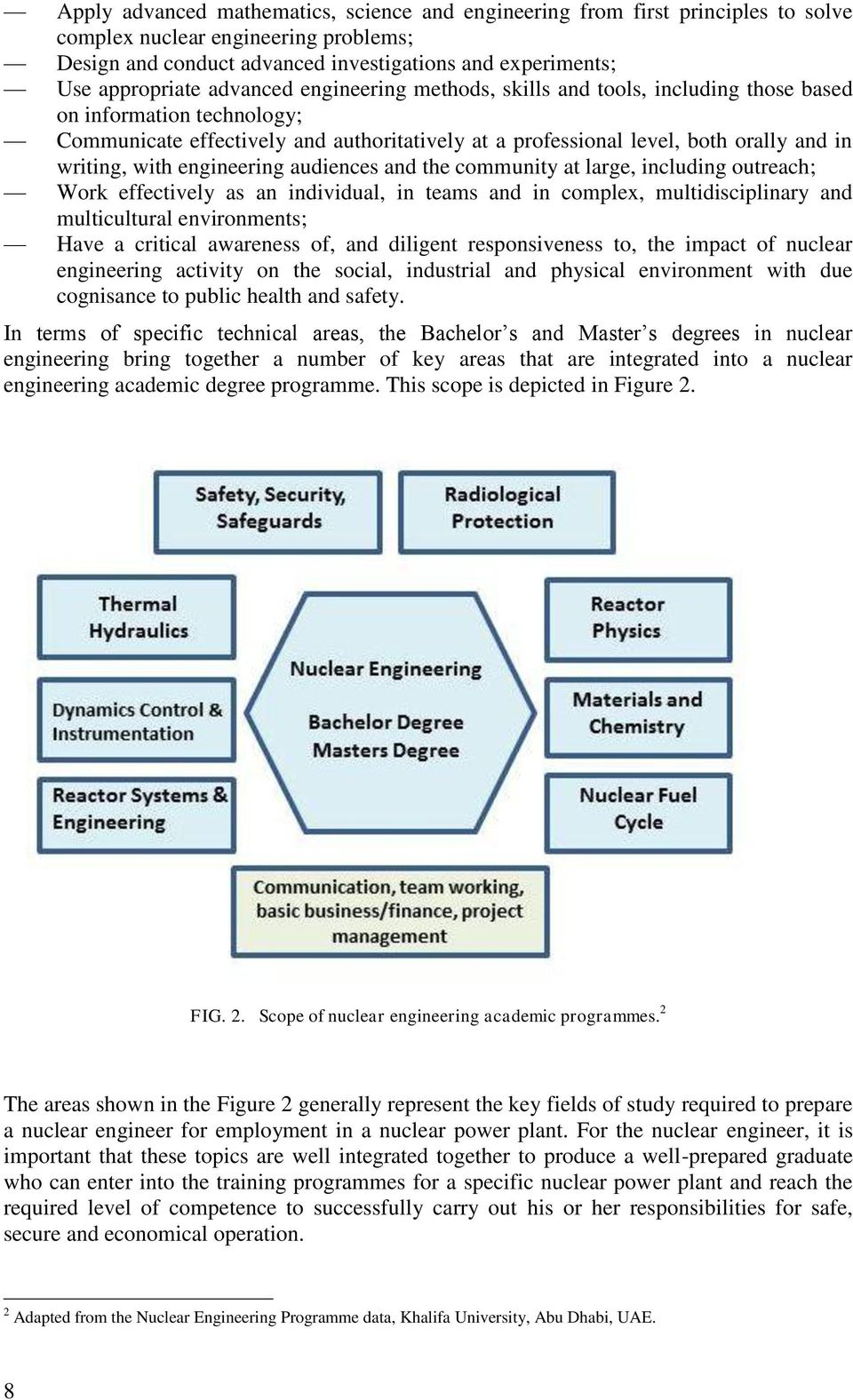
15 For universities developing new programmes, a more detailed description is useful. In the two following sections, the competencies are defined at both Bachelor s and Master s degree levels with the focus on those who will specifically be employed at nuclear power plants. In addition, requirements of the graduate are given in more detail, and involve what each student should possess: a specified level of knowledge (Knowledge), be able to demonstrate - application of the knowledge (Demonstration), and know when to implement the knowledge (Implementation). This can be represented as a knowledge ladder (see Figure 3). FIG. 3. The knowledge ladder COMPETENCIES OF GRADUATES WITH A BACHELOR OF NUCLEAR ENGINEERING It should be understood that having a good knowledge of basics in maths, physics, and chemistry is a prerequisite to perform well in a nuclear engineering education programme. The graduate with the qualification (degree) of Bachelor of Nuclear Engineering for nuclear installations must have the competencies shown below. These are divided into two categories. General competencies describe those basic and fundamental areas in which all engineers should have capabilities. Specific competencies are more directed to the field of nuclear engineering. The graduates must have the following abilities: 9

16 General competencies BC-I BC-II BC-III BC-IV BC-V Perform written and informal communications and reports in their national language and possibly English. Work effectively as part of a team, and to sustain creative collaboration with their colleagues. Work independently within the framework of their professional qualifications, and have a commitment to professional development throughout their career. Understand the basic laws of natural sciences including classical physics, chemistry, atomic and nuclear physics. Understand the basic approaches for acquiring, storing and processing knowledge, information and data; be familiar with standard computer code packages, including computer-aided graphics and design Specific competencies BC-VI BC-VII BC-VIII BC-IX BC-X BC-XI Conduct mathematical analysis and numerical simulation, and theoretical and experimental investigations in nuclear engineering. Conduct mathematical simulation of processes in components of nuclear power plants; apply standard methods and computer codes for design and analysis. Perform radiation protection and measurement experiments, and analyse resulting experimental data. Have a commitment to safety and an understanding of safety culture (including for example, risk analysis and management, human factor engineering, and man-machine interface). Understand the regulatory process and the role of the regulator in power plant licensing and operation. Participate in the design process of the principal system and components of nuclear power plants or other nuclear facilities, accounting for environmental and safety requirements, and incorporating new requirements and technologies REQUIREMENTS FOR A GRADUATE WITH A BACHELOR S DEGREE IN NUCLEAR ENGINEERING Upon completion of the degree of Bachelor of Nuclear Engineering for nuclear installations, the student must know the following (Knowledge), be able to demonstrate application of the knowledge (Demonstration), and know when to implement the knowledge (Implementation): Knowledge B1.1 Basics of analytical geometry and linear algebra, differential and integral calculus, probability and statistics, vector analysis, basics of differential equations and partial differential equation systems. B1.2 Basics of mechanics, oscillations and waves, thermodynamics, electrical and magnetic phenomena, statistical physics, physics of the atomic nucleus, and optics. B1.3 Neutron transport theory, thermal hydraulics, applications of computer code systems for mathematical simulation of thermo-physical and neutronics analysis. B1.4 Basic laws of heat and mass exchange in power equipment units of nuclear 10

17 power plants, requirements for heat transfer and heat removal systems, thermo-physical processes in heat exchangers. B1.5 Thermodynamic principles, types and operation of steam turbines, calculation of efficiency, reliability, operation and maintenance. B1.6 Materials properties, strength of materials, and materials requirements for nuclear power plants. B1.7 Numerical analysis of power reactors, reactor materials, the principal parameters associated with nuclear power plant operation, research and power reactors, and the basic dynamics of nuclear reactors. B1.8 The general role of control systems in nuclear reactors. Linear control systems. Operation of control rods, and burnable and soluble poisons. B1.9 The classifications of nuclear power plants, the main components including coolant loops, steam generators, steam turbines, the main reactor coolant circuitry and auxiliary systems. B1.10 Reliability and safety of nuclear power plant operation, understanding plants as a component of a regional or national electricity grid. B1.11 The main parts of the nuclear fuel cycle. The open and closed fuel cycles. Radioactive wastes, categories of waste, and treatment options, conditioning, reprocessing and final disposal. B1.12 Basic principles of radiation protection. Methods for detecting ionizing radiation. Hazards of radioactive materials. Concepts and definitions of radiation and dose units. Short term and long term biological effects of ionizing radiation. ALARA principles. B1.13 The regulatory environment for the operation of nuclear power plants. The role of the regulator. Responsibilities of nuclear power plant staff for safety. B1.14 Risks from the diversion of nuclear materials, the basic principles of nuclear safeguards. The Nuclear Non-proliferation Treaty and international agreements. The role of the International Atomic Energy Agency and other international organizations Demonstration B2.1 Through examination, conduct analysis of technical and scientific problems, to reach relevant and accurate conclusions based on the analysis. B2.2 Solve problems for real processes and determine technical solutions using current computational resources. B2.3 Develop designs for new applications utilizing fundamental scientific, mathematical and engineering principles Implementation B3.1 Analytical and numerical methodologies for analysis of reactor physics, thermal hydraulic and electric systems for analysing boundary-value problems. B3.2 Methodologies for planning and conducting experiments, and evaluating experimental errors. B3.3 Technical documents and publications, handbooks and other information resources. B3.4 Utilization of computing techniques to solve special problems. B3.5 Ability to design nuclear power plant systems including neutronics and core analysis, and heat transport electrical generation systems. 11
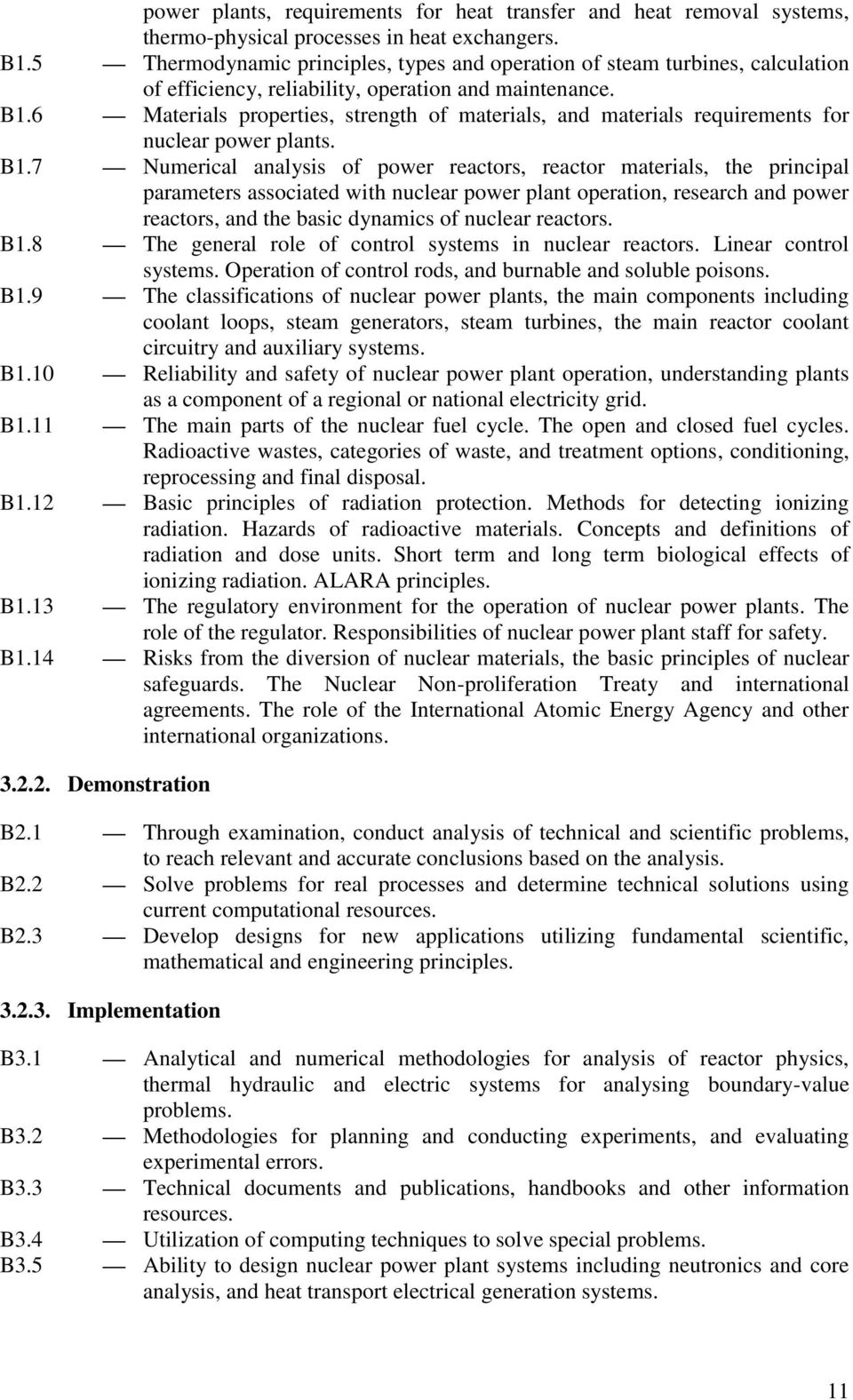
18 B3.6 Methodologies for ensuring the environmental safety of nuclear facilities COMPETENCIES OF GRADUATES WITH A MASTER OF NUCLEAR ENGINEERING The expectations and requirements for the graduates holding the Master s degree are higher than for the Bachelor s degree. This is in terms of both the depth and the breadth. For example, the schematic for the Master s degree is shown in Figure 4. Master s Nuclear Engineering FIG. 4. Master s Degree schematic. The purpose of this diagram is to highlight the fact that at the Master s level, the graduate should be able to integrate experimentation, computation and synthesis. This is key for the higher expectations of an individual holding the Master s degree. As with the Bachelor s degree, a more detailed listing for the Master s is given below.. If the academic curricula stop at Bachelor level, the employer has to complement the education with training providing the competencies at Master level if his/her job responsibilities require Masters level capability. In all cases, students who will be employed in nuclear installations will have to undertake plant specific training, the scope and depth of that training is depending on the scope and quality of the degree programme. It should be noted that a student can take a Master s of Nuclear Engineering course without holding a Bachelor s degree in nuclear engineering. For example, a Bachelor of Science in Physics or a Bachelor of Engineering (electrical, chemical etc.) could be sufficient to comply with the admission criteria. In that case, the Master programme has to provide these students with specialized courses covering core themes such as reactor physics, nuclear thermal hydraulics, nuclear fuels and materials, nuclear structural engineering, nuclear safety, nuclear 12
19 power plants and radiation, while avoiding duplication for students holding a Bachelor s degree in Nuclear Engineering. The graduate with the qualification of Master of Nuclear Engineering for nuclear power plants must have the competencies shown below General competencies MC-I MC-II MC-III Written and spoken English in professional and international settings, employing technically advanced terminology used in the nuclear power industry. Work collaboratively within a team and to exercise effective leadership of that team with good management skills while working towards a well-defined goal. Work independently, identify new directions, and demonstrate decision making capabilities within their sphere of expertise, and to have a commitment to professional development through their career Specific competencies MC-IV Understand thoroughly the basic and advanced laws of atomic and nuclear physics, chemistry and the relevant engineering sciences applicable to nuclear power plant technology. MC-V Be able to perform advanced mathematical analysis and numerical simulation of the various physics and engineering processes and systems in a nuclear power plant. MC-VI Understand data acquisition, storage and processing using recognized and accepted computer codes in the nuclear industry. MC-VII Be able to perform theoretical, numerical and experimental methodologies for analysis of thermo-physical processes. MC-VIII Use reactor experiments to characterize the basic physics in a nuclear reactor, by understanding and analysing the resulting data. MC-IX Understand nuclear power plant systems, with all the principal components. MC-X Design relevant systems by synthesizing the collective knowledge gained in all relevant disciplines. MC-XI MC-XII Be committed to safety and understand safety culture. Understand the regulatory process, the role of the regulator in nuclear power plant licensing and operation, and the main regulatory requirements for a nuclear power plant REQUIREMENTS FOR A GRADUATE WITH A MASTER OF NUCLEAR ENGINEERING As noted above, the Master s degree recipient is expected to have additional capabilities beyond the Bachelor s degree. Upon completion of the degree of Master of Nuclear Engineering for nuclear power plants, the student must know the following (Knowledge), be able to demonstrate application of the knowledge (Demonstration), and know when to implement the knowledge (Implementation): Knowledge M1.1 Advanced concepts of differential and integral calculus, probability theory and mathematical statistics, theory of functions of complex variables, vector and harmonic analysis, differential equations and partial differential equation 13

20 systems, Green s functions, and advanced mathematical analysis. M1.2 Electrical and magnetic phenomena, quantum mechanics and statistical physics, and physics of atomic nucleus. M1.3 Neutron transport theory and Monte Carlo analysis. M1.4 Basic elements of reactor experiments, approach to critical, measurement of reactor parameters, feedback mechanisms, analysis of data and the relationship to reactor theory. M1.5 Laws of heat and mass exchange, and the characterization of thermo physical processes in heat exchangers, steam generators and safety systems for heat removal in nuclear power plants. M1.6 Methods for detection of ionizing radiation, principles and design of radiation shielding, utilization of the ALARA principle and health effect of ionizing radiations. M1.7 Structural analysis of complex systems. M1.8 Use of information technology and numerical analyses, problem definition, and evaluation of results. M1.9 The various types of nuclear power plant systems, the principal components and their roles. M1.10 The role and importance of reactor safety, and the practices and procedures in a nuclear power plant to assure safe operation. M1.11 The components of the nuclear fuel cycle, the open and the closed fuel cycles, classifications of waste, handling, storage and disposal of the various types of radioactive waste, short-term and long-term biological effects of ionizing radiation. M1.12 Issues of nuclear non-proliferation, the role of safeguards, the Nuclear Nonproliferation Treaty and international agreements, and role of the International Atomic Energy Agency. M1.13 Concepts of physical protection of nuclear installations, nuclear security applied to nuclear materials, radioactive sources and nuclear facilities. M1.14 Principles of project management, and the utilization of these principles in an industrial organization. M1.15 The role of the regulatory authority, and how regulations are implemented and followed in a nuclear power plant. M1.16 Awareness of the technical and regulatory literature relating to nuclear power plants and their operation, familiarity of how to access and evaluate reports and articles Demonstration M2.1 Draw from the technical literature and develop independent analyses for nuclear power plant technology related problems. M2.2 Calculate main characteristics of random values, to solve the problems as applied to any real processes. M2.3 Develop mathematical models of thermo physical and neutronic processes in nuclear power facilities. M2.4 Utilize recognized and accepted computer codes to determine technical solutions, and evaluate the validity of those solutions. M2.5 Develop designs for new technical devices with accounting for the requirements previously defined. M2.6 Carry out testing of the main components in nuclear power plants, and perform technical analysis of the operation of these components. 14

21 M2.7 Develop the methodologies for safety upgrading of nuclear technologies. M2.8 Develop projects meeting technical requirements and standards as needed in a nuclear power plant. M2.9 To perform economic analyses for new procedures, systems or strategies that might be used in a nuclear power plant. M2.10 Develop management strategies for carrying out the mission of a nuclear power plant to generate electricity in a safe, economical and secure way Implementation M3.1 Design and implement the realization of new products or systems with applications to nuclear plant. M3.2 Design and implement the realization of new products or systems with application to radioprotection, nuclear safety, and nuclear security. M3.3 Design and realize new rules or processes for improving the management, the quality, the safety within a nuclear environment. M3.4 Technical English with usages and applications to a nuclear power plant and its associated technology. M3.5 Analytical and numerical methodologies for solving algebraic and differential equations, and processing of experimental data. M3.6 Methodologies for theoretical and numerical studies of thermo physical and neutronic processes. M3.7 Current computing techniques solving special problems. Standard computer code packages, various and finite-difference methodologies for solving second-order ordinary differential equations, and for the solution of boundaryvalue stationary problems, and the evaluation of experimental errors. M3.8 Methodologies for planning and conducting experiments, for fabrication of experimental installations, and for the organization of research and development studies. M3.10 Technical documents and publications, progress reports, handbooks and other information resources. M3.11 Methodologies for the design of components for nuclear power plants. M3.12 Project management skills to carry out collaborative efforts with other team members, for assessing the quality and efficiency of the personnel, and upgrading the personnel performance. M3.13 Organizational and managerial decision tools including knowledge management to achieve optimum outcomes with respect to quality, reliability, economy, safety and the protection of the environment. M3.14 Legislative and regulatory requirements for the safe and environmentally sound operation of a nuclear power plant. M3.15 Basic presentation and pedagogical skills. 4. SAMPLE CURRICULUM Based on the competencies and criteria outlined in the previous sections, the following are examples of curricula for programmes at Bachelor s and Master s Degree level. The curricula shown are not necessarily used at any particular university, but represent current approaches. Exercises, experiments and practical work need to be included in the courses. A two semester system making up the academic year is assumed in these examples. Activities during the 15
22 summer period including courses, projects or internships may be used. Some universities will also offer mini-masters between semesters to expand the offerings for the students. The credit for the various courses are not shown, since there are a number of approaches used in various countries ranging from semester hours, European Credit Transfer System (ECTS), lecture or contact hours, and other systems of assigning academic credit. The curricula below are meant to be illustrative and not definitive. No descriptions are given for the individual courses so that each university can map the requirements in Sections 3 4 onto the curriculum as needed by the individual university and national need. Nevertheless, these examples may be useful in creating programmes in nuclear engineering BACHELOR OF NUCLEAR ENGINEERING TABLE 1. SAMPLE CURRICULA FOR BACHELOR S DEGREE LEVEL Year 1 First semester Language and Communication Skills I Calculus I Physics I Chemistry I Introduction to Nuclear Engineering I Second semester Language and Communication Skills II Calculus II Physics II with Laboratory Chemistry II with Laboratory Introduction to Nuclear Engineering II Year 2 First semester Information Technology and Programing Ordinary Differential Equations Atomic Physics Mechanics of Materials Electric Circuits Analysis Intermediate Mathematical Analysis Engineering Ethics Second semester Introduction to Linear Systems Nuclear Physics Programing for Nuclear Engineers Electrical and Electronics Thermodynamics Engineering Materials and Laboratory Communication Skills for Nuclear Engineers Year 3 First semester Numerical Methods for Engineering Reactor Theory and Analysis I Fluid Mechanics Radiation Detection and Measurement I Radiation Protection Second semester Heat Transfer Reactor Theory and Analysis II Reactor Thermal Hydraulics Engineering Economics Advanced Engineering Analysis Year 4 First semester Nuclear Power Plant Systems Radiation Interactions and Shielding Nuclear Materials Nuclear Reactor Safety Nuclear Reactor Design I Second semester Reactor Instrumentation and Control In-Core Fuel Management Nuclear Reactor Laboratory Nuclear Reactor Design II Nuclear Fuel Cycle and Waste Management 16
23 4.2. MASTER OF NUCLEAR ENGINEERING The Master s programme typically takes two years, but in some countries can be completed in one year. Typically but not on all courses, depending on the requirements of the university, a Master s project or thesis may be required. Within a degree programme, the university may choose to offer elective courses focusing on options or themes so that students can develop a stronger background in a technical area. A typical Master s degree in nuclear engineering for nuclear power plants would encompass the following. TABLE 2. SAMPLE CURRICULA FOR MASTER S DEGREE LEVEL Year 1 First semester Nuclear and Radiation Sciences Nuclear Reactor Theory Nuclear Materials and Chemistry Radiation Detection and Measurement Second semester Neutronics of Nuclear Systems Reactor Thermal Hydraulics Radiological and Environmental Impacts Nuclear Reactor Laboratory Year 2 First semester Second semester Nuclear Instrumentation and Control Nuclear Regulation and Licensing Probabilistic Safety Analysis Nuclear Security and Safeguards Reactor Systems and Safety Nuclear Systems Design Nuclear Fuel Cycle and Waste Management Master s Thesis or Project Note: Project and Risk Management and Economics of Energy can also be included at Master s level. 5. PROGRAMME IMPLEMENTATION The development of a quality curriculum is a key to the establishment of a nuclear engineering educational programme. However, as important are the steps used to implement the programme. It is essential that these programmes are implemented by competent teaching staff, which they make good use of information and communications technologies such as e-learning tools and simulators, and that students can benefit from experimental facilities and research reactors, if available, particularly for master programmes. The curriculum should adhere to accepted international practices. It must be approved by the responsible governmental ministries and authorities. It is also essential, where possible, to involve the organizations that will be hiring the graduates. This can be done in several ways. A common best practice is to have an external advisory board, with membership made up of potential employers, alumni associations, governmental organizations, professional and scientific societies, research laboratories, and universities. This type of board will provide on-going input and feedback and can be very helpful in assuring the continued quality, and relevance, of the academic programme. Additional benefits can be achieved through collaboration between universities and the nuclear industry, which is a potential employer. Internships or co-operative education 17
24 experiences will add significantly value to the education of students. It provides a deeper understanding of the material being presented in courses. It also allows the students to see the expectations they will face after graduation in an industry environment. It is also very useful to have representatives from industry, government agencies and research laboratories come to the university to present talks and seminars, and to give lectures in class relating to their technical or scientific expertise. As part of developing a nuclear engineering academic programme, it is very positive to establish a student chapter of a professional or learned society. This further expands the outlook of the students, and conveys the need for professionalism in his or her career. If it is possible, enabling students to attend professional or technical meetings, regional, national or international, adds significantly to their educational experience. International cooperation through exchanges of students and joint programmes can also contribute significantly to the education of competent nuclear engineers. Sharing resources is a tendency and a necessity. A number of regional and national educational networks and consortia dealing with nuclear engineering education are playing important roles in sharing curricula, programmes and opportunities for students. Each of the networks has its own characteristics and is unique [8, 9]. The scope is aimed at meeting particular regional and national needs, but basic goals are similar: exchange of information, resources and best practices. In Canada, for example, the University Network of Excellence in Nuclear Engineering (UNENE) has a strong link with industry. UNENE supports, for instance, the establishment of Industrial Research Chairs at universities in Canada to strengthen academic offerings in key technical areas relating to nuclear technology. In Russian Federation, the National Research Nuclear University (NRNU MEPhI) centred on the Moscow Engineering Physics Institute brings together 23 campuses across the country. This new institution embodies all the capabilities in nuclear engineering education. In France the Institut International de l Energie Nucléaire (I2EN) created under the auspices of the French Council for Nuclear Education and Training, located on the Saclay campus, comprises a network of the best nuclear engineering curricula in France in particular those taught in English, and an in-house team in charge of promoting the French offer in nuclear education and training. The French nuclear industry is closely associated with this institute. In the United Kingdom, the Nuclear Technology Education Consortium (NTEC) provides a onestop shop for a range of postgraduate education and training in Nuclear Science and Technology. Also Japan and Mexico have created recently national networks to coordinate and concentrate efforts. In Europe, the European Nuclear Education Network (ENEN), links universities from a number of countries and helps to promote quality uniform curricula in nuclear education. They have created a European Master of Science in Nuclear Engineering (EMSNE). In Asia, Latin America and Africa, similar initiatives are under way with the sponsorship of the IAEA: the Asian Network for Education in Nuclear Technology (ANENT), the Latin America Network for Education in Nuclear Technology (LANENT) and the African Regional Cooperative Agreement Network for Education in Nuclear Science and Technology (AFRA-NEST). They link programmes and institutions related with nuclear education in different countries promoting high quality nuclear education. For emerging countries developing nuclear engineering educational programmes, these networks are of immense value for resources and information. A good strategy to support nuclear education efforts is to become affiliated with networks in the region. To assure quality and to provide a framework to measure performance and improvement of nuclear engineering educational programmes, it is important to employ a set of benchmarks. These are especially useful in gauging the status of a university against the best academic 18
25 programmes in the world. The benchmarks provided in Appendix I are not meant to serve as a set of formalized evaluation criteria. Instead these will allow an institution to gain insight into its own status and programmes to enable it to improve, if necessary, or maintain the highest standards. The benchmarks will also provide guidance for further development, improvement and investment of resources. 6. ACCREDITATION OF PROGRAMMES To assure quality and continued relevance, on-going accreditation of academic programmes is of major importance and this is carried out in a variety of ways. In some countries, the accrediting function is performed by government ministries and agencies. Elsewhere it may be handled by professional or learned societies. A third approach is to have accreditation handled by independent organizations. Historically, accreditation approaches of academic programmes primarily focused on content. For engineering, this was based on examining the curricula to determine if sufficient attention was being given to areas including mathematics, the physical sciences, engineering sciences and design. However, over the past decade, a shift has taken place in the emphasis to include a more outcomes based approach. The accreditation review should include assessments of the performance of a graduate in his or her role as an engineer 3. Programme outcomes may be best defined as the quality and quantity of graduates, together with the roles and impacts they have in their careers and for their employers. An effective nuclear engineering programme should engage with the organizations that employ their graduates to determine the quality of the preparation of the students for a career in industry. A well-organized link with the employing organizations provides a critical feedback that leads to continuous improvement. A well-defined set of criteria should be developed by the accrediting organization and presented to the academic institution well in advance of an accreditation visit. This is necessary to enable the faculty/department to implement the curriculum/a needed to meet the criteria. For creditable accreditation two features are vital: (1) Educational programmes are, by their nature, long-term endeavours to graduate students over three to six year time frames. As the accreditation criteria need to be stable and have continuity the accrediting organization must establish clear and consistent criteria. They must not be continually altered, as it will dilute the quality of the educational programmes. (2) The reviews must be done on a regular periodic schedule, which could be every 3-5 years. A sufficiently long period of time enables the faculty/department to implement changes and improvements, and allows the organization to properly prepare for the next review. The following are the key elements in a well-established accreditation process: 6.1. SELF-EVALUATION REPORT Based on an existing or evolving programme, the faculty or department has a process for preparation a self-evaluation report describing its capacity to deliver an educational programme in a particular technical field or discipline. 3 The review normally includes feedback from the employers of the graduates relative to their satisfaction with academic preparation and performance of the graduates. 19
26 The structure of the self-evaluation report should include information on the following elements: Period covered by the evaluation; Faculty/department presentation and history; Accreditation procedure; Comparison to national (or international) standards; Type and duration of the proposed education programme; Involvement of industry in the programme development and implementation; Main objectives; General and specific competencies of the graduates. Actions to attract and retain the best staff members and students: Capabilities of the academic staff (CV s, involvement in the teaching, research and administrative activities of the evaluated department, etc.); Demography of the staff (age distribution, gender balance), existence of performance review, training and succession plan for the staff; Existing infrastructure (laboratories, soft/codes, etc.); Curriculum; Course and application description; Average time for the completion of the programme Involvement in research programmes or projects related to the chosen technical field (mainly for Masters) QUALITATIVE AND QUANTITATIVE CRITERIA The qualitative criteria define the must do of the educational programme, while the quantitative components impose a threshold and give the control instrument for quantifying performance. These criteria establish the standard. The standard should be high and challenging to reach PEER REVIEW The accrediting organization will nominate a peer review committee or commission to evaluate the performance of the accredited faculty/department. The reviewers should have the competence and standing in the field to serve as an objective reviewer. In addition, the accrediting organization should seek feedback from the faculty/department regarding the reviewers to assure that they are qualified to serve in this role. After having examined the self-evaluation report, the committee/commission will carry out a visit to the faculty/department for an on-site review. The visit should include interviews with professors, students and administrators, tours of teaching laboratories and facilities, and observations of student output including homework assignments, papers and examinations. Based on all this information, the committee/commission issues its conclusions if the programme has met the standards, criteria and performance indicators FACULTY/DEPARTMENT FEEDBACK The faculty/department should have an opportunity to see the report and respond to issues and recommendations that have been made. These responses should be taken into account by the accrediting organization in arriving at the final conclusions and actions. In most cases, the faculty/department will be given some period of time to implement any needed changes or improvements. 20
27 6.5. FINAL ACCREDITATION Upon consideration of the committee/commission report and any response from the university, an accrediting organization will decide to maintain/approve or deny accreditation of the programme. Provisional accreditation may also be granted pending an interim review. Experience has indicated that the accreditation process is time consuming and involves essentially all academic staff of a faculty/department. It shows not only the potential to provide a specific programme, but also the organizational capability. However, the accreditation process with well-defined standards and periodic reviews are critical in assuring the quality and timeliness of academic programmes. 7. CONCLUSIONS The use of nuclear energy has many positive aspects. It must, at all levels from design, construction, plant operation to waste disposal and decommissioning, comply with the highest requirements of safety and security. Nuclear managers, engineers and technicians must adhere to a strong culture of safety, and demonstrate professionalism, responsibility and appropriate ethics in the workplace and in society. In this regard, education is paramount. A nuclear engineer must acquire skills that make it possible to tackle complex technological situations in a rigorous, rational, and pragmatic manner. An engineer s competence is firstly based on a strong and rigorous foundation of mathematics and the physical sciences. However, no single unique approach exists to achieve the required high standards of knowledge and skills as each country has its own system of education from primary school to university Therefore, the common requirements for a nuclear engineer coupled with specific national educational systems serve as the basis in developing a nuclear engineering curriculum. The curriculum should rely on the proven established practices of the national educational system, as well as the best practices that the international community has developed over decades, including those for a qualified nuclear engineer. For countries considering the establishment of nuclear engineering educational programmes, or other countries that are reassessing and strengthening existing programmes, this document is meant to provide insight and guidance on common curriculum requirements. This document provides guidance for the design of a curriculum that would be best suited to: A national educational framework; The needs of future employers; Developing competences; The availability of experimental facilities and simulators; Using the benefits of international collaboration. Openness is a key factor to the success and quality of any new curricula in nuclear energy. This document is also aimed at encouraging fruitful collaborative exchanges from universities and schools currently offering well-recognized nuclear energy programmes. Some key points should be recognized regarding this document. It represents the recommended requirements for a nuclear engineering programme that are needed to produce a graduate who can enter into employment in the nuclear energy industry. The document represents best practices used around the world in well-established nuclear engineering programmes at prominent universities. It is further recognized that in any particular country, a university must meet mandatory accreditation and other requirements imposed by national bodies or accrediting organizations. 21
28 The ultimate goal in this entire process is to produce a competent engineer who can serve productively and responsibly in the nuclear energy industry. As noted in Section 2, this can be achieved in several ways by means of various combinations of education and industry training. In fact, any country must take a holistic approach to producing the competent workforce for the nuclear energy industry that includes the appropriate combination of university education, industry training and formal instruction that conforms to national practices but achieves the required result. This document is intended to provide a contribution to this effort. In addition, elements of the requirements described here, especially in the areas of safety and security, are applicable to the educational/training programmes that produce engineers and technical staff of all backgrounds for the nuclear energy industry. The observation that an accident anywhere is an accident everywhere does not apply more strongly that it does in the nuclear industry, especially at this point in history. One of the key components of defence in safe and secure operation is a well-prepared workforce. The goal of this document is to assure that this workforce is in place for each country that seeks to enjoy the benefits of nuclear energy. 22
29 Appendix I AN APPROACH FOR BENCHMARKING UNIVERSITY PROGRAMMES I.1. INTRODUCTION The IAEA-TECDOC-1586 Planning and Execution of Knowledge Management Assist Missions to Nuclear Organizations [10] detailed the concept of knowledge management (KM) assist missions for nuclear organizations. These missions were introduced in 2005 to: Facilitate the transfer of pragmatic KM methodologies and tools; Assist Member States considering implementation of nuclear power programmes to integrate KM in their management system from the very beginning; Provide specific consultancy services to address emergent problems and long-term issues related to KM and associated issues; Assist organizations formulate detailed requirements and action plans related to KM. Help organizations identify, by self-assessment, their own KM maturity levels against a set of pre-defined criteria. It has been identified that additional reference criteria are needed when planning and executing KM assist missions to nuclear educational organizations [11]. The remit of this appendix is to provide the additional structure and reference criteria required to facilitate a successful assist mission to educational organizations such as universities and other higher educational institutes that provide tertiary education. To assure quality and to provide a framework to measure performance and improvement of nuclear engineering educational programmes, it is important to employ a set of benchmarks. These are especially useful in gauging the status of a university against the best academic programmes in the world. The benchmarks are not meant to serve as a set of formalized evaluation criteria. Instead these will allow an institution to gain insight into its own status and programmes to enable it to improve if necessary or maintain the highest standards. The benchmarks will also provide guidance for further development, improvement and investment of resources. In this appendix, the approach to benchmarking and the individual criteria are discussed. Qualitative definitions and descriptions are found in Section I.3. In Section I.4, more quantitative guidelines appear that are drawn from the strongest and most highly acknowledged nuclear engineering programmes around the world. I.2. PROPOSED BENCHMARKS To compare and assess nuclear engineering courses delivered at any educational organization in any country it is important to establish a consistent set of metrics. These can then be used for any visit, by any expert or IAEA personnel and will provide the structure for any assist mission. Eight specific benchmarking criteria have been identified: Policy, strategy, vision and mission of the educational organization; Their capacity to deliver nuclear engineering programmes with particular reference to the staff and facilities; Educational curricula; Outcomes of the programme including student destinations; Professional accreditation; Human resource policy; International dimensions; Collaboration with industry. 23
30 An assessment of the standard of the educational organization in each of these criteria will enable suitable benchmarking to be undertaken, not only with other organizations but also over time with historical data. I.3. DESCRIPTIONS AND IMPORTANCE OF THE BENCHMARKING CRITERIA In this section, definitions and qualitative descriptions are provided for each of the criteria. It is envisaged that any assist mission will commence with a summary presentation, including a short history, by the educational organization. Other details to be included in the presentation are: Number of faculties/departments/schools and brief overview of its structural organization; Any educational and research specialities that the organization has developed; An overview of facilities that enable the nuclear educational programmes to be offered; International partnerships; Industrial partnerships; Number of students and academic staff; How funding for the organization is obtained, detailing government/state contributions, industry contributions and student fees including the provision of any bursaries. I.3.1. Policy, strategy, vision and mission (subdivide into university-wide policy and nuclear engineering department specific) It is critical that an educational organization and the nuclear engineering department establish well-defined and clearly stated policies that define their mission and vision, and outlines the strategies to achieve these. There are a number of factors that determine these that have to be defined within the national context. Each university will have its role to play to meet national needs and in some cases, it may be a unique role. The extent of the policy, strategy, vision and mission will be governed by the funding available to carry out its programmes. It is therefore important that any educational organization and/or nuclear engineering department have realistic goals, yet sets them appropriately high to contribute to improvement over time. Information provided by the educational organization should include: How the educational organization and the nuclear engineering department s policy, strategy, vision and mission are aligned with national policy? How important is the provision of nuclear education to the overall organization? Where does the nuclear engineering programme sit undergraduate, post-graduate, part-time, full-time etc.? What are short-, mid- and long-term strategies of the organization and department? How much collaboration is there with industry, the nature of the collaboration, how does it contribute to the delivery of the programme, is it being developed? What are the international dimensions of the organization, department and programme? What is the strategy for attracting and enrolling students and are there criteria for student selection? What is the strategy to attract the highest calibre students? Is there a strategy in place to track and maintain interaction with alumni? How are administrative responsibilities split between the organization, department and staff? Is there a communication policy and who receives the communication? Is there a Knowledge Management policy, and if so, how is it implemented? 24
31 I.3.2. Capacity to deliver nuclear engineering programmes, people and facilities A key benchmarking criterion is the capability of the organization to deliver nuclear engineering programmes. In comparison to other curricula, even technical curricula, nuclear engineering is one of the more challenging and costly for universities to offer. It requires highly skilled and professional teachers with facilities that often require the capacity to hold and use radioactive materials. In some cases, universities have sub-critical and critical reactors. The teaching staff must have the background and standing to teach in the field. It is normally expected that the majority of the teaching staff will hold the highest degree, usually a PhD (or Candidate s) degree. It is often helpful that the teaching staff have other experience as well, either in research laboratories or industry. Through research, scholarly activities and contributions to the field, teaching staff should be recognized by their peers. This contributes to the capacity of the university to deliver nuclear engineering programmes. Facilities are also important. Due to the nature of radioactivity and nuclear processes extra safety and security will be required for the facilities and consequently extra expense. Safety must not only be an integral part of the curriculum, it must be incorporated into the operation of the programme. The facilities must be sufficient to convey the basic principles of the profession but for vocational subjects such as nuclear engineering, it is important that the facilities are sufficiently up-to-date to familiarize students with current practices and replicate industrial and national research laboratory equipment. Information provided by the educational organization should include: The qualifications and quantity of staff; The experimental facilities at the educational organization or access arrangements to experimental facilities; Access and use of any simulators; Access and use of any libraries; Access and use of any computer facilities; Quantity and quality of peer-reviewed publications authored by the department; Conference/workshop/seminar (including internal) attendance policy to enable knowledge sharing; Availability of scholarships for students and selection criteria; Is the programme flexible enough to allow students the time to supplement their income through working to support their studies? Is distance learning tools being used, and how are they implemented? Is the programme ranked nationally and internationally, and which criteria are used to determine rankings? What is the student-teacher ratio for lectures, tutorials and practices? I.3.3. Curricula A substantive curriculum is vital for a successful nuclear engineering programme. While there is no international standard as to the contents of nuclear curricula, there is substantial consensus among nuclear educators around the world of what constitutes a good quality nuclear engineering curriculum (see sections 3 and 4 above). The content generally includes atomic and nuclear physics, radiation detection and measurement, reactor physics and analysis, thermal hydraulics and safety, health physics and radiation protection, fuels and materials, structural mechanics, reactor systems and design, all supported by appropriate laboratory and computer experiences. Other associated topics are sometimes included depending on the expertise of the teaching staff. These topics increase the choice of courses 25
32 for potential students by providing variations to the overall curriculum. Each country and region has its own unique format and approaches, so the topics can be adapted to fit the local needs in terms of courses, classes and contact hours with students. Variations in course deliver methods may occur but the curricula must represent the depth and breadth of the scientific and topical areas needed for a successful nuclear engineering programme. The courses specific to nuclear engineering should be preceded and supported by courses in mathematics, general physics, chemistry, engineering and computing at a sufficiently high level. These courses are not listed among the specific core courses. The core courses of any nuclear engineering programme can be summarized as: Introduction to nuclear energy; Introduction to nuclear physics; Nuclear reactor theory; Nuclear thermal-hydraulics; Nuclear materials; Nuclear fuel cycle; Instrumentation, control and operation; Radiation protection and nuclear measurements; Safety principles and practices; Advanced nuclear courses. Experimental reactor physics is recognized as a key component of a successful nuclear engineering programme, but circumstances may prevent easy access to such a facility. With many research reactors available worldwide, the educational organization without such a reactor should endeavour to ensure access to a suitable facility at another university or research institute. Information provided by the educational organization should include: How are the core courses supported by general courses of mathematics, general physics, chemistry, engineering and computational courses? How is it ensured that the nuclear engineering students get the required level of competency in these fields before taking the core courses? How are soft competences (communication, team working, basic business/finance, project management, knowledge management) obtained? Are all the core courses included as mandatory courses by the educational organization? The syllabus for each core course; How many elective nuclear related courses are offered? Information on the breadth of elective courses; How are the nuclear industry needs reflected in the curricula? How is student feedback gathered, reported and how does it affect the development of the programme? How the overall programme evaluated and continuous improvement is obtained? I.3.4. Outcomes of the programme The best conceived programmes in any educational discipline have little value without good outcomes. Programme outcomes may be best defined as the quality and quantity of graduates, together with the roles and impacts they fulfil in their careers and for their employers. An effective nuclear engineering programme should engage with the organizations that employ their graduates to determine the quality of the preparation of the students for a career in industry. A well-organized link with the employing organizations provides a critical feedback that leads to continuous improvement. 26
33 Information provided by the educational organization should include: What are the student failure and graduation rates for the courses? How are relationships with alumni maintained? How many graduates remain in the nuclear profession after completion of the course and are any connection maintained throughout their career? What is the industry demand for your graduates? What is the form of the feedback and evaluation from students and industry? I.3.5. Accreditation of the programme Independent assessment, review and evaluation by organizations external to the university are vital for the credibility of any academic programme, although approaches to accreditation vary widely. In some countries, a government ministry or agency carries out the accreditation. Alternatively separate organizations, non-governmental in nature undertake the accreditation. The accreditation process is extremely important to assure quality in nuclear engineering academic programmes. For creditable accreditation two features are vital (1) Educational programmes are, by their nature, long term endeavours to graduate students over 4 6 year time frames. As the accreditation criteria need to be stable and have continuity the accrediting organization must establish clear and consistent criteria. They must not be continually altered, as it will dilute the quality of the educational programmes. (2) The reviews must be done on a regular periodic schedule, which could be every 5 10 years. A sufficiently long period of time enables educational organizations to implement changes and improvements, and allows the organization to properly prepare for the next review. Information provided by the educational organization should include: What is the organization that performs the accreditation? What type of organization performs the accreditation? What authority does the accrediting organization have? Is it a national organization? What is the period of evaluation? What information is provided by the educational organization for the accreditation? Is the information provided in a standard format? Is there any element of peer review inherent in the process? How does the educational organization reply to the review, particularly if the accreditation is critical of the programme or has failed, what is the process for ensuring the programme can address the identified shortcomings and re-gain accreditation as soon as possible? Are the recommendations offered by the accrediting organization mandatory for the educational organization? I.3.6. Human resource policy Educational institutions have the continual challenge of maintaining scientific and technical competence and expertise while revitalizing and sustaining their research and teaching capability by the recruitment of less senior teaching staff. This is proving to be especially important in the field of nuclear engineering education. Experts talk of the missing generation in the nuclear industry from approximately 1980 to 2000 when nuclear did not appear to provide a good career, and young people chose other options. In some countries the situation seems to be even more severe in nuclear engineering education where the average 27
34 age of the university faculty members is reaching a point that may soon become a crisis. For nuclear energy to have a future, it is vital to solve any potential staffing problems at the educational organizations. A well-conceived human resource policy is required to identify and hire young teaching staff. The policy must also include those elements that make a career in academia attractive to young professionals with a PhD, compared to other sectors of the nuclear industry such as research laboratories, industry or government agencies and regulators. To make academic careers attractive will require competitive salaries, as well as an environment conducive to carrying out rewarding teaching, challenging research, and professional development. The university may have to establish close links with industry and governmental nuclear technology research institutions, and invest in laboratories, equipment or state-of-the-art computational resources to attract, and retain, the best and the brightest. The second component is the human resource policy for the existing faculty members. There must be good opportunities for professional development. These can include attending conferences to present the results of their research, scholarships to publish papers, and interaction with peers both nationally and internationally. Some universities have a sabbatical leave policy in which staff can spend a semester or year at other locations outside the educational organization. The sabbatical experience allows staff to become familiar with the latest developments in their field and can provide other qualitative and quantitative benefits. Whatever the approach, a well-developed human resource policy is critical to the effective functioning and sustainability of quality nuclear education programmes. Information provided by the educational organization should include: How are quality people attracted to the programme, and what are the policies to retain them? What are the demographics (age distribution, gender, etc.) of the department/faculty/educational organization? What is the policy on visiting staff and sabbaticals for existing staff? Is there a performance review system and how is it implemented? Is there a constantly evolving succession plan? Is there any special development programme for less experienced staff? How is the experience of nuclear experts close to retirement or retired utilized? Has a risk assessment for the loss of experienced teaching staff and its knowledge been undertaken? What is the distribution of the academic staff positions? What is the recruitment, retention and career development policy for support staff? I.3.7. National and international dimensions It is now self-evident that nuclear is a global industry with international partnerships or joint ventures announced on a regular basis. Nuclear engineering education needs to reflect this evolution with international collaboration essential for educational organizations with nuclear engineering education programmes. Students benefit immensely from an international experience as part of their education and staff are more effective as they build international linkages. Numerous opportunities exist to build new types of cooperation across national boundaries and they should be encouraged as much as possible to the benefit of the programmes and students. To facilitate this international collaboration education networks are being formed in many regions of the world. Universities carrying out nuclear engineering education should have strategies and agreements regarding the international component of their programmes. 28
35 Information provided by the educational organization should include: How is participation in educational and professional networks/forums encouraged? How are links with professional (learned) associations and societies supported? What interaction exists with national and international bodies/agencies? Are students able to undertake any part of their studies at other national or international educational organizations? Does any of the teaching staff teach at other national or international educational organizations? Are there any Memorandums of understanding/agreements with other national or international educational organizations? Is any part of the nuclear engineering programme taught by visiting staff from other national or international educational organizations? I.3.8. Collaboration with industry Due to the vocational nature of nuclear engineering education programmes, industry is usually the largest employer of the graduates. The career path to become a nuclear professional is usually divided into two parts: university education and industry training. These two parts should be matched and should fit well together. Therefore collaboration with industry is very important. It also helps to define the expectations from industry of the students who will graduate. The university should determine what type of facilities and equipment are used in industry and to the extent possible acquire any suitable comparable advanced equipment that will improve its educational programmes. Collaboration with industry can also bring additional very valuable resources to the university, either in the form of donated equipment, in-kind contributions or time by industrial personnel to help with the teaching, and in some cases funds that allow the university to make investments. Collaboration with industry can be implemented through student internships as part of the curricula. It is also appropriate in many cases to have an external advisory board comprising of representatives from industry that can advise on the content and structure of the programme. Nuclear engineering education programmes are well served by building in-depth, mutually beneficial collaboration with a broad range of industries. Such collaboration may also provide opportunities for teaching staff to gain industry experience. Information provided by the educational organization should include: Is there an external advisory board, and if so what are its composition, role, input and frequency of meeting? Does industry provide any internship for students? Does industry support students through prizes, awards, scholarships, etc.? Does industry offer support for theses (diploma) work by providing project placements with associated costs? Does industry provide support towards infrastructure development? Are there any joint research projects between academia and industry? Do staff attend any courses with industry for continuous upgrading and professional development of personnel? Does the educational organization offer any short courses for upgrading of industry personnel? Are any industry specialists involved in the educational process? Are any staff members of any industrial forums/bodies/networks? 29
36 Appendix II CONTENT OF THE ACCOMPANING CD ROM (EXAMPLES OF CURRICULA ON NUCLEAR ENGINEERING) The presented on the attached CD ROM examples of curricula for programmes at Bachelor s and Master s Degree level are based on the competencies and criteria outlined in the previous sections and presented in the document for illustrative purposes. The curricula shown are not necessarily complying with all mentioned in the document requirements but represent current approaches in Member States and could be useful for benchmarking and curricula development, particularly for newcomer countries. 1. Vienna University of Technology/Atominstitute (Austria) Nuclear Engineering Courses 2. University of Ontario Institute of Technology (Canada) Bachelor of Nuclear Engineering Master of Nuclear Engineering 3. University Network of Excellence in Nuclear Engineering UNENE (Canada) Master of Nuclear Engineering 4. Harbin Engineering University (China) Bachelor s programmes in Nuclear Engineering and Technology Master s programmes in Nuclear Engineering and Technology 5. Institut International de l Energie Nucléaire (France) Master of Science in Nuclear Energy 6. Budapest University of Technology and Economics (Hungary) Bachelor in Power Engineering Master in Power Engineering 7. University of Technology (Malaysia) Bachelor in Nuclear Engineering 8. University of Pitesti (Romania) Master in Nuclear Technologies and Materials 9. National Research Nuclear University MEPhI (Russian Federation) Engineer in Physics of Nuclear Power Installations 10. Nuclear Engineering Department, Universidad Politecnica Madrid (Spain) Master in Nuclear Science and Technology 11. Khalifa University (UAE) Nuclear Engineering Accredited MSc Curriculum 12. School of Mechanical, Aerospace and Civil Engineering, University of Manchester (United Kingdom) Bachelor of Engineering Master of Engineering 13. University of Manchester (United Kingdom) Master of Science in Nuclear Science and Technology 14. Texas A&M University (USA) Bachelor of Science in Nuclear Engineering Master of Science in Nuclear Engineering 15. European Nuclear Engineering Network (ENEN) Prerequisites and basic courses content 30
37 REFERENCES [1] INTERNATIONAL ATOMIC ENERGY AGENCY, Milestones in the Development of a national Infrastructure for Nuclear Power, IAEA Nuclear Energy Series No. NG-G-3.1, IAEA, Vienna (2007). [2] INTERNATIONAL ATOMIC ENERGY AGENCY, Workforce Planning for new Nuclear Power Programmes, IAEA Nuclear Energy Series No. NG-T-3.10, IAEA, Vienna (2011). [3] INTERNATIONAL ATOMIC ENERGY AGENCY, Maintaining Knowledge, Training and Infrastructure for Research and Development in Nuclear Safety, INSAG- 16, IAEA, Vienna (2003). [4] INTERNATIONAL ATOMIC ENERGY AGENCY, Managing Nuclear Knowledge: Strategies and Human Resources Development, Summary of an International Conference, 7 10 September 2004, Saclay, France, IAEA Proceedings STI/PUB/1235, IAEA, Vienna (2006). [5] INTERNATIONAL ATOMIC ENERGY AGENCY, Human Resource Development for Introducing and Expanding Nuclear Power Programmes, Summary of an International Conference, Abu Dhabi, United Arab Emirates, March 2010, IAEA Proceedings Series, Vienna (in preparation). [6] NUCLEAR ENERGY AGENCY, Nuclear Education and Training: From Concern to Capability, NEA, Paris, [7] INTERNATIONAL ATOMIC ENERGY AGENCY, Status and Trends in Nuclear Education, IAEA Nuclear Energy Series No. NG-T-6.1, IAEA, Vienna (2011). [8] INTERNATIONAL ATOMIC ENERGY AGENCY, The World Nuclear University: New Partnership in Nuclear Education, IAEA-WNU, IAEA, Vienna (2007). [9] INTERNATIONAL ATOMIC ENERGY AGENCY, Asian Network for Education in Nuclear Technology (ANENT), IAEA-ANENT, IAEA, Vienna (2007). [10] INTERNATIONAL ATOMIC ENERGY AGENCY, Planning and Execution of Knowledge Management Assist Missions for Nuclear Organizations, IAEA-TECDOC- 1586, IAEA, Vienna (2008). [11] INTERNATIONAL ATOMIC ENERGY AGENCY, Knowledge Management for Nuclear Research and Development Organizations, IAEA-TECDOC-1675, IAEA, Vienna (2012). 31
38 32
39 ABBREVIATIONS AFRA-NEST ALARA ANENT ECTS ENEN I2EN IAEA KM LANENT LL MS NPP NRNU MEPhI NTEC PSA UNENE African Regional Cooperative Agreement Network for Education in Nuclear Science and Technology as low as reasonably achievable Asian Network for Education in Nuclear Technology European Credit Transfer System European Nuclear Education Network Institut International de l Energie Nucléaire International Atomic Energy Agency knowledge management Latin America Network for Education in Nuclear Technology lessons learned Member States nuclear power plant National Research Nuclear University MEPhI Nuclear Technology Education Consortium probabilistic safety analysis University Network of Excellence in Nuclear Engineering 33
40 34
41 ability Annex GLOSSARY 1 The mental or physical power or talent to undertake an activity, either innate or acquired through learning, practice and undergoing training. Ability encompasses attitudes, knowledge and skills. accreditation The formal process of approval against established standards by an independent body. attitudes The observable characteristics of individuals resulting from their personal emotions, values and feelings that determine ways in which they interact with others and their work, and so affect their interpersonal relationships and approach to their job and safety issues. Together with knowledge and skills, attitudes provide the full requirements to competently undertake a given job or task. Bachelor s degree An academic degree awarded to individuals who have undergone an undergraduate course or major that range from three to four years depending on the national educational system. certification The process by which an authoritative organization/body provides written endorsement of the satisfactory achievement of competence of an individual. Certification can follow the satisfactory completion of a performance-based training programme or of a theoretical course of study. In other practices, this process is termed Qualification. See Qualification. competent Adequately qualified for a job or task. competence (competency) (1) The ability to put skills, knowledge and attitudes into practice in order to perform activities or a job in an effective and efficient manner within an occupation or job position to identified standards; (2) A combination of knowledge, skills and attitudes in a particular field, which, when acquired, allows a person to perform a job or task to identified standards. Competence (competency) may be developed through a combination of education, experience and training; (3) A term competency is also used for a generic task or a function (e.g. for nuclear facility manager jobs). Comment: In the nuclear engineering educational/training process a distinction is made between general engineering competencies, which describe basic and fundamental areas, and 1 INTERNATIONAL ATOMIC ENERGY AGENCY, Means of evaluating and improving the effectiveness of training of nuclear power plant personnel, Annex B: Terms in the Field of Nuclear Power Plant Personnel Training, IAEA- TECDOC-1358, IAEA, Vienna (2003). 35
42 specific competencies, which are more directed to the field implementation on nuclear engineering. core competences/competencies Fundamental competences/competencies that are needed in order to be able to undertake a specified range of jobs. See Competence/Competency. course A part of an educational or training programme addressing a particular area or group of topics. A course consists of several modules. credit A unit (measure) of students workload in higher educational institutions. Several different credit systems are used worldwide. The European countries agreed on the use of the ECTS, as the measure of the students workload. curriculum A set of subject areas covered within a specified programme of study. curriculum development A process of planning, validating, producing and evaluating new curricula; often applied to a programme. ECTS (1) The European Credit Transfer System; (2) The unit of workload in the European Credit Transfer System. Full workload of a student during one academic year corresponds to 60 ECTS. This work includes attending the contact hours at the educational institute (lectures, workshops, and laboratory) as well as the students work at home for preparing the tests, the examination, library research, project work etc. The introduction of this workload unit facilitates the mutual recognition of courses between different educational institutions, and this way it facilitates students exchange and mobility. education (1) The formal acquisition or successful completion of the requirements established by an accredited or approved educational establishment or institution. Such education is mostly in the area of knowledge, although skills and attitudes are also developed at some establishments and institutions. (2) The academic knowledge or skills gained through a learning process which takes place at university level. educational programme A set of organized and purposeful learning experiences with a minimum duration of one school-year (or academic year), usually offered in an educational institution 2. educational institutions Institutions that have as their sole or main purpose the provision of education. 2 UNESCO glossary. 36
43 Comment: Such institutions are normally accredited or sanctioned by some public authorities. While the majority of educational institutions fall under the jurisdiction of, or are operated by, education authorities 3. e-learning (1) Services which are delivered, enabled or mediated by information and computer technologies for the purposes of conducting education or training; and the technology and services which help create, manage and deliver those activities; (2) The learning process created by interaction with digitally delivered content, services and support. engineer A professional practitioner with an accredited qualification applying scientific knowledge and skill to develop solutions for technical problems. In some national systems the accredited qualification can only be a specific advanced academic degree in engineering. examination An assessment in the form of a formal series of questions or tests which students must complete, usually in a fixed time and normally under controlled conditions, to ensure there is no unauthorized collaboration. Examinations are often administered at the conclusion of a programme. Less formal tests take place during or after training sessions and lessons. graduate A person who has successfully completed the final year of an educational programme. Comment: In some countries completion occurs as a result of passing an examination or a series of examinations. In other countries it occurs after a requisite number of course hours have been accumulated. Sometimes both types of completion occur within a country 4. graduate school Educational institutions awarding advanced academic degrees (i.e. Master's degrees and PhD degrees) with the general requirement that students must have earned a previous undergraduate (Bachelor's) degree. Comment: While the term graduate school is common in North America, postgraduate education is commonly used in English-speaking countries other than the USA (Australia, Canada (which uses both terms), India, New Zealand and the UK) to refer to the spectrum of education beyond a bachelor s degree. Those attending graduate schools are called graduate students, or in British English, postgraduate students, and, colloquially, postgraduates. Degrees awarded to graduate students include master s degrees, doctoral degrees, and other postgraduate qualifications such as graduate certificates and professional degrees. knowledge (1) The mental constructs used in acquiring and understanding facts, and the application and reassembling of facts to think creatively, solve problems and make judgements. Together with attitudes and skills, knowledge provides the full requirements to undertake a given job or task; 3 UNESCO glossary. 4 UNESCO glossary. 37
44 (2) The acquiring, understanding and interpreting of information. It is distinct from information as knowledge is information that has a purpose or use. Data leads to information and information leads to knowledge. Knowledge confers a capacity for effective action. Major A student s (particularly in North America) principal subject or programme of study. Master s degree An academic degree granted to individuals who have undergone study demonstrating a mastery or high-order overview of a specific field of study or area of professional practice. Comment: The Master s course takes place beyond the Bachelor s degree. It generally lasts two years, but can range from one to three years depending on the national educational system. module A self-contained instructional unit that is designed to satisfy one or more training objectives. A module consists of one or more sessions. nuclear facility Any facility such as a uranium mine, fuel fabrication plant, nuclear installation, nuclear power plant, nuclear repository, or any other facility using sources of ionizing radiation including agricultural, commercial, educational, industrial, medical processing and research facilities. outreach Science outreach, also called education and public outreach (EPO or E/PO) or simply public outreach, is an umbrella term for a variety of activities by research institutes, universities, industrial partners and institutions such as science museums, aimed at promoting public awareness (and understanding) of science and technology and making informal contributions to education for science and technology. postgraduate A student on an advanced programme with a pre-requisite qualification. Depending on the national education system the pre-requisite be either a Bachelor s or a Master s degree. practical exercise A learning environment used during an educational programme that permits students, through hands-on participation, to acquire and practice the knowledge, skills, and attitudes necessary to successfully perform one or more learning objectives. qualification A formal statement that an individual possesses the education, training and experience required to meet specified job performance requirements. A formal statement of competence. The qualification may enable an individual to work independently, depending on local and national policies. Also used to identify a process of formal confirmation that an individual meets qualification requirements. 38
45 skills A learned capability allowing a defined task to be completed in the most efficient way. A term often incorrectly applied to abilities. Together with attitudes and knowledge, skills provide the full requirements to undertake a given job or task to specified standards. student An individual who is involved in an educational programme, with the aim of acquiring or developing skills, knowledge, and attitudes. syllabus An ordered list of subjects to be included in a curriculum. undergraduate A student on a first academic degree, before graduation. 39
46 CONTRIBUTORS TO DRAFTING AND REVIEW Beeley, P. Böck, H. Desheng, A. Galchenko, V. Geraskin, N. Ghitescu, P. Girka, I. Groudev, P. Guet, C. Jovanovic, S. Kahn, R. Kosilov, A. Martinez, A.S. Mirza Nasir Molloy, B. Nilsuwankosit, S. Pasztory, Z. Peddicord, K. L. Ramli, A.T. Roberts, J. Saidy, M. Sbaffoni, M. Segarceanu, D. Sosnin, V. Sukosd, C. Tkaczyk, A.H. Tombakoglu, M. Vorobyeva, I. Yanev, Y. Zenov, V. Khalifa University of Science, Technology and Research (KUSTAR), United Arab Emirates TU Wien Atominstitut, Austria Institute of Nuclear and New Energy Technology, Tsinghua University, China National Technical University of Ukraine, Ukraine National Research Nuclear University MEPhI, Russian Federation University Politehnica Bucharest, Romania V.N. Karazin Kharkiv National University, Ukraine Bulgarian Academy of Sciences, Institute for Nuclear Research and Nuclear Energy, Bulgaria Atomic Energy and Alternative Energies Commission (CEA), France Centre for Eco-toxicological Research of Montenegro, Montenegro TU Wien Atominstitut, Austria National Research Nuclear University MEPhI, Russian Federation Federal University of Rio de Janeiro (UFRJ), Brazil Pakistan Institute of Engineering and Applied Sciences (PIEAS), Pakistan International Atomic Energy Agency Chulalongkorn University, Thailand International Atomic Energy Agency Texas A&M University, United States of America University Technology Malaysia, Malaysia Dalton Nuclear Institute, the University of Manchester, United Kingdom International Atomic Energy Agency International Atomic Energy Agency Romanian Nuclear Agency, Romania National Research Nuclear University MEPhI, Russian Federation Budapest University of Technology and Economics, Hungary Institute of Physics of University of Tartu, Estonia Hacettepe University, Turkey National Research Nuclear University MEPhI, Russian Federation International Atomic Energy Agency Sevastopol National University of Nuclear Energy and Industry, Ukraine Technical Meetings, Vienna, Austria: 7 11 December 2009, October 2010, December 2011 Consultancy Meeting, Vienna, Austria: April
IAEA Nuclear Energy Series. Nuclear Engineering Education: A Competence Based Approach to Curricula Development. No. NG-T-6.4.
 IAEA Nuclear Energy Series No. NG-T-6.4 Basic Principles Objectives Guides Nuclear Engineering Education: A Competence Based Approach to Curricula Development Technical Reports IAEA NUCLEAR ENERGY SERIES
IAEA Support for the Establishment of Nuclear Security Education
 IAEA Support for the Establishment of Nuclear Security Education Andrea Braunegger-Guelich, Vladimir Rukhlo Office of Nuclear Security Department of Nuclear Safety and Security International Atomic Energy
The Role of Nuclear Knowledge Management
 The Role of Nuclear Knowledge Management A. Introduction The Agency has been a focal point for nuclear knowledge and information since its establishment in 1957. Nuclear knowledge management (NKM) came
CRITERIA FOR ACCREDITING ENGINEERING TECHNOLOGY PROGRAMS
 CRITERIA FOR ACCREDITING ENGINEERING TECHNOLOGY PROGRAMS Effective for Reviews During the 2015-2016 Accreditation Cycle Incorporates all changes approved by the ABET Board of Directors as of November 1,
CRITERIA FOR ACCREDITING ENGINEERING TECHNOLOGY PROGRAMS
 CRITERIA FOR ACCREDITING ENGINEERING TECHNOLOGY PROGRAMS Effective for Evaluations During the 2011-2012 Accreditation Cycle Incorporates all changes approved by the ABET Board of Directors as of October
CRITERIA FOR ACCREDITING ENGINEERING TECHNOLOGY PROGRAMS
 CRITERIA FOR ACCREDITING ENGINEERING TECHNOLOGY PROGRAMS Effective for Reviews During the 2013-2014 Accreditation Cycle Incorporates all changes approved by the ABET Board of Directors as of October 27,
Electrical and Computer Engineering Undergraduate Advising Manual
 Electrical and Computer Engineering Undergraduate Advising Manual Department of Engineering University of Massachusetts Boston Revised: October 5, 2015 Table of Contents 1. Introduction... 3 2. Mission
www.ond.vlaanderen.be/hogeronderwijs/bologna/conference/documents/leuven_louvain-la- Neuve_Communiqué_April_2009.pdf
 EUROPÄISCHE FÖDERATION FÜR CHEMIE-INGENIEUR-WESEN EUROPEAN FEDERATION OF CHEMICAL ENGINEERING FEDERATION EUROPEENNE DU GENIE CHIMIQUE EFCE Bologna Recommendations Recommendations for Chemical Engineering
Technical Meeting on Industrial Involvement and Localization for New Nuclear Power Plant Construction
 Technical Meeting on Industrial Involvement and Localization for New Nuclear Power Plant Construction Hosted by the Government of China through the State Nuclear Power Technology Corporation Qingdao, China
University of Cambridge: Programme Specifications CHEMICAL ENGINEERING TRIPOS
 University of Cambridge: Programme Specifications Every effort has been made to ensure the accuracy of the information in this programme specification. Programme specifications are produced and then reviewed
CHEMISTRY. Real. Amazing. Program Goals and Learning Outcomes. Preparation for Graduate School. Requirements for the Chemistry Major (71-72 credits)
 CHEMISTRY UW-PARKSIDE 2015-17 CATALOG Greenquist 344 262-595-2326 College: Natural and Health Sciences Degree and Programs Offered: Bachelor of Science Major - Chemistry Minor - Chemistry Certificate -
Innovative Masters Program Safety of Civil Engineering Critical Infrastructures and Territories
 Innovative Masters Program Safety of Civil Engineering Critical Infrastructures and Territories Timashev S.A., Alekhin V.N., Poluyan L.V., Guryev E.S. Ural Federal University Ural Branch Russian Academy
UNIVERSITY OF BRADFORD
 UNIVERSITY OF BRADFORD Faculty of Engineering and Informatics School of Electrical Engineering and Computer Science Programme title: 3+0 BEng Electrical and Electronic Engineering (NAMAL) Awarding Institution:
University of Massachusetts Lowell College of Arts and Sciences Department of Physics and Applied Physics
 University of Massachusetts Lowell College of Arts and Sciences Department of Physics and Applied Physics Graduate Program in Radiological Sciences Student Information for Master of Science Degree Radiological
SUBJECT-SPECIFIC CRITERIA
 SUBJECT-SPECIFIC CRITERIA Relating to the accreditation of Bachelor s and Master s degree programmes in the field of mathematics (09 December 2011) The following specifications complement the ASIIN General
University of Plymouth. Programme Specification. M.Eng. Mechanical Engineering
 University of Plymouth Faculty of Technology Programme Specification M.Eng. Mechanical Engineering Date: 19 th June 2007 Brief description of Programme The MEng programme is a 5 year thick sandwich or
International Workshop Agreement 2 Quality Management Systems Guidelines for the application of ISO 9001:2000 on education.
 ISO 2002 All rights reserved ISO / IWA 2 / WD1 N5 Date: 2002-10-25 Secretariat: SEP-MÉXICO International Workshop Agreement 2 Quality Management Systems Guidelines for the application of ISO 9001:2000
CHEMICAL SCIENCES REQUIREMENTS [61-71 UNITS]
![CHEMICAL SCIENCES REQUIREMENTS [61-71 UNITS]](/thumbs/39/18644108.jpg "CHEMICAL SCIENCES REQUIREMENTS [61-71 UNITS]") Chemical Sciences Major Chemistry is often known as the central science because of the key position it occupies in modern science and engineering. Most phenomena in the biological and Earth sciences can
Chemical Sciences Major Chemistry is often known as the central science because of the key position it occupies in modern science and engineering. Most phenomena in the biological and Earth sciences can
1) Chemical Engg. PEOs & POs Programme Educational Objectives
 1) Chemical Engg. PEOs & POs Programme Educational Objectives The Programme has the following educational objectives: To prepare students for successful practice in diverse fields of chemical engineering
National Commission for Academic Accreditation & Assessment. National Qualifications Framework for Higher Education in the Kingdom of Saudi Arabia
 National Commission for Academic Accreditation & Assessment National Qualifications Framework for Higher Education in the Kingdom of Saudi Arabia May, 2009 National Qualifications Framework for Higher
CRITERIA FOR ACCREDITING APPLIED SCIENCE PROGRAMS
 CRITERIA FOR ACCREDITING APPLIED SCIENCE PROGRAMS Effective for Reviews During the 2015-2016 Accreditation Cycle Incorporates all changes approved by the ABET Board of Directors as of November 1, 2014
SAQA LOGO: QUALIFICATION TITLE Bachelors Degree in Quantity Surveying (NQF level 7) based on Unit Standards. LEVEL: NQF level 7 CREDITS: 360 FIELD:
 QUALIFICATION TITLE Bachelors Degree in Quantity Surveying (NQF level ) based on Unit Standards SAQA LOGO: LEVEL: NQF level CREDITS: 360 FIELD: NSB 12: Physical Planning and Construction SUB-FIELD: Physical
PROGRAMME SPECIFICATION
 PROGRAMME SPECIFICATION Master of in Control and Automation Awarding institution Teaching institution UCAS Code JACS Code Programme Duration Language of Programme Subject benchmark statement Programme
2. SUMMER ADVISEMENT AND ORIENTATION PERIODS FOR NEWLY ADMITTED FRESHMEN AND TRANSFER STUDENTS
 Chemistry Department Policy Assessment: Undergraduate Programs 1. MISSION STATEMENT The Chemistry Department offers academic programs which provide students with a liberal arts background and the theoretical
Accreditation Criteria. for Engineering Education Programmes
 Accreditation Criteria for Engineering Education Programmes March 2007 Accreditation Criteria for Engineering Education Programmes 3 Accreditation Criteria which apply to Engineering Education Programmes
School of Accounting Florida International University Strategic Plan 2012-2017
 School of Accounting Florida International University Strategic Plan 2012-2017 As Florida International University implements its Worlds Ahead strategic plan, the School of Accounting (SOA) will pursue
REQUIREMENTS. for OMAN S SYSTEM OF QUALITY ASSURANCE IN HIGHER EDUCATION
 APPROVED VERSION Page 1 REQUIREMENTS for OMAN S SYSTEM OF QUALITY ASSURANCE IN HIGHER EDUCATION APPROVED VERSION Page 2 TABLE OF CONTENTS INTRODUCTION Part One: Standards I. Standards for Quality Assurance
PUBLIC ACCOUNTANTS COUNCIL HANDBOOK
 PUBLIC ACCOUNTANTS COUNCIL HANDBOOK Adopted by the Public Accountants Council for the Province of Ontario: April 17, 2006 PART I: PROFESSIONAL COMPETENCY REQUIREMENTS FOR PUBLIC ACCOUNTING PART II: PRACTICAL
Research competences in University education: profile of Master's Programs
 Research competences in University education: profile of Master's Programs V. Bishimbayev, I. Yefimova M.Auezov South Kazakhstan State University (Kazakhstan) [email protected], [email protected] 1. To the
SUBJECT-SPECIFIC CRITERIA
 SUBJECT-SPECIFIC CRITERIA Relating to the accreditation of Bachelor s and Master s degree programmes in electrical engineering and information technology (09 December 2011) The following specifications
Mechanical Engineering Program. Policies and Procedures
 Mechanical Engineering Program Policies and Procedures For M.S. and Ph.D. Degrees in Mechanical Engineering At the University of California, Merced Submitted by: Ashlie Martini Chair of the Mechanical
STATUS OF NUCLEAR TECHNOLOGY EDUCATION IN MONGOLIA
 STATUS OF NUCLEAR TECHNOLOGY EDUCATION IN MONGOLIA General View of Education at the National University of Mongolia S.Davaa and G.Khuukhenkhuu Nuclear Research Centre, National University of Mongolia The
University of Cambridge: Programme Specifications MASTER OF PHILOSOPHY IN NUCLEAR ENERGY
 University of Cambridge: Programme Specifications Every effort has been made to ensure the accuracy of the information in this programme specification. Programme specifications are produced and then reviewed
HANDBOOK FOR THE APPLIED AND COMPUTATIONAL MATHEMATICS OPTION. Department of Mathematics Virginia Polytechnic Institute & State University
 HANDBOOK FOR THE APPLIED AND COMPUTATIONAL MATHEMATICS OPTION Department of Mathematics Virginia Polytechnic Institute & State University Revised June 2013 2 THE APPLIED AND COMPUTATIONAL MATHEMATICS OPTION
STAGE 1 COMPETENCY STANDARD FOR ENGINEERING ASSOCIATE
 STAGE 1 STANDARD FOR ENGINEERING ASSOCIATE ROLE DESCRIPTION THE MATURE ENGINEERING ASSOCIATE The following characterises the senior practice role that the mature, Engineering Associate may be expected
Initial Professional Development (IPD) - A Guide for Graduates seeking registration
 Initial Professional Development (IPD) - A Guide for Graduates seeking registration What is IPD? IPD stands for Initial Professional Development and is the term that describes how a recently graduated
Standards and Guidelines for Quality Assurance in the European Higher Education Area (ESG)
 Standards and Guidelines for Quality Assurance in the European Higher Education Area (ESG) Approved by the Ministerial Conference in May 2015 by European Association for Quality Assurance in Higher Education
Introductions: Dr. Stephen P. Schultz
 Introductions: Dr. Stephen P. Schultz Vienna, Austria 1 3 September 2015 Work Experience Current Member Advisory Committee on Reactor Safeguards, U.S. Nuclear Regulatory Commission, 12/2011 Chair, Fukushima
A Guide to Learning Outcomes, Degree Level Expectations and the Quality Assurance Process in Ontario
 A Guide to Learning Outcomes, Degree Level Expectations and the Quality Assurance Process in Ontario A Guide to Learning Outcomes, Degree Level Expectations and the Quality Assurance Process in Ontario
DEPARTMENT OF PHYSICAL SCIENCES
 DEPARTMENT OF PHYSICAL SCIENCES The Department of Physical Sciences offers the following undergraduate degree programs: BS in Chemistry BS in Chemistry/Engineering (offered as a dual degree program with
International Safeguards Infrastructure Development
 PNNL-SA-74182 International Safeguards Infrastructure Development NGSI Lecture Series, 2011 Sarah Frazar 1 Structure! Overview of the Milestones Process and its three phases! National Development of a
Training in Emergency Preparedness and Response
 Working to Protect People, Society and the Environment Training in Emergency Preparedness and Response Nuclear Safety and Security Programme Nuclear Safety and Security Programme Training in Emergency
Programme Specification
 Programme Specification Title: Accountancy and Finance Final Award: Bachelor of Arts with Honours (BA (Hons)) With Exit Awards at: Certificate of Higher Education (CertHE) Diploma of Higher Education (DipHE)
How To Teach Engineering Science And Mechanics
 Int. J. Engng Ed. Vol. 16, No. 5, pp. 436±440, 2000 0949-149X/91 $3.00+0.00 Printed in Great Britain. # 2000 TEMPUS Publications. Recent Curriculum Changes in Engineering Science and Mechanics at Virginia
Technical Meeting on the Implications of the Fukushima Daiichi Accident on the Safety of Fuel Cycle Facilities. IAEA Headquarters Vienna, Austria
 1 J7-TM-44883 Technical Meeting on the Implications of the Fukushima Daiichi Accident on the Safety of Fuel Cycle Facilities IAEA Headquarters Vienna, Austria 1 5 July 2013 INFORMATION SHEET 1. Background
I. MASTER OF ARTS FOR TEACHERS
 DEGREE INFORMATION INDIANA UNIVERSITY DEPARTMENT OF PHYSICS REQUIREMENTS FOR THE M.A.T., M.S., AND PH.D. DEGREES June 10, 2014 Edition The Physics Department at Indiana University has a strong commitment
REVISED GRID FOR MICRO LEVEL APPROACH
 Cover sheet Country: Sector: Level: United Kingdom Bank EQF Level: 6 IT NQF Level: 6 Institution (private/state): Name of the study program : Duration (in years/months): University (state) BSc Computer
Competence Requirements for Audit Professionals
 Education Committee Exposure Draft April 2005 Comments are requested by July 15, 2005 Proposed International Education Standard for Professional Accountants Competence Requirements for Audit Professionals
introducing The Bologna Qualifications Framework
 introducing The Bologna Qualifications Framework introduction The Bologna Process was initiated in 1999. It now involves 45 countries. In 2003, Ministers with responsibility for higher education gathered
SCIENCE. Introducing updated Cambridge International AS & A Level syllabuses for. Biology 9700 Chemistry 9701 Physics 9702
 Introducing updated Cambridge International AS & A Level syllabuses for SCIENCE Biology 9700 Chemistry 9701 Physics 9702 The revised Cambridge International AS & A Level Biology, Chemistry and Physics
PHYS 1624 University Physics I. PHYS 2644 University Physics II
 PHYS 1624 Physics I An introduction to mechanics, heat, and wave motion. This is a calculus- based course for Scientists and Engineers. 4 hours (3 lecture/3 lab) Prerequisites: Credit for MATH 2413 (Calculus
RENCEE SAFETY MARIES
 IAEA MINISTE ERIAL CONFE RENCEE ON NUCLEAR SAFETY Vienna,, 20 24 June 2011 CHAIRPERSONS SUMM MARIES 1 The attached texts are the Chairpersons summaries of the main proposals that emerged from the Working
1. Programme title and designation Advanced Software Engineering
 PROGRAMME APPROVAL FORM SECTION 1 THE PROGRAMME SPECIFICATION 1. Programme title and designation Advanced Software Engineering 2. Final award Award Title Credit Value MSc Advanced Software Engineering
Standards and Guidelines for Quality Assurance in the European Higher Education Area (ESG)
 Standards and Guidelines for Quality Assurance in the European Higher Education Area (ESG) Endorsed by the Bologna Follow-Up Group in September 2014 Subject to approval by the Ministerial Conference in
National Commission for Academic Accreditation & Assessment. Standards for Quality Assurance and Accreditation of Higher Education Programs
 National Commission for Academic Accreditation & Assessment Standards for Quality Assurance and Accreditation of Higher Education Programs November 2009 Standards for Quality Assurance and Accreditation
6. Attendance Full-time Part-time Distance learning Mode of attendance Yes Yes N/A. Minimum length of programme 1 year 2 years N/A
 PROGRAMME APPROVAL FORM SECTION 1 THE PROGRAMME SPECIFICATION 1. Programme title and designation Youth Ministry Single honours Joint Major/minor 2. Final award Award Title Credit value ECTS Any special
National Qualifications Framework for Higher Education in Thailand IMPLEMENTATION HANDBOOK
 National Qualifications Framework for Higher Education in Thailand IMPLEMENTATION HANDBOOK November 2006 National Qualifications Framework for Higher Education in Thailand Implementation Handbook Table
City University of Hong Kong
 City University of Hong Kong Curriculum Information Sheet for a Major/Degree Department of Biology and Chemistry Effective from Catalogue Term of Semester A in 2013 / 2014 The information provided on this
Prequalification Education, Assessment of Professional Competence and Experience Requirements of Professional Accountants
 9 First Issued July 1991 Revised October 1996 Prequalification Education, Assessment of Professional Competence and Experience Requirements of Professional Accountants CONTENTS Preface Introduction...
IFAC EDUCATION COMMITTEE FRAMEWORK FOR INTERNATIONAL EDUCATION STATEMENTS CONTENTS
 FRAMEWORK FOR INTERNATIONAL EDUCATION STATEMENTS IFAC EDUCATION COMMITTEE FRAMEWORK FOR INTERNATIONAL EDUCATION STATEMENTS CONTENTS PAGE INTRODUCTION.......................................... 2 OBJECTIVES
The Physics Degree. Graduate Skills Base and the Core of Physics
 The Physics Degree Graduate Skills Base and the Core of Physics Version date: September 2011 THE PHYSICS DEGREE This document details the skills and achievements that graduates of accredited degree programmes
Study Program Handbook Physics
 Study Program Handbook Physics Bachelor of Science Jacobs University Undergraduate Handbook Physics - Matriculation Fall 2015 Page: ii Contents 1 The Physics Study Program 1 1.1 Concept......................................
Programme Specification
 LOUGHBOROUGH UNIVERSITY Programme Specification Information Technology & Physics Please note: This specification provides a concise summary of the main features of the programme and the learning outcomes
College. Of Business COLLEGE OF BUSINESS
 College Of Business COLLEGE OF BUSINESS Contact Us 00971-2-5993111 (Abu Dhabi) 00971-4-4021111 (Dubai) 00971-4-4021273 (College of Business) @Zayed_U www.facebook.com/zayeduniversity www.zu.ac.ae Introduction
DEPARTMENT OF MATHEMATICS AND STATISTICS GRADUATE STUDENT HANDBOOK. April 2015
 DEPARTMENT OF MATHEMATICS AND STATISTICS GRADUATE STUDENT HANDBOOK April 2015 Postal address: Department of Mathematics and Statistics, Washington State University, Pullman, WA 99164-3113 Voice: 509-335-8645
Criteria for Accrediting Engineering Programs Effective for Evaluations during the 2011-2012 Accreditation Cycle
 Criteria for Accrediting Engineering Programs Effective for Evaluations during the 2011-2012 Accreditation Cycle Definitions While ABET recognizes and supports the prerogative of institutions to adopt
2015-2016 North Dakota Advanced Placement (AP) Course Codes. Computer Science Education Course Code 23580 Advanced Placement Computer Science A
 2015-2016 North Dakota Advanced Placement (AP) Course Codes Computer Science Education Course Course Name Code 23580 Advanced Placement Computer Science A 23581 Advanced Placement Computer Science AB English/Language
MISSION REPORT ON THE INTEGRATED NUCLEAR INFRASTRUCTURE REVIEW (INIR)
 MISSION REPORT ON THE INTEGRATED NUCLEAR INFRASTRUCTURE REVIEW (INIR) Counterpart: Ministry of Economy 18 to 22 March 2013 Warsaw, Poland CONTENTS 1. EXECUTIVE SUMMARY... 3 2. INTRODUCTION... 5 3. OBJECTIVES
Programme Curriculum for Master Programme in Entrepreneurship
 Programme Curriculum for Master Programme in Entrepreneurship 1. Identification Name of programme Master Programme in Entrepreneurship Scope of programme 60 ECTS Level Master level Programme code Decision
PROGRAMME SPECIFICATION UNDERGRADUATE PROGRAMMES
 PROGRAMME SPECIFICATION UNDERGRADUATE PROGRAMMES KEY FACTS Programme name Electrical & Electronic Engineering/ Electrical & Electronic Engineering with Placement Award MEng School School of Engineering
BSc Bachelor of Science Electrical Engineering Sciences (240ECTS)
 BSc Bachelor of Science Electrical Engineering Sciences (240ECTS) Name of Study BSc - Bachelor of Science Electrical Engineering Sciences (240 ECTS) Introduction The mission of the Electrical Engineering
Weldon School of Biomedical Engineering Continuous Improvement Guide
 Weldon School of Biomedical Engineering Continuous Improvement Guide The intent of this document is to assist faculty, staff, students, and constituents of the Weldon School of Biomedical Engineering in
INTERNATIONAL ATOMIC ENERGY AGENCY WAGRAMERSTRASSE 5, P.O. BOX 100, A-1400 VIENNA, AUSTRIA FACSIMILE: (+43 1) 26007, TELEPHONE: (+43 1) 2600
 INTERNATIONAL ATOMIC ENERGY AGENCY WAGRAMERSTRASSE 5, P.O. BOX 100, A-1400 VIENNA, AUSTRIA FACSIMILE: (+43 1) 26007, TELEPHONE: (+43 1) 2600 - CRAFT - The International Project on COMPLIMENTARY SAFETY
Master Degree in Nuclear Engineering: Academic year 2007-2008
 Master Degree in Nuclear Engineering: Academic year 2007-2008 Number of students 2007-2008: University Politehnica Bucharest Total: 17 Language: Romanian For further information: www.cne.pub.ro Dates Title
Curricula for Chemical Engineering Degree Courses at Universities and Fachhochschulen (Universities of Applied Science)
 Curricula for Chemical Engineering Degree Courses 1 Curricula for Chemical Engineering Degree Courses at Universities and Fachhochschulen (Universities of Applied Science) Recommendation of the VDI-Society
Programme Specification for MSc Applied Sports Performance Analysis
 PROGRAMME SPECIFICATION Postgraduate Courses Programme Specification for MSc Applied 1. Awarding institution/body University of Worcester 2. Teaching institution University of Worcester 3. Programme accredited
Bachelor of Information Technology
 Bachelor of Information Technology Detailed Course Requirements The 2016 Monash University Handbook will be available from October 2015. This document contains interim 2016 course requirements information.
we do. MedTech Master Engineering fhwn University of Applied Sciences Wiener Neustadt www.fhwn.ac.at
 MedTech Master fhwn we do. Engineering www.fhwn.ac.at University of Applied Sciences Wiener Neustadt Business. Engineering. Health Sciences. Security. Sport Short Facts Length of study Organisational form
Post-graduate Programmes in Construction. Chartered Institute of Building; Royal Institution of Chartered Surveyors
 MSc Construction Management (full-time) For students entering in 2014/5 Awarding Institution: Teaching Institution: Relevant QAA subject Benchmarking group(s): Faculty: Programme length: Date of specification:
Long-Term (Six-Year) Action (Strategic) Plan for Development of LEPL Ivane Javakhishvili Tbilisi State University (2011-2017)
 Appendix 1 Long-Term (Six-Year) Action (Strategic) Plan for Development of LEPL Ivane Javakhishvili Tbilisi State University (2011-2017) The University Worthy Member of the World Scientific Educational
Capacity Building and Human Resource Development for Nuclear Power Programmes
 Technical Meeting on COOPERATION FOR HUMAN RESOURCE DEVELOPMENT (HRD) AMONG EMBARKING AND EXPERIENCED COUNTRIES Vienna, 04 06 June, 2013 Capacity Building and Human Resource Development for Nuclear Power
DOCTOR OF PHILOSOPHY DEGREE. Educational Leadership Doctor of Philosophy Degree Major Course Requirements. EDU721 (3.
 DOCTOR OF PHILOSOPHY DEGREE Educational Leadership Doctor of Philosophy Degree Major Course Requirements EDU710 (3.0 credit hours) Ethical and Legal Issues in Education/Leadership This course is an intensive
EDITH COWAN UNIVERSITY
 EDITH COWAN UNIVERSITY Master OF Engineering Edith Cowan University Edith Cowan University is Western Australia s second largest university, with a diverse mix of local, interstate and international students.
value equivalent value
 PROGRAMME APPROVAL FORM: TAUGHT PROGRAMMES SECTION 1 THE PROGRAMME SPECIFICATION 1. Programme title and designation MSc in Data Science For undergraduate programmes only Single honours Joint Major/minor
Faculty of Education, Health and Sciences. PROGRAMME SPECIFICATION BSc Psychology Online. Valid from September 2012. 1 www.derby.ac.
 Faculty of Education, Health and Sciences PROGRAMME SPECIFICATION BSc Online Valid from September 2012 1 www.derby.ac.uk/ehs CONTENTS SECTION ONE: GENERAL INFORMATION... 1 SECTION TWO: OVERVIEW AND PROGRAMME
PROGRAMME SPECIFICATION. BA (Hons) International Business Management
 PROGRAMME SPECIFICATION BA (Hons) International Business Management 1. Awarding institution / body Cardiff Metropolitan University 2. Teaching institution International University College 3. Programme
MSc Logistics and Supply Chain Management
 MSc Logistics and Supply Chain Management Programme Specification Primary Purpose: Course management, monitoring and quality assurance. Secondary Purpose: Detailed information for students, staff and employers.
EUR-ACE. Framework Standards for the Accreditation of Engineering Programmes. Foreword... 2. 1. Programme Outcomes for Accreditation...
 As approved by the ENAEE Administrative Council on 5 November 2008 EUR-ACE Framework Standards for the Accreditation of Engineering Programmes Table of Contents Foreword... 2 1. Programme Outcomes for
Heating, Refrigeration and Air Conditioning. Techniques Program Standard. The approved program standard for the
 Heating, Refrigeration and Air Conditioning Techniques Program Standard The approved program standard for the Heating, Refrigeration and Air Conditioning Techniques program of instruction leading to an
RESTRICTED. Professional Accreditation Handbook For Computer Science Programmes
 Professional Accreditation Handbook For Computer Science Programmes Revised by authority of the Accreditation Committee for Computer Science Programmes as of August 2014 CONTENTS 1. FRAMEWORK FOR ACCREDITATION
B. Eng. (Hons.) Chemical Engineering (Minor: Environmental Engineering)
 B. Eng. (Hons.) Chemical Engineering (Minor: Environmental Engineering) 1. Introduction Chemical engineering is a broad based discipline that extends to numerous areas of technology and development. Chemical
Value equivalent. ECTS equivalent. Value 120 60 N/A
 PROGRAMME APPROVAL FORM SECTION 1 THE PROGRAMME SPECIFICATION 1. Programme title and designation Computer Science Single honours Joint Major/minor 2. Final award Award Title Credit ECTS Any special criteria
CRITERIA FOR ACCREDITING ENGINEERING PROGRAMS
 CRITERIA FOR ACCREDITING ENGINEERING PROGRAMS Effective for Reviews During the 2012-2013 Accreditation Cycle Incorporates all changes approved by the ABET Board of Directors as of October 29, 2011 Engineering