
1 (Rev 11/9/2009 TRT)
|
|
|
- Giles Tyler
- 10 years ago
- Views:
Transcription
1 General Information Upon completion of the in Video and Audio Production Technology, students will be qualified to obtain employment in the following industries: broadcast/non-broadcast television, radio and audio recording. Students are prepared for careers in video production which include: director, technical director, lighting director, camera operator, master control operator, videographer, video editor, producer and production assistant. Opportunities in Audio and Radio Production include: recording technician, board director, editor, video and radio producer, copywriter and on-air talent. The program is characterized by the use of a project-oriented approach with an emphasis on program development and team building skills that are required by these industries. Students are exposed to analog and digital broadcast-quality equipment while acquiring both theoretical and practical knowledge. In addition, after completing certain prerequisites*, graduates of this program are eligible to continue on for a Bachelor of Science Degree in Business Management Technology. 1 (Rev 11/9/2009 TRT)
2 Program Mission, Goals and Outcomes Program Mission The mission of the Video and Audio Production (VAP) Technology program is to provide a fusion of technology and creativity that prepares students for work in the broadcast and non-broadcast industry of video, audio, and radio production. Through a combination of theoretical, practical, and team building experience, the program creates a realworld working environment to prepare the student for the challenging and competitive world of media production. Program Goals The VAP program will: 1. Provide appropriate learning opportunities for students to acquire the theoretical knowledge, technical skills, and attitude necessary to obtain entry-level positions in broadcast/non-broadcast television, audio recording, and the radio industry. 2. Expose students to a wide range of disciplines within the video, audio and radio production industry. 3. Offer students the opportunity to become critical thinkers, problem solvers and creative producers. 4. Instill in the students the proper attitude and work ethic required to succeed in the industry. Program Outcomes Graduates of this program will be able to: 1. Function as member of a production team. 2. Create a video program proposal 3. Create and follow a production schedule. 4. Operate the necessary pieces of equipment proficiently and creatively to produce a video, audio and/or radio production. 5. Operate the necessary software proficiently and creatively to edit a video, audio and/or radio program. 6. Continue to gain knowledge and skills by continuing their education in the Digital Recording Arts Technology B.S. Degree program. 2 (Rev 11/9/2009 TRT)

3 Curriculum Quarter I Course No. Course Title C L T COM 101 Video Techniques/Studio I COM 118 Scriptwriting COM 105 Visual Design CHOOSE ONE EN 101 English I (Com Core) -or- EN 102 English II (depending upon placement) (Com Core) Quarter II Course No. Course Title C L T COM 125 Digital Editing COM 127 Field Shooting/Lighting COM 106 Motion Graphics CHOOSE ONE MA Introduction to College Math (MASCI Core) or- MA 121 Business Math (depending upon placement) CHOOSE ONE EN 102 English II (depending upon Quarter I) (Com Core) -or- ELECTIVE Core Elective (Com Core) Quarter III Course No. Course Title C L T COM 136 Audio Recording COM 211 Media Ethics COM 215 Corporate Media BU 236 Small Business and the Law (SS Core) CHOOSE ONE MA 121 Business Math (MA/SCI Core) -or- Elective Humanities Core (HU/AR/FL Core) (depending upon placement) (Rev 11/9/2009 TRT)

4 Quarter IV Course No. Course Title C L T COM 134 Studio Production COM 146 Audio Recording II COM 223 Broadcast Sales and Video Distribution EN 211 Oral Communications (Com Core) Quarter V Course No. Course Title C L T COM 227 Radio 1 Programming COM 231 Digital Filmmaking ELECTIVE Core Elective (HU or AR/FL Core) Quarter VI Course No. Course Title C L T COM 237 Radio II Talk and Information COM 250 Associate Portfolio ELECTIVE Core Elective (HU or AR/FL Core) CHOOSE ONE COM 230 Cooperative Work Experience* or- COM 232 Associate Final Project Total Credits 94 Quarter Hours Legend C = Number of lecture hours per week L = Number of laboratory hours per week T = Total Quarter Credit Hours where each lecture hour per week is one credit and each pair of laboratory hours per week is one credit 5 Field Hours = 1 Quarter Credit Hour All core courses are listed in italics. Subject to change. All associate degree students are required to take 32 credits of liberal arts and math/science courses as selected from the liberal arts core. See the course descriptions section of this catalog for a list of the core area courses. Students who place out of EN 101, EN 102 or MA 110 must still take 32 credits of core courses. PLEASE NOTE: * Students considering a Bachelor of Science Degree in Business Management Technology need to take Introduction to Computers (MGT113 or IT 110), Small Business and the Law (BU 236), Principles of Economics (EC203), Accounting I (MGT 127) and Technical Math I (MA 120) or their equivalents either during their Associate Degree program or during a prerequisite quarter. See your student advisor to schedule these courses. 4 (Rev 11/9/2009 TRT)

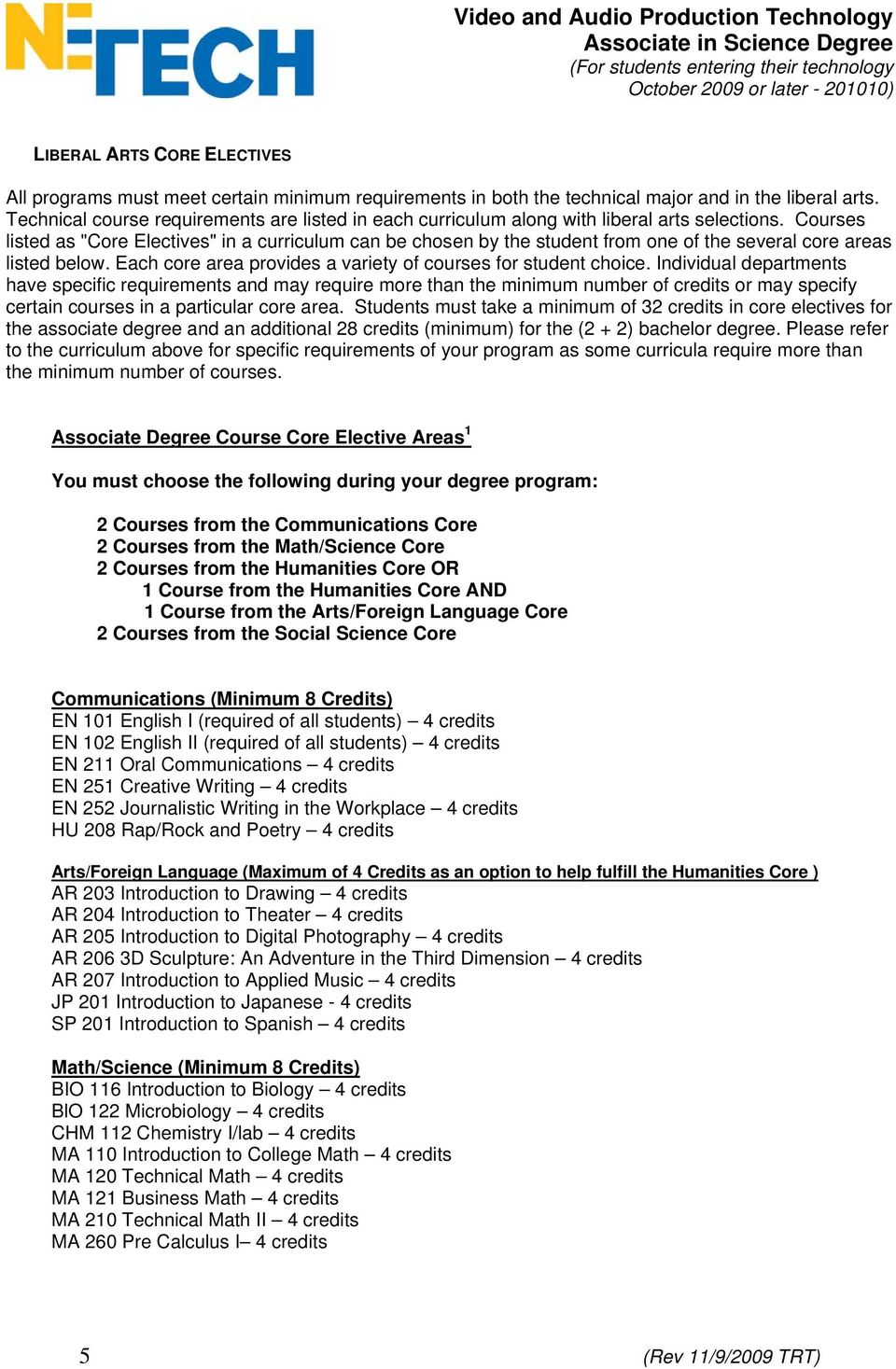
5 LIBERAL ARTS CORE ELECTIVES All programs must meet certain minimum requirements in both the technical major and in the liberal arts. Technical course requirements are listed in each curriculum along with liberal arts selections. Courses listed as "Core Electives" in a curriculum can be chosen by the student from one of the several core areas listed below. Each core area provides a variety of courses for student choice. Individual departments have specific requirements and may require more than the minimum number of credits or may specify certain courses in a particular core area. Students must take a minimum of 32 credits in core electives for the associate degree and an additional 28 credits (minimum) for the (2 + 2) bachelor degree. Please refer to the curriculum above for specific requirements of your program as some curricula require more than the minimum number of courses. Associate Degree Course Core Elective Areas 1 You must choose the following during your degree program: 2 Courses from the Communications Core 2 Courses from the Math/Science Core 2 Courses from the Humanities Core OR 1 Course from the Humanities Core AND 1 Course from the Arts/Foreign Language Core 2 Courses from the Social Science Core Communications (Minimum 8 Credits) EN 101 English I (required of all students) 4 credits EN 102 English II (required of all students) 4 credits EN 211 Oral Communications 4 credits EN 251 Creative Writing 4 credits EN 252 Journalistic Writing in the Workplace 4 credits HU 208 Rap/Rock and Poetry 4 credits Arts/Foreign Language (Maximum of 4 Credits as an option to help fulfill the Humanities Core ) AR 203 Introduction to Drawing 4 credits AR 204 Introduction to Theater 4 credits AR 205 Introduction to Digital Photography 4 credits AR 206 3D Sculpture: An Adventure in the Third Dimension 4 credits AR 207 Introduction to Applied Music 4 credits JP 201 Introduction to Japanese - 4 credits SP 201 Introduction to Spanish 4 credits Math/Science (Minimum 8 Credits) BIO 116 Introduction to Biology 4 credits BlO 122 Microbiology 4 credits CHM 112 Chemistry I/lab 4 credits MA 110 Introduction to College Math 4 credits MA 120 Technical Math 4 credits MA 121 Business Math 4 credits MA 210 Technical Math II 4 credits MA 260 Pre Calculus I 4 credits 5 (Rev 11/9/2009 TRT)
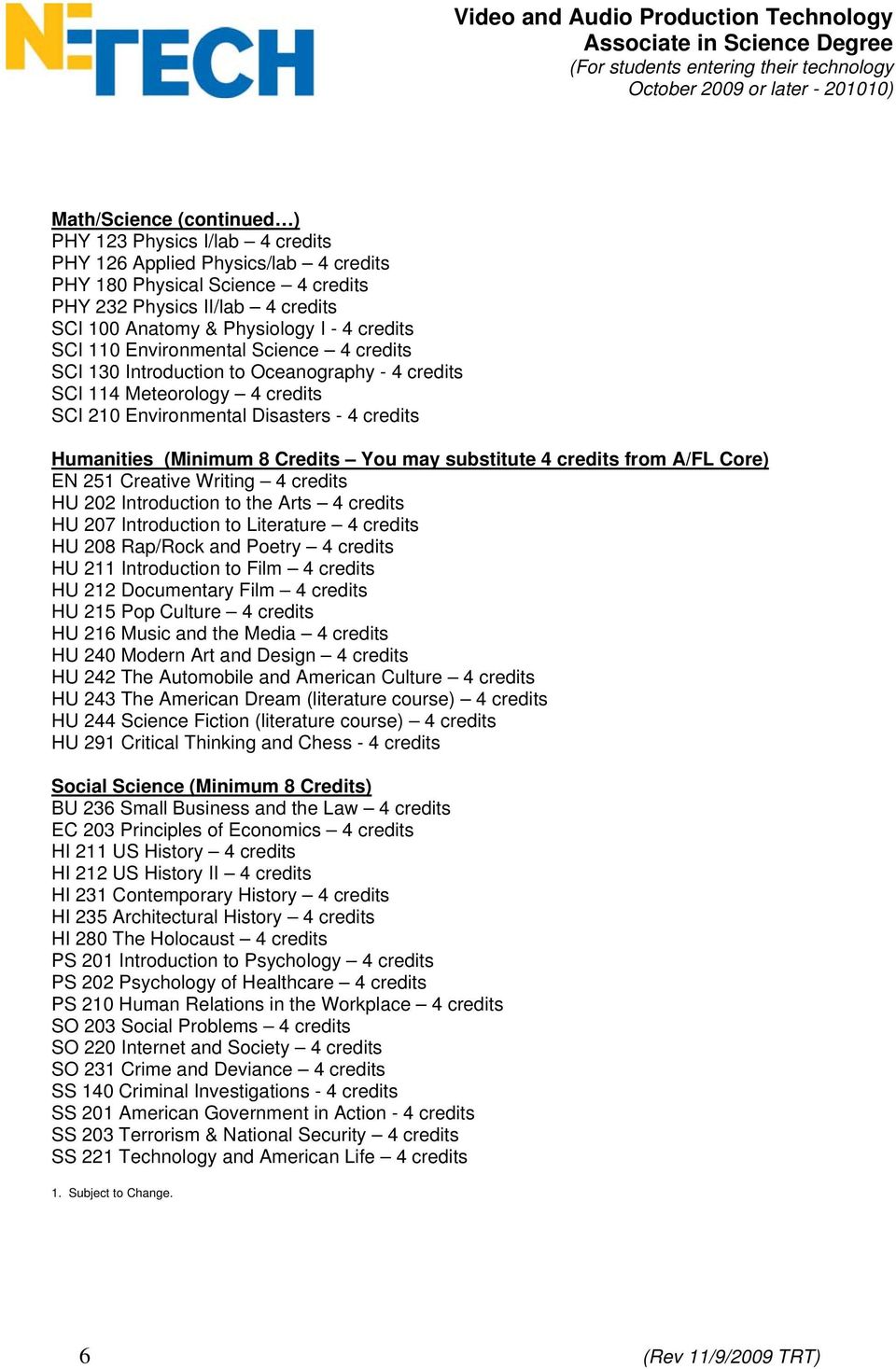
6 Math/Science (continued ) PHY 123 Physics I/lab 4 credits PHY 126 Applied Physics/lab 4 credits PHY 180 Physical Science 4 credits PHY 232 Physics II/lab 4 credits SCI 100 Anatomy & Physiology I - 4 credits SCI 110 Environmental Science 4 credits SCI 130 Introduction to Oceanography - 4 credits SCI 114 Meteorology 4 credits SCI 210 Environmental Disasters - 4 credits Humanities (Minimum 8 Credits You may substitute 4 credits from A/FL Core) EN 251 Creative Writing 4 credits HU 202 Introduction to the Arts 4 credits HU 207 Introduction to Literature 4 credits HU 208 Rap/Rock and Poetry 4 credits HU 211 Introduction to Film 4 credits HU 212 Documentary Film 4 credits HU 215 Pop Culture 4 credits HU 216 Music and the Media 4 credits HU 240 Modern Art and Design 4 credits HU 242 The Automobile and American Culture 4 credits HU 243 The American Dream (literature course) 4 credits HU 244 Science Fiction (literature course) 4 credits HU 291 Critical Thinking and Chess - 4 credits Social Science (Minimum 8 Credits) BU 236 Small Business and the Law 4 credits EC 203 Principles of Economics 4 credits HI 211 US History 4 credits HI 212 US History II 4 credits HI 231 Contemporary History 4 credits HI 235 Architectural History 4 credits HI 280 The Holocaust 4 credits PS 201 Introduction to Psychology 4 credits PS 202 Psychology of Healthcare 4 credits PS 210 Human Relations in the Workplace 4 credits SO 203 Social Problems 4 credits SO 220 Internet and Society 4 credits SO 231 Crime and Deviance 4 credits SS 140 Criminal Investigations - 4 credits SS 201 American Government in Action - 4 credits SS 203 Terrorism & National Security 4 credits SS 221 Technology and American Life 4 credits 1. Subject to Change. 6 (Rev 11/9/2009 TRT)
7 Degree Progress Checklist Check off each completed course. Technical Course Requirements Q1 COM 101 COM 118 COM 105 Q2 COM 125 COM 127 COM 106 Q3 COM 136 COM 211 COM 215 Q4 COM 134 COM 146 COM 223 Q5 COM 227 COM 231 Q6 COM 237 COM 250 Choose one of the following: COM 230 Or COM 232 Liberal Arts Core Requirements 8 Required Courses Each course = 4 credits (total of 32 credits) AS TRACK Communications Core #1 EN 101 Q1 #2 EN 102 Q2 #3 EN 211 Q4 OR If you placed into EN 102 take #1 EN 102 Q1 #2 Core elective Q2 #3 EN 211 Q4 Math/Science Core #4 MA 110 Q1 #5 MA 121 Q3 Humanities Core* #6 Your Choice Q5,6 Your Choice if you placed out of MA 110 Q3 *You may use one Arts/Foreign Language Core Elective to fulfill your Humanities Core. Social Science Core #7 Your Choice Q5,6 #8 BU 236 Q3 Subject to change. Please see your advisor for any questions. 7 (Rev 11/9/2009 TRT)

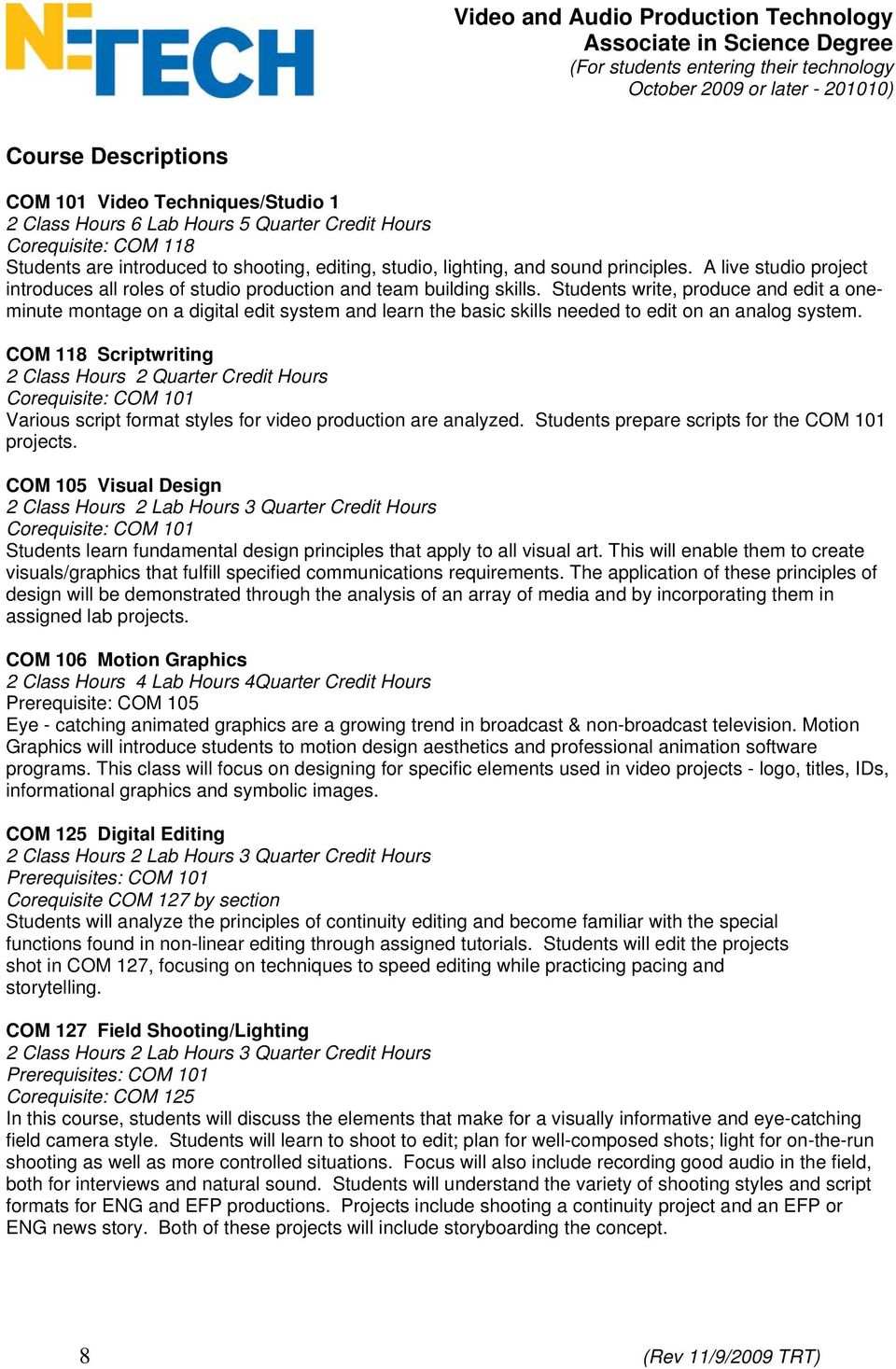
8 Course Descriptions COM 101 Video Techniques/Studio 1 2 Class Hours 6 Lab Hours 5 Quarter Credit Hours Corequisite: COM 118 Students are introduced to shooting, editing, studio, lighting, and sound principles. A live studio project introduces all roles of studio production and team building skills. Students write, produce and edit a oneminute montage on a digital edit system and learn the basic skills needed to edit on an analog system. COM 118 Scriptwriting 2 Class Hours 2 Quarter Credit Hours Corequisite: COM 101 Various script format styles for video production are analyzed. Students prepare scripts for the COM 101 projects. COM 105 Visual Design 2 Class Hours 2 Lab Hours 3 Quarter Credit Hours Corequisite: COM 101 Students learn fundamental design principles that apply to all visual art. This will enable them to create visuals/graphics that fulfill specified communications requirements. The application of these principles of design will be demonstrated through the analysis of an array of media and by incorporating them in assigned lab projects. COM 106 Motion Graphics 2 Class Hours 4 Lab Hours 4Quarter Credit Hours Prerequisite: COM 105 Eye - catching animated graphics are a growing trend in broadcast & non-broadcast television. Motion Graphics will introduce students to motion design aesthetics and professional animation software programs. This class will focus on designing for specific elements used in video projects - logo, titles, IDs, informational graphics and symbolic images. COM 125 Digital Editing 2 Class Hours 2 Lab Hours 3 Quarter Credit Hours Prerequisites: COM 101 Corequisite COM 127 by section Students will analyze the principles of continuity editing and become familiar with the special functions found in non-linear editing through assigned tutorials. Students will edit the projects shot in COM 127, focusing on techniques to speed editing while practicing pacing and storytelling. COM 127 Field Shooting/Lighting 2 Class Hours 2 Lab Hours 3 Quarter Credit Hours Prerequisites: COM 101 Corequisite: COM 125 In this course, students will discuss the elements that make for a visually informative and eye-catching field camera style. Students will learn to shoot to edit; plan for well-composed shots; light for on-the-run shooting as well as more controlled situations. Focus will also include recording good audio in the field, both for interviews and natural sound. Students will understand the variety of shooting styles and script formats for ENG and EFP productions. Projects include shooting a continuity project and an EFP or ENG news story. Both of these projects will include storyboarding the concept. 8 (Rev 11/9/2009 TRT)
9 COM 134 Studio Production 2 Class Hours 6 Lab Hours 5 Quarter Credit Hours Prerequisite: COM 101 Building on the basic studio skills learned in COM 101, students learn about the elements of preproduction involved in live studio work, the technical jobs required to carry out a live production and the responsibilities of the producer and director. Studio lighting approaches such as 3-point lighting, chromakey, use of gels, high and low key lighting using the studio lighting grid are discussed. Use of the waveform monitor, and vectorscope will be introduced. Students will carry out two studio productions a talk show and a commercial or PSA. Preparing a script, lighting plot as well as planning for other preproduction elements such as graphics and audio will be covered. Each student will experience the role of the director by directing his/her own talk show as well as participating as crewmember for other students' productions. COM 136 Audio Recording 2 Class Hours 2 Lab Hours 3 Quarter Credit Hours Audio recording capabilities are a critical skill in the video/radio business and audio/music industry. Students will learn audio recording techniques, microphone specifications, selection and placement as well as the basics of audio engineering. Students learn the basics of Pro-Tools, a digital audio program, using this program to produce their own commercial. COM 146 Audio Recording II 2 Class Hours 2 Lab Hours 3 Quarter Credit Hours Prerequisite: COM 136 The concepts of multi-track recording are studied and implemented on-location and in-studio. The use of mixers, mics and audio processing effects will be examined. Students will record and mix a simple music track and add sound effects to an existing movie. Using Pro-Tools students will edit man-on-the-street interviews. COM 211 Media Ethics 3 Class Hours 3 Quarter Credit Hours This course is a critical thinking class about ethical issues in the mass media. The media landscape is constantly changing and students must understand the ethical issues that still face practitioners on a daily basis. Students will present research findings on assigned topics COM 215 Corporate Media 2 Class Hours 4 Lab Hours 4 Quarter Credit Hours Prerequisite: COM 118, COM 125, COM 127 How to take a project from development to execution to evaluation is the objective of this course. Different styles of production will be examined for promotional, educational and motivational videos. Two productions will be completed based on the approaches discussed in the lecture. Scripting and storyboarding for the projects is a critical factor. Using the shooting and editing skills learned in quarter 2, students will practice making informative and convincing media. COM 223 Broadcast Sales and Video Distribution 2Class Hours 2 Lab Hours 3 Quarter Credit Hours In the first half of this course, students will be introduced to the business of broadcast sales. Students will examine and analyze how media is bought and sold in television, radio, cable, and the Internet. Students will also become familiar with the proper sales terms and approaches by preparing and delivering a sales presentation for an assigned client. In the second half of the course, students will practice the fundamentals of website creation as a way to distribute their portfolios to potential employers. By distributing video to the web, mobile devices and DVD, students will learn about the variety of encoding systems used today and which systems are most appropriate. 9 (Rev 11/9/2009 TRT)

10 COM 227 Radio 1 - Programming 2 Class Hours 4 Lab Hours 4 Quarter Credit Hours Pre-requisite Com 146 Audio Recording II Programming aspects of the radio industry will be discussed. Students will create, write, and produce a one- hour weekly radio show. Programs will be recorded and evaluated. Students will also execute a format clock. COM 230 Cooperative Work Experience 15 Lab Hours 3 Quarter Credit Hours Prerequisites: COM 134, COM 136, COM 215, COM 226 Students receive credit for practical work experience in the field with a commercial (or equivalent) company. Students must make a written application to the department chair with selection based on academic achievement, attendance and defined job skill requirements. COM 231 Digital Filmmaking 3 Class Hours 6 Lab Hours 6 Quarter Credit Hours Prerequisites: COM 118, COM 215 Examples of personal approaches to storytelling will be analyzed. Elements like story structure, visual and sound style, thematic transitions, and edit pacing are all a part of the narrative style of film. The digital medium is fast becoming a useful tool for visual storytellers whether videographers or filmmakers because of cost, speed and avenues of distribution like the web. Students will become adept at the use of digital effects and apply video post-production tools such animation, layering and compositing. Students will plan and produce a digital "film" that demonstrates their ability to tell a story and prepare it for presentation in a studioproduced magazine-style show. COM 232 Associate Final Project 1 Class Hour 4 Lab Hours 3 Quarter Credit Hours Prerequisites: COM 146, COM 231 A video or audio program is produced that exhibits the student's abilities in developing a project from concept to completion. A detailed proposal for the project must be submitted for approval to a designated faculty member. COM 237 Radio 2 Talk and information 2 Class Hours 4 Lab Hours 4 Quarter Credit Hours Pre-requisite Com 227 Radio 1- Programming In this course the student will work on a team and produce, host, and board operate a radio talk show. Students will produce a remote audio production to incorporate into their shows. Lecture material will cover how to program and develop an interview program for radio. Selected shows will be aired on the on-campus radio station WNET. COM 250 Associate Portfolio 2 Class Hours 2 Lab Hours 3 Quarter Credit Hours Prerequisite: COM 231 This is a career-planning course that goes over the essentials of resume creation, resume reel production, interview and job-hunting skills for the media field. Students will design a resume reel. 10 (Rev 11/9/2009 TRT)

11 Liberal Arts, Math and Science Courses Associate Degree Art (Arts/Foreign Language Core) AR 203 Introduction to Drawing Drawing is the most fundamental tool of visual communication. It is the artist seeing, interpreting and acting; transforming marks into form and space on a two dimensional plane. The result - a language as valid as the spoken or written word. This course introduces students to key concepts and techniques integral to developing basic drawing skills. Class time will be spent discussing, demonstrating and practicing these skills in order to produce a comprehensive body of work specific to the course objectives. Course performance will be evaluated on effort and growth as opposed to artistic talent. AR 204 Introduction to Theater Acting, like carpentry, is a craft with a definite set of skills and tools (for example, voice, body, and interpretation). This course will provide students with both a theoretical and practical understanding of acting and the theatrical process as evidenced by theatrical scenes, performed by students as a final project. Theater exercises will guide the students toward self-discovery in order to explore character development and the interpretation of the content/themes of various plays. Students will write character analysis essays as a method for understanding the specific elements of acting necessary to accurately portray a given character. Readings and discussions will help students place dramatic literature in a historical context. Students will also explore the ways in which a play is translated into a production with an emphasis on differentiating the functions of the playwright, the actor, the director, set designer and other members of a production team. AR 205 Introduction to Digital Photography **Not available to MWD students. This course introduces students to the basic concepts of digital image making. Students will also develop skills in the critical analysis of photographs and learn about both the creative process and the historical significance of photography. Course performance will be evaluated on student effort and growth as opposed to artistic talent. AR 206 3D Sculpture: An Adventure in the Third Dimension This course will teach students to think, see and function in 3-dimensional space. They will explore the differences and similarities between 2-dimensional and 3-dimensional representation in composition and design. Students will use a broad range of materials to create sculptures that will help them explore different aspects of 3-dimensional functioning. Class time will be spent in a combination of sculpture design and a discussion of slides of work reflecting the history of three-dimensional works of art from Greek times to the present. No prior experience with art courses is required. Students will be assessed on the basis of growth and learning, rather than artistic talent. Students will need to purchase a sketch pad and they will be charged a materials fee for the materials needed to construct the sculpture projects. The combined cost of the pad and the fee is less than the cost of a typical textbook, and the course has no required textbook. 11 (Rev 11/9/2009 TRT)

12 AR 207 Introduction to Applied Music This course will afford students the opportunity to experience a "hands on" approach to piano keyboard and composition. Each section of the course will focus on one musical concept through listening, playing and finally application. Because of the computer assisted nature of the program, all levels of musical and keyboard comprehension can be accommodated. As a result, all students can progress at their own level and achieve a level of performance competence regardless of their level of expertise with keyboard performance. So no prior experience in playing an instrument is necessary for enrollment in this course. AR 213 Drawing II Prerequisite: AR 203 Developing a strong proficiency in Drawing is achieved through a greater understanding of skills, techniques, theory and practice. Students can benefit from advanced skills in Drawing through an enhanced means of visually communicating their thoughts and ideas. Advanced Drawing skills can also be an asset in creating and executing quality designs and compositions. This course builds on the key concepts and techniques learned in the Introduction to Drawing course. Students who are interested in developing their drawing skills beyond an initial basic level benefit from taking this course. Class time will be spent discussing, demonstrating and practicing these advanced skills in order to produce a comprehensive body of work specific to the course objectives. Course performance will be evaluated on effort and growth and development of techniques. This course does have higher expectations in the quality of the student s work than the Introduction to Drawing course. AR 255 Advanced Digital Photography Prerequisite: AR 205 In Advanced Digital Photography, various art historical periods and the styles of influential photographers will be studied, with the goal of helping students discover their own most effective and expressive style. Topics covered will be photojournalism, documentary, advertising, and current (post modern) artistic practices. The advanced course will build on skills and knowledge gained in the introductory digital photography course, and will require students who are capable of independent work and self-evaluation. Course performance evaluation will be based on student effort and growth, as opposed to artistic talent; students should have an interest in personal expression and development of their personal creative style. Business (Social Science Core) BU 236 Small Business and the Law This course is designed for those students who may eventually start and operate their own small business. This course will focus on the various elements associated with the start up, acquisition and operation of a small business from the entrepreneurial point of view. Topics to be covered will include business formation, contract negotiations and drafting, financing, employee discrimination issues, customer relations issues, licensing, permits and tax basics. Additionally, students will be asked to complete a legal research assignment and prepare and present a business plan in their particular technological field of study. Students will leave this course with the fundamental knowledge necessary to start and run a successful small business and to avoid the legal pitfalls, which often lead to small business dissolution. 12 (Rev 11/9/2009 TRT)

13 Community Enrichment CE 101 Community Enrichment 1 Class Hour 1 Quarter Credit Hour In this course, which is part of the Feinstein Enriching America Program, each student will explore ways of enhancing the community through performing a project which provides a service to the community. The project, which may be performed over several quarters, will be documented in a journal in which the student will reflect on the significance of the experience. Chemistry (Math/Science Core) CHM 112 Chemistry I and Lab 3 Class Hours 2 Lab Hours 4 Quarter Credit Hours Prerequisites: MA 210, PHY 232 Topics covered include atomic structure, the periodic law, and nature of the chemical bond, chemical reactivity, stoichiometry, and acid base reactions. Economics (Social Science Core) EC 203 Principles of Economics Introduces the fundamental principles of microeconomics and macroeconomics, such as scarcity, supply and demand, growth, fiscal and monetary policies, and the public and the private sectors. English (Communications Core) EN 101 English I Placement: Based on an evaluation of a writing sample or successful completion of EN 030. English 101 is an introductory course designed to immerse students in the writing process. Students will practice using writing as a tool for learning through note taking, responding to reading, composing short essays, and reflecting on the writing process itself. Through drafting, revising, and writing to learn, students will strengthen their ability to interpret, analyze, and evaluate the ideas presented in the course readings, lectures and discussions. Along the way, students will develop essential keys to academic success: grasp of grammar, punctuation, and standard usage; mastery of reported speech (quotation, summary, and paraphrase); understanding of acknowledgement, documentation, and plagiarism; critical reading, note taking, and study skills; and writing and learning in an online environment. At the conclusion of the course, students will assemble and submit a final portfolio of revised work demonstrating their writing proficiency. EN 102 English II Prerequisite: EN 101 or placement based on evaluation of a writing sample. English 102 is an intermediate course designed to introduce students to successful writing and communication in the workplace. Students will gain practical experience with research, planning, and revising and will learn to produce effective memos, s, letters, faxes, instructions, procedures, and short reports. In this course, the writing process is viewed as an essential problem-solving activity that helps employees meet the needs of their employers. 13 (Rev 11/9/2009 TRT)

14 Careful acknowledgement of the input, labor, and ideas of colleagues will be a central theme in this course, especially with regard to collaborative projects. Additionally, students will learn how to deliver oral presentations using PowerPoint and to create resumes, applications, and cover letters, in preparation for a successful job search. At the conclusion of the course, students will assemble and submit a Final Portfolio of revised workplace writing and deliver an oral presentation based on their writing and research. EN 211 Oral Communications Prerequisite: EN 101 or placement The objectives of the course are to improve the student's understanding and appreciation of the uses of speech, and to teach the skills needed to listen and to speak effectively and with confidence in a variety of speaking situations. EN 251 Creative Writing This advanced writing course will focus on the techniques of writing fiction, poetry, and creative nonfiction. Students will learn how to create narratives, handle dialogue and physical descriptions, and write in a variety of fiction genres and poetic forms. A workshop environment featuring peer review will be emphasized. EN 252 Journalistic Writing in the Workplace Prerequisite: EN102 This course is designed to teach students to prepare written communication of interest to employees, customers/clients, and to the public. Students will learn how journalists get and sift information and then put it into a form that is clear, concise, credible, relevant, informative, and interesting. The course will discuss how journalistic writing is used in the workplace to convey important information, to foster organizational morale, and to enhance an organization s public image. A future employer might be interested in the portfolio of writing projects all students will develop in this course including memos for target audiences, news articles, and press releases. The course will culminate in the creation and distribution of a newsletter containing information of interest to NEIT students, faculty, and alumni. History (Social Science Core) HI 211 United States History I: This course explores American history before 1877, focusing on the conflict concerning proper status and rights of laboring people. Matters of race, religion, family, property, political and legal philosophy and simple partisanship contributed to this conflict. The most profound and explosive issue was African- American slavery and its threat to free workers. HI 212 United States History II: 1877 to the Present This course examines the lives of the workers who built, sustained and transformed American society from 1877 to the present. It considers how they influenced and were in turn affected by other processes such as community life, family structure, gender roles, race relations, ethnicity, religion, war, technology and politics in the developing liberal, capitalist and sometimes imperialistic society. 14 (Rev 11/9/2009 TRT)
15 HI 231 Contemporary History This course encourages students to explore economic, political, social and cultural developments though out the world since World War II, particularly in developing nations including spiritual, scientific and intellectual developments. HI 235 Architectural History This course provides an introduction to a significant area of art history. Students learn architecture as an art form and the relationship between architecture and its historical setting. HI 240 History of Aviation This course will examine how aviation technology has developed over time, and the impact it has had on culture and society. We will start with the first balloon flight in 1783 but our focus will be the major technological discoveries -- such as the Wrights' solution of the control problem, the improved reliability of engines, jet propulsion, the development of small aircraft for sport and personal use, the growth of commercial aviation for civil transport, the technology of military aircraft and unmanned aerial vehicles, and the launch of the "new space race," which takes technology developed for sport airplanes and transforms it into spacecraft. HI 280 The Holocaust In this course, students will study genocide and mass murder in modern history. The focus of this course is the Jewish Holocaust of Through film, photographs, and readings, the course will provide students with a basic understanding of the establishment of the Nazi Party and its attitudes, beliefs, and laws that were put into action during this time period. Students will compare the Holocaust to current genocidal acts in the world today, including the effects of genocide on society. Humanities (Humanities Core) HU 202 Introduction to the Arts The arts give people a chance to state how we think and feel about something, and make it possible to discuss these thoughts and feelings among a wide audience. Through the arts we can talk about love, war, death, family, happiness, sadness, the meaning of life, and so on. In this class, students will look at universal themes as presented in the various arts and see how these themes are presented through contemporary theater, dance, contemporary and classical music, and the visual arts. HU 207 Introduction to Literature A survey of short fiction, poetry and drama. The course introduces students to significant themes and techniques in literature and aims to help students become more discerning and sensitive readers. 15 (Rev 11/9/2009 TRT)

16 HU 208 Rap/Rock and Poetry 4 Class Hours 4 Quarter Credit hours Core Fulfillment: Both Communications Core and Humanities Core Prerequisite: EN102 What do Eminem, Tupac, Bob Marley, Bob Dylan and WB Yeats have in common? All five wordsmiths are poets who use rhyme, rhythm, figurative language and poetic structure to craft language. In this course, students will explore poetic devices and important global themes through examination of poetry, written by Nobel Prize and Grammy Award winning writers. Focusing on aspects of poetic form will build students understanding of and appreciation for the power of language. HU 211 Introduction to Film A thematic approach to the study of film as a medium of humanistic expression. The course surveys significant examples of motion pictures from a variety of periods and countries in an attempt to understand the techniques of filmmaking as well as the power of film to convey ideas and meaning. HU 212 Documentary Film This course will expose students to the techniques and artistry of making interesting non-fiction films. Students will view and analyze significant documentary films and become familiar with the work of important filmmakers. HU 215 Popular Culture This course will analyze cultural expressions of intellectual and social trends since Students will investigate literature, comics, movies, television, music, advertising, painting, computer games, and the Internet to probe the forces that shape our world. In this course, students will identify and evaluate the popular entertainment we consume and ask how our choices define us and shape our values. Understanding our values and culture enables us to understand why we buy what we buy, why we do what we do, and why we think the way we do. HU 216 Music and the Media This course will trace the long relationship between visual media and music. Students will study the importance of music in movies, television, radio and the internet. Special emphasis will be given to the role of music in commercials and the selling of products, people and programming. In addition, a substantial portion of the course will be devoted to the technology that has led to today s sophisticated performance and recording techniques. Some hands on musical and visual activities will be used to help demonstrate the use of music in the media. HU 240 Modern Art and Design Throughout history, artists and designers have created visual works that help to define historical eras. In this course, students will examine and analyze the most prominent design styles of the past one hundred years. They will learn the defining features and major proponents of each style as well as how each style fits within its historical context. They will then use the knowledge gained to produce designs that respond to past styles in an engaged, knowledgeable way. Course performance will be evaluated on student 16 (Rev 11/9/2009 TRT)

17 effort and growth as opposed to artistic talent. This course is restricted to students in the GMW or ID technologies. HU 242 The Automobile and American Culture The Automobile and American Culture examines the development of the automobile and the positive and negative impact this new technology has on America s political, economic, social, and cultural landscape. Through assigned readings, case studies, music selections, and film clips, students will explore the people, places, and concepts that make the automobile such an integral part of America s identity. HU 243 The American Dream This course explores the theme of work and identity by raising questions about who we are in relationship to our work and to the society in which we live: Who am I? What do I want? What is my place in the world and my status within it? Am I useful? Am I fulfilled? Can I change my circumstances? The readings for the course consist of contemporary short stories and short personal narratives in which different people talk about their jobs. Through the lens of fiction and non-fiction, students will begin to understand how literature relates to the everyday workplace and to our pursuit of the "American Dream." Students will respond articulately to the literature through sharing their own experiences with work in class discussion and in writing. HU 244 Science Fiction Isaac Asimov called science fiction "the literature of change." The course will analyze films, short stories, and a classic science fiction novel to understand the ways this popular genre entertains us and gives us insight into the impact science and technology has had on us. HU 250 Cribs: The American Home Associate Level This course explores the American home in an interdisciplinary way. Our focus is the history of the twentieth-century home that incorporates a discussion of the social and cultural aspects of domestic space. As part of this analysis, we will explore humanities texts, such as photography and film. In addition to providing students with a basic understanding of domestic history (i.e., when and why did suburbs begin?), they will be prompted to ask other questions (i.e., what forces have excluded some Americans from that suburban way of life?). Students are encouraged to think about the American home as much more than four walls and a roof. It defines who we are...and it determines how we define others. HU 291 Critical Thinking and Chess This course teaches critical thinking and problem-solving skills by using the game of chess as an empirical model for evaluating situations, calculating risks, predicting the consequences of possible actions, solving problems efficiently, and investigating the benefits and limits of reasoning and creative play. 17 (Rev 11/9/2009 TRT)
18 Japanese (Arts/Foreign Language Core) JP 201 Introduction to Japanese Students will be introduced to the basics of Japanese, (speaking, listening, reading, and writing) with an emphasis on comprehension and speaking. Vocabulary used in everyday communication in the workplace, school, and common social situations will be covered. Contemporary Japanese society will be addressed in class discussions and video presentations including, but not limited to art, education, film (in particular animé), food, literature, music, sports, and technology. Japanese technological invention and know-how, as well as the unique challenges of doing business with the Japanese will be studied. Japanese guest speakers will be invited to share their expertise and experiences. Mathematics (Math/Science Core) *MA 030 Pre-College Math Offered through the Academic Skills Center. *This course fulfills Financial Aid requirements but does not count toward degree requirements. This course is designed for students who need a thorough review of arithmetic including whole numbers, fractions, decimals, percent, and ratio and proportion. Operations with signed numbers and basic equations will also be introduced. MA 100 Introduction to College Math 2 Class Hours 4 Lab Hours 4 Quarter Credit Hours Prerequisite: Placement exam Topics to be covered in this introductory algebra course include operations with signed numbers, rules for exponents, polynomial operations, solutions to linear equations in one variable, and several applications important to various technical areas. MA 110 Introduction to College Math Prerequisite: Placement exam Topics to be covered in this introductory algebra course include operations with signed numbers, rules for exponents, polynomial operations, solutions to linear equations in one variable, and several applications important to various technical areas. MA 120 Technical Math I Prerequisite: MA 110 Topics to be studied include the analytic geometry of a straight line, systems of linear equations, trigonometry, vectors and their applications, and quadratic equations. MA 121 Business Math Prerequisite: MA 110 This is an elementary applied course studying such business topics as interest rates, discounts, payrolls, markups, depreciation, insurance, mortgages, and basic statistics. MA 210 Technical Math II Prerequisite: MA 120 The following four major topics and their applications will be studied: Cramer s Rule, exponential and logarithmic functions, trigonometry, and complex numbers. 18 (Rev 11/9/2009 TRT)

19 MA 220 Applied Math for Business Prerequisite: MA 110 MA 220 is designed to help with the transition from basic algebra to more advanced business-related courses, such as statistics and finance. Applications will be stressed throughout the course. Specific topics include linear functions, quadratic functions, descriptive statistics, exponential functions, and annuities. MA 260 Pre-Calculus I Prerequisite: Accuplacer score equivalent to MA 210 placement, or grades of A in both MA 110 and MA 120, or permission of Department Chair (subject to placement exam). Note: Credit cannot be earned for both MA 210 and MA 260. The following major topics will be studied: functions and graphs, determinants and matrices, trigonometry, complex numbers, and logarithmic and exponential functions. These topics are important in many technical fields and for the future study of calculus. Physics Courses (Math/Science Core) PHY 123 Physics I & Lab 3 Class Hours 2 Lab Hours 4 Quarter Credit Hours Prerequisite: MA 120 This course is a non-calculus approach to the study of fundamental physics and includes kinematics and dynamics of bodies, velocity, acceleration, and Newton s laws of motion, forces in equilibrium, concurrent and non-concurrent forces, work, power, energy, and torque. Labs are performed within the course to reinforce concepts. PHY 126 Applied Physics & Lab 3 Class Hours 2 Lab Hours 4 Quarter Credit Hours Prerequisite: MA 110 This course studies the applications of fundamental concepts of physics. The topics covered include: the motion of objects, the forces that cause motion, velocity, acceleration, Newton s Laws, torques, work, power, and energy. The laboratory component is designed to give students the opportunity to have hands-on experience with the fundamental concepts of physics studied in the theory portion of the course. PHY 180 Physical Science 3 Class Hours 2 Lab Hours 4 Credit Hours Prerequisite: MA 110 This course stresses theoretical concepts important for the study of physical therapy. Specific topics include the study of energy, electricity, light, sound, heat, mechanics, force, concurrent and non current forces, vectors, friction, gravity, inertia, simple machines, mass, momentum, properties of liquids, buoyancy, and hydrostatic pressure. Laboratory experiments are designed to reinforce these concepts. PHY 232 Physics II & Lab 3 Class Hours 2 Lab Hours 4 Quarter Credit Hours Prerequisites: MA 210, PHY 123 This is an algebraic approach to a second course in physics. The topics include: centripetal force, temperature, heat energy, mechanical waves, sound, electrostatics, and basic circuit elements. The laboratory component is designed to give students the opportunity to have hands-on experience with the fundamental concepts of physics studied in the theory portion of the course. Laboratory experiments will be performed to reinforce these concepts. 19 (Rev 11/9/2009 TRT)

20 Psychology (Social Science Core) **PS 201 Introduction to Psychology (This course is major-restricted to CMA and ST students only.) This course introduces students to the basic concepts of psychology. Topics include such areas as personality, intimate relationships, development over the life cycle, and cognition. PS 202 Psychology of Healthcare 4 Class Hours 4 Credit Hours Prerequisite: EN 101 This course addresses the human element of clinical competence in providing health care. Students will explore the psychodynamics of interactions between health care workers and patients, the psychological influences of illness and pain, the psychosocial factors that impact one s effectiveness as a health care team member, the impact of families on a patient s treatment plan, the role of body image in patient responsiveness to treatment, and a variety of other psychosocial factors that influence health care delivery. PS 210 Human Relations in the Workplace Students will develop the interpersonal skills known to be key ingredients for successful everyday interactions with coworkers, supervisors and customers at any work environment. Some major skill areas covered in the course include making a good impression with your employer, managing conflict with difficult coworkers, working on a team with diverse groups of people, providing exceptional customer service, and managing on-the-job stressors. This course provides a set of practical human relations techniques that will help students increase the likelihood of job security and career advancement in any current or future job. Science (Math/Science Core) SCI 110 Environmental Science This course will focus on man's interaction with his environment. It will cover current issues like global warming, human population growth, and pollution. SCI 114 Meteorology This course introduces students to Meteorology. The course focuses on basic terminology of what weather is, how it acts and interacts with our environment. The student will learn how to read weather maps and weather information critical in flying an aircraft. The course will also teach the fundamental principals in weather forecasting. SCI 130 Introduction to Oceanography This interdisciplinary approach to the study of oceanography utilizes geology, chemistry, physics, astronomy, and marine science. The origins of the oceans, oceanic features, along with the chemical and physical properties are examined. Emphasis will be placed on the interaction between sea, land, and air. The complexity of the processes will be examined using a systems approach. SCI 210 Environmental Disasters (and How to Work Around Them) Natural and man-made environmental disasters dominate the news - flooding, earthquakes, climate change, air pollution, water pollution and more. Some can be predicted, some can be avoided, and some 20 (Rev 11/9/2009 TRT)

21 can be mitigated. But how? In this course, we will explore how the natural world works, and how this working is evident in some of the most pressing environmental issues of today. Why does the East Coast of the U.S. worry primarily about flooding from hurricanes, while the same type of storm on the West Coast causes concern about landslides instead? How is wind created, and why do the people downwind of you care? When would you prefer to dredge a polluted river, and when is it best to simply let toxic sediments remain in place? Enjoy learning when to worry about the volcano in your backyard, and whether it s wise to place a swimming pool on that scenic overlook. No prior science background is required. Sociology (Social Science Core) SO 203 Social Problems This course will examine contemporary social issues from multiple perspectives. Attempts to see the ethics, the arguments and the policy outcomes involved in problems such as drug abuse, crime, poverty and the global environment. SO 220 Internet and Society Pre-requisite: B- or better in EN102 Internet and Society is an online course that focuses on the impact of the Internet on our lives. How has living in a networked world affected American society? The goal of this course is to encourage students to think deeply and critically about the reality of living in a technology-driven society and how technological change influences work, families, social lives, education, and privacy. Students who register for this course must be comfortable with the Web and Blackboard and willing to explore social networking sites (such as Facebook) and new virtual online domains (such as Second Life). SO 231 Crime and Deviance This course traces the historical development of crime and deviance and examines the impact of the criminal justice system on the control of crime. Also explored are: police, courts and corrections and how crime and the criminal justice system influences our daily lives. Infamous criminals of both past, present and fiction and how their actions affected society, will be reviewed. Social Science (Social Science Core) SS140 Criminal Investigations Prerequisite: EN102 In this course, students will get exposure to a wide range of interpersonal and scientific factors that are explored by criminal investigators in their efforts to support hypotheses developed to solve a variety of crimes. Some of the course topics will include the appropriate collection of evidence at a crime scene, techniques for interviewing witnesses and suspects, the role of the crime lab, the science of fingerprinting, forensic medicine, and the preparation of testimony that leads to the conviction of criminals. SS 201 American Government in Action This is an introductory course that will help students understand how the pieces of American government fit together, and how politics continuously affects their lives. Students will examine the roles of interest groups, the media, political parties and the three branches of government. Class discussions about relevant and current political issues will be encouraged. 21 (Rev 11/9/2009 TRT)
22 SS 203 Terrorism and National Security This course examines the challenge contemporary terrorism presents for U.S. national security. It investigates the causes of terrorism and inquires into the motives, objectives, methods, and effectiveness of contemporary terrorist groups with an emphasis on al Qaeda. Analysis of the determinants of American counter-terrorism policies and evaluation of the effectiveness of these initiatives are central themes of the course. As such, evaluation of the roles the invasion of Afghanistan, the Iraq War, covert operations, domestic and foreign internal security initiatives, and global law enforcement operations have played in addressing the terrorist threat are major points of emphasis. SS 221 Technology and American Life Examines how American institutions, cultures, values and technologies interact in historical time and space and how technologies often bring unexpected and unwanted consequences along with benefits. Spanish (Arts/Foreign Language Core) SP 201 Introduction to Spanish This course will introduce students to the Spanish language with an emphasis on the use of Spanish in the workplace. Students will learn to communicate with customers and other employees in Spanish with a focus on basic vocabulary words used in everyday interactions at the workplace. While each class will emphasize conversational skills, the course will also cover some key principles of Spanish grammar and provide some exposure to a variety of cultural traditions in Spanish-speaking countries. The course is designed for students with no prior knowledge of Spanish. Students who speak Spanish fluently will not be eligible to take the course. 22 (Rev 11/9/2009 TRT)
23 Questions & Answers 1. When do my classes meet? Day Classes: Technical classes normally meet for three hours a day five days a week. Classes normally begin in the early morning (7:45 a.m.), late morning (usually 11:25 a.m.), or mid afternoon. A technical time slot may vary from quarter to quarter. Evening Classes: Technical classes meet on the average of three nights a week, although there may be times when they will meet four nights a week. Classes normally begin at 5:45 p.m. IN ADDITION, to achieve your associate degree, you will take a total of approximately eight liberal arts courses, which will be scheduled around your technical schedule over the course of your entire program. Each liberal arts course meets approximately four hours per week. Liberal arts courses are offered days, evenings, and Saturdays. At the beginning of each quarter you will receive a detailed schedule giving the exact time and location of all your classes. The College requires that all students be prepared to take classes and receive services at any of NEIT s locations where the appropriate classes and services are offered. When a regularly scheduled class falls on a day which is an NEIT observed holiday (Columbus Day, Veterans Day, Martin Luther King Day, and Memorial Day), an alternate class will be scheduled as a make up for that class. The make up class may fall on a Friday. It is the student s responsibility to take note of when and where classes are offered. 2. How large will my classes be? The average size for a class is about 20 to 25 students; however, larger and smaller classes occur from time to time. 3. How much time will I spend in lab? Almost half of your technical courses consist of laboratory work. In order for you to get the most out of your laboratory experiences, you will first receive a thorough explanation of the theory behind your lab work. 4. Where do my classes meet? Students should be prepared to attend classes at any of NEIT s classroom facilities: either on Access Road, Post Road or the East Greenwich campuses. 5. I have not earned my high school diploma or GED: can I enroll in an Associate Degree Program? If you do not have a high school diploma or a GED and you are beyond the age of compulsory school attendance (16 years of age), you may enroll in an Associate Degree Program at the College if you pass a standardized test which has been approved by the federal government for determining a student's ability to benefit from a program (ATB Test). The ATB Test is administered at New England Tech's Academic Skills Center (ASC) and will be scheduled by your Admissions Officer. 6. How long should it take me to complete my program? To complete your degree requirements in the shortest possible time, you should take the courses outlined in the prescribed curriculum. For a typical six-quarter curriculum, a student may complete the requirements in as little as 18 months. Continued on next page 23 (Rev 11/9/2009 TRT)
24 To complete all your degree requirements in the shortest time, you should take at least one liberal arts course each quarter. Students who need more time to complete their curriculum may postpone some of the liberal arts courses until after the completion of the technical requirements. Students are provided up to two additional quarters of study to complete the liberal arts requirements without any additional tuition assessment fee. During these additional quarters of study, students are required to pay all applicable fees. Students may also elect to complete some of their liberal arts requirements during Intersession, a special five-week term scheduled between Spring and Summer Quarters. Students will not be assessed any additional tuition for liberal arts courses taken during the Intersession but may be assessed applicable fees. Students wishing to extend the number of quarters needed to complete the required technical courses in their curriculum will be assessed additional tuition and fees. 7. Is NEIT accredited? NEIT is accredited by the New England Association of Schools & Colleges (NEASC). Accreditation by NEASC is recognized by the federal government and entitles NEIT to participate in federal financial aid programs. Some academic departments have specialized professional accreditations in addition to accreditation by NEASC. For more information on accreditation, see NEIT s catalog. 8. Can I transfer the credits that I earn at NEIT to another college? The transferability of a course is always up to the institution to which the student is transferring. Students interested in the transferability of their credits should contact the Office of Teaching and Learning for further information. 9. Can I transfer credits earned at another college to NEIT? Transfer credit for appropriate courses taken at an accredited institution will be considered for courses in which the student has earned a "C" or above. An official transcript from the other institution must be received before the end of the first week of the quarter for transfer credit to be granted for courses to be taken during that quarter. Students will receive a tuition reduction for the approved technical courses based on the program rate and will be applied against the final technical quarter of the curriculum's tuition amount. No tuition credit is provided for courses which are not a part of the technical curriculum. 10. What is the "Feinstein Enriching America" Program? New England Institute of Technology is the proud recipient of a grant from the Feinstein Foundation. To satisfy the terms of the grant, the College has developed a one-credit community enrichment course which includes hands-on community enrichment projects. The course can be taken for a few hours per quarter, spread over several quarters. Students who are already engaged in community enrichment on their own may be able to count that service towards course credit. 11. How many credits do I need to acquire my Financial Aid? In order to be eligible for the maximum financial aid award, you need to maintain at least 12 credits per academic quarter. 12. What does my program cost? The cost of your program will be as outlined in your enrollment agreement, along with your cost for books and other course materials. Students who decide to take more quarters than the enrollment agreement describes to complete the technical courses in their curriculum will be subject to additional fees and possible additional tuition costs. Students who elect to take the technical portion of the degree requirements at a rate faster than the rate prescribed in the curriculum and the enrollment agreement will be assessed additional tuition. 24 (Rev 11/9/2009 TRT)
25 Continued on next page Students who require prerequisite courses will incur additional tuition and fees above those outlined in their enrollment agreement. If a student elects to take a course(s) outside of the prescribed curriculum, additional tuition and fees will be assessed. Remember, students who withdraw and re-enter, one time only, pay the tuition rate that was in effect for them at the time of their last day of attendance for up to one year from their last day of attendance. Second re-entrees and beyond pay the tuition rate in effect at the time they re-enter. The most economical way for you to complete your college degree is to begin your program now and continue your studies straight through for the six quarters necessary to complete your degree requirements. 13. What kind of employment assistance does NEIT offer? The Office of Career Services assists NEIT students and graduates in all aspects of the job search, including resume writing, interviewing skills, and the development of a job search strategy. Upon completion of their program, students may submit a resume to be circulated to employers for technical employment opportunities. Employers regularly contact us about our graduates. In addition, our Office of Career Services contacts employers to develop job leads. A strong relationship with employers exists as a result of our training students to meet the needs of industry for over fifty years. No school can, and NEIT does not, guarantee to its graduates employment or a specific starting salary. 14. What kind of jobs will I be qualified to look for? Generally, jobs may exist in the program production, post-production, and audio aspects of the television and cable industry, as well as in the corporate area. The US Department of Labor Occupational Handbook predicts that job opportunities in the television industry will grow at an average rate, with the greatest potential in the newer technologies such as cable television. Competition for jobs will be keen and requirements will increasingly emphasize an applicant's training and education. The job best suited to you will depend upon your individual strengths and interests. Students are also prepared for radio broadcast careers as an audio console operator, on-air producer, announcer, commercial copywriter and production assistant. 15. Is there any state or federal licensing required in my field? No license is required for any of the careers which you will be preparing to enter. The Video & Radio Production Technology program is not designed to prepare a student for a licensure exam. 16. Will I be able to continue toward a bachelor's degree? Yes. Students who earn an associate degree in Video & Audio Production Technology can earn a baccalaureate degree in Telecommunications Technology with approximately 6 additional quarters of study. 25 (Rev 11/9/2009 TRT)
26 Technical Standards These technical standards set forth by the Video and Audio Production/Telecommunications Technologies Department, establish the essential qualities considered necessary for students admitted to these programs to achieve the knowledge, skills and competencies to enter these fields. The successful student must possess the following skills and abilities or be able to demonstrate that they can complete the requirements of the program with or without reasonable accommodation, using some other combination of skills and abilities. Cognitive Ability: Ability to interpret ideas and concepts visually and/or graphically Good reasoning and critical thinking skills. Ability to learn, remember and recall detailed information and to use it for problem solving. Ability to deal with materials and problems such as organizing or reorganizing information. Ability to use abstractions in specific concrete situations. Ability to break information into its component parts. Ability to understand spatial relationships. Possession of basic math skills through addition, subtraction, multiplication and division of whole numbers and fractions using both the U.S. and Metric systems of measurement. Ability to perform tasks by observing demonstrations. Possession of basic keyboarding skills and knowledge of computer programs. Communications Skills: Ability to communicate effectively with faculty and students. Ability to understand and follow oral and written instructions. Ability to read English sufficiently to read equipment manuals, installation instruction, and technical service bulletins. Ability to demonstrate and use the knowledge acquired during the classroom training process and in the lab setting. Adaptive Ability: Ability to maintain emotional stability and the maturity necessary to interact with other members of the faculty and students in a responsible manner. Physical Ability: Ability to climb ladders up to 12' high and perform tasks at that height. Ability to perform tasks requiring bending, stooping, kneeling and walking. Able to perform tasks is confined spaces (i.e. edit booths). Ability to grasp, lift, and carry equipment weighing up to 50 lbs. Able to stand and/or sit and continuously perform essential course functions in the radio and television studios, radio production booths, editing booths, and graphics lab. Ability to stand and/or sit for long periods of time. Ability to perform learned skills, independently, with accuracy and completeness. Manual Ability: Sufficient motor function and sensory abilities to participate effectively in the classroom laboratory. Sufficient manual dexterity and motor coordination to coordinate hands, eyes and fingers in the operation of a camcorder, use a computer keyboard, and operate an edit controller and other equipment. 26 (Rev 11/9/2009 TRT)
27 Sensory Ability: Visual Acute enough to enable the adjustment of an electronic image into sharp focus. Ability to properly distinguish colors. Acute enough to read small print. Acute enough to read small numbers on precision measuring instruments. Auditory Acute enough to distinguish low level (weak) audio signals. Ability, corrected, to discern the full range of audible sound frequencies 27 (Rev 11/9/2009 TRT)
28 Student Acknowledgment of Receipt of Documents Video and Audio Production Technology I acknowledge that I have received copies of the following documents for the above technology: 1) Program Description 2) Curriculum 3) Course Descriptions 4) Q&A 5) Technical Standards I understand that it is my responsibility to read these documents. I have been advised that should I have any questions related to the content of any of these documents, I may contact my admissions officer who will review the material with me. I further understand that NEIT reserves the right, in response to industry demands, to change the contents of these documents without prior notice. Copies of the most recent versions of these documents may be obtained in the Admissions Office. Printed Name of Student Signature Date
Criminal Justice Technology Associate in Science Degree (For students entering their technology October 2009 or later - 201010) General Description
 General Description The in Criminal Justice provides dynamic and intensive instruction in all aspects of the Criminal Justice system. The first quarter focuses on core foundational Criminal Justice courses
Students will graduate with an Associate in Science Degree in Graphic, Multimedia and Web Design with a concentration in Multimedia.
 General Description The Graphic, Multimedia and Web Design Technology associate programs prepare students for entrylevel positions in a variety of digital, desktop production environments. Multimedia and
Courses for Grade 11 Students All students are required to select eight (8) courses:
 Courses for Grade 11 Students All students are required to select eight (8) courses: ADVANCED ENGLISH 11 (compulsory or other level) Advanced English 11 is an intensive program of study that offers a challenging
FILMMAKING Course Objectives + Methodology
 FILMMAKING Course + FILM 2000 Introduction to Filmmaking 3 cr. This course is an introduction to telling stories in film. It provides a theoretical and technical foundation for future work and introduces
Applied Psychology. Dr. Marya Howell-Carter, Acting Chair Psychology Dept. Bachelor of Science Degree
 Applied Psychology Dr. Marya Howell-Carter, Acting Chair Psychology Dept. Bachelor of Science Degree The Applied Psychology program leads to a Bachelor of Science degree with a concentration in Industrial/Organizational
II. GENERAL ELECTIVES: ENG 102-110 Writing II (3) Math or Science Course (3) NOTE 2 History Course (3) NOTE 2 200 Level English (3) NOTE 2
 ADIRONDACK COMMUNITY COLLEGE: LIBERAL ARTS/HUMANITIES & SOCIAL SCIENCE A.A. THE COLLEGE OF SAINT ROSE: EARLY CHILDHOOD EDUCATION B.S. DEGREE REQUIREMENTS SAINT ROSE REQUIREMENTS: ADIRONDACK EQUIVALENCIES:
SINCLAIR COMMUNITY COLLEGE SCHOOL AND COMMUNITY PARTNERSHIPS College Credit Plus Course Descriptions 1
 College Credit Plus Course Descriptions 1 ENGLISH & SOCIAL SCIENCES COM-2201: Introduction to Mass Communication An extensive examination of media theory and social effects. Topics covered include history,
Visual and Performing Arts
 126 Visual and Performing Arts Students interested in art and design, dance, music, photography, theatre, and other visual and performing arts have a rich selection of degree programs and one certificate
Online Courses 2015-16
 Online Courses 2015-16 MATH Algebra I Algebra I emphasizes the importance of algebra in everyday life through hundreds of real-world examples. Assessments are designed to ensure that your understanding
UNIVERSITY OF MISSOURI ST. LOUIS & ST. LOUIS COMMUNITY COLLEGE TRANSFER GUIDE
 UNIVERSITY OF MISSOURI ST. LOUIS & ST. LOUIS COMMUNITY COLLEGE TRANSFER GUIDE This Guide is intended for the use of prospective transfer students to the University of Missouri St. Louis (UMSL) who plan
COMM - Communication Arts
 COMM - Communication Arts COMM 1100 - Orientation to Communication Arts This course gives students a foundation for beginning studies in the Department of Communication Arts. It will focus on the history
Somerset Virtual Academy COURSE CATALOG 2015-2016
 Somerset Virtual Academy COURSE CATALOG 2015-2016 Somerset Virtual Academy provides the following services and benefits to its students: ACCESS: Full access to an extremely diverse, fully-accredited course
CINEMA DEPARTMENT COURSE LEVEL STUDENT LEARNING OUTCOMES BY COURSE
 CINEMA DEPARTMENT COURSE LEVEL STUDENT LEARNING OUTCOMES BY COURSE CINE 1000 A. Develop and implement a plan for approaching and completing complex individual and team projects. B. Illustrate skills in
How To Learn To Read And Write
 Associate of Applied Science Accounting McLENNAN COMMUNITY COLLEGE 2015-2016 Degree Description This program prepares students for positions in the accounting departments of large and small private businesses
Carteret Community College - General College Catalog 2008-2010
 Art Education (Pre-Major) (A1010A) Associate in Arts Degree Work Title Class Lab Experience Credit I. General Education (44 Semester Hours) Required Courses (9 Semester Hours ) ENG 111 Expository Writing
Section 4 GRADUATION AND DEGREE REqUIREMENTS
 Section 4 GRADUATION and DEGREE Requirements 42 Catalog Rights marin.edu Catalog Rights The catalog sets forth graduation requirements for achieving an associate degree, and these requirements may change
700.B0. Dawson College. Liberal Arts
 5 700.B0 Dawson College Liberal Arts Dawson College P R O G RA M i n fo r m at I O N Liberal Arts is an Honours pre-university program based on the belief in disciplined learning. The curriculum is composed
Mass Communication. Marketing Communication, B.S. major. Mass Communication 1
 Mass Communication Mass communication is the primary means by which our society relays news, information, and entertainment to the public. Technological advances have promoted instantaneous, global, and
Business Management Technology (MGT BS) Bachelor of Science Degree (For students entering their technology April 2007 or later 200730
 General Description The Business Management Technology department offers a that builds on the knowledge and skills acquired in NEIT s Associate Degree programs. The program incorporates the latest technological
Communications and Composition Contact Person: Dr. Sara Sliter-Hays
 Communications and Composition Contact Person: Dr. Sara Sliter-Hays Drawing on both the rich humanistic and Jesuit traditions of Rhetoric, the Communications and Composition Department prepares students
The Art Institute of Philadelphia Catalog Addendum GAME ART & DESIGN
 The Art Institute of Philadelphia Catalog Addendum GAME ART & DESIGN See AiPrograms.info for program duration, tuition, fees, and other costs, median debt, federal salary data, alumni success, and other
Pre-Engineering INDIVIDUAL PROGRAM INFORMATION 2014 2015. 866.Macomb1 (866.622.6621) www.macomb.edu
 Pre-Engineering INDIVIDUAL PROGRAM INFORMATION 2014 2015 866.Macomb1 (866.622.6621) www.macomb.edu Pre Engineering PROGRAM OPTIONS CREDENTIAL TITLE CREDIT HOURS REQUIRED NOTES Associate of Science Pre
Communication. Dr. Jack H. Simons, Chairperson
 Dr. Jack H. Simons, Chairperson The basic elements of Christianity evangelization (leading people to saving faith in Jesus Christ) and edification (discipling believers to maturity) require effective communication
 COMPONENT I Historical/Cultural Social Context 1. Defines the different areas of the entertainment industry. 2. Acquires the fundamental knowledge relating to the history of the entertainment industry.
Media Communication. Film and Media Production (BA) Film and Media Production/Systems (BS)
 Media Communication Co-chairs, Associate Professor D. Downs, Assistant Professor K. Bruner Assistant Professors S. Bailey, J. Bruner, M. Saunier The media communication program seeks to develop extraordinary
Film and Television. Film and Television 299
 Film and Television 299 Film and Television Degree Associate in Arts Degree, Film Production Program Description Film is a universally recognized medium that has a profound impact on how we view the world
JUMPSTART CONCURRENT ENROLLMENT PROGRAM Instructor s Qualifications & Course Descriptions
 JUMPSTART CONCURRENT ENROLLMENT PROGRAM Instructor s Qualifications & Course Descriptions Are You Interested in Becoming a Concurrent Enrollment College Instructor? Did you know high school teachers are
The major in Journalism or Mass Communications
 Journalism and Mass Communications The major in Journalism or Mass Communications is designed to prepare students for entry-level positions in reporting, digital media, public relations, photography, web
Jul 5, 2012, Sep 13, 2012, Oct 11, 2012, Jan 10, 2013, Mar 1, 2013, Jul 11, 2013, Sep 12, 2013, Oct 10, 2013
 FILMMAKING: TUITION: $18,000* (USD)/Semester / 13,747 (EURO)/Semester YOU GRADUATE WITH: Diploma/Certificate, DVD Film Reel LOCATION: New York, Los Angeles, USA Jul 5, 2012, Sep 13, 2012, Oct 11, 2012,
CURRICULUM GUIDE SHEET ONLINE STUDENTS ASSOCIATE DEGREE -HVACR ENGINEERING TECHNOLOGY NOTE:
 CURRICULUM GUIDE SHEET ONLINE STUDENTS ASSOCIATE DEGREE -HVACR ENGINEERING TECHNOLOGY NOTE: Meeting the requirements for graduation indicated on this sheet is the responsibility of the student. Compliance
Albright Digital Media Alumni: Where Are They Now? Combined Major in Digital Media
 Professor Daniel J. Falabella, Ph.D., Chair Associate Professor Matthew Garrison, M.F.A. Assistant Professors Jocelyn Kolb, M.F.A. and Wil Lindsay, M.F.A. Combined Major in Digital Media Interdisciplinary
Laney College 2009-2011
 VIDEO PRODUCTION FOR VIDEO, BROADCAST AND DIGITAL CINEMATOGRAPHY (FORMERLY VIDEO PRODUCTION FOR THE BROADCAST MEDIA) The major in Video Production for Video, Broadcast and Digital Cinematography covers
Minors. Child Psychology PSYC 1110 - General Psychology PSYC 2190 - Child Development I PSYC 2195 - Child Development II.
 Minors A minor consists of a minimum of 18 credits in a particular discipline and requires one 1000-level course and two 3000- and/or 4000-level courses. The remainder may be chosen from current discipline
Programs of Study. Arts, A/V Technology & Communications
 DIGITAL MULTIMEDIA DESIGN 350 Associate in Applied Science degree (A.A.S.) 67 Credit Hours (CH) The Digital Multimedia Design Program is designed to prepare students for entry-level positions in the field
Associate of Arts Degree in General Studies
 1 Associate of Arts Degree in General Studies PROGRAM OUTCOMES AND COURSE DESCRIPTIONS PROGRAM OUTCOMES Oral and Written Communication - o Write and present research-based information in a clear and concise
The purpose of Weber State University s General Education Program is to provide students with foundational knowledge and skills that enhance and
 The purpose of Weber State University s General Education Program is to provide students with foundational knowledge and skills that enhance and transcend their academic program of study. CORE GENERAL
Associate of Arts and Science Degree Worksheet 2011-2012 Academic Year
 Associate of Arts and Science Degree Worksheet 2011-2012 Academic Year Student Name: Placement Test Results (if applicable): MATH - ENGLISH - If you have any questions about degree requirements, please
B.A. Digital Arts and Animation: 3D Animation Concentration. B.A. Digital Arts and Animation: 3D Modeling Concentration
 San Jose, California Lower Division Major Preparation Articulation Agreement: 2014 2015 Catalog The following tables are the assessments of the courses between and. This table will be used in assessing
Categories of Study: Curriculum Goals and Requirements
 Philosophy and Requirements Educational Goals The purpose of the UT Martin undergraduate educational experience is to prepare all students for the opportunities and challenges of a dynamic world. The combination
Motion Picture/Television Associate in Applied Science Field of Study Code: MPTV.AAS.ANIMAT
 Motion Picture/Television Associate in Applied Science Field of Study Code: MPTV.AAS.ANIMAT Catalog Description: The Animation degree specializes in preparing students for employment and/or transfer in
General Education Requirements
 General Education Requirements Philosophy of General Education All Keystone College curricula reflect institutional student learning outcomes which are grounded in the mission and shape institutional culture.
Lindenwood University - St. Louis Community College Marketing Transfer Guide
 Lindenwood University - St. Louis Community College Marketing Transfer Guide General Education Requirements The following St. Louis Community College courses may be taken to meet Lindenwood University
VAPA (Visual Arts) VISUAL ARTS
 VISUAL ARTS VAPA (Visual Arts) ART 1-2 This course will introduce the student to the various ways of producing artistic pieces in the areas of drawing, design, color, painting, three-dimensional, and printmaking.
Global Academy Online High School Course Descriptions BUSINESS AND TECHNOLOGY
 BT124 Global Academy Online High School Course Descriptions BUSINESS AND TECHNOLOGY All courses in this department will meet the District requirement for Career and Technical Education (CTE) Credit. 21
Los Angeles Pierce College to AZUSA PACIFIC UNIVERSITY Articulation and General Education Guidelines
 2013-2014 Los Angeles Pierce College to Articulation and General Education Guidelines Any course not listed in this agreement but that is designated as CSU or UC transferable in the Pierce College catalog
B.A. Digital Arts and Animation: 3D Animation Concentration. B.A. Digital Arts and Animation: 3D Modeling Concentration
 San Jose, California Lower Division Major Preparation Articulation Agreement: 2014 2015 Catalog The following tables are the assessments of the courses between and. This table will be used in assessing
Columbus State Community College Course Equivalency Guide
 School ID #38971 Columbus State Course# Park U Catalog Columbus State Community College Course Equivalency Guide Park U Course # ACCT1211 UG12 AC201 Financial Accounting ACCT1212 UG12 AC202 Managerial
College Credit Plus Dual Enrollment
 Plus Dual Enrollment Plus Dual Enrollment is a program that gives high school students an opportunity to be enrolled in both high school and college course work at the same time. Students who qualify academically
Photography PHOTOGRAPHY. 344 2015-16 Sacramento City College Catalog. Division of Advanced Technology Donnetta Webb, Dean Technology 106 916-558-2491
 PHOTO Degree: A.A. Certificates of Achievement: Commercial and Magazine Portrait and Wedding Visual Journalism Commercial and Magazine The Commercial and Magazine certificate prepares students for careers
How To Learn History At Trinity College
 1 Asnuntuck Community College Courses that Will Transfer to Trinity College Accounting ACC *100 ACC *115 ACC *118 ACC *233 ACC *241 ACC *275 ACC *276 Anthropology ANT *101 ANT *111 Basic Accounting Financial
Pre-Occupational Therapy Associate in Science Degree Plan 2015-2016
 Pre-Occupational Therapy Associate in Science Degree Plan 2015-2016 Total Degree Credits 62 Note: Curricula listed on degree plan are suggested. Students should consult with their advisor concerning their
Stephanie A. Mungle TEACHING PHILOSOPHY STATEMENT
 Stephanie A. Mungle TEACHING PHILOSOPHY STATEMENT I am a self-directed, enthusiastic college mathematics educator with a strong commitment to student learning and excellence in teaching. I bring my passion
College/University Transfer Programs
 Tidewater Community College 0-5 Catalog Transfer Education College/University Transfer Programs associate Degree Specialization Certificate Liberal Arts page Business Administration page Engineering* page
Communication Studies Courses-1
 Communication Studies Courses-1 COM 103/Introduction to Communication Theory Provides students with an overview of the discipline and an understanding of the role theory plays in the study of communication.
Curriculum Handbook. 7. General Education Requirements
 Curriculum Handbook 7. General Education Requirements Overview This section outlines the standards for courses proposed to meet General Education Requirements for: Napa Valley College General Education
Bachelor of Business Administration (BBA) Degree Completion Program
 Bachelor of Business Administration (BBA) Degree Completion Program Note that the intended audience for the BBA degree completion program is the graduate of an AA or AS degree program with a liberal arts
TRANSFER GUIDE. SPRINGFIELD COLLEGE and BENEDICTINE UNIVERSITY 2009-2010 Catalog 2009-2010 Catalog
 TRANSFER GUIDE SPRINGFIELD COLLEGE and BENEDICTINE UNIVERSITY 2009-2010 Catalog 2009-2010 Catalog Core Requirements** for Transfer students with 20+ transferable hours: Core Categories Hours Suggestions
2014-15 College-wide Goal Assessment Plans (SoA&S Assessment Coordinator September 24, 2015)
 2014-15 College-wide Goal Assessment Plans (SoA&S Assessment Coordinator September 24, 2015) College-wide Goal 1: Intellectual Engagement PG1 Students will demonstrate the ability to think critically and
College of Arts and Sciences Communications Course Descriptions
 CATALOG 2010-2011 Undergraduate Information College of Arts and Sciences Communications Course Descriptions ADV008: Principles of Advertising Theory, principles and functions of advertising; its role in
University of Illinois at Chicago Transfer Requirements Guide
 University of Illinois at Chicago Transfer Requirements Guide The Transfer Requirements Guide lists the courses at Harold Washington College that meet the general education requirements of the UIC College
COMMUNICATION. COMMRC 0005 INTERVIEWING AND INFORMATION GATHERING 3 cr. COMMRC 0310 RHETORICAL PROCESS 3 cr.
 COMMUNICATION COMMRC 0005 INTERVIEWING AND INFORMATION GATHERING 3 cr. Students are introduced to the fundamental principles of interviewing, including the interpersonal communication process, the structure
CONCURRENT ENROLLMENT LOS ANGELES COMMUNITY COLLEGE DISTRICT ARTICULATION AGREEMENT
 CONCURRENT ENROLLMENT LOS ANGELES COMMUNITY COLLEGE DISTRICT ARTICULATION AGREEMENT *Course titles and descriptions may vary among campuses. The community college course must align with the high school
CSU GE Breadth Approvals for University of Maryland, University College p. 1
 CSU GE Breadth s for University of Maryland, University College p. 1 AASP 201 Introduction to African pamerican gy Studiesgy y 3 D-3 Ethnic Studies Fall, 2009 ANTH 101 Anthropology 3 D-1 Anthropology Fall,
Central Texas College
 Central Texas College Credit Listing Credit Listing The Credit Listing is designed to be a resource to identify potential transfer credit and associated course equivalents from completed course work at
Courses in Communication (COMM)
 Courses in Communication (COMM) 101. (SPCH 1311) Introduction to Communication. (3-0). Credit 3. Survey of communication topics, research, and contexts of communicative practice; overview of communication
CAREER AND TECHNICAL EDUCATION PROGRAM
 The Career and Technical Education Program includes: Business, Drafting, Family Living, and Consumer Science. The courses in this program offer opportunities for career exploration, as well as college-bound
Computer Science Associate in Science Degree Plan 2015-2016
 Computer Science Associate in Science Degree Plan 2015-2016 Total Degree Credits 62 Note: Curricula listed on degree plan are suggested. Students should consult with their advisor concerning their unique
General Education Requirements
 General Education Requirements The Board of Trustees of the State University of New York has mandated that students in baccalaureate degrees, as a condition of graduation, complete an academically rigorous
Middlesex Community College Liberal Studies AS and Agreement Requirements. Framingham State College Course Equivalencies COURSE # TITLE CR COURSE #
 Transfer Articulation Agreement Middlesex Community College Associate of Science in Liberal Studies transferring into Framingham State College, Graduate and Continuing Education Bachelor of Arts in Liberal
Arts, Media and Entertainment Pathway Courses
 CBEDS Code Course Title 5751 RCOE Creative Digital Media Course Hours Primary Pathway 180 Design, Visual and Media Arts, and / Production and Managerial Arts 5751 Digital Imaging 360 Design, Visual and
B.S. in Information Technology
 New Jersey Institute of Technology 1 B.S. in Information Technology First Year Term Credits IT 101 Introduction to Information Technology CS 100 Roadmap to Computing MATH 18 General Calculus I HUM 101
University of La Verne and LA Harbor Community College General Education Transfer Agreement Plan 2013-2014
 IMPORTANT NOTICE: Students who matriculate into the University of La Verne and who are fully certified for the California State University General Education-Breadth (CSU-GE) pattern or the Intersegmental
Number of Credits:.5 credit per semester completion with grade of 70 or above
 1 Course Title: English I - Literary Analysis and Composition I PEIMS Course Title/Number: English I/03220100 Prerequisite: Intermediate English A and B, or equivalent Description: This course is offered
ASSOCIATE OF APPLIED BUSINESS IN ACCOUNTING
 Program Overview The Associate of Applied Business in Accounting will provide students with a technical curriculum in a field that is universally recognized as integral to business and industry. In addition,
Degree Programs Offered. Minors Offered. Special Requirements. 236 School of Journalism and Mass Communications
 236 School of Journalism and Mass Communications Phone: (512) 245-2656 Office: Old Main 102 Fax: (512) 245-7649 Web: http://www.masscomm.txstate.edu Degree Programs Offered BA, major in Mass Communication
The General Education Program at Sweet Briar College
 The General Education Program at Sweet Briar College Introduction The purpose of the General Education Program at Sweet Briar College is to provide all students with a common pattern of skills, experiences
GRADUATION AND DEGREE REQUIREMENTS
 GRADUATION AND DEGREE REQUIREMENTS GENERAL REQUIREMENTS FOR GRADUATION Upon successful completion of an approved plan of study and provided the following requirements have been fulfilled, the student will
UL LAFAYETTE - SLCC COURSE EVALUATION INDEX. 2012-2013 and 2013-2014 YEAR
 SLCC COURSE UL-LAFAYETTE EQUIVALENT COURSE PAGE 1 UL LAFAYETTE - SLCC COURSE EVALUATION INDEX 2012-2013 and 2013-2014 YEAR NOTE: The equivalencies contained in this index represent the best efforts of
Philosophy - Humanities Associate in Arts Degree Plan 2015-2016
 Philosophy - Humanities Associate in Arts Degree Plan 2015-2016 Total Degree Credits 62-64 Note: Curricula listed on degree plan are suggested. Students should consult with their advisor concerning their
Lakeland Highlands Middle School Elective Course Descriptions
 Beginning Spanish Lakeland Highlands Middle School Elective Course Descriptions This course is a semester long class with an emphasis on the audio perspective of Spanish to include familiarizing students
Associate of Applied Science Degrees
 Associate of Arts & Sciences Degrees Business Administration General Studies Specialization: Human Services Specialization: Recreation, Parks, & Leisure Studies Specialization: Visual Arts Specialization:
DIABLO VALLEY COLLEGE CATALOG 2015-2016
 ART DIGITAL MEDIA ARTDM Michael Almaguer, Dean Applied and Fine Arts Division Business and Foreign Language Building, Room 204 Possible career opportunities Digital media or graphic design jobs cover all
Appendix A: Articulated Associate Degrees. College of Southern Maryland Degree
 Appendix A: Articulated Associate Degrees The following table is the list of Articulated Associate Degrees between and Grand Canyon University (GCU). Students who complete a transfer-oriented associate
Communication Classes
 Communication Classes 100. Introduction to Communication and Rhetoric. (3h) Introduction to the theories, research, and analysis of verbal and nonverbal processes by which human beings share meanings and
DIABLO VALLEY COLLEGE CATALOG 2014-2015
 ART DIGITAL MEDIA ARTDM Michael Almaguer, Dean Applied and Fine Arts Division Business and Foreign Language Building, Room 204 Possible career opportunities Digital media or graphic design jobs cover all
FuelEd ONLINE COURSES Course Catalog 2014 2015
 FuelEd ONLINE COURSES Course Catalog 2014 2015 credit recovery Language Arts English I In this credit recovery course, students learn about modern forms of communication and the media, with a focus on
Template for CAA students earning an AAS degree or no degree who are interested in Elementary Education at WINSTON-SALEM STATE UNIVERSITY
 Template for CAA students earning an AAS degree or no degree who are interested in Elementary Education at WINSTON-SALEM STATE UNIVERSITY Any course identified in the CAA agreement will generally count
Chandler Online Academy Excellence Online
 Page 1 Table of Contents Page 2 Chandler Online Academy Excellence Online Standards of Excellence.2 Course Credits....2 Explanation of s....3 Classes Taken a Second Time.4 Transfer Students..4 Weighted
Political Science - Social & Behavioral Sciences Associate in Arts Degree Plan 2015-2016
 Political Science - Social & Behavioral Sciences Associate in Arts Degree Plan 2015-2016 Total Degree Credits 60 Note: Curricula listed on degree plan are suggested. Students should consult with their