
Grade 12 Essential Mathematics (40S) A Course for Independent Study
|
|
|
- Gerald Morrison
- 10 years ago
- Views:
Transcription
1 Grade 12 Essential Mathematics (40S) A Course for Independent Study

2

3 G r a d e 1 2 E s s e n t i a l M a t h e m a t i c s ( 4 0 S ) A Course for Independent Study 2014 Manitoba Education and Advanced Learning
4 Manitoba Education and Advanced Learning Cataloguing in Publication Data Grade 12 essential mathematics (40S) : a course for independent study ISBN: Mathematics Study and teaching (Secondary). 2. Mathematics Study and teaching (Secondary) Manitoba. 3. Mathematics Programmed instruction. 4. Distance education Manitoba. 5. Correspondence schools and courses Manitoba. I. Manitoba. Manitoba Education and Advanced Learning. 510 Copyright 2014, the Government of Manitoba, represented by the Minister of Education and Advanced Learning. Manitoba Education and Advanced Learning School Programs Division Winnipeg, Manitoba, Canada Every effort has been made to acknowledge original sources and to comply with copyright law. If cases are identified where this has not been done, please notify Manitoba Education and Advanced Learning. Errors or omissions will be corrected in a future edition. Sincere thanks to the authors, artists, and publishers who allowed their original material to be used. All images found in this document are copyright protected and should not be extracted, accessed, or reproduced for any purpose other than for their intended educational use in this document. Any websites referenced in this document are subject to change without notice. Disponible en français. Available in alternate formats upon request.
5 C o n t e n t s Acknowledgements v Introduction 1 Overview 3 What Will You Learn in This Course? 3 How Is This Course Organized? 3 What Resources Will You Need for This Course? 5 Who Can Help You with This Course? 5 How Will You Know How Well You Are Learning? 6 How Much Time Will You Need to Complete This Course? 11 When and How Will You Submit Completed Assignments? 13 What Are the Guide Graphics For? 16 Module 1: Home Finance 1 Module 1 Introduction 3 Module 1 Cover Assignment: Investments Using Spreadsheets 5 Lesson 1: Affordability and Initial Costs 9 Lesson 2: Mortgages 43 Lesson 3: Home Insurance and Property Tax 75 Lesson 4: Home Maintenance 97 Lesson 5: Buying Compared to Renting a Home 107 Module 1 Summary 133 Module 1 Learning Activity Answer Keys Contents iii
6 Module 2: Geometry and Trigonometry 1 Module 2 Introduction 3 Module 2 Cover Assignment: Introduction to Circle Geometry 5 Lesson 1: Review of Geometry 11 Lesson 2: Polygons and Quadrilaterals 21 Lesson 3: Parallelograms 41 Lesson 4: Triangles 53 Lesson 5: Trigonometry: The Sine Law 67 Lesson 6: Trigonometry: The Cosine Law 85 Module 2 Summary 101 Module 2 Learning Activity Answer Keys Module 3: Business Finance 1 Module 3 Introduction 3 Module 3 Cover Assignment: Marginal Income Tax Rates 5 Lesson 1: Introduction to the Business World 11 Lesson 2: Profitability of a Small Business 21 Lesson 3: Income Tax 37 Module 3 Summary 55 Module 3 Learning Activity Answer Keys Module 4: Probability 1 Module 4 Introduction 3 Module 4 Cover Assignment: Applying Probability to Games 7 Lesson 1: Expressing Probability 11 Lesson 2: Comparing Probability and Odds 23 Lesson 3: Expected Value 41 Lesson 4: Making Decisions Based on Probability 57 Module 4 Summary 75 Module 4 Learning Activity Answer Keys iv Grade 12 Essential Mathematics
7 Module 5: Vehicle Finance 1 Module 5 Introduction 3 Module 5 Cover Assignment: Vehicle Analysis 5 Lesson 1: Purchasing a New Vehicle 13 Lesson 2: Leasing a New Vehicle 31 Lesson 3: Purchasing a Used Vehicle 47 Lesson 4: Costs Associated with Owning a Vehicle 59 Lesson 5: Insuring a Vehicle 77 Module 5 Summary 91 Module 5 Learning Activity Answer Keys Module 6: Career Life 1 Module 6 Introduction 3 Module 6 Cover Assignment: Personal Costs and Taxes 5 Lesson 1: Self-Assessment 13 Lesson 2: Career Descriptions 25 Lesson 3: Education/Training Requirements 33 Lesson 4: What Do You Expect Your Life to Be Like? 47 Lesson 5: Resumé 61 Module 6 Summary 69 Module 7: Statistics 1 Module 7 Introduction 3 Module 7 Cover Assignment: Problem Analysis 5 Lesson 1: Review of Mean, Median, and Mode 9 Lesson 2: Outliers in Data 17 Lesson 3: Weighted Mean 33 Lesson 4: Advantages and Disadvantages of Using Different Measures of Central Tendency 47 Lesson 5: Percentiles 65 Lesson 7 Summary 83 Lesson 7 Learning Activity Answer Keys Contents v
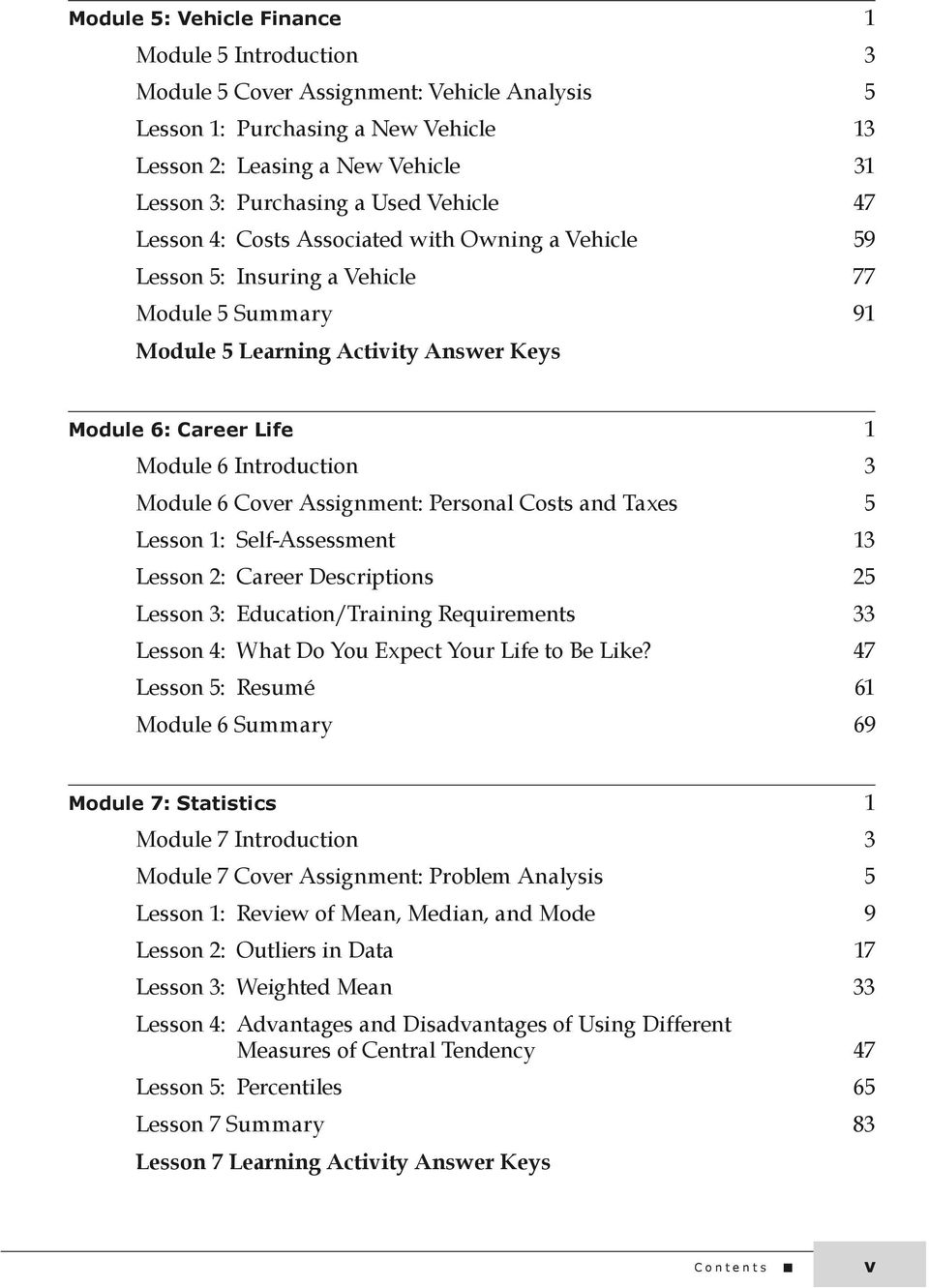
8 Module 8: Precision Measurement 1 Module 8 Introduction 3 Module 8 Cover Assignment: Puzzles in Design 5 Lesson 1: Accuracy vs. Precision 13 Lesson 2: Uncertainty 25 Lesson 3: Calipers and Micrometers 37 Lesson 4: Tolerance 55 Lesson 8 Summary 77 Lesson 8 Learning Activity Answer Keys Appendix A: Glossary 1 Bibliography 1 vi Grade 12 Essential Mathematics

9 A c k n o w l e d g e m e n t s Manitoba Education and Advanced Learning gratefully acknowledges the contributions of the following individuals in the development of Grade 12 Essential Mathematics (40S): A Course for Independent Study. Writers Megan Hudson Instructional Design Assistant Development Unit Instruction, Curriculum and Assessment Branch Amanda Konrad Instructional Design Assistant Development Unit Instruction, Curriculum and Assessment Branch Reviewer Irv Peters Independent Consultant Winkler Manitoba Education and Advanced Learning School Programs Division Staff Carole Bilyk Project Leader Louise Boissonneault Coordinator Ian Donnelly Consultant (since February 2012) Lynn Harrison Desktop Publisher Myrna Klassen Consultant Gilles Landry Project Manager Philippe Leclercq Conseiller pédagogique Susan Lee Coordinator Grant Moore Publications Editor John Murray Consultant (until August 2011) Development Unit Instruction, Curriculum and Assessment Branch Document Production Services Unit Educational Resources Branch Development Unit Instruction, Curriculum and Assessment Branch Document Production Services Unit Educational Resources Branch Distance Learning Unit Instruction, Curriculum and Assessment Branch Development Unit Instruction, Curriculum and Assessment Branch Conseiller pédagogique Mathématiques 9 à 12 Division du Bureau de l éducation française Division Distance Learning Unit Instruction, Curriculum and Assessment Branch Document Production Services Unit Educational Resources Branch Development Unit Instruction, Curriculum and Assessment Branch Acknowledgements vii
10

11 G r a d e 1 2 E s s e n t i a l M a t h e m a t i c s ( 4 0 S ) Introduction
12

13 I n t r o d u c t i o n t o t h e c o u r s e Overview Welcome to Grade 12 Essential Mathematics! This course is a continuation of the concepts you have been studying in previous years, as well as an introduction to new topics. As a student enrolled in a distance learning course, you have taken on a dual role that of a student and a teacher. As a student, you are responsible for mastering the lessons and completing the learning activities and assignments. As a teacher, you are responsible to check your work carefully, noting areas in which you need to improve and motivating yourself to succeed. What Will You Learn in This Course? In this course, Grade 12 Essential Mathematics, builds on the knowledge and skills students gained while studying Grade 11 Essential Mathematics. You will put to use many of the skills that you have already learned to solve problems and do basic arithmetic operations. This course helps you develop the skills, ideas, and confidence that you will need to make decisions and solve problems related to consumer applications of mathematics. How Is This Course Organized? The Grade 12 Essential Mathematics course consists of the following eight modules: Module 1: Home Finance Module 2: Geometry and Trigonometry Module 3: Business Finance Module 4: Probability Module 5: Vehicle Finance Module 6: Career Life Module 7: Statistics Module 8: Precision Measurement Introduction 3

14 Each module in this course consists of several lessons, which contain the following components: Examples: Lesson Focus: The Lesson Focus at the beginning of each lesson identifies one or more specific learning outcomes (SLOs) that are addressed in the lesson. The SLOs identify the knowledge and skills you should have achieved by the end of the lesson. Introduction: Each lesson begins with an explanation of what you will be learning in that lesson. Lesson: The main body of the lesson is made up of the content that you need to learn. It contains text, explanations, images, diagrams, and completed examples. Learning Activities: Many (most) lessons include one or more learning activities that will help you learn about the lesson topics and prepare you for the assignments, the midterm examination, and the final examination. Once you complete a learning activity, check your responses against those provided in the Learning Activity Answer Key found at the end of each applicable module. You will not submit the completed learning activities to your tutor/marker. Assignments: Assignments are found at the end of each lesson that has an assignment. You will mail or electronically submit all your completed assignments to your tutor/marker for assessment at the end of each module. In total, all assignments are worth 75% of your final course mark. Summary: Each lesson ends with a brief review of what you just learned. This course also includes the following appendix: Appendix A: Glossary: The glossary at the end of the course provides definitions for an alphabetical list of the terms identified throughout the course. You can use the glossary to review terms used in the course. 4 Grade 12 Essential Mathematics

15 What Resources Will You Need for This Course? You do not need a textbook for this course. All the content is provided directly within the course. You will, however, need access to a variety of resources. The required and optional resources for this course are identified below. Required Resources For this course, you will need access to the following resources. If you do not have access to one or more of these resources, contact your tutor/marker. A calculator: Use a graphing or scientific calculator as you work through this course. You will need the calculator for the examination(s). A metric ruler, an imperial ruler, and a protractor: Use the rulers and protractor as you work through this course. You will not need the rulers or protractor for the examination(s). Optional Resources Access to a computer with spreadsheet and graphing capabilities will be an advantage but not a requirement. Use of the Internet may be suggested as a resource in some places, but if you do not have access to an online computer you can still complete the related learning activities and assignments without it. Access to a photocopier would be helpful because it would let you make a copy of your assignments before you send them to your tutor/marker. That way, if you and your tutor/marker want to discuss an assignment, you would each refer to your own copy. Who Can Help You with This Course? Taking an independent study course is different from taking a course in a classroom. Instead of relying on the teacher to tell you to complete a learning activity or an assignment, you must tell yourself to be responsible for your learning and for meeting deadlines. There are, however, two people who can help you be successful in this course: your tutor/marker and your learning partner. Introduction 5

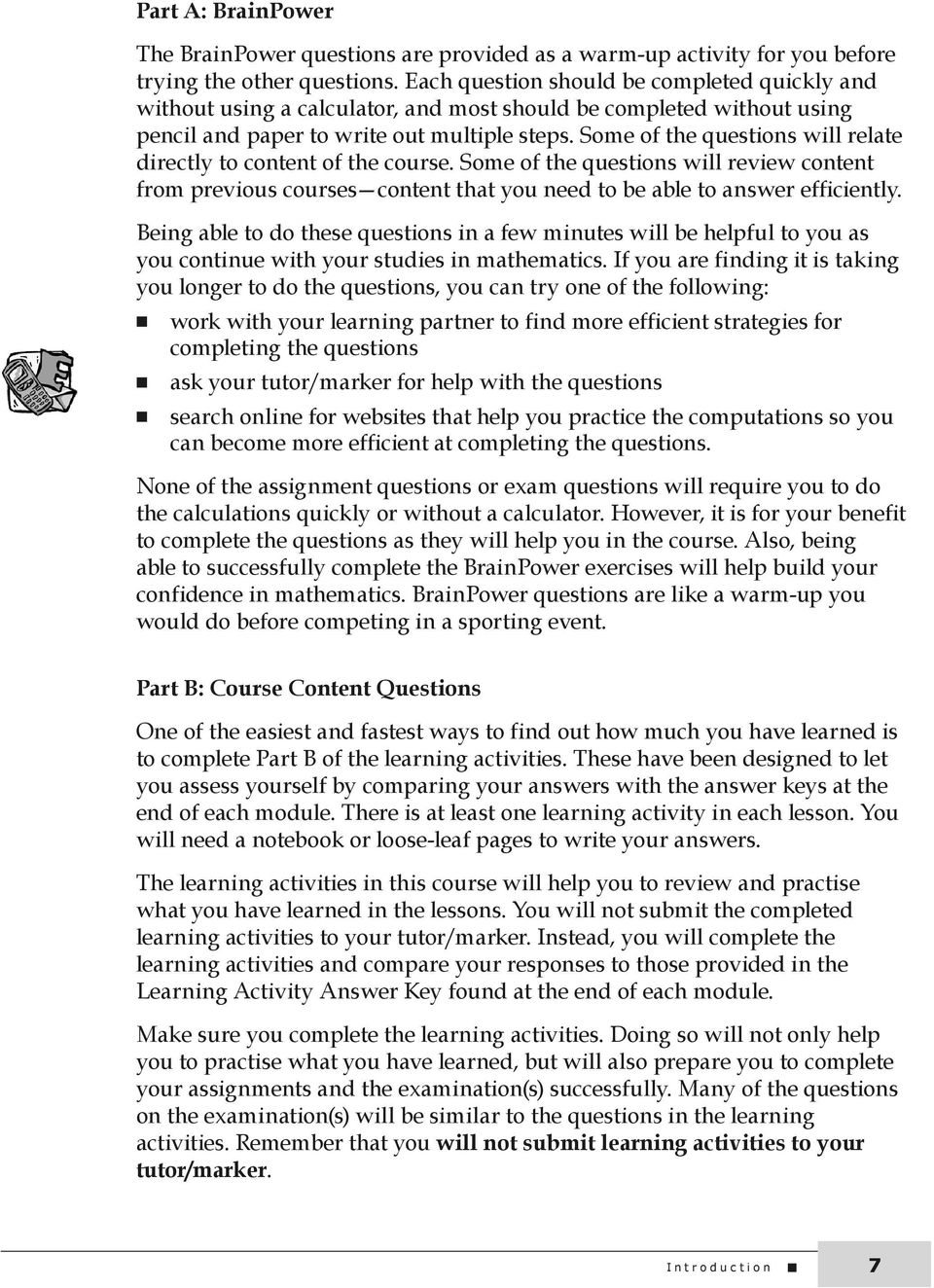
16 Your Tutor/Marker Tutor/markers are experienced educators who tutor ISO students and mark assignments and examinations. When you are having difficulty with something in this course, contact your tutor/marker, who is there to help you. Your tutor/marker s name and contact information were sent to you with this course. You can also obtain this information in the Who Is My Tutor/Marker? section of the distance learning website at < assistance.html>. Your Learning Partner Another person who can help you with your course is a learning partner. A learning partner is someone you choose who will help you learn. It may be someone who knows something about mathematics, but it doesn t have to be. A learning partner could be someone else who is taking this course, a teacher, a parent or guardian, a sibling, a friend, or anybody else who can help you. Most importantly, a learning partner should be someone with whom you feel comfortable and who will support you as you work through this course. Your learning partner can help you keep on schedule with your coursework, read the course with you, check your work, look at and respond to your learning activities, or help you make sense of assignments. You may even study for your examination(s) with your learning partner. If you and your learning partner are taking the same course, however, your assignment work should not be identical. How Will You Know How Well You Are Learning? You will know how well you are learning in this course by how well you complete the learning activities, assignments, and examinations. Learning Activities Each learning activity has two parts Part A has BrainPower questions and Part B has questions related to the content in the lesson 6 Grade 12 Essential Mathematics

17 Part A: BrainPower The BrainPower questions are provided as a warm-up activity for you before trying the other questions. Each question should be completed quickly and without using a calculator, and most should be completed without using pencil and paper to write out multiple steps. Some of the questions will relate directly to content of the course. Some of the questions will review content from previous courses content that you need to be able to answer efficiently. Being able to do these questions in a few minutes will be helpful to you as you continue with your studies in mathematics. If you are finding it is taking you longer to do the questions, you can try one of the following: n work with your learning partner to find more efficient strategies for completing the questions n ask your tutor/marker for help with the questions n search online for websites that help you practice the computations so you can become more efficient at completing the questions. None of the assignment questions or exam questions will require you to do the calculations quickly or without a calculator. However, it is for your benefit to complete the questions as they will help you in the course. Also, being able to successfully complete the BrainPower exercises will help build your confidence in mathematics. BrainPower questions are like a warm-up you would do before competing in a sporting event. Part B: Course Content Questions One of the easiest and fastest ways to find out how much you have learned is to complete Part B of the learning activities. These have been designed to let you assess yourself by comparing your answers with the answer keys at the end of each module. There is at least one learning activity in each lesson. You will need a notebook or loose-leaf pages to write your answers. The learning activities in this course will help you to review and practise what you have learned in the lessons. You will not submit the completed learning activities to your tutor/marker. Instead, you will complete the learning activities and compare your responses to those provided in the Learning Activity Answer Key found at the end of each module. Make sure you complete the learning activities. Doing so will not only help you to practise what you have learned, but will also prepare you to complete your assignments and the examination(s) successfully. Many of the questions on the examination(s) will be similar to the questions in the learning activities. Remember that you will not submit learning activities to your tutor/marker. Introduction 7
18 Assignments Each module in this course contains assignments, which you will complete and submit to your tutor/marker for assessment. The assignments are worth a total of 75% of your final course mark. There are two types of assignments that you must submit to your tutor/ marker. Each module has a cover assignment, which you can complete at any time during the module. Lesson assignments are located throughout the modules, and include questions similar to the questions in the learning activities of previous lessons. The cover assignments and lesson assignments have space provided for you to write your answers on the question sheets. You need to show all your steps as you work out your solutions, and make sure your answers are clear (include units, where appropriate). The tutor/marker will mark your assignments and return them to you. Remember to keep all marked assignments until you have finished the course so that you can use them to study for your examinations. Resource Sheet When you write your Midterm and Final Examinations, you will be allowed to take an Exam Resource Sheet with you into the exam. This sheet will be one letter-sized page, 8½ by 11, with both sides in your handwriting or typewritten. It is to be submitted with your exam. The Exam Resource Sheet is not worth any marks. Creating your own resource sheet is an excellent way to review. It also provides you with a convenient reference and quick summary of the important facts of each module. Each student is asked to complete a resource sheet for each module to help with studying and reviewing. The lesson summaries are written for you to use as a guide, as are the module summaries at the end of each module. Refer to these when you create your own resource sheet. Then, go to Appendix B: Glossary (at the end of the course) to check the information on your resource sheet. After you complete each module s resource sheet, you should summarize the sheets from all of the modules to prepare your Exam Resource Sheet. The Midterm Examination is based only on the first four modules of the course, while the Final Examination is based on Modules 5 to 8. 8 Grade 12 Essential Mathematics

19 Midterm and Final Exams This course contains a midterm examination and a final examination. The midterm examination is based on Modules 1 to 4, and is worth 12.5% of your final mark in this course. You will write the midterm examination when you have completed Module 4. As a student, you can use your Midterm Exam Resource Sheet to bring any formulas you have not memorized into the exam with you. You will be required to bring the following supplies to the Midterm Examination: pens and pencils (2 or 3 of each), blank paper, a scientific or graphing calculator, and your Midterm Exam Resource Sheet. The following tables from the course are attached to the back of the midterm examination: n Amortization Table n Manitoba Homeowner s Insurance Rates Table n Interest Rate Factor Table n Local Improvement Costs for Property Tax Credits Formulas are not included with the exam. Be sure to include these on the resource sheet. The final examination is based on Modules 5 to 8, and is worth 12.5% of your final mark in this course. You will write the final examination when you have completed Module 8. You can use your Final Exam Resource Sheet to bring any formulas you have not memorized into the exam with you. Formulas are not provided on the exam. You will be required to bring the following supplies to the final examination: pens and pencils (2 or 3 of each), blank paper, a scientific or graphing calculator, and your Final Exam Resource Sheet. The following tables from the course are attached to the back of the final examination: n Driver Safety Rating Chart n Amortization Table n MPI Passenger Vehicle Rate Groups Table n MPI Basic Rate Table Formulas are not included with the exam. Be sure to include these on the resource sheet. The two examinations are worth a total of 25% of your final course mark. You will write both examinations under supervision. Introduction 9

20 To do well on each examination, you should review all the work you have completed from the modules, including all learning activities and assignments. Practice Examinations and Answer Keys To help you succeed in your examinations, you will have an opportunity to complete a Midterm Practice Examination and a Final Practice Examination. These examinations, along with the answer keys, are found in the Student Downloads section of the distance learning website at < k12/dl/downloads/index.html>. If you do not have access to the Internet, contact the Independent Study Option office at to obtain a copy of the practice examinations. These practice examinations are similar to the actual examinations you will be writing. The answer keys enable you to check your answers. This will give you the confidence you need to do well on your examinations. Requesting Your Examination(s) You are responsible for making arrangements to have the examinations sent to your proctor from the ISO office. Please make arrangements before you finish Module 3 to write the midterm examination. Likewise, you should begin arranging for your final examination before you finish Module 7. To write your examinations, you need to make the following arrangements: If you are attending school, ask your school s ISO school facilitator to request your examination. Do this at least three weeks before you are ready to write your examination. For more information on examination procedures, please contact your ISO school facilitator or visit the Grading and Evaluation section of the distance learning website at < mb.ca/k12/dl/iso/assignments.html>. If you are not attending school, check the Examination Request Form for options available to you. The form was mailed to you with this course. Three weeks before you are ready to write the examination, fill in the Examination Request Form and mail, fax, or it to ISO Office 555 Main Street Winkler MB R6W 1C4 Fax: Toll-Free Telephone: [email protected] 10 Grade 12 Essential Mathematics

21 How Much Time Will You Need to Complete This Course? Learning through independent study has several advantages over learning in the classroom. You are in charge of how you learn and you can choose how quickly you will complete the course. You can read as many lessons as you wish in a single session. You do not have to wait for your teacher or classmates. From the date of your registration, you have a maximum of 12 months to complete this course, but the pace at which you proceed is up to you. Read the following suggestions on how to pace yourself. Chart A: Semester 1 If you want to start the course in September and complete it in January, you can follow the timeline suggested below. Module Module 1 Module 2 Module 3 Module 4 and Midterm Exam Module 5 Module 6 Module 7 Module 8 and Final Exam Completion Date Middle of September End of September Middle of October Early November Middle of November End of November Middle of December Middle of January Introduction 11
22 Chart B: Semester 2 If you want to start the course in January and complete it in June, you can follow the timeline suggested below. Module Module 1 Module 2 Module 3 Module 4 and Midterm Exam Module 5 Module 6 Module 7 Module 8 and Final Exam Completion Date Middle of February End of February Early March Middle of March Early April Middle of April Early May End of May Chart C: Full School Year (Not Semestered) If you want to start the course in September and complete it in June, you can follow the timeline suggested below. Module Completion Date Module 1 Module 2 Module 3 Module 4 and Midterm Exam Module 5 Module 6 Module 7 Module 8 and Final Exam End of September End of October End of November Middle of January Middle of February Middle of March Middle of April End of May Timelines Do not wait until the last minute to complete your work, since your tutor/ marker may not be available to mark it immediately. It may take a few weeks for your tutor/marker to assess your work and return it to you or your school. If you need this course to graduate this school year, remember to schedule and complete your final examination by May Grade 12 Essential Mathematics
23 When and How Will You Submit Completed Assignments? When to Submit Assignments While working on this course, you will submit completed assignments to your tutor/marker eight times. Each time you submit assignments, you must include the applicable Cover Sheet, which you will find at the end of this Introduction. The following chart shows you exactly what assignments you will be submitting at the end of each module. Submission of Assignments Submission Assignments You Will Submit 1 Module 1: Home Finance Module 1 Cover Sheet Module 1 Cover Assignment: Investments Using Spreadsheets Assignment 1.1: Affordability, Initial Costs, and Mortgages Assignment 1.2: Insurance and Property Tax Assignment 1.3: Making Decisions 2 Module 2: Geometry and Trigonometry Module 2 Cover Sheet Module 2 Cover Assignment: Circle Geometry Assignment 2.1: Polygons Assignment 2.2: The Sine Law Assignment 2.3: Trigonometry 3 Module 3: Business Finance Module 3 Cover Sheet Module 3 Cover Assignment: Marginal Income Tax Rates Assignment 3.1: Profitability of a Small Business Assignment 3.2: Income Tax 4 Module 4: Probability Module 4 Cover Sheet Module 4 Cover Assignment: Applying Probability to Games Assignment 4.1: Expressing Probability and Odds Assignment 4.2: Applications of Probability 5 Module 5: Vehicle Finance Module 5 Cover Sheet Module 5 Cover Assignment: Vehicle Analysis Assignment 5.1: Financing a New Vehicle Assignment 5.2: Used Vehicles and Using Vehicles Assignment 5.3: Insurance Costs continued Introduction 13
24 Submission of Assignments (continued) Submission Assignments You Will Submit 6 Module 6: Career Life Module 6 Cover Sheet Module 6 Cover Assignment: Personal Costs and Taxes Assignment 6.1: Self-Assessment Report Assignment 6.2: Career Descriptions Assignment 6.3: Education/Training Requirements Assignment 6.4: Expected Lifestyle Report Assignment 6.5: Resumé and Reflection 7 Module 7: Statistics Module 7 Cover Sheet Module 7 Cover Assignment: Problem Analysis Assignment 7.1: Mean, Median, Mode, and Outliers Assignment 7.2: Five Measures of Central Tendency Assignment 7.3: Analyzing Percentiles 8 Module 8: Precision Measurement Module 8 Cover Sheet Module 8 Cover Assignment: Puzzles in Design Assignment 8.1: Accuracy, Precision, and Uncertainty Assignment 8.2: Measurements and Tolerances How to Submit Assignments In this course, you have the choice of submitting your assignments either by mail or electronically. Mail: Each time you mail something, you must include the print version of the applicable Cover Sheet (found at the end of this Introduction). Electronic submission: Each time you submit something electronically, you must include the electronic version of the applicable Cover Sheet (found in the Student Downloads section of the distance learning website at < or you can scan the Cover Sheet located at the end of this Introduction. Complete the information at the top of each Cover Sheet before submitting it along with your assignments. 14 Grade 12 Essential Mathematics
25 Submitting Your Assignments by Mail If you choose to mail your completed assignments, please photocopy/scan all the materials first so that you will have a copy of your work in case your package goes missing. You will need to place the applicable module Cover Sheet and assignments in an envelope, and address it to ISO Tutor/Marker 555 Main Street Winkler MB R6W 1C4 Your tutor/marker will mark your work and return it to you by mail. Submitting Your Assignments Electronically Assignment submission options vary by course. Sometimes assignments can be submitted electronically and sometimes they must be submitted by mail. Specific instructions on how to submit assignments were sent to you with this course. You can also obtain this information in the Grading and Evaluation section of the distance learning website at < assignments.html>. If you are submitting assignments electronically, make sure you have saved copies of them before you send them. That way, you can refer to your assignments when you discuss them with your tutor/marker. Also, if the original assignments are lost, you are able to resubmit them. Your tutor/marker will mark your work and return it to you electronically. The Independent Study Option office does not provide technical support for hardware-related issues. If troubleshooting is required, consult a professional computer technician. Introduction 15
26 What Are the Guide Graphics For? Guide graphics are used throughout this course to identify and guide you in specific tasks. Each graphic has a specific purpose, as described below. Lesson Introduction: The introduction sets the stage for the lesson. It may draw upon prior knowledge or briefly describe the organization of the lesson. It also lists the learning outcomes for the lesson. Learning outcomes describe what you will learn. Learning Partner: Ask your learning partner to help you with this task. Learning Activity: Complete a learning activity. This will help you to review or practise what you have learned and prepare you for an assignment or an examination. You will not submit learning activities to your tutor/marker. Instead, you will compare your responses to those provided in the Learning Activity Answer Key found at the end of the applicable module. Assignment: Complete an assignment. You will submit your completed assignments to your tutor/marker for assessment at the end of a given module. Mail or Electronic Submission: Mail or electronically submit your completed assignments to your tutor/marker for assessment. Phone or Telephone or your tutor/marker. Resource Sheet: Indicates material that may be valuable to include on your resource sheet. Examination: Write your midterm or final examination at this time. Note: Take note of and remember this important information or reminder. Remember: If you have questions or need help at any point during this course, contact your tutor/marker or ask your learning partner for help. Good luck with the course! 16 Grade 12 Essential Mathematics
27 G r a d e 1 2 E s s e n t i a l M a t h e m a t i c s ( 4 0 S ) Module 1 Home Finance
28
29 M o d u l e 1 : H o m e F i n a n c e Introduction In previous mathematics courses, you explored personal finances as they apply to you now. This module focuses on financial concerns that you may have in the future. You probably don t own your own home at this point in your life, so you may not be aware of the costs of home ownership. This module will focus on costs that are associated with buying and owning a home. You will calculate the amount of money you can afford to spend on a house, how much your mortgage would cost, and the costs of home insurance, property taxes, and buying compared to renting a house. You will also become aware of the various expenses that are incurred when you buy a house. Assignments in Module 1 To obtain credit for Module 1, you will need to send the following four assignments to your tutor/marker. Your evaluation for this module is based on these assignments. Lesson Assignment Number Assignment Title Cover Assignment Investments Using Spreadsheets 2 Assignment 1.1 Affordability, Initial Costs, and Mortgages 3 Assignment 1.2 Insurance and Property Tax 5 Assignment 1.3 Making Decisions Module 1: Home Finance 3
30 Resource Sheet When you write your midterm exam, you are encouraged to take a Midterm Exam Resource Sheet with you into the exam. This sheet will be one lettersized page, 8½ by 11, with both sides in your handwriting or typewritten. You will submit it with your exam, but you do not receive any marks for it. Many students have found that preparing a resource sheet is an excellent way to review. It provides you with a summary of the important facts of each module. You should complete a resource sheet for each module to help with your studying and reviewing. Lesson summaries and module summaries are included for you to use as a guide. You may use the list of instructions provided below to help you with preparing your resource sheet for the material in Module 1. On this sheet, you should record math terms and definitions, formulas, sample questions, or a list of places where you often make mistakes. You should also identify special areas that require extra attention or review by writing the page numbers. After you have completed each module s resource sheet, you may summarize the sheets from Modules 1, 2, 3, and 4 to prepare your Midterm Exam Resource Sheet. The midterm exam for this course is based on Modules 1 to 4. Resource Sheet for Module 1 As you go through the lessons of this module, you may want to consider the following suggestions regarding the creation of a resource sheet. 1. List all the important math terms, and define them if necessary. 2. List all the formulas and perhaps a sample problem that shows how each formula is used. 3. If necessary, write the solutions to some problems, showing in detail how you did the calculations. 4. Copy any questions that represent the key points of the lesson, and perhaps include the solutions as well. 5. Identify the problems you found most difficult, and copy the page numbers onto the resource sheet so that you can review them before writing the exam. You may also copy the problems and the solutions onto your resource sheet, and later write them onto your Midterm Exam Resource Sheet. 6. Write any comments, ideas, shortcuts, or other reminders that may be helpful during an exam. 4 Grade 12 Essential Mathematics
31 L e s s o n 1 : A f f o r d a b i l i t y a n d I n i t i a l C o s t s Learning Activity 1.1 Learning Activity 1.1 is the only one that does not include a BrainPower section, although it does have two parts. Be sure to complete this learning activity before you begin your first lesson. This activity involves you having a conversation with your tutor/marker. Having this conversation with your tutor/marker has two important purposes. First, it introduces you to a very valuable resource your tutor/ marker. He or she is available for you to answer questions, explain concepts, and guide you through this course. You can discuss your math learning and progress. Feel free to contact your tutor/marker by phone or at any time during this course. The second important purpose of this assignment is to get you thinking about your math goals. You may have a future career in mind, and this course is getting you one step closer to it by completing a prerequisite for a future required course. There may be specific skills or topics you are interested in learning about, and they are covered in this course. If you are unsure of your math goals or why they are important, consider this: goals give you a sense of direction and purpose in taking this course goals help motivate you to learn and do your best, even when it s tough when you accomplish your goals, there is a great sense of achievement and success Good goals need to be realistic and specific, and they should reflect what is important to you. They should give you direction and take you further down the path from where you have been to where you want to go. Goals can be long term or short term, but they are the pathway that takes you from where you were/are, closer to where you want to go. continued Module 1: Home Finance 9
32 Learning Activity 1.1 (continued) Part A: Your Tutor/Marker Fill in the following blanks using information provided with your course: My tutor/marker s name is I can phone my tutor/marker at My tutor/marker s is Be ready to discuss the following topics and the reasons for your answers with your tutor/marker during your phone conversation. If you d like, make some notes below before you call in order to help you feel prepared. Feel free to add other questions or comments that you may have as well. 1. I am taking this course by distance education because 2. What I like about math and can do mathematically is (favourite topic, skill, where you use math, etc.). 3. What I dislike about math or have difficulty doing is continued 10 Grade 12 Essential Mathematics
33 Learning Activity 1.1 (continued) 4. Previous math experiences that influence the way I feel about math are 5. The next math course I would like to take is 6. What I am hoping this course will help me accomplish and learn for the future 7. What I am doing/how I will organize things to help me succeed in this course continued Module 1: Home Finance 11
34 Learning Activity 1.1 (continued) During your phone conversation, jot down a sentence or two in the spaces above about what you and your tutor/marker talk about. For example, if you are taking this course because it doesn t fit into your schedule at school or because you travel a lot with your basketball team and this is more convenient, state that in the space below Question 1. Part B: Your Math Pathway Use the answers to the questions from the conversation with your tutor/ marker as a starting point, and fill in the following diagram. In the Math History box, jot down point-form notes about your prior experience and knowledge about math (Questions 2, 3, and 4). In the Math Destination box, jot down what completing this course will help you accomplish in the future (Questions 5 and 6). In the middle column, write down what you will need to do to move down the pathway from your History to your Destination. Math History Pathway Math Destination continued 12 Grade 12 Essential Mathematics
35 Learning Activity 1.1 (continued) For example, if your destination includes needing a 75% in this course so that you can feel confident applying to a post-secondary institution such as college or university, or so that you can learn how to make smart consumer decisions, what will help you accomplish this? It may mean figuring out how you best learn and study math. It may mean setting up a schedule so you complete the assignments on time. You may need to find your calculator manual and figure out how to use it, set up regular appointments with your learning partner, research a topic on the Internet, or read a textbook about a certain math concept or skill. Your pathway is unique to you. As you move through this course and work on achieving your goals, selfassessment becomes important. It is the way for you to determine if you are getting closer to your destination, and if the steps along your pathway are taking you in the right direction. You will need to periodically ask yourself the following questions: Am I doing my assignments? Are my note-taking skills improving? How often have I contacted my tutor/marker or worked with my learning partner? Have I found useful homework websites? Is my schedule working? What do I need to change or adjust so I can get to my destination? Several times during this course, you will go through this cycle of looking at where you have been, where you want to go, and where you currently are. At any time, you may want to revise your goals or set new ones, as you evaluate your own progress and learning. Look back/history reflect on what you know, how far you have come Look around/pathway assess if you are achieving your goals, determine if new learning or understanding has occurred, and check your progress Look forward/destination determine what you want to know, set goals Each time you go through these steps, you will become better at mathematics! It is important that you keep the chart you created handy, as you will revisit it at other points in this course. Module 1: Home Finance 13
36 Notes 14 Grade 12 Essential Mathematics
37 Lesson Focus In this lesson, you will q calculate the Gross Debt Service Rate q determine the price range of houses that you can afford to buy q explore the various costs involved in purchasing a home Lesson Introduction As you probably know, houses cost a lot of money. You may save for a long time in order to buy a house and still need to get a loan from a bank! The focus of this lesson is on calculating what you can afford to pay for a house, as well as some of the initial costs that you must pay when buying a house. This lesson introduces you to some of the language used when discussing home ownership. If some of the words are new to you, write them down in your notes or on your resource sheet so that you can refer back to them later. Affordability In Grade 11 Essential Mathematics, you learned how to create a personal budget. Budgets are an important part of personal finance because they help you plan how much money you can spend, or indicate if you are spending too much on certain things. Calculating the amount of money you can afford to spend on a house is important when you want to buy a house. In this lesson, you will explore some formulas that are designed to help you decide how much you should spend when you decide to buy a house. As well, there are calculations that show the actual costs associated with buying a house. Module 1: Home Finance 15
38 Gross Debt Service Ratio The Gross Debt Service Ratio is an important formula for calculating whether you can afford a house, or how much you can afford to pay for a house. It compares the total cost of your monthly mortgage payment, taxes, and heating to your gross monthly income (from all sources). A mortgage is a loan from a financial institution to pay for your house we will cover mortgages in depth in the next lesson. Gross Debt Service Ratio (GDSR) = Include this formula on your resource sheet. Monthly Mortgage Payment + Property Taxes + Heating Gross Monthly Income The general rule is that your Gross Debt Service Ratio should not exceed 32%, but you should note that the Gross Debt Service Ratio is calculated using your gross income. Remember that gross income is the amount of money you earn before deductions. Your net income is the actual amount that you receive, after deductions. Because of this, the closer the Gross Debt Service Ratio is to 32%, the more difficult it is to budget for other expenses. There are two ways to use the Gross Debt Service Ratio: Number 1: Can I afford a certain house? You can use the Gross Debt Service Ratio to calculate whether you can afford to own a house. This is done by calculating what your Gross Debt Service Ratio would be if you owned the house. If the calculated Gross Debt Service Ratio is less than 32%, then you can afford the house, but if it is greater than 32%, you should not buy the house because it will be extremely difficult to stretch your budget to cover all your expenses. Example 1 The Menzies family is considering buying a two-storey house with a purchase price of 210,000. The family can make a down payment of 25,000. The family s gross monthly income is 4,236. The monthly mortgage payment is The annual property taxes are 2,500 and the annual heating costs are 1,500. a) Calculate the Gross Debt Service Ratio. b) Can the family afford this house? Solution Since you are given the monthly mortgage payment, disregard the purchase price of the home and the down payment. 16 Grade 12 Essential Mathematics
39 a) Monthly property taxes = 2, = Monthly heating costs = 1, = 125 Monthly Mortgage Payment + Property Taxes + Heating Gross Debt Service Ratio (GDSR) = Gross Monthly Income = = = 29.7% (round to the nearest tenth) b) Since the Gross Debt Service Ratio is under 32%, the Menzies family can afford this house. However, because the Gross Debt Service Ratio is close to 32%, the family may want to reconsider buying this house, or they may prefer to reduce their monthly mortgage payment by making a larger down payment. A down payment is the initial amount you pay for a house. It is a percentage of the purchase price of the home, usually around 20%. We will introduce down payments in our mortgage calculations in the next lesson. Number 2: Determining how much money you have to spend on a home You can use the Gross Debt Service Ratio to determine the maximum amount you can spend on housing (the affordability). In order to do this, you need to know the interest rate factor, which can be found in the table below. Note: This chart will be made available to you for your midterm exam. Chart 1.1 Interest Rate Factor Table Based on 25-Year Amortization Interest Rate Payment Factor For Each Dollar of Loan 2.5% % % % % % % % % % % % Module 1: Home Finance 17
40 Note that this table is based on a 25-year amortization rate (the amount of time it will take to pay off the mortgage). If you took out a mortgage for a different time period, the factor would be different. In this course, we will only consider a 25-year amortization rate when using interest rate factors. Example 2 A newly married couple wishes to purchase a condominium. The couple has a gross monthly income of 3,750, and is able to make a 15,000 down payment towards the purchase of a condo. The monthly mortgage the financial institution offers them is with an interest rate of 4.5%. They estimate the monthly property taxes to be about 165 and the heating costs to be about 70 per month. They anticipate that the condo fees will be 300. Calculate the maximum they can afford to pay for a condominium. Solution To solve this problem (and other problems like this one), you should set up the following calculation. Maximum Affordable Home Price Gross monthly household income Multiply: (GDSR) Total affordable household expenses Subtract: Monthly property taxes Monthly heating costs One-half of condo/strata fees (if applicable) Monthly affordable mortgage payment Divide: Interest factor (from Chart 1.1) Amount of affordable mortgage Add: Cash down payment Maximum affordable home price 32% , , , , , The steps to complete this calculation are: Step 1: Enter the amount of the gross monthly household income. ( ) Step 2: Multiply the gross monthly household income by the Gross Debt Service Ratio to find the total affordable household expenses. We always assume the Gross Debt Service Ratio is the maximum of 32%. ( = ) Step 3: Enter the values of the monthly property taxes, heating costs, and half of the condo/strata fees (if applicable). (165.00, 70.00, ) 18 Grade 12 Essential Mathematics
41 Step 4: Subtract the values of the monthly property taxes, heating costs, and half of the condo/strata fees (if applicable) from the total affordable household expenses. The money that is left can be used for a monthly mortgage payment. (1200 ( ) = ) Step 5: Enter the interest rate factor value for each dollar of loan at 4.5% by referring to Chart 1.1. ( ) Step 6: Divide the value of the monthly affordable mortgage payment by the interest rate factor table value to find the amount for an affordable mortgage when monthly payments are made for 25 years. ( = 147,377.94) Step 7: Enter the amount of the down payment. (15,000.00) Step 8: Add the amount of the down payment to the amount of the affordable mortgage to find the maximum affordable home price. (147, , = 162,377.94) The maximum amount that the couple can afford for a condo is 162, They are probably better off spending less than this because they may have other expenses at this time (e.g., furniture, vehicle, etc.), as well as savings. Remember that the Gross Debt Service Ratio is based on the gross income, so there are deductions and the couple will not receive the full amount of 3750 per month. You can also use a spreadsheet program such as Microsoft Excel to perform the calculation. Financial institutions access spreadsheet programs in order to determine the maximum affordable home price for their clients. If you prefer to use a spreadsheet program to solve the problems in the following learning activity and in Assignment 1.1, please do so. The Interest Rate Factor Table will be available during the midterm exam. Just remember that you will not have access to a computer during your exam, so it is important that you know the steps involved for calculating the maximum affordable housing cost. Write these steps (in full or in point form) on your resource sheet. Example 3 (Using a spreadsheet Microsoft Excel) Refer to Example 2 for the question. Solution Follow along on your computer if you have Microsoft Excel. If you are using a different spreadsheet program, the ideas should be similar but you are responsible for determining the exact steps. As you work through these steps, you may want to make an information sheet outlining how to use the program. Appendix A includes useful commands for making spreadsheets in Excel. Module 1: Home Finance 19
42 Note: If you have access to a computer, you should use a spreadsheet program such as Microsoft Excel to complete this module, including the assignments. However, you will not be given access to a spreadsheet program when you write the midterm and final examinations. You may, for example, use a spreadsheet to complete the Maximum Affordable Home Price table above, but you should also know how to complete it without using a spreadsheet. Before starting to perform calculations, you must enter all the categories from the table in Example 2. Once you have entered the categories into your spreadsheet, you must enter the gross monthly income ( ) and the Gross Debt Service Ratio (0.32). In order to calculate the total affordable household expenses, you can enter a formula into cell C3. In this sample spreadsheet, our formula is =C1*B2 because cell C1 is the value of the gross monthly household income and cell B2 is the Gross Debt Service Ratio value. Note: In order for the calculations to work, you must include only the number. Do not type in the dollar sign. In order to format the cell to have a dollar sign, right-click on the cell, select Format Cells, and then under the Number tab select Currency from the list of options. 20 Grade 12 Essential Mathematics
43 Once you have entered the formula, press Enter, and the value will appear for the Total affordable household expenses (1,200.00). If you change the value for the Gross monthly household income, the Total affordable household expenses will change as well. Next you must enter the monthly expenses (taxes = , heating = 70.00, condo fees = ). After you have done this, enter the formula to calculate the monthly affordable mortgage payment. In the cell beside Monthly affordable mortgage payment (cell C9), you must enter the formula =C3-(B5+B6+B7). This formula subtracts the monthly costs (taxes, heating, and condo fees) from the Total affordable household expenses. Now that you have calculated the Monthly affordable mortgage payment (815.00), enter the Interest rate factor ( ), which gives the monthly payment amount for each 1 of loan over 25 years. If you enter the Interest rate factor, then click on another cell, the number may lose a decimal place or two. If this happens, right-click on the cell, select Format Cells, and under the Number tab select Number from the menu. Make sure that it allows for 5 decimal places. Using the Monthly affordable mortgage payment (cell C9) and the Interest rate factor (cell B11), you can calculate the Amount of affordable mortgage (cell C13) using the formula =C9/B11. Module 1: Home Finance 21
44 Finally, enter the value for the Down payment ( ), then calculate the Maximum affordable home price. Can you think of the formula to calculate this? Because the Maximum affordable home price is the sum of the Amount of affordable mortgage (cell C13) and the Down payment (cell B15), the formula will be =C13+B15. Using the spreadsheet, you got an answer of 162, the same as when you calculated the Maximum affordable home price using the table. What is convenient about this spreadsheet is that now all you have to do is make small changes (e.g., gross monthly household income, monthly property taxes, monthly heating costs, condo fees, interest factor, and the down payment), and the spreadsheet will make all of the calculations. 22 Grade 12 Essential Mathematics
45 Now that you have seen how to perform affordability calculations and how to use a spreadsheet, complete the following learning activity to make sure that you understand the first part of this lesson (focusing on the Gross Debt Service Ratio). You can also use this learning activity to create a spreadsheet for solving problems involving maximum affordability. Regardless of how you solve each question, be sure to check your answers so that you are confident that you can complete these calculations successfully. Learning Activity 1.2 Complete the following, and check your answers in the learning activity keys found at the end of this module. Part A: BrainPower You should be able to complete the following five questions in just a few minutes without using a calculator or paper and pencil. 1. Evaluate for z = 1: 3z ( 7) 2. How much tax would you have to pay on an item that costs (approximately) if the PST = 7% and the GST = 5%? 3. Since 10% of 440 is 44, what is 35% of 440? 8 4. Evaluate: You have to buy a new toaster for your house. The toaster you want to buy costs 54.45, including tax. If you give the cashier 60, how much change should you get back? continued Module 1: Home Finance 23
46 Learning Activity 1.2 (continued) Part B: Calculations Using the Gross Debt Service Ratio Remember, these questions are similar to the ones that will be on your midterm exam. If you are able to answer them correctly, you are likely to do well on your exam. If you are not able to answer them correctly, you need to go back to the lesson to review the information you do not understand. Don t forget that you can ask your learning partner or tutor/marker for help if you are having a hard time understanding. 1. State the Gross Debt Service Ratio. How does it relate to home affordability? 2. Calculate the Gross Debt Service Ratio for the following situations. For each situation, state the likelihood of a financial institution granting a mortgage for the house. a) Monthly mortgage payment is 710, monthly property taxes are 118, monthly heating costs equal 96, and the gross monthly income is b) Monthly mortgage payment is 716, annual property taxes are 2500, the monthly heating costs are 116, and the gross monthly income is c) Monthly mortgage payment is 1000, annual property taxes are 2300, monthly heating costs average 105, and the gross annual income is 68, The Cadloff family are planning to purchase a home. The family has a gross monthly income of They are able to make a down payment of 20,000 toward the purchase of their home. The bank offers the family an interest rate of 4%. They estimate their monthly property taxes to be around 230 and their heating costs to be about 120 per month. Calculate the maximum price the Cadloffs can pay for a home. (Use the chart below or create your own spreadsheet.) Maximum Affordable Home Price Gross monthly household income Multiply: (GDSR) Total affordable household expenses Subtract: Monthly property taxes Monthly heating costs One-half of condo/strata fees (if applicable) Monthly affordable mortgage payment Divide: Interest factor (from Chart 1.1) Amount of affordable mortgage Add: Cash down payment Maximum affordable home price continued 24 Grade 12 Essential Mathematics
47 Learning Activity 1.2 (continued) 4. Alex Gardner wants to purchase a condominium. Alex has a gross annual income of 42,600. He has saved 10,000 for a down payment. His financial institution offered him an 3.5% interest rate on a mortgage. Alex estimates his monthly property taxes will be 110 and his monthly heating costs will be 40. Condo fees are 275 per month. Calculate the maximum price Alex can pay for his condominium. (Use either the chart below or your own spreadsheet.) Maximum Affordable Home Price Gross monthly household income Multiply: (GDSR) Total affordable household expenses Subtract: Monthly property taxes Monthly heating costs One-half of condo/strata fees (if applicable) Monthly affordable mortgage payment Divide: Interest factor (from Chart 1.1) Amount of affordable mortgage Add: Cash down payment Maximum affordable home price Additional Costs If you have never bought a house, you might assume that it works the same way as if you were buying a chocolate bar at the grocery store (i.e., you would only expect to be charged PST and GST in addition to the cost of the chocolate bar itself). Unfortunately, buying a house is not that easy, and there are a lot of additional costs. What sounds like a low price at the beginning can grow to a much larger price with all of the additional costs. If you are inexperienced in buying a home, read through this section with your learning partner. If you cannot read through this section with your learning partner, be sure to note any terms or statements that you do not understand so that you can ask your tutor/marker. If there are any terms that are particularly difficult for you, include them on your resource sheet. Module 1: Home Finance 25
48 Initial Costs Inspection fee Before you make a decision to purchase a home, it is highly recommended you have it inspected by a professional building inspector. Appraisal fee When borrowing money, the lender must determine the value of the property. A certified appraiser will be appointed by the lending agency (bank) to appraise the property to determine its value. Mortgage application fee Your financial institution may charge a fee for processing your mortgage application. Lawyers Disbursements and Fees When you purchase a home, you need to retain a lawyer or notary to act on your behalf. As a convenience to you, your lawyer will pay many of your purchase costs. These costs are known as disbursements. Your lawyer will include the costs of these disbursements with the legal fees. Two of the largest disbursements are the land transfer tax and the survey certificate. There are additional legal costs and lawyers fees, as well. n Land transfer tax You pay this tax to the Manitoba Land Titles Office at the time the title of your home is registered. The land transfer tax is a percentage of the purchase price as outlined below. Remember to add these dollar amounts and percentages to your resource sheet. 0 30,000 nil 30,000 90, % 90, , % 150, , % over 200, % Survey certificate You may be able to obtain this document from the seller. If you require a new survey certificate, a surveyor will charge you approximately 300 for a city or municipal property survey. Property survey This will supply information on how buildings, fences, and other structures are situated on the property. If a recent survey is available to you, a property survey may not be necessary. If there are any easements or encroachments on your property, it is a good idea to know about this before making the purchase. An easement is the right of way by a town, city, or utility company to access your land for a specific purpose, such as repairing telephone or television cables. An encroachment is an intrusion on your land by a neighbour s structure, or possibly an intrusion on your neighbour s land by a structure on your property. In either case, you would want to know this prior to purchasing the property. 26 Grade 12 Essential Mathematics
49 Additional legal costs These include disbursements such as registration costs, zoning memorandum, tax certificate, title searches, administration costs, and GST. Lawyers fees Real-estate lawyers will charge about 300 to 400 for the legal work involved in the purchase of your home. Adjustments Adjustments are not the actual costs related to the purchase of a home, they are adjustments that must be made based on the date you take possession of your new home. The possession date, or closing date, is the day the ownership of the house is officially transferred from the seller to the buyer. All the costs of home ownership before the possession date are the responsibility of the seller, and all the costs after the closing date are the responsibility of the buyer. Some of the adjustments are handled by your lawyer s office. Interest adjustment If you require a mortgage, the processing time required by the land titles office means that your mortgage money is not released until after you take possession of your new home. During this time, you must pay interest to the seller. As a rule, you pay one month s interest to your lawyer at the time you take possession of your home. Your lawyer distributes the appropriate amount of interest to the seller, and the remaining amount either to your financial institution or back to you (as applicable). Property tax adjustment Homeowners are required to pay property tax to the city or municipality each year. Property tax is calculated based on the calendar year (January to December), but is paid on a given due date during the year. For example, the due date in Winnipeg is June 30, the due date for Dauphin is July 31, and the due date for Brandon is September 30. In all cases, the amount paid covers January to December of that year. The City of Winnipeg has a monthly Tax Installment Payment Plan (TIPP) that allows homeowners to pay their annual tax bill in monthly installments. Depending on when you purchase property, you may have to reimburse the seller for property tax paid, or the seller may credit you for tax paid. If you purchase property after the due date, and the annual taxes have been paid by the seller, you will need to reimburse the seller for your share (the months during that calendar year you owned the home). If you purchase a property before the due date for annual property taxes is to be paid, the seller will have to credit you for their share of the year s taxes (the months they owned the house). Module 1: Home Finance 27
50 For the purposes of this course, the property tax adjustments will be made in terms of months. In reality, the property tax adjustments are made in terms of days. Insurance adjustment You also make a property insurance payment during the calendar year. Property insurance covers you in case of loss or damage to your property due to fire, flooding, or theft. Property insurance is valid for one year from the date of renewal. If you use the same insurance company, and if the cost of insurance for your new home is not the same as the insurance of your previous home, your insurance company will make an adjustment for the time period between your possession date and the insurance renewal date. This adjustment must be paid to the insurance company by the buyer. Other Additional Costs Moving expenses There will be moving expenses that you will have to pay, even if it is only the price of gasoline as you move yourself. Service charges Hookup fees may be charged for utilities, such as phone, Internet, water, and gas, and will be reflected in your first bill. Immediate repairs Some of these may be necessary prior to your moving in. You may want to negotiate the cost of these repairs with the seller. Appliances and furniture Sometimes the appliances are included in the purchase of the house, and sometimes you must buy appliances before you can move into your new home. Decorating costs Sometimes a new owner may want to repaint the house or install new flooring before moving in. It is usually easier to do this before moving all your belongings into the house. Knowing that these costs exist is the first step in being prepared for them when you are buying a house. The following examples demonstrate the calculations associated with these additional costs. You may want to make a note of the following types of problems, along with their solutions, on your resource sheet. 28 Grade 12 Essential Mathematics
51 Example 1: Land Transfer Tax Problem Calculate the land transfer tax on a home with a purchase price of 125,000. Solution To do this calculation, you need to find the percentages by referring back to the section that describes the land transfer tax. You should have written these dollar amounts and percentages on your resource sheet. Like the income tax deduction calculations you may have done in Grade 10 Essential Mathematics, different percentages for land transfer tax apply to different parts of the purchase price. This means that you have to find the amounts in each part of the purchase price, and then multiply the amount by the percentage given. Amount under 30,000 = 30,000 Tax on this amount = 0 Amount between 30,000 and 90,000 = 90,000 30,000 = 60,000 Tax on this amount = 0.5% 60,000 = 300 Amount between 90,000 and 125,000 = ,000 = 35,000 Tax on this amount = 1.0% = 350 Land transfer tax = = 650 Example 2: Home Insurance Adjustment The Leopp family has just purchased a new home in Winnipeg. The possession date of their new home is April 15. The family s home insurance is renewed September 1 of each year. The family has to increase its home insurance from 325 to 450 per year and pay the difference for the extra months. Calculate the family s home insurance adjustment. Solution Step 1: Calculate how much money is owed for the yearly home insurance = 125 Step 2: How many months remain before the Leopp family will renew their home insurance? April 15 to May 1 = 0.5 months May 1 to September 1 = 4 months Total = 4.5 months Step 3: What portion of the yearly (12 months) home insurance is owed for the months (4.5 months) between when the Leopp family takes possession of the house and when they renew their insurance? = Module 1: Home Finance 29
52 Example 3: Property Tax Adjustment Problem Lannis Jones has just purchased a new home. The possession date is September 1. Annual property taxes are 1878, and they are due on June 30. Calculate Lannis s property tax adjustment. Solution Step 1: Decide who owes money and who needs to be paid. Since the previous owner has already paid the property taxes for the year, Lannis has to pay the seller for the months she will own the home. Step 2: How many months worth of tax are owed? Since Lannis takes possession of the house in September, she owes the seller property taxes for four months (September, October, November, and December). Step 3: Calculate how much is money is owed. Lannis owes the seller = The fraction 4 comes from the 4 months that Lannis owns the 12 house, divided by the number of months in a year. Another way to do this calculation could be Monthly taxes: Total cost: = Note: If Lannis had taken possession of the home before June 30, the owner would have owed her money for the months before Lannis took possession. This amount would be credited to the purchaser of the home, so it would be subtracted from the total closing costs. Total closing cost includes the total of all additional costs that the purchaser must pay when buying the house. 30 Grade 12 Essential Mathematics
53 Example 4: Total Closing Cost Problem Claire Bland and Jim Gerrard are a married couple who have just purchased a house in Winnipeg. The purchase price of their new home is 114,500. Before finalizing their offer on the house, Claire and Jim have a professional building inspector inspect the house. The inspector assures the couple that the house is structurally sound. The inspection costs them 275. The couple obtains a fixed mortgage from their financial institution. They are charged 60 for a mortgage application fee and 45 for an appraisal fee. The couple retains a lawyer to act for them in the purchase of their house. The cost of the land transfer tax is 545 (0% 30, % 60, % + 24,500). They need a property survey of their new property. The cost of this survey is 300. Their lawyer s fee is 300. Other legal disbursements are 172. Claire and Jim s possession date for the home is August 15. The amount of interest owing to the seller on their first monthly payment is 472. Property taxes for the year are The due date for property taxes in Winnipeg is June 30. Their home insurance is renewed November 15 each year. They have to increase their home insurance from 390 to 480 per year. The cost to hook up the phone is 65. The cost to activate the natural gas is 45. Claire and Jim hire movers to move their possessions to their new home. The mover charges them 600. Before they move in, the couple wants to install new carpeting. The cost of the new carpeting is The couple purchases a new refrigerator at 960 and a new oven at 725. They also are having interior walls painted for Calculate the couple s total closing costs and extras to purchase their new home. Module 1: Home Finance 31
54 Solution Initial Fees Inspection Fee Mortgage Application Fee Appraisal Fee Total Closing Costs Total Initial Fees Lawyer s Disbursement and Fees Land Transfer Tax Property Survey Other Legal Disbursements Legal Fees Total Lawyer s Disbursement and Fees 1, Adjustments Interest Adjustment Property Tax Adjustment (2, /12) Home Insurance Adjustment ( ) 3/12) Total Adjustments 1, Other Additional Costs Service Charges ( ) Moving Expenses Immediate Repairs Appliances ( ) Decorating Costs , , Total Other Additional Costs 4, Total Closing Costs and Extras 8, Grade 12 Essential Mathematics
55 Example 5: Closing Cost Percentage Problem Determine the percent of Claire and Jim s total closing costs and extras compared to the purchase price of the home from the previous example. Solution Percent is a comparison of a quantity to 100. You can find the rate of percent by setting up a proportion between two ratios as follows. The ratio on the left is always the percent expressed as a comparison to 100. The ratio on the right consists of the total costs compared to the cost of the home. Method 1 Let x represent the unknown rate in the following proportion. x 8, = , , 500x =( 100)( 8, ) (cross-multiply) 114, 500x = 817, , 500x 817, 575 = 114, , 500 x = 71. (divide both sides by 114,500) (rounded to the nearest tenth) The rate of percent = 7.1% Method 2 There are other ways of finding the rate of percent. The following method indicates that you can find the rate of percent by dividing 8, by 114,500 and then multiplying by 100. Rate of percent = 8, = 71.% 114, 500 Use the method you prefer to find the rate of percent. Because of all the detail, these examples may seem scary while you re reading them, so it is important that you try to do them yourself in the following learning activity. Don t forget to check your answers after you have completed the learning activity to be absolutely sure that you understand how to complete these problems. Similar problems will appear on the midterm examination. Module 1: Home Finance 33
56 Learning Activity 1.3 Complete the following, and check your answers in the learning activity keys found at the end of this module. Part A: BrainPower You should be able to complete the following five questions in just a few minutes without using a calculator or paper and pencil Evaluate: You are furnishing your new apartment with a budget of You have already bought a couch for 925, table and chairs for 750, and a stove for How much money do you have left in your budget to buy a refrigerator? Is this reasonable? 3. Write two equivalent fractions for Josiah and his family go out for dinner and their restaurant bill is 126. If they want to leave a 15% tip, how much should they leave? 5. You are approved for a 219,000 mortgage from your bank. If you have saved up an additional 16,000 for a down payment, how much can you afford to spend on a house? Part B: Additional Cost Calculations Remember, these questions are similar to the ones that will be on your midterm exam. If you are able to answer them correctly, you are likely to do well on your exam. If you are not able to answer them correctly, you need to go back to the lesson to review the information you do not understand. 1. Calculate the land transfer tax on a home with a purchase price of 185,000. continued 34 Grade 12 Essential Mathematics
57 Learning Activity 1.3 (continued) 2. Ken Baron has just purchased a new home. The possession date of his new home is November 1. Annual property taxes on his new home are The due date for property taxes is June 30. Ken s home insurance is renewed April 1 of each year. He has to increase his home insurance from 285 to 326 per year and pay the difference for the extra months. a) Calculate Ken s property tax adjustment (i.e., the amount he must repay the seller). b) Calculate Ken s home insurance adjustment. 3. The Desrochers family has just purchased a new home in Winnipeg. The possession date of their new home is April 15. Annual property taxes on their new home are The due date for property taxes in Winnipeg is June 30. The family s home insurance is renewed October 1 of each year. The family has to increase its home insurance from 352 to 448 per year and pay the difference for the extra months. a) Calculate the family s property tax adjustment (i.e., the amount the seller owes them). b) Calculate the family s home insurance adjustment. 4. The Wiebe family purchases a three-bedroom bungalow for 188,500. Before finalizing their offer on the bungalow, the Wiebes have a professional building inspector inspect the house. The inspector assures the Wiebes that the house is structurally sound. The inspection costs 275. The Wiebes need to take out a mortgage at a financial institution. They are charged a mortgage application fee of 65 and an appraisal fee of 40. The Wiebes retain a lawyer to act for them in the purchase of their home. They do not need a property survey done of their new property. Other legal disbursements cost Their lawyer s fee is 350. The Wiebes possession date is October 1. The amount of interest owing to the seller is Property taxes for the year are The due date for property taxes is June 30. Their home insurance is renewed May 1 of each year. The family has to increase their home insurance from 336 to 382 per year and pay the difference for the extra months. continued Module 1: Home Finance 35
58 Learning Activity 1.3 (continued) The cost to hook up the phone is 60. The cost to activate the natural gas is 45. The Wiebes hire movers to move their furniture and appliances to their new home. The movers charge 380. Before they move in, the family purchases a new dishwasher for They have the hardwood floors refinished at a cost of They paint the bedrooms themselves. The cost of the paint and brushes is Use the form provided at the end of this lesson or create your own spreadsheet to calculate the Wiebe family s total closing costs and extras to purchase their new home. 5. Refer to Question 4. Determine the Wiebe family s total closing costs and extras as a percentage of the total purchase price of their new home. 6. Lauren Johansson has received a promotion from her company and is relocating in Winnipeg. She has just purchased a bungalow for 282,500. Before finalizing her offer, she has a professional building inspector inspect the house. The inspection fee costs her 300. The mortgage application fee costs 75. An appraisal fee costs 40. She retains a lawyer to act for her in the purchase of her home. Her lawyer s fee is 300. She needs a property survey of her new property. The cost of this survey is 325. Other legal disbursements cost her The possession date of Lauren s new home is March 1. The amount of interest owing to the seller is Property taxes for the year are The due date for property taxes in Winnipeg is June 30. (Because Lauren will be paying the taxes for the whole year, the seller must pay her for the taxes for January and February. This will be shown as a credit on the chart.) Home insurance for the year will cost her 314. The cost to hook up the phone is 55. The cost to activate the natural gas is 45. Lauren hires a moving company to move her possessions to her new home. Her employer pays the cost of the moving company. Before she moves in, Lauren purchases a new washing machine and dryer at a cost of and , respectively. She has the kitchen cabinets, counters, and flooring replaced at a cost of 14,150. She also has an alarm system installed at a cost of 600. She has her new house painted at a cost of Use the form provided at the end of this lesson to calculate Lauren s total closing costs and extras to purchase her new home. 7. Refer to Question 6. Determine Lauren s total closing costs and extras as a percentage of the total purchase price of her new home. 36 Grade 12 Essential Mathematics
59 Lesson Summary In this lesson, you explored the first steps of buying a house, and the calculations that accompany these steps. You learned that Gross Debt Service Ratio formula can be used to determine the affordability of a house, and that there are many additional costs that you have to consider when you buy a house. This material is included in the assignment at the end of Lesson 2, so be sure that you understand these concepts before moving on. The next lesson looks at mortgage calculations. Module 1: Home Finance 37
60 Notes 38 Grade 12 Essential Mathematics
61 Initial Fees Inspection Fee Mortgage Application Fee Appraisal Fee Total Closing Costs Total Initial Fees Lawyer s Disbursement and Fees Land Transfer Tax Property Survey Other Legal Disbursements Legal Fees Total Lawyer s Disbursement and Fees Adjustments Interest Adjustment Property Tax Adjustment Home Insurance Adjustment Total Adjustments Other Additional Costs Service Charges Moving Expenses Immediate Repairs Appliances Decorating Costs Total Other Additional Costs Total Closing Costs and Extras Module 1: Home Finance 39
62 40 Grade 12 Essential Mathematics
63 Initial Fees Inspection Fee Mortgage Application Fee Appraisal Fee Total Closing Costs Total Initial Fees Lawyer s Disbursement and Fees Land Transfer Tax Property Survey Other Legal Disbursements Legal Fees Total Lawyer s Disbursement and Fees Adjustments Interest Adjustment Property Tax Adjustment Home Insurance Adjustment Total Adjustments Other Additional Costs Service Charges Moving Expenses Immediate Repairs Appliances Decorating Costs Total Other Additional Costs Total Closing Costs and Extras Module 1: Home Finance 41
64 42 Grade 12 Essential Mathematics
65
66 Released 2014 Printed in Canada Imprimé au Canada
Grade 12 Pre-Calculus Mathematics (40S)
 Grade 12 Pre-Calculus Mathematics (40S) A Course for Independent Study Field Validation Version G r a d e 1 2 P r e - C a l c u l u s ( 4 0 S ) A Course for Independent Study 2014 Manitoba Education and
Grade 11 Pre-Calculus Mathematics (30S)
 Grade 11 Pre-Calculus Mathematics (30S) A Course for Independent Study Field Validation Version G r a d e 1 1 P r e - C a l c u l u s M a t h e m a t i c s ( 3 0 S ) A Course for Independent Study Field
Grade 10 Introduction to Applied and Pre-Calculus Mathematics (20S)
 Grade 10 Introduction to Applied and Pre-Calculus Mathematics (20S) A Course for Independent Study Field Validation Version G r a d e 1 0 I n t r o d u c t i o n t o A p p l i e d a n d P r e - C a l
Grade 12 Law (40S) A Course for Independent Study
 Grade 12 Law (40S) A Course for Independent Study GRADE 12 LAW (40S) A Course for Independent Study 2005 Manitoba Education, Citizenship and Youth DPS 05-10-05 Manitoba Education, Citizenship and Youth
Grade 12 Consumer Mathematics Standards Test. Written Test Student Booklet
 Grade 12 Consumer Mathematics Standards Test Written Test Student Booklet January 2012 Manitoba Education Cataloguing in Publication Data Grade 12 consumer mathematics standards test. Written test student
Introduction. Mathematics 41P Precalculus: First Semester
 Precalculus: First Semester Precalculus is the course that bridges the gap between Algebra 2 and Calculus. A thorough understanding of algebra and trigonometry is essential to success in Calculus and other
Grade 12 Pre-Calculus Mathematics (40S) A Course for Independent Study
 Grade 1 Pre-Calculus Mathematics (40S) A Course for Independent Study GRADE 1 PRE-CALCULUS MATHEMATICS (40S) A Course for Independent Study 007 Manitoba Education, Citizenship and Youth Manitoba Education,
Pre-Calculus AB. Computer Graphics 2014-2015
 Pre-Calculus AB Revised: 12/20/2014 Computer Graphics 2014-2015 2011-2012 Instructor Information Name:Mr. James M. Ott Office Location:Room 1169, across from the Chemistry classroom Office Hours:Periods
MATH 1111 College Algebra Fall Semester 2014 Course Syllabus. Course Details: TR 3:30 4:45 pm Math 1111-I4 CRN 963 IC #322
 MATH 1111 College Algebra Fall Semester 2014 Course Syllabus Instructor: Mr. Geoff Clement Office: Russell Hall, Room 205 Office Hours: M-R 8-9 and 12:30-2, and other times by appointment Other Tutoring:
Grade 12 Consumer Mathematics Standards Test. Written Test Student Booklet
 Grade 12 Consumer Mathematics Standards Test Written Test Student Booklet January 2011 Manitoba Education Cataloguing in Publication Data Grade 12 Consumer Mathematics Standards Test : Written Test Student
Consultant: Lynn T. Havens. Director of Project CRISS Kalispell, Montana
 Teacher Annotated Edition Study Notebook Consultant: Lynn T. Havens SM Director of Project CRISS Kalispell, Montana i_sn_c1fmtwe_893629.indd i 3/16/09 9:17:03 PM Copyright by The McGraw-Hill Companies,
COURSE OUTLINE FOR MATH 115. Instructor: Rich Tschritter, Ewing 268. Text: Precalculus, Sixth Edition, by Larson & Hostetler CHAPTER A: APPENDIX A
 COURSE OUTLINE FOR MATH 115 Instructor: Rich Tschritter, Ewing 268 Text: Precalculus, Sixth Edition, by Larson & Hostetler CHAPTER A: APPENDIX A 1 A.4 2 Rational Expressions 2 A.5 1 Solving Equations 3
Budgeting for Home Ownership
 A HOME FOR YOUR FAMILY 7 Budgeting for Home Ownership Perhaps you are just beginning to think about buying a home sometime in the future. Or maybe you have already found a home you would like to buy. Whether
MATH 1351 (3:3:0) Fundamentals of Mathematics II (Online Course) MATHEMATICS DEPARTMENT. Division of Arts & Sciences
 MATH 1351 (3:3:0) Fundamentals of Mathematics II (Online Course) MATHEMATICS DEPARTMENT Division of Arts & Sciences South Plains College Reese Center Summer I 2014 Traci Sanders 2 Fundamentals of Mathematics
Hands-On Data Analysis
 THE 2012 ROSENTHAL PRIZE for Innovation in Math Teaching Hands-On Data Analysis Lesson Plan GRADE 6 Table of Contents Overview... 3 Prerequisite Knowledge... 3 Lesson Goals.....3 Assessment.... 3 Common
Introduction. Maths IGCSE. Which Syllabus does this Course follow?
 Maths IGCSE Welcome to your Mathematics IGCSE course! This introduction contains all the information you need to be able to start your course, and you can also use it as a reference point as you work your
Lesson Description. Texas Essential Knowledge and Skills (Target standards) Skills (Prerequisite standards) National Standards (Supporting standards)
 Lesson Description This lesson builds on Grade 7, Lesson 1. Students will calculate net income and categorize expenses to create a budget. Percentages for each category will be calculated and analyzed.
Personal Finance. Chapter 1. Chapter Goals. Out of the Nest
 11 Chapter 1 Personal Finance Out of the Nest As young adults begin to establish themselves independently of their parents, they may consider renting their own apartment, purchasing a home, or even beginning
College Prep. Geometry Course Syllabus
 College Prep. Geometry Course Syllabus Mr. Chris Noll Turner Ashby High School - Room 211 Email: [email protected] Website: http://blogs.rockingham.k12.va.us/cnoll/ School Phone: 828-2008 Text:
MATH 115 Mathematics for Liberal Arts (3 credits) Professor s notes* As of June 27, 2007
 MATH 115 Mathematics for Liberal Arts (3 credits) Professor s notes* As of June 27, 27 *Note: All content is based on the professor s opinion and may vary from professor to professor & student to student.
How to Use the Cash Flow Template
 How to Use the Cash Flow Template When you fill in your cash flow you are trying to predict the timing of cash in and out of your bank account to show the affect and timing for each transaction when it
UNIT AUTHOR: Elizabeth Hume, Colonial Heights High School, Colonial Heights City Schools
 Money & Finance I. UNIT OVERVIEW & PURPOSE: The purpose of this unit is for students to learn how savings accounts, annuities, loans, and credit cards work. All students need a basic understanding of how
LIBERAL ARTS MATHEMATICS. A PROJECT BASED APPROACH By Mark Roland Dutchess Community College
 LIBERAL ARTS MATHEMATICS A PROJECT BASED APPROACH By Mark Roland Dutchess Community College Liberal Art Math Student? Characteristics Non Math & Science Majors Area of study may be unknown, Humanities,
Teacher Questionnaire
 PCAP Main Administration (2010) Teacher Questionnaire Council of Ministers of Education, Canada Funds for the Pan Canadian Assessment Program are provided by participating jurisdictions through the Council
TITLE: Elementary Algebra and Geometry OFFICE LOCATION: M-106 COURSE REFERENCE NUMBER: see Website PHONE NUMBER: (619) 388-3252
 SDCCD ONLINE COURSE: MATH 95 PROFESSOR: David Kater TITLE: Elementary Algebra and Geometry OFFICE LOCATION: M-106 COURSE REFERENCE NUMBER: see Website PHONE NUMBER: (619) 388-3252 OFFICE HOURS: Online.
BACKGROUND KNOWLEDGE for Teachers and Students
 Pathway: Business, Marketing, and Computer Education Lesson: BMM C6 4: Financial Statements and Reports Common Core State Standards for Mathematics: N.Q.2 Domain: Quantities Cluster: Reason quantitatively
*&6( 0DWKHPDWLFV,QWURGXFWLRQ
 2;)25 23(1 *&6( 0DWKHPDWLFV,QWURGXFWLRQ Maths GCSE Welcome to your Mathematics GCSE course! This introduction contains all the information you need to be able to start your course, and you can also use
SAULT COLLEGE OF APPLIED ARTS AND TECHNOLOGY SAULT STE. MARIE, ONTARIO COURSE OUTLINE
 SAULT COLLEGE OF APPLIED ARTS AND TECHNOLOGY SAULT STE. MARIE, ONTARIO COURSE OUTLINE COURSE TITLE: Business Mathematics CODE NO. : SEMESTER: 2 PROGRAM: AUTHOR: Parks and Recreation The Mathematics Department
VISUAL ALGEBRA FOR COLLEGE STUDENTS. Laurie J. Burton Western Oregon University
 VISUAL ALGEBRA FOR COLLEGE STUDENTS Laurie J. Burton Western Oregon University VISUAL ALGEBRA FOR COLLEGE STUDENTS TABLE OF CONTENTS Welcome and Introduction 1 Chapter 1: INTEGERS AND INTEGER OPERATIONS
MAT 113-701 College Algebra
 MAT 113-701 College Algebra Instructor: Dr. Kamal Hennayake E-mail: [email protected] I check my email regularly. You may use the above email or Course Email. If you have a question
CGE 3b 2 What s My Ratio? The Investigate the three primary trigonometric ratios for right-angled MT2.01 triangles. Summarize investigations.
 Unit 2 Trigonometry Lesson Outline Grade 10 Applied BIG PICTURE Students will: investigate the relationships involved in right-angled triangles to the primary trigonometric ratios, connecting the ratios
Precalculus Orientation and FAQ
 Precalculus Orientation and FAQ MATH 1011 (Precalculus) is a four hour 3 credit course that prepares a student for Calculus. Topics covered include linear, quadratic, polynomial, rational, exponential,
Q&As: Microsoft Excel 2013: Chapter 2
 Q&As: Microsoft Excel 2013: Chapter 2 In Step 5, why did the date that was entered change from 4/5/10 to 4/5/2010? When Excel recognizes that you entered a date in mm/dd/yy format, it automatically formats
OBJECTIVES. The BIG Idea. How do I register for the ACT? What do I need to know for the test day? ACT Registration
 ACT Registration 3 Taking Tests The BIG Idea How do I register for the ACT? What do I need to know for the test day? AGENDA Approx. 45 minutes I. Warm Up: ACTing Ahead (5 minutes) II. ACT Registration
Unit 4: Taxes. Read this unit including websites. You may want to take your own notes.
 Taxes Read Chapter 4 in the text. Read Chapter 7 of The Financial Checkup. Read this unit including websites. You may want to take your own notes. Are taxes your favorite topic? They are not the favorite
Using Credit to Your Advantage.
 Using Credit to Your Advantage. Topic Overview. The Using Credit To Your Advantage topic will provide participants with all the basic information they need to understand credit what it is and how to make
Grade 12 Psychology (40S) A Course for Independent Study
 Grade 12 Psychology (40S) A Course for Independent Study G r a d e 1 2 P s y c h o l o g y ( 4 0 S ) A Course for Independent Study 2013 Manitoba Education Manitoba Education Cataloguing in Publication
Version 01 7540004661. Part 1 Addition
 Version 01 7540004661 Part 1 Addition Survive Math 5 Part 1 Addition Survive Math 5 Addition and Subtraction i This content is Copyright 2005 Open School BC, all rights reserved. Open School BC content
Grade 10 Drafting Design Technology (20G) A Course for Independent Study
 Grade 10 Drafting Design Technology (20G) A Course for Independent Study GRADE 10 DRAFTING DESIGN TECHNOLOGY (20G) A Course for Independent Study 2009 Manitoba Education Manitoba Education Cataloguing
Using Excel for Analyzing Survey Questionnaires Jennifer Leahy
 University of Wisconsin-Extension Cooperative Extension Madison, Wisconsin PD &E Program Development & Evaluation Using Excel for Analyzing Survey Questionnaires Jennifer Leahy G3658-14 Introduction You
Math 101 Business Math Fall 2011
 Math 101 Business Math Fall 2011 Instructor's Name: Office Location: Office Hours: Office Phone: E-mail: Course Description A review of basic arithmetic, decimals, percentages and applications, together
BEST CASE BANKRUPTCY Means Test Guide
 BEST CASE BANKRUPTCY Means Test Guide This practical guide provides detailed instructions for using the Best Case Means Test Calculator. Cut through the complexity of Form 22 with step-by-step instructions,
Niles West High School STUDY SKILLS MANUAL
 Niles West High School STUDY SKILLS MANUAL Table of Contents Table of Contents Organizational Skills Study Habits Study Materials Doing Your Best Using the IRC Studying English Studying ESL Studying Foreign
Dimes to Riches Money Management for Teens in Grades 7-12
 Dimes to Riches Money Management for Teens in Grades 7-12 s e e r t n o row g t n s e o yd e n o M t a! h k t n a w b o n a k t u n By now yo Your parents are & Life is getting busy and you need cash for
Participant Guide Building: Knowledge, Security, Confidence FDIC Financial Education Curriculum
 Check It Out Building: Knowledge, Security, Confidence FDIC Financial Education Curriculum TABLE OF CONTENTS Page Determining Your Checking Account Needs 1 Checking Account Fees 2 Practice Exercise: Choosing
MATH 1314 College Algebra Departmental Syllabus
 MATH 1314 College Algebra Departmental Syllabus Fall 2010 Catalog Description MATH 1314. College Algebra (3-3-0) This course is a study of solutions to equations and inequalities, algebraic functions and
Consumer Math 15 INDEPENDENT LEAR NING S INC E 1975. Consumer Math
 Consumer Math 15 INDEPENDENT LEAR NING S INC E 1975 Consumer Math Consumer Math ENROLLED STUDENTS ONLY This course is designed for the student who is challenged by abstract forms of higher This math. course
Getting Started with Excel 2008. Table of Contents
 Table of Contents Elements of An Excel Document... 2 Resizing and Hiding Columns and Rows... 3 Using Panes to Create Spreadsheet Headers... 3 Using the AutoFill Command... 4 Using AutoFill for Sequences...
hundred thousands one thousands ten thousands one millions hundreds
 Title: Rounding Numbers Grade(s): 4 Subject(s): Mathematics, Technology Education Author: ICAC Team Overview: After reviewing place value and rounding, students will create place value tables and solve
Understanding Checks and Checking Accounts
 financial literacy Understanding Checks and Checking Accounts Aim To raise students awareness of the cost-cutting benefits of using checking accounts to pay bills and cash paychecks. Objectives At the
Division of Fine Arts Department of Photography Course Syllabus
 Division of Fine Arts Department of Photography Course Syllabus COURSE TITLE COURSE NUMBER PREREQUISITES Digital Camera Work CRN 10097 PGY 1800C None CREDIT HOURS 3.0 CONTACT HOURS 45 hours online CLASS
First Timer s Guide PREParing First Time Homebuyers
 First Timer s Guide PREParing First Time Homebuyers SO MANY QUESTIONS Maybe you live in the best apartment with a great landlord and don t want to change a thing. Or maybe you ve looked at the rent going
Learn by doing! Use this workbook in combination with FaBLinker on www.fabeducation.com to learn and reinforce financial skills
 Learn by doing! Use this workbook in combination with FaBLinker on to learn and reinforce financial skills 1 Table of Contents Part 1 Financials Practice... 3 Practice 1 - An introduction to FaBLinker...
AMSCO S Ann Xavier Gantert
 AMSCO S Integrated ALGEBRA 1 Ann Xavier Gantert AMSCO SCHOOL PUBLICATIONS, INC. 315 HUDSON STREET, NEW YORK, N.Y. 10013 Dedication This book is dedicated to Edward Keenan who left a profound influence
NEW HOURS NEW MAILING ADDRESS. P.O. Box 3233 Cookeville, TN 38502. Mon Wed Fri 9:00 3:00. Phone: (931) 432-1496. Toll-free: 1-877-797-4860
 NEW HOURS Mon Wed Fri 9:00 3:00 NEW MAILING ADDRESS P.O. Box 3233 Cookeville, TN 38502 Phone: (931) 432-1496 Toll-free: 1-877-797-4860 Fax: (931) 432-1498 Email: [email protected] [email protected]
manitobastudentaid.ca
 Accessible and Affordable Post-Secondary Education 2015-2016 FINANCE YOUR FUTURE! Manitoba Student Aid manitobastudentaid.ca S E C T I O N O N E PLAN AHEAD Education Costs If you have been looking at post-secondary
Lesson 2 Budget to Save: Developing a Budget
 Lesson 2 Budget to Save: Developing a Budget Lesson Description In the weeks prior to the start of the unit, students track their expenditures during a two-week period. In class, students create a group
Unit 1 Number Sense. In this unit, students will study repeating decimals, percents, fractions, decimals, and proportions.
 Unit 1 Number Sense In this unit, students will study repeating decimals, percents, fractions, decimals, and proportions. BLM Three Types of Percent Problems (p L-34) is a summary BLM for the material
Lesson 9 Take Control of Debt: Using Credit Wisely
 Lesson 9 Take Control of Debt: Use Credit Wisely Lesson Description In this lesson, students review the balance sheet (Lesson 1) and the budget worksheet (Lesson 2) and consider ways to use these two documents
Welcome to Mrs. Henisa s Prep for College Algebra Class 2014-2015
 Welcome to Mrs. Henisa s Prep for College Algebra Class 2014-2015 Please take this packet home to your parents/guardians to read through and return the parent/student Information Page by Friday, August
Mapping Your Future Guide to Life after High School SM : Sophomore Year
 Mapping Your Future Guide to Life after High School SM : Sophomore Year Get prepared for life after high school Some people know from an early age exactly what they want to be when they are adults and
business studies bs1000ca course and assessment guide ncea level 1
 ngā akoranga umanga business studies bs1000ca course and assessment guide ncea level 1 2015 business studies (bs1000ca) teacher contact details When you first make contact with your teacher, please fill
Parents Financial Statement (PFS) Online Workbook
 Parents Financial Statement (PFS) Online Workbook A guide to completing your application for financial aid, from start to finish Print out this workbook or keep it open on your screen. Quick Reference
CONTENTS: Introduction to Financial Accounting BAF3M
 CONTENTS: Introduction to Financial Accounting BAF3M Page No. READING STRATEGIES Getting Ready to Read: Previewing a Text 2 Student Resource: Complete the Prompts for Your Accounting Text 4 WRITING STRATEGIES:
COURSE SYLLABUS -----------------------------------------------------------------------------------
 Last Reviewed by: Leslie Wurst Date Approved: Date Revised: Fall 2012 COURSE SYLLABUS Syllabus for: MATH 1010 Math for General Studies Former Course and Title: Former Quarter Course(s): Mat 1260 Contemporary
ASSOCIATE DEGREE NURSING
 JACKSON COMMUNITY COLLEGE ASSOCIATE DEGREE NURSING COURSE SYLLABUS SPRING/SUMMER 2011 5/23/2011PH 1 5/23/2011PH 2 COURSE NUMBER NUR 121 JACKSON COMMUNITY COLLEGE NURSING DEPARTMENT COURSE SYLLABUS COURSE
How To Calculate A Balance On A Savings Account
 319 CHAPTER 4 Personal Finance The following is an article from a Marlboro, Massachusetts newspaper. NEWSPAPER ARTICLE 4.1: LET S TEACH FINANCIAL LITERACY STEPHEN LEDUC WED JAN 16, 2008 Boston - Last week
Financial Literacy in Grade 11 Mathematics Understanding Annuities
 Grade 11 Mathematics Functions (MCR3U) Connections to Financial Literacy Students are building their understanding of financial literacy by solving problems related to annuities. Students set up a hypothetical
MT120-ES: Topics in Applied College Math (4 credits; 100% online) Syllabus Fall 2013
 Contact Information for Professor Wood MT120-ES: Topics in Applied College Math (4 credits; 100% online) Syllabus Fall 2013 Phone: (603) 271-6484 x4341 E-mail: [email protected] Office: Sweeney Hall, Room
Anytime Adviser Checking Account Coach
 Anytime Adviser Checking Account Coach Welcome. This interactive guide coaches you in managing your checking account. You may move from chapter to chapter by selecting headings from the left. Click on
ATC Program Essential Skills Package Administrative Assistant
 ATC Program Essential Skills Package Administrative Assistant Instructional Methods: Course Format: Classroom Lectures, Hands on Computer and Equipment Use Classroom: Individual and group work Rationale:
Grade 11 Essential Mathematics. Unit 2: Managing Your Money
 Name: Grade 11 Essential Mathematics Unit 2: Page 1 of 16 Types of Accounts Banks offer several types of accounts for their customers. The following are the three most popular accounts used for everyday
How To Write Tvalue Amortization Software
 TimeValue Software Amortization Software Version 5 User s Guide s o f t w a r e User's Guide TimeValue Software Amortization Software Version 5 ii s o f t w a r e ii TValue Amortization Software, Version
Take Charge of Your Finances Semester Course designed for 10 th -12 th grade students Class Period Length 45 minutes
 Take Charge of Your Finances Semester Course designed for 10 th -12 th grade students Class Period Length 45 minutes SCANS Skills: Basic Skills: reading, writing, mathematics, listening, speaking Thinking
Students will devise a savings plan for college.
 Lesson Description Students will analyze data to determine the relationship between level of educational attainment and weekly earnings and the relationship between level of educational attainment and
Excel Budget Homework
 Excel Budget Homework CSE 3, Fall 2009 Due at the BEGINNING of your next lab. A. Annual Budget One of the most common uses of a spreadsheet is to chart financial information. We are going to create an
Creating A Grade Sheet With Microsoft Excel
 Creating A Grade Sheet With Microsoft Excel Microsoft Excel serves as an excellent tool for tracking grades in your course. But its power is not limited to its ability to organize information in rows and
How to Study Mathematics Written by Paul Dawkins
 How to Study Mathematics Written by Paul Dawkins Before I get into the tips for how to study math let me first say that everyone studies differently and there is no one right way to study for a math class.
Finance Unit 8. Success Criteria. 1 U n i t 8 11U Date: Name: Tentative TEST date
 1 U n i t 8 11U Date: Name: Finance Unit 8 Tentative TEST date Big idea/learning Goals In this unit you will study the applications of linear and exponential relations within financing. You will understand
How do you organize the schools you are applying to?
 BMR COLLEGE APPLICATION PROCESS FOR NAVIANCE Included below are the procedures for sending applications and records to colleges from BMR High School. In order to insure that each student s applications
MODULE CO-ORDINATOR HANDBOOK. Collaborative Partners
 MODULE CO-ORDINATOR HANDBOOK Collaborative Partners January 2012 GENERAL INFORMATION Who is this handbook for? This handbook is for staff working at collaborative partner organisations, who are responsible
Consumer Math (Mathematics of Finance) A Syllabus
 Consumer Math (Mathematics of Finance) A Syllabus MA11.02.2.1 Course Description Consumer Math B is an extension of Consumer Math A and continues the focus on basic math skills used in everyday life with
Prentice Hall: Middle School Math, Course 1 2002 Correlated to: New York Mathematics Learning Standards (Intermediate)
 New York Mathematics Learning Standards (Intermediate) Mathematical Reasoning Key Idea: Students use MATHEMATICAL REASONING to analyze mathematical situations, make conjectures, gather evidence, and construct
Dear Accelerated Pre-Calculus Student:
 Dear Accelerated Pre-Calculus Student: I am very excited that you have decided to take this course in the upcoming school year! This is a fastpaced, college-preparatory mathematics course that will also
Math 143: College Algebra Spring 2016 - - 8- Week Session
 Math 143: College Algebra Spring 2016 - - 8- Week Session Course Description and Foundational Studies Program Objectives Boise State's Foundational Studies Program provides undergraduates with a broad-
SAIT TDC ORIENTATION PACKAGE
 SAIT TDC ORIENTATION PACKAGE System Requirements ----------------------------------------------------------------------------------------------------------- 2 Getting Started --------------------------------------------------------------------------------------------------------------------
Glencoe. correlated to SOUTH CAROLINA MATH CURRICULUM STANDARDS GRADE 6 3-3, 5-8 8-4, 8-7 1-6, 4-9
 Glencoe correlated to SOUTH CAROLINA MATH CURRICULUM STANDARDS GRADE 6 STANDARDS 6-8 Number and Operations (NO) Standard I. Understand numbers, ways of representing numbers, relationships among numbers,
MAT 103B College Algebra Part I Winter 2016 Course Outline and Syllabus
 MAT 103B College Algebra Part I Winter 2016 Course Outline and Syllabus Instructor: Meeting Venue: Email: Caren LeVine Monday/Wednesday 6pm 7:50pm, E106 [email protected] Office Hours (Outside The
Spreadsheet User Guide. First-Year Course
 Spreadsheet User Guide with Solutions First-Year Course For Use With Glencoe Accounting: Online Learning Center Bothell, WA Chicago, IL Columbus, OH New York, NY CONTENTS Section 1 Introduction 1 Section
PHILOSOPHY OF THE MATHEMATICS DEPARTMENT
 PHILOSOPHY OF THE MATHEMATICS DEPARTMENT The Lemont High School Mathematics Department believes that students should develop the following characteristics: Understanding of concepts and procedures Building
MATH PLACEMENT & PREREQUISITE GUIDE
 MATH PLACEMENT & PREREQUISITE GUIDE WHAT YOU SHOULD KNOW! As part of the University of Wyoming s University Studies program (USP), all undergraduate students seeking a degree from the University of Wyoming
UNIT PLAN: EXPONENTIAL AND LOGARITHMIC FUNCTIONS
 UNIT PLAN: EXPONENTIAL AND LOGARITHMIC FUNCTIONS Summary: This unit plan covers the basics of exponential and logarithmic functions in about 6 days of class. It is intended for an Algebra II class. The
How To Factor Quadratic Trinomials
 Factoring Quadratic Trinomials Student Probe Factor Answer: Lesson Description This lesson uses the area model of multiplication to factor quadratic trinomials Part 1 of the lesson consists of circle puzzles
Life Insurance. Nationwide and the Nationwide Frame are federally registered service marks of Nationwide Mutual Insurance Company.
 Life Insurance Nationwide and the Nationwide Frame are federally registered service marks of Nationwide Mutual Insurance Company. Facilitator s Guide Life Insurance Overview: If you ask people to name
UNIVERSITY COLLEGE OF THE CARIBBEAN
 UNIVERSITY COLLEGE OF THE CARIBBEAN UCC ONLINE PROGRAMME OVERVIEW The UCC ONLINE degree programme responds to the growing number of students who are eager to earn college degrees but who require more flexibility