
Veritas NetBackup Installation Guide
|
|
|
- Brice Pierce
- 10 years ago
- Views:
Transcription
1 Veritas NetBackup Installation Guide Windows Release

2 NetBackup Installation Guide Copyright Symantec Corporation. All rights reserved. NetBackup 6.5 Symantec, the Symantec logo, and NetBackup are trademarks or registered trademarks of Symantec Corporation or its affiliates in the U.S. and other countries. Other names may be trademarks of their respective owners. Portions of this software are derived from the RSA Data Security, Inc. MD5 Message- Digest Algorithm. Copyright , RSA Data Security, Inc. Created All rights reserved. The product described in this document is distributed under licenses restricting its use, copying, distribution, and decompilation/reverse engineering. No part of this document may be reproduced in any form by any means without prior written authorization of Symantec Corporation and its licensors, if any. THIS DOCUMENTATION IS PROVIDED AS IS AND ALL EXPRESS OR IMPLIED CONDITIONS, REPRESENTATIONS AND WARRANTIES, INCLUDING ANY IMPLIED WARRANTY OF MERCHANTABILITY, FITNESS FOR A PARTICULAR PURPOSE OR NON- INFRINGEMENT, ARE DISCLAIMED, EXCEPT TO THE EXTENT THAT SUCH DISCLAIMERS ARE HELD TO BE LEGALLY INVALID, SYMANTEC CORPORATION SHALL NOT BE LIABLE FOR INCIDENTAL OR CONSEQUENTIAL DAMAGES IN CONNECTION WITH THE FURNISHING, PERFORMANCE, OR USE OF THIS DOCUMENTATION. THE INFORMATION CONTAINED IN THIS DOCUMENTATION IS SUBJECT TO CHANGE WITHOUT NOTICE. The Licensed Software and Documentation are deemed to be commercial computer software and commercial computer software documentation as defined in FAR Sections and DFARS Section Symantec Software Corporation Stevens Creek Blvd. Cupertino, CA Printed in the United States of America.

3 Third-party legal notices Licensing and registration Technical support Third-party software may be recommended, distributed, embedded, or bundled with this Veritas product. Such third-party software is licensed separately by its copyright holder. All third-party copyrights associated with this product are listed in the accompanying release notes. AIX is a registered trademark of IBM Corporation. HP-UX is a registered trademark of Hewlett-Packard Development Company, L.P. Linux is a registered trademark of Linus Torvalds. Solaris is a trademark of Sun Microsystems, Inc. Windows is a registered trademark of Microsoft Corporation. Oracle is a registered trademark of Oracle Corporation. Veritas NetBackup is a licensed product. See the NetBackup Installation Guide for license installation instructions. For technical assistance, visit and select phone or support. Use the Knowledge Base search feature to access resources such as TechNotes, product alerts, software downloads, hardware compatibility lists, and our customer notification service.

4

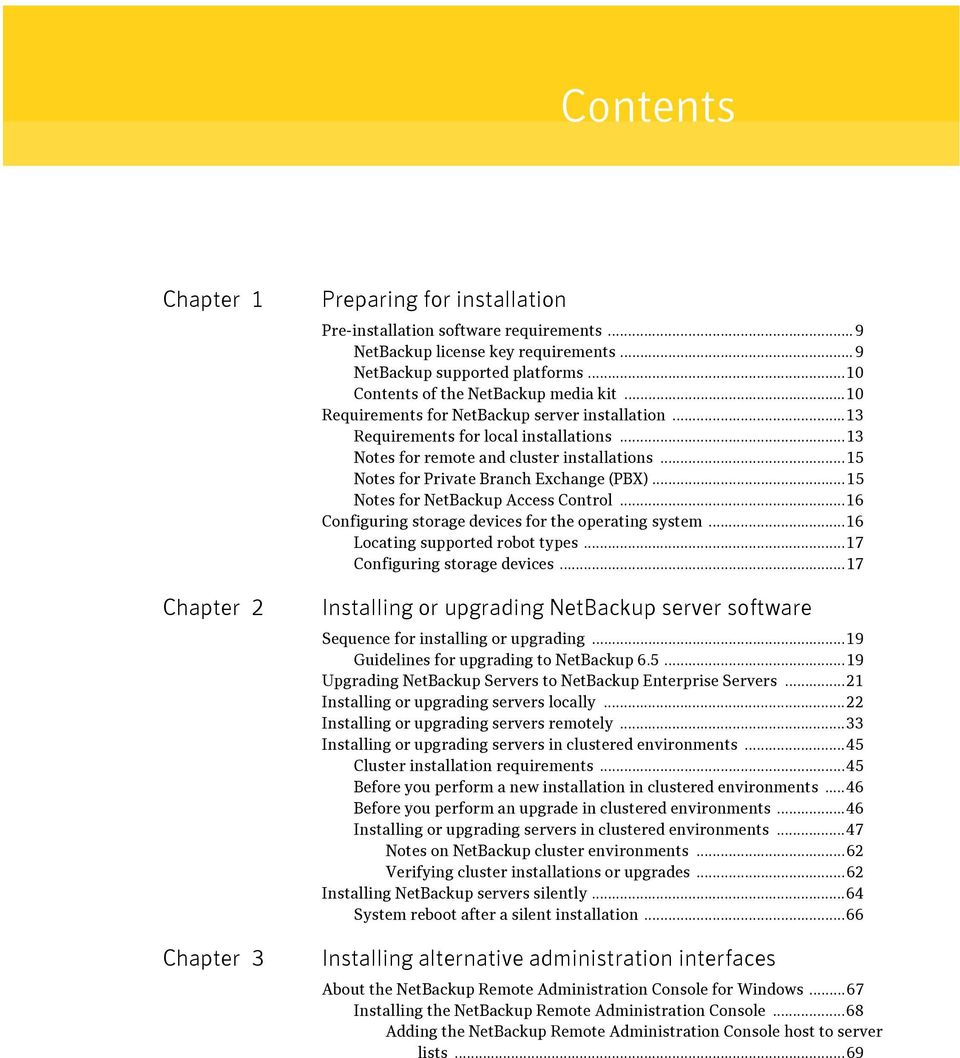
5 Contents Chapter 1 Chapter 2 Chapter 3 Preparing for installation Pre-installation software requirements... 9 NetBackup license key requirements... 9 NetBackup supported platforms...10 Contents of the NetBackup media kit...10 Requirements for NetBackup server installation...13 Requirements for local installations...13 Notes for remote and cluster installations...15 Notes for Private Branch Exchange (PBX)...15 Notes for NetBackup Access Control...16 Configuring storage devices for the operating system...16 Locating supported robot types...17 Configuring storage devices...17 Installing or upgrading NetBackup server software Sequence for installing or upgrading...19 Guidelines for upgrading to NetBackup Upgrading NetBackup Servers to NetBackup Enterprise Servers...21 Installing or upgrading servers locally...22 Installing or upgrading servers remotely...33 Installing or upgrading servers in clustered environments...45 Cluster installation requirements...45 Before you perform a new installation in clustered environments...46 Before you perform an upgrade in clustered environments...46 Installing or upgrading servers in clustered environments...47 Notes on NetBackup cluster environments...62 Verifying cluster installations or upgrades...62 Installing NetBackup servers silently...64 System reboot after a silent installation...66 Installing alternative administration interfaces About the NetBackup Remote Administration Console for Windows...67 Installing the NetBackup Remote Administration Console...68 Adding the NetBackup Remote Administration Console host to server lists...69
6 6 Contents Adding remote servers to administer from an existing NetBackup Remote Administration Console About the NetBackup-Java Administration Console Installing or removing multiple versions of the NetBackup-Java Administration Console on Windows Installing multiple versions of the NetBackup Administration Console on Windows Removing earlier versions of the NetBackup-Java Administration Console on Windows About the Java Windows Administration Console Installing the Java Windows Administration Console Administering multiple versions of NetBackup servers Earlier versions of the NetBackup-Java Administration Console on UNIX platforms Earlier versions of the NetBackup-Java Administration Console on Windows platforms Remote display-back from UNIX servers Remote display-back from Windows servers At the console of the server with an earlier version of NetBackup 75 Chapter 4 Chapter 5 Removing and reinstalling NetBackup Removing NetBackup server software Removing NetBackup server software in a clustered environment Notes on reinstalling NetBackup server software Installing clients Installing Microsoft Windows clients Client installation overview Veritas volume snapshot provider on Windows User-directed operations for Windows systems Local and remote installations for Windows systems Silent installations for Windows systems New and upgrade installations for Windows clients Windows client system requirements Local installation requirements Remote installation requirements NetBackup server requirements for Windows clients Installing Windows clients locally Installing Windows clients remotely Notes on Windows client remote installations Installing Windows clients silently Configuring NetBackup clients... 89

7 Contents 7 Removing Windows clients...90 Installing UNIX clients...90 Installing UNIX clients locally...92 Installing UNIX clients remotely...93 Installing client software with the rsh method...93 Installing client software with the ftp method...95 Installing client software with the ssh method...96 Installing client software with the sftp method...97 Adding a UNIX client after initial server installation...98 Removing UNIX NetBackup client software...99 Chapter 6 Chapter 7 Appendix A NetBackup licenses NetBackup license compatibility Entering license keys Frequently asked questions Configuring NetBackup servers Recommendations for configuring NetBackup Configuring NetBackup Configuring storage devices for NetBackup Configuring volumes Configuring the catalog backup Creating a backup policy Testing the NetBackup installation NetBackup LiveUpdate About NetBackup LiveUpdate How NetBackup LiveUpdate works Setting up your NetBackup LiveUpdate server Installing on Windows systems Installing on UNIX systems Installing the agent on UNIX servers Installing the agent on UNIX clients Changing the NetBackup LiveUpdate configuration Changing the LiveUpdate configuration on Windows Changing the LiveUpdate configuration on UNIX Downloading NetBackup release updates About LiveUpdate policies Creating a LiveUpdate policy Updating servers and clients with NetBackup LiveUpdate Updating master servers and media servers that run LiveUpdate policies 128

8 8 Contents Updating master severs and media servers that do not run LiveUpdate policies Updating clients LiveUpdate logs Retrieving logs remotely Uninstalling NetBackup LiveUpdate Uninstalling on Windows systems Uninstalling on UNIX systems Index 135
9 Chapter 1 Preparing for installation This chapter includes the following topics: Pre-installation software requirements Requirements for NetBackup server installation Configuring storage devices for the operating system Pre-installation software requirements This release of NetBackup contains many changes and enhancements that have caused the software to become larger. You can read a brief description of these enhancements in the NetBackup Release Notes. Depending on the type of platform you install, the growth in the software may require you to mount more CDs than in earlier releases. NetBackup license key requirements When you install a NetBackup master or media server, you must enter a NetBackup base product license key. Check your release package to make sure that you have license keys for all the NetBackup servers, options, and agents that you requested. Enter all product license keys on the master server when you are prompted during the installation. For more information about license keys, refer to NetBackup licenses on page 103. For detailed information on how to administer NetBackup license keys, refer to the Veritas NetBackup Administrator s Guide, Volume I.
10 10 Preparing for installation Pre-installation software requirements NetBackup supported platforms The NetBackup Release Notes document provides a Supported Platforms and Operating Systems table that identifies which clients to install with which operating systems. You can run mixed versions of NetBackup between master and media servers. This back-level support lets you upgrade NetBackup one server at a time, which minimizes impact on overall system performance. Symantec supports only certain combinations of servers and clients. The following lists all of the configurations for which Symantec provides support. Master Server Version Media Server Version Client Version NetBackup NetBackup , 5.0MP4 (or later) or 5.1 NetBackup MP3 (or later), 5.0MP4 (or later), or , 5.0MP4 (or later) or 5.1 Caution: Before you upgrade the NetBackup server software, you must back up your NetBackup catalogs and verify that the catalog backup was successful. Contents of the NetBackup media kit Starting with this release, Symantec is delivering NetBackup in both CD-ROM and DVD media formats. Starting with the next major release of NetBackup, the product will only be available on DVD media. Your NetBackup media kit includes multiple CDs or DVDs. The label on each CD and DVD provides a brief description of its contents. NetBackup documentation is included on both CD and DVD, and accompanies each product order. The documentation is in Portable Document Format (PDF), for all NetBackup software products in a release. The documentation is organized into product groups. You can use Acrobat Reader to print the files you select. If Autorun is enabled on your Windows system, you see a Web page that lists the documents that you can select to view. On UNIX or Linux systems, or if Autorun is disabled on the Windows system, navigate to the CD drive to view the CD contents. From that drive, you can select documents to view or copy them to a local drive.

11 Preparing for installation Pre-installation software requirements 11 The following table lists the title of each NetBackup 6.5 CD along with a brief description of its contents. Note: Beginning with NetBackup 6.5, Veritas Security Services and its associated acronym (VxSS) are replaced by Symantec Product Authentication and Authorization. NetBackup CD Windows 32-bit Windows IA-64-bit Windows X64-bit Solaris SPARC Solaris x86-64-bit HP-UX PA-RISC HP-UX IA-64-bit Linux 2.4 Contents Server/Client/Options Server/Client/Options Server/Client/Options Server/Clients Server/Clients Server/Clients Server/Client Server/Client Linux 2.6 Red Hat Server/Client Linux IA-64-bit 2.6 Red Hat and SuSE Servers/Clients Linux 2.6 AIX RS6000 Tru64 (Alpha) UNIX Client1 UNIX Client2 UNIX Client3 BMR UNIX Options NOM Storage Migrator NetBackup Document Set SuSE Server/Client Server/Client Server/Client Tru64, all HP, and AIX Mac and all Linux Solaris, FreeBSD, and IRIX UNIX UNIX Options/Database Agents NetBackup Operations Manager UNIX Complete NetBackup documentation set in PDF format

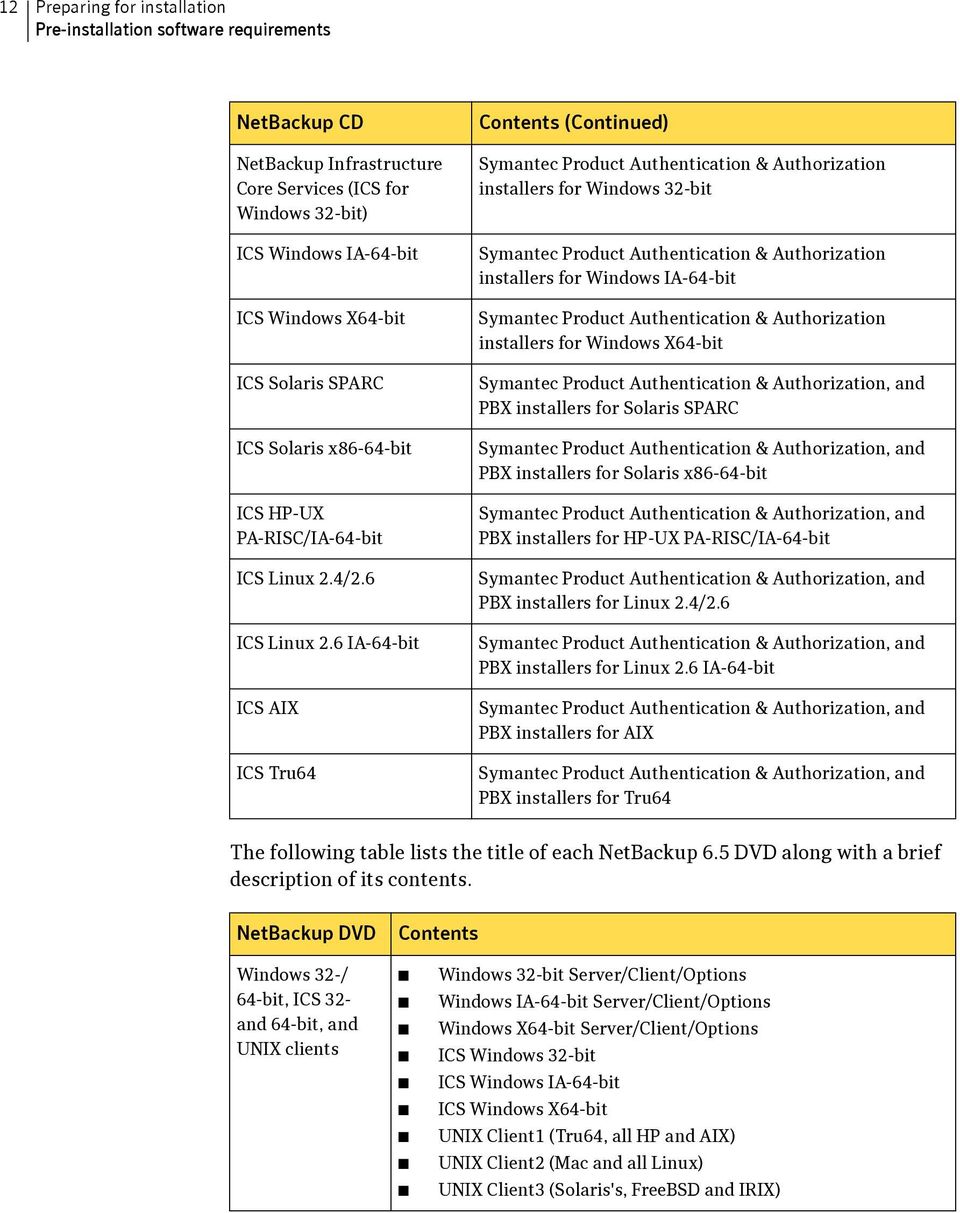
12 12 Preparing for installation Pre-installation software requirements NetBackup CD NetBackup Infrastructure Core Services (ICS for Windows 32-bit) ICS Windows IA-64-bit ICS Windows X64-bit ICS Solaris SPARC ICS Solaris x86-64-bit ICS HP-UX PA-RISC/IA-64-bit ICS Linux 2.4/2.6 ICS Linux 2.6 IA-64-bit ICS AIX ICS Tru64 Contents (Continued) Symantec Product Authentication & Authorization installers for Windows 32-bit Symantec Product Authentication & Authorization installers for Windows IA-64-bit Symantec Product Authentication & Authorization installers for Windows X64-bit Symantec Product Authentication & Authorization, and PBX installers for Solaris SPARC Symantec Product Authentication & Authorization, and PBX installers for Solaris x86-64-bit Symantec Product Authentication & Authorization, and PBX installers for HP-UX PA-RISC/IA-64-bit Symantec Product Authentication & Authorization, and PBX installers for Linux 2.4/2.6 Symantec Product Authentication & Authorization, and PBX installers for Linux 2.6 IA-64-bit Symantec Product Authentication & Authorization, and PBX installers for AIX Symantec Product Authentication & Authorization, and PBX installers for Tru64 The following table lists the title of each NetBackup 6.5 DVD along with a brief description of its contents. NetBackup DVD Contents Windows 32-/ 64-bit, ICS 32- and 64-bit, and UNIX clients Windows 32-bit Server/Client/Options Windows IA-64-bit Server/Client/Options Windows X64-bit Server/Client/Options ICS Windows 32-bit ICS Windows IA-64-bit ICS Windows X64-bit UNIX Client1 (Tru64, all HP and AIX) UNIX Client2 (Mac and all Linux) UNIX Client3 (Solaris's, FreeBSD and IRIX)
13 Preparing for installation Requirements for NetBackup server installation 13 NetBackup DVD Contents (Continued) Solaris SPARC and x86-64, Linux, and ICS HP, AIX, Tru64, and ICS BMR, UNIX Options, NOM, Storage Migrator, & NetBackup Documentation Set Solaris SPARC Server/Clients Solaris x86-bit Server/Client Linux 2.4 Server/Client Linux 2.6 Red Hat Server/Client Linux 2.6 IA-64-bit Red Hat/SuSE Servers/Clients Linux 2.6 SuSE Server/Client ICS Solaris SPARC ICS Solaris x86-64-bit ICS Linux 2.4/ bit ICS Linux 2.6 IA-64-bit HP-UX PA-RISC Server/Client HP-UX IA-64 Server/Client AIX RS6000 Server/Client Tru64 Server/Client ICS HP-UX RISC/IA-64 ICS AIX ICS Tru64 BMR for UNIX UNIX options NetBackup Operations Manager (UNIX and Windows) Storage Migrator Complete NetBackup documentation set in PDF format Requirements for NetBackup server installation The server software takes approximately 10 minutes to install. Additional time may be required to set up the product for your environment. Requirements for local installations Before you install NetBackup, ensure that the following requirements are met: Remove any other vendor s backup software currently configured on your system. The backup software of another vendor can negatively affect how NetBackup installs and functions. Before you install your NetBackup product, make sure that you have applied the most current operating system patches and updates. If you are not

14 14 Preparing for installation Requirements for NetBackup server installation certain that your operating system is current, contact your operating system vendor and request the latest patches and upgrades. Ensure that all NetBackup servers have a release level that is at least equal to the latest version that is installed on the clients. Earlier versions of server software can encounter problems with later versions of client software. Ensure that you have all NetBackup installation CDs, appropriate license keys, and an administrator account and password for all servers. Peripherals, such as robotic devices and stand-alone tape drives, must be installed according to the manufacturers instructions and recognized by the Windows software. Network configuration that allows all servers and clients to recognize and communicate with one another. Generally, if you can reach the clients from a server by using the ping command, the setup works with NetBackup. Server system configuration: An Intel Pentium system running Windows 2000 with a minimum of 256 MB of memory and service pack 4 installed, or Windows 2003 server. Internet Explorer 5.0 or later. Screen resolution configuration of at least 1024x768, 256 colors. Disk space: An NTFS partition. At least 1 GB of storage space to accommodate the server software (512 MB) and NetBackup catalogs (at least 512 MB). NetBackup catalogs contain information about your backups, which become larger as you use the product. The catalog disk space requirements depend primarily on the aspects of your backup configuration. For example, the number of files that are backed up, the frequency of your backups, and how long you retain your backup data. For upgrades, you must have an additional 500 MB of disk space on the drive where Windows is installed. After the upgrade is complete, this additional space is not needed. Symantec does not support installation of NetBackup in an CIFS-mounted directory. File locking in CIFS-mounted file systems can be unreliable. NetBackup services and port numbers must be the same across the network. Symantec suggests that you use the default port settings for NetBackup services and Internet service ports. If you modify the port numbers, they must be the same for all master servers, media servers, and clients. The port entries are in the following file:
15 Preparing for installation Requirements for NetBackup server installation 15 %SYSTEMROOT%\system32\drivers\etc\services To change the default settings, you must perform a Custom Installation of NetBackup or manually edit the services file. For Remote Administration Console installation, you must provide the names of the Remote Administration Console hosts during master server installation. Notes for remote and cluster installations In addition to the local installation requirements, the following guidelines apply to remote installations and cluster installations: The source system (or primary node) must run Windows 2000/2003 server. The destination PC (or clustered nodes) must have Windows 2000/2003 server. The installation account must have administrator privileges on all the remote systems or on all nodes in the cluster. All nodes in a cluster must run the same operating system, service pack level, and version of NetBackup. You cannot mix versions of server operating systems. Notes for Private Branch Exchange (PBX) NetBackup uses a Common Services Framework (CSF) called Private Branch Exchange (PBX). PBX helps limit the number of TCP/IP ports that NetBackup uses. It also allows all socket communication to take place while connecting through a single port. The PBX port number is For more information about PBX and how to configure NetBackup ports, refer to the Veritas NetBackup Security and Encryption Guide. Because PBX is required for all NetBackup products, its installation is part of the NetBackup installation procedure unless it is already present on the system. When you install NetBackup on a Windows server, the installation process determines if a version of PBX is already installed on your system. Whether PBX is already installed causes one of the following to happen: If a version of PBX exists, the installation process determines if the existing version is newer than the NetBackup version. If NetBackup uses a newer version, it is installed. Any existing default conditions are maintained. If NetBackup uses an earlier version, no changes are made. The latest version is always used.

16 16 Preparing for installation Configuring storage devices for the operating system If PBX exists, you cannot change the port number that it uses. If you change the port number, other Symantec products may fail. If no version of PBX exists, one is installed silently with NetBackup. A default port number is used, along with a default configuration. If PBX did not previously exist on the server, you can change the port number that it uses. When you remove (uninstall) NetBackup, PBX is removed if no other Symantec product is dependent on it. If there is a dependency from another product, PBX is not removed. Notes for NetBackup Access Control Use the following guidelines if you want to use access control: To use the access control features in NetBackup 6.5, you must install the Symantec Product Authentication and Authorization components. If access control is not installed in your current NetBackup environment, you must first upgrade to NetBackup 6.5. Then, you can install the access control components. If access control is already installed in your current NetBackup environment, you must install the new access control components before you upgrade to NetBackup 6.5. For NetBackup Access Control installation and upgrade instructions, see the Veritas NetBackup Security and Encryption Guide. Configuring storage devices for the operating system Reliable use of NetBackup depends on the proper configuration of your storage devices. To ensure reliable backups and restores, you must configure devices to work with the operating system. Use the instructions that the device vendor and operating system vendor provide. Install and configure storage devices before you install and configure NetBackup. Warning: An improperly configured device may lead to loss of data during restores.

17 Preparing for installation Configuring storage devices for the operating system 17 Locating supported robot types Configuring storage devices You can find a list of the supported robot types in the NetBackup Release Notes. Symantec periodically adds new robots to this list. For your convenience, Symantec updates the supported robots lists on the Symantec support Web site. To find the latest devices this release supports 1 In a Web browser, open 2 In the Product Lookup list, select either NetBackup Enterprise Server or NetBackup Server. 3 In the new Web page in the Support for this product section, click Compatibility List. 4 In the new Compatibility and Reference Web page from the appropriate drop-down menus, select Compatibility > NetBackup 6.5, and the language of your choice. 5 The lower section of the screen updates depending on what you select from the drop-down menus. From the links on this section of the screen, select the appropriate product level to check compatibility. 6 From the resulting page you can view device support information by individual vendor, all support drives, libraries, or robot types. Use the following guidelines to configure your storage devices: Configure your storage devices as described in the instructions that the device vendor and operating system vendor provide. For new installations, Symantec recommends that you install and configure the latest device drivers for your storage devices immediately before you install the NetBackup software. After you have configured your storage devices, you can install NetBackup. For upgrades, you can install the latest device drivers before you upgrade NetBackup. The Tape Device Driver Installation wizard that is included on the NetBackup installation CD steps you through how to install the latest device drivers. Note: Complete this wizard before you configure NetBackup.

18 18 Preparing for installation Configuring storage devices for the operating system If you do not have a NetBackup CD, you can download the NetBackup Tape Device Driver Installation software from the technical support Web site: To start the tape device driver installation wizard 1 Log on as administrator to the system where you installed NetBackup. 2 Insert the NetBackup CD in the drive. If Autorun is disabled, navigate to the CD drive and run Launch.exe. 3 On the installation browser, click the link Additional Products > Additional Product Installations > NetBackup Tape Device Drivers. 4 Complete the wizard to install the latest device drivers for your storage device. Note: You can download the latest external device mapping files on the Updates and Patches Web page on the support Web site:
19 Chapter 2 Installing or upgrading NetBackup server software This chapter includes the following topics: Installing or upgrading servers locally Installing or upgrading servers remotely Installing or upgrading servers in clustered environments Sequence for installing or upgrading Each procedure in this chapter is an independent process that you can use to perform the type of installation best suited to your environment. Each procedure includes the differences between a new installation and an upgrade. When you install or upgrade NetBackup server software, Symantec recommends the following sequence: 1 Master servers 2 Media servers, if any (NetBackup Enterprise Server only) 3 NetBackup Remote Administration Console, if any 4 NetBackup clients 5 Any NetBackup add-on products Before you proceed with any installation procedure, be sure to review the Requirements for NetBackup server installation on page 13. Guidelines for upgrading to NetBackup 6.5 When you upgrade to NetBackup version 6.5, you must upgrade from the following versions:

20 20 Installing or upgrading NetBackup server software Sequence for installing or upgrading Version 6.0 The procedures for upgrading from 6.0 to 6.5 are included in this installation guide. Notes about logging changes when upgrading to NetBackup 6.5 An upgrade to NetBackup 6.5 overwrites the nblog.conf file with a new file and resets two logging settings. The Logging Level feature was introduced in NetBackup 6.0 GA. Upgrading to 6.5 resets this feature to 1. To change the Logging Level to the desired setting after upgrading, refer to the Veritas NetBackup Administrator s Guide, Volume I. The LogRecycle feature was introduced in NetBackup 6.0 MP4. Upgrading to 6.5 resets this feature to OFF. To change LogRecycle to the desired setting after upgrading, refer to the Veritas NetBackup Troubleshooting Guide. You should also refer to the information at the following Website: Version 5.0MP4 (or later) or version 5.1 The procedures for upgrading from 5.0MP4 (or later) or version 5.1 are not included in this guide. Before you can upgrade from 5.0MP4 (or later) or version 5.1, you must first prepare your current NetBackup environment for an upgrade to version 6.5. The upgrade instructions can be found as follows: Go to the following Symantec Website: In the Product Lookup dialog box, enter NetBackup Enterprise Server and click on the arrow to the right. The next page that displays includes a Hot Topics section that provides a link to an upgrade portal. Following the procedures described in the linked documents at this Website help ensure a successful upgrade. Note: If you have a version earlier than 5.0MP4 installed (such as 4.5), you cannot upgrade directly to NetBackup 6.5. You must first upgrade to NetBackup 5.x and then upgrade to NetBackup 6.5. Use the following guidelines if you want to use access control: To use the access control features in NetBackup 6.5, you must install the Symantec Product Authentication and Authorization components. If access control is not installed in your current NetBackup environment, you must first upgrade to NetBackup 6.5. Then, you can
21 Installing or upgrading NetBackup server software Upgrading NetBackup Servers to NetBackup Enterprise Servers 21 install the Symantec Product Authentication and Authorization components. If access control is already installed in your current NetBackup environment, you must install the new Symantec Product Authentication and Authorization components before you upgrade to NetBackup 6.5. For NetBackup access control installation and upgrade instructions, see the Veritas NetBackup Security and Encryption Guide. Upgrading NetBackup Servers to NetBackup Enterprise Servers To upgrade from NetBackup Server to NetBackup Enterprise Server, you must enter the appropriate license key(s) in your current NetBackup Administration Console. To upgrade a NetBackup server to a NetBackup enterprise server 1 Locate your NetBackup Enterprise Server license key. 2 Open the NetBackup Administration Console and choose Help > License Keys. The NetBackup License Key dialog box appears. 3 Click the New icon. 4 Enter your license key in the New license key field and click Add. The new license key appears in the field in the lower part of the dialog box. For upgrades on Windows from a NetBackup server evaluation license key to a permanent NetBackup Enterprise Server-based product license key, restart the NetBackup services. When services are restarted, the new license information is displayed when you select Help > About NetBackup Administration Console. If you add, delete, or change any license keys, you must restart the NetBackup Administration Console. 5 Reboot the system if you are prompted.
22 22 Installing or upgrading NetBackup server software Installing or upgrading servers locally Installing or upgrading servers locally Welcome Veritas License Agreement Veritas Choose Installation Custom installation Veritas Enter License Key Select Server Type Select NetBackup Features Select Port Numbers Provide Startup Information for NetBackup Services Typical installation Enter System Name Enter EMM Server Name Media server installation differences: The NetBackup Systems Name screen contains the Media Server Name field Begin Installation Monitor Progress Upgrade differences: No Enterprise Media Manager Host screen appears New installation or Upgrade from 6.0 = Finished
23 Installing or upgrading NetBackup server software Installing or upgrading servers locally 23 To install or upgrade NetBackup servers on a local system Note: For upgrades: If you want to use NetBackup access control, refer to the Veritas NetBackup Security and Encryption Guide for complete instructions. Complete that procedure before you begin your NetBackup upgrade. For new installations: Install NetBackup access control after you complete the NetBackup installation. 1 Log on to the system where you want to install NetBackup. Be sure to log on with administrator privileges. 2 For upgrades only: Deactivate all policies For NetBackup Administration Console users On the master server, open the NetBackup Administration Console. From the tree on the left, select Policies. In the right pane, select all policies that appear. Right-click on the highlighted policies and select Deactivate. For command line users Enter the following command: install_path\netbackup\bin\admincmd\ bpplinfo policy_name -modify -inactive Deactivate disk staging storage units. For NetBackup Administration Console users: Open the NetBackup Administration Console on the master server. From the tree on the left, expand NetBackup Management > Storage Units. In the right pane, double-click on a disk staging storage unit. When the Change Storage Unit window appears, select Staging Schedule. When the Disk Staging Schedule window appears, click on the Exclude Dates tab. Select the date in the calendar that matches the date of the system upgrade. Repeat these tasks for each disk staging storage unit. For command-line users, enter the following command:
24 24 Installing or upgrading NetBackup server software Installing or upgrading servers locally install_path\netbackup\bin\admincmd\ bpschedulerep schedulename -excl mm/dd/yyyy Deactivate all media servers On the master server, open the NetBackup Administration Console. From the tree on the left, select Media and Device Management>Devices>Hosts. In the right pane, select all media servers that appear. Right-click on the highlighted servers and select Deactivate. For command line users Enter the following command: install_path\volmgr\bin\ vmoprcmd -deactivate_host -h device_host 3 Insert the appropriate NetBackup installation CD or DVD in the drive. If Autorun is disabled, navigate to the CD or DVD drive and run Launch.exe. 4 On the initial browser screen, click NetBackup Installation, and on the following screen, select Install Server Software. 5 On the Welcome screen, click Next. 6 On the License Agreement screen, accept the license agreement and click Next.
25 Installing or upgrading NetBackup server software Installing or upgrading servers locally 25 7 On the Select where you want to install Veritas NetBackup screen, provide the following information: Computer Typical Custom For a local installation, select Install to this computer only. Select Typical to install NetBackup default features and settings. Select Custom to change how NetBackup features and settings are installed. Click Next.
26 26 Installing or upgrading NetBackup server software Installing or upgrading servers locally 8 On the NetBackup License Key and Server Type screen, provide the following information: License Key NetBackup Master Server NetBackup Media Server Enter the base product license key that you received with your product. Select the icon next to the software type you want to install, such as NetBackup Master Server. For new installations, the license key that you provide determines which components you can select. For example, you can click the icon next to NetBackup Master Server only if you enter a master server license key. For upgrades, the license used for the existing installation type determines which components you can select. For Typical If you selected Typical for the installation type (step 7 on installations only page 25), go to step 10 on page For custom installations: NetBackup Features Click on the drop-down icon next to any feature that you do not want to install. On the pop-up dialog box that appears, confirm that the feature is not available for installation. A red X should appear on the icon.
27 Installing or upgrading NetBackup server software Installing or upgrading servers locally 27 NetBackup installation location To change the folder destination where NetBackup is installed, click Change. When the Change Current Destination Folder dialog box appears, browse to your preferred location and designate a new or an existing folder. Click Next. On the NetBackup Port Numbers screen, you can change port numbers, if it is necessary in your configuration. You may want to change a port number if you encounter conflicts when NetBackup and another industry product try to share the same port. Another example is if a port conflict occurs with a company s firewall, which may cause security issues. To change a port number, select the port number you want to replace and type the new number. Click Next. On the NetBackup Services screen, provide the following startup account and startup type information for NetBackup services: Use the built-in system account User name, Password, Domain Startup Check this box to use the built-in system account. Enter the specific information for the system you want to use. Be sure to leave the Use the built-in system account check box unchecked. Select either Automatic or Manual start up.
28 28 Installing or upgrading NetBackup server software Installing or upgrading servers locally Start NetBackup Server Services After Install Check this box if you want to start the services after installation. You can leave the box unchecked to prevent services from starting after installation. Terminate NetBackup processes Check this box to prevent a reboot while you perform a remote installation. When you check this box, processes that use the NetBackup executables and DLLs are stopped. Caution: For Oracle users: If you select Terminate NetBackup processes, you must take down your database before you continue the installation. Terminate Windows processes Check this box to prevent a reboot while you perform a remote installation. When you check this box, processes that use the Microsoft run-time DLLs are stopped. For upgrades: You do not need this option because the Microsoft run-time DLL is already at the correct level. Caution: If you select Terminate Windows processes, it may cause instability with other Windows applications, particularly those applications that use run-time DLLs. Abort install if a reboot is required Check this box so that NetBackup can detect if the remote system requires a restart. If a restart is required, this option ends the installation and rolls the remote system back to its state at the beginning of the installation. Click Next.
29 Installing or upgrading NetBackup server software Installing or upgrading servers locally On the NetBackup System Names screen, provide the following information: Master Server Name Enter the name of the master server. Additional Servers Enter the names of any additional machines (servers) that are allowed to access this server. If you enter more than one name, separate each name with a comma. Install LiveUpdate Agent Location of LiveUpdate Server Server Type The LiveUpdate agent allows installation of NetBackup patches from a LiveUpdate server. Even if you choose not to use LiveUpdate, agent installation does not affect NetBackup installation, configuration, or operation. For complete information, refer to About NetBackup LiveUpdate on page 115. The LiveUpdate server is the machine where you store NetBackup patches. The default server location is your NetBackup master server. If you want to designate a different machine as your NetBackup LiveUpdate server, type the appropriate pathname for that server here. Select the protocol that is used by your LiveUpdate server (LAN, HTTP, or HTTPS).
30 30 Installing or upgrading NetBackup server software Installing or upgrading servers locally For NetBackup Enterprise media server installations only When you install media server software, this screen has an additional line with the media server name shown as the local server. You must change the name to the master server name to which the media server is configured. Click Next. 11 On the NetBackup Enterprise Media Manager screen, enter the name of the server where you want the EMM server installed. The EMM server contains all information about NetBackup volume configuration and device configuration. By default, the master server name appears where the EMM server software is set up for installation on the NetBackup master server. This is the preferred configuration. Note: Although installing the EMM on a media server is supported, Symantec recommends that you install the EMM on the master server. For instructions that describe EMM installation on a media server, please refer to TechNote Note: Symantec does not support installing the EMM on a CIFS-mount. This screen only appears in new installations or when you upgrade a client to a server. This screen does not appear if you upgrade from NetBackup 6.0 to NetBackup 6.5.
31 Installing or upgrading NetBackup server software Installing or upgrading servers locally 31 If the NetBackup system shares drives by using the Shared Storage Option (SSO), all NetBackup servers must use the same host for storing device information. For more information on EMM servers and EMM databases, refer to the NetBackup Administrator s Guide for Windows, Volume 1. Click Next. 12 On the Ready to Install the Program screen, choose one of the following options: Install Back Cancel Click Install to initiate installation of the default (or custom) settings. Click Back to view the previous screens and make any changes, then return to this screen and click on Install. Click Cancel if you want to start the installation wizard again. After you click Install, the installation process begins and a screen appears that shows you the progress of the installation. This process may take several minutes. An installation log file provides detailed installation information and shows whether any errors occurred. Examine the installation log located under the user profile that completed the install. The following is an example of the user administrator that completed the install. This path may be hidden and you may need to unhide hidden or system files to view the log. C:\Documents and Settings\administrator\Local Settings\Temp\NetBackup Install...log Search the installation log for the following string to determine if an error has occurred. "Return Value 3"
32 32 Installing or upgrading NetBackup server software Installing or upgrading servers locally 13 On the Installation Complete screen, choose from the following options: Add Keys Finish Symantec recommends that you enter additional license keys now for any other NetBackup products you plan to install. To enter additional license keys, click Add Keys. When the list of Current License Keys appears, click the Add Key icon to enter a new license key, then click Add. After all license keys are entered, close the Current License Keys window. You have two ways to complete the installation as follows: If you are done installing software on all servers, leave the check mark next to Launch NetBackup Administration Console now and click Finish. The NetBackup Administration Console starts a configuration wizard so that you can configure your NetBackup environment. If you have more server software to install, click the check mark to remove it and click Finish. You can move on to the next machine and install the necessary server software. For new installations If you want to install NetBackup access control, refer to the only Veritas NetBackup Security and Encryption Guide and perform that procedure at this time. 14 For upgrades from 6.0: The server upgrade is complete.
33 Installing or upgrading NetBackup server software Installing or upgrading servers remotely 33 Installing or upgrading servers remotely, Welcome Veritas License Agreement Veritas Choose Installation Veritas Enter License Key Select Server Type Custom installation Typical installation Select Port Numbers Provide Startup Enter System Name Enter EMM Server Information for Name NetBackup Services Available Systems Add Remote Computer Enter Remote System Information Select Destination Systems Enter Remote System Login Credentials Remote Installation Destination Folder Return to Remote Features Dialog Now Updated Media server installation differences: Begin Installation > Monitor Progress The NetBackup Systems Name screen contains the Media Server Name field Upgrade differences: No Enterprise Media Manager Host screen appears New installation or Upgrade from 6.0 = Finished
34 34 Installing or upgrading NetBackup server software Installing or upgrading servers remotely To install or upgrade NetBackup servers over the network (remote installation) Note: For upgrades: If you want to use NetBackup access control, refer to the Veritas NetBackup Security and Encryption Guide for complete instructions. Complete that procedure before you begin your NetBackup upgrade. 1 Log on to the system where you want to install NetBackup. Be sure to log on with administrator privileges. 2 For upgrades only: Deactivate all policies For NetBackup Administration Console users On the master server, open the NetBackup Administration Console. From the tree on the left, select Policies. In the right pane, select all policies that appear. Right-click on the highlighted policies and select Deactivate. For command line users Enter the following command: install_path\netbackup\bin\admincmd\ bpplinfo policy_name -modify -inactive Deactivate disk staging storage units. For NetBackup Administration Console users: Open the NetBackup Administration Console on the master server. From the tree on the left, expand NetBackup Management > Storage Units. In the right pane, double-click on a disk staging storage unit. When the Change Storage Unit window appears, select Staging Schedule. When the Disk Staging Schedule window appears, click on the Exclude Dates tab. Select the date in the calendar that matches the date of the system upgrade. Repeat these tasks for each disk staging storage unit. For command-line users, enter the following command: install_path\netbackup\bin\admincmd\ bpschedulerep schedulename -excl mm/dd/yyyy Deactivate all media servers
35 Installing or upgrading NetBackup server software Installing or upgrading servers remotely 35 On the master server, open the NetBackup Administration Console. From the tree on the left, select Media and Device Management>Devices>Hosts. In the right pane, select all media servers that appear. Right-click on the highlighted servers and select Deactivate. For command line users Enter the following command: install_path\volmgr\bin\ vmoprcmd -deactivate_host -h device_host 3 Insert the appropriate NetBackup installation CD or DVD in the drive. If Autorun is disabled, navigate to the CD drive and run Launch.exe. 4 On the initial browser screen, click NetBackup Installation, and on the following screen, select Install Server Software. 5 On the Welcome screen, click Next. 6 On the License Agreement screen, accept the license agreement and click Next. 7 On the Select where you want to install Veritas NetBackup screen, provide the following information: Computer For a remote installation, click Select from available computers on the network.
36 36 Installing or upgrading NetBackup server software Installing or upgrading servers remotely Typical Custom Select Typical to install NetBackup default features and settings. Select Custom to change how NetBackup features and settings are installed. Click Next. 8 On the NetBackup License Key and Server Type screen, provide the following information: License Key NetBackup Master Server NetBackup Media Server Enter the base product license key that you received with your product. Select the icon next to the software you want to install, such as NetBackup Master Server. For new installations, the license key that you provide determines which components you can select. For example, you can click the icon next to NetBackup Master Server only if you enter a master server license key. For upgrades, the license used for the existing installation type determines which components you can select. For Typical If you selected Typical for the installation type, go to step 10 installations only on page For custom installations: On the NetBackup Port Numbers screen, you can change port numbers, if it is necessary in your configuration.
37 Installing or upgrading NetBackup server software Installing or upgrading servers remotely 37 You may want to change a port number if you encounter conflicts when NetBackup and another industry product try to share the same port. Another example is if a port conflict occurs with a company s firewall, which may cause security issues. To change a port number, select the port number you want to replace and type the new number. Click Next. On the NetBackup Services screen, provide the following startup account and startup type information for NetBackup services: Use the built-in system account User name, Password, Domain Startup Check this box to use the built-in system account. Enter the specific information for the system you want to use. Be sure to leave the Use the built-in system account check box unchecked. Select either Automatic or Manual start up. Start NetBackup Server Services After Install Check this box if you want to start the services after installation. You can leave the box unchecked to prevent services from starting after installation.
38 38 Installing or upgrading NetBackup server software Installing or upgrading servers remotely Terminate NetBackup processes Check this box to prevent a reboot while you perform a remote installation. When you check this box, processes that use the NetBackup executables and DLLs are stopped. Caution: For Oracle users: If you select Terminate NetBackup processes, you must take down your database before you continue the installation. Terminate Windows processes Check this box to prevent a reboot while you perform a remote installation. When you check this box, processes that use the Microsoft run-time DLLs are stopped. For upgrades: You do not need this option because the Microsoft run-time DLL is already at the correct level. Caution: If you select Terminate Windows processes, it may cause instability with other Windows applications, particularly those applications that use run-time DLLs. Abort install if a reboot is required Check this box so that NetBackup can detect if the remote system requires a restart. If a restart is required, this option ends the installation and rolls the remote system back to its state at the beginning of the installation. 10 On the NetBackup System Names screen, provide the following information: Master Server Name Enter the name of the master server.
39 Installing or upgrading NetBackup server software Installing or upgrading servers remotely 39 Additional Servers Enter the names of any additional machines (servers) that are allowed to access this server. If you enter more than one name, separate each name with a comma. Install LiveUpdate Agent Location of LiveUpdate Server Server Type For NetBackup Enterprise media server installations only The LiveUpdate agent allows installation of NetBackup patches from a LiveUpdate server. Even if you choose not to use LiveUpdate, agent installation does not affect NetBackup installation, configuration, or operation. For complete information, refer to About NetBackup LiveUpdate on page 115. The LiveUpdate server is the machine where you store NetBackup patches. The default server location is your NetBackup master server. If you want to designate a different machine as your NetBackup LiveUpdate server, type the appropriate pathname for that server here. Select the protocol that is used by your LiveUpdate server (LAN, HTTP, or HTTPS). When you install media server software, this screen has an additional line with the media server name shown as the local server. You must change the name to the master server name to which the media server is configured. Click Next.
40 40 Installing or upgrading NetBackup server software Installing or upgrading servers remotely 11 On the NetBackup Enterprise Media Manager screen, enter the name of the server where you want the EMM server installed. The EMM server contains all information about NetBackup volume configuration and device configuration. By default, the master server name appears where the EMM server software is set up for installation on the NetBackup master server. This is the preferred configuration. Note: Although installing the EMM on a media server is supported, Symantec recommends that you install the EMM on the master server. For instructions that describe EMM installation on a media server, please refer to TechNote Note: Symantec does not support installing the EMM on a CIFS-mount. This screen only appears in new installations or when you upgrade a client to a server. This screen does not appear if you upgrade from NetBackup 6.0 to NetBackup 6.5. If the NetBackup system shares drives by using the Shared Storage Option (SSO), all NetBackup servers must use the same host for storing device information. For more information on EMM servers and EMM databases, refer to the Veritas NetBackup Administrator s Guide for Windows, Volume 1.
41 Installing or upgrading NetBackup server software Installing or upgrading servers remotely On the NetBackup Remote Features screen, specify remote system information for installation on those machines. On the initial screen, right-click Windows Agent/Option. To install NetBackup on the remote computer, choose Add Remote Computer. On the resulting Available Systems dialog box, select the computer that you want to add. Control-click to select multiple computers. Click Next after you have selected the computer(s).
42 42 Installing or upgrading NetBackup server software Installing or upgrading servers remotely On the Remote Computer Login Credentials dialog box, enter the user name, password, and domain that NetBackup is to use on the remote system(s). When you choose computers and provide login credentials, you specify the remote systems where NetBackup is to be installed. Each time you choose a system, NetBackup verifies the remote system for a server installation that matches the type that you selected. NetBackup not installed NetBackup already installed Invalid combination Considers the remote to be verified. Compares the installation type on that system to the installation type that you request. Notifies you of the problem and disallows the choice. One example of an invalid combination is to try to install a Remote Administration Console on a remote system that already is a master server. Remote system not a Notifies you of the problem and disallows the choice. supported platform or level Each time you choose a system, NetBackup also verifies that you have proper administration credentials on the remote system that you chose.
43 Installing or upgrading NetBackup server software Installing or upgrading servers remotely 43 If you do not have administration credentials, the Enter Network Password dialog box appears. You must enter the user name and password that has the appropriate credentials. On the Remote Destination Folder screen, accept the default or change the folder on the remote server where NetBackup is to be installed. After you have selected the installation folder, click OK. On the NetBackup Remote Features screen, select the features that you do not want installed on the remote NetBackup server. Click on the drop-down icon next to any feature that you do not want to install. On the pop-up dialog box that appears, confirm that the feature is not available for installation. A red X should appear on the icon. Click Next. Note: This step (12) repeats for each computer that you select. NetBackup can remember the user name and password and only prompt you if the user name or password is not valid on a server. 13 On the Ready to Install the Program screen, choose one of the following options: Install Back Cancel Click Install to initiate installation of the default (or custom) settings. Click Back to view the previous screens and make any changes, then return to this screen and click on Install. Click Cancel if you want to start the installation wizard again. After you click Install, the installation process begins and a screen appears that shows you the progress of the installation. This process may take several minutes. An installation log file provides detailed installation information and shows whether any errors occurred. Examine the installation log located under the user profile that completed the install. The following is an example of the user administrator that completed the install. This path may be hidden and you may need to unhide hidden or system files to view the log. C:\Documents and Settings\administrator\Local Settings\Temp\NetBackup Install...log Search the installation log for the following string to determine if an error has occurred. "Return Value 3"
44 44 Installing or upgrading NetBackup server software Installing or upgrading servers remotely 14 On the Installation Complete screen, choose from the following options: Add Keys Finish Symantec recommends that you enter additional license keys now for any other NetBackup products you plan to install. To enter additional license keys, click Add Keys. When the list of Current License Keys appears, click the Add Key icon to enter a new license key, then click Add. After all license keys are entered, close the Current License Keys window. You have two ways to complete the installation as follows: If you are done installing software on all servers, leave the check mark next to Launch NetBackup Administration Console now and click Finish. The NetBackup Administration Console starts a configuration wizard so that you can configure your NetBackup environment. If you have more server software to install, click the check mark to remove it and click Finish. You can move on to the next machine and install the necessary server software. For new installations If you want to install NetBackup access control, refer to the only Veritas NetBackup Security and Encryption Guide and perform that procedure at this time. 15 For upgrades from 6.0: The server upgrade is complete.
45 Installing or upgrading NetBackup server software Installing or upgrading servers in clustered environments 45 Installing or upgrading servers in clustered environments You can install NetBackup in a clustered environment as a typical or a custom installation. Cluster installation requirements In addition to the Requirements for NetBackup server installation on page 13, the following items apply to cluster installations: Warning: For Windows 2000 environments: Perform NetBackup initial installations and upgrade installations from the system console, not from a Remote Terminal Services session. If you perform the installation using Remote Terminal Services, an incomplete installation may result. The source and the destination systems must run Windows 2000/2003 server. To perform clustered installations, you must have administrator privileges on all of the remote nodes in the cluster. Symantec recommends that you keep a record of all nodes in the cluster and what software exists on which nodes. Have the virtual name and IP address for NetBackup available. You must provide this information during installation. All clustered nodes must be running the same operating system, service pack level, and version of NetBackup. You cannot run mixed server versions in a clustered environment. NetBackup cluster installations on Windows 64-bit systems cannot be performed remotely or pushed. All NetBackup cluster installations for Windows 64-bit are local only. For MSCS clusters: Machine names cannot be longer than 15 characters. For VCS clusters: (SFW-HA 4.1, SFW-HA 4.2): Make sure that the patch available through Veritas technical note is installed before you install or upgrade to NetBackup 6.5. The patch is available at the following Web page: All disk resources used by NetBackup must be configured in Veritas Enterprise Administrator (VEA) before you install NetBackup.
46 46 Installing or upgrading NetBackup server software Installing or upgrading servers in clustered environments For upgrades: The ltid and the robotic daemons retrieve the device configuration for a particular cluster node from the EMM database. The cluster node name (provided by gethostname) stores or retrieves the device configuration in the EMM database. The cluster node name is used when any updates are made to the device configuration, including any drive status that ltid makes. The cluster node name is only used to indicate where a device is connected. The NetBackup virtual name is employed for other uses, such as the robot control host. Before you perform a new installation in clustered environments For MSCS clusters: The shared disk that the NetBackup Group uses must already be configured in the cluster and online on the active node. Install NetBackup from the node with the shared disk (that is, the active node). Before you perform an upgrade in clustered environments When you upgrade NetBackup in a clustered environment, you must first do the following: For MSCS clusters: Take all of the NetBackup group resources offline except for the disk. Refer to the Microsoft Cluster Administration documentation to determine how to take the NetBackup group resources offline through the cluster administrator interface. For VCS clusters: Take the NetBackup resource offline and then freeze the NetBackup group so that migrations do not occur while the inactive nodes are upgraded. If you have already configured a VCS cluster, you can freeze the NetBackup group through the cluster manager interface or the command line.
47 Installing or upgrading NetBackup server software Installing or upgrading servers in clustered environments 47 Installing or upgrading servers in clustered environments Welcome Veritas License Agreement Veritas Choose Installation Veri tas Enter License Key Select Server Type Select Port Numbers Custom installation Provide Startup Information for NetBackup Services Cluster Options Typical installation Enter System Names Enter EMM Server Name Enter Remote System Information Available Systems Enter Remote System Login Credentials Remote Installation Destination Folder Return to Remote Features Dialog Box Now Updated Media server installation differences: The NetBackup Systems Name screen contains the Media Server Name field Begin Installation > Monitor Progress Upgrade differences: No Enterprise Media Manager Host screen appears New installation or Upgrade from 6.0 = Finished
48 48 Installing or upgrading NetBackup server software Installing or upgrading servers in clustered environments To install or upgrade NetBackup servers in clustered environments Note: For upgrades: If you want to use NetBackup access control, refer to the Veritas NetBackup Security and Encryption Guide for complete instructions. Complete that procedure before you begin your NetBackup upgrade. For new installations: Install NetBackup access control after you complete the NetBackup installation. 1 Log on to the system where you want to install NetBackup. Be sure to log on with administrator privileges. 2 For upgrades only: Deactivate all policies For NetBackup Administration Console users On the master server, open the NetBackup Administration Console. From the tree on the left, select Policies. In the right pane, select all policies that appear. Right-click on the highlighted policies and select Deactivate. For command line users Enter the following command: install_path\netbackup\bin\admincmd\ bpplinfo policy_name -modify -inactive Deactivate disk staging storage units. For NetBackup Administration Console users: Open the NetBackup Administration Console on the master server. From the tree on the left, expand NetBackup Management > Storage Units. In the right pane, double-click on a disk staging storage unit. When the Change Storage Unit window appears, select Staging Schedule. When the Disk Staging Schedule window appears, click on the Exclude Dates tab. Select the date in the calendar that matches the date of the system upgrade. Repeat these tasks for each disk staging storage unit. For command-line users, enter the following command:
49 Installing or upgrading NetBackup server software Installing or upgrading servers in clustered environments 49 install_path\netbackup\bin\admincmd\ bpschedulerep schedulename -excl mm/dd/yyyy Deactivate all media servers On the master server, open the NetBackup Administration Console. From the tree on the left, select Media and Device Management>Devices>Hosts. In the right pane, select all media servers that appear. Right-click on the highlighted servers and select Deactivate. For command line users Enter the following command: install_path\volmgr\bin\ vmoprcmd -deactivate_host -h device_host 3 Insert the appropriate NetBackup installation CD or DVD in the drive. If Autorun is disabled, navigate to the CD or DVD drive and run Launch.exe. 4 On the initial browser screen, click NetBackup Installation, and on the following screen, select Install Server Software. 5 On the Welcome screen, click Next. 6 On the License Agreement screen, accept the license agreement and click Next.
50 50 Installing or upgrading NetBackup server software Installing or upgrading servers in clustered environments 7 On the Veritas NetBackup Installation Type screen, provide the following information: Computer Typical Custom Click Next. For a cluster installation, select Perform a clustered install of Veritas NetBackup. This option appears only if the installation process determines that your system is configured for a Windows MSCS or VCS clustered environment. Select Typical to install NetBackup default features and settings. Select Custom to change which NetBackup features are installed, which port numbers to use, and which NetBackup servers to start.
51 Installing or upgrading NetBackup server software Installing or upgrading servers in clustered environments 51 8 On the NetBackup License Key and Server Type screen, provide the following information: Enter the base product license key that you received with your product. Select the icon next to the software you want to install, such as NetBackup Master Server. For new installations, the license key that you provide determines which components you can select. For example, you can click the icon next to NetBackup Master Server only if you enter a master server license key. For upgrades, the license used for the existing installation type determines which components you can select. When you upgrade NetBackup, a new license key is not required. NetBackup uses your existing license key. During this installation process, the following occurs to ensure you have proper credentials to perform remote installations: When you select a clustered system for installation, NetBackup determines if you have proper administrator credentials on all nodes in the cluster. If you do not have the proper credentials, the system is not added to the list. If you have the proper credentials, NetBackup performs a second check to determine if a license key is needed. If a key is needed and one was not entered, the system cannot be added to the list. You must enter a valid license key to install on that node. If you enter an invalid license key, the NetBackup License Key and Server Type screen remains visible until a valid key is entered.
52 52 Installing or upgrading NetBackup server software Installing or upgrading servers in clustered environments Note: If you selected Typical on the installation type screen (step 7 on page 50), go to step 10 on page For custom installations: On the NetBackup Port Numbers screen, you can change port numbers, if it is necessary in your configuration. You may want to change a port number if you encounter conflicts when NetBackup and another industry product try to share the same port. Another example is if a port conflict occurs with a company s firewall, which may cause security issues. To change a port number, select the port number you want to replace and type the new number. Click Next. On the NetBackup Services screen, provide the following startup account and startup type information for NetBackup services: Use the built-in system account User name, Password, Domain Startup Check this box (default) to use the built-in system account. Or clear this box and fill in the three fields below it. Enter the specific information for the system you want to use. Be sure to leave the Use the built-in system account check box unchecked. Select either Automatic or Manual start up.
53 Installing or upgrading NetBackup server software Installing or upgrading servers in clustered environments 53 Start NetBackup Server Services After Install Check this box if you want to start the services after installation. You can leave the box unchecked to prevent services from starting after installation. Terminate NetBackup processes Check this box to prevent a reboot while you perform a remote installation. When you check this box, processes that use the NetBackup executables and DLLs are stopped. Caution: For Oracle users: If you select Terminate NetBackup processes, you must take down your database before you continue the installation. Terminate Windows processes Check this box to prevent a reboot while you perform a remote installation. When you check this box, processes that use the Microsoft run-time DLLs are stopped. For upgrades: You do not need this option because the Microsoft run-time DLL is already at the correct level. Caution: If you select Terminate Windows processes, it may cause instability with other Windows applications, particularly those applications that use run-time DLLs. Abort install if a reboot is required Check this box so that NetBackup can detect if the remote system requires a restart. If a restart is required, this option ends the installation and rolls the remote system back to its state at the beginning of the installation. 10 On the Cluster Settings screen, you provide the virtual and physical network information. For new installations and upgrades:
54 54 Installing or upgrading NetBackup server software Installing or upgrading servers in clustered environments For each node in a cluster group, the configuration settings that you enter in the Cluster Settings dialog boxes must be identical. Enter the following information: NetBackup Cluster Group Name Virtual Host Name Virtual IP address Subnet Mask The name that is used to identify a NetBackup service group or resource group. The resources in any resource group are related and interdependent. The name by which NetBackup is known in the cluster. Enter this name in the client s server list. The server uses this name when it communicates with the client nodes. The IP address to which the virtual server name should resolve. Used to identify a subnetwork so that IP addresses can be shared on a local area network. This number correlates directly to the virtual IP address of the cluster.
55 Installing or upgrading NetBackup server software Installing or upgrading servers in clustered environments 55 Path to Shared Data Public Network A directory on one of the shared disks in the cluster where NetBackup stores configuration information. If the letter for the disk (or drive) does not appear in the pull-down list, just enter the letter. For 64-bit cluster installations: You must enter the drive letter and path exactly as it appeared when you installed on the active node. For NetBackup clustered environments, choose one of the public networks that is assigned to the node of the cluster. Caution: You must not select a private network that is assigned to this cluster. Click Next. 11 On the NetBackup System Names screen, provide the following information: Master Server Name Enter the name of the master server. Additional Servers Enter the names of any additional machines (servers) that are allowed to access this server. If you enter more than one name, separate each name with a comma. Be sure to add all node names in the cluster group here.
56 56 Installing or upgrading NetBackup server software Installing or upgrading servers in clustered environments Install LiveUpdate Agent Location of LiveUpdate Server The LiveUpdate agent allows installation of NetBackup patches from a LiveUpdate server. Even if you choose not to use LiveUpdate, agent installation does not affect NetBackup installation, configuration, or operation. For complete information, refer to About NetBackup LiveUpdate on page 115. The LiveUpdate server is the machine where you store NetBackup patches. The default server location is your NetBackup master server. If you want to designate a different machine as your NetBackup LiveUpdate server, type the appropriate pathname for that server here. Click Next. 12 On the NetBackup Enterprise Media Manager screen, enter the name of the server where you want the EMM server installed. The EMM server contains all information about NetBackup volume configuration and device configuration. By default, the master server name appears where the EMM server software is set up for installation on the NetBackup master server. This is the preferred configuration.
57 Installing or upgrading NetBackup server software Installing or upgrading servers in clustered environments 57 Note: Although installing the EMM on a media server is supported, Symantec recommends that you install the EMM on the master server. For instructions that describe EMM installation on a media server, please refer to TechNote Note: Symantec does not support installing the EMM on a CIFS-mount. This screen only appears in new installations or when you upgrade a client to a server. This screen does not appear when you upgrade from NetBackup 6.0 to NetBackup 6.5. If the NetBackup system shares drives with the Shared Storage Option (SSO), all NetBackup servers must use the same host for storing device information. For more information on EMM servers and EMM databases, refer to the Veritas NetBackup Administrator s Guide for Windows, Volume On the NetBackup Remote Features screen, specify remote system information for installation on those machines. Note: For Windows 64-bit cluster installations, this screen does not appear. On the initial screen, right-click Windows Agent/Option and select Add Remote Computer.
58 58 Installing or upgrading NetBackup server software Installing or upgrading servers in clustered environments When the Available Systems dialog box appears, select the computer that you want to add. Control-click to select multiple computers. Click Next. On the Remote Computer Login Credentials dialog box, enter the user name, password, and domain that NetBackup is to use on the remote system(s). If you intend to add more remote computers, select the check box to remember user name and password. When you provide credentials, you select cluster nodes and add them to the Destination Systems list. These are the nodes on which you remotely install NetBackup. Make sure you select your local machine when you select systems to install.
59 Installing or upgrading NetBackup server software Installing or upgrading servers in clustered environments 59 Each time you choose a system, NetBackup performs system and license checks. It verifies the system for a server installation that matches the type that you selected, as follows: NetBackup not Considers the remote to be verified. installed NetBackup Compares the installation type on that system to the already installation type that you request. installed Invalid Notifies you of the problem and disallows the choice. One combination example of an invalid combination is to try to install a Remote Administration Console on a remote system that is already a master server. Remote system Notifies you of the problem and disallows the choice. not a supported platform or level Remote system Notifies you of the problem and disallows the choice. is Windows ME or earlier The installation procedure also verifies that you have proper administrator credentials on the remote system that you chose. If you do not have administrator credentials, the Enter Network Password screen appears and prompts you to enter the administrator s user name and password. Click OK, and continue selecting destination systems. Note: This process repeats for each node that you select. You can elect to retain the user name and password. In that case, you are prompted only when the user name or password is not valid. Note the following regarding the push-install process in a clustered environment: You can install NetBackup on any number of nodes. The clustering service sets the only limit to the number of nodes in a cluster, not NetBackup. NetBackup add-on products cannot be installed with the push method. Add-on products must be installed on each individual node in the cluster group. For instructions on how to install these products, refer to the NetBackup documentation that supports each product.
60 60 Installing or upgrading NetBackup server software Installing or upgrading servers in clustered environments NetBackup pushes to the other nodes only the license key you enter at the beginning of the installation. Your license key may enable add-on products. If you push NetBackup to nodes that have an add-on product already installed, your key works for the add-on product(s). 14 Click Install. The installation process begins to push the installation to all of the nodes you specified. A summary screen appears that shows you the progress of the installation on each system. Right-click on a system in the screen to see the installation status. If an installation fails on a particular system, you can obtain more information about the failure by viewing the remote installation log file (nbpinst.log). The file is located in the Windows temporary installation directory. When all nodes that you selected for NetBackup installation have completed successfully, click Next. A pop-up dialog box prompts you to proceed with NetBackup Cluster Configuration.
61 Installing or upgrading NetBackup server software Installing or upgrading servers in clustered environments On the Installation Complete screen, choose from the following options: Add Keys Finish Symantec recommends that you enter additional license keys now for any other NetBackup products you plan to install. To enter additional license keys, click Add Keys. When the list of Current License Keys appears, click the Add Key icon to enter a new license key, then click Add. After all license keys are entered, close the Current License Keys window. You have two ways to complete the installation as follows: If you are done installing software on all servers, leave the check mark next to Launch NetBackup Administration Console now and click Finish. The NetBackup Administration Console starts a configuration wizard so that you can configure your NetBackup environment. If you have more server software to install, click the check mark to remove it and click Finish. You can move on to the next machine and install the necessary server software. For new installations If you want to install NetBackup access control, refer to only Veritas NetBackup Security and Encryption Guide and perform that procedure at this time. 16 For upgrades from 6.0: The server upgrade is complete.
62 62 Installing or upgrading NetBackup server software Installing or upgrading servers in clustered environments Notes on NetBackup cluster environments You may need to reboot each of the cluster nodes after the installation is complete. For MSCS and VCS clusters: Under normal circumstances, cluster configuration is one of the final steps when you install NetBackup in a cluster. If this step is not done or does not complete successfully, you can use the bpclusterutil command from the active node to perform this step. See the NetBackup High Availability Administrator s Guide for information on how to run bpclusterutil. For VCS clusters: After the push-install completes, unfreeze the active node. For MSCS clusters: The NetBackup resources that you took offline come back online automatically. For new installations: If you want to install NetBackup access control, refer to Veritas NetBackup Security and Encryption Guide for complete instructions. Verifying cluster installations or upgrades The Cluster Administrator console lets you verify the installation or upgrade and view your current system structure. To verify a successful MSCS cluster installation or upgrade through the Cluster Administrator console 1 During a cluster installation, you can open the cluster administrator console to see your current structure.
63 Installing or upgrading NetBackup server software Installing or upgrading servers in clustered environments 63 2 After you have completed the installation and the configuration process, the console shows the new cluster group configuration. To verify a successful VCS cluster installation or upgrade through the Cluster Manager console 1 During a cluster installation, you can open the cluster administrator console to see your current structure.
64 64 Installing or upgrading NetBackup server software Installing NetBackup servers silently 2 After you have completed the installation and the configuration process, the console shows the new cluster group configuration. Installing NetBackup servers silently A silent installation avoids the need for interactive input in the same manner as performing a remote installation. Silent installations of NetBackup are not supported if you want to run the NetBackup services as a user rather than the local system. If you want to install NetBackup under these circumstances, you must use setup. To install NetBackup server software silently 1 Log on as administrator to the system from which you want to install NetBackup. 2 Insert the NetBackup installation CD in the drive. 3 Open Windows Explorer and copy the contents of the X86, X64, or IA64 directory on the CD to a temporary directory on your hard drive. Choose the directory for the type of systems you intend to install.
65 Installing or upgrading NetBackup server software Installing NetBackup servers silently 65 Note: The files on the NetBackup installation CD are read-only. Change the permissions for these files on the hard drive to allow the update. 4 In that temporary directory, modify the appropriate script: To install a master server, edit silentmaster.cmd To install a media server, edit silentmedia.cmd To install a NetBackup Remote Administration Console, edit silentadmin.cmd These files have fields to help you understand how to configure a silent installation. From the file you can do the following: If only one server is to access the machine, remove the following line from the script: SET ADDITIONALSERVERS=media1,media2,media3 You can also use these scripts to prevent reboots from occurring during an installation. You can elect to modify the script in any combination of these options to accomplish your needs. The following options are available: SET STOP_NBU_PROCESSES=0 This option terminates any processes that use the NetBackup executables and DLLs. Caution: For Oracle users: If you use the Terminate NetBackup processes option, you must take down your database before you continue with this procedure. SET STOP_WINDOWS_PROCESSES=0 This option looks for processes using Microsoft run-time DLLs and terminates them. For upgrades: You do not need to use this option because the Microsoft run-time DLL is already at the correct level. Caution: Using this option may cause instability with other Windows applications, particularly those applications that use Microsoft run-time DLLs. SET ABORT_REBOOT_INSTALL=0 This option detects if a reboot is necessary. If you must reboot, this option cancels the installation and rolls back to the beginning of the installation process.
66 66 Installing or upgrading NetBackup server software Installing NetBackup servers silently An installation log file provides detailed installation information and shows the progress of an installation. You can view the log file (called Install.log) in the Windows temporary installation directory: C:\Documents and Settings\administrator_userid\Local Settings\Temp If the log file is not in this directory, you can locate it by entering the following command at the command prompt: > echo %TEMP% 5 Save and run the script. System reboot after a silent installation By default, a silent installation does not reboot the system. Symantec recommends that when you upgrade or patch a client or server, ensure that no backup processes are currently running. In rare cases, a reboot may be required. To determine if a reboot is necessary, open the NetBackup Install.log file after you run the ABORT_REBOOT_INSTALL script. Search for the string in use. If files are listed as in use, a reboot is required. To force a reboot when required during a silent installation, remove the following option from the silent installation command script (silent*.cmd): REBOOT= ReallySuppress Caution: If you remove this option, it causes a reboot of the server that you want to install. The reboot happens with no warning to a user on the system.
67 Chapter 3 Installing alternative administration interfaces This chapter includes the following topics: About the NetBackup Remote Administration Console for Windows About the NetBackup-Java Administration Console About the Java Windows Administration Console About the NetBackup Remote Administration Console for Windows If your NetBackup server has no graphics display capabilities, you must install an alternative administrative interface. It may also be desirable for various other configurations, such as mixed Windows and UNIX environments. Note: You can skip this section if you do not want or need to administer a NetBackup server remotely from a Windows NetBackup client. The NetBackup Remote Administration Console is an interface-only version of NetBackup for Windows that you can use to administer NetBackup servers from another machine. The following describes which interface to install, based on the operating system: Windows NetBackup Remote Administration Console for Windows or NetBackup-Java Administration Console for Windows
68 68 Installing alternative administration interfaces About the NetBackup Remote Administration Console for Windows UNIX NetBackup-Java Administration Console Multiple versions of the NetBackup-Java Administration Console The following is a brief description of the NetBackup Remote Administration Console operation: The console lets you perform all NetBackup operations exactly like the NetBackup Administration Console on a local Windows NetBackup server. You can create backup policies, manage volumes, view status, monitor tape drives, and perform other operations. The console displays the name of the server it administers, rather than a local host name. The console can only administer other NetBackup servers. It cannot act as a master or a media server. Installing the NetBackup Remote Administration Console The NetBackup Remote Administration Console is supported on Windows 2000/XP/2003 Server. For additional information about the supported platforms for this NetBackup release, refer to the Supported Platforms and Peripherals chapter in the NetBackup Release Notes. Installation is a two step process as follows: Install the NetBackup Remote Administration Console Add the NetBackup Remote Administration Console host to server lists To install the NetBackup Remote Administration Console 1 On the computer on which you want to install the NetBackup Remote Administration Console, insert the CD that contains the NetBackup server software for Windows. On Windows systems with Autorun enabled, the installation browser starts automatically. On Windows systems that have Autorun disabled, navigate to the CD drive and run Launch.exe. 2 On the initial screen, click NetBackup Installation. 3 On the Installation screen, click Install Server Software. 4 On the Welcome screen, click Next. 5 On the License Agreement screen, accept the terms of the license agreement and click Next.
69 Installing alternative administration interfaces About the NetBackup Remote Administration Console for Windows 69 6 On the Installation Type screen, select Install to this computer only and Typical. Click Next. 7 On the NetBackup License Key and Server Type screen, select NetBackup Remote Administration Console. You do not need a license key to install the Remote Administration Console. 8 On the NetBackup System Names screen, provide the following information: Client Name Master Server Additional Servers Install LiveUpdate Agent Enter the name of the local machine where you are installing the remote console. (The name should appear by default.) Enter the name of the NetBackup master server. (The name should appear by default.) Enter the names of any additional machines (servers) that are allowed to access this server. If you enter more than one name, separate each name with a comma. Leave this box checked so that the agent is installed. LiveUpdate lets you download and install patches for NetBackup. Even if you choose not to use LiveUpdate, agent installation does not affect NetBackup installation, configuration, or operation. For complete information on LiveUpdate, refer to About NetBackup LiveUpdate on page On the Ready to Install the Program screen, click Install. 10 After the installation completes, you can either add license keys (click Add Keys) or click Finish. If you left the check box next to Launch NetBackup Administration Console now checked, the Remote Administration Console appears. If you removed the check, start the console by choosing Start > Programs > Veritas NetBackup > NetBackup Administration Console. Adding the NetBackup Remote Administration Console host to server lists The following methods are available to add the NetBackup Remote Administration Console host to the server list on a master or a media server: Use the NetBackup Administration Console for UNIX (if your system is Java-compatible) Edit the bp.conf file
70 70 Installing alternative administration interfaces About the NetBackup Remote Administration Console for Windows To add the NetBackup Remote Administration Console host to the UNIX server list of the remote server by using the NetBackup Administration Console 1 In the left pane of the NetBackup Administration Console for UNIX, select Host Properties > Master Servers. 2 In the Master Servers window in the right pane, right-click the name of the host server and select Properties. 3 In the Master Server Properties window, click the Servers icon from the tree in the left pane. 4 In the Servers window, click Add. 5 Enter the name of the host that is to run the NetBackup Remote Administration Console. 6 Click Add. The name of the host appears in the Additional Servers list. 7 Click Close and OK. To add the NetBackup Remote Administration Console host to the UNIX server list of the remote server by editing the bp.conf file 1 Log in to the UNIX master server as root. 2 Edit /usr/openv/netbackup/bp.conf. At the end of the SERVER = lines, add the following line: SERVER = Remote-Administration-Console-machine-name The Remote-Administration-Console-machine-name is the name of the machine where you installed the NetBackup Remote Administration Console. Adding remote servers to administer from an existing NetBackup Remote Administration Console If you have an existing NetBackup Remote Administration Console installed and you want to add a remote master server to administer, perform the following steps. To add a remote server to administer from an existing NetBackup Remote Administration Console 1 Log on to the server where the NetBackup Remote Administration Console is installed, and open the console. 2 In the left pane of the NetBackup Remote Administration Console, select Host Properties > Master Server.
71 Installing alternative administration interfaces About the NetBackup-Java Administration Console 71 3 In the Master Servers window in the right pane, right-click the name of the host server and select Properties (Read/Write). 4 In the Master Server Properties window, click the Servers tab. 5 In the Global Operations field, in the Add to all lists field, enter the host name. Make sure you enter the name of the host that is to run the NetBackup Remote Administration Console. 6 Click the + button (the name of the host appears in the Additional Servers list), then click OK. About the NetBackup-Java Administration Console The NetBackup-Java Administration Console can be used to administer one or more UNIX or Windows NetBackup servers. It provides all of the standard NetBackup server interfaces. The console can be used on a remote NetBackup server to create backup policies, manage volumes, view status, monitor tape drives, and other operations. On Java-capable hosts (servers and clients), the administration console is installed when you install NetBackup on the host. For remote administration of any NetBackup server, specify the server name in the login dialog box. Installing or removing multiple versions of the NetBackup-Java Administration Console on Windows A NetBackup environment may contain servers of various NetBackup versions. This section describes how install and uninstall multiple versions. Installing multiple versions of the NetBackup Administration Console on Windows A number of methods can be used to administer servers in a mixed-version environment. One method is to install a relevant version of the NetBackup-Java Administration Console on a Windows desktop. Then you can use that console to administer all servers of the same version. Note the following points before you install multiple versions of this NetBackup interface: Only the most recently installed version of the NetBackup-Java Administration Console can be patched. Only the most-recently-installed version can be removed (uninstalled) with the standard Windows Add/Remove Programs utility.
72 72 Installing alternative administration interfaces About the NetBackup-Java Administration Console The NetBackup-Java Capabilities Authorization configuration file (auth.conf), must always be located in install_path\java. For example, in C:\Program Files\Veritas\java). The file must exist there regardless of how many versions of the console are installed, or in which directories they are installed. The file is only relevant for administering NetBackup on this Windows host, and default settings exist if the file is not present. The defaults are discussed in the Veritas NetBackup Administrator s Guide for Windows, Volume I, in the section on how to authorize NetBackup-Java users. When you install multiple versions of the NetBackup-Java Administration Console in a mixed environment, you must do the following: Provide a unique string for the host name when asked (pre-6.0 versions). Install each Java console version to a different folder. Note: The NetBackup-Java Administration Console for the Windows platform is not installed automatically. To install earlier versions of the NetBackup-Java Administration Console 1 Insert the NetBackup Windows installation CD with the version of the NetBackup-Java Administration Console you want to install. 2 Select one of the following consoles, based on the NetBackup version: For NetBackup 5.0 installations, select NetBackup Installation and click Install Java Administration Console. For NetBackup 5.1 installations, select NetBackup Installation and click Java Windows Display Console. Select whether you want to install the 32-bit or the 64-bit console. For NetBackup 6.0 installations, select NetBackup Installation and click Install Java Administration Console. Select whether you want to install the 32-bit or the 64-bit console. 3 If a different version of the Java console has already been installed, specify a different folder location to prevent overwriting the earlier installation. For example, specify C:\Program Files\Veritas\nbjava50 for version 5.0 Java consoles. 4 The wizard asks you to enter the name of the host you want to manage. For ease of use, instead of entering a host name, enter a name that reflects the version of the console being installed. For example, 5.0GA. After the installation, the host name you entered appears in the following locations:
73 Installing alternative administration interfaces About the Java Windows Administration Console 73 As the default host name in the login screen of the NetBackup-Java Administration Console dialog box. The descriptive host name appears here only the first time the console is opened. After you change the name to an actual host name in the login dialog box: Log in to the console. Exit from the console. The actual host name becomes the default and appears the next time the console is started. On the Veritas NetBackup menu (Start > Programs > Veritas NetBackup > NetBackup-Java Version 6.5 host_name). As a desktop shortcut icon. Removing earlier versions of the NetBackup-Java Administration Console on Windows If you want to remove earlier versions of the NetBackup-Java Administration Console, you do not run Add/Remove Programs. To uninstall earlier versions of the NetBackup-Java Administration Console 1 Remove the folder where the earlier version NetBackup-Java Administration Console is installed. 2 Remove the appropriate menu item from the Start > Programs > Veritas NetBackup menu. 3 Remove any relevant desktop shortcuts. 4 About the Java Windows Administration Console Skip this section if you do not want to administer your UNIX NetBackup servers remotely, with the Java Windows Administration Console on a Windows platform. The Java Windows Administration Console lets you run the NetBackup Java Administration Console for UNIX interfaces on supported Windows platforms. This interface provides the same capabilities as the NetBackup Administration Console for Windows or UNIX.
74 74 Installing alternative administration interfaces About the Java Windows Administration Console Installing the Java Windows Administration Console Use the following guidelines when you install the Java Windows Administration Console: You can install the Java Windows Administration Console from the NetBackup CD for Windows. If you use NetBackup Access Control, the Symantec Product Authentication and Authorization client components must be installed on the Windows host before the Java Windows Administration Console. This order of installation ensures that the Java Windows Administration Console uses the Symantec Product Authentication and Authorization components correctly. For the computer on which you want to run the Java Windows Administration Console, you should have at least 512 MB of physical memory. To install the NetBackup Java Windows Administration Console 1 On the machine where you perform the installation, insert the CD that contains NetBackup server software for Windows. On Windows systems with Autorun enabled, the installation starts automatically. On Windows systems with Autorun disabled, navigate to the CD directory and run Launch.exe. 2 On the initial screen, select NetBackup Installation. 3 On the Installation screen, select Install Java Windows Administration Console. 4 On the Welcome screen, click Next. 5 On the License Agreement screen, accept the agreement and click Next. 6 On the NetBackup Installation Type screen, select Install to this computer only and Typical. 7 On the Ready to Install the Program screen, click Install. 8 On the System Validation Complete screen, click Finish. 9 You can open the NetBackup-Java Windows Display Console by choosing Start > Programs > Veritas NetBackup > NetBackup Java version 6.5. Administering multiple versions of NetBackup servers You can use one of the following methods to administer earlier versions of NetBackup. The order of the listed methods does not imply any preference.
75 Installing alternative administration interfaces About the Java Windows Administration Console 75 Earlier versions of the NetBackup-Java Administration Console on UNIX platforms Use the earlier versions of the NetBackup-Java Administration Console installed on the supported UNIX platform(s). The earlier versions available in a release are all of those supported in a mixed version environment with the current release. For example, all versions back to and including the last major release. In the NetBackup 6.5 release, the 6.0, the 5.0MP4 (or later), and the 5.1 console versions are available. Earlier versions of the NetBackup-Java Administration Console on Windows platforms Use the earlier versions of the NetBackup-Java Administration Console installed on the supported Windows platforms. To install multiple versions of the NetBackup-Java console, see Installing multiple versions of the NetBackup Administration Console on Windows on page 71. Remote display-back from UNIX servers Use the UNIX remote display-back capabilities for UNIX servers that can run NetBackup-Java, possibly with tools such as Exceed or VNC. Remote display-back from Windows servers Use the NetBackup Administration Console for Windows with the remote display-back capabilities on Windows NetBackup servers with tools like Windows Terminal Services or Remote Desktop. At the console of the server with an earlier version of NetBackup Use the relevant NetBackup-Java Administration Console from the console of the server with the earlier version of NetBackup.
76 76 Installing alternative administration interfaces About the Java Windows Administration Console
77 Chapter 4 Removing and reinstalling NetBackup This chapter includes the following topics: Removing NetBackup server software Removing NetBackup server software in a clustered environment Notes on reinstalling NetBackup server software Removing NetBackup server software The uninstall process deletes the Veritas/NetBackup directory from the server. In a typical installation, NetBackup add-on products and catalogs are installed and contained under this same directory and would also be deleted. If you intend to reinstall NetBackup, save the configuration, catalog, and log file information before proceeding. (See To remove (uninstall) NetBackup servers and save catalog data on page 78.) To remove (uninstall) NetBackup servers 1 Select Start > Settings >Control Panel. 2 From the Control Panel window, click the Add/Remove Programs icon. 3 From the Currently Installed Programs list, select Veritas NetBackup. 4 Click Remove. By default, all NetBackup configuration and catalog information is removed when you click Remove. The following procedure explains the necessary steps to retain this information for future reinstallations.
78 78 Removing and reinstalling NetBackup Removing NetBackup server software To remove (uninstall) NetBackup servers and save catalog data 1 Select Start > Settings >Control Panel. 2 From the Control Panel window, click Add/Remove Programs. 3 Select Veritas NetBackup from the Currently Installed Programs list. 4 Click Change. This action lets you modify, repair, or remove NetBackup. 5 On the Program Maintenance dialog box, select Remove. 6 Clear the check mark next to Remove all NetBackup Configuration, Catalog, and Log files to disable this function. (The box is checked by default.) 7 Click Remove. 8 If you enabled NetBackup access control, NetBackup placed several files on clients and servers. These files can be divided into two categories: NetBackup application temporary files These files are removed with NetBackup. Individual user (cache) files Users cache files exist in their home directories, as follows: user\local Settings\Application Data\VERITAS\NetBackup Note: Files are generated in the \NetBackup directory by a single sign-on operation of the NetBackup Administration Console on the host where the console runs. The NetBackup Administration Console cleans these files when an exit function is performed, so the directory does not always contain temporary files. However, if a system crash were to occur, any files in the directory may be left behind. With the console shutdown, you can delete these files safely with no data loss. NetBackup also creates cached certificates for client and server NetBackup applications. These files reside within the \NetBackup directory. These files typically have a name that is consistent with a DNS entry for a network interface, such as machine.company.com. Example directory entries are as follows: user\local Settings\Application Data\VERITAS\NetBackup\pc.comp.com user\local Settings\Application Data\VERITAS\NetBackup\dhcp These files are created with the command bpnbat -LoginMachine. If you plan to reinstall NetBackup on the same machine at a later date, do one of the following: Preserve the certificates in the \NetBackup directory. If you do not preserve the certificates, you must provide the machine identity password as originally set on the Root+AB broker. As an
79 Removing and reinstalling NetBackup Removing NetBackup server software in a clustered environment 79 alternative, you can reset the password on the Root+AB broker when you reinstall. See the Veritas NetBackup Security and Encryption Guide. Note: For more information on NetBackup access control, including how to uninstall it, see the Veritas NetBackup Security and Encryption Guide. Removing NetBackup server software in a clustered environment To remove (uninstall) NetBackup from a clustered environment 1 Follow the instructions in your cluster documentation for removing a group. 2 Remove NetBackup from each node in the cluster, as described in To remove (uninstall) NetBackup servers on page 77. No shortcut exists for removing NetBackup from multiple nodes at the same time. Notes on reinstalling NetBackup server software You reinstall NetBackup with the same procedure you would use to complete a new installation. Note: You must reinstall NetBackup to the exact location as the previous installation. Using the same location ensures that your saved configuration, catalog, and log files function with the new product. For procedures to install NetBackup servers, refer to Chapter 2, Installing or upgrading NetBackup server software. For procedures to install NetBackup clients, refer to Chapter 5, Installing clients. You can re-install the software locally or from a remote computer. To locate the NetBackup installation log file if it is not in the default location 1 Select Start > Programs > Accessories > Command Prompt. 2 Enter echo %TEMP% and press Enter. Windows returns the location of your TEMP directory.
80 80 Removing and reinstalling NetBackup Notes on reinstalling NetBackup server software
81 Chapter 5 Installing clients This chapter includes the following topics: Installing Microsoft Windows clients Installing UNIX clients Installing Microsoft Windows clients By definition, your NetBackup server is also a NetBackup client. When you install the NetBackup server software, you install both the NetBackup server and the NetBackup client software on the server. Client installation overview The NetBackup client installation program for Microsoft Windows lets you select the appropriate setup and installation options from a series of wizard screens. After you select options, the installation program displays a window that lets you verify your selections before you continue with the actual installation. While the installation is in progress, a dialog box provides details of the installation and the setup progress. When complete, a final window shows the installation results. Note: You cannot install NetBackup client software on PCs that currently have NetBackup server software. In these cases, you must first uninstall the NetBackup server software. See Removing NetBackup server software on page 77.
82 82 Installing clients Installing Microsoft Windows clients Veritas volume snapshot provider on Windows If you install the client software on a Windows client, during the installation process you have the option to install Veritas Volume Snapshot Provider (VSP). VSP establishes a point-in-time view, or snapshot, of the data that is selected for backup on the volumes (or drives). NetBackup then backs up the selected files as they exist at the time of the snapshot, regardless of file system activity. VSP uses a file system cache to store the changes that occur during the backup. Each volume for which a snapshot is created has a corresponding VSP cache file. For information on the VSP parameters, please refer to the both volumes of the NetBackup System Administrator s Guide, Volume 1. User-directed operations for Windows systems By default on Windows 2000/XP/2003 Server systems, the Program Files folder is not writable by users other than the administrator. NetBackup writes log files and progress files to the folder Program Files\VERITAS\NetBackup\Logs. To perform backups and restores with the Backup, Archive, and Restore interface, users must have write permission to the Logs directory. Users without write permission to this directory receive an error message, and the backup or restore is canceled. The administrator account has write permission by default, but you must ensure that users other than the administrator have write permission. Local and remote installations for Windows systems You can use the NetBackup client installation program in the following ways: Local installations The installation program installs the client software only on the machine where you start the installation. Remote installations The installation program scans the network for available clients where you can install the client software. The source machine (the primary node in cluster environments) must run Windows 2000/XP/2003 Server. In addition, a remote installation requires system administrator privileges and is only available for Windows 2000/32-bit XP/32-bit 2003 Server. Note: You cannot install remotely from UNIX systems to Windows 2000/XP/2003 machines.
83 Installing clients Installing Microsoft Windows clients 83 Silent installations for Windows systems A silent installation is a process that does not require interactive input. It does, however, require that you edit the silentclient.cmd file before you run the file. New and upgrade installations for Windows clients The NetBackup Client Setup Wizard recognizes the following types of installation: New installations The wizard does not detect that any NetBackup client software is currently installed. You can specify where you want the client software installed. Upgrade installations The wizard detects that a version of NetBackup client software already exists. You cannot change the installation location of the client software. For new or upgrade installations, you can select one of the following types: Typical installation The wizard uses default settings that should work for most installations. You must provide the client, master, and additional server names. Custom installation The wizard lets you change the custom configuration options as needed for your specific environment. These options are then used for all new client installations. You must also provide the client, master, and additional server names. The custom configuration options are divided among three wizard windows: NetBackup Client Features, NetBackup Options, and NetBackup Services. The following table describes the custom configuration options that you can select for new or upgrade installations. NetBackup Client Features window NetBackup Documentation Veritas Snapshot Provider (VSP) NetBackup Options window Start the NetBackup Client Service automatically (at system startup) Start the NetBackup Client Job Tracker automatically (at system startup) NetBackup Services window Use the built-in system account or specify custom user name, password, and domain. Terminate NetBackup processes (at system startup)
84 84 Installing clients Installing Microsoft Windows clients NetBackup Client Features window NetBackup Debugger Symbols NetBackup Options window Start the NetBackup Client Service on the client after installation is complete Change the bpcd, bprd, vnetd, and vopied port numbers NetBackup Services window Terminate Windows processes (at system startup) Abort install if reboot is required Windows client system requirements This section describes the hardware and the software requirements for successful installation of NetBackup client software. Local installation requirements To install NetBackup client software locally, the system must meet the following configuration requirements. Microsoft Windows 2000/XP (32- and 64-bit/2003 Server (32- and 64-bit) An Intel Pentium or Itanium processor Internet Explorer 5.5 or later Any TCP/IP transport that is Windows Sockets compliant. (Use of the TCP/IP transport that comes with the server or the operating system is recommended.) A network adapter that your TCP/IP transport supports Remote installation requirements To install NetBackup client software remotely, the system must meet the following configuration requirements: All the requirements for local installations must be met. The source system must run Windows 2000/2003 Server. The destination system must run Windows 2000/32-bit XP/32-bit 2003 Server. Administrator privileges are required for the person that performs remote installations.
85 Installing clients Installing Microsoft Windows clients 85 NetBackup server requirements for Windows clients The version of the NetBackup server software must be the same or newer than the version you install on the client. Installing Windows clients locally Follow these instructions to install the NetBackup client software on your local Windows system. You can stop the installation process at any time by clicking Cancel or by clicking Back to return to the previous window. Note: After client installation, you may need to reboot the system for the changes to take effect. To install NetBackup client software locally on Windows systems Welcome Syman tec License Agreement Choose Installation Type Syman tec Syman tec NetBackup Features Custom Installation Symantec Syman tec Syman tec NetBackup Options NetBackup Services Typical Installation Enter System Names Syman tec Syman tec Begin Installation > Monitor Progress Syman tec Finish Installation 1 Log in as administrator on the host or system server. 2 Insert the NetBackup installation CD in the drive. On systems with Autorun enabled, the installation starts automatically. If Autorun is not enabled, navigate to the CD drive and double-click Launch.exe. 3 On the initial screen, select NetBackup Installation. 4 On the installation screen, select Install Client Software.
86 86 Installing clients Installing Microsoft Windows clients 5 On the Welcome screen, click Next. 6 On the License Agreement screen, accept the terms of the agreement. 7 On the Installation Type screen, select the following: Install to this computer only Either Typical or Custom installation. For typical installations, NetBackup uses the default port numbers and default service startup settings. For custom installations, NetBackup lets you set service startup settings, change port numbers, and specify the installation location. You can also choose whether to install NetBackup documentation, debug symbols, and VSP. Click Next. 8 On the NetBackup System Names screen, provide the following information: Client Name Enter the name of the client machine on which you are logged in. Master Server Name Enter the master server name here. Additional Servers Enter all the server names that you want this client to access. LiveUpdate Install LiveUpdate Agent To install the LiveUpdate agent, leave the check box checked. Otherwise, click the check box to remove the check to prevent agent installation. Location of LiveUpdate Server Enter the network path for the NetBackup LiveUpdate server here. Server Type Select the type of server (LAN, HTTP, or HTTPS) used for the NetBackup LiveUpdate server. 9 On the Ready to Install screen, click Install. 10 On the System Validation Complete screen, click Finish. Installing Windows clients remotely Use the following procedures to install NetBackup clients on your network (one of these clients can be your local system). You can stop the installation process at any time by clicking Cancel.
87 Installing clients Installing Microsoft Windows clients 87 Note: Review the installation Windows client system requirements on page 82 for remote installations before you start this procedure. Notes on Windows client remote installations During installation, the client name is written to the registry in lowercase. For backups to work, the policies on the NetBackup server must specify the client names in lowercase. You must have administrator privileges on the remote client for the NetBackup install to complete successfully. The NetBackup client installation program cannot clean up after a canceled installation. If you interrupt the installation, any files that were successfully installed remain installed on the clients. You may need to reboot your PC or the remote systems for the changes to take effect. To install the Windows NetBackup client software on remote computers Welcome Symantec License Agreement Choose Installation Type Symantec Syman tec NetBackup Features Remote Custom Installation Syman tec Syman tec Syman tec NetBackup Options NetBackup Services Remote Typical Installation Enter System Names Syman tec Syman tec Begin Installation > Monitor Progress Symantec Finish Installation 1 Log in as administrator on the Windows system. Insert the NetBackup installation CD in the drive.on systems with Autorun enabled, the installation starts automatically.
88 88 Installing clients Installing Microsoft Windows clients If Autorun is not enabled, navigate to the CD drive and double-click Launch.exe. 2 On the initial screen, select NetBackup Installation. 3 On the installation screen, select Install Client Software. 4 On the Welcome screen, click Next. 5 On the License Agreement screen, accept the terms of the agreement. 6 On the Installation Type screen, select the following: Select from available computers on the network The procedure does not install the client on the local machine unless you add it to the list of systems that you want to install. Either Typical or Custom installation. For typical installations, NetBackup uses the default port numbers and default service startup settings. For custom installations, NetBackup lets you set service startup settings, change port numbers, and specify the installation location. You can also choose whether to install NetBackup documentation, debug symbols, and VSP. Click Next. 7 On the NetBackup System Names screen, provide the following information: Master Server Name Enter the master server name here. Additional Servers Enter all the server names that you want the clients to access. LiveUpdate Install LiveUpdate Agent To install the LiveUpdate agent, leave the check box checked. Otherwise, click the check box to remove the check to prevent agent installation. Location of LiveUpdate Server Enter the network path for the NetBackup LiveUpdate server here. Server Type Select the type of server (LAN, HTTP, or HTTPS) used for the NetBackup LiveUpdate server. 8 On the Ready to Install screen, click Install. The client software is installed on the specified machines. If you click Cancel after you click Install, the installation does not stop immediately. The installation continues until it is finished on the remote system. At that point, no remote installations begin. NetBackup considers
89 Installing clients Installing Microsoft Windows clients 89 any remote installations that were complete when you clicked Cancel to be successful. 9 On the System Validation Complete screen, click Finish. Installing Windows clients silently A silent installation process does not require interactive input. It does, however, require that you edit the silentclient.cmd file before you run the script. The following procedure performs a silent installation of NetBackup clients. One of the clients can be the system that runs the silentclient.cmd script. Note: Silent installations of NetBackup clients are not supported if you want to run the NetBackup services as a user rather than as a local administrator. To install NetBackup as a user, see To install NetBackup client software locally on Windows systems on page 83. Also see To install the Windows NetBackup client software on remote computers on page 84. To perform a silent installation on Windows 1 Insert the NetBackup installation CD in the drive. 2 In a Microsoft Windows Explorer window, navigate to the CD drive. 3 Copy the contents of the PC_Clnt\ directory to a temporary folder on your hard drive. For example, C:\temp. 4 Since the files on the CD are read-only, change the permissions for these files on the hard drive to allow the update. 5 In the temporary directory, use a text editor to edit the silentclient.cmd file so the script installs the client software as needed. Be sure to update the client, the master server, and additional servers to the minimum required version of NetBackup. 6 Run the following script: silentclient.cmd 7 Check the NetBackup installation log file in the following directory to verify that the installation was successful: C:\Documents and Settings\userid\Local Settings\temp Configuring NetBackup clients You can configure NetBackup clients by performing one of the following actions:
90 90 Installing clients Installing UNIX clients To add servers or media servers, start the Backup, Archive, and Restore interface and from the File menu, select Specify NetBackup Machines. To display and change the client properties, start the Backup, Archive, and Restore interface. From the File menu, select NetBackup Client Properties. To display and change the server properties, start the NetBackup Administration Console. Expand Host Properties and click on Clients. In the right pane, right-click on the client, and choose Properties. All NetBackup servers that require access to your Windows client must be listed on the Servers tab in the resulting dialog box. For more information, refer to the NetBackup Backup, Archive, and Restore Getting Started Guide. Note: For NetBackup Novell NetWare Clients: The NetBackup Novell NetWare Client System Administrator s Guide describes how to use that client to back up and restore the data on NetWare servers. Removing Windows clients To remove (uninstall) the NetBackup client on Microsoft Windows clients 1 Open the Windows Control Panel (select Start > Settings > Control Panel). 2 Select Add/Remove Programs. 3 Select Veritas NetBackup Client. 4 Click Remove. Installing UNIX clients By definition, your NetBackup server is also a NetBackup client. When you install the NetBackup server software, you install both the NetBackup server and the NetBackup client software on the server. You can install UNIX clients either locally at the client computer or remotely from your UNIX NetBackup server. To have the ability to include a client in a policy, the client type software must first be installed on the UNIX master server.
91 Installing clients Installing UNIX clients 91 Note: Macintosh OS X10.3.x and OS X10.4.x clients are UNIX-based clients. Follow the same UNIX client installation procedures in this section. Use the following guidelines when you install UNIX clients: The gzip and the gunzip commands must be installed on each system. The directories where the commands are installed must be part of the root user s PATH environment variable setting. For local installations: You must install the client software locally if remote installation is not possible. Remote installation is not possible if your NetBackup server runs Windows 2000/2003 Server. Firewalls can also prevent remote installation. To install clients to a location other than the default, you must create and link the directory before you install the client software. First create the directory where you want the software to reside, and then create /usr/openv as a link to that directory. On IBM zseries Linux clients, you must transfer the NetBackup CD image contents to a location that is readable by the virtual Linux environment. You can transfer the image with FTP or NFS mounting commands. For remote installations: You can push the client software from your UNIX NetBackup server to your UNIX client computers. The preferred installation method is to push the client software. Before you can push to a UNIX client, you must first install the NetBackup client type software on the master server and create a policy that includes the client name. The UNIX client must be a true client and not a media or a master server. See Adding a UNIX client after initial server installation on page 95. Clients such as the IBM zseries Linux may not have a locally mounted CD device, which makes it impossible to perform a standard local installation. To install NetBackup to clients with no local CD drive, you must push the NetBackup installation from a UNIX master or media server. See any of the following: Installing client software with the ftp method on page 92. Installing client software with the rsh method on page 90. Installing client software with the ssh method on page 93 Installing client software with the sftp method on page 94
92 92 Installing clients Installing UNIX clients To initiate a backup or a restore from a UNIX client, the following graphical interfaces are available: Clients that are compatible with NetBackup-Java may use the NetBackup-Java interface (jbpsa). Refer to the NetBackup Release Notes for a list of NetBackup-Java capable hosts. Clients that are not compatible with NetBackup-Java can use the bp interface. They also support a login from any NetBackup 6.5 UNIX server s NetBackup client console with the jbpsa command. Clients that are not compatible with NetBackup-Java are Macintosh OS X 10.3.x and OS X10.4.x, IBM zseries Linux, IRIX, and FreeBSD. Installing UNIX clients locally The following procedure installs the NetBackup client software on a local machine. To install client software locally on a UNIX client 1 Insert the NetBackup client CD into the drive on the client computer and mount it. 2 Change your working directory to the CD directory if you have a CD, or to the directory that contains the downloaded files: cd /cd_mount_point The cd_mount_point is the path to the directory where you can access the CD. For Macintosh OS X 10.3.x systems only: You can access the CD from the following location: cd /volumes/cd name 3 Enter the following command to execute the installation script:./install The client binaries represent the operating system versions where the binaries were compiled. Often, the binaries function perfectly on later versions of the operating system. For example, Solaris 9 binaries also are used on the Solaris 10 level of the operating system. The installation procedure attempts to load the appropriate binaries for your system. If the script does not recognize the local operating system, it presents choices. 4 Follow the prompts to complete the installation. 5 After the installation is complete, unmount the client CD.
93 Installing clients Installing UNIX clients 93 Installing UNIX clients remotely You can push the client software from a UNIX master server to a client host by using the following methods: rsh ftp ssh sftp Note: For installation in clustered environments, enter the virtual name for the NetBackup server and not the actual local host name. You can only push client software from the active node. Installing client software with the rsh method Read the following statements before you proceed with this procedure: To use the rsh method, the UNIX client must have an entry for the server in its /.rhosts file. The /.rhosts entries enable software installation, but they are not necessary for correct operation of NetBackup software. If you want to install client software to a location other than the default, you must first create and link the desired directory. Create the directory where you want the client software to reside, and then create /usr/openv as a link to that directory. Make sure the clients are assigned to a backup policy. For Macintosh OS X 10.3.x and OS X 10.4.x users: By default, these operating system versions do not enable the remote shell daemon (rshd). Run the following command to enable the daemon: /sbin/service shell start To install client software from a UNIX master server to UNIX clients with the rsh method 1 Start the NetBackup Administration Console. 2 On the Login dialog box, provide the name of the NetBackup server that contains the policy configuration with the clients. You can install the client software only from the NetBackup server that you specify in the Login dialog box when you start the interface. The clients must be defined in a policy on this NetBackup server.
94 94 Installing clients Installing UNIX clients In the NetBackup Administration Console window, click on the NetBackup Management icon to show the available options. In the left pane, click Policies. In the All Policies pane, select the master server. 6 Select Actions > Install UNIX Client Software..
95 Installing clients Installing UNIX clients 95 7 In the Don t install these clients list, select the clients you want to install and click Add >>. The clients are moved to the Install these clients list. 8 To start the installation, click Install Client Software. Client software installation can take a minute or more per client. NetBackup writes messages in the Progress box as the installation proceeds. If the installation fails on a client, NetBackup notifies you but keeps the client in the policy. You cannot stop the installation after it has started. During installation, NetBackup does the following: Copies client software from /usr/openv/netbackup/client on the server to /usr/openv/netbackup on the client. Adds the appropriate entries to the client s /etc/services and inetd.conf files or xinetd.d directory. 9 After the installation is complete, click Close. Installing client software with the ftp method Read the following statements before you proceed with this procedure: If you want to install client software to a location other than the default, you must first create and link the desired directory. Create the directory where you want the software to reside, and then create /usr/openv as a link to that directory. Make sure the clients are assigned to a backup policy. For Macintosh OS X 10.3.x and OS X 10.4.x users: By default, these operating system versions do not enable the FTP daemon (ftpd), which is required. In the sharing pane of the System Preferences application, check Allow FTP access to enable ftpd. If you have a firewall that is enabled, you must enable FTP access. In the System Preferences sharing pane under Firewall, check FTP Access to allow FTP connections. To install client software from a UNIX master server to UNIX clients with the ftp method 1 Run the install_client_files script on the NetBackup server to move the client software from the server to the /tmp directory on the client. You must have a login ID and password that you can use to access the clients through FTP. To move software to only one client at a time, run the following command:
96 96 Installing clients Installing UNIX clients /usr/openv/netbackup/bin/install_client_files ftp client user The client is the host name of the client. The user is the login id that FTP requires on the client. To move software to all clients at once, run the following command: /usr/openv/netbackup/bin/install_client_files ftp ALL user The ALL option specifies that you want to install all clients that are configured in any backup policy on the server. The user is the login id required by FTP on the client. The install_client_files script prompts you for a password for each client if you do not have a.netrc file set up. 2 After the install_client_files script runs, the root user on each client machine must run the following client_config script: sh /tmp/bp.pid/client_config The pid is the process ID. The client_config script installs the binaries and updates the /etc/services and inetd.conf files or the xinetd.d directory, as appropriate. Installing client software with the ssh method Read the following statements before you proceed with this procedure: To use the ssh method, the UNIX client must have the SSH daemon (sshd) enabled and configured to allow root user logins. If you want to install client software to a location other than the default, you must first create and link the desired directory. Create the directory where you want the client software to reside, and then create /usr/openv as a link to that directory. Make sure the clients are assigned to a backup policy. For Macintosh OS X 10.3.x and OS X 10.4.x users: By default, these operating system versions do not enable the SSH daemon (sshd). You must first enable this daemon in order to perform the following procedure successfully. In the System Preferences sharing pane, check Remote Login to enable sshd. If you have a firewall that is enabled, you must enable ssh connections. In the System Preferences sharing pane under Firewall, check Remote Login - SSH to allow SSH connections. To install client software from a UNIX master server to UNIX clients with the ssh method Run the install_client_files script on the NetBackup server.
97 Installing clients Installing UNIX clients 97 To move software to only one client at a time, run the following command: /usr/openv/netbackup/bin/install_client_files ssh client The client is the host name of the client. To move software to all clients at once, run the following command: /usr/openv/netbackup/bin/install_client_files ssh ALL The ALL option specifies that you want to install all clients that are configured in any backup policy on the server. Installing client software with the sftp method Read the following statements before you proceed with this procedure: To use the sftp method, the UNIX client must have the SSH daemon (sshd) enabled and configured to allow root or non-root user logins. If you want to install client software to a location other than the default, you must first create and link the desired directory. Create the directory where you want the software to reside, and then create /usr/openv as a link to that directory. Make sure the clients are assigned to a backup policy. For Macintosh OS X 10.3.x and OS X 10.4.x users: By default, these operating system versions do not enable the ssh daemon (sshd). You must first enable this daemon in order to perform the following procedure successfully. In the System Preferences sharing pane, check Remote Login to enable sshd. If you have a firewall that is enabled, you must enable SSH connections. In the System Preferences sharing pane under Firewall, check Remote Login - SSH to allow SSH connections. To install client software from a UNIX master server to UNIX clients with the sftp method 1 Run the install_client_files script on the NetBackup server to move the client software from the server to the /tmp directory on the client. To move software to only one client at a time, run the following command: /usr/openv/netbackup/bin/install_client_files sftp client user The client is the host name of the client. The user is the login id that SSH requires on the client. To move software to all clients at once, run the following command: /usr/openv/netbackup/bin/install_client_files sftp ALL user
98 98 Installing clients Installing UNIX clients The ALL option specifies that you want to install all clients that are configured in any backup policy on the server. 2 After the install_client_files script runs, the root user on each client machine must run the client_config script: sh /tmp/bp.pid/client_config The pid is the process ID. The client_config script installs the binaries and updates the /etc/services and inetd.conf files or the xinetd.d directory, as appropriate. Adding a UNIX client after initial server installation You may want to add UNIX clients after the server installation if you forgot to select one during the installation. You may also add a new UNIX client type to your backup environment. To install client software later, you must first install the NetBackup client software onto the NetBackup server. The client CD s installation script lets you install the client software on the server for each of the UNIX client types that NetBackup supports. You can then push this client software from the server to your UNIX clients. To add UNIX client types to servers after initial installation 1 Mount the client CD to open a menu that displays the available client types. 2 Change your working directory to the CD directory if you have a CD or to the directory that contains the downloaded files: cd /cd_mount_point The cd_mount_point is the path to the directory where you can access the CD. 3 Enter the following command to execute the installation script:./install The client binaries represent the operating system versions on which the binaries were compiled. Often the binaries function perfectly on later versions of the operating system. For example, Solaris 9 binaries also are used on the Solaris 10 level of the operating system. The installation procedure attempts to load the appropriate binaries for your system. If the script does not recognize the local operating system, it presents choices. 4 Select the client type that you want to load and follow the prompts to install that client type. Repeat as necessary until all the client types you want are loaded.
99 Installing clients Installing UNIX clients 99 Make sure you load the software for all the UNIX client types you intend to back up onto the server. Otherwise, you cannot add these client types to the NetBackup policy configuration. 5 After the installation is complete, unmount the client CD. 6 Install the NetBackup client software on the clients you specified, as described in Installing UNIX clients remotely on page 90. Removing UNIX NetBackup client software If you remove NetBackup from a machine with the NetBackup-Java Display Console installed, the console is also removed. To remove UNIX NetBackup client software 1 Log in to the client system as the root user. 2 Navigate to the /usr/openv directory. If /usr/openv is a physical directory, run the following command: rm -rf /usr/openv If /usr/openv is a link, run the following commands: cd /usr/openv pwd ls Caution: Make sure you are at the proper location and verify that the subdirectories are what you would expect them to be before continuing. You do not want to remove the wrong directories. For this reason, the first commands verify your current location and the files in that directory, before removing files. rm -rf * cd / rm -f /usr/openv Warning: The rm -f /usr/openv command also removes any add-on products that are installed on this machine. 3 Remove NetBackup entries in the client s /etc/services file. Locate the lines, marked by the following strings and delete them: # NetBackup services#... # End NetBackup services # # Media Manager services #... # End Media Manager services #
100 100 Installing clients Installing UNIX clients If you do not see these strings, it may be because you upgraded from an earlier release of NetBackup. You can also remove bpcd, bpjava-msvc, bprd, vnetd, and vopied without searching for the #End...# strings. You are not required to remove the strings from /etc/services. Any operations that access the file can function with or without the services being listed. Note: For Macintosh OS X 10.3.x systems: The NetBackup installation updates the /etc/services file with these entries. However, earlier NetBackup releases may have updated the /services directory of the NetInfo database. To remove NetBackup and its services, use the NetManager utility to delete the following files from the /services directory: bpcd, bpjava-msvc, bprd, vnetd, and vopied. 4 Remove the NetBackup entries in the /etc/inetd.conf file by deleting the lines for bpcd, vnetd, vopied, and bpjava-msvc. 5 Ensure that the inetd daemon reads the updated inetd.conf (or inetd.local) file. Determine the process ID of inetd. The ps command options vary from one UNIX operating system to another. Following are two examples. For most UNIX clients, run the following command: ps -ea grep inetd For MacOS X 10.3.x and FreeBSD, run the following command: ps -ax grep inetd The process ID is the first number displayed in the ps command output. HUP the inetd daemon, as follows. kill -1 process_id The kill command option may vary from one client platform to another. 6 For the NetBackup-Java capable clients that run the NetBackup Administration Console for UNIX, remove the NetBackup-Java state data, as follows: /bin/rm -rf /.nbjava /bin/rm -rf /.java/.userprefs/vrts Warning: There should be no space between the slash / and the period. of /.nbjava. If you add a space between these characters, all files on this machine are removed.
101 Installing clients Installing UNIX clients Inform users of NetBackup-Java that they can remove the $HOME/.nbjava and portions of the $HOME/.java directories. The $HOME/.nbjava and $HOME/.java directories contain application state information (such as table column order and size). This information is saved when the user exits NetBackup-Java applications. When you remove NetBackup, the process removes this directory for the root user only. The common subdirectory in $HOME/.java/.userPrefs/vrts can be removed. 8 If you enabled NetBackup access control, NetBackup created new files on clients and servers that can be divided into two categories: Individual user files Individual user cache files exist in their home directories (for example, in $HOME/.vxss). Inform those users that they can remove the $HOME/.vxss directory. NetBackup application temporary files NetBackup temporary files are removed with NetBackup. For more information on NetBackup access control, please see the NetBackup System Administrator s Guide, Volume II. For more information on Veritas Security Services and how to remove the software, see the Veritas Security Services Installation Guide.
102 102 Installing clients Installing UNIX clients
103 Chapter 6 NetBackup licenses This chapter includes the following topics: NetBackup license compatibility Entering license keys Frequently asked questions NetBackup license compatibility To use your current NetBackup license keys to upgrade your servers, add-on products, and database agents to NetBackup 6.5, you must have the following: NetBackup 5.x or 6.0 currently installed A valid maintenance contract for all licensed NetBackup products Entering license keys Note: You cannot upgrade to NetBackup 6.5 if your current installed version is NetBackup 4.5. You must first upgrade to NetBackup 5.x, and then you can upgrade to NetBackup 6.5. Upgrade licenses and software may be obtained from the Symantec Licensing Portal at the following Web site: For detailed information and procedures on how to administer license keys, refer to the NetBackup Administrator s Guide. The easiest method for entering license keys is to enter all of them when you install NetBackup on a master server.
104 104 NetBackup licenses Frequently asked questions After you install NetBackup, you can open the NetBackup Administration Console and select Help > License Keys... On UNIX servers, you can also run the following command: /usr/openv/netbackup/bin/admincmd/get_license_key Note: All product license keys must be entered on the master server. For some features and products, license keys must also be installed on the media server. The following features require license key installation on media servers and master servers: NetBackup SharedDisk Library-based Tape Drives Feature NDMP Note: You can log in to a NetBackup server from almost any server in a system to view, enter, and administer license keys. When you administer license keys remotely, ensure that you view the licenses of the system you intend to change. You do not want to add or change a license key on the wrong server. Frequently asked questions Symantec customers have asked the following questions about how to manage license keys. Is the license system for NetBackup the same as the license system in other Symantec products? NetBackup uses a common license system that other Symantec products also use. Please remember, however, that the common license system provides flexibility in the license features that each product implements. For example, NetBackup does not have a node-locked license system, but some other products do. Can I use NetBackup if all I have is a media/doc kit? No. The media/doc kit by itself does not allow any access to NetBackup. You always need a license key (either permanent or evaluation). License keys should always be delivered with the media/doc kit, so you should never find yourself with a media/doc kit and no key. What does the license key look like? What information does it contain? The key is a multi-digit alphanumeric string (for example: 8EPP-ABCD-9XYZ-XYZ VCF4-OIUF-AJDC). The key contains information on the following: Whether the key is for NetBackup Server or NetBackup Enterprise Server Whether the key is for a server, a client, an agent, or an option (and which one) Whether the key is a permanent key or an evaluation key
105 NetBackup licenses Frequently asked questions 105 Information about how and where the key was generated Is the license key serialized? Yes, serialization information is embedded in the key. Can I see reports on what license keys I have? Yes. Information about license keys is stored on the master server. To access the information, open the NetBackup Administration Console and select Help > License Keys... On media servers, enter the master server name as the host name on the login screen. On UNIX servers, you can also run the following command: /usr/openv/netbackup/bin/admincmd/get_license_key For more information on how to view reports, refer to the NetBackup Administrator s Guide. How do I enable options and agents? When you install NetBackup, you are prompted to enter the license keys for all options and agents. If you purchase an agent or other add-on product at a later date, you can enter its license key manually. Open the NetBackup Administration Console and select Help > License Keys... On media servers, enter the master server name as the host name on the login screen. On UNIX servers, you can also run the following command: /usr/openv/netbackup/bin/admincmd/get_license_key Many options and agents require that you have your original NetBackup CDs, because additional binaries must be installed. You should always keep your NetBackup CDs in a safe place. Should I save license keys after they have been entered? Yes. Always store copies of your license keys in a secure place. What should I do if I have lost my license key(s)? Symantec has a record of all license keys that are issued to customers. Customers who lose their license key(s) can call Order Management to get copies of their license keys. For Americas, Japan, PacRim, Australia: Tel: FAX: For Europe, Middle East and Africa: Tel: FAX: If you have purchased NetBackup from a Symantec partner, you need to contact that partner for information on your key. How are large volume orders handled? Many NetBackup installations are very large, and the license keys are long. License keys that you enter multiple times can be time-consuming. You can request a single license key for each type of NetBackup component you purchase. For example, you can obtain one license key for use with 50 Oracle agents. Site licenses enable unrestricted use for specific NetBackup agents or options.
106 106 NetBackup licenses Frequently asked questions Note: You still need a unique license key for each type of NetBackup component that you purchase. Separate license keys are required for a NetBackup server, a Lotus Notes agent, an NDMP option, a UNIX client, and so on. What about license keys for customers with site licenses? Site licenses are handled much like large volume orders are. The certificate for a site license states that the license key is good for unlimited copies. Do I need a license key to enable NetBackup Remote Administration Consoles? No. NetBackup Remote Administration Consoles do not require special license keys. You can install them on any computer with access to the master server. Can a license key be used multiple times? Yes. You can use your license keys multiple times. You are, however, legally bound to install and use only the number of NetBackup servers, clients, agents, and options for which you purchase licenses. How do existing customers get license keys? All NetBackup customers who have current maintenance contracts with Symantec automatically receive the latest version of NetBackup. You receive the NetBackup media/doc kit and license keys for every component for which you purchased licenses. If your maintenance is through a Symantec partner, you upgrade through the partner. Contact the partner for more details. What if I do not get the right license keys? If you believe that you received an incorrect license key, contact Order Management using the number on your license key certificate. Note: Technical Support does not issue permanent license keys. You can obtain license keys only through Order Management. Technical Support can provide temporary one-month license keys to you while issues regarding permanent license keys are resolved. What does an evaluation license key enable? The evaluation license key enables unrestricted use of NetBackup, its agents, and its options for a predetermined period of time. Am I notified when an evaluation is about to expire? To find out when a license key expires, open the NetBackup Administration Console and select Help > License Keys... On media servers, enter the master server name as the host name on the login screen. On UNIX servers, you can also run the following command: /usr/openv/netbackup/bin/admincmd/get_license_key What happens when an evaluation license key expires? The NetBackup daemons are shut down. When you attempt to use the product you are informed that its evaluation period has expired.
107 NetBackup licenses Frequently asked questions 107 Does NetBackup save the backup configuration and catalog information when evaluation license keys expire? Yes. Customers who add a permanent license key to an evaluation version of NetBackup have immediate access to their catalog information and configuration information. How do I upgrade from an evaluation license to a permanent license? It is easy. When you purchase a permanent license, you add that license to NetBackup. All the configuration information and catalog data from your evaluation version is retained. To enter your permanent license key, open the NetBackup Administration Console and select Help > License Keys... On media servers, enter the master server name as the host name on the login screen. On UNIX servers, you can also run the following command: /usr/openv/netbackup/bin/admincmd/get_license_key
108 108 NetBackup licenses Frequently asked questions
109 Chapter 7 Configuring NetBackup servers This chapter includes the following topics: Recommendations for configuring NetBackup Configuring NetBackup Testing the NetBackup installation Recommendations for configuring NetBackup By default, the NetBackup Administration Console launches automatically following the installation. From this console you can configure NetBackup by using the Getting Started wizard. For detailed information about the NetBackup Administration Console, refer to the Veritas NetBackup Administrator s Guide. For help while running a wizard, click Help in the wizard screen. The following lists some tips to follow before you configure NetBackup on your system. Ensure that you have physically attached the storage devices to the server. The devices must be configured as specified by the device and the operating system vendor. Install any required device drivers and software patches. After you have installed NetBackup server software, select the Getting Started wizard in the right pane of the NetBackup Administration Console. Follow the steps of each wizard until you have finished configuring NetBackup. If you have already configured NetBackup and you want to change a particular area, you can click on any of the wizards.
110 110 Configuring NetBackup servers Configuring NetBackup Note: You can open the NetBackup Administration Console by selecting Start Programs > Veritas NetBackup > NetBackup Administration Console. For NetBackup Enterprise servers, the process for configuring a master server or a media server is very similar. Symantec recommends that you install the master server first, then install all media servers. You can then configure the master server and the media server information (such as storage devices and volumes) on the master. The configuration information that you provide ensures that the master server can properly administer the media server. Warning: Communication problems between the master server and the media server do not prevent you from running the configuration wizards. Therefore, do not run the wizards on the media server until the problems are corrected. If you run any of the wizards when a communication problem exists, the master server cannot recognize the information that you enter. You must first correct the problem. After you correct the problem, you should run the configuration wizards from the master server. Configuring NetBackup To begin configuration, click on the Getting Started icon in the main window of the NetBackup Administration Console. The Getting Started - Welcome to NetBackup wizard launches. The wizard leads you through four specific areas to configure the following: Storage Devices Volumes Catalog Backups Backup Policies For detailed information about the NetBackup Administration Console, see the Veritas NetBackup Administrator s Guide. For help while running a wizard, click Help in the wizard screen. To start the tape device driver install wizard Note: Complete this wizard before you configure NetBackup. 1 Log on as administrator to the system from which you installed NetBackup.
111 Configuring NetBackup servers Configuring NetBackup Insert the NetBackup CD in the drive. If Autorun is disabled, navigate to the CD drive and run Launch.exe. 3 On the installation browser, click the link Additional Product Installations > NetBackup Tape Device Driver. 4 Complete the wizard to install the latest device drivers for your storage device. Note: You can download the latest external device mapping files on the Updates and Patches Web page on the following support Web site: Configuring storage devices for NetBackup Before you can run any backups, you must define storage devices for NetBackup to use. Take the following into consideration while you complete device configuration: Make sure that you have correctly configured your storage devices for Windows. NetBackup cannot function reliably unless devices are installed and configured correctly. As part of the Device Configuration Wizard, in the Device Hosts window, specify the hosts on which to auto-discover and configure devices. This step applies to NetBackup Enterprise only. From the Backup Devices window, confirm the list of devices that is displayed. If a known backup device does not appear in this list, do the following: Click the Cancel button and close out of this wizard. Verify that the backup device is physically attached to the host. Verify that all installation procedures from device and operating system vendors have been performed successfully. The Tape Device Driver Install wizard (on the NetBackup CD) steps you through the installation of the latest device drivers. If you do not have a NetBackup CD, you can download the Tape Device Driver Install wizard from the technical support Web site. Return to the NetBackup Administration Console and click the Configure Storage Devices link and begin this process again.
112 112 Configuring NetBackup servers Configuring NetBackup After the device configuration update completes, the Configure Storage Units window appears. Use this window to define storage units. When you enter a path name for a storage unit, the following rules apply: Use the correct path separators (/ and \). Use a colon (:) to specify a drive separation on Windows platforms. Use only the following characters: Alphabetic characters (ASCII A-X, a-z) Numeric characters (0-9) Miscellaneous characters: plus (+), minus (-), underscore (_), or period (.) When you specify devices for NetBackup in a cluster, ensure that you perform a storage device configuration on each node. First perform a storage device configuration on the active node. Then move the NetBackup active node to another node and perform the storage device configuration on that node. Perform this procedure on each node of the cluster on which NetBackup runs. Configuring volumes The Volume Configuration Wizard lets you initiate an inventory of each configured robot. NetBackup automatically updates the volume database if it finds new robotic media during the inventory. In addition, you can define new volumes for use in stand-alone drives. For more detailed information about volumes or volume configuration for stand-alone drives, refer the to Veritas NetBackup Administrator s Guide for Windows, Volume 1. Select a robot to inventory or the drive type that you want to configure. If you specify a stand-alone media, you can determine the number of volumes for your device and complete this process. When you specify multiple drive types, the following is true: It may be that the media that is written in one drive of a robot cannot be read or written in any other drive. When this situation occurs, NetBackup considers the robot to have more than one type of drive. If the robot has more than one type of drive, the wizard cannot inventory the robot. After the inventory completes, the software prompts you to identify which slots within your device contain cleaning media. If you do not designate cleaning media, NetBackup considers all media (including cleaning media) as typical media and tries to overwrite it.
113 Configuring NetBackup servers Configuring NetBackup 113 Note: If you upgraded to NetBackup 6.0 and you have pre-existing barcode rules, the barcode reader automatically detects the slots that are designated for cleaning media. This wizard does not let you configure cleaning tapes for stand-alone drives. Configuring the catalog backup After you have configured your storage devices and volumes, the Catalog Backup wizard leads you into configuration of the catalog backup. The NetBackup Catalog contains information about your configuration and about the files and folders that have been backed up. If a disk fails and your catalog is lost, a catalog backup makes it much easier to restore your data. Therefore, you must configure a catalog backup before backing up any other data. Be aware of the following tips as you complete the Catalog Backup wizard. Specify the media server that is to perform the backup. From the NetBackup Catalog Files window, you must verify that the master server's catalog and each media server's catalogs are included in the list. Verify that the full path names are correct and are in the correct format. The catalog path names on the master server are automatically added during installation. They generally require no action on your part other than to ensure they are listed. However, if you have moved the location of your catalog on your master server, you must specify the new location. NetBackup does not automatically add path names to the NetBackup catalog on media servers during installation. You must add them to the file list. For more information on how to specify the path names, see the Veritas NetBackup Administrator s Guide for Windows, Volume 1. Caution: Ensure that no invalid paths exist in the list of catalog files to be backed up. Invalid paths can exist after moving catalog files, by deleting old paths, or by adding new paths to the catalog backup configuration. If NetBackup cannot find or follow a path, the entire catalog backup fails. If you have installed NetBackup in an MSCS, verify that the NetBackup Catalog Backup entries are correct. See the Veritas NetBackup Administrator s Guide for Windows, Volume 1. The Alternating Destinations window lets you specify a second location for backing up the Catalog.
114 114 Configuring NetBackup servers Testing the NetBackup installation Creating a backup policy After you have configured your catalog backup, run the Backup Policy Configuration wizard to configure a backup policy. In this process you define a backup policy for a group of one or more clients. A policy specifies when backups occur, what data and what clients to back up, and other general attributes that define how the backup is performed. From the Client List window you can add, change, or delete clients to this policy. NetBackup backs up all clients in this list. You can click the check box next to Detect operating system when adding or changing a client. If NetBackup cannot determine the operating system, a drop-down box appears to help you select the correct operating system. After you have successfully created a policy, you can elect to create additional policies by checking the Create another NetBackup Policy check box. Then click Next. For additional information on how to create and administer policies, see the Veritas NetBackup Administrator s Guide for Windows, Volume 1. Testing the NetBackup installation You can test your new configuration by backing up files. To start a backup 1 In the Getting Started wizard, click the check box next to Start an immediate backup of NetBackup server to verify the installation. Click Next. 2 The Setup Is Complete window appears. You have installed and configured NetBackup. Click Finish. NetBackup begins the backup process according to your configuration. A help window appears and the Activity Monitor in the NetBackup Administration Console updates and monitors the status of your backup. 3 Select the Activity Monitor from the left pane of the NetBackup Administration Console. 4 Right-click the server icon in the Topology pane and select Job Details. The Job Details window appears and provides a status of your backup job.
115 Appendix A NetBackup LiveUpdate This appendix includes the following topics: About NetBackup LiveUpdate Setting up your NetBackup LiveUpdate server Changing the NetBackup LiveUpdate configuration About LiveUpdate policies Uninstalling NetBackup LiveUpdate About NetBackup LiveUpdate NetBackup 6.5 includes a new NetBackup LiveUpdate feature. NetBackup LiveUpdate provides a cross-platform, policy-driven method to distribute NetBackup Release Updates to NetBackup 6.5 clients. Note: This document describes LiveUpdate as it pertains to NetBackup. NetBackup LiveUpdate should not be confused with Symantec LiveUpdate. If you would like more information about Symantec LiveUpdate, go to the following Website: The NetBackup LiveUpdate feature includes the following versions of Symantec LiveUpdate agents: For Windows: Windows LiveUpdate Agent version 3.2 For UNIX: Java LiveUpdate Agent version 3.5 With the agent installed, you can download updates from a designated NetBackup LiveUpdate server where the NetBackup updates reside.
116 116 About NetBackup LiveUpdate You can download and install NetBackup Release Updates, NetBackup add-on products, and PBX. Only NetBackup versions 6.5 and later can be used with NetBackup LiveUpdate. NetBackup LiveUpdate features include the following: Downloaded updates can be installed remotely to NetBackup servers and clients. Cross-platform installation of updates is supported for both Windows and UNIX. Updates can be downloaded and installed on Windows and UNIX clustered systems. Using LiveUpdate for update installation does not require local administrator privileges on NetBackup installations, except on Windows clustered systems. However, you must have privileges to run NetBackup policies from the NetBackup master server. NetBackup LiveUpdate is an additional method to obtain updates quickly and more conveniently. The current program for customers to obtain updates remains in place. Note: NetBackup LiveUpdate only allows release update downloads. Major and minor NetBackup releases cannot be downloaded. How NetBackup LiveUpdate works The LiveUpdate process is managed manually to help you control which machines are updated and when the updates occur. The following describes how updates are downloaded and installed: First, manually download NetBackup Release Update packages from a Symantec support site to your designated NetBackup LiveUpdate server. Update packages include two zipped files; one for Windows and one for UNIX. Secondly, create and run a LiveUpdate policy on your NetBackup master server. The policy starts a LiveUpdate session with the clients in the policy. If you have media servers, the LiveUpdate process uses them to pass information between the master server and the clients. Finally, the LiveUpdate agent on each client checks with the LiveUpdate server for any available updates. The agent then launches the NetBackup update installation scripts and installs the updates silently.
117 Setting up your NetBackup LiveUpdate server 117 Setting up your NetBackup LiveUpdate server Use the following guidelines to set up your NetBackup LiveUpdate server: Setting up your NetBackup LiveUpdate server does not require installation of any special software. A NetBackup LiveUpdate server can be any Windows or UNIX host. It is not necessary to have NetBackup software installed on your NetBackup LiveUpdate server. If you have a local LiveUpdate server that is dedicated for other Symantec products like Norton Anti-Virus, avoid conflicts by using one of the following guidelines: Download the NetBackup Release Updates to a different directory on your local Symantec LiveUpdate server. Designate a different machine as your NetBackup LiveUpdate server. Your NetBackup LiveUpdate server requires any one of the following: A shared disk or partition that can be accessed by any NetBackup LiveUpdate host (server or client) HTTP or HTTPS server configuration Note: HTTPS servers must use the certificate signed by a certificate authority. Installing on Windows systems You can install and configure NetBackup LiveUpdate agent on Windows systems with one of the following methods: Use the NetBackup installation wizard When you install or upgrade NetBackup 6.5 server or client software, the LiveUpdate agent software is installed by default. On the NetBackup System Names window in the installation wizard, a LiveUpdate section lets you set up the installation. Modify the LU_Install.bat file and run it Note: At a minimum, you must have the NetBackup client installed to use NetBackup LiveUpdate.
118 118 Setting up your NetBackup LiveUpdate server To install and configure NetBackup LiveUpdate with the NetBackup installation wizard 1 Start the NetBackup installation wizard. Refer to Chapter 2, Installing or upgrading NetBackup server software or Chapter 5, Installing clients. 2 Select the installation type, either local or remote. 3 Follow the installation wizard instructions. 4 On the NetBackup System Names screen, provide the following information: Master Server Name Enter the name of the master server. Additional Servers Install LiveUpdate Agent Enter the names of any additional machines (servers) that are allowed to access this server. If you enter more than one name, separate each name with a comma. If you plan to install the EMM server on a media server instead of the master server, you must include that server name here. The LiveUpdate agent allows installation of NetBackup release updates from a LiveUpdate server. Even if you choose not to use LiveUpdate, agent installation does not affect NetBackup installation, configuration, or operation.
119 Setting up your NetBackup LiveUpdate server 119 Location of LiveUpdate Server Server Type For NetBackup Enterprise media server installations only The LiveUpdate server is the machine where you store NetBackup release updates. The default server location is your NetBackup master server. If you want to designate a different machine as your NetBackup LiveUpdate server, type the appropriate pathname for that server here. Select the protocol that is used by your LiveUpdate server (LAN, HTTP, or HTTPS). When you install media server software, this screen has an additional line with the media server name shown as the local server. You must change the name to the master server name to which the media server is configured. 5 For cluster systems, the NetBackup Client service must be set up to run as an administrator and not as a regular user. Change the privileges to administrator on the NetBackup Services screen. Provide the following startup account and startup type information for NetBackup services: Use the built-in system account User name, Password, Domain Startup Clear this box and fill in the three fields below it. Enter the necessary information that allows administrator privileges. Be sure to leave the Use the built-in system account check box unchecked. Select either Automatic or Manual start up.
120 120 Setting up your NetBackup LiveUpdate server Start NetBackup Check this box if you want to start the services after Server Services After installation. You can leave the box unchecked to prevent Install services from starting after installation. Terminate NetBackup processes Check this box to prevent a reboot while you perform a remote installation. When you check this box, processes that use the NetBackup executables and DLLs are stopped. Caution: For Oracle users: If you select Terminate NetBackup processes, you must take down your database before you continue the installation. Terminate Windows processes Check this box to prevent a reboot while you perform a remote installation. When you check this box, processes that use the Microsoft run-time DLLs are stopped. For upgrades: You do not need this option because the Microsoft run-time DLL is already at the correct level. Caution: If you select Terminate Windows processes, it may cause instability with other Windows applications, particularly those applications that use run-time DLLs. Abort install if a reboot is required Check this box so that NetBackup can detect if the remote system requires a restart. If a restart is required, this option ends the installation and rolls the remote system back to its state at the beginning of the installation. 6 Click next on the wizard screens that follow until you get to the Ready to Install Program screen, then click on Install. 7 On the Installation Complete screen, click Finish. To install and configure NetBackup LiveUpdate by modifying the LU_Install.bat file 1 Open the LU_Install.bat file in a text editor. The file is located on your NetBackup CD-ROM in the Addons\LiveUpdate directory. 2 At the SET LU_SERVER= line, edit the line by entering the name of your LiveUpdate server. 3 Make sure that the LuCheck.exe, LU_Registration.exe, and LUSetup.exe files are in the same directory. 4 Save the changes and close the file. 5 Run the LU_Install.bat file.
121 Setting up your NetBackup LiveUpdate server 121 Installing on UNIX systems The NetBackup LiveUpdate agent software is located on the NetBackup Options CD and must be installed separately. The following describes the UNIX installation guidelines: Server installation requires that you load Java LiveUpdate software from the NetBackup Options CD first, then run an installation script. Client installation can be done individually on each NetBackup client, or the server can push the LiveUpdate agent software to all clients at once. NetBackup does not deliver Java JRE for the following UNIX platforms: FreeBSD, IBMpSeries, IBMzSeries, MacIntosh, and SGI. Before you install and use NetBackup LiveUpdate on these platforms, you must do the following: A minimum Java Runtime of must be used to install Java LiveUpdate. The JRE used should be enabled with JCE Unlimited strength jurisdiction policy files. You can download the necessary files from the Sun Microsystems Website. Have the appropriate version of Java JRE installed. Create the following directory: mkdir p /usr/openv/java/jre/bin Run the following command to create a link to the directory you just created: ln s <system java path> /usr/openv/java/jre/bin/java Installing the agent on UNIX servers Use these steps to load and install LiveUpdate agent software on a UNIX server. To load and install the NetBackup LiveUpdate agent software on a UNIX server 1 Log in to the server as root. 2 Insert the NetBackup Options CD and mount it. 3 Run the following script, which launches the NetBackup add-on product software installation script: cd_directory/install The cd_directory is the path to the directory where you can access the CD. 4 At the Installation Options prompt, select NetBackup Add-On Product Software.
122 122 Setting up your NetBackup LiveUpdate server 5 Select NetBackup LiveUpdate Agent. 6 Select Done Selecting Products. 7 At the Is this list correct? prompt, select y. 8 To load NetBackup LiveUpdate agents for platform other than the server platform, press enter to accept the default (y) or select n. If you selected (y) to load other platforms on the server, enter the LiveUpdate agent client platforms. 9 Select q to quit from the script. 10 Run the following script, which installs and configures the NetBackup LiveUpdate agent on the server: /usr/openv/netbackup/bin/install_nblu 11 When you are asked for the protocol and location to use for the NetBackup LiveUpdate server, enter the appropriate protocol and pathname. Note: Remember, the NetBackup LiveUpdate server is where the NetBackup release updates reside. You must download the updates to this server manually from a support Web site. When you run the NetBackup LiveUpdate policy, the NetBackup clients in the policy access this server for the update files. Installing the agent on UNIX clients Use one of the following procedures to install NetBackup LiveUpdate agent software on a UNIX client. Choose either local UNIX client installation or push to all clients from the server. To install LiveUpdate agent software locally on a UNIX client 1 Log in to the client as root. 2 Insert the NetBackup Options CD and mount it. 3 Run the following script, which launches the NetBackup add-on product software installation script that installs the agent: cd_directory/install The cd_directory is the path to the directory where you can access the add-on products. 4 When you are asked for the protocol and location to use for the NetBackup LiveUpdate server, enter the appropriate protocol and pathname.
123 Setting up your NetBackup LiveUpdate server 123 Note: Remember, the NetBackup LiveUpdate server is where the NetBackup release updates reside. You must download the updates to this server manually from a support Web site. When you run the NetBackup LiveUpdate policy, the NetBackup clients in the policy access this server for the update files. To install the LiveUpdate agent software remotely on all clients 1 Log in to the server as root. You must log in to the server where you loaded the LiveUpdate agent software for the selected platforms. 2 Use the bpplclients command to create a file that contains a list of clients currently configured in the NetBackup database. Choose the correct command based on whether you push from a master server or from a media server, as follows: To push from the master server, run the following command:./bpplclients -allunique -noheader > file To push from a media server, run the following command:./bpplclients -allunique -noheader -M \ m_server_name > file m_server_name file Name of the NetBackup master server in this environment. Name of the file to contain the list of unique clients. If no clients have been configured in the NetBackup database, file is empty. Create file using the same format as that generated by bpplclients. The bpplclients command writes output to file in the following format: hardware os client hardware The hardware name. For examples, run the ls command in directory /usr/openv/netbackup/client. os client The operating system name. For examples, run the ls command in directory /usr/openv/netbackup/client/hardware. The name of the client. The contents of file might look like the following example: Solaris Solaris8 machinename (Optional) Edit file.
124 124 Changing the NetBackup LiveUpdate configuration Perform this step to change the contents of file. Edit file to contain only those NetBackup clients you want to update with LiveUpdate agent software. The host names of the clients must be the clients individual node names. They cannot be virtual names. The correct value for the individual node names is returned by the hostname and the domainname commands. The format can be either hostname or hostname.domainname. 3 Run the following command: /usr/openv/netbackup/bin/update_luagent -ClientList file The script requests the following information: There are N clients to upgrade. Enter the number of simultaneous updates you wish to take place. [N - NN] (default: NN): Press Enter. The upgrade will likely take Y to Z minutes. Do you want to upgrade clients now? (y/n) [y] Answer y or n. What is the protocol and location to use for the LiveUpdate server? Enter the appropriate protocol and pathname. You have specified this value for the question: Is this value correct? (y/n) [y] Answer either y or n. The progress and results are shown. Changing the NetBackup LiveUpdate configuration This section describes how to update and change the LiveUpdate configuration settings after the initial installation and configuration. These changes are necessary if any of the following occur: A new version of the LiveUpdate agent is available on the NetBackup server A different machine is designated as the NetBackup LiveUpdate server A NetBackup LiveUpdate agent installed on a NetBackup server or client has a problem Keep your NetBackup LiveUpdate agent configuration current to ensure that LiveUpdate policies run successfully.
125 Downloading NetBackup release updates 125 Changing the LiveUpdate configuration on Windows To make any changes after the initial installation, do one of the following: Launch the NetBackup installation wizard and repeat the steps in the section Installing on Windows systems. Modify the LU_Install.bat file as described in the section Installing on Windows systems. Changing the LiveUpdate configuration on UNIX The following commands let you update and reconfigure your NetBackup LiveUpdate agent software remotely: update_luagent -ForceInstall Use this command to force installation of the LiveUpdate agent to specified clients. The command only pushes the agent software to the specified clients. Configuration is not changed. If the NetBackup LiveUpdate version being pushed from the server is the same version on a specified client, you can continue or stop the forced installation. update_luagent -ForceReconfig Use this command to force installation and reconfiguration of the LiveUpdate agent on specified clients. The command pushes the agent software to the clients and reconfigures the protocol and NetBackup LiveUpdate server designation on the clients. Downloading NetBackup release updates Before you can run a LiveUpdate policy successfully, you must download the release updates to your NetBackup LiveUpdate server. NetBackup release updates include a Windows.gzip file and a UNIX.gzip file. The files are available for manual download only from the customer support site. Unlike Symantec LiveUpdate, NetBackup packages are not downloaded automatically. Manual downloads respect customer sites that maintain strict change and update control policies. Use the following steps to download NetBackup release updates to your NetBackup LiveUpdate server.
126 126 About LiveUpdate policies To download NetBackup release updates to your NetBackup LiveUpdate server 1 Log in to your NetBackup LiveUpdate server as the administrator. 2 Open your internet browser and enter the following address: 3 Select the release update to download. 4 Verify the directory on your NetBackup LiveUpdate server where you want the package downloaded. 5 Click Download. 6 Extract the contents of one or both release updates to your NetBackup LiveUpdate server. 7 Unzip the files. About LiveUpdate policies A LiveUpdate policy lets you control which NetBackup servers and clients are updated. The manual activation required to run the policy lets you control when the updates occur. Use the following guidelines when you create LiveUpdate policies: LiveUpdate policies cannot include any clients that use NetBackup versions earlier than 6.5. LiveUpdate is only supported in NetBackup versions 6.5 and later. Create separate LiveUpdate policies for servers and clients. Always run the servers policy before you run the clients policy. Clients cannot run a later version of NetBackup than the servers. Important! Since NetBackup services and daemons are shut down during release update installation, do not add the following servers to a LiveUpdate policy: The NetBackup master server that runs the LiveUpdate policy Any media server involved with running the LiveUpdate policy These servers must be updated through the command line interface. See the section Updating master servers and media servers that run LiveUpdate policies on page 128 for complete details. For UNIX systems, any media server name that you specify in a LiveUpdate policy must appear in the bp.conf file on the client.
127 About LiveUpdate policies 127 All nodes of a cluster must be updated, so make sure to include all actual host names in a LiveUpdate policy. The best practice is to have a separate policy for each clustered server and include all node hostnames in the policy for that cluster. In addition, the Limit jobs per policy attribute of the LU policy should be set (at a minimum) to the number of nodes in the cluster. This helps ensure that the nodes are updated simultaneously (or as close as possible), which lowers the chance of failover in between updating the nodes. If a failover were to occur before all nodes were updated, the NetBackup database and the binaries on the active node could be mismatched. Creating a LiveUpdate policy Use the following steps to create a LiveUpdate policy. To create a NetBackup LiveUpdate policy 1 Launch the NetBackup Administration Console. 2 On the File menu, select LiveUpdate. 3 In the LiveUpdate policy window, click New. 4 Enter the name you want for the policy, then click OK. 5 On the Attributes tab of the new LiveUpdate Policy window, select the media server that you want to run the policy. For environments with no media server, select the master server that you want to run the policy. Limit jobs per policy lets you select the number of LiveUpdate jobs that are active simultaneously, when you run the policy. Note: If a firewall prevents communication between the master server and clients, the LiveUpdate policy must specify the media server that can communicate with the clients. 6 Click on the Clients tab. 7 Click New and enter the name of the first client, then press <enter>. Note: You must enter only the names of client machines that have NetBackup 6.5 installed with the NetBackup LiveUpdate agent installed and configured. 8 Repeat step 7 until all client names are entered. 9 After all client names are entered, click OK.
128 128 Updating servers and clients with NetBackup LiveUpdate Updating servers and clients with NetBackup LiveUpdate After you have created LiveUpdate policies and downloaded release updates to your NetBackup LiveUpdate server, you are ready to update your NetBackup environment. Before updating your NetBackup environment, there are three important tasks you should perform as follows: Before updating your NetBackup environment: 1 Make sure that there are no NetBackup jobs running or queued to run on any NetBackup servers and clients. 2 Deactivate all backup policies on all NetBackup master servers. 3 Log in as a database user on the NetBackup hosts that run third-party database software and shut down all database instances. When you are ready to update your NetBackup environment, update servers and clients in the following order: Master servers and media servers that run LiveUpdate policies Master servers and media servers not involved in running LiveUpdate policies Clients Updating master servers and media servers that run LiveUpdate policies Use the nbliveup command to update NetBackup master servers and media servers that run LiveUpdate policies. Do not use a LiveUpdate policy to update these servers. There is a known issue when using nbliveup on Windows IA64 and AMD64 systems. Use nbliveup on these systems with one of the following methods: Method A Local update You must log in as the console user to the desired machine locally or through a remote desktop session, by using the following command: mstsc -v:your.machine.name.com /F -console For complete details, go to the following link: Method B Remote update
129 Updating servers and clients with NetBackup LiveUpdate 129 Initiate the LiveUpdate session from a different NetBackup master server. To update master servers and media servers that run LiveUpdate policies 1 Make sure there are no active backup or restore jobs on the master server that runs LiveUpdate policies. 2 On the master servers or media servers that run NetBackup LiveUpdate policies, run the following command: On Windows systems: NetBackup\bin\nbliveup On UNIX systems: /usr/openv/netbackup/bin/nbliveup 3 If any master servers or media servers that run LiveUpdate policies are themselves clustered servers, run the nbliveup sequence as follows: On Windows systems: On the active node, run the following command: \NetBackup\bin\bpclusterutil offline On each inactive node in the cluster, run the following command: \NetBackup\bin\nbliveup On the active node, run the following command: \NetBackup\bin\nbliveup On UNIX systems: On the active node, run the following command: /usr/openv/netbackup/bin/bpclusterutil freeze On each node in the cluster, run the following command: /usr/openv/netbackup/bin/nbliveup c On the active node, run the following command: /usr/openv/netbackup/bin/bpclusterutil unfreeze Updating master severs and media servers that do not run LiveUpdate policies To update these servers, use the servers LiveUpdate policy that you created. To update master servers and media servers that do not run LiveUpdate policies 1 Launch the NetBackup Administration Console. 2 On the File menu, select LiveUpdate.
130 130 LiveUpdate logs 3 In the LiveUpdate policy window, select the servers LiveUpdate policy that you created. 4 Click Run LiveUpdate Policy. 5 Check the Activity Monitor to verify that all LiveUpdate jobs complete. Updating clients To update clients, use the clients LiveUpdate policy that you created. To update clients LiveUpdate logs 1 Launch the NetBackup Administration Console. 2 On the File menu, select LiveUpdate. 3 In the LiveUpdate policy window, select the clients LiveUpdate policy that you created. 4 Click Run LiveUpdate Policy. 5 Check the Activity Monitor to verify that all LiveUpdate jobs complete. The following procedures describe how to use LiveUpdate logging on Windows and UNIX NetBackup systems. On Windows servers and clients, the log directories are created when you install NetBackup LiveUpdate. On UNIX clients, you must first create the necessary directories to enable logging. To view LiveUpdate logs on Windows NetBackup servers and clients 1 To view NetBackup LiveUpdate logs, go to the following directory: NetBackup\logs\liveupdate 2 To view nbliveup command logs, go to the following directory: NetBackup\logs\nbliveup 3 To view NetBackup release update logs, go to the following directory: NetBackup\logs\patch To enable LiveUpdate logging on UNIX NetBackup servers Run the following command: /usr/openv/netbackup/logs/mklogdir
131 Uninstalling NetBackup LiveUpdate 131 Retrieving logs remotely To enable LiveUpdate logging on UNIX NetBackup clients 1 Create the following directories: /usr/openv/netbackup/logs/liveupdate /usr/openv/netbackup/logs/nbliveup /usr/openv/netbackup/logs/patch 2 To view NetBackup LiveUpdate logs, go to the following directory: /usr/openv/netbackup/logs/liveupdate 3 To view nbliveup command logs, go to the following directory: /usr/openv/netbackup/logs/nbliveup 4 To view NetBackup patch logs, go to the following directory: /usr/openv/netbackup/logs/patch You can retrieve LiveUpdate logs remotely from a master server by using the bpgetdebuglog command. The remote_program argument described in the command refers to the liveupdate, nbliveup, or patch directory. For complete details about the bpgetdebuglog command arguments, see the Veritas NetBackup Commands for UNIX and Linux or Veritas NetBackup Commands for Windows documents. To retrieve logs remotely For Windows systems, enter the following: install_path\netbackup\bin\admincmd\bpgetdebuglogremote_ machine remote_program mmddyy For UNIX systems, enter the following: /usr/openv/netbackup/bin/admincmd/bpgetdebuglog remote_machine remote_program mmddyy Uninstalling NetBackup LiveUpdate This section describes how to remove the NetBackup LiveUpdate agent and associated files. In some cases, you may need to remove directories and files manually. Uninstalling on Windows systems Use the following procedures to remove LiveUpdate files on Windows systems.
132 132 Uninstalling NetBackup LiveUpdate To remove NetBackup LiveUpdate on Windows systems: 1 Select Start > Control Panel. 2 Select Add or Remove Programs. Uninstalling on UNIX systems 3 Click on LiveUpdate and select Remove. Use the following procedures to remove LiveUpdate files on UNIX systems. To remove NetBackup LiveUpdate components from NetBackup servers that run on the Solaris platform 1 You must first de-register all NetBackup products with LiveUpdate by using the following command: /usr/openv/netbackup/bin/nblu_registration -r 2 To remove the NetBackup LiveUpdate agent, run the following command: pkgrm SYMCnblua 3 To remove the associated LiveUpdate files, run the following commands: rm -rf /usr/openv/netbackup/logs/liveupdate rm -rf /usr/openv/netbackup/logs/nbliveup rm -rf /usr/openv/netbackup/logs/patch To remove NetBackup LiveUpdate components from NetBackup servers and clients that run on non-solaris platforms 1 You must first de-register all NetBackup products with LiveUpdate by using the following command: /usr/openv/netbackup/bin/nblu_registration -r 2 To remove the associated LiveUpdate files, run the following commands: rm -f /usr/openv/netbackup/bin/install_nblu rm -f /usr/openv/netbackup/bin/nbliveup rm -f /usr/openv/netbackup/.luagent.conf rm -f /usr/openv/netbackup/nblu.conf rm -f /usr/openv/netbackup/nblu.conf.template rm -f /usr/openv/share/version_luagent 3 To remove the LiveUpdate agent software from the NetBackup server that was used to push agent software to clients, run the following command: rm -rf /usr/openv/netbackup/luagent
133 Uninstalling NetBackup LiveUpdate 133 To remove Symantec LiveUpdate components from UNIX systems that run NetBackup If NetBackup is the only Symantec product that currently uses LiveUpdate, run the following command: /opt/symantec/liveupdate/uninstall.sh -a If LiveUpdate is the only product installed in /opt/symantec, remove the following files: rm -f /etc/symantec.conf
134 134 Uninstalling NetBackup LiveUpdate
135 Index A access control 16 adding UNIX clients 98 additional product installations 18, 111 administration console starting 69 administrator 14, 87 administrator account installing 18, 23, 34, 48, 64, 110 B backlevel administration consoles 74 bpplclients command 123 C catalogs, NetBackup 14 client installation definition 81, 90 client_config script 96, 98 clients adding after initial install 98 loading onto server 98 pushing software to 98 cluster group name 54 cluster installations 15 commands bpplclients 123 configuring NetBackup client Windows 89 configuring master servers things to know 110 configuring NetBackup 109, 110 catalog backups 113 create a backup policy 114 storage devices 111 volumes 112 configuring storage devices for Windows storage device configuration 17 supported robot types 17 configuring storage devices, Windows 16 D daemons signalling inetd 100 device configuration 16 devices 18, 111 F firewall 91 For 57 G Getting Started wizards Configure Catalog Backup 113 Configure Storage Devices 111 Configure Volumes 112 Create a Backup Policy 114 gunzip command required for installation 91 gzip command required for installation 91 I inetd daemon signalling 100 install Java Windows Administration Console 74 multiple versions of NetBackup Administration Console on Windows 71 NetBackup Remote Administration Console 68 install NetBackup clients locally 92 install_client_files script 95, 96, 97 Installation silent install media server software 65 server software 64 installation
136 136 Index NetBackup Remote Administration Console 68 UNIX clients using rsh 93 UNIX clients locally 92 installation log file Windows 2000 systems 79 installing client software Windows 85, 86, 89 client software locally Windows 85 clients remotely Windows 86 clients silently Windows 89 overview Windows 81 remotely Windows 82, 84 requirements Windows 84 installing alternative administration interfaces 67 Internet Explorer 14, 84 L launch.exe 68 license key 9 license keys 26, 36, 51, 103 LiveUpdate changing UNIX configuration 125 changing Windows configuration 125 downloading patch packages 125 installing on UNIX 121 installing on UNIX clients 122 installing on UNIX servers 121 installing on Windows 117 overview 115 uninstalling 131 uninstalling on UNIX systems 132 uninstalling on Windows systems 131 loading client types onto server 98 M MSCS cluster administrator interface 62, 63 N NBAC 74 NetBackup custom installation 15 peripherals 14 port numbers 14 silent installation 64 NetBackup Access Control 74, 79, 101 NetBackup Administration Console 109 NetBackup client service 84 NetBackup client software add a UNIX client type 98 install locally 92 NetBackup Java Windows Administration Console Install requirements 74 installation 73 NetBackup Liveupdate how it works 116 NetBackup Remote Administration Console installing 67, 71 NetBackup software installation 19 installation requirements 13 NetBackup-Java Windows Administration Console installing 74 NTFS partition 14 O OTM Windows 82 P ping command 14 polices LiveUpdate 126 policies creating LiveUpdate 127 pre-installation requirements 9 private network 55 public network 55 pushing client software 98 R reinstalling NetBackup server software 79 Release 1 remote administration 67 remote administration console 71 remove earlier versions of NetBackup-Java
137 Index 137 Adminstration Console on Windows 73 removing software 77 NetBackup clients 90, 99 NetBackup server 77, 78 S scripts client_config 96, 98 install_client_files usin sftp 97 install_client_files using ftp 95 install_client_files using ssh 96 server administration, backlevel 74 server list adding NetBackup Remote Administration console host 69 Shared Storage Option (SSO) 31, 40, 57 silent install administration interface 65 media server software 65 server software 64 Silent Installations 83 SSO 31, 40, 57 subnet mask 54 supported platforms Windows 84 system administrator task requires privileges 86 virtual IP address 54 Volume Snapshot Provider 82 VSP 82 W Windows client requirements 84 Windows Windows Terminal Services 75 T Tape Device Driver Install wizard 111 tape device driver install wizard 17 TCP/IP 84 testing NetBackup installation 114 U UNIX client software install using ftp 95 install using rsh 93 install using sftp 97 install using ssh 96 UNIX clients installing locally 92, 98 V virtual host name 54
138 138 Index
Veritas NetBackup Getting Started Guide
 Veritas NetBackup Getting Started Guide Windows, UNIX, and Linux Release 6.5 12308328 NetBackup Getting Started Guide Copyright 1998-2007 Symantec Corporation. All rights reserved. NetBackup 6.5 Symantec,
NetBackup Backup, Archive, and Restore Getting Started Guide
 NetBackup Backup, Archive, and Restore Getting Started Guide UNIX, Windows, and Linux Release 6.5 Veritas NetBackup Backup, Archive, and Restore Getting Started Guide Copyright 2007 Symantec Corporation.
Symantec NetBackup Getting Started Guide. Release 7.1
 Symantec NetBackup Getting Started Guide Release 7.1 21159722 Contents NetBackup Getting Started Guide... 5 About NetBackup... 5 How a NetBackup system works... 6 How to make a NetBackup system work for
Symantec NetBackup Installation Guide
 Symantec NetBackup Installation Guide Windows Release 7.1 21159700 The software described in this book is furnished under a license agreement and may be used only in accordance with the terms of the agreement.
Symantec Backup Exec TM 11d for Windows Servers. Quick Installation Guide
 Symantec Backup Exec TM 11d for Windows Servers Quick Installation Guide September 2006 Symantec Legal Notice Copyright 2006 Symantec Corporation. All rights reserved. Symantec, Backup Exec, and the Symantec
Veritas Cluster Server Database Agent for Microsoft SQL Configuration Guide
 Veritas Cluster Server Database Agent for Microsoft SQL Configuration Guide Windows 2000, Windows Server 2003 5.0 11293743 Veritas Cluster Server Database Agent for Microsoft SQL Configuration Guide Copyright
VERITAS Backup Exec TM 10.0 for Windows Servers
 VERITAS Backup Exec TM 10.0 for Windows Servers Quick Installation Guide N134418 July 2004 Disclaimer The information contained in this publication is subject to change without notice. VERITAS Software
Symantec AntiVirus Corporate Edition Patch Update
 Symantec AntiVirus Corporate Edition Patch Update Symantec AntiVirus Corporate Edition Update Documentation version 10.0.1.1007 Copyright 2005 Symantec Corporation. All rights reserved. Symantec, the Symantec
VERITAS Backup Exec 9.1 for Windows Servers Quick Installation Guide
 VERITAS Backup Exec 9.1 for Windows Servers Quick Installation Guide N109548 Disclaimer The information contained in this publication is subject to change without notice. VERITAS Software Corporation makes
Backup Exec 15. Quick Installation Guide
 Backup Exec 15 Quick Installation Guide 21344987 Documentation version: 15 PN: 21344987 Legal Notice Copyright 2015 Symantec Corporation. All rights reserved. Symantec, the Symantec Logo, the Checkmark
Using Symantec NetBackup with Symantec Security Information Manager 4.5
 Using Symantec NetBackup with Symantec Security Information Manager 4.5 Using Symantec NetBackup with Symantec Security Information Manager Legal Notice Copyright 2007 Symantec Corporation. All rights
Veritas NetBackup for Microsoft Exchange Server Administrator s Guide
 Veritas NetBackup for Microsoft Exchange Server Administrator s Guide Windows Release 6.5 Veritas NetBackup for Microsoft Exchange Server Administrator s Guide Copyright 2002-2007 Symantec Corporation.
Symantec LiveUpdate Administrator. Getting Started Guide
 Symantec LiveUpdate Administrator Getting Started Guide Symantec LiveUpdate Administrator Getting Started Guide The software described in this book is furnished under a license agreement and may be used
Enterprise Vault Installing and Configuring
 Enterprise Vault Installing and Configuring Enterprise Vault 6.0 Legal Notice Copyright 2005 Symantec Corporation. All rights reserved. Symantec, the Symantec Logo, VERITAS, the VERITAS Logo, and Enterprise
Symantec Backup Exec 2010 R2. Quick Installation Guide
 Symantec Backup Exec 2010 R2 Quick Installation Guide 20047221 The software described in this book is furnished under a license agreement and may be used only in accordance with the terms of the agreement.
Symantec Integrated Enforcer for Microsoft DHCP Servers Getting Started Guide
 Symantec Integrated Enforcer for Microsoft DHCP Servers Getting Started Guide Legal Notice Copyright 2006 Symantec Corporation. All rights reserved. Federal acquisitions: Commercial Software - Government
Symantec NetBackup Installation Guide
 Symantec NetBackup Installation Guide Windows Release 7.5 21220075 The software described in this book is furnished under a license agreement and may be used only in accordance with the terms of the agreement.
Symantec Backup Exec TM 10d for Windows Servers
 Symantec Backup Exec TM 10d for Windows Servers Quick Installation Guide N180808 September 2005 Disclaimer The information contained in this publication is subject to change without notice. Symantec Corporation
Symantec NetBackup Backup, Archive, and Restore Getting Started Guide. Release 7.5
 Symantec NetBackup Backup, Archive, and Restore Getting Started Guide Release 7.5 Symantec NetBackup Backup, Archive, and Restore Getting Started Guide The software described in this book is furnished
Symantec NetBackup for Microsoft SharePoint Server Administrator s Guide
 Symantec NetBackup for Microsoft SharePoint Server Administrator s Guide for Windows Release 7.5 Symantec NetBackup for Microsoft SharePoint Server Administrator s Guide The software described in this
Symantec NetBackup for Lotus Notes Administrator's Guide
 Symantec NetBackup for Lotus Notes Administrator's Guide for UNIX, Windows, and Linux Release 7.5 Symantec NetBackup for Lotus Notes Administrator's Guide The software described in this book is furnished
VERITAS NetBackup 6.0 High Availability
 VERITAS NetBackup 6.0 High Availability System Administrator s Guide for UNIX, Windows, and Linux N152848 September 2005 Disclaimer The information contained in this publication is subject to change without
Symantec Backup Exec System Recovery Exchange Retrieve Option User's Guide
 Symantec Backup Exec System Recovery Exchange Retrieve Option User's Guide Symantec Backup Exec System Recovery Exchange Retrieve Option User's Guide The software described in this book is furnished under
VERITAS NetBackup 6.0
 VERITAS NetBackup 6.0 Backup, Archive, and Restore Getting Started Guide for UNIX, Windows, and Linux N15278C September 2005 Disclaimer The information contained in this publication is subject to change
Setting Up a Unisphere Management Station for the VNX Series P/N 300-011-796 Revision A01 January 5, 2010
 Setting Up a Unisphere Management Station for the VNX Series P/N 300-011-796 Revision A01 January 5, 2010 This document describes the different types of Unisphere management stations and tells how to install
VERITAS NetBackup 6.0 for Microsoft Exchange Server
 VERITAS NetBackup 6.0 for Microsoft Exchange Server System Administrator s Guide for Windows N152688 September 2005 Disclaimer The information contained in this publication is subject to change without
Symantec NetBackup Clustered Master Server Administrator's Guide
 Symantec NetBackup Clustered Master Server Administrator's Guide for Windows, UNIX, and Linux Release 7.5 Symantec NetBackup Clustered Master Server Administrator's Guide The software described in this
VERITAS NetBackup 5.0
 VERITAS NetBackup 5.0 Installation Guide for Windows N102378 Disclaimer The information contained in this publication is subject to change without notice. VERITAS Software Corporation makes no warranty
VERITAS NetBackup TM 6.0
 VERITAS NetBackup TM 6.0 System Administrator s Guide, Volume II for UNIX and Linux N15258B September 2005 Disclaimer The information contained in this publication is subject to change without notice.
Symantec Endpoint Protection Shared Insight Cache User Guide
 Symantec Endpoint Protection Shared Insight Cache User Guide Symantec Endpoint Protection Shared Insight Cache User Guide The software described in this book is furnished under a license agreement and
Symantec NetBackup for Microsoft SharePoint Server Administrator s Guide
 Symantec NetBackup for Microsoft SharePoint Server Administrator s Guide for Windows Release 7.6 Symantec NetBackup for Microsoft SharePoint Server Administrator s Guide The software described in this
Symantec Backup Exec System Recovery Granular Restore Option User's Guide
 Symantec Backup Exec System Recovery Granular Restore Option User's Guide Symantec Backup Exec System Recovery Granular Restore Option User's Guide The software described in this book is furnished under
Symantec Backup Exec 12.5 for Windows Servers. Quick Installation Guide
 Symantec Backup Exec 12.5 for Windows Servers Quick Installation Guide 13897290 Installing Backup Exec This document includes the following topics: System requirements Before you install About the Backup
Veritas Cluster Server Database Agent for Microsoft SQL Configuration Guide
 Veritas Cluster Server Database Agent for Microsoft SQL Configuration Guide Windows Server 2003, Windows Server 2008 5.1 Veritas Cluster Server Database Agent for Microsoft SQL Configuration Guide Copyright
Installing Management Applications on VNX for File
 EMC VNX Series Release 8.1 Installing Management Applications on VNX for File P/N 300-015-111 Rev 01 EMC Corporation Corporate Headquarters: Hopkinton, MA 01748-9103 1-508-435-1000 www.emc.com Copyright
VERITAS NetBackup 6.0 Encryption
 VERITAS NetBackup 6.0 Encryption System Administrator s Guide for UNIX, Windows, and Linux N15274C September 2005 Disclaimer The information contained in this publication is subject to change without notice.
Dell Statistica 13.0. Statistica Enterprise Installation Instructions
 Dell Statistica 13.0 2015 Dell Inc. ALL RIGHTS RESERVED. This guide contains proprietary information protected by copyright. The software described in this guide is furnished under a software license or
Sage 100 ERP. Installation and System Administrator s Guide
 Sage 100 ERP Installation and System Administrator s Guide This is a publication of Sage Software, Inc. Version 2014 Copyright 2013 Sage Software, Inc. All rights reserved. Sage, the Sage logos, and the
Symantec Database Security and Audit 3100 Series Appliance. Getting Started Guide
 Symantec Database Security and Audit 3100 Series Appliance Getting Started Guide Symantec Database Security and Audit 3100 Series Getting Started Guide The software described in this book is furnished
Symantec Event Collector 4.3 for Microsoft Windows Quick Reference
 Symantec Event Collector 4.3 for Microsoft Windows Quick Reference Symantec Event Collector for Microsoft Windows Quick Reference The software described in this book is furnished under a license agreement
Symantec NetBackup for DB2 Administrator's Guide
 Symantec NetBackup for DB2 Administrator's Guide UNIX, Windows, and Linux Release 7.5 Symantec NetBackup for DB2 Administrator's Guide The software described in this book is furnished under a license agreement
Symantec NetBackup Clustered Master Server Administrator's Guide
 Symantec NetBackup Clustered Master Server Administrator's Guide for Windows, UNIX, and Linux Release 7.6 Symantec NetBackup Clustered Master Server Administrator's Guide The software described in this
Veritas Cluster Server Application Note: Disaster Recovery for Microsoft SharePoint Server
 Veritas Cluster Server Application Note: Disaster Recovery for Microsoft SharePoint Server Windows Server 2003, Windows Server 2008 5.1 Veritas Cluster Server Application Note: Disaster Recovery for Microsoft
Symantec System Recovery 2011 Management Solution Administrator's Guide
 Symantec System Recovery 2011 Management Solution Administrator's Guide Symantec System Recovery 2011 Management Solution Administrator's Guide The software described in this book is furnished under a
Using Backup Exec System Recovery's Offsite Copy for disaster recovery
 Using Backup Exec System Recovery's Offsite Copy for disaster recovery The software described in this book is furnished under a license agreement and may be used only in accordance with the terms of the
Portions of this product were created using LEADTOOLS 1991-2009 LEAD Technologies, Inc. ALL RIGHTS RESERVED.
 Installation Guide Lenel OnGuard 2009 Installation Guide, product version 6.3. This guide is item number DOC-110, revision 1.038, May 2009 Copyright 1992-2009 Lenel Systems International, Inc. Information
XenClient Enterprise Synchronizer Installation Guide
 XenClient Enterprise Synchronizer Installation Guide Version 5.1.0 March 26, 2014 Table of Contents About this Guide...3 Hardware, Software and Browser Requirements...3 BIOS Settings...4 Adding Hyper-V
Symantec Critical System Protection Configuration Monitoring Edition Release Notes
 Symantec Critical System Protection Configuration Monitoring Edition Release Notes Symantec Critical System Protection Configuration Monitoring Edition Release Notes The software described in this book
Symantec NetBackup OpenStorage Solutions Guide for Disk
 Symantec NetBackup OpenStorage Solutions Guide for Disk UNIX, Windows, Linux Release 7.6 Symantec NetBackup OpenStorage Solutions Guide for Disk The software described in this book is furnished under a
Symantec NetBackup PureDisk Deduplication Option Guide
 Symantec NetBackup PureDisk Deduplication Option Guide Windows, Linux, and UNIX Release 6.6.5 Revision 1 The software described in this book is furnished under a license agreement and may be used only
Veritas Cluster Server Getting Started Guide
 Veritas Cluster Server Getting Started Guide Windows Server 2003, Windows Server 2008 5.1 Service Pack 2 21101490 Veritas Cluster Server Getting Started Guide The software described in this book is furnished
Configuring Symantec Protection Engine for Network Attached Storage 7.5 for NetApp Data ONTAP
 Configuring Symantec Protection Engine for Network Attached Storage 7.5 for NetApp Data ONTAP Configuring Symantec Protection Engine for Network Attached Storage 7.5 for NetApp Data ONTAP. The software
VERITAS NetBackup Bare Metal Restore 6.0
 VERITAS NetBackup Bare Metal Restore 6.0 System Administrator s Guide for UNIX, Windows, and Linux N15279C September 2005 Disclaimer The information contained in this publication is subject to change without
IBM WebSphere Application Server Version 7.0
 IBM WebSphere Application Server Version 7.0 Centralized Installation Manager for IBM WebSphere Application Server Network Deployment Version 7.0 Note: Before using this information, be sure to read the
Sage ERP MAS 90 Sage ERP MAS 200 Sage ERP MAS 200 SQL. Installation and System Administrator's Guide 4MASIN450-08
 Sage ERP MAS 90 Sage ERP MAS 200 Sage ERP MAS 200 SQL Installation and System Administrator's Guide 4MASIN450-08 2011 Sage Software, Inc. All rights reserved. Sage, the Sage logos and the Sage product
http://docs.trendmicro.com
 Trend Micro Incorporated reserves the right to make changes to this document and to the products described herein without notice. Before installing and using the product, please review the readme files,
Reporting for Contact Center Setup and Operations Guide. BCM Contact Center
 Reporting for Contact Center Setup and Operations Guide BCM Contact Center Document Number: NN40040-302 Document Status: Standard Document Version: 04.00 Part Code: N0060637 Date: June 2006 Copyright 2005
Symantec NetBackup for Microsoft Exchange Server Administrator s Guide
 Symantec NetBackup for Microsoft Exchange Server Administrator s Guide for Windows Release 7.5 Symantec NetBackup for Microsoft Exchange Server Administrator s Guide The software described in this book
EXPRESSCLUSTER X for Windows Quick Start Guide for Microsoft SQL Server 2014. Version 1
 EXPRESSCLUSTER X for Windows Quick Start Guide for Microsoft SQL Server 2014 Version 1 NEC EXPRESSCLUSTER X 3.x for Windows SQL Server 2014 Quick Start Guide Document Number ECX-MSSQL2014-QSG, Version
PN 00651. Connect:Enterprise Secure FTP Client Release Notes Version 1.2.00
 PN 00651 Connect:Enterprise Secure FTP Client Release Notes Version 1.2.00 Connect:Enterprise Secure FTP Client Release Notes Version 1.2.00 First Edition This documentation was prepared to assist licensed
Installation Guide Supplement
 Installation Guide Supplement for use with Microsoft ISA Server and Forefront TMG Websense Web Security Websense Web Filter v7.5 1996 2010, Websense Inc. All rights reserved. 10240 Sorrento Valley Rd.,
Installation Guide. Yosemite Backup. Yosemite Technologies, Inc
 Installation Guide Yosemite Backup Yosemite Technologies, Inc ii Yosemite Backup Installation Guide Notice Copyright Information in this document is subject to change without notice. makes no representations
Installation Guide for Pulse on Windows Server 2012
 MadCap Software Installation Guide for Pulse on Windows Server 2012 Pulse Copyright 2014 MadCap Software. All rights reserved. Information in this document is subject to change without notice. The software
DOCUMENTATION MICROSOFT WINDOWS SYSTEM BACKUP AND RESTORE OPERATIONS
 DOCUMENTATION MICROSOFT WINDOWS SYSTEM BACKUP AND RESTORE Copyright Notice The use and copying of this product is subject to a license agreement. Any other use is prohibited. No part of this publication
Quick Install Guide. Lumension Endpoint Management and Security Suite 7.1
 Quick Install Guide Lumension Endpoint Management and Security Suite 7.1 Lumension Endpoint Management and Security Suite - 2 - Notices Version Information Lumension Endpoint Management and Security Suite
FileMaker Server 8. Administrator s Guide
 FileMaker Server 8 Administrator s Guide 1994-2005 FileMaker, Inc. All Rights Reserved. FileMaker, Inc. 5201 Patrick Henry Drive Santa Clara, California 95054 FileMaker is a trademark of FileMaker, Inc.,
Upgrading from Call Center Reporting to Reporting for Contact Center. BCM Contact Center
 Upgrading from Call Center Reporting to Reporting for Contact Center BCM Contact Center Document Number: NN40010-400 Document Status: Standard Document Version: 02.00 Date: June 2006 Copyright Nortel Networks
1. Product Information
 ORIXCLOUD BACKUP CLIENT USER MANUAL LINUX 1. Product Information Product: Orixcloud Backup Client for Linux Version: 4.1.7 1.1 System Requirements Linux (RedHat, SuSE, Debian and Debian based systems such
MGC WebCommander Web Server Manager
 MGC WebCommander Web Server Manager Installation and Configuration Guide Version 8.0 Copyright 2006 Polycom, Inc. All Rights Reserved Catalog No. DOC2138B Version 8.0 Proprietary and Confidential The information
Veritas Operations Manager Release Notes. 3.0 Rolling Patch 1
 Veritas Operations Manager Release Notes 3.0 Rolling Patch 1 Veritas Operations Manager Release Notes The software described in this book is furnished under a license agreement and may be used only in
Enterprise Server. Application Sentinel for SQL Server Installation and Configuration Guide. Application Sentinel 2.0 and Higher
 Enterprise Server Application Sentinel for SQL Server Installation and Configuration Guide Application Sentinel 2.0 and Higher August 2004 Printed in USA 3832 1097 000 . Enterprise Server Application Sentinel
Veritas Operations Manager Advanced 5.0 HSCL Pack 1 Release Notes
 Veritas Operations Manager Advanced 5.0 HSCL Pack 1 Release Notes November 2012 Veritas Operations Manager Advanced Release Notes The software described in this book is furnished under a license agreement
AMS Suite: Machinery Health Manager
 AMS Suite: Machinery Health Manager Version 5.61 Software Installation Guide User Guide MHM-97402, Rev 23 November 2014 Copyright 2014 by Emerson Process Management. All rights reserved. No part of this
Symantec NetBackup for Microsoft Exchange Server Administrator s Guide
 Symantec NetBackup for Microsoft Exchange Server Administrator s Guide for Windows Release 7.6 Symantec NetBackup for Microsoft Exchange Server Administrator's Guide The software described in this book
formerly Help Desk Authority 9.1.3 Upgrade Guide
 formerly Help Desk Authority 9.1.3 Upgrade Guide 2 Contacting Quest Software Email: Mail: Web site: [email protected] Quest Software, Inc. World Headquarters 5 Polaris Way Aliso Viejo, CA 92656 USA www.quest.com
Symantec Mail Security for Microsoft Exchange
 Symantec Mail Security for Microsoft Exchange Getting Started Guide v7.0 Symantec Mail Security for Microsoft Exchange Getting Started Guide The software described in this book is furnished under a license
WhatsUp Gold v16.2 Installation and Configuration Guide
 WhatsUp Gold v16.2 Installation and Configuration Guide Contents Installing and Configuring Ipswitch WhatsUp Gold v16.2 using WhatsUp Setup Installing WhatsUp Gold using WhatsUp Setup... 1 Security guidelines
Installation Guide for Pulse on Windows Server 2008R2
 MadCap Software Installation Guide for Pulse on Windows Server 2008R2 Pulse Copyright 2014 MadCap Software. All rights reserved. Information in this document is subject to change without notice. The software
Dell Recovery Manager for Active Directory 8.6. Quick Start Guide
 Dell Recovery Manager for Active Directory 8.6 2014 Dell Inc. ALL RIGHTS RESERVED. This guide contains proprietary information protected by copyright. The software described in this guide is furnished
MAS 90. Installation and System Administrator's Guide 4WIN1010-02/04
 MAS 90 Installation and System Administrator's Guide 4WIN1010-02/04 Copyright 1998-2004 Best Software, Inc. All rights reserved. Rev 02 Contents Chapter 1 Introduction 1 How to Use This Manual 1 Graphic
Symantec ESM agent for IBM AS/400
 Symantec ESM agent for IBM AS/400 Version 6.5 Installation Guide 1 Legal Notice Copyright 2009 Symantec Corporation. All rights reserved. Symantec, the Symantec Logo, LiveUpdate, Symantec Enterprise Security
Bosch ReadykeyPRO Unlimited Installation Guide, product version 6.5. This guide is item number DOC-110-2-029, revision 2.029, May 2012.
 Bosch ReadykeyPRO Unlimited Installation Guide, product version 6.5. This guide is item number DOC-110-2-029, revision 2.029, May 2012. Copyright 1995-2012 Lenel Systems International, Inc. Information
Dell Statistica Document Management System (SDMS) Installation Instructions
 Dell Statistica Document Management System (SDMS) Installation Instructions 2015 Dell Inc. ALL RIGHTS RESERVED. This guide contains proprietary information protected by copyright. The software described
HP Factory-Installed Operating System Software for Microsoft Windows Small Business Server 2003 R2 User Guide
 HP Factory-Installed Operating System Software for Microsoft Windows Small Business Server 2003 R2 User Guide Part Number 371502-004 October 2007 (Fourth Edition) Copyright 2004, 2007 Hewlett-Packard Development
WhatsUp Gold v16.1 Installation and Configuration Guide
 WhatsUp Gold v16.1 Installation and Configuration Guide Contents Installing and Configuring Ipswitch WhatsUp Gold v16.1 using WhatsUp Setup Installing WhatsUp Gold using WhatsUp Setup... 1 Security guidelines
Installation Instruction STATISTICA Enterprise Server
 Installation Instruction STATISTICA Enterprise Server Notes: ❶ The installation of STATISTICA Enterprise Server entails two parts: a) a server installation, and b) workstation installations on each of
Managing Multi-Hypervisor Environments with vcenter Server
 Managing Multi-Hypervisor Environments with vcenter Server vcenter Server 5.1 vcenter Multi-Hypervisor Manager 1.0 This document supports the version of each product listed and supports all subsequent
Version 4.61 or Later. Copyright 2013 Interactive Financial Solutions, Inc. All Rights Reserved. ProviderPro Network Administration Guide.
 Version 4.61 or Later Copyright 2013 Interactive Financial Solutions, Inc. All Rights Reserved. ProviderPro Network Administration Guide. This manual, as well as the software described in it, is furnished
RecoveryVault Express Client User Manual
 For Linux distributions Software version 4.1.7 Version 2.0 Disclaimer This document is compiled with the greatest possible care. However, errors might have been introduced caused by human mistakes or by
Symantec Enterprise Security Manager Installation Guide. Version 9.0.1
 Symantec Enterprise Security Manager Installation Guide Version 9.0.1 Enterprise Security Manager Installation Guide The software described in this book is furnished under a license agreement and may be
FileMaker Server 7. Administrator s Guide. For Windows and Mac OS
 FileMaker Server 7 Administrator s Guide For Windows and Mac OS 1994-2004, FileMaker, Inc. All Rights Reserved. FileMaker, Inc. 5201 Patrick Henry Drive Santa Clara, California 95054 FileMaker is a trademark
Installing and Configuring vcenter Multi-Hypervisor Manager
 Installing and Configuring vcenter Multi-Hypervisor Manager vcenter Server 5.1 vcenter Multi-Hypervisor Manager 1.1 This document supports the version of each product listed and supports all subsequent
Symantec Mobile Management for Configuration Manager
 Symantec Mobile Management for Configuration Manager Replication Services Installation Guide 7.5 Symantec Mobile Management for Configuration Manager: Replication Services Installation Guide The software
Online Backup Client User Manual Linux
 Online Backup Client User Manual Linux 1. Product Information Product: Online Backup Client for Linux Version: 4.1.7 1.1 System Requirements Operating System Linux (RedHat, SuSE, Debian and Debian based
Symantec Enterprise Vault Technical Note. Administering the Monitoring database. Windows
 Symantec Enterprise Vault Technical Note Administering the Monitoring database Windows December 2006 Symantec Enterprise Vault Administering the Monitoring database Copyright 2006 Symantec Corporation.
Installation & Upgrade Guide. Hand-Held Configuration Devices Mobility DHH820-DMS. Mobility DHH820-DMS Device Management System Software
 Installation & Upgrade Guide Hand-Held Configuration Devices Mobility DHH820-DMS Mobility DHH820-DMS Device Management System Software WARNING notices as used in this manual apply to hazards or unsafe
Networking Best Practices Guide. Version 6.5
 Networking Best Practices Guide Version 6.5 Summer 2010 Copyright: 2010, CCH, a Wolters Kluwer business. All rights reserved. Material in this publication may not be reproduced or transmitted in any form
WhatsUp Gold v16.3 Installation and Configuration Guide
 WhatsUp Gold v16.3 Installation and Configuration Guide Contents Installing and Configuring WhatsUp Gold using WhatsUp Setup Installation Overview... 1 Overview... 1 Security considerations... 2 Standard
Verax Service Desk Installation Guide for UNIX and Windows
 Verax Service Desk Installation Guide for UNIX and Windows March 2015 Version 1.8.7 and higher Verax Service Desk Installation Guide 2 Contact Information: E-mail: [email protected] Internet: http://www.veraxsystems.com/