
Port Server RADIUS Support (RFC 2865, 2866)
|
|
|
- Noreen Smith
- 10 years ago
- Views:
Transcription
1 7409 SW Tech Center Drive, Suite 100 Tigard, OR USA Port Server RADIUS Support (RFC 2865, 2866) Version 1.0 Last edited September 2, 2010 All rights reserved. No part of this document may be copied, duplicated or reproduced without written consent from FaxBack, Inc. Copyright FaxBack, Inc.

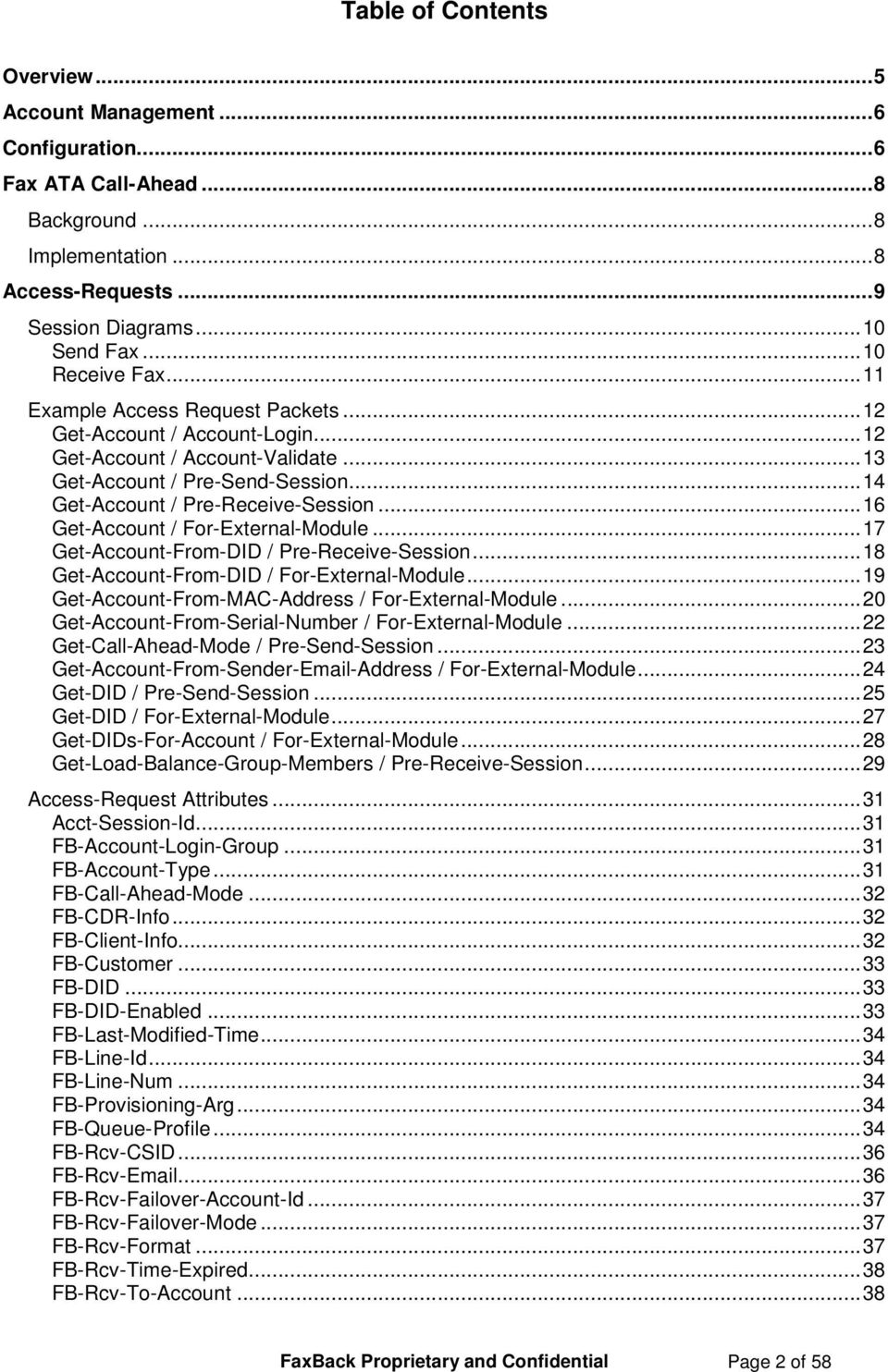
2 Table of Contents Overview...5 Account Management...6 Configuration...6 Fax ATA Call-Ahead...8 Background...8 Implementation...8 Access-Requests...9 Session Diagrams...10 Send Fax...10 Receive Fax...11 Example Access Request Packets...12 Get-Account / Account-Login...12 Get-Account / Account-Validate...13 Get-Account / Pre-Send-Session...14 Get-Account / Pre-Receive-Session...16 Get-Account / For-External-Module...17 Get-Account-From-DID / Pre-Receive-Session...18 Get-Account-From-DID / For-External-Module...19 Get-Account-From-MAC-Address / For-External-Module...20 Get-Account-From-Serial-Number / For-External-Module...22 Get-Call-Ahead-Mode / Pre-Send-Session...23 Get-Account-From-Sender- -Address / For-External-Module...24 Get-DID / Pre-Send-Session...25 Get-DID / For-External-Module...27 Get-DIDs-For-Account / For-External-Module...28 Get-Load-Balance-Group-Members / Pre-Receive-Session...29 Access-Request Attributes...31 Acct-Session-Id...31 FB-Account-Login-Group...31 FB-Account-Type...31 FB-Call-Ahead-Mode...32 FB-CDR-Info...32 FB-Client-Info...32 FB-Customer...33 FB-DID...33 FB-DID-Enabled...33 FB-Last-Modified-Time...34 FB-Line-Id...34 FB-Line-Num...34 FB-Provisioning-Arg...34 FB-Queue-Profile...34 FB-Rcv-CSID...36 FB-Rcv FB-Rcv-Failover-Account-Id...37 FB-Rcv-Failover-Mode...37 FB-Rcv-Format...37 FB-Rcv-Time-Expired...38 FB-Rcv-To-Account...38 FaxBack Proprietary and Confidential Page 2 of 58
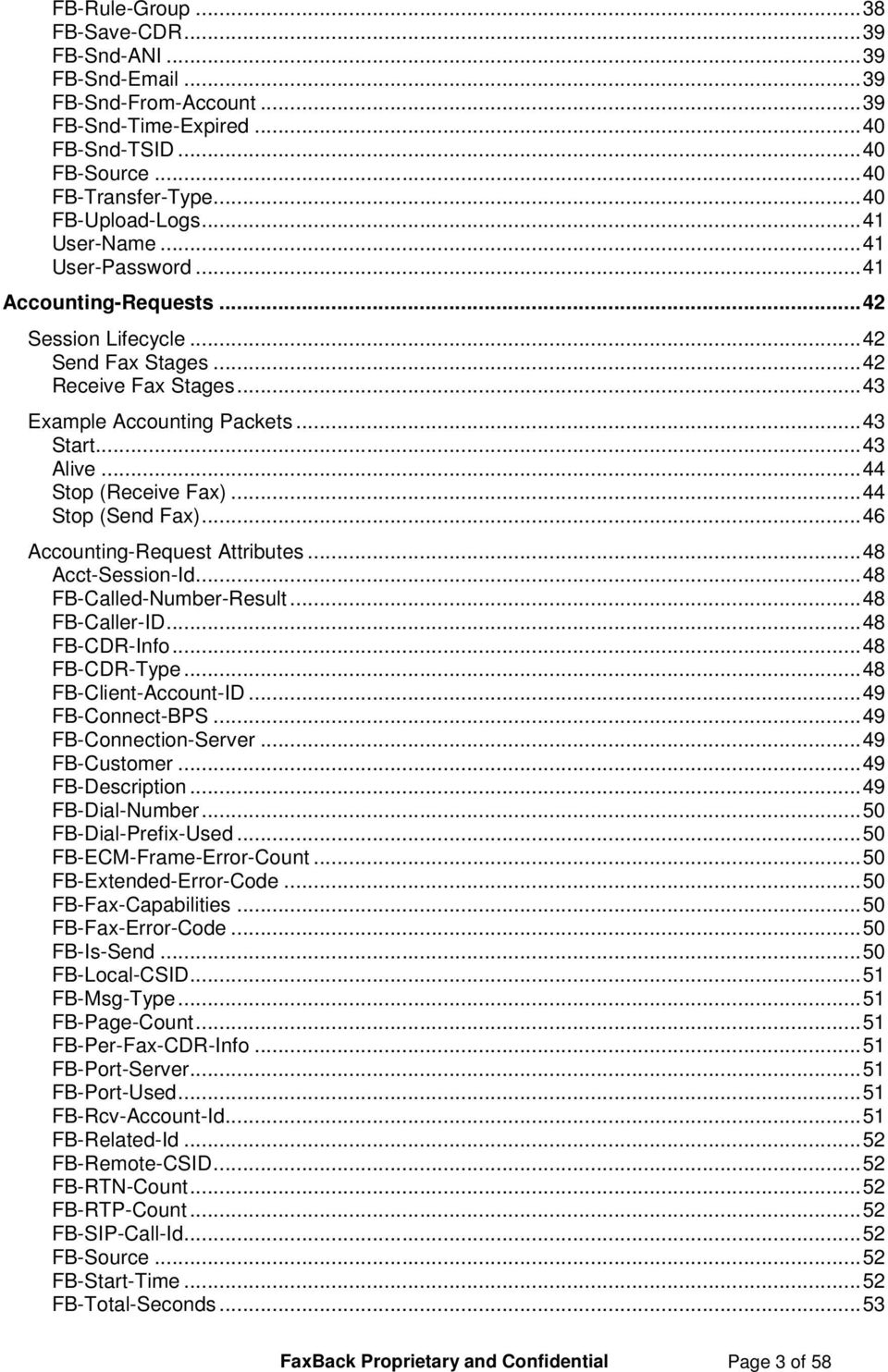
3 FB-Rule-Group...38 FB-Save-CDR...39 FB-Snd-ANI...39 FB-Snd FB-Snd-From-Account...39 FB-Snd-Time-Expired...40 FB-Snd-TSID...40 FB-Source...40 FB-Transfer-Type...40 FB-Upload-Logs...41 User-Name...41 User-Password...41 Accounting-Requests...42 Session Lifecycle...42 Send Fax Stages...42 Receive Fax Stages...43 Example Accounting Packets...43 Start...43 Alive...44 Stop (Receive Fax)...44 Stop (Send Fax)...46 Accounting-Request Attributes...48 Acct-Session-Id...48 FB-Called-Number-Result...48 FB-Caller-ID...48 FB-CDR-Info...48 FB-CDR-Type...48 FB-Client-Account-ID...49 FB-Connect-BPS...49 FB-Connection-Server...49 FB-Customer...49 FB-Description...49 FB-Dial-Number...50 FB-Dial-Prefix-Used...50 FB-ECM-Frame-Error-Count...50 FB-Extended-Error-Code...50 FB-Fax-Capabilities...50 FB-Fax-Error-Code...50 FB-Is-Send...50 FB-Local-CSID...51 FB-Msg-Type...51 FB-Page-Count...51 FB-Per-Fax-CDR-Info...51 FB-Port-Server...51 FB-Port-Used...51 FB-Rcv-Account-Id...51 FB-Related-Id...52 FB-Remote-CSID...52 FB-RTN-Count...52 FB-RTP-Count...52 FB-SIP-Call-Id...52 FB-Source...52 FB-Start-Time...52 FB-Total-Seconds...53 FaxBack Proprietary and Confidential Page 3 of 58
4 FB-V21-Frame-Error-Count...53 User-Name...53 UUID Mode...54 RADIUS Dictionary...55 FaxBack Proprietary and Confidential Page 4 of 58

5 Overview For account management and billing, the port server supports a flexible architecture for retrieving database objects and saving CDRs (Call Detail Records), by performing all database operations through an external module that it loads during startup. The core port server functionality of reliably sending and receiving real-time fax over HTTP remains unaffected by the type of external database module that is used. For example, when the port server authenticates a client that is logging in, the account name and password that the client provided are passed to the external database module, where the necessary action to validate the account (such as an SQL query) takes place. The response from the external database module determines if the port server accepts or rejects the client login. To support RADIUS (RFC 2865, 2866), the port server is configured to use an external database module, included with the port server, that implements the client side of the RADIUS specification. This module exchanges packets with a RADIUS server, for the purpose of retrieving database objects and saving CDRs on behalf of the port server. In this way, the port server can use RADIUS to integrate with existing account management and billing systems. The port server uses RADIUS to: Authenticate the account name and password provided by port server clients Find an account associated with a DID (inbound routing) Find an account associated with an address (authenticate SMTP sender) Retrieve extended account attributes for a specified account Save CDRs following fax sessions (RADIUS Accounting) To provide all of the functionality that the port server can expect of a RADIUS server, a RADIUS server must be capable of extending its functionality beyond what is strictly defined in the RADIUS specification. For example, the RADIUS server must be capable of parsing Access- Request packets and recognizing the FaxBack vendor-specific Command attribute. The commands that the port server sends require retrieving information for an account and returning that information in a RADIUS response packet. A RADIUS server needs to respond quickly to request packets, to ensure fast initiation of sessions. Ideally, the round-trip duration for a RADIUS packet exchange, from the time the port server sends the packet until it receives a response, would be less than 100 milliseconds. The port server divides RADIUS support into two categories: Access-Requests (account management), and Accounting-Requests (updating the state of a session and saving CDRs). Either or both category can be enabled on a port server, each with an independent configuration. To support Access-Requests, a RADIUS server needs to be extensible, so that it can perform simple queries that arrive in Access-Request packets that the port server sends to retrieve account information. In most cases, the RADIUS server can get by with providing very limited information in response to these requests. However, the more detail that the RADIUS server provides in an Access-Accept packet, in the form of FaxBack vendor-specific attributes, the more port server features that can be enabled. FaxBack Proprietary and Confidential Page 5 of 58

6 To support Accounting-Requests, a RADIUS server must properly save and/or process the FaxBack vendor-specific attributes contained in RADIUS Accounting-Request packets. The port server sends Accounting Start, Alive (Interim Update), and Stop packets for every session. The text file Port Server RADIUS Dictionary.txt contains the RADIUS definition for all FaxBack vendor-specific attributes used by the port server. Account Management From the perspective of the port server, an account is merely a collection of properties (a database record of some form) that includes at a minimum a unique name (unique among all other accounts) and a password. The RADIUS server must recognize account names in a caseinsensitive manner (i.e., Abc is equivalent to abc ), and keep the length between 1 and 16 bytes (to exceed the 16 byte limitation, see UUID Mode on page 53). Accounts uniquely identify port server clients that login to the port server. The account name is included in CDRs that are saved following fax sessions, in order to identify clients for billing purposes. With the account name and password provided by the client, the port server uses RADIUS to make the logical connection between the client and an account that is managed by an external system. The port server uses RADIUS to obtain only the account information that it requires in order to authorize clients for sending faxes, and for routing inbound faxes to clients. Account records managed by another system almost certainly include information that is beyond the scope of the port server. Furthermore, the maintenance of this database, including the provisioning of new accounts for new users is outside of the scope of the port server. A port server client must be configured with an account name and password in order to login to the port server. Clients are typically the Fax SDK that has been configured to send and receive faxes through a port server, or a fax ATA that supports HTTPS fax integration. There are many types of applications that use the Fax SDK, ranging from single-user clients (e.g., Microsoft Fax/Windows Fax and Scan), to multi-user fax servers (e.g., NET SatisFAXtion or the Windows Fax Service), and high-density broadcast clients. To route an inbound fax to a port server client, the port server uses RADIUS to retrieve account information for the account associated with a DID. This process takes place when the port server detects an inbound call, but before it has been answered. Accounts can have any number of DIDs mapped to them. Similar to the way that accounts are managed by an external system, the port server uses RADIUS to lookup an account using a DID as the search criteria, but how DIDs are physically managed is beyond the scope of the port server. When a fax is received on the client, the application that uses the Fax SDK (e.g., a fax server) can examine the DID associated with the received fax, should it need to perform some action based on the DID. Configuration To enable RADIUS support on a port server, run the port server Fax Hardware Setup application. The port server will be temporarily unloaded when RADIUS configuration changes are made. FaxBack Proprietary and Confidential Page 6 of 58


7 RADIUS is an optional interface type that can be enabled for some of the databases that the port server uses. RADIUS can only be enabled for the AccountsDb (account database), RcvRoutingDb (inbound routing DID database), and BillingDb (billing database). To enable RADIUS support after the port server has been installed, run the Fax Hardware Setup application and select the Databases button in the Port Server tab. A window will appear that lists all of the port server database types. RADIUS support can be enabled during installation by selecting the Databases button when the port server installation-wizard page is displayed. To enable Access-Request support, for account and DID management through RADIUS, select both AccountsDb and RcvRoutingDb, then select Properties, then select RADIUS as the Interface, and finally enter information that tells the port server about which RADIUS servers to use and how it should use them. To enable Accounting-Request support, for updating session status and saving CDRs through RADIUS, select BillingDb by itself, then select Properties, then select RADIUS as the Interface, and finally enter information that tells the port server about which RADIUS servers to use and how it should use them. A list of RADIUS servers can be entered that will be used in the order that they appear. If there is no response from the first server, then the second server will be used, and so on. For diagnostic purposes, the port server can be configured to save all sent and received RADIUS packets, formatted for readability, to the port server log file. This option was used to create the example RADIUS packets shown in this document. FaxBack Proprietary and Confidential Page 7 of 58

8 Fax ATA Call-Ahead Call-ahead support in the RADIUS server is optional. If the port server call-ahead feature is intentionally disabled, or the CalledNumbersDb database is configured to use SQL, or if only realtime fax clients will be using the port server, then the RADIUS server does not need to implement support for call-ahead. Background The port server fax ATA supports the ability to make a VoIP call directly to a fax number through a SIP media gateway in order to verify the accuracy of the fax number. Due to the limitations of the T.38 protocol, the fax ATA never sends a fax directly in this manner; the direct VoIP call from the ATA is only used to verify that a fax device is answering calls made to the fax number. The process of calling the fax number directly from the ATA, before the fax is uploaded to the port server is referred to as call-ahead. In order to perform this behavior, the ATA must have callahead support enabled, and be configured with the IP address of the SIP media gateway to use for the direct VoIP call. When a fax is sent from a fax machine that is connected to the ATA, the ATA uses the dialed number to make a direct VoIP call to determine if a fax device answers. If a fax device answers, then the call with the dialed fax device is terminated, and the connection with the fax machine continues until the fax is uploaded to the port server. Later, the uploaded fax will be delivered. If a fax device does not answer the direct VoIP call, then audio from the VoIP call is relayed to the fax machine, where the fax machine operator can listen to, and possibly interact with the call. Although the call-ahead to the fax number is performed locally on the fax ATA, the port server determines whether the call-ahead should be made. When a send session is started, the fax ATA contacts the port server to ensure that the ATA will be allowed to send a fax to the server. In response, the port server returns a flag that tells the ATA whether or not it should perform the call-ahead. The port server can be configured to instruct all ATAs to Never or Always call-ahead, or it can be configured to query a database of called fax numbers to determine whether the fax number had previously been used to successfully contact a fax device. If the port server finds the fax number in the called numbers database, it can return the flag that instructs the ATA to not perform an unnecessary call-ahead. Implementation To provide call-ahead support to the port server, the RADIUS server must do the following: 1. Return the FB-Call-Ahead-Mode attribute when a send session is starting for a Queue transfer (FB-Transfer-Type of 2). The value of FB-Call-Ahead-Mode should be obtained from querying a database of previously called fax numbers that will determine if the fax number has been used previously to successfully contact a fax device. See Get-Call- Ahead-Mode / Pre-Send-Session on page 20 for when the RADIUS server is expected to return this attribute. 2. Maintain a database of fax numbers that are provided to the RADIUS server in Accounting Stop requests in the FB-Dial-Number attribute. To simplify this process, the port server includes an FB-Called-Number-Result attribute only in Accounting Stop requests where the RADIUS server should take some action to maintain the Called Numbers database. When present, the value of the FB-Called-Number-Result attribute identifies the dial number as being verified as a fax number (even if the fax session began and later failed), or a voice number (the fax failed due to a voice answering the call). For a verified fax number, future queries of the called numbers database should return 0 (false) to avoid an unnecessary call-ahead. FaxBack Proprietary and Confidential Page 8 of 58

9 For a fax number that resulted in a voice error, future queries of the called numbers database should return 1 (true) to flag the ATA to call-ahead directly to the fax number. Because the fax number might be a shared voice/fax line that will later be used to send a fax, it is suggested that the database records the fact that a voice error had occurred, so that future queries to the database can detect that a voice might answer the call and thus return 1 (true) to always flag the ATA to call-ahead. Access-Requests When the port server accounts and inbound routing databases (AccountsDb and RcvRoutingDb) are configured to use the RADIUS interface, the port server sends RADIUS Access-Request packets to authorize port server client access, and to retrieve account information prior to initiating send and receive fax sessions. Every Access-Request packet that the port server sends includes at least two FaxBack vendorspecific attributes: FB-Command and FB-Context. The FB-Command is what the RADIUS server needs to do, and the FB-Context is why the command is being requested. All Access-Request FB-Command/ FB-Context combinations: FB-Command Get-Account Get-Account-From-DID Get-Account-From-MAC-Address Get-Account-From-Sender- -Address Get-Account-From-Serial-Number Get-Call-Ahead-Mode Get-DID Get-DIDs-For-Account Get-Load-Balance-Group-Members FB-Context Account-Login Account-Validate Pre-Send-Session Pre-Receive-Session For-External-Module Pre-Receive-Session For-External-Module For-External-Module For-External-Module For-External-Module Pre-Send-Session Pre-Send-Session For-External-Module For-External-Module Pre-Receive-Session The RADIUS server must return an Access-Accept or Access-Reject packet that includes all required response attributes as defined for each Command/Context, however, there is no harm in providing extraneous or unused attributes in a response packet. The RADIUS server can return all account information for every Get-Account command request, even if returning all account information is deemed unnecessary based on the context. FaxBack Proprietary and Confidential Page 9 of 58

10 Session Diagrams Send Fax Outbound faxes require one RADIUS packet exchange for real-time fax clients to retrieve information for the sending account. For fax ATAs, one or two additional calls are made to retrieve more information. The caller-id from the fax session from an ATA is used to query for a matching DID, allowing for information to be retrieved that is regarded as specific to sending line on the ATA. If a matching DID is not found, the session still proceeds without any error. Get recent configuration for account, by calling Get-Account / Pre-Send-Session Account/Client can send fax? N Refuse Send Session Y Session is from a Fax ATA? N Start Send Session Y Get FB-Queue-Profile and FB-Snd-ANI by calling Get-DID / Pre-Send-Session, If necessary, get FB-Call-Ahead-Mode by calling Get-Call-Ahead-Mode / Pre-Send-Session FaxBack Proprietary and Confidential Page 10 of 58

11 Receive Fax Inbound faxes are routed using two RADIUS packets exchanges, the first of which identifies the account associated with a DID, and the second retrieves information for that account. Route DID to an account, by calling Get-Account-From-DID / Pre-Receive-Session Found account? N Y Get recent configuration for account, by calling Get-Account / Pre-Receive-Session Account is a load-balance group? Y If needed, update member cache by calling Get-Load-Balance-Group-Members/ Pre-Receive-Session Select next recipient member account... N Y Account/Client can receive fax? N Route to failover receive account? Y N Start Receive Session Refuse Receive Session FaxBack Proprietary and Confidential Page 11 of 58

12 Example Access Request Packets Get-Account / Account-Login Sent when a client logs in, or later validates its login credentials which it might do at any time. The port server includes a Client-Info attribute in this packet, which contains a string value from the client software. The RADIUS server must respond with an Access-Accept packet if the account and password are valid, or an Access-Reject packet if not valid. SENT FROM PORT SERVER Attribute FB-Command Get-Account (1) FB-Context Account-Login (1) User-Name User-Password FB-Client-Info Request Packet As provided by the port server client As provided by the port server client As provided by the port server client, plus an IP address added by the port server. Code=Access-Request(1) Packet identifier=131 Length=108 6C 42 2A 8A FA A6 78 B8 2F 8D B0 10 4F Len=18, Type=Vendor-Specific(26), Id=FaxBack(30694) Len=6, Type=FB-Command(1) =Get-Account(1) Len=6, Type=FB-Context(2) =Account-Login(1) Len=9, Type=User-Name(1) =account Len=18, Type=User-Password(2) =01 1B A6 4D 5F 20 B2 3E 6E 52 D3 A0 60 C4 F5 BA Len=43, Type=Vendor-Specific(26), Id=FaxBack(30694) Len=37, Type= FB-Client-Info(45) =;FV= ;MN=NICKDUO;IP= RESPONSE TO PORT SERVER Required RADIUS Code Optional Account-Type Purpose Access-Accept or Access-Reject Purpose Determines if the account is type Private Send/Receive or Shared Send-Only, which affects how the client behaves. Also determines if FaxBack Proprietary and Confidential Page 12 of 58

13 Account-Login-Group the account is a real-time fax account, or fax ATA account. If the port server will host fax ATA accounts, then this attribute is required in the response packet. Specifies the group of Connection Servers that the client should consider for failover. If no group is specified, the client will be considered a member of the Default Account-login Group. Response Packet Code=Access-Accept(2) Packet identifier=9 Length= Len=6, Type=FB-Account-Type(10) =4 Get-Account / Account-Validate Sent from the port server to validate an account and password. Two examples of when the port server sends this request are when a configuration program requests to validate the user input of an account and password, and when a fax ATA uploads diagnostic log files to a Connection Server. The RADIUS server must respond with an Access-Accept packet if the account and password are valid, or an Access-Reject packet if not valid. SENT FROM PORT SERVER Attribute FB-Command Get-Account (1) FB-Context Account-Validate (2) User-Name User-Password Request Packet As provided by the port server client As provided by the port server client Code=Access-Request(1) Packet identifier=87 Length=107 5A 91 F7 14 E1 63 E8 49 B7 55 3C 98 6C E8 BE C8 Len=18, Type=Vendor-Specific(26), Id=FaxBack(30694) Len=6, Type=FB-Command(1) =Get-Account(1) Len=6, Type=FB-Context(2) =Account-Validate(2) Len=9, Type=User-Name(1) =account FaxBack Proprietary and Confidential Page 13 of 58

14 Len=18, Type=User-Password(2) =4D FA EA C5 A0 1A 6B FF D6 95 5E A3 FA 4A EF D9 RESPONSE TO PORT SERVER Required RADIUS Code Optional Account-Type Purpose Access-Accept or Access-Reject Purpose Determines if the account is type Private Send/Receive or Shared Send- Only, which affects how the client behaves. Also determines if the account is a real-time fax account, or fax ATA account. If the port server will host fax ATA accounts, then this attribute is required in the response packet. Response Packet Code=Access-Accept(2) Packet identifier=9 Length= Len=6, Type=FB-Account-Type(10) =4 Get-Account / Pre-Send-Session Sent when the port server is about to send a fax, and needs to retrieve the most recent information for an account. The RADIUS server must respond with an Access-Accept packet if the account is valid, or an Access-Reject packet if not valid. If the account is known, but sending is disabled for the account for some reason, instead of returning an Access-Reject packet the RADIUS server can return an Access-Accept packet that includes the FB-Snd-From-Account attribute with a value of 0. SENT FROM PORT SERVER Attribute FB-Command Get-Account (1) FB-Context Pre-Send-Session (3) User-Name Acct-Session-Id FB-Dial-Number Request Packet Code=Access-Request(1) Packet identifier=2 The account requesting to send a fax. The session id of the new send fax session. The fax number to send to. Note that the fax number has not yet been processed by Send Routing rules. FaxBack Proprietary and Confidential Page 14 of 58

15 Length=113 B3 7E 5D 1C 63 6E 96 4C A3 0B E8 3D B 42 Len=18, Type=Vendor-Specific(26), Id=FaxBack(30694) Len=6, Type=FB-Command(1) =Get-Account(1) Len=6, Type=FB-Context(2) =Pre-Send-Session(3) Len=9, Type=User-Name(1) =account Len=34, Type=Acct-Session-Id(44) =ea7a820446d54db8a98f42be08e65b23 Len=20, Type=Vendor-Specific(26), Id=FaxBack(30694) Len=14, Type=FB-Dial-Number(34) = Len=6, Type=FB-Transfer-Type(58) =1 RESPONSE TO PORT SERVER Required RADIUS code Optional FB-Snd-On-Behalf-Of FB-Call-Ahead-Mode FB-Snd-From-Account FB-Snd-Time-Expired FB-CDR-Info, FB- Customer, FB-Source Purpose Access-Accept or Access-Reject Purpose Specifies whether the account is allowed to send faxes on behalf of other accounts. This attribute is required for clients that send faxes on behalf of fax ATA accounts. If set to 1, the client can include the name of the billing account to send on-behalf-of in the fax number, for example, otheraccount; In such a case, the CDR at the end of the fax will show otheraccount in the User-Name attribute, and the account for the sending client will be included in the FB-Client-Account- ID attribute. If this attribute is not specified in a response to the port server, the default is 0 (cannot send on-behalf-of another account). Specifies whether the fax ATA that initiated the send request should call-ahead directly from the ATA to validate the fax number, prior to the fax being uploaded to the port server. The RADIUS server can maintain a Called Numbers database, allowing it to know if a fax number is valid by querying the database to see if the fax number was used successfully in a previous fax send. The FB-Call-Ahead-Mode attribute only needs to be returned if the FB- Transfer-Type attribute in the request is 2 (Queue). Specifies whether the account is allowed to send. Specifies whether the account has send time remaining. If set to 1, the client sees a No send time remaining error. Information from the account that will be saved in the CDR at the end of the session. FaxBack Proprietary and Confidential Page 15 of 58

16 FB-Save-CDR FB-Snd-ANI FB-Snd-TSID FB-Rule-Group Determines if a CDR will be saved for this session. Specifies an ANI to use for the telephony session. Specifies a TSID to use for the T.30 session. Specifies the rule group that will be used by Send Routing processing that will be performed by the port server when the RADIUS request returns. If no group is specified, the account will be considered a member of the Default Rule Group. Response Packet Code=Access-Accept(2) Packet identifier=118 Length=20 5A 91 F7 14 E1 63 E8 49 B7 55 3C 98 6C E8 BE C8 Get-Account / Pre-Receive-Session Sent when the port server is about to receive a fax, and needs to retrieve the most recent information for the account that is designated to receive the fax. The specified account might be the account mapped to a DID, or if that account is unable to receive a fax, then the specified account might be that of a failover receive account. The RADIUS server must respond with an Access-Accept packet if the account is valid, or an Access-Reject packet if not valid. If the account is known, but receiving is disabled for the account for some reason, instead of returning an Access-Reject packet the RADIUS server can return an Access-Accept packet that includes the FB-Rcv-To-Account attribute with a value of 0. SENT FROM PORT SERVER Attribute FB-Command Get-Account (1) FB-Context Pre-Receive-Session (4) User-Name Acct-Session-Id Request Packet The account requesting to receive a fax. The session id of the new receive fax session. Code=Access-Request(1) Packet identifier=2 Length=111 B3 7E 5D 1C 63 6E 96 4C A3 0B E8 3D B 42 Len=18, Type=Vendor-Specific(26), Id=FaxBack(30694) Len=6, Type=FB-Command(1) =Get-Account(1) Len=6, Type=FB-Context(2) =Pre-Receive-Session(4) Len=9, Type=User-Name(1) =account FaxBack Proprietary and Confidential Page 16 of 58

17 Len=34, Type=Acct-Session-Id(44) =03bb96b4af2d41f08dd0e46c250c274f Len=18, Type=Vendor-Specific(26), Id=FaxBack(30694) Len=12, Type=FB-Dial-Number(34) = Len=6, Type=FB-Transfer-Type(58) =1 RESPONSE TO PORT SERVER Required RADIUS code Optional FB-Rcv-To-Account FB-CDR-Info, FB-Customer, FB-Source FB-Save-CDR FB-Rcv-CSID FB-Rcv-Failover-Account-Id FB-Rcv-Failover-Mode FB-Last-Modified-Time Purpose Access-Accept or Access-Reject Purpose Determines if the known/valid account is allowed to receive. Information from the account that will be saved in the CDR at the end of the session. Determines if a CDR will be saved for this session. Specifies a CSID to use for the T.30 session. Specifies an alternate account to receive the fax in case the account is unavailable. Determines if the account specified by the FB-Rcv-Failover- Account-Id attribute should only receive faxes if the primary account is busy or unavailable, or if it should always receive faxes that were routed to the primary account. For an account that is a load-balance group, the value of this attribute is used to tell the port server if the group membership has changed since the last time the port server dealt with the group. Response Packet Code=Access-Accept(2) Packet identifier=34 Length=20 5A 91 F7 14 E1 63 E8 49 B7 55 3C 98 6C E8 BE C8 Get-Account / For-External-Module Sent when an external component requests information about an account. SENT FROM PORT SERVER Attribute FB-Command Get-Account (1) FB-Context For-External-Module (5) FaxBack Proprietary and Confidential Page 17 of 58

18 User-Name The account requesting to receive a fax. Request Packet Code=Access-Request(1) Packet identifier=37 Length=47 5A 91 F7 14 E1 63 E8 49 B7 55 3C 98 6C E8 BE C8 Len=18, Type=Vendor-Specific(26), Id=FaxBack(30694) Len=6, Type=FB-Command(1) =Get-Account(1) Len=6, Type=FB-Context(2) =For-External-Module(5) Len=9, Type=User-Name(1) =account RESPONSE TO PORT SERVER Required RADIUS code Optional FB-Account-Type FB-Last-Modified-Time FB-Rcv- FB-Rcv-Format Purpose Access-Accept or Access-Reject Purpose Specifies the type of account. For an account that is a load-balance group, the value of this attribute is used to tell the port server if the group membership has changed since the last time the port server dealt with the group. Account s receive address Determines the image type of the fax attachment. Response Packet Code=Access-Accept(2) Packet identifier=37 Length=20 5A 91 F7 14 E1 63 E8 49 B7 55 3C 98 6C E8 BE C8 Get-Account-From-DID / Pre-Receive-Session Sent when the port server needs to know which account is mapped to a DID for inbound routing. The RADIUS server must respond with an Access-Accept packet that includes an account name in the User-Name attribute as the account that should receive the fax, or an Access-Reject packet if routing to that DID is not possible. If the DID is known, but receiving is disabled for the DID for some reason, instead of returning an Access-Reject packet the RADIUS server can return an Access-Accept packet that includes the FB-DID-Enabled attribute with a value of 0. SENT FROM PORT SERVER Attribute FaxBack Proprietary and Confidential Page 18 of 58

19 FB-Command Get-Account-From-DID (2) FB-Context Pre-Receive-Session (4) User-Name Acct-Session-Id Request Packet The DID to match to an account The session id of the new receive fax session. Code=Access-Request(1) Packet identifier=2 Length=76 3C 24 7E 06 C0 9D 4D 42 BE 1E DB B7 6C FC Len=18, Type=Vendor-Specific(26), Id=FaxBack(30694) Len=6, Type=FB-Command(1) =Get-Account-From-DID(2) Len=6, Type=FB-Context(2) =Pre-Receive-Session(4) Len=12, Type=User-Name(1) = Len=26, Type=Acct-Session-Id(44) =1_jGYVe4sNmF9sEp[eEdKoiA RESPONSE TO PORT SERVER Required RADIUS code User-Name Optional FB-DID-Enabled Purpose Access-Accept or Access-Reject Account Purpose Determines if the known/valid DID is enabled for receive. Response Packet Code=Access-Accept(2) Packet identifier=2 Length= Len=9, Type=User-Name(1) =account Get-Account-From-DID / For-External-Module Sent when the gateway component needs to retrieve the address for an account that is mapped to a specific DID. The gateway will send an message to that address with a fax as an attachment. FaxBack Proprietary and Confidential Page 19 of 58

20 The RADIUS server must respond with an Access-Accept packet that includes an address in the FB-Rcv- attribute for the recipient of the message, or an Access-Reject packet if routing to the DID was not possible. SENT FROM PORT SERVER Attribute FB-Command Get-Account-From-DID (2) FB-Context For-External-Module (5) User-Name Request Packet The DID to match to an account Code=Access-Request(1) Packet identifier=77 Length=76 3C 24 7E 06 C0 9D 4D 42 BE 1E DB B7 6C FC Len=18, Type=Vendor-Specific(26), Id=FaxBack(30694) Len=6, Type=FB-Command(1) =Get-Account-From-DID(2) Len=6, Type=FB-Context(2) =For-External-Module(5) Len=12, Type=User-Name(1) = RESPONSE TO PORT SERVER Required RADIUS code User-Name Optional FB-DID-Enabled Purpose Access-Accept or Access-Reject Account that matched the input DID Purpose Determines if the known/valid DID is enabled for receive. Response Packet Code=Access-Accept(2) Packet identifier=77 Length= Len=9, Type=User-Name(1) =account Len=24, Type=Vendor-Specific(26), Id=FaxBack(30694) Len=18, Type=FB-Rcv- (14) Get-Account-From-MAC-Address / For-External-Module FaxBack Proprietary and Confidential Page 20 of 58

21 Sent in response to an external component, such as a fax ATA provisioning server, requesting information about an account where only the MAC address associated with the account is known. The response from the RADIUS server can provide information that will be used to create a configuration for a fax ATA during the provisioning process. SENT FROM PORT SERVER Attribute FB-Command Get-Account-From-MAC-Address (7) FB-Context For-External-Module (5) User-Name FB-Fax-ATA-Type Request Packet The MAC address. The type of fax ATA that is generating this request. Code=Access-Request(1) Packet identifier=11 Length=64 38 F7 9B A AB 4D B1 7C 1F FF DC A8 Len=18, Type=Vendor-Specific(26), Id=FaxBack(30694) Len=6, Type=FB-Command(1) =Get-Account-From-MAC-Address(7) Len=6, Type=FB-Context(2) =For-External-Module(5) Len=14, Type=User-Name(1) =00908F1D37F0 Len=6, Type=FB-Fax-ATA-Type(66) =0 RESPONSE TO PORT SERVER Required RADIUS code User-Name Optional FB-Provisioning-Arg FB-Queue-Profile Purpose Access-Accept or Access-Reject Account that matched the input DID Purpose Provides additional information to the provisioning server. The Queue Profile includes localization information about an account that can be useful for provisioning. Response Packet Code=Access-Accept(2) Packet identifier=11 Length= Len=9, Type=User-Name(1) FaxBack Proprietary and Confidential Page 21 of 58
22 =account Len=76, Type=Vendor-Specific(26), Id=FaxBack(30694) Len=70, Type=FB-Queue-Profile(57) =<QPXml Rf="0" Dn="1" Ndn="1" Ea="" Ef="" Ln="en-US" Tz="Pacific*" /> Get-Account-From-Serial-Number / For-External-Module Sent in response to an external component, such as a fax ATA provisioning server, requesting information about an account where only the serial number associated with the account is known. The response from the RADIUS server can provide information that will be used to create a configuration for a fax ATA during the provisioning process. SENT FROM PORT SERVER Attribute FB-Command Get-Account-From-Serial-Number (6) FB-Context For-External-Module (5) User-Name FB-Fax-ATA-Type Request Packet Serial number. The type of fax ATA that is generating this request. Code=Access-Request(1) Packet identifier=11 Length=60 38 F7 9B A AB 4D B1 7C 1F FF DC A8 Len=18, Type=Vendor-Specific(26), Id=FaxBack(30694) Len=6, Type=FB-Command(1) =Get-Account-From-Serial-Number(6) Len=6, Type=FB-Context(2) =For-External-Module(5) Len=14, Type=User-Name(1) = Len=6, Type=FB-Fax-ATA-Type(66) =0 RESPONSE TO PORT SERVER Required RADIUS code User-Name Optional FB-Provisioning-Arg FB-Queue-Profile Purpose Access-Accept or Access-Reject Account that matched the input DID Purpose Provides additional information to the provisioning server. The Queue Profile includes localization information about an account that can be useful for provisioning. FaxBack Proprietary and Confidential Page 22 of 58
23 Response Packet Code=Access-Accept(2) Packet identifier=11 Length= Len=9, Type=User-Name(1) =account Len=76, Type=Vendor-Specific(26), Id=FaxBack(30694) Len=70, Type=FB-Queue-Profile(57) =<QPXml Rf="0" Dn="1" Ndn="1" Ea="" Ef="" Ln="en-US" Tz="Pacific*" /> Get-Call-Ahead-Mode / Pre-Send-Session Sent at the beginning of a Send session, when all of the following criteria are met: The FB-Transfer-Type for the session is 2 (Queue). The Port Server is globally configured to determine the call-ahead mode for each account. The account is configured to determine the call-ahead mode for each call. The Port Server RADIUS configuration specifies that the call-ahead mode is obtained in a separate request with the RADIUS server, as opposed to being obtained at the same time as the initial Get-Account/Pre-Send-Session request. When the Get-Call-Ahead-Mode request is sent as a separate request, the dial number will have been processed by Send Routing. The Send Routing rules may have modified the fax number, or rejected it which would have prevented the session from being processed any further. It is, however, slightly less efficient to make a second RADIUS request just to obtain the FB-Call- Ahead-Mode. When the FB-Call-Ahead-Mode is determined at the same time as the initial Get-Account/Pre- Send-Session request, the dial number (in the FB-Dial-Number attribute) is from the fax ATA before it has been processed by Send Routing. It is, however, slightly more efficient to obtain the FB-Call-Ahead-Mode in one RADIUS request. SENT FROM PORT SERVER Attribute FB-Command Get-Call-Ahead-Mode (5) FB-Context Pre-Send-Session (3) User-Name Request Packet The dial number, post-send Routing, that the fax ATA is attempting to send to. Code=Access-Request(1) Packet identifier=1 Length= D D B0 52 B FB D3 BD FaxBack Proprietary and Confidential Page 23 of 58
24 Len=18, Type=Vendor-Specific(26), Id=FaxBack(30694) Len=6, Type=FB-Command(1) =Get-Call-Ahead-Mode(5) Len=6, Type=FB-Context(2) =Pre-Send-Session(3) Len=12, Type=User-Name(1) = Len=18, Type=Acct-Session-Id(44) = RESPONSE TO PORT SERVER Required RADIUS code Optional FB-Call-Ahead-Mode Purpose Access-Accept or Access-Reject Purpose Specifies whether the fax ATA should call-ahead to verify the fax number, or whether it should immediately begin to receive the fax from the connected fax machine. A value of 0 means do not call-ahead. Any non-zero value means do call-ahead. If the FB-Call-Ahead-Mode attribute is missing from the response, or there is no response, then the Port Server will flag the fax ATA to call-ahead. Response Packet Code=Access-Accept(2) Packet identifier=15 Length= D D B0 52 B FB D3 BD Len=6, Type=FB-Call-Ahead-Mode(61) =0 Get-Account-From-Sender- -Address / For-External-Module Sent when the gateway component needs to verify that the From address for an outbound fax is associated with a known account. The account information that is returned can be used to further authorize the sender. The RADIUS server must respond with an Access-Accept packet that includes at a minimum an account name in the User-Name attribute, or an Access-Reject packet if the sender address is not associated with any account. If the address maps to a known account, but sending is disabled for the account for some reason, instead of returning an Access-Reject packet the RADIUS server can return an Access-Accept packet that includes the FB-Snd-From- Account attribute with a value of 0. SENT FROM PORT SERVER FaxBack Proprietary and Confidential Page 24 of 58
25 Attribute FB-Command Get-Account-From-Sender- -Address (3) FB-Context For-External-Module (5) User-Name Request Packet The sender address to match to an account Code=Access-Request(1) Packet identifier=49 Length=63 E E2 03 8D A 2B 8F E Len=18, Type=Vendor-Specific(26), Id=FaxBack(30694) Len=6, Type=FB-Command(1) =Get-Account-From-Sender- -Address(3) Len=6, Type=FB-Context(2) =For-External-Module(5) Len=25, Type=User-Name(1) RESPONSE TO PORT SERVER Required RADIUS code User-Name Optional FB-Snd-From-Account Purpose Access-Accept or Access-Reject Account that matched the input sender address Purpose Determines if the known/valid account is enabled for send. Response Packet Code=Access-Accept(2) Packet identifier=49 Length= Len=9, Type=User-Name(1) =account Get-DID / Pre-Send-Session Sent from the port server when a fax ATA is sending a fax (uploading via HTTPS), to retrieve settings that are associated with the line on the ATA. The request from the port server will include the ANI (caller Id) of the send call in the User-Name attribute, which can be used by the RADIUS server to query for a matching DID or line record. The RADIUS server can return FB- Queue-Profile and/or FB-Snd-ANI attributes that will be used by the port server for the remainder of the fax session. Support for this feature at the RADIUS server is optional. FaxBack Proprietary and Confidential Page 25 of 58
26 A response that includes additional account information is not required. To prevent the port server from detecting this situation as an error, the RADIUS server must return an Access-Accept packet that has no attributes, so that the port server can quickly advance the send session to the next stage. If the RADIUS server returns an Access-Reject packet, the port server will terminate fax session. To provide per-line settings in response to the Get-DID request, the RADIUS server must include a User-Name attribute with a value of the account name that the DID mapped to (if UUID mode is enabled, then the response must also include an FB-Account-UUID attribute). The port server will compare the response User-Name to the account that is attempting to send the fax, and will reject the fax if the two values do not match. SENT FROM PORT SERVER Attribute FB-Command Get-DID (8) FB-Context Pre-Send-Session (3) User-Name Acct-Session-Id Request Packet The ANI (caller Id) for the send call. The session id of the new send fax session. Code=Access-Request(1) Packet identifier=1 Length=82 4C BF 52 6E D9 4E B9 93 D Len=18, Type=Vendor-Specific(26), Id=FaxBack(30694) Len=6, Type=FB-Command(1) =Get-DID(8) Len=6, Type=FB-Context(2) =Pre-Send-Session(3) Len=6, Type=User-Name(1) =2222 Len=38, Type=Acct-Session-Id(44) =b5884d75-ad b4dd-aab8f5de542a RESPONSE TO PORT SERVER Required RADIUS code Optional User-Name FB-Queue-Profile Purpose Access-Accept or Access-Reject Purpose Specifies the name of the account that the input ANI (caller Id) from the request packet mapped to. An optional Queue Profile to be used for later processing of the send fax. The returned queue profile XML must include the attribute Op= 1, to cause the DID-level queue profile to override the accountlevel queue profile. For example, <QPXml Op= 1 Rf="0" Dn="1" Ndn="1" Ea="" Ef="" /> FaxBack Proprietary and Confidential Page 26 of 58
27 FB-Snd-ANI Language and time zone information do not need to be included, as these values are specified at the account level. If there are included in the XML returned from a Get-DID request, they will be ignored. An optional override of the ANI (caller Id) for later processing of the send fax. Response Packet Code=Access-Accept(2) Packet identifier=8 Length= Len=9, Type=User-Name(1) =testata Len=18, Type=Vendor-Specific(26), Id=FaxBack(30694) Len=12, Type=FB-Snd-ANI(19) = Get-DID / For-External-Module Sent from the port server when an external component, such as a fax ATA provisioning server, requires configuration information specific to a DID. Support for this command is optional at the RADIUS server. The only time the port server requests this information is for provisioning of fax ATAs. SENT FROM PORT SERVER Attribute FB-Command Get-DID (8) FB-Context Pre-Send-Session (3) User-Name Request Packet The DID to lookup. Code=Access-Request(1) Packet identifier=1 Length=62 4C BF 52 6E D9 4E B9 93 D Len=18, Type=Vendor-Specific(26), Id=FaxBack(30694) Len=6, Type=FB-Command(1) =Get-DID(8) Len=6, Type=FB-Context(2) =Pre-Send-Session(3) Len=6, Type=User-Name(1) =2222 FaxBack Proprietary and Confidential Page 27 of 58
28 RESPONSE TO PORT SERVER Required RADIUS code Optional User-Name FB-Queue-Profile FB-Snd-ANI FB-Line-Num FB-Line-Id Purpose Access-Accept or Access-Reject Purpose Specifies the name of the account that the input ANI (caller Id) from the request packet mapped to. An optional Queue Profile to be used for later processing of the send fax. The returned queue profile XML must include the attribute Op= 1, to cause the DID-level queue profile to override the accountlevel queue profile. For example, <QPXml Op= 1 Rf="0" Dn="1" Ndn="1" Ea="" Ef="" /> Language and time zone information do not need to be included, as these values are specified at the account level. If there are included in the XML returned from a Get-DID request, they will be ignored. An optional override of the ANI (caller Id) for later processing of the send fax. Physical line number that maps to the DID. A name or description to associated with the DID or fax ATA line. Response Packet Code=Access-Accept(2) Packet identifier=8 Length= Len=9, Type=User-Name(1) =testata Len=18, Type=Vendor-Specific(26), Id=FaxBack(30694) Len=12, Type=FB-Snd-ANI(19) = Get-DIDs-For-Account / For-External-Module Sent from the port server when an external component, such as a fax ATA provisioning server, requires the list of all DIDs associated with an account. Support for this command is optional at the RADIUS server. The only time the port server requests this information is for provisioning of fax ATAs. SENT FROM PORT SERVER Attribute FB-Command Get-DID (8) FB-Context For-Extermal-Module (5) User-Name Locate all DIDs mapped to this account. FaxBack Proprietary and Confidential Page 28 of 58
29 Request Packet Code=Access-Request(1) Packet identifier=3 Length=44 C9 EC 4F 8D AA 6D 6B 43 A2 54 E3 AE 5E B9 E6 0A Len=18, Type=Vendor-Specific(26), Id=FaxBack(30694) Len=6, Type=FB-Command(1) =Get-DIDs-For-Account(9) Len=6, Type=FB-Context(2) =For-External-Module(5) Len=6, Type=User-Name(1) =TEST RESPONSE TO PORT SERVER Required RADIUS code FB-DID Purpose Access-Accept or Access-Reject One FB-DID attribute for each DID mapped to the requested account. If there are no DIDs mapped to the account, return an Access-Accept packet with no attributes. Response Packet Code=Access-Accept(2) Packet identifier=2 Length= Len=6, Type=FB-DID(75) =1111 Len=6, Type=FB-DID(75) =2222 Get-Load-Balance-Group-Members / Pre-Receive-Session Sent when the port server is attempting to route an inbound fax to a load-balance group, and the port server needs to know the accounts that are in the group. SENT FROM PORT SERVER Attribute FB-Command Get-Load-Balance-Group-Members (4) FB-Context Pre-Send-Session (4) FaxBack Proprietary and Confidential Page 29 of 58
30 User-Name Acct-Session-Id Load-balance group account The session id of the new receive fax session. Request Packet Code=Access-Request(1) Packet identifier=2 Length= F 24 EA 6A 45 B1 F7 10 BE FD F5 6B BE Len=18, Type=Vendor-Specific(26), Id=FaxBack(30694) Len=6, Type=FB-Command(1) =Get-Load-Balance-Group-Members(4) Len=6, Type=FB-Context(2) =Pre-Receive-Session(4) Len=5, Type=User-Name(1) =lbg Len=26, Type=Acct-Session-Id(44) =3_z4Xwe5oprfKSdh4vxlpUlb RESPONSE TO PORT SERVER Required RADIUS code Optional User-Name Purpose Access-Accept or Access-Reject Purpose Include this attribute as many times as needed to provide all member account names. If there are no members in the group, then omit this attribute. Response Packet Code=Access-Accept(2) Packet identifier=2 Length= Len=9, Type=User-Name(1) =Account FaxBack Proprietary and Confidential Page 30 of 58
31 Access-Request Attributes The following attributes appear in Accounting-Request and Accounting-Response packets. Acct-Session-Id RADIUS defined String (ASCII) 0-32 chars The port server will include the Acct-Session-Id attribute in Get-Account commands that precede the start of send or receive sessions. Sessions Ids are unique ASCII strings. Session Id comparisons are case-sensitive, i.e., a Session Id of abc is different from ABC. An example Session Id string: 0_yhYH4nK3]dtTFspcBkJQMA. FB-Account-Login-Group FaxBack vendor-specific String (ASCII) 0-64 chars Optional response to the Get-Account command in the Account-Login context. This value specifies the group of Connection Servers to which an account belongs. A Connection Server will use this value to produce a list of Connection Servers Urls that are returned to the client, to be used as failover Urls in case the client loses contact with the Connection Server that it has logged into. Empty -or- * NAME *NAME Meaning The account is a member of the Default Account-login Group. The client can login to any Connection Server in the Default Account-login Group. The account is a member of the specified group name. For example, if the value was PRIORITY, then the client can login to any Connection Server in the group PRIORITY. Group names must use upper-case letters, and cannot include the asterisk (*), colon (:), semi-colon (;), or comma (,) characters. The account is a member of both the Default Account-login Group and the specified group name that follows *. The client can login to Connection Servers that are in either group. When this attribute is omitted in a RADIUS response packet, the default value is an empty string. FB-Account-Type FaxBack vendor-specific Integer 4 bytes Optional response to the Get-Account command in the Account-Login context. This value determines the type of account, and how the client will be treated upon a successful login. Meaning 0 The account is type Private Send/Receive, with the expectation that no other client will login with the same account/password. A future login to this account from another client will force any currently logged-in client to be logged-out. The client is send and receive capable, and will receive faxes based on DIDs that are routed to the account. FaxBack Proprietary and Confidential Page 31 of 58
32 1 The account is Shared Send-Only, allowing other clients to login using the same account/password. Unlimited clients can login using this account, with clients being completely independent of each other. Clients can only send faxes. 4 The account is type Private Send/Receive, with the same behavior as value 0 listed above, but for a client that uses the queue transfer protocol, such as a fax ATA. 5 The account is type Shared Send-Only, with the same behavior as value 1 listed above, but for a client that uses the queue transfer protocol, such as a fax ATA. 8 The account is a Load-balance Group, with an Alternating delivery style to member accounts. 9 The account is a Load-balance Group, with a Most Free Receive Sessions delivery style to member accounts. 10 The account is a Load-balance Group, with a Random delivery style to member accounts. When this attribute is omitted in a RADIUS response packet, the default value is 0. FB-Call-Ahead-Mode FaxBack vendor-specific Integer 4 bytes Optional response to the Get-Account command in the Account-Login and Pre-Send-Session contexts. For the Account-Login context, this value specifies how the account is configured regarding the call-ahead behavior of an ATA client. For the Pre-Send-Session context, this value is treated as a yes/no flag, and returned to the fax ATA where directly. Tag 0 Never 1 Dynamic 2 Always When this attribute is omitted in a RADIUS response packet, the default value is 1. In the Account-Login context a value of 1 means that the account is configured for the Dynamic mode. In the Pre-Send-Session context a value of 1 means that the fax ATA will perform the call-ahead behavior. FB-CDR-Info FaxBack vendor-specific String (UTF-8) 0-64 chars Optional response to Get-Account commands that precede the start of send or receive sessions. If provided, the port server will include this value in the FB-CDR-Info attribute of the CDR that is saved at the end of the session. This value is intended provide information about the account that gets saved in the CDR. When this attribute is omitted in a RADIUS response packet, the FB-CDR-Info attribute of the CDR is empty. FB-Client-Info FaxBack Proprietary and Confidential Page 32 of 58
33 FaxBack vendor-specific String (UTF-8) chars The port server will include the FB-Client-Info attribute in the Get-Account command for the Account-Login context. The string value is created by the client, and contains information that might help identify the type of client. The string is formatted as ;<tag>=<value>;<tag>=<value>; to simplify parsing individual values, for example, ;FV= ;MN=NICKDUO;IP= The following tags are defined: Tag FV MN IP UN The file version of the IPFS client The machine name where the client is running. This value is added to the FB-Client-Info string by the port server, not the client. It is set to the client address as seen by the port server. If the client contacts the port server through a gateway, then this IP address will be the IP address at the gateway (not the address of the client on the LAN). The value from the <UserName> node in the IPFS client Xml configuration. By default, this value is empty and the ;UN= tag is not included. FB-Customer FaxBack vendor-specific String (UTF-8) 0-64 chars Optional response to Get-Account commands that precede the start of send or receive sessions. If provided, the port server will include this value in the Customer attribute of the CDR that is saved at the end of the session. This value is intended to describe the account owner, however, there is no harm is ascribing any other meaning to this value. In theory, multiple accounts could be owned by the same customer, and thus this field might have the same value in all of those accounts. When this attribute is omitted in a RADIUS response packet, the Customer attribute of the CDR is empty. FB-DID FaxBack vendor-specific String (UTF-8) 64 bytes If the RADIUS server implementation supports the Get-DIDs-From-Account command (in the For- External-Module context), then for each DID that maps to the specified account, one FB-DID attribute must be included in the response packet with the attribute value set to the DID string. FB-DID-Enabled FaxBack vendor-specific Integer 4 bytes Optional response to the Get-Account-From-DID command. If provided, with a value of 0, the port server can log a more meaningful error when routing to a DID is disabled (the alternative would be an Access-Reject response that the port server would interpret as DID not found ). Meaning 1 The DID is enabled for routing FaxBack Proprietary and Confidential Page 33 of 58
34 0 The DID is disabled for routing. When this attribute is omitted in a RADIUS response packet, the default value is 1. FB-Last-Modified-Time FaxBack vendor-specific Integer 4 bytes Optional response to the Get-Account command, in both the Pre-Receive-Session and For- External-Module contexts, for accounts that are load-balance groups. The port server uses this value to detect changes in group membership that require it to call Get-Load-Balance-Group- Members in order to update the current understanding of the group membership. FB-Line-Id FaxBack vendor-specific String (ASCII) 64 bytes Optional response to the Get-DID command in the For-External-Module context, that specifies a name or description that is associated with a DID or as they case may be, physical line on a fax ATA. An external component to the port server, such as a fax ATA provisioning server, might request this information from the port server during provisioning of a new fax ATA. FB-Line-Num FaxBack vendor-specific Integer 4 bytes Optional response to the Get-DID command in the For-External-Module context, that specifies the physical line on a fax ATA. An external component to the port server, such as a fax ATA provisioning server, might request this information from the port server during provisioning of a new fax ATA. FB-Provisioning-Arg FaxBack vendor-specific String (UTF-8) bytes Optional response to the Get-Account-From-MAC-Address and Get-Account-From-Serial-Number commands, where a provisioning server requests account information that will be used to construct a configuration for a fax ATA during the provisioning process. The format for this string depends on the provisioning server that is used. Example value: basecfg=remote-admin.ini. FB-Queue-Profile FaxBack vendor-specific Xml String (ASCII) chars Optional response to the Get-Account command in the Pre-Send-Session and Pre-Receive- Session contexts, and the Get-DID command in the Pre-Send-Session context. The value of this attribute should be well-formed Xml, that specifies special handling instructions for the processing of a fax that belongs to a fax ATA account. If provided, the port server will pass along the value of this attribute to the queue processing component that performs send/receive processing on behalf of the fax ATA account. FaxBack Proprietary and Confidential Page 34 of 58
35 <QPXml Rf="0" Dn="1" Ndn="1" Ea="" Ef="" Ln="en-US" Tz="Pacific*" /> When this attribute is omitted in a RADIUS response packet, the default value is an empty queue profile, <QPXml />. An empty queue profile triggers default behavior, which includes sending fax notifications to a sender, using the local time zone and default language of the port server. Time Zone Name Time Zone Name Abbreviation (substitute * for Standard Time ) Dateline Standard Time Dateline* Samoa Standard Time Samoa* Hawaiian Standard Time Hawaiian* Alaskan Standard Time Alaskan* Pacific Standard Time Pacific* Pacific Standard Time (Mexico) Pacific* (Mexico) US Mountain Standard Time US Mountain* Mountain Standard Time (Mexico) Mountain* (Mexico) Mexico Standard Time 2 Mexico* 2 Mountain Standard Time Mountain* Central America Standard Time Central America* Central Standard Time Central* Central Standard Time (Mexico) Central* (Mexico) Mexico Standard Time Mexico* Canada Central Standard Time Canada Central* SA Pacific Standard Time SA Pacific* Eastern Standard Time Eastern* US Eastern Standard Time US Eastern* Venezuela Standard Time Venezuela* Atlantic Standard Time Atlantic* SA Western Standard Time SA Western* Central Brazilian Standard Time Central Brazilian* Pacific SA Standard Time Pacific SA* Newfoundland Standard Time Newfoundland* E. South America Standard Time E. South America* Argentina Standard Time Argentina* SA Eastern Standard Time SA Eastern* Greenland Standard Time Greenland* Montevideo Standard Time Montevideo* Mid-Atlantic Standard Time Mid-Atlantic* Azores Standard Time Azores* Cape Verde Standard Time Cape Verde* Morocco Standard Time Morocco* GMT Standard Time GMT* Greenwich Standard Time Greenwich* W. Europe Standard Time W. Europe* Central Europe Standard Time Central Europe* Romance Standard Time Romance* Central European Standard Time Central European* W. Central Africa Standard Time W. Central Africa* Jordan Standard Time Jordan* GTB Standard Time GTB* Middle East Standard Time Middle East* Egypt Standard Time Egypt* South Africa Standard Time South Africa* FLE Standard Time FLE* Israel Standard Time Israel* E. Europe Standard Time E. Europe* Namibia Standard Time Namibia* Arabic Standard Time Arabic* Arab Standard Time Arab* Russian Standard Time Russian* FaxBack Proprietary and Confidential Page 35 of 58
36 E. Africa Standard Time E. Africa* Georgian Standard Time Georgian* Iran Standard Time Iran* Arabian Standard Time Arabian* Azerbaijan Standard Time Azerbaijan* Caucasus Standard Time Caucasus* Mauritius Standard Time Mauritius* Armenian Standard Time Armenian* Afghanistan Standard Time Afghanistan* Ekaterinburg Standard Time Ekaterinburg* Pakistan Standard Time Pakistan* West Asia Standard Time West Asia* India Standard Time India* Sri Lanka Standard Time Sri Lanka* Nepal Standard Time Nepal* N. Central Asia Standard Time N. Central Asia* Central Asia Standard Time Central Asia* Myanmar Standard Time Myanmar* SE Asia Standard Time SE Asia* North Asia Standard Time North Asia* China Standard Time China* North Asia East Standard Time North Asia East* Singapore Standard Time Singapore* W. Australia Standard Time W. Australia* Taipei Standard Time Taipei* Tokyo Standard Time Tokyo* Korea Standard Time Korea* Yakutsk Standard Time Yakutsk* Cen. Australia Standard Time Cen. Australia* AUS Central Standard Time AUS Central* E. Australia Standard Time E. Australia* AUS Eastern Standard Time AUS Eastern* West Pacific Standard Time West Pacific* Tasmania Standard Time Tasmania* Vladivostok Standard Time Vladivostok* Central Pacific Standard Time Central Pacific* New Zealand Standard Time New Zealand* Fiji Standard Time Fiji* Tonga Standard Time Tonga* FB-Rcv-CSID FaxBack vendor-specific String (ASCII) 0-20 chars Optional response to Get-Account commands that precede the start of a receive session. If provided, the port server will use the value as the CSI in the pending T.30 fax session. When this attribute is omitted in a RADIUS response packet, the default behavior is to use the CSI provided by the client, or if no CSI is specified then a default CSI from the port server registry, for the T.30 fax session. FB-Rcv- FaxBack vendor-specific String (UTF-8) chars Optional response to the Get-Account or Get-Account-From-DID commands, both in the For- External-Module context. If provided, the value of this attribute must consist of an address, e.g., [email protected]. FaxBack Proprietary and Confidential Page 36 of 58
37 The port server gateway will use the value from the FB-Rcv- attribute as the target recipient for an message that it sends when processing received faxes. When this attribute is omitted in a RADIUS response packet, the default value is an empty string. FB-Rcv-Failover-Account-Id FaxBack vendor-specific String (UTF-8) 0-64 chars Optional response to Get-Account commands that precede the start of a receive session. If provided, the port server will attempt to route an inbound fax session to this account if the primary account is unable to receive the fax, or if the primary account has the FB-Rcv-Failover-Mode attribute set to 1. Accounts that receive faxes exclusively by should return an account used by the port server gateway for this attribute. If the fax session is routed to this account, then the CDR will include the primary account name in the User-Name attribute, and this account name in the FB-Rcv-Account-Id attribute. When this attribute is omitted in a RADIUS response packet, the default behavior is to route the inbound fax to the account associated with the catch-all DID * if the primary account is unable to receive the fax. FB-Rcv-Failover-Mode FaxBack vendor-specific Integer 4 bytes Optional response to Get-Account commands that precede the start of a receive session. If provided, the port server will use the value to determine when to route the inbound fax session to the account specified in the FB-Rcv-Failover-Account-Id attribute. Accounts that receive faxes exclusively by should use this attribute, set to 1, to force an inbound fax to be received by the port server gateway. Meaning 0 Only route to FB-Rcv-Failover-Account-Id if primary account is truly unavailable. 1 Always route to FB-Rcv-Failover-Account-Id. 2 The FB-Rcv-Failover-Account-Id is a load-balance group that this account is a member of. When this attribute is omitted in a RADIUS response packet, the default value is 0. FB-Rcv-Format FaxBack vendor-specific Integer 4 bytes Optional response to Get-Account and Get-Account-From-DID commands, both in the For- External-Module context. The port server gateway component will use this value to determine the desired fax image format, when sending received faxes to an account s specified inbound address (FB-Rcv- ). Meaning 0 TIF 1 PDF FaxBack Proprietary and Confidential Page 37 of 58
38 When this attribute is omitted in a RADIUS response packet, the default value is 0. FB-Rcv-Time-Expired FaxBack vendor-specific Integer 4 bytes Optional response to Get-Account commands that precede the start of a receive session. This attribute determines if the account has time remaining for receiving faxes. This attribute provides a way to generate a more concise error at the port server, to better understand why an account should not receive a fax. The client software is unaware of this situation (it simply never receives the fax). Meaning 0 The account is allowed to receive 1 The account has no remaining time for receive When this attribute is omitted in a RADIUS response packet, the default value is 0. FB-Rcv-To-Account FaxBack vendor-specific Integer 4 bytes Optional response to Get-Account commands that precede the start of a receive session. This attribute determines if the account is enabled for receiving faxes. If receive is not enabled, the port server can save a more meaningful reason for the session being rejected in the log. If a session cannot be routed to an account, no CDR will be created. Meaning 0 The account has receive disabled 1 The account has receive enabled When this attribute is omitted in a RADIUS response packet, the default value is 1. FB-Rule-Group FaxBack vendor-specific String (ASCII) 0-64 chars Optional response to the Get-Account command in the Pre-Send-Session context. This value specifies the group of Send Routing rules that should be used when the account sends a fax. Empty -or- * NAME *NAME Meaning The account is a member of the Default Rule Group. Only Send Routing rules in the Default Rule Group will be used. The account is a member of the specified group name. For example, if the value was PRIORITY, then only Send Routing rules in the PRIORITY group will be used. Group names must use upper-case letters, and cannot include the asterisk (*), colon (:), semi-colon (;), or comma (,) characters. The account is a member of both the Default Rule Group and the specified group name that follows *. Send Routing rules that are in either group will be used. FaxBack Proprietary and Confidential Page 38 of 58
39 When this attribute is omitted in a RADIUS response packet, the default value is an empty string. FB-Save-CDR FaxBack vendor-specific Integer 4 bytes Optional response to Get-Account commands that precede the start of a send or receive session. Meaning 1 Accounting packets are sent when the account sends or receives a fax (if the BillingDb is not configured for RADIUS, then a CDR is saved to the billing database) 0 No Accounting packets are sent (if the BillingDb is not configured for RADIUS, then no CDR is saved to the billing database) When this attribute is omitted in a RADIUS response packet, the default value is 1. FB-Snd-ANI FaxBack vendor-specific String (ASCII) 0-32 chars Optional response to Get-Account commands that precede the start of a send session. If provided, the port server will use the value as the ANI in the pending telephony session. When this attribute is omitted in a RADIUS response packet, the default behavior is to use the ANI provided by the client, or if no ANI is specified then a default ANI from the port server registry, for the telephony session. FB-Snd- FaxBack vendor-specific String (UTF-8) chars The port server includes the FB-Snd- attribute for Access-Request packets sent with the Get-Account-From-Sender- -Address command in the For-External-Module context. The port server gateway will send a fax from an message that is has received after it has authorized the sender of the message. Authorization is performed by verifying that the From address is known to the port server. If an account is found that matches the e- mail address, additional authorization steps may be performed using other account attributes. Optionally, the FB-Snd- attribute may be included in a response to the Get-Account command in the For-External-Module context. If provided, the value of this attribute must consist of an address, e.g., [email protected]. When this attribute is omitted in a RADIUS response packet, the default value is an empty string. FB-Snd-From-Account FaxBack vendor-specific Integer 4 bytes Optional response to Get-Account commands that precede the start of a send session. This attribute determines if the account is enabled for sending faxes. If send is not enabled, the port server can reflect a more precise reason for the session being rejected. The port server client will FaxBack Proprietary and Confidential Page 39 of 58
40 be able to log the send failure as sending is disabled. If a session cannot be started, no CDR will be created. Meaning 0 The account has send disabled 1 The account has send enabled When this attribute is omitted in a RADIUS response packet, the default value is 1. FB-Snd-Time-Expired FaxBack vendor-specific Integer 4 bytes Optional response to Get-Account commands that precede the start of a send session. This attribute determines if the account has time remaining for sending faxes. When the value of this attribute is 1 (expired), the client receives a more concise Send time has expired error. Beyond that, this attribute works identically to the FB-Snd-From-Account attribute, by allowing or blocking attempts to send. Meaning 0 The account is allowed to send 1 The account has no remaining send time. When this attribute is omitted in a RADIUS response packet, the default value is 0. FB-Snd-TSID FaxBack vendor-specific String (ASCII) 0-20 chars Optional response to Get-Account commands that precede the start of a send session. If provided, the port server will use the value as the TSI in the pending T.30 fax session. When this attribute is omitted in a RADIUS response packet, the default behavior is to use the TSI provided by the client, or if no TSI is specified then a default TSI from the port server registry, for the T.30 fax session. FB-Source FaxBack vendor-specific String (UTF-8) 0-64 chars Optional response to Get-Account commands that precede the start of send or receive sessions. If provided, the port server will include this value in the Source attribute of the CDR that is saved at the end of the session. This value is intended describe the creator of the account, however, there is no harm is ascribing any other meaning to this value. When this attribute is omitted in a RADIUS response packet, the Source attribute of the CDR is empty. FB-Transfer-Type FaxBack vendor-specific Integer 4 bytes FaxBack Proprietary and Confidential Page 40 of 58
41 The port server will include the FB-Transfer-Type attribute in the Get-Account command for the Pre-Send-Session and Pre-Receive-Session contexts. This attribute specifies the type of connection, Real-time or Queue, that is being established. Meaning 1 Real-time 2 Queue FB-Upload-Logs FaxBack vendor-specific Integer 4 bytes Optional response to Get-Account commands. If provided, the port server will relay the value to the client and the client will use the value to determine if diagnostic logs will be uploaded to the Connection Server. Uploaded logs are saved in the ClientLogsDb, and are accessible from the Port Server Manager through the Connection Server. This feature should be used sparingly in technical support situations only, as it increases network usage. Meaning 0 Never upload logs 1 Only upload logs after errors 2 Upload logs after all sessions User-Name RADIUS defined String (UTF-8) 0-64 chars The account to be billed for the sent or received fax. User-Password RADIUS defined String (UTF-8) 0-64 chars The account password. FaxBack Proprietary and Confidential Page 41 of 58
42 Accounting-Requests Session Lifecycle When the port server billing database (BillingDb) is configured to use the RADIUS interface, the port server will send RADIUS Accounting packets at three significant stages during the lifecycle of a session: When a send or receive session for a client is authorized (Acct-Status-Type = Start) When the client makes first contact with the port session server (Acct-Status-Type = Alive-Interim-Update) When the session has ended (Acct-Status-Type = Stop) For every session where an Accounting Start packet is sent, the port server will send an Accounting Stop packet. The Accounting Alive packet is sent only if the client contacts the port session server in a timely manner in the early stage of a session. The port server expects a response from all Accounting-Requests that it sends, however, the fax session cannot be modified based on a response from the RADIUS server. Both Start and Alive-Interim-Update requests are considered informative but not critical; if the port server does not receive an Accounting-Response (after exhausting all retries) the fax session will proceed normally nonetheless. A failure to receive an Accounting-Response for a Stop packet is considered a critical error, and the port server will continue to resend the Stop packet indefinitely until it receives an Accounting- Response. The port server will continue to accept new send and receive fax sessions even if there are problems saving CDRs. If CDRs cannot be saved through RADIUS (or any interface), a backlog of CDRs will accumulate as XML files saved to the local hard-drive, but they will not be lost. The following minimum information is present in all Accounting packets (the Accounting Stop packet contains more information, explained below). Note that even when UUID Mode is enabled to manage some Access-Requests with a UUID instead of a name, Accounting packets always include the account name. The account name (RADIUS defined attribute User-Name) The fax number (fax send) or DID (fax receive) (FaxBack vendor-specific attribute FB-Dial-Number) A flag that specifies whether the session is Send or Receive (FaxBack vendor-specific attribute FB-Is-Send) The start date and time of the session (FaxBack vendor-specific attribute FB-Start-Time) The session id string (RADIUS defined attribute Acct-Session-Id) Send Fax Stages FaxBack Proprietary and Confidential Page 42 of 58
43 An Accounting Start packet (Acct-Status-Type=Start) is sent after a client has been approved to send a fax. This means that the client has sent a send request to the connection server, and the connection server has successfully contacted a port session server that accepted the new session. The client is provided with the Url of the port session server, and the client is expected contact this server to perform the fax session. An Accounting Alive/Interim packet (Acct-Status-Type=Alive-Interim-Update) is sent after the sending client successfully contacts the port session server for the first time. Typically first contact between the client and port session server occurs before the fax session (T.30) has begun. An Accounting Stop packet (Acct-Status-Type=Stop) is sent after the end of the session. Receive Fax Stages An Accounting Start packet (Acct-Status-Type=Start) is sent after an inbound call has been successfully routed to a client. This means that a port session server has detected an inbound call, sent the DID in an answer request to a connection server, and the connection server has determined which client should receive the fax. The User Name in the Start packet (and all subsequent Accounting packets for this session) represents the account that should be billed, however, the client that physically receives the fax may be a client logged in as that account, or a failover receive account that the primary account has specified as an alternate. The client is provided with the Url of the port session server, and it is expected to contact this server to perform the fax session. An Accounting Alive/Interim packet (Acct-Status-Type=Alive-Interim-Update) is sent after the receiving client successfully contacts the port session server for the first time. Typically first contact between the client and port session server occurs before the fax session (T.30) has begun. An Accounting Stop packet (Acct-Status-Type=Stop) is sent after the end of the session. Example Accounting Packets All possible attributes are listed in these examples, even if the string values are empty. By default, the port server will construct packets that include attributes even if the string value is empty. Start SENT FROM PORT SERVER Code=Accounting-Request(4) Packet identifier=2 Length=113 1D 9E 3F A4 3A 45 6E 44 BF 91 D8 27 7A 30 EB 20 Len=6, Type=Acct-Status-Type(40) =Start(1) Len=9, Type=User-Name(1) =account Len=20, Type=Vendor-Specific(26), Id=FaxBack(30694) Len=14, Type=FB-Dial-Number(34) = FaxBack Proprietary and Confidential Page 43 of 58
44 Len=6, Type=FB-Is-Send(32) =1 Len=6, Type=FB-Start-Time(33) =11/19/2008 8:29:28 PM UTC (0x ) Len=34, Type=Acct-Session-Id(44) = e274109be990cf1ccd3d4b2 Alive SENT FROM PORT SERVER Code=Accounting-Request(4) Packet identifier=2 Length=113 1B 31 8E FD DB 6E 0D 64 6F B AF Len=6, Type=Acct-Status-Type(40) =Alive-Interim-Update(3) Len=9, Type=User-Name(1) =account Len=20, Type=Vendor-Specific(26), Id=FaxBack(30694) Len=14, Type=FB-Dial-Number(34) = Len=6, Type=FB-Is-Send(32) =1 Len=6, Type=FB-Start-Time(33) =11/19/2008 8:29:28 PM UTC (0x ) Len=34, Type=Acct-Session-Id(44) = e274109be990cf1ccd3d4b2 Stop (Receive Fax) SENT FROM PORT SERVER Code=Accounting-Request(4) Packet identifier=1 Length= B 7F B B6 B9 18 7E AB 7C F2 A5 Len=6, Type=Acct-Status-Type(40) =Stop(2) Len=9, Type=User-Name(1) =account Len=8, Type=Vendor-Specific(26), Id=FaxBack(30694) Len=2, Type=FB-Customer(12) = Len=8, Type=Vendor-Specific(26), Id=FaxBack(30694) Len=2, Type=FB-Source(13) = Len=8, Type=Vendor-Specific(26), Id=FaxBack(30694) FaxBack Proprietary and Confidential Page 44 of 58
45 Len=2, Type=FB-CDR-Info(11) = Len=8, Type=Vendor-Specific(26), Id=FaxBack(30694) Len=2, Type=FB-Per-Fax-CDR-Info(31) = Len=41, Type=Vendor-Specific(26), Id=FaxBack(30694) Len=35, Type=FB-Connection-Server(44) =Connection Server on NETSATTESTER Len=15, Type=Vendor-Specific(26), Id=FaxBack(30694) Len=9, Type=FB-Client-Account-Id(30) =account Len=6, Type=FB-Is-Send(32) =0 Len=6, Type=FB-Fax-Error-Code(38) =0 Len=6, Type=FB-Total-Seconds(39) =18 Len=6, Type=FB-Page-Count(41) =1 Len=35, Type=Vendor-Specific(26), Id=FaxBack(30694) Len=29, Type=FB-Port-Server(42) =Port Server on NETSATTESTER Len=18, Type=Vendor-Specific(26), Id=FaxBack(30694) Len=12, Type=FB-Dial-Prefix-Used(49) = Len=55, Type=Vendor-Specific(26), Id=FaxBack(30694) Len=49, Type=FB-SIP-Call-Id(50) =92c9b84c b3c3-f4547d9ef5a3@ Len=6, Type=FB-Extended-Error-Code(51) =0 Len=6, Type=FB-V21-Frame-Error-Count(52) =0 Len=6, Type=FB-ECM-Frame-Error-Count(53) =0 Len=6, Type=FB-RTN-Count(54) =0 Len=6, Type=FB-RTP-Count(55) =0 Len=6, Type=FB-Fax-Capabilities(63) =0 Len=21, Type=Vendor-Specific(26), Id=FaxBack(30694) Len=15, Type=FB-Port-Used(43) =IPF_PORT_0024 Len=6, Type=FB-Connect-BPS(40) =14400 Len=18, Type=Vendor-Specific(26), Id=FaxBack(30694) FaxBack Proprietary and Confidential Page 45 of 58
46 Len=12, Type=FB-Dial-Number(34) = Len=10, Type=Vendor-Specific(26), Id=FaxBack(30694) Len=4, Type=FB-Local-CSID(36) =NT Len=10, Type=Vendor-Specific(26), Id=FaxBack(30694) Len=4, Type=FB-Remote-CSID(37) =NT Len=8, Type=Vendor-Specific(26), Id=FaxBack(30694) Len=2, Type=FB-Caller-Id(35) = Len=6, Type=FB-Start-Time(33) =8/5/ :55:21 AM, 8/5/2009 5:55:21 PM UTC (0x4A79C789) Len=34, Type=Acct-Session-Id(44) =7da0c026b11e476c87819b5f26db7ed1 Stop (Send Fax) SENT FROM PORT SERVER Code=Accounting-Request(4) Packet identifier=1 Length=490 C0 FE 5E FC 0C 06 E5 DC 65 6F FF 56 C4 Len=6, Type=Acct-Status-Type(40) =Stop(2) Len=9, Type=User-Name(1) =account Len=8, Type=Vendor-Specific(26), Id=FaxBack(30694) Len=2, Type=FB-Customer(12) = Len=8, Type=Vendor-Specific(26), Id=FaxBack(30694) Len=2, Type=FB-Source(13) = Len=8, Type=Vendor-Specific(26), Id=FaxBack(30694) Len=2, Type=FB-CDR-Info(11) = Len=8, Type=Vendor-Specific(26), Id=FaxBack(30694) Len=2, Type=FB-Per-Fax-CDR-Info(31) = Len=41, Type=Vendor-Specific(26), Id=FaxBack(30694) Len=35, Type=FB-Connection-Server(44) =Connection Server on NETSATTESTER Len=15, Type=Vendor-Specific(26), Id=FaxBack(30694) Len=9, Type=FB-Client-Account-Id(30) =account Len=6, Type=FB-Is-Send(32) =1 Len=6, Type=FB-Fax-Error-Code(38) =0 FaxBack Proprietary and Confidential Page 46 of 58
47 Len=6, Type=FB-Total-Seconds(39) =17 Len=6, Type=FB-Page-Count(41) =1 Len=35, Type=Vendor-Specific(26), Id=FaxBack(30694) Len=29, Type=FB-Port-Server(42) =Port Server on NETSATTESTER Len=18, Type=Vendor-Specific(26), Id=FaxBack(30694) Len=12, Type=FB-Dial-Prefix-Used(49) Len=55, Type=Vendor-Specific(26), Id=FaxBack(30694) Len=49, Type=FB-SIP-Call-Id(50) Len=6, Type=FB-Extended-Error-Code(51) =0 Len=6, Type=FB-V21-Frame-Error-Count(52) =0 Len=6, Type=FB-ECM-Frame-Error-Count(53) =0 Len=6, Type=FB-RTN-Count(54) =0 Len=6, Type=FB-RTP-Count(55) =0 Len=6, Type=FB-Fax-Capabilities(63) =7 Len=21, Type=Vendor-Specific(26), Id=FaxBack(30694) Len=15, Type=FB-Port-Used(43) =IPF_PORT_0001 Len=6, Type=FB-Connect-BPS(40) =14400 Len=20, Type=Vendor-Specific(26), Id=FaxBack(30694) Len=14, Type=FB-Dial-Number(34) = Len=10, Type=Vendor-Specific(26), Id=FaxBack(30694) Len=4, Type=FB-Local-CSID(36) =NT Len=10, Type=Vendor-Specific(26), Id=FaxBack(30694) Len=4, Type=FB-Remote-CSID(37) =NT Len=8, Type=Vendor-Specific(26), Id=FaxBack(30694) Len=2, Type=FB-Caller-Id(35) = Len=6, Type=FB-Start-Time(33) =8/5/ :55:20 AM, 8/5/2009 5:55:20 PM UTC (0x4A79C788) Len=34, Type=Acct-Session-Id(44) =eccd406a a518ca45cba9de7c Len=6, Type=FB-Called-Number-Result(62) FaxBack Proprietary and Confidential Page 47 of 58
48 =0 Accounting-Request Attributes The following attributes appear in Accounting-Request packets sent from the port server. Acct-Session-Id RADIUS defined String (ASCII) 0-48 chars A unique ASCII string that identifies the session. An example Session Id string: 78967f9a89164bb1b43132dec73d45fe. FB-Called-Number-Result FaxBack vendor-specific Integer 4 bytes The FB-Called-Number-Result attribute will only appear in Accounting Stop requests. It will only appear when the sent fax session ended successfully, or ended with a fax error (an error that occurred after the fax protocol was successfully engaged) or ended with a voice answering the call. This attribute will not appear for other errors, such as telephony, media gateway, or server errors. If the RADIUS server is managing a Called Numbers database, then the presence of this attribute in an Accounting Stop request should be used to detect that the Called Numbers database should be updated for the FB-Dial-Number that is included in the same request. A result of Success or FaxError (despite being an error) should be considered as evidence that a fax machine was contacted at the FB-Dial-Number. A result of VoiceError should be regarded as evidence that the FB-Dial-Number is potentially a wrong number, or possibly a shared voice/fax number, where it is likely that a voice will answer the call on a subsequent fax send to the same number. Meaning 0 Success 1 FaxError 2 VoiceError FB-Caller-ID FaxBack vendor-specific String (UTF-8) 0-32 chars For received faxes only, the remote caller ID. FB-CDR-Info FaxBack vendor-specific String (UTF-8) 0-64 chars An optional string that comes from the billing account and is saved with the CDR at the end of a session. FB-CDR-Type FaxBack Proprietary and Confidential Page 48 of 58
49 FaxBack vendor-specific Integer 4 bytes The FB-CDR-Type attribute categorizes the CDR according to the following table. A value of 0 represents a completed real-time send or receive fax delivery. Other values relate to the processing of faxes sent to/from fax ATAs. The FB-Description attribute in the CDR will provide additional detail. Meaning 0 Realtime, a real-time fax sent or received (successfully or not) 1 Status, a port server component is updating the status of a queued fax 2 SendFromClient, a fax being sent from a fax ATA and uploaded to a Queue Server 3 ReceiveToClient, a fax being received by a fax ATA and downloaded from a Queue Server 4 Deleted, a queued fax was deleted 5 Copied, a queued fax was copied and/or moved to another queue or location 6 SendStageCompleted, a queued fax has advanced to another send stage FB-Client-Account-ID FaxBack vendor-specific String (UTF-8) 0-16 chars The account used by the client that physically sent or received the fax. Accounts can send faxes on-behalf-of other accounts, as well as receive faxes that failed-over from other accounts. In such a case, this account will be different from the account specified in the User-Name attribute. FB-Connect-BPS FaxBack vendor-specific Integer 4 bytes The highest detected transmission rate bits per second during the fax session. FB-Connection-Server FaxBack vendor-specific String (UTF-8) 0-64 chars A string that identifies the connection server that handled the fax session. FB-Customer FaxBack vendor-specific String (UTF-8) 0-64 chars An optional description of the account. This information comes from the account, and is saved with the CDR at the end of a session. FB-Description FaxBack vendor-specific String (UTF-8) 0-64 chars Provides additional detail for CDRs when the FB-CDR-Type is other than 0 (real-time fax). FaxBack Proprietary and Confidential Page 49 of 58
50 FB-Dial-Number FaxBack vendor-specific String (UTF-8) 0-64 chars For a Send, this was the send fax number. For a Receive, this is the inbound DID. FB-Dial-Prefix-Used FaxBack vendor-specific String (UTF-8) 0-60 chars For a Send,. FB-ECM-Frame-Error-Count FaxBack vendor-specific Integer 4 bytes The ECM frame error count for the fax session. FB-Extended-Error-Code FaxBack vendor-specific Integer 4 bytes The FaxBack extended error code for the fax session. FB-Fax-Capabilities FaxBack vendor-specific Integer 4 bytes The fax capabilities of the remote fax device. The following bit values are possible: Meaning 1 ECM 2 MR 4 MMR 8 JBIG 16 JPEG 32 RES_200_ RES_300_ RES_400_400 FB-Fax-Error-Code FaxBack vendor-specific Integer 4 bytes The FaxBack error code for the fax session. Zero means success. There are many error codes that can be looked up with a utility. FB-Is-Send FaxBack vendor-specific Integer 4 bytes FaxBack Proprietary and Confidential Page 50 of 58
51 If 1 fax was a Send, of 0 fax was a Receive. FB-Local-CSID FaxBack vendor-specific String (UTF-8) 0-32 chars For sent and received faxes, the TSI for a send, the CSI for a receive. FB-Msg-Type FaxBack vendor-specific String (ASCII) 0-32 chars The category of fax message. Meaning 0 Message 1 Success Notification 2 Failure Notification FB-Page-Count FaxBack vendor-specific Integer 4 bytes The total number of pages sent or received. FB-Per-Fax-CDR-Info FaxBack vendor-specific String (UTF-8) 0-64 chars An optional string that is parsed by the Connection Server from the fax number of send faxes. The Connection Server supports a Per Fax CDR Info Delimiter setting that if set causes the Connection Server to parse all send fax numbers, and set the FB-Per-Fax-CDR-Info to any value in the fax number that is to the right of the delimiter. FB-Port-Server FaxBack vendor-specific String (UTF-8) 0-64 chars A string that identifies the port server that handled the fax session. FB-Port-Used FaxBack vendor-specific String (UTF-8) 0-64 chars The name of the FaxBack fax driver port that handled the fax session. All fax ports are named automatically during setup. Named ports are useful for diagnostic purposes, when examining sessions that were logged with extended diagnostic information. FB-Rcv-Account-Id FaxBack vendor-specific String (UTF-8) 0-64 chars FaxBack Proprietary and Confidential Page 51 of 58
52 The account that actually received the fax. This field is set only for received faxes where the primary account associated with a DID was busy or unavailable, and instead the failover receive account received the fax. FB-Related-Id FaxBack vendor-specific String (ASCII) 0-32 chars Faxes sent and received through fax ATAs are delivered in stages, for example, the upload of a fax from the ATA to the Queue Server is one stage, and later the delivery of the fax by a real-time port server client or by an external component that is not part of the port server is another delivery stage. In order to connect CDRs from various delivery stages, the FB-Related-Id will contain a session-id from an earlier delivery stage of the same fax message. FB-Remote-CSID FaxBack vendor-specific String (ASCII) 0-32 chars For sent and received faxes, the TSI for a receive, the CSI for a send. FB-RTN-Count FaxBack vendor-specific Integer 4 bytes The retrain negative count for the fax session. FB-RTP-Count FaxBack vendor-specific Integer 4 bytes The retrain positive count for the fax session. FB-SIP-Call-Id FaxBack vendor-specific String (ASCII) 0-96 chars The SIP Call-Id for the fax session. FB-Source FaxBack vendor-specific String (UTF-8) 0-64 chars An optional description of the creator of the account. This information comes from the account, and is saved with the CDR at the end of a session. FB-Start-Time FaxBack vendor-specific Unix date 4 bytes Date and time (UTC) when the session with the Connection Server first started (upon first contact with the client for a send request, or when a DID was first matched to an account, before the actual fax session). FaxBack Proprietary and Confidential Page 52 of 58
53 FB-Total-Seconds FaxBack vendor-specific Integer 4 bytes The total duration of a fax session, including the dial duration and the fax session duration. FB-V21-Frame-Error-Count FaxBack vendor-specific Integer 4 bytes The V21 frame error count from the fax session. User-Name RADIUS defined String (UTF-8) 1-16 or 1-64 chars The account to be billed for the sent or received fax. FaxBack Proprietary and Confidential Page 53 of 58
54 UUID Mode To simplify the RADIUS server implementation, accounts are managed by exchanging account names with the RADIUS server, even though the port server internally uses a UUID (Universally Unique Identifier) to identify each account. In general, the port server manages this distinction by converting account names into UUIDs when RADIUS responses are returned to the port server, and by converting UUIDs into account names when certain requests are sent to the RADIUS server. Because UUIDs are limited to 16 bytes, this imposes a 16 byte (bytes not characters) limitation on account name lengths. Despite the 16 byte name length limitation, an enormous number of unique account names can be created using ASCII characters. However, if the 16 byte limitation is too restrictive, the name length can be expanded to 64 characters (utf-8 encoded). This is accomplished by enabling UUID Mode on the port server using the Fax Hardware Setup application, and by adding support for UUIDs to the RADIUS server implementation. An additional configuration option allows the UUID format to be specified. All UUIDs can be formatted as either Binary (16 raw bytes), Hex string (e.g., 0x05A32765C D835289F96988A ), or Dash string (e.g., 05A32765-C D F96988A ). The following commands work differently when UUID mode is enabled: For the Get-Account/Account-Login and Get-Account/Account-Validate commands, the port server still sends the account name in the User-Name attribute for requests. But, for Get-Account/Account-Login the RADIUS server must return the FB-Account-UUID attribute for the account, and FB-Rcv-Failover-Account-UUID for the failover account. For the Get-Account/Pre-Send-Session command, the port server can send either a User-Name or FB-Account-UUID attribute (it will never send both attributes in the same request). Even with UUID Mode enabled, the send on-behalf-of feature works off of names, where one account can send on-behalf-of another, so the RADIUS server must handle both types of input for identifying an account. The response packet must include a User-Name attribute set to the name of the identified account. For the Get-Account/Pre-Receive-Session command, the port server can send either a User-Name or FB-Account-UUID attribute (it will never send both attributes in the same request). Even with UUID Mode enabled, a received fax in a message queue will be routed to the recipient by account name, so the RADIUS server must handle both types of input for identifying an account. The response packet must include a User-Name attribute set to the name of the identified account. For the Get-Account/For-External-Module command, the port server can send either a User-Name or FB-Account-UUID attribute (it will never send both attributes in the same request). The response packet must include a User-Name attribute set to the name of the identified account. For the Get-Load-Balance-Group-Members command in any context, the port server will send a FB-Account-UUID to identify the load balance group. Each member of the group must be identified in the response packet with a FB-Account-UUID attribute. For the Get-DID/Pre-Send-Session command, if this command is supported by the RADIUS server, it must return both User-Name and FB-Account-UUID attributes, for the account that the request DID mapped to. For the Get-DIDs-For-Account/For-External-Module command, the port server will send an FB-Account-UUID attribute in the request packet, and not a User-Name attribute. FaxBack Proprietary and Confidential Page 54 of 58
55 RADIUS Dictionary This following RADIUS dictionary contains all port server RADIUS attributes. This information can be found in the file Port Server RADIUS Dictionary.txt. # FaxBack Port Server RADIUS Dictionary # This file was created 9/1/2010 2:14:29 PM VENDOR FaxBack ATTRIBUTE FB-Command 1 integer FaxBack ATTRIBUTE FB-Context 2 integer FaxBack ATTRIBUTE FB-Account-Type 10 integer FaxBack ATTRIBUTE FB-CDR-Info 11 string FaxBack ATTRIBUTE FB-Customer 12 string FaxBack ATTRIBUTE FB-Source 13 string FaxBack ATTRIBUTE FB-Rcv- 14 string FaxBack ATTRIBUTE FB-Snd- 15 string FaxBack ATTRIBUTE FB-Rcv-Format 16 integer FaxBack ATTRIBUTE FB-Rcv-CSID 17 string FaxBack ATTRIBUTE FB-Snd-TSID 18 string FaxBack ATTRIBUTE FB-Snd-ANI 19 string FaxBack ATTRIBUTE FB-Save-CDR 22 integer FaxBack ATTRIBUTE FB-Snd-From-Account 23 integer FaxBack ATTRIBUTE FB-Rcv-To-Account 24 integer FaxBack ATTRIBUTE FB-Rcv-Failover-Account-Id 25 string FaxBack ATTRIBUTE FB-Rcv-Failover-Mode 26 integer FaxBack ATTRIBUTE FB-Rule-Group 27 string FaxBack ATTRIBUTE FB-Account-Login-Group 28 string FaxBack ATTRIBUTE FB-DID-Enabled 29 integer FaxBack ATTRIBUTE FB-Client-Account-Id 30 string FaxBack ATTRIBUTE FB-Per-Fax-CDR-Info 31 string FaxBack ATTRIBUTE FB-Is-Send 32 integer FaxBack ATTRIBUTE FB-Start-Time 33 date FaxBack ATTRIBUTE FB-Dial-Number 34 string FaxBack ATTRIBUTE FB-Caller-Id 35 string FaxBack ATTRIBUTE FB-Local-CSID 36 string FaxBack ATTRIBUTE FB-Remote-CSID 37 string FaxBack ATTRIBUTE FB-Fax-Error-Code 38 integer FaxBack ATTRIBUTE FB-Total-Seconds 39 integer FaxBack ATTRIBUTE FB-Connect-BPS 40 integer FaxBack ATTRIBUTE FB-Page-Count 41 integer FaxBack ATTRIBUTE FB-Port-Server 42 string FaxBack ATTRIBUTE FB-Port-Used 43 string FaxBack ATTRIBUTE FB-Connection-Server 44 string FaxBack ATTRIBUTE FB-Client-Info 45 string FaxBack ATTRIBUTE FB-Last-Modified-Time 46 date FaxBack ATTRIBUTE FB-Snd-Time-Expired 47 integer FaxBack ATTRIBUTE FB-Rcv-Time-Expired 48 integer FaxBack ATTRIBUTE FB-Dial-Prefix-Used 49 string FaxBack ATTRIBUTE FB-SIP-Call-Id 50 string FaxBack ATTRIBUTE FB-Extended-Error-Code 51 integer FaxBack ATTRIBUTE FB-V21-Frame-Error-Count 52 integer FaxBack ATTRIBUTE FB-ECM-Frame-Error-Count 53 integer FaxBack ATTRIBUTE FB-RTN-Count 54 integer FaxBack FaxBack Proprietary and Confidential Page 55 of 58
56 ATTRIBUTE FB-RTP-Count 55 integer FaxBack ATTRIBUTE FB-Snd-On-Behalf-Of 56 integer FaxBack ATTRIBUTE FB-Queue-Profile 57 string FaxBack ATTRIBUTE FB-Transfer-Type 58 integer FaxBack ATTRIBUTE FB-Account-UUID 59 octets FaxBack ATTRIBUTE FB-Rcv-Failover-Account-UUID 60 octets FaxBack ATTRIBUTE FB-Call-Ahead-Mode 61 integer FaxBack ATTRIBUTE FB-Called-Number-Result 62 integer FaxBack ATTRIBUTE FB-Fax-Capabilities 63 integer FaxBack ATTRIBUTE FB-Serial-Number 64 string FaxBack ATTRIBUTE FB-MAC-Address 65 string FaxBack ATTRIBUTE FB-Fax-ATA-Type 66 integer FaxBack ATTRIBUTE FB-Provisioning-Arg 67 string FaxBack ATTRIBUTE FB-Upload-Logs 68 integer FaxBack ATTRIBUTE FB-Msg-Type 69 integer FaxBack ATTRIBUTE FB-CDR-Type 70 integer FaxBack ATTRIBUTE FB-Description 71 string FaxBack ATTRIBUTE FB-Related-Id 72 string FaxBack ATTRIBUTE FB-Line-Num 73 integer FaxBack ATTRIBUTE FB-Line-Id 74 string FaxBack ATTRIBUTE FB-DID 75 string FaxBack # s for FB-Command VALUE FB-Command Get-Account 1 VALUE FB-Command Get-Account-From-DID 2 VALUE FB-Command Get-Account-From-Sender- -Address 3 VALUE FB-Command Get-Load-Balance-Group-Members 4 VALUE FB-Command Get-Call-Ahead-Mode 5 VALUE FB-Command Get-Account-From-Serial-Number 6 VALUE FB-Command Get-Account-From-MAC-Address 7 VALUE FB-Command Get-DID 8 VALUE FB-Command Get-DIDs-For-Account 9 # s for FB-Context VALUE FB-Context Account-Login 1 VALUE FB-Context Account-Validate 2 VALUE FB-Context Pre-Send-Session 3 VALUE FB-Context Pre-Receive-Session 4 VALUE FB-Context For-External-Module 5 # s for FB-Account-Type VALUE FB-Account-Type Private 0 VALUE FB-Account-Type Shared-Send-Only 1 VALUE FB-Account-Type Private-Queue-Transfer-Type 4 VALUE FB-Account-Type Shared-Send-Only-Queue-Transfer-Type 5 VALUE FB-Account-Type Load-Balance-Group-Alternating 8 VALUE FB-Account-Type Load-Balance-Group-Most-Free 9 VALUE FB-Account-Type Load-Balance-Group-Random 10 # s for FB-Transfer-Type VALUE FB-Transfer-Type Any 0 VALUE FB-Transfer-Type Realtime 1 VALUE FB-Transfer-Type Queue 2 FaxBack Proprietary and Confidential Page 56 of 58
57 # s for FB-Rcv-Format VALUE FB-Rcv-Format TIFF 0 VALUE FB-Rcv-Format PDF 1 # s for FB-Save-CDR VALUE FB-Save-CDR False 0 VALUE FB-Save-CDR True 1 # s for FB-Snd-From-Account VALUE FB-Snd-From-Account False 0 VALUE FB-Snd-From-Account True 1 # s for FB-Rcv-To-Account VALUE FB-Rcv-To-Account False 0 VALUE FB-Rcv-To-Account True 1 # s for FB-Rcv-Failover-Mode VALUE FB-Rcv-Failover-Mode As-Needed 0 VALUE FB-Rcv-Failover-Mode Always 1 VALUE FB-Rcv-Failover-Mode Load-Balance-Group-Member 2 # s for FB-DID-Enabled VALUE FB-DID-Enabled False 0 VALUE FB-DID-Enabled True 1 # s for FB-Is-Send VALUE FB-Is-Send False 0 VALUE FB-Is-Send True 1 # s for FB-Snd-Time-Expired VALUE FB-Snd-Time-Expired False 0 VALUE FB-Snd-Time-Expired True 1 # s for FB-Rcv-Time-Expired VALUE FB-Rcv-Time-Expired False 0 VALUE FB-Rcv-Time-Expired True 1 # s for FB-Called-Number-Result VALUE FB-Called-Number-Result Success 0 VALUE FB-Called-Number-Result FaxError 1 VALUE FB-Called-Number-Result VoiceError 2 # s for FB-Upload-Logs VALUE FB-Upload-Logs Never 0 VALUE FB-Upload-Logs After-Errors 1 FaxBack Proprietary and Confidential Page 57 of 58
58 VALUE FB-Upload-Logs After-All-Sessions 2 # s for FB-Msg-Type VALUE FB-Msg-Type Message 0 VALUE FB-Msg-Type SuccessNotification 1 VALUE FB-Msg-Type FailureNotification 2 # s for FB-CDR-Type VALUE FB-CDR-Type Realtime 0 VALUE FB-CDR-Type Status 1 VALUE FB-CDR-Type SendFromClient 2 VALUE FB-CDR-Type ReceiveToClient 3 VALUE FB-CDR-Type Deleted 4 VALUE FB-CDR-Type Copied 5 VALUE FB-CDR-Type SendStageCompleted 6 FaxBack Proprietary and Confidential Page 58 of 58
Using RADIUS Agent for Transparent User Identification
 Using RADIUS Agent for Transparent User Identification Using RADIUS Agent Web Security Solutions Version 7.7, 7.8 Websense RADIUS Agent works together with the RADIUS server and RADIUS clients in your
LifeSize UVC Access Deployment Guide
 LifeSize UVC Access Deployment Guide November 2013 LifeSize UVC Access Deployment Guide 2 LifeSize UVC Access LifeSize UVC Access is a standalone H.323 gatekeeper that provides services such as address
Using Avaya Aura Messaging
 Using Avaya Aura Messaging Release 6.3.2 Issue 1 December 2014 Contents Chapter 1: Getting Started... 4 Messaging overview... 4 Prerequisites... 4 Accessing your mailbox from any phone... 4 Accessing the
Configuring Positron s V114 as a VoIP gateway for a 3cx system
 Assumptions: Configuring Positron s V114 as a VoIP gateway for a 3cx system The IP address of the V114 is 192.168.1.2 The IP address of the 3CX PBX System is 192.168.1.110 3CX already has some IP phones
8.7. NET SatisFAXtion Email Gateway Installation Guide. For NET SatisFAXtion 8.7. Contents
 NET SatisFAXtion Email Gateway Installation Guide For NET SatisFAXtion 8.7 Contents Install Microsoft Virtual SMTP Server 2 XP and 2003 2 2008 and 2008 R2 2 Windows 7 2 Upgrade Path 2 Configure Microsoft
Configuring NET SatisFAXtion with Avaya IP Office
 Configuring NET SatisFAXtion with Avaya IP Office Documentation provided by Kristian Guntzelman - G&C Interconnects - 3-15-2010 Summary: This document will provide an example of how to connect the FaxBack
Fonality. Optimum Business Trunking and the Fonality Trixbox Pro IP PBX Standard Edition V4.1.2- p13 Configuration Guide
 Fonality Optimum Business Trunking and the Fonality Trixbox Pro IP PBX Standard Edition V4.1.2- p13 Configuration Guide Fonality Table of Contents 1. Overview 2. SIP Trunk Adaptor Set-up Instructions 3.
SIP Trunking using the EdgeMarc Network Services Gateway and the Mitel 3300 ICP IP-PBX
 June 26th, 2014 SIP Trunking using the EdgeMarc Network Services Gateway and the Mitel 3300 ICP IP-PBX Page 1 of 30 Table of Contents 1 Overview... 3 2 Prerequisites... 3 3 Network Topology... 4 4 Description
Framework 8.1. External Authentication. Reference Manual
 Framework 8.1 External Authentication Reference Manual The information contained herein is proprietary and confidential and cannot be disclosed or duplicated without the prior written consent of Genesys
Secure Web Service - Hybrid. Policy Server Setup. Release 9.2.5 Manual Version 1.01
 Secure Web Service - Hybrid Policy Server Setup Release 9.2.5 Manual Version 1.01 M86 SECURITY WEB SERVICE HYBRID QUICK START USER GUIDE 2010 M86 Security All rights reserved. 828 W. Taft Ave., Orange,
RMCS Installation Guide
 RESTRICTED RIGHTS Use, duplication, or disclosure by the Government is subject to restrictions as set forth in subparagraph (C)(1)(ii) of the Rights in Technical Data and Computer Software clause at DFARS
Transparent Identification of Users
 Transparent Identification of Users Websense Web Security Solutions v7.5, v7.6 Transparent Identification of Users 1996 2011, Websense, Inc. All rights reserved. 10240 Sorrento Valley Rd., San Diego, CA
8.6. NET SatisFAXtion Email Gateway Installation Guide. For NET SatisFAXtion 8.6. Contents
 NET SatisFAXtion Email Gateway Installation Guide For NET SatisFAXtion 8.6 Contents 1.0 - Install Microsoft Virtual SMTP Server 2 XP and 2003 2 2008 and 2008 R2 2 Windows 7 2 Upgrade Path 2 Configure Microsoft
Technical Configuration Notes
 MITEL SIP CoE Technical Configuration Notes Configure MCD for use with OpenIP SIP Trunking service SIP CoE 11-4940-00186 NOTICE The information contained in this document is believed to be accurate in
CTS2134 Introduction to Networking. Module 8.4 8.7 Network Security
 CTS2134 Introduction to Networking Module 8.4 8.7 Network Security Switch Security: VLANs A virtual LAN (VLAN) is a logical grouping of computers based on a switch port. VLAN membership is configured by
Enterprise Toolbar User s Guide. Revised March 2015
 Revised March 2015 Copyright Notice Trademarks Copyright 2007 DSCI, LLC All rights reserved. Any technical documentation that is made available by DSCI, LLC is proprietary and confidential and is considered
How To Set Up Chime For A Coworker On Windows 7.1.2 (Windows) With A Windows 7 (Windows 7) On A Windows 8.1 (Windows 8) With An Ipad (Windows).Net (Windows Xp
 INSTALLATION GUIDE July 2015 Copyright and Disclaimer This document, as well as the software described in it, is furnished under license of the Instant Technologies Software Evaluation Agreement and may
Avaya IP Office 8.1 Configuration Guide
 Avaya IP Office 8.1 Configuration Guide Performed By tekvizion PVS, Inc. Contact: 214-242-5900 www.tekvizion.com Revision: 1.1 Date: 10/14/2013 Copyright 2013 by tekvizion PVS, Inc. All Rights Reserved.
VoIPon www.voipon.co.uk [email protected] Tel: +44 (0)1245 808195 Fax: +44 (0)1245 808299
 VoiceGear/3CX Integration Guide Ver.0.1 Page 2 1. OVERVIEW... 3 1.1 SETTING UP 3CX PBX...4 1.2 SETTING UP VOICEGEAR GATEWAY...5 2. VOICEGEAR-3CX SIP INTEGRATION... 6 2.1 3CX CONFIGURATION...7 2.2 VOICEGEAR
Hosted VoIP Phone System. Desktop Toolbar User Guide
 Hosted VoIP Phone System Desktop Toolbar User Guide Contents 1 Introduction... 3 1.1 System Requirements... 3 2 Installing the Telesystem Hosted VoIP Toolbar... 4 3 Accessing the Hosted VoIP Toolbar...
Creating a System DSN for Crystal Reports to Access a Sentinel Server Database. Configuration Guide Version 1.0
 Creating a System DSN for Crystal Reports to Access a Sentinel Server Database Configuration Guide Version 1.0 July 2007 Configuration Guide Part Number: 62-14332000, V1.0 Copyright 1995-2007 Ringdale
DIGIPASS Authentication for Sonicwall Aventail SSL VPN
 DIGIPASS Authentication for Sonicwall Aventail SSL VPN With VASCO IDENTIKEY Server 3.0 Integration Guideline 2009 Vasco Data Security. All rights reserved. PAGE 1 OF 52 Disclaimer Disclaimer of Warranties
Com.X Router/Firewall Module. Use Cases. White Paper. Version 1.0, 21 May 2014. 2014 Far South Networks
 Com.X Router/Firewall Module Use Cases White Paper Version 1.0, 21 May 2014 2014 Far South Networks Document History Version Date Description of Changes 1.0 2014/05/21 Preliminary 2014 Far South Networks
RADIUS Server Load Balancing
 First Published: March 20, 2006 Last Updated: September 22, 2009 The feature distributes authentication, authorization, and accounting (AAA) authentication and accounting transactions across servers in
RADIUS Server Load Balancing
 The feature distributes authentication, authorization, and accounting (AAA) authentication and accounting transactions across RADIUS servers in a server group These servers can share the AAA transaction
Setup Guide: on the MyNetFone Service. Revision History
 Setup Guide: on the MyNetFone Service Revision History Version Author Revision Description Release Date 1.0 Sampson So Initial Draft 02/01/2008 2.0 Sampson So Update 27/09/2011 1 Table of Contents Introduction...
Architecture and Data Flow Overview. BlackBerry Enterprise Service 10 721-08877-123 Version: 10.2. Quick Reference
 Architecture and Data Flow Overview BlackBerry Enterprise Service 10 721-08877-123 Version: Quick Reference Published: 2013-11-28 SWD-20131128130321045 Contents Key components of BlackBerry Enterprise
SIP Trunking using Optimum Business Sip Trunk Adaptor and the Zultys MX250 IP PBX
 SIP Trunking using Optimum Business Sip Trunk Adaptor and the Zultys MX250 IP PBX Table of Contents Goal 3 Prerequisites 3 Zultys MX250 Configuration 4 Network Settings 4 Phone Registration and Assignment
Cisco Unified Communications Manager 5.1 SIP Configuration Guide
 Valcom Session Initiation Protocol (SIP) VIP devices are compatible with Cisco Unified Communications Manager (formerly Cisco Unified CallManager) (SIP enabled versions). The Valcom device is added to
Implementing MDaemon as an Email Security Gateway to Exchange Server
 Implementing MDaemon as an Email Security Gateway to Exchange Server Introduction MDaemon is widely deployed as a very effective antispam/antivirus gateway to Exchange. For optimum performance, we recommend
Installation & Configuration Guide Version 1.0. TekSIP Route Server Version 1.0 - Installation & Configuration Guide
 TekSIP Route Server Installation & Configuration Guide Version 1.0 2011 Yasin KAPLAN - http://www.teksip.com/ 1 Document Revision 1.1 http://www.teksip.com/ TekSIP Route Server is built by Yasin KAPLAN
Phone Manager Application Support OCTOBER 2014 DOCUMENT RELEASE 4.1 SAGE CRM
 Phone Manager Application Support OCTOBER 2014 DOCUMENT RELEASE 4.1 SAGE CRM Sage CRM NOTICE The information contained in this document is believed to be accurate in all respects but is not warranted by
SIP Trunking using Optimum Business SIP Trunk Adaptor and the Cisco Call Manager Express Version 8.5
 CISCO SIP Trunking using Optimum Business SIP Trunk Adaptor and the Cisco Call Manager Express Version 8.5 Goal The purpose of this configuration guide is to describe the steps needed to configure the
Vertex VoIP Caller ID (Version 1.5)
 Vertex VoIP Caller ID (Version 1.5) Introduction The Vertex unit is designed to capture Caller ID and other telephony signaling on VoIP phone calls and send this information to computers. Depending on
HTTP Reverse Proxy Scenarios
 Sterling Secure Proxy HTTP Reverse Proxy Scenarios Version 3.4 Sterling Secure Proxy HTTP Reverse Proxy Scenarios Version 3.4 Note Before using this information and the product it supports, read the information
User Manual. 3CX VOIP client / Soft phone Version 6.0
 User Manual 3CX VOIP client / Soft phone Version 6.0 Copyright 2006-2008, 3CX ltd. http:// E-mail: [email protected] Information in this document is subject to change without notice. Companies names and data
netld External Authentication Setup Guide
 netld External Authentication Setup Guide Overview netld is able to integrate with authentication servers such as Active Directory and FreeRADIUS. When using this integration, you do not need to create
Avaya IP Office SIP Configuration Guide
 Valcom Session Initiation Protocol (SIP) VIP devices are compatible with SIP-enabled versions of Avaya IP Office (5.0 and higher). The Valcom device is added to the IP Office system as a SIP Extension.
MailEnable Connector for Microsoft Outlook
 MailEnable Connector for Microsoft Outlook Version 2.23 This guide describes the installation and functionality of the MailEnable Connector for Microsoft Outlook. Features The MailEnable Connector for
IP Filtering for Patton RAS Products
 RAS Filtering: Applications and Functionality Security PLUS Service Differentiation Did you know you can use IP filtering to boost your revenues? Patton s Remote Access Server (RAS) provides IP Filtering
NAT TCP SIP ALG Support
 The feature allows embedded messages of the Session Initiation Protocol (SIP) passing through a device that is configured with Network Address Translation (NAT) to be translated and encoded back to the
Quick Start Guide Sendio Hosted
 Sendio Email System Protection Appliance Quick Start Guide Sendio Hosted Sendio 6.x and 7.x Sendio, Inc. 4911 Birch St, Suite 150 Newport Beach, CA 92660 USA +1.949.274.4375 www.sendio.com QUICK START
MadCap Software. Upgrading Guide. Pulse
 MadCap Software Upgrading Guide Pulse Copyright 2014 MadCap Software. All rights reserved. Information in this document is subject to change without notice. The software described in this document is furnished
F-Secure Messaging Security Gateway. Deployment Guide
 F-Secure Messaging Security Gateway Deployment Guide TOC F-Secure Messaging Security Gateway Contents Chapter 1: Deploying F-Secure Messaging Security Gateway...3 1.1 The typical product deployment model...4
Feature Reference. Features: Call Forwarding Call Waiting Conference Calling Outbound Caller ID Block Last Call Return VoiceMail
 Feature Reference This document will provide you with information on and how to use the following features of your phone service with Standard Broadband. Features: Call Forwarding Call Waiting Conference
Send Email TLM. Table of contents
 Table of contents 1 Overview... 3 1.1 Overview...3 1.1.1 Introduction...3 1.1.2 Definitions... 3 1.1.3 Concepts... 3 1.1.4 Features...4 1.1.5 Requirements... 4 2 Warranty... 5 2.1 Terms of Use... 5 3 Configuration...6
BlackBerry Mobile Voice System. Version: 5.3. Administration Guide
 BlackBerry Mobile Voice System Version: 5.3 Administration Guide Published: 2013-06-27 SWD-20130627112233808 Contents 1 Overview...7 2 Preparing to manage BlackBerry MVS user accounts... 8 3 Managing user
White Paper Integration of TTY Calls into a Call Center Using the Placeholder Call Technique Updated: February 2007
 Overview of Call Centers White Paper Integration of TTY Calls into a Call Center Using the Placeholder Call Technique Updated: February 2007 All organizations have a phone system, but a call center has
Interwise Connect. Working with Reverse Proxy Version 7.x
 Working with Reverse Proxy Version 7.x Table of Contents BACKGROUND...3 Single Sign On (SSO)... 3 Interwise Connect... 3 INTERWISE CONNECT WORKING WITH REVERSE PROXY...4 Architecture... 4 Interwise Web
Manual. 3CX Phone System integration with Microsoft Outlook and Salesforce Version 1.0
 Manual 3CX Phone System integration with Microsoft Outlook and Salesforce Version 1.0 Copyright 2006-2009, 3CX ltd. http:// E-mail: [email protected] Information in this document is subject to change without
FOR COMPANIES THAT WANT TO EXPAND AND IMPROVE THEIR TELEPHONE SYSTEM
 IP PBX VH-500 FOR COMPANIES THAT WANT TO EXPAND AND IMPROVE THEIR TELEPHONE SYSTEM IP PBX VH-500 The Virtual IP PBX VH-500 is an unified communication system hosted in the cloud, and it's an excellent
Using DC Agent for Transparent User Identification
 Using DC Agent for Transparent User Identification Using DC Agent Web Security Solutions v7.7, 7.8 If your organization uses Microsoft Windows Active Directory, you can use Websense DC Agent to identify
Eliac Call Recording - Configurator Guide. Eliac. Call Recording System Ver. 2.x. www.smartsoft-eg.com
 Eliac Call Recording System Ver. 2.x 1 System Overview Eliac Call Recording is a complete system that records both incoming and outgoing calls for any analog telephone lines, and can record either internal
BroadSoft BroadWorks ver. 17 SIP Configuration Guide
 Valcom Session Initiation Protocol (SIP) VIP devices are compatible with BroadSoft s BroadWorks hosted SIP server. The Valcom device is defined as a Generic SIP Phone in the BroadWorks system. Authentication
Configuring the Cisco ISA500 for Active Directory/LDAP and RADIUS Authentication
 Configuring the Cisco ISA500 for Active Directory/LDAP and RADIUS Authentication This application note describes how to authenticate users on a Cisco ISA500 Series security appliance. It includes these
Managing Users and Identity Stores
 CHAPTER 8 Overview ACS manages your network devices and other ACS clients by using the ACS network resource repositories and identity stores. When a host connects to the network through ACS requesting
LifeSize ClearSea Administrator Guide
 LifeSize ClearSea Administrator Guide August 2012 LifeSize ClearSea Administrator Guide 2 LifeSize ClearSea Server LifeSize ClearSea is a client/server solution for desktop and mobile video collaboration.
Feature and Technical
 BlackBerry Mobile Voice System for SIP Gateways and the Avaya Aura Session Manager Version: 5.3 Feature and Technical Overview Published: 2013-06-19 SWD-20130619135120555 Contents 1 Overview...4 2 Features...5
Guardian Digital Secure Mail Suite Quick Start Guide
 Guardian Digital Secure Mail Suite Quick Start Guide Copyright c 2004 Guardian Digital, Inc. Contents 1 Introduction 1 2 Contacting Guardian Digital 2 3 Purpose of This Document 3 3.1 Terminology...............................
LifeSize Transit Deployment Guide June 2011
 LifeSize Transit Deployment Guide June 2011 LifeSize Tranist Server LifeSize Transit Client LifeSize Transit Deployment Guide 2 Firewall and NAT Traversal with LifeSize Transit Firewalls and Network Address
Digium Switchvox AA65 PBX Configuration
 Digium Switchvox SIP Trunking using Optimum Business SIP Trunk Adaptor and the Digium Switchvox AA65 IP-PBX v23695 Goal The purpose of this configuration guide is to describe the steps needed to configure
Application Note. Using a Windows NT Domain / Active Directory for User Authentication NetScreen Devices 8/15/02 Jay Ratford Version 1.
 Application Note Using a Windows NT Domain / Active Directory for User Authentication NetScreen Devices 8/15/02 Jay Ratford Version 1.0 Page 1 Controlling Access to Large Numbers of Networks Devices to
Avaya IP Office SIP Trunk Configuration Guide
 Valcom Session Initiation Protocol (SIP) VIP devices are compatible with SIP-enabled versions of Avaya IP Office (5.0 and higher). The Valcom device can be added to the IP Office system as a SIP Trunk.
Owner of the content within this article is www.isaserver.org Written by Marc Grote www.it-training-grote.de
 Owner of the content within this article is www.isaserver.org Written by Marc Grote www.it-training-grote.de Microsoft Forefront TMG How to use SQL Server 2008 Express Reporting Services Abstract In this
Installing Policy Patrol on a separate machine
 Policy Patrol 3.0 technical documentation July 23, 2004 Installing Policy Patrol on a separate machine If you have Microsoft Exchange Server 2000 or 2003 it is recommended to install Policy Patrol on the
LifeSize Video Communications Systems Administrator Guide
 LifeSize Video Communications Systems Administrator Guide November 2009 Copyright Notice 2005-2009 LifeSize Communications Inc, and its licensors. All rights reserved. LifeSize Communications has made
How To Configure A Bomgar.Com To Authenticate To A Rdius Server For Multi Factor Authentication
 Security Provider Integration RADIUS Server 2015 Bomgar Corporation. All rights reserved worldwide. BOMGAR and the BOMGAR logo are trademarks of Bomgar Corporation; other trademarks shown are the property
SOLGARI CLOUD BUSINESS COMMUNICATION SERVICES CLOUD CONTACT CENTRE MICROSOFT DYNAMICS INTEGRATION
 SOLGARI CLOUD BUSINESS COMMUNICATION SERVICES CLOUD CONTACT CENTRE MICROSOFT DYNAMICS INTEGRATION APRIL 2015 Microsoft Dynamics CRM Integration The Solgari CRM Integration module provides out of the box
LifeSize UVC Multipoint Deployment Guide
 LifeSize UVC Multipoint Deployment Guide May 2014 LifeSize UVC Multipoint Deployment Guide 2 LifeSize UVC Multipoint LifeSize UVC Multipoint is a software MCU optimized for conferences that mix high definition
Configuration Notes 283
 Mediatrix 4400 Digital Gateway VoIP Trunking with a Legacy PBX June 21, 2011 Proprietary 2011 Media5 Corporation Table of Contents Table of Contents... 2 Introduction... 3 Mediatrix 4400 Digital Gateway
VoIP Server Reference
 IceWarp Server VoIP Server Reference Version 10 Printed on 12 August, 2009 i Contents VoIP Service 1 Introduction... 1 V10 New Features... 3 SIP REFER... 3 SIP Call Transfer Agent Settings... 3 NAT traversal
Phone Manager Application Support JANUARY 2015 DOCUMENT RELEASE 4.2 APPLICATION SUPPORT
 Phone Manager Application Support JANUARY 2015 DOCUMENT RELEASE 4.2 APPLICATION SUPPORT ZohoCRM NOTICE The information contained in this document is believed to be accurate in all respects but is not warranted
Implementing Intercluster Lookup Service
 Appendix 11 Implementing Intercluster Lookup Service Overview When using the Session Initiation Protocol (SIP), it is possible to use the Uniform Resource Identifier (URI) format for addressing an end
AudioCodes Mediant 1000 Configuration Guide
 AudioCodes Mediant 1000 Configuration Guide 2010 FaxBack, Inc. All Rights Reserved. NET SatisFAXtion and other FaxBack products, brands and trademarks are property of FaxBack, Inc. Other products, brands
Broadband Phone Gateway BPG510 Technical Users Guide
 Broadband Phone Gateway BPG510 Technical Users Guide (Firmware version 0.14.1 and later) Revision 1.0 2006, 8x8 Inc. Table of Contents About your Broadband Phone Gateway (BPG510)... 4 Opening the BPG510's
Polycom RealPresence Resource Manager System Getting Started Guide
 [Type the document title] Polycom RealPresence Resource Manager System Getting Started Guide 8.0 August 2013 3725-72102-001B Polycom Document Title 1 Trademark Information POLYCOM and the names and marks
Trustwave SEG Cloud Customer Guide
 Trustwave SEG Cloud Customer Guide Legal Notice Copyright 2015 Trustwave Holdings, Inc. All rights reserved. This document is protected by copyright and any distribution, reproduction, copying, or decompilation
pfsense Captive Portal: Part One
 pfsense Captive Portal: Part One Captive portal forces an HTTP client to see a special web page, usually for authentication purposes, before using the Internet normally. A captive portal turns a web browser
Deploying Cisco Unified Contact Center Express Volume 1
 Deploying Cisco Unified Contact Center Express Volume 1 Course Introduction Learner Skills and Knowledge Course Goal and Course Flow Additional References Your Training Curriculum General Administration
IIS SECURE ACCESS FILTER 1.3
 OTP SERVER INTEGRATION MODULE IIS SECURE ACCESS FILTER 1.3 Copyright, NordicEdge, 2006 www.nordicedge.se Copyright, 2006, Nordic Edge AB Page 1 of 14 1 Introduction 1.1 Overview Nordic Edge One Time Password
Assistant Enterprise. User Guide. www.lumosnetworks.com 3-27-08
 Assistant Enterprise User Guide www.lumosnetworks.com 3-27-08 Assistant Enterprise (Toolbar) Guide Copyright Notice Trademarks Copyright 2007 BroadSoft, Inc. All rights reserved. Any technical documentation
MITEL SIP CoE. Technical. Configuration Note. Configure MCD for use with Intelepeer Service provider SIP Trunking. SIP CoE 14-4940-00313
 MITEL SIP CoE Technical Configuration Note Configure MCD for use with Intelepeer Service provider SIP Trunking SIP CoE 14-4940-00313 NOTICE The information contained in this document is believed to be
This guide is written with both the systems implementer and systems administrator in mind. It shows you how to
 Chapter 1 Introduction Congratulations on your purchase of the NET SatisFAXtion IP Port Server from FaxBack, Inc. Many years of effort have gone into developing a system that will give you the functionality
User Guide. Version R91. English
 AuthAnvil User Guide Version R91 English August 25, 2015 Agreement The purchase and use of all Software and Services is subject to the Agreement as defined in Kaseya s Click-Accept EULATOS as updated from
Silent Monitoring and Recording Using Unified Communications Manager
 Silent Monitoring and Recording Using Unified Communications Manager Call centers are expected to guarantee the quality of customer service their agents provide to callers. To that end, the ability to
UIP1868P User Interface Guide
 UIP1868P User Interface Guide (Firmware version 0.13.4 and later) V1.1 Monday, July 8, 2005 Table of Contents Opening the UIP1868P's Configuration Utility... 3 Connecting to Your Broadband Modem... 4 Setting
Customer Tips. Basic E-mail Configuration and Troubleshooting. for the user. Overview. Basic Configuration. Xerox Multifunction Devices.
 Xerox Multifunction Devices Customer Tips November 24, 2003 This document applies to these Xerox products: x WC Pro 32/40 Color x WC Pro 65/75/90 x WC Pro 35/45/55 WC M35/M45/M55 x DC 555/545/535 x DC
LifeSize UVC Manager TM Deployment Guide
 LifeSize UVC Manager TM Deployment Guide May 2014 LifeSize UVC Manager Deployment Guide 2 LifeSize UVC Manager Network administrators who use UVC Manager to manage video and voice communications systems
Creating your own service profile for SJphone
 SJ Labs, Inc. 2005 All rights reserved SJphone is a registered trademark. No part of this document may be copied, altered, or transferred to, any other media without written, explicit consent from SJ Labs
Corporate Telephony Toolbar User Guide
 Corporate Telephony Toolbar User Guide 1 Table of Contents 1 Introduction...6 1.1 About Corporate Telephony Toolbar... 6 1.2 About This Guide... 6 1.3 Accessing The Toolbar... 6 1.4 First Time Login...
MITEL SIP CoE. Technical. Configuration Notes. Configure MCD 6.X for use with babytel SIP trunks. SIP CoE 13-4940-00266
 MITEL SIP CoE Technical Configuration Notes Configure MCD 6.X for use with babytel SIP trunks SIP CoE 13-4940-00266 NOTICE The information contained in this document is believed to be accurate in all respects
Configuration Worksheets for Oracle WebCenter Ensemble 10.3
 Configuration Worksheets for Oracle WebCenter Ensemble 10.3 This document contains worksheets for installing and configuring Oracle WebCenter Ensemble 10.3. Print this document and use it to gather the
Summary. How-To: Active Directory Integration. April, 2006
 How-To How-To Integrate CanIt-PRO with Active Directory: April, 2006 Summary Several organizations use Active Directory to manage their user accounts. This paper describes how to integrate CanIt-PRO with
www.novell.com/documentation Jobs Guide Identity Manager 4.0.1 February 10, 2012
 www.novell.com/documentation Jobs Guide Identity Manager 4.0.1 February 10, 2012 Legal Notices Novell, Inc. makes no representations or warranties with respect to the contents or use of this documentation,
Setup Guide Access Manager 3.2 SP3
 Setup Guide Access Manager 3.2 SP3 August 2014 www.netiq.com/documentation Legal Notice THIS DOCUMENT AND THE SOFTWARE DESCRIBED IN THIS DOCUMENT ARE FURNISHED UNDER AND ARE SUBJECT TO THE TERMS OF A LICENSE
Project Code: SPBX. Project Advisor : Aftab Alam. Project Team: Umair Ashraf 03-1853 (Team Lead) Imran Bashir 02-1658 Khadija Akram 04-0080
 Test Cases Document VOIP SOFT PBX Project Code: SPBX Project Advisor : Aftab Alam Project Team: Umair Ashraf 03-1853 (Team Lead) Imran Bashir 02-1658 Khadija Akram 04-0080 Submission Date:23-11-2007 SPBX
redcoal EmailSMS for MS Outlook and Lotus Notes
 redcoal EmailSMS for MS Outlook and Lotus Notes Technical Support: [email protected] Or visit http://www.redcoal.com/ All Documents prepared or furnished by redcoal Pty Ltd remains the property of redcoal
Introducing Cisco Voice and Unified Communications Administration Volume 1
 Introducing Cisco Voice and Unified Communications Administration Volume 1 Course Introduction Overview Learner Skills and Knowledge Course Goal and Course Flow Additional Cisco Glossary of Terms Your
Application Notes for Configuring Cablevision Optimum Voice SIP Trunking with Avaya IP Office - Issue 1.1
 Avaya Solution & Interoperability Test Lab Application Notes for Configuring Cablevision Optimum Voice SIP Trunking with Avaya IP Office - Issue 1.1 Abstract These Application Notes describe the procedures