
HUMAN POWERED SUBMARINE PICUA II 2011
|
|
|
- Lizbeth Palmer
- 10 years ago
- Views:
Transcription

1 HUMAN POWERED SUBMARINE PICUA II 2011 design report 2011

2 2

3 table of contents D= design, A= analysis, F= fabrication I. Universidad Simón Bolívar (short introduction) 5 Page II. HPS-USB 2009 Team - Chain of command (organigram) 6 - History of PICUA 7 III. Technical divisions 1. Hydrodynamics 1.1 Hull D, A and F Directional fins D, A and F Propeller D, A and F Propulsion and ergonomics 2.1 Central crank system and power transmission D and F Mechanical variable pitch system D, A and F 32 3

4 2.3 Ergonomics Main air supply Control systems Safety and life support 4.1 Emergency pop-up buoy D and F 37 Page 4.2 Stroboscopic light D 38 IV. Technical specifications (chart) 39 V. Sponsorship levels - By program 40 - By type of contribution 40 VI. Training 42 VII. Cost breakdown 42 4

5 I. UNIVERSIDAD SIMÓN BOLÍVAR Created in 1967 and located in Baruta Municipality of Miranda State in Venezuela, Universidad Simón Bolívar is a public, free and experimental institution that has an important place in the development of the nation in scientific, technological and cultural fields, and where students acquire theoretical and practical knowledge applied directly to the industry to resolve diverse natural problems. Though it is a young university, its students work hard in practice to provide multidisciplinary engineering solutions for Venezuela and several communities around the world, and this makes the HPS-USB team, a great group that can make and give possible and positive answers to contribute to their country. Young but dynamic, with all members of the community, students and professors, are continually adapting to the changing World to get maximum benefit by creating technology and putting it at the service of all, meeting the demands of a developing country and making the USB an elite institution in development and scientific research. 5


6 Fig.1 UNIVERSIDAD SIMÓN BOLÍVAR U.S.B. II. HPS-USB 2011 TEAM CHAIN OF COMMAND This is the second time that students from this university have designed and built a Human Powered Submarine, hence it took hundreds of hours to search, recruit and organize again, people who feel identified with this project according to the division and their field of study. At the time, we have the same organization than the past event (10 th ISR), being organised in technical and administrative divisions working in parallel to accomplish within the stipulated time the design, construction, put in march and training. Our organization remains the same and is shown in figure 2: 6


7 Fig. 2 Chain of command of HPS-USB team - Starting with the blue zone, there are four (4) technical divisions that build and test all their final designs in continuous communication with the Technical director who approves or rejects the construction and can offer suggestions to redesign the model. The Technical director has a relevant place in the administrative decisions and is in constant communication with relations assistant and treasurer. - In the green zone there are three (3) administrative divisions that play an important role in all office matters and who are responsible for obtaining monetary and material support from any enterprise and administrating all resources. - Finally, the red zone is the Team Leader, who represents us in any situation to take decisions between the enterprises, university, professors and the team. The Team Leader is in constant communication with the administrative divisions, especially with the Technical Director. III. History of picua The first time at the event we had many problems using electronics in the submarine (PICUA I, figure 3) for the directional system. The system fled with water in the first run at the 10th ISR. This problem resulted in a four days run to change the entire directional system from electrical to mechanical. The last day, after change that system, the team did its first and unique race and registered a speed of 1,837 knots. Directors Comitee, were assigned to the team the Persistance and Resourfulness Award, due to the great perseverance 7

8 and effort to get across the finish line at the event. Fig. 3 PICÚA I AWARD FOR PERSISTANCE AND RESOURCEFULNESS IV. TECHNICAL DIVISIONS 1. Hydrodynamics 1.1 HULL Design and analysis The hull is the same designed by the Hydrodynamics Division of the HPS- USB Team for 10 th ISR, through numerical analysis in ANSYS CFX and XFOIL software. Originally with 11,48 feet long (3500mm), it was designed for 8


9 Caribbean Sea water currents close to Venezuelan coasts, with density and viscosity regulated by annual temperatures variation. It was conceived in three parts: nose, body and tail. The speed for all simulations was 6 knots (3,087 m/s) and final parameters were set as shown in figure 4: 1. Length of nose (Ln): length measured in the longitudinal axis of the profile from the leading edge to the point where you want to end the nose of the submarine. In this length, profile is defined by a parabolic equation (see equation 13 in Table 1). 2. Length of body (Lm): length measured in the longitudinal axis of the profile from the point where the nose of the submarine ends to the point where the tail starts. In this length, profile is defined by a polynomial equation (see equation 14 in Table 1). 3. Length of tail (Lc): length measured in the longitudinal axis of the profile from the point where the tail starts, to the trailing edge of the profile. In this length Fig. 4 Profile geometric variables profile is defined by an exponential equation (see equation 15 in table 1). 4. Diameter front (Dd): diameter of the submarine measured at a Ln distance from the leading edge. 5. Diameter rear (Dt): diameter of the submarine measured at a Lc distance from the trailing edge. 6. End angle nose ( ): angle between the straight line tangent to the profile in the point where the nose ends and the horizontal line, measured in an anticlockwise direction. 7. Start angle tail ( ): angle between the straight line tangent to the profile at the point where the tail starts and the horizontal line measured in clockwise direction. 9


10 8. Trailing edge angle ( ): angle between the straight line tangent to the horizontal line measured in clockwise direction. profile in the trailing edge and the Table 1.- Conditions and equations generating profiles After determining how to generate profiles and conditions of the study, the first two-dimensional XFOIL analysis was carried out. For this, the effect of each geometric variable on the drag coefficient was studied separately to determine which had a major impact on this one. The variables were divided in two groups, to make the behavior study easier and reduce the number of profiles to be tested. This division led to two groups as shown in figure 4. Fig. 5 Division of the geometric variables in groups profiles were generated putting the different values to the involved variables Based on this division, a series of in each group, it was calculated the Drag 10


11 Coefficient of each profile with the tool previously mentioned and then it was possible to analyze the relation between the mentioned coefficient and the geometry of the profile. To increase the precision for the study of the drag and add turbulence effects to the simulation, it was decided to make three-dimensional simulations using ANSYS CFX with some selected profiles. The profiles used in this part of the study were generated combining the two nose geometries that produced less drag, with the tail geometries that did the same in their group. The most critical areas for the calculations are the nose and tail of the profile, due to the relatively high pressure gradients there. Considering this, the size of the elements located in the mesh was controlled, with the controlled space shown in figure 6. In addition each of the areas in figures 7, 8 and 9 are shown in detail. Fig. 6 Zones with controlled size elements (dimensions in mm) Fig. 7 Detailed hull nose elements Fig. 8 Detailed hull tail elements 11


12 Fig. 9 Detailed hull surface elements Nose profiles Then in table 2, figures 10 and 11 show the drag coefficient obtained for different values of the variables in the nose of the hull. Table 2.- Drag Coefficient for different values of Ln y Fig. 10 Drag Coefficient vs. for different Ln 12


13 Fig. 11 Drag Coefficient vs. Ln for different You can see that the combination of the values that produce less drag is Ln=1400mm (4.59 ft) and =10º. However, it is considered that this length could be harmful to accomplish the maximum length condition of the submarine, therefore the profile with Ln=1000mm (3.28 ft) and =10º is the better profile chosen. This change can be considered valid if one takes into account that the difference between the drag produced for both is only 1,34%. In an attempt to find a parameter that defines the combination of Ln and, the variation of the drag coefficient (CD) according to Ln/, was studied and the results are presented in figure 12. Fig. 12 Drag Coefficient vs. Ln/ In the decline of CD when Ln/ is increased and it is constant from Ln/ =


14 TAIL PROFILES The following tables and figures show the obtained results of drag coefficient according to Lc, for different values of and. Table 3.- Drag coefficient for different values of Lc, y You can see that the Drag Coefficient trend is high when angle is low (see figures 13, 14, 15 and 16), and this is due to the sudden change of direction that water should take to follow the geometry of the profile, that produces a low pressure zone in the tail of the same and hence more drag. This phenomenom occurs in the same form when the angle is high for certain lengths and combinations of the angle. 14


15 Fig. 13 Drag Coefficient vs. Lc, for values Fig. 14 Drag Coefficient vs. Lc, for values of y =16 of y =20 Fig. 15 Drag Coefficient vs. Lc, for values Fig. 16 Drag Coefficient vs. Lc, for values of y =24 of y =28 These graphs show clearly that for each possible combination of and, the lowest Drag Coefficient is achieved for a length of Lc=1000mm. Then in table 4 and figure 17 shows the CD according to y for Lc=1000mm. Table 4.- Drag Coefficient for different values of y, for Lc=1000mm 15


16 Fig. 17 Drag Coefficient vs., for different values y Lc=1000mm It clearly shows the profile that produce less drag is that with =8º and =16º. In a similar way, as was done for the profiles of nose, figure 18 shows the variation of CD according to / for different values of Lc. Fig. 18 Drag Coefficient vs. / for different Lc values parameter In the decline of the CD when the / is close to 1, making the CD constant from certain value that depend on Lc. Based on the twodimensional results, it was found that the optimum parameters for the nose of the profile are Ln=1000mm, =8º or Ln=1000mm, =10º, while the optimum 16


17 for the tail are Lc=1000mm, =8º, =16º or Lc=1000mm, =8º, =16º. Three-dimensional numeric simulations Combining the optimal parameters of nose and tail obtained in the two-dimensional analysis, were selected four (4) profiles for threedimensional simulations. Table 5.- Drag force vs. Speed for the three-dimensional profiles Table 6 presents the same data previously expressed as Drag Coefficient according to Reynolds number. For the calculation of Cd, the area of the longitudinal section of each profile was used, and these values are in Table 7. Table 6.- Drag Coefficient vs. Re for the Three-dimensional profiles Table 7.- Areas of the longitudinal section of each profile 17


18 It is possible to observe that there are minimal differences in the drag force that occurs in the profiles studied. Profile #1 presents a slight advantage over the other because net force generated is slightly lower. Due to the mentioned previously, the profile #1 is chosen as the optimal profile to be used in the HPS-USB prototype. Table 8 presents the obtained results for the Cd of the final four profiles, obtained in two-dimensional and three-dimensional form. Table 8.- Summary table of the results for the Three-dimensional profiles FINAL DATA OF THE SELECTED PROFILE Table 9 presents in summary form some important data about the selected profile, figures 19, 20 and 21 show its dimensions and a tentative distribution of space in the hull. Table 9.- Physical properties of the selected profile 18


19 Fig. 19 Parameters of the original profile selected Fig. 20 Side view Fig. 21 Top view Later, HPS-USB Team decided to rescale all dimensions proportionally in a 19


20 factor of 85,71% in relation to the hull originally calculated. The results were less drag and mass displaced than the original. Finally these are the definitive data for the hull (see table 10): Table 10.- Final properties of the profile selected Figure 22 shows the final draft of the three-dimensional design in Autodesk Inventor. This solid was generated from the line in the upper left corner (with a revolution in its longitudinal axis). This line is the result of the three equations previously mentioned in table 1 with boundary conditions defined and resolved in Mathcad. Fabrication Fig. 22 Final 3D view The manufacturing process was based on three stages: 1. Pre-mould: in this stage due to the symmetry, only a longitudinal half of the bulkhead was taken directly from the equations. The space between the submarine with bulkheads was bulkheads was filled with fast drying developed. The radius for each polyurethane (expandable polymer), as 20


21 shown in figure 23. Later, it was covered with multiple layers of putty and was sanded until the desired surface finish and shape (see figure 24). Fig. 23 Bulkheads with putty Fig. 24 Surface finish 2. Mould: was obtained coating the premould with ordered and disordered fiberglass layers and enough resin to obtain the desired stiffness. Later, it was painted with gelcoat to achieve the best surface finish without porosities (see figure 25). 21
22 Fig. 25 Final mould Fig. 26 Hull with gates and hatch 3. Pieces: this is the final stage of hull production. In the mould previously oiled with wax, layers of fibreglass with enough resin to achieve the desired stiffness were placed. These pieces in the external layer, were painted with gelcoat to provide a perfect surface finish. There were two (2) halves for the realization of the hull; to compete at the 11 th ISR. Gates and hatch were cut directly from the hull (see figure 26 above). 1.2 FINS Directional fins Design and analysis The NACA 4-Digit and 4-Digit modified Short description of the profiles Example: NACA NACA : the first digit designates the Maximum Camberline Height is as a percentage of the chordlength. In this example, the 2 implies that the camberline will reach a maximum height equal to 2% of the overall chordlength. A value of zero means that the airfoil is symmetrical. NACA : the second digit designates WHERE the Maximum Camberline Height will occur chordwise as a percentage of chordlength in tenths. In this example, the number 4 implies that the camberline will reach its maximum height at a distance of 40% of the way back from the leading edge. NACA : as with all of the NACA airfoils, the last two digits combine together to designate how thick the airfoil is as a percentage of chordlength. In this example, our airfoil will be 15% of the chordlength thickness. Modified Parameters Defined 22

23 NACA : The first of the two trailing modification digits is the "Leading Edge Roundness Factor." A value of 1 leads to a very sharp nose and it becomes more bulbous as the number increases to 9. A value of 6 produces a leading edge very similar to the standard NACA 4-Digit Series. NACA : The last digit for the modified parameters indicates the location (in tenths of a percent chord) of the maximum thickness. Aside from the overall thickness (15% in this case), this trailing number is the only way to alter the thickness distribution of the NACA 4- Digit series. A value of 3 will create a thickness distribution nearly identical to that of the un-modified NACA 4-Digit series. Fig. 27 Standard NACA profile Mach number. All analysis for the fins, were performed with a Reynolds number For this competition, directional equal to , from the fixed speed fins are the same used as stabilizer fins for all analysis equal to 3,09 m/s, longest at 10th ISR. These fins were developed lenght of the chord equal to 220 mm and under the study and analysis of NACA profiles of 4-digit and 4-digit modified. The software employed in the analysis was Design Foil R6, which has a basic tool to set parameters as Reynolds and properties as density and dynamic viscosity corresponding to the temperature of the water in NSWC DTMB. In the analysis of each profile is sought: - A coefficient of lift and moment equal to zero, so it is completely symmetrical in one of its planes. - The minor coefficient and drag force 23

24 (after the manufacturing process depends on the surface of the fin). - The turbulence generated farther away from the leading edge measured on the longitudinal axis of the profile. Tables 11 and 12, shows the analyzed profiles with their respective coefficient and drag force generated measured in Newtons. The drag force was calculated from the equation 1, where is the fluid density in the free water flow, S is a reference length and V is the speed of the fluid in the water flow. (1) Table digit profiles analyzed Table digit modified profiles analyzed For water conditions set, the NACA profile was selected as the directional profile which reported minor drag coefficient and the lowest drag force (see Table 12 on previous page). It is a symmetrical profile that breaks the flow in the leading edge and generates the turbulence at 67,6% from the length of the chord (measured from the leading edge) as shown in figure

25 Fig. 28 Transition and turbulent for NACA profile at a Reynolds number With the previous profile a design of the directional fin in Autodesk Inventor was carried out which breaks the flow in the leading edge and the flow lines pursue the natural course when the flap rotates at a maximum angle equal to 15 degrees generating the lowest turbulence possible (see figure 29 on next page). 25

26 Fig. 29 Curve used to generate the 3D profile In figure 30 the projected lateral area of the flap perpendicular to the flow lines is equal to 185,4 cm 2 with a maximum rotation of 15 degrees which working in pair move the center of lateral area of the submarine to originate the necessary moment to turn the submarine in the desired direction. Fig. 30 Final 3D view of the directional fin Directional fins were placed in a position where the turbulence generated by the movement of the flaps would not affect the efficiency of the propeller and enough distance from the center of gravity of the submarine to have enough moment that generate a fast rotation of all the system. This time, stabilizer fins were eliminated to reduce the drag and to increase our speed in the water in all races. Fabrication 26


27 For the manufacturing process of the four (4) fins the solid was modelled in Autodesk Inventor in Standard Acid Text format (SAT) to be encrypted and machined with an automated drilling system in computer numerical control (CNC). The total work took 160 hours aprox. to obtain the desired geometry for each fin. The material chosen was ultraleno, which is a ductile acrylic with Sy equal to 4 ksi that can resist impacts at the maximum speed of the submarine without damage. Hydrodynamics Division chose ultraleno because it is a light material and its density is very similar to the water to provide neutral flotage to the submarine 3 ( 999,1 Kg / m, water 3 ultraleno 950Kg / m ). The manufacturing process was based on three stages: 1. First, it was machined a face of the material to obtain a half of the desired geometry (see figure 32). Fig. 32 Fin machined on one side 2. A mould was made for each type of fin with the cavity of one face (half fin), with the clear purpose of supporting the machined face on the cavity, providing a flat surface for the second pass on the other side of the material and to Fig. 33 Mould machined complete the geometry (see figure 33). 3. The faces of the fins were coupled with the mould and then the CNC completed the geometry on the remaining side (see figure 34 and 35). 27
28 Fig. 34 Fin with mould (coupling) Fig. 35 Fin machined on both faces Finally, directional fins were drilled in the base to make the cavity for the axis that provide movement directly from the control systems. 1.3 Propeller Design and analysis To design the propeller various parameters identified in the analysis of the hull were taken into account. The speed of flow (6 knots) and the drag force (129 N). Also, a new variable pitch system was designed to optimize the propulsion system and reduce the torque in the boot and maximize the acceleration. The design of the propeller was carried out with a free license program in Internet named JAVAProp, developed by Martin Hepperle. This is a fairly simple software that needs certain values to start its calculus such as: number of blades, spin speed, propeller diameter, hub diameter, submarine speed and necessary power or thrust. Propeller diameter was elected based on the maximum diameter of the hull to maintain safety of the blades and divers. Propeller diameter was set in 0,5m. Hub diameter was taken of the design of the variable pitch cone equal to 0,12 meters. Many copies were taken due to the manufacturing process. The transmission ratio was designed with 1:4, this ratio is higher 28
29 than the used in PICUA 1 (1:3). From research a normal human pedals at 60 rpm, being conservative. Taking into account the transmission ratio the final rpm is 240. From research a normal human can generate 373 Watts of power, this is a conservative value. To optimize the propeller four airfoils from hub to shroud were selected. The following profiles were selected respectively: E193, Re= ; E193, Re= ; E193, Re= ; E193, Re= The program calculated the most efficient propeller with an efficiency equal to 89,6%. The propeller given by the program was modified to have an area in the base capable of resisting the forces generated while turning, taken carbon steel AISI 1020 with Su= 1,02 ksi as material. The final profile for the blades is showed in figure 36. Fig. 36 Profile selected for the propeller FABRICATION The manufacturing process was the same as for the fins, but this time the CNC had four axis to drill the material. Total work took 12 hours aprox. for each blade. 29
30 2. PROPULSION AND ERGONOMICS 2.1 CENTRAL CRANK SYSTEM and power transmission (figure 37 on next page) Design and analysis The principal aspect in the design was the choice of the pilot position. With the experience of the first prototype, the horizontal position mouth down was elected, where the transmission is placed in the back part of the hull. The possibility of using the variable pitch in the propeller was studied, this implied having special care in the location of the propulsion system shafts. The transmission philosophy for this year submarine was simple. To improve the resistance and reliability from the PICUA I propulsion system. One of the 2009 team s problem was the low resistance to torque of the 30

31 transmission shaft due to the amount of couplings. To avoid the same problem as last competition, the new team decided to avoid all the shaft junctions, making the transmission as directly (from the pedal to the blades) as possible. However, the output RPMs needed to be increased in order to comply with the new propeller design. That s why a gear box was designed to increase in a 1:4 ratio the RPMs of the output shaft. The transmission was made with aluminium (static parts and components) for being of a lightweight and rigid material that allows it to be moulded and presents certain resistance to the corrosion of the water. Other components like shafts were made with carbon steel. The shape, position and location of the chest support for the pilot, has a great influence in the performance of the same. Many trials in the test bench gave to the division the optimum inclination angle for the chest support. 31
32 Fig. 37 Transmission system of HPS-USB submarine PICUA II 32
33 The gearbox can be appreciated in figure 38. This three step configuration allows using small gears to increase the transmission ratio, and more important, it gives a space between the first and the third shaft to allow the variable pitch system to work. The first gear step consists on a pair of 90 degrees bevel gears 1:1.4 ratio which changes the axial orientation of the propulsion system (perpendicular). The second and third gear step consists on a pair of spur gears 1:1.4 ratio for each one. All together results in a 1:4 propulsion ratio. 33
34 Fig. 38 Propulsion system s gearbox The box itself was carefully designed to reduced maintenance time. It consists on vertical walls attached by bolts with several columns (as appreciated in figure 39). This reduces assembly time and ensures the shafts to be aligned. The vertical walls, all made from aluminum, where designed with a special cut to allow each shaft to be installed or uninstalled without affecting the rest of the transmission parts. Finally, many holes where designed to allow on site work with wrenches without having to take out of the submarine the entire box, and to allow water to flow out once the submarine is out of the water. 34


35 Fig. 39 The box The propulsion shaft is divided into two independent shafts joined by a the assembly and disassembly of the complete transmission (figure 40). spider coupling. This was done to allow Spider coupling At the end of the propulsion shaft Fig. 40 Spider coupling bolts to ensure the resistance of the an axial bearing was used to allow the shaft to rotate while it pushes the submarine forward. As this is the bearing that holds the complete propulsion power, its base is attached to the fiberglass hull by 8 stainless steel 8mm configuration. The shafts materials vary depending on the load. The first, second, and third shaft where made from aluminum. The last shaft (both parts) was made from stainless steel 35
36 because of the inner hole designed to allow the variable pitch shaft to pass through. Fig. 41 End of the propulsion shaft (propeller) fabrication All structural and static pieces and flat gears were cut with an abrasive water jet, bent and welded to achieve the desired geometry; except the bevel gears which were fabricated with wheel and drill operation. Mobile parts as pedals and bearings were purchased. 2.2 mechanical variable pitch system Design, analysis 36
37 The variable pitch propeller was designed to allow a constant pedalling rhythm. It increases the pilot's concentration and the pedalling efficiency. This system works by having an internal shaft, concentric to the transmission shaft, which moves axially. This axial movement makes a block-arm set, shown in figures 42 and 43, to vary the propeller blades angle. This allows us to change the propellers thrust power while keeping a constant pedalling rhythm. Fig. 42 Variable pitch cone and shaft Fig. 43 Variable pitch system and shaft The Propeller's housing or "cone" is a solid aluminium block. It has a rectangular hole where the variable pitch's block-arm set rests. It also features two symmetric holes where the blades are fixed. Rail Vertical plate Shaft Bearing 37
38 Fig. 44 Variable pitch system The team decided to use the same variable pitch system as 2009 s submarine. This was done because it was really never possible to properly test the system and evaluate its performance. However, changes were made to the variable pitch s changing mechanism. As seen on figure 44, there is a vertical plate which moves with two rails. In the middle of the plate is a bearing that grabs the axial shaft that moves the pitch. This shaft rotates with the propeller. That s why a bearing is needed to allow a static structure to grab a rotating one. When the plate moves forward and backwards, the shaft also moves in the same way, changing the pitch. Fabrication The manufacturing process of the variable pitch system or cone, rails, block-arm set and shaft was a manually wheel and drill operation while the vertical plate was performed through an abrasive water jet cutting directly on an aluminium plate. 2.3 Ergonomics To study the best position for the pilot, the team used the same test bench as the past designed for PICUA I, where both pilots measured the position for pedalling the transmission system with the best comfort and force. The position is not a calculus, and was achieved through trial and error with this system that is not incorporated in the submarine. Figures 45 and 46 are the chest support for the submarine and the pilot position in the hull and figure 47 shows the test bench. 38
39 Fig. 45 Chest support Fig. 46 Pilot position in the hull Fig. 47 Test bench 2.4 Main air supply The main air supply was located in the middle nose of the submarine under the chest support to balance the total weight and having the center of gravity as close as possible to the maximum width of the hull to make equilibrium with the center of flotation and avoid the rolling in the longitudinal axis. 39
40 3. CONTROL SYSTEMS The main difference between PICUA I and PICUA II is the direction system. In 2009 the team installed an electrical steering system controlled by a joystick. The system fled with water in the first run at the ISR 10. This problem resulted in a four days run to change the entire directional system from electrical to mechanical. For this submarine the team decided to install mechanical directional system o avoid any inconvenience with water. Also, it was meant to be as simple as possible to reduce maintenance time and to be able to fix any problem as fast as possible. 40
41 Fig. 48 The joystick The directional system can be divided in two parts, the joystick and the fins. The joystick is a single handed stick which drives two pulleys in perpendicular planes (figure 48). One pulley controls the left to right steering, while the other pulley controls the up and down movement of the submarine. The pulleys are connected by bicycle wires to the fins pulleys (figure 49). This second being twice the size of the joystick ones. This difference in size allows a 2:1 reduction ratio of the rotation, giving the pilot more accuracy while driving. The submarine has three directional fins. Two side by side which moves in the same direction and are connected by a solid shaft. To move the submarine left or right, there s a single fin in the top of the sub. Both fins use the same pulley type and size to steer. 41
42 Pulley Fig. 49 Directional system A detail of the fins steering mechanism (figure 50), shows a bolt attached to the pulley that goes through a canal in the aluminum support. A rubber band is installed between this bolt and the one in the corner to make the directional fin return to the neutral position once the pilot stops applying force to the joystick. This feature makes navigating the submarine easier by automatically making the submarine swim forward. Canal Bolt Aluminium support Fig. 50 Detailed view of the directional system 42
43 4. safety and life support 4.1 Emergency pop-up buoy Design, fabrication The emergency system designed and built for this submarine is the deadman system. And is the same used at 2009 s competition. This mechanism contains various pieces or items, some of the important one are: bicycle brake, reel, caliper and buoy. The reel was built by the team, it consists of a shaft that passes through two aluminium slides; this shaft contains two roadblocks which make the shaft not be displaced in any direction. Its location is under the stabilizer fins. The caliper is a predesigned mechanism whose primary function is to stop the radial motion of a shaft or disc. The caliper is used in car, motorbike and bicycle brakes. To achieve an effective actioning of the dead-man system, the mechanism must follow a series of steps where: initially the brake is pressed, making the calliper compress or immobilize the disc that is welded to the reel shaft; at this time the buoy does not float to the surface. Once the break is released by the pilot, the caliper expands and the reel brake is free to rotate, making it unroll in radial form due to low density of the material in comparison with water, for this reason, it provides high positive buoyancy to the system without affecting the buoyancy of the submarine when it is released. Figure 51 shows the release mechanism. 43
44 Caliper Chord Brake disc Fig. 51 Release mechanism of security system 4.2 STROBOSCOPIC LIGHT The stroboscopic light is the same immersions at great depth. It emits used on past competition and has the flashes of light each second. It has a same location at the submarine. It is a range in turbid waters of 33 ft. (see bulb that is used by the divers in figure 52). Fig. 52 Stroboscopic light 44
45 V. technical specifications Name: Category Length: Maximum width (with fins): Maximum width (without fins): Picúa II One-person submarine propeller driven mm 1200 mm 775 mm 45
46 Weight: 85 Kg Volume: 0,895 m 3 Mass water displaced: 916,8 Kg Total drag force: 152 N Materials: - Fiberglass. - Aluminium alloy. - Carbon steel. - Ultraleno. - Polycarbonate. Pedals rotation speed: 60 RPM Propeller rotation speed: 240 RPM Transmission ratio: 1:4 Design speed: 6 knots Safety systems: - Stroboscopic light visible at 360º. - Dead man system with buoy. Mechanical systems: - Variable pitch. - Control system. - Propulsion system - Dead man system VI. SPONSORSHIP LEVELS Attract sponsors is one of the tasks of the Relations Assistants. For this purpose, a program was created and a classification by type of contribution by public and private enterprises that decided to help the 46
47 team in the project was drawn up and is described below: By program In this classification there were three forms to make a contribution: L.O.C.T.I. (Ley Orgánica de Ciencia y Tecnología): private enterprises with an annual internal product major to US$ 21395,00; must donate an amount equal to 1% of its total net earnings in one year for the carrying out of scientific projects of diverse nature. It was done through payment by check into an account of the university. Donation: monetary resources that enterprises or contributors gave to the team through payment by check into our account. Materials and/or advising: based on the contribution of materials and technical advice for the construction of the submarine, which translates into the equivalent in our currency and later to the official dollar of CADIVI (Comisión de Administración de Divisas). By type of contribution All enterprises were classified by the final amount of contribution and the program, in which bids advertising were offered to the enterprises that helped us and felt identified with the HPS-USB Platinum Gold Silver Bronze project. At this time, we don t offered visibility on the submarine. The sponsorship levels were the following (figure 53): 47
48 Fig. 63 Type of contribution in USD and amount 48


49 VII. Training The training was based basically in aerobics exercises as: trotting, spinning and swimming. The main idea of this training is to strengthen the legs to resist the force and fatigues generated by pedalling and control of breathing through oxygen regulators and so avoid cramps, pain and excessive tiredness or weakness in legs, to achieve many races as immersions at high speed. VIII. Cost breakdown UNIVERSIDAD SIMÓN BOLÍVAR HPS-USB 2011 BUDGET ITEM DESCRIPTION PRICE (USD) 1 Divers training and rentals Tools Fiberglass hull and acrylic windows Transmission system Chest support Direction system
50 7 Sanding, painting (appearance) Submarine Air transportation Submarine box Team trip to ISR 11 (flight, hotel, food, transportation, etc) TOTAL
Practice Problems on Boundary Layers. Answer(s): D = 107 N D = 152 N. C. Wassgren, Purdue University Page 1 of 17 Last Updated: 2010 Nov 22
 BL_01 A thin flat plate 55 by 110 cm is immersed in a 6 m/s stream of SAE 10 oil at 20 C. Compute the total skin friction drag if the stream is parallel to (a) the long side and (b) the short side. D =
B.TECH. (AEROSPACE ENGINEERING) PROGRAMME (BTAE) Term-End Examination December, 2011 BAS-010 : MACHINE DESIGN
 No. of Printed Pages : 7 BAS-01.0 B.TECH. (AEROSPACE ENGINEERING) PROGRAMME (BTAE) CV CA CV C:) O Term-End Examination December, 2011 BAS-010 : MACHINE DESIGN Time : 3 hours Maximum Marks : 70 Note : (1)
Natural Convection. Buoyancy force
 Natural Convection In natural convection, the fluid motion occurs by natural means such as buoyancy. Since the fluid velocity associated with natural convection is relatively low, the heat transfer coefficient
Gear Trains. Introduction:
 Gear Trains Introduction: Sometimes, two or more gears are made to mesh with each other to transmit power from one shaft to another. Such a combination is called gear train or train of toothed wheels.
3600 s 1 h. 24 h 1 day. 1 day
 Week 7 homework IMPORTANT NOTE ABOUT WEBASSIGN: In the WebAssign versions of these problems, various details have been changed, so that the answers will come out differently. The method to find the solution
Technical Drawing Specifications Resource A guide to support VCE Visual Communication Design study design 2013-17
 A guide to support VCE Visual Communication Design study design 2013-17 1 Contents INTRODUCTION The Australian Standards (AS) Key knowledge and skills THREE-DIMENSIONAL DRAWING PARALINE DRAWING Isometric
Technical Regulations 2015-2016
 F1 in Schools - 2014 World Finals Technical Regulations Technical Regulations 2015-2016 2013 - F1 in Schools Ltd. Page 1 of 27 3 September 2015 CONTENTS PREFACE SUMMARY OF MAIN REVISIONS FROM 2013 REGULATIONS...
MONDOATHENS BASKETBALL SET (Reference PK110)
 MONDOATHENS BASKETBALL SET (Reference PK110) DESCRIPTION The MONDOATHENS backstop unit is mainly designed for multi-sports pavilions and installations where the highest-level basketball competitions are
1. Fluids Mechanics and Fluid Properties. 1.1 Objectives of this section. 1.2 Fluids
 1. Fluids Mechanics and Fluid Properties What is fluid mechanics? As its name suggests it is the branch of applied mechanics concerned with the statics and dynamics of fluids - both liquids and gases.
Machine Design II Prof. K.Gopinath & Prof. M.M.Mayuram. Module 2 - GEARS. Lecture 17 DESIGN OF GEARBOX
 Module 2 - GEARS Lecture 17 DESIGN OF GEARBOX Contents 17.1 Commercial gearboxes 17.2 Gearbox design. 17.1 COMMERCIAL GEARBOXES Various commercial gearbox designs are depicted in Fig. 17.1 to 17.10. These
Right Angle Grinder USA MADE FLAP DISCS
 USA MADE FLAP DISC Right Angle Grinder CGW Offers the Most Extensive Line of Flap Discs in the Marketplace CGW flap discs blend and finish in one operation which replaces the traditional twostep grinding
Solid shape molding is not desired in injection molding due to following reasons.
 PLASTICS PART DESIGN and MOULDABILITY Injection molding is popular manufacturing method because of its high-speed production capability. Performance of plastics part is limited by its properties which
F1 in Schools - 2014 World Finals Technical Regulations. 2014 WORLD FINALS Technical Regulations
 2014 WORLD FINALS Technical Regulations Refer also to the 2014 World Finals Competition Regulations. For World Finals use only. 2013 - F1 in Schools Ltd. Page 1 of 23 13 August 2014 Front Cover A1 Racing
Chapter 6 Lateral static stability and control - 3 Lecture 21 Topics
 Chapter 6 Lateral static stability and control - 3 Lecture 21 Topics 6.11 General discussions on control surface 6.11.1 Aerodynamic balancing 6.11.2 Set back hinge or over hang balance 6.11.3 Horn balanace
EVALUAT ING ACADEMIC READINESS FOR APPRENTICESHIP TRAINING Revised for ACCESS TO APPRENTICESHIP
 EVALUAT ING ACADEMIC READINESS FOR APPRENTICESHIP TRAINING for ACCESS TO APPRENTICESHIP SCIENCE SKILLS SIMPLE MACHINES & MECHANICAL ADVANTAGE AN ACADEMIC SKILLS MANUAL for The Construction Trades: Mechanical
IPS Inboard performance system. Volvo Penta IPS, the future for fast vessels
 IPS, the future for fast vessels 1 dec 2010 Save fuel and reduce environmental impact 2 dec 2010 Best efficiency with Contra Rotating propellers Double blade area means smaller prop diameter for same output
OHIO University Mechanical Engineering Summary Report: Human Power System for Small Appliances and Machinery
 OHIO University Mechanical Engineering Summary Report: Human Power System for Small Appliances and Machinery Appalachian Human Power Brad Bundy Ben Chovan Zach Fetchu Ed Passarrelli Ryan Tedford Will Zaylor
Lift and Drag on an Airfoil ME 123: Mechanical Engineering Laboratory II: Fluids
 Lift and Drag on an Airfoil ME 123: Mechanical Engineering Laboratory II: Fluids Dr. J. M. Meyers Dr. D. G. Fletcher Dr. Y. Dubief 1. Introduction In this lab the characteristics of airfoil lift, drag,
Mixing in the process industry: Chemicals Food Pharmaceuticals Paper Polymers Minerals Environmental. Chemical Industry:
 Mixing Notes: Chapter 19 Robert P. Hesketh Mixing in the process industry: Chemicals Food Pharmaceuticals Paper Polymers Minerals Environmental Chemical Industry: Paints and Coatings Synthetic Rubbers
THE COMPOSITE DISC - A NEW JOINT FOR HIGH POWER DRIVESHAFTS
 THE COMPOSITE DISC - A NEW JOINT FOR HIGH POWER DRIVESHAFTS Dr Andrew Pollard Principal Engineer GKN Technology UK INTRODUCTION There is a wide choice of flexible couplings for power transmission applications,
Computational Fluid Dynamics Investigation of Two Surfboard Fin Configurations.
 Computational Fluid Dynamics Investigation of Two Surfboard Fin Configurations. By: Anthony Livanos (10408690) Supervisor: Dr Philippa O Neil Faculty of Engineering University of Western Australia For
Physics 2A, Sec B00: Mechanics -- Winter 2011 Instructor: B. Grinstein Final Exam
 Physics 2A, Sec B00: Mechanics -- Winter 2011 Instructor: B. Grinstein Final Exam INSTRUCTIONS: Use a pencil #2 to fill your scantron. Write your code number and bubble it in under "EXAM NUMBER;" an entry
INJECTION MOLDING COOLING TIME REDUCTION AND THERMAL STRESS ANALYSIS
 INJECTION MOLDING COOLING TIME REDUCTION AND THERMAL STRESS ANALYSIS Tom Kimerling University of Massachusetts, Amherst MIE 605 Finite Element Analysis Spring 2002 ABSTRACT A FEA transient thermal structural
SHORT ANSWER. Write the word or phrase that best completes each statement or answers the question.
 Exam Name SHORT ANSWER. Write the word or phrase that best completes each statement or answers the question. 1) A person on a sled coasts down a hill and then goes over a slight rise with speed 2.7 m/s.
GEARS AND GEAR SYSTEMS
 This file aims to introducing basic concepts of gears and pulleys. Areas covered include spur gears, compound gears, chain drive, rack/pinion systems and pulley systems. GEARS AND GEAR SYSTEMS Gears can
Use of Strain Gauge Rosette to Investigate Stress concentration in Isotropic and Orthotropic Plate with Circular Hole
 Use of Strain Gauge Rosette to Investigate Stress concentration in Isotropic and Orthotropic Plate with Circular Hole Mr.V.G.Aradhye 1, Prof.S.S.Kulkarni 2 1 PG Scholar, Mechanical department, SKN Sinhgad
MASTER DEGREE PROJECT
 MASTER DEGREE PROJECT Finite Element Analysis of a Washing Machine Cylinder Thesis in Applied Mechanics one year Master Degree Program Performed : Spring term, 2010 Level Author Supervisor s Examiner :
LEGACY REPORT ER-5110. www.icc-es.org. ICC Evaluation Service, Inc. Reissued November 1, 2003. Legacy report on the 1997 Uniform Building Code
 LEGACY REPORT Reissued November 1, 2003 ICC Evaluation Service, Inc. www.icc-es.org Business/Regional Office # 5360 Workman Mill Road, Whittier, California 90601 # (562) 699-0543 Regional Office # 900
Rotation: Moment of Inertia and Torque
 Rotation: Moment of Inertia and Torque Every time we push a door open or tighten a bolt using a wrench, we apply a force that results in a rotational motion about a fixed axis. Through experience we learn
Introduction to Autodesk Inventor for F1 in Schools
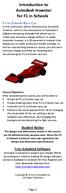 Introduction to Autodesk Inventor for F1 in Schools F1 in Schools Race Car In this course you will be introduced to Autodesk Inventor, which is the centerpiece of Autodesk s digital prototyping strategy
www.mathsbox.org.uk Displacement (x) Velocity (v) Acceleration (a) x = f(t) differentiate v = dx Acceleration Velocity (v) Displacement x
 Mechanics 2 : Revision Notes 1. Kinematics and variable acceleration Displacement (x) Velocity (v) Acceleration (a) x = f(t) differentiate v = dx differentiate a = dv = d2 x dt dt dt 2 Acceleration Velocity
Unit 4 Practice Test: Rotational Motion
 Unit 4 Practice Test: Rotational Motion Multiple Guess Identify the letter of the choice that best completes the statement or answers the question. 1. How would an angle in radians be converted to an angle
SCREW THREADS C H A P T E R 17
 C H A P T E R 17 SCREW THREADS Screw threads are of prime importance in machine drawing. It is a functional element used as temporary fasteners such as bolt, stud, nut and screw etc. These are constructed
Name: Partners: Period: Coaster Option: 1. In the space below, make a sketch of your roller coaster.
 1. In the space below, make a sketch of your roller coaster. 2. On your sketch, label different areas of acceleration. Put a next to an area of negative acceleration, a + next to an area of positive acceleration,
Simple Machines. What are simple machines?
 Definitions to know: Simple Machines Work done when an applied force causes an object to move in the direction of the force Energy ability to cause change; can change the speed, direction, shape, or temperature
LEVEL GAUGES WITH MAGNETIC JOINT L 14 - L 22 - L 34
 LEVEL GAUGES WITH MAGNETIC JOINT L 14 - L 22 - L 34 2 LEVEL GAUGES WITH MAGNETIC JOINT SIZE Ø 140/220/340 58 58 TYPE LA TYPE LA 14 30 S 22 33 TYPE LA 22-34 NO. HOLES Ø D2 76 O-RING CENTRE OF THE CONSERVATOR
MECHANICAL PRINCIPLES OUTCOME 4 MECHANICAL POWER TRANSMISSION TUTORIAL 1 SIMPLE MACHINES
 MECHANICAL PRINCIPLES OUTCOME 4 MECHANICAL POWER TRANSMISSION TUTORIAL 1 SIMPLE MACHINES Simple machines: lifting devices e.g. lever systems, inclined plane, screw jack, pulley blocks, Weston differential
Propeller Efficiency. Rule of Thumb. David F. Rogers, PhD, ATP
 Propeller Efficiency Rule of Thumb David F. Rogers, PhD, ATP Theoretically the most efficient propeller is a large diameter, slowly turning single blade propeller. Here, think the Osprey or helicopters.
Simple Machines. Figure 2: Basic design for a mousetrap vehicle
 Mousetrap Vehicles Figure 1: This sample mousetrap-powered vehicle has a large drive wheel and a small axle. The vehicle will move slowly and travel a long distance for each turn of the wheel. 1 People
Longitudinal and lateral dynamics
 Longitudinal and lateral dynamics Lecturer dr. Arunas Tautkus Kaunas University of technology Powering the Future With Zero Emission and Human Powered Vehicles Terrassa 2011 1 Content of lecture Basic
HYDRAULICS. H91.8D/C - Computerized Open Surface Tilting Flow Channel - 10, 12.5, 15 and 20 m long
 HYDRAULICS H91.8D/C - Computerized Open Surface Tilting Flow Channel - 10, 12.5, 15 and 20 m long 1. General The series of channels H91.8D has been designed by Didacta Italia to study the hydrodynamic
du u U 0 U dy y b 0 b
 BASIC CONCEPTS/DEFINITIONS OF FLUID MECHANICS (by Marios M. Fyrillas) 1. Density (πυκνότητα) Symbol: 3 Units of measure: kg / m Equation: m ( m mass, V volume) V. Pressure (πίεση) Alternative definition:
F1 in Schools - 2015 World Finals Technical Regulations
 2013 - F1 in Schools Ltd. Page 1 of 24 25 March 2015 Front Cover Colossus F1 2014 World Champions F1 Car, Robert May's School, Hampshire, England Amendments made on [Date] are indicated thus (using red
Quest for Speed. Discover Engineering. Youth Handouts
 Discover Engineering Youth Handouts Activity 1: Spooling Around Name: Date: Materials List Wooden spool Nail Flat washer Rubber bands Craft stick Nut Tape measure Calculator Masking tape Procedure 1. To
accord 20 fx CNC machining centre
 accord 20 fx CNC machining centre accord 20 fx CNC machining centre New-generation modular machining centre designed for machining operations involving heavy duty stock removal with high precision and
AN EFFECT OF GRID QUALITY ON THE RESULTS OF NUMERICAL SIMULATIONS OF THE FLUID FLOW FIELD IN AN AGITATED VESSEL
 14 th European Conference on Mixing Warszawa, 10-13 September 2012 AN EFFECT OF GRID QUALITY ON THE RESULTS OF NUMERICAL SIMULATIONS OF THE FLUID FLOW FIELD IN AN AGITATED VESSEL Joanna Karcz, Lukasz Kacperski
Free Fall: Observing and Analyzing the Free Fall Motion of a Bouncing Ping-Pong Ball and Calculating the Free Fall Acceleration (Teacher s Guide)
 Free Fall: Observing and Analyzing the Free Fall Motion of a Bouncing Ping-Pong Ball and Calculating the Free Fall Acceleration (Teacher s Guide) 2012 WARD S Science v.11/12 OVERVIEW Students will measure
Fig 1 Power Transmission system of Tractor
 POWER TRANSMISSION SYSTEM Transmission is a speed reducing mechanism, equipped with several gears (Fig. 1). It may be called a sequence of gears and shafts, through which the engine power is transmitted
System. Stability. Security. Integrity. 150 Helical Anchor
 Model 150 HELICAL ANCHOR System PN #MBHAT Stability. Security. Integrity. 150 Helical Anchor System About Foundation Supportworks is a network of the most experienced and knowledgeable foundation repair
12-1 Representations of Three-Dimensional Figures
 Connect the dots on the isometric dot paper to represent the edges of the solid. Shade the tops of 12-1 Representations of Three-Dimensional Figures Use isometric dot paper to sketch each prism. 1. triangular
NACA airfoil geometrical construction
 The NACA airfoil series The early NACA airfoil series, the 4-digit, 5-digit, and modified 4-/5-digit, were generated using analytical equations that describe the camber (curvature) of the mean-line (geometric
PHYS 101-4M, Fall 2005 Exam #3. MULTIPLE CHOICE. Choose the one alternative that best completes the statement or answers the question.
 PHYS 101-4M, Fall 2005 Exam #3 Name MULTIPLE CHOICE. Choose the one alternative that best completes the statement or answers the question. 1) A bicycle wheel rotates uniformly through 2.0 revolutions in
University Turbine Systems Research 2012 Fellowship Program Final Report. Prepared for: General Electric Company
 University Turbine Systems Research 2012 Fellowship Program Final Report Prepared for: General Electric Company Gas Turbine Aerodynamics Marion Building 300 Garlington Rd Greenville, SC 29615, USA Prepared
BAGGAGE HANDLING SYSTEMS. Trastecnica S.p.A. Handling Baggage Systems Edition 2002 - Rev. 00-1 -
 BAGGAGE HANDLING SYSTEMS Trastecnica S.p.A. Handling Baggage Systems Edition 2002 - Rev. 00-1 - TECHNICAL SPECIFICS INDEX Check-in with one conveyor 4 Scales 6 Belt Conveyors 8 Take away 9 Feeder and Belt
CFD ANALYSIS OF CONTROLLABLE PITCH PROPELLER USED IN MARINE VEHICLE
 CFD ANALYSIS OF CONROLLABLE PICH PROPELLER USED IN MARINE VEHICLE Aditya Kolakoti 1,.V.K.Bhanuprakash 2 & H.N.Das 3 1 M.E in Marine Engineering And Mechanical Handling, Dept of Marine Engineering, Andhra
30 minutes in class, 2 hours to make the first time
 Asking questions and defining problems Developing and using models Planning and carrying out investigations 30 minutes in class, 2 hours to make the first time 3 12 x 24 x ¾ inch plywood boards 1 x 12
PHYSICS 111 HOMEWORK SOLUTION #10. April 8, 2013
 PHYSICS HOMEWORK SOLUTION #0 April 8, 203 0. Find the net torque on the wheel in the figure below about the axle through O, taking a = 6.0 cm and b = 30.0 cm. A torque that s produced by a force can be
Section. Tolerances. Aluminum Extrusion Manual. 4th Edition
 Section 8 Tolerances Aluminum Extrusion Manual 4th Edition Section 8 How straight is straight enough? How flat is flat enough? How uniform must a wall thickness be in order to be acceptable? These are
To provide insight into the physics of arrow flight and show how archers adapt their equipment to maximize effectiveness.
 The Science of Archery Godai Katsunaga Purpose To provide insight into the physics of arrow flight and show how archers adapt their equipment to maximize effectiveness. Archery Archery is one of the events
Aeronautical Testing Service, Inc. 18820 59th DR NE Arlington, WA 98223 USA. CFD and Wind Tunnel Testing: Complimentary Methods for Aircraft Design
 Aeronautical Testing Service, Inc. 18820 59th DR NE Arlington, WA 98223 USA CFD and Wind Tunnel Testing: Complimentary Methods for Aircraft Design Background Introduction ATS Company Background New and
PRESENTATION ON REPAIR AND REHABILITATION OF BUILDINGS DAMAGED IN EARTHQUAKE. By H P Gupta & D K Gupta
 PRESENTATION ON REPAIR AND REHABILITATION OF BUILDINGS DAMAGED IN EARTHQUAKE By H P Gupta & D K Gupta DIFFERENT TYPES OF DAMAGES 1.Minor cracks 0.5 to 5 mm wide in load or non-load bearing walls 2.Major
DRAFTING MANUAL. Gears (Bevel and Hypoid) Drafting Practice
 Page 1 1.0 General This section provides the basis for uniformity in engineering gears drawings and their technical data for gears with intersecting axes (bevel gears), and nonparallel, nonintersecting
Numerical Analysis of Independent Wire Strand Core (IWSC) Wire Rope
 Numerical Analysis of Independent Wire Strand Core (IWSC) Wire Rope Rakesh Sidharthan 1 Gnanavel B K 2 Assistant professor Mechanical, Department Professor, Mechanical Department, Gojan engineering college,
SOLID MECHANICS TUTORIAL MECHANISMS KINEMATICS - VELOCITY AND ACCELERATION DIAGRAMS
 SOLID MECHANICS TUTORIAL MECHANISMS KINEMATICS - VELOCITY AND ACCELERATION DIAGRAMS This work covers elements of the syllabus for the Engineering Council exams C105 Mechanical and Structural Engineering
The entire document shall be read and understood before proceeding with a test. ISTA 3B 2013 - Page 1 of 35
 Packaged-Products for Less-Than-Truckload (LTL) Shipment ISTA 3 Series General Simulation Performance Test PROCEDURE VERSION DATE Last TECHNICAL Change: NOVEMBER 2012 Last EDITORIAL Change: JANUARY 2013
Practical Alignment Tools and Techniques
 Practical Alignment Tools and Techniques Bruce Lehmann Sr. Engineer, Thin Kerf Technologies Inc Accurate sawing requires attention to proper alignment and maintenance. Alignment is critical to modem sawmills
Selecting the Best Approach to Teach 3D Modeling to Technical College Engineering
 Paper ID #12358 Selecting the Best Approach to Teach 3D Modeling to Technical College Engineering Students Dr. Farzin Heidari, Texas A&M University, Kingsville c American Society for Engineering Education,
CFD SUPPORTED EXAMINATION OF BUOY DESIGN FOR WAVE ENERGY CONVERSION
 CFD SUPPORTED EXAMINATION OF BUOY DESIGN FOR WAVE ENERGY CONVERSION Nadir Yilmaz, Geoffrey E. Trapp, Scott M. Gagan, Timothy R. Emmerich Department of Mechanical Engineering, New Mexico Institute of Mining
Solving Simultaneous Equations and Matrices
 Solving Simultaneous Equations and Matrices The following represents a systematic investigation for the steps used to solve two simultaneous linear equations in two unknowns. The motivation for considering
PHYSICS 111 HOMEWORK SOLUTION #9. April 5, 2013
 PHYSICS 111 HOMEWORK SOLUTION #9 April 5, 2013 0.1 A potter s wheel moves uniformly from rest to an angular speed of 0.16 rev/s in 33 s. Find its angular acceleration in radians per second per second.
FREEBIRD THE ORIGINAL D.I.Y. ORNITHOPTER! Tools and Glue. Required Materials
 Do not try to make your ornithopter using "household materials". If you want it to fly, you have to build it right. FREEBIRD THE ORIGINAL D.I.Y. ORNITHOPTER! Wingspan: 16 inches Weight: 1/4 ounce The Ornithopter
TRANS-05, Torque Tube Removal, Rebuilding, and Installation
 TRANS-05, Torque Tube Removal, Rebuilding, and Installation Tools Metric Wrench Set Metric Socket Set Jack Stands (6 minimum) Floor Jack 8mm Cheesehead socket (also referred to as 12 point internal socket
HOW TO MAKE A MOTOR BRACKET
 HOW TO MAKE A MOUNTING BRACKET FOR AN ELECTRIC MOTOR Often, brackets supplied with purchased items (e.g. electric motors or servos) are not ideally suited for fitting into our models or they are not supplied
PHY121 #8 Midterm I 3.06.2013
 PHY11 #8 Midterm I 3.06.013 AP Physics- Newton s Laws AP Exam Multiple Choice Questions #1 #4 1. When the frictionless system shown above is accelerated by an applied force of magnitude F, the tension
Using mechanical energy for daily
 unit 3 Using mechanical energy for daily activities Physics Chapter 3 Using mechanical energy for daily activities Competency Uses mechanical energy for day-to-day activities Competency level 3.1 Investigates
PaLLe t trucks Lifting carts t r g in t if L 2435 6815 6836 6856 6842
 l i f t i n g c a r t s Lifting carts The prograe for lifting, transporting and storage From the classical forklift trolley to the machine lifter, from furniture dollies to a chassis with 24 tons load
Fluids and Solids: Fundamentals
 Fluids and Solids: Fundamentals We normally recognize three states of matter: solid; liquid and gas. However, liquid and gas are both fluids: in contrast to solids they lack the ability to resist deformation.
NACA Nomenclature NACA 2421. NACA Airfoils. Definitions: Airfoil Geometry
 0.40 m 0.21 m 0.02 m NACA Airfoils 6-Feb-08 AE 315 Lesson 10: Airfoil nomenclature and properties 1 Definitions: Airfoil Geometry z Mean camber line Chord line x Chord x=0 x=c Leading edge Trailing edge
XI / PHYSICS FLUIDS IN MOTION 11/PA
 Viscosity It is the property of a liquid due to which it flows in the form of layers and each layer opposes the motion of its adjacent layer. Cause of viscosity Consider two neighboring liquid layers A
Fluid Mechanics: Static s Kinematics Dynamics Fluid
 Fluid Mechanics: Fluid mechanics may be defined as that branch of engineering science that deals with the behavior of fluid under the condition of rest and motion Fluid mechanics may be divided into three
Copyright 2011 Casa Software Ltd. www.casaxps.com. Centre of Mass
 Centre of Mass A central theme in mathematical modelling is that of reducing complex problems to simpler, and hopefully, equivalent problems for which mathematical analysis is possible. The concept of
B Dinesh Prabhu, Asst. Professor, P E S College Engg., Mandya, KARNATAKA 1
 Firing Order Every engine cylinder must fire once in every cycle. This requires that for a four-stroke fourcylinder engine the ignition system must fire for every 180 degrees of crank rotation. For a sixcylinder
SECTION 2B WHEEL ALIGNMENT TABLE OF CONTENTS
 SECTION 2B WHEEL ALIGNMENT TABLE OF CONTENTS Description and Operation... 2B2 Four Wheel Alignment... 2B2 Toein... 2B2 Caster... 2B2 Camber... 2B2 Diagnostic Information and Procedures... 2B3 Tire Diagnosis...
Rebuild Instructions for 70001 and 70010 Transmission
 Rebuild Instructions for 70001 and 70010 Transmission Brinn, Incorporated 1615 Tech Drive Bay City, MI 48706 Telephone 989.686.8920 Fax 989.686.6520 www.brinninc.com Notice Read all instructions before
Manual piston sampler...m 11
 SAMPLING Manual piston sampler...m 11 Screw sampler...prec 22...PREC 100 Slide sampler...pr 55 Rotative screw sampler...prv Piston sampler...p 11 Sampler on belt conveyor...pba Rotating cup sampler...pgr
Stability. Security. Integrity.
 Stability. Security. Integrity. PN #MBHPT Foundation Supportworks provides quality helical pile systems for both new construction and retrofit applications. 288 Helical Pile System About Foundation Supportworks
CE 6303 MECHANICS OF FLUIDS L T P C QUESTION BANK PART - A
 CE 6303 MECHANICS OF FLUIDS L T P C QUESTION BANK 3 0 0 3 UNIT I FLUID PROPERTIES AND FLUID STATICS PART - A 1. Define fluid and fluid mechanics. 2. Define real and ideal fluids. 3. Define mass density
Permanent Magnetic Couplings and Brakes for Drive Technology
 Tridelta Magnetsysteme A Tridelta Group Company Permanent Magnetic Couplings and Brakes for Drive Technology Raw Materials Magnets Systems and Components Magnet N1 Soft iron N2 Resin Introduction and principals
ENHANCEMENT OF AERODYNAMIC PERFORMANCE OF A FORMULA-1 RACE CAR USING ADD-ON DEVICES B. N. Devaiah 1, S. Umesh 2
 ENHANCEMENT OF AERODYNAMIC PERFORMANCE OF A FORMULA-1 RACE CAR USING ADD-ON DEVICES B. N. Devaiah 1, S. Umesh 2 1- M. Sc. [Engg.] Student, 2- Asst. Professor Automotive and Aeronautical Engineering Department,
CHAPTER 65 TAIL ROTOR DRIVE SYSTEM. Section Title Page
 CHAPTER 65 TAIL ROTOR DRIVE SYSTEM Section Title Page 65-00 Description........................................ 65.1 65-10 Tail Rotor Drive Fan Shaft.............................. 65.1 65-20 Tail Rotor
INTERNATIONAL HOCKEY FEDERATION PERFORMANCE REQUIREMENTS AND TEST PROCEDURES FOR HOCKEY BALLS. Published: April 1999
 INTERNATIONAL HOCKEY FEDERATION PERFORMANCE REQUIREMENTS AND TEST PROCEDURES FOR HOCKEY BALLS Published: April 1999 CONTENTS 1 Introduction 2 Test Procedures General 3 Standards and Specific Test Procedures
Solid Mechanics. Stress. What you ll learn: Motivation
 Solid Mechanics Stress What you ll learn: What is stress? Why stress is important? What are normal and shear stresses? What is strain? Hooke s law (relationship between stress and strain) Stress strain
The Kobold marine turbine: from the testing model to the full scale prototype
 The Kobold marine turbine: from the testing model to the full scale prototype Guido Calcagno INSEAN Italian National Institute for Naval Architecture Studies and Testing (Rome Italy) Alberto Moroso Ponte
Chapter 3.5: Fans and Blowers
 Part I: Objective type questions and answers Chapter 3.5: Fans and Blowers 1. The parameter used by ASME to define fans, blowers and compressors is a) Fan ration b) Specific ratio c) Blade ratio d) Twist
What is a Mouse-Trap
 What is a Mouse-Trap Car and How does it Work? A mouse-trap car is a vehicle that is powered by the energy that can be stored in a wound up mouse-trap spring. The most basic design is as follows: a string
Using CFD to improve the design of a circulating water channel
 2-7 December 27 Using CFD to improve the design of a circulating water channel M.G. Pullinger and J.E. Sargison School of Engineering University of Tasmania, Hobart, TAS, 71 AUSTRALIA Abstract Computational
FTC 2015-2016 DIY Mountain Build Guide
 FTC 2015-2016 DIY Mountain Build Guide Assembly Instructions Check out the DIY2015-2016 Prints and BoM for individual part details. Release 1.0 9/10/15 Page 1 This guide and Bill of Materials are for constructing
ROVs in a Bucket Building an Underwater Robot. 3.0 ROV Thrusters & Propeller Attachment. 3.1 Propulsion
 3.0 ROV Thrusters & Propeller Attachment 3.1 Propulsion ROV s move forward and back, up and down, and to the left and right. They can make all of these moves without the benefit of a rudder. With three