
ITALIAN STARTING OUT IN
|
|
|
- Tracey Lindsay Miles
- 10 years ago
- Views:
Transcription
1 STARTING OUT IN ITALIAN Welcome to Living Language s Starting Out in Italian, an introductory course teaching you the basics of the Italian language. This all- audio course is designed to be used without any printed material, but should you decide you want to read along as you listen to the lessons, visit for a free downloadable transcript and other resources. Prima Lezione: Saluti, presentazioni e espressioni di cortesia Lesson 1: Greetings, introductions, and expressions of politeness Ciao! Hello! In this lesson, you ll learn how to greet people and introduce yourself. You ll also learn some very useful polite expressions for making a good first impression. First, let s get started with some vocabulary. You ll hear the English first, and then you ll hear the Italian. Repeat each new word or phrase every time you hear it. Ready? 1

2 VOCABULARY BUILDING 1 hi, hello, good- bye hello good morning good afternoon good evening good night have a good day have a good evening good- bye (infml.) good- bye (fml.) see you soon see you later ciao salve buon giorno buon pomeriggio buona sera buona notte buona giornata buona serata arrivederci arrivederla a presto a dopo TAKE A BREAK 1 Okay, let s stop for a moment. You just learned how to say hello (ciao, salve), good morning (buon giorno), good afternoon (buon pomeriggio), good evening (buona sera), good night (buona notte), have a good day (buona giornata), have a good evening (buona serata), see you soon (a presto), and see you later (a dopo). Did you notice that there are two expressions for good- bye, either arrivederci or arrivederla? That s because the first (arrivederci) is informal and the second (arrivederla) is formal. You ll use arrivederci with family and friends, and arrivederla in any other context. However, very often people tend to use arrivederci in formal contexts, too. Also keep in mind that another informal and very common way to say good- bye is ciao, better if repeated twice: ciao ciao! (bye- bye!) Now that you know how to greet people, let s move on to some vocabulary and expressions you can use to introduce yourself and make someone s acquaintance. VOCABULARY BUILDING 2 My name is... Mi chiamo... I am from... Sono di and you (infml.)?... e tu?... and you (fml.)?... e Lei? 2

3 Pleased to meet you. Pleased to meet you, too. How are you doing (infml.)? How are you doing (fml.)? Very well, thanks. Piacere. Piacere mio. Come stai? Come sta? Molto bene, grazie. (I am) Fine, thanks. (Sto) Bene, grazie. So-so, not bad. Thank you. Thanks. Thanks a lot. You re welcome. Don t mention it. Così così. Grazie. Grazie mille. Prego. Non c è di che. TAKE A BREAK 2 Let s pause there for a moment and focus on a very important distinction. In Italian, there is a formal and an informal way to introduce yourself and make someone s acquaintance. If you re meeting someone in a casual context you ll say: ciao, mi chiamo... e tu? (hi, my name is..., and you?), while in a more formal context you ll say: salve (or buon giorno/buona sera/... ), mi chiamo... e Lei? (hello, my name is..., and you?). Again, you have two options to ask someone how he or she is doing: come stai? (if speaking informally) and come sta? (when speaking formally). Keep in mind that the formal you (Lei) is always capitalized in writing to avoid confusion with the feminine pronoun lei, meaning she. ONE MORE TIME... Okay, let s put everything you ve learned so far together in a short comprehension exercise. You ll hear the English first, and then the Italian, which you should repeat for practice. My name is Mario, and you? M: Mi chiamo Mario, e tu? Good evening Mario, my name is Carla. How are you? F: Buona sera Mario, mi chiamo Carla. Come stai? Very well, thanks. M: Molto bene, grazie. Pleased to meet you! F: Piacere! 3

4 Pleased to meet you, too! M: Piacere mio! Have a good day. F: Buona giornata. See you later. M: A dopo. BRING IT ALL TOGETHER Now let s bring it all together, and add a little bit more vocabulary and structure. Good morning, my name is Paul Bennet. I am from Boston, and you (fml.)? M: Buon giorno, mi chiamo Paul Bennet. Io sono di Boston, e Lei? My name is Carla Betti and I m from Milan. Very pleased to meet you! F: Mi chiamo Carla Betti e io sono di Milano. Molto piacere! Pleased to meet you, too. M: Piacere mio. How s it going, Mr. Bennet? F: Come va, signor Bennet? Fine, thanks. And how are you doing? M: Bene, grazie. E Lei come sta? So-so. F: Così così. Good- bye, Mr. Bennet. F: ArrivederLa, signor Bennet. Have a good day! M: Buona giornata! Okay, let s focus on a couple new words and expressions you just heard in the dialogue. Did you notice that io sono di means I am from? This is a very useful expression to use when you want to say what city you come from: sono di Milano, sono di Boston, sono di New York. You already know how to ask someone how he or she is doing using the informal come stai? and the formal come sta? You just learned a new expression that you can use in both formal and informal contexts: come va?, which literally means how s it going? 4

5 WORK OUT Now let s practice some of what you ve learned. First, you ll hear a phrase in Italian, and you should translate it into English. You ll hear the correct answer after a pause. Ciao! A presto. Come stai? Bene grazie. E Lei? Prego! Hi! See you soon. How are you? (infml.) Fine, thanks. And you? (fml.) You re welcome! Great! Now do the opposite, translating the phrase from English into Italian. After a pause, you ll hear the right answer, which you should repeat for practice. Good evening, Mr. Federici. See you later. I m from Milan. How s it going? Thanks a lot. Buona sera, signor Federici. A dopo. Sono di Milano. Come va? Grazie mille. PARTING WORDS Molto bene! Well done! You just finished your first lesson, in which you learned the basic vocabulary you need to greet people and introduce yourself. If you want to extend your vocabulary a little bit more, you can add a couple of words to your list of greetings: buon pomeriggio (good afternoon) and buona notte (good night). As in English, the first one is used to greet people between 1 p.m. and 6 p.m. Buona notte, on the other hand, is only used when parting late at night or before going to bed. Here s one more: A presto! (See you soon!) 5

6 Seconda Lezione: Le persone e la famiglia Lesson 2: People and the family Benvenuto! Welcome! In this lesson, you ll learn how to talk about people and your family, and at the same time you ll learn the basics of Italian grammar to get you speaking right away. First, let s get started with some vocabulary. You ll hear the English first, and then you ll hear the Italian. Repeat each new word or phrase every time you hear it. Ready? VOCABULARY BUILDING 1 a person a woman una persona una donna Here is... Ecco... Here is a woman. a man a girl a boy a child (boy) a child (girl) Ecco una donna. un uomo una ragazza un ragazzo un bambino una bambina TAKE A BREAK 1 Okay, let s stop there. You learned how to say a person (una persona), a woman (una donna), a man (un uomo), a girl (una ragazza), a boy (un ragazzo), and a child (un bambino/una bambina). Did you notice that there are two words for a, either un or una? That s because all Italian nouns are either masculine or feminine. The feminine form of a or an, also known as the indefinite article, is una: una donna, una ragazza, una bambina. The masculine form of the indefinite article is un: un uomo, un ragazzo, un bambino. It s easy to remember the gender of nouns like man, woman, girl, or boy, but in Italian, all nouns have gender. Sometimes it s illogical; the word for a person is feminine: una persona, but can refer to both male and female individuals. Sometimes it s impossible to tell would you ever guess that a stone is feminine (una pietra) while a river is masculine (un fiume)? It s best not to overthink it! Just memorize the gender of each new noun you learn. Speaking of new nouns, let s learn some more new vocabulary. 6

7 VOCABULARY BUILDING 2 Here is a family. Ecco una famiglia. There is... C è... There are... Ci sono... There s the father. There s the mother. There are the father and the mother. There s the son. There s the daughter. There are the son and daughter. There s the brother. There s the sister. There are the brother and sister. C è il padre. C è la madre. Ci sono il padre e la madre. C è il figlio. C è la figlia. Ci sono il figlio e la figlia. C è il fratello. C è la sorella. Ci sono il fratello e la sorella. TAKE A BREAK 2 Let s pause there for a moment. You just learned a few important things. First you learned how to say there is (c è) and there are (ci sono) in Italian. These are important expressions that you re likely to use a lot, so be sure to practice them: C è... Ci sono... You also learned how to say a or an in Italian, un for masculine nouns, and una for feminine nouns. Now you just heard how to say the, also known as the definite article. Again, gender is important. The masculine form is il, and the feminine form is la. So far you ve learned a few feminine nouns: la famiglia (the family), la madre (the mother), la figlia (the daughter), la sorella (the sister) and la persona (the person). And you ve learned a few masculine nouns, too: il padre (the father), il figlio (the son), il ragazzo (the boy), il fratello (the brother), il bambino (the child). In Italian you always have to repeat the article before each noun (ci sono il padre e la madre, il fratello e la sorella, il figlio e la figlia). ONE MORE TIME... Okay, let s put everything you ve learned so far together in a short comprehension exercise. You ll hear the English first, and then the Italian, and then you should repeat for practice. Here is the Belli family. Mrs. Belli is a woman. Ecco la famiglia Belli. La signora Belli è una donna. 7

8 Mr. Belli is a man. Francesco is a boy. Maria is a girl. Mrs. Belli is the mother. Mr. Belli is the father. Maria is the daughter. Francesco is the son. Il signor Belli è un uomo. Francesco è un ragazzo. Maria è una ragazza. La signora Belli è la madre. Il signor Belli è il padre. Maria è la figlia. Francesco è il figlio. BRING IT ALL TOGETHER Now let s bring it all together in a brief monologue, and add a little bit more vocabulary and structure. I m Francesco. I m Italian. I have a small family. I have a father. He s a policeman. And I have a mother. She s a teacher. And I have a sister. She s a student. And me, too, I m a student. Io sono Francesco. Sono italiano. Io ho una famiglia piccola. Ho un padre. Lui è un poliziotto. E ho una madre. Lei è una professoressa. E ho una sorella. Lei è una studentessa. E anche io sono uno studente. You probably knew already that italiano means Italian. Did you remember that io sono means I am? Io is the pronoun I, and sono is the form of the verb essere (to be), which you ll learn more about later. Francesco drops the pronoun io when he says sono italiano because the pronoun isn t always necessary; you can tell the subject of the sentence by the verb form. You heard two other pronouns, lui (he), and lei (she), used with essere: lui è means he is, and lei è means she is. Francesco used another useful verb: io ho..., meaning I have, as in io ho una famigia piccola, or I have a small family. Finally, you heard Francesco say that his father is un poliziotto, or a policeman, his mother is una professoressa, or a teacher, and both he and his sister are students, studentessa in the feminine, and studente in the masculine. Did you notice that the article before studente is uno and not un? That s because uno is the form of the indefinite article that comes before masculine nouns beginning with the letter s followed by a consonant, as in uno studente, or before the letter z, as in uno zio (an uncle). We ll come back to that later. 8

9 WORK OUT Now let s practice some of what you ve learned. First, you ll hear a phrase in Italian, and you should translate it into English. You ll hear the correct answer after a pause. una persona un bambino la famiglia Ecco una donna. Francesco è un uomo. a person a child (boy) the family Here is a woman. Francesco is a man. Now translate the following phrases into Italian, and then form sentences beginning with the expression io ho, or I have. For example, if you hear a small family, you d respond by saying io ho una famiglia piccola. Use the pronoun io for practice, but keep in mind that it s not always necessary to use it. Repeat the correct answers for practice. a small family a mother a father a sister a brother Io ho una famiglia piccola. Io ho una madre. Io ho un padre. Io ho una sorella. Io ho un fratello. Just keep in mind that pronouns in Italian like io or tu are usually dropped, so it s more common to hear ho una sorella or ho un fratello. PARTING WORDS Complimenti! Congratulations! You just finished your second lesson, in which you learned the basic vocabulary you need to talk about your family. You may of course want to extend the discussion a bit, and talk about your zio (uncle), your zia (aunt), your cugina (female cousin), or your cugino (male cousin). And what family reunion would be complete without your nonna (grandmother) and nonno (grandfather)? If you re uno zio or una zia, that means you must have at least un nipote (a nephew) or una nipote (a niece). One last note: although it may sound a bit strange to you, keep in mind that in Italian il nipote/la nipote means both the nephew or the niece and the grandson or the granddaughter. 9

10 Terza Lezione: I numeri e i plurali Lesson 3: Numbers and plurals Bentornato! Welcome back! In this lesson, you ll study numbers, and you ll learn how to form the plural of nouns. You ll also learn a very useful verb, the verb avere (to have), together with the many idiomatic expressions you can form with it. As usual, let s start with some vocabulary. You ll hear the English first, and then you ll hear the Italian. Repeat each new phrase every time you hear it. Ready? VOCABULARY BUILDING 1 there is one student there are two students there are three sisters and four brothers there are fi ve boys and six girls here are seven families here are eight children (boys) here are nine children (girls) here are ten men and eleven women here are twelve people c è uno studente ci sono due studenti ci sono tre sorelle e quattro fratelli ci sono cinque ragazzi e sei ragazze ecco sette famiglie ecco otto bambini ecco nove bambine ecco dieci uomini e undici donne ecco dodici persone TAKE A BREAK 1 Okay, let s take a short break. You just learned how to say one, two, three (uno, due, tre), four, fi ve, six (quattro, cinque, sei), seven, eight, nine (sette, otto, nove), ten, eleven, and twelve (dieci, undici, dodici). You also heard some of the same words from lesson two used with them, only this time they had a different ending, and that ending changes them from singular nouns into plural nouns. Words ending in -o or -e in the singular, like bambino and studente, become plural by changing their ending to -i (un bambino, otto bambini; uno studente, due studenti). Words ending in -a in the singular, like bambina, become plural by changing their ending to -e (una bambina, sei bambine). There are a few exceptions. The plural uomini (men) is irregular: you say uomo (man) in the singular and uomini in the plural. There are more words with irregular plurals, but you will learn them as they come up in your vocabulary. Now let s move on to a different topic, the verb avere (to have). 10

11 VOCABULARY BUILDING 2 to have I have you have (sg., infml.) you have (sg., fml.) he has she has we have you have (pl.) they have I am hungry you (sg.) are thirsty he is sleepy we are cold they are in a hurry avere io ho tu hai Lei ha lui ha lei ha noi abbiamo voi avete loro hanno (io) ho fame (tu) hai sete (lui) ha sonno (noi) abbiamo freddo (loro) hanno fretta TAKE A BREAK 2 Let s pause for a moment and make a few comments on the verb avere. Have you seen how many useful expressions you can form with avere by combining it with the words fame (hunger), sete (thirst), sonno (sleep), caldo (heat), freddo (cold), paura (fear), ragione (reason), and fretta (hurry)? All these expressions are translated in English using the verb to be followed by an adjective. In Italian, on the other hand, you will use the verb avere (to have) followed by a noun to create these expressions: avere fame (to be hungry), avere sete (to be thirsty), avere sonno (to be sleepy), avere caldo (to be hot), avere freddo (to be cold), avere paura (to be afraid), avere ragione (to be right), and avere fretta (to be in a hurry). While repeating the conjugation of the verb avere, you also had the opportunity to learn the Italian subject pronouns: io (I), tu (you, sg., infml.), Lei (you, sg., fml.), lui (he), lei (she), noi (we), voi (you, pl.), loro (they). Don t forget that the formal you (the Lei form) is always capitalized in writing to distinguish it from the third person singular lei (she). Also remember that subject pronouns are usually omitted in Italian. They re usually used only when you want to give more emphasis to your statements. Compare: ho bisogno di un caffè (I need a coffee) with io ho bisogno di un caffè (I do need a coffee). 11

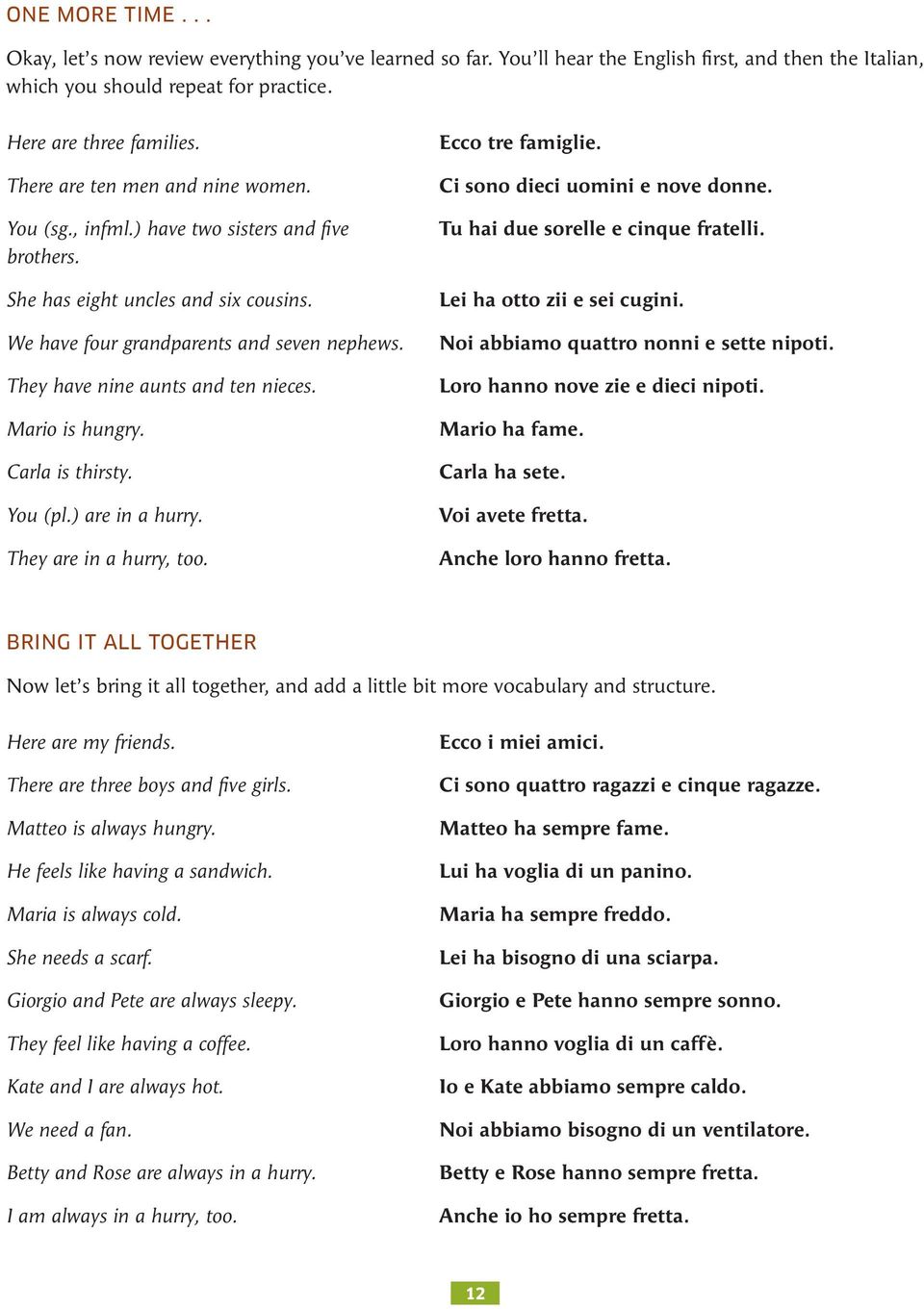
12 ONE MORE TIME... Okay, let s now review everything you ve learned so far. You ll hear the English first, and then the Italian, which you should repeat for practice. Here are three families. There are ten men and nine women. You (sg., infml.) have two sisters and fi ve brothers. She has eight uncles and six cousins. We have four grandparents and seven nephews. They have nine aunts and ten nieces. Mario is hungry. Carla is thirsty. You (pl.) are in a hurry. They are in a hurry, too. Ecco tre famiglie. Ci sono dieci uomini e nove donne. Tu hai due sorelle e cinque fratelli. Lei ha otto zii e sei cugini. Noi abbiamo quattro nonni e sette nipoti. Loro hanno nove zie e dieci nipoti. Mario ha fame. Carla ha sete. Voi avete fretta. Anche loro hanno fretta. BRING IT ALL TOGETHER Now let s bring it all together, and add a little bit more vocabulary and structure. Here are my friends. There are three boys and fi ve girls. Matteo is always hungry. He feels like having a sandwich. Maria is always cold. She needs a scarf. Giorgio and Pete are always sleepy. They feel like having a coffee. Kate and I are always hot. We need a fan. Betty and Rose are always in a hurry. I am always in a hurry, too. Ecco i miei amici. Ci sono quattro ragazzi e cinque ragazze. Matteo ha sempre fame. Lui ha voglia di un panino. Maria ha sempre freddo. Lei ha bisogno di una sciarpa. Giorgio e Pete hanno sempre sonno. Loro hanno voglia di un caffè. Io e Kate abbiamo sempre caldo. Noi abbiamo bisogno di un ventilatore. Betty e Rose hanno sempre fretta. Anche io ho sempre fretta. 12
13 Okay, let s focus for a moment on the new words you just heard: panino (sandwich), sciarpa (scarf ), caffè (coffee), and ventilatore (fan). You also heard the word amici, or friends, which, in this case, includes both male and female friends. In the singular, you will make a distinction between a male friend (amico), and a female friend (amica). The same happens with many words you ve already learned for describing people, such as studente, studentessa or ragazzo, ragazza. You can say ragazzi or studenti to refer either to a group of males or to a group that includes both males and females. Of course, if you want to refer to a group of female friends, students, or girls, you ll say amiche, studentesse, and ragazze. Finally, did you catch the new expressions avere bisogno di (to need) and avere voglia di (to feel like something)? They are two very useful expressions to remember. Keep in mind that they can be followed either by a noun, as in the many examples you ve heard, or by the infinitive of a verb, as you ll see later on. WORK OUT Now let s practice some of what you ve learned. You ll hear a sentence in the singular; you re job will be to make the final noun plural using the numbers due, tre, quattro, cinque, sei (two, three, four, fi ve, six). You ll hear the correct answer after a pause. C è un ragazzo. (due) Ecco una ragazza. (tre) Io ho un amico. (quattro) Tu hai una sorella. (cinque) C è uno studente. (sei) Ci sono due ragazzi. Ecco tre ragazze. Io ho quattro amici. Tu hai cinque sorelle. Ci sono sei studenti. Now listen to the following sentences, and use the right form of avere bisogno di to say what each person needs. Again, after a pause, you ll hear the right answer. Don t forget to repeat it for practice. Maria ha sonno. (un caffè) Noi abbiamo freddo. (una sciarpa) Loro hanno caldo. (un ventilatore) Tu hai fame. (un panino) Anche io ho fame. (un panino) Lei ha bisogno di un caffè. Noi abbiamo bisogno di una sciarpa. Loro hanno bisogno di un ventilatore. Tu hai bisogno di un panino. Anche io ho bisogno di un panino. PARTING WORDS Perfetto! Great! You just finished your third lesson, in which you learned numbers from one to twelve, and the plural of nouns. You also learned the present tense of the verb avere, plus the many useful idiomatic expressions you can form by combining it with words like fame, sete, caldo, freddo, sonno, 13

14 fretta, and paura. At this point, maybe tu hai bisogno di una pausa (you do need a break). Arrivederci a presto! Good- bye and see you soon! Quarta Lezione: In giro per la casa Lesson 4: Around the home Rieccoci! Here we are again! In this lesson you ll continue to improve on your vocabulary and learn how to talk about common objects you can find in giro per la casa (around the house). You ll learn more of the present tense of verb essere (to be), as well as the plural of definite articles. Let s get started with some vocabulary. You ll hear the English first, and then you ll hear the Italian. Repeat each new phrase every time you hear it. Ready? VOCABULARY BUILDING 1 in the kitchen there is the table in cucina c è il tavolo in the kitchen there are... in cucina ci sono... the pans the dishes le pentole i piatti in the bedroom there is... in camera (da letto) c è... the bed the closet in the bedroom there are the pillows il letto l armadio in camera ci sono i cuscini in the living room there is... in soggiorno c è... the couch the rug in the living room there are the chairs il divano il tappeto in soggiorno ci sono le sedie in the bathroom there is... in bagno c è... the washing machine la lavatrice 14

15 the mirror in the bathroom there are the towels lo specchio in bagno ci sono gli asciugamani TAKE A BREAK 1 Okay, let s pause for a moment and look closer at what you just heard. You just learned how to say kitchen (cucina), bedroom (camera da letto or camera), living room (soggiorno), and bathroom (bagno). You also learned many names of common objects you can find in each room (stanza) of the house. You heard that in cucina (in the kitchen) you can find il tavolo, le pentole e i piatti (the table, the pans, and the dishes); in camera (da letto) (in the bedroom) you can find il letto, l armadio e i cuscini (the bed, the closet, and the pillows); in soggiorno (in the living room) you can find il divano, il tappeto e le sedie (the couch, the carpet, and the chairs); in bagno (in the bathroom) you can find la lavatrice, lo specchio e gli asciugamani (the washing machine, the mirror, and the towels). Did you notice how many different definite articles were used in the examples? You already learned il and la in lesson two. Let s look at some more of them, starting with the masculine. In the singular you have two options: il, used before most nouns beginning with a consonant (il tavolo, il letto), and lo, used before words beginning with the letter s followed by a consonant (lo specchio), with the letter z (lo zio), and before all vowels. When used before a vowel, lo is shortened to l : l armadio, l uomo, l amico. In the plural il turns into i: i piatti, i cuscini; while lo changes into gli: gli asciugamani. Let s look at the two feminine forms. La is used in the singular (la lavatrice) and le is the plural form (le pentole, le sedie). When used before a vowel, la is shortened to l : l amica. The form le, on the contrary, is never shortened. Next we ll learn more about the verb essere (to be). VOCABULARY BUILDING 2 to be I am you are (sg., infml.) you are (sg., fml.) he is she is we are you are (pl.) they are essere io sono tu sei Lei è lui è lei è noi siamo voi siete loro sono 15

16 I am at home you (sg., infml.) are in the kitchen he is in the bathroom we are in the bedroom they are in the living room io sono a casa tu sei in cucina lui è in bagno noi siamo in camera da letto loro sono in soggiorno TAKE A BREAK 2 Let s pause for a moment and make a few comments on the verb essere. You already learned in Lesson 1 that essere di, followed by the name of a town or city, is used to express someone s hometown: io sono di Firenze, tu sei di Philadelphia, Paolo è di Milano, and so on. Essere di followed by the name of a person is also used to express possession: i piatti sono di Nicola (the dishes belong to Nicola or the dishes are Nicola s), la lavatrice è di Ann (the washing machine belongs to Ann or the washing machine is Ann s). To ask who owns something, say di chi è? when referring to a single object, and di chi sono? when referring to more than one object. Let s listen to a few examples. Whose washing machine is it? It s Ann s. Whose dishes are they? They are Nicola s. Di chi è la lavatrice? È di Ann. Di chi sono i piatti? Sono di Nicola. Of course, if you just want to express the possessive of a noun, you ll say la lavatrice di Ann (Ann s washing machine) or i piatti di Nicola (Nicola s dishes). ONE MORE TIME... Okay, let s now put everything you ve learned so far together in a short exercise. You ll hear the English first, and then the Italian, which you should repeat for practice. I am in the kitchen. In the kitchen there are the cups, the dishes, and the table. The cups are Michael s. You are in the living room. She is in the bathroom. Io sono in cucina. In cucina ci sono le tazze, i piatti e il tavolo. Le tazze sono di Michael. Tu sei in soggiorno. Lei è in bagno. 16

17 In the bedroom there are the pillows, the closet, and the bed. The pillows are Paolo s. In camera da letto ci sono i cuscini, l armadio e il letto. I cuscini sono di Paolo. BRING IT ALL TOGETHER Now let s bring it all together, and add a little bit more vocabulary and structure. This is Paolo and Marta s house. Paolo and Marta are at home. Paolo is in the bedroom. In the bedroom there is the double bed. Paolo s cups are in the kitchen. Marta is in the garden. In the garden there are the fl owers. Marta s books are in the living room. Paolo and Marta have a daughter: Anna. Anna is in the bathroom. In the bathroom there is the shower. Anna s desk is in her room. Questa è la casa di Paolo e Marta. Paolo e Marta sono in casa. Paolo è in camera da letto. In camera (da letto) c è il letto matrimoniale. Le tazze di Paolo sono in cucina. Marta è in giardino. In giardino ci sono i fiori. I libri di Marta sono in soggiorno. Paolo e Marta hanno una figlia: Anna. Anna è in bagno. In bagno c è la doccia. La scrivania di Anna è in camera sua. You probably noticed some new words: il giardino (the garden), i fiori (the fl owers), i libri (the books), il letto matrimoniale (the double bed), la doccia (the shower), and la scrivania (the desk). You also heard that Paolo and Marta are in casa (at home): that s another useful expression to remember. Finally, in the sentence la scrivania di Anna è in camera sua, you heard one of the possessive adjectives sua (her) for the first time. Keep this in mind; you will be working on possessive adjectives in your next lesson. WORK OUT Now let s practice the new definite articles you ve learned. You ll hear a list of objects in the singular; change both the article and the noun into the plural. You ll hear the correct answer after a pause, which you should repeat for practice. il tavolo lo specchio i tavoli gli specchi 17

18 la tazza l asciugamano il letto le tazze gli asciugamani i letti Let s now review the different forms of the verb essere by translating the following sentences from English into Italian. I m from Milan. We re at home. He s in the living room. You (pl.) are in the kitchen. They re from Florence. Io sono di Milano. or Sono di Milano. Noi siamo a casa. or Siamo a casa. Lui è in soggiorno. or È in soggiorno. Voi siete in cucina. or Siete in cucina. Loro sono di Firenze. or Sono di Firenze. PARTING WORDS Benissimo! Great! You just finished Lesson 4, in which you studied all the forms of the definite article, and learned how to talk about common objects you can find in giro per la casa (around the house). You also studied the present tense of the verb essere, and learned how to express possession and find out who s the owner of something. Finally, let s at least mention a couple of interesting idioms with essere: essere d accordo (to agree), essere in orario or essere puntuale (to be on time), and essere in ritardo (to be late). That s enough for lesson four, sei d accordo (do you agree)? Quinta Lezione: Descrivere le cose Lesson 5: Describing things Bentornato! Welcome back! In this lesson you ll learn how to describe things and people using adjectives. You ll also study colors and become familiar with possessive adjectives. More importantly, you ll learn (and practice) how to match nouns and adjectives according to gender (masculine or feminine) and number (singular or plural). As always, we ll start with some vocabulary. 18

19 VOCABULARY BUILDING 1 the couch is new the house is old the beds are small the bedrooms are beautiful the kitchen is big the bathroom is ugly the rug is red the pillows are yellow the table is green the chairs are brown the washing machine is white the dishes are blue the pans are black il divano è nuovo la casa è vecchia i letti sono piccoli le camere da letto sono belle la cucina è grande il bagno è brutto il tappeto è rosso i cuscini sono gialli il tavolo è verde le sedie sono marroni la lavatrice è bianca i piatti sono blu le pentole sono nere TAKE A BREAK 1 You just heard some common adjectives: new and old (nuovo and vecchio), small and big (piccolo and grande), beautiful and ugly (bello and brutto). Did you notice how the ending of each adjective changed according to the noun accompanying it? That s because Italian adjectives take the same gender (masculine or feminine) and number (singular or plural) of the noun they refer to. An adjective like new has four forms: nuovo, nuova, nuovi, nuove. Therefore, we have il divano nuovo (the masculine singular ending in -o), and la casa nuova (the feminine singular ending in -a), i letti nuovi (the masculine plural ending in -i), and le camere nuove (the feminine plural ending in -e). Some adjectives, however, like grande only have two endings: singular (-e) and plural (-i), with no distinction between masculine and feminine. This usually applies to adjectives that end in -e. Compare la cucina grande and il bagno grande: cucina and bagno have a different gender, but the adjective form does not change. Most colors work like other adjectives too. Some of them, like rosso (red), giallo (yellow), bianco (white), and nero (black), have four endings, while others, like verde (green) and marrone (brown), only have two. Some adjectives, like blu (blue), arancione (orange), and rosa (pink), are invariable meaning they won t change according to the noun they are describing. Let s now move on to another family of adjectives: possessive adjectives. 19

20 VOCABULARY BUILDING 2 my house your apartment his/her table his/her kitchen our bed your (pl.) pillow their rug your father is nice your mom is sweet your sister is intelligent la mia casa il tuo appartamento il suo tavolo la sua cucina il nostro letto il vostro cuscino il loro tappeto tuo padre è simpatico la tua mamma è dolce tua sorella è intelligente TAKE A BREAK 2 Let s take a short break and make a few comments on what you just heard. Each possessive adjective, like other adjectives, has four forms, according to gender and number. The only exception is the invariable form loro (their). Let s look at them all together: my your, singular his, her our your, plural their mio, mia, miei, mie tuo, tua, tuoi, tue suo, sua, suoi, sue nostro, nostra, nostri, nostre vostro, vostra, vostri, vostre loro Italian possessives always agree with the object and not with the object s owner. Therefore, my house is la mia casa (feminine singular), and my apartment is il mio appartamento (masculine singular), no matter whether the owner is male or female. Italian possessives are always preceded by a definite article il vostro cuscino (your pillow), il nostro letto (our bed) unless they refer to family terms like padre, madre, fratello, sorella, figlio, nonna, zio, cugina, nipote, and so on used in the singular and not accompanied by other adjectives. However, when using possessives to refer to the words mamma and papà (mom and dad), you need to use the definite article, as mamma and papà are considered terms of endearment. 20

21 ONE MORE TIME... Okay, let s now put everything you ve learned so far together in a short exercise. You ll hear the English first, and then the Italian, which you should repeat for practice. My house is old. Your pillows are green. His/Her table is big. His/Her chair is small. Our washing machines are white. Your (pl.) couch is red. Their beds are small. Their bedrooms are new. Your (sg.) dishes are yellow. Her kitchen is beautiful. La mia casa è vecchia. I tuoi cuscini sono verdi. Il suo tavolo è grande. La sua sedia è piccola. Le nostre lavatrici sono bianche. Il vostro divano è rosso. I loro letti sono piccoli. Le loro camere da letto sono nuove. I tuoi piatti sono gialli. La sua cucina è bella. BRING IT ALL TOGETHER Now let s bring it all together, and add a little bit more vocabulary and structure. My family is big. My father, Bob, is very nice. His car is red. My mother, Laura, is a little stressed. Her bike is green. My sister, Ann, is very intelligent. Her bedroom is always clean. My cousins are a little stressed, too. Their apartments are old. My grandparents are happy. Their garden is very big. My garden, instead, is very small. La mia famiglia è numerosa. Mio padre, Bob, è molto simpatico. La sua automobile è rossa. Mia madre, Laura, è un po stressata. La sua bicicletta è verde. Mia sorella, Ann, è molto intelligente. La sua camera da letto è sempre pulita. Anche i miei cugini sono un po stressati. I loro appartamenti sono vecchi. I miei nonni sono felici. Il loro giardino è molto grande. Il mio giardino, invece, è molto piccolo. 21
22 Did you notice how the English his and her were both translated as sua because they referred to feminine objects (la sua automobile, la sua bicicletta)? In case you want to avoid ambiguities, you can use a different structure and say di lui for his, and di lei for her. You also heard a few new words: molto (very), un po (a little), invece (instead), and anche (too, also). Use molto and un po to modify adjectives. Invece and anche, on the other hand, are used to express differences and similarities between people and things. Note the position of anche: in Italian, it s usually placed at the beginning of a sentence. WORK OUT Now you will hear a sentence and you should add the appropriate possessive adjective, following the given suggestion. After a pause, you ll hear the right answer, which you should repeat for practice. divano è rosso. (my) sedia è gialla. (his or her) biciclette sono verdi. (your, singular) piatti sono blu. (their) Il mio divano è rosso. La sua sedia è gialla. Le tue biciclette sono verdi. I loro piatti sono blu. Finally, translate the following sentences from English to Italian. Keep in mind the rule about possessives used with family terms. Again, after a pause, you ll hear the right answer. Don t forget to repeat it for practice. My father is a little stressed. Your sister is very nice. His mom is very sweet. Their grandparents are happy. Our brother is happy, too. Mio padre è un po stressato. Tua sorella è molto simpatica. La sua mamma è molto dolce. I loro nonni sono felici. Anche nostro fratello è felice. PARTING WORDS Molto bene! Very good! You just finished the fifth lesson, in which you learned how to describe things and people using adjectives and colors. You also learned how to use possessive adjectives. Don t ever forget that Italian adjectives always agree in gender and number with the noun to which they refer, and always pay attention to the endings of the words in order to make the right match. Keep in mind the distinction between adjectives with four endings (nuovo, nuova, nuovi, nuove) and adjectives with two endings (grande, grandi). In the first case, you have to match both gender and number; in the second, you only need to choose between the singular and the plural form. 22
23 Sesta Lezione: In giro per la città Lesson 6: Around town Rieccoci! Here we are again! In this lesson you ll learn to ask (and give) directions and talk about the places you can find in giro per la città (around town). You ll study question words, and you ll learn how to ask and answer basic questions. Let s immediately start with some vocabulary. You ll hear the English first, and then you ll hear the Italian. Repeat each new phrase every time you hear it. Ready? VOCABULARY BUILDING 1 Is there a bank nearby? a post offi ce a supermarket Where is the train station? the school the hospital There is a pharmacy in Dante Square. There is a church on Mazzini Street. There is a movie theater on Roma Avenue. The museum is next to the station. The restaurant is next to the school. The theater is next to the church. C è una banca qui vicino? un ufficio postale un supermercato Dov è la stazione? la scuola l ospedale C è una farmacia in piazza Dante. C è una chiesa in via Mazzini. C è un cinema in viale Roma. Il museo è vicino alla stazione. Il ristorante è vicino alla scuola. Il teatro è vicino alla chiesa. TAKE A BREAK 1 You just learned many names of common places you can find in giro per la città (around town): banca (bank), ufficio postale (post offi ce), supermercato (supermarket), stazione (train station), scuola (school), ospedale (hospital), farmacia (pharmacy), chiesa (church), cinema (movie theater), museo (museum), ristorante (restaurant), and teatro (theater). To ask directions to these places, you need to know how to ask questions. One way to form questions in Italian is with a simple change in intonation. Compare C è una banca qui vicino. (There is a bank nearby.), and C è una banca qui vicino? (Is there a bank nearby?): the word order doesn t change, but 23
24 in the question version, you can hear the pitch rising at the end of the sentence. Another way to form questions in Italian is to begin a sentence with a question word (the intonation, however, is always important). You also heard the question word Dove? (Where?), as in Dov è la stazione? (Where is the train station?). You ll learn more question words later on. For now, let s add some more vocabulary and learn how to give directions. VOCABULARY BUILDING 2 downtown straight ahead on the left, to the left on the right, to the right through then again up to intersection traffi c light near far in centro sempre diritto (a) sinistra (a) destra per poi ancora fino a incrocio semaforo vicino/vicina/vicini/vicine lontano/lontana/lontani/lontane TAKE A BREAK 2 When asking directions, don t forget to say scusi (fml.) or scusa (infml.), meaning excuse me. Let s now focus a moment on the word vicino, and its different meanings. You can use it as an adverb meaning next to or in the expression qui vicino (nearby). In both cases it is invariable. Vicino is also an adjective meaning near. When used as an adjective, it will have four forms (vicino, vicina, vicini, vicine), and will agree with the noun it is referring to. Compare la scuola è vicino alla chiesa (the school is next to the church), la scuola è qui vicino (the school is nearby), and la scuola è vicina (the school is near). ONE MORE TIME... Okay, let s now put everything you ve learned so far together in a short exercise. You ll hear the English first, and then the Italian, which you should repeat for practice. 24
25 This is my hometown. The bank and the post offi ce are downtown. The church is downtown, too. The train station is next to the school. The hospital is far. The pharmacy, instead, is near. There s a movie theater on Mazzini Street. And there s a theater in Dante Square. Questa è la mia città natale. La banca e l ufficio postale sono in centro. Anche la chiesa è in centro. La stazione è vicina alla scuola. L ospedale è lontano. La farmacia, invece, è vicina. C è un cinema in via Mazzini. E c è un teatro in piazza Dante. BRING IT ALL TOGETHER Now let s bring it all together, and add a little bit more vocabulary and structure. -Excuse me, where s the Museum of Modern Art? F: -Mi scusi, dov è il museo di arte moderna? -It s on Manzoni avenue, next to Beccaria High School. M: -È in viale Manzoni, vicino al liceo Beccaria. -Is it far? F: -È lontano? -No, it s nearby. Straight ahead through Mazzini street up to Dante square. Then left on Verdi street, and left again on Manzoni avenue. The Museum is on the right, after the second traffi c light. M: -No, è qui vicino. Sempre diritto per via Mazzini fino a piazza Dante. Poi a sinistra in via Verdi e ancora a sinistra in viale Manzoni. Il museo è a destra, dopo il secondo semaforo. -One more question: is there a good restaurant nearby? F: -Ancora una domanda: c è un buon ristorante qui vicino? -Yes, there is an excellent restaurant on Garibaldi street: the family restaurant Buon Appetito ( Enjoy your meal ). M: -Sì, c è un ristorante eccellente in via Garibaldi: la trattoria Buon appetito. -And where is Garibaldi street? F: -E dov è via Garibaldi? -It s right here: the fi rst street on the right after the intersection between Mazzini Street and Cavour Avenue. M: -È proprio qui: la prima strada a destra dopo l incrocio tra via Mazzini e corso Cavour. 25
26 -Thank you very much! You are very kind. F: -Grazie mille! Lei è molto gentile. -No problem! Enjoy your walk and... enjoy your dinner! M: -Non c è di che! Buona passeggiata e... buona cena! Did you notice the new adjectives used in the dialogue? Some of them belong to the family of adjectives with two endings: gentile/gentili (kind) and eccellente/eccellenti (excellent); others belong to the family of numeral adjectives, which always have four endings: primo/prima/primi/prime (fi r s t ), and secondo/ seconda/secondi/seconde (second). Finally, you heard the adjective buono/buona/buoni/buone (good) used in the expression un buon ristorante (a good restaurant). Before a noun, the adjective buono follows the same pattern as the indefinite article thus un buon ristorante and not un buono ristorante. The same happens in the expression buon appetito (enjoy your meal). You can use the appropriate form of buono followed by a noun when you want to wish someone well in their plans: buona passeggiata (enjoy your walk, or have a good walk), buona cena (enjoy your dinner, or have a good dinner), and so on. WORK OUT Now let s practice some of what you ve learned. You ll hear a sentence in English, and you should translate it into Italian. After a pause you ll hear the correct answer, which you can repeat for practice. straight ahead on/to the left on/to the right far near sempre diritto a sinistra a destra lontano/a/i/e vicino/a/i/e Now you ll hear a list of objects and people; it s your job to say where you might be able to find them. You ll hear the correct answer after a pause; be sure to repeat it for practice. gli studenti le opere d arte (the works of art) gli spaghetti il treno (the train) le medicine (medication, drugs) la scuola il museo il ristorante la stazione la farmacia 26
27 PARTING WORDS Eccellente! Excellent! You just finished Lesson 6, in which you learned to ask (and give) directions and talk about the places you can find in giro per la città (around town). You improved your vocabulary and learned how to ask and answer basic questions. You also learned more about the adjective buono and its uses. Speaking of buono, let s mention a few more common expressions that use this word: buona fortuna (good luck), buon viaggio (have a good trip), buon riposo (have a good rest), buon compleanno (happy birthday), buon anniversario (happy anniversary), buone feste (happy holidays), and buon Natale (merry Christmas). Settima Lezione: Al ristorante Lesson 7: At the restaurant Bentornati! Welcome back! In this lesson you will start to learn how to conjugate regular verbs in the simple present. You ll also study food terms and learn how to make polite requests so that you can place your order at a restaurant. As always, we ll start with some vocabulary. Are you ready? You ll hear the English first, and then you ll hear the Italian. Repeat each new phrase every time you hear it. VOCABULARY BUILDING 1 the restaurant the waiter the waitress the menu the wine list the appetizer the fi rst (course) the main (course) the side dish the dessert the fresh fruit il ristorante il cameriere la cameriera il menù la lista dei vini l antipasto il primo (piatto) il secondo (piatto) il contorno il dolce la frutta fresca 27
28 the check the tip I ll have the grilled fi sh. I would like ravioli with meat sauce. May I have the wine list? Can I pay by credit card? il conto la mancia Prendo il pesce alla griglia. Vorrei i ravioli al ragù. Posso avere la carta dei vini? Posso pagare con la carta di credito? TAKE A BREAK 1 In Lesson 6 you learned how to ask directions. Now let s learn how to make a polite request. A very simple and common way is to say posso (can I, may I), followed by the infinitive of a verb, just like you heard in the examples: posso pagare con la carta di credito? (may I pay by credit card?), posso avere la carta dei vini? (may I have the wine list?). Another polite way to ask for something is using the conditional form of the verb volere (to want): vorrei (I would like). You won t get as far as the conditional in this course, but if you keep in mind just the first person form (io vorrei), you ll make yourself understood and you ll sound very polite, which is always appreciated. Now let s learn more about the present tense of regular verbs. VOCABULARY BUILDING 2 to order I order you order (sg., infml.) you order (sg., fml.) he/she orders to take (or, to have, as in an order) I take, I ll have you take, you ll have (sg., infml.) you take, you ll have (sg., fml.) he takes/she takes, he ll have/she ll have ordinare io ordino tu ordini Lei ordina lui/lei ordina prendere io prendo tu prendi Lei prende lui/lei prende 28
29 TAKE A BREAK 2 Italian verbs are divided into three groups according to their ending in the infinitive: -are, -ere, and -ire verbs. You just heard an example of an -are verb, ordinare (to order), and an -ere verb, prendere (to take). Let s look just at the first (io), second (tu), and third person (lui/lei) conjugation, to begin with. To conjugate the present tense you need to take the stem of the verb (you can do that by taking away the -are, -ere, or -ire endings), and attach the endings of the present tense. The endings for the io and tu forms in both -are and -ere verbs are -o for the first person (io ordino, io prendo), and -i for the second person (tu ordini, tu prendi). In the third person, the ending is -a for the -are verbs (lui/lei ordina), and -e for the -ere verbs (lui/lei prende). The io, tu, and lui/lei forms of -ire verbs are the same as -ere verbs (you ll practice these in the next few lessons). The verbs pagare (to pay for) and chiedere (to ask for) are two more examples of -are and -ere verbs that you might hear at a restaurant, as in chiedere il conto (to ask for the check). The Italian present tense can translate not only as the English simple present, but also the future tense, when referring to actions and events that will take place in the near future (prendo il pesce alla griglia, I ll have the grilled fi sh). ONE MORE TIME... Okay, let s now put everything you ve learned so far together in a short exercise. You ll hear the English first, and then the Italian, which you should repeat for practice. We are at an Italian restaurant. I order ravioli with meat sauce. You order grilled fi sh and mixed salad. Maria orders mixed appetizers. You ask for dessert and coffee. Maria asks for the bill. I pay the check by credit card. Siamo in un ristorante italiano. Io ordino i ravoli al ragù. Tu ordini il pesce alla griglia e l insalata mista. Maria ordina l antipasto misto. Tu chiedi il dolce e il caffè. Maria chiede il conto. Io pago il conto con la carta di credito. BRING IT ALL TOGETHER Now let s bring it all together, and add a little bit more vocabulary and structure. -Well, Giulia, what are you having? M: -Allora Giulia, che cosa prendi? -I would like the bruschette of the house. F: -Vorrei le bruschette della casa. 29
30 -And what are you having as a fi rst course? M: -E tu cosa prendi per primo? -I ll have the ravioli: they are very good. F: -Prendo i ravioli: sono molto buoni. -I, instead, would like the penne with tomato and basil sauce: they re delicious. M: -Io invece vorrei le penne al pomodoro e basilico: sono squisite. -Are you having a main course, too? F: -Prendi anche il secondo? -Yes, the meat is excellent. I ll have a beefsteak with a side of salad. M: -Sì, la carne è eccellente. Prendo una bistecca con contorno di insalata. -Good idea! I instead would like the baked pork with a side of potatoes. F: -Buona idea! Io invece vorrei il maiale al forno con contorno di patate. -Shall I order wine, too? M: -Ordino anche il vino? -Yes, sure: half a liter of the red (wine) of the house. And a bottle of mineral water without gas. F: -Sì, certo: mezzo litro di (vino) rosso della casa. E una bottiglia di acqua minerale naturale. -All right, I will immediately call the waiter. M: -Bene, chiamo subito il cameriere. You probably noticed there were some new words and adjectives: pomodoro e basilico (tomato and basil), la bistecca (the beefsteak), il maiale al forno (the baked pork), le patate (the potatoes), l acqua minerale (the mineral water), squisito/squisita/squisiti/squisite (delicious), and naturale/naturali (natural, or non- carbonated when referring to water). You also heard a new question word: che cosa? (what?), as in che cosa prendi? (what are you having?), which can also be shortened into che or cosa (che prendi?/cosa prendi?). A very useful expression to keep in mind when reading an Italian menu is della casa (of the house), which means a dish is prepared according to a special recipe created by the chef of that restaurant. You can also have vino della casa (wine of the house), which usually means a decent-quality wine sold by the pitcher. WORK OUT Let s now practice some of the new verbs and vocabulary you ve learned. Translate the following sentences into Italian to practice your conjugation of -are and -ere verbs. You ll hear the correct answer after a pause, which you should repeat for practice. 30
31 I order the house wine you order mineral water he/she orders a salad I ll have the steak you ll have a dessert (io) ordino il vino della casa (tu) ordini l acqua minerale lui/lei ordina un insalata (io) prendo la bistecca (tu) prendi un dolce PARTING WORDS Molto bene! Very good! You just finished Lesson 7, in which you learned the regular conjugation of the simple present in the singular, and studied some basic structures to make polite requests. You also learned many food- related words and expressions. Finally, food plays an extremely important role in Italian lifestyle and culture. Each Italian region has its own cuisine, and food is part of local identity. If you travel to Italy, try to enjoy as many specialità regionali (regional specialties) as you can: tortellini (a fresh pasta with meat fi lling) in Emilia Romagna, risotto (a creamy rice dish) in Lombardy and Veneto, or mozzarella di bufala (mozzarella cheese made from buffalo milk) in Campania. Ottava Lezione: La vita quotidiana Lesson 8: Everyday life Ciao! Hi! In this lesson you will continue to study the conjugation of regular verbs in the simple present, and you ll learn the irregular verb fare (to do, to make). You ll improve your vocabulary and learn to talk about daily life. Finally, you ll study the basic expressions used to talk about the weather. As always, we ll start with some vocabulary. Are you ready? You ll hear the English first, and then you ll hear the Italian. Repeat each new phrase every time you hear it. VOCABULARY BUILDING 1 to work we work in the morning you (pl.) work in the afternoon they work in the evening lavorare noi lavoriamo la mattina voi lavorate il pomeriggio loro lavorano la sera 31
32 to live we live in town you (pl.) live in the suburbs they live in the countryside to leave we leave by train you (pl.) leave by bus they leave by car vivere noi viviamo in città voi vivete in periferia loro vivono in campagna partire noi partiamo in treno voi partite in autobus loro partono in automobile TAKE A BREAK 1 Okay, let s pause for a moment and look at some of these expressions. You just heard the plural forms of the present tense of the verbs lavorare (to work, first conjugation), vivere (to live, second conjugation), and partire (to leave, third conjugation). Did you notice that the ending for the noi (we) form is the same for all three groups? We say lavoriamo, viviamo, and partiamo, always adding -iamo to the infinitive stem. On the contrary, the ending of the voi (you, plural) form is different for each conjugation: -ate for the first (lavorate), -ete for the second (vivete), and -ite for the third conjugation (partite). The ending for the loro (they) form is -ano for the -are verbs (lavorano), and -ono for both -ere and -ire verbs (vivono, partono). Next, let s learn the present tense of the irregular verb fare (to do, to make). VOCABULARY BUILDING 2 to make, to do I do the shopping at the mall you exercise outdoors you have breakfast (sg., fml.) at the café he/she takes a walk we pay attention you (pl.) make a good impression they make friends What s the weather like? today, it s nice (weather) fare io faccio la spesa al centro commerciale tu fai ginnastica all aperto Lei fa colazione al bar lui/lei fa un giro a piedi noi facciamo attenzione voi fate bella figura loro fanno amicizia Che tempo fa? oggi fa bello 32
33 today, it s bad (weather) it s hot it s cold oggi fa brutto fa caldo fa freddo TAKE A BREAK 2 Let s take a short break and focus on the verb fare (to do, to make). This verb is irregular it s not conjugated like the regular -are verbs. Let s look at how it s conjugated again: io faccio, tu fai, lui/lei fa, noi facciamo, voi fate, loro fanno. You may have noticed in the Vocabulary Building section that this verb has several different meanings. In fact, the verb fare translates into English as to do and to make consider for instance fare la spesa (to do the shopping, usually referring to grocery shopping) but fare is also used in a number of other expressions: fare ginnastica (to exercise), fare colazione (to have breakfast), fare un giro a piedi (to go for a walk), fare attenzione (to pay attention), fare bella figura (to make a good impression), fare amicizia (to make friends), and many more. The third person singular of the verb fare is also used to make comments about the weather: fa bello (it s nice), fa brutto (it s bad), fa caldo (it s hot), fa freddo (it s cold). Finally, if you want to ask what the weather is like, simply say che tempo fa? ONE MORE TIME... Okay, let s now put everything you ve learned so far together in a short exercise. You ll hear the English first, and then the Italian, which you should repeat for practice. Today, it s nice. We live in town. We take a walk. Today, it s bad. You (pl.) live in the suburbs. You do the shopping at the mall. Today, it s hot. They live in the countryside. They exercise outdoors. Oggi fa bello. Noi viviamo in città. Facciamo un giro a piedi. Oggi fa brutto. Voi vivete in periferia. Fate la spesa al centro commerciale. Oggi fa caldo. Loro vivono in campagna. Fanno ginnastica all aperto. BRING IT ALL TOGETHER Now let s bring it all together, and add a little bit more vocabulary and structure. 33
34 Mario and I live in Milan. We work in a boutique on Montenapoleone Street. We always make a good impression on our customers. You and Valeria live in New York City. You (pl.) read the Corriere della Sera every day. Lucio and Nicolina live and work in Rome. In the morning they often have breakfast at a café. In the afternoon Lucio usually does the shopping and Nicolina exercises. In the evening they often take a walk downtown. Sometimes they make friends with the foreign tourists. Io e Mario viviamo a Milano. Lavoriamo in una boutique in via Montenapoleone. Facciamo sempre bella figura con i nostri clienti. Tu e Valeria vivete a New York. Leggete il Corriere della Sera tutti i giorni. Lucio e Nicolina vivono e lavorano a Roma. Spesso la mattina fanno colazione al bar. Di solito il pomeriggio Lucio fa la spesa e Nicolina fa ginnastica. Spesso la sera fanno un giro a piedi in centro. A volte fanno amicizia con turisti stranieri. As usual, in the passage you just heard there were some new words like clienti (customers), turisti (tourists), and the voi form of the regular -ere verb leggere (to read): leggete. You probably noticed there were some frequency adverbs and expressions, too: sempre (always), tutti i giorni (every day), spesso (often), di solito (usually), a volte (sometimes). Try to memorize at least some of them and you ll be able to express your thoughts more accurately. WORK OUT Now let s practice some of the new verbs and vocabulary you ve learned. You ll hear a list of sentences in English; translate them into Italian. You ll hear the correct answer after a pause, which you should repeat for practice. we work in the afternoon you (pl.) work in a bank you (pl.) live in the countryside you (pl.) leave by train they work in the morning they live in the suburbs What s the weather like? lavoriamo il pomeriggio lavorate in una banca vivete in campagna partite in treno lavorano la mattina vivono in periferia Che tempo fa? 34
35 it s nice (weather) and (it s) hot it s bad and (it s) cold fa bello e fa caldo fa brutto e fa freddo Now you ll hear two parts of a sentence. All that s missing is the correct form of fare. Answer in a complete sentence to bring all the parts together. Listen first to the example. Lei, amicizia con i turisti. Lei fa amicizia con i turisti. Now you try! Io e Susy, la spesa. Tu e Becky, un giro a piedi. Tu, spesso colazione al bar. Mario e Anna, ginnastica all aperto tutti i giorni. Io, sempre bella figura. Io e Susy facciamo la spesa. Tu e Becky fate un giro a piedi. Tu fai spesso colazione al bar. Mario e Anna fanno ginnastica all aperto tutti i giorni. Io faccio sempre bella figura. PARTING WORDS Benissimo! Wonderful! You just finished Lesson 8, in which you studied the regular conjugation of the simple present in the plural, and learned how to talk about daily life. You also studied the simple present of the irregular verb fare, and learned some of its many meanings. Finally, you learned some basic expressions used to talk about the weather. You ll keep practicing the simple present conjugation in the last two lessons. Nona Lezione: Al lavoro Lesson 9: At work Bentornati! Welcome back! In this lesson, you ll keep practicing the present tense, you ll learn the simple present of the irregular verb andare (to go), and you ll study the negative form. You ll also study the days of the week, and you ll learn how to tell time in Italian. Finally, you ll study and practice the basic words and expressions to talk about jobs and professions. Are you ready to start right now with some new 35
36 vocabulary? You ll hear the English first, and then you ll hear the Italian. Repeat each new phrase every time you hear it. VOCABULARY BUILDING 1 to work from Monday to Friday I work on Mondays and Thursdays you work on Tuesdays, Wednesdays, and Fridays he/she doesn t work on Saturdays and Sundays What s the time? it s noon it s midnight it s 1:00 a.m. it s 11:15 a.m. lavorare dal lunedì al venerdì io lavoro il lunedì e il giovedì tu lavori il martedì, il mercoledì, e il venerdì lui/lei non lavora il sabato e la domenica Che ora è? Che ore sono? è mezzogiorno è mezzanotte è l una di notte sono le undici e un quarto di mattina TAKE A BREAK 1 In the example sentences, you heard the days of the week in Italian (which, by the way, are not capitalized): lunedì, martedì, mercoledì (Monday, Tuesday, Wednesday), giovedì, venerdì (Thursday, Friday), sabato, domenica (Saturday, Sunday). The Italian week begins with lunedì (Monday) and ends with domenica (Sunday). To say on Mondays or on Tuesdays, you need to say the day of the week in the singular accompanied by the definite article: il lunedì, il martedì. Finally, you heard how to ask and tell the time. Let s quickly review that. To ask the time, say Che ora è? or Che ore sono?, using either the singular or the plural form. In the answer, instead, you ll use the singular form only in the expressions è mezzogiorno (it s noon), è mezzanotte (it s midnight), and è l una (it s one o clock). In every other case you ll say sono le (lit., they are the) followed by the number indicating the hour of the day: sono le due, sono le tre, sono le quattro (it s two, it s three, it s four). Also keep in mind that instead of p.m. and a.m., in Italian you ll say di mattina (in the morning, from 4 to 11 a.m.), di pomeriggio (in the afternoon, from 1 to 5 p.m.), di sera (in the evening, from 6 to 11 p.m.), or di notte (in the night, from midnight to 3 a.m.). Finally, un quarto means a quarter, and mezza (when used with ora) or mezzo (when used with a specific time) mean a half (hour). Il viaggio è durato due ora e mezza. The trip lasted two and a half hours. Ci vediamo alle sette e mezzo. Let s meet at 7:30. 36
37 Finally, it s important to know that in Italy, like in many other European countries, in official timeschedules the day is divided into 24 hours. Therefore, if you hear someone say: Prendiamo l aereo alle 21:00 (ventuno), that means they are taking the 9:00 p.m. flight. In lesson 3, you studied the numbers from one to twelve; here is a list of the numbers from thirteen to twenty: tredici (thirteen), quattordici (fourteen), quindici (fi fteen), sedici (sixteen), diciassette (seventeen), diciotto (eighteen), diciannove (nineteen), and venti (twenty). From twenty on you ll just combine venti with uno, due, etc., to form ventuno, ventidue, ventitré, ventiquattro, and so on. VOCABULARY BUILDING 2 the teacher (male or female) the artist (male or female) the vendor (male) the vendor (female) the clerk (male) the clerk (female) the worker (male) the worker (female) the businessman the businesswoman I am a professor (male) I am a professor (female) you are a doctor (male) you are a doctor he is a medical doctor she is a medical doctor I am a lawyer you are an engineer (male or female) he is an architect she is an architect l insegnante l artista il commerciante la commerciante l impiegato l impiegata l operaio l operaia l imprenditore l imprenditrice sono un professore sono una professoressa sei un dottore sei una dottoressa lui fa il medico lei fa il medico faccio l avvocato fai l ingegnere lui fa l architetto lei fa l architetto 37
38 TAKE A BREAK 2 Okay, let s pause for a moment and make some comments. You just heard several new words related to jobs and professions. Did you pay attention to the gender? Some of them, like insegnante (teacher), artista (artist), or commerciante (vendor), can be used for both masculine and feminine (but don t ever forget to use the correct article). In most cases, you ll have one form for the masculine and one for the feminine: impiegato and impiegata (male and female clerk), operaio and operaia (male and female worker), imprenditore and imprenditrice (businessman and businesswoman), professore and professoressa (male and female professor), dottore and dottoressa (male and female doctor). However, for some professions (like medico, avvocato, ingegnere, and architetto), which used to be traditionally considered masculine professions, you ll use the masculine form even if you are talking about a woman: Maria fa l architetto (Maria is an architect). By the way, did you notice that the English I am + profession can be translated into Italian with the verb essere followed by the indefinite article (sono un medico), or with the verb fare followed by the definite article (faccio il medico)? The meaning is exactly the same, so you can choose (and use) the form you like better. ONE MORE TIME... Okay, let s now put everything you ve learned so far together in a short exercise. You ll hear the English first, and then the Italian, which you should repeat for practice. My name is Mike. I am an architect. I work from Monday to Friday. Sometimes I work on Saturdays. I don t usually work on Sundays. My wife is a (medical) doctor. She works at 7:30 a.m. Our children don t go to work. They don t work because they are students. Mi chiamo Mike. Sono un architetto. Lavoro dal lunedì al venerdì. A volte lavoro il sabato. Di solito non lavoro la domenica. Mia moglie fa il medico. Lavora alle sette e mezza di mattina. I nostri figli non vanno a lavorare. Non lavorano perché sono studenti. BRING IT ALL TOGETHER Now let s bring it all together, and add a little bit more vocabulary and structure. -Good morning Laura, where are you going? M: -Buon giorno Laura, dove vai? 38
39 -I m going to work. F: -Vado al lavoro. -At 10:30 a.m.!? You are really lucky. M: -Alle dieci e mezza di mattina!? Sei proprio fortunata. -Actually, I usually work from 8:15 a.m. to 5:00 p.m. But on Tuesdays I have shorter working hours, from 10:45 a.m. to 3:00 p.m. And you? What time are you going to work today? F: -Veramente di solito lavoro dalle otto e un quarto di mattina alle cinque di pomeriggio. Però il martedì faccio orario ridotto: dalle undici meno un quarto alle tre. E tu? A che ora vai al lavoro oggi? -Well, this week I am not working. I am on vacation. M: -Beh, questa settimana non lavoro. Sono in ferie. -And what are you doing still here? Aren t you going out of town? F: -E che ci fai ancora qui? Non vai fuori città? -Unfortunately my wife is working until Thursday. She is a lawyer and is always very busy. M: -Puttroppo mia moglie lavora fino a giovedì. Lei fa l avvocato ed è sempre molto impegnata. -Then you are leaving on Friday... F: -Allora partite venerdì... -Actually we are leaving on Thursday evening. We ll take the plane at 9:00 p.m. and go to Paris for the weekend. M: -Veramente partiamo giovedì sera. Prendiamo l aereo alle 21:00 e andiamo a Parigi per il fine settimana. -Lucky you (good for you): Paris is such a romantic city! F: -Beati voi: Parigi è una città così romantica! You just heard a new verb: the irregular verb andare (to go). This verb has an irregular conjugation: io vado, tu vai, lui/lei va, noi andiamo, voi andate, loro vanno. Basically, the endings are regular, but the stem is not. In fact, you have vad- for the first person singular (io vado), and- for the first and second person plural (noi andiamo, voi andate), and va- for the other forms (tu vai, lui/lei va, loro vanno). You also heard some new expressions: l orario ridotto (the shorter working hours), in ferie (on vacation), and fuori città (out of town). You also heard the expression dalle... alle... (from... to... ): Di solito lavoro dalle otto e un quarto di mattina alle cinque di pomeriggio. (I usually work from 8:15 a.m. to 5:00 p.m.). This is a useful expression when talking about time periods. Did you pay attention to the many examples of negative forms in the dialogue you just listened to, as well as in the rest of the lesson? It s very easy to make an Italian sentence negative: just put non (not) before 39
40 the verb: questa settimana non lavoro (I am not working this week). The same happens if you want to make a negative question: Non vai fuori città? (Aren t you going out of town?). WORK OUT Let s now practice some of the new verbs and vocabulary you ve learned. You ll hear a list of sentences in English, and you should say their Italian equivalent using fare in the present tense. You ll hear the correct answer after a pause, which you should repeat for practice. I am a medical doctor you (sg.) are a lawyer he/she is an artist we are engineers you (pl.) are professors they are clerks (io) faccio il medico (tu) fai l avvocato (lui/lei) fa l artista (noi) facciamo gli ingegneri (voi) fate i professori (loro) fanno gli impiegati Now complete the following sentences with the negative form of andare in the simple present. After a pause you ll hear the right answer. Don t forget to repeat that for practice. Lei al lavoro in autobus. Io e Jeff al lavoro alle otto di mattina. Tu e Suzy al lavoro il sabato pomeriggio. Di solito tu al lavoro in treno. Maria e Paolo al lavoro alle otto meno un quarto. Io al lavoro a piedi. Lei non va al lavoro in autobus. Io e Jeff non andiamo al lavoro alle otto di mattina. Tu e Suzy non andate al lavoro il sabato pomeriggio. Di solito tu non vai al lavoro in treno. Maria e Paolo non vanno al lavoro alle otto meno un quarto. Io non vado al lavoro a piedi. PARTING WORDS Perfetto! Great! You just finished Lesson 9, in which you studied the simple present of the irregular verb andare (to go), and learned the negative form. You also learned how to ask and tell the time, and the days of the week. Finally, you enriched your vocabulary with words related to jobs and professions. By the way, in Italy, it s very common to address someone by his or her professional or academic title (often followed by someone s last name): Buona sera, architetto!, Buon giorno, avvocato Boccagna!, ArrivederLa, 40
41 dottoressa Valoroso! The most frequently used titles are dottore and dottoressa: in fact, they can be used for anyone who has earned a university degree. Decima Lezione: La vita sociale Lesson 10: Socializing Benvenuti alla decima e ultima lezione! Welcome to the tenth and final lesson! In this lesson you ll learn how to talk about your likes and dislikes using indirect object pronouns and the verb piacere (to like). You ll also study the conjugation of -ire verbs, such as preferire (to prefer). You ll also learn plenty of the vocabulary related to sports and entertainment. Let s immediately start with the verb piacere. You ll hear the English first, and then you ll hear the Italian. Repeat each new phrase every time you hear it. VOCABULARY BUILDING 1 I like the movies I don t like love stories you (sg., infml.) like theater you (sg., fml.) don t like classical music concerts he likes pop music she likes British bands we like traveling we don t like expensive hotels you (pl.) like dancing you (pl.) like Latin American dancing they like reading they like contemporary novels mi piace il cinema non mi piacciono le storie d amore ti piace il teatro non Le piacciono i concerti di musica classica gli piace la musica pop le piacciono i gruppi inglesi ci piace viaggiare non ci piacciono gli alberghi costosi vi piace ballare vi piacciono i balli latinoamericani gli piace leggere gli piacciono i romanzi contemporanei 41
42 TAKE A BREAK 1 Before we learn how to use piacere, let s quickly review the forms of the indirect pronouns: mi (to me), ti (to you, informal), Le (to you, formal), gli (to him), le (to her), ci (to us), vi (to you, plural), gli (to them). Note that gli can translate as both to him and to them. Indirect pronouns are always placed before the verb. The structure of the verb piacere (to like) is similar to the English to be pleasing to. Whoever or whatever is being liked is the subject of the sentence, and the person who is doing the liking is the indirect object. When the indirect object is expressed by a noun, it is always preceded by the preposition a: a Maria piace il libro (the book is pleasing to Maria/Maria likes the book). If you are using indirect object pronouns, like in the example you just heard, the preposition is not needed: le piace il libro (the book is pleasing to her/she likes the book). Piacere always agrees with the subject the object of affection so you have ci piace la musica (we like music), but ci piacciono i concerti (we like concerts). When piacere is followed by an infinitive, it is always in the third person singular: ti piace leggere (you like reading). To express dislikes, just add non (not) before the indirect pronoun: non ci piacciono gli alberghi costosi (we don t like expensive hotels). When using a noun or proper name, place non right before the verb: a Maria non piace il cinema (Maria doesn t like movies). Finally, the subject in this construction is always preceded by the definite article: le piace il teatro (she likes theater), ci piacciono i romanzi contemporanei (we like contemporary novels). However, when the subject is a verb in the infinitive, the article isn t necessary: vi piace ballare (you, plural, like dancing). VOCABULARY BUILDING 2 to prefer I prefer to run to swim to play tennis to ride a bike to watch sports on TV basketball soccer to understand I don t understand American football to fi nish the game ends at midnight preferire (io) preferisco correre nuotare giocare a tennis andare in bicicletta guardare lo sport in televisione la pallacanestro (il basket) il calcio capire (io) non capisco il football americano finire la partita finisce a mezzanotte 42
43 TAKE A BREAK 2 Okay, let s pause for a moment. You just heard the conjugation of preferire (to prefer). Preferire is not exactly irregular, but its conjugation is somewhat different from the -ire verbs you studied in lessons 7 and 8, like partire. The endings are the same as for partire, but the stem is modified in all forms, except in the first and second person plural, by adding -isc- before the regular endings. Let s review all the forms: io preferisco, tu preferisci, lui/lei preferisce, noi preferiamo, voi preferite, loro preferiscono. Preferire is usually followed either by a noun: preferisco il calcio (I prefer soccer), or by a verb in the infinitive: preferisci correre (you prefer to run). Three more verbs that are conjugated like preferire are capire (to understand), finire (to end, to fi nish), and pulire (to clean). ONE MORE TIME... Okay, let s now put everything you ve learned so far together in a short exercise. You ll hear the English first, and then the Italian, which you should repeat for practice. I like sports. I prefer soccer. But I like tennis and basketball, too. I don t understand American football. You, instead, prefer to watch sports on TV. But you don t like soccer games. You like theater. And you like concerts of classical music. Mi piace lo sport. Preferisco il calcio. Ma mi piacciono anche il tennis e la pallacanestro. Non capisco il football americano. Tu, invece, preferisci guardare lo sport alla televisione. Ma non ti piacciono le partite di calcio. Ti piace il teatro. E ti piacciono i concerti di musica classica. I, instead, prefer pop music. Io, invece, preferisco la musica pop. I like British bands. Mi piacciono i gruppi inglesi. BRING IT ALL TOGETHER Now let s bring it all together, and add a little bit more vocabulary and structure. My family and I have many interests. My son Michael loves winter sports. Io e i miei familiari abbiamo molti interessi. Mio figlio Michael ama gli sport invernali. 43
44 He likes skiing a lot. He prefers cross- country skiing, but he likes alpine skiing, too. Snow is his passion. My daughter Jane doesn t like snow; she prefers the sea. She likes swimming and sailing. My husband and I, instead, are not athletic people. We prefer to watch sports on TV. We like movies a lot. I prefer comedies and my husband prefers action movies. But we share (lit., have in common) a passion for Roberto Benigni s movies. Gli piace molto sciare. Preferisce lo sci di fondo, ma gli piace anche lo sci alpino. La neve è la sua passione. A mia figlia Jane non piace la neve, preferisce il mare. Le piace nuotare e andare in barca a vela. Io e mio marito, invece, non siamo persone sportive. Preferiamo guardare lo sport alla televisione. Ci piace molto il cinema. Io preferisco le commedie e mio marito preferisce i film d azione. Però abbiamo in comune la passione per i film di Roberto Benigni. You just heard some new words and expressions: interessi (interests), la passione per (a passion for), avere in comune (to share), sci di fondo (cross- country skiing), sci alpino (alpine skiing), and andare in barca a vela (to sail). Amare (to love) is used similarly to preferire: it can be followed either by a noun (mio figlio ama gli sport invernali/my son loves winter sports) or by a verb in the infinitive (mia figlia ama nuotare/my daughter loves swimming). Finally, remember you can formulate your likes (and dislikes) in a more nuanced way by adding adverbs like molto (a lot), un poco (a little), abbastanza (fairly), or così così (so- so) right after piacere: mi piace molto/mi piace un poco/mi piace abbastanza/mi piace così così. WORK OUT Now let s practice some of the new verbs and vocabulary you ve learned. Translate the following sentences into Italian using piacere. You ll hear the correct answer after a pause, which you should repeat for practice. You like swimming. We like soccer games. I like music. Ti piace nuotare. Ci piacciono le partite di calcio. Mi piace la musica. 44
45 I don t like British bands. She likes novels. They don t like dancing. You (fml.) like theater. You (pl.) don t like comedies. Non mi piacciono i gruppi inglesi. Le piacciono i romanzi. Non gli piace ballare. Le piace il teatro. Non vi piacciono le commedie. Form a complete sentence using the appropriate form of preferire, capire, or finire in the simple present (you ll use each verb more than once). Listen first to the example. La partita di calcio, alle cinque. La partita di calcio finisce alle cinque. Now you try. Io e Martin, gli sport invernali. Tu, il teatro contemporaneo. Tu e Mara, il nuoto e la barca a vela. Gli americani non, il calcio! Io, il lavoro e vado al cinema con Kate. Io e Martin preferiamo gli sport invernali. Tu capisci il teatro contemporaneo. Tu e Mara preferite il nuoto e la barca a vela. Gli americani non capiscono il calcio! Io finisco il lavoro e vado al cinema con Kate. PARTING WORDS Molto bene! Wonderful! You finished the last lesson. In this lesson, you studied the structure of piacere (to like), and learned the indirect pronouns. You also learned how to express your likes and dislikes, and studied the simple present of -isc- verbs, such as capire (to understand). Finally, you enriched your vocabulary with words related to sports and entertainment. Most importantly, by completing this lesson you ve also completed this audio course. Be sure to go back and review the lessons as many times as you want; the more you practice, the better you ll get. Until then, complimenti... e arrivederci in Italia! Congratulations... and see you in Italy! 45
46 Dialogues Benvenuto! Welcome! Here s your chance to practice all the vocabulary and grammar you ve mastered in ten lessons of Starting Out in Italian with these five dialogues. You ll hear the dialogue first in Italian at a conversational pace. Listen carefully for meaning. Can you get the gist of the conversation? Next, you ll hear each sentence individually, first in Italian and then in English. This should help fill in any gaps in understanding you had the first time. Finally, you ll do some role- play by taking part in the same conversation. You ll first hear the native speaker say a line from the dialogue, then you ll respond appropriately in the pause provided. Have fun! DIALOGUE 1: INTRODUCTIONS Maria: Steven: Maria: Steven: Maria: Steven: Maria: Steven: Maria: Steven: Ciao, mi chiamo Maria, e tu? Hi, my name s Maria, and you? Mi chiamo Steven. Molto piacere! My name s Steven. Nice to meet you! Piacere mio. Nice to meet you, too. Come stai, Maria? How are you, Maria? Molto bene, grazie. E tu come stai? Very well, thank you. And how are you? Così così. So- so. Io sono italiana. Sono di Milano, e tu? I m Italian. I m from Milan, and you? Io sono di New York, ma ho una madre italiana. Lei è di Venezia. I m from New York, but I have an Italian mother. She s from Venice. Hai un fratello o una sorella? Do you have a brother or a sister? Ho una sorella: Margaux. Lei è una dottoressa. I have a sister: Margaux. She s a doctor. 46
47 Maria: Steven: Maria: Steven: Maria: Steven: Maria: Steven: Maria: Steven: Maria: Hai una famiglia piccola! You have a small family! E tu hai una sorella o un fratello? And do you have a sister or a brother? Io ho una sorella, Elena, e un fratello, Marco. Marco è un poliziotto e Elena è una studentessa. I have a sister, Elena, and a brother, Marco. Marco is a police offi cer and Elena is a student. Anche io sono uno studente. E tu? I m a student too. And you? Io sono una professoressa e ho una figlia piccola: Martina. I m a professor and I have a little girl: Martina. Hai anche un nipote o una nipote? Do you also have a nephew or a niece? Ho un nipote, Giorgio, il figlio di Marco. E tu? I have a nephew, Giorgio. He s Marco s son. And you? No, ma ho una nonna, uno zio, un cugino e una cugina. No, but I have a grandmother, an uncle, (and) a male and a female cousin. Arrivederci, Steven. Good- bye, Steven. Ciao ciao, Maria. Buona serata! Bye- bye, Maria. Be well! Grazie mille. A presto. Thank you very much. See you later. DIALOGUE 2: A BUSY FAMILY Greta: Peter: Greta: Peter: Sei solo in casa oggi? Dov è Marco? Are you alone at home today? Where is Marco? È in camera sua con Marina e Franco, due amici di scuola. He is in his room with Marina and Franco, two friends from school. E Marisa dov è? È in giardino? And where s Marisa? Is she in the garden? No, è in camera da letto. Ha sonno e ha bisogno di fare un pisolino. No, she is in the bedroom. She is sleepy and needs a nap. Greta: Anche io ho sonno... I am sleepy, too... 47
48 Peter: Greta: Peter: Greta: Peter: Greta: Peter: Greta: Peter: Greta: Peter: Greta: Peter: Greta: Hai voglia di un caffè? Do you feel like having a coffee? Sì, grazie. Ho proprio bisogno di un caffè. Yes, please. I really need a coffee. Ecco le tazze e il caffè. Ma dov è lo zucchero? Here are the cups and coffee. But where s the sugar? Forse è in cucina. Maybe it s in the kitchen. Hai ragione. Ecco lo zucchero. You re right. Here is the sugar. I libri in soggiorno sono di Marco vero? The books in the living room belong to Marco (are Marco s), right? Veramente sono di Marina, l amica di Marco. Actually, they belong to Marina, Marco s friend. La madre di Marina si chiama Teresa vero? The name of Marina s mother is Teresa, right? Sì, hai ragione, si chiama proprio Teresa. Yes, you re right: her name is actually Teresa. Lei è amica di mio cugino Paolo. She is friends with my cousin Paolo. Hai voglia di un altro caffè? Do you feel like having one more coffee? Grazie mille, ma ho fretta. Ho bisogno di essere a casa per le sette e sono già in ritardo. Thanks a lot, but I am in a hurry. I have to be home by seven and I am already late. Ma tu sei sempre in ritardo! Well, you are always late! Non sono d accordo. Purtroppo quando io sono puntuale tutti gli altri sono in ritardo!!! I don t agree! Unfortunately, when I m on time, everyone else is late!!! DIALOGUE 3: A VISIT WITH A FRIEND Marco: Il tuo nuovo soggiorno è proprio bello: un divano rosso, un tavolo grande e quattro sedie verdi! Your new living room is really nice: a red couch, a big table, and four green chairs! 48
49 Gina: Marco: Gina: Marco: Gina: Marco: Gina: Marco: Gina: Marco: Gina: Marco: Gina: Marco: Gina: Veramente soltanto il divano è nuovo, le sedie e il tavolo sono vecchi. Actually, only the couch is new; the chairs and table are old. Vecchi? Old? Sì, sono di mia nonna Maria. Lei ha un nuovo appartamento ma è un po piccolo per tutti i suoi mobili. Yes, they belong to my grandmother Maria. She has a new apartment, but it s a little small for all her furniture. Tua nonna è molto simpatica! Mia nonna, invece, è un po stressata. Your grandma is very nice! My grandmother, instead, is a little stressed. Anche io sono un po stressata! I am a little stressed, too! Forse hai bisogno di una piccola pausa. Hai voglia di fare una passeggiata in centro? Maybe you need a little break. Do you feel like taking a walk downtown? È una buona idea. C è una bella mostra al museo di arte moderna. Good idea. There s a beautiful exhibition at the Museum of Modern Art. Ma dov è il museo? In viale Roma? But where s the museum? (Is it) On Roma Avenue? No, in viale Roma c è la biblioteca. Il museo è in piazza Verdi, vicino all ufficio postale. No, on Roma Avenue there s the library. The museum is in Verdi Square, by the post offi ce. È un po lontano per una passeggiata. C è un autobus per piazza Verdi? It s a little far for a walk. Is there a bus to Verdi Square? No, ma c è un autobus per via Giulio Cesare. No, but there s a bus to Giulio Cesare Street. E poi? And then? Beh, via Giulio Cesare è molto vicina a piazza Verdi. È una passeggiata piacevole. Well, Giulio Cesare Street is very close to Verdi Square. It s a pleasant walk. È vero! Sempre diritto e poi a destra per via Mazzini. That s right! Straight ahead and then left through Mazzini Street. A proposito, in via Mazzini c è una eccellente caffetteria. Anche il loro gelato è molto buono. By the way, on Mazzini Street there s an excellent coffee shop. Their ice cream is very good, too. 49
50 Marco: Molto bene. Ecco il nostro programma antistress per il pomeriggio: prima un buon gelato e poi il museo. Very well. Here is our anti- stress afternoon program: fi rst a good ice cream and then the museum. DIALOGUE 4: DINING OUT Jeff: Vera: Jeff: Vera: Jeff: Vera: Jeff: Vera: Jeff: Vera: Jeff: Vera: Jeff: Allora Vera, sei pronta per ordinare? Well, Vera, are you ready to order? Veramente sono un po indecisa. Tu cosa prendi? Actually I m a bit undecided. What are you having? Prendo l antipasto della casa e le fettuccine al pomodoro. I ll have the appetizer of the house and the fettuccine with tomato sauce. Prendi anche il secondo? Are you having a main course, as well? Forse prendo il pesce alla griglia: è delizioso! Maybe I ll have the grilled fi sh: it s delicious. Buona idea! Prendo anch io il pesce alla griglia. Good idea! I ll have the grilled fi sh, too. E per primo? And as a fi rst course? No, io non prendo il primo. Ordino solo una bella insalata verde per contorno. No, I am not having a fi rst course. I ll just have a nice green salad as a side dish. Ordiniamo anche del vino bianco? Shall we order some white wine, too? Sì certo, ma solo un po. Questa sera lavoro fino a tardi perché domani io e Mike partiamo per la Toscana. Yes, sure, but just a little bit. This evening, I am working late because tomorrow, Mike and I are leaving for Tuscany. Fate una vacanza? Are you going on vacation? Sì, ma solo per pochi giorni. Yes, but just for a few days. Che bello! Io e Suzy invece lavoriamo domani e sabato. Però domenica, se fa bello, facciamo una gita a Rimini. How nice! Suzy and I, instead, are working tomorrow and Saturday. But on Sunday, if it s nice, we ll take a trip to Rimini. 50
51 Vera: Jeff: Vera: Ho molti parenti a Rimini. I miei cugini vivono in centro e la sorella di mia madre vive al porto, vicino al famoso ristorante Il capitano. I have many relatives in Rimini. My cousins live downtown, and my mother s sister lives at the harbor, next to the famous restaurant Il Capitano. A proposito, è ora di ordinare la nostra cena. By the way, it s time to order our dinner. Hai ragione. Ecco la cameriera! You re right. Here comes the waitress! DIALOGUE 5: A NIGHT AT THE THEATER Avvocato Santi: Dottoressa Marini: Avvocato Santi: Dottoressa Marini: Avvocato Santi: Dottoressa Marini: Avvocato Santi: Dottoressa Marini: Avvocato Santi: Buona sera professoressa Marini! Good evening, Professor Marini! Buona sera avvocato Santi, anche Lei a teatro! Good evening, Counselor Santi, you re at the theater too! Sì, il teatro è la mia passione. Di solito vado a teatro il giovedì sera, ma questa settimana ho un appuntamento di lavoro fuori città e quindi sono qui di martedì. Yes, theater is my passion. I usually go to the theater on Thursdays, but this week I will be out of town for a meeting, and so I am here on a Tuesday. Capisco. Io invece preferisco il martedì perché il mercoledì faccio orario ridotto: dalle due alle sei di pomeriggio. I see. I prefer Tuesdays, instead, since on Wednesdays, I have a shorter working shift: from two to six p.m. Le piace lo spettacolo di questa sera? How do you like tonight s show? Francamente non mi piace molto. Amo Shakespeare, ma preferisco le versioni tradizionali, non mi piacciono le ambientazioni moderne. Frankly, I don t like it very much. I love Shakespeare, but I prefer traditional versions; I don t like modern settings. Sì, sono d accordo, però gli attori sono molto bravi. Romeo e Mercuzio mi piacciono molto. Yes, I agree, however, the actors are very talented. I really like Romeo and Mercutio. Le piace anche Giulietta? Do you like Juliet, too? No, lei non mi piace. Parla troppo veloce. No, I don t like her. She speaks too fast. 51
52 Dottoressa Marini: Avvocato Santi: Dottoressa Marini: Avvocato Santi: Dottoressa Marini: Beh, l intervallo finisce tra cinque minuti. Forse abbiamo tempo di prendere qualcosa da bere. Well, the intermission is up in fi ve minutes. Maybe we have time for a drink. Buona idea! A proposito, a che ora finisce la seconda parte dello spettacolo? Good idea! By the way, when does the second act fi nish? Intorno a mezzanotte. Around midnight. Ma adesso sono le dieci meno un quarto! But it s (only) a quarter to ten right now! Adesso forse anche Lei capisce perché io preferisco le messinscene tradizionali! Maybe now you too understand why I prefer traditional stagings! You ve come to the end of Starting Out in Italian. We hope you ve enjoyed your experience and plan to take your study of Italian even further. For more information on other Living Language Italian courses, visit Starting Out in Italian. 2008, Living Language, A Random House Company. 52
2. After saying yes, sometimes there s no choice but to say no... From the tone you can tell that no means No! No
 1. Things you need to know E indispensabile da sapere! 1. Yes, it s great to begin with a word of agreement: Yes Sì 2. After saying yes, sometimes there s no choice but to say no... From the tone you can
Benvenuti a Coffee Break Italian - welcome to the lesson notes for the second episode
 Coffee Break Italian Season 1, Lesson 2 Lesson notes Introduction Benvenuti a Coffee Break Italian - welcome to the lesson notes for the second episode of Coffee Break Italian! In these lesson notes we
Page 1.1. La prima lezione (Lesson One) Come si chiama? (1:30-6:35)
 Page 1.1 La prima lezione (Lesson One) Come si chiama? (1:30-6:35) Come si chiama? What is your name? Mi chiamo. My name is. E Lei? And You? Page 1.2 Pronunciation of Vowels (6:35-17:45) As a rule your
Act 1: Una nuova avventura
 newsinslowitalian.com/italian-for-beginners Act 1: Una nuova avventura Benvenuti, amici! Welcome to our Language Theater! Come on in, my friends! Take a seat, make yourself comfortable and get ready for
Common Phrases in Italian
 Common Phrases in Italian Che ora e? What time is it? Sono le cinque It is five o clock E molto presto It is very early E molto tardi It is very late ArrivederLa, signora Good bye, madam Arrivederci, caro
Year 9. European Studies Home Learning Booklet
 Year 9 European Studies Home Learning Booklet Name: Tutor Group: Teacher: Given out: Monday 11 th November Hand in: Monday 18 th November Parent/Carer Comment: Staff Comment: Target: This homework booklet
Middle childhood: Languages (Italian)
 Middle childhood: Languages (Italian) Communication outcomes: Listening and Responding, and Speaking Students comprehend and communicate in the target language through listening and responding, and speaking.
You'll be able to talk about your experience of studying the Italian language with a new acquaintance after you're through with this lesson.
 1.7 Clarifying Things & Gendered Nouns Language & Culture Lessons In this lesson, we'll take a closer look at the written mechanics of the conversation you heard in Lesson 1.2, then we'll add to your bounty
Dante Alighieri Society of Massachusetts Progetto Lingua Italiana Dante Alighieri - PLIDA 101
 Dante Alighieri Society of Massachusetts Progetto Lingua Italiana Dante Alighieri - PLIDA 101 The PLIDA program PLIDA stands for Progetto Lingua Italiana Dante Alighieri (Dante Alighieri Project for Italian
ITALIAN AUDIO WORKBOOK. www.instantimmersion.com
 ITALIAN AUDIO WORKBOOK www.instantimmersion.com 2014 TOPICS Entertainment, Inc., Renton, WA. All names are the registered trademarks of their respective owners. All Rights Reserved. Look for other great
Act 4: Movie Set Travel Agency
 newsinslowitalian.com/italian-for-beginners Act 4: Movie Set Travel Agency Welcome back, everybody! Today is a big day. As I mentioned to you last time, today Connor will tell Silvia all about a special
ITALIAN ADDICTION ABOUT THIS EBOOK
 ABOUT THIS EBOOK This is a project created by Mirella Micheluzzi, the author and founder of Italian Addiction, a friendly community that shares the passion for Italian food. Mirella is also a full-time
WPI Venice Project Center The IQP student s useful Italian words and phrases
 WPI Venice Project Center The IQP student s useful words and phrases To be learned since that s the way you ll need to know it in Venice! Adjectives and Adverbs again di nuovo ancora all tutti almost quasi
Routledge Intensive Italian Course
 Routledge Intensive Italian Course Contents How to use this book Acknowledgements Glossary Unit 0 COMINCIAMO DA ZERO Introduction Alphabet Spelling Capital letters Pronunciation and stress Written accents
ITALIANISSIMO 1 Euro Worksheet 1
 Unità I - Immagini In this unit you learn how to order something to eat or drink and buy some essentials. 1 Asking and paying for drinks a) Place your order. Asking for something is simple. You need the
developed by Mary March, M.A. written by Kristin Salerno, Ed.M.
 Italian developed by Mary March, M.A. written by Kristin Salerno, Ed.M. Todays x INTRODUCTION Italian 2011 Topics Entertainment, Inc. 3401 Lind Ave. SW, Renton, WA 98057 U.S.A. www.topics-ent.com All rights
CORSO DI LINGUA INGLESE Beginners Tursi. Corso di lingua inglese a cura della Prof.ssa Luisa PONTILLO
 CORSO DI LINGUA INGLESE Beginners Tursi 1 ENGLISH COURSE 2 9 o clock GOOD MORNING GOOD MORNING 3 GOOD AFTERNOON Ore 15.00 GOOD AFTERNOON 4 Ore 18.00 GOOD EVENING GOOD EVENING 5 Ore 22.00 GOOD NIGHT GOOD
The American University of Rome Italian Studies Program Department or degree program mission statement, student learning objectives, as appropriate
 Disclaimer: This is an indicative syllabus only and may be subject to changes. The final and official syllabus will be distributed by the instructor during the first day of class. The American University
Italiano Lezione tre Italian Lesson three
 Italiano Lezione tre Italian Lesson three Instructor: Let s review. In the following exercise you will play the role of the male speaker ONLY. Be sure to make your response BEFORE the male speaker and
Guidelines for marking of (Optional) School-based oral test in Italian at the Junior Certificate Examination.
 Coimisiún na Scrúduithe Stáit State Examinations Commission Cor na Madadh, Baile Átha Luain, Co. na hiarmhí Cornamaddy, Athlone, Co. Westmeath Telephone: +353-90-644 2741. Fax:+353-90-647 3080. Web: www.examinations.ie.
Lesson 201: Use of il quale
 Lesson 201: Use of il quale by Keith A Preble, [email protected] Il quale can be used as a relative pronoun when it is combined with the definite article, il, la, i, le or when it is articulated with a simple
Lunch : Pranzo. Dinner : Cena. Menu : Menu. Pub : Pub
 PARTNERSHIPS COMENIUS GREETINGS AND BASIC ITALIAN Hello : Ciao Good Morning : Buon Giorno Good Evening : Buona Sera Good Night : Buona Notte Good-bye : Arrivederci Yes : Si No : No Where? : Dove? Why?
Italiano Lezione uno Italian Lesson one
 Italiano Lezione uno Italian Lesson one Listen to the following conversation: Male: Ciao, parli inglese? Female: Sì, parlo un po di inglese. Male: Parla italiano? Female: Chi? Io? Male: No, non tu, lei.
Italian Section 31 - Online activitites
 No. 01 L'abbigliamento Clothes the dress the bathers the pyjamas the cap i sandali the sandals the jeans the pants the shorts the the jacket the the t- the skirt the da ginnastica the runners No. 02 Scriviamo
Early adolescence: Languages (Italian)
 Early adolescence: Languages (Italian) Communication outcomes: Listening and Responding, and Speaking Students comprehend and communicate in the target language through listening and responding, and speaking.
Higher Still Development: Italian Higher SUPPORT MATERIALS THEME:LIFESTYLES Text Skills Language
 SUPPORT MATERIALS THEME:LIFESTYLES Family, Friends, Society relationships-friends, family Una casa accogliente Vocabulary, food,, dictionary definitions, past definite La fidanzata di Valentino vocabulary,,
Sesta lezione In vacanza On vacation Dialogo
 Sesta lezione In vacanza On vacation A. Expression of time B. The present perfect tense using the auxiliary C. The present perfect tense using the auxiliary Un po' di vocabolario ed espressioni
Lifelong Learning Languages Scheme of Work. University of Southampton 2015
 Language: Italian Level: 2a, 2b & 2c Tutor: Bianca Belgiorno Course dates: 06.10.2015 June 2016 Course book title: Arrivederci 2 F.Colombo,C.Faraci,P.De Luca Edilingua ISBN: 978-960-693-082-9 2A Week Topic
Kangourou Italia - British Institutes Gara del 2 marzo 2010 Categoria Joey Per studenti della classe quinta della Scuola Primaria
 Testi_Kang_10ENG.qxp 8-01-2010 22:38 Pagina 5 Kangourou Italia - British Institutes Gara del 2 marzo 2010 Categoria Per studenti della classe quinta della Scuola Primaria Choose the correct alternative
Present Simple vs Present Continuous
 Present Simple vs Present Continuous Do all the exercises below and then check your answers. (the answers follow the exercises) Exercise 1: Sottolinea la forma verbale corretta. 1. Drive carefully. It
Lesson 4 (A1/A2) Present simple forma interrogativa e negativa FORMA. + infinito senza to. Does he / she / it. No, I / you / we / they don t.
 Lesson 4 (A1/A2) Present simple forma interrogativa e negativa FORMA Interrogativa Negativa Do I / you / we / they Does he / she / it I / you / we / they do not/don t He / she / it does not/doesn t + infinito
FOR TEACHERS ONLY The University of the State of New York
 FOR TEACHERS ONLY The University of the State of New York I REGENTS HIGH SCHOOL EXAMINATION COMPREHENSIVE EXAMINATION IN ITALIAN Tuesday, June 22, 2010 1:15 to 4:15 p.m., only SCORING KEY Updated information
Conversational Italian for Travelers
 Conversational Italian for Travelers Audio Dialogue Practice Book Volume 1 By Kathryn Occhipinti with Arnaldo Mariani Conversational Italian for Travelers Audio Dialogue Practice Book Volume I By Kathryn
Unit 21 Il passato e il presente (Then and now)
 Unit 21 Il passato e il presente (Then and now) MFL Italian Year 6 About the unit In this unit children learn to describe places in a town and compare modern-day settlements with those in the late 1940s.
ERASMUS+ YOUTH EXCHANGE SHARING COMMON VALUES 2 9 OCTOBER 2015 NORCEN (BELLUNO), ITALY
 ERASMUS+ YOUTH EXCHANGE SHARING COMMON VALUES 2 9 OCTOBER 2015 NORCEN (BELLUNO), ITALY ABOUT US Comitato d'intesa was created in 1977 from the initiative of 9 organizations that are still working for the
Riepilogo regole inglese sui tempi - classe 2H
 Riepilogo regole inglese sui tempi - classe 2H Il verbo essere Tempo presente del verbo essere (to be): I am You are He / She / It is We are You are They are Esempio: Io sono un ragazzo italiano I am an
ENGLISH GRAMMAR Elementary
 ENGLISH GRAMMAR Elementary A cura di NADIA TOSI Centro IDA ITE Enrico Tosi Busto Arsizio CONTENTS DEFINITE ARTICLES 3 INDEFINITE ARTICLES 3 PERSONAL PRONOUNS SUBJECTS 4 PLURALS. 5 POSSESSIVE ADJECTIVES
Just Married. PART 1 - Meet Neil and Julia. PART 2 - A tour around the kitchen
 Just Married Level: 1º E.S.O. Grammar: Demonstratives: this, that, these, those. Use of the definite and indefinite article "a", "the". Some and any, countable uncountable nouns. Irregular plurals Functions:
Stage 6 Syllabus. Italian Beginners. Preliminary and HSC Courses
 Stage 6 Syllabus Italian Beginners Preliminary and HSC Courses 2006 Copyright Board of Studies NSW for and on behalf of the Crown in right of the State of New South Wales. This document contains Material
Kranky Kids Theater Script - Sei Favole / Six Fables - 1
 Kranky Kids Theater Script - Sei Favole / Six Fables - 1 Biancaneve / Snow White Cast In Order Of Appearance: Regina Mirror Narrator Biancaneve Happy Sleepy Dopey Doc Principe REGINA : MIRROR : Specchio
Italian Lesson B Copyright 2011 StoryTime Language
 Italian Lesson B Welcome to Lesson B of Story Time for Italian Story Time is a program designed for students who have already taken high school or college courses or students who have completed other language
Co.As.It. Italian Language Courses 2016
 Co.As.It. Italian Language Courses 2016 In the heart of every man, wherever he is born there is one small corner which is Italian. (Luigi Barzini) This is the Official Handbook 2016 Information is correct
Conversational. Italian. for Travelers. Audio Dialogue Practice Book. Volume I. Kathryn Occhipinti
 Conversational Italian for Travelers Audio Dialogue Practice Book Volume I Kathryn Occhipinti Conversational Italian for Travelers: Audio Dialog Practice Book, Volume 1 Copyright 2014 by Kathryn Occhipinti
Beginning Italian. Benvenuti!!!
 Beginning Italian Benvenuti!!! Che cosa impariamo in questo corso? How to pronounce Italian How to make simple conversation Some phrases to get by in your travels Some Italian culture Your interests? Required
Heinle 20 Channel Center Street Boston, MA 02210 USA
 Licensed to: ichapters User This is an electronic version of the print textbook. Due to electronic rights restrictions, some third party content may be suppressed. Editorial review has deemed that any
Wallaby Choose the correct answer (Scegli la risposta giusta)
 Baby_Kang_07.qxp 16-04-2007 12:17 Pagina 10 Kangourou Italia - British Institutes Gara del 20 marzo 2007 Categoria Per studenti della classe terza della Scuola Secondaria di Primo Grado Choose the correct
Grammar units I. He is coming out of the building over there. heard about it. He s is disagreeing with you in the politest way possible.
 Grammar units I 1. Present Simple and Present Continuous 2. and Present Perfect 3. and Past Continuous 4. Present Perfect and Present Perfect Continuous 5. will and going to 1. Present Simple and Present
How To Speak Spain
 February 17th, 2007 In this edition: visiting the restaurant and ordering food Lesson 17 Notes CoffeeBreakSpanish.com Tiene una mesa para cuatro? Lesson 17 Programme Notes Welcome to Coffee Break Spanish,
A) COMPLETE THE SENTENCES WITH THE VERBS BELOW IN THE CORRECT FORM. (10x1)
 NAME: CLASS: DATE:../12/2010 NUMBER: A) COMPLETE THE SENTENCES WITH THE VERBS BELOW IN THE CORRECT FORM. (10x1) arrive - finish - go - have - leave - start - watch - work Mr Parker (1)... breakfast at
Kangourou Italia Cambridge English Language Assessment Gara del 26 febbraio 2014
 Kangourou Italia ambridge English Language ssessment Gara del 26 febbraio 2014 ategoria Per studenti della classe quinta della Scuola Primaria LISTENING TEST YOU NEED: This question paper n answer sheet
ESERCIZI ESTIVI PER IL SUPERAMENTO DEL DEBITO CLASSI PRIME a.s. 2013/14
 ESERCIZI ESTIVI PER IL SUPERAMENTO DEL DEBITO CLASSI PRIME a.s. 2013/14 LINGUA E CIVILTA INGLESE Completa le frasi inserendo il verbo tra parentesi nella forma corretta. Usa la forma affermativa. 1. I
WELCOME!!!! IIA ENGLISH LANGUAGE SCHOOL YEAR 2015 16 FILE 03 UNIT 6
 WELCOME!!!! IIA ENGLISH LANGUAGE SCHOOL YEAR 2015 16 FILE 03 UNIT 6 English website: http://www.englishcampusbr.jimdo.com mail: [email protected] TEACHER: PROF. CAMPUS nov 13 8.01 1 MY ROUTINE
Kangourou Italia - British Institutes Gara del 2 marzo 2010 Categoria Wallaby Per studenti della classe terza della Scuola Secondaria di Primo Grado
 Testi_Kang_10ENG.qxp 8-01-2010 22:38 Pagina 10 Kangourou Italia - British Institutes Gara del 2 marzo 2010 Categoria Per studenti della classe terza della Scuola Secondaria di Primo Grado Choose the correct
start italian speak Italian instantly no books no writing absolute confi dence
 start italian speak Italian instantly no books no writing absolute confi dence To find out more, please get in touch with us. For general enquiries and for information on Michel Thomas: Call: 020 7873
How To Understand Your Job In A Unit 5
 UNIT 5 ON THE JOB IN THIS UNIT YOU learn language to talk about jobs, workplaces and schedules, and to tell the time read an article about different people s jobs learn to get someone s attention, for
Young Learners English
 University of Cambridge ESOL Examinations Young Learners English Flyers Information for Candidates Information for candidates YLE Flyers Dear Parent Thank you for encouraging your child to learn English
3a Order the words to make questions. b Check your answers. c Practise saying the questions.
 3 Home sweet home Language focus there is / there are Jane is looking for a new flat. Look at her list of things in the area and complete the sentences with there s, there isn t, there are or there aren
PREPOSITION OF PLACE
 PREPOSITION OF PLACE UNDER = sotto OVER = sopra (senza contatto) IN = dentro ON = sopra (con contatto) IN FRONT OF = davanti BEHIND = dietro NEXT TO = a fianco BETWEEN = fra due cose AMONG = fra una moltitudine
Italian Continuers Speaking Skills Examination Training Package. Samples
 Italian Continuers Speaking Skills Examination Training Package Samples Published by Board of Studies NSW GPO Box 5300 Sydney 2001 Australia Tel: (02) 9367 8111 Fax: (02) 9367 8484 Internet: http://www.boardofstudies.nsw.edu.au
1 one. uno. Number 1 Numero 1. Name. Trace the number 1. Write the word uno. The number one in Italian is uno. Trace the word uno.
 Number 1 Numero 1 Trace the number 1. 1 Trace the word one. one The number one in Italian is uno. Trace the word uno. uno Write the word one. _ Write the word uno. _ Number 2 Numero 2 Trace the number
Exercise 2 Dialogue(Dialogo)
 Transportation 04: Renting a Car Hi! How are you today? Today s lesson is about Renting a Car. Let s make learning English fun! Lezione di oggi:noleggio auto Exercise 1 Vocabulary and Expressions (Vocabolario
openmind 1 Practice Online
 Macmillan Practice Online is the easy way to get all the benefits of online learning and with over 100 courses to choose from, covering all competence levels and ranging from business English to exam practice
How To Pass An Italia Course
 SYLLABUS FOR ITA. 101- Spring 2015 COURSE: ITA 101 Spring 2015 MWF Room: 242 Marano Campus Center Joseph Alessia: Tel. - 2465; email: [email protected] Office Hours: W & F(3:00pm 3:30pm) and by appointment
Chapter. The Weekend
 Chapter 3 The Weekend T he weekend begins on Friday night and ends on Sunday night. Our weekend lives are usually different from our weekday lives. We may relax and have fun. We may also work at weekend
Basic English Grammar
 Lesson 30 www.englishforitalians.com 1 Tempi Verbali Inglesi Present Simple = presente semplice Richard is a barman, and he works in a pub. He usually works from 8 pm till 1 am. (Richard è un barman, e
bab.la Phrases: Personal Best Wishes English-Italian
 Best Wishes : Marriage Congratulations. Wishing the both of you all the happiness in the world. Congratulazioni. I nostri migliori auguri e tanta felicità. a Congratulations and warm wishes to both of
Month Concept/Theme Content Skills
 1 st week in September Duration: 5 weeks Preliminary Unit & Personal Identification Numbers Days Months Seasons Adjectives Weather Time Salutations Nationalities Interview type questions Present tense
DIAGNOSTIC EVALUATION
 Servicio de Inspección Educativa Hezkuntzako Ikuskapen Zerbitzua 2 0 1 1 / 1 2 DIAGNOSTIC EVALUATION 4th YEAR of PRIMARY EDUCATION ENGLISH LITERACY Name / surname(s):... School:... Group:... City / Town:.
1 Time. 5 Answer the questions about yourself. Lesson 1: Time in your life. Listening 1
 Time Listening Lesson : Time in your life. Listen to the information about Linda and Huseyin. Are the sentences true or false? True False Linda likes the early morning. She usually checks her emails when
Unit 3 Le feste (Celebrations)
 Unit 3 Le feste (Celebrations) MFL Italian Year 3 About the unit In this unit children learn language relating to celebrations of special occasions and of their achievements in activities and games. They
How To Eat In Maranese
 L e Z u p p e ( S o u p s ) Minestrone alla Milanese (Vegetarian) 4.50 Vegetable Soup (Vegetarian) Zuppa del Giorno 4.50 Soup of the Day G l i A n t i p a s t i ( S t a r t e r s ) Prosciutto di Parma
The Tasmanian Curriculum
 The Tasmanian Curriculum Languages (LOTE) curriculum area Italian K 10 syllabus and support materials Department of Education Department of Education, Tasmania 2008 Contents Overview Supported languages...
1. The more idioms you know how to use correctly, the more natural your speech will sound
 What are idioms? Idioms are words, phrases, or expressions which are often grammatically strange and are not meant to be understood literally. Idioms are a very important part of any language, so learning
Lesson 2. Une Promenade... (Disc 1, Track 3)
 Lesson 2 Une Promenade... (Disc 1, Track 3) Listen to the audio and follow along. Merci papa to have brought me on this promenade magnifique. Je suis content to have brought you on this walk. We need to
www.ristorantedonpedro.it Culinary Adventure to Sorrento Don Pedro Restaurant Hands-on cooking lessons
 www.ristorantedonpedro.it Culinary Adventure to Sorrento Don Pedro Restaurant Hands-on cooking lessons Sorrento offers some of the most beautiful spots in which to embark on your Culinary Adventure. Situated
Hi-tech. Language focus. First conditional. Second conditional. eat. 'd give / wouldn t
 9 Hi-tech Language focus First conditional 1a Complete the sentences with the correct form of the verb in brackets. Use the Present Simple or will + infinitive. eat 1 If you (eat) cheese late at night,
Collins. easy learning Italian. stage 1 CLELIA BOSCOLO. SERIES EDITOR ROSI McNAB
 Collins easy learning Italian stage 1 CLELIA BOSCOLO SERIES EDITOR ROSI McNAB Collins Easy Learning Italian Stage 1 HarperCollins Publishers 77-85 Fulham Palace Road Hammersmith London W6 8JB www.collinslanguage.com
NIT 5: Food I like. Debbie: Do you want some chocolate, Leo?
 NIT 5: Food I like UNIT L e s s o n 1 1.vv vvlisten and read Debbie: Do you want some chocolate, Leo? Leo: No, thank you. I love chocolate but I can t eat it. I want to be a football player and sport men
Exercise 2 Dialogue(Dialogo)
 Going Home 02: At a Duty-free Shop Hi! How are you today? Today s lesson is about At a Duty-free Shop. Let s make learning English fun! Al duty-free Exercise 1 Vocabulary and Expressions (Vocabolario ed
LTTC English Grammar Proficiency Test Grade 2
 LTTC English Grammar Proficiency Test Grade 2 A. Short Comprehension The candidate is expected to demonstrate the ability to understand the passage (around 50 words) and answer the questions. B. Usage
Lesson B: Ordering food and drinks
 Prepare to speak Spanish Out There Aim: In this mini, self-study lesson we are going to learn how to order some typical Spanish food and drinks. Venue: To practise you should go to Plaza Mayor, if you
2014-2015 SUPPLEMENTARY MATERIAL (New Language Leader Elementary Unit 2) B / C LEVEL TEACHERS COPY
 GRAMMAR A. Complete the sentences with the correct form of the verbs in brackets. 1. My mother LIVES in Paris because she LIKES cities. (live, like) 2. Rudy DOESN T E-MAIL me but he PHONES me every week.
COLUMBIA COLLEGE HOMESTAY PROGRAM STUDENT HANDBOOK
 COLUMBIA COLLEGE HOMESTAY PROGRAM STUDENT HANDBOOK HOMESTAY: LIVING WITH A CANADIAN FAMILY Homestay lets you live with Canadian families that have been carefully screened by Columbia College. Our hosts
Unit 15 Andiamo a scuola (On the way to school)
 Unit 15 Andiamo a scuola (On the way to school) MFL Italian Year 5 About the unit In this unit children learn to say the alphabet in Italian and continue to gain confidence in using numbers. They learn
Directions. 4. Match: Students listen to different items regarding a city and drag the sound icons under the matching pictures.
 Directions Level: 1º/ 2º E.S.O. Grammar: Revision of present simple. There is /there are. Prepositions with means of transport. Functions: Describing places. Asking for and giving directions. Asking for
In the following table you can look at how the different pronouns work with the verb «avoir», "to have".
 1.12 Talking About People (Part 3) Language & Culture Lessons I hope you're enjoying the lessons so far. Grammar is not everyone's favorite topic, but if you take it in bite-sized bits, it can be easy
CORSISTA (COGNOME NOME) LUOGO E DATA DI NASCITA SEDE DI SERVIZIO TELEFONO SCUOLA RECAPITI TELEFONICI PERSONALI
 SICILIA PALERMO WRITTEN PAPER - Time allowed: 1 hour 30 minutes CORSISTA (COGNOME NOME) LUOGO E DATA DI NASCITA SEDE DI SERVIZIO TELEFONO SCUOLA RECAPITI TELEFONICI PERSONALI Part One - Questions 1-5.
Use the demonstrative adjectives and pronouns questo and quello accordingly
 Instructor: Professor Angela Bronsburg Office: Via Discussions and Messages Course Description When we think of Italy we think of culture. Italian historians, authors, poets, philosophers, musicians, artists,
Contents: 2008 www.perfect-english-grammar.com May be freely copied for personal or classroom use.
 2 Contents: Grammar of phrasal verbs 2 Deal with 3 Come across 5 Get on with 7 Look after 9 Pick up 11 Review 1 13 Put on 14 Take off 16 Look into 18 Turn down 20 Look forward to 22 Review 2 23 Answers
Chinese Odyssey, Volume 1 CD-ROM: English Translations of Video Dialogues
 Chinese Odyssey, Volume 1 CD-ROM: English Translations of Video Dialogues Lesson 2: Basic Greetings Li Lili: Good morning, Lin Di. Lin Di: Morning. Li Lili: Hello, Professor Shi! Professor Shi: Hello,
Simple Present Tense. Simple Present Tense in the Negative. Grammar Practice Worksheets
 Simple Present Tense Choose the correct verb from the list below to complete the following sentences. Use the correct form of the simple present tense. fix stand speak drink eat do wear have wash make
Art and Cooking Italian culinary school, Italian cuisine Italian culinary courses.
 Art and Cooking Italian culinary school, Italian cuisine Italian culinary courses. Società Dante Alighieri Arte e Cucina - Arte and Cooking via Tommaso Pendola, 37-53100 Siena - Italy [email protected]