
Worldwide Consulting Solutions WHITE PAPER Operations Guide. Operations Guide: Monitoring
|
|
|
- Benjamin Stewart
- 10 years ago
- Views:
Transcription
1 Operations Guide: Monitoring i

2 Table of Contents Introduction... 1 Infrastructure Monitoring... 2 Network Monitoring... 2 Hardware Monitoring... 3 Performance Monitoring... 4 System Performance Counters... 4 XenApp Performance Counters... 8 Tracking XenApp Growth Web Interface Performance Counters Tracking Web Interface Growth XenDesktop Performance Counters Tracking XenDesktop Growth XenServer Monitoring Event Monitoring Windows Services XenApp Servers XenDesktop Services Provisioning Server Services Citrix Licensing Services Web Interface Services Availability Monitoring NetScaler Monitors XenApp Health Check & Recovery Impact of Failure of Citrix Components ii

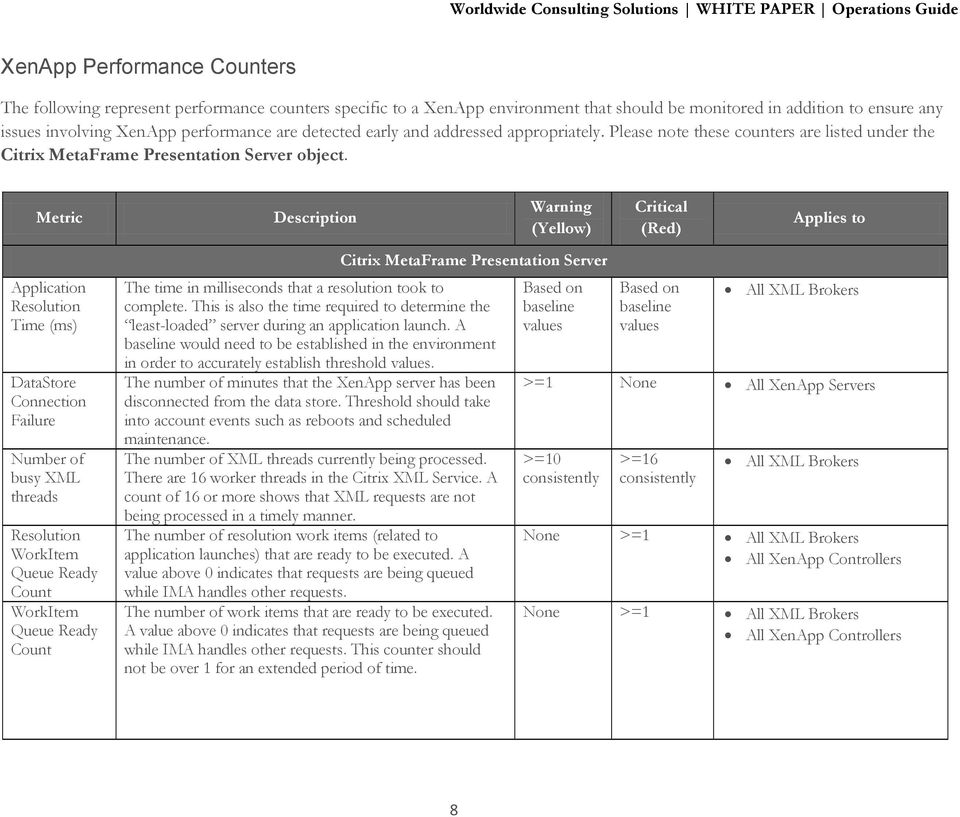
3 Introduction After a new XenDesktop, XenApp or Provisioning Services environment has been designed and rolled out to production, ongoing monitoring is required. Monitoring the new environment enables administrators to address issues proactively. By having an in-depth understanding of current and expected behavior of the various components, administrators are better equipped to discover an issue before it impacts the user community. Furthermore the data tracked during normal operations can be used for trending and capacity planning. Citrix recommends implementing a monitoring solution, which covers all aspects of an IT environment and allows aggregating all captured data within a single tool or console. This simplifies correlating events or counters of multiple components and enables administrators to easily get an end to end overview. This can decrease the time required to determine the root cause of an issue significantly. The remaining sections of this document identify the components, performance counters and events which should be monitored during normal operations. Furthermore basic remediation strategies will be provided. This document is organized as follows: Infrastructure Monitoring: Within this section details about monitoring key infrastructure components are shared. Performance Monitoring: This section outlines the key performance counters, which should be tracked within every environment. Furthermore troubleshooting and remediation strategies as well as growth tracking will be discussed. Event Monitoring: Within this section monitoring of the Windows event log is discussed and links to event log reference documentations are provided. Windows Services: This section outlines the Citrix and Windows services which play a critical role within XenDesktop, XenApp or Provisioning Services environments. In addition information about the criticality of every service is provided. Availability Monitoring: Options for monitoring the functionality of services leveraging additional Citrix products or features is discussed within this section. In addition information about the impact of an outage of specific Citrix components is provided. 1

4 Infrastructure Monitoring There are several key aspects which make up the infrastructure supporting the Citrix environment. Among these server hardware as well as the Ethernet networks play a prominent role. It is critical that each area is being monitored effectively since a problem in either could impact the overall performance and availability of the Citrix environment. Network Monitoring Most Citrix components and services (such as XenDesktop, XenApp or Provisioning Services) rely on a fast and stable network connection. Therefore it is vital to monitor the availability as well as the performance (such as available bandwidth and latency) for all WAN and significant LAN connections continuously. Citrix recommends monitoring the following aspects of a network closely: Availability. An enterprise network consists of a variety of components, which function together to provide the network services. Each individual component such as a firewall, a router or an individual port plays a critical role and its availability needs to be monitored continuously. In addition, an End-to-End monitoring solution, which verifies the network functionality from a client perspective, is highly recommended. Performance. The effective performance of a network connection is comprised of the following variables: Note: This section will focus on ICA/HDX connections and Provisioning Services vdisk streaming, since these types of network traffic have the largest footprint within typical Citrix environments. o Available Bandwidth. Within an ideal world scenario without latency, available bandwidth is maximum physical bandwidth minus currently used bandwidth. In real world scenarios the maximum available bandwidth depends on the latency of a network connection. This is caused by the congestion control protocols, which are built into TCP (please refer to for more information). Therefore bandwidth monitoring should factor in the latency characteristic of a network connection. The ICA/HDX protocol will automatically adjust to low bandwidth scenarios to ensure a good user experience. However, Provisioning Services (PVS) cannot and active target devices will experience performance problems in a congested network. 2

5 o Latency. The latency of a network connection impacts the effective performance perceived by ICA/HDX users and users of PVS target devices. Latency causes slow screen updates and mouse/keyboard input lag for ICA/HDX users and cause slow system and application performance as well as cause system instabilities in PVS. The maximum recommended latency for ICA/HDX connections depend on the use case and cannot be named exactly. For PVS connections the latency should be as low as possible. Therefore PVS servers and target devices should be located within the same data center leveraging a direct network connection. Citrix recommends monitoring both counters at short intervals (i.e. 30 seconds or less), because even short periods of bandwidth congestion or high latency will impact users (ICA/HDX connections) or PVS targets. Quality. If network packets are lost in transit and need to be retransmitted overall performance of the network service suffers. Therefore packet loss and packet retransmission should be monitored for all WAN and critical LAN connections. In case any of these counters report unusual high values a detailed analysis of the root cause needs to be performed. Hardware Monitoring Because physical servers provide the foundation for all Citrix infrastructure it is important to monitor the availability of the servers as well as the individual server components (i.e. fan speed, power supplies voltages, hard disk faults, CPU temperature, etc.). This monitoring ensures administrators are kept abreast of any hardware component that is about to fail or is entering a failed state. Most hardware vendors have their own proprietary tools for monitoring their hardware. These tools usually involve software agents that reside on the hardware that capture and forward events to an SNMP-based monitoring solution. Most solutions will alert administrators through or text messages when thresholds are crossed or errors are detected. Some solutions even allow administrators to define automatic actions to take in the form of scripts or commands when an alert is triggered. Therefore Citrix strongly recommends leveraging the monitoring agents provided by the hardware vendors, whenever possible. 3

6 Performance Monitoring This section describes the objects, counters and thresholds that are recommended to monitor for environments running XenDesktop, XenApp and Provisioning Services. The thresholds presented are based on real world experience but may not apply to all environments. Organizations will need to perform their own baselining, validity testing and validation before implementing within a production environment. Please note that some hypervisors, such as VMware vsphere, provide specific performance counters for tracking CPU and Memory utilization within virtual machines (i.e. VM Processor \ % Processor Time ). These performance counters should be used instead of the counters listed below. The following table describes the performance counters recommended by Citrix Consulting for monitoring Citrix environments. These counters are considered to be a baseline that applies to XenApp, XenDesktop, and Provisioning Services implementations as well as Web Interface and SQL servers. The threshold values shown also apply to all kinds of systems. System Performance Counters Metric Description Warning (Yellow) Processor - % Processor Time % Processor Time is the percentage of elapsed time that the processor spends to execute a non-idle thread. It is calculated by measuring the duration of the idle thread is active in the sample interval, and subtracting that time from interval duration. (Each processor has an idle thread that consumes cycles when no other threads are ready to run). This counter is the primary indicator of processor activity, and displays the average percentage of busy time observed during the sample interval. It is calculated by monitoring the time that the service is inactive and subtracting that value from 100%. 80% for 15 minutes Critical (Red) 90% for 15 minutes Troubleshooting / Remediation Identify the processes/services consuming processor time using Task Manager or Resource Monitor. If all processes/services work within normal parameters and the level of CPU consumption is an expected behavior it should be considered to add additional CPU resources to this system in the future. If a process/service can be identified which works outside normal parameters, the process should be killed. Please note that killing a process can cause unsaved data to be lost. 4

7 Metric Description Warning (Yellow) System - Processor Queue Length Memory Available Bytes Memory Pages/sec Processor Queue Length is the number of threads in the processor queue. Unlike the disk counters, this counter shows ready threads only, not threads that are running. There is a single queue for processor time even on computers with multiple processors. Therefore, if a computer has multiple processors, you need to divide this value by the number of processors servicing the workload. A sustained processor queue of less than 10 threads per processor is normally acceptable, dependent of the workload. Available memory indicates the amount of memory that is left after nonpaged pool allocations, paged pool allocations, process working sets, and the file system cache have all taken their piece. Pages/sec is the rate at which pages are read from or written to disk to resolve hard page faults. 5 (per Core) for 5 minutes <30% of total RAM Critical (Red) 10 (per Core) for 10 minutes <15% of total RAM Troubleshooting / Remediation A long CPU queue is a clear symptom of a CPU bottleneck. Please follow the steps outlined for counter Processor - % Processor Time Identify the processes/services consuming memory using Task Manager or Resource Monitor. If all processes/services work within normal parameters and the level of memory consumption is an expected behavior it should be considered to add additional memory to this system in the future. If a process/service can be identified which works outside normal parameters, the process should be killed. Please note that killing a process can cause unsaved data to be lost. >10 >20 A high value reported for this counter typically indicates a memory bottleneck, except if Memory Available Bytes reports a high value at the same time. In this case most likely an application is sequentially reading a file from memory. Please refer to KB for further information. 5

8 Metric Description Warning (Yellow) Paging File - %Usage LogicalDisk/ PhysicalDisk - % Free Space LogicalDisk/ PhysicalDisk - % Disk Time LogicalDisk/ PhysicalDisk Current Disk Queue Length This is the percentage amount of the Page File instance in use. % Free Space is the percentage of total usable space on the selected logical disk drive that is free. Critical (Red) Troubleshooting / Remediation >40% >70% Review this value in conjunction with Memory - Available Bytes and Memory - Pages/sec to understand paging activity on the affected system. <10% of physical disk % Disk Time marks how busy the disk is. >70% consistently Current Disk Queue Length provides a primary measure of disk congestion. It is an indication of the number of transactions that are waiting to be processed. >=1 (per spindle) consistently <5% of physical disk >90% consistently >=2 (per spindle) consistently Identify which files or folders consume disk space and delete obsolete files if possible. In case no files can be deleted, consider increasing the size of the affected partition or add additional disks. Identify the processes / services consuming disk time using Task Manager or Resource Monitor. If all processes/services work within normal parameters and the level of disk consumption is an expected behavior it should be considered to move the affected partition to a more capable disk subsystem in the future. If a process/service can be identified which works outside normal parameters, the process should be killed. Please note that killing a process can cause unsaved data to be lost. A long disk queue length typically indicated a disk performance bottleneck. This can be caused by either processes/services causing a high number of I/Os or a shortage of physical memory. Please follow the steps outlined for counter LogicalDisk/PhysicalDisk - % Disk Time and counter Memory Available Bytes 6

9 Metric Description Warning (Yellow) LogicalDisk/ PhysicalDisk Avg. Disk Sec/Read Avg. Disk Sec/Write Avg. Disk Sec/Transfer Network Interface Bytes Total/sec The Average Disk Second counters show the average time in seconds of a read/write/transfer from or to a disk. Bytes Total/sec shows the rate at which the network adaptor is processing data bytes. This counter includes all application and file data, in addition to protocol information, such as packet headers. >=15ms consistently < 8 MB/s for 100 Mbit/s adaptor <80 MB/s for 1000 Mbit/s adaptor Critical (Red) >=20ms consistently None Table 1: Generic performance counters which apply to Citrix environments Troubleshooting / Remediation High disk read or write latency indicates a disk performance bottleneck. Systems affected will become slow, unresponsive and application or services may fail. Please follow the steps outlined for counter LogicalDisk/PhysicalDisk - % Disk Time Identify the processes / services consuming network using Task Manager or Resource Monitor. If all processes/services work within normal parameters and the level of bandwidth consumption is an expected behavior it should be considered to move the respective process/service to a dedicated NIC (or team of NICs). If a process/service can be identified which works outside normal parameters, the process should be killed. Please note that killing a process can cause unsaved data to be lost. 7

10 XenApp Performance Counters The following represent performance counters specific to a XenApp environment that should be monitored in addition to ensure any issues involving XenApp performance are detected early and addressed appropriately. Please note these counters are listed under the Citrix MetaFrame Presentation Server object. Metric Application Resolution Time (ms) DataStore Connection Failure Number of busy XML threads Resolution WorkItem Queue Ready Count WorkItem Queue Ready Count Description Warning (Yellow) Citrix MetaFrame Presentation Server The time in milliseconds that a resolution took to complete. This is also the time required to determine the least-loaded server during an application launch. A baseline would need to be established in the environment in order to accurately establish threshold values. The number of minutes that the XenApp server has been disconnected from the data store. Threshold should take into account events such as reboots and scheduled maintenance. The number of XML threads currently being processed. There are 16 worker threads in the Citrix XML Service. A count of 16 or more shows that XML requests are not being processed in a timely manner. The number of resolution work items (related to application launches) that are ready to be executed. A value above 0 indicates that requests are being queued while IMA handles other requests. The number of work items that are ready to be executed. A value above 0 indicates that requests are being queued while IMA handles other requests. This counter should not be over 1 for an extended period of time. Based on baseline values Critical (Red) Based on baseline values Applies to All XML Brokers >=1 None All XenApp Servers >=10 consistently >=16 consistently All XML Brokers None >=1 All XML Brokers All XenApp Controllers None >=1 All XML Brokers All XenApp Controllers 8
11 Citrix Licensing License Server Connection Failure Citrix Licensing Last Recorded License Check-Out Response Time Citrix Licensing Displays the number of minutes that XenApp has been disconnected from the License Server. Displays the last recorded license check-out response time in milliseconds. A value of more than 5000 milliseconds indicates a performance issue at the license server. Table 2: XenApp Performance Counters >1 minute >1440 minutes All XenApp Servers >2000ms >5000 ms All XenApp Servers 9

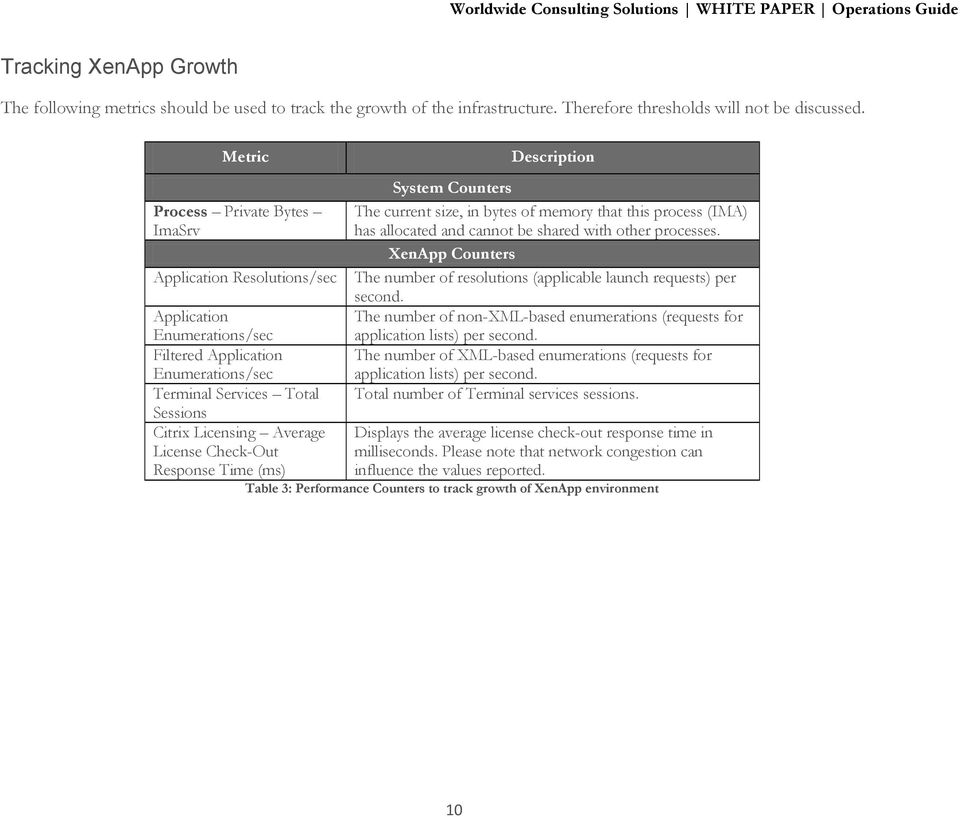
12 Tracking XenApp Growth The following metrics should be used to track the growth of the infrastructure. Therefore thresholds will not be discussed. Metric Process Private Bytes ImaSrv Application Resolutions/sec Application Enumerations/sec Filtered Application Enumerations/sec Terminal Services Total Sessions Citrix Licensing Average License Check-Out Response Time (ms) Description System Counters The current size, in bytes of memory that this process (IMA) has allocated and cannot be shared with other processes. XenApp Counters The number of resolutions (applicable launch requests) per second. The number of non-xml-based enumerations (requests for application lists) per second. The number of XML-based enumerations (requests for application lists) per second. Total number of Terminal services sessions. Displays the average license check-out response time in milliseconds. Please note that network congestion can influence the values reported. Table 3: Performance Counters to track growth of XenApp environment 10
13 Web Interface Performance Counters The following represent performance counters applicable to Web Interface servers that should be monitored, in addition to the general Windows performance counters outlined earlier within this section. Metric Description Warning (Yellow) ASP.NET Request Queued ASP.NET Requests Rejected The number of requests waiting to be processed by ASP. A baseline needs to be established in the environment in order to accurately establish threshold values. The number of requests rejected because the request queue was full. Based on baseline values Critical (Red) Based on baseline values Troubleshooting / Remediation In case the queue length exceeds the critical limit requests may be rejected. In this case it should be considered to add additional Web Interface servers to the load balancing team in order to distribute the load across more nodes. None >=1 When this limit is exceeded, requests will be rejected with a 503 status code and the message "Server is too busy." Please follow the steps outlined for counter ASP.NET Request Queued Table 4: Performance Counters to monitor for Web Interface 11

14 Tracking Web Interface Growth The following metrics should be used to track the growth of the infrastructure, therefore threshold alerting do not apply. Metric ASP.NET Requests Current ASP.NET Request Execution Time Web Service Concurrent Connections Web Interface Counters Description The current number of requests, both executing and queued. The amount of time (in milliseconds) that it took to execute the most recent request. Current Connections is the current number of connections established with the Web service. Table 4: Performance Counters to track growth of Web Interface environment 12

15 XenDesktop Performance Counters The following represent important performance counters specific to a XenDesktop 5.x environment. The performance counters should be monitored, in addition to the general Windows performance counters outlined earlier within this section, as a best practice so that any issues are detected early and addressed appropriately. XenDesktop Counters Metric Description Warning (Yellow) Database Avg. Transaction Time Database Connected Database Transaction Errors/sec The time on average, in seconds, taken to execute a database transaction. A baseline needs to be established in the environment in order to accurately establish threshold values. Based on baseline values Critical (Red) Based on baseline values Troubleshooting / Remediation In case the reported values exceed the baseline response time constantly, a potential performance issue needs to be investigated at the SQL server level. Indicates whether this service is in contact with its database. (1 is connected; 0 is not connected) The rate at which database transactions are failing. None None None >0 Both values report connectivity issues of the XenDesktop Broker service with the XenDesktop database. In case issues are reported, SQL server and network availability needs to be verified. Table 6: XenDesktop Performance Counters to monitor 13

16 Tracking XenDesktop Growth The following metrics should be used to track the growth of the infrastructure, therefore threshold alerting do not apply. Metric Citrix Broker Service Brokered Sessions Citrix XML Service Avg. Transaction Time (Instances: Enumerated Resources, and Launch * Description The number of virtual desktop sessions brokered by the Citrix Broker Service. The time on average, in seconds, taken to process an XML transaction in Citrix Broker Service. Table 7: Performance Counters to track growth of XenDesktop environment 14


17 XenServer Monitoring When implementing a Citrix virtualization solution such as XenApp or XenDesktop monitoring is a key factor in ensuring high availability and optimal performance. It is just as important to monitor the hosting infrastructure supporting the XenApp or XenDesktop environments. Through XenCenter, XenServer is capable of alerting administrators when certain events of importance occur in the environment. In XenCenter, alerts can be defined on each VM when: CPU usage exceeds a percentage level Network usage exceeds specified KB/sec Disk usage exceeds specified KB/sec Figure 1: XenServer Alerts Property Page The XenServer host or the entire pool can be configured to send alert notifications via SMTP to system administrators. 15

18 Workload Balancing Workload Balancing is a XenServer component, packaged as a virtual appliance that allows creating reports about VM performance in a XenServer environment. Furthermore it evaluates resource utilization and locates virtual machines on the best possible hosts in the pool for their workload's needs. Even if an automatic load balancing of the workloads is not required within an environment Workload Balancing should be implemented for reporting reasons. Because Workload Balancing captures performance data, it is possible to use this component to generate reports, known as Workload Reports, about a virtualized environment. Workload Reports provide data for a pool or host's health, for auditing, optimizations, and placement (or motion) history. Also, an organization can run a chargeback report that shows virtual machine usage and can help measure and assign costs. As mentioned earlier, it is not necessary to configure Workload Balancing to make VM placement recommendations or move virtual machines for monitoring and chargeback functionality. However, it is required to configure the Workload Balancing component and the XenServer Resource Pool and, ideally, set critical thresholds to values that reflect the point at which the performance of the hosts in the pool degrades. For more information, please refer to the XenServer Workload Balancing User Guide. XenServer Virtual Machine Performance Utility Although the XenServer Virtual Machine Performance Utility is not a monitoring tool, it can help troubleshooting performance related issues, which is why it will be highlighted within this document. The XenServer Virtual Performance Utility is a XenServer virtual machine that helps troubleshoot performance related issues, such as poor performance caused by storage I/O and network I/O. The virtual machine, built on Debian Linux, equips with following test utilities and is accessible using a Web based user interface: Disk I/O performance utility - It can be used to conduct the following disk I/O operations to measure: sequential read/writes and random read/writes with various specified block sizes. This performance testing utility assesses the performance of a given Storage Repository by reading and writing data to a test virtual disk, created by the user specifically for this test. Network I/O performance utility - It is essentially a modified version of Netperf. Additional information about Netperf can be found at Netperf runs on the backend and provides end-to-end request/response round trip latency and TCP/UDP throughput tests. Further information can be found in CTX XenServer Virtual Machine Performance Utility. 16

19 Event Monitoring Monitoring the Windows Event Log for unknown or critical events can help discover issues proactively and allows administrators to understand event pattern. Citrix recommends monitoring the Windows event logs of all Windows servers closely and investigate for errors pertaining to: Licensing. Errors in the event log dealing with Terminal Services licensing should be investigated. This might be a result of the installed Citrix product not being able to contact the Terminal Services Licensing Server or the Citrix Licensing Server. If errors in the event log are not reviewed, users might eventually be denied access because they cannot acquire a valid license. Hardware Failure. Any event notification that relates to a hardware failure should be looked at immediately. Any device that has failed will have an impact on the performance of the system. At a minimum, a hardware failure will remove the redundancy of the component. Security Warnings. Customers should investigate security warnings or audit failure events regarding failed logons in the security log. This could be an indication that someone is attempting to compromise the servers. Disk Capacity. As the drives of a Windows system reach 90% of capacity, an event error message will be generated. To ensure continuous service, customers should poll these event errors. As the system runs out of hard disk space, the system is put at severe risk. The server might not have enough space left to service the requests of users for temporary file storage. As the space becomes used, customers should analyze and determine where space is being used and clean up the drives. Application / Service errors. Any event notification that relates to application or services errors should be investigated. All Citrix software components will leverage the Windows Event Log for error logging. A list of the known Event Log warnings and errors issued by Citrix components can be found at the following links: Event Codes Generated by PVS XenDesktop Broker Event Log Messages XenDesktop VDA Event Log Messages XenDesktop MCS Event Log Messages XenApp Critical Event Viewer Messages Web Interface - Logged Messages and Event IDs 17

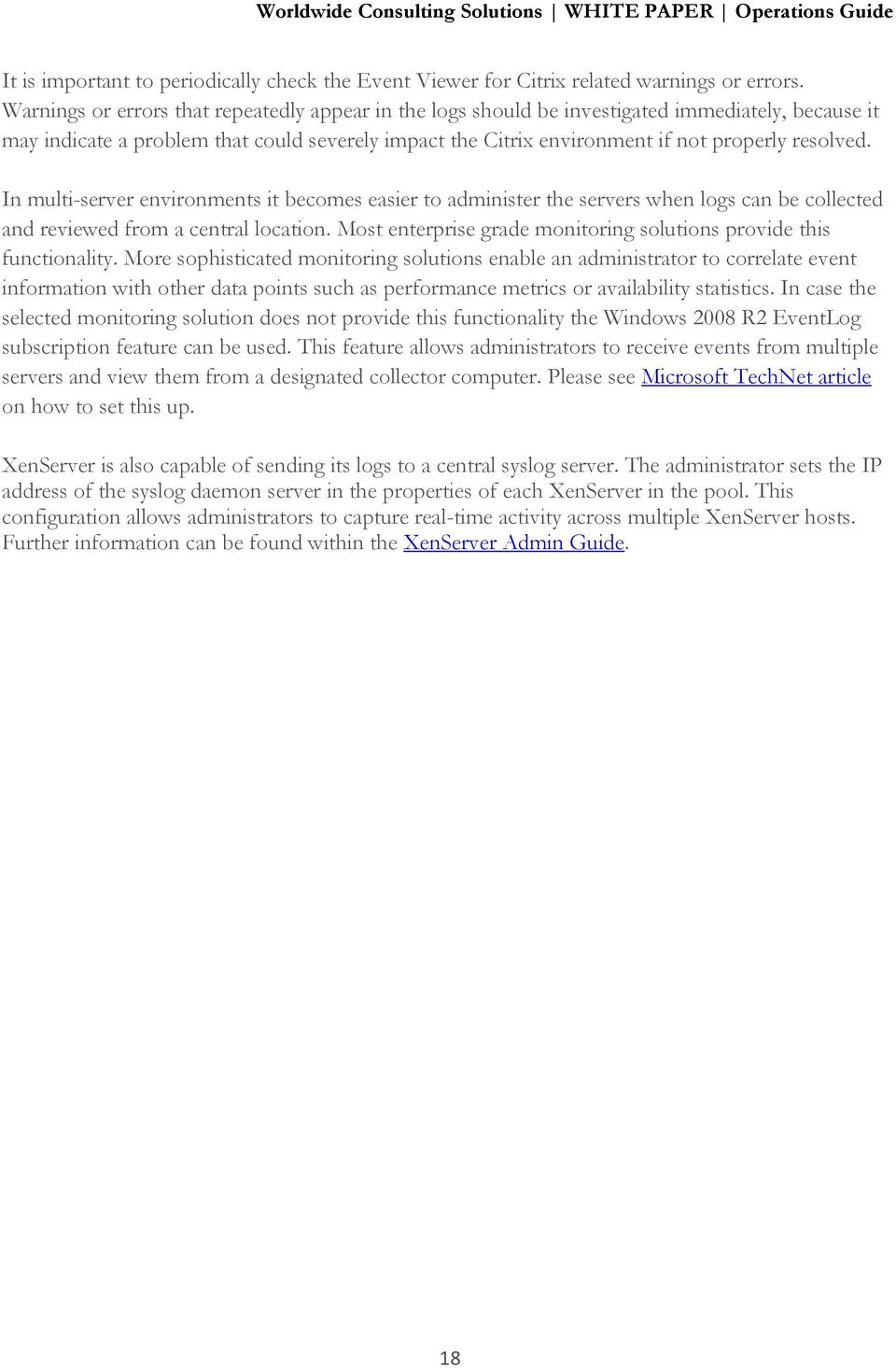
20 It is important to periodically check the Event Viewer for Citrix related warnings or errors. Warnings or errors that repeatedly appear in the logs should be investigated immediately, because it may indicate a problem that could severely impact the Citrix environment if not properly resolved. In multi-server environments it becomes easier to administer the servers when logs can be collected and reviewed from a central location. Most enterprise grade monitoring solutions provide this functionality. More sophisticated monitoring solutions enable an administrator to correlate event information with other data points such as performance metrics or availability statistics. In case the selected monitoring solution does not provide this functionality the Windows 2008 R2 EventLog subscription feature can be used. This feature allows administrators to receive events from multiple servers and view them from a designated collector computer. Please see Microsoft TechNet article on how to set this up. XenServer is also capable of sending its logs to a central syslog server. The administrator sets the IP address of the syslog daemon server in the properties of each XenServer in the pool. This configuration allows administrators to capture real-time activity across multiple XenServer hosts. Further information can be found within the XenServer Admin Guide. 18
21 Windows Services Windows Services that are critical to basic server functionality should be automatically monitored to ensure that they are running properly. The following section provides a list of the common Windows services that should be monitored. The recommended recovery actions for the services listed below are as follows: First failure: Restart the Service Second Failure: Restart the Service Subsequent Failures: Put the server in maintenance mode and investigate the root cause XenApp Servers The following services are considered core to a XenApp infrastructure and should be monitored on all XenApp servers as a best practice. Service Name Functionality Risk Citrix Independent Management Architecture Citrix XML Service Provides management services and server-to-server communication for Citrix products. IPSEC Services RPC Service Server WMI Driver Extensions Workstation Provides an HTTP interface to the ICA browser. It uses TCP packets instead of UDP, which allows connections to work across most firewalls. The default port for the Citrix XML Service is 80. Frequently, the Citrix XML Service is plugged into IIS. Therefore the Citrix XML Service may not appear. This does not present a problem. Independent Management Architecture Service WMI Driver Extensions Failure of this service results in the server not allowing any additional users. The server will also not respond to IMA communications from the management console or from any other Citrix component. The failure of the Citrix XML Service is critical on the zone data collectors. These servers are utilized when the Web Interface tries to determine the least loaded server. If this server fails, the Web Interface will look at the backup server. This can slow down the application enumeration and launching process. The Secure Ticket Authority (STA) service is embedded into the Citrix XML service. Is used by the Access Gateway and Web Interface to create and validate secure tickets. Generally more than one STA is specified for fault tolerance however it should be monitored. 19
22 Service Name Functionality Risk Citrix XTE Server Service Provides necessary Session Reliability. None Citrix CPU Utilization Management/Resource Management Citrix CPU Utilization Management/User Session sync Citrix CPU Utilization Management/CPU Rebalancer Manages resource consumption to enforce entitlement policies RPC Service Synchronizes the CPU Utilization Management user ID of a process with the user ID of the session owner of the process Citrix CPU Utilization Management/Resource Management Installed on Windows Server 2003 multi-processor systems; it is not installed on Windows 2000 Server or servers with only one processor. The CPU Rebalancer service is used to alleviate a Microsoft issue that appears in environments where a lot of short-lived processes are started and stopped. Due to the performance impact the CPU Rebalancer service can have, by default it is set to Manual. If your environment is running many short-lived applications that all appear to be running on the same CPU, setting the service to Automatic is recommended. The CPU Rebalancer service corrects this by balancing the load equally across processors. This service needs to be monitored if the Session Reliability is enabled. These services need to be monitored if CPU optimization is enabled. (Automatically started if CPU Optimization is enabled in the XenApp Console.) Monitored if service is set to automatic. (Set to manual by default and must be manually configured to start automatically on Windows Server 2003 with multiple processors.) Citrix Print Manager Service Citrix Virtual Memory Optimization Supports the Citrix Advanced Universal printing architecture Print Spooler RPC Service Dynamically optimizes applications running on the Citrix XenApp None 20 This service needs to be monitored if the Citrix Advanced Universal Printer Driver is used This service needs to be monitored if memory optimization is used (Automatically started if Memory Optimization is enabled in the XenApp Console.)
23 Service Name Functionality Risk Citrix MFCOM Service Provides access to necessary XenApp objects. This service will be present if the license server exists on a server running Citrix XenApp. RPC Service WMI Driver Extensions Remote Desktop Services/Terminal Services Citrix WMI Service Citrix Client Network Citrix Streaming Service/ Citrix Streaming Helper Service Server Service Net Logon Service Remote Procedure Call Service (RPC) Workstation Service Allows multiple users to be connected interactively to a machine as well as the display of desktops and applications to remote computers. RPC Service Citrix WMI Service is responsible for sending alerts to the WMI aware monitoring tools. Maps client drives and peripherals for access in sessions. Applicable to XenApp 5 and older. Client Drive Mapping (CDM) WMI Driver Extensions Workstation Manages the Citrix Offline Plug-In when streaming applications. RPC Service Provides file, print and named-pipe sharing over the network for the server. Provides pass-through authentication of account logon events for systems in a domain. Provides the endpoint mapper and other miscellaneous RPC services. Creates and maintains client network connections to remote servers. 21 If the Remote Desktop Services service fails, the server will become inoperable requiring a reboot. This service only runs when needed. The failure of the Citrix WMI Service will only result in not receiving updates to WMI aware monitoring tools from the WMI Provider. It will not put the server at severe risk, but it will hinder the ability to monitor the system. On failure client drives and peripherals are not accessible. On failure streamed applications cannot be accessed. On failure the server will not accept new user sessions On failure users of new sessions are unable to authenticate and users of existing sessions may not be able to access network resources. On failure certain network services cannot be accessed. On failure certain network services cannot be accessed.
24 Service Name Functionality Risk Print Spooler Manages all local and network print queues and controls all print jobs. On failure printing is not possible for users connected to this server. Table 5: Services to monitor on XenApp Servers XenDesktop Services The following services are considered important for the operations of a XenDesktop environment and should be monitored on all XenDesktop Controllers as a best practice. Service Functionality Risk Citrix AD Identity Service Manages Active Directory computer accounts. Citrix Broker Service Citrix Configuration Service Citrix Diagnostic Facility COM Server Service Citrix Host Services Citrix Machine Creation Service Citrix Machine Identity Service WMI Service Manages connections to virtual machines and applications. Stores configuration information on the Citrix Services. WMI Service Manages and controls Citrix diagnostic trace sessions. RPC Service Manages host and hypervisor connections. WMI Service Creates new virtual machines. WMI Service Manages storage of virtual machines. WMI Service Table 6: XenDesktop Services to monitor 22 Machine Creation Service relies on this service to create virtual machines. The machine account becomes tainted at the time of creation if this service is not able to sync with Active Directory. If this service is stopped existing connections are not affected. No new connections can be established. If this service is stopped, it will not be able to collect information from the Broker Services. This service has no impact on the production environment. It is used to generate CDF trace files which aid in troubleshooting issues. It is not possible to connect to the virtual machines when this service is not available. The ability to create virtual machines using Machine Creation Service will not be available if this service is stopped. Provisioning Services is not affected. If this service is stopped XenDesktop is not able to manage the storage of the virtual desktops.
25 Provisioning Server Services The following services are important to the operations of Provisioning Services for both XenApp and XenDesktop environments. These services should be monitored as part of the monitoring solution on all PVS servers. Service Functionality Risk Citrix PVS PXE Service Provides the PVS PXE Boot Server functionality On failure of this service target devices may not be able to boot successfully if Citrix PVS Stream Service Citrix PVS SOAP Service Citrix PVS TFTP Service Citrix PVS Two-Stage Boot Service Streams contents of the vdisk to the target device on demand. Provides framework for external or existing solutions to interface with Provisioning services. Provides the TFTP Server functionality Provides the bootstrap functionality for devices booting by means of a BDM ISO file Table 7: Provisioning Services to monitor PXE booting is leveraged. If this service stopped it will not be possible to stream vdisk images. If this service fails PVS Server to PVS Server communication as well as PVS Console to PVS Server communication is not possible. On failure of this service target devices may not be able to boot if this server is used as TFTP server for the bootstrap. On failure of this service target devices may not be able to boot if a BDM ISO file is used. 23
26 Citrix Licensing Services The following Licensing services should be monitored as part of the monitoring solution on the Citrix License Server. Service Functionality Risk Citrix License Service Provides licensing service for Citrix products. Citrix Licensing WMI The Citrix License Management Console collects license data information using the WMI service. Table 8: Citrix Licensing Services to monitor Licensing mode changes to grace period when service is stopped or License Server can t be contacted. If not monitored, functionality of Citrix products will cease after grace period expires. Web Interface Services The following services should be monitored on the server hosting Web Interface. Service Functionality Risk World Wide Web Publishing Service Provides web connectivity and administration through the Internet Information Services Manager. HTTP RPC Service Table 12: Web Interface Services to monitor Access to XenApp published applications or published desktops will not be available through Web Interface if WWW services is not available. 24
27 Availability Monitoring Citrix provides multiple tools to allow an end-to-end monitoring of the functionality of a XenApp / XenDesktop infrastructure. This section will outline the most important monitoring tool sets, their functionality and how they can be integrated into existing monitoring solutions. NetScaler Monitors In addition to monitoring the availability of Citrix services running on servers, it is also important to monitor the availability of services through the network. This type of testing simulates how end users will access the Citrix environment in production, so components in between, such as firewalls can be validated that settings are properly configured. The NetScaler appliance contains a number of built-in monitors that can be used to monitor services for XenApp/XenDesktop environments. The NetScaler also allows administrators to build custom monitors. To learn how to build custom monitors, see Configuring Monitors in a Load Balancing Setup. The following table lists the built-in monitors available on NetScaler appliances, and which Citrix services they can be used to monitor. Citrix recommends configuring NetScaler to send SNMP traps to the central monitoring infrastructure in case any of the monitors reports an issue. The SNMP MIB can be downloaded at the download tab of the NetScaler GUI or directly from Monitor Functionality Recommended For TCP-based NetScaler appliance establishes a 3-way Web Interface applications handshake with the monitor destination. License Server It can be used to observe TCP or HTTP traffic, or send ping requests. SSL Services Built-in secure monitors for TCPS and Web Interface HTTPS. You can use the secure License Server monitors to monitor HTTP as well as non-http traffic. The NetScaler establishes a TCP connection. After the connection is established, the appliance performs an SSL handshake with the server. LDAP Services The NetScaler periodically checks the LDAP service to which it is bound by AD Authentication authenticating and sending a search query to it. If the search is successful, the service is marked UP. If the LDAP server does not locate the entry, a failure message is sent to the LDAP monitor, and the service is marked DOWN. XML Broker The monitor opens a connection to the XML Service (XenApp Service service and periodically probes the XML & XenDesktop) services to which it is bound. If the 25
28 Monitor Functionality Recommended For server responds as expected within the configured time period, the monitor Secure Ticket Authority marks the service UP. If the service does not respond, or responds incorrectly, the monitor marks the service DOWN. Dynamic Desktop The monitor sends a probe to the DDC Controller (DDC) server in the form of an XML message. XenDesktop Services If the DDC responds to the probe with the identity of the server farm, the probe is considered to be successful, and the server status is marked UP. If the HTTP response does not have a success code or the identity of the server farm is not present in the response, the probe is considered to be a failure and the Web Interface Services server s status is marked as DOWN. The NetScaler appliance has two built-in monitor types for monitoring Web Interface servers. The CITRIX-WEB- INTERFACE monitors a dynamic page at the location specified by the site path. The monitor checks for critical failures in resource availability. The CITRIX- WI-EXTENDED monitor verifies the logging process with the Web Interface service. It verifies the validity of the login credentials, correct configuration of the monitor, and the connection to the IIS server. Table 13: Built-in NetScaler monitors for Citrix services Web Interface 26
29 XenApp Health Check & Recovery The XenApp Health Check and Recovery functionality provides the ability to monitor the state of the server farm and discover any health risks. This type of monitoring is based on a standard set of test scripts, which monitors several XenApp services. Aside from the standard set of tests that come with XenApp, additional tests may be imported, or custom tests may be developed. When a test fails, a recovery action can be defined for the server to take. Administrators can also be alerted and take appropriate steps to remediate the issue. This can be achieved by configuring XenApp Health Check & Recovery to Alert only and constantly monitor the eventlog of the XenApp servers for ID 2005 with source CitrixHealthMon leveraging the central monitoring solution of an organization. The following are the list of standard Health Check and Recovery tests provided by default (for servers running XenApp 5.0 and older it is required to follow the steps outlined in CTX in order to have access all tests discussed below). Test Functionality Recommended For Citrix IMA Service Test Logon monitor test Remote Desktop Services Test XML Service Test Check DNS Test Check Local Host Cache Test This test queries the service to ensure that it is running by enumerating the applications available on the server. This test monitors session logon/logoff cycles to determine whether or not there is a problem with session initialization, or possibly an application failure. If there are numerous logon/logoff cycles within a short time period, the threshold for the session is exceeded and a failure occurs. This test enumerates the list of sessions running on the server and the session user information, such as user name. This test requests a ticket from the XML service running on the server and prints the ticket. The test performs a forward DNS lookup using the local host name to query the local DNS server for the computer s IP address. A failure occurs if the returned IP address does not match the IP address that is registered locally. This test ensures the data stored in the XenApp server s local host cache is not corrupted and that there are no duplicate entries. Citrix does not recommend running this test unless the environment is experiencing issues with local host cache corruption. This test can be CPUintensive, so Citrix recommends using a 24-hour test interval, and keep the default test threshold and time-out values. 27 Data Collectors XML Brokers Member Servers Member Servers Member Servers XML Brokers Data Collectors XML Brokers Member Servers Member Servers
30 Test Functionality Recommended For Check XML Threads Test Citrix Print Manager Service Test Microsoft Print Spooler Test ICA Listener Test This test inspects the threshold of the current number of worker threads running in the Citrix XML Service. When running this test, use a single integer parameter to set the maximum allowable threshold value. The test compares the current value on the XenApp server with the input value. A failure occurs if the current value is greater than the input value. This test enumerates session printers to determine the health of the Citrix Print Manager service. A failure occurs if the test cannot enumerate session printers. This test enumerates printer drivers, printer processors, and printers to determine whether or not the Print Spooler Service in Windows 2008 is healthy and ready for use. This test determines whether or not the XenApp server is able to accept ICA connections. The test detects the default ICA port of the server, connects to the port, and sends test data in anticipation of a response. The test is successful when the server responds to the test with the correct data. Table 14: XenApp Health Monitoring & Recovery tests XML Brokers Member Servers Member Servers Member Servers Member Servers 28
31 Impact of Failure of Citrix Components The following table outlines the impact of failure of central Citrix components and how the risk of failure can be mitigated: Component Impact Risk Mitigation Shared: Citrix License Server User logon will take up to 5 seconds longer until cold standby is online Backup Requirements: Full weekly backups are recommended. Also full backups should be taken prior to major changes or patching initiatives. Daily incremental backups will also help in mitigating the loss of daily changes to the environment. Redundancy Design: Keep a snapshot of the license server stored in a location where rapid recovery can be assured. Because license files reference the name of the License Server, the backup License Server must have the same name as the primary License Server in order to use the same license files. Shared: Citrix Web Interface Servers Users will not be able to access virtual applications or desktops until Web Interface servers are back online. Restoration Procedures: Use the snapshots of the License Server as a cold standby. These servers will have the same name as the primary License Server and will remain in a powered off state. Backup Requirements: Full weekly backups are recommended. Also full backups should be taken prior to major changes or patching initiatives. Daily incremental backups will also help in mitigating the loss of daily changes to the environment. Redundancy Design: The IIS service on the Web Interface servers should be monitored. Should a single Web Interface server fail, users will be automatically directed to the second Web Interface server. If all Web Interface Servers in a data center fail, users should be directed to Web Interface Servers in another data center. All Web Interface Servers query all Data Collectors and all XenDesktop Controllers. Any users with existing connections will be unaffected. Restoration Procedures: Recovery from backup media. 29
32 Component Impact Risk Mitigation Shared: Citrix Provisioning Servers Momentary pause as automated failover occurs. No additional impact when secondary server available. Backup Requirements: Full weekly backups are recommended and should include the primary vdisk store, backup vdisk store and Provisioning Server database. Also full backups should be taken prior to major changes or patching initiatives. Daily incremental backups will also help in mitigating the loss of daily changes to the environment. Provisioning Servers: PVS Database XenApp: Citrix ZDC/XML Servers Frozen environment when there is no Provisioning Server available. No impact from single SQL Server node failure when a SQL Cluster or Mirror has been configured. Minimal impact when Offline DB Support has been enabled. No impact from single Zone Data Collector failure. Additional time required to enumerate and launch applications/ desktops if both Zone Data Collectors fail Redundancy Design: Automated failover between Servers in a Provisioning Services Site. vdisks must be distributed between servers for failover to work. Restoration Procedures: Recovery from backup media. Backup Requirements: Full weekly backups are recommended. Also full backup should be taken prior to major changes or patching initiatives. Daily incremental backups will also help in mitigating the loss of daily changes to the environment. Redundancy Design: The database server should be mirrored or clustered and the PVS databases backed up. Restoration Procedures: Fail-over to the functional mirror / cluster node while performing restoration on the failed node. If necessary, the PVS database will be recovered from backup. Backup Requirements: Full weekly backups of the XenApp vdisks are recommended. Daily incremental backups will also help in mitigating the loss of daily changes to the environment. Redundancy Design: Two ZDC/XML servers should be implemented for each farm. If the Zone Data Collector fails, Citrix XenApp will automatically transfer this role over to the backup Zone Data Collector. Citrix XenApp Member Servers should be configured to automatically take over the Data Collector role if both dedicated Data Collectors fail. Restoration Procedures: Temporarily configure additional servers to be backup ZDC/XML server by adjusting election preference and at Web Interface. Build new operating system and install XenApp in parallel. When build is completed, return ZDC and XML configurations to the standard design. 30
33 Component Impact Risk Mitigation XenApp: Citrix XenApp Member Servers None when sufficient servers are available. Backup Requirements: The Provisioning Services vdisks should be backed up separately. Redundancy Design: Install servers with sufficient overhead to host the expected number of users plus the amount of redundancy required. XenApp: Citrix XenApp Data Store XenDesktop: Citrix XenDesktop Controllers No impact from single SQL Server failure No impact to users if database is unavailable although administrators will be unable to manage the farm No impact from single XenDesktop Controller failure If all XenDesktop Collectors in a specific site are unavailable, new connections to virtual desktops hosted in that site will be unavailable Restoration Procedures: Reboot XenApp Server to refresh operating system build. Restore vdisk from backup vdisk store/backup media if necessary. Backup Requirements: Full weekly backups are recommended. Also full backups should be taken prior to major changes or patching initiatives. Daily incremental backups will also help in mitigating the loss of daily changes to the environment. Redundancy Design: The database server should be clustered and the XenApp database should be backed up. Restoration Procedures: Fail-over to the functional cluster node while performing restoration on the failed node. If necessary, the XenApp database will be recovered from backup. Backup Requirements: Full weekly backups are recommended. Also full backups should be taken prior to major changes or patching initiatives. Daily incremental backups will also help in mitigating the loss of daily changes to the environment. Redundancy Design: Multiple XenDesktop Controllers per site with hardware load balancers configured to load balance communications between the virtual desktops and the XenDesktop Controllers. The load balancers should also be configured to monitor the XML service on the XenDesktop Controllers. Should a single XenDesktop Controller fail, virtual desktop and Web Interface connections will be automatically directed to other Controllers. Restoration Procedures: Recovery from backup media. 31
34 Component Impact Risk Mitigation XenDesktop: Citrix XenDesktop Database No impact from single SQL Server failure New users will be unable to connect to a virtual desktop if database is unavailable. Any Users with existing connections will be unaffected Backup Requirements: Full weekly backups are recommended. Also full backup should be taken prior to major changes or patching initiatives. Daily incremental backups will also help in mitigating the loss of daily changes to the environment. Redundancy Design: The database server should be mirrored or clustered and the XenDesktop databases backed up. Restoration Procedures: Fail-over to the functional mirror / cluster node while performing restoration on the failed node. If necessary, the XenDesktop database will be recovered from backup. Table 15: Impact of failure of Citrix components 32
35 Product Versions Product Version XenDesktop 5.0 / 5.5 / 5.6 XenApp 5.0 / 6.0 / 6.5 Provisioning Services 6.x Revision History Revision Change Description Updated By Date 1.0 Finalized Document Thomas Berger, Ed Duncan May 30, Added reference to XenServer Performance VM With feedback from: - Lisa Green Principal Product Manager - Brendan Lin Architect - Daniel Feller Lead Architect - Scott Campbell Service Delivery Manager - Michael Palesch Architect - Norman Wright Director - Ivan Lorente Architect - Steven Lee Manager - Desi Molina Consultant Thomas Berger August 24, 2012 About Citrix Citrix Systems, Inc. (NASDAQ:CTXS) is a leading provider of virtual computing solutions that help companies deliver IT as an on-demand service. Founded in 1989, Citrix combines virtualization, networking, and cloud computing technologies into a full portfolio of products that enable virtual workstyles for users and virtual datacenters for IT. More than 230,000 organizations worldwide rely on Citrix to help them build simpler and more cost-effective IT environments. Citrix partners with over 10,000 companies in more than 100 countries. Annual revenue in 2011 was $2.20 billion Citrix Systems, Inc. All rights reserved. Citrix, Access Gateway, Branch Repeater, Citrix Repeater, HDX, XenServer, XenApp, XenDesktop and Citrix Delivery Center are trademarks of Citrix Systems, Inc. and/or one or more of its subsidiaries, and may be registered in the United States Patent and Trademark Office and in other countries. All other trademarks and registered trademarks are property of their respective owners. 33
Citrix EdgeSight Administrator s Guide. Citrix EdgeSight for Endpoints 5.3 Citrix EdgeSight for XenApp 5.3
 Citrix EdgeSight Administrator s Guide Citrix EdgeSight for Endpoints 5.3 Citrix EdgeSight for enapp 5.3 Copyright and Trademark Notice Use of the product documented in this guide is subject to your prior
CITRIX 1Y0-A14 EXAM QUESTIONS & ANSWERS
 CITRIX 1Y0-A14 EXAM QUESTIONS & ANSWERS Number: 1Y0-A14 Passing Score: 800 Time Limit: 90 min File Version: 42.2 http://www.gratisexam.com/ CITRIX 1Y0-A14 EXAM QUESTIONS & ANSWERS Exam Name: Implementing
Communication ports used by Citrix Technologies. July 2011 Version 1.5
 Communication ports used by Citrix Technologies July 2011 Version 1.5 Overview Introduction This document provides an overview of ports that are used by Citrix components and must be considered as part
Troubleshooting Citrix MetaFrame Procedures
 Troubleshooting Citrix MetaFrame Procedures Document name Troubleshooting a Citrix MetaFrame environment v1.0.doc Author Marcel van As Last Revision Date 28 February 2006 Edited and released by: www.dabcc.com
High Availability for Citrix XenApp
 WHITE PAPER Citrix XenApp High Availability for Citrix XenApp Enhancing XenApp Availability with NetScaler Reference Architecture www.citrix.com Contents Contents... 2 Introduction... 3 Desktop Availability...
Citrix Desktop Virtualization Fast Track
 Citrix Desktop Virtualization Fast Track Description: Days: 5 Prerequisites: This fast-paced course provides the foundation necessary for students to effectively centralize and manage desktops and applications
Communication Ports Used by Citrix Technologies. April 2011 Version 1.5
 Communication Ports Used by Citrix Technologies April 2011 Version 1.5 Overview Introduction This document provides an overview of ports that are used by Citrix components and must be considered as part
CMB 207 1I Citrix XenApp and XenDesktop Fast Track
 CMB 207 1I Citrix XenApp and XenDesktop Fast Track This fast paced course provides the foundation necessary for students to effectively centralize and manage desktops and applications in the datacenter
Citrix XenApp & XenDesktop Troubleshooting Engagement Report
 Citrix XenApp & XenDesktop Troubleshooting Engagement Report 2014 Goliath Technologies. All Rights Reserved. Table of Contents I. Overview... 4 II. Deployment Description... 4 III. Configuration... 5 Monitoring
CMB-207-1I Citrix Desktop Virtualization Fast Track
 CMB-207-1I Citrix Desktop Virtualization Fast Track Description This fast-paced course provides the foundation necessary for students to effectively centralize and manage desktops and applications in the
Implementing, Managing, and Maintaining a Microsoft Windows Server 2003 Network Infrastructure
 Question Number (ID) : 1 (wmpmsp_mngnwi-121) You are an administrator for an organization that provides Internet connectivity to users from the corporate network. Several users complain that they cannot
Citrix XenDesktop Modular Reference Architecture Version 2.0. Prepared by: Worldwide Consulting Solutions
 Citrix XenDesktop Modular Reference Architecture Version 2.0 Prepared by: Worldwide Consulting Solutions TABLE OF CONTENTS Overview... 2 Conceptual Architecture... 3 Design Planning... 9 Design Examples...
CITRIX 1Y0-A16 EXAM QUESTIONS & ANSWERS
 CITRIX 1Y0-A16 EXAM QUESTIONS & ANSWERS Number: 1Y0-A16 Passing Score: 550 Time Limit: 165 min File Version: 37.5 http://www.gratisexam.com/ CITRIX 1Y0-A16 EXAM QUESTIONS & ANSWERS Exam Name: Architecting
Monitoring Microsoft Exchange to Improve Performance and Availability
 Focus on Value Monitoring Microsoft Exchange to Improve Performance and Availability With increasing growth in email traffic, the number and size of attachments, spam, and other factors, organizations
High Availability for Desktop Virtualization
 WHITE PAPER Citrix XenDesktop High Availability for Desktop Virtualization How to provide a comprehensive, end-to-end highavailability strategy for desktop virtualization. www.citrix.com Contents Contents...
1Y0-250 Implementing Citrix NetScaler 10 for App and Desktop Solutions Practice Exam
 1Y0-250 Implementing Citrix NetScaler 10 for App and Desktop Solutions Practice Exam Section 1: Assessing infrastructure needs for the NetScaler implementation 1.1 Task Description: Verify the objectives
CITRIX 1Y0-A25 EXAM QUESTIONS & ANSWERS
 CITRIX 1Y0-A25 EXAM QUESTIONS & ANSWERS Number: 1Y0-A25 Passing Score: 800 Time Limit: 240 min File Version: 48.8 http://www.gratisexam.com/ CITRIX 1Y0-A25 EXAM QUESTIONS & ANSWERS Exam Name: Engineering
Goliath Performance Monitor Prerequisites v11.6
 v11.6 Are You Ready to Install? Use our pre-installation checklist below to make sure all items are in place before beginning the installation process. For further explanation, please read the official
Citrix TCP Ports Communication Ports Used By Citrix Technologies. August 2009 Version 1.0
 Citrix TCP Ports Communication Ports Used By Citrix Technologies August 2009 Version 1.0 Overview Introduction This document provides an overview of TCP ports that are used by Citrix components and must
XenDesktop 4 Product Review
 XenDesktop 4 Product Review Virtual Desktop software is technology that is designed to run a desktop operating system, on a virtual cluster while attempting to provide the same user experience as a physical
simplify monitoring Environment Prerequisites for Installation Simplify Monitoring 11.4 (v11.4) Document Date: January 2015 www.tricerat.
 simplify monitoring Environment Prerequisites for Installation Simplify Monitoring 11.4 (v11.4) Document Date: January 2015 www.tricerat.com Legal Notices Simplify Monitoring s Configuration for Citrix
CVE-401/CVA-500 FastTrack
 CVE-401/CVA-500 FastTrack Description The CVE-400-1I Engineering a Citrix Virtualization Solution course teaches Citrix engineers how to plan for and perform the tasks necessary to successfully integrate
GFI Product Manual. Deployment Guide
 GFI Product Manual Deployment Guide http://www.gfi.com [email protected] The information and content in this document is provided for informational purposes only and is provided "as is" with no warranty of
WINDOWS SERVER MONITORING
 WINDOWS SERVER Server uptime, all of the time CNS Windows Server Monitoring provides organizations with the ability to monitor the health and availability of their Windows server infrastructure. Through
Citrix Training. Course: Citrix Training. Duration: 40 hours. Mode of Training: Classroom (Instructor-Led)
 Citrix Training Course: Citrix Training Duration: 40 hours Mode of Training: Classroom (Instructor-Led) Virtualization has redefined the way IT resources are consumed and services are delivered. It offers
Cisco Application Networking Manager Version 2.0
 Cisco Application Networking Manager Version 2.0 Cisco Application Networking Manager (ANM) software enables centralized configuration, operations, and monitoring of Cisco data center networking equipment
Advanced Farm Administration with XenApp Worker Groups
 WHITE PAPER Citrix XenApp Advanced Farm Administration with XenApp Worker Groups XenApp Product Development www.citrix.com Contents Overview... 3 What is a Worker Group?... 3 Introducing XYZ Corp... 5
CMB-207-1I Citrix XenApp and XenDesktop Fast Track
 1800 ULEARN (853 276) www.ddls.com.au CMB-207-1I Citrix XenApp and XenDesktop Fast Track Length 5 days Price $5995.00 (inc GST) This fast-paced course covers select content from training courses CXA-206
SA Citrix Virtual Desktop Infrastructure (VDI) Configuration Guide
 SA Citrix Virtual Desktop Infrastructure (VDI) Configuration Guide Published July 2015 This document covers steps to configure Citrix VDI on Pulse Secure s SA Series SSL VPN platforms. It also covers brief
Citrix XenServer 6 Administration
 Citrix XenServer 6 Administration CTX-XS06 DESCRIZIONE: In this Citrix XenServer 6.0 training course, you will gain the foundational knowledge necessary to effectively install, configure, administer, and
Citrix Provisioning Services Administrator s Guide Citrix Provisioning Services 5.1 SP2
 Citrix Provisioning Services Administrator s Guide Citrix Provisioning Services 5.1 SP2 December 2009 Revision 4 Copyright and Trademark Notice Information in this document is subject to change without
High Availability for Citrix XenDesktop and XenApp
 Worldwide Consulting Solutions WHITE PAPER Citrix XenDesktop High Availability for Citrix XenDesktop and XenApp Planning Guide for High Availability www.citrix.com Overview... 3 Guidelines... 5 Hardware
CXS-203-1 Citrix XenServer 6.0 Administration
 Page1 CXS-203-1 Citrix XenServer 6.0 Administration In the Citrix XenServer 6.0 classroom training course, students are provided with the foundation necessary to effectively install, configure, administer,
ComTrade Citrix Smart Plugin for HP Software (SPI for Citrix)
 ComTrade Citrix Smart Plugin for HP Software (SPI for Citrix) (This version, Version 03.60, is for use with HP Operations Manager for Linux and UNIX) User s Guide Contents Notices...................................................
Metalogix SharePoint Backup. Advanced Installation Guide. Publication Date: August 24, 2015
 Metalogix SharePoint Backup Publication Date: August 24, 2015 All Rights Reserved. This software is protected by copyright law and international treaties. Unauthorized reproduction or distribution of this
CITRIX 1Y0-A17 EXAM QUESTIONS & ANSWERS
 CITRIX 1Y0-A17 EXAM QUESTIONS & ANSWERS Number: 1Y0-A17 Passing Score: 800 Time Limit: 120 min File Version: 38.7 http://www.gratisexam.com/ CITRIX 1Y0-A17 EXAM QUESTIONS & ANSWERS Exam Name: Implementing
mbits Network Operations Centrec
 mbits Network Operations Centrec The mbits Network Operations Centre (NOC) is co-located and fully operationally integrated with the mbits Service Desk. The NOC is staffed by fulltime mbits employees,
Managing and Maintaining a Windows Server 2003 Network Environment
 Managing and maintaining a Windows Server 2003 Network Environment. AIM This course provides students with knowledge and skills needed to Manage and Maintain a Windows Server 2003 Network Environment.
Minimal network traffic is the result of SiteAudit s design. The information below explains why network traffic is minimized.
 SiteAudit Knowledge Base Network Traffic March 2012 In This Article: SiteAudit s Traffic Impact How SiteAudit Discovery Works Why Traffic is Minimal How to Measure Traffic Minimal network traffic is the
XenDesktop Implementation Guide
 Consulting Solutions WHITE PAPER Citrix XenDesktop XenDesktop Implementation Guide Pooled Desktops (Local and Remote) www.citrix.com Contents Contents... 2 Overview... 4 Initial Architecture... 5 Installation
Windows Server 2003 default services
 Windows Server 2003 default services To view a description for a particular service, hover the mouse pointer over the service in the Name column. The descriptions included here are based on Microsoft documentation.
Before taking this course, Citrix recommends that learners have the following:
 Course CXA-206 Citrix XenApp 6.5 Administration Overview Citrix XenApp 6.5 Administration training course provides the foundation necessary for administrators to effectively centralize and manage applications
SA Citrix Virtual Desktop Infrastructure (VDI) Configuration Guide
 SA Citrix Virtual Desktop Infrastructure (VDI) Configuration Guide This document covers steps to configure Citrix VDI on Juniper Network s SA Series SSL VPN platforms. It also covers brief overview of
HP Device Manager 4.6
 Technical white paper HP Device Manager 4.6 Installation and Update Guide Table of contents Overview... 3 HPDM Server preparation... 3 FTP server configuration... 3 Windows Firewall settings... 3 Firewall
WhatsUpGold. v3.0. WhatsConnected User Guide
 WhatsUpGold v3.0 WhatsConnected User Guide Contents CHAPTER 1 Welcome to WhatsConnected Finding more information and updates... 2 Sending feedback... 3 CHAPTER 2 Installing and Configuring WhatsConnected
Citrix XenApp 6.5 Administration
 Presentation Style: Duration: Tutor-led Classroom 5 Days Course Start Time: 09:30hrs Course End Time: 16:30hrs Citrix XenApp 6.5 Basic Administration training course provides the foundation necessary for
GRAVITYZONE HERE. Deployment Guide VLE Environment
 GRAVITYZONE HERE Deployment Guide VLE Environment LEGAL NOTICE All rights reserved. No part of this document may be reproduced or transmitted in any form or by any means, electronic or mechanical, including
WHITE PAPER Citrix XenDesktop XenDesktop Planning Guide: Load Balancing Web Interface with NetScaler
 WHITE PAPER Citrix XenDesktop XenDesktop Planning Guide: Load Balancing Web Interface with NetScaler www.citrix.com Overview Citrix Web Interface is a common method of connecting to both XenApp and XenDesktop.
Server & Application Monitor
 Server & Application Monitor agentless application & server monitoring SolarWinds Server & Application Monitor provides predictive insight to pinpoint app performance issues. This product contains a rich
Course: CXD-202 Implementing Citrix XenDesktop Administration
 Course: CXD-202 Implementing Citrix XenDesktop Administration Overview This course provides the foundation necessary for administrators to effectively centralize and manage desktops in the datacenter and
User-ID Best Practices
 User-ID Best Practices PAN-OS 5.0, 5.1, 6.0 Revision A 2011, Palo Alto Networks, Inc. www.paloaltonetworks.com Table of Contents PAN-OS User-ID Functions... 3 User / Group Enumeration... 3 Using LDAP Servers
Citrix Receiver for Mobile Devices Troubleshooting Guide
 Citrix Receiver for Mobile Devices Troubleshooting Guide www.citrix.com Contents REQUIREMENTS...3 KNOWN LIMITATIONS...3 TROUBLESHOOTING QUESTIONS TO ASK...3 TROUBLESHOOTING TOOLS...4 BASIC TROUBLESHOOTING
CXA 204 1I Basic Administration for Citrix XenApp 6
 COURSE DESCRIPTION CXA 204 1I Basic Administration for Citrix XenApp 6 Basic Administration for Citrix XenApp 6 training course provides the foundation necessary for administrators to effectively centralize
Connection Broker Managing User Connections to Workstations, Blades, VDI, and More. Quick Start with Citrix XenDesktop, XenServer & XenApp
 Connection Broker Managing User Connections to Workstations, Blades, VDI, and More Quick Start with Citrix XenDesktop, XenServer & XenApp Version 8.0 December 9, 2014 Contacting Leostream Leostream Corporation
Administrator Guide VMware vcenter Server Heartbeat 6.3 Update 1
 Administrator Guide VMware vcenter Server Heartbeat 6.3 Update 1 This document supports the version of each product listed and supports all subsequent versions until the document is replaced by a new edition.
A FAULT MANAGEMENT WHITEPAPER
 ManageEngine OpManager A FAULT MANAGEMENT WHITEPAPER Fault Management Perception The common perception of fault management is identifying all the events. This, however, is not true. There is more to it
GlobalSCAPE DMZ Gateway, v1. User Guide
 GlobalSCAPE DMZ Gateway, v1 User Guide GlobalSCAPE, Inc. (GSB) Address: 4500 Lockhill-Selma Road, Suite 150 San Antonio, TX (USA) 78249 Sales: (210) 308-8267 Sales (Toll Free): (800) 290-5054 Technical
Gigabyte Management Console User s Guide (For ASPEED AST 2400 Chipset)
 Gigabyte Management Console User s Guide (For ASPEED AST 2400 Chipset) Version: 1.4 Table of Contents Using Your Gigabyte Management Console... 3 Gigabyte Management Console Key Features and Functions...
11.1. Performance Monitoring
 11.1. Performance Monitoring Windows Reliability and Performance Monitor combines the functionality of the following tools that were previously only available as stand alone: Performance Logs and Alerts
CNS-207 Implementing Citrix NetScaler 10.5 for App and Desktop Solutions
 CNS-207 Implementing Citrix NetScaler 10.5 for App and Desktop Solutions The objective of Implementing Citrix NetScaler 10.5 for App and Desktop Solutions is to provide the foundational concepts and skills
WhatsUp Gold v11 Features Overview
 WhatsUp Gold v11 Features Overview This guide provides an overview of the core functionality of WhatsUp Gold v11, and introduces interesting features and processes that help users maximize productivity
Network Management and Monitoring Software
 Page 1 of 7 Network Management and Monitoring Software Many products on the market today provide analytical information to those who are responsible for the management of networked systems or what the
Deployment Guide for Citrix XenDesktop
 Deployment Guide for Citrix XenDesktop Securing and Accelerating Citrix XenDesktop with Palo Alto Networks Next-Generation Firewall and Citrix NetScaler Joint Solution Table of Contents 1. Overview...
Best of Breed of an ITIL based IT Monitoring. The System Management strategy of NetEye
 Best of Breed of an ITIL based IT Monitoring The System Management strategy of NetEye by Georg Kostner 5/11/2012 1 IT Services and IT Service Management IT Services means provisioning of added value for
Basic Administration for Citrix XenApp 6.5 Course CXA206; 5 Days, Instructor-led
 Basic Administration for Citrix XenApp 6.5 Course CXA206; 5 Days, Instructor-led Course Description Basic Administration for Citrix XenApp 6.5 training course provides the foundation necessary for administrators
Citrix EdgeSight User s Guide. Citrix EdgeSight for Endpoints 5.4 Citrix EdgeSight for XenApp 5.4
 Citrix EdgeSight User s Guide Citrix EdgeSight for Endpoints 5.4 Citrix EdgeSight for XenApp 5.4 Copyright and Trademark Notice Use of the product documented in this guide is subject to your prior acceptance
Barracuda Link Balancer
 Barracuda Networks Technical Documentation Barracuda Link Balancer Administrator s Guide Version 2.2 RECLAIM YOUR NETWORK Copyright Notice Copyright 2004-2011, Barracuda Networks www.barracuda.com v2.2-110503-01-0503
Configuring Security Features of Session Recording
 Configuring Security Features of Session Recording Summary This article provides information about the security features of Citrix Session Recording and outlines the process of configuring Session Recording
Monitoring XenApp Server v7 (and above)
 Monitoring XenApp Server v7 (and above) eg Enterprise v6.0 Restricted Rights Legend The information contained in this document is confidential and subject to change without notice. No part of this document
Enterprise Manager. Version 6.2. Administrator s Guide
 Enterprise Manager Version 6.2 Administrator s Guide Enterprise Manager 6.2 Administrator s Guide Document Number 680-017-017 Revision Date Description A August 2012 Initial release to support version
Understanding Slow Start
 Chapter 1 Load Balancing 57 Understanding Slow Start When you configure a NetScaler to use a metric-based LB method such as Least Connections, Least Response Time, Least Bandwidth, Least Packets, or Custom
Workflow Templates Library
 Workflow s Library Table of Contents Intro... 2 Active Directory... 3 Application... 5 Cisco... 7 Database... 8 Excel Automation... 9 Files and Folders... 10 FTP Tasks... 13 Incident Management... 14 Security
Citrix XenApp and XenDesktop Fast Track
 Objetivos Citrix XenApp and XenDesktop Fast Track (A medida) Install and configure a Citrix license server, import Citrix licenses, configure license monitoring, and view license usage trends Install and
vsphere Upgrade vsphere 6.0 EN-001721-03
 vsphere 6.0 This document supports the version of each product listed and supports all subsequent versions until the document is replaced by a new edition. To check for more recent editions of this document,
Gigabyte Content Management System Console User s Guide. Version: 0.1
 Gigabyte Content Management System Console User s Guide Version: 0.1 Table of Contents Using Your Gigabyte Content Management System Console... 2 Gigabyte Content Management System Key Features and Functions...
VDI FIT and VDI UX: Composite Metrics Track Good, Fair, Poor Desktop Performance
 VDI FIT and VDI UX: Composite Metrics Track Good, Fair, Poor Desktop Performance Key indicators and classification capabilities in Stratusphere FIT and Stratusphere UX Whitepaper INTRODUCTION This whitepaper
OnCommand Performance Manager 1.1
 OnCommand Performance Manager 1.1 Installation and Administration Guide For VMware Virtual Appliances NetApp, Inc. 495 East Java Drive Sunnyvale, CA 94089 U.S. Telephone: +1 (408) 822-6000 Fax: +1 (408)
Provisioning Server High Availability Considerations
 Citrix Provisioning Server Design Considerations Citrix Consulting Provisioning Server High Availability Considerations Overview The purpose of this document is to give the target audience an overview
2X ApplicationServer & LoadBalancer Manual
 2X ApplicationServer & LoadBalancer Manual 2X ApplicationServer & LoadBalancer Contents 1 URL: www.2x.com E-mail: [email protected] Information in this document is subject to change without notice. Companies,
Proactive VDI Performance Monitoring
 Proactive VDI Performance Monitoring Visibility into virtual desktop environments for a consistent user experience Because of Goliath s status as a Citrix Ready partner, our mutual customers can be assured
IBM. Vulnerability scanning and best practices
 IBM Vulnerability scanning and best practices ii Vulnerability scanning and best practices Contents Vulnerability scanning strategy and best practices.............. 1 Scan types............... 2 Scan duration
Web Server (Step 1) Processes request and sends query to SQL server via ADO/OLEDB. Web Server (Step 2) Creates HTML page dynamically from record set
 Dawn CF Performance Considerations Dawn CF key processes Request (http) Web Server (Step 1) Processes request and sends query to SQL server via ADO/OLEDB. Query (SQL) SQL Server Queries Database & returns
NetCrunch 6. AdRem. Network Monitoring Server. Document. Monitor. Manage
 AdRem NetCrunch 6 Network Monitoring Server With NetCrunch, you always know exactly what is happening with your critical applications, servers, and devices. Document Explore physical and logical network
There are numerous ways to access monitors:
 Remote Monitors REMOTE MONITORS... 1 Overview... 1 Accessing Monitors... 1 Creating Monitors... 2 Monitor Wizard Options... 11 Editing the Monitor Configuration... 14 Status... 15 Location... 17 Alerting...
Table Of Contents. - Microsoft Windows - WINDOWS XP - IMPLEMENTING & SUPPORTING MICROSOFT WINDOWS XP PROFESSIONAL...10
 Table Of Contents - - WINDOWS SERVER 2003 MAINTAINING AND MANAGING ENVIRONMENT...1 WINDOWS SERVER 2003 IMPLEMENTING, MANAGING & MAINTAINING...6 WINDOWS XP - IMPLEMENTING & SUPPORTING MICROSOFT WINDOWS
How to Configure NetScaler Gateway 10.5 to use with StoreFront 2.6 and XenDesktop 7.6.
 How to Configure NetScaler Gateway 10.5 to use with StoreFront 2.6 and XenDesktop 7.6. Introduction The purpose of this document is to record the steps required to configure a NetScaler Gateway for use
Symantec Endpoint Protection 11.0 Architecture, Sizing, and Performance Recommendations
 Symantec Endpoint Protection 11.0 Architecture, Sizing, and Performance Recommendations Technical Product Management Team Endpoint Security Copyright 2007 All Rights Reserved Revision 6 Introduction This
About the VM-Series Firewall
 About the VM-Series Firewall Palo Alto Networks VM-Series Deployment Guide PAN-OS 6.0 Contact Information Corporate Headquarters: Palo Alto Networks 4401 Great America Parkway Santa Clara, CA 95054 http://www.paloaltonetworks.com/contact/contact/
McAfee Web Gateway 7.4.1
 Release Notes Revision B McAfee Web Gateway 7.4.1 Contents About this release New features and enhancements Resolved issues Installation instructions Known issues Find product documentation About this
NMS300 Network Management System
 NMS300 Network Management System User Manual June 2013 202-11289-01 350 East Plumeria Drive San Jose, CA 95134 USA Support Thank you for purchasing this NETGEAR product. After installing your device, locate
Appendix B. Citrix CCA Exam. Self Test Appendix
 Appendix B Citrix CCA Exam Self Test Appendix 1 2 Appendix B Self Test Appendix Chapter 1: Installing and Managing Citrix XenApp 5.0 Server 1. Within the farm model are two technologies that make the XenApp
2X ApplicationServer & LoadBalancer Manual
 2X ApplicationServer & LoadBalancer Manual 2X ApplicationServer & LoadBalancer Contents 1 URL: www.2x.com E-mail: [email protected] Information in this document is subject to change without notice. Companies,
Implementing, Managing, and Maintaining a Microsoft Windows Server 2003 Network Infrastructure
 Question Number (ID) : 1 (jaamsp_mngnwi-025) Lisa would like to configure five of her 15 Web servers, which are running Microsoft Windows Server 2003, Web Edition, to always receive specific IP addresses
Chapter 8 Monitoring and Logging
 Chapter 8 Monitoring and Logging This chapter describes the SSL VPN Concentrator status information, logging, alerting and reporting features. It describes: SSL VPN Concentrator Status Active Users Event
How To Connect To Bloomerg.Com With A Network Card From A Powerline To A Powerpoint Terminal On A Microsoft Powerbook (Powerline) On A Blackberry Or Ipnet (Powerbook) On An Ipnet Box On
 Transport and Security Specification 15 July 2015 Version: 5.9 Contents Overview 3 Standard network requirements 3 Source and Destination Ports 3 Configuring the Connection Wizard 4 Private Bloomberg Network
Dell Spotlight on Active Directory 6.8.4. Deployment Guide
 Dell Spotlight on Active Directory 6.8.4 2014 Dell Inc. ALL RIGHTS RESERVED. This guide contains proprietary information protected by copyright. The software described in this guide is furnished under
Using WhatsUp IP Address Manager 1.0
 Using WhatsUp IP Address Manager 1.0 Contents Table of Contents Welcome to WhatsUp IP Address Manager Finding more information and updates... 1 Sending feedback... 2 Installing and Licensing IP Address
"Charting the Course... Implementing Citrix NetScaler 11 for App and Desktop Solutions CNS-207 Course Summary
 Course Summary Description The objective of this course is to provide the foundational concepts and teach the skills necessary to implement, configure, secure and monitor a Citrix NetScaler system with
Hands-on Lab Exercise Guide
 614: Monitoring Your Entire Citrix Environment with Microsoft System Center Operations Manager and Comtrade Hands-on Lab Exercise Guide Comtrade: John Lee Bogdan Viher Citrix: Evin Safdia May 2015 1 Table