
Broken Bones, Buried Bodies: Forensic Anthropology and Human Rights KHC AR101 Spring 2016
|
|
|
- Jean Charles
- 10 years ago
- Views:
Transcription
1 Broken Bones, Buried Bodies: Forensic Anthropology and Human Rights KHC AR101 Spring 2016 Jonathan D. Bethard, PhD Assistant Professor Department of Anatomy and Neurobiology Boston University School of Medicine 72 East Concord Street (L1004) Office Hours: TBD Course Description Over the course of its historical development, forensic anthropology has moved from a peripheral application of biological anthropology to a full-fledged specialty in its own right. Contemporary forensic anthropologists work in contexts around the globe on cases which vary in scope and complexity. While some instances involve natural disasters, many forensic anthropologists work in contexts which are the direct result of political conflict, state-sponsored violence, and/or genocide. Often couched in a framework of human rights, forensic anthropologists have made significant contributions to multiple stakeholders including surviving kin of victimized individuals. The purpose of this seminar is threefold: 1) to demonstrate how forensic anthropology has been applied to diverse human rights contexts around the globe; 2) to introduce students to basic methodological and theoretical principles of forensic anthropology applied in human rights contexts; and 3) to provide a forum where students learn from anthropologists who have been involved in human rights work. Course Objectives 1. Understand the ways in which forensic anthropologists utilize human skeletal remains to answer questions of medico-legal significance in human rights contexts 2. Understand the ways in which anthropologists study and document human rights abuses 3. Identify regions of the world where forensic anthropologists have worked to contribute to human rights investigations 4. Develop basic skills related to the analysis of human skeletal remains 5. Continue to enhance critical thinking and writing skills 1
2 Course Requirements Required Reading and Texts Textbooks: Annihilating Difference: The Anthropology of Genocide (2002). Alexander Hinton (Editor). University of California Press. The Human Bone Manual (2005). Tim White and Pieter Folkens. Academic Press Bioarchaeological and Forensic Perspectives on Violence (2014). Debra Martin and Cheryl Anderson (Editors). Cambridge University Press Course Blackboard Site: Assigned readings are listed in the course readings section below; with the exception of the texts, they will be posted on the course s Blackboard site ( Course Grading There are two short (3-4 pages) papers, laboratory exercises, and a final exam. Due dates will be announced at least 2 weeks in advance and late papers will lose 2 points for every day they are late. Relative contributions to the final grade: 2 short papers: 30% (15% each) Laboratory exercises related to human osteology: 30% Final Examination: 40% Attendance Attendance in class is required; only 1 unexcused absence will be permitted. Academic Dishonesty Course Outline and Readings Week 1. Introduction to forensic anthropology and human rights investigations (September 2 nd ) Define and introduce forensic anthropology, begin to understand how forensic anthropology has been applied in human rights contexts and discuss assigned summer readings Steadman, DW. (2005). The scope of anthropological contributions to human rights investigations. Journal of Forensic Sciences 50(1): Dirkmaat DC, Cabo LL, Ousley SD, and Symes SA. (2008). New perspectives in forensic anthropology. Yearbook of Physical Anthropology 47: Komar D. (2003). Lessons from Srebrenica: the contributions and limitations of physical anthropology in identifying victims of war crimes. Journal of Forensic Sciences 48(4):
3 Week 2. Anthropology and violence (September 9 th ) Begin to understand and discuss how forensic anthropologists and bioarchaeologists define and document evidence of violence in both the prehistoric and contemporary past Martin DM and Harrod RP. (2015). Bioarchaeological contributions to the study of violence. Yearbook of Physical Anthropology 59: Martin and Anderson: Chapters 1 Week 3. Anthropology and the investigation of genocide (September 16 th Define genocide and discuss how anthropologists have contributed to documenting its effects Hinton: Chapters 1-3 Week 4. The process of otherization: examples from the Holocaust (September 23 rd ) Hinton: Chapters 4, 5, 9 Week 5. Local dimensions of genocide: case studies from around the world (September 30 th ) Discuss examples of genocide from Rwanda, Guatemala, and the former Yugoslavia Hinton: Chapters 6, 7, 8, 10, 11 Week 6. Introduction to the Human Skeleton Part I: Bone Biology, Bone Growth and Development (October 7 th ) Introduce human skeletal biology and discuss how the human skeleton can provide clues into the lives of individuals represented by skeletal remains Bone Manual: Chapters 1-6 Week 7. Introduction to the Human Skeleton Part II: Axial Skeleton (October 14 th ) Introduce the bones of the skull, dentition, and rib cage. Discuss how these elements are useful for documenting such parameters as sex and age-at-death Bone Manual: Chapters
4 Week 8. Introduction to the Human Skeleton Part III: Appendicular Skeleton (October 21 st ) Introduce the bones of the limbs. Discuss how these elements are useful for documenting such parameters as sex and age-at-death Bone Manual: Chapters Week 9. Methods of Sex and Age Estimation (October 28 th ) Introduce the ways in which anthropologists estimate sex and age from skeletonized remains Bone Manual: Chapter 19 Klales et al. (2012). A Revised Method of Sexing the Human Innominate Using Phenice s Nonmetric Traits and Statistical Methods. American Journal of Physical Anthropology 149: Week 10. Skeletal Trauma Analysis (November 4 th ) Introduce the ways in which anthropologists understand and differentiate the types of skeletal trauma Readings Ta ala SC, Berg GE, and Haden K. (2006). Blunt Force Cranial Trauma in the Cambodian Killing Fields. Journal of Forensic Sciences 51(5): Martin and Anderson: Chapters 4, 5, 15 Week 11. Archaeological Investigations of Mass Graves (November 11 th ) Introduce archaeological recovery methods and discuss how human remains are excavated from mass graves Djuric M, Dunjic D, Djonic D, and Skinner M. (2007). Identification of victims from two mass-graves in Serbia: A critical evaluation of classical markers of identity. Forensic Science International 127: Ríos L, Ignacio JIC, Prieto JP. (2010). Identification process in mass graves from the Spanish Civil War I. Forensic Science International 199:e27-e29. Ríos L, García-Rubio A, Martínez B, Alonso A, and Puente. (2012). Identification process in mass graves from the Spanish Civil War II. Forensic Science International 219:e4-e9. 4
5 Week 12. Guest Speaker: Dr. Erin Kimmerle (University of South Florida) (November 18 th ) Dr. Kimmerle is currently an Associate Professor in the Department of Anthropology at the University of Florida. She worked as a forensic anthropologist for the United Nations and the International Criminal Tribunal for the former Yugoslavia. Okoye, MI, Kimmerle EH, Baraybar JP Forensic Investigations of Human Rights Violations, Abuse, Mass Graves, and War Crimes. In. Forensic Sciences, Wecht, CH (ed.). Volume 2: Pp Week 13. No Class. Thanksgiving Recess. (November 25 th ) Week 14. Guest Speaker: Dr. Elizabeth DiGangi (Binghamton University) (December 2 nd ) Dr. DiGangi is currently an Assistant Professor in the Department of Anthropology at Binghamton University (SUNY). She lived in Bogotá, Colombia for five years where she worked as a consultant helping train forensic anthropologists charged with helping identify missing people disappeared during the ongoing Colombian conflict. Lopez AMG and Umaña AP. (2007). Who is Missing? Problems in the Application of Forensic Archaeology and Anthropology in Colombia s Conflict. In Forensic Archaeology and Human Rights Violations, Ferllini, R (ed.). Pp Week 15. Final Exam Review Last Class (December 9 th ) TBD 5
Anthropology 209: Forensic Anthropology Fall 2012
 Anthropology 209: Forensic Anthropology Fall 2012 Instructor: Adam Van Arsdale Lecture: PNW 117, Tu/Fr 9:50-11:00 Lab: SC 314, W 10:00-12:00 (1 hour) Office: PNE 348 Office Hours: Tuesday: 11-12, Friday:
ANTH 176: INTRODUCTION TO FORENSIC ANTHROPOLOGY 4 credit hours
 ANTH 176: INTRODUCTION TO FORENSIC ANTHROPOLOGY 4 credit hours INSTRUCTOR: Dr. Felicia Madimenos ([email protected]) Welcome to Introduction to Forensic Anthropology! This course teaches the basic analysis
Introduction to Forensic Anthropology ASM 275, Section 6146, Glendale Community College, Spring 2008
 Introduction to Forensic Anthropology ASM 275, Section 6146, Glendale Community College, Spring 2008 Instructor: Dr. P. James Macaluso Email: [email protected] Phone: 480-731-8866, Mailbox
Forensic Anthropology. Introduction
 Forensic Anthropology Introduction Introduction This course is Biological Anthropology We have covered many themes Primates Evolution Paleoanthropology Genetics Disease Life Cycle Variation Forensics We
Forensic Anthropology Introduction. Human Biology/Forensics B.M.C. Durfee High School
 Forensic Anthropology Introduction Human Biology/Forensics B.M.C. Durfee High School Objectives Describe Forensic Anthropology Describe the history of Forensic Anthropology Identify the three fields of
Department of Anthropology ANTH 2235A Individuation in Forensic Science COURSE OUTLINE Fall 2015
 Department of Anthropology ANTH 2235A Individuation in Forensic Science COURSE OUTLINE Fall 2015 Classes: Tuesdays 2:30-5:30 pm Location: SSC 2028 Instructor: Dr. El Molto Office: SSC 3433 Office hours:
The application of forensic archaeology, anthropology and ecology to crime scene investigation
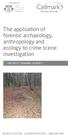 Accredited by The application of forensic archaeology, anthropology and ecology to crime scene investigation SPECIALIST TRAINING COURSES IDENTIFICATION INTERPRETATION INNOVATION Introduction Cellmark Forensic
What you ll learn (and what you won t)
 Forensic Anthropology Forensic Anthropology: The identification of human remains within a legal context; telling the story of a person s life and death from their skeletonized remains What you ll learn
35 Forensic osteology
 35 Forensic osteology by Christopher Alexander Briggs BSc, PhD Denise Donlon BSc, DipEd, BA(Hons), PhD Walter Barry Wood MBBS, BSc [Dr Wood wishes to acknowledge the drawing skills of his daughter Mrs
Biol 2401: Human Anatomy & Physiology I
 Spring 2014 Biol 2401: Human Anatomy & Physiology I Letitia Simpson Sections: 001, 003, 007 SOUTH PLAINS COLLEGE Human Anatomy & Physiology 1 Biology 2401 Spring 2014 Professor: Letitia Simpson Office:
Introduction to Forensic Anthropology Anthropology 231
 Professor: Gretchen R. Dabbs, PhD Email: [email protected] Office Phone: 618-453-3298 Class meets: TR 9:35-12:05, 306 Wham Office Hours: by appointment Office Location: 3539 Faner Hall Teaching Assistant:
COURSE SYLLABUS COMMUNITY COLLEGE OF AURORA INTRODUCTION TO FORENSIC ANTHROPOLOGY Fall 2009
 SECTION I: COURSE IDENTIFICATION COURSE SYLLABUS COMMUNITY COLLEGE OF AURORA INTRODUCTION TO FORENSIC ANTHROPOLOGY Fall 2009 COURSE TITLE: INTRODUCTION TO FORENSIC ANTHROPOLOGY COURSE DESCRIPTION: Studies
Columbus State Community College Social Sciences Department. Course and Number: ANTH 2235: Introduction to Forensic Anthropology
 Columbus State Community College Social Sciences Department Course and Number: ANTH 2235: Introduction to Forensic Anthropology CREDITS: 3 CLASS HOURS PER WEEK: 3 PREREQUISITES:ANTH 2200 or BIO 1161, or
Ryan Maureen Tubbs. [email protected] 621 Secchia Center, 15 Michigan St NE Grand Rapids, MI 49503 616-234-2711 Cell: (517) 881-3742
 Ryan Maureen Tubbs Office [email protected] 621 Secchia Center, 15 Michigan St NE 616-234-2711 Cell: (517) 881-3742 RESEARCH INTERESTS Biological Anthropology, including the identification of changes
Curriculum Vitae. COURSES TAUGHT: Introduction to Forensic Science Introduction to Physical Anthropology
 Curriculum Vitae Joan A. Bytheway, Ph.D. Assistant Professor Sam Houston State University Chemistry and Forensic Science Building 1003 Bowers Boulevard Huntsville, Texas 77341 936-294-4387 Office 936-294-4905
Role of Forensic Pathologists and Anthropologists Forensic Science
 Role of Forensic Pathologists and Anthropologists Forensic Science Definition: Pathologist vs. Forensic Pathologist Pathologist A physician who examines and analyzes tissue samples to identify irregularities
TEXT: Turvey, B. E. (2008). Criminal Profiling: An introduction to behavioral evidence analysis 3 rd Edition. New York: Elsevier, Inc.
 CJ6600 CRIMINAL PROFILING SUMMER 2009 SYLLABUS (June 8, 2009 July 29 th, 2009) Instructor: Jack McGrath, Ph.D. Office: 1380 Lawrence Street Center Phone: (303) 960-4782 Email: [email protected]
Frederick J. Snow, Ph.D.
 Forensic Anthropologist Georgia Bureau of Investigation 3121 Panthersville Road, Decatur, GA 30034 [email protected] 678-949-7462 Education: Ph.D. Anthropology. 2004 The University of Tennessee,
Erin H. Kimmerle, Ph.D.
 Erin H. Kimmerle, Ph.D. Department of Anthropology, Office: 813-974-2138 University of South Florida Direct: 813-974-5139 4202 E. Fowler Avenue, SOC 107 Fax: 813-902-6555 Tampa, FL 33620-8100 Email: [email protected]
FORENSIC SCIENCE INSTITUTE COURSE DESCRIPTIONS 2015-2016
 FORENSIC SCIENCE INSTITUTE COURSE DESCRIPTIONS 2015-2016 FRSC 2503 Introduction to Forensic Science Introduction to Forensic Science is a survey course designed to acquaint the student with a comprehensive
Role of Forensic Pathologists and Anthropologists Forensic Science
 Role of Forensic Pathologists and Anthropologists Forensic Science Copyright and Terms of Service Copyright Texas Education Agency, 2011. These materials are copyrighted and trademarked as the property
1. Anatomy & Physiology I, Biology 2401, Section 304 Lecture: MW 7:05-8:20 pm H-212 Lab: MW 8:30-9:45 pm H-123 Spring 2012
 1. Anatomy & Physiology I, Biology 2401, Section 304 Lecture: MW 7:05-8:20 pm H-212 Lab: MW 8:30-9:45 pm H-123 Spring 2012 2. Instructor: Teak Lee Office Hours: W 6:00 p.m.-7:00 p.m. Telephone: (979) 209-7571
1. G ENERAL ASSESSMENT OF SCENE. LAB AND MORTUARY INVESTIGATIONS
 FORENSIC ANTHROPOLOGY CURRICULUM 1. G ENERAL ASSESSMENT OF SCENE. LAB AND MORTUARY INVESTIGATIONS Candidates for examinations at FAI and II are expected to have knowledge and practical experience of working
Professional Meetings 2013 65th Annual American Academy of Forensic Sciences Conference, Washington, DC (Feb. 20-23)
 E LIZABETH M. DEVISSER 200 S. Regent St., Lansing MI 48912 517-515-4883 [email protected] EDUCATION University of Indianapolis, Indianapolis, IN Master of Science Human Biology Linfield College, 2004
OMONTGOMERY COUNTY COMMUNITY COLLEGE BIO 131 AW Human Anatomy and Physiology I (4 credits) Spring Semester, 2014
 OMONTGOMERY COUNTY COMMUNITY COLLEGE BIO 131 AW Human Anatomy and Physiology I (4 credits) Spring Semester, 2014 Instructor: Dr. Jay M. Templin Meeting Place: Rooms 220 and 244 Meeting Time: Telephone
Forensic Anthropology
 Grade Level: Middle and High School Purpose: The purpose of this lesson is to give students the opportunity to explore the field of forensic anthropology, the science used to investigate the Lassen/Clapper
Psychology. REQUIREMENTS FOR A MAJOR IN PSYCHOLOGY (B.A.): 12 courses (45-49 credits)
 Psychology MAJOR, MINOR PROFESSORS: Bonnie B., George W. (chair) ASSOCIATE PROFESSORS: Richard L. ASSISTANT PROFESSOR: Tiffany A. The core program in psychology emphasizes the learning of representative
Introduction to Personality Psychology 2320, Spring 2013 TTh 5:30-6:45 Arts and Science 110 (Allen Auditorium)
 Introduction to Personality Psychology 2320, Spring 2013 TTh 5:30-6:45 Arts and Science 110 (Allen Auditorium) Instructor: Wendy Slutske, Ph.D. Office: 212A McAlester Hall Office Hours: by appointment
IFIFT & FAFG Multidisciplinary Field School: Forensic Investigations: The Internal Armed Conflict and Post-Conflict in Guatemala
 & FAFG Multidisciplinary Field School: Forensic Investigations: The Internal Armed Conflict and Post-Conflict in Guatemala Guatemala, Central America Guatemala has gone through several political, economic
HIGH SCHOOL COURSE LISTING
 HIGH SCHOOL COURSE LISTING ENGLISH Creative Writing (APEX, ED) English I, II, III, IV (CE, APEX, ED, FL) English IV College Prep (FL) Fundamentals of English Comp (CE) Grammar and Composition (CE, ED)
Angelina College Science and Mathematics Division Biology 2401 Anatomy and Physiology I (Wednesday Hybrid) Tentative Instructional Syllabus
 Angelina College Science and Mathematics Division Biology 2401 Anatomy and Physiology I (Wednesday Hybrid) Tentative Instructional Syllabus I. BASIC COURSE INFORMATION A. Course Description Biology 2401.
ANTHROPOLOGY (ANTH) ANTH 2142 (formerly ANTH 1260)
 ANTHROPOLOGY (ANTH) This is a list of the Anthropology (ANTH) courses available at KPU. For information about transfer of credit amongst institutions in B.C. and to see how individual courses transfer,
WESTERN WYOMING COMMUNITY COLLEGE ANATOMY AND PHYSIOLOGY II COURSE OUTLINE/SYLLABUS SPRING, 2015
 WESTERN WYOMING COMMUNITY COLLEGE ANATOMY AND PHYSIOLOGY II COURSE OUTLINE/SYLLABUS SPRING, 2015 INSTRUCTOR NAME: Dr. Bud Chew, Professor of Biology CONTACT INFO: Phone: 307-382-1855 Email: [email protected]
Criminalis. Prerequisit. cies. Introduction and technical. Techniques. required in. interviews. research, the. A. Syllabus. students 3.
 Criminalis tics I (CJSA 1308) Credit: 3 semester credit hours (3 hours lecture) Prerequisit te/co-requisite: None Course Description Introduction to the field of Criminalistics. Topics include the appreciation
Wildlife Crime Scene Processing WIS 6934
 Wildlife Crime Scene Processing WIS 6934 Instructor: Susan Underkoffler, M.S. Office hours: contact instructor via email Email: [email protected] Phone: 352-294-4091 Website: www.forensicscience.ufl.edu
Curriculum Vitae. Jennifer J. Marson. Department of Sociology DeWitt, MI 48820 1903 W. Michigan Ave (517) 736-4760
 Curriculum Vitae Jennifer J. Marson Western Michigan University 303 W. Washington Street Department of Sociology DeWitt, MI 48820 1903 W. Michigan Ave (517) 736-4760 Kalamazoo, MI 49008 [email protected]
Teaching Assistant: Ryan Essex E-Mail: [email protected] Office Hours: 12pm- 1pm Tuesdays location: DNI 275, B5-6 (the Dornsife Neuroimaging Center)
 Psychology 465- Fall 2012 FORENSIC PSYCHOLOGY WPH B27 Tuesdays 3:30pm- 7:20 p.m. Professor: Jasmine A. Tehrani, Ph.D. E-Mail: [email protected] Office Hours: After class on Tuesdays Teaching Assistant:
Problem: CSI: The Experience - Educator s Guide
 Problem: At a nearby construction zone, workers have made a startling discovery. They uncovered several bones that look like they were buried some time ago. You are part of a team of forensic anthropologists
Anthropology (B.A.) 2013 2014 2014 2015 Catalog Year. College of Arts and Sciences. Department of Marine and Ecological Sciences Social Sciences
 Anthropology (B.A.) 2013 2014 2014 2015 Catalog Year College of Arts and Sciences Department of Marine and Ecological Sciences Social Sciences http://www.fgcu.edu/cas/anthropology/index.asp (239) 590 7196
Criminology CRJU 2004 B Department of Criminal Justice College of Arts & Letters University of North Georgia
 1 Criminology CRJU 2004 B Department of Criminal Justice College of Arts & Letters University of North Georgia Instructor: Dr. Samantha Balemba Email: [email protected] Office: 329 Hansford Hall
FORENSIC BEHAVIORAL SCIENCES What can I do with this degree?
 CRIMINALISTICS Crime Scene Reconstruction and Mapping Fingerprint Examination Firearm and Toolmark Identification Fire and Explosives Investigation Trace Evidence Collection DNA Collection and Testing
ANTHROPOLOGY - GRADUATE (ISAN)
 Biola University 1 ANTHROPOLOGY - GRADUATE (ISAN) ISAN 501 - Essentials of Archaeology Credits 3 An examination of the methodology and theories of the archaeological approach to the study of humankind
AR 500 Public Archaeology in the United States Spring 2016 Syllabus
 GRS CAS AR 500 Public Archaeology in the United States Spring 2016 Syllabus Prof. Ricardo J. Elia ([email protected]) Monday 1 4 pm Ofice: Stone 345D Class: Stone 243 Office Hours: TBD Course Description:
Moravian College Department of Biological Sciences Anatomy and Physiology - BIO 103 Fall 2008
 Moravian College Department of Biological Sciences Anatomy and Physiology - BIO 103 Fall 2008 Instructors: Dr. Cecilia M. Fox Ms. Marie Hosier (lab instructor for laboratory section B) Phone: Fox: 610-861-1426
SYLLABUS Biology 319, Integrated Human Anatomy and Physiology I (Honors) Spring 2014
 SYLLABUS Biology 319, Integrated Human Anatomy and Physiology I (Honors) Spring 2014 Tuesday, Thursday, 9:35-10:50 (sections: 201,202, 203) HELD 200 INSTRUCTOR: Dr. Bill Cohn Biological Sciences Building
Southeastern Community College P. O. Box 151 Whiteville, NC 28472 (910) 642-7141 COURSE SYLLABUS
 Southeastern Community College P. O. Box 151 Whiteville, NC 28472 (910) 642-7141 COURSE SYLLABUS CJC 113 Juvenile Justice 3 0 0 3 Course Prefix/ Number Course Title Class Hrs Lab Hrs Clin/ Intern Hours
Forensic Identification Watch it online http://www.kqed.org/quest/television/view/68 Story length 3:30 minutes
 Forensic Identification Watch it online http://www./television/view/68 Story length 3:30 minutes QUEST SUBJECTS Life Earth Physical CA SCIENCE STANDARDS Biology Health Environment Geology Weather Astronomy
A347 Lucy Stone Hall, Livingston Campus Mon. and Wed. 4:45-6:00pm or by appointment [email protected]
 Criminal Justice 425 - Race, Crime, and Justice Spring 2015 Mondays and Wednesdays, 3:20-4:40pm Tillet Hall, Room 105 Course web page is available on https://sakai.rutgers.edu/portal PROFESSOR: Office:
Contact Information I usually try to check email once per day and respond within 48 hours or sooner, except on weekends and holidays.
 John Marks KSU Department of Sociology and Criminal Justice Technology and Cybercrime CRJU 4305 Spring 2016 Course Navigation Before you begin, please take a moment to familiarize yourself with this web-based
Course Forensic Science. Unit II History
 Course Forensic Science Unit II History Essential Question What role do pathologists and anthropologists play in Forensic Science? TEKS 130.295(c) (4)(D)(5)(A) Prior Student Learning History of Forensic
Anatomy & Physiology for Nursing/Allied Health I BIO 260/BIO 260L (4 credits) Fall 2014 Syllabus. Office: Rm 313A Science Center
 Anatomy & Physiology for Nursing/Allied Health I BIO 260/BIO 260L (4 credits) Fall 2014 Syllabus Instructor(s): Nieka Bright, PhD, ATC (Lecture/Lab) Office Hours: [email protected] email for an appointment
Republic Polytechnic. Continuing Education & Training. Course Structure: Anatomy & Physiology
 Republic Polytechnic Continuing Education & Training Course Structure: Anatomy & Physiology Module Anatomy and Physiology Description This module introduces the basic human anatomical organization, tissue
E-mail: [email protected]. Course Syllabus
 Western Civilization Since the Reformation History 106 Class # Instructor: Prof. Robert Bond Office Hours: TBA E-mail: [email protected] 3.0 Unit Course Course Syllabus DESCRIPTION: History 106 is a survey
Department of Public Health Sciences MPH Program Syllabus
 Department of Public Health Sciences MPH Program Syllabus Course name: Environmental Health Course no.: PUBH 5304 Course CRN: 16195 Semester/year Fall 2013 Graduate credit hours: 3 Class location: HSSN
Introduction to Anthropology
 ANT 2000 S P R I N G 2 0 1 3 Introduction to Anthropology I N S I D E T H I S S Y L L A B U S : Policies. 2-3 Course Outline. 4 Tips for Success. 5 Tibetan Kapala (skull cup) M / W / F 1 0-1 0 : 5 0 A
Psychology of Women (PSYCH 235/WGS 235) SECTION 051 Fall 2011 Monday and Wednesday 5:35 6:50 Room # HW 511
 Instructor: Justine Calcagno Email: [email protected] Office Hours: By appointment Office: HN 627 Psychology of Women (PSYCH 235/WGS 235) SECTION 051 Fall 2011 Monday and Wednesday 5:35 6:50 Room #
Course Overview Principles of Project Management
 Course Overview Principles of Project Management 1. Catalog Description: In today s cost-competitive and often complex work environment, engineers are very likely to be called upon to manage projects (or
Course Number/Title BI276 Anatomy & Physiology I with BI276L Anatomy & Physiology I Laboratory
 Course Number/Title BI276 Anatomy & Physiology I with BI276L Anatomy & Physiology I Laboratory Department: Natural & Applied Sciences Year: Fall 2012 Credit Hours: 4 Required Texts: Marieb, E. & Hoehn,
 More information >>> HERE
 Nicole A. Jastremski, Ph.D., RPA
 Nicole A. Jastremski, Ph.D., RPA AREAS OF INTEREST Bioarchaeology, paleopathology, forensic anthropology, mortuary analysis, South American and Ecuadorian archaeology, identity, taphonomy, biological ancestry,
Human, Male, White. Bone Clones Osteological Evaluation Report. Product Number: 1 intact mandible. General observations:
 Human, Male, White Product Number: Specimen Evaluated: Skeletal Inventory: BC-107 Bone Clones replica 1 intact cranium 1 intact mandible General observations: In general, the molding process has preserved
International Investigator Course
 International Investigator Course By the Institute for International Criminal Investigations COURSE OVERVIEW. The IICI International Investigator Course covers four topic areas considered essential to
Who are you: Strategies for Presenting Forensic Anthropology and Human Variation in the Classroom
 Who are you: Strategies for Presenting Forensic Anthropology and Human Variation in the Classroom K. Lindsay Eaves-Johnson, M.A., University of Iowa Nancy Tatarek, Ph.D., Ohio University Philadelphia,
HUMAN ANATOMY AND PHYSIOLOGY I (BIOL. 213)
 HUMAN ANATOMY AND PHYSIOLOGY I (BIOL. 213) LECTURE SYLLABUS, Spring, 2011 Instructor: Dr. Vonnie D.C. Shields, Office- Smith 345, ext. (410-704-3130) [email protected] Office hours: Mond. 4-5 p.m (Smith
Biology 32 Human Anatomy & Physiology I Bakersfield College Spring 2016
 Biology 32 Human Anatomy & Physiology I Bakersfield College Spring 2016 Instructor: Chad Newton Lecture: MW 8:00-9:25am SE 56 Office: MS 15A Lab:crn#30742: MW 9:35-11:00am MS14 Office Hours: MW 7:35-8:00am
VITA. Ph.D., Criminal Justice, University of Illinois at Chicago, Chicago, IL, 2008
 VITA NAME: Erin Conley Heil EDUCATION: Ph.D., Criminal Justice, of Illinois at Chicago, Chicago, IL, 2008 M.A., Sociology, Southern Illinois Edwardsville, Edwardsville, IL 2002 B.S., Psychology, Southern
2015 Fall II & Second 8-week Courses
 2015 Fall II & Second 8-week Courses Fall II and Second 8-week classes are the courses available to new students applying to MassBay after the regular enrollment date. Students who apply to MassBay between
CRIMINAL JUSTICE. CJ 0002 CRIME, LAW, AND PUBLIC POLICY 3 cr. CJ 0110 CRIMINOLOGY 3 cr. CJ 0130 CORRECTIONAL PHILOSOPHY: THEORY AND PRACTICE 3 cr.
 CRIMINAL JUSTICE CJ 0002 CRIME, LAW, AND PUBLIC POLICY 3 cr. Introduction to crime, criminal law, and public policy as it pertains to crime and justice. Prerequisite for all required criminal justice courses,
Canvas: All tests and assignments will be submitted through use of Canvas, which can be found using the following link: learn-wsu.uen.
 Research Methods in Psychology Psy 3610, Fall 2011 MWF 7:10a-8:20a, Social and Behavioral Science 317 Heather Chapman, [email protected] Office Hours: By Appointment Required Texts: 1. Research
Psychology 2510: Survey of Abnormal Psychology (Section 2) Fall 2015
 Psychology 2510: Survey of Abnormal Psychology (Section 2) Fall 2015 Instructor: Julianne Gray Ludlam, Ph.D. Class Location: Psychology Building 313 Class Time: MWF, 9:00-9:50 AM CST Office Location: 25
BIOLOGY 203 HUMAN ANATOMY AND PHYSIOLOGY Karen K. McLellan, M. S., Course Coordinator Spring Semester, 2012
 BIOLOGY 203 HUMAN ANATOMY AND PHYSIOLOGY Karen K. McLellan, M. S., Course Coordinator Spring Semester, 2012 203 Lecture Times: T/R 9:00 10:15 AM in LA159 T/R 10:30-11:45 AM in LA 159 Textbook: Seeley s
Erin M. Kearns July 27, 2014. Erin M. Kearns. Curriculum Vitae. American University, Washington, DC Ph.D., Expected Spring 2016
 Erin M. Kearns Curriculum Vitae Contact Information American University School of Public Affairs Department of Justice, Law & Criminology 4400 Massachusetts Avenue, NW Washington, DC 20016-8043 Phone:
MORPHOPHYSIOLOGY I Human Anatomy & Physiology I
 MORPHOPHYSIOLOGY I Human Anatomy & Physiology I Semester Credits: 4 In-class Hours: 48 Out-of-Class Hours: 96 Level: 1 st year OVERVIEW Morphophysiology I introduces students to the study of anatomy and
Scene Detection and Processing
 Scientific Working Group for Forensic Anthropology (SWGANTH) Scene Detection and Processing Issue Date: 01/23/2013 Revision: 0 Scene Detection and Processing 1.0 Principle, Spirit, and Intent A scene is
AUGUST 2014 S M T W T F S 1 2 3 4 5 6 7 8 9 10 11 12 13 14 15 16 17 18 19 20 21 22 23 24 25 26 27 28 29 30 31
 AUGUST 2014 17 18 19 20 22 23 SEPTEMBER 2014 5 6 OCTOBER 2014 26 27 ACADEMIC CALENDAR 2014-2015 Fall Semester 2014 AUGUST 18 First Day for Faculty 22 Opening Convocation Payment Deadline, 5 pm 25 Classes
Emergency Medical Responder Course Syllabus
 Emergency Medical Responder Course Syllabus Instructor: Assistant Instructor: Instructor Office Hours and Location: One half hour before and after class or by appointment Course Meeting Days and Times:
PSY 310 Forensic Psychology (3 credits) Fall 2009 T/R 9:30 a.m. 10:45 a.m.
 PSY 310 Forensic Psychology (3 credits) Fall 2009 T/R 9:30 a.m. 10:45 a.m. Professor Jane Tyler Ward, PhD Curtis Hall 121 Office Hours: M - F 9:00 10:00, T/R 11:00 12:00, other times by appointment Telephone
MASTER OF SCIENCE IN BIOMEDICAL FORENSIC SCIENCES
 Program Overview The M.S. in Biomedical Forensic Sciences trains individuals for a variety of disciplines applied to crime scene investigation and evidence analysis. The only program of its kind based
Psychology 4978: Clinical Psychology Capstone (Section 1) Fall 2015
 Psychology 4978: Clinical Psychology Capstone (Section 1) Fall 2015 Instructor: Julianne Gray Ludlam, Ph.D. Class Location: McAlester 101 Class Time: T/Th, 9:30 AM 10:45 AM CST Office Location: McAlester
MSU-Billings College of Education & Human Services Department of Health and Physical Education Spring 2010
 MSU-Billings College of Education & Human Services Department of Health and Physical Education Spring 2010 COURSE RUBRIC & TITLE: HHP 579 Clinical Education V, 1 credit Corequisites: HHP 597, 592-2 TIME:
CJ 480, Criminological Theories Syllabus, Spring 2011
 CJ 480, Criminological Theories Syllabus, Spring 2011 Subject to change with notice. Tuesday 7:00-9:45 p.m.; Room TBA W. T. Jordan, Instructor Office: 133N Academic Bldg. Phone: 903-223-3168 E-mail: [email protected]
CJS 101: Introduction to Criminal Justice Sciences
 CJS 101: Introduction to Criminal Justice Sciences COURSE SYLLABUS Summer Online Offering Professor: Jason Ingram, Ph.D. Office: Schroeder Hall #415 Office Hours: Tuesdays & Thursdays, 1-3 p.m. & by appointment
Law Enforcement II CRIJ 1301 Introduction to Criminal Justice Course Syllabus: Fall 2015
 Law Enforcement II CRIJ 1301 Introduction to Criminal Justice Course Syllabus: Fall 2015 Office Hours and Availability: Elizabeth Bailey, M.S. Room #: 504 Phone: (903) 575-2020 E-Mail: [email protected]
Survey of Criminal Justice - CRJU 701 Department of Criminology and Criminal Justice University of South Carolina Fall 2009
 Survey of Criminal Justice - CRJU 701 Department of Criminology and Criminal Justice University of South Carolina Fall 2009 Professor: Barbara Koons-Witt Office: Currell College, Room 109 Office #: 803.777.0107
TEXTBOOK: FUNDAMENTALS OF ANATOMY & PHYSIOLOGY, 10 TH, Frederic H.
 Houston Community College Biology 2401 / Human Anatomy and Physiology I Spring 2016, COURSE NUMBER //89724// Professor: Manhal Chbat, MD E-mail: [email protected] TEXTBOOK: FUNDAMENTALS OF ANATOMY
SOC 108: INTRODUCTION TO SOCIOLOGY Fall 2011 Section 18 Lecture: T Th 12:35-1:50 Lecture location: Lawson 101
 SOC 108: INTRODUCTION TO SOCIOLOGY Fall 2011 Section 18 Lecture: T Th 12:35-1:50 Lecture location: Lawson 101 Instructor Mohammed Zanoun Office: Faner 3425 Telephone: (618) 453-7622 Email: [email protected]
Administration of Justice ADMJ
 ADMJ Degrees: A.S. AS-T for Transfer Associate in Science Degree Program Information The general field referred to as is directed toward the prevention, discovery, control, and treatment of crimes, criminals,
Sexual Violence as Weapon of War. By Lydia Farah Lawyer & Legal researcher
 Sexual Violence as Weapon of War By Lydia Farah Lawyer & Legal researcher In general women face in peacetime as well as in wartime different forms of discrimination and gender based violence. But during
SEMESTER CREDITS: Three. PREREQUISITE: SOC 103 Introduction to Sociology
 MT. WACHUSETT COMMUNITY COLLEGE 444 Green Street Gardner, MA 01440 (978) 632-6600 SOC129 Drug Use and Abuse in Instructor: American Society Office: Room ; phone ext. Fall Semester, 2010 E-mail: WEB course