
ANTHROPOLOGY (ANTH) ANTH 2142 (formerly ANTH 1260)
|
|
|
- Conrad Lang
- 9 years ago
- Views:
Transcription
1 ANTHROPOLOGY (ANTH) This is a list of the Anthropology (ANTH) courses available at KPU. For information about transfer of credit amongst institutions in B.C. and to see how individual courses transfer, go to the BC Transfer Guide bctransferguide.ca ANTH 1100 Social & Cultural Anthropology Students will study the interrelationships among culture, community and well-being. They will examine the diversity of human thought and behaviour in cross-cultural perspective. Students will focus on topics such as ethnography, gender, marriage and kinship, culture and adaptive strategies, social and political organization, religion and world view, and globalization. ANTH 1200 (formerly ANTH 1211) Biological Anthropology Students will explore human ancestry, fossil hominids, nonhuman primates, and modern human physical variation. They will examine how we have evolved to become modern people and how our bodies and behaviour have been changed and shaped over millions of years. Students will gain knowledge of the theories of Charles Darwin together with the modern synthesis of his ideas, which show how our genes have evolved in response to our environment. Attributes: QUAN ANTH 1217 (formerly ANTH 1125) Forensic Anthropology Students will study forensic anthropology in order to identify unknown human skeletal remains for legal purposes. They will learn techniques for assessing the age-at-death, stature, and sex. Students will also explore the validity of determining "race" or "genetic heritage" based on biological remains. Students will analyze the skeleton to the level of individual identity by understanding how disease, trauma, and behavioural patterns can leave their mark on bones and teeth, through an examination of the application of forensic anthropology in particular investigative cases. They will also learn how cause and manner of death, and the postmortem interval affect the ability to apply forensic anthropological techniques. Attributes: QUAN ANTH 1300 (formerly ANTH 1112) Archaeology Students will analyze the various methods and perspectives used by archaeologists to study ancient cultures from around the world. They will examine the major branches of modern archaeology, as well as the historical development of the discipline. Students will learn how archaeological sites form and become preserved over long periods of time, and will discover how archaeological data are collected and analyzed through survey, excavation and dating methods. They will learn methods used to reconstruct both the economic and sociopolitical organization of ancient societies through analysis and critical discussion. Students will survey world prehistory and critically evaluate the effectiveness of the various methods and approaches studied. ANTH 2100 Methods & Ethics in Anthropology Students will conduct an overview of anthropological methods such as cross-cultural comparisons, multi-sited ethnography, participant observation, surveys, archival research, media analysis, narrative, collaborative ethnography, and visual analysis. They will critically explore ethical issues that have emerged within ethnographic research while they apply methods to case study examples. ANTH 2120 (formerly ANTH 1229) Cross-Cultural Women's and Gender Studies Students will use a cross-cultural perspective to explore the concept of gender; the cultural construction of gender roles and identities; and gender relations as a dimension of culture, politics and society. They will critically examine anthropological approaches to gender from early studies that overlooked women to feminist anthropology and research on masculinities and gender diversity. The class will investigate political and cultural responses to gender inequality and discrimination in diverse cultural contexts. ANTH 2133 (formerly ANTH 1230) Religion, Magic, and Witchcraft Students will investigate the broadly defined interrelationships between culture and religious beliefs, and practices. They will focus on topics such as religious symbols, magic, and witchcraft; rites of passage; spirit possession; and religion in popular culture. ANTH 2140 (formerly ANTH 1220) First Nations Cultures of BC Students will examine the anthropology of First Nations cultures of British Columbia, including archaeology, history and cultural studies. They will be using language and culture areas as a basis for a regional understanding of the diverse First Nations cultures of British Columbia. Students will also come to understand the importance of health, well-being and other contemporary issues. They will find it especially important to understand these ideas in order to examine the current debate regarding land, resource, treaty rights, and the rationale and history behind the modern treaty negotiations in British Columbia, as distinct from the rest of Canada. or 1300 ANTH 2142 (formerly ANTH 1260) First Nations Cultures of Canada Students will focus on the diversity of Aboriginal peoples and cultures. They will study traditional cultures in relation to regional culture and linguistic areas. Students will explore the impact of European influence on native life and cultures. They will examine the origin and nature of contemporary issues such as aboriginal rights movements, the treaty process, and special legal issues. or 1300
2 ANTH 2160 (formerly 1240) Culture and the Environment Students will analyze competing definitions and interpretations of social and physical environments, from various cultural groups around the globe. They will examine the complexity of human relationships with the environment in a world where conflicting cultural systems are often competing for survival. Students will learn to appreciate actions that are crucial to the well-being of environments and the adaptive strategies of threatened cultures., 1200, or 1300 ANTH 2163 (formerly ANTH 1275) Culture, Health and Well-Being Students will investigate the interrelationships among culture, community and well-being. They will explore anthropological topics such as healing systems; culture, spirituality, and wellbeing; the language of distress; social suffering; and, practitionerpatient interactions. ANTH 2190 Non-Governmental Organizations in Context Students will study the role of NGOs (Non-Governmental Organizations), understood to be not-forprofit or 'third sector' organizations concerned with addressing problems of poverty, social justice and/or the environment. They will explore the concepts of global civil society and emerging features associated with social, cultural, economic, and political activity that operate alongside but outside of state and market processes. They will come to understand the various roles that NGOs fill in providing services, promoting particular values, forming the basis for community self-help initiatives or campaigning on public issues. Students will analyze, and demonstrate their familiarity with organizational behaviours and practices. Co-requisites: ANTH 1100 ANTH 2217 Forensic Methods & Analysis Students will explore scientific hypothesis testing by performing experiments that evaluate current forensic methods. They will study several forensic fields such as: metric measurement, fingerprint examination, image analysis (including photographs and x-rays), bone trauma analysis, and discriminating human from animal bone. Students will participate in a one-day outdoor archaeological excavation exercise. They will apply the information learned in the course to practice the techniques associated with the recovery & analysis of material evidence & human remains. Students will also reflect on the ethical dilemmas involved in the integration of scientific, anthropological, archaeological, and legal testimony in professional reports and in the court system. Prerequisites: ANTH 1217 Attributes: QUAN ANTH 2300 Archaeological Methods Students will conduct an in-depth review of current methods in anthropological archaeology. They will examine the historical development of the discipline and study the nature of the archaeological record, including categories of data and site formation processes. Students will study research design, data collection, dating methods and classification of artifacts. They will critically evaluate methods used to examine prehistoric technology, environmental reconstruction, subsistence and diet, and trade patterns. Prerequisites: ANTH 1112 or 1300 ANTH 2310 Archaeology of Death Students will examine the key concepts and methods used to analyze the funerary rituals and burial practices of ancient and recent societies. They will examine the theories and methods used by archaeologists to understand the social and ideological aspects of mortuary behavior. Students will study various forensic techniques used to analyze human remains from ancient and recent burials, and critically analyze the kinds of information they provide. They will also examine the ethical issues involved in the analysis of human remains from archaeological sites from a variety of different perspectives., 1217, or ANTH 2320 (formerly ANTH 1215) Archaeology of the Old World Students will be introduced to Old World Prehistory from the origin of the earliest modern humans through to the development of agriculture and complex state societies. They will examine the evidence for early human migrations from Africa into Europe and the Asia Pacific region. Students will study the rise of early farming communities in each area and then study the evolution of complex state societies. They will also examine an overview of the ancient civilizations of: Egypt and Mesopotamia; the early states of Europe; the evolution of Indus Valley civilizations and the early states of East Asia. Students will critically evaluate the theories and methods of data analysis used to study these ancient cultures. Prerequisites: ANTH 1112 or ANTH 2340 (formerly ANTH 1216) Archaeology of the Americas Students will examine the archaeological record of North and South America. They will examine culture history of the indigenous groups from these continents. Cultural groups examined can include the Inka, Aztec, Maya, Moche, Nazca, Amazonia, Norte Chico, Olmec, Hopewell, Haudenosaunee, NW Coast, Ancestral Pueblo, or others. Students will also critically examine theoretical problems particular to the archaeology of the Americas, including the impact of colonialism, the first peopling of the continents, the role of descendent communities in archaeology, and the evolution of urban societies, language, and agriculture. Prerequisites: ANTH 1112 or 1300.
3 ANTH 3100 Anthropological Theory Students will examine the development and application of anthropological theory through an examination of ethnographies using different theoretical points of view. They will gain an understanding of how theory has been developed and used by anthropologists in the field, with examples to be drawn from a number of different areas and time periods. Students will apply theory as fieldworkers do, in order to understand social processes. They will be exposed to the major social theories and will practice how to choose, explain, and combine theories in research situations. Prerequisites: ANTH 2100 ANTH 3130 Sikh Culture, Religion and Society Students will examine the cultural, religious, social and political developments in the Punjab over the past five centuries from the perspective of the Sikhs. They will focus on the cultural and social forces that shaped and consolidated Sikh religious beliefs, ritual practices, and social institutions. Students will explore the interrelationship among traditional pan-indian customs, Punjabi folklore, and Sikh religious beliefs and practices. They will also explore the impact of the British Raj, including the Sikh reform movements, and the contemporary issue of the Sikh search for a distinct political identity. or ASIA 1111 ANTH Credits Ethnographic Field Studies Students will examine and practice the techniques and ethical conduct of ethnographic research in Cultural Anthropology, building on previous knowledge and experience. They will develop, plan, conduct, and present the results of individual or small group original ethnographic research projects related to an identified theme. Note: This course is only offered as part of an ethnographic field school and will involve an additional fee. Prerequisites: 45 credits from courses at 1100 level or higher, including ANTH 1100, and permission of the Departmental Selection Committee. ANTH 3160 Environmental Activism Students will analyze competing definitions and interpretations of social and physical environments, in both urban and rural contexts. They will examine the complexity of human connections to the environment, in a globalized world where conflicting cultural systems often come into play. Students will learn to appreciate how the adaptive strategies of threatened cultures function in the current context, with specific reference to Indigenous rights. Note: Students who have taken ANTH 2160 may not take ANTH 3160 for further credit. including one of the following: ANTH 1100, ANTH 1200, or ANTH ANTH 3168 Deviance Across Cultures Students will learn that although crime and deviance occur in all societies, they are not defined or treated in the same way from place to place. They will study anthropological concepts and theories to examine deviance from a cross-cultural perspective. Students will survey topics such as banditry and terrorism, criminal organizations, treasure hunting' on archaeological sites, deviance in folklore and popular culture, and social control. Prerequisites: 15 credits from courses at the 1100 level or higher, ANTH 3188 (formerly ANTH 2333) Visual Anthropology Students will examine the primary aspects of visual anthropology. They will focus on anthropological representations of the interrelationships among culture, society, and the individual through the written and spoken word, still photographs, film, and video. Students will critically apply anthropological concepts and ideas to the study of culture and the politics of representation in popular culture. Prerequisites: 30 credits from courses at the 1100 level or higher, ANTH 3190 Non-Governmental Organizations in Practice Students will carry out a detailed investigation of an NGO (Non- Governmental Organization), understood to be a not-for-profit or 'third sector' organization concerned with addressing problems of poverty, social justice, and the environment. They will complete a case study of a particular organization, or of a particular set of problems that surround a group of organizations. Students will submit original research and analysis. They will also develop an understanding of how stakeholders work towards the solution of social, political, and/or environmental problems. Prerequisites: ANTH 2190 ANTH 3211 Forensic Science: Fact and Fiction Popular forensic science television programs have generated believable misrepresentations of forensic science that have become known as The CSI Effect. Students will go through a process of discovery to determine which information is an accurate portrayal of forensic science in popular culture. The exploration of various forensic science fields of study will introduce students to the practical and logistical applications of forensic methods. Another aspect of this course focuses on the differences between the Canadian and American legal systems. These differences have a tremendous impact on expert witness testimony; in particular, the interpretation of forensic science evidence. Furthermore, our Americanized academic literature rarely reflects these legal system distinctions. Prerequisites: ANTH 1217 or BIOL 1110
4 ANTH 3220 Human Osteology Students will interpret the intricacies of the human skeleton through the identification of complete and fragmentary skeletal and dental elements. They will study additional topics that include skeletal growth and development, the identification of the normal range of variation in human skeletal anatomy, and distinguishing human from animal bones. They will also appraise the form and function of soft tissue attachments on bones, in order to determine individualizing characteristics such as age-at-death and sex. Notes: This course should be considered essential if students are planning future work in the interpretation of modern and archaeological human remains. This course is lab intensive. including ANTH 1200 and ANTH ANTH 3242 A Survey of the Primates Students will study the diversity, behaviour, and conservation status of a group of mammals called primates. They will better understand humans by exploring the social organization, social interactions, and ecology of non-human primates. Students will consider the implications of the high number of non-human primate species that are at risk of extinction by exploring the ethical and conservation issues arising from human activities such as the pet trade and the use of non-human primates for medical experiments. They will begin to recognize the significant connection between the animal and human world. and either (a) ANTH 1200 or (b) BIOL 1110 and BIOL1210. ANTH 3300 Archaeological Theory Students will analyze the development and application of theory in archaeological research. Students will trace the historical development of archaeological theory from a cross-cultural perspective. They will study the culture history, processual, and post-processual paradigms and examine how they have influenced the development of contemporary theory. Students will critically analyze theories of culture change, cognition, gender and ethnicity, and how they are applied to actual archaeological data sets. Students will assess the importance of ethics, cultural resource management, and public relations in conducting research within the context of a modern world. Note: This is a seminar course. Prerequisites: One of: ANTH 2142, 2217, , or ANTH 3301 (formerly ANTH 2301) Archaeological Methods for Cultural Resource Management Students will develop a hands-on understanding of a number of aspects of archaeological methodology central to cultural resource management (CRM) work. They will learn to apply these methods to the analysis of archaeological and landscape data, including how to report and organize the results of these analyses. Students will also be tasked with other important aspects of methodology in CRM, which include mapping, site forms, reporting, budgets, and proposals. Note: This course is offered as field school studies during summer term. Prerequisites: 30 credits from courses at the 1100 level or higher, including ANTH Co-requisites: ANTH 3361 ANTH 3330 East Asian Archaeology Students will study the origins and development of complex societies in East Asia. They will analyze the archaeology of China, Korea, and Japan, including an exploration of key issues in cultural evolution and interaction. Students will examine major topic areas such as: early human migrations into the region; early foraging economies; the development of food production; and the evolution of social complexity. Students will critically analyze the current methods and theories used by archaeologists in studying the evolutionary development of East Asian civilizations. Students will examine the modern cultural context of prehistory in East Asia as a source of discussion on ethnic identity. Prerequisites: ANTH 2320 or ANTH 2340 ANTH 3340 British Columbia Archaeology Students will examine the pre-contact and proto-historic archaeology and cultures of British Columbia's aboriginal peoples. They will study the environmental adaptations and complex cultural developments of both interior and coastal groups, and will develop an understanding of the great diversity and depth of B.C.'s native cultures. Students will critically analyze the theories and archaeological evidence of prehistoric cultural developments in the area from the earliest occupations up to contact with Europeans and Americans. Note: This course is usually offered as field school studies during summer term. Prerequisites: 30 credits from courses at the 1100 level or higher, including ANTH ANTH Credits Archaeological Field Studies Students will study and practice the basic techniques of archaeological survey and excavation. They will learn and examine field techniques such as site survey and mapping; GPS data collection, mapping, and analysis; excavation methodology; analysis of site stratigraphy; and the proper documentation, collection and curation of field data. Students will examine how archaeological remains are cleaned, sorted and properly stored in the laboratory and will apply preliminary data analysis methodology. Note: This course consists of a six-week field studies project and is offered only during the summer term. Prerequisites: Both (a) 30 credits from courses at the 1100 level or higher, including ANTH 1300 or equivalent, and (b) permission of the department selection committee. Co-requisites: ANTH 3301 ANTH 3500 Directed Studies in Anthropology Students will engage in an intensive study of an anthropological topic under the supervision of a faculty member. They will conduct professional research by doing comprehensive weekly readings, in which they identify appropriate resource materials, develop a proposal, and submit an advanced academic project. Note: Students may take this course multiple times for further credit on different topics. including ANTH 1100, 1200 or 1300.
5 ANTH 3501 Special Topics in Cultural Anthropology Students will examine a selected topic in Cultural Anthropology. They will critically analyze relevant literature and develop a comprehensive understanding of particular theories, methods, and themes. Students will question and evaluate recent developments in the topic area and debate future directions of possible study. Note: The specific course content will be established in advance by the instructor. Students may take this course multiple times for further credit on different topics. ANTH 3502 Special Topics in Biological Anthropology Students will engage in an intensive study of the human physical form by studying a special topic selected by the instructor. They will explore a topic in one of the major focus areas within biological anthropology such as: forensic anthropology (an applied aspect); evolution and heredity; non-human primate studies; human evolution; or modern human biological variation. Students will examine and evaluate recent developments in the specific focus area, assess the implications of these developments, and identify future research directions in order to determine what it means to be a member of the human species. Note: Please check with the department for proposed offerings and the specific prerequisite. Students may take this course multiple times for further credit on different topics. including ANTH 1200 or ANTH 3503 Special Topics in Archaeology Students will study particular aspects of archaeology selected by the instructor. They will examine how archaeology attempts to document and interpret the course of human cultural evolution and to trace the development of cultural traditions in various areas of the world by studying a current issue in archaeology. Student emphasis will be on the methodological, technical, and scientific literature relating to archaeological interpretation. Notes: The area of study will be established in advance by the department. Please check with the department for proposed offerings. Students may take this course multiple times for further credit on different topics. This is a seminar course. including ANTH ANTH 3510 Anthropology of Genocide Students will examine the anthropological approach to the study of genocide which is a unique multidisciplinary approach due to the contribution of each subfield of anthropology. They will examine the following topics: why anthropology is so well situated to inform the discourse and research on genocide; the definition of genocide and ethnocide; the nature of human aggression from the perspective of our nearest animal relatives; the limitations of forensic investigations in documenting crimes against humanity for future generations; cultural issues, including racial, ethnic and religious concerns; historical and contemporary political issues (local, national, regional, and global through an examination of the United Nations, and other non-government organizations); modern literature and popular culture; and healing processes. Students will, using case examples from Canada and across the globe, investigate the necessity for a multi-disciplinary approach to this problem. including ANTH 1100, 1200, 1217 or ANTH 4101 Contemporary Readings in Anthropology Students will, at an advanced level, study a problem of current concern in anthropology. Students will synthesize current themes and debates arising from a variety of perspectives either about, or within, anthropology. They will study anthropology in institutional and/or applied contexts, by acknowledging the origins of anthropological methodology as well as recognizing its current demands. Students will identify real-life problems through discussion, literature review, and practical observation. They will determine ongoing areas of research that they may utilize for future study or job-related research. Prerequisites: 60 credits from courses at the 1100 level or higher, ANTH 4500 Culture, Community, & Well-Being Students will bring together a number of theories, methods, and themes in anthropology. They will utilize a multidisciplinary approach to examine contemporary issues and they will address the contributions of a number of fields of study to further explore the department focus on "Culture, Community, and Well- Being". Students will explore topics such as Aboriginal studies; gender & women's studies; biological, medical & environmental anthropology; methods & ethics in anthropological research; human rights issues; audio-visual anthropology; religion and spirituality; and specific geographic area studies with an emphasis placed upon the holistic and applied approach to anthropology. Note: This is a seminar course. including 6 credits from any courses in ANTH.
6 ANTH 4501 Selected Problems in Anthropology Students will engage in the study of a particular issue in the field of anthropology. They will analyze critically the relevant literature and attendant ethical problems, and examine public awareness of the issue, thereby developing a comprehensive understanding of disciplinary considerations. Students will evaluate recent developments in methods and particular approaches, assess the implications of these developments, and identify future directions for the field of anthropology itself. including ANTH 1100 or ANTH 4502 Regional Focus in Anthropology Students will carry out a detailed investigation of a particular region, as identified by the course instructor. They will use specific anthropological approaches to provide insights into the society and culture of the specified region. They will be required to identify relevant sources of information, provide a summary of the literature and develop a discussion of relevant problems. Note: Students may take this course multiple times for further credit on different topics. Prerequisites: 60 credits from courses at the 1100 level or higher, including ANTH 1100 or ANTH 4510 Applied Research in Anthropology Students will complete an applied research project in a particular anthropological subfield, and will analyze critically issues relating to the conduct of applied anthropology. Students will utilize and apply anthropological methods to a particular real world problem, possibly including action research, advocacy anthropology, culture resource management (CRM), methodological design, or a forensic human identification problem. including ANTH 1200 and 1217.
ANTHROPOLOGY - GRADUATE (ISAN)
 Biola University 1 ANTHROPOLOGY - GRADUATE (ISAN) ISAN 501 - Essentials of Archaeology Credits 3 An examination of the methodology and theories of the archaeological approach to the study of humankind
SOCIOLOGY AND ANTHROPOLOGY
 SOCIOLOGY AND ANTHROPOLOGY FACULTY: Thomas Tierney (Sociology), Chair, Fall semester Anne Nurse (Sociology), Chair, Spring semester David Biagas (Sociology) Christa Craven (Anthropology, WGSS) Lisa Fisher
Anthropology. College of Humanities and Social Sciences 162 CALIFORNIA STATE UNIVERSITY, FULLERTON 2013-2015 CATALOG
 Anthropology College of Humanities and Social Sciences ACTING DEPARTMENT CHAIR Mitch Avila DEPARTMENT OFFICE/WEBSITE McCarthy Hall 426 657-278-3626 anthro.fullerton.edu PROGRAMS OFFERED Bachelor of Arts
Forensic Anthropology. Introduction
 Forensic Anthropology Introduction Introduction This course is Biological Anthropology We have covered many themes Primates Evolution Paleoanthropology Genetics Disease Life Cycle Variation Forensics We
Forensic Anthropology Introduction. Human Biology/Forensics B.M.C. Durfee High School
 Forensic Anthropology Introduction Human Biology/Forensics B.M.C. Durfee High School Objectives Describe Forensic Anthropology Describe the history of Forensic Anthropology Identify the three fields of
A-H 106 RENAISSANCE THROUGH MODERN ART. (3) Historical development of Western art and architecture from the fourteenth century through the present.
 # 101 INTRODUCTION TO VISUAL STUDIES. (3) The course introduces students to the concepts and techniques of visual literacy. It explores a full spectrum of man-made visual forms encountered by contemporary
Kansas Board of Regents Precollege Curriculum Courses Approved for University Admissions
 Kansas Board of Regents Precollege Curriculum Courses Approved for University Admissions Original Publication April 6, 2011 Revision Dates June 13, 2011 May 23, 2012 Kansas Board of Regents Precollege
World History: Essential Questions
 World History: Essential Questions Content Standard 1.0: Culture encompasses similarities and differences among people including their beliefs, knowledge, changes, values, and traditions. Students will
Urban Studies and Planning
 1 Urban Studies and Planning College of Health and Social Sciences Dean: Alvin Alvarez School of Public Affairs and Civic Engagement Director: Elizabeth Brown Urban Studies and Planning Program HSS 210
Anthropology Single Honours (BSc)
 Programme Specification Anthropology Single (BSc) Valid from: September 202 Faculty of Humanities and Social Sciences Department of Social Sciences SECTION : GENERAL INFORMATION Awarding body: Teaching
A-H 106 RENAISSANCE THROUGH MODERN ART. (3) Historical development of Western art and architecture from the fourteenth century through the present.
 101 INTRODUCTION TO VISUAL STUDIES. (3) The course introduces students to the concepts and techniques of visual literacy. It explores a full spectrum of man-made visual forms encountered by contemporary
The application of forensic archaeology, anthropology and ecology to crime scene investigation
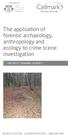 Accredited by The application of forensic archaeology, anthropology and ecology to crime scene investigation SPECIALIST TRAINING COURSES IDENTIFICATION INTERPRETATION INNOVATION Introduction Cellmark Forensic
Introduction to Anthropology
 Introduction to Anthropology Course Information Organization Mercer County Community College Developers Nichol Wilson Killian; Gianna Durso-Finley Development Date 200122 Course Number ANT 101 Instructional
RUSRR048 COURSE CATALOG DETAIL REPORT Page 1 of 16 11/11/2015 16:04:28
 RUSRR048 COURSE CATALOG DETAIL REPORT Page 1 of 16 CRM 100 Course ID 000650 Canadian Criminal Justice Introduction to Canadian Criminal Justice This course introduces students to the administrative and
Acceptable Complementary Studies Electives 2015/2016 Fall & Winter Terms
 Acceptable Complementary Studies Electives 2015/2016 Fall & Winter Terms Please read this note carefully before reviewing the list: Many of these courses require upper year standing and course prerequisites,
Video Activity 1: Kathy Reichs on Forensic Anthropology
 M O D U L E 1 ANTHROPOLOGY Video Activity 1: Kathy Reichs on Forensic Anthropology https://www.youtube.com/watch?v=l101bvj0laa Speaking: Kathy Reichs, forensic anthropologist certified by the American
Department: Political Science, Philosophy & Religion.
 1 Department: Political Science, Philosophy & Religion. Course No. IU310. Title of Course: Government and Politics of East Asia. I. A. Catalog Description and Credit Hours of the Course: A survey of social,
FACULTY OF SOCIAL AND POLITICAL SCIENCES
 The Faculty of Social and Political Sciences is one of Indonesia s leading faculties in social subjects constituting of 7 Departments: Communication Studies, Criminology, International Relations, Political
Education Studies Minor Course Descriptions:
 Education Studies Minor Course Descriptions: 80. Understanding Collegiate Experience. (4) (Formerly numbered 180.) Lecture, three hours; discussion, 90 minutes. Designed to help students better understand
Acceptable Complementary Studies Electives 2016/2017 Fall & Winter Terms
 Acceptable Complementary Studies Electives 2016/2017 Fall & Winter Terms Please read this note carefully before reviewing the list: Many of these courses require upper year standing and course prerequisites,
ANTH 176: INTRODUCTION TO FORENSIC ANTHROPOLOGY 4 credit hours
 ANTH 176: INTRODUCTION TO FORENSIC ANTHROPOLOGY 4 credit hours INSTRUCTOR: Dr. Felicia Madimenos ([email protected]) Welcome to Introduction to Forensic Anthropology! This course teaches the basic analysis
CRIMINAL JUSTICE (CJ) Updated June 8, 2016
 CRIMINAL JUSTICE (CJ) Updated June 8, 2016 Chair: Professor S. Kohm; Professor: M. Weinrath: Associate Professor: K. Walby; Assistant Professor: M. Bertrand; Instructors: J. Lothian Murray, K. Gorkoff,
RUSRR048 COURSE CATALOG DETAIL REPORT Page 1 of 15 03/13/2015 15:52:32
 RUSRR048 COURSE CATALOG DETAIL REPORT Page 1 of 15 CRM 100 Course ID 000650 Canadian Criminal Justice Introduction to Canadian Criminal Justice This course introduces students to the administrative and
Department of Sociology
 Colorado State University 1 Department of Sociology Office in Clark Building, Room B258 (970) 491-6045 sociology.colostate.edu (http://sociology.colostate.edu) Professor Michael Carolan, Chair Associate
Bachelor of Business Administration (BBA) Degree Completion Program
 Bachelor of Business Administration (BBA) Degree Completion Program Note that the intended audience for the BBA degree completion program is the graduate of an AA or AS with a liberal arts and/or science
History. Programme of study for key stage 3 and attainment target (This is an extract from The National Curriculum 2007)
 History Programme of study for key stage 3 and attainment target (This is an extract from The National Curriculum 2007) Crown copyright 2007 Qualifications and Curriculum Authority 2007 Curriculum aims
North Carolina Essential Standards Third grade Social Studies
 North Carolina s Third grade Social Studies In third grade, students draw upon knowledge learned in previous grades to develop more sophisticated understandings of how communities may be linked to form
1. G ENERAL ASSESSMENT OF SCENE. LAB AND MORTUARY INVESTIGATIONS
 FORENSIC ANTHROPOLOGY CURRICULUM 1. G ENERAL ASSESSMENT OF SCENE. LAB AND MORTUARY INVESTIGATIONS Candidates for examinations at FAI and II are expected to have knowledge and practical experience of working
Criminal Justice - Law Enforcement
 Criminal Justice - Law Enforcement Dr. Charles Adair, Acting Chair Criminal Justice Department [email protected] 631-420-2692 School of Arts & Sciences Associate in Science Degree The goal of this
College of Arts and Sciences: Social Science and Humanities Outcomes
 College of Arts and Sciences: Social Science and Humanities Outcomes Communication Information Mgt/ Quantitative Skills Valuing/Ethics/ Integrity Critical Thinking Content Knowledge Application/ Internship
College of Liberal Arts
 College of Liberal Arts Purpose and Focus The College of Liberal Arts offers a rich variety of courses, majors and interdisciplinary programs in the humanities and the social sciences. A liberal arts education
Graduate Courses. 713 PERFORMANCE CRITICISM (3). Introduction to the critical analysis and interpretation of performance events.
 Graduate Courses 700 INTRODUCTION TO RESEARCH AND THEORY IN COMMUNICATION STUDIES I (3). Prerequisite, admission to graduate program or permission of the chair. Considers theory and philosophy in the study
Animation Program Articulation
 Memorandum of Understanding (2015-2016) Santa Monica College This document is intended both as a memorandum of understanding for college counselors and as a guide for students transferring into Woodbury
Tennessee Curriculum Standards for High School World History Correlations to Wright Group/McGraw-Hill s World History
 Tennessee Curriculum Standards for High School World History Correlations to Wright Group/McGraw-Hill s World History Course Description: In World History High School, students study the history of humankind
HUMANITY. Anthropology @ UCM. UCM Anthropology Student Handbook. Evolution. Archaeology. Ethnography. Human Prehistory. Forensics Culture.
 Anthropology @ UCM www.ucmo.edu/hist-anth/anthropology Archaeology Ethnography EXPLORE HUMANITY Evolution Human Prehistory Forensics Culture Museums UCM Anthropology Student Handbook Anthropology @ UCM
Guidelines for PhD in Industrial Heritage and Archaeology Graduate Students
 Guidelines for PhD in Industrial Heritage and Archaeology Graduate Students This document provides some information about Program requirements as well as some guidance about administrative procedures of
COURSE SYLLABUS COMMUNITY COLLEGE OF AURORA INTRODUCTION TO FORENSIC ANTHROPOLOGY Fall 2009
 SECTION I: COURSE IDENTIFICATION COURSE SYLLABUS COMMUNITY COLLEGE OF AURORA INTRODUCTION TO FORENSIC ANTHROPOLOGY Fall 2009 COURSE TITLE: INTRODUCTION TO FORENSIC ANTHROPOLOGY COURSE DESCRIPTION: Studies
Courses Descriptions. Courses Generally Taken in Program Year One
 Courses Descriptions Courses Generally Taken in Program Year One PSY 602 (3 credits): Native Ways of Knowing Covers the appropriate and valid ways of describing and explaining human behavior by using the
RELIGION & CULTURE (REL) Updated January 29, 2016
 RELIGION & CULTURE (REL) Updated January 29, 2016 Note: The department/program code REL replaces the former code 47. Students cannot hold credit in REL-xxxx and the former 47.xxxx having the same course
WESTERN MICHIGAN UNIVERISTY SCHOOL OF SOCIAL WORK Field Education Learning Contract and Evaluation. MSW Concentration-Interpersonal Practice (IP)
 WESTERN MICHIGAN UNIVERISTY SCHOOL OF SOCIAL WORK Field Education Learning Contract and Evaluation Revised 10/04/2014 Pg. 1 MSW Concentration-Interpersonal Practice (IP) Student s Name: Jane Smith Phone
THE APPROVED LIST OF HUMANITIES-SOCIAL SCIENCES COURSES FOR ENGINEERING DEGREES
 THE APPROVED LIST OF HUMANITIES-SOCIAL SCIENCES COURSES FOR ENGINEERING DEGREES Each student program of study must contain a minimum of 21 credit hours of course work in general education and must be chosen
Course Descriptions MA in Archaeology and Biblical Studies Southwestern Baptist Theological Seminary
 Course Descriptions MA in Archaeology and Biblical Studies Southwestern Baptist Theological Seminary Archaeology and Archaeological Method 3000s Archaeology ARCHE 3003 Archaeology of the Ancient Near East
Prentice Hall World Geography: Building a Global Perspective 2003 Correlated to: Arkansas Social Studies Curriculum Frameworks (Grades 9-12)
 Arkansas Social Studies Curriculum Frameworks (Grades 9-12) Strand 1: Time, Continuity, and Change Content Standard 1: Students will demonstrate an understanding of the chronology and concepts of history
Course Content. The following course units will be offered:
 The following course units will be offered: Research Methodology Textual Analysis and Practice Sociolinguistics: Critical Approaches Life writing World Englishes Digital Cultures Beyond the Post-colonial
DIABLO VALLEY COLLEGE CATALOG 2015-2016
 HISTORY HIST Obed Vazquez, Dean Social Sciences Division Faculty Office Building, Room 136 Possible career opportunities The study of history contributes to cultural literacy, developing critical thinking
Psychology Program Articulation
 Memorandum of Understanding (2015-2016) Santa Monica College This document is intended both as a memorandum of understanding for college counselors and as a guide for students transferring into Woodbury
Cultural Anthropology ANTH 1220 Course Manual
 Cultural Anthropology ANTH 1220 Course Manual 2006 Printing Copyright 1998. Revised 2001, 2003. All rights reserved. No part of the material protected by this copyright may be reproduced, stored in a retrieval
COMM - Communication (COMM)
 Texas A&M University 1 COMM - Communication (COMM) COMM 101 Introduction to Communication (SPCH 1311) Introduction to Communication. Survey of communication topics, research, and contexts of communicative
Development Studies and Global Political Economy Master List. Introductory courses:
 Development Studies and Global Political Economy Master List Introductory courses: o Intro to Urban Studies (L18 101) o Intro to Microeconomics (L11 1011) o Intro to Macroeconomics (L11 1021) o Intro to
FOSTERING DIALOGUE AND MUTUAL UNDERSTANDING
 FOSTERING DIALOGUE AND MUTUAL UNDERSTANDING The crucial role of young women and men in advancing intercultural dialogue and understanding is increasingly recognized within the global development agenda.
Criminal Justice. Bachelor of Criminal Justice Major in Criminal Justice. Objectives. Degree Offered. Major Offered. Minor Offered
 75 Charles Lawrence, Ph.D., Chair Objectives The major gives students an overview of the entire criminal justice system, and then encourages them to consider the component parts. Courses are offered in
FORENSIC SCIENCE INSTITUTE COURSE DESCRIPTIONS 2015-2016
 FORENSIC SCIENCE INSTITUTE COURSE DESCRIPTIONS 2015-2016 FRSC 2503 Introduction to Forensic Science Introduction to Forensic Science is a survey course designed to acquaint the student with a comprehensive
Silver School of Social Work
 Silver School of Social Work UNDSW US 67 Social Justice and Peacemaking (4 CLI UG.1444, Lyrics on Lockdown (4 S99.2111, Ending Poverty: Models for Social Change and Social Action (4 TBD, Tweeting for the
Course Curriculum for Master Degree in Architecture
 Course Curriculum for Master Degree in Architecture The Master Degree in Architecture is awarded by the Faculty of Graduate Studies at Jordan University of Science and Technology (JUST) upon the fulfillment
List of All AIMS Specialized Courses 2014~Fall 2016 (Tentative)
 List of All AIMS Specialized Courses 014~Fall 016 (Tentative) School Course Key Class Course Tutle Credits Core School of Political Science and Economics 1100001F3 01 Introduction to Chinese Linguistics
Criminal Justice. Bachelor of Criminal Justice Major in Criminal Justice. Objectives. Degree Offered. Major Offered. Minor Offered
 77 Charles Lawrence, PhD, Chair Objectives The major gives students an overview of the entire criminal justice system, and then encourages them to consider the component parts. Courses are offered in the
POLICY ON HUMAN REMAINS
 Policy document for the strategic development of The Manchester Museum POLICY ON HUMAN REMAINS Endorsed by: The University of Manchester Senior Executive Team Date for review: June 2010 1 Policy Statement
SOCIAL STUDIES UNIT OUTLINES - SIXTH GRADE
 SOCIAL STUDIES UNIT OUTLINES - SIXTH GRADE In sixth grade, students are ready to deepen their understanding of the Earth and its peoples through the study of history, geography, politics, culture, and
Program of Study: Bachelor of Science in Health Care Administration
 Program of Study: Bachelor of Science in Administration Program Description The Bachelor of Science in Administration (BSHA) is an undergraduate professional degree designed to prepare students for entry-level
Forensic Anthropology
 Grade Level: Middle and High School Purpose: The purpose of this lesson is to give students the opportunity to explore the field of forensic anthropology, the science used to investigate the Lassen/Clapper
How To Take A Minor
 Make a Major difference to your degree. Flexible Learning at Southampton 2 Studying a Minor subject allows you to broaden your educational experience Make a Major difference to your degree by choosing
North Carolina Essential Standards Seventh Grade Social Studies
 North Carolina s Focus: Time Period: World Geography, History and Culture: Patterns of Continuity and Change The Great Global Convergence (1400-1800) to the Present - Represents the last five Eras of the
CRIMINAL JUSTICE. CJ 0002 CRIME, LAW, AND PUBLIC POLICY 3 cr. CJ 0110 CRIMINOLOGY 3 cr. CJ 0130 CORRECTIONAL PHILOSOPHY: THEORY AND PRACTICE 3 cr.
 CRIMINAL JUSTICE CJ 0002 CRIME, LAW, AND PUBLIC POLICY 3 cr. Introduction to crime, criminal law, and public policy as it pertains to crime and justice. Prerequisite for all required criminal justice courses,
The Approved List of Humanities and Social Science Courses For Engineering Degrees. Approved Humanities Courses
 The Approved List of Humanities and Social Science Courses For Engineering Degrees Students should check the current catalog to ensure any prerequisite and departmental requirements are met. NOTE: Some
The Approved List of Humanities and Social Science Courses For Engineering Degrees. Approved Humanities Courses
 The Approved List of Humanities and Social Science Courses For Engineering Degrees Students should check the current catalog to ensure any prerequisite and departmental requirements are met. ART Approved
FACULTY OF HUMANITIES
 The Faculty of Humanities, Universitas Indonesia is one of the oldest faculties among the thirteen faculties at Universitas Indonesia. Founded in 1940 by the Dutch colonial administration, it has undergone
Metropolitan State University of Denver Master of Social Work Program Field Evaluation
 Metropolitan State University of Denver Master of Social Work Program Evaluation Date: Agency/Program Task Supervisor Faculty Liaison Total Hours Completed To Date for this semester: s will not receive
Behavioral Sciences INDIVIDUAL PROGRAM INFORMATION 2015 2016. 866.Macomb1 (866.622.6621) www.macomb.edu
 Behavioral Sciences INDIVIDUAL PROGRAM INFORMATION 2015 2016 866.Macomb1 (866.622.6621) www.macomb.edu Behavioral Sciences CREDENTIAL TITLE PROGRAM OPTIONS CREDIT HOURS REQUIRED Certificate Behavioral
COURSE COMPETENCY GUIDELINES
 COURSE COMPETENCY GUIDELINES GUIDELINES FOR DEVELOPING COMPETENCIES Format: 1. Begin with a present tense action verb. (Example: Convert picas to points and inches.) 2. Each action verb requires an object.
Treaty on Environmental Education for Sustainable Societies and Global Responsibility
 Treaty on Environmental Education for Sustainable Societies and Global Responsibility (This treaty, as in education, is a dynamic process and should therefore promote reflection, debate and amendments.)
Fashion Design Program Articulation
 Memorandum of Understanding (2015-2016) East Los Angeles College This document is intended both as a memorandum of understanding for college counselors and as a guide for students transferring into Woodbury
Doctor in Social Development (DSD) Program Guide
 1. The DSD Program Program Description College of Social Work and Community Development University of the Philippines Diliman Doctor in Social Development (DSD) Program Guide The Doctor in Social Development
CALIFORNIA STATE UNIVERSITY, EAST BAY. First Quarter/Year of Modification FOR INFORMATION ONLY.
 CALIFORNIA STATE UNIVERSITY, EAST BAY First Quarter/Year of Modification FOR INFORMATION ONLY. Quarter: FALL Year: 2013 NO DECISION NEEDED. Date Submitted to APGS: 11-22-11 Catalog: 2013-2014 REQUEST FOR
Council on Social Work Education. Curriculum Policy Statement for Baccalaureate Degree Programs in Social Work Education
 Council on Social Work Education Curriculum Policy Statement for Baccalaureate Degree Programs in Social Work Education B1.0 SCOPE AND INTENT OF THE CURRICULUM POLICY STATEMENT B1.1 This document sets
Political Science Courses
 Political Science Courses CPO 2002 INTRODUCTION TO COMPARATIVE POLITICS (3) Introduction to politics in different states; comparison and analysis of representative European and non-western political systems.
BA in Political Science and International Affairs
 College of Social Sciences and Humanities 517 RESIDENCY REQUIREMENT Students must earn a minimum of 64 Northeastern University semester hours in order to receive a bachelor s degree. UNIVERSITY-WIDE REQUIREMENTS
FA 101: Introduction to Film. FA 257: Literature into Film
 Humanities Department Telephone (541) 383-7520 FA 101: Introduction to Film Outcome 1: Will be able to identify and explain the different languages of filmmaking, including cinematography, editing, mise-en-scene
How To Get A Sociology Degree
 SOCIOLOGY AND CRIMINAL JUSTICE FACULTY Chairperson: Associate Assistant Instructor: Assistant Professor Patricia Fanning Walter Carroll, William Levin Kim MacInnis, Carolyn Petrosino Jody Cohen, Fang Deng,
Sociology Course of Study
 UNIT ONE: How do sociologists study the world? (January February) 1. The Sociological Perspective 2. The Emergence of Scientific 3. Use of the Scientific Method 4. Difficulties of Sociological Research
Liberal Arts with an Emphasis in Arts and Humanities Associate in Arts Degree
 Liberal Arts with an Emphasis in Arts and Humanities Associate in Arts Degree The A.A. in Liberal Arts with an emphasis in Arts and Humanities provides students with a broad perspective on culture and
Administration of Justice ADMJ
 ADMJ Degrees: A.S. AS-T for Transfer Associate in Science Degree Program Information The general field referred to as is directed toward the prevention, discovery, control, and treatment of crimes, criminals,
School of Social Work
 Social Work 282 School of Social Work St. Patrick s Building 469 Telephone: 788-5601 Fax: 788-7496 The School Director of the School: Gillian Walker Supervisor of Graduate Studies: Allan Moscovitch The
Bourns College of Engineering Breadth Requirements Effective 2010 Fall Quarter
 Bourns College of Engineering Breadth Requirements Effective 2010 Fall Quarter In order to graduate, students must complete campus breadth requirements as determined by the Executive Committee of the Bourns
Department of Asian American Studies Master of Arts APPROVED RESEARCH METHODOLOGY COURSES
 Department of Asian American Studies Master of Arts APPROVED RESEARCH METHODOLOGY COURSES AFRO-AMERICAN STUDIES M200A Advanced Historiography: Afro-American (Same as History M200V) M270A Survey of Afro-American
School of Social Work
 MSW Core Curriculum for Generalist Practice St. Catherine University/University of St. Thomas Core and Advanced Competencies of the MSW Program The SCU/UST MSW curriculum prepares its graduates for advanced
Overarching MPH Degree Competencies
 Overarching MPH Degree 1. Describe basic concepts of probability, random variation and commonly used statistical probability distributions. 2. Apply common statistical methods for inference. 3. Describe
COMMUNICATION STUDIES
 COMMUNICATION STUDIES Department Office: MUSIC 104 Phone (323) 343-4200 Fax (323) 343-6467 The Department of Communication Studies offers undergraduate programs leading to Bachelor of Arts degrees in TV,
Bloomsburg University Midterm and Final Competency Field Evaluation. Task Supervisor (if appropriate) :
 Bloomsburg University and Competency Field Evaluation BSW EVALUATION OF THE COMPETENCIES AND PRACTICE BEHAVIORS Student : Field Instructor : Task Supervisor (if appropriate) : _ Agency : University Faculty