
Curriculum Programs of Study
|
|
|
- Blaze Leonard
- 10 years ago
- Views:
Transcription
1 Curriculum Programs of Study The wide variety of curriculum credit programs at GTCC are designed to meet the educational needs of individual citizens, businesses and industries in Guilford County. When you successfully complete a program of study, you can earn an associate degree, a diploma or a certificate, depending on the program. Most programs are offered on the Jamestown campus, although individual classes are offered in Greensboro and High Point. The college s sites in Greensboro and High Point also offer some curriculum programs (see below). Greensboro Programs GTCC offers classes at three locations in Greensboro: 3505 E. Wendover Ave. location, the Small Business Center at 2007 Yanceyville St., suite 220; and the GTCC Aviation Center at the Piedmont Triad International Airport, 260 Regional Rd and 819 Radar Rd. The following programs are housed on the 3505 East Wendover campus: Air Conditioning, Heating and Refrigeration Technology; Plumbing; Residential Carpentry; Construction Management Technology; Architectural Technology; Civil Engineering/Surveying Technology; Mechanical Engineering/Drafting and Design Technology; Electronics Engineering Technology; Telecommunications and Network Engineering Technology; Industrial Systems Technology; Electrical Construction; Industrial Electrical/Electronics Technology; Computer Intergrated Machining; Manufacturing Technology; and Turfgrass Technology. The Paralegal Technology Program and the Associate in Arts and Associate in Science degrees can also be completed on this campus. The Greensboro Wendover Campus offers a variety of Continuing Education classes including Basic Skills Programs (Adult Basic Education, GED, Adult High School, English for Speakers of Other Languages, and Compensatory Education). A wide variety of Occupation Extension classes such as Computer Classes, CNA training, Real Estate Certification, and other business and occupational skills training courses are offered, in addition to a host of Community Services classes designed for personal and skills enrichment (Art, photography, foreign languages, sewing, health related, retirement and personal enrichment classes). The following curriculum programs are offered at the GTCC T.H. Davis Aviation Center: Aviation Management and Career Pilot Technology; and Aviation Systems Technology. Aviation Center #2 is located at 819 Radar Road, adjacent to the Piedmont International Airport. This facility houses the Light Jet Manufacturing, Avionics and the Non-Destructive Inspection programs; all of which are run as Continuing Education courses. Aircraft Interiors, Aircraft Painting, and customized training in Composites and Aircraft Structures are also conducted in this facility as Continuing Education programs, to serve the needs of industry partners on the airport. Selected Accounting and Early Childhood Education classes are also offered in Greensboro. For more information about these programs see the program plans on the following pages or contact the program s department chair. High Point Programs The GTCC High Point campus is located at 901 S. Main St. in High Point. The campus is home to the following curriculum programs: Entertainment Technology, Furniture Upholstery, Human Services Technology, Human Services Technology-Substance Abuse Concentration, Pharmacy Technology, and selected certificates and degree programs in Business. A variety of Continuing Education classes are offered including Basic Skills (Adult Basic Education, GED, Adult High School, English for Speakers of Other Languages and Compensatory Education), certificates in Software Applications, a variety of computer classes, and Community Service (cooking, sewing, art, writing, and other personal enrichment opportunities). Programs of Study 59

2 Student Technical Development / Non-Transfer and Learning Degree Student Development and Learning The Developmental Education program is the backbone of GTCC s open-door admissions policy. Some students seek admission to curriculum programs and find themselves under-prepared. Developmental Education offers these students a program to develop academic skills to enable them to enter their chosen curricula with an improved chance for success. Nearly all students who apply to associate degree programs and those who apply to some one-year diploma programs have their skills evaluated in reading, writing, and mathematics. Applicants whose scores fall below the minimum required by curriculum programs or for entry-level courses in english, reading intensive courses, and mathematics are referred to Developmental Education for course work. Developmental Education courses may be taken prior to or with some curriculum courses, depending on guidelines of the chosen program of study. Developmental Education courses also may be selected by students who wish to improve their basic academic skills. The courses are offered in reading, English grammar and composition, academic skills, and mathematics. These courses allow students to concentrate on their individual academic needs and gain confidence in their abilities. Program Outcomes Upon completion of the Developmental Education program, the student should be able to: apply basic reading skills at the minimum level established by the curriculum; apply basic grammatical principles of standard written English at the minimum level established by the curriculum; apply basic writing skills at the minimum level established by the curriculum; and apply basic mathematical skills at the minimum level required by the curriculum; apply targeted employability skills; apply basic life skills. Developmental Education, day and evening courses Contact Information: (336) , ext from Greensboro (336) , ext from High Point Developmental English / Math / Reading CIS 070 Fundamentals of Computing ENG 070 Basic Language Skills ENG 080 Writing Foundations ENG 085 Reading & Writing Found ENG 085A Reading & Writing Fnd Lab ENG 090 Composition Strategies ENG 090A Composition Strategies Lab ENG 095 Reading & Comp Strategies ENG 095A Reading & Comp Strat Lab MAT 060 Essential Mathematics MAT 070 Introductory Algebra MAT 080 Intermediate Algebra RED 070 Essential Reading Skills RED 080 Introduction to College Reading RED 090 Improved College Reading Programs of Study

3 Academic Related Courses Academic Related courses are offered through GTCC s Student Success Division. These courses, which have a prefix of ACA, have application to students in all programs. They count toward graduation and may provide transferable elective credit. These courses are designed to strengthen your chances of success in academic and work settings. GTCC currently offers four Academic Related courses. For course descriptions, please see page 338. Academic Related Courses ACA 111 College Student Success ACA 112 Intro to Dist Learning ACA 115 Success and Study Skills ACA 118 College Study Skills Student Technical Development / Non-Transfer and Learning Degree Programs of Study 61

4 Program List Arts & Sciences (College Transfer Programs) Associate in Arts General Studies (available online*) Pre-Major Art Education Pre-Major Business Administration Pre-Major Business Education / Marketing Education (available online*) Pre-Major Communication Studies Pre-Major Criminal Justice (available online*) Pre-Major Elementary Education Pre-Major English (available online*) Pre-Major English Education Pre-Major Health Education Pre-Major History (available online*) Pre-Major Middle Grades Pre-Major Nursing Pre-Major Physical Education Pre-Major Political Science Pre-Major Psychology Pre-Major Social Science Secondary Education (available online*) Pre-Major Special Education Pre-Major Social Work Pre-Major Sociology Associate in Fine Arts General Studies, Drama Concentration Pre-Major Music Associate in Science General Studies Pre-Major Biology and Biology Education Pre-Major Chemistry and Chemistry Education Pre-Major Engineering Pre-Major Mathematics Diploma General Studies, College Transfer Readiness (available online*) Arts & Sciences (Non-Transfer Programs) Associate in General Education (available online*) Associate in Applied Science Biotechnology Advertising & Graphic Design Certificate Advertising and Graphic Design - Computer Graphics - Photography Business Technologies Associate in Applied Science Accounting Business Administration (available online*) - Human Resources Management (available online*) - Import/Export Compliance Option Computer Information Technology (available online*) Computer Integration Technology Computer Programming (available online*) Cosmetology * Culinary Arts Cyber Crime Technology Early Childhood Education Entertainment Technology - Sound Engineering Option - Sound and Lighting Option - Performer Option - Management Option General Occupational Technology Global Logistics Technology Hospitality Management Information Systems Security Networking Technology Occupational Education Associate (available online) Paralegal Technology Simulation and Game Development Web Technologies (available online*) * - Limited enrollment program (see page 22) 62 Programs of Study by Division
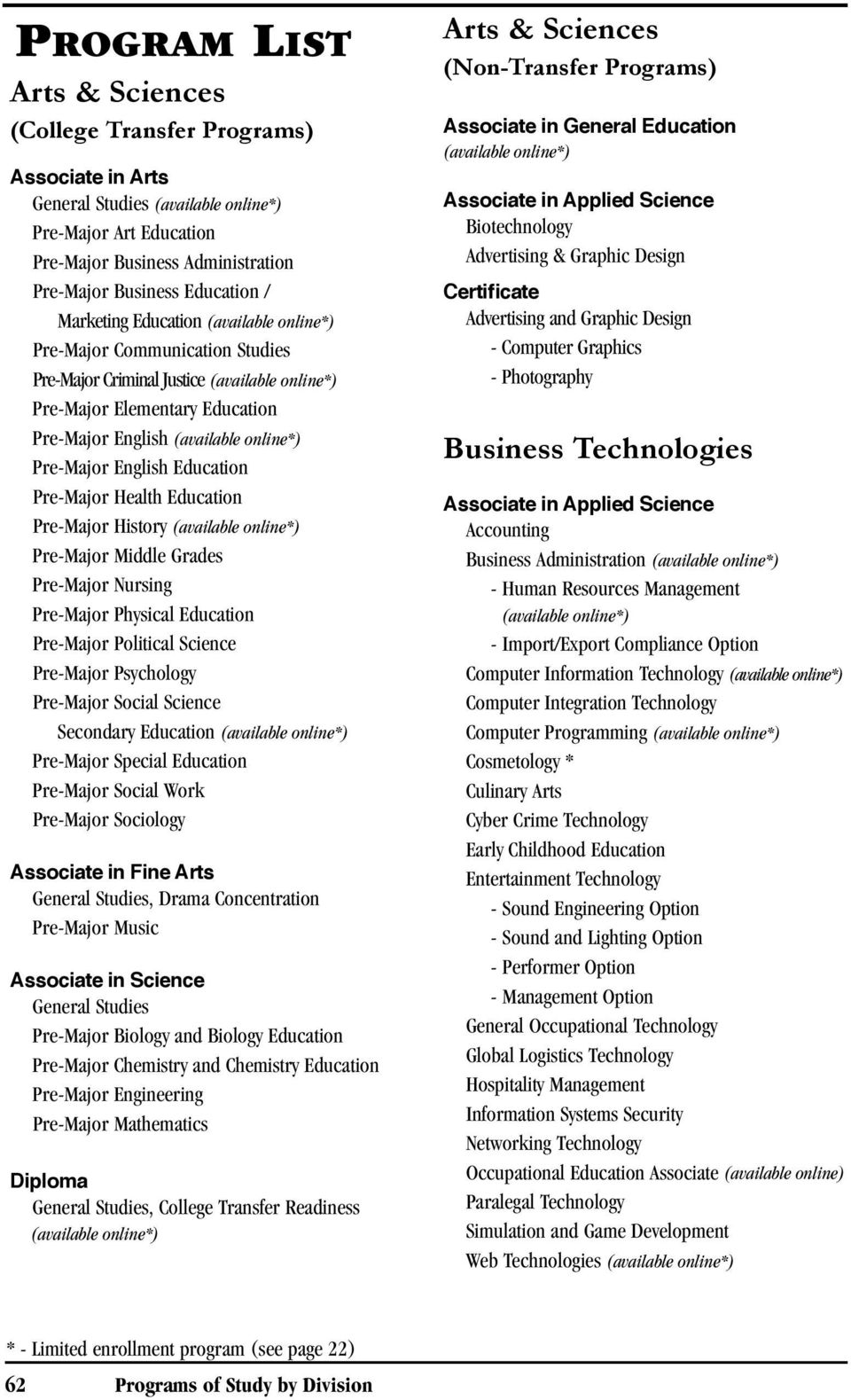
5 Business Technologies - Continued Diploma Accounting Cosmetology Culinary Technology Early Childhood Education Certificate Accounting Baking Business Administration - Human Resources Management (available online*) - Professional Selling Computer Information Technology - Basic Certificate (available online*) - Operating Systems Cosmetology Culinary Technology Early Childhood Education - Early Childhood Administration - Early Childhood School-age - Infant-Toddler Care Lateral Entry (available online*) Networking Technology - Routing Occupational Education (available online) Paralegal Technology - Bankruptcy - Corporate Business - Real Estate Web Technologies - Basic Certificate (available online*) - Advanced Certificate (available online*) Health Sciences Associate in Applied Science Associate Degree Nursing (Integrated)* Dental Hygiene* Healthcare Management Technology Medical Assisting* Medical Office Administration Office Administration (available online only) Physical Therapist Assistant* Pharmacy Technology* Radiography* Surgical Technology* Diploma Dental Assisting Medical Transcription (available online only)* Pharmacy Technology* Practical Nursing (Integrated)* Surgical Technology* Certificate Medical Office Administration - Hospital Billing and Coding - Medical Office Billing and Coding - Medical Office Administration - (available online) - Electronic Medical Records Office Administration (available online only) - Software Applications -Office Administration Receptionist * - Limited enrollment program (see page 22) Programs of Study by Division 63
6 Human Services & Public Safety Associate in Applied Science Criminal Justice Technology Emergency Medical Science* - Bridging Program Emergency Preparedness Technology Fire Protection Technology Human Services Technology - Substance Abuse - Mental Health Diploma Cosmetology Culinary Technology Early Childhood Education Certificate Basic Law Enforcement Training Emergency Preparedness Technology Human Services Technology - Mental Health Technology - Substance Abuse Prevention - Substance Abuse Treatment * - Limited enrollment program (see page 22) Industrial, Construction, & Engineering Technologies Associate in Applied Science Air Conditioning, Heating and Refrigeration Technology Architectural Technology Civil Engineering Technology Construction Management Technology Electrical/Electronics Technology Electronics Engineering Technology - Wireless Technician Option Industrial Systems Technology Computer Integrated Machining Manufacturing Technology Mechanical Engineering Technology - Drafting and Design Option - CAD Support Option Surveying Technology Telecommunications and Network Engineering Technology Turfgrass Management Diploma Air Conditioning, Heating and Refrigeration Technology Architectural Technology Carpentry Construction Management Technology Electrical/Electronics Technology - Electrical Construction - Master Electrician Electronics Engineering Technology Furniture Upholstery Industrial Systems Technology Computer Integrated Machining - Machinist Manufacturing Technology Mechanical Engineering Technology - Drafting and Design Telecommunications and Network Engineering Technology Turfgrass Management Welding Technology Certificate Air Conditioning, Heating and Refrigeration Technology - Air Conditioning - Comfort Systems Design - Commercial Control Systems - Control Systems - Heat Pumps 64 Programs of Study by Division

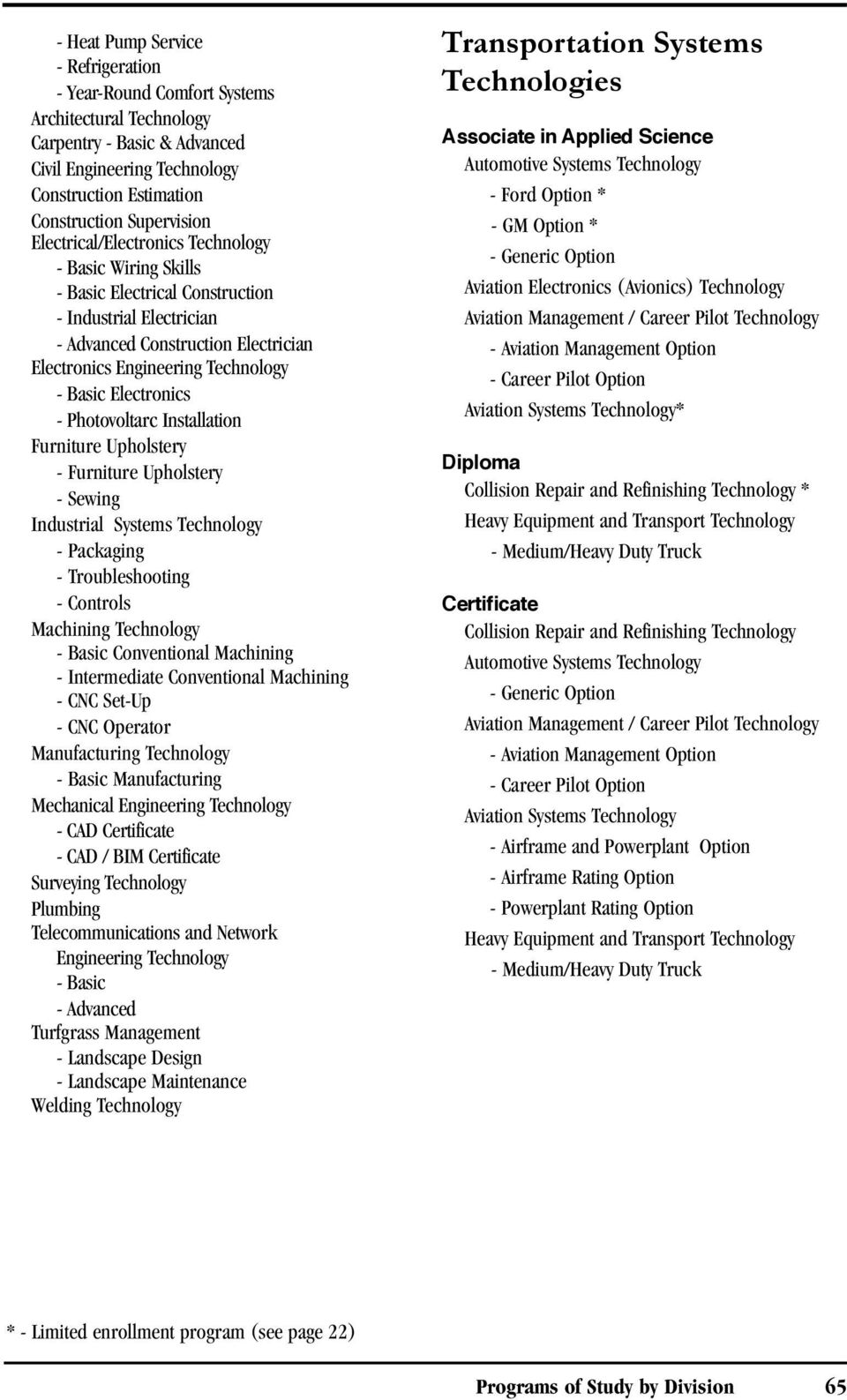
7 - Heat Pump Service - Refrigeration - Year-Round Comfort Systems Architectural Technology Carpentry - Basic & Advanced Civil Engineering Technology Construction Estimation Construction Supervision Electrical/Electronics Technology - Basic Wiring Skills - Basic Electrical Construction - Industrial Electrician - Advanced Construction Electrician Electronics Engineering Technology - Basic Electronics - Photovoltarc Installation Furniture Upholstery - Furniture Upholstery - Sewing Industrial Systems Technology - Packaging - Troubleshooting - Controls Machining Technology - Basic Conventional Machining - Intermediate Conventional Machining - CNC Set-Up - CNC Operator Manufacturing Technology - Basic Manufacturing Mechanical Engineering Technology - CAD Certificate - CAD / BIM Certificate Surveying Technology Plumbing Telecommunications and Network Engineering Technology - Basic - Advanced Turfgrass Management - Landscape Design - Landscape Maintenance Welding Technology Transportation Systems Technologies Associate in Applied Science Automotive Systems Technology - Ford Option * - GM Option * - Generic Option Aviation Electronics (Avionics) Technology Aviation Management / Career Pilot Technology - Aviation Management Option - Career Pilot Option Aviation Systems Technology* Diploma Collision Repair and Refinishing Technology * Heavy Equipment and Transport Technology - Medium/Heavy Duty Truck Certificate Collision Repair and Refinishing Technology Automotive Systems Technology - Generic Option Aviation Management / Career Pilot Technology - Aviation Management Option - Career Pilot Option Aviation Systems Technology - Airframe and Powerplant Option - Airframe Rating Option - Powerplant Rating Option Heavy Equipment and Transport Technology - Medium/Heavy Duty Truck * - Limited enrollment program (see page 22) Programs of Study by Division 65
8 Associate in Arts Program A Technical Arts & Sciences / Non-Transfer / College Degree Transfer The Associate in Arts degree program is designed for students who intend to pursue a Bachelor of Arts degree in one of the liberal arts disciplines or a bachelor s degree in a professional school which requires a strong background in the liberal arts prior to admission to the major. Students who are uncertain of their academic major should also enroll in this program. Students may want to choose the Associate in Science degree. This program is offered through the Comprehensive Articulation Agreement between the North Carolina Community College System and the University of North Carolina System. College students who complete the 44-hour general education core and graduate with a grade of C or better in each course will meet the general education requirements for freshmen and sophomores in North Carolina. They will then be eligible to be considered for admission with junior class standing to senior institutions in the University of North Carolina System. Graduates also will be eligible to be considered for admission with junior class standing to public institutions outside the state of North Carolina and many private institutions, including those in Guilford County and the greater Piedmont Triad. In order to ensure appropriate selection of courses, a student should determine his/her Pre-Major and preferred university as early as possible in his/her studies at GTCC. There are two ways to start a four-year degree at Guilford Tech: Complete an A.A., A.S., or A.F.A degree in an approved pre-major or college transfer general education degree plan. Complete the 44-hour general education core for the Diploma of Transfer Readiness. Complete at least 24 to 30 semester hours at GTCC with minimum grades of C in these courses. AA/AS Completion This is a student s best option for transfer to schools in the North Carolina University System because of the Comprehensive Articulation Agreement (CAA). This agreement states that NC community college graduates of approved pre-degree programs will, when admitted to a state university, enter as juniors and will have satisfied general education requirements (more information on the CAA is available on the web at student_info/caa/). Guilford Tech has established a variety of AA/AS/AFA degree plans for pre-majors as well as more generic general education college transfer degrees for students who may not wish to pursue a specific pre-major. To complete a pre-major or a general education degree, students should follow the program plan for that pre-major, working with an advisor and with the college catalog to complete the prescribed courses. Note that core courses and appropriate college transfer electives are listed in this section of the catalog. Diploma of Transfer Readiness The Diploma of Transfer Readiness is intended for students who do not intend to complete the associate degree but do want to transfer to a four-year institution. Students who complete the entire general education core as outlined will meet the 44 credit hour requirement for this diploma and will meet the general education core at any North Carolina system university or articulation agreement partners. The diploma, while not a 'permanent credential' in the sense of the AA or AS degree, does serve as a marker on students' transcripts so the universities know the general education core is complete. 66 Programs of Study - Associate of Arts Degree

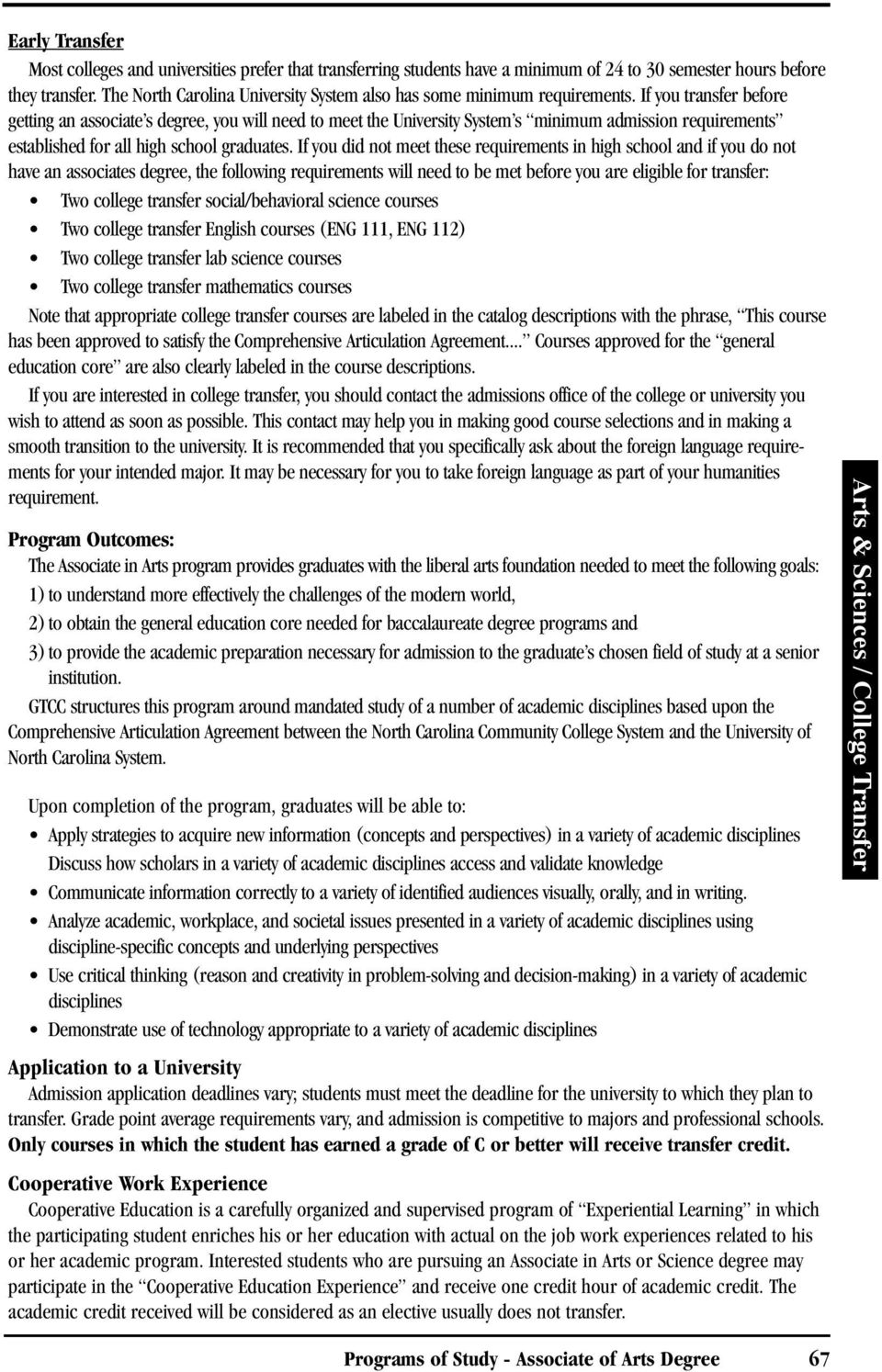
9 Early Transfer Most colleges and universities prefer that transferring students have a minimum of 24 to 30 semester hours before they transfer. The North Carolina University System also has some minimum requirements. If you transfer before getting an associate s degree, you will need to meet the University System s minimum admission requirements established for all high school graduates. If you did not meet these requirements in high school and if you do not have an associates degree, the following requirements will need to be met before you are eligible for transfer: Two college transfer social/behavioral science courses Two college transfer English courses (ENG 111, ENG 112) Two college transfer lab science courses Two college transfer mathematics courses Note that appropriate college transfer courses are labeled in the catalog descriptions with the phrase, This course has been approved to satisfy the Comprehensive Articulation Agreement... Courses approved for the general education core are also clearly labeled in the course descriptions. If you are interested in college transfer, you should contact the admissions office of the college or university you wish to attend as soon as possible. This contact may help you in making good course selections and in making a smooth transition to the university. It is recommended that you specifically ask about the foreign language requirements for your intended major. It may be necessary for you to take foreign language as part of your humanities requirement. Program Outcomes: The Associate in Arts program provides graduates with the liberal arts foundation needed to meet the following goals: 1) to understand more effectively the challenges of the modern world, 2) to obtain the general education core needed for baccalaureate degree programs and 3) to provide the academic preparation necessary for admission to the graduate s chosen field of study at a senior institution. GTCC structures this program around mandated study of a number of academic disciplines based upon the Comprehensive Articulation Agreement between the North Carolina Community College System and the University of North Carolina System. Upon completion of the program, graduates will be able to: Apply strategies to acquire new information (concepts and perspectives) in a variety of academic disciplines Discuss how scholars in a variety of academic disciplines access and validate knowledge Communicate information correctly to a variety of identified audiences visually, orally, and in writing. Analyze academic, workplace, and societal issues presented in a variety of academic disciplines using discipline-specific concepts and underlying perspectives Use critical thinking (reason and creativity in problem-solving and decision-making) in a variety of academic disciplines Demonstrate use of technology appropriate to a variety of academic disciplines Application to a University Admission application deadlines vary; students must meet the deadline for the university to which they plan to transfer. Grade point average requirements vary, and admission is competitive to majors and professional schools. Only courses in which the student has earned a grade of C or better will receive transfer credit. Cooperative Work Experience Cooperative Education is a carefully organized and supervised program of Experiential Learning in which the participating student enriches his or her education with actual on the job work experiences related to his or her academic program. Interested students who are pursuing an Associate in Arts or Science degree may participate in the Cooperative Education Experience and receive one credit hour of academic credit. The academic credit received will be considered as an elective usually does not transfer. Technical Arts & Sciences / Non-Transfer / College Degree Transfer Programs of Study - Associate of Arts Degree 67
10 Associate in Science Program A The Associate in Science degree program is designed for students who intend to pursue a Bachelor of Science degree in one of the science disciplines or a Bachelor s degree in a professional school which requires a strong background in mathematics and sciences prior to admission to the major. This program is offered through the Comprehensive Articulation Agreement between the North Carolina Community College System and the University of North Carolina System. Students who complete the 44 hour general education core and graduate with a grade of C or better in each course will meet the general education (freshman and sophomore) requirements and be eligible to be considered for admission with junior class standing to senior institutions in the University of North Carolina System. Graduates will also be eligible to be considered for admission with junior class standing to public institutions outside the state of North Carolina and many private institutions, including those in Guilford County and the greater Piedmont Triad. In order to ensure appropriate selection of courses, a student should determine his/her pre-major and preferred university as early as possible in his/her studies at GTCC. Arts Technical & Sciences / Non-Transfer / College Transfer Degree Program Outcomes: The Associate in Science program provides graduates with the liberal arts foundation needed to meet the following goals: 1) to understand more effectively the challenges of the modern world, 2) to obtain the general education core needed for baccalaureate degree programs and 3) to provide the academic preparation necessary for admission to the graduate s chosen field of study at a senior institution. GTCC structures this program around mandated study of a number of academic disciplines based upon the Comprehensive Articulation Agreement between the North Carolina Community College System and the University of North Carolina System. Upon completion of the program, graduates will be able to: Apply strategies to acquire new information (concepts and perspectives) in a variety of academic disciplines Discuss how scholars in a variety of academic disciplines access and validate knowledge Communicate information correctly to a variety of identified audiences visually, orally, and in writing. Analyze academic, workplace, and societal issues presented in a variety of academic disciplines using discipline-specific concepts and underlying perspectives Use critical thinking (reason and creativity in problem-solving and decision-making) in a variety of academic disciplines Demonstrate use of technology appropriate to a variety of academic disciplines Application to a University Admission application deadlines vary; students must meet the deadline for the university to which they plan to transfer. Grade point average requirements vary and admission is competitive to majors and professional schools. Only courses in which the student has earned a grade of C or better will receive transfer credit. Cooperative Work Experience Cooperative work experience is available to students in the Pre-Major programs that follow. 68 Programs of Study - Associate of Science Degree

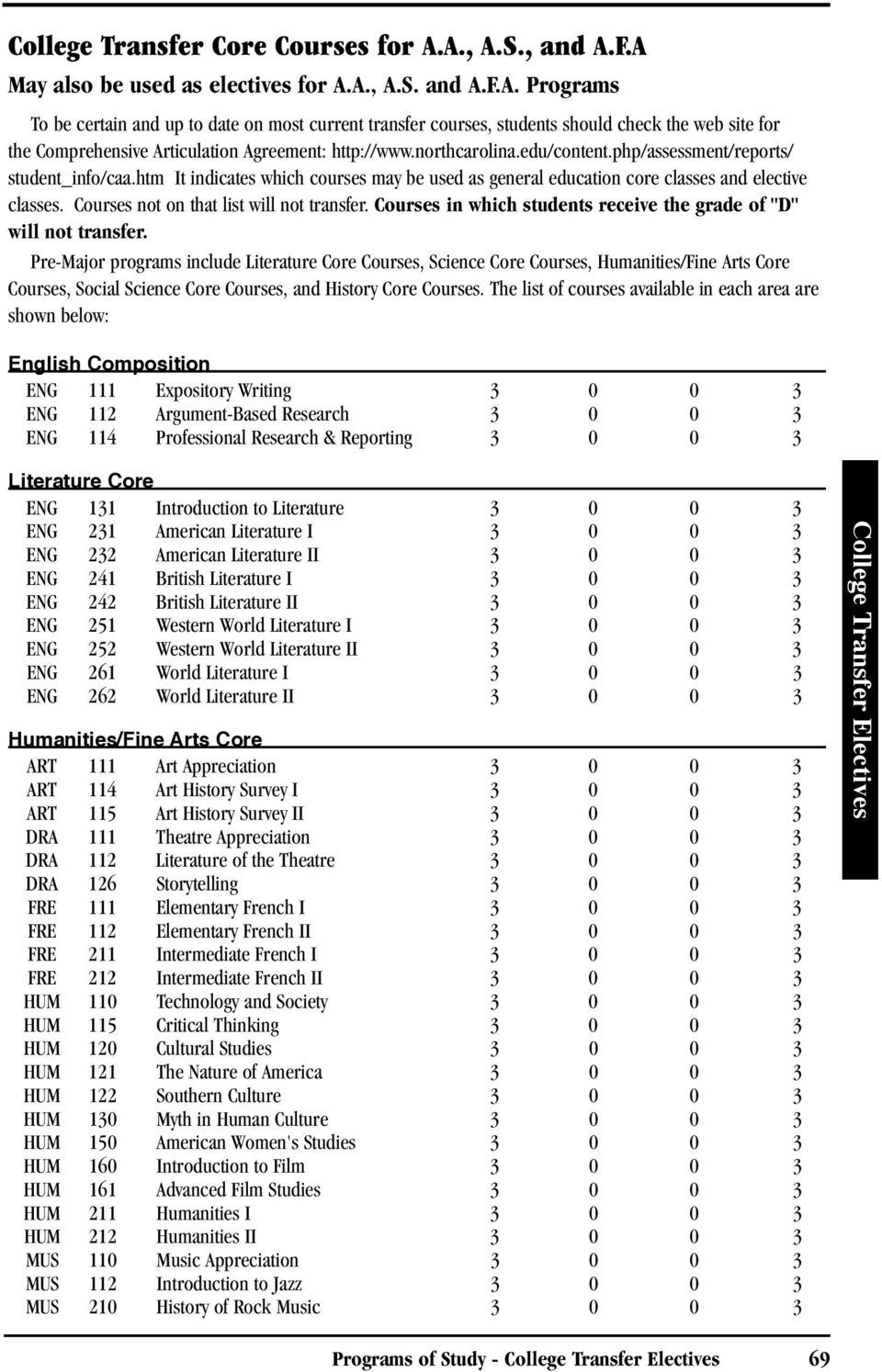
11 College Transfer Core Courses for A.A., A.S., and A.F.A May also be used as electives for A.A., A.S. and A.F.A. Programs To be certain and up to date on most current transfer courses, students should check the web site for the Comprehensive Articulation Agreement: student_info/caa.htm It indicates which courses may be used as general education core classes and elective classes. Courses not on that list will not transfer. Courses in which students receive the grade of "D" will not transfer. Pre-Major programs include Literature Core Courses, Science Core Courses, Humanities/Fine Arts Core Courses, Social Science Core Courses, and History Core Courses. The list of courses available in each area are shown below: English Composition ENG 111 Expository Writing ENG 112 Argument-Based Research ENG 114 Professional Research & Reporting Literature Core ENG 131 Introduction to Literature ENG 231 American Literature I ENG 232 American Literature II ENG 241 British Literature I ENG 242 British Literature II ENG 251 Western World Literature I ENG 252 Western World Literature II ENG 261 World Literature I ENG 262 World Literature II Humanities/Fine Arts Core ART 111 Art Appreciation ART 114 Art History Survey I ART 115 Art History Survey II DRA 111 Theatre Appreciation DRA 112 Literature of the Theatre DRA 126 Storytelling FRE 111 Elementary French I FRE 112 Elementary French II FRE 211 Intermediate French I FRE 212 Intermediate French II HUM 110 Technology and Society HUM 115 Critical Thinking HUM 120 Cultural Studies HUM 121 The Nature of America HUM 122 Southern Culture HUM 130 Myth in Human Culture HUM 150 American Women's Studies HUM 160 Introduction to Film HUM 161 Advanced Film Studies HUM 211 Humanities I HUM 212 Humanities II MUS 110 Music Appreciation MUS 112 Introduction to Jazz MUS 210 History of Rock Music Technical College / Non-Transfer Electives Degree Programs of Study - College Transfer Electives 69
12 Humanities/Fine Arts Core - Continued PHI 210 History of Philosophy PHI 215 Philosophical Issues PHI 240 Introduction to Ethics REL 110 World Religions REL 111 Eastern Religions REL 112 Western Religions REL 211 Introduction to Old Testament REL 212 Introduction to New Testament REL 221 Religion in America SPA 111 Elementary Spanish I SPA 112 Elementary Spanish II SPA 211 Intermediate Spanish I SPA 212 Intermediate Spanish II Technical College / Non-Transfer Electives Degree Mathematics Core CIS 110 Introduction to Computers CIS 115 Introduction to Programming & Logic MAT 140 Survey of Mathematics* MAT 140A Survey of Math Lab MAT 151 Statistics I MAT 151A Statistics I Lab MAT 161 College Algebra MAT 161A College Algebra Lab MAT 171 Precalculus Algebra MAT 171A Precalculus Algebra Lab MAT 172 Precalculus Trigonometry MAT 172A Precalculus Trigonometry Lab MAT 175 Precalculus MAT 175A Precalculus Lab MAT 263 Brief Calculus MAT 271 Calculus I MAT 272 Calculus II MAT 273 Calculus III *May be applied to A.A. or A.F.A degrees only. 70 Programs of Study - College Transfer Electives

13 Natural Sciences Core (Note: Lab must be taken for AA/AS graduation credit.) AST 111 Descriptive Astronomy AST 111A Descriptive Astronomy Lab AST 151 General Astronomy I AST 151A General Astronomy I Lab AST 152 General Astronomy II AST 152A General Astronomy II Lab BIO 110 Principles of Biology BIO 111 General Biology I BIO 112 General Biology II BIO 140 Environmental Biology BIO 140A Environmental Biology Lab CHM 131 Introduction to Chemistry CHM 131A Introduction to Chemistry Lab CHM 132 Organic and Biochemistry CHM 151 General Chemistry I CHM 152 General Chemistry II GEL 111 Introduction to Geology PHY 110 Conceptual Physics PHY 110A Conceptual Physics Lab PHY 151 College Physics I PHY 152 College Physics II PHY 251 General Physics I PHY 252 General Physics II Social Sciences Core (Note: Most GTCC college transfer pre-major degrees require TWO history classes as a part of their Social/ Behavioral Sciences Core; students should choose from two different prefixes other than HIS for their other Social Sciences courses.) ANT 210 General Anthropology ANT 220 Cultural Anthropology ECO 251 Principles of Microeconomics ECO 252 Principles of Macroeconomics GEO 111 World Regional Geography GEO 112 Cultural Geography HIS 111 World Civilizations I HIS 112 World Civilizations II HIS 121 Western Civilization I HIS 122 Western Civilization II HIS 131 American History I HIS 132 American History II POL 120 American Government POL 210 Comparative Government POL 220 International Relations PSY 150 General Psychology PSY 239 Psychology of Personality PSY 241 Developmental Psychology PSY 281 Abnormal Psychology SOC 210 Introduction to Sociology SOC 213 Sociology of the Family SOC 220 Social Problems SOC 225 Social Diversity SOC 240 Social Psychology Technical College / Non-Transfer Electives Degree Programs of Study - College Transfer Electives 71

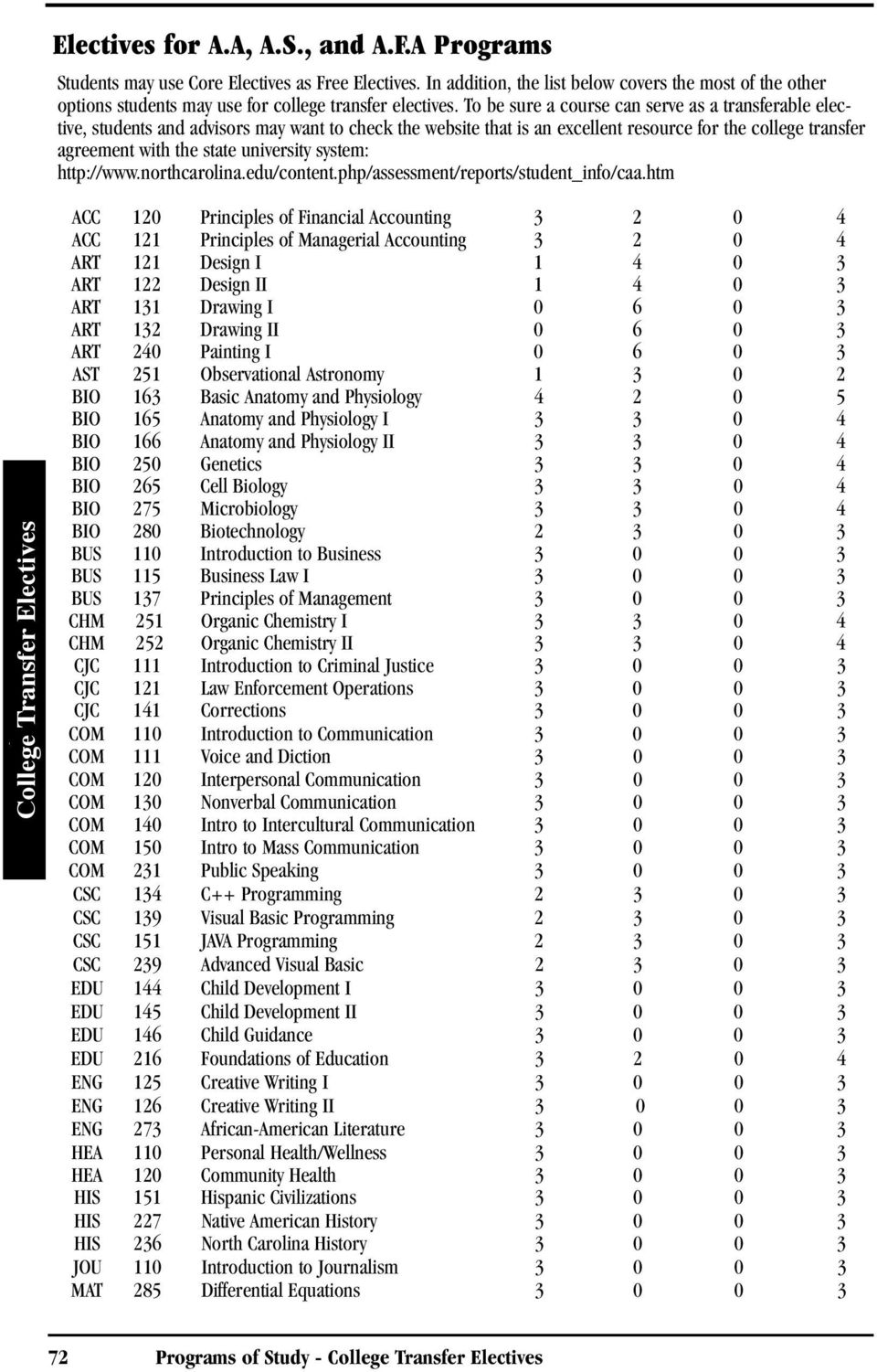
14 Electives for A.A, A.S., and A.F.A Programs Students may use Core Electives as Free Electives. In addition, the list below covers the most of the other options students may use for college transfer electives. To be sure a course can serve as a transferable elective, students and advisors may want to check the website that is an excellent resource for the college transfer agreement with the state university system: Technical College / Non-Transfer Electives Degree ACC 120 Principles of Financial Accounting ACC 121 Principles of Managerial Accounting ART 121 Design I ART 122 Design II ART 131 Drawing I ART 132 Drawing II ART 240 Painting I AST 251 Observational Astronomy BIO 163 Basic Anatomy and Physiology BIO 165 Anatomy and Physiology I BIO 166 Anatomy and Physiology II BIO 250 Genetics BIO 265 Cell Biology BIO 275 Microbiology BIO 280 Biotechnology BUS 110 Introduction to Business BUS 115 Business Law I BUS 137 Principles of Management CHM 251 Organic Chemistry I CHM 252 Organic Chemistry II CJC 111 Introduction to Criminal Justice CJC 121 Law Enforcement Operations CJC 141 Corrections COM 110 Introduction to Communication COM 111 Voice and Diction COM 120 Interpersonal Communication COM 130 Nonverbal Communication COM 140 Intro to Intercultural Communication COM 150 Intro to Mass Communication COM 231 Public Speaking CSC 134 C++ Programming CSC 139 Visual Basic Programming CSC 151 JAVA Programming CSC 239 Advanced Visual Basic EDU 144 Child Development I EDU 145 Child Development II EDU 146 Child Guidance EDU 216 Foundations of Education ENG 125 Creative Writing I ENG 126 Creative Writing II ENG 273 African-American Literature HEA 110 Personal Health/Wellness HEA 120 Community Health HIS 151 Hispanic Civilizations HIS 227 Native American History HIS 236 North Carolina History JOU 110 Introduction to Journalism MAT 285 Differential Equations Programs of Study - College Transfer Electives
15 PED 110 Fit and Well for Life PED 111 Physical Fitness I PED 112 Physical Fitness II PED 113 Aerobics I PED 114 Aerobics II PED 117 Weight Training I PED 118 Weight Training II PED 119 Circuit Training PED 120 Walking for Fitness PED 121 Walk, Jog, Run PED 122 Yoga I PED 123 Yoga II PED 128 Golf-Beginning PED 129 Golf-Intermediate PED 139 Bowling-Beginning PED 140 Bowling-Intermediate PED 143 Volleyball-Beginning PED 144 Volleyball-Intermediate PED 145 Basketball-Beginning PED 146 Basketball-Intermediate PED 152 Swimming-Beginning PED 153 Swimming-Intermediate PED 154 Swimming for Fitness PED 155 Water Aerobics PED 216 Indoor Cycling PED 240 Advanced PE Skills Technical College / Non-Transfer Electives Degree Programs of Study - College Transfer Electives 73

16 Technical Electives Degree Associate of Applied Science / Associate of General Education General Education Options for Two Year - Technical Degree Programs These courses are typically offered at GTCC and most commonly used to meet technical programs' general education requirements. A complete and updated listing of all NCCCS courses satisfying general education requirements can be located on the General Ed Matrix: Humanities/Fine Arts For Humanities/Fine Arts electives, choose from the list below: ART 111 Art Appreciation ART 114 Art History Survey I ART 115 Art History Survey II COM 140 Intro to Intercultural Communication DRA 111 Theatre Appreciation DRA 112 Literature of the Theatre DRA 126 Storytelling ENG 125 Creative Writing ENG 131 Introduction to Literature ENG 231 American Literature I ENG 232 American Literature II ENG 241 British Literature I ENG 242 British Literature II ENG 251 Western World Literature I ENG 252 Western World Literature II ENG 261 World Literature I ENG 262 World Literature II ENG 273 African-American Literature HUM 110 Technology Society HUM 115 Critical Thinking HUM 120 Cultural Studies HUM 121 The Nature of America HUM 122 Southern Culture HUM 130 Myth in Human Culture HUM 150 American Women's Studies HUM 160 Introduction to Film HUM 211 Humanities I HUM 212 Humanities II MUS 110 Music Appreciation MUS 111 Fundamentals of Music MUS 112 Introduction to Jazz MUS 121 Music Theory I PHI 210 History of Philosophy PHI 215 Philosophical Issues PHI 240 Introduction to Ethics REL 110 World Religions REL 111 Eastern Religions REL 112 Western Religions REL 211 Introduction to Old Testament REL 212 Introduction to New Testament REL 221 Religion in America Natural Sciences/Mathematics For Natural Sciences/Mathematics electives, choose from the list below: AST 111 Descriptive Astronomy (with lab) AST 151 General Astronomy I (with lab) BIO 110 Principles of Biology BIO 111 General Biology I BIO 140 Environmental Biology (with lab) BIO 163 Basic Anatomy and Physiology BIO 165 Anatomy and Physiology I Programs of Study - Technical Electives

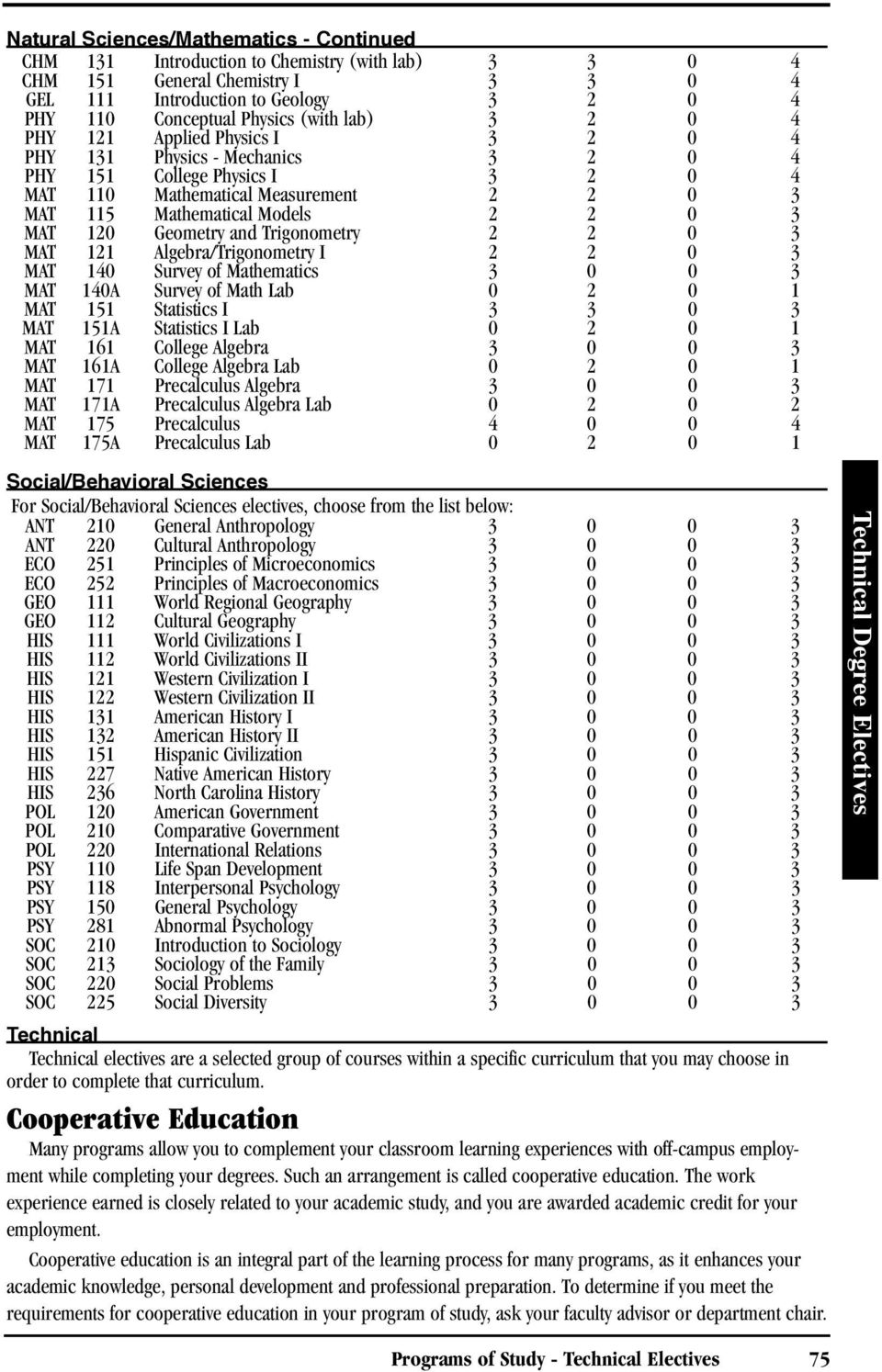
17 Natural Sciences/Mathematics - Continued CHM 131 Introduction to Chemistry (with lab) CHM 151 General Chemistry I GEL 111 Introduction to Geology PHY 110 Conceptual Physics (with lab) PHY 121 Applied Physics I PHY 131 Physics - Mechanics PHY 151 College Physics I MAT 110 Mathematical Measurement MAT 115 Mathematical Models MAT 120 Geometry and Trigonometry MAT 121 Algebra/Trigonometry I MAT 140 Survey of Mathematics MAT 140A Survey of Math Lab MAT 151 Statistics I MAT 151A Statistics I Lab MAT 161 College Algebra MAT 161A College Algebra Lab MAT 171 Precalculus Algebra MAT 171A Precalculus Algebra Lab MAT 175 Precalculus MAT 175A Precalculus Lab Social/Behavioral Sciences For Social/Behavioral Sciences electives, choose from the list below: ANT 210 General Anthropology ANT 220 Cultural Anthropology ECO 251 Principles of Microeconomics ECO 252 Principles of Macroeconomics GEO 111 World Regional Geography GEO 112 Cultural Geography HIS 111 World Civilizations I HIS 112 World Civilizations II HIS 121 Western Civilization I HIS 122 Western Civilization II HIS 131 American History I HIS 132 American History II HIS 151 Hispanic Civilization HIS 227 Native American History HIS 236 North Carolina History POL 120 American Government POL 210 Comparative Government POL 220 International Relations PSY 110 Life Span Development PSY 118 Interpersonal Psychology PSY 150 General Psychology PSY 281 Abnormal Psychology SOC 210 Introduction to Sociology SOC 213 Sociology of the Family SOC 220 Social Problems SOC 225 Social Diversity Technical Technical electives are a selected group of courses within a specific curriculum that you may choose in order to complete that curriculum. Cooperative Education Many programs allow you to complement your classroom learning experiences with off-campus employment while completing your degrees. Such an arrangement is called cooperative education. The work experience earned is closely related to your academic study, and you are awarded academic credit for your employment. Cooperative education is an integral part of the learning process for many programs, as it enhances your academic knowledge, personal development and professional preparation. To determine if you meet the requirements for cooperative education in your program of study, ask your faculty advisor or department chair. Electives Degree Programs of Study - Technical Electives 75
18 Accounting A Associate in Applied Science, Jamestown, day and evening Diploma, Jamestown, day and evening Certificate, Jamestown, day and evening Contact Information: (336) , ext from Greensboro (336) , ext from High Point The accounting curriculum is designed to provide students with the knowledge and the skills necessary for employment and growth in the accounting profession. Using the language of business, accountants assemble and analyze, process, and communicate essential information about financial operations. In addition to course work in accounting principles, theories, and practice, students will study business law, finance, management, and economics. Related business and critical thinking skills are developed through the study of communications, computer applications, financial analysis, and ethics. The use of computers is integrated in the accounting courses to provide students with marketable job skills. Teamwork skills are enhanced through classroom practice. Graduates should qualify for entry-level accounting positions in many types of organizations including accounting firms, small businesses, manufacturing firms, banks, hospitals, school systems and governmental agencies. With work experience and additional education, an individual may advance in the accounting profession. Students will be required to use technology (computer, internet, etc.) in all courses in this program. Most courses required under this program are offered in a variety of formats: Traditional (face to face, in a classroom setting) On-line (no traditional class time - lecture/labs on-line) Hybrid (part face-to-face classroom, part on-line) Program Outcomes: Upon successful completion of the Accounting program, the graduate should be able to: record financial transactions of a company properly prepare financial statements that fairly present the financial position of a company prepare supporting schedules to those financial statements accurately prepare basic individual and small business tax returns accurately apply the time-value of money concepts to financial transactions accurately use electronic spreadsheets effectively as it applies in a business environment use accounting software effectively for practical applications in a business environment. 76 Programs of Study

19 Accounting - Associate in Applied Science, Jamestown, day/evening Advising Code: A Fall Semester I ACA 111 College Student Success ACC 120 Principles of Financial Accounting BUS 121 Business Math ECO 251 Principles of Microeconomics ENG 111 Expository Writing MAT 115 Mathematical Models or MAT 140 Survey of Mathematics or (3) (0) (0) (3) MAT 161 College Algebra (3) (0) (0) (3) Total 14(15) 4(6) 0 17 Spring Semester I ACC 121 Principles of Managerial Accounting ACC 149 Intro to Accounting Spreadsheets BUS 115 Business Law I CIS 110 Introduction to Computers or CIS 111 Basic PC Literacy or (1) (2) (0) (2) OST 137 Office Software Applications (2) (2) (0) (3) ECO 252 Principles of Macroeconomics Total 11(12) (15) Summer Term I ACC 140 Payroll Accounting ACC 150 Accounting Software Apps ACC 151 Accounting Spreadsheet Apps Technical Elective Total Fall Semester II ACC 129 Individual Income Taxes ACC 220 Intermediate Accounting I BUS 225 Business Finance DBA 110 Database Concepts ENG 112 Argument Based Research or ENG 114 Professional Research & Reporting (3) (0) (0) (3) Total Spring Semester II ACC 130 Business Income Taxes ACC 180 Practices in Bookkeeping ACC 221 Intermediate Accounting II COM 120 Intro to Interpersonal Comm or COM 231 Public Speaking (3) (0) (0) (3) HUM 115 Critical Thinking Total Total credit hours required for degree: 73 This curriculum is subject to change. Technical Electives: Choose 3 credits from: ACC 170, ACC 226, ACC 227, ACC 240, ACC 269, BUS 110, BUS 125, BUS 137, BUS 151, BUS 217, BUS 228, BUS 240, BUS 234, BUS 260, BUS 280, DBA 110, ECO 251, ECO 252, LOG 110, MKT 120, MKT 121, MKT 123, MKT 224, or COE 113. Programs of Study 77

20 Accounting - Diploma, Jamestown, day / evening Advising Code: A D1 Fall Semester I ACC 120 Principles of Financial Accounting BUS 115 Business Law I COM 120 Intro to Interpersonal Comm BUS 240 Business Ethics Totals Spring Semester I ACC 121 Principles of Managerial Accounting ACC 149 Intro to Accounting Spreadsheets ACC 220 Intermediate Accounting ENG 111 Expository Writing Totals Summer Semester I ACC 129 Individual Income Taxes ACC 221 Intermediate Accounting II ACC 225 Cost Accounting Totals Fall Semester II ACC 130 Business Taxes ACC 269 Audit and Assurance Services ACC 240 Gov. & Not For Profit Accounting BUS 225 Business Finance Totals Accounting - Certificate, Jamestown, day / evening Advising Code: A C1 Fall Semester I ACC 120 Principles of Financial Accounting BUS 121 Business Math Total Spring Semester I ACC 121 Principles of Managerial Accounting ACC 125 Mathematics of Finance Total Summer Term I ACC 140 Payroll Accounting ACC 150 Accounting Software Applications Total Total credit hours required for certificate: 18 This curriculum is subject to change. 78 Programs of Study

21 Advertising and Graphic Design A Associate in Applied Science, Jamestown, day Certificate, Jamestown, day and evening Contact Information: (336) , ext from Greensboro (336) , ext from High Point The Advertising and Graphic Design curriculum is designed to provide students with the knowledge and skills necessary for employment in the graphic design profession. The program emphasizes design, advertising, illustration and digital and multimedia preparation of printed and electronic promotional materials. Students will be trained in the development and design of promotional materials such as newspaper and magazine advertisements, posters, folders, letterheads, corporate symbols, brochures, booklets, and the preparation of art for printing, lettering, as well as typography, photography, and electronic media. Graduates should qualify for employment opportunities with graphic design studios, advertising agencies, printing companies, department stores, and a wide variety of manufacturing industries, newspapers, and businesses with in-house graphics operations. Capstone course: GRD 280 Portfolio Design. Program Outcomes: Upon successful completion of the Commercial Art and Advertising Design program, the graduate should be able to: prepare visual communications using the appropriate software; prepare traditional and electronic designs, layouts, comprehensive proofs, storyboards, illustrations; create projects; direct illustration and photography. Advertising and Graphic Design - Associate in Applied Science, Jamestown, day Advising Code: A Fall Semester I ART 131 Drawing I ENG 111 Expository Writing GRA 151 Computer Graphics I GRA 161 Computer Graphics Applications I GRD 110 Typography I GRD 141 Graphic Design I Total Spring Semester I ART 111 Art Appreciation ENG 114 Professional Research and Reporting GRA 152 Computer Graphics II* GRA 162 Computer Graphics Applications II GRD 131 Illustration I GRD 142 Graphic Design II* GRD 146 Design Applications II Total Programs of Study 79
22 Summer Term I GRD 160 Photo Fundamentals I* GRD 233 Product Illustration* Total Fall Semester II GRA 153 Computer Graphics III* GRD 161 Photo Fundamentals II* GRD 241 Graphic Design III* GRD 246 Design Applications III MAT 115 Mathematical Models Total Spring Semester II COM 120 Intro to Interpersonal Communication GRD 242 Graphic Design IV* GRD 247 Design Applications IV GRD 271 Multimedia I GRD 285 Client/Media Relations Graphic Design Technical Elective Social / Behavior Science Elective Total Summer Term II GRD 243 Graphic Design V* GRD 280 Portfolio Design* Total Total credit hours required for degree: This curriculum is subject to change. *A student must complete the pre-requisite courses with a minimum grade of C or better before advancing to the next course. Graphic Design Electives: GRA 154 Computer Graphics IV* GRD 111 Typography II* GRD 272 Multimedia II* GRD 162 Photo Portfolio* Programs of Study
23 Computer Graphics - Certificate, Jamestown, day and evening Advising Code: A C1 Fall Semester GRA 151 Computer Graphics I GRA 162 Computer Graphics Applications II GRD 141 Graphic Design Total Spring Semester GRA 152 Computer Graphics II Total Fall Semester II GRA 153 Computer Graphics III GRA 163 Computer Graphics Applications III Total Total credit hours required for certificate: 12 This curriculum is subject to change. Photography - Certificate, Jamestown, day and evening Advising Code: A C2 Summer Term I (1) GRD 160 Photo Fundamentals I Total Fall Semester I GRD 161 Photo Fundamentals II Total Spring Semester I GRD 162 Photo Portfolio Total Fall Semester II GRA 153 Computer Graphics III GRA 163 Computer Graphics Applications III Total Total credit hours required for certificate: 12 This curriculum is subject to change. (1) This schedule starts the student in the summer with daytime photo classes. Students may instead begin in the Fall with evening photo classes: Fall Semester: GRA 151, GRA 162, GRD 160. Spring Semester: GRD 161. Summer Term: GRD nd Fall Semester: GRA 153. Programs of Study 81
24 Air Conditioning, Heating and Refrigeration Technology A Associate in Applied Science, Greensboro, day and evening Diploma, Greensboro, day and evening Certificate, Greensboro, day and evening Contact Information: (336) , ext from Greensboro (336) , ext from High Point The Air Conditioning, Heating and Refrigeration Technology curriculum provides students with the basic knowledge to develop the skills necessary to work with residential and light commercial systems. Topics include mechanical refrigeration, heating and cooling theory, electricity, controls and safety. The diploma program covers air conditioning, furnaces, heat pumps, tools and instruments. In addition, the Associate in Applied Science degree covers residential building codes, residential system sizing and advanced comfort systems. Diploma graduates should be able to assist in the start up, preventive maintenance, service, repair and/or installation of residential and light commercial systems. Associate degree graduates should be able to demonstrate an understanding of system selection and balance, and advanced systems. Program Outcomes: Upon successful completion of the Air Conditioning, Heating, and Refrigeration program, the graduate should be able to: design and install heating and cooling systems; service and repair heating, cooling, and accessory systems; perform preventive maintenance; use tools and equipment safely. Air Conditioning, Heating and Refrigeration Technology Associate in Applied Science, Greensboro Day Advising Code: A Fall Semester I AHR 110 Introduction to Refrigeration AHR 112 Heating Technology MAT 110 Mathematical Measurement AHR 210 Residential Building Codes or AHR 220 Commercial Building Codes (2) (0) (0) (2) ELC 111 Introduction to Electricity or AHR 111 HVACR Electricity (2) (2) (0) (3) Total 9(10) 14(16) 0 17 Spring Semester I AHR 113 Comfort Cooling AHR 114 Heat Pump Technology ELC 117 Motors and Controls ENG 111 Expository Writing CIS 111 Basic PC Literacy AHR 160 Refrigerant Certification Total Programs of Study
25 Summer Term I AHR 212 Advanced Comfort Systems AHR 130 HVAC Controls Total Fall Semester II AHR 255 Indoor Air Quality AHR 240 Hydronic Heating AHR 180 HVACR Customer Relations Technical Elective Social / Behavior Science Elective COM 120 Intro to Interpersonal Comm Total Spring Semester II AHR 211 Residential System Design or AHR 225 Commercial Building Design (2) (3) (0) (3) AHR 235 Refrigeration Design Humanities / Fine Arts Elective ENG 114 Professional Research & Reporting or ENG 112 Argument Based Research (3) (0) (0) (3) PHY 121 Applied Physics I Total 13 6(7) 0 16 Total credit hours required for degree: This curriculum is subject to change. Technical Electives selected from: AHR 263, AHR 250, and COE 111 and 121 or COE 112. Air Conditioning, Heating and Refrigeration Technology Associate in Applied Science, Greensboro Evening Advising Code: A Fall Semester I AHR 112 Heating Technology MAT 110 Mathematical Measurement AHR 210 Residential Building Codes or AHR 220 Commercial Building Codes (2) (0) (0) (2) Total 5(6) Spring Semester I AHR 110 Introduction to Refrigeration ENG 111 Expository Writing ELC 111 Introduction to Electricity or AHR 111 HVACR Electricity (2) (2) (0) (3) Total Summer Term I AHR 160 Refrigerant Certification AHR 211 Residential System Design or AHR 225 Commercial System Design (2) (3) (0) (3) AHR 180 HVACR Customer Relations Total 4 2(3) 0 5 Programs of Study 83
26 Fall Semester II AHR 113 Comfort Cooling ELC 117 Motors and Controls CIS 111 Basic PC Literacy Total Spring Semester II AHR 130 HVAC Controls AHR 114 Heat Pump Technology COM 120 Intro to Interpersonal Communication Total Summer Term II AHR 212 Advanced Comfort Systems Total Fall Semester III AHR 240 Hydronic Heating AHR 255 Indoor Air Quality PHY 131 Physics - Mechanics or PHY 110 Conceptual Physics (3) (0) (0) (3) Total Spring Semester III ENG 114 Professional Research & Reporting or ENG 112 Argument Based Research (3) (0) (0) (3) AHR 235 Refrigeration Design Social / Behavior Science Elective Humanities / Fine Arts Elective Total Summer Term III Technical Elective Total Total credit hours required for degree: This curriculum is subject to change. Technical Electives selected from: ELC 117, AHR 263, AHR 250, and COE 111 and 121 or COE Programs of Study
27 Air Conditioning, Heating and Refrigeration Technology Diploma, Greensboro, day and evening Advising Code: A D1 AHR 110 Introduction to Refrigeration AHR 112 Heating Technology MAT 110 Mathematical Measurements AHR 210 Residential Building Codes CIS 111 Basic PC Literacy AHR 113 Comfort Cooling AHR 114 Heat Pump Technology ELC 111 Introduction to Electricity or AHR 111 HVACR Electricity (2) (2) (0) (3) ENG 111 Expository Writing ELC 117 Motors and Controls AHR 160 Refrigerant Certification AHR 212 Advanced Comfort Systems AHR 130 HVAC Controls AHR 211 Residential System Design Total Total credit hours required for diploma: 45 This curriculum is subject to change. Air Conditioning - Certificate, Greensboro, Day and Evening Advising Code: A C1 AHR 110 Introduction to Refrigeration ELC 111 Intro. To Electricity AHR 113 Comfort Cooling Total Total credit hours required for certificate: 12 This curriculum is subject to change. Control Systems - Certificate, Greensboro, Day and Evening Advising Code: A C2 AHR 110 Introduction to Refrigeration ELC 111 Intro. To Electricity ELC 117 Motors and Controls AHR 130 HVAC Controls Total Total credit hours required for certificate: 15 This curriculum is subject to change. Programs of Study 85
28 Heat Pumps - Certificate, Greensboro, Day and Evening Advising Code: A C3 AHR 110 Introduction to Refrigeration ELC 111 Intro. To Electricity AHR 114 Heat Pump Technology Total Total credit hours required for certificate: 12 This curriculum is subject to change. Refrigeration - Certificate, Greensboro, Day and Evening Advising Code: A C4 AHR 110 Introduction to Refrigeration ELC 111 Intro. To Electricity AHR 160 Refrigeration Certification AHR 235 Refrigeration Design Total Total credit hours required for certificate: 12 This curriculum is subject to change. Year Round Comfort Systems - Certificate, Greensboro, Day and Evening Advising Code: A C5 ELC 111 Introduction to Electricity AHR 112 Heating Technology AHR 113 Comfort Cooling AHR 114 Heat Pump Technology Total Total credit hours required for certificate: 15 This curriculum is subject to change. 86 Programs of Study Commercial Control Systems - Certificate, Greensboro, Day and Evening Advising Code: A C6 ELC 111 Introduction To Electricity AHR 130 HVAC Controls ELC 117 Motors and Controls AHR 263 Energy Management or AHR 212 Advanced Comfort Systems (2) (6) (0) (4) Total Total credit hours required for certificate: This curriculum is subject to change.
29 Comfort System Design - Certificate, Greensboro, Day and Evening Advising Code: A C7 AHR 210 Residential Building Codes AHR 211 Residential System Design AHR 220 Commercial Building Codes AHR 225 Commercial System Design AHR 255 Indoor Air Quality Total Total credit hours required for certificate: 12 This curriculum is subject to change. Heat Pump Service - Certificate, Greensboro, Day and Evening Advising Code: A C8 ELC 111 Intro. To Electricity AHR 113 Comfort Cooling AHR 114 Heat Pump Technology AHR 212 Advanced Comfort Systems AHR 250 HVAC System Diagnostics Total Total credit hours required for certificate: 17 This curriculum is subject to change. Programs of Study 87
30 Architectural Technology A Associate in Applied Science, Greensboro, day Diploma, Greensboro, day Certificate, Greensboro, day/night Contact Information: (336) , ext from Greensboro (336) , ext from High Point The Architectural Technology curriculum provides individuals with the opportunity to gain the knowledge and skills that will lead to entry-level employment in a number of construction related fields. Architectural technicians will be involved in work requiring knowledge of computer aided drafting (CAD); construction materials and methods of construction; structural, mechanical and electrical systems and building codes. Graduates should qualify for initial employment opportunities as computer aided drafting (CAD) technicians; field inspectors, building materials sales representatives, cost estimators and building code inspectors. Employers typically hiring Architectural Technology graduates are architectural and engineering firms, contractors, developers, public utilities, manufacturers of building products, and municipal governments. Program Outcomes: Upon successful completion of the Architectural Technology program, the graduate should be able to: Demonstrate professional behavior. Communicate orally and in writing using the rules of standard English grammar. Communicate graphically using hand sketches, AutoCAD, Revit, and Sketchup. Demonstrate an understanding of construction materials and methods of construction. Plan, organize, and create to industry standards simplified working drawings for residential and light commercial buildings. Architectural Technology, Associate in Applied Science, Greensboro, day Advising Code: A Fall Semester I ARC 111 Intro to Architectural Technology ARC 114 Architectural CAD ARC 114A Architectural CAD Lab ARC 250 Survey of Architecture ENG 111 Expository Writing MAT 121 Algebra / Trigonometry I or MAT 171 Pre-calculus Algebra (3) (0) (0) (3) Total Spring Semester I ARC 112 Construction Materials, Methods ARC 113 Residential Architectural Technology BPR 130 Blueprint Reading ENG 114 Professional Research and Reporting MAT 122 Algebra / Trigonometry II or MAT 172 Pre-calculus Trigonometry (3) (0) (0) (3) COM Communication Elective** Total Programs of Study
31 Summer Term I ARC 160 Residential Design ARC 221 Arch. 3-D CAD Total Fall Semester II ARC 141 Elem Structures for Architecture ARC 210 Intro to Sustainable Design ARC 211 Light Construction Technology ARC 220 Advanced Architectural CAD ARC 230 Environmental Systems PHY 131 Physics / Mechanics or PHY 151 College Physics (3) (2) (0) (4) Total Spring Semester II ARC 213 Design Project ARC 240 Site Planning ARC Architectural Technical Elective* Humanities / Fine Arts Elective Social / Behavioral Science Elective Total * Students must choose at least one course from the following Technical Elective List: ARC 235, ARC 264, CIV 110, CIV 125, CIV 210, CIV 230, CIV 240, EGR 115, HOR 160, HOR 260 or SRV 110. ** Communication Elective List: COM 110, COM 120 or COM 231 Total credit hours required for degree: This curriculum is subject to change. Up to four Co-op credits may be substituted with department chair approval. Architectural Technology - Diploma, Greensboro, day (with some evening classes) Advising Code: A D1 Fall Semester I ACA 118 College Study Skills ARC 111 Intro to Architectural Technology ARC 114 Architectural CAD ARC 114A Architectural CAD Lab ENG 111 Expository Writing MAT 121 Algebra / Trigonometry I or MAT 171 Pre-calculus Algebra (3) (0) (0) (3) Total Spring Semester I ARC 112 Construction Materials, Methods ARC 113 Residential Architectural Technology BPR 130 Blueprint Reading COM Communication Elective** Total Programs of Study 89
32 Summer Term I ARC 160 Residential Design ARC 221 Architectural 3-D CAD Total Fall Semester II ARC 220 Advanced Architectural CAD ARC 230 Environmental Systems ARC 250 Survey of Architecture Total Spring Semester II ARC --- Architectural Technical Elective Total * Students must pick at least one course from the following Technical Elective List: ARC 235, ARC 264, CIV 110, CIV 125, CIV 210, CIV 230, CIV 240, EGR 115, HOR 160, HOR 260 or SRV 110. ** Communication Elective List: COM 110, COM 120 or COM 231 Total credit hours required for diploma: This curriculum is subject to change. Architectural Technology - Certificate, Greensboro, day (with some classes evening) Advising Code: A C1 Fall Semester I ARC 111 Intro to Architectural Technology ARC 114 Architectural CAD BPR 130 Blueprint Reading Total Spring Semester I ARC 112 Construction Materials, Methods ARC 220 Advanced Architectural CAD Total Summer Term I ARC 221 Architectural 3-D CAD Total Total credit hours required for certificate: 16 This curriculum is subject to change. 90 Programs of Study
33 CAD/BIM - Certificate, Greensboro, day Advising Code: A C2 Fall Semester I ARC 111 Intro to Architectural Technology ARC 114 Architectural CAD ARC 114A Architectural CAD Lab Total Spring Semester I ARC 112 Construction Materials, Methods ARC 220 Advanced Architectural CAD ARC 264 Digital Architecture Total Summer Term I ARC 221 Architectural 3-D CAD Total Total credit hours required for certificate: 17 This curriculum is subject to change. Programs of Study 91
34 Associate in General Education Program A Associate in General Education degree, Jamestown, day and evening; Greensboro, day and evening Contact Information: (336) , ext or from Greensboro (336) , ext or from High Point The General Education curriculum is designed for the student who is interested in pursuing a program of study in general education or who is not ready to choose a more specific educational program. This curriculum provides an introduction to the liberal arts (general education) and enables the student to tailor the program beyond that point to personal needs and interests. Students may apply any technical, general education or college transfer course to the degree. (Students should note, however, that they must satisfy any course prerequisites listed.) This program is not intended for students who want to transfer to a four-year university. Program Outcomes: Each student in the general education program will prepare an individualized program of study in consultation with his/her advisor. The program of study must be designed to ensure that the student will acquire competence in the following areas which have been identified as institution-wide student competencies. A graduate of the general education program will be able to: Demonstrate adult literacy in writing tasks in personal and work environments. Apply research skills, including locating sources, selecting sources appropriate to task, and attributing source material correctly. Demonstrate oral presentation skills to meet workplace standards. Solve problems, using evidence and reasoning skills. Use interpersonal skills in face-to-face and team situations. Demonstrate adult computational skills to support personal and work environments. General Education - Associate in General Education degree, Jamestown, day / Greensboro, day Advising Code: A Semester Completed Number English Composition (6 hours/ 2 courses) ENG 111 Expository Writing Choose one of the following: ENG 112 Argument-Based Research ENG 114 Professional Research & Reporting Humanities/Fine Arts (9 hours/ 3 courses) Humanities/Fine Arts course _ Humanities/Fine Arts course _ Choose one of the following: COM 231 Public Speaking COM 110 Introduction to Communication COM 120 Intro to Interpersonal Communication _ 92 Programs of Study
35 Social Sciences (6 hours/2 courses) Social Sciences elective _ Social Sciences elective _ Mathematics/Natural Sciences (6 hours/ 2 courses) MAT elective (not developmental) _ MAT or Natural Science elective _ Computer Sciences (3 hours/1 course) CIS 110 Introduction to Computers _ Other Courses (34 hours/ 12 courses) General Elective _ General Elective _ General Elective _ General Elective _ General Elective _ General Elective _ General Elective _ General Elective _ General Elective _ General Elective _ General Elective _ General Elective _ Total credit hours to graduate: hours. This curriculum is subject to change. Programs of Study 93
36 Automotive Systems Technology A Associate in Applied Science, Jamestown, day Certificate, Jamestown, day and evening Contact Information: (336) , ext from Greensboro (336) , ext from High Point This curriculum prepares individuals for employment as Automotive Service Technicians. Upon completion of this curriculum, students should be prepared for ASE certification and be ready for full-time employment in dealerships and repair shops in the automotive service industry. Classroom and lab experience integrates academic course work with technical application of automotive theory. Emphasis is placed on servicing and operation of brakes, electrical/electronic systems, engine performance, steering/suspension, automatic transmission/transaxles, engine repair, climate control, and manual drive trains. Program Outcomes: Upon successful completion of the Automotive Systems Technology program, the graduate should be able to: diagnose and repair mechanical systems of automotive engines; automatic transmissions and transaxles; manual drive trains and axles; suspension and steering systems; braking systems; electrical and electronic systems; heating and air conditioning systems; and engine performance systems; comply with personal and environmental safety practices associated with clothing, eye protection, hand tools, power equipment and the handling, storage and disposal of chemicals and hazardous materials in accordance with local, state, and federal safety and environmental regulations. Limited Enrollment Program: Contact the Admissions Office for program admission requirements and program application deadlines. Ford Option / GM Option - Associate in Applied Science, Jamestown, day Advising Code: A A1 (Ford Option) A A2 (GM Option) Fall Semester I ACA 111 College Student Success AUT 110 Introduction to Auto Technology AUT 161 Basic Automotive Electricity AUT 163* Advanced Automotive Electricity CIS 110 Introduction to Computers COE 111 Co-op Work Experience I Total Note: Total curriculum contact hours for eight weeks are 30/week *In the Ford & GM option programs, successful completion of AUT 163 (grade of C or better) is required to enroll in the following semesters.. Spring Semester I AUT 141 Suspension and Steering Systems AUT 151 Brake Systems ENG 111 Expository Writing COE 122 Co-op Work Experience II Social/Behavioral Science Total Note: Total curriculum contact hours for eight weeks are 34/week 94 Programs of Study
37 Summer Term I AUT 116 Engine Repair AUT 171 Auto Climate Control COE 131 Co-op Work Experience III Total Note: Total curriculum contact hours for eight weeks are 33.6/week Fall Semester II AUT 181 Engine Performance AUT 183 Engine Performance COM 120 Intro to Interpersonal Communication MAT 115 Mathematical Models COE 132 Co-op Work Experience III Total Note: Total curriculum contact hours for eight weeks are 32/week Spring Semester II AUT 221 Auto Transmissions/Transaxles AUT 231 Manual Trans/Axles/Drtrains ENG 114 Prof Research and Reporting Humanities/Fine Arts Elective COE 212 Co-op Work Experience IV Total Total credit hours required for degree: 67 Note: Total curriculum contact hours for eight weeks are 34/week This curriculum is subject to change. General Option - Associate in Applied Science, Jamestown, day Advising Code: A Fall Semester I ACA 111 College Student Success AUT 110 Introduction to Auto Technology AUT 161 Basic Auto Electricity AUT 186 PC Skills for Auto Techs ENG 111 Expository Writing MAT 115 Mathematical Models Total Spring Semester I AUT 123 PowerTrain Diagnosis/Service AUT 151 Brake Systems AUT 151A Brake Systems Lab AUT 171 Automotive Climate Control ENG 114 Prof Research and Reporting Humanities / Fine Arts Elective Total Programs of Study 95
38 Summer Term I AUT 141 Suspension and Steering Systems AUT 141A Suspension and Steering Lab AUT 113 Automotive Servicing Total Fall Semester II AUT 163 Advanced Automotive Electricity AUT 163A Advanced Auto Electricity Lab AUT 181 Engine Performance AUT 181A Engine Performance 1 Lab AUT 116 Engine Repair AUT 116A Engine Repair Lab Total Spring Semester II AUT 231 Man Trans/Axles/Drtrains AUT 231A Man Trans/Ax/Drtrains Lab AUT 183 Engine Performance AUT 285 Intro to Alternative Fuels COM 120 Intro to Interpersonal Comm Social / Behavior Science Elective Total Summer Term II AUT 221 Auto Transm/Transaxles AUT 221A Auto Transm/Transax Lab AUT 213 Automotive Servicing Total Total credit hours required for degree: 75 This curriculum is subject to change. Cooperative education credit hours may be substituted for some AUT courses with the approval of the department chair. General Option - Certificate, Jamestown, day and evening Advising Code: A C1 Fall Semester I AUT 110 Introduction To Auto Technology AUT 161 Basic Automotive Electricity Total Spring Semester I AUT 151 Brake Systems AUT 151A Brake Systems Lab Total Total credit hours required for certificate: 12 This curriculum is subject to change. Cooperative education credit hours may be substituted for some course work by the approval of the Department Chair. 96 Programs of Study
39 Aviation Electronics (Avionics) Technology Pending NCCCS and GTCC Board approval. A 60 XX 0 Associate in Applied Science, Greensboro/Aviation Center, day and evening Contact Information: (336) , ext. 4901, 4902 or from GSO (336) , ext from High Point This curriculum provides individuals with the basic knowledge and skills needed to enter the avionics career field as a technician. It also provides the student with preparation for the Federal Communications Commission General Radio and Telephone License examination. Course work includes a background course in general aviation maintenance subjects, sheet metal structures and fabrication, basic airframe systems, aircraft electrical and electronic systems, aircraft engine electrical systems, practical wiring, long range and tactical navigation equipment, flight management and flight control systems, flight line testing and troubleshooting, avionics systems interfaces, and FAA regulations for repair stations. Graduates will be qualified to sit for the FCC licensing exam, and should be qualified for entry level employment as a line or shop technician in an avionics repair station, an airfield fixed base operator s avionics shop, or as an independent repair technician. Program Outcomes: Upon successful completion of the Aviation Electronics program, the graduate should be able to: Work on all aircraft electrical systems, with a specialized focus on communication, navigation, and flight management systems; Design, install, troubleshoot, remove and replace, and test the full spectrum of avionics equipment; Locate, read, interpret and apply all appropriate FAA and FCC regulations, as well as applicable aircraft and associated systems manufacturers technical manuals, schematics and directives; Understand the privileges, responsibilities and limitations applying to technicians certified to perform maintenance on aircraft. This is a limited enrollment program: Contact the Enrollment Services Office for Program admission requirements and Program application deadlines. Aviation Electronics - Associate in Applied Science, Greensboro/Aviation Center, day Advising Code: A 60XX 0 Fall Semester I AVI 110 Aviation Maintenance - General ACA 111 College Student Success MAT 171 Precalculus Algebra or MAT 140 Survey of Mathematics (3) (0) (0) (3) Total Programs of Study 97
40 Spring Semester I AET 120 Sheet Metal Aircraft Structures AET 122 Airframe Systems AET 124 Aircraft Electronics & Instrument Systems AET 126 Advanced Aircraft Electrical Systems ENG 111 Expository Writing Total Summer Term I AET 130 Engine Electrical Systems AET 132 Practical Wiring/Human Factors ENG 112 Argument-Based Research Humanities/Fine Arts Elective Total Fall Semester II AET 210 Avionics Maintenance Theory AET 212 Aviation Navigational Equipment AET 214 Long Range Navigation Systems AET 216 Tactical Navigation Systems AET 218 Flight Management and Control COM 231 Public Speaking Total Spring Semester II AET 220 Avionics System Interconnect AET 222 Flight Line Testing AET 224 Advanced Avionics Troubleshooting AET 226 FARs for Avionics Cert. Repair Station AET 228 Avionics FCC Preparation PSY 150 General Psychology Total Total credit hours required for degree: 74 This curriculum is subject to change. * Students seeking an AAS may choose MAT 171 or MAT 140, depending on whether they intend to articulate to a four-year degree program. Program is taught in block training format: 5 hours per day, 4 days a week. 98 Programs of Study
41 Aviation Management and Career Pilot Technology A Associate in Applied Science, Greensboro/Aviation Center, day Certificate, Greensboro/Aviation Center, evening Contact Information: (336) , ext from Greensboro (336) , ext from High Point The Aviation Management and Career Pilot Technology curriculum prepares individuals for a variety of aviation and aviation-related careers with commercial airlines, general aviation operations, the aerospace industry, the military, and state and federal aviation organizations. Course work includes fundamentals of flight, aerodynamics, aircraft performance, meteorology, navigation, federal regulations, aviation management, and instrument and commercial ground training. Optional course work includes flight and simulator training or business management training. Graduates will hold a commercial pilot certificate with an instrument rating or specialize in aviation management. Graduates may find employment as commercial, corporate, and military pilots, fixed base operators and airport managers, flight instructors, and flight dispatchers. Program Outcomes: Upon successful completion of the Aviation Management Option, the graduate should be able to: manage business/flight/ground operations; apply sales and marketing skills; communicate effectively. Upon successful completion of the Career Pilot Option, the graduate should be able to: pilot an aircraft (for some positions, certain specific certifications are required; e.g., C.F.I., M.E.I., and C.F.I.I.); manage business/flight/ground operations. Aviation Management Option Aviation Management Option - Associate in Applied Science, Greensboro/Aviation Center, day Advising Code: A A1 Fall Semester I ACA 111 College Student Success AER 110 Air Navigation AER 111 Aviation Meteorology AER 113 History of Aviation AER 150 Private Pilot Flight Theory ENG 111 Expository Writing Humanities / Fine Arts Elective Total Programs of Study 99
42 Spring Semester I AER 112 Aviation Laws and FARS AER 114 Aviation Management AER 160 Instrument Pilot Theory (1) Aviation Elective or Co-op ENG 112 Argument-Based Research MAT 171 Precalculus Algebra Total Fall Semester II AER 170 Commercial Flight Theory AER 216 Engines and Systems (1) Aviation Elective or Co-op BUS 137 Principles of Management COM 231 Public Speaking PHY 110 Conceptual Physics PHY 110A Conceptual Physics Lab Total Spring Semester II AER 215 Flight Safety AER 217 Air Transportation (1) Aviation Elective or Co-op BUS 153 Human Resources Management BUS 280 REAL Small Business PSY 150 General Psychology Total Total credit hours required for degree: 70 This curriculum is subject to change. (1) Aviation Electives may be selected from the following courses: AER 119 Aircraft Structures; AER 211 Air Traffic Control; AER 212 Airline Transport Pilot; AER 213 Avionics; AER 214 Air Carrier Operations; AER 218 Human Factors in Aviation; AER 220 Airport Management; AER 280 Instructor Pilot Flight Theory; AER 281 Flight-CFI; AER 285 Flight-Multiengine; and COE 111,121,131,211 Co-op Work Experience. Aviation Management Option - Certificate, Greensboro/Aviation Center, evening Advising Code: A C2 Fall Semester I AER 110 Air Navigation AER 150 Private Pilot Flight Theory Total Spring Semester I AER 111 Aviation Meteorology AER 160 Instrument Pilot Flight Theory Total Fall Semester II AER 170 Commercial Flight Theory Total Total credit hours required for certificate: 15 This curriculum is subject to change. 100 Programs of Study
43 Career Pilot Option Career Pilot Option - Associate in Applied Science, Greensboro/Aviation Center, day Advising Code: A A2 Fall Semester I ACA 111 College Student Success AER 110 Air Navigation AER 111 Aviation Meteorology AER 113 History of Aviation AER 150 Private Pilot Flight Theory ENG 111 Expository Writing Humanities / Fine Arts Elective Total Spring Semester I AER 112 Aviation Laws and FARS AER 114 Aviation Management AER 151 Flight-Private Pilot AER 160 Instrument Flight Theory AER 210 Flight Dynamics ENG 112 Argument-Based Research MAT 171 Precalculus Algebra Total Fall Semester II AER 161 Flight-Instrument Pilot AER 170 Commercial Flight Theory AER 216 Engines and Systems (1) -- Aviation Elective or Co-op COM 231 Public Speaking PHY 110 Conceptual Physics PHY 110A Conceptual Physics Lab Total Spring Semester II AER 171 Flight-Commercial Pilot AER 215 Flight Safety AER 217 Air Transportation AER 280 Instructor Pilot Flight Theory (1) Aviation Elective or Co-op PSY 150 General Psychology Total Total credit hours required for degree: 70 This curriculum is subject to change. (1) Aviation Electives may be selected from the following courses: AER 119 Aircraft Structures; AER 211 Air Traffic Control; AER 212 Airline Transport Pilot; AER 213 Avionics; AER 214 Air Carrier Operations; AER 218 Human Factors in Aviation; AER 220 Airport Management; AER 280 Instructor Pilot Flight Theory; AER 281 Flight-CFI; AER 285 Flight-Multiengine; and COE 111,121,131,211 Co-op Work Experience. Programs of Study 101
44 Career Pilot Option - Certificate, Greensboro/Aviation Center, evening Advising Code: A C1 Fall Semester I AER 110 Air Navigation AER 150 Private Pilot Flight Theory AER 151 Flight-Private Pilot Total Spring Semester I AER 111 Aviation Meteorology Total Fall Semester II AER 170 Commercial Flight Theory AER 160 Instrument Pilot Flight Theory Total Total credit hours required for certificate: 15 This curriculum is subject to change. 102 Programs of Study
45 Aviation Systems Technology A Associate in Applied Science, Greensboro/Aviation Center, day and evening Certificate, Greensboro/Aviation Center, day and evening Contact Information: (336) , Ext 4903,4901, Aviation Center This curriculum provides individuals with the basic knowledge and skills for a career as an aviation maintenance technician (AMT), generally known as an airframe and powerplant (A&P) mechanic. Depending on the program option the student selects, the AST program prepares the student for the written, oral, and practical examinations for the FAA mechanic certificate with either or both the airframe and powerplant ratings. Course work includes all the subjects required by the Federal Aviation Administration (FAA) under 14 CFR Part 147. Students may enroll in certificate programs which qualify individuals for the FAA mechanic certificate with airframe or powerplant ratings, or both. The associate degree program requires completion of both airframe and powerplant courses and seven general college courses. Students who wish to continue their studies toward a four-year degree may wish to take MAT 161, College Algebra, instead of MAT 115, Mathematical Models, as the former course may transfer more readily to four-year institutions. Students who possess the FAA mechanic certificate with either the airframe or powerplant rating, or who have obtained FAA approval for one of these ratings based on experience, may enroll in a program to obtain the other rating upon presentation of the certificate or signed FAA Form These students are not required to take AVI 110, Aviation Maintenance-General. Students who do not possess the FAA mechanic certificate with either the airframe or powerplant rating are discouraged from entering the program out of sequence, unless they possess considerable experience in the aviation industry (e.g., working under the supervision of a licensed mechanic, working at an FAA-approved repair station, or similar experience in military aviation). Each case must be evaluated by the department chair. Students must begin with AVI 110 as a prerequisite to airframe or powerplant courses. Advanced standing may be granted with department chair approval only if the student holds a valid FAA Mechanic Certificate with either Airframe or Powerplant rating(s) or possesses approval for same based on experience and holds a current and valid signed Federal Aviation Administration Form. Graduates of either the certificate or degree programs should find career opportunities with fixed-base operators, repair stations, airlines, aircraft manufacturers, and government aviation entities. Some positions may require experience in the AMT field to qualify. Program Outcomes: Upon successful completion of an AST program option, the student should be able to: Inspect and make repairs to aircraft structures and/or engines as allowed by the FAA Remove, repair, and replace aircraft and/or engine components within the limits prescribed by the FAA Make entries in maintenance records as required by the FAA Understand privileges and responsibilities of individuals possessing FAA mechanic certificates Limited Enrollment Program: Contact the Enrollment Services Office for Program admission requirements and Program application deadlines. Programs of Study 103
46 Aviation Systems Technology - Associate in Applied Science, Greensboro/Aviation Center, day and evening Advising Code: A Fall Semester I ACA 115 Success and Study Skills AVI 110 Aviation Maintenance-General ENG 111 Expository Writing Total Spring Semester I AVI 120 Airframe Maintenance I ENG 112 Argument-Based Research or ENG 114 Professional Research & Reporting (3) (0) (0) (3) Total Summer Term I AVI 130 Airframe Maintenance II MAT 140 Survey of Mathematics or MAT 171 Precalculus Algebra (3) (0) (0) (3) Total Fall Semester II AVI 230 Airframe Maintenance III AVI 240 Powerplant Maintenance I COM 231 Public Speaking Total Spring Semester II AVI 250 Powerplant Maintenance II PSY 150 General Psychology Total Summer Term II AVI 260 Powerplant Maintenance III Humanities/Fine Arts Elective Total Total credit hours required for degree: 92 This curriculum is subject to change. 104 Programs of Study
47 Airframe and Powerplant - Certificate, Greensboro/Aviation Center, day and evening Advising Code: A C1 Fall Semester I ACA 115 Success and Study Skills AVI 110 Aviation Maintenance-General Total Spring Semester I AVI 120 Airframe Maintenance I Total Summer Term I AVI 130 Airframe Maintenance II Total Fall Semester II AVI 230 Airframe Maintenance III AVI 240 Powerplant Maintenance I Total Spring Semester II AVI 250 Powerplant Maintenance II Total Summer Semester II AVI 260 Powerplant Maintenance III Total Total credit hours required for certificate: 74 This curriculum is subject to change. Airframe Rating Option - Certificate, Greensboro/Aviation Center, day and evening Advising Code: A C2 Fall Semester I ACA 115 Success and Study Skill AVI 110 Aviation Maintenance-General Total Spring Semester I AVI 120 Airframe Maintenance I Total Summer Term I AVI 130 Airframe Maintenance II Total Fall Semester II AVI 230 Airframe Maintenance III Total Total credit hours required for certificate: 44 This curriculum is subject to change. Students who possess an FAA mechanic certificate with powerplant rating, or who possess FAA approval for the powerplant rating based on experience (signed FAA Form ) are not required to complete AVI 110 Programs of Study 105
48 Powerplant Rating Option - Certificate, Greensboro/Aviation Center, day and evening Advising Code: A C3 Fall Semester I ACA 115 Success and Study Skills AVI 110 Aviation Maintenance-General Total Spring Semester I AVI 250 Powerplant Maintenance II* Total Summer Term I AVI 260 Powerplant Maintenance III* Total Fall Semester II AVI 240 Powerplant Maintenance I* Total Total credit hours required for certificate: 46 This curriculum is subject to change. Students who possess an FAA mechanic certificate with airframe rating, or who possess FAA approval for the airframe rating based on experience (signed FAA Form ) are not required to complete AVI 110 *Courses are not taken sequentially due to normal course flow mandated by AST programs for students taking combined airframe and powerplant options. 106 Programs of Study
49 Basic Law Enforcement Training C Certificate, Jamestown, day and evening Contact Information: (336) , ext from Greensboro (336) , ext from High Point Basic Law Enforcement Training (BLET) is designed to give students essential skills required for entry-level employment as law enforcement officers with state, county, or municipal governments, or with private enterprise. This program utilizes State-commission-mandated topics and methods of instruction. General subjects include, but are not limited to, criminal, juvenile, civil, traffic and alcoholic beverage laws; investigative, patrol, custody, and court procedures; emergency responses; and ethics and community relations. Students must successfully complete and pass all units of study which include the certification examinations mandated by the North Carolina Criminal Justice Education and Training Standards Commission and the North Carolina Sheriffs Education and Training Standards Commission to receive a certificate. Closed Enrollment Program This is a closed enrollment program. Applicants must be sponsored by a law enforcement agency or employed by a law enforcement agency. The application process for this program goes through the Criminal Justice Department and is not routinely handled by the normal admissions process. Special Entrance Requirements All students entering the Basic Law Enforcement Training program must meet the special requirements as indicated by the N.C. Criminal Justice Standards and the N.C. Sheriff s Standards Divisions of the N.C. Department of Justice. Students may not be convicted of any felony or criminal offense which requires punishment of more than two years imprisonment. They cannot be convicted of any offense of moral turpitude. Examples of moral turpitude are, but not limited to: rape, any sexual offense, indecent liberties, use, sale, or manufacture of controlled substances, or any offense which addresses public morality. To be employed in this field, it is necessary to be a U.S. citizen. Program Outcomes: Upon successful completion of this program, the Basic Law Enforcement Training graduate should be able to demonstrate: a basic knowledge of the various areas of criminal, civil, traffic and juvenile law in North Carolina; investigative skills applicable to entry level law enforcement officers; basic precision driving skills; entry level law enforcement officer skills in law enforcement firearms; basic skills of emergency first aid as a first responder; the skills necessary to provide physical self-protection; entry level skills in the preparation and presentation of courtroom testimony; those skills necessary to effectively deal with a diverse population with individual needs; skills applicable to entry level law enforcement in the area of crisis intervention and domestic confrontations; successful skill levels as mandated by Training and Standards in all other topical areas of the BLET. Basic Law Enforcement Training - Certificate, Jamestown, day and evening Advising Code: C CJC 100 Basic Law Enforcement Training Total credit hours required for certificate: 19 This curriculum is subject to change. Programs of Study 107
50 Biotechnology A Associate in Applied Science, Jamestown, day Contact Information: (336) , ext from Greensboro (336) , ext from High Point The Biotechnology curriculum is designed to meet the increasing demands for skilled laboratory technicians in various fields of biological and chemical technology. Course work emphasizes biology, chemistry, mathematics and technical communications. The curriculum objectives are designed to prepare graduates to serve in three distinct capacities: research assistant to a biologist or chemist; laboratory technician/instrumentation technician; and quality control/quality assurance technician. Graduates may find employment in various areas of industry and government including research and development, manufacturing, sales, and customer service. The Biotechnology Program at GTCC is a collaborative educational program offered by Alamance Community College (ACC), Forsyth Technical Community College (FTCC) and GTCC. Students are able to complete the first two semesters, as well as some selected general education courses from the second year, at GTCC. Students who successfully complete at least the first two semesters at GTCC will be admitted to the Alamance Community College program and will be able to complete the program requirements at ACC. Alamance Community College will award the Associate of Applied Science degree to all students who meet degree requirements. Program Outcomes: Demonstrate effective oral and written communication skills. Evaluate the principles and concepts related to biotechnology. Demonstrate effective lab skills necessary for the biotechnology workforce. Incorporate critical thinking in a variety of independent and collaborative laboratory projects. Demonstrate academic skills necessary for transition into articulating educational institutions. Incorporate laboratory procedures in a safe and organized manner into laboratory exercises. From Alamance Community College Biotechnology - Associate in Applied Science, Jamestown, day Advising Code: A Courses that may be completed at GTCC: BIO 111 General Biology I BIO 112 General Biology II BTC 181 Basic Lab Techniques CHM 131 Introduction to Chemistry CHM 131A Introduction to Chemistry Lab CHM 132 Organic and Biochemistry CIS 110 Introduction to Computers ENG 111 Expository Writing MAT 110 Mathematical Measurement ENG 114 Professional Research and Reporting Humanities / Fine Arts Elective Social / Behavior Science Elective Programs of Study
51 Courses that must be completed at ACC: BIO 250 Genetics BIO 275 Microbiology BTC 285 Cell Culture BTC 281 Bioprocess Techniques BTC 286 Immunological Techniques BTC 288 Biotech Lab Experience CHM 263 Analytical Chemistry COE 112 Coop Work Experience PHY 120 Health Sciences Physics Total credit hours required for degree: 71 This curriculum is subject to change. From Forsyth Tech Biotechnology - Associate in Applied Science, Jamestown, day Advising Code: A Courses that may be completed at GTCC: BIO 111 General Biology I BIO 112 General Biology II CHM 131 Introduction to Chemistry CHM 131A Intro to Chemistry Lab CHM 132 Organic & Biochemistry CIS 111 Basic PC Literacy CIS 172 Intro to the Internet ENG 111 Expository Writing ENG 114 Professional Research & Reporting MAT 115 Mathematical Models MAT 151 Statistics I MAT 151A Statistics Lab I PSY 118 Interpersonal Psychology Humanities / Fine Arts Electives Courses that must be completed at FTCC: COE 112 Co-op Work Experience I BIO 285 Research & Measurement BTC 181 Basic Lab Techniques Technical Electives from FTCC Select a minimum of 14 credit hours from: BIO 250 Genetics BIO 275 Microbiology BTC 281 Bioprocess Techniques BTC 285 Cell Culture BTC 286 Immunological Techniques BTC 288 Biotech Lab Experience CHM 263 Analytical Chemistry Total credit hours required for degree: This curriculum is subject to change. Programs of Study 109
52 Business Administration A Associate in Applied Science, Jamestown, day and evening Contact Information: (336) , ext from Greensboro (336) , ext from High Point The Business Administration curriculum is designed to introduce students to the various aspects of the free enterprise system. Students will be provided with a fundamental knowledge of business functions, processes, and an understanding of business organizations in today s global economy. Course work includes business concepts in accounting, business law, economics, management, and marketing. Skills related to the application of these concepts are developed through the study of computer applications, communication, team building, and decision making. Through these skills, students will have a sound business education base for lifelong learning. Classroom activities that develop team-building skills will prepare graduates to function as contributing members of management teams. Graduates may find employment in large and small businesses, not-for-profit service organizations, government agencies, and financial institutions. Students will be required to use technology (computer, internet, etc.) in all courses in this program. Most courses required under this program are offered in a variety of formats: Traditional (face to face, in a classroom setting) On-line (no traditional class time - lecture/labs on-line) Hybrid (part face-to-face classroom, part on-line) Program Outcomes: Upon successful completion of the Business Administration program, the graduate should be able to: Use basic marketing skills effectively in a business environment Analyze basic logistics data to make operational decisions. Differentiate between ethical and unethical choices of action in a business environment Analyze financial transactions properly using basic accounting techniques Use electronic spreadsheet effectively s as it applies in a business environment Apply the time-value of money concepts to financial transactions accurately Evaluate the legal impact of fundamental business transactions Examine globalization as it relates to markets and production in a given business. 110 Programs of Study
53 Business Administration - Associate in Applied Science, Jamestown, day/evening Advising Code: A Fall Semester I ACA 111 College Student Success or ACA 112 Intro to Distance Learning (0) (2) (0) (1) ACC 120 Principles of Financial Accounting BUS 110 Introduction to Business BUS 121 Business Math ENG 111 Expository Writing CIS 110 Introduction to Computers or CIS 111 Basic PC Literacy or (1) (2) 0 (2) OST 137 Office Applications (2) (2) 0 (3) Total 14 (15) 6(8) 0 16(17) Spring Semester I ACC 121 Principles of Managerial Accounting ACC 149 Intro to Accounting Spreadsheets BUS 137 Principles of Management ENG 112 Argument Based Research or ENG 114 Professional Research & Reporting (3) (0) (0) (3) MAT 115 Mathematical Models or MAT 140 Survey of Mathematics or (3) (0) (0) (3) MAT 161* College Algebra (3) (0) (0) (3) Total 12(13) 4(6) 0 15 Summer Semester I ACC 151 Accounting Spreadsheet Apps DBA 110 Database Concepts Technical Elective Total Fall Semester II BUS 280 Real Small Business COM 120 Intro to Interpersonal Comm or COM 231 Public Speaking (3) (0) (0) (3) ECO 251 Principles of Microeconomics HUM 115 Critical Thinking LOG 110 Introduction to Logistics MKT 120 Principles of Marketing Total Spring Semester II BUS 115 Business Law BUS 125 Personal Finance BUS 225 Business Finance BUS 228 Business Statistics ECO 252 Principles of Macroeconomics Total Total credit hours required for degree: 74 This curriculum is subject to change. Technical Electives: Choose 3 credits from ACC 115, ACC 129, ACC 130, ACC 140, BUS 151, BUS 153, BUS 217, BUS 228, BUS 234, BUS 240, BUS 260, ETR 270, MKT 121, MKT 224 or COE 113. * Students planning to transfer to four-year institutions are advised to take MAT 161. Programs of Study 111
54 Curriculum Professional Selling - Certificate, Jamestown Advising Code: A C3 Fall Semester I ACC 115 College Accounting or ACC 120 Principles of Financial Accounting (3) (2) (0) (4) MKT 120 Principles of Marketing Total Spring Semester I BUS 110 Introduction to Business COM 120 Intro to Interpersonal Comm MKT 123 Fundamentals of Selling Total Total credit hours required for certificate: 16 This curriculum is subject to change. 112 Programs of Study
55 Business Administration Human Resources Management Concentration A C Associate in Applied Science, Jamestown, evening Certificate, Jamestown, evening Contact Information: (336) , ext from Greensboro (336) , ext from High Point Human Resources Management is a concentration under the curriculum title of Business Administration. The curriculum is designed to meet the demands of business and service agencies. The objective is the development of generalists and specialists in the administration, training, and management of human resources. Course work includes studies in management, interviewing, placement, needs assessment, planning, compensation and benefits, and training techniques. Also included are topics such as people skills, learning approaches, skills building, and development of instructional and training materials. Graduates of this program will have a sound business-education base for life-long learning. Students will be prepared for employment opportunities in personnel, training, and other human resources development areas. Students will be required to use technology (computer, internet, etc.) in all courses in this program. Program Outcomes Upon successful completion of the Business Administration, Human Resources Management Concentration, the graduate should be able to: Evaluate organizational employment policies for compliance with the law Design, training programs that meet the needs of a company Recruit employees who match position requirements and fulfill organizational objectives Design a compensation system that meets the needs of employers by retaining good employees. Human Resources Management Concentration - Associate in Applied Science, Jamestown, evening Advising Code: A 2512 C Fall Semester I OST 131 Keyboarding BUS 217 Employment Law and Regulations BUS 256 Recruit Select and Per Plan BUS 121 Business Math Total Spring Semester I BUS 258 Compensation and Benefits BUS 110 Introduction to Business OST 136 Word Processing Total Summer Term I CIS 110 Introduction to Computers ACC 120 Principles of Financial Accounting Total Programs of Study 113
56 Fall Semester II BUS 115 Business Law I BUS 234 Training and Development COM 120 Intro to Interpersonal Comm or COM 231 Public Speaking (3) (0) (0) (3) Total Spring Semester II BUS 259 HRM Applications ENG 111 Expository Writing ECO 251 Principles of Microeconomics Total Summer Term II ENG 112 Argument Based Research or (3) (0) (0) (3) ENG 114 Professional Research & Reporting MKT 120 Principles of Marketing Total Fall Semester III BUS 151 People Skills BUS 137 Principles of Management MAT 115 Mathematical Models or MAT 140 Survey of Mathematics or (3) (0) (0) (3) MAT 161 College Algebra* (3) (0) (0) (3) ECO 252 Macroeconomics Total Spring Semester III ACC 149 Intro to Acc Spreadsheets I HUM 115 Critical Thinking Total Total credit hours required for degree: 68 This curriculum is subject to change. *Students planning to transfer to four-year institutions are advised to take MAT 161. Human Resources Management Concentration - Certificate, Jamestown, evening Advising Code: A 2512 C1 Fall Semester I BUS 153 Intro. To Human Resource Mgt BUS 256 Recruit Select and Per Plan BUS 217 Employment Law and Regulations Total Spring Semester I BUS 234 Training and Development BUS 258 Compensation and Benefits Total Total credit hours required for certificate: 15 This curriculum is subject to change. 114 Programs of Study
57 Small Business/Entrepreneurship - Certificate, Jamestown, Advising Code: A 2512 C4 Fall Semester I ACC 115 College Accounting ETR 270 Entrepreneurship Issues Total Spring Semester I BUS 280 REAL Small Business ACC 170 Technical Accounting Total Total credit hours required for certificate: 14 This curriculum is subject to change. Programs of Study 115
58 Business Administration Import/Export Compliance Concentration (Pending State Approval) A K Contact Information: (336) , ext from Greensboro (336) , ext from High Point Import/Export Compliance - Associate in Applied Science, Jamestown, day Advising Code: A 2512 K Fall Semester I LOG 110 Introduction to Logistics CIS 110 Introduction to Computers BUS 137 Principles of Management ENG 111 Expository Writing BUS 115 Business Law Total Spring Semester I ACC 120 Principles of Fin Accounting IEC 225 International Shipping ENG 114 Professional Research & Reporting or ENG 112 Argument Based Research (3) (0) (0) (3) MAT 115 Mathematical Models or MAT 140 Survey of Mathematics or (3) (0) (0) (3) MAT 161 College Algebra* (3) (0) (0) (3) MKT 120 Principles of Marketing Total Summer Term I ACC 121 Principles of Managerial Accounting ECO 252 Principles of Macroeconomics LOG 240 Purchasing Logistics Total Fall Semester II ACC 149 Intro to Acc Spreadsheets DBA 110 Database Concepts ECO 251 Principles of Microeconomics IEC 226 Intro to Export Admin Regulations SPA 111 Elementary Spanish or SPA 120 Spanish for the Workplace (3) (0) (0) (3) Total Spring Semester II ACC 151 Accounting Spreadsheets Apps COM 120 Intro to Interpersonal Comm or COM 231 Public Speaking (3) (0) (0) (3) IEC 227 Electronic Import/Export Doc IEC 228 Importing HUM 115 Critical Thinking Total Total credit hours required for degree: 72 This curriculum is subject to change. *Students planning to transfer to four-year institutions are advised to take MAT 161 and SPA Programs of Study
59 Carpentry D Diploma, Greensboro, day Contact Information: (336) , ext from Greensboro (336) , ext from High Point The Carpentry curriculum is designed to train students to construct residential structures using standard building materials and hand and power tools. Carpentry skills and a general knowledge of residential construction will also be taught. Course work includes footings and foundations, framing, interior and exterior trim, cabinetry, blueprint reading, residential planning and estimating, and other related topics. Students will develop skills through hands-on participation. Graduates should qualify for employment in the residential building construction field as rough carpenters, framing carpenters, roofers, maintenance carpenters, and other related job titles. Carpentry - Diploma, Greensboro, day Advising Code: D Fall Semester I CAR 110 Carpentry CAR 111 Carpentry I ISC 115 Construction Safety BPR 130 Blueprint Reading/Construction MAT 101 Applied Mathematics Total Spring Semester I CAR 112 Carpentry II CAR 115 Residential Planning/Estimating ENG 102 Applied Communications II Total Summer Term I CAR 113 Carpentry III CAR 114 Residential Building Codes Total Total credit hours required for diploma: 40 This curriculum is subject to change. Up to three cooperative education credit hours may be substituted for major courses with department chair s permission. Programs of Study 117
60 Carpentry - Basic Certificate, Greensboro, evening Advising Code: D C1 CAR 111AB Carpentry I CAR 111BB Carpentry I CAR 112AB Carpentry II Total Total credit hours required for certificate: 13 This curriculum is subject to change. Carpentry - Advanced Certificate, Greensboro, evening Advising Code: D C2 CAR 112BB Carpentry II CAR 113AB Carpentry III CAR 113BB Carpentry III BPR 130 Blueprint Reading/Construction CAR 114 Residential Building Codes CAR 115 Residential Planning/Estimating Total Total credit hours required for certificate: 17 This curriculum is subject to change. 118 Programs of Study
61 Civil Engineering Technology A Associate in Applied Science, Greensboro, day Certificate, Greensboro, day and evening Contact Information: (336) , ext from Greensboro (336) , ext from High Point The Civil Engineering Technology curriculum centers on the application of relevant engineering theory needed by technicians to carry out planning and supervisory tasks in the construction of transportation systems, residential and commercial buildings, bridges, dams, and water and wastewater treatment systems. Course work includes exploration and application of theory and technique in areas such as materials testing, structures, estimating, project management, hydraulics, environmental technology, and surveying. Additional course work will cover the operation of computers and the use of various software applications including computer-aided drafting programs. Graduates should qualify for technician-level jobs with both public and private engineering, construction, and surveying agencies. Program Outcomes: Upon successful completion of this program, the Civil Engineering Technology graduate should be able to: assist in project planning; apply basic surveying skills; prepare construction estimates; perform basic drafting skills manually or by using CAD; interpret construction and engineering documents; identify strengths and properties of materials and testing procedures. Civil Engineering Technology - Associate in Applied Science, Greensboro, day Advising Code: A Fall Semester I CIV 210 Engineering Materials EGR 115 Introduction to Technology EGR 115A Introduction to Technology Lab ENG 111 Expository Writing MAT(1) 121 Algebra / Trigonometry I Total Spring Semester I CIV(3) 110 Statics/Strength of Materials ENG 114 Professional Research and Reporting MAT(1) 122 Algebra / Trigonometry II PHY(2) 131 Physics - Mechanics SRV 110 Surveying I Total Programs of Study 119
62 Arts Technical & Sciences / Non-Transfer / College Degree Transfer Summer Semester I CIV 111 Soils and Foundations SRV 111 Surveying II Technical Elective (5) Total Fall Semester II CIV 125 Civil / Surveying CAD CIV 211 Hydraulics and Hydrology CIV 230 Construction Estimating Technical Elective (5) COM(4) -- Communication Elective Total Spring Semester II CIV 240 Project Management CIV 250 Civil Engineering Tech Project Technical Elective (5) Technical Elective (5) Humanities/Fine Arts Elective Social / Behavioral Science Elective Total Total credit hours required for degree: This curriculum is subject to change. (1) Students may take MAT 171 and MAT 172 instead of MAT121 and MAT 122. (2) Students may take PHY 151 instead of PHY-131. (3) Students may substitute MEC 250 for CIV 110 (4) Communication Elective may be selected from : COM 110, COM 120 or COM 231. (5) Students may substitute a Technical Elective from the list below for COE 111, COE 121, COE 131 or COE 211. Technical Electives: CIV 215 Highway Technology CIV 220 Basic Structural Concepts CIV 222 Reinforced Concrete CIV 221 Steel and Timber Design MAT 223 Applied Calculus Civil Engineering Technology - Certificate, Greensboro, day and evening Advising Code: A C1 Fall Semester I EGR 115 Introduction to Technology EGR 115A Introduction to Technology Lab MAT 121 Algebra / Trigonometry I Total Spring Semester I SRV 110 Surveying I Total Fall Semester II CIV CIV Civil / Surveying CAD Engineering Materials Total Total credit hours required for certificate: 16 This curriculum is subject to change. 120 Programs of Study
63 College Transfer - General Studies, Associate of Arts A Associate in Arts degree, Jamestown, day and evening Contact Information: (336) , ext from Greensboro (336) , ext from High Point This program of study is designed for students who intend to pursue a Bachelor of Arts degree in one of the liberal arts disciplines for which a pre-major is not offered at GTCC. Students who are uncertain of their academic major should also enroll in this program. Students who complete this program of study will meet freshman and sophomore requirements at most public and private four year institutions in North Carolina. Graduates will be eligible for admission with junior class standing to a B.A. degree program at these institutions. Note: The grade of "D" in any course invalidates the transfer agreement. In the second year of the program, there is an opportunity for students to select college transfer elective courses. Students are encouraged to select courses that would allow them to explore possible majors upon transferring. These electives should be chosen from the College Transfer Electives list. Note: This degree is offered completely online; therefore, students have the option of taking some courses on the Jamestown campus or in a completely online format. Students must take ACA 112 Intro to Distance Learning as an entrance requirement into this edegree program of study. For additional information on online program requirements, please contact our Online Program Degree Coordinator at extension General Studies - Associate in Arts degree, Jamestown, day Advising Code: A Semester Completed Number English Composition (6 hours / 2 courses) ENG 111 Expository Writing ENG 112 Argument-Based Research Humanities/Fine Arts (12 hours / 4 courses) Literature core course Humanities/Fine Arts core course Humanities/Fine Arts core course Choose one of the following: COM 231 Public Speaking COM 110 Intro to Communication COM 120 Intro to Interpersonal Communication Arts & Sciences / College Transfer Social Sciences (12 hours/4 courses) PSY 150 General Psychology SOC 210 Introduction to Sociology Choose one of the following: HIS 111 World Civilization I HIS 121 Western Civilization I Choose one of the following: HIS 112 World Civilization II HIS 122 Western Civilization II Programs of Study 121
64 Mathematics (7 hours/ 2 courses) Choose one (or set) of the following: MAT 161 College Algebra and MAT 161A College Algebra Lab MAT 140 Survey of Mathematics MAT 171 Pre Calculus Algebra and MAT 171A Precalculus Algebra Lab Arts & Sciences / College Transfer Choose one set of the following: MAT 151 Statistics I and MAT 151A Statistics I Lab MAT 172 Precalculus Trigonometry and MAT 172 Precalculus Trigonometry Lab Natural Sciences (8 hours/ 2 courses) Science core course w/lab Science core course w/lab Physical Education (2 hours/ 1 course) PED 110 Fit and Well for Life Other Courses (17 hours/ 6 courses) (must be College Transfer Courses) College Transfer Elective College Transfer Elective College Transfer Elective College Transfer Elective College Transfer Elective College Transfer Elective Total credit hours to graduate: hours. This curriculum is subject to change. Application to a University Admission application deadlines vary; students must meet the deadline for the university to which they plan to transfer. Upon successful completion of the associate in arts degree, students who meet the requirements outlined in this pre-major articulation agreement for Art Education will be eligible to be considered for admission as juniors to the universities offering the baccalaureate degree: ASU, ECU, ECSU, FSU, NCA&T, NCCU, UNC-A, UNC-C, UNC-G, UNC-P, WCU, WSSU. Admission to the Major Grade point average requirements vary and admission is competitive across the several programs in Art Education. Admission to teacher licensure programs requires satisfactory scores on PRAXIS I and II. Cooperative Education You may receive one credit hour of elective academic credit for your participation in Cooperative Education for career exploration. However, this credit will not apply toward the number of credits needed for graduation. 122 Programs of Study
65 Diploma of College Transfer Readiness - General Studies General Studies - College Transfer Readiness diploma, Jamestown, day Advising Code: A D1 Semester Completed Number English Composition (6 hours / 2 courses) ENG 111 Expository Writing ENG 112 Argument-Based Research Humanities/Fine Arts (12 hours / 4 courses) Literature core course Humanities/Fine Arts core course Humanities/Fine Arts core course Choose one of the following: COM 231 Public Speaking COM 110 Intro to Communication COM 120 Intro to Interpersonal Communication Social Sciences (12 hours/4 courses) PSY 150 General Psychology SOC 210 Introduction to Sociology Choose one of the following: HIS 111 World Civilization I HIS 121 Western Civilization I Choose one of the following: HIS 112 World Civilization II HIS 122 Western Civilization II Mathematics (6 hours/ 2 courses) Choose one (or set) of the following: MAT 161 College Algebra and MAT 161A College Algebra Lab MAT 140 Survey of Mathematics MAT 171 Pre Calculus Algebra and MAT 171A Precalculus Algebra Lab Choose one set of the following: MAT 151 Statistics I and MAT 151A Statistics I Lab MAT 172 Precalculus Trigonometry and MAT 172 Precalculus Trigonometry Lab *CIS 110 Introduction to Computers Arts & Sciences / College Transfer Natural Sciences (8 hours/ 2 courses) Science core course w/lab Science core course w/lab Total credit hours to complete 44 hours. This curriculum is subject to change. *Consult your advisor before selecting CIS 110 as it is not accepted as a Mathematics General Education credit at all Universities. Programs of Study 123
66 College Transfer - General Studies, Associate of Fine Arts Drama Concentration A Associate in Fine Arts degree, Jamestown, day Contact Information: (336) , ext from Greensboro (336) , ext from High Point This program of study is designed for students who intend to pursue a career or have a significant interest in theater or in related fields. Students may emphasize either acting or technical theater within this degree program. Graduates will be eligible for admission with junior class standing at most public and private four-year institutions which offer the B.F.A. or B.A. degrees in drama or theater arts. Graduates will also be eligible for employment at entry level positions in theater and related fields. An interview with the program coordinator is required for admission to the program. All students in this program are required to participate in the college theater company. Note: The grade of "D" in any course invalidates the transfer agreement. Arts & Sciences / College Transfer Associate in Fine Arts degree, Drama Concentration, Jamestown, day Advising Code: A Semester Completed Number English Composition (6 hours/ 2 courses) ENG 111 Expository Writing ENG 112 Argument-Based Research Humanities/Fine Arts (6 hours/ 2 courses) DRA 111 Theatre Appreciation Literature Core Course Social Sciences (9 hours/3 courses) PSY 150 General Psychology SOC 210 Introduction to Sociology Choose one of the following: HIS 111 World Civilization I HIS 121 Western Civilization I Mathematics (3 hours/ 1 courses) Choose one of the following: MAT 161 College Algebra and MAT 161A College Algebra Lab MAT 140 Survey of Mathematics Natural Sciences (4 hours/ 1 courses) Science core course w/lab 124 Programs of Study
67 Other Required Courses (24 hours/ 8 courses) DRA 111 Theatre Appreciation _ DRA 130 Acting I DRA 140 Stagecraft I DRA 145 Stage Make Up DRA 170 Play Production I DRA 171 Play Production II DRA 270 Play Production III DRA 271 Play Production IV Other Courses (12-13 hours/3-5 courses) Chose from: CIS 110 Introduction to Computers DRA 120 Voice for Performance DRA 131 Acting II DRA 132 Stage Movement DRA 142 Costuming DRA 143 Costume Design DRA 181 Show Choir I DRA 182 Show Choir II DRA 240 Lighting for the Theatre DRA 281 Show Choir III PED 110 Fit and Well for Life or PED PED activity Course Total credit hours to graduate: hours. This curriculum is subject to change. Cooperative Education You may receive one credit hour of elective academic credit for your participation in Cooperative Education for career exploration. However, this credit will not apply toward the number of credits needed for graduation. Arts & Sciences / College Transfer Programs of Study 125
68 College Transfer - General Studies, Associate of Science Science Major A Associate in Science degree, Jamestown, day and evening Contact Information: (336) , ext from Greensboro (336) , ext from High Point This program of study is designed for students who intend to pursue a Bachelor of Science degree in one of the liberal arts disciplines for which a pre-major is not offered at GTCC. Students who are uncertain as to which science major they plan to pursue should also enroll in this program. Students who complete this program of study will meet freshman and sophomore requirements at most public and private four year institutions in North Carolina. Graduates will be eligible for admission with junior class standing to a B.S. degree program at these institutions. Note: The grade of "D" in any course invalidates the transfer agreement. Arts & Sciences / College Transfer General Studies - Associate in Science degree, Jamestown, day Advising Code A Semester Completed Number Core Requirements (Consider intended transfer institution when selecting course options if your intent is to transfer to a private college.) English Composition (6 hours/ 2 courses) ENG 111 Expository Writing ENG 112 Argument-Based Research Humanities/Fine Arts (9 hours/ 3 courses) Literature core course Humanities/Fine Arts core course Choose one of the following: COM 231 Public Speaking COM 110 Introduction to Communication COM 120 Intro to Interpersonal Communication Social Sciences (9 hours/3 courses) PSY 150 General Psychology SOC 210 Introduction to Sociology Choose one of the following: HIS 121 Western Civilization I or HIS 122 Western Civilization II Mathematics (12 hours/3 courses) MAT 171 Precalculus Algebra and MAT 171A Precalculus Algebra Lab MAT 172 Precalculus Trigonometry and MAT 172A Precalculus Trigonometry Lab MAT 271 Calculus I 126 Programs of Study
69 Chemistry (8 hours/2 courses) CHM 151 General Chemistry I CHM 152 General Chemistry II Natural Sciences and Math (15 hours/4 courses) Choose one of the following sequences: AST 151/151A General Astronomy and AST 152/152A General Astronomy II BIO 111 General Biology I and BIO 112 General Biology II CHM 251 Organic Chemistry and CHM 252 Organic Chemistry II MAT 272 Calculus II and MAT 273 Calculus III PHY 151 College Physics I and PHY 152 College Physics II PHY 251 General Physics I and PHY 252 General Physics II Choose two of the following: BIO 111 General Biology I AST 151/151A General Astronomy CHM 251 Organic Chemistry MAT 272 Calculus II PHY 151 College Physics I GEL 111 Introductory Geology CIS 110* Introduction to Computers CIS 115* Intro to Programming and Logic CSC 134* C++ Programming Other courses (4-6hours/2 courses) College Transfer core courses College Transfer core courses Total credit hours to graduate: hours. This curriculum is subject to change. Arts & Sciences / College Transfer Cooperative Education You may receive one credit hour of elective academic credit for your participation in Cooperative Education for career exploration. However, this credit will not apply toward the number of credits needed for graduation. * If CIS 110, CIS 115 or CSC 134 are chosen to complete Natural Sciences and Math requirements, you will need to choose 1 or 2 additional credits of other College Transfer courses to complete your degree. Programs of Study 127
70 College Transfer - Pre-Major Art Education A A Associate in Arts degree, Jamestown, day Contact Information: (336) , ext from Greensboro (336) , ext from High Point This program of study is designed for students who intend to pursue a Bachelor of Arts degree in Art Education. Students who complete this program will meet freshman and sophomore requirements at most public and private four-year institutions in North Carolina. Graduates will be eligible for admission with junior class standing in B.A. degree programs at these institutions. Admission is competitive at many colleges and GPA requirements vary. Admission to teacher licensure programs requires satisfactory scores on PRAXIS I and II. Students should consult with the four-year college they plan to attend for further information on program admission requirements. Note: The grade of "D" in any course invalidates the transfer agreement. Pre-Major Art Education - Associate in Arts degree, Jamestown, day Advising Code: A 1010 A Arts & Sciences / College Transfer Semester Completed Number English Composition (6 hours/ 2 courses) ENG 111 Expository Writing ENG 112 Argument-Based Research Humanities/Literature Core (12 hours/ 4 courses) Literature core course ART 114 Art History I ART 115 Art History II Choose one of the following: COM 231 Public Speaking COM 110 Intro to Communication COM 120 Intro to Interpersonal Communication Social Sciences (12 hours/4 courses) PSY 150 General Psychology SOC 210 Introduction to Sociology Choose one of the following: HIS 111 World Civilization I HIS 121 Western Civilization I Choose one of the following: HIS 112 World Civilization II HIS 122 Western Civilization II Mathematics (7 hours/ 2 courses) Choose one (or set) of the following: MAT 161 College Algebra and MAT 161A College Algebra Lab MAT 140 Survey of Mathematics MAT 171 Pre Calculus Algebra and MAT 171A Precalculus Algebra Lab Choose one set of the following: MAT 151 Statistics I and MAT 151A Statistics I Lab MAT 172 Precalculus Trigonometry and MAT 172 Precalculus Trigonometry Lab 128 Programs of Study
71 Natural Sciences (8 hours/ 2 courses) Science core course w/lab Science core course w/lab Physical Education (2 hours/ 1 course) PED 110 Fit and Well for Life Art Courses (12 hours/ 4 courses) ART 121 Design I ART 131 Drawing I ART 122 Design II ART 132 Drawing II Other (5 hours) College Transfer Elective College Transfer Elective Total credit hours to graduate: hours. This curriculum is subject to change. Application to a University Admission application deadlines vary; students must meet the deadline for the university to which they plan to transfer. Upon successful completion of the associate in arts degree, students who meet the requirements outlined in this pre-major articulation agreement for Art Education will be eligible to be considered for admission as juniors to the universities offering the baccalaureate degree: ASU, ECU, ECSU, FSU, NCA&T, NCCU, UNC-A, UNC-C, UNC-G, UNC-P, WCU, WSSU. Admission to the Major Grade point average requirements vary and admission is competitive across the several programs in Art Education. Admission to teacher licensure programs requires satisfactory scores on PRAXIS I and II. Cooperative Education You may receive one credit hour of elective academic credit for your participation in Cooperative Education for career exploration. However, this credit will not apply toward the number of credits needed for graduation. Arts & Sciences / College Transfer Programs of Study 129
72 College Transfer - Pre-Major Biology and Biology Education A A Associate in Science degree, Jamestown, day Contact Information: (336) , ext from Greensboro (336) , ext from High Point This program of study is designed for students who intend to pursue a Bachelor of Science degree in biology or related fields of study. Students who complete this program will meet freshman and sophomore requirements at most public and private four-year institutions in North Carolina. Graduates will be eligible for admission with junior class standing in B.S. degree programs at these institutions. Note: The grade of "D" in any course invalidates the transfer agreement. Pre-Major Biology and Biology Education - Associate in Science degree, Jamestown, day Advising Code: A 1040 A Arts & Sciences / College Transfer Semester Completed Number Core Requirements (Consult with transfer institution when selecting course options if you intent to transfer to a private college.) English Composition (6 hours/ 2 courses) ENG 111 Expository Writing ENG 112 Argument-Based Research Humanities (9 hours/3 courses) Literature Core Course Humanities / Fine Arts Core Course Choose one of the following: COM 231 Public Speaking COM 110 Introduction to Communication COM 120 Intro to Interpersonal Communication Social Sciences (9 hours/3 courses) PSY 150 General Psychology SOC 210 Introduction to Sociology HIS 121 Western Civilization I Mathematics (8 hours/2 courses) MAT 171 Precalculus Algebra and MAT 171A Precalculus Algebra Lab MAT 172 Precalculus Trigonometry and MAT 172A Precalculus Trigonometry Lab Chemistry (8 hours/2 courses) CHM 151 General Chemistry I CHM 152 General Chemistry II Biology (8 hours / 2 courses) BIO 111 General Biology I BIO 112 General Biology II 130 Programs of Study
73 Additional Math/ Science (15-16 hours / 4 courses) Choose one of the following sets (8 hours/2 courses): CHM 251 Organic Chemistry and CHM 252 Organic Chemistry II MAT 271 Calculus I and MAT 272 Calculus II PHY 151 College Physics I and PHY 152 College Physics II PHY 251 General Physics I and PHY 252 General Physics II Choose one of the following (4 hours/1 course): BIO 250 Genetics or BIO 265 Cell Biology or BIO 275 Microbiology Math/Natural Science Elective* (3-4 hours) *Choose Additional Math/Science Elective from BIO 250, BIO 275, BIO 280, CHM 251, PHY 151, PHY 251, GEL 111 or MAT 271 or higher. Other Courses (1 hours / 1 course) College Transfer Elective Total credit hours to graduate: hours. This curriculum is subject to change. Application to a University Admission application deadlines vary; students must meet the deadline for the university to which they plan to transfer. Upon successful completion of the associate in science degree, students who meet the requirements outlined in this pre-major articulation agreement will be eligible to be considered for admission as juniors to the universities offering the baccalaureate degree: Biology: ASU, ECU, ECSU, FSU, NCA&T, NCCU, NCSU, UNC-A, UNC-CH, UNC-C, UNC-G, UNC-P, UNC-W, WCU, WSSU Biology Education, Secondary Education: ASU, ECSU, FSU, NCA&T, NCCU, UNC-A*, UNC-P, UNC-W, WCU *Certification for Grades K-4; Middle Grades (4-6); Grades 6-9; Secondary Level. Arts & Sciences / College Transfer Admission to the Major Grade point average requirements vary and admission is competitive across the several programs in Biology and Biology Education. Admission to teacher licensure programs requires satisfactory scores on PRAXIS I and II. Cooperative Education You may receive one credit hour of elective academic credit for your participation in Cooperative Education for career exploration. However, this credit will not apply toward the number of credits needed for graduation. Programs of Study 131
74 College Transfer - Pre-Major Business Administration A B Associate in Arts degree, Jamestown, day and evening; Greensboro, day Contact Information: (336) , ext from Greensboro (336) , ext from High Point Arts & Sciences / College Transfer This program is designed for students who intend to pursue a Bachelor of Arts or Bachelor of Science degree in accounting, business administration, economics, finance or related fields of study. Students who complete this program will meet freshman and sophomore requirements at most public and private four-year institutions which offer degrees in business administration. Individual institutions may have additional requirements for admission into the major department and graduates should expect to have a grade point average of 2.5 or higher to meet admission requirements. Note: The grade of "D" in any course invalidates the transfer agreement. This program is not designed to provide entry-level job skills in business occupations. Students interested in obtaining immediate employment upon graduation should pursue one of the A.A.S. degree programs in the Business division of the college. Articulation agreements with several colleges and universities provide for limited transferability of A.A.S. degrees in accounting and business administration. Students should consider intended transfer institution when selecting course options if your intent is to transfer to a private college. Pre-Major Business Administration - Associate in Arts degree, Jamestown, day / Greensboro, day Advising Code: A 1010 B Semester Completed Number English Composition (6 hours/2 courses) ENG 111 Expository Writing ENG 112 Argument-Based Research Humanities/Fine Arts (12 hours/4 courses) COM 231 Public Speaking Literature Core Course Humanities/Fine Arts Core Course Humanities/Fine Arts Core Course Social Sciences (15 hours/6 courses) ECO 251 Principles of Microeconomics ECO 252 Principles of Macroeconomics PSY 150 General Psychology POL 120 American Government Choose one of the following: HIS 111 World Civilization I HIS 121 Western Civilization I Natural Sciences (8 hours/2 courses) Science core course w/lab Science core course w/lab 132 Programs of Study
75 Mathematics (11 hours/3 courses) MAT 161 College Algebra and MAT 161A College Algebra Lab MAT 263 Brief Calculus MAT 151 Statistics I and MAT 151A Statistics I Lab Computer Science (3 hours/1 course) CIS 110 Introduction to Computers Accounting (8 hours/2 courses) ACC 120 Principles of Financial Accounting ACC 121 Principles of Managerial Accounting Other (1 hours) College Transfer Elective Total credit hours to graduate: hours. This curriculum is subject to change. Application to a University Admission application deadlines vary; students must meet the deadline for the university to which they plan to transfer. Upon successful completion of the associate of arts degree, students who meet the requirements outlined in this pre-major articulation agreement for Business Administration will be eligible to be considered for admission as juniors to the universities offering the baccalaureate degree: ASU, ECU, ECSU, FSU, NCA&T, NCCU, NCSU, UNC-A, UNC-CH, UNC-C, UNC-G, UNC-P, UNC-W, WCU, WSSU. Admission to the Major Grade point average requirements vary and admission is competitive across the several programs in Business Administration. Cooperative Education You may receive one credit hour of elective academic credit for your participation in Cooperative Education for career exploration. However, this credit will not apply toward the number of credits needed for graduation. Arts & Sciences / College Transfer Programs of Study 133
76 College Transfer - Pre-Major Business Education/Marketing Education A C Associate in Arts degree, Jamestown, day and evening; Greensboro, day and evening Contact Information: (336) , ext from Greensboro (336) , ext from High Point Arts & Sciences / College Transfer This program is designed for students who intend to pursue a Bachelor of Arts or Bachelor of Science degree in Business or Marketing Education. Students who successfully complete this program will meet freshman and sophomore requirements at most public and private four-year institutions which offer degrees in business and marketing education. Individual institutions may have additional requirements for admission into the major department. Admission is competitive and graduates should expect to have a GPA of 2.5 or higher to meet admission requirements. Note: The grade of "D" in any course invalidates the transfer agreement. This program is not designed to provide entry-level job skills in business occupations. Students interested in obtaining immediate employment upon graduation should pursue one of the A.A.S. degree programs in the business division of the college. Articulation agreements with several colleges and universities provide for limited transferability of A.A.S. degrees in accounting and business administration. Students should consider intended transfer institution when selecting course options if your intent is to transfer to a private college. Pre-Major Business Education / Marketing Education - Associate in Arts degree, Jamestown, day / Greensboro, day Advising Code: A 1010 C Semester Completed Number English Composition (6 hours/ 2 courses) ENG 111 Expository Writing ENG 112 Argument-Based Research Humanities/Fine Arts (12 hours/ 4 courses) COM 231 Public Speaking Literature core course Humanities/Fine Arts core course Humanities/Fine Arts core course Social Sciences (12 hours/4 courses) PSY 150 General Psychology SOC 210 Introduction to Sociology ECO 251 Principles of Microeconomics Choose one of the following: HIS 111 World Civilization I HIS 121 Western Civilization I 134 Programs of Study
77 Mathematics (13 hours/ 4 courses) MAT 161 College Algebra and MAT 161A College Algebra Lab CIS 110 Introduction to Computers Choose two of the following: MAT 151 Statistics I a nd MAT 151A Statistics I Lab BUS 110 Introduction to Business BUS 115 Business Law I Natural Sciences (8 hours/2 courses) Science core course w/lab Science core course w/lab Business-related courses ( 14 hours/ 4 courses) ECO 252 Principles of Macroeconomics ACC 120 Principles of Financial Accounting ACC 121 Principles of Managerial Accounting CIS 115 Intro to Programming and Logic Total credit hours to graduate: hours. This curriculum is subject to change. Application to a University Admission application deadlines vary; students must meet the deadline for the university to which they plan to transfer. Upon successful completion of the associate in arts degree, students who meet the requirements outlined in this pre-major articulation agreement will be eligible to be considered for admission as juniors to the universities offering the baccalaureate degree: Business Education: ASU, ECU, ECSU, FSU, NCA&T, NCSU, UNC-G, WCU Marketing Education: ASU, ECU, FSU, NCA&T, NCCU, NCSU, UNC-A, UNC-C, UNC-G, UNC-W, WCU Admission to the Major Grade point average requirements vary and admission is competitive across the several programs in Business Education. Admission to teacher licensure programs requires satisfactory scores on PRAXIS I and II. Arts & Sciences / College Transfer Cooperative Education You may receive one credit hour of elective academic credit for your participation in Cooperative Education for career exploration. However, this credit will not apply toward the number of credits needed for graduation. Programs of Study 135
78 College Transfer - Pre-Major Chemistry and Chemistry Education A B Associate in Science degree, Jamestown, day Contact Information: (336) , ext from Greensboro (336) , ext from High Point This program of study is designed for students who intend to pursue a Bachelor of Science degree in chemistry or related fields of study. Students who complete this program will meet freshman and sophomore requirements at most public and private four-year institutions in North Carolina. Graduates will be eligible for admission with junior class standing in B.S. degree programs at these institutions. Note: The grade of "D" in any course invalidates the transfer agreement. Pre-Major Chemistry and Chemistry Education - Associate in Science degree, Jamestown, day Advising Code: A 1040 B Arts & Sciences / College Transfer Semester Completed Number English Composition (6 hours/ 2 courses) ENG 111 Expository Writing ENG 112 Argument-Based Research Humanities/Fine Arts (9 hours/ 3 courses) Literature core course Humanities/Fine Arts core course COM 231 Public Speaking (required) Social Sciences (12 hours/4 courses) PSY 150 General Psychology SOC 210 Introduction to Sociology Choose one of the following sets: HIS 111 World Civilization I and HIS 112 World Civilization II HIS 121 Western Civilization I and HIS 122 Western Civilization II Mathematics (8 hours/ 2 courses) MAT 271 Calculus I MAT 272 Calculus II Natural Sciences (8 hours/ 2 courses) CHM 151 General Chemistry I CHM 152 General Chemistry II Physical Education (2 hours/ 1 course) PED 110 Fit and Well for Life 136 Programs of Study
79 Other Courses (19 hours/ 5 courses) CHM 251 Organic Chemistry CHM 252 Organic Chemistry II PHY 251 General Physics I PHY 252 General Physics II Choose one of the following: CIS 110 Introduction to Computers CIS 115 Introduction to Programming and Logic Total credit hours to graduate: hours. This curriculum is subject to change. Application to a University Admission application deadlines vary; students must meet the deadline for the university to which they plan to transfer. Upon successful completion of the associate in science degree, students who meet the requirements outlined in this pre-major articulation agreement will be eligible to be considered for admission as juniors to the universities offering the baccalaureate degree: Chemistry: ASU, ECU, ECSU, FSU, NCA&T, NCCU, NCSU, UNC-A, UNC-CH, UNC-C, UNC-G, UNC-P, UNC-W, WCU, WSSU Chemistry Education, Secondary Education: ASU, ECSU, NCA&T, NCCU, UNC-A*, UNC-W *Certification for Grades K-4; Middle Grades (4-6); Grades 6-9; Secondary Level. Admission to the Major Grade point average requirements vary and admission is competitive across the several programs in Chemistry and Chemistry Education. Admission to teacher licensure programs requires satisfactory scores on PRAXIS I and II. Arts & Sciences / College Transfer Programs of Study 137
80 College Transfer - Pre-Major Communication Studies A O Associate in Arts degree, Jamestown, day Contact Information: (336) , ext from Greensboro (336) , ext from High Point This program is designed for students who intend to pursue a Bachelor of Arts degree in mass communication, journalism, advertising, public relations, speech communication or related fields. Students who complete this program will meet freshman and sophomore requirements at most public and private four-year institutions which offer degrees in communication studies. Individual institutions may have additional requirements for admission into the major department and graduates should expect to have a GPA of 2.5 or higher to meet admission requirements. Note: The grade of "D" in any course invalidates the transfer agreement. Pre-Major Communication Studies - Associate in Arts degree, Jamestown, day Advising Code A O Arts & Sciences / College Transfer Semester Completed Number Core Requirements (Consider intended transfer institution when selecting course options if your intent is to transfer to a private college.) English Composition (6 hours/2 courses) ENG 111 Expository Writing Choose one of the following: ENG 112 Argument-Based Research ENG 114 Professional Research & Reporting Humanities/Fine Arts (12 hours/4 courses) Literature core course Humanities/Fine Arts core course Humanities/Fine Arts core course Humanities/Fine Arts core course Social Sciences (12 hours/4 courses) PSY 150 General Psychology SOC 210 Introduction to Sociology Choose one of the following sets: HIS 111 World Civilization I and HIS 112 World Civilization II HIS 121 Western Civilization I and HIS 122 Western Civilization II Mathematics (7 hours/2 courses) MAT 151 Statistics and MAT 151A Statistics Lab Mathematics Core Course 138 Programs of Study
81 Natural Sciences (8 hours/2 courses) Science Core Course Science Core Course Major Core Requirements Communication Courses (9 hours/3 courses) COM 110 Intro to Communication COM 120 Intro to Interpersonal Communication _ COM 231 Public Speaking Other Courses (10 hours from below options) ANT 210 General Anthropology CIS 110 Introduction to Computers COM 130 Nonverbal Communication (recommended) _ COM 140 Intercultural Communication (recommended) COM 150 Introduction to Mass Communication PED 110 Fit and Well for Life Other electives may be chosen if recommendations are not offered. Total credit hours to graduate: hours. This curriculum is subject to change. Application to a University Admission application deadlines vary; students must meet the deadline for the university to which they plan to transfer. Upon successful completion of the associate in arts degree, students who meet the requirements outlined in this pre-major articulation agreement for Speech/Communication will be eligible to be considered for admission as juniors to the universities offering the baccalaureate degree: ASU, ECU, NCSU, UNC-C, UNC-G. Admission to the Major Grade point average requirements vary and admission is competitive across the several programs in Speech/ Communication. Cooperative Education You may receive one credit hour of elective academic credit for your participation in Cooperative Education for career exploration. However, this credit will not apply toward the number of credits needed for graduation. Arts & Sciences / College Transfer Programs of Study 139
82 College Transfer - Pre-Major Criminal Justice A D Associate in Arts degree, Jamestown, day Contact Information: (336) , ext from Greensboro (336) , ext from High Point This program of study is designed for students who intend to pursue a Bachelor of Arts degree in Criminal Justice. Students who complete this program will meet freshman and sophomore requirements at most public and private four-year institutions in North Carolina. Graduates will be eligible for admission with junior class standing in B.A. degree programs at these institutions. Note: The grade of "D" in any course invalidates the transfer agreement. Pre-Major Criminal Justice - Associate in Arts degree, Jamestown, day Advising Code: A 1010 D Semester Completed Number Arts & Sciences / College Transfer English Composition (6 hours/2 courses) ENG 111 Expository Writing ENG 112 Argument-Based Research Humanities/Fine Arts (12 hours/4 courses from 3 different disciplines) Literature core course Humanities/Fine Arts Core Course Humanities/Fine Arts Core Course Choose one of the following: COM 110 Introduction to Communication COM 120 Intro to Interpersonal Communication COM 231 Public Speaking Social Sciences (15 hours/5 courses) POL 120 American Government PSY 150 General Psychology SOC 210 Introduction to Sociology Choose one of the following: HIS 111 World Civilization I HIS 121 Western Civilization I Choose one of the following: HIS 112 World Civilization II HIS 122 Western Civilization II Mathematics (8 hours/2 courses) Choose one of the following: MAT 161 College Algebra and MAT 161A College Algebra Lab MAT 171 Precalculus Algebra and MAT 171A Precalculus Algebra Lab Choose one of the following: MAT 151 Statistics I (required at transferring institution) and MAT 151A Statistics I Lab 140 Programs of Study
83 Natural Sciences (8 hours/2 courses) Science Core Course Science Core Course Physical Education (2 hours/1 course) PED 110 Fit and Well for Life Criminal Justice (9 hours/3 required courses) CJC 111 Introduction to Criminal Justice CJC 121 Law Enforcement Operations CJC 141 Corrections Additional Transfer Electives (4 hours) College Transfer Elective College Transfer Elective Total credit hours to graduate: hours. This curriculum is subject to change. Application to a University Admission application deadlines vary; students must meet the deadline for the university to which they plan to transfer. Upon successful completion of the associate in arts degree, students who meet the requirements outlined in this pre-major articulation agreement for Criminal Justice will be eligible to be considered for admission as juniors to the universities offering the baccalaureate degree: ASU, ECU, ECSU, FSU, NCCU, NCSU, UNC-C, UNC-P, UNC-W, WCU. Admission to the Major Grade point average requirements vary and admission is competitive across the several programs in Criminal Justice. Cooperative Education You may receive one credit hour of elective academic credit for your participation in Cooperative Education for career exploration. However, this credit will not apply toward the number of credits needed for graduation. Arts & Sciences / College Transfer Programs of Study 141
84 College Transfer - Pre-Major Elementary Education A R Associate in Arts degree, Jamestown, day and evening Contact Information: (336) , ext from Greensboro (336) , ext from High Point This program is designed for students who intend to pursue a Bachelor of Arts or Bachelor of Science degree in elementary education or related fields of study. Students who complete this program will meet freshman and sophomore requirements at most public and private four-year institutions which offer degrees in teacher education. Individual institutions do have additional requirements for admission into the major department. Graduates must have a GPA of 2.5 or higher and pass the PRAXIS I exam to meet admission requirements to any teacher education program. Note: The grade of "D" in any course invalidates the transfer agreement. Pre-Major Elementary Education - Associate in Arts degree, Jamestown, day Advising Code: A 1010 R Semester Completed Number Arts & Sciences / College Transfer Core Requirements (Consider intended transfer institution when selecting options. Specific requirements for various colleges available.) Note: Elementary Education pre-majors transferring to a public university must declare a second academic concentration from a list of approved options from the transfer institution. Elementary Education pre-majors transferring to a private college/university will need to meet the special requirements for those institutions. The coordinator will assist you with selecting your core courses and your second concentration courses to fill the additional 12 hours / 4 courses listed at the bottom of your program course guide and to meet the requirements at the senior/transfer institution. English Composition (6 hours/2 courses) ENG 111 Expository Writing ENG 112 Argument-Based Research Humanities/Fine Arts (12 hours/4 courses) COM 231 Public Speaking *Choose one of the following: ENG 131 Introduction to Literature** ENG 231 American Literature I ENG 232 American Literature II **recommended *Choose one of the following: MUS 110 Music Appreciation ART 111 Art Appreciation ART 114 Art History Survey I ART 115 Art History Survey II 142 Programs of Study
85 Humanities/Fine Arts (12 hours/4 courses) - Continued *Choose one of the following: HUM 115 Critical Thinking REL 110 World Religions REL 211 Introduction to Old Testament REL 212 Introduction to New Testament PHI 210 History of Philosophy PHI 240 Introduction to Ethics Social Sciences (15 hours/5 courses) PSY 150 General Psychology PSY 241 Developmental Psychology *Choose one of the following: SOC 210 Introduction to Sociology SOC 225 Social Diversity *Choose one of the following: HIS 121 Western Civilization I HIS 122 Western Civilization II HIS 111 World Civilization I HIS 112 World Civilization II *Choose one of the following: HIS 131 American History I HIS 132 American History II Mathematics (7 hours/2 courses) MAT 140 Survey of Mathematics MAT 161 College Algebra and MAT 161A College Algebra Lab Natural Sciences (8 hours/2 courses) *Choose one of the following: BIO 110 Principles of Biology BIO 111 General Biology *Choose one of the following sets: CHM 131 Introduction to Chemistry and CHM 131A Introduction to Chemistry Lab Arts & Sciences / College Transfer PHY 110 Conceptual Physics and PHY 110A Conceptual Physics Lab Physical Education (1 hour/1 course) PED Activity Course Education Course (4 hours / 1 course) EDU 216 Foundations of Education Programs of Study 143
86 Additional courses (12 hours/4 courses): Additional hours for concentration and/or requirements at transfer institution: To select these additional courses, program planning to meet your needs is required. See GTCC's Teacher Education Coordinator, ext. 2789, for program planning and appropriate course options. Course 1: Course 2: Course 3: Course 4: Elementary Education Pre-major Program students may want to take advantage of the Greater Greensboro Consortium Agreement. All consortium policies will be followed. Total credit hours to graduate: hours. This curriculum is subject to change. Arts & Sciences / College Transfer Application to a University Admission application deadlines vary; students must meet the deadline for the university to which they plan to transfer. Upon successful completion of the associate in arts degree, students who meet the requirements outlined in this pre-major articulation agreement for Elementary Education will be eligible to be considered for admission as juniors to the universities offering the baccalaureate degree as listed at content.php/aa/planning/traditional/htm. Students are encouraged to contact the senior institution to confirm degree offerings. Students must meet any transfer institution foreign language requirements, if any. Admission to the Major Grade point average requirements vary and admission is competitive across the several programs in Elementary Education. Minimum statewide requirements are: 1. Minimum 2.5 GPA on a 4.0 scale. 2. Satisfactory passing scores as established by the State Board of Education on Praxis I PPST-Reading; PPST-Writing; PPST-Math. 144 Programs of Study
87 College Transfer - Pre-Major Engineering A D Associate in Science degree, Jamestown, day Contact Information: (336) , ext from Greensboro (336) , ext from High Point This program is designed for students who intend to pursue a Bachelor of Science degree in engineering at N.C. A&T State University, N.C. State University or the University of North Carolina at Charlotte. Individual institutions may have additional requirements for admission into the major department. Students seeking to acquire entry-level job skills should enroll in one of the engineering technologies programs at GTCC. Those programs also may transfer to N.C. A&T and UNC-Charlotte under certain conditions. Note: The grade of "D" in any course invalidates the transfer agreement. Students planning to enroll in this program should have completed Algebra I, Algebra II, Geometry and Advanced Math at the high school level. Students also should have completed two years of a foreign language at the high school level. Pre-Major Engineering - Associate in Science degree, Jamestown, day Advising Code: A 1040 D Semester Completed Number Core Requirements (Consider intended transfer institution when selecting course options if your intent is to transfer to a private college.) English Composition (6 hours/ 2 courses) ENG 111 Expository Writing ENG 112 Argument-Based Research Literature (3 hours/1 course) Literature Core Course Humanities/Communication (9 hours/3 courses) SPA 111 Elementary Spanish I and SPA 112 Elementary Spanish II Choose one of the following: COM 231 Public Speaking COM 110 Introduction to Communication COM 120 Intro to Interpersonal Communication HUM 110 Technology and Society Arts & Sciences / College Transfer Social Sciences (9 hours/3 courses) Choose one of the following: PSY 150 General Psychology _ SOC 210 Introduction to Sociology _ Choose one of the following: ECO 251 Principles of Microeconomics ECO 252 Principles of Macroeconomics Choose one of the following: HIS 111 World Civilization I HIS 121 Western Civilization I _ Programs of Study 145
88 Mathematics (15 hours/4 courses) MAT 271 Calculus I* MAT 272 Calculus II MAT 273 Calculus III MAT 285 Differential Equations Chemistry (8 hours/2 courses) CHM 151 General Chemistry I CHM 152 General Chemistry II Computer Science (6 hours/2 course) CIS 115 Intro to Programming & Logic CSC 134 C++ Programming Physics (8 hours/2 courses) PHY 251 General Physics I PHY 252 General Physics II Arts & Sciences / College Transfer Physical Education (1 hour/1 course) PED Activity Course Total credit hours to graduate: hours. This curriculum is subject to change. Cooperative Education You may receive one credit hour of elective academic credit for your participation in Cooperative Education for career exploration. However, this credit will not apply toward the number of credits needed for graduation. *Students must place into or complete the pre-requisites for MAT Programs of Study
89 College Transfer - Pre-Major English A E Associate in Arts degree, Jamestown, day Contact Information: (336) , ext from Greensboro (336) , ext from High Point This program of study is designed for students who intend to pursue a Bachelor of Arts degree in English. Students who complete this program will meet freshman and sophomore requirements at most public and private four-year institutions in North Carolina. Graduates will be eligible for admission with junior class standing in B.A. degree programs at these institutions. Note: The grade of "D" in any course invalidates the transfer agreement. Pre-Major English - Associate in Arts degree, Jamestown, day Advising Code: A 1010 E Semester Completed Number English Composition (6 hours/2 courses) ENG 111 Expository Writing ENG 112 Argument-Based Research Humanities/Fine Arts (15 hours/5 courses) ENG 131 Introduction to Literature COM 231 Public Speaking Choose one of the following: ENG 231 American Literature I ENG 241 British Literature II ENG 261 World Literature I Choose one of the following: ENG 232 American Literature II ENG 242 British Literature II ENG 262 World Literature II Choose one of the following: Drama Core Course Religion Core Course Music Core Course Humanities Core Course Philosophy Core course Social Sciences (12 hours/4 courses) PSY 150 General Psychology SOC 210 Introduction to Sociology Arts & Sciences / College Transfer Choose one of the following sets: HIS 111 World Civilization I and HIS 112 World Civilization I HIS 121 Western Civilization I and HIS 122 Western Civilization II HIS 131 American History I and HIS 132 American History II Programs of Study 147
90 Mathematics (8 hours/2 courses) Choose one of the following: MAT 161 College Algebra and MAT 161 College Algebra Lab MAT 171 Precalculus Algebra a nd MAT 171A Precalculus Algebra Lab Choose one of the following: MAT 151 Statistics I and MAT 151A Statistics I Lab MAT 172 Precalculus Trigonometry and MAT 172A Precalculus Trigonometry Lab Natural Sciences (8 hours/2 courses) Science core course w/lab Science core course w/lab Physical Education (2 hours/1 course) PED 110 Fit and Well for Life Arts & Sciences / College Transfer Foreign Language (6 hours/2 courses) Choose one of the following sets: SPA 111 Beginning Spanish I and SPA 112 Beginning Spanish II FRE 111 Beginning French I and FRE 112 Beginning French II Additional Transfer Electives (9-10 hours/3 courses) Choose one of the following sets: SPA 211 Intermediate Spanish I and SPA 212 Intermediate Spanish II FRE 211 Intermediate French I and FRE 212 Intermediate French II Other (1 hour / 1 course) College Transfer Elective* *Literature course recommended Total credit hours to graduate: hours. This curriculum is subject to change. Application to a University Admission application deadlines vary; students must meet the deadline for the university to which they plan to transfer. Upon successful completion of the associate in arts degree, students who meet the requirements outlined in this pre-major articulation agreement for English will be eligible to be considered for admission as juniors to the universities offering the baccalaureate degree: ASU, ECU, ECSU, FSU, NCA&T, NCCU, NCSU, UNC-A, UNC-CH, UNC-C, UNC-G, UNC-P, UNC-W, WCU, WSSU. Admission to the Major Grade point average requirements vary and admission is competitive across the several programs in English. Cooperative Education You may receive one credit hour of elective academic credit for your participation in Cooperative Education for career exploration. However, this credit will not apply toward the number of credits needed for graduation. 148 Programs of Study
91 College Transfer - Pre-Major English Education A F Associate in Arts degree, Jamestown, day Contact Information: (336) , ext from Greensboro (336) , ext from High Point This program of study is designed for students who intend to pursue a Bachelor of Arts degree in English Education. Students who complete this program will meet freshman and sophomore requirements at most public and private four-year institutions in North Carolina. Graduates will be eligible for admission with junior class standing in B.A. degree programs at these institutions. Admission is competitive at many colleges and GPA requirements vary. Admission to teacher licensure programs requires satisfactory scores on PRAXIS I and II (standardized academic skills exams). Students should consult with the four-year college they plan to attend for further information on program admission requirements. Note: The grade of "D" in any course invalidates the transfer agreement. Pre-Major English Education - Associate in Arts degree, Jamestown, day Advising Code: A 1010 F Semester Completed Number English Composition (6 hours/2 courses) ENG 111 Expository Writing ENG 112 Argument-Based Research Humanities/Fine Arts (12 hours/ 4 courses) Humanities/Fine Arts core course Literature core course Choose one of the following sets: SPA 111 Elementary Spanish I and SPA 112 Elementary Spanish II FRE 111 Elementary French I and FRE 112 Elementary French II Arts & Sciences / College Transfer Social Sciences (12 hours/4 courses) PSY 150 General Psychology SOC 210 Introduction to Sociology Choose one of the following: HIS 111 World Civilization I HIS 121 Western Civilization I Choose one of the following: HIS 112 World Civilization II HIS 122 Western Civilization II Programs of Study 149
92 Mathematics (7 hours/2 courses) Choose one of the following: MAT 140 Survey of Mathematics MAT 161 College Algebra and MAT 161A College Algebra Lab MAT 171 Precalculus Algebra and MAT 171A Precalculus Algebra Lab Choose one of the following: MAT 172 Pre-Calculus Trigonometry and MAT 172A Precalculus Trigonometry Lab MAT 151 Statistics I (required at transferring institution) and MAT 151A Statistics I Lab Natural Sciences (8 hours/2 courses) Science Core Course Science Core Course Arts & Sciences / College Transfer Physical Education (2 hours/1 course) PED 110 Fit and Well for Life Other Courses (12 hours/ 4 courses) EDU 216 Foundations of Education COM 231 Public Speaking 200 level literature course 200 level literature course Other Recommended Courses (6 hours/ 2 courses) ENG 273 African American Literature SOC 225 Social Diversity SPA 211 Intermediate Spanish I and SPA 212 Intermediate Spanish II FRE 211 Intermediate French I and FRE 212 Intermediate French II Total credit hours to graduate: hours. This curriculum is subject to change. Application to a University Admission application deadlines vary; students must meet the deadline for the university to which they plan to transfer. Upon successful completion of the associate in arts degree, students who meet the requirements outlined in this pre-major articulation agreement for English Education will be eligible to be considered for admission as juniors to the universities offering the baccalaureate degree: ASU, ECU, ECSU, FSU, NCA&T, NCCU, NCSU, UNC-A, UNC-CH, UNC-C, UNC-G, UNC-P, UNC-W, WCU, WSSU. Admission to the Major Grade point average requirements vary and admission is competitive across the several programs in English Education. Admission to teacher licensure programs requires satisfactory scores on PRAXIS I and II. Cooperative Education You may receive one credit hour of elective academic credit for your participation in Cooperative Education for career exploration. However, this credit will not apply toward the number of credits needed for graduation. 150 Programs of Study
93 College Transfer - Pre-Major Health Education A G Associate in Arts degree, Jamestown, day Contact Information: (336) , ext from Greensboro (336) , ext from High Point This program is designed for students who intend to pursue a Bachelor of Arts or Bachelor of Science degree in health education or related fields of study. Students who complete this program will meet freshman and sophomore requirements at most public and private four-year institutions which offer degrees in teacher education. Individual institutions may have additional requirements for admission into the major department and graduates should expect to have a GPA of 2.5 or higher to meet admission requirements. Note: The grade of "D" in any course invalidates the transfer agreement. Pre-Major Health Education - Associate in Arts degree, Jamestown, day Advising Code: A 1010 G Semester Completed Number English Composition (6 hours/2 courses) ENG 111 Expository Writing ENG 112 Argument-Based Research Humanities/Fine Arts (12 hours/ 4 courses) COM 231 Public Speaking Literature core course Humanities/Fine Arts core course Humanities/Fine Arts core course Social Sciences (12 hours/4 courses) PSY 150 General Psychology SOC 210 Introduction to Sociology Choose one of the following: HIS 111 World Civilization I HIS 121 Western Civilization I Choose one of the following: HIS 112 World Civilization II HIS 122 Western Civilization II Arts & Sciences / College Transfer Mathematics (8 hours/ 2 courses) MAT 151 Statistics I and MAT 151A Statistics I Lab MAT 161 College Algebra and MAT 161A College Algebra Lab Programs of Study 151
94 Natural Sciences (16 hours/ 4 courses) BIO 165 Anatomy and Physiology I BIO 166 Anatomy and Physiology II Choose one of the following: BIO 111 General Biology I CHM 151 General Chemistry I Choose one of the following: BIO 112 General Biology II CHM 152 General Chemistry II Health/Physical Education (8 hours/ 3 courses) HEA 110 Personal Health/Wellness HEA 112 First Aid and CPR HEA 120 Community Health Arts & Sciences / College Transfer Other Course (3 hours/ 1 course) CIS 110 Introduction to Computers Total credit hours to graduate: hours. This curriculum is subject to change. Application to a University Admission application deadlines vary; students must meet the deadline for the university to which they plan to transfer. Upon successful completion of the associate in arts degree, students who meet the requirements outlined in this pre-major articulation agreement for Health Education will be eligible to be considered for admission as juniors to the universities offering the baccalaureate degree: ASU, ECU, FSU, NCCU, UNC-C, UNC- G, UNC-P. Admission to the Major Grade point average requirements vary and admission is competitive across the several programs in Health Education. Admission to teacher licensure programs requires satisfactory scores on PRAXIS I and II. Cooperative Education You may receive one credit hour of elective academic credit for your participation in Cooperative Education for career exploration. However, this credit will not apply toward the number of credits needed for graduation. 152 Programs of Study
95 College Transfer - Pre-Major History A H Associate in Arts degree, Jamestown, day and evening; Greensboro, day and evening Contact Information: (336) , ext from Greensboro (336) , ext from High Point This program of study is designed for students who intend to pursue a Bachelor of Arts degree in History. Students who complete this program will meet freshman and sophomore requirements at most public and private four-year institutions in North Carolina. Graduates will be eligible for admission with junior class standing in B.A. degree programs at these institutions. Note: The grade of "D" in any course invalidates the transfer agreement. Pre-Major History - Associate in Arts degree, Jamestown, day and evening / Greensboro, day and evening Advising Code: A 1010 H Semester Completed Number English Composition (6 hours/2 courses) ENG 111 Expository Writing ENG 112 Argument-Based Research Humanities/Fine Arts (12 hours/4 courses) Literature Core Course Humanities/Fine Arts Core Course* Humanities/Fine Arts Core Course* Choose one of the following: COM 110 Introduction to Communication COM 120 Intro to Interpersonal Communication COM 231 Public Speaking Social Sciences (18 hours/6 courses) PSY 150 General Psychology SOC 210 Introduction to Sociology HIS 131 American History I HIS 132 American History II Choose one of the following: HIS 111 World Civilization I HIS 121 Western Civilization I Choose one of the following: HIS 112 World Civilization II HIS 122 Western Civilization II Arts & Sciences / College Transfer Programs of Study 153
96 Mathematics (8 hours/2 courses) MAT 161 College Algebra a nd MAT 161A College Algebra Lab Choose one of the following: MAT 151 Statistics I and MAT 151A Statistics I Lab Natural Sciences (8 hours/2 courses) Science Core Course Science Core Course Physical Education (2 hours/1 course) PED 110 Fit and Well for Life Arts & Sciences / College Transfer Additional Transfer Electives (10 hours/4 courses) College Transfer Elective College Transfer Elective College Transfer Elective College Transfer Elective Total credit hours to graduate: hours. This curriculum is subject to change. * A beginning and intermediate foreign language sequence is recommended. Application to a University Admission application deadlines vary; students must meet the deadline for the university to which they plan to transfer. Upon successful completion of the associate in arts degree, students who meet the requirements outlined in this pre-major articulation agreement for History will be eligible to be considered for admission as juniors to the universities offering the baccalaureate degree: ASU, ECU, ECSU, FSU, NCA&T, NCCU, NCSU, UNC-A, UNC-CH, UNC-C, UNC-G, UNC-P, UNC-W, WCU, WSSU. Admission to the Major Grade point average requirements vary and admission is competitive across the several programs in History. Cooperative Education You may receive one credit hour of elective academic credit for your participation in Cooperative Education for career exploration. However, this credit will not apply toward the number of credits needed for graduation. 154 Programs of Study
97 College Transfer - Pre-Major Mathematics A E Associate in Science degree, Jamestown, day Contact Information: (336) , ext from Greensboro (336) , ext from High Point This program of study is designed for students who intend to pursue a Bachelor of Science degree in mathematics or related fields of study. Students who complete this program will meet freshman and sophomore requirements at most public and private four-year institutions in North Carolina. Graduates will be eligible for admission with junior class standing in B.S. degree programs at these colleges. Note: The grade of "D" in any course invalidates the transfer agreement. Pre-Major Mathematics - Associate in Science degree, Jamestown, day Advising Code: A 1040 E Semester Completed Number English Composition (6 hours/ 2 courses) ENG 111 Expository Writing ENG 112 Argument-Based Research Humanities/Fine Arts (12 hours/4 courses) Literature Core Course Humanities/Fine Arts Core Course Humanities/Fine Arts Core Course Choose one of the following: COM 231 Public Speaking COM 120 Intro to Interpersonal Communication Social Sciences (12 hours/4 courses) SOC 210 Introduction to Sociology PSY 150 General Psychology Choose one of the following: HIS 111 World Civilization I HIS 121 Western Civilization I _ Arts & Sciences / College Transfer Choose one of the following: HIS 112 World Civilization II HIS 122 Western Civilization II _ Natural Sciences (8 hours/2 courses) PHY 251 General Physics I PHY 252 General Physics II Programs of Study 155
98 Mathematics (22 hours/6 courses) MAT 175 Precalculus MAT 175A Precalculus Lab MAT 271 Calculus I MAT 272 Calculus II MAT 273 Calculus III CIS 115 Intro to Programming and Logic CSC 134 C++ Programming MAT 285 Differential Equations Total credit hours to graduate: hours. This curriculum is subject to change. Arts & Sciences / College Transfer Application to a University Admission application deadlines vary; students must meet the deadline for the university to which they plan to transfer. Upon successful completion of the associate in science degree, students who meet the requirements outlined in this pre-major articulation agreement for Mathematics will be eligible to be considered for admission as juniors to the universities offering the baccalaureate degree: ASU, ECU, ECSU, FSU, NCA&T, NCCU, NCSU, UNC-A, UNC-CH, UNC-C, UNC-G, UNC-P, UNC-W, WCU, WSSU. Admission to the Major Grade point average requirements vary and admission is competitive across the several programs in Mathematics. Cooperative Education You may receive one credit hour of elective academic credit for your participation in Cooperative Education for career exploration. However, this credit will not apply toward the number of credits needed for graduation. 156 Programs of Study
99 College Transfer - Pre-Major Middle Grades Education A A Associate in Arts degree, Jamestown, day and evening Contact Information: (336) , ext from Greensboro (336) , ext from High Point This program is designed for students who intend to pursue a Bachelor of Arts or Bachelor of Science degree in middle grades education, special education, or related fields of study. Students who complete this program will meet freshman and sophomore requirements at most public and private four-year institutions which offer degrees in teacher education. Individual institutions do have additional requirements for admission into the major department. Graduates must have a GPA of 2.5 or higher and pass the PRAXIS I exam to meet admission requirements to any teacher education program. Note: The grade of "D" in any course invalidates the transfer agreement. Note: Middle Grades Education pre-majors transferring to a public university must declare a primary and a secondary concentration from these options: Language Arts, Social Studies, Science, and Math. Middle Grades Education pre-majors transferring to private colleges/universities need to meet specific requirements for those institutions. GTCC s Teacher Education Coordinator will assist you with selecting your core courses and your primary and secondary (middle grades) concentration courses to fill the additional 12 hours / 4 courses listed at the bottom of your program course guide and to meet the requirements at the senior/transfer institution. Pre-Major Middle Grades Education - Associate in Arts degree, Jamestown, day Advising Code: A 1011 A Semester Completed Number Core Requirements (Consider intended transfer institution when selecting options.) English Composition (6 hours/2 courses) ENG 111 Expository Writing ENG 112 Argument-Based Research Arts & Sciences / College Transfer Humanities/Fine Arts (12 hours/4 courses) COM 231 Public Speaking *Choose one of the following: ENG 131 Introduction to Literature** ENG 231 American Literature I ENG 232 American Literature II **recommended *Choose one of the following: MUS 110 Music Appreciation ART 111 Art Appreciation ART 114 Art History Survey I ART 115 Art History Survey II Programs of Study 157
100 Humanities/Fine Arts (12 hours/4 courses) - Continued *Choose one of the following: HUM 115 Critical Thinking REL 110 World Religions REL 211 Introduction to Old Testament REL 212 Introduction to New Testament PHI 210 History of Philosophy PHI 240 Introduction to Ethics Social Sciences (15 hours/5 courses) PSY 150 General Psychology PSY 241 Developmental Psychology *Choose one of the following: SOC 210 Introduction to Sociology SOC 225 Social Diversity Arts & Sciences / College Transfer *Choose one of the following: HIS 121 Western Civilization I HIS 122 Western Civilization II HIS 111 World Civilization I HIS 112 World Civilization II *Choose one of the following: HIS 131 American History I HIS 132 American History II Mathematics (7 hours/2 courses) CIS 110 Introduction to Computers MAT 161 College Algebra and MAT 161A College Algebra Lab Natural Sciences (8 hours/2 courses) *Choose one of the following: BIO 110 Principles of Biology BIO 111 General Biology *Choose one of the following sets: CHM 131 Introduction to Chemistry and CHM 131A Introduction to Chemistry Lab PHY 110 Conceptual Physics and PHY 110A Conceptual Physics Lab Physical Education (2 hours/1 or 2 course[s]) *Choose one of the following: PED 110 Fit and Well for Life or PED Activity Course and _ PED Activity Course Education Course (4 hours / 1 course) EDU 216 Foundations of Education 158 Programs of Study
101 Additional courses ( 11 hours / 4 courses): Additional hours for concentration and/or requirements at transfer institution: To select these additional courses, program planning to meet your needs is required. See GTCC's Teacher Education Coordinator, ext. 2789, for program planning and appropriate course options. Course 1: Course 2: Course 3: Course 4: Middle Grades Education Pre-major Program students may want to take advantage of the Greater Greensboro Consortium Agreement. All consortium policies will be followed. Total credit hours to graduate: hours. This curriculum is subject to change. Application to a University Admission application deadlines vary; students must meet the deadline for the university to which they plan to transfer. Upon successful completion of the associate in arts degree, students who meet the requirements outlined in this pre-major articulation agreement for Special or Middle Grades Education will be eligible to be considered for admission as juniors to the universities offering the baccalaureate degree as listed at www. northcarolina.edu/content.php/aa/planning/traditional/htm. Students are encouraged to contact the senior institution to confirm degree offerings. Students must meet any transfer institution foreign language requirements, if any. Admission to the Major Grade point average requirements vary and admission is competitive across the several programs in Special or Middle Grades Education. Minimum statewide requirements are: 1. Minimum 2.5 GPA on a 4.0 scale. 2. Satisfactory passing scores as established by the State Board of Education on Praxis I PPST-Reading; PPST-Writing; PPST-Math. Arts & Sciences / College Transfer Programs of Study 159
102 College Transfer - Pre-Major Music A D Associate in Fine Arts degree, Jamestown, day Contact Information: (336) , ext from Greensboro (336) , ext from High Point This program of study is designed to prepare students for the transfer to a senior institution. Students will receive a foundation in music theory, music history, and applied music performance skills. They should be able to audition on their primary instrument or voice and complete theory and history placement exams to allow them to continue work as juniors and to begin an area of concentration at the transfer institution. An articulation agreement has been developed and approved by the NC Community College System and the UNC College System. Students who successfully complete this course of study and who meet the requirements for admission to the university may be eligible to apply for admission to the major with junior standing. Note: The grade of "D" in any course invalidates the transfer agreement. Arts & Sciences / College Transfer Pre-Major Music - Associate in Fine Arts degree, Jamestown, day Advising Code A 1020 D Semester Completed Number English Composition (6 hours/2 courses) ENG 111 Expository Writing ENG 112 Argument-Based Research Humanities/Fine Arts (6 hours/2 courses) Literature Core Course Choose one of the following: Drama Core Course Religion Core Course Humanities Core Course Philosophy Core Course Social Sciences (9 hours/3 courses) PSY 150 General Psychology SOC 210 Introduction to Sociology Choose one of the following: HIS 121 Western Civilization I HIS 122 Western Civilization II Mathematics (3 hours/1 course) Choose one of the following: MAT 161 College Algebra and MAT 161A College Algebra Lab MAT 140 Survey of Mathematics Natural Sciences (4 hours/1 course) Science Core Course 160 Programs of Study
103 Major Core Requirements Music Theory (16 hours/4 courses) MUS 121 Music Theory I MUS 122 Music Theory II MUS 221 Music Theory III MUS 222 Music Theory IV Applied Music (8 hours/4 courses) MUS 161 Applied Music I MUS 162 Applied Music II MUS 261 Applied Music III MUS 262 Applied Music IV Ensemble (4 hours/4 courses) Choose one of the following: MUS 131 Chorus I MUS 141 Ensemble I Choose one of the following: MUS 132 Chorus II MUS 142 Ensemble II Choose one of the following: MUS 231 Chorus III MUS 241 Ensemble III Choose one of the following: MUS 232 Chorus IV MUS 242 Ensemble IV Class Music (2 hours/2 courses) MUS 151 Class Music I MUS 152 Class Music II Electives (6-7 hours from other MUS courses) Music Elective Music Elective Arts & Sciences / College Transfer Total credit hours to graduate: hours. This curriculum is subject to change. Cooperative Education You may receive one credit hour of elective academic credit for your participation in Cooperative Education for career exploration. However, this credit will not apply toward the number of credits needed for graduation. Programs of Study 161
104 College Transfer - Pre-Major Nursing A I Associate in Arts degree, Jamestown, day and evening Contact Information: (336) , ext from Greensboro (336) , ext from High Point (NOTE: This is not the program to gain admission to GTCC s Nursing Program. For information on that process, please call the Admissions Department and speak with an admissions counselor for limited enrollment programs.) Arts & Sciences / College Transfer This program is designed for students who intend to pursue a Bachelor of Science degree in nursing or related fields of study in the health care professions. Students who complete this program will meet freshman and sophomore requirements at most public and private four-year institutions which offer degrees in nursing. Individual institutions may have additional requirements for admission into the major department and graduates should expect to have a GPA of 2.5 or higher to meet admission requirements. Note: The grade of "D" in any course invalidates the transfer agreement. Students planning to enter the Associate Degree Nursing program at GTCC or other community colleges may have additional requirements to meet in order to be accepted into the program. Students who have completed the Associate Degree in Nursing program at GTCC or another community college may be able to complete additional general college requirements for admission to a Bachelor of Science in Nursing program by enrolling in this pre-major. Pre-Major Nursing - Associate in Arts degree, Jamestown, day Advising Code A 1010 I Semester Completed Number English Composition (6 hours/2 courses) ENG 111 Expository Writing ENG 112 Argument-Based Research Humanities/Fine Arts (12 hours/ 4 courses) Literature Core Course Humanities/Fine Arts Core Course Humanities/Fine Arts Core Course Choose one of the following: COM 110 Intro to Communication COM 120 Intro to Interpersonal Communication COM 231 Public Speaking Social Sciences (12 hours/4 courses) PSY 150 General Psychology SOC 210 Introduction to Sociology PSY 241 Developmental Psychology Choose one of the following: HIS 112 World Civilization II or HIS 122 Western Civilization II Mathematics (8 hours/ 2 courses) MAT 151 Statistics I 162 Programs of Study
105 a nd MAT 151 Statistics I Lab MAT 161 College Algebra and MAT 161A College Algebra Lab Natural Sciences (20 hours/ 5 courses) BIO 165 Anatomy and Physiology I BIO 166 Anatomy and Physiology II Choose one of the following: BIO 175 General Microbiology or BIO 275 Microbiology Choose one of the following sets: CHM 131/131A Introduction to Chemistry and CHM 132/132A Organic and Biochemistry CHM 151 General Chemistry I and CHM 152 General Chemistry II Other Courses (7 hours/ 3 courses) SOC 213 Sociology of the Family PSY 281 Abnormal Psychology College Transfer Elective Course Total credit hours to graduate: hours. This curriculum is subject to change. Application to a University Admission application deadlines vary; students must meet the deadline for the university to which they plan to transfer. Upon successful completion of the associate in arts degree, students who meet the requirements outlined in this pre-major articulation agreement for Nursing will be eligible to be considered for admission as juniors to the universities offering the baccalaureate degree: ECU, NCA&T, NCCU, UNC-CH, UNC-C, UNC-G, UNC- W, WCU, WSSU. Admission to the Major Admission across the several programs in Nursing is competitive. Other professional admission requirements may be designated by individual programs. Grade point average requirements vary and admission is competitive across the several programs in Nursing. Arts & Sciences / College Transfer Cooperative Education You may receive one credit hour of elective academic credit for your participation in Cooperative Education for career exploration. However, this credit will not apply toward the number of credits needed for graduation. Programs of Study 163
106 College Transfer - Pre-Major Physical Education A J Associate in Arts degree, Jamestown, day Contact Information: (336) , ext from Greensboro (336) , ext from High Point This program is designed for students who intend to pursue a Bachelor of Arts or Bachelor of Science degree in Physical Education or related fields of study. Students who complete this program will meet freshman and sophomore requirements at most public and private four-year institutions which offer degrees in teacher education. Individual institutions may have additional requirements for admission into the major department and graduates should expect to have a GPA of 2.5 or higher to meet admission requirements. Note: The grade of "D" in any course invalidates the transfer agreement. Pre-Major Physical Education - Associate in Arts degree, Jamestown, day Advising Code A 1010 J Arts & Sciences / College Transfer Semester Completed Number English Composition (6 hours/2 courses) ENG 111 Expository Writing ENG 112 Argument-Based Research Humanities/Fine Arts (12 hours/ 4 courses) COM 231 Public Speaking Literature core course Humanities/Fine Arts core course Humanities/Fine Arts core course Social Sciences (12 hours/4 courses) PSY 150 General Psychology SOC 210 Introduction to Sociology Choose one of the following: HIS 111 World Civilization I HIS 121 Western Civilization I Choose one of the following: HIS 112 World Civilization II HIS 122 Western Civilization II Mathematics (7 hours/ 2 courses) MAT 161 College Algebra and MAT 161A College Algebra Lab Choose one of the following: MAT 151 Statistics I and MAT 151A Statistics I Lab CIS 110 Introduction to Computers Natural Sciences (8 hours/ 2 courses) BIO 111 General Biology I 164 Programs of Study
107 BIO 112 General Biology II Physical Education (7 hours/4 courses) PED 110 Fit and Well for Life HEA 120 Community Health PED activity course PED activity course Other Science Courses (8 hours/ 2 courses) PHY 110/110A Conceptual Physics BIO 165 Anatomy and Physiology I Other Courses (4 hours/2 courses) HEA 110 Personal Health/Wellness or PSY 241 Developmental Psychology College Transfer Elective Course Total credit hours to graduate: hours. This curriculum is subject to change. Application to a University Admission application deadlines vary; students must meet the deadline for the university to which they plan to transfer. Upon successful completion of the associate in arts degree, students who meet the requirements outlined in this pre-major articulation agreement for Physical Education will be eligible to be considered for admission as juniors to the universities offering the baccalaureate degree: ASU, ECU, ECSU, FSU, NCA&T, NCCU, UNC-CH, UNC-G, UNC-P, UNC-W, WCU, WSSU. Admission to the Major Grade point average requirements vary and admission is competitive across the several programs in Physical Education. Admission to teacher licensure programs requires satisfactory scores on PRAXIS I and II. Cooperative Education You may receive one credit hour of elective academic credit for your participation in Cooperative Education for career exploration. However, this credit will not apply toward the number of credits needed for graduation. Arts & Sciences / College Transfer Programs of Study 165
108 College Transfer - Pre-Major Political Science A K Associate in Arts degree, Jamestown, day Contact Information: (336) , ext from Greensboro (336) , ext from High Point This program of study is designed for students who intend to pursue a Bachelor of Arts degree in Political Science. Students who complete this program will meet freshman and sophomore requirements at most public and private four-year institutions in North Carolina. Graduates will be eligible for admission with junior class standing in B.A. degree programs at these institutions. Note: The grade of "D" in any course invalidates the transfer agreement. Pre-Major Political Science - Associate in Arts degree, Jamestown, day Advising Code: A 1010 K Semester Completed Number Arts & Sciences / College Transfer English Composition (6 hours/2 courses) ENG 111 Expository Writing ENG 112 Argument-Based Research Humanities/Fine Arts (12 hours/ 4 courses) Literature core course Choose one of the following: COM 110 Intro to Communication COM 120 Intro to Interpersonal Communication COM 231 Public Speaking Choose one of the following sets: SPA 111 Elementary Spanish I and SPA 112 Elementary Spanish II FRE 111 Elementary French I and FRE 112 Elementary French II Social Sciences (21 hours/7 courses) POL 120 American Government POL 210 Comparative Government POL 220 International Relations PSY 150 General Psychology SOC 210 Introduction to Sociology Choose one of the following: HIS 111 World Civilization I HIS 121 Western Civilization I Choose one of the following: HIS 112 World Civilization II HIS 122 Western Civilization II Mathematics (7 hours/2 courses) CIS 110 Introduction to Computers 166 Programs of Study
109 Choose one of the following: MAT 140 Survey of Mathematics MAT 161 College Algebra and MAT 161A College Algebra Lab MAT 171 Precalculus Algebra and MAT 171A Precalculus Algebra Lab Natural Sciences (8 hours/2 courses) Science core course w/lab Science core course w/lab Physical Education (2 hours/ 1 course) PED 110 Fit and Well for Life Other Courses (9 hours/ 3 courses) GEO 111 World Regional Geography ECO 251 Principles of Microeconomics ECO 252 Principles of Macroeconomics Total credit hours to graduate: hours. This curriculum is subject to change. Application to a University Admission application deadlines vary; students must meet the deadline for the university to which they plan to transfer. Upon successful completion of the associate in arts degree, students who meet the requirements outlined in this pre-major articulation agreement for Political Science will be eligible to be considered for admission as juniors to the universities offering the baccalaureate degree: ASU, ECU, ECSU, FSU, NCA&T, NCCU, NCSU, UNC-A, UNC-CH, UNC-C, UNC-G, UNC-P, UNC-W, WCU, WSSU. Admission to the Major Grade point average requirements vary and admission is competitive across the several programs in Political Science. Cooperative Education You may receive one credit hour of elective academic credit for your participation in Cooperative Education for career exploration. However, this credit will not apply toward the number of credits needed for graduation. Arts & Sciences / College Transfer Programs of Study 167
110 College Transfer - Pre-Major Psychology A L Associate in Arts degree, Jamestown, day and evening; Greensboro, day and evening Contact Information: (336) , ext from Greensboro (336) , ext from High Point This program of study is designed for students who intend to pursue a Bachelor of Arts degree in Psychology. Students who complete this program will meet freshman and sophomore requirements at most public and private four-year institutions in North Carolina. Graduates will be eligible for admission with junior class standing in B.A. degree programs at these institutions. Note: The grade of "D" in any course invalidates the transfer agreement. Pre-Major Psychology - Associate in Arts degree, Jamestown, day and evening / Greensboro, day and evening Advising Code: A 1010 L Arts & Sciences / College Transfer Semester Completed Number English Composition (6 hours/2 courses) ENG 111 Expository Writing ENG 112 Argument-Based Research Humanities/Fine Arts (12 hours/4 courses from 3 different disciplines) Literature core course required Humanities/Fine Arts core course Humanities/Fine Arts core course Choose one of the following: COM 110 Intro to Communication COM 120 Intro to Interpersonal Communication COM 231 Public Speaking Social Sciences (15 hours/5 courses) SOC 210 Introduction to Sociology PSY 150 General Psychology PSY 241 Developmental Psychology Choose one of the following: HIS 111 World Civilization I HIS 121 Western Civilization I Choose one of the following: HIS 112 World Civilization II HIS 122 Western Civilization II Mathematics (8 hours/2 courses) Choose one of the following: MAT 151 Statistics I (Required at transferring institution) and MAT 151A Statistics I Lab Choose one of the following: MAT 161 College Algebra and MAT 161A College Algebra Lab MAT 171 Precalculus Algebra and MAT 171A Precalculus Algebra Lab 168 Programs of Study
111 Natural Sciences (8 hours/2 courses) Science Core Course Choose one of the following: BIO 110 Principles of Biology BIO 111 General Biology (Required at transferring institution) Physical Education (2 hours/1 course) PED 110 Fit and Well for Life Additional Transfer Electives (13 hours) College Transfer Elective* College Transfer Elective** College Transfer Elective** College Transfer Elective College Transfer Elective *PSY 239 Psychology of Personality or PSY 281 Abnormal Psychology is recommended. ** SPA 111 Elementary Spanish I and SPA 112 Elementary Spanish II is recommended for two of the electives. Total credit hours to graduate: hours. This curriculum is subject to change. Application to a University Admission application deadlines vary; students must meet the deadline for the university to which they plan to transfer. Upon successful completion of the Associates in Arts degree graduates will be eligible to be considered for admissions as juniors to the universities offering the baccalaureate degree: ASU, ECU, ECSU, FSU, NCA&T, NCCU, NCSU, UNC-A, UNC-CH, UNC-C, UNC-G, UNC-P, UNC-W, WCU, WSSU. Admission to the Major Grade point average requirements vary and admission is competitive across the several programs in Psychology. Cooperative Education You may receive one credit hour of elective academic credit for your participation in Cooperative Education for career exploration. However, this credit will not apply toward the number of credits needed for graduation. Arts & Sciences / College Transfer Programs of Study 169
112 College Transfer - Pre-Major Social Science Secondary Education A M Associate in Arts degree, Jamestown, day Contact Information: (336) , ext from Greensboro (336) , ext from High Point This program of study is designed for students who intend to pursue a Bachelor of Arts degree in Social Science Secondary Education. Students who complete this program will meet freshman and sophomore requirements at most public and private four-year institutions in North Carolina. Graduates will be eligible for admission with junior class standing in B.A. degree programs at these institutions. Admission is competitive at many colleges and GPA requirements vary. Admission to teacher licensure programs requires satisfactory scores on PRAXIS I and II. Students should consult with the four-year college they plan to attend for further information on program admission requirements. Note: The grade of "D" in any course invalidates the transfer agreement. Arts & Sciences / College Transfer Pre-Major Social Science Secondary Education - Associate in Arts degree, Jamestown, day Advising Code: A 1010 M Semester Completed Number English Composition (6 hours/ 2 courses) ENG 111 Expository Writing ENG 112 Argument-Based Research Humanities/Fine Arts (12 hours/4 courses from 3 different disciplines) COM 231 Public Speaking Literature core course required Humanities/Fine Arts core course Humanities/Fine Arts core course Social Sciences (12 hours/4 courses) PSY 150 General Psychology SOC 210 Introduction to Sociology Choose one sequence: HIS 111 World Civilization I and HIS 112 World Civilization II HIS 121 Western Civilization I and HIS 122 Western Civilization II 170 Programs of Study
113 Mathematics (7 hours/ 2 courses) Choose one of the following: MAT 151 Statistics I (Required at transferring institution) and MAT 151A Statistics I Lab Choose one of the following: MAT 161 College Algebra and MAT 161A College Algebra Lab MAT 140 Survey of Mathematics Natural Sciences (8 hours/2 courses) Science core course w/lab Science core course w/lab Other Courses (18 hours/ 6 courses) HIS 131 American History I HIS 132 American History II ECO 251 Principles of Microeconomics ECO 252 Principles of Macroeconomics POL 120 American Government GEO 111 World Regional Geography Total credit hours to graduate: hours. This curriculum is subject to change. Application to a University Admission application deadlines vary; students must meet the deadline for the university to which they plan to transfer. Upon successful completion of the associate in arts degree, students who meet the requirements outlined in this pre-major articulation agreement for Social Science Secondary Education will be eligible to be considered for admission as juniors to the universities offering the baccalaureate degree: ASU, FSU, NCSU, UNC-CH, WCU. Admission to the Major Grade point average requirements vary and admission is competitive across the several programs in Social Science Secondary Education. Admission to teacher licensure programs requires satisfactory scores on PRAXIS I and II. Arts & Sciences / College Transfer Cooperative Education You may receive one credit hour of elective academic credit for your participation in Cooperative Education for career exploration. However, this credit will not apply toward the number of credits needed for graduation. Programs of Study 171
114 College Transfer - Pre-Major Social Work A Q Associate in Arts degree, Jamestown, day Contact Information: (336) , ext from Greensboro (336) , ext from High Point This program is designed for students who intend to pursue a Bachelor of Arts or Bachelor of Science degree in social work or related fields of study. Students who complete this program will meet freshman and sophomore requirements at most public and private four-year institutions which offer degrees in social work. Individual institutions may have additional requirements for admission into the major department and graduates should expect to have a GPA of 2.5 or higher to meet admission requirements. Note: The grade of "D" in any course invalidates the transfer agreement. Pre-Major Social Work - Associate in Arts degree, Jamestown, day Advising Code: A 1010 Q Arts & Sciences / College Transfer Semester Completed Number English Composition (6 hours/2 courses) ENG 111 Expository Writing ENG 112 Argument-Based Research Humanities/Fine Arts (12 hours/4 courses) Literature core course SPA 111 Elementary Spanish I SPA 112 Elementary Spanish II Choose one of the following: COM 110 Intro to Communication COM 120 Intro to Interpersonal Communication COM 231 Public Speaking Social Sciences (30 hours/10 courses) ANT 210 General Anthropology ECO 251 Principles of Microeconomics POL 120 American Government PSY 150 General Psychology PSY 241 Developmental Psychology PSY 281 Abnormal Psychology SOC 210 Introduction to Sociology Choose one of the following: ECO 252 Principles of Macroeconomics HIS 132 American History Choose one of the following: HIS 111 World Civilization I HIS 121 Western Civilization I Choose one of the following: HIS 112 World Civilization II HIS 122 Western Civilization II 172 Programs of Study
115 Mathematics (7 hours/2 courses) Choose one of the following: MAT 151 Statistics I (Required at transferring institution) and MAT 151A Statistics I Lab CIS 110 Introduction to Computers Choose one of the following: MAT 161 College Algebra and MAT 161A College Algebra Lab MAT 171 Precalculus Algebra and MAT 171A Precalculus Algebra Lab Natural Sciences (8 hours/2 courses) Science Core Course* Choose one of the following: BIO 110 Principles of Biology BIO 111 General Biology I *BIO 112 General Biology is recommended if BIO 111 was taken. Physical Education (2 hours/1 course) PED 110 Fit and Well for Life Total credit hours to graduate: hours. This curriculum is subject to change. Application to a University Admission application deadlines vary; students must meet the deadline for the university to which they plan to transfer. Upon successful completion of the associate in arts degree, students who meet the requirements outlined in this pre-major articulation agreement for Social Work Education will be eligible to be considered for admission as juniors to the universities offering the baccalaureate degree: ASU, ECU, ECSU, FSU, NCA&T, NCCU, NCSU, UNC-A, UNC-CH, UNC-C, UNC-G, UNC-P, UNC-W, WCU, WSSU. Cooperative Education You may receive one credit hour of elective academic credit for your participation in Cooperative Education for career exploration. However, this credit will not apply toward the number of credits needed for graduation. Arts & Sciences / College Transfer Programs of Study 173
116 College Transfer - Pre-Major Sociology A N Associate in Arts degree, Jamestown, day and evening; Greensboro, day and evening Contact Information: (336) , ext from Greensboro (336) , ext from High Point This program of study is designed for students who intend to pursue a Bachelor of Arts degree in Sociology. Students who complete this program will meet freshman and sophomore requirements at most public and private four-year institutions in North Carolina. Graduates will be eligible for admission with junior class standing in B.A. degree programs at these institutions. Note: The grade of "D" in any course invalidates the transfer agreement. Pre-Major Sociology - Associate in Arts degree, Jamestown, day and evening / Greensboro, day and evening Advising Code: A 1010 N Semester Completed Number Arts & Sciences / College Transfer Communications (6 hours/2 courses) ENG 111 Expository Writing ENG 112 Argument-Based Research Humanities/Fine Arts (12 hours/4 courses from 3 different disciplines) Literature core course Humanities/Fine Arts core course Humanities/Fine Arts core course Choose one of the following: COM 110 Introduction to Communication COM 120 Intro to Interpersonal Communication COM 231 Public Speaking History (6 hours/2 courses) Choose one of the following: HIS 111 World Civilization I HIS 121 Western Civilization I Choose one of the following: HIS 112 World Civilization II HIS 122 Western Civilization II Social Sciences (12 hours/4 courses) SOC 210 Introduction to Sociology PSY 150 General Psychology Choose two of the following: SOC 213 Sociology of the Family SOC 220 Social Problems SOC 225 Social Diversity SOC 240 Social Psychology 174 Programs of Study
117 Mathematics (8 hours/2 courses) Choose one of the following: MAT 151 Statistics I (Required at transferring institution) and MAT 151A Statistics I Lab Choose one of the following: MAT 161 College Algebra and MAT 161A College Algebra Lab MAT 171 Precalculus Algebra MAT 171A Precalculus Algebra Lab Natural Sciences (8 hours/2 courses) Science Core Course Science Core Course Physical Education (2 hours/1 course) PED 110 Fit and Well for Life Additional Transfer Electives (10 hours) College Transfer Elective* College Transfer Elective** College Transfer Elective** College Transfer Elective * Other SOC (Sociology) courses are recommended. ** SPA 111 Elementary Spanish I and SPA 112 Elementary Spanish II are recommended for two of the above electives. Total credit hours to graduate: hours This curriculum is subject to change. Application to a University Admission application deadlines vary; students must meet the deadline for the university to which they plan to transfer. Upon successful completion of the associate in arts degree, students who meet the requirements outlined in this pre-major articulation agreement for Sociology will be eligible to be considered for admission as juniors to the universities offering the baccalaureate degree: ASU, ECU, ECSU, FSU, NCA&T, NCCU, NCSU, UNC-A, UNC-CH, UNC-C, UNC-G, UNC-P, UNC-W, WCU, WSSU. Arts & Sciences / College Transfer Admission to the Major Grade point average requirements vary and admission is competitive across the several programs in Sociology. Cooperative Education You may receive one credit hour of elective academic credit for your participation in Cooperative Education for career exploration. However, this credit will not apply toward the number of credits needed for graduation. Programs of Study 175
118 College Transfer - Pre-Major Special Education A Z Associate in Arts degree, Jamestown, day and evening Contact Information: Teacher Education Academy (336) , ext from Greensboro (336) , ext from High Point This program is designed for students who intend to pursue a Bachelor of Arts or Bachelor of Science degree in middle grades education, special education, or related fields of study. Students who complete this program will meet freshman and sophomore requirements at most public and private four-year institutions which offer degrees in teacher education. Individual institutions do have additional requirements for admission into the major department. Graduates must have a GPA of 2.5 or higher and pass the PRAXIS I exam to meet admission requirements to any teacher education program. Note: The grade of "D" in any course invalidates the transfer agreement. Note: Special Education pre-majors transferring to a public university must declare a second academic concentration from a list of approved options from the transfer institution. Special Education pre-majors transferring to a private college/university will need to meet the special requirements for those institutions. Arts & Sciences / College Transfer GTCC s Teacher Education Coordinator will assist you with selecting your core courses and your second academic (special education) concentration courses to fill the additional 12 hours / 4 courses listed at the bottom of your program course guide and to meet the requirements at the senior/transfer institution. Pre-Major Special Education - Associate in Arts degree, Jamestown, day Advising Code: A 1010 Z Semester Completed Number Core Requirements (Consider intended transfer institution when selecting options.) English Composition (6 hours/2 courses) ENG 111 Expository Writing ENG 112 Argument-Based Research Humanities/Fine Arts (12 hours/4 courses) COM 231 Public Speaking *Choose one of the following: ENG 131 Introduction to Literature** ENG 231 American Literature I ENG 232 American Literature II **recommended *Choose one of the following: MUS 110 Music Appreciation ART 111 Art Appreciation ART 114 Art History Survey I ART 115 Art History Survey II 176 Programs of Study
119 Humanities/Fine Arts (12 hours/4 courses) *Choose one of the following: HUM 115 Critical Thinking REL 110 World Religions REL 211 Introduction to Old Testament REL 212 Introduction to New Testament PHI 210 History of Philosophy PHI 240 Introduction to Ethics Social Sciences (15 hours/5 courses) PSY 150 General Psychology PSY 241 Developmental Psychology *Choose one of the following: SOC 210 Introduction to Sociology SOC 225 Social Diversity *Choose one of the following: HIS 121 Western Civilization I HIS 122 Western Civilization II HIS 111 World Civilization I HIS 112 World Civilization II *Choose one of the following: HIS 131 American History I HIS 132 American History II Mathematics (7 hours/2 courses) MAT 140 Survey of Mathematics MAT 161 College Algebra and MAT 161A College Algebra Lab Natural Sciences (8 hours/2 courses) *Choose one of the following: BIO 110 Principles of Biology BIO 111 General Biology *Choose one of the following sets: CHM 131 Introduction to Chemistry and CHM 131A Introduction to Chemistry Lab Arts & Sciences / College Transfer PHY 110 Conceptual Physics and PHY 110A Conceptual Physics Lab Physical Education (2 hours/1 or 2 course[s]) PED Activity Course and _ PED Activity Course Education Course (4 hours / 1 course) EDU 216 Foundations of Education Programs of Study 177
120 Additional courses ( 11 hours / 4 courses): Additional hours for concentration and/or requirements at transfer institution: To select these additional courses, program planning to meet your needs is required. See GTCC's Teacher Education Coordinator, ext. 2789, for program planning and appropriate course options. Course 1: Course 2: Course 3: Course 4: Special Education Pre-major Program students may want to take advantage of the Greater Greensboro Consortium Agreement. All consortium policies will be followed. Total credit hours to graduate: hours. This curriculum is subject to change. Arts & Sciences / College Transfer Application to a University Admission application deadlines vary; students must meet the deadline for the university to which they plan to transfer. Upon successful completion of the associate in arts degree, students who meet the requirements outlined in this pre-major articulation agreement for Special or Middle Grades Education will be eligible to be considered for admission as juniors to the universities offering the baccalaureate degree as listed at www. northcarolina.edu/content.php/aa/planning/traditional/htm. Students are encouraged to contact the senior institution to confirm degree offerings. Students must meet any transfer institution foreign language requirements, if any. Admission to the Major Grade point average requirements vary and admission is competitive across the several programs in Special or Middle Grades Education. Minimum statewide requirements are: 1. Minimum 2.5 GPA on a 4.0 scale. 2. Satisfactory passing scores as established by the State Board of Education on Praxis I PPST-Reading; PPST-Writing; PPST-Math. 178 Programs of Study
121 Collision Repair & Refinishing Technology D Diploma, Jamestown, day and evening Certificate, Jamestown, day and evening Contact Information: (336) , ext from Greensboro (336) , ext from High Point The Autobody Repair curriculum provides training in the use of equipment and materials of the autobody repair trade. The student studies the construction of the automobile body and techniques for autobody repairing, and refinishing. Course work will include autobody fundamentals, industry overview, and safety. Students will perform structural and non-structural repairs using mig we lding, plastics and adhesives, and a variety of paints and finishes. Graduates should qualify for a certificate or diploma in Autobody Repair and be able to seek entry-level employment in the automotive body and refinishing industry. Persons completing this curriculum may find employment with franchised independent garages, dealerships, race teams, truck companies, glass shops, boat shops, or may seek self-employment. Program Outcomes: Upon successful completion of the Autobody Repair Diploma program, the graduate should be able to: perform structural analysis and damage repair; paint or refinish vehicles or vehicle components; read and write estimates; diagnose and service mechanical and electrical components; repair or replace plastics and adhesives. Collision Repair and Refinish Technology - Diploma, Jamestown, day and evening Advising Code: D Fall Semester I* AUB 111 Painting and Refinishing I** AUB 121 Non-Structural Damage I AUB 131 Structural Damage I AUB 134 Autobody MIG Welding ENG 102 Applied Communications II Total *Completion of first semester fulfills requirements for certificate. **AUB 121 Non-Structural Damage I is a Co-requisite for AUB 111 Painting and Refinishing, AUB 122 Non- Structural Damage II, and AUB 136 Plastics and Adhesives. Programs of Study 179
122 Spring Semester I AUB 112 Painting and Refinishing II AUB 122 Non-Structural Damage II MAT 101 Applied Mathematics I AUB 136 Plastics and Adhesives *AUB 162 Autobody Estimating Total Summer Term I AUB 114 Special Finishes AUB 132 Structural Damage II AUB 141 Mechanical and Electrical Components I Total Total credit hours required for diploma: 42 This curriculum is subject to change. * COE 112 or (COE 111 and COE 121) may be substituted for AUB 162 with instructor approval. Collision Repair and Refinish Technology- Certificate Fall Semester only, Jamestown day and evening Advising Code: D C1 Fall Semester I AUB 111 Painting and Refinishing I AUB 121 Non-Structural Damage I AUB 131 Structural Damage I AUB 134 Autobody MIG Welding Total Total credit hours required for certificate: 14 This curriculum is subject to change. 180 Programs of Study
123 Computer Information Technology A Associate in Applied Science, Jamestown, day Associate in Applied Science, online* Certificate, Jamestown, day and evening Contact Information: (336) , ext from Greensboro (336) , ext from High Point The Computer Information Technology curriculum is designed to prepare graduates for employment with organizations that use computers to process, manage, and communicate information. This is a flexible curriculum that can be customized to meet community information systems needs. Course work will develop a student s ability to communicate complex technical issues related to computer hardware, software, and networks in a manner that computer users can understand. Classes cover computer operations and terminology, operating systems, database, networking, security, and technical support. Graduates should qualify for employment in entry-level positions with businesses, educational systems, and governmental agencies which rely on computer systems to manage information. Graduates should be prepared to sit for industry-recognized certification exams. * This degree is also offered completely online. For additional information on this format please contact our Online Program Degree Coordinator at extension Program Outcomes: Upon completion, students should be able to: Analyze the technical needs of end-users Use appropriate application software to fulfill business requirements Design a program to meet end-user specifications Code a program to meet end-user specifications Develop a relational database Assess various network topologies Identify basic security threats Design a website using industry standard tools Explain the difference between various common operating systems Examine various hardware components and their purpose. Computer Information Technology - Associate in Applied Science, Jamestown, day Advising Code: A25260 Fall Semester I ACA 111 College Student Success or ACA 112 Intro to Distance Learning (0) (2) (0) (1) CIS 110 Introduction to Computers ENG 111 Expository Writing CTS 115 Info Sys Bus Concepts NET 110 Networking Concepts COM 120 Intro to Interpersonal Comm Total 14 4(6) 0 16 Programs of Study 181
124 Spring Semester I CTS 120 Hardware/Software Support ENG 114 Professional Research and Reporting NOS 110 Operating System Concepts WEB 110 Internet/Web Fundamentals Humanities / Fine Arts Total Summer Term I DBA 110 Database Concepts CIS 115 Intro to Programming & Logic Total Fall Semester II CTS 210 Computer Ethics CTS 285 Systems Analysis & Design MAT 140 Survey of Mathematics NOS 130 Windows Single User SEC 110 Security Concepts Technical Elective Total Spring Semester II CTS 289 System Support Project NOS 230 Windows Admin I Technical Elective Technical Elective Social / Behavior Science Total Total credit hours required for degree: 70. This curriculum is subject to change. Technical Electives: CCT 250, CCT 251, CSC 139, CSC 151, CTS 130, CTS 287, DBA 115, DBA 120, NOS 120, NOS 220, NOS 231, SEC 150 and SEC 160 Gateway Courses: CTS 120 and NET 110. A minimum grade of C required in both. Computer Information Technology Basic Certificate, Jamestown Advising Code: A25260 C1 Courses CIS 110 Introduction to Computers CTS 120 Hardware/Software Support NET 110 Networking Concepts NOS 110 Operating System Concepts Total Total credit hours required for certificate: 12. This curriculum is subject to change. 182 Programs of Study
125 Operating Systems Certificate, Jamestown Advising Code: A25260 C3 Courses CIS 110 Introduction to Computers NOS 110 Operating System Concepts NOS 120 Linux/Unix Single User NOS 130 Windows Single User Total Total credit hours required for certificate: 12. This curriculum is subject to change. Programs of Study 183
126 Computer-Integrated Machining A Associate in Applied Science, Greensboro, day Diploma, Greensboro, day Certificate, Greensboro, day and evening Contact Information: (336) , ext from Greensboro (336) , ext from High Point The Computer-Integrated Machining curriculum prepares students with the analytical, creative and innovative skills necessary to take a production idea from an initial concept through design, development and production, resulting in a finished product. Coursework may include manual machining, computer applications, engineering design, computer-aided drafting (CAD), computer-aided machining (CAM), blueprint interpretation, advanced computerized numeric control (CNC) equipment, basic and advanced machining operations, precision measurement and high-speed multi-axis machining. Graduates should qualify for employment as machining technicians in high-tech manufacturing, rapid-prototyping and rapid-manufacturing industries, specialty machine shops, fabrication industries, and high-tech or emerging industries such as aerospace, aviation, medical, and renewable energy, and to sit for machining certification examinations. Program Outcomes: Upon successful completion of the Machining Technology program, the graduate should be able to: act as a CNC parts programmer and a CNC machine set-up operator; operate milling machine, bench grinders, power saws, lathes, drill press, and surface grinders; interpret drawings to develop CAD/CAM and CNC programs; develop and produce rapid prototyping models; perform quality control operations to industry standards; Computer-Integrated Machining - Associate in Applied Science, Greensboro, day Advising Code: A Fall Semester I CIS 070 Fundamental of Computing or ACA 111 College Student Success (1) (0) (0) (1) BPR 111 Blueprint Reading COM 120 Intro to Interpersonal Comm DFT 119 Basic CAD MAC 111 Machining Technology I MAC 114 Introduction to Metrology MAC 121 Introduction to CNC MAC 151 Machining Calculation Total Programs of Study
127 Spring Semester I MAC 112 Machining Technology II MAC 122 CNC Turning MAC 124 CNC Milling BPR 121 Blueprint Reading: Mechanical MEC 110 Introduction to CAD/CAM ENG 111 Expository Writing Total Summer Term I MAC 113 Machining Technology III Total Fall Semester II Social Science Elective MAT 120 Geometry & Trigonometry or MAT 121 Algebra/Trigonometry (2) (2) (0) (3) MEC 231 CAM I MAC 222 Advanced CNC Turning Humanities/Fine Arts Elective Total Spring Semester II MAC 248 Production Procedures Technical Elective* ENG 114 Professional Research and Reporting MEC 232 CAM II MAC 224 Advanced CNC Milling Total *Technical Electives COE 112 Co-op Work Experience I ISC 112 Industrial Safety MAC 115 Grinding Operations MAC 152 Advanced Machining Calculations MAC 214 Machining Technology IV MAC 229 CNC Programming MEC 142 Physical Metallurgy WLD 112 Basic Welding Processes Total credit hours required for degree: 69 This curriculum is subject to change. Programs of Study 185
128 Machinist - Diploma, Greensboro, day Advising Code: A D1 Fall Semester I BPR 111 Blueprint Reading COM 120 Intro to Interpersonal Communication MAC 111 Machining Technology I MAC 114 Introduction to Metrology MAC 121 Introduction to CNC or DFT 119 Basic Cad (1) (2) (0) (2) MAC 151 Machining Calculation Total 10 (11) 14(16) 0 17 Spring Semester I MAC 112 Machining Technology II MAC 122 CNC Turning MAC 124 CNC Milling BPR 121 Blueprint Reading: Mechanical MAT 120 Geometry & Trigonometry Total Summer Term I MAC 113 Machining Technology III MAC 115 Grinding Operations Total Total credit hours required for degree: 42 This curriculum is subject to change. Basic Conventional Machining - Certificate, Greensboro, day and evening Advising Code: A C1 Fall Semester I (Evening) MAC 111A Machining Technology I-A BPR 111 Blueprint Reading MAC 114 Introduction to Metrology Total Spring Semester I (Evening) MAC 111B Machining Technology I-B MAC 151 Machining Calculations MAC 121 Introduction to CNC or DFT 119 Basic CAD (1) (2) (0) (2) Total 3(4) 8(10) 0 7 Total credit hours required for certificate: 14 This curriculum is subject to change. 186 Programs of Study
129 Intermediate Conventional Machining - Certificate, Greensboro, day Advising Code: A C2 Spring Semester I MAC 112 Machining Technology II Total Summer Semester I MAC 113 Machining Technology III Total Total credit hours required for certificate: 12 This curriculum is subject to change. CNC Set-Up - Certificate, Greensboro, day and evening Advising Code: A C3 Spring Semester I (Evening) MAC (2) 121 Introduction to CNC MAC 122 CNC Turning MAC 124 CNC Milling MAC 151 Machining Calculations Total Fall Semester I (Evening) MAC 229 CNC Programming MAC 248 Production Procedures DFT 119 Basic CAD or BPR 121 Blueprint Reading: Mechanical (1) (2) (0) (2) BPR (1) 221 Interpretation of GD&T or MEC 110 Introduction to CAD/CAM (1) (2) (2) (2) Total 5(6) 6(7) 0(2) 8 Total credit hours required for certificate: 16 This curriculum is subject to change. (1) Requires BPR 121 as a pre-requisite. (2) Students who have not meet the pre-requisites of BPR 111 and either MAC 111 or MEC 111 (or equivalent) for the CNC Certificate program may take BPR 111 and MEC 111 in the Fall Semester. Programs of Study 187
130 CNC Operator - Certificate, Greensboro, day and evening Advising Code: A C4 BPR 111 Blueprint Reading MAC (1) 111 Machining Technology I MAC 114 Introduction to Metrology MAC 121 Introduction to CNC MAC 122 CNC Turning MAC 124 CNC Milling DFT 119 Basic CAD Total Total credit hours required for certificate: 18 This curriculum is subject to change. (1) Students may substitute MEC 111 for MAC Programs of Study
131 Computer Programming A Associate in Applied Science, Jamestown, day Associate in Applied Science, online* Contact Information: (336) , ext from Greensboro (336) , ext from High Point * This degree is also offered completely online. For additional information on this format please contact our Online Program Degree Coordinator at extension The Computer Programming curriculum prepares individuals for employment as computer programmers and related positions through study and applications in computer concepts, logic, programming procedures, languages, generators, operating systems, networking, data management, and business operations. Students will solve business computer problems through programming techniques and procedures, using appropriate languages and software. The primary emphasis of the curriculum is hands-on training in programming and related computer areas that provide the ability to adapt as systems evolve. Graduates should qualify for employment in business, industry, and government organizations as programmers, programmer trainees, programmer/analysts, computer operators, systems technicians, or database specialists. Program Outcomes: Upon completion, students should be able to: Analyze the technical needs of end-users Analyze a problem using the Software Development Life Cycle Design a program to meet end-user specifications Code a program to meet end-user specifications Develop a program that integrates with a relational database Develop a program that incorporates Object-Oriented programming methodologies Develop a programming solution within a 3-tier architecture Identify inefficiencies in programming practices Select an appropriate programming language to most effectively meet project requirements Examine emerging technologies within the industry. Computer Programming - Associate in Applied Science, Jamestown, day Advising Code: A25130 Fall Semester I ACA 111 College Student Success or ACA 112 Intro to Distance Learning (0) (2) (0) (1) CIS 110 Introduction to Computers CIS 115 Intro to Prog & Logic MAT 140 Survey of Mathematics NOS 110 Operating System Concepts ENG 111 Expository Writing Total Programs of Study 189
132 Spring Semester I CSC 139 Visual BASIC Prog ENG 114 Professional Research and Reporting CTS 115 Info Sys Bus Concepts NET 110 Networking Concepts WEB 180 Active Server Pages Technical Elective Total Summer Term I DBA 110 Database Concepts SEC 110 Security Concepts Total Fall Semester II CSC 239 Adv Visual BASIC Prog CSC 151 JAVA Programming COM 120 Intro to Interpersonal Communication CTS 285 Systems Analysis & Design NOS 120 Linux/UINX Single User Social / Behavior Science Total Spring Semester II CSC 289 Programming Capstone Project DBA 120 Database Programming I CSC 251 Adv JAVA Programming Technical Elective Humanities / Fine Arts Total Total credit hours required for degree: 73. This curriculum is subject to change. Technical Electives: CSC 134, CSC 153, CSC 234, CSC 253, CSC 258, DBA 115, NOS 130. Gateway Courses: CIS 115 and CSC 139. A minimum grade of C required in both. 190 Programs of Study
133 Computer Technology Integration Database Management Concentration Pending NCCCS Approval A D1 Associate in Applied Science, Jamestown, day Contact Information: (336) , ext from Greensboro (336) , ext from High Point Computer Technology Integration - Associate in Applied Science, Jamestown, day Database Management Concentration Advising Code: A D1 Fall Semester I CIS 110 Introduction to Computers DBA 110 Database Concepts CTI 110 Web, Pgm, and Db Foundation CTI 120 Network & Sec Foundation WEB 110 Internet/Web Fundamentals Total Spring Semester I CIS 115 Intro to Programming & Logic CIS 155 Database Theory/Analysis CTS 115 Info Sys Bus Concepts NOS 110 Operating System Concepts WEB 140 Web Development Tools Total Summer Term I ENG 111 Expository Writing Humanities / Fine Arts Social / Behavior Science Fall Semester II DBA 120 Database Programming I DBA 210 Database Administration ENG 114 Professional Research and Reporting MAT 140 Survey of Mathematics WEB 250 Database Driven Websites Total Spring Semester II COM 120 Intro to Interpersonal Comm CTS 120 Hardware/Software Support DBA 230 Databases in Corp Environs DBA 240 Database Analysis/Design Technical Elective 2 2(3) 0 3 Total 12 8(9) 0 15 Total credit hours required for degree: 69. This curriculum is subject to change. Technical Electives: CSC 139, CSC 151, CSC 153, NET 110, NOS 120, NOS 130 Programs of Study 191
134 Construction Management Technology A Construction Management Technology, Associate in Applied Science, Greensboro, evening Diploma, Greensboro, evening Construction Estimation Certificate, Greensboro, evening Construction Supervision Certificate, Greensboro, Evening Contact Information: (336) , ext from Greensboro (336) , ext from High Point This curriculum is designed to prepare individuals for careers in the construction management field. Such positions may include project manager, superintendent, estimator, or foreman. Course work includes safety, planning, scheduling, cost control, productivity, human relations, estimating, and building codes. Students will also gain proficiency in specific construction related skills. Graduates should qualify for entry-level positions in the field of construction management. Construction Management Technology - Associate in Applied Science, evening Advising Code: A Fall Semester I Specialization Elective(s) Humanities/Fine Arts Elective Total Spring Semester I Specialization Elective(s) Social Science Elective Total Summer Term I Specialization Elective(s) Total Fall Semester II Specialization Elective(s) ENG 111 Expository Writing Total Spring Semester II Specialization Elective(s) BPR 130 Blueprint Reading/Construction ENG 114 Prof. Research and Reporting Total Summer Term II CAR 115 Residential Planning/Estimating or PLU 160 Plumbing Estimating (1) (2) (0) (2) Total Fall Semester III CMT 210 Professional Construction Supervision SPA 120 Spanish for the Workplace ARC 112 Construction Materials and Methods CIS 110 Introduction to Computers or CIS 111 Basic PC Literacy (1) (2) (0) (2) Total Programs of Study
135 Spring Semester III CMT 212 Total Safety Performance COM 120 Intro to Interpersonal Comm ACC 115 College Accounting or ACC 120 Principles of Financial Accounting (3) (2) (0) (4) Total Summer Semester III COE 111 Co-op Work Experience Total Fall Semester IV CMT 214 Planning and Scheduling CIV 230 Construction Estimating Technical Elective (May be taken in a previous semester) Total (9) Spring Semester IV CMT 216 Costs and Productivity CMT 218 Human Relations Issues MAT 110 Mathematical Measurement or (2) (2) (0) 3 MAT 115 Mathematical Models or (2) (2) (0) (3) MAT 120 Geometry and Trigonometry or (2) (2) (0) (3) MAT 121 Algebra/Trigonometry I or (2) (2) (0) (3) MAT 140 Survey of Mathematics 3 0 (0) (3) Total Total credit hours required for degree: This curriculum is subject to change. Construction Management Technology - Diploma, Greensboro, evening Advising Code: A D1 Fall Semester I Specialization Elective(s) Total Spring Semester I Specialization Elective(s) BPR 130 Blueprint Reading/Construction Total Summer Semester I CAR 115 Residential Planning/Estimating or PLU 160 Plumbing Estimating (1) (2) (0) (2) Total Fall Semester II CMT 210 Professional Construction Supervision SPA 120 Spanish for the Workplace CIS 110 Introduction to Computers or CIS 111 Basic PC Literacy (1) (2) (0) (2) Total Programs of Study 193
136 Spring Semester II CMT 212 Total Safety Performance COM 120 Intro to Interpersonal Communication ACC 115 College Accounting or ACC 120 Principles of Financial Accounting (3) (2) (0) (4) Total Summer Semester II COE 111 Co-op Work Experience Total Fall Semester III CMT 214 Planning and Scheduling CIV 230 Construction Estimating Total Spring Semester III CMT 216 Costs and Productivity CMT 218 Human Relations Issues MAT 110 Mathematical Measurement or (2) (2) (0) 3 MAT 115 Mathematical Models or (2) (2) (0) (3) MAT 120 Geometry and Trigonometry or (2) (2) (0) (3) MAT 121 Algebra/Trigonometry I or (2) (2) (0) (3) MAT 140 Survey of Mathematics (3) (0) (0) (3) Total 8(9) 0(2) (0) 9 Total credit hours required for diploma: Construction Management Technology - Construction Estimation Certificate, Greensboro, evening Advising Code: A C1 Fall Semester I (Evening) ARC CIS Construction Materials and Methods Intro. to Computers or CIS 111 Basic PC Literacy (1) (2) (0) (2) Total Spring Semester I (Evening) BPR 130 Blueprint Reading/Construction Total Summer Semester I CAR 115 Residential Planning/Estimating or PLU 160 Plumbing Estimating (1) (2) (0) (2) Total Fall Semester II Technical Elective (May be taken in a previous semester) Total Spring Semester II CIV 230 Construction Estimating Total Total credit hours required for certificate: Programs of Study
137 Construction Management Technology - Construction Supervision Certificate, Greensboro, evening Advising Code: A C2 Fall Semester I CMT 210 Professional Construction Supervision Total Spring Semester I CMT 212 Total Safety Performance BPR 130 Blueprint Reading/Construction Total Fall Semester II CMT 214 Planning and Scheduling Total Spring Semester II CMT 216 Costs and Productivity CMT 218 Human Relations Issues Total Total credit hours required for certificate: 17 Technical Electives: AHR 210, AHR 220, CAR 114, ELC 118 or PLU 140 Specialization Electives: SHC selected from one* of the following 6 areas of specialization: Either: 1) AHR 110, AHR 112, AHR 113, AHR 114, AHR 211, AHR 225, AHR 160 2) CAR 110, CAR 111, CAR 112, CAR 113, 3) CAR 120, CAR 125, CAR 130, CAR 135, CAR 150 4) EGR 115, CIV 125, CIV 210, CIV 240, SRV 110 5) (ELC 111 or ELC 112, not both), ELC 113, ELC 114, ELC 115, ELC 117, PLU 111 6) (WLD 112 or WLD 110, not both), WLD 115, WLD 121, WLD 131, WLD 141 * Unless approved by the department chairperson, students can select courses from only one specialty area. Programs of Study 195
138 Cosmetology A Associate in Applied Science, Jamestown, day Diploma, Jamestown, day and evening Certificate, Jamestown, day Contact Information: (336) , ext or from Greensboro (336) , ext or from High Point The Cosmetology curriculum is designed to provide competency based knowledge, scientific/artistic principles and hands-on fundamentals associated with the cosmetology industry. The curriculum provides a simulated salon environment which enables students to develop manipulative skills. Course work includes instruction in all phases of professional imaging, hair design, chemical processes, skin care, nail care, multi-cultural practices, business/computer principles, product knowledge, and other selected topics. Graduates should qualify to sit for the State Board of Cosmetic Arts examination. Upon successfully passing the State Board exam, graduates will be issued a license. Employment is available in beauty salons, and related businesses Cosmetology Licensing Preparation Options To qualify to sit for the licensing exam, students may choose to complete 1,200 hours of cosmetology instruction at GTCC and then serve a six-month apprenticeship in a licensed beauty salon, or complete 1,500 clock hours of instruction at GTCC. Veterans and eligible recipients can be certified to receive VA educational assistance benefits for only those actual cosmetology hours required to sit for the state exam. Veterans and eligible recipients must take courses that equal 1,200 or 1,500 clock hours. Program Outcomes: Upon successful completion of the Cosmetology program, the graduate should be able to: style hair according to accepted professional standards; perform manicures and pedicures according to accepted professional standards; provide skin care services according to accepted professional standards; restructure hair using chemical services according to accepted professional standards; market services and products; manage finances; provide a safe and sanitized environment. Cosmetology - Associate in Applied Science, Jamestown, day Advising Code: A Fall Semester I COS 111 Cosmetology Concepts I COS 112 Salon I COS Elective COS 250 Computerized Salon Operations COM 120 Intro to Interpersonal Comm Total Limited Enrollment Program: Contact the Admissions Office for Program admission requirements and Program application deadlines. 196 Programs of Study
139 Spring Semester I COS 113 Cosmetology Concepts II COS 114 Salon II COS Elective Social / Behavioral Science Elective Total Summer Term I COS 115 Cosmetology Concepts III COS 116 Salon III Total Fall Semester II COS 117 Cosmetology Concepts IV COS 118 Salon IV COS Elective ENG 111 Expository Writing Humanities / Fine Arts Elective Total Spring Semester II ENG 114 Professional Research and Reporting MAT 110 Mathematical Measurements COS Elective CIS 111 Basic PC Literacy Total Total credit hours required for degree: 70 This curriculum is subject to change. COS electives can be chosen from: COS 119 Esthetics, COS 223 Contemporary Hair Coloring, COS 224 Trichology and Chemistry, COS 240 Contemporary Design, or a maximum of 9 credit hours with a BUS prefix. Cosmetology - Diploma, Jamestown, day Advising Code: A D1 Fall Semester I COM 120 Intro to Interpersonal Communication COS 111 Cosmetology Concepts I COS 112 Salon I COS Elective COS 250 Computerized Salon Operations Total Spring Semester I COS 113 Cosmetology Concepts II COS 114 Salon II General Education Elective Total Summer Term I COS 115 Cosmetology Concepts III COS 116 Salon III Total Total credit hours required for diploma: 41 This curriculum is subject to change. Programs of Study 197
140 Cosmetology - Diploma, Jamestown, evening Advising Code: A D1 Fall Semester I COS 111A Cosmetology Concepts I COS 112A Salon I Total Spring Semester I COS 111B Cosmetology Concepts I COS 112B Salon I Total Summer Term I COS 115A Cosmetology Concepts III COS 116A Salon III Total Fall Term II COS 113A Cosmetology Concepts II COS 114A Salon II COM 120 Intro to Interpersonal Comm Total Spring Term II COS 113B Cosmetology Concepts II COS 114B Salon II General Education Elective Total Summer Term II COS 115B Cosmetology Concepts III COS 116B Salon III Total Fall Term III COS 250 Computerized Salon Operations COS 118A Salon IV Total Spring Term II COS 223 Contemporary Hair Coloring COS 118B Salon IV Total Total credit hours required for diploma: 48 This curriculum is subject to change. 198 Programs of Study
141 Cosmetology - Certificate, Jamestown, day Advising Code: A C1 Fall Semester I COS 111 Cosmetology Concepts I COS 112 Salon I Total Spring Semester I COS 113 Cosmetology Concepts II COS 114 Salon II Total Summer Term I COS 115 Cosmetology Concepts III COS 116 Salon III Total Total credit hours required for certificate: 32 This curriculum is subject to change. Programs of Study 199
142 Criminal Justice Technology A Associate in Applied Science, Jamestown, day and evening Contact Information: (336) , ext from Greensboro (336) , ext from High Point This curriculum is designed to provide practical knowledge of criminal justice systems and operations. Study will focus on local, state and federal law enforcement, judicial processes, corrections and security services. The criminal justice system s role within society will be explored. Emphasis is on criminal justice systems, criminology, juvenile justice, criminal and constitutional law, investigative principles, ethics and community relations. Additional study may include issues and concepts of government, counseling, communications, computers and technology. Employment opportunities exist in a variety of local, state and federal law enforcement, corrections and security fields. Examples include police officer, deputy sheriff, county detention officer, state trooper, intensive probation/parole surveillance officer, correctional officer and retail loss prevention officer. Special Entrance Requirements All students entering the Criminal Justice Technology curriculum, in a part-time or full-time capacity, must meet the special requirements as indicated on the curriculum brochure by the N.C. Criminal Justice Standards and the N.C. Sheriff s Standards Divisions of the N.C. Department of Justice. Students may not be convicted of any felony or criminal offense which requires punishment of more than two years imprisonment. They cannot be convicted of any offense of moral turpitude. Examples of moral turpitude are, but are not limited to: rape, any sexual offense, indecent liberties, use, sale, or manufacture of controlled substances, or any offense which addresses public morality. To be employed in this field, it is necessary to be a U.S. citizen. Program Outcomes: Upon successful completion of this program, the Criminal Justice Technology graduate should be able to: Explain goals, processes and organizational components of the American Justice System. Apply statutory and case law to various legal scenarios. Compare theories involving causes of adult and juvenile delinquent behavior and motivations for criminal activity. Demonstrate detection, investigation, and enforcement procedures. Analyze ethical dilemmas as they apply to victims, suspects, and the public. Facilitate community problem solving strategies. Criminal Justice Technology - Associate in Applied Science, Jamestown, day and evening Advising Code: A Fall Semester I ENG 111 Expository Writing CJC 111 Introduction to Criminal Justice CJC 112 Criminology CJC 113 Juvenile Justice CJC 131 Criminal Law Total Programs of Study
143 Spring Semester I ENG 112 Argument-Based Research or ENG 114 Professional Research and Reporting (3) (0) (0) (3) CJC 122 Community Policing CJC 132 Courts and Evidence CJC 141 Corrections Social/Behavioral Science Elective Total Summer Term I CJC 120 Interviews/interrogations CJC 213 Substance Abuse Criminal Justice Elective* Total Fall Semester II COM 120 Intro to Interpersonal Comm or COM 231 Public Speaking (3) (0) (0) (3) CJC 221 Investigative Principles CJC 231 Constitutional Law Criminal Justice Elective* Nat. Sciences/Math. Elective Total Spring Semester II Humanities / Fine Arts Elective CJC 121 Law Enforcement Operations CJC 212 Ethics and Community Relations CJC 214 Victimology CJC 222 Criminalistics Total Criminal Justice Electives* CJC 114 Investigative Photography CJC 145 Crime Scene CAD CJC 161 Introduction to Homeland Security CJC 162 Intelligence Analysis & Sec Mgmt CJC 163 Transportation and Border Security CJC 211 Counseling CJC 215 Organization & Administration CJC 223 Organized Crime CJC 225 Crisis Intervention CJC 232 Civil Liability CJC 233 Correctional Law Total credit hours required for degree: This curriculum is subject to change. Up to four co-op credit hours may be substituted for course work with Department Chair approval. Programs of Study 201
144 Curriculum Homeland Security Certificate, Jamestown, day Advising Code: A C1 Fall Semester I CJC 111 Introduction to Criminal Justice CJC 112 Criminology Total Spring Semester I CJC 161 Intro to Homeland Security Total Fall Term II CJC 162 Intel Analysis & Sec Mgmt CJC 231 Constitutional Law Total Spring Semester II CJC 163 Trans and Border Security Total Total credit hours required for Certificate: 18 This curriculum is subject to change. 202 Programs of Study
145 Culinary Arts A Associate in Applied Science, Jamestown, day and evening Diploma, Jamestown, day and evening Certificate, Jamestown, day and evening Contact Information: (336) , ext from Greensboro (336) , ext from High Point The Culinary Technology curriculum provides specific training required to prepare students to assume positions as trained culinary professionals in a variety of food service settings including full service restaurants, hotels, resorts, clubs, catering operations, contract food service and health care facilities. Course offerings emphasize practical application, a strong theoretical knowledge base, and professionalism and provides critical competencies to successfully meet industry demands. Courses also include sanitation, food/beverage service and control, baking, garde manager, American/international cuisines, food production, and hospitality supervision. Graduates should qualify for entry-level positions such as line cook, station chef and assistant pastry chef. American Culinary Federation certification assistance is available to graduates. With experience, graduates may advance to positions such as sous-chef, executive chef or food service manager. Program Outcomes: Upon successful completion of the Culinary Technology program, the graduate should be able to: Design nutritional menus for a food service setting. Create hot foods using classical techniques. Create cold foods using classical techniques. Produce baked goods to include breads, cakes, pies, cookies, pastries and desserts. Organize a food service operation. Apply sanitation and safety standards in a food service operation. Manage inventory in a food service operation. Manage cost controls in a food service operation. Culinary Arts - Associate in Applied Science, Jamestown, day and evening Advising Code: A Fall Semester I CUL 110 Sanitation and Safety CUL 110A Sanitation and Safety Lab CUL 135 Food and Beverage Service CUL 135A Food and Beverage Service Lab CUL 140 Basic Culinary Skills CUL 160 Baking I HRM 110 Introduction to Hospitality MAT 110 Mathematical Measurements Total Programs of Study 203
146 Spring Semester I CIS 111 Basic PC Literacy CUL 112 Nutrition for Foodservice CUL 240 Advanced Culinary Skills ENG 111 Expository Writing HRM 145 Hospitality Supervision Total Summer Term I COE 111 Co-op Work Experience I CUL 120 Purchasing CUL 130 Menu Design CUL 170 Garde Manger I Total Fall Semester II CUL 250 Classical Cuisine CUL 270 Garde Manger II Technical Elective Social / Behavior Science Elective Humanities / Fine Arts Elective Total Spring Semester II COM 120 Intro to Interpersonal Communication CUL 180 International and American Cuisine CUL 260 Baking II ENG 114 Professional Research and Reporting Total Total credit hours required for degree: Technical Electives: BPA 210, BPA 250, COE 121 and CUL 285. This curriculum is subject to change. Culinary Arts - Diploma, Jamestown, day and evening Advising Code: A D1 Fall Semester I CUL 110 Sanitation and Safety CUL 110A Sanitation and Safety Lab CUL 135 Food and Beverage Service CUL 135A Food and Beverage Service Lab CUL 140 Basic Culinary Skills CUL 160 Baking I HRM 110 Introduction To Hospitality MAT 110 Mathematical Measurements Total Programs of Study
147 Spring Semester I CIS 111 Basic PC Literacy CUL 240 Advanced Culinary Skills ENG 111 Expository Writing HRM 145 Hospitality Supervision CUL 112 Nutrition for Foodservice Total Summer Term I CUL 170 Garde Manger I Total Total credit hours required for diploma: 38 This curriculum is subject to change. Culinary Technology - Certificate, Jamestown, day and evening Advising Code: A C1 Fall Semester I CUL 110 Sanitation and Safety CUL 110A Sanitation and Safety Lab CUL 140 Basic Culinary Skills CUL 160 Baking Total Spring Semester I CUL 112 Nutrition for Foodservice HRM 145 Hospitality Supervision Total Total credit hours required for certificate: 17 This curriculum is subject to change. Baking - Certificate, Jamestown, day and evening Advising Code: A C2 Fall Semester I CUL 110 Sanitation and Safety CUL 110A Sanitation and Safety Lab CUL 160 Baking Total Spring Semester I CUL 260 Baking II Total Fall Semester II BPA 210 Cake Design & Decorating Total Spring Semester II BPA 250 Dessert & Bread Production Total Total credit hours required for certificate: 17 This curriculum is subject to change. Programs of Study 205
148 Cyber Crime Technology A Associate in Applied Science, Jamestown, day and evening Contact Information: (336) , ext from Greensboro (336) , ext from High Point This curriculum will prepare students to enter the field of computer crime investigations and private security. Students completing this curriculum will be capable of investigating computer crimes, properly seize and recover computer evidence and aid in the prosecution of cyber criminals. Course work in this curriculum will include a division of work in the disciplines of criminal justice and computer information systems. Additionally, students will be required to take specific cyber crime classes. Graduates should qualify to become computer crime investigators for local or state criminal justice agencies. Also these graduates should be competent to serve as computer security specialists or consultants with private business. Program Outcomes: Upon successful completion of the Cyber Crime Technology program, the graduate should be able to: Identify current ethical issues in computer technology Use appropriate software to monitor network traffic Identify network vulnerabilities Create strategic plans to enhance network security Assess various network topologies Identify emerging network technologies Use industry standard tools and procedures to recover data Identify methods for gathering technical evidence to be used in criminal prosecution Cyber Crime - Associate in Applied Science Jamestown, day Advising Code: A Fall Semester I CCT 110 Introduction to Cyber Crime ENG 111 Expository Writing NET 110 Networking Concepts NOS 110 Operating Systems Concepts CIS 110 Introduction to Computers Total Spring Semester I CCT 121 Computer Crimes Investigation CCT 285 Trends in Cyber Crime NOS 120 Linux/UNIX Single User CTS 120 Hardware/Software Support SEC 110 Security Concepts Total Programs of Study
149 Summer Semester I CCT 112 Ethics and High Technology CCT 240 Data Recovery Techniques Social/Behavioral Science Total Fall Semester II CCT 231 Technology Crimes and Law CCT 250 Network Vulnerabilities CJC 231 Constitutional Law ENG 114 Professional Research & Writing Natural Sciences/Mathematics Total Spring Semester II CJC 132 Court Procedure & Evidence CCT 251 Network Vulnerabilities II CCT 289 Capstone Project COM 110 Introduction to Communication Humanities/Fine Arts Elective Total 12(14) 6(9) 0 15(20) Total credit hours required for degree: This curriculum is subject to change. Programs of Study 207
150 Dental Assisting D Diploma, Jamestown, day Contact Information: (336) , ext from Greensboro (336) , ext from High Point The Dental Assisting curriculum prepares individuals to assist the dentist in the delivery of dental treatment and to function as integral members of the dental team while performing chairside and related office and laboratory procedures. Course work includes instruction in general studies, biomedical sciences, dental sciences, clinical sciences, and clinical practice. A combination of lecture, laboratory, and clinical experiences provide students with knowledge in infection/hazard control, radiography, dental materials, preventive dentistry, and clinical procedures. Graduates may be eligible to take the Dental Assisting National Board Examination to become Certified Dental Assistants. As a Dental Assistant II, defined by the Dental Laws of North Carolina, graduates work in dental offices and other related areas. Program Outcomes: Upon successful completion of the program, the student should be able to: demonstrate professionalism; perform administrative management procedures, chairside procedures, clinical support procedures, dental laboratory procedures, and preventive procedures; prepare and assess medical and clinical documentation; expose, process and evaluate radiographs for diagnostic and technique quality; assess and manage emergency situations; design and implement individualized patient education strategies; assist with restorative and diagnostic procedures; write medical documentation that adheres to legal standards Dental Assisting - Diploma, Jamestown, day Advising Code: D Fall Semester I DEN 110 Orofacial Anatomy DEN 111 Infection/Hazard Control DEN 101 Preclinical Procedures DEN 112 Dental Radiography BIO 106 Intro to Anatomy / Phys/Micro Total Limited Enrollment Program: Contact the Enrollment Services Office for Program admission requirements and Program application deadlines. 208 Programs of Study
151 Spring Semester I DEN 103 Dental Sciences DEN 104 Dental Health Education DEN 102 Dental Materials DEN 105 Practice Management DEN 106 Clinical Practice I PSY 150 General Psychology Total Summer Term I DEN 107 Clinical Practice II ENG 111 Expository Writing Total Total credit hours required for diploma: 46 This curriculum is subject to change. While it is expected that most students will enroll full-time, a limited number of students may enroll as parttime students, with approval of the department chair. The part-time option requires two (2) years to complete. Programs of Study 209
152 Dental Hygiene A Associate in Applied Science, Jamestown, day Contact Information: (336) , ext from Greensboro (336) , ext from High Point The Dental Hygiene curriculum prepares individuals with the knowledge and skills to assess, plan, implement, and evaluate dental hygiene care for the individual and the community. Students will learn to prepare the operatory, take patient histories, note abnormalities, plan care, teach oral hygiene, clean teeth, take x-rays, apply preventive agents, complete necessary chart entries, and perform other procedures related to dental hygiene care. Graduates of this program may be eligible to take national and state/regional examinations for licensure which are required to practice dental hygiene. Employment opportunities include dental offices, clinics, schools, public health agencies, industry, and professional education. Program Outcomes: In accordance with the North Carolina Dental Practice Act, including rules and regulations, upon successful completion of the dental hygiene program, the graduate should be able to: demonstrate professionalism; prepare and assess medical and clinical documentation; design and implement individualized patient education strategies; perform prophylaxis and preventive procedures, clinical support procedures, and administrative management procedures; expose, process and evaluate radiographs for diagnostic and technique quality; write medical documentation that adheres to legal standards; assess and manage emergency situations; develop and implement oral health strategies for individuals and groups. Dental Hygiene - Associate in Applied Science, Jamestown, day Advising Code: A Fall Semester I DEN 110 Orofacial Anatomy DEN 111 Infection/Hazard Control DEN 120 Dental Hygiene Preclinic Lecture DEN 121 Dental Hygiene Preclinic Lab BIO 165 Anatomy and Physiology I CHM 131 Introduction to Chemistry Total Limited Enrollment Program: Contact the Enrollment Services Office for Program admission requirements and Program application deadlines. 210 Programs of Study
153 Spring Semester I DEN 112 Dental Radiography BIO 175 General Microbiology DEN 130 Dental Hygiene Theory I DEN 131 Dental Hygiene Clinic I DEN 125 Dental Office Emergencies BIO 166 Anatomy and Physiology II Total Summer Term I DEN 124 Periodontology DEN 140 Dental Hygiene Theory II DEN 141 Dental Hygiene Clinic II DEN 222 General and Oral Pathology ENG 111 Expository Writing Total Fall Semester II DEN 123 Nutrition/Dental Health DEN 220 Dental Hygiene Theory III DEN 221 Dental Hygiene Clinic III DEN 224 Materials and Procedures DEN 223 Dental Pharmacology ENG 112 Argument Based Research COM 231 Public Speaking Total Spring Semester II DEN 230 Dental Hygiene Theory IV DEN 231 Dental Hygiene Clinic IV DEN 232 Community Dental Health DEN 233 Professional Development SOC 240 Social Psychology Humanities / Fine Arts Elective Total Total credit hours required for degree: 76 This curriculum is subject to change. Students must demonstrate math, computer competency at the following course level prior to graduation: MAT 110 or MAT 115 and CIS 110. Programs of Study 211
154 Early Childhood Education A Associate in Applied Science, Jamestown, day Diploma, Jamestown, day and evening Certificate, Jamestown, day and evening Contact Information: (336) , ext from Greensboro (336) , ext from High Point The Early Childhood Education curriculum prepares individuals to work with children from infancy through middle childhood in diverse learning environments. Students will combine learned theories with practice in actual settings with young children under the supervision of qualified teachers. Course work includes child growth and development; physical/nutritional needs of children; care and guidance of children; and communication skills with parents and children. Students will foster the cognitive/language, physical/motor, social/emotional and creative development of young children. Graduates are prepared to plan and implement developmentally appropriate programs in early childhood settings. Employment opportunities include child development and child care programs, preschools, public and private schools, recreational centers, Head Start Programs, and school age programs. Program Outcomes: Upon successful completion of this program, the Early Childhood Education graduate should be able to: Demonstrate knowledge of child development and education; Design safe and healthy environments for children; Facilitate an optimal learning environment that supports the diverse needs of ALL children; Enhance the development of children s communication skills; Plan assessment-based experiences that stimulate ALL children s development; Provide positive child guidance that supports children s social and emotional development; Establish respectful, collaborative relationships with ALL families; Characterize community resources that support children, families, and early childhood professionals; Practice professionalism and ethical conduct; Integrate appropriate technology in environments for children; Perform supplementary responsibilities related to children s programs. Early Childhood Education - Associate in Applied Science, Jamestown, day Advising Code: A Fall Semester I EDU 119 Intro to Early Childhood Education EDU 144 Child Development I EDU 146 Child Guidance EDU 151 Creative Activities ENG 111 Expository Writing Total Programs of Study
155 Spring Semester I EDU 131 Children, Family and Community EDU 145 Child Development II EDU 153 Health, Safety and Nutrition EDU 214 Early Childhood intermediate Pract COM 110 Introduction to Communication Social/Behavioral Science Total Summer Term I EDU (1) EDU elective 2(3) 0(2) 0 2(3) EDU 221 Children with Exceptionalities EDU 271 Educational Technology Total 7(8) 2(4) 0 8(9) Fall Semester II EDU 251 Exploration Activities EDU 251A Exploration Activities Lab EDU 259 Curriculum Planning EDU 280 Literacy Experiences EDU 280A Literacy Experiences Lab EDU 284 Early Child Capstone Prac Total Spring Semester II ENG 114 Professional Research and Reporting COE 131 Co-op Work Experience III COE 135 Work Experience Seminar III COE 211 Co-op Work Experience IV COE 215 Work Experience Seminar IV MAT 140 Survey of Mathematics Humanities / Fine Arts Elective Total Total credit hours required for degree: 72 This curriculum is subject to change. (1) Summer Term Electives: (Choose one) EDU 154 Social/Emotional/Behav Dev EDU 157 Active Play EDU 234 Infants, Toddlers, Two s EDU 235 School-Age Dev & Prog EDU 261 Early Childhood Administration I EDU 262 Early Childhood Administration II Programs of Study 213
156 Early Childhood Education - Diploma, Jamestown, day Advising Code: A D1 Fall Semester I EDU 119 Intro to Early Childhood Education EDU 144 Child Development I EDU 151 Creative Activities EDU 146 Child Guidance ENG 111 Expository Writing Total Spring Semester I EDU 131 Children, Family and Community EDU 145 Child Development II EDU 153 Health, Safety and Nutrition EDU 214 Early Childhood intermediate Pract COM 110 Introduction to Communication Social/Behavioral Science Total Summer Term I EDU Early Childhood Elective 2(3) 0(2) 0 3 EDU 221 Children with Exceptionalities EDU 271 Educational Technology Total 7(8) 2(4) 0 8(9) Total credit hours required for diploma: 44 This curriculum is subject to change. Early Childhood Education - Diploma, Jamestown, evening Advising Code: A D1 Fall Semester I EDU 119 Intro Early Childhood Education EDU 151 Creative Activities Total Spring Semester I EDU 146 Child Guidance EDU 153 Health, Safety and Nutrition Total Summer Term I EDU Early Childhood Elective 2(3) 0(2) 0 2(3) EDU 271 Educational Technology Total 4(5) 2(4) 0 5(6) Fall Semester II EDU 144 Child Development I ENG 111 Expository Writing Total Programs of Study
157 Spring Semester II EDU 145 Child Development II EDU 131 Children, Family and Community Total Summer Term II EDU 221 Children with Exceptionalities Total Fall Semester III COM 110 Introduction to Communication Social / Behavior Science Elective Total Spring Semester III EDU 214 Early Childhood intermediate Pract Total Total credit hours required for diploma: 44 This curriculum is subject to change. (1) Students need to be employed full-time in a 4 or 5 star child care or have day time hours for EDU 214. Early Childhood Education - Certificate, Jamestown, day and evening Advising Code: A C1 Fall Semester I EDU 119 Intro to Early Childhood Education EDU 151 Creative Activities Total Spring Semester I EDU 146 Child Guidance EDU 153 Health, Safety and Nutrition Total Fall Semester II EDU 144 Child Development I Total or Spring Semester II EDU 145 Child Development II Total Total credit hours required for certificate: 16 This curriculum is subject to change. Programs of Study 215
158 Early Childhood Administration - Certificate, Jamestown, day and evening Advising Code: A C2 Fall Semester I EDU 119 Introduction to Early Childhood Education EDU 261 Early Childhood Administration I Total Spring Semester I EDU 131 Children, Family and Community EDU 262 Early Childhood Administration II Total Fall Semester II EDU 144 Child Development I Total OR- Spring Semester II EDU 145 Child Development II Total Total credit hours required for certificate: 16 This curriculum is subject to change. Early Childhood Schoolage - Certificate, Jamestown, day and evening Advising Code: A C3 Fall Semester I EDU 251 Exploration Activities EDU 251A Exploration Activities Lab Total Spring Semester I EDU 145 Child Development II Total Summer Semester I EDU 271 Educational Technology EDU 235 Schoolage Dev and Program Total Fall Semester II EDU 280 Literacy Experiences EDU 280A Literacy Experiences Lab Total Total credit hours required for certificate: 17 This curriculum is subject to change 216 Programs of Study
159 Infant Toddler Care Certificate, Jamestown, day and evening Advising Code: A C4 Fall Semester I EDU 119 Intro to Early Childhood Education EDU 144 Child Development I Total Spring Semester I EDU 131 Child, Family & Community EDU 153 Health, Safety & Nutrition Total Summer Semester I EDU 234 Infants, Toddlers & Twos Total Total credit hours required for certificate: 16 This curriculum is subject to change. Programs of Study 217
160 Electrical/Electronics Technology A Associate in Applied Science, Greensboro, day and evening Diploma, Greensboro, day and evening Contact Information: (336) , ext from Greensboro (336) , ext from High Point The Electrical/Electronics Technology curriculum is designed to provide training for persons interested in the installation and maintenance of electrical/electronic systems found in residential, commercial and industrial facilities. Training, most of which is hands-on, will include such topics as AC/DC theory, basic wiring practices, digital electronics, programmable logic controllers, industrial motor controls, the National Electric Code, and other subjects as local needs require. Graduates should qualify for a variety of jobs in the electrical/electronics field as an on-the-job trainee or apprentice, assisting in the layout, installation, and maintenance of electrical/electronic systems. Electrical/Electronics Technology - Associate in Applied Science, Greensboro, day and evening Advising Code: A Fall Semester I BPR 111 Blueprint Reading or BPR 135 Schematics and Diagrams ELC 112 DC/AC Electricity ELC 113 Basic Wiring I ELC 126 Electrical Computations ENG 111 Expository Writing MAT 110 Mathematical Measurement or MAT 115 Mathematical Models (2) (2) (0) (3) Total Spring Semester I ELC 114 Basic Wiring II ELC 117 Motors and Controls ELC 118 National Electrical Code ELC 127 Software for Technicians or ALT 220 Photovoltaic Sys Tech (2) (3) (0) (3) ENG 112 Argument-Based Research or ENG 114 Professional Research and Reporting (3) (0) (0) (3) Total 9(10) (16) Summer Term I ELC 115 Industrial Wiring Total Programs of Study
161 Fall Semester II COM 231 Public Speaking or COM 110 Introduction to Communication (3) (0) (0) (3) ELN 133 Digital Electronics ELN 229 Industrial Electronics Social / Behavior Science Elective ISC 112 Industrial Safety Total Spring Semester II ELC 128 Introduction to PLC HYD 110 Hydraulics/Pneumatics or ALT 221 Adv Photovoltaic Systems Design* (2) (3) (0) (3) SST 120 Energy Analysis or PCI 162 Instrumentation Controls (2) (3) (0) (3) Humanities / Fine Arts Elective Total 9(10) 9(6) 0 12 Students choosing ALT 221 must first take pre-requisite ALT 220. Total credit hours required for degree: 67 This curriculum is subject to change. Up to 6 Co-op credits may be substituted for course work with department chair approval. Electrical/Electronics Technology - Diploma, Greensboro, day and evening Advising Code: A D1 Fall Semester I ELC 112 DC/AC Electricity BPR 111 Blueprint Reading MAT 110 Mathematical Measurement or MAT 115 Mathematical Models (2) (2) (0) (3) Total Spring Semester I ELC 113 Basic Wiring I ELC 117 Motors and Controls ELC 118 National Electrical Code ELC 127 Software for Technicians Total Summer Term I ELC 128 Introduction to PLC ELC 115 Industrial Wiring Total Fall Semester II ELN 133 Digital Electronics ELN 229 Industrial Electronics COM 110 Introduction to Communication or ENG 111 Expository Writing (3) (0) (0) (3) Total Programs of Study 219
162 Spring Semester II PCI 162 Instrumentation Controls Social / Behavior Science Elective or Humanities / Fine Arts Elective (3) (0) (0) (3) Total Total credit hours required for diploma: 46 This curriculum is subject to change. Up to 4 co-op credits may be substituted for course work with Department Chair approval. Photovoltaic Installation Certificate -, Greensboro, day and evening Advising Code: A C8 Fall Semester I ELC 113 Basic Wiring I ELC 118 National Electrical Code ISC 112 Industrial Safety Total Spring Semester I ALT 220 Photovoltaic Sys Technology (1st MM) ALT 221 Adv Photovoltaic Sys Dsgn (2nd MM) SST 120 Energy Analysis Total Total credit hours required for certificate: 17 This curriculum is subject to change. 220 Programs of Study
163 Electrical/Electronics Technology Electrical Construction Certificate/Diploma, Greensboro, night classes/day classes Contact Information: (336) , ext from Greensboro (336) , ext from High Point This program is offered through the Electrical/ Electronics Technology program. The Basic Wiring Skills certificate is a 16/17-week class in which students come to school and work on various job sites in order to start out and be successful in the electrical construction field. The electrical construction diploma is a one year program in which students come to school and work on lab projects and job sites in order to be successful in the electrical construction field. Basic Wiring Skills - Greensboro, Jamestown, day Advising Code: A C1 Fall Semester I (or any other starting point) ELC 113 Basic Wiring I COE 112 Co-op Work Experience I BPR 111 Blueprint Reading ELC 118 National Electric Code ISC 112 Industrial Safety Total Total credit hours required for certificate: 12 This curriculum is subject to change. Electrical Construction - Diploma - Greensboro, day and evening Advising Code: A D2 Fall Semester I ELC 112 DC/AC Electricity ELC 126 Electrical Computations ELC 113 Basic Wiring I ISC 112 Industrial Safety COM 110 Introduction to Communication or ENG 111 Expository Writing (3) (0) (0) (3) Total Spring Semester I BPR 111 Blueprint Reading ELC 114 Basic Wiring II ELC 117 Motors and Controls Humanities/Fine Arts Total Summer Semester I ELC 115 Industrial Wiring ELC 118 National Electrical Code Total Total credit hours required for diploma: 36 This curriculum is subject to change. Programs of Study 221
164 Master Electrician - Diploma - Greensboro, day and evening Advising Code: A D3 Fall Semester I ELC 112 DC/AC Electricity ELC 113 Basic Wiring I ELC 126 Electrical Computations ISC 112 Industrial Safety (1st 8 weeks) COM 110 Introduction to Communication or ENG 111 Expository Writing (3) (0) (0) (3) Total Spring Semester I BPR 111 Blueprint Reading ELC 114 Basic Wiring II ELC 117 Motors and Controls Humanities / Fine Arts Elective Total Summer Term I ELC 115 Industrial Wiring ELC 118 National Electrical Code Total Fall Semester II Technical Elective* COE 112 Co-op Work Experience I COE 121 Co-op Work Experience Total Spring Semester II Technical Elective* COE 131 Co-op Work Experience COE 211 Co-op Work Experience Total *EET Technical Electives: ELC 128, ELC 130, ELC 228, ELN 229, ELN 162, PCI 162, ELC 228, MEC 151, MEC 263, ELN 231, ELC 116 An exit exam is given for this diploma. The exit exam will be waived where the student has passed the N.C. Unlimited Electrical Contractors Exam. Total credit hours required for diploma: 48 This curriculum is subject to change. 222 Programs of Study
165 Industrial Electrician - Certificate, Greensboro, day Advising Code: A C3 Fall Semester I ELC 112 DC/AC Electricity Total Spring Semester I ELC 113 Basic Wiring I ELC 117 Motors and Controls Total Summer Term I ELC 128 Introduction to PLC Total Total credit hours required for certificate: 16 This curriculum is subject to change. Basic Electrical Construction - Certificate, Greensboro, evening (entering fall) Advising Code: A C6 Fall Semester I ELC 113 Basic Wiring I ELC 114 Basic Wiring II ELC 118 National Electric Code BPR 111 Blueprint Reading ISC 112 Industrial Safety COE 111 Co-op Work Experience I COE 121 Co-op Work Experience II Total Total credit hours required for certificate: 16 This curriculum is subject to change. Advanced Construction Electrician - Certificate, Greensboro, evening (entering spring) Advising Code: A C7 Spring Semester I ELC 126 Electrical Computations ELC 112 DC/AC Electricity ELC 115 Industrial Wiring ELC 117 Motors and Controls COE 131 Co-op Work Experience III COE 211 Co-op Work Experience IV Total Total credit hours required for certificate: 18 This curriculum is subject to change. Programs of Study 223
166 Electronics Engineering Technology A Associate in Applied Science, Greensboro, day and evening Diploma, Greensboro, day and evening Certificate, Greensboro, day and evening Contact Information: (336) , ext or from Greensboro (336) , ext or from High Point The Electronics Engineering Technology curriculum prepares individuals to become technicians who design, build, install, test, troubleshoot, repair, and modify developmental and production electronic components, equipment, and systems such as industrial/computer controls, manufacturing systems, communications systems, and power electronic systems. A broad-based core of courses including basic electricity, solid-state fundamentals, digital concepts, and microprocessors, ensures the student will develop the skills necessary to perform entry-level tasks. Emphasis is placed on developing the student s ability to analyze and troubleshoot electronic systems. Graduates should qualify for employment as engineering assistants or electronic technicians with job titles such as electronics engineering technician, field service technician, maintenance technician, electronic tester, electronic systems integrator, bench technician, and production control technician. Program Outcomes: Upon successful completion of this program, the Electronics Engineering Technology graduate should be able to: perform digital and analog circuit analysis; maintain, troubleshoot, and repair electronic equipment; use electronic test equipment to make appropriate measurements; use knowledge of fundamental computer programming and computer-aided problem solving. Electronics Engineering Technology - Associate in Applied Science, Greensboro, day Advising Code: A Fall Semester EGR 125 Appl Software for Tech EGR 131 Introduction to Electronics ELC 131 DC/AC Circuit Analysis ENG 111 Expository Writing MAT 121 Algebra/Trig I Social/Behavior Science Total Spring Semester I ELN 131 Electronic Devices ELN 133 Digital Electronics ENG 114 Prof. Research/Report MAT 122 Algebra/Trig II PHY 131 Physics-Mechanics** Total Programs of Study
167 Summer Term I ELN 132 Linear IC Applications CET 222 Computer Architecture Total Fall Semester II ELN 232 Introduction Microprocessors ELN 234 Communication Systems COM 231 Public Speaking or COM 120 Intro to Interpersonal Communication (3) (0) (0) (3) Technical Elective* Total Spring Semester II Humanities/F.A CSC 139 Visual Basic Programming EGR 285 Design Project Technical Elective* ELN 249 Digital Communication ELN 236 Fiber Optics and Lasers Total Electronics Engineering Technology - Associate in Applied Science, Greensboro, evening Advising Code: A Fall Semester EGR 125 Appl Software for Tech ELC 131 DC/AC Circuit Analysis MAT 121 Algebra/Trig I Total Spring Semester I EGR 131 Introduction to Electronics ELN 131 Electronic Devices MAT 122 Algebra/Trig II Total Summer Term I ELN 132 Linear IC Applications Total Fall Semester II PHY 131 Physics-Mechanics** Total Spring Semester II ELN 133 Digital Electronics Technical Elective* Total Programs of Study 225
168 Summer Term II CET 222 Computer Architecture Total Fall Semester III ELN 234 Communication Systems ELN 232 Introduction to Microprocessors Total Spring Semester III ELN 249 Digital Communication ELN 236 Fiber Optics and Lasers Total Summer Term III Technical Elective* Total Fall Semester IV ENG 111 Expository Writing COM 231 Public Speaking or COM 120 Intro to Interpersonal Comm (3) (0) (0) (3) Social/Behavior Science Humanities/Fine Arts Total Spring Semester IV EGR 285 Design Project ENG 114 Professional Research & Reporting CSC 139 Visual Basic Programming Total Total credit hours required for degree: This curriculum is subject to change. * - Technical Electives At least 2 Courses (4-6 Total SHC) Selected From: ATR 280, CET 111, DFT 151, ELN 271+, ELN 272+, ELN 231, COE 111, ELC 128, and PCI Restricted to Wireless EET option. ** - Students who meet the prerequisite requirements may substitute PHY 151 or PHY 251 for PHY Programs of Study
169 Electronics Engineering Technology - Diploma, Greensboro, day and evening Advising Code: A D1 EGR 131 Introduction to Electronics ELC 131 DC/AC Circuit Analysis ENG 111 Expository Writing MAT 121 Algebra/Trigonometry I ELN 131 Electronic Devices ELN 133 Digital Electronics MAT 122 Algebra/Trig II Technical Elective* Technical Elective* ELN 132 Linear IC Applications CET 222 Computer Architecture Total * - Technical Electives At least 2 Courses (4-6 Total SHC) Selected From: CET 111, DFT 151, ELN 271, ELN 272, ELN 231, COE 111, ELC 128, and PCI 162. Total credit hours required for diploma: This curriculum is subject to change. Basic Electronics - Certificate, Greensboro, day Advising Code: A C3 EGR 131 Introduction to electronics Tech ELC 131 DC/AC Circuit Analysis ELN 131 Electronic Devices ELN 133 Digital Electronics Total Total credit hours required for certificate: 15 This curriculum is subject to change. Programs of Study 227
170 Wireless Option A Associate in Applied Science, Greensboro, day and evening Advising Code: A A2 Contact Information: (336) , ext or from Greensboro (336) , ext or from High Point Electronics Engineering Technology, RF Technician Option - Associate in Applied Science, Greensboro, day Fall Semester I EGR 125 Appl Software for Tech EGR 131 Introduction to Electronics ELC 131 DC/AC Circuit Analysis ENG 111 Expository Writing MAT 121 Algebra/Trig I Social/Behavior Science Total Spring Semester I ELN 131 Electronic Devices ELN 133 Digital Electronics ENG 114 Prof. Research/Report MAT 122 Algebra/Trig II PHY 131 Physics-Mechanics* Total Summer Term I ELN 132 Linear IC Applications CET 222 Computer Architecture Total Fall Semester II ELN 232 Introduction to Microprocessors ELN 234 Communication Systems MAT 223 Applied Calculus** COM 231 Public Speaking or COM 120 Intro to Interpersonal Communication (3) (0) (0) (3) Technical Elective Total Spring Semester II Humanities/Fine Arts CSC 139 Visual Basic Programming EGR 285 Design Project ELN 249 Digital Communication ELN 236 Fiber Optics and Lasers Technical Elective Total Programs of Study
171 Electronics Engineering Technology, Wireless Option - Associate in Applied Science, Greensboro, evening Advising Code: A A2 Fall Semester EGR 125 Appl Software for Tech ELC 131 DC/AC Circuit Analysis MAT 121 Algebra/Trig I Total Spring Semester I EGR 131 Introduction to Electronics ELN 131 Electronic Devices MAT 122 Algebra/Trig II Total Summer Term I ELN 132 Linear IC Applications Total Fall Semester II PHY 131 Physics-Mechanics* MAT 223 Applied Calculus** Total Spring Semester II ELN 133 Digital Electronics Technical Elective Total Summer Term II CET 222 Computer Architecture Total Fall Semester III ELN 234 Communication Systems ELN 232 Introduction to Microprocessors Total Spring Semester III ELN 236 Fiber Optics and Lasers ELN 249 Digital Communication Total Summer Term III Technical Elective Total Fall Semester IV ENG 111 Expository Writing Humanities/Fine Arts Social/Behavior Science COM 231 Public Speaking or COM 120 Intro to Interpersonal Communication (3) (0) (0) (3) Total Programs of Study 229
172 Spring Semester IV EGR 285 Design Project CSC 139 Visual Basic Programming ENG 114 Professional Research & Reporting Total Technical Electives for the Wireless Option: ELN 271***, ELN 272***, OR DFT 151 Total credit hours required for degree: 75 This curriculum is subject to change. * - Students who meet the prerequisite requirements may substitute PHY 151 or PHY 251 for PHY 131. ** - Students who meet the prerequisite requirements may substitute MAT 271 for MAT 223. *** - Offered only in the evenings (1 evening per week) off site. 230 Programs of Study
173 Emergency Medical Science A Contact Information: Associate in Applied Science, Jamestown, day (336) (Greensboro) or (336) (High Point). Department Chair: David Reeves, ext. 2289, [email protected] Curriculum Coordinator: Joseph Yow, ext. 2340, [email protected] The Emergency Medical Science curriculum is designed to prepare graduates to enter the workforce as paramedics. Additionally, the program can provide an Associate Degree for individuals desiring an opportunity for career enhancement. Employment opportunities include ambulance services, fire and rescue agencies, air medical services, specialty areas of hospitals, industry, educational institutions, and government agencies The course of study provides the student an opportunity to acquire basic and advanced life support knowledge and skills by utilizing classroom instruction, practical laboratory sessions, hospital clinical experience, and field internships with emergency medical service agencies. This limited enrollment curriculum program is designed to be completed in as little as five full time semesters (fall, spring, summer, fall, spring), with a total of 1216 EMS core and major course contact hours, 240 general education contact hours, and 528 clinical/field internship contact hours. The average commitment is four days a week. EMS 110 Emergency Medical Technician is a gateway course students must earn a grade of C or better in EMS 110 to continue in the program. Students are eligible to sit for the North Carolina EMT-Basic exam after successful completion of EMS 110. North Carolina EMT-B certification is required for field internship attendance. Students are eligible to sit for the North Carolina EMT-Intermediate exam after satisfactory completion of EMS 120, EMS 121, EMS 130, EMS 131, and a total of 48 hours of hospital clinical/field internship. Students are eligible to sit for the North Carolina EMT-Paramedic exam at the completion of the course of study. Program Outcomes: Demonstrate complex knowledge of infection control procedures. Demonstrate complex knowledge of prehospital pharmacology. Demonstrate complex knowledge of patient assessment. Demonstrate complex knowledge of prehospital care for medical patients. Apply principles of appropriate prehospital care for patients of all ages with medical emergencies. Demonstrate complex knowledge of prehospital care for cardiovascular patients. Apply principles of appropriate prehospital care for patients of all ages with cardiovascular emergencies. Demonstrate complex knowledge of prehospital care for trauma patients. Apply principles of appropriate prehospital care for patients of all ages with traumatic emergencies. Demonstrate complex knowledge of prehospital care for behavioral patients. Apply principles of appropriate prehospital care for patients of all ages with behavioral emergencies. Demonstrate complex knowledge of the Incident Command System. Apply principles and practices of emergency vehicle operation. Apply principles of emergency medical system communication. Demonstrate complex knowledge of medical documentation. Demonstrate entry-level mastery of the advanced prehospital skills defined in the DOT nationa curriculum as necessary for successful entry into the EMS workforce as a paramedic. Entrance Requirements: Applicants wishing to enter the EMS program must take the placement exams offered by GTCC for reading, writing, and pre-algebra or document acceptable substitution credit. To be considered, applicants must meet or exceed the minimum scores listed below for the placement exam or waiver. Note: SAT scores are valid for 3 years. COMPASS ASSET ACCUPLACER SAT Previous Reading RED 090 Writing ENG 111 Pre-Algebra MAT 060 Limited Enrollment Program: Contact the Enrollment Services Office for Program admission requirements and Program application deadlines. Programs of Study 231
174 Emergency Medical Science - Associate in Applied Science, Jamestown, day Advising Code: A 4534 O A1 Fall Semester I EMS 110 EMT Basic EMS 150 Vehicle Ops, EMS Communication ENG 111 Expository Writing BIO 163 Applied Anatomy and Physiology or BIO 165 Anatomy and Physiology I* (3) (3) (0) (4) Total 12(13) 11(12) 0 16(17) *Choosing BIO 165 requires that students take BIO166 to be taken in Spring. Spring Semester I BIO 166 Anatomy and Physiology II* EMS 120 Intermediate Intervention EMS 121 Clinical Practicum I EMS 130 Pharmacology I for EMS EMS 131 Advanced Airway Management ENG 112 Argument-Based Research or ENG 114 Professional Research and Reporting (3) (0) (0) (3) Total Summer Term I EMS 210 Advanced Patient Assessment EMS 220 Cardiology EMS 221 Clinical Practicum II Total Fall Semester II EMS 140 Rescue Scene Management EMS 230 Pharmacology II EMS 231 Clinical Practicum III EMS 250 Advanced Medical Emergencies EMS 260 Advanced Trauma Emergencies PSY 150 General Psychology PHI 240 Introduction to Ethics or Humanities / Fine Arts Elective (3) (0) (0) (3) Total Spring Semester II EMS 240 Special Needs Patients EMS 241 Clinical Practicum IV EMS 270 Life Span Emergencies EMS 285 EMS Capstone COM 110 Introduction to Communication or COM 120 Intro to Interpersonal Communication (3) (0) (0) (3) Total Total credit hours required for degree: This curriculum is subject to change. 232 Programs of Study
175 Emergency Medical Science Bridging Program Associate in Applied Science, Jamestown, day Contact Information: (336) , ext or from Greensboro (336) , ext or from High Point The Emergency Medical Science Bridging program is designed to allow a currently certified, non-degreed EMT-Paramedic to earn a two-year Associate of Applied Science degree in Emergency Medical Science by completing the EMS Capstone course, Rescue Scene Management course, and the Pharmacology II for EMS course in addition to all other general education requirements for this degree. The prerequisites for admission to the EMS Bridging program include the following certifications: EMT Paramedic Certification; Advanced Cardiac Life Support Certification*; Basic Trauma Life Support Certification*; Pediatric Advanced Life Support*; 4000 patient contact hours at the Paramedic level*. *Within one year of application These certifications provide 46 semester hours of advanced placement for students who are accepted into the program and meet the GTCC residency requirements. Bridging Program - Associate in Applied Science, Jamestown day Advising Code: A A2 Fall Semester I EMS 230 Pharmacology II ENG 111 Expository Writing PSY 150 General Psychology BIO 163 Applied Anatomy and Physiology or BIO 165 Anatomy and Physiology I* (3) (3) (0) (4) Total 9(10) 2(3) 0 12(13) *Choosing BIO 165 requires that students take BIO166 in the spring Spring Semester I BIO 166 Anatomy and Physiology II* (3) (3) (0) (4) EMS 140 Rescue Scene Management EMS 285 Capstone ENG 112 Argument-Based Research or ENG 114 Professional Research and Reporting (3) (0) (0) (3) COM 110 Introduction to Communication or COM 120 Intro to Interpersonal Comm (3) (0) (0) (3) PHI 240 Introduction to Ethics Total 11(14) 6(9) 0 13(17) Total credit hours required for degree: This curriculum is subject to change. Programs of Study 233
176 Emergency Preparedness Technology A55420 Associate in Applied Science, Jamestown, day and evening Contact Information: (336) , ext from Greensboro (336) , ext from High Point The Emergency Preparedness Technology curriculum is designed to provide students with a foundation of technical and professional knowledge needed for emergency services delivery in local and state government agencies. Study involves both management and technical aspects of law enforcement, fire protection, emergency medical services, and emergency planning. Course work includes classroom and laboratory exercises to introduce the student to various aspects of emergency preparedness, protection, and enforcement. Students will learn technical and administrative skills such as investigative principles, hazardous materials, codes, standards, emergency agency operations, and finance. Employment opportunities include ambulance services, fire/rescue agencies, law enforcement agencies, fire marshal offices, industrial firms, educational institutions, emergency management offices, and other government agencies. Employed persons should have opportunities for skilled and supervisory-level positions. Program Outcomes: Upon successful completion of the Emergency Preparedness Technology program, the graduate should be able to: plan responses to man-made and natural disasters; support emergency services and citizens in man-made and natural disasters. Emergency Preparedness Technology Associate in Applied Science, Jamestown, day and night Advising Code: A Fall Semester I ENG 111 Expository Writing COM 120 Intro to Interpersonal Comm. or COM 231 Public Speaking (3) (0) (0) (3) FIP 120 Introduction to Fire Prot FIP 156 Computers for the Fire Services * FIP 236 Emergency Management Totals * Students who already have credit for CIS-110 may substitute it for FIP-156. Students intending on pursuing a higher degree than the AAS should take CIS Programs of Study
177 Spring Semester I ENG 112 Argument Based Research or ENG 114 Professional Research/Rep (3) (0) (0) (3) MAT 161 College Algebra MAT 161A College Algebra Lab EPT 120 Sociology of Disaster EPT 130 Mitigation and Preparedness POL 120 American Government Total Summer Term I FIP 228 Local Govt. Finance FIP 164 OSHA Standards FIP 152 Fire Protection Law or EPT 124 EM Services Law and Ethics (3) (0) (0) (3) EPT 150 EMS Incident Management Total Fall Semester II CJC 131 Criminal Law EPT 210 Disaster Response Ops Mt EPT 220 Terrorism and Emerg. Mgt FIP 256 Municipal Public Relations Hum/Fine Arts Elective Total Spring Semester II EPT 275 Emergency OPS Cent. Mgt CJC 121 Law Enforcement Operations FIP 176 Haz Mat Operations FIP 276 Managing Fire Services EPT Elective Total Emergency Preparedness Tech Electives EPT 225 Hazard Analysis and Risk Assessment EPT 230 Emergency Planning EPT 260 Business Community EPT 280 Building Resilient Communities Total credit hours required for Associate in Applied Science: 74. This curriculum is subject to change. Programs of Study 235
178 Emergency Preparedness Technology Certificate, Jamestown, day and night Advising Code: A C1 Fall Semester I FIP 236 Emergency Management EPT 220 Terrorism & Emergency Management EPT 210 Disaster Response Ops Mgt Total Spring Semester I EPT 120 Sociology of Disaster EPT 275 Emergency OPS Center Mgt Total Summer Term I EPT 150 EMS Incident Mgt Total Total credit hours required for Certificate: 18 This curriculum is subject to change. 236 Programs of Study
179 Entertainment Technologies A Associate in Applied Science, High Point, day Contact Information: (336) , ext from Greensboro (336) , ext from High Point This curriculum prepares individuals for entry-level employment in entertainment, particularly in the fields of sound and lighting. Instruction provides training not only in these technical aspects, but also prepares students to manage careers in this contract-to-contract type of work. Course work includes exposure to the entire live concert and sound recording processes. Course work will also include music business fundamentals, including entertainment law and marketing/promotion. Students will also receive course work in music theory and electronic music. Graduates may find employment as entry-level crew and/or production assistants in concert or event setups, with recording companies, or sound/lighting companies. Graduates will also be prepared to manage their careers (or others careers) in the sound/lighting area or professional music entertainment. Program Outcomes Upon successful completion of the Entertainment Technologies program students will be able to: Determine the career tracks and entertainment unions within the entertainment industry. Determine the application of copyright law within the entertainment industry. Interpret the laws governing performer s rights and organizations within the entertainment industry. Characterize audio theory and audio measurements. Interface the components of a basic sound system. Interpret the basic theories in theatrical and concert lighting. Demonstrate proper practices in the areas of recording, and concert sound and lighting. Demonstrate responsibility in the performance of professional assignments. Recording Engineering Option Recording Engineering Option - Associate in Applied Science, High Point, day Advising Code: A A1 Fall Semester I ENT 111 Introduction to Entertainment ENT 134 Acoustics ENT 135 Recording Engineering I MAT 115 Mathematical Models MUS 210 History of Rock & Roll Total Spring Semester I CIS 110 Introduction to Computers ENT 114 Entertainment Law ENT 131 Live Sound Production I ENT 235 Sound Recording Engineering II MUS 111 Fundamentals of Music Total Programs of Study 237
180 Summer Term I COM 110 Intro to Communication or COM 120 Interpersonal Communication (3) (0) (0) (3) ENG 111 Expository Writing MUS 214 Electronic Music Total Fall Semester II ENG 114 Professional Writing and Research ENG 112 Argument Based Research (3) (0) (0) (3) ENT 151 Concert Lighting I ENT 211 Entertainment Promotion ENT 237 Sound Recording III PSY 150 General Psychology Total Spring Semester II BUS 280 Real Small Business COE 111 Co-op Work Experience I COE 115 Work Experience Seminar ENT 231 Live Sound Production II ENT 241 Equipment Maintenance ENT 285 Capstone Project Total Total credit hours required for degree: 68 This curriculum is subject to change. Concert Sound and Lighting Option Concert Sound and Lighting Option - Associate in Applied Science, High Point, day Advising Code: A A2 Fall Semester I ELC 111 Introduction to Electricity ENT 111 Introduction to Entertainment ENT 135 Sound Recording Engineering I MAT 115 Mathematical Models MUS 210 History of Rock & Roll Total Spring Semester I CIS 110 Introduction to Computers ENT 114 Entertainment Law ENT 131 Live Sound Production I ENT 151 Concert Lighting I MUS 111 Fundamentals of Music Total Summer Term I COM 110 Intro to Communication or COM 120 Interpersonal Communication (3) (0) (0) (3) ENG 111 Expository Writing MUS 214 Electronic Music PSY 150 General Psychology Total Programs of Study
181 Fall Semester II ENT 211 Entertainment Promotion ENT 231 Live Sound Production II ENT 251 Concert Lighting II NET 125 Routing and Switching I COE 111 Co-op Work Experience I COE 115 Work Experience Seminar Total Spring Semester II BUS 280 Real Small Business ENG 114 Professional Writing and Research or ENG 112 Argument Based Research (3) (0) (0) (3) ENT 241 Equipment Maintenance ENT 252 Concert Lighting III ENT 285 Capstone Project Total Total credit hours required for degree: 71 This curriculum is subject to change. Music Performance Option Music Performance Option - Associate in Applied Science, High Point, day Advising Code: A A3 Fall Semester I ENT 111 Introduction to Entertainment ENT 135 Recording Engineering I MAT 115 Mathematical Models MUS 121 Music Theory I MUS 210 History of Rock & Roll Total Spring Semester I CIS 110 Introduction to Computers ENT 114 Entertainment Law ENT 131 Live Sound Production I MUS 111 Fundamentals of Music MUS 151 Class Music I MUS 161 Applied Music I Total Summer Term I COM 110 Intro to Communication or COM 120 Interpersonal Communication (3) (0) (0) (3) ENG 111 Expository Writing ENT 151 Concert Lighting I MUS 214 Electronic Music Total Programs of Study 239
182 Fall Semester II PSY 150 General Psychology ENT 211 Entertainment Promotion MUS 122 Music Theory II MUS 162 Applied Music II COE 111 Co-op Work Experience I COE 115 Work Experience Seminar Total Spring Semester II BUS 280 Real Small Business ENG 114 Professional Writing and Research or ENG 112 Argument Based Research (3) (0) (0) (3) ENT 260 Contemporary Songwriting/Publishing ENT 272 Live Performance ENT 285 Capstone Project MUS 261 Applied Music III Total Total credit hours required for degree: 74 This curriculum is subject to change. Artist Management Option Artist Management Option - Associate in Applied Science, High Point, day Advising Code: A A4 Fall Semester I BUS 137 Principles of Management ENT 111 Introduction to Entertainment ENT 135 Sound Recording Engineering I MAT 115 Mathematical Models MUS 210 History of Rock & Roll Total Spring Semester I CIS 110 Introdution to Computers ENT 114 Entertainment Law ENT 131 Live Sound Production I ENT 151 Concert Lighting I MUS 111 Fundamentals of Music Total Summer Term I COM 110 Intro to Communication or COM 120 Interpersonal Communication (3) (0) (0) (3) ENG 111 Expository Writing MUS 214 Electronic Music Total Programs of Study
183 Fall Semester II BUS 110 Introduction to Business ENT 211 Entertainment Marketing and Promotion ENT 278 Artist Management PSY 150 General Psychology COE 111 Co-op Work Experience I COE 115 Work Experience Seminar Total Spring Semester II ACC 129 Individual Income Taxes ACC 120 Principles of Financial Accounting BUS 280 Real Small Business ENT 285 Capstone Project ENG 114 Professional Writing and Research or ENG 112 Argument Based Research (3) (0) (0) (3) Total Total credit hours required for degree: 69 This curriculum is subject to change. Programs of Study 241
184 Fire Protection Technology A Associate in Applied Science, Jamestown, day and evening Contact Information: (336) , ext from Greensboro (336) , ext from High Point The Fire Protection Technology curriculum is designed to provide individuals with the technical and professional knowledge necessary to make decisions regarding fire protection for both public and private sectors. It also provides a sound foundation for continuous higher learning in fire protection, administration and management. Course work includes classroom and laboratory exercises to introduce the student to various aspects of fire protection. Students will learn technical and administrative skills such as hydraulics, hazardous materials, arson investigation, fire protection safety, fire suppression management, law and codes. Graduates should qualify for employment or advancement in governmental agencies, industrial firms, insurance rating organizations, educational organizations and municipal fire departments. Employed persons should have opportunities for skilled and supervisory positions within their current organizations. Program Outcomes: Upon successful completion of this program, the Fire Protection Technology graduate should be able to: perform fire prevention functions; perform fire suppression functions; perform hazardous materials control functions; provide public services; communicate effectively; perform in a professional manner; practice safety in the performance of all tasks. Fire Protection Technology - Associate in Applied Science, Jamestown, day and evening Advising Code: A Fall Semester I ENG 111 Expository Writing COM 120 Intro to Interpersonal Communication or (3) (0 ) (0) (3) COM 231 Public Speaking FIP 120 Introduction to Fire Protection FIP 132 Building Construction FIP 156 Computers in Fire Service * Total * Students who already have credit for CIS 110 may substitute it for FIP 156. Students intending on pursuing a higher degree than the AAS should take CIS Programs of Study
185 Spring Semester I ENG 112 Argument-Based Research or ENG 114 Professional Research and Reporting (3) (0) (0) (3) MAT 161 College Algebra MAT 161A College Algebra Lab FIP 124 Fire Prevention, Public Education FIP 229 Fire Dynamics and Combustion Social / Behavioral Science Elective Total Summer Term I FIP 136 Inspections and Codes FIP 152 Fire Protection Law FIP 164 OSHA Standards Fire Protection Elective Total Fall Semester II FIP 128 Fire Detection and Investigation FIP 148 Fixed, Portable Extinguishing Systems FIP 230 Chemistry of Hazardous Materials I FIP 236 Emergency Management Humanities / Fine Arts Elective Total Spring Semester II FIP 144 Sprinklers and Auto Alarms FIP 220 Fire Fighting Strategies FIP 224 Instructional Methodology FIP 232 Hydraulics and Water Distribution FIP 276 Managing Fire Services Total Fire Protection Electives Select three or more semester hours credits from the following: FIP 140 Industrial Fire Protection FIP 160 Fire Protection Electricity FIP 160A Fire Protection Electricity Lab FIP 176 Hazardous Material Operations FIP 180 Wildland Fire Behavior FIP 221 Advanced Firefighting Strategies FIP 228 Local Government Finance FIP 231 Chemistry of Hazardous Mat II FIP 240 Fire Service Supervision FIP 244 Fire Protection Project FIP 248 Fire Service Personnel Adm FIP 252 Fire Apparatus Spec. Purchase FIP 256 Municipal Public Relations Total credit hours required for degree: 75 This curriculum is subject to change. Programs of Study 243
186 Furniture Upholstery D Diploma, High Point, day and evening Certificate, High Point, day and evening Contact Information: (336) , ext from Greensboro (336) , ext from High Point The Furniture Upholstery curriculum prepares the student to become a professional upholsterer. Students are taught the fundamentals and techniques of furniture upholstery work starting with wooden frames, pattern development, industrial cutting, and sewing skills. Production quality and speed will be emphasized. Upon successful completion of the Furniture Upholstery program, the student will be able to develop patterns, lay out and cut cloth, and operate various sewing machines. Students will also perform spring-up procedures and complete the inside and outside of upholstered furniture. Graduates of the Furniture Upholstery program should qualify for positions as pattern makers, fabric cutters, upholstery sewers, spring-ups, upholsterers, or outsiders. Program Outcomes: Upon successful completion of the Furniture Upholstery diploma program, the graduate should be able to: operate various sewing machines; upholster sofas and chairs; complete eight-way tie spring up; perform frame assembly; practice efficient cutting skills; and various types of seat construction; use hand tools; operate within safety guidelines. Furniture Upholstery - Diploma, High Point, day Advising Code: D Fall Semester I ACA 118 College Study Skills DES 225 Textiles and Fabrics ENG 102 Applied Communications UPH 111 Cutting and Pattern Making I UPH 121 Sewing I UPH 131 Seat Construction UPH 141 Inside Upholstery I Total Spring Semester I UPH 112 Cutting and Pattern Making II UPH 122 Sewing II UPH 132 Seat Construction II UPH 142 Inside Upholstery II UPH 151 Outside Upholstery I MAT 110 Mathematical Measure or MAT 115 Mathematical Models (2) (2) (0) (3) Total Summer Term I DES 255 History/Interior and Furniture I DES 275 Furniture Design and Construction UPH 152 Outside Upholstery II Total Total credit hours required for diploma 47 This curriculum is subject to change. 244 Programs of Study
187 Furniture Upholstery - Diploma, High Point, evening Advising Code: D Fall Semester I ACA 118 College Study Skills DES 225 Textiles and Fabrics UPH 111 Cutting and Pattern Making I Total Spring Semester I UPH 121 Sewing I UPH 131 Seat Construction Total Summer Term I UPH 141 Inside Upholstery I UPH 151 Outside Upholstery I Total Fall Semester II DES 255 History/Interior and Furniture I UPH 112 Cutting and Pattern Making II Total Spring Semester II MAT 110 Mathematical Measurement or (2) (2) (0) (3) MAT 115 Mathematical Models UPH 122 Sewing II Total Summer Term II ENG 102 Applied Communications UPH 132 Seat Construction II Total Fall Semester III UPH 142 Inside Upholstery II UPH 152 Outside Upholstery II Total Spring Semester III DES 275 Furniture Design and Construction Total Total credit hours required for diploma: 47 This curriculum is subject to change. Programs of Study 245
188 Furniture Upholstery - Certificate, High Point, day Advising Code: D C3 Fall Semester I UPH 111 Cutting and Pattern Making I UPH 121 Sewing I UPH 131 Seat Construction I Total Spring Semester I UPH 141 Inside Upholstery I UPH 151 Outside Upholstery I Total Total credit hours required for certificate: 15 This curriculum is subject to change. Furniture Upholstery - Certificate, High Point, evening Advising Code: D C3 Fall Semester I UPH 121 Sewing I Total Spring Semester I UPH 131 Seat Construction I Total Summer Term I UPH 111 Cutting and Pattern Making I Total Fall Semester II UPH 141 Inside Upholstery I Total Spring Semester II UPH 151 Outside Upholstery I Total Total credit hours required for certificate: 15 This curriculum is subject to change. Sewing - Certificate, High Point, day and evening Advising Code: D C2 Fall Semester I UPH 111 Cutting and Pattern Making I UPH 121 Sewing I Total Spring Semester I UPH 112 Cutting and Pattern Making II UPH 122 Sewing II Total Total credit hours required for diploma: 12 This curriculum is subject to change. 246 Programs of Study
189 General Occupational Technology A Associate in Applied Science, Jamestown, day and evening Contact Information: (336) , ext from Greensboro (336) , ext from High Point The General Occupational Technology curriculum provides individuals with an opportunity to upgrade their skills and to earn an associate degree by taking courses suited for individual occupational interests and/or needs. The curriculum content will be customized for students according to their occupational interests and needs. A program of study for each student will be selected from any non-developmental level courses offered by the College. Graduates will become more effective workers, better qualified for advancements within their field of employment, and become qualified for a wide range of entry level employment opportunities. General Occupational Technology - Associate in Applied Science, Jamestown, day and evening Advising Code: A General Education Requirements: ENG 111 Expository Writing ENG 114 Professional Research and Reporting COM 110 Introduction to Communication MAT 115 Mathematical Models Social / Behavior Science Elective Humanities / Fine Arts Elective Total Major courses: 18 credit hours from a combination of core courses for curriculums offered by the college. Other Major Hours: CIS 111 Basic PC Literacy Twenty-nine additional credit hours must be chosen from courses required by curriculums offered by the college, including a maximum of eight semester hours earned through work experience, including cooperative education, practicums, and internships. Total credit hours required for degree: 67 This curriculum is subject to change. Programs of Study 247
190 Global Logistics Technology A Associate in Applied Science, Jamestown Contact Information: (336) , ext from Greensboro (336) , ext from High Point The Global Logistics Technology curriculum prepares individuals for a multitude of career opportunities in distribution, transportation, and manufacturing organizations. Classroom instruction, field of study experiences, and practical laboratory applications of logistics management and global technology capabilities are included in the program of study. Course work includes computer applications, accounting, business law, economics, management, industrial sciences, and international studies. Students will solve different levels of logistics-related problems through case study evaluations and supply chain projects utilizing logistical hardware and intelligent software tools. Graduates should qualify for positions in a wide range of government agencies, manufacturing, and service organizations. Employment opportunities include entry-level purchasing, material management, warehousing, inventory, transportation coordinators, and logistics analysts. Upon completion, graduates may be eligible for certification credentials through APICS and AST&L. Students will be required to use technology (computer, internet, etc.) in all courses in this program. Program Outcomes Upon successful completion of the Global Logistics Technology program, the graduate should be able to: Procure proper supplies/materials in the proper time frame using an international base of suppliers/customers. Perform the basic functions of warehousing and distribution with industry-standard technologies. Facilitate the delivery of needed materials on an international scale. Evaluate international laws, tariffs taxation issues to determine their impact on an organization s options for moving and acquiring materials and finished goods. Develop operations plans using forecasting methods, materials requirements planning, and other materials management tools. Use enterprise database systems to locate and track needed materials and services. Analyze the overall performance of a logistics system using key metrics such as delivery lead times, logistics costs, and other performance criteria. Global Logistics Technology Associate in Applied Science, Jamestown Advising Code: A Fall Semester I ACC 120 Principles of Financial Accounting CIS 110 Introduction to Computers ENG 111 Expository Writing INT 110 International Business LOG 110 Introduction to Logistics Total Programs of Study
191 Spring Semester I ACC 149 Introduction to Acc Spreadsheets BUS 137 Fundamentals of Management LOG 125 Transportation Logistics BUS 115 Business Law ECO 251 Principles of Microeconomics MAT 115 Mathematical Models or MAT 140 Survey of Mathematics or (3) (0) (0) (3) MAT 161 College Algebra* (3) (0) (0) (3) Total 15(16) 2(4) 0 17 Summer Semester I ACC 151 Accounting Spreadsheets Apps ECO 252 Principles of Macroeconomics LOG 240 Purchasing Logistics Total Fall Semester II DBA 110 Database Concepts ENG 114 Prof. Research & Reporting LOG 215 Supply Chain Management LOG 235 Import/Export Management SPA 111 Elementary Spanish** or SPA 120 Spanish for the Workplace (3) (0) (0) (3) Total Spring Semester II COM 120 Intro to Interpersonal Comm. or COM 231 Public Speaking (3) (0) (0) (3) LOG 211 Distribution Management LOG 250 Advanced Global Logistics HUM 115 Critical Thinking Total Total credit hours required for degree: 72 This curriculum is subject to change. *Students who plan to transfer to four-year institutions are advised to take MAT 161 and SPA 111. Global Logistics - Supply Chain Management Certificate, Jamestown Advising Code: A25170 C1 Courses LOG 110 Introduction to Logistics LOG 125 Transportation Logistics LOG 215 Supply Chain Management LOG 235 Import/Export Management LOG 250 Advanced Global Logistics Total Total credit hours required for certificate: 16. This curriculum is subject to change. Programs of Study 249
192 Healthcare Management Technology A Associate in Applied Science, day and evening Contact Information: (336) , ext from Greensboro (336) , ext from High Point The Healthcare Management Technology curriculum is designed to prepare students for employment in healthcare business and financial operations. Students will gain a comprehensive understanding of the application of management principles to the healthcare environment. The curriculum places emphasis on planning, organizing, directing, and controlling tasks related to healthcare organizational objectives including the legal and ethical environment. Emphasis is placed on the development of effective communication, managerial, and supervisory skills. Graduates may find employment in healthcare settings including hospitals, medical offices, clinics, long-term care facilities, and insurance companies. Graduates are eligible to sit for various certification exams upon completion of the degree with a combination of a minimum of two years administrative experience. Eligible certifications include, but are not limited to, the Professional Association of Healthcare Office Managers (PAHCOM), the Healthcare Financial Management Association (HFMA), the Certified Patient Account Manager (CPAM), and the Certified Manager of Patient Accounts (CMPA) examinations. Program Outcomes: Upon successful completion of the Healthcare Management technology program, the graduate should be able to: apply healthcare management principles; demonstrate healthcare supervisory skills; analyze work schedules and priorities in a healthcare setting; use healthcare marketing techniques; perform financial management tasks; and apply knowledge of healthcare software functions. Healthcare Management Technology Associate in Applied Science, Jamestown, day Advising Code: A Fall Semester I ACC 120 Prin of Financial Accounting ENG 111 Expository Writing HMT 110 Intro to Healthcare Management OST 137 Software Applications OST 141 Medical Terminology I Total Spring Semester I ACC 121 Prin of Managerial Accounting ENG 112 Argument Based Research or ENG 114 Professional Research and Reporting (3) (0) (0) (3) HMT 211 Long-Term Care Administration OST 142 Medical Terminology II OST 138 Advanced Office Software Application Total Programs of Study
193 Summer Term I OST 286 Professional Development OST 149 Medical Legal Issues Total Fall Semester II HMT 210 Medical Insurance HMT 212 Mgmt of Healthcare Organizations MKT 120 Principles of Marketing MAT 140 Survey of Mathematics Humanities/Fine Arts Elective Social/Behavioral Science Elective Total Spring Semester II HMT 220 Healthcare Financial Management HMT 225 Practice Management Simulation MKT 231 Healthcare Marketing COM 231 Public Speaking COE 111 Co-op Work Experience COE 115 Work Experience Seminar I Total Total credit hours required for degree: 71. This curriculum is subject to change. **Students may enter this program in the fall, spring or summer semester; however, some courses may be offered during specified semesters only. A25200 Healthcare Management Technology Associate in Applied Science, Jamestown, evening Advising Code: A Fall Semester I ENG 111 Expository Writing HMT 110 Intro to Healthcare Management OST 141 Medical Terminology Total Spring Semester I ACC 120 Prin of Financial Accounting ENG 112 Argument Based Research or ENG 114 Professional Research and Reporting (3) (0) (0) (3) OST 142 Medical Terminology II Total Summer Term I OST 149 Medical Legal Issues Total Programs of Study 251
194 Fall Semester II ACC 121 Prin of Managerial Accounting OST 137 Software Applications HMT 210 Medical Insurance Total Spring Semester II HMT 211 Long-Term Care Administration OST 138 Adv. Office Software Application Humanities/Fine Arts Elective Total Summer Term II OST 286 Professional Development Total Fall Semester III MAT 140 Survey of Mathematics MKT 120 Principles of Marketing Social/Behavioral Science Elective Total Spring Semester III HMT 212 Mgmt of Healthcare Organizations MKT 231 Healthcare Marketing Total Fall Semester IV HMT 220 Healthcare Financial Management COM 231 Public Speaking Total Spring Semester IV HMT 225 Practice Management Simulation COE 111 Co-op Work Experience COE 115 Work Experience Seminar I Total Total credit hours required for degree: 71. This curriculum is subject to change. **Students may enter this program in the fall, spring or summer semester; however, some courses may be offered during specified semesters only. 252 Programs of Study
195 Heavy Equipment and Transport Technology A D1 Diploma, Jamestown, day and evening Certificate, Jamestown, day and evening Contact Information: (336) , ext or from Greensboro (336) , ext or from High Point This curriculum is designed to prepare individuals in developing the basic knowledge and skills needed for employment in diesel powered medium and heavy-duty vehicles. Students will learn the purpose, construction features, and principles of operation of medium and heavy-duty vehicles. Graduates should qualify for entry level employment as a technician in a dealership, fleet shop, or independent garage. Graduates should also be able to pass the ASE certification exam. Program Outcomes: Upon successful completion of the third semester of the Heavy Equipment & Transport program, the exiting student shall be able to: comply with personal and environmental safety practices associated with clothing, eye protection, hand tools, power equipment and the handling, storage and disposal of chemicals and hazardous materials in accordance with local, state, and federal safety and environmental regulations; diagnose and repair diesel engines, drive train systems, suspension and steering systems, braking systems, electrical and electronic systems, and heating and air conditioning systems; perform preventive maintenance inspections. Heavy Equipment and Transport Technology - Diploma, Jamestown, day and evening Advising Code: A D1 Fall Semester I COM 120 Intro to Interpersonal Comm HET 110 Engines HET 112 Diesel Electrical Systems HET 127 Shop Rules and Regulations MAT 115 Mathematical Models Total Spring Semester I HET 128 Medium / Heavy Duty Tune Up HET 115 Electronic Engines HET 231 Medium / Heavy Duty Brake System HET 232 Medium / Heavy Duty Brake Sys Lab HET 233 Suspension and Steering Total Programs of Study 253
196 Summer Term I CIS 110 Introduction to Computers HET 116 Air Conditioning/Diesel Equipment HET 125 Preventive Maintenance HET 126 Preventive Maintenance Lab HET 119 Mechanical Transmissions Total Total credit hours required for diploma: 41 This curriculum is subject to change. Heavy Equipment and Transport Technology - Certificate, Jamestown, day and evening Advising Code: A C1 Fall Semester I HET 112 Diesel Electrical Systems Total Spring Semester I HET 231 Medium / Heavy Duty Brake System HET 233 Suspension and Steering Total Summer Term I HET 125 Preventive Maintenance Total Total credit hours required for certificate: 13 This curriculum is subject to change. 254 Programs of Study
197 Hospitality Management A Associate in Applied Science, Jamestown, day Contact Information: (336) , ext from Greensboro (336) , ext from High Point The Hotel and Restaurant Management curriculum prepares students to understand and apply the administrative and practical skills needed for supervisory and managerial positions in hotels, motels, resorts, inns, restaurants, institutions, and clubs. Course work includes front office management, food preparation, guest services, sanitation, menu writing, quality management, purchasing, and others areas critical to the success of hospitality professionals. Upon completion, graduates should qualify for supervisory or entry-level management positions in food and lodging including front office, reservations, housekeeping, purchasing, dining room, and marketing. Opportunities are also available in the support areas of food and equipment sales. Program Outcomes: Upon successful completion of the Hotel and Restaurant Management program, the graduate should be able to: Demonstrate management skills appropriate for the hospitality industry. Develop professionalism standards appropriate for the hospitality industry. Identify effective communication skills. Cultivate excellent customer service skills. Manage inventory in a food service environment. Demonstrate cost control knowledge in a food service environment. Apply human resources strategies appropriate for the hospitality industry. Prepare marketing strategies appropriate for the hospitality industry. Hospitality Management - Associate in Applied Science, Jamestown, day Advising Code: A Fall Semester I CUL 110 Sanitation and Safety CUL 110A Sanitation and Safety Lab HRM 110 Introduction to Hospitality ENG 111 Expository Writing CUL 140 Basic Culinary Skills MAT 110 Mathematical Measurements Total Spring Semester I CIS 111 Basic PC Literacy COM 120 Intro to Interpersonal Communication CUL 135 Food and Beverage Service CUL 135A Food and Beverage Service Lab ENG 114 Professional Research and Reporting Total Programs of Study 255
198 Summer Term I HRM 120 Front Office Procedures HRM 120A Front Office Procedures Lab HRM 140 Hospitality/Tourism Law HRM 145 Hospitality Supervision Total Fall Semester II COE 111 Co-op Work Experience I CUL 130 Menu Design HRM 135 Facilities Management HRM 210 Meetings and Conventions HRM 215 Restaurant Management HRM 215A Restaurant Management Lab Humanities / Fine Arts Elective Total Spring Semester II COE 121 Co-op Work Experience II HRM 220 Food and Beverage Controls HRM 220A Food and Beverage Controls Lab HRM 225 Beverage Management HRM 230 Club and Resort Management HRM 240 Hospitality Marketing HRM 280 Hospitality Management Problems Social/Behavioral Science Elective Total Total credit hours required for degree: 70 This curriculum is subject to change. 256 Programs of Study
199 Human Services Technology A Associate in Applied Science, High Point, day and evening Contact Information: (336) , ext from Greensboro (336) , ext from High Point The Human Services Technology curriculum prepares students for entry-level positions in institutions and agencies, which provide social, community, and educational services. Along with core courses, students take general education courses, which prepare them for eventual specialization in specific human service areas. Students will take courses from a variety of academic disciplines. Core courses emphasize the development of relevant knowledge, skills, and attitudes necessary to work successfully in human services. Fieldwork or internship experience will provide opportunities for the practical application of knowledge and skills learned in the classroom. Graduates should qualify for positions in mental health, child care, family services, social services, rehabilitation, corrections, and educational agencies. Graduates choosing to continue their education may select from a variety of transfer programs at four-year public and private institutions. Program Outcomes: Upon successful completion of the Human Services Technology Associate Degree program, the graduate should be able to: demonstrate a fundamental understanding of human nature and development from a biological, psycho logical, and sociological perspective; demonstrate a broad-based understanding of human behavior and social relationships; apply his/her knowledge of American society to social institutions and problem solving; apply scientific methods to produce knowledge which can be useful for understanding and addressing individual and social problems; demonstrate critical reasoning and problem-solving abilities, communication skills, and ethical concerns as tools for working and living; and demonstrate the skills necessary in these specialized areas of study for entry into a career and/or transfer to a four-year college or university. Human Services Technology - Associate in Applied Science, High Point, day and evening Advising Code: A Fall Semester I CIS 110 Introduction to Computers ENG 111 Expository Writing HSE 110 Introduction to Human Services PSY 150 General Psychology SAB 110 Substance Abuse Overview SOC 210 Introduction to Sociology Total Programs of Study 257
200 Spring Semester I ENG 112 Argument Based Research or ENG 114 Professional Research & Report (3) (0) (0) (3) HSE 123 Interviewing Techniques PSY 241 Developmental Psychology or PSY 281 Abnormal Psychology (3) (0) (0) (3) SAB 135 Addictive Process SOC 220 Social Problems or HSE 245 Stress Management or (2) (2) (0) (3) SAB 137 Co-Dependency (3) (0) (0) (3) HSE 125 Counseling Total Summer Term I HSE 210 Human Services Issues HSE 225 Crisis Intervention Total Fall Semester II BIO 110 Principles of Biology or MAT 110 Mathematical Measurement or (2) (2) (0) (3) MAT 115 Mathematical Models or (2) (2) (0) (3) MAT 140 Survey of Mathematics (3) (0) (0) (3) COE 111 Co-Op Work Experience I and COE 115 Work Experience Seminar I PSY 265 Behavior Modification HSE 220 Case Management SOC 213 Sociology of the family or HSE 245 Stress Management or (2) (2) (0) (3) SAB 137 Co-Dependency (3) (0) (0) (3) Total 16(18) 6(7) 10 17(18) Spring Semester II COE 121 Co-Op Work Experience II and COE 125 Work Experience Seminar II COM 110 Introduction to Communication or COM 120 Intro to Interpersonal Comm or (3) (0) (0) (3) COM 231 Public Speaking (3) (0) (0) (3) GRO 120 Gerontology HSE 112 Group Process I Humanities/Fine Arts Elective Social/Behavioral Science Elect. or HSE 245 Stress Management or (2) (2) (0) (3) SAB 137 Co-Dependency (3) (0) (0) (3) Total 16(17) 2(4) Total credit hours required for degree: This curriculum is subject to change. 258 Programs of Study
201 Human Services Technology Mental Health Concentration A C Associate in Applied Science, High Point, day and evening Certificates, High Point, day and evening Contact Information: (336) , ext from Greensboro (336) , ext from High Point The Human Services Technology/Mental Health Concentration prepares students for job opportunities in the mental health field. The curriculum enables students to understand culturally and emotionally challenged, developmentally disabled, and addicted clients through a variety of models and diagnoses. Students will take course work which includes a history of the mental health movement, current developments and future trends, and theoretical models affecting individual development and behavior in a diverse client population. Fieldwork experiences provide opportunities for application of knowledge in agency and institutional settings. Graduates should qualify for positions in mental health treatment centers serving a diverse, multicultural client population in public and private settings. Graduates are able to work with individuals, families, groups, organizations, and communities in providing a therapeutic arena of care. Program Outcomes: Upon successful completion of the Human Services Technology/Mental Health Technology - Associate Degree program, the graduate should be able to: demonstrate a basic understanding of mental health issues; demonstrate procedures that protect the life and safety of clients; demonstrate skills in case management and documentation; demonstrate skills in assessment and treatment of mental health and dual diagnosis issues; demonstrate the skills necessary in these specialized areas of study for entry into a career and/or transfer to a four-year college or university. Mental Health Concentration - Associate in Applied Science, High Point, day and evening Advising Code: A 4538 C Fall Semester I CIS 110 Introduction to Computers ENG 111 Expository Writing HSE 110 Introduction to Human Services PSY 150 General Psychology SAB 110 Substance Abuse Overview SOC 210 Introduction to Sociology Total Programs of Study 259
202 Spring Semester I ENG 112 Argument Based Research or ENG 114 Professional Research & Report (3) (0) (0) (3) HSE 123 Interviewing Techniques PSY 241 Developmental Psychology or PSY 281 Abnormal Psychology (3) (0) (0) (3) SAB 135 Addictive Process MHA 150 Mental Health Systems HSE 125 Counseling Total Summer Semester I HSE 210 Human Services Issues HSE 225 Crisis Intervention Total Fall Semester II BIO 110 Principles of Biology or MAT 110 Mathematical Measurement or (2) (2) (0) (3) MAT 115 Mathematical Models or (2) (2) (0) (3) MAT 140 Survey of Mathmatics (3) (0) (0) (3) COE 111 Co-op Work Experience I and COE 115 Work Experience Seminar I HSE 220 Case Management PSY 265 Behavior Modification MHA 155 Psychological Assessment Total 11(12) 4(5) 10 14(15) Spring Semester II HSE 226 Mental Retardation HSE 112 Group Process I COM 110 Introduction to Communication or COM 120 Intro to Interpersonal Comm (3) (0) (0) (3) COM 231 Public Speaking (3) (0) (0) (3) Humanities / Fine Arts Elective SOC 220 Social Problems MHA 240 Advocacy Total Total credit hours required for degree: This curriculum is subject to change. Mental Health Technology - Certificate, High Point, day and evening *Available only to students with a minimum of a Bachelors degree in a related discipline. Advising Code: A 4538 C C1 260 Programs of Study Fall Semester I MHA 155 Psychological Assessment PSY 265 Behavior Modification HSE 220 Case Management or HSE 225 Crisis Intervention (Summer Sem.) (3) (0) (0) (3) Total 8(9) 2(0) 0 9 Spring Term I MHA 150 Mental Health Systems MHA 240 Advocacy HSE 226 Mental Retardation Total Total credit hours required for certificate: 17 This curriculum is subject to change.
203 Human Services Technology Substance Abuse Concentration A E Associate in Applied Science, High Point, day and evening Certificates, High Point, day and evening Contact Information: (336) , ext from Greensboro (336) , ext from High Point The Human Services Technologies curriculum prepares students for entry-level positions in institutions and agencies which provide social, community, and educational services. Along with core courses, students take general education courses which prepare them for eventual specialization in specific human service areas. Students take courses from a variety of academic disciplines. Core courses emphasize the development of relevant knowledge, skills, and attitudes necessary to work successfully in human services. Fieldwork or internship experience will provide opportunities for the practical application of knowledge and skills learned in the classroom. Graduates should qualify for positions in mental health, child care, family services, social services, rehabilitation, corrections, and educational agencies. Graduates choosing to continue their education may select from a variety of transfer programs at four-year public and private institutions. Program Outcomes: Upon successful completion of the Human Services Technology/ Substance Abuse Associate Degree program, the graduate should be able to: demonstrate a fundamental understanding of human nature and development from a biological, psycho logical, and sociological perspective; demonstrate a broad-based understanding of human behavior and social relationships; apply his/her knowledge of American society to social institutions and problem-solving; apply scientific methods to produce knowledge which can be useful for understanding and addressing individual and social problems; demonstrate critical reasoning and problem-solving abilities, communication skills, and ethical concerns as tools for working and living; and demonstrate the skills necessary in these specialized areas of study for entry into a career and/or transfer to a four-year college or university. Substance Abuse Concentration - Associate in Applied Science, High Point, day and evening Advising Code: A 4538 E Fall Semester I CIS 110 Introduction to Computers ENG 111 Expository Writing HSE 110 Introduction to Human Services PSY 150 General Psychology SAB 110 Substance Abuse Overview SOC 210 Introduction to Sociology Total Programs of Study 261
204 Spring Semester I ENG 112 Argument Based Research or ENG 114 Professional Research & Report (3) (0) (0) (3) HSE 123 Interviewing Techniques PSY 241 Developmental Psychology or PSY 281 Abnormal Psychology (3) (0) (0) (3) SAB 135 Addictive Process COM 110 Introduction to Communication or COM 120 Intro to Interpersonal Comm or (3) (0) (0) (3) COM 231 Public Speaking (3) (0) (0) (3) HSE 125 Counseling Total Summer Semester I HSE 210 Human Services Issues HSE 225 Crisis Intervention Total Fall Semester II BIO 110 Principles of Biology or MAT 110 Mathematical Measurement or (2) (2) (0) (3) MAT 115 Mathematical Models or (2) (2) (0) (3) MAT 140 Survey of Mathmatics (3) (0) (0) (3) COE 111 Co-op Work Experience I and COE 115 Work Experience Seminar I SAB 125 SAB Case Management SAB 120 Intake and Assessment SOC 213 Sociology of the Family or PSY 265 Behavior Modification (3) (0) (0) (3) Total 11(12) 4(5) 10 14(15) Spring Semester II COE 121 Co-op Work Experience II and COE 125 Work Experience Seminar II SAB 210 Substance Abuse Counseling HSE 112 Group Process I Humanities / Fine Arts Elective SAB 230 Family Therapy or SAB 137 Co-Dependency (3) (0) (0) (3) SAB 240 SAB Issues in Client Service Total 12(13) Total credit hours required for degree: This curriculum is subject to change. 262 Programs of Study
205 Substance Abuse Treatment - Certificate, High Point, day and evening (Certificate begins each Spring Semester) *Available only to students with a minimum of a Bachelors degree in a related discipline. Advising Code: A 4538 E C2 Spring Semester I SAB 135 Addictive Process SAB 210 Substance Abuse Counseling Total Fall Semester I SAB 110 Substance Abuse Overview SAB 120 Intake and Assessment Total Spring Term II SAB 230 Family Therapy SAB 240 SAB Issues in Client Service Total Total credit hours required for certificate: 18 This curriculum is subject to change. Programs of Study 263
206 Industrial Systems Technology A Associate in Applied Science, Greensboro, day and evening Diploma, Greensboro, day and evening Certificate, Greensboro, day and evening Contact Information: (336) , ext from Greensboro (336) , ext from High Point The Industrial Systems Technology curriculum is designed to prepare individuals to safely service, maintain, repair, or install equipment. Instruction includes theory and skill training needed for inspecting, testing, troubleshooting, and diagnosing industrial equipment and physical facilities. Students will learn multi-craft technical skills in blueprint reading, electricity, hydraulics/pneumatics, machining, welding, and various maintenance procedures. Practical application in these industrial systems will be emphasized and additional advanced course work may be offered. Upon completion of this curriculum, graduates should be able to individually or with a team safely install, inspect, diagnose, repair and maintain industrial process and support equipment. Students will also be encouraged to develop their skills as life-long learners. Program Outcomes: Upon successful completion of the Industrial Systems Technology program, the graduate should be able to: display a working knowledge of mechanical systems; hydraulic and pneumatic systems; and electrical and electronic systems; perform preventive maintenance and troubleshoot a variety of industrial systems; maintain air conditioning and heating systems; operate machine shop equipment; perform basic welding skills; maintain and repair plumbing apparatus; identify and requisition parts. Industrial Systems Technology - Associate in Applied Science, Greensboro, day and evening Advising Code: A Fall Semester I ELC 112 DC/AC Electricity MAT 110 Mathematical Measurement or MAT 115 Mathematical Models (2) (2) (0) (3) ENG 111 Expository Writing BPR 135 Schematics & Diagrams PLU 111 Introduction to Basic Plumbing Total Programs of Study
207 Spring Semester I AHR 120 HVACR Maintenance CIS 110 Introduction to Computers ELC 117 Motors and Controls ENG 112 Argument Based Research or ENG 114 Professional Research and Reporting (3) (0) (0) (3) HYD 110 Hydraulics/Pneumatics WLD 112 Basic Welding Processes Total Summer Term I ELC 128 Introduction to PLC ELC 115 Industrial Wiring MNT 220 Rigging & Moving Total Fall Semester II ELC 228 PLC Applications ISC 112 Industrial Safety MNT 263 Electro-Pneu Components MEC 111 Machine Processes I COM 231 Public Speaking or COM 110 Introduction to Communication (3) (0) (0) (3) Social / Behavioral Science Elective Total Spring Semester II ELC 229 Applications Projects ELN 229 Industrial Electronics MNT 110 Intro to Maintenance Procedures PCI 162 Instrumentation Controls Humanities / Fine Arts Elective Total Total credit hours required for degree: 74 This curriculum is subject to change. Up to 2 co-op credits may be substituted for course work, with Department Chair approval. Programs of Study 265
208 Industrial Systems Technology - Diploma, Greensboro, day and evening Advising Code: A D1 Fall Semester I ELC 112 DC/AC Electricity MAT 110 Mathematical Measurement or MAT 115 Mathematical Models (2) (2) (0) (3) BPR 135 Schematics & Diagrams PLU 111 Introduction to Basic Plumbing Total Spring Semester I WLD 112 Basic Welding Processes ELC 117 Motors and Controls COM 110 Introduction to Communication or ENG 111 Expository Writing (3) (0) (0) (3) CIS 110 Introduction to Computers Total Summer Term I ELC 128 Introduction to PLC ELC 115 Industrial Wiring MNT 220 Rigging and Moving Total Fall Semester II MEC 111 Machine Processes I ELN 229 Industrial Electronics Total Spring Semester II HYD 110 Hydraulics / Pneumatics MNT 110 Intro to Maintenance Procedures Humanities / Fine Arts Elective Total Total credit hours required for diploma: 48 This curriculum is subject to change. 266 Programs of Study
209 Industrial Systems Technology - Certificate, Greensboro, day and evening Advising Code: A C1 Fall Semester I ELC 112 DC/AC Electricity BPR Total 135 Schematics & Diagrams Spring Semester I ELC 117 Motors and Controls HYD Total 110 Hydraulics / Pneumatics Summer Term ELC 115 Industrial Wiring or Total Total credit hours required for certificate: 18 This curriculum is subject to change. Packaging - Certificate, Greensboro, day and evening (entering fall) Advising Code: A C2 Fall Semester I PKG 110 Packaging Machinery I Total Spring Semester I PKG 140 Packaging Materials Total Summer Term I CIS 110 Introduction to Computers Total Fall Semester II ELN 229 Industrial Electronics MNT 110 Introduction to Maintenance Procedures Total Spring Semester II ELC 128 Introduction to PLC Total Total credit hours required for certificate: 18 This curriculum is subject to change. Programs of Study 267
210 Troubleshooting - Certificate, Greensboro, day and evening (entering spring) Advising Code: A C3 Spring Semester I HYD 110 Hydraulics/Pneumatics Total Summer Term I ELC 130 Advanced Motors/Controls Total Fall Semester I BPR 135 Schematics & Diagrams Total Spring Semester II ELC 117 Motors and Controls Total Fall Semester II MNT 263 Electro-Pneu Components Total Total credit hours required for certificate: 16 This curriculum is subject to change. Controls - Certificate, Greensboro, day and evening (entering summer) Advising Code: A C4 Summer Term I ELC 128 Introduction to PLC Total Fall Semester I ELC 112 DC/AC Electricity Total Spring Semester I ELC 228 PLC Applications Total Summer Term II PCI 162 Instrumentation Controls Total Fall Semester II ELC 229 Applications Projects or Total Total credit hours required for certificate: 17 This curriculum is subject to change. 268 Programs of Study
211 Industrial Systems Technology Technical Electives: ELC 111 Intro to Electricity ELC 113 Basic Wiring I ELC ELC National Electrical Code Advanced Motors/Controls ELC 228 PLC Applications ELC 229 Applications Projects or MEC 112 Machine Processes II MEC 151 Mechanical Manufacturing Systems MNT 263 Electro-Pneu Components PKG 110 Package Machinery I PKG 130 Basic Electronics PKG 140 Packaging Materials PKG 150 Machinery Troubleshooting WLD 121 GMAW (MIG) FCAW/Plate Programs of Study 269
212 Information Systems Security A Associate in Applied Science, Jamestown, day and evening Contact Information: (336) , ext from Greensboro (336) , ext from High Point Information Systems Security covers a broad expanse of technology concepts. This curriculum provides individuals with the skills required to implement effective and comprehensive information security controls. Course work includes networking technologies, operating systems administration, information policy, intrusion detection, security administration, and industry best practices to protect data communications. Graduates should be prepared for employment as security administrators. Additionally, they will acquire the skills that allow them to pursue security certifications. Program Outcomes: Identify current ethical issues in computer technology Use appropriate software to monitor network traffic Assess various network topologies Identify basic security threats Create strategic plans to enhance network security Assess various network topologies Implement Local Area Networks using both, static and dynamic addressing techniques, including sub netting Install domain-based Local Area Networks Configure domain-based Local Area Networks according to accepted standards Information Systems Security - Associate in Applied Science, Jamestown, day Advising Code: A25270 Fall Semester I CIS 110 Introduction to Computers CTS 115 Info Sys Bus Concepts NET 125 Networking Basics NOS 110 Operating System Concepts Humanities / Fine Arts Total Programs of Study
213 Spring Semester I MAT 121 Algebra/Trigonometry I SEC 110 Security Concepts ENG 111 Expository Writing NET 126 Routing Basics NOS 130 Windows Single User Total Summer Term I CIS 115 Intro to Prog & Logic COM 110 Intro to Communication or COM 120 Intro to Interpersonal Communication ENG 114 Professional Research and Reporting Total Fall Semester II NOS 120 Linux/UNIX Single User SEC 150 Secure Communications SEC 160 Secure Admin I SEC 220 Defense in Depth Technical Elective Total Spring Semester II DBA 110 Database Concepts SEC 210 Intrusion Detection SEC 289 Security Capstone Project Social / Behavior Science Technical Elective Total Total credit hours required for degree: 69. This curriculum is subject to change. Technical Electives: CCT 250, CCT 251, CTS 287, NET 110, NET 175, NET 225, NET 226, NOS 220 and SEC 170. Programs of Study 271
214 Lateral Entry Certificate C Certificate, Jamestown, evening Contact Information: (336) ext or 2362 from Greensboro * (336) ext or 2362 from High Point The Lateral Entry curriculum, developed for teachers who hold a lateral entry license, provides a course of study leading to the development of the general pedagogy competencies needed to become certified to teach by the North Carolina Department of Public Instruction. Graduates should meet the general pedagogy competencies within the first three years of teaching, including a minimum of six semester hours per school year. Additional requirements, such as pre-service training and passing the PRAXIS, are required for licensure. GTCC provides coursework only; GTCC is not a licensing agency. Program participants should work closely with the school system s licensing specialist. Program Requirements: Program plan from the Regional Alternative Licensing Center (RALC); Transcripts of BA/BS degree. Lateral Entry Certificate, Jamestown, evening Advising Code: C Semester Completed Number 18 hours / 6 courses: EDU 163 Classroom Management & Instruction EDU 271 Educational Technology EDU 244 Human Growth & Development EDU 243 Learning Theory EDU 131 Child, Family & Community EDU 245 Policies & Procedures 9 hours / 3 courses: Literacy and Reading Methods** Special Needs and Diverse Learners** Instructional Methods** **The courses must be taken through one of our 4-year partner colleges/universities; for more information, contact the Teacher Education Academy, ext Total credit hours required for certificate: 27 This curriculum is subject to change. 272 Programs of Study
215 Manufacturing Technology A Associate in Applied Science, Greensboro, day and evening Diploma, Greensboro, day and evening Certificate, Greensboro, day and evening Contact Information: (336) , ext from Greensboro (336) , ext from High Point The Manufacturing Technology Curriculum provides an introduction to the principles of manufacturing in today s global marketplace. The student will be exposed to valuable high-tech concepts applicable in a variety of industries such as plastics, metals, furniture, textiles, and electronics. Students will gain real-world knowledge in manufacturing management practices, manufacturing materials, and CAD/CAM, CNC Principles, and other computerized production techniques. Graduates should qualify for employment as manufacturing technicians, quality assurance technicians, CAD/CAM technicians, team leaders, or research and development technicians. The student should be able to advance in the workplace and develop with new technologies. Integrated Operations Concentration - Associate in Applied Science, Greensboro Advising Code: A Fall Semester I MAC 114 Introduction to Metrology MAC 111AB Machining Technology (Part A) BPR 111 Blue Print Reading CIS 110 Introduction to Computers or CIS 111 Basic PC Literacy (1) (2) 0 (2) Total Spring Semester I ENG 111 Expository Writing MAC 111BB Machining Technology (Part B) DFT 119 Basic CAD ISC 112 Industrial Safety Total Summer Semester I MEC 180 Engineering Materials Technical Elective* MAC 121 Introduction to CNC Total Fall Semester II Social Science Elective MAC 112AB Machining Technology IIA MAT 121 Algebra / Trigonometry Technical Elective* Total Programs of Study 273
216 Spring Term II ENG 114 Professional Research & Reporting MEC 110 Introduction to CAD/CAM BPR 121 Blue Print Reading: Mechanical MAC 112BB Machining Technology IIB Total Summer Semester II Technical Elective* MEC 150 Introduction to Auto. Mfg. Controls Total Fall Semester III ISC 132 MFG Quality Control Technical Elective* Humanities/Fine Art Elective Total Spring Term III COM 120 Intro to Interpersonal Communication BPR 221 Interpretation of GD & T Technical Elective* Total *Students must select credit hours from one set of technical electives listed below. **Up to two Co-op credits may be substituted for course work with Department Chair approval. Total credit hours required for degree: This curriculum is subject to change. Technical Electives You must choose all of your technical electives from within the same set, chosen from: DFT 151 CAD I DFT 152 CAD II ELC 112 DC/AC Electricity ELC 131 DC/AC Circuit Analysis ELN 131 Electronic Devices ELN 132 Linear IC Applications ELN 133 Digital Electronics MEC 231 CAM I MEC 232 CAM II or MAC 115 Grinding Operations MEC 151 Mechanical Mfg. Systems MEC 265 Fluid Mechanics PLA 110 Introduction to Plastics PLA 120 Injection Molding PLA 162 Plastics Manufacturing Processes PLA 230 Advanced Plastics Manufacturing or HYD 110 Hydraulics/Pneumatics I HYD 112 Hydraulics/Medium/Heavy Duty WLD 111 Oxy-Fuel Welding WLD 112 Basic Welding Processes WLD 115 SMAW (stick) Plate WLD 121 GMAW (MIG) FCWA/Plate WLD 141 Symbols and Specifications Programs of Study
217 Manufacturing Technology, Diploma, Greensboro, day and evening Advising Code: A D1 Fall Semester I MAC 114 Introduction to Metrology MAC 111AB Machining Technology I-A BPR 111 Blue Print Reading Total Spring Semester I MAC 111BB Machining Technology IB CIS 110 Introduction to Computers ISC 112 Industrial Safety DFT 119 Basic CAD Total Summer Semester I MEC 180 Engineering Materials MAC 121 Introduction to CNC Total Fall Semester II Technical Elective COM 120 Intro to Interpersonal Communication Technical Elective Total Spring Term II MEC 110 Introduction to CAD/CAM BPR 121 Blue Print Reading: Mechanical Technical Elective Totals Fall Semester III MEC 231 CAM I Technical Elective Totals Total credit hours required for diploma: 40 This curriculum is subject to change. Basic Manufacturing - Certificate, Greensboro, day and evening Advising Code: A C1 BPR 111 Blue Print Reading ISC 112 Industrial Safety ISC 132 MFG Quality Control MAC 114 Introduction to Metrology Technical Elective 2(4) 2(4) 0 3(6) Total Total credit hours required for certificate: 12 This curriculum is subject to change. Programs of Study 275
218 Mechanical Engineering Technology A Associate in Applied Science, Greensboro, day Diploma, Greensboro Contact Information: (336) , ext from Greensboro (336) , ext from High Point The Mechanical Engineering Technology curriculum prepares graduates for employment as technicians in the diversified mechanical and manufacturing engineering fields. Mechanical Engineering technicians assist in design, development, testing, process design and improvement, and troubleshooting and repair of engineered systems. Emphasis is placed on the integration of theory and hands-on application of engineering principles. In addition to course work in engineering graphics, engineering fundamentals, materials and manufacturing processes, mathematics, and physics, students will study computer applications, critical thinking, planning and problem solving, and oral and written communications. Graduates of the curriculum will find employment opportunities in the manufacturing or service sectors of engineering technology. Engineering technicians may obtain professional certification by application to organizations such as ASQC, SME, and NICET. Mechanical Engineering Technology - Associate in Applied Science, Greensboro, day Advising Code: A Fall Semester I ENG 111 Expository Writing MAT 121 Algebra/Trigonometry I MEC 111 Machine Processes I DFT 111 Technical Drafting I DFT 111A Technical Drafting I Lab DFT 151 CAD I Total Spring Semester I MAT 122 Algebra/Trigonometry II PHY 131 Physics-Mechanics DFT 112 Technical Drafting II DFT 112A Technical Drafting II Lab DFT 152 CAD II ELC 111 Introduction to Electricity Total Summer Term I MEC 180 Engineering Materials DDF 211 Design Process I Total Fall Semester II MAT 223 Applied Calculus DFT 153 CAD III MEC 110 Intro. To CAD/CAM MEC 250 Statics & Strength Of Materials Technical Elective* Total (May be taken in Spring as well) Programs of Study
219 Spring Semester II MEC 265 Fluid Mechanics MEC 267 Thermal Systems Social/Behavioral Science Elective Communications Elective ** ENG 114 Professional Research & Reporting Humanities/Fine Arts Elective Total * Technical electives may be selected from the following: CET 111, DFT 253, MAC 121, TNE 111, COE 112, or COE 111 and COE 121. ** Communications Elective selected from COM 110, COM 120, and COM 231. Total credit hours required for degree: This curriculum is subject to change. Drafting and Design Option Drafting and Design Option - Associate in Applied Science, Greensboro, day Advising Code: A A1 Fall Semester ENG 111 Expository Writing MAT 121 Algebra/Trigonometry I MEC 111 Machine Processes I DFT 111 Technical Drafting I DFT 111A Technical Drafting I Lab DFT 151 CAD I Total Spring Semester I MAT 122 Algebra/Trigonometry II PHY 131 Physics-Mechanics DFT 112 Technical Drafting II DFT 112A Technical Drafting II Lab DFT 152 CAD II ELC 111 Introduction to Electricity Total Summer Term I MEC 180 Engineering Materials DDF 211 Design Process I Total Fall Semester II DDF 212 Design Process II MEC 110 Introduction to CAD/CAM ENG 114 Professional Research & Reporting MEC 250 Statics & Strength Of Materials DFT 153 CAD III Total Programs of Study 277
220 Spring Semester II DDF 213 Design Process III Technical Elective* (May be taken in Fall as well) Social/Behavioral Science Elective Humanities/Fine Arts Elective Communications Elective** Total * Technical electives may be selected from the following: CET 111, DFT 253, MAC 121, MAT 223, TNE 111, COE 111 and COE 121, or COE 112. ** Communications Elective selected from COM 110, COM 120, and COM 231. Total credit hours required for degree: This curriculum is subject to change. Drafting and Design Option - Associate in Applied Science, Greensboro, evening Advising Code: A A1 \ Fall Semester I DFT 111 Technical Drafting I DFT 111A Technical Drafting I Lab DFT 151 CAD I Total Spring Semester I ENG 111 Expository Writing DFT 112 Technical Drafting II DFT 112A Technical Drafting II Lab DFT 152 CAD II Total Summer Semester I MEC 180 Engineering Materials Total Fall Semester II MAT 121 Algebra / Trigonometry I DFT 153 CAD III MEC 111 Machine Processes I Total Spring Semester II DDF 211 Design Process I MAT 122 Algebra / Trigonometry II ELC 111 Introduction to Electricity _ Total Fall Semester III PHY 131 Physics - Mechanics DDF 212 Design Process II Total Programs of Study
221 Spring Semester III COM Elective** Technical Elective* DDF 213 Design Process III Total Fall Semester IV ENG 114 Professional Research & Reporting Social/Behavioral Science Elective Humanities/Fine Arts Elective Total Spring Semester IV MEC 110 Introduction to CAD/CAM MEC 250 Statics and Strength of Materials Total Total credit hours required for degree: This curriculum is subject to change. * Technical electives may be selected from the following: CET 111, DFT 253, MAC 121, MAT 223, TNE 111, COE 111 and COE 121, or COE 112. ** Communications Elective selected from COM 110, COM 120, and COM 231. CAD Support Option CAD Support Option, Mechanical Engineering Technology - Associate Degree, Greensboro, evening Advising Code: A A2 Fall Semester I DFT 111 Technical Drafting I DFT 111A Technical Drafting I Lab DFT 151 CAD I Total Spring Semester I ENG 111 Expository Writing DFT 112 Technical Drafting II DFT 112A Technical Drafting II Lab DFT 152 CAD II Total Summer Semester I MEC 180 Engineering Materials Total Fall Semester II MAT 121 Algebra/Trigonometry I DFT 153 CAD III MEC 111 Machine Processes I Total Programs of Study 279
222 Spring Semester II DDF 211 Design Process I ELC 111 Introduction to Electricity Total Fall Semester III ENG 114 Professional Research & Reporting PHY 131 Physics - Mechanics COM Elective** Total Spring Semester III MEC 110 Introduction to CAD/CAM CET 111 Computer Upgrade/Repair I MAT 122 Algebra/Trigonometry II Total Fall Semester IV Technical Elective* Social/Behavioral Science Elective Humanities/Fine Arts Elective Total Spring Semester IV DFT 253 CAD Data Management MEC 250 Statics and Strengths of Materials Total Total credit hours required for degree: This curriculum is subject to change. * - Technical electives may be selected from the following: MAC 121, MAT 223, TNE 111, COE 111 and COE 121, or COE 112. **- Communications Elective selected from COM 110, COM 120, and COM 231. Mechanical Engineering Technology - Diploma, Greensboro, day Advising Code: A D1 ENG 111 Expository Writing MAT 121 Algebra/Trigonometry I MEC 111 Machine Processes I DFT 111 Technical Drafting I DFT 111A Technical Drafting I Lab DFT 151 CAD I MAT 122 Algebra/Trigonometry II PHY 131 Physics-Mechanics DFT 112 Technical Drafting II DFT 112A Technical Drafting II Lab DFT 152 CAD II ELC 111 Intro. To Electricity MEC 180 Engineering Materials DDF 211 Design Process I Total 38 Total credit hours required for diploma: 38 This curriculum is subject to change. 280 Programs of Study
223 CAD - Certificate, Greensboro, evening Advising Code: A C2 DFT 111 Technical Drafting I DFT 111A Technical Drafting I Lab DFT 112 Technical Drafting II DFT 112A Technical Drafting II Lab DFT 151 CAD I DFT 152 CAD II DFT 153 CAD III Total 15 Total credit hours required for certificate: 15 This curriculum is subject to change. Programs of Study 281
224 Medical Assisting A Associate in Applied Science, Jamestown, day Contact Information: (336) , ext from Greensboro (336) , ext from High Point The Medical Assisting curriculum prepares multi-skilled health care professionals qualified to perform administrative, clinical, and laboratory procedures. Course work includes instruction in scheduling appointments, coding and processing insurance accounts, billing, collections, computer operations; assisting with examinations/treatments, performing routine laboratory procedures, electrocardiography, supervised medication administration; and ethical/legal issues associated with patient care. Graduates of Commission on Accreditation of Allied Health Education Programs (CAAHEP) -accredited medical assisting programs may be eligible to sit for the American Association of Medical Assistants Certification Examination to become Certified Medical Assistants. Employment opportunities include physicians offices, health maintenance organizations, health departments, and hospitals. The Guilford Technical Community College s Medical Assisting program in Jamestown, NC is accredited by the Commission on Accreditation of Allied Health Education Programs, 1361 Park Street, Clearwater, FL 33756, (727) ( upon recommendation of the Medical Assisting Education Review Board (MAERB). The program has a 100% pass rate on the AAMA Certification exam. GTCC's Medical Assisting program has a 100% job placement rate for its graduates actively seeking employment. Potential applicants should follow the admissions requirements and specific deadlines available through the college admissions office. Suggested high school courses for individuals desiring a career as a Medical Assistant include advanced biology with lab, algebra, keyboarding/computer applications. Beginning with the January 2001 administration of the AAMA certification examination, applicants that have been found guilty of a felony or pleaded guilty to a felony will not be eligible to sit for the certification examination. Students may request the opportunity to submit written evidence/request a hearing before the certifying board of the AAMA in order to obtain a waiver. See Department Chairperson for appeal process. All developmental course work must be completed through ENG 090, RED 090, MAT 070 in addition to a high school/college level biology with lab completed with a "C" or higher. A keyboard proficiency test with a minimum of 35 WPM with three or less errors or successful completion of OST 131 prior to acceptance into the program. Program Outcomes: Upon successful completion of the Medical Assisting Associate Degree program, the graduate should be able to: Apply effective written and oral communication skills with consumers and co-workers in the role of medical assistant; Create solutions to problems related to administrative, clinical, and laboratory procedures; Implement policies and procedure manuals related to administrative, clinical, and laboratory procedures; Demonstrate mathematical calculations related to generating laboratory results, administrative bookkeeping and administration of medications; Demonstrate competency in the knowledge and skills required for entry level medical assisting practice; Project professionalism by maintaining positive interpersonal skills, being a team player, showing initiative and responsibility and practicing in a legal and ethical manner. Limited Enrollment Program: Contact the Enrollment Services Office for Program admission requirements and Program application deadlines. 282 Programs of Study
225 Medical Assisting - Associate in Applied Science, Jamestown, day Advising Code: A Fall Semester I MED 110 Orientation to Medical Assisting MED 118 Medical Law and Ethics MED 121 Medical Terminology I MED 130 Administration Office Procedures I ENG 111 Expository Writing OST 137 Office Software Applications or CIS 110 Introduction to Computers (2) (2) (0) (3) MAT 110 Mathematical Measurement or MAT 115 Mathematical Models (2) (2) (0) (3) Total Spring Semester I MED 122 Medical Terminology II MED 131 Administration Office Procedures II MED 274 Diet Therapy/Nutrition BIO 163 Basic Anatomy and Physiology COM 110 Introduction to Communication or COM 231 Public Speaking (3) (0) (0) (3) Total Summer Term I MED 114 Professional Interaction in Health Care MED 140 Exam Room Procedures I ENG 114 Professional Research and Reporting or ENG 112 Argument-Based Research (3) (0) (0) (3) Total Fall Semester II MED 150 Laboratory Procedures I MED 240 Exam Room Procedures II MED 270 Symptomatology MED 272 Drug Therapy Total Spring Semester II MED 260 MED Clinical Practicum MED 262 Clinical Perspectives MED 264 Medical Assisting Overview MED 276 Patient Education PSY 150 General Psychology Humanities / Fine Arts Elective Total Total credit hours required for degree: 74 This curriculum is subject to change. Programs of Study 283
226 Medical Office Administration A Associate in Applied Science, Jamestown, day and evening Certificate, Jamestown, day and evening Contact Information: (336) , ext from Greensboro (336) , ext from High Point This curriculum prepares individuals for employment in medical and other health-care related offices. Course work will include medical terminology; information systems; office management; medical coding, billing and insurance; legal and ethical issues; and formatting and word processing. Students will learn administrative and support functions and develop skills applicable in medical environments. Employment opportunities are available in medical and dental offices, hospitals, insurance companies, laboratories, medical supply companies, and other health-care related organizations. Program Outcomes: Upon successful completion of the Medical Office Administration program, the graduate should be able to: demonstrate the use of medical terminology and medical specific software; apply knowledge of various software packages to a variety of work settings; perform computerized office functions; and analyze work schedules and priorities. A25310 Medical Office Administration - Associate in Applied Science, Jamestown, day Advising Code: A Fall Semester I* ENG 111 Expository Writing OST 131 College Keyboarding OST 137 Office Software Applications OST 141 Medical Terminology I OST 148 Medical Coding, Billing, & Insurance OST 164 Text Editing Applications Total Spring Semester I ENG 112 Argument Based Research or ENG 114 Professional Research & Report (3) (0) (0) (3) MED 116 Intro to Anatomy & Physiology OST 142 Medical Terminology II OST 153 Office Finance Solutions Humanities/Fine Arts Elective Total Summer Semester I OST 136 Word Processing OST 149 Medical Legal Issues Social/Behavioral Science Elective Total Programs of Study
227 Fall Semester II COM 110 Intro to Communication or COM 120 Intro to Interpersonal Communication (3) (0) (0) (3) OST 243 Medical Office Simulation OST 247 Procedure Coding OST 248 Diagnostic Coding OST 138 Adv Software Apps OST Technical Elective 1(2) 2 0 2(3) Total 10(11) (16) Spring Semester II COE 111 Co-op Work Experience COE 115 Work Experience Seminar I MAT 115 Mathematical Models or MAT 140 Survey of Mathematics (3) 90) (0) (3) OST 181 Introduction to Office Systems MED 232 Medical Insurance Coding or OST 281 Emerg Issues in Medical Office (3) (0) (0) (3) OST 286 Professional Development OST 289 Administrative Office Management Total Total credit hours required for degree: This curriculum is subject to change. * Students may enter this program in the fall, spring, or summer semester; however, some courses may be offered during specified semesters only. OST Technical Electives: Selected from OST 132, OST 140, OST 165, OST 184, OST 188, OST 233, OST 236, or OST 284. A25310 Medical Office Administration - Associate in Applied Science, Jamestown, evening Advising Code: A Fall Semester I* OST 141 Medical Terminology I OST 148 Medical Coding, Billing, & Insurance OST 131 College Keyboarding Total Spring Semester I ENG 111 Expository Writing OST 142 Medical Terminology II COM 110 Intro to Communication or COM 120 Intro to Interpersonal Comm (3) (0) (0) (3) Total Summer Semester I OST 136 Word Processing OST 137 Office Software Applications Total Programs of Study 285
228 Fall Semester II OST 164 Text Editing Applications OST Technical Elective 1(2) 2 0 2(3) Humanities/Fine Arts Elective Total 7(8) 2 0 8(9) Spring Semester II OST 138 Adv Software Apps Social/Behavioral Science Elective ENG 112 Argument Based Research or ENG 114 Professional Research & Report (3) (0) (0) (3) Total Summer Semester II OST 149 Medical Legal Issues OST 153 Office Finance Solutions Total Fall Semester III OST 243 Medical Office Simulation OST 247 Procedure Coding OST 248 Diagnostic Coding Total Spring Semester III MED 116 Intro to Anatomy & Physiology MED 232 Medical Insurance Coding or OST 281 Emerg Issues in Medical Office (3) (0) (0) (3) MAT 115 Mathematical Models or MAT 140 Survey of Mathematics (3) (0) (0) (3) Total (10) Fall Semester IV OST 181 Introduction to Office Systems OST 286 Professional Development OST 289 Administrative Office Management Total Spring Semester IV COE 111 Co-op Work Experience COE 115 Work Experience Seminar I Total Total credit hours required for degree: This curriculum is subject to change. * Students may enter this program in the fall, spring, or summer semester; however, some courses may be offered during specified semesters only. OST Technical Electives: Selected from OST 132, OST 140, OST 165, OST 184, OST 188, OST 233, OST 236, or OST Programs of Study
229 Medical Office Administration - Certificate, Jamestown, day Advising Code: A C3 Fall Semester I* OST 137 Office Software Applications OST 141 Medical Terminology I OST 148 Medical Coding, Billing, & Insurance Total Spring Semester I OST 136 Word Processing OST 142 Medical Terminology II OST 149 Medical Legal Issues Total Total credit hours required for certificate: 18 This curriculum is subject to change. * Students may enter this program in the fall, spring, or summer semester; however, some courses may be offered during specified semesters only. Medical Office Administration - Certificate, Jamestown, evening Advising Code: A C3 Fall Semester I* OST 141 Medical Terminology I OST 148 Medical Coding, Billing, & Insurance Total Spring Semester I OST 137 Office Software Applications OST 142 Medical Terminology II Total Summer Semester I OST 136 Word Processing OST 149 Medical Legal Issues Total Total credit hours required for certificate: 18 This curriculum is subject to change. * Students may enter this program in the fall, spring, or summer semester; however, some courses may be offered during specified semesters only. Programs of Study 287
230 Medical Office Billing and Coding - Certificate, Jamestown, day and evening Advising Code: A C2 Fall Semester I* OST 141 Medical Terminology I OST 148 Medical Coding, Billing, & Insurance OST 149 Medical Legal Issues Total Spring Semester I OST 142 Medical Terminology II OST 247 Procedure Coding OST 248 Diagnostic Coding Total Summer Term I MED 232 Medical Insurance Coding Total Total credit hours required for certificate: 18 This curriculum is subject to change. * Students may enter this program in the fall, spring, or summer semester; however, some courses may be offered during specified semesters only. Hospital Billing and Coding - Certificate, Jamestown, day Advising Code: A C4 Fall Semester I* OST 141 Medical Terminology I OST 148 Medical Coding, Billing, & Insurance Total Spring Semester I OST 142 Medical Terminology II OST 247 Procedure Coding OST 248 Diagnostic Coding Total Summer Term I OST 281 Emerg Issues In Medical Office Total Total credit hours required for certificate: 16 This curriculum is subject to change. * Students may enter this program in the fall, spring, or summer semester; however, some courses may be offered during specified semesters only. 288 Programs of Study
231 Electronic Medical Records - Certificate, Jamestown, day/online Advising Code: A C5 Fall Semester I* OST 137 Office Software Applications OST 141 Medical Terminology I OST 148 Medical Coding, Billing, & Insurance Total Spring Semester I OST 142 Medical Terminology II OST 184 Records Management OST 243 Medical Office Simulation Total Total credit hours required for certificate: 18 This curriculum is subject to change. * Students may enter this program in the fall, spring, or summer semester; however, some courses may be offered during specified semesters only. Programs of Study 289
232 Medical Transcription D Diploma, Jamestown, online * Contact Information: (336) , ext from Greensboro (336) , ext from High Point The Medical Transcription curriculum prepares individuals to become medical language specialists who interpret and transcribe dictation by physicians and other healthcare professionals in order to document patient care and facilitate delivery of healthcare services. Students will gain extensive knowledge of medical terminology, pharmacology, human diseases, diagnostic studies, surgical procedures, and laboratory procedures. In addition to word processing skills and knowledge of voice processing equipment, students must master English grammar, spelling, and proofreading. Graduates should qualify for employment in hospitals, medical clinics, doctors offices, private transcription businesses, research facilities, insurance companies, and publishing companies. After acquiring work experience, individuals can apply to the American Association for Medical Transcription to become Certified Medical Transcriptionists. Program Outcomes: Upon successful completion of the Medical Transcription diploma program, the graduate should be able to: transcribe a variety of medical documents accurately; use a medical dictionary and medical terms effectively; perform computerized office functions; and analyze work schedules and priorities. * Limited Enrollment Program: Contact the edegee coordinator for Program admission requirements and program application deadlines. Medical Transcription - Diploma, Jamestown, online Advising Code: D Fall Semester I* OST 132 Keyboard Skill Building OST 136 Word Processing OST 137 Software Applications OST 141 Medical Terminology I OST OST Text Editing Applications Fund of Medical Documentation Total Spring Semester I ENG OST Expository Writing Medical Terminology II OST 165 Adv. Text Editing Applications OST 201 Medical Transcription I MED 116 Intro to Anatomy & Physiology Total Summer Term I COE 111 Co-op Work Experience OST 149 Medical Legal Issues OST 202 Medical Transcription II OST 286 Professional Development Social / Behavioral Science Elective Total Total credit hours required for diploma: 48 This curriculum is subject to change. 290 Programs of Study
233 Networking Technology A Associate in Applied Science, Jamestown, day and evening Certificate, Jamestown, day and evening Contact Information: (336) , ext from Greensboro (336) , ext from High Point The Networking Technology curriculum prepares individuals for employment supporting network infrastructure environments. Students will learn how to use technologies to provide reliable transmission and delivery of data, voice, image, and video communications in business, industry, and education. Course work includes design, installation, configuration, and management of network infrastructure technologies and network operating systems. Emphasis is placed on the implementation and management of network software and the implementation and management of hardware such as switches and routers. Graduates may find employment in entry-level jobs as local area network managers, network operators, network analysts, and network technicians. Graduates may also be qualified to take certification examinations for various network industry certifications, depending on their local program. Program Outcomes: Assess various network topologies Identify various networking security threats Install basic network components Test basic network components Implement Local Area Networks using both, static and dynamic addressing techniques, including sub netting Install domain-based Local Area Networks Configure domain-based Local Area Networks Diagnose common network problems Create LAN to Internet connections Install and test network client and server software Develop basic configuration of routers and switches Solve basic tasks expected of a Network Administrator, including the management of user accounts, shared resources, and network security Networking Technology - Associate in Applied Science, Jamestown, day Advising Code: A25340 Fall Semester I ACA 111 College Student Success or ACA 112 Intro to Distance Learning (0) (2) (0) (1) CIS 110 Introduction to Computers ENG 111 Expository Writing NET 125 Networking Basics NOS 110 Operating System Concepts MAT 140 Survey of Mathematics Total 12 9(11) 0 16 Programs of Study 291
234 Spring Semester I CIS 115 Intro to Prog & Logic CTS 120 Hardware/Software Support ENG 114 Professional Research and Reporting NET 126 Routing Basics NOS 130 Windows Single User Total Summer Term I DBA 110 Database Concepts CTS 115 Information Systems Business Concepts Total Fall Semester II NET 225 Routing & Switching I NOS 120 Linux/UNIX Single User Technical Elective NOS 230 Windows Admin I SEC 110 Security Concepts Total Spring Semester II COM 120 Intro to Interpersonal Communication NET 226 Routing & Switching II NET 289 Networking Project Humanities / Fine Arts Social / Behavior Science Total Total credit hours required for degree: 67. This curriculum is subject to change. Technical Electives: CTS 210, CTS 287, NET 110, NET 175, NOS 220, NOS 231, SEC 150, SEC 160, and WEB 110 Gateway Courses: NET 125 and NOS 130. A minimum grade of C required in both. Networking Technology Network Routing Certificate - Jamestown Advising Code: A25340 C1 Courses NOS 110 Operating System Concepts NET 125 Networking Basics NET 126 Routing Basics NET 225 Routing & Switching I NET 226 Routing & Switching II Total Total credit hours required for certificate: 15. This curriculum is subject to change. 292 Programs of Study
235 Associate Degree Nursing A Associate in Applied Science, Jamestown, day and evening Contact Information: (336) , ext or Greensboro (336) , ext or High Point The Associate Degree Nursing curriculum provides knowledge, skills, and strategies to integrate safety and quality into nursing care, to practice in a dynamic environment, and to meet individual needs which impact health, quality of life, and achievement of potential. Course work includes and builds upon the domains of healthcare, nursing practice, and the holistic individual. Content emphasizes the nurse as a member of the interdisciplinary team providing safe, individualized care while employing evidence-based practice, quality improvement, and informatics. Graduates of this program are eligible to apply to take the National Council Licensure Examination (NCLEX- RN). Employment opportunities are vast within the global health care system and may include positions within acute, chronic, extended, industrial, and community health care facilities. The program offers two entry options for the beginning student. The student may apply for acceptance into the full-time day option or full-time evening/weekend option. The full-time day option begins each Fall semester; the full-time evening/weekend program begins each Spring semester. The Associate Degree Nursing program provides the student with two exit options. The student who completes NUR 112 will be eligible to apply for Nurse Aide II listing (Nurse Aide I listing required). Successful completion of the program allows the individual to apply to take the NCLEX-RN. The State Board of Nursing may however deny licensure based on criminal background checks. The program also offers an option for Licensed Practical Nurses who wish to further their education and be eligible to take NCLEX-RN. The full-time day option begins each summer. This option requires three semesters to complete. Program Outcomes: Upon successful completion of the Associate Degree Nursing program, the graduate will be able to: 1. Practice professional nursing behaviors incorporating personal responsibility and accountability for continued competence. 2. Communicate professionally and effectively with individuals, significant support person(s), and members of the interdisciplinary healthcare team. 3. Integrate knowledge of the holistic needs of the individual to provide an individual centered assessment. 4. Incorporate informatics to formulate evidence-based clinical judgements and management decisions. 5. Implement caring interventions incorporating documented best practices for individuals in diverse settings. 6. Develop a teaching plan for individuals, and/or the nursing team, incorporating teaching and learning principles. 7. Collaborate with the interdisciplinary healthcare team to advocate for positive individual and organizational outcomes. 8. Manage healthcare for the individual using cost effective nursing strategies, quality improvement processes, and current technologies. Limited Enrollment Program: Contact the Enrollment Services Office for Program admission requirements and Program application deadlines. Programs of Study 293
236 Associate Degree Nursing Associate in Applied Science, Jamestown, day Advising Code A Fall Semester I NUR 111 Intro to Health Concepts BIO 165 Anatomy and Physiology I PSY 150 General Psychology COM 110 Introduction to Communication or COM 120 Intro to Interpersonal Communication or (3) (0) (0) (3) COM 231 Public Speaking (3) (0) (0) (3) Total Spring Semester I NUR 112 Health-Illness Concepts** NUR 113 Family Health Concepts or NUR 114 Holistic Health Concepts BIO 166 Anatomy and Physiology II PSY 241 Developmental Psychology Total **Eligible to apply for Nurse Aide II listing. (Nurse Aide I listing required.) Summer Term I NUR 113 Family Health Concepts or NUR 114 Holistic Health Concepts CIS 111 Basic PC Literacy or CIS 110 Introduction to Computers (2) (2) (0) (3) Total 4(5) 2 6 7(8) Fall Semester II NUR 211 Health Care Concepts NUR 212 Health System Concepts ENG 111 Expository Writing Humanities / Fine Arts Elective Total Spring Semester II NUR 213 Complex Health Concepts ENG 114 Professional Research & Reporting or ENG 112 Argument Based Research (3) (0) (0) (3) Total Total credit hours required for degree: 71 This curriculum is subject to change. 294 Programs of Study
237 Associate Degree Nursing (Integrated) - Associate in Applied Science, Jamestown, evening/weekend Advising Code A Spring Semester I NUR 111 Intro to Health Concepts BIO 165 Anatomy and Physiology I PSY 150 General Psychology COM 110 Introduction to Communication or COM 120 Intro to Interpersonal Comm or (3) (0) (0) (3) COM 231 Public Speaking (3) (0) (0) (3) Total Summer Term I NUR 112 Health-Illness Concepts** CIS 111 Basic PC Literacy or (1) (2) (0) (2) CIS 110 Introduction to Computers (2) (2) (0) (3) Total **Eligible to apply for Nurse Aide II listing. (Nurse Aide I listing required.) Fall Semester I NUR 113 Family Health Concepts NUR 114 Holistic Health Concepts BIO 166 Anatomy and Physiology II PSY 241 Developmental Psychology Total Spring Semester II NUR 211 Health Care Concepts NUR 212 Health System Concepts ENG 111 Expository Writing Humanities / Fine Arts Elective Total Fall Semester II NUR 213 Complex Health Concepts ENG 114 Professional Research & Reporting or ENG 112 Argument Based Research (3) (0) (0) (3) Total Total credit hours required for degree: 71 This curriculum is subject to change. Programs of Study 295
238 Associate Degree Nursing Associate in Applied Science, Jamestown, day (for returning LPNs)* Advising Code A *LPNs are given advanced standing credit for NUR 111, NUR 112, NUR 113, NUR 114. General education course prerequisites include BIO 165, BIO 166, PSY 150, PSY 241, and COM 110 or COM 120, or COM 231. Summer Semester I NUR 214 Nursing Transition Concepts CIS 111 Basic PC Literacy or CIS 110 Introduction to Computers (2) (2) (0) (3) Total 4(5) 2 3 6(7) Fall Semester I NUR 211 Health Care Concepts NUR 212 Health Systems Concepts ENG 111 Expository Writing Humanities / Fine Arts Elective Total Spring Semester II NUR 213 Complex Health Concepts ENG 112 Argument Based Research or ENG 114 Professional Research and Reporting (3) (0) (0) (3) Total Total credit hours required for degree: This curriculum is subject to change. Returning LPNs enter with blanket credit for first three semesters of nursing courses. s for Practical Nurse Education (Nursing courses)=23 s for General Education courses (required for admission)=17 s for additional courses required for degree (see above) Nursing courses=24 General Education courses = Programs of Study
239 Nursing Assistant C Certificate, Jamestown Contact Information: (336) ext from Greensboro (336) ext from High Point The Nursing Assistant curriculum prepares individuals to work under the supervision of licensed health care professionals in performing nursing care and services for persons of all ages. Course work emphasizes growth and development throughout the life span, personal care, vital signs, communication, nutrition, medical asepsis, therapeutic activities, accident and fire safety, household environment and equipment management; family resources and services; and employment skills. Graduates of this curriculum may be eligible to be listed on the registry as a Nursing Assistant I and Nursing Assistant II. They may be employed in home health agencies, hospitals, clinics, nursing homes, extended care facilities, and doctors offices. Program Outcomes: Upon successful completion of the Nursing Assistant Certificate Program, the graduate should be able to: Demonstrate satisfactory performance of nursing assistant I skills. Demonstrate satisfactory performance of nursing assistant II skills. Adapt nursing assistant care for the home setting. Adapt nursing assistant care for clients across the lifespan Nursing Assistant - Certificate, Jamestown Advising Code: C45480 Semester I NAS 101 Nursing Assistant I* NAS 103 Home Health Care Total Semester II NAS 102 Nursing Assistant II** NAS 105 Life Span Changes Total *Eligible to test for NA I listing (must be done within a year of this course) **Eligible to apply for NA II listing (must be done within 30 days of completion of this course) Total credit hours required for certificate: 16 This curriculum is subject to change. Programs of Study 297
240 Practical Nursing D Diploma, Jamestown, day Contact Information: (336) ext from Greensboro (336) ext from High Point The Practical Nursing curriculum prepares individuals with the knowledge and skills to provide nursing care to children and adults. Students will participate in assessment, planning, implementing, and evaluation nursing care. Graduates are eligible to apply to take the National Council Licensure Examination (NCLEX-PN) which is required for practice as a Licensed Practical Nurse. Employment opportunities include hospitals, rehabilitation/long-term care/home health facilities, clinics, and physicians' offices. The Practical Nursing program has one exit option. Students who complete NUR 102 are eligible to apply for Nurse Aide II listing (Nurse Aide I listing required). Program Outcomes: Upon successful completion of the practical nursing program, the student will be able to: Deliver safe and effective care within scope of practice. Deliver culturally-centered care to a variety of populations. Participate as an active member of the interdisciplinary health care team. Contribute to performance initiatives in the clinical setting. Access resources to communicate and support client care decisions. Integrate best practice while delivering client care. Practical Nursing (Integrated) -Diploma, Jamestown Advising Code: D Fall Semester I NUR 101 Practical Nursing I* BIO 165 Anatomy/Physiology I PSY Total 110 Life Span Development *Eligible to test for NA I listing Spring Semester I NUR 102 Practical Nursing II** BIO 166 Anatomy/Physiology II ENG Total 111 Expository Writing **Eligible to apply for NA II listing (NA I listing is required) Summer Semester I NUR 103 Practical Nursing III Total Total credit hours required for diploma: 47 This curriculum is subject to change. + Students planning to pursue the Associate Degree Nursing degree should take PSY 241 with its prerequisite of PSY 150 instead of PSY Programs of Study
241 Occupational Education Associate A Associate in Applied Science, Jamestown Contact Information: Teacher Education Academy (336) , ext or from Greensboro (336) , ext or from High Point The Occupational Education Associate curriculum is designed for individuals skilled and experienced in a trade or technical specialty who would like to receive an associate degree in preparation for teaching or other purposes. Course work is designed to supplement previous education, training, and/or experience the individual has already attained. Graduates of the program may find employment as instructors in the field of occupational education. Program Outcomes Combine occupational expertise with career education courses; Incorporate credit for work experience with college curriculum to gain a teaching license for specific technical field; Instruct in their specific technical area in a secondary public school; Construct curriculum in specific technical area of expertise; Characterize the learning environment for a specific technical area of expertise. Occupational Education Associate - Associate in Applied Science, Jamestown Advising Code: A General Education Requirements: (18 hours / 6 courses) ENG 111 Expository Writing ENG 114 Professional Research and Reporting COM 110 Introduction to Communication MAT 110 Mathematical Measurement or MAT 115 Mathematical Models PSY 150 Introduction to Psychology Humanities / Fine Arts Elective Required Major Courses: (21 hours / 7 courses) EDU 175 Intro to Trade, Industrial Education _ EDU 176 Occup Analysis, Course Dev EDU 177 Instructional Methods EDU 179 Vocational Student Organizations EDU 271 Educational Technology EDU 281 Instructional Strat/Reading & Writing ISC 121 Environmental Safety and Health Programs of Study 299
242 Other Major Hours: (28 hours) CIS 111 Basic PC Literacy EDU 161 Intro to Exceptional Children EDU 178 Facilities Org & Planning EDU 275 Effective Teacher Training Eighteen additional credit hours must be selected from courses required by curriculums offered by the college, including a maximum of eight semester hours earned through work experience, including cooperative education, practicums, and internships. Total credit hours required for degree: 67. This curriculum is subject to change. Occupational Education Certificate, Jamestown, evening Advising Code:A C1 Semester Completed Number 18 hours / 6 courses: EDU 161 Introduction to Exceptional Children EDU 175 Introduction to Trade & Industrial Ed. EDU 177 Instructional Methods EDU 179 Vocational Student Organizations EDU 281 Instructional Strategies/Reading & Writing ISC 121 Environmental Health & Safety Total credit hours required for certificate: 18 This curriculum is subject to change. 300 Programs of Study
243 Office Administration A Associate in Applied Science, online * Certificate, online * Contact Information: (336) , ext from Greensboro (336) , ext from High Point The Office Administration curriculum prepares individuals for positions in administrative support careers. It equips office professionals to respond to the demands of a dynamic computerized workplace. Students will complete courses designed to develop proficiency in the use of integrated software, oral and written communication, analysis and coordination of office duties and systems, and other support topics. Emphasis is placed on non-technical as well as technical skills. Graduates should qualify for employment in a variety of positions in business, government, and industry. Job classifications range from entry-level to supervisor to middle management. * This degree is offered completely online; however, students have the option of taking some courses on the Jamestown campus. For additional information on online program requirements, please contact our Online Program Degree Coordinator at extension Program Outcomes: Upon successful completion of the Office Administration program, the graduate should be able to: apply knowledge of various software packages to a variety of work settings; analyze work schedules and priorities; and perform computerized office functions. Office Administration - Associate in Applied Science, Jamestown, online Advising Code: A Fall Semester I ACA 112 Intro to Distance Learning ENG 111 Expository Writing OST 131 Keyboarding OST 137 Office Software Applications OST 164 Text Editing Applications OST 188 Issues in Office Technology Social/Behavioral Science Elective Total Spring Semester I ENG 112 Argument Based Research or ENG 114 Professional Research & Report (3) (0) (0) (3) OST 132 Keyboard Skill Building OST 138 Advanced Software Applications OST 153 Office Finance Solutions OST 165 Advanced Text Editing Applications OST 184 Records Management Total Programs of Study 301
244 Summer Semester I BUS 115 Business Law I OST 136 Word Processing Total Fall Semester II COM 110 Intro to Communication or COM 120 Intro to Interpersonal Comm (3) (0) (0) (3) OST 140 Internet Comm/Research OST 233 Office Publications Design OST 236 Adv Word/Information Processing OST 284 Emerging Technologies Humanities/Fine Arts Elective Total Spring Semester II COE 111 Co-op Work Experience COE 115 Work Experience Seminar I MAT 115 Mathematical Models or MAT 140 Survey of Mathematics (3) (0) (0) (3) OST 181 Introduction to Office Systems OST 289 Administrative Office Management OST 286 Professional Development Total Total credit hours required for degree: 69 This curriculum is subject to change. * Students may enter this program in the fall, spring, or summer semester; however, some courses may be offered during specified semesters only. Office Administration Receptionist - Certificate, Jamestown,online Advising Code: A C1 Fall Semester I** OST 131 Keyboarding OST 137 Office Software Applications OST 153 Office Finance Solutions Total Spring Semester I OST 136 Word Processing OST 164 Text Editing Applications OST 184 Records Management Total Total credit hours required for certificate: 16 This curriculum is subject to change. ** Students may enter this program in the fall, spring, or summer semester; however, some courses may be offered during specified semesters only. 302 Programs of Study
245 Software Applications - Certificate, Jamestown, online Advising Code: A C2 Fall Semester I OST 136 Word Processing OST 137 Office Software Applications OST 140 Internet Comm/Research Total Spring Semester I OST 138 Advanced Software Applications OST 284 Emerging Technologies OST 236 Advanced Word/Information Processing Total Total credit hours required for certificate: 16 This curriculum is subject to change. Programs of Study 303
246 Paralegal Technology A Associate in Applied Science, Jamestown, day and evening Contact Information: (336) , ext from Greensboro (336) , ext from High Point The Paralegal Technology curriculum prepares individuals to work under the supervision of attorneys in performing routine legal tasks and assisting with substantive legal work. A paralegal/legal assistant may not practice law, give legal advice, or represent clients in a court of law. Course work includes substantive and procedural legal knowledge in the areas of civil litigation, legal research and writing, real estate, family law, wills, estates, trusts, and commercial law. Required courses also include subjects such as English, mathematics, and computer operation. Graduates are trained to assist attorneys in probate work, investigations, public records search, drafting and filing legal documents, research and office management. Employment opportunities are available in private law firms, governmental agencies, and other business organizations. Program Outcomes: Upon successful completion of this program, the student should be able to: Illustrate basic civil, criminal, domestic, real estate and business law concepts; Manage legal and ethical restrictions on the practice of law; Identify basic investigation concepts, techniques and sources as they apply to civil and criminal cases; Compose legal research on a defined legal questions requiring properly citing legal authorities; Manage daily affairs of a law office under attorney supervision; Compose documents for the administration of a deceased s estate; Support an attorney in performing title searches Create residential loan closing documents.. Paralegal Technology - Associate in Applied Science, Jamestown, day Advising Code: A Fall Semester I ACA 111 College Student Success CIS 110 Introduction to Computers ENG 111 Expository Writing LEX 110 Introduction to Paralegal Studies LEX 120 Legal Research and Writing I (1) Natural Science/Math Elective 3 0(3) 0 3(4) (2) Social/Behavioral Science Elective Total 16 4(7) 0 18(19) Spring Semester I OST 136 Word Processing LEX 121 Legal Research and Writing II LEX 130 Civil Injuries LEX 140 Civil Litigation I LEX 150 Commercial Law I (3) Humanities / Fine Arts Elective Total Programs of Study
247 Summer Term I COE(4) 111 Co-op Work Experience Total Fall Semester II ENG 112 Argument-Based Research or ENG 114 Professional Research and Reporting (3) (0) (0) (3) LEX 160 Criminal Law and Procedure LEX 210 Real Property I LEX 240 Family Law LEX 280 Ethics and Professionalism (5) Paralegal Elective Total Spring Semester II COM 120 Intro to Interpersonal Communication LEX 250 Wills, Estates and Trusts LEX 270 Law Office Management / Technology (5) Paralegal Elective (5) Paralegal Elective (5) Paralegal Elective Total Total credit hours required for degree: This curriculum is subject to change. (1) Natural Science/Mathematics Elective - choose any course under the Natural Sciences / Mathematics section for courses meeting the General Education Requirements for Technical Degree Programs. (2) Social/Behavioral Science Elective - choose any course under the Social / Behavioral Sciences section for courses meeting the General Education Requirements for Technical Degree Programs. (3) Humanities / Fine Arts Elective - choose any course under the Humanities / Fine Arts section for courses meeting the General Education Requirements for Technical Degree Programs. (4) COE-111 maybe substituted with one of the following only: BUS 125, BUS 217, BUS 260 or CJC 231. (5) Paralegal Technology Electives, take a minimum of 10 credits from: LEX 141 Civil Litigation II, LEX 151 Commercial Law II, LEX 170 Administrative Law, LEX 180 Case Analysis & Reasoning, LEX 211 Real Property II, LEX 214 Investigation and Trial Preparation, LEX 220 Corporate Law, LEX 260 Bankruptcy and Collections, LEX 271 Law Office Writing, LEX 283 Investigation, LEX 285 Workers Compensation Law, LEX 286 Medical Evidence Analysis, and LEX 288 Elder Law. Paralegal Technology - Associate in Applied Science, Jamestown, evening Advising Code: A Fall Semester I ACA 111 College Student Success ENG 111 Expository Writing LEX 110 Introduction to Paralegal LEX 120 Legal Research and Writing I OST 136 Word Processing Total Programs of Study 305
248 Spring Semester I LEX 121 Legal Research and Writing II LEX 130 Civil Injuries (1) Natural Science/Math Elective 3 0(3) 0 3(4) Total 8 2(5) 0 9(10) Summer Term I CIS 110 Introduction to Computers ENG 112 Argument-Based Research or ENG 114 Professional Research and Reporting (3) (0) (0) (3) Total Fall Semester II LEX 140 Civil Litigation I LEX 240 Family Law (2) Social / Behavior Science Elective Total Spring Semester II LEX 150 Commercial Law I (5) Paralegal Elective Total Summer Term II COM 120 Intro to Interpersonal Comm Total Fall Semester III LEX 210 Real Property I (5) Paralegal Elective (5) Paralegal Elective Total Spring Semester III LEX 160 Criminal Law and Procedure (3) Humanities/Fine Arts Elective (5) Paralegal Elective Total Summer Term III COE(4) 111 Co-op work Experience Total Fall Semester IV LEX 250 Wills, Estates, and Trusts LEX 270 Law Office Management / Technology LEX 280 Ethics and Professionalism Total Total credit hours required for degree: This curriculum is subject to change. 306 Programs of Study
249 (1) Natural Science/Mathematics Elective - choose any course under the Natural Sciences / Mathematics section for courses meeting the General Education Requirements for Technical Degree Programs. (2) Social/Behavioral Science Elective - choose any course under the Social / Behavioral Sciences section for courses meeting the General Education Requirements for Technical Degree Programs. (3) Humanities / Fine Arts Elective - choose any course under the Humanities / Fine Arts section for courses meeting the General Education Requirements for Technical Degree Programs. (4) COE 111 maybe substituted with one of the following only: BUS 125, BUS 217, BUS 260 or CJC 231. (5) Paralegal Technology Electives: LEX 141 Civil Litigation II, LEX 151 Commercial Law II, LEX 170 Administrative Law, LEX 180 Case Analysis & Reasoning, LEX 211 Real Property II, LEX 214 Investigation and Trial Preparation, LEX 220 Corporate Law, LEX 260 Bankruptcy & Collections, LEX 271 Law Office Writing, LEX 283 Investigation, LEX 285 Workers Compensation Law, LEX 286 Medical Evidence Analysis, and LEX 288 Elder Law Corporate Business - Certificate, Jamestown, day Advising Code: A C3 Fall Semester I ACA 111 College Student Success LEX 110 Introduction to Paralegal Studies LEX 120 Legal Research and Writing I Total Spring Semester I LEX 140 Civil Litigation I LEX 150 Commercial Law I Total Fall Semester II LEX 151 Commercial Law II LEX 260 Bankruptcy and Collections Total Total credit hours required for certificate: 17 This curriculum is subject to change. Programs of Study 307
250 Real Estate - Certificate, Jamestown, day Advising Code: A C1 Fall Semester I ACA 111 College Student Success LEX 110 Introduction to Paralegal Studies LEX 120 Legal Research and Writing I LEX 210 Real Property I Total Spring Semester I LEX 140 Civil Litigation I LEX 211 Real Property II LEX 250 Wills, Estates, and Trusts Total Total credit hours required for certificate: 18 This curriculum is subject to change. Bankruptcy - Certificate, Jamestown, day Advising Code: A C2 Fall Semester I ACA 111 College Student Success LEX 110 Introduction to Paralegal Studies LEX 120 Legal Research and Writing I Total Spring Semester I LEX 140 Civil Litigation I LEX 150 Commercial Law I Total Fall Semester II LEX 210 Real Property I LEX 260 Bankruptcy and Collections Total Total credit hours required for certificate: 17 This curriculum is subject to change. 308 Programs of Study
251 Pharmacy Technology A Associate in Applied Science,High Point, day Diploma, High Point, day Contact Information: (336) , ext from Greensboro (336) , ext from High Point The Pharmacy Technology program prepares individuals to assist the pharmacist in duties that a technician can legally perform and to function within the boundaries prescribed by the pharmacist and the employment agency. Graduates will prepare prescription medications, mix intravenous solutions, and other specialized medications, update patient profiles, maintain inventories, package medication in unit-dose or med-card form, and gather data used by pharmacists to monitor drug therapy. Graduates may be employed in retail, hospitals, nursing homes, research laboratories, wholesale drug companies, and pharmaceutical manufacturing facilities. Graduates from the program may be eligible to take the National Certification Examination to become a certified pharmacy technician. Program Outcomes: These competencies are designed to meet the requirements of the American Society of Health Systems Pharmacists (ASHP) Standards of Pharmacy Technician Training Programs. Program Outcomes: Upon successful completion of the program, the student should be able to: Demonstrate the written and oral communication skills required for safe and legal practice in the role of pharmacy technician. Demonstrate the critical thinking skills necessary for safe preparation and distribution of medication. Read and understand policies and other print materials related to safe preparation and distribution of medication Perform mathematical calculations needed to safely prepare medications and solutions. Use current technologies to prepare, store, inventory, and distribute medications. Demonstrate the academic knowledge and technical skills necessary for safe preparation, storage, and distribution of medications. Deal effectively with others by displaying a positive attitude, working as a team member, and showing initiative and responsibility. Practice in a legal and ethical manner. Pharmacy Technology - Associate in Applied Science, High Point, day Advising Code: A Fall Semester I PHM 110 Introduction to Pharmacy PHM 111 Pharmacy Practice I PHM 115 Pharmacy Calculations PHM 120 Pharmacology I ENG 111 Expository Writing COM Total 120 Intro to Interpersonal Communication Limited Enrollment Associate Degree: Contact the Enrollment Services Office for Program admission requirements and Program application deadlines. Programs of Study 309
252 Spring Semester I PHM 118 Sterile Products PHM 125 Pharmacology II PHM 132 Pharmacy Clinical PHM 134 Pharmacy Clinical PHM 140 Trends in Pharmacy PHM 165 Pharmacy Professional Practice Total Fall Semester II PHM 150 Hospital Pharmacy PHM 155 Community Pharmacy ENG 112 Argument-Based Research or ENG 114 Professional Research & Reporting (3) (0) (0) (3) HUM 115 Critical Thinking or PHI 240 Introduction to Ethics (3) (0) (0) (3) PSY 150 General Psychology Total Spring Semester II PHM 138 Pharmacy Clinical PHM 160 Pharmacy Dosage Forms PHM 265 Professional Issues CIS 111 Basic PC Literacy MAT 115 Mathematical Models or MAT 140 Survey of Mathematics (3) (0) (0) (3) Total Total credit hours required for degree: 71. This curriculum is subject to change. Limited Enrollment Program: Contact the Enrollment Services Office for Program admission requirements and Program application deadlines. 310 Programs of Study
253 Pharmacy Technology - Diploma, High Point, day Advising Code: A D1 Fall Semester I PHM 110 Introduction to Pharmacy PHM 111 Pharmacy Practice I PHM 115 Pharmacy Calculations PHM 120 Pharmacology I ENG 111 Expository Writing COM 120 Intro to Interpersonal Communication Total Spring Semester I PHM 118 Sterile Products PHM 125 Pharmacology II PHM 132 Pharmacy Clinical PHM 134 Pharmacy Clinical PHM 140 Trends in Pharmacy PHM 165 Pharmacy Professional Practice Total Total credit hours required for diploma: 36. This curriculum is subject to change. Limited Enrollment Program: Contact the Enrollment Services Office for Program admission requirements and Program application deadlines. Programs of Study 311
254 Physical Therapist Assistant A Associate in Applied Science, Jamestown, day Contact Information: (336) , ext from Greensboro (336) , ext from High Point The Physical Therapist Assistant curriculum prepares graduates to work in direct patient care settings under the direction and supervision of physical therapists. Assistants work to improve or restore function by alleviation or prevention of physical impairment and perform other essential activities in a physical therapy department. Course work includes normal human anatomy and physiology, the consequences of disease or injury, and physical therapy treatment of a variety of patient conditions affecting humans throughout the life-span. Suggested high school courses for individuals desiring a career as a physical therapist assistant include biology, anatomy and physiology, algebra, chemistry, and physics. Students can complete the general education courses at other colleges and universities; however, students accepted into the Physical Therapist Assistant program must take the PTA courses on the Jamestown campus of Guilford Technical Community College. Accepted PTA students will also be required to participate in clinical education courses located in various healthcare facilities in the Piedmont Triad region of North Carolina. Complete information about the admissions process is available in the Enrollment Services office. The Physical Therapist Assistant program has received full accreditation from the Commission on Accreditation in Physical Therapy Education (CAPTE) of the American Physical Therapy Association. Graduates are eligible to take the licensure examination administered by the North Carolina Board of Physical Therapy Examiners. Employment is available in hospitals, rehabilitation facilities, extended care facilities, outpatient clinics, skilled nursing or subacute facilities, home health agencies, public school systems, education centers, hospice, corporate or industrial health centers, athletic facilities, and fitness centers. Program Outcomes: Upon successful completion of the curriculum, graduates should be able to: perform patient treatment and education; assess patient s status per established plan of care; solve problems; communicate effectively; demonstrate professional skills; perform administrative duties; manage emergency situations. Limited Enrollment Program: Contact the Enrollment Services Office for Program admission requirements and Program application deadlines. 312 Programs of Study
255 Physical Therapist Assistant - Associate in Applied Science, Jamestown, day Advising Code A *Individuals entering the Physical Therapist Assistant program must complete all seven general education courses listed below as part of the program admission requirements. Spring Semester I BIO 165 Anatomy and Physiology I COM 110 Introduction to Communication or COM 231 Public Speaking (3) (0) (0) (3) ENG 111 Expository Writing PHY 110 Conceptual Physics PHY 110A Conceptual Physics Lab PSY 150 General Psychology Humanities / Fine Arts Elective Total Fall Semester I BIO 166 Anatomy and Physiology II PTA 110 Introduction to Physical Therapy PTA 125 Gross and Functional Anatomy PTA 135 Pathology Total Spring Semester II ENG 112 Argument-Based Research or ENG 114 Professional Research and Reporting (3) (0) (0) (3) PTA 145 Therapeutic Procedures PTA 215 Therapeutic Exercise PTA 222 Professional Interactions PTA 245 PTA Clinical III Total Summer Term I PTA 225 Introduction to Rehabilitation PTA 255 PTA Clinical IV Total Fall Semester II PTA 212 Health Care/Resources PTA 235 Neurological Rehab PTA 155 PTA Clinical I PTA 185 PTA Clinical II Total Total credit hours required for degree: 72 This curriculum is subject to change. Programs of Study 313
256 Plumbing C Certificate, Greensboro, Evening Contact Information: (336) , ext from Greensboro (336) , ext from High Point Plumbing (35300) Certificate (Evening) The Plumbing curriculum is designed to give individuals the opportunity to acquire basic skills to assist with the installation and repair of plumbing systems in residential and small buildings. Course work includes sketching diagrams, interpretation of blueprints, and practices in plumbing assembly. Students will gain knowledge of state codes and requirements. Graduates should qualify for employment at parts supply houses, maintenance companies, and plumbing contractors to assist with various plumbing applications. Program Outcomes: Upon successful completion of the program, the student should be able to: Practice employability skills in the workplace Demonstrate an understanding of various plumbing techniques Use plumbing tools Install and maintain various plumbing systems Analyze, troubleshoot, and repair plumbing systems Demonstrate safety practices in the plumbing field Plumbing - Certificate, Greensboro, evening Advising Code: C Fall Semester PLU 111 Introduction to Basic Plumbing PLU 140 Introduction to Plumbing Codes PLU 150 Plumbing Diagrams ISC 112 Industrial Safety Total Spring Semester PLU 130 Plumbing Systems BPR 130 Blueprint Reading/Construction Total Summer Semester I PLU 160 Plumbing Estimates Total Total credit hours required for certificate: 18. This curriculum is subject to change. 314 Programs of Study
257 Radiography A Associate in Applied Science, Jamestown, day Contact Information: (336) , ext from Greensboro (336) , ext from High Point The Radiography curriculum prepares the graduate to be a radiographer, a skilled health care professional who uses radiation to produce images of the human body. Course work includes clinical rotations to area health care facilities, radiographic exposure, image processing, radiographic procedures, physics, pathology, patient care and management, radiation protection, quality assurance, anatomy and physiology, and radiobiology. Graduates of accredited programs are eligible to apply to take the American Registry of Radiologic Technologists national examination for certification and registration as medical radiographers. Graduates may be employed in hospitals, clinics, physicians offices, medical laboratories, government agencies, and industry. Program Outcomes: Upon completion of the Radiography degree, the graduate will be able to: Demonstrate competence as an entry-level technologist. Demonstrate effective professional communication skills. Apply problem-solving and critical thinking skills. Exhibit motivation and potential for success. Radiography - Associate in Applied Science, Jamestown, day Advising Code: A Spring Semester I BIO 163 Basic Anatomy and Physiology MAT 161 College Algebra COM 231 Public Speaking ENG 111 Expository Writing HUM 115 Critical Thinking PSY 150 General Psychology or SOC 210 Introduction to Sociology Total Limited Enrollment Program: Contact the Enrollment Services Office for Program admission requirements and Program application deadlines. Programs of Study 315
258 Fall Semester I RAD 110 Radiography Intro & Patient Care RAD 111 RAD Procedures I RAD 131 Radiographic Physics I RAD 151 RAD Clinical Education I RAD 183 RAD Clinical Elective Total Spring Semester II RAD 112 RAD Procedures II RAD 121 Radiographic Imaging I RAD 161 RAD Clinical Education II RAD 231 Radiographic Physics II Total Summer Semester I RAD 122 Radiographic Imaging II RAD 171 RAD Clinical Education III Total Fall Semester II RAD 211 RAD Procedures III RAD 241 Radiobilogy Protection RAD 251 RAD Clinical Education IV Total Spring Semester III RAD 245 RAD Image Analysis RAD 261 RAD Clinical Education V RAD 271 RAD Capstone Total Total credit hours required for degree: 76 This curriculum is subject to change. 316 Programs of Study
259 Simulation and Game Development A Associate in Applied Science, Jamestown, day Contact Information: (336) , ext 2263 from Greensboro (336) , ext 263 from High Point The Simulation and Game Development curriculum provides a broad background in simulation and game development with practical applications in creative arts, visual arts, audio/video technology, creative writing, modeling, design, programming and management. Students will receive hands-on training in design, 3D modeling, and programming for the purpose of creating simulations and games. Graduates should qualify for employment as designers, artists, animators, programmers, testers, quality assurance analysts, engineers and administrators in the entertainment industry, health care, education, corporate training, and government organizations. Program Outcomes: Upon completion, students should: Illustrate the economic, social, and cultural implications of interactive media Explain the essential creative requirements from various disciplines in the development of simulation and gaming projects Develop games and simulations for education, training, and other commercial entities Identify programming proficiency for various media including 2-D and 3-D graphics, animation, and sound Develop a complete simulation or gaming project using the Software Development Life Cycle Design a game or simulation to meet end-user specifications Code a game or simulation to meet end-user specifications Develop a game or simulation that incorporates proper Object-Oriented programming methodologies Identify inefficiencies in programming practices Select the appropriate programming language and development tools to most effectively meet project requirements Simulation and Game Development - Associate in Applied Science, Jamestown, day Advising Code: A25450 Fall Semester I ACA 111 College Student Success or ACA 112 Intro to Distance Learning (0) (2) (0) (1) ENG 111 Expository Writing MAT 121 Algebra/Trigonometry I SGD 111 Introduction to SGD SGD 112 SGD Design SGD 113 SGD Programming Total Programs of Study 317
260 Spring Semester I DRA 126 Storytelling ENG 125 Creative Writing I SGD 114 3D Modeling SGD 212 SGD Design II SGD 213 SGD Programming II Total Summer Term I SGD 123 Windows/Console Prog Technical Elective Total Fall Semester II SGD 161 SG Animation SGD 174 SG Level Design SGD 214 3D Modeling II PHY 131 Physics Mechanics Social / Behavior Science Total Spring Semester II COM 110 Introduction to Communication or COM 120 Interpersonal Communication or (3) (0) (0) (3) COM 231 Public Speaking (3) (3) (3) (3) SGD 124 MMO Programming SGD 274 SG Level Design II SGD 285 SG Software Engineering Technical Elective Total Summer Term II SGD 163 SG Documentation SGD 289 SGD Project Total Total credit hours required for degree: 74. Technical Electives: CSC 134, CSC 151, CSC 234, CSC 251, CSC 258, SGD 125, SGD 164, SGD 165, SGD 171 and SGD 173. Gateway Courses SGD 112 and SGD 113. A minimum grade of C required in both. This curriculum is subject to change. 318 Programs of Study
261 Surgical Technology A Associate in Applied Science, Jamestown, day Diploma, Jamestown, day Contact Information: (336) , ext from Greensboro (336) , ext from High Point The Surgical Technology curriculum prepares individuals to assist in the care of the surgical patient in the operating room and to function as a member of the surgical team. Students will apply theoretical knowledge to the care of patients undergoing surgery and develop skills necessary to prepare supplies, equipment, and instruments; maintain aseptic conditions; prepare patients for surgery; and assist surgeons during operations. Graduates of this program will be eligible to apply to take the national Board of Surgical Technology and Surgical Assisting Certification examination for Surgical Technologists. Employment opportunities include labor/delivery/emergency departments, inpatient/outpatient surgery centers, dialysis units/facilities, physicians offices, and central supply processing units. Program graduate certification rate is 92% and above. The program offers diploma and associate level degrees for new students with no prior surgical experience and an Accelerated Alternate Delivery (AAD) program for graduates of unaccredited programs and on the job trained surgical technologists who seek certification. Applicants interested in the diploma (three semesters) or degree (five semesters) options should contact Enrollment Services to begin the application process. Applicants seeking the AAD (one semester) option should contact the Surgical Technology department chair to begin the application process. Program Outcomes: The surgical technologist is a professional who provides and participates in the coordination of patient care as a member of the surgical team by demonstrating knowledge of aseptic technique, surgical procedures, and instrumentation. Upon successful completion of the curriculum, graduates should be able to: participate in surgical procedures; practice sterile supply room procedures; prepare for surgical procedures; use equipment according to established policies and procedures; provide for patient and staff safety; care for instruments; practice aseptic technique; prepare medications. Limited Enrollment Program: Contact the Enrollment Services Office for Program admission requirements and Program application deadlines. Surgical Technology - Associate in Applied Science, Jamestown, day Advising Code: A Fall Semester I SUR 110 Introduction to Surgical Technology SUR 111 Perioperative Patient Care ENG 111 Expository Writing BIO 163 Basic Anatomy and Physiology MAT 110 Mathematical Measurements Total Programs of Study 319
262 Spring Semester SUR 122 Surgical Procedures I SUR 123 Surgical Clinical I BIO 175 General Microbiology Total Summer Term SUR 134 Surgical Procedures II SUR 135 Surgical Clinical II SUR 137 Professional Success Preparation Total Fall Semester II SUR 211 Advanced Theoretical Concepts ENG 114 Professional Research and Reporting Humanities/ Fine Arts Elective ECO 251 Principles of Microeconomics CIS 110 Introduction to Computers Total Spring Semester II SUR 210 Advanced Clinical Practice COM 120 Intro to Interpersonal Communication BUS 137 Principles of Management PSY 150 General Psychology Total Total credit hours required for degree: 72 This curriculum is subject to change. Surgical Technology - Diploma, Jamestown, day Advising Code: A D1 Fall Semester I SUR 110 Introduction to Surgical Technology SUR 111 Perioperative Patient Care ENG 111 Expository Writing BIO 163 Basic Anatomy and Physiology MAT 110 Mathematical Measurements Total Spring Semester I SUR 122 Surgical Procedures I SUR 123 Surgical Clinical I BIO 175 General Microbiology Total Summer Term I SUR 134 Surgical Procedures II SUR 135 Surgical Clinical II SUR 137 Professional Success Preparation Total Total credit hours required for diploma: 47 This curriculum is subject to change. 320 Programs of Study
263 Surgical Technology - Accelerated Alternative Delivery Diploma, Jamestown, online Advising Code: A D1 Fall Semester or Spring Semester SUR 110 Introduction to Surgical Technology SUR 111 Perioperative Patient Care SUR 122 Surgical Procedures I SUR 134 Surgical Procedures II Total Total credit hours required for diploma: 47 This curriculum is subject to change. Note: The AAD applicant must have transfer credit for BIO 163, MAT 110, ENG 111 and BIO 175. If the applicant does not have transfer credits for these courses, they must be completed as requisites of the program. Programs of Study 321
264 Surveying Technology A Associate in Applied Science, Greensboro, day and evening* Certificate, Greensboro, day and evening Contact Information: (336) , ext from Greensboro (336) , ext from High Point The Surveying Technology curriculum provides training for students in the many areas of surveying. Surveyors are involved in land surveying, route surveying, construction surveying, photogrammetry, mapping, global positioning systems, and other areas of property description and measurements. Course work includes the communication and computational skills required for boundary, construction, route, and control surveying; as well as study in photogrammetry; topography; drainage; surveying law; and subdivision design, with emphasis on programs electronic data collection applications and related software including CAD. Graduates should qualify for jobs as survey party chief, instrument person, surveying technician, construction layout technician, deed research technician, highway surveying technician, mapper, GPS technician, and CAD operator. Graduates will be prepared to pursue the requirements necessary to become a Registered Land Surveyor in North Carolina. Program Outcomes: Upon successful completion of this program, the Surveying Technology graduate should be able to: recognize basic concepts of surveying law; prepare survey plats and perform survey calculations; use surveying equipment (transits, chains, EDMs, total stations); perform preliminary site investigations, and use computer software. *Evening classes offered, contact department for additional information. Surveying Technology - Associate in Applied Science, Greensboro, day and evening* Advising Code: A Fall Semester I EGR 115 Introduction to Technology EGR 115A Introduction to Technology Lab ENG 111 Expository Writing GIS 110 Survey of GIS/GPS MAT(1) 121 Algebra / Trigonometry I Total Spring Semester I CIV(3) 110 Statics/Strength of Material ENG 114 Professional Research and Reporting MAT(1) 122 Algebra / Trigonometry II PHY(2) 131 Physics - Mechanics SRV 110 Surveying I Total Summer Term I CIV 111 Soils and Foundations SRV 111 Surveying II Technical Elective (5) 0 0 0(10) 1 Total 4 9 0(10) Programs of Study
265 Fall Semester II CIV 125 Civil/Surveying CAD CIV 211 Hydraulics and Hydrology SRV 210 Surveying III SRV 220 Surveying Law Communication Elective (4) Technical Elective (5) 0(2) 0(3) 0(20) 1(4) Total 10(12) 17(20) 0(20) 17(20) Spring Semester II CIV 250 Civil Engineering Tech Project SRV 230 Subdivision Planning SRV 240 Topographical / Site Surveying Social / Behavioral Science Elective Total -- Humanities / Fine Arts Elective Total credit hours required for degree: This curriculum is subject to change. (1) Students may take MAT 171 and MAT 172 instead of MAT 121 and MAT 122. (2) Students may take PHY 151 instead of PHY 131. (3) Students may substitute MEC 250 for CIV 110 (4) Communications Elective is selected from: COM 110, COM 120 or COM 231. (5) Two Technical Electives must be selected from the following from the list : Technical Electives: CIV 215 Highway Technology CIV 230 Construction Estimating SRV 250 Advanced Surveying COE 111 Co-op Experience I COE 121 Co-op Experience II Surveying Technology - Certificate, Greensboro, day and evening Advising Code: A C1 Fall Semester I EGR 115 Introduction to Technology EGR 115A Introduction to Technology Lab MAT(1) 121 Algebra / Trigonometry I Total Spring Semester I SRV 110 Surveying I Total Summer Term I SRV 111 Surveying II Total Fall Semester II CIV 125 Civil/Surveying CAD Total Total credit hours required for certificate: 18 This curriculum is subject to change. Students can take the NSPS - Level I Exam upon completion and Level I and II with work experience. Programs of Study 323
266 Telecommunications and Network Engineering Technology A Associate in Applied Science, Greensboro, day and evening Contact Information: (336) , ext from Greensboro (336) , ext from High Point The Telecommunications and Network Engineering Technology curriculum prepares individuals for positions in the telecommunications networking industry. This curriculum develops the knowledge to design, build, install, test, troubleshoot, repair, and modify telecommunication and network systems. Course work includes basic electricity, solid-state fundamentals, digital concepts, microprocessors, telecommunications and network systems to ensure students develop skills to perform entry-level tasks. Emphasis is placed on developing the student s ability to analyze and troubleshoot telecommunications and network systems. Graduates should qualify for employment as engineering assistants or electronic technicians with job titles such as electronic engineering technician, field service technician, maintenance technician, network system technician, network specialist, network systems integrator, and network administrator. Program Outcomes: Upon successful completion of the program, the student should be able to: Practice successful employability skills in the workplace; Demonstrate an understanding of telecommunication and networking concepts; Use and explain different operating systems and topologies; Install, maintain and manage a local/wide area network; Analyze, troubleshoot and repair electronic and telecommunications systems. Telecommunications and Network Engineering Technology - Associate in Applied Science, Greensboro, day Advising Code: A Fall Semester I EGR 131 Introduction to Electronic Technology ELC 131 DC/AC Circuits Analysis TNE 111 Campus Networks I MAT 121 Algebra/Trigonometry I ENG 111 Expository Writing Total Spring Semester I CET 111 Computer Upgrade/Repair I CET 130 Operating System Principals MAT 122 Algebra/Trigonometry II ELN 133 Digital Electronics TNE 121 Campus Networks II Total Programs of Study
267 Summer Term I Technical Elective* CET 125 Voice & Data Cabling TNE 250 Introduction to Telecom Networks Total Fall Semester II Technical Elective* TNE 255 Network Servers TNE 251 Advanced Telecom Networks Social/Behavioral Science Elective ENG 114 Professional Research/ Report Total Spring Semester II TNE 241 Network Management TNE 242 Data Network Design COM 231 Public Speaking ELN 249 Digital Communications Humanities/Fine Arts Elective Total Total credit hours required for degree: This curriculum is subject to change. *- Selected from COE 111, CET 222, EGR 125, ELN 236, TNE 231, TNE 235, TNE 245 or PHY 131. Telecommunications and Network Engineering Technology - Associate in Applied Science, Greensboro, evening Advising Code A O Fall Semester I MAT 121 Algebra/Trigonometry I TNE 111 Campus Networks I Social/Behavioral Science Elective Total Spring Semester I EGR 131 Introduction to Electronics Tech TNE 121 Campus Networks II MAT 122 Algebra/Trigonometry II Total Summer Term I CET 125 Voice & Data Cabling Technical Elective* Total Fall Semester II ELC 131 DC/AC Circuits Analysis CET 111 Computer Upgrade/Repair I Humanities/Fine Arts Elective Total Programs of Study 325
268 Spring Semester II ELN 133 Digital Electronics ENG 111 Expository Writing COM 231 Public Speaking Total Summer Term II TNE 241 Network Management TNE 250 Introduction to Telecom Networks Total Fall Semester III CET 130 Operating System Principles ENG 114 Professional Research & Reporting TNE 251 Advanced Telecom Networks Total Spring Semester III ELN 249 Digital Communications TNE 242 Data Network Design TNE 255 Network Servers Total Summer Term III Technical Elective* Total Total credit hours required for degree: This curriculum is subject to change. *- Selected from COE 111, CET 222, EGR 125, ELN 236, TNE 231, TNE 235, TNE 245 or PHY 131. Telecommunications and Network Engineering Technology - Diploma, Greensboro Advising Code A O D1 EGR 131 Introduction to Electronic Technology CET 125 Voice and Data Cabling ELC 131 DC/AC Circuits Analysis MAT 121 Algebra/Trigonometry I MAT 122 Algebra/Trigonometry II CET 111 Computer Upgrade/Repair I ENG 111 Expository Writing ELN 133 Digital Electronics TNE 111 Campus Networks I TNE 121 Campus Networks II TNE 250 Introduction to Telecom Networks Total Total credit hours required for diploma: 35 This curriculum is subject to change. 326 Programs of Study
269 Basic Telecommunications and Network Engineering Technology - Certificate, Greensboro Advising Code A O C2 EGR 131 Introduction to Electronic Technology CET 125 Voice & Data Cabling CET 111 Computer Upgrade/Repair I TNE 111 Campus Networks I TNE 121 Campus Networks II Total Total credit hours required for diploma: 14 This curriculum is subject to change. Advanced Telecommunications and Network Engineering Technology - Certificate, Greensboro Advising Code A O C1 TNE 242 Data Network Cabling TNE 255 Network Servers TNE 250 Introduction to Telecom Networks TNE 241 Network Management CET 130 Operating System Principles TNE 251 Advanced Telecom Networks Total Total credit hours required for diploma: 18 This curriculum is subject to change. Programs of Study 327
270 Turfgrass Management Technology A Associate in Applied Science, Greensboro, day and evening Contact Information: (336) , ext from Greensboro (336) , ext from High Point The Turfgrass Management Technology curriculum is designed to provide skills necessary to perform duties related to management of golf courses, sports fields, lawn care, irrigation design, and sod production. Coursework includes turfgrass management, irrigation, ornamental horticulture, soil science, entomology, plant pathology, as well as courses in communications, computers, and the social sciences. Graduates should qualify for employment at golf courses, local, state, and national parks, sports complexes, highway vegetation and turf maintenance companies, and private and public gardens. Graduates should also be prepared to take the examination for the North Carolina pesticide licenses, N.C. Certified Plantsman, and N.C. Landscape Contractors Registration Board License. Program Outcomes: Upon successful completion of the Turfgrass Management program, the graduate should be able to: practice successful employability skills in the workplace; establish, maintain, and troubleshoot turfgrass areas; implement cultural practices of evaluating weather conditions, aeration, top dressing and seeding; irrigate turf areas according to soil type and water resource regulations; maintain turf equipment; manage human resources and financial resources; diagnose and implement solutions to turfgrass problems; apply turfgrass chemicals as established by the North Carolina pesticide license board. Turfgrass Management Technology Associate in Applied Science, Greensboro, day and evening Advising Code: A Fall Semester I TRF 110 Introduction to Turfgrass Cultivation ID TRF 152 Landscape Maintenance TRF 220 Turfgrass Calculations HOR 118 Equipment Operations & Maintenance HOR 160 Plant Materials I Humanities/Fine Arts Elective Total Spring Semester I SPA 120 Spanish for the Workplace TRF 210 Turfgrass Equipment Management HOR 114 Landscape Construction HOR 166 Soils and Fertilizers HOR 260 Plant Materials II ENG 111 Expository Writing Total Programs of Study
271 Summer Term I COE 112 Co-op Work Experience LSG 123 Summer Garden Lab TRF 151 Intro Landscape Design Total Fall Semester II LSG 231 Landscape Supervision TRF 120 Turfgrass Irrigation & Design TRF 230 Turfgrass Management Applications MAT 110 Mathematical Measurements ENG 114 Professional Research & Reporting Total Spring Semester II TRF 125 Turfgrass Computer Applications TRF 240 Turfgrass Pest Control TRF 260 Advanced Turfgrass Management HOR 257 Arboriculture Practices COE 121 Co-op Work Experience II COM 120 Intro to Interpersonal Communication Social/Behavioral Science Elective Total Total credit hours required for degree: 76 This curriculum is subject to change. Turfgrass Management Technology Diploma, Greensboro, day and evening Advising Code: A D1 Fall Semester I TRF 110 Introduction to Turfgrass Cultivation ID TRF 220 Turfgrass Calculations HOR 160 Plant Materials I Total Spring Semester I TRF 210 Turfgrass Equipment Management HOR 114 Landscape Construction HOR 166 Soils and Fertilizers ENG 111 Expository Writing Total Summer Term I TRF 151 Intro Landscape Design Total Fall Semester II TRF 120 Turfgrass Irrigation & Design TRF 230 Turfgrass Management Applications MAT 110 Mathematical Measurements Total Programs of Study 329
272 Spring Semester II TRF 125 Turfgrass Computer Applications TRF 240 Turfgrass Pest Control COE 121 Co-op Work Experience II Total Total credit hours required for diploma: 39 This curriculum is subject to change. Turfgrass Management Technology Turfgrass Management Certificate Greensboro, day and evening Advising Code: A C1 Fall Semester I TRF 110 Introduction to Turfgrass Cultivation ID TRF 120 Turfgrass Irrigation & Design TRF 230 Turfgrass Management Applications Total Spring Semester I HOR 166 soils and Fertilizers TRF 260 Advanced Turfgrass Management Total Summer Term I COE 121 Co-op Work Experience II Total Total credit hours required for certificate: 18 This curriculum is subject to change. Turfgrass Management Technology Landscape Design Certificate Greensboro, day and evening Advising Code: A C2 Fall Semester I HOR 160 Plant Materials I TRF 120 Turfgrass Irrigation & Design Total Spring Semester I TRF 125 Turfgrass Computer Applications HOR 114 Landscape Construction HOR 260 Plant Materials II Total Summer Term I TRF 151 Intro Landscape Design Total Total credit hours required for certificate: 18 This curriculum is subject to change. 330 Programs of Study
273 Turfgrass Management Technology Landscape Maintenance Certificate Greensboro, day and evening Advising Code: A C3 Fall Semester I TRF 152 Landscape Maintenance TRF 120 Turfgrass Irrigation & Design Total Spring Semester I HOR 114 Landscape Construction HOR 257 Arboriculture Practices TRF 240 Turfgrass Pest Control Total Summer Term I COE 112 Co-op Work Experience I Total Total credit hours required for certificate: 17 This curriculum is subject to change. Programs of Study 331
274 Web Technologies A Associate in Applied Science, Jamestown, day Contact Information: (336) , ext from Greensboro (336) , ext from High Point The Web Technologies curriculum prepares graduates for careers in the information technology arena using computers and distributed computing to disseminate and collect information via the web. Course work in this program covers the terminology and use of computers, network devices, networks, servers, databases, applications, programming languages, as well as web applications, site development and design. Studies will provide opportunity for students to learn related industry standards. This program is offered completely online. IN order be successful in this online program, students will be required to obtain Macromedia Creative Suite 4.0 Web Premium or higher, which includes: Dreamweaver Flash Catalyst Flash Professional Flash Builder Photoshop Illustrator Acrobat 9 Pro Fireworks Contribute For more information contact the Online Program Coordinator at x2492. Graduates should qualify for career opportunities as designers, administrators, or developers in the areas of web applications, websites, web services, and related areas of distributed computing. Program Outcomes: Evaluate the requirements of effective website design and development Analyze the technical needs of the client and end-users Design a complete website while completing all phases the Software Development Life Cycle in its evolution Design a website to meet end-user specifications Code a website to meet end-user specifications Develop a website that integrates with a relational database Develop a website that incorporates static and dynamic content with current industry standard software and techniques Identify inefficiencies in existing website designs Revise existing websites to enhance appearance, coding, and overall functionality Assess the various tools utilized by website designers and developers Examine emerging technologies within the industry. 332 Programs of Study
275 Web Technologies - Associate in Applied Science, Jamestown, day Advising Code: A25290 Fall Semester I ACA 111 College Student Success or ACA 112 Intro to Distance Learning (0) (2) (0) (1) CIS 110 Introduction to Computers CIS 115 Intro to Prog & Logic DBA 110 Database Concepts NOS 110 Operating System Concepts WEB 110 Internet/Web Fundamentals Total 11 13(15) 0 16 Spring Semester I ENG 111 Expository Writing WEB 111 Intro to Web Graphics WEB 115 Web Markup and Scripting WEB 140 Web Development Tools WEB 180 Active Server Pages Total Summer Term I NET 110 Networking Concepts Technical Elective Total Fall Semester II ENG 114 Professional Research and Reporting MAT 140 Survey of Mathematics WEB 120 Intro Internet Multimedia WEB 210 Web Design WEB 230 Implementing Web Server WEB 250 Database Driven Websites Total Spring Semester II WEB 289 Internet Technologies Project COM 120 Intro to Interpersonal Communication CTS 115 Info Sys Bus Concepts SEC 110 Security Concepts Humanities / Fine Arts Social / Behavior Science Total Total credit hours required for degree: 73. This curriculum is subject to change. Technical Electives: CSC 139, CSC 151, DBA 115, WEB 182, WEB 186, WEB 211, WEB 240, WEB 285, DBA 120, CTS 112*. * CTS 112 will not completely fulfill Technical Elective credit requirements. Gateway Courses: WEB 111 and WEB 115. A minimum grade of C required in both. Programs of Study 333
276 Web Technologies Basic Certificate, Jamestown, day and evening Advising Code: A25290 C1 Courses CIS 110 Introduction to Computers CIS 115 Intro to Prog & Logic WEB 110 Internet/Web Fundamentals WEB 120 Intro Internet Multimedia WEB 140 Web Development Tools Total Total credit hours required for certificate: 15. This curriculum is subject to change. Web Technologies Advanced Certificate, Jamestown, evening Advising Code: A25290 C2 Courses CIS 115 Intro to Prog & Logic WEB 110 Internet/Web Fundamentals WEB 120 Intro Internet Multimedia WEB 211 Advanced Web Graphics WEB 250 Database Driven Websites Total Total credit hours required for certificate: 15. Pre-requisites required. This curriculum is subject to change. 334 Programs of Study
277 Welding Technology D Diploma, Jamestown, day Certificate, Jamestown, day and evening Contact Information: (336) , ext from Greensboro (336) , ext from High Point The Welding Technology curriculum provides students with a sound understanding of the science, technology and applications essential for successful employment in the welding and metal industry. Instruction includes consumable and non-consumable electrode welding and cutting processes. Courses in math, blueprint reading, metallurgy, welding inspection, and destructive and non-destructive testing provide the student with industrystandard skills developed through classroom training and practical application. Successful graduates of the Welding Technology curriculum may be employed as entry level-technicians in welding and metalworking industries. Career opportunities also exist in construction, manufacturing, fabrication, sales, quality control, supervision and welding-related self-employment. Program Outcomes: Emphasis is placed on developing the skills necessary to obtain certification in Gas Metal Arc, gas tungsten arc, and shielded metal arc welding of plate and pipe. Upon successful completion of the Welding program, the graduate should be able to: set up oxyacetylene equipment and cut metals using oxyacetylene plasma arc and carbon arc equipment; set up and weld metals using shielded metal arc, gas tungsten arc and gas metal arc equipment; identify metals and read drawings; perform miscellaneous welding activities; practice safety in the workplace. Welding Technology - Diploma, Jamestown, day Advising Code: D Fall Semester I WLD 110 Cutting Processes WLD 115 SMAW (Stick) Plate WLD 121 GMAW (MIG) FCAW/Plate ENG 102 Applied Communications II Total Spring Semester I WLD 131 GTAW (TIG) Plate WLD 141 Symbols and Specifications WLD 215 SMAW (Stick) Pipe MAT 120 Geometry and Trigonometry DFT 119 Basic CAD Total Programs of Study 335
278 Summer Term I WLD 261 Certification Practices WLD 132 GTAW (TIG) Plate/Pipe WLD 151 Fabrication I Total Total credit hours required for diploma: 39 This curriculum is subject to change. Up to four cooperative work experience credits may be substituted for course work with Department Chair approval. Welding Technology - Certificate, Jamestown, day and evening Advising Code: D C1 Fall Semester I WLD 115 SMAW (Stick) Plate WLD 121 GMAW (MIG) FCAW/Plate Total Spring Semester I WLD 131 GTAW (TIG) Plate WLD 215 SMAW (Stick) Pipe Total Total credit hours required for certificate: 17 This curriculum is subject to change. 336 Programs of Study
279 Course Descriptions pages Personnel pages Index pages Maps pages
Carteret Community College - General College Catalog 2008-2010
 Art Education (Pre-Major) (A1010A) Associate in Arts Degree Work Title Class Lab Experience Credit I. General Education (44 Semester Hours) Required Courses (9 Semester Hours ) ENG 111 Expository Writing
Program Planning Guide University Transfer, Associate in Arts (A10100)
 Program Planning Guide University Transfer, Associate in Arts (A10100) The Associate in Arts degree allows students to earn a minimum of 60 semester hours of credit (SHC) of college transfer courses in
ASSOCIATE IN GENERAL EDUCATION DEGREE OPTION (A10300)
 ASSOCIATE IN GENERAL EDUCATION DEGREE OPTION (A10300) DEVELOPMENTAL REQUIREMENTS: COURSE CHECKLIST DRE 096 DMA 010 DRE 097 DMA 020 DRE 098 DMA 030 Student Name: DRE 099/ENG 111 DMA 040 DMA 050 DMA 060
Programs of Study (Section VI) PROGRAMS OF STUDY
 VI-1 PROGRAMS OF STUDY The Student Learning Division of South Piedmont Community College offers programs of study in a wide range of college transfer and career areas. These programs of study lead to a
Template for CAA students earning an AAS degree or no degree who are interested in Elementary Education at WINSTON-SALEM STATE UNIVERSITY
 Template for CAA students earning an AAS degree or no degree who are interested in Elementary Education at WINSTON-SALEM STATE UNIVERSITY Any course identified in the CAA agreement will generally count
Table of Contents. Associate Degrees. Visit Our Website: www.gtcc.edu/elearning
 Table of Contents Associate of General Education... 2 Business Administration... 3 Human Resources Option... 4 College Transfer General Studies... 5 Pre-Major Business Education / Marketing Education...
Template for CAA students earning an AAS degree or no dgree who are interested in Psychology at WINSTON-SALEM STATE UNIVERSITY
 Template for CAA students earning an AAS degree or no dgree who are interested in Psychology at WINSTON-SALEM STATE UNIVERSITY Any course identified in the CAA agreement will generally count towards the
WINSTON-SALEM STATE UNIVERSITY
 Template for NC Community College CAA students earning an AAS degree who are intersted in a RN-BSN Degree at WINSTON-SALEM STATE UNIVERSITY The Associate Degree in Nursing (ADN) is an applied degree thus
A1010H Associate in Arts Pre Major History
 A1010H Associate in Arts Pre Major History General Education Required Courses Class Lab Clinic/Exp Credits Students must take the following course: ENG 111 Expository Writing 3 0 0 3 English Composition
Template for CAA students earning an AA degree who are intersted in a Business Administration at WINSTON-SALEM STATE UNIVERSITY
 Template for CAA students earning an AA degree who are intersted in a Business Administration at WINSTON-SALEM STATE UNIVERSITY Any course identified in the CAA agreement will generally count towards the
COMPREHENSIVE ARTICULATION AGREEMENT
 COMPREHENSIVE ARTICULATION AGREEMENT Transfer Course Equivalency List North Carolina Community College System and Peace College All courses approved to satisfy the North Carolina Community College Comprehensive
Fayetteville Technical Community College
 Fayetteville Technical Community College Credit Listing Credit Listing The TROY Credit Listing is designed to be a resource to identify potential transfer credit and associated TROY course equivalents
How To Pass A Business Course
 N.C. Community College Course Equivalency Barton College accepts up to 64 semester hours of course work taken at two-year institutions. Students must have received at least a C in order for the grades
Comprehensive Articulation Agreement General Education Course Equivalencies between NCCCS and Winston-Salem State University
 Comprehensive Articulation Agreement General Education Course Equivalencies between NCCCS and Winston-Salem State University Campus: Winston-Salem State University NOTES: (1) To transfer, CC course must
A1010I Associate in Arts Pre Major Nursing
 A1010I Associate in Arts Pre Major Nursing General Education Required Courses Class Lab Clinic/Exp Credits Students must take all of the following: ENG 111 Expository Writing 3 0 0 3 PSY 150 General Psychology
College Transfer Programs of Study
 College Transfer Programs of Study College Transfer (Associate in Arts, Associate in Science and Associate in Fine Arts) The Associate in Arts (AA), Associate in Science (AS), and Associate in Fine Arts
Associate of Applied Science Degrees. Associate of Arts & Sciences Degrees. Administration of Justice. Business Administration
 Associate of Arts & Sciences Degrees Business Administration General Studies Specialization: African-American Studies Specialization: Appalachian Studies Specialization: Criminal Justice Specialization:
COLLEGE TRANSFER PROGRAM LISTINGS 2014-2015 COLLEGE TRANSFER. Associate in Arts Degree Curricula: Associate in Arts: General
 PROGRAM LISTINGS 2014-2015 The following pages list alphabetically by discipline area, the curriculum programs to be offered by Catawba Valley Community College during the 2014-2015 academic year. Programs
ACA 111 College Student Success 1 CAS 0001 University Scholarship 1. ACC 111 Financial Accounting 3 BUS 0000 Non-Equivalent* 3
 TITLE PITT JOHNSTOWN TITLE ACA 111 College Student Success 1 CAS 0001 University Scholarship 1 ACC 111 Financial Accounting 3 BUS 0000 Non-Equivalent* 3 ACC 115 College Accounting 4 BUS 0000 Non-Equivalent*
College/University Transfer Programs
 Tidewater Community College 0-5 Catalog Transfer Education College/University Transfer Programs associate Degree Specialization Certificate Liberal Arts page Business Administration page Engineering* page
NC Career and College Promise
 NC Career and College Promise Qualified North Carolina juniors and seniors can begin their two or four year college work, tuition free, while they are in high school. This will allow them to get a head
CURRICULUM PROGRAMS - 141 COLLEGE TRANSFER CODE A10100 CREDENTIAL A.A.
 CURRICULUM PROGRAMS - 141 COLLEGE TRANSFER CREDENTIAL A.A. CODE A10100 The College Transfer Program is designed to enable graduates to transfer to any constituent institution of the University of North
WPCC Academic Advising Manual Transfer Associate Degree - Crosswalk
 WPCC Academic Advising Manual Transfer Associate Degree - Crosswalk ANT 210 General Anthropology: Cultural ANT 210 General Anthropology ANT 215 General Anthropology: Physical ANT 230 Physical Anthropology
APPALACHIAN DISTANCE EDUCATION RN-BSN PROGRAM RN-BSN REQUIRED CORE/COGNATES
 APPALACHIAN DISTANCE EDUCATION RN-BSN PROGRAM RN-BSN REQUIRED CORE/COGNATE COURSES The RN-BSN lower-division course requirements are listed in the RN-BSN REQUIRED CORE/COGNATES column. North Carolina community
Associate of Applied Science Degrees
 Associate of Arts & Sciences Degrees Business Administration General Studies Specialization: Human Services Specialization: Recreation, Parks, & Leisure Studies Specialization: Visual Arts Specialization:
Career & College Promise (CCP) College Transfer Pathways Career Technical Pathways Cooperative Innovative High Schools Pathway
 Career & College Promise (CCP) Career Technical Pathways Cooperative Innovative High Schools Pathway 2014-15 Academic Year Revised Sept. 2, 2014 Career and College Promise Program Description Career and
Career & College Promise. College Transfer Pathways Career Technical Pathways Cooperative Innovative High Schools Pathway
 Career & College Promise Career Technical Pathways Cooperative Innovative High Schools Pathway Programs Description CAREER & COLLEGE PROMISE Career & College Promise Career and College Promise provides
Approved Electives. Approved Humanities Transfer Electives. Educational Information. Minimum Requirements for Associate Degrees in the VCCS
 Educational Information General Education Minimum Requirements for Associate Degrees in the VCCS AA AS AA&S AAA/AAS Communication (a) 6 6 6 3 Humanities / Fine Arts 6 6 6 3 Foreign Language 6 0 0 0 (Intermediate
Elizabeth City State University Elizabeth City, NC
 Elizabeth City State University Elizabeth City, NC Curriculum Guide for Bachelor of Arts Degree: Communications Studies ASSOCIATE OF ARTS DEGREE: Universal General Education Transfer Component (UGETC)
Business Administration
 Business Administration Award: Associate of Arts & Sciences Length: 4 Semesters Purpose: The curriculum is designed for the student who plans to complete a baccalaureate degree program. The transfer institution
Elizabeth City State University Elizabeth City, NC
 Elizabeth City State University Elizabeth City, NC Curriculum Guide for Bachelor of Science in Education Degree: Middle Grades Education (Science) ASSOCIATE OF ARTS DEGREE: Universal General Education
Georgia Military College
 Georgia Military College Credit Listing Credit Listing The Credit Listing is designed to be a resource to identify potential transfer credit and associated course equivalents from completed course work
Sinclair Community College Course Equivalency Guide
 Sinclair Community College Course Equivalency Guide School ID# 39091 Sinclair CC Course # Park U Catalog Park U Course # Sinclair Community College Course Title ACC1210 UG12 AC201 Introduction to Financial
Elizabeth City State University Elizabeth City, NC
 Elizabeth City State University Elizabeth City, NC Curriculum Guide for Bachelor of Science in Education Degree: Middle Grades Education (Math) ASSOCIATE OF ARTS DEGREE: Universal General Education Transfer
College of Southern Maryland
 College of Southern Maryland Listing Listing The Listing is designed to be a resource to identify potential transfer credit and associated course equivalents from completed course work at other regionally
2014 CAA-UGETC Articulation Agreement
 University of Mount Olive Tillman School of Business October 28, 2014 This document prescribes how a student may transfer from the North Carolina Community College (NCCC) system to the University of Mount
UNIVERSITY OF MISSOURI ST. LOUIS & ST. LOUIS COMMUNITY COLLEGE TRANSFER GUIDE
 UNIVERSITY OF MISSOURI ST. LOUIS & ST. LOUIS COMMUNITY COLLEGE TRANSFER GUIDE This Guide is intended for the use of prospective transfer students to the University of Missouri St. Louis (UMSL) who plan
Elizabeth City State University Elizabeth City, NC
 Elizabeth City State University Elizabeth City, NC Curriculum Guide for Bachelor of Science Degree: Graphic Design ASSOCIATE OF ARTS DEGREE: Universal General Education Transfer Component (UGETC) First
Northern Virginia Community College
 Northern Virginia Community College Credit Listing Credit Listing The Credit Listing is designed to be a resource to identify potential transfer credit and associated course equivalents from completed
Associate of Arts and Science Degree Worksheet 2011-2012 Academic Year
 Associate of Arts and Science Degree Worksheet 2011-2012 Academic Year Student Name: Placement Test Results (if applicable): MATH - ENGLISH - If you have any questions about degree requirements, please
General Education Electives
 General Education Electives Following is a list of approved general education electives in the areas of humanities/fine arts, mathematics, personal wellness, science, and social/behavioral sciences. Prior
CURRICULUM PROCEDURES REFERENCE MANUAL. Section 14. Career and College Promise
 CURRICULUM PROCEDURES REFERENCE MANUAL Section 14 Career and College Promise Operating Procedures approved by State Board of Community Colleges on 10/12/11; SBCC revised 03/16/12; SBCC revised 07/19/13;
Central Texas College
 Central Texas College Credit Listing Credit Listing The Credit Listing is designed to be a resource to identify potential transfer credit and associated course equivalents from completed course work at
ACADEMIC TRANSFER 35
 35 ACADEMIC TRANSFER PROGRAMS OF STUDY Bevill State s Academic Transfer Division offers and degrees in university transfer programs of study. Applicants must possess certain abilities to meet the required
Universal General Education Transfer Component (UGETC)
 4 Yr Plan for CAA students earning an AA degree who are interested in Fayetteville State University - Bachelor of in Criminal Justice Part I: Complete the AA degree within the NCCCS as outlined. Universal
COMPREHENSIVE ARTICULATION AGREEMENT Transfer Course List Effective Fall 2014
 Appendix G COMPREHENSIVE ARTICULATION AGREEMENT Transfer Course List Effective Fall 2014 UGETC - Indicates a Universal General Education Transfer Component Course Community College Course Transfer Designation
Associate Degrees. Piedmont Community College Programs of Study
 54 Associate Degrees Piedmont Community College offers three transfer degrees, the Associate in Arts (AA), the Associate in Fine Arts (AFA) and the Associate in Science (AS). All degrees provide students
How To Learn History At Trinity College
 1 Asnuntuck Community College Courses that Will Transfer to Trinity College Accounting ACC *100 ACC *115 ACC *118 ACC *233 ACC *241 ACC *275 ACC *276 Anthropology ANT *101 ANT *111 Basic Accounting Financial
Elizabeth City State University Elizabeth City, NC
 Elizabeth City State University Elizabeth City, NC Curriculum Guide for Bachelor of Art Degree: Music (Sound Recording Technology) ASSOCIATE OF ARTS DEGREE: Universal General Education Transfer Component
Elizabeth City State University Elizabeth City, NC
 Elizabeth City State University Elizabeth City, NC Curriculum Guide for Bachelor of Science Degree: Industrial Technology (Computer Networking Cybersecurity) ASSOCIATE OF SCIENCE DEGREE: Universal General
Elizabeth City State University Elizabeth City, NC
 Elizabeth City State University Elizabeth City, NC Curriculum Guide for Bachelor of Arts Degree: Music (Business Concentration) ASSOCIATE OF SCIENCE DEGREE: Universal General Education Transfer Component
Associate of Arts and Sciences Degree in Business Administration
 Associate of Arts and Sciences Degree in Business Administration AREA: Business Administration DEGREE: Associate of Arts and Sciences Degree LENGTH: Four semesters (two- year) program PURPOSE: There is
College Transfer Two-Year Degree Programs
 College Transfer Two-Year Degree Programs Fairfax Community College http://www.lfcc.edu 55 Associate of Arts and Sciences Degree in Business Administration AREA: Business Administration PURPOSE: There
Baccalaureate Transfer Program
 Baccalaureate Transfer Program Credit Hour Requirements for Associate in Arts Degree AA Credit Group Hours Group I Communications 9 Group II Humanities and Fine Arts 9 Group III Mathematics 3-6 Group IV
MORTON COLLEGE TRANSFER GUIDE 2015-2016 CATALOG
 ANTHROPOLOGY (ANT) 101 Introduction to Anthropology 3 SOC Elective KOA 102 Introduction to Cultural Anthropology 3 SOC 2150 Cultural Anthropology KOA ART (ART) 101 Two-Dimensional Fundamentals 3 ART 1210
RACC to Albright Transfer Guide & Course Equivalencies
 RACC to Albright Transfer Guide & Course Equivalencies Thank you for considering Albright College for your transfer needs. We have designed this Course by Course Transfer Guide for your convenience. Each
Elizabeth City State University Elizabeth City, NC
 Elizabeth City State University Elizabeth City, NC Curriculum Guide for Bachelor of Science Degree: Criminal Justice ASSOCIATE OF ARTS DEGREE: Universal General Education Transfer Component (UGETC) First
Elizabeth City State University Elizabeth City, NC
 Elizabeth City State University Elizabeth City, NC Curriculum Guide for Bachelor of Science Degree: Criminal Justice ASSOCIATE OF SCIENCE DEGREE: Universal General Education Transfer Component (UGETC)
ARTICULATION AGREEMENT In CRIMINAL JUSTICE Between EDINBORO UNIVERSITY OF PENNSYLVANIA And JAMESTOWN COMMUNITY COLLEGE
 ARTICULATION AGREEMENT In CRIMINAL JUSTICE Between EDINBO UNIVERSITY OF PENNSYLVANIA And JAMESTOWN COMMUNITY COLLEGE Statement of Intent This articulation agreement is designed for students at Jamestown
Elizabeth City State University Elizabeth City, NC
 Elizabeth City State University Elizabeth City, NC Curriculum Guide for Bachelor of Science Degree: Business Administration ASSOCIATE OF SCIENCE DEGREE: Universal General Education Transfer Component (UGETC)
Associate in Applied Science Degree (AAS)
 Des Moines Area Community College 2015 2016 Course Catalog Associate in Applied Science Degree (AAS) Programs of study that lead to an Associate in Applied Science degree include specific courses required
Central College Iowa Community College Transfer Credit Guide
 ACC Intro to Accounting ACCT 00T Accounting Elective ACC2 Intro to Accounting II ACCT 00T Accounting Elective ACC2 Principles of Accounting I ACCT 2 Financial Accounting I ACC22 Principles of Accounting
CAREER & COLLEGE PROMISE ENROLLMENT OPPORTUNITIES: 2015 FALL SEMESTER, 2016 SPRING SEMESTER, AND 2016 SUMMER SEMESTER
 444 Western Boulevard Jacksonville, North Carolina 28546-6816 Phone (910) 455-1221 TO: FROM: RE: PROSPECTIVE HIGH SCHOOL APPLICANTS ONSLOW CAREER AND COLLEGE PROMISE PROGRAM COASTAL CAROLINA COMMUNITY
Elizabeth City State University Elizabeth City, NC
 Elizabeth City State University Elizabeth City, NC Curriculum Guide for Bachelor of Science Degree: Sport ASSOCIATE OF ARTS DEGREE: Universal General Education Transfer Component (UGETC) First two years
STATE BOARD OF COMMUNITY COLLEGES
 Attachment PROG 9 STATE BOARD OF COMMUNITY COLLEGES Conversion of the Associate in Fine Arts (A10200) and Associate in Fine Arts Premajor (A1020A, A1020C and A1020D) Programs into Discipline Specific Associate
How To Get A College Credit At Surry Community College
 TRANSFER CREDIT Accredited Colleges/Universities Students who transfer to Surry Community College from another accredited college or university will need to furnish official transcripts for evaluation.
ARTICULATION AGREEMENT INTRODUCTION
 ARTICULATION AGREEMENT INTRODUCTION This Articulation Agreement has been developed by Mount Saint Mary s University and Los Angeles Trade-Technical College. Its purpose is to help the prospective Mount
Business Administration
 Business Administration The Business Administration curriculum is designed to introduce students to the various aspects of the free enterprise system. Students will be provided with a fundamental knowledge
WSSU and North Carolina Community College Transfer Equivalencies and Areas of Knowledge Effective Fall 2014 October 21, 2014 ver.
 WSSU and North Carolina Community College Transfer Equivalencies and Areas of Knowledge Effective Fall 2014 October 21, 2014 ver. WSSU wants transfer students to have a broad exposure to the areas of knowledge
NORTHERN VIRGINIA COMMUNITY COLLEGE & MARYMOUNT UNIVERSITY ARTICULATION AGREEMENT. Established September 1998
 NORTHERN VIRGINIA COMMUNITY COLLEGE & MARYMOUNT UNIVERSITY ARTICULATION AGREEMENT Established September 1998 Updated June 2006 TRANSFER AGREEMENT STATEMENT OF PRINCIPLE This document establishes an articulation
Programs of Study GENERAL FORESTRY
 Programs of Study 53 FOOD AND NUTRITION CHM 104 Introduction to Inorganic Chemistry...4 CHM 105 Introduction to Organic Chemistry...4 History, Social, and Behavioral Sciences... 3-6 take no more than six
Morningside College Northeast Iowa Community College 2014-2015 Transfer Guide
 Morningside College Northeast Iowa Community College 2014-2015 Transfer Guide The transfer guide is designed to help NICC students who wish to transfer to Morningside College identify NICC courses that
BIOTECHNOLOGY BUSINESS ADMINISTRATION
 *Bladen Community College is authorized to offer select courses leading to an Associate in Applied Science Degree in Biotechnology through a collaborative agreement with Fayetteville Technical Community
Transfer Credit Listing
 Credit Listing Credit Listing The Credit Listing is designed to be a resource to identify potential transfer credit and associated course equivalents from completed course work at other regionally accredited
Career, Occupational, and Technical Programs and Degrees General Description
 Academic Degrees and Programs General Education Statement of Philosophy General education courses at East Arkansas Community College enhance academic skills, reasoning capabilities, and general knowledge
II. GENERAL ELECTIVES: ENG 102-110 Writing II (3) Math or Science Course (3) NOTE 2 History Course (3) NOTE 2 200 Level English (3) NOTE 2
 ADIRONDACK COMMUNITY COLLEGE: LIBERAL ARTS/HUMANITIES & SOCIAL SCIENCE A.A. THE COLLEGE OF SAINT ROSE: EARLY CHILDHOOD EDUCATION B.S. DEGREE REQUIREMENTS SAINT ROSE REQUIREMENTS: ADIRONDACK EQUIVALENCIES:
ACCOUNTING ACCOUNTING, BUSINESS AND LEGAL STUDIES DEPARTMENT Associate in Applied Science (A.A.S.) Degree
 ACCOUNTING ACCOUNTING, BUSINESS AND LEGAL STUDIES DEPARTMENT Associate in Applied Science (A.A.S.) Degree Accounting is one of the most rapidly expanding fields in today s economy. Since it is service