
Notice of Privacy Rights (FERPA)
|
|
|
- Shana Nichols
- 10 years ago
- Views:
Transcription
1 4

2 GENERAL INFORMATION Ohio National University, a division of Franklin University, publishes its Academic Bulletin on an annual basis. This Academic Bulletin is intended for use from August 2015 through August The University may modify curriculum during the year. The provisions of this Academic Bulletin are not to be regarded as an irrevocable contract between the student and Ohio National University. Failure to read and comply with this Academic Bulletin does not excuse a student from the requirements and regulations describe herein. Although every effort is made to provide accurate and current information, Ohio National University reserves the right to make and designate the effective date of changes in policies, procedures, programs, or people at any time such changes are considered to be desirable or necessary. Ohio National University does not discriminate based on race, religion, color, gender, age, national origin, nondisqualifying disability, veteran status, or any other legally protected class in admission of students, educational programs and policies, employment, or other activities. Ohio National University is a division of Franklin University, which is accredited by The Higher Learning Commission, 30 North LaSalle Street, Suite 2400, Chicago, Illinois, United States of America , Notice of Privacy Rights (FERPA) This institution is covered by the Family Educational Rights and Privacy Act of 1974 (FERPA), as amended, which is designed to protect the rights of students with regard to educational records maintained by the institution. Under this Act, the student has the following rights: The right to inspect and review educational records maintained by the institution that pertain to the student; The right to challenge the content of records on the grounds they are inaccurate, misleading, or a violation of privacy or other rights; The right to control disclosures from the educational records with certain exceptions. Ohio National University, as a division of Franklin University, in accordance with FERPA, has designated the following categories of information about students as public or directory information: name, address, address, telephone numbers (home and work), major, participation in officially-recognized activities, dates of attendance, degrees and awards received (including honors), and most recent previous educational institution attended. Any student has the right to have directory information withheld from the public by indicating so on the admission application or by notifying the Office of the Registrar in writing ([email protected]). A written policy detailing how Ohio National University, as a division of Franklin University, will comply with the provisions of the Act is on file with the Office of the Registrar. Students also have the right to file written complaints regarding alleged violations of the Act with The Family Policy Compliance Office, United States Department of Education, 600 Independence Avenue SW, Washington, DC, United States of America

3 Anti-Discrimination Policy Ohio National University is committed to providing an inclusive and welcoming learning and working environment for all members of the campus community. Consistent with its mission and philosophy of providing equal access to educational opportunities, this anti-discrimination statement articulates our values in honoring issues of difference and belief that difference in our community demonstrates our commitment to the fundamental principles of academic freedom, equality of opportunity, and human dignity. Ohio National University does not discriminate on the basis of age, religion, race, ethnicity, color, national origin, ancestry, immigration status, sex, sexual orientation, gender identity or expression, marital or familial status, disability, or veteran or military status. All qualified applicants will receive equal consideration for employment, admissions, and participation without regard to these identified protected classes. As a division of Franklin University, Ohio National University provides equal employment opportunities (EEO) to all employees and applicants on the basis of race, color, religion, national origin or sex, consistent with Title VII of the Civil Rights Act of In accordance with the requirements of Title VI and of the Civil Rights Act of 1964, Title IX of the Education Amendments of 1972, Age Discrimination Act of 1975, Section 504 of the Rehabilitation Act of 1973, and the Americans with Disabilities Act of 1990, Ohio National University (as a division of Franklin University) affirmatively states it does not discriminate on the basis of race, sex, age, or disability in the admissions, treatment, or access in its education programs and activities, and this policy extends to employment by the University. No retaliation or adverse action will be taken against anyone if they express any concerns or problems relating to equal opportunities or perceived discrimination. All responsible administrators who receive reports of discrimination, harassment, or retaliation shall maintain the confidentiality of the information they receive, except where disclosure is required by law or is necessary to facilitate legitimate University processes, including the investigation and resolution of discrimination or harassment allegations. Eligibility and other terms and conditions of employment benefits are governed by laws and regulations of the State of Ohio and City of Columbus, and this non-discrimination statement is intended to be consistent with those laws and regulations. Franklin University does not discriminate in accordance with requirements of the Ohio Revised Code Chapter 4112, Civil Rights. The Columbus Civil Rights Code Chapter 23.1 makes it illegal to discriminate against individuals in employment, housing and public accommodations because of race, color, religion, national origin, ancestry, sex or sexual orientation, familial status, and gender identity or expression or to interfere with their civil rights. Franklin University complies with applicable state and local laws governing non-discrimination in employment in every location in which the University operates. Requests for accommodation of a disability should be directed to the Disability Services Coordinator at [email protected]. Inquiries and charges of violation of Title VI (race, color, national origin), Title IX (sex), Section 504 (disability), ADA (disability), Age Discrimination in Employment Act (age), sexual orientation, veteran, or other status should be directed to: For Students For Employees Dean of Academics Office Director of Human Resources Ohio National University Ohio National University 201 South Grant Avenue 201 South Grant Avenue Columbus, Ohio, USA Columbus, Ohio, USA [email protected] [email protected] Ohio National University is committed to being an inclusive community free from all forms of discrimination and harassment. 3

4 CONTENTS GENERAL INFORMATION Accreditation and Authorization....5 Selected Memberships Mission Statement Academic Calendar....6 UNDERGRADUATE ADMISSION Undergraduate Admission Requirements Recommended Application Completion Dates Transfer Credit Guidelines.. 15 Non-Degree Seeking Students GRADUATE ADMISSION Graduate Admission Requirements Recommended Application Completion Dates Graduate Transfer Credit Guidelines...21 Non-Degree Seeking Students STUDENT REGISTRATION Student Registration. 23 Audit Courses.. 23 TUITION AND FEES Educational Costs.. 24 Tuition Refunds...24 Paying for Your Education Tuition Appeal Process TECHNOLOGY Technology Requirements Technology Assistance ACADEMIC INFORMATION Late Registration..., 28 Attendance Policy Writing Guidelines Turnitin.com Academic Integrity Academic Appeals...31 Grade Point Average Transcripts...36 Applying for Graduation College Credit Alternatives...36 Assessment Evaluation of Instruction and Services UNDERGRADUATE ACADEMIC POLICIES Academic Credit and Courseload Degree and Major Requirements Residency Requirements.39 General Education..40 Transfer Course Equivalency Grading Guidelines Academic Honors...44 Academic Standards...44 GRADUATE ACADEMIC POLICIES Academic Credit and Courseload. 46 Degree and Residency Requirements.. 46 Grading Guidelines.47 Academic Standards. 51 STUDENT AFFAIRS Student Code of Conduct Disability Services Process for Student Concerns...53 FIAT Student Information.. 54 Safety & Security Services.. 54 Learning Support.54 Proctored Testing...54 ACADEMIC PROGRAMS Bachelor of Business Administration (BBA) General Track Hospitality & Tourism Management Track Human Resources Management Track Marketing Track. 61 Bachelor of Science Information Technology Management...63 Global Master of Business Administration (MBA)..65 COURSE DESCRIPTIONS Undergraduate Course Descriptions Graduate Course Descriptions 82 INDEX Index

5 4 ACCREDITATION & AUTHORIZATION Ohio National University is a division of Franklin University. Franklin University is accredited by The Higher Learning Commission and authorized by the Ohio Department of Higher Education. All academic programs are authorized to be offered through online delivery. The Higher Learning Commission 230 South LaSalle St., Suite Chicago, IL Phone: Year for Next Comprehensive Evaluation: Ohio Department of Higher Education 25 South Front Street Columbus, OH Phone: Dates of Authorization: February 4, 2009 through December 31, 2018 SELECTED MEMBERSHIPS Ohio National University is a division of Franklin University. Franklin University holds membership in the following organizations: American Association of Collegiate Registrars & Admissions Officers American College Personnel Association American Council on Education American International Recruitment Council Association of Governing Boards Association of Independent Colleges and Universities of Ohio Association of International Education Administration Counsel for Higher Education Accreditation Counsel for Independent Colleges Higher Learning Commission of the North Central Association of Colleges and Schools National Association of College & University Business Officers National Association of Independent Colleges and Universities Ohio Association of Collegiate Registrars & Admissions Officers Ohio College Association Ohio Foundation of Independent Colleges MISSION STATEMENT Ohio National University provides professionally-oriented online educational programs at a price that makes quality education accessible and affordable for a globally diverse student population.

6 6 ACADEMIC CALENDAR The Ohio National University academic calendar is divided into six terms. Important dates are noted below. Dates are subject to change. Please visit for the most accurate information Term 1: 5 January February December 2014: Registration opens 26 December 2014: Registration deadline, students given access to courses 5 January 2015: Tuition & fees payment deadline 11 January 2015: Deadline to drop courses with 100% refund 19 January 2015: Ohio National University staff offices closed Martin Luther King Jr. Day 19 January 2015: Graduation application deadline 22 February 2015: Deadline to withdraw from courses Term 2: 2 March April February 2015: Registration opens 20 February 2015: Registration and course change deadline, students given access to courses 2 March 2015: Tuition & fees payment deadline 8 March 2015: Deadline to drop courses with 100% refund 16 March 2015: Graduation application deadline 19 April 2015: Deadline to withdraw from courses Term 3: 27 April June March 2015: Registration opens 17 April 2015: Registration and course change deadline, students given access to courses 27 April 2015: Tuition & fees payment deadline 3 May 2015: Deadline to drop courses with 100% refund 11 May 2015: Graduation application deadline 25 May 2015: Ohio National University staff offices closed Memorial Day 14 June 2015: Deadline to withdraw from courses Ohio National Summer Break: 20 June July 2015 Ohio National staff offices open 3 July 2015: Ohio National University staff offices closed Independence Day Term 4: 6 July August June 2015: Registration opens 26 June 2015: Registration and course change deadline, students given access to courses 6 July 2015: Tuition & fees payment deadline 12 July 2015: Deadline to drop courses with 100% refund
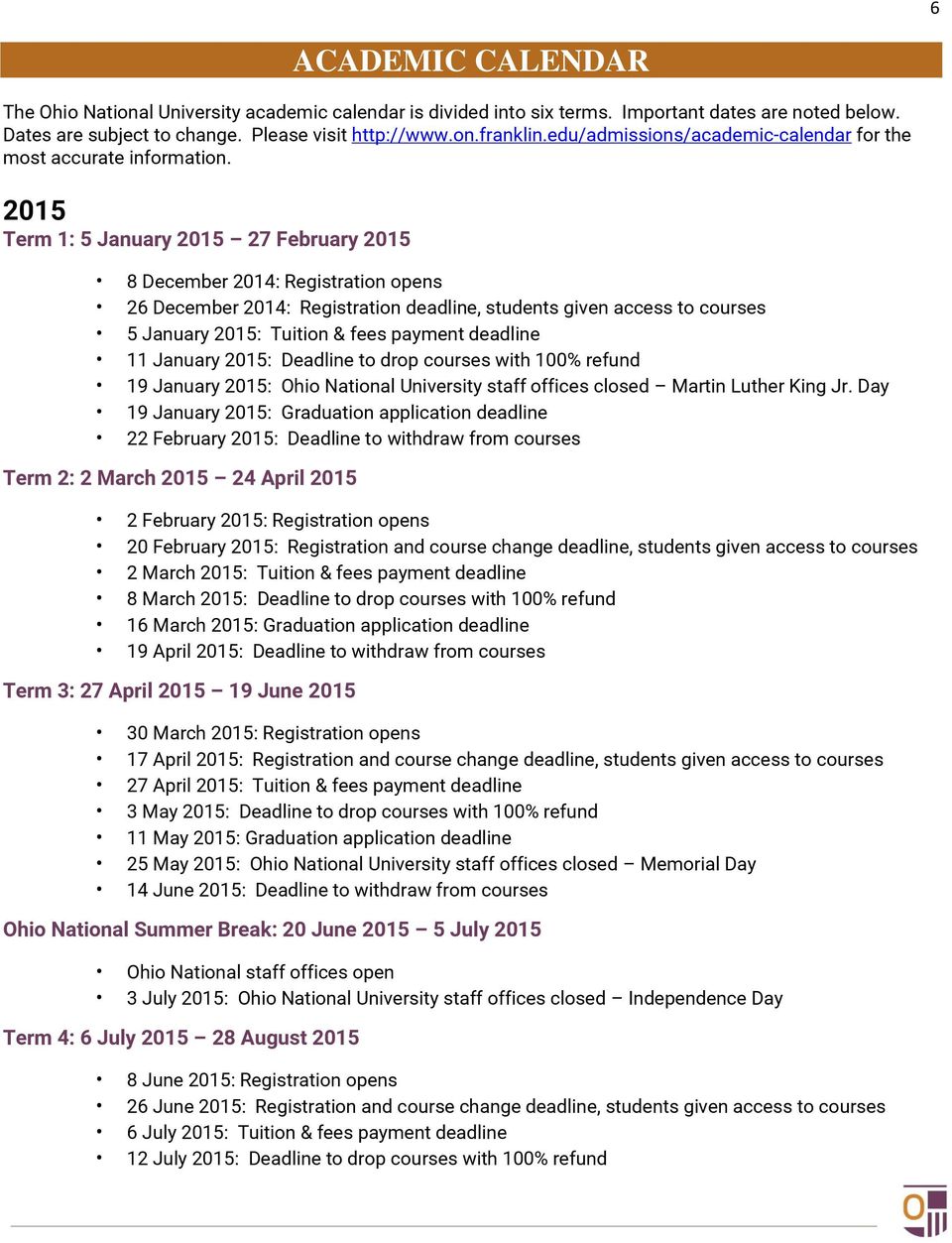
7 7 20 July 2015: Graduation application deadline 23 August 2015: Deadline to withdraw from courses Term 5: 31 August October August 2015: Registration opens 21 August 2015: Registration and course change deadline, students given access to courses 31 August 2015: Tuition & fees payment deadline 6 September 2015: Deadline to drop courses with 100% refund 7 September 2015: Ohio National University staff offices closed Labor Day 14 September 2015: Graduation application deadline 18 October 2015: Deadline to withdraw from courses Term 6: 26 October December September 2015: Registration opens 16 October 2015: Registration deadline, students given access to courses 26 October 2015: Tuition & fees payment deadline 1 November 2015: Deadline to drop courses with 100% refund 9 November 2015: Graduation application deadline 26 November November 2015: Ohio National University staff offices closed, Thanksgiving holiday 13 December 2015: Deadline to withdraw from courses Ohio National Winter Break: 19 December January 2016 Ohio National staff offices open only 22 December and 23 December Campus closed for Winter Break 24 December through 3 January 2016 University Closures 19 January 2015 Campus closed, Martin Luther King Jr. Day (United States) 25 May 2015 Campus closed, Memorial Day (United States) 3 July 2015 Campus closed, observation of Independence Day (United States) 7 September 2015 Campus closed, Labor Day (United States) 26 November November 2015: Campus closed, Thanksgiving (United States) 24 December January 2016: Campus closed, Winter Break

8 Term 1: 4 January February December 2015: Registration opens 25 December 2015: Registration deadline, students given access to courses 4 January 2016: Tuition & fees payment deadline 10 January 2016: Deadline to drop courses with 100% refund 18 January 2016: Ohio National University staff offices closed Martin Luther King Jr. Day 18 January 2016: Graduation application deadline 21 February 2016: Deadline to withdraw from courses Term 2: 29 February April February 2016: Registration opens 19 February 2016: Registration and course change deadline, students given access to courses 29 February 2016: Tuition & fees payment deadline 6 March 2016: Deadline to drop courses with 100% refund 14 March 2016: Graduation application deadline 25 March 2016: Ohio National University staff offices closed Good Friday 17 April 2016: Deadline to withdraw from courses Term 3: 25 April June March 2016: Registration opens 15 April 2016: Registration and course change deadline, students given access to courses 25 April 2016: Tuition & fees payment deadline 1 May 2016: Deadline to drop courses with 100% refund 9 May 2016: Graduation application deadline 30 May 2016: Ohio National University staff offices closed Memorial Day 12 June 2016: Deadline to withdraw from courses Ohio National Summer Break: 18 June July 2016 Ohio National staff offices open Term 4: 4 July August June 2016: Registration opens 24 June 2016: Registration and course change deadline, students given access to courses 4 July 2016: Tuition & fees payment deadline 4 July 2016: Ohio National University staff offices closed Independence Day 10 July 2016: Deadline to drop courses with 100% refund 18 July 2016: Graduation application deadline 21 August 2016: Deadline to withdraw from courses Term 5: 29 August October August 2016: Registration opens

9 9 19 August 2016: Registration and course change deadline, students given access to courses 29 August 2016: Tuition & fees payment deadline 4 September 2016: Deadline to drop courses with 100% refund 5 September 2016: Ohio National University staff offices closed Labor Day 12 September 2016: Graduation application deadline 16 October 2016: Deadline to withdraw from courses Term 6: 24 October December September 2016: Registration opens 14 October 2016: Registration deadline, students given access to courses 24 October 2016: Tuition & fees payment deadline 30 October 2016: Deadline to drop courses with 100% refund 7 November 2016: Graduation application deadline 24 November November 2016: Ohio National University staff offices closed, Thanksgiving holiday 11 December 2016: Deadline to withdraw from courses Ohio National Winter Break: 17 December January 2017 Ohio National staff offices open only 19 December 23 December Campus closed for Winter Break 24 December through 1 January 2017 University Closures 18 January 2016 Campus closed, Martin Luther King Jr. Day (United States) 25 May 2016 Campus closed, Good Friday (United States) 30 May 2016 Campus closed, Memorial Day (United States) 4 July 2016 Campus closed, observation of Independence Day (United States) 5 September 2016 Campus closed, Labor Day (United States) 24 November November 2016: Campus closed, Thanksgiving (United States) 24 December January 2017*: Campus closed, Winter Break *Dates subject to change

10 10 UNDERGRADUATE STUDENT ADMISSION Ohio National University s undergraduate admission policy reflects the University s mission of providing professionally-oriented online educational programs at a price that makes quality education accessible and affordable for a globally diverse student population. Prospective students are encouraged to visit the University s website ( or contact the Ohio National Office of Admissions via at [email protected]. Individuals interested in admission to the University should complete the online application available on the website. UNDERGRADUATE ADMISSION REQUIREMENTS Applicants must satisfy all of the following requirements to be admitted as an Ohio National University undergraduate degree-seeking student: 1. $50 (USD) application fee (non-refundable); 2. Completion of secondary education (high school diploma or equivalent); 3. Math competency; 4. English language proficiency. The completion of admission requirements should be started early to be able to meet an applicant s expected term start date. (See the Recommended Application Completion Dates section). Applicants must complete all four admission requirements before being allowed to begin pursuing their chosen degree program at Ohio National University. SECONDARY EDUCATION EQUIVALENCY REQUIREMENT The secondary education requirement can be met by providing documentation of high school graduation or equivalence, or by providing documentation of completion of 12 or more transferrable credit hours from an accredited institution of higher education. This includes regionally accredited institutions of higher education, institutions recognized as candidates for accreditation, or institutions recognized by the Council of Higher Education Accreditation, United States Department of Education, Ministry of Education in a country, or equivalent government ministry in a particular country. Acceptable forms of documentation to satisfy this admission requirement must include one of the following: Official high school transcript or diploma listing the date of graduation; Official GED certificate; Official transcripts from colleges previously attended; Other as approved by Ohio National University staff. Applicants from the United States of America, or who live internationally but attended institutions within the United States of America, should send their credentials to:

11 11 Ohio National University ATTN: Transfer Credit Office 201 South Grant Avenue Columbus, Ohio, USA Applicants from outside the United States of America should send their credentials to World Education Services (WES) for verification and evaluation. For more information on WES, including the cost of a credential evaluation and documents required, please visit Applicants are responsible for all fees assessed by WES for credential evaluations. Applicants submitting documents to verify completion of secondary education can request a document-by-document evaluation. Undergraduate applicants seeking to transfer their credit from other post-secondary institutions, should request a course-by-course evaluation. MATH COMPETENCY REQUIREMENT The Math competency requirement can be satisfied by transferring in a course which is the minimum equivalent of Ohio National University s MT 155 (Fundamental Algebra). Applicants not transferring in this minimum requirement are required to demonstrate math competency by taking the ACCUPLACER* Math examination. This examination is a virtual (online) examination, administered year round, and consists of two parts -- Part 1 (Elementary Arithmetic) and Part 2 (Elementary Algebra). No fee is charged to the applicant to initially take this examination. The two parts of the ACCUPLACER Math examination are administered together -- the parts cannot be taken separately. If the applicant receives a score below 90 on Part 1 (Elementary Arithmetic), the exam ends and the applicant will not be accepted into Ohio National University at this time. Applicants are allowed to retake the examination after two weeks, with a $10 (USD) fee charged for the retake attempt. Applicants are encouraged to study relevant content before retaking the examination. Applicants scoring below a 90 on the retake of the Elementary Arithmetic exam will not be accepted into Ohio National University, will be provided resources for improving Math skills, and can begin the testing process again in two (2) months. Applicants passing Part 1 (Elementary Arithmetic) with a score of 90 or above will have achieved the minimum score required for admission into Ohio National University, and will automatically proceed to Part 2 (Elementary Algebra) of the examination. Applicants receiving below 112 on the Elementary Algebra exam will be required to take MT 155 (Fundamental Algebra) before taking any other Math courses with Ohio National University. Successful completion of MT 155 with a grade of D or better will satisfy the Math competency requirement for Ohio National University and applies toward a student s University Elective requirement. If the applicant receives a score of 112 or above on the Elementary Algebra exam, he/she will be exempt from taking MT 155, and will advance to the next Math course in his or her chosen program. * ACCUPLACER, owned and developed by the College Board, facilitates appropriate student assessment for thousands of institutions and is an industry standard in the field of placement. The College Board is a not-forprofit membership association whose mission is to connect students to college success and opportunity. Founded in 1900, the association is composed of more than 5,400 schools, colleges, universities, and other educational organizations (College Board, 2009). ENGLISH LANGUAGE PROFICIENCY REQUIREMENT English language proficiency is required for all Ohio National University students. This requirement is automatically met if applicants are from the United States, or any of the following countries:

12 12 Antigua and Barbuda Cayman Islands New Zealand Australia Dominica Saint Kitts and Nevis Bahamas Grenada Saint Lucia Barbados Guyana Saint Vincent and the Grenadines Belize Iceland Trinidad and Tobago Bermuda Ireland Turks and Caicos Islands British Virgin Islands Montserrat United Kingdom Canada (all provinces except Quebec) Jamaica U.S. Virgin Islands Applicants from other countries can meet the English language proficiency requirement in one of two ways: 1. Higher Education Credit Hours. Applicants who have completed a minimum of 30 transferrable semester credit hours, as verified by Ohio National University s Transfer Credit Office, at any of the following will be considered to have satisfied the English language proficiency requirement: A recognized* college or university in the United States; A recognized college or university in which English is the only official language; A recognized college or university in which English is the sole medium of instruction (must be verified in writing by the particular institution). *This includes regionally accredited institutions of higher education, institutions recognized as candidates for accreditation, or institutions recognized by the Council of Higher Education Accreditation, United States Department of Education, or local government Ministry of Education. Submission of official transcripts from the institution(s) is required. 2. English Language Proficiency Testing. The English language proficiency requirement will be met by applicants who have taken the Cambridge English: Advanced (CAE), International English Language Testing System (IELTS), or Test of English as a Foreign Language (TOEFL) exam within the past two (2) years and have achieved the minimum score(s) required by Ohio National University. The following minimum scores are required on each section of these exams for an applicant to be considered for full admission: Test TOEFL IELTS Cambridge English Reading Writing Listening Speaking Overall 525 (PBT) or 71 (IBT) Ohio National s institution code for IELTS and TOEFL results is It is the applicant s responsibility to contact the applicable testing organization to request official scores be mailed to Ohio National University, or made available electronically. To assist the Office of Admissions in retrieving test results, applicants

13 who have taken the TOEFL are advised to provide their date of birth and/or registration number; those who have taken the IELTS are advised to provide their TRF code. The submission of copies of official scores from these exams to Ohio National University (via provides the applicant with one term of conditional enrollment. Official scores submitted directly by the testing organization must be received and verified by Ohio National University for the student to be allowed to be registered for additional terms. Applicants who have not satisfied their English language proficiency requirement have the option to take the ACCUPLACER* ESL exam suite through Ohio National University. A $50 (USD) fee is charged to the applicant to take this exam suite, which consists of four (4) parts: Reading Comprehension, WritePlacer, Listening, and Sentence Meaning. Passing scores will remain valid for two (2) years. Applicants are encouraged to study relevant content before taking the ACCUPLACER* ESL exams. The required minimum passing scores for each exam for an applicant to be granted full admission are as follows: Reading Comprehension 100 WritePlacer 5 ESL Listening 80 ESL Sentence Meaning 100 Applicants must achieve minimum scores on each exam part for full admission. Applicants not passing any exam part, are permitted retakes after two (2) weeks. If the applicant fails to achieve the minimum scores on the exam suite on this second attempt, he/she must then wait two (2) months between retake attempts. A $10 (USD) fee is charged on each exam part retake. Applicants satisfying the minimum requirements on any English proficiency exam for full admission but who feel the need to improve English skills before advancing into their degree program have the option to audit EL 042 (Fundamentals of English Language). This $200 (USD) non-credit course provides students with a host of pertinent ESL study resources. For more information on auditing courses, see Audit Courses. The requirements for demonstrating English language proficiency, including acceptance of results of other English proficiency exams, may be adjusted by the Ohio National University Dean of Academics under unique circumstances. Conditional Admission Ohio National University offers conditional admission to individuals who have achieved the following minimum scores on English proficiency exams: Test TOEFL IELTS Cambridge English Reading Writing Listening Speaking Overall 500 (PBT) or 61 (IBT) Applicants satisfying these minimum scores required for conditional admission will be offered the option to take the ACCUPLACER ESL exam suite with Ohio National University. Applicants choosing to take the ACCUPLACER ESL assessment who achieve the minimum scores required for full admission (see: English Language Proficiency Requirement ) will be granted full admission status. 13
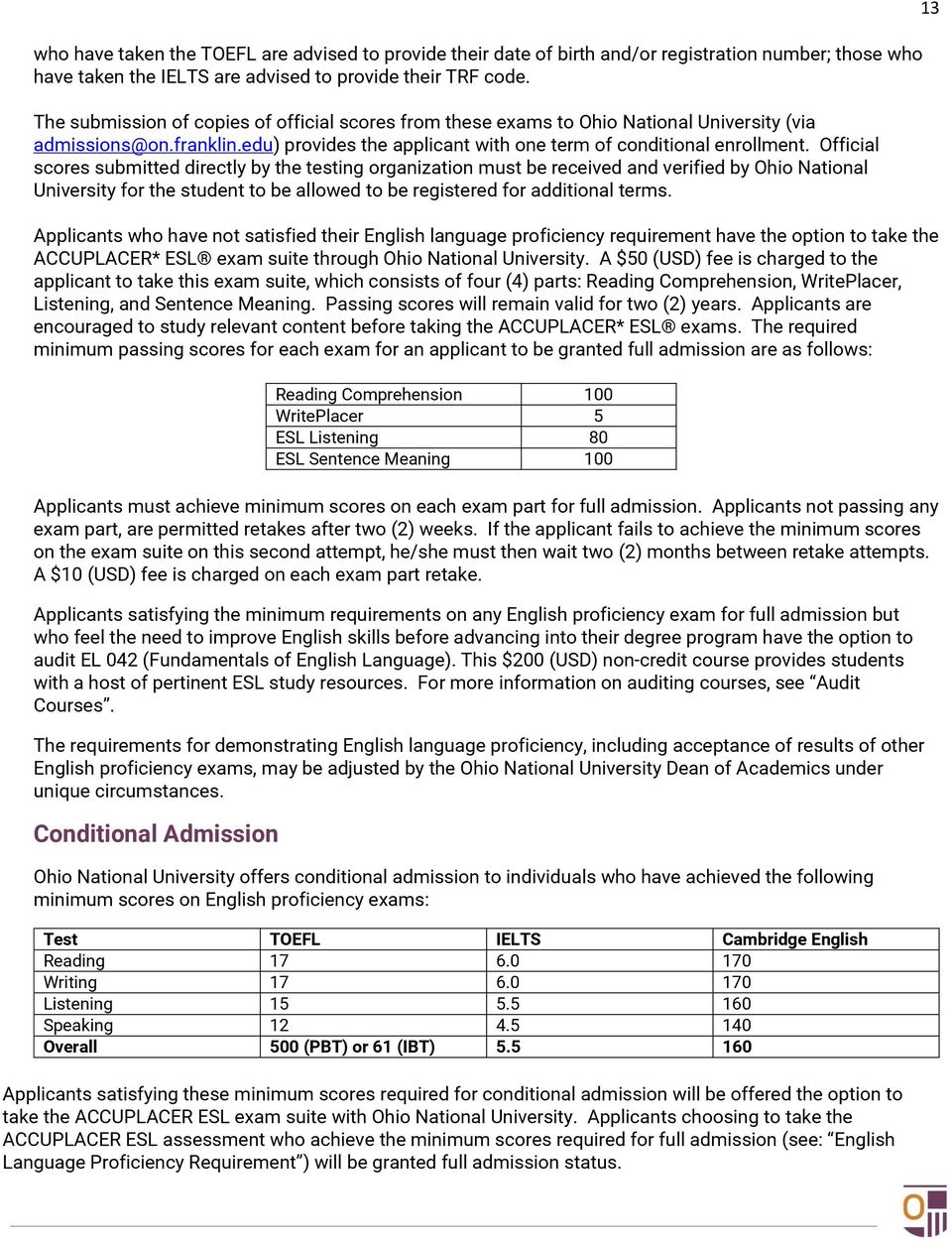
14 Applicants will be granted conditional admission status if the following minimum scores are achieved on each ACCUPLACER ESL exam: Reading Comprehension 80 WritePlacer 4 ESL Listening 70 ESL Sentence Meaning Applicants achieving minimum scores required for conditional admission are permitted a retake opportunity if he or she wishes to attempt to raise their scores to the minimums required for full admission. Exams can be retaken after two (2) weeks, at a cost of $10 (USD) per exam. Applicants granted conditional admission status are offered the option to enroll in Ohio National s ESL refresher course, EL 042 (Fundamentals of English Language). This $200 (USD) non-credit course provides students with a host of pertinent ESL study resources. A retake of the ACCUPLACER* ESL exam is built into the curriculum of EL 042. Full admission will be granted to students who achieve the minimum scores required for full admission. Individuals who do not achieve the minimum scores on the ACCUPLACER ESL exam required for full admission will be denied admission, and will be permitted to restart the testing process after two (2) months. RECOMMENDED APPLICATION COMPLETION DATES Ohio National University accepts applications for admission on a rolling basis throughout the calendar year, and students may select from several dates throughout the year to begin coursework. To ensure a strong, successful start at Ohio National University, there are several steps to complete, including submission of the online application, payment of the application fee, documentation of high school graduation (or equivalence), submission of official transcripts from previously attended institutions (if applicable), Math competency testing (if applicable), and English language proficiency testing (if applicable). While meeting the recommended completion dates is not required, it is important to allow enough time to complete all required activities to begin courses on the date that best meets the new student s individual needs. Please review the recommendations below. For additional questions, please contact [email protected]. For students who wish to enroll: 2015 Terms Dates Complete the application Register for classes process Term 1 5 January - 27 February 5 December 22 December Term 2 2 March 24 April 2 February 20 February Term 3 27 April 19 June 27 March 17 April Term 4 6 July 28 August 6 June 26 June Term 5 31 August 23 October 31 July 21 August Term 6 26 October 18 December 26 September 16 October

15 TRANSFER CREDIT GUIDELINES Applicants with course credit from institutions of higher education which are regionally accredited, accredited by organizations recognized by the Council for Higher Education Accreditation (CHEA) and/or the United States Department of Education, or institutions recognized as candidates for such accreditation, may be granted transfer credit for these courses. For coursework from non-accredited institutions, Ohio National University has established a formal review process to determine transferability of credit hours on a case-by-case basis. For applicants from the United States of America (or who attended schools within the United States of America), verification and evaluation of transfer credit will be done free of charge by Ohio National University faculty and staff. Documentation should be sent to: Ohio National University ATTN: Transfer Credit Office 201 South Grant Avenue Columbus, Ohio, USA Applicants who attended institutions outside the United States of America should send their documentation to World Education Services (WES) for verification and evaluation of credentials. Applicants requesting only secondary school credentials be evaluated can choose the Document-by-Document Report. Applicants requesting both secondary and post-secondary credentials be evaluated should choose the Course-by-Course Report. For more information on WES, including types of credential evaluation packages, fees, and requirements per country, please visit Applicants are responsible for all fees assessed by WES for transfer credit evaluations. Credit will be accepted for any college course completed with a grade of D or higher, including grades of Pass and examination credit, subject to GPA and course requirements pertaining to a student s degree program. D grades in major area courses are not permitted regardless of where the course is taken; such courses will only transfer as elective credit. Some majors (e.g., Information Technology) may have rules regarding the transferability of credits 10 years or older in some courses. Credit will be awarded based on subject matter, prerequisites, level, and laboratory requirements. Up to 84 hours of transfer credit may be used to complete an Ohio National University undergraduate program. Students will be assessed a one-time, nonrefundable flat rate of $300 (USD) for any credits transferred into Ohio National University. For students outside the United States of America, this fee is in addition to any evaluation fee charged by WES. Students completing coursework at Ohio National University should be aware that these courses and degree programs may not transfer in whole or in part into other institutions. The transfer of course/degree credit is determined by the receiving institution. PROFESSIONAL TRAINING Transfer credit may be awarded for courses or professional training offered through business and industry. For example, Ohio National University awards transfer credit for courses taken through the American Institute of Banking (AIB) or the Life Office Management Association (LOMA). Such credit will be awarded based on the recommendations found in The National Guide to Educational Credit for Training Programs (published by the American Council on Education), or The Directory of the National Program on Non-collegiate Sponsored Instruction. Official transcripts or original certificates of completion must be submitted for evaluation. Nontraditional certificates may also be reviewed for consideration of credit. In addition to official transcripts or original certificates, the student must provide a syllabus or workbook for the course, evidence of a test and the amount of time spent in class. Students interested in receiving credit for Professional Training should submit the above information through their student portal. 15

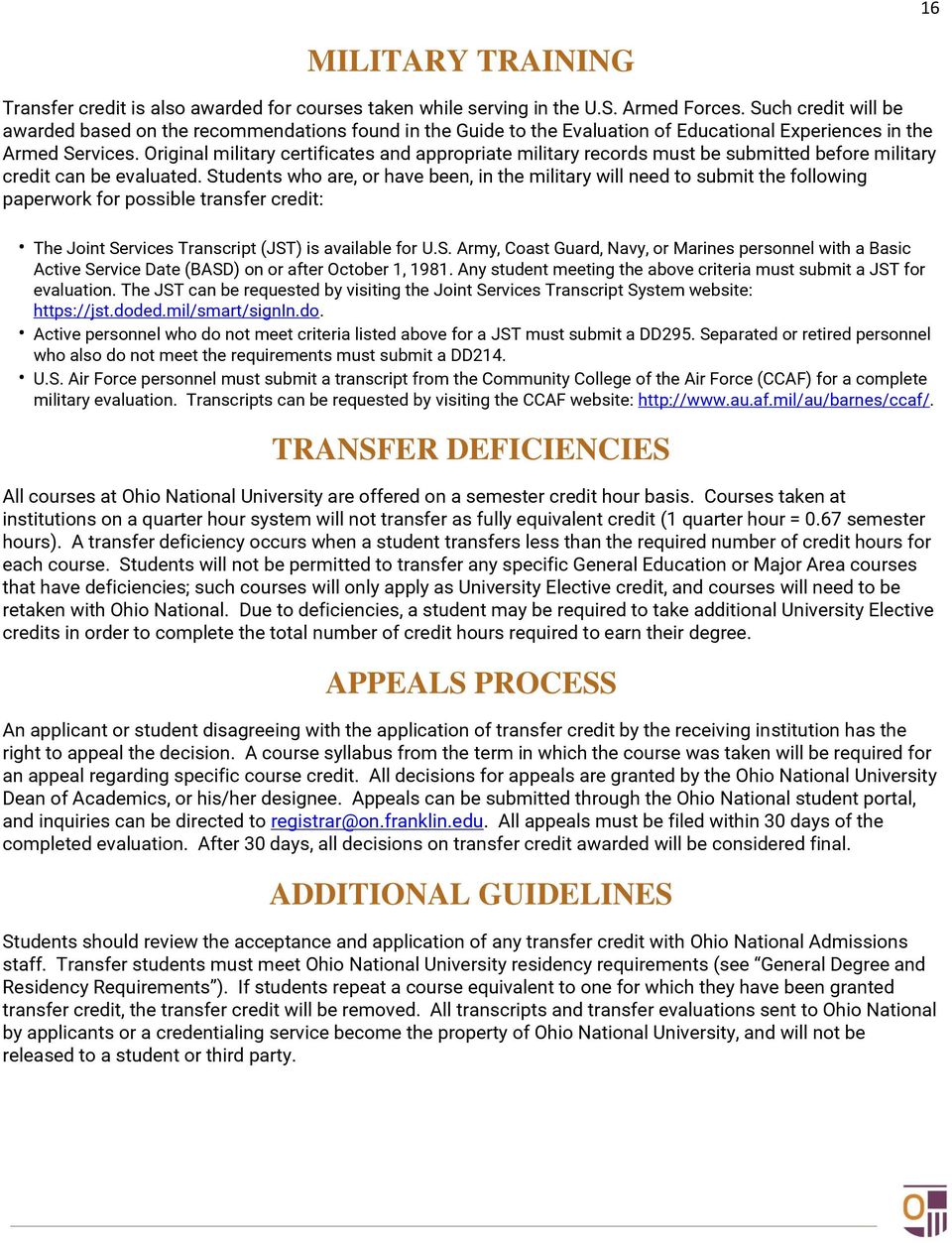
16 16 MILITARY TRAINING Transfer credit is also awarded for courses taken while serving in the U.S. Armed Forces. Such credit will be awarded based on the recommendations found in the Guide to the Evaluation of Educational Experiences in the Armed Services. Original military certificates and appropriate military records must be submitted before military credit can be evaluated. Students who are, or have been, in the military will need to submit the following paperwork for possible transfer credit: The Joint Services Transcript (JST) is available for U.S. Army, Coast Guard, Navy, or Marines personnel with a Basic Active Service Date (BASD) on or after October 1, Any student meeting the above criteria must submit a JST for evaluation. The JST can be requested by visiting the Joint Services Transcript System website: Active personnel who do not meet criteria listed above for a JST must submit a DD295. Separated or retired personnel who also do not meet the requirements must submit a DD214. U.S. Air Force personnel must submit a transcript from the Community College of the Air Force (CCAF) for a complete military evaluation. Transcripts can be requested by visiting the CCAF website: TRANSFER DEFICIENCIES All courses at Ohio National University are offered on a semester credit hour basis. Courses taken at institutions on a quarter hour system will not transfer as fully equivalent credit (1 quarter hour = 0.67 semester hours). A transfer deficiency occurs when a student transfers less than the required number of credit hours for each course. Students will not be permitted to transfer any specific General Education or Major Area courses that have deficiencies; such courses will only apply as University Elective credit, and courses will need to be retaken with Ohio National. Due to deficiencies, a student may be required to take additional University Elective credits in order to complete the total number of credit hours required to earn their degree. APPEALS PROCESS An applicant or student disagreeing with the application of transfer credit by the receiving institution has the right to appeal the decision. A course syllabus from the term in which the course was taken will be required for an appeal regarding specific course credit. All decisions for appeals are granted by the Ohio National University Dean of Academics, or his/her designee. Appeals can be submitted through the Ohio National student portal, and inquiries can be directed to [email protected]. All appeals must be filed within 30 days of the completed evaluation. After 30 days, all decisions on transfer credit awarded will be considered final. ADDITIONAL GUIDELINES Students should review the acceptance and application of any transfer credit with Ohio National Admissions staff. Transfer students must meet Ohio National University residency requirements (see General Degree and Residency Requirements ). If students repeat a course equivalent to one for which they have been granted transfer credit, the transfer credit will be removed. All transcripts and transfer evaluations sent to Ohio National by applicants or a credentialing service become the property of Ohio National University, and will not be released to a student or third party.
17 17 UNDERGRADUATE NON-DEGREE SEEKING STUDENTS Ohio National University encourages qualified individuals to further their education through academic experiences, and provides opportunity for students whose needs may not be best met by applying for admission to a degree-granting academic program. For students who have short-term, specific needs (such as focused skill, knowledge development or transfer credit), a non-degree seeking status is available with approval of Ohio National Admissions staff. Non-degree seeking status is designed for short-term, goal-oriented academic engagement only. All non-degree seeking applicants are required to pay the $50 (USD) non-refundable application fee, and satisfy the Math competency and English proficiency requirements. After receiving permission to enroll, non-degree seeking students may then register for specific courses of interest after demonstrating they are adequately prepared to take the desired course. Adequate preparation for a course at Ohio National University may be demonstrated through the completion of prerequisite courses, verification for which is required by documentation such as an unofficial transcript or resume. Waivers for courses must be approved by Ohio National University faculty. Students who are granted waivers of prerequisite requirements accept full responsibility for adequate preparation, and for their ability to perform the requirements of the course(s) in which they enroll. A maximum of fifteen (15) credit hours or five (5) courses may be taken as non-degree seeking status. Non-degree seeking students who declare a degree program will be bound by all prerequisite requirements of their chosen program. GRADUATE STUDENT ADMISSION Ohio National University s graduate admission policy reflects the University s mission of providing professionaloriented online educational programs at a price that makes quality education accessible and affordable for a globally diverse student population. It also reflects the University s efforts at clearly identifying the performance standards that can help predict student success in graduate level study. Prospective students are encouraged to visit the University s website ( or contact the Ohio National University Office of Admissions via at [email protected]. Individuals interested in admission to the University should complete the online application available on the website. GRADUATE ADMISSION REQUIREMENTS Applicants must meet all of the following requirements to be admitted as an Ohio National University graduate degree-seeking student: 1. $50 (USD) application fee (non-refundable); 2. Minimum completion of a bachelor s degree (or equivalent); 3. English language proficiency The completion of admission requirements should be started early to be able to meet an applicant s expected term start date. (See the Recommended Application Completion Dates section). Applicants must complete all three (3) admission requirements before being allowed to start graduate classes at Ohio National University.

18 18 HIGHER EDUCATION DEGREE REQUIREMENT The higher education degree requirement can be met by providing official documentation verifying attainment of the following two conditions: 1. Minimum of a bachelor s degree (or equivalent) earned from a regionally accredited institution of higher education, an institution recognized as a candidate for accreditation, or an institution recognized by the Council of Higher Education Accreditation, United States Department of Education, or local government Ministry of Education. (NOTE: No particular program of study is required.) 2. Earned at least a 2.75 GPA on a 4.00 scale in earned bachelor or master s degree. Conditional Admission Conditional enrollment status will be granted to applicants who earned at least a 2.50 GPA on a 4.00 scale in their earned bachelor or master s degree. Conditional enrollment requires these students to obtain a B average (i.e., 3.00) GPA during the first two (2) courses of their program of study with a grade no lower than a B- earned in either course. If the terms of the conditional enrollment are not met, the student will not be allowed to advance in their program and will be unable to earn their graduate degree from Ohio National University. Applicants who earned lower than a 2.50 GPA on a 4.00 scale in their earned bachelor or master s degree are allowed to petition to the Ohio National Dean of Academics a request for admission detailing other criteria that he or she believes should be considered in illustrating the applicant s potential ability to be successful in a graduate program of study. This petition could include details on the applicant s work experience, work ethic, level of professionalism, personality characteristics, level of difficulty of program of study previously completed, etc. Petition requests and all supporting documentation should be ed to [email protected], with the subject line Petition for Graduate Admission. If a petition is approved by the Dean of Academics, conditional enrollment status will be granted to the applicant. Conditional enrollment requires that these students must obtain a B average (i.e., 3.00) GPA during the first two courses of their program of study with a grade no lower than a B- earned in either course. If the terms of the conditional enrollment are not met, the student will not be allowed to advance in their program and will be unable to earn their graduate degree from Ohio National University. Applicants from the United States of America, or who live internationally but attended schools within the United States of America, should have their official credentials sent by the institution they attended to: Ohio National University ATTN: Transfer Credit Office 201 South Grant Avenue Columbus, Ohio, USA Applicants from outside the United States of America should submit all credentials to World Education Services (WES) for verification. For more information on WES, including the cost of the transcript verification, please visit A course-by-course evaluation should be requested. Applicants are responsible for all fees assessed by WES for transcript verification.

19 19 ENGLISH LANGUAGE PROFICIENCY REQUIREMENT English language proficiency is required for all Ohio National University graduate students. This proficiency requirement is automatically met if applicants are from the following countries: Antigua and Barbuda Cayman Islands New Zealand Australia Dominica Saint Kitts and Nevis Bahamas Grenada Saint Lucia Barbados Guyana Saint Vincent and the Grenadines Belize Iceland Trinidad and Tobago Bermuda Ireland Turks and Caicos Islands British Virgin Islands Montserrat United Kingdom Canada (all provinces except Quebec) Jamaica U.S. Virgin Islands Applicants from other countries can meet the English language proficiency requirement in one of two ways: 1. Higher Education Credit Hours. Applicants who have completed a bachelor s degree or master s at any of the following will be considered to have satisfied the English language proficiency requirement: A recognized* college or university in the United States; A recognized college or university in which English is the only official language; A recognized college or university in which English is the sole medium of instruction (must be verified in writing by the particular institution). *This includes regionally accredited institutions of higher education, institutions recognized as candidates for accreditation, or institutions recognized by the Council of Higher Education Accreditation, United States Department of Education, or local government Ministry of Education. Submission of official transcripts from the institution(s) is required. 2. English Language Proficiency Testing. The English language proficiency requirement will be met by applicants who have taken the Cambridge English: Advanced (CAE), International English Language Testing System (IELTS), or Test of English as a Foreign Language (TOEFL) exam within the past two (2) years and have achieved the minimum score(s) required by Ohio National University. The required minimum scores for each exam are as follows: Test TOEFL IELTS Cambridge English Reading Writing Listening Speaking Overall 525 (PBT) or 71 (IBT)

20 Ohio National s institution code for IELTS and TOEFL results is It is the applicant s responsibility to contact the applicable testing organization to request official scores be mailed to Ohio National University, or made available electronically. To assist the Office of Admissions in retrieving test results, applicants who have taken the TOEFL are advised to provide their date of birth and/or registration number; those who have taken the IELTS are advised to provide their TRF code. The submission of copies of official scores from these exams to Ohio National University (via [email protected]) provides the applicant with one term of conditional enrollment. Official scores submitted directly by the testing organization must be received and verified by Ohio National University for the student to be allowed to be registered for additional terms. Applicants who have not satisfied their English language proficiency requirement have the option to take the ACCUPLACER* ESL exam suite through Ohio National University. A $50 (USD) fee is charged to the applicant to take this exam suite, which consists of four (4) parts: Reading Comprehension, WritePlacer, Listening, and Sentence Meaning. Passing scores will remain valid for two (2) years. Applicants are encouraged to study relevant content before taking the ACCUPLACER* ESL exams. The required minimum passing scores for each exam for an applicant to be granted full admission are as follows: Reading Comprehension 100 WritePlacer 5 ESL Listening 80 ESL Sentence Meaning 100 Applicants must achieve minimum scores on each exam part for full admission. Applicants not passing any exam part, are permitted retakes after two (2) weeks. If the applicant fails to achieve the minimum scores on the exam suite on this second attempt, he/she must then wait two (2) months between retake attempts. A $10 (USD) fee is charged on each exam part retake. Applicants satisfying the minimum requirements on any English proficiency exam for full admission but who feel the need to improve English skills before advancing into their degree program have the option to audit EL 042 (Fundamentals of English Language). This $200 (USD) non-credit course provides students with a host of pertinent ESL study resources. For more information on auditing courses, see Audit Courses. The requirements for demonstrating English language proficiency, including acceptance of results of other English proficiency exams, may be adjusted by the Ohio National University Dean of Academics under unique circumstances. Conditional Admission Ohio National University offers conditional admission to individuals who have achieved the following minimum scores on English proficiency exams: Test TOEFL IELTS Cambridge English Reading Writing Listening Speaking Overall 500 (PBT) or 61 (IBT) Applicants will be granted conditional admission status if the following minimum scores are achieved on each ACCUPLACER ESL exam: 20

21 21 Reading Comprehension 80 WritePlacer 4 ESL Listening 70 ESL Sentence Meaning 90 Applicants achieving minimum scores required for conditional admission are permitted a retake opportunity if he or she wishes to attempt to raise their scores to the minimums required for full admission. Exams can be retaken after two (2) weeks, at a cost of $10 (USD) per exam. Applicants granted conditional admission status are offered the option to enroll in Ohio National s ESL refresher course, EL 042 (Fundamentals of English Language). This $200 (USD) non-credit course provides students with a host of pertinent ESL study resources. A retake of the ACCUPLACER* ESL exam is built into the curriculum of EL 042. Full admission will be granted to students who achieve the minimum scores required for full admission. Individuals who do not achieve the minimum scores on the ACCUPLACER ESL exam required for full admission will be denied admission, and will be permitted to restart the testing process after two (2) months. RECOMMENDED APPLICATION COMPLETION DATES Ohio National University accepts applications for admission on a rolling basis throughout the calendar year, and students may select from several dates throughout the year to begin coursework. To ensure a strong, successful start at Ohio National University, there are several steps to complete, including submission of the online application, payment of the application fee, documentation of an appropriate degree of higher education earned, submission of official transcripts of graduate credit earned from previously attended institutions (if applicable), and English language proficiency testing (if applicable). While meeting the recommended completion dates is not required, it is important to allow enough time to complete all required activities to begin courses on the date that best meets the new student s individual needs. Please review the recommendations below. For additional questions, please contact [email protected]. For students who wish to enroll: 2015 Terms Term Dates Complete the application Register for classes process Term 1 5 January - 27 February 5 December 22 December Term 2 2 March 24 April 2 February 20 February Term 3 27 April 19 June 27 March 17 April Term 4 6 July 28 August 6 June 26 June Term 5 31 August 23 October 31 July 21 August Term 6 26 October 18 December 26 September 16 October
22 22 GRADUATE TRANSFER CREDIT GUIDELINES Applicants who previously earned credit from graduate programs of regionally accredited institutions of higher education, or institutions recognized as candidates for accreditation, may be granted transfer credit for these courses. For applicants from the United States of America, or who live internationally but attended schools within the United States of America, verification and evaluation of graduate transfer credit will be done free of charge by Ohio National University s Transfer Credit Office. Official credentials should be sent directly by institution to the following address: Ohio National University ATTN: Transfer Credit Office 201 South Grant Avenue Columbus, Ohio, USA Applicants who attended institutions outside the United States of America should send their documentation to World Education Services (WES) for verification and evaluation of transfer credit (NOTE: A course-by-course evaluation should be requested). For more information on WES, including fees, and requirements per country, please visit Applicants are responsible for all fees assessed by WES for transfer credit evaluations. Transfer credit will normally be accepted for comparable graduate courses completed with a grade of B or higher (or the equivalent), completed within the time frame established for the subject area in question, and based on subject matter, prerequisites, and academic level. Up to 15 hours of transfer credit may be used to complete an Ohio National University graduate program. Applicants will be assessed a one-time, nonrefundable flat rate of $300 (USD) for any credits they wish to transfer. For applicants outside the United States, this fee is in addition to any evaluation fee charged by WES. GRADUATE NON-DEGREE SEEKING STUDENTS Ohio National University encourages qualified individuals to further their education through academic experiences, and provides opportunity for students whose needs may not be best met by applying for admission to a degree-granting academic program. For students who have short-term, specific needs (such as focused skill or knowledge development or transfer credit), a non-degree seeking status is available with approval of Ohio National University Admissions staff. Non-degree seeking status is designed for short-term, goal-oriented academic engagement only. Non-degree seeking applicants are bound by the same admission requirements as degree-seeking applicants. After receiving permission to enroll, non-degree seeking students may then register for specific courses of interest after demonstrating they are adequately prepared to take the desired course. Adequate preparation for a course at Ohio National University may be demonstrated through the completion of prerequisite courses, verification for which is required by documentation such as an unofficial transcript or resume. Waivers for courses must be approved by Ohio National University faculty. Students who are granted waivers of prerequisite requirements accept full responsibility for adequate preparation, and for their ability to perform the requirements of the course(s) in which they enroll. A maximum of nine (9) credit hours or three (3) courses may be taken as non-degree seeking status. Any non-degree seeking student declaring a degree program will be bound to follow all prerequisite requirements of that program.
23 23 STUDENT REGISTRATION Ohio National University will automatically register students for classes each term based on a student s Registration Intent. Students will complete their Registration Intent prior to their first term of study, confirming his or her intended start term, chosen degree program, and preference for enrollment each term. This Registration Intent will be the basis of a student s registration throughout their time at Ohio National. The plan will be kept on file with the Office of the Registrar at Ohio National University, and students will be registered for classes each term as outlined in their Registration Intent. Students will have the ability to suggest courses they are interested in taking in subsequent terms; if no suggestions are made, courses will be chosen by Ohio National faculty and staff. Students are able to change their Registration Intent for future terms, including indicating break terms, via their student portal two (2) weeks prior to the date registration begins for each term. For more information on dates registration will open each term, please see Academic Calendar. If there are problems connected with registration for a current or upcoming term, students must adjust their schedule via the Change Schedule function within their student portal. Students are required to adhere to all current University regulations regarding dropping and attending courses. Students must register for classes at least 10 days prior to the term start date. Any registration, including course changes, occurring within 10 days of the term start date is subject to faculty approval. If approved, students will be assessed a $50 (USD) fee for any changes. Students are not permitted to add or switch courses within three (3) days of the start of the term. AUDIT COURSES No credit is given for audited courses. A student auditing a course must do all the work required of a student enrolled in the course for credit, with the exception of taking tests or exams. Students choosing to take EL 042 that have satisfied requirements for full admission are exempted from the ACCUPLACER ESL exam. Tuition and fees for auditing are the same as those charged when courses are taken for credit. Audit status for any course other than EL 042 must be indicated in writing to the Office of the Registrar (via [email protected]) no later than the end of the first week of the term in which the class is to be audited.
24 24 TUITION & FEES: ACADEMIC YEAR Ohio National University recognizes educational expenses can be a significant factor in the decision to attend college. Ohio National University strives to maintain affordable tuition and fees. The University accepts all tuition and fees with the understanding that the applicant or student, in becoming obligated for such tuition and fees, agrees to abide by all University policies and regulations, whether or not printed in this Academic Bulletin, and by any decisions of the administration and faculty regarding the applicant or student s status at the University. Although every effort is made to provide accurate and up-to-date information on educational costs and fees, the University reserves the right to change its tuition, fees, and charges as economic conditions warrant. Students who fail to pay their financial obligation to the University by the first day of the term are considered delinquent and will be dropped from classes. Tuition and fees can be paid through the student portal by echeck (ACH), MoneyGram, debit card (MasterCard or VISA ), or credit card (MasterCard, VISA, or Discover ). Convenience fees associated with making payments are the student s responsibility. Students should be aware it may take up to 72 hours for payments to post to their account. Questions regarding payment of tuition and fees should be referred to the Ohio National Business Office at [email protected]. EDUCATIONAL COSTS (USD) Application Fee (non-refundable) Undergraduate Tuition, per credit hour Graduate Tuition, per credit hour ACCUPLACER ESL Exam (all parts) ACCUPLACER Math Examination, per test (2 parts per test) ACCUPLACER Retake Fee (ESL or Math Exam), per test Transfer Credit Fee (non-refundable) Student Resource Fee, per course Registration Exception Fee Graduation Application Fee (non-refundable) Graduation Application Late Fee (non-refundable) $50 (USD) $133 (USD) $198 (USD) $50 (USD) $0 (USD) $10 (USD) $300 (USD) $90 (USD) $50 (USD) $100 (USD) $100 (USD) TUITION REFUNDS ON COURSE WITHDRAWALS All students who wish to withdraw from a course for which they have registered must complete the drop online via the Change Schedule function within their student portal. When current students withdraw from one or more courses, tuition is refunded in compliance with state and federal regulations based on a graduating scale relative to the time of the drop/withdrawal and the length of the course. The Standard Tuition Refund Schedule below applies to all international and domestic students, unless the student resides where local laws mandate a refund schedule that differs. Specific refund tables can be located online at
25 25 Week Percentage Refunded 1 100% 2 50% 3 50% 4 50% 5 0% Refund Policy In compliance with Section of the United States of America Code of Federal Regulation, current students who prepay all tuition and fees and subsequently withdraw will receive a refund percentage of their tuition based on the date the drop is completed via the student portal. Refund schedules are updated annually or as mandated by law. Unless otherwise prohibited by law, all fees are non-refundable, with the exception of the Student Resource Fee, which is refundable up until the start date of the term. Ohio National University recognizes students can sometimes only make the decision about the suitability of a given course by participating in that course. The refund schedule is designed to provide a full tuition refund to the student, provided the student drops the course immediately within the first week of a course offering. For all courses, the immediate requirement is met provided the course is dropped prior to 12:00 AM Eastern Standard Time (EST) the Sunday prior to the second week of class. Time Period for Refund to be Processed Students who drop courses will receive a refund no later than 30 calendar days after submission of the withdrawal. PAYING FOR YOUR EDUCATION When students are registered for classes, they receive a statement of tuition and fees. Tuition and fees for all students are due and payable no later than the first day of the term. Students are required to make payments via their student portal. The University accepts funds via echeck (ACH), MoneyGram, debit card (MasterCard or VISA ), or credit card (MasterCard, VISA, or Discover ). It is the responsibility of every student to ensure payment of all tuition and fees is made prior to the start of each term. Students who fail to pay their financial obligation to the University when due are considered delinquent and will be dropped from classes. Delinquent students may also receive account restrictions and will not be permitted to make enrollment changes in the current term or enroll in future terms until the delinquency is resolved. TUITION APPEAL PROCESS The University understands unexpected events may occur that prevent a student from completing academic course work. In recognition of this, the University may consider appeals for reductions of tuition charges already paid. Appeals are only considered for situations in which events affecting enrollment are non-recurring, catastrophic or life-threatening in nature, and beyond the student s control. Students should contact Ohio National s Student Support Team to discuss their particular circumstances. Appeals will be considered up to 30 days following the first day of the next term. Appeals received after this will not be given consideration. Appropriate documentation will be required for committee review. Examples of
26 appropriate documentation may include insurance claims, medical records, military orders, or obituaries. The University reserves the right to deny an appeal. An approved appeal serves as a one-time exception, and any tuition refund due to a student will be processed in accordance with the University s refund polices (see Tuition Refunds on Course Withdrawals ). TECHNOLOGY REQUIREMENTS Ohio National University requires the use of electronic communication, technology, and computing for the purpose of instruction, administration, advancement, research, and study. Ohio National University s learning management system, BlueQuill, and internet resources were designed and implemented to support and enhance the education of Ohio National University students. Students are provided with technology resources via the internet. A wide variety of applications are available, including online courseware, scientific simulations, business applications, desktop publishing software, and a variety of programming environments. Please note that students who do not meet the minimum application, operating system, browser or hardware specifications other than listed as required below, risk not receiving assistance from the Help Desk. The following hardware and software requirements are applicable for all registered students: General Technology Requirements* Minimum Hardware Requirements: Current model computer (less than 2 years of age) DVD optical drive 2 GB RAM minimum (4 GB+ recommended) 40 GB or higher of available hard drive space at the beginning of each term Monitor, 1024 x 768 minimum resolution Sound card Webcam (internal or external), 640 x 480 minimum resolution Microphone Speakers (internal or external) Headset High-speed internet connection (3MBps preferred) Operating System and Software Requirements: Windows 7 or newer Microsoft Office 2013** (Word, Excel, PowerPoint, & Access) - free download available to Ohio National University students Microsoft Lync - free download available to Ohio National University students Current versions of at least two of the following internet browsers (Note: There may be a better experience with Ohio National University resources in a specific browser): o Google Chrome o Microsoft Internet Explorer o Mozilla Firefox Adobe Flash Player (version 11 or higher) Adobe Shockwave Player Virus protection updated and scanned regularly Familiarity with firewall, pop-up blocker, and anti-spam software (if these applications are used) 26
27 27 (Microsoft Outlook) is provided by Ohio National University * Technology changes rapidly as a result, these requirements are subject to change ** Subject to change based off of new course requirements Students who choose to use applications other than those listed do so knowing that faculty will be using the software listed above. It is the student s responsibility to create and distribute correspondence and shared files in a format that can be read by faculty and fellow classmates. In order to use all of the Ohio National-supplied technology resources, students must be able to load software on the computers they will be using. Some courses may require additional software. Technology Resources Ohio National University students have access to extensive technology resources including: Student web portal Computerized library access Computerized advising access Online registration and self-service resources Educational resources via online and the BlueQuill learning management system The student portal, located at provides University announcements, access to courses, course history, student , and the ability to manage personal student account information. Upon authentication, the course web page includes specialized technology resources to enhance the learning experience, and includes a web conferencing platform, drop box, and bulletin board. TECHNOLOGY ASSISTANCE While pursuing an education at Ohio National University, students will be using some of the latest technology available. To help students maximize the benefits of this technology, we offer the support of the Help Desk. Available by at [email protected], the Help Desk is able to assist with the following: Retrieving usernames and passwords (identity verification required) Accessing and utilizing Accessing and utilizing Ohio National University online resources Utilizing basic software applications required by the University Questions about basic computer literacy Remote desktop connection sessions for additional assistance The Help Desk requires a few identifying pieces of information when a student sends an . The student s first name, last name, and student ID are required. The student will also need to be as specific as possible when describing problems. For example: If experiencing problems accessing a course, the student must provide the course name as well as the section number. If experiencing errors within an application, web browser, or the operating system, the student must provide the exact error message, the task being performed when the error occurred, the frequency the problem has occurred, and whether the computer has been rebooted.
28 This information will provide the technician an effective starting point within the troubleshooting process. Students ing the Help Desk should anticipate a reply within 1-2 business days. Reminder: Students who do not meet the minimum application, operating system, browser or hardware specifications other than listed as required, risk not receiving assistance from the Help Desk. To receive technical assistance; contact the Help Desk: [email protected] 28 ACADEMIC INFORMATION LATE REGISTRATION Students must be registered for courses at least 10 days prior to the start date of a course. Any student registration which occurs within 10 days of the start of a course is considered a late registration. Instructors are not required to provide extensions on assignments to students registering late for courses. Student registration requests within 10 days of the course start date are subject to faculty approval. If registration is permitted, students will be subject to a $50 (USD) registration exception fee. No registration will be permitted within three (3) days of the start of a course. UNIVERSITY ATTENDANCE POLICY Only properly registered students are permitted to access online classes. Enrollment in course(s) indicates the student s intent to complete the course(s) in a manner prescribed in the course syllabus. Registered students are enrolled in a course until they submit a withdrawal request from that course via their student portal or are withdrawn by the Registrar at the request of an instructor for non-attendance, as defined in this document and in the course syllabus. Students are responsible for logging into the course website 10 days before the start of the course in order to receive assignment information and communication from the professor. Since active participation is an essential component of learning, attendance will be taken in all courses. The following guidelines for attendance when registered for a course have been established as follows: Attendance Standards Attendance is considered on a weekly basis. A student is considered in attendance for a given week if there is evidence the student is engaged in the planned learning activities and assignments of the course throughout the week. A student is considered not in attendance for a given week if there is evidence the student is not engaged in a substantial portion of the planned learning activities and assignments for the week. As a general guideline, the student needs to be engaged in approximately 80% of the planned learning activities for the week to be considered in attendance. In the majority of weeks of most Ohio National University courses, the planned learning activities involve graded assignments that must be completed and submitted by the student in a timely manner. It is important to note the evaluation of engagement in the course for attendance purposes is not defined by the score a student earns on these assignments, but rather the effort put into the assignment and the completion of this effort by the indicated due date and time.
29 A distinction of special may be submitted as the attendance indicator for a student for a particular week to indicate conditions related to the adjustment of attendance requirements have been negotiated with the course instructor. These rare situations occur when an instructor adjusts due dates for an assignment or agrees to allow the student to submit an alternative assignment later due to hardship conditions occurring in a student s life (NOTE: Proper documentation/proof supporting this hardship is required to be submitted to the instructor). The special designation does not count as being not in attendance for a particular week because assignment due dates were moved to a later week. However, the non-completion of these assignments moved to a later week may cause a not in attendance designation in that week if the student does not complete these assignments by the newly designated due date. Z-Grade Assignment Guidelines The Z-grade is an administrative withdrawal (failure) grade assigned due to attendance reasons. The assignment of the Z-grade is based on the attendance terminology defined above. Students considered not in attendance for more than one (1) week of a course will receive a Z-grade/failure for the course. NOTE: These attendance policies do not change the existing drop policy in regard to the student s responsibility to drop courses in a timely manner for a tuition refund. Students who wait to drop their course and receive the not in attendance designation for more than one (1) week of the course will receive a Z-grade/failure for the course and may forfeit any tuition reimbursement for that course (see Tuition Refunds on Course Withdrawals). Withdrawal From a Course Students wishing to withdraw from a course must do so through their student portal. After the first week of a course, a withdrawal will result in a grade of W (Withdrawn) on the student s academic record. Withdrawal grades will not be calculated in the student s grade point average. Tuition charges and/or refunds will be based on the date the student requested to be withdrawn from the course via their student portal (see Tuition Refunds on Course Withdrawals ). The deadline for a student to withdraw from a course is the Sunday prior to the final week of the course. Students are not permitted to withdraw from courses during the final scheduled week of class. WRITING GUIDELINES The writing guidelines for Ohio National University assist students by following the same format for all courses. Ohio National University has adopted the commonly used American Psychological Association (APA) format as its writing standard. This includes: 29 Documentation Style: including in-text citations and reference lists; Paper Format: 12 point serif font (e.g., Courier or Times New Roman), 1 inch margins, double spacing, and page numbers in the top right corner Writing Skills: proper grammar, correct spelling, and accurate punctuation. To simplify the understanding of the APA format, templates and resource documents are provided within students courses as well as the student portal. TURNITIN.COM Turnitin.com is a service used by Ohio National University to assist students in correctly following proper citation guidelines and for faculty and assignment graders in detecting plagiarism. For some assignments, the
30 student will be required to submit a paper to Turnitin.com. By submitting the paper ahead of the assignment deadline, the student will have time to take corrective action if feedback from Turnitin indicates a similarity match. A similarity match occurs when Turnitin sees an exact or very close word-for-word match between the work submitted and a part of another paper, website, or article in its database. Faculty are encouraged to use Turnitin.com as a learning tool for students. All material submitted to the website is encrypted. The student s paper is seen only by the student, faculty, and assignment grader. Any copyrights or intellectual capital that is associated with the paper remains with the student. Services offered by Turnitin are free of charge. ACADEMIC INTEGRITY The purpose of education is to advance one s own intellectual skills and knowledge and to demonstrate the outcomes of these efforts. An essential and shared value in higher education is presenting one s own work and properly acknowledging that of others. Any violation of this principle constitutes a violation of academic integrity and is liable to result in a charge of academic dishonesty to a student. Forms of academic dishonesty include, but are not limited to: 1. Plagiarism submitting all or part of another s work as one s own in an academic exercise, such as an examination, computer program, or written assignment. Some examples of plagiarism include: Failure to use APA standards to properly cite the work of others. Cutting and pasting from other sources without citation. Submitting a purchased term paper, in whole or in part. 2. Recycling assignments submitting one s own work that was submitted and graded for an earlier course or section, unless submission of that work has been pre-approved by the current professor. 3. Cheating using or attempting to use unauthorized materials (e.g., books, notes, wireless devices) on an examination or assignment. Some examples of cheating include: Improperly obtaining, or attempting to obtain, copies of an examination or answers to an examination. Using a false name, identity, or address on a test or assignment. 4. Facilitating Academic Dishonesty helping another commit an act of academic dishonesty. Some examples include: Substituting for an examination or completing an assignment for someone else. Making assignments available for another student to copy. 5. Fabrication altering or transmitting, without authorization, academic information or records. I. Reporting a Charge of Academic Dishonesty If a faculty member determines a student has violated the Academic Integrity Policy the faculty member will provide the student with notification of the charge of academic dishonesty through Ohio National University within seven (7) calendar days after discovery of the incident. The written charge will include the particular allegation; names of other participants or witnesses, where appropriate; and the date, time, location and other relevant circumstances of the incident. A disciplinary notation for academic dishonesty will be entered on the student s academic record by the Office of the Registrar. II. Penalties for Academic Dishonesty A. First Incident 30
31 The faculty member and Ohio National University administration will determine the penalty for the first incident, with the penalty ranging from a score of zero on the particular assignment being submitted to a failing grade in the class depending on the severity of the incident and the intent of the student. The student may also be required to complete a workshop on appropriate citation and referencing. A subsequent incident of academic dishonesty in the same class will result in a failing grade in the class and, in combination with the first charge, will be recorded as a single incident on the student s academic record. A violation of the Academic Integrity Policy will result in the removal of the student s option to withdraw from the class to avoid a failing grade. Administration may also place a hold on a student account during the investigation of a violation of academic integrity and/or retroactively change a grade due to the severity of the incident. For undergraduate students, a violation of the Academic Integrity Policy may eliminate the student from consideration for academic honors; specifically, Summa Cum Laude, Magna Cum Laude, or Cum Laude. A panel of University faculty will evaluate the incident of academic dishonesty and will make the final determination on the student s eligibility for academic honors. B. Second and Final Incident Any subsequent violation of the Academic Integrity Policy in any other class will result in a failing grade in the class as well as disciplinary dismissal from the University. The Ohio National University Dean of Academics will notify the Office of the Registrar to enter the notation Dismissed for Academic Dishonesty on the student s academic record. ACADEMIC APPEALS PROCESSES Ohio National University s appeal processes are designed to preserve academic integrity by providing a student the opportunity to have the charge(s) of academic dishonesty or a final grade(s) reviewed secondarily by an independent Academic Appeal Officer and, if necessary, by the Ohio National University Dean of Academics. Each step of the respective process has been specifically designed to accomplish the goal of providing the student with a decision demonstrated by the exercise of honest, professional judgment. Failure to meet any timeline within the appeal processes will result in a waiver of the student s right to invoke an appeal. The Academic Appeal Officer and/or Dean of Academics will provide the student with notification of the waiver through Ohio National University delivery. The student s academic standing will not be altered during the appeal process. In cases where the grade appeal is filed in a prerequisite course, the grade remains in effect unless and until the appeal is upheld. The final result of the appeal will be updated to the student s record accordingly, and any necessary changes to the student s schedule and/or academic standing will be made by the Office of the Registrar. The Academic Appeal Officer or Dean of Academics may request or approve a request for a hearing with relevant individuals, either individually or together, as deemed appropriate by the administrator. All appeals, including questions regarding the process or any matters relating to an appeal, must be submitted through the student portal. A. Appeal of Charge of Academic Dishonesty An appeal may be invoked for a charge or penalty pertaining to the University s Academic Integrity Policy. 31
32 32 Step One: The Faculty Member A good faith appeal discussion with the faculty member must be initiated in writing to the instructor by the student within fifteen (15) calendar days of the date of the Ohio National University notification. If the student believes the good faith appeal discussion has not adequately resolved the matter, the student may move forward to Step Two, submission of an appeal to the Dean of Academics. Step Two: The Dean of Academics The student must submit a formal written appeal via their student portal to the Dean of Academics within fifteen (15) calendar days from the date of the good faith discussion. The formal written appeal should include the following information: 1. Background a. Date b. Student s name and identification number c. Course name, number, and section d. Course term and year e. Faculty member s name f. Reason for the academic dishonesty appeal g. Date of good faith appeal discussion h. Outcome of the good faith appeal discussion 2. Facts state all relevant facts in dispute with supporting documentation, including all assignments in question. For all persons/witnesses, list full name(s), contact information, and facts specific to each individual. Facts and/or documents not included will not be considered. 3. Desired outcome of the appeal (be specific). 4. Rationale in support of the desired outcome. The Ohio National University Dean of Academics or designee will appoint an independent Academic Appeal Officer to review and investigate the case. The Academic Appeal Officer will issue a written decision to the student through Ohio National University within fifteen (15) calendar days of the date the appeal is received by the Dean of Academics. The Academic Appeal Officer may prescribe alternate penalties, such as suspension, to those listed under Penalties for Charges of Academic Dishonesty as deemed appropriate. If the student or the faculty member believes the Academic Appeal Officer s decision has not adequately resolved the matter, either the student or the faculty member may move forward to the Final Step of the appeal process, submission of the second appeal to the Dean of Academics. Final Step: The Second Appeal to the Dean of Academics The student must submit a written appeal via the student portal within fifteen (15) calendar days from the date of the Academic Appeal Officer s decision, including: 1. Student s name and identification number 2. Summary of all facts pertaining to the appeal to date (facts and/or documents not included will not be considered) 3. A letter explaining why the Academic Appeal Officer s decision is being appealed 4. Desired outcome of the appeal
33 33 5. Rationale in support of the desired outcome 6. Attached copies of the: a. Appeal submitted to the Dean of Academics in Step Two b. Academic Appeal Officer s written decision The Dean of Academics or designee will issue a written decision to the student through Ohio National University delivery within fifteen (15) calendar days of the date of the receipt of the appeal. The outcome of the second appeal will be considered final, and no further appeals will be considered. B. Appeal of Assignment Grade An appeal of a grade received on assignment may be invoked upon official grades being posted for an individual assignment. Step One: The Faculty Member A good faith appeal discussion with the faculty member must be initiated by the student in writing within two (2) calendar days of the assignment grade being posted. If the student believes the good faith appeal discussion has not adequately resolved the matter, the student may move forward to Step Two, submission of the appeal to the Faculty Chair. Step Two: The Faculty Chair The student must submit a formal written appeal to the Faculty Chair via two (2) calendar days from the date of the good faith discussion. The student should include the following information: 1. Background a. Date b. Student s name and identification number c. Course name, number, and section d. Course term and year e. Faculty member s name f. Assignment in question g. Date of good faith appeal discussion h. Outcome of the good faith appeal discussion 2. Facts state all relevant facts in dispute with supporting documentation, including all assignments in question. Facts and/or documents not included will not be considered. 3. Desired outcome of the appeal (be specific). 4. Rationale in support of the desired outcome. The Faculty Chair will review the assignment in question, rationale and documentation provided, and make a decision in the case. The Faculty Chair will issue a written notice of the decision to the student through Ohio National University delivery within two (2) calendar days of the date the appeal is received by the Faculty Chair. The outcome of the second appeal will be considered final, and no further appeals will be considered. In courses where the Faculty Chair is also the course instructor, all Step Two appeals will be considered by the Dean of Academics or his designee. C. Academic Grade Appeal An academic grade appeal may be invoked for a final course grade only.
34 Step One: The Faculty Member A good faith appeal discussion with the faculty member must be initiated by the student in writing within fifteen (15) calendar days of the last day of the class. If the student believes the good faith appeal discussion has not adequately resolved the matter, the student may move forward to Step Two, submission of the appeal to the Dean of Academics. Step Two: The Dean of Academics The student must submit a formal written appeal to the Dean of Academics via their student portal within fifteen (15) calendar days from the date of the good faith discussion. The student should include the following information: 1. Background a. Date b. Student s name and identification number c. Course name, number, and section d. Course term and year e. Faculty member s name f. Reason for the final grade appeal g. Date of good faith appeal discussion h. Outcome of the good faith appeal discussion 5. Facts state all relevant facts in dispute with supporting documentation, including all assignments in question. For all persons/witnesses, list full name(s), contact information, and facts specific to each individual. Facts and/or documents not included will not be considered. 6. Desired outcome of the appeal (be specific). 7. Rationale in support of the desired outcome. The Dean of Academics will appoint an independent Academic Appeal Officer to review, investigate and make a decision in the case. The Academic Appeal Officer will issue a written notice of the decision to the student through Ohio National University delivery within fifteen (15) calendar days of the date the appeal is received by the Dean of Academics. If the student or the faculty member believes the Academic Appeal Officer s decision has not adequately resolved the matter, either the student or the faculty member may move forward to the Final Step of the appeal process, submission of the second appeal to the Dean of Academics. Final Step: The Second Appeal to the Dean of Academics The student must submit a written appeal via their student portal of the Academic Appeal Officer s decision within fifteen (15) calendar days from the date of the written decision, including: 1. Date 2. Student s name and identification number 3. Summary of all facts pertaining to the appeal to date (facts and/or documents not included will not be considered) 4. A letter explaining why the Academic Appeals Officer s decision is being appealed 5. Desired outcome of the appeal 6. Rationale in support of the desired outcome 34
35 35 7. Attached copies of the: a. Appeal submitted to the Dean of Academics in Step Two b. Academic Appeal Officer s written decision The Dean of Academics or designee will issue a written decision to the student through Ohio National University delivery within fifteen (15) calendar days of the date of the receipt of the appeal. The outcome of the second appeal will be considered final, and no further appeals will be considered. IV. Definitions Faculty member The faculty member with first-hand knowledge of the violation. If the faculty member is the Dean of Academics, the President will appoint an independent Academic Appeal Officer to process the appeal. Good faith appeal discussion Communication between the student and the specific faculty member that takes place after the formal charge of academic dishonesty, final grade of an assignment has been posted, or final grade for a course has been posted. Communications that take place before the formal charge of academic dishonesty, assignment grade has been posted, or final grade has been posted do not constitute the good faith appeal discussion required in Step One of all appeal process. The time of the discovery of the incident The time at which a potential violation of academic dishonesty is discovered and communicated to Ohio National University administration. Written appeal: The document submitted under the respective step of the appeal process which includes all information required for the appeal. If required information is missing or incomplete the appeal will not be considered to be invoked; all original time lines will constitute the actual time lines for purposes of the appeal until the requirements of the written appeal are met. GRADE POINT AVERAGE (GPA) The grade point average (GPA) identifies a student s academic progress. It is determined by first multiplying the grade points earned (based on final grade) by course credit hours, then dividing the total number of grade points earned by the total number of credit hours attempted. The following example shows how GPA is computed for a student who completed two 3-credit-hour courses: Credit Hours Attempted Total Points Earned Course Grade Earned Point Equivalent First A 4 X 3 = 12 Second C 2 X 3 = 6 Total 6 18 The GPA for this term is found by dividing the total points earned (18) by the total number of credit hours attempted (6); thus, this student s GPA is TRANSCRIPTS
36 36 The student s signature is required to release a transcript. Requests for transcripts will be honored promptly in the order the requests are received. During administratively busy periods during the year, there may be some delay; therefore, transcripts should be requested well in advance. For a $7 (USD) fee, students can request transcripts online through their student portal, which will direct the request to Credentials Solutions. Transcript requests will be processed and mailed within three (3) days. No transcript of any record will be issued for a student whose financial obligation to the University has not been satisfied. The student should be aware that courses/degree programs may not transfer. The transfer of course/degree credit is determined by the receiving institution. To order copies of your transcript, please visit the Request Transcripts function in the student portal. APPLYING FOR GRADUATION Every Ohio National University student must submit a graduation application request for the term they expect to complete their degree requirements in order to receive a diploma. The graduation application form and additional information can be accessed through the student portal. The fee to have a graduation application issued from Ohio National University is $100 (USD), and applications are generally due two (2) weeks after the start of a term. For more information on deadlines, please see Academic Calendar. An additional $100 (USD) late fee is charged for applications received after the deadline. No applications will be accepted more than two (2) weeks after the published deadline. Graduation application fees are nonrefundable. Diplomas will be mailed to students within two (2) weeks of the conclusion of the semester in which all degree requirements are verified as being complete. Diplomas will not be mailed to students who have an outstanding financial obligation to the University. COLLEGE CREDIT ALTERNATIVES Ohio National University recognizes significant college-level learning can take place outside the classroom. Proficiency exams are a way to demonstrate college level learning gained from experiences such as on-the-job training, reading or other activities. Proficiency examinations cannot be used to fulfill the residency requirement for graduation. Ohio National University accepts two (2) types of proficiency examinations: College Level Examination Program (CLEP) College Board s CLEP series measures achievement in one course at a time; therefore, students can study for them while taking other courses or between academic terms. They are computerized, 90-minute, multiple-choice exams (with the exception of College Composition which is 50 multiple-choice items answered in 50 minutes and two mandatory, centrally scored essays to be written in 70 minutes, for a total of 120 minutes). Study guides for each exam are available at the CLEP website at DANTES Subject Standardized Tests (DSST) The DSST series measures achievement in one course at a time; therefore, students can study for them while taking other courses or between academic trimesters. They are computerized, two (2) hour, multiple choice exams (with the exception of Public Speaking, which has a two hour multiple choice section as well as a 20 minute speech prep and presentation section). Study guides for each exam are available via the DSST website at Other items worthy of note related to proficiency exams include:
37 Arrangements for proficiency examinations should be planned early in a student s career at Ohio National University. A student must take proficiency examinations a minimum of one (1) month prior to the end of their final semester. College credit alternatives may be used in any combination to accumulate a maximum of 84 credit hours toward the bachelor s degree. Credit awarded through proficiency examination does not reduce the hours required toward Ohio National University residency. Information on how specific proficiency exams will transfer, as well as links to registration information, can be found via the student portal. Students are not eligible to take a proficiency examination for a course in which they have received a failing grade or a W, or if it is during or after the second week of a course in which they are currently enrolled. Students will receive credit only once for an equivalent course. Credit for proficiency exams is awarded as transfer credit. Therefore, students will be assessed the onetime, non-refundable transfer credit fee of $300 (USD) for any credits brought in by proficiency exams (in addition to any fee charged by CLEP or DSST). However, if students have previously paid the $300 (USD) transfer credit fee to transfer in course credit from other institutions, no additional fee will be assessed. CLEP and DSST credit applied to Ohio National University programs may not transfer to another institution. ASSESSMENT To ensure Ohio National University s commitment to providing students with a quality education, the University assesses student learning on an ongoing basis and uses the results to make changes as part of the University s goal of continuous quality improvement. The University measures outcomes specified within each program, as well as University-wide general education outcomes. Assessment methods include both direct and indirect measures. Examples may include assessment of student assignments and projects by internal and external evaluators, examinations, as well as surveys of students, alumni, and employers. EVALUATION OF INSTRUCTION AND SERVICES Students are given an opportunity to anonymously evaluate their courses, instructors, and services rendered near the end of each course. Completed student evaluation forms are forwarded to faculty only after final grades have been submitted to the University. Aggregated evaluation results are shared through a variety of communication channels. 37
38 UNDERGRADUATE ACADEMIC POLICIES UNDERGRADUATE ACADEMIC CREDIT AND COURSELOAD Students can take a maximum of two courses per eight-week term. All courses carry three (3) credit hours. Students should plan on eight (8) to twelve (12) hours of work per week per class to complete all required assignments (i.e., subject to the nature of the course content). Academic load is designated as follows: Full-time: 6 or more credit hours Part-time: 3 credit hours Students will be required to gain approval from the Ohio National University Dean of Academics or his/her designee to take more than two (2) classes, or six (6) credit hours, in a term. Course overload requests can be made via Academic Overload function within the student portal. Requests for course overloads will be evaluated based on cumulative GPA (3.0 or higher is generally required), number of credits earned at Ohio National University (12 or more generally required), types of courses requested, and past academic performance. A written explanation of the reason for requesting an overload must be provided. Course Credit Hour and Load Hour Equivalency Load hours are twice the credit hours for all courses (with the exception of the non-credit course, EL 042). Managing the workload of the accelerated curriculum at Ohio National University will be emphasized throughout the CM 100 (Professional Foundations) course required of all Ohio National University degreeseeking students. Class Level Class level is based on hours that have been earned, not hours that have been attempted. Earned hours are based on successful completion of courses. The following chart defines student class levels: Class Level Earned Hours Freshman 0-30 Sophomore Junior Senior 91 and above 38 UNDERGRADUATE DEGREE AND MAJOR PROGRAM REQUIREMENTS Declared Degree Program Students seeking a degree must meet all the requirements for the degree in effect at the time they declare a specific degree and earn credit toward the degree. However, students may elect to pursue an updated/changed degree requirements specified in a subsequent Academic Bulletin. The Ohio National University Dean of
39 39 Academics has the authority to consider appropriate substitutions to major program requirements. Special guidelines concerning transfer credit are explained under the section Transfer Credit Guidelines. Re-Entering Students Students must complete a new application if it has been one (1) year or more since they completed a term at Ohio National University. Re-entering students must complete an updated Registration Intent and register through the Office of Admissions process. Re-entering students are not required to repay the application fee or re-demonstrate Math competency; however, English proficiency may need to be re-demonstrated in some cases. Students who do not complete any courses at Ohio National University for two (2) years or more must complete the degree requirements in effect when they return. Changing Degree Programs Students changing degree programs must complete the major area requirements and associated general education requirements in effect at the time the degree change request is filed with the Registrar. Requests to change degree programs should be filed through the student portal. Rate of Progress Students seeking a degree must attain the requirements for a bachelor s degree within eight (8) years of the first term completed under a declared major program. Thereafter, a student is bound by current Academic Bulletin requirements. Additional Degree Programs Students may elect to complete the requirements of more than one degree program. Each degree program successfully completed will be documented on the student s academic record, noting both the degree program and date of completion. Students adding degree programs must complete the major area requirements and associated general education requirements in effect at the time the degree change declaration notice is filed with the Registrar. Faculty Advisors and Faculty Chairs are available for consultation to provide information and guidance regarding the selection of courses. Ultimately, it is the student s responsibility for understanding and meeting the degree requirements of their chosen program, and for planning schedules accordingly. UNDERGRADUATE DEGREE AND RESIDENCY REQUIREMENTS Overall Residency Requirements Students seeking a bachelor s degree must complete a minimum of 36 credit hours at Ohio National University to be eligible for a degree. Course Level Requirements A student must have 30 credit hours overall that are equivalent to 300/400 level Ohio National University courses for a bachelor s degree. Major Area Requirements A student must have 18 credit hours in the major area that are equivalent to 300/400 major level Ohio National University courses for a bachelor s degree. A minimum 2.25 GPA is required in the major area for students enrolled in the bachelor s degree programs, and each major course must be completed with a grade of C or better to count toward degree requirements.
40 40 Capstone Requirement Every major has a capstone experience for which credit cannot be transferred into the University. This is an Ohio National course designed to integrate and assess the learning outcomes specific to each major as a whole. This course should be taken as the last major course after all other major area courses have been completed, and in the student s final term prior to completion of his or her degree program. Transfer Credit Transfer credit, and credit awarded via proficiency examinations, will not count toward the residency requirement at Ohio National University. Degree Requirements To be awarded a degree, students must: 1. Successfully complete all courses required in the major program, including General Education, Major Area, and University Elective courses. 2. Meet the following grade point average (GPA) requirements: a. A minimum Ohio National University cumulative GPA of 2.00; b. A minimum GPA of 2.25 in the major area; c. Each major area course completed with a grade of C or better. 3. Complete the residency requirement. 4. Complete the payment of all requisite tuition and fees. 5. Not be under disciplinary dismissal due to academic dishonesty or a violation of the Student Code of Conduct. GENERAL EDUCATION General Education Mission Statement General education at Ohio National University contributes to the development of foundational skills and the acquisition of general knowledge. This experience is fundamental to a career focused education and serves to promote lifelong learning. Foundational skills are learned capacities that students can transfer from higher education contexts to work, home, and community. General knowledge is the intellectual basis of the academic disciplines appropriate for a baccalaureate degree. General Education Outcomes Graduates will be able to: 1. Communicate effectively. 2. Apply logical thinking and critical analysis. 3. Apply ethical analysis and reasoning. 4. Demonstrate scientific literacy. 5. Use mathematical information and processes. 6. Reflect on global interdependence as it may relate to personal responsibility and societal obligations. 7. Recognize, analyze, and evaluate humanities artifacts. 8. Apply fundamental concepts, theories, and research methodologies into personal, social, and professional contexts. These outcomes are emphasized in the General Education courses as well as integrated throughout the curriculum.
41 41 General Education Requirements Thirty-six (36) hours of General Education coursework is included in each program of study. The General Education curriculum supports the Transfer Module adopted by the Ohio Department of Higher Education (ODHE) for the state s public universities and community colleges and adheres to ODHE s General Education guidelines for Bachelor s degrees. If needed, English proficiency exams will determine if EL 042 is required. Students taking EL 042 under conditional admission status must achieve minimum scores required for full admission on an approved English proficiency exam before progressing into CM 100 (Professional Foundations). CM 100 must be completed with a minimum grade of C before taking any other class at Ohio National University. Students must complete CM 112 (College Writing), CM 114 (Technical Writing), CM 123 (Speech Communication), and depending on degree program, MT 168 (College Algebra) or MT 223 (Statistics) prior to enrolling in any other general education, major area, or elective course. Students testing into MT 155 must complete this course after completing CM 100, and prior to any major area, university elective, or other Math courses required in their degree program. TRANSFER COURSE EQUIVALENCY A degree-seeking student who wishes to complete coursework at another regionally accredited college or university and then apply it toward an Ohio National University degree may complete a Course Equivalency Form to find out in advance how the course(s) will transfer to Ohio National University. Course Equivalency requests can be submitted through the student portal. Once submitted, students will be notified about how the course(s) will transfer (equivalency and degree applicability). Students who do not obtain such assurance run the risk that the coursework may not apply toward the degree as intended. Special guidelines concerning transfer credit are explained under the section Transfer Credit Guidelines. Students transferring credit are subject to a one-time, non-refundable fee of $300 (USD). GRADING GUIDELINES Grade Reports Students may view and print grades from their student portal. If an official grade report is required, students can make this request through their student portal or by contacting [email protected]. No grades will be released by telephone or . TYPES OF UNDERGRADUATE GRADES The following grades are used to calculate a student s grade point average (GPA) at Ohio National University: A: Superior...4 points B: Good... 3 points C: Adequate... 2 points D: Marginal... 1 point E or IE: Unacceptable (Failure)...0 points Z: Administrative Withdrawal (Failure).. 0 points
42 42 The following grades and symbols also are used, but they do not affect the student s grade point average unless otherwise noted: W: Withdrawn from a course I: Incomplete must be completed within 30 days after the beginning of the next term. An Incomplete converts to IE (Incomplete/Failed) after the deadline if the student has not completed the outstanding requirements. A grade of IE is calculated in the GPA. AU: Audit GRADES IN UNDERGRADUATE PREREQUISITE COURSES Students must pass courses that are prerequisites to other courses with a grade of D or higher for General Education and University Elective courses, and a C or higher for Major Area courses. A grade of Incomplete (I) in a prerequisite course is not sufficient for continuation to a subsequent course. An exception to this requirement may be granted by the Faculty Chair, with the consent of the Dean of Academics. Students granted such a waiver must achieve the minimum grade required in order to remain enrolled in a subsequent course. COURSE-LEVEL GRADING The assignment of a letter grade for a course is an indication of the student s overall success in achieving the learning outcomes for the course. The course letter grade may be viewed as a summary statement of the student s achievement in individual assessments (e.g., assignments, activities, exams). These assessments are intended to identify for students their strengths, as well as those areas in need of improvement. A student s work is assessed according to the guidelines below: Course-level Grading Guidelines: A... 90% up to 100% of the total possible points. B...80% up to 90% of the total possible points. C...70% up to 80% of the total possible points. D...60% up to 70% of the total possible points. E... less than 60% of the total possible points. ASSESSMENT (ASSIGNMENT & ACTIVITIES) GRADING Grade: Guidelines (where applicable): A Superior Academic Work Assessment of the learning outcomes indicates superior evidence of: Innovation and synthesis of thought Application of concepts and theories Insightful, logical reasoning Documentation, including requisite citations Usage of the conventions of standard written and spoken English
43 43 B Good Academic Work Assessment of the learning outcomes indicates solid evidence of: Innovation and synthesis of thought Application of concepts and theories Insightful, logical reasoning Documentation, including requisite citations Usage of the conventions of standard written and spoken English C Adequate Academic Work Assessment of the learning outcomes indicates sufficient evidence of: Innovation and synthesis of thought Application of concepts and theories Insightful, logical reasoning Documentation, including requisite citations Usage of the conventions of standard written and spoken English D Marginal Academic Work E Unacceptable Academic Work I Incomplete Assessment of the learning outcomes indicates minimal evidence of: Innovation and synthesis of thought Application of concepts and theories Insightful, logical reasoning Documentation, including requisite citations Usage of the conventions of standard written and spoken English Assessment indicates learning outcomes were not met. All course work has not been completed One or more assignments have not been completed by the student The student is currently passing the course Typical situation for granting an Incomplete is a family emergency or some other unexpected occurrence that prevented submission of required assignment(s) Awarding of an Incomplete grade is at the sole discretion of the professor Students granted an Incomplete are given 30 days into the subsequent term to complete and submit all outstanding assignments INDIVIDUAL COURSE GRADES & RETAKING COURSES FOR CREDIT Students earning a grade of E, IE, or Z in a General Education course, or grades of D, E, IE, or Z in a Major Area course, are required to retake those courses. When retaken, the grade a student receives in the course will replace the previously earned grade when calculating overall GPA; however, the grade will still remain on the student s official transcript. Students are not required to retake University Electives they have
44 received grades of E, IE, or Z in, and can choose different course offerings if desired. Students choosing not to retake University Elective courses in which they have previously earned a grade of E, IE, or Z will not have those grades replaced when overall GPA is calculated. Students who have previously earned grades of C in a Major Area course or D in a General Education or University Elective course currently offered at Ohio National University and who wish to improve their GPA may retake the identical course. Students must request a retake in writing through [email protected]. Upon completion of the repeated course, the previously earned grade will be converted to a CX or DX and cumulative averages only will be recalculated. The earned grade in the retaken course will be counted in the student s GPA for the term it is retaken. Credit for the course will be given only once, with the most recent grade earned taking precedent. Students may not retake classes in which they have previously earned a grade of A or B. This policy does not, at any time, supersede the required minimum academic standards for continued enrollment as defined in the Academic Bulletin. Students are responsible for all tuition and fees related to the retaking of a course. 44 ACADEMIC HONORS Semester Honors Students completing six (6) or more undergraduate hours of letter-graded courses during any term who achieve a GPA of 4.00 are placed on the President s List for that term. Students completing six (6) or more undergraduate semester hours of letter-graded courses during a term who achieve a GPA of are placed on the Dean s List for that term. Graduation Honors Graduating students are recognized for excellence in academic achievement. Such recognition is indicated on the student s diploma and is made a permanent part of their academic record. Summa Cum Laude Awarded to those who achieved a minimum 3.90 cumulative GPA in undergraduate coursework. Magna Cum Laude Awarded to those who achieved a cumulative GPA in undergraduate coursework. Cum Laude Granted to those who achieved a cumulative GPA in undergraduate coursework. Students charged with Academic Dishonesty during their academic career may be disqualified from graduating with honors. UNDERGRADUATE ACADEMIC STANDARDS PROBATION, SUSPENSION, AND DISMISSAL Academic probation occurs anytime an undergraduate student holds a cumulative grade point average (GPA) below Students will receive an notification as a warning that academic performance is below acceptable standards.
45 Academic suspension is the cancellation of enrollment eligibility for one term. Students are placed on suspension when their cumulative GPA is below the minimum required for continued enrollment compared to credit hours attempted at Ohio National University, as indicated by the following: Credit Hours Attempted Minimum GPA for Continued Enrollment Credit Hours Attempted Minimum GPA for Continued Enrollment Credit Hours Attempted Minimum GPA for Continued Enrollment Credit Hours Attempted Minimum GPA for Continued Enrollment and above Credit Hours Attempted Minimum GPA for Continued Enrollment 2.00 Students returning to Ohio National University following academic suspension are subject to Academic Readmission. For more information, see Undergraduate Readmission Procedures. Academic dismissal is cancellation of enrollment eligibility at Ohio National University. Usually, dismissal occurs only after students have been placed on academic suspension, been reinstated and failed to achieve acceptable academic progress within a specified time. 45 UNDERGRADUATE READMISSION PROCEDURES Academically-suspended students seeking readmission to Ohio National University are required to submit a plan of action on how they intend to attain specific academic goals for continued enrollment. Requests for Academic Readmission must be submitted at least two (2) weeks prior to the start of a term. Students granted Academic Readmission are permitted to enroll in a maximum of one (1) course in their first two (2) terms upon returning to the University. During this period, students must complete all courses with grades of C or higher. Any student failing to meet this minimum standard will be academically dismissed. At the conclusion of the two (2) term Readmission period, the student s academic progress will be reviewed by the University Registrar, and a determination will be made if additional terms under Readmission are required. Students may appeal actions based on the University s academic standards to the Academic Readmission Committee. Students must appeal in writing to the University Registrar and include permission to release their University records to the Committee. Appeals must be submitted at least thirty (30) days prior to the start of a term. The Committee will require readmitted students to meet specific academic goals for continued enrollment.
46 46 GRADUATE ACADEMIC POLICIES GRADUATE ACADEMIC CREDIT AND COURSELOAD It is recommended that graduate students only take one (1) class per eight-week term. However, in those situations where a student is not working full-time and managing other life distractions, graduate students can opt to take up to two (2) courses per eight-week term. Two (2) courses per term is the maximum number allowed. All graduate courses at Ohio National University carry three (3) credit hours. Students should plan on 12 to 16 hours of work per week per course to complete all required assignments (i.e., subject to the nature of the course content). The workload of the accelerated curriculum in graduate courses at Ohio National University will be emphasized throughout the first course in the Global MBA program, CM 601 (MBA Foundations). GRADUATE DEGREE AND RESIDENCY REQUIREMENTS Declared Degree Program Students seeking a graduate degree must meet all the requirements for the degree in effect at the time they declare a specific degree and earn credit toward the degree. However, students may elect to pursue an updated/changed degree requirements specified in a subsequent Academic Bulletin. The Ohio National University Dean of Academics has the authority to consider appropriate substitutions to major program requirements. Special guidelines concerning transfer credit are explained under the section Transfer Credit Guidelines. Residency Students must earn at least 15 of the 30 required credits at Ohio National University. The first (CM 601) and last (MG 690) courses in the Global MBA program cannot be transferred. Any graduate credit transferred will not be used to calculate the student s Ohio National University GPA. Rate of Progress As evidence of satisfactory progress toward a master s degree, students must complete all requirements for the degree within four (4) years of completion of the first graduate level course. Thereafter, a student is bound by current Academic Bulletin requirements. Re-Entering Students Students must complete a new application if it has been one (1) year or more since they completed a term at Ohio National University. Re-entering students must complete an updated Registration Intent and register through the Office of Admissions process. Re-entering graduate students are not required to repay the application fee; however, English proficiency may need to be re-demonstrated in some cases. Students who do not complete any courses at Ohio National University for two (2) years or more must complete the degree requirements in effect when they return.
47 47 Degree Requirements To be awarded a master s degree, students must: Successfully complete all courses required in the specific master s degree program; Maintain a minimum cumulative grade point average (GPA) of 3.00; Satisfy the Ohio National University residence requirement; Complete the payment of all requisite tuition and fees; Not be under disciplinary dismissal due to academic dishonesty or in violation of Student Code of Conduct. GRADUATE GRADING GUIDELINES Grade Reports Students may view and print grades from their student portal. If an official grade report is required, students can make this request through their student portal. No grades will be released by telephone or . GRADUATE GRADES The purpose of grading is to provide feedback on how well a student is doing relative to meeting course requirements, and to also chronicle the student s academic development for appropriate recognition. It is the expectation that graduate students master each course taken. A grade of B (3.0) or higher is considered representing this mastery criteria. The following grades are used to calculate a graduate student s grade point average (GPA) and to meet the above stated standards at Ohio National University: A. 4.0 points A-.3.7 points B points B..3.0 points B points C.2.0 points F or IF (Failure)... 0 points (Failure) Z (Administrative Withdrawal). 0 points (Failure) The following grades and symbols are also used, and do not affect a student s GPA unless otherwise noted: W: Withdrawn from a course I: Incomplete. Course must be completed within 30 days after the beginning of the next term. An Incomplete converts to IF after the deadline if the student has not completed the outstanding requirements. A grade of IF is calculated in the GPA. AU: Audit GRADES IN GRADUATE PREREQUISITE COURSES Students must pass the first course of their graduate program, CM 601, with a grade of B- or better. Students are permitted a total of one (1) C in their graduate coursework. If a second grade of C is received, the student will be required to retake one of the courses he or she previously earned the C in. If the grade is earned in a prerequisite course, the course must be retaken before the student can progress forward in his or her degree program. A grade of Incomplete (I) in a prerequisite course is not sufficient for continuation to a
48 subsequent course. An exception to this requirement may be granted by the Faculty Chair, with the consent of the Dean of Academics. Students granted such a waiver must achieve the minimum grade required in order to remain enrolled in a subsequent course. GRADUATE COURSE-LEVEL GRADING The assignment of a letter grade for a course is an indication of the student s overall success in achieving the learning outcomes for the course. The course letter grade may be viewed as a summary statement of the student s achievement in individual assessments (e.g., assignments, activities, exams). These assessments are intended to identify for students their strengths, as well as those areas in need of improvement. A student s work is assessed according to the guidelines below: Course-level Grading Guidelines: A... 95% up to 100% of the total possible points. A % up to 95% of the total possible points. B % up to 90% of the total possible points. B... 84% up to 87% of the total possible points. B-...80% up to 84% of the total possible points. C... 70% up to 80% of the total possible points. F... less than 70% of the total possible points. ASSESSMENT (ASSIGNMENTS, ACTIVITIES, EXAMS) GRADING Grade: A Guidelines: Superior Graduate Performance (exemplary work that greatly exceeds requirements) Typical Factors All main points are clearly and precisely stated and contain a high degree of mature, creative and fully developed expression of ideas; no noticeable or distracting grammatical, typographical or spelling errors; completed work highly exceeds stated requirements; demonstrates superior level and type of expression; displays strong evidence of highly organized thought process. Business Example Communicates the highest level of mastery. Project worthy of highlighting in your professional portfolio. Professor would be honored to recommend you to do this type of work for a high-quality organization. Members of the executive staff who review the project are highly interested in your work and may want to create (if one does not exist) an advanced position in their area for you on the spot. Grade: A- Guidelines: Excellent Graduate Performance (greatly exceeds requirements) Typical Factors All main points are clearly and precisely stated and contain evidence of innovation and creativity; minor grammatical or spelling errors; assignment demonstrates well above average and appropriate level and type of expression. 48
49 49 Business Example Communicates a high level of competence. Project worthy of inclusion in your professional portfolio. Professor would write a positive recommendation to others on your behalf to do this type of work for a highquality organization. Members of the executive staff who review the project become interested and would consider placing you on a fast track for an advanced position in their functional areas. Grade: B+ Guidelines: Above Expected Graduate Performance (somewhat exceeds requirements) Typical Factors All main points were covered and well supported; relatively few grammatical, typographical or spelling errors; finished assignment demonstrated above average and appropriate level and type of expression. Business Example Communicates above average competence. Could be included in a professional portfolio. Work clarifies action taken on behalf of an employer s request. Your immediate superior, upon reviewing the project, believes that you can rationally support your decisions and choices. Your supervisor may be interested not only in your work, but might consider creating a new, or expanding the current, position for you to specifically perform this or similar type of work. Grade: B Guidelines: Expected Graduate Performance (meets all requirements) Typical Factors All main points covered; relatively few noticeable and distracting grammatical, spelling and typographical errors; assignment demonstrated average and appropriate level and type of expression. Business Example Communicates an average level of competence. Work may or may not qualify for inclusion in a professional portfolio highlighting your skills and abilities. Work provides specifically what was asked for. Your capabilities, as demonstrated by this work, will ensure a measure of confidence in your ability to meet the performance needs of the organization. Grade: B- Guidelines: Somewhat Below Expected Graduate Performance (does not meet some requirements) Typical Factors Some main points missing; some organizational and structure problems exist; meets some stated requirements; several grammatical, spelling and typographical errors; assignment demonstrates below average and appropriate level and type of expression. Business Example Communicates below average level of competence. Work does not qualify for inclusion in a professional portfolio highlighting skills and abilities. Work lacks required components. Would not succeed in moving beyond the current position in organization without further development.
50 50 Grade: C Guidelines: Clearly Below Expected Graduate Performance (does not meet many requirements) Typical Factors Some main points are incomplete, while others are missing; major grammatical, spelling and typographical errors; evidence of disorganized thought process. Business Example Demonstrates inability to perform in a competitive work environment. Work does not qualify for any reference pertaining to skills and abilities. Work would justify assigning challenging projects to another employee. Grade: F Guidelines: Greatly Below Expected Graduate Performance (meets few or no requirements) Typical Factors Highly disorganized work; poor use of English, large number of grammatical, typographical and spelling errors; evidence of disorganized thought process. Business Example Not acceptable. Grade: I Guidelines: Incomplete (missing one or more course requirements) Typical Factors Family emergency or some other unexpected occurrence prevented submission of the final few required assignments in the course. Incomplete grades are granted at the sole discretion of the instructor. Students granted an Incomplete are given 30 days into the subsequent term to complete and submit all outstanding assignments. GRADUATE GPA, INDIVIDUAL COURSE GRADES & RETAKING COURSES FOR CREDIT Ohio National University graduate students must complete their program of study with an overall GPA of 3.00 (i.e., B grade average) or higher. If a student is unable to achieve the 3.00 GPA graduation threshold, the student must retake one or more of the classes where a B- or C was earned until they reach the 3.00 GPA requirement. Credit for the course will be given only once, with the most recent grade earned taking precedent. All courses and grades will remain on the student s official transcript. Additionally, students will only be allowed to graduate with a grade of C in no more than one course. If a student receives a C in a second course during their program, the student must retake one of their C grade classes before being allowed to continue on in the program. Upon completion of a repeated course, only the cumulative GPA will be recalculated. Credit for the course will be given only once. If the course is no longer available, a replacement course will be identified by the Faculty Chair or Dean of Academics. In these cases, the grade of the old course will be removed from the GPA
51 51 calculation, and replaced by the new grade. Students may not retake classes in which they have previously earned a grade of A or A-. Students earning grades of F, IF, or Z are required to retake those courses. When retaken, the grade the student receives in the course will replace the previously earned grade when calculating overall GPA; however, the grade will still remain on the student s official transcript. This minimum GPA graduation threshold policy does not, at any time, supersede the required minimum academic standards for continued enrollment as defined in this Academic Bulletin. GRADUATE ACADEMIC STANDARDS GRADUATE PROBATION AND DISMISSAL Graduate students must maintain a minimum cumulative grade point average (GPA) of Any graduate student whose cumulative GPA falls below 3.0 at the end of any eight (8) week term will be placed on probation. Any student who fails to attain a cumulative GPA of 3.00 within one (1) term of enrollment following academic probation will be subjected to academic dismissal. GRADUATE PROGRAM REINSTATEMENT (APPEAL OF ACADEMIC DISMISSAL) Academically-dismissed graduate students seeking reinstatement to Ohio National University may submit a written appeal to the Dean of Academics via [email protected] describing a plan of action on how they intend to attain specific academic goals for degree success. This appeal must be made to the Dean of Academics at least 30 days prior to the start of the term in which the reinstatement is being appealed. The appeal letter must include the following information: Permission to release their University records to the Academic Readmission Committee Summary of the student s desire to return Reasons the student believes why he/she will be successful after reinstatement If the appeal is granted, the student will be required to meet all designated conditions for reinstatement as set by the Academic Readmission Committee. Students dismissed due to academic dishonesty or for disciplinary reasons are not eligible for reinstatement to any graduate program at Ohio National University.
52 52 STUDENT AFFAIRS STUDENT CODE OF CONDUCT The mission of Ohio National University is to provide professionally-oriented online educational programs at a price that makes quality education accessible and affordable for a globally diverse student population. To achieve this, Ohio National University provides educational experiences that enhance intellectual abilities and career development. Ohio National University s Community Standards are designed to promote the educational mission of the University and to encourage respect for the rights of others. All students have responsibilities as a member of the Ohio National University community and are expected to uphold and abide by certain standards of conduct embodied within a set of core values that include honesty and integrity, respect for others, and respect for campus community. The general principles stated below identify University expectations regarding personal conduct and are the principles that shape the regulations and practices outlined in these Community Standards. Honesty and Integrity: Personal integrity is expected of all community members in all aspects of community life, both in and outside of the learning experience. Ohio National University students are expected to exemplify honesty, integrity and a respect for truth in all of their interactions. Respect for Others: Community members are encouraged to treat all people with respect without regard to age, religion, race, ethnicity, color, national origin, ancestry, immigration status, sex, sexual orientation, gender identity or expression, marital or familial status, disability, or veteran or military status. Such respect for one another promotes free and open inquiry, independent thought, and mutual understanding. Respect for Campus Community: It is in the common interest to protect both University property and reputation and private property and reputation of all members of the community. The Community Standards process at Ohio National University is not intended to be a punitive process for students. The focus of the Community Standards is to protect students and the campus community. By a student s voluntary attendance at Ohio National University, they agree to comply with University regulations. As responsible adults and representatives of the University, students are accountable for their actions throughout their time at Ohio National University. Membership in the Ohio National University community does not provide immunity from the laws and standards of local, state or national jurisdictions. The University may advise appropriate officials of violations of civil or criminal law committed. Incident reports can be submitted through the student portal or by ing [email protected]. Reports can be submitted anonymously at The full Student Code of Conduct can be viewed at DISABILITY SERVICES Ohio National University recognizes the needs of students with disabilities and is committed to the provision of services that ensure equal educational opportunities and access. The Office of Disability Services offers services to meet the needs of students with physical, mental and/or learning disabilities. The Disability Services Coordinator provides guidance, coordinates support services, serves as a resource to faculty and makes individual referrals when appropriate.
53 Medical, psychological and/or educational documentation is required for review prior to the use of these services. All records on file are strictly confidential. It is the responsibility of the students to contact the Office of Disability Services to discuss the types of assistance that will best meet their individual needs. Additional information can be obtained by submitting a request to the office through the student portal, or by ing [email protected]. PROCESS FOR STUDENT CONCERNS Ohio National University expects the highest standards of behavior and conduct of each member of the University. In some instances, errors occur that are detrimental to maintaining honesty and integrity, respect of others, and the respect of the campus community. The Ohio National University Grievance and Appeals Process (GAP) is an administrative process designed to provide a way for a member of our community to identify any instance that disrupts the academic community and request a formal review. This may include, but is not limited to: a review of decisions, patterns of behaviors of students, faculty and staff; policies or procedures that the community member believes created an experience inconsistent with Ohio National University s high ideals and expectations; the individual had an experience that may have disproportionately impacted them compared to others; or the individual was involved in an issue that does not have an existing path for resolution. Students are encouraged to act on problems, complaints and grievances in a constructive manner. In general, matters dealing with classes, instructors, administrators, and policies and procedures should be discussed directly with the persons involved or with the person in charge of that area. Students seeking assistance in identifying the appropriate channel are encouraged to contact [email protected]. Grievances can be submitted via the student portal. Grievances will be addressed through Ohio National University within 15 calendar days of submission. 53 FIAT As an academic community, Ohio National University maintains high standards and expectations for behavior, respect and civility of each member of our community. As a division of Franklin University, Ohio National University utilizes the Franklin Intervention and Awareness Team (FIAT) to serve as the centralized resource and advisory body to address problem behaviors of members of the University community. The team facilitates the sharing of information and provides oversight of prevention and intervention programs, policies, and services by creating a shared understanding and language of patterns and trends of behavioral problems that occur across the University. The primary objectives of FIAT include, but are not limited to: Promoting the health and safety of all members of the University community Creating an environment where development, education, prevention, and intervention are fostered and encouraged Proactively identifying and responding to patterns or trends of inappropriate behavior Promoting and facilitating a culture of reporting
54 54 STUDENT INFORMATION Information for prospective students is available on the Ohio National University website ( Applicants and currently enrolled students can access additional information via their student portal. SAFETY AND SECURITY SERVICES For information related to Safety and Security Services, please visit LEARNING SUPPORT Library Ohio National University, partnering with Franklin University s Nationwide Library, provides digital resources to support its community of online learners. Library resources are accessible through the student portal. Extensive online resources, including ebooks and databases available through various vendors, are accessible to students, faculty and staff via their Ohio National University username and password. Librarians and circulation staff are available to provide assistance with library resources and services via request through the student portal, or by directly contacting [email protected]. Academic Support Resources Links to a variety of additional academic resources for learners are embedded throughout the courses of Ohio National University, and remain available to students throughout their time of enrollment. These just-in-time resources place emphasis on key skills and concepts designed to provide the educational foundations necessary to ensure student success at Ohio National University and beyond. Electronic Textbooks Textbooks for all courses are electronic, and are embedded into Ohio National University courses. Students will have access to materials beginning 10 days prior to the start of class through the end date of the course. PROCTORED TESTING The ACCUPLACER ESL and Math examinations are required to be proctored. ACCUPLACER testing is proctored online through BVirtual, at a cost of $25 (USD) per testing session. All applicants taking ACCUPLACER exams with Ohio National University will be required to establish an account with BVirtual in order to proceed with testing. Applicants are encouraged to take all exams during the same testing session. Many of the courses at Ohio National University require students to take proctored examinations. Ohio National University utilizes online proctoring services via a vendor provider. Specific guidelines for proctoring can be found within each individual course. Proctoring services are paid for through the Student Resource Fee charged for each course.
55 55 BACHELOR OF BUSINESS ADMINISTRATION (BBA) DEGREE GENERAL TRACK 120 SEMESTER HOURS The General Track of Ohio National University s Bachelor of Business Administration (BBA) degree exposes students to the critical skills needed to manage, lead, and grow the operations of any business entity. This track focuses on the key components of management and leadership common to all organizations regardless of industry. The General Track provides graduates with a high degree of flexibility because it allows their education to be utilized in a variety of business career paths. In this degree, students are continually exposed to the latest techniques and strategies needed to succeed in the increasingly complex global business environment. Like other tracks of the BBA degree, students are exposed to an overview of the core components of a business (i.e., accounting and finance, human resources, marketing, information systems). What makes the General Track unique is its focus on the skills needed to not only effectively manage work activities within a department, but also how to apply business strategy to effectively coordinate activities across an entire organization. Graduates can expect to be prepared to assume essential leadership positions in any private, public, or nonprofit organization. This degree also provides the core skills needed to effectively pursue entrepreneurship ventures. Program Outcomes Graduates of this program will be able to: 1. Demonstrate knowledge of generally accepted terms, concepts, and strategies in each of the functional areas of a business. 2. Identify and analyze business information found in all aspects of the business environment. 3. Demonstrate the ability to develop and implement business decisions congruent with an organization s goals. 4. Demonstrate effective written and oral communication skills in a business context. For more information on the General Track of the Bachelor of Business Administration degree, visit this link. GENERAL EDUCATION REQUIREMENTS (36 HOURS) CM 112 (College Writing) CM 114 (Technical Writing) CM 123 (Speech Communication) EC 201 (Microeconomics)
56 56 EC 202 (Macroeconomics) HU 112 (Introduction to Humanities) HU 113 (Music Appreciation) HU 114 (Art Appreciation) MT 223 (Statistics)* SC 108 (Introduction to Biology) SC 115 (Environmental Science) SO 132 (Introduction to Sociology) *MT 155 (Fundamental Algebra) serves as a prerequisite to MT 223. If required, MT 155 will apply to a student s degree program as University Elective credit. MAJOR AREA REQUIREMENTS (48 HOURS) CM 100* (Professional Foundations) AC 202 (Financial Accounting) AC 212 (Managerial Accounting) BE 207 (Legal Environment of Business) FI 301 (Principles of Finance) HR 301 (Human Resources Management) IT 214 (Information Systems Management) MG 301 (Principles of Management) MK 301 (Principles of Marketing) MG 303 (Organizational Behavior) MG 311 (Decision-Making & Problem Solving) MG 324 (Project Management) MG 328 (Introduction to Operations Management) MG 431 (Business Ethics for Leaders) MG 462 (Introduction to International Business) MG 490 (Business Administration Capstone) *CM 100 is the first course all degree-seeking students take at Ohio National University, and must be successfully completed with a grade of C or higher before additional courses can be taken. UNIVERSITY ELECTIVES (36 HOURS) Any undergraduate courses offered by the University, with the exception of EL 042, that are not specifically required courses within the degree program. Students pursuing the General Track of the Bachelor of Business Administration degree are recommended to take electives in subject areas they have interest in, or relate to an area in which they work or would like to work. Many General Track graduates become supervisors or managers, so electives in Human Resources (HR) are suggested.
57 57 BACHELOR OF BUSINESS ADMINISTRATION (BBA) DEGREE HOSPITALITY & TOURISM MANAGEMENT TRACK 120 SEMESTER HOURS The Hospitality & Tourism Management Track of Ohio National University s Bachelor of Business Administration (BBA) degree provides students with the knowledge needed to assume management positions in hotels, restaurants, resorts, and other hospitality organizations. As with all tracks of the BBA degree, students are exposed to an overview of the core components of a business (i.e., accounting and finance, human resources, marketing, information systems). However, this track then places additional emphasis on the key areas graduates would most likely encounter on their hospitality industry job such as training and development, organizational behavior, decision making, and problem solving. The Hospitality & Tourism Management Track is designed to provide quality learning experiences for students in the creation or enhancement of the technical and supervisory skills necessary for placement or career advancement in leadership positions within the hospitality industry. A key structural feature of this degree track is its focus on both revenue management and cost management. This dual approach gives graduates that wellrounded skill set to not only effectively implement marketing strategies, but also effectively control operational costs. Program Outcomes Graduates of this program will be able to: 1. Demonstrate knowledge of generally accepted terms, concepts, standards of professionalism, and strategies in the hospitality and tourism industry. 2. Identify the key business environment issues to be considered in a given hospitality or tourism scenario. 3. Demonstrate the ability to effectively manage hospitality and tourism revenue through the development of sound marketing strategies for a given business scenario. 4. Demonstrate the ability to effectively control hospitality and tourism costs through the identification of sound management strategies. 5. Demonstrate effective written and oral communication skills in a hospitality industry context. For more information on the Hospitality & Tourism Management Track of the Bachelor of Business Administration degree, visit this link. GENERAL EDUCATION REQUIREMENTS (36 HOURS) CM 112 (College Writing) CM 114 (Technical Writing)
58 58 CM 123 (Speech Communication) EC 201 (Microeconomics) EC 202 (Macroeconomics) HU 112 (Introduction to Humanities) HU 113 (Music Appreciation) HU 114 (Art Appreciation) MT 223 (Statistics)* SC 108 (Introduction to Biology) SC 115 (Environmental Science) SO 132 (Introduction to Sociology) *MT 155 (Fundamental Algebra) serves as a prerequisite to MT 223. If required, MT 155 will apply to a student s degree program as University Elective credit. MAJOR AREA REQUIREMENTS (48 HOURS) CM 100* (Professional Foundations) AC 202 (Financial Accounting) AC 212 (Managerial Accounting) BE 207 (Legal Environment of Business) FI 301 (Principles of Finance) HR 301 (Human Resources Management) HR 332 (Training & Development) MG 301 (Principles of Management) MG 303 (Organizational Behavior) MG 311 (Decision-Making & Problem Solving) MK 301 (Principles of Marketing) HT 416 (Food Supply Chain Management: Issues for the Hospitality & Retail Sectors) HT 423 (E-Commerce & Information Technology in Hospitality & Tourism) HT 442 (Revenue & Expense Management for Hospitality & Tourism) HT 475 (Hospitality & Tourism Marketing: A Global Perspective) HT 490 (Hospitality & Tourism Management Capstone) *CM 100 is the first course all degree-seeking students take at Ohio National University, and must be successfully completed with a grade of C or higher before additional courses can be taken. UNIVERSITY ELECTIVES (36 HOURS) Any undergraduate courses offered by the University, with the exception of EL 042, that are not specifically required courses within the degree program. Students pursuing the Hospitality & Tourism Management Track are recommended to take courses that build on the skills necessary to effectively manage operations in a hospitality or tourism setting; therefore, it is suggested students focus their elective choices in Human Resources (HR), Management (MG), and Marketing (MK).
59 59 BACHELOR OF BUSINESS ADMINISTRATION (BBA) DEGREE HUMAN RESOURCES MANAGEMENT TRACK 120 SEMESTER HOURS The Human Resources Management Track of Ohio National University s Bachelor of Business Administration (BBA) degree provides students with the knowledge needed to effectively examine the role of the human element in work environments. This track exposes students to the policies and techniques utilized in both talent identification and in improving the effectiveness and satisfaction of that talent throughout their tenure in the workplace. The Human Resources Management Track program of study starts off by providing a strong foundation in the functional areas of business entities. The program then turns to an examination of all the core components of human resource management staffing, training and development, compensation and benefits, workplace regulations, labor relations, performance management, and organizational development. This comprehensive coverage allows graduates of this track to effectively assume roles in a variety of human resource specialist and leadership roles. Program Outcomes Graduates of this program will be able to: 1. Demonstrate knowledge of generally accepted terms, concepts, and strategies of the human resources function. 2. Identify the key business environment issues to be considered in human resource decisions related to a given organizational scenario. 3. Identify appropriate methods to select, develop, manage, and retain employees who complement a given organization s goals and culture. 4. Demonstrate effective written and oral communication skills in a human resources context. For more information on the Human Resources Management Track of the Bachelor of Business Administration degree, visit this link. GENERAL EDUCATION REQUIREMENTS (36 HOURS) CM 112 (College Writing) CM 114 (Technical Writing) CM 123 (Speech Communication) EC 201 (Microeconomics) EC 202 (Macroeconomics)
60 60 HU 112 (Introduction to Humanities) HU 113 (Music Appreciation) HU 114 (Art Appreciation) MT 223 (Statistics)* SC 108 (Introduction to Biology) SC 115 (Environmental Science) SO 132 (Introduction to Sociology) *MT 155 (Fundamental Algebra) serves as a prerequisite to MT 223. If required, MT 155 will apply to a student s degree program as University Elective credit. MAJOR AREA REQUIREMENTS (48 HOURS) CM 100* (Professional Foundations) AC 202 (Financial Accounting) AC 212 (Managerial Accounting) BE 207 (Legal Environment of Business) FI 301 (Principles of Finance) HR 301 (Human Resources Management) MG 301 (Principles of Management) MG 303 (Organizational Behavior) MK 301 (Principles of Marketing) HR 312 (Staffing) HR 332 (Training & Development) HR 351 (Compensation & Benefits) HR 362 (Employee & Labor Relations) HR 421 (Performance Management) HR 450 (Principles of Organizational Development) HR 490 (Human Resources Capstone) *CM 100 is the first course all degree-seeking students take at Ohio National University, and must be successfully completed with a grade of C or higher before additional courses can be taken. UNIVERSITY ELECTIVES (36 HOURS) Any undergraduate courses offered by the University, with the exception of EL 042, that are not specifically required courses within the degree program. Students pursuing the Human Resources Management Track are recommended to take courses required to build the skills necessary to work effectively with a diverse population and related projects; therefore, it is suggested students focus their elective choices in Management (MG) and Marketing (MK).
61 61 BACHELOR OF BUSINESS ADMINISTRATION (BBA) DEGREE MARKETING TRACK 120 SEMESTER HOURS The Marketing Track of Ohio National University s Bachelor of Business Administration (BBA) degree provides students with the knowledge needed to effectively communicate the value of an entity s product or service in order to deliver that value to both current and new customers. This is accomplished through a study of the tools needed to effectively develop and implement all aspects of marketing strategy through the proper coordination of resources. The Marketing Track program of study starts off by providing a strong foundation in the functional areas of business entities. The program then turns to the core components of marketing strategy with a special focus on advertising, consumer behavior, research, and public relations. All of this is continually tied to how each marketing effort supports the key variables of marketing product, place, price and promotion. A unique feature of this program is strong relevance to today s business environment with its strong emphasis on e- commerce, e-marketing, and global marketing. The goal of this track is to effectively prepare graduates for a wide variety of marketing leadership roles in the global business arena of today. These roles include positions in marketing research, product design and management, sales force management, promotional strategy, advertising, and customer service. Program Outcomes Graduates of this program will be able to: 1. Demonstrate knowledge of generally accepted terms, concepts, and strategies of the marketing profession. 2. Demonstrate appropriate use of marketing research methods and proper interpretation of results. 3. Identify the key competitive and business environment issues associated with a marketing plan. 4. Demonstrate the ability to manipulate the variables of the marketing mix to create an effective marketing plan congruent with an organization s goals. 5. Demonstrate effective written and oral communication skills in a marketing context. For more information on the Marketing Track of the Bachelor of Business Administration degree, visit this link. GENERAL EDUCATION REQUIREMENTS (36 HOURS) CM 112 (College Writing) CM 114 (Technical Writing)
62 62 CM 123 (Speech Communication) EC 201 (Microeconomics) EC 202 (Macroeconomics) HU 112 (Introduction to Humanities) HU 113 (Music Appreciation) HU 114 (Art Appreciation) MT 223 (Statistics)* SC 108 (Introduction to Biology) SC 115 (Environmental Science) SO 132 (Introduction to Sociology) *MT 155 (Fundamental Algebra) serves as a prerequisite to MT 223. If required, MT 155 will apply to a student s degree program as University Elective credit. MAJOR AREA REQUIREMENTS (48 HOURS) CM 100* (Professional Foundations) AC 202 (Financial Accounting) AC 212 (Managerial Accounting) BE 207 (Legal Environment of Business) FI 301 (Principles of Finance) HR 301 (Human Resources Management) MG 301 (Principles of Management) MG 365 (Introduction to E-Management) MK 301 (Principles of Marketing) MK 321 (Advertising) MK 332 (Marketing Behavior) MK 334 (Marketing Research) MK 341 (Public Relations) MK 361 (E-Commerce) MK 362 (E-Marketing) MK 472 (Global Marketing) MK 490 (Marketing Capstone) *CM 100 is the first course all degree-seeking students take at Ohio National University, and must be successfully completed with a grade of C or higher before additional courses can be taken. UNIVERSITY ELECTIVES (36 HOURS) Any undergraduate courses offered by the University, with the exception of EL 042, that are not specifically required courses within the degree program. Students pursuing the Marketing Track of the Bachelor of Business Administration degree are recommended to choose courses that will build the skills necessary for the effective analysis and implementation of marketing plans; therefore, it is suggested students focus their elective choices in Hospitality & Tourism (HT) and Management (MG).
63 BACHELOR OF SCIENCE DEGREE INFORMATION TECHNOLOGY MANAGEMENT MAJOR 120 SEMESTER HOURS Ohio National University s Information Technology Management major provides the core skills needed to become a seasoned IT professional. This program not only exposes students to business operating systems, software, and applications, but also to the strategies involved in how to effectively combine these components to solve business problems and accommodate needs. The Information Technology Management program starts off by providing students with solid coverage of databases, operating systems, and programming associated with today s business environment. The program then proceeds to expose students to the best ways to design, organize, and manage both hardware and software all with keeping the information user as the focal point of all structure. Graduates of this program can expect to effectively assume roles in a variety of information technology specialist and leadership roles within a business. This includes roles in not only maintaining day-to-day operations, but also in integrating subsystems into a whole, or in customization of applications. Program Outcomes Graduates of this program will be able to: 1. Demonstrate knowledge of generally accepted terms, concepts, and strategies associated with information technology applications and their use. 2. Demonstrate the ability to analyze information technology issues and develop effective solutions for a business organization. 3. Demonstrate the ability to build, connect, and manage the systems and devices of major computing platforms currently in use. 4. Demonstrate effective written and oral communication skills in an information technology context, especially those involving communication with novice users of information. For more information on the Information Technology Management program, visit this link. GENERAL EDUCATION REQUIREMENTS (36 HOURS) CM 112 (College Writing) CM 114 (Technical Writing) CM 123 (Speech Communication) EC 201 (Microeconomics) EC 202 (Macroeconomics) HU 112 (Introduction to Humanities) HU 113 (Music Appreciation) HU 114 (Art Appreciation) MT 168* (College Algebra) SC 108 (Introduction to Biology) SC 115 (Environmental Science) SO 132 (Introduction to Sociology) 63
64 64 *MT 155 (Fundamental Algebra) serves as a prerequisite to MT 168. If required, MT 155 will apply to a students degree program as University Elective credit. MAJOR AREA REQUIREMENTS (48 HOURS) CM 100* (Professional Foundations) MT 223 (Statistics) IT 203 (Introduction to Databases) IT 210 (Operating Systems) IT 220 (Computer Programming I) IT 221 (Computer Programming II) IT 306 (Computer Organization) IT 308 (Computer Networks) IT 310 (Information Systems Architecture & Technology) IT 320 (Data Center Design & Administration) IT 346 (Human-Computer Interaction) IT 410 (UNIX Administration) IT 423 (Information Storage Management) IT 454 (Database Administration) IT 471 (Systems Analysis & Design) IT 490 (Information Technology Capstone) *CM 100 is the first course all degree-seeking students take at Ohio National University, and must be successfully completed with a grade of C or higher before additional courses can be taken. UNIVERSITY ELECTIVES (36 HOURS) Any undergraduate courses offered by the University, with the exception of EL 042, that are not specifically required courses within the degree program. Students pursuing their Bachelor of Science, Information Technology Management major are recommended to choose electives that will increase knowledge and understanding of business functions and the business environment; therefore, it is suggested students focus their elective choices in Accounting (AC), Finance (FI), Human Resources (HR), Management (MG), and Marketing (MK).
65 GLOBAL MASTER OF BUSINESS ADMINISTRATION (MBA) DEGREE 30 SEMESTER HOURS 65 Ohio National University s Global Master of Business Administration (MBA) degree provides students with that core business management knowledge needed to effectively analyze and solve a variety of real world business problems and challenges. This degree touches on all functional areas of business and provides students with both the relevant theories and the application of those theories in each of those areas. In this program, students will be exposed to the core functional areas of a business (e.g., accounting, finance, marketing, human resources). They will also be exposed to the multitude of factors necessary to consider in today s business environment (i.e., organizational, legal, economic, cultural, social, political, technological, ethical). All of this is weaved into a problem-solving methodology throughout the program designed to effectively prepare graduates for a wide variety of leadership roles in the global business arena of today. Program Outcomes Graduates of this program will be able to: 1. Examine business scenarios and properly identify core issues. 2. Create sound solutions for business problems through an integration of tools and concepts from all functional areas of the organization. 3. Demonstrate effective written and oral communication skills in a variety of business situations. For more information on the Global Master of Business Administration program, visit this link. AC 602 (Financial and Managerial Accounting) BE 603 (Business Environment) CM 601* (MBA Foundations) EC 605 (Managerial Economics) FI 603 (Corporate Finance) HR 601 (Human Resources Management) MK 601 (Marketing Management) MG 627 (Operations & Project Management) MG 663 (International Business Management) MG 690 (Strategic Management) PROGRAM CURRICULUM *CM 601 is the first course all graduate degree-seeking students take at Ohio National University, and must be successfully completed with a grade of B- or higher before additional courses can be taken.
66 66 COURSE DESCRIPTIONS UNDERGRADUATE COURSE DESCRIPTIONS CM 100 (Professional Foundations) serves as a prerequisite to all undergraduate courses at Ohio National University, and is required to be successfully completed with a minimum grade of C. Additionally, CM 112 (College Writing), CM 114 (Technical Writing), CM 123 (Speech Communication), and for Information Technology Management students MT 168 (College Algebra) or for students in one of the Bachelor of Business Administration tracks, MT 223 (Statistics), must be completed with a minimum grade of D before students can begin any additional major area, general education, or elective coursework. Additional prerequisites for courses are noted below. AC 202 Financial Accounting Prerequisite(s): None ACCOUNTING An introduction to accounting from a corporate perspective emphasizing how accounting information is used in decision making for both management and external users. The course starts with an overview of the financial accounting environment, how information is recorded, adjusted, and structured in an accounting system, and how the primary financial statements are created. This foundation is then used in describing how specific components of financial accounting information are reported and analyzed. These components include merchandising operations, inventories, cash and cash flows, internal controls, receivables, long-term assets, current and long-term liabilities, and equity. The course concludes with a unit on financial statement analysis. AC 212 Managerial Accounting Prerequisite(s): Financial Accounting (AC 202) An introduction to the creation and analysis of the accounting information internal to an organization that managers use to plan, control, and make decisions about how to best run their organization. Topics covered include costing methods, cost-volume-profit analysis, budgeting, and performance analysis. Emphasis is placed on appropriate managerial accounting methods for both manufacturing and service industries. BE 207 Legal Environment of Business Prerequisite(s): None BUSINESS An overview of the key aspects of the legal environment that today s global businesses operate within. Major coverage is given to the laws associated with contracts and commerce. Another major topic area centers on
67 corporate structure and how choice of structure affects the legal environment. Special emphasis is given to business-specific areas of government laws and regulations such as administrative agency laws, environmental laws, antitrust regulations, creditors rights, bankruptcy, consumer protection laws, white collar crime, property laws to include intellectual property, and international laws. COMMUNICATION CM 100 Professional Foundations Prerequisite(s): Demonstration of English language proficiency and Math competency A course designed to prepare students to be successful lifelong learners both academically and in their chosen careers. Ohio National University courses require a high level of self-directed learning and focus on the skills required in the workplace and the classroom that are easily transferrable between the two environments. This course includes strategies for advancing communication skills, including the use of digital tools and resources to participate in virtual environments. The course also uses the P.O.W.E.R. (Prepare, Organize, Work, Evaluate, and Rethink) framework to help students understand what it takes to be successful in school, life, and career. The framework focuses on real application of strategies in a program-specific approach through the use of photos, examples, and activities tied to general education courses through the use of P.O.W.E.R. principles. CM 112 College Writing Prerequisite(s): Professional Foundations (CM 100) An introduction to the development of writing competencies necessary for completing analytical and argumentative papers supported by secondary research. Assignments in this course build upon one another in order to help students develop ideas and strategies that respond to, critique, and synthesize the positions of others. This course also emphasizes the elements of good writing style, appropriate grammar and mechanics, clarity of language, and logical and cohesive development of ideas. The course concludes with the submission of a substantial, documented research paper. CM 114 Technical Writing Prerequisite(s): College Writing (CM 112) An introduction to the development of writing competencies associated with business and professional writing and the effective presentation of information. The course provides guidance and practice in writing various types of business documents, such as memorandums, letters, s, proposals, and oral presentations. Students are encouraged to relate course materials to their programs of study and work experiences. 67 CM 123 Speech Communication Prerequisite(s): Professional Foundations (CM 100)
68 68 An introduction to the crucial public-speaking skills needed to effectively communicate a message to an audience. The course not only provides guidance on how to effectively present a speech, but also spends considerable time on how to select a topic, analyze an audience, gather content, organize that content, and outline the speech. Special attention is also given to ethics in public speaking and the role of listening as it relates to public speaking. EC 201 Microeconomics Prerequisite(s): None ECONOMICS An introduction to the study of the economic decisions people and businesses make regarding the allocation of resources and the prices of goods and services. The course starts with an overview of the importance of economics with an introduction to the concepts of supply and demand. This foundation is then used in describing how individuals and firms make economic decisions. The course concludes with how these decisions are affected by factors in the public sector environment such as taxes, subsidies, regulations, trade agreements, public funding, and inequality. EC 202 Macroeconomics Prerequisite(s): None An introduction to the study of the overall global economy system and the various factors that are instrumental in its development and growth. The course starts with a review of the importance of economics and the concepts of supply and demand. The course continues with a study of the data behind macroeconomic analysis, economic growth factors from both a short run and a long run perspective, the financial system and its institutions, concluding with a look at international policy issues. EL 042 Fundamentals of English Language Prerequisite(s): None ENGLISH AS SECOND LANGUAGE (ESL) A self-paced, non-credit course designed to enhance fundamental English language reading, writing, listening, and sentence meaning skills necessary for a student to successfully complete post-secondary academic requirements. The course concludes with an option for students to take four parts of the ACCUPLACER ESL assessment (i.e., Reading Comprehension, WritePlacer, ESL Listening, and ESL Sentence Meaning). Meeting designated proficiency score requirements on each part of the ACCUPLACER ESL assessment fulfills the university s ESL requirements.
69 69 FINANCE FI 301 Principles of Finance Prerequisite(s): Financial Accounting (AC 202) An introduction to the key components of financial management for business organizations. The course begins with a review of financial statement analysis and the time value of money. From there it proceeds through a series of core topics which includes bond and stock valuation, estimating risk and return, working capital management, financial planning, capital structure issues, and international corporate finance. HR 301 Human Resources Management Prerequisite(s): None HUMAN RESOURCES An introduction to the human resources function and its related elements and activities. The course provides an overview of each of the major functions of human resource management acquiring, preparing, developing, and compensating employees. All of this is covered within the context of how employees can meet their daily challenges and create value for their organization. Special emphasis is placed on the coverage of real-world examples and best practices to use in applying this knowledge to other situations. HR 312 Staffing Prerequisite(s): Human Resources Management (HR 301) An exploration of the strategies and procedures associated with the acquisition, deployment, and retention of an organization s workforce. Special emphasis is placed on the incorporation of organizational strategy into all aspects of the staffing process. Attention is also given throughout the course on how social media, the internet, and information management tools are utilized in the staffing process. HR 332 Training & Development Prerequisite(s): Human Resources Management (HR 301) A study of the activities and techniques associated with the training and development of an organization s employees. A key theme throughout this course is how training practices and organization of the training function can support organizational goals. Significant attention is given to effective training design from needs assessment to training evaluation. Training delivery methods are also analyzed with special focus on applicability to a given situation. The additional challenges associated with training and development of a diverse, global workforce are also discussed. HR 351 Compensation & Benefits Prerequisite(s): Human Resources Management (HR 301)
70 70 A study of employee compensation (i.e., pay and benefits) through the context of current theory, research, and practices. Special emphasis is placed on the linkage between organizational strategy and total compensation strategy. Major areas of study include job analysis, external competitiveness, performance assessment, and laws and regulations. HR 362 Employee & Labor Relations Prerequisite(s): Human Resources Management (HR 301) A study of the key concepts associated with labor relations organizing, bargaining, dispute resolution, and contract administration. This is done through an examination of the balance between the employment relationship goals of efficiency, equity, and voice and between the rights and desires of labor and management. Key issues covered include workplace flexibility, employee empowerment, labor-management partnerships, globalization, and budget constraints. HR 421 Performance Management Prerequisite(s): Human Resources Management (HR 301) and Organizational Behavior (MG 303) A study of performance management of employees, groups of employees, and the overall organization from a proactive, solutions approach perspective. The primary focus of the course is the study of the strategies and tactics used to effectively identify, select, develop, and evaluate performance management solutions. Additional emphasis is placed on the effective communication and monitoring of performance management solutions. HR 450 Principles of Organizational Development Prerequisite(s): Human Resources Management (HR 301) and Organizational Behavior (MG 303) An exploration into the emergence and development of organization development as a field, process for diagnosis and an intervention, and basic skills needed to facilitate individual, small group, and organizational change. Key concepts covered include organizational transformation, organizational development in global settings, and future directions in the field. HR 490 Human Resources Capstone Prerequisite(s): Completion of all major area requirements. An integration of all previous major area coursework as the foundation for creating or critiquing an organization s strategic management process from the human resource perspective. Emphasis is placed on all aspects associated with the planning, execution, and evaluation of strategic plans. Special emphasis is placed on strategic alignment, balanced scorecards, and competitive strategic analysis.
71 71 HOSPITALITY & TOURISM HT 416 Food Supply Chain Management: Issues for the Hospitality & Retail Sectors Prerequisite(s): Principles of Management (MG 301) An analysis of the key issues associated with the design, planning, execution, control, and monitoring of food and drink supply chains as they relate to the hospitality and retail sectors. Topics covered in this course include facility planning, inventory management, cost control, performance measurement, food safety, and relationship management. Emphasis is placed on building a competitive infrastructure through the leveraging of resources from a global perspective. HT 423 E-Commerce & Information Technology in Hospitality & Tourism Prerequisite(s): Principles of Management (MG 301) An exploration into the strategic use of technology in creating and maintaining a competitive advantage in hospitality and tourism businesses. Specific focus is given to e-commerce and exposure to the actual interfaces of information system applications. Topics covered will include information system components and capabilities, technology planning and investing, information management, distribution systems and channels, and information security. HT 442 Revenue & Expense Management for Hospitality & Tourism Prerequisite(s): Principles of Management (MG 301) A study of the strategies associated with managing revenue generation and cost control in hospitality and tourism operations. Topics include the study of consumer behavior patterns, competitive analysis, demand forecasting, distribution channels, pricing strategies, cash flow analysis, and cost-volume-profit analysis. Throughout this course, emphasis is placed on the timing and presentation of financial information for use in strategic decision making. HT 475 Hospitality & Tourism Marketing: A Global Perspective Prerequisite(s): Principles of Management (MG 301) An analysis of the essential marketing principles and strategies related to the hospitality and tourism industry from a global perspective. Topics include customer analysis, research of competitors, product/service mix, customer relationship management, branding and positioning, advertising, promotional offers, publicity, and the leveraging of social media. Special emphasis is placed on the consideration of cultural, political, legal, and economics issues in developing marketing strategies for hospitality and tourism locations around the world. HT 490 Hospitality & Tourism Management Capstone Prerequisite(s): Completion of all major area requirements.
72 72 An integration of all previous major area coursework as the foundation for creating or critiquing the complete organizational strategy of hospitality and tourism businesses. Emphasis is placed on all aspects associated with the planning, execution, and evaluation of strategic plans. Special emphasis is placed on leadership strategy, needs analysis, project management, data analysis, and problem solving. HU 112 Introduction to Humanities Prerequisite(s): None HUMANITIES This course explores the creative legacy of humankind beginning with prehistoric times seven million years B.C.E. and ending with the Protestant Reformation and its aftermath during the fifteenth and sixteenth centuries C.E. Students will see the linkages between increasing human capacities related to science and technology and the evolution of human expression through philosophy, art, music, literature as well as through evolving social and political institutions. This course goes beyond the common western-only emphasis to include cross-cultural influences of Asia, Africa, and the Americas. HU 113 Music Appreciation Prerequisite(s): None This course is an overview of the history of music from the Middle Ages up to and including modern jazz, rock, and the music of stage and screen. Renaissance, Baroque, Classical, and Romanticism are four intervening historical periods leading up to the musical styles of the twentieth century and beyond. Students first are introduced to the properties of sound, to the types of musical instruments as well as human voices and to additional elements of music such as rhythm, melody, and harmony. Listening to recordings of some of the significant works of each era is an important aspect of the course. HU 114 Art Appreciation Prerequisite(s): None This course is an introduction to artistic forms and techniques exhibited in Western as well as non-western cultures beginning in pre-historic cultures of the Mediterranean. The course begins with an exploration of what art is and what it means and proceeds to exploring how we talk about art in terms of visual elements and principles of design. The course continues with an exploration of two dimensional media of painting and graphic design, as well as three dimensional media of sculpture and installation and the arts of daily life and ritual. The course ends with discussion of arts through time beginning with ancient Mediterranean cultures of Mesopotamia, Egypt, and the Aegean progressing through religious influences on art such as from the growth of Christianity, Islam, Buddhism, and other religions. Other influences on art discussed in this class include the Renaissance, the expansion of western thought in the 17 th century, the spirit of revolution during the 18 th century, and the cultural influences of Africa and Asia.
73 73 INFORMATION TECHNOLOGY IT 203 Introduction to Databases Prerequisite(s): None An introduction to how databases are used to solve business application problems. Emphasis is placed on data modeling concepts and the relational data model for the storage and retrieval of information using standard query language (SQL). Topics covered also include database systems architecture, design, administration, and transaction management. IT 210 Operating Systems Prerequisite(s): None An introduction to the fundamental ideas, principles, concepts, and structure associated with computer operating systems. This includes not only an analysis of the functions and parts of an operating system, but also its relationship to the underlying hardware. Topics covered also include proper management of process, memory, file systems, input/output, deadlocks, virtualization, multiple processor systems, and security. IT 214 Information Systems Management Prerequisite(s): None An overview of the information systems used in business organizations and how best to manage these systems. The unique approach to this course is its focus on how business initiatives should drive information technology choices. As topics are presented throughout the course, the discussion first addresses the business needs and then moves to the information technology possibilities that could support those needs. An underlying theme in this course is how information technology plays a critical role in facilitating communication and increasing business intelligence. IT 220 Computer Programming I Prerequisite(s): None An introduction to the fundamental terminology, concepts, procedures, and problem-solving techniques of computer programming using the Java programming language. This course requires no programming background. Students will develop skills in designing and writing simple computer programs. Key concepts covered include program design, testing and debugging, programming style, interfaces inheritance, and exception handling. Object-oriented programming is covered, as well as foundational traditional programming techniques such as top-down design and loop design. IT 221 Computer Programming II Prerequisite(s): Computer Programming I (IT 220)
74 74 A second course in computer programming that builds on the foundational knowledge and skills developed in IT 220, Computer Programming I. The primary focus of this course is on object-oriented programming in Java within the graphical framework of Greenfoot. This interactive and engaging programming approach is utilized by students in the development of simulations and interactive games. Special emphasis is placed on terminology, procedural issues, and problem-solving. IT 306 Computer Organization Prerequisite(s): Computer Programming II (IT 221) A general overview of the structure of computational systems. This course covers how hardware is designed, how computer components fit together, and how hardware design influences the design and operation of software. The course starts with an overview of computer organization and structure along with a brief history of computer evolution and performance. It continues with a study of the computer system covering topics that include function and interconnection, memory (i.e., cache, internal, external), input/output, and operating system support. The course concludes with a study of computer relevant arithmetic and digital logic. IT 308 Computer Networks Prerequisite(s): Computer Programming II (IT 221) This course is an introduction to how computer networks and internets operate. Special emphasis is placed on the coverage of important concepts and principles rather than specific technologies which may become obsolete. The core of the course focuses on four major topic areas: network and internet applications, data communication, packet switching and network technologies, and internet protocols. The course concludes with a discussion of topics that cross multiple layers of a protocol stack (e.g., performance, security, management). IT 310 Information Systems Architecture & Technology Prerequisite(s): Computer Programming II (IT 221) and Computer Organization (IT 306) A continued exploration into the structure of computational systems and how to maximize performance through effective design. The bulk of this course is an analysis of a computer s central processing unit through a study of instructions sets and processor structure and function. The course also includes topics on assembly language, parallel processing, multicore computers, and control unit operation. IT 320 Data Center Design & Administration Prerequisite(s): Information Systems Architecture & Technology (IT 310) A study of the key components of data center design and the management principles associated with effective administration of a data center. An underlying theme throughout the course is a focus on the best practices of data center operations, including organization, documentation, standardization, and consolidation. This is done
75 75 through a heavy emphasis on the development of proper protocols. Special attention is also given to load balancing and security. IT 346 Human-Computer Interaction Prerequisite(s): Information Systems Architecture & Technology (IT 310) An introduction to the field of human computer interaction (HCI) and its implications for the design of interactive computer systems. This course starts with an overview of the usability of interactive systems along with a discussion of the preferred guidelines, principles, and theories followed in system design. This course continues with an exploration of managing development processes and evaluating interface designs. Next in the course is a breakdown of the key components associated with interaction styles. This course concludes with additional consideration of other issues associated with system design such as quality of service, functionality, user support, and the visualization of information. IT 410 UNIX Administration Prerequisite(s): Information Systems Architecture & Technology (IT 310) A hands-on approach covering the basics associated with UNIX system administration in an organizational setting. This includes coverage of the role of Linux in current UNIX environments. The course starts with a broad overview of UNIX from a system administrator s perspective focusing on the facts and techniques needed to run a stand-alone system. The course continues with a detailed analysis of networking essentials to include protocols, set up techniques, network maintenance, and internet-facing servers. The course also covers a number of relevant topics and current trends associated with system administration. IT 423 Information Storage Management Prerequisite(s): Information Systems Architecture & Technology (IT 310) A comprehensive overview of storage technology and networking issues as they relate to information storage infrastructure. A primary focus of this course is on the building and managing of storage infrastructure that delivers measurable business value within imposed resource constraints. Because of this, special emphasis is placed on topics such as utilization efficiency, product evaluation, and management strategies. Other key topics addressed included storage virtualization and information security. IT 454 Database Administration Prerequisite(s): Information Systems Architecture & Technology (IT 310) This course covers fundamental practices and procedures necessary for the design, creation, implementation, and administration of database systems using a non-product-specific-based approach. This course also stresses the job responsibilities of the database administrator. Significant coverage is given to performance measurement and management, storage management, data integrity, and database security.
76 76 IT 471 Systems Analysis & Design Prerequisite(s): Information Systems Architecture & Technology (IT 310) An introduction to the concepts and techniques of information systems analysis and design through a study of each component of the information systems development life cycle. This course starts with an overview of the systems development environment and how to effectively manage an information systems project. The remainder of the course is organized around each of the four phases of the systems development life cycle: 1. Systems Planning and Selection, 2. Systems Analysis, 3. Systems Design, and 4. Systems Implementation and Operation. Special attention is also given to object-oriented analysis and design. IT 490 Information Technology Capstone Prerequisite(s): Completion of all major area requirements. An integration of all previous major area coursework as the foundation for creating or critiquing an organization s business operating systems and software. Emphasis is placed on all aspects associated with the planning, execution, and evaluation of both hardware and software solutions. Special emphasis is placed on leadership strategy, needs analysis, project management, data analysis, information security, ethics, and problem solving. MG 301 Principles of Management Prerequisite(s): None MANAGEMENT An introduction to management theory and practices with special emphasis on the development and application of competencies required for effective management. Course content is organized around the core management principles of planning, organizing, leading, and controlling. Topics covered include global management, change management, organizational culture, supervision, employee motivation, conflict resolution, leadership skills, communication strategies, and quality management techniques. MG 303 Organizational Behavior Prerequisite(s): Principles of Management (MG 301) A study of organizational behavior through the structure of how best to manage within each of the three levels of analysis individual, group, and organizational. Within each level of analysis, practical examples are utilized extensively to illustrate how to put best practices into use. Key topics covered include ethics, managing diversity, motivation, performance improvement, team management, conflict management, communication strategies, decision making, organizational design, and change management. MG 311 Decision-Making & Problem Solving
77 77 Prerequisite(s): Principles of Management (MG 301) A study of the best practices of individual and team decision-making and problem-solving techniques. Throughout the course, real-world domestic and global issues are analyzed, diagnosed, and evaluated using a variety of quantitative and qualitative tools and techniques. MG 324 Project Management Prerequisite(s): Principles of Management (MG 301) A study of the concepts and skills used by managers to propose, plan, secure resources, budget, and lead project teams to successful completion of organizational projects. This course approaches project management from a holistic view that focuses on the culture of the organization and the interpersonal dynamics of the people involved and how they interact to determine the outcome of projects. Special emphasis is given to illustrate how formal project management is an integral part of implementing and achieving the strategic goals of the organization. MG 328 Introduction to Operations Management Prerequisite(s): Principles of Management (MG 301) An introduction to the principles and concepts associated with operations management. Content in this course is presented from both a strategic and application point of view. Topics covered include forecasting, product and service design, capacity planning, quality control and management, inventory management, scheduling, supply chain management, and queue management. MG 365 Introduction to E-Management Prerequisite(s): Principles of Management (MG 301) An introduction to the electronic management environment and the effects that Information Communication Technologies (ICT) have on the management process. The functions of virtual managers are highlighted in the context of managing virtual teams, resolving conflicts, and leading from a distance. Additional attention is given to virtual communication and politics, as well as virtual management when leading teams in cases of high-risk and catastrophic events. MG 431 Business Ethics for Leaders Prerequisite(s): Principles of Management (MG 301) An introduction to the ethical issues that can arise in business and the implementation of a structure for resolving ethical dilemmas. Specific topics covered include organizational ethics, social responsibility, corporate governance, government laws and regulations, whistleblowing, technology impacts, and the impact of increased globalization. Heavy emphasis is placed on the study of real world applications in the study of the structure for resolving ethical dilemmas.
78 78 MG 462 Introduction to International Business Prerequisite(s): Principles of Management (MG 301) An introductory course addressing the factors that affect international business and business expansion with special attention paid to the implications of international business on an organization s strategy, structure, and functions. Topics covered include cultural differences, international trade, political impact, foreign direct investment, economic integration, foreign currency exchange, and global monetary systems. MG 490 Business Administration Capstone Prerequisite(s): Completion of all major area requirements. An integration of all previous major area coursework as the foundation for the implementation of strategic management in an organization. Coursework is organized around the three major components of strategic management: strategic analysis, strategic formulation, and strategic implementation. Real-world applications are utilized throughout the course. MK 301 Principles of Marketing Prerequisite(s): None MARKETING An overview of the foundations of marketing theory and methods. The course starts with an introduction to marketing with the remainder of the course broken down into three customer-focused sections understanding your customer, reaching your customer, and responding to your customer. Topics covered include strategic planning, marketing research, product development, market position, promotional strategies, logistics management, pricing strategies, customer relationship management, and performance measurement. MK 321 Advertising Prerequisite(s): Principles of Marketing (MK 301) An exploration of the components of advertising and its purpose within the total marketing function. Primary focus is given to the advertising procedures centered around planning, creation, production, media, management, research, and budgeting. Special emphasis is placed on successfully communicating an organization s advertising message in both local and international markets. MK 332 Marketing Behavior Prerequisite(s): Principles of Marketing (MK 301) An exploration of consumer decision processes through application of behavioral science concepts as a basis for use in strategic marketing decisions. This course covers key influences on the consumer consumption
79 79 process to include psychological, situational, and socio-cultural and economic factors. Specific attention is given to consumer perception, attitudes, values, satisfaction, and decision making. MK 334 Marketing Research Prerequisite(s): Principles of Marketing (MK 301) A study of the theories and techniques of planning, conducting, analyzing, and presenting market studies. Students will study the different methodologies with an emphasis on primary research to include problem formulation, identifying data sources, questionnaire design, data collection, analysis techniques, and preparing research reports. MK 341 Public Relations Prerequisite(s): Principles of Marketing (MK 301) An introduction to the principles of the field of public relations in organizations and how it relates to organizations overall communication structure. The course covers both how to establish and maintain public relations with special emphasis placed on the study of a variety of the media sources used to influence public opinion and manage an organization s reputation. MK 361 E-Commerce Prerequisite(s): Principles of Marketing (MK 301) An exploration into the concepts and skills associated with the strategic use of electronic commerce and related information technology. Content is organized around each of the three customer interaction scenarios: business-to-consumer, business-to-business, and intra-organizational. Special emphasis is placed on how e- commerce affects business processes with particular attention paid to marketing decision making processes and performance. MK 362 E-Marketing Prerequisite(s): Principles of Marketing (MK 301) An exploration into the common strategies for the marketing of goods and services via the internet ranging from public relations and corporate communications to advertising and electronic commerce. Students will investigate and evaluate various internet marketing and communication strategies and tactics. An emphasis is placed on critical evaluation skills, as well as website planning, development, design and other factors which contribute to e-marketing success. MK 472 Global Marketing Prerequisite(s): Principles of Marketing (MK 301)
80 An exploration into the marketing theory and methods associated with addressing real-world marketing challenges within an international arena. A key theme throughout the course will be examining the linkage with the overall marketing strategy of an organization with special attention paid to the impact from cultural, political, economic, environmental, and legal issues. MK 490 Marketing Capstone Prerequisite(s): Completion of all major area requirements. An integration of all previous major area coursework as the foundation for the creation and implementation of a strategic, comprehensive marketing plan for an organization. Much of this will be supported through the analysis of contemporary markets scenarios and cases throughout the course. An additional focus of the course involves the study of the marketing profession and its currently available career opportunities. MT 155 Fundamental Algebra Prerequisite(s): Professional Foundations (CM 100) MATHEMATICS An overview of key algebraic features and applications typically covered at introductory and intermediate undergraduate levels. Topics covered include basic algebraic properties, real numbers, solving and graphing linear equations and inequalities, solving systems of equations in two and three variables, simplifying and factoring polynomials, rational expressions, relations and functions, radicals, complex numbers, and quadratic equations and functions. Special emphasis is placed on the practical application of algebra using numeric, algebraic, and graphical modes. MT 168 College Algebra Prerequisite(s): Professional Foundations (CM 100), MT 155 (Fundamental Algebra) A deeper immersion into key algebraic features and applications. Topics covered include equations and inequalities, functions and graphs, polynomial and rational functions, exponential and logarithmic functions, systems of equations and inequalities, matrices and determinants, analytic geometry, sequences, series, induction, and probability. MT 223 Statistics Prerequisite(s): Professional Foundations (CM 100), MT 155 (Fundamental Algebra) This course is an introduction to statistics and its application to real-world situations. The course covers both descriptive and inferential statistics. Topics covered include sampling techniques, data types, experiments, measures of central tendency, measures of dispersion, graphical displays of data, basic probability concepts, binomial and normal probability distributions, sampling distributions and Central Limit Theorem, confidence 80
81 81 intervals, hypothesis tests of a mean, proportion for one or two populations, hypothesis tests for qualitative data, and linear regression. SC 108 Introduction to Biology Prerequisite(s): None SCIENCE An introduction to the basics of human biology with an emphasis on the impact of science in everyday life. Topics covered include an overview of the chemistry of living things, cell structure and function, genetics and inheritance, cellular reproduction, and the basic anatomy and physiology of major organ systems in the human body. (NOTE: This class also contains a virtual laboratory requirement. In order to pass this course, students must receive an overall average score of 60% for the entire course, as well as an average score of at least 60% on the laboratory component of the course.) SC 115 Environmental Science Prerequisite(s): None A study of Earth's natural systems and how human activity affects the environment. Topics covered in this course include food and agriculture, population dynamics, urbanization, resource use and depletion, pollution, environmental health, and sustainability. SO 132 Introduction to Sociology Prerequisite(s): None SOCIOLOGY This course is an introduction to the scientific study of group behavior covering all types of groups including dyads, small groups, associations, bureaucracies, societies, publics, aggregates, social movements, and mobs. This course introduces the student to sociological principles and theoretical perspectives that facilitate understanding the norms, values, structure and process of the various types of groups into which people organize. The course focuses on applying the scientific method to studying social problems (e.g., poverty, crime, sexism, racism) and basic institutions (i.e., family, government, economy, religion, education). This course is also designed to help students develop their "sociological imagination" as a way of understanding what their lives are and can be in relation to the larger social forces at work in local, national, and international environments.
82 82 GRADUATE COURSE DESCRIPTIONS CM 601 (MBA Foundations) serves as a prerequisite to all graduate courses at Ohio National University, and is required to be successfully completed with a minimum grade of B-. In addition, BE 603 must be successfully completed with a minimum grade of C before a student can begin additional graduate courses. Additional prerequisites for courses are noted below. AC 602 Financial & Managerial Accounting Prerequisite(s): None An overview of the basics of using accounting information to make timely and effective business decisions. The financial accounting component of this course focuses on the analysis and interpretation of accounting information primarily created to be reported to external users. This starts with an overview of the principles and processes used in collecting, recording, and organizing accounting information. This is followed by a more detailed breakdown of financial statements and the kind of information that can be extracted from them. The managerial accounting component of the course focuses on the analysis of accounting information internal to an organization. Significant emphasis is placed on cost analysis and how this is used in planning, decision making, profitability analysis, and performance evaluation. BE 603 Business Environment Prerequisite(s): MBA Foundations (CM 601) An examination of the environment in which businesses operate and the challenges of managing organizations within this environment. The course starts with an overview of the external and internal environments organizations operate within. The remainder of the course explores how to effectively manage in these environments. This latter part of the course is structured into four sections organized around each of the four primary management functions (i.e., planning, organizing, leading, controlling). CM 601 MBA Foundations Prerequisite(s): Demonstration of English language proficiency An immersion into the communication tools and techniques needed to understand and to be understood when operating in a global business environment. Heavy emphasis is placed on effective oral and written communication skills, understanding communication from a strategic point of view, and knowing how to effectively organize and present information to audiences of all sizes. EC 605 Managerial Economics Prerequisite(s): None An analysis of the practical utility of both traditional and modern microeconomic tools for use in implementing effective business strategies in a given situation. Real-world examples are used extensively throughout the course to illustrate the application of concepts. Major topics covered include the analysis of market demand
83 83 and supply, individual behavior analysis, cost analysis, organizational characteristics, industry economic environment models (e.g., monopoly, oligopoly, perfect competition), pricing strategies, risk and uncertainty, and governmental economic effects. FI 603 Corporate Finance Prerequisite(s): Financial & Managerial Accounting (AC 602) An overview and application of the primary financial management tools and leverage available to a business organization used to assist in achieving organizational goals and creating shareholder value. Specific topics covered include financial statement analysis, discounted cash flow valuation, bond and stock valuation, risk and return, capital market analysis, and the leveraging of capital structure. HR 601 Human Resource Management Prerequisite(s): None A study of how organizations acquire, prepare, and compensate employees in order to meet its competitive challenges and create value to customers, shareholders, employees, and the communities in which they operate. Key topics stressed throughout the course are how organizations meet the challenges of sustainability, global competition, and the impact of technology through the management and leveraging of human resource talent. MG 627 Operations & Project Management Prerequisite(s): None An introduction to the principles and concepts associated with operations management from a supply chain perspective. Specific attention is given to clarifying the roles of operations, supply management, and logistics while examining the integrative processes that make up the supply chain. Issues are examined from both an upstream (supply-side) and downstream (demand-side) perspective. Key themes integrated throughout the course are project management, process improvement, quality control, global issues, relationship management, and sustainability. MG 663 International Business Management Prerequisite(s): None A study of globalization and the international business community focusing on the core knowledge and decision-making skills needed to perform effectively as a leader in a company with global operations. Course content is structured around key components of the international arena cultural differences, trade, investment, monetary systems, strategy, and business functions. MG 690 Strategic Management Prerequisite(s): None
84 84 A course designed to integrate knowledge from prior coursework to develop and sharpen the skills needed to formulate, deploy, and assess an organization s strategy for achieving competitive advantage in the marketplace. A key theme emphasized throughout the course is the use of cooperative strategies within an organization to achieve its competitive advantage. An emphasis on real world examples and case analysis is utilized. MK 601 Marketing Management Prerequisite(s): None An immersion into the theory and application of innovative marketing strategies from an international perspective. Emphasis is placed throughout the course on the value offering being provided to the customer and how this relates to marketing management at the strategic, operational, and tactical levels. A research focus is also stressed in showing how consumer and market information is used to drive marketing decisions.
85 85 INDEX Academic Appeals Assignment Grade, 33 Dishonesty, 32 Final Class Grade, 34 Academic Calendars, 6 Academic Credit and Courseload Graduate, 46 Undergraduate, 38 Academic Dishonesty, 30 Academic Dismissal Graduate, 48 Undergraduate, 42 Academic Honors, 44 Academic Information, 28 Academic Integrity, 30 Academic Policies Graduate, 46 Undergraduate, 38 Academic Probation Graduate, 51 Undergraduate, 44 Academic Programs, 55 Academic Standards Graduate, 51 Undergraduate, 44 Academic Support, 52 Academic Suspension, 44 Accreditation, 5 ACCUPLACER ESL, 13, 20 Math, 11 Additional Degree Programs, 39 Admission Graduate, 17 Undergraduate, 10 Anti-Discrimination Policy, 3 Appeal Processes Assignment Grade, 33 Dishonesty, 32 Final Class Grade, 34 Transfer Credit, 16 Application for Degree, 36 Assessment, 37 Attendance Policy, 28 Audit Courses, 23 Authorization, 5 Business Administration Majors General Track, 55 Hospitality & Tourism, 57 Human Resources, 59 Marketing, 61 Bachelor of Science (B.S.) Degrees 55, 57, 59, 61, 63 Capstone Requirement, 40 Changing Degree Programs, 39 Cheating, 30 Class Attendance Attendance Standards, 28 Z-Grade Assignment, 29 Class Level, 38 College Credit Alternatives, 36 College Level Exam Program (CLEP), 36 Conditional Admission Graduate, 18, 20 Undergraduate, 13 Countries English Proficiency Exemption, 12, 19 Course Descriptions Graduate, 82 Undergraduate, 66 Course Equivalency, 41 Course Grades Graduate, 48 Undergraduate, 42 Course Retakes Graduate, 50 Undergraduate, 43 Credit Hour/Load Hour Equivalency, 38 Dean s List, 44 Declared Degree Program Graduate, 46 Undergraduate, 38 Degree and Major Program Requirements (UG), 38 Degree Programs, 55 Degree & Residency Requirements Graduate, 46 Undergraduate, 39 Disability Services, 52 Dismissal Graduate, 51 Undergraduate, 44 DANTES Subject Standardized Tests (DSST), 36 Educational Costs, 24 Electronic Textbooks, 54 English Language Proficiency Graduate, 19 Undergraduate, 11 English Proficiency Testing Graduate, 19 Undergraduate, 12 Evaluation of Instruction and Services, 37 Fabrication, 30 Facilitating Dishonesty, 30 Fees, 24 FERPA Policy, 2 FIAT, 53 General Education, 40 General Information, 2 General Track, 55 Grade Appeals Assignment, 33 Class Grade, 34 Grade Point Average (GPA), 35 Grade Reports Graduate, 47 Undergraduate, 41 Grades Graduate, 47 Undergraduate, 41 Grades in Courses Graduate, 48 Undergraduate, 42 Grades in Prerequisite Courses Graduate, 47 Undergraduate, 42 Grading Assessment, Assignment and Activities Graduate, 48 Undergraduate, 42 Grading Guidelines Graduate, 47 Undergraduate, 41 Graduate Academic Policies, 46 Graduate Admission Requirements, 17 Graduate Degrees, 65 Graduate GPA, 50 Graduate Student Admission, 17 Graduation, 36 Graduation Honors, 44 Grievance Process, 53 Help Desk, 27 Higher Education Credit Hour Exception (Undergrad), 12 Higher Education Degree
86 86 Requirement (Grad), 18 Hospitality & Tourism Management Track, 57 Human Resources Management Track, 59 Individual Course Grades Graduate, 48 Undergraduate, 41 Information Technology Major, 63 Instructor Evaluation, 37 Late Registration, 28 Learning Support, 54 Library, 54 Major Area Requirements, 38 Marketing Track, 61 Master of Business Administration (MBA), 65 Math Competency, 11 Memberships, 5 Military Training, 16 Mission Statement, 5 Non-Degree Seeking Students Graduate, 22 Undergraduate, 17 Paying for Education, 25 Payment Options, 25 Penalties for Academic Dishonesty, 31 Professional Training, 15 Proficiency Testing (ESL) Graduate, 19 Undergraduate, 12 Plagiarism, 30 President s List, 44 Privacy Rights, 2 Probation Graduate, 51 Undergraduate, 44 Process for Student Concerns, 53 Proctored Testing, 54 Proficiency Examinations, 36 Rate of Progress Graduate, 46 Undergraduate, 39 Readmission Undergraduate, 45 Recommended Application Completion Dates, 14, 21 Recycling Assignments, 30 Re-Entering Students Graduate, 46 Undergraduate, 39 Refund Policy, 24 Refund Process, 24 Registration, 23 Registration Intent, 23 Reinstatement Graduate, 51 Reporting a Charge of Academic Dishonesty, 30 Residency Requirements Graduate, 46 Undergraduate, 39 Retaking Courses Graduate, 50 Undergraduate, 43 Safety and Security Services, 54 Secondary Education Equivalency, 10 Semester Honors, 44 Student Affairs, 52 Student Code of Conduct, 52 Student Information, 54 Suspension, 44 Technology, 26 Assistance, 27 Requirements, 26 Resources, 27 Transcripts, 36 Transfer Appeals Process, 16 Transfer Deficiencies, 16 Transfer Credit Guidelines Graduate, 22 Undergraduate, 15 Tuition and Fees, 24 Tuition Appeal Process, 25 Tuition Payment Policies, 25 Tuition Refunds, 25 Turnitin.com, 29 Undergraduate Degrees and Majors, 55 Undergraduate Policies, 38 Undergraduate Admission Requirements, 10 Undergraduate Student Admission, 10 University Closures, 7, 9 Withdrawal from a Course, 29 World Education Services (WES), 18, 22 Writing Guidelines, 29 Z-Grade Guidelines, 27
STUDENT RECORDS POLICIES
 STUDENT RECORDS POLICIES ACADEMIC RECORDS The management of student records is under the supervision of the Director of Admissions and Records. The records are the property of the College; however, the
Laralee Davenport. Students who do not meet one or more of the above requirements may be admitted as non-degree seeking.
 Dixie State University 1 Admissions Assistant Director: Office: Laralee Davenport Phone: (435) 652-7777 FAX: (435) 879-4060 Email: Website: Hours: Level 1, Holland Centennial Commons [email protected]
Undergraduate Admissions Policy
 Undergraduate Admissions Policy STATEMENT OF POLICY: Winston-Salem State University (WSSU) is committed to equality of educational opportunity. Admission to the university is based on merit and there is
POLICY FOR APPLICANTS FOR UNDERGRADUATE ADMISSION: Degree and Non-Degree 11/16/2015. Policy Statement
 OFFICIAL POLICY 12.1.6 POLICY FOR APPLICANTS FOR UNDERGRADUATE ADMISSION: Degree and Non-Degree 11/16/2015 Policy Statement Undergraduate Admissions Policy Statement: In support of the statement of institutional
Western Illinois University. Resource Guide for Veterans and Military Personnel
 Western Illinois University Resource Guide for Veterans and Military Personnel Equal Opportunity and Access Western Illinois University complies fully with all applicable federal and state nondiscrimination
Department of Computer Science Academic Policies
 Department of Computer Science Academic Policies Version 4 August 2008 This manual describes the academic policies for the Master of Science Degree in Computer Science, Master of Science Degree in Computer
Admissions ADMISSION REQUIREMENTS
 Admissions Admission to Northwest University is granted to applicants meeting the University admissions requirements without regard to sex, race, color, age, national or ethnic origin, or physical disability.
FAQs about the Business Administration PhD Program PROGRAM DESCRIPTION
 FAQs about the Business Administration PhD Program PROGRAM DESCRIPTION How would you describe your doctoral program? The PhD in Business Administration at the College of Management at UMass Boston is designed
Applying To Fitchburg State University: A Guide For International Students
 INTERNATIONAL Application Supplement Applying To Fitchburg State University: A Guide For International Students Thank you for your interest in Fitchburg State University. All applicants to Fitchburg State
ADMISSION SPRING AND FALL 2014
 ADMISSION SPRING AND FALL 2014 Master of Studies in Law (M.S.L.) in Taxation This document describes the application policies and procedures for the Master of Studies in Law (M.S.L.) in Taxation program.
Department of Computer Science Academic Policies
 Department of Computer Science Academic Policies January 2012 This manual describes the academic policies for the Master of Science Degree in Computer Science, Master of Science Degree in Computer Information
Admissions. Campus Visits and Admission Application
 Admissions Campus Visits and Admission Application Several opportunities are available for prospective students to gain a personal view of life on the Hannibal-LaGrange University campus. Tours, entertainment,
APPLICATION FOR ADMISSION
 APPLICATION FOR ADMISSION TO MBA PROGRAMS APPLICATION CHECK LIST As you complete the application process, it may be useful to keep a record of the compiled materials. Please use this check list for your
ADMISSION SPRING AND FALL 2016
 ADMISSION SPRING AND FALL 2016 Master of Studies in Law (MSL) in Taxation This document describes the application policies and procedures for the Master of Studies in Law (MSL) in Taxation program. Applying
International Student Application Packet
 International Student Application Packet Please print the application in its entirety, complete the required forms and submit the forms to the address listed below: Nancy DiBattista International Student
Admissions 13 ADMISSIONS
 Admissions 13 South Piedmont Community College subscribes to the open door policy established by the North Carolina Community College System. The College will admit all applicants who: Are 18 years old
Link 1P4-2. Transfer and Admission Guidelines. Transfer students are degree-seeking students who have enrolled in an accredited
 Link 1P4-2 Transfer and Admission Guidelines Transfer students are degree-seeking students who have enrolled in an accredited college or university after graduating from secondary school and have not interrupted
Academic Information. Academic Credit. Credit Earned at Carl Sandburg College. Credit for Courses Completed at Other Colleges and Universities
 Carl Sandburg College 1 Academic Information Academic Credit Credit Earned at Carl Sandburg College The unit of credit measure is the semester hour which approximates the effort expended in 50 minutes
Chapter 3 Admissions. Application Deadlines. Admission Standards. Standards for Freshmen. Table 3.1 Idaho College Admission Core
 The Admissions Office responds to prospective and newly admitted students. The primary functions are: To provide information about Boise State To host campus tours and other on-campus events To conduct
ADMISSION REQUIREMENTS AND PROCEDURES
 ADMISSION REQUIREMENTS AND PROCEDURES Changes to some admission requirements have occurred, edits are indicated below in red. Santa Fe University of Art and Design is an academically challenging institution
Instructions You may You apply may apply for admission for admission online online at at wp.missouristate.edu/admissions/applynow.
 Instructions You may You apply may apply for admission for admission online online at at wp.missouristate.edu/admissions/applynow.htm www.wp.missouristate.edu/admissions/applynow.htm Use of this Form We
ADMISSION POLICIES ENROLLMENT MANAGEMENT
 ADMISSION POLICIES ENROLLMENT MANAGEMENT The Division of Enrollment Management exists to identify, enroll, and retain motivated and qualified students who are committed to leadership, the liberal arts,
Coastal Carolina University Catalog 2004/2005 ADMISSIONS
 ADMISSIONS 25 ADMISSION INFORMATION The Office of Admissions is committed to marketing the University and attracting students who seek to attend a comprehensive liberal arts institution. As a team, we
ADOPTED: 6/12/2013 1 of 8 FB(LOCAL)
 Galveston College 084502 ADMISSIONS REQUIREMENTS FB (LOCAL) RESPONSIBILITY FOR STUDENT ADMISSIONS GENERAL ADMISSIONS The Director of Admissions/Registrar is responsible for student admissions and the day-to-day
Dear Parents, We wish your student much success here at Bergen Community College and trust this information is helpful. Sincerely,
 Dear Parents, Making the transition from high school to college may be challenging and sometimes difficult. Students must adjust to new academic standards, make new friends, and make appropriate decisions
Enrollment Guide. www.tri-c.edu/schedule. View credit class schedule ONLINE. Register for Spring/Summer 2015
 Enrollment Guide Spring/Summer 2015 View credit class schedule ONLINE www.tri-c.edu/schedule Register for Spring/Summer 2015 Spring Classes 2015 Full-Term Session: January 12 May 10 First 8-week Session
Graduate Programs Manual Shawnee State University
 Graduate Programs Manual Shawnee State University INTRODUCTION The following is a guide to graduate programs at Shawnee State University (SSU). SSU retains the right to change its course offerings, academic
Veterans Information Bulletin for University of San Diego Professional and Continuing Education Programs
 Veterans Information Bulletin for University of San Diego Professional and Continuing Education Programs Thank you for your interest in VA Educational Benefits at University of San Diego Professional and
APPLICATION FOR NON-DEGREE SEEKING STUDENTS
 APPLICATION FOR NON-DEGREE SEEKING STUDENTS Application Procedures (Please read the following instructions before completing application.) Application for non-degree seeking students Read all questions
Admissions Policy. Policy number: 01012009
 Policy number: 01012009 Admissions Policy Effective date: January 1, 2009 Last reviewed date: August 4, 2015 Owner: Summary: Director of Enrollment Management This policy describes the admissions requirements
Henry B. Tippie School of Management Student Policies and Procedures Handbook Hong Kong MBA Program (HK MBA) The University of Iowa February 2015
 Henry B. Tippie School of Management Student Policies and Procedures Handbook Hong Kong MBA Program (HK MBA) The University of Iowa February 2015 108 John Pappajohn Business Building, Suite C300 Iowa City,
Admission to the College of Graduate Studies
 30 Admission to the College of Graduate Studies Admission to the College of Graduate Studies The University welcomes applications from individuals qualified for graduate study. Admission to graduate studies
The University of Louisiana at Monroe
 i The University of Louisiana at Monroe Online Doctoral Program in Marriage and Family Therapy: Concentration in Creative Systemic Studies Doctor of Philosophy Degree Program Handbook Policies and Procedures
Please refer to www.ubalt.edu/gradadmission for the current address to which all application supporting materials should be mailed.
 ADMISSION Office of Graduate Admission Academic Center, Room 117 Tel: 410.837.6565, 1.877.ApplyUB (toll free) Fax: 410.837.4793 Email: [email protected] Web: www.ubalt.edu/gradadmission Office of
Master s in Educational Administration K-12 / Tier I Credential Application Checklist
 Master s in Educational Administration K-12 / Tier I Credential Application Checklist Students applying for admission to the dual Master of Arts Degree/Preliminary Administrative Credential Program need
Nursing Admission Information
 Nursing Admission Information www.worwic.edu Table of Contents Introduction 3 Accreditation 3 Costs 3 CPN Program 4 Description 4 Admission Requirements 4-5 Drug Testing and Background Checks 5 GPA Admission
Master of Education in Special Education with Elementary Licensure through the Urban Institute for Teacher Education 2015-2016
 University of Utah, College of Education Master of Education in Special Education with Elementary Licensure through the Urban Institute for Teacher Education 2015-2016 Program information is subject to
ADMISSIONS MANUAL 2015-2016
 ADMISSIONS MANUAL 2015-2016 University Admission Policies Admission to graduate study involves acceptance to the department or college in which the applicant expects to earn a degree. Final admission to
Inver Hills Community College Policies. Effective Date: August 2011
 Inver Hills Community College Policies Policy Name: Admission Policy Policy Number: 3.4 Author: Landon K. Pirius Authority: MnSCU Board Policy 3.4 and Procedure 3.4.1 Policy Custodian: Management Team
GRADUATE CERTIFICATES. 2016 Procedures and Requirements. Special Education. Draft: 12/17/15
 GRADUATE CERTIFICATES 2016 Procedures and Requirements Special Education Draft: 12/17/15 PROCEDURES AND REQUIREMENTS FOR THE SPECIAL EDUCATION GRADUATE CERTIFICATE PROGRAM Department of Special Education
ALL PARENTS HAVE THE FOLLOWING RIGHTS: THE RIGHT TO A FREE PUBLIC SCHOOL EDUCATION.
 Martine Guerrier Chief Family Engagement Officer [email protected] Each child s maximum potential can best be achieved through an active engagement between parents 1 and the education community.
Admissions ADMISSIONS PROCESS FOR FULL-TIME STUDY. International Admissions. Freshman Admissions. Transfer Admissions
 Admissions 2011-2012 Sacred Heart University Undergraduate Catalog Admissions ADMISSIONS PROCESS FOR FULL-TIME STUDY The Office of Undergraduate Admissions coordinates the admission of prospective students
Enrollment Guide. www.tri-c.edu/schedule. View credit class schedule ONLINE. Register for Fall/Spring/Summer 2015-2016
 Enrollment Guide Fall/Spring/Summer 2015-2016 View credit class schedule ONLINE www.tri-c.edu/schedule Register for Fall/Spring/Summer 2015-2016 Fall Classes 2015 Spring Classes 2016 Summer Classes 2016
2014-2015 Procedures and Requirements. Special Education. Revised: 8/15/14; Amended 3/27/15 MASTER S DEGREE
 1 MASTER S DEGREE 2014-2015 Procedures and Requirements Special Education Revised: 8/15/14; Amended 3/27/15 2 PROCEDURES AND REQUIREMENTS FOR THE SPECIAL EDUCATION MASTERS PROGRAM Department of Special
2014-2015 Procedures and Requirements. Special Education. Revised: 12/2/14 MASTER S DEGREE
 1 MASTER S DEGREE 2014-2015 Procedures and Requirements Special Education Revised: 12/2/14 2 PROCEDURES AND REQUIREMENTS FOR THE SPECIAL EDUCATION MASTERS PROGRAM Department of Special Education and Communication
APPLICATION DE PAUL UNIVERSITY. College of Communication
 Graduate Programs Journalism Graduate Programs Media and Cinema Studies Graduate Programs Organizational and Multicultural Communication Graduate Programs Public Relations and Advertising Graduate Programs
Transfer Credit toward Advanced Standing Transcripts from Other Institutions Transcript Submission Requirements Undergraduate students
 Transfer Credit toward Advanced Standing City University of Seattle grants academic credit and advanced standing toward degrees and certificates including: Appropriate courses satisfactorily completed
Health Data and Information Management
 Health Data and Information Management Enrollment is limited. Consult the HDIM website* for application dates. The Metropolitan Community College Health Data and Information Management program leads to
Baker University s Professional and Graduate Programs
 Baker University s Professional and Graduate Programs Application Packet Application Procedures: In order to be considered for admission to Baker University, you must complete each of the following steps:
Master of Education in Educational Psychology With Elementary Licensure through the Urban Institute for Teacher Education 2015-2016
 University of Utah, College of Education Master of Education in Educational Psychology With Elementary Licensure through the Urban Institute for Teacher Education 2015-2016 Program Information is subject
Person Responsible Student
 Admissions Step 1 Step 2 Step 3 Step 4 Step 5 The University of Gloucestershire is licensed under Tier 4 of the Points Based System to admit students requiring a Tier 4 (General) student visa onto its
Admission to the College
 Admission to the College Admission of Curriculum Students College of The Albemarle follows the open door admissions policy of the State Board of Community Colleges. This policy provides for the admission
Tuition and Fees 2014-2015. Academic and Registration Info
 Tuition and Fees 2014-2015 Academic and Registration Info North Idaho College 31 2014-2015 REGISTRATION Registration is the official process of enrolling in classes. NIC is on a 16-week Fall/Spring Semester,
GULF COAST UNIVERSITY AGREEMENT AND ARTICULATED ACCELERATION PLAN FOR COLLEGE-LEVEL INSTRUCTION FOR HIGH SCHOOL STUDENTS
 DISTRICT SCHOOL BOARD OF LEE COUNTY, FLORIDA and FLORIDA GULF COAST UNIVERSITY AGREEMENT AND ARTICULATED ACCELERATION PLAN FOR COLLEGE-LEVEL INSTRUCTION FOR HIGH SCHOOL STUDENTS SECTION I - INTRODUCTION
Undergraduate Admission
 Undergraduate Admission ADMISSION PHILOSOPHY The Office of Undergraduate Admission and University Registrar supports the mission of the University of Kentucky. Consistent with the University s mission
ADMISSIONS 2 0 1 4-2 0 1 7 A C A D E M I C C ATA L O G
 ADMISSIONS 2 0 1 4-2 0 1 7 A C A D E M I C C ATA L O G ADMISSIONS CBS grants admission to Christians who complete the application process, have at least a high school diploma or equivalent, are generally
Admissions. Admissions Application Procedures. Visiting Campus. English Language Competency Requirement for All Applicants
 University of Illinois at Chicago 1 Admissions Mailing Address: Office of Undergraduate Admissions (MC 018) University of Illinois at Chicago Suite 1100 Student Services Building 1200 West Harrison Street
ONE WATERFRONT PLACE, SECOND FLOOR PO BOX 6009 MORGANTOWN, WV 26506-6009
 ADMISSION APPLICATION FOR INTERNATIONAL STUDENTS ONE WATERFRONT PLACE, SECOND FLOOR PO BOX 6009 MORGANTOWN, WV 26506-6009 APPLICATION PROCEDURES FOR INTERNATIONAL STUDENTS International students applying
El Camino College ADN Nursing Program
 El Camino College ADN Nursing Program Upward Mobility Program (LVN-RN and Transfer Applicants) FILING PERIOD: The El Camino College Nursing Program accepts applications twice a year beginning the third
Admissions. Office of Admissions. Admission. When to Apply. How to Apply. Undergraduate Admission Directly from High School
 Iowa State University 2015-2016 1 Admissions Office of Admissions Director Katharine Johnson Suski Admission When to Apply Applicants for the fall semester are encouraged to apply during the fall of the
LL.M. Admissions (Non-U.S. law school graduates)
 GRADUATE PROGRAMS OFFICE International Students Division LL.M. Admissions (Non-U.S. law school graduates) Frequently Asked Questions (FAQ) 1. INTRODUCTION TO THE LAW SCHOOL 1.1. I did not receive the information
Admissions Procedures
 Parent Policy: Admissions Effective Date: December 1, 2015 Last Reviewed Date: November 18, 2015 Policy Sponsor: Vice President Academic and Chief Operating Officer Administrative Responsibility: Registrar
ADMISSION POLICY. Documents required to start the admission process are:
 ADMISSION POLICY The UAA welcomes applications from students who choose to combine intellectual integrity with spiritual goals in their efforts to obtain a profession. The Admission Committee reviews applications
Domestic Program Requirements Master of Science in Occupational Therapy (MS)
 Domestic Program Requirements Master of Science in Occupational Therapy (MS) I. General Admission Information The Occupational Therapy program considers for admission those applicants who possess the academic
Security of Student Information: Family Educational Rights and Privacy Act (FERPA)
 Security of Student Information: Family Educational Rights and Privacy Act (FERPA) FAMILY EDUCATIONAL RIGHTS AND PRIVACY ACT The Family Educational Rights and Privacy Act of 1974, as amended ("FERPA")
A SACS Accredited Distance Education School
 Thank you for requesting information on The Ogburn School, where you can earn a high school diploma through convenient home study. When you enroll with us your tuition includes: enrollment in a private
Requirements for Admission (DBA)
 CALIFORNIA INTERNATIONAL BUSINESS UNIVERSITY 520 WEST ASH STREET, 3RD FLOOR, SAN DIEGO, CALIFORNIA 92101 TEL: (619) 702-9400 FAX: (619) 702-9476 WWW.CIBU.EDU Requirements for Admission (DBA) California
Admission ADMISSION. Requirements for Admission
 ADMISSION T he admission of graduate students to the College of Graduate Studies of the University of Toledo Health Science Campus is determined by the recommendation of the program Admissions Committees
STUDENT STATISTICS 2012/2013
 TABLE Index PAGE NUMBER TITLE NUMBER 1 Comparative Figures for Total Enrolment by Faculty 2003/2004 to 2012/2013... 5 2 Total Enrolment by Faculty and Territory (Including Off-Campus Students)... 6-7 3
Program Research Guide Paralegal Education 2150-1 (formerly Court and Tribunal Agent)
 Program Research Guide Paralegal Education 2150-1 (formerly Court and Tribunal Agent) About the School Name of school/institution: Humber Institute of Technology and Advanced Learning Location (address,
OUTDATED. 1. A completed University of Utah admission application and processing fee.
 Policy 9-6 Rev 12 Date October 14, 2002 Subject: FACULTY REGULATIONS - Chapter VI UNDERGRADUATE ADMISSION SECTION 1. APPLICATION FOR ADMISSION All prospective undergraduate students must apply through
APPLICATION DE PAUL UNIVERSITY. School of Public Service
 Graduate Programs International Public Service Graduate Programs Leadership and Policy Studies Graduate Programs Nonprofit Management Graduate Programs Public Service Management Graduate Programs Public
Admission Requirements for International Students (October Admission)
 Nagoya University International Programs for AY2016 Civil and Environmental Engineering Graduate Program (Master's Program) at the Graduate School of Engineering Admission Requirements for International
b. Course requirements and minimal academic performance
 Policy Number: 2004-02 Last Revised: 09/29/2014 ADMISSION TO THE UNIVERSITY Undergraduate Admission A. Freshmen a. Required documents i. The Common Application, including personal statement and SU Writing
BALL STATE UNIVERSITY GRADUATE CATALOG
 BALL STATE UNIVERSITY GRADUATE CATALOG 2005 2007 BALL STATE UNIVERSITY BULLETIN (USPS 040-660) Volume LXXX, Number 2 Spring 2005 Ball State University Bulletin published four times a year by Ball State
UNIVERSITY OF NORTH DAKOTA COLLEGE OF NURSING INFORMATION AND APPLICATION TO THE COLLEGE OF NURSING DISTANCE DELIVERY RN TO BSN PROGRAM
 UNIVERSITY OF NORTH DAKOTA COLLEGE OF NURSING INFORMATION AND APPLICATION TO THE COLLEGE OF NURSING DISTANCE DELIVERY RN TO BSN PROGRAM INTRODUCTION The RN/BSN Option is an upper division completion program
As set forth in its Southern Regional Technical College Catalog and Student Handbook, Southern Regional Technical College (SRTC) does not
 As set forth in its Southern Regional Technical College Catalog and Student Handbook, Southern Regional Technical College (SRTC) does not discriminate on the basis of race, color, creed, national or ethnic
How To Apply To Ohio University
 Application for Admission and Scholarships Application Form 2015-2016 Academic Year www.ohio.edu/admissions Undergraduate Admissions, Chubb Hall 120, 1 Ohio University, Athens OH 45701-2979 E-mail: [email protected]
Admission of Freshmen or First-Time University Students
 Saint Peter's University 1 Admissions Saint Peter s University admits qualified students regardless of race, color, religion, sex, marital status, national origin, age, physical handicap, sexual orientation,
STUDENTS RIGHTS, FREEDOMS, AND RESPONSIBILITIES
 STUDENTS RIGHTS, FREEDOMS, AND RESPONSIBILITIES The role of the University of Alaska Anchorage is to encourage people of all ages to develop their skills and talents differently, according to individual
Graduate Studies Program. Student Handbook
 Graduate Studies Program Student Handbook Effective January 2016 This publication may not be duplicated in any way without the express written consent of the publisher. The information contained herein
EARLY COLLEGE POLICIES AND PROCESSES
 EARLY COLLEGE POLICIES AND PROCESSES REVISED May 12, 2016 Dual Credit Initiative Dual Credit (DC) at City Colleges of Chicago is an instructional arrangement where an academically qualified junior or senior
Graduate Program Application for Admission
 Graduate Program Application for Admission Graduate Program Division of Education, Supervision and Instruction Tougaloo College Tougaloo, MS 39174 601-977-7744 [email protected] SOCIAL SECURITY NUMBER:
Nagoya University International Programs for AY2016 Civil and Environmental Engineering Graduate Program (Doctoral Program)
 Nagoya University International Programs for AY2016 Civil and Environmental Engineering Graduate Program (Doctoral Program) Admission Requirements for International Students (October Admission) Nagoya
How To Get A Criminal Justice Degree At Westfield State College
 THE DIVISION OF GRADUATE AND CONTINUING EDUCATION GRADUATE CERTIFICATE IN HOMELAND SECURITY STUDIES - - Social Security Number WESTFIELD STATE COLLEGE Division of Graduate & Continuing Education GRADUATE
Bachelor of Science Nursing (RN to BSN)
 Bachelor of Science Nursing (RN to BSN) Application Packet The Bachelor of Science in Nursing program (BSN) is accredited by the Commission on Collegiate Nursing Education (CCNE). Olympic College Mission
Master of Business Administration
 Master of Business Administration Designed to meet the needs of working professionals and full time students in the Gulf South region Southern Miss MBA Hattiesburg A full-time program delivered in traditional,
HCM. Master of Science in Healthcare Management. 1442 Biscayne Boulevard Miami, Florida 33132 USA - Phone: 305 377 8817 www.atlantisuniversity.
 HCM Master of Science in Healthcare Management 1442 Biscayne Boulevard Miami, Florida 12 USA - Phone: 05 77 8817 www.atlantisuniversity.edu Master Degree Program PROGRAM DESCRIPTION The at Atlantis University