
The Blair Student Handbook
|
|
|
- Aleesha Wilkerson
- 10 years ago
- Views:
Transcription
1 The Blair Student Handbook A guide for Bachelor of Music st ud ent s an d ad viser s The Undergraduate Catalog is the legal binding document that pertains to your degree.
2 2

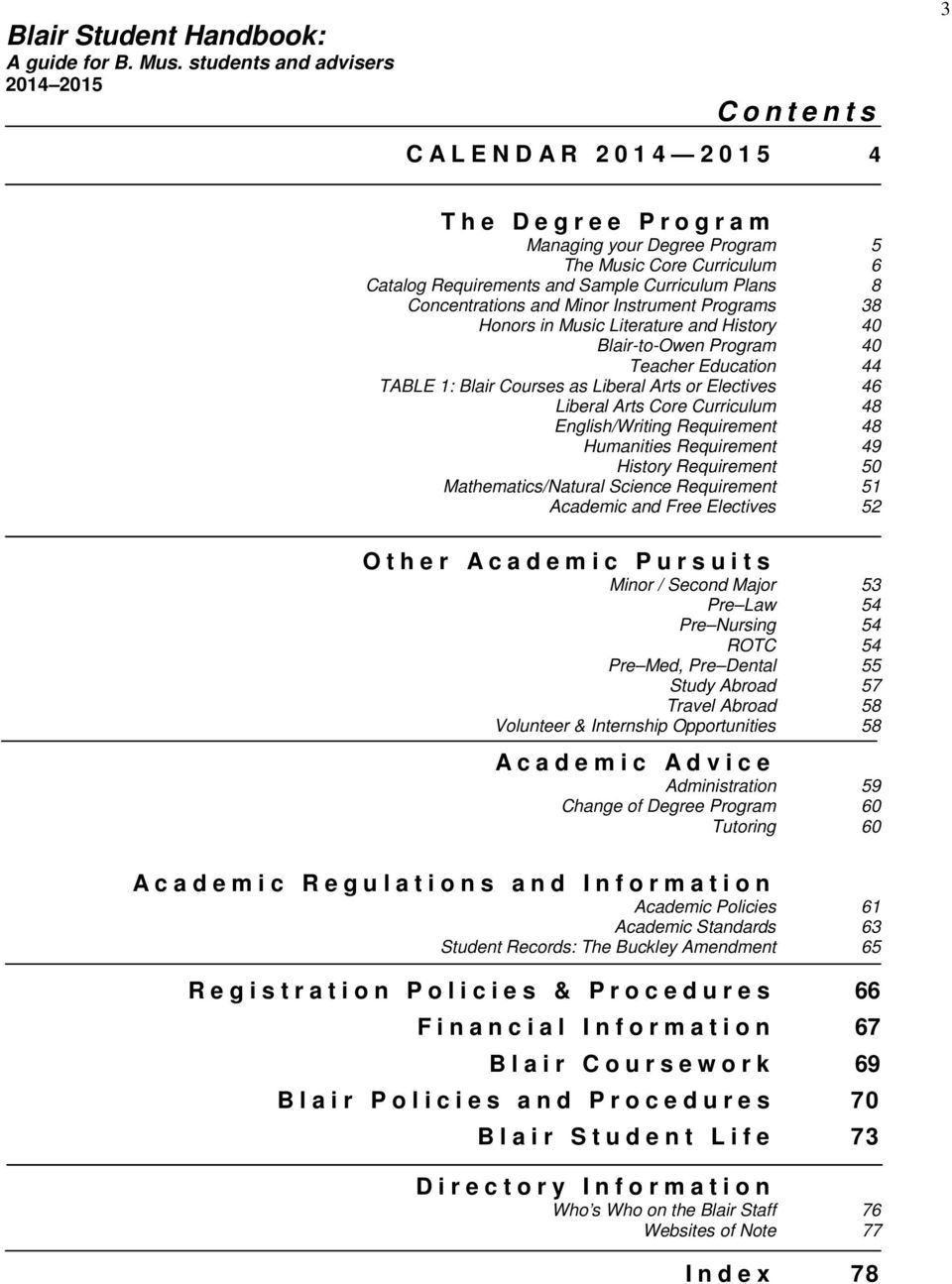
3 Blair Student Handbook: A guide for B. Mus. students and advisers C ontents C ALENDAR The Degree Program Managing your Degree Program 5 The Music Core Curriculum 6 Catalog Requirements and Sample Curriculum Plans 8 Concentrations and Minor Instrument Programs 38 Honors in Music Literature and History 40 Blair-to-Owen Program 40 Teacher Education 44 TABLE 1: Blair Courses as Liberal Arts or Electives 46 Liberal Arts Core Curriculum 48 English/Writing Requirement 48 Humanities Requirement 49 History Requirement 50 Mathematics/Natural Science Requirement 51 Academic and Free Electives 52 Other Academic Pursuits Minor / Second Major 53 Pre Law 54 Pre Nursing 54 ROTC 54 Pre Med, Pre Dental 55 Study Abroad 57 Travel Abroad 58 Volunteer & Internship Opportunities 58 Academic Advice Administration 59 Change of Degree Program 60 Tutoring 60 Academic R egulations and Information Academic Policies 61 Academic Standards 63 Student Records: The Buckley Amendment 65 Registration Policies & Procedures 66 Financial Information 67 Blair Coursework 69 Blair Policies and Procedures 70 Blair Student Life 73 Directory Information Who s Who on the Blair Staff 76 Websites of Note 77 Index 78
4 4 CALENDAR ACADEMIC YEAR (The full undergraduate academic calendar is available at JUNE 2-JUNE 27 JULY Advising and course registration period for first-year students 23 Open Enrollment/Change Period begins; no registration window is needed AUGUST 16 Orientation begins for new undergraduate students 16 Residence Halls open for transfer and upper-class students ENSEMBLE AUDITIONS (required of all B.Mus. students) Check Blair website for details 20 Classes begin 22 Welcome Assembly, Turner Recital Hall (TRH), 12:10-1:00 p.m. 25 Deadline for seniors to submit second major/minor or optional minor instrument or concentration (collaborative arts, composition, music literature/history, pedagogy, theory) to Blair Office of Academic Services. 27 Open Enrollment/Change Period ends at 11:59 p.m. Last day for students to add a course or make other changes in YES. SEPTEMBER 3 Last day to add a chamber music ensemble or to drop a class without a W (see Blair website for a drop/add form) Family Weekend OCTOBER 10 Mid-semester deficiency reports available on YES. Students with a deficiency required to meet this week with advisers; students with more than one deficiency or any senior with any deficiency must also meet with Assoc. Dean Rose. 13 Spring 2015 Class Schedule is available in YES 15 Deadline for withdrawal from a fall semester class, 4:00 p.m. Submit to Blair Office of Academic Services a course withdrawal form with signatures of student, instructor, adviser, and Associate Dean Melissa Rose October Break. No classes meet. 27 Registration begins for Spring, Meet with adviser and register through YES. NOVEMBER 14 Spring 2015 registration windows close Thanksgiving Break 28-Dec. 4 Dead Week in Blair and A & S classes: no exams or major projects DECEMBER 4 Last day of classes 5-13 Reading day, performance, and final examinations 8 Spring 2015 open enrollment/change period begins 14 Residence Halls close at noon JANUARY 5 Spring 2015 classes begin 12 Open Enrollment/Change Period ends at 11:49pm. Last day for students to add a course or make other changes in YES. 19 Last day to add a chamber music ensemble or to drop a class without a W (see Blair website for a drop/add form). Feb. 23 Summer 2015 Schedule available in YES MARCH Feb. 28-3/8 Spring Break 8 Fall 2015 Class Schedule is available in YES 6 Mid-semester deficiency reports available on YES. Students with a deficiency required to meet this week with adviser; students with more than one deficiency or any senior with any deficiency must also meet with Assoc. Dean Rose. 13 Deadline for withdrawal from a spring semester class, 4 p.m. APRIL 1 Summer study request due to Blair OAS (for transfer credit) ` 6-24 Registration period for Fall Meet with adviser and register through YES Dead Week in Blair and A & S classes: no exams or major projects 20 Last day of classes Reading day, performance, and final examinations MAY 8 Commencement 9 a.m.

5 5 MANAGING YOUR DEGREE PROGRAM Welcome to Blair! There are few things as exciting as studying, performing, and creating music. This handbook is designed to introduce you to life at Blair. Please take time to read it carefully. It will guide you as you learn about degree requirements. You will also learn about the other side of Blair where to grab a quick breakfast or lunch, how to reserve a practice room, when to study abroad, how to look for an internship, and much, much more. The Vanderbilt/Blair curriculum is wonderfully vast and varied. Making appropriate course choices will ensure that you graduate on time for your particular major. It is the student s responsibility to understand and meet degree requirements. The first place to consult is the Undergraduate Catalog, which contains official requirements for all degree programs and majors, including course requirements and academic policies. A number of other resources, including this handbook, can guide you in your course selection and degree pursuits. The online degree audits in YES indicate where you stand in the completion of your degree program. Semester grade reports and mid-semester deficiency reports also provide feedback about how well you are doing along the way. Each Blair student has an academic adviser who is the first point of contact for questions about your degree program. Your studio or composition teacher also advises in matters related to your major area; they offer another perspective about how you can shape your eight semesters of study to reach your career goals. The Associate Dean and Head of Academic Advising provide academic advice and help in planning for extra opportunities such as study abroad, internships, and independent study. The Blair Office of Academic Services and the University Registrar s Office maintain your academic record and provide numerous forms and informational resources at blair.vanderbilt.edu/academics. Over eight semesters, there may be times when you need extra help. If you re trying to do a second major or a minor, you ll need an adviser from that second program and you will want to consult with the Head of Academic Advising. The Associate Dean can provide assistance with extraordinary circumstances such as extended illness, an unusual scheduling problem, or an extra opportunity that might require a waiver or substitution in the curriculum. One of the advantages of our small size is that there s always someone to provide help and counsel. As a music student, you will be managing a detail oriented and time-intensive program, which is an excellent preparation for a life as a musician. You have many wonderful choices and opportunities ahead of you! Mark Wait, Dean Melissa Rose, Associate Dean of the Collegiate Program Pamela Schneller, Associate Dean of the Precollege/Adult Program Tucker Biddlecombe, MA5 Program Coordinator Amy Jarman, Head of Academic Advising Office of Academic Services Dwayne Sagen, Assistant Dean of Admissions, Scholarship Coordinator

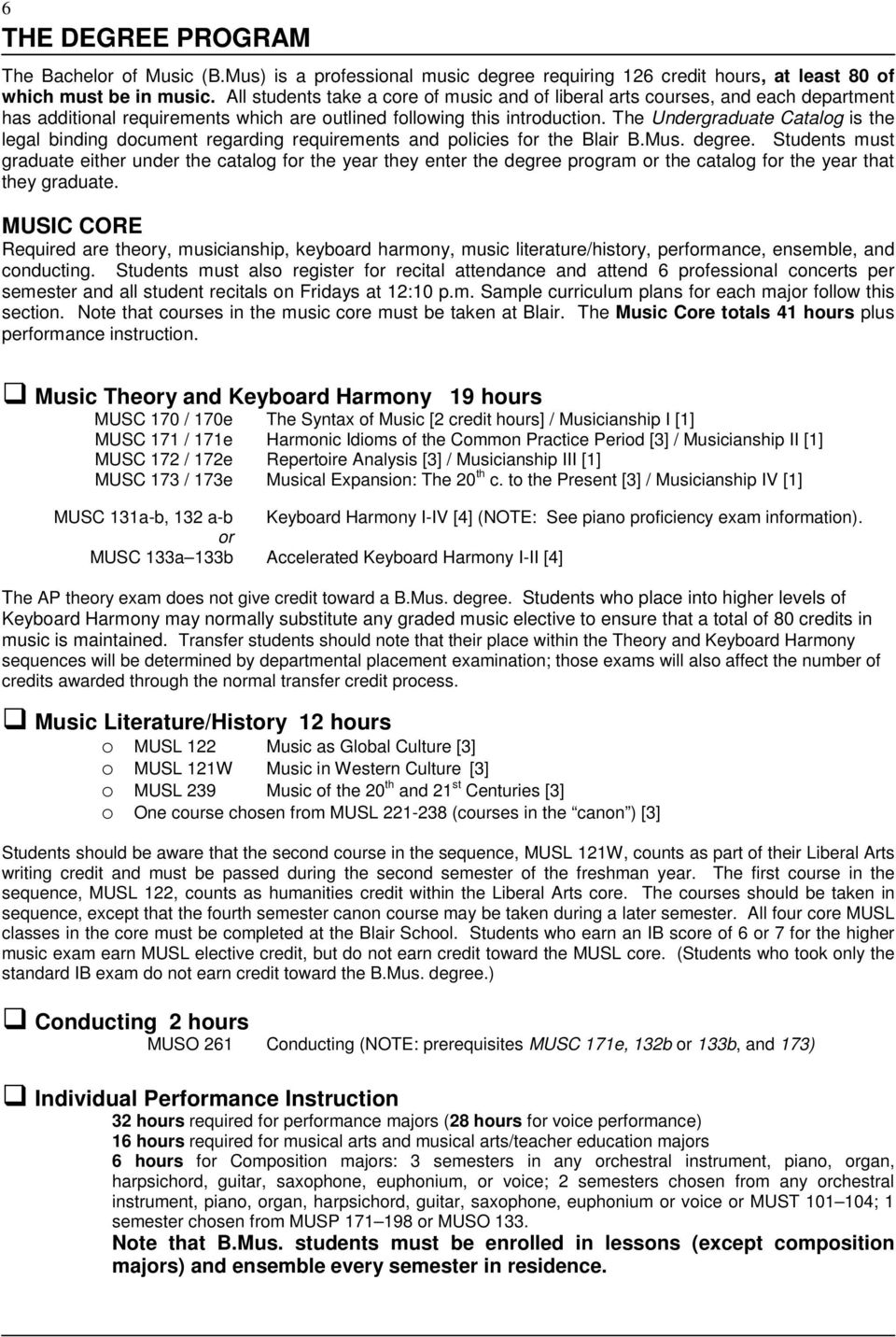
6 6 The Bachelor of Music (B.Mus) is a professional music degree requiring 126 credit hours, at least 80 of which must be in music. All students take a core of music and of liberal arts courses, and each department has additional requirements which are outlined following this introduction. The Undergraduate Catalog is the legal binding document regarding requirements and policies for the Blair B.Mus. degree. Students must graduate either under the catalog for the year they enter the degree program or the catalog for the year that they graduate. MUSIC CORE Required are theory, musicianship, keyboard harmony, music literature/history, performance, ensemble, and conducting. Students must also register for recital attendance and attend 6 professional concerts per semester and all student recitals on Fridays at 12:10 p.m. Sample curriculum plans for each major follow this section. Note that courses in the music core must be taken at Blair. The Music Core totals 41 hours plus performance instruction. Music Theory and Keyboard Harmony 19 hours MUSC 170 / 170e The Syntax of Music [2 credit hours] / Musicianship I [1] MUSC 171 / 171e Harmonic Idioms of the Common Practice Period [3] / Musicianship II [1] MUSC 172 / 172e Repertoire Analysis [3] / Musicianship III [1] MUSC 173 / 173e Musical Expansion: The 20 th c. to the Present [3] / Musicianship IV [1] MUSC 131a-b, 132 a-b Keyboard Harmony I-IV [4] (NOTE: See piano proficiency exam information). or MUSC 133a 133b Accelerated Keyboard Harmony I-II [4] The AP theory exam does not give credit toward a B.Mus. degree. Students who place into higher levels of Keyboard Harmony may normally substitute any graded music elective to ensure that a total of 80 credits in music is maintained. Transfer students should note that their place within the Theory and Keyboard Harmony sequences will be determined by departmental placement examination; those exams will also affect the number of credits awarded through the normal transfer credit process. Music Literature/History 12 hours o MUSL 122 Music as Global Culture [3] o MUSL 121W Music in Western Culture [3] o MUSL 239 Music of the 20 th and 21 st Centuries [3] o One course chosen from MUSL (courses in the canon ) [3] Students should be aware that the second course in the sequence, MUSL 121W, counts as part of their Liberal Arts writing credit and must be passed during the second semester of the freshman year. The first course in the sequence, MUSL 122, counts as humanities credit within the Liberal Arts core. The courses should be taken in sequence, except that the fourth semester canon course may be taken during a later semester. All four core MUSL classes in the core must be completed at the Blair School. Students who earn an IB score of 6 or 7 for the higher music exam earn MUSL elective credit, but do not earn credit toward the MUSL core. (Students who took only the standard IB exam do not earn credit toward the B.Mus. degree.) Conducting 2 hours MUSO 261 Conducting (NOTE: prerequisites MUSC 171e, 132b or 133b, and 173) Individual Performance Instruction 32 hours required for performance majors (28 hours for voice performance) 16 hours required for musical arts and musical arts/teacher education majors 6 hours for Composition majors: 3 semesters in any orchestral instrument, piano, organ, harpsichord, guitar, saxophone, euphonium, or voice; 2 semesters chosen from any orchestral instrument, piano, organ, harpsichord, guitar, saxophone, euphonium or voice or MUST ; 1 semester chosen from MUSP or MUSO 133. Note that B.Mus. students must be enrolled in lessons (except composition majors) and ensemble every semester in residence.
7 7 Ensemble 8 hours minimum (every semester in residence at Blair) Specific requirements are determined by each major area. Auditions for major ensembles are required each semester until requirements are fulfilled: Please check the curriculum plans for corequisite chamber music options for your instrument; for chamber music enrollment information, please see: Assignment to ensembles is at the discretion of the directors. During study abroad, students may waive participation in an ensemble of choice ; performance majors who study abroad may waive one semester of MUSE 101 or 101a. However, students must fulfill the minimum number of ensemble credits required for the degree. Conducted Ensembles [1 credit hour each]: MUSE 101 Instrumental Ensembles MUSE 101a Vanderbilt Symphonic Choir MUSE 201a Vanderbilt Chorale Chamber Music Ensembles [½ to 2 credit hours each, depending on circumstance]: MUSE 102, 201b, 201d, 202, 204, 206, 207, 209, 210, 215, 221, 222, 223, 224, 225, 226 Other Ensembles [1 credit hour each]: MUSE 131 Jazz Ensemble: Big Band [1] MUSE 101f Vanderbilt Opera Theatre [1] MUSE 210 Percussion Ensemble ( Vortex ) [1] (counts as corequisite) MUSE 132, 150, 171, 212 World and Vernacular Music Ensembles [1] -Ensembles must be added by the student before the end of the drop/add period each semester. Chamber music ensembles may be added for credit during the second week of classes with the assistance of the Office of Academic Services, after which, participation will be considered extracurricular. -After their first semester, students with a strong academic profile who wish to take an overload may petition the Associate Dean for zero-credit registration in a single ensemble. If granted, students should be aware that the semester s zero-credit ensemble work will not count toward the total of 80 hours in music required for the degree program. It will, however, fulfill a required ensemble enrollment. Zero credit for required ensembles is reserved for students with second majors/minors or a pre-professional program. Required ensembles taken for zero credit must be replaced by other music electives in order to receive the minimum of 80 credit hours in music.

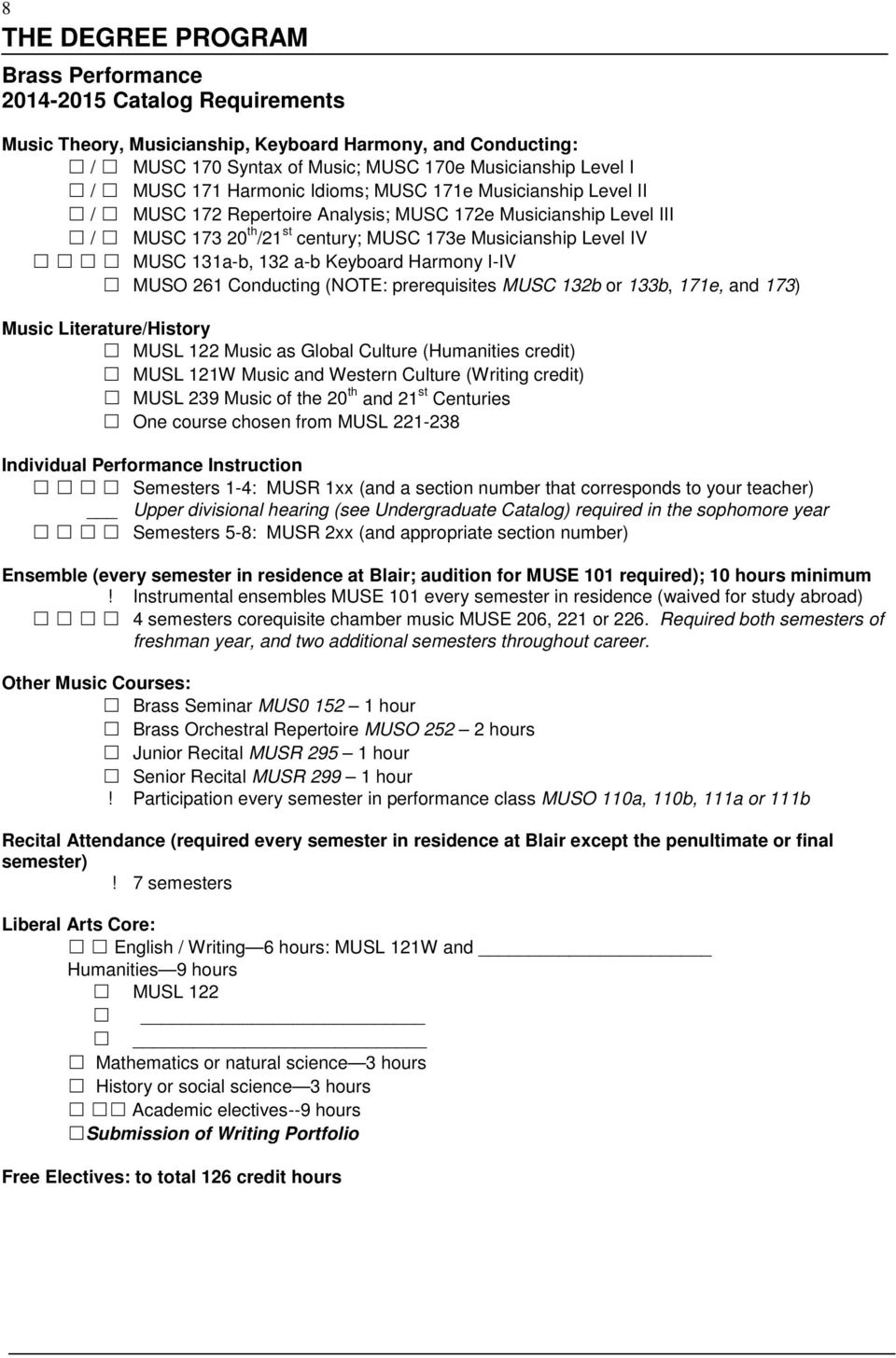
8 8 Brass Performance Catalog Requirements Music Theory, Musicianship, Keyboard Harmony, and Conducting: / MUSC 170 Syntax of Music; MUSC 170e Musicianship Level I / MUSC 171 Harmonic Idioms; MUSC 171e Musicianship Level II / MUSC 172 Repertoire Analysis; MUSC 172e Musicianship Level III / MUSC th /21 st century; MUSC 173e Musicianship Level IV MUSC 131a-b, 132 a-b Keyboard Harmony I-IV MUSO 261 Conducting (NOTE: prerequisites MUSC 132b or 133b, 171e, and 173) Music Literature/History MUSL 122 Music as Global Culture (Humanities credit) MUSL 121W Music and Western Culture (Writing credit) MUSL 239 Music of the 20 th and 21 st Centuries One course chosen from MUSL Individual Performance Instruction Semesters 1-4: MUSR 1xx (and a section number that corresponds to your teacher) Upper divisional hearing (see Undergraduate Catalog) required in the sophomore year Semesters 5-8: MUSR 2xx (and appropriate section number) Ensemble (every semester in residence at Blair; audition for MUSE 101 required); 10 hours minimum! Instrumental ensembles MUSE 101 every semester in residence (waived for study abroad) 4 semesters corequisite chamber music MUSE 206, 221 or 226. Required both semesters of freshman year, and two additional semesters throughout career. Other Music Courses: Brass Seminar MUS hour Brass Orchestral Repertoire MUSO hours Junior Recital MUSR hour Senior Recital MUSR hour! Participation every semester in performance class MUSO 110a, 110b, 111a or 111b Recital Attendance (required every semester in residence at Blair except the penultimate or final semester)! 7 semesters Liberal Arts Core: English / Writing 6 hours: MUSL 121W and Humanities 9 hours MUSL 122 Mathematics or natural science 3 hours History or social science 3 hours Academic electives--9 hours Submission of Writing Portfolio Free Electives: to total 126 credit hours
9 9 Brass Performance Sample Curriculum Plan Semester Hours Course No. Course Title FALL SPRING FRESHMAN YEAR *MUSC 131a 131b Keyboard Harmony I and II 1 1 MUSC 170, 171 Syntax of Music; Harmonic Idioms 2 3 MUSC 170e, 171e Musicianship Levels I and II 1 1 MUSE 101 Instrumental Ensemble 1 1 MUSE Corequisite chamber ensemble ½ ½ MUSL 121W Music in Western Culture -- 3 MUSL 122 Music as Global Culture 3 -- MUSO Performance Class 0 0 MUSR 1xx Performance Instruction 4 4 Liberal Arts ½ 16½ SOPHOMORE YEAR MUSC 132a 132b Keyboard Harmony III and IV 1 1 MUSC 172, 173 Repertoire Analysis, 20 th/ 21 st Century 3 3 MUSC 172e, 173e Musicianship Levels III and IV 1 1 MUSE 101 Instrumental Ensemble 1 1 MUSL Music Literature Topical Course -- 3 MUSL 239 Music of the 20 th and 21 st Centuries 3 -- MUSO Performance Class 0 0 MUSR 1xx Performance Instruction 4 4 Liberal Arts JUNIOR YEAR MUSE 101 Instrumental Ensemble 1 1 Corequisite chamber ensemble ½ -- MUSO Performance Class 0 0 MUSO 152 Brass Seminar 1 -- MUSO 252 Brass Orchestral Repertoire -- 2 MUSO 261 Conducting -- 2 MUSR 2xx Performance Instruction 4 4 MUSR 295 Junior Recital -- 1 Liberal Arts 6 6 Free Electives ½ 16 SENIOR YEAR MUSE 101 Instrumental Ensemble 1 1 Corequisite chamber ensemble ½ -- MUSO 108 Recital Attendance 0 MUSO Performance Class 0 0 MUSR 2xx Performance Instruction 4 4 MUSR 299 Senior Recital 1 Free Electives ½ 15 *Students with no keyboard experience take MUSC 130/Introductory Keyboard Harmony and postpone Keyboard Harmony one semester.

10 10 Composition Catalog Requirements Music Theory, Musicianship, Keyboard Harmony, and Conducting: / MUSC 170 Syntax of Music; MUSC 170e Musicianship Level I / MUSC 171 Harmonic Idioms; MUSC 171e Musicianship Level II / MUSC 172 Repertoire Analysis; MUSC 172e Musicianship Level III / MUSC th /21 st century; MUSC 173e Musicianship Level IV MUSC 131a-b, 132 a-b Keyboard Harmony I-IV MUSO 261 Conducting (NOTE: prerequisites MUSC 132b or 133b, 171e, and 173) Music Literature/History MUSL 122 Music as Global Culture (Humanities credit) MUSL 121W Music and Western Culture (Writing credit) MUSL 239 Music of the 20 th and 21 st Centuries One course chosen from MUSL Individual Performance Instruction 3 semesters of MUSP 1xx in any orchestral instrument, piano, organ, harpsichord, guitar, saxophone, euphonium, or voice (MUSP ) 2 semesters chosen from any orchestral instrument, piano, organ, harpsichord, guitar, saxophone, euphonium or voice or MUST semester chosen from MUSP or MUSO 133. Composition Lessons MUSC 141, 142, 143, 144 (Students rotate instructors as assigned for MUSC to gain experience with 4 different members of the department.) MUSC 241abcd (Students may select one or more instructors of choice in their junior and senior years. Students can earn a 4 th credit for focused opportunities such as analysis, repertoire study, etc.; instructor approval required) Other Music Courses Introduction to Composition MUSC hours Post-tonal Analysis MUSC hours Junior Thesis MUSC hour Senior Composition Recital MUSC hour Music electives. 5 hours (to total 80 credits in music)! Participation every semester in studio class MUSO 111C Ensemble (required every semester in residence at Blair; waived during study abroad); 8 hours minimum! 8 semesters selected with adviser's approval; see list of ensembles on page 7. Recital Attendance (required every semester in residence at Blair except the penultimate or final semester)! 7 semesters Liberal Arts Core (33 hours) * English / Writing 6 hours: MUSL 121W and Humanities: MUSL year (6-10 hours) of a foreign language, normally French, German, or Italian * * 2 courses chosen from 200-level Art History, 200-level Philosophy, and 200-level English and Mathematics or natural science 3 hours History or social science 3 hours Academic electives (for a total of 33 credits in Liberal Arts) Submission of Writing Portfolio Free Electives to total 126 credit hours * A 200-level English course may double-count as both English and Humanities as long as the student earns a total of 33 hours of Liberal Arts credit.

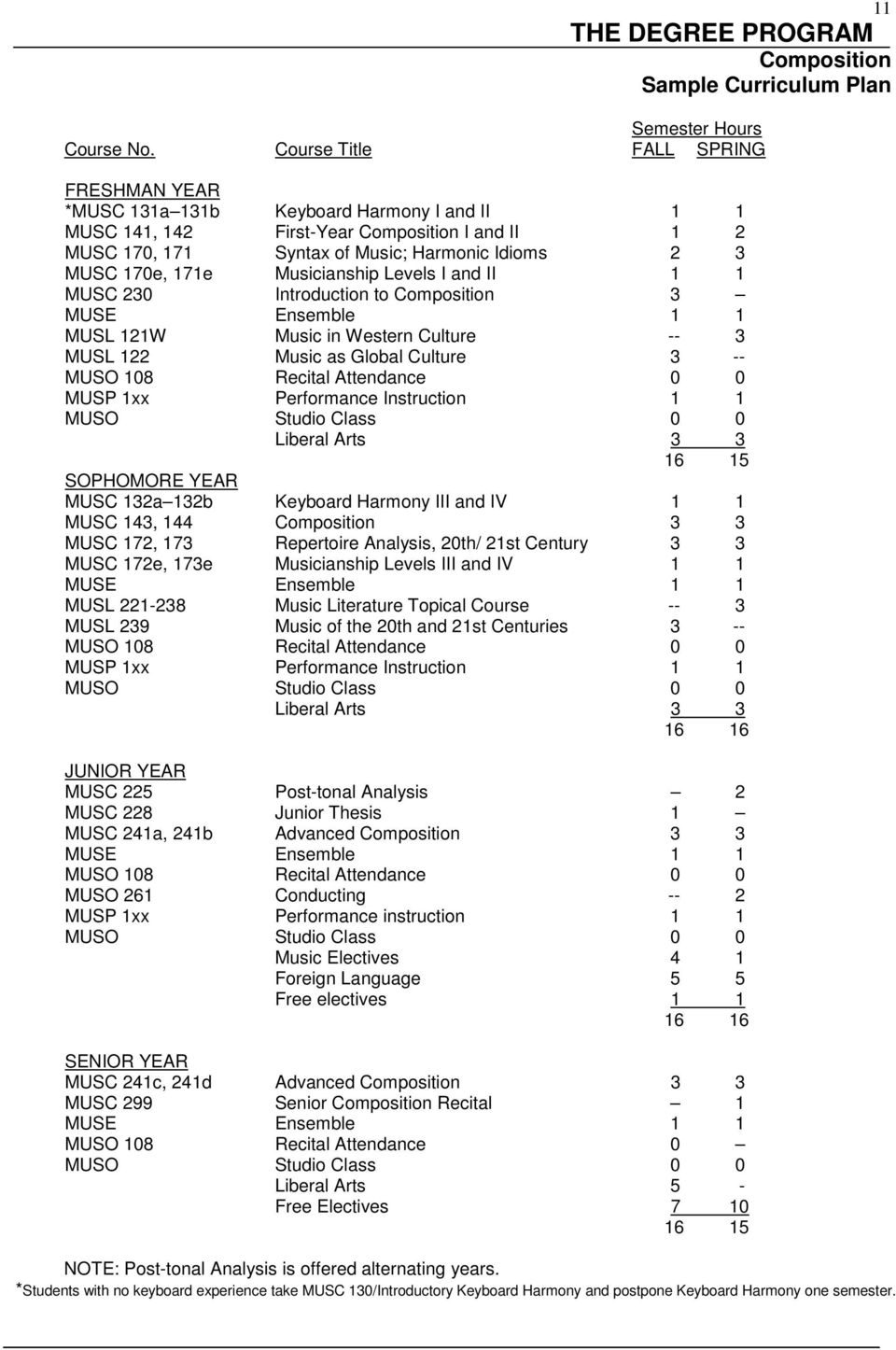
11 11 Composition Sample Curriculum Plan Semester Hours Course No. Course Title FALL SPRING FRESHMAN YEAR *MUSC 131a 131b Keyboard Harmony I and II 1 1 MUSC 141, 142 First-Year Composition I and II 1 2 MUSC 170, 171 Syntax of Music; Harmonic Idioms 2 3 MUSC 170e, 171e Musicianship Levels I and II 1 1 MUSC 230 Introduction to Composition 3 MUSE Ensemble 1 1 MUSL 121W Music in Western Culture -- 3 MUSL 122 Music as Global Culture 3 -- MUSP 1xx Performance Instruction 1 1 MUSO Studio Class 0 0 Liberal Arts SOPHOMORE YEAR MUSC 132a 132b Keyboard Harmony III and IV 1 1 MUSC 143, 144 Composition 3 3 MUSC 172, 173 Repertoire Analysis, 20th/ 21st Century 3 3 MUSC 172e, 173e Musicianship Levels III and IV 1 1 MUSE Ensemble 1 1 MUSL Music Literature Topical Course -- 3 MUSL 239 Music of the 20th and 21st Centuries 3 -- MUSP 1xx Performance Instruction 1 1 MUSO Studio Class 0 0 Liberal Arts JUNIOR YEAR MUSC 225 Post-tonal Analysis 2 MUSC 228 Junior Thesis 1 MUSC 241a, 241b Advanced Composition 3 3 MUSE Ensemble 1 1 MUSO 261 Conducting -- 2 MUSP 1xx Performance instruction 1 1 MUSO Studio Class 0 0 Music Electives 4 1 Foreign Language 5 5 Free electives SENIOR YEAR MUSC 241c, 241d Advanced Composition 3 3 MUSC 299 Senior Composition Recital 1 MUSE Ensemble 1 1 MUSO 108 Recital Attendance 0 MUSO Studio Class 0 0 Liberal Arts 5 - Free Electives NOTE: Post-tonal Analysis is offered alternating years. *Students with no keyboard experience take MUSC 130/Introductory Keyboard Harmony and postpone Keyboard Harmony one semester.
12 12 Guitar Performance Catalog Requirements Music Theory, Musicianship, Keyboard Harmony, and Conducting: / MUSC 170 Syntax of Music; MUSC 170e Musicianship Level I / MUSC 171 Harmonic Idioms; MUSC 171e Musicianship Level II / MUSC 172 Repertoire Analysis; MUSC 172e Musicianship Level III / MUSC th /21 st century; MUSC 173e Musicianship Level IV MUSC 131a-b, 132 a-b Keyboard Harmony I-IV MUSO 261 Conducting (NOTE: prerequisites MUSC 132b or 133b, 171e, and 173) Music Literature/History MUSL 122 Music as Global Culture (Humanities credit) MUSL 121W Music and Western Culture (Writing credit) MUSL 239 Music of the 20 th and 21 st Centuries One course chosen from MUSL Individual Performance Instruction (must be enrolled every semester in residence) Semesters 1-4: MUSR 188 (and a section number that corresponds to your teacher) Upper divisional hearing (see Undergraduate Catalog) required in the sophomore year Semesters 5-8: MUSR 288 (and appropriate section number) Ensemble (every semester in residence at Blair, waived during study abroad); 8 hours minimum 2 semesters choir MUSE 101a and/or 201a. (Students must audition each semester for choir until that requirement is fulfilled.) 2 semesters guitar ensemble MUSE semesters chamber music MUSE 201d, 204 or 221 Other Music Courses: Guitar Literature MUSO hours (offered alternate years) Guitar Pedagogy MUSO hours (offered alternate years) Junior Recital MUSR hour Senior Recital MUSR hour Music Elective 1 hour! Participation every semester in performance class MUSO 109e Recital Attendance (required every semester in residence at Blair except the penultimate or final semester)! 7 semesters Liberal Arts Core: English / Writing 6 hours: MUSL 121W and Humanities 9 hours MUSL 122 Mathematics or natural science 3 hours History or social science 3 hours Academic electives--9 hours Submission of Writing Portfolio Free Electives: to total 126 credit hours

13 13 Guitar Performance Sample Curriculum Plan Semester Hours Course No. Course Title FALL SPRING FRESHMAN YEAR *MUSC 131a 131b Keyboard Harmony I and II 1 1 MUSC 170, 171 Syntax of Music; Harmonic Idioms 2 3 MUSC 170e, 171e Musicianship Levels I and II 1 1 MUSE 101a Symphonic Choir 1 1 MUSL 121W Music in Western Culture -- 3 MUSL 122 Music as Global Culture 3 MUSO 109e Guitar Performance Class 0 0 MUSR 188 Guitar 4 4 Liberal Arts SOPHOMORE YEAR MUSC 132a 132b Keyboard Harmony III and IV 1 1 MUSC 172, 173 Repertoire Analysis, 20 th/ 21 st Century 3 3 MUSC 172e, 173e Musicianship Levels III and IV 1 1 MUSE 204 Guitar Ensemble 1 1 MUSL Music Literature Topical Course -- 3 MUSL 239 Music of the 20 th and 21 st Centuries 3 MUSO 109e Guitar Performance Class 0 0 MUSR 188 Guitar 4 4 Liberal Arts JUNIOR YEAR MUSE 221 or 204 Chamber Music 1 1 MUSO 109e Guitar Performance Class 0 0 MUSO 258 Guitar Literature 2 - MUSO 261 Conducting -- 2 MUSO 268 Guitar Pedagogy - 2 MUSR 288 Guitar 4 4 MUSR 295 Junior Recital - 1 Liberal Arts 6 6 Free Electives SENIOR YEAR MUSE 221 or 204 Chamber Music 1 1 MUSO 108 Recital Attendance 0 - MUSO 109e Guitar Performance Class 0 0 MUSR 288 Guitar 4 4 MUSR 299 Senior Recital - 1 Free Electives 10 9 Music Elective *Students with no keyboard experience take MUSC 130/Introductory Keyboard Harmony and postpone Keyboard Harmony one semester.

14 14 Harp Performance Catalog Requirements Music Theory, Musicianship, Keyboard Harmony, and Conducting: / MUSC 170 Syntax of Music; MUSC 170e Musicianship Level I / MUSC 171 Harmonic Idioms; MUSC 171e Musicianship Level II / MUSC 172 Repertoire Analysis; MUSC 172e Musicianship Level III / MUSC th /21 st century; MUSC 173e Musicianship Level IV MUSC 131a-b, 132 a-b Keyboard Harmony I-IV MUSO 261 Conducting (NOTE: prerequisites MUSC 132b or 133b, 171e, and 173) Music Literature/History MUSL 122 Music as Global Culture (Humanities credit) MUSL 121W Music and Western Culture (Writing credit) MUSL 239 Music of the 20 th and 21 st Centuries One course chosen from MUSL Individual Performance Instruction (must be enrolled every semester in residence) Semesters 1-4: MUSR 181 (and a section number that corresponds to your teacher) Upper divisional hearing (see Undergraduate Catalog) required in the sophomore year Semesters 5-8: MUSR 281 (and appropriate section number) Ensemble (every semester in residence at Blair); 10 hours minimum! Instrumental ensembles MUSE 101 every semester in residence (waived for study abroad) 4 semesters corequisite chamber music MUSE 209 or 221. Required both semesters of freshman year, and two additional semesters throughout career. Other Music Courses: String Orchestral Repertoire MUSO 254a 1 hour Junior Recital MUSR hour Senior Recital MUSR hour Music Electives 2 hours Recital Attendance (required every semester in residence at Blair except the penultimate or final semester)! 7 semesters Liberal Arts Core: English / Writing 6 hours: MUSL 121W and Humanities 9 hours MUSL 122 Mathematics or natural science 3 hours History or social science 3 hours Academic electives--9 hours Submission of Writing Portfolio Free Electives: to total 126 credit hours

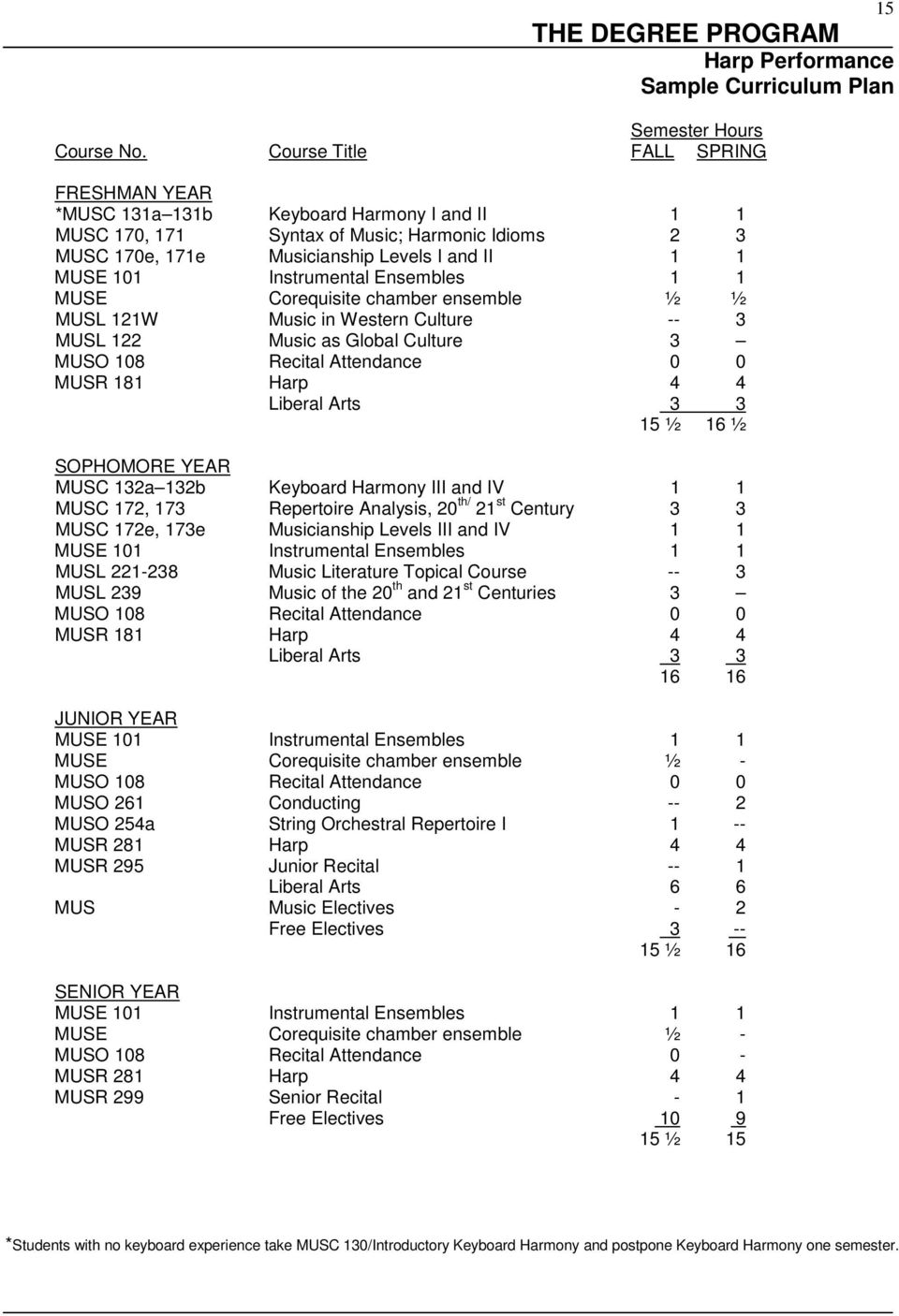
15 15 Harp Performance Sample Curriculum Plan Semester Hours Course No. Course Title FALL SPRING FRESHMAN YEAR *MUSC 131a 131b Keyboard Harmony I and II 1 1 MUSC 170, 171 Syntax of Music; Harmonic Idioms 2 3 MUSC 170e, 171e Musicianship Levels I and II 1 1 MUSE 101 Instrumental Ensembles 1 1 MUSE Corequisite chamber ensemble ½ ½ MUSL 121W Music in Western Culture -- 3 MUSL 122 Music as Global Culture 3 MUSR 181 Harp 4 4 Liberal Arts ½ 16 ½ SOPHOMORE YEAR MUSC 132a 132b Keyboard Harmony III and IV 1 1 MUSC 172, 173 Repertoire Analysis, 20 th/ 21 st Century 3 3 MUSC 172e, 173e Musicianship Levels III and IV 1 1 MUSE 101 Instrumental Ensembles 1 1 MUSL Music Literature Topical Course -- 3 MUSL 239 Music of the 20 th and 21 st Centuries 3 MUSR 181 Harp 4 4 Liberal Arts JUNIOR YEAR MUSE 101 Instrumental Ensembles 1 1 MUSE Corequisite chamber ensemble ½ - MUSO 261 Conducting -- 2 MUSO 254a String Orchestral Repertoire I 1 -- MUSR 281 Harp 4 4 MUSR 295 Junior Recital -- 1 Liberal Arts 6 6 MUS Music Electives - 2 Free Electives ½ 16 SENIOR YEAR MUSE 101 Instrumental Ensembles 1 1 MUSE Corequisite chamber ensemble ½ - MUSO 108 Recital Attendance 0 - MUSR 281 Harp 4 4 MUSR 299 Senior Recital - 1 Free Electives ½ 15 *Students with no keyboard experience take MUSC 130/Introductory Keyboard Harmony and postpone Keyboard Harmony one semester.
16 16 Musical Arts Catalog Requirements Music Theory, Musicianship, Keyboard Harmony, and Conducting: / MUSC 170 Syntax of Music; MUSC 170e Musicianship Level I / MUSC 171 Harmonic Idioms; MUSC 171e Musicianship Level II / MUSC 172 Repertoire Analysis; MUSC 172e Musicianship Level III / MUSC th /21 st century; MUSC 173e Musicianship Level IV MUSC 131a-b, 132 a-b Keyboard Harmony I-IV MUSO 261 Conducting (NOTE: prerequisites MUSC 132b or 133b, 171e, and 173) Music Literature/History MUSL 122 Music as Global Culture (Humanities credit) MUSL 121W Music and Western Culture (Writing credit) MUSL 239 Music of the 20 th and 21 st Centuries One course chosen from MUSL Individual Performance Instruction (must be enrolled every semester in residence): Semesters 1-4: MUSP 1xx (and appropriate section number) Semesters 5-8: MUSP 2xx (and appropriate section number) For percussion students, one semester of specialized study in drumset, jazz vibraphone, or contemporary marimba is available after completion of the MUSP 180 sequence. Ensemble (required every semester in residence); 8 10 hours minimum Auditions are required for MUSE 101, 101a, and 201a. During Study Abroad, a student may waive an ensemble of choice. BRASS, HARP, PERCUSSION, STRINGS, WOODWINDS (10 hours min) 5 semesters instrumental ensembles MUSE 101 with 4 semesters corequisite chamber music; chamber music required both semesters of freshman year and two additional semesters throughout career. 3 semesters ensemble of choice GUITAR (8 hours min): 2 semesters choir MUSE 101a or 201a. 2 semesters guitar ensemble MUSE semester choir or chamber music (MUSE 101a, 201a, 201d, 204,221) 3 semesters ensemble of choice ORGAN: (8 hours min): 3 semesters of conducted choral ensemble 1 semester Collaborative Techniques for Pianists MUSE semester vocal collaboration MUSE 201b 1 semester instrumental collaboration MUSE semesters ensemble of choice PIANO (8 hours min): 1 semester of MUSE 101a, 201a, 101, 101f or other approved conducted choir (fall semester, freshman year) 1 semester Collaborative Techniques for Pianists MUSE102 3 semesters of 201b, 201d, 221, 222 or semesters ensemble of choice

17 17 Musical Arts Catalog Requirements, cont. VOICE (8 hours min):! 8 semesters choir MUSE 101a or 201a, as assigned (or 201d if demonstrated conflict exists with choir); students in MUSE 101f are eligible for 0.5 credit section of 101a, 201a, or 201d. Ensemble audition required every semester. Advanced theory or composition 2-3 hours chosen from: MUSC 223 Techniques of Choral Composition MUSC 224 Orchestration MUSC 225 Seminar in Post-Tonal Analysis MUSC 226 Chromatic Harm. in the Rom. Era MUSC 227 Individual Theory Instruction MUSC 230 Introduction to Composition MUSC 248 Jazz Chord Extensions and Patterns MUSC 251 Historical Traditions in Comp and in Perf MUSC 255 Early Keyboard Literature MUSC 261 Counterpoint: 16th Century Principles MUSC 280 Musical Explorations: Bartók MUSC 294 Special Topics in Music Theory Music literature/history electives 9 hours (in addition to the core MUSL courses) See Table 1 pp for a listing of MUSL electives and information on liberal arts double-counts. Be aware of alternate year courses in catalog. 6 hours selected from: MUSL 103, 115F, 147, 171, 183, 200, 201, (must be different choice from 3 rd course in core MUSL sequence), 250, 253, 261, 262, 289, 294, 298, 299ab. 3 hours any MUSL Music electives: 9-10 hours for Brass/Harp/Perc/St/WW; hours for Guitar/Organ/Piano; 8-9 for Voice Credits Semester/Year Course number, course title hrs hrs hrs hrs hrs hrs hrs hrs hrs hrs hrs hrs Other music: 3 hours. MUSO 159, 159c, 159d for Voice Majors, taken in sequence in the first 3 semesters Performance class: every semester in residence (except harp)! 8 semesters Recital Attendance (required every semester in residence at Blair except the penultimate or final semester)! 7 semesters Liberal Arts Core: English / Writing 6 hours: MUSL 121W and Humanities 9 hours MUSL 122 and Mathematics or natural science 3 hours History or social science 3 hours Academic electives--9 hours Submission of Writing Portfolio Free Electives: to total 126 credit hours

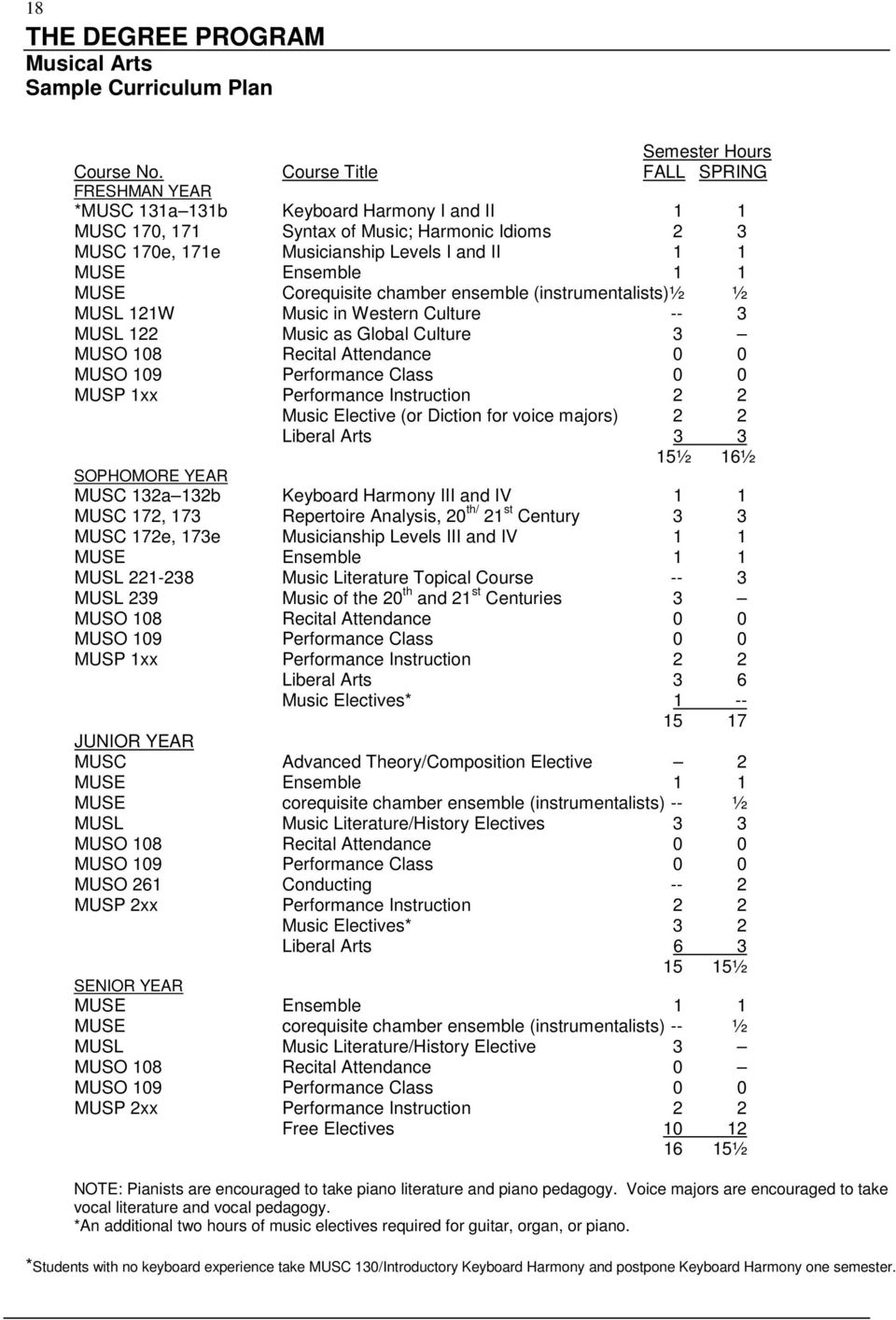
18 18 Musical Arts Sample Curriculum Plan Semester Hours Course No. Course Title FALL SPRING FRESHMAN YEAR *MUSC 131a 131b Keyboard Harmony I and II 1 1 MUSC 170, 171 Syntax of Music; Harmonic Idioms 2 3 MUSC 170e, 171e Musicianship Levels I and II 1 1 MUSE Ensemble 1 1 MUSE Corequisite chamber ensemble (instrumentalists)½ ½ MUSL 121W Music in Western Culture -- 3 MUSL 122 Music as Global Culture 3 MUSO 109 Performance Class 0 0 MUSP 1xx Performance Instruction 2 2 Music Elective (or Diction for voice majors) 2 2 Liberal Arts ½ 16½ SOPHOMORE YEAR MUSC 132a 132b Keyboard Harmony III and IV 1 1 MUSC 172, 173 Repertoire Analysis, 20 th/ 21 st Century 3 3 MUSC 172e, 173e Musicianship Levels III and IV 1 1 MUSE Ensemble 1 1 MUSL Music Literature Topical Course -- 3 MUSL 239 Music of the 20 th and 21 st Centuries 3 MUSO 109 Performance Class 0 0 MUSP 1xx Performance Instruction 2 2 Liberal Arts 3 6 Music Electives* JUNIOR YEAR MUSC Advanced Theory/Composition Elective 2 MUSE Ensemble 1 1 MUSE corequisite chamber ensemble (instrumentalists) -- ½ MUSL Music Literature/History Electives 3 3 MUSO 109 Performance Class 0 0 MUSO 261 Conducting -- 2 MUSP 2xx Performance Instruction 2 2 Music Electives* 3 2 Liberal Arts ½ SENIOR YEAR MUSE Ensemble 1 1 MUSE corequisite chamber ensemble (instrumentalists) -- ½ MUSL Music Literature/History Elective 3 MUSO 108 Recital Attendance 0 MUSO 109 Performance Class 0 0 MUSP 2xx Performance Instruction 2 2 Free Electives ½ NOTE: Pianists are encouraged to take piano literature and piano pedagogy. Voice majors are encouraged to take vocal literature and vocal pedagogy. *An additional two hours of music electives required for guitar, organ, or piano. *Students with no keyboard experience take MUSC 130/Introductory Keyboard Harmony and postpone Keyboard Harmony one semester.
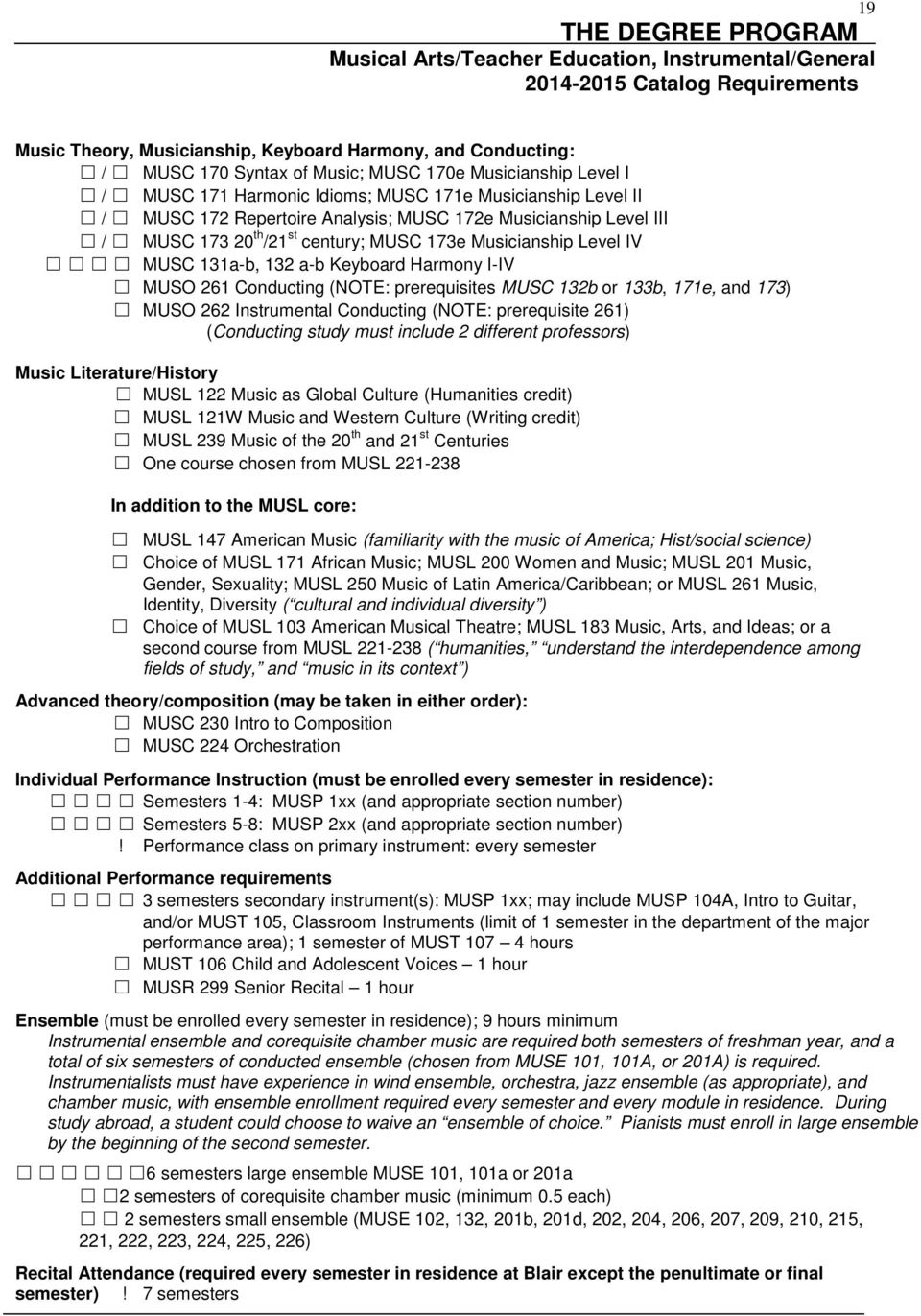
19 19 Musical Arts/Teacher Education, Instrumental/General Catalog Requirements Music Theory, Musicianship, Keyboard Harmony, and Conducting: / MUSC 170 Syntax of Music; MUSC 170e Musicianship Level I / MUSC 171 Harmonic Idioms; MUSC 171e Musicianship Level II / MUSC 172 Repertoire Analysis; MUSC 172e Musicianship Level III / MUSC th /21 st century; MUSC 173e Musicianship Level IV MUSC 131a-b, 132 a-b Keyboard Harmony I-IV MUSO 261 Conducting (NOTE: prerequisites MUSC 132b or 133b, 171e, and 173) MUSO 262 Instrumental Conducting (NOTE: prerequisite 261) (Conducting study must include 2 different professors) Music Literature/History MUSL 122 Music as Global Culture (Humanities credit) MUSL 121W Music and Western Culture (Writing credit) MUSL 239 Music of the 20 th and 21 st Centuries One course chosen from MUSL In addition to the MUSL core: MUSL 147 American Music (familiarity with the music of America; Hist/social science) Choice of MUSL 171 African Music; MUSL 200 Women and Music; MUSL 201 Music, Gender, Sexuality; MUSL 250 Music of Latin America/Caribbean; or MUSL 261 Music, Identity, Diversity ( cultural and individual diversity ) Choice of MUSL 103 American Musical Theatre; MUSL 183 Music, Arts, and Ideas; or a second course from MUSL ( humanities, understand the interdependence among fields of study, and music in its context ) Advanced theory/composition (may be taken in either order): MUSC 230 Intro to Composition MUSC 224 Orchestration Individual Performance Instruction (must be enrolled every semester in residence): Semesters 1-4: MUSP 1xx (and appropriate section number) Semesters 5-8: MUSP 2xx (and appropriate section number)! Performance class on primary instrument: every semester Additional Performance requirements 3 semesters secondary instrument(s): MUSP 1xx; may include MUSP 104A, Intro to Guitar, and/or MUST 105, Classroom Instruments (limit of 1 semester in the department of the major performance area); 1 semester of MUST hours MUST 106 Child and Adolescent Voices 1 hour MUSR 299 Senior Recital 1 hour Ensemble (must be enrolled every semester in residence); 9 hours minimum Instrumental ensemble and corequisite chamber music are required both semesters of freshman year, and a total of six semesters of conducted ensemble (chosen from MUSE 101, 101A, or 201A) is required. Instrumentalists must have experience in wind ensemble, orchestra, jazz ensemble (as appropriate), and chamber music, with ensemble enrollment required every semester and every module in residence. During study abroad, a student could choose to waive an ensemble of choice. Pianists must enroll in large ensemble by the beginning of the second semester. 6 semesters large ensemble MUSE 101, 101a or 201a 2 semesters of corequisite chamber music (minimum 0.5 each) 2 semesters small ensemble (MUSE 102, 132, 201b, 201d, 202, 204, 206, 207, 209, 210, 215, 221, 222, 223, 224, 225, 226) Recital Attendance (required every semester in residence at Blair except the penultimate or final semester)! 7 semesters
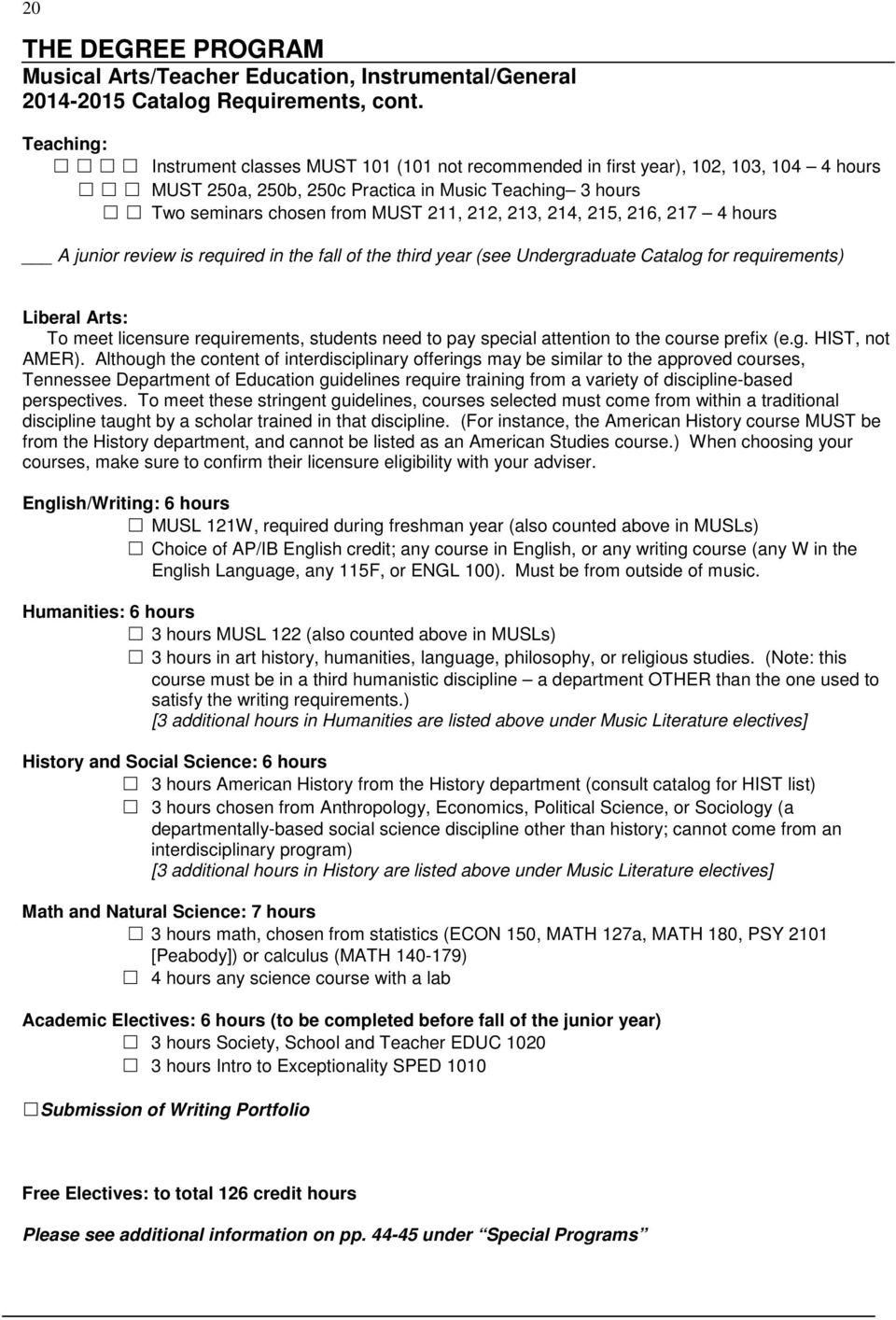
20 20 Musical Arts/Teacher Education, Instrumental/General Catalog Requirements, cont. Teaching: Instrument classes MUST 101 (101 not recommended in first year), 102, 103, hours MUST 250a, 250b, 250c Practica in Music Teaching 3 hours Two seminars chosen from MUST 211, 212, 213, 214, 215, 216, hours A junior review is required in the fall of the third year (see Undergraduate Catalog for requirements) Liberal Arts: To meet licensure requirements, students need to pay special attention to the course prefix (e.g. HIST, not AMER). Although the content of interdisciplinary offerings may be similar to the approved courses, Tennessee Department of Education guidelines require training from a variety of discipline-based perspectives. To meet these stringent guidelines, courses selected must come from within a traditional discipline taught by a scholar trained in that discipline. (For instance, the American History course MUST be from the History department, and cannot be listed as an American Studies course.) When choosing your courses, make sure to confirm their licensure eligibility with your adviser. English/Writing: 6 hours MUSL 121W, required during freshman year (also counted above in MUSLs) Choice of AP/IB English credit; any course in English, or any writing course (any W in the English Language, any 115F, or ENGL 100). Must be from outside of music. Humanities: 6 hours 3 hours MUSL 122 (also counted above in MUSLs) 3 hours in art history, humanities, language, philosophy, or religious studies. (Note: this course must be in a third humanistic discipline a department OTHER than the one used to satisfy the writing requirements.) [3 additional hours in Humanities are listed above under Music Literature electives] History and Social Science: 6 hours 3 hours American History from the History department (consult catalog for HIST list) 3 hours chosen from Anthropology, Economics, Political Science, or Sociology (a departmentally-based social science discipline other than history; cannot come from an interdisciplinary program) [3 additional hours in History are listed above under Music Literature electives] Math and Natural Science: 7 hours 3 hours math, chosen from statistics (ECON 150, MATH 127a, MATH 180, PSY 2101 [Peabody]) or calculus (MATH ) 4 hours any science course with a lab Academic Electives: 6 hours (to be completed before fall of the junior year) 3 hours Society, School and Teacher EDUC hours Intro to Exceptionality SPED 1010 Submission of Writing Portfolio Free Electives: to total 126 credit hours Please see additional information on pp under Special Programs
21 Musical Arts/Teacher Education Track (Working toward 5 year M.Ed. with Instrumental/General Licensure) Sample Curriculum Plan 21 Course Number Course Title Semester Hours FRESHMAN YEAR FALL SPRING *MUSC 131a, 131b Keyboard Harmony I and II 1 1 MUSC 170, 171 Syntax of Music, Harmonic Idioms 2 3 MUSC 170e, 171e Musicianship Levels I and II 1 1 MUSE 101 Instrumental Ensembles 1 1 MUSE Corequisite chamber ensemble ½ ½ MUSL 122, 121W Music as Global; Music in Western Culture 3 3 Hum, W MUSO 109/110/111 Performance Class (if applicable) 0 0 MUSP 1xx Individual Performance Instruction 2 2 MUST <instrument methods> 1 1 MUST 250a Practicum I SPED 1010 Intro to Exceptionality Acad <liberal arts: Science> Sci w/lab 15 ½ 16 ½ SOPHOMORE YEAR MUSC 132a, 132b Keyboard Harmony III and IV 1 1 MUSC 172, 173 Repertoire Analysis; 20 th /21 st century 3 3 MUSC 172e, 173e Musicianship Levels III and IV 1 1 MUSE Conducted Ensembles (101, 101a, 201a) 1 1 MUSL 239 Music of 20 th /21 st centuries 3 -- MUSO 109/110/111 Performance Class (if applicable) 0 0 MUSP 1xx Individual Performance Instruction 2 2 MUST <instrument methods> 1 1 MUST 106 Child and Adolescent Voices -- 1 MUST 250b Practicum II EDUC 1020 Society/School/Teacher Acad <liberal arts: math; US History> -- 6 Math, Hist JUNIOR YEAR MUSC 230/224 Intro to Composition/Orchestration 3 3 MUSE Conducted Ensembles (101,101a, 201a) 1 1 MUSL MUSL topical course (in the canon) MUSL from list MUSL beyond the core Diversity MUSO 109/110/111 Performance Class (if applicable) 0 0 MUSO 261/262 Conducting/Instrumental conducting 2 2 MUSP 2xx Individual Performance Instruction 2 2 MUSP 1xx Secondary Instrument 1 1 MUST Seminar in Teaching 2 2 Free electives SENIOR YEAR MUSE Ensembles of Choice 1 1 MUSL from list MUSL beyond the core 3 3 Hum, Amer MUSO 109/110/111 Performance Class (if applicable) 0 0 MUSP 2xx Individual Performance Instruction 2 2 MUSP 1xx Secondary Instrument 1 -- MUST 107 Secondary Instrument Lab -- 1 MUSR 299 Senior Recital MUST 250c Practicum III <Liberal Arts: humanities, non-music Eng/W> 3 3 Hum, Eng/W <Liberal Arts: Social Science not in HIST> Soc Sci Free electives NOTE: The secondary instrument may be fulfilled with 3 semesters individual instruction in any instrument or 1 semester each of 3 instruments, with no more than 1 semester in the same family as the major instrument; Intro to Guitar and/or Classroom Instruments (MUST 105) may fulfill 2 of these semesters. *Students with no keyboard experience take MUSC 130/Introductory Keyboard Harmony and postpone Keyboard Harmony one semester.
22 22 Musical Arts/Teacher Education, Vocal/General Catalog Requirements Music Theory, Musicianship, Keyboard Harmony, and Conducting: / MUSC 170 Syntax of Music; MUSC 170e Musicianship Level I / MUSC 171 Harmonic Idioms; MUSC 171e Musicianship Level II / MUSC 172 Repertoire Analysis; MUSC 172e Musicianship Level III / MUSC th /21 st century; MUSC 173e Musicianship Level IV MUSC 131a-b, 132 a-b Keyboard Harmony I-IV MUSO 261 Conducting (NOTE: prerequisites MUSC 132b or 133b, 171e, and 173) MUSO 263 Choral Conducting (Conducting study must include 2 different professors) Music Literature/History MUSL 122 Music as Global Culture (Humanities credit) MUSL 121W Music and Western Culture (Writing credit) MUSL 239 Music of the 20 th and 21 st Centuries One course chosen from MUSL In addition to the MUSL core: MUSL 147 American Music (familiarity with the music of America; Hist/social science) Choice of MUSL 171 African Music; MUSL 200 Women and Music; MUSL 201 Music, Gender, Sexuality; MUSL 250 Music of Latin America/Caribbean; or MUSL 261 Music, Identity, Diversity ( cultural and individual diversity ) Choice of MUSL 103 American Musical Theatre; MUSL 183 Music, Arts, and Ideas; or a second course from MUSL ( humanities, understand the interdependence among fields of study, and music in its context ) Advanced theory/composition (may be taken in either order): MUSC 230 Intro.to Composition MUSC 223 Techniques of Choral Composition OR MUSC 224 Orchestration Individual Performance Instruction (must be enrolled every semester in residence): Semesters 1-4: MUSP 1xx (and appropriate section number) Semesters 5-8: MUSP 2xx (and appropriate section number)! Performance class on primary instrument: every semester Additional Performance requirements 4 semesters secondary instrument(s): MUSP 1xx; singers must take piano; pianists and organists must take voice; guitarists and other instrumentalists may choose voice or piano. INSTRUMENTALISTS: MUST 106 Child and Adolescent Voices or SINGERS: Diction for Singers: MUSO 159, 159c, and 159c 3 hours (it is recommended that the diction courses be taken in sequence in the first three semesters) MUSP 104a Intro to Guitar (guitar majors exempt) 1 hour MUSR 299 Senior Recital 1 hour Ensemble (must be enrolled every semester in residence); 8 hours minimum Auditions for large ensemble(s) are required every semester. During Study Abroad, an ensemble of choice may be waived. 6 semesters large ensemble MUSE 101, 101a or 201a 2 semesters small ensemble (MUSE 102, 132, 201b, 201d, 204, 206, 207, 209, 210, 215, 221, 222, 223, 224, 225, 226) Note: students must have at least one credit in collaboration as a pianist (for example, MUSE 102, 201b, 201d, or 222) Ensemble experience on the secondary instrument is required Recital Attendance (required every semester in residence at Blair except the penultimate or final semester)! 7 semesters
23 23 Musical Arts/Teacher Education, Vocal/General Catalog Requirements, cont. Teaching: MUST 105 Classroom Instruments 1 hour MUST 250a, 250b, 250c Practica in Music Teaching 3 hours Two seminars chosen from MUST 211, 212, 213, 214, 215, 216, hours A junior review is required in the fall of the third year (see Undergraduate Catalog for requirements) Liberal Arts: To meet licensure requirements, students need to pay special attention to the course prefix (e.g. HIST, not AMER). Although the content of interdisciplinary offerings may be similar to the approved courses, Tennessee Department of Education guidelines require training from a variety of discipline-based perspectives. To meet these stringent guidelines, courses selected must come from within a traditional discipline taught by a scholar trained in that discipline. (For instance, the American History course MUST be from the History department, and cannot be listed as an American Studies course.) When choosing your courses, make sure to confirm their licensure eligibility with your adviser. English/Writing: 6 hours MUSL 121W, required during freshman year (also counted above in MUSLs) Choice of AP/IB English credit; any course in English, or any writing course (any W in the English Language, any 115F, or ENGL 100). Must be from outside of music. Humanities: 6 hours 3 hours MUSL 122 (also counted above in MUSLs) * 3 hours in art history, humanities, language, philosophy, or religious studies. (Note: this course must be in a third humanistic discipline a department OTHER than the one used to satisfy the writing requirements.) [3 additional hours in Humanities are listed above under Music Literature electives] History and Social Science: 6 hours 3 hours American History from the History department (consult catalog for HIST list) 3 hours chosen from Anthropology, Economics, Political Science, or Sociology (a departmentally-based social science discipline other than history; cannot come from an interdisciplinary program) [3 additional hours in History are listed above under Music Literature electives] Math and Natural Science: 7 hours 3 hours math, chosen from statistics (ECON 150, MATH 127a, MATH 180, PSY 2101 [Peabody]) or calculus (MATH ) 4 hours any science course with a lab Academic Electives: 6 hours 3 hours Society, School and Teacher EDUC hours Intro to Exceptionality SPED 1010 Submission of Writing Portfolio Free Electives: to total 126 credit hours Please see additional information under Special Programs on pages
24 24 Musical Arts/Teacher Education Track (Working toward 5 year M.Ed. with Vocal/ General Licensure) Sample Curriculum Plan Course Number Course Title Semester Hours FRESHMAN YEAR FALL SPRING *MUSC 131a, 131b Keyboard Harmony I and II 1 1 MUSC 170, 171 Syntax of Music, Harmonic Idioms 2 3 MUSC 170e, 171e Musicianship Levels I and II 1 1 MUSE Conducted Ensembles (101,101a, 201a) 1 1 MUSL 122, 121W Music as Global Culture; Music in Western Culture 3 3 Hum, W MUSO 109/110/111 Performance Class (if applicable) 0 0 MUSP 104a Intro to Guitar MUSO 159, 159c Diction (required for voice majors only) (1) (1) MUSP 1xx Individual Performance Instruction 2 2 MUST 105 Intro to Classroom Instruments MUST 250a Practicum I SPED 1010 Intro to Exceptionality Acad <liberal arts: Science> Sci w/lab 15 (16) 16 (17) (for voice majors) SOPHOMORE YEAR MUSC 132a, 132b Keyboard Harmony III and IV 1 1 MUSC 172, 173 Repertoire Analysis; 20 th /21 st century 3 3 MUSC 172e, 173e Musicianship Levels III and IV 1 1 MUSE Conducted Ensembles (101, 101a, 201a) 1 1 MUSL 239 Music of 20 th /21 st centuries 3 -- MUSO 109/110/111 Performance Class (if applicable) 0 0 MUSO 159d Diction (required for voice majors only) or other elective 1 -- MUST 106 Child and Adolescent Voices (instrumentalists) -- 1 MUSP 1xx Individual Performance Instruction 2 2 MUST 250b Practicum II EDUC 1020 Society/School/Teacher Acad <liberal arts: math; US History> -- 6 Math, Hist Free elective JUNIOR YEAR MUSC 230 & 223/224 Intro to Composition and Choral Arranging or Orchestration 3 3 MUSE Conducted Ensembles (101, 101a, 201a) 1 1 MUSL MUSL topical course (in the canon) MUSL from list MUSL beyond the core Diversity MUSO 109/110/111 Performance Class (if applicable) 0 0 MUSO 261/263 Conducting/Choral conducting 2 2 MUSP 2xx Individual Performance Instruction 2 2 MUSP 1xx Secondary Instrument 1 1 MUST Seminar in Teaching 2 2 Free electives SENIOR YEAR MUSE Chamber ensemble/ensemble on secondary instrument 1 1 MUSL from list MUSL beyond the core 3 3 Hum, Amer MUSO 109/110/111 Performance Class (if applicable) 0 0 MUSP 2xx Individual Performance Instruction 2 2 MUSP 1xx Secondary Instrument 1 1 MUSR 299 Senior Recital MUST 250c Practicum III <Liberal Arts: humanities, non-music Eng/W> 3 3 Hum, Eng/W <Liberal Arts: Social Science not in HIST> Soc Sci Free electives (-2 electives for voice majors) 2 (1) 4 (1) 16 (15) 15 (14) (for voice majors) NOTE: The secondary instrument for pianists or organists must be voice; the secondary instrument for singers must be piano; for guitarists, voice or piano. All students must have ensemble experience on the secondary instrument. *Students with no keyboard experience take MUSC 130/Introductory Keyboard Harmony and postpone Keyboard Harmony one semester.
25 25 This page intentionally left blank.
26 26 Organ Performance Catalog Requirements Music Theory, Musicianship, Keyboard Harmony, and Conducting: / MUSC 170 Syntax of Music; MUSC 170e Musicianship Level I / MUSC 171 Harmonic Idioms; MUSC 171e Musicianship Level II / MUSC 172 Repertoire Analysis; MUSC 172e Musicianship Level III / MUSC th /21 st century; MUSC 173e Musicianship Level IV MUSC 131a-b, 132 a-b Keyboard Harmony I-IV MUSO 261 Conducting (NOTE: prerequisites MUSC 132b or 133b, 171e, and 173) Music Literature/History MUSL 122 Music as Global Culture (Humanities credit) MUSL 121W Music and Western Culture (Writing credit) MUSL 239 Music of the 20 th and 21 st Centuries One course chosen from MUSL Individual Performance Instruction (must be enrolled every semester in residence) Semesters 1-4: MUSR 187 (and a section number that corresponds to your teacher) Upper divisional hearing (see Undergraduate Catalog) required in the sophomore year Semesters 5-8: MUSR 287 (and appropriate section number) Ensemble (every semester in residence at Blair); 8 hours minimum Students must audition for symphonic choir each semester until requirements are fulfilled (waived for study abroad): 4 semesters choir MUSE 101a and/or 201a 1 semester vocal accompanying MUSE 201b 1 semester chamber music MUSE 201b, 201d, 221, or semesters selected with the adviser's approval Other Music Courses: Organ Literature MUSO hours (offered alternate years) Organ Pedagogy MUSO hours (offered alternate years) Junior Recital MUSR hour Senior Recital MUSR hour Music Elective 1 hour Recital Attendance (required every semester in residence at Blair except the penultimate or final semester)! 7 semesters Liberal Arts Core: English / Writing 6 hours: MUSL 121W and Humanities 9 hours MUSL 122 Mathematics or natural science 3 hours History or social science 3 hours Academic electives--9 hours Submission of Writing Portfolio Free Electives: to total 126 credit hours
27 27 Organ Performance Sample Curriculum Plan Course No. Course Title FALL SPRING FRESHMAN YEAR MUSC 133a 133b Accelerated Keyboard Harmony I-II 2 2 MUSC 170, 171 Syntax of Music; Harmonic Idioms 2 3 MUSC 170e, 171e Musicianship Levels I and II 1 1 MUSE 101a Symphonic Choir 1 1 MUSL 121W Music in Western Culture -- 3 MUSL 122 Music as Global Culture 3 MUSR 187 Organ 4 4 Liberal Arts SOPHOMORE YEAR MUSC 172, 173 Repertoire Analysis, 20 th/ 21 st Century 3 3 MUSC 172e, 173e Musicianship Levels III and IV 1 1 MUSE 221 Chamber Music 1 1 MUSL Music Literature Topical Course -- 3 MUSL 239 Music of the 20 th and 21 st Centuries 3 MUSR 187 Organ 4 4 Music Elective 1 - Liberal Arts JUNIOR YEAR MUSE Large Ensemble or Chamber Ensemble 1 1 MUSO 257 Organ Literature - 2 MUSO 267 Organ Pedagogy 2 - MUSR 287 Organ 4 4 MUSR 295 Junior Recital 1 - MUSO 261 Conducting - 2 Liberal Arts 6 6 Free Electives SENIOR YEAR MUSE Large Ensemble or Chamber Ensemble 1 1 MUSO 108 Recital Attendance 0 - MUSR 287 Organ 4 4 MUSR 299 Senior Recital - 1 Free Electives
28 28 Percussion Performance Catalog Requirements Music Theory, Musicianship, Keyboard Harmony, and Conducting: / MUSC 170 Syntax of Music; MUSC 170e Musicianship Level I / MUSC 171 Harmonic Idioms; MUSC 171e Musicianship Level II / MUSC 172 Repertoire Analysis; MUSC 172e Musicianship Level III / MUSC th /21 st century; MUSC 173e Musicianship Level IV MUSC 131a-b, 132 a-b Keyboard Harmony I-IV MUSO 261 Conducting (NOTE: prerequisites MUSC 132b or 133b, 171e, and 173) Music Literature/History MUSL 122 Music as Global Culture (Humanities credit) MUSL 121W Music and Western Culture (Writing credit) MUSL 239 Music of the 20 th and 21 st Centuries One course chosen from MUSL Individual Performance Instruction (must be enrolled every semester in residence) Semesters 1-4: MUSR 180 (and a section number that corresponds to your teacher) Upper divisional hearing (see Undergraduate Catalog) required in the sophomore year Semesters 5-8: MUSR 280 (and appropriate section number) One semester of specialized study in drumset, jazz vibraphone, or contemporary marimba is available after completion of the MUSR 180 sequence. Ensemble (every semester in residence at Blair; audition for MUSE 101 required); 10 hours minimum! Instrumental ensembles MUSE 101 every semester in residence (waived for study abroad) 4 semesters corequisite chamber music MUSE 210, 215, or 221. Required both semesters of freshman year, and two additional semesters throughout career. Other Music Courses: Percussion Seminar MUSO hour Orchestral Repertoire for Percussion MUSO 253a 1 hour (offered alternate years) or Orchestral Repertoire for Timpani MUSO 253b 1 hour (offered alternate years) Junior Recital MUSR hour Senior Recital MUSR hour Music Elective 1 hour! Participation every semester in performance class MUSO 110g Recital Attendance (required every semester in residence at Blair except the penultimate or final semester)! 7 semesters Liberal Arts Core: English / Writing 6 hours: MUSL 121W and Humanities 9 hours MUSL 122 Mathematics or natural science 3 hours History or social science 3 hours Academic electives--9 hours Submission of Writing Portfolio Free Electives: to total 126 credit hours
29 29 Percussion Performance Sample Curriculum Plan Semester Hours Course No. Course Title FALL SPRING FRESHMAN YEAR *MUSC 131a 131b Keyboard Harmony I and II 1 1 MUSC 170, 171 Syntax of Music; Harmonic Idioms 2 3 MUSC 170e, 171e Musicianship Levels I and II 1 1 MUSE 101 Instrumental Ensembles 1 1 MUSL 121W Music in Western Culture -- 3 MUSL 122 Music as Global Culture 3 -- MUSE corequisite chamber ensemble ½ ½ MUSO 110g Percussion Performance Class 0 0 MUSO 153 Percussion Seminar 1 - MUSR 180 Percussion 4 4 Liberal Arts ½ 16½ SOPHOMORE YEAR MUSC 132a 132b Keyboard Harmony III and IV 1 1 MUSC 172, 173 Repertoire Analysis, 20 th/ 21 st Century 3 3 MUSC 172e, 173e Musicianship Levels III and IV 1 1 MUSE 101 Instrumental Ensembles 1 1 MUSL Music Literature Topical Course -- 3 MUSL 239 Music of the 20 th and 21 st Centuries 3 -- MUSO 110g Percussion Performance Class 0 0 MUSR 180 Percussion 4 4 Liberal Arts JUNIOR YEAR MUSE 101 Instrumental Ensembles 1 1 MUSE corequisite chamber ensemble ½ -- MUSO 110g Percussion Performance Class 0 0 MUSO 253a/b Orchestral Repertoire for Percussion/Tympani -- 1 MUSO 261 Conducting -- 2 MUSR 280 Percussion 4 4 MUSR 295 Junior Recital - 1 Liberal Arts 6 6 Music Electives 1 -- Free Electives 3-15½ 15 SENIOR YEAR MUSE 101 Instrumental Ensembles 1 1 MUSE corequisite chamber ensemble ½ -- MUSO 108 Recital Attendance 0 - MUSO 110g Percussion Performance Class 0 0 MUSR 280 Percussion 4 4 MUSR 299 Senior Recital - 1 Free Electives ½ 15 *Students with no keyboard experience take MUSC 130/Introductory Keyboard Harmony and postpone Keyboard Harmony one semester.
30 30 Piano Performance Catalog Requirements Music Theory, Musicianship, Keyboard Harmony, and Conducting: / MUSC 170 Syntax of Music; MUSC 170e Musicianship Level I / MUSC 171 Harmonic Idioms; MUSC 171e Musicianship Level II / MUSC 172 Repertoire Analysis; MUSC 172e Musicianship Level III / MUSC th /21 st century; MUSC 173e Musicianship Level IV MUSC 133a 133b Accelerated Keyboard Harmony I-II MUSO 261 Conducting (NOTE: prerequisites MUSC 132b or 133b, 171e, and 173) Music Literature/History MUSL 122 Music as Global Culture (Humanities credit) MUSL 121W Music and Western Culture (Writing credit) MUSL 239 Music of the 20 th and 21 st Centuries One course chosen from MUSL Individual Performance Instruction (must be enrolled every semester in residence) Semesters 1-4: MUSR 186 (and a section number that corresponds to your teacher) Upper divisional hearing (see Undergraduate Catalog) required in the sophomore year Semesters 5-8: MUSR 286 (and appropriate section number) Ensemble (every semester in residence at Blair); 8 hours minimum Students must audition for symphonic choir every semester until requirement is fulfilled. Ensemble is waived during study abroad, but the total credit hours required for the degree must be completed. 1 semester conducted ensemble MUSE 101a, 201a, or other approved choir; or instrumental ensemble 101; or opera theatre 101f upon approval of conductor and piano instructor. 1 semester collaborative techniques MUSE semester instrumental collaboration MUSE semester vocal collaboration MUSE 201b 4 hours MUSE 201b, 201d, 221, 222, 223, 101a, 101, 101f, 131, 201a Other Music Courses: Piano Literature MUSO 256a,b 4 hours (offered alternate years) Piano Pedagogy MUSO hours (offered alternate years) Junior Recital MUSR hour Senior Recital MUSR hour! Participation every semester in performance class MUSO 109d Recital Attendance (required every semester in residence at Blair except the penultimate or final semester)! 7 semesters Liberal Arts Core: English / Writing 6 hours: MUSL 121W and Humanities 9 hours MUSL 122 and Mathematics or natural science 3 hours History or social science 3 hours Academic electives--9 hours Submission of Writing Portfolio Free Electives: to total 126 credit hours
31 31 Piano Performance Sample Curriculum Plan Semester Hours Course No. Course Title FALL SPRING FRESHMAN YEAR MUSC 133a, 133b Accelerated Keyboard Harmony I and II 2 2 MUSC 170, 171 Syntax of Music; Harmonic Idioms 2 3 MUSC 170e, 171e Musicianship Levels I and II 1 1 MUSE 101a, 221 Symphonic Choir, Chamber Music 1 1 MUSL 121W Music in Western Culture -- 3 MUSL 122 Music as Global Culture 3 -- MUSO109d Piano Performance Class 0 0 MUSR 186 Piano 4 4 Liberal Arts SOPHOMORE YEAR MUSC 172, 173 Repertoire Analysis, 20 th/ 21 st Century 3 3 MUSC 172e, 173e Musicianship Levels III and IV 1 1 MUSE 102, 201b, or 222 Collaborative Techniques / Collaboration 1 1 MUSL Music Literature Topical Course -- 3 MUSL 239 Music of the 20 th and 21 st Centuries 3 -- MUSO 109d Piano Performance Class 0 0 MUSR 186 Piano 4 4 Liberal Arts JUNIOR YEAR MUSE Chamber Music/Collaboration 1 1 MUSO 109d Piano Performance Class 0 0 MUSO 256A Piano Literature I (offered in S15, 17) - 2 MUSO 261 Conducting -- 2 MUSO 266 Piano Pedagogy (offered in F16 & F18) 2 - MUSR 286 Piano 4 4 MUSR 295 Junior Recital - 1 Liberal Arts 6 6 Free Electives SENIOR YEAR MUSE Ensemble / Chamber Music or Collaboration 1 1 MUSO 108 Recital Attendance 0 - MUSO 109d Piano Performance Class 0 0 MUSO 256B Piano Literature II (offered in F15, 17) 2 - MUSR 286L Piano 4 4 MUSR 299 Senior Recital - 1 Free Electives NOTE: Piano literature and piano pedagogy are offered alternate years.
32 32 String Performance Catalog Requirements Music Theory, Musicianship, Keyboard Harmony, and Conducting: / MUSC 170 Syntax of Music; MUSC 170e Musicianship Level I / MUSC 171 Harmonic Idioms; MUSC 171e Musicianship Level II / MUSC 172 Repertoire Analysis; MUSC 172e Musicianship Level III / MUSC th /21 st century; MUSC 173e Musicianship Level IV MUSC 131a-b, 132 a-b Keyboard Harmony I-IV MUSO 261 Conducting (NOTE: prerequisites MUSC 132b or 133b, 171e, and 173) Music Literature/History MUSL 122 Music as Global Culture (Humanities credit) MUSL 121W Music and Western Culture (Writing credit) MUSL 239 Music of the 20 th and 21 st Centuries One course chosen from MUSL Individual Performance Instruction (must be enrolled every semester in residence) Semesters 1-4: MUSR 18x (and a section number that corresponds to your teacher) Upper divisional hearing (see Undergraduate Catalog) required in the sophomore year Semesters 5-8: MUSR 28x (and appropriate section number) Ensemble (every semester in residence at Blair; audition for MUSE 101 required); 10 hours minimum! Instrumental ensembles MUSE 101 every semester in residence (waived for study abroad) 4 semesters corequisite chamber music MUSE 221, 223, or 224. Required both semesters of freshman year, and two additional semesters throughout career. All students except Bass majors are required to participate for at least one semester in String Quartet MUSE 224. Other Music Courses: String Orchestral Repertoire MUSO 254a 1 hour Junior Recital MUSR hour Senior Recital MUSR hour Music Electives 2 hours! Participation every semester in performance class MUSO 109b, 109c, 109g, or 109L Recital Attendance (required every semester in residence at Blair except the penultimate or final semester)! 7 semesters Liberal Arts Core: English / Writing 6 hours: MUSL 121W and Humanities 9 hours MUSL 122 Mathematics or natural science 3 hours History or social science 3 hours Academic electives--9 hours Submission of Writing Portfolio Free Electives: to total 126 credit hours
33 33 String Performance Sample Curriculum Plan Semester Hours Course No. Course Title FALL SPRING FRESHMAN YEAR *MUSC 131a 131b Keyboard Harmony I and II 1 1 MUSC 170, 171 Syntax of Music; Harmonic Idioms 2 3 MUSC 170e, 171e Musicianship Levels I and II 1 1 MUSE 101 Instrumental Ensembles 1 1 MUSE Corequisite chamber ensemble ½ ½ MUSL 121W Music in Western Culture -- 3 MUSL 122 Music as Global Culture 3 -- MUSO109 Performance Class 0 0 MUSR 18 Major Instrument 4 4 Liberal Arts ½ 16½ SOPHOMORE YEAR MUSC 132a 132b Keyboard Harmony III and IV 1 1 MUSC 172, 173 Repertoire Analysis, 20 th/ 21 st Century 3 3 MUSC 172e, 173e Musicianship Levels III and IV 1 1 MUSE 101 Instrumental Ensembles 1 1 MUSL Music Literature Topical Course -- 3 MUSL 239 Music of the 20 th and 21 st Centuries 3 -- MUSO 109 Performance Class 0 0 MUSR 18 Major Instrument 4 4 Liberal Arts JUNIOR YEAR MUSE 101 Instrumental Ensembles 1 1 MUSE 221 or 224 Corequisite chamber ensemble ½ -- MUSO 109 Performance Class 0 0 MUSO 254a String Orchestral Repertoire 1 - MUSO 261 Conducting -- 2 MUSR 28 Major Instrument 4 4 MUSR 295 Junior Recital - 1 Liberal Arts 6 6 Free Electives ½ 16 SENIOR YEAR MUSE 101 Instrumental Ensembles 1 1 MUSE 221 or 224 Corequisite chamber ensemble ½ -- MUSO 108 Recital Attendance 0 - MUSO 109 Performance Class 0 0 MUSR 28 Major Instrument 4 4 MUSR 299 Senior Recital - 1 Liberal Arts 3 - Music Electives - 2 Free Electives ½ 15 *Students with no keyboard experience take MUSC 130/Introductory Keyboard Harmony and postpone Keyboard Harmony one semester.
34 34 Voice Performance Catalog Requirements Music Theory, Musicianship, Keyboard Harmony, and Conducting: / MUSC 170 Syntax of Music; MUSC 170e Musicianship Level I / MUSC 171 Harmonic Idioms; MUSC 171e Musicianship Level II / MUSC 172 Repertoire Analysis; MUSC 172e Musicianship Level III / MUSC th /21 st century; MUSC 173e Musicianship Level IV MUSC 131a-b, 132 a-b Keyboard Harmony I-IV MUSO 261 Conducting (NOTE: prerequisites MUSC 132b or 133b, 171e, and 173) Music Literature/History MUSL 122 Music as Global Culture (Humanities credit) MUSL 121W Music and Western Culture (Writing credit) MUSL 239 Music of the 20 th and 21 st Centuries One course chosen from MUSL Individual Performance Instruction (must be enrolled every semester in residence) Semesters 1-4: MUSR 189 (and a section number that corresponds to your teacher) Upper divisional hearing (see Undergraduate Catalog) required in the sophomore year Semesters 5-8: MUSR 289 (and appropriate section number) Ensemble (every semester in residence at Blair, audition required); 8 hours minimum! 8 semesters choir MUSE 101a or 201a (or 201d if demonstrated schedule conflict exists) Ensemble is waived during study abroad. An audition determines placement in MUSE 101a or 201a. Students in MUSE 101f are eligible for 0.5 credit section of 101a, 201a, or 201d. Other Music Courses: Diction for Singers MUSO 159, 159c, 159d 3 hours Piano MUSP semesters, 1 hour each (after completion of Keyboard Harmony IV) Vocal Literature MUSO hours (offered alternate years) Vocal Pedagogy MUSO hours (offered alternate years) Junior Recital MUSR hour Senior Recital MUSR hour! Participation every semester in performance class MUSO 109f Recital Attendance (required every semester in residence at Blair except the penultimate or final semester)! 7 semesters Liberal Arts Core: English / Writing 6 hours: MUSL 121W and Humanities 9-13 hours MUSL hours (2 semesters) Italian, French and/or German Mathematics or natural science 3 hours History or social science 3 hours Academic electives to total 30 hours Submission of Writing Portfolio Free Electives: to total 126 credit hours
35 35 Voice Performance Sample Curriculum Plan Semester Hours Course No. Course Title FALL SPRING FRESHMAN YEAR *MUSC 131a 131b Keyboard Harmony I and II 1 1 MUSC 170, 171 Syntax of Music; Harmonic Idioms 2 3 MUSC 170e, 171e Musicianship Levels I and II 1 1 MUSE 101a or 201a Symphonic Choir or Vanderbilt Chorale 1 1 MUSL 121W Music in Western Culture -- 3 MUSL 122 Music as Global Culture 3 -- MUSO109f Vocal Performance Class 0 0 MUSO 159, 159c Diction: English/Italian, German 1 1 MUSR 189 Voice 3 3 Liberal Arts SOPHOMORE YEAR MUSC 132a 132b Keyboard Harmony III and IV 1 1 MUSC 172, 173 Repertoire Analysis, 20 th/ 21 st Century 3 3 MUSC 172e, 173e Musicianship Levels III and IV 1 1 MUSE 101a or 201a Symphonic Choir or Vanderbilt Chorale 1 1 MUSL Music Literature Topical Course -- 3 MUSL 239 Music of the 20 th and 21 st Centuries 3 -- MUSO 109f Vocal Performance Class 0 0 MUSO 159d Diction: French 1 - MUSR 189 Voice 3 3 Liberal Arts JUNIOR YEAR MUSE 101a or 201a Symphonic Choir or Vanderbilt Chorale 1 1 MUSO 109f Vocal Performance Class 0 0 MUSO 259 Vocal Literature (offered in F15, 17) 2 - MUSR 289 Voice 4 4 MUSR 295 Junior Recital - 1 MUSO 261 Conducting - 2 Foreign Language 5 5 Free Electives SENIOR YEAR MUSE 101a or 201a Symphonic Choir or Vanderbilt Chorale 1 1 MUSO 108 Recital Attendance 0 - MUSO 109f Vocal Performance Class 0 0 MUSO 269 Vocal Pedagogy (offered in F16, 18) 2 - MUSP 186 Piano 1 1 MUSR 289 Voice 4 4 MUSR 299 Senior Recital - 1 Liberal Arts - 3 Free Electives *Students with no keyboard experience take MUSC 130/Introductory Keyboard Harmony and postpone Keyboard Harmony one semester. Typically students study private piano after completion of Keyboard Harmony IV. NOTE: Vocal Literature MUSO 259 and Vocal Pedagogy MUSO 269 are offered alternate years in the fall semester
36 36 Woodwind Performance Catalog Requirements Music Theory, Musicianship, Keyboard Harmony, and Conducting: / MUSC 170 Syntax of Music; MUSC 170e Musicianship Level I / MUSC 171 Harmonic Idioms; MUSC 171e Musicianship Level II / MUSC 172 Repertoire Analysis; MUSC 172e Musicianship Level III / MUSC th /21 st century; MUSC 173e Musicianship Level IV MUSC 131a-b, 132 a-b Keyboard Harmony I-IV MUSO 261 Conducting (NOTE: prerequisites MUSC 132b or 133b, 171e, and 173) Music Literature/History MUSL 122 Music as Global Culture (Humanities credit) MUSL 121W Music and Western Culture (Writing credit) MUSL 239 Music of the 20 th and 21 st Centuries One course chosen from MUSL Individual Performance Instruction Semesters 1-4: MUSR 17x (and a section number that corresponds to your teacher) Upper divisional hearing (see Undergraduate Catalog) required in the sophomore year Semesters 5-8: MUSR 27x (and appropriate section number) Ensemble (every semester in residence at Blair; audition for MUSE 101 required); 10 hours minimum! Instrumental ensembles MUSE 101 every semester in residence (waived for study abroad) 4 semesters corequisite chamber music MUSE 221 or 226. Required both semesters of freshman year, and two additional semesters throughout career. Other Music Courses: Woodwind Orchestral Repertoire MUSO hour Junior Recital MUSR hour Senior Recital MUSR hour Music Electives 2 hours! Participation every semester in performance class MUSO 109a, 110d, 110e, 110f, or 110L Recital Attendance (required every semester in residence at Blair except the penultimate or final semester)! 7 semesters Liberal Arts Core: English / Writing 6 hours: MUSL 121W and Humanities 9 hours MUSL 122 Mathematics or natural science 3 hours History or social science 3 hours Academic electives--9 hours Submission of Writing Portfolio Free Electives: to total 126 credit hours
37 37 Woodwind Performance Sample Curriculum Plan Semester Hours Course No. Course Title FALL SPRING FRESHMAN YEAR *MUSC 131a 131b Keyboard Harmony I and II 1 1 MUSC 170, 171 Syntax of Music; Harmonic Idioms 2 3 MUSC 170e, 171e Musicianship Levels I and II 1 1 MUSE 101 Instrumental Ensembles 1 1 MUSE corequisite chamber ensemble ½ ½ MUSL 121W Music in Western Culture -- 3 MUSL 122 Music as Global Culture 3 -- MUSO109a, 110d, e, f, l Performance Class 0 0 MUSR 17 Major Instrument** 4 4 Liberal Arts ½ 16½ SOPHOMORE YEAR MUSC 132a 132b Keyboard Harmony III and IV 1 1 MUSC 172, 173 Repertoire Analysis, 20 th/ 21 st Century 3 3 MUSC 172e, 173e Musicianship Levels III and IV 1 1 MUSE 101 Instrumental Ensembles 1 1 MUSL Music Literature Topical Course -- 3 MUSL 239 Music of the 20 th and 21 st Centuries 3 -- MUSO 109a, 110d, e, f, l Performance Class 0 0 MUSR 17 Major Instrument 4 4 Liberal Arts JUNIOR YEAR MUSE 101 Instrumental Ensembles 1 1 MUSE corequisite chamber ensemble -- ½ MUSO 109a, 110d, e, f, l Performance Class 0 0 MUSO 251 Woodwind Orchestral Repertoire - 1 MUSO 261 Conducting -- 2 MUSR 27 Major Instrument 4 4 MUSR 295 Junior Recital 1 - Liberal Arts 6 6 Free Electives ½ SENIOR YEAR MUSE 101 Instrumental Ensembles 1 1 MUSE corequisite chamber ensemble ½ -- MUSO 108 Recital Attendance 0 - MUSO 109a, 110d, e, f, Performance Class 0 0 MUSR 27 Major Instrument 4 4 MUSR 299 Senior Recital - 1 Music Electives 1 1 Free Electives ½ 15 *Students with no keyboard experience take MUSC 130/Introductory Keyboard Harmony and postpone Keyboard Harmony one semester.
38 38 Concentrations and Minor Instruments Deadline to declare concentration or minor: December 1 of junior year. Concentration in Collaborative Arts: additional hours Opera MUSL hours Harpsichord MUSP hour Diction for Singers MUSO 159, 159c, 159d 3 hours Piano Literature MUSO 256A or 256B 2 hours Vocal Literature MUSO hours (offered alternate years) Independent Study in Vocal Coaching or Chamber Music Lit. MUSO hours Senior Recital MUSR hour! Participation every semester in piano performance class MUSO 109d Participation every semester in ensemble, a total of 12 hours: 1 semester Collaborative Techniques for Pianists MUSE sem. conducted ensemble MUSE101a, 201a, 101, 101f, or other approved choir 1 sem. opera theatre MUSE 101f (serving as apprentice pianist and playing for or observing all sessions) 6 semesters chosen from MUSE 201b, 201d, 221, 222, and semesters selected with adviser s approval,, Liberal Arts must include: 5 hours each in two different languages chosen from Italian, German, or French. A student with previous work in one of these languages must study the other two. Recommended: Orchestration MUSC hours Words and Music MUSL hours Concentration in Composition: 18 hours minimum! Department approval required for admission to the concentration Introduction to Composition MUSC hours Choice of two from MUSC 223, 224, 225, 226, 248, 251, 261, 280, or Composition MUSC 230e 11 hours over a minimum of 4 semesters SAMPLE PLAN: 3 Soph Fall: MUSC Soph Spring: MUSC 230e 2 Jr Fall: MUSC 230e 2+2 Jr Spring: MUSC 230e and other MUSC 2+2 Sr Fall: MUSC 230e and other MUSC 3 Sr Spring: MUSC 230e ALTERNATIVE PLAN: 3+2 Jr Fall: MUSC 230 and 230e by permission 3+2 Jr Spring: MUSC 230e and other MUSC 3+2 Sr Fall: MUSC 230e and other MUSC 3 Sr Spring: MUSC 230e
39 39 Concentrations and Minor Instruments Deadline to declare concentration or minor: 5 th day of the first semester of the senior year. Concentration in Music Literature/History: 25 additional hours 9 hours Music literature/history electives. (These hours are in addition to the credits of MUSL required for the major. Musical Arts students, then, need to present 18 hours total beyond the core 9 for the major, and an additional 9 for the concentration.) Liberal arts, minimum is 34 hours, must include: Foreign language, as approved by the department 6-10 hours (2 semesters) History of Western Civilization HIST 135, hours Academic electives 9 hours Concentration in Pedagogy: 15 additional hours Music Cognition coursework: Seminar in Teaching Musicianship MUST hours Literature of performance area: MUSO 256A or B, 257, 258, 259 or hours Pedagogy of performance area: MUSO 266, 267, 268, 269 or hours Practicum in teaching of performance area, MUSO hours Internship MUSO hours Senior recital MUSR hour Liberal arts must include: Developmental Psychology PSY 1630 Peabody 3 hours Educational Psychology PSY 2310 Peabody 3 hours Concentration in Theory: 19 additional hours! Department approval required for admission to the concentration Introduction to Composition MUSC hours Music Theory: 16 hours chosen from: Seminar in Advanced Analysis MUSC hours Chromatic Harmony in the Romantic Era MUSC hours Individual Theory Instruction MUSC hours Jazz Chord Extensions and Patterns MUSC hours Historical Traditions in Composition and Performance MUSC 251 3hrs Early Keyboard Literature MUSC hours Counterpoint: 16th Century Principles MUSC hours Musical Explorations: Bartok MUSC hours Special Topics in Music Theory MUSC or 3 hours Minor Instrument: 10 additional hours Performance Minimum of 8 hours (4 semesters) in a second performance area (any orchestral instrument, piano, organ, harpsichord, guitar, saxophone, euphonium, or voice) at a level of proficiency required by the department. Permission of instructor required. Ensemble 2 credit hours (normally 2 semesters) in two separate ensembles on minor instrument (including voice), in addition to major instrument requirement. Note: Composition majors may satisfy the primary major ensemble and performance instruction requirements with courses also used to fulfill the minor instrument requirements.
40 40 Special Programs Honors in Music Literature/History: 9 hours The honors program in music literature and history is designed to afford superior students the opportunity to pursue more intensive work within the field of musicology or ethnomusicology, culminating in the preparation of a senior honors thesis. Minimum requirements for admission to the program are a 3.0 GPA overall, 3.3 in music literature and history courses, and departmental approval of a formal honors thesis prospectus, which must take place prior to registration for Senior Honors Thesis MUSL 299a in spring of the junior year or fall of the senior year. Students accepted into the program must take a total of 9 credit hours: MUSL 299a 299b, Senior Honors Thesis (6 hours) and one course chosen from MUSL 201, , 253, 262, or 294 (3 hours).successful completion of the honors program requires an oral defense of the honors thesis before a faculty committee. This defense will occur at the end of the second semester of thesis enrollment. Those enrolled in the program who successfully complete its requirements with distinction may graduate with Honors or Highest Honors in music literature and history. Departmental approval of Prospectus and admission to the program MUSL seminar (chosen from MUSL 201, , 253, 262, or 294) Senior Honors Thesis, MUSL 299a-299b Successful oral defense of the honors thesis before a faculty committee 3+2 B.Mus. / M.B.A. Blair-to-Owen program The five-year joint program between the Blair School of Music and the Owen Graduate School of Management allows a small cohort of particularly motivated Musical Arts students to overlap their Undergraduate coursework with work toward the M.B.A., facilitating the earning of both the undergraduate and graduate degrees in five years (ten semesters). By combining three and one-half years in Vanderbilt s Blair School of Music with one and one-half years of study in the Owen School, students may obtain both the B.Mus. degree and the M.B.A. in five years. The B.Mus. in Musical Arts from the Blair School is awarded at the end of the fourth year, and the M.B.A. from the Owen School after the fifth year. This program follows the model that A&S and Engineering have adopted, where a student spends his or her undergraduate time to pursue intellectual curiosity and develop analytic and communication skills without regard to subject matter, completing all of the requirements of an established undergraduate major. Thus, students in this Blair-to-Owen program will continue to fulfill all of the B.Mus. degree requirements, but choose course offerings (particularly in their academic electives) that will facilitate a rapid completion of the M.B.A. requirements. At both the undergraduate and graduate level, a student may elect courses of interest in music business and/or arts management, but with a few exceptions (one course in the Business of Music, and the completion of an internship prior to application to the M.B.A. program), such courses are not required. Students must apply to the Owen School for admission to the five-year program during their junior year. Applications are due no later than October 6 of the junior year; and early application plus the GMAT are recommended. Acceptance into the five-year program is extremely competitive and requires advanced standing earned in undergraduate courses. Being deficient in full time work experience, the 3+2 student must enhance their portfolio with outstanding academic performance and show a strong commitment to a rigorous business education. The Summer Business Institute (Accelerator) is strongly recommended between the junior and senior years for 3+2 applicants prior to matriculating at Owen. The successful applicant will bring an accomplished academic record (normally a GPA of 3.3 or better), satisfactory internship or work experience, an ability to articulate his or her own preparedness for the work environment, and a strong endorsement from Vanderbilt faculty. The application includes: On-line M.B.A. application, including two essays Two letters of recommendation Submission of a current transcript (reflecting undergraduate work through the end of Sophomore year GMAT scores (average entry score in 2013 was 690) fall of junior year TOEFL (as appropriate) Personal interview.
41 41 Special Programs, cont. 3+2 B.Mus. / M.B.A. Blair-to-Owen program (cont.) Students are subject to normal Owen School admission requirements, and no student is assured of admission to the Owen School by virtue of completion of the requirements listed above. Students who are accepted will be registered in the Owen School for three semesters (a minimum of 48 hours). Fifteen hours of Owen School courses approved by Blair may be counted toward completion of the undergraduate degree. Upon acceptance to the Owen School, students should contact the office of student services for an advising appointment. The Associate Dean of Academic Programs will review undergraduate courses and arrange for transfer of those credits toward the student s M.B.A. degree. Students who are accepted to the 3+2 program will remain registered as B.Mus. students through Spring of Junior year and Fall of Senior year, and register as Owen students in Spring of Senior year. Academically, students will take a full load of business courses both in Fall and Spring of Senior year while completing the final B.Mus. degree requirements (normally, lessons and ensembles). The completion of the B.Mus. degree requirements prior to Fall of the student s fifth year is required for continuation in the M.B.A. program. Students in this program will pursue a Blair Musical Arts major while completing the following required Owen courses no later than the end of the first semester of the fourth year. Students may take either the Owen course or the A&S equivalent course(s), but undergraduates must be enrolled in the joint M.B.A. program to register for Owen courses. BLAIR REQUIREMENTS (standard B.Mus. Musical Arts requirements): Comp/Theory and Musicianship 4 semesters Theory 4 semesters Musicianship 4 semesters KH one upper division theory elective MUSL (standard B.Mus. Musical Arts requirements) 4 semesters MUSL core (incl. 3 hr=writing and 3 hr=hum) 3 semesters MUSL elective Lessons, ensembles, performance class, recital attendance every semester in residence (ensembles, performance class, recital attendance waived during study abroad; 8 hours minimum required for ensembles) NOTE: the corequisite chamber music hours (4 semesters) should be completed by the end of the junior year for scheduling reasons. Extra required music hours: Business of Music, MUSO 100 Internship, MUSO 280a,b, or other internship through Peabody or A & S additional music electives to make up 80 hours in music Liberal Arts core (standard B.Mus. Musical Arts requirements, but with the following specific requirements): Calculus 140, 150, or 155 Stats, e.g. Econ 150: Economic Statistics will exempt from 381 Econ 100: Principles of Macroeconomics Econ 101: Principles of Microeconomics will exempt from 322 in combination with ECON 231 Econ 231: Intermediate Microeconomic Theory will exempt from 322 in combination with ECON 101 (plus Eng/W, MUSL 121W and 122 as double-counts, and 2 Humanities electives) Free electives: 15 hours of Owen coursework can double-count, plus 13 hours free electives to make up the 126 required B.Mus. degree hours. Additional recommended courses: FNEC 140: Financial Accounting FNEC 220: Managerial Accounting ECON 232: Intermediate Macroeconomic Theory Possible elective hours could include: 3 hours MUSL chosen from: MUSL 265: Music City Museums and Memorabilia: Popular Music and Tourism MUSL 289: Independent Study on topic related to interests 8 hours Music electives chosen from: up to 6 hours (total) of independent study and/or internship credits MUSO 102 Computer Recording Technology Seminar MUSO 106: Building Communities through Music and the Arts MUSO 107: Funding and Non-Profit Vehicles MUSO 233: 21 st Century Artistry or whatever courses will help you in pursuing your particular interests.
42 42 Special Programs, cont. 3+2 B.Mus. / M.B.A. Blair-to-Owen program, cont. OWEN REQUIREMENTS: Fall Year 1 Crs No. Crs Title Credits Mod I Mgt 311 Intro to Financial Accounting 2 Mod II Mgt 331 Managerial Finance 2 Mgt 342 Leading Teams and Organizations 2 Mgt 351a Management Communication 1 Mgt 381 Managerial Statistics 2 Mgt 322 Managerial Economics 2 Mgt 361 Marketing Management 2 Mgt 371 Operations Management 2 MUSP 2xxL and MUSE classes Total 3 18 Sp Year 1 Mod III Mgt 312 Intro to Managerial Accounting 2 Mgt 355 Strategic Management 2 Mgt XXX Elective 2 Mgt XXX Elective 2 Mod IV Mgt 321 Business in the World Economy 2 Mgt XXX Elective 2 Mgt XXX Elective 2 Mgt XXX Elective 1 MUSP 2xxL and MUSE classes Total 3 18 Year 2 All Electives NOTE: *Joint students who take similar core courses at VU can double-count up to 12 hrs from applicable undergrad coursework (i.e., liberal arts core) and graduate with 50 Owen-only hours TUITION AND FINANCIAL AID: The merit scholarship or other financial aid commitment of the Blair School will not be continued automatically beyond the seventh semester for students enrolled in the joint program. Eighth semester financial aid is the student s responsibility. Students should notify the Owen school with their application if they are interested in being a candidate for an Owen scholarship during their MBA studies. Early application is recommended. <N.B. Need-based aid will still apply.> Students pay tuition to the undergraduate school for the fall semester of their fourth year, after which all tuition is paid to Owen (and reflects graduate school tuition rates). The Blair School of Music will waive fees for the required MUSP instruction during Spring of the fourth year to facilitate completion of the B.Mus. requirements.
43 43 Special Programs, cont. Sample Curriculum for Blair-to-Owen program Semester Hours Course No. Course Title FALL SPRING FRESHMAN YEAR MUSC 131a 131b Keyboard Harmony I and II 1 1 MUSC 170, 171 Syntax of Music; Harmonic Idioms 2 3 MUSC 170e, 171e Musicianship Levels I and II 1 1 MUSE Ensemble 1 1 MUSE Chamber Music (instrumentalists only) ½ ½ MUSL 121W Music in Western Culture (writing) -- 3 MUSL 122 Music as Global Culture (humanities) 3 -- MUSO 109 Performance Class 0 0 MUSP 1xx Performance Instruction 2 2 Liberal Arts: humanities, calculus, English, stat ½ 17½ SOPHOMORE YEAR MUSC 132a 132b Keyboard Harmony III and IV 1 1 MUSC 172, 173 Repertoire Analysis, 20 th/ 21 st Century 3 3 MUSC 172e, 173e Musicianship Levels III and IV 1 1 MUSE Ensemble 1 1 MUSL Music Literature Topical Course -- 3 MUSL 239 Music of the 20 th and 21 st Centuries 3 -- MUSO 109 Performance Class 0 0 MUSP 1xx Performance Instruction 2 2 Liberal Arts: ECON 100, Music: Bus of Music -- 3 Music: Internship, electives JUNIOR YEAR MUSC Advanced Theory/Composition Elective 2 MUSE Ensemble 1 1 MUSE Corequisite chamber ens (instrumentalists) ½ ½ MUSL Music Literature/History Electives** 3 6 MUSO 109 Performance Class 0 0 MUSO 261 Conducting -- 2 MUSP 2xx Performance Instruction 2 2 Music Electives 2 -- Liberal Arts: ECON 231, humanities** 6 3 Free Electives ½ 17½ SENIOR YEAR MUSE Ensemble 1 1 MUSO 108 Recital Attendance (section 2) 0 MUSO 109 Performance Class (waived) MUSP 2xx Performance Instruction 2 2 Owen Coursework 15 *** 18 3 **If the MUSL electives chosen double-count as humanities, additional hours of free electives may be available. ***Spring of Senior year, student registers as Owen student and Owen hours no longer count toward the 126 B.Mus. credits
44 44 Special Programs, cont. Teacher Education The Blair School and Peabody College offer a program for students interested in teacher licensure. Students completing this program earn the bachelor of music (B.Mus.) degree, majoring in the musical arts/teacher education track for four years, and the master of education (M.Ed.) degree in the fifth year to complete professional education requirements. During the summer after the junior year, application is made to Peabody College. The M.Ed. work requires one calendar year, June May. Students may elect to work toward licensure in either instrumental/general or vocal/general music. The curriculum includes a strong music performance emphasis; a solid foundation in music literature, theory, and the liberal arts; undergraduate and graduate courses in psychology and education; and practica (practical experience) four of the five years of study, with two student teaching opportunities in the spring semester of the master s degree work. Practica consist of experiences in public and private schools. The liberal arts core is adapted to fulfill state licensure requirements. The music electives ordinarily associated with the musical arts curriculum are, for students in the five-year program, largely devoted to prerequisites for the M.Ed. degree and for the teaching license; thus, there may be few free elective hours in this curriculum. Junior Mid-Program Review (Screening I) All students admitted to this program at matriculation must be formally continued through a process called Junior Mid-Program Review. Criteria for this review are listed below. Students not approved can complete the general musical arts degree. Junior Mid-Program Review Faculty evaluation of a student s qualifications for continuation in a teacher education program includes academic, performance, and disposition factors such as the following: 1. Dependability (as evidenced by good attendance and academic performance in classes and practica) 2. Professional and ethical behavior (honesty, acceptance of responsibility, emotional maturity, etc.) 3. Attitude and interpersonal skills (including the ability to work with children and with peers) 4. Academic competence Specific Criteria 1. A minimum cumulative grade point average of Successful completion (C- or better) of EDUC 1020 and SPED Successful completion (C- or better) of MUSC 171, 171E, MUSL 121W and MUST 250A. 4. Successful completion (C- or better) of two additional Vanderbilt courses which count towards the Liberal Arts Core. 5. Departmental interview. Procedure for Junior Mid-Program Review Students apply for continuation in the teacher education program (Screening I) through the Blair program director. Applications must be submitted in the fall semester of the junior year. Deadline for submitting applications for Junior Review is 1 October. A departmental interview is then held with each candidate to review the student s academic progress and disposition criteria of dependability, professional and ethical behavior, attitude and interpersonal skills. Admission to the Master s Degree During the junior year, students are counseled to take the Graduate Record Examination (GRE) or the Miller Analogies Test (MAT) and apply for admission to Peabody College for the master of education degree program. The admissions process includes consideration of GPA, test scores, and recommendations. Deadline for receipt of all application materials is the summer between the junior and senior years. Fifth Year Curriculum SUMMER Semester hours MUST 300 Philosophical Foundations and Contemporary Issues in Music Education 3 EDUC 3110 Psychological Foundations of Education 3 EDUC 3510 Teaching in Secondary Schools 3 EDUC 3520 Principles of ELL Education 3
45 45 FALL EDUC 3050 Social/Philosophical Aspects of Education 3 EDUC 3360 Practicum in Music Education 1 MUST 320/330 Methods and Materials in Teaching Music, Instrumental or Vocal/Choral 3 MUST 340 Methods and Materials in General Music, PreK through 12 3 EDUC 3890 Independent Study in Music (may be taken in summer) 2 Or MUST 317 Advanced Studies for the Wind Band Conductor SPRING EDUC 3003 Internship in Teaching: Music 6 EDUC 3004 Internship Seminar: Music 1 A capstone oral exam takes place in January of the 5 th year. A TPAC Assessment document is required and due in April of the 5 th year. Total hours: 31 Special Programs, cont. Admission to Student Teaching (Screening II) Prospective student teachers must apply for admission to student teaching during the fall semester of the fifth year. Application materials are available at peabody.vanderbilt.edu/admin-offices/teacherlicensure/licensure_for_undergraduate_students/screening.php. Deadline for submitting applications is 1 October. Student teaching requires at least two placements at two different age levels in a fifteen-week semester. General Criteria for Admission to Student Teaching 1. Completion of the B.Mus. degree. 2. Admission to the Master of Education program. 3. Successful completion of all courses prerequisite to student teaching. 4. A minimum grade point average of Satisfactory performance in course work in areas in which teacher licensure is sought. 6. Submission of a résumé and a letter to parents introducing yourself and outlining your goals for the students you teach. 7. Endorsement by the appropriate faculty regarding academic, musical, and personal readiness to teach, including dependability, professional and ethical behavior, attitude, and interpersonal skills. Application for Teacher Licensure and University Recommendation for Licensure All students completing the teacher education program at Vanderbilt are strongly advised to apply for a license in Tennessee whether or not they plan to teach in this state. Normally a Tennessee license is accepted in all other states and foreign countries in which Vanderbilt students apply to teach. The student is responsible for applying for licensure through the Office of Teacher Licensure located in 210 Peabody Administration Building. Each state has its own set of application forms and procedures for licensure; information is available in the Office of Teacher Licensure. To be licensed through Vanderbilt s teacher education program, a graduate must earn a positive licensure recommendation from the university. The university s decision to recommend a candidate is based upon the following: 1. Maintaining a 3.0 grade point average in the fifth year. 2. Achieving the state minimum score on all required parts of the PRAXIS Examinations. A copy of the scores must be sent to the Vanderbilt Office of Teacher Licensure (code R 1871). 3. Satisfactory completion of the Teacher Performance Assessment (edtpa) 4. Receiving a positive recommendation from the student s department as a result of the student teaching experience (Pass in student teaching does not guarantee a favorable recommendation). All Vanderbilt teacher education programs are approved by the National Council for Accreditation of Teacher Education (NCATE). The program for licensure to teach instrumental/general or vocal/general music is approved by the National Association of Schools of Music (NASM).
46 46 TABLE 1: BLAIR COURSES AS LIBERAL ARTS AND/OR MUSIC ELECTIVES The music literature requirements in the Musical Arts major allow for three credits of ANY MUSL course (except MUSL 140), plus six hours chosen from the courses designated as music lit below. Eng/W Credit Soc Sci Credit Humanities Credit Academic elective Music Lit Credit Music elective MUSL 115F (01) Music and Global Health Writing Soc Sci Acad music lit music free MUSL 115F (02) Shakespeare and Music Writing Hum Acad music lit music free MUSL 115F (03) Music and Modernism Writing Hum Acad music lit music free MUSL 147 American Music Soc Sci Acad music lit music free MUSL 171 African Music Soc Sci Acad music lit music free MUSL 250 Music in Latin America and the Caribbean Soc Sci Acad music lit music free MUSL 261 Music, Identity, Diversity Soc Sci Acad music lit music free MUSL 103 Musical Theatre in America Hum Acad music lit music free MUSL 183 Music, Arts and Ideas Hum Acad music lit music free MUSL 200 Women and Music Hum Acad music lit music free MUSL 201 Music, Gender, and Sexuality music lit music free MUSL 221a,b Opera music lit music free MUSL 222 Mahler Symphonies: Songs of Irony music lit music free MUSL 223 Music in Age of Beethoven and Schubert music lit music free MUSL 224 Haydn and Mozart music lit music free MUSL 225 Brahms and the Anxiety of Influence music lit music free MUSL 226 The String Quartet music lit music free MUSL 227 Music in the Age of Revolution music lit music free MUSL 228 J.S. Bach: Learned Musician music lit music Free MUSL 229 Robert Schumann & Romantic Sensibility music lit music free MUSL 253 Women and Rock Music music lit music free MUSL 262 Music of the South music lit music free MUSL 289 Independent Study music lit music free MUSL 294 Selected Topics music lit music free MUSL 298 Senior Thesis music lit music free MUSL 299a-b Senior Honors Thesis music lit music free MUSL 143 The Concerto (general) music free MUSL 144 The Symphony (general) music free MUSL 145 Survey of Choral Music (general) music free MUSL 148 Survey of Jazz (general) music free MUSL 149 American Popular Music (general) Music free MUSL 151 The Blues (general) music free MUSL 152 Country Music (general) music free MUSL 153 History of Rock Music (general) music free MUSL 184 Love and Death in Music (general) music free Free elective
47 47 English/ W Credit Soc Sci Credit Humanities Credit Academic elective Music Lit Credit Music elective Free elective MUSL 185 Ethics and Music (general) music free MUSL 263 American Music and Society: The 1960s (general) music free MUSL 264 Exploring the Film Sound Track (general) music free MUSL 265 Music City Museums and Memorabilia (general) music free MUSC 223 Techniques of Choral Composition music,th free MUSC 224 Orchestration music,th free MUSC 225 Post-tonal Analysis music,th free MUSC 226 Chromatic Harmony in the Romantic Era music,th free MUSC 227 Individual Theory Instruction music,th free MUSC 230 Intro to Composition music,th free MUSC 255 Early Keyboard Literature Music, th free MUSC 248 Jazz Chord Extensions and Patterns music,th free MUSC 251 Historical Traditions in Comp & Perf music, th free MUSC 261 Counterpoint: 16 th Century Principles music, th free MUSC 280 Musical Explorations: Bartok music, th free MUSC 294 Special Topics in Music Theory music, th free MUSO 100 Business of Music music free MUSO 102 Computer Recording Technology Sem. music free MUSO 104 Lyric Theatre Workshop music free MUSO 106 Music and Community music free MUSO 107 Funding and Non-Profit Vehicles music free MUSO 154 Music and the Fall of Segregation music free MUSO 200 Music Criticism and Writing music free MUSO 201 Career Preparedness music free MUSO st Century Artistry music free MUSO Orchestral Repertoire classes music free MUSO Instrumental Literature classes music free MUSO 262 Instrumental Conducting music free MUSO 263 Choral Conducting music free MUSO Pedagogy (by area) music free MUSO 271 Pedagogy Practicum music free * MUSC 100 Songwriting & Elements of Music Theory free * MUSC 102 Songwriting II free * MUSO 162 The Alexander Technique free * MUSO 163 The Performer and the Body free *MUSO 164 Meditation for Musicians free * MUSO 165 Tai Chi for Musicians free * These Blair courses do NOT count as music electives, or towards the total of 80 hours in music. IThe following Blair courses will not count toward the B.Mus. degree: MUSC 104, MUSC 118, MUSC 120a-b, and MUSL 140.
48 48 LIBERAL ARTS CORE The liberal arts core affords music students the opportunity to develop a broad-based understanding of intellectual endeavors and methods in a variety of disciplines, to explore the interconnectedness of music, arts, and other humanistic pursuits, and to articulate their thinking in clear and effective language. Minimum requirements are 30 credit hours: English / Writing 6 hours, including MUSL 121W Humanities 9 hours, including MUSL 122 Mathematics or natural science 3 hours History or social science 3 hours Academic electives to complete: 30 liberal arts hours for musical arts or performance majors 31 hours for teacher education students 33 hours for Composition majors. Submission of Writing Portfolio Advanced Placement credit can be used to fulfill liberal arts core requirements. Complete information on AP and IB credit and on specific courses can be found in the Undergraduate Catalog. Transfer credit coursework may be eligible to count as part of the liberal arts core. Double-counting courses (categories, not credits). Some courses can double count, i.e. fulfill two areas. For example, the same course might fulfill both English/Writing and Humanities or English/Writing and History/Social Science, if courses are listed for both areas. When courses which fulfill the English/Writing requirement are also used to satisfy other portions of the liberal arts core, additional credits of Academic Electives will be required. Musical arts majors may double count certain music literature/history courses as English/writing, humanities or history/social science credit; refer to pp While double-counts satisfy specific required categories, a student must still complete the required minimum number of credits in liberal arts for their specific major. Triple-counts are not permitted; MUSL 115F can fill 2 but not 3 categories (MUSL elective, writing credit, humanities or social science [depending on topic]). Freshmen should not register for 200-level courses without permission of the instructor. ENGLISH / WRITING 6 hours Students must complete writing course MUSL 121W during the first year. A second English/writing course of at least three credits is required and can be chosen from: AP or IB credits in English/Writing (consult the University Admissions website for current policy: First year writing seminars (115F) in any discipline Writing courses in the English language in any discipline, designated by W English: all courses Communication Studies: 100, 101 -For musical arts/teacher education majors, an English/writing course outside of music is required. -Students with a score of 1500 on the Writing and Critical Reading portions of the SAT with a minimum score of 760 in the Writing portion may exempt the second English/writing course, substituting 3 hours of any academic elective. Students who do not present a combined score of 1220 on the Writing and Critical Reading sections of the SAT test with a minimum score of 500 in each, or a score of 27 on the English portion combined with a score of 7 on the Writing portion of the ACT must enroll in ENGL 100 in the first semester. Please consult the Undergraduate Catalog for writing courses (indicated as F or W) in other disciplines which will double count for Blair students in both English and the Liberal Arts category indicated by the AXLE notation in the catalog (see YES). They are often available in American Studies, History, Anthropology, Art History, Jewish Studies, Philosophy, Religious Studies, Sociology, Women s and Gender Studies, Psychology, Theatre, Math, Classics, and Economics.
49 49 III. LIBERAL ARTS CORE, cont HUMANITIES 9 hours 1. Required of all B.Mus. students Music as Global Culture MUSL 122 (fall of freshman year) 1a. Additional Requirements Composition majors: a minimum of 15 hours are required -- MUSL 122 [3], plus: one year of a foreign language, normally French, German or Italian [6-10] 6 hours chosen from 200-level courses in art history, English, and philosophy [6] Teacher education students (MA/5): 6 hours are required -- MUSL 122 [3], plus: A course in art history, humanities, language philosophy, or religious studies [3] 3 additional hours of humanities credit are counted in the Music Literature/History category of the major area requirements ( a choice of American Musical Theatre MUSL 103; Music, Arts, and Ideas MUSL 183; or a second course from MUSL ) Vocal performance majors: 9-13 hours are required MUSL 122 [3], plus: 6-10 hours chosen from French, German, and/or Italian [6-10] 2. Placement in Language Courses Students with no previous study register for elementary level 101 (100 for Spanish). Placement in most language courses is based on SAT Subject Test or, preferably, Vanderbilt department test (Dept.) scores. If you have not taken the test, you must do so prior to registration to continue language study begun in high school. Departmental tests are available online for Spanish and French; you will need a valid Vanderbilt address to use this site. Spanish: French: Listed below are test scores and years of study, as guidelines for selecting the appropriate course. CHINESE AND JAPANESE See or Contact the Asian Studies Department for more information. FRENCH 1. Score SAT, or Dept. below 260: 101a 2. Score SAT, or Dept : Score SAT, or Dept : Score 591+, or Dept. 420+: 201w GERMAN Contact the Dept. of Germanic/Slavic Languages for more information. HEBREW Contact the Department of Jewish Studies for more information. ITALIAN Contact the Department of Italian Studies for more information. LATIN 0-1 year of study in high school: 101. Contact the Department of Classical Studies for more information. PORTUGUESE No formal test; students with prior knowledge should consult the Department of Spanish & Portuguese. PORT 102, is for students with proficiency in another Romance language. RUSSIAN No formal test; students with prior knowledge should consult Dept. of Germanic/Slavic Languages. SPANISH 1. No Spanish: Score 0-390, or Dept : Score , or Dept : Score , or Dept : Score 630+, or Dept. 441+: 201W.
50 50 III. LIBERAL ARTS CORE, cont. 3. Approved courses in Humanities African American and Diaspora Studies AADS: 150, all HCA designated courses Anthropology ANTH: All HCA designated courses Arabic ARA: All courses Asian Studies ASIA: 200W, 211, 212, 218, 219, 220, 225, 226 Catalan CTLN: All courses Chinese CHIN: All courses Classics CLAS: All except SBS designated courses English ENGL: All courses European Studies EUS: All HCA designated courses Film Studies FILM: All courses except W courses French FREN: All courses German GER: All courses Greek GRK: All courses Hebrew HEBR: All courses History of Art HART: All art history courses (art studio courses excluded) Humanities HUM: All courses Italian ITA: All courses Japanese JAPN: All courses Jewish Studies JS: All HCA and US designated courses Latin LAT: All courses Music MUSL: 103, 115F-02 (Shakespeare), 115F-03 (Music and Modernism), 183, 200, 278 Philosophy PHIL: All courses except 202 Portuguese PORT: All courses Religious Studies RLST or Divinity School DIV: All courses Russian RUSS: All courses Spanish SPAN: All courses except 115F Theatre THTR: All courses offered for AXLE credit Women's and Gender Studies WGS: All HCA and US designated courses, 239, 248 HISTORY OR SOCIAL SCIENCE 3 hours 1. Additional Requirements for Teacher Education Students Teacher education students (MA/5) must take 6 hours: 3 hours HIST course in American History (consult catalog for HIST list) 3 hours Social Science in a discipline outside of the history department chosen from: Anthropology Economics Political Science Sociology 3 additional hours are counted in the Music Literature/History category of the major area requirements (MUSL 147) (see p. 19 or 22) 2. Approved courses in History and Social Science HISTORY Classics CLAS: only SBS designated courses History HIST: all courses Music MUSL 115F 01 (Global Health), 147, 171, 250, 261 SOCIAL SCIENCE African American and Diaspora Studies AADS: all except 150 and HCA designated Anthropology ANTH All courses except HCA designated Asian Studies ASIA 230, 236, 240 Communication Studies CMST: All AXLE courses except 100 and 101 Economics ECON: all courses offered for AXLE credit European Studies EUS: all except HCA designated courses
51 51 III. LIBERAL ARTS CORE, cont. 2. Approved courses in History and Social Science, cont. SOCIAL SCIENCE, CONT. Human and Organizational Development HOD (Peabody): all courses taken for 3 hours except 1150 and practica Interdisciplinary Studies INDS: 201 Jewish Studies JS: all SBS, INT, and P designated courses Latin American Studies LAS: all AXLE courses Medicine, Health and Society MHS: 237, , 246, and all P designated courses Music MUSO: 161 (not currently offered) Political Science PSCI: All courses Psychology PSY: all except MNS designated courses Sociology SOC: all courses Women's and Gender Studies WGS: all except 239, 248, and HCA and US designated courses MATHEMATICS OR NATURAL SCIENCE 3 hours 1. Requirements Teacher education students (MA/5) must take (or have earned AP or IB credit for): One math course selected from statistics or calculus: Statistics (Econ 150, Math 127a, Math 180, or PSY 2101 [Peabody]) Calculus (Math ) A science course with a lab. 2. Placement MATHEMATICS Students with a limited background in mathematics are advised to take MATH 127a or 133 Math 127a and 127b are designed for students who do not plan to take calculus. Math 133 is calculus preparatory. Math 140, a basic calculus course designed for students who do not plan further study, requires a background in high school algebra but not trigonometry Math 150a-150b and 155a-155b are calculus sequences which require both high school algebra and trigonometry. The 155a-155b sequence is usually taken by engineering students and science majors; it is a 4-hour course and moves at a fast pace. Students with AP scores in calculus should consult for information on placement. CHEMISTRY Chemistry 101a-101b is designed for students who do not plan further study. Chemistry 102a-102b is designed for students who intend to take higher level chemistry or other science courses. Lab is 104a-104b. PHYSICS Physics 113a-113b. Calculus-based introduction to physics taught within the context of life science applications. Lab is 114a-b. Physics 117a-117b is a calculus-level course for engineering, science, and premedical students. Physics 121a-121b is designed for physics and astronomy majors. It assumes a concurrent study of calculus. 3. Approved courses in Mathematics or Natural Science: MATHEMATICS MATH all courses; PSY 2101 (Peabody); PHIL 202 Formal Logic NATURAL SCIENCE Astronomy ASTR: All MNS designated courses, including accompanying labs Biological Sciences BSCI: All courses designated for AXLE credit, with corequisite labs Chemistry CHEM : All courses designated for AXLE credit, with corequisite labs Earth and Environmental Sciences EES: All MNS designated courses Neuroscience NSC: all MNS designated courses Physics PHYS : all MNS designated courses, including accompanying labs Psychology PSY: all MNS designated courses
52 52 ACADEMIC ELECTIVES 9 hours 1. Requirements For composition majors 1 5 hours, a total of 33 hours in liberal arts For teacher education students (MA/5) 6 hours: Society, the School, and the Teacher EDUC 1020 Intro to Exceptionality SPED 1010 For vocal performance majors 5-9 hours to total 30 hours in liberal arts Academic electives, drawn from courses earning 3 or more credits, may include: any course listed in the Liberal Arts Core all courses in the non-music disciplines listed in the Liberal Arts Core, with these exceptions: o art studio (ARTS) o theatre (THTR) (only those courses listed for AXLE credit will count) o education (EDUC) (only EDUC 1020 will count) o special education (SPED) (only SPED 1010 will count) non-music courses in: o American studies (AMER) o computer science (CS) o Engineering science (ES) o financial economics (FNEC) o managerial studies (MGRL) o human and organizational development (HOD) o GPC psychology and human development (PSY, option 2 -- GPC Psychology) any course in the Divinity School. When a science course is taken with a lab, both courses may count as academic electives, provided the student earns a passing grade in each. Labs taken independently (without the lecture) will not count as an academic elective. Practicums and internships may not count as academic electives. Note that courses listed as approved electives or recommended courses in another school s major or program are not necessarily approved for Blair s Liberal Arts core. FREE ELECTIVES sufficient to complete 126 hours Free electives include any course in any Vanderbilt school or college. Transfer credit for summer work in music may count for free elective credit, subject to regulations in the Undergraduate Catalog.
53 MINOR OR SECOND MAJOR 53 OTHER ACADEMIC PURSUITS Please consult the Undergraduate Catalog for information about available second majors and minors. Disciplines and Majors are found at: The only second major in Engineering available to Blair Students is Computer Science. Steps for Successfully Completing a Second Major or Minor: Consult with Professor Amy Jarman, Head of Academic Advising. A second adviser from the appropriate department is also needed. The earlier this is done the better! Information about the assignment of Arts and Science second major advisers is found on the Vanderbilt web site. Contact the DUS of the appropriate department. For a Peabody adviser contact the appropriate department. For the HOD major contact Ms. Vicki Scalf, 203 Mayborn Building, phone or [email protected]. For an Engineering adviser contact Senior Associate Dean Art Overholser, 5332 Science and Engineering Building, phone or [email protected]. Submit paperwork to the Blair Office of Academic Services by the 5 th day of the first semester of the senior year (but earlier is better) to establish a minor or second major. Forms are available at blair.vanderbilt.edu/academics. Students with a declared minor or second major have priority during course enrollment. Consider the Musical Arts major, a more flexible curriculum program with the advantage of double counting music literature/history electives and liberal arts core courses (see Table 1), potentially saving up to 9 semester hours. Discuss this with your adviser. Double count W courses in humanities or other areas to fulfill the English/Writing requirement, or take for English credit those W courses listed under humanities. Voice performance majors must double count in areas other than humanities. Double count any overlap between the minor or second major and the liberal arts core. Double count the areas but not the hours. Use academic electives and free electives for the requirements in the minor or second major. Don t take anything that isn t required for your first two years, and plan free electives carefully. Plan well ahead for courses you need. Be aware of alternate year courses, as mentioned in catalog course descriptions, to prevent scheduling problems. MUSL 122 and MUSL 121W, may be postponed by a year, if necessary, since the entire literature/history sequence is only 4 semesters. In this case, the entire MUSL sequence will be postponed. This is especially appropriate for students whose second major is math or foreign language, both of which benefit from early and uninterrupted study. Students must complete a writing course in the freshman year unless AP/IB credit has been earned. Blair students need to fulfill only BLAIR S liberal arts core requirements. The second school s liberal arts or liberal education requirements, such as AXLE, do not apply to Blair Students earning a second major. If summer school at Vanderbilt is planned, be aware that fewer courses are offered in the summer. Liberal arts core courses are usually available; check summer course listings on YES or talk with the Arts and Science dean s office about specific courses. For summer study elsewhere, see Transfer student information. The GPA in the second major or minor must be 2.0, or that major or minor will not be certified. It is possible to take both a minor and a second major, or a minor and a Blair concentration, or two minors, or two majors, if time (and AP credit) permits. Dropping a minor or second major requires paperwork with the Blair Office of Academic Services. This should be handled in a timely fashion or your information in YES will be incorrect. Forms can be found at blair.vanderbilt.edu/academics.
54 54 OTHER ACADEMIC PURSUITS HOD The human and organizational development major at Peabody requires liberal arts courses which specifically fit that major. Fulfilling this major is likely to require a summer session or extra semester. The major has a choice of 3 tracks: Leadership and Organizational Effectiveness, Health and Human Services, and Community Development and Social Policy. Contact Ms. Vicki Scalf, 203 Mayborn Building, phone or [email protected]. MANAGERIAL STUDIES MINOR Please see Students wishing to pursue the minor or a second major should discuss this with their adviser at an early date and consult the managerial studies office in Calhoun 215 (phone or [email protected]. Students interested in applying to graduate school in economics should consult Prof. Malcom Getz, 415 Calhoun Hall, or [email protected]. Students interested in applying to the Owen Graduate School of Management should contact its Admissions Office at PRE LAW STUDENTS Students interested in the study of law should attend a Prelaw Workshop hosted by the prelaw Advisor, Professor Klint Alexander. If your questions are not answered during the workshop, please call to schedule an appointment. Please see for workshop dates. PRE NURSING STUDENTS Students interested in nursing should visit the Nursing School s website: in addition to The Pre-Nursing Handbook at: ROTC, AFROTC and NROTC Army ROTC is a challenging series of college electives which teach leadership and management skills. The programs prepare both men and women for responsibilities as Second Lieutenants in the active Army, Army Reserve, Army National Guard, United States Air Force, or in the U.S. Navy and Marine Corps. Detailed descriptions of the programs are found in the front chapters of the Undergraduate Catalog. Any full time student can sign up for ROTC classes. Freshmen and sophomores take introductory basic courses, without obligation, to learn about Army ROTC and officer opportunities. Eligible juniors and seniors take advanced courses after they enter into a contract with the appropriate branch of the military.
55 55 OTHER ACADEMIC PURSUITS PRE MED or PRE DENTAL STUDENTS There is no pre-med major at Vanderbilt, but students should notify the Blair Office of Academic Services and the Head of Academic Advising of their intention to complete pre-med requirements. Course scheduling is best planned in consultation with Professor Amy Jarman, Head of Academic Advising at Blair, and the University s health professions adviser, Prof. Robert Baum, 207 Student Life Center. The pre-med office can be reached at and at the Health Professions Advisory Office website, or you may Lauren Rains, the office assistant, at [email protected]. The information provided here is not a substitute for conversations with your adviser. Consult both your school-based adviser and the Health Professions Advisory Office to develop a plan that suits your own strengths, interests, and background. Electives and double counts: Blair students are advised to take a second English course (MUSL 121W is the first English course) which double counts to fulfill humanities requirements (saves 3 hours). Academic electives in the liberal arts core overlap with pre-med requirements (English and Math/Science); free electives are used for additional hours. Musical arts majors may double count literature/history electives with liberal arts core courses. Summer school can help earn the needed hours; pre-med courses can transfer in if approval is sought In advance. If the course is taken at a peer institution, it is usually acceptable for the medical school application. If it is taken at an institution that is less selective than Vanderbilt, it will be acceptable as long as the student earns very high grades in every other course at Vanderbilt. Apply for transfer credit through the Blair Office of Academic Services, providing course descriptions from the desired university catalog, course syllabi, and approval from the appropriate A & S department. Follow the regulations on transfer credit in the Academic Regulations section of the Blair section of the Vanderbilt Undergraduate Catalog. Paperwork is at blair.vanderbilt.edu/academics. New MCAT information: In 2015, a new MCAT (Medical College Admissions Test) will be introduced to reflect the changing nature of medical education. The Writing Sample will be eliminated and the current 3 sections of Verbal Reasoning, Physical Sciences, and Biological Sciences will be changed to 4: Biological and Biochemical Foundations of Living Systems Chemical and Physical Foundations of Biological Systems Psychological, Social and Biological Foundations of Behavior Critical Analysis and Reasoning Skills. In order to be adequately prepared for the new MCAT students will, in addition to the basic sciences of General Chemistry, Organic Chemistry, Physics and Biology, need to be knowledgeable in Biochemistry, introductory psychology and sociology concepts, and introductory biology concepts that relate to mental processes and behavior. Although specific knowledge of ethics, philosophy, cross-cultural studies and population health is not required, these areas will be tested through the analysis, evaluation and application of information provided by passages from a wide range of social sciences and humanities disciplines. It is strongly recommended that students who plan to apply to medical school take one semester of Biochemistry and one semester of statistics as part of their curriculum. Additionally, through course work or self-directed study, students will need to be knowledgeable in basic concepts of psychology, sociology and bioethics. Many courses that count toward core requirements and/or major requirements are also relevant to these new emphases for premedical preparation. Students who plan to take the MCAT in 2015 or later should consult their faculty advisers, the Head of Academic Advising, and the Health Professions Advisory Office (HPAO, about how to incorporate appropriate courses in these areas in their plans. Gap Year: Under the new MCAT guidelines, some students might consider taking the MCAT later than the junior year. Student who opt for a gap year should bring a clear explanation of how what they do during that year will contribute to their futures as doctors. Lab research, global outreach, pursuit of educational opportunities, or a relevant job are all good explanations. A non-medical gap year can also be appropriate, e.g. work to help pay off student loans, save for medical school, etc.
56 56 OTHER ACADEMIC PURSUITS Pre-Med Sample Plan Option 1: Fresh Start Option 2: Keep AP Calculus credits Option 3: Keep AP Chemistry & AP Calculus 1 st year: General Chemistry and lab CHEM 102a/104a CHEM 102b/104b 1 st year: General Chemistry and lab CHEM 102a/104a CHEM 102b/104b To be completed before taking the MCAT. Suggested year is approximate. Some students take coursework during summer sessions. 2 nd year: Organic Chemistry and lab CHEM 220a/219a CHEM 220b/219b 2 nd year: Calculus (one semester) MATH 150a, 150b, 155a, 155b, 170, or rd year: BioSci and lab (minimum of one semester, two recommended) BSCI 110a/111a; BSCI 110b/111b or 110b/111c 3 rd year: Biochemistry (one semester) BSCI rd year: Physics and lab PHYS 116a/118a or PHYS 121a PHYS 116b/118b or PHYS 121b 2 nd year: Organic Chemistry and lab CHEM 220a/219a CHEM 220b/219b 2 nd year: Recommended: Stats MATH 127a, 127b, 218, ECON 150, PSY 209, PSY 2101, 2102, or SOC rd year: BioSci and lab (minimum of one semester, two recommended) BSCI 110a/111a; BSCI 110b/111b or 111c 3 rd year: Biochemistry (one semester) BSCI rd year: Physics and lab PHYS 116a/118a or PHYS 121a PHYS 116b/118b or PHYS 121b 1 st year: Organic Chemistry and lab CHEM 218a/219a CHEM 218b/219b 2 nd year: Recommended: Stats MATH 127a, 127b, 218, ECON 150, PSY 209, PSY 2101, 2102, or SOC nd year: BioSci and lab (minimum of one semester, two recommended) BSCI 110a/111a; BSCI 110b/111b or 111c 3 rd year: Biochemistry (one semester) BSCI rd year: Physics and lab PHYS 116a/118a or PHYS 121a PHYS 116b/118b or PHYS 121b student preparation in interpreting data and knowledge of social and behavioral science approaches to human behavior (from Social Science electives or from self-directed study) student preparation in interpreting data and knowledge of social and behavioral science approaches to human behavior (from Social Science electives or from selfdirected study) student preparation in interpreting data and knowledge of social and behavioral science approaches to human behavior (from Social Science electives or from self-directed study) Part of the application portfolio Recommended: Stats MATH 127a, 127b, 218, ECON 150, PSY 209, PSY 2101, 2102, or SOC 127 English and/or writing courses (2 semesters expected by many schools) English and/or writing courses (2 semesters expected by many schools) Recommended: an additional upper-level science course(s) English and/or writing courses (2 semesters expected by many schools) note: as a general rule, the University recommends that a first-year student take a range of courses rather than loading up on pre-medical coursework. A writing course or work in the student s major or anticipated major will complement any pre-med work in that first year.
57 STUDY ABROAD 57 OTHER ACADEMIC PURSUITS Global Education Office (615) Student Life Center th Avenue South, Suite 115 M F 8am-5pm PROGRAMS Five study abroad programs are coordinated with the Vanderbilt degree programs in music: IES program in Vienna, Austria IFSA/Butler program at The University of Sydney and Sydney Conservatorium of Music in Sydney, Australia. Amsterdam Conservatory Milhaud Conservatory, through Vanderbilt in France (knowledge of French is required) DIS program in Copenhagen, Denmark; Royal Danish Academy of Music These programs both include provisions for lesson and ensemble credits, contingent upon audition and admission to the program. These will count towards the Blair music core and are covered at least in part by regular tuition and fees (there is an extra fee for lessons in Copenhagen and Vienna). All will also allow for a range of liberal arts and elective credits. Students enrolled in IES Vienna will be required to enroll in German; there is, however, no language prerequisite for admission to the program. Further information can be obtained from the Global Education Office (contact information above) and from Associate Dean Melissa Rose. Blair students may also elect any of the Vanderbilt-approved study abroad programs; see descriptions under Study Abroad in the front chapters of the Undergraduate Catalog and on the Vanderbilt Global Education Office website, Former Blair students in these programs have typically enrolled in music electives, courses in the liberal arts core, and in coursework towards minors and second majors. Students in these programs typically arrange alternative private lesson study, and those fees are usually not covered by tuition. It is also possible to pursue study abroad through transfer credit; the associate dean s office has more details. APPLICATION For all study abroad programs, applications must be filed through the Global Education Office a full semester in advance; the Blair Office of Academic Services and Associate Dean must also be notified. There is a standard application fee per application for a place in a VU program. Students who elect to study abroad must plan carefully with their adviser and Dean Rose, making sure that required alternate year courses will not be missed. Application and deadline information is available on the Study Abroad website, Note that students who wish to study abroad first semester of senior year must petition the Blair Curriculum Committee for permission; the student petition form is available on the Blair website. OTHER MUSIC REQUIREMENTS WHILE ABROAD Private Instruction: With the exception of the Sydney and Amsterdam programs, where performance study is fully integrated into the program, the cost of private study overseas is the student s responsibility. Credit for performance may be handled in several ways: Credit in performance may be earned through credit by examination (form for Credit by Exam is available at blair.vanderbilt.edu/academics) based on literature studied overseas, with the exam completed during the first month upon return (see credit by examination under Academic regulations). IES Vienna lessons are partially subsidized with a stipend, but students must elect the credit by examination option and present a jury upon return to Vanderbilt. Students enrolling elsewhere should consult their studio instructor and the Associate Dean for advice. Sydney Conservatorium, Royal Danish Academy of Music, and Amsterdam Conservatory enrollment in private music instruction is for direct credit, and lesson grades will automatically transfer back to Vanderbilt as a regular part of the semester s study. Students may complete private music instruction through additional summer work at Vanderbilt. Musical arts majors may cover the missing credits in lessons through additional credit hours of performance study upon their return (usually 3 credits for the next two semesters of study). Please note that large instrument rental and fees are the responsibility of the student; please discuss your individual circumstances with your financial aid officer. Ensemble requirements are fulfilled by participating in two ensembles in one semester. Ensemble is not required while abroad, but the total number of ensemble credits required for the degree must be completed. Recital attendance is not made up because students overseas are not officially in residence and the semester s requirement will automatically be waived.
58 58 OTHER ACADEMIC PURSUITS TRAVEL ABROAD Vanderbilt prides itself on the range of international experiences it supports. In addition to the formal study abroad programs described above, the University offers a number of classes built around foreign travel. The Blair School offers an exchange program with the Royal Musical Academy in London and a summer immersion program in Aix-in-Provence to selected students (students register for credit for these programs). Performance tours and class-related study abroad tours have also been a vital part of the Blair experience for many students. Other students may wish to participate in Alternative Spring Break, or integrate foreign experiences into other student organization experiences. Any students who wish to travel abroad under Vanderbilt auspices, either in a for-credit environment or as a student volunteer, must register with the Vanderbilt International Office. Blair students who are traveling as Blair representatives must also file paperwork with the Blair Accounting Assistant, Darlene Bethke. VOLUNTEER AND INTERNSHIP OPPORTUNITIES There are numerous opportunities for volunteer and internship service available. Student organizations ( ), the Office of Active Citizenship and Service ( and the Center for Student Professional Development ( ) can provide a variety of service opportunities. Blair itself has established a close relationship with the W.O. Smith Community Music School ( and invites students, staff and faculty to volunteer their time and skills to help provide education, instruction and encouragement to children with a passion for music without the means to afford lessons or instruments. Students cannot earn direct academic credit for internships or other service opportunities through Blair, but they may pursue one of two academic options as a corollary to their experiences if credit is desired. In MUSO 280a, 280b, or 280c, Music Internships, the student develops an independent project around the internship that results in a written document or other tangible evidence of subject mastery to allow for academic reflection and processing of the experience. The project must be consistent with the regulations for any Independent Study; the student will need to obtain a Blair faculty sponsor and obtain the approval of the academic adviser and the Associate Dean. The project description, which is equivalent to a course syllabus, will need to be submitted no later than the 10 th day of classes. Forms for internships are available on the Blair website, blair.vanderbilt.edu/academics. Students with summer internships requiring an academic component register for MUSO 280c and apply for the Summer Internship Subsidy through the Career Center. For complete details, please see In MUSO 281, Pedagogy Internship, students interested in pursuing music pedagogy may pursue a concentration in pedagogy, one component of which is practical experience through the pedagogy internship. Acceptance to the Pedagogy Concentration is a prerequisite, and formal approval of a study plan must be submitted no later than the 10 th day of classes.
59 59 ACADEMIC ADVICE BLAIR ADVISING AND ADMINISTRATION FACULTY ADVISERS Each new student is assigned an academic adviser and a studio adviser (applied teacher). Students must meet with their academic advisers for registration each semester and at mid-semester if deficiency notices are received in any course. Advice can also be obtained from Head of Advising and Associate Dean. Advisers assist with curriculum planning, but students are responsible for knowing and completing all requirements. Students are asked for input regarding the Blair advising system each spring semester. Advising problems should be discussed with Assoc. Dean Rose; changes can be made if needed. Students taking a minor or second major must request a second adviser from that area. HEAD OF ACADEMIC ADVISING, Amy Jarman The Head of Academic Advising assists and advises first-year and transfer students during summer registration. She holds office hours for students who need extra advising help throughout the academic year, especially with second majors and other complicated schedules. She assists the Associate Dean in tracking academic progress and for other projects as assigned. She edits the Adviser Handbook and oversees Blair academic advisers, in addition to advising intra-university transfers. BLAIR DEPARTMENT CHAIRS The Blair Department chairs help to organize class offerings and scheduling, placement of students, and faculty/student load distribution. For performance departments, the Department Chair compiles student information from teachers in the department prior to registration and schedules departmental interviews, auditions and performance examinations. The Department Chair also handles student complaints, grade appeals, and fiscal matters as appropriate. For academic departments, the Department Chair organizes and oversees the use of student assistants, including tutors. THE BLAIR DEANS DEAN, Mark Wait The Dean is the chief academic and administrative officer of the School and reports directly to the Provost of Vanderbilt University. The Dean has primary responsibility for programs; budget; relations with faculty, students and staff; and long-range planning efforts. He works closely with Director of Development to coordinate and promote development and outreach efforts. ASSOCIATE DEAN, COLLEGIATE PROGRAM, Melissa Rose The Associate Dean is responsible for the administration of the collegiate program. She plans and executes Blair s New Student Orientation and conducts exit interviews for seniors. Dean Rose serves as liaison to Student Life, Student Health and Wellness, and to the other campus Associate Dean s offices. She handles all academic affairs for collegiate students, in addition to student issues of illness and absence and other concerns as they arise. She edits publications including the Undergraduate Catalog and Blair Student Handbook, and provides regular reports on curriculum, staffing, and student progress. ASSOCIATE DEAN, PRE-COLLEGE / ADULT PROGRAM, Pam Schneller The Associate Dean is responsible for the administration of the Pre-College and Adult program. She also serves as Blair s administrative liaison for MA5 students, adviser to the Blair Council, and assists in coordinating Blair volunteer activities. She is Blair s commencement liaison and coordinator, and works with Blair Council on the Senior Recognition Ceremony and Senior Showcase. She assists in scheduling agendas for faculty meetings, and is responsible for monthly faculty announcements. ASSISTANT DEAN FOR ADMISSIONS, Dwayne Sagen The Assistant Dean for Admissions works with Undergraduate Admissions office in recruiting and admitting degree-seeking students and prospective Vanderbilt students interested in music offerings. He coordinates auditions for admission and scholarships and counsels prospective and accepted students. He assists in editing recruitment publications and advertisements in music journals for the Blair School of Music. He works with the Financial Aid office in formulating Blair students financial aid packages and advises Blair students with questions about financial aid.
60 60 ACADEMIC ADVICE CAREER DEVELOPMENT The Center for Student Professional Development ( helps students effectively develop their professional capabilities, define their identities, and build resilience as they prepare for employment in a rapidly changing world. Workshops are offered at Blair, and coaching appointments are available at the center with career cluster coaches. The center helps with resume and cover letter preparation, in addition to internship and employment opportunities. Testing services for MCAT, LSAT, and the GRE are also available at the center. In addition, the Blair Career Committee sponsors several workshops and field trips throughout the academic year. There are two Blair courses also designed to help students with career development: MUSO st Century Artistry: Advanced Skills in Live Performance, Technology and Communication (for juniors and seniors) and MUSO 201 Career Preparedness: The Business of a Music Professional (for juniors and seniors). CHANGE OF DEGREE PROGRAM Students who wish to change from a performance major to a musical arts major must file the appropriate form with the Blair Office of Academic Services. The form may be found at: blair.vanderbilt.edu/academics. Signatures of the adviser and Associate Dean Melissa Rose are required. Any extra hours previously earned in performance now serve as music electives; any extra hours in ensemble are considered as music electives or free electives. Students who wish to change from a musical arts major to a performance major must consult with the adviser, major professor, and department chair and must audition to be accepted into the performance program. The student then files the appropriate form (blair.vanderbilt.edu/academics) with the Blair Office of Academic Services, with signatures of the adviser and Associate Dean Melissa Rose. A plan to make up the missed performance hours must be presented. Students who wish to change to a Composition major must meet with the chair of that department. Students who wish to change to or from the teacher education program (MA/5) must consult with the director of the MA5 program, receive permission from the adviser and performance department chair, and file the appropriate form with the Blair Office of Academic Services. The form may be found at: blair.vanderbilt.edu/academics. Intra University Transfer. Students intending to transfer within the University should meet with Head of Academic Advising, Amy Jarman, and file appropriate paperwork. For students intending to transfer out of the B.Mus. program, an appropriate academic schedule is determined and Blair will continue to cover private lesson fees for one interim semester. All students are expected to maintain a minimum of 3 credit hours within their home school until transfer is approved. First semester freshmen are ineligible for transfer status. See the Undergraduate Catalog for more details. TUTORING Students in need of tutoring in a music class should speak with the professor or the appropriate department chair. Students in need of tutoring in a non-music course should consult the Tutoring Services website, or ask the TA, the faculty member, or the appropriate academic department how to proceed. If there is a problem with arranging tutoring, please notify Associate Dean Melissa Rose. The Writing Studio is a free and confidential writing resource for all Vanderbilt students. It provides students the opportunity to meet with trained writing consultants to discuss all aspects of writing, from invention and outlining to revising and developing style. See for more information. Located in the Commons Center, Calhoun Hall, and Alumni Hall.
61 ACADEMIC REGULATIONS AND INFORMATION 61 ACADEMIC POLICIES All students must become familiar with and are bound by all regulations in the Blair section of the Undergraduate Catalog. ACCOMMODATIONS Vanderbilt strives to be an inclusive community for students with disabilities. Students seeking accommodations for any type of disability should contact the Equal Opportunity, Affirmative Action, and Disability Services (the EAD), located at 808 Baker Building ( st Avenue South); phone The EAD can assist with arrangements for extended time for testing, assistance with locating audio-taped textbooks, physical adaptations, notetakers, reading services, and the like. Accommodations are tailored to meet the needs of each student based on the medical documentation provided. Freshmen who plan to register with the EAD are strongly encouraged to contact the EAD during the summer to ensure the timely processing of their initial request(s) for assistance. While the school is committed to providing support for all its students as appropriate, regular notification procedures must be followed. A student seeking accommodations must hand deliver a letter from the EAD describing the requested accommodations to each faculty member at the start of every semester. Faculty members have the right to decline belated requests (such as those delivered at the start of an examination hour) as well as requests delivered orally. Retroactive requests for accommodations cannot be honoured. If you choose, you may disclose your need for accommodations to your adviser and to the Associate Dean, but you are under no obligation to do so. ADDRESS CHANGES It is the student s responsibility to keep the University informed of his or her correct mailing address (both school and home). Mail sent to the address on file will be considered to have been delivered. Address information can be updated online through YES. Please see the University Registrar s web site: registrar.vanderbilt.edu/academic-records/change-of-address/. CLASS ATTENDANCE AND PARTICIPATION Students are expected to attend all sessions of each class in which they are enrolled. Attendance is an important factor in determining the final grade in a course. A student who fails to abide by the attendance policy set by the course instructor is subject to removal from the course. When students find themselves unable to attend a class, lesson or rehearsal, they should contact the instructor as soon as possible, preferably before the scheduled meeting time. In the case of extended or severe illness or death in the family resulting in absence from classes, students should notify the faculty adviser and Assoc. Dean Melissa Rose, listing addresses for the instructors who should be informed, so that the circumstances can be explained. Students should follow up with each faculty member upon their return to class. Policies on attendance and participation are set by the individual faculty member and absence(s) may or may not be considered excused. Be sure to consult the syllabus for the relevant policies. If an extended absence is required, a student may be eligible for a withdrawal from the course; discuss such situations with Associate Dean Melissa Rose. The last day before and the first day after official holidays are considered to be the same as any other day on which classes are scheduled. Assignments are made for classes scheduled on these days, and tests may be given in them. Students must take this fact into account when making travel plans.
62 62 ACADEMIC REGULATIONS AND INFORMATION COURSE EVALUATIONS At the end of every semester students are asked to complete an online form evaluating each course they have taken. A summary of evaluations for each class is prepared so that student comments remain anonymous. All collegiate performance instruction commentary is aggregated together to preserve student anonymity. When course enrollment is too small to preserve student anonymity, the student evaluation is not made available to the faculty member. Students may always choose to address written comments to the faculty member directly, to the Dean (for comments on faculty performance) or to the Associate Dean of the Collegiate Program (for comments on course content). Faculty members use summaries to improve their teaching; the administration uses them in encouraging faculty development and in decisions involving faculty evaluation and promotion. COURSE LOAD Tuition is charged on the basis of a normal course load of 12 to 18 credit hours. Loads outside the norm, which must be recommended by the adviser and approved by Associate Dean Melissa Rose, are charged at an hourly tuition rate. All overloads must be discussed with and approved by both the Academic Adviser and Associate Dean Melissa Rose. As an alternative to an overload (and its associated fees), Blair students may be eligible to enroll in their ensembles for zero credit. Zero credit ensembles count towards the necessary semesters of ensemble experience, but they do not count towards the 80 credits required in music nor towards the 126 credits required for graduation. CREDIT HOUR (UNIVERSITY DEFINITION) One semester credit hour represents at least three hours of academic work per week, on average, for one semester (academic work includes, but is not necessarily limited to, lectures, laboratory work, homework, research, class readings, independent study, internships, practica, studio work, recitals, practicing, rehearsing and recitations). Some courses may have requirements which exceed this definition. EXAMINATIONS Final Exam Schedules may be found on the University Registrar website, Each in-class final exam must be given at the time indicated on the Primary Schedule. The Alternate Schedule is used only if the instructor decides to give an exam at two times. (The School of Engineering does not give alternate exams. Afternoon exams given in Engineering courses begin at 2:00 p.m.) Examinations start at the time stated. A period of two hours is available for each exam in all schools except Engineering, in which three hours is available. Classes that meet on some MWF and also on some TR days will have exams according to the MWF meeting time. Blair students with two exams at the same time should report conflicts to the Blair Assoc. Dean s Office. HONOR SYSTEM All work at Vanderbilt is done under the honor system; the honor code is explained at fall orientation and in the on-line Vanderbilt Student Handbook. RESIDENCE REQUIREMENT Students must be In Residence at the Blair School for at least half the credits required for the degree, and for a minimum of four semesters, including the last two. In residence is defined as enrolled for at least 12 hours. Note that this means that the last 30 hours of the degree program must be taken at Vanderbilt. Participation in a Vanderbilt-approved direct credit Study Abroad program counts towards total hours in residence at the University, but Blair students must petition the curriculum committee if they wish to study abroad during their penultimate semester and should discuss their situation with the Associate Dean. TRANSFER CREDIT Credit for pre-freshman work is subject to evaluation by the appropriate department, through the Blair Office of Academic Services and with the approval of Associate Dean Melissa Rose. No credit is awarded if the course is offered by a college which is not accredited, if the class was populated by high school students, or if the class was also taken for high school credit. Please see the Undergraduate Catalog for complete information. Credit for courses taken at another institution during the summer preceding a student s initial enrollment at Vanderbilt will be granted only if approval is obtained in advance. The coursework must be comparable to coursework offered at Vanderbilt. Summer credit at festivals and camps, if offered through
63 63 ACADEMIC REGULATIONS an accredited institution, may be transferable if approval is sought in advance. Transfer credit does not fulfill music core requirements. Other policies regarding transfer credit are found in the Undergraduate Catalog. Summer work at other schools must be approved in advance by the appropriate VU Department and the Blair Assoc. Dean. Liberal arts courses and free electives can transfer in; music core courses cannot. Obtain the necessary advance authorization form at: blair.vanderbilt.edu/academics. The signed form, plus the catalog course descriptions of the proposed courses and course syllabi must be filed with the Blair Office of Academic Services by the first week in April. Summer courses must be taken at fully accredited 4-year institutions. Summer courses may not fulfill music requirements, count as part of the last 30 hours of residence, serve as repeat credit, or be taken on a pass-fail basis. Students must be in good standing, and those on academic probation may not transfer in credit. Performance instruction is not offered in all areas in the summer; in summer session the lesson and practice times required to earn credit are: 1 credit hour = 45 min. lesson weekly for 10 weeks with 7.5 hours practice weekly 2 credit hours = 60 min. lesson weekly for 10 weeks with 15 hours practice weekly 3 or 4 credit hours = two 45 min. lessons weekly for 10 weeks/25 hours practice weekly Work transferred to Vanderbilt from another institution will not carry with it a grade point average. Immediately upon completion of the work elsewhere, the student must request from the Registrar of the school concerned a transcript to be mailed directly to the Office of Academic Services, Blair School of Music, 2400 Blakemore Avenue, Nashville, TN TRANSFER STUDENTS Transfer students will be assigned a level of performance study based on the entrance audition. Credit for music courses may require an examination at Blair, and credit for non-music courses is subject to evaluation by the appropriate department. Transfer students must complete at least half the credit required for the degree, or 63 hours, at Blair. Please see the Undergraduate Catalog for complete information. WRITING PORTFOLIO Students in the second semester of their senior year are required to submit a writing portfolio drawn from academic coursework from one or more classes. Emphasis should be placed on demonstrating an ability to write clearly and effectively and on the student s ability to form connections across two or more disciplines. Specifically, the portfolio should consist of one 8-10 page paper (or two 3-5 page papers) and a one-paragraph narrative explaining how the submitted work demonstrates the required competencies. While the portfolios are not graded for individual students (you can even remove your name from the paper if you wish), they are evaluated by a Blair faculty committee for university assessment and reaccreditation purposes. ACADEMIC STANDARDS CLASS STANDING Sophomore standing requires a minimum of 24 hours with a grade point average of 1.8 on a 4.0 scale. Junior standing requires a minimum of 54 hours with a grade point average of 1.9 and the successful completion of MUSC 171 and 171E. Senior standing requires a minimum of 86 hours with a grade point average of 2.0. A student who fails to reach the appropriate class standing after two semesters is placed on academic probation. DEAN S LIST Students are placed on the Dean s List if they have a minimum grade point average of 3.5 while carrying 12 or more graded hours with no incomplete or missing grades. DEFICIENCIES Many classes will have mid-term exams and/or papers, and time management during the mid-semester period is crucial. Students whose mid-semester average in any course is a C- or below, or whose work is incomplete, will receive a deficiency during the eighth week of classes (usually a week before the Friday deadline for withdrawal). The deficiency is posted on the academic record in YES, but it does not show on a student s official transcript. Students who receive deficiencies must meet immediately with their advisers. Students with two or more deficiencies (and any seniors with deficiencies) must also meet with Associate Dean Melissa Rose before the deadline for withdrawal. GRADES Assessment of student work is handled by the faculty. Policies on grading should be clearly set out on the individual course syllabi and any changes to those policies will normally be distributed in writing. Grades at the Blair School are defined as follows: A: excellent; B: good; C: satisfactory; D: minimum pass work; F: failure
64 64 ACADEMIC REGULATIONS AND INFORMATION On occasion, a student might be unable to complete a semester s work due to illness or injury. Under some circumstances, the grade I for incomplete coursework or M for a missed final examination may be authorized if the student obtains both the instructor s permission and the approval of the associate dean. Forms are available on the Blair website and must be filed before the grading period comes to a close. Students who wish to know a final class grade may check on it in YES. GRADE APPEALS Grade appeals should arise only rarely; students are responsible for tracking their progress in all of their classes and for becoming familiar with the policies of the course as explained on the syllabus. (Note that Vanderbilt grading policy is not uniform; rather, it is the purview of each instructor and is stated via the course syllabus. All changes to syllabus procedures will normally be distributed in writing.) Students may appeal a grade under limited circumstances: There was a mathematical error in calculating the grade The grade was based on criteria and standards other than those announced on the syllabus The grade was assigned based on factors other than student achievement, e.g., prejudice or discrimination. In such instances, the student may wish to consult with Equal Opportunity, Affirmative Action, and Disability Services (EAD) and may have recourse to the University s grievance procedure if the matter cannot be resolved successfully within the school. A student who wishes to appeal a grade must first discuss the situation with the instructor, normally within 30 days (as specified in the Vanderbilt Student Handbook, Policies_and_Regulations.htm#8). Students are encouraged to seek assistance from their faculty advisers, another member of the faculty, or one of the Associate Deans regarding questions of procedure and of school policy before and during this process. If the student is not able to resolve the complaint satisfactorily at the level of the instructor, he or she may appeal the decision within thirty (30) days to the Department Chair (who may consult with the Associate Dean). If the matter is not successfully resolved by the department chair, the student may appeal to the Associate Dean and then to the Dean of the Blair School. As a last resort, the student may appeal to the Provost. Consult the student handbook for more details. PROBATION Students are placed on academic probation if they fail to qualify for class standing, if they fail to earn a minimum of 12 credits in a single semester, or if the grade point average (GPA) falls below 1.8 overall or 2.0 in music courses. Notification is made by letter, and copies are sent to parents. Students whose situation places them at risk for future academic probation receive warning letters. Students placed on academic probation more than twice will be dropped from the University. SUDDEN ACADEMIC INSUFFICIENCY Any student who fails by a wide margin to reach prescribed levels of academic achievement, either at the end of a semester or at mid-semester is reviewed by the Associate Dean s office in conjunction with the Academic and Studio Adviser(s). If the student is not making satisfactory progress towards the degree, the student may be placed on probation or may be advised or required to take a leave of absence or advised to withdraw from the University. Appeals of such findings should be addressed to the Blair Curriculum Committee. SCHOLARSHIP REQUIREMENTS To be considered for renewal each year, students receiving Blair Dean s Honor scholarships must be enrolled in all assigned music courses, qualify for the appropriate class standing, and maintain a minimum GPA of 2.0 overall and 2.7 in music. Students receiving Cornelius Vanderbilt scholarships must maintain a 3.0 overall. Scholarships are not usually revoked at mid-year; a student whose academic performance jeopardizes the future renewal of a scholarship receives a warning letter and a semester of grace. Students receiving scholarship or grant assistance as part of a financial aid package (need-based assistance) must earn the appropriate class standing to qualify for renewal each year; amount of needbased awards may be affected by academic performance or changes in the family financial situation. Merit scholarships are only available for 8 semesters; need-based aid may, under some circumstances, be extended beyond 8 semesters. Consult Assistant Dean for Admissions Dwayne Sagen for more details.
65 65 ACADEMIC REGULATIONS STUDENT RECORDS The Buckley Amendment Vanderbilt University is subject to the provisions of federal law known as the Family Educational Rights and Privacy Act (also referred to as the Buckley Amendment or FERPA). This act affords matriculated students certain rights with respect to their educational records. These rights include: The right to inspect and review their education records within 45 days of the day the university receives a request for access. Students should submit to the University Registrar written requests that identify the record(s) they wish to inspect. The University Registrar will make arrangements for access and notify the student of the time and place where the records may be inspected. If the University Registrar does not maintain the records, the student will be directed to the University official to whom the request should be addressed. The right to request the amendment of any part of their education records that a student believes is inaccurate or misleading. Students who wish to request an amendment to their educational record should write the university official responsible for the record, clearly identify the part of the record they want changed, and specify why it is inaccurate or misleading. If the university decides not to amend the record as requested by the student, the student will be notified of the decision and advised of his or her right to a hearing. The right to consent to disclosures of personally identifiable information contained in the student s education records to third parties, except in situations that FERPA allows disclosure without the student s consent. One such situation is disclosure to school officials with legitimate educational interests. A school official is a person employed by the university in an administrative, supervisory, academic or research, or support staff position (including university law enforcement personnel and health staff); a person or company with whom the university has contracted; a member of the Board of Trust; or a student serving on an official university committee, such as the Honor Council, Student Conduct Council, or a grievance committee, or assisting another school official in performing his or her tasks. A school official has a legitimate educational interest if the official needs to review an education record in order to fulfill his or her professional responsibility. FERPA regulations allow the University to provide academic progress reports and other academic information to parents if the student is a dependent of the parents for Federal Income Tax purposes. FERPA provides the university the ability to designate certain student information as directory information. Directory information may be made available to any person without the student s consent unless the student gives notice as provided for below. Vanderbilt has designated the following as directory information: the student s name, addresses, telephone number, address, date and place of birth, major field of study, school, classification, participation in officially recognized activities and sports, weights and heights of members of athletic teams, dates of attendance, degrees and awards received, the most recent previous educational agency or institution attended by the student, and other similar information. Any new entering or currently enrolled student who does not wish disclosure of directory information should notify the University Registrar in writing. Such notification must be received by August 1 to assure that the student s address and phone number do not appear in any printed Vanderbilt Directory. No element of directory information as defined above is released for students who request nondisclosure except in situations allowed by law. The request to withhold directory information will remain in effect as long as the student continues to be enrolled or until the student files a written request with the University Registrar to discontinue the withholding. To continue nondisclosure of directory information after a student ceases to be enrolled, a written request for continuance must be filed with the University Registrar during the student s last term of attendance. If a student believes the University has failed to comply with the Buckley Amendment, he or she may file a complaint using the Student Complaint and Grievance Procedure as outlined in the Student Handbook. If dissatisfied with the outcome of this procedure, a student may file a written complaint with the Family Policy and Regulations Office, U.S. Department of Education, Washington, D.C Questions about the application of the provisions of the Family Educational Rights and Privacy Act should be directed to the University Registrar or to the Office of University Relations and General Counsel. For more information please see:
66 66 REGISTRATION POLICIES & PROCEDURES ADVISER APPROVAL All students enrolled in undergraduate schools are required to meet with their academic adviser prior to registration. After the student-adviser conference, the adviser will release the advising hold for that student. Although assistance is provided through the advisory system, various publications, and consultations in the academic Dean s offices, each student is responsible for selecting a program of courses that fulfills all degree requirements. COURSE LOAD Undergraduate students must have the approval of the Dean of their college or school to take fewer than 12 hours or more than 18 hours in a semester. Students with a legitimate need to take more than 18 hours should seek approval from the appropriate associate dean as early as possible. COURSE CHANGES Course changes may usually be made beginning in December for spring semester and late July for fall semester. Changes can also be made during the Drop/Add period, which begins the day classes start and runs for one week. Students may drop classes without a W through the Associate Dean s office and with a change of course request form during the second week of classes. Courses dropped by the end of the second week of classes do not show on a student s official transcript. Students must finalize chamber music sections in the registration system by the second week of classes. See the academic calendar for complete details. PASS / FAIL In accordance with stated eligibility rules, upperclass students may request Pass/Fail status in a course during the first week of classes. Some courses are designated as not available for Pass/Fail status. These courses are designated in the schedule. Only free electives are eligible for pass/fail, and no more than one course may be elected in any one semester. For enrollment assistance, contact the Blair Office of Academic Services. For complete information, see the Undergraduate Catalog. REGISTRATION (see relevant calendar deadlines) Registration is available to entering freshmen during the summer; complete details are made available to freshmen by the end of May. During June, questions may be directed via to the Head of Academic Advising, Amy Jarman, at [email protected] or Returning students register for fall and spring semesters in November and April, on dates specified in the University calendar. Students must schedule meetings with their faculty advisers and should refer to the appropriate sample curriculum plans and to their online degree audits when planning class schedules. RESTRICTED COURSES Some courses are restricted to students who meet specific criteria. These courses are not accessible by the student through YES. Consult the Blair Office of Academic Services if you encounter difficulty in registering. WITHDRAWAL PERIOD (DROPPING A CLASS) Students may drop courses and receive a grade of W (Withdrew) until the week after mid-semester, as listed in the University calendar. Course withdrawal forms are available at blair.vanderbilt.edu/academics and must be filed with the Blair Office of Academic Services. Signatures of the student, course instructor, adviser, and Associate Dean, in that order, are required. After the withdrawal deadline, students who drop a course will receive a grade of F unless exceptional extenuating circumstances (personal/family crisis or severe and extended illness) suggest that a W grade is appropriate; approval of the Associate Dean is required. During the withdrawal period, students may switch ensembles from zero credit enrollment to for-credit enrollment if room becomes available in their schedule, but students may not add an ensemble after the 14 th day of the semester.
67 67 FINANCIAL INFORMATION EMPLOYMENT Students interested in employment have many options. Off-campus referrals are made by the Center for Student Professional Development, 220 Student Life Center, ph On-campus referrals are made by the Financial Aid Office, 2309 West End Ave, ph The Financial Aid Office issues contracts to students whose financial aid packages include Work/Study. For work at Blair make contacts as indicated: Blair office Accounting Assistant Darlene Bethke Instrumental Ensembles Professor Robin Fountain and Professor Tom Verrier Music Library Director Holling Smith-Borne Reeves Accounting Assistant Darlene Bethke Stagehands Technical Director Joe DeBusk Student teaching assistants Music History and Literature Department Chair, Dr. Jim Lovensheimer Tutor for Music Theory Composition Department Chair, Dr. Michael Slayton Youth Symphony Dr. Carol Nies Blair Children s Chorus Program Professor Tucker Biddlecombe All paperwork to set up employment at Blair (except the music library) is handled by Ms. Darlene Bethke. FEDERAL FINANCIAL AID REQUIREMENTS Students who receive financial aid from Federal Title IV funds (NDSL, FSEOG, FWSP, GSL-E, PLUS, FSLS, SSIG, Pell Grant, Perkins, or Stafford Loans) must meet the following requirements: 1. A full-time freshman, sophomore, or junior who fails to qualify for class standing after two semesters will be eligible to receive federal assistance for one additional semester (or summer session) to achieve the appropriate class standing. 2. Students who do not obtain a baccalaureate degree in four years will be eligible to receive federal assistance for one additional academic year if they are in good standing. Students receiving need-based financial aid (not honor scholarships) must apply for renewal by April 15 each year. Applications are available from the Financial Aid office, 2309 West End Avenue. Limited financial aid may be available for summer study; applications must be filed as early as possible, no later than May 1. Students needing assistance with their financial aid concerns may wish to consult Assistant Dean for Admissions Dwayne Sagen. LOAN FUND The L. Howard Nicar Student Emergency Loan Fund is available to Blair music majors. Students can borrow up to $400 for 30 days at no interest if they have no outstanding balance on their Vanderbilt student accounts. Checks are usually available within 48 hours. A loan not repaid within 30 days is charged to the student account. Accounting Assistant Darlene Bethke can provide assistance with these loans. PERFORMANCE INSTRUCTION FEES Performance instruction fees (in primary and secondary instruments) do not apply to Bachelor of Music students. SCHOLARSHIP REQUIREMENTS Students holding honor scholarships are required to participate in the school s large ensembles every semester, as assigned following auditions. Honor scholarships students may occasionally be expected to perform for a school function in solo or chamber music settings.
68 68 FINANCIAL INFORMATION UNDERGRADUATE PAYMENT POLICY All students are automatically enrolled for e-bills. You may access the e-bill from your YES landing page. Click on the SM Billing Portal link. For more information, please see the Student Accounts web site: All registered undergraduate students must confirm enrollment for the semester by clearing their student account of all prior and current semester charges associated with the beginning of the semester (tuition, fees, and all other charges). Registered undergraduate students who do not confirm their enrollment by the deadline may be dropped from courses and their registration may be cancelled. Students anticipating having a problem meeting the payment deadline should contact the Office of Student Accounts to make payment arrangements and to have their course registrations held. All new and transfer students must complete a Student Account Agreement form prior to the deadline. Forms are available in the Office of Student Accounts or online at Office of Student Accounts 100 Baker Building (615) or [email protected] Office of Student Financial Aid 2309 West End Avenue (615) or
69 69 BLAIR COURSEWORK ENSEMBLES Students must participate in an ensemble every semester in residence. Auditions for the school s large instrumental ensembles (MUSE 101, including Orchestra and Wind Ensembles) are required each semester. For Symphonic Choir and Vanderbilt Chorale, auditions are held at the beginning of each semester. Consult Dress codes for all large ensembles, choral and instrumental, are: Men black tux, white tux shirt with wing collar and ¼ inch pleats, standard sized black bow tie, black studs with gold rims, black socks, black shoes. Women conservative ankle length black dress (no slits) with long sleeves, or black skirt (no slits) and black blouse with long sleeves, black hose, closed-toe black shoes; instrumentalists may wear dressy black slacks; choir students wear a particular dress (see website for details) Students who face an overload due to a second major may ask the Associate Dean for permission to register for zero credit ensemble. Zero credit ensembles count towards the necessary semesters of ensemble experience, but they do not count towards the 80 credits required in music nor towards the 126 credits needed for graduation. Participation in a second ensemble in any semester can count as a music elective or a free elective. Chamber Music: Students with a pre-formed group should complete this form: Students who need to be placed in a group should register for the appropriate section of MUSE 221. Chamber music must be determined no later than the 14th day of classes for credit to be earned. A student who registers for a chamber music ensemble for zero credit may convert that ensemble to credit-based enrollment if the request comes before the end of the withdrawal period at mid-semester; students must fill out a change of course request to drop the zerocredit section and add the for-credit section and must obtain the necessary signatures (student, instructor, adviser, and Associate Dean Melissa Rose). MUSICIANSHIP The musicianship program at Blair is designed to ensure that students systematically develop practicable aural skills including pitch, interval and rhythm recognition, scale and mode identification, chord identification, et cetera. Additionally, students gain insight into how to augment musical communication and expression through the implementation of these skills. Students are required to practice specific focused exercises designed to ensure musical fluency and practical competence. Additionally, students are asked to continuously employ and practice methodologies gleaned from our classes in all musical activities undertaken at Blair/Vanderbilt. PERFORMANCE CLASSES Woodwind, brass, string, percussion, piano, guitar, composition, and voice majors are required to register for and attend Performance Class every semester, regardless of their degree program. The course receives zero credit hours, but is listed on students transcripts and graded on a Pass-Fail basis. To graduate, students must pass performance class every semester. Students with a mandatory schedule conflict may, with academic and studio adviser approval, be excused from enrolling in Performance Class for one semester. To request a waiver, students complete the form (available at obtain the signatures, and submit this documentation to the Blair Office of Academic Services. PERFORMANCE EXAMINATIONS Performance exams are scheduled by department chairs. Students giving full recitals during the semester may be exempted from performance examinations at the discretion of the instructor. If performance examinations are scheduled on a reading day (the day after classes end, when no course examinations are scheduled), students are also given the choice of a different day for their performance examinations. PIANO PROFICIENCY EXAM A comprehensive proficiency examination is required as part of the final two semesters of keyboard harmony or accelerated keyboard harmony. Students are tested on scales, arpeggios, chord progressions, transposition, harmonizing melodies, modulating, improvising, sight-reading, score reading, and prepared pieces. Students with no piano experience are urged to begin piano study during the summer prior to enrollment in the Blair program, and may be placed in Introductory Keyboard Harmony (MUSC 130) prior to the first semester of Keyboard Harmony.
70 70 BLAIR COURSEWORK PRACTICE Practice expectations should be discussed with the instructor. Students earning credit in performance are usually expected to practice a minimum of 20 hours a week for 4 hours credit, or 10 hours weekly for 2 hours credit, or 5 hours weekly for 1 credit hour. It is wise to have a clear understanding between student and faculty regarding practice. RECITAL ATTENDANCE Each semester in residence, students (except graduating seniors in their penultimate or final semester) are required to register for and attend weekly student recitals/convocations on Fridays at 12:10 p.m. and a minimum of six Blair faculty or professional concerts and recitals or their community equivalents as described on the syllabus. Students must fulfill both aspects of the requirement to pass each semester. The course receives zero credit hours but is graded on a Pass-Fail basis and listed on students transcripts. Incompletes will not be granted except in the case of documented medical emergency. Students must swipe their Vanderbilt ID card at every Blair recital. Two absences from Friday afternoon recitals are permitted each semester; late arrivals are considered an absence. Under extraordinary circumstances, make-up assignments can be obtained from the Recital Attendance Coordinator with the permission of the Associate Dean. Students must plan and keep up with their concert attendance. Except for weekly student recitals, performances in which students are participants do not fulfill the attendance requirement for the performer. Deadline for completion of all work is listed on the course syllabus. The first failure would result in the loss of the senior final semester exemption. Additional failure(s) would require students to enroll for additional semester(s) until the seven required semesters are passed. The student and private instructor decide when a student performs on a student recital. Recital requests must be submitted via to the recital attendance coordinator. Deadline is the Friday before a requested date, but planning ahead is encouraged; after mid-semester, recitals may fill well in advance. All student recitals are recorded, and recordings are available in the library. Recordings can be purchased through the Technical Director, Joe DeBusk. UPPER DIVISIONAL HEARINGS AND JUNIOR MID-PROGRAM REVIEWS Performance majors must pass an upper divisional hearing in the sophomore year. A faculty committee adjudicates a program of minutes selected with the advice and counsel of the instructor and memorized as appropriate, to consider continuance in the performance degree program. Specific requirements are found in the Undergraduate Catalog course listings under Performance Instruction: B.Mus. Degree. Junior Mid-Program Reviews take place in the Musical Arts/Teacher Education program. Prior to review, students in that program will be expected to have completed successfully (C- or better) two education courses (EDUC 1020 and SPED 1010), two courses for the liberal arts core, and their freshman level Blair coursework. Further details are found in the Undergraduate Catalog. BLAIR POLICIES AND PROCEDURES COLLABORATIVE PIANISTS Student and staff collaborative pianists are available. Students should always consult their private teacher before making arrangements for pianists. Instrumentalists may, with their studio instructor s permission, work with student pianists; the piano faculty can make recommendations based on the chosen repertoire. Because the student pianist earns credit through the accompanying class, there is no charge, and the performers participate in regular coaching sessions in addition to their regular studio work. Instrumental students receive a specific number of hours with a staff collaborative pianist each semester for juries, recitals, and performance classes; additional hours will be billed to the student. A list of collaborative pianists is distributed to faculty and students each year. Voice majors are assigned to a faculty coach. The rules of common courtesy apply to missed lessons or rehearsal times. If either person knows that he/she cannot be present at a rehearsal or lesson, that person should notify the other as far in advance as possible. Students should be prompt in paying pianists and should expect to be billed by the pianist for failure to provide timely notification of canceled rehearsals, lessons, or performances.
71 71 BLAIR POLICIES AND PROCEDURES BULLETIN BOARDS Programs for concerts and recitals are posted on the board in the hallway adjacent to the atrium, near the faculty lounge, and on an easel outside Turner Recital Hall. Bulletin Boards in the Blair Student lounge are also used for postings of student interest. To post something on a board, see Director of External Relations, Kristin Whittlesey. EXIT INTERVIEWS All students leaving Blair, including graduating seniors and students transferring elsewhere, are invited to have an exit interview with Associate Dean Melissa Rose. Exit interviews typically cover both what went well at Blair (and at Vanderbilt) and what could be improved. Recommendations from these interviews are compiled anonymously and circulated to individual departments and faculty as appropriate. EXTRACURRICULAR PERFORMANCE, INCLUDING PROFESSIONAL PERFORMANCES Students need the consent of their instructor to participate in extracurricular performance activities, including accompanying, that is not part of the degree requirements. Permission forms must be obtained from and filed with the Concert Manager, Robert Thompson, who maintains a referral service (gig list) for the community. INSTRUMENT LOANS Blair-owned instruments are loaned only to Blair faculty. Faculty can check out instruments through the Accounting Assistant, Darlene Bethke, with notification in advance. A signed loan agreement will remain on file with the Accounting Assistant until the instrument itself is returned. Faculty may issue instruments to students, but it is the faculty member s responsibility to ensure the whereabouts of the instrument while students are in possession of the instrument. It is also the faculty member's responsibility to obtain suitable storage space for the instrument(s) issued to them. LOCKERS Lockers are located in the practice areas on each floor. Locker assignments are made by the Blair Main Office. Students with large instruments are given preference for large lockers. All lockers are provided with keys. Lockers are assigned to B.Mus. students during summer; requests from second majors will be considered during the first week of class; requests from MA5 students in their fifth year will be considered after the conclusion of the drop-add period. Lockers must be cleaned out before graduation; anything remaining in the lockers will be discarded. PARKING Parking is difficult at Vanderbilt, and freshmen may not purchase parking permits or park on campus. Any cars parked on campus must have a Vanderbilt permit and must park in their designated zone. Students may not park in the lots on either side of the Blair building without a Zone 3 permit. Other spaces, marked for Blair parking only, are reserved specifically for young pre-college students. PERFORMANCE VENUES AND RECITAL BOOKING Reservations for the Choral Hall and for Turner Recital Hall are handled through the EMS system, with the permission of your instructor. For reservations please go to: Requests are overseen by the Blair Scheduling Coordinator, Christine Claffey. Complete information about booking a recital, including a recital handbook, is online at: The Blair School also has arrangements with the W.O. Smith School which allow access to the 200-seat recital hall for warm-up concerts; contact Associate Dean Pam Schneller ( ) and Jonah Rabinowitz, Executive Director, at [email protected] or by phone at (615) To perform in any of the above performance venues, a student must pass a recital hearing at least three weeks prior to the concert; see the Undergraduate Catalog, Pre-Recital Hearing for details.
72 72 BLAIR POLICIES AND PROCEDURES PRACTICE ROOMS Practice room reservations may be made during the sign-up period at the beginning of the semester. Students may reserve three hours per day or 20 hours per week. Practice reservation schedules will be posted on practice room doors. If a reserved room is not claimed within 10 minutes, the reservation is void and use is first-come, first-served. In addition to those at Blair, practice facilities are also located in certain residence halls. Each dorm in the Commons has at least one practice room, and most have two or three. Practice rooms are available in Branscomb and Kissam Quadrangles, Carmichael Towers, Cole, McGill, Memorial, Tolman, and Vanderbilt-Barnard Residence Halls. (Residence hall pianos, not ideal for piano majors, work well for voice students and theory, musicianship, and keyboard harmony practice.) Grand pianos located in the Carmichael Towers lounge and the Branscomb music room may be used for practice at posted hours and for warm-up concerts by permission. RECITAL RECEPTIONS The designated reception area for events in Turner Hall or Choral Hall will be assigned by the scheduling coordinator. In consideration of others, please do not use the area directly in front of Turner Hall unless you have been assigned to that space. Otherwise, receptions are held in the seating area near the elevator. Any student or faculty hosting a reception must comply with the Vanderbilt Undergraduate Alcohol Policy. In summary, students under the age of 21 may not purchase, possess, or consume alcoholic beverages. No alcohol may be served at any student recital reception. RECORDINGS Video media of weekly student recitals are held in the music library for viewing. Personal recording projects: The scheduling coordinator, Christine Claffey, can arrange with the technical department for an engineer for personal recording projects on a for-fee basis, but students need to arrange for a time on the Turner Recital Hall or Choral Hall calendar through EMS following normal procedures: SMART MUSIC STATION One practice room is equipped with a Smart Music system, which allow students to play with an electronic accompaniment capable either of strict tempo or of following a variable tempo, and programmable so that performances can be different, and with a variable acoustic simulation if desired. The Smart Music system also has a sophisticated built-in tuner, as does the computer equipment in the ear training lab. See Prof. Gilbert Long. VANDERBILT POLICIES Blair students are bound by all VU policies and regulations. Students should review in particular the contents of the Student Handbook ( including the sections on the Honor System and Student Conduct. Students should also become familiar with the Community Creed ( The Blair School and the University as a whole are committed to equal opportunity and affirmative action. The formal statement of policy, as found in the Undergraduate Catalog, follows: NONDISCRIMINATION STATEMENT In compliance with federal law, including the provisions of Title IX of the Education Amendments of 1972, Sections 503 and 504 of the Rehabilitation Act of 1973, and the Americans with Disabilities Act of 1990, Vanderbilt University does not discriminate on the basis of race, sex, religion, color, national or ethnic origin, age, disability, or military service in its administration of educational policies, programs, or activities; its admissions policies; scholarship and loan programs; athletic or other University-administered programs; or employment. In addition, the University does not discriminate on the basis of sexual orientation consistent with University non-discrimination policy. Inquiries or complaints should be directed to the Opportunity Development Officer, Baker Building, VU Station B #351809, Nashville, Tennessee Telephone (615) (V/TDD); fax (615) While the Equal Opportunity, Affirmative Action, and Disability Services is the unit formally charged with oversight for such matters, students with questions or concerns are also welcome to contact any member of the Blair administration for assistance.
73 73 BLAIR STUDENT LIFE CONCERT SERIES Concerts at Blair are listed in the printed calendar and on the Blair web site. Most Blair concerts are free and have open seating, so early arrival is recommended. For special Blair-sponsored ticketed events, students may obtain tickets at the Blair front desk or at the box office. Note that Blair does not provide complimentary tickets to any non-blair events. ESCORT The office of Police and Security provides a nighttime escort service for students either walking or in the Vandy Van. Please see A walking escort may be called at FOOD AT BLAIR Sandwiches, salads, bagels, muffins, drinks and other breakfast and lunch items are available at the school. Suzie s Café is located in the 3 rd floor student lounge (room 3123) and accepts the Vanderbilt meal plan. Vending machines are available on the 2 nd floor; most machines accept the Commodore card. Food and drinks should not be taken into practice rooms or rehearsal halls. A microwave and refrigerator are also available in the student lounge. GIG LIST Concert Manager Robert Thompson keeps a list of students approved by their studio teachers for recommendation to the community for receptions, weddings, parties, etc. The Concert Manager makes referrals, but arrangements regarding music and fees are the student s responsibility. VANS Students, faculty and staff who wish to check out the Blair van must see Darlene Bethke at least one week prior to use. Students will need to complete Vanderbilt s VandySafe program by viewing a 30- minute video and passing the online test. Keys to the van must be checked out and returned by the same individual. Van use is limited to Blair activities such as moving equipment or transporting students for Blair ensembles. WELLNESS Maintaining one s health is important for all musicians. Be careful to monitor your joint health, nutrition, anxiety or stress, and make good choices about time management, socializing, and use of substances. Preventive care is a good defense against overuse syndromes, which often occur among music students and can adversely affect performance. Should you need help, comprehensive medical services are available to Blair School students through the Vanderbilt Student Health Center and the Psychological and Counseling Center. Ill students should ask for a card documenting their visit to the Health Center or request that a fax (for extended illnesses only) be sent to Associate Dean Melissa Rose at Students facing more than a day or two of absence from classes should contact Associate Dean Melissa Rose for advice. STUDENT HEALTH CENTER and PSYCHOLOGICAL COUNSELING CENTER The Student Health Center ( provides quality primary healthcare services in a nurturing and cost-effective manner. Its physicians and nurse practitioners not only help students who are sick or injured, but also those who are managing a chronic health problem or are working to develop a healthier lifestyle. Call for an appointment, or walk in for a first available appointment. Also available through the Center is access to physicians interested in performing arts medicine and the unique problems of musicians, access to orthopedic consultation and physical/occupational therapy, and nutrition information. The Psychological and Counseling Center ( counselors and psychiatric medical providers address a range of student needs including stress management, crisis intervention, substance abuse counseling, management of medications, individual counseling, emergency assessments, and psychiatric assessment and treatment. Support groups are also offered for students so that they can drop in during a particularly stressful time, talk through anxieties and work on coping skills. Call for an appointment, or walk in for a same day triage evaluation. Located at 2015 Terrace Place.
74 74 BLAIR STUDENT LIFE WELLNESS, cont. STUDENT HEALTH INSURANCE Vanderbilt University requires all eligible students to be covered by a health insurance plan that is comparable to or exceeds the Student Injury and Sickness Insurance Plan. Complete information is on the Student Health Center website: The link to the student health insurance provider is: CLASSES Blair courses in Alexander Technique, Meditation, and Tai Chi for Musicians (available for 1 credit of free electives) provide an opportunity to learn ways to avoid harm. The student recreation center ( offers fitness/nutrition assessments, personal training, and group classes in aerobics and yoga. HEARING PROTECTION The Musicians Hearing Center of the Vanderbilt Bill Wilkerson Center is an evidence-based clinic committed to offering professional personal hearing healthcare services, promoting public awareness of the potential damage to our hearing as a result of continued exposure to loud sounds, and to providing custom products to audio and music communities in and around Middle Tennessee. Call to schedule an appointment. The main office at Blair has disposable earplugs available at no charge. Earplugs are also available at most pharmacies. In addition, the Hearing Center offers custom products, made individually for each user. These can be purchased only from a licensed audiologist. THE VOICE CENTER The Voice Center is part of the Vanderbilt Bill Wilkerson Center. It offers services including singing voice intervention, speaking voice therapy, and speech assessment. Students seeking evaluation at the Voice Center ( ) need a referral from Student Health if they have Gallagher Koster Insurance. The initial Voice Center visit involves a thorough and expensive evaluation; prior consultation regarding insurance coverage is encouraged. MASSAGE THERAPY Massage therapy can be associated with decreased pain and an enhanced healing of common muscular ailments and lowered levels of stress, anxiety or depression. There are many qualified massage therapists in the Middle Tennessee area. On campus, the Vanderbilt Center for Integrative Health offers therapy for an hourly fee. The Center combines traditional medicine with complementary therapies that are proven, safe and effective. It serves in a complementary role for the primary care physician. For more information, please call ALLERGIES Newcomers to the Middle Tennessee area often find that the fall and spring seasons may cause previously undiscovered allergies. Students needing an allergist must first get a referral from Student Health for the ASAP (Asthma, Sinus and Allergy) Clinic at Vanderbilt. SEXUAL MISCONDUCT POLICIES The Blair School of Music desires to establish and maintain a safe and healthy environment. Students who believe they have been the subject of a violation of University policy pertaining to matters of sexual harassment, discrimination, or retaliation should contact the EAD. Complete information about sexual misconduct policies of Vanderbilt University can be found in the Vanderbilt Student Handbook:
75 BLAIR STUDENT LIFE 75 STUDENT ORGANIZATIONS BLAIR COUNCIL The Blair Council represents Blair students in the Vanderbilt Student Government (VSG) and to the faculty and administration. It serves to unify Blair students and create a link with the other students and schools of the University. It strives to promote social interaction among students as well as between students, faculty, and administrators. Membership in the Council includes four officers, a representative from each class (freshman, sophomore, junior, and senior), and a faculty adviser. Elections are held in the spring (with the exception of freshman representative) and are governed by procedures established by the Vanderbilt Student Government (VSG.). Term of office is one year, beginning in mid-spring. GREEK ACTIVITIES (RUSH) Sorority and fraternity rush are of interest to some, but academic work is always first priority. Students must not miss classes, rehearsals, or other academic requirements for Greek events. Greek Open Houses and rush activities can be adjusted. Panhellenic Council is aware of potential problems and endorses exceptions for Blair students when needed. Any problems or concerns about schedule conflicts with sorority or fraternity activities can be discussed with the Director of Greek Life, Kristin Shorter ([email protected]). MENC The National Association for Music Education is the professional organization for music educators. Collegiate members of MENC have many opportunities to network with full-time music educators, attend workshops and clinics, and participate in activities that prepare students for careers in music education. Music Education students are strongly encouraged to join. Students have found that the networking opportunities available to them as CMENC members can play a significant role in getting job interviews, landing jobs, and succeeding in their careers as music educators after graduation. Contact Amy Alley, MENC faculty adviser, for more information. MTNA/TMTA (Music Teachers National Association/Tennessee Music Teachers Association) If you are preparing for a successful career as a professional music teacher at any level, MTNA collegiate chapters serve as your connection to the larger established community of long-time music professionals across the country. MTNA/TMTA's goal is to be the foundation of educational, musical, social and professional experience for music students/teachers throughout their course of formal study, and to help open doors through professional opportunities and career options in the field of music after graduation. PHI MU ALPHA Phi Mu Alpha is a national fraternity dedicated to developing the best and truest fraternal spirit, the mutual welfare and brotherhood of musical students, the advancement of music in America, and a loyalty to the Alma Mater. See also SIGMA ALPHA IOTA Sigma Alpha Iota is an international professional fraternity for women whose purposes are to uphold the highest standards of music while furthering the development of music in America and throughout the world by encouraging and recognizing superior musicianship, scholarship, and leadership through its sisterhood.
76 76 WHO S WHO ON THE BLAIR STAFF Contact the Following If ACCOUNTING ASSISTANT: Darlene Bethke in Room 1127 (ph ): [email protected] If you are interested in being a student worker (especially reeves or office work) or need to complete paperwork for any job at Blair. If you need an emergency loan from the L. Howard Nicar Emergency Student Loan Fund If you are the treasurer of a music student organization (Blair Council, MENC, Phi Mu Alpha, SAI) ADMISSIONS ASSISTANT: Molly Jewell in Room 1123 (ph ) If you have referrals of prospective students BLAIR OFFICE OF ACADEMIC SERVICES in Room 1129 (ph ) If you want to change degree programs or add, change, or drop a minor or second major If you have a question about transfer credit for summer school If you have a question about your online degree audit If you need assistance with course registration BLAIR REGISTRAR, PC&A: Trisha Johns (works with pre-college and adult students) in Room 1133 (ph ): [email protected] If you want to register as an adult, non-credit student CONCERT MANAGER: Rob Thompson in Room 1199A (ph ): [email protected] If you wish to be considered for performances at weddings, receptions, etc. (submit form with your name, instrument, phone number, and type of work preferred) Concert programs DIRECTOR OF ALUMNI AND DEVELOPMENT: Virginia Payne in 1000 Baker Building (ph ): [email protected] If you wish to make a donation to Blair or know someone who might DIRECTOR OF EXTERNAL RELATIONS: Kristin Whittlesey, Room 1135 (ph ): [email protected] If you win a competition, prize, or do something else newsworthy If you have an idea for the Quarter Note, Hustler, Register, OverVU, or the Blair Website If you want something posted on a bulletin board EXECUTIVE SECRETARY: Norma Gandy in Room 1113 (ph ): [email protected] If you need an appointment with Dean Wait or Dean Rose RECEPTIONIST: Blair Main Office (Room 1115), Front Desk (ph ) If a room is locked If you need a key or locker If your teacher is absent If you need to report problems with the building (if lights are burned out, air conditioning/heating problems, furniture or fixtures in need of repair, vending machines problems, bathroom facilities problems) If suspicious persons are in the building (in emergency, contact Security at or ) If you need to turn in forms for Dean Rose to sign SCHEDULING COORDINATOR: Christine Claffey, Room 1115 (ph ): [email protected] If you want to reserve a classroom, practice room, or a performance venue TECHNICAL DIRECTOR: Joe DeBusk in Room 1103A (ph ): [email protected] If you are interested in being a student stagehand If there is any problem in the concert hall or recital hall If you need to arrange for set-up and technical needs for rehearsals and recitals in Turner Recital Hall If you wish to have a copy made of your recital recording
77 WEBSITES OF NOTE 77 Academic Information and Course Registration YES, Your Enrollment Services, login page: Blair Website Campus Map Center for Student Professional Development Computer Labs Dean of Students Health Professions Advisory Office Honor Code Music Library Peoplefinder University Registrar VU Student Handbook
78 78 A Academic elective(s) 52 Academic policy Academic probation 64 Academic standards Accommodations 61 Address change 61 Administration 59 Advising 59, 66 Advisor approval 66 Affirmative Action 61, 72 AFROTC 54 Allergies 74 Appealing a grade 64 Army (ROTC) 54 Attendance 61 B Blair concert series 73 Blair Council 75 Blair coursework Blair staff 76 Blair-to-Owen program Booking a recital 71 Brass performance major 8-9 Buckley Amendment 65 C Café at Blair 73 Calendar 4 Career development 60 Chamber music 69 Change of address 61 Change of degree 60 Change of major 60 Class attendance 61 Class standing 63 Classes in wellness 74 Collaborative pianists 70 Composition major Concentration in collaborative arts 38 Concentration in composition 38 Concentration in music literature/history 39 Concentration in pedagogy 39 INDEX Concentration in theory 39 Concert series 73 Conducting 6 Course changes 66 Course evaluations 62 Course load 62, 66 Credit hour 63 Credit load (course load) 62, 66 D Deans 59 Dean's list 63 Deficiency 63 Disability services 61, 72 Drop/Add 66 Dropping a class 66 E Earplugs 74 Electives 52 Employment 67 English/writing requirement 48 Ensemble 7, 69 Equal Opportunity 61, 72 Escort 73 Examinations 63, 69 Exit interview 71 F Family Educational Rights and Privacy Act (Buckley Amendment) 65 FERPA 65 Financial aid 67 Financial economics minor 54 Food at Blair 73 Foreign language 49 Free electives 52 G Gigs 73 Grade appeals 64 Grades 63 Greek Rush 75 Guitar performance major H H&OD major 54
79 H, cont. Harp performance major Health insurance 74 Hearing protection 74 Hearings 70 History requirement 50 Honor System 62 Honors in music literature/history 40 Humanities requirement 49 I Instrument loans 71 Internships 58 Intra-university transfer 60 J-K Junior mid-program review 70 Juries Keyboard Harmony 6, 69 L Liberal arts core Liberal arts electives Loan fund 67 Lockers 71 Lounge 73 M Major in another school 53 Managerial studies minor 54 Massage therapy 74 Math requirement 51 MENC 75 Mid-semester grades 63 Minor in another school 53 Minor instrument 39 MTNA 75 Music core requirements 6-7 Music electives Music Literature 6 Music theory 6 Musical arts / teacher education, Instrumental/General Musical arts / teacher education, Vocal/General Musical arts major Musicianship coursework N O National Association for Music Education 75 Natural science requirement 51 Nondiscrimination 72 NROTC 54 Organ performance major P Parking 71 Pass/Fail 66 Payment policy 68 Percussion performance major Performance classes 69 Performance examinations 69 Performance instruction 6 Performance instruction fees 67 Performance venues 71 Performance, extracurricular 71 Phi Mu Alpha 75 Piano performance major Piano proficiency 69 Practice rooms 72 Practicing 70, 72 Pre-dental Pre-law 54 Pre-med Pre-nursing 54 Probation 64 Psychological Counseling Center 73 R Receptions 72 Recital attendance 70 Recital booking 71 Recitals 72 Recordings 72 Registration changes 66 Residence requirement 62 Restricted courses 66 ROTC 54 S Scholarships 64, 67 Sigma Alpha Iota 75 Smart Music 72 Social science requirement 50 Staff at Blair 76
80 80 String performance majors Student Accounts Office 68 Student Health Center 73 Student organizations 75 Study abroad programs Sudden Academic insufficiency 64 Summer T Teacher education program 19-21, 22-24, TMTA 75 Transfer credit Transfer students 63 Transferring out of Blair 60 Tutoring 60 U W Upper divisional hearing 70 Vanderbilt Center for Integrative Health 74 Vanderbilt Policies 72 Vans 73 Voice Center, The 74 Voice performance majors Volunteering 58 Websites 77 Wellness Withdrawal period 66 Woodwind performance majors Writing portfolio 63 Writing requirement 49
Blair School of Music
 Blair School of Music B Music at Vanderbilt 228 Classes for the General Student 228 The Degree Program 232 Bachelor of Music Degree Requirements 232 Liberal Arts Core 236 Minor Area and Concentration Requirements
Master's Degree Curriculum 2014-2015 Two years of full-time residence are required for master s degree candidates. Students in need of review study
 Master's Degree Curriculum 2014-2015 Two years of full-time residence are required for master s degree candidates. Students in need of review study may be required to extend their programs beyond two years.
Music Education Band C50208BM Wind Instrument - Percussion
 Music Education Band C50208BM Wind Instrument - Percussion 8/15/14 The following information has official approval of the School of Music, but is intended only as a supplemental guide. Official degree
Admission Requirements to the Music Program
 Department of Humanities and Fine Arts / 111 THE BACHELOR OF ARTS DEGREE IN MUSIC (MUSI, MUAP, MUEN) The Music Program plays a vital role in the life of the University and the community. The training environment
MUSIC. MU 100 Fundamentals of Music Theory (4) MU 101 Listen to the Music (4) MU 102 Music Appreciation (4) MU 109 Class Voice (2)
 MUSIC MU 100 Fundamentals of Music Theory (4) An introduction to notation, including a study of intervals, scales, modes, meters, basic triads and seventh chords. Intended for non-majors or students with
MUSIC DEPARTMENT MUSIC 232 2013-2014 CATALOG DIXIE STATE UNIVERSITY
 MUSIC DEPARTMENT Dolores Doré Eccles Fine Arts Center (435) 652-7790 http://dixie.edu/finearts/music.php To find faculty & staff phone numbers and email addresses, please consult the University Directory
Music Education Band C50208BM Wind Instrument - Percussion
 11/27/13 Music Education Band C50208BM Wind Instrument - Percussion The following information has official approval of the School of Music, but is intended only as a supplemental guide. Official degree
UCF Degree Programs. UNIVERSITY OF CENTRAL FLORIDA Undergraduate Catalog 2015-2016
 Music Education (B.M.E.) College of Arts and Humanities Department of Music, Performing Arts Center - Music, Room: M203 http://music.cah.ucf.edu/ Email: [email protected] Dr. Kelly Miller, [email protected],
MUSIC. Curricula Available to Music Majors. Administered by the Department of Music and Theatre. Bachelor of Music
 Iowa State University 06-07 MUSIC Administered by the Department of Music and Theatre Undergraduate Study The Department of Music and Theatre offers a strong undergraduate music program, where students
Music Education Handbook. The University of Tennessee School of Music Knoxville, Tennessee
 Music Education Handbook The University of Tennessee School of Music Knoxville, Tennessee 2014-2015 1 UNIVERSITY OF TENNESSEE, KNOXVILLE SCHOOL OF MUSIC MUSIC EDUCATION PROGRAM INTRODUCTION Welcome to
NMC MUSIC MAJOR STUDENT HANDBOOK
 NMC MUSIC MAJOR STUDENT HANDBOOK MUSIC Table of Contents PROGRAM SUMMARY... 2 GENERAL INFORMATION Accompanists... 3 Applied Music... 3 Convocations... 3 Ensembles... 3 Instrument Lockers... 3 Juries...
B.M.: Concentrations in Music Performance Academic Plan of Study College of Arts + Architecture Department of Music music.uncc.edu
 B.M.: Concentrations in Performance (pages 1-5) and Music (pages 6-10) B.M.: Concentrations in Music Performance Academic Plan of Study College of Arts + Architecture Department of Music music.uncc.edu
Undergraduate Degree Map for Completion in Four Years
 Page 1 of 6 Undergraduate Degree Map for Completion in Four Years College: College of Arts and Humanities Department: Music Name of Program: IC Degree Designation: BA Emphasis/Concentration: Option: Version:
Music Program. American University is an accredited institutional member of the National Association of Schools of Music (NASM).
 Music Program Music at American University goes beyond the studio, rehearsal hall, stage or classroom. The nation's great cultural institutions are sites for research, internships, and part-time jobs,
Music. Adams Chair of Music and Worship, Professor M. Shasberger Professors G. Brothers, S. Butler (chair), S. Hodson Assistant Professor HS.
 Music Adams Chair of Music and Worship, Professor M. Shasberger Professors G. Brothers, S. Butler (chair), S. Hodson Assistant Professor HS. Kim Mission Statement. The Music Department equips students
Florida State University College of Music Fall 2016. Program of Study Bachelor of Music Education Instrumental Track
 Program of Study Bachelor of Music Education Instrumental Track Basic Musicianship and Performance (67 credits) MUS 1010 Student Recital Attendance (6 x 0 credit) MV_ 131_ Applied Music 2 MV_ 131_ Applied
SCHOOL OF MUSIC TEACHING EQUIVALENCE FORMULA
 SCHOOL OF MUSIC TEACHING EQUIVALENCE FORMULA 1. A list of assigned weights for all courses is attached. The weights assigned to categories of courses at both the graduate and undergraduate level are calculated
A LIST OF AVAILABLE COURSES DURING ANY TWO SEMESTER PERIOD WILL BE AVAILABLE IN THE DEPARTMENT OFFICE.
 MASTER OF MUSIC DEGREE REQUIREMENTS (May also be found in the Graduate Student Handbook, beginning on page 8) Goals: The Master of Music Degree is intended for music students who desire to pursue graduate
Bachelor of Music Piano Performance C50100BM
 8/14/14 Bachelor of Music Piano Performance C50100BM The following information has official approval of the School of Music, but is intended only as a supplemental guide. Official degree requirements are
Transfer of Credit Policies and Procedures. Office of the Registrar. Oberlin College
 Transfer of Credit Policies and Procedures Office of the Registrar College General Policy Within the limits stated below, College permits credit earned at other fully accredited colleges and universities
B. Total for Major 58 semester hours. II. Liberal Arts 32 semester hours # May be double counted toward Major and Liberal Arts Requirements.
 Music Bachelor of Arts Degree I. Course Requirements for Major A. Program Requirements 58 semester hours 1. #MSC 137 Class Piano for Music Majors I 1 2. #MSC 138 Class Piano for Music Majors II 1 3. MSC
MOORES SCHOOL OF MUSIC
 MOORES SCHOOL OF MUSIC U N I V E R S I T Y of H O U S T O N Andrew Davis, Director Scholarship Handbook Policies and Procedures Contact Numbers: Front Office... 713.743.3009 Scholarship Office........
4:40 100 V. 5 VI. 5 A.
 University of Northern Colorado 2015 Voice Area Undergraduate Handbook Music B.A. Liberal Arts Emphasis B.M.E. -- Teaching Vocal, Piano and General Emphasis B.M. -- Business Emphasis B.M. -- Vocal Performance
The University of Alabama in Huntsville is an accredited institutional member of the National Association of Schools of Music.
 The University of Alabama in Huntsville 1 Music B102 Roberts Hall Telephone: 256.824.6436 Email: [email protected] The University of Alabama in Huntsville is an accredited institutional member of the
Music Student Handbook
 Goals Music Student Handbook 1. To provide an opportunity for all of the students of this liberal arts institution to develop a better understanding of the musical arts. 2. To provide training in music,
How To Transfer To The University Of St.Thomas
 General Education Guidelines for Anoka-Ramsey Community College Students Transferring to the University of St. Thomas UST General Education Requirements Anoka-Ramsey Community College Courses Which Fulfill
Proposed Music Management Concentration within the Bachelor of Music in Performance degree
 Proposed Music Management Concentration Degree Title: Bachelor of Music in Performance Concentration: Music Management (Option: all applied areas) Number of Years to Complete the Degree: Four Supportive
Welcome. Registration Instructions. (Check the boxes to ensure all steps are complete.)
 Welcome Registration Instructions (Check the boxes to ensure all steps are complete.) o Read all enclosed materials carefully to help you register for your courses properly. o Log on to YES (Your Enrollment
Degree Type Bachelor of Music (BM) Degree Title Music Focus: Music with Teacher Certification (EC-12)
 Degree Type Bachelor of Music (BM) Degree Title Music Focus: Music with Teacher Certification (EC-12) This degree is designed to train students for careers in the professional world of music performance
PROVIDENCE UNIVERSITY COLLEGE
 4.6.16 Music Academic Staff Bill Derksen, Ph.D., University of Minnesota, Emeritus Karen Sunabacka, Ph.D., University of California at Davis, Program Coordinator Darryl Friesen, D.M.A., University of Illinois
4.56. Music. The Majors. Degrees: BA and BS
 4.56 Music The Majors Degrees: BA and BS Requirements: BA: 40 hours, in addition to required ensembles, including specified areas of applied study. See the Catalog and Music Handbook for details. BS: 60
NEC/Tufts Double-Degree Program
 NEC/Tufts Double-Degree Program GENERAL INFORMATION New England Conservatory of Music and Tufts University offer a five-year (ten semester) double-degree program providing curricular opportunities in music
Music-1. Music. Faculty: Fienberg, Chair, Heisler, Hickman, Kanamaru, Leonard, McKinney, McMahan, Nakra Click here for Music courses.
 Music-1 Music Faculty: Fienberg, Chair, Heisler, Hickman, Kanamaru, Leonard, McKinney, McMahan, Nakra Click here f Music courses. Artist teachers: Both the music faculty and our roster of artist teachers
Music. Style Additional Requirements Electives, lessons, and ensembles 1 8 MUS 350 Senior Project 2 1-6 Total Credits 37-42
 Music 1 Music The study of music develops skills which will serve the student well in any career: self-discipline, teamwork, problem solving and leadership. A student graduating with the B.A. degree in
Prospective Student Packet
 Prospective Student Packet Fall 2013 Bachelor of Science (B.S.) in Music Education Bachelor of Arts (B.A.) in Music Education Eric E. Branscome, Ph.D. Coordinator of Music Education Dear Student Greetings
College of Liberal Arts. Dr. Christina Murphy, Dean Dr. Samuel L. Dameron, Associate Dean www.marshall.edu/cola [email protected]
 College of Liberal Arts Dr. Christina Murphy, Dean Dr. Samuel L. Dameron, Associate Dean www.marshall.edu/cola [email protected] MISSION OF THE COLLEGE The College of Liberal Arts is committed to excellence
UNIVERSITY OF ALABAMA SCHOOL OF MUSIC GRADUATE HANDBOOK*
 UNIVERSITY OF ALABAMA SCHOOL OF MUSIC GRADUATE HANDBOOK* TABLE OF CONTENTS 1. Introduction 7. Course Information 1.1 The Graduate School 7.1 History Courses 1.2 Graduate Information in the School of Music
Music Performance/Harpsichord, M.M.
 Music Performance/Harpsichord, M.M. 1 Music Performance/Harpsichord, M.M. Center for the Performing and Cinematic Arts / BOYER COLLEGE OF MUSIC AND DANCE (http://www.temple.edu/boyer) About the Program
MUSIC. Department of MUSIC 2013-2014 BETHEL COLLEGE 137. Faculty: Marilynn J. Ham, M.M., Artist in Residence. Majors:
 Department of MUSIC Faculty: Marilynn J. Ham, M.M., Artist in Residence Robert N. Ham, M.M.E. Reginald J. Klopfenstein, D.Mus. Robert Rhein, D.M.A. Majors: Music Education Choral & General Instrumental
SNOW COLLEGE MUSIC DEPARTMENT BACHELOR OF MUSIC WITH AN EMPHASIS IN COMMERCIAL MUSIC POLICIES AND PROCEDURES
 SNOW COLLEGE MUSIC DEPARTMENT BACHELOR OF MUSIC WITH AN EMPHASIS IN COMMERCIAL MUSIC POLICIES AND PROCEDURES INTRODUCTION The Bachelor of Music degree with and emphasis in Commercial Music is a 124- credit
Bachelor of Music in Music Education Stephanie Standerfer, Assistant Professor of Music Ruebush Hall, Room 234, (540)-535-3469, sstander@su.
 Bachel of Music in Music Education Stephanie Standerfer, Assistant Profess of Music Ruebush Hall, Room 234, (540)-535-3469, [email protected] The Bachel of Music in Music Education curriculum with a concentration
Chapman University Hall-Musco Conservatory of Music. FALL NEW STUDENT REGISTRATION GUIDE for Music First-Year (Freshmen) and Transfer Students
 Chapman University Hall-Musco Conservatory of Music FALL NEW STUDENT REGISTRATION GUIDE for Music First-Year (Freshmen) and Transfer Students Registration for music classes takes place during Orientation
Graduate Handbook Department of Music William Paterson University 2014-2015 TABLE OF CONTENTS
 Graduate Handbook Department of Music William Paterson University 2014-2015 TABLE OF CONTENTS PROGRAM AREAS, MASTER OF MUSIC (M.M.) 1 PROGAM DIRECTOR AND AREA COORDINATOR CONTACT INFORMATION 2 AREA REQUIREMENTS
University of Minnesota 2011 13 Catalog. Degree Completion
 University of Minnesota 2011 13 Catalog Degree Completion Bachelor of Arts Degree... 60 Degree Requirements... 60 Specific Provisions... 61 General Education Requirements... 61 Major or Area of Concentration...
MASTER S DEGREE. Final Project Handbook
 MASTER S DEGREE Final Project Handbook College of Musical Arts May 2015 Preface The purpose of this handbook is to acquaint graduate students in the College of Musical Arts with the necessary procedures
2015-2016 HANDBOOK U NIVERSITY OF I LLINOIS FOR UNDERGRADUATE MUSIC STUDENTS AT U RBANA-CHAMPAIGN
 1 U NIVERSITY OF I LLINOIS AT U RBANA-CHAMPAIGN 2015-2016 HANDBOOK FOR UNDERGRADUATE MUSIC STUDENTS The School of Music at the University of Illinois at Urbana-Champaign has been an accredited member of
THE MUSIC BUSINESS DISCIPLINE
 Music Business (MB) At first, the combination of Music and Business might seem like a contradiction of sorts. On further examination, it becomes evident that the success of any professional musical venture
MUSIC College: Program Learning Outcomes Degree and Programs Offered: Student Organizations/Clubs:
 MUSIC UW-PARKSIDE 2015-17 CATALOG College: Arts and Humanities Degree and Programs Offered: Bachelor of Arts Major - Music Minor - Music Certificate - Piano Pedagogy and Literature Student Organizations/Clubs:
Bachelor of Music Performance Piano Accompanying C50107BM
 8/15/14 Bachel of Music Perfmance Piano Accompanying C50107BM The following infmation has official approval of the School of Music, but is intended only as a supplemental guide. Official degree requirements
School of Music Dr. Jeffrey E. Bush, Director
 266 James Madison University 2015-2016 Undergraduate Catalog School of Music Dr. Jeffrey E. Bush, Director Phone: (540) 568-6197 Location: Music Building, Room 130 Email: [email protected] Website: http://www.jmu.edu/music
School of Music Handbook
 CALIFORNIA BAPTIST UNIVERSITY SHELBY AND FERNE COLLINSWORTH SCHOOL OF MUSIC JUDD BONNER, D.M.A DEAN School of Music Handbook Undergraduate 2012-13 8432 Magnolia Avenue Riverside, CA 92504 Phone: (951)
Music and Fine Arts Department
 Music and Fine Arts Department Faculty Dr. D. Barlar, Chair Mrs. Barlar, Dr. N. Barlar, Dr. Bassett, Mr. Garth, Mr. Moore, Mr. Payne, Mr. Rainwater Aims of Music and Fine Arts The Music and Fine Arts Department
Santa Fe High School 2013-2014 Programs of Study
 Santa Fe High School 2013-2014 Programs of Study Graduation Requirements - Class of 2017 Credits: 24.5 units 4 units English 4 units Math (One Unit = or > Algebra II) 3 units Science (2 w/lab) 3.5 units
MUSIC COURSES UNDERGRADUATE FACULTY. Explanation of Course Numbers. Bachelor's program. Performance Study
 MUSIC The music program within the Columbian College of Arts and Sciences offers a broad base for understanding music as an art form and as a social, economic, and political practice. All students, regardless
UNDERGRADUATE MUSIC THEORY STUDENT HANDBOOK (2010-2011) Updated August, 2010
 UNIVERSITY OF NORTH TEXAS COLLEGE OF MUSIC DIVISION OF MUSIC HISTORY, THEORY, AND ETHNOMUSICOLOGY www.music.unt.edu/mhte UNDERGRADUATE MUSIC THEORY STUDENT HANDBOOK (2010-2011) Updated August, 2010 The
PEABODY COLLEGE ACADEMIC CALENDAR 2016-2017
 All times are Central time. PEABODY COLLEGE ACADEMIC CALENDAR 2016-2017 SPRING 2016 Jan 4 Jan 11 Jan 15 Jan 18 Jan 18 at 11:59 p.m. Jan 19-25 Feb 22 Mar 5-13 Mar 14 Mar 18 Mar 28 Apr 11 Deadline for all
Music. Faculty: Joan Griffing (chair) Ryan Keebaugh Kenneth J. Nafziger James K. Richardson Anne Waltner. Major: Music
 Music Faculty: Joan Griffing (chair) Ryan Keebaugh Kenneth J. Nafziger James K. Richardson Anne Waltner Major: Music Concentrations: Church Music Interdisciplinary Studies Music Education (PreK-12) Music
Faculty. Programs Offered. Jeff Langley
 Music Director, School of Performing Arts Jeff Langley Department Office Green Music Center 2040 (707) 664-2324 Department Chair Brian S. Wilson Administrative Coordinator Dolores Bainter Faculty Brass
Elementary and Early Childhood Education
 Elementary and Early Childhood Education-1 Elementary and Early Childhood Education Faculty: Beyers, Chair; Ammentorp, Burroughs, Carroll, Conte, Dell Angelo, Eberly, Heddy, Hinitz, Hornberger, Joshi,
BACHELOR OF ARTS IN MUSIC - ADVISING SHEET (Revised August 2015) Name Primary Instrument Audio Recording concentration? yes / no
 BACHELOR OF ARTS IN MUSIC - ADVISING SHEET (Revised August 15) Name Primary Instrument Audio Recording concentration? yes / no Date entered music major Teacher Other Major Expected graduation date I. Lessons
MUS 173 THEORY I ELEMENTARY WRITTEN THEORY. (2) The continuation of the work of MUS 171. Lecture, three hours. Prereq: MUS 171.
 001 RECITAL ATTENDANCE. (0) The course will consist of attendance at recitals. Each freshman and sophomore student must attend a minimum of 16 concerts per semester (for a total of four semesters), to
MUSIC. 2015-2016 Northwest University Academic Catalog 195
 MUSIC College... Arts and Sciences Academic Awards... Bachelor of Arts, Bachelor of Music-Music Education, Bachelor of Fine Arts, Music Minor Credits Required... 125 semester credits Coordinator... Bill
Doctor of Musical Arts: Piano Performance
 Doctor of Musical Arts: Piano Performance Major Area Total Semester Credit Hrs 7190 Advanced Private Lessons (4 semesters) 12 7xxx Major area electives (ensembles, etc.) 4 7380 Piano Pedagogy courses 3
New England Conservatory of Music Boston, MA
 New England Conservatory of Music Boston, MA C O L L E G E P R O F I L E - O V E R V I E W The New England Conservatory of Music, founded in 1867, is the oldest private conservatory of its kind in the
CALIFORNIA STATE POLYTECHNIC UNIVERSITY, POMONA ADMISSION FAQ S
 Q: How do I apply to Cal Poly Pomona? A: See http://dsa.csupomona.edu/admissions/ for all admission information to the University. Q: Can I transfer to Cal Poly Pomona from another college or University?
Peabody Conservatory of Johns Hopkins University Baltimore, MD
 C O L L E G E P R O F I L E - O V E R V I E W Peabody Conservatory of Johns Hopkins University Baltimore, MD The Peabody Conservatory is a private, coeducational school of music and dance affiliated with
Core Music Curriculum General Education
 Department of Music BA Degree, Major in Music: 120 hours BM Degree, Major in Music Education: 126 hours BM Degree, Major in Performance: 120 hours College of Arts and Architecture UNC Charlotte www.music.uncc.edu
Westminster Conservatory. Music Program
 2015-1 6 A d m i s s i o n s Westminster Conservatory The Community Music School of Westminster College of the Arts of Rider University The Honors Music Program The Honors Music Program (HMP) is Westminster
Degree: Fine and Performing Arts Award Type: A.A. Degree
 2014-2015 Degree: Fine and Performing Arts Award Type: A.A. Degree The Fine and Performing Arts curriculum offers instruction in theory, practice and history. These three areas of study provide the foundation
Preface. Department of Music IPFW 2101 East Coliseum Blvd. Fort Wayne, IN 46805. or call us at: 260.481.6714. facsimile: 260.481.
 Handbook 2010-2011 Preface This Handbook is provided as a source of information and general guide to the Department of Music. We hope that you find it helpful. This Handbook is not a contract. Policies
Demonstrate technical proficiency on instrument or voice at a level appropriate for the corequisite
 MUS 101 MUS 111 MUS 121 MUS 122 MUS 135 MUS 137 MUS 152-1 MUS 152-2 MUS 161 MUS 180-1 MUS 180-2 Music History and Literature Identify and write basic music notation for pitch and Identify and write key
College of Letters, Arts, and Social Sciences. Proposed Catalog Changes. Effective Term (unless otherwise noted) = Summer 2016
 College of Letters, Arts, and Social Sciences Proposed Catalog Changes Effective Term (unless otherwise noted) = Summer 2016 ENGLISH 1. Add the following courses Engl 524 Descriptive Linguistics (3 cr)
t^iqebo=`eofpqf^k=^`^abjv=
 t^iqebo=`eofpqf^k=^`^abjv= FOUR YEAR CURRICULUM REQUIREMENTS AND ELECTIVES - 2015-2016 Revised 3/11/15 The following requirements have been adopted in order to ensure that our students are prepared for
THE GRADUATE DEGREES
 PURSUING A MUSIC EDUCATION MASTERS DEGREE THROUGH SUMMER STUDY MASTER OF MUSIC or MASTER OF ARTS The decision to pursue a graduate degree is one of the most important and exciting steps you will make in
MASTER OF MUSIC or MASTER OF ARTS THE GRADUATE DEGREES
 PURSUING A MUSIC EDUCATION MASTERS DEGREE THROUGH SUMMER STUDY MASTER OF MUSIC or MASTER OF ARTS The decision to pursue a graduate degree is one of the most important and exciting steps you will make in
Degree Type Bachelor of Music (BM) Degree Title Performance
 Degree Type Bachelor of Music (BM) Degree Title Performance This degree is designed to train students for careers in the professional world of music performance or who wish to pursue a graduate degree
Approved Electives. Approved Humanities Transfer Electives. Educational Information. Minimum Requirements for Associate Degrees in the VCCS
 Educational Information General Education Minimum Requirements for Associate Degrees in the VCCS AA AS AA&S AAA/AAS Communication (a) 6 6 6 3 Humanities / Fine Arts 6 6 6 3 Foreign Language 6 0 0 0 (Intermediate
Table Of Contents. Introduction 1 Declaring the International Relations Major 2
 Table Of Contents Introduction 1 Declaring the International Relations Major 2 International Relations Major A. Requirements 3 B. Directed Reading 5 C. Petitions 6 D. Transfer Credit 6 E. Language Requirement
Master of Music. Program Director. Tedrow Perkins 3043 Bliss Hall 330-941-3646 [email protected]. Program Description
 Master of Music Program Director Tedrow Perkins 3043 Bliss Hall 330-941-3646 [email protected] Program Description Master s degrees are offered in music education, music performance, music history, music
MUSIC. BACHELOR OF ARTS (MUSIC) BA (Music)
 MUSIC Subject to approval the BA Mus [1330] as presented in the Undergraduate Yearbook up to 2013 is phased out as from 2014. New students will register according to the exposition below. Transitional
8 th Grade Student/Parent High School Registration Information Night
 8 th Grade Student/Parent High School Registration Information Night 1 TCHS COUNSELING DEPARTMENT Mrs. Frances David, Director of Counseling personal counseling college advising scholarships academic counseling