
PROVIDENCE UNIVERSITY COLLEGE
|
|
|
- Amice Wheeler
- 10 years ago
- Views:
Transcription
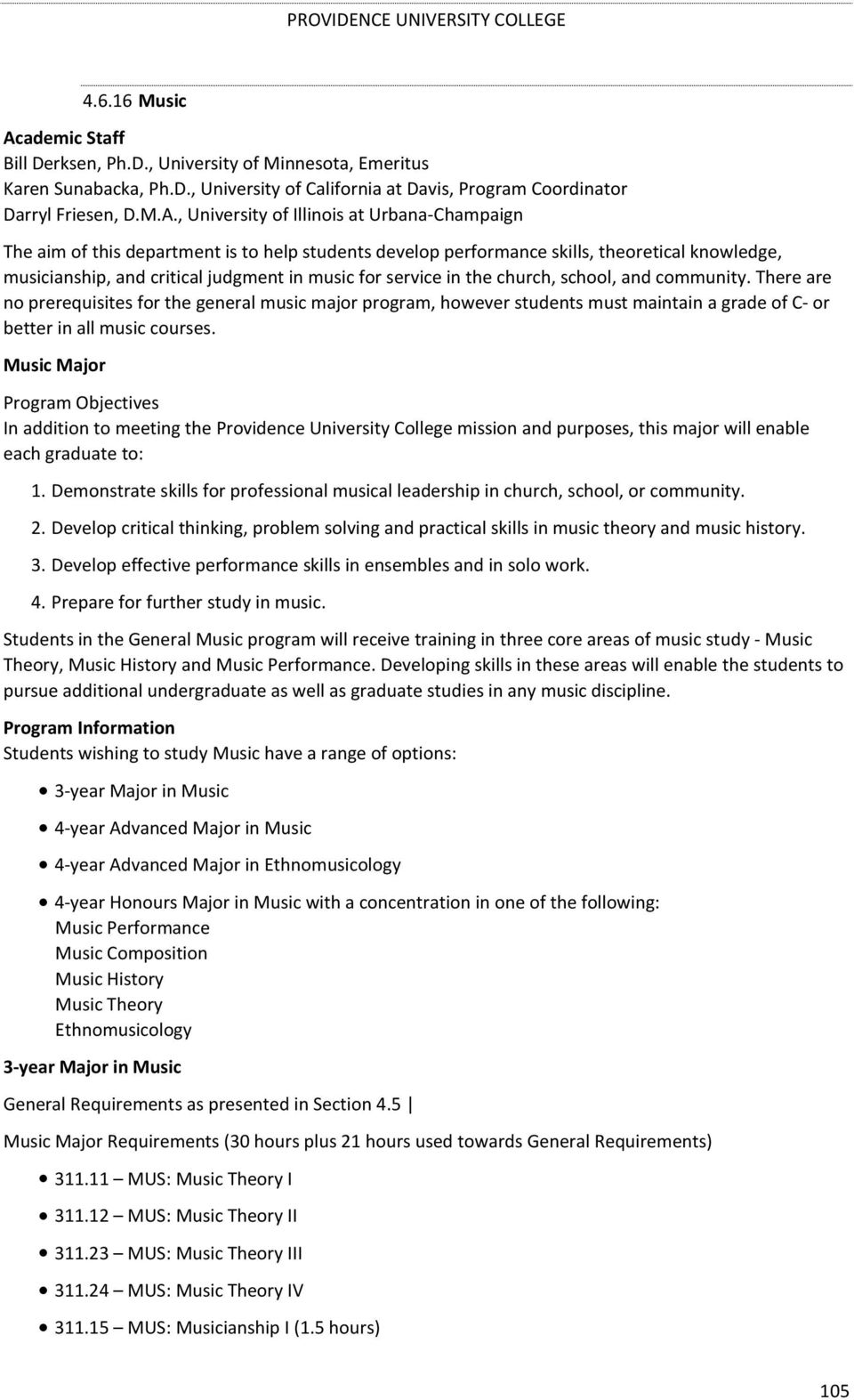
1 Music Academic Staff Bill Derksen, Ph.D., University of Minnesota, Emeritus Karen Sunabacka, Ph.D., University of California at Davis, Program Coordinator Darryl Friesen, D.M.A., University of Illinois at Urbana-Champaign The aim of this department is to help students develop performance skills, theoretical knowledge, musicianship, and critical judgment in music for service in the church, school, and community. There are no prerequisites for the general music major program, however students must maintain a grade of C- or better in all music courses. Music Major Program Objectives In addition to meeting the Providence University College mission and purposes, this major will enable each graduate to: 1. Demonstrate skills for professional musical leadership in church, school, or community. 2. Develop critical thinking, problem solving and practical skills in music theory and music history. 3. Develop effective performance skills in ensembles and in solo work. 4. Prepare for further study in music. Students in the General Music program will receive training in three core areas of music study - Music Theory, Music History and Music Performance. Developing skills in these areas will enable the students to pursue additional undergraduate as well as graduate studies in any music discipline. Program Information Students wishing to study Music have a range of options: 3-year Major in Music 4-year Advanced Major in Music 4-year Advanced Major in Ethnomusicology 4-year Honours Major in Music with a concentration in one of the following: Music Performance Music Composition Music History Music Theory Ethnomusicology 3-year Major in Music General Requirements as presented in Section 4.5 Music Major Requirements (30 hours plus 21 hours used towards General Requirements) MUS: Music Theory I MUS: Music Theory II MUS: Music Theory III MUS: Music Theory IV MUS: Musicianship I (1.5 hours) 105
2 MUS: Musicianship II (1.5 hours) MUS: Musicianship III (1.5 hours) MUS: Musicianship IV (1.5 hours) 3 credit hours of Music History Electives, choose one course from the following: MUS: Music of the Early Twentieth Century MUS: Music Since MUS: Anthropology of Music: World Music and Culture MUS: Popular Music and Culture MUS: Conducting I 9 credit hours of Applied Music Electives 6 credit hours of Ensembles Electives 3 credit hours of Music Electives (must include 3 credit hours of Keyboard Skills if applied major not piano) 4-year Advanced Major in Music General Requirements as presented in Section 4.5 Music Major Requirements (48 hours plus 21 hours used towards General Requirements) MUS: Music Theory I MUS: Music Theory II MUS: Music Theory III MUS: Music Theory IV MUS: Musicianship I (1.5 hours) MUS: Musicianship II (1.5 hours) MUS: Musicianship III (1.5 hours) MUS: Musicianship IV (1.5 hours) 9 credit hours of Music History Electives, choose three courses from the following: MUS: Music of the Early Twentieth Century MUS: Music Since MUS: Anthropology of Music: World Music and Culture MUS: Popular Music and Culture MUS: Conducting I 12 credit hours of Applied Music Electives 106

3 9 credit hours of Ensembles Electives 9 credit hours of Music Electives (must include 3 credit hours of Keyboard Skills if applied major not piano) 4-year Advanced Major in Ethnomusicology General Requirements as presented in Section 4.5 Ethnomusicology Major Requirements (48 hours plus 27 hours used towards General Requirements) MUS: Music Theory I MUS: Music Theory II MUS: Music Theory III MUS: Music Theory IV MUS: Musicianship I (1.5 hours) MUS: Musicianship II (1.5 hours) MUS: Musicianship III (1.5 hours) MUS: Musicianship IV (1.5 hours) 3 credit hours of Music History Electives, choose one course from the following: MUS: Music of the Early Twentieth Century MUS: Music Since MUS: Conducting I 9 credit hours of Applied Music Electives 6 credit hours of Ensembles Electives 3 credit hours of Music Electives (must include 3 credit hours of Keyboard Skills if applied major not piano) MUS: Anthropology of Music: World Music and Culture MUS: Popular Music and Culture ANTH: Anthropology I: Introduction and Physical Anthropology ANTH: Anthropology II: Cultural Anthropology 9 credit hours of Anthropology Electives (3 hours at the upper level) SSC: Research Methods or SSC: Qualitative Research 4-year Honours Major in Music Admission Requirements 45 credit hours of accumulated academic credit, 18 hours in Music (including Music History Survey I and II, Music Theory I and Musicianship I); 3.0 GPA or higher For the Performance Concentration the student also needs: 107

4 At least a 3.0 GPA on first and second year Music Juries. Acceptance into the program by the music faculty. Based on the second year Jury. For the Composition Concentration the student also needs: Acceptance into the program by the music faculty. Approved entrance based on, at least, two original compositions. Graduation Requirements A 3.0 GPA or higher At least 15 credit hours of upper level coursework among music requirements and/or electives. A student wishing to complete a Music Honours degree would choose one of the following concentrations: Music Performance, Music Composition, Music History, Music Theory or Ethnomusicology. Music Performance Concentration Requirements for the 4-year Music Major including: 3 credit hours of MUS: Honours Recital (1.5 hours) 4 credit hours of MUS: Honours Recital (Advanced) (2 hours) 4 credit hours of additional Applied Music Electives Music Composition Concentration Requirements for the 4-year Music Major including: 4 credit hours of MUS: Applied Composition MUS: Music Composition and Arranging MUS: Honours Recital (1.5 hours) MUS: Senior Project I MUS: Senior Project II Music History Concentration Requirements for the 4-year Music Major including: SSC: Research Methods MUS: Topics in Music History MUS: Senior Project I MUS: Senior Project II Music Theory Concentration Requirements for the 4-year Music Major including: MUS: Music Composition and Arranging MUS: Topics in Music Theory MUS: Senior Project I MUS: Senior Project II Ethnomusicology Requirements for the 4-year Ethnomusicology Major including: MUS: Senior Project I MUS: Senior Project II Music Minor or Concentration (18 credit hours) MUS: Music Rudiments or MUS: Music Theory I MUS: Musicianship I (1.5 hours) 108

5 3 credit hours of Applied Music and/or Ensemble Electives 1.5 credit hours of Music Electives Students with a Music Concentration may pair it with a concentration in another discipline in the humanities or social sciences to comprise one of the following majors: Humanities Major (3 year) Humanities Advanced Major (4 year) Humanities Honours Major (4 year) Interdisciplinary Arts Major (3 year) Interdisciplinary Arts Advanced Major (4 year) Interdisciplinary Arts Honours Major (4 year) See Humanities or Interdisciplinary Arts for the full details of these majors. Introductory Courses MUSIC COURSE DESCRIPTIONS MUS: Music Rudiments An introductory course dealing with the rhythmic, melodic, and harmonic basics of music theory. The course is designed for the music major, music minor and non-music major who have never taken any music lessons and/or music theory classes before. Music majors and minors must also be registered in Musicianship I. Students may not receive credit for both Music Rudiments and Music Theory I MUS: Introduction to Music: Music and Culture An introduction to the contributing elements in music: sonority, harmony, melody, rhythm, and form. The course will survey all periods of western art music. A variety of non-western, traditional, popular, American, and Canadian music will also be explored. (Cross credited with English for Music Majors, and open to all students) Music Theory MUS: Music Theory I This is a study of melody and harmony through the writing and analysis of western art music. Students will develop fluency in the writing and recognition of the elements of music. The course focuses on modal music, counterpoint and other musical elements from Medieval and Renaissance music. Students registered in Music Theory I must also be registered in Musicianship I MUS: Music Theory II A study of vocal melody through the writing and analysis of melodic paraphrase, counterpoints in two parts, and tonal homophony leading to the chorale phrase and Bar form. The course focuses on the beginning of tonal music, counterpoint and other musical elements of Baroque music. (Prerequisite: MUS: Music Theory I or MUS: Music Rudiments) MUS: Music Theory III A study of instrumental melody through the writing and analysis of melodic paraphrase, 109
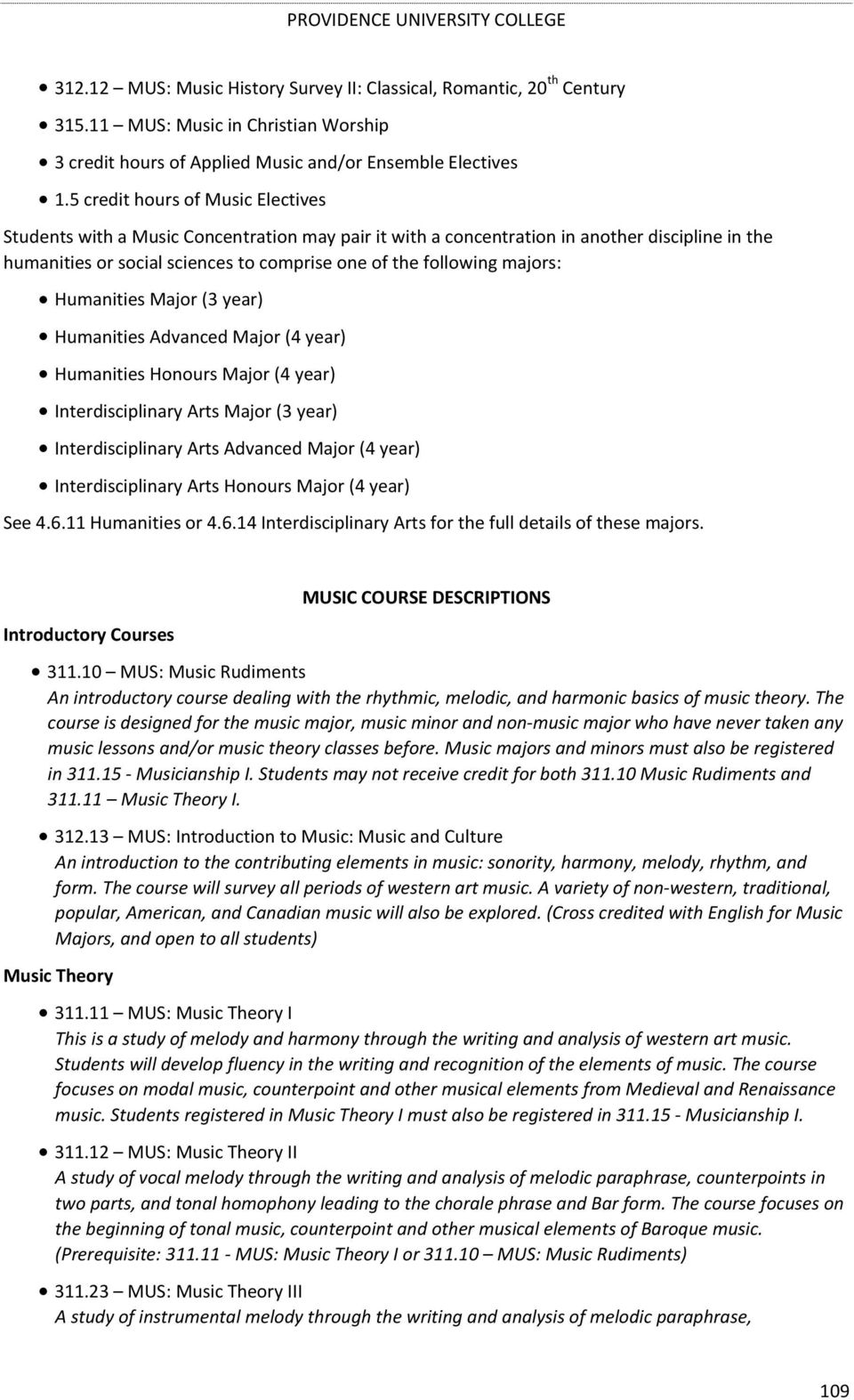
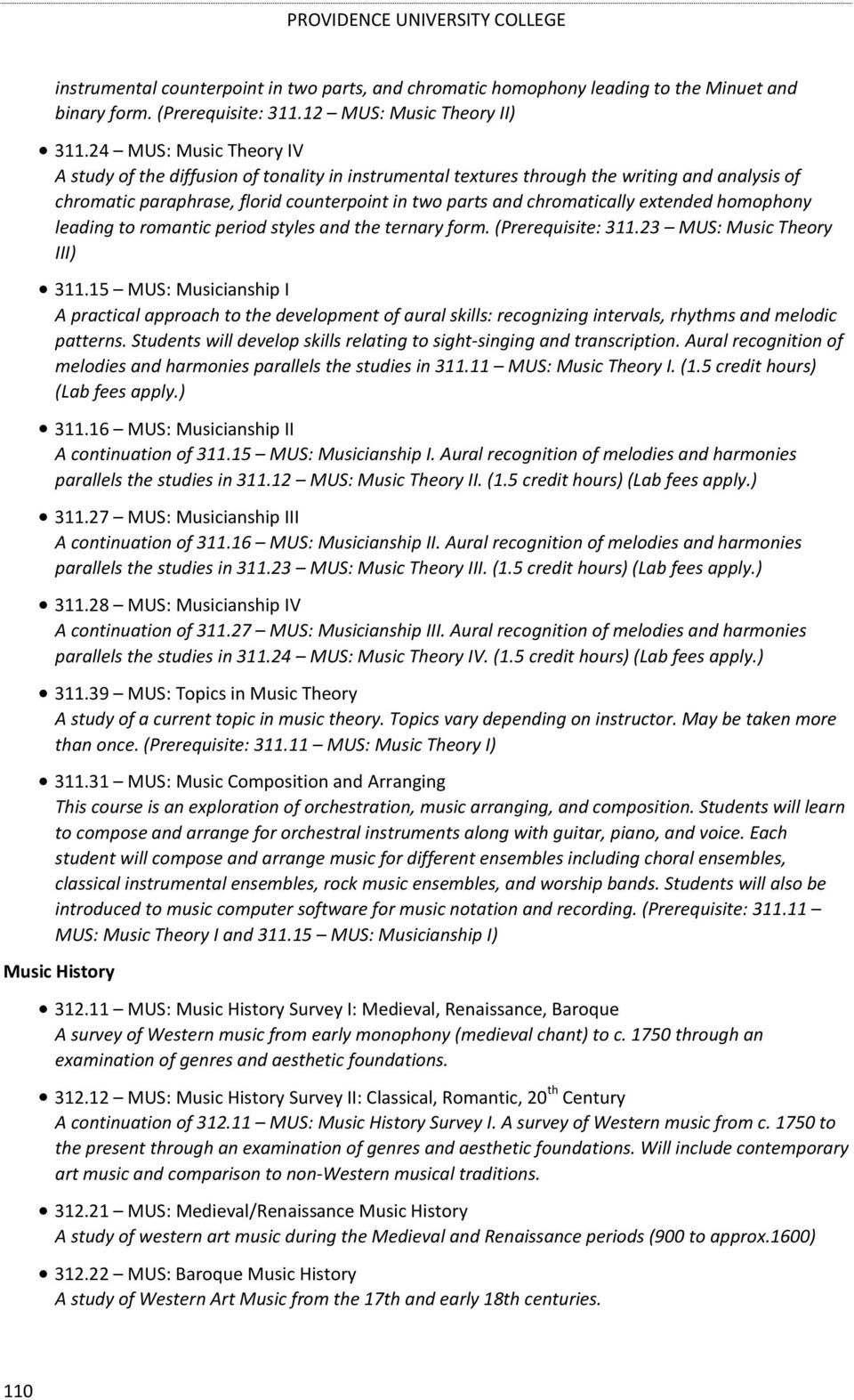
6 instrumental counterpoint in two parts, and chromatic homophony leading to the Minuet and binary form. (Prerequisite: MUS: Music Theory II) MUS: Music Theory IV A study of the diffusion of tonality in instrumental textures through the writing and analysis of chromatic paraphrase, florid counterpoint in two parts and chromatically extended homophony leading to romantic period styles and the ternary form. (Prerequisite: MUS: Music Theory III) MUS: Musicianship I A practical approach to the development of aural skills: recognizing intervals, rhythms and melodic patterns. Students will develop skills relating to sight-singing and transcription. Aural recognition of melodies and harmonies parallels the studies in MUS: Music Theory I. (1.5 credit hours) (Lab fees apply.) MUS: Musicianship II A continuation of MUS: Musicianship I. Aural recognition of melodies and harmonies parallels the studies in MUS: Music Theory II. (1.5 credit hours) (Lab fees apply.) MUS: Musicianship III A continuation of MUS: Musicianship II. Aural recognition of melodies and harmonies parallels the studies in MUS: Music Theory III. (1.5 credit hours) (Lab fees apply.) MUS: Musicianship IV A continuation of MUS: Musicianship III. Aural recognition of melodies and harmonies parallels the studies in MUS: Music Theory IV. (1.5 credit hours) (Lab fees apply.) MUS: Topics in Music Theory A study of a current topic in music theory. Topics vary depending on instructor. May be taken more than once. (Prerequisite: MUS: Music Theory I) MUS: Music Composition and Arranging This course is an exploration of orchestration, music arranging, and composition. Students will learn to compose and arrange for orchestral instruments along with guitar, piano, and voice. Each student will compose and arrange music for different ensembles including choral ensembles, classical instrumental ensembles, rock music ensembles, and worship bands. Students will also be introduced to music computer software for music notation and recording. (Prerequisite: MUS: Music Theory I and MUS: Musicianship I) Music History A survey of Western music from early monophony (medieval chant) to c through an examination of genres and aesthetic foundations. A continuation of MUS: Music History Survey I. A survey of Western music from c to the present through an examination of genres and aesthetic foundations. Will include contemporary art music and comparison to non-western musical traditions MUS: Medieval/Renaissance Music History A study of western art music during the Medieval and Renaissance periods (900 to approx.1600) MUS: Baroque Music History A study of Western Art Music from the 17th and early 18th centuries. 110
7 MUS: Classical Music History A study of Western Art Music from the late 18th and early 19th centuries MUS: Romantic Music History A study of Western Art Music from the 19th century MUS: Music of the Early Twentieth Century An introduction to music written between 1900 and Both theoretical and historical aspects of the works will be explored. The study will include non-western, American and Canadian music. (Prerequisites: MUS: Music Theory I and MUS: Music History Survey I or MUS: Music History Survey II or consent of the instructor) MUS: Music Since 1945 A continuation of MUS: Music of the early Twentieth Century. Works written since 1945 will be studied from a theoretical and historical perspective (including works outside of the western art music tradition). (Prerequisites: MUS: Music Theory I and MUS: Music History Survey I or MUS: Music History Survey II or consent of the instructor) MUS: Topics in Music History A study of a current topic in Music History. Topics vary depending on instructor. May be taken more than once. Conducting MUS: Conducting I A study of the basic elements of choral conducting including elementary score study MUS: Conducting II A continuation of with more advanced study of multi-meter music, score analysis, and an introduction to instrumental conducting. (Prerequisite: MUS: Conducting I) Applied Music MUS: Keyboard Skills Individual lessons, 30 minutes in length, weekly for 12 weeks. Required of all non-piano music majors. Students may be exempt from this requirement if they have completed the Royal Conservatory of Music Grade 6 piano level or equivalent. (1 credit hour, open to non-piano music majors only) MUS: Applied Music Individual lessons, 30 minutes in length, weekly for 12 weeks. (1 credit hour, open to all students) MUS: Recital A recital by a music major who is NOT concentrating in performance or composition. An appropriate amount of memorization is required. (Prerequisite: consent of instructor) (1.5 credit hours) MUS: Applied Music (Major Instrument) Individual lessons, 1 hour in length, weekly for 12 weeks. Students perform an end of semester Jury graded by a faculty panel, which will be worth a percentage of their final grade. (2 credit hours, open to music majors only) MUS: Applied Composition Individual lessons, 30 minutes in length, weekly for 12 weeks. Double credit (1 hour lessons) is available for advanced students (1-2 credit hours) MUS: Honours Recital A minute recital given in the third year of studies in the Recital Hall during an afternoon 111

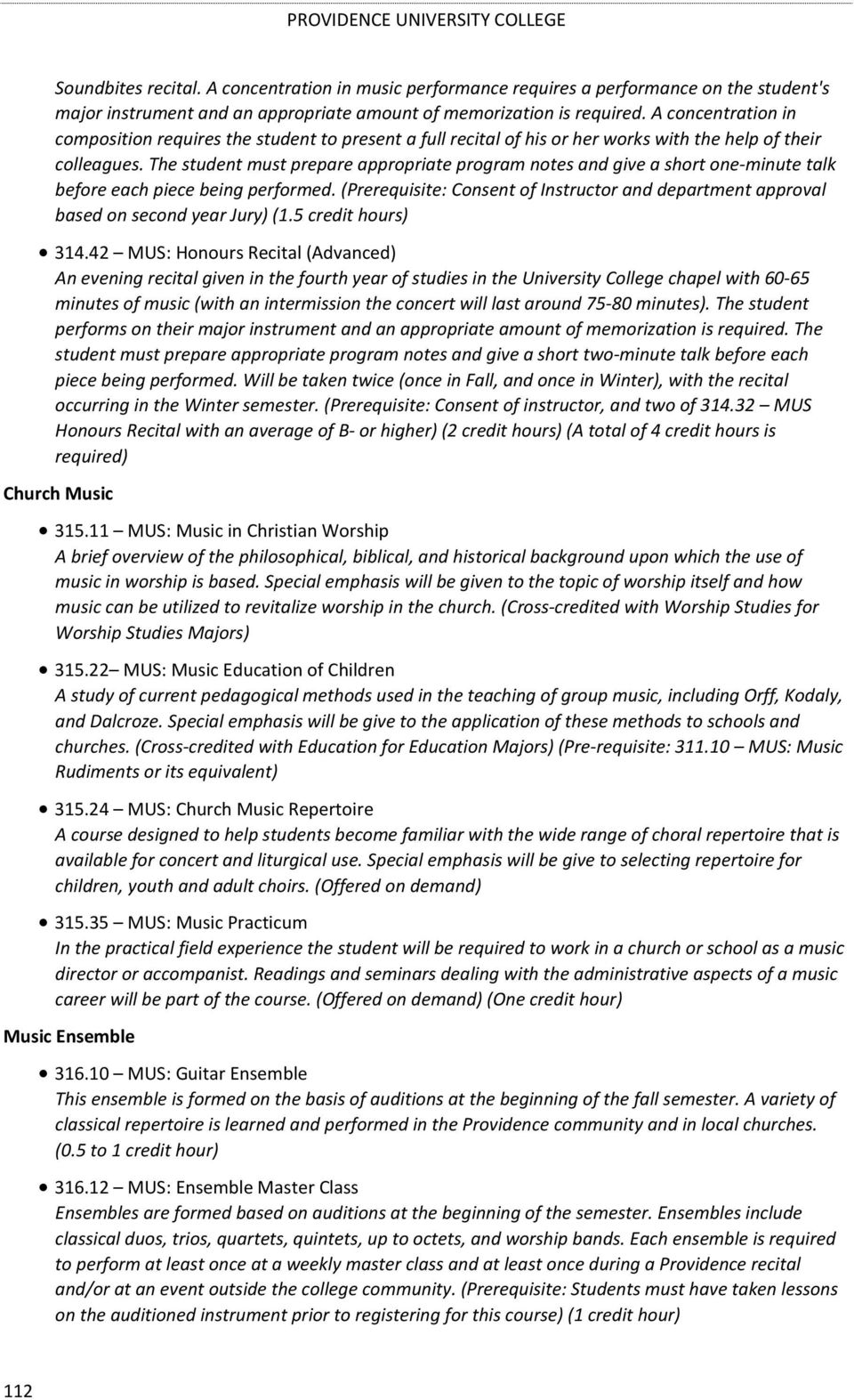
8 Soundbites recital. A concentration in music performance requires a performance on the student's major instrument and an appropriate amount of memorization is required. A concentration in composition requires the student to present a full recital of his or her works with the help of their colleagues. The student must prepare appropriate program notes and give a short one-minute talk before each piece being performed. (Prerequisite: Consent of Instructor and department approval based on second year Jury) (1.5 credit hours) MUS: Honours Recital (Advanced) An evening recital given in the fourth year of studies in the University College chapel with minutes of music (with an intermission the concert will last around minutes). The student performs on their major instrument and an appropriate amount of memorization is required. The student must prepare appropriate program notes and give a short two-minute talk before each piece being performed. Will be taken twice (once in Fall, and once in Winter), with the recital occurring in the Winter semester. (Prerequisite: Consent of instructor, and two of MUS Honours Recital with an average of B- or higher) (2 credit hours) (A total of 4 credit hours is required) Church Music A brief overview of the philosophical, biblical, and historical background upon which the use of music in worship is based. Special emphasis will be given to the topic of worship itself and how music can be utilized to revitalize worship in the church. (Cross-credited with Worship Studies for Worship Studies Majors) MUS: Music Education of Children A study of current pedagogical methods used in the teaching of group music, including Orff, Kodaly, and Dalcroze. Special emphasis will be give to the application of these methods to schools and churches. (Cross-credited with Education for Education Majors) (Pre-requisite: MUS: Music Rudiments or its equivalent) MUS: Church Music Repertoire A course designed to help students become familiar with the wide range of choral repertoire that is available for concert and liturgical use. Special emphasis will be give to selecting repertoire for children, youth and adult choirs. (Offered on demand) MUS: Music Practicum In the practical field experience the student will be required to work in a church or school as a music director or accompanist. Readings and seminars dealing with the administrative aspects of a music career will be part of the course. (Offered on demand) (One credit hour) Music Ensemble MUS: Guitar Ensemble This ensemble is formed on the basis of auditions at the beginning of the fall semester. A variety of classical repertoire is learned and performed in the Providence community and in local churches. (0.5 to 1 credit hour) MUS: Ensemble Master Class Ensembles are formed based on auditions at the beginning of the semester. Ensembles include classical duos, trios, quartets, quintets, up to octets, and worship bands. Each ensemble is required to perform at least once at a weekly master class and at least once during a Providence recital and/or at an event outside the college community. (Prerequisite: Students must have taken lessons on the auditioned instrument prior to registering for this course) (1 credit hour) 112
9 MUS: Instrumental Ensemble Ensembles are formed on the basis of auditions at the beginning of the semester. A variety of classical instrumental music is learned and performed in the Providence community and in local churches. (0.5 to 1 credit hour) MUS: String Quartet (up to 1 credit hour) MUS: Worship Band (up to 1 credit hour) MUS: Jazz Band This is an instrumental ensemble featuring a modern jazz repertoire and consisting of a combination of trumpets, trombones, saxophones, drums, percussion, keys and guitar, as available. The band will perform at three or four events outside the college. In-house events could include chapels. (0.5 credit hour) MUS: Choir This choir is open to all students on the basis of audition or recommendation. Special concerts of major choral works may be presented during the school year. (Only offered fall semester) (0.5 credit hour) MUS: Chamber Singers The Chamber Singers is composed of students selected after auditions at the beginning of the fall session. Emphasis is placed on the development of vocal facility and performance ability. Sacred and some secular repertoire from a variety of stylistic periods will be performed in churches, schools and at festivals. The singers are involved in annual tours in Manitoba and Canada, as well as a British tour every 3 4 years. (1.5 credit hours) Special Musical Studies MUS: Anthropology of Music: World Music and Culture An introduction to the integral relationship of music and culture, with attention given to a number of diverse music cultures from around the world. Focus will be placed on how music reflects and promotes culture and how culture determines what is valued in music. Cultural sensitivity and appreciation of other music of the world will be stressed. (Cross-credited to music history, and with Anthropology) MUS: Popular Music and Culture An introduction to the history of American and British popular music after the Second World War. Will explore the ways in which popular music has contributed to Canadian culture and how Canadian culture has shaped popular music. (Cross-credited to music history) MUS: Directed Studies (1 3 credit hours) MUS: Recording Techniques An introduction to music recording and editing MUS: Senior Project I A guided project (thesis, composition or other approved project) for seniors in their fourth year of a Music Honours degree. (3 credit hours) MUS: Senior Project II A continuation of Senior Project I. (3 credit hours) 113

MUSIC. MU 100 Fundamentals of Music Theory (4) MU 101 Listen to the Music (4) MU 102 Music Appreciation (4) MU 109 Class Voice (2)
 MUSIC MU 100 Fundamentals of Music Theory (4) An introduction to notation, including a study of intervals, scales, modes, meters, basic triads and seventh chords. Intended for non-majors or students with
Admission Requirements to the Music Program
 Department of Humanities and Fine Arts / 111 THE BACHELOR OF ARTS DEGREE IN MUSIC (MUSI, MUAP, MUEN) The Music Program plays a vital role in the life of the University and the community. The training environment
NMC MUSIC MAJOR STUDENT HANDBOOK
 NMC MUSIC MAJOR STUDENT HANDBOOK MUSIC Table of Contents PROGRAM SUMMARY... 2 GENERAL INFORMATION Accompanists... 3 Applied Music... 3 Convocations... 3 Ensembles... 3 Instrument Lockers... 3 Juries...
Demonstrate technical proficiency on instrument or voice at a level appropriate for the corequisite
 MUS 101 MUS 111 MUS 121 MUS 122 MUS 135 MUS 137 MUS 152-1 MUS 152-2 MUS 161 MUS 180-1 MUS 180-2 Music History and Literature Identify and write basic music notation for pitch and Identify and write key
Medical Laboratory Technology Music
 Medical Laboratory Technology Music MLT-2990 Advanced MLT Applications 06 Semester Credits Manual laboratory skills related to clinical chemistry, hematology, coagulation, body fluids, microbiology, parasitology,
Music. Adams Chair of Music and Worship, Professor M. Shasberger Professors G. Brothers, S. Butler (chair), S. Hodson Assistant Professor HS.
 Music Adams Chair of Music and Worship, Professor M. Shasberger Professors G. Brothers, S. Butler (chair), S. Hodson Assistant Professor HS. Kim Mission Statement. The Music Department equips students
MUS 173 THEORY I ELEMENTARY WRITTEN THEORY. (2) The continuation of the work of MUS 171. Lecture, three hours. Prereq: MUS 171.
 001 RECITAL ATTENDANCE. (0) The course will consist of attendance at recitals. Each freshman and sophomore student must attend a minimum of 16 concerts per semester (for a total of four semesters), to
Music. Faculty: Joan Griffing (chair) Ryan Keebaugh Kenneth J. Nafziger James K. Richardson Anne Waltner. Major: Music
 Music Faculty: Joan Griffing (chair) Ryan Keebaugh Kenneth J. Nafziger James K. Richardson Anne Waltner Major: Music Concentrations: Church Music Interdisciplinary Studies Music Education (PreK-12) Music
Music. Style Additional Requirements Electives, lessons, and ensembles 1 8 MUS 350 Senior Project 2 1-6 Total Credits 37-42
 Music 1 Music The study of music develops skills which will serve the student well in any career: self-discipline, teamwork, problem solving and leadership. A student graduating with the B.A. degree in
SCHOOL OF MUSIC TEACHING EQUIVALENCE FORMULA
 SCHOOL OF MUSIC TEACHING EQUIVALENCE FORMULA 1. A list of assigned weights for all courses is attached. The weights assigned to categories of courses at both the graduate and undergraduate level are calculated
The University of Alabama in Huntsville is an accredited institutional member of the National Association of Schools of Music.
 The University of Alabama in Huntsville 1 Music B102 Roberts Hall Telephone: 256.824.6436 Email: [email protected] The University of Alabama in Huntsville is an accredited institutional member of the
Vocal Ensembles: Covenant Chorale and Madrigal Singers and Chamber Singers.
 August 2010 (For the 2011-2012 Academic Year) Dear Prospective Student, Thank you for considering Covenant College. We look forward to meeting you in person when you come for your audition and want your
4.56. Music. The Majors. Degrees: BA and BS
 4.56 Music The Majors Degrees: BA and BS Requirements: BA: 40 hours, in addition to required ensembles, including specified areas of applied study. See the Catalog and Music Handbook for details. BS: 60
TRADUZIONE IN INGLESE degli
 TRADUZIONE IN INGLESE degli ORDINAMENTI DIDATTICI DEI CORSI DI STUDIO DEI CONSERVATORI DI MUSICA DEPARTMENT OF STRINGS SCHOOL OF HARP HARP Students completing required courses for the first level Academic
RESEARCH IN MUSIC EDUCATION AND SOUND ARTS (Completed in, and/or about New Zealand)
 Te Puna Puoru National Centre for Research in Music Education and Sound Arts (MERC) invites you to contribute to the national database of research in music education and sound arts. Fill in the template
DIABLO VALLEY COLLEGE CATALOG 2015-2016
 Music MUSIC MUSIC Michael Almaguer, Dean Applied and Fine Arts Division Business and Foreign Language Building, Room 204 Possible career opportunities Music prepares students for careers as performers,
4:40 100 V. 5 VI. 5 A.
 University of Northern Colorado 2015 Voice Area Undergraduate Handbook Music B.A. Liberal Arts Emphasis B.M.E. -- Teaching Vocal, Piano and General Emphasis B.M. -- Business Emphasis B.M. -- Vocal Performance
Music (MUSC) Music MUSC 1110
 (MUSC) MUSC 1010 Introduction to Music, Summer A survey course designed to make music more meaningful. Studies melody, harmony, form, and rhythm together with historical and biographical information. May
Master's Degree Curriculum 2014-2015 Two years of full-time residence are required for master s degree candidates. Students in need of review study
 Master's Degree Curriculum 2014-2015 Two years of full-time residence are required for master s degree candidates. Students in need of review study may be required to extend their programs beyond two years.
Early Music HOCHSCHULE FÜR MUSIK UND THEATER »FELIX MENDELSSOHN BARTHOLDY« Programmes of study:
 HOCHSCHULE FÜR MUSIK UND THEATER Early Music Programmes of study: For instrumental subjects (recorder, transverse flute, historic oboe instruments, bassoon/dulcian, natural horn, natural trumpet, cornett,
MUSIC. Curricula Available to Music Majors. Administered by the Department of Music and Theatre. Bachelor of Music
 Iowa State University 06-07 MUSIC Administered by the Department of Music and Theatre Undergraduate Study The Department of Music and Theatre offers a strong undergraduate music program, where students
University of Nevada Las Vegas Department of Music. Music History Handbook
 University of Nevada Las Vegas Department of Music Music History Handbook Music History Handbook Contents INTRODUCTION... 1 Music History Teachers and Topics... 1 Collegium Musicum... 1 MUSIC HISTORY STUDIES...
Music Program. American University is an accredited institutional member of the National Association of Schools of Music (NASM).
 Music Program Music at American University goes beyond the studio, rehearsal hall, stage or classroom. The nation's great cultural institutions are sites for research, internships, and part-time jobs,
Music Department EDUCATIONAL PROGR AMS TRANSFER CURRICULUM SUBJECTS & COURSE DESCRIPTIONS ASSOCIATE DEGREE PROGRAM. Faculty
 Music Department S2-107M (323) 265-8894 Faculty Dawson II, Robert B, Chair, Professor Lupica, Dr. Anthony J., Associate Professor Martinez, Jesus E., Professor Nagatani, Dr. Chie, Professor Adjunct Associate
MUSIC College: Program Learning Outcomes Degree and Programs Offered: Student Organizations/Clubs:
 MUSIC UW-PARKSIDE 2015-17 CATALOG College: Arts and Humanities Degree and Programs Offered: Bachelor of Arts Major - Music Minor - Music Certificate - Piano Pedagogy and Literature Student Organizations/Clubs:
THEORY AND COMPOSITION (MTC)
 University of Miami Academic Bulletin 1 THEORY AND COMPOSITION (MTC) MTC 101. Composition I. 2 Credit Course covers elementary principles of composition; class performance of composition projects is also
Doctor of Musical Arts: Piano Performance
 Doctor of Musical Arts: Piano Performance Major Area Total Semester Credit Hrs 7190 Advanced Private Lessons (4 semesters) 12 7xxx Major area electives (ensembles, etc.) 4 7380 Piano Pedagogy courses 3
MUSIC MUS. All applied music and ensemble courses may be repeated for credit every semester.
 MUSIC MUS Applied Music and Ensemble Courses Admission to applied music courses is by audition only. Secondary and primary applied courses, MUS 2130-2154 and 3130-3154, are offered for 2 or 3 credits.
MUSIC COURSES UNDERGRADUATE FACULTY. Explanation of Course Numbers. Bachelor's program. Performance Study
 MUSIC The music program within the Columbian College of Arts and Sciences offers a broad base for understanding music as an art form and as a social, economic, and political practice. All students, regardless
MUFHL, MUIVI, MUP, MUSM
 Music MUFHL, MUIVI, MUP, MUSM Degrees: A.A. Commercial Music, Audio Production Emphasis A.A. Commercial Music, Music Business Management Emphasis A.A. Commercial Music, Performance Emphasis A.A. Commercial
Department of Music Assessment Plan (September, 2004)
 Department of Music Assessment Plan (September, 2004) 1. Learning Objectives: I.1. Demonstrate an intellectual and aural understanding of the basic structural elements of music through the use of the basic
A LIST OF AVAILABLE COURSES DURING ANY TWO SEMESTER PERIOD WILL BE AVAILABLE IN THE DEPARTMENT OFFICE.
 MASTER OF MUSIC DEGREE REQUIREMENTS (May also be found in the Graduate Student Handbook, beginning on page 8) Goals: The Master of Music Degree is intended for music students who desire to pursue graduate
Music. In the College of Professional Studies and Fine Arts
 In the College of Professional Studies and Fine Arts OFFICE: Music 112 TELEPHONE: 619-594-6031 / FAX: 619-594-1692 E-MAIL: [email protected] Faculty Emeritus: Almond, Anderson, Barra, Biggs, Bruderer,
Master of Music. Program Director. Tedrow Perkins 3043 Bliss Hall 330-941-3646 [email protected]. Program Description
 Master of Music Program Director Tedrow Perkins 3043 Bliss Hall 330-941-3646 [email protected] Program Description Master s degrees are offered in music education, music performance, music history, music
Music. University of Texas of the Permian Basin 2015-2017 Undergraduate Catalog 267
 Music Dan Keast, PhD Dr. Keast attended Morningside College in Sioux City, Iowa to receive a B.M.E. He was Director of Bands in Wakefield, Nebraska where he taught 5-12 instrumental music. He attended
Music. Music-Instrumental
 Music-Instrumental Program Description Students may select from three music programs Instrumental, They-Composition, Vocal. Music majs are urged to take class lessons private instruction in their specialization
Undergraduate Degree Map for Completion in Four Years
 Page 1 of 6 Undergraduate Degree Map for Completion in Four Years College: College of Arts and Humanities Department: Music Name of Program: IC Degree Designation: BA Emphasis/Concentration: Option: Version:
UNDERGRADUATE MUSIC THEORY STUDENT HANDBOOK (2010-2011) Updated August, 2010
 UNIVERSITY OF NORTH TEXAS COLLEGE OF MUSIC DIVISION OF MUSIC HISTORY, THEORY, AND ETHNOMUSICOLOGY www.music.unt.edu/mhte UNDERGRADUATE MUSIC THEORY STUDENT HANDBOOK (2010-2011) Updated August, 2010 The
Music (MUS) Contact the Performing Arts Department for further information. (760) 744-1150, ext. 2316 Office: D-16
 Music Palomar College 2012-2013 Catalog Music (MUS) Contact the Performing Arts Department for further information. (760) 744-1150, ext. 2316 Office: D-16 Associate in Arts Degrees - AA Degree requirements
Music Education Band C50208BM Wind Instrument - Percussion
 Music Education Band C50208BM Wind Instrument - Percussion 8/15/14 The following information has official approval of the School of Music, but is intended only as a supplemental guide. Official degree
B. Total for Major 58 semester hours. II. Liberal Arts 32 semester hours # May be double counted toward Major and Liberal Arts Requirements.
 Music Bachelor of Arts Degree I. Course Requirements for Major A. Program Requirements 58 semester hours 1. #MSC 137 Class Piano for Music Majors I 1 2. #MSC 138 Class Piano for Music Majors II 1 3. MSC
Music and Dance. In the College of Professional Studies and Fine Arts
 In the College of Professional Studies and Fine Arts OFFICE: Music 112 TELEPHONE: 619-594-6031 / FAX: 619-594-1692 E-MAIL: [email protected] Faculty Music Charles J. Friedrichs, Ed.D., Associate Professor
ARTS, INFORMATION AND COMMUNICATIONS CAREER LEARNING AREA
 ARTS, INFORMATION AND COMMUNICATIONS CAREER LEARNING AREA Overview The Performing Arts cluster skill sets are designed to prepare our students for entrance into performance or music education degrees.
MUSIC. Department of MUSIC 2013-2014 BETHEL COLLEGE 137. Faculty: Marilynn J. Ham, M.M., Artist in Residence. Majors:
 Department of MUSIC Faculty: Marilynn J. Ham, M.M., Artist in Residence Robert N. Ham, M.M.E. Reginald J. Klopfenstein, D.Mus. Robert Rhein, D.M.A. Majors: Music Education Choral & General Instrumental
Assessment Plan: Undergraduate Degrees Department of Music Miami University. APPROVED BY MUSIC FACULTY 18 April 2012
 Assessment Plan: Undergraduate Degrees Department of Music Miami University APPROVED BY MUSIC FACULTY 18 April 2012 CONTENTS Bachelor of Music in Music Education Bachelor of Music in Music Performance
MUSIC DEGREES AND CERTIFICATES. Music Degree
 Area: Fine & Applied Arts Dean: Dr. Adam Karp Phone: (916) 484-8433 Counseling: (916) 484-8572 Degrees: A.A. - Music A.A. for Transfer Degree - Music A.A. - Jazz Studies A.A. - Commercial Music: Business
Bachelor of Music Piano Performance C50100BM
 8/14/14 Bachelor of Music Piano Performance C50100BM The following information has official approval of the School of Music, but is intended only as a supplemental guide. Official degree requirements are
Music Performance/Harpsichord, M.M.
 Music Performance/Harpsichord, M.M. 1 Music Performance/Harpsichord, M.M. Center for the Performing and Cinematic Arts / BOYER COLLEGE OF MUSIC AND DANCE (http://www.temple.edu/boyer) About the Program
Department of Commercial Music (http://catalog.apu.edu/undergraduate/music-arts/school-music/commercial-music)
 Azusa Pacific University 1 School of Music Mission The School of Music at Azusa Pacific University seeks to use God s gift of music to develop musicians of character and competence in an environment of
Music Education Band C50208BM Wind Instrument - Percussion
 11/27/13 Music Education Band C50208BM Wind Instrument - Percussion The following information has official approval of the School of Music, but is intended only as a supplemental guide. Official degree
MUSIC (MUS) 566. General School Information. Music
 MUSIC (MUS) 566 230 Centennial East, (309) 438-7631 Website: FineArts.IllinoisState.edu/music Director: Stephen Parsons ([email protected]). Tenured/Tenure-track Faculty: Professors: Block, Carlson,
Music - Commercial. Career Options Vocalist Instrumentalist Producer Artist agent Sound engineer Public and private teaching
 289 Definition The Commercial Music program is designed to prepare students to perform, to write and record music, to develop an appreciation of various contemporary music styles, and to understand the
Music, Grade 11, University/College Preparation (AMU3M)
 Music, Grade 11, University/College Preparation (AMU3M) This course emphasizes the appreciation, analysis, and performance of various kinds of music, including baroque and classical music, popular music,
MUSIC STUDIES (B.A.) Program Overview. Degree Offered. Music Studies Minor. Related Programs. Rider University 1. Contemp Music Experience
 Rider University 1 MUSIC STUDIES (B.A.) Program Overview The music studies major prepares students for professional careers in music. Students will work closely with renowned faculty and recognized professionals
Music Standards FINAL. Approved on May 5, 2000. Copyright 2003 Texas State Board for Educator Certification
 Music Standards FINAL Approved on May 5, 2000 Copyright 2003 Texas State Board for Educator Certification MUSIC STANDARDS Standard I. Standard II. Standard III. Standard IV. Standard V. Standard VI. Standard
UCF Degree Programs. UNIVERSITY OF CENTRAL FLORIDA Undergraduate Catalog 2015-2016
 Music Education (B.M.E.) College of Arts and Humanities Department of Music, Performing Arts Center - Music, Room: M203 http://music.cah.ucf.edu/ Email: [email protected] Dr. Kelly Miller, [email protected],
BACHELOR OF ARTS IN MUSIC
 UNIVERSITY OF EDUCATION, WINNEBA SCHOOL OF CREATIVE ARTS DEP. OF MUSIC EDUCATION BACHELOR OF ARTS IN MUSIC PROGRAMME TITLE Bachelor of Arts in Music Type of accreditation required Accreditation Brief historical
Faculty. Programs Offered. Jeff Langley
 Music Director, School of Performing Arts Jeff Langley Department Office Green Music Center 2040 (707) 664-2324 Department Chair Brian S. Wilson Administrative Coordinator Dolores Bainter Faculty Brass
Music Student Handbook
 Goals Music Student Handbook 1. To provide an opportunity for all of the students of this liberal arts institution to develop a better understanding of the musical arts. 2. To provide training in music,
STRING AREA HANDBOOK
 WESTERN ILLINOIS UNIVERSITY SCHOOL OF MUSIC STRING AREA HANDBOOK Academic Year 2013 2014 For Applied Strings Violin, Viola, Violoncello, Bass and Guitar Undergraduate Study MUS 204/404; 205/405/; 206/406/;
Graduate Handbook Department of Music William Paterson University 2014-2015 TABLE OF CONTENTS
 Graduate Handbook Department of Music William Paterson University 2014-2015 TABLE OF CONTENTS PROGRAM AREAS, MASTER OF MUSIC (M.M.) 1 PROGAM DIRECTOR AND AREA COORDINATOR CONTACT INFORMATION 2 AREA REQUIREMENTS
Degree Type Bachelor of Music (BM) Degree Title Music Focus: Music with Teacher Certification (EC-12)
 Degree Type Bachelor of Music (BM) Degree Title Music Focus: Music with Teacher Certification (EC-12) This degree is designed to train students for careers in the professional world of music performance
MUSIC GLOSSARY. Accompaniment: A vocal or instrumental part that supports or is background for a principal part or parts.
 MUSIC GLOSSARY A cappella: Unaccompanied vocal music. Accompaniment: A vocal or instrumental part that supports or is background for a principal part or parts. Alla breve: A tempo marking indicating a
MASTER OF MUSIC DEGREE
 The Master of Music degree program provides advanced studies in music education, as well as solo and ensemble performance. Graduate programs in music are for those students who hold a baccalaureate degree
Group IV: Home Science, Art and Design, Agriculture, Aviation Technology, Computer Studies
 BACHELOR OF MUSIC The Bachelor of Music is a 4 year post secondary school degree programme that offers learners the opportunity for a focused study in music. The programme of study is designed to deepen
Outcomes for All Professional Degrees in Music Utah State University 2015
 Outcomes for All Professional Degrees in Music Utah State University 2015 The following outcomes are presented in a format defining four levels of competency for each skill/knowledge set. Since this instrument
MASTER OF MUSIC. Program Description. Admissions. Degree Requirements. Sam Houston State University 1
 Sam Houston State University 1 MASTER OF MUSIC Program Description The Master of Music is specifically designed to develop the musician, scholar, therapist, or educator for a professional career in music.
Sample Entrance Test for CR125-129 (BA in Popular Music)
 Sample Entrance Test for CR125-129 (BA in Popular Music) A very exciting future awaits everybody who is or will be part of the Cork School of Music BA in Popular Music CR125 CR126 CR127 CR128 CR129 Electric
New Music Building, opening Fall 2015. Viewbook 2015
 New Music Building, opening Fall 2015 Viewbook 2015 Preparing for the Future Our world-class faculty and staff will help you develop your musical talents, creativity, teamwork skills and confidence to
NASM Competencies Summary
 NASM Competencies Summary Degree: The Baccalaureate Degree in Music Education, a professional undergraduate degree Essential Note: Items below are excerpts from the NASM Handbook. Items 1 through 4 indicate
MUSIC. 2015-2016 Northwest University Academic Catalog 195
 MUSIC College... Arts and Sciences Academic Awards... Bachelor of Arts, Bachelor of Music-Music Education, Bachelor of Fine Arts, Music Minor Credits Required... 125 semester credits Coordinator... Bill
STUDY GUIDE. Illinois Licensure Testing System. Music (143) This test is now delivered as a computer-based test.
 Illinois Licensure Testing System STUDY GUIDE Music (143) This test is now delivered as a computer-based test. See www.il.nesinc.com for current program information. Illinois State Board of Education IL-SG-FLD143-05
MUSIC SCHOOL OF ARTS AND COMMUNICATION Dean Vacant, Office 702B, 619-482-6372
 Mexican-American History (MAS 141 142) fulfills the American Institutions requirement at San Diego State University and most other campuses of the California State University and Colleges System. DEGREE/CERTIFICATE
VISUAL AND PERFORMING ARTS
 VISUAL AND PERFORMING ARTS With the passage of the Goals 2000: Educate America Act, education in the visual and performing arts was written into federal law. The law acknowledges the arts as a core subject,
Degree Type Bachelor of Music (BM) Degree Title Performance
 Degree Type Bachelor of Music (BM) Degree Title Performance This degree is designed to train students for careers in the professional world of music performance or who wish to pursue a graduate degree
San Francisco State University has been an accredited institutional member of the National Association of Schools of Music since 1963.
 1 Music College of Liberal & Creative Arts Dean: Andrew Harris School of Music Creative Arts Building, Room 141 Phone: 415-338-1431 Website: music.sfsu.edu Director: Dee Spencer Undergraduate Advisors:
2012 Music Standards GRADES K-1-2
 Students will: Personal Choice and Vision: Students construct and solve problems of personal relevance and interest when expressing themselves through A. Demonstrate how musical elements communicate meaning
Strategies for Success Advising Guide:
 MIDDLESEX COMMUNITY COLLEGE Strategies for Success Advising Guide: Music Major As a student at Middlesex, you can earn either the Associate in Arts Liberal Arts and Science: Fine and Performing Arts, Music
Cabrillo College Catalog 2015-2016
 MUSIC Visual, Applied, and Perfming Arts Division John Graulty, Division Dean Division Office, Room VAPA1007 Michael Strunk, Department Chair, (831) 477-3256 Aptos Counsel: (831) 479-6274 f appointment
Music 2 and Music Extension. Stage 6 Syllabuses
 Music 2 and Music Extension Stage 6 Syllabuses Original published version updated: April 2000 Board Bulletin/Official Notices Vol 9 No 2 (BOS 13/00) October 2009 Assessment and Reporting information updated
Music. Common Requirements for All Bachelor of Music Degrees. 122 College of Architecture + The Arts Undergraduate Catalog 2015-2016
 122 College of Architecture + The Arts Undergraduate Catalog 2015-2016 Music Robert B. Dundas, Interim Director Brenton Alston, Assistant Professor Barry Bernhardt, Instructor and Director of Marching
SLO REQUIRED PRIOR TO ADMISSION TO ALL DEGREE PROGRAMS IN MUSIC
 SLO REQUIRED PRIOR TO ADMISSION TO ALL DEGREE PROGRAMS IN MUSIC GENERAL SLO (Knowledge and Skill) The prospective music major will demonstrate the ability to relate musical sound to notation and terminology
MUSIC. Frost School of Music, Graduate Studies Office. Departments. Admission Requirements. Degree Programs. Entrance Exams
 University of Miami Academic Bulletin 1 MUSIC http://www.miami.edu/frost/index.php/graduate_studies/ Frost School of Music, Graduate Studies Office Maurice Gusman Concert Hall, Suite 110 Phone: 305.284.2241
National Standards for Music Education
 National Standards for Music Education 1. Singing, alone and with others, a varied repertoire of music. 2. Performing on instruments, alone and with others, a varied repertoire of music. 3. Improvising
School of Music Dr. Jeffrey E. Bush, Director
 266 James Madison University 2015-2016 Undergraduate Catalog School of Music Dr. Jeffrey E. Bush, Director Phone: (540) 568-6197 Location: Music Building, Room 130 Email: [email protected] Website: http://www.jmu.edu/music