
Plant Resources of South-East Asia
|
|
|
- Austen Wilkerson
- 7 years ago
- Views:
Transcription
1 14 Plant Resources of South-East Asia A selection E. Westphal and P.C.M. Jansen (Editors) Pudoc Wageningen 1989
2 Dr E. Westphal is a tropical agronomist and botanist, who graduated from Wageningen Agricultural University in He has worked for several organizations in Uganda, Ethiopia and Cameroon in agronomy and economic botany. He has written several books and articles on pulses, farm(ing) systems, cropping systems, plants used for food, spices and tropical food crops, some in collaboration with others. Since 1983, he has been senior staff member in the Department of Tropical Crop Science of Wageningen Agricultural University and has carried out several consultancies in Africa and Asia. Dr P.C.M. Jansen is a plant taxonomist, who graduated as a tropical agronomist from Wageningen Agricultural University in He has worked for several organizations in Benin, Ethiopia and Mozambique, and at the Department of Plant Taxonomy of Wageningen Agricultural University. He has written some books on spices, condiments and medicinal plants. Since 1985, he has been employed by the University, working at the Department of Plant Taxonomy. Cip-Data Koninklijke Bibliotheek, Den Haag Plant Plant resources of South-East Asia: a selection/e. Westphal and P. C. M. Jansen (eds.). Wageningen: Pudoc With index. ISBN bound SISO 632,3 UDC 633(59) NUGI835 Subject heading: agricultural crops; South-East Asia. ISBN NUGI 835 Design: Frits Stoepman GVN. Pudoc/Prosea, Wageningen, the Netherlands, No part of this publication, apart from bibliographic data and brief quotations embodied in critical reviews, may be reproduced, re-recorded or published in any form including print, photocopy, microfilm, electric or electromagnetic record without permission from the publisher Pudoc, P.O. Box 4, 6700 AA Wageningen, the Netherlands. Printed in the Netherlands.
3 To H.C.D.deWitand A.J.G.H. Kostermans
4 Contents Species arranged according to commodity groups 10 Editors and contributors 13 Prosea Project personnel 17 Foreword 19 1 Introduction General Commodity grouping Treatment of plant resources 22 2 Alphabetical treatment of species/genera 23 Abelmoschus esculentus Abrus precatorius Acacia leucophloea Agathis labillardieri Alpinia galanga Amaranthus Anacardium occidentale Anthocephalus chinensis Arachis hypogaea Arcangelisia flava Arenga pinnata Auricularia Averrhoa : okra 25 : Indian liquorice 27 : pilang 28 : New Guinea kauri 30 : galanga 32 : genus including amaranth 34 : cashew 37 : kadam 41 : groundnut 44 : yellow-fruited moonseed 49 : sugar palm 50 : genus including Jew's ear 55 : genus including bilimbi, carambola 57 Boehmeria nivea Brassica Brassica râpa Calamus caesius Calliandra calothyrsus Camellia sinensis Carica pubescens Ceiba pentandra Cinchona ramie 59 genus including oil seeds 61 Chinese cabbage 64 rotan sega 67 calliandra 69 tea 72 mountain papaya 79 kapok 79 genus including quinine 83
5 Clausena Cocos nucifera Coffea Colocasia esculenta Cryptocarya massoy Cryptocoryne Cyperus rotundus Dendrocalamus asper Derris elliptica Diplazium Eichhornia crassipes Elaeis guineensis Eucalyptus deglupta Fagraea fragrans Flemingia macrophylla Galiellajavanica Garcinia mangostana Gelidiella acerosa Gliricidia sepium Glycine max Gnetum gnemon Gossypium hirsutum Heritiera simplicifolia Hevea brasiliensis Indigofera Ipomoea aquatica Ipomoea batatas genus including horsewood 88 coconut palm 90 genus including coffee 95 taro 102 massoi 106 genus including aquarium plants 107 purple nut grass 108 : giant bamboo 109 : derris 112 : genus including edible ferns 114 : water hyacinth 116 : oil palm 118 :leda 123 : tembusu 126 : apa apa 128 : supa susu munding 129 : mangosteen 130 : intip-intip 134 : mother of cocoa 136 : soya bean 139 : Spanish joint fir 143 : cotton 145 : mengkulang 150 : natural rubber 152 : genus including indigo 161 :kangkong 164 : sweet potato 166 Kibatalia arborea :kibenteli 171 Leucaena leucocephala : leucaena 172 Manihot esculenta Metroxylon sagu Morinda citrifolia Muntingia calabura Musa textilis Myristica fragrans : cassava 175 : sago palm 180 : Indian mulberry 185 : capulin 187 :abacâ 188 : nutmeg 192 Nephelium lappaceum : rambutan 196 Octomeles sumatrana Oncosperma tigillarium : binuang 201 nibong 203
6 Orthosiphon Oryza sativa aristatus : Java tea 205 :rice 206 Pachyrhizus erosus : yam bean 213 Paphiopedilum : genus including lady's slipper orchids 216 Pennisetum americanum : pearl millet 217 Pennisetum purpureum : elephant grass 220 Peronema canescens Phytolacca dodecandra Piper nigrum Pometia pinnata Psophocarpus tetragonolobus :sungkai 222 :endod 224 : black and white pepper 225 :taun 230 : winged bean 232 Quercus lineata Ricinus communis Rosa Rubus Saccharum officinarum Salacca zalacca Shoreajohorensis Stevia rebaudiana Stylosanthes guianensis Syzygium aromaticum Terminalia brassii Theobroma cacao :oak 236 : castor 237 : genus including roses 240 : genus including blackberries 242 : sugar cane 243 : salak palm 248 : light red meranti 251 : stevia 253 : stylo 255 : clove 257 : brown terminalia 263 : cocoa 265 Vanillaplanifolia : vanilla 270 Voacanga grandifolia : a medicinal plant 274 Zea mays : maize 275 Glossary 280 Acknowledgments 297 Sources of illustrations 298 Index of scientific plant names 302 Index of vernacular plant names 310 The Prosea Project 321 Map of South-East Asia for Prosea
7 Species arranged according to commodity groups Cereals Plants mainly producing carbohydrates Pulses Vegetable oils and fats Edible fruits and nuts Vegetables Spices and condiments Oryzasativa 206 Pennisetum americanum 217 Zea mays 275 Arengapinnata 50 Colocasia esculenta 102 Ipomoea batatas 166 Manihot esculenta 175 Metroxylonsagu 180 Pachyrhizuserosus 213 Saccharum officinarum 243 Arachis hypogaea 44 Glycine max 139 Brassica oil seeds 61 Cocos nucifera 90 Elaeis guineensis 118 Ricinus communis 237 Anacardium occidentale 37 Auerrhoa 57 Caricapubescens 79 Garcinia mangostana 130 Gnetumgnemon 143 Muntingia calabura 187 Nephelium lappaceum 196 Äw6ws 242 Salacca zalacca 248 Abelmoschus esculentus 25 Amaranthus 34 Brassica rapa 64 Ipomoea aquatica 164 Psophocarpus tetragonolobus 232 Alpiniagalanga 32 Cryptocarya massoy 106 Myristica fragrans 192
8 Piper nigrum 225 Syzygium aromaticum 257 Vanillaplanifolia 270 Essential-oil plants Stimulant plants Medicinal and poisonous plants Timber trees Fibre plants Clausena 88 Camellia sinensis 72 Coffea 95 Theobroma cacao 265 Abrusprecatorius 27 Arcangelisiaflava 49 Cinchona 83 Cyperus rotundus 108 Derris elliptica 112 Kibatalia arborea 171 Orthosiphon aristatus 205 Voacanga grandifolia 274 Anthocephalus chinensis 41 Eucalyptus deglupta 123 Fagraea fragrans 126 Heritiera simplicifolia 150 Octomeles sumatrana 201 Oncosperma tigillarium 203 Peronema canescens 222 Pometia pinnata 230 Quercus lineata 236 Shorea johorensis 251 Terminalia brassii 263 Boehmeria nivea 59 Ceiba pentandra 79 Gossypium hirsutum 145 Musa textilis 188 Forages Pennisetum purpureum 220 Stylosanthes guianensis 255 Dye and tanninproducing plants Rattans Bamboos Acacia leucophloea 28 Indigofera 161 Morinda citrifolia 185 Calamus caesius 67 Dendrocalamus asper 109
9 Plants producing exudates Agathis labillardieri 30 Hevea brasiliensis 152 Auxiliary plants in agriculture and forestry Ornamental plants Calliandra calothyrsus 69 Flemingia macrophylla 128 Gliricidia sepium 136 Leucaena leucocephala 172 Cryptocoryne 107 Paphiopedilum 216 Rosa 240 Lower plants Auricularia 55 Diplazium 114 Galiella javanica 129 Gelidiella acerosa 134 Miscellaneous plants Eichhornia crassipes 116 Phytolacca dodecandra 224 Stevia rebaudiana 253
10 Editors and contributors Editorial staff of this volume - Editors: E. Westphal and P.C.M. Jansen - Associate editors: F.J. Breteler, M. Flach, H. ten Have, J.W. Hildebrand, A. Koopmans, R.H.M.J. Lemmens, R.W. den Outer, J.S. Siemonsma and E.W.M. Verheij - Illustrators: P. Verheij-Hayes (drawings) and R. Boekelman (map) - Publishing consultant and in-house-editor: R.J.P. Aalpol Contributors - H.O. Adiwinata, Jakarta, Indonesia - M.M.J, van Balgooy, National Herbarium, Leyden University, the Netherlands - L. M. Berenschot, Department of Forestry Management, Wageningen Agricultural University, the Netherlands F.J. Breteler, Department of Plant Taxonomy, Wageningen Agricultural University, the Netherlands - J.L. Brewbaker, Department of Horticulture, University of Hawaii at Manoa, Honolulu, Hawaii, United States - G.H. de Bruijn, Department of Tropical Crop Science, Wageningen Agricultural University, the Netherlands - J. de Bruijn, Department of Plant Taxonomy, Wageningen Agricultural University, the Netherlands - A. Budelman, Department of Tropical Crop Science, Wageningen Agricultural University, the Netherlands - J.C. Bulman, Institute of Grassland and Animal Production, Shinfield Research Station, United Kingdom - O.B. Capuno, Department of Plant Breeding & Botany, Visayas State College of Agriculture, the Philippines S. K. De Datta, International Rice Research Institute, Los Banos, the Philippines Soedjoko Dirdjosoemarto, Gadjah Madah University, Yogyakarta, Indonesia - J. Dransfield, Royal Botanic Gardens, Kew, United Kingdom - Soejatmi Dransfield, Kew, United Kingdom - C.L.M. van Eijnatten, Department of Tropical Crop Science, Wageningen Agricultural University, the Netherlands M. Flach, Department of Tropical Crop Science, Wageningen Agricultural University, the Netherlands - J.M. Fundter, Department of Forest Technique and Forest Products, Wageningen Agricultural University, the Netherlands

11 14 A SELECTION - R. Geesink, National Herbarium, Leyden University, the Netherlands - Mohd Noor A. Ghani, Rubber Research Institute of Malaysia, Kuala Lumpur, Malaysia - L.R. Gonzal, National Abaca Research Center, Visayas State College of Agriculture, the Philippines - N.R. de Graaf, Department of Silviculture, Wageningen Agricultural University, the Netherlands - J.J. Groenendijk, Wageningen, the Netherlands - G.J.H. Grubben, Lembang Horticultural Research Institute, Indonesia - P. J.F.M. Hamers, Department of Tropical Crop Science, Wageneningen Agricultural University, the Netherlands - J.J. Hardon, Centre for Genetic Resources, Wageningen, the Netherlands - A.M. Hatta, Indonesian Institute of Sciences, Ambon, Indonesia - H. ten Have, Department of Tropical Crop Science, Wageningen Agricultural University, the Netherlands - J.W. Hildebrand, Department of Forestry Management, Wageningen Agricultural University, the Netherlands - W.C.H. van Hoof, National Agricultural College, Deventer, the Netherlands - P.H. Hovenkamp, National Herbarium, Leyden University, the Netherlands - E. Huffnagel, Multiplant B.V., Maarssen, the Netherlands - P.C.M. Jansen, Department of Plant Taxonomy, Wageningen Agricultural University, the Netherlands - R.J. Johns, Forestry Department, Papua New Guinea University of Technology, Lae, Papua New Guinea - W. Jülich, National Herbarium, Leyden University, the Netherlands - C. Kalkman, National Herbarium, Leyden University, the Netherlands - G.J. Kerkhoven, Renkum, the Netherlands - T.N. Khan, Western Australian Department of Agriculture, South Perth, Australia A. Koopmans, Department of Tropical Crop Science, Wageningen Agricultural University, the Netherlands A.J.G.H. Kostermans, Herbarium Bogoriense, Indonesia T. Kuntohartono, Indonesian Sugar Research Institute, Pasuruan, Indonesia - C.G. Kuo, Asian Vegetable Research & Development Center, Shanhua, Taiwan, Republic of China - D. Lamb, Botany Department, University of Queensland, St. Lucia, Australia A.J.M. Leeuwenberg, Department of Plant Taxonomy, Wageningen Agricultural University, the Netherlands - C. Lelivelt, Foundation for Agricultural Plant Breeding, Wageningen, the Netherlands R.H.M.J. Lemmens, Department of Plant Taxonomy, Wageningen Agricultural University, the Netherlands - Ch.B. Lugt, The Hague, the Netherlands - E.H. Mandia, College of Medical Technology, Mendiola, Manila, the Philippines L. 't Mannetje, Department of Field Crops and Grassland Science, Wageningen, Agricultural University, the Netherlands - M. Martosupono, Bandung, Indonesia - J.P. Mogea, Centre for Research & Development in Biology, Bogor, Indonesia
12 CONTRIBUTORS 15 J. Mohede, Department of Tropical Crop Science, Wageningen Agricultural University, the Netherlands J.G. Ohler, Huizen (NH), the Netherlands Ong Seng Huat, Rubber Research Institute of Malaysia, Kuala Lumpur, Malaysia L.P.A. Oyen, Department of Plant Taxonomy, Wageningen Agricultural Univerisity, the Netherlands A. Patanothai, Department of Plant Science, Faculty of Agriculture, Khon Kaen University, Thailand A.H. Pieterse, Royal Tropical Institute, Amsterdam, the Netherlands W.F. Prud'homme van Reine, National Herbarium, Leyden University, the Netherlands C.E. Ridsdale, National Herbarium, Leyden University, the Netherlands M.A. Rifai, Centre for Research & Development in Biology, Bogor, Indonesia Rudjiman, Faculty of Forestry, Gadjah Madah University, Yogyakarta, Indonesia S. Sakamoto, Kyushu National Agricultural Experiment Station, Kumamoto, Japan J. A. Samson, Wageningen, the Netherlands J.J.C. Scheffer, Department of Plant Taxonomy, Wageningen Agricultural University, the Netherlands A.F. Schoorel, Wageningen, the Netherlands D.L. Schuiling, Department of Tropical Crop Science, Wageningen Agricultural University, the Netherlands C.J.P. Seegeler, Department of Plant Taxonomy, Wageningen Agricultural University, the Netherlands S. Shanmugasundaram, Asian Vegetable Research & Development Center, Shanhua, Taiwan, Republic of China R. Shorter, Queensland Department of Primary Industries, Brisbane, Australia P. Siaguru, Forestry Department, Papua New Guinea University of Technology, Lae, Papua New Guinea J.S. Siemonsma, Centre for Research & Development in Biology, Bogor, Indonesia W.T.M. Smits, Tropenbos Project, Balikpapan, Kalimantan, Indonesia C.H.A. Snijders, Wageningen, the Netherlands Soenaryo, Institute for Estate Crops Jember, East Java, Indonesia R.T.M. van Son, Department of Tropical Crop Science, Wageningen Agricultural University, the Netherlands M. Sorensen, Botanisk Laboratorium, Copenhagen, Denmark Ch.T. Sorensson, Department of Horticulture, University of Hawaii at Manoa, Honolulu, Hawaii, United States G. Staritsky, Department of Tropical Crop Science, Wageningen Agricultural University, the Netherlands J. Straver, Department of Tropical Crop Science, Wageningen Agricultural University, the Netherlands Sumarno, Bogor Research Institute for Food Crops, Indonesia H. Takagi, Asian Vegetable Research & Development Center, Taiwan, Republic of China
13 16 A SELECTION J.P. Thijsse, Heemstede, the Netherlands - H.J.C. Thijssen, Department of Tropical Crop Science, Wageningen Agricultural University, the Netherlands - M. Tjeenk Willink, Department of Tropical Crop Science, Wageningen Agricultural University, the Netherlands - H. Toxopeus, Foundation for Agricultural Plant Breeding, Wageningen, the Netherlands - H.J. Veltkamp, National Agricultural College, Deventer, the Netherlands B.S. Vergara, International Rice Research Institute, Los Banos, the Philippines - E.W.M. Verheij, Department of Tropical Crop Science, Wageningen Agricultural University, the Netherlands - E.F. de Vogel, National Herbarium, Leyden University, the Netherlands H.A.M. van der Vossen, Venhuizen, the Netherlands - P.W.F, de Waard, Huizen (NH), the Netherlands - P.C. van Weizen, National Herbarium, Leyden University, the Netherlands - M. Wessel, Department of Tropical Crop Science, Wageningen Agricultural University, the Netherlands - P.C. Wessel-Riemens, Ede, the Netherlands - E. Westphal, Department of Tropical Crop Science, Wageningen Agricultural University, the Netherlands - E. Widjaja, Centre for Research & Development in Biology, Bogor, Indonesia - K.F. Wiersum, Dorschkamp Research Institute for Forestry & Landscape Planning, Wageningen, the Netherlands J.E. Wilson, Department of Agronomy & Soil Science, University of Hawaii at Manoa, Honolulu, Hawaii, United States H.C.D. de Wit, Heelsum, the Netherlands - D.O. Wijnands, Department of Plant Taxonomy, Wageningen Agricultural University, the Netherlands - G.J.A.W. van der Zandt, Department of Plant Taxonomy, Wageningen Agricultural University, the Netherlands - A.C. Zeven, Department of Plant Breeding, Wageningen Agricultural University, the Netherlands
14 Prosea Project personnel (January 1989) Indonesia M.H. Aarts-van den Bergh, Botany Officer Ch. Aipassa, Secretary Jajang, Office Assistant A.J.G.H. Kostermans, Scientific Adviser Sampurno Kadarsan, Project leader Indonesia J.S. Siemonsma, Tropical Agronomist, Regional Coordinator South-East Asia N.W. Soetjipto, Botanist, Country Officer Indonesia Hadi Sutarno, Plant Physiologist, Country Officer Indonesia Malaysia Salleh Mohd Nor, Project leader Malaysia Idris Mohd Said, Botanist, Country Officer Malaysia (ad interim) The Netherlands F.J. Breteler, Plant Taxonomist J.M. Fundter, Forestry Officer N.R. de Graaf, Silviculturist J.W. Hildebrand, Forestry Officer P.C.M. Jansen, Plant Taxonomist R.H.M.J. Lemmens, Plant Taxonomist L.P.A. Oyen, Documentalist J.M.G. Rynja, Secretary E.W.M. Verheij, Horticulturist E. Westphal, Tropical Agronomist, Project leader the Netherlands H.C.D. de Wit, Scientific Adviser W.P.M. Wolters, Project Secretary Papua New Guinea R. Banka Adam, Country Officer Papua New Guinea R.J. Johns, Project leader Papua New Guinea Philippines N. Altoveros, Plant Breeder, Country Officer the Philippines B. del Rosario, Project leader the Philippines
15 18 A SELECTION Thailand Prapandh Boonklinkajorn, Project leader Thailand Soonthorn Duriyaprapan, Agronomist, Country Officer Thailand

16 Foreword Nature has favoured South-East Asia. Among its natural endowments, the vegetation is the most essential resource for mankind, almost endlessly diversified and close at hand. It exists in plenty and varies widely and will remain so if the plant cover is carefully managed and exploited. The population of South-East Asia may profit in many ways from its natural heritage, now and in the future. A strict condition for the survival of the many millions of inhabitants is the maintenance of a thriving plant cover. Extensive information on the plants growing in the region is needed to allow the plant resources of each country to be used optimally. A thorough knowledge of plant resources is essential for human life and plays a key role in ecologically balanced land-use systems. The information needed includes botany, ecology, agronomy or silviculture and plant breeding, and aspects of technology and economics. Vast amounts of printed and manuscript data on South-East Asian plants are in existence. However, they are scattered over countless books, articles and reports, written in many different languages over a period of almost two centuries, and are often not accessible. In daily practice, thousands of workers in agriculture, horticulture, forestry, research, education, extension, trade and industry have access to only a small part of this immense reservoir of knowledge. The Prosea Project, short for 'Plant Resources of South-East Asia', will make the existing wealth of information on some five thousand plant resources of South-East Asia available for education, extension work, research and industry, in the form of an illustrated, multivolume handbook written in English. Moreover, it will set up a computerized data bank on the plant resources ofthat region. The survey and compilation of existing knowledge on thousands of plants in South-East Asia is an extensive, complicated and unique enterprise, which can succeed only with international support and scientific, organizational and financial cooperation. A 'Proposal for a handbook' was published in 1986, to facilitate the implementation of this undertaking. This resulted, in 1988, in an international project in which South-East Asian Institutions and Wageningen Agricultural University are participating to publish the handbook. The first volume of the multivolume handbook, dealing with pulses, will be available in Since it will take several years to publish the separate volumes dealing with the various commodity groups, descriptions of 86 plants have been compiled in the present volume for direct use in education, research and extension in South-East Asia. This book deals with major and potentially important plants, representing the different commodity groups of Prosea. Hopefully this selection will help satisfy the urgent need for up-to-date information on the region's plant
17 20 A SELECTION resources and will highlight a precious resource of human well-being: the green treasury of South-East Asia. Wageningen, February 1989 C.C. Oosterlee, Chairman, Netherlands Prosea Board
18 1 Introduction 1.1 General An overwhelmingly large number of plant species (between 5000 and ) in South-East Asia are useful for mankind. In 'Prosea - Proposal for a handbook' (1986) it was suggested that approximately 5000 plant species be described in a multivolume handbook, arranged according to commodity groups. In that 'Proposal' specimen descriptions of 17 species were presented, to show how the information could be given in a surveyable manner for the different target groups, by being arranged in a certain sequence of topics. This book, 'A selection', follows the same approach. It covers 86 species, including major crops and promising species, such as rice, maize, sweet potato, cassava, taro, groundnut, soya bean, oil palm, coconut palm, sugar cane, sago palm, cacao, coffee, tea, mangosteen, rambutan, cotton, abaca, rubber, nutmeg, pepper and vanilla. It can also serve as a textbook in South-East Asia and can later be extended with more species when descriptions of all commodity groups have been published in the multivolume handbook. 1.2 Commodity grouping The proposal to arrange the plant resources according to their main use into commodity groups, put forward in the 'Proposal for a handbook', has been widely accepted. The following commodity groups are currently distinguished: - cereals - plants mainly producing carbohydrates (including root and tuber plants, sago and related starch-producing plants, plants producing sugar, alcohol or acid) - pulses - vegetable oils and fats edible fruits and nuts - vegetables - spices and condiments - essential-oil plants (including camphor-producing plants, aromatic woods) - stimulant plants (including plants used for beverages, as masticatories or for smoking) - medicinal and poisonous plants (including narcotic plants, medicinal plants, plants producing poison, including insecticides and herbicides) - timber trees - fibre plants (including plants used for packing and thatching, plants used for making baskets, mats and wickerwork) - forages (including fodder and pasture plants, feed plants) - dye and tannin-producing plants
19 22 A SELECTION - rattans - bamboos - plants producing exudates (including latex-producing plants, resin-producing plants, balsam-producing plants, gum-producing plants, wax-producing plants, plants producing aromatic resin) - auxiliary plants in agriculture and forestry (including cover and shade plants, mulches, green manures, plants for charcoal or firewood) - ornamental plants (including hedge and wayside plants, ornamental ferns, cycads, conifers, palms, bulbs, flowers, orchids, herbs, shrubs, trees, fruits and seeds, aquatic plants) - lower plants (including algae, fungi, lichens, mosses, ferns) - miscellaneous plants (including other useful plants). Since most species are multi-purpose plants, classification into commodity groups based on their main use still remains to some extent artificial. However, as long as all species are treated comprehensively in the multivolume handbook and are well indexed, this multi-purpose aspect can be overcome satisfactorily. In 'A selection', all commodity groups are represented by at least one species. For convenience sake, the plant species are dealt with in alphabetic order of their scientific name. They are also listed under their respective commodity group, following the list of contents. 1.3 Treatment of plant resources All taxa, being a species or a genus, are treated in a similar manner: general information, botany, ecology, agronomy or silviculture, genetic resources and breeding, prospects and literature. Depending on the species' relative economic importance, the length of the description varies from 1 to 5 printed pages, including the illustration, except in the case of very important plant species (e.g. rice, rubber) which are dealt with at length. The limitation in text space for every species/genus made it necessary to select from the available information. The information presented covers the main points. Under Literature, reference is made to main other sources, which in turn may refer the reader further. The vernacular names pose a major problem. They are useful for the identification of species. Usually, numerous names are available, but it is beyond the scope of the handbook to enumerate them all. The selection presented was made with the advice of South-East Asian experts. The illustrations have been kept simple and are intended to aid quick identification. Closely related species with similar uses and growth or production patterns are treated under the same genus heading. It can be concluded that the framework for a species or genus treatment is suitable for all commodity groups. All species and genera described in this book will finally appear in the volume of the handbook dealing with their respective commodity group. Additional relevant information will be stored in a computerized data base.
20 2 Alphabetical treatment of species/genera

21 ABELMOSCHUS 25 Abelmoschus esculentus (L.) Moench Methodus 617 (1794). MALVACEAE 2n = 130(66-144) Synonyms Hibiscus esculentus L. (1753). Vernacular names Okra, lady's finger (En). Gombo (Fr). Indonesia: kopi arab. Malaysia: kacang bendi, sayur bendi, kacang lender. Philippines: okra. Burma: you-padi. Laos: khüa ngwàng. Thailand: krachiap mon. Vietnam: dâu bap. Origin and geographic distribution The genus Abelmoschus Medik. originated in South- East Asia. A. esculentus, however, is a cultigen of uncertain origin. It is now widely cultivated in tropical and subtropical regions, but is particularly popular in India, West Africa and Brazil. Information from South-East Asia is scarce. Another edible okra species occurs in the humid parts of West and Central Africa. Described originally as a botanical variety (Hibiscus manihot L. var. caillei A. Chev.), it has recently been recognized as a distinct species (A. caillei (A. Chev.) Stevels). Occasional reference will be made to this 'West African' okra below. Uses Okra is mainly grown for its young immature fruits, which are consumed as a vegetable, raw, cooked or fried. It is a common ingredient of soups and sauces. The fruits can be conserved by drying. The leaves are sometimes used as spinach; fibres from the stem for cord; plant mucilages for medical and industrial purposes; the seeds as a substitute for coffee. Okra seeds contain a considerable amount of good quality oil and protein. There are no apparent differences in use between the ordinary (A. esculentus) and West African okra (A. caillei), hence the confusion. Production and international trade World okra production (both species) is estimated to be around 5-6 million t/year, which is about 1.5 % of total world production of vegetables. Properties Per 100 g edible portion, the fruits contain water 90 g, protein 2g, fibre 1 g and carbohydrate 7 g. The energy value is about 145 kj per 100 g. Okra is a good source of vitamins and minerals. Compared to other fleshy fruits (tomato, eggplant), it is particularly rich in Ca (70-90 mg per 100 g). Description A. esculentus is a stout, erect, annual herb, up to 4 m tall. Leaves spirally arranged, blades up to 50 cm in diameter, more or less deeply 3-, 5- or 7-lobed. Flowers solitary in the leaf axils or in pseudoracemes by reduction of the upper leaves, yellow, self-fertile; epicalyx of 7-15 free, Abelmoschus esculentus (L.) Moench - 1, branch with young fruits, leaves, flower; 2, flower bud; 3, young fruit. 'West African' okra, Abelmoschus caillei (A.Chev.) Stevels - 4, branch with flower and leaves; 5, flower bud; 6, young fruit; 7, mature fruit. linear segments, 5-25 mm x mm. Fruit a cylindrical to pyramidal capsule, 5-35 cm long, 1-5 cm in diameter, completely, partially or not loculicidal, green, greenish-purple or completely purple when young, brownish when mature. Seeds numerous, globose, 3-6 mm in diameter, blackish. Germination is epigeal. The West African okra differs in several respects, but its epicalyx offers the best discriminating characteristics with 5-10 free, ovate segments, mm x 4-13 mm. The plant is more robust than A. esculentus. Growth and development A. esculentus usually flowers within days after sowing; its cropping period rarely exceeds 6 months. Self-pollination and flower opening take place in the early morning. For vegetable use, the fruits are picked about one week after anthesis. It takes about one month from anthesis to mature fruit. In the seed

22 26 A SELECTION crop, vegetative growth stops soon after anthesis, all assimilates being partitioned to the reproductive plant parts. In the vegetable crop, the removal of young fruits permits sustained vegetative growth, resulting in longer crop duration. In the West African okra, crop duration may exceed 12 months. Other botanical information A. esculentus (2n = 130) is probably an amphidiploid (allotetraploid), derived from A. tuberculatus Pal & Singh (2n = 58), a wild species from India, and a still unknown species with 2n = 72 chromosomes. The West African okra has an even higher number of chromosomes (2n = approximately 192 ( )). It might be an allohexaploid, A. esculentus being one of the parents. Ecology A. esculentus needs temperatures above 20 C for normal growth and development. Germination percentage and speed of emergence are optimal at C. Flower initiation and flowering are delayed at higher temperatures (positive correlation between temperature and number of vegetative nodes). A. esculentus is a 'short-day' plant, but its wide geographic distribution (up to latitudes of ) suggests that cultivars differ markedly in sensitivity. Flower initiation and flowering are hardly affected by daylength in popular subtropical cultivars such as 'Clemson Spineless' (United States) and 'Pusa Sawani' (India). Most tropical cultivars show quantitative shortday responses, but qualitative responses also occur. Shortest critical daylength reported is 12 hours 30 minutes. The West African okra is considerably more sensitive to photoperiod, explaining in part its limited geographical distribution (up to latitudes of ) and longer crop duration. Shortest critical daylength reported is 12 hours 15 minutes. Propagation and planting Propagation is by seed. To soften the hard seed-coat, sowing seed is often soaked in water or other chemicals. Sowing is usually done by dibbling, in individual hills, directly in the field. Optimum plant densities for A. esculentus are in the range of plants/ha. The robust West African okra should be planted at plants/ha. Husbandry Commercial growers usually cultivate okra as a single crop. For home consumption, a few plants are grown in home gardens or in fields of other food crops. Indicative figures for total nutrient uptake (crop with fruit yield of 10 t/ha) are 100 kg N, 10 kg P, 60 kg K, 80 kg Ca and 40 kgmg. Diseases and pests Most serious foliar diseases are Cercospora blight (C. abelmoschi and C. malayensis) and powdery mildew (e.g. Erysiphe dehoracearum). Important pests are fruit and stem-borers (Earias spp., Heliothis spp.) and jassids (Empoasca spp.). Yellow-Vein Mosaic Virus (YVMV) is a major cause of crop failure in Asia, white fly (Bemisia tabaci) being the vector. The high harvest frequency makes chemical control hazardous. The West African okra is much more tolerant to pests and diseases than the ordinary okra. Harvesting The young fruits should be harvested when 7-8 days old. Earlier picking depresses yields because of suboptimal fruit weight. Delayed picking depresses (marketable) yields because over-aged fruits become fibrous. So okra is harvested at intervals of 2-3 days. For seed production, the whole crop can be harvested at once. Intensive contact with the slightly hairy fruits and plants often leads to skin irritation. Yield Usually low (2-4 t/ha) owing to extensive cultivation methods. A yield of 10 t/ha can be considered a good harvest, while yields over 30 t/ha can be realized under optimal conditions. Handling after harvest Fresh okra can be quite easily transported in bulk and kept for several days without much loss of quality. Dried okra is an important product in West Africa. Some developed countries have a small canning and deepfreeze industry. Genetic resources Germplasm base collections are maintained by USDA (Fort Collins, United States), Nihort (Ibadan, Nigeria), Orstom (Abidjan, Ivory Coast), NBPGR (New Delhi, India) and IPB (Los Banos, Philippines). The West African okra has already been introduced in several American and Asian countries. Breeding Work has been oriented towards intensive cultivation with high production in a short period (early maturity, high density planting) and wide adaptation (photoperiod insensitivity, resistance to pests and diseases). Several attractive American and Indian cultivars have found their way to commercial growers throughout the tropics and subtropics. Resistance to many diseases and pests has been identified in available okra germplasm, but not yet to YVMV, a major problem in Asia. Little attention has been given to the needs of the traditional sector (cultivation for home consumption), where hardy, robust, long-duration types such as the West African okra are required. The characteristics of both okra species open up new recombination opportunities. They cross readily
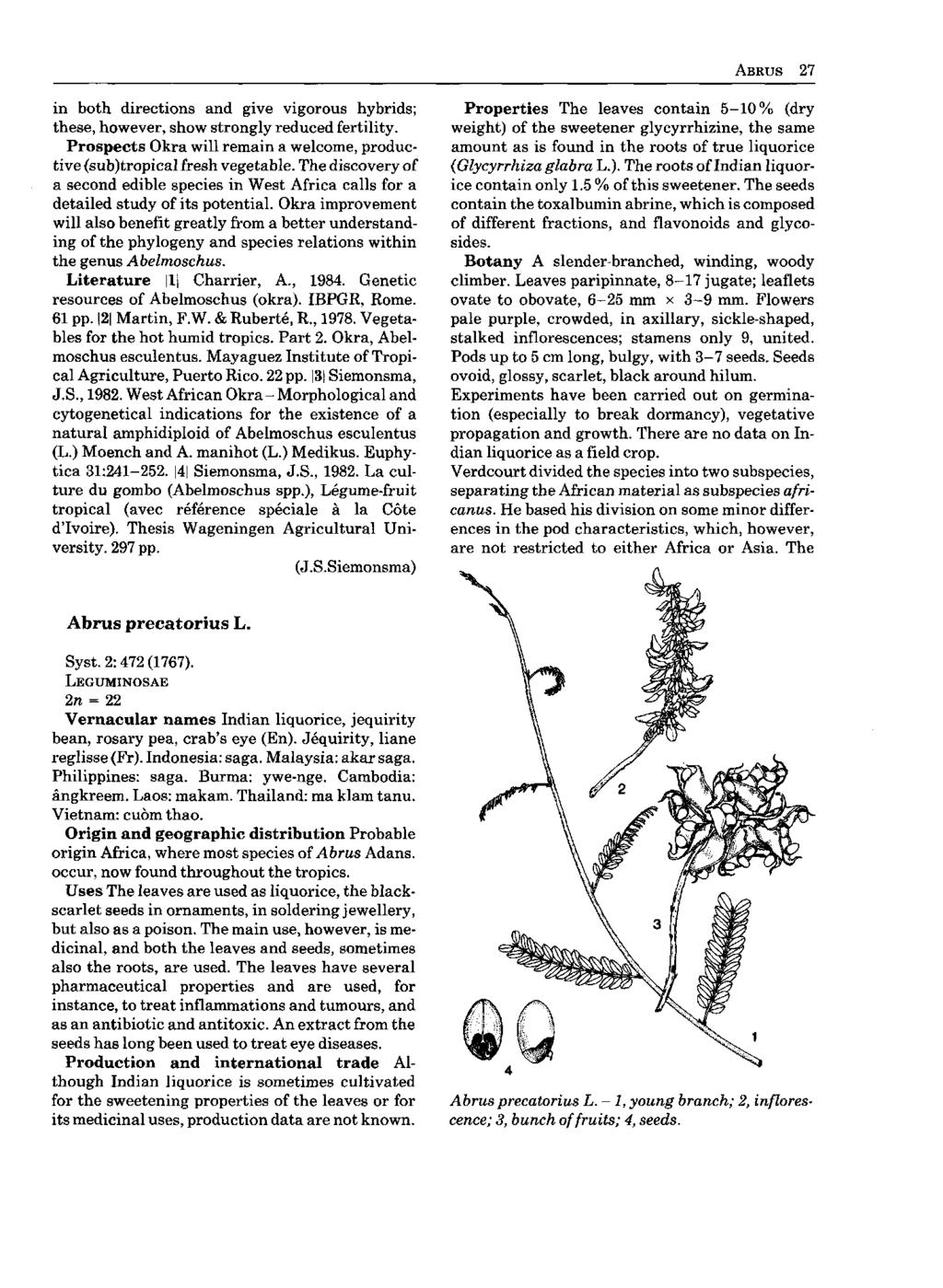
23 ABRUS 27 in both directions and give vigorous hybrids; these, however, show strongly reduced fertility. Prospects Okra will remain a welcome, productive (sub)tropical fresh vegetable. The discovery of a second edible species in West Africa calls for a detailed study of its potential. Okra improvement will also benefit greatly from a better understanding of the phylogeny and species relations within the genus Abelmoschus. Literature lj Charrier, A., Genetic resources of Abelmoschus (okra). IBPGR, Rome. 61 pp. 2 Martin, F.W. & Ruberté, R., Vegetables for the hot humid tropics. Part 2. Okra, Abelmoschus esculentus. Mayaguez Institute of Tropical Agriculture, Puerto Rico. 22 pp. 3 Siemonsma, J.S., West African Okra - Morphological and cytogenetical indications for the existence of a natural amphidiploid of Abelmoschus esculentus (L.) Moench and A. manihot (L.) Medikus. Euphytica 31: Siemonsma, J.S., La culture du gombo (Abelmoschus spp.), Légume-fruit tropical (avec référence spéciale à la Côte d'ivoire). Thesis Wageningen Agricultural University. 297 pp. (J.S.Siemonsma) Properties The leaves contain 5-10% (dry weight) of the sweetener glycyrrhizine, the same amount as is found in the roots of true liquorice (Glycyrrhiza glabra L.). The roots of Indian liquorice contain only 1.5 % of this sweetener. The seeds contain the toxalbumin abrine, which is composed of different fractions, and flavonoids and glycosides. Botany A slender-branched, winding, woody climber. Leaves paripinnate, 8-17 jugate; leaflets ovate to obovate, 6-25 mm x 3-9 mm. Flowers pale purple, crowded, in axillary, sickle-shaped, stalked inflorescences; stamens only 9, united. Pods up to 5 cm long, bulgy, with 3-7 seeds. Seeds ovoid, glossy, scarlet, black around hilum. Experiments have been carried out on germination (especially to break dormancy), vegetative propagation and growth. There are no data on Indian liquorice as a field crop. Verdcourt divided the species into two subspecies, separating the African material as subspecies africanus. He based his division on some minor differences in the pod characteristics, which, however, are not restricted to either Africa or Asia. The Abrus precatorius L. Syst. 2: 472 (1767). LEGUMINOSAE In = 22 Vernacular names Indian liquorice, jequirity bean, rosary pea, crab's eye (En). Jéquirity, liane reglisse (Fr). Indonesia: saga. Malaysia: akar saga. Philippines: saga. Burma: ywe-nge. Cambodia: ângkreem. Laos: makam. Thailand: ma klam tanu. Vietnam: cuöm thao. Origin and geographic distribution Probable origin Africa, where most species of Abrus Adans. occur, now found throughout the tropics. Uses The leaves are used as liquorice, the blackscarlet seeds in ornaments, in soldering jewellery, but also as a poison. The main use, however, is medicinal, and both the leaves and seeds, sometimes also the roots, are used. The leaves have several pharmaceutical properties and are used, for instance, to treat inflammations and tumours, and as an antibiotic and antitoxic. An extract from the seeds has long been used to treat eye diseases. Production and international trade Although Indian liquorice is sometimes cultivated for the sweetening properties of the leaves or for its medicinal uses, production data are not known. Abrus precatorius L. - 1, young branch; 2, inflorescence; 3, bunch of fruits; 4, seeds.

24 28 A SELECTION seeds are not always red with a black eye. Entirely white seeds and black seeds with a white eye have also been reported from India. Ecology Indian liquorice occurs mainly in monsoon regions, in tree savannah, shrub savannah, gallery forest, and as a weed in plantations and cultivated lands. Prospects Especially in the seventies, extensive research has been carried out on Abrusprecatorius to elucidate its chemical composition and the structure and properties of the seed constituents and to a lesser extent those of the leaves and roots. Their toxic properties (e.g. to produce insecticides), their anti-cancer and anti-leukemia effects, and their effects on male and female fertility of animals, have been studied. Notably the anti-cancer effects have been reported as rather high. Literature 1 Breteler, F.J., Revision of Abrus Adanson (Pap.) with special reference to Africa. Blumea 10: Karnick, CR., Responses of lunar phases on the growth of Abrus precatorius Linn. (Leguminosae) and its effects as crude drug on diseases. Acta Horticulturae 73: Spices and medicinal plants. 3 Verdcourt, B., Studies in the Leguminosae - Papilionoideae for the 'Flora of Tropical East Africa': II. Kew Bulletin 24(2): (F.J. Breteler) Acacia leucophloea (Roxb.) Willd. Sp. PI. 4:1083 (1806). LEGUMINOSAE In = unknown Synonyms Mimosa leucophloea Roxb. (1800). Vernacular names Indonesia: pilang (Java, Sunda), opilan (Madura), pelang (Madura, Bali). Burma: ta-noung. Cambodia: sambue. Thailand: cha laep daeng (central), phayaa mai (Kanchanaburi). Vietnam: a bu, a kawa (Thuan Hai). Origin and geographic distribution A. leucophloea is native to large parts of South and South-East Asia, where it is found in Burma, Thailand, Vietnam, Indonesia (Java, Timor, Sumbawa), India, Nepal, Pakistan and Sri Lanka. Uses The wood of A. leucophloea is used for indoor construction and, although a little hard to work, for furniture. It is also highly appreciated as firewood and is well suited for charcoal burning. The tannin-containing bark was used in the leather industry in Indonesia, and less so in India, until the middle of this century. Mainly for this purpose, the tree was cultivated in commercial plantations in Indonesia before the 1940s. The bark is also used to prepare fine beverages (arak); its strong fibres are locally utilized for fishing nets. The consumption of cooked, germinated seeds as vegetable (hale) is reported from Java. Stem and roots produce a gum which is used for medicinal purposes. The pods and foliage are a protein-rich fodder source. In Tamil Nadu (India) farmers cultivate A. leucophloea for soil improvement. The trees are also planted around timber plantations as fire protection. Production and international trade In former times A. leucophloea was grown commercially for tannin production. Nowadays, the species is no longer considered commercially interesting and production figures are difficult to give. International trade is absent. Properties The bark contains 11-20% tannin, with an average of 15 %; the content is highest in older trees. The tannin is difficult to extract, so the tanning process is slow. Because of its low content of sugar-like components, the tannin has hardly any acid-forming properties. The tannin colours leather red; the red colour darkens easily in light. In tanneries pilang bark was often used mixed with trengguli bark (Cassia fistula L.). After the Second World War, in Indonesia pilang bark was replaced by the better tanning bark of Acacia mearnsii de Wild, (black wattle). Fodder contains 1.9 % digestible fats, 7.1 % digestible proteins and 12.4 % digestible carbohydrates. Hydrocyanic acid content of the fodder varies throughout the year. In India, values ranging from zero (December) to 240 mg/kg hydrocyanic acid (May/June) have been measured for the leaves, and values over 400 mg/kg for the pods from October - April (with a maximum of almost 1000 mg/kg in November). Whenever hydrocyanic acid content exceeds 200 mg/kg, the fodder should not be used as the sole source of animal feed. The roots bear nodules with nitrogen-fixing microorganisms. Seed weight is about seeds/kg. Description Deciduous tree or erect shrub, m high, with deep tap-root, few secondary roots, pale bark and broadly umbelliform crown. Young trees are often densely beset with thorny suckers; lower branches armed with paired straight or faintly curved stipular thorns, usually dark brown or black, less often white, up to 2.5 cm long. Leaves bipinnate, pinnae 4-13 pairs, rachis cm long; leaflets linear, 3-11 mm x mm, 6-30 pairs. Inflorescences yellowish white subglobose heads, ca. 1 cm in diam., in large terminal densely hairy

25 ACACIA 29 Acacia leucophloea (Roxb.) Willd. - 1, flowering branch; 2, fruit. panicles up to 30 cm long; peduncles cm long. Flowers sessile, calyx mm, corolla mm long; stamens Fruits linear, faintly curved or straight, 6-15 (-20) cm x 7-11 mm x 3 mm, woody, glabrescent, dark brown, 5-12 (-20)-seeded, indéhiscent. Seeds very variable, orbicular, ellipsoid or trapezoid, mm x 4-5 mm, compressed, greyish-brown. Wood characteristics The heartwood is beautifully red, the sapwood is grey white. The wood is strong (class II in Indonesia) and durable (class III in Indonesia) when used indoors. In contact with moist soil, it decays quickly. Volumetric mass is kg/m 3. Growth and development Only a small proportion of the seeds germinates. Pretreatment of seeds with hot water improves germination. Up to 75 days have been reported in Indonesia for pretreated seeds to germinate. Flowering is at the end of the rainy season/beginning of the dry season. Leaf fall occurs for a very short period in the beginning of the rainy season. There is some disagreement in the literature as to whether the trees bear fruit every year. Ecology The ecological amplitude of A. leucophloea is wide: it occurs in areas with a pronounced East Monsoon, under semi-arid (600 mm rainfall/year) to humid (2000 mm) conditions, at altitudes ranging from sea-level to 550 m, on sandymarl to heavy clay-marl soils. The plants need much light and space to develop into mature trees. In the wild, the tree occurs individually and sometimes groupwise in heterogeneous, deciduous forests on soils with a moderate to low fertility. It is never found in evergreen, closed forests on fertile soil. A. leucophloea withstands soils that are periodically very dry, and soils with compaction features, because of the adaptibility of its root system to poor oxygen availability. It does not survive on poorly drained sites. Propagation and planting Plantations of A. leucophloea are established by direct sowing of seeds, using seeds per hole, at 2 m x 1 m. If enough space and light are available, abundant natural regeneration has been observed in Tamil Nadu (India) with 1000 seedlings/ha. Management In monoculture plantations, A. leucophloea needs intensive and expensive maintenance to suppress the heavy undergrowth that develops owing to the little shading provided by the trees. Planting in combination with a creeper that gives effective soil cover, or intercropping with other species that provide more shade in the youth phase, is advised. In mixed plantations, however, accompanying species should be carefully selected since A. leucophloea is easily oppressed on account of its slow growth when young. In combination with other species, planting in small groups is recommended. Diseases and pests Seed-borne rust infections by Hapalophragmiopsis ponderosum cause amorphous, tumorous galls. The seed of A. leucophloea may be seriously infected by a small weevil of the genus Caryoborus and by a bruchid beetle. Caterpillar plagues have also been observed. The species is fire resistant and the bark recovers easily. Harvesting For tannin production, the bark is stripped at the beginning of the growing season because high water content facilitates the process. The bark is cut into pieces of 50 cm x 10 cm, and dried in the sun for 2-3 days. The bark loses onethird of its original weight. Yield Production figures from plantations in Indonesia with a rotation length of 12 years indicate an annual wood production of ca. 15 m 3 /ha (whole tree), 11 m 3 /ha thick wood (dbh > 7 cm) and 9 m 3 /ha clear bole. Dry bark yield ranges from 8 kg/tree for diameter class cm to 81 kg/tree

26 32 A SELECTION tings should preferably be taken from young plants or low branches of young trees. Plagiotropy, however, is a problem for propagation of other than seed-orchard trees. Root suckers can be produced several times from potted seedlings and are considered the most successful. Management Young trees seem to be sensitive to grass-root competition. The root system needs much oxygen. Diseases and pests Buds and young cones are damaged by caterpillars. Several fungal diseases in other Agathis spp. are associated with waterlogging. Harvesting Trees smaller than 0.25 m diameter should not be tapped. Best tapping results are obtained by making diagonal cuts in the bark, 0.2 m long and 0.4 m apart, with a special tool, and catching the copal in tins. It is easy to kill trees by destructive tapping. Resin flow goes on for several months, even in the light, and can be stimulated by applications of sulphuric acid. Yield Annual yield of large trees can be kg of resin per tree. Genetic resources Genetic resources are endangered by heavy logging and destructive tapping. Breeding Breeding is hampered by the long reproductive cycle. Prospects Although this tree is not yet cultivated outside New Guinea, the prospects seem to be promising. Literature 1 Bowen, M.R. & Whitmore, T.C., A second look at Agathis. Commonwealth Forestry Institute Occasional Papers No 13. Oxford. 19 pp. 2 Fundter, J.M. & Wisse, J.H., belangrijke houtsoorten uit Indonesisch Nieuw Guinea (Irian Jaya), met de anatomische en technische kenmerken. [Forty important timber species from Indonesian New Guinea (Irian Jaya) with their anatomical and technical characteristics.] Mededelingen Landbouwhogeschool Wageningen, Nederland. 77-9: Lundquist, E., Onderzoekingen betreffende een nieuwe tapmethode voor copal. [Investigations on a new tapping method of copal.] (With English summary). Tectona pp. 4 Meijer Drees, E., The genus Agathis in Malaysia. Bulletin du Jardin Botanique Buitenzorg, Serie 3, 16: Whitmore, T.C., A first look at Agathis. Commonwealth Forestry Institute, Oxford. Tropical Forestry Papers No pp. 6 Whitmore, T.C., A monograph of Agathis. Plant Systematics and Evolution 135: (J.M. Fundter, N.R. de Graaf & J.W. Hildebrand) Alpinia galanga (L.) Willd. Sp. PI. (ed. 4) 1:12 (1797). ZlNGIBERACEAE 2n = 48 Synonyms Maranta galanga L. (1762), Languas vulgare Koenig (1783), Amomum galanga (L.) Lour. (1790), Languas galanga (L.) Stuntz (1912). Vernacular names Galanga, greater galangal (En). Galanga (Fr). Indonesia: laos, laja, lengkuas. Malaysia: lengkuas, puar. Philippines: langkauas, palla. Burma: padagoji. Cambodia: komdeng, pras. Laos: kha. Thailand: kha. Origin and geographic distribution The exact origin of galanga is unknown, but oldest reports about its use and existence come from southern China and Java. At present it is cultivated in all South-East Asian countries and in India, Bangladesh, China and Surinam. Uses Galanga is principally used as a spice. It has a strong pungent taste like a mixture of pepper and ginger. Its rhizomes are very common and said to be indispensable in everyday cooking throughout South Asia. The flowers and young shoots are used as a vegetable or again as a spice. The rhizomes have a wide range of applications in traditional medicine, e.g. in case of skin diseases, indigestion, colic, dysentery, enlarged spleen, respiratory diseases, cancers of mouth and stomach, for treatment of systemic infections and cholera, as expectorant, and after childbirth. The rhizomes have also been used as an aphrodisiac, for other stimulating properties and as a veterinary medicine. The rhizomes and the essential oil isolated from them are used to flavour liquors, icecream, pastry, etc. The fruits of galanga are used locally as a substitute for true cardamom. Production and international trade Data about production, consumption and trade are scarce and unreliable because often no distinction is made between A. galanga and A. officinarum Hance. Production in South-East Asia must be considerable as it is a common spice used daily by millions of people. It is mostly cultivated in home gardens. India exported in galanga rhizomes, worth thousand Rupees. The Netherlands imports at least 100 t fresh rhizomes and t dried rhizomes per annum. Main suppliers are Thailand, Indonesia and India. Price fluctuates between US$ 1 and US$ 2.5 per kg dry weight. Properties Composition of air-dried rhizomes (% of dry weight): moisture content 14, total ash 9, soluble matter in 80 % ethanol 49, soluble matter

27 ALPINIA 33 in water 19, total sugar 9, total nitrogen 3, total protein 16. Essential oil content ranges from 0.2 to 1.5 % (of dry weight); fresh rhizomes yield 0.1 % of oil. Camphor, cineole (20-30 %) and methyl cinnamate (48 %) have been described as oil components in older literature. In studies performed in the 1980's, the presence of 1,8-cineole as main component was confirmed, but the other two compounds were not detected. Studies, mostly in vitro, on the biological activities of the rhizomes revealed among other things antibacterial, antifungal, antiprotozoal, and expectorant activities. l'-acetoxychavicol acetate, a component of fresh and freshly dried rhizomes, proved to be active against dermatophytes. Recently, the same compound and another constituent of the rhizomes, l'-acetoxyeugenol acetate, were found to be antitumour-active in mice (against Sarcoma 180 ascites). Earlier, the same compounds had been isolated from galanga fruits; they showed an antiulcer activity in Shay rats, while the chavicol derivative also depressed the gastric secretion of those rats. The oil has also shown an interesting potential as insecticide against houseflies. Description A robust, tillering, perennial weed up to 3.5 m high with subterraneous, creeping, copiously branched rhizomes. Rhizomes 2-4 cm in diameter, hard, shining, light red or pale yellow. Pseudostem erect, formed by the leaf sheaths. Leaves alternate, distichous, lowest and uppermost ones smallest; blades oblong-lanceolate, (20-) 50 (-60) cm x (4-) 9 (-15) cm, shiny green, densely white-dotted. Inflorescence terminal, erect, many-flowered, racemiform, cm x 5-7 cm. Flowers fragrant, 3-4 cm long, yellowishwhite; calyx tubular; corolla tube terete, about 1 cm long, lobes 3, recurved, oblong-lanceolate, 1.5 cm x 0.6 cm, margins ciliate; staminodes 3-lobed, central lobe (labellum) petaloid, spathulate, cm x cm, undulate crenate with a stalklike base and a recurved apex, lateral lobes 2, subulate, cm long, reddish; stamen 1, erect with incurved anther, cm long; style slightly longer than stamen, stigma obtriangular. Fruits spherical-ellipsoid, cm in diameter, yellow. Growth and development Shoots of planted rhizome parts emerge about 1 week after planting. About 4 weeks after planting, 2-3 leaves have developed. The rhizome develops quickly and reaches its best harvest quality 3 months after planting. If left longer in the field, the rhizomes become too fibrous and large tufts of plants are formed. Flowering occurs after exceptionally dry weather. In India, plants start flowering in the lat- Alpinia galanga (L.) Willd. with inflorescence. 1, rhizome; 2, branch ter half of the hot season (April-May) and seeds ripen, though rarely, in November. Other botanical information In the literature, the name A. galanga (L.) Swartz is often found. Swartz, however, published on this species in 1791 with the name Maranta galanga L. and he did not transfer the genus name to Alpinia L. Most probably several cultivars exist, but clear descriptions are not available. Cultivars with yellowish-white and with pink to red rhizomes are known. The white cultivar reaches about 3 m height, with stems of 2.5 cm and rhizomes of 3-4 cm diameter. The red cultivar reaches m height, with stems up to 1 cm and rhizomes up to 2 cm diameter, but white-rhizomed cultivars with such characteristics are also reported. Plants with broad leaves, tomentose beneath, are sometimes distinguished as var. pyramidata (Bl.) K. Schum., a variety which seems to occur both wild and cultivated on Java, Borneo and the Philippines. A. officinarum Hance (lesser galangal) can be distinguished from A. galanga as follows: its rhizomes are dark brown to black, 8-12 mm in diameter with

28 34 A SELECTION 4-6 mm long, finely ridged internodes; besides the rhizomes, the plant, too, is smaller, m tall. Ecology Galanga demands a sunny or moderately shady place. Soils should be fertile and humid but not swampy. The wild or half-wild varieties occur in old clearings, in thickets and in forests. The plant occurs up to 1200 m above sea-level in the tropics. Propagation and planting Long top-ends of the rhizome are used for propagation. The soil should be well tilled before planting. Often, trenches are dug to drain the field after rains, as the rhizome does not develop in marshy soils. Galanga is mainly a smallholders crop, usually planted along the borders of gardens, in rows at distances of m square. Husbandry Weeding and subsequently earthing-up of the rhizomes are done 1 month and 2 months after planting. Harvesting If produced for the market, the rhizomes are harvested 3 months after planting. The whole plants are pulled out, the shoots are cut off and the rhizomes washed and cleaned. If the rhizomes become more than 4 months old, they turn woody, fibrous and spongy and lose their value as spice. For local use, the plants are left in the field and as the plants tiller much, small quantities of good quality rhizome can always be harvested. Handling after harvest The rhizomes are offered to markets fresh or dried. The dried product is usually ground before use, but ground rhizomes are not traded in bulk as adulteration can occur, e.g. with A. officinarum. Prospects For the local market in South-East Asia, galanga continues to be an important spice. Further agronomic and botanical research is urgently needed to gain better information about its requirements, its variability and its potentialities. Existing trade evidences Western interest in good-quality galanga. Further studies on the biological activities of the rhizomes, on their usefulness in (traditional) medicine and on their potential as insecticide may give rise to cultivation on a larger scale. Literature 1 Burkill, I.H., A dictionary of the economic products of the Malay Peninsula. Ministry of Agriculture and Co-operatives, Kuala Lumpur. 2nd ed. pp Heyne, K., De nuttige planten van Nederlandsch Indië. [The useful plants of the Dutch Indies]. Departement van Landbouw, Nijverheid en Handel in Nederlandsch-Indië, Batavia. 2nd ed. pp Ochse, J.J. & Bakhuizen van den Brink, R.C., Vegetables of the Dutch East Indies [English edition of 'Indische Groenten', 1931]. Asher & Co. B.V., Amsterdam, pp Janssen, A.M. & Scheffer, J.J.C., Acetoxychavicol acetate, an antifungal component of Alpinia galanga. Planta Medica 51: (J.J.C. Scheffer, G.J.A.W. van der Zandt & P.C.M. Jansen) Amaranthus L. Sp. PL:989 (1753); Gen. PL ed. 5:427 (1754). AMARANTHACEAE 2n = 34 (A. tricolor); In = 64 (A. dubius); 2n = 32 (A. cruentus). Major species and synonyms - Amaranthus blitum L. cv. group Oleraceus, synonyms: A. lividus L. (1753), A. blitum L. var. oleraceus (L.) Hook. f. (1885); - Amaranthus cruentus L., Syst. Plantarum ed. 10, 2: 1269 (1759), synonyms: A. paniculatus L. (1763), A. hybridus L. ssp. cruentus (L.) Thell. (1912); - Amaranthus dubius C. Martius ex Thell., Fl. Adv. Montpellier: 203 (1912); - Amaranthus tricolor L., Sp. PL: 989 (1753), synonyms: A. tristis L. (1753), A. mangostanus L. (1755), A. gangeticus L. (1759). Vernacular names Amaranth (En). Amarante (Fr). Indonesia and Malaysia: bayam. Philippines: kulitis. Cambodia: phti:. Thailand: phak khom suan. Vietnam: rau dên. Origin and geographic distribution The genus is widely distributed. Typical vegetable amaranths (A. tricolor, A. dubius, A. blitum) originate from South-East Asia but have been carried to other regions by emigrants. A. cruentus is originally a cereal amaranth from Latin America, currently grown as a main vegetable amaranth in Africa. By far the most important species in South- East Asia is A. tricolor, followed by A. dubius and A. cruentus. Uses The main use is as a leafy vegetable. It is very common in the whole of South-East Asia, more in lowland than in highland areas. Besides kangkong (Ipomoea aquatica Forssk.) it is the most popular leafy vegetable of Indonesia and Malaysia. It is an important vegetable in many tropical countries, for example India, Bangladesh, Sri Lanka, Tanzania, Uganda, Nigeria, other West African countries, and the Caribbean. Various amaranth species with light-coloured seeds, such as A. hypochondriacus L., A. cruentus and A. caudatus L., are traditionally grown in Central and South

29 AMARANTHUS 35 America, mostly in mountain areas but also at low altitude, as a minor cereal crop. Thinnings of young seedlings from the cereal crop are frequently used as greens. Many wild Amaranthus species are used as pot herbs. A. tricolor forms with red, yellow and green coloured leaves or leaf sections, and forms of A. caudatus and A. cruentus with large bright-red inflorescences are used as ornamentals. Amaranthus weeds are used for fodder (pigweed). Vegetable amaranths are recommended as a good food with medicinal properties for young children, lactating mothers, and for patients with fever, haemorrhage, anaemia or kidney complaints. The wild A. spinosus L. is used as a depurative, against venereal diseases and as a dressing on boils. Production and international trade Although considered a poor man's food, its economic value as a popular vegetable probably ranks among the ten highest in South-East Asia. Few exact economic data are available, since in most cases all leaf vegetables are recorded as one single group. Indonesian statistics in 1985 attributed ha to amaranth grown for the city markets. The short growing period (3-6 weeks) and multiple places with small areas per farmer and very scattered sales in small street markets hamper correct registration. Amaranth is widely grown on a small scale in home gardens and in open places in between field crops. Properties Amaranth leaves have a high content of essential micro-nutrients. They are an excellent source of ß-carotene with 4-8 mg per 100 g edible portion, vitamin C mg, iron 4-9 mg, and calcium mg. They are rich in fibre and folic acid and their protein content (20-38 % based on dry matter) includes methionine and other sulphur-containing amino-acids. The general dry matter content is high (12-16 %). The leaves and stems have nitrate and oxalate levels similar to other green leaf vegetables such as spinach (Spinacia oleracea L.) and spinach beet (Beta vulgaris L.), but no adverse nutritional effects occur at a consumption of g per day. The composition varies greatly with cultivar, soil fertility, water supply, and age at harvest. Average weight of 1000 seeds varies between 300 and 450 mg. Description Amaranthus. Erect annuals, up to 1.5 m high, with a strongly branched tap-root. Stems branched. Leaves alternate, long-petiolate, simple and entire. Flowers in axillary clusters, upper clusters often leafless and in panicled spikes, unisexual, solitary in the axil of a bract, with 2 bracteoles, 3-5 tepals and either free sta- Amaranthus tricolor L. flowers. branch with leaves and mens, as many as tepals (male flowers), or ovate or oblong ovary with 2-3 (-4) stigmas (female flowers). Fruit a dry capsule, dehiscent or indéhiscent. Seeds shining black or brown. A. tricolor. Leaves elliptic to lanceolate, dark green, light green or red. Clusters of flowers axillary, with a reduced terminal spike. Tepals 3. Fruit dehiscent, with a circumscissile lid. A. dubius. Leaves ovate or rhomboid-ovate, shortly cuneate at base, dark green. Lower clusters of flowers axillary, upper clusters leafless and in lax panicled spikes. Tepals (3-) 5. Fruit dehiscent, with a circumscissile lid. A. cruentus. Leaves lanceolate, acute and often short-decurrent at base, greyish-green. Clusters of flowers in large axillary and terminal panicled spikes. Tepals 5. Fruit dehiscent, with a circumscissile lid. A. blitum cv. group Oleraceus. Leaves (ob)ovate or rhomboid-(ob)ovate, shortly cuneate at base, green or more or less purple. Lower clusters of flowers axillary, upper clusters leafless and in axillary and terminal panicled spikes. Tepals 3 (-5). Fruit indéhiscent or at last bursting irregularly. Growth and development Emergence takes

30 38 A SELECTION fruit salads, and a drink is prepared from the juice. Cashew wine (slightly fermented juice) colours life at harvest time and can be distilled to produce strong alcoholic drinks. By-products are seed-coats and shells. Seed-coats are utilized as animal feed. An oil, cashew nut shell liquid (CNSL), is produced in large cells of the pericarp; it has industrial applications and is used as a preservative to treat, for instance, wooden structures and fishing nets. The residue of the shell is often used as fuel in the CNSL extraction plants. Cashew wood is used as fuel or as a low-quality timber. The bark contains tannins. Wounded trees exude a gum which is used as an adhesive (woodwork panels, plywood, bookbinding), partly because it has insecticidal properties. Young leaves and shoots are eaten, both fresh and cooked. All parts of the tree are also used in traditional medicine. Production and international trade Early in the 19th Century cashew became a commercial commodity, mainly channelled through India, where most East African nuts were processed. Indian export of cashew kernels rose to t in 1940, equivalent to t of raw nuts, of which around a third was imported from East Africa. From 1960 onwards, processing plants were set up in East Africa following expansion of cashew growing. World production of raw nuts rose from in 1955 to in 1986, major contributions being made by East Africa (25 %), Brazil (33%) and India (38%). Cashew is a well-known backyard tree in South- East Asia. Only recently has it received attention as a crop. In 1981 Indonesia had ha cashew (increasing to ha in 1985), Thailand ha and the Philippines 3790 ha. Indonesia, by far the largest grower in the region, grows a sizeable proportion of the crop in plantations. Production figures for Indonesia (with a high proportion of young trees) work out at a mean yield of 350 kg/ha, against a surprisingly high figure of 1000 kg/ha for the Philippines. In Burma, nucleus plantations covering 2800 ha are planned in the south, a large expansion in relation to the national growing area of 1040 ha (producing 5001) in Properties The raw cashew nut contains the seed with a papery seed-coat, accounting respectively for 20-30% and 2-3% of the raw nut weight; this leaves % for the nutshell. Raw nuts weigh 4-8 g; individual specimens may reach 15 g. The seed contains 21 % protein and % oil. The oil contains % oleic acid and 20-8 % linoleic acid. CNSL contains 90 % anacardic acid and 10 % cardol. Some persons are allergic to cardol; no CNSL should exude from the shell during processing! The juice of the cashew apple is rich in riboflavin (vitamin B2), ascorbic acid (vitamin C) and calcium. Description Evergreen tree, up to 12 m high, with a wide dome-shaped crown. Taproot up to 3 m deep, persistent; lateral roots spreading beyond the crown projection, with sinker roots to a depth of 6 m. Stem branching, main trunk m long. Foliage and inflorescences at the outside of the crown. Leaves alternate, obovate to obovateoblong, up to 20 cm x 15 cm, leathery, red brown when young, later shining dark green, glabrous, with prominent midrib and veins; petiole 1-2 cm long, swollen at base, flattened on upper surface. Inflorescence a lax terminal, drooping, many-flowered panicle, up to 25 cm long with fragrant male and hermaphrodite flowers; sepals 5, lanceolate to oblong-ovate, 4-15 mm x 1-2 mm, pubescent; petals 5, linear-lanceolate, 7-13 mm x mm, reflexed, whitish at anthesis, later turning pinkish-red; stamens 10; male flowers with 7-9 stamens of 4 mm and 1-3 stamens of 6-10 mm length; hermaphrodite flowers usually with 9 short and 1 Anacardium occidentale L. 2, fruit. 1, flowering branch;

31 ANACARDIUM 39 long stamen; long stamens produce viable pollen; style simple, 12 mm long, exserted from corolla to same length as long stamens. Fruit a kidney shaped nut, about 3 cm x 1.2 cm, with grey-brown, resinous hard pericarp; pedicel much enlarged and swollen, forming the fruit-like cashew apple, pear-shaped, cm long, 4-8 cm broad, shiny, red to yellow, soft and juicy. Seed kidney-shaped with reddish-brown testa, two large white cotyledons and a small embryo together constituting the kernel, the cashew or cashew nuts of commerce. Growth and development Three weeks after sowing the seedling emerges. The radicle ruptures the pericarp at its stalk end and extracts the hypocotyl and the cotyledons. The root grows fast, maintaining a depth of 1.5 times the height of the shoot. The seedling stem branches soon and pruning may be needed to attain a trunk height of m. The lower limbs reach a length of 6 m or more and may be torn off during storms. The shoots grow in flushes. A major flush follows the onset of the rainy season and the growing tip of many shoots forms an inflorescence within 3-4 months. Anthesis of the first flower occurs about 5 weeks later. Further flowers (up to 1100!) open over the next 5-6 weeks. The percentage of hermaphrodite flowers may reach 12-16%. The fruit takes 2 months to develop. Later in the wet season flushing becomes less regular, usually from lateral buds of the earlier flush. When two distinct dry seasons occur the trees may go through two flowering periods. Out-of-season flowering is fairly common. Other botanical information Individual trees may consistently produce up to four times the average yield per tree. Such outstanding trees have been selected for vegetative propagation, but as yet there is little information on the clones. Distinct cultivars have not so far emerged. In Kenya, budded material from selection 'A 81' has maintained its superior yielding ability. Ecology Cashew requires high temperatures; frost is deleterious. Of importance is the distribution of rainfall; the quantity is less important. Cashew fruits well if rains are not abundant during flowering, and nuts mature in a dry period; the latter assures good keeping quality. The tree can adapt to very dry conditions as long as its extensive root system has access to soil moisture. In drier areas (annual rainfall mm), a deep and well drained soil without impervious layers is essential. A simple water budget with the aid of pan evaporation figures will show the required soil depth. Propagation and planting Fully mature nuts serve as plant material. Nuts with a low moisture content will remain viable for a year. Seed is taken from the best trees. However, seed from open-pollinated trees is not true to type. Various ways of clonal propagation are feasible, i.e. marcotting and layering. Some success is being obtained with budding (about 30 % take) and with top grafting. Cuttings have been rooted, but results could not be duplicated on a field scale. Recently the first successes have been obtained with tissue culture propagation at Gembloux, Belgium. Planting holes may be shallow on loose-textured soil. Otherwise the hole should be 50 cm deep and some farmyard manure mixed in. Three seeds are planted 5 cm deep; the best seedling is retained. Clonal plant material should be planted with much care, as establishment is slow. Cashew trees are commonly spaced m apart (44-69 trees/ha). Spacing experiments have shown that at ten years of age, productivity in plots with 44, 69, 111, 135 and 278 trees per ha was about 450 kg/ha. Larger tree size compensated for smaller numbers of trees. It is the canopy surface area of the orchard that is of overriding importance in determining productivity, for that is where flowers and fruits are formed. Hedgerows of trees planted at 2-3 m within the row and m between the rows almost doubled the canopy surface area per ha, resulting in a corresponding increase in yield over the first ten years. The optimum width of the interrows depends on climatic conditions and on planting material. Husbandry Careful weeding - cleaning the area within 1 m of the trunk and slashing the remainder - is essential until the trees shade out most of the weeds. Fertilizers promote the growth of the seedlings and advance the onset of flowering in young trees. With a production of some 420 kg of raw nuts per ha, 13 kg of nitrogen, 4 kg of P and 3 kg of K 2 0 are removed. These low figures suggest that fertilizing is unlikely to be required. When higher yields are realized, nutrients may become limiting. Little pruning is practised in cashew. From the sixth year onwards, the lower limbs may be removed to allow access for tractor drawn implements, etc. The removal of such limbs, lifting the canopy skirt to a height of 2 m, entails yield losses of 10%. Economic life of cashew orchards is 25 years. Replanting is costly and leads to loss of income for at least five years. An alternative is to raise cashew in hedgerows. This increases the canopy surface area per ha. The resulting high productivity

32 40 A SELECTION can be maintained by coppicing alternate hedgerows at cm when adjacent hedgerows are within 1 m distance of each other. The stumped hedges will resume production in the second year. Hedgerows may also be grubbed to be replaced with superior selections. The replanted hedgerows come into production after 5 years. However, during that time the remaining hedgerows can expand fully and reach top yields. When the gap between hedges again becomes less than 1 m the overextending hedgerows begin to decline and should be cut back, giving ample room for expansion of the rejuvenated/replanted hedgerows. This system allows continuous cropping at higher than normal productivity and gradually improving yield levels. An alternative is under test in Australia by maintaining hedgerows with tractormounted pruning equipment. Diseases and pests Under hot and humid conditions anthracnose (Colletotrichum gloeosporioides) attacks young shoots and flowers, which dry up and are shed. Infections of the fruits cause necrosis and shedding. This disease is often associated with insects and/or other fungi. Control is by removal and burning of infected parts since fungicides are too costly. Selection of resistant material is probably a better measure. Powdery mildew is prevalent in cashew growing areas, also in Burma. Affected plant parts become covered with white fungal growth. Leaves may shrivel, dry up and be shed. Similarly, loss of flowers may occur. The fungus needs a humid environment and densely planted trees may suffer more seriously than widely spaced trees. Sulphur controls the disease, but even this cheap fungicide is too costly. Of particular importance in the African and Indian cashew production areas is the damage caused by Helopeltis bugs. These insects suck the leaves, but do most damage on inflorescences and young fruits, leading to drying up of the inflorescences and shedding of fruits. Control by treatment with contact insecticides is possible, but prohibitively expensive. Many other fungi (damping-off, wilts) have been recorded. Similarly, other pests may be locally destructive, e.g. wood-borers, stem girdlers or sucking pests such as thrips. Nevertheless, such diseases and pests are seldom of economic importance. Harvesting Harvest is seasonal and lasts 2-3 months, since flowering per inflorescence and per tree is protracted and trees do not reach full bloom at the same time. Best quality is attained where freshly fallen nuts are dried and stored immediately. Nuts should be gathered at least weekly. For efficient collection, the area under the tree should be free from weeds and swept clean. After removal of the cashew apple, the nuts are sun-dried to reduce moisture from 25 to below 9 %. With proper drying, the kernel retains its quality, in particular the flavour. The nuts should not absorb moisture during storage; equilibrium moisture content for cashew nuts is about 9 % at 27 C and a relative humidity of70 %. The cashew apples ripen before raw nuts are mature. Picking has to be done almost daily. Yield Yields of seedling trees are low in South- East Asia as elsewhere. Disregarding juvenile or otherwise improductive trees, average yields in Indonesia from 1981 to 1985 ranged between 328 and 420 kg of raw nuts/ha. At 70 trees/ha, this works out at 5.3 kg/tree. Farmers in southern Burma reported similar productivity, at 6.1 kg/ tree. Although trees come into bloom soon after planting (92 % of the trees flowering in their third year at Tavoy, Burma), they are still so small that production is negligible. Average yields per tree increase from 3 kg at ages 3-5, to 4 kg at ages 6-10, 4.7 kg at ages and 5.3 kg from the 16th-20th year. From then on, yields decline particularly through breakage of limbs. World market prices have long been in the order of US$ 7-8 per kg of processed nuts. Internal markets (e.g. Burma at US$ 18) tend to be more lucrative. The current expansion of the crop is likely to cover local needs soon. This may bring the price down considerably, as has happened elsewhere. Handling after harvest Originally, processing was done by hand. After roasting in oil (200 C), the nut was cracked with a wooden mallet. Cracking is sometimes done with non-roasted nuts, often contaminating the extracted kernels with CNSL. In the sixties, factory-processing methods were introduced. The small-scale production in South-East Asia is suited to manual processing, often followed by sorting and packaging procedures in central plants. Occasionally, mechanical processing methods are applied, as in Surabaya, Indonesia. Modern automatic processing plants roast, shell, peel and grade mechanically. High investments, however, can only be recovered when the plant's capacity is matched by securety of sup ply- Roasting of the nut ruptures the large cells in the shell containing CNSL. Processing without removal of CNSL automatically leads to rejection of the produce for export. After roasting, the shells are

33 ANTHOCEPHALUS 41 cracked and the kernels freed; the seed-coat is removed (peeled). The kernels are graded and unscorched, clean kernels are carefully dried to a moisture content of around 5 %. The export trade requires packaging into 4-gallon metal containers with carbon dioxide. Grading standards developed in India refer to whole (undamaged) white kernels and indicate the number of kernels per pound of weight. The largest kernels come in grade W210 ( kernels per kg), and the smallest of the 7 grades is W500 ( kernels per kg). Further classifications refer to broken kernels, butts, splits, pieces, small pieces, and whether nuts are white or scorched. Breeding Many selections of high-yielding trees have been made and types of cashew described (based on characters of the apple). Assessments of seedling and clonal offspring are incomplete and named cultivars are still to emerge. Data collected from individual - often solitary - trees can be very misleading and tests have to be done in orchards. Resistance to major pests and diseases is an important selection criterion. During ten years of testing clonal and seedling progeny populations can be reduced by culling unpromising material. Seedling progeny from (interpollinating) remaining trees constitutes basic material for a second selection cycle, where possible complemented with other source material. In this way a recurrent selection scheme, with a cycle of 10 years, can be established with continually improved breeding populations. Nuts which are not needed for quality assessments can be distributed to growers as planting material. Prospects Cashew nut is a product favoured in the developed world and demand seems to be growing. The current low yield levels, however, often make alternative crops more attractive. This relegates cashew to areas with poor soil types and low rainfall. Thus prospects of the crop are favourable in poorer areas. In fact, cashew does well under those conditions, provided roots can grow unrestricted and fruit matures in dry weather. However, when yield levels are raised by the use of selected material and intensive husbandry, the crop may become competitive with other (cash) crops, even under more favourable growing conditions. Priority in research is tree spacing in relation to soil moisture regime and rejuvenation pruning. There is an urgent need for a reliable method of clonal propagation. In Kenya, the combination of clonal planting material with the hedgerow system boosted yields to kg/ha of raw nuts, 8 times the normal yield level. The study of tree phenology through the seasons will contribute to our understanding of the crop, its adaptability, and possible measures to control pests and diseases. Literature [1 Achmad Abdullah, Studi Kasus, Tanaman Jambu Mente (Anacardium occidentale L.). Makalah Tanaman Buah-buahan Tropis. Kursus Singkat 5-19 November Universitas Brawijaya, Malang. 49 pp. 2 Agnoloni, M. & Giuliano, F., Cashew cultivation. Instituto Agronomico per l'oltramare, Florence. 168 pp. 3 van Eijnatten, C.L.M., Gross marginsof cashew cultivation. Indian Cashew Journal June [ van Eijnatten, C.L.M. & Abubakar, A.S., New cultivation techniques for cashew. Netherlands Journal for Agricultural Science 31: Lefebvre, A., Indications préliminaires sur la fertilization de l'anacardier. Fruits 25(9): Northwood, P.J., Some observations on flowering and fruit setting in the cashew, Anacardium occidentale L. Tropical Agriculture Trinidad 43(l): Ohler, J.G., Cashew. Koninklijk Insituut voor de Tropen, Amsterdam. 260 pp. 8 Tsakiris, A. & Northwood, P. J., Cashew nut production in southern Tanzania IV, the root system of the cashew nut tree. East African Agricultural & Forestry Journal 33: (C.L.M. van Eijnatten) Anthocephalus chinensis (Lam.) A. Rich, ex Walp. Repert. 2: 491 (1843). RUBIACEAE 2n = unknown Synonyms Anthocephalus indicus A. Rich. (1830), Anthocephalus cadamba Miq. (1856), Sarcocephalus cadamba Kurz (1877). Vernacular names Kadam, jabon, kelempayan, kaatoan bangkal (trade names); common bur-flower tree (En). Brunei: kaatoan bangkai. Indonesia: jabon, laran (Kalimantan), emajang (Sumatra). Malaysia: kelempayan, laran, ludai (Sabah), selimph, entipong, sempayan (Sarawak). Philippines: kaatoan bangkal. Burma: mau, maukadon, yemau. Cambodia: thkoow. Laos: koo somz, sako. Thailand: kra thum. Vietnam: gao trang, ca torn. Origin and geographic distribution Kadam occurs naturally from India eastwards to New Guinea, including Borneo and the Philippines. Because of its very fast growth, it has been planted on many sites in the tropics.

34 42 A SELECTION Uses The wood can be used for light construction work, for matches, boxes, ceiling boards, pencils, paper and pulp, hardboard and veneer, both for face and core. The dried bark is used to relieve fever and as a tonic. An extract of the leaves serves as a gargle and the fresh leaves are used as a fodder for cattle. The inflorescences and the fruits are said to be edible. A yellow dye can be obtained from the bark of the roots. The tree is also suitable as an ornamental. Production and international trade Although this tree is planted in many places in the tropics, production data are scarce. Most of the wood is used locally. Export data on the wood are mixed with data from other, not well defined light woods. In 1988 the average price of one cubic metre of wood amounted to ca. US$ 40. It is becoming one of the most widely planted trees in the tropics. In South-East Asia alone, several hundred thousand ha are estimated to be planted. In the future, kadam might compete with the African obeche/ samba/wawa (Triplochiton scleroxylon K. Schum.) wood. Properties There are million air-dry seeds per kg. Kadam charcoal is non-smelling and does not smoke or spark, but its low yields in comparison with other species make it uneconomic for this purpose. The moisture content of the wood is 7-13 %. The dry matter contains ash 1.9 %, benzolalcohol extract 1.5 %, cellulose 47.4 %, ash-free lignin 25.6 %, pentosan 24.1 %. Description A moderate to large tree, up to 45 m high. Bole straight and cylindric, often branchless for more than 25 m, up to 100 (-160) cm in diameter, but often less, sometimes with small buttresses, reaching up to 2 m high and extending ca. 60 cm from the trunk; outer bark very light and smooth when young, grey to grey-brown with shallow fissures when old, sometimes with small ridges, often cracked and rather coarsely flaky. Crown typically umbrella shaped, small; branches horizontally spreading, arranged in tiers; scars of fallen branches visible for several years on young stems. Leaves opposite, simple, ovate to elliptic, cm x 8-25 cm, subcordate at base, acuminate at apex; petiole cm long. Stipules interpetiolar, narrowly triangular, deciduous. Flowers in terminal, globose heads with cm diameter, 5-merous, with tubular calyx and corolla, 5 stamens, inserted in the corolla tube, and an inferior ovary. Fruitlets numerous, somewhat fleshy, ca. 5 mm x 1.5 mm. Seeds somewhat trigonal or irregular-shaped, ca. 0.5 mm x 0.3 mm. Wood characteristics Kadam wood is light, Anthocephalus chinensis (Lam.) A. Rich, ex Walp. -1, flowering branch; 2, infructescence. soft, white to creamy, even-grained with fine rays and few pores. The volumetric mass (air dry wood) is kg/m 3. Its durability is classified in class V (non-durable) and its strength in class III-VI (moderate strength) in Indonesia (classification according to Oey Djoen Seng). Growth rings not evident. Pores few, of medium size, oval or oblong, open, mostly arranged in straight radial groups of 2-4. Soft tissue diffuse, occasionally forming a few short lines between the rays, but not conspicuous. Rays moderately wide, lighter than the ground tissue. Growth and development The seeds are dispersed by wind or by rains, floods and rivers. For germination they need full sunlight. Saplings commonly form pure stands on flood-damaged river banks. Young seedlings do not withstand strong competition of weeds and grasses and they will only develop into trees if they are not overgrown by the surrounding vegetation. At the age of 4 years trees may start flowering. In Indonesia flowering occurs from April to August, sometimes from March to November. In natural stands, root anastomosis has often been found. Cutting of some of the trees in a clump would result in the production of some wood stumps that kept growing without the possession of leaves. Kadam is a rapidly growing species. Annual increment in height up to 3 m/year, in diame-

35 ANTHOCEPHALUS 43 ter up to 7 cm/year is reported for the first 6-8 years, slowing down to ca. 2 m and 3 cm respectively until the 20th year. Thereafter growth is much slower. The annual increment is (-26) m 3 /ha. At the age of years trees can be felled. Other botanical information A second species in Anthocephalus A. Rich., A. macrophyllus (Roxb.) Havil. (vernacular names: samama (Ambon), katau (Sulawesi), bangkali (Muna)), occurs on Sulawesi and the Moluccas. Its leaves are more or less sessile and the upper part of the ovary is 2-loculed with 4 solid small cartaliginous structures (A. chinensis has distinctly petiolate leaves with a 4-loculed upper ovary part with 4 hollow cartilaginous structures). A. macrophyllus seems to produce a timber of somewhat better quality than kadam and it also grows faster. It grows preferably in the lowlands but never in flooded areas, possibly on poorer soils than kadam. Ecology Kadam is very common in secondary forests and sometimes large individuals can be found in primary rainforests. It is found from sealevel up to 1000 m altitude in the tropics. It grows on a variety of soils but is more abundant and dominant on fertile soils with good aeration. The most important condition for growth is light, the crowns need full illumination. In its natural habitat, absolute maximum and minimum temperatures are 37.7 C and 3.3 C respectively. It is sensitive to frost. The average annual rainfall ranges from mm or more. It is a pioneer species on river banks and in the transitory zone between swampy, permanently flooded areas and the drier loams, in areas which are flooded periodically. Propagation and planting Propagation is possible by natural regeneration from seeds, by nursery-grown seedlings and by stem cuttings. Seeds germinate best if first stored cool in airtight boxes for 2.5 months. Special techniques are required to extract the minute seeds from the fleshy multiple fruit. In the Philippines, fresh fruits are rubbed and macerated in water to extract the seeds, in Indonesia the fruits are dried before the seeds are rubbed out. The seeds contain some oily reserves and keep their viability for several years if stored cool. In the nursery, the seeds are mixed with fine sand (1:10) and sown in beds. Water is applied by irrigation of the seed-beds or overhead as a very fine mist. In the open, seed-beds should be protected against heavy rains. Germination starts days after sowing. A mild fungicidal spray may be used to prevent damping-off. Seedlings 8-12 weeks old are transplanted in beds or plastic bags; preferably in growing medium enriched with organic matter. When 6-7 months old, at a height of 30 cm, they are transplanted in the field. Sometimes, under good care, seedlings are planted out at cm. Kadam can be planted bare rooted, without significant loss of growth. Stumps of about 1 cm in diameter give good results. Planting distance in the field is 3-4 m x 3-4 m. In Indonesia good results have been obtained with rows of Leucaena leucocephala (Lam.) de Wit between the lines. On Borneo kadam plantations have been intercropped with paddy rice. Management If enough seed-producing trees are available, natural regeneration from seed can be effected by clearing the soil at the time of seed ripening. In East Kalimantan, a plantation has been maintained since 1938 using this system. Plantations established from nursery-grown seedlings seldom show the same favourable growth rate as natural regenerations, for reasons still unknown. Application of about 15 g urea per plant in a band around the seedling results in much improved growth. The trees produce only light shade and are suitable as a cover crop for Dipterocarp plantations. After planting, the soil around the young trees needs to be kept free from competing vegetation, especially from climbers and plants causing shade. Thinning is very easy owing to the beautifully straight stems without defects and the very regular small crowns. It should take place early and frequently. The rotation period will depend very much upon the quality of the soil. In the Philippines, economic rotations found in plantations were 5 years for pulp-timber and 7 years for the combination of pulp-timber and sawtimber. Diseases and pests No serious diseases or pests occur. Often, leaves are eaten by a variety of insects and seedlings by game. Trees with almost 100% perforated leaves are very common. The plants usually recover well. In Costa Rica, small soil-inhabiting ants eat the seeds from the seed-beds. The fungus Gloeosporium anthocephali can cause partial or complete defoliation and die-back. Harvesting For pulp-timber, harvesting can start 5 years after sowing. For wood, felling of trees can start from the age of 10 years when, depending on soil conditions, trees have a diameter of 50 cm. Yield In a 30-year rotation in Indonesia, the final stand attained an average height of 38 m and an average diameter of 65 cm, producing 350 m 3 /ha in

36 48 A SELECTION The virus is transmitted by aphids (Aphis craccivora) and seed (up to 30 % seed transmission). No control measures are currently available. Peanut mottle virus (PMV) is widespread but is considered less serious because of the lower incidence of seed transmission and less severe effects on yield. Peanut yellow spot virus (PYSV) is widespread in Thailand. Nematodes, particularly species in the genera Meloidogyne and Pratylenchus, are widespread but the seriousness of their effect on yield are unknown. Control measures include nematicides and crop rotations. There is a wide range of insects which can attack groundnuts and in some cases yield losses from insect damage can be severe. Leaf miners (Aproaerema modicella) have caused substantial foliage damage in Indonesia, Thailand and the Philippines. Other insects often present in high numbers include leafhoppers (Empoasca spp.), leaf-eating caterpillars (Heliothis spp.) and thrips (Frankliniella schultzei, Scirtothrips dorsalis). Control by insecticides is possible. Aphids (Aphis craccivora) as virus vectors, particularly in the dry season, are a serious insect pest. Harvesting Harvesting occurs days after sowing for Spanish cultivars and days after sowing for Virginia cultivars, in the warm tropics. Heavy foliage disease pressure sometimes results in harvesting before seeds are fully mature. Much of the harvesting is by hand in South-East Asia. Plants are pulled from the ground and pods removed from the bushes. Pods are then sun-dried to about 10 % moisture. Where machines are available, the tap-roots are cut and plants lifted mechanically from the soil. After 2-10 days of sun-drying, pods are mechanically threshed from the bushes. Yield Average yield of pods in South-East Asia is around 1 t/ha, although there is considerable variation in reported yields among countries: t/ha for Vietnam, Laos, the Philippines and Papua New Guinea; t/ha for Thailand, Burma and Cambodia; 1.6 t/ha for Indonesia; 3.6 t/ha for Malaysia. World average yield is0.95 t/ha, although in the United States average yield is around 2.9 t/ha. Handling after harvest To minimize the development of A. flavus and subsequent toxin production, groundnuts should be dried to less than 14 % moisture. Interruption and retardation of sun-drying by showers or overcast humid weather, or moisture uptake during storage, can result in A. flavus growth and aflatoxin contamination. Seeds can be protected from mechanical damage by storage and transport in the shell. In many areas, pods are sold directly to consumers at local level to provide cash flow for farmers. Hand-shelling at local level is also common. In Thailand, mechanized systems are used for shelling, oil extraction, and grinding. Processing factories produce dried or boiled groundnuts or groundnut products. Genetic resources The International Crops Research Institute for the Semi-Arid Tropics (ICRISAT) at Hyderabad in India maintains the largest world germplasm collection of over accessions. ICRISAT has been designated as a principal repository for Arachis germplasm by the International Board for Plant Genetic Resources. The United States Department of Agriculture also maintains an extensive germplasm collection. The Bogor Research Institute for Food Crops (BORIF) in Indonesia maintains a collection of local Indonesian germplasm as well as some introductions. Breeding Development of higher-yielding cultivars adapted to environments and production systems in the region is the major objective of national and international (ICRISAT) breeding programmes. Earliness (less than 80 days) and drought tolerance are objectives in rice-based farming systems in Indonesia and Thailand. Other objectives include resistance to rust, leaf-spots, bacterial wilt (Indonesia) and A. flavus (Thailand); seed dormancy (Indonesia and Thailand) and acid soil tolerance (Philippines and Indonesia). Currently the world germplasm collection is being screened in Indonesia to find sources of resistance to peanut stripe virus. A. hypogaea is an allotetraploid. Several diploid wild species, including A. cardenasii and A. chacoense, are being used as sources of disease resistance at ICRISAT and in the United States. Prospects The prospects for the groundnut appear bright. As a short season annual tropical legume, it is capable of contributing to the nitrogen economy of the associated farming systems as well as providing a valuable protein source in human diets. Because the groundnut is a relatively valuable commodity, it can also contribute to the cashflow of smallholders. Although groundnuts, as well as other food legumes, are generally perceived by farmers as a low-yielding, low-return proposition and hence normally given relatively low inputs and marginal cultural conditions compared to the cereals, the importance of the crop in farming systems and as a source of additional income is well recognized. The crop is well established in ecological niches

37 ARCANGELISIA 49 of various cropping systems, and there are good prospects of expanding the role of groundnuts in these systems as well as inclusion of groundnuts in new cropping systems. Considerable efforts are being made to increase groundnut production in most South-East Asian countries. Literature 1 Gregory, W.C., Krapovickas, A. & Gregory, M.P., Structures, variation, evolution and classification in Arachis. In: Summerfield, R.J. & Bunting, A.H. (Editors): Advances in legume science. Royal Botanic Gardens, Kew. pp ICRISAT, Proceedings of the International Workshop on Groundnuts, October Patancheru, A.P., India. 325 pp. 3 ICRISAT, Groundnut rust disease. Proceedings of a Discussion Group Meeting, September Patancheru, A.P., India. 4 Pattee, H.E. & Young, C.T. (Editors), Peanut science and technology: speciation and cytogenetics in Arachis; genetics of Arachis hypogaea L.; breeding of the cultivated peanut; cultural practices; management of preharvest insects; peanut plant diseases; harvesting, curing and energy utilisation; aflatoxins and other mycotoxins in peanuts; insect control in postharvest peanuts; composition, nutrition and flavor of peanuts. American Peanut Research and Education Society, Texas. 825 pp. 5! Porter, D.M., Smith, D.H. & Rodriguez- Kabana, R. (Editors), Compendium of peanut diseases. The American Phytopathological Society. 73 pp. 6 Purseglove, J.W., Tropical Crops. Dicotyledons 1. Longmans, Green & Co. Ltd., London, pp Smartt, J., Evolution of grain legumes. V. The oilseeds. Experimental Agriculture 21: (R. Shorter & A. Patanothai) northern Moluccas to New Guinea. Uses Yellow-fruited moonseed is mainly used medicinally. In Peninsular Malaysia, a decoction of the stem is taken internally for jaundice, worms, indigestion and other intestinal complaints. The smoke of the wood is inhaled for troubles of the mucous membrane of the nose and mouth. In the Philippines a decoction of the wood is used to clean wounds, ulcers and other skin irritations. In Indonesia, the stems are sold as 'kayu seriawan', meaning 'wood against sprue'. In the Philippines, the Moluccas and New Guinea a yellow dye is extracted from the woody stem. The use of the fruits as a fishpoison is questionable. Properties Alkaloids found in this species are berberine, columbamine, jatrorhizine, palmatine, shobakunine, limacine, homoaromaline, dehydrocorydalmine, 8-hydroxyberberine, pycnarrhine and thalifendine. The healing effect and the yellow dye are largely attributable to berberine, which is present up to 5 % in the stem (of dry weight). Botany A large, woody, glabrous liana, up to 20 m long. Stem up to 5 cm in diameter, wood yellow, Arcangelisia flava (L.) Merr. Int. Rumph. Herb. Amb.: 222 (1917). MENISPERMACEAE 2n = 24 (?),26 (?) Synonyms Arcangelisia lemniscata (Miers) Becc. (1877). Vernacular names Yellow-fruited moonseed (En). Indonesia: daun bulan (Moluccas). Malaysia: mengkunyit. Philippines: suma (Tagalog, Pampango). Thailand: khamin khruea. Origin and geographic distribution Yellowfruited moonseed is widely distributed from Hainan (China), Indo-China, southern Peninsular Thailand, Peninsular Malaysia, Sumatra, throughout Java, Borneo, the Philippines, Sulawesi, the Arcangelisia flava (L.) Merr. - 1, flowering and fruiting twig; 2, staminate flower; 3, unopened staminate flower; 4, woody part of vine; 5, detailofcross and longitudinal section of a woody vine.

38 50 A SELECTION exuding yellow sap when cut. Leaves usually ovate, coriaceous; petioles (4-) 7-15 (-20) cm long, swollen at both ends; blade (10-) cm x (5.5-) 8-19 cm, palmately 5-nerved at the base. Inflorescences axillary or cauliflorous, paniculate, slender, cm long, lateral branches (sub)spicate. Male flowers (sub)sessile with 3-4 minute outer sepals and larger inner speals; female flowers with 6 narrowly oblong inner sepals, carpels 3. Drupes slightly laterally compressed, transversely subovoid, 2-3 cm in diameter, yellow; endocarp woody, covered with a dense mat of radially arranged fibres. In literature some confusion exists between Arcangelisia flava and Anamirta cocculus (L.) Wight & Am. A. flava has yellow wood and is used predominantly as a medicine, A. cocculus has white wood and the fruits are used as a fishpoison and an insecticide, while its bark is used as rope. Ecology A. flava occurs in forests at altitudes up to 1000 m, sometimes near riverbanks. In Sulawesi it is reported on limestone. Literature 1 Forman, L.L., Flora Malesiana, Series I, Vol.10 (2). pp Quisumbing, E., Medicinal plants of the Philippines. Department of Agriculture and Natural Resources. Technical Bulletin 16. Bureau of Printing, Manila. Reprint 1978, pp (E.H. Mandia & CE. Ridsdale) Arenga pinnata (Wurmb.) Merr. Int. Rumph. Herb. Amb.: 119 (1917). PALMAE 2«= 32 Synonyms Arenga saccharifera Labill. (1801). Vernacular names Sugar palm, areng palm (En). Palm de sucre, palmier areng (Fr). Indonesia: aren, enau, kawung. Malaysia: enau, kabong, berkat. Philippines: kâong (Tagalog), bagóbat, hidiók (Bisâya). Burma: taung-ong. Cambodia: tnaôt préi. Laos: taaw taat. Thailand: chok, tao. Vietnam: doât. Origin and geographic distribution The palm is thought to be indigenous where it is encountered at present, except for the Pacific Islands and a few places in Africa where it has been introduced. This implies that the origin of the palm lies in an area covering South-East Asia to Irian Jaya in the east, extending north-eastwards to the Liu-kiu Islands and north-west to Annam and the eastern Himalayas. Uses All parts of the palm are used, and for a multitude of products. The main products are derived from tapping the inflorescence stalks: juice, both fresh ('nira') and fermented ('toddy'), vinegar resulting from continued fermentation, and yeast made from the residue deposited during fermentation; above all the dark-red palm sugar, obtained from the juice, and widely used in all kinds of dishes, sweets, drinks and preserves. The juice is flavoured by adding leaves of Garcinia L. and bark oixylocarpus Koen. and several Ulmaceae; alcohol can be distilled from the palm wine. Other food products are starch, extracted from the core of the trunk, which may be used to prepare speciality foods such as 'Bakso' (Indonesia) and the grubs of the palm beetle (Rynchophorus ferrugineus) which are reared on fallen stems and eaten raw, fried or cooked. Young leaves, still white, are eaten in the same way as palm cabbage. Bees collect excellent honey from the flowers, and a sweetmeat ('kolang kaling', Indonesia) is made by boiling immature fruits with sugar. The production of these secondary foodstuffs is limited where tapping takes precedence. Products from fibrous material take second place after those derived from tapping. Fibres are recovered from the roots, the pith of the trunk and leafstalks, but most important are the long black-grey fibres ('ijuk', Indonesia) of the trunk. These latter, although coarse, are extremely durable even in seawater and have frequently been used for cordage on ships, and as a cover to protect wooden poles in soil and seawater against worms and insects. 'Ijuk' mattrasses are laid on roadbeds along the coast to stop burrowing prawns from surfacing with their mud piles. The fibre is also used to make sieves, to construct roofs, to reinforce concrete; the world over, heavy-duty brushes and brooms bristle with 'ijuk' fibres. 'Ijuk' paint brushes clean and paint ship hulls in a single operation. The finer fibres were formerly used for tinder and to caulk boats. Short ropes can be used as a portable fire lighter; the rope stays aglow in all weathers. Stout bristles between the thin fibres near the leaf bases have been used as pens and arrows. A bundle of these bristles makes a veritable torch, burning brighter when swung and producing a beam of light as the core burns deeper and glows more intensively. Fibres from the leafstalks and roots are used for fishing-lines, snares and fine matting. The impressive leaves are also put to many uses. They serve to construct temporary shelters and as large decorations for festivities. The leaflets are

39 ARENGA 51 used in basketry, their stalks for brooms. Whereas before unfolding leaves may be eaten, in a somewhat later stage the leaflets substitute for cigarette paper and serve as fastening ribbon. The large leafstalks are used as firewood and to make walking sticks, musical instruments, etc. Walking sticks can also be made out of the inflorescence stalks. The green peel of the fruit is poisonous and causes serious skin infections on contact. The pulped fruit in water brings fish to the surface. The seeds are favoured by pigs and used to bait wild pigs; many toys in the villages used to be cut from the seeds. The trunk consists of a soft starchy core and a woody cylinder. The attractive black and yellow wood of the trunk is used for flooring, furniture, tool handles, etc., and as a fuel wood of high calorific value. The trunk base is easily hollowed to obtain a durable barrel or a water conduct. Medicinal uses have been described for the young roots, the fermented juice (the alcohol obtained through distillation and mixed with several herbs and roots of other plants is considered a generalpurpose medicine) and the sugar. The trees are sometimes planted to mark boundaries or to prevent landslides. In certain regions, the dowry is paid in the form of a few sugar palm trees. Production and international trade Almost all products are locally consumed and used. Export data are scattered and probably incomplete. In 1986, 200 t palm sugar/month were exported from Indonesia to Australia; in 1988 the export price was about US$ 2.5 per kg. During 1985 one of five exporters of palm fibres shipped 400 t, representing a value of about US$ Most of the exported fibre passes through Singapore. Starch is exported on a small scale. Canned 'kolang kaling' production and export is steadily increasing. Sugar palm is still a smallholders crop, but in Indonesia commercial plantations are being established. Properties The palm juice contains 5-21 % sugar. The sugar crystallizes beautifully into good pale-yellow storable sugar. The palm sugar contains 75 % sucrose (saccharose) and maximum 6 % reducing sugars, which is low and considered a positive quality. Good starch is white and dry, obtained through repeated washing and settling. The fibres are graded in five length classes, the longest and thickest ones (up to ca. 2 m long) being most expensive. Description A moderate to tall unbranched palm without root suckers. Roots black, very Arenga pinnata (Wurmb.) Merr. 2, fruit. 1, flowering tree; strong, extending far (sometimes more than 10 m) from the stem and going as deep as 3 m. Trunk m long and cm in diameter, covered by bases of broken-off leaves and long black-grey fibres. Crown dense, with (-28) erect to spreading leaves. Leaves 6-10 (-12) m long, pinnate; petiole m long, with sheath at base; leaflets numerous (80-130), strap-like, cm x 8-11 cm, crowded along the rachis and held in several planes, with auricles at base, rounded or obtuse and toothed at apex, glabrous above, scabrous beneath. Inflorescences usually unisexual, pendulous, often more than 2 m long, arising from leaf axils, peduncle breaking up into a number of flowerbearing spikes; female inflorescences 3-7, formed at the top, male ones 7-15, appearing later and lower on the stem. Flowers with 3 coriaceous sepals and an at base tubular, 3-lobed corolla; male flowers up to per inflorescence, with many stamens, greenish to bronzy when still closed, yellowish when open; female flowers up to per inflorescence, with a globose, trilocular ovary.

40 52 A SELECTION Fruit globular to oblong, 5-8 cm long, fleshy, first green, later turning yellow and black after falling, containing 2-3 black seeds. Growth and development Germination of the seed is very unpredictable, taking from one month to more than a year. From the germpore near the apex of the seed a tube emerges which enters the soil. The radicle and plumule appear from the side of this tube, followed by 3-4 roots which grow straight up. Soon the radicle and these early roots are overtaken by the normal adventitious roots. The rosette stage takes 3-5 years and the trunkgrowth phase'5-10 years, depending mainly on temperature. The rate of leaf production during trunk formation depends very much on growing conditions, but is of the order of only 3-6 leaves per year. Fifty leaves may be the maximum over a palm's life. The last two leaves emerge simultaneously, signalling the onset of flowering. These leaves expand fully, but the few remaining initials and the growing point itself 'petrify': they become woody without further growth. The first inflorescences emerge from the axils of the uppermost leaves and bear female flowers. Flowering gradually proceeds downwards: 3-7 female inflorescences are followed by 7-15 male inflorescences, although among the latter there may be a few which carry female flowers as well or which are completely female. Buds lower on the trunk tend to be underdeveloped and in the natural state the palm dies before it is their turn to bloom. The trunk serves as a store for large amounts of starch which are stocked after the rosette stage in the parenchyma of the pith. When bloom starts this starch is converted into sugar and dissolved in the stem fluid. As with Metroxylon sagu, extra sugar is added by photosynthesis in the still living leaves. The flowers are presumably cross-pollinated since there is little overlap in flowering of female and male inflorescences of the same palm. Bees pollinate flowers, but small flies also swarm in large numbers around male inflorescences. Each female inflorescence carries thousands of fruits which take 12 months from bloom to maturity when the palm is not tapped. One palm may produce as many as seeds. In the natural state, the palm dies after the fruit of the inflorescences near the top has matured, that is about 2 years after flowering starts. Skilful tapping can extend the tree's lifespan by 10 years or more. Since a load of growing fruit is essential to keep the palm alive, only a few or no female inflorescences are tapped. Moreover, their tapping is technically more difficult. The art of tapping is to tap so little that the fruit is not starved, but to tap so much that maturation of the fruit is delayed indefinitely. Overtapping results in breaking-off of the lower green leaves, followed by massive premature fruit fall and death. The sagging of these leaves is the first sign that the palm is bleeding excessively. The optimum tapping intensity leaves an adequate sap stream to the fruit, to ensure a minimal rate of fruit growth. A smallholder in North Sulawesi pointed out a tree which he had been tapping for 15 years! This implies a leaf age of more than 15 years. The extended life of the leaves under judicious tapping must contribute substantially to total sugar yield over such long periods. Ultimately, tapped trees produce fruit too; if tapping is stopped in time the unripe fruits can be used for 'kolang kaling' production. The remaining starch level in the trunk is too low to make extraction worthwhile. Ecology The sugar palm grows best in warm conditions with a maximum amount of light and abundant water supply on soils of high fertility. It can, however, grow under a wide variety of conditions, both in everwet and seasonal climates, from sea-level up to 1400 m altitude, on all soil types from heavy loam to loamy sand and lateritic soils that are not regularly inundated. The growth rate drops substantially where growing conditions are less favourable. It is mostly found near villages. Wild it grows in primary or secondary forests, especially on sites poor in nutrients and mesic sites such as denuded hillsides. Propagation and planting Normally seeds are dropped where people would like the palm to grow. Sometimes wild seedlings are collected and transplanted. In a nursery, the following procedure has proved successful. Ripe, black fruits are collected under superior palm trees. Seeds left behind after the fruit decayed can also be picked up. The seeds are cleaned in water and those that float are removed. Seeds with fungal or bacterial growth near the pore are discarded too. Then the seeds are scratched on a rough stone to scarify the thin black outer layer down to the underlying brown layer, close to the pore. Filing down to the white endosperm may result in more seeds rotting. The seeds are sown in coarse sand that is kept moist, with the germpore directed downwards. Air humidity is kept high during germination. After 3 weeks, some 75 % of the seeds have germinated. The seeds are transferred to plastic containers when the germination tube is 2-3 cm long and before the upward-growing roots have formed,

41 AEENGA 53 since these break off easily. A heavy-gauge polythene is used since flimsy material is easily perforated by the roots. The seeds should be planted so deep that the germination tube does not dry out. The seedlings stay alive in heavy shade but hardly grow under these conditions. Direct sunlight stimulates early appearance of the first leaf. When the second leaf has unfolded the seedlings can be planted. The young seedlings should be hardened off in the nursery before planting. To obtain a closed stand, under fair growing conditions the palms may be spaced 6 m x 7 m (about 250 trees/ha). Intercropping with fast-growing woody legumes that can be coppiced may be advisable to provide shade for the young palms and firewood to boil the juice. Wind-breaks may be needed in exposed sites to prevent breakage of leaves. Husbandry Husbandry is limited to occasional weeding. Moreover, the palms do not suffer much from pests and diseases. Consequently manures, fertilizers and crop protection chemicals are not normally used. However, appreciable amounts of nutrients are removed by tapping, notably K and N. Based on data obtained in 1933, this amounts per 1 juice to (%): N 0.041, P 0.001, K0.12, Mg and Ca Diseases and pests No serious diseases and pests occur. On Java a locust species (Valanga nigricornis) was noted to attack some leaves. Locally, caterpillars of Artona catoxantha, Elymnias hypermnesta-nesaea and Hidar irava have been observed eating young leaves. Top death of young plants has been observed and is possibly caused by flies of Atherigona arenga. Sometimes small caterpillars of Batrachedra spp. are noted on the male inflorescences. In a young plantation, damage was caused by mice eating the sweetish growing tip of the seedlings. Fruit rats may eat the ripening fruit. Harvesting The 'ijuk' is cut with a machete for the first time at an age of 4-6 years; but scissors have also proved practical. The starch is harvested in the same way as that of the sago palm. The tough fibres in the pith make it harder to win the sago. Normally the villagers choose trees that have failed to respond to tapping treatments. Those palms yield the highest quantities of sago ( kg/tree). The thick, very hard wooden zone surrounding the pith makes it very laborious to open the stem. The 'kolang kaling' is produced from immature fruits, which are burned or cooked and then peeled; finally fruits are boiled with sugar. Tapping, or rather the pre-treatments leading to tapping, starts when the first male inflorescence appears. Both female and male inflorescence stalks can be tapped, but the former are much tougher and pre-treatment less often results in a satisfactory flow of juice. When the inflorescence is almost fully expanded, the scales covering the common peduncle are removed. Then beating and swinging of the peduncle starts. This is done to cause some internal ruptures so that the juice will continue to flow after cutting. Beating with a wooden mallet is also practised on other palm species which are tapped. The frequency and duration of the pre-treatment differ widely in different regions. Some reports mention beatings over only a 3-7 day period, but these sources consistently mention productive periods of only 2-3 months per flowering stalk. In North Sulawesi, at an altitude of 900 m and slightly shorter near sea-level, the peduncle is treated five times during five weeks. In this region a stalk is tapped for 6-12 months. The first beating is light, otherwise the peduncle may wilt. Subsequent beatings are steadily stepped up. The stalk is beaten from the base upwards, stripwise until the entire circumference has been treated. The beating is moderated during the rainy season and for light-coloured peduncles. The peduncle is also swung about to rupture vessel connection close to the trunk where the mallet cannot reach. The pre-treatment and the cutting of the stalk are timed in accordance with the condition of the male flowers. The inner perianth with the stamens of a flower bud is removed, and the interior colour and striping of the outer perianth indicate the development stage. When a watery sap oozes from the wound the stalk is almost ready to be cut. Gradually the sap becomes more viscous until it turns into hyaline yellow sap. This is also the time that bees are attracted by a dry yellow exudate on the spadix. This is the moment to cut the peduncle. Shortly after this stage the flowers open. The villagers first cut a single spike to see whether it bleeds for more than a day. If so, the peduncle is cut with a single stroke aimed to make a clean cut close to the point where the stalk bifurcates into the spray of flowering spikes. The length of the remaining stalk determines the maximum duration of the tapping period. For unknown reasons, it is customary in Indonesia not to collect the juice during the first day; in Peninsular Malaysia people used to wait for several days. To produce 'toddy', a piece of bamboo pipe is fixed under the dripping stalk end. It is inocu-

42 54 A SELECTION lated with some old toddy to introduce the yeast (Saccharomyces spp.) that converts the sugar into ethanol. Sometimes additives are used to obtain a specific taste or strength. When sugar is to be produced from the sap, the bamboo vessels need to be cleaned each time they are replaced. This is done by drying them in the smoke of a fire or by rinsing with boiling juice. For sugar production, a very thin slice is cut from the stalk twice a day as this results in less but sweeter sap. For 'toddy' the slices are thicker, also depending on the desired alcohol content. If rather thick slices are cut, a large palm may yield some 601 of fairly sweet juice per day for several months, but this is often associated with signs of over-tapping: sagging leaves which eventually fall down, and massive drop of unripe fruit. After each cut, the stalk end is covered with some material - usually a large leaf - to protect it from the sun; this increases the sap flow. The juice is evaporated in open pans. To prevent the liquid from boiling over, some fatty or oily material (castor beans, coconut endosperm, tung seeds) is added. As soon as the liquid turns dark red and begins to set, the sugar is poured into moulds. Because of impurities, palm sugar does not store well. Keeping quality may be improved by adding sodium bisulphate during evaporation. Yield Village stands of palms of all ages in North Sulawesi currently produce about 70 kg sugar per ha per day. This adds up to a high yield of 251 sugar per ha/year. Sugar yield in such stands of unselected material is limited because about half the palms do not bleed. If the first three treated inflorescences fail to bleed satisfactorily, people give up and the palm is left for its fruit and sometimes for sago extraction. One tree may yield enough sweetmeat to fill 2000 one-litre cans; a 15 m high palm with a diameter at breast height of 40 cm contains kg sago. Moreover, the fruit of tapped trees can still be used to make 'kolang kaling'; in a mechanized largescale operation even extraction of the remaining starch might be worthwhile. About 15 kg of 'ijuk' fibre can be gathered from one tree, 3 kg of which are valuable long fibres. The annual yield of these superior fibres is about 150 kg/ha. All these components add up to an appreciable yield level, and it is not surprising that a family is considered welloff as long as it is tapping 3 or 4 sugar palm trees. Genetic resources No collections of germplasm have been made up to Breeding In North Sulawesi, selection of superior trees to obtain seed for propagation is carried out in several sugar palm stands. It appears that selection may raise the percentage of palms that bleed well from 50 to 85. In Java, large heavy-bearing trees are often used to produce 'kolang kaling'. Since these trees do not contribute offspring to the next generation, the practice may amount to a negative selection. Prospects The prospects for the sugar palm are bright, even though the maritime world no longer depends on 'ijuk' fibres (which spelled the end of commercial estates in former Malacca). Limited, largely local demand has so far hampered largescale production of palm sugar and its by-products. Calculations based on the sap flow of a 15 m high tree of 40 cm girth which is tapped during the last 10 years of its 20-year lifespan show the scope for further enhancing yields. During those 10 years, the average daily yield was about 30 1 juice or about 5 kg sugar. These quantities have to be discounted for intervals of several months which sometimes occur between the tapping of 2 successive inflorescences and occasional mishaps, such as failure of the pre-treatment of an inflorescence. Therefore, the palm may be in production for only half the time. ' Based on these figures, impressive yields per ha per year have been calculated. For instance, a stand of 200 palms/ha with 85 % of the tappable palms bleeding well, with an average of about 34 palms per year may produce well over 25 t sugar per ha/ year. However, by tapping considerable amounts of K, N, Ca and Mg are substracted from the system. Therefore, adequate cropping techniques, including fertilizing, should be designed and tested to create optimal conditions for sugar palm cultivation. In the meantime, large sugar palm plantations are being established in Indonesia; a ha estate was due to be started in High rates of return are anticipated provided large (export) markets can be supplied. The estates will generate a great deal of employment and in certain areas the palms will protect unstable sites. Literature 1 Corner, E.J.H., The natural history of palms. Weidenfeld & Nicolson, London. 393 pp. 2 Miller, P.H., The versatile sugar palm. Principes 8(4): Milsum, J.N. & Dennett, J.H., A preliminary note on the sugar palm. Malaysian Agricultural Journal 17: ] Smits, W.T.M., Aren, pohon serba guna utama Indonesia. (In press). 5 Tammes, P.M.L., Observations on the bleeding of palm trees. Recueil des Travaux Botaniques Néerlandais 30: Von Maydell, H.J. &

43 AURICULARIA 55 Erichsen, H., Vorkommen und Nutzung wirtschaftlich wichtiger Palmen. Mitteilungen der Bundesforschungsanwalt für Forst- und Holzwirtschaft Reinbek. 7 Whitten, A.J., Mustafa, M. & Henderson, G.S., The ecology of Sulawesi. Gadjah Mada University Press, Yogyakarta. 777 pp. (W.T.M. Smits) Auricularia Bull, ex Jussieu Gen. PL: 4 (1789). AURICULARIACEAE (FuNGl) x = unknown Major species and synonyms - Auricularia cornea (Ehrenb. ex Fr.) Ehrenb. ex Endl., Wiener Mus. Nat. Ann. 1:146 (1836); - Auricularia delicata (Fr.) P. Henn., Engl. Jahrb. 17:493 (1893), synonym: A. moelleri Lloyd (1918); - Auricularia fuscosuccinea (Mont.) Farlow, Bibl. Index 1: 307 (1905); - Auricularia poly tricha (Mont.) Sacc, Atti R. Inst. Veneto 3:722 (1885). Vernacular names Jew's ear, Judas ear, wood ear (En). Oreilles de chat (Fr). Indonesia: jamur kuping, kuping sikus (Bahasa Indonesia), supa lember (Sunda), kuping lawa (Java). Malaysia: cendawan telinga tikus, kulat telinga tikus. Philippines: taingang daga (Tagalog). Singapore: muerh. Cambodia: psot trachiek kandao. Thailand: hed. Laos: hed huu hnuu, hed sanunx, hed katan. Vietnam: nam meo, nam moc nhi. Origin and geographic distribution Species of Auricularia are represented in most regions of the world, from temperate to subtropical and tropical areas. Species diversity is greatest in the tropics and several species are common in Malaysia, Indonesia, the Philippines and Papua New Guinea. In South-East Asia, Auricularia species are also cultivated. Uses The fruitbodies of Auricularia spp. are edible and much used in Malaysia, Indonesia, the Philippines and Papua New Guinea, in various local recipes but especially in Chinese dishes in conjunction with solid foods or soups, either stewed, boiled, steamed or fried with meat, fish or vegetables. In southern China, they have been used in folk medicine to thin the blood and reduce clotting problems in post-partem women. Owing to their anticoagulant activity, it is supposed that they may be useful as a mechanism for reducing chances of heart attacks simply by ingesting foods prepared from species of Auricularia. Production and international trade Species of Auricularia represent the seventh most important cultivated edible fungi (after Agaricus bisporus (Lange) Imbach, Lentinula edodes (Berk.) Sing, Volvariella volvacea (Bull, ex Fr.) Sing, Flammulina velutipes (Curt, ex Fr.) Sing, Pholiota nameko (T. Ito) S. Itoh & Imai and Pleurotus spp.). In 1980, 6000 t of Auricularia fruitbodies were produced, representing slightly less than 1 % of the world's total production of edible fungi. About 90 % of Auricularia produced in Taiwan are exported to Hong Kong, Japan and the United States, and also to Indonesia. The price varies in different areas, but at the retail level it is approximately US$ 5 per kg dried (1 kg dried fruitbodies is based on 8 kg fresh fruitbodies). Properties Per 100 g edible portion dried fruitbodies of Auricularia contain about: crude protein 8.6 g, fat 1.6 g, fibres 11.5 g. The energy value averages 1331 kj per 100 g. Description Auricularia Bull, ex Jussieu. A genus of saprophytic fungi, chiefly on rotting wood. Fruitbody resupinate, effused-reflexed or pileate and then orbiculate or auriform, rarely pul- Auricularia fuscosuccinea (Mont.) Farlow - fruitbodies on wood.

44 56 A SELECTION vinate or substipitate, small or rather large (up to 15 cm wide). Context gelatinous, soft or slightly rubbery to tough when fresh, coriaceous to horny when dry. Growth solitary or caespitose. Upper surface glabrous or more often pilose with short or longer hairs. Hymenium inferior, smooth, slightly merulioid or poroid-reticulate. Hyphal system monomitic. Hyphae hyaline, embedded into a gelatinous matrix, with or without clamps. Basidia with or without persisting probasidia; metabasidia hyaline, 2-4-celled, with transverse septa and distinct sterigmata. Spore print whitish. Spores hyaline, curved-cylindrical, thin-walled, smooth, inamyloid; germinating by repetition or germ tube. Auricularia cornea (Ehrenb. ex Fr.) Ehrenb. ex Endl. Fruitbody solitary to gregarious, cupulate, subsessile, thin, up to 15 cm wide, reddish-brown, the upper surface hairy with up to 120 urn long occasionally tufted hairs. Medulla well developed, up to 600 urn thick. Auricularia delicata (Fr.) P. Henn. Fruitbody solitary to gregarious, orbicular, tough-gelatinous when fresh, sessile to substipitate, relatively thick, up to 10 cm wide, the upper surface pilose with up to 175 urn long hairs. Hymenium pale coloured, yellowish to light brownish, becoming conspicuously merulioid or poroid-reticulate. Medulla lacking. Basidia hyaline, um x um. Spores hyaline, allantoid to curved-cylindrical, um x am. Auricularia fuscosuccinea (Mont.) Farlow. Fruitbody gregarious, usually pileate, cupulate, often with strongly reflexed margin, tough-gelatinous, thin, translucent, tosy to vinaceous, up to 12 cm wide, the upper surface slightly hairy with up to 80 um long hairs. Hymenium smooth to venulose. Medulla with a single, up to 50 urn broad band. Basidia hyaline, cylindrical, 4-celled, um x 4-5 um. Spores hyaline, curved-cylindrical, urn x 4-5 urn. Auricularia polytricha (Mont.) Sacc. Fruitbody mostly gregarious, cupulate to strongly reflexed, tough to rubbery gelatinous, sessile to substipitate, thin, up to 10 cm wide, dark reddish-brown to blackish, the upper surface convex, highly pilose, the hairs up to 500 um long. Hymenium smooth to rugulose. Medulla a single well developed band. Hymenium ca. 90 um thick. Basidia hyaline, cylindrical, 3-septate, um x 4-5 um. Spores hyaline, curved-cylindrical, urn x 5-6 urn. Growth and development In artificial culture the first primordia appear 4-5 weeks after substrate inoculation; first harvesting is possible one week later. Other botanical information Recent genetic compatibility and interfertility tests of morphologically recognizable species (which are characterized especially by the internal tissue structure of their fruitbodies) throw some doubts on the taxonomie status of the traditionally accepted taxa. Ecology Optimum temperature for mycelial growth of Auricularia spp. is between C at ph Fruitbody formation is not very sensitive to temperature, they appear between C with 85 % relative humidity. All mentioned species grow on dead wood in tropical forests or open places. Propagation For inoculum production, small pieces of hyphal tissues or spores are isolated and cultivated on a common medium such as potato dextrose agar incubated at C. The pure culture obtained is then inoculated into a sterilized bottled spawn mixture consisting of 100 g sundried sawdust, 2-10% rice bran, 7 g calcium carbonate and 5 g potassium nitrate. Inoculated spawn mixture will be ready after 3 weeks when the whole mixture is covered by white mycelia. The spawn mixture should preferably be used straight away, although it can be stored for several months. Husbandry Commercial cultivation of Auricularia spp. is achieved either on wood logs or on suitable substrates contained in plastic bags. The taxa of Auricularia are not very host-specific, so many different wood species can be used. Logs are about 1 m long and 6 cm in diameter or wider (larger wood provides longer harvesting time). Logs are used ideally 7 days after felling of the tree. Several small holes (1 cm wide, 1.5 cm deep) are drilled in each log, arranged in a threadlike helical manner. The holes are subsequently filled with spawn and covered with paraffin or beeswax to prevent evaporation; both ends of the log are also smeared with the spawn. The logs then are kept in growing yards and covered with straw, plastic sheets, tree branches etc. to maintain high moisture; days later the logs are moved to 'cropping yards', kept upright individually and maintained at C at 85 % relative humidity; 7 days afterwards fruitbody primordia should appear; the fully grown fruitbodies are harvested 1 week later. The logs can be harvested for a long period (even years) before the decay of the wood becomes total. In the plastic bag cultivation method, the substrate consists basically of sawdust and rice bran

45 AVERRHOA 57 with some suitable chemicals added. Plastic bags are cm long and cm wide. The bags are filled with 5 day composted sawdust and rice bran as well as other enrichment substances, sterilized at C for 90 minutes, and are then inoculated with the spawn mixture. After mycelia are fully developed, both ends of the bags are cut off for cropping and the bags are arranged in growing frames to form piles. Primordia appear days later and the first harvest is done 1 week later. After 3 flushes of fruiting which last for about 8 weeks the cycle is completed. Yield The yield varies from 10 to 30 % of the original weight of the substrate used. Handling after harvest Fruitbodies of Auricularia are sometimes sold fresh, but more often they are first dried before being sold on the market. Drying is achieved either under direct sunlight (for several days) or with the use of artificial heating systems (less than 24 hours). Prospects There is an increasing production of Auricularia fruitbodies for commercial purposes, stimulated by the increasing popularity of Chinese food. Countries such as Thailand, the Philippines, Singapore and Indonesia are cultivating these fungi on a larger scale. There is an urgent need for selection and production of high-yielding cultivars with desired properties. Literature 1 Chang, S.T. & Hayes, W.A. (Editors), The biology and cultivation of edible mushrooms. Academic Press, New York. 2 Chang, S.T. & Quimio, T.H. (Editors), Tropical mushrooms. Biological nature and cultivation methods. Chinese University Press, Hong Kong. 493 pp. 3 Kobayasi, Y., The genus Auricularia. Bulletin of the National Science Museum, Tokyo, Series B. (Botany), 7: Yong, T.A. & Leong, P.C., A guide to cultivation of edible mushrooms in Singapore. Primary Production Department Agriculture Handbook, Singapore, No pp. (W. Jülich & M.A. Rifai) Averrhoa L. Sp. PL 1: 428 (1753); Gen. PL ed. 5:196 (1754). OXALIDACEAE 2«= 22,24 Major species Averrhoa bilimbi L., Sp. PL 1: 428 (1753); Averrhoa carambola L., Sp. PL 1: 428 (1753). Vernacular names A. bilimbi: bilimbi, cucumber tree (En). Cornichonier (Fr). Indonesia, Malaysia: blimbing asem, blimbing wuluk, belimbing buluk. Philippines: kamiâs, iba (Tagalog). Cambodia: trâlông töng. Thailand: taling pling. Vietnam: khê tau. - A. carambola: carambola, star fruit (En). Carambolier (Fr). Indonesia, Malaysia: blimbing manis. Philippines: balimbing. Cambodia: spö. Laos: füang. Thailand: ma fueang. Vietnam: khê. Origin and geographic distribution Some authors seek the origin in tropical America (Brazil), from where it supposedly was taken to the Philippines. However, most authors support the South- East Asian origin, for instance because there is a Sanskrit name for carambola. Moreover, the distribution of bilimbi in tropical America can be traced to its introduction from Timor to Jamaica in Both crops are now grown all over the humid tropics, and carambola also in the subtropics. Uses The fruit of bilimbi is used for pickles, curries, chutney and preserves in syrup. The fruit of carambola for fruit salads, punch bowls, juice, preserves, jam and jelly. Both fruits are also used to clean metal and remove stains and in various ways in traditional medicine (e.g. affections of the skin, fevers). Production and international trade The only South-East Asian data on areas and production are from the Philippines, where carambola trees yielded 2150 t of fruits in Both crops grow mainly in home gardens. Carambola is grown commercially in the subtropics and is flown to European markets, from Israel as well as from Malaysia. Properties The sour taste of bilimbi is largely determined by citric acid, while oxalic acid dominates in carambola, even in the sweet types. Both fruits are rich in potassium and vitamin A; the vitamin C content is low in bilimbi and fair in carambola. Description Small trees, 6-9 m up to 15 m high. Leaves imparipinnate with entire, usually ovate leaflets. Flowers in axillary or cauliflorous panicles, pentamerous, heterostylous, with petals much longer than sepals, 10 stamens, of which 5 sometimes rudimentary, and a superior, 5-celled ovary with 5 styles. Fruit large, (ob)ovoid to ellipsoid in outline. Seeds ellipsoid; endosperm present. A. bilimbi: Sparsely branched tree, branches stiff, thick, upright. Leaves 7-19-jugate. Flowers usually in cauliflorous panicles, heterotristylous; petals free, mm long, red-purple; short stamens fertile. Fruit slightly lobed, up to 10 cm x 5 cm. Seeds lacking aril. A. carambola: Much-branched, broad, bushy tree,

46 58 A SELECTION Averrhoa carambola L. - 1, flowering branch; 2, fruit; 3, branch with leaves. branches usually drooping. Leaves 3-6-jugate. Flowers usually in axillary panicles, heterodistylous; petals coherent, up to 8 mm long, light-red with purple heart; short stamens rudimentary, lacking anthers. Fruit with 5 pronounced ribs, stellate in cross-section, up to 12.5 cm x 6 cm. Seeds with fleshy aril. Growth and development Clonal trees bear in 2-3 years, seedlings after 5-6 years. Both species grow, flower and fruit continuously, but usually there are one or two pronounced harvest seasons, each lasting about 2 months. Both self- and crossincompatibility occur; flowers open 8-10 a.m.; fruit-set good, much late fruit fall; fruit ripens days after anthesis. Other botanical information Carambola cultivars are 'Mata 66' and 'Ching Sing Keow' (Malaysia), 'Fu'ang Tung' (Thailand), 'Dah Pon' and 'Tean Ma' (Taiwan), 'Arkin', 'Newcomb', 'Thayer' and the self-compatible 'Golden Star' (Florida), 'Icambola' (Colombia). Ecology Both species prefer a climate with a dry season. They grow in association with teak (Tectona grandis L.f.), but also do well in Af climates except in the wettest parts. Carambola can be extended to frost-free subtropics. Bilimbi grows up to 500 m altitude on Java. Both species need welldrained soils, ph , and grow well on peat; drought, flooding and salinity are not tolerated. Propagation and planting Bilimbi is grown mainly from seed. Grafting, budding and marcotting are successful in carambola. Budwood should not be tender or brittle. Budding on one-year-old rootstock gives best results. Spacing 6 m x 6 m, that is 277 trees/ha for both species. Husbandry Cultivars must be planted mixed for cross-pollination. An NPKMg formula, e.g , at about 100 g/tree, is applied every 3 months on young trees; later on the quantity is adapted to trunk girth. Deficiencies of Zn, Mn and Fe must be corrected regularly. Diseases and pests Leaf spot (Cercospora averrhoa) and pink disease (Corticium) occur in South- East Asia. Caterpillars (Pingasa, Pseudoterpna, Diacotrichia) attack flowers and young leaves. Carambola fruit suffers most from fruit-fly maggots, particularly Dacus dorsalis; bagging prevents infestation. Harvesting In Malaysia, carambola fruit is bagged and excess fruit thinned for top quality; seasonal harvest greatly facilitates commercialization, but for home consumption year-round cropping is an asset. Yield From kg/tree is reported. At 277 trees/ha, this would mean t/ha per year. Handling after harvest Carambola can be stored 4 weeks at 10 C if picked as soon as the fruit starts to turn yellow. It is a non-climacteric fruit. Prospects No further development is foreseen in the case of bilimbi; carambola exports to Western markets may increase considerably when the fruit becomes better known. Literature 1 Coronel, R.E., Promising fruits of the Philippines. 2nd ed. College of Agriculture, University of the Philippines, Los Banos. pp Morton, J.F., Fruits of warm climates. Creative Resource Systems, Inc. Winterville, N.C., United States, pp Popenoe, W., Manual of tropical and subtropical fruits. MacMillan, New York. pp Sedgley, M., Oxalidaceae. In: Page, P.E. (Editor): Tropical tree fruits for Australia. Queensland Dept. of Primary Industries, Brisbane, pp (J.A. Samson)

47 BOEHMERIA 59 Boehmeria nivea (L.) Gaudich. Voy. Uranie, Bot.: 499 (1830). URTICACEAE 2n = 14 Synonyms Urtica nivea L. (1753), Boehmeria utilis Blume (1853). Vernacular names Ramie, China grass (En). Ramie (Fr). Indonesia: rami, kelui, haramay. Malaysia: rami, ramee, kelui. Philippines: amirai, arimai, labnis. Cambodia: thmey. Laos: pan, po pan. Thailand: ka-moei, taan khamoi, po-bo. Origin and geographic distribution Ramie is indigenous in eastern Asia, from Japan down to the eastern part of China and Malaysia. The plant has been cultivated in China for hundreds of years and is also grown in Japan and the Philippines. In most tropical countries and in southern United States it has been grown experimentally. Uses Ramie is used in a manner similar to flax and hemp. The fibre is used to make fishing-tackle, nets, strings, gas mantles, paper and cloth (grass cloth or chinese linen). In textiles, ramie is usually blended with polyester, wool, silk and cotton. The leaves, which are high in protein, have been used extensively for animal feeding. Production and international trade Annual world production does not exceed t, and only a small proportion (7000 t) enters international trade. The main producers are China, which is thought to produce t, Brazil t and the Philippines 3000 t/year. Other countries producing small quantities of ramie include South Korea, Taiwan, India, Indonesia, Malaysia, Japan, Thailand, Cambodia and Columbia. China exports fibre to Japan and Europe. Although ramie has many excellent properties and divers uses it has failed to become a major world textile fibre, mainly because of the high cost of production. Most ramie plantings throughout the world consist of small family plots, exceptions being plantation-type estates in Florida (United States), Brazil and the Philippines. Properties The stem yields a bast fibre which is one of the longest ( mm) and strongest, most lustrous and durable of plant fibres; strength increases when fibres are wet (60%). The fibre lacks the elasticity of wool and silk and the flexibility of cotton. Raw ramie fibre contains plant gums (25-35 %). These gums are composed principally of araband and xylans (hemicellulose) that are relatively insoluble in water but quite soluble in alkaline solutions. The leaves and tops of ramie contain % protein (dry weight) and certain vitamins and minerals such as provitamin A and calcium. Description An erect, monoecious, usually unbranched, fast growing perennial herb or undershrub, 1-3 m high. Root system with normal roots and tuberous storage roots. Stems initially green and hairy, turning brownish and woody, arising from long underground rhizomes. Leaves alternate, long-petiolate, broadly ovate to triangular or cordate, cm x 5-17 cm, serrate, acuminate, with or without felty white hairs beneath. Inflorescences axillary panicles, with small, unisexual, 4-merous flowers, male ones in lower part, female ones in upper part of the plant; male flowers with 4 incurved stamens and a rudimentary ovary; female flowers with tubular, greenish or pinkish perianth, a slender hairy style and a 1-celled ovary with one ovule. Fruit an achene, about 1 mm long, enclosed by persistent perianth, brownish-yellow. Growth and development About 10 days after planting, the rhizome cuttings start growing. First growth at 4-10 months after planting is highly irregular in height and pruned close to the ground, Boehmeria nivea (L.) Gaudich. - flowering and fruiting stem.

48 60 A SELECTION and not used for fibre extraction. Subsequently 4-5 crops can be obtained per year, starting about 2 months after the first pruning. Maximum yields are reached from the third to sixth year after planting, after which the plantation is usually renewed. In some countries it is considered that replanting would have to be done every 7 years, whereas in others the period is stated to be as long as 20 years. Other botanical information Two varieties are distinguished: var. nivea, white ramie, a native of China and Japan, with a thick white felt of hairs at underside of leaves, said to be better suited to temperate climates; var. tenacissima (Roxb.) Miq., green ramie, a native of Malaysia, with larger leaves, green on both sides, said to be better suited to tropical climates. Only white ramie is cultivated on a commercial scale; the cultivars Saikeiseisin and Formosa are considered the best. Ramie flowers are wind-pollinated, and the male ones open first. Ecology Ramie grows from almost equatorial conditions in Indonesia and the Philippines to ca. 38 N in Japan and South Korea. In tropical areas the temperature may average 27.6 C for the entire 12-month growing season. In temperate areas the temperature may not fall below freezing point. Ramie requires a minimum of 140 mm of rainfall per month to grow properly. The crop is extremely sensitive to waterlogging, and drought periods may reduce yield. It is an exhaustive crop and needs a rich, well-drained, sandy-loam soil and heavy manuring. Propagation and planting Ramie can be propagated by seed, which takes 1-2 years, but generally vegetative propagation is practised. Usually rhizome cuttings with a length of 5-12 cm are used, but plants can also be propagated by division of the clumps and by stem cuttings. Rhizome cuttings are taken from plants of 3 years or older. Most ramie plantings are small family plots that are planted by hand. Rows are opened with a hoe to a depth of 10 cm or more and spreaded with manure. Optimum planting depth for ramie is about 5 cm below the soil surface, with cm distance between plants and rows. Husbandry Regular weeding is necessary until the canopy is closed. Ramie is a soil depleting crop and large quantities of fertilizers, expecially nitrogen, are required (N 190 kg/ha, P kg/ha, K kg/ha) to give a good yield. Leaving crop waste in the fields is beneficial to maintain proper growth. Irrigation may be needed during prolonged dry periods. Diseases and pests The most serious disease is caused by the white fungus Rosellinia necatrix in Japan, the Philippines and Vietnam. The fungus destroys the root system. In infested areas the crop should be dug up, burned and the area disinfected with a chloropicrin solution. The crop has no serious pests. The black caterpillar Cocytodes caerulea attacks plants in Japan. If no spray solution is available, the larvae are removed by hand. Harvesting The stems are cut when the inflorescence is appearing and the stems are beginning to turn brown. The plants are harvested by hand with a sickle, close enough to the ground to prevent regrowth from the old stump. At harvest the tops and leaves are removed from the stems, and can be used either as green manure or as animal feed. The number and timing of harvests and the yields depend on climate, soil, cultivar, irrigation, application of fertilizers, and occurrence of diseases and pests. Yield Yields of as much as 1400 kg fibre/ha are possible from well-established ramie fields. The yield of crude fibre varies between 2 and 4 % of the weight of the green plant, and the yield of degummed fibre is normally about 1 %. Apparently the yield of fibre is much higher in temperate and subtropical regions than in tropical ones. Handling after harvest Ramie is processed into fibre in two steps: by decortication and degumming. Decortication is preferably done with freshly cut stems. The fibre is usually extracted by manually stripping and scraping of the bark, which means tedious manual labour. In Brazil, parts of the Philippines and Japan ramie is decorticated with small, manual decorticators. Decorticated fibre is hung over poles to dry and bleach in the wind and sun. Raw ramie fibre still contains % of gum, which must be removed before the fibre can be spun. Many chemical degumming methods have been developed for ramie, which are usually kept secret by the textile mills using them. In industrialized regions, spinning of ramie is commonly done on machinery developed for silk, cotton or wool, often with less satisfactory results. Genetic resources A germplasm collection is available at the Institute of Plant Breeding of the University of the Philippines at Los Banos, and at the Everglades Experiment Station in Florida (United States). Prospects Ramie fibre possesses extraordinary qualities and has great potential to become an important plantation industry and cash crop for many tropical and subtropical regions. The major obstacle to its widespread use is the problem of

49 BRASSICA 61 removing the gum without weakening the fibres. For this, research is urgently needed. Moreover, decorticators suitable for medium- and small-scale operations in the field are needed. Literature 1 Dempsey, J.M., Fiber crops. University of Florida Press, Gainsville, Florida, pp Greenhalgh, P., The market for Ramie. Tropical Products Institute No G pp. 3 Kirby, R.H., Vegetable fibres, botany, cultivation and utilization. Leonard Hill, London, pp ; Schreven, A.C. & Huijsmans, CA., Ramie. In: van Hall, C.J.J. & van de Koppel, C. (Editors): De landbouw in de Indische Archipel. Vol. 3. W. van Hoeve, The Hague, pp (A. Koopmans) Brassica L. (oil seeds) Sp. PI. 2:666 (1753); Gen. PI. ed. 5:299 (1754). CRUCIFERAE 2«= 20 (B. rapa), 34 (B. carinata), 36 (B. juncea), 38 (B. napus). Major species and synonyms - Brassica carinata A. Braun, Flora 24:267 (1841); - Brassica juncea (L.) Czern., Consp. pi. Chark.: 8 (1859); - Brassica napus L., Sp. PI. 2: 666 (1753); - Brassica rapa L., Sp. PI. 2:666 (1753), syn. B. campestrisl. (1753). Vernacular names In general for brassica oil seeds: rape seed, prefixed by 'spring' or 'winter' (En). Colza, followed by 'de printemps' or 'd'hiver' (Fr). - B. carinata: Ethiopian mustard (En). Moutarde éthiopienne (Fr). - B. juncea: Indian mustard (En). Moutarde indienne (Fr). raj, rai (Hindi). - B. napus: rape, oil-seed rape (En). Colza (Fr). - B. rapa: turnip rape (En). Toria, sarson (Hindi). Origin and geographic distribution Brassica oil-seed crops originated in China and the Indian subcontinent (B. rapa, B. juncea), Europe (B. napus, B. rapa) and Ethiopia (B. carinata). In the Indian subcontinent, brassica oil-seed crops are of ancient cultivation (B. juncea: Raj; B. rapa: Sarson, Toria). In the Netherlands, the production of seeds of turnips (B. rapa: raapzaad (Dutch), turnip rape (En)) as a cash crop for lamp-oil extraction developed into a major industry in the 16th Century, spreading to the neighbouring countries. In the 17th Century, a new plant type developed in that region, not having a turnip-like root and looking like a cole plant. This plant belongs to B. napus, combining the genomes of B. rapa and B. oleracea L., with the names oil-seed rape (En) or colza (Fr). In the 19th Century, rape lamp oil was replaced by paraffin and subsequently by electricity, which decimated oil-seed rape cultivation. In Europe, rape oil never became as popular a vegetable oil as in India, probably because the peculiar pungency of the crude oil did not agree with the European palate. Even when processed industrially (and deodorized) the oil still did not qualify for consumption because its fatty acid composition, dominated by erucic acid, may cause certain heart ailments. However, in the 1960s, plants were selected containing seeds with a very low content of erucic acid. Cultivars were bred in the following decade, both in B. rapa and B. napus and both spring and winter types, having practically no erucic acid in the oil but higher levels of oleic and linoleic acids. This made the oil interchangeable with the other major vegetable oils, and gave the crop a great impetus in western Europe and Canada. Uses The zero erucic acid rape seed produced in Europe and Canada is exclusively extracted for its oil used especially in margarine and for cooking. Newly bred cultivars with a high content of erucic acid are used for extraction of industrial oil. In the Indian subcontinent brassica oil seeds, often referred to as 'mustard', are largely used for cooking purposes (as in Ethiopia), but the seeds are also used for making curry. The cake remaining after oil extraction has a high protein content of good quality, and it is used to feed cattle. However, certain of the glucosinolates, typically of cruciferous seeds, may cause serious diseases or disorders, which severely limits its use. A major effort to breed cultivars with a very low glucosinolate content (the 'double zero' cultivars) is underway. Other uses of the mentioned crops include: B. carinata: leafy vegetable; B. juncea: leafy vegetable, root & stem crops; B. napus: forage crop (swede turnip, rutabaga, fodder rape); B. rapa: leafy vegetable (chinese cabbage, pak choi, leaf turnip), vegetable turnip (pe tsai), fodder turnip, inflorescence & stem vegetable. Production and international trade During the period the annual world production and area of rape seed amounted to 16.6 million t on 13.6 million ha, with Europe contributing 5.5 million t on 2.2 million ha, China 4.7 million t on 4 million ha, Canada 3.4 million t on 2.7 million ha and India 2.6 million t on 3.9 million ha. World export of rape seed and oil during was as high as 1.3 million t, Canada being the larg-

50 64 A SELECTION juncea, B. rapa) are major sources for breeding of oil-seed cultivars. Important breeding aims include higher oil content, improvement of the oil composition and plant architecture, and resistance to diseases and pests. The genetic diversity in B. napus is very limited and might be increased by crossing directly with B. rapa. Another approach is the artificial synthesis of B. napus by fusion of nuclei from B. oleracea and B. rapa, giving access to the wide genetic variation of these species. B. oleracea is the only species with related wild species, which are well described and well collected. Prospects Rape seed will become more attractive with the advent of the 'double zero' cultivars (low erucic acid and glucosinolate contents) and 'triple zero' cultivars (low erucic acid, glucosinolate and linoleic acid contents), because its cake will become available as a food concentrate. It is to be expected that the yield potential will increase following this breakthrough. For South-East Asia, the crops have potential to be cultivated at higher elevations where they may fit well into existing crop rotations. Because of the wide adaptability of brassica oil crops, it may be possible to develop new cultivars suited for specific environments. However, major breeding efforts will then be required. Literature 1 Prakash, S., Cruciferous oilseeds in India. In: Tsunoda, S., Hinata, K. & Gómez-Campo, C. (Editors): Brassica crops and wild allies. Japan Scientific Society Press, Tokyo, pp Roebellen, G. & Thies, W., Biosynthesis of seed oil and breeding for improved oil quality of rapeseed. In: Tsunoda, S. et al. (Editors): Brassica crops and wild allies. Japan Scientific Society Press, Tokyo, pp : Schulz, E. & Petersen, U., Nutritive value of protein feedstuffs from oilseed crops. In: Bunting, E.S. (Editor): Production and utilization of protein in oilseed crops. Martinus Nijhoff Publishers, The Hague, pp Toxopeus, H., Oost, E.H. & Reuling, G., Current aspects of the taxonomy of cultivated Brassica species. Cruciferae Newsletter 1984: Toxopeus, H., Yamagishi, H. & Oost, E.H., A cultivar classification of Brassica rapa L., update Cruciferae Newsletter 1987: Weiss, E.A., Oilseed crops. Longman, London & New York. pp (H. Toxopeus & C. Lelivelt) Brassica rapa L. Sp.PL2:666 (1753). Cv. group Chinese Cabbage: Toxopeus, Yamagishi & Oost in Crue. Newsl. 12: 5-6 (1987). Cv. group Pak Choi: Oost in Styles, Trop, infraspc. class, of wild and cult, plants: (1986). CRUCIFERAE 2n = 20 Synonyms Brassica campestris L. (1753), Brassica pekinensis (Lour.) Rupr. (1860) for cv. group Chinese Cabbage, Brassica chinensis L. (1759) for cv. group Pak Choi. Vernacular names For both cv. groups: Chinese cabbage, celery cabbage (En). Chou de Chine (Fr). Indonesia and Malaysia: petsai, sawi putih. Philippines: pe-tsai, pechay. Cambodia: pè tchay, spey sâr. Laos: kat khao. Thailand: phakkaat farang, ang chaithao. - cv. group Chinese Cabbage: Peking cabbage (En). Malaysia: petsai. - cv. group Pak Choi: mustard cabbage (En). Indonesia: petjai. Origin and geographic distribution B. rapa has its origin in the region comprising the Mediterranean, eastern Afghanistan and western Pakistan. Both cv. groups Chinese Cabbage and Pak Choi originate from East Asia, probably China. Opinions differ whether the two groups developed independently of one another or whether Chinese Cabbage developed from Pak Choi. At present both cv. groups are grown all over the world. From China the crops were introduced into the Philippines, Korea and Japan. At present they are grown in most South-East Asian countries and Taiwan. Uses Fresh raw leaves are used in salads (Indonesia, the Philippines, Hong Kong, Taiwan). Fresh leaves are also fried, boiled (as a soup or as a vegetable) and/or steamed (Indonesia, Malaysia, Taiwan, Hong Kong). Sometimes leaves are treated with a 10 % salt solution, after which fermentation takes place (Malaysia, Taiwan, Hong Kong, Korea). Leaves treated this way can be kept for several weeks or months. Dried leaves can be kept for several weeks and are used as a vegetable or for medicinal purposes (Malaysia, Hong Kong). Canning of leaves is of increasing importance in Taiwan and Korea. Production and international trade Figures on production of Chinese Cabbage and Pak Choi are scarce and, if available, difficult to interpret. In 1980, some ha were planted with Chinese Cabbage and Pak Choi in Indonesia, with an average production of 5.6 t/ha, and a total production

51 BRASSICA 65 of more than t. In 1978 in the Philippines, 4820 ha produced t of Pak Choi and about 300 ha produced nearly of Chinese Cabbage. In Taiwan in 1966, t of Pak Choi were produced on 7244 ha. In 1976, 8400 ha were planted with Chinese Cabbage. In Korea in 1976, some ha were planted with Chinese Cabbage. The average and total production were 14 t/ha and t, respectively. In Japan in 1977, some of both cv. groups (but especially of Chinese Cabbage) were produced on ha (average production 40 t/ha). International trade in Chinese Cabbage or Pak Choi in South-East Asia is practically non-existent. Properties Leaves of Chinese Cabbage and Pak Choi are known for their high concentration of Ca (102 and 147 mg per 100 g fresh edible portion, respectively), provitamin A (1555 and 3600 IU) and vitamin C (66 and 74 mg). However, these levels are no higher than for most other leaf vegetables. The nutritional value of leaves of Chinese Cabbage is less than of Pak Choi, being 63 and 88 kj, respectively. It should be noted that during cooking most of the vitamins B and C are lost in the water kernel weight is 3 g. Description Biennial erect herbs, cultivated as annual crops, cm high during the vegetative and cm during the generative stage. Leaves cm x cm, with secondary nerves. Flowers in cm long racemes, lacking bracts, pedicelled and 4-merous with erect, ca. 0.5 cm long, yellowish-green sepals, and spathulate Brassica rapa L. cv. group Chinese with leaves. Cabbage-plant petals, ca. 1 cm x 0.5 cm, bright-yellow with orange-coloured veins above. Siliques valved and beaked, 3-7 cm x 0.5 cm. Seeds per silique, dark-coloured. cv. group Chinese Cabbage: Leaves in a head, broad and ovate, undulate, crenulate or lobed, with rather sharp taste; petioles winged, hardly to distinguish from the main nerves, light-coloured. Seeds smooth. cv. group Pak Choi: Leaves in a radical rosette, obovate-oblong, undulate-crenulate, shining; petioles broadly canaliculate and fleshy, conspicuous, light-coloured. Seeds grooved. Growth and development Seeds germinate 3-7 days after sowing; 2-3 weeks later seedlings have formed 4-5 leaves; 2-4 weeks after sowing plants start forming a rosette or start heading. Some days after sowing the plants can be harvested as a vegetable. Both cv. groups are quantitative long-day plants. The cv. group Chinese Cabbage starts flowering after a period with lower temperatures. In both cv. groups, temperature and photoperiod play an important role in growth and development. Cross-pollination is effected by insects. Other botanical information In B. rapa 10 other cv. groups are distinguished besides cv. groups Chinese Cabbage and Pak Choi: Vegetable Turnip (turnip, vegetable), Fodder Turnip (rosette of large leaves, fodder), Winter Turnip Rape (biennial, oil seed), Spring Turnip Rape (annual, oil seed), Yellow Sarson (annual, yellow seeds, oil seed), Mizuna (many tillers, vegetable), Taatsai (flat rosette, many small dark-green leaves, vegetable), Leaf Turnip (non-heading, vegetable), Saishin (early-bolting, inflorescence loose, vegetable), Brocoletto (inflorescence enlarged and compact, vegetable). Ecology In vegetable production, best results for both Chinese Cabbage and Pak Choi are obtained with a photoperiod of hours and temperatures of 21 C during daytime and 16 C during the night. The mean monthly temperature should be C. Too high temperatures ( > 25 C) inhibit heading of Chinese Cabbage and cause burning. Too low temperatures cause death of the plants, although night frost-tolerant cultivars exist. Chinese Cabbage requires a period of cool weather (below 13 C) and both cv. groups need long daylengths (during 1 month more than 16 hours) to start flowering. Seedlings need some shading, older plants grow best under high radiation. As a vegetable, Chinese Cabbage and Pak Choi grow only at higher altitudes ( m)

52 66 A SELECTION in the tropics but cultivation during the cool season in the lowlands is possible. The plants are sensitive to wind injury. Both cv. groups can be grown on a variety of soils. Best soils are mulched, well-drained, fertile, with a high content of organic matter, a good water-retention capacity, and a ph of Propagation and planting Seeds are sown in rows on seed-beds, in boxes, on beds or in the field. Seedlings raised on seed-beds or in boxes are transplanted either to beds or directly in the field after about 3 weeks. Seedlings sown on beds or in the field are thinned later on. During preparation the beds, boxes and the fields are fertilized. Sometimes the soil is disinfected and/or the seeds are treated with fungicides or hot water. With the seed-bed method, kg/ha of seed is required to obtain plants/ha of Pak Choi. With the same method, for Chinese Cabbage about 0.6 kg/ha is necessary to plant plants/ha. For direct seeding of Pak Choi, about 2 kg/ha seed are required to obtain plants/ha. For Chinese Cabbage, kg of seed is necessary for plants/ha. In the field, rows or ridges with the 2 cv. groups can be intercropped with other field crops or vegetables. The cultivation of both types occurs in home gardening as well as in market gardening. Land preparation is normally done by hand. Only fields are ploughed or harrowed (the Philippines, Japan). Plant densities vary from to plants/ha under sole cropping. For Chinese Cabbage and for Pak Choi up to plants/ ha are frequently mentioned. Husbandry Irrigation of beds and fields is of great importance, the intensity depending on the cropping conditions. Seedlings are watered just before removal from the seed-bed or immediately after thinning in the bed or field. Water (sometimes with dissolved fertilizer) is added by furrows or by spraying. Mulching (normally with rice straw) is a common practice, except in Indonesia. Weeding is done by hand. The removed plants are dried, turned into the soil or removed. In Indonesia and the Philippines, earthing-up is carried out several times in combination with weeding. To stimulate the formation of a firm white heart, Chinese Cabbage is tied up at the beginning of heading. Organic fertilizers are normally used. Chemical fertilizers are sometimes applied in market gardening. In case of direct sowing, a part of the fertilizer is given at sowing and the rest after thinning. In case of transplanting, part of the fertilizer is worked into the seed-bed, the rest being given to the beds or the field. Depending on the cropping conditions, more fertilizer may be added during the rest of the growing cycle. In the Philippines compost of rice straw is used as organic fertilizer. In Malaysia, growers use manure from pigs or chickens and waste from fish and plants, and in China night soil is frequently applied. The two cv. groups can be grown in rotation with field crops or in multiple cropping systems with other vegetables. Diseases and pests The most important diseases are downy mildew (Peronospora parasitica), bacterial soft rot (Erwinia carotovora) and the turnip mosaic virus transmitted by aphids. For some diseases, resistant cultivars are found. Other control measures are cultural practices, seed treatment with hot water, soil treatment with chemicals and biological control. The most serious pests are the diamond-back moth (Plutella xylostella), the cabbage looper (Trichoplusia ni), the flea beetle {Phyllotreta spp.) and aphids. Insecticides and biological control are being used and further developed. Harvest Harvest can be spread over several days or weeks. Transplanted plants need more days to harvest. The first plants can be harvested 50 days after direct sowing or 40 days after transplanting. The final harvest is some 80 days after sowing or 100 days after transplanting. The leaves or heads are cut at ground level or whole plants are harvested and roots cut off. Sometimes the outer 2-3 leaves are removed at harvest. Yield Per crop the average production is about 15 t/ha (5-30) for Pak Choi and 20 t/ha (8-50) for Chinese Cabbage. For China more than 100 t/ha of Chinese Cabbage are recorded per crop. Handling after harvest Most countries in South-East Asia experience difficulties with transport and storage of the produce. Bamboo baskets, the most frequently used packing material, are often overloaded. This causes injuries leading to infections by micro-organisms. At ambient temperatures Chinese Cabbage and Pak Choi can only be stored for a few days. Lack of storage facilities, adequate packing material and sufficient transport hampers the marketing of the crop and reduces its export scope. Genetic resources The centres of greatest genetic diversity are found in China and Japan. Much germplasm, however, is being lost as landraces are replaced by newly developed cultivars. The largest germplasm collection is housed at the Asian Vegetable Research & Development Center (AVRDC) in Taiwan.

53 CALAMUS 67 Breeding Objectives for breeding are tolerance for high temperatures, resistance to diseases and pests, better (storage) qualities and early maturity. This may lead to cultivars of Chinese Cabbage and Pak Choi adapted to the hot season in the lowland tropics. Resistance to some diseases may be obtained through crosses with other species of Brassica L. (e.g. B. oleracea L.). Prospects Further increase in the area planted with Chinese Cabbage or Pak Choi is to be expected when new cultivars are developed suitable for year-round production in the lowland tropics. Intensification of the cultivation of the crops in present-day production areas depends on local facilities for storage, transport and marketing. The use of hybrid seed is of growing importance and its share in the international seed trade is increasing. Countries which depend entirely on this trade are looking for ways to induce artificial flowering in order to produce their own seed. Climatic constraints form a considerable obstacle to reaching this goal. Literature 1 Anonymous (Editor), Proceedings of a workshop on pre- & post-harvest vegetable technology in Asia. AVRDC, Shanhua, Taiwan. 156 pp. 2 Herklots, G.A.C., Vegetables in South-East Asia. George Allen & Unwin, London, pp Talekar, N.S. & Griggs, T.D. (Editors), Chinese cabbage. Proceedings of the First International Symposium of Chinese Cabbage. AVRDC, Shanhua, Taiwan. 489 pp. 4 Toxopeus, H., Yamagishi, H. & Oost, E.H., A cultivar group classification of Brassica rapa L., update Cruciferae Newsletter 12:5-6. (P.J.F.M. Hamers) Calamus caesius Blume Rumphia 3:57 (1849). PALMAE 2n = unknown Vernacular names Rotan sega (general, throughout region and in trade). Indonesia: rotan sego (Sumatra), rotan taman (southern and central Kalimantan). Philippines: sika. Thailand: wai ta kha thong. Origin and geographic distribution Rotan sega is widespread in the wetter parts of South- East Asia, occurring in southern Thailand (possibly introduced), Peninsular Malaysia, Sumatra, Borneo and Palawan (the Philippines). It has also been introduced elsewhere for cultivation trials (e.g. West Java), and in the area of its apparent natural distribution some of its occurrences may be the result of planting. Uses Locally, rotan sega is the preferred species for fine weaving; when abundant it is also used for cordage, house construction, and sewing of 'atap' (thatch). In international trade, it is one of the best sources of cane for splitting and coring to make 'chair-cane' and core for furniture construction. Production and international trade Because of its high value, rotan sega is collected for trading wherever it occurs. Greatest production occurs in Borneo and to a lesser extent in Sumatra. Indonesia produces between 70 % and 90 % of the world's rattan supply, but it is difficult to indicate what percentage of this is actually C. caesius as the trade uses a classification based on size and quality rather than on species, and several species produce cane of appearance and quality similar to that of rotan sega. Traditionally, rattan harvested from the wild was shipped to middlemen, who might carry out a certain amount of processing, after which it was sold to exporting warehouses. Rattan then went to traders in Singapore, Hong Kong and Cebu to manufacturers or for re-export in the raw state to Europe, Japan and North America. These traditional trade routes have been drastically altered recently by the introduction of increased export levies and bans aimed at increasing processing and manufacture in the producing countries, thereby adding value to the exports. Properties Calamus caesius has a resilient and durable cane. It is particularly suited by its uniform texture to splitting into fine strips (chaircane). The outer surface of the cane has a high gloss owing to the silicified epidermis; this layer is sometimes removed (a process referred to as 'runti' or 'lunti'). Quality of the cane is adversely affected by poor processing; it also depends on factors such as age, moisture content and the light conditions during growth (which affect the internodal length). Description Clustering, moderate-sized, highclimbing, dioecious rattan, with stems ultimately to 100 m or more in length, the clump tending to be rather close and dense; stem without leafsheaths 7-12 mm in diameter, with sheaths to about 20 mm in diameter; internodes to 50 cm or more long. Leaf to 2 m long including the sheath; sheaths dull-green armed with sparse, pale, triangular spines to 10 mm x 5 mm, between the spines with grey hairs and sometimes with minute spicules and/or brown scales; petiole up to 50 cm long in juveniles, very short in adult climbing stems; rachis ca. 75 cm long, bearing scattered reflexed

54 68 A SELECTION Calamus caesius Blume - 1, part of a young stem with leaf sheath and proximal part of the blade; 2, distal part of the leaf with cirrus; 3, proximal portion of the infructescence; 4, fruit. spines on the lower surface, distally the rachis prolonged into a whip (cirrus) ca. 75 cm long, bearing grapnel-like groups of reflexed spines; leaflets ca. 15 on each side of the rachis, arranged irregularly, usually in alternate pairs, lanceolate, up to ca. 30 cm x 5 cm, the upper surface dark-green, the lower surface usually covered with a conspicuous layer of bluish-white hairs. Inflorescence borne on the leaf-sheath of the leaf above the subtending axil, to 2 m long, the male and female superficially similar, the male branching to 3 orders, the female to 2; bracts tightly tubular, sparsely spiny and hairy; first-order branches 5-8, rather distant; flowerbearing branches rather slender, to 10 cm long in the female, shorter in the male. Male flower greenish-yellow, ca. 5 mm x 3 mm. Female flower, larger than the male, each borne in a pair together with a sterile male flower. Mature fruit 1-seeded, ovoid, ca. 15 mm x 10 mm, covered in neat reflexed greenish-white scales, drying yellowish. Seed ca. 12 mm x 7 mm, with an outer fleshy seed-coat (sarcotesta); endosperm ruminate, embryo basal. Seedling leaf forked, with the two acute lobes only a quarter the length of the whole leaf, and held parallel to each other, upper surface dark green, the lower surface covered in pale hairs. Growth and development Seed germinates after days; after months the primary stem may exceed 1 m, the first climbing whips and 2-3 sucker shoots may have developed. These suckers become short horizontal rhizomes or stolons, not exceeding ca. 8 cm length, each with the potential to develop into an aerial stem, and produce 2 more rhizomes. There is thus a potential to produce an exponential increase in the number of aerial stems, but because of competition between aerial stems the branches may remain dormant as bulbil-like shoots. Two to three years after establishment, aerial stems may grow at rates exceeding 4-5 m/year. Flowering may begin in the fourth or fifth year after sowing, and is annual thereafter. At 6 years old, a clump may already consist of over 40 aerial stems. Other botanical information The closely related Calamus trachycoleus Becc. differs from C. caesius in its horizontal shoots, which, unlike those of rotan sega, become long stolons up to 1 m or more in length. There is thus little competition between aerial stems, and C. trachycoleus is an even more suitable rattan for cultivation. Its prime habitat is alluvial flats subjected to prolonged and intense seasonal flooding. Rather little is known of the basic biology of any of these rattan palms. Ecology Rotan sega is usually found in the lowlands on alluvial flats, river banks, freshwater swamp forest or the margins of peat swamp forest. In Borneo, where the greatest morphological variation occurs, it is also found on drier sites up to 800 m above sea-level, although in such places growth is not vigorous. Although so abundant on river banks and alluvial flats, young seedlings may not be able to withstand severe flooding. Propagation and planting Although it is possible to propagate C. caesius by removal of sucker shoots, propagation is best effected from seed. The fruit wall and the fleshy seed-coat must be removed before sowing and the cleaned seed kept moist, as any drying out will cause death of the embryo. Seeds are usually sown in beds in the shade and potted on when the first leaf has emerged. Once potted on, seedlings should be kept in the shade and provided with plenty of moisture without waterlogging. Seedlings are usually ready for planting 9-12 months after sowing and require the

55 CALLIANDRA 69 support of a pre-existing tree crop or forest canopy. They are scorched by full sun but require some light. Smallholders may plant rotan sega in scattered clumps under fruit trees or rubber; on a commercial scale it has been planted in lines in secondary forest. Seedlings should be planted on a grid of 15 m x 5 m or thereabouts. The light reaching the seedlings has to be so balanced that sufficient reaches the seedlings to encourage the development of aerial stems but sufficient shading is maintained to prevent scorching. Husbandry Once established, the rattans require rather little attention apart from clearing the lines to allow light to reach the sucker-shoots. Diseases and pests Few diseases and pests have been reported. Fungal diseases can occur in overcrowded nursery conditions but are the result of poor nursery management; adult plants in plantation appear to be remarkably free of diseases. In Sabah, elephants have proved to be a nuisance, as they are wont to walk along the planting lines and pull up newly established rattan seedlings. Other pests have been reported for different species, e.g. rats, squirrels and leaf-roller caterpillars. Harvesting This is carried out by pulling the rattan down out of the canopy; twisting the cane around a tree trunk allows the leaf-sheaths to be snapped off easily. The cane, divested of its sheaths, is then cut into lengths of about 9 m and bent, tied in bundles and transported to the village. An efficient method of harvesting in commercial plantations has yet to be developed. Yield Reliable figures for yield have yet to be produced but estimated yields of about 2.5 t/ha per year are quoted for related Calamus trachycoleus. Handling after harvest Post-harvest treatments are aimed at limiting the attack of staining fungi and powder-post beetle. Canes are cleaned of the remains of leaf-sheaths, 'runtied' if necessary and sun-dried. They may also be fumigated over burning sulphur, which not only prevents attack by pests and diseases but also tends to improve the colour of the rattan skin. Splitting and coring may be carried out in the producing villages, but is more usually performed by a rattan merchant. There is considerable scope for improvement in the processing of canes. Genetic resources Almost no attempt has been made to establish a collection to represent the considerable variation found in this species in the wild, especially in Borneo. However, the species is present in several botanic gardens and arboreta. Breeding No breeding has been carried out. Primary selection and provenance trials are needed before a breeding programme is initiated. Prospects The future of this and other rattan species in the wild is uncertain owing to severe overexploitation. The prospects for Calamus caesius and closely related C. trachycoleus as cultivated crops are good. Cultivation of these two small-diameter canes in central Kalimantan for over one hundred years has shown that, at least on a smallholding scale, cultivation is economically viable. It is curious that, until recently, this highly successful system has not been tried elsewhere. The prospects for cultivation in large commercial plantations have yet to be proven but seem good. On a smaller scale, the cultivation of these two species has a great potential as a source of income for rural dwellers; especially attractive are the possibilities of intercropping rattan with preexisting low-yielding rubber or with other tree crops such as fruit trees. In one part of central Kalimantan, Calamus caesius has also been cultivated with success during the fallow period of the shifting cultivation cycle. Literature lj Dransfield, J., Calamus caesius and Calamus trachycoleus compared. Gardens' Bulletin, Singapore 30: j2 Dransfield, J., A manual of the rattans of the Malay Peninsula. Malaysian Forest Records No 29. Forest Department, Kuala Lumpur. 270 pp. 3; Kong- Ong, H.K. & Manokaran, N., Rattan: a bibliography. The Rattan Information Centre, Forest Research Institute Malaysia, Kepong. 109 pp. 4' Weinstock, J.A., Rattan: ecological balance in a Borneo rainforest swidden. Economic Botany 37: (J. Dransfield & J.P. Mogea) Calliandra calothyrsus Meissn. Linnaea21:251(1848). LEGUMINOSAE 2n = 22 Synonyms Calliandra confusa Sprague & Riley (1923). Vernacular names Indonesia: calliandra. Origin and geographic distribution Although originally described from Surinam C. calothyrsus is native in (sub)humid Central America from southern Mexico to north-western Panama, approximately between 8-16 N. From Guatemala it was introduced in Java, Indonesia, in During the 1970s it became well-established in Indonesia, with over ha of plantations. In view of its excellent performance in the Indonesian planta-

56 70 A SELECTION tions and its multiple uses, it is now being tested in many tropical countries. Uses In its native area, C. calothyrsus was not known for any special utilization but in Indonesia the tree became favourably known for its many uses. There it is popular as a small-size fuel producer for households and small industries. The wood can also be used for pulp and paper production, but its small dimensions make handling and chipping difficult. Indonesian experience has also indicated the utility of its leaves as a supplementary fodder. The species is widely planted to control erosion on sloping lands and ravines. It is used to improve soils by nitrogen fixation and good litter production by cultivating it in rotation with agricultural crops. It is also incorporated in alley-cropping systems as a source of green manure, or used as a nurse tree for partially shade-tolerant timber species. C. calothyrsus is also planted in firebreaks. Its red and beautiful flower clusters make it a popular ornamental, and the flowers are a good nectar source for bees. It is a suitable host for shellac insects (Kerria lacca). Properties Leaves of C. calothyrsus contain approximately (dry matter based): crude protein 22 %, fibre %, ash 4-5 % and fat 2-3 %. No toxic substances have been found, but high contents of condensed tannins (1-3 % and higher) are responsible for the rather low in-vitro digestibility of around 35 %. Seed weight is seeds/ kg. Description Shrub or small tree, (1.5-) 4-6 (-12) m high, with trunk diameter up to 30 cm, blackish-brown bark and a dense canopy. Leaves bipinnate, alternate, rachis cm long, without glands, pinnae 4-7 cm long in pairs with pairs of dark-green leaflets each; leaflets linear, 5-8 mm x 1 mm. Inflorescences composed of few to many flowered heads, in terminal raceme-like clusters of cm length. Flowers showy, purplish-red, 4-6 cm long; calyx 2 mm long; corolla 5-6 mm long, pale green; stamens numerous, 4-6 cm long, purplishred. Fruits broadly linear, flattened, 8-11 cm x 1 cm, slightly tapering from top to base, margins thickened and raised, finely pubescent or glabrous, brownish, dehiscent, 3-15-seeded. Seeds ellipsoid, flattened, 5-7 mm long, dark brown. Wood characteristics The wood of C. calothyrsus is moderately heavy, volumetric mass kg/m 3, strong and easy to saw. It provides good fuelwood (caloric value kj/kg) and is suitable for charcoal production. Cellulose content varies from %, fibre length from Calliandra calothyrsus Meissn. - 1, flowering branch; 2, brauchtet with fruits mm, extractive material 3 % dry matter. Growth and development Mature seeds germinate readily. Seedlings grow quickly up to m in 6 months and up to 3-5 m in the first year. Trees mature rapidly; flowering may start in the first year, but good fruit setting normally starts the second year. Normally large quantities of seeds are produced each year. In its native region, flowering is concentrated at the end of the rainy season and the beginning of the dry season, and fruits are set in the dry season. On Java, C. calothyrsus flowers and fruits throughout the year, but most seeds are produced in the dry season. Flowers are insect-pollinated and seeds mature 2 months after pollination. Fruits are mature when they turn brown. The stem turns brittle around the age of12 years, but the rootstock remains vigorous and new sprouts are easily formed. After cutting, trees coppice vigorously. Annual coppicing of stems of 3-5 cm diameter may be carried out during 10 years or longer. Roots develop quickly and may reach m in plants of 4-5 months old. Superficial-growing and deep-growing roots are both formed. Other botanical information Calliandra Benth. is a genus of about 100 species of shrubs

57 CALLIANDRA 71 and small trees in tropical and warm temperate regions, some of which are widely cultivated as ornamentals. Together with the introduction of C. calothyrsus in Java, the white-flowered C. tetragona Benth. was also introduced from Guatemala. Because of its slower growth, this species became less popular for plantations. Ecology In its native habitat C. calothyrsus grows at altitudes m in areas with an average annual precipitation from 700 to 3000 mm and with 1-7 dry months per year. Best development occurs at mid-elevations below 1300 m. In humid climates the tree is evergreen, in areas with a long dry season it is semi-deciduous. In severely dry conditions, trees die back but recover at the beginning of the rainy season. The species occurs in secondary vegetations, often in thickets. It is an aggressive colonizer on disturbed sites such as recent landslides and roadsides. It grows on a large variety of soil types ranging from deep, volcanic, sandy loams to alluvial soils and shallow or eroded metamorphic sandy clays. The species can adapt to this wide range of soils on account of its quickly established symbiosis with rhizobial micro-organisms and mycorrhizal fungi. The plants require a mean annual temperature of (20-) C, with mean maximum temperature of the hottest month between C and mean minimum temperature of the coldest month between C. On Java the species is planted up to 1500 m altitude, but it grows best between m in areas with mm annual rainfall and a 3-6 months dry period. It prefers light soil textures and slightly acid conditions. Best growth is obtained on acid soils of volcanic origin. Growth decreases on compacted soils and trees die after 2 weeks of oxygen depletion due to waterlogging. Propagation and planting C. calothyrsus is propagated by seeds, directly in the field or in the nursery. Seeds germinate without pre-treatment, but best germination is obtained if seeds are treated with almost boiling water and soaked for 24 hours. Normally no inoculation with rhizobium is needed. Seeds retain their viability for at least 2-3 years if stored in a refrigerator. At room temperature viability decreases within one year. Sowing directly in the field is normally done by hand with about 5 seeds per plant-hole. On Java, good results were also obtained in trials where seeds were broadcast on degraded grasslands. On previously ploughed or burned lands, plant survival was 10 % after 7 years. Potplants and stumps can be raised with standard nursery techniques. Potplants are transplanted when they are cm tall with a root-collar of cm. Stumps should be taken from plants approximately 1 m tall by cutting the stem back to 30 cm and the roots to 20 cm. Spacing within plantations varies according to purpose. For firewood, planting-distances are 1 m x 1 m to 1 x 2 m; in alley-cropping, spacings of cm in the contour lines are used. Areas to be planted are cleared completely. Management Because seedlings grow quickly no special plantation maintenance is needed, except for weeding in the first year. Diseases and pests No serious pests or diseases are known. If plants are coppiced too low or during too wet a season, stumps may become susceptible to fungal attack. Harvesting Harvesting can start after the first year, and can be followed by annual coppice cuts at the end of each dry season. To foster rapid growth, cutting should be done at cm above ground. The remaining stumps sprout readily, reaching 3 m within 6 months. Yield On reasonable soils on Java, first harvests produced 5-20 m 3 /ha per year of fuelwood. On favourable sites, annual coppice harvests continued for years with yields of m 3 /ha per year. Fodder yield ranges from 7-10 t dry matter/ha per year. Grown as fences, fodder yields of kg/km in 10 months have been obtained. All harvested produce is normally used locally. Genetic resources A C. calothyrsus germplasm collection exists at CATIE (Turrialba, Costa Rica). The Oxford Forestry Institute (United Kingdom) is due to start a programme of germplasm collection and evaluation in Breeding C. calothyrsus was introduced in Java as part of a trial of green manure crops for timber plantations. Its introduction was based on two seed samples from Guatemala only. All existing plantations in Indonesia are derived from this first introduction. In Central America the species did not receive any attention until its success as a firewood crop in Indonesia became known in the early 1980s. The species in Central America has a wide geographic distribution and is quite variable. It seems that the seeds introduced from Guatemala to Indonesia were derived from a fast-growing, lesser branched and taller ecotype. Further provenance trials to assess species variability and adaptibility to different environmental conditions are needed. Prospects C. calothyrsus has become popular because its high-quality, small-sized fuelwood can be readily produced in annual coppice rotations.

58 72 A SELECTION Moreover, its possible use as an alternative to Leucaena leucocephala (Lam.) de Wit in alley-cropping and its suitability for reclamation of bare and degraded sites, including Imperata grasslands, show good prospects for further development. Its forage value can possibly be improved by selection. The species produces not only much biomass, even on rather poor soils, but also abundant seed, which makes it an aggressive colonizer. Care must be taken that this hardy species does not become a weed. Literature 1 Baggio, A. & Heuveldop, J., Initial performance of Calliandra calothyrsus Meissn. in live fences for the production of biomass. Agroforestry Systems 2: Breteler, F.J., The origin and identity of Calliandra calothyrsus Meissn. with its synonym C. confusa Sprague & Riley (Mimos.). Acta Botanica Neerlandica 38(1): Chang, B. & Martinez, H., Germplasm resources of Calliandra calothyrsus Meissn. in Central America and Panama. Forest Genetic Resources Information 13: National Academy of Sciences, Calliandra, a versatile small tree from the humid tropics. National Academy Press, Washington DC, United States. 52 pp. [5 Verhoef, L., Voorlopige resultaten met enige uit tropisch Amerika ingevoerde Leguminosae. Tectona 25 (10): Camellia sinensis (L.) Kuntze (K.F. Wiersum) Um die Erde ('chinensis'): 500 (1881) et in Acta hort. petrog. 10:195 (1887). THEACEAE 2n = 30 Synonyms Thea sinensis L. (1753), Camellia thea Link (1822), Camellia theifera Griff. (1854). Vernacular names Tea (En). Thé (Fr). Indonesia and Malaysia: teh. Philippines: tsa (Tagalog). Burma: leppet. Cambodia: taè. Laos: saa, hmiêngz. Thailand: miang. Vietnam: trà, che. Origin and geographic distribution The most recent theory places the geographic origin of tea near the source of the Irawaddy river, from where it has spread fan-wise eastwards into south-eastern China and westwards into Upper Burma and Assam. Two varieties are recognized: C. sinensis var. sinensis ('China tea') and C. sinensis var. assamica (Mast.) Pierre ('Assam tea'). These varieties hybridize freely among each other. The more than 2 million ha of tea in the world are about equally divided between the China and Assam types. Large areas of var. sinensis occur in China, Japan and Taiwan. Var. assamica predominates in the other growing regions: South and South-East Asia, the Caucasian region of the Soviet Union and Turkey and along the Iranian shores of the Caspian Sea, the southern tropical parts of Africa and South America. In South-East Asia, the largest plantings are to be found in Indonesia, Vietnam, Papua New Guinea and Malaysia, with small areas in Burma and Thailand. Uses Except for the small amount of 'leppet' tea consumed as pickle in Burma, tea is used worldwide as a beverage after infusion of the leaves in hot water. Most of the China tea is processed into green tea (no or hardly any fermentation); some of it is scented or made into other teas (such as Oolong, a semi-fermented product). Most of the Assam tea is manufactured into black tea (by fermentation of the crushed leaves). In the United Kingdom, the Commonwealth countries and most European countries, black tea is usually drunk hot with milk or lemon with or without sugar; in the United States, instant tea and tea mixes (with other flavours added to the tea powder) are mostly consumed as iced tea. Canned or bottled tea is also sold cooled. Indonesians drink tea all day, with and between meals, hot, cold or iced. Production and international trade Before the Second World War tea-growing was concentrated in a few countries and production of and areas under assam tea were controlled by an international body set up by the countries concerned to maintain reasonable prices (tea restriction). The restriction in quantity led to an improvement of quality. During the Second World War, large tea areas were neglected (China) or uprooted (Indonesia) to make the land available for growing other crops. The gap left in the world market by uprooting was more than filled by a number of new producing countries in Africa and South America. In the period , the 1.1 million or so ha in China were more than matched by the 1.35 million ha of tea grown in the rest of the world, of which in South Asia (India, Sri Lanka, Bangladesh), in West Asia (Soviet Union, Turkey, Iran), in South-East Asia, in the rest of Asia (Japan, Taiwan), in Africa and in South America. The South-East Asian tea area consists of ha in Indonesia (almost 40% smallholdings), in Vietnam, 2700 in Papua New Guinea and 2600 in Malaysia. World annual production during averaged , of which in China, elsewhere in Asia (South-East Asia: t),

59 CAMELLIA in Africa and in South America. In South-East Asia, Indonesia contributed t (about 20 % from smallholders), Vietnam , Papua New Guinea 9100 and Malaysia Green tea production (annually, over ) amounted to t; with t of black tea production being nearly four times as high. Practically the entire production in Vietnam and almost all of the smallholder production in Indonesia is processed into green tea. All leaves produced in Malaysia and Papua New Guinea and by the estates in Indonesia are made into black tea. Over 80 % of green tea is consumed in the countries of production; for black tea the corresponding figure is 50%. Hence green tea is only a small item in world trade. More than 90 %of international trade is black tea. Based on the annual average price of all London auctions, the tea entering international trade represents an average value of some US$2000 million, or about US$ 1800 on FOB (free on board) basis. In South-East Asia only Vietnam exports a substantial quality of green tea, the other countries virtually only black tea. Indonesia exported t (about 65 % of the production) valued at US$ million FOB, that is US$1.76 per kg. Malaysia and Papua New Guinea exported about threequarters of what they produced. All figures given above are estimates based on information provided by the countries concerned. Properties Tea has hardly any nutritional value. A cupof 150 ml supplies about 17 kj. The most important constituents giving tea its distinctive character as a beverage are polyphenols, caffeine and essential oils. Fresh plucked tea contains % water; the soluble and insoluble constituents on an approximate dry weight ( %) include: polyphenols 25, protein 20, caffeine , crude fibre 27, carbohydrates 4, pectin 6. The polyphenols are oxidized by enzymes during maceration and fermentation. Good-quality tea is the product of good leaf with a high polyphenol content and high enzymatic activity during processing. The quality of dry tea is determined by: flavour, briskness, strength and colour of its liquor, and its appearance. The highest-valued teas are those made from the finest leaves, which emphasizes the need for fine plucking. Genetic properties, climatic conditions (e.g. altitude), age of the bush and period since pruning, all affect the quality. Ultimately it is the plucking, handling and manufacturing which determine to what extent this potential is realized. Bad handling and a bad manufacturing process can substantially lower the quality of the produce. Description A tree up to 15 m high with a broad bowl-shaped crown (under natural conditions) or a small shrub (under cultivation), with a strong tap-root and many lateral roots, forming a network near the surface of the ground. Apices of branchlets finely pubescent. Leaves alternate, ellipticoblong, 4-30 cm x cm, (thinly) leathery, serrate, acuminate, young ones finely pubescent; leaves of var. sinensis rather leathery and stiff, dark green, 4-7 cm long, with a mat surface and indistinct marginal veins; leaves of var. assamica softer, supple, lighter green, cm long, often more pendant, with a glossy surface. Flowers solitary or a few together in the axil of a leaf, cm in diameter, very fragrant; sepals 5-7, persistent, petals 5-7, obovate, white, slightly coherent at base; stamens numerous, outer filaments united at the base and coherent with petals, inner ones free; ovary 3-5-celled, with 4-6 ovules per carpel; styles 3-5, usually fused at base. Fruit thick-walled, usually 3-lobed, loculicidal, with persistent columella and usually 1 seed in each cell. Camellia sinensis (L.) Kuntze -1, flowering branch; 2, fruiting branch; 3,pluckable shoot.

60 74 A SELECTION Seeds globose or flattened on one surface, cm in diameter, lacking endosperm. Growth and development Seed-grown tea has a dominant tap-root, but root distribution varies with clone or jat. In general, tea roots rather shallowly with less than 15 % of the total roots below 60 cm, giving rise to a surface mat of feeding roots which lack root hairs when mature. Root development, whether the initial tap-root of seed-grown tea or the adventitious roots of cuttings, is important in tea cultivation. Generally, when roots reach a diameter of 1-2 mm starch reserves already begin to be laid down. This stored carbohydrate plays an important role in the regrowth of shoots following pruning. Shoot and leaf production of tea shows a periodicity (flushing) which is partly endogenous and partly related to climatic fluctuations. By the period of dormancy, the terminal leaf of the shoot has attained full size and discloses a young 'banjhi' bud which is very small and dormant. The bud comes out of dormancy by producing 2 scale leaves, the first of which usually drops off, followed by a small, non-serrated fish leaf. Then normal leaves are produced which grow to normal flush leaves and internodes elongate. The shoot then becomes dormant again and a new bud is developed. The periodicity of tea flushing is independent of plucking and a normal sequence of events for the bud is to produce 2 scale leaves, 1-2 fish leaves, and a number of flush-leaves. When young plants are established in the field, the naturally small trees are shaped and pruned into low, wide, spreading bushes, to maintain a convenient height for plucking, to induce vigorous vegetative growth and to ensure a continuous supply of flushes. During the perennial growth of tea there is a continual removal of the vegetative organs of the plant, at short intervals by the process of plucking, and at long intervals by pruning. Plucking and pruning are intimately correlated. By careful plucking, the period between prunings can be extended. After pruning, the bushes are often not plucked for approximately 2 months. In the tropics, flowering occurs all year long. Development from flowering to seed-fall may take up to 1 year. The flowers are pollinated by insects. The percentage of fruits with viable seeds produced after natural cross-pollination is low (about 8%). In Java, bees and wasps may carry pollen over a distance of 1 km, thus giving an indication of the distance at which a seed garden should preferably be located from other tea plants. Seeds collected in the dry season in Java often germinate slower than those harvested during the wet season. Seeds retain their viability for only a short time. Other botanical information China tea remains rather small even when not pruned and plucked and will seldom surpass 3 m height. Assam tea can become much higher, but great variations occur. A height up to 8 m is frequently observed. The identity of a plant often cannot be determined. As a result of free intercrossing between var. sinensis and var. assamica and of both with other Camellia species, individual plants in a field may display a spectrum of vegetative features. The term 'jat' is often used to indicate seedlings from a certain district, but also to distinguish a group of plants that appear to belong to a distinct type on the basis of leaf characteristics. Individual clones vary widely in morphology, yield potential and quality of the made tea. Generally speaking, clones selected for outstanding quality are often poor yielders. Nevertheless, a few local clones in Java, originally selected for resistance to blister blight (Exobasidium vexans), combine good quality with high yielding. The replacement of old seedling plantings with clonal material has sometimes led to a loss in quality of the dry tea. Some clones originating from India, widely used for planting in new tea-growing areas, are highly productive but lack good quality. Ecology Tea is grown over a wide range of latitudes: from 42 N in the Georgian Soviet Union to 27 S in South America. At high latitudes the bushes go through a dormant period and most of the crop is harvested during spring and summer. Although tea can be grown at low elevations, most of the existing plantings in Indonesia, Malaysia and Papua New Guinea are located between 600 and 2000 m altitude. In the tropics, the production is distributed over the whole year but the quantities depend on climate and weather. Climatic conditions have a great influence on the quality of the tea, especially on the flavour. Fast shoot growth - for instance at low altitudes, during the best part of the growing season or shortly after the bushes have been pruned back - is detrimental to the quality of the tea, particularly the flavour. On the other hand, fast growth of course leads to high production. Hence, both in respect of plucking method and growing conditions (e.g. heavy manuring) the grower has to choose between high yield and good quality. Still, in tropical countries on fertile soils high production and excellent quality tea can be obtained, especially at elevations of m above sea-level. At

61 CAMELLIA 75 still higher elevations, the tea will have a well-developed flavour but it will lack strength and the production will be lower. Likewise, the retarded shoot growth during a dry period and the proliferation of growing points with an attendant reduction in shoot vigour shortly before the next pruning round result in better flavour but low yields. Tea requires equable temperatures, moderate to high rainfall and high humidity throughout the greater part of the year. Mean minimum temperatures should not fall below 13 C nor should mean maximum temperatures rise above 29 C. Tea is adversely affected but not killed by night frost, which occurs in many of the important tea-growing areas. China teas are more tolerant of colder conditions. In general, there does not seem to be a critical upper limit to the amount of rainfall for tea cultivation. In Sri Lanka and Indonesia, good tea plantations exist receiving over 5000 mm/year. On the other hand, annual rainfall below mm is marginal. Rainfall should not fall below 50 mm/ month for any prolonged period. Hail can cause much damage. Under special conditions, the use of shade trees might be advantageous. Shade, when required, should be light. Shade trees susceptible to soil fungi may enhance the spread of root diseases in tea plantings. For successful growing of tea, the geological origin of the soils is of less importance than the ph, which should be between High yields are usually associated with ample moisture, sufficient sunshine and high applications of nitrogen and other nutrients. On the other hand, aside from genetic properties, quality goes with slow shoot growth as is caused by dry conditions and low temperatures. The present economics of tea cultivation are such that no single plantation (nor a whole growing district, like the Darjeelings in India) can flourish on the merits of the tea quality alone; an area of reasonably highyielding fields is essential. However, quality is beginning to be increasingly important for the profitability of the tea crop. Propagation and planting Both seedlings and rooted leaf cuttings are used as planting material. Seeds with a diameter 12.5 mm or more are considered to have sufficient food reserves. They are immersed in water for up to half an hour to select the sinkers which show better germination and subsequent vigour. To germinate, seeds are usually put between wet gunny or hessian cloth and inspected twice weekly. Those that have an emerging radicle are transferred to nursery beds. After years, the stems are cut back to a height of15 cm, the plants dug up and transplanted to the field. Once the techniques of vegetative propagation had been mastered commercially (during the sixties in India, Sri Lanka and Kenya, in the seventies in Indonesia), rooted leaf cuttings were used almost everywhere. Multiplication plots of selected clones have been established; the shoots are left to grow up to 15 nodes before being cut. At the nursery, up to 8 single-node leaf cuttings are made with a sharp knife from the middle part of each shoot. Each cutting is then put in a small (10-15 cm wide, cm long) polythene bag, with the stem firmly pressed into the soil and the leaf resting on the surface. The bags are then watered and placed in small airtight polythene tunnels under shade. The tunnels are periodically opened for watering, while the shade is gradually removed to harden the plants off before planting out at an age of 6-9 months. On slopes, tea is planted on contour rows. Although trials in various regions have shown that there is no particular optimum spacing, the need for soil conservation has led to closer planting (60 cm) in the rows, with sufficient space (120 cm) between the rows to allow pluckers to walk and work. To further check erosion and provide some shade for the young plants, Tephrosia Candida DC, Crotalaria anagyroides Kunth or C. usaramoensis Bak.f. are often sown between the rows of tea. The cuttings of these leguminous plants or those of Guatemala grass (Tripsacum laxum Nash) placed alongside the tea plants also serve to provide mulch for moisture conservation and to control erosion and weed growth. The use of shade trees (most important are Albizia falcata (L.) Backer, Leucaena leucocephala (Lam.) de Wit and Erythrina subumbrans (Hassk.) Merr.) is restricted to low elevations. Husbandry In new plantings, weeding has to be done by hand. Once the canopy closes, the few surviving weeds can be controlled by spot application of herbicides. The length of time from planting to first plucking depends on the type of planting material used, and on the environment. For stumps and rooted cuttings it is about 2 years, but less at lower elevations. The length of time between flushes and for the plucked shoot to produce a new shoot ready for plucking varies with plucking system and environmental conditions, and can be up to 90 days. Pruning is important in tea cultivation. In frame

62 80 A SELECTION fibres from the fruits of the kapok tree. Kapok can be used for stuffing, for example in mattresses, pillows, upholstery, life-belts, protective clothing, and for thermal and acoustic insulation. Kapok can be spun and made into yarn and textiles. Very young unripe fruits are eaten in Java. The seeds contain an edible oil which is used for culinary purposes, for soap manufacture and as a lubricant. The remaining press cake is used as animal feed. In Thailand research is being done to make economic use of the seed. The shells of the fruits are rich in potash and the ash can be used as fertilizer. The wood is utilized for canoes, stools, carvings, doors, tables, etc. In various places kapok is planted for reforestry, for fuelwood, for fence posts, and as a multipurpose tree. In traditional medicine in Malaysia, Indonesia, the Philippines and Papua New Guinea, preparations of the leaves are used for high fevers, coughs, hoarseness and venereal diseases. The bark is diuretic and also used against fever, asthma and diarrhoea. In India decoctions of the root are used for chronic dysentery and ascites. Production and international trade Before the Second World War, the kapok tree was an important commercial crop, grown for its fibre. Indonesia was the most important producer. In recent years, the fibres have been replaced by synthetic substitutes but the tree is still cultivated on a small scale for local use. Thailand is now the main producer with a yearly production of t, followed by Cambodia (6000 t), India (3000 t), Indonesia (18001), the Philippines (12001) and Tanzania (1200 t). Thailand is also the main exporter of kapok and the United States is the biggest importer. There is little international trade in the seed, but Thailand, Cambodia and Indonesia are known to be exporters, virtually all their trade being with Japan. Properties Kapok is the floss derived from the inner fruit wall, in which the seeds lie loose when ripe. Total dry matter of ripe fruits is composed by weight of % fibre (floss) and % seed, the rest being husk and placenta. The kapok fibre is long-lasting and is not attacked by fungi and pests. It is resilient, elastic, light (8 times as light as cotton), water-repellent and buoyant (5 times that of cork). It has a low thermal conductivity and is one of the best sound absorbers per unit of weight. The fibre is 1-2 cm long and has a diameter of mm. The air-filled lumen is broad and the wall rather thin so that the fibre breaks easily and is difficult to spin. The fibre has a cellulose content of about 64 % and a lignin content of about 13 %. The seeds contain % oil, which greatly resembles cotton-seed oil, and poisonous cyclopropenoid fatty acids. The press cake contains about 26 % protein. Description A deciduous tree, m high, in cultivation usually m. Roots quite horizontally spreading, 10 m or longer, in the upper cm of the soil. Trunk with or without buttresses, forked or unforked, spiny or spineless. Branches whorled, dimorphic: plagiotropic or orthotropic, whorls usually of 3 branches, horizontally or ascending. Leaves alternate, digitately compound with 7-25 cm long petioles; leaflets 5-11, oblonglanceolate, 5-16 cm x 2-4 cm, glabrous. Flowers 2-15 together in axillary fascicles, hanging, actinomorphic; pedicels cm; calyx campanulate, cm long, 5-lobed, glabrous outside; petals oblong-obovate, cm long, united at base, usually dirty white with foetid milky smell, glabrous within and densely silky outside; stamens united at base in a staminal column, dividing into 5 branches of 3-5 cm length; style cm, constricted at base, obscurely 5-lobed at top. Fruits ellipsoidal leathery pendulous capsules, Ceiba pentandra (L.) Gaertn. - 1, fruiting 2, flowering branchlet. branch;

63 CEIBA cm x cm, turning brown when ripe, dehiscing with 5 valves or indéhiscent. Seeds many, obovoid, 4-6 mm in diameter, dark brown, embedded in copious white, pale yellow or grey floss. Seedlings with epigeal germination. Growth and development Seeds germinate within 3 days after sowing. In 6 months the young plants reach a height of 1 m. Two forms are recognized among the cultivated types: the 'pagoda' form with along the main stem whorls of 3 horizontal branches at regular distances, while the 'lanang' form produces branches in an irregular way. Flower initiation takes place before leaf-fall (between November and June in South-East Asia) and flowering takes place on leafless branches at the beginning of the dry season (about mid May). Flower buds open minutes after sunset. The next morning and during the following day, the petals show the first signs of wilting. The same holds for the filaments and style. At the end of the day wilting is complete and the flower, with stamens and style, drops off. The Java kapok tree is slightly protandrous, while in Africa the pollen is shed within the closed flower. Bat pollination takes place where nectar-lapping bats are present. But in dense plantations, bats find it difficult to enter the crowns. During the night, owing to the wind moving flowers, pollen is shed on stigmata of the own flower or neighbouring flowers. In the morning insect pollination occurs. The flowers do not all appear at once, but are produced at intervals of 4-6 weeks, so the fruits mature at different times and the harvest is spread over the months September-November. Natural pollination results in about 8% ripe fruits; the undeveloped fruits are shed after flowering, during the first and during the late fruit fall. The fruits reach their full size 30 days after flowering. The kapok is formed between the 30th and 70th day and on about the 80th day the fruit is ripe. For cultivation the types with easy-shedding, earlyripening, dehiscent, big cylindrical fruits, with a soft pericarp, a high number of fertile ovules and a high kapok/fruit ratio are desired. The fibre should be white, with large lumen and springiness. Trees may continue bearing for 60 years or more. Other botanical information Three varieties of kapok are recognized: - var. caribaea (DC.) Bakh. Occurs wild in the forests of the American tropics and in West Africa; it is a gigantic tree, reaching 70 m in height, with unforked, buttressed and spiny trunk, and horizontal branches; flowering starts in the 11th year and is irregular; leaf-shedding irregular; flowers rose or cream-coloured, leaves narrow, fruits rather short and broad, dehiscent; the kapok is grey to white; 2n = 80, var. guineensis (Schum. & Thonn.) H.G. Baker. Occurs wild in savannah woodlands of West Africa; up to 18 m high; trunk spineless without buttresses, often forked; branches strongly ascending; flowering annually, leaves broad, fruits elongated and narrow at both ends, dehiscent; the kapok is grey; 2n = var. pentandra (syn. var. indica (DC.) Bakh.). The cultivated kapok of West Africa and Asia; up to 30 m high; trunk unbranched, usually spineless, buttresses small or absent; branches horizontal or ascending; leaves intermediate in breadth; flowering annually, starting in the 4th year after sowing, after leaf-shedding; fruits short or long, narrowed at both ends or bananashaped, usually indéhiscent; kapok usually white; 2n = About 7-10 years after sowing the trees come into full bearing. Ecology Kapok thrives best at elevations below 450 m. Night temperatures below 17 C retard germination of the pollen grains. This limits the area in which good crops can be grown to latitudes within about 15 N and 15 S. Kapok requires abundant rainfall during the vegetative period and a drier period for flowering and fruiting. Rainfall should be about 1500 mm per year with a 4-month period of mm distributed over days. For best results it should be planted on good deep permeable soils (in Indonesia volcanic loams) without waterlogging. The tree is easily damaged by strong winds. In Indonesia, roadside and riverside flats are selected for planting the tree, as these locations have sufficient sun and air and proper drainage. Propagation and planting Kapok is usually propagated by seeds when grown on a plantation scale. Seeds are sown in nursery rows cm apart. If the soil is poor, stable manure should be applied 10 days before sowing. When the young plants are cm high, they should no longer be shaded but exposed to full sunlight. If they do not receive plenty of sunshine, the plant grows tall and thin. Young plants are transplanted in the field when 8-10 months old, the crown being removed, leaving about 1 m of stem. Another method is sowing 3 seeds per hole, directly on land which has been properly cleared for planting. About 2-3 months later, the most promising seedling from each hole is kept. If the plant material does not breed true or if it is necessary to reduce the time of the vegetative phase, bud grafting

64 82 A SELECTION (patch and patch-shield budding) can be done. Kapok is also easily propagated by means of cuttings, 5-8 cm in diameter and m long, of 2-3 year-old wood. Cuttings and buds should be taken from orthotropic branches. The trees are cultivated around villages, on farmers' plots or sometimes on commercial plantings. Seedlings and cuttings are usually planted at a spacing of about 6 m apart in the field. Husbandry Occasional cleaning and loosening of soil is sufficient for weeding. The trees subsequently require little attention, but the soil must be kept weed-free. The fertilizer requirement is kg/ha of a mixture containing 6 % nitrogen, 12 % phosphoric acid and 12 % potash. Irrigation is likewise important, especially during the early life of kapok. During the early stage of growth other plants can be cultivated between the young plants, e.g. pepper. Kapok is also cultivated in combination with cocoa or coffee. Diseases and pests Kapok is quite free of diseases and pests. Stem-boring beetle (Plocordenes obesus) is a principal pest of the plant. The kapok pod-borer (Mudaria variabilis) can cause severe losses. Natural enemies are found to reduce the damage: Anastasia sp. and Dorylus laevigatus. In Indonesia nursery beds are dressed with ash to repel white ants. Kapok can be severely damaged by parasites from the Loranthaceae. The only cure is cleaning and keeping the tree clean. Harvesting In Indonesia harvesting can be carried out in the dry season (October-November), which is best from the point of view of the quality of the kapok, and also because at this time very little labour is required for other crops. The fruits are harvested when fully ripe and, in the dehiscent types, before they open. Ripeness is indicated by the change of colour of the fruits from green to brown, while the surface takes on a wrinkled appearance. The fruits are usually harvested by climbing the tree. They are picked using a knife or a bamboo pole with small hooks attached at the upper end. It is not economic to harvest the whole crop at once, as this will result in a mixture of ripe, unripe and nearly ripe pods. Yield A fully grown plantation tree under optimum conditions may yield fruits per year, which gives some kg floss and some 30 kg seed. A satisfactory average yield of kapok is about 450 kg/ha per year, and a yield of 670 kg/ha per year is considered excellent. Handling after harvest Harvesting of some immature fruits cannot be prevented, but these are segregated and spread out on a drying floor and exposed to the sun. They eventually turn brown and wrinkled in the manner of those left on the tree. As soon as possible after picking, the fruits are hulled. Drying is carried out in airy cage-like structures open to the sun and covered with wire netting to keep the kapok from blowing away in the wind. Sometimes the kapok is spread on the ground in layers of cm, and is constantly prodded about with long bamboo forks to open up the clumps of fibre still further and let the sun and air get to the fibre (Japara method). In Indonesia, artificial drying is not employed, as slow natural drying has been found to be best. If de-seeding is done by hand, the floss is beaten with a stick and then screened, the operation being repeated several times. There are various types of de-seeding machines, the main differences between them being the output. In baling the kapok for export, it should be borne in mind that excessive pressure will destroy the elasticity and quality of the fibre. Breeding Breeding work is receiving little or no attention. If it is carried out, the aims are high production of high quality. Since the kapok has to compete with artificial substitutes, it could be argued that a type should be produced which is either cheaper or better than its artificial counterparts. The substitutes are produced locally, thus making the consuming countries independent of kapok. It seems better to gear breeding programmes to the home demands of a kapok-growing region or country. Higher-yielding types and types producing a better kapok should be bred by line selection or hybridization. To this end, indigenous and foreign material should be screened to obtain the desired characteristics. Kapok pollen can be stored at room temperature for several days only. Artificial pollination can be done by hand. Emasculation should be done in the afternoon and pollination at night or early in the morning. Usually 15 % successful crosses are obtained. Prospects The kapok tree will remain to be used on a small scale for its fibre and seed. It will also be grown as a reforestry tree, for fuel and for shade. If breeding should be resumed it should be directed towards local requirements. Literature 1 Allen, J.L., The market for kapok fibre and seed. Tropical Products Institute No g pp. 2 Andam, C.J., Kapok - its botany and production. NSTA Technology Journal (Philippines) 10(2): Kirby, R.H., Vegetable fibres, botany, cultivation and utilization. Leonard Hill, London, pp Toxopeus, H.J., Kapok. In: van Hall, C.J.J. & van de Koppel, C. (Editors): De landbouw in de

65 CINCHONA 83 Indische Archipel. Vol. 3. W. van Hoeve, The Hague, pp Zeven, A.C., Kapok tree, Ceiba pentandra Gaertn. In: Ferwerda, F.P. & Wit, F. (Editors): Outlines of perennial crop breeding in the tropics. Miscellaneous Papers 4. Landbouwhogeschool Wageningen, the Netherlands, pp Zeven, A.C., Kapok, Ceiba pentandra (Bombacaceae). In: Simmonds, N.W. (Editor): Evolution of crop plants. Longman, London, pp (A.C. Zeven & A. Koopmans) Cinchona L. Sp. PI. 1:172 (1753); Gen. PL ed. 5:79 (1754). RUBIACEAE 2n = 34 Major species and synonyms - Cinchona officinalis L., Sp. PI. 1:172 (1753), synonyms: C calisaya Wedd. (1848), C. ledgeriana Moens ex Trimen (1881); - Cinchonapubescens Vahl, Skrivt. Naturh. Selsk. 1:19 (1790), synonyms: C. cordifolia Mutis (1793), C. succirubra Pav. ex Klotzsch (1858). Vernacular names Cinchona, quinine (En). Quinquina (Fr). Indonesia: kina. Cambodia: kini:n. Thailand: quinin. Vietnam: ki ninh. Origin and geographic distribution The centre of diversity of the genus Cinchona lies along the Andes mountains of Bolivia, Peru, Ecuador, Colombia and Venezuela. There the species and natural hybrids flourish on the misty and humid eastern slopes at m. The collection of Cinchona germplasm for dispersal outside its centre of origin started in Hasskarl's expeditions to South America ( ) provided the Dutch in Java (Indonesia) with plant material. A British expedition under Markham obtained the same for India and Sri Lanka (1859). In both cases adaptation of the plant material to the local conditions turned out to be no problem. However, the bark of the vigorously growing trees appeared to contain such low quantities of quinine that it was not profitable to start cultivation. Seeds obtained from Ledger (1864), collected in Bolivia, produced in Java weakly growing seedlings, but among them trees were found with an unusually high percentage of quinine in the bark. Meanwhile seed samples from South American origin and from importations from surrounding countries were received in nearly every country of South-East Asia. Cinchona started to be distributed world-wide in the second part of the 19th Century. Around 1880, Sri Lanka had become a major producer of cinchona bark, albeit of low quality. By 1895 it had been superseded by the Dutch East Indies (Indonesia) as the main producer, mainly because of the better quality of the bark (C. officinalis). In the 1930s the crop was introduced in West and East Africa (Guinea, Cameroon, Kenya, Tanzania) and in Central Africa (Zaire, Rwanda). For various reasons production has diminished substantially in most of these countries, with the exception of Zaire. After the rapid decline of bark production in South America around 1880, interest revived in Latin America around 1940, especially in Guatemala. After 1945 it rapidly declined, however. In Asia, Cinchona cultivation still has importance in Indonesia and India, although in various other countries plantations have existed in the past (Burma, the Philippines, Sri Lanka, Vietnam). Even in Australia (Queensland) and Papua New Guinea Cinchona has been introduced. Uses Probably the oldest use of cinchona bark was by Indian miners in the Andes to suppress shivering from the cold conditions in the mines. Later on, Jesuits found that shivering was caused by fever. This led to the discovery of cinchona bark as a remedy against malaria. For more than 300 years this remained its most important use, although quinine has been an ingredient for other medicaments. In the colonial era, especially in British India, anti-malarial drinks were developed containing small quantities of quinine. Today these drinks (e.g. tonic water) are still very popular. After 1945, quinidine (a stereo-isomer of quinine) became more important as an anti-arrhythmic. This coincided with a decreasing use of quinine as an antimalarial. Recently, renewed interest in quinine and related alkaloids has arisen because of the growing resistance of malaria-causing agents {Plasmodium spp.) against industrial antimalarial drugs currently in use. Special attention is given to mixtures of cinchona alkaloids to prevent the build-up of resistance. Additionally, quinine has been used in innumerable other products, such as hair oils and shampoos, sun-tan oil, insecticides, as a vulcanizing agent in the rubber industry, and in the preparation of certain metals. Production and international trade Indonesia maintained an almost total monopoly on the production of cinchona bark for nearly 50 years, up to the Second World War. In terms of ready product, this amounted to roughly 800 t/year of quinine sulphate. Since the Second World War, the

66 84 A SELECTION dominant role of Indonesia has gradually been taken over by Zaire, although substantial quantities are still being produced in Indonesia, Guatemala, Tanzania and other countries. International trade figures are often difficult to interpret because of the varying ways the quinine content of cinchona bark is indicated. In the past SQ2 and SQ7 have been used most frequently, indicating 2 and 7 water molecules respectively. Nowadays, percentages are generally indicated as QAA, the anhydrous form of quinine salts. The ratios between these indications are: 1 % QAA = 1.206% SQ2 = % SQ7. At present, world production of cinchona alkaloids is estimated at about 600 t/year of QAA, with Zaire producing about 55 %, Indonesia 30 %, India 8% and the other countries 7%. Production in East- and Central-African countries has been threatened because of stripe cancer (Phytophthora cinnamomi). Although factories in bark-producing countries (Indonesia, India, Guinea, Zaire and Rwanda) are involved in the extraction of alkaloids, the majority of end-products are still manufactured in Europe (West Germany, the Netherlands, France). Properties Although more than 36 different alkaloids have been reported as constituents of various Cinchona barks, the most important are quinine, quinidine, cinchonine and cinchonidine. The composition and the content of alkaloids is affected by species, genotype, environment and age of the bark. Selected clones of C. officinalis have been reported to produce as much as % quinine from dry bark. Quinine can be converted into quinidine by a rather complicated chemical process kernel weight varies between g. Description Evergreen woody shrubs or small trees, 8-16 m, occasionally up to 30 m high. Leaves opposite, oblong-elliptic, up to 50 cm long, simple and entire; stipules interpetiolar, deciduous and leaving a characteristic scar. Inflorescence a terminal panicle, with numerous, 1-2 cm long, fragrant, pentamerous, heterodistylous, pink or yellowish flowers. Calyx small, united, with pointed lobes, corolla tubular with spreading lobes with a fringe of hairs along the margins; stamens alternating with the corolla lobes and inserted in the corolla tube; ovary inferior, bilocular, style at the base with a circular disc, ending in a bifid stigma. Fruit a 1-3 cm long capsule containing flat, winged seeds, 4-5 mm x 1 mm. C. officinalis: Small tree, up to 16 m high. Leaves 8-12 cm x cm, glabrous beneath. Calyx gla- Cinchona officinalis L. -flowering branch. brous outside, with lanceolate to triangular, mm long lobes. Disc glabrous. C. pubescens: Tree, up to 30 m high. Leaves cm x 9-40 cm, pubescent beneath. Calyx pubescent outside, with deltoid, mm long lobes. Disc pubescent. Growth and development Freshly harvested Cinchona seeds contain varying numbers of immature and deteriorated ones. After selection the germination percentage is in general more than 90 % after 2-3 weeks of incubation. Under dry, cool and dark storage conditions the viability of the seeds is preserved for more than one year. Light promotes the germination of seeds. Development of the tiny seedlings is slow, but increases gradually; after about 2 months 2-3 pairs of leaves are formed. Flowering starts after 4-7 years or even earlier under stress conditions. There is a periodicity in flowering which has not been fully investigated. Cross-pollination is by insects, mainly bees, butterflies and flies. Fruits mature about 7-8 months after flowering. Other botanical information Most Cinchona plants cultivated in South-East Asia are known under the name C. ledgeriana, and most probably are high-yielding selections of C. officinalis. Plants known under the name C. succirubra belong to C. pubescens.

67 CINCHONA 85 The majority of the species and hybrids from the centre of diversity do not produce valuable chemical compounds, but might be otherwise of interest from the breeding viewpoint. Ecology In the natural habitat of the genus Cinchona, high, evenly distributed annual rainfall (up to 4000 mm) and high relative humidity prevail. Cinchona plants grow optimally with a rainfall of mm well distributed throughout the year. Nevertheless, Cinchona is known to grow under drier conditions as well (1500 mm, with distinct dry season). Low irradiation (misty slopes, forest canopy) is frequently encountered in regions where Cinchona occurs naturally. In Asia, Cinchona grows well in areas with an average minimum temperature of 14 C and an average maximum temperature of 21 C. Growth is hampered severely below 7 C and above 27 C. Altitudinal range is largely determined by the prevailing climatic conditions, but generally lies between m. Cinchona cannot stand waterlogging. Favourable soil types are slightly acid, well drained, with a good water-retaining capacity. Cinchona grows well on soils of volcanic origin. The most important species, C. officinalis, is very vulnerable to weed competition; C. pubescens is more competitive. Propagation and planting Cinchona is propagated by seed as well as by vegetative means. Seedbeds are carefully prepared and provided with a layer of fine-textured top soil. The small seeds are broadcast on the soil surface ( /m 2 ) and protected against wind, rain and direct sunlight. Germination starts within 2-3 weeks; after 4-6 months plantlets are 5-10 cm high and are moved to nursery beds where they stay 6-7 months years after seeding young plants can be transplanted to the field. The rather delicate C. officinalis is often grafted on the more robust and vigorously growing C. pubescens. The C. pubescens-rootstock seedlings reach the proper size for grafting after about 1 year. Usually the scion is inserted by side-tongue grafting, but green-budding is also applied. Rooting of cuttings is difficult, but using newly formed shoots after detopping gives better results. A promising new method is isolation and multiplication of high-yielding or disease-tolerant trees by in-vitro culture techniques. With this method of vegetative multiplication becoming available, planting of high-yielding and disease-resistant clones can be envisaged for the near future. Micrografting in vitro of C. officinalis on C. pubescens has proved to be successful and is comparatively simple. Cinchona is almost exclusively grown as an estate crop, except in Zaire where smallholders occasionally grow it. It is mostly grown as a sole crop, although intercropping with beans is occasionally practised in Zaire. Cinchona is planted in the field in holes of 50 cm x 50 cm x 50 cm, cm apart, in rows or in a triangular arrangement depending mainly on the topography of the field. Leguminous cover crops may be planted in between the rows (e.g. Desmodium in Zaire, Crotalaria zanzibarica Benth. or Shuteria vestita W. & A. in Indonesia) or on the contour to prevent erosion (e.g. Leucaena leucocephala (Lam.) de Wit). Husbandry Different systems of cultivation are applied: - A short-term, intensive, high-producing system with a relatively short production cycle of about 10 years from planting to harvesting. It is practised mainly in Zaire. Planting is done at densities of plants/ha. Weeding is carried out mostly by hand, although the use of herbicides is increasing. Around the third year after planting, weeds are shaded out because of the development of the canopies. At the same time pruning and thinning starts, producing the first harvest of low-quality bark. Thinning continues until, around 10 years after planting, a stand of 3000 well-shaped trees is left. These are then harvested completely, producing a minimum of 3.5 kg/tree of high-quality bark. - A long-term, extensive, intermediate-production system with a longer occupation period. It is practised in Indonesia and Guatemala. Planting is done at a density of 5000 plants/ha. Weeding will be necessary over a longer period, while pruning is only carried out to shape the trees. After 7-8 years, when competition for light becomes a limiting factor, all trees are cut down, leaving a coppice of cm to produce new shoots. In maintaining a maximum of 2-3 shoots per coppice, a new cycle is started which is treated in the same way as the first one.if proper care is taken and mortality after coppicing is not too high, this system of production can be maintained for several decades. It is also suitable for Cinchona cultivation under the shade of rainforest trees, which are left to prevent serious erosion. A combination of both systems is practised in West-Bengal (India), where C. officinalis seedlings are first coppiced and after completion of the second cycle harvested completely. Depending on local conditions, modifications of these 2 systems

68 86 A SELECTION have been developed. One of these is grafting of clonal C. officinalis or hybrids on a rootstock of C. pubescens, giving uniform planting material, better growth and tolerance or resistance to Phytophthora cinnamomi. This method is practised in e.g. Indonesia and Guatemala. Composite fertilizers such as NPK ( or ) are widely applied, although other compounds such as phosphates and oligo-elements are used as well, depending on the local conditions. In general, a final dressing of nitrogenous fertilizer ( kg/ha of the above-mentioned NPK) about 6 months prior to harvest has a beneficial effect upon the alkaloid content of the bark. In cases where soils are low in organic matter, Cinchona responds well to the application of mulch. Mechanization is not widespread in Cinchona cultivation, partly because of the often undulating nature of the fields. For the time being, it is mainly limited to the application of herbicides and insecticides and, to a lesser extent, to the harvest and stripping of the trees. However, where labour is scarce mechanization is increasingly important. Diseases and pests Seedlings are susceptible for Pythium spp., Rhizoctonia solani (causing damping off), Fusarium solani (causing wilt), and Phytophthora cinnamomi. Attacks can easily be overcome by chemical sterilization of the seed-bed. In later stages, Cinchona is vulnerable to Phytophthora cinnamomi, Ph. parasitica (causing top blight and girdle cancer), Corticium salmonicolor (die-back of branches), and Armillaria sp. (root rot). Other fungi {Sclerotium, Alternaria and Cercospora) are of little economic importance. In areas with Phytophthora cinnamomi and Ph. parasitica, a combination of cropping techniques (e.g. cover crops) should be practised to avoid their outbreak. Once these diseases have broken out, application of fungicides is almost impossible and too expensive. Another possibility of combating Phytophthora cinnamomi is the planting of grafts on a C. pubescens rootstock. The outbreak of Corticium salmonicolor can be avoided by timely pruning of trees, and of Armillaria sp. by consistent removal of old stumps. The main pest in Cinchona is caused by Helopeltis spp., which can cause considerable damage by sucking young shoots and leaves. Helopeltis outbreaks can be avoided by timely application of insecticides. Occasional outbreaks of other pests such as caterpillars (Delephila nerii) and borers occur, but are only of local importance. Harvesting In general, harvest can be distinguished in two phases: pruning and thinning in the early years and the final harvest. The removal of the bark is carried out in various ways. In Indonesia and Zaire, bark is removed by clubbing, while in Tanzania and Guatemala it is carried out with knives. Bark peeling machines are used occasionally. Yield Pruning and thinning result in relatively low yields of bark and alkaloids. At the final harvest, yields of at least 10 t/ha of dry bark are obtained with production system (1). By using selected planting material the bark may contain at least 7% QAA on average, resulting in more than 700 kg/ha of QAA. Both bark yield and alkaloid content vary considerably as they are affected by various factors. With production system (2) yields are generally lower in terms of production per ha per year. However, in terms of return on investment, this system can be more advantageous. As a guideline, industrial Cinchona plantations should produce an average of kg/ha per year of QAA to give a safe return on investment. A plantation should measure at least 300 ha to sustain the initial and overhead costs involved. Handling after harvest After peeling off, the stripped bark is suh-dried, although artificial drying is practised. Drying in the open air has to be well supervised, because heating of wet bark may result in substantial losses of alkaloids. The bark should be spread thinly and turned over regularly. When humidity is about 10 %, the bark is ready for further treatment. To facilitate shipment over long distances, it can be milled before packing. Extraction and processing of the alkaloids to either totaquina, quinine bisulphate, quinine sulphate, quinine HCl or quinidine is mainly carried out in western Europe. Genetic resources The dispersal of Cinchona seeds in the mid-19th Century is well documented. However, the limited survival rate of seeds and the destruction of earlier, low-yielding introductions resulted in a very limited genetic variation in the germplasm available outside the centre of diversity. Care should be taken to preserve the germplasm present in the centre of diversity for future use. Breeding Most work on breeding in the past has been carried out in Indonesia. At an early stage the conclusion was reached that besides a high quinine content, other parameters such as bark production, tree shape and vegetative growth were also important in determining yield. This resulted in the 'ring method': the amount of quinine (in g) in a ring 1 dm high, situated around the tree at a

69 CINCHONA 87 height of 1 m, is calculated by multiplying the girth (in dm) at that height by the amount (in g) of waterfree bark/dm 2 and the average quinine content of the bark. However, since the girth of a tree is a function of the plant density, this method proved less reliable for judging the amount of bark than had previously been assumed. In 1931, some C. officinalis seeds of Indonesian origin had reached Zaire to start a selection programme at the experimental station of Mulungu, near Bukavu. Elite trees were selected in the original population, vegetatively propagated, and planted in isolation. Seeds from these plots were harvested and distributed to local farmers and plantation enterprises. This policy resulted in rapid progress in bark production in Zaire and neighbouring countries. Quinine percentages up to 15 % QAA have been found in about 10-year old trees. Since around 1965, little further progress has been made. In India, breeding work was mainly focused on selection of elite types, vegetative propagation of these types for industrial plantings, and controlled crosses between selected parents. Various methods of vegetative propagation have been tried: cuttings, air-layering, budding, grafting, inarching. Budding and the production of cuttings by topworking have been the most successful. This breeding programme has not been very successful as the quality of the bark has not improved over the years. In the 1940's and '1950's a breeding programme was undertaken in Guatemala: hybrids of C. pubescens and C. officinalis were grafted on a C. pubescens rootstock or planted as cuttings. However, breeding programmes were not continued. Most breeding programmes have been abandoned (Zaire, Guatemala) or give very little results (India, Indonesia). However, progress can be achieved by, for instance, the production and distribution of selected plant material, the selection of suitable C. pubescens rootstocks to be used for grafting, and breeding for appropriate rooting architecture and disease resistance in C. officinalis. Although not much progress is to be expected in obtaining higher quinine content in selected individuals, QAA production per ha per year can be increased by at least 50 %. Prospects In recent decades, interest in Cinchona is increasing. Vegetative propagation by means of tissue culture has provided a tool for more effective breeding programmes. It will play an increasingly important role in future plantings. The introduction of high-yielding, multi-line cultivars may improve productivity significantly. Improved cultivation techniques will play an important role in the economics of the crop (e.g. mechanization). On the other hand, research has been focused on the production of alkaloids by means of cell culture. Although success has been obtained in establishing stable cultures and small quantities of QAA have been produced, this method is still far removed from industrial application. Cinchona alkaloids have played a useful role in human life for more than 350 years. There are encouraging prospects of obtaining higher production levels at lower costs. This may be an important contribution in future malaria treatment, since the need for a cheap, effective therapy is growing increasingly important with the increasing occurrence of this disease. Literature 1 Chatterjee, S.K., Cultivation of quinine-yielding cinchona and emetineyielding ipecac in India. Proceedings 4th Symposium Pharmacognosy and Chemistry of Natural Products, Leyden. pp Dürbeck, K., Anbau von Cinchona sp. zur Chinarindengewinnung. Thesis, Technische Universität, München. 101 pp. 3 Gramiccia, G., Notes on the early history of cinchona plantations. Acta Leidensia 55: van Harten, A.M., Cinchona (Cinchona spp.). In: Ferwerda, F.R. & Wit, F. (Editors): Outlines of perennial crop breeding in the tropics. Miscellaneous Papers 4, Landbouwhogeschool, Wageningen, pp Hunter, CS., In vitro propagation and germplasm storage of Cinchona L. In: Withers, L.A. & Alderson, P.G. (Editors): Plant tissue culture and its agricultural applications. Butterworth, London, pp Kerbosch, M., De kinacultuur. In: van Hall, C.J.J. & van de Koppel, C. (Editors): De landbouw in de Indische Archipel. Vol. IIa. W. van Hoeve, the Hague, pp McHale, D., The cinchona tree. Biologist 33: Purseglove, J.W., Tropical crops. Dicotyledons 2. Longmans, London, pp !9 Sharma, A., Tewari, R., Ganniyal, A.K. & Virmani, O.P., Cinchona: A review. Current Research on Medicinal and Aromatic Plants (CROMAP) 9: Zandvoort, E.A. & Staritsky, G., In vitro propagation of Cinchona ledgeriana. Tropical Crops Communications. Agricultural University Wageningen 6.12 pp. (G. Staritsky & E. Huffnagel)

70 A SELECTION Clausena Burm. f. Fl. Indica: 87, 243 et sub t. 29 (1768). RUTACEAE x = unknown Major species and synonyms - Clausena anisata (Willd.) Hook f. ex Benth. in Hook., Fl. Nigrit.: 256 (1849), synonyms: Clausena inaequalis (DC.) Benth. (1849), Clausena abyssinica (Engl.) Engl. (1915); - Clausena anisum-olens (Blanco) Merr., Bur. Gov. Lab. (Publ.) 17: 21 (1904), synonyms: Cookia anisum-olens Blanco (1837), Clausena warburgii Perk. (1905), Clausena loheri Merr. (1925); - Clausena excavata Burm. f., Fl. Indica: 87 (1768); - Clausena lansium (Lour.) Skeels, US Department of Agric. Bur. PI. Industry Bull. 168: 31 (1909), synonyms: Quinaria lansium Lour. (1790), Cookia wampi Blanco (1837), Clausena wampi (Blanco) Oliv. (1861), Clausena punctata (Sonn.) Rehd. et Wils. (1914). Vernacular names - C. anisata: horsewood (En). - C. anisum-olens: Philippines: kayumanis (Tagalog), danglais (Bagobo), kandulong (Subanun). - C. excavata: Indonesia: tikusan, bagal tikus (Java), bajetah (Sunda), sicherek (Sumatra). Malaysia: pokok kemantu, kemantu hitam, pokok cherek. Philippines: buringit (Tagb.). Cambodia: kantrook, kantrop damrey. Laos: houat mon, sa mat, koua touang. Thailand: khee phueng, phiafaan, ma lui (Peninsular), mo noi (central). - C. lansium: wampee (En). Vampi (Fr). Philippines: uampi, galumpi, huampit (Tagalog). Cambodia: kantrop. Laos: som ma fai. Thailand: ueng-tuai, mafai cheen (Nan), som mafai (Chiang Mai). Vietnam: hong bi. Origin and geographic distribution C. anisata occurs wild in Africa and is widespread in that continent. It can be cultivated in South-East Asia (Indonesia, Malaysia). C. anisum-olens occurs wild only in the Philippines. C. excavata is known from the Himalayas and China and throughout South- East Asia. C. lansium is commonly cultivated in China, from where it also originates. Now it is cultivated in many (sub)tropical countries, including South-East Asia. Uses The essential oil from the leaves of C. anisata and C. anisum-olens has potential use as a substitute for anise oil in pharmaceutical preparations. Leaves of Clausena are well-known in traditional medicine as curatives for several ailments such as worm infections, fever, dysentry, gastrointestinal disorders, mouth infections, headaches, ulcerated noses, rheumatism and sleeplessness. C. anisata is one of the most widely used of all trees in African medicine, and its strong smell is believed to have great virtues. Leaves of C. anisum-olens are used locally to prepare 'Anisado', which is a favorite alcoholic beverage of the Filipinos. They are also used in the Philippines to flavour cigarettes. Fruits of C. lansium are edible. They have a pleasant taste and can be used for making preserves. In China dried immature fruits are used against bronchitis and the leaves are used in hairwashes to remove scurf. C. anisata yields a hard, heavy, strong and elastic timber. Its twigs are favourite toothbrushes in Africa. On Java the wood of C. excavata is used for handles of axes. It is white, and of fine structure. Properties Leaves of C. anisata and C. anisumolens contain % (fresh weight) of a colourless volatile oil, which exhibits an aromatic odour characteristic of anise oil. The oil consists for ca. 96 % of phenylpropanoids, of which methyl chavicol (estragole) is the most abundant constituent (ca. 92%). Some confusion still exists about the presence of estragole. Older literature states that the chief constituent in the volatile oil of C. anisata is anethole (up to ca. 90 %). It might be possible that anethole is an intermediate in the formation of estragol. Other phenylpropanoids in the oil arep-methoxycinnamaldehyde (2.4%),p-anisalde- hyde (2%) and p-methoxycinnamylalcohol (0.58%). From the bark of the root of C. anisata several coumarins have been isolated, some of which have anticonvulsant and molluscicidal properties. In South Africa tissue compatibility between Citrus L. and C. anisata in reciprocal grafting and budding has been observed. Botany Clausena Burm. f. Unarmed shrubs or trees. Leaves odd-pinnate, alternate, densely dotted with pellucid glands, deciduous. Inflorescences terminal or axillary panicles or lax racemes. Flowers 4-5-merous, bisexual; sepals united at the base, very small; petals free, imbricate in buds; stamens (7-) 8-10, inserted at the base of the disk; filaments unequal, subulate at apex, flattened towards the base; anthers elliptic, dorsifixed, introrse. Ovary stalked, (2-3-) 4-5 locular, with 2 ovules in each locule; style short, caducous or persistent, stigma 2-5 lobed, broad obtuse. Fruit a berry, ellipsoid or globose, 2-5 locular. Seeds oblong.

71 CLAUSENA 89 Clausena anisata (Willd.) Hook.f. ex Benth. - 1, flowering branch; 2, fruiting branchlet. Clausena anisata (Willd.) Hook. f. ex Benth. Shrub or small tree, 4-10 m high. Leaves 7-38 cm long, aromatic; leaflets 11-37, ovate, ovate-oblong to narrowly elliptic, 1-7 (-11) cm x (-4.3) cm, glabrous above, slightly pubescent beneath. Panicles 4-35 cm long, elongate, puberulous. Flowers 4-merous; petals elliptic, mm long, cream or whitish-yellow; stamens 8. Fruits ovoid or globose, mm in diam., shiny blue-black, 2-seeded. Clausena anisum-olens (Blanco) Merr. Small tree, 3-6 m high. Leaves cm long, aromatic; leaflets 7-11, ovate-lanceolate to lanceolate, 5-11 cm long. Panicles cm long, terminal and in upper axils. Flowers 5-merous, petals mm long, greenish-white; stamens 10. Fruit spherical or ovoid, 1 cm in diam., whitish. Clausena excavata Burm. f. Shrub or small tree, m high. Leaves cm long, aromatic; leaflets 15-30, distichous, oblong or falcate, 2-9 cm x cm, glabrous above, thinly hairy beneath. Panicles with horizontally patent branches. Flowers usually 4-merous; petals oval, mm long, whitish; stamens (7-) 8 or 10. Fruit ellipsoid, 20 mm x 7 mm, glabrous or thinly hairy, red. Clausena lansium (Lour.) Skeels. Small tree, up to ca. 7 m high. Leaves up to ca. 20 cm long; leaflets 5-10, ovate-oblong, lanceolate or ovate, cm x cm. Panicles up to 25 cm long, axillary or terminal. Flowers 5-merous, petals oblong, 3-4 mm long, white; stamens 10. Fruit globular, ca. 2 cm in diam., yellowish-white, spotted with darker coloured dots, short hairy. Ecology Clausena grows in forests, forest edges, gallery forests, wooded grasslands and in secondary regrowth near villages. It occurs from sea-level in humid tropical climates up into montane forest areas at 2450 m altitude. In Indonesia, cultivation of C. anisata was only satisfactory up to 500 m altitude. Agronomy In 1932 in Bogor, Indonesia, experiments were started to cultivate Clausena, in order to extract anise oil from its leaves. Normally anise oil was extracted from the fruits oîlllicium verum Hook f. /. verum plants, however, only start producing at the age of years. Clausena plants already give full production at 3 years age. Unfortunately, the identity of the species used in Bogor is uncertain; most probably it is C. anisumolens from the Philippines, but the plants were named C. anisata, after the African species. The plants were propagated vegetatively by grafting and oculating on C. excavata rootstocks. This method gave better results than propagation and cultivation starting from seedlings of the species proper. Seedlings of C. excavata can be oculated or grafted with C. anisata 8-9 months after sowing. In plantations oculated or grafted plants are planted at distances of 1.50 m x 2.50 m. Tephrosia noctiflora Bojer ex Baker and Cassia tora L. are sown as soil cover in the first two years. Later on Calopogonium mucunoides Desv. and Pueraria phaseoloides (Roxb.) Benth. (syn. P. javanica Benth.) are used. Shade is not necessary. Harvesting is done by plucking adult leaves from plants 3 years old or older, two times a year. Once a year the plants are pruned to a height of m. Mulching is important, e.g. with the leaves after oil extraction. No important diseases or pests are known. Plucked leaves are packed tightly in bags and stored for 1-2 days before distillation. The heating resulting from tight packing of the leaves influences the purity of the oil positively. The leaves are steam-distilled at maximum 3 days after plucking. Yield of oil is % of the fresh leaf

72 90 A SELECTION weight. One tree yields about 2 kg leaves per year, one ha yields about 100 kg oil per year. C. lansium is commonly cultivated in China for its edible fruits, but no details are known about its cultivation. Genetic resources and breeding About 30 species of Clausena are known, most of them occurring in Asia. Some have edible fruits, most are used in traditional medicine. All species have aromatic leaves. More research is needed to discover the qualities of each individual species. Prospects The experiments in Bogor with promising results concerning estragole or anethole production from Clausena leaves did not lead to commercial production. Renewed interest in natural products (essential oils, medicines, insecticides) makes it worthwhile continuing the original experiments. It would be interesting to investigate the possibilities of cultivating C. lansium on a larger scale for a small-scale canning industry for its fruits. Literature 1 Brown, W.H., 1941 (reprint 1954). Useful plants of the Philippines. Deptartment of Agriculture & Natural Resources, Manila. Technical Bulletin 10, Vol. 2: Ekundayo, O., Oguntimein, B.O. & Hammerschmidt, F.J., Constituents of the essential oil of Clausena anisata leaves. Planta Medica 52(6): Toxopeus, H.J., Enige nieuwe cultuurgewassen. In: van Hall, C.J.J. & van de Koppel, C. (Editors): De landbouw in de Indische Archipel 3. W. van Hoeve, The Hague, pp (J. de Bruijn) Cocos nucifera L. Sp. PI.2:1188 (1753). PALMAE în = 32 Synonyms Cocos nana Griff. (1851), Calappa nucifera Kuntze (1891). Vernacular names Coconut palm (En). Cocotier (Fr). Indonesia: kelapa. Malaysia: kelapa. Philippines: niyóg (Tagalog), iniûg (Ibanag), lubi (Bisaya). Burma: ong. Cambodia: dôong. Laos: phaawz. Thailand: ma phrao. Vietnam: dùa. Origin and geographic distribution The origin of the coconut is unknown. Fossil Cocos has been found as far apart as India and New Zealand. Ethnological and entomological evidence place the centre of diversity in the area of South-East Asia and Melanesia. It is believed that the centre of origin lies somewhere in this area. Coconut palms can be found in almost all tropical countries and, beyond the tropics, in areas where the local climate is influenced by a warm sea current such as in Florida (25 N). Natural dispersal occurs by nuts floating on the sea currents. Polynesian, Malayan and Arab navigators have played an important role in the further distribution. Early European navigators carried the palm from Asia and East Africa to West Africa, the Atlantic coast of America and the Caribbean. Uses Few plants produce so many useful products as the coconut palm. The main product is the oil from the endosperm. Fresh endosperm is also grated and mixed with food. When still very young and jelly-like it is considered a delicacy. For oil extraction in the household, grated endosperm is mixed with water, producing what is called coconut milk. This liquid is boiled and the oil comes floating to the top. After oil extraction, skim milk can be made of coconut milk. It is a white powder with 25 % hydrolized starch that may be mixed with water to make a beverage. By ultrafiltration, coconut protein can be separated from the skim milk. This white, spray-dried powder is very suitable for infant nutrition. Copra, the sun- or kiln-dried endosperm, is sold to the oil mills. The oil is a lauric oil and used mainly for human consumption. The best quality is used for e.g. the manufacturing of margarine and confectionery oil; lower grades are used for industrial products such as soap. The press cake is a good animal feed. The nut cavity is filled with water that tastes sweet when the nut is young. 'Waternuts' are sold in towns and beach resorts. The shell of the nut can be used for making household utensils or decorated pots. It is also converted into charcoal, used as a fuel or for the manufacturing of activated charcoal. Shell flour, obtained by grinding the shells to a fine powder, is used as a compound filler for synthetic resin glues and phenolic moulding powders. From the husks, the fibre or coir is extracted. Coir is used for the manufacturing of ropes and carpets and fibre for mattresses and bristles. The inflorescence, when still within the spadix, can be tapped after special treatment of the spadix. The sweet sap or toddy contains about 15 % sugar. It can be fermented to produce an alcoholic beverage. It can also be used to produce palm sugar. The tapping period of one spadix is about a month. The leaves are widely used to thatch roofs. The leaflets may be used for braiding mats, baskets,

73 Cocos 91 bags and hats. Brooms made of the midribs of the leaflets are widely used in the tropics. The palm heart, the white, tender tissue of the shoot tip of the youngest, not yet unfolded leaves, is considered a delicacy. The wood is very hard. It can be sawn with special tungsten carbide-tipped saw blades. It should be sawn when fresh. Preservative treatment of the sawn lumber is indispensable if it is to be used for building construction or any outdoor use. Production and international trade Owing to the considerable home consumption by smallholders, production figures can be no more than estimates. In 1983, total world production was about 35 million t of nuts. Africa, Oceania and Latin America produced about 4, 6 and 6 % of the world production respectively, and Asia about 84 %. Indonesia produced about 31.5 %, the Philippines 26.5 %, India 11 %, Sri Lanka 6.5 %, Malaysia 3.5%, Thailand 2.5%, Papua New Guinea 2.2 % and Vietnam 1 % of total world production. Estimated area planted to coconut in various countries were: Indonesia 2.9 million ha (1980), the Philippines 2.3 million ha (1975), Malaysia ha (1980), and Thailand ha (1979). The Philippines export more than 90 % of their coconut products whereas in densely populated Indonesia almost all coconut products are for the home market. Papua New Guinea has become the second largest exporter of coconut products, having almost no home market. Before the First World War, coconut oil was the most important vegetable oil. Nowadays, it occupies the 6th position, after soya-bean oil, palm oil, sunflower-seed oil, groundnut oil and cotton-seed oil. Being a lauric oil, it still has a special position because there are only two other lauric oils on the market, palm-kernel oil and babassu oil. Properties The proximate composition of fresh endosperm per 100 g edible portion is: water g, oil g, protein 3-4 g, carbohydrates 9-11 g, fibre g, ash 1 g. Good copra has 63-68% oil, no more than 6 % water and a free fatty acid content of less than 1 %. The fatty acid composition is about 48 % lauric, 17 % myristic, 8 % palmitic, 7 % capric, 5 % oleic, 4 % stearic, 2.5 % linolic and 0.5 % caproic. Skim milk with 25 % starch contains about 24 % of protein, 6 % of oil and 5 % of moisture. Spray-dried coconut protein powder contains 59 % of protein. Press cake contains about 6% of oil, 6-7 % of protein and % of carbohydrates. Description Coconut palm can grow up to a height of about 30 m, dwarf forms up to 10 m. Root Cocos nucifera L. tree. habit of flowering and fruiting length depends on soil conditions but may reach 30 m. Stem erect or slightly curved, rising up from a swollen base (the bole), with light grey, smooth surface, showing leaf scars. Leaves spirally arranged, pinnate, normally to about per plant, of which about one half still unfolded in the central spear; up to 7 m long, petiole length about one quarter of the total length; number of leaflets per leaf Inflorescence a spadix in the axil of a leaf, when immature enclosed within a spathe, about 1-2 m long, with branches or spikes; spikes usually with one female flower at the base and many male flowers; male flowers with 3 short sepals, 3 petals, 6 stamens and a rudimentary pistil; female flower much larger than male flower, diameter about 3 cm, enveloped by small scaly bracteoles and with 3 imbricate sepals and petals, and a spherical pistil with tricarpous ovary, each carpel having a single ovule, and sessile stigmata. Fruit a globose to ovoid drupe with 3 sides separat-

74 92 A SELECTION ed by 3 ridges, maturing in about 12 months, reaching an average weight of about 1.5 kg; exocarp about 0.1 mm thick, the fibrous mesocarp 1-5 cm, to 10 cm at the base of the fruit, the endocarp or shell 3-6 mm thick, stony. Seed with cm thick endosperm, with a large cavity in the centre partially filled with coconut water, which is completely absorbed about 6 months after harvesting. Growth and development Tall palms produce about 10 leaves during the first year, dwarf palms about 14. In subsequent years, more and everlarger leaves are formed, until full leaf size is attained and annual production levels off at leaves for tall and leaves for dwarf palms. Since a leaf of a tall palm remains on the tree about 2.5 year after unfolding, the leaf number in the crown levels off at after 6 or 7 years. The emerging 'spear' leaf replaces the eldest leaf which is about to fall; in this way the canopy reaches a steady state in respect of leaf area and leaf age. The spear leaf represents the midway-stage between initiation and fall, because the number of leaf initials still enfolded by the spear leaf is about equal to the number of unfolded leaves. The numbers of adventitious roots are high: normally per palm. Like the leaves, the roots are replaced in regular fashion: new roots emerging from the bole above the others take over from decaying roots. There is no data on the rate of root replacement. The steady state of both the canopy and the root system suggests that the coconut is built for a steady pace of growth in a constant environment. The large organs spend a long period in the pipeline - e.g. about 2.5 years from initiation to unfolding for a leaf - and these long lead times give the palm a certain inflexibility. Under adverse conditions only flowering and fruiting pass through a series of phases during which the commitments can be adjusted downwards: reduced nut size and filling, premature nut fall, reduced fruit set, fewer pistillate flowers, smaller inflorescences and aborted inflorescences. Thus stress affects yield much more than it affects growth. Growth can be slowed down, but the size of new leaves and roots has been fixed a long time in advance and cannot be adjusted to short-term stress periods. In as much as leaf emergence slows down, this further reduces yield potential, since the emergence of the inflorescence follows the emergence of the subtending leaf. At the rosette stage the growing point continues to enlarge till the size of the leaf initials reflects the prevailing growing conditions; then trunk formation starts. Widely spaced palms growing under favourable conditions are therefore larger than closely spaced palms or palms on poor sites. At close spacing, height growth is accelerated at the expense of flowering and fruiting. Precocity and yield are positively correlated with annual leaf formation; hence dwarf palms yield earlier (first flowering about 2 years after germination against a minimum of 4 years for tall palms) and more than tall palms. Stem elongation begins before first flowering, but it is not clear what determines the end of the juvenile period. Other botanical information Coconut palm contains tall cultivars, sometimes referred to as var. typica, as well as dwarf cultivars, sometimes referred to as var. nana (Griff.) Nar. Opinions about the origin of the dwarf differ. According to flowering behaviour, four categories can be distinguished ranging from strict allogamy (palms with short female phase without overlapping the male phase of the same or following inflorescences) to semi-direct autogamy (a long female phase overlapping the male phase of the same inflorescence as well as that of the following one). Although autogamy is possible in tall cultivars, these are usually cross-pollinating and heterogeneous. Dwarfs are ususally self-pollinating and homogeneous. Pollination is by wind as well as by insects. Coconuts can also be divided according to the shape of the nut: the Niu kafa type, that evolved naturally, with triangular nuts with a thick husk and a thick shell and slow germination; and the Niu vai type that developed under cultivation, with round nuts, thinner husk and shell and early germination. There are 3 different types of dwarf-cultivar coconuts: the 'Niu Leka' from Fiji, differing only from the tall by its very short internodes and short rigid leaves; the medium sized coconuts, such as the 'Malaysian Dwarf from Indonesia, the 'Gangabondam' from India and the 'King' coconut from Sri Lanka; and the small dwarf cultivars that occur in various countries. The 'Makapuno' from the Philippines and the 'Kelapa kopjor' from Indonesia are palms with nuts in which the endosperm almost fills the entire nut cavity. The endosperm is soft and has a peculiar taste and is considered a delicacy. The nuts do not germinate but the embryos can be cultivated in vitro. This character may appear in any tall cultivar. Ecology Coconut is essentially a crop of the humid tropics. It is fairly adaptable with regard

75 Cocos 93 to temperature and water supply and so highly valued that it is still common near the limits of its ecological zone. The annual sunlight requirement is estimated at above 2000 hours, with maybe a lower limit of 120 hours per month. The optimum mean annual temperature is estimated at about 27 C, with an average diurnal variation between 5-7 C. For good nut yields, a minimum monthly mean of 20 C is required. Temperatures below 7 C may seriously damage young coconut palms, but varietal difference exists in low temperature tolerance. Evenly distributed rainfall above 2000 mm and a high relative humidity are preferred, but the leaves are designed to minimize water loss and can stand drought periods of several months. Hence ground water (e.g. on coastal planes) and irrigation can replace rains, but water shortage reduces yields. The coconut palm thrives on a wide range of soils, from coarse sand to clay provided the soils have adequate drainage and aeration. Propagation and planting Coconut has always been propagated by 'seed'. In 1982 the first clonal plant was produced by tissue culture. The method is still being improved. In-vitro culture of coconut embryos is possible, which is important for seed transport and solves quarantine problems. Seed-nuts usually are given a resting period of 1 month after harvesting. Then they are kept in a germination bed from where uniform batches can be transplanted to polythene bags or to nursery beds. The polybag method, including regular fertilization, has largely replaced the bare-root seedlings raised in beds. Seedlings are transplanted at the age of 3-8 months. In the nursery bed seedlings can be kept longer, but suffer a greater shock when transplanted. Where inter-tree competition is manifest growth is maintained at the expense of flowering and fruiting. Growers therefore prefer to err on the wide side in spacing their palms. The open crowns transmit a fair portion of incident light; in combination with generous spacing this means that coconut is well suited to intercropping. Intercropping with crops which exploit different soil levels may be expected to result in more efficient fertilizer use. Intercropping, especially perennials, may stabilize soil temperature, protect the soil surface from rain impact, produce more organic matter and increase soil ecologie life in the root zone. It also creates an atmosphere favourable for a more varied insect population, thus creating a better natural balance. Catch crops are often planted until the palms come into bearing. These include rice, maize, finger millet, sweet potato, cassava and other food crops. These crops should not be planted closer than 2 m to the palms. Intercropping with banana and pineapple is practised in some areas. Coconut is occasionally grown with tree crops (e.g. cocoa, rubber, mango, cashew), but this is usually considered to result in lower yields of copra. In humid climates, cocoa is one of the best intercrops. In Malaysia, under favourable conditions yields of more than 1000 kg/ha of dry cocoa beans have been obtained from cocoa grown under coconuts on good soils. Pastures are sometimes established under the palms for use in mixed husbandry. Green manures are occasionally planted. Pastures and cover crops can only be grown when there is sufficient rain. Coconut is planted mostly at spacings of 8 m x 8 m to 9 m x 9 m, triangular or square. Dwarf cultivars are planted at a spacing of 7.5 m x 7.5 m. Hedge planting may be used to facilitate intercropping, but the radial symmetry of the leaf arrangement does not tolerate extreme forms of row cropping. Husbandry Weeding is essential, especially for young palms. Green manuring is often practised to advantage. Fertilizing is often required, especially on soils that have been cultivated for many years. Smallholders seldom apply fertilizers. The effect of manuring and other cultural practices on yield are not apparent until after years, the period required for development from the primordia to the ripe nuts, although a general improvement in the condition of the trees may be visible within one year. K is the predominant nutrient requirement of the palm followed by N and P. Foliar leaf analysis is a guide to fertilizer requirements. The amount of nutrients removed by a good crop of 7500 nuts/ha if the husks are not returned is N 67 kg, P kg and K kg. A typical fertilizer mixture recommended per palm is N kg, P kg, K kg, given in split applications at the beginning and end of the rains in a band encircling the palm up to m from the trunk. Irrigation is sometimes practised in dry areas where water is available. Occasional inundations with sea-water do not harm the palm, provided the soil salt content does not rise too high. The cumulative income from well fertilized coconut and intercrop often is much higher than that of the coconut alone. Mechanization is practised only on large estates. Diseases and pests Many diseases affect coco-

76 96 A SELECTION Coffea canephora Pierre ex Froehn. leaves, flowers and fruits. branch with Arabica coffee of Ethiopian origin was already cultivated in the 15th Century in Yemen. From there it was taken to India and Sri Lanka in the 16th and 17th Century by Arabic travellers. The first commercial coffee production outside Arabia started on Java shortly after 1699, when coffee plants from Yemen origin and raised on the Malabar coast of India were introduced by the Dutch East India Company. In the course of the 18th Century coffee was spread into the Caribbean and South America through the mediation of the botanic garden of Amsterdam from material obtained from Java in All coffee distributed to Asia and Latin America so far was C. arabica var. arabica, usually called typica (syn.: C. arabica var. typica Cramer). The coffee introduced by the French from Yemen, first to the island of La Réunion (formerly Bourbon) in 1715, then to Latin America and eventually in the 19th Century to Africa, was different, namely C. arabica var. bourbon (B. Rodr.) Choussy. It has a more compact and upright habit, is higher-yielding and produces better-quality coffee than typica. By 1860 world trade in coffee involved some t per year, mostly from Brazil, Indonesia and Sri Lanka. Arabica coffee would certainly have continued to be the exclusive producer of coffee, on account of its superior cup quality, if it had not been so vulnerable to diseases, particularly to coffee leaf rust (Hemileia vastatrix) when grown at lower altitudes in equatorial zones. Coffee leaf rust had virtually wiped out coffee cultivation in Asia by While in Sri Lanka coffee was replaced by tea, Indonesia continued to be a major coffee producer by changing to another coffee species, C. canephora, which proved to be resistant to leaf rust epidemics. Robusta coffee was first introduced on Java in1900 from Zaire. Selection programmes in East Java resulted in high yielding plant material, which formed the basis for robusta coffee production not only in Asia - major producers being Indonesia, India and the Philippines - but even in tropical Africa. In South-East Asia, the cultivation of arabica coffee is now restricted to high-altitude areas particularly in Papua New Guinea, but also in Indonesia, the Philippines, north Thailand and Burma. Uses The stimulating effect of the coffee beverage is largely derived from the alkaloid caffeine, but cured beans have to be roasted and finely ground to bring out the characteristic coffee aroma. The habit of drinking coffee as a hot watery extract from roast and ground beans is still prevalent in many countries. Vacuum-sealed packets with whole roast beans or ground coffee of top quality arabicas, or varying blends of arabica with robusta coffee, are available especially to the European consumer. In some producer countries, roasting of locally available coffee in the home is very common and the brew is prepared by pouring hot water over freshly roast and ground coffee, such as the 'kopi tubruk' in Indonesia. Over the past 40 years, instant coffee as soluble powder, prepared by dehydration of extracts of roast and ground coffee, has become a very important commodity. At least 80 % of all coffee sold in the United States and the United Kingdom are consumed as instant coffee. Although arabica coffee will give a better quality, robustas are in great demand with the instant coffee industry because of the higher yields of soluble solids. About 10 % of the world's exportable coffee is decaffeinated, mostly marketed as instant coffee. Production and international trade Total world production was about 5.3 million t/year (10 million ha) over the period About 75 % of it is arabica coffee, mostly from Latin America

77 COFFEA 97 (but also eastern Africa and India), 24 % robusta from Africa and Asia and 1 % liberica (C. liberica Bull ex Hiern) and other coffees. For at least 20 of the 60 producing countries, coffee contributes more than 25 % to the total value of exports. Some 75 % of all coffee is exported, mainly to Europe and the United States. The price elasticity of supply is low and prices have fluctuated from US$ 2-6 per kg coffee, top quality arabicas usually fetching % more than robusta coffees. Coffee production in Indonesia increased from in 1971 to in 1987, all robusta coffee except for some t arabica mainly from North Sumatra, East Java, South Sulawesi, eastern Timor and Bali. Indonesia has become the third largest coffee producer after Brazil (1.5 million t) and Colombia ( t), both arabica producers, and before the second largest robusta coffee producer Ivory Coast ( t). Papua New Guinea with t is the largest arabica coffee producer in South-East Asia. The Philippines produce some t (30 % arabica), Thailand t (95 % robusta), Malaysia all for local consumption (50 % robusta and 50 % liberica coffee) and Vietnam 3000 t of robusta. Altogether South- East Asia produces about 9 % of the world coffee, or 30 % of all robustas. In most countries coffee is a smallholders' crop. For instance, in Indonesia only ha are government and private estates (size ha), while the remaining ha of coffee are smallholder farms of ha. Smallholdings also dominate in the Philippines (60%), Papua New Guinea (70%), Thailand (90%) and Malaysia (90 %). In the international coffee trade, four main classes of coffee are distinguished, in descending order of quality: - Colombian milds, indicating washed arabicas from Colombia, Kenya and Tanzania; - other milds which are also washed arabicas; - dry-processed or hard arabicas (e.g. Brazil, Ethiopia) and - (un) washed robustas. Properties The coffee bean consists largely of endosperm with the following approximate composition on dry matter base: water %, proteins and free amino-acids %, sucrose and reducing sugars 5-9 %, cellulose and other polysaccharides 32-48%, lipids 12-14%, chlorogenic and other acids 8-10%, ash and minerals 4%. The range of caffeine content in arabicas is % and for robusta coffee %. During roasting most of the water is evaporated, the sugars are caramelized, the polysaccharides are carbonized and many compounds are converted into volatiles, of which about 700 have been identified so far. Coffee quality is determined by experienced tasters: visual assessment of the raw bean is followed by trial roasting, brewing and organoleptic evaluation of the beverage. The liquor of high-quality washed arabicas (bluish-green colour of the raw bean) will be richly aromatic (flavour) with a fine acidity; dry-processed arabicas will be less acid but with more body. Raw beans of washed or dry-processed robustas are of a brownish colour and the liquor will have a neutral flavour at best, little acidity, considerable body but with some harsh bitter and astringent taste. Description Coffea arabica. Evergreen, glabrous shrub or small tree, often multi-stemmed, 4-5 m high, in cultivation pruned to m. Taproot often less than 1 m, but some lateral roots may grow downwards to 3-4 m for firm anchorage; 90 % of feeding roots in the top 30 cm of the soil. Leaves decussately arranged, ovate, cm x 5-10 cm, acute at base with up to 2 cm long petiole, acuminate, glossy and somewhat undulate, dark green above and lighter green beneath, with domatia (small cavities) beneath at insertion of lateral veins giving slight protuberance above. Flowers in axillary clusters, per node, hermaphrodite, fragrant, creamy-white, with short pedicel; calyx small and 5-denticulate; corolla tube 10 mm long with 5 oval, 8 mm long lobes, white; stamens 5, inserted on corolla tube between lobes, anthers bilocular, opening lengthwise; pistil with inferior, bilocular ovary with 1 anatropous ovule per cell; style mm long, with bifid stigma. Fruit a drupe, often referred to as a 'berry', with normally 2 stones, mm x 8-15 mm, at first green and turning red at maturity, mesocarp fleshy, endocarp (parchment) fibrous, surrounding seeds. Seed ellipsoid, plane-convex with a longitudinal furrow on the plane surface; testa thin (silver skin), endosperm abundant, embryo at base of the seed, small. Coffee seeds are commonly called 'beans'. Seedling with epigeal germination. Coffea canephora differs from C. arabica in the following characteristics: larger tree to 8-12 m high, with long flexible branches, shorter tap-root and shallower rooted; leaves 25 cm x 10 cm with corrugated surface and petiole 1-2 cm long; flowers white, up to 80 flowers per node, with 5-7 lobed corolla, stamens and style well exserted; fruits smaller, 8-16 mm long. Generally C. canephora is a more vigorous grower than C. arabica and shows

78 98 A SELECTION a much higher polymorphism. Growth and development There is no seed dormancy; at ambient temperatures seed viability is lost within 3-6 months, but it can be maintained at 90% for 15 (robusta) to 30 (arabica) months when stored moist at 15 C. Germination is complete within 6-8 weeks after sowing in wet sand. Removal of the parchment halves the germination time. The cotyledons unfold and the first pair of leaves appears weeks from sowing. Subsequent leaf pairs, always at right angles to the pair below, are formed at 3-4 week intervals. The first pair of side shoots emerges at the node of the 5-9th leaf pair. Seedlings (30-40 cm high) are ready for field planting 7-9 months after sowing for robusta and months for arabica. Coffee has two types of shoots. The seedling stem is orthotropic. A series of buds is found in the axil of each leaf. The highest bud ('head of series') produces a plagiotropic side shoot ('primary'), while the lower buds remain dormant; when forced orthotropic suckers grow out. The series of buds at the nodes of plagiotropic shoots give rise to inflorescences or plagiotropic side shoots ('secondaries'); buds on plagiotropic shoots cannot develop into orthotropic shoots. Under ideal conditions a 3-year old unpruned arabica tree (2 years in the field, producing its first crop) is cone-shaped with pairs of primary branches on a main stem cm high. Annual shoot growth on primaries may be cm with new nodes. The fruit of such a tree is borne on the nodes close to the main stem of the lower primaries. Nodes flower only once; within a few years the crop on the younger primaries high on the main stem gets out of reach, while the crop lower in the tree dwindles as shoot vigour declines. To restrict tree height and maintain vigour in the basal parts, strict juvenation pruning is needed. Cutting back the main stem stimulates the emergence of orthotropic suckers from serial buds, especially below the cut and at the base of the stem. One or several of these basal suckers can replace the main stem for a new cycle of productive years. Coffee shoots are inclined to grow continuously, but the rate of growth is readily slowed down to a virtual standstill by adverse external (e.g. drought) or internal (e.g. a good fruit crop) factors. Growth is rapid at the beginning of the rainy season(s). During rapid extension growth no flowers are initiated, but as shoot growth subsides floral development starts on 5-7 months old nodes and gradually proceeds towards the shoot tip. Daylength (12-18 hours photoperiods) has little influence on floral initiation in coffee. Flower buds go dormant before they are fully developed and as the season progresses more flower buds enter dormancy. Flower bud dormancy is progressively decreased by continued water stress and rapid rehydration - usually accomplished by the first shower at the onset of the rainy season - induces blossoming 6-12 days later. Young buds which are still dormant are triggered by subsequent showers. The more or less simultaneous release from dormancy synchronises flowering and fruit growth. C. arabica is self-fertile - less than 10 % of the flowers are naturally cross-pollinated - and fruit set is high. The fruitlets hardly grow during the first 6-8 weeks ('pinhead' stage); since flowering follows the early rains this means that fruit growth is delayed till the rainy season has settled in and shoot growth has resumed. In bimodal rainfall areas flowering occurs at the beginning of both rainy seasons and the associated fruit growth periods overlap. The fruits are mature in 8-9 months. Coffee fruits are strong assimilate-accepting sinks and the tree is unable to regulate the crop load effectively by shedding fruitlets. Prevention of excessive cropping, which leads to biennial bearing or even shoot die-back, is therefore the key issue in coffee growing. The use of shade trees has a tempering effect on shoot growth, improves leaf retention, but also reduces flower initiation. Without shade, fruiting is much higher, with up to 20 fruits per node. At least 20 cm 2 leaf area (one leaf = cm 2 ) is needed to support each fruit without affecting vegetative growth. Crop hushandry is therefore geared towards maintaining enough foliage to sustain the crop as well as new shoot growth throughout the season: pruning, mulching, irrigation, fertilizing, control of diseases and pests and 'tonic' sprays of fungicides. The latter treatment improves leaf retention by 2-3 months, particularly in climates with distinct periods of water stress, resulting in progressive yield increases of %. The growth of robusta is comparable to arabica, except that primaries become longer and produce few secondary branches. Flower initiation follows shoot growth more closely and flowering periodicity becomes less distinct, especially when rainfall is well-distributed over the year. Nodes on robusta branches may flower twice: first in the season in which the shoot is formed and again two years later- in the intervening year the 'berries' at these nodes should prevent repeat flowering. C. canephora is allogamous with a gametophytic system

79 COPFEA 99 of self-incompatibilty. Robusta 'berries' take 9-11 months to mature. Other botanical information According to the most recent taxonomie classification of the genus Coffea there are two sections: - Coffea with 5 subsections, such as Erythrocoffea, to which 22 species belong, including C. arabica and C. canephora, - Mascarocoffea with about 80 species, all caffeine-free but with a pronounced bitter taste, found in the Malagasy Republic. All species are diploid except the allotetraploid C. arabica. There are a great number of cultivars of the typica and bourbon varieties of arabica coffee, but all originate from the genetically very narrow base population of Yemen: Typica National, Bourbon, Mundo Novo, Caturra, Blue Mountain, Maragogipe, SL 28, N 39, Kent, Padang and Blawan Pasumah. Some cultivars are selections from spontaneous interspecific hybrids, e.g. S (288, 333, 795) and BA selections from India and Hibrido de Timor, or from germplasm collections in Ethiopia and nearby Sudan such as Geisha, Abyssinia and Rume Sudan. Catimor, from a cross between Caturra and Hibrido de Timor, is a compact-growing cultivar and resistant to most races of coffee leaf rust. In the polymorphic C. canephora two subpopulations are distinguished: - robusta, with erect growth habit and large leaves, of Central African (Congolese) origin, and - nganda or kouilou, with a more spreading growth habit and smaller leaves and 'berries', of West African (Guinea) origin. Important robusta cultivars (clones or seedlings) are the BP and SA selections from Java, the INEAC selections from Zaire and IRCC selections from Ivory Coast. Interspecific hybrids such as Congusta (from natural hybridization between C. congensis Froehn. and C. canephora) and Arabusta (from artificial crossing of C. arabica with tetraploid C. canephora) have potential for lowland coffee production. A minor species is Coffea liberica Bull ex Hiern, mainly cultivated in Africa. It can become m high, and has larger flowers and fruits (2-3 cm long) than C. arabica and C. canephora. Its flowers open at irregular intervals. Ecology Arabica coffee requires an average daily temperature of C with a maximum not exceeding 30 C. This restricts its cultivation to high altitudes in equatorial (0-7 N/S) areas ( m) or lower altitudes ( m) further from the equator, as in South America (20-23 C). Temperatures near 0 C will kill the leaves immediately, while long periods of hot (and dry) weather will cause wilting even at high soil moisture. In humid tropical lowland, arabica coffee will show poor flowering (star flowers) and shoot die-back. Annual rainfall requirements are mm with not more than 3 months of less than 70 mm. Lower rainfall can be compensated by irrigation (e.g. East Africa). Robusta coffee is well adapted to the warm and humid equatorial climates with average temperatures of C, minimum not below 10 C at altitudes of m, and well-distributed annual rainfall of 2000 mm or more. Coffee is able to grow on a wide range of soils provided these are deep (at least 2 m), free draining loams with a good water holding capacity, fertile and slightly acid (ph 5-6). The top soil should contain at least 2 % humus. Major coffee soils are derived from lava and tuff (e.g. Kenya), volcanic ash (Indonesia, Central America), basalt and granite (Brazil, West Africa, India). An exception are the western highlands of Papua New Guinea, where high rainfall well distributed over the year permits successful coffee production on clay soil of just cm deep over compacted heavy clay of volcanic origin. Propagation and planting Most cultivars of the self-pollinating arabica coffee are practically pure lines, propagated by seed. In Kenya F t hybrid seeds are produced by hand-pollination of new disease-resistant arabica cultivars. Seed propagation is also common in the cross-pollinating robusta coffee, usually from polyclonal gardens. Vegetative propagation of high-yielding robusta clones is applied on a limited scale on Java (grafting), in Zaire, Ivory Coast and Uganda (rooted cuttings). New methods of in-vitro propagation in arabica (hybrid cultivars) and robusta coffee are gradually being applied as well. Seedlings or plants from rooted cuttings are raised on beds or in polythene bags in shaded nurseries. In South-East Asia, coffee is grown either in pure stands with temporary and permanent shade trees, or in association with perennial crops (coconut, rubber, clove, fruit trees and pepper), or in home gardens with food crops, bananas and perennial crops. Young plants of 7-15 months old are planted in the field in large holes (60 cm x 60 cm x 60 cm) refilled with top soil, organic material and rock phosphate. Various spacings, such as square and hedgerows are used in densities of trees/

80 100 A SELECTION ha for arabica and trees/ha for robusta coffee. High density planting of trees/ ha, as applied in Latin America and East Africa with compact arabica cultivars such as Caturra and Catimor, is not common in South-East Asia, except in Papua New Guinea. On slopes of more than 30 planting along contour lines or on terraces is necessary to prevent erosion. Common shade trees are Leucaena leucocephala (Lam.) de Wit, Erythrina subumbrans (Hassk.) Merr., Gliricidia sepium (Jacq.) Kunth ex Walp. and Albizia falcata (L.) Backer. With intensive cultivation and optimum inputs, higher yields are obtained with unshaded coffee but shade will prevent overbearing and shoot die-back at lower standards of crop management or suboptimal ecological conditions. Husbandry Pruning is essential in coffee production: (a) to determine the shape of the tree, (b) to maximize the amount of new wood for the next season's crop, (c) to maintain a correct balance between leaf area and crop and (d) to prevent overbearing and thus reduce biennial production. The main pruning systems are: - single-stem capped at m (Indonesia, Malaysia) eventually leading to an umbrellashaped tree; - multiple-stem on 3-5 orthotropic capped or uncapped stems (Papua New Guinea, Thailand); - agobiado, which is a multiple-stem system on a main stem bent at an early age (the Philippines, South Sumatra); - rejuvenation when trees are old and yields are low, by stumping to 30 cm above the ground and bringing up new orthotropic shoots. Suppressing of noxious weeds, particularly Digitaria scalarum (Schweinf.) Chiov. (En: couch), by careful tillage (not damaging the superficial feeder roots of the coffee), herbicides, mulching and/or leguminous cover crops, is very important. Fertilizer requirements depend on crop level and nutrient status of the soil. Nutrients removed by harvesting 6 t of fruits of robusta coffee, equivalent to 11 of green beans, are: 35 kg N, 6 kg P 2 0 5, 50 kg K 2 0, 4 kg CaO, 4 kg MgO, 0.3 kg Fe and 0.02 kg Mn Fertilizer applications should be based on the nutrient status of the tree, which can be accurately determined by foliar analysis. Generally, nitrogen fertilizers give clear yield responses to kg N per ha per year. Responses to potassium fertilizer vary from nil in mulched coffee grown on volcanic soils rich in potassium (e.g. East Africa) to highly significant on soils with a low K status: kg K 2 0 per ha per year. Very high K application may induce Mg deficiency. Phosphate is often applied as compound fertilizers (2:1:2), but its effect is greatest in foliar applications. Calcium in the form of lime is used to correct soil acidity. Magnesium deficiency is best corrected by foliar applications, as are minor elements such as boron and manganese. Organic manures - stable manure, cover crops, mulch and decaying coffee pulp - are not only alternatives to chemical fertilizers, and often the only ones available to smallholders, but also essential to maintain the humus content of the soil. Diseases and pests Coffea leaf rust (Hemileia vastatrix) is the major disease in arabica coffee and occurs in all countries of South-East Asia, including Papua New Guinea (since 1986). Control by fungicidal sprays is more effective with copperbased than systemic fungicides. A new development is the application of granular systemic fungicides to the soil. The very destructive coffee berry disease (caused by Colletotrichum coffeanum) of arabica coffee is still restricted to Africa, although climatic conditions in certain high altitude areas of Latin America and Asia are considered favourable to epidemic outbreaks. Robusta coffee is resistant to both diseases. Diseases of both coffee species include brown eye spot (Cercospora coffeicola) on leaves of young coffee, tip die-back caused by Rhizoctonia spp., wilt disease caused by Fusarium solani, root diseases caused by Armellaria mellea, Forties noxius, Rosellinia spp. particularly on recently cleared land or where shade trees have been removed, and damping-off in coffee nurseries caused by Rhizoctonia solani. Important nematodes attacking both arabica and robusta coffee are: Meloidogyne spp., causing root knots and galls, Pratylenchus coffea, Radopholus similis and Rotylenchus spp. Over 900 insect species are known to infest coffee. Major pests on coffee in South-East Asia are, in order of importance: coffee berry-borer (Hypothenemus hampeii) particularly in robusta coffee, various stem-borers (Xyleborus spp., Xylotrechus quadripes, Zeuzera coffeae), green scale (Coccus viridis), mealy bug (Planococcus citri). Integrated pest management in coffee, based on early warning systems in combination with chemical, cultural and biological control, is more effective than frequent application of broad-spectrum and persistent insecticides. Harvesting Selective picking of ripe 'berries' at 7-10 days intervals is common on Java, Sumatra, Sulawesi and Papua New Guinea, where harvesting extends over a period of 7-9 months. Where

81 COFPEA 101 the harvesting season is shorter or the cost of hired labour higher, as on South Sumatra and in most other regions in South-East Asia, whole branches are stripped when the majority of'berries' are ripe. Costs of harvesting will be 2-3 times higher for selective picking than strip picking: 8-9 kg coffee/ man-day in Aceh (North Sumatra), 20 kg/man-day in Lampung (South Sumatra). Yield This may vary from 200 kg green coffee beans per ha from low input smallholder plots to 2 t/ha for arabica and 3.5 t/ha for robusta coffee at conventional spacings (unshaded). Yield of 5 t/ ha has been obtained in high density experimental plots of arabica coffee in Colombia and Kenya. Average yields/ha per region in Indonesia are: East Java 550 kg (mostly estates), Central Java 300 kg, Lampung 650 kg, Aceh 600 kg for robusta and 500 kg for arabica. The national average in the Philippines and in Papua New Guinea is about 1 t/ha. Handling after harvest The wet process: ripe 'berries' are pulped within hours after harvesting, fermented to degrade the mucilage, washed, carefully dried in the sun (7-10 days) or mechanically (6-20 hours) or a combination of both, and stored as dry (11-12 % moisture content) parchment coffee. This process is carried out in coffee factories owned by estates and smallholder cooperative societies, or with small hand-pulpers and basins by the individual smallholders. The dry process: 'berries' from strip picking - various stages of green, ripe and overmature fruits - are dried directly for 3-4 weeks in the sun on platforms or mechanically (2-3 days). Dry processed coffee is more difficult to store than parchment coffee because of its strong hygroscopic property. Curing of dried parchment coffee - including hulling to remove the parchment, polishing to remove remains of silver skin, and grading - takes place in central coffee mills. Dry-processed coffee is treated in a similar manner, but requires a different type of huiler. The clean coffee is graded according to international standards of size and shape of beans, colour and percentage defects (broken beans, stones, husks). The clean coffee is exported in bags of kg. The final stage of coffee processing - blending, roasting and packaging as whole beans or ground coffee - always takes place close to the consumer market. Genetic resources Systematic collections of wild and semi-cultivated plants of Coffea arabica in the primary centre of genetic diversity in Ethiopia have been made by the FAO coffee mission in 1964/65, by a coffee mission of the ORSTOM (Office de la Recherche Scientifique et Technique Outre- Mer, Paris and Ivory Coast) in 1967 and by the Ethiopian Institute of Agricultural Research since This valuable material is now preserved and being studied at (coffee) research institutes in E- thiopia, Kenya, Tanzania, Ivory Coast, Cameroon, Malagasy Republic, Costa Rica, Brazil, Colombia and India. The ORSTOM has made several collections of germplasm of C. canephora and other diploid species in primary centres of genetic diversity in West and Central Africa and the Malagasy Republic since This material is now available at research institutes in Ivory Coast, Cameroon, the Central African Republic and the Malagasy Republic. Recent studies of the evolution of the Coffea genepool indicate that the differentiation into species was not accompanied by the development of strong crossing barriers. Introgression of desirable characters from wild into the two most important cultivated species by interspecific hybridization therefore offers considerable prospects. There are indications that the diploid species C. eugenioides S. Moore, C. congensis Froehner, C. canephora and the allotetraploid C. arabica have developed from common ancestral forms. The IBPGR (International Bureau for Plant Genetic Resources) emphasizes the great urgency for intensifying germplasm collection within the still existing wild populations of Coffea species, in tropical Africa and the Malagasy Republic, before the natural habitats disappear. Breeding Arabica coffee represents a rare example of a woody perennial to which breeding methods common to self-pollinated crops have been applied successfully. Most of the cultivars grown in the world at present are pure lines developed by selection within genetically narrow source populations. Breeding for resistance to coffee leaf rust started in India in the 1930's but later on was also taken up in Angola, Brazil and Colombia. Much of the fundamental work on Hemileia vastatrix - identification of physiological races of the pathogen and the genetics of resistance in the host - was performed and coordinated by the Coffee Rust Research Centre at Oeiras in Portugal. One result was the new cultivar Catimor, certain lines of which are homozygous for dominant resistance genes SH 6 -SH 9, making this cultivar resistant to all known races of coffee leaf rust. Grave threats of coffee berry disease to arabica coffee in Africa prompted an entirely new breeding programme in Kenya in 1971, resulting in Fj hybrid cultivars

82 102 A SELECTION resistant to both diseases in Selection for resistance to coffee berry disease is also carried out in natural coffee populations in Ethiopia. The demand for a combination of resistance to both diseases with high yield and bean quality, as well as compact growth for high density planting, led to fundamental studies on the inheritance of resistance to coffee berry disease and of yield and quality components being carried out in Kenya. Robusta coffee is a strictly cross-pollinating species and inbreeding is prevented by self-incompatibility. All plants in a seedling population will be highly heterozygous and desired genotypes can only be fixed by vegetative propagation. Robusta plots of (cross-compatible) clones may outyield fields established from seedlings by %. However, coffee breeders in Indonesia, Zaire and Ivory Coast eventually adopted breeding plans leading to polycross seed from clonal gardens, in view of the major logistic problems connected with convential methods of vegetative propagation. Tissue culture could overcome these problems. The possibility of developing pure inbred lines through haploidy, as a basis for F! hybrid seed cultivars, is at present being studied in Ivory Coast. Such a breeding plan also includes interpopulation hybrids with a high yield potential. Arabica x robusta interspecific crosses, such as the Arabusta hybrids developed in Ivory Coast, could lead to increased quality for traditional robusta production in the tropical lowlands of Africa and Asia. Prospects The exploitation of genetic resources in the genus Coffea started only recently. The expectations for further improvement in yield, disease and pest resistance and other desirable characteristics by conventional and innovative breeding methods are therefore very good. In South-East Asia, ecological conditions are favourable for coffee and production per ha could be increased considerably by more intensive crop management. On the other hand, the high probability of continuous overproduction of coffee at mondial level and the pressure for diversification of fertile land to food crop production to feed the ever-increasing population in many developing countries would make further expansion of coffee production a questionable policy. However, the spectacular yields obtained in close-spaced and intensively managed coffee become a realistic proposition with new compact-growing and disease-resistant cultivars. This would mean that national coffee quotas could in future be met from less than half of the land currently under coffee. Land would thus become available for food crops and possibly other agricultural production systems. Literature 1 Clarke, R.J. & Macrae, R. (Editors), Coffee. V.l. Chemistry, V.2. Technology, V.3. Physiology, V.4. Agronomy, V.5. Related Beverages, V.6. Commercial and Technico-Legal aspects. Elsevier, London, New York. 2 Clifford, M.N. & Wilson, K.C. (Editors), Coffee: Botany, biochemistry and production of beans and beverage. Croom Helm, London. 457 pp. 3 Coste, R., Le Caféier. G.P. Maisonneuve & Larose, Paris. 310 pp. 4 Cramer, P.J.S., Review of literature of coffee research in Indonesia. Miscellaneous Publication No 15. Inter-American Institute of Agricultural Sciences, Turrialba, Costa Rica. 262 pp. 5 Eskes, A.B., Incomplete resistance to coffee leaf rust (Hemileia vastatrix). Doctoral thesis Agricultural University Wageningen. 140 pp. 6 de Graaff, J., The economics of coffee. Economics of crops in developing countries No 1. Pudoc, Wageningen. 294 pp. 7 Krug, CA. & Poerck, R.A. de, World coffee survey. Agricultural Studies FAO, Rome. 476 pp. 8 Rodriques, C.J. Jr., Bettencourt, A.J. & Rijo, L., Races of the pathogen and resistance to coffee rust. Annual Review of Phytopathology 13: van der Vossen, H.A.M., Consequences of phytotonic effects of fungicide to breeding for disease resistance, yield and quality in Coffea arabica. Journal of Horticultural Science 57: van der Vossen, H.A.M. & Walyaro, D.J., The coffee breeding programme in Kenya: a review of progress made since 1971 and plan of action for the coming years. Kenya Coffee 46: Walyaro, D.J., Considerations in breeding for improved yield and quality in arabica coffee. Doctoral thesis Agricultural University Wageningen. 119 pp. (H.A.M. van der Vossen & Soenaryo) Colocasia esculenta (L.) Schott Melet. bot.: 18 (1832). ARACEAE 2n = 28 Synonyms Colocasia antiquorum Schott (1832), Colocasia esculenta (L.) Schott var. antiquorum (Schott) Hubb. & Rehder (1939). Vernacular names Taro, old cocoyam, dasheen, eddoe (En). Taro (Fr). Indonesia: keladi (Batak, Ambon, Lampung, Bali), tales (Payak, Java, Madura, Sulawesi). Malaysia: keladi, keladi

83 COLOCASIA 103 China. Papua New Guinea: anega, ba, biloun. Philippines: gabi. Cambodia: traaw. Laos: boon, phüak. Thailand : phueak. Vietnam: khaoi mon. Origin and geographic distribution Taro originated in South-East Asia or southern Central Asia, where it was probably cultivated before rice. Today taro is grown throughout the West Indies and in West and North Africa. In Asia, it is widely planted in south and central China and is grown to a lesser extent in India. It is now a staple food in many islands of the Pacific including Papua New Guinea, where it has prestigious as well as economic value, playing an important role in traditional gift-giving and ceremonies. In Indonesia, taro is a staple food on the Mentawai Islands and for Melanesians on Irian Jaya. To a lesser extent, it is cultivated in Bogor and Malang in Java and on Bali. In Malaysia, taro has been used for more than 2000 years and is now found throughout the country. Taro is grown throughout the Philippines but is most important in eastern and central Visayas and the Mindanao and Bicol regions. Uses When cooked, taro corms, cormels, stolons, leaf blades and petioles can be eaten. Taro corm puree makes an easily digested, low-allergenic baby food. Waste leaves, corms and peel can be cooked or fermented into silage for animal feed. Most taro in South-East Asia is consumed by humans, but it also has uses in religious festivals and in folk medicines and is fed to livestock, primarily hogs. In areas of Indonesia where rice is not grown, taro is eaten as a staple, baked, boiled or cooked in bamboo tubes. On Java, confections are prepared from taro flavoured with coconut and sugar; fried taro slices and taro chips are popular snacks. The leaves are used in preparing 'buntil' and petioles are cooked. In Malaysia, taro is cooked in similar ways and also plays a role in religious festivals. Leaves are boiled and eaten as salad with spicy sauce, and petioles are cooked with coconut cream, meat and prawns. Taro in the Philippines is used primarily when more popular starches and green vegetables are in short supply. Corms are boiled chipped and fried or made into confections. In Hawaii and parts of Polynesia, the corms are cooked and pounded into a paste that is allowed to ferment to produce 'poi'. A steamed pudding is made from grated taro and coconut. Production and international trade Reliable world and national production and price figures are not available for taro. In South-East Asia, it is grown predominantly by smallholders, and there is potential and interest in expansion. For example in Indonesia, taro and other root crops are being promoted to reduce dependency on rice. In Papua New Guinea, taro is produced in both the lowlands and highlands with a total annual production in 1963 of about t on ha. In Malaysia an estimated 500 ha was planted to taro in 1976 with yields of t/ha. Main markets for this production were Singapore, Kuala Lumpur, Ipoh and Penang. In 1974, local consumption was 9345 t or 0.92 kg per capita. In the Philippines, t were produced on ha in Properties If eaten raw or undercooked, all parts of the plant are acrid and will irritate the mouth and throat, but acridity is reduced or eliminated by cooking and fermenting. The cause of acridity is still uncertain, but it is thought to be related to bundles of needle-shaped crystals of calcium oxalate and one or more chemicals associated with them. Taro is easily digested, practically nonallergenic and has very small starch particles, diameter urn. Per 100 g edible portion (fresh) corms contain approximately: water 70 g, carbohydrate 26 g, protein 1.1 g, fibre 1.5 g, vitamin C15 mg. The energy value averages 475 kj per 100 g. Leaves contain 4.2 g protein. Taro contains protein inhibitors but these are destroyed during cooking. Description An erect, herbaceous plant growing to a height of 1 m or more, perennial, but most Colocasia esculenta (L.) Schott - 1, habit of plant; 2, corm.

84 104 A SELECTION often grown as an annual. Root system adventitious, fibrous, and shallow. Storage stem (corm) massive (up to 4 kg), cylindrical or spherical, up to 30 cm x 15 cm, usually brown, with lateral buds located above leaf scars giving rise to new cormels, suckers or stolons. Leaves peltate consisting of long (sometimes over 1 m) petioles and large, heartshaped blades, cm long. Inflorescence a spadix surrounded by a spathe and supported on a peduncle that is shorter than the petioles; male and female flowers small, located separately on the spadix, female flowers at the base, green, and separated from the male flowers at the top by a band of white sterile flowers; more white sterile flowers scattered in the female region; spadix tipped by a sterile appendage; ovary unilocular with ovules and a sessile stigma. Fruiting head a cluster of densely packed berries, each containing 1-10 (-35) seeds. Seeds less than 2 mm long, ovate, and conspicuously ridged longitudinally. Growth and development Growth of leaves on main plants is slow during establishment, but is rapid beginning months after planting, with most rapid leaf growth between 3-5 months after planting. During the fourth or fifth month, leaf size, leaf dry weight, leaf area, leaf area index (about 3) and plant height reach maximum. Leaf number varies and there is a continuous turnover of leaves. After peaking, leaves become smaller with shorter petioles and leaf number decreases. Main corm growth begins as early as 2 weeks after planting, with rapid corm growth beginning 2 months after planting under upland/rain-fed conditions and 3-5 months after planting under irrigated conditions. Corms reach maximum weight at months under upland/rain-fed and months under irrigated conditions, but are usually harvested before this time. Sucker growth generally begins 2.5 months after planting with number of suckers, depending on cultivar and management. Other botanical information There are 2 types of taro. The dasheen type has a large central corm with a few small cormels which generally are not eaten. The eddoe type produces a smaller central corm surrounded by large, well-developed cormels which are the main harvestable yield. Eddoes are often more drought-hardy than dasheens. Although the eddoe type is frequently classified as a separate species, C. antiquorum Schott, it is more generally accepted that it is a variety, C. esculenta var. antiquorum (Schott) Hubb. & Rehder, of a very variable species that includes both dasheens and eddoes. In South-East Asia a large number of taro cultivars exist which are distinguished by morphological characteristics as well as time to maturity. Colour of corm flesh, lateral buds, petioles, and leaf blades are also used to differentiate cultivars. Ecology Taro tolerates a wide range of environments and management systems. When grown as an upland/rain-fed crop, best yields are obtained when rainfall is 2000 mm/year or more and evenly distributed. Taro also grows well in wetlands including paddies with a continuous supply of moving water, furrow-irrigated fields, and raised beds in poorly drained swamps. Temperatures C and high humidity favour growth. Taro is grown from sea-level up to 1800 m in the Philippines, 1200 m in Malaysia and 2700 m in Papua New Guinea, although maturity is very slow at the latter altitude. In Papua New Guinea, it has the same level of frost hardiness as sweet potato. Taro is shade tolerant and is often grown as an intercrop with tree crops. Some cultivars allegedly tolerate high salinity. Taro grows on a variety of soils but good yields require high fertility. In Malaysia it is reported to tolerate soil ph Propagation and planting Farmers propagate taro vegetatively. Corm pieces, whole small corms, cormels and stolons can be planted, but suckers and head-sets (corm apex plus cm attached petiole bases) are usually preferred. Stolons are preferred in some parts of Malaysia. Large headsets and suckers are generally more reliable than small ones, resulting in more vigorous growth and giving higher yields. Planting material should be taken only from healthy plants, avoiding plants with root or corm rots and obvious symptoms of dasheen mosaic virus. When corms are marketed with head-sets attached, farmers depend on suckers for planting material. Management practices are needed which provide adequate suckers. Sucker number can be increased by wide spacing, shallow planting and high nitrogen applied at a higher rate than recommended for maximum corm yield. Planting is done in hand-dug holes or machinemade furrows or ridges; usually holes and furrows are only partially filled at planting. In South-East Asia, taro is grown primarily by smallholders, either as a sole crop or intercropped with tree crops. In Malaysia, taro may be intercropped between rows of coconut, oil palm and fruit trees, and in the Philippines with coffee, cocoa, coconut and fruit trees. For breeding purposes, taro can be propagated from seed.

85 COLOCASIA 105 Taro can be grown at densities ranging from plants/ha. In South-East Asia, densities ranging from in upland/rain-fed production and in wetlands have been reported. As plant density increases, total yield increases, but size of corm and number of suckers decrease. Spacings may be in the range cm x (30-) cm. Wider spacing is required if soil fertility or rainfall is low, and spacing must be adjusted for mechanization. Close spacing helps to control weeds and erosion. Husbandry Weeding is most important during first 3-5 months after planting, but weeding during 2 months before harvest may reduce corm quality. Monthly removal of stolons increases corm yield. After fallow, the first 2 crops of taro usually do not require additional fertilizers, but on land which has been cropped longer, taro responds well to applied fertilizer, either inorganic or animal manures. Specific fertilizer recommendations must be determined for each location based on soil characteristics. However, a general fertilizer recommendation for taro grown on soil that has been cropped several times is kg/ha N (split into 3 applications and applied at 5, 10 and 15 weeks after planting); 50 kg/ha P (applied at planting); 70 kg/ ha K (applied at planting or split into 2 applications and applied at planting and 10 weeks after planting). To avoid decreasing quality, there must be at least 3 months between the last fertilizer application and harvest. In areas with lower than optimum rainfall, mulching increases yield. Hilling during the growing season and irrigation of upland/rain-fed taro during prolonged drought may be practised. Rotation with vegetables, chillies and maize is popular in Malaysia. Diseases and pests Taro diseases and pests have not been adequately studied in South-East Asia. Phytophthora leaf blight and corm rot is more severe in wet seasons and is one factor responsible for declining taro production in Papua New Guinea; fungicides, sanitation and increasing plant spacing can reduce damage. The lethal virus complex, Alomae and Bobone, kills or stunts plants in Papua New Guinea; roguing infected plants helps control. Pythium root and corm rot and dasheen mosaic virus are widespread in the Pacific. Resistant cultivars, selecting clean planting materials, crop rotation and fungicides are recommended for controlling Pythium. Aphids and the plant hopper Tarophagus proserpina damage plants as well as transmit virus diseases. Agrius convoluli, Hippotion celerio and other hornworms, as well as the cluster caterpillar, Spodoptera litura, can seriously defoliate plants, and grasshoppers (Gesonia spp., Ocya sp.) and mites damage leaves, the latter especially during the dry season. Papuana beetle and termites (Coptotermes spp.) tunnel and feed in corms. 'Mitimiti' caused by the nematode Hirschmanniella miticausa is found in Papua New Guinea; control is by cutting planting material with as little corm as possible. Harvesting Crop duration usually varies from 4-10 months for upland/rain-fed taro and 9-12 months for wetland taro. Cool temperatures delay maturity. Harvesting is done by hand. Yield Reported corm yields from research plots in South-East Asia vary from 2-17 t/ha; t/ha have been reported from farms in Johore (Malaysia), and yields of 3-38 t/ha have been reported on subsistence farms in Papua New Guinea. However, yields are not well documented, which is also true throughout the world where yields for upland/ rain-fed taro probably average about 5 t/ha, but t/ha is common on fertile soils. Yields in wetlands are higher and up to 75 t/ha have been reported. Handling after harvest At ambient temperatures, corms begin to spoil 1-2 weeks after harvest but cool temperatures and high humidity extend storage. Leaves and stolons are more perishable than corms. Genetic resources Germplasm collections are maintained at Bogor Botanic Garden (Indonesia), Universiti Kebangsaan Malaysia, the Philippine Root Crop Research & Training Center and in several locations in Papua New Guinea. Breeding Worldwide there are only 3 taro breeding programs: University of the South Pacific, Western Samoa; Ministry of Primary Industries, Fiji; and Ministry of Agriculture and Lands, Solomon Islands. Breeding objectives include increased yield, reduced acridity, extended maturity range, appropriate number of suckers, resistance to Phytophthora, Pythium, Alomae and Bobone and dasheen mosaic virus, improved eating quality and adaptation to lower soil fertility. Improved cultivars can be safely exchanged only as pathogen-tested tissue cultures. Prospects Further development and expansion will depend on government support for subsistence farming, food crops and diversified agriculture. Increased use by urban populations is dependent on development of low-cost, convenience foods and improved methods of storage and transport. Literature 111 Ghani, F.D., The status of

86 106 A SELECTION keladi China, Colocasia esculenta (L.) Schott, Cultivation in Peninsula Malaysia. IFS Provisional Report No 5: [ Ghani, F.D., Conservation and Utilization of Colocasia spp. (Cultivars) and edible aroids (Keladi) in Malaysia. Tropical Root and Tuber Crops Newsletter 12, 13: Sastrapradja, S. & Hambali, G.G., Taro (Colocasia spp.) as a source of carbohydrate, vitamins and minerals in Indonesian diets. IFS Provisional Report No 5: Villanueva, M.R. & Tupas, G.L., Taro production in the Philippines - its prospects and problems. IFS Provisional Report No 5: Wang, J.-K. (Editor), Taro, a review of Colocasia esculenta and its potentials. University of Hawaii Press, Hawaii. 400 pp. 6 Wilson, J.E., Cocoyam. In: Goldsworthy, P.R. & Fisher, N.M. (Editors): The physiology of tropical field crops. John Wiley and Sons, Chichester, pp (J.E. Wilson) Cryptocarya massoy (Oken) Kosterm. New and critical Malaysian plants 3. Forest Service Indonesia. Bureau Forestry Planning, p. 21. (1955). LAURACEAE In = unknown Synonyms Cinnamomum massoy Oken (1841), Massoia aromatica Becc. (1884), Cryptocarya novoguineensis Teschner (1923), Cryptocarya aromatica (Becc.) Kosterm. (1949). Vernacular names Massoi, massoia bark (En). New Guinea: maha (Sekar), ai kor, ai kori (Irian Jaya). Malaysia: misui, misoi, mesui, mersawir. Origin and geographic distribution Massoi is restricted to New Guinea; it may also occur in tropical Queensland, Australia. Owing to uncontrolled felling of trees to collect the bark, the tree has become rather scarce. Uses Decoctions of the aromatic bark are used in mixtures for rubbing, as it causes a warm skin, in muscle rubbing oils for sore muscles and headaches. Internally, they are used against fever, diarrhoea and by women after childbirth. Together with other substances, massoi is used as tonic. It is often adulterated with cinnamon barks (the 'lawang' barks). It is added to many local medicines and sometimes it is even used in cigarettes as a replacement of cloves. False massoi bark (from Cinnamomum massoia Schewe) is used in cheap liquors and as a spice in Germany. The wood is unfit for technical purposes. The leaves were used by Ceramlaut sailors to stuff their pillows, which kept them warm. Production and international trade Massoi bark was already an important trade product in the 17th Century. At that time it was a monopoly of Ceramlaut seafarers (Moluccas), who sailed 1000 miles to western New Guinea to obtain the bark and then sailed back as far as Java. At present it is traded in the western Malaysian Archipelago where it is mainly used and sold in drugstores. Export to Europe has never been of any importance. Properties The active substances in massoi oil from the bark are massoi lactones [(-) 6-pentyl-5,6- dihydro-2h-pyran-2-one (ca. 70 %), and the identical 6-heptyl (ca. 15 %) and 6-nonyl (ca.0.5 %) derivatives]. These are powerful skin irritants. Real massoi oil contains practically no eugenol. The bark can be kept for a considerable time before losing its qualities. The greyish samples are considered still good when a scratch with the fingernails leaves a dark line. Good bark is rather greasy. The leaves also contain some massoi lactone. The fruits contain essential oils different from those of the bark. Description A medium sized tree, m high, with smooth grey bark; bole rarely surpasses 30 cm in diameter; branches minutely woolly. Leaves elliptic-oblong, 9-12 cm x 4-5 cm, subcoriaceous, dark green; petiole up to 1.5 cm long. Panicles terminal, up to 10 cm long, densely flowered. Flowers yellow-green with 6 subequal elliptical perianth lobes; stamens 15 in three whorls, two of 6 and one of 3; 3 staminodes form a fourth whorl. Fruits globose, ribbed, 1-2 cm in diameter. The wood is whi- Cryptocarya massoy (Oken) Kosterm. - branch. fruiting

87 CRYPTOCARYA - CRYPTOCORYNE 107 tish, very light and easily perishable. Wood and twigs have a faint smell of massoi. Other botanical information The true identity of massoi remained a mystery for long. Older literature on massoi should be interpreted prudently, as the identity of the plant on which the information is given is often obscure. Propagation Propagation is by seed. Husbandry Some years ago there was some interest in growing trees estate-wise. An experimental plantation was started in Lae (Papua New Guinea). Harvesting After felling of the tree, transverse incisions are made in the bark at distances of ca. 1 m. After a short period of drying the bark can be taken off. It is cut into strips, ca. 1 m long and 5 cm wide. These pieces are set upright to get rid of excess sap, which causes skin blisters. The pieces are finally tied together in bundles of about 60 kg. Yield One tree can provide about 120 kg of fresh bark. In the 17th Century, about 200 trees had to be felled for one shipload of bark. This accounts for the scarcity of the trees at present. Prospects Only if the massoi tree can be cultivated can a regular supply of bark be guaranteed. Collection of bark on commercial scale from the natural vegetation should be prohibited in order to prevent extermination of the species. There are some indications that interest in the massoi bark is increasing outside South-East Asia. Literature 1 Kostermans, A.J.G.H., Notes on New Guinea plants 1. Bulletin of the Botanic Gardens, Buitenzorg, Serie 3, 18(4): Lawrence, B.M., Progress in essential oils. Perfume and Flavorist 9(2): Meyer, Th.M., The essential oil of massoi bark. Recueil de Travaux Chimiques des Pays-Bas 59: Wichmann, A., Nova Guinea 4: (A.J.G.H. Kostermans) Cryptocoryne Fischer ex Wydler Linnaea 5: 428 (July 1830). ARACEAE x = 10,11,14 (species of Sri Lanka), 15,17,18. Major species and synonyms C. ciliata (Roxb.) Fischer ex Schott, Bonplandia 5: 222 (1857), synonym Ambrosinia ciliata Roxb. (1819); C. beckettii Thwaites ex Trimen, J. Bot. 23: 269 (1885); - C. lingua Becc. ex Engl., Bull. Soc. Ort. Toscane 4: 301 (1879), synonym C. spathulata Becc. ex Engl. (1879); - C. retrospiralis (Roxb.) Kunth, Enum. PI. 3: 12 (1841), synonyms Ambrosinia retrospiralis Roxb. (1814), Ambrosinia unilocularis Roxb. (1832), C. roxburghii Schott (1860); - C. wendtii De Wit, Med. Bot. Tuin. Belmonte Arb. II (4): 97,100 (1958). Vernacular names Indonesia: tropong ajer (Banjermasin, Kalimantan). Malaysia: hati-hati paya (Peninsular Malaysia). Thailand: uttaphit hin, phaai. Vietnam: mai dâm. Origin and geographic distribution The genus Cryptocoryne occurs in tropical South-East Asia, to southernmost China, Philippine Archipelago, Indonesia (absent in the Lesser Sunda Islands), Sri Lanka, India. C. ciliata has a large distribution but is not found in Indo-China and the Philippines. C. lingua is only known from Sarawak, C. beckettii only from Sri Lanka, and C. wendtii only from Thailand and Sri Lanka. C. retrospiralis occurs only on the continent of South and South-East Asia. Uses It is the most popular and valued group of (tropical) aquarium plants all over the world. Some species are possibly useful in brackish watercreeks for mangrove management. Production and international trade All exporters and growers of aquatic plants for the aquarist hobby handle as many species as possible, both in the country of origin (where plants are collected in the wild and then propagated), and in all European and North American countries. Millions of specimens are annually traded and transported worldwide by air. No trade estimates are available but the value of the traded plants certainly exceeds several million US dollars. The destruction of the biotopes and the relentless hunt for fresh specimens and for rare species has already caused the disappearance of a number of species. Properties The plants contain the well-known irritating rhaphides very commonly found in Araceae. Botany Perennial herbaceous plants. Leafrosettes on slender creeping, often subterraneous rhizomes. Leaves heart-shaped to (narrowly) oblong, usually less than 30 cm long (C. ciliata (mangrove) up to 1 m). Inflorescence a solitary tubular spathe, 3-25 cm long, sometimes longer and tailed, enclosing in the distended base of the tube a very small spadix, 1-2 cm long, carrying at base one whirl of female flowers (pistils) and on top several rows of male flowers; tube ending in

88 108 A SELECTION Agronomy Cryptocoryne is easily propagated. By cutting up the rhizomes in small bits, each with a few nodes, which are kept floating on water under tropical conditions, numerous detachable young sprouts will appear. Propagation in vitro demands technical facilities but allows the use of small bits of tissue which rapidly produce numerous plants of rare and well-paid species. Fresh plants can be transported in plastic bags under frost-free conditions. Prospects Interest in ornamental aquatic plants will at least remain stable but will probably grow, particularly for rare species. To prevent extinction of species, it would be advantageous to authorize only licensed dealers to collect species in the wild, which they can subsequently use for propagation and distribution. Literature ill Jacobsen, N., Cryptocorynen. Alfred Kernen Verlag, Stuttgart. 112 pp. 2 Rataj, K., Revision of the genus Cryptocoryne Fischer. Academia, Prague. 174 pp. 3! de Wit, H.C.D., Aquarienpflanzen. Eugen Ulmer, Stuttgart, pp de Wit, H.C.D., Aquariumplanten. Hollandia, Baarn. pp (H.C.D. de Wit) Cryptocoryne ciliata (Roxb.) Fischer ex Schott - 1, habit of flowering plant; 2, inflorescence. an usually brightly coloured limb, which is flat or twisted; at close range a smell as of rotten fish can be noticed. Fruits assembled in a globular group on a short stalk, each splitting lengthwise at maturity, releasing tiny oblong seedlings. Seedlings of the brackish water species topped by a bunch of tortuous green tentacles ('viviparous'). In total the genus has 60 species. C. ciliata and C. lingua have entirely green leaves. Partly purple or purple-tinged leaves in C. beckettii, C. retrospiralis and C. wendtii. Ecology Cryptocoryne belongs to the lowland tropical rainforest, on the edge and in the beds of streams and water-courses. Most species are shade-plants in fresh water, a few species also on sunny sites. Some species in brackish (tidal) waters (estuaries, mangrove): C. ciliata (in the whole generic area), C. uersteegii Engl. (Irian Jaya) and C. lingua (Sarawak, northern Kalimantan). The fresh water species (ca. 60) in general are found on iron-containing (lateritic) soils, sometimes on gravelly, sandy soils (India). The brackish water species preferably grow on fine silts and sandy loams, within the reach of the tides (e.g. in Nypa formations). Cyperus rotundus L. Sp. PL: 45 (1753). CYPERACEAE 2«= 108 Synonyms Cyperus curvatus (non Vahl) Llanos (1851). Vernacular names Purple nut grass (En). Souchet rond (Fr). Indonesia: teki (Sunda, Java). Malaysia: teki. Origin and geographic distribution Purple nut grass is thought to originate in Africa. Now it is widely distributed in the warmer parts of the whole world; it is very common in Malaysia, Indonesia, the Philippines and Papua New Guinea. Uses As a drug the tuber is scraped and pounded for use as a diuretic, emmenagogue, astringent; in large doses as an anthelmintic; for relief of dysentery, ulcers and headaches; as an insect repellent and for perfuming clothing. As a food, the tuber is eaten in times of famine. The leaves furnish a rather good pasturage. This plant is not to be confused with Cyperus esculentus L. (tiger nut, chufa), the tuber of which is edible and cultivated in the Mediterranean area and in parts of Africa. Properties Composition per 100 g edible portion

89 CYPERUS - DENDROCALAMUS 109 of the tuber (fresh weight basis): water 59.3 g, protein 2.3 g, fat 1.6 g, fibre 16.0 g, carbohydrates 20 g, ash 0.8 g. The energy value averages 790 kj per 100 g. The total tuber contains 0.6 % essential oil. Botany A perennial herb, (-75) cm high; rhizome with long, slender, wiry stolons, ending in subglobose or ellipsoid, finally blackish tubers, cm long. Stems slender, triquetrous, smooth, tuberous at the base, 1-2 mm broad. Leaves linear, flat, cm x 2-6 mm, crowded near the base of the stem, gradually acuminate. Inflorescences composed of spikes, arranged as simple or compound umbels, up to 15 cm x 10 cm, usually much smaller; involucral bracts 2-4 (-6), up to 30 cm long; primary rays 3-9, very unequal, up to 10 cm long; spikes ovoid, loose to rather dense; spikelets spicately arranged, linear, flowered, cm x 2 mm; glumes ovate, mm x 2 mm, 5-7-nerved; stamens 3; stigmas 3. Fruit a trigonous nut, oblong-obovoid, 1.5 mm x mm, brownish to black, rarely maturing. The plants reproduce almost exclusively by stolons, creating more or less dense groups of plants with a network of rhizomes and tubers. Two subspecies are distinguished: ssp. rotundus and ssp. retzii (Nees) Kük. Ssp. retzii (syn. C. retzii Nees, 1834) differs from ssp. rotundus by its stouter habit (stems cm tall), the somewhat broader spikelets (ca.2.5 mm wide when ripe), and the paler elliptic-oblong glumes, mm long; it appears in moist localities, sometimes as a weed, but never as a pest; it is often confused with Cyperus esculentus L., which has glumes with 7-9 prominent nerves and ovoid tubers with a grey tomentum, but which hardly occurs in South-East Asia. C. rotundus can be recognized by its usually dark-brown rhizomes, which may produce several tubers in a chain. C. esculentus has yellowish rhizomes which end in a single tuber. Ecology Purple nut grass grows in sunny or lightly shaded localities: in lawns, along roads, in waste places, on cultivated land, at low and medium altitudes, up to ca m. Agronomy Purple nut grass has been reported as a host plant for Rhizoctonia disease and for the root-knot nematodes, Meloidogyne spp. It is known as the most noxious weed in the world on cultivated land. It grows very fast and is difficult to combat. Digging up of all rhizome parts or planting of crops that cause several years of continuous shade can eradicate this pest. Prospects Purple nut grass is a pest for farmers. In times of scarcity or famine, however, it might be an interesting food plant, having a high fibrestarch ratio and being rich in iron. Further investigation into the nutritive value and other properties of the plant for man and animal seem worthwhile. Literature 1 Bulman, J.C., Naismith, D.J. & Hillman, G., A nutritional evaluation of the tuber of the plant Cyperus rotundus. In: Grimble, R.F. (Editor): Proceedings of the Nutrition Society. London. Vol. 45(3):120 A. 2 Kern, J.H., In: Flora Malesiana, Series 1, Vol. 7(3): (J.C. Bulman) Cyperus rotundus L. - young plantlets. habit of f lowering plant with Dendrocalamus asper (Schultes f.) Backer ex Heyne Nutt. PI. Ned.-Ind. ed. 2,1: 301 (1927). GRAMINEAE 2n = unknown Synonyms Bambusa aspera Schultes f. (1830), Dendrocalamus flagellifer Munro (1866), Gigantochloa aspera (Schultes f.) Kurz (1876). Vernacular names Giant bamboo (En). Indone-

90 110 A SELECTION sia: bambu betung, trieng betung (Aceh), lemu guru (Nias), buluh batung (Batak), awi bitung (Sunda), pring petung (Java), tiying petung (Bali), awo petung (Bugis). Malaysia: buloh beting, buloh betong. Philippines: bulio, boho. Laos: hok. Thailand: phai tong. Vietnam: manh tong. Note. 'Giant bamboo' is also applied to Dendrocalamus giganteus Munro, a species native in Burma and Thailand. Origin and geographic distribution The origin of D. asper is not certain, but is thought to be somewhere in South-East Asia. It is planted everywhere in tropical Asia, and in many parts of Malaysia (i.e. Sabah and Sarawak) and Indonesia (i.e. Sumatra, East Java, South Sulawesi, Seram) it has become naturalized. It has also been introduced and planted in other tropical countries, such as Madagascar, Sri Lanka, and in botanical gardens or experimental stations in the New World. Uses The culms of D. asper have thick walls and are very strong and durable. They are used for building material for houses and bridges. The upper internodes of the culm which are longer than the lowermost ones are used as water containers or as containers for collecting juice during the tapping of palm inflorescences. In Sarawak, the internodes (also from some other bamboo species) are also used as ready-made cooking pots in the field. The internode is opened at one end (or the node) and filled with vegetables, meat or rice, and water, and is then covered and placed on a fire. The young and tender shoots ('rebung') are consumed as vegetables. In Thailand it is known locally as sweet bamboo, because the shoot is not bitter. (Young shoots of many bamboo species are rather bitter and are usually treated in various ways before dishes are prepared). In the areas where culms of D. asper are highly valued for building material, the shoots are rarely collected for vegetables. On the other hand, where the culm is not much used, this bamboo is planted only for the shoots. The shoots of D. asper are the best among the shoots of other tropical Asiatic bamboos. Production and international trade In tropical Asia bamboos are of great economic importance in rural areas, and D. asper is one of the most important. It is planted on a small scale or harvested and collected from naturalized populations. Only recently has it been planted commercially in Thailand for its young shoots. The culm is used for local consumption only, and there are no recorded economic and production data. The shoot, on the other hand, has just entered international markets. In Thailand the planted areas of D. asper are estimated to be 6000 ha. In Prachinburi Province (Thailand) shoot production in 1984 was t from 4465 ha. The price is 2-8 Baht/kg, depending on the time of the year. Description Densely tufted sympodial bamboo. Culms erect with pendulous tips, m tall, diameter 8-20 cm near the base; when young covered with fine golden-brown appressed hairs, later glabrous; nodes swollen, lowermost nodes bearing many aerial roots; internodes with white wax below nodes, the lowermost up to 20 cm long, the upper internodes (or more) cm long; walls relatively thick, mm. Young shoot covered with dark brown hairs. Branches from the midculm node upwards, branch complement few with the primary branch dominant. Culm-sheaths covered with dark brown hairs, those of young shoot and of lower part of young culm about 20 cm long, about 20 (or more) cm wide at the base with small Dendrocalamus asper (Schultes f.) Backer ex Heyne -1, bases of culms and young shoot; 2, branchhabit; 3, culm sheath; 4, inflorescence; 5, spikelet and details of floret.

91 DENDROCALAMUS 111 deflexed blades, those of the upper part of the culm about 40 cm long and about 25 cm wide with palebrown hairs, blades erect first then deflexed, lanceolate, 3 cm x 25 cm; auricles prominent, bearing slender bristles along the edge; ligule lacerate, 10 mm tall. Leaf-blades 8 cm x 30 cm with 4 mm long petiole, glabrous above, hairy or glabrescent below. Spikelets borne in groups on long leafless branches, 6-9 mm long, pubescent, slightly laterally flattened, 4-5-flowered with often a reduced sterile apical floret; glumes 1-2; lemma up to 8 mm x 4 mm, fringed with pale hairs towards the apex and along the margins; palea shorter than or as long as the lemma, 2-keeled, keels fringed with fine hairs; stamens 6, anthers with short apiculate tips; ovary and style hairy. Seeds have not been observed. The fibre dimensions of the culm of D. asper are about um long, mm wide with mm lumen width and mm cell wall thickness. It has 199 slenderness ratio, 37 x 100 flexibility ratio and 1.71 runkel ratio. Growth and development As in any tropical large bamboo, the shoots of D. asper emerge above the soil during the rainy season and develop to their full height in less than a year. However, in exceptionally brief rainy seasons the growth will be interrupted and will continue when the next rain starts. The lateral branches develop when the culm reaches its full height. A culm becomes mature in 5-7 years. A good healthy clump can produce several shoots annually. At the beginning, a young plant raised from the propagule of a lateral branch cutting will produce small shoots which will develop into small-size culms. The shoots produced later are larger than those produced from previous years. Five or six years after planting, full-size shoots appear. Other botanical information D. asper can be confused with Gigantochloa levis (Blanco) Merr. because of its large culms. G. levis is believed to be native in the Philippines; it is found planted or naturalized in many parts of Borneo (Sabah and Sarawak) and in the eastern part of Indonesia. In this species, the culm has thinner walls than that of D. asper, and moreover the internodes are not covered by brown hairs and the nodes are not swollen. Ecology In tropical Asia D. asper is planted or naturalized from low altitudes up to 1500 m altitude. It thrives best, however, at m above sea-level. D. asper, which was introduced and planted in the subtropical areas of the United States (California and Florida), also grows there very well. As in many bamboo species, D. asper will grow in any type of soil, but it grows better on heavy textured soils with good drainage. In Thailand, according to local farmers, D. asper will grow well on sandy and rather acidic soils. Propagation and planting In general, the methods of propagation which apply for large woody bamboos apply for D. asper as well. These are rhizome division, culm or lateral branch cuttings. The propagules are raised in the nursery, and after producing roots are planted out before or during the first half of the rainy season. They are planted in separate holes previously filled with a mixture of manure and chemical fertilizer, in rows of 5-10 m x 5-10 m. Husbandry Young plants require regular watering during the growing period. For mature clumps, fertilizer containing nitrogen is applied after harvesting or before the rainy season. Manure is used alternatively to chemical fertilizer to improve soil texture, kg per clump. Weed control is required because young shoots cannot compete for nutrient, light and moisture. Diseases and pests In Indonesia, D. asper is sometimes attacked by a witches' broom (Epichloe bambusae). The powder post beetles (Dinoderus minutus and D. brevis) attack cut or harvested culms. Harvesting The shoots are usually harvested during the rainy season, that is from November to May in Java, for example, and from May to June in Prachinburi (Thailand). Yield The only record comes from Thailand. The total production of bamboo shoots is t/ha per year from a properly managed plantation. In a 5-7 year-old plantation, 100 clumps/ha could produce 1000 shoots. According to local farmers in Indonesia, a good clump bearing about 10 culms produces 60 shoots annually. Handling after harvest The shoots of D. asper are sold for local consumption fresh or boiled. Dried shoots are also sold in the markets in Sulawesi and the Moluccas. For preservation the harvested culms are traditionally soaked in stagnant water or in mud. Genetic resources It is not certain whether the populations of D. asper in Indonesia and Malaysia recorded as wild are genuinely wild populations. The plants which are planted or naturalized everywhere are alike, because they are propagated by cuttings. D. asper is planted in many botanical gardens in the tropics. Prospects Prospects for D. asper are very good.

92 112 A SELECTION Shoots can be produced in large quantities from plantations. However, many aspects still require investigation, e.g. management, propagation and fertilizer requirement. Literature 1 Holttum, R.E., The bamboos of the Malay Peninsula. Gardens' Bulletin, Singapore 16: Kurz, S., Bamboo and its use. Indian Forester 1: , (as Bambusa aspera) PI. Ill fig.1. 3 Ochse, J.J., Vegetables of the Dutch East Indies. English edition of original Dutch 'Indische Groenten' of Asher, Amsterdam, pp !4 Thammincha, Songkram, Role of bamboos in Rural Development and Socio-economics: a case study in Thailand. Proceedings International Bamboo Workshop, Hangzhou. pp Widjaja, E.A. & Risyad, Z., Anatomical properties of some bamboos utilized in Indonesia. Proceedings International Bamboo Workshop, Hangzhou. pp (S. Dransfield & E. Widjaja) Derris elliptica (Sweet) Bentham J. Proc. Linn. Soc. 4, Suppl.: Ill (1860). LEGUMINOSAE 2n = 22, 24, 36 Vernacular names Derris, tuba root (En). Touba (Fr). Indonesia: tuba, tuba akar (Java), kayu tuba, tuba kurung (Malayu), tuwa leteng (Sunda), oyod jelun, mombul (Madura), manéngop. Malaysia: tuba. Philippines: tubli, tugling-pulâ (Tagalog), upei (Bontok). Burma: hon. Cambodia: ca bia, k'biehs. Thailand: hang lai daeng, lai nam, kalempok. Vietnam: giâythuôc ca, giây hay. Origin and geographic distribution Derris occurs wild and is cultivated from the Indian subcontinent to New Guinea, including all South- East Asian countries. It is also cultivated in tropical Africa and America. Uses The powdered root (or extract) is widely used as an insecticide against horticultural pests like lice and caterpillars and against external parasites such as ticks, lice, fleas and flies of animals and man; it is not effective against bedbugs, cockroaches, scale insects and red spiders. Pounded roots, soaked in water, are considered the strongest fish-poison in South-East Asia and have been used in fishing since ancient times. Until 1930, derris was cultivated in Indonesia only as single plants near houses. In fact, cultivation of this crop was forbidden by law to prevent eradication of fish by too intensive use of the roots. Around 1930, several plantation companies planned to cultivate derris on a large scale. The product is mainly used to control pests on crops where the residual effects of synthetic insecticides may be harmful to the consumer. In this way, derris became an estate crop from what was practically a wild plant in a few years. Production and international trade The main producing countries are Malaysia, Indonesia and the Philippines. The main importing country is the United States, which imported over of crude derris root and 5001 of rotenone extract in On Java and Sumatra before the Second World War, the area planted with derris increased from 240 ha in 1935 to ha in During the War, everything was harvested and no new plantations were established; so by 1947, no regular derris plantations remained. Properties The roots (especially the bark) contain rotenoids, of which the most effective is rotenone. Other toxic constituents are toxicarol, tephrosin and deguelin. Derris insecticides should not contain less than 3 % rotenone on a dry-weight basis. Roots 2-10 mm in diameter have the highest rotenone content. Derris is considered non-toxic to mammals and it does not remain active for very long after application because air and light rapidly inactivate the toxic components. Description A perennial, woody, evergreen, left-winding liana, sometimes over 16 m long and with alternate compound leaves. Roots up to 2 cm in diameter and up to more than 2 m long, dark reddish-brown. Leaflets 7-15 per leaf, opposite, elliptic-obovate, 6-15 cm x 3-7 cm, with striking equidistant nerves. Inflorescences pseudoracemes, cm long; flowers 1.5 cm long, pinkish, 2 or 3 together on top of a common peduncle, standard with a green patch between two distinct basal callosities. Fruits flattened, 3-7 (-10) cm x 2-3 cm, indéhiscent, with a narrow wing along the upper or both margins. Seeds 1-3, flat. Growth and development Ripe seeds cannot be stored dry without losing their viability. They germinate immediately after sowing. For commercial production, however, stem cuttings are used. Fruits are rare in cultivars; some cultivars like 'Ngawi' flower very rarely; others (e.g.'wulung', 'Pantu') flower freely but seldom fruit. Wild plants flower and fruit normally. Pods ripen 4 months after fertilization. In cultivation, roots contain the maximum concentration of rotenoids two years after planting. Other botanical information The species allied to D. elliptica form a distinct coherent group,

93 DERRIS 113 Derris elliptica (Sweet) Bentham - 1, flowering branch; 2, leaf; 3, fruit. generally ranked as a section of Derris. In 1984, this group was raised to generic rank: Paraderris. The new combination for Derris elliptica, however, has been postponed until revision of the genus is complete. In D. elliptica, there are several cultivars, for example: 'Sarawak Creeping', 'Changi No 3', 'Ngawi', 'Pantu', 'Putih' and 'Kotari'. They differ mainly in hairiness, leaflet-shape, rotenone content, yield and sensitivity to diseases. The first three are commercially superior. Ecology The plant grows at forest edges and on riversides at low altitudes in humid tropical climates, with an annual rainfall of mm. It can survive dry periods of up to 4 months. On Java, the plant occurs up to 1500 m altitude. It tolerates ph 4.3-8, but is sensitive to waterlogging. It does best on rich friable loams. Propagation and planting Derris is propagated vegetatively by woody stem cuttings cm long, cm in diameter and with 3 or more buds. Cuttings are planted either directly in the field (3 together) or first in nursery beds with loosened, compost-enriched soil. Cuttings are planted at an angle, cm deep, 4 cm apart within rows and 20 cm apart between rows, with some shade about 1 m above the cuttings. Rooting starts after 3-6 weeks. When cuttings have 2 normal leaves, the shade is gradually removed. When planted specially for the production of cuttings, derris is trained on a fence. These plantations produce enough material for at least ten times the area planted each year. The area can easily be enlarged at harvest, by using cuttings from the branches of an established plantation. Rooted cuttings are planted in the field after 2-3 months at a distance of m x m, either in 10 cm deep furrows or in separate planting holes. Plant densities may vary between per ha. If planted on dry, sunny days some temporary shading is advisable. In Indonesia, Tephrosia noctiflora Bojer ex Baker is sometimes used to provide shade during the first year; then it is pulled out and put on the soil as a cover. Husbandry The crop remains in the field for two years if the trailing cropping method is used. As the crop does not cover the soil completely during the first year and is harvested after 2 years, great care should be taken to prevent soil erosion. Hillsides are not suitable and soil covering is recommended. To facilitate harvesting, soils must not be too heavy. Application of fertilizers depends on the soil but nitrogen is never needed for this leguminous crop. Derris is suitable as an intercrop in young plantations of trees (for instance rubber or kapok). It needs full sunlight, however, so the main crop should not harm derris by shading it. In small plantings, the plants are usually trellised and remain in the field for more than two years. Diseases and pests Some fungal diseases are reported to be serious: a rust caused by Ustilago derrides, a Gloeosporium sp. that causes the shoottips to die and an unidentified fungal disease that attacks cuttings in nursery beds. Pests are not serious or are easily controlled. Harvesting Plants grown from cuttings are harvested about 2 years after planting. Roots are carefully cut to a depth of cm, causing as little damage as possible to the bark. On large plantations, the area is replanted after removing the roots. In small plantings, where plants are usually trellised, the tops are left in place and all the roots are removed, except for those directly under the plants. This root-pruning practice enables several harvests from the same plant. Regeneration, however, is slow. Yield Yield of air-dry roots varies with cultivar and cropping method: in the trailing system, kg/ha; if plants are trellised, up to 3000

94 114 A SELECTION kg/ha. The diameter of the cuttings used at planting influences yield and rotenone content. Cuttings of more than 15 mm in diameter give a higher root yield but a lower rotenone content. Handling after harvest The roots are cleaned (washing in running water is advised) and rapidly dried in the sun or artificially at temperatures below 50 C, until the moisture content has been reduced to 10 %. Drying can be speeded up by cutting the roots into pieces up to 5 cm long. Rotenone content is highest in roots 2-10 mm in diameter. So it is advisable to sort the roots into two groups before packing, those smaller and those larger than 1 cm in diameter. The roots are pressed into blocks of 100 kg or, if cut into chips, packed in bags of 50 kg. The packing material should be waterproof because a high moisture content will cause rapid deterioration. Sinoxylon anale and Dinoderus minutus beetles feed on the dried roots and can cause considerable damage. Protection is possible by fumigation. If the product is to be used in dusting or spraying the dried roots are ground into a fine powder. The powder remains effective for a long time if it is protected against air, sunlight and moisture. Genetic resources In South-East Asia, derris is widely distributed as a wild plant, but it has also been cultivated in gardens since ancient times. This has resulted in the present situation where, on Java, for instance, wild plants vary widely but have a low rotenone content (0.5 %), whereas the cultivated plants vary little but have a high rotenone content (12-13 %). Collections of both provenances are available. Breeding Wild relatives available for breeding purposes are D. malaccensis (Benth.) Prain (also with insecticidal properties but unlike D. elliptica, mainly based on other compounds than rotenone), D. cuneifolia Benth. and D. montana Benth. Hybrids between D. elliptica and D. malaccensis have shown promising results. Breeding trials have been hampered by the almost complete selfincompatibility or cross-incompatibility of most cultivars of D. elliptica. Prospects If derris roots really do produce an effective insecticide and parasiticide, non-toxic to mammals and with harmless residues, its future should be bright. Lack of convincing data, however, have made it a forbidden product, in the Netherlands, for instance, since about More research is needed. Cheaper and more effective synthetic products, and other plants containing rotenone, such as Lonchocarpus spp., Pachyrhizus spp. and Tephrosia spp., will compete with Derris elliptica on the world market. Literature [1 Duke, J.A., Handbook of legumes of world economic importance. Plenum Press, New York and London, pp Geesink, R., Scala millettiearum. Leiden Botanische Berichten 8: Gomes, C.M.R., et al., Systematic significance of flavonoids in Derris and Lonchocarpus. Biochemical Systematics and Ecology 9: Krijgsman, B.J., De insecticide werking van derris (literatuurstudie). Rapport T.A Algemene Technische Afdeling TNO, The Hague, Netherlands. 158 pp. (mimeographed). 5 Spoon, W. & Toxopeus, H.J., Derriswortel. In: van Hall, C.J.J. & van de Koppel, C. (Editors): De landbouw in de Indische Archipel 3. W. v. Hoeve, The Hague, pp Toxopeus, H.J., Studies in the breeding of Derris elliptica and Derris malaccensis. Euphytica 1:34-42, Diplazium Swartz (R. Geesink) J. Bot. (Schrader) 1800 (2): 4, 61 (1801). ASPLENIACEAE (FERNS) X = 41 Major species and synonyms - Diplazium esculentum (Retzius) Swartz, J.Bot. (Schrader) 1801/2: 312 (1803), synonym: Athyrium esculentum (Retzius) Copel. (1908); - Diplaziumpolypodioides Blume, Enum. PI. Jav.: 194 (1828), synonyms: Athyrium asperum (Blume) Milde (1870), Diplazium asperum Blume (1828), Athyrium blumei (Bergsma.) Copel. (1908); - Diplazium proliferum (Lam.) Thouars, Flora Tristan d' Acunha: 35 (1804), synonym: Athyrium accedens (Blume) Milde (1870). Vernacular names D. esculentum: Indonesia: paku sayur, paku tanjung (Malayu), pakis wilis (Bali), pakis ejo (Java). Malaysia: paku tanjong, paku anjing, paku benar. Philippines: pako, tagabas. Thailand: phak kuut, pako. D. polypodioides: Indonesia: paku beunteur, paku benter (Sunda). Thailand: kuut yoi (Chiang Mai). D. proliferum: Indonesia: paku buwa, paku tjareham (Sunda), pakis buwa, pakis angkrik (Java). Note. The name paku is loosely applied to all terrestrial ferns, but usually refers to D. esculentum as being most commonly marketed. Origin and geographic distribution All three species are native throughout South-East Asia. D.

95 DlPLAZIUM 115 esculentum also occurs in Polynesia and is widely cultivated in gardens; as a garden escape it may occur outside its natural range (reported from Florida, United States). D. proliferum occurs throughout the Paleotropics. Uses The tender parts of uncurling leaves (fronds) are eaten boiled or steamed as a vegetable or raw as salad. It is an appreciated vegetable, being slimy and sweetish after cooking. Occasionally it is used as an ingredient in more complicated dishes. The bulbils of D. proliferum, often present in considerable numbers in the axils of leaflets, are also eaten raw or cooked. A decoction of D. esculentum is used by women after childbirth, and is said to be good for haemoptysis and ordinary coughs. The wiry roots are sold in the Philippines as a growing base for orchids and are worn in the hair by the Sundanese to stimulate hair growth. Production and international trade D. esculentum is commonly offered on local markets, where demand seems to exceed supply. All species are collected in the wild or grown in gardens for home use. No international trade exists and it is not in commercial cultivation. Properties Per 100 g edible portion (fresh sample) D. esculentum contains: water 90 g, protein 3.11 g, fat 0.28 g, carbohydrates 3.86 g, fibre 1.23 g, P g, CaO 0.03 g, Fe g. The data show that it is a reasonable source of Ca, an excellent source of P and a good source of Pe. Description This description applies to D. esculentum as it is the most commonly eaten species. Terrestrial fern, growing to 2.5 m high. Rootstock erect, up to 30 cm high above ground level, lower parts often hidden by dark stringy roots, upper part covered with brown scales. Fronds clustered at apex of rootstock, spirally curled when young; leafstalks up to ca. 50 cm long; lamina up to 2 m x 1 m, twice pinnate; ultimate segments up to cm x 2-4 cm, margins incised to 1/4 towards the midrib; within each crenation the veins are pinnate, with 8-10 pairs of lateral veins, the lowest 2-3 of which join with the veins of the next crenation, to form an extra vein running towards the margin, but not originating from the midrib. Sporangia in elongated groups occupy almost the whole length of the ultimate veins, with a narrow scarious indusium along one side of each group or running through the middle. D. polypodioides differs mainly in the following characteristics: leafstalks and midribs rough or spiny; leaf blade more finely dissected, with smaller segments, in which the veins of neighbour- Diplazium esculentum (Retzius) Swartz - habit of plant. ing groups are not connected. D. proliferum differs mainly in the following characteristics: leaf blade only dissected once, segments up to 45 cm x 7.5 cm, often with small bulbils (or young plants) in the axils of midrib and segments. Ecology D. esculentum occurs in swampy, wet locations, often along watercourses and rivers, usually with some shading, up to 1700 m altitude. - D. polypodioides is found in similar environments, and also in drier and less shady places, e.g. as a weed in plantations. - D. proliferum also grows in moist forests, by brooks and on riversides, up to about 1200 m altitude. Propagation All species grow easily from spores. Vegetative propagation is possible by runners in D. esculentum and by bulbils in D. proliferum. Husbandry The species are not cultivated commercially. If planted in gardens, the soil should be poor and wet and provided wet and shady conditions are maintained, no more care is necessary.

96 116 A SELECTION Harvesting When grown from spores, 2-3 year old plants can be harvested. When grown from runners, harvesting might start after 6 months. Prospects In Malaysia, Indonesia, the Philippines and Papua New Guinea, Diplazium ferns are considered the most important fern species for human consumption. Further research is needed to domesticate these species. As perennial species, a continuous vegetable supply is ensured throughout the year, once the plants are established. Literature 1 Copeland, E.B., Edible ferns. American Fern Journal 32(4): , Mehra, P.N. & Bir, S.S., Cytological observations on the Himalayan species of Athyrium and comments on the evolutionary status of the genus. American Fern Journal 50(4): Ochse, J.J. & Bakhuizen van den Brink, R.C., Vegetables of the Dutch East Indies (English edition of 'Indische groenten' from 1931). Asher, Amsterdam, pp Zamora, P.M. & Co, L., Guide to Philippine flora and fauna. Natural Resources Management Center, Ministry of Natural Resources and University of the Philippines. Vol. 2. pp (P.H. Hovenkamp) Eichhornia crassipes (Mart.) Solms A. DC, Mon. Phan. 4: 527 (1883). PONTEDERIACEAE 2n = 32 Synonyms Pontederia crassipes Mart. (1823), Eichhornia speciosa Kunth (1843). Vernacular names Water hyacinth (En). Jacinthe d'eau (Fr). Indonesia: kehpuk (Malayu), eceng gondok (Sunda), lengak (Java). Malaysia: kemeling telur, keladi bunting, bunga jamban. Philippines: water lily. Burma: beda-bin, yepadauk. Cambodia: kâmplaôk. Laos: tôb poongz. Thailand: phak top chawa. Vietnam: luc-binh. Origin and geographic distribution Water hyacinth is native to tropical regions in South America. During the latter half of the 19th Century it spread beyond its original habitat as an ornamental and subsequently became naturalized in tropical and sub-tropical areas around the world. It was first introduced to South-East Asia in 1894 at Bogor Botanical Gardens on Java, from where it spread over the Indonesian Archipel. It was introduced to Singapore from Hong Kong in 1903 by the Chinese. The plant arrived in the Philippines in From Bangkok, where it was introduced from Java, water hyacinth spread over the Mekong Delta and adjacent regions in Vietnam, Cambodia and Laos, where it was already causing concern in Water hyacinth was first reported from Papua New Guinea in Uses Water hyacinth is considered one of the world's most troublesome weeds because of its rapid growth and formation of dense, impenetrable mats which hinder navigation and fishing, obstruct irrigation and drainage of farm lands and crowd out other plants. To decrease the costs of water hyacinth control, various studies have been carried out on possible means of its utilization. However, economical ways of harvesting and processing large masses of a plant with a very high water content (90-96 %) is, in general, difficult to achieve. The simplest and most practical routine use of water hyacinth is its use as green manure, compost and mulch for soil improvement. Other uses include as a vegetable, as animal forage, as fish traps (fish is trapped in nets under small clusters of plants), in the production of paper and conversion into biogas by means of anaerobic fermentation. In biogas production the moisture content in the plants is an advantage, because moisture is needed for the fermentation process. One hectare of water hyacinth produces about m 3 of biogas (one kg of dry material produces about 3701). In some countries in the temperate zones water hyacinth is cultivated as an indoor plant. Properties The different organic constituents of water hyacinth are nutritionally comparable to those of any other forage. The protein content varies from % on a dry-weight basis. The concentration of the basic elements is in the same range as in terrestrial forage plants, whereas the concentration of iron, sodium, potassium and calcium is relatively high, on a dry-weight basis, values of 0.3%, 0.4%, 4.6% and 1.3% respectively have been published. The nitrogen and phosphorous concentration as well as the concentrations of heavy metals are directly correlated with the concentrations in the water. Description A perennial herb, cm high, rarely higher, floating free or rooting in the mud of shallow waters. Root system is mainly composed of adventitious roots originating from the rhizome and bearing many lateral roots. The rhizome consists of several nodes and internodes, each node with a leaf, and emitting stolons. Leaves consist of a petiole, a thin part between petiole and blade, called isthmus, and a blade; petioles elongated (when the plants are rooted in the soil or growing in dense stands) or forming a bulbous float; blade broadly ovate or rhomboid with an almost cordate base.

97 ElCHHORNIA 117 Eichhornia crassipes (Mart.) Solms - habit of flowering plant. Inflorescence a long-peduncled, axillary spike subtended by two bracts, with 5-35 spirally arranged flowers, usually simultaneously expanding and withering. Flowers zygomorphic, with a perianth of 6 pale-purple segments, of which the posterior, largest one is provided with a bright yellow, bluebordered median blotch and is about 3 cm long; stamens 6,3 with long filaments and 3 with short ones; ovary superior, conical, trilocular with numerous ovules, style terminated by an almost capitate stigma at medium height between the anthers of the long and short filaments. Fruit a dehiscent capsule containing a variable number of seeds. Seeds ovoid, 1 mm x 0.5 mm, ribbed. Growth and development Multiplication is mainly by vegetative means, i.e. by the formation of new plants via stolons. Under favourable conditions growth is very rapid. The area under plant cover may double within a period of 6-15 days. In general, water hyacinths flower profusely, both under long-day and under short-day conditions. In the natural habitat pollination is carried out by pollen-collecting and nectar-collecting bees. In areas where water hyacinth has been introduced pollinators are generally absent, but some self-pollination may occur due to the wind. In South-East Asia fruits are seldom if ever produced if pollination is not carried out artificially. The maturation of the capsule is usually below the water surface and a period of 20 days is usually necessary for the production of ripe seeds. When the capsule bursts upon maturity, the seeds will sink to the bottom. The seed-coat acts as a physical barrier to germination. However, if the seed-coat is cracked, for example by alternate drying and wetting, germination may occur within a short period after shedding. On the other hand, there are reports of seeds which remained dormant for a period of about twenty years. The seedlings produce 2-3 ligulate leaves in 10 days and 7-8 ligulate plus 1-3 spatulate leaves in 30 days. Ecology Water hyacinth thrives in a variety of fresh water habitats, from shallow ponds, marshes, and small streams to large lakes and rivers. However, strong wave movements bring about an unfavourable effect on its growth. The plant is heliophilous and grows best under high light intensity. Chemical composition of the water may vary to a large extent but salt tolerance is relatively low. The present geographic distribution ranges from the Equator to nearly 38 N and S which demonstrates that it can stand various temperature regimes. The air temperature may be as low as 1 C and as high as 40 C. The leaves are killed by freezing temperatures but entire plants are not killed until the rhizomes are frozen. Water hyacinths occur in water with a wide range of ph values but dense vegetations are mainly found in water with a ph close to 7. Diseases and pests In general, the water hyacinth is very little affected by diseases and pests outside its natural habitat. However, fungi and arthropods have been studied mainly in connection with their potential to bring about a decrease in growth, i.e. as a biological means of control. Of the few host-specific virulent pathogens, only the fungus Cercospora rodmanii, a native of Florida, has been found suitable for large-scale field application. Various arthropods have been collected in the original habitat of water hyacinth in South America and the most promising agents for biological control are the curculionid weevils Neochetina eichhorniae and N. bruchi, and the stem boring pyralid moth Sameodes albiguttalis. Apart from the above mentioned biological means of control, which bodes well but have not yet been applied on a large scale on a worldwide basis, water hyacinths can be physically removed (manually or mechanically) or killed with herbicides. Risks to the envi-

98 118 A SELECTION ronment should be considered when implementing chemical control. The herbicide which is most commonly used against water hyacinth is 2,4-D (2-5 kg/ha). Prospects Water hyacinth is the subject of extensive research and is in operational use for the treatment of sewage effluent. It can remove various organic and inorganic compounds, including heavy metals and certain radioactive elements. Attempts are also being made to use the water treatment potential of water hyacinth in conjunction with biogas production. Literature 1[ Gopal, B., Water hyacinth. Aquatic plant studies 1. Elsevier, Amsterdam. 471 pp. 2 Gopal, B. & Sharma, K.P., Water hyacinth (Eichhornia crassipes): the most troublesome weed of the world. Hindasia, Delhi. 219 pp. 3 Penfound, W.T. & Earle, T.T., The biology of the water hyacinth. Ecological Monographs 18: Pieterse, A.H., The water hyacinth (Eichhornia crassipes) - a review. Abstracts on Tropical Agriculture 4(2):9-42. (A.H. Pieterse) Elaeis guineensis Jacq. Select. Am.:280 (1763). PALMAE 2«= 32 Vernacular names Oil palm (En). Palmier à huile (Fr). Indonesia: kelapa sawit (Java), salak minyak (Sunda). Malaysia: kelapa bali. Burma: siohn, si-htan. Cambodia: dôong preeng. Thailand: pam namman. Vietnam: co dâù, dùa dâù. Origin and geographic distribution Oil palm is native to Africa and it is assumed that speciation took place in that continent. However, since all related species classified in the subfamily Cocoideae have a South American origin (except perhaps the coconut, Cocos nucifera L.), the archetypal ancestor may have been indigenous to the Americas. Oil palm occurs in palm groves throughout the tropical rain-forest belt of West Africa between 10 N and S of the equator. However, most of these groves show signs of human interference and probably owe their origin to man. Oil palm has played a major role in the village economy throughout West Africa for many centuries. Oil palm was introduced to South America with the slave trade. In fact, the original description of Jacquin in 1763 was based on a specimen growing in Martinique. Semi-wild groves are reported in coastal regions of Brazil around Bélem. The oil palm was introduced into South-East Asia in 1848 through the Botanical Garden of Bogor, Indonesia. Second-generation and third-generation descendants from the material introduced originally were used as planting material for the first oilpalm estates in Sumatra (since 1911) and Malaysia (since 1917) and have given rise to the Deli Dura breeding population. Uses The oil-palm fruit yields two types of oil: palm oil from the fleshy mesocarp, and palm-kernel oil from the kernel, in the volume ratio 10:1. The two oils differ in composition and properties and, consequently, find rather different applications. Ninety percent of all palm oil is used in foods. In South-East Asia, the preferred oil for domestic consumption is a clear liquid oil. For domestic use, the liquid fraction palm olein is satisfactory, provided the ambient temperature is above 20 C. Main uses of exported palm oil are margarine, fat used in pastry production and in industrial frying of potato chips, instant noodles and snack foods. Fractions of palm oil are useful in confectionery. Palm stearin, the solid fraction of palm oil, is increasingly used in soap manufacture. Palm-derived fatty acids, mainly commercial grades of stearic and palmitic acids, form an alternative to the traditional products based on tallow. Palm-kernel oil is a lauric-type oil similar in composition and properties to coconut oil. In Malaysia, increasing proportions of the palm-kernel oil are fractionated or hydrogenated for use in confectionery, where the higher melting products are particularly useful. In Indonesia, palm-kernel oil is used for local consumption, often in blends with palm olein. Palm kernel oil is also used for industrial purposes, either as an alternative to coconut oil in the manufacture of high-quality soaps, or as a source of short-chain and medium-chain fatty acids. These acids are chemical intermediates in the manufacture of fatty alcohols, esters, amines, amides and more sophisticated chemicals, which find a multitude of end-uses, for instance in surface-active agents, plastics, lubricants and cosmetics. The utilization of oil-palm by-products is currently the subject of research. Various waste streams from the palm-oil mill have proved to be of value as fertilizers, feedstuffs or fuel. The African practice of producing palm wine from the exudate of male inflorescence stalks has not been adopted in Asia. Palm fronds are less suitable for thatching since leaflets on the two sides of the rachis are inserted at two angles. Palm trunks,

99 ELAEIS 119 available at replanting, provide excellent material for paper and board production. However, this has not so far been put into commercial practice. Production and international trade The oil palm is a major oil crop, taking second place in the world supply of vegetable oil after soya bean. The following data are based on 1982 statistics from FAO. Between 1970 and 1982, world palm-oil production increased from less than 2 million t to over 6 million t and is still rising rapidly. South- East Asia is the main area of production, with 76 % of the total world palm-oil production. Palm-oil production by country was 3.5 million t for Malaysia, t for Indonesia, t for the Philippines, t for Papua New Guinea and t for Thailand. Malaysia dominates the palm-oil market with over 60 % of the world production and supplies 80 % (about 3 million t or 90 % of the country's production) of the export market. The total area under oil palm is ha with ha in Sabah and Sarawak. Traditionally, plantation companies play a major role with ha. However, government smallholder schemes have increased their share with ha planted in Palm-oil production in Indonesia is increasing steadily if less spectacularly than in Malaysia with ha planted in 1982, primarily in stateowned plantations ( ha) and private estates ( ha). Only 30 % of the Indonesian palm oil is exported. The domestic market is a main outlet where it supplies 48 % of the total vegetable oils. In Papua New Guinea, oil palm is important to the national product but in absolute quantity is of minor importance. In the Philippines and Thailand, oil palm is still a minor crop though interest and potential for expansion is present. Properties The main components of palm oil are palmitic (47-52 %), oleic (34-41 %), and linoleic acids (6-9%). Other fatty acids rarely form more than 2-5 % of the total acid content. In palm oil, saturated palmitic acid and mono-unsaturated oleic acid each accounts for 40 % of the fatty acids present. Crude palm oil also contains nutritionally valuable carotenoids ( mg/kg) and tocopherols ( mg/kg) which however, are reduced during refining to zero and about half the original value, respectively. The saturated fatty acid content in palm-kernel oil is 85 %. Description A monoecious, erect, one-stemmed palm-tree, usually m high. Root system is adventitious, forming a dense mat in the upper 35 cm of the soil, with only a few roots penetrating deeper than 1 m. Stem cylindrical, up to 75 cm diameter, Elaeis guineensis Jacq. and male inflorescence. tree with fruit bunches covered with petiole bases in young palms, smooth in older trees (10-12 years old). Juvenile leaves lanceolate, entire to gradually becoming pinnate; mature leaves spirally arranged, paripinnate, up to 7.5 m long; petiole 1-2 m long, spinescent, clasping the stem at base; leaflets linear, cm x 2-4 cm, up to 376 per leaf. Inflorescences unisexual, axillary, pedunculate, until anthesis enclosed in 2 fusiform or ovate spathes cm long, with flowers 3-merous; male ones with numerous cylindrical spikes forming an ovoid body cm long and bearing flowers with 6 stamens, connate at base, with linear anthers; female ones subglobose, cm diameter, with numerous lanceolate, spiny bracts, each subtending a cylindrical spikelet with spirally arranged female flowers, each with two rudimentary male flowers; stigma sessile, 3-lobed. Fruits ovoid-oblong drupes, 2-5 cm long, tightly packed in large ovoid bunches with fruits; drupes with a thin exocarp, an oleiferous mesocarp and a lignified endocarp containing the kernel with embryo and solid endosperm. Growth and development After harvesting, oil-palm seeds are dormant. The physiology of this

100 120 A SELECTION dormancy is not well known. Germination of seeds can be speeded up by dry heat treatment (40 C) for 80 days, followed by cooling at a higher moisture content. Seedlings are usually kept in polybag nurseries for months and planted in the field when they have leaves. The stem has a single growing point, from which a leaf primordium develops about every second week. Succeeding primordia are separated by a divergence angle of (Fibonacci angle), causing leaf bases to be arranged in various sets of spirals, of which a set of 8 parastichies is normally obvious. Rate of leaf production is up to 40 per year in the first two years, dropping to a rate of per year from year 8 onwards. From leaf primordium to fully expanded leaf (2-10 m 2 ) takes about 2 years. The normal photosynthetically active life of a leaf is about 2 years, so under natural conditions up to 50 leaves are present per palm. In plantations, this number is usually kept at about 40. In the first two years, lateral growth of the trunk dominates, giving a broad base up to 60 cm in diameter. After that, the trunk starts growing in height, cm per year, reducing its diameter up to 40 cm. The rate of height increment and rate of leaf production appear to be independent. All leaf bases contain inflorescence primordia, but the first fully developed inflorescence does not appear before leaf 20 and usually much later, some three years after germination. The length of male and female phases in individual palms is very variable and irregular, but a population of palms shows clear seasonal trends. The physiological basis of sex differentiation is not yet well understood, except that empirical evidence suggests that physiological stress conditions seem to encourage maleness. Pollination is primarily by insects. One of the insect vectors, Elaeidobius kamerunicus, was successfully introduced into Malaysia and subsequently Indonesia in Before then, oil palms in the region were wind pollinated, often requiring artificial pollination in the first few years. The mean interval between sex differentiation and anthesis is around 20 months and between anthesis of female flowers and fruit ripeness 4-5 months. Fruit ripening on the bunch proceeds simultaneously from top to bottom and from outer to inner fruits. Ripe fruits become detached. Other botanical information The genus Elaeis Jacq. consists of two species: the African E. guineensis, and E. oleifera (Kunth) Cortes, indigenous to South and Central America. E. guineensis is the major economic species. Fruits of E. oleifera have a much lower oil content and are used only locally in their natural area of distribution. A particular feature of the oil palm with considerable economic consequences is the occurrence of three natural fruit types under monogenic control, which also form the basis for the classification of oil palms. - Dura: homozygous (sh* sh f ) for the presence of a relatively thick endocarp (shell 2-8 mm); - Tenera: heterozygous (sh + sir) with a relatively thin endocarp (0.5-4 mm); - Pisifera: homozygous (sh~ sir) for the absence of an endocarp. The original Bogor palms and material derived from them were the thick-shelled types and as a population is generally referred to as Deli Dura. Pisifera is usually female-sterile. The cause of this sterility is still unknown but may be reduced protection of the developing embryo through absence of lignified endocarp tissue. Tenera is preferred as planting material because it has more oil-bearing mesocarp (60-90% per fruit weight) than Dura (20-65 % per fruit weight). Within each fruit type, there is considerable variation apparently under polygenic control. Ecology The natural environment of oil palms is the lowland humid tropics. They thrive on a good moisture supply and open areas as they cannot compete with faster-growing tree species. The oil palm does not grow under continuous flooding but is tolerant of fluctuating water-tables with periods of standing water. Hence, the natural habitats are considered to be swamps, riverbanks and other areas too wet for dicotyledonous trees of the tropical rain forest. Under cultivation, rainfall is often the main limiting factor on production. Major areas of oil-palm cultivation are in the equatorial belt where mean annual rainfall deficits do not exceed mm annually. Highest yields are achieved where rainfall is well distributed throughout the year with an optimum of 150 mm monthly. Little is known about temperature effects other than that oil palms grow less well at higher altitudes (above m) and at higher latitudes (above 10 ). In regions where minimum temperatures regularly drop below 20 C for prolonged periods, productivity and growth are severely reduced. The oil palm is also affected by high temperatures. Photochemical efficiency seems to be reduced above 35 C. Oil palms can grow on a wide variety of soils ranging from sandy soils to lateritic red and yellow podzols, young volcanic soils, alluvial clays and peat soils. A major criterion for relative suitability

101 ELAEIS 121 seems to be water-holding capacity. As oil palms are responsive to soil nutrients, nutrient-release characteristics are also important as they affect efficiency of fertilizer use. Propagation and planting Traditionally the oil palm has been grown from seed. However, in the late 1970s, tissue-culture techniques were developed for vegetative propagation and in the mid 1980s vegetatively propagated clonal oil-palm material became available for commercial planting. Seedlings are grown in polybag nurseries for months with the obvious requirements of good soil, regular water supply and modest amounts of nutrients applied at frequent intervals. When transplanting into the field, dry periods should be avoided. The development of tissue-culture techniques for vegetative propagation is a major breakthrough in oil-palm cultivation. Scaling up of production processes is progressing and clones are expected to become the main source of planting material in the 1990s in South-East Asia. Vegetative propagation does not alter selection objectives but should accelerate progress by allowing effective selection for more characteristics simultaneously; like yield, harvest index, tolerance for competition, rate and uniformity of fruit ripening within bunches. First results of selected clones suggest a yield increment of % over good seedling material. Planting density is a major issue as it determines competition between palms for light, water and minerals, with competition for light seemingly the major factor. It has been observed that when competition between palms reduces the amount of dry matter produced per palm, the amount of dry matter used for vegetative growth is less effected than the amount used for fruit bunches. Hence maximum yield of oil is reached at a planting density that is lower ( per ha) than the density that gives maximum total dry matter production. Husbandry Generally at field planting, a leguminous cover is established to protect the soil, provide humus, add to the nitrogen supply and suppress weeds. Harvesting paths are kept open and clean weeding is practised around palms to prevent competition from the cover crop and to facilitate loose fruit collection. Otherwise spot weeding is applied for general maintenance. During harvesting of bunches, fronds are usually removed as well. If the number of leaves per palm drops below 35, yield declines. Hence the aim is to maintain number of leaves at 35-40, which comes close to a minimum pruning system. Considering the importance of moisture supply, it may be assumed that oil palms would benefit from irrigation. However so far, there have been no reports on the use of irrigation on a plantation scale. Nutrient requirements have been studied intensively. Uptake and use are very much affected by various environmental conditions. Considerable use is made of foliar analysis as a diagnostic tool for nutrient status combined with local specific field trials. Generally nitrogen and potassium show significant interactions, with nitrogen being the key element. Although single responses to phosphorus and magnesium are rare, including these at maintenance levels, especially phosphorus, often give linear responses. On plantations in Malaysia on poor red and yellow podzols, amounts of 2-4 kg nitrogen and kg potassium applied per palm annually are not uncommon. On the young, nutrient-rich volcanic soils in parts of Sumatra, requirements are, of course, much less. Information on the need for micronutrients is less well established for oil palm. There are well documented cases of boron deficiency. On peats, there are suspected cases of copper deficiency cured with copper sulphate. Adequate sulphur and chlorines are usually applied as compounds of nitrogen and potassium. Pruned leaves are generally stacked between the rows, providing a source of mulch together with ground cover. As the canopy closes, the legume cover is gradually replaced by a natural cover, often consisting of a mixture dominated by various grasses and ferns. The oil palm is a fairly labour intensive crop, requiring about one labourer per 4 ha. The need for increased mechanization of field operations becomes evident in a number of regions with a labour shortage such as in Malaysia. However as a crop, it is not easy to mechanize. Diseases and pests The oil palm in South-East Asia is remarkably free from pests and diseases. Occasional outbreaks of bagworms (Psychidea) and nettle and slug caterpillars (Limacodidae), notably in Sabah, Sumatra and the Philippines, are easily controlled by a policy of minimum insecticidal intervention. The rhinoceros beetle (Oryctes rhinoceros) has readily adapted to the oil palms. Destruction of breeding sites and good ground cover generally ensures adequate control. Other insects occasionally cause some damage like Tirathaba mundella (oil-palm bunch moth), and some root-feeding cockchafers, Valanga nigricornis (a grasshopper), but are only a minor problem.

102 122 A SELECTION Of the few diseases, Ganoderma causes high losses locally, especially when coconut areas are replanted with oil palms. Infection takes place through contact with infected dead root tissue. Several diseases are observed in the nursery: brown germ, Curvularia leaf-spot, blast (Phytium and Rhizoctonia). All are easily controlled, however, both by cultural and fungicidal treatments. Harvesting Under normal conditions of plantations, harvesting of bunches generally starts about 2^ years after field planting. Bunches ripen throughout the year and harvesting takes place in rounds at intervals of 2 or 3 weeks in any particular area. Bunches are cut that have reached an established degree of ripeness, usually expressed in number of detached fruits per bunch. They are cut from the stalk with either a chisel or a 'Malayan knife', consisting of a sickle on a long bamboo or aluminium pole. So far, cost has defied more mechanized forms of harvesting. Bunches are transported to collection sites along the road and from there direct to the factory. Yield The oil palm is extremely responsive to environmental conditions and yields therefore show great variations. The course of yield over time, however, shows a clear trend, rising to a maximum in the first few years (6-8 years after planting in the field), usually declining slowly thereafter. In well managed plantations in Malaysia and Sumatra, on soils with a reasonable availability of nutrients and a good water-holding capacity under uniform and adequate rainfall, yields of bunches of t/ha are common. At the factory, extraction rates of oil with reference to bunch weight are 20-22%; this represents oil yields of t/ha, which is higher than in any other oil crop. Handling after harvest Bunches are sterilized with steam under pressure to arrest breakdown of oil to fatty acids and to detach fruits from the bunch. Oil is removed from the mesocarp in mechanical presses; fibre and nuts are separated; kernels are removed from the nuts. Crude oil undergoes several purification procedures (static settling, centrifugal purification and drying) before it goes into manufacture. Desirable qualities in palm oil are low content of free fatty acids (FFA), low impurities, low moisture content, a low degree of oxidization, good oxidative stability, good bleachability and consistency of all properties. Kernels are usually extracted in separate milling units, either in the country or abroad. Genetic resources In common with several plantation crops in South-East Asia (notably rubber, cocoa, coffee, tea, cinchona), the genetic origin of the commercial material is rather restricted and to some extent almost accidental. The oil-palm industry in Indonesia and Malaysia started with material descended from four palms (thick-shelled dura) introduced in the 19th Century to the botanical garden of Bogor (Indonesia). Their simultaneous introduction (probably from Mauritius or Réunion) suggests that the four seeds may Well have derived from a single (open-pollinated) fruit bunch. Seeds of these palms and their descendants were widely distributed throughout Indonesia as ornamental palms. Avenue palms in Deli (North Sumatra) supplied the seeds for the first oil-palm estates from 1911 onwards. In Malaysia, the first estate was established in By the early 1920s, a number of breeding and selection programmes had started, which produced improved planting material generally referred to as Deli Dura. Until the 1950s, Deli Dura was used exclusively as planting material in both Indonesia and Malaysia. Elucidation of single-gene inheritance of shell thickness caused interest in the Tenera fruit type (sh 4 sh") as commercial material obtained from a cross of Dura (sh + sh + ) with Pisifera (sir sir). Material segregating for the shell-thickness gene descended from a single Tenera palm (SP 540) in Sumatra was the major source of Pisifera for several breeding programmes. This palm probably has a common origin with material in the breeding programme at Yangambi (Zaire), descended from nine Tenera palms. By the 1960s, major breeding programmes in Sumatra and Malaysia concentrated primarily on Deli Dura and 'Yangambi' Pisifera for the production of commercial planting material. Since then, extensive new introductions have been effected from various breeding programmes in West Africa (Ivory Coast, Nigeria, Cameroon and Zaire). In the late 1970s and early 1980s, the Palm Oil Research Institute of Malaysia (Porim) started a systematic programme of prospecting and collecting from oil groves in West Africa and E. oleifera populations in South and Central America, significantly widening the basis for breeding programmes. Breeding Oil-palm breeding has progressed from simple mass selection (progenies and individual palms within progenies) to various forms of recurrent selection for Dura and Pisifera that give high-yielding Tenera. It was estimated that in the first generation of selection in Deli Dura, a relative increase in yield of 20-24% was realized, followed in the subsequent 2-3 generations by improvements of %. The change-over in the 1960s from Dura

103 EUCALYPTUS 123 to Tenera gave an immediate yield increase of up to 20% (the proportion of oil in the bunch increased from 16-18% in Dura to 20-22% in Tenera). In Malaysian programmes, considerable attention is being directed to the components of growth in an effort to improve harvest index, reduce height increment and increase optimum planting density and so to increase oil yield. Prospects The prospects for the oil palm appear bright. The demand for vegetable oils is rising as the standard of living increases in parts of the Third World. As a crop, it is better suited than annual food crops to most soils prone to leaching in the humid tropics. It provides continuous ground cover and ecological conditions similar to the original forest vegetation. Further increases in yield may also be expected. Extrapolations from cropgrowth models suggest that the physiological potential for oil yield of the oil palm may well be t/ha against maximum yields of 6 t/ha in The new possibility of clonal propagation is an important factor in this respect. Forecasts for Malaysia are that total production of palm oil will reach 6 million t by 1991, levelling off at around The potential for Indonesia may be even greater because of the available land resources and expected relatively lower costs of labour. In most countries with a suitable climate, oil-palm cultivation is expanding. The main drawback of the oil palm is the difficulty of mechanization, notably of harvesting operations, in a cost-effective manner. Hence, availability and cost of labour may well become the main limiting factors. Literature 1 Corley, R.H.V., Hardon, J.J. & Wood, B.J. (Editors), Oil palm research. Elsevier Scientific Publishing Co., Amsterdam. 532 pp. 2 Hardon, J.J., Rao, V. & Rajanaidu, N., A review of oil-palm breeding. In: Russell, G.E. (Editor): Progress in plant breeding 1. Butterworths, London, pp Hartley, C.W.S., The oil palm. 2nd ed. Longman, London. 806 pp. 4 Turner, P.D. & Bull, R.A., Diseases and disorders of the oil palm in Malaysia. Incorporated Society of Planters, Kuala Lumpur. 247 pp. 5 Wood, B.J., Pests of oil palms in Malaysia and their control. Incorporated Society of Planters, Kuala Lumpur. 222 pp. (J.J. Hardon) Eucalyptus deglupta Blume Mus. Bot. Lugd. Bat. 1: 83 (1849). MYRTACEAE 2n = unknown Synonyms Eucalyptus multiflora (Rich.) A. Gray ( ), E. naudiniana F. Muell. (1886), E. schlechten Diels (1922). Vernacular names Indonesia: leda, aiala (Malayu), kayu kawan (Maluku). Papua New Guinea: kamarere. Philippines: bagrâs (Cotabato), banikag (Agusan), amamanit (Zamboanga). Origin and geographic distribution This tree is found discontinuously distributed over Papua New Guinea, Indonesia and the Philippines between latitudes 10 N and 11 S. In Papua New Guinea particularly well developed stands occur in New Britain; other occurrences are found in the south-east and in the north-west of the mainland. All of these sites are in lowland forest. There are also isolated stands of E. deglupta in some highland areas of the mainland at elevations of m (in the Waghi and Jimmi Valleys). There has been some speculation about whether or not these highland stands are anthropogenic in origin. While the matter remains unresolved, it is clear they have been present for many years. In Indonesia E. deglupta occurs in Irian Jaya, Ceram and Sulawesi. In the Philippines it is found on the island of Mindanao. Uses The timber is suitable for flooring, furniture, boat building, light and heavy construction, particle board, veneer, plywood and pulpwood. Description A large, impressive evergreen tree, commonly reaching 60 m in height and 2 m in girth at breast height. Bole usually 50-70% of tree height; on river alluvium and unstable soils sometimes buttresses up to 4 m. Bark smooth, decorticating in strips, colour varying from white to pale green when young, often changing to green, grey, pink and orange with age, giving the bole an attractive appearance; mature trees often with a stocking of brown fibrous bark reaching to 2 m high. Small branches square in cross section often with 4 longitudinal wings. Leaves (sub)opposite or rarely alternate with age, ovate to ovate-lanceolate, cm x 6-10 cm, shortly petiolate, acuminate, glossy above, dull beneath; lateral veins inclined at 60 to the main vein; leaves held almost horizontally on branches. Inflorescence a large terminal panicle of 3-7-flowered, compound umbels. Young buds have a double operculum of which the outer one early caducous; inner operculum acutely conical, wider

104 124 A SELECTION Eucalyptus deglupta Blume - flowering branch. than long. Flower has many white to pale-yellow stamens, 2-10 mm long, anthers kidney-shaped with a small terminal gland. Fruit ovoid to club-shaped or globose, 3-5 mm x 3-5 mm, pedicellate, brown, with 3-4 exserted valves and a thin disc. Seeds small ( per g) with a small terminal wing. Wood characteristics The wood is of moderate strength. It is moderately resistant to fungal attack in exposed situations above ground but is liable to termite and marine borer attack. Sapwood is permeable but heartwood is resistant to preservative treatment. The basic density of the wood of young trees varies from kg/m 3 ; wood of mature trees (older than 50 years) is often more dense ( kg/m 3 ). The wood often has a broad ribbon-like figure when quarter sawn. It is non-siliceous and without taste or odour. It may be lustrous, finishes smoothly, stains and paints well and its glueing and nailing properties are good. Sapwood white to light brown, 2-6 cm thick and not distinct from the reddish brown heartwood. Growth rings absent or sometimes weakly displayed. Vessels large and distinctly oval; maximum tangential diameters vary from (im (mean \im) and number from (5-) 9 (-22) per mm 2 in cross section; arrangement usually solitary but oblique chains of up to 20 vessels may sometimes occur. Tyloses absent or abundant, kino absent. Vessel members thin walled, distinct and mm long; simple perforation plates horizontal or nearly so. Parenchyma visible on end surface with 10 x lens, sparse to abundant, vasicentric (rarely aliform) and diffuse. Diffuse parenchyma inconspicuous, occasionally tending to form short, uniseriate lines; kino absent to abundant. Crystals abundant, occurring in chambered parenchyma strands. Rays visible, rarely hardly visible; on end surfaces using a 10 x lens, numerous, narrow, (6-) 10 (-15) per tangential mm, mostly uniseriate (60-90 %). Fibres dense, wall thickness variable with double wall thickness ranging from much less to greater than lumen diameter; length (0.6-) 1 (-1.4) mm and diameter (10-) 13 (-15) urn. Growth and development Seeds retain viability for several years, especially if stored in sealed containers at 4 C. When moistened, germination is rapid. Shoot growth appears to be continuous provided soil moisture is adequate. Young trees have a conical crown with a definite leader and near horizontal branches. As the tree ages, branches curve up at the ends and the leader becomes less dominant. In time the tree acquires a spreading, flat-topped crown. Flowering may occur within the first year but more usually takes place after 2 years and thereafter annually. Flowering can occur in all months of the year depending on locality. In New Britain seeds are shed between December and April which are the wetter months of the year. Ecology E. deglupta is found in lowland rain forest habitats where the annual rainfall is mm and the monthly rainfall is usually greater than 150 mm. It does not grow well in areas with a pronounced dry season. Monthly temperatures in lowland habitats are 23 C (mean minimum) to 31 C (mean maximum). In highland areas temperatures range from 13 C (mean minimum) to 29 C (mean maximum). The species may grow in cooler environments but does not tolerate frosts. It requires full overhead light for development and dense stands are commonly found along rivers where it has colonized newly formed sand banks. It is also found on sites that have been cleared or disturbed in some way, e.g. landslide areas, volcanic blast areas or old shifting cultivation sites. It is a rapid colonizer of such sites and grows in virtually pure stands. In time, however, other species colonize and form a dense understorey which pre-

105 EUCALYPTUS 125 vents subsequent E. deglupta regeneration. The species grows best on deep well drained fertile soils but is found on a variety of soils ranging from heavy silty clays to well drained pumice soils. Plantations have been grown successfully on acidic soils and on limestone soils with a ph of 7.5. It can withstand short periods of flooding but not swampy conditions. E. deglupta is easily killed by fire. Propagation and planting E. deglupta can be propagated easily from seed or cuttings. Seedlings are best raised in trays filled with sterile, fine, loamy sands. The trays should be kept in the shade for the first few days after sowing but light can be gradually increased to 50 % full sunlight. Transplanting to planting tubes can be done when the seedlings have 2-3 leaf pairs. Further growth requires full sunlight. The seedlings are ready for planting in the field when they reach cm in height. Vegetative propagation can be carried out using branch cuttings but these must be taken from trees less than 2 years old. Best results are obtained from cuttings containing a stem node and a segment of a leaf. Hormones such as indole acetic acid, indolebutyric acid or napthalene-acetic acid will improve the success rate. Plantations can be established at 3-4 m regular spacings. Management Good weed control (usually aim strip along each planting line) is essential and 4-5 tends each year for 2 years may be necessary before site occupancy is achieved. Growth is usually rapid and subsequent management depends on the purpose for which the trees are being grown. If grown for pulpwood, trees can probably be harvested after 10 years. Plantations grown for saw logs will require thinning. In Papua New Guinea thinning of malformed trees and those with double leaders is carried out at 5 years; the stand is then thinned to 250 trees/ha at 10 years, 100 trees/ha at 15 years and the final harvest is carried out at 25 years. E. deglupta does not coppice vigorously and reforestation must be done by replanting. The species has been used in enrichment planting trials in logged-over forest and shows considerable promise. Responses to fertilizer boron and nitrogen have been obtained in plantations in Papua New Guinea. Foliar analyses suggest the critical leaf nitrogen concentration is 2.1 % and the optimum nitrogen/phosphorus ratio is about 10. Diseases and pests Heart rot is sometimes found in older trees but is unlikely to be a problem in trees grown on a short (e.g. 10 year) rotation. Field observations suggest heart rot is more commonly found in trees growing on less well drained sites. Various stem-borers have caused damage in some areas. The most serious of these in Papua New Guinea is the buprestid beetle (Agrilus opulentus). This mainly attacks small suppressed trees and can kill them by girdling the stem. There is strong evidence that susceptibility to Agrilus varies with provenance. In trials in Papua New Guinea E. deglupta originating from Mindanao were most resistant to attack while trees originating from Sulawesi and the highlands of mainland Papua New Guinea were most susceptible. In Malaysia a cossid moth (Zeuzera coffea) has also caused stem damage. Other pests include the termite Nasutitermes novarumhebridarum (in Papua New Guinea) and the coreid bug Amblypelta cocophaga (in Solomon Islands). Some control of the latter pest has been achieved by introducing the ant Oecophylla smaragdina from Papua New Guinea and by clearing vegetation between the planting lines. Clearing appears to benefit the plantation trees by removing alternative insect host plants. Yield E. deglupta is one of the fastest growing hardwood trees in the world. In pulpwood plantations yields of m 3 /ha at years of age are commonly achieved. High yields can also be obtained from plantations managed for sawlog production. A 20 year old plantation in New Britain yielded 520 m 3 /ha from trees 54.5 m tall with mean diameters of 49.5 cm at breast height. Yields can be substantially reduced by seasonal drought stress. Handling after harvest The timber works well with all machine and hand tools. Care is sometimes needed when drying sawn timber to prevent warping. In such cases it is usually sufficient to weight stacks at the onset of drying and to place stickers at close intervals between the layers of timber. Excessive and/or irregular shrinkage (i.e. collapse) can sometimes occur at excessively high temperatures in early stages of kiln drying. This can usually be recovered by a steaming treatment (saturated steam at 100 C). Genetic resources Provenance trials in Papua New Guinea using seed collected across the whole range of E. deglupta show the species varies in morphology, growth and susceptibility to pests. Mindanao, Sulawesi and New Britain provenances appear to be better than the mainland Papua New Guinea provenances. These trials included most of the main Papua New Guinea provenances of E. deglupta but not those of Indone-

106 126 A SELECTION sia or the Philippines. In view of the variability already evident, it is highly desirable that the remaining provenances be tested as soon as possible, especially as some may be threatened by clearing for agriculture. Prospects The species shows great promise for reafforestation in wet tropical lowland areas without a pronounced dry period. It has particularly high potential for industrial pulp production because of its rapid growth and excellent wood properties. Where heart rot and insect pests have been reported they appear to be only locally significant. Further, due to the genetic variability of the species and its very short reproduction period, there are good prospects for tree improvement which may help overcome these problems. Literature 1 Davidson, J., A description of Eucalyptus deglupta. Tropical Forest Research Notes. No. 7. Department of Forests, Port Moresby, Papua New Guinea. 23 pp. j2 Fenton, R., Roper, R.E. & Watt, G.R., Lowland tropical hardwoods: an annotated bibliography of selected species with plantation potential. External Aid Division, Ministry of Foreign Affairs, New Zealand. 436 pp. 3 Heather, W.A., The Kamarere forests of New Britain. Empire Forestry Review 34: Keating, W.G. & Bolza, E., Characteristic properties and uses of timbers. Vol. 1. South-East Asia, Northern Australia and the Pacific. Inkata Press, Melbourne. 362 pp. 5 Lamb, D., Relationships between growth and foliar nutrient concentrations in Eucalyptus deglupta. Plant and Soil 47: Logan, A.F., Philips, F.H., Eddowes, P.J., Harries, E.D. & Baines, R.B., The pulping and paper making potential of tropical hardwoods. Technical Paper No. 9. Division of Chemical Technology, Commonwealth Scientific and Industrial Research Organisation, Melbourne, Australia. 37 pp. 7 White, K.J. & Cameron, A.L., Silvicultural Techniques in Papua New Guinea Forest Plantations. Bulletin No 1. Department of Forests, Papua New Guinea. 99 pp. 8 Whitmore, J.L., Bibliography on Eucalyptus deglupta BI. USDA, Forest Service Research Note No ITF 17. Institute of Tropical Forestry, Rio Piedras, Puerto Rico. 18 pp. (D. Lamb) Fagraea fragrans Roxb. Fl. Ind. ed. Wall. 2: 32 (1824). LOGANIACEAE 2n= 12 Synonyms Fagraea peregrina (Reinw.) Bl. (1838), Fagraea gigantea Ridl. (1918), Fagraea cochinchinensis A. Chev. (1919), Fagraea sororia J.J. Smith (1923). Vernacular names Tembusu, ironwood (En). Indonesia: tembusu (general), kayu tammusu (Sumatra), ki badak (West Java), ambinaton (Kalimantan). Malaysia: tembesu (in many combinations, like tembesu padang, tembesu hutan), reriang. Philippines: urung, uring (Kuyónon), dolo (Tagbanûa), susulin (Tagalog). Burma: anan. Cambodia: tatrao. Laos: man paa. Thailand: tarn sao, kankrao. Vietnam: trai. Origin and geographic distribution Tembusu is widely distributed, from Bengal, lower Burma and the Andaman Islands, Thailand and southern Indo-China, over the Malayan Peninsula and Sumatra to Borneo, Sulawesi, south-western Philippines and Yapen Island near north-western New Guinea. It has been introduced on Java. Uses The valuable and durable timber is used both as sawn wood and as round posts and piles for house and ship building, railroad sleepers, electric and telephone line poles, barrels, furniture, wood carvings, etc. Tembusu produces high-quality fuelwood, from which excellent charcoal can be made. The tree is planted on waysides and in parks because of its fragrant flowers. It is also used for reforestation of fields infested with imperata grass. A decoction of the bark is used as a febrifuge, and twigs and leaves are used to prepare a drink against 'bloody flux' i.e. dysentery. Properties The family Loganiaceae is remarkable for the number of poisons it produces, of which strychnine is the best known. The bark of tembusu contains an alkaloid which is isomeric with strychnine. There are approximately 5 million seeds/kg. Description Usually a moderate-sized evergreen tree, 8-25 (-55) m high. Crown characteristic, pyramidal when young, narrow, half of the tree length, dense, with thin branches. Stem cylindrical and straight, often forked, diameter up to 0.75 (-2.5 ) m, sometimes with buttresses (up to 2.5 m). Root system with hair roots, a weakly developed tap-root, and superficial roots extending more than 6 m. Bark about cm thick, dark greybrown when dry, nearly black when wet, with deep longitudinal fissures. Slash with hard, dark olive-

107 FAGRAEA 127 Fagraea fragrans Roxb. fruits. habit, with flowers and green outer bark, and yellow, tough and fibrous inner bark. Twigs slender, with interpetiolar stipules. Leaves opposite, oblong-lanceolate to lanceolate or obovate-oblong, 4-15 cm x cm, mostly thinly, rarely firmly, coriaceous, with 4-9 pairs of veins; petioles thin, cm long. Flowers in few to numerous-flowered, axillary inflorescences, about 2 cm in diameter, creamywhite, later turning yellowish, with a strong, sometimes rather unpleasant sweet scent; peduncle thin, cm long; pedicel thin, cm; stamens and style far exserted. Fruit a small red or orange berry, broadly ellipsoid, cm in diameter. Wood characteristics Heartwood light yellow, darkening with age, heavy, with a volumetric mass of 750 (-820) kg/m 3, hard, strong, very durable. Sapwood relatively narrow, not clearly defined, paler than the heartwood. Texture fine to medium, even. Grain straight to interlocked, often irregular; rather glossy, taste not pronounced. Growth rings not distinct. Zigzag markings shown on backsawn faces. Vessels mostly in multiples of 2-7, diffuse; in contact with rays on both radial sides, sometimes with apotracheal parenchyma, on the tangential sides; small to moderately small, (70-) 130 (-170) urn; few in number (2-4 per mm 2 ); vessel elements rather difficult to distinguish; perforations simple and slightly inclined; many vessels filled with glistening tyloses. Parenchyma apotracheal, banded and continuous, sometimes interrupted, wavy, irregular in width, average width 130 um. Rays exclusively uniseriate (only upright cells), very narrow, not visible without lens on cross-section, numerous to very numerous, per mm; low to very low, um. Fibres very dense. Growth and development Tembusu flowers periodically, usually about 4 months after the onset of a dry period and bears fruit about 3 months after flowering. Early growth is reasonably rapid. It coppices well, and forms root suckers. Pollination is effected by butterflies and moths. The fruits are eaten by bats, birds and possibly ants and they can be transported by water. Other botanical information Most members of the family Loganiaceae are climbers, but most Fagraea species in the region are trees. In Malaysia, Indonesia, the Philippines and Papua New Guinea 30 Fagraea species occur. On the whole, tembusu is quite uniform. Foresters may strictly differentiate between F. fragrans and F. gigantea, the former occurring in secondary forest vegetations, the latter in high lowland forest. In Flora Malesiana they are considered as ecotypes of the same species. Ecology Tembusu is a light-demanding lowland species; it often grows as a pioneer on burned-over areas and in imperata-infested fields. It occurs in humid, often seasonally inundated, light forest, in secondary forest, and, in Peninsular Malaysia, on the beach as well. It grows very well in poorly aerated, compact or swampy clay soils, and on poor sands or podsols. It prefers humid or even wet soils, but not stagnant water. Propagation and planting The berries are pulped and washed by hand to free the seeds which are then air-dried. The fine seeds lose their viability in 1-3 months when stored in the open air, but they stay viable for longer when stored sealed. Seeds germinate within 60 days, with a success rate of about 80 %. The seed is mixed with fine sand and sown on shaded seed-beds. After sowing the seed-bed is lightly covered with soil. Watering should be done cautiously, irrigation is best done from below. After 2 months 3 cm high seedlings can be pricked out; 6 months later the seedlings can be planted in the field, when they are about 40 cm high. Best planting stock is balled or container stock; the use

108 128 A SELECTION of stumps is reputed to promote stem-base sprouts. Planting should preferably be done together with other species, e.g. with Schima bancana Miq. ('seru') or with a cover crop, as tembusu has a very light crown cover which allows weeds to develop. Tembusu can very well be planted in imperatainfested fields, and it is already fire-resistant a few years after establishment. It is very suitable for use in agroforestry as well. Planting distance is usually ca. 3 m x 1 m. Management Height of young trees is improved by pruning the lower branches. A long rotation (up to 100 years) seems necessary to obtain reasonable dimensions for timber. Thinning is necessary every 5 years, until the age of 30, thereafter every 10 years. Yield Total volume production is relatively low, comparable to that of teak (which species needs better soil), about 5 m 3 /ha annually, under optimal conditions. Tembusu yields a better percentage of log timber than teak because of its straight stems. With a mean annual thickwood increment of 6.1 m 3 /ha, a density ratio of 0.7, a conversion ratio of 0.75 and a timber ratio of 0.5, potential annual production per ha can be estimated at: log timber 0.90 m 3, poles 0.70 m 3 and firewood 1.6 m 3. Handling after harvest The logs usually are quite free from natural defects, except for knots due to the persistent branches. They are not very susceptible to Ambrosia beetle attack after felling, unless the bark is removed. Considering its density, the wood is not too difficult to saw, but is somewhat hard on tools. It has an unpleasant odour when freshly cut. It seasons very slowly, without serious degrading, but it is liable to split at the ends. The heartwood is reputed to be very durable and very resistant to termites, but it may be attacked by pinhole-borers. The wood contains no silica, and its resistance to marine borers varies. The heartwood is difficult to impregnate, but the sapwood more easily so. It takes a good finish, and polishes well, but may pick-up in planing. It is generally not available in large dimensions. Prospects So far, tembusu has only been of local importance, but it may be a suitable timber for export, comparable with African species like iroko (Chlorophora excelsa (Welw.) Benth.) and bilinga (Nauclea diderrichii (De Wild.) Merr.), or even azobé (Lophira alata Banks ex Gaertn. f.), due to its relative resistance to marine borers. Literature ill Corner, E.J.H., Wayside trees of Malaya. Government Printing Office, Singapore. 2nd ed Vol. I: Essenburg, J.W.F., Tembesoe (Fagraea fragrans Roxb.). Tectona 28: Leenhouts, P.W., Flora Malesiana Ser. I, Vol. 6(2): Reyes, L.J., Philippine Woods. Technical Bulletin 7. Department of Agriculture and Commerce, Bureau of printing, Manila, Philippines, pp (J.M. Fundter, N.R. de Graaf & J.W. Hildebrand) Flemingia macrophylla (Willd.) Merr. Philip. Journ. Sei. 5:130 (1910). LEGUMINOSAE 2n = 22 Synonyms Flemingia congesta Roxb. ex Ait. f. (1812), Flemingia latifolia Benth. (1852), Moghania macrophylla (Willd.) Kuntze (1891). Vernacular names Indonesia: apa apa (Java). Malaysia: serengan jantan, beringan. Philippines: laclay-guinan (Tagalog). Laos: ko dok kam, hom sam muang (Xieng Khouang), thoua huat (Vientiane). Thailand: khamin naang, khamin ling (central Thailand). Vietnam: cay dau ma (Vinh Phu), cay duoi chon (Thuan Hai). Origin and geographic distribution F. macrophylla is widely distributed in South-East Asia and in Taiwan, southern China, India and Sri Lanka. It has been introduced and naturalized in East, Central and West Africa. Uses F. macrophylla is one of the sources of the Arab dye which is called 'warrus' or 'waras'. 'Waras' is a purple or orange-brown coarse powder, consisting of the glandular hairs rubbed from dry Flemingia fruits, capable of dying silk but not wool or cotton. It is a minor host of the Indian lac insect. The stems are a source of flavonoid compounds. In Malaysia the plant is used for stomach complaints. In Malaysia, Sri Lanka, West Africa and Madagascar the plant is used as a cover crop and as a shade crop in young plantations of cocoa, coffee, bananas and rubber. In Ivory Coast it is used to reduce nematodes in ananas plantations and as green manure and mulch. Properties The colouring matter of the dye is called flemingin. The leaves decompose slowly and are useful as mulch material. Under humid tropical conditions, at 4 t of dry matter/ha, half the mulch will have decomposed in 53 days. In-vitro digestibility of the leaves is twice as slow as that oîleucaena leucocephala (Lam.) de Wit, a fodder generally considered as easily digested by cattle. Leaf dry/fresh weight is about 28%; leaf surface to weight ratio is m 2 /kg leaf dry matter.

109 FLEMINGIA - GALIELLA 129 Leaf nutrient contents are (based on dry matter): N %, P %, K %, Ca % and Mg %. Botany Woody, deep-rooting, tussock-forming shrub, 1-4 m high. Young branches ribbed, silky. Leaves digitately trifoliolate; petioles narrowly winged, up to 10 cm long; leaflets lanceolate, 6-16 cm x 4-7 cm, papery, veins covered with silky hairs. Inflorescences dense axillary racemes, subspiciform, sessile, cm long, reddish, silky; bracts, ovate, 3-6 mm long; calyx 6-13 mm, pale velutinous with 5 lanceolate lobes; corolla with greenish elliptic standard and distinct parallel red veins, wings narrow and much shorter than the keel, light purple at apex. Pods cylindrical, inflated, 8-15 mm x 5 mm, covered with fine glandular hairs, dehiscent, dark brown, 2-seeded. Seeds globular, 2 mm in diameter, shiny, black. Roots are often nodulated. Ecology F. macrophylla can be found from sealevel up to 2000 m altitude, within a wide range of rainfall patterns, from seasonal to everwet ( mm/year). It is a hardy plant that can resist long dry spells, but is also capable of surviv- ing on very poorly drained soils with waterlogging. Its natural habitat is along watercourses, both on clay and lateritic soils, as well as under drier conditions such as in fields infested with 'alang-alang' (Imperata sp.). The plant tolerates shade and poor soils. Agronomy Propagation is by seed. Treatment of the seed with H 2 S0 4 improves the rate of germination. Planting density varies according to the use of the species. The first phase (about 6 months) of the development of the plant is critical, and requires careful weeding. Once established the plants require little attention. Under humid, tropical lowland conditions in Ivory Coast, with plants/ha and 9 regrowth cycles of 3 months each, an average annual production of 12.4 t leaf dry matter/ha has been achieved. After 4 years, under a quarterly cutting regime, no signs of senescence were observed. Prospects F. macrophylla has an excellent coppicing capacity, and looks promising as a mulch producer in 'alley-cropping' systems including annual crops. Owing to its slow decomposition rate, the mulch has long-term effects in weed control, moisture conservation and soil temperature reduction. The species is useful as a cover crop in perennial plantations, as shelterbelt, in erosion control, and in planted fallows for soil improvement. Improvement of young-development and its use in alleycropping systems and planted fallows deserve research priority. Literature 1 Budelman, A., Leaf dry matter productivity of three selected perennial leguminous species in humid tropical Ivory Coast. Agroforestry Systems 7: Verliere, G., Valeur fertilisante de deux plantes utilisées dans les essais de paillage du Caféier: Tithonia diversifolia et Flemingia congesta. Café, Cacao, Thé 3: (A. Budelman) Galiella javanica (Rehm) Nannf. & Korf Flemingia macrophylla (Willd.) Merr. - 1, flowering branch; 2, fruiting branchlet. Mycologia49:108(1957). SARCOSOMATACEAE (FUNGI) In unknown Synonyms Sarcosoma javanica Rehm (1893), Sarcosoma decaryi Pat. (1927), Sarcosoma novoguineense Ramsb. (1917). Vernacular names Indonesia: supa susu munding (Sundanese).

110 130 A SELECTION Origin and geographic distribution G. javanica is found wild in many parts of Malaysia, Indonesia, the Philippines and Papua New Guinea; it is also known from Madagascar. Uses People in South Priangan (West Java) collect this locally abundant species for culinary purposes. Normally after cleaning and washing, the gelatinous fruitbodies are sliced, spiced with garlic (Allium sativum L.), tamarind (Tamarindus indica L.) and capsicum peppers, occasionally mixed with dried salted fish and then simmered in coconut oil. Some people find it tastes better than species of Auricularia Bull, ex Jussieu. In Madagascar the gel squeezed from the fruitbodies is used as a remedy for eye disorders. Properties Preliminary chemical analysis indicates that, on average, the fruitbodies of G. Javanica contain 1.2 % crude protein and 1.4 % fat. Botany The fruitbodies take the form of apothecia which are subglobose to almost turbinate, up to about 5 cm high and 8 cm in diameter, dark brown, tomentose, with a fleshy to rubbery, gelati- Galiella javanica (Rehm) Nannf. & Korf - 1-5, young fruitbodies; 6-7, ripe fruitbodies (apothecia); 8, asci,paraphyses and ascospores. nous consistency. The tissue consists of loosely interwoven thin hyphae embedded in a gelatinous matrix. Asci cylindrical, up to 550 urn long by 20 um wide, each containing 8 ascospores which are ellipsoidal, finely warted, hyaline, um x um. Ecology G. javanica is always found on decaying wood in the wetter parts of lowland areas. Literature 1 Le Gal, M., Les Discomycètes de Madagascar. Prodrome du Flore Micologique de Madagascar. Muséum National d'histoire Naturelle, Paris. Vol. 4. pp , fig (M. A. Rifai) Garcinia mangostana L. Sp. PI. 1:443(1753). GUTTIFERAE 2n = variously recorded as 76, 96, and Synonyms Mangostana garcinia Gaertn. (1790). Vernacular names Mangosteen (En). Mangoustan (Fr). Indonesia, Malaysia and Philippines: manggis. Cambodia: mongkhut. Laos: mangkhud. Thailand: mang-khut. Vietnam: cay mang cut. Origin and geographic distribution The mangosteen is only known as a cultivated species, although there have been occasional reports of sightings of a wild individual in Malaysia. Its vegetative characteristics resemble those of the species G. hombroniana Pierre and G. malaccensis Hooker f., which are indigenous in Malaysia and in the case of the former in the Nicobar islands also. Cultivation has long been limited to South-East Asia, ranging from Indonesia eastwards to New Guinea and Mindanao and north via Malaysia into the southern parts of Thailand, Burma and Vietnam and to Cambodia. Only during the last two centuries has the crop spread to other tropical areas, including Sri Lanka, southern India, Central America and Queensland, where orchards now cover small areas. Uses The mangosteen is probably the most highly praised tropical fruit. It is eaten fresh, since preserved forms are far less appealing. The fruit rind contains tannin and dye. Both the rind and the bark have several applications in traditional medicine. The dark-red wood is heavy, coarse and very strong; when available it is used in carpentry and to make rice pounders. Production and international trade Production is highest in Thailand: t in 1981, from

111 GARCINIA 131 an area given as 8000 ha in one report and ha in another. For the same year the Philippines reports a yield of 700 t from an area totalling 400 ha. Mangosteen does not figure in statistical data from Indonesia; no production data for Malaysia are available, but the area declined annually - and alarmingly - from 4300 ha in 1970 to 1240 ha in International trade is negligible, but the fruit travels well and is sometimes found in markets as far away as Europe (from South-East Asia) and the United States (from Central America). Description Dioecious tree, 6-25 m high, with a straight trunk, symmetrically branched to form a regular pyramidal crown, as all parts of the plant exude a yellow latex when damaged. Leaves opposite, with short petioles clasping the shoot so that the apical pair conceals the terminal bud; blades oblong or elliptical, cm x 7-13 cm, thickly leathery, entire, cuspidate at the apex, glabrous and olive-green above, yellow-green beneath with pale-green central nerve, prominent on both sides and with many evenly spaced prominent side nerves. Flowers solitary or paired at apices of branchlets, with short and thick pedicels, ca. 5.5 cm in diameter; sepals 4, arranged in 2 pairs; petals 4, thick and fleshy, yellow-green with reddish edges; staminodes usually many, 1-2-seriate, ca. 0.5 cm long; ovary sessile, subglobose, 4-8-celled with prominent sessile 4-8-lobed stigma. Fruit globose and smooth, 4-7 cm across, turning dark purple at ripening, with persistent sepals and still crowned by the stigma lobes; pericarp ca. 0.9 cm thick, pur- Garcinia mangostana L. - flowering and fruiting branch. pie; 0-3 of the cells containing a fully developed seed, enveloped by a white arillode. Growth and development Mangosteen has not a true seed in the sense that it develops from cells of the inner carpel wall, not infrequently leading to polyembryony. Morphologically the seed has been described as a tuberculous hypocotyl; the embryo is underdeveloped. On germination a radicle emerges from one end and the plumule from the opposite end of the seed. Soon an adventitious root develops at the base of the young shoot, after which the first radicle dies. Germination and initial growth proceed very slowly. It has been shown that germination improves with seed weight up to a weight of 1 g, whereas the rate of survival after one year is best for seeds weighing more than 1.3 g, the maximum seed weight being well over 2g. Slow seedling growth is attributed to a weak root system, characterised by the absence of root hairs and poor development of the laterals. The evidence strongly suggests that initially the roots have properties similar to those grown in water cultures and thus function defectively in solid potting mixtures. Indeed, seedlings grow best in media such as coconut fibre sphagnum and peat. Under favourable conditions plants reach a height of 25 cm and a leaf area of more than 200 cm 2 after one year. With the emergence of side shoots growth quickens. As a pair of side shoots grow out at practically every node, the symmetry in the architecture of the young tree is striking. With the further branching of these laterals the canopy becomes quite dense. The juvenile phase is generally extremely long (12-20 years) but under conditions favourable to growth trees may come into fruit much earlier. The youngest fruiting age - 5 years from planting - has been reported from Thailand. Trees make 2-4 flushes of shoot growth per year. The flowers are borne on twigs which did not partake in the previous flush. From appearance of the buds until petal fall takes days; the fruit ripens days later. In many areas the trees tend to flower twice a year, usually shortly after a flush. Trees can be productive up to a very great age. Other botanical information A description of the male flowers is occasionally quoted in the 19th Century literature, but in fact, no functionally male flowers have been found ever since. As the seed is apomictic, the far-reaching consequence is that all mangosteen trees may belong to a single clone. Some distinct forms have been reported, but the only distinction which has been made repea-

112 132 A SELECTION tedly is between trees with small leaves and small fruits and trees with large leaves and fruits of variable size. With some 400 species Garcinia L. is a large genus. Quite a number of species have edible fruits; of these several are occasionally grown in gardens in South-East Asia for their fruit: G. dulcis (Roxb.) Kurz, the very similar G. xanthochymus Hooker f. (syn. G. tinctoria (Choisy) W.F. Wight), G. prainiana King, G. cowa Roxb. and G. atroviridis Griff, ex J. Anderson. Ecology Mangosteen is a crop of the humid tropics, often found in association with the durian. It thrives in conditions of high temperature, high humidity, a short dry season to stimulate flowering and an uninterrupted water supply. Shade is required during the early years and shelter throughout life. Protection is offered by other trees in mixed orchards (Thailand) and in gardens. Stress should be avoided; a tree which visibly suffers seldom recovers. There is much confusion about rainfall and soil requirements, but an assured year-round water supply is essential. In spite of the weak root system the tree tolerates heavy soils which impede water movement, provided transpiration is limited by a sheltered site and high humidity. Under dry conditions irrigation is needed at small soil moisture deficits and thick mulches are very beneficial. Traditional growing centres are largely within 10 of the equator, but orchards in Queensland, Madagascar and Honduras indicate that its potential range is wider. The tree is grown up to 1000 m elevation, but the growth rate is higher in the lowlands. Propagation and planting Mangosteen is propagated from seed, the seedlings being true to type. The seed is short-lived, but sowing can be delayed a few weeks by leaving it in the fruit. Heavy bearing trees and fruit from the main crop are chosen and only the large seeds are sown. Anyone who has tried to establish the crop outside its traditional production centres emphasizes the problems in raising seedlings: extremely slow growth, seedlings arresting development for many months after the first, second or third pair of leaves have been formed, eventually leading to the death of most seedlings. It would seem likely that the seedlings are missing some vital substance. This is suggested by the dramatic growth response to yeast extract (rich in vitamin Bl), as against the failure of seedlings to respond to mineral nutrients or rich potting mixtures. An even stronger indication is the response to inarching Garcinia tinctoria rootstocks, raised in the same pot as the mangosteen seedling. This greatly enhances the growth of the mangosteen - both root and top - over the next few years, which is all the more remarkable since the G. tinctoria root system hardly grows at all. Efforts in Tanzania to improve seedling growth by using soil from under fruiting trees in the potting mixture had no effect; thus it is unlikely that the missing factor is symbiosis with root fungi. To further complicate matters, the factor seems to be missing only in new areas, as authors in South- East Asia do not refer to problems with seedlings at all, apart from mentioning the slow growth, 2-3 years being needed for the plants to reach the recommended height of cm for field planting. It is not uncommon to find healthy seedlings growing spontaneously under fruiting trees and these may meet the needs of most home gardeners. Nurseries with substantial numbers of seedlings are found only in Thailand. The Thai nursery methods may be of great interest, also in view of the short period from planting to first crop. Important elements of the nursery work are the selection of large seeds, which are sown without delay, a growing medium with little substance and high moisture retention such as shredded coconut fibre, resting on a freely draining base, high humidity and shade (e.g. by covering the nursery beds with coloured polythene tunnels). Watering can be used to supply nutrients, for instance in the form of diluted cowdung. The problems with seedling growth and survival have led to numerous trials with other propagation methods, particularly grafting onto related species which all have strong root systems. Several workers report initial success with rootstocks of the genera Garcinia, Platonia Mart., Pentadesma Sabine and Clusia L., but there has been no followup to confirm these findings. Of the Garcinia species, G. tinctoria and G. morella Desr. showed promise in more than one trial; but, again, these results await confirmation. Most budding and grafting methods have failed, positive results being limited to inarching, the traditional method of propagation in South-East Asia for all fruits which do not respond to simpler methods. Attempts to root mangosteen cuttings and (air)- layers have also failed; only mist propagation of cuttings offers some prospects. There are no reports on the effect of any of these methods on the precocity of the trees. Field planting should be done quickly and neatly: without exposure and undue loss of roots, and with

113 GARCINIA 133 water and shading material ready at the planting site. Husbandry Shade is maintained for several years and gradually reduced. The slow growth makes the plant very vulnerable to weeds and as the shade screen may hide weeds, regular checks are needed. A heavy mulch around the tree provides a good alternative to weeding. In South-East Asia trees are not planted in pure stands, but either in home gardens or in mixed orchards with durian or rambutan as the dominant species and mangosteen and langsat as the subsidiary species. The mixed stand affords the necessary shelter for the mangosteens which require an area of m 2 per tree, depending on growing conditions. There is no specific information available on husbandry. Mangosteen benefits from irrigation, even in rather wet areas. Trickle irrigation may be ideal for this crop with its exacting water requirements. Boosting the growth rate in the early years with water and nutrients (nitrogen) shortens the unproductive period. The branching habit makes pruning desirable as well as difficult. Complete removal of some branches to the trunk in order to thin the canopy and thinning of the subsequent regrowth in the interior may be worth trying. Diseases and pests The mangosteen does not suffer much from pests and diseases. The important disorder of the fruit is gamboge, yellow spots of exudate on the skin. Any physical damage to the latex vessels brings about the disorder: punctures by sucking insects (capsids), strong wind, rough harvesting and handling. If gamboge infiltrates the fruit it becomes inedibly bitter. However, if the fruit is left on the tree the gamboge gradually disappears during ripening. Several caterpillars feed on the young leaves and damage by sucking insects may lead to fruit drop. A number of fungus diseases has been identified, of which the red {Phellinus noxuis) and the brown (Ganoderma pseudoferreum) root rots are sometimes serious. No control measures are known. Harvesting Ripe fruit eventually drops and if it falls on a layer of mulch it will still be in good condition. Growers do not risk leaving the fruit on the tree this long and pick it when the colour changes. The fruit ripens over a period of more than 2 months and the intervals between harvests are usually too long, so that much of the fruit is rather immature, leading to disappointed consumers. Bamboo poles with a V-shaped cut at the top which can hold a single fruit are used in Malaysia, but in orchards ladders and picking baskets are more efficient. The high cost of picking - due to the long ripening season - appears to be a major constraint on the commercialization of the crop. The main harvesting season in Malaysia is from June to August, but the period varies because flowering follows the fickle dry season. Timing of the harvest also appears to be influenced considerably by altitude and shade. Often a small second crop is produced in December in Malaysia. Yield Yield of fruit-bearing trees in Malaysia varies from fruits per tree. Data on area and yield in Thailand for 1981 work out to 5-8 t/ha, depending on which area figure is correct. For an estimated mean weight of 100 g per fruit and 250 trees/ha, this equals fruit per tree. Trees in two small orchards in the Nilgiri hills in southern India produced 360 fruit per year on average over a period of 18 years, the best trees yielding more consistently and so ariving at 500 fruit per year. Handling after harvest Although the fruit wall stands up to rough treatment, the delicate flesh segments do not. Hence the fruit should be handled with care. It should lie still in its transport boxes and impact on the boxes (e.g. on a moving truck) or on the fruit (e.g. by pouring fruit from a bin) should be minimized. The fruit lends itself to transport by air, provided it can be offered in sufficient quantity and uniform quality to justify sales promotion campaigns in overseas markets. Genetic resources The assumption that all mangosteen trees may belong to a single clone has discouraged collectors. Hence the only sizeable germplasm collections are in Thailand, in Chantaburi (the largest) and Songkla University. Germplasm of the genus is held in several countries, but collections comprise only a few of the approximately 400 Garcinia species. Prospects The mangosteen, already far too scarce for such a delicious fruit, is rapidly losing ground in South-East Asia, as demonstrated by the dramatic decline of tree numbers in Malaysia. Home gardeners - not to mention commercial growers - can no longer afford to wait years for trees to come into fruit. The long harvest period and the resulting high picking cost also forms a major constraint. Although research work has so far failed to resolve these problems, the Thai growers must have at least some of the answers, because they continue to grow the crop commercially on a large scale. To turn the tide for the mangosteen in South-East Asia the research effort should be resumed with a thorough study of the Thai propagation and husbandry techniques, including quantative data on

114 134 A SELECTION precocity of bearing and harvesting efficiency. To shorten the harvest period, irrigation-more specifically trickle irrigation - may prove useful if a brief interruption in the water supply helps to trigger synchronous flowering. Literature 1 Ahmad, S., Past, present and future research on mangosteen with an example of research and production in Malaysia. Proceedings International Workshop for promoting research in tropical fruits, Jakarta. 20 pp. 2 Ameyda, N. & Martin, F.W., Cultivation of neglected tropical fruits with promise. Part 1. The mangosteen. USDA, Mayaguez, Puerto Rico, ARS- S pp. 3 Bourdeaut, J. & Moreuil, C, Le mangoustanier, ses possibilités de culture en Côte d'ivoire et à Madagascar. Fruits 25: Campbell, C.W., Growing the mangosteen in Southern Florida. Florida State Horticultural Society 79: Horn, C.L., Stimulation of growth in young mangosteen plants. Journal of Agricultural Research 61: Hume, E. P. & Cobin, M., The relation of seed size to the germination and early growth of the mangosteen. Proceedings American Society of Horticultural Science 48: j7 Krishnamurthi, S. & Madhava Rao, V.N.M., The mangosteen (Garcinia mangostana L.): its introduction and establishment in peninsular India. In: Krishnamurthi, S. (Editor): Advances in agricultural sciences and their application. Coimbatore, India, pp Molesworth Allen, B., Malayan fruits: an introduction to the cultivated species. Donald Moore Press, Singapore, pp Oliver, G.W., The seedling inarch and nurse plant methods of propagation. Bulletin 201. United States Department of Agriculture, Bureau of Plant Industries. 43 pp. (E.W.M. Verheij) Gelidiella acerosa (Forsskal) Feldmann et Hamel Revue générale de Botanique, Paris 46: 533 (1934). GELIDIELLACEAE (ALGAE) 2n = unknown Synonyms Gelidium regidum (Vahl) Greville in Montagne (1830), Gelidiopsis rigida (Vahl) Webervan Bosse (1904). In India in pre-1970 literature this alga is often cited as Gelidium micropterum Kiitzing. This is a misidentification, this Gelidium species also occurs in India but has no economic relevance. Vernacular names Indonesia: intip-intip (Central Java), kembang karang (West Java: Bantam), sangau (Lingga and Riau Archipelago). Philippines: culot (Ilocos Norte), gulaman (Bicol: Bulusan and Sorsogon). Origin and geographic distribution Tropical seas all over the world. Widely distributed in Indonesia, Malaysia, Philippines, Vietnam and southern China. Uses This is one of the chief algae collected in Malaysia and Indonesia for the preparation of agar forming hard jellies. On Java, hand collected specimens are also eaten fresh or prepared as a salad vegetable, or they are cooked and eaten mixed with rice. Collection for agar preparation and for human consumption also takes place in India, Vietnam, China and Japan. Production and international trade Recent representative data for G. acerosa are not available for South-East Asia or on world scale. In India t dry G. acerosa are collected each year in south-eastern India (Mandapan-Cape Comorin) and in north-western India (Kathiawar Peninsula). In 1976 world production of dried Gelidium (including Pterocladia and Gelidiella) was 5000 t. Production and international trade from South- East Asia mainly consists of wild-gathered sundried raw materials. In 1977 dry Gelidium valued US$ per tonne. Fresh or dried specimens are sold on the local markets. Production of dried red seaweed (probably mainly Eucheuma spp. and Gracilaria spp.) for Indonesia, the Philippines and Thailand together was t in 1978, t in 1979, t in 1980 and t in The bulk of this production was in the Philippines. The world annual production of agar was 4800 t in 1976 and 6000 t in 1977, 2/3 of which in Japan. In 1976 the Philippines produced 100 t of agar. Total value of the 1976 world production was US$ 47 million and in 1977 it was US$ 40 million. To achieve this 1977 level of production, t of fresh red seaweed (fresh weight) must have been collected. In 1983 good quality agar was sold on the international market for approximately US$ 16 per kg. Properties Agar is a major constituent of the cell walls of agarophytes, which are red algae from the families Gelidiaceae, Gelidiellaceae and Gracilariaceae. The term is now generally applied to those algal galactans which have agarose, the disaccharide agarobiose, as their repeating unit. Agar is soluble in and extracted by hot water; it gels at room temperature. It is extensively used for microbiological plating media, but because of its

115 GELIDIELLA 135 excellent gelling properties at moderate temperature, agar also finds much use in bakery products, confectionery manufacture, as well as in puddings, creams and for jellied and canned products. Gelstrength of agar from G. acerosa, as well as its viscosity, are greater than that of agars from Gracilaria spp. and Corallopsis spp. Sulphate contents of the Gelidiella agar are much lower than of other agars. Description Thallus up to 5 cm high, several tufted, entangled, cylindrical, and sometimes arcuate axes rising from a decumbent and arcuate axis, up to 500 /urn in diameter, attached to the substratum by stoloniferous rhizoids. Erect axes cylindrical or very slightly compressed, to 700 urn in diameter, sometimes gradually tapering toward the apices and usually with sparse, filiform, distichously arranged opposite or subopposite branchlets, up to 30 mm long, generally shorter apically Gelidiella acerosa (Forsskal) Feldmann & Hamel -1, habit (S = stichidia); 2, apex (schematic); 3, stichidium with tetraspores; 4, transverse section ofstichidium; 5, detail of transverse section of sterile part. and frequently incurved abaxially. External cortical cells anticlinally elongated in transection, up to 4 um broad and 7 um long. Internal cortical cells more rounded, grading into a medulla of larger elongated cells of about 30 urn in diameter. Tetrasporangia in the apical portion of modified swollen branchlets of conical shape. Tetrasporangia oblong urn long by um broad, cruciately divided, sparsely and often irregularly dispersed over the branch, the lower usually in a more advanced stage of development than those near the apex. Sexual reproduction method unknown. Growth and development There is no reliable information available about the seasonality and reproduction of G. acerosa in South-East Asia. In the Philippines (Ilocos Norte) it is most frequent in the dry season (November-April), but collection data suggest a year-round occurrence. In India and on Hawaii this alga also occurs all year, with maximum occurrence and thallus size when the temperature is submaximal for the locality. After periods of maximum growth in India formation of stichidia occurs and shedding of tetraspores takes place tetraspores can be formed per gram fresh weight. In Hawaii thalli begin to bleach and start dying during the warmest periods. The mode of germination of tetraspores is of the Gelidium type, a type that has not been found in any red alga outside the Gelidiales. Other botanical information Gelidioid algae is a designation used for all Gelidium-like algae; seaweeds that are often harvested for high quality agar production. Although quantities of commercial agar produced from other agarophytes (Ahnfeltia and Gracilaria spp.) on a world-scale are higher, the gel-strengths of these agars are somewhat inferior. Most gelidioid algae belong to the order Gelidiales. This order comprises two families of non-parasitic algae: the Gelidiaceae (genera Gelidium Lamouroux, Pterocladia J. Agardh, Beckerella Kylin, Suhria J. Agardh, Porphyroglossum Kützing, Acropeltis Okamura, Ptilophora Kützing, Yabatella Okamura, Pterocladiastrum Akatsuka and Acanthopeltis Okamura) and the Gelidiellaceae (only genus Gelidiella Feldmann & Hamel). Of these, only the first three genera of Gelidiaceae mentioned here, as well as the genus Gelidiella, each include several species with wide geographic distribution. In some cases species of the genera Wurdemannia J. Agardh and Gelidiopsis Schmitz (recently renamed as Ceratodictyon Zanardini) are also considered to belong to the gelidioid algae. These two genera do not belong to the Gelidiales, however.

116 136 A SELECTION The important economic species of gelidioid algae in most parts of the world, belong to the genera Gelidium and Pterocladia. In South-East Asia, however, the most common gelidioid agarophyte is Gelidiella acerosa. Ecology This tropical alga occurs in the algal turf on surf-exposed and moderately wave-sheltered rocks and reefs in the lower eulittoral and the sublittoral zone. It is found in tide pools at higher levels on the shore and occasionally found growing on shell fragments in shallow water. Full sunlight can be tolerated without much bleaching. Some water movement is needed for growth, but highest water movement values in Hawaii are limiting. Optimum growth takes place in salinities between 35 and 40 promille but short-period salinity fluctuations between 10 and 80 promille can be survived. Propagation and planting Cultivation is still at an experimental stage. In India apical fragments have been grown in constant-depth plantings (attached to ropes and nets) and in constantlevel plantings (attached to cement pipes and coral stones). In all cases growth was between mg/ g per day during the growth seasons. In 6 months the fragments had grown to 7 times their original weights and the maximum population density became 129 g/m 2 wet weight (in natural populations a maximum growth of 131 g/m 2 per 6 months has been observed). Better growth and/or proliferation occurs after addition (under laboratory conditions) of mg/1 NaN0 3, or ca. 30 mg NaH 2 P0 4, or mg/1 indolyl-acetic acid (IAA) or an increase in ph to Harvesting Hand collection during spring tides or by divers is the current method of harvesting. Mechanical collection has not been successful up to now. The best harvest season for these natural populations will be just after shedding of the tetraspores. Yield Quantitative data about the agar contents of G. acerosa differ considerably, depending on the calculation methods used. Published data range between %. Handling after harvest Specimens to be sold fresh on the local market have to be transported without delay. Most specimens are sun-dried immediately after harvest and then sold. Dried ones used for future consumption are reconstituted to nearly fresh condition by blanching in boiling water for 2 minutes. In India agar is prepared by soaking sun-dried seaweed in 1 % KOH solution for 12 hours, this is then washed free of alkali and boiled with times its volume of water containing 2 ml acetic acid per litre for 3-4 hours. Precipitated CaC0 3 is then added to achieve ph 6.5 and the product is filtered and gelled. Firm gel is sliced and frozen between-12 C and-18 C. After thawing, the shreds are soaked in 1 % bleaching powder and exposed to air (for 4 hours). Bleached shreds are washed free of chlorine with S0 2 and dried. This results in a pearl-white agar with a gel strength of 300 g/cm 2 per 1.5 %. If no freezing equipment is available agar can be flocculated by treating the filtrate with 90 % industrial alcohol. The alcohol used can be redistilled. Prospects World demand for agar is higher than the available seaweed supplies. This has often resulted in overharvesting of known seaweed populations which, in turn, has reduced subsequent harvests. As a consequence, the price of food grade agar has increased out of proportion to its value, causing a rapid decline in sales. Cycles occur every few years, discouraging the commercial producer as well as the consumer. If the future production of agar will have to be based on wild sources only, the fluctuating cycles will result in customers becoming discouraged by the undependable source. Thus the controlled cultivation of seaweed is essential to the future of the agar industry. If no satisfactory cultivation methods become available, hand collecting of wild sources for the local market will remain the major way of utilizing G. acerosa. Literature 1 Santelices, B., Gelidioid algae, a brief résumé of the pertinent literature. University of Hawaii, United States Sea Grant Program, Marine Agronomy. Technical Report No pp. (Mimeographed). 2 Santelices, B., Multiple interaction of factors in the distribution of some Hawaiian Gelidiales (Rhodophyta). Pacific Science 32: Sreenivasa Rao, P., Systematics of Indian Gelidiales. Phycos 9:63-78.!4 Trono, G.C. Jr., Philippine seaweeds. In: Guide to Philippine flora and fauna. Natural Resources Management Center, Ministry of Natural Resources and University of the Philippines, Quezon City. Vol. 1: (W.F. Prud'homme van Reine & A.M. Hatta) Gliricidia sepium (Jacq.) Kunth ex Walp. Repertitorium bot. syst. 1: 679 (1842). LEGUMINOSAE 2n = 20 Synonyms Gliricidia maculata (H.B.K.) Kunth ex Walp. (1842).

117 GLIRICIDIA 137 Vernacular names Mother of cocoa, quick stick (En). Indonesia: gamal. Philippines: kakauâti (Tagalog). Laos: khê: nooyz, khê fàlangx. Thailand: khae farang. Vietnam: sât thu, hông mai. Origin and geographic distribution Native of the seasonally dry Pacific Coast of Central America from sea-level to 1200 m, but long cultivated and naturalized in tropical Mexico, Central America and northern South America, up to 1500 m. The species was also transported to the Caribbean and later to West Africa. It was introduced to the Philippines by the Spaniards in the early 1600s, and to Sri Lanka in the 18th Century; from there the tree reached other Asian countries including Indonesia (around 1900), Malaysia, Thailand and India. Uses The tree is widely used for many purposes. The wood is often utilized as firewood, charcoal or as posts and farm implements, locally for furniture, construction purposes and railway sleepers as well. G. sepium leaves are used as fodder, mostly in the form of a supplement to low protein roughage. The species is extensively used in different cropping systems, e.g. as a shade tree in tea, cocoa or coffee plantations, as live stakes to support vanilla, black pepper and yams (West Africa), as a hedge, a green manure crop in intercropping systems with arable crops; it is also being tested in alley-cropping systems. The tree has also been planted to reclaim denuded or imperata-infested lands. After fermentation seeds, bark, leaves or roots can be used as a rodenticide and pesticide; flowers serve for honey production. The tree is often planted as an ornamental. In the Philippines the juice of the leaves, bark and roots is used to alleviate itches and wounds. Properties On a dry matter basis G. sepium foliage has a high feed value with protein levels varying between 22-27% of dry matter, crude fibre 16-23% of dry matter and digestibility values ranging from 50-75%. The feed may have toxic effects on horses and poultry, but this is not the case for ruminants. Palatibility and voluntary intake vary widely, possibly due to genotype variation in respect to specific odours and/or coumarines. Description A small deciduous tree up to 12 m high with a short trunk up to 50 cm in diameter, with smooth or slightly fissured, whitish-grey to light brown bark, often branching from the base; the mature tree has an irregular spreading crown of thin foliage. Leaves alternate, pinnate, cm long, with slender, yellow-green, finely hairy rachis; leaflets Gliricidia sepium (Jacq.) Kunth ex Walp. - 1, leaf; 2, flowering branch; 3, fruiting branch per leaf, opposite except in upper part of rachis, elliptic or lanceolate, 3-6 cm x cm, rounded or cuneate at base, acuminate at top, thin, dull green and glabrous above, grey-green and often pubescent beneath; petioles 5 mm long. Flowers in 5-12 cm long, axillary racemes, about 2 cm long, on 8-12 mm long, slender pedicels; calyx campanulate, 5-toothed, light green tinged with red; corolla whitish-pink or purple, with a broad standard, turned back and yellowish near the base, 2 oblong, curved wings, and a narrow keel; stamens 10, white, 9 united in a tube and 1 separate; pistil with stalked, narrow red ovary and whitish curved style. Pod narrow, flat, cm x cm, yellow-green when immature, turning yellowish-brown, shortly stalked and with a short mucro, splitting open at maturity. Seeds 4-10 per pod, elliptic, ca.10 mm long, shiny, dark reddish-brown. Wood characteristics Light-brown sapwood and dark-brown heartwood turning reddish on exposure to air, hard, coarse-textured with irregular grain. It is very durable and termite-resistant. The dense wood with a volumetric mass up to 750

118 138 A SELECTION kg/m 3 is difficult to work. Wood does not reach large dimensions, the bole seldom has a diameter of more than 40 cm and a length of 8 m; normallly, dimensions are smaller, especially if the tree is regularly coppiced. In young coppices the wood is less dense with a volumetric mass of around 500 kg/m 3. Growth and development Mature seeds are light, (4500-) 8000 (-11000) per kg; they germinate in 7-10 days. Early seedling growth is slow, but once established growth is fast, up to 3 m/year. After cutting trees resprout vigorously. Flowering and fruiting take place during the dry season, when the tree has shed its leaves. Flowers are insect-pollinated; the species is outcrossing. Pods ripen days after flowering, seeds are mature when pods turn yellow-brown; fruiting is relatively uniform with about 20 days from first to last seed dispersal. In its native area in most years seed production is abundant with predictable timing. In more humid zones shoot growth tends to be continuous and the evergreen tree flowers only sporadically on the basal parts of twigs from which the leaves have dropped. Other botanical information G. maculata has been used extensively as a synonym for G. sepium. Recently G. maculata has been proposed as a distinct species with a natural geographic distribution, which is different from G. sepium, i.e. Yucatan Peninsula, northern Guatemala and Belize. It differs from G. sepium by having white flowers, and smaller pods and seeds. Most Gliricidia planted as an exotic can be attributed to G. sepium, but former introduction of G. maculata cannot be ruled out. Ecology In its native range the climate is relatively uniform sub-humid with an annual rainfall of mm and a five month dry period. The species has been introduced successfully in more humid zones with up to 3500 mm annual rainfall and no marked dry season. In its native range, mean annual temperature varies from C, maximum temperature below 42 C; light night frost is tolerated, but not prolonged frost. G. sepium occurs naturally in early and middle successional vegetation types on disturbed sites such as coastal sand dunes, riverbanks, floodplains and swidden lands. It tolerates a wide range of soil types, both alkaline and acidic, but prefers free drainage. The tree resprouts after fire. Propagation and planting G. sepium is easily propagated from seed or cuttings. Direct seeding is not often applied; potplants or bare rooted stock are raised in nurseries. No seed pre-treatment is necessary; seeds may be sown directly. Nursery stock can be transplanted after 3 months. The tree can very easily be propagated by large cuttings, 3 cm thick and m long; the bark may be incised to assist rooting. Cuttings should be taken from mature branches with brownish-green bark and planted fresh. Rooting starts 6-7 weeks after planting; nodulation normally occurs within 3 months. Trees obtained from cuttings often are more shallow-rooted than trees grown from seed. Most trees are planted in rows as live fences or contour plantings, or scattered as shade trees or live stakes; these can easily be established by the large cuttings, which accounts partly for the popularity of the tree. Spacing and management (cutting back) depend on the function of the trees. Hedge plants are spaced about 50 cm apart, but shade and support trees are planted as much as 5 m or more apart both ways. When the tree is used as a live post for black pepper or vanilla, the crops can be planted at the same time as the tree. Such live posts provide some protection against climatic stress. In woodlots spacings of 1.5 m x 2 m to 2 m x 2.5 m are common. Management G. sepium is normally planted for several purposes and only seldomly in pure stands for land reclamation and/or fuelwood production. Diseases and pests Few diseases and pests have been recorded and only sporadically do these cause noticeable damage. When intercropped the tree may either positively or negatively affect crop pests. In several cases the tree has been reported to control pests, e.g. in Sri Lanka termite damage to tea was minimized and similarly in the Philippines stem-borer damage to rice. In India on the other hand, the tree was found to have a positive effect on the transmission of aphids (Aphis craccivora) causing the rosette disease in groundnuts. Harvesting Trees may be harvested either for foliage or wood production, or both. For optimal foliage production trees should be harvested once or twice during the first 2-3 years, thereafter once every 3-4 months. In this way, fodder or green manure yields of 3-4 kg dry matter per tree per harvest or up to 43 t/ha per year fresh leaves may be achieved. Living fences and shade trees are normally cut back to 1-2 m to where browsing cattle or agricultural crops cannot interfere with regrowth. Trees grown in alley-cropping systems are coppiced low for optimal foliage production. In woodlots first harvesting can be carried out after 3-4 years giving wood yields of 8-15 m 3 /ha per year. Subsequent coppicing is done every 2-3 years and yields up to 40 % more than the first har-

119 GLYCINE 139 vest. Wood production from living fences has been reported at 9 m 3 /km per year. All harvested produce is normally locally utilized. Genetic resources and breeding Early introductions in many countries usually had a very narrow genetic base and distinct landraces have evolved in several areas. Recent provenance evaluations indicate significant differences in growth rates. Further rapid genetic gains can be expected, as seed production starts early, superior types can be cloned and production cycles are short. Distinct selection programmes for high-yielding, palatable fodder cultivars and for arboreal cultivars combining wood and foliage production are desirable. Germplasm collections have been made by the Oxford Forestry Institute (UK), CATIE (Turrialba, Costa Rica), International Livestock Centre for Africa Humid Zone Programme (Ibadan, Nigeria) and Visayas State College of Agriculture (Leyte, the Philippines). The Oxford Forestry Institute administers an international network of provenance evaluation. Prospects Although quite common in South- East Asia, Gliricidia sepium is not grown in large numbers in many areas. There appears to be scope for expansion of the cultivation of this versatile tree. It has excellent properties for various forms of agro-forestry, as well as for site reclamation, including suppression of such obnoxious weeds as Imperata cylindrica Beauv. Its prospects may be further enhanced depending on the results of breeding programmes and alley-cropping trials. Literature 1 Chadhokar, P.A., Gliricidia maculata, a promising legume fodder plant. World Animal Review 44: Hughes, CE., Biological considerations in designing a seed collection strategy for Gliricidia sepium (Jacq.) Walp. (Leguminosae). Commonwealth Forestry Review 66(l): Lindsay Falvey, J., Gliricidia maculata - a review. International Tree Crops Journal 2: Withington, D., Glover, N. & Brewbaker, J., Gliricidia sepium (Jacq.) Walp.: management and improvement. Nitrogen Fixing Tree Association Special Publication pp. (K.F. Wiersum) Glycine max (L.) Merr. Interpret. Rumph. Herb. Amboin. 274 (1917). LEGUMINOSAE 2n = 40 Synonyms Phaseolus max L. (1753), Glycine hispida (Moench) Maxim. (1873), Soja max (L.) Piper (1914). Vernacular names Soya bean (En). Soybean (Am). Soia, soja, pois oléagineux de Chine (Fr). Indonesia: kedelai, kacang Jepun, kacang bulu. Malaysia: kacang soya, kacang bulu rimau, kacang Jepun. The Philippines: utau, soybean, balatong. Burma: lasi, pengapi, peryatpym. Cambodia: sândaèk sieng, sândaèk an gen sar. Laos: thwàx khôn, thwàx tê. Thailand: thua lueang, thua phra lueang, thua rae. Vietnam: dâu tuong, dâu nành, quantan. Origin and geographic distribution Soya bean originated as a domesticate in the eastern half of northern China around the 11th Century BC. From there, it spread to Manchuria, Korea, Japan and the Soviet Union where the centurieslong process of domestication took place. Soya beans were mentioned in Japanese literature around 712 AD. Soya bean was introduced to Korea between 30 BC and 70 AD. In 1765, Samuel Bowen introduced soya bean to the United States from China. Soya beans were introduced from China, Japan and Korea to most of the South and South-East Asian countries through the Silk Route. Uses Soya beans are used in the preparation of a variety of fresh, fermented and dried food products like milk, tofu, tempeh, miso, yuba, soya sauce and bean sprouts. Soya beans are used not only for food but they serve also as a cure for various diseases and body ailments. Soya beans (preferably black ones) are included in medicines to improve the action of the heart, liver, kidneys, stomach and bowels. Soya beans are processed to extract oil for food and for numerous industrial purposes. As an edible oil, it enters the market as salad oil, cooking oil, margarine and shortening. The cake remaining after oil extraction is rich in protein and is predominantly used for feed. Modern uses of soya bean proteins in food include defatted flours and grits, concentrates, isolates, textured flours and textured concentrates. Production and international trade Total world area of soya bean is 52.6 million ha and production of soya beans is 96 million t. The United States has 48 % of the total area with 56 % of total world production. Brazil ranks second with 10 million ha and a production of 16 million t. China is the leading producer in Asia with 10 million t from 7.5 million ha. Among the South and South-East Asian countries, India and Indonesia were the major producers in 1986 with 1.0 and 1.2 million

120 144 A SELECTION the market. A high quality fibre is extracted from the inner bark, used among other things for the famous Sumba bow strings, as well as for fishing lines and nets, the fibre being durable in sea water. The wood is of no particular value, partly because additional cambia lead to an anomalous stem structure. Properties The kernels are nutritious; they contain about 50 % starch, 11 % protein, a little fat and 1.7 % ash. The leaves also are rich in minerals and protein. Botany A slender dioecious evergreen tree with a straight dominant trunk, 5-10 m high, grey, marked with conspicuous elevated rings; trunk clad with numerous whorls of branches down to the base. Branches thickened at base. Leaves opposite, elliptical, cm x cm; secondary nerves bent, joining. Inflorescences solitary and axillary, on older wood too. Female flowers 5-8 at each inflorescence node, globose and tipped. Fruit cm long, ellipsoid, shortly apiculate, almost velvety, yel- Gnetum gnemon L. - 1, branch with young fruits; 2, branch with mature fruits; 3, female inflorescences; 4, male inflorescences. low, turning red to purple when ripe. Seed 1 per fruit, large and horny. Seeds take several months to 1 year to germinate. The juvenile phase lasts 5-8 years. Twigs flush and flower throughout the year, but the climate in the major centres imposes a degree of synchrony, often leading to two distinct harvest periods per year. Six botanical varieties are distinguished. Cultivated trees belong to G. gnemon var. gnemon, characterized by its tree habit and large fruit size. It is native to the Philippines, Sulawesi and Sumba and towards the east of New Guinea and Fiji, but it is often found naturalized in secondary forests elsewhere in South-East Asia. The other varieties are shrubs with much smaller fruit. Ecology The tree occurs wild in rain forests at elevations up to 1000 m; it is common on riverbanks in New Guinea. Areas with a distinct dry season seem to be preferred for cultivation, probably because of the concentrated harvest in such environments. There appear to be no specific requirements with respect to soil quality and depth, but moisture retention or water seepage should suffice to bridge the dry season. The tree has been recommended for environmental protection (for 'greening') programmes. Agronomy The tree is propagated from seed and by air layering. For small tree numbers, seedlings growing spontaneously under bearing trees are collected and raised in a nursery until they are large enough to be planted. For larger quantities of trees large mature seeds which have dropped from the tree are collected. After removal of the rind, the seed is dried in the shade and stored until a sufficient quantity has been gathered. The seed is pre-germinated in a box filled with alternating layers of seed and sand. After three months of daily watering, germination may be sufficiently advanced to be able to transfer the seedlings to the nursery, where they are raised - initially under shade - for six months or more, and then transplanted early in the rainy season. Using air layers has the advantage that the best mother trees can be selected, so that the young plant comes into fruit straight away and that only female (i.e. seed-producing) trees are obtained. The success of air layers depends on the place of cincturing: the top of the ring of bark to be removed should be at the edge of a swollen node. Rooting takes two months or more. After separation the layers have to be nursed for some time before field planting: they are pruned to balance top and roots and raised in the shade in pots. Melinjo is grown as a garden tree or on field

121 GossYPiuM 145 borders, as well as in mixed orchards (e.g. near Jakarta) and even as a pure crop (e.g. near Batang, Central Java). Trees are planted about 5 m apart and once established, crop care is limited to occasional weeding. The tree recovers readily from pruning which may be employed to limit tree height, to induce a flush of shoots for use as a vegetable, or to fashion the tree after repeated harvesting of shoots. It is not clear to what extent the harvesting of shoots interferes with fruiting. The inflorescences are borne on young shoots as well as on older branches. The fruit is harvested by climbing the tree; as the branches break-off easily this is not without risk. Information on pollination requirements, yield levels and harvest periods is lacking. No pests or diseases have been reported apart from an unidentified sucking insect in Batang district that sometimes ruins the harvest. Trees may have to be protected against rats and squirrels. Although the rind and the seeds can be eaten fresh, the fruits are usually boiled or process to make crisps. This is an important home industry in Java; after removing the rind the seed is carefully heated, the tough husk is broken open and the hot kernel is pounded into a flat cake. The cakes are sun-dried, graded and packed for sale. A crisp snack ('emping') is prepared by cooking the cakes in boiling oil until they inflate. Prospects Better insight into the potential and actual yield levels is needed to be able to assess the prospects for the crop. The techniques of emping preparation leave room for improvement and markets could be developed, perhaps even overseas. However such developments depend on sizeable and reliable supplies, i.e. on yield levels which will make growing melinjo attractive in comparison with alternative crops. Literature 1 International Board for Plant Genetic Resources, Vegetables. IBPGR Secretariat, Rome. pp Rahardja, P.C., Bertanam melinjo. P.T. Penebar Swadaya, Jakarta. 42 pp. 3 Rao, A.N. & Keng, H., Anomalous secondary growth in Gnetum gnemon. Annuals of Botany 39: (E.W.M. Verheij) Gossypium hirsutum L. Sp. PL ed. 2: 975 (1763). MALVACEAE 2/i = 52 ( ) Vernacular names Cotton (En). Coton (Fr). Indonesia and Malaysia: kapas. Philippines: kâpas (Iloko), bûlak (Pangasinan), pernambûko (Tagalog). Cambodia: krabas. Laos: fay hua. Thailand: faai. Vietnam: bông se. Origin and geographical distribution The wild species of Gossypium L. occur in arid regions of the tropics and subtropics. G. hirsutum or upland cotton probably occurs wild in north-eastern Brazil. Seed of upland cotton ('latifolium') was taken by the Spaniards from a comparatively small area in Mexico to the United States about AD It has been introduced successfully into the tropics, subtropics and warm temperate regions of the world. G. hirsutum is the major industrial cotton which began as a Peruvian coastal hybrid between G. arboreum L. (carried across the Bering Sea) and G. raimondii Ulbrich. Nearly all cotton in South- East Asia is upland cotton. Uses Cotton lint is the most important and versatile vegetable fibre in the world today and is woven into fabrics, either alone or combined with other fibres. The invention and the development of the saw gin and the development of the factory system, together with the ease of production and adaptability to machine manufacture, caused a rapid expansion in the use of cotton. Although the bulk is used for textile manufacture, cotton also supplies yarn, cordage, twine and tyre cord. The seeds yield a semi-drying edible oil which is used in lard substitutes (shortening), as salad and cooking oil, and in margarine manufacture. Low-grade oil is used in the manufacture of soap, lubricants, sulphonated oils and protective coatings. The residual seed cake, decorticated or undecorticated, is an important protein concentrate for livestock. Low-grade cake is used as manure. The whole seed may also be used as cattle feed. Cotton seed hulls are used as roughage for livestock and as bedding and fuel. Dry stalks are excellent as household fuel. The fuzz from seed delinting after ginning is used in upholstery, felt, paper and explosives. Production and international trade The world average consumption of cotton fibre is nearly 3 kg/person per year, in the industrial world 8 kg, in the developing world 1.5 kg. World production in 1984 has reached 39 million t of seed cotton (seed + lint + fuzz), only part of which reached the world market. The main producing countries and their annual production in million t of seed cotton are: China 18, Soviet Union 9, United States 8, India 4, Pakistan 3 and South-East Asia 0.3. Seed-cotton production in South-East Asia in 1000 t per 1000 ha: Burma 120/210, Thailand 90/75, Indo-

122 146 A SELECTION nesia 45/50, the Philippines 6/5, Vietnam 9/16, Laos 15/7, total 300/360. The total world production area is about 36 million ha, with 0.4 million ha in South- East Asia, less than 1 % of the total area. The principal exporting countries are the United States, Egypt, the Soviet Union and China. Cotton can be grown on smallholdings as well as on large estates. Properties Among the world's major textile fibres cotton has a unique combination of properties, being strong, comfortable (especially in the hot, humid weather of South-East Asia) cheap, washable, durable and printable. It also blends well with other fibres to give it additional strength, lustre and crease resistance. 100 kg upland seed cotton contains some 35 kg fibre and 62 kg clean cotton seed, the latter with 6 kg fuzz, 15 kg hulls, 10 kg oil and 31 kg cake. The cake contains 15 kg crude protein, 15 kg starch and 1 % gossypol, harmless to ruminants, but requiring heating for use in pig or poultry feed kernel weight is g. Description A perennial shrub, usually cultivated as an annual subshrub, (-3) m high. Tap root robust, often with 4 rows of lateral roots. Main stem monopodial with internodes decreasing Gossypium hirsutum L. - 1, flowering branch; 2, flower in longitudinal section; 3, fruit; 4, opened fruit. in length from the base to the top; nodes bearing leaves with axillary branches. Leaves spirally arranged, long-petiolate; lamina usually 3-5- lobed, cm x cm, cordate at base and with triangular and acuminate lobes, usually with stellate hairs and glands on undersurface of main veins; stipules present but caducous, falcate, ca. 10 mm x 4 mm. Flowers solitary on axillary, sympodial branches, seemingly opposite the leaves, stalked with 3 glands near the top of the pedicel; epicalyx consisting of 3 (-4) large toothed segments; calyx small, cup-shaped, obscurely lobed; petals 5, obovate, ca. 5 cm long, initially creamy-white and turning pink or red; stamens numerous, filaments united in a staminal column; ovary superior, style inside staminal tube, stigma lobed. Fruit a leathery, spherical or ovoid capsule, 2-6 cm long, (3-) 4-5-locular with numerous seeds. Seeds pear-shaped, mm long; testa with short and very long, convoluted hairs. Growth and development Depending on cultivar and climate, the growth period ranges between 160 and 220 days. Normally the crop stands on the field for 6 months. The hypocotyl appears above the ground 4-10 days after sowing. Cotton remains unbranched until at least 1 month after planting. Branching is dimorphic. The main-stem apex initiates main-stem leaves and lateral buds in the axils of these leaves. Normally only one bud develops. At lower nodes the true axillary bud remains vegetative and may develop into a vegetative branch (monopodium), replicating the main stem and carried at an acute angle. After floral induction the extra-axillary buds at subsequent main-stem nodes are reproductive and develop into horizontal fruiting branches (sympodia). The fruiting branches usually appear between the fourth and the ninth main-stem nodes in upland cultivars. A sympodial apex initiates one true leaf and then transforms into a flower primordium. The axillary bud between the flower bud and the leaf continues growth of the branch, producing a further segment, which in turn also terminates with a flower bud and a leaf which has an axillary bud. The development of successive axillary buds along a branch may be repeated leading to a typical zigzag structure. A visible flower bud is called a 'square', a developing fruit a 'boll'. In upland cotton 0-4 vegetative branches are formed, which in turn may carry secondary sympodia. The main stem does not carry flowers. Flowering starts about 8 weeks after planting and normally continues for 6 weeks or more, but under

123 GOSSYPIUM 147 optimum conditions the bulk of the crop is derived from the first 3-4 weeks of flowering. The time taken from flowering to the opening of the boll is about 8 weeks. Fibres reach their full, genetically determined length during the first 4 weeks and then cellulose is deposited inside the fibre cell during the next 4 weeks until maturity. Other botanical information The cultivated cottons are found in 4 of the Gossypium species: these are the diploid Old World cottons G. arboreum L. and G. herbaceum L., and the tetraploid New World cottons G. hirsutum and G. barbadense L. Several subdivisions of G. hirsutum have been proposed, especially in varieties, but these differ to such an extent that they are not presented here. - G. arboreum: the flowers are yellow with a purplish base and a coarsely pitted, tapering capsule. It originates from Asia. - G. barbadense: Sea-island cotton. It has initially yellow, later pink, flowers with a basal reddish spot and a coarsely pitted capsule. It originates from tropical South America. - G. herbaceum: it has yellow flowers with a purplish base and a smooth, rounded capsule. It probably originates from eastern Africa. Commercial cottons can be classified by length of lint: - very short staple ( < 16 mm), typically from cultivars of G. herbaceum and G. arboreum, known collectively as 'desi' cottons, rain-grown; - short staple (16-24 mm), ditto; - medium staple (25-28 mm), mainly from upland cultivars of G. hirsutum, mainly rain-grown; - long staple (29-33 mm), from long-stapled upland cultivars and cultivars of G. barbadense, rain-grown or under irrigation; - extra-long staple (> 35 mm), from cultivars of G. barbadense, grown under irrigation. The very drought-hardy 'desi' cottons are still grown for local, coarse cloth and the oil in its seed but, on the whole, it is an insignificant crop found in drier areas. Ecology Cotton performs best in desert climates, under irrigation. Commercial cotton production now extends from 37 N to 32 S in the New World, and from 47 N in the Ukraine to 30 S in the Old World. It grows on lowland below 1000 m. The optimum temperature for germination is34 C, for the growth of seedlings C, and for later continuous growth 34 C. Low temperature increases the production of vegetative branches and extends the cropping period. Cotton is susceptible to frost. High temperature increases the number of fruiting branches and reduces the cropping period. Cotton is a sun-loving plant and cannot tolerate shade, particularly in the seedling stage. Reduced light intensity, due to prolonged overcast weather, shading from interplanted crops or too dense a stand of cotton, retards flowering and fruiting and increases boll shedding. Shedding of over 50 % of squares, flowers or young bolls, due to early bollworm, drought or waterlogging, is normal. Upland cottons are day-neutral. The crop will not tolerate very heavy rainfall and, where grown as a rain-fed crop, the average rainfall is usually mm. Modern cotton cultivars have some ability to overcome drought, and recover from a dry spell to resume growth and fruiting. Adequate, but not excessive, moisture is required for early vegetative growth. The first flowering period requires relative dryness to speed up formation of fruiting branches. An increase in moisture is required for boll setting and renewed growth, followed by dry weather for ripening and harvest. Sufficient soil moisture is essential during the flowering period. Cotton can be grown on a variety of soils from light sandy soils to heavy alluvium and Rendzina-type clays. Soils must be permeable to water and to roots to a depth of at least 100 cm, preferably over 150 cm, with ph Cotton is one of the more salt-tolerant crops. Propagation and planting Commercial cotton is always grown from seed. Seeds may be treated with mud or cow dung to make sowing easier. It is usually recommended that fuzzy seeds should be delinted by machine (or, much more costly and environmentally difficult by concentrated sulphuric acid), because delinted seeds are easier to plant by machine than by hand, and germinate faster. In peasant cultivation ginners are normally required to set aside seed for planting. Seeds should be stored in cool, dry, well-ventilated conditions before they are transported later to the seed distribution centres. In the tropics most cotton is grown by smallholders who sell their seed cotton to the ginners. Ginneries may be privately, cooperatively or state owned. Cotton is also grown as a second or dry season crop, based on residual soil moisture. Planted closely when using short season cultivars, or grown normally where supplementary irrigation is available. Here it meets stiff competition from more valuable crops such as vegetables or tobacco on nonsaline soils, or less laborious crops such as maize or soya beans. Cultivation is mostly done by animal-drawn impie-

124 148 A SELECTION ments (oxen or water-buffaloes, 15 animal days and man-days/ha) or by hand (50 man-days/ha) and still only rarely, by two or four-wheeled tractors (150 kwh/ha). In view of the small size of farms, contract cultivation is the norm. The land should be prepared early and to a depth of at least 15 cm. Planting should be early, as soon as rainfall is adequate for the germination and growth of the crop. Peasant-grown cotton commonly suffers from delayed planting, priority being given to the food crops. In hand planting, cotton is usually sown at a seed rate of kg/ha and at a depth of about 25 mm with 3-6 seeds per hole in rows or ridges. Ridges are an advantage as they can be tied to conserve water under dry conditions and aid drainage under wet conditions. Thinning is done when the plants are 6-10 cm high and 2 plants per hill are usually left. The optimum spacing depends on the size and fruitfulness of the plant permitted by local conditions, and on the interactions between cultivar, soil and fertilizer treatment, and climate. It ranges from cm to cm with 1-2 plants per hill. Plant densities may vary between plants/ha, but are generally between plants/ha. Husbandry Cotton seedlings are sensitive to competition from weeds that should be controlled early to prevent damage to the crop. Blanket weeding against the first flush of weeds before sowing, close planting, early and frequent weeding, placement of manure, fertilizing and banking-up some 6 weeks after sowing, all help to reduce hand weeding to some 15 man-days/ha. It also helps to prevent weed-borne white fly. Chemical weed control applied to smallholders' cotton usually is a costly error. Irrigation intervals on deep permeable sandy loams to heavy clays should be 2-3 weeks and less for very light, very heavy and shallow soils. The irrigation period should be 19 weeks; a longer period is a sign of poor water management and may result in a high level of pest incidence. Most irrigation is by gravity using furrows. Water saving is possible by alternate furrow irrigation or by handwatering with a hose pipe. As little fertilizer is used in cotton growing in South-East Asia, animal manure, preferably bulked up five-fold or more by composting, is almost the only means available for fertilization. It should be applied inside the furrow close to the future plant lines or in each plant hole. The only fertilizer available to any extent is urea. This is applied in quantities of up to 100 kg/ha when rain-fed or up to 150 kg/ha when irrigated, carefully side-dressed and covered during early squaring. The recommended combination of high plant density and control of insect pests will increase the economic response to, and thus the demand for, fertilizers, especially N and K. On acid soils N and P, and on sandy soils K are then particularly in demand. Sustainable cotton growing is possible only on a nutrient replacement basis per hectare: N100 kg, P 40 kg, K 80 kg to produce 11 seed cotton and 3 t stalks (rain-fed) and N 180 kg, P 60 kg, K 120 kg to produce 2.5 t seed cotton and 5 t stalks (irrigated). Half the N and all the P and K should be placed in a groove 5 cm away from the intended plant line and the rest of the N as a side dressing 6 weeks after sowing. Cotton should not be grown for more than 3 out of 4 years on the same field. It grows well in rotation with cereals, tobacco and leguminous crops. Diseases and pests Diseases are of less importance than pests. The most common diseases are bacterial blight (Xanthomonas malvacearum) and Fusarium wilt (Fusarium oxysporum), (often associated with nematodes). Excellent varietal resistance is available against bacterial blight and fair resistance against Fusarium wilt. Growing cotton only once every 3 years or more on the same field with resistant cultivars will check these diseases. No resistance is available against the dreaded leafroll complex so far only found in Thailand. Some control is possible by growing planting seed only on isolated fields free and far from any leaf-roll. Moreover, scrupulous weekly roguing of each further generation of rapid (i.e. high yield) seed multiplication is necessary, while keeping the fields 'free from suspected vectors (e.g. aphids and white fly). Cotton has a wide spectrum of successive pests. In some countries with irresponsible insecticide propaganda, this has lead to excessive self-perpetuating spraying, killing off all natural enemies and a neglect of good farming practices. Farmers and cotton workers in the Philippines and Burma are becoming receptive to an integrated approach to crop protection. Bollworms are among the most serious cotton pests. They feed in the bolls damaging lint and seed and causing considerable reduction in yield and quality. The main bollworms are American bollworm (Heliothis armigera) which also thrives on e.g. maize, sorghum and citrus; pink bollworm (Platyedra gossypiella) and spiny bollworm (Earias spp.). Leaf, stem and bud-sucking bugs can cause considerable damage to cotton. Jassids (Empoasca spp.) are the first pest to appear but a dense coating of

125 GossYPiuM 149 long hairs (> 100/cm 2 and > 0.6 mm) on leaves and stems provides excellent protection. White fly (Bemisia) and cotton aphid (Aphis gossypii), are later season pests. Cotton stainers (Dysdercus spp.) occur in all cotton-growing countries. About 4 alternating sprayings of organophosphates and pyrethroids can overcome this pest. This has been convincingly proved in the Philippines where substantial further savings on insecticides were achieved by using careful spot-spraying and topspraying only. Here, fair preventive control can be obtained by strict phyto-sanitation, very early cultivation of maize or sorghum followed by early, close planting of cotton using an early maturing cultivar. The many close relatives to cotton occurring in the same or adjacent ecological areas can be a source of insect pests, especially stainers. Therefore, cotton stalks must be pulled out to prevent ratooning and the subsequent build-up of disastrous early populations of insect pests. Nematodes are rarely a problem but can be controlled by rotation whereby cotton is cropped once every 3 or more years. Usually cotton is used as a nematode-cleaning crop by tobacco and vegetable growers as it seems to shed infested hair roots leaving the young nematodes to perish. Harvesting All cotton in South-East Asia is picked by hand which creates some mandays/ha of work for farmers' families or village labourers, usually women. It also produces beautifully clean seed cotton that can be ginned easily and cheaply in low-cost ginneries. One picker can harvest kg of seed cotton per day depending on the availability of open bolls. Picking is very laborious. It should be done every 3-4 weeks, so that open cotton is not left in the field for too long which may result in deterioration of the colour and the quality of the lint. It is then sorted into clean and stained cotton before marketing. Harvesting begins about 4 months after sowing, lasts for 2 months and 2-3 pickings are usually done. Complaints often heard concerning shortage of picking labour are nearly always due to low payment (a piece-work rate per kg clean picked seed cotton of less than 1/8 of the farmgate price of seed cotton or less than 1/3 ofthat of the staple grain). Machine picking by stripping or spindle-picking, however, is far more expensive, since losses may amount to 25 % of the farmgate price of seed cotton. They are the result of using a wider row spacing, spoiling cotton by dropping, and the loss of grade and staple due to rough handling and forced heat cleaning. On top of this, the costs of defoliation, the actual picking and forced cleaning have to be accounted for. Yield Present seed-cotton yields vary between 800 kg/ha in Africa and 2500 kg/ha in the Soviet Union. Under favourable climatic conditions, pest control and irrigation, yields of 3000 kg/ha (1100 kg lint) are feasible. Under rain-fed conditions yields of 1000 kg/ha seed cotton (350 kg lint) can be achieved. The lint percentage (also known as the ginning out-turn) varies between 33-40% according to cultivar. The average yield in fibre in South-East Asia is 250 kg/ha, in Indonesia 300, the Philippines 400, Thailand 400, Burma 200, Laos 700, Vietnam 200. To be competitive cotton should have a farmgate price for seed cotton which is 3 x that of the staple grain (paddy, maize or sorghum). Handling after harvest After picking the seed cotton is cleaned and graded. Subsequently the lint is removed from the seeds by ginning, which can be done with a hand gin (capacity of 2-3 kg lint/hour) or mechanically with a saw gin (capacity of 300 kg lint/hour) for the shorter-stapled cottons or with a roller gin (capacity of 30 kg lint/ hour) for the longer-stapled fine types. After ginning the lint is spun into yarn and the seed fed to ruminant livestock, exported or processed into vegetable oil and cotton cake. The lint is baled under pressure and covered with hessian or another material. The seed from the first 1/3 of the crop picked is usually the most viable and is kept separately in clearly marked bags. The lint from the first 2/3 of the crop is also the most mature and strong. Genetic resources Germplasm collections are accessible through the United States Department of Agriculture (USDA), Beltsville (United States) and FAO, Rome. Breeding Generally American uplands are the main sources of improving performance regarding earliness, yield, response to close spacing, fertilizer and irrigation, rapid and strong leaf development, boll weight, ginning percentage, fibre length and strength. African (ex-american) uplands contribute to vigour and persistence, fibre weight (micronaire) and maturity, and resistance to jassids, bacterial blight and drought. The triple hybrid G. hirsutum (G. arboreum x thurberi Todaro) improves yield potential, ginning-percentage and fibre strength. Further interspecific hybrids are being tried using wild African, American, Arabian and Australian diploids. Advanced selections from this hi-tech work are usually available to cotton breeders all over the world. This may

126 150 A SELECTION provide a source of leaf-roll resistance urgently needed in Thailand. More than half of the research in cotton is breeding work, which indicates an over-estimate of its contribution to cotton growing or the textile industry. In effect, yield level, area cultivated, employment and net earnings depend more on prices and farming practices (like moisture management, crop protection and fertilizer use) than on genetic yield potential. Improvement of these practices depends on out-of-station involvement of researchers in farming. Cotton breeders should share responsibility for seed multiplication from the yearly issue of selfed breeders' seed to the yearly supply of pure and sound farmers' planting seed. It should be grown in isolation on 1/10 of the intended production area close to reputed ginneries, ginned, mechanically delinted and possibly treated under supervision. Prospects The marketing of most cotton in South-East Asia is still not well developed enough, making it unattractive to farmers. So, many farmers abandon cotton growing, turn to low input crops, or neglect it. Prospects for higher yields by applying integrated crop protection and for expansion of rain-grown cotton are bright in Burma and in Thailand. The drive in Indonesia is towards expansion of hectarage depending on the doubtful prospects of maize. Philippine cotton production is declining due to the low-price state-like cotton monopoly. Vietnam is concentrating on expansion of area rather than on increasing yields, but in view of the shortage of land and low yields it may consider reversing its priorities. Laos is steadily increasing its yield level but may also expand its cotton area. Cambodia and Malaysia have virtually no cotton or cotton prospects. Sustainable expansion of cotton production in South-East Asia can be expected to take place mainly in Burma and Thailand. Essential to this development are integrated crop protection and an attractive farm price for seed cotton. Literature 1 Adkisson, P.L. et al., Controlling cotton's insect pests: a new system. Science 216: Cauquil, J. & Follin, J.C., Presumed virus and mycoplasma-like organism diseases in Sub Saharan Africa and in the rest of the world. Coton et Fibres Tropicales 38(4): Hearn, A.B. & Constable, G.A., Cotton. In: Goldsworthy, P.R. & Fisher, N.M. (Editors): The physiology of tropical field crops. John Wiley & Sons, Chichester, pp Kerkhoven, G.J., Agricultural Compendium, Chapter 6. Elsevier Publishers, Amsterdam. In press. j5 Munro, J.M., Cotton. Longman, London. 436 pp. 6 Mutsaers, H.J.W., Kutun, a morphogenetic model for cotton. Ph.D. Thesis Wageningen Agricultural University. 97 pp. 7 Oldeman, L.R. & Frère, M., A study of the agroclimatology of the humid tropics of South- East Asia. FAO, Rome. 229 pp. 8 Tavarasook Charaspan, Cotton in Thailand. International Consultancy on Cotton Production and Research, Manila, the Philippines. (G.J. Kerkhoven & A. Koopmans) Heritiera simplicifolia (Masters) Kosterm. Madjelis Ilmu Pengetahuan Indonesia [Council for Sciences of Indonesia]. Penerbitan [Publication] 1. A monograph of the genus Heritiera Aiton: (1959). Also: Reinwardtia 4(4): (1959). STERCULIACEAE 2n = unknown Synonyms Tarrietia simplicifolia Masters (1874). Vernacular names Mengkulang (standard trade name for several Heritiera spp.). Brunei: kembang. Indonesia: teraling (Sumatra), mempatar putih (Bangka), tabajang (Bassap-Dyak), karai (Sandakan-Borneo), serikaja (Sangkulirang-Borneo), pangaitan (Dusun-Dyak). Malaysia: mengkulang siku keluang, malima (Peninsula), kembang (Sabah, Sarawak). Note: most of these names are also used for related species. Origin and geographic distribution H. simplicifolia is found in the Malay Peninsula (not in Perlis, Kedah and Penang), Sumatra and Borneo. It is widely distributed but always occurs scattered. Uses The wood is a very good general-utility timber. It is not very durable, but suitable for interior construction, flooring, furniture, ship masts and other ship constructions above the waterline. On the export market it is recommended for joinery, flooring and other purposes as an alternative to a dense type of mahogany. It makes attractive veneer and plywood. Production and international trade H. simplicifolia is mostly of local importance and is not generally available in commercially important quantities for shipment from Malaysia and Indonesia as a separate timber. It is much exported from the Riau Archipelago to Singapore. It is also traded in combination with the Dipterocarpaceae Shorea

127 HERITIERA 151 spp. dark red lauan from the Philippines and dark red meranti from Malaysia. Description Large monoecious evergreen tree, up to 50 m high and about 135 cm in diameter; buttresses large, up to 3 m high and up to 2 m wide, thin. Crown rather open, made up of a few large branches and spreading to 36 m. Bole straight and columnar. Bark 2-3 mm, yellowish-orange with darker spots, fissured or smooth, peeling off in strips of 20 cm x 3 cm; living bark 5-8 mm, pink to brown. Leaves simple, alternate, rigid coriaceous; petiole cm long, thickened at apex and base; blade broadly elliptical to obovate elliptical, (3.5-) (-13) cm x (6-) cm, emarginate at apex, subacute at base; secondary veins parallel, numerous; upper surface glabrous, lower surface covered with tiny star-like scales. Inflorescences paniculate, axillary, 3-9 cm long, densely red hairy; flowers bell-shaped, mm long, violet; calyx 5-lobed; male flowers have a very short androgynophore. Infructescence up to 10 cm long; fruit a samara, greenish-red; nut obliquely ovoid, up to 15 mm long and 12 mm in diameter; wing up to 9 cm x 3 cm. Seedling and sapling leaves palmately compound. Heritiera simplicifolia (Masters) Kosterm. -1, flowering branch; 2, fruit. Wood characteristics H. simplicifolia is a medium-weight, pink-brown, moderately hard, mahogany-like wood, with a volumetric mass of kg/m 3. It resembles the closely related niangon from West Africa (H. utilis (Sprague) Sprague). The heartwood is brown, red-brown or dark red-brown; the sapwood is 4-12 cm wide, yellow, light red or light red-brown, not always clearly demarcated. The grain is straight to deeply interlocked, the texture moderately coarse to coarse. Occasionally fiddleback or ray figures are present. The wood is lustrous, containing silica; its mechanical properties are close to those of teak; but it is stiffer and tougher, and generally superior to niangon. Growth rings are rather indistinct, but are generally indicated by widely spaced lines of terminal parenchyma or by variation in the size and number of the pores, though the wood is diffuse-porous. Vessels moderate to large sized, visible without lens, (100-) 260 (-320) xm, few to rather numerous, usually evenly distributed, solitary and in radial multiples of 2-6; occasionally lumina with reddish gum deposits or blocked by tyloses; perforations simple. Parenchyma not distinct without lens, vasicentric, 1-4 cells wide, aliform with very short wings, and diffuse in aggregates, sometimes numerous; tangential lines between the rays, rarely continuous; lumina sometimes with red gum; crystals occasionally present. Rays not distinct without lens on transverse surface, conspicuous on the radial one, producing a silvery grain; heterogeneous, in 2 sizes, 1-8, usually 4-5 cells wide and cells high; lumina with red gum and silica grains. Fibres non-septate, medium thickwalled. Gum ducts absent. Growth and development H. simplicifolia flowers at the beginning of the rainy season, but not every year. In Malaysia flowering is from (February-) April-June (-September), fruiting from March to October. Other botanical information In the view of Kostermans the genus Heritiera Dryand. comprises 29 species ranging from India, Malaysia, New Guinea and the Pacific region to tropical Australia with 2 species in tropical Africa. The genera Argyrodendron F. Muell. and Tarrietia Blume have been united with Heritiera. Whether the merging of Heritiera with Tarrietia is justified seems doubtful, the first being characterized by basal nerves and scales, while the latter has pinnately veined leaves or leaflets and stellate scales. Apart from H. simplicifolia, the timber of H. javanica (Bl.) Kosterm., H. borneensis (Merr.) Kosterm.

128 152 A SELECTION and H. aurea Kosterm. is also commercially important and widely used in Malaysia and Brunei, and it is exported from Sumatra to Singapore. H. littoralis Aiton is valuable to local markets (it grows in the transient zone from mangrove to fresh water swamp from East Africa and India to tropical Australia, including Indo-China, Malaysia, Indonesia, the Philippines and Papua New Guinea). H. utilis (Sprague) Sprague and H. densiflora (Pellegr.) Kosterm. are exported from Africa. H. forties Buch.- Ham. is extensively used locally in India and Burma. Ecology H. simplicifolia is found scattered (less than 1 tree/ha) in lowland mixed dipterocarp forest, on flat or undulating terrain with well-drained clay soils, up to 300 m in altitude. Stand establishment and management H. utilis in Africa is artificially regenerated by strip planting. It could be that a similar method is possible for the closely related H. simplicifolia. Natural regeneration techniques as used in regular management of mixed dipterocarp silviculture may provide another method, but pure stands are probably not a good management target. Moreover, natural regeneration seems to be scanty. Handling after harvest A common defect of//. simplicifolia is said to be brittle heart, up to a core of 15 cm. Logs are rarely attacked by pinhole beetles (Ambrosia sp.). The silica in the wood, and the occasional irregular grain make sawing fairly difficult. The wood dries quite quickly with only very slight seasoning defects, such as cupping, bowing and springing. Once dry, the timber is rated as having only small movements in service. Quartersawn faces may pick up in planing, but a 20 cutting angle will produce a smooth finish. Blunting effects on tools are severe to medium. It is difficult to turn and to chisel, and straight-through mortising is inadvisable due to splintering of the exit faces. It nails fairly well, but preboring is advised. Glueing gives no problems. Finishing with the usual treatments gives good results, when the grain is properly filled. The wood peels satisfactorily, and also makes very good hardboard and superhardboard. The wood is not very durable, but is rated as durable for interior work in the tropics and under dry conditions. It is prone to termite and marine borer attack, but is not particularly susceptible to powder-post beetle attack. It is rapidly destroyed by fungi when in contact with the ground. It is not a difficult timber to treat with preservatives (it is classified as 'average'). Prospects H. simplicifolia provides valuable timber. Its scattered appearance in natural forests hampers its commercialization and endangers its survival, if cut without management precautions. Research on all silvicultural aspects is urgently needed. Literature 1 Burgess, P.F., Timbers of Sabah. Sabah Forest Records No 6. Forest Department, Sabah, Malaysia, pp j Dahms, K.- G., Asiatische, Ozeanische und Australische Exporthölzer. DRW-Verlag, pp Desch, H.E., Manual of Malayan Timbers. Malayan Forest Records No 15. Malaya Publishing House, Singapore. Vol. 2: Farmer, R.H., Handbook of Hardwoods. 2nd ed. Department of the Environment. Building Research Establishment, Princess Risborough Laboratory. Her Majesty's Stationary Office, London, United Kingdom, pp i Foxworthy, F.W., Commercial timber trees of the Malay Peninsula. Malayan Forest Records No 3. Federated Malay States Government, pp Lopez, D.T., Malaysian timbers - Mengkulang. Malaysian Forest Service Trade Leaflet No pp. 7 Whitmore, T.C., Tree flora of Malaya. A manual for foresters. Forest Department, Ministry of Primary Industries Malaysia, Forest Research Institute, Kepong. Longman. Vol. 2: (J.M. Fundter, N.R. de Graaf & J.W. Hildebrand) Hevea brasiliensis (Willd. ex A.L. Juss.) Muell. Arg. Linnaea 34:204 (1865). EUPHORBIACEAE 2n = 36 Vernacular names Natural rubber, para rubber (En). Caoutchouc (Fr). Indonesia: karet. Malaysia: getah asli. Cambodia: kausuu. Laos: jaang. Thailand: yang phara. Vietnam: cao su. Origin and geographic distribution The centre of origin of natural rubber covers part of the Amazon Basin, parts of Matto Grosso (Upper Orinoco) and the Guianas. Geographically, wild and semi-wild Hevea is found in the northern part of South America from Brazil to Venezuela and from Colombia to Peru and Bolivia. Natural rubber was first introduced into South- East Asia from the Neotropics in Early attempts to encourage its planting were not well received. However, with the arrival and expansion of the motor car industry and the increased demand for natural rubber, it soon grew into an important plantation crop in a number of tropical

129 HEVEA 153 and subtropical countries. Today, rubber is grown in Malaysia, Indonesia, Thailand, Sri Lanka, Vietnam and China in Asia, as well as Ivory Coast, Nigeria, Cameroon, Liberia and Gabon in Africa. In South America, particularly in Brazil, despite the massive opening up of new land for rubber cultivation, production continues to be hampered by a major leaf disease known as South American Leaf Blight. Uses The rubber tree, when tapped, produces a milky liquid (latex). The latex can be processed into latex concentrate, sheet rubber or block rubber; it is marketed to manufacturers as natural raw rubber. The main users of natural raw rubber are tyre manufacturers who consume % of the total world volume of natural rubber produced. The balance is divided among manufacturers of rubber car components (e.g. producing engine mountings, bushes, weather strips, V-belts, hoses and joint rings), manufacturers of engineering components (e.g. building mounts, anti-vibration mounts, dock fenders, flooring and high quality sheeting), and manufacturers of consumer products (e.g. footwear, sports goods, toys, gloves, latex threads, catheters, swimming caps and condoms). Moreover, when felled for replanting, the rubber tree is also sawn to give rubber wood (i.e. timber). With proper treatment, it can be used for high value added products like furniture, chipboard, parquet and many other wood products. Furthermore, rubber wood can also be converted into fuel charcoal. Seeds contain a semi-drying oil that can be used in making paints and soap. Production and international trade Of the total world consumption of about 13.6 million t of rubber in 1986, 4.39 million t or 32.3 % was natural rubber. Of the world natural rubber supply 92 % comes from Asia, with Malaysia, Indonesia, Thailand and Sri Lanka as the major producers, accounting for about 80 %. The total area of natural rubber is estimated to be around 7 million ha. The most important group of rubber producers are smallholders who cultivate more than three quarters of the world area. In Thailand more than 95 % of all rubber is grown on smallholdings. In Indonesia and Malaysia these proportions are about 80 % and 65 % respectively. Rubber is particularly suitable as a tree crop for smallholders. The bulk of natural rubber is exported mainly to industrialized countries. This explains why the commodity is actively traded on the international markets in Kuala Lumpur, Singapore, London, New York, Tokyo and Kobe, where quotations of spot and future prices are readily available on every trading day. Prices of natural rubber move in tandem with the level of industrial activity and short-term imbalances in supply and demand in the industrialized countries. Historically, price movement follows rubber trade cycles with each cycle averaging 48 months. Currently, natural rubber of all types and grades is enjoying high prices with SMR-CV (Standard Malaysian Rubber - Constant Viscosity) and RSSl (Ribbed Smoked Sheet) averaging more than US$ 1.20 per kg (1988), the highest in many years. The United States is still the world's largest consumer of natural rubber. In 1986, it consumed t or 17 % of the world's total production; next came Japan ( t or 12.2%), China ( t or 9.6%), India ( t or 5.8%) and South Korea ( or 4.1%). West Germany, France, Italy and the United Kingdom account for t or 14.1%. Other countries, including Eastern Europe, account for or 37.2 %. Properties Latex consists of a colloidal suspension of rubber particles in an aqueous serum. The rubber content of latex may vary from % but is usually between %. Properties of rubber depend on the processing of the raw product after collection. The natural rubber molecule is made up of many isoprene units forming a polymer, chemically known as css-l,4-poly-isoprene (C 5 H 8 )n with a high molecular weight. Rubber generally has a high viscosity which, for freshly prepared natural rubber, ranges from centipoise. In storage and during transit, the viscosity of natural rubber increases to centipoise depending on the duration. Owing to its high structural regularity, natural rubber tends to crystallize when stored at low temperature or when stretched. The strain-induced crystallization behaviour gives natural rubber its unique high tensile strength in pure gum or in nonreinforcing filler vulcanisâtes. Natural rubber has an intrinsic density of about 0.92 g/cm 3 and a bulk density of 0.85 g/cm 3. It has a tendency to cold-flow unless restricted by physical constraints. Properties of latex concentrate are specifically defined by the dry rubber content (d.r.c), the volatile fatty acid number (V.F. A.), mechanical stability time (M.S.T.), the KOH number, alkalinity, colour, etc. The properties of latex concentrate specify that the dry rubber content (%) should be a minimum of 60, the difference between d.r.c. and

130 154 A SELECTION t.s.c. (total solid content) should not exceed 2%; the volatile fatty acid number should not exceed 0.20 but a typical latex concentrate can be kept at a low level of V.F.A. (e.g. < 0.05) with good preservatives; the minimum requirement of mechanical stability time is 650 seconds; the KOH number (g), which determines the ionic content of latex, should not exceed 1.0, although immediately after production it is usually ; the alkalinity of the latex with low ammonia type is 0.2 % and with high ammonia type 0.6 %; the coagulum content (%) should not be equal to or greater than 0.05; the dried latex film should be a light colour. The properties of raw rubber are subject to the Standard Malaysian Rubber (S.M.R.) grades. Currently, there are 9 S.M.R. grades (see reference 8 for their properties). Description A tree, m high, about 15 m in cultivation. Root system massive, tap-root 1-2 m long, laterals spreading to about 10 m. Trunk cylindrical, bark smooth to slightly corky and pale to dark brown in colour. Branching varying considerably; shape conical with light branches emerging from a prominent main stem, broom or fanshaped with 4-5 heavy branches coming out of a Hevea brasiliensis (Willd. ex A.L. Juss.) Muell. Arg. -1, flowering branch; 2, fruit. main stem, or stem leader dominated by a diffuse array of heavy branches. Leaves alternate or subopposite at apex of shoot, trifoliolate, petioles long with apical glands; stipules deciduous. Leaflets elliptic or obovate, 4-50 cm x cm, entire and pinnately veined. Flowers in axillary panicles on basal part of new flush, unisexual, with bell-shaped, 5-lobed perianth, bright yellow on ripening; male flowers smaller than and outnumbering the female flowers, attached at the base of the lateral branchlets of the inflorescence, with a staminal column with 10 sessile anthers spirally arranged; female flowers located at the apices of the main and lateral branchlets of the inflorescence, with a green disk at base and a superior, 3-celled ovary terminated by 3 sessile sticky stigmas. Fruit a 3-lobed capsule, 3-5 cm in diameter, light brown when mature. Seed 1 per carpel, ovoid, about 2 cm x 1 cm. Wood characteristics Rubber wood is a light hardwood with an air-dry volumetric mass ranging from kg/m 3. The timber is whitish-yellow when freshly cut and turns pale cream when seasoned, often with a pinkish tinge. The sapwood is not differentiated from the heartwood. It has a moderately coarse but even texture and a straight to shallowly interlocked grain. The wood is very susceptible to insect and fungal attacks and therefore requires good preservative treatment before use. The wood is easy to saw and crosscut, without severe blunting of the saw-teeth. It is also easy to plane, turn and bore, producing smooth surfaces. Rubber wood has good nailing properties and is fairly resistant to splitting when nailed. Rubber wood seasons fairly rapidly and shrinkage is quite small. Consequently, products made from properly dried rubber wood will retain their shape and will not distort or split during usage under normal conditions. Bark characteristics From the periphery towards the centre the bark consists of cork layers, hard bark, and soft bark. Soft bark mainly consists of vertical rows of sieve tubes and latex vessels. Latex vessels are modified sieve tubes. They are formed from the cambium in concentric rings as cells which fuse longitudinally while the crosswalls disintegrate. Within each ring, vessels are laterally interconnected but the connections are disrupted as the trunk expands. Latex vessels of trunk, branches and leaves are interconnected. The latex-vessel cylinders generally run clockwise at an angle of about 3.5 to the vertical, which is why tapping cuts are made from upper-left to

131 HEVEA 155 lower-right. The diameter of the latex vessels, the number of vessels per ring and the number of rings in the virgin bark are important characteristics, because they largely determine the content of the latex vessel system of a tree. Growth and development Germination of seeds usually takes place 7-10 days after sowing. Seedlings and buddings exhibit growth periodicity. Terminal buds of main stems produce long internodes with leaves clustered towards the end of them. The shoot pushes out vertically, slowly for 2-3 days, then rapidly before tailing off for 1-2 days. The energy for growth is then diverted into leaf development. Leaf petioles and leaf blades show the same kind of growth as the shoot, but the blades go on growing for 3-4 days longer than the petioles. When their growth ceases, the blades change colour from dark reddish to light green, and continue to droop. During the next stage the leaves rise to the horizontal position after which they become dark green. A complete cycle takes about 36 days, 18 for extension growth and 18 for leaf development. Subsequent growth proceeds in similar cycles, and as the plant grows, the leaves appear in whorls. Branching begins about 1 year after sowing, depending on the clone. The more vigorous clones branch early whereas the less vigorous could take up to a year. The branches appear sequentially and the number ranges from 4-8 in one storey. They emerge from axillary buds. One year old seedlings may already be 2.5 m tall. After the first year of growth, the plants will then go through a phase of rapid vegetative growth for the next 4 years before they start flowering and fruiting. After branching girth development starts and growth periodicity is less pronounced. Girth development decreases when trees are tapped. To prevent wind damage a rather short tree with a symmetrical crown starting about 3 m above ground level is preferred. When trees reach a certain age they partly or completely shed their leaves, usually once a year. The intensity of leaf shedding, usually called wintering, depends on climatic conditions and varies with clone. A dry period of one month or longer causes partial or complete leaf fall. This causes a drop in latex production especially during refoliation. Along with new leaves, flowers are produced. Both self- and cross-pollination is carried out by small insects. Self-incompatibility occurs in some clones. Only a small proportion of female flowers set fruit and afterwards many of the fruitlets are shed. Even with hand pollination no more than 5 % of the pollinated female flowers develop into mature fruit. This development takes about 5 months. Seeds are viable only for a few days. Storage in sealed containers with damp sawdust can extend the viability period to one month. Other botanical information At present 10 species are distinguished in Hevea: H. brasiliensis, H. benthamiana Muell. Arg., H. camargoana Pires, H. camporum Ducke, H. guianensis Aublet, H. microphylla Ule, H. nitida Mart, ex Muell. Arg., H. pauciflora (Spruce ex Benth.) Muell. Arg., H. rigidifolia (Spruce ex Benth.) Muell. Arg. and H. spruceana (Benth.) Muell. Arg. Only H. brasiliensis, H. guianensis and H. benthamiana yield usable rubber while the latex of other species is undesirable because of its high resin and low rubber content. However, other Hevea species possess desirable traits which could be used for breeding purposes (e.g. better wood strength, disease resistance and dwarfing). Dwarfing is found in H. camargoana and H. nitida var. toxicodendroides (R.E. Schultes & Vinton) R.E. Schultes. H. microphylla is unique in Hevea; it has pistillate flowers with a conspicuously swollen torus. Ecology Rubber is a crop of the lowland tropics between 6 N and 6 S. Attempts to cultivate rubber as far south as the Sco Paolo Region in Brazil and as far north as Mexico and the Guangdong Province in China have met some degree of success. The optimum day temperature is C. Preferably rubber should not be planted at altitudes above m because the low ambient temperature retards girth growth, delays tapping, and reduces latex production. The annual rainfall requirement ranges from mm with rainy days. A well distributed annual rainfall of 1500 mm is considered the lower limit for commercial production. In Indonesia the best rubber areas have annual rainfall totals between mm. In high rainfall areas soils should have good internal drainage. A large number of rainy days, especially with rain in the morning, is undesirable because it disrupts the tapping schedule. Rubber can also tolerate a 2-3 months drought period in some areas. A dry period of 1 month or longer causes partial or complete leaf fall. Wind is an important factor because it may snap trunks and branches. Owing to its extensive root system rubber needs a well drained, root-penetrable soil, at least 1 m deep with an adequate moisture storage capacity. Temporary waterlogging with flowing water causes little damage. It can be grown in soils rang-

132 156 A SELECTION ing from sandy to red lateritic and yellow podzols, young volcanic soils, alluvial clays and peat soil. Rubber is less demanding in terms of soil fertility and topography than other tree crops such as oil palm and cocoa and is often planted on land which is not suitable for these crops. In West Malaysia rubber producing areas have been classified in zones on the basis of factors limiting growth and production such as strong winds, disease incidence, soil type and topography. Propagation and planting Rubber can be established by planting seed at stake or by raising plants in nurseries and later transplanting them to the field. Seedling trees are used but improved vegetatively propagated planting material is often preferred. This can easily be obtained by budgrafting rootstock by a technique developed in 1916 in Indonesia. Seed from vigorous high-yielding parents are used to produce rootstock. As seeds are viable only for a short time, planting must be done soon after harvesting. They are first germinated on shaded beds and transferred to the nursery soon after germination, where they are either planted in the ground or in perforated polythene bags. Budwood is grown in special nurseries in which trees budded with the desired clone are closely spaced. Green budstick is obtained by cutting back the buddings which then start producing numerous shoots. About 4 crops of budsticks can be obtained per year. In the case of brown budwood about 1 crop a year can be harvested. Budgrafting is carried out by making an inverted U-shaped incision on the rootstock 4-5 cm above soil level and inserting the bud patch without a petiole under the bark of the bud panel. It is essential that the rootstock and scion are at an active stage of growth and that their cambial tissue should be closely appressed and tied in place. About 3 weeks after budding the strips are opened and the successful stock stems cut back above the bud patch to allow the new bud to sprout. Brown-budding is the traditional budgrafting method in which month old rootstock is budded with budwood of about the same age. This method was later superseded by the green-budding technique. This refers to budding 4-6 months old, still green stock with buds from green budsticks. The advantage of this method is the short nursery period and the economic production of budwood. Green-budding, however, requires greater skill than budding older stocks. Further improvement has been axchieved by budding of 7-8 (-10) week old rootstock. This is an early form of green-budding called young budding and it is used in raising advanced planting material. Crown budding is a method of producing a 3-component tree which, for example, combines a disease-resistant crown with a high-yielding production trunk budded on a seedling rootstock. This technique is used in South America where Microcyclus ulei is a serious problem, and sometimes in Malaysia to overcome leaf disease. After budgrafting the planting material can be nursed as bare-root stumps (e.g. budded stumps, stumped buddings and mini-stumps) or as polybagraised buddings (2-whorl polybag-raised buddings, large polybag-raised buddings and soil-core whorled buddings). Raising bare-root planting material requires a suitable and well-prepared soil while for polybag plants only the potting medium and a good water supply matters. Lifting and root pruning of bare-root plants is time and labour-consuming but once this is done the material is easy to handle and to transport. Polybag plants need constant attention. They are ready for transplanting immediately but they need great care during transport to prevent root damage, while the large polybag plants are difficult to handle. Polybag plants, however, develop more quickly after planting. Soil-core buddings have much the same advantages and disadvantages as polybag plants, but as they are raised in the ground they are less susceptible to drought in the nursery. For the production of seedling trees 'clonal' seed is used, obtained from monoclonal or polyclonal plantings which are known to produce high-yielding families. These 'clonal' seedlings are cheaper to produce and they may have greater wind resistance and may reach maturity earlier than brownbudded rubber, but they are more variable and seedling plantings usually give lower yields. Germination and nursery procedures are essentially the same as for raising stock. All planting material, buddings and seedlings, are pruned to restrict development to one single stem free from any branches up to 3 m, to ensure enough tappable bark for high panel tapping. In smallholdings temporary intercropping of young rubber with food crops is a common practice to provide cash income when the trees are still immature. On flat or undulating land intercropping can be carried out during the first 1-3 years after planting without adversely affecting rubber plants. Budded stumps with bare roots are planted in holes of 45 cm x 45 cm x 45 cm. These are normally dug in advance, refilled and allowed to settle naturally

133 HEVEA 157 with time and rain. Rock phosphate is added at a rate of about 100 g per hole during refilling. A similar procedure is used for planting advanced planting material (maxi-stumps) with bare roots, except that larger planting holes are used. Because of their susceptibility to drought, cylinders of polythene sheeting (sarongs) are temporarily placed in the planting hole around the upper half of the taproot. It is filled with a mixture of good soil and rock phosphate and after watering covered with grass. When the first leaves are properly hardened the sarongs are removed. For polybag plants, planting holes are made at the time of planting. The preference for planting patterns has varied over the years between square spacings of about 5 m to avenue plantings with 8-10 m between the rows and 2-3 m in the row. The former has the advantage of optimal use of soil and space, early closure of the canopy and less wind damage, the latter of cheaper maintenance, lower tapping costs and space for temporary intercropping. The current recommendations of the Rubber Research Institute of Malaysia for smallholders practising intercropping is to plant rubber in east-west rows at distances of 9 m x m. High planting densities give the highest yields/ha but trees take longer to reach a tappable size and give lower yields per tree and per tapper. This is why smallholders, who are usually interested in maximization of yield/ha, plant at higher densities ( trees/ha) than estates ( trees/ha) which are interested in maximization of net financial returns. Cover crop establishment is a standard practice in both new planting and when replanting on estates and is done just before planting. Drainage is required in areas which are waterlogged. The most common leguminous species used are Pueraria phaseoloides (Roxb.) Benth., Centrosemapubescens Benth. and Calopogonium mucunoides Desv. Though legume covers compete in the first year of establishment rather strongly with the rubber their overall effect on the rubber trees is beneficial and may extend over a 20-year period. Husbandry The economic life cycle of rubber in plantation is years. After each cycle, replanting is necessary to realize optimum usage of the land. Land preparation for replanting is done mechanically which involves cutting old stands, stacking and burning. This is followed by ploughing, rotovating, preparation of planting holes and planting. This last operation must coincide with the rainy season. If rubber is to be planted on land under forest, trees of economic importance are first extracted, followed by the felling of all trees and removing stumps along the lines of the future planting, then burning and stacking the non-burnt vegetation in wind rows. Maintenance of young plants during immaturity include weeding, manuring and sometimes mulching. Weeding is the most important and also costly. Frequent weeding is required. Initially only the tree circles to a radius of about 1 m are weeded, but later on this is done for the whole tree row or rubber strip. At the same time noxious weeds should be controlled or removed in the inter-row legume cover. Once the rubber trees reach maturity, the number of weeding rounds can be reduced due to shading of canopies. It is then sufficient to weed the rubber strip and to slash the inter-row vegetation once or twice a year. On estates chemical weed control has replaced manual weeding except during the first year after planting when green scions and leaves are still found below a height of 1 m. During the immature phase, branch pruning or controlled branch pruning is routinely carried out. The amount of fertilizer applied to the trees is determined after assessing the nutrient status of both plant and soil. The method of fertilizer application varies with terrain. For flat to undulating terrain, a general broadcast of fertilizer is advocated, on hilly terrain the fertilizer should be applied along the planting rows after strip spraying. For immature rubber, the fertilizer should be evenly applied in a ring or broadcast along the planting strips. In the nursery and during the first few years after field planting, fertilizers are frequently applied in small quantities. Subsequently, applications are made twice a year and, when trees have reached maturity, usually only once a year when the new leaves are formed after wintering. The amount of nutrients removed in the latex is low, but may increase considerably when yield stimulants are used. To compensate for these losses and for the immobilization of nutrients in trunks and branches, annual fertilizer rates per ha used are in the order of 50 kg N, 20 kg P, 60 kg K and 20 kg Mg. Fertilizer recommendations for young trees are based on soil type and for mature trees on soil and leaf analysis, stimulation and on the specific requirements of clones. In Malaysia young rubber receives mainly N and P, and fertilizer recommendations only differentiate between sandy and clayey soils. Mature trees receive N and K, while P and Mg are only given when leaf analysis

134 158 A SELECTION indicates the need for it. Both organic and inorganic fertilizers are used, the former is preferred on sandy and lateritic soils. Diseases and pests There are several important diseases and pests which attack rubber both in the nursery and in the field. The 3 most important fungi in South-East Asia which cause root disease are, in order of significance, Rigidoporus lignosus, Ganoderma pseudoferreum and Phellinus noxius, giving rise to white, red and brown root disease respectively. They cause much destruction and total tree losses in new plantings and replanted areas of rubber. Hence proper control of these diseases during pre and post-planting essential. Pre-planting control is accomplished by removing all infected inoculum sources and post-planting control is achieved by regular inspection and treatment of the affected plants with calixin. Early establishment of cover crops is also effective in controlling root diseases. Important fungal leaf diseases are Colletotrichum and Oidium, causing secondary leaf fall, Corynespora: leaf spot and Phytophthora: leaf fall. Oidium attack can be controlled by protective sulphur dusting. In large areas of disease it can effectively be avoided by aerial spraying with defoliants a few weeks before wintering. Refoliation then takes place in a relatively dry period. Bird's eye spot disease caused by Helminthosporium heveae is also common but is confined to the nursery. The most damaging and most feared leaf disease is South American Leaf Blight (SALB) caused by Microcyclus ulei. So far the disease is confined to South and Central America. Infected trees lose their leaves after every new flush resulting in die-back and ultimately the death of the trees. An integrated approach combining the use of tolerant clones, judicious application of fungicides (e.g. carbamates), correct manuring and maintenance, and planting in somewhat drier areas is at present the best solution to the SALB problem. Pink disease, caused by Corticium salmonicolar, is also of economic importance as it attacks the trunk and branches and causes branch snap. However, this is easily controlled by calixin or bordeaux mixture. With respect to pests, underground ones are important and require attention at all stages of rubber growth. These include termites (Captotermes curvignathus) and grubs of certain Melolonthis beetles. Among the above-ground pests, yellow tea mite (Hemitarsonemus latus) and thrips (Scirtothrips dorsalis) are commonly present in nurseries where they cause defoliation of tender leaflets. Other common sap-sucking insects, like scale insects and mealy bugs, may occasionally cause sufficient damage to warrant treatment in nurseries and of young plantings. Other pests that may require occasional attention in young rubber are slugs and snails, and a variety of mammals ranging from rats to elephants. Giant snails (Achatina fulica) cause damage in parts of Indonesia. Harvesting Tapping of rubber starts 5-6 years after planting. Trees are opened for tapping when % of the trees in a given area, measured at 150 cm height, have attained girth size of at least 45 cm. Tapping involves cutting the bark from top left (at 150 cm height) to bottom right. The slope of the tapping cut is at an angle of about 30 to the horizontal. The amount of bark consumed is determined by the frequency of tapping. Cutting is carried out using a knife with a V-shaped cutting edge leaving a grooved channel along which the latex can flow (excision method). The tapping system is characterized by a combination of the number of cuts per tree, the length of the cut and the frequency of tapping. According to an international notation the length of the cut is given as a fraction of the circumference: S/l is a full spiral, S/2 a half spiral, S/4 a quarter spiral, S/R a reduced spiral, S a full spiral. The frequency of tapping is expressed as d/1 for daily tapping, d/2 for alternate day tapping. The system S/2 d/2 is considered as standard and is referred to as 100 % intensity. The relative intensities of other systems are expressed as a percentage of the standard intensity. At each tapping a thin slice of bark is removed. The latex runs along the cut and then down a vertical grove to a metal spout driven into the tree which channels the latex into a cup. The conventional tapping method is one in which subsequent cuts move downwards till about 5 cm above the join in buddings. Above the cut the bark is renewed from the cambium. To ensure good bark renewal tapping cuts should stop at a distance of about 1.5 mm from the cambium. Normal bark consumption for a half spiral cut tapped alternate daily is cm a month. When there are no periodic resting periods it takes 5-6 years to tap the bark of a 150 cm high panel. After completing the first panel, the second one is opened at the same height on the opposite side of the trunk. When this panel has been used tapping continues on the renewed bark of the first panel. Later on the renewed bark of the second panel is retapped. In this system about 10 years is allowed for bark renewal before tapping can start again. When this cycle is complete the

135 HEVEA 159 trees are about 30 years old and are considered ready for replanting. Before replanting, intensive tapping is done for 3 years before cutting out. In smallholdings where the trees are often tapped daily, bark consumption is much greater. After the first and second panels have been tapped twice the higher situated bark is exploited. A high panel, as it is called, is also used on estates where it is often exploited in combination with a low, regenerated bark panel, either on the same or on the opposite side of the tree. In these double cut systems periods in which only the upper or only the lower panel is tapped alternate. Upward tapping of high panels gives higher yields than downward tapping but it requires greater skill to control the tapping knife. On older trees, control upward tapping (CUT) on the high panel is now an accepted practice. Yield can be stimulated by application of ethylene containing chemicals (e.g. ethephon) on the tapping cut of young trees and on the bark of older trees either directly below (downward tapping) or above (upward tapping) the tapping cut. In young trees stimulation is usually not recommended, although in Ivory Coast stimulation starts with the first panel because of a labour shortage. Nonintensive methods of stimulation involving low ethephon concentrations, low frequency of application together with periodic stimulation rest, may be used at an earlier stage. Stimulation should, in fact, always be combined with a lower tapping intensity than was used before the commencement of stimulation. However, stimulation of trees calls for increased fertilizer use. In practice stimulation is considered as a means of maintaining or obtaining reasonably high yields at low tapping frequency, thus as a method of saving labour and costs. As it is now common practice to use stimulants at a later stage of exploitation (probably after about 10 years of tapping) it is advisable to use systems right from the beginning which can be converted to lower intensity systems when stimulation is introduced. In view of this S/2 d/2 (100 %) is recommended for clones not sensitive to dryness and S/2 d/3 (67%) for clones more prone to dryness and brown blast. For smallholders tapping daily and using stimulants, special S/4 systems are recommended to avoid exhaustion of trees. The advent of stimulants has enabled the development of non-conventional, less skilled labourdemanding methods using a needle instead of a tapping knife. The most promising, called micro tapping techniques, are puncture tapping and micro- X tapping. In the first method 4-6 punctures are made per tap on a cm long and 1-2 cm wide, vertical strip of bark, previously scraped and treated with ethephon. The second method combines puncture tapping and the conventional excision tapping methods. Here, 3 punctures are made on the existing half spiral 9 times on d/2 followed by 3 successive conventional tappings at the same frequency. In Sumatra (Indonesia) a commercial system has been developed involving puncture tapping of young trees every fourth day over 2 years with periodic 2.5 % ethephon stimulation. It is then followed by conventional tapping, first of the previous puncture-tapped bark, and then later of the remaining virgin bark on the same panel. The number of trees a tapper is assigned to tap in a day is called a tapping task. The size will depend on the length and the number of cuts per tree and furthermore on the age and condition of the trees and the topography of the land. A skilled tapper can tap (with half spiral downward) trees in 3-4 hours. When a tapper begins at 6 a.m. he can start collecting the latex about 5 hours later when the latex flow from the cut has stopped. No tapping can be done during rain or when the panel is wet. If there is frequent morning rain then recovery tapping in the afternoon is carried out. The latex is collected in buckets and brought to a central point for bulking and transport to the factory. On estates in Ivory Coast the latex runs from the spouts into plastic bags which are collected once a month by ordinary labour. These bags contain coagulated latex from 4 tappings which requires special processing. Yield Yield is largely dependent on the cultivar planted and the agro-management inputs given to the trees during the periods of immaturity and production. Because of the superior management and better inputs, yields are normally higher on estates than on smallholdings. In general latex yield is expressed in kg/ha per year. In South-East Asia, average estate yield is about 1500 kg/ha per year, ranging from kg/ha per year. The average yield from a smallholding is about 800 kg/ha per year and ranges from kg/ha per year. In Malaysia, the average national yield is about 1150 kg/ha per year. Handling after harvest When rubber latex arrives at the factory, it is filtered and bulked before coagulation. After coagulation, it is processed into either sheet rubber, crepe rubber or block rubber. Generally, formic acid is used to coagulate the latex. Under normal factory conditions and depending upon the concentration of the

136 160 A SELECTION latex and the acid used, this process will take a few hours. If the production line is set-up for sheet rubber, the coagulated rubber is milled through 3-4 different pairs of rollers. The first few rollers are usually smooth and the last is ribbed. The milled sheets are then dried in a smoke house for 4 days to produce ribbed smoked sheets (R.S.S.). If crepe rubber or air-dried sheet is required, the coagulated rubber is milled using a battery of power driven crepers to produce a well-knitted thin crepe. After milling, the crepe can then be dried in suitably constructed hot air rooms or chambers. For SMR (Standard Malaysian Rubber) block rubber production, the coagulum is generally creped and hammer-milled to produce crumb rubber. The crumbs are then dried in hot air at 110 C in deep bed driers. The dried crumbs are then baled into 33 1/3 kg bales, wrapped in polythene sheets and packed into 11 wooden crates. For latex concentrate production, the filtered latex is subjected to one of the following methods of processing: centrifugation, evaporation or creaming. In South-East Asia, centrifugation is the most widely used. During centrifugation, the lighter rubber particles are separated from the heavier serum to produce a concentrated fraction of about 60 % dry rubber content. These are then stored and tested before export. For export, the latex is either shipped in bulk in the ship's deep tank or in containers or in flexible bags, usually of 11 pellet. Genetic resources The surviving seedlings from Wickham's introduction in 1876 provide only a narrow genetic base. Subsequent introductions into Indonesia made by the Dutch (1896, 1898 and ) and by the British into Malaya ( ) were added as genetic resources but did not have much impact on breeding progress. Another small introduction of various Hevea species was made to Malaysia in Further augmentation of genetic resources in the South-East Asian region was implemented through the introduction of large numbers of wild Hevea germplasm from Brazil in Germplasm collections are maintained in Malaysia and Ivory Coast. Breeding Selection and breeding of new rubber clones or cultivars is still the most efficient means of reducing the cost of production. However, it has now been realized that further spectacular yield increases as occurred during the early years of controlled breeding are now most unlikely to occur again. Over the last 60 years, yield increases of about 6-fold i.e. from 500 to 3000 kg/ha per year have been achieved. Modern clones like RRIM (Rubber Research Institute of Malaysia) 600 and 712, PR (Proefstation voor Rubber, Indonesia) 255 and 261, PB (Prang Besar, Peninsular Malaysia) 217, 235, 255 and 260, and GT (Gondang Tapen, Indonesia) 1 are products of this achievement with yields averaging about 2 t/ha per year after the first 5 years of tapping. However, present-day breeders now recognize that emphasis should not be placed on yield alone but on other desirable characteristics also, such as vigour, quality of virgin and renewed bark, colour and stability of latex, resistance to leaf and bark diseases and to wind damage. Response to stimulation and to low intensity tapping has become an additional criterion in selection. The use of other Hevea species to incorporate resistance to leaf diseases (in particular South American Leaf Disease) has also been pursued in breeding. Prospects The prospects for natural rubber are very good. The demand is expected to increase in view of the demands of the automobile industry and the possible diversification of rubber in manufacturing. This would help to stabilize prices at a favourable level on the world market and persuade planters to continue planting rubber. In most rubber producing countries, rubber will continue to be cultivated, although the scale and emphasis will vary from country to country. This is because rubber is still an important income crop for planters in most countries. Various governments have increased the budgets for research and development and given new emphasis to the transfer of technology to smallholders. By incorporating new germplasm into Hevea breeding programmes the prospects for further yield improvement are promising. Literature 1 Abraham, P.D., Recent innovations in exploitation of Hevea. Planter (Kuala Lumpur) 57: Australian Centre for International Agricultural Research, Smallholder rubber production and policies. Proceedings of an international workshop held at the University of Adelaide, South Australia, February ACIAR Proceedings Series No pp. 3 Compagnon, P., Le caoutchouc naturel. Maisonneuve & Larose, Paris. 595 pp. 4 Dijkman, M.J., Hevea: thirty years of research in the Far East. University of Miami Press, Coral Gables, Florida. 329 pp. 5 Malaysian Timber Industry Board, Malaysian Rubberwood, a beautiful and versatile timber. Kuala Lumpur. 6 Ong, S.H., Mohd Noor, A.G., Tan, A.M. &

137 INDIGOFERA 161 Tan, H., New Hevea germplasm - its introduction and potential. Proceedings RRIM Planters' Conference. Kuala Lumpur, pp Pee, T.Y & Ani Bin Arope, Rubber owners' manual. Rubber Research Institute of Malaysia, Kuala Lumpur. 316 pp. 8 Rubber Research Institute of Malaysia, Standard Malaysian Rubber (SMR) Bulletin No 9. 9 Tan, A.G. & Mohd Ali Sujan, Rubber wood for furniture manufacture. Planter (Kuala Lumpur) 57: Tan Hong, Strategies in rubber tree breeding. In: Abott, A.J. & Atkin, R.K. (Editors): Improving vegetatively propagated crops. Academic Press, London, pp Wessel, M., Hevea (in English). In: Rehm, S. (Editor): Handbuch der Landwirtschaft und Ernährung in den Entwicklungsländern. 2. Aufl. Band 4. Specielier Pflanzenbau in den Tropen und Subtropen. Verlag Eugen Ulmer, Stuttgart (in press). Indigofera L. (Mohd Noor A. Ghani, Ong Seng Huat & M. Wessel) Sp. PL 2: 751 (1753); Gen. PI. (ed. 5): 333 (1754). LEGUMINOSAE x = 8 2n = 16: I. arrecta, I. hirsuta, I. suffruticosa, I. tinctoria. In = 32:1. spicata. Major species and synonyms - Indigofera arrecta Höchst, ex A. Rich., Tent. Fl. Abys. 1:184 (1847); - Indigofera hirsuta L., Sp. PL 2: 751 (1753); - Indigofera spicata Forssk., Fl. Aegypt. Arab.: 138 (1775), synonym: I. hendecaphylla Jacq. ( ); - (a) Indigofera suffruticosa Miller ssp. suffruticosa, Gard. Diet. ed. 8 n. 2 (1768), synonym: I. anil L. (1771); (b) Indigofera suffruticosa Miller ssp. guatemalensis (Moc, Sesse & Cerv. ex Backer) de Kort & Thijsse, Blumea 30: 135 (1984), synonym: I. guatemalensis Moc, Sesse & Cerv. ex Backer (1908); - Indigofera tinctoria L., Sp. PL 2: 751 (1753), synonym: I. sumatrana Gaertner (1791). Vernacular names General: indigo (En). Indonesia: torn, tarum. Malaysia: tarom. Philippines: anil. Thailand: khram. Vietnam: châm. - I. arrecta: Natal-indigo, Bengal-indigo, Javaindigo (En). Indonesia: tarum daun alusj, torn atal, torn katemas. - I. hirsuta: Hairy indigo (En). Indonesia: djukut, torn tomanj, tebawang amdjah. Malaysia: ghermie bomong. Philippines: tagem tageman, tintatintahan. New Guinea: tildjil, wiereka. - I. spicata: Trailing indigo, spicate indigo (En). Indonesia: basingan, sibar, baleh-angien. - I. suffruticosa ssp. suffruticosa: Indonesia: taemtaem, tagom-tagom, torn cantik. Malaysia: tarom. Philippines: anil, tagum, tayom. - I. suffruticosa ssp. guatemalensis: Guatemalaindigo (En). Indonesia: torn presi. - I. tinctoria: Common indigo, Indian indigo (En). Indonesia: torn jawa, tarum alus, tarum kaju. Philippines: tagung-tagung, tagum. Cambodia: trôm. Laos: khaam. Origin and geographic distribution The large genus Indigofera (ca. 700 spp.) is distributed throughout the tropics and subtropics of Asia, Africa and the Americas, the greater part of the species occurring in Africa and the southern Himalayas. About 40 species are native to South- East Asia, and many others have been introduced. Many species are cultivated in all tropical regions. I. arrecta is a native of East and South Africa and has been introduced in Laos, Vietnam, the Philippines (Luzon) and Indonesia (Sumatra, Java, Sumba, Flores). I. hirsuta and I. spicata are native to Africa and Asia and have been introduced in the American tropics. Both the subspecies of 7. suffruticosa originate from tropical America, and are locally cultivated in Java. I. tinctoria probably originates from Asia, but its distribution is now pantropical. Uses Several Indigofera species are widely used as a source of the blue dye indigo throughout the tropics, especially I. arrecta, I. suffruticosa and I. tinctoria. They are also recommended as a cover crop and for green manure, especially on tea, coffee and rubber plantations; the same applies to I. hirsuta and I. spicata. Some species are cultivated as fodder crop. The leaves of I. arrecta and I. tinctoria are used in traditional medicine for epilepsy and nervous disorders and to heal sores and ulcers. A decoction of leaves oil. hirsuta is given for diarrhoea and stomach complaints. Production and international trade The cultivation of Indigofera on a large scale started in the 16th Century in India and South-East Asia. Later large plantations were also established in Central and (the southern parts of) North America. The export of indigo to Europe was of great importance and had to compete with the dye from woad, Isatis tinctoria L., which was cultivated mainly in France, Germany and Britain. The commercial production of synthetic indigo, which came into

138 162 A SELECTION use in 1897, proved catastrophic to the production of natural indigo, and by 1914 only 4 % of the total world production was of vegetable origin. At present, the crop is still cultivated for dye, on a small scale, in India (in the northern part of Karnataka) and in some parts of Africa and Central America. In Indonesia, Indigofera is still grown in some villages on the north coast of Java and in the whole of east Indonesia where natural indigo goes into traditional and ritual fabrics. Properties Indigofera plants contain the glucoside indican. After soaking the plants in water, enzymic hydrolysis transforms indican into indoxyl (indigo-white) and glucose. Indoxyl can be oxydized to indigo-blue. Many species contain toxic organic nitro compounds. For instance I. spicata should not be recommended as a forage crop as it contains indospicine, a hepatotoxic amino-acid that interferes with both the synthesis and utilization of arginine. On the other hand, I. tinctoria is said to be palatable for cattle. Leaves of I. arrecta and 7. tinctoria respectively contain (% dry matter basis): N 4.46,5.11; P 2 O , 0.78; K ,1.67; CaO 4.48, In pot experiments I. hirsuta was antagonistic to root nematodes and reduced soil populations of Meloidogyne incognita, Belonolaimus longicaudatus and Pratylenchus brachyurus. Description Shrubs, shrublets or herbs (but then woody the at base), with spreading or ascending branches and with indumentum of biramous hairs. Leaves alternate, usually imparipinnate, sometimes trifoliolate or unifoliolate. Flowers in axillary racemes, pedicelled, calyx campanulate with 5 teeth, corolla papilionaceous. Fruit generally a linear pod (in some species almost globose), straight or upcurved, with 1-20 mostly globose to ellipsoid seeds. Seedlings with epigeal germination, cotyledons thick, short-persistent. - I. arrecta is a large shrub up to 3 m high, often cultivated as an annual, with ca. 5 mm long flowers and cm long straight pods, containing 6-8 seeds. - I. hirsuta is a small shrub (up to 2 m high), pilose with spreading hairs (one of the arms of biramous hairs is very long), with up to 6 mm long, reddish flowers and straight pods, containing 6-9 cubic seeds. - I. spicata is a shrublet up to 1 m high with ca. 5 mm long, red flowers and straight pods, up to 3.5 cm long, containing 7-9 round seeds. - I. suffruticosa ssp. suffruticosa is a shrub up to 2.5 m high with 5 mm long flowers and curved Indigofera tinctoria L. -1, flowering branch. Indigofera suffruticosa Miller - 2, fruit. pods, containing 4-6 seeds. - I. suffruticosa ssp. guatemalensis has smaller flowers (3 mm) and straight pods with 1-3 seeds. - I. tinctoria is a small shrub (up to 1 m high) with 5 mm long flowers, straight or slightly curved pods, containing 7-12 seeds. Other botanical information I. arrecta, I. suffruticosa and I. tinctoria are closely related and intermediate specimens (possibly of hybrid origin) have been found. Several other Indigofera species in South-East Asia are useful to man. I. linnaei Ali and I. dosua Buch.-Ham. ex D. Don are used medicinally and as fodder, I. cassioides Rottler ex DC. is used against colds and fever, while /. decora Lindl. is occasionally used as an ornamental. Ecology Indigofera species can be grown from sea level up to 1650 m and do best on permeable soils, rich in organic matter. As a dye plant Indigofera is grown on upland soils and as a secondary crop on paddy soils. Land should be properly drained. - I. arrecta, when used as a cover crop, can only be grown in gardens with little or no shade.

139 INDIGOFERA 163 Plants prefer a hot, moist climate with a rainfall of no less than 1750 mm/year. The crop withstands waterlogging up to a period of two months. - I. hirsuta does best on fertile sandy loams, but grows fairly well on moderately poor sandy soils. - /. spicata is reported to be a short-day plant; it tolerates some shade. The crop can stand rain and drought and tolerates acid soils with low phosphate levels; it prefers clay soils but gives good cover on sandy soils. - I. tinctoria is susceptible to heavy rainfall and waterlogging. In the natural or naturalized state, most species are found on open, sunny places like waste land, roadsides, riverbanks and grassland, some species are found up to 2000 m above sea level. Propagation and planting Propagation is by seed, except for I. suffruticosa, which is propagated by cuttings. To prevent insect damage seeds can be treated with woodash before sowing. Seeds of I. arrecta and /. hirsuta possess a hard seed-coat and must be scarified. Land is prepared by plowing or by hoe. Sowing is done either on seed-beds or directly into the field, 3-4 seeds per hole, 60 cm within rows and cm between rows. I. spicata, when grown as a cover crop, needs a wider spacing (1.5 m between rows). Germination takes about 4 days. When seed-beds are used, seedlings are transplanted at 4-6 weeks. Cuttings are made by dividing well-developed branches into pieces 30 cm long, which are kept for 2-3 days in a cool place before planting. Cuttings, 2-3 per hole, take by the second week. Husbandry Weeding and earthing up is done about one month after planting and again one month later. Cover crops are slashed at regular intervals. Diseases and pests I. arrecta can be attacked by Bacillus solanacearum. On Java /. tinctoria is not susceptible to pests and diseases; after lignification, however, in humid regions, it is attacked by Corticium salmonicolor (djamoer-oepas). In other production areas I. tinctoria is reported to be attacked by various fungi and insects and by the nematode Heterodera glycines. I. hirsuta and I. spicata are not seriously affected by diseases or pests. Harvesting Branches are harvested, usually early in the morning, when the plants are 4-5 months old and the crop has made a closed stand. This is usually the flowering stage. About 3-4 months later the plants can be cut again; a crop can be harvested three times a year. Total life span for dye crops is 2-3 years, and years for cover crops. Indigo is harvested only once on paddy soils as the plants have to give way to the next rice crop. Yield I. arrecta is the chief source of blue dye; it is also used as a cover crop and a green manure crop. The yield from the leaves of this species is higher than from any other species of Indigofera. Annual yields of t green matter/ha have been reported in India; the recorded output of indigo cake is kg/ha per year. I. hirsuta is widely cultivated in the tropics and subtropics for forage and soil improvement, in West Africa as dye crop also. In the United States green matter yields average about 22 t/ha per year, in India about 10 t/ha per year in coconut groves. I. spicata is a valuable cover crop and green manure crop. Six month old plants can yield 251 green matter/ha with more than 200 kg N. This species is also cultivated for dye. Yields of I. tinctoria as a dye crop are in the order of t/ha per year, but may vary widely according to area, season and cultivation method. Handling after harvest The harvested branches are placed in a tank containing water to which some lime has been added and weighted down with planks. After some hours of fermentation, during which enzymic hydrolysis leads to the formation of indoxyl, the liquid is run off and constantly stirred for several hours to stimulate oxydation of the indoxyl. Afterwards the solution is left to rest and the insoluble indigo settles to the bottom as a blueish mud. The water is drained and after drying the indigo, it is cut into cubes or made into balls. To dye textiles, indigo is reduced to a soluble form by a fermentation process under alkaline conditions. In traditional preparations of the dye, various reducing agents such as molasses, together with coconut-milk, bananas, leaves of Psidium guajava L. are used, while the alkalinity is maintained by adding lime. After the textile has been dipped in the solution it turns blue when exposed to the air. Prospects Interest in natural dyes is increasing in many countries. Possibly this will increase the importance of indigo as a crop again. Literature 1 Backer, CA. & Bakhuizen van den Brink, R.C., Flora of Java 1: Byrne, M., Indigo dyeing: past and present. Journal of Consumer Studies and Home Economics 5: Duke, J.A., Handbook of legumes of world economic importance. Plenum Press, New York. pp de Kort, I. & Thijsse, G., A revision of Indigofera in South-

140 164 A SELECTION east Asia. Blumea 30: Krochmal, A. & Krochmal, C, The complete illustrated book of dyes from natural sources. Doubleday, New York. pp Oei, L. (Editor), Indigo, Leven in een kleur. Stichting Indigo, Amsterdam. 223 pp. (R.H.M.J. Lemmens & P.C. Wessel-Riemens) Ipomoea aquatica Forssk. Fl. Aegypt.-Arab. 44 (1775). CONVOLVULACEAE 2«= 30 Vernacular names Kangkong, water convolvulus, water spinach (En). Patate aquatique, liseron d'eau (Fr). Indonesia: kangkung, kankoong. Malaysia: kankung. Philippines: kangkong, balangog, galatgat (Iloko). Cambodia: trâkuën. Laos: phak bongz. Thailand: phak bung. Vietnam: rau muong. Origin and geographic distribution Kangkong originated in tropical Asia (possbily India) and can be found in South and South-East Asia, tropical Africa, Latin America and Oceania. However, only in South and South-East Asia is kangkong an important leaf vegetable. It is intensively grown and frequently eaten in Malaysia, Singapore, Thailand, Hong Kong, Taiwan and southern China. Uses Both leaves and stems are cooked or lightly fried in oil and eaten in various dishes. The vines are used as fodder for cattle and pigs. In Malaysia it is widely grown in fish ponds by the Chinese who feed it to their pigs. Production and international trade Production figures are difficult to obtain due to the lack of any registration of information concerning production and trade. In Thailand, Malaysia and Singapore white kangkong is mainly grown on a commercial scale. In Thailand and Malaysia it is the second most widely grown leafy vegetable after pak choi (Brassica rapa L.). Red kangkong is collected from the wild and consumed in rural areas of Malaysia, but in Thailand and Singapore it is sometimes sold in the markets as well. In Malaysia the area under cultivation is estimated to be ha with a total production of t/year. Marketing in Thailand, Malaysia and Singapore is usually done by middlemen. Kangkong is exported from Bangkok to Hong Kong and to a lesser extent to European countries. In Thailand, Malaysia and Singapore in 1982, farmers' revenues were US$ per kg. Kangkong seed is produced on a commercial scale in Hong Kong, China, Taiwan, Thailand and Japan. In Malaysia 20% of kangkong farmers grow their own seed. In Thailand paddy farmers in Nakorn Pathom Province produce seed as an additional cash crop. The seed trade in Malaysia and Singapore is not well organized. Chinese middlemen import seed from Thailand and Taiwan. Malaysia imports about 1801 of seed annually. Properties Unfortunately, most sources do not state whether only leaves or stems and leaves were analyzed. Mean values per 100 g edible portion: water 90.2 g, protein 3.0 g, fat 0.3 g, carbohydrate 5.0 g, fibre 1.0 g, ash 1.6 g, Ca 81 mg, Mg 52 mg, Fe 3.3 mg, provitamin A IU, vitamin C mg. Energy value 134 kj. Description Annual or perennial, fast-growing herb with smooth, succulent, hollow stems rooting at the nodes in wet ground. Leaves alternate, longpetioled, triangular or lanceolate, cm x cm, heart-shaped or hastate at the base; petioles green or purple. Flowers borne singly or in clusters of 2-7 in the leaf axils, funnel-form, cm long with a limb about 5 cm wide, with a magenta or purple throat, or pink, lavender or purple. Fruit an ovoid capsule, 7-9 mm in diameter, smooth, brown, cupped by the 5-lobed calyx, containing 2-4 seeds. Seed angular to rounded, smooth or velvet, 4 mm long, black or Ipomoea aquatica Forssk. -flowering branch.

141 IPOMOEA 165 light to dark brown. Seedling exhibits epigeal germination, with horseshoe-shaped cotyledons. Growth and development Germination rates of kangkong are usually low ( < 60 %) and varies with the colour of the seed-coat, being highest in the black-seeded types. Plants start developing strong lateral branches from cotyledonary buds 2-3 weeks after sowing. Thereafter the main axis and both laterals each produce about 1 leaf every 2-3 days. Harvest takes place (-50) days after sowing. Flowering is required only for seed production and may start days after sowing under conducive conditions. Other botanical information Ipomoea reptans Poir. (1814) is an incorrect synonym often used. Two types of kangkong are distinguished in South- East Asia: - (1) Red Kangkong: plants with green/purple stems, dark green leaves with sometimes purple petioles and veins, and light-purple to white flowers. Plants of this group can be found growing wild in Thailand, Malaysia, Singapore and Java (Indonesia) (Indonesia: kankoong beeasa; Malaysia: kankung air; Thailand: pak boong thai). Flowering and seedset do not always occur. In Thailand and Malaysia, red kangkong is gathered by the local population for food and as animal feed. - (2) White kangkong: plants with green/white stems, green leaves with green/white petioles, and white flowers. This type is generally cultivated in South-East Asia (Indonesia: kankoong nagree; Malaysia: kankung putih, kankung darat. Thailand: pak boong chin). In the Philippines and Taiwan two cultivars of white kangkong are distinguished: one with broad leaves and one with narrow and pointed leaves. In Malaysia and Singapore no cultivars are distinguished. Recently, cultivars have been developed in Thailand ( including KSP 1). Ecology Probably kangkong is a quantitative short-day plant. It produces optimum yields in the lowland humid tropics, with stable high temperatures and short-day conditions. Adapted to a wide range of soil conditions, kangkong has a relatively high soil moisture requirement and clay soils are generally suitable. Soils with a high level of organic material are preferable. The optimum ph is between Propagation and planting Kangkong can be grown in various ways. It is usually cultivated as an upland crop (e.g. the 'Chinese market-gardening system', or the 'ditch-and-dike system' in Thailand), but it can also be grown in water (e.g. 'paddyfield kangkong', or 'floating kangkong'). Although the products harvested from kangkong grown under dry and wet cultivation methods are quite different, the same cultivars or landraces can be used in both modes of cultivation. - Upland cultivation. Under these conditions kangkong roots in soils which are not inundated. Seeds are either broadcast or sown in rows (in Malaysia, Singapore and Thailand). In Thailand the seeds are usually soaked for hours in water before sowing. Besides seed, cuttings are used for propagation in China and Taiwan. Cropping takes place on beds. Plant densities may vary between plants/m 2. - Wet cultivation. Paddy-field kangkong is practised in Indonesia, the Philippines, Thailand, China, Taiwan, Hong Kong and India. Planting may be direct by cuttings or by transplanting 6 week old seedlings raised on nursery beds (in China, Taiwan and Hong Kong). Planting densities may vary widely from cuttings or seedlings/ha. Floating kangkong is mainly practised on a commercial scale in ponds and rivers in Thailand, China and Taiwan. Integrated systems with fish, kangkong, pigs and chickens are formed. There is no root contact with the soil. Cuttings are anchored in the water by bamboo sticks forming a kind of bed. Husbandry - Upland cultivation. Weeding and watering are normally done by hand. Chicken, duck and pig manure are used as a basic application in Thailand, Malaysia and Singapore. Night soil is no longer permitted as manure in these countries. Fertilizers (e.g. ammonium sulphate, urea) are used as a top dressing immediately after sowing and days later. In China, night soil is the most important fertilizer for kangkong. Application of higher levels of nitrogen fertilizer do not solely increase yields; leaf:stem ratios and dry matter content, especially of stems and petioles, are decreased while nitrate content increases. Therefore, the amount of nitrogen available in the soil plus that provided as fertilizers should be monitored carefully to avoid unacceptably high amounts of nitrate in the produce. - Wet cultivation. The water level is raised in paddy-field cultivation according to the development of the crop. Young plants can not withstand flooding. In China and Hong Kong night soil is applied diluted with irrigation water. In Taiwan, a basic application of 10 t/ha of cowdung is followed by a top dressing of 50 kg/ha of ammonium sulphate after each harvest. In the

142 166 A SELECTION Bangkok area about 315 kg of NPK-fertilizer is commonly applied twice a month. Cultivation is terminated in the event of low temperatures in 'winter' (in China, Taiwan and Hong Kong), flowering (in Thailand), or serious disease or pest problems. Diseases and pests Owing to the short growing period of one crop of upland kangkong, diseases and pests do not cause much harm. Where ratooning is practised they can become a nuisance. White rust (Albugo ipomoea-aquaticae) is reported from Thailand, Malaysia, Singapore and Hong Kong. Damping-off of seedlings caused by Pythium sp. may occur, and occasionally Cercospora leaf spot. Rootknot nematodes (Meloidogyne spp.) may become troublesome in ratoon cropping. Caterpillars of Spodoptera litura and Diacrisia strigatula and aphids can cause some damage. Harvesting Consumers have specific preferences with regard to the quality of the product (e.g. number of leaves, stem length, percentage of fibre, taste, etc.). - Upland cultivation. Harvest takes place from days after sowing. In Thailand, Malaysia and Singapore uprooting the plants days after sowing is common practice. Ratooning is only practised in home gardens. In China and Taiwan ratooning is common. - Wet cultivation. Harvesting is done by cutting young shoots about 2 weeks after planting, and subsequently twice a week. In the Philippines plants are cut about 5 cm above ground level every 4-6 weeks. Yield Under upland cultivation, yields per crop range from 7-30 t/ha of fresh produce, which largely depends on the cultivation period. Yields per year are up to 400 t/ha of fresh produce. Under wet cultivation yields are difficult to compare because cultivation periods differ greatly. Ananual yields of t/ha are reported. For floating kangkong an annual production of 90 t/ha of fresh produce is reported for Thailand. Handling after harvest Shoots are washed immediately after harvest and tied into bundles, often containing 8-10 shoots. They may be wrapped in a banana leaf, with open ends, or packed in polythene-lined crates to protect them from wilting. Genetic resources A collection of at least 50 landraces of kangkong is available at the Kasetsart University in Bangkok (Thailand). Breeding Not much breeding work has been carried out on the crop in South-East Asia. Prospects In Thailand, Malaysia and Singapore kangkong is eaten 2-3 times a week, being one of the most popular leaf vegetables. Research should focus on the effects of harvest time on the quality of the produce, and on the interaction with fertilizer application. Breeding efforts should concentrate on obtaining cultivars that are well adapted to specific environments and resistant to white rust. Literature 1 Cornells, J., Nugteren, J.A. & Westphal, E., Kangkong (Ipomoea aquatica Forsk.): an important leaf vegetable in South- East Asia. Review Article. Abstracts on Tropical Agriculture 10(4): Linnemann, A.R., Louwen, J.M., Straver, G.H.M.B. & Westphal, E., Influence of nitrogen on sown and ratooned upland kangkong (Ipomoea aquatica Forsk.) at two planting densities. Netherlands Journal of Agricultural Science 34: (E. Westphal) Ipomoea batatas (L.) Lam. Tabl.Enc. 1:465(1791). CONVOLVULACEAE 2«= 90 Synonyms Convolvulus batatas L. (1753), Convolvulus edulis Thunb. (1784), Batatas edulis (Thunb.) Choisy (1833). Vernacular names Sweet potato (En). Patate douce (Fr). Indonesia: ubi keledek, huwi boled, ubi jawa. Malaysia: ubi kastela, keladi. Papua New Guinea: kaukau (Pidgin), kaema (Motu). Philippines: kamote. Burma: myonk-ni. Cambodia: dam long chvië. Laos: man daang, men keo. Thailand: man thet, mantheed. Vietnam: khoai lang, khoai day. Origin and geographic distribution Sweet potato is an established tropical crop, and widely grown in Asia and Oceania. It is found in tropical, subtropical and warm temperate regions. It is generally accepted that sweet potato originated from Central America or northern South America, based on the distribution patterns of wild relatives, variation in cultivated populations from America, and archaeological relics. Three lines of dispersion from the centre of origin have been postulated: - The kumara line is prehistoric, with a transfer from northern South America to eastern Polynesia; - The batatas line dates from the first voyage of Columbus, introducing the plant to Africa and Asia through Europe;

143 IPOMOEA The kamote line represents the direct transfer from Mexico to the Philippines via Hawaii and Guam in the 16th Century. Uses Storage roots of sweet potato are used mainly for human consumption ( % ) in most tropical countries. Small portions are used as feed (10-30 %); negligible amounts are for industrial purposes (5-10%). In temperate Asia, however, % is produced for industrial purposes, mainly for starch and alcohol. Consumption of sweet potato in tropical Asia is in the form of dessert, snacks or supplementary food. In Papua New Guinea and in some Oceanian countries it is a staple food. Young shoots are often consumed as a green vegetable and the terminal tips (usually cm long), petioles and tender leaves are also eaten. Sweet potato greens are rich in vitamins, minerals and protein, and considered as an important additional source of food in the tropics and subtropics. Production and international trade The world sweet potato cultivation area peaked at 15 million ha with a total production of over 130 million t in the early 1970s. There has been a significant reduction in the world production area, to 8 million ha with 111 million t output in Asia accounts for 91 % of the world's total production, amounting to 102 million t. China is the main producer with 90 million t, about 81 % of the world's total production. Other Asian countries with a significant production are: Indonesia (2.3 million t), Vietnam (2.0 million t), Japan (1.5 million t) and the Philippines (1.0 million t). Properties Nutritional quality and chemical composition of storage roots are genetically determined, but vary widely due to various environmental and cultural conditions. Freshly harvested storage root consists of % dry matter, of which % is carbohydrate. The carbohydrates consist mainly of starch (60-80 % dry matter), sugars (4-30 % dry matter), and small amounts of cellulose, hemicellulose and pectins. Sucrose is most commonly found in fresh storage roots. There are also small amounts of glucose and fructose. Maltose increases in cooking due to the activation of amylase. The crude protein ranges from 1.3 % to more than 10 % on a dry weight basis. The energy value averages 479 kj per 100 g. The variation in beta-carotene (pro-vitamin A) is 0-22 mg per 100 g on a fresh weight basis. Orangefleshed cultivars are rich in beta-carotene. However, white or yellow-fleshed types which are poor in beta-carotene but with a high dry matter content, are preferred in the tropics. High dry matter content and a light flesh colour appear to be genetically linked. It may be difficult therefore to select orange-fleshed cultivars with a high dry matter content. Vitamin C content is high in sweet potato, ranging from mg per 100 g on a fresh weight basis. Sweet potato greens are rich in vitamins A and B2, iron and protein, the average composition being 5580 IU per 100 g, 0.32 mg per 100 g, 4 mg per 100 g, 2.7 %, all on a fresh weight basis, respectively. Description A perennial herbaceous plant. Root system with fibrous, adventitious roots and enlarged roots, derived from secondary thickening of some adventitious roots, serving as a storage organ, and variable in shape, size, number, skin colour (white, yellow, brown, red, purple), and flesh colour (white, yellow, orange, purple). Stems prostrate or ascending, or occasionally twining, 1-8 m long, much branched from several nodes. Leaves spirally arranged with a phyllotaxy of 2/5, simple, lacking stipules; petiole 5-30 cm long, with two small nectaries at the base, grooved above; lamina usually ovate, 4-15 cm x 4-12 cm, entire, angular, or palmately lobed. Flowers axillary, solitary or in cymes; pedicel 3-18 Ipomoea batatas (L.) Lam. - 1, flowering 2, storage roots. branch;

144 168 A SELECTION cm long; calyx 5-lobed; corolla funnel-shaped, white or lavender with purple throat; stamens 5, of unequal length, attached near the base of the corolla; ovary surrounded by lobed orange nectary, stigma 2-lobed, white or pale purple. Fruit a 5-8 mm long capsule, with 1-3 seeds. Seeds black and about 3 mm long; testa usually very hard. Growth and development Sweet potato is normally grown as an annual. Planted cuttings, which are usually taken from the tip of the vine, start to form adventitious roots from the soil-covered nodes at the base of axillary buds in about 2 days. The adventitious roots form a fibrous root system. New stems also arise from the nodes of the cutting. The stems are thin and may be prostrate or twining, and also form adventitious roots at the nodes when in contact with the soil. Storage roots (3-12 per plant) develop in the top 30 cm of the soil by secondary thickening of some of the adventitious roots, both from the original cuttings and from creeping stems. Approximate growth duration of sweet potato is 3-7 months depending on environment and cultivar. Growth occurs in three distinct phases: - an initial phase in which the fibrous roots grow extensively, with only moderate growth of the vines; - an intermediate phase in which the vines grow extensively and the storage roots are initiated, with a considerable increase in leaf area; - a final phase in which bulking of the storage roots occurs, with little further growth of the vines and fibrous roots, with total leaf area being constant during this phase and then declining later on. The storage root produces sprouts readily from the vascular cambium region, almost always at the stalk end of freshly harvested storage roots but can also arise from the middle and distal parts of aged ones. Flowering can be induced by grafting sweet potato onto free-flowering cultivars or onto other Ipomoea species. Most sweet potato cultivars are selfincompatible. The flower opens before dawn and is receptive only until about 11 a.m. of the same morning; thus, the chance that any given flower may fail to be pollinated is high. Natural cross-pollination is carried out by hymenopterous insects, particularly bees. The seeds germinate very irregularly due to the hard testa, but germination can be improved by scarification. Germination of scarified seeds occurs in 1-2 days, and is epigeal. Other botanical information There are a large number of sweet potato cultivars and landraces; many have evolved through systematic breeding. However, an appreciable number have resulted from farmers' selections in populations through natural hybridization and spontaneous mutation. For instance, there are probably about 5000 landraces grown in Papua New Guinea that were derived in this manner. Ecology Sweet potato is grown between latitudes 48 N to 40 S. At the equator it is grown at altitudes ranging from sea level to 3000 m. Its growth is maximum at temperatures above 25 C; when temperatures fall below 12 C or exceed 35 C, growth is retarded. Dry matter production increases with increasing soil temperature from C, but declines beyond 30 C. It is a quantitative short-day plant. Sweet potato is a sun-loving crop; however, it can tolerate a % reduction of full solar radiation. Light saturation of single leaf photosynthesis occurs at around 800 ue/m 2 per second; light saturation in the canopy increases with increasing leaf area index. Optimum leaf area index in the field is 3-4 at solar radiation of 380 g cal/cm 2 per day. Photosynthetic rate of the canopy in the field is highest between 10 a.m. and 2 p.m. Sweet potato grows best with a well-distributed annual rainfall of mm during the growing season. Dry weather favours the formation and development of storage roots. Soil moisture at % of field capacity is favourable for the initial phase, 70-80% for the intermediate phase, and 60 % for the final phase. Sweet potato is relatively drought tolerant mainly because of its potential for regeneration and root penetration. However, it cannot withstand long periods of drought; the yield is considerably reduced if drought occurs about the time of storage root initiation. The crop can be grown on a wide range of soil types, but a well-drained, sandy loam with a clayey subsoil is considered ideal. It cannot stand waterlogging and is usually grown on mounds or ridges. Poor aeration or oxygen concentration of less than 10 % in the soil, in the initial phase, increases the degree of lignification of stele cells and suppresses the primary cambium activity, resulting in young roots developing into fibrous roots. At the final phase, it restrains the secondary cambium activity, favouring vine development at the expense of the storage roots. Flooding shortly before harvest may result in the loss of storage roots due to rotting in the soil or during subsequent storage. The best bulk density of the soil is g/ml.

145 IPOMOEA 169 Higher bulk densities tend to reduce storage root formation, resulting in reduced yields or poorly shaped storage roots. The optimum soil ph for sweet potato is , but it still grows well even in soils with a relatively lower ph, e.g It is sensitive to alkaline or saline soils; maximum soil salinity without yield loss (threshold) is about 1.5 ds/m. Propagation and planting In the tropics sweet potato is propagated vegetatively from vine cuttings, but slips or sprouts obtained as cuttings from storage roots are sometimes used. Vine cuttings about 30 cm from the tip are generally used, but sometimes from the middle portion as well. In areas where the plant cannot grow all year round, sprouts from storage roots of the previous crop are used as planting material. Propagation by seed is possible but used only for breeding purposes. If there is no critical dry season, sweet potato can be planted at any time. In regions with a critical dry season planting early in the rainy season is the best. If the rainy season is long and excessive, it is usually planted towards the end of the rainy season. Land preparation varies from planting on the flat land in less intensive systems, to plowing, harrowing and ridging in more intensive systems. Planting on ridges is recommended. Cultivation in mounds, with several cuttings in each mound, is employed in the tropics, e.g. small-scale production in the highlands of Papua New Guinea. Vine cuttings are inserted into the soil horizontally or at an angle with 3-4 nodes covered by soil. The placement of the cuttings is done manually in most parts of the tropics. The optimum plant density depends on local conditions and practices; however, sweet potato readily compensates to some extent for a sparsely planted density. Number and mean weight of storage roots, and the yield per plant decrease with increasing plant density. Normally vine cuttings are planted cm apart in rows with cm between rows; the total yield may be expected to be highest with plants/ha. Husbandry Weed infestation during the first two months of growth poses a problem in stand development, and requires adequate control to ensure high yield. Thereafter, vigorous growth of the vines causes rapid and effective coverage of the ground surface and smothers weeds. In the tropics, manual weeding is generally practised, but herbicides are sometimes used in large-scale production. Sweet potato responds well to fertilizer, particularly if the land has been continuously cropped. However, fertilizer is seldom applied in the tropics. Type and dosage of fertilizer depend on soil type, environment and cultivar. It is estimated that 70 kg N, 20 kg P and 110 kg K are removed from the land by a sweet potato crop yielding about 15 t/ha of storage roots. Sweet potato plants develop deficiency symptoms when the nutrient levels in the tissues (stems and leaves) fall below 2.5% N, 0.12 % P, 0.75 % K, 0.16 % Mg, 0.2 % Ca and 0.08 % S. Manure incorporation may also be employed to improve the fertility. This is a common practice in smallholdings and traditional agriculture. Sweet potato is used in a wide variety of cropping systems around the world. Rotating sweet potato with other crops, such as rice, legumes, maize, is desirable to control diseases, pests and weeds in the subsequent crop. Diseases and pests In Asia and Oceania, scab caused by Elsinoe batatas is the most prevalent disease in the sweet potato, followed by Fusarium wilt (Fusarium oxysporum) and witches' broom (also called 'little leaf), caused by mycoplasm-like organisms. Soil rot (Streptomyces ipomoea), black rot (Ceratocystis fimbriata), Java black rot (Diplodia tubericola), scurf (Monilochaetes infuscans) and some virus diseases occur in sweet potato but their distribution and importance vary with region. The use of disease-free planting material, and crop rotation are the most reliable means of controlling these diseases. Some genetic materials are resistant to scab, Fusarium wilt, witches' broom and black rot. Sweet-potato weevil (Cylas formicarius) is the most destructive insect pest in the tropics and subtropics. Combination of the following measures is recommended to control this pest: - crop rotation; - eradication of Ipomoea weeds, alternate weevil host in the surrounding areas; - use of clean planting material or dipping cuttings in a suitable insecticide solution; - regular hilling to fill soil cracks around plants to prevent weevils entering to lay eggs in the roots. Besides the above measures, the use of a recently developed sex pheromone is effective in capturing the male weevils. No germplasm with effective weevil resistance is available so far. Harvesting The harvesting period for sweet potato storage roots is not clearly defined; it varies with cultivar, cultural practices and climate. In South-East Asia, sweet potato is generally harvested 3-4 months after planting. In the Philippines, early-maturing cultivars are harvested

146 170 A SELECTION days after planting, late-maturing ones after days. In Papua New Guinea, sweet potato is harvested after 5-6 months in the lowlands, 6-8 months in the highlands and 8-12 months or more in the mountainous areas. 'Progressive harvesting' (piece-meal harvesting) is a common practice in tropical countries where sweet potatoes are grown for home consumption. It is generally recommended to harvest within four months to prevent weevil damage. In the tropics, manual harvesting using simple implements such as sticks, spades, hoes, etc., is practised. Mechanical harvesting is done only in large-scale production areas where the terrain is suitable for machinery; a variety of plows, either animal or tractor-drawn, are used. Yield Average yield of storage roots throughout the world is 15 t/ha. The average yield in Asia in 1985 was 16 t/ha; it varied from around 20 t/ha (China, Korea and Japan) to 5-8 t/ha (Burma, Indonesia, Philippines, Papua New Guinea and Vietnam). The yield potential of sweet potato is high. However, various abiotic and biotic stresses in the tropics prevent the full expression of this potential. Handling after harvest Post-harvest handling procedures differ greatly between temperate and tropical regions. Sweet potatoes grown in temperate regions are harvested and handled mechanically, the procedures often causing damage to the storage roots. In temperate areas, harvested storage roots are normally cured for 4-7 days at temperatures of C and a relative humidity of 85-90% in specially heated storage sheds which must be well ventilated. This treatment promotes the formation of wound cork and the production of phenolics on damaged surfaces thereby preventing excessive water loss and pathogenic infection. Once the curing procedure is complete, storage roots are stored at 13 C, and % relative humidity. Under these conditions, storage roots can be kept for 12 months or longer, depending on the cultivar. In tropical countries, root storage is difficult because of rotting, weevil damage, and sprouting. Most growers use methods such as progressive harvesting or growing early- and late-maturing cultivars to avoid the problem of storage. The roots are usually consumed within a few days of harvest. For transport to the market, roots are packed soon after harvest into sacks, boxes or crates. The roots may remain viable for up to a week; however, the quality deteriorates rapidly after a few days. Storage in pits or mounds is often practised but, in general, storage life extends only to 1-2 months. Genetic resources According to the International Board for Plant Genetic Resources (IBPGR) in 1980, there were 6900 accessions of germplasm maintained worldwide. However, many of them are duplicated and it is estimated that about 3500 are real cultivars or landraces. Intensive collection activities sponsored by IBPGR are still in progress in some areas. Excellent collections of germplasm are maintained at the Asian Vegetable Research and Development Center (AVRDC) in Taiwan, the International Institute of Tropical Agriculture (UTA) in Nigeria, and the Centro Agronómico Tropical de Investigación y Ensenanza (CATIE) in Costa Rica. Recently, the International Potato Center, Peru, initiated a large collection including wild species, mainly from Latin America and the Caribbean. In Asia and Oceania, many accessions are also maintained by individual national programmes. Papua New Guinea has the largest collection with more than 2500 accessions. Breeding Varietal improvement of sweet potato through breeding has received special attention at AVRDC and UTA. Extensive breeding programmes have also been carried out in Asia, especially in China, Japan and Taiwan. In the Philippines and Indonesia, breeding activities are also in progress. Utilization of sweet potato, preferred types, and production constraints vary with region, and breeding goals should reflect the needs of each region. In Asia and Oceania, biotic constraints such as scab and weevil, and abiotic ones such as drought, excess rainfall or flooding and high temperature deserve consideration in genetic improvement programmes. In addition, eating quality (flavour, taste and texture), nutritional value, high yield, early maturity, appearance and uniformity, and storability are important characteristics which require improvement to meet the needs of human consumption. Although utilization of wild relatives has been attempted in various sweet potato breeding programmes since the 1930s, the Japanese cultivar 'Minamiyutaka' is the only example of a commercial cultivar derived through controlled genetic introgression from the hexaploid Ipomoea trifida (H.B.K.) G.Don. Prospects Sweet potato has a great yield potential, high nutrient productivity, and can survive under a wide range of adverse environments. Great potential exists for using sweet potato for human consumption, animal feed, industrial uses and processing in Asia and in many other tropical regions.

147 KlBATALIA 171 To reach use its full potential through improvement programmes the different utilization patterns should be taken into consideration. In this approach not only varietal improvement but also management practices, post-harvest handling and processing technology should receive due attention. Literature 1 Agata, W. & Takeda, T., Studies on dry matter production in sweet potato plants. Journal of Faculty of Agriculture, Kyushu University 27: Anonymous, Sweet potato cultivation in China (in Chinese). Shanghai Science & Technology Publishing Company, Shanghai, China. 378 pp. 3 Bouwkamp, J.C., Sweet potato products: a natural resource for the tropics. CRC Press, Boca Raton, Florida, United States. 271 pp. 4 Hahn, S.K. & Hozyo, Y., Sweet potato. In: Goldsworthy, P.R. & Fisher, N.M. (Editors): The physiology of tropical field crops. John Wiley & Sons, Chichester, pp International Board For Plant Genetic Resources, Directory of germplasm collections. Root and tuber crops. IBPGR, Rome, Italy. 6 Martin, F.W. & Jones, A., Breeding sweet potato. In: Janick, J. (Editor): Plant Breeding Reviews. Vol. 4. Avi Publishing Company, Inc., West Port, Connecticut, pp Onwueme, I.C., The tropical tuber crops. John Wiley & Sons, Chichester, pp Sakamoto, S., Breeding of a new sweet potato variety, Minamiyutaka, by the use of wild relatives. Japan Agricultural Research Quarterly 10(4): Villareal, R.L. & Griggs, T.D. (Editors), Sweet potato. Proceedings of the first international symposium. AVRDC, Shanhua, Taiwan. 481 pp. 10 Wargiono, J., Sweet potato and its cultural practices. Central Research Institute of Agriculture. Technical Bulletin No 5. Indonesia. 11 Yen, D.E., The sweet potato and Oceania. Bishop Museum Press, Honolulu, Hawaii. 389 pp. (S. Sakamoto, H. Takagi & CG. Kuo) (Kepong). Thailand: badubuwae. Origin and geographic distribution K. arborea is found in Thailand, Malaysia, Indonesia (Sumatra, Java, Sulawesi) and the Philippines (Palawan). Uses On Java the latex of K. arborea is used as a medicine against stomach disorders, dysentery and worm diseases. Afew drops are said to be effective in the expulsion of intestinal worms. To this end it is held in bamboo scrapings which are subsequently extracted with water; the juice extruded is administered. On south-eastern Sulawesi the wood is used for sabre sheaths. Properties The toxalbumin kicksiin seems to be present in the latex. A fairly easily decomposed and not very toxic alkaloid is found in the bark; it paralyses the heart when allowed to act directly on the heart of frogs. The wood of K. arborea is not considered durable. Botany Large evergreen tree, (-65) m high; stem straight, cm in diameter. Leaves opposite; petioles 5-14 (-30) mm long; blades ellip- Kibatalia arborea (Blume) G. Don Gen. Syst. Bot. 4: 86 (1837). APOCYNACEAE 2n = unknown Synonyms Kickxia arborea (Blume) Blume (1828). Vernacular names Indonesia: kibenteli, kitumbali (West Java), kayu santen (Central and East Java), lingorumbolia (Sulawesi, Malili), soliti (Sulawesi, Muna). Malaysia: jelutung pipit Kibatalia arborea (Blume) G. Don - 1, flowering branch; 2, fruit; 3, seed.

148 172 A SELECTION tic to obovate, (-35) cm x 8-13 cm, coriaceous or papyraceous, entire, subglabrous. Inflorescences lax, 8-10 cm long, with few to many flowers; peduncles 2-5 mm long, pedicels 3-5 cm long; flowers fragrant, 5-merous, regular, with small calyx and white or creamy corolla; corolla tube mm long, lobes elliptic to narrowly obovate, mm x mm. Fruits (mericarps) pendulous, very narrow ellipsoid to very narrowly clavate, cm x cm. Seeds fusiform with grains mm x mm, bearing a long beak, which is glabrous for about 50 mm and bearing an apical coma for (-80) mm; coma white, hairs mm long. The tree can be found flowering and fruiting all year round. Ecology K. arborea is found at m altitude in lowland tropical rainforest, often on stream banks and steep slopes. Prospects Many aspects of K. arborea are unknown. The medicinal value of the latex needs more pharmaceutical research and the wood, although not suitable for construction work, may be of interest to the wood industry. Literature 1 Rudjiman, A revision of Beaumontia Wallich, Kibatalia G. Don and Vallariopsis Woodson (Apocynaceae). Series of revisions of Apocynaceae XIX. Agricultural University Wageningen Papers 86-5: Woodson, R.E., Studies on the Apocynaceae VI. The Philippine Journal of Science 60(3): (Rudjiman) Leucaena leucocephala (Lam.) de Wit Taxon 10: 53 (1961). LEGUMINOSAE 2n = 104 Synonyms Leucaena glauca (Willd.) Benth. (1842), Leucaena latisiliqua (L.) Gillis (1974). Vernacular names Leucaena, jumbie bean (En). Indonesia: lamtoro, lamtoro gung. Malaysia: lamtoro. Philippines: ipil-ipil, lepili. Cambodia: kânthum theet, kratin. Laos: kan thin. Thailand: kra thin. Vietnam: bo chét, schemu. Origin and geographic distribution Leucaena evolved in the Guatemalan centre of origin, as a probable tetraploid hybrid of diploid species in this region. Two major forms are found. The 'common' shrubby form grows to 8 m high and is evidently indigenous to the Yucatan Peninsula. The arboreal 'Salvador' type grows to 16 m and appears to have originated in the regions of Salvador, Guatemala and Honduras. Both forms were distributed widely throughout Mexico and Central America to northern South America prior to 1500 AD. The common form was brought by Spanish galleons to the Philippines in the early 1600s, from whence it was pantropically distributed in the 19th Century. The Salvador forms are more recent in distribution and are known by such names as 'lamtoro gung' in Indonesia, 'giant ipil-ipil' in the Philippines and 'subabul' in India. Leucaenas are found throughout South-East Asia; on many islands common leucaenas dominate the vegetation on coralline soils. Uses Leucaenas are versatile multipurpose trees. In South-East Asia they usually provide a combination of fodder, fuel wood, posts, shade, food and green manure. Foliage is fed to ruminant animals as browse or by cut- and-carry methods, or it is milled for poultry and pelleted for foreign marketing. Wood is cut for home fuel wood and used in industries such as ceramics and electrical power generation; it is also converted into charcoal. Increasing use is made of the wood for posts and props, in chipboard and plywood, for paper pulp, and for furniture and parquet flooring. In Asia the young green shoots are eaten prior toleaflet unfolding, but in the Americas the green seeds are eaten. Alley farming involves planting leucaena hedges on contours at intervals of 3-6 m with crops in between. Hedges provide a highnitrogen green manure, protect against soil erosion and can be harvested for fodder or wood. Other uses include living fences, support systems for vines like pepper and passion fruit, shade trees for coffee and cocoa and ornamentals. Throughout the tropics leucaenas provide a major nitrogen-fixing component of lowland forests, notably on wasteland, where they are often a primary source of fixed nitrogen in the ecosystem. The dried seeds are widely used for ornamentation and household items. Production and international trade Leucaena leaf meal is milled, pelleted and shipped internationally in a highly variable annual volume, largely to Japan and Europe for animal feed. Demand is estimated to be up to 1 million t/year, far exceeding production, with world prices similar to those for alfalfa pellets or hay. Prices in local markets in Asia vary widely for both fodder and wood. However, leucaena is the primary leguminous feed in large regions of Indonesia and the Philippines, and the trees are a major source of fuel wood in these and other countries. Most production is on communal lands or small farms. Attempts to commercialize production on large

149 LEUCAENA 173 plantations (1000 ha or more) for dendrothermal energy in the Philippines have not been a great success. Properties Leucaena foliage is noted for its high digestibility and high protein values. Typical values for 'browse fraction' of foliage include % digestibility, % protein, 6 % ether extract, 6-10 % ash, % N-free extract (neutral detergent fibre 20 %), % tannins, ppm Ca and ppm P. The seeds and leaves contain galactomannan gums that block protein extraction and possibly its utilization by animals; they may potentially have useful biomedical properties. The trees occasionally exude a gum very similar to gum arabic, with similar uses and properties; sterile hybrids exude copiously. Description Shrub or tree up to 18 m tall, forked when shrubby or after coppicing, with greyish bark and prominent lenticels. Leaves bipinnate with 4-9 pairs of pinnae, variable in length up to 35 cm, with a large gland (up to 5 mm) at base of petiole. Leaflets pairs per pinna, 8-16 mm x 1-2 mm, acute. Leucaena leucocephala (Lam.) de Wit - flowering and fruiting branch. Flowers numerous, in globose heads with a diameter of 2-5 cm, white, calyx ca. 2.5 mm, corolla ca. 5 mm, stamens (10 per flower) and pistil 10 mm long, anthers pilose, dehiscing at dawn. Pod cm x cm, pendant, brown at maturity. Seeds per pod, 6-10 mm long, brown. Wood characteristics Leucaena produces a medium hardwood with a specific gravity of between 0.5 and 0.6 and a moisture content which varies between 30-50% depending on maturity. Heating values (bone-dry) average 19*250 kj/kg. Bark is thin. The wood turns well, matures to a golden brown colour and is hard enough for flooring. It accepts preservatives well but does not resist termites. Pulp yields are high (50-52 %), lignin levels low, fibres short ( mm); paper quality is generally considered excellent. Growth and development Leucaena sets pods cyclically every 3-4 months if moisture is sufficient, due to the suppression of vegetative growth during fruiting. Arboreal cultivars have been selected for greatly reduced flowering. Fruits ripen in weeks. The flowers are self-fertile and most seed results from self-pollination (this is not true for related species with In = 52 or In = 56). Seeds have a hard seed coat and survive for a long time in the soil. Seedlings produce a single strong tap-root in the first month, followed later by feeder roots. Nodulation occurs within 2 months. Rates of growth in height usually increase after 3 months, continuing linearly for 3-4 years. Coppiced stems sprout 5-15 branches, depending on diameter of the cut surface, and 1-4 stems dominate after a year of regrowth. Individual leaves persist from 4-6 months and fold at night or under stress. Other botanical information Other Leucaena species that occur in South-East Asia include L. pulverulenta (Schlecht.) Benth., first introduced to Indonesia in the early 1900s. It proved better adapted to the cool coffee-growing highlands than leucaena and was used as a rootstock for leucaena. Since 1980 L. diversifolia (Schlecht.) Benth. has become an important parent of new leucaena hybrids grown in Asia because of its tolerance of the psyllid insect pest and cool temperatures. The common and giant forms of L. leucocephala are distinguished taxonomically as L. leucocephala var. leucocephala (common form, shrubby, small plant parts, pubescent shoot tips) and L. leucocephala var. glabrata Rose (giant form, arboreal, with large plant parts, glabrous shoots). Intermediate types are referred to as the 'Peru' form. The giant or 'glabrata' form gives the highest yields of both fodder

150 174 A SELECTION and wood. The best known cultivars in South-East Asia are K8, K28, K29, K67, K156 (a cultivar of L. diversifolia) and K636 which resulted from research work in Hawaii, and the cultivar Cunningham resulting from research work in Australia. Psyllid-resistant cultivars KX1, KX2 and KX3 are based on species hybrids now becoming popular in Asia. Ecology Leucaena is found in lowlands up to 1000 m elevation, but new hybrids such as KX3 greatly extend this range to cooler climates. Leucaenas generally require annual rainfall in the region of mm, but can be found in drier and wetter sites depending on competitive vegetation. They thrive under irrigation regimes similar to those used for crops like maize, > 1200 mm/year. Leucaenas favour soils with ph > 5, and have a low tolerance of free aluminium. They perform best on coralline and other calcareous soils, but can be found on saline soils and on alkaline soils up to ph 8. Propagation and planting Direct seeding is preferred for fodder and hedgerow plantings, with a density of plants/ha. For successful germination, seeds must be scarified (3 minutes in hot water at 80 C, nicking, or acid etch). Most South-East Asian soils bear abundant rhizobia, but inoculation is advised. Seedlings are raised in the nursery in long narrow containers (3 cm x 15 cm), accomodating the strong tap-root without coiling. Transplanting is done when seedlings are 3-5 months old, preferably after a month in the full sun. Bare-rooted seedlings can be transplanted effectively if shoot and roots are topped. Leucaena establishes relatively slowly, producing a lignified tap-root before more dramatic seedling growth can occur. It grows is to a height of about 1 m in 3 months, followed by steady elongation to 3-5 m and branching with flowering in the first year. Soil shading is complete in 3-5 months if vigorous seedlings are planted at a distance of 1 m x 1 m. Until then weed control is essential. Soil preparation should include phosphatic fertilizer for rapid growth and liming where feasible to ph 5.5 or above. Field preparation by plowing or disking is preferred, but transplanting can also follow burning or use of contact herbicides. Management Several pre and post-emergence herbicides such as alachlor can be used effectively on leucaenas. Direct seeding requires more land preparation and careful ring-weeding until trees are established and the weeds shaded out. Leucaena trees exhibit considerable longevity under a variety of coppicing regimes. Diseases and pests Leucaena has few pests, the only serious one presently being the psyllid insect (Heterophylla cubana), newly introduced to Asia in The psyllid is a tiny 'jumping plant louse' associated with young leaves; populations vary greatly but maximize on plants that are continuously pollarded or browsed. Predatory and parasitic insects control the psyllid effectively in its native Americas, and are being introduced to some South-East Asian countries. Plant resistance is becoming increasingly available from species hybrids of the genus Leucaena. Disease is rare on leucaena, but seedling and stem rots occur occasionally due to Phytophthora drechsleri or Fusarium semitectum. The pods are commonly invaded by seed weevils, which - together with organisms causing rot - can reduce seed crops. Harvesting Fodder is harvested from hedges cm in height. Harvest cycles range from 6-12 weeks depending on temperature. Foliage should be harvested before it becomes excessively woody, at a time when it can be consumed entirely by ruminant animals. Wood harvest periods range very widely, from 1-8 years, depending on size of product desired and harvesting equipment. Machetes are commonly used in Asia, but bandsaws and chainsaws can also be used. Yield Fresh herbage yields on good sites normally exceed those of other shrubby legumes, ranging from t/ha per year (ca. 25% woody) where moisture is sufficient. In seasonally dry tropics, the range narrows to t/ha. Much lower yields than these generally reflect constraints of climate or soil fertility, notably acidity or phosphate deficiency. Wood yields compare favourably with the best tropical trees, with height increments of 3-5 m/year and wood increments of m 3 /year for arboreal varieties. Handling after harvest Fodder is commonly fed fresh or provided as a browse. Sun-drying is practised for leaf pelleting and marketing, often by placing branches over trelliswork or on asphalt to allow the leaflets to drop. Wood handling is similar to that of other fuel wood or pulpwood species. Genetic resources Two major collections occur in Hawaii and in Australia. They comprise about 1800 accessions derived largely from 7 expeditions to Mexico and Central or South America where the genus is indigenous. About 20 of these accessions were identified as superior cultivars in performance trials and are now widely deployed in South-East Asia. These are identified by K numbers (Hawaii) and CPI numbers (Australia). Native local populations of leucaena in Asia show

151 MANIHOT 175 limited genetic variation and are not recommended for production purposes, as they are outyielded by improved cultivars. Breeding Twelve species of the genus Leucaena are widely recognized by botanists. A thirteenth has also been validated (L. saluadorensis Hughes). A few other taxa are classified as 'doubtful species'. Most species have 2n chromosome numbers of 52 or 56; 104 and 112 chromosomes have also been reported. Species hybrids are rare in nature. The authors, in Hawaii, have attempted all possible combinations of the 12 species and created 65 viable species hybrids that differ widely in morphology and ecology. All species can be hybridized with leucaena, and two of the crosses, designated KX1 and KX2, have high insect tolerance and are being evaluated widely. Breeding programmes are being carried out by the University of Hawaii, the Nitrogen Fixing Tree Association and the Commonwealth Scientific & Industrial Research Organization (CSIRO), Queensland, Australia. Progress has been made in improving yield, acid tolerance, tolerance of cold and growth form. Prospects Newly-bred varieties widen the climatic range of leucaena to the highlands and subtropical regions, with high cold tolerance characterizing some new hybrids (KX3). Improved bole shape (K636), psyllid resistance (KX1, KX2), low mimosine content (KX3) and increased vegetative vigour are among other advances in breeding. Improved alley-farming methods of managing leucaena have been developed in Africa and Indonesia. These are expected to improve crop yields in association with leucaena and aid in the stabilization of shifting systems of agriculture and of fragile tropical soils. Literature 1 Brewbaker, J.L., Leucaena: a multipurpose tree genus for tropical agroforestry. In: Steppler, H.A. & Nair, P.K.R. (Editors): Agroforestry, a decade of development. International Council for Research in Agroforestry (ICRAF), Nairobi, pp Brewbaker, J.L., Species in the genus Leucaena. Leucaena Research Reports 7: Hughes, CE., Leucaena salvadorensis; status, distribution and genetic conservation. Leucaena Research Reports 9: International Development and Research Centre (IDRC), Leucaena research in the Asia-Pacific region. Proceedings of Singapore Workshop, Nitrogen Fixing Tree Association (NFTA) & IDRC, Ottawa, Canada. 192 pp. 5 Nitrogen Fixing Tree Association, Biological and genetic control strategies for the Leucaena psyllid. Leucaena Research Reports 7(2).109 pp. 6 Oakes, A.J., Leucaena leucocephala; description, culture, utilization. Advancing Frontiers of Plant Science (India) 10: Pound, B. & Martinez Cairo, L., Leucaena, its cultivation and use. Overseas Development Administration, London. (J.L. Brewbaker & Ch.T. Sorensson) Manihot esculenta Crantz EUPHORBIACEAE In = 36 Synonyms Manihot utilissima Pohl (1827). Vernacular names Cassava, tapioca (En). Manioc (Fr). Indonesia: ketela pohon (Java), ubi kayu (Malayu). Malaysia: ubi kayu, ubi benggala. Philippines: kamóteng-kahoi (Sulu), balangai (Bisaya). Burma: palaw-pinan-u-pin. Cambodia: dâmloong chhë:. Laos: man tônz. Thailand: man sampalang. Vietnam: san, mi, khoai mi. Origin and geographic distribution Cassava is indigenous to tropical America like all the species (98) of the genus Manihot. It is not known in a wild state and the origin of cassava as a crop is unknown. It is assumed that it was first cultivated in north-eastern Brazil, based on the abundance of related wild species, but Mexico and Central America are also mentioned as centres of domestication. Cassava was certainly already cultivated in many parts of tropical America in the first millenium BC. Initial cultivation is thought to be considerably earlier. In the post-columbian Era, the cassava plant spread from the American Continent. Early introduction by the Portuguese is mentioned for several Asian countries. The period around 1810 is the most likely period when it was introduced into Indonesia. For the Philippines, an early introduction by Spanish explorers and tradesmen from Mexico has been suggested. For all countries in South-East Asia it is true that adoption was quite slow initially. On Java in 1880, cassava cultivation had spread little. Good export opportunities for starch and dried storage roots, failures of rice and maize crops causing famines in several years, and propagation campaigns in favour of cassava organized by the colonial Dutch authorities formed the main reasons for the rapid expansion of cassava cultivation in Indonesia at the beginning of the 20th Century. It is now a major crop in South-East Asia, particularly in Indonesia and Thailand. Uses Of the world production of cassava, 65 % is used for human consumption, 20 % for animal

152 176 A SELECTION feed and the remaining 15 % for starch and industrial uses. For human consumption, the roots, after peeling, are boiled or fried, either as they are or after drying or fermenting. Use varies considerably between different countries in South-East Asia. In Thailand, local use for human consumption is very low. 95 % is exported, mainly to European countries for animal feed. The remainder is for local human consumption and industrial uses. In Indonesia, 60 % of production is used for immediate human consumption, 25 % fresh and 35 % after drying; 25 % is used for starch production, most of which is for human consumption as kerupuk, cookies and other snacks. The remaining 15% is exported. In Malaysia, the starch industry uses about 90 % of all the cassava produced. The remaining 10 % is used for animal feed. In Malaysia too, only a very small proportion of local production is used for human consumption. In other countries in South-East Asia, cassava is used mainly for human consumption and starch production. Regionally, cassava leaves are used for human or animal consumption. Production and international trade Production of fresh roots from cassava in Asia in 1986 was 44 million t/year, which represents 32 % of world production. The main producers are Thailand with 15 million t and Indonesia with 13 million t. Indonesia has been the leading producer for many years. The very rapid increase in Thailand, from about 2 million t in 1964 to 20 million t in 1984 is most remarkable. At the beginning of the 1960s, the export of cassava to Europe started, to be used as a component of animal feed, initially as meal, later as chips and from about 1969 as pellets. In 1986, however, production decreased to 15 million t, due to market restrictions in Europe. Other Asian countries with a significant cassava production are India (6.0 million t), China (3.6 million t), Vietnam (3.0 million t) and the Philippines (1.7 million t). Properties Storage roots consist almost exclusively of carbohydrates, mainly starch. Content of protein, fat, most vitamins and minerals is low. Only the vitamin C content is of any importance. Protein in cassava storage roots is especially deficient in sulphur-bearing amino-acids. The edible portion of fresh storage roots represents % of the total storage-root weight. Average composition of the edible part of fresh storage roots is: carbohydrates 35 %, protein 1.0 %, fat 0.3 % and minerals 1.0%. Energy content of edible portion amounts to 600 kj per 100 g. Dry matter content of the roots varies from 30-40%. Cassava roots can contain dangerous amounts of cyanogenic glucosides. Protein content of fresh cassava leaves is up to 7 %. The leaves also contain reasonable amounts of vitamins A and C. All cultivars contain cyanogenic glucosides. Glucoside content (such as HCN) in the central part of fresh storage roots varies from 30 to 200 mg/kg, and can sometimes be even more. Small amounts are tolerable, but man should not consume more than 1 mg HCN per kg body weight per day. Glucoside content is also influenced by ecological conditions and mineral supply. High nitrogen content and low potassium content in soil increase the glucoside content. The first rains after a dry season can also cause a large increase in glucoside. If the cells of storage roots are crushed, glucosides and enzymes make contact and the HCN is split off. This is the key to methods of removing HCN. The volatile HCN should be allowed to escape. Boiling is not always a guarantee that the product is safe, as the HCN may be caught in the starchy paste. Rasping and slow drying of the product is effective. Sun-drying reduces toxicity, but is not very effective. Although local consumers usually know how to prepare a safe product, accidents still occur, especially with children. Cassava leaves also contain considerable amounts of cyanogenic glucosides, but no accidents have been reported due to their consumption. It is advisable, however, to cut the leaves into pieces and throw away the cooking water. Description A perennial, monoecious, cultivated shrub, up to 4 m tall, all parts containing white latex and varying concentrations of cyanogenic glycosides. Seedlings form a tap-root with generally slender secondary roots; adventitious roots arising from stem cuttings, very variable in shape, size, position and number, usually 5-10 (-20) per plant, usually tapering but also long and slender, cylindrical to globose, up to 100 cm x 15 cm, serving as a starch storage organ in the parenchymatous cells of the white, yellowish or reddish pith; storage roots are white, brownish or reddish and become lignified with age. Stems woody, unbranched to variously branched, predominantly brownish or greyish, usually with prominent leaf scars. Leaves spirally arranged with phyllotaxis 2/5, petiolate, simple; petiole 5-30 cm long, basally attached to the blade or slightly peltate; blade entire to 3-10-partite to near the base; lobes oblong, obovate, linear or lanceolate, 4-20 cm x 1-6 cm, entire, acuminate. Inflorescences are lax terminal racemes, 3-10 cm
153 MANIHOT 177 Manihot esculenta Crantz leaves; 2, storage roots. 1, young branch with long; flowers unisexual with 5 united sepals and no petals, the pistillate basal, opening first, the staminate apical; male flowers with pedicel 4-6 mm long, calyx about 1 cm long, divided to or beyond the middle, yellowish, stamens 10 in two whorls; female flowers with pedicel cm long, calyx up to 1.3 cm long, stigmas 3, thick, warty-lobed, ovary 3-carpelled. Fruit a 6-winged subglobose capsule, cm in diameter, with up to 3 ellipsoid seeds, 12 mm long, carunculate, variously marked or plain. Growth and development All economic planting is done with stem cuttings. Planted cuttings start to root from the soil-covered nodes at the base of the axillary buds and the stipule scars some 5 days after planting. About 10 days after planting, sprouting starts. At that time, the callus can also be observed at the base of the cutting, from which a large number of adventitious roots emerge. Two to four months after planting, storage roots start to develop by secondary thickening of a number of the adventitious roots. In tropical regions, an almost fixed proportion of dry matter production is stored in the roots once secondary thickening has started. This proportion depends on cultivar and ecological conditions. The number of shoots per planted cutting depends on the length and orientation of the cuttings and on soil conditions. Number of shoots increases with cutting length; fewer sprouts emerge from cuttings planted upright or at an angle than from horizontally planted ones. New leaves are formed continuously, but the rate decreases with time. Older leaves die and fall after days. After a certain number of nodes (leaves) have formed (depending on cultivar and ecological conditions), the growing point becomes reproductive. As a result of this, a number of axillary buds just below the growing point sprout and develop into similarly sized branches (generally two to four). Later in the growth period this process can be repeated once or more. However cultivars also occur that do not branch at all. There is evidence that for some cultivars long days stimulate flower initiation. Flowering, however, does not always occur due to early abortion of inflorescences. In cassava, both cross-pollination and self-pollination occur naturally. Male and female flowers hardly ever open simultaneously in the same raceme; however male and female flowers on different branches of the same plant commonly open simultaneously. Male sterility is frequent. Crossincompatibility has not been found. Three to five months after fertilization, the fruit matures. Other botanical information A satisfactory general botanical classification of cassava below species level does not exist. Its pantropical distribution by man and its cultivation since ancient times has resulted in an enormous number of cultivars that when they are all compared, show continuous variation in every characteristic studied. Many attempts to classify the cultivars formally have failed and are usually only of historical or local practical value. All cassava cultivars contain cyanogenic glucosides (mainly linamarin), which releases toxic HCN by enzymic breakdown. Glucosides are present in all plant parts. Formerly cultivars were divided into two groups: 'sweet' and 'bitter' cultivars according to their glucoside content in the central part of the storage roots. This distinction is not justified as all kinds of intermediates occur and correlation between the glucoside content and the taste is far from general. Ecology Distribution of cassava is worldwide in regions between 30 N and 30 S. At the more extreme latitudes, the growth period is limited because of the incidence of frost, which results in the plant dying off immediately. The optimum tem-

154 178 A SELECTION perature range is C. Specific cultivars are necessary for successful cultivation at an average temperature of 20 C. Cassava is grown in regions with mm of rainfall per year. Optimum annual rainfall is mm, without distinct dry periods. Once established, cassava can resist severe drought. During prolonged periods of drought, cassava plants shed their leaves but resume growth after the rains start, making it a suitable crop in areas with an uncertain rainfall distribution. Owing to its drought resistance, cassava is planted in many regions as a reserve crop against famine in dry years. This phenomenon has often caused its introduction. Waterlogging will soon destroy the crop. Good drainage is essential to cassava. A linear relationship has been observed between the amount of absorbed incoming radiation and growth, thus high irradiance is preferred. Cassava is grown on soils with very different physical and chemical characteristics. Best growth and yield is obtained on very fertile sandy loams. It has the ability to continue to produce reasonably on highly depleted or even eroded soils where other crops can no longer produce. It is frequently cultivated as (one of) the last crops before the fallow period starts in a shifting cultivation system. Gravelly or stony soils causing problems with root penetration are unsuitable. This is also true for heavy clay or other poorly drained soils. Cassava growth and yield is reduced drastically on saline soils with an electrical conductivity of more than 50 Sm/m and on alkaline soils with a ph above 8.0. The optimum ph is between 5.5 and 7.5, but cultivars are available that can tolerate a ph as low as 4.6 or as high as 8.0. Reasonably salt-tolerant cultivars have been selected too. Cassava is tolerant to high levels of exchangeable aluminium and available manganese. Propagation and planting In commercial production, cassava is exclusively propagated from stem cuttings. Propagation with storage roots is impossible as the roots are devoid of buds. Propagation by seed is possible but is only used for breeding. Cuttings, well lignified, cm long and mm diameter, preferably from the middle of the stems of plants 8-14 months old, are most suitable. Healthy material should be taken and should be dipped in fungicide and insecticide before planting. Time between cutting stems and planting should be as short as possible (no more than a couple of days). Whole stems can be stored in shady places for 3 months. In Asia, cassava is usually planted vertically. The drier the soil the greater the part of the stem that should be placed in the soil. Under very dry conditions, cuttings should be planted at an angle and largely covered with soil. There is no clear relation between planting angle and yield. Horizontal planting leads to a large number of thin stems, which may cause lodging. Planting upside down should be avoided, as it greatly decreases yield. Soil preparation varies from practically none under shifting cultivation to ploughing, harrowing and possible ridging in more intensive cropping systems. Planting on ridges is recommended, especially in areas with a rainfall of more than 1200 mm per year. It may not give higher yield, but harvesting is easier and soil erosion may be reduced, especially by tied ridges. Plant density is plants per ha in sole cropping. In inter-cropping, densities are usually lower. Cassava for home consumption is often planted together with crops such as maize, groundnuts, other grain legumes, coconuts or bananas. For large-scale production, sole cropping is the most common method. Planting is usually at the beginning of the rainy season. Though it is mostly by hand, large-scale planting can be mechanized. Cuttings are then planted horizontally. In Java, a special grafting technique has been developed by a farmer called Mukibat. Manihot glaziovii Muell. Arg. ('tree cassava') is used as a scion and ordinary cassava as the rootstock. This system is used by many small-scale farmers in Java, especially for back-yard production. Very high yields can be obtained with this system, especially under dry conditons. The reason may be that Mukibat plants have a more extensive root system, allowing greater uptake of water and nutrients. It is a very labour-intensive system and probably not suitable for large-scale production. Husbandry For 2-3 months after planting, weeding is necessary every 3-4 weeks. By this time the canopy will cover the soil and weeding becomes less necessary. Use of herbicides is still limited though pre-emergence and post-emergence herbicides are used more frequently where labour is scarce, e.g. in large-scale production. As yet, fertilizers are hardly used, though in the long term yield will decline if fertilizers are not applied. In fact, the use of fertilizers is often not economic because of low and uncertain prices. Moreover, the crop can still produce reasonably on soils of low fertility where other crops, like maize, will hardly produce at all. In general, cas-

155 MANIHOT 179 sava responds well to farmyard manure. Nutrient removal by 1 t of fresh storage roots is nitrogen 2.3 kg, phosphorus 0.5 kg, potassium 4.1 kg and calcium 0.6 kg. Nutrient removal by 11 of total plant (storage roots, stems and leaves) is nitrogen 4.9 kg, phosphorus 1.1 kg, potassium 5.8 kg and calcium 1.8 kg. Stems are often taken from the field and used as firewood. Fertilizer recommendations for cassava are not easy to make. In East Java, good yield responses are obtained with nitrogen fertilizers and farmers are increasingly using small amounts of nitrogen. Critical requirements of major elements to prevent deficiency in the youngest fully expanded leaf-blades of cassava plants 2-5 months old are: nitrogen 5.0%, phosphorus 0.4 %, potassium 1.2 %, calcium 0.7 % and magnesium 0.3%. Symbiotic fungi of cassava roots (mycorrhiza) under certain conditions can significantly increase phosphate availability. There is a wide variety of cropping patterns and rotations involving cassava. Though rotation with other crops is preferable, cassava is sometimes grown continuously on the same land, especially in dry areas not suitable for other crops and in Thailand too, because of the economic importance of the crop. When grown in fallow systems, cassava is usually planted at the end of the rotation cycle, as it is still able to produce relatively well at lower fertility levels and it also makes a smooth transition to the fallow. Diseases and pests Damage by pests and diseases is relatively moderate in South-East Asia. Cassava bacterial blight (Xanthomonas spp.) is present in Asia but no severe damaga has been reported. Leaf-spot (Cercospora spp.) is quite common but there are no clear data available about the level of yield reduction it causes. The major pest in South-East Asia is probably the red spider mite (Tetranychus spp.). Locally, scale insects can cause serious reduction in yield. Harvesting Cassava has no distinct period of harvesting, because the crop is perennial. For human consumption, it is usually harvested 9-12 months after planting. It is sometimes harvested earlier if needed for food. When grown for starch production, it may be harvested after 18 months or even later. Optimum harvest period depends on root quality, yield and climatic conditions. If harvesting is delayed, storage roots become too woody. Yield Average world yield of fresh roots is 9 t/ha. There is quite a lot of variation from one country to another; in Asia, yields are higher than on other continents. Nevertheless, yields on the farm are much lower than what is possible. Under optimum conditions, a yield of 30 t/ha of dry storage roots, i.e. 90 t/ha of fresh storage roots, is possible. Much depends on climate, soil fertility and the inputs. Annual yields of fresh roots of t/ha are not difficult to achieve. But, as cassava is often grown on soils of low fertility with low inputs, such yields are quite rare in practice. Leaves can be taken from plants grown for roots or from plants specially cultivated for their leaves. If the leaves of a crop intended for root production are harvested there is a reduction in the storage root yield. If cassava is grown specially for its leaves the first harvest can be days after planting; yields of kg/ha per year have been reported. Handling after harvest Once harvested, cassava must be consumed or processed within a couple of days. Physiological changes cause blue or brown vascular streaking in the roots, just below the peel, within 2 days after harvest. In addition, there is a microbial deterioration that normally starts after the onset of physiological deterioration but usually within a week of harvest. First symptoms are blue or brown streaks throughout the root. Spoilage is quickest in damaged roots. For danger of toxicity due to consumption immediately after harvest, see under Properties. Some progress has been made with storing fresh roots. One method is to pack fresh, undamaged roots in moist sawdust in boxes; this method can be used for marketing roots in urban areas. Storage for up to two months is possible. Microbiological deterioration, however, still occurs. Another method of storing cassava is by drying pieces of roots, called 'gaplek' in Indonesia. These chips should be dried within a short period to avoid deterioration. Sun-drying is quite common. The shape of the chips is important for quick drying, a cube 1 cm across is recommended. In commercial production, chips are dried on concrete floors, as in Thailand. Afterwards they are converted into pellets, which are denser than chips and easier for transport. For small-scale drying on the farm, mats of woven bamboo material are often used. Cassava can also be stored as flour. For this purpose, roots are peeled, rasped, squeezed, and then slowly roasted and dried. This product is called 'farinha de mandioca' in Brazil and 'gari' in West Africa. Cassava starch is usually prepared in special factories. The roots are washed, crushed and further processed. The starch is usually separated by centrifuging.

156 180 A SELECTION Genetic resources In South-East Asia, there are only limited cassava germplasm banks. The largest cassava germplasm bank is at CIAT (Centro Internacional de Agricultura Tropical) in Colombia, containing about 3000 accessions from large parts of Central and South America. Breeding Serious breeding of cassava started in Indonesia in about 1908, largely with genotypes imported directly from South America. The most extensive breeding programmes are at CIAT in Cali, Colombia and at UTA (International Institute of Tropical Agriculture) in Ibadan, Nigeria. Some local breeding is done in South-East Asia. In Indonesia, the new cultivars 'Aldira I' and 'Aldira II' have been bred in this way. The main efforts in plant breeding are devoted to increasing yield, and to disease and pest resistance. Selection for root yield can be improved by using the time between planting and start of starch storage in roots as well as the proportion of biomass stored in the roots. One major problem associated with efforts to select new cassava genotypes is the difficulty in moving planting material (cuttings) around the world because of disease problems. A number of cultivars have been sent from CIAT to several countries of South-East Asia as septic meristem cultures. Selection within locally developed cultivars may sometimes be more rewarding than the introduction of promising cultivars from outside. Breeding is oriented towards low glucoside content but up to 1988 no cyanide-free cultivar has yet been found. Prospects Owing to the population growth, cassava production for human consumption in Asia, just as elsewhere in the tropics, is steadily increasing and the crop will probably increase even more in the future. As a feed, cassava may become more important if the use of storage roots in local animal feed receives more attention. Production for the feedstuff market in western Europe is rather uncertain due to import restrictions. In Australia, research on cassava began at the end of the 1970s to develop relevant production systems for starch, feeds and fuel alcohol. No significant commercial production has yet started in Literature 1 Boerboom, B.W.J., A model of dry matter distribution in cassava (Manihot esculenta Crantz). Netherlands Journal of Agricultural Science 26: de Bruijn, G.H., The cyanogenic character of cassava (Manihot esculenta). In: Nestel, B. & Mclntyre, R. (Editors): Chronic cassava toxicity. Proceedings of an interdisciplinary workshop, London, England, January International Research Development Center, Ottawa, IDRC-OlOe. pp de Bruijn, G.H. & Dharmaputra, T.S., The Mukibat system, a high yielding method of cassava production in Indonesia. Netherlands Journal of Agricultural Science 22: Cock, J.H., Cassava, new potential for a neglected crop. Westview, Boulder, Colorado, United States. 205 pp. 5 Falcon, W.P., et al., The cassava economy of Java. Stanford University Press, Stanford, California. 212 pp. 6 Howeler, R., Soilrelated cultural practices for cassava. In: Weber, E.J., Toro, J.C. & Graham, M. (Editors): Cassava cultural practices. Proceedings of a workshop, Salvador, Bahia, Brazil, March, International Research Development Center, Ottawa, IDRC-151e. pp Onwueme, I.C., The tropical tuber crops. John Wiley & Sons, Chichester, pp Rogers, D.J., Studies of Manihot esculenta Crantz and related species. Bulletin of the Torrey Botanical Club 90: Rogers, D.J., Some botanical and ethnological considerations of Manihot esculenta. Economic Botany 19: Tindall, H.D., Vegetables in the tropics. Macmillan Press, London, 533 pp. 11 Veitkamp, H.J., Physiological causes of yield variation in cassava (Manihot esculenta Crantz). Agricultural University Wageningen Papers pp. (G.H. de Bruijn & H.J. Veltkamp) Metroxylon sagu Rottboell Nye Saml. K. Danske Vidensk. Selsk. Skrift. 2: (1783). PALMAE 2n = 26 Synonyms Metroxylon rumphii Mart. (1845) with many varieties, designated by Beccari (1918); Metroxylon squarrosum Becc. (1918) with many varieties. Vernacular names Sago palm (En). Sagoutier (Fr). Indonesia: pohon rumbia (Bahasa Indonesia), kirai (Sunda), ambulung, kersula (Java), lapia (Ambon). Malaysia: rumbia. Papua New Guinea: sak-sak (Pidgin). Philippines: lumbia. Burma: thagu-bin. Cambodia: sa kuu. Thailand: sa khu. Note: In the Indonesian-Malay language region, the word 'sagu' denotes the edible starch from the pith of any palm and each of these palms may be called 'pohon sagu' (sago tree). The 'pohon rumbia' designates one of them, namely the 'true' sago palm dealt with here.

157 METROXYLON 181 Origin and geographic distribution The sago palm probably originates from New Guinea and the Moluccas but has not dispersed beyond South- East Asia and the nearby Pacific islands. In Indonesia, the palm is now found too in parts of Sulawesi, Kalimantan, Sumatra and West Java, as well as on many smaller islands with a non-seasonal climate, notably the Riau Islands, Nias and the Mentawai Islands. In Malaysia, the palm grows in Sabah, Sarawak and on the Peninsula. Some are found in Brunei and in the Philippines (Mindanao). In Papua New Guinea, large areas are covered with sago palm. There is also a small area in southern Thailand. It is found at least as far east as the Solomon Islands and probably the Santa Cruz Islands (species have not been identified with any certainty). The world's largest contiguous sago palm swamps and forests are found in New Guinea, totalling 5-6 million ha, with 4-5 million ha on the Indonesian part of the island. Uses The starch stored in the trunk is a staple food, notably in New Guinea. Usually, wet starch is boiled, fried or roasted, alone or mixed with other foodstuffs, resulting in products of different durability. In Indonesia and Malaysia, the starch is used industrially in the manufacture of cakes, noodles and kerupuk, and in the United States for custard powders. Non-food uses include sizing pastes for paper and textiles. It is a very suitable raw material for further industrial processing, e.g. high-fructose syrup, ethanol and adhesives. The palm has many secondary uses. Whole, young trunks, pith and pith refuse are given to animals. The 'bark' of the trunk is used as timber or as fuel. Walls, ceilings and fences can be constructed from the petioles and mid-ribs of the leaves ('gabagaba'); the fibrous outer layer of petioles is used for cordage and to weave mats. The leaflets produce one of the best ataps (roof thatch) available, the main use of the palm in West Java. Young leaflets are made into baskets for the transport and storage of fresh (wet) starch. The growing point of the palm with its surrounding tissues may be eaten raw or cooked (palm cabbage). The larvae of insects feeding on the pith of the trunk, notably weevils of the genus Rhynchophorus, are eaten raw, boiled or roasted in most places where sago palm is a staple. A mushroom ( Volvaria uolvacea Fries) which grows on pith refuse is relished in the Moluccas. Production and international trade Of the total sago palm area of 5-6 million ha available only an estimated ha is planted. Planted areas are estimated to be ha in Indonesia, ha in Malaysia (mainly Sarawak and Sabah), less than 1000 ha in Brunei, 5000 ha in the Philippines, ha in Papua New Guinea, 5000 ha in Thailand and ha on the Pacific islands. Most sago starch is consumed locally or traded on domestic markets. It accounts for less than 3 % of international trade in starches. Some of it is traded as sago pearls: partially gelatinized kernels, 1-2 mm in diameter, obtained by forcing raw starch paste through a sieve and stirring the bits of paste which came through on a hot-plate until hard and rounded. Sometimes, pearled starches of non-palm origin are erroneously called 'sago pearls' or even just 'sago'. Unambiguous economic statistics are scanty. In 1983, the export of dry sago starch from Sarawak was t (value MY$ 9 million), 70 % of it destined for Japan. On Bengkalis (Riau Islands), an old centre of sago starch production, 30 mills operated in 1980 with a total output of 6600 t/year of dry starch. In the 1930s, t/year wet starch production from the east coast of Sumatra, was exported to Singapore to be refined and reexported. The once prosperous sago-starch trade through Singapore has steadily declined since the 1950s. Properties Purified sago starch consists of 27 % amylose and 73 % amylopectin. The dry matter in samples from Irian Jaya of raw wet sago starch as used for local consumption (usual water content %) contained ash 0.15 %, fibre 0.4 %, starch 97 % and a trace of nitrogen. A sago-based diet should be complemented with other foodstuffs to provide essential proteins, minerals and vitamins. In Sarawak, the dry matter content of the rasped whole pith of 6 palms contained: nitrogen 0.15%, phosphorus 0.046%, potassium 0.45%, calcium 0.24 %, magnesium 0.09 % and starch 54 %. Sago weevil larvae in Sarawak contained crude protein 3-7 % and crude fat % on a fresh weight basis. Description A medium to tall palm-tree, once flowering only, monoecious, forming basal suckers. Roots spongy but with a tough central fibro- vascular strand, not extending to great depth; pneumatophores (air roots) present. Trunk cm in diameter, 7-20 (-25) m high, lower part ringed with leaf scars, upper part covered with semi-persistent leaf-sheats; epidermis thin, very sclerenchymatous, surrounding the fibrous bark, 5-10 mm thick; under the bark, an extremely hard layer of sclerenchymatous fibre bundles, up to 1 cm thick, surrounding the parenchymatous pith.

158 182 A SELECTION Metroxylon sagu Rottboell - cluster of trees. Leaves in vigorous trunked palms, simply pinnate, 5-7 m long (sometimes up to twice as long); petiole very robust, dilated at its base into a stem-clasping sheath; sheath and petiole unarmed or armed to various degrees with needlelike spines, up to 22 cm long, arranged in transverse combs; leaflets up to 100 per leaf, cm x 3-6 cm, often with small spines along the margins and on the mid-rib and sometimes with an apical, filiform appendage, margins usually valvate and reflexed. Inflorescence rust-coloured, apparently a terminal panicle, 3-5 (-7.5) m high and wide; first-order branches erect or standing out candelabra-like, morphologically constituting separate lateral inflorescences spirally arranged on the main stem in the axils of reduced leaves or bracts, rigidly and distichously branched to the third order; thirdorder branches spadix-like, densely packed with spirally arranged pairs of flowers, each pair consisting of one male and one bisexual flower; bracts of the first to the third order, smooth to spinulescent outside; flowers 3-merous with 6 stamens. Fruit a depressed-globose to obconical drupe, cm in diameter, covered with 18 (19) longitudinal rows of yellow-brown scales, rhomboid, downwardly directed; mesocarp spongy. Seed subglobose, about 3 cm in diameter; endosperm homogeneous, horseshoe-shaped in longitudinal section; seeds often fail to develop, resulting in fruits filled with a fleshy, hypertrophic mass only. Growth and development The seed is viable as soon as the fruit is shed but may quickly loose its viability. In the field, germinating seeds are always fully ripe (brown pericarp, brown but still living testa, strong endosperm), and lie on top of the soil in a thin layer of water which does not cover the seed completely. Seeds usually germinate within 3 weeks. Vegetative growth is divided into a rosette stage of years and a trunk stage of 4-14 years, depending on palm type. During the rosette stage, leaves are formed at a rate of 2 per month, slowing down to 1 per month during the trunk stage. Thus, trunk age can be estimated by counting the leaf scars. Longevity of adult leaves is months. Basal suckers are formed mainly during early vegetative growth, the first appearing in the first year. Starch is stored in the parenchyma (pith) of the trunk, which is gradually filled from the base upward. Volumetric mass of the starch does not exceed 330 kg per m 3 of pith in the Sepik area of Papua New Guinea. Towards flowering, if the upper trunk part is not yet filled to capacity, starch is translocated upward from the lower part and temporarily stored in the parenchyma of the upper part before most of it is consumed in flowering and fruiting. The generative stage is heralded by the 'shooting' of the main stem, forming the main flowering axis: internodes become longer, stem diameter and leaf size decrease and rate of leaf formation increases. The development of the inflorescence is phased: first the main axis develops, then the first-order branches, subsequently the second-order branches, etc. The male flowers open first and, after they have wilted, the bisexual flowers open. As most germinating seeds are found when two palms which stand within each other's proximity have flowered simultaneously, it has been concluded that sago palm is mainly a cross-pollinator. Viability of pollen in the bisexual flowers is disputed. It takes about 2 years from the outwardly visible start of the generative stage to the shedding of the fruits, after which the trunk dies. So the total life span of a sago palm ranges between years.

159 METROXYLON 183 In the meantime, suckers of various ages, some already with a trunk, may have developed under the parent palm. These suckers may form trunks themselves up to several metres away from the parent palm, having formed a prostrate stem first. If a 'mature' trunk is not harvested, new suckers are formed at flowering. Other botanical information The distinction of two species of sago palm (M. rumphii - the spiny one; M. sagu - the spineless one) cannot be upheld. The time taken by a single generation of sago palm - from seed to seed - which appears to be mainly genetically determined, ranges from some 10 years to over 20 years. Recent taxonomie publications, unfortunately, do not take this variation in life span into account, which is probably basic to the distinction of types by sago growers. Palms also differ in other respects, such as spininess, leaf form, starch colour; even differences in starch taste can be distinguished. In Indonesia, excluding New Guinea, 5 sago palm types are recognized. On the island New Guinea 13 types are distinguished, 10 of which are said to be more or less regularly cultivated and it appears that the 5 Indonesian types are among them. They may have been spread by man, as the cultivated types often do not produce any viable seeds. Cultivated types, however, usually occur in small plots. This is an obstacle to the obligatory cross-pollination, as in small plots two different trunks of the same type do not often reach their period of crosspollination at the same time. Whenever these types occur in larger groups of the same type they usually do produce viable seeds. It appears therefore that cross-pollination between types is unlikely or even impossible. The types may thus, have to be considered as separate cultivars and possibly even deserve species status. Ecology The best conditions for sago palm growth are an average temperature of at least 26 C, a relative humidity of 90% and an irradiance of about 9 MJ/m z per day. Sago palm is a tree of the humid tropical lowlands, occurring naturally up to 700 m above sea-level. Natural stands of sago palm occur on swampy coastal plains, flood plains of rivers and higher up on flat valley floors. When growing downstream along rivers, tidal influences may be part of the habitat of sago palms, having a bearing on the level and salinity of flood water or ground water. Daily flooding is harmful to seedling growth, as is salinity corresponding to electric conductivities (EC) of over 1 S/m. (EC of sea water is 4.4 S/m). Occasional flooding, even with water of high salinity, is, however, tolerated. Although found on mineral, peat and muck soils, sago palm grows best on mineral soils with a high organic matter content (up to 30%). In New Guinea, sago palms occur mainly in 4 vegetation types. Ranging from land inundated most of the year to less flood-prone lands, one may successively encounter sa.go-palm-phragmites swamp (groves of trunkless sago palms in dense stands of the reed Phragmites karka (Retz.) Trin. ex Steud.), sago palm swamp (dense stands of sago palms, most of them trunkless), and sago palm forest (sago palms in various stages of development mixed with dicotyledonous trees in various proportions). On peat soils that are dry most of the year, Campnosperma-sago-palm forest (sago palms forming an understorey under a closed canopy of Campnosperma brevipetiolatum Volk.) can be found. The most and the largest trunks are found in the sagopalm forest. As the water becomes more brackish, sago palm often border on stands of the more salinity-tolerant nipa palm (Nypa fruticans Wurmb.). Propagation and planting Sago starch is mainly harvested from wild or semi-wild (i.e. planted but neglected) stands. Only in Peninsular Malaysia, especially in the State of Johor, is sago palm occasionally cultivated as a plantation crop. Sago palm is mostly propagated by means of suckers. Rooted suckers about 1 year old with a basal diameter of cm are severed from selected parent palms with a clean vertical cut through the runner, leaving some 15 cm of runner on the sucker to serve as food reserves. The cut wound is rubbed with wood ash to prevent rot. Roots should be kept from drying out. All the leaves are cut off, except for the youngest unfolded leaf and the spear. Suckers can be raised in polythene bags first or, as is sometimes practised in Sarawak, they may be tied to a raft while their roots hang in water to await regrowth before fieldplanting. Usually about half the propagated suckers seem to be successful. Propagation by seed has a considerably higher rate of success but viable seeds are difficult to obtain and the heterogeneity of the offspring, e.g. spininess, is a drawback. Suckers are planted at 6m x 6 m to 7 m x 7m in 30 cm deep and wide holes, which are loosely half-filled with moist topsoil, and the suckers are staked. Only the roots should be buried and no soil spilled on the shoot, which might easily rot. Plenty of shade should be provided. A start has been made on attempting vegetative propagation in vitro.

160 184 A SELECTION Husbandry The sucker is established as soon as the spear plus a new leaf have unfolded, normally within 3 months. Shade is then gradually removed and the planting hole filled up. Weeding is necessary until the leaf canopy has closed. Old leaves are pruned and used as mulch. One sucker is allowed to develop into a trunk every 2 years if clump spacing is 6 m x 6 m, or every one and a half year if the spacing is 7 m x 7 m. All other suckers are pruned. Thus, an annual yield of trunks per hectare may be achieved. The water table should be no lower than 50 cm. Fertilizers are used nowhere; in Peninsular Malaysia, the palms grow on flood-prone river banks, the river water probably carries all the necessary nutrients. Deficiencies have been shown to lower the rate of leaf formation and the leaf area of new leaves in seedlings. Diseases and pests None of the pests is economically important. The major one is the red stripe weevil (Rhynchophorus vulneratus) from Sarawak, R. ferrugineus from Siberut (Indonesia) and the rhinoceros beetle (Oryctes centaurus) from Papua New Guinea. Their larvae feed on the palm pith; adult rhinoceros beetles are also harmful by gnawing through the heart of the crown. Two nettle caterpillars, Setora nitens and Dama trima, are reported to attack sago-palm leaves, D. trima mainly attacks those of young palms. Harvesting Maximum starch content is reached some time between flower initiation and the ripening of the fruits. For maximum starch production per palm, the palm is felled after the appearance of the inflorescence. For maximum production rate, however, trees should be felled before flower initiation when starch accumulation rate has not yet slackened. In general, harvesting is not physiologically restricted to a certain time of the year. After felling, the crown is severed from the trunk and the old leaf-sheaths are removed. The leafbearing part of the trunk contains little starch. Yield Top annual yield of dry starch from a first crop of palms of short life cycle in Peninsular Malaysia is about 25 t/ha, equivalent to 138 trunks of 180 kg each. Yields of the subsequent ratoon crops stabilize at about 15 t/ha (85 trunks of 180 kg each). Recorded production of dry starch from single 'mature' trunks in uncultivated stands range from kg. The production capacity of semi-wild stands is estimated at 50 trunks per ha/ year, producing 10 t/ha, whereas good quality wild stands on the drier parts of swamp lands are estimated to produce 25 trunks per ha, yielding 5 t/ha. Handling after harvest Processing consists of separation of bark and pith, pulverization of the pith and separation of the starch grains from the other pith constituents. Traditionally, most of the processing is done at the felling site. The trunk is split lengthwise with wedges or partly debarked (i.e. the bark proper plus the outer hard layer of fibre bundles is removed). The exposed pith is pounded loose and pulverized with a hoe-like or adze-like instrument or rasped with a nail-studded plank. The starch grains are leached out of the pulverized pith with water over a sieve and the starch is recovered from the slurry passing through the sieve by letting it settle. Pith starts fermenting spontaneously as soon as it is pulverized, giving off an acid smell and causing irreversible staining of the starch. So starch extraction should follow pith pulverization as soon as possible. Traditionally, only the wet starch (starch content 60%) is carried from the field. In planted stands, the trunks are usually cut into lengths of about 1 m. These logs (starch content %), weighing kg, are rolled and floated to a central mill for further processing, a network of waterways being indispensable. Genetic resources No collections of types have been made up to Breeding Neither selection nor breeding have been attempted. For cultivation, palm types are needed with a brief rosette stage and quick 'maturation' in order to allow an early first harvest. In Sarawak a government agricultural research station has been established at Dalat. Experiments are being done on (a) fertilizer application, (b) planting distance and (c) a desuckering regime. Prospects Sago palm is one of the underexploited trees in South-East Asia. Vast areas of natural sago palm stands, on New Guinea in particular, are left unused because of the inaccessible habitat and the remoteness of the natural stands. Since about 1970, international interest in sago palm as a plant resource in equatorial swamps has increased and desk studies have demonstrated its economic viability as a plantation crop. Sago palms have been introduced into other parts of the world for research. At present research is intensifying. In Sarawak, traditionally the only place where some research is done on the crop, a large agronomic research station on peat is now being developed. In Indonesia research is also being taken up, on agronomy in South Sulawesi and on starch production and distribution in trunks of various types of palms in Seram in the Moluccas. Literature 1 Flach, M., The sago palm.

161 MORINDA 185 FAO Plant Production & Protection Paper No 47. FAO, Rome. 85 pp. 2 Flach, M. & Poetiray, P.V. (Editors), The development of the sago palm and its products. Report of the FAO/BPPT Consultation; Jakarta, Indonesia, January FAO, Rome. 252 pp. 3 Flach, M. & Schuiling, D.L. Revival of an ancient starch crop; a review of the agronomy of the sago palm. Agroforestry Systems (in press). 4 van Kraalingen, D.W.G., Some observations on sago palm growth in East Sepik River Basin (Papua New Guinea). DME/EPU Report No 1/84. Department of Minerals and Energy, Energy Planning Unit, Konedobu, Papua New Guinea. 5 Rauwerdink, J.B., An essay on Metroxylon, the sago palm. Principes, the Journal of the Palm Society 30(4): Ruddle, K., Johnson, D., Townsend, P.K. & Rees, J.D., Palm sago - A tropical starch from marginal lands. University Press of Hawaii, Honolulu. 223 pp. 7 Stanton, W.R. & Flach, M. (Editors), Sago: the equatorial swamp as a natural resource. Proceedings of the Second International Sago Symposium, Kuala Lumpur Nijhoff, The Hague. 244 pp. 8 Tan, K. (Editor), Sago-76: Papers of the First International Sago Symposium 'The Equatorial Swamp as a Natural Resource'. Kuching (Malaysia), Kemajuan Kanji (now: Kemikro Bhd), Kuala Lumpur. 330 pp. 9 Tomlinson, P.B., Flowering in Metroxylon (the sago palm). Principes, the Journal of the Palm Society 15: Yamada, N. & Kainuma, K. (Editors), Sago-'85, the third International Sago Symposium. Tokyo, Japan, May 20-23,1985. The Sago Palm Research Fund. Tropical Agricultural Research Center. 233 pp. Morinda citrifolia L. (D.L. Schuiling & M. Flach) Sp. PI. ed. 1:176 (1753). RUBIACEAE In = 44 Synonyms Morinda bracteata Roxb. (1814), M. litoralis Blanco (1845). Vernacular names Indian mulberry (En). Morinde (Fr). Indonesia: bengkudu, kemudu, pace. Malaysia: mengkudu, kemudu. Papua New Guinea: riro (Bougainville). Philippines: bangkoro, nino, apatot. Burma: al. Cambodia: nho:. Laos: nho: ba:nz. Thailand: yo ban. Vietnam: nhàu. Origin and geographic distribution Indian mulberry is a native of Queensland (Australia). It is naturalized in the Caribbean region. It may have been distributed by man and carried westwards into the Indian Ocean by sea currents, reaching the Seychelles and similarly into the Pacific between 30 N and 30 S latitude, reaching the Marquesas, Hawaii, and Easter Island. It is present throughout South-East Asia both wild and cultivated. It often occurs wild in coastal zones. Uses Most parts of the tree have been widely used medicinally since ancient times. In Vietnam roots serve to treat stiffness and tetanus and have been proven to combat arterial tension. Elsewhere they are used as febrifuges and as a tonicum. The bark is used as a tonicum and as an antiseptic on skin lesions, ulcers and wounds. Leaves are used to treat dysentery, diarrhoea, colic, nausea and convulsions and as a febrifuge, tonicum and antiseptic. The fruits are used as a diuretic, a laxative, an emollient and as an emmenagogue, for asthma and other respiratory problems, as a treatment for arthritic and comparable inflammations, in cases of leucorrhoea and sapraemia and for maladies of inner organs. Roots, leaves and fruits may have anthelmintic properties. In traditional therapy the parts used are administered raw or as juices and infusions or in ointments and poultices. Before the introduction of synthetic dyes (e.g. alizarin) the red dye from the rootbark of Indian mulberry was important. In the late 19th Century, there were plantations in coastal areas of northern Java and adjoining islands. Nowadays, single trees are encouraged or cultivated in gardens mainly for medicinal purposes. Cultivation for the dye is restricted to areas where traditional textile dyeing is still important, e.g. in the production of high quality batik on Java. Despite the smell of putrid cheese when ripe, the fruits are eaten raw or prepared, as are the leaves also. The fruit-pulp can be used to cleanse hair, iron and steel. The wood splits excessively in drying and uses are restricted to fuel and poles. In Malaysia and Thailand the tree is used as a support for pepper plants. Properties Curative properties of the plant parts are ascribed to the presence of medicinally active anthraquinone dérivâtes. The basis of the morindone dyeing matter, called Turkish red, is the hydrolysed (red) form of the glycoside morindin. This is the most abundant anthraquinone which is mainly found in the rootbark which reaches a concentration of % in fresh bark in 3-5 years. It is similar to that found in Rubia tinctorium L. and to synthetic alizarin. The fruit contains rancid smelling capric acid and

162 186 A SELECTION unpleasant tasting caprylic acid. The presence of antibiotically active compounds is presumed. The nutritional value of the fruit and leaves is considerable. The leaves are a rich source of vitamin A. Description Evergreen shrub or small crooked tree with a conical crown, 3-8 (-10) m high, with a deep tap-root. Bark greyish or yellowish-brown, shallowly fissured, glabrous. Branchlets quadrangular. Leaves simple, elliptic-lanceolate, (10-) cm x 5-17 cm, entire, acute to shortly acuminate at apex, cuneate at base, pinnately nerved, glabrous; petioles cm long; stipules variable in size and shape, broadly triangular. Inflorescences globose heads, 1-4 cm long peduncled, in axils of stipules opposite normally developed leaves; flowers bisexual, fragrant; corolla funnelshaped, up to 1.5 cm long, white; stamens inserted on the mouth of the corolla; stigma bilobed. Fruit an ovoid syncarp of red-brown, pyramidal, 2-seeded drupes, 3-10 cm x 2-3 cm, yellow-white. Seeds black, with hard albumen and distinct air chamber. Growth and development Seed remains viable for at least 6 months. Germination is 3-9 weeks Morindia citrifolia L. - 1, flowering branch; 2, inflorescence-infructescence. after sowing. Plant growth is m in 6 months. Flowering and fruiting starts in the third year and continues throughout the year. Maximum age is at least 25 years. Other botanical information M. citrifolia is sometimes subdivided into two varieties: var. citrifolia and var. bracteata (Roxb.) Hook.f. The latter has calyx-limbs with 1-2 leaflike, linear-lanceolate lobes ca cm long; the stem is straighter and the leaves are smaller than var. citrifolia. Ecology Indian mulberry is commonly found up to altitudes of 1500 m in humid and seasonal climates of the region, with an estimated annual rainfall of mm or more. In areas where the plant is cultivated, the soil is usually well structured and of volcanic origin (Java), but it may be poor and ferralitic (Cambodia). In the wild the plant also appears on infertile, degenerated soils, sometimes badly drained or with a very low waterretention capacity and a deep water table. The species occurs in evergreen, (semi-) deciduous to more or less xerophytic formations, often typically littoral vegetations. It also occurs in pioneer and secondary vegetation after cultivation and bush-fires (Cambodia), deforestation or volcanic activity (Krakatau). It is persistent and very tolerant. The ability of the seeds to float explains its wide distribution and occurrence on many seashores. Inland distribution-agents are fruit-eating bats and birds. Propagation and planting Indian mulberry is propagated by seeds which should be sown in nursery beds. After germination, seedlings are transplanted at ca. 1.2 m x 1.2 m in well-tilled soil. Husbandry Weeding is carried out at least twice and starts about 1 month after transplanting. No maintenance is needed after the first year. Intercropping with cereals and perennials is possible (e.g. shade in coffee). Harvesting High yielding bark may be expected after 3-5 years. The roots are dug out, cleaned in water, and the bark removed. Yield Yield of bark is reported to be kg/ha, containing about 0.25 % morindin. Handling after harvest After drying in the sun for several days, the bark is ready for use. In the complex cold-dyeing process of the Java batik, cloth is prepared with an alkalic emulsion, four times a day, for ten days. The bark is pounded with djirak bark (Symplocos fasciculata Zoll.), mashed with water and applied to the cloth by hand. This is repeated for five days. The cloth obtains a clear red, wash-fast colour. Elsewhere, the same dyeing principle is used. Djirak bark serves as a mordant.

163 MUNTINGIA 187 It is rich in aluminium salts. Genetic resources The species is diminishing in its natural habitat. It is not very likely to be endangered by serious genetic erosion given its pioneering character, its natural variation and its wide, though small-scale, cultivation. There are no reported germplasm collections. Prospects Renewed interest in natural dyes and medicine in Indonesia and elsewhere may revive bark production. Evaluation of fruits and leaves for nutritional purposes is recommended. Literature 1 Abbot, I.A. & Shimazu, C, The geographic origin of plants most commonly used for medicine by Hawaiians. Journal of Ethnopharmacology 14(2/3): Haake, A., Javanische Batik: Methode, Symbolik, Geschichte. Verlag H. Scaper, Hannover, pp , Hidayat, E., Pohon Cenkudu (Morinda citrifolia L.) dan manfaatnya khususnya sebagai obat tradisional [M. citrifolia L. and its special use as a traditional drug.] Bull. Kebun Raya (Indon.) 3(4): Martin, F.W & Ruberté, R.M., Techniques and Plants for the Tropical Subsistence Farm. United States Department of Agriculture (USDA). Agricultural Reviews and Manuals ARM-s-8.56 pp. (J.J. Groenendijk) Muntingia calabura L. Muntingia calabura L. branch. flowering and fruiting Sp. PL1: 509 (1753). ELAEOCARPACEAE Vernacular names Capulin (En). Indonesia: cerri, kersen, talok (Java). Malaysia: kerukup siam. Philippines: dâtiles. Cambodia: krâkhôb barang. Laos: khoom sômz, takhôb. Thailand: takhop farang. Vietnam: trûng câ, mât sâm. Origin and geographic distribution A neotropical species which - although not cultivated - has become pantropical. Capulin was introduced to the Philippines late in the 19th Century, but its incredible capacity to establish 'under-foot' quickly has made it one of the most common roadside trees in South-East Asia. Uses School children compete with bats and birds for the sweet berries, which can also be preserved as indicated by the name 'jam fruit'. Old sources in the Philippines mention the use of flowers to prepare an infusion against headaches, colds, etc. The pliable bark can be used as rough cordage. The tree serves as a roadside shade tree; the wood is soft and of no value. Description Small evergreen tree, growing and flowering continuously on fan-like branches; mainline branches becoming erect after leaf fall and so in turn contributing to the formation of the trunk. Branches horizontal, pendent towards the tip. Leaves simple with prominent asymmetry of the leaf blade base; leaf margin serrate, lower leaf surface greyish pubescent. Flowers in 1-3 (-5)-flowered supra-axillary fascicles, hermaphrodite, pentamerous with white petals; number of stamens increasing from in the first emerging flower in the fascicle to more than 100 in the last; development of the superior ovary in the same order declining, so that from the third and later, flowers do not normally set fruit. Fruit a dull-red berry, 15 mm in diameter, with several thousand tiny seeds in the soft pulp. Growth and development Inflorescences are initiated by the growing shoot along with the subtending leaf and develop along with this leaf, the fruit maturing shortly before the leaf falls. The flower fascicle is inserted supra-axillary, up to halfway along the internode. In the axil proper of the same leaves, side shoots are formed; these

164 188 A SELECTION emerge before the inflorescence flowers, but extension growth is delayed until after the abscission of the subtending leaf. Under favourable conditions flowering fascicles are formed with every third leaf, but this may be delayed until the fifth, seventh or nineth leaf or indefinitely. Side shoots are spaced further apart, but like the fascicles, they are normally found in alternating positions along the branch. Thus growth and development are neatly structured at the shoot level, in a system which allows continuous extension growth and fruit production. Flexibility is afforded by varying the spacing of the fascicles, the number of flowers per fascicle and the sex expression of each flower. The flowers open just before dawn and last for only a day; bees are the main pollinators. The species is self-compatible and intensive pollination is needed to reach the normal number of several thousand seeds per fruit. The flowers in a fascicle open sequentially at intervals ranging from 4-9 days. Within 2 weeks from opening of the last flower, the first flower of the following fascicle may already reach bloom. A series of remarkable pedicel movements lifts each flower bud above the plane of the plagiotropic shoot just before anthesis and turns the flower to a pendent position within 2 days from fruit set. Thus the flowers are conspicuous to pollinators and segregated from the concealed fruit. This favours bats as the main dispersers of the seed and reduces the likelihood of the bats damaging the flowers. The fruit ripens in 6-8 weeks from anthesis and the life span of the mature leaf is only slightly longer. Fresh seed germination is enhanced by passage through the digestive tract of bats. The seed is well-represented in the seed banks of forest soils and requires the high temperature and light conditions of large gaps in the forest for germination; the seedlings do not tolerate shade. Ecology Capulin is a typical pioneer species, colonizing disturbed sites in tropical lowlands which can sustain continuous growth. It thrives at elevations of up to 1000 m. In South-East Asia it is one of the most common roadside trees, especially in the drier parts, such as East Java. It establishes itself in trodden yards and along shop fronts where no other tree takes root. The preferred ph is ; salt tolerance is poor. Agronomy The tree is not normally cultivated, it spreads spontaneously. Seedlings flower within two years. Air layers made for home gardens fruit straight away. Rich moist soils ensure continuous production which is sustained by replacement pruning. No serious pests or diseases have been reported, apart from the bats. Genetic resources and breeding Yellow and white-fruited varieties are known and there may be scope for selection. Prospects Capulin is very common but has hardly been studied in South-East Asia, although the battered appearance of the roadside trees testifies to frequent contacts with students. The species is likely to become more prominent in built-up areas, but could also play a larger role in gardens. Literature jl Bawa, K.S. & C.J. Webb, Floral variation and sexual differentiation in Muntingia calabura (Elaeocarpaceae), a species with hermaphrodite flowers. Evolution 37: Fleming, T.H., Williams, CF., Bonaccorso, F.J. & Hurst, L.H., Phenology, seed dispersal and colonization in Muntingia calabura, a neotropical pioneer tree. American Journal of Botany 72: ! Webb, C.J., Flower and fruit movements in Muntingia calabura: a possible mechanism for avoidance of pollinator - dispenser interference. Biotropica 16: (E.W.M. Verheij) Musa textilis Née Anal. Cienc. Nat. 4:123 (1801). MUSACEAE 2n = 20 Vernacular names Abaca, Manila hemp (En). Indonesia and Malaysia: pisang manila, pisang benang. Philippines: abacâ, pisang-utan, agotai (stout abacâ), agotag or amoguid (mountain abacâ), lanot (fibre), samoro. Vietnam: chuôi soi. Origin and geographic distribution Abacâ is indigenous to the Philippines but has been introduced to Malaysia, Indonesia and Central America. The present zone of successful cultivation lies between approximately 5 S and 15 N latitude. Commercial cultivation is mainly concentrated in the Philippines and in Ecuador. Uses Abacâ is mainly used for cordage, pulp and paper manufacture and in the fibre craft industry. The fibre, which is the principal product obtained from abacâ, is used in the manufacture of tissue paper, tapes and abrasive buckles, telephone cables and wire insulations, filter paper, cigarette filters, coffee and tea bags, textile dye filters, base for meat casings or sausage skins, plug wraps, medical plaster, medical gas masks, gowns and hospital linen, absorbent cover stock for disposable nappies, book binders, coasters, hot pads, parchment

165 MUSA 189 papers, mimeograph stencil-based tissue and paper linings for gold and silver foils. Other non-traditional products are microglass air-filter media, X-ray negatives, vacuum filters, oil filters, lens tissue, carbon and wax paper and coatings of some tablets, pills and capsules. High grade pulp is used in the manufacture of currency and other specialty papers. In the cordage industry, abacâ fibre is mainly used in making ropes, twines, marine cordage, binders and cord. Fibre craft includes lucrative handicraft items such as abacâ foot wear, doormats, curtains and draperies, floor rugs, bags, place mats, wall decorations and other partially woven items. Abacâ is also used in the manufacture of construction materials such as roofing and floor tiles and to reinforce concrete and asphalt. Other parts of the plants have varied uses. The dried outer leaf-sheath called 'bacbac' is useful in the manufacture of ceiling board, sliding board and wallpaper substitute. It is also used in making trays, wall panelling and place mats. The inner leaf-sheaths are used for making roofings and shading transplanted seedlings. They are also ideal as plates or food containers during picnics. The leaves are used for shading and wrapping. Production and international trade When early attempts to establish abacâ plantations in neighbouring countries floundered due to the crude processing techniques and a slump in demand after the First World War, the Philippines again became the sole source of the world's abacâ fibre supply around However, in 1929, the United States introduced abacâ growing to Ecuador, which has since become a source of about 15 % of the world's supply. Between % of the fibre on the international market came from the Philippines while Ecuador supplied the remaining 23%. In the Philippines, the total land area planted to abacâ averages ha ( ) with an average annual fibre production of t. The average annual export of abacâ fibre in the same period reached t earning the country US$ 46 million from exports. The United States accounts for 36.9% of the total export from the Philippines while the United Kingdom accounts for 24.6%, Japan for 18.1 % and the rest is shared by other countries like France, India, Korea, Canada, Italy, Belgium, the Netherlands, Egypt and Mozambique. Abacâ production in the Philippines consists of 75 % baled and 25 % loose fibres (1 bale = 125 kg). In Ecuador, average annual production between was In 1987, the price of highest grade of abacâ was US$ per bale while the lowest grade was US$ per bale. Properties Abacâ fibres are an excellent raw material for paper and dissolving grade pulps, due to their low lignin, ash, silica and extractive contents, and high total cellulose content, all of which contribute to high pulp yield and low consumption of chemicals in the pulping and bleaching treatments. It has also a high pentosan content which contributes significantly to the high bursting, folding and tensile strength of its pulp handsheet. Chemical analysis of abacâ fibres (oven dried at 105 C) showed that they contain: % lignin, % cellulose (mainly a-cellulose), 1 % solvent extract, 2 % water extract and 1 % ash. Abacâ fibre is far more resistant to decomposition in salt water than most other vegetable fibres. It is three times stronger than cotton and twice as strong as sisal fibres. Description Roots of the mature plant all ad- Musa textilis Née - fruiting plant.

166 190 A SELECTION ventitious, arising from the corm. Pseudostems m high, cm in diameter at base, mostly green in colour, sometimes irregularly streaked deep brown, red, purple or even almost black towards the base, bearing up to 12 leaves. Sheath cm long, stiff. Leaf blades narrowly oblong, cm x cm, cuneate and unequal at base, rounded or acute at top, generally of a uniform deep-green above, glaucous beneath. Inflorescence a drooping spike, consisting of bracts and flowers in axils of bracts; bracts leathery, lanceolate, cm x cm, green, slightly shaded with pink outside, dull brown inside. Flowers arranged in dense two-rowed fascicles, in axil of each bract, with perianth of 5 fused outer tepals and one adaxial inner tepal; female flowers in basal part of inflorescence, ovary inferior, 5 cm long; male flowers in upper part of inflorescence with 5 slightly exserted stamens and one staminode. Fruit bunch horizontal, lax. Fruits narrowly ovoid or ellipsoid, 5-8 cm x 2-5 cm, obsoletely curved at maturity, narrowed at base into a stout truncate stipe about 7 mm long, pericarp 1 mm thick, ripening green; pulp scanty, pale buff in colour. Seeds numerous, subglobose-turbinate, very irregular in shape, about 2-3 mm x 3-4 mm, smooth. Growth and development Emergence is completed 2-4 weeks after sowing, but vegetative development is very slow. Growth accelerates after 2-4 months. Flowering (50 %) starts months after planting. Time to fruit maturity ranges from months under normal conditions but takes longer at higher altitudes. Plants raised from one year old suckers may flower months from planting, those grown from corms flower months after planting. The number of suckers per hill may vary between 10 and 20. Other botanical information Based on the results of many cross fertilizations and phenotypical studies, wild relatives of Musa textilis include M. acuminata Colla ssp. banksii (F. Muell.) Simmonds (Agotay) and M. balbisiana Colla (Pacol). More than 100 cultivars of abacâ are grown in the Philippines but only about 20 of them are of any commercial importance and these are distributed throughout the different regions of the country. The 3 most commonly grown are: 'Tangongon': large, hardy, and vigorous, m in height; not exacting with regard to soil conditions and grows well on heavy clay soils; does not sucker freely; tends to grow out of the soil and is easily blown over; yields % of strong, heavy, coarse fibre, which is rather difficult to extract. It is the most popular clone in the replanting programmes and is the most widely grown in the Philippines. 'Bongulanon': stems medium-sized; very free suckering; maturing early, but with a short productive life and yields decline after 5-6 years; requires moist well-drained alluvial soils and cannot be grown on stiff clays or dry sandy soils; yields about 2.3 % of strong, white, good-quality fibre which is easily stripped. It used to be the most widely grown clone in Central America. 'Maguindanao': stems large; relatively hardy; first harvest months after planting, with a long productive life of 15 years or more; can be grown on a wide range of soils, except heavy clays; root system shallow and plants are easily blown over; yields about 1.75% of strong, white, soft fibre, which is easily stripped. Other important cultivars include ' Inosa', 'Minenonga', 'Linawaan', 'Linino', 'Tinawagan Pula', 'Itom' and 'Tinawagan Puti'. Canton fibre is produced by a natural hybrid of Musa textilis x M. balbisiana, a clone of which is 'Itom'. Ecology Abacâ is a plant of the hot humid tropics. In the Philippines it is usually grown in regions below 500 m with a well-distributed rainfall of mm per annum, an average temperature of about 27 C and a relative humidity of about 80%. It grows best on friable well-drained loams, rich in organic matter and potash. It cannot stand waterlogging. It is easily damaged by high winds and windbreaks should be provided. Propagation and planting Abacâ can be propagated by suckers, corms or seed. Propagation by seed is not recommended because the plants take 1-2 years longer to mature and are not true to type, since abacâ is highly heterozygous. The use of suckers and corms (or corm sections: 'seed pieces') is recommended for commercial propagation of abacâ. In the preparation of corms, care should be taken not to destroy the bud eyes. Matured suckers intended as planting material are used as replants in vacant spaces in already established plantations, especially when sources of alternative planting material are quite far away. In large-scale operations it is advisable first to establish an abacâ nursery to produce the necessary planting material. An abacâ nursery one ha in size, planted on hills, in double rows spaced (2 + 1) m x 1 m will produce approximately 'seed pieces' after a year. This is enough to plant 15 ha on the square at a spacing of 2 m x 2 m.

167 MUSA 191 'Seed pieces' are planted in cm deep holes spaced 2 m x 2 m for ordinary-sized cultivars and 2 (-3) m x 3 m for more vigorous cultivars. Depending on spacing, planting method (square, triangular, double row) and cultivar planting densities vary between 2500 and 3800 plants/ha. Planting is best done at the onset of the rainy season. Planting cover trees, such as Erythrina fusca Lour, ('dapdap'), Albizia falcata (L.) Backer ('Mollucan sau') and Leucaena leucocephala (Lam.) de Wit ('ipil-ipil'), is recommended to provide shade since abacâ is easily damaged by excessive heat and to protect plants from strong winds. Leucaena must be pruned periodically to restrict tree height and to open up the plantation. Husbandry Shallow cultivation and ring weeding is carried out at 2-3 month intervals for up to a year. Underbrushing weeds and cutting dried leaves is done during the succeeding years at quarterly intervals before applying fertilizer and before harvesting. Drainage canals should be constructed to allow better soil aeration because abacâ cannot withstand waterlogged conditions. Dry and hanging leaves, shrubs and grasses are periodically removed by ring weeding, strip weeding or general weeding. Pruning and thinning are done by removing excess young suckers, leaving about 8 suckers per hill to mature every year to avoid overcrowding of fresh stalks + leaves of abacâ remove per hectare: 280 kg N, 30 kg P 2 0 5, 517 kg K 2 0 and 124 kg CaO. In established plantations NPK fertilizer is applied before and after the rainy season, depending upon the appearance of the stand. Fertilizer is applied around the hill 15 cm from the base where the roots are concentrated. In Central America sodium nitrate is applied 3-4 times per year at an annual rate of 450 kg/ha. Cover crops and/or intercrops such as upland rice, mungbean, cowpea, groundnut and other leguminous short-season crops may also be planted for additional income during the first year. Compared with other crops, abacâ requires minimal care and in most cases the plants are just left to grow at their own rate until maturity. The duration of profitable production varies according to cultivar and growing conditions. In properly maintained areas production may not decline for over 20 years. Diseases and pests To date, some 17 diseases have been recorded, 9 of which are caused by fungi, 2 by bacteria, 2 by viruses and 4 by nematodes. The importance of a disease varies from one area to another but, generally, the most serious and dangerous are: mosaic virus (transmitted by Aphis spp.), bunchy top virus (transmitted by Pentalonia nigronervosa), and vascular wilt (Fusarium oxysporum f. cubensis). Complete eradication of the infected plants ensures effective control of abacâ mosaic and bunchy top. Vascular wilt disease can be effectively controlled by digging out the affected plants and burning them, and by quarantine and exclusion. Other less serious diseases include dry sheath rot caused by Marasmius spp., stem rot caused by a fungus (Helminthosporium torulosum), and tip over. Important pests include brown aphid (Pentalonia nigronervosa), an important vector of viruses which can be controlled with the use of insecticides (e.g. parathion, malathion) in combination with the eradication of diseased plants. Corm weevil (Cosmopolites sordidus) can be controlled by keeping the plantation clean, spraying insecticides and dipping seed pieces containing eggs in 0.1 % dieldrin or aldrin and applying granular fensulfothion at 3 g per plant or carbufuran at 30 kg/ ha, around the base of the plant. Slug caterpillar (Thosea sinensis) can be controlled by spraying with lindane at 7-10 day intervals. Harvesting The first harvest depends upon the abacâ cultivar used, the environmental conditions and the cultural methods employed. Abacâ grown at higher altitudes usually takes longer to mature than that grown at lower elevations. Pseudostems are considered mature and should be harvested when the flag leaf appears, which precedes the appearance of the inflorescence. Under normal conditions the first harvest takes place months after planting. Subsequent harvests are done every 3-4 months in favourable areas and every 5-7 months under less favourable conditions. Harvesting abacâ consists of topping the plant by cutting the leaf crown at the base of the leaf blades, and tumbling the topped pseudostems with a slanting cut near ground level. Yield In the Philippines, the annual fibre yield of abacâ ranges from t/ha, averaging 0.56 t/ha over the period , depending on cultivar and location. In Ecuador, average yield is t/ha. Handling after harvest The leaf-sheaths are peeled off the pseudostem. In a process called tuxying, the strips of the leaf-sheaths containing the fibre are torn off. The tuxies are stripped to pull off the non-fibrous material. This is hard manual work which can be lightened by pulling the fibres

168 192 A SELECTION on a powered spindle. The clean fibre is dried in the sun or air-dried under a roof. Dried abacâ fibres are packed in bales and properly graded according to length, degree of cleaning and colour before marketing. Genetic resources The Philippines are the primary gene centre for abacâ. The largest germplasm collections are maintained at the Institute of Plant Breeding, College, Laguna, and at the National Abacâ Research Center based at the Visayas State College of Agriculture, Baybay, Leyte. More than 200 cultivars and wild types are maintained at both institutions. Breeding Abacâ breeding in the Philippines began in 1909 in south-eastern Mindanao and north-eastern Leyte. After the Second World War the outbreak of abacâ mosaic caused serious losses; a cooperative project was set up at Los Barios with the primary aim of developing abacâ cultivars that are resistant to mosaic. Initial findings showed that the Fl hybrids between pacol (M. balbisiana) and abacâ are highly resistant to the disease. The main objectives in abacâ breeding are: - high degree of resistance to pests and diseases, - early maturity, - high yield and high fibre recovery, - good fibre quality, - adaptability to varying climatic and soil conditions, including drought resistance. Wild relatives available for improvement include: Pacol (M. balbisiana), Agotay (Musa acuminata sstp.banksu),a\insa.nay(musatextilis x M. acuminata ssp. banksii), Canton and Minay. The latter two types are both putative hybrids between abacâ and pacol. These wild relatives are possible sources of resistance to important pests and diseases, vigour, resistance to drought and other desirable agronomic characteristics. Prospects The increasing demand for abacâ both by local processors and foreign users indicates bright prospects for the abacâ industry. With the rapid evolution in technology, more and more varied uses of abacâ are discovered. Thus, there is a continuous proliferation of industries using abacâ as a raw material for the manufacture of various items. The increased utilization of abacâ benefits the economy, in particular with respect to foreign exchange earnings and employment. Abacâ is well adapted to mountainous and rolling areas, and can be used in reforestation programmes for soil conservation. Its only drawback is the long period until first harvest and some farmers neglect their plantations to tend more profitable crops or even take another job, and only come back when the abacâ plants are ready for harvest. Hence, appropriate abacâ-based cropping systems are needed which will provide growers with a steady income during the abacâ establishment phase as well. At present, the supply of abacâ fibres cannot meet the increasing demand. Moreover, each grade of abacâ fibre has its own market, so fibre production should be tailored to the particular end use for which it is intended. Thus both expansion and diversification are called for. Increased production through improved husbandry should be coupled with improved processing methods. In the area of cultivar development, research should be geared to tailor abacâ genotypes to the production of high value products. Considerable effort should be devoted to breeding for disease resistance as abacâ mosaic and bunchy top continue to cause serious problems. More research is also needed to develop stress-resistant cultivars for marginal areas. Literature jl[ Fiber Development Authority, Proceedings of the Symposium on abacâ research and development, June, Manila, the Philippines. 80 pp. 2 Fiber Development Authority, Profile of the Philippine Abacâ Industry. Manila, the Philippines. 185 pp. 3 International Documentation Center on Abacâ, The Abacâ. University of the Philippines at Los Banos, Laguna. 133 pp. 4 Martinez, R.P., Abacâ culture and production. CATIE, Turrialba, Costa Rica. 65 pp. 5 National Documentation Center for Agriculture, Forestry & Rural Development, Selected Abacâ research: cultural management and marketing practices. UPLB, Laguna, the Philippines. 213 pp. 6 Palmer, E.R., The use of abacâ for pulp and papermaking. Tropical Science 24(1): Purseglove, J.W., Tropical crops. Monocotyledons 2. Longman, London, pp Spencer, J.E., The abacâ plant and its fiber, Manila hemp. Economic Botany 7(3): Myristica fragrans Houtt. (L.R. Gonzal & O.B. Capuno) Handl. pl.-kruidk. 3: 333 (1774). MYRISTICACEAE 2«= 44; the chromosomes are holokinetic, i.e. with the spindle attached along their whole length. Vernacular names Nutmeg, mace (En). Noix de

169 MYRISTICA 193 muscade, macis (Fr). Indonesia: pala banda, bunga pala. Malaysia: buah pala, bunga pala. Laos: chan theed. Thailand: chan thet. Vietnam: dâu khâu. Origin and geographic distribution Probably nutmeg originates from the southern Moluccan Islands, especially Banda (Indonesia). Originally nutmeg and mace were known throughout South- East Asia and mainly distributed from Java. The first record in Europe, in Constantinople, dates from 540 AD. At the end of the 12th Century the spices were generally known in Europe. The further history of nutmeg is closely related to colonial history. In 1512 the Portuguese discovered Banda and obtained a monopoly for nutmeg. They were ousted by the Dutch, who took over the monopoly, and held to it rigorously, even by extirpation, to keep the prices down. In 1772 the French broke the monopoly. In 1802, during their rule of Indonesia, the British finished it. Centres of cultivation came into being in other parts of the tropics; they all disappeared again, some due to diseases. In 1843 some plants were introduced in Grenada (West Indies); this has led to large scale production on that island, which has become the second largest producer after Indonesia. The main centre of cultivation is now Banda and surrounding islands. Nutmeg is cultivated on a smaller scale on other Indonesian islands, notably Manado, western Sumatra and in western New Guinea. Sri Lanka, India (Kerala) and the island Penang in West Malaysia also have a sizeable cultivation. The crop has also been dispersed to many other humid tropical regions and enters the world market also from there, albeit on a very small scale. Uses The nutmeg products, dry shelled seeds and mace (dried aril) are sold as spices whole or ground. In most countries they are used in confectionery but in western Europe also in meat and soups. Essential oils and extracts are often used in the canning industry, in soft drinks and in cosmetics. Shelled seeds can be used as a drug but the consumption of two ground nutmegs is said to cause death, due to the myristicin content. Nutmeg quality broken, wormy and punky (BWP) and mouldy nutmegs are often used for distilling essential oil. Young husks are made into confectionery. On old husks an edible mushroom can be cultivated which possesses a light nutmeg flavour. Production and international trade Indonesia and Grenada share approximately 90 % of the production for the the world market, with Indonesia ca. 60 % and Grenada ca.30 %. Small quantities of nutmeg and mace also enter international trade from Sri Lanka. Approximately 15 % of the production consists of mace, the remainder is nutmeg. In 1987 prices, for first quality Siauw nutmeg, with 110 seeds per lb were around US$ 850 per tonne and for first quality, unbroken Siauw mace US$ 1800 per tonne. Since July 1987 the Grenada Cooperative Nutmeg Association and the Association Pala Indonesia have reached an agreement on yearly sales on the international market. Indonesia is allowed to sell 6000 t of nutmeg and 1250 t of mace, and Grenada of nutmeg and 3501of mace. Both producing countries have a sales contract with Catz International in Rotterdam. Through this agreement prices are expected to rise approximately to threefold the present prices. Properties The seeds of nutmeg consist of ruminate endosperm and they are surrounded by a true arillus, constituting the mace. Both nutmeg and mace consist of water, an intricate complex of aromatic essential oils (7-16 %), fat or nutmeg butter (25-40%), starch, proteins, cellulose, resins and minerals. Both the essential oil and nutmeg butter contain myristicin, which is hallucinogenic and poisonous. Description A dioecious evergreen tree, 5-13 Myristica fragrans Houtt. - 1, flowering and fruiting branch; 2, aril (mace) enveloping the seed; 3, cross-section of a nutmeg.

170 194 A SELECTION (-20) m high, conical shaped if free growing. Leaves alternate, simple and exstipulate; petiole about 1 cm long; blade elliptic to lanceolate, 5-15 cm x 3-7 cm, entire, acuminate, aromatic when bruised. Inflorescences axillary, in umbellate cymes, male ones usually many- flowered, females 1-3-flowered. Flowers fragrant, pale yellow, with a 3- lobed perianth; male flowers with an at base usually slightly narrowed perianth and 8-12 stamens adnate to a column; female flowers with a superior, sessile, 1-celled ovary with a single basal ovule, which is normally anatropous to hemi-anatropous. Fruits peach-shaped berries, 5-8 cm long, fleshy, splitting open into two halves when ripe, showing the ovoid, 2-3 cm long, dark brown shiny seed, with hard seed coat, that is surrounded by a lacinate red aril, attached to the base of the seed. The mace of commerce is the dried aril and the nutmeg is the dried kernel of the seed, often called nut. Growth and development The seeds should be planted before they dry out, so immediately after collecting. Germination of seeds in the shell takes some 4-6 weeks; without the shell they may germinate in half that time. Good growing trees may reach in 4 years an average height of 3 m and a girth at 40 cm height of 15.7 cm. Nutmeg is a slow grower, but growth can continue very long, up to years. Dependent on soil and climate the tree may ultimately reach a height of 20 m and occupy 100 m 2. Under continuously humid conditions development of new shoots and leaves also is continuous. The tree has a very superficial root system, with only one tap-root, which may penetrate the soil for over 10 m, provided it reaches no water table. Such penetrating roots do not develop on marcots. Usually a tree takes 6 years until first flowering, but if growing vigorously this period may be shortened to 4 years. In female trees a good positive correlation exists between trunk diameter and productivity and also between trunk diameter of young trees and later productivity. Male trees have a slightly smaller diameter, so keeping only the largest saplings may reduce the percentage male trees. The fruits develop in only 6 months if few fruits are growing and it takes up to 9 months if there are many fruits on the tree. The plant is not strictly dioecious. The male trees show different degrees of femaleness, varying from no fruits at all till as many fruits as a good female tree. It is often tried to determine the sex of seeds or seedlings at an early stage, in order to prevent planting of an excess of male seedlings. The oldest recorded method appears to be to feed the fruits to pigeons. The sex of the consuming pigeon would then determine the sex of the tree. Also leaf form and venation, shape of seeds and form of branches received attention. First reports, however, were never followed by conclusive later publications. Attempts have been made to identify the sex-chromosomes, with a view to the possibility of sexing young seedlings. This resulted in the hypothesis that the female sex is heterogametic to the effect that 4 of the supposed 8 sex-chromosomes show facultative nucleolar properties. This especially shows up in female meiosis where these 4 chromosomes orientate to one side. The same hypothesis implies that in male trees the orientation of these sex chromosomes would deviate from the mechanism assumed for the female trees. If true, seedlings could be 'sexed' through counting the chromosomes with facultative nucleolar properties in growing root tips. This hypothesis, however, has not been tested in practice, as the chromosomes are very small (0.4-1 um) and isodiametric, requiring quite some experience. Other botanical information Myristica argentea Warb. (1891), called Papua or Macassar nutmeg (En), 'pala laki laki' and, just as M. fragrans, 'bunga pala' in Indonesia, is locally also cultivated for its seeds and mace, especially in New Guinea. The seeds are much larger than those of true nutmegs. Ecology The crop belongs in tropical lowlands without a pronounced dry season. Flowering is probably induced by short dry periods. The crop can grow on any kind of soil provided there is on the one hand sufficient water and on the other neither standing water nor a high water table. Propagation and planting Trees are usually raised from seeds, resulting in equal numbers of male and female trees. The seedlings reveal their sex at first flowering, which usually occurs some 6 years after planting. Therefore usually 2-3 seedlings are planted on the same spot. Male trees are then cut out and excess female trees may be transplanted to positions where there are no female trees. It is generally thought that in plantations only 10 % of the trees should be male trees to acquire full production. Planting distance for fully grown trees should be around 10 m x 10 m. But the trees reach this size only after some 20 years of growth. Male trees should be regularly spread in the plantation to secure pollination. Normally, however, trees are planted at approximately 6 m x 6 m and thinned later on if need arises.

171 MYRISTICA 195 Other methods of propagation have been developed, in order to circumvent the problem of the dioecy. Air-layering was developed in Grenada. If a branch is wounded, water shoots are formed. These are incised for two thirds; a piece of plastic is inserted in each opening. Then the wounded place is packed in some rooting medium and covered with plastic, sometimes after treatment with a growth substance. About 3-5 months later, roots formed from the callus at the top of the wound penetrate the plastic. Then the water shoot is cut off and planted in a nursery. After a period of growth it is hardened off and planted in the field. This method succeeds in % of cases. Another more successful method, also developed in Grenada is approach-grafting. In this method the rootstock is usually hung in a pot in an especially selected mother tree. Other methods, such as budding on (male) seedlings or on other species of the same family have also been tried; they are usually less successful and no reports are available on their results in the long run. Husbandry The tree is a slow grower, especially in its first years. Young plants are usually planted under 50 % shade. With increasing age this shade can be reduced progressively and after 6-7 years the plants can grow without any shade at all, provided the soil is covered well, preferably by a cover crop. Flowers are formed on young tops of branches and in order not to hamper flowering those branches should not touch other trees. Well spaced trees may reach an age of over 80 years and continue production. In nutmeg groves the lower branches are usually cut off to facilitate collection of dropped seeds, but these branches, if left on the tree, would remain productive. Very little is known on fertilizer application. Usually no fertilizer is used. On the island of Banda plantations on volcanic soils have remained productive for hundreds of years. Diseases and pests The only disease of major importance is Corynium myristica, a fungus that causes the fruits to open when still young. Consequently the arils and seeds remain underdeveloped and are worthless. The conidia are spread by wind and rain. Harvesting In Indonesia, especially on Banda, fruits are harvested when they are open. Harvesting is done with a small basket on a long pole, to which a sharpened piece of iron is usually attached. In Grenada usually seeds with the mace around it are collected after they have dropped from the split fruits. Mace on the ground is very easily infected by all kinds of small animals and insects. The labour-intensive way of harvesting in Indonesia diminishes losses, especially of mace. Yield Production per female tree differs widely. Excellent trees may produce about 5000 fruits but trees with about 1000 fruits are fairly common. With 250 female trees/ha and at 5 g per dry shelled seed production is 1250 kg of nutmegs/ha. At an airdry weight rate of 1 mace to 4 nutmegs, mace production reaches approximately 300 kg/ha. Outside Banda and Grenada, however, nutmegs are only grown in small numbers by small farmers. There are hardly any yield figures available for such plantings. Handling after harvest After harvest the seed is removed from the pericarp and subsequently the arils are separated from the seeds. The nutmegs are usually dried in their shell, often above a slow burning and smoking fire or, if only small quantities are available, in the sun. Above a fire insect attack is prevented. In the sun there is a danger of overheating, through which the fat in the seeds may melt, which results in broken kernels at shelling. When properly dried the kernels (nuts) rattle in the shell. Then the shell is cracked to free the dry kernel. Nuts (kernels) are graded according to size. The main qualities are 110 nuts per lb or 80 per lb and ABCD, a mixture of sound nuts of various sizes. Mace (the arils) is also dried, mostly in the sun. After drying it needs storage in the dark to change its colour from the original red to orange- yellow. It is also sorted into different qualities, mainly whole, broken and fine. Genetic resources Myristica fragrans is not known in its wild state. The largest variability is probably found in Banda and a number of close relatives occur on the neighbouring islands. All other plantings throughout the world have been derived originally from plants from this region. Breeding The slow growing female trees possess only 1-ovuled flowers. This makes the nutmeg adifficult but scientifically interesting target for breeding. However, the very limited market for its products makes a breeding effort unattractive. As is to be expected in a predominantly outbreeding plant, the variability is great. Plants differ considerably, not only in such aspects as vigour, productivity and sex-ratio, but also in size, colour and shape of leaves, flowers and fruits. In 1940 planned selection started in Indonesia, but the results were lost during the Second World War. In Grenada also some promising trees have been brought together in special plantings. Quick results will probably

172 196 A SELECTION be achieved by selection and vegetative propagation of highly productive females. Prospects The present world nutmeg and mace consumption of some could be produced on a well-managed ha, and possibly even less. Unless the demand expands, there are hardly any possibilities for improved or increased production. Literature 1 Flach M., Nutmeg cultivation and its sex-problem; an agronomical and cytogenetical study of the dioecy in Myristica fragrans Houtt. and Myristica argentea Warb. Mededelingen Landbouwhogeschool Wageningen pp. 2 Flach, M. & Cruickshank, A.M., Nutmeg. In: Ferwerda, F.P. & Wit, F. (Editors): Outlines of perennial crop breeding in the tropics. Miscellaneous Papers 4, Landbouwhogeschool Wageningen, pp Janse, J.M., De nootmuskaatcultuur in de Minahassa en op het eiland Banda. [Nutmeg cultivation in North Sulawesi and on Banda island]. Meded. 's Lands Plantentuin pp. 4 Reddy, D.B., Pests, diseases and nematodes of major spices and condiments in Asia and the Pacific. Technical document, Plant Protection Committee for the southeast Asia and Pacific region No 108: Sinclair, J., A revision of the Malayan Myristicaceae. Singapore Gardens Bulletin 16: (M. Flach & M. Tjeenk Willink) Nephelium lappaceum L. Mant. PI. 1:125 (1767). SAPINDACEAE 2n = 22 Synonyms Nephelium glabrum Cambess. (1829), (also used for N. maingayï), N. chryseum BI. (1847), N. sufferrugineum Radlk. (1879). Vernacular names Rambutan (En). Litchi chevelu (Fr). Indonesia and Malaysia: rambutan. Philippines: usân, rambutan. Cambodia: ser mon, chle sao mao. Thailand: ngoh, phruan. Vietnam: chôm chôm, vai thiêu. Origin and geographic distribution The origin is untraceable because escapes from cultivation blur the original distribution. The species ranges from southern China (Yunnan and Hainan) through the Indo-Chinese/Malaysian Peninsula, Indonesia (Sumatra, Java, Borneo, Sulawesi) to the Philippines. The plant is cultivated throughout the humid tropics of Asia (Sri Lanka to New Guinea) and in small numbers in the humid tropics of America, Africa and Australia. Uses The trees are cultivated for their very popular fruits. The usually juicy sarcotesta around the seed is eaten. The sweet tasting fruits are consumed fresh, the more sour ones are eaten stewed. The sarcotesta can be canned or used as jam, but loses a lot of its flavour. Other less important uses: the seed kernel (embryo) can be used for the production of rambutan tallow, a solid fat similar to cacao butter, which is edible and also used for soaps and candles. The seed itself is edible (after roasting) but is bitter and narcotic. The wood is suitable for general construction. The tree is very ornamental when it fruits. Medicinal uses: the fruit is said to be astringent, stomachic and anthelmintic; the roots are used in decoctions for treating fever; the bark as an astringent for disease of the tongue; the leaves are used in poultices for headache. The fruit wall contains a toxic saponin; cases of poisoning are known; however, in Java it is dried and used as a medicine. Dyes: young shoots are utilized as a green dye for silk which has already been dyed yellow with turmeric {Curcuma domestica Val.; Malaysia: kelantan, pattani). The fruit walls are used, together with tannin-rich parts of other plants, to dye silk black after a preliminary red staining (Malaysia: pekan). Leaves are utilized, together with mud, as an impermanent black dye. Production and international trade Natural stands are scattered. Trees from seed are often found in home gardens and tree borders along the fields. Orchards consist of budded trees; they may be pure rambutan stands or mixed plantations with durian (Durio zibethinus Murr.) and some langsat (Lansium domesticum Correa) or mangosteen (Garcinia mangostana L.) trees. Statistical data for 1981/82 give a production of t in Thailand and t in Indonesia (Java: t). The data show that in both Thailand and Java rambutan production took third place among fruits, after mango (Mangifera indica L.) and tangerine (Citrus reticulata Blanco). In the Philippines the cultivated rambutan was introduced from Indonesia, mainly in this century, and rambutan is not listed among the 20 main tree fruits. In Malaysia the rambutan comes first in both area ( ha in 1980) and production (no data, but the yield level is t/ha). In Thailand and Malaysia canning is of importance. Thailand exports some fresh (1984: 340 t) and canned fruit (1984: 1200 t), mainly to Singapore, Hongkong and the EEC. Properties The fruit is nutritious: carbohydrate content 16 % of fresh weight; mineral content 0.91 % (calcium 10.6, phosphorus 12.9 and vitamin C 30 mg per 100 g). The seed kernel yields %

173 NEPHELIUM 197 of solid fat, remarkable for its high content of arachidic acid (34.7 %) and oleic acid (42.5 %); after heating the fat turns into a yellow, pleasant smelling oil. The wood is hard, heavy, red to reddish white or somewhat brown and liable to split during drying. Description Tree, fairly large in natural vegetation; clonal trees small, 4-7 m high and usually with a spreading habit, branching according to Sarconne's architectural model. Leaves alternate, paripinnate, up to 6-jugate; leaflets ovate to obovate, 5-28 cm x cm, usually horizontal, above glabrous or sometimes slightly hairy on the midrib, beneath variably hairy, domatia common to absent, apex truncate to acuminate, nerves slightly to strongly curving, veins scalariform to coarsely reticulate. Inflorescences pseudo-terminal to usually terminal. Flowers either male (only stamens well developed) or hermaphrodite and either effectively female (stamens small, anther not dehiscing) or male (stigma not opening), actinomorphic, whitish, yellowish or greenish; sepals 4-5 (-7), nearly free to more than halfway connate, mm Nephelium lappaceum L. fruiting branchlet. 1, flowering branch; 2, long; petals usually absent, sometimes up to 4 reduced ones, not exceeding 1.6 mm. Disc complete, hairy or glabrous. Stamens (4-) 5-8 (-9), exserted in males; filament has dense long hairs at least in the basal part; anther dehiscing laterointrorse, lengthwise. Pistil 2- or rarely 3-merous, densely hairy, well developed in hermaphrodite flowers; ovary warty; style well-developed; stigma spreading to finally recoiled. Fruits ellipsoid to subglobular, up to 6 cm x 3.5 cm, usually only 1 locule, yellow to purplish red, hardly stalked, apparently often at least in the apical part finally dehiscing, glabrous, usually densely set with filiform, curved, cm long appendages; wall coriaceous, up to 2.5 mm thick. Seed covered by a usually thick, juicy, white to yellow, translucent sarcotesta. Seedling: cotyledons remain enveloped by fruit wall; leaves paripinnate, only first pair opposite. Growth and development The seeds are shortlived and therefore sown directly after washing and removal of the sarcotesta. Germination takes 7-10 (-20) days. Seedlings grow weakly and young trees are hard to establish. Trees grown from seed come into bearing after 5-6 years; budded trees after 1-2 years; maximum production is reached after 8-10 years. Growth is rhythmic. In the seedling periods of fast and slow growth alternate; in the sapling growth comes to a complete standstill after a flush, the last leaves being reduced to mere bracts which are placed well below the naked bud and drop quickly. Axillary buds may emerge during that period, but usually the terminal bud resumes growth, suppressing lateral growth. Consequently, non-flowering twigs grow terminally and become long and slender. The terminal inflorescences put an end to extension of the axis and lateral shoots on twigs which have borne the crop are the main mode of branching for the tree. Flowering occurs during the dry season. Well-developed inflorescences on vigorous shoots generally show good fruit set and retention. Bloom may continue for several months (e.g. cv. Lebakbulus), extending the harvest period. The fruit ripens about 110 days after bloom. Typically, fruit ripens well into the rainy season. Since a good crop suppresses flushing, most vegetative growth - both terminally and laterally - occurs in the rainy season, after harvest. The most vigorous of these early shoots (early in the crop cycle) are likely to flower for the next crop. Rambutan is effectively dioecious. Orchards are planted with female trees which produce few if any functionally male flowers. Hence, special mea-

174 198 A SELECTION sures are often required to ensure that pollination (presumably by small Trigonoid bees and butterflies) does not limit fruit set. Other botanical information Three varieties are recognized by their leaflet characteristics only: - var. lappaceum: widest above middle, midrib sparsely pilose below, nerves strongly curved. Distribution: Thailand, Malaysia, Sumatra, Java, Borneo, the Philippines (Palawan, Basilan) and possibly Seram; commonly cultivated. - var. pallens (Hiern) Leenh.: widest at or below middle, midrib usually glabrous below, nerves slightly curved. Distribution: ranges from China (Yunnan, Hainan), Thailand, Laos, Cambodia, Vietnam, Malaysia, Sumatra, Borneo, the southern Philippines to Sulawesi. - var. xanthioides (Radlk.) Leenh.: widest at or below middle, midrib densely shortly hairy below, nerves slightly curved. Distribution: Borneo. Rambutan is a very variable species and therefore difficult to distinguish from other Nepheliums, especially N. ramboutan-ake (Labill.) Leenh. (among growers known as N. mutabile Blume, vernacular: (ka)pulasan, meritam) and N. cuspidatum Blume (vernacular: gompal benang, lotong), which are also famous for their edible fruits. The fruits of N. cuspidatum resemble rambutan, but the tree has a different habit with a long bole and leaflets drooping, large, above more hairy (rambutan: short bole; spreading, smaller, leaflets above (sub)glabrous). Grown pulasan resembles rambutan in habit, but the fruits are different, the appendages of pulasan are short and stumpy instead of long, filiform. Rambutans are traded under various names, which may refer to fruit characteristics, to the centre of production, or to a specific cultivar. Since established trade names have also been given to some cultivars, the names are rather confusing. In Malaysia this problem has been tackled by giving 'R' numbers to old and new clones in a selection programme. The selections R3 ('Peng Thing Cheng'), R134, R156 ('Muar Gading'), R160 ('Khaw Tow Bak'), R161 ('Lee Long'), R162 ('Oh Heok') and R170 ('Deli Cheng') are recommended throughout the country; others are more location-specific. Important cultivars in Thailand are 'Chompoo', 'Rongrien', 'Bang Yi Khan', 'See Tong' and 'Nam Tan Kruad'. In Java cultivars 'Lebakbulus', 'Binjay', 'Tankue', 'Rapiah' and 'Simacan' have dominated the nurseries since the 1930s. In the Philippines introductions from Indonesia (cultivars 'Simacan', 'Sinyonya', 'Maharlika') are grown. Important features of the cultivars are thickness, colour, juice-content and aroma of the flesh; whether or not it adheres to the seed ('clingstone', versus 'freestone' cultivars); and whether the papery skin of the seed comes off with the flesh. Ecology Rambutan thrives in the humid tropical lowlands (sea-level up to 600 m), within about 12 from the equator. The trees occur in the lower or middle storey in different types of primary and (late) secondary forest, ranging from dry land to swamp. Rainfall usually exceeds 250 cm per year. Exposure to dry wind leads to browning of the leaf margins; sheltered locations or wind screens are recommended. Deep, well-drained soils of fertile sandy loam or clay loam are preferred. A ph range of is indicated; at higher ph iron and zinc deficiencies are common (chlorosis, leaf-yellowing). Where the dry season lasts long (e.g. East Java), bloom can be relied upon, although the timing varies from year to year. Consequently the harvest may easily be advanced or delayed by a month or more. Even in such well-defined monsoon climates some trees or branches may flower out of season. For trees growing in areas with a bimodal or continuous rainfall distribution the timing of flowering becomes very erratic; in that case the intensity of bloom appears to be correlated with the duration of water stress. Production of out-of-season crops apparently is not worthwhile, for the commercial crop remains concentrated in areas with a distinct dry spell. Out-of-season crops may be too erratic for producers; moreover consumers consider fruit quality inferior. Propagation and planting Many trees are still grown from seed, but commercial production comes by and large from clonal trees. Nurseries use the modified Forkert budding, taking seeds from seedling trees to produce the rootstocks. Seeds are pre-germinated and the seedlings raised in intensive-care beds under shade for about two months before being transplanted to the nursery rows. The stocks are budded within a year; to stimulate active growth the nursery rows and the mother trees receive water and nitrogen before budding. Budwood is defoliated days before use to start the development of the axillary buds. Budding before flowering is avoided as it results in many flowering budlings. One hundred germinating seeds yield about 50 good rootstocks; after budding these produce about 25 saleable plants early in the next rainy season. Home gardeners often propagate young water shoots by air

175 NEPHELIUM 199 layering. Such marcots root well, but losses after separation and during field establishment tend to be excessive. Inarching of rooted stocks into twigs of the mother tree is a good but laborious propagation method. Planting density ranges from less than 100 to about 300 trees per ha (10 m x 10 m to 7m x 5 m). The actual spacing depends on the vigour of the stockscion combination and on the growing conditions (soil depth, irrigation). Intercropping is possible in the first few years; later sole cropping is common. Husbandry Pruning could possibly play an important role in control of tree size. Growers are aware that supplementary irrigation is desirable; water stress after flowering results in low fruit set and reduced sarcotesta development ('flat fruit'), setting back both yield and fruit quality. Irrigation complicates clean weeding; to save water, to reduce weeding and to improve tree growth, generous organic mulching under the trees is recommended. Nutrient removal by the crop is rather low: according to Malaysian findings 15 kg N, 2 kg P, 11.7 kg K, 5.9 kg Ca and 2.7 kg Mg per ha for a crop of 7300 kg/ha. Pruning out all shoots which grow in the interior of the tree is common in Thailand and Indonesia. The canopy is not opened up, on the contrary: after harvest the panicle remains are cut out to stimulate the growth of side shoots. Consequently the trees have long bare limbs, which extend further and further outwards. This weakens the shoot/root feed-back controls and hastens tree ageing, as evidenced by the progressive decline of the lower limbs. The opposite approach, fairly drastic pruning in the foliated fringe is practised in places near Kuala Lumpur. Particularly branches which have fruited are cut out after harvest. Since these are the main source of lateral shoots, which are less likely to flower next time, their removal keeps the canopy open and brings the terminals which are predisposed to flower into prominence. This pruning system keeps the trees small and their branching pattern simple, provided that the remaining twigs indeed produce enough fruit to moderate the tree's reaction to such rigorous pruning. Under these conditions tree spacings of 6 m x 4 m or 5 m x 3 m may be feasible. In Thai orchards spot treatments with naphtyl acetic acid (NAA) to increase the proportion of male flowers on the trees are standard practice. In recent years the results of NAA application have been less reliable and keen growers now interplant their orchards with functionally male trees, raised on tall trunks to improve pollination. Diseases and pests No disease control is practised, except sulphur treatments in Thailand against powdery mildew (Oidium nephelii) during bloom to fruit set. Loss of limbs is caused by stem die-back (Thyronectria pseudotrichia). Stem canker (Dolabra nepheliae) disfigures the surface of branches and twigs; the incidence is reduced if the canopy does not impede air drainage. Pests occur only incidentally, but a fruit-piercing moth, identified as the cacao pod borer (Acrocercops cramerella), is becoming a regular pest. There is no tested control recipe. Numerous caterpillars and beetles feed on young shoots and inflorescences. Mealy bugs may shelter in fruit panicles; they are cultured by ants and sooty mould grows on the secreted honey dew. Fruit flies only attack overripe fruit. The fruit is eaten by bats, rodents and monkeys and the crop may have to be guarded day and night against these visitors. Harvesting The fruit is non-climacteric and has to be harvested when ripe. Entire panicles are twisted or cut off the tree using a bamboo pole which is slit at the top or which contains a small knife. Depending on the cultivar the trees may have to be picked twice per week for 2-8 weeks. In Indonesia and Malaysia the fruit is sold as bunched panicles. In Thailand and the Philippines individual fruits are detached before marketing. Yield Indications of yield vary. A survey in Malaysia found yields from t/ha; statistical data on area and production in Thailand in 1981/82 work out to a mean yield of 7.5 t/ha. An excellent orchard near Surat Tani, Thailand, produced 170 kg per tree, or 20 t/ha, in the 11th year. Flowering and fruit set promised a heavy crop the next year, but there did not seem to be much room for further increases in yield. Yields for cv. R168 are reported in northern Queensland of 88 kg in the 6th year. It is not unusual for individual trees to produce 5-10 kg 2 years after planting. These figures give an idea of maximum yield levels for rambutan. Pulasan (N. ramboutan-ake) is said to be far less productive. Handling after harvest The fruit travels rather well if packed properly, but shelf life is only a few days, mainly because filaments and skin turn black; keeping the fruits moist and shaded slightly elongates this period. Research work suggests that cold storage at 5-10 C and fungicidal treatment may extend the shelf life to several weeks. Removal of the panicle stem hastens deterioration as the sarcotesta comes into contact with the air. Genetic resources The genetic diversity of cul-

176 200 A SELECTION tivated rambutan is narrowing now that home propagation has been abandoned in favour of the few cultivars that are available from nurseries. Exploration in remote areas is still bringing further diversity of wild rambutan to light. Seeds are too short-lived to be of use for germplasm conservation. Tree collections exist in all South-East Asian countries: Thailand (Bangkok, Chantaburi), Malaysia (Kuala Lumpur), Indonesia (Lembang, Bogor) and the Philippines (Los Bafios), and outside South-East Asia in China, Mexico, the United States, the Seychelles and Australia. It is also unknown whether other species of Nephelium L. can be crossed with rambutan; likely candidates are N. ramboutan-ake (pulasan) and N. cuspidatum because of their tasty fruit. Other species of Nephelium, of which the fruits are occasionally consumed, are N. aculeatum Leenh., N. maingayi Hiern., N. reticulatum Radlk. and N. uncinatum Leenh. Breeding Breeding by crossing selected parents has yet to start; all cultivars have been obtained by cloning superior plants. Most cultivars originate from the wild variety lappaceum; therefore the scope of the other two varieties (pallens and xanthioides) for cultivar improvement has to be investigated. There is a need to select not only for fruit characteristics, but also for productivity and manageable tree size. These attributes may be linked to number of fruit per panicle and to the number and fruitfulness of laterals emerging on twigs which have borne the previous crop. Testing of a wide selection of potential rootstocks and the cloning of stocks are among the current breeding objectives in Malaysia. Prospects The short-term outlook ranges from bleak for Thailand, the largest producer, to bright for the Philippines, where rambutan is a relatively new crop. In spite of relatively high yield levels rambutan growing in Thailand is declining owing to over-production and low prices. In Malaysia planting and grubbing seem to be balanced, although data on age distribution of the tree population is lacking. On the basis of nursery output, rambutan growing is on the increase in Indonesia, at least in Java. In the Philippines rambutan is still a minor crop with great potential for expansion. Rambutan can also become an important fruit tree in the humid tropics outside South-East Asia. Rambutan trees come into bearing quickly and progress in the control of tree size and flowering will make production in orchards attractive, through the combined effect of much higher yield levels, lower prices and widening demand in the markets. Thus agronomic improvements open a long-term perspective for expansion. The scope for out-of-season production and fruit preservation appears to be limited. Fickle yield and poor fruit quality may remain limiting factors for out-of-season production. Moreover, increased trade within the region should leave a very short off-season, since the main harvest period in most of Indonesia (December-April) supplements the peak season in Thailand and Peninsular Malaysia (June-September). This also limits the regional market for processed (canned) rambutan; outside South-East Asia canned produce has to penetrate the established market for canned litchi, which is not easy. Of other species of Nephelium which hold promise for commercial production, the pulasan has the same ecological niche as rambutan and sweeter and often slightly larger fruit; N. cuspidatum also has tasty fruit, but the trees are usually tall and difficult to harvest. Literature 1 Almeyda, N., Malo, S.E. & Martin, F.W., Cultivation of neglected tropical fruits with promise, part 6. The Rambutan. Science and Education Administration, US Department of Agriculture, New Orleans. 14 pp. 2 Buisson, D., Analyse architecturale de quelques espèces d'arbres fruitiers tropicaux. Fruits 41: Council of Scientific & Industrial Research, The wealth of India 7. Publication & Information Directorate CSIR, New Delhi, pp International Board for Plant Genetic Resources, Genetic resources of tropical and sub-tropical fruits and nuts (excluding Musa). IBPGR, Rome, pp j Leenhouts, P.W., A taxonomie revision of Nephelium (Sapindaceae). Blumea 31: Ng, S.K. & Thamboo, S., Nutrient removal studies on Malayan fruits: durian and rambutan. Malaysian Agricultural Journal 56: Shaari, A.R., Aspects of research and production of rambutan in Malaysia. Paper (mimeo) International Workshop for promoting research on tropical fruits, Jakarta, May/ June pp. 8 Valmayor, R.V., Mendoza f., D.B., Aycardo, H.B. & Palencia, CO., Growth and flowering habits, floral biology and yield of Rambutan (Nephelium lappaceum Linn.). Philippine Agriculturist 54: Watson, B.J., Rambutan, Nephelium lappaceum L. and Pulasan, Nephelium mutabile Blume. Queensland Department of Primary Industries Info Series QI 83018: Tropical tree fruits for Australia. Brisbane, pp (P.C. van Weizen & E.W.M. Verheij)

177 OCTOMELES 201 Octomeles sumatrana Miq. Fl. Ind. Bat. Suppl.133,336 (1861). DATISCACEAE 2ra = unknown Synonyms Octomeles moluccana T. & B. ex Hassk. (1866). Vernacular names Binuang, erima (trade names, En). Indonesia: benuang, benua, winuang (Kalimantan); beliem, teng, starka (Irian Jaya). Philippines: binuang, barawisan, sarrai. Papua New Guinea: erima, ilimo, ipa. Origin and geographic distribution Binuang occurs from Sumatra to Papua New Guinea and the Solomon Islands, and northwards to the Philippines. It is absent from Peninsular Malaysia, Java and the Lesser Sunda Islands (Nusa Tenggara). Uses The light and soft wood is suitable as a nondurable timber for light indoor construction and moulding, (low-quality) plywood core- and back veneer, match-boxes, packing-cases, coffins, pulpwood and fish-net floats. Because of their big size, logs are used for dugouts. The wood is almost certainly suitable for chip- and fibre-board, but it is too brittle for matches. It can be considered as a substitute for the better known white lauans (Pentacme contorta Merr. & Rolfe), and in some cases for the African 'Obeche'(Triplochiton scleroxylon K. Schum.). Young leaves are used as a vegetable in northern Sumatra. A decoction of the bark, together with mashed roots of Morinda citrifolia L. and leaves oîsymplocos fasciculata Zoll, is used to dye split rattan, turning it red in 7 days. Properties The inner bark contains bitter and purgative components and a yellow dye. Seed weight is about *500 seeds/kg. Description Large evergreen tree, up to 60 m high or more; clear bole up to 30 (-40) m long, usually of good form, diameter up to 2.5 (-4) m. Large trees usually with rather narrow buttresses up to 6 (-10) m, spreading up to 4 (-6) m from the bole centre; crown semi-globular in old trees, young trees with branches in whorls, somewhat like a pagoda; bark up to 6 cm thick, pale outside, whitish or yellowish grey, irregularly cracked or fissured flaking; slash of outer bark thin, brown, separated from living bark by a dark line; inner (living) bark fibrous and moist, brown; sapwood pale yellow to almost white. Leaves simple, alternate, thin; petiole up to 30 cm long; blade ovate with pointed tip and often heartshaped at the base, cm x 6-23 cm; leaves of young trees and suckers much larger than of Octomeles sumatrana 2, fruiting branch. Miq. 1, flowering branch; mature individuals and sometimes with a few coarse teeth on the margin; midrib and base of veins brown, tertiary nerves crossbar-like. Flowers sessile, about 0.5 cm long, borne in pendant spikes, male ones cm, female 8-12 cm long; ovary cm high, free calyx tube cm high, lobes broadly triangular, ca. 1 mm x 2 mm. Fruiting spikes cm long, on cm long peduncles; capsules spindle-shaped, about 1.2 cm long, containing numerous very small seeds; seeds ca. 1 mm x 0.25 mm. Wood characteristics Timber soft and light to very light, volumetric mass (200-) 340 (-450) kg/ m 3, quite brittle, not durable when exposed. Sapwood cm wide, moderately sharply defined, whitish-yellow or almost white, sometimes not discernable from heartwood. Heartwood variable in colour, pale brown to yellow-brown with pinkish hue, or even reddish-grey to brown-grey. Texture medium to coarse, grain straight, often interlocked or crossed. Broad stripes and lustre on quartersawn face. No taste, but green or wetted wood may have foetid odour. Growth rings generally not distinct. Vessels

178 202 A SELECTION clearly visible without lens, solitary and in groups of 2-3, (1-) 2-4 (-7) per mm 2, evenly distributed or sometimes amassed in initial zones of growth rings, medium to moderately large, average tangential diameter mm, often distinctly oval. Tyloses occasional. Parenchyma paratracheal, in narrow sheaths around vessels, not aliform. Apotracheal parenchyma diffuse. Rays mostly medium sized ( im), but some more narrow, uniseriate rays may be present. About 4 rays per tangential mm, less than 2 mm high, distinctly heterogeneous, light yellow on end-grain. Fibres thin walled, yellow on end-grain. No intercellular canals. Growth and development Germination rate of the seeds is about 40 % directly after harvest, but declines rapidly to 25 % after about 60 days and to 0 % after 90 days. For short-duration storage, seeds should be dried in the sun. Germination period is about 2 weeks. Growth of binuang can be very fast under conditions of full light and good soil; a tree in Bogor for instance reached 25 m height and a diameter of 47 cm at breast height in 4 years. Final height and especially volume may be extremely high, for instance a volume of more than 95 m 3 has been reported for a single tree. Flowering and fruiting is not restricted to a certain period of the year. Binuang does not regenerate as a pure stand under its own shade in the rain forest. Other botanical information The light coloured bole, the nearly horizontal branches in young trees, and the form, texture and venation of the leaves provide the best field characters for binuang. On river banks, from a distance, young binuang trees may be mistaken for Anthocephalus chinensis (Lam.) A. Rich, ex Walp. (common burflower tree), but their crowns are deeper and less flattened at the top. Ecology Binuang is a light-demanding species from the rain forest, especially common along rivers on alluvial flats, at altitudes up to 800 m, wherever rainfall is above 1500 mm per year and distributed evenly. It may occur gregariously, usually in a succession preceding the rain forest climax on young alluvial soils or on recently erupted volcanoes, growing often near-dominant in even-aged stands, but it may also grow as scattered individuals in openings in the rain forest. In such cases it prefers humid valley soils. It often harbours bees nests attached to the branches (so-called lalau- trees). Propagation and planting The very small seed should be sown mixed with fine sand, in seed-trays which are placed in water. When 1-2 cm high, seedlings should be transplanted into containers or beds, under some shade for the first days. Planting stock is cm high after 4 months and planted at spacings of 3m x 3 m, 3m x 5m or 5 m x 5 m. Management Only a few plantation trials are known and little pertinent knowledge of its management exists. Canopy closure occurs within years, and self-pruning is quite good. No weeding is needed, and binuang stands are not sensitive to fire. Diseases and pests The leaves are favourite food for defoliators like the moth Characoma sp. Harvesting No data are available on the cycle of binuang in plantations. Yield No data are available. In plantation trials in Sabah the two largest trees had a diameter of ca. 20 cm and a height of ca. 14 m about 2 years after planting. Handling after harvest Green logs float in water. They usually are sound, but have to be taken out of the forest, sawn and stacked to dry very soon after felling, as blue-stain fungi and Lyctus beetles attack the timber easily. Seasoning is easily done, without cracks, but warping is possible, and stacks should be weighted to avoid this. Light-coloured timber is said to be easier to season than dark-coloured timber. Brittle-heart may be a common defect. The timber is easily worked and peeled. Cut green it has a pungent and unpleasant odour. Interlocked grain may cause some problems in planing, but usually finishing is easy. Nails do not hold well, and iron may cause discolouring. The lightcoloured timber is easy to impregnate, the dark timber less so. Durability outdoors and in contact with soil is very poor. Indoor the wood is considered fairly durable, though liable to termite and Ambrosia beetle attack. Prospects Binuang grows rapidly, even on poor soils. In Indonesia it is recommended for being used in the timber estate programme. In a 30-years rotation a mean annual increment of m 3 /ha was expected. Best prospects for the future possibly lie in its cultivation for plywood and pulpwood, as the wood produces a very satisfactory pulp. Research should focus on all silvicultural aspects. Literature lj Browne, F.G., Forest trees of Sarawak and Brunei and their products. Government Printing Office, Kuching, Sarawak, pp Burgess, P.F., Timbers of Sabah. Sabah Forest Record No pp. 3 Dahms, K.G., Asiatische, Ozeanische und Australische Exporthölzer. DRW-Verlag, Stuttgart, pp

179 ONCOSPERMA Pratiwi & Harun Alrasjid, Prospect of binuang tree (Octomeles sumatrana Miq.) for timber estate. Duta Rimba 19(99/100): Shim, P.S., Octomeles sumatrana in plantation trials in Sabah. The Malaysian Forester 36(1): van Steenis, C.G.G.J., In: Flora Malesiana. Vol. 4(4). pp (J.M. Fundter, N.R. de Graaf & J.W. Hildebrand) Oncosperma tigillarium (Jack) Ridl. Journ. As. Soc. Straits 33:173 (1900). PALMAE 2n = 32 Synonyms Areca tigillaria Jack (1820), Oncosperma filamentosum Blume (1836). Vernacular names Nibong (En). Indonesia: gendiwong (Java), erang (Sunda), libung (Sumatra), nibung (Kalimantan, Irian Jaya), sumasula (Sulawesi). Malaysia: nibong, anau, kenab. Philippines: anibong (Tagalog, Bisaya), anibung (Tagbanua). Cambodia: ta-aon. Thailand: nibong (Pattani), chaon, laao cha on (Peninsula). Vietnam: nhum. Origin and geographic distribution Nibong occurs near the sea-shore over a wide range of South-East Asia, from Indo-China, Malaysia, Indonesia and Papua New Guinea to the Philippines. Uses The hard, elastic and durable outer zone of the stem is used for many purposes. As it splits well it can easily be processed into very long straight pieces. Large quantities are used in construction, for piling, rafters and flooring, including slats in thatching-work and stems scooped out for gutters. Large numbers of stems go also into the piling for fishery-palissades (jermals), where length and elasticity are highly appreciated. The wood is also used for tools and weapons (bows, arrowheads and spears) and may be used for furniture. The spines on the stem are used for blow-darts and as heads of javelins for spearing fish. The cabbage (palmite) is excellent to eat, raw or cooked. Flowers are used to flavour rice, fruits to make preserves and as substitute for betel (Areca catechu L.). The leaves are used for basketry, roofing, and at some places in ceremonies; they contain fibres which may be of industrial interest. The sheaths of the inflorescences are used as containers. Nibong is also an elegant ornamental. Production and international trade Locally the timber for piling is of very great importance for the fisheries, because a substitute of comparable quality is hard to find. In such areas consumption may easily run into many ten-thousands of stems annually, as even the durable nibong piles have to be replaced every two years. In many places, simply collecting stems from the forests without further management is endangering the resource. A silviculturally justified management system is becoming more and more necessary. The export of nibong from Benkalis (Sumatra) to Malaysia was forbidden in 1934! Sites where nibong grows are also in demand for shifting cultivation, and thus the cultivation of the palm has to compete with the food sector. The role nibong plays in the fishing industry, however, justifies great care for sustained yield. Description A tall monoecious palm, up to 25 m or more in height, diameter (-25) cm, usually clustered and many-stemmed, usually up to 10, sometimes many more. Stems grey, straight or slightly curved, with many black prickles of cm or more length. Leaves up to ca. 3.5 m long, pinnate, with numerous, drooping leaflets, Oncosperma tigillarium (Jack) Ridl. - I, habit of the trees; 2, base of the stem; 3, part of the infructescence.

180 204 A SELECTION ca cm x 2-3 cm. Inflorescences cm long, flowers in spikes up to 40 cm long, yellow. Fruits globose, about 1 cm diameter, dark green at first, finally black-purple. Wood characteristics Stems have an outer zone of dark brown or even black, elastic, very strong and durable wood, and a soft non-durable core. Palm timber differs from hardwood in having the vascular bundles scattered throughout the stem section, and not in the outer zone only, making adult palms less vulnerable to forest fires and damage caused by other agents. Growth and development In Sumatra nibong usually flowers during the months June-August and fruits in November-December. Germination percentage is reported to be up to 60 %. Under shade, 80 % of the viable seeds germinate within 1-3 months. Heavy shade retards germination. Seedlings need light to grow satisfactorily, but full light in the dry season kills many. Naturally established seedlings often are found on mounds, well above the high-water mark. Seedlings cannot withstand waterlogging. Established palms multiply by root-suckers. An adult nibong is often taller than surrounding dicotyledonous trees. Birds and bats disperse the seeds, and the palm competes quite well at first with the receding mangrove and other tree species entering the scene. A mixed stand grows up, in which finally the hardwoods overgrow nibong. In this process peat formation seems to harm nibong if layers of more than 0.5 m thick are formed. Human interference like cutting stands for local consumption and shifting cultivation (in particular the effects of burning) has reduced nibong stands in many locations. This may have serious effects, because the palm cannot establish itself as easily in secondary forest as it does in natural succession. Ecology Nibong grows in large numbers near the sea-shore, behind the mangroves, on elevated spots in areas of fresh water swamps. It also occurs on denuded rocks and scattered in other vegetations. Sea-shore stands seem to be an abundant resource, but in reality the zone of occurrence often is quite irregular and narrow, only a few hundreds of metres. Nibong forest appears to be a stage in the succession of vegetations where accretion of land occurs. It grows behind the mangrove forest zone, at places where peat soil starts to be formed in fresh water swamps above the highest flood mark. Propagation and planting Natural regeneration on suitable sites with mother trees nearby is usually plentiful. Propagation by seed is possible, but subsequent planting in the open leads to insuperable problems with weeding. Therefore strip planting is advised with planting distance 10 m x 3 m. Opening the canopy progressively is a necessity. Planting in Imperata infested fields should be postponed until secondary succession has provided a forest vegetation suitable for strip planting, as the grass overgrows young stock. Grass fires may kill young palms, and more intensive burning kills adult clumps. Management Under closed canopy the young palms grow unsatisfactorily. Providing more light by, for instance, killing competing undesirable species by poison-girdling or felling is often quite effective. Complete removal of canopy over very young stands will provoke heavy weed growth with lianas and rotans. Management of established stands probably is possible by selective harvesting of stems every ten years, leaving one or more shoots per clump. Natural regeneration by seedlings can fill the gaps. Burning before felling to get rid of the prickles on the stems often causes extensive damage, converting stands into unproductive secondary vegetations. Harvesting The normal composition of a nibong forest may be assumed at about 250 stools/ha (6.5 m x 6.5 m), consisting of: about 800 poles with diameter cm, which are directly harvestable; about 800 poles with diameter cm, harvestable after 10 years; about 800 poles with diameter 5-10 cm, harvestable after 20 years; numerous younger poles, diameter less than 5 cm, harvestable after 30 years. Yield Well-stocked stands contain several hundreds of stems/ha. Production in well managed stands is estimated to be up to 60 stems/ha per year. With a diameter of cm and an average length of 17 m per tree, wood production amounts to about 20m 3 /ha. Prospects Nibong is a valuable natural resource. To prevent over- exploitation and extinction of natural stands, official reservation of nibong forest areas, followed by simple yield regulation and control, together with some silvicultural measures where needed, are absolutely necessary. More research is needed on how to establish and maintain nibong plantations. Literature 1 Becking, J.H., Korte beschrijvingen van de houtsoorten aanbevolen voor bosculturen op Java en Madura. Unpublished report, pp Referred to in Indonesian Forestry Abstracts, 1982, No 379, p Heidema, E.J.,

181 ORTHOSIPHON Nogmaals het niboengvraagstuk. (With a summary in English). Tectona 34: Schreuder, E.J., Het niboengvraagstuk in Benkalis. (With summary in German). Tectona 32: Uhl, N.W. & Dransfield, J., Genera Palmarum. The L.H. Baily Hortorium and the International Palm Society. Allen Press, Lawrence, pp (J.M. Fundter, N.R. de Graaf & J.W. Hildebrand) Orthosiphon aristatus (Blume) Miq. Fl. Ind. Bat. 2: 943 (1858). LABIATAE 2n = unknown Synonyms Orthosiphon stamineus Benth. (1831). Vernacular names Java tea (En). Thé de Java (Fr). Indonesia and Malaysia: kumis kucing. Philippines: kabling-gûbat. Cambodia: kapen prey. Laos: hnwàd mêew. Thailand: yaa nuat maeo. Vietnam: ràu mèo. Origin and geographic distribution Java tea is distributed from India, through Malaysia to tropical Australia. It is now grown in South-East Asia (since 1928 in Java), Africa, the Soviet Union (Georgia) and Cuba. Uses In Malaysia, Indonesia, the Philippines and Papua New Guinea, leaves are used as a strong diuretic in infusions (tea) against various kinds of kidney complaints and illness, renal calculi, Phosphaturie catarrh of the bladder, gout, etc. and also, in combination with other drugs, to stimulate the kidneys and as a medicine for nephritis, gallstones and diabetes. The crude herb is said to cause vomiting. In gardens the plant is also cultivated as an ornamental. Production and international trade Indonesia is the main producing country (Java, Sumatra). Before the Second World War about 80 t/year of dried leaves was exported to the Netherlands, Germany, France, Japan and the United States. After the war interest waned because more modern diuretics became available. There is still some export to Europe and other parts of the world, but statistical data are not available. Properties The diuretic effect of Java tea is possibly based on the combination of a high potassium content ( mg per 100 g fresh leaf) and the presence of inositol and saponins. Flavonoids and their metabolites might be responsible for the bacteriostatic activity of Java tea in treatments of kidney and bladder diseases. Botany A perennial herb, cm high, with quadrangular, poorly ramified, ascending stem. Leaves decussate, ovate or rhombic, 2-9 (-12) cm x cm, (-4.5) cm long petiolate, cuneate at base, acute or acuminate at apex, serrate, glabrous or minutely pubescent, glandular-punctate. Inflorescences opposed cymes arranged in terminal racemes, 7-29 cm long. Flowers pedicellate, with calyx mm long (up to 12 mm in fruit), bilabiate, gland-dotted and corolla mm long, tubular, bilabiate, white or (pale) lilac; stamens 4, long-exserted from the corolla tube; sometimes the flowers are cleistogamous, in which case the corolla is hidden in the calyx. Fruit splitting into 4 oblong-ovoid nutlets, mm long. Three cultivars are distinguished: one with blue and two with white flowers. The white flowered cultivar with reddish stems, petioles and leaf veins appears to possess the best diuretic qualities. Ecology Java tea occurs in the wild in thickets, regrowths, grasslands and along forest borders and roadsides, often in shaded not too dry localities, in the tropics up to 1000 m altitude. Orthosiphon aristatus (Blume) Miq. - flowering branch.

182 206 A SELECTION Agronomy Propagation is by stem cuttings, cm long, which have some buds. Cuttings are usually planted under shade, at distances of cm between plants and rows. Direct planting in the field or in the backyards, as is most common, can be done all the year round. For plantations, planting in a nursery for a period of 45 days with the cuttings placed vertically with only one bud visible is preferred. Weeding is done regularly. Inflorescences should be removed. Heavy manuring is necessary. It is advised to add a N-fertilizer at the rate of 100 kg/ha after each harvest. Fungi species that have been reported to cause diseases on Java tea are Moniliopsis aderholdii, Pythium debaryanum, Botrytis cinerea and Corticium rolfsii. Harvest starts 8-10 weeks after planting. Every 2-3 weeks the upper 4-6 leaves of the shoots are plucked by hand. Yield of dry leaf amounts to 1500 kg/ha per year. Smallholders usually sun-dry leaves. In estate farming artificial drying is practised. Moisture content after drying should be below 8 %. Properly dried leaves should be pressed as soon as possible to prevent moisture uptake. Packing is done in ordinary tea chests, each containing up to 50 kg of leaves. Genetic resources and breeding As no germplasm collections exist, plants should be collected from all growing places. The wild relative Orthosiphon thymiflorus (Roth) Sleesen is rare in Malaysia, Indonesia, the Philippines and Papua New Guinea, more common from India to Indo-China. Prospects Java tea certainly has promising medicinal properties. The active constituents, however, are still unknown. More research is needed. For a good quality product a survey on market requirements and potential for expansion is needed. Literature 1 Acosta, L., Lerch, G. & Sklizkov, V., Algunos aspectos fitotecnicos en la introducción a cultivo de Orthosiphon stamineus en Cuba. Boletin de resenas: Plantas médicinales pp. 2 Van der Veen, W., Malingre, Th. M. & Zwaving, J.H., Orthosiphon stamineus, een geneeskruid met een diuretische werking. Pharmaceutisch Weekblad (114)35: (H.J.C. Thijssen) Oryza sativa L. Sp. PI. 1:333(1753). GRAMINEAE 2n = 24 Synonyms O. glutinosa Lour. (1790), O. montana Lour. (1790), O. praecox Lour. (1790), O. aristata Blanco (1837). Vernacular names Rice (En). Riz (Fr). Indonesia and Malaysia: padi. Philippines: palay. Burma: sabar-bin. Cambodia: sröw. Laos: khauz. Thailand: khao. Vietnam: Ma. There are specific vernacular names for the rice grain, unhulled grain, polished rice, cooked rice (depending also on how it is cooked), left-over rice and even rice stuck to the bottom of the pot. Origin and geographic distribution O. sativa evolved along the foothills of the Himalayas and was probably first cultivated in ancient India. Rice has been cultivated for 9000 years. Indonesia, Malaysia and the Philippines began rice cultivation some time after 1500 BC. Rice cultivars are planted throughout the humid tropics and in many subtropical and temperate areas with a frost-free period longer than 130 days. Uses Rice is the main staple food of 40 % of the world population and the main food in Brunei, Burma, Cambodia, Indonesia, Laos, Malaysia, the Philippines, Singapore, Thailand and Vietnam. The rice grain is usually cooked by boiling in water, or by steaming, and is eaten mostly with pulses, vegetables, fish or meat. It is often the main source of energy and the principal food of many millions of people. Flour from rice is used for breakfast foods, meat products, baby foods, separating powders, refrigerated, preformed, unbaked biscuits, dusting powders, bread mixes, pancake and waffle formulations. The waxy rice flour has superior qualities as thickening agent for white sauces, gravies, puddings and oriental snackfoods. Glutinous rice is used for making sweetmeats. Starch is made from broken rice, and used as laundry starch and in foods, cosmetics and textile manufacture. Beers, wines and spirits are manufactured from rice in the East. The husk or hull is used as fuel, bedding, absorbent, building board, cement, and carrier for vitamins, drugs, biologicals, toxicants, etc. The charred rice hull and ash are used for filtration of impurities in water. The rice bran or meal obtained in pearling and polishing is a valuable livestock and poultry food. It consists of the pericarp, the aleurone layer, the embryo and some of the endosperm. The bran contains % of oil. Crude rice bran oils are used for producing solidified oil, stearic and oleic acids, glycerine and soap. Processed bran oil is used for cooking, antirust and anticorrosive agents, textile and leather finishers, and in medicine. China, India, Japan, Vietnam and Thailand are the large

183 ORYZA 207 producers of rice bran oil. Rice straw is used for animal feed and bedding, but is inferior to other cereal straws. It is used for the manufacture of straw boards, for mushroom growth medium, production of organic manure, mulching of crops such as onions, garlic and cucurbits, and now rarely for rope and roof thatch. Production and international trade The yearly fluctuation in rice production resulting from government policies, environmental aberrations such as drought and flood, availability of inputs, and other factors is reflected in the international trade. Some exporting countries become importing in other years. Others are perennial importers or exporters. Probably half the world production is consumed on the farms where it is grown while only 5 % enters into international trade. Approximately 3-4 % of the rice crop is required for annual planting. The 1986 and 1987 world rice area was 145 million ha with a production of 474 and 458 million t, respectively. Asia accounts for 90 % of the world production and area. China, India and Indonesia are the largest producers. Bangladesh was one of the largest importers in 1987 while Thailand continues to be the world's largest exporter of rice (34 % of world trade) followed by the United States, Pakistan, China and Burma. Cambodia, Sri Lanka and Vietnam generally import rice although Cambodia and Vietnam used to export rice. From 1980 to 1984, Indonesia had around 9.2 million ha planted to rice with a total production of 33.7 million t/year of rough rice. Malaysia had around ha and 1.9 million t production and the Philippines 3.4 million ha and 8.0 million t. Countries in the South-East Asian region generally import rice or have a marginal surplus. World price of rice based on Thai 5 % broken was US$ 290, US$ 230, and US$ 303 per tonne in 1986, 1987, and 1988, respectively. Properties The grain is the important economic yield component of the rice plant and its endosperm is the final product consumed. The endosperm consists mainly of starch granules embedded in a proteinaceous matrix. The endosperm may be waxy (glutinous) or non-waxy (non-glutinous) depending on the content of amylose and amylopectin; it contains sugar, fats, crude fibre, vitamins, and inorganic matter. The composition of rice depends upon the method and degree of milling, polishing and whether or not it has been parboiled. It is also influenced to some extent by genetic and environmental factors. Analyses of brown (and white) rice give the following composition in g per 100 g edible portion: water 12, protein (6.7-) 7.5, fat (0.4-) 1.9, carbohydrates 77.4 (-80.4), fibre (0.3-) 0.9 and ash (0.5-) 1.2. Milling and polishing results in a substantial loss of protein, fat, minerals (phosphorus and potassium) and vitamins (thiamin, riboflavin and niacin). Parboiling results in the retention of more minerals, particularly phosphorus, and vitamins. The extracted bran is rich in proteins and carbohydrates. The husk is very rich in silica. Rice straw contains approximately (%): water 7.0, protein 3.4, fat 0.9, carbohydrates 47.8, fibre 33.4 and ash 7.5. Description An annual grass, cm in height, up to 500 cm in deepwater rices. Roots fibrous, arising from the base of the shoots. Stem or culm composed of a series of nodes and internodes, the number depending on cultivar and growing season; each node with a single leaf, and sometimes also with a tiller or adventitious roots; internodes usually short at base of plant, progressively increasing towards top. Leaves in two ranks; leaf sheaths initially enclosing each other forming a pseudostem, later enclosing the inter- Oryza sativa L. spikelet. 1, panicle with leaf; 2, mature

184 208 A SELECTION nodes; ligule triangular, cm long, often split; auricles present at base of leafblade; leafblades cm x cm, often with spiny hairs on margins. Inflorescence a terminal panicle, cm long, with spikelets. Spikelets usually single, borne on a short pedicel, containing a single bisexual flower, with 2 small glumes, a large, ca. 8 mm long, boatshaped lemma and likewise palea, 6 stamens, a broad ovary, and 2 plumose stigmas. Fruits (grains) varying in size, shape and colour. Growth and development Growth and development depend on cultivar and environmental conditions. Seeds germinate in hours after soaking in water when non-dormant. Ten days after germination the plant becomes independent as the seed reserve is exhausted. Tillering begins thereafter although there might be a set back for a week if transplanting is practised. Roots can grow under low oxygen concentrations. During the early growth the roots are positively geotrophic but, by the time of ear initiation, they are growing horizontally to produce a dense surface mat. The roots are not typically aquatic as they are much branched and have a profusion of root hairs; later, aerenchyma develops in the cortex. The type of root development is largely dependent upon the nature of the soil, the method of cultivation and differences between cultivars. Upland rice cultivars usually have a short maturation period. Floating rices have a long maturation period of 7 months or more. In modern cultivars with an average maturation period, maximum tillering stage is attained around 45 days after transplanting and coincides with panicle initiation. The duration of the vegetative stage greatly varies among cultivars and depends on the photoperiod sensitivity of the cultivar and the season of planting. In photoperiod-sensitive cultivars, panicle initiation occurs only when daylength is less than the critical. Panicle initiation is delayed by long daylength and occurs several days after maximum tillering stage. Thus, the vegetative stage might range from 7 to more than 120 days. The reproductive stage starts at panicle initiation and it takes around 35 days from panicle initiation to flowering or anthesis. Rice is mainly self-pollinating, but varying small amounts of cross-pollination by wind do occur. Anthesis occurs during the day between and hours depending on temperature and humidity. It takes around seven days to complete the anthesis of all spikelets on a panicle which starts from the top and progresses downwards. The period from flowering to ripening of the grain is usually about 30 days. Low temperature can delay maturity and high temperature accelerates it. Other botanical information Around different cultivars and selections of rice are believed to exist. The widespread dispersal of the Asian cultivated forms led to the formation of 2 major eco-geographical cultivar groups: the indicas which are mostly from the tropics, and the japonicas from temperate areas. Indica rices are usually tall, leafy, high tillering, lodging easily; they have a low response to manuring, particularly to nitrogen, and are sensitive to photoperiod; they are hardy, resistant to disease and tolerate unfavourable growing conditions; they will produce fair yields under conditions of low management. Japonica rices have short stiff straw, and are less tillering, less leafy, resistant to lodging, insensitive to photoperiod and are early maturing. The characteristics of the 2 cultivar groups have become less distinct because of the interbreeding programmes in recent years. Various schemes have been suggested in different countries for the classification of cultivars, based on morphological, physiological and agricultural characteristics. None is entirely satisfactory, as a cultivar may behave very differently according to the environment in which it is grown. Sometimes they are classified according to the conditions under which they are grown, namely: - upland rice (sometimes called hill rice), grown as a rainfed crop, generally low tillering with large tillers and panicles; - lowland rice (also called swamp rice), grown on irrigated or flooded land; - deep-water rice (also known as floating rice), grown in areas of deep flooding, up to 5 m or more, in which the rapid growth of the internodes keeps pace with the rising water. Rice cultivars can also be classified according to the size, shape and texture of the grain, or to the period to maturity. O. glaberrima Steud. cultivars are grown in Africa only. Ecology Rice is the most adaptable crop in the world growing as far north as 53 N in Moho, northern China and as far south as 35 S in New South Wales, Australia. The traditional cultivars are generally photoperiod sensitive, flowering when day lengths are short; many modern cultivars are photoperiod insensitive and flower at any latitude, provided temperature is not limiting. Photoperiod-sensitive cultivars have a critical daylength of hours.

185 ORYZA 209 Rice yields are higher when solar radiation during the reproductive and ripening phases is high, so that generally grain yields are higher during the dry season than during the wet season. Low temperature limits the range of the rice crop. The average temperature during the growing season varies from C. Rice is most susceptible to low temperature at panicle initiation stage where temperatures below 15 C can cause spikelet sterility. Low temperature can also result in poor germination or death of seedlings, yellowing of leaves, low tiller number, degeneration of spikelets, high sterility, stunting, and poor panicle exsertion causing low grain yields. Low soil and flood water temperatures also affect nutrition, growth and grain yield of rice. Temperatures above 21 C at flowering are needed for anthesis and pollination. Favourable soil types are fertile heavy soils. Rice can be planted in dry soil or puddled soil and grown like an upland crop or in soils completely submerged. The soils on which rice grows vary greatly: texture ranges from sand to clay, organic matter content from 1-50%, ph from 3-10, salt content from almost 0-1 %, and nutrient availability from acute deficiencies to surplus. Because land management depends on soil, climate, water supply, and socio-economic conditions of the area, there is a considerable range in pedogenetic and morphological characteristics of rice-growing soils. Rice is grown primarily in lowland (submerged) soil and the physical properties of the soil are relatively unimportant as long as sufficient water is available. Pore spaces where retention and movement of water and air occur are important physical properties. Soil ph before and after flooding of lowland fields is an important determinant of soil fertility and management of rice soils. Different regions, countries, and specific areas have soils with a particular chemical composition. Flooding of rice soils provides a favourable environment for anaerobic microbes and the accompanying biochemical changes. Consequently there is a lower rate of decomposition of organic matter. A thin surface layer generally remains oxidized and sustains aerobic microbes. However, the main biochemical processes in flooded soil are a series of successive oxidation-reduction reactions mediated by different types of bacteria. Nitrogen fixation takes place in paddy soils by Azotobacter and bluegreen algae. The chief limiting factor to the growth of rice is the water supply. However, the water regime in which rice is growing and the water requirements are variable. Upland rice, grown as a rainfed crop, requires an assured rainfall of at least 750 mm over a period of 3-4 months and does not tolerate desiccation. Lowland rice tends to be concentrated in flat lowlands, river basins and deltas. In South- East Asian countries average water requirement for irrigated rice is 1200 mm per crop or 200 mm of rainfall per month. Relative humidity within the crop canopy is high since there is standing water in most rice crops. However, low relative humidity above in the canopy during the dry season aggravated by strong winds can cause spikelet sterility. Rice is generally grown at sea-level but also in mountainous areas of South-East Asian countries. A cold-tolerant cultivar can grow at 1230 m in the Mountain Province of the Philippines and at 2300 m in the north-western Himalayas. Direct effect of altitude is not evident. Propagation and planting Different systems of growing rice have evolved to suit specific environments and socio-economic conditions of the farmers. Rice culture can be classified according to the water source as rainfed, floodfed or irrigated. Based on land management practices, rice lands can be grouped as: lowland (wetland preparation of fields) or upland (dryland preparation of fields). According to water regime, rice lands can be classified as: (a) upland, with no standing water; (b) lowland, with 5-50 cm of standing water; (c) deepwater, with cm of standing water. Accurate data on the extent of different rice cultures are lacking. In Asia, lowland rice culture is the most predominant system. Land is either prepared wet or dry and water is generally held on the field by bunds. Systems of lowland rice cultivation are usually traditional, based on centuries of experience. Most rice is grown on smallholdings, usually of ha. In Africa and Latin America, upland rice culture is the major system where rice is grown on both level and sloping fields but not bunded. The rice crop is always propagated by seed, which may be either broadcast or drilled direct in the field, or the seedlings may be grown in nurseries and transplanted. Direct seeding is done in dry or puddled soil. In puddled soil the (pre-germinated) seeds are broadcast. The water level is kept at 0-5 cm under tropical conditions, but higher in temperate areas. This type of sowing is possible in combination with the use of herbicides, and is becoming an important system of rice culture in Thailand, Malaysia and the Philippines. In dry soil the seeds are sown after land preparation and cov-

186 210 A SELECTION ered lightly with soil by a tooth harrow. Germination occurs after heavy continuous rains. In upland rice cultivation the land is prepared in the dry weather and the rice is broadcast or dibbled in with the advent of the rains. It may be grown in rotation or intercropped with other crops such as cassava, maize, groundnuts and other pulse crops. Floating rice is cultivated in areas subject to deep flooding and the seed is sown either dry or wet. The three major methods of raising seedlings, common in lowland rice cultivation, are the dry bed, wet bed and dapog: - Dry seed-bed: The nursery bed is prepared near the water source before land preparation. The bed is about 1.5 m wide and the seeds are sown at 1 kg per 10 m 2. The seeds are then covered with a thin layer of soil and watered until saturation for uniform germination. Further watering is applied as needed. - Wet seed-bed: The raised nursery bed is made in the puddled or wet field, and is about 1.4 m wide. About 400 m 2 will accommodate a sack of rice, which is sufficient to plant one ha. Seeds are pregerminated and spread on the seed-bed which is kept constantly wet. When seedlings are 2-3 cm, continuous shallow irrigation is practised. Water depth is raised to 5 cm as the seedlings grow taller. The seedlings are ready for transplanting days after sowing. - Dapog: Pre-germinated seeds are sown on cement or puddled soil covered with banana leaves or plastic sheets. Seeding density is much higher, 60 kg seeds per 40m 2, which is sufficient to plant one ha. The pre-germinated seeds are lightly pressed down and continuously watered. The resulting mat is rolled and taken to the field for transplanting after 11 days. This method is used in some provinces of the Philippines. Although intercropping is practised in upland rice, under lowland conditions rice generally is a sole crop. In many parts of the tropics 2 or even 3 crops of rice can be grown per year, provided water, fertilizer and day-neutral cultivars for 1 or 2 of the crops are available. Near harvest, relay planting is rarely practised. Land preparation varies, even within the lowland rainfed-rice areas: - Wetland tillage. This method is common in most tropical Asian countries. It consists of: land soaking, in which water is absorbed until the soil is saturated; ploughing, which is the initial breaking and turning over of the soil, to a depth of cm, using a wooden or light iron plough drawn by 1-2 buffaloes or oxen, preferably when there is cm of water on the land; and harrowing, during which big clods of soil are broken and puddled with water. Some important benefits of puddling are the apparent reduction of moisture loss by percolation, better weed control, and ease of transplanting. The low redox potential of submerged puddled soil helps to conserve water soluble nutrients, favours accumulation of ammonium, increases biological nitrogen fixation and increases availability of phosphorus, silicon, iron, and manganese. - Dryland tillage. The land is prepared in the dry weather and the rice is sown just before the rains begin. This method makes it possible to have initial crop growth from early monsoon rains. Labour requirements for seed-bed preparation, land preparation and transplanting are reduced and soil structure is better for stand establishment of the following non-rice crop. This method has its disadvantages: weed control is a major problem; percolation losses are high, making the chances of drought stress higher; and fertilizer requirements are often higher. In order to hold the water on the land and maintain it at the required depth, bunding and levelling are essential. The land is divided by contour bunds into fields, the size and shape of which vary with the topography. The bunds are usually made of clay, mud and weeds, with controlled openings for the ingress and egress of water. Husbandry The agronomy of the rice crop is rather diverse. After the crop has become established, operations needing attention are weeding and inter cultivation, application of manure and fertilizers, and the regulation of the water supply. Rice is mostly transplanted in puddled soil and weeding is not necessary in the first 2 weeks. Weeding up to 40 days after transplanting increases grain yields. Manual weeding is common practice although a rotary weeder is also common in some areas. Chemical weed control either pre- or postemergence is also becoming popular in the tropics, especially in areas where pre-germinated seeds are broadcast in puddled soil. The water level in the field is kept at 5-15 cm height to suppress weed growth and to ensure water availability. Weeds are worse in a broadcast crop than in transplanted rice. Wild red rice, Oryza rufipogon Griff., is the most serious weed of rice in many countries. Other serious weeds include grasses, such as barnyard grass, several Cyperaceae and water hyacinth, Eichhornia crassipes (Mart.) Solms. In the cultivation of lowland rice, the land is inun-

187 ORYZA 211 dated from the time of planting until the approach of harvest. The water is supplied either by flooding during the rainy season, by growing the crop in naturally swampy land or by controlled irrigation where water is guided through irrigation canals or lifted from wells by human or animal power. Continuous flooding at a static cm depth provides the potential to produce optimum rice yields. The fields may be drained temporarily to facilitate weeding and fertilizing. At flowering the water is gradually reduced until the field is almost dry at harvest. Generally speaking m of water, rainfall plus irrigation, are required to produce a good crop. The period in which rice is most sensitive for water shortage, especially important in upland rice cultivation, is 20 days before to 10 days after the beginning of flowering. Fish often occur in paddy fields and help to supplement the rice diet. In some cases they are deliberately introduced. Fish may be raised in bunded areas alternating with the paddy crops. The species most commonly used are carp (Cyprinus) and Tilapia. Modern pesticides often prove to be toxic to fish in rice fields. Fertilizer application is recommended at final harrowing but farmers generally apply at later dates, including top dressing of nitrogen or do not use any fertilizer at all. The amount of fertilizer used depends on cultivar, season, soil, and availability. Modern cultivars produce higher yields with higher nitrogen levels. At high rates of nitrogen the traditional cultivars become too vegetative, tall, and are susceptible to lodging. A rice crop producing about 3360 kg/ha of grain and an equal quantity of straw removes from the soil approximately 54 kg N, 26 kg P and 46 kg K. The most common deficiencies in rice cultivation are nitrogen and phosphorus, with potassium and sulphur in limited areas and sometimes silica on peaty soils. Zinc deficiency occurs regularly in rice areas due to a high ph and a strong reduction of the soil. In India, Indonesia and elsewhere, phosphates are often limiting, and there is a significant response to nitrogen only with the addition of phosphates. Higher nitrogen rates are used during the dry season when solar radiation is higher and increase in grain yields is larger. In many areas of the tropics, availability of commercial inorganic fertilizer to the farmers is still a problem. Generally, only nitrogen fertilizer is topdressed, mostly before or at panicle initiation. Physiological diseases arise in the rice plant when the uptake of nutrients is disturbed. Influenced by reduction and bad internal drainage, several toxic elements which inhibit or stop the nutrient uptake of the plant can be formed in the environment of the root. Often an excess of harmful elements corresponds with a lack of other elements. The occurrence of physiological diseases has a negative effect as far as double cropping is concerned. Green manure and Azolla are seldom used in the tropics although there is a renewed interest in their use. Sesbania rostrata (Brem.& Oberm.) Gillet is one of the promising green manure crops. The use of organic fertilizer is not common although popular in China and Vietnam and some isolated areas. The degree of mechanization varies with country, some being fully mechanized in land preparation, seeding or transplanting, fertilizer application, herbicide application, harvesting, threshing and drying. Hand tractors are becoming popular but large deepwater rice areas in Thailand are ploughed with large tractors. The threshing machines are the most popular machines in the rice farms of South-East Asia. For various reasons many rice fields are left fallow in the dry season. In areas with suitable climatic and soil conditions for dry-season cultivation, rice may be rotated with crops such as cereals, pulses and vegetables. Diseases and pests The most serious diseases of rice are blast (Pyricularia oryzae), bacterial leaf blight (Xanthomonas campestris pv oryzae), and tungro (virus disease). Chemical control is expensive for blast and blight and hardly used in the tropics. The most important carrier of the tungro virus is Nephotettix virescens which can be controlled by insecticides. Blast disease is more severe under humid conditions. Insects cause extensive damage to the rice crop in the field and to the grain during storage. The brown planthoppers (Nilaparvata lugens) can cause death to rice plants by feeding intensely on them. Different species of stem borers can cause serious damage to the rice crop; the most important species are striped borer (Chilo suppressalis) and yellow borer (Tryporyza incertulas). The most serious pests of stored rice are the rice weevil (Sitophilus oryzae) and the lesser grain-borer (Rhyzopertha dominica). In some countries, specific diseases and pests are serious threats to rice growing: ufra in Vietnam and Bangladesh, gall midge in India, Cambodia, Vietnam, Indonesia, Sri Lanka and Thailand. The most effective control of most diseases and pests of rice is breeding for tolerant or resistant cultivars.

188 212 A SELECTION Harvesting Grains are harvested when fully matured (around 21-24% moisture) usually around 30 days after flowering. Delayed harvesting results in a lower percentage recovery of whole grains. The rice plants are cut halfway from the base and either allowed to dry in the field or bundled for processing in a selected area. The most common method of harvesting is by hand, which entails a lot of labour. In restricted areas a small knife is used, but the common method is by a sickle which cuts the heads together with some of the straw. Drying to 14 % moisture is necessary to prevent fungal and bacterial growth, to lessen the production of heat and the decrease in dry matter caused by respiration. Yield Grain yields in South-East Asia are generally lower than in temperate areas. Average yield (in t/ha) in Indonesia is 3.87, Malaysia 2.66, the Philippines 2.49, Thailand 1.98, Vietnam 2.74, versus 6.47 t/ha in Korea for The average world yield is 3.19 t/ha, higher than most South-East and tropical Asian countries. Yields are generally higher during the dry season than during the wet season and in irrigated than in upland rice. Grain yield of upland rice is around 0.5 to 2.0 t/ha in Asia but may reach 4 t/ha in Latin America. Upland rice yield in Indonesia is only one third of the yield of irrigated rice. Rainfed lowland rice also yields higher than upland rice but may suffer drastic reduction in years with drought or floods. Although yields in the deepwater rice areas are generally low, they are more stable than in upland rice areas of South-East Asia. Handling after harvest Threshing, which separates the grain with its enclosing husks from the stalk, may be done by hand beating the rice stalk bundles on a stone or slatted bamboo platform, by machine or animal trampling on the panicles, or by threshing machines of various sizes. Drying of grains on roads is common in tropical countries. Winnowing is usually done by shaking and tossing the paddy to and fro on a basket-work tray with a narrow rim. The grain falls on the mat and the husk, chaff and dust are carried away by the wind. Hand-winnowing machines are also available. After winnowing the paddy is dried in the sun and is then ready for hulling or transport to the mill. Proper drying of the rice grains is important to prevent germination and rapid loss of quality. Rice grains are generally stored in sacks after drying. Storage losses are generally high and these can be minimized if the storage facility is well designed. It should be strong and weather-tight to protect from inclement weather and be safe from rats and birds. It should have aeration and fumigation facilities to remove the heat of respiration as well as to prevent or control biological infestations. Moulds, insects, rodents and birds affect both the quantity and quality of the grains. Increase in fat acidity during improper storage reduces the eating quality. Temperature and humidity during storage affect rice quality and these have to be taken into consideration in the proper storage of rice grains. For home consumption paddy is always stored in the husk to be less susceptible to deterioration. It is then husked in small quantities to supply current domestic needs. Whereas milling maize or wheat breaks the kernels into small particles, rice milling avoids breakage of kernels. The less broken kernels or more head rice command higher price. Percent head rice depends on drying process, cultivar, environment during maturity and milling machine used. There are different methods of milling. Paddy, on milling, gives approximately: husk 20 %, whole rice 50 %, broken rice 16 %, bran and meal 14 %. The husked or hulled rice is usually called brown rice, which is then milled to remove the outer layers, including the aleurone layer and the germ, after which it is polished to produce white rice. Inevitably some of the grains are broken during husking and milling giving rise to broken rice. During milling and polishing, part of the protein, fat, minerals and vitamins are removed, decreasing the nutritional value but increasing eye-appeal and storability. Much of the vitamin Bl (thiamine) may be lost and this may cause beriberi in consumers. In Bangladesh and India, parboiling is common. This involves soaking, boiling and drying the rice grains before milling. The nutrient value of the kernels is improved with parboiling but the practice is not popular in South-East Asia. Genetic resources Most national programmes have their own collections of rice cultivars. Indonesia has around 7500 entries, Malaysia 4550 and Thailand Most of these entries are also available at the International Rice Research Institute. The largest collection is found at this Institute with around accessions which are characterized on the basis of about 80 traits. These traits include not only morphological characteristics but also reactions to pests, diseases, environmental stresses, and mineral deficiencies or toxicities. Other countries have only a working collection but are starting to build up their own germplasm bank consisting of the native cultivars in their country. Breeding Potential rice grain yields in the trop-

189 PACHYRHIZUS 213 ics have dramatically increased starting since the mid-sixties. They reached a plateau in the late 1960s. Subsequent breeding objectives have been to increase disease and pest resistance, early maturity and tolerance to adverse environments. Improvements in biotechnology have opened new methods of crossing wild relatives of rice and finding new sources of important genes. Resistance to grassy stunt virus was found only in a wild species, Oryza nivara Sharma & Shastry. Fortunately it was compatible with O. sativa. Other wild species with important resistance to diseases and environmental stresses have been found. 0. rufipogon Griff, is a source of cytoplasmic male sterility and flood tolerance; 0. glaberrima is resistant to green leafhopper; 0. barthii A. Chev. to bacterial blight; O.punctata Kotschy ex Steud., 0. officinalis Wall., O. eichingeri Peter, O. minuta Presl to brown planthopper, whiteback planthopper, and green leafhopper; O. brachyantha A. Chev. & Roehr. to rice whorl maggot; and Porteresia coarctata (Roxb.) Tateoka is tolerant of salinity. Embryo rescue and other methods have made wide crosses possible. Prospects Some of the prospects and objectives in rice are: - Continued emphasis on stability of yields under tropical conditions. - Greater resistance to diseases and pests. This is more likely to be found in the hardier indica cultivars. - Tolerance of and adaptation to local and environmental stresses. - Better utilization of available nutrients and greater production of endogenous available nitrogen. Any new types recommended should be well adapted to the local environment and methods of cultivation, but steps should be taken to improve the latter. This requires good research adjusted to practice, a well functioning extension service and diverse government measurements. Some of the above topics are actively being researched on. Rice-based cropping systems including the integration of livestock and fish are also actively pursued and likely to be an integral part of rice farming in the South-East Asian countries. Research on saline and sodic soils, which form a vast area for potential rice production expansion is receiving priority. Literature 1 Andales, S.C., Rice milling. In: Rice production manual - Philippines. Revised edition, pp Bhattacharya, A.K. & De Datta, S.K., Effects of soil temperature regimes on growth characteristics, nutrition and grain yield of IR22 rice. Agronomy Journal 63: Chang, T.T., The origin, evolution, cultivation, dissemination, and diversification of Asian and African rices. Euphytica 25: De Datta, S.K., Principles and practices of rice production. John Wiley, New York. 618 pp. 5 De Datta, S.K., Technology development and the spread of direct-seeded flooded rice in Southeast Asia. Experimental Agriculture 22: I International Rice Research Institute, World rice statistics IRRI, Manila, Philippines. 271 pp.!7 Juliano, B.O., Properties of the rice caryopsis. In: Rice: production and utilization. AVI Publishing Company, Connecticut, pp Ou, S.H., Rice diseases. 2nd ed. Commonwealth Agricultural Bureau, United Kingdom. 380 pp. 9 Reissig, W.H., Heinrichs, E.A., Litsinger, J.A., Moody, K., Fiedler, L., Mew, T.W. & Barrion, A.T., Illustrated guide to integrated pest management in rice in tropical Asia. IRRI, Los Banos, Laguna, Philippines. 411 pp. 10 Vergara, B.S., Rice plant growth and development. In: Rice: production and utilization. AVI Publishing Company, Connecticut, pp llj Vergara, B.S. & Chang, T.T., The flowering response of the rice plant to photoperiod - a review of the literature. 4th ed. IRRI, Los Banos, Laguna, Philippines. 61 pp. 12 Watt, B.K. & Merrill, A.L., Composition of foods - Raw, processed, prepared. United States Department of Agriculture, Agricultural Research Service, Agricultural Handbook Yoshida, S., Fundamentals of rice crop science. IRRI, Los Banos, Laguna, Philippines. 269 pp. (B.S. Vergara & S.K. De Datta) Pachyrhizus erosus (L.) Urban Symb. Antill. 4: 311 (1905). LEGUMINOSAE 2n = 22 Synonyms Sometimes erroneously spelled Pachyrrhizus. Dolichos erosus L. (1753), Pachyrhizus angulatus Rich, ex DC. (1825), Pachyrhizus bulbosus (L.) Kurz (1876). Vernacular names Yam bean (En). Dolique bulbeux, pois batate (Fr). Indonesia: bengkuwang (Makasar), bengkoway, besusu (Java), huwi hiris (Sunda). Malaysia: sengkuwang, bengkuwang, singkong. Philippines: sinkamas (Tagalog), kamah (Sambali), kamas (Iloko). Cambodia: peek kuek, pe kuek. Laos: man phau. Thailand: man

190 214 A SELECTION kaeo (central Thailand), hua pae kua (Peninsular Thailand), man laao (northern Thailand). Vietnam: eu san, eu dau. Origin and geographic distribution Yam bean originated in Mexico and Central America and was recorded in cultivation in pre-columbian days throughout this region. The plant was introduced to the Philippines by the Spanish via the Acapulco-Manila route, and reached Amboina before the end of the 17th Century. It is now to be found in cultivation (or escaped and naturalized) in large parts of the tropics and subtropics. Uses The young crunchy tubers are sliced and eaten raw, as a component of 'rujak' (mixture of young fruits with a pungent sauce). Young tubers as well as young pods can be used as a vegetable. A highly digestible starch may be obtained from old tubers. Mature seeds and pods contain the insecticide rotenone and are toxic. Ground seeds are used as insecticide, piscicide, vermifuge and laxative. The entire plant can be used as fodder for cattle and pigs and also as green manure. Production and international trade Few reliable statistics are available at present. Important production areas are South-East Asia, Mexico, Central America and Hawaii. In Mexico yam bean is produced for export (United States) and prices at US$ 2.50 per kg have been reported. Properties Per 100 g edible portion young 5 month old tubers contain approximately: water 87 g, protein 1 g, fat 0.2 g, carbohydrates 11 g, fibre 0.6 g, ash 0.6 g, vitamin C 18 mg. The energy value averages 197 kj per 100 g. Mature tubers contain a high quality starch with a grain diameter of 8-35 um. Per 100 g edible portion young fruits contain: water 86 g, protein 2.6 g, fat 0.3 g, carbohydrates 10 g, fibre 2.9 g, ash 0.7 g, vitamin C27 mg. Mature seeds contain approx. 27 % fatty oils, resembling cotton-seed oil, and % rotenone-like substances. The leaves also contain some rotenonelike substances, but can be used as fodder. Weight of 100 seeds is approximately 20 g. Description A strigose, herbaceous climbing or trailing vine, 2-6 m long. Roots tuberous, turnipshaped (cultivated) to elongated (wild), with a single tuber (cultivated) or with multiple tubers (wild). The tubers of cultivars up to 30 cm x 25 cm, with light to dark brown skin and white, whitish yellow to reddish flesh. Leaves trifoliolate, with dentate to palmately lobed leaflets; lateral leaflets obliquely rhomboidal to ovate, (2.6-) cm x (-18) cm, 3-veined from the base; terminal leaflet ovate to reniform, Pachyrhizus erosus (L.) Urban - 1, habit of flowering plant; 2, mature fruit; 3, tuber. (-17.5) cm x (-20.8) cm, 3-5-veined from the base. Inflorescences many flowered pseudo-racemes, up to 55 cm long. Flowers ca. 2 cm long, violet blue or white, with glabrous wings and keel. Fruits oblong, flat, 6-13 cm x cm, slightly to deeply contracted between the seeds, glabrous to strigose, 8-10 seeded. Seeds square to rounded, flat, (3-) (-9)mm x (4-) (-9)mm, olive green, brown to reddish brown. Growth and development Germination takes 5-12 days depending on cultivar. Flowering occurs months after germination, but as yam bean is short-day sensitive, time of flowering varies with daylength. The tubers are usually harvested when plants are 5-6 months old. In Mexico, however, where time of harvest coincides with the beginning of the seasonal dry period, in which above-ground parts of the plant wither and tuber growth ceases, tubers may be left in the field until marketed. If left in the ground tubers will sprout again at the beginning of the rainy season. In regions without seasonal dry periods growth may continue for several years. Plants grown for seed production usually have inferior tubers.

191 PACHYRHIZUS 215 Other botanical information In West Java two different yam bean cultivars are distinguished: 'Huwi hiris', with small, sweet tubers and 'Bengkuwang' with larger tubers. 'Bengkuwang' is also used as a green manure. Rhizobium spp. in yam bean belong to the cowpea cross-inoculation group and they form clusters of irregularly shaped nodules on the roots. Ecology Yam bean is quite tolerant of differences in climatic conditions, but is generally associated with regions having moderate precipitation and a seasonal dry period. Optimum temperature level is C. Both tuber growth and flowering are initiated by a decreasing daylength, the critical daylength for tuber production is hours. A sandy loam soil providing adequate drainage is preferable as the crop does not tolerate waterlogging. Yam beans can be grown successfully in the humid tropics. Propagation and planting Yam beans are mainly grown from seeds. Occasionally tubers from a previous crop are used, if a multituberous cultivar has been grown. The crop is usually grown on beds or ridges, cm between the ridges and cm between plants. Using this spacing kg seed/ha is needed. There are no records indicating that an increased plant population will reduce tuber yield. When growing yam bean for green manure a considerably higher density is recommended. Husbandry Pruning of fertile shoots is generally practised at three-week intervals in order to increase tuber yield. Weeding during the first month after sowing until a good coverage is achieved. The recommended application of 80 N, 40 P, 0 K, fertilizer has not proved to increase tuber yield significantly. The crop is sometimes supported by trellis, but this practice is only recommended for seed production. Yam bean is grown intercropped with staked yard-long bean (Vigna unguiculata (L.) Walp.) in West Java, and with maize (Zea mays L.) in Yucatan. Diseases and pests A mosaic virus, transmitted by insects, e.g. mealy bugs (Ferrisia virgata) and possibly by seed (not confirmed in growth experiments), results in small tubers and brittle stems. Harvesting Young tubers for food are lifted manually or mechanically when 5-6 months old, i.e. at kg/tuber. Older, larger tubers at 5-15 kg/tuber are either used for livestock feed or for starch production. During the dry season, tubers can be left for 2-3 months in the field by withholding irrigation on irrigated fields. Prior to lifting, the field should then be irrigated again in order to correct shrinkage of the tubers. Seed crops can be harvested about 10 months after sowing. Yield The range of reported figures for yield performance is considerable; 7-17 t/ha are common in the Far East, optimum yield in Hawaii is24 t/ha, t/ha is considered optimum in Mexico. Handling after harvest When marketed as a vegetable the stems are trimmed or removed entirely and often the tubers are washed. Young tubers tend to rot under moist conditions and to shrink under dry conditions, e.g. a loss of 14.5 % of the original weight after 4 months storage at 22 C has been reported. Tubers can be stored for 2-3 months at temperatures just above 0 C, or in the field. Genetic resources The genus Pachyrhizus DC. comprises five species, of which besides P. erosus, also P. tuberosus (Lam.) Sprengel and P. ahipa (Wedd.) Parodi are to be found in cultivation. The genus originated in the Neotropics. Live collections of all species are present in Denmark at the Botanical Laboratory of the University of Copenhagen. Alghough P. erosus is cultivated all over the tropics, its largest variability is found in Mexico and Central America. Breeding Interspecific cross breeding experiments have shown that all the cultivated species are interfertile and several desired characteristics have been found to be present in interspecific hybrids, e.g. short, erect growth habit, insensitivity towards variations in daylengths, increased tolerance towards higher or lower precipitation rates. Other desirable characteristics, e.g. a thicker peel, decreasing shrinkage, certainly can be found in either wild material or rare landraces. Prospects Yam bean is a promising leguminous tuber crop for the humid tropics. Literature 1 Duke, J.A., Handbook of legumes of world economic importance. Plenum Press, New York & London, pp Pauli, R.E., Chen, N.J. & Fukuda, S.K., Planting dates related to tuberous root yield, vine length, and quality attributes of yam bean. Horticultural Science 23(2): j Sorensen, M., A taxonomie revision of the genus Pachyrhizus (Fabaceae - Phaseoleae). Nordic Journal of Botany 8: Zepeda, A.H., Guia para cultivar Jicama en el Bajio. SARH, Folleto para Productores 15:1-11. (W.C.H. van Hoof & M. Sorensen)

192 216 A SELECTION Paphiopedilum Pfitzer Morph. Stud. Orchideenbluethe: 11 (1886). ORCHIDACEAE 2n = 26 to 44 Vernacular names Lady's slipper orchid (En). Sabot de Vénus (Fr). Indonesia: angrek kantong, angrek kantong semar, angrek plembang (Java), lau prentit, lau pipa (Kalimantan). Malaysia: bunga kasut (Peninsular Malaysia). Burma: kyaga-mon, kun-mya-san. Cambodia: sbaèk cheng venus. Vietnam: vê hài. Origin and geographic distribution Paphiopedilum has a South and South-East Asian distribution: southern Himalayas and southern China, Burma, Thailand, Cambodia, Laos, Vietnam, Malaysia, Indonesia, Brunei and the Philippines to Papua New Guinea. In the last 5 countries at least 26 species have been found. Uses Lady's slipper orchid is much-sought for collections of living orchids, valued for its flowers. In the tropics it is grown outdoors, in temperate regions in greenhouses. Some species and hybrids do well as window plants. In Europe, these plants are sometimes offered locally for sale in large numbers, horticulturally propagated, since rare, wild collected species fetch as much as US$ 2000 per plant. Description Herbs, usually terrestial. Leaves distichous, thong-shaped to strap-shaped, coriaceous, light green or tessellate. Inflorescence 1 to many flowered, mostly hirsute; flower large, showy; lip directed downwards; sepals 3, the lateral two connate in a synsepalum; petals spreading horizontally or deflexed, flat or twisted, sometimes warty or hairy; lip saccate or slipper-shaped, clawed or almost sessile; claw with incurved margins; pouch ovoid, opening upwards, with or without lobes (auricles) at the orifice; column short and thick, extending over the opening of the lip; stamens 2; anthers nearly sessile, small; staminodium (scutum) significant in taxonomy, large; stigma 3-lobed, directed towards the opening of the lip; ovary more or less stalked and beaked, 1-locular with 3 parietal placentae. Capsule valvate, 1-locular. Seeds very numerous. Other botanical information Numerous hybrids have been made in Paphiopedilum between species and hybrids. All wild species have potential to produce interesting hybrids. Among the most spectacular species in South-East Asia are P. rothschildianum (Reichb.f.) Stein, P.philippinense (Reichb.f.) Stein, P. haynaldianum tonsum (Reichb.f.) Stein - flower- Paphiopedilum ingplant. (Reichb.f.) Stein, P. sanderianum (Reichb.f.) Stein, P. lowii (Lindley) Stein and P. tonsum (Reichb.f.) Stein. Hybrids are registered by the Royal Horticultural Society, London and accepted new names, together with their parentage, are published in the Orchid Review. Ecology Plants occur in areas with ever-wet conditions as well as distinct monsoon climates from sea-level to altitude 1600 m in very open herby vegetation to luxurious lowland, hill and lower montane forest. Some require full sunlight, others constant shade. Some grow in full soil, often humus enriched, or in deep moss cushions; others on rocks or on bare limestone. A few species are epiphytic on major branches of trees with the roots in thick humus. Propagation and planting Commercial multiplication of plants is by seed sown on agar medium in sterile flasks. Europe and the United States have laboratories where flasking of a large number of orchid genera, including lady's slipper orchids, is a commercial success. Ripening of the fruit generally takes 9-10 months. For commercial multiplication, fruits are often

193 PAPHIOPEDILUM - PENNISETUM 217 harvested from the 7th month onwards. The seeds are sown on nutrient agar with chemicals stimulating germination; contamination with bacteria and fungi is avoided. Germination results in a protocorm, developing into a plantlet by producing a few roots and leaves. After 3-5 months the seedling is ready for 'replating' to a flask with a different agar medium, which stimulates development of leaves and roots. In 3-6 months, the plantlets develop a sturdy root system and some stout leaves. Plantlets are put in a potting medium, like fir-bark or fern-root. It takes several years before the plants flower. Diseases and pests Lady's slipper orchids are liable to attack by fungi and bacteria, which can damage or kill plants in less than 24 hours. Insects like mealy-bugs, scale insects, spider mites, thrips, centipedes and millipedes can be harmful to the health of the plants. Cockroaches, slugs and snails may destroy flowers. Handling after harvest For dispatch, plants should be wind-dry when packed. Wrapped in newspaper and tightly packed together in a cardboard box, plants can easily survive for two weeks or more. If transported by airmail, cabin conditions are required. Import and export of orchids is controlled by regulations of CITES (Convention on International Trade in Endangered Species of Wild Fauna and Flora) in most countries. Prospects All species are threatened with extinction in their natural habitats because of uncontrolled collection from wild populations, forest 'development' and activities of logging companies. The Species Survival Commission of the International Union for Conservation of Nature and Natural Resources (IUCN) started a data base on all living orchid collections. In several European countries illegal collections are confiscated and several importers have been fined or still face a court case. Thousands to tens of thousands of certain species were imported in Europe and America in , all collected from the wild. Literature 1 Birk, L.A., The Paphiopedilum grower's manual. Pisang Press, Santa Barbara, California, United States. 208 pp. 2 Cribb, P.J., The genus Paphiopedilum. Kew Magazine Monograph. 222 pp. 3 Fowlie, J.A., An annotated checklist of the species Paphiopedilum. Orchid Digest 30: Karasawa, K., The genus Paphiopedilum. 255 pp. 5 Pfitzer, E., Orchidaceae - Pleonandrae. Das Pflanzenreich, Heft 12 (IV. 50). Wilhelm Engelmann Verlag, Leipzig, pp >6 Stein, B., Stein's Orchideenbuch. Beschreibung, Abbildung und Kulturanweisungen der empfehlenswertesten Arten. Paul Parey, Berlin. (E.F. de Vogel) Pennisetum americanum (L.) Leeke Zeitschr. f. Naturw. 79:52 (1907). GRAMINEAE 2/i = 14 Synonyms Pennisetum typhoides (Burm.f.) Stapf & Hubbard (1933). Vernacular names Pearl millet, bulrush millet (En). Mil à chandelle, mil pénicillaire (Fr). Origin and geographic distribution Pearl millet originated in the African Sahel zone where interbreeding with its ancestor (P. americanum ssp. monodii (Maire) Brunken), and with intermediate forms called shibras (P. americanum ssp. stenostachyum (Klotzsch) Brunken) still occurs commonly. From there it spread to East Africa, India, Spain and the United States. As a grain crop it is commonly grown in the semi-arid regions of West Africa and the driest parts of East Africa and India. In the United States and Australia it is grown as a fodder crop. Uses Pearl millet is the staple food in parts of tropical Africa and India, which are too hot, dry and sandy for sorghum production. It is consumed mostly pounded, as a gruel, but is also cooked like rice. The flour may be made into unleavened bread. In several Indian preparations parched seeds are used. In Africa pearl millet is also malted for the preparation of beer. The stalks are used for thatching and building and as a poor quality fodder. Outside India and Africa it is mostly grown as a fodder crop. Production and international trade Production statistics on millet often combine data on all millet species. Estimates based on total millet production and relative importance of pearl millet indicate an annual production of 15 million t from a planted area of 25 million ha (1983). Production figures over the past 25 years show considerable fluctuations, but no long term trend. Quantities traded internationally are negligible. Properties Average composition of the seed per 100 g edible portion: water 12 g, protein g, fat 3-5 g, carbohydrates g, fibre g, ash g. The energy value is about 1525 kj. The protein is rich in tryptophane and cystine, poor in lysine and methionine. Its nutritional value is

194 218 A SELECTION somewhat superior to rice and wheat seed weight is 5-12 g. Description A robust, strongly tillering cereal, usually m high, with lateral branching or nodal tillering. Root system extremely profuse, reaching a depth of about 1.5 m, sometimes up to 3.6 m; the nodes above ground level producing thick, strong prop-roots. Stems slender, 1-2 cm in diameter, solid, often densely villous below the panicle, nodes prominent. Leaf sheath open and hairy, leaf blades large, up to 1 m long and 5-8 cm wide, margins with small teeth, slightly auricled at the base; ligule short, membranous, with a fringe of hairs. Panicle cylindrical, contracted, stiff and compact, suggesting a spike, cm long; cylindrical rachis bearing densely packed clusters of spikelets. Spikelets usually borne in pairs and subtended by a tuft of bristles, that are about as long as the spikelets, but in some cultivars a terminal bristle is elongated, protruding up to 2.5 cm; spikelets consisting of an outer glume, broader than long and a longer, oval, 3-4-nerved inner glume, and usually two flowers, the lower one sta- Pennisetum americanum (L.) Leeke - 1, habit of young plant; 2, inflorescence; 3, caryopsis. minate, the upper one bisexual. Lemma of the fertile flower oval, acuminate, 5-7-nerved and sparsely hairy on the margins; palea rounded at top, thin and membranous; lemma and palea not clasping the grain; lodicules absent; ovary obovate, smooth, with 2 styles, connate at the base; stamens 3; flowers protogynous. Grain (caryopsis) globose to subcylindrical or conical, large, 3-4 mm long, colour variable; hilum marked by a distinct black dot at maturity. Growth and development Cultivars vary in time to maturity from days, but mostly from days. In short-duration cultivars, the developmental stages (from germination to flower initiation, to flowering and to maturity) are approximately of equal duration. Time to flower initiation is the main factor determining the life cycle of a cultivar. Field establishment of pearl millet is affected by its relatively small seed size, especially in crusting soils. During early development, root growth is prominent compared with growth of above-ground parts and also at later stages roots may constitute 50 % of total dry matter. Pearl millet produces an extensive and dense root system, which may reach a depth of m. Basal tillering occurs between 2-6 weeks after sowing, and up to 40 tillers may be produced. Tillering from the upper nodes of the stems is common and occurs in flushes during grain development under intermittent periods of drought. These secondary tillers produce 2-3 leaves and an inflorescence within days; they may contribute 15 % and occasionally up to 50 % of grain yield. Pearl millet cannot resume growth after severe stress, like sorghum, but by its short growing period and effective root system it is very drought evasive. Its asynchronous tillering habit compensates for the effects of drought before anthesis by an increased yield from tillers. Many cultivars are sensitive to short days. It takes days from inflorescence differentiation to flowering. The crop is protogynous and cross-fertilized. Heavy rainfall, low temperature and moisture stress reduce seed set. The length of grain filling period varies greatly with genotype and is temperature dependent. The harvest index is 15-20, reaching 35 in improved cultivars. Other botanical information The taxonomy and nomenclature of the species has been very confused. At present, a large number of species formerly distinguished, are all included in P. americanum. The names Pennisetum glaucum (L.) R.Br, and P. spicatum (L.) Koern. are used by some au-

195 PENNISETUM 219 thors for P. americanum. These names are not mentioned in the synonymy, as they are controversial. Foxtail millet, formerly often confused with pearl millet, has been placed in another genus, and is now called Setaria italica (L.) Beauv. Two main groups of cultivars are recognized in West Africa: short duration Gero or Souna cultivars and long duration Maiwa or Sanio cultivars. Gero cultivars are day-neutral. They produce less than Maiwa cultivars, but are grown because they produce a crop when foodstocks are at their lowest level. Certain Maiwa millets are transplanted from seed-bed into the field and are known as Dauro millet. Ecology Pearl millet is characterized by the C4- cycle photosynthetic pathway. It is a crop of the drier parts of the semi-arid tropics. Its northern limit in West Africa is the zone with about 250 mm annual rainfall, where cultivars are grown, which require only days to mature. In the mm rainfall zone, where extreme temperatures are common, it is the dominant cereal, further south it is found with sorghum. Optimum temperature for germination is C, below 12 C no germination occurs. Optimum temperature for tiller production and development is C. For spikelet initiation and development optimum temperature is about 25 C. Extreme high temperature before anthesis reduces head size and spikelet density, thus reducing yield. Pearl millet is tolerant to various soil conditions, especially to light and acid soils. Its large and dense root system allows it to grow on soils with a low nutrient status. On light soils it is less affected by nematodes than sorghum. Soil crusting is a major factor causing poor seedling establishment. It does not tolerate waterlogging. Once established, the crop is tolerant to salinity. Propagation and planting Propagation is by seed, usually directly in the field. Transplanting is carried out on a very limited scale in India and West Africa (Dauro millet). In Africa short-duration cultivars are sown as early as possible after the onset of the rains and land preparation is limited to a light hoeing. Land preparation for long-duration cultivars, which are sown later, is done more thoroughly. Pearl millet is mostly sown in pockets on hills or ridges; in drier areas and light soils also in furrows. Plant density depends on rainfall and is proportionate to plants/ha in pure stands. In India the usual method of land preparation is to make 2-3 passes with a traditional plough. With the first rains the seed is broadcast and covered with a brush harrow or planked. Occasionally, traditional seed drills are used. Row-spacing varies between cm. Seed rates vary with desired stand and soil type from 3-11 kg/ha. In Africa pearl millet is often intercropped with sorghum, cowpea or groundnuts, its place and importance in the system being dependent on rainfall. In India pearl millet is often intercropped with a great variety of pulses, e.g. hyacinth bean (Lablab purpureus (L.) Sweet), mung bean (Vigna radiata (L.) Wilczek), horse gram (Macrotyloma uniflorus (Lam.) Verde), and less commonly with castor or cotton. Husbandry Because weeding of short-duration cultivars in Africa coincides with land preparation and planting of later crops, labour shortages often lead to a neglect of weeding. In India weeding is done using a bullock-drawn blade harrow, followed by hand weeding. Usually, 1-2 harrowings and 1-2 hand weedings are needed. Broadcast crops are only hand weeded. It is grown in rotation with sorghum, cotton, groundnuts, other millets and occasionally rice. If the rainfall pattern allows, it is sometimes doublecropped with finger millet (Eleusine coracana (L.) Gaertn.). Under traditional, rainfed conditions the application of manure and chemical fertilizers is limited. Vigorous early growth, promoted by nitrogen may consume water required for later crop development and grain growth. Response to phosphorus is not uncommon, but the requirement under rainfed conditions does not appear to be high. The requirement for potassium is high. A new cultivar yielding about 3.1 t/ha in the West African savanna is reported to have removed per ha: N 132 kg, P kg, K kg, CaO 78 kg. Diseases and pests Rust (Puccinia penniseti), ergot (Clavicleps microcephala), green ear (the downy mildew Sclerospora graminicola) and smut (Tolyposporium penicillariae) are important diseases in both Asia and Africa. Sources of resistance against all four have been identified and are being incorporated in new cultivars. The major plague in pearl millet are birds; Quelea spp. in Africa and sparrows, parakeets, crows and migrating rosy pastors in India. Bird scaring for several weeks before the harvest is essential. Farmers in West Africa often do not expect to harvest a larger area than they can protect from birds. Cultivars with long, hard bristles are less severely attacked than awnless ones. Insect pests are generally of less importance and few are specific to pearl millet. They include stem

196 220 A SELECTION borers, midges, grasshoppers and locusts, army worm and various Lepidoptereae. Pearl millet is attacked by striga (Striga spp.), but early cultivars tend to escape serious damage. Harvesting Pearl millet is harvested by hand, either by picking the panicles or by harvesting whole plants. In strongly tillering cultivars, in which grain ripening is uneven, several pickings are required. Threshing percentage is about 55 %. Yield Yields vary considerably with amount and distribution of rainfall and range from 250 kg/ha in the driest areas, to kg/ha in the main production areas. Average yields in West Africa and India are about 600 kg/ha. The best cultivars reach up to 3000 kg/ha at research centres. Handling after harvest After harvesting the crop is dried in the sun for a few days. In Africa it is commonly stored on the panicle in elevated granaries, built of mud or plant materials and covered with thatch. Pits are occasionally used. In India the crop is threshed soon after harvesting and dried. Threshing is by beating with sticks or treading with cattle. The grains may then be stored in containers and be placed in granaries or store rooms. Here also they are sometimes stored in pits in the ground. Seed may be covered with sand or mixed with leaves of the neem tree (Azadirachta indica Juss.) to reduce insect attack. Pearl millet grain can be stored more easily and longer than maize or sorghum. Grain kept for seed can be stored adequately at room temperature for several years. Genetic resources Landraces of pearl millet have been selected by farmers for yield and their adaptability to drought and low inputs. Frequent cross-pollination with wild relatives in West Africa further contributes to its diversity. Genetic variation is conserved and evaluated at the Coastal Plains Experiment Station, Tifton (United States) and the International Crops Eesearch Institute for the Semi-Arid Tropics (ICRISAT) in Hyderabad (India). The International Bureau for Plant Genetic Resources (IBPGR) supports a programme, started in Burkina Faso, to improve description and evaluation of material at the time and location of collection. Breeding Breeding of pearl millet has started late and traditional cultivars are still commonly used. Early breeding work in West Africa by the Institut de Recherches Agronomiques Tropicales et de Cultures Vivrières produced some improved cultivars, but their adoption has been slow. Breeding work in India under the Indian Council of Agricultural Research has been most successful in the development of cultivars, which were rapidly adopted by farmers. Work at the International Crops Research Institute for the Semi-Arid Tropics is focused on the identification of stable stress resistance, wide adaptability and high yield potential. Sources of tolerance of the major diseases have been identified, work on tolerance of drought and on yield potential under low soil fertility levels has produced few results so far. Work on fodder millets concentrates on interspecific hybrids between P. americanum and P. purpureum Schumach. Prospects The ability of pearl millet to yield under conditions of very low rainfall, high temperature and on poor, sandy and acid soils makes it a promising crop in marginal areas. Some testing has been carried out in all South-East Asian countries with variable results, but its potential under limited rainfall and poor light soils needs further study. Literature 1 Brunken, J., de Wet, J.M.J. & Harlan, J.R., The morphology and domestication of pearl millet. Economic Botany 31: Norman, M.J.T., Pearson, C.J. & Searle, P.G.E., The ecology of tropical food crops. Cambridge University Press, Cambridge, pp Pearson, C.J. (Editor), Pearl millet, special issue. Field Crops Research 11(2, 3):lll Rachie, K.O. & Majmudar, J.V., Pearl millet. Pennsylvania State University Press, University Park. 305 pp. 5 Stoop, W. A., Agronomic management of cereal/cowpea cropping systems for major toposequence land types in the West African savanna. Field Crops Research 14: (L.P.A. Oyen) Pennisetum purpureum Schumach. Beskr. Guin. PL: 44 (1827). GRAMINEAE 2» = 28, 56, 27 Vernacular names Elephant grass, Napier grass (En). Herbe d'éléphant (Fr). Indonesia: rumput gajah. Thailand: ya nepia. Vietnam: co duôi voi. Origin and geographic distribution Of tropical African origin, this grass has been introduced to all tropical regions of the world and is naturalized throughout South-East Asia where the annual rainfall exceeds 1000 mm and where there is no long dry season. Uses The main use of elephant grass is as a forage for ruminants. As a naturalized species in

197 PENNISETUM 221 moist regions of South-East Asia, it is collected by farmers by cutting the whole plant, which is offered to ruminants, mainly buffaloes and cattle, which are either tethered or confined in stalls. It can be used as a mulching species. Properties The chemical composition depends on the mineral status of the soil, the plant part, the age of plant material and the amount of fertilizer applied. The feeding value is influenced mainly by the ration of leaf to stem and by age. Young leaves may have a digestibility of 70%, but this value declines rapidly with age to less than 55 %. Stems are of low digestibility, except when very young. Description A tall, robust, deep-rooting, erect perennial, with short rhizomes. Stems up to 7 m tall, up to 3 cm in diameter, up to 20-noded. The plant forms clumps to 1 m across. Leaf-sheaths glabrous to short bristly; leaf-blades linear with broad base and acute tip, up to 120 cm x 5 cm, glabrous to hairy at the base, with a prominent midrib along the lower surface. Inflorescence a dense spike-like Pennisetum purpureum Schumach. - 1, habit of flowering plant; 2, spikelet surrounded by bristles. panicle, up to 30 cm tall and 30 mm wide, not including the mm long bristles on the spikelets; spikelets 5-7 mm long, solitary or in clusters of up to five, of which usually only one is fertile; the lower floret is male or void, the upper bisexual and fertile, sometimes male. There is little or no seed formation. Growth and development Elephant grass is an obligate quantitative short-day plant, with a critical photoperiod between 13 and 12 hours. However viability of pollen is low and so perhaps causes failure of seed formation. In addition, seedlings are weak and grow slowly, so that the grass is usually propagated vegetatively. Under favourable conditions, vegetative material is fast-growing and the plant can reach a height of several metres within two months. Other botanical information There are numerous cultivar names in various countries and three subspecies have been proposed in northern Africa, but there has been no similar subdivision for South-East Asia. Ecology Elephant grass is adapted to a moist warm environment. However it can exhibit remarkable drought-tolerance and can survive light frost. For acceptable agronomic performance, the species requires a deep soil of at least moderate fertility, although it will survive at much reduced productivity on all kinds of soils. It does not tolerate flooding. In its naturalized state, the grass is found mainly along forest edges. Propagation and planting Vegetative propagation is either by dividing clumps of roots and stubble, or by stem cuttings consisting of at least three nodes, two of which are buried. This can be done by hand or with a sugar-cane planter. Row width ranges from cm, the greater distances being preferred in drier regions. Distance between rows varies between 50 and 100 cm. Intercropping with cassava and bananas in back-yards is often practised. Husbandry For high yields and persistence, elephant grass planted as a crop has high requirements in a regular supply of moisture and a rich supply of minerals. The latter applies particularly when the crop is not grazed but is cut regularly. Mineral removal for crop dry matter production is nitrogen 10-30, phosphorus 2-3, potassium 30-50, calcium 3-6, magnesium and sulphur 2-3 kg/t. With annual yields of dry matter between 20 and 40 t/ha, very large quantities are thus extracted from the soil. If they are not replenished, yield soon drops and weeds will invade. Although it is not often grown with legumes, it combines well

198 222 A SELECTION with, for instance, Centrosema pubescens Benth. and it can be interspaced with the shrub legume Leucaena leucocephala (Lam.) de Wit. Harvesting Elephant grass can be harvested year-round. Yield Annual yields that can be expected in farm practice may range from 2-10 t of dry matter per ha for unfertilized or slightly fertilized stands and from 6-30(-40) t from grass well fertilized with nitrogen and given a basic dressing of phosphorus. Handling after harvest Elephant grass is usually offered fresh to animals, but it can also be conserved as silage. However, preservation is often poor and losses of dry matter and crude protein can be very high. Best results are obtained by chopping the material, mixing it with molasses, and by compressing and covering the material to exclude air. Genetic resources Because of clonal propagation, planted stands of P. purpureum are often uniform. However, the species contains much variation in the extent of hairiness of stem nodes and leaf-sheaths and of size, colour and density of the panicle. There are also differences in stem thickness, height and leaf size between forms of the grass, but these are greatly influenced by the fertility of the soil and by the rates of fertilizers. Breeding P. purpureum x P. americanum (L.) Leeke hybrids have been developed in many countries. They produce larger plants with more tillering and higher total production. However, this also means that more mineral nutrients are required. The hybrid is sterile and therefore must be vegetatively propagated. Prospects This species is widely grown in tropical regions, but prospects for improvement of its feeding value are limited. However, with adequate use of fertilizers, large increases in yield can be expected. An advantage of this species is its versatility. It can be grown on a large or small scale; it lends itself to mechanization but is also suitable for smallholder agriculture. Literature 1 Bodgan, A.V., Tropical pasture and fodder plants (grasses and legumes). Longman, London and New York. pp Crowder, L.V. & Chheda, H.R., Tropical grassland husbandry. Longman, London and New York. 562 pp. (L.'t Mannetje) Peronema canescens Jack Malay. Misc., imp. 1(1): (1820). VERBENACEAE In = unknown Synonyms Peronema heterophyllum Miq. (1860). Vernacular names Sungkai (trade name), false elder (En). Indonesia: jati sabrang (general), ki sabrang (Sunda), jati londo (Java), sungkai melaju (Sumatra), kurus, lurus (Kalimantan). Malaysia: sungkai, sukai, cherek. Thailand: sang kae (Pattani), khoei laai (Chumphon, Ranong). Origin and geographic distribution Peronema Jack is a monotypic genus occurring in Peninsular Malaysia, Sumatra, Borneo and the western part of Java. It is cultivated in Indonesia, Malaysia and Thailand. On Java it has possibly been introduced from Sumatra. Uses The light, non-durable timber is locally used for interior constructions like roof trusses and columns in houses, for furniture and cabinets, decorative veneer, and for bridges. The tree is often planted in hedges. In traditional medicine the bitter juice of the leaves and a decoction of the bark are used against fever. Boiled leaves are used in a poultice against ringworm, and in a mouth-wash against toothache. Production and international trade The wood of sungkai is mostly locally used. It can be obtained in large quantities and is regularly available. In Indonesia, export to Japan is becoming important. Description An evergreen shrub or moderately sized tree, up to 30 m high, diameter up to 70 cm and with an ovoid crown. Root system superficial, with a short tap-root. Stem not always straight, usually with small buttresses; bark dirty greyish buff, fissured and rather fibrous; twigs 4-angled, densely short-haired. Leaves opposite, imparipinnate, rich purple when young; petiole and rachis winged, together cm long; leaflets in 4-11 pairs, lanceolate, up to 35 cm x 7.5 cm, upper ones largest, sessile or short-stalked, entire or occasionally serrate, densely pubescent beneath. Inflorescence an erect, widely branched, densely short-haired terminal panicle, cm long. Flowers small, subsessile; calyx 5-fid almost halfway down, ca. 3 mm long; corolla bilabiate, upper lip short, bifid, lower one longer, 3-fid with large median lobe of 2.5 mm; stamens 2, far exserted. Fruit a globose drupe, diameter ca. 3 mm, dry, densely hairy, 4-coccous.

199 PERONEMA 223 Peronema canescens Jack -1, leaf; 2, flower; 3, fruit. Wood characteristics Wood light brown, sapwood and heartwood not differentiated, resembling teak wood, with a light red tinge; volumetric mass (360-) 633 (-640) kg/m 3 ; moderately hard and heavy, moderately or not durable (class III in Indonesia), not strong (class IV in Indonesia); texture moderately fine and even; grain straight; pore rings form dark lines or grains on longitudinal surfaces. Growth layers conspicuous on all surfaces, ringporous. Vessels of the pore ring medium-sized to moderately small, solitary in 2-3 tangential layers. Vessels of the late-wood medium-sized to moderately large, mostly solitary but also occasionally in radial multiples of two pores, open, with simple perforations. Parenchyma moderately abundant, usually just visible without lens, but distinct with a lens, mainly vasicentric but tending to form discontinuous and confluent layers outwards in the ring. Rays medium-sized, heterogeneous, low or very low, 4 per mm, visible to the naked eye on transverse and tangential surfaces, not prominent on radial surface. The fibre length is 1093 um. Growth and development Few viable seeds are produced. First growth is reasonably rapid in full light, but slows down later, even on fertile soils. Seedlings grow fast when fully exposed, but when shaded, even if lightly, the stems become very slender and break off easily. First flowering occurs when trees are about 4 m high. Flowering season on Java is in June/July, fruiting from August- November. On South and East Kalimantan flowering season is in January/February, and fruiting from March-June/July. Other botanical information Sungkai (false elder) greatly resembles the elders of Europe and Java (Sambucus spp.). Its leaves, however, are not foetid when crushed, its flowers are not fragrant and the big panicle with small dry hairy fruits and the winged petioles are different. Ecology Sungkai is common on open land and in secondary forest, along rivers on seasonally flooded land and in clearings in the forest, but it never occurs in primary rain forest. It grows best in wet places, but can withstand dry conditions very well. On dry sites the tree may be deciduous, while in wet places it may be evergreen. Propagation and planting The seeds are dispersed by wind and water, and germinate soon under full light. Collected seeds do not germinate well. The common method of propagation is by cuttings taken from straight trees. Cuttings placed directly in the soil may develop rot, especially at the base if thick. Application of hormones to promote rooting results in 100 % rooted cuttings of juvenile material within 8 days. Stem cuttings will develop a superficial root system similar to that of trees grown from seed. Root cuttings can also be used; they first produce a tap-root like seedlings do, with no need to apply hormones, and without risk of rot. Such cuttings can be as easily uprooted as wildings, and may be planted as bare-rooted stock on moist sites. Planting distance in Indonesia usually is 3 m x 3 m, and it then takes 7 years to obtain a closed canopy. Peronema is unsuitable for planting in mixtures with other species, but it may be used as first cover for planting of dipterocarp species. Management Self-pruning does not occur sufficiently. Artificial pruning is necessary. Wounds caused by artificial pruning heal fast and seldom cause rot. Diseases and pests Seedlings under shade are often attacked by leaf rusts. Shoot-boring insects may deform trees, but the damage is not serious. Harvesting Although the timber is regularly available, data on harvesting are not known. Yield Mean annual increment was about 10 m 3 / ha in a 15-year-old stand, planted at a spacing of

200 224 A SELECTION 3 m x 1 m in Gadungan (Indonesia). Annual height increment in naturally regenerated stands in Kalimantan was about 1 m for saplings and poles. Handling after harvest The wood is not discoloured by sapwood-staining fungi. Local experience in Palembang indicates beneficial influence of long-lasting storage in running water, which would petrify the wood in 6 years. The wood is liable to termite attack but is resistant to powder-post beetles. The sawn timber should be seasoned carefully to prevent cracking. Prospects In Indonesia sungkai supplies from natural forests are becoming depleted. Plantations of several hundreds of ha exist in logged-over concession areas of East Kalimantan, and many more are planned. Prospects for planting look good, also because sungkai is able to grow on very poor soils, and even stems with small diameters can be used. More reliable information is needed on all aspects of its cultivation in plantations. Literature 1 Backer, CA. & Bakhuizen van den Brink, R.C., Flora of Java. Noordhoff, Groningen, the Netherlands. Vol. 2: Desch, H.E., Manual of Malayan timbers. Malayan Forest Records No 15. Malaya Publishing House Ltd., Singapore. Vol. 11: Japing, H.W. & Oey Djoen Seng, Trial plantations of nonteak wood species in East Java. With survey of the literature about these species. Short Communications of the Forest Research Institute No 55, Part I-IV. Archipel Drukkerij, Buitenzorg, Nederlandsen Indië. pp [Dutch, with introduction and conclusions in English.] 4 Martawidjaja, A. & Kartasujana, I., The potential use of Indonesian timbers. Forest Products Research Institute, Bogor, Indonesia. Indonesian Agricultural Research and Development Journal 3(4):116. (J.M. Fundter, N.R. de Graaf & J.W. Hildebrand) in Ethiopia. In Africa parts of the plant are used for various medicinal purposes. Production and international trade At present, small areas are under cultivation in Ethiopia, Swaziland, Zambia and Zimbabwe. Experimental trials for introduction are being started in Indonesia. Properties On a dry weight basis the pericarp of the berries contains 25 % bidesmosidic saponins with an oleanolic-acid aglycon, which are molluscicidal. At concentrations well below 75 mg/kg, and after a certain period of exposure, fish and snails are killed. Other water animals like insect larvae and tadpoles are not affected at the concentrations that kill fish and snails. The bark and the root of endod are very poisonous for people and animals. Botany A lianescent shrub with branches up to 10 m long. Roots long, fleshy, almost without hairs. Leaves simple, alternate, petiolate; petiole cm long; blade ovate to elliptic, 6-15 cm x 3-10 cm, glabrous to scarcely pubescent. Inflorescences densely flowered racemes, up to 40 cm long; flowers polymorphic, functionally male, female or Phytolacca dodecandra L'Hér. Stirpes novae aut minus cognitae 6: , t. 69 (1791). PHYTOLACCACEAE 2n = a variable number of chromosomes. Synonyms Phytolacca abyssinica Hoffm. (1796). Vernacular names Endod, soap berry (En). Origin and geographic distribution Endod is widespread in tropical and southern Africa, also in Madagascar. Uses Berries are a potent molluscicide, and can be used especially to control bilharzia-transmitting snails. They are also used as a soap substitute Phytolacca dodecandra L'Hér. - 1, flowering branch; 2, flower; 3, apex of'infructescence.

201 PHYTOLACCA - PIPER 225 bisexual; usually with 5 sepals and without petals; stamens 8-20, equal to very unequal in length; carpels (3-) 5 (-8), slightly connate at base. Fruit a bluntly star-shaped berry, orange to purplish-red. Seeds sublenticular, black. In nature, seed distribution is effected by animals that eat the fruits (birds, monkeys). Germination of the seeds takes about 14 days. In Ethiopia plants flower and fruit the whole year in the wild, but with a maximum in the dry season. Pollination is effected by ants, flies and spiderwasps. In Ethiopia, three highly molluscicidal and productive cultivars were developed, that are now in production in eastern and southern Africa. Ecology Endod occurs in Africa between latitudes 20 N and 30 S, usually at altitudes higher than 1000 m, with an annual rainfall of around 1400 mm with a distinct dry period. It occurs in a wide range of communities, e.g. forests, road edges, forest clearings, grasslands, particularly in places disturbed by people. In the shade the plant does not flower. Agronomy Agronomy is in an experimental stage. Propagation by seed is only appropriate for selection purposes. Mass multiplication is done by non-woody stem cuttings. It is advantageous to use a mg/kg alpha-naphthalene acetic acid solution as root-promoting substance and a slightly acid soil medium. After 6-8 weeks rooted cuttings can be planted in the field, usually at 1-3 m x 2-3 m distance. Precautions have to be taken against soilborne insect larvae; shade is necessary in the first weeks. Occasional watering and weeding is important until the plant has established itself. There is no need for fertilizers. The plant can be attacked by leaf and stem borers (Gitona spp.), so far the only serious insect pests. Berries possess the highest molluscicidal potency when they are fully developed but still unripe. In Ethiopia they can be collected from the early weeks of November until the end of May. Complete fruiting racemes are collected and dried in the open under shade. Per plant about 250 g, per ha about 1000 kg dry fruits can be obtained per year. Dry fruits can be stored for many years without loss of activity. While grinding the berries care should be taken to avoid the dust because it irritates the mucous membranes. Genetic resources and breeding The world germplasm collection covers all the highland areas in Africa between 20 N and 30 S. There is abundant morphological variation. In Ethiopia a collection is present at the Institute of Pathobiology in Addis Ababa. Prospects The effectiveness of endod as a molluscicide cannot be disputed. Utilization, however, might be limited, since application has to be carried out frequently enough to ensure that treated waters remain clear of snails, which might also drastically reduce the fish population. However, as infected snails only occur at places heavily frequented by people, berry suspensions can be applied locally. As soon as the molluscicide has disappeared, fish from elsewhere will populate the treated waterbody again. With a few square metres of cultivated endod, people can treat their snailinfested watersites themselves, and this should preferably be done during the dry season. Literature 1 Lemma, A., Laboratory and field evaluation of the molluscicidal properties of Phytolacca dodecandra. Bulletin of the World Health Organization 42: Lugt, Ch.B., Phytolacca dodecandra berries as a means of controlling bilharzia transmitting snails. 3rd ed. Bulletin 312, Royal Tropical Institute, Amsterdam. 61 pp. (Ch.B. Lugt) Piper nigrum L. Sp. PI. 1: 28 (1753). PlPERACEAE 2n = 52 Vernacular names Black pepper (En). Poivre (Fr). Indonesia: lada, merica. Malaysia: lada. Philippines: malisa. Burma: ngayok-kaung. Cambodia: mréch. Laos: phik nooyz. Thailand: phrik thai. Vietnam: tiêu. Origin and geographic distribution Black or white pepper is a native of the Western Ghats in Kerala State, India. In these mountains, the plant still occurs in a wild state. In India, Indonesia and Malaysia, commercial cultivation of pepper constitutes a long-established tradition of smallholders. The pepper plant moved into South-East Asia as early as 100 BC, brought by Hindu colonists migrating from India to Indonesia. In Indonesia, the main areas of production are the Province of Lampung, the Island of Bangka and the Provinces of East and West Kalimantan, together accounting for 95 % of the crop. Early in the 19th Century, the crop also spread to Sarawak, where now 95 % of the Malaysian crop is produced. In other countries of South-East Asia, pepper is not grown in significant amounts. In about 1930, Japanese immigrants who had travelled through South- East Asia introduced the plant into Para State of

202 226 A SELECTION northern Brazil, where it became a major crop. Pepper production is less important on Madagascar, Sri Lanka and in Cambodia. Uses White and black pepper are the two main dried commodities growers prepare from the fruits. Use of the dried product as a food flavouring was already known in Europe in the 12th Century. Eighty per cent of the consumption is now concentrated in the industrially developed countries, where it is mainly used for domestic culinary purposes and for flavouring and preservation of processed foods. There is a remarkable lack of tradition for consumption of both types of pepper in Indonesia, Malaysia and adjacent countries of South-East Asia. In the last decade, however, with expanding tourism and industrial development, the classical use as a spice in food flavouring and preservation has increased gradually in Indonesia and Malaysia, though most of the production is still exported. Its domestic consumption for food flavouring is common tradition in India and Sri Lanka. Pepper oil and pepper oleoresin, extractable from peppercorns, are mainly used in convenience foods. Of secondary importance is the use of preserved immature green pepper or fresh green pepper fruits. Production and international trade Between 1980 and 1987, annual world production ranged from t. In the same period Indonesian production varied from t per year, obtained from a planted area of ha, with a value of US$ million, depending on price fluctuations, sometimes sharp. Annual domestic consumption, per head 19 g in 1984, can be estimated at over 3000 t. This use is expected to rise by 13 % per year. Exports reached t in 1983, t as black and t as white pepper. In 1986 exports were down to about In 1987 in Malaysia, the area under pepper amounted to 7000 ha, 90 % in Sarawak. Total production varied from t in 1982 to t in 1987, and the value from US$ million. Domestic consumption in the entire country in 1984 amounted to 500 t or 34 g per head. This consumption is expected to increase by 4 % per year. Exports amounted to t in 1982, but declined to tin Properties Dried peppercorns contain % starch and 3-15% fibre. Aroma and flavour depend on the composition of the steamvolatile oils. Over a hundred chemical compounds have been identified, but the major pungent principle is a mixture of piperine and several minor alkaloids. Flavour and pungency tend to vary with region and cultivar and differ for black and white pepper. With an energy content in edible portion of 126 J per 100 g and a very small daily intake, the nutritional value is negligible. Description A perennial woody climber, 10 m long or more. In cultivation, mature plants may also appear as bushy columns, 3-4 m high and 1.25 m diameter on usually wooden supports. Root system with 5-20 main roots, 4 m or more deep, and with feeder roots in the upper 60 cm of soil, which form an extensive dense mat. Orthotropic stems climbing and remaining vegetative, adhering to supports with short adventitious roots present on the nodes, internodes 5-12 cm long and 4-6 cm diameter. Plagiotropic branches generative, without adventitious roots, internodes 4-6 cm long and cm diameter, producing higher-order branches as well as inflorescences. Leaves alternate, simple, glabrous, coriaceous, petiolate; petiole 2-5 cm long; blade ovate, 8-20 cm x 4-12 cm, entire, oblique to rounded at base, tip acuminate, shiny dark green above, pale and densely glandular-dotted beneath with 5-7 veins. Inflorescences appearing opposite the leaves on Piper nigrum L. - branch with leaves, a young inflorescence, and fruiting spikes.

203 PIPER 227 plagiotropic branches; spikes 3-15 cm long with flowers; flowers unisexual or bisexual (cultivars usually up to 90 % with bisexual flowers), without perianth, stamens 2-4, stigma with 3-5 lobes. Fruits globose drupes, 4-6 mm diameter, sessile, with pulpy mesocarp, red when mature. Seeds globose, 3-4 mm in diameter. Growth and development Ripe shade-dried seeds without mesocarp germinate in 2-3 weeks, but commercial propagation is only by cuttings. After planting of cuttings, vegetative development proceeds with the formation of several orthotropic shoots from axillary buds; only during active growth may primary side-branches develop on terminal nodes. On the side-branches, a few early spikes may appear. Continuous branching gives rise to the bushy habit and when vigorous growth is stimulated, regular growth of, orthotrophic stems and development of plagiotropic branches allows the formation of spikes at the onset of the rains. In South-East Asia, flowering starts in September in Sarawak, followed by Bangka and Lampung, and usually extends over about three months. Spikes show protogynous development from base to tip. Self-pollination by wind is rare. High relative humidity may extend stigma receptivity from 8-13 days and thus benefit self-pollination. Heavy rains and storm may reduce fertilization. After fertilization, the ovary develops into a mature fruit in 8-9 months. Fruit development is largely accelerated by well distributed rainfall and the presence of balanced minerals, especially potassium and magnesium. Pepper plants can produce abundantly up to 30 years. If stolons or suckers are used for planting, spike formation will be retarded by 2 years, because of delayed side-branching on the orthotropic stem. Other botanical information In Indonesia, more than 5 cultivars are commercially produced. In Lampung, major cultivars are 'Kerenci', 'Belantung' and 'Jambi'. On Bangka, the cultivars 'Lampung' (wide leaf) and 'Bangka' are popular. Differences are mainly leaf shape and size, internode length, branching habit and flowering and fruiting ability. In Malaysia, only the dense-branching high-producing cultivar 'Kuching' is cultivated. Ecology Most suited for pepper is a wet tropical climate with a well distributed annual rainfall of mm associated with a mean air temperature of C and a relative humidity of %. In Sarawak, annual rainfall may exceed 4000 mm in a non-seasonal climate, whereas on Bangka an average of 2500 mm is usual. In Lampung, the crop grows well in the northern part with over 3000 mm and in the south-eastern part with sometimes less than 2000 mm. A drier period of 2-3 months, with a monthly rainfall of mm, is not usually harmful. The crop thrives best below 500 m altitude on the equator, but may grow at altitudes as high as 1500 m. It grows well on soils ranging from heavy clay to light sandy clays. Soils should be deep, well-drained but still with ample water-holding capacity to deal with water stress during marked dry periods. Except on virgin soils, mineral limitations are common. In brown-red latosols, nitrogen, phosphorus and magnesium are often not present in sufficient amounts. In physically suitable red-yellow podzols, deficiencies of most major and minor elements are not exceptional, with too high acidity and excess aluminium at ph below 5. The most favourable soil types are deep, well drained, brown-red latosols or andosols, but the crop can grow well on deep sandy clay redyellow podzols if carefully managed and amply provided with mineral nutrients. Propagation and planting Selected cultivars are commonly propagated by cuttings. Early in the wet season, usually pretopped pieces, 5-7 cm long, or terminal shoots are taken from vigorous month-old plants. Cuttings can be placed in a moist medium and a shaded nursery to promote rooting. After 1-2 months ample roots should have appeared. Sometimes cuttings are directly planted in the field. Stolons should be avoided as planting material. Land is cleared, tilled and prepared by hoe. Hardwood supports, 3.60 m high, are placed at 2 m x 2 m to 4 m x 4 m. In poor soils, mounds are prepared around the bases of the supports by scraping the topsoil. In rich soils, planting is usually direct into loosened topsoil. If trees are used as support, stumps are planted at the required spacing about one year before land is prepared. With abundant rains, cuttings are transplanted to the field and usually receive temporary shade. One to two months later, growth becomes vigorous. In Sarawak, West and East Kalimantan and on Bangka, an intensive system of sole cropping on dead posts and without shade prevails. It is characteristically associated with chemically poor soils, high inputs and high productivity. In Lampung, cultivation of pepper against living Erythrina shade trees (up to 10 m high) predominates and is characterized by fertile soils, low inputs and low productivity. Intercropping is rare in the last system.

204 228 A SELECTION Husbandry In unshaded intensive cropping, husbandry mainly includes weeding, mounding, tying of stem shoots, pruning for regular shape, manuring and disease and pest control. In Sarawak, clean-weeding is common. Regular planting mounds are made to provide ample room for dense rooting. During times of rapid growth, stems are tied to the posts weekly. Pruning aims at a maximum of fruiting branches. Usually three stem shoots are allowed to climb up the post. When cm long, each is pruned back, usually to just below the lowest stem node without side-branch, leaving 3-4 nodes, each with a fruiting branch. This regularly repeated process also stimulates secondary and higher-order branching. After 30 months, plants are 2.5 m high, have a bushy appearance with a maximum number of main branches and a closed canopy. The plants may now be considered as full-grown and can start flowering fully with the onset of the rains. During vegetative development, vines on poor soils are enriched with complete fertilizers, usually containing N 12%, P %, K %, MgO 2 % and a range of minor elements. In the first and second years, each plant receives 0.5 and 1 kg, respectively, in 4 equal applications. During the generative phase, each vine receives dressings of kg, divided over 4 applications. Intensive cropping in Indonesia is less elaborate than in Sarawak. Clean-weeding is usually done irregularly and manuring less precisely practised. To achieve bushy plants, stem shoots are allowed to grow freely to the top of the post. Stems are then bent down and layered in a circle around the post and their upper nodes are tied to the support. The results are less satisfactory than those in Sarawak. However, on Bangka, precise application of that system gave comparable results. In Lampung, husbandry operations in shaded cropping are limited to irregular weeding and annual pruning of the shade trees. Diseases and pests The major destructive disease of pepper cultivars in Malaysia and Indonesia is a foot-rot, caused by the soil-borne fungus Phytophthora palmivora mf 4. The fungus thrives under warm and humid conditions. It fatally attacks vines mainly through roots, underground stem and stem collar. The disease usually arises after rains, when leaf infections of black necrotic spots with typical fringed margins develop on the lower leaves as a result of soil splash-up. A few days later, affected leaves drop, thus favouring a build-up of soil inoculum. Fatal vine infection occurs in the wet part of the year. Symptoms of rapid, almost uniform wilting of leaves are visible, especially towards the end of the wet season and result from blocked water vessels in the stem and increasing water stress. Infected vines die within days or weeks. Rapid dissemination in gardens is typical; infected gardens may be ruined within weeks up to a few months. Effective control measures, suitable for smallholders, are not yet available. Current research aims at grafting susceptible cultivars onto root stocks of resistant pepper species such as Piper colubrinum Link and at breeding for resistance. A second significant disorder in the region is a slow wilt named 'yellow disease' occurring mainly on Bangka. Symptoms include a slow wilting and associated yellowing and drooping of leaves. The disorder was identified as a combination of poor mineral nutrition and root invasion by nematodes of Radopholus species. The decline may be well controlled by supplying complete and balanced mineral nutrients at liberal dressings, and addition of lime and mulch. Other diseases and pests do occur in the region, but can be effectively controlled by simple treatments with suitable fungicides and insecticides. Harvesting In South-East Asia, harvesting is spread from May-June to August-September. This period coincides with dry weather and sunshine. To obtain black pepper, entire fruit spikes are picked when the fruits are full-grown but still green. For white pepper, fruit spikes are collected when a few fruits have turned red or yellow. Fruit spikes are harvested by hand, using a tripod ladder, in Sarawak usually 6-8 times (every 2 weeks), elsewhere usually only twice or thrice. The decision to prepare black or white pepper may depend on the expected price of the product. Yield Assuming uninterrupted optimal treatment of commercial vines without fatal diseases, unshaded pepper has an economic life of years. This lifetime is reduced to 6-10 years with poor husbandry. Mean annual production of fresh fruits per plant varies from (2-) 6-12 (-18) kg in Sarawak to (0.5-) 2-4 (-8) kg on Bangka and Kalimantan. For shaded vines (Lampung), the life-span may exceed 30 years. Assuming limited commercial practices, fertile soil and absence of fatal diseases, mean annual production per plant reaches (4-) 12 (-20) kg of fresh fruits. Handling after harvest Freshly picked fruit spikes are usually taken to the farmhouse for processing. To prepare black pepper, spikes are left in heaps overnight for brief fermentation. Next

205 PIPER 229 morning, the mass of spikes and fruits is usually spread out on bamboo mats or concrete floors to dry in the sun, raking the mass regularly. The mesocarp shrinks and fruits separate from the spike. After 4-5 days, the corns are black and dry, showing their typical crinkled appearance. Moisture content usually ranges between %. The dried peppercorns are bagged and stored, pending sale. To prepare white pepper, the fruit spikes are lightly crushed, put in gunny sacks and soaked for 7-10 days, preferably in slowly running water. The mesocarp disintegrates with retting. After soaking, corns are trampled loose from the rest and separated by washing and sieving. Cleanly washed corns are dried in the sun for 3-4 days, during which the white to cream colour develops. The dry corns, usually with a moisture content of %, are then bagged and stored. If stagnant water has to be used for processing, the dried corns assume a grey colour and release a musty odour. After preparation of fresh fruits, the weight ratio white pepper/fresh fruits is about 33% and the ratio black pepper/fresh fruits is 26%. What proportion of the crop is processed into white pepper in Sarawak depends on the price difference from black pepper. In Indonesia, Bangka traditionally produces only white and Lampung only black pepper. Genetic resources India is the primary gene centre for black pepper, the Amazon region of Brazil for many other Piperaceae, but Piper species have also been found in many countries of South- East Asia and South and Central America. Small germplasm collections are maintained in Sarawak and in Indonesia. In 1981, the Sarawak gene pool included 18 cultivars of Piper nigrum, 18 identified Piper species, and 98 unidentified accessions. The collection is steadily being expanded. In 1985, the Indonesian gene pool included 40 cultivars of Piper nigrum and 7 Piper species. This collection too is being regularly expanded. Breeding Malaysia and Indonesia have very high-producing commercial cultivars and breeding for better yield has low priority. All these cultivars are susceptible or highly susceptible to Phytophthora foot-rot disease. Development of resistant plant material is urgently required and is receiving high priority. At first, breeding for resistance received attention in South-East Asia. Some cultivars showed a certain degree of resistance or tolerance, but infection and spread of the disease in gardens was only slowed down. Some new promising hybrids were developed, but planting in the field was followed by death. Latest results of hybridization, however, showed encouraging prospects in terms of field resistance in Another line of plant improvement involved grafting onto well-tested foot-rot resistant rootstocks. Final results, however, showed a delayed failure of the grafts at about 6 years of age. In Indonesia, improved techniques for bud grafting of woody stems and the development of a method for herbaceous budding are promising. Viable resistant buddings, combined with integrated disease-control measurements, might overcome this major problem in pepper cultivation. Prospects World demand for pepper is rather inelastic, but is tending to increase at an average rate of 4-5 % per year. So production of pepper offers fairly attractive prospects for smallholders as a source of cash income. However, with the everpresent danger of sudden destruction of plantations by Phytophthora foot-rot, farmers in affected areas are tending to turn away from pepper cultivation. Only when supply of pepper runs short of world demand and prices increase to high levels may farmers be induced to take the risks of new planting, realizing that at the time of production the prices may be unattractive again. The absence of a regular annual world production is the principal reason that pepper prices show violent and extreme fluctuations, leaving room for speculation by trade, usually at the expense of producers. Only when plant material resistant to footrot is available will development of agronomic methods for higher productivity and lower production costs be expedient. Danger of overproduction might effectively be overcome by judiciously planned reduction of areas with pepper in favour of alternative remunerative crops. Literature 1 Anonymous, Pepper. Annual Reports Research Branch. Dept. of Agriculture, Kuching, Sarawak, Malaysia. 2 Holliday, P. & Mowat, W.P., Foot-rot of Piper nigrum L. (Phytophthora palmivora). Phytopathological Paper No 5. Commonwealth Mycological Institute, Kew, Surrey, England. 62 pp. 3; Purseglove, J.W., Brown, E.G., Green, C.L. & Robbins, S.R.J., Spices. Vol. 1. Longman, London, pp de Waard, P.W.F., Pepper cultivation in Sarawak. World Crops 4: de Waard, P.W.F., Problem areas and prospects of production of pepper (Piper nigrum L.). Bulletin 8. Department of Agricultural Research, Royal Tropical Institute, Amsterdam. 28 pp. 6 de Waard, P.W.F. & Zaubin, R., Callus formation during

206 230 A SELECTION grafting of woody plants. A concept for the case of black pepper (Piper nigrum L.). Abstracts on Tropical Agriculture 9: de Waard, P.W.F. & Zeven A.C., Pepper (Piper nigrum L.). In: Ferwerda, F.R. & Wit, F. (Editors): Outlines of perennial crop breeding in the tropics. Miscellaneous Papers 4, Landbouwhogeschool Wageningen, The Netherlands, pp (P.W.F, de Waard) Pometia pinnata J.R. & G. Forst. Char. Gen.: 110, t. 55 (1776). SAPINDACEAE 2n = unknown Vernacular names Taun, kasai, matoa (En). Indonesia: kayu sapi (Java), langsir, lengsar (Sunda), motoa, motaoa (northern Moluccas and Irian Jaya), dawan (southern Moluccas). Malaysia: kasai. Papua New Guinea: taun. Philippines: malagai, malùgai (Tagalog). Laos: chieng dông, kwaang. Thailand: daeng nam. Origin and geographic distribution This tree is very common and often sub-gregarious over large areas, from Sri Lanka and the Andaman Islands throughout Malaysia and Melanesia to Samoa; in a few scattered places on the Asian continent. In New Guinea it is found in all lowland districts, as well as on New Britain, New Ireland (Bismarck Archipelago), and Bougainville Island. The cultivated form is common in northern Irian Jaya (e.g. near Lake Sentani), New Ireland and New Britain (Rabaul). Uses The wood is suitable for indoor construction, shipbuilding, furniture, peeled veneer, particle and fibre board and as pulpwood. It requires careful seasoning and selection. Heavy warping may occur in regions with strongly alternating humidity. The fruit and the roasted seed are edible; the fruit tastes like rambutan. A decoction of the leaves or the bark is used in a bath against fever or as a dressing to cure sores. Forma alnifolia (Bl.) Jacobs is recommended for roadside planting. Properties Fruit and wood probably contain saponins; in water the wood produces a slight foam. Wood dust may irritate nose and throat. Description Large, evergreen or deciduous tree, up to 47 m high, bole up to 25 m long, straight or curved, often twisted, with a diameter at breast height up to 1 m if buttresses are absent; buttresses up to 6 m, spreading up to 3.5 m from the bole Pometia pinnata J.R. & G. Forst. - 1, branch with leaves and inflorescence; 2, branch with fruits. centre; bark brownish grey to reddish brown, shedding small, pock-marked, thick flakes; live bark with abundant thin red gum. Branchlets, rachis, underside of leaflets, and inflorescence more or less glabrescent to glabrous. Leaf cm long, with 8-12 pairs of leaflets; leaflets oblong to mostly lanceolate, the first pair stipule-like; nerves pairs, every other nerve ending in a marginal hydathode or tooth, the intermediate nerves bending upwards and without reaching the more or less dentate margin. Flowers actinomorphic, unisexual, 5-merous, small and cream-white, in cm long, variable inflorescences. Fruit ellipsoid, up to 3.5 cm x 3 cm, very variable in size and colour, with pericarp 2-7 cm thick and arillode up to 0.4 cm thick. Seeds half to three-quarters of the size of the fruit, shiny brown. Germination epigeal; cotyledons slightly sagittate, first pair of leaves subopposite with 5 serrate leaflets. Wood characteristics Growth rings vague to distinct, as relatively narrow bands of denser and darker tissue or in radial direction as tangential bands of terminal parenchyma one-cell thick. Vessels visible without lens, few (0-7/mm 2 ), evenly dis-

207 POMETIA 231 tributed, solitary and in radial section pore multiples of 2-10 vessels, moderately large (average 150 um), lumen with white or light-brown to dark-red resin or gum, tyloses sparse or absent, perforations simple. Parenchyma terminal in bands one-cell thick, vasicentric, sometimes scanty and occasionally slightly aliform, lumen with red gum, and sometimes to frequently with rhomboidal crystals. Rays not visible without lens on cross-section, inconspicuous in radial section, fine and low, heterogeneous, with a predominance of procumbent cells, mainly uniseriate, but also sometimes biseriate ones present, lumen with red gum and frequently with 1-3 rhomboidal crystals per cell. Fibres libriform, septate, non-siliceous. Sapwood pink or buff, average width 3 cm, not always distinct from the heartwood that is light to dark red, or medium dark red-brown, sometimes purplish. Grain straight, sometimes interlocked. Texture fine to coarse, uneven. Slightly or silky lustrous, figure on back-sawn face occasionally ribbon or flame. Odour and taste not distinct. Moderately hard and heavy (volumetric mass kg/m 3 at moisture content 15%). Fairly strong. The wood near the core is lighter and not as strong as the sapwood. Growth and development Seeds germinate immediately after maturing. Flowering periods seem to be fixed, with the fruiting season 2-5 months later, varying with the region, but without apparent correlation with climatic seasons. Other botanical information P. pinnata is extremely variable and is clearly still differentiating. From the wealth of forms, 8 have been selected for taxonomie recognition, leaving much variability still without taxonomie status. They are: f. pinnata (synonym P. coriacea Radlk., 1913); f. glabra (Bl.) Jacobs (synonym P. pinnata var. javanica K. & V., 1903);f. repanda Jacobs;f. acuminata (Hook, f.) Jacobs (synonym P. annamica Gagn., 1874); f. alnifolia (Bl.) Jacobs (synonym P. gracilis King, 1896); f. macrocarpa (Kurz) Jacobs (synonym P. macrocarpa Kurz, 1875);f. tomentosa (Bl.) Jacobs (synonym P. tomentosa T. & B., 1866); f. cuspidata (Bl.) Jacobs. The tree is easy to identify; the bark often resembles that of Intsia Thou., but is distinguished by the red gum. Ecology Taun is typically a species of the rain forest at low altitudes, generally below 500 m, rarely to 1000 m above sea-level, and sometimes to 1700 m in some parts of northern Sumatra (Aceh). It occurs on limestone, clayey, sandy or loamy soils. In Peninsular Malaysia it is never dominant in the forests but mainly found along the rivers. On Borneo and Sumatra, it occurs occasionally in fresh water swamp forest, otherwise common in dryland forest. In New Guinea it is not seldom dominant in forest partly under human influence, on various soil types, preferring well drained limestone soils (P. pinnata f. pinnata and f. repanda). It cannot tolerate a severely seasonal climate. Propagation and planting Propagation is by seed. Natural regeneration from seed often has been observed as quite abundant, e.g. at Keravat (Papua New Guinea) and Jayapura and Manokwari (Irian Jaya), on devastated or clear-cut forest areas. Height growth in first years was rapid (3-5 m/year) when fully released. Regeneration counts ran to more than 1000 trees/ha, which is sufficient to establish pure stands or a mixture with simultaneously established seedlings of other commercial species like Dracontomelum dao Merr. & Rolfe. Seedlings partially damaged by slash-burning can regenerate, and on sterilized areas seedlings soon establish, from seeds brought in with bird droppings. Artificial regeneration is possible by universal methods. Handling after harvest The timber is easily worked by most machine and hand tools, but the properties may vary with site and form, boles from hillside trees, although shorter, generally being better than those of the lowlands. Air seasoning of small stocks may take 4-6 months, with considerable degradation if not handled with care. During seasoning, the wood tends to collapse, causing fine cracks, and necessitating slow or mild drying at first, with sealing of ends. Preventing these problems is easier with kiln-drying. Even with perfect seasoning, the timber has considerable movement with wide seasonal variation in humidity, for instance in the temperate zones, but less in constant moist conditions. The timber saws and planes easily, polishes well, takes paint nicely, and stains satisfactory. It takes screws well, but nailing is sometimes difficult, though nails are held well. Peeling properties are variable, steaming is advisable. Good quality stock is suitable for face veneer. Steam bending properties are generally good, with high capacity for bending. Shrinkage and density are variable, movement due to moisture changes low to medium. Most mechanical and physical properties are widely variable, requiring a high factor for safety when the timber is used for construction. Heartwood is fairly durable, but difficult to impregnate; sapwood is less durable and moderately resistant to impregnation. It is susceptible to pinhole borer, but not resistant to termite or marine borer nor to decay by brown rot fungi.

208 232 A SELECTION Prospects The still growing market for tropical hardwoods is increasingly aware of the potential of Pometia J. R. & G. Forst., and is especially interested in supply from New Guinea and the Solomon Islands. Literature 1 Anonymous, Pometia sp. (Sapindaceae). Tropical Timber Information Centre, College of Environmental Sciences and Forestry, State University of New York, Syracuse, United States. Brief No pp. 2 Jacobs, M., Pometia (Sapindaceae), a study in variability. Reinwardtia 6: Keating, W.G. & Bolza, E., Characteristics, properties and uses of timbers. Vol. 1. South-East Asia, northern Australia and the Pacific. Commonwealth Scientific and Industrial Research Organization. Division of Chemical Technology, IKATA Press, Melbourne, Australia, p van Royen, P., Manual of the forest trees of Papua New Guinea. Part 2 - Sapindaceae. Department of Forestry, Territory of Papua New Guinea, Lae. pp (J.M. Fundter, N.R. de Graaf & J.W. Hildebrand) Psophocarpus tetragonolobus (L.) DC. Prodr. 2: 403 (1825). LEGUMINOSAE 2n = 18 Synonyms Dolichos tetragonolobus L. (1759), Botor tetragonolobus (L.) 0. Kuntze (1891). Vernacular names Wing(ed) bean, asparagus pea, goa bean (En). Pois carré, haricot ailé (Fr). Indonesia: kecipir. Malaysia: kacang botor. Papua New Guinea: as bin, bin. Philippines: calamismis, sigarilyas, kabey. Burma: pe-saung-ya, hto-pong, ku-bemya. Cambodia: prâpiëy. Laos: thwàx phuu. Thailand: thua phu. Vietnam: dâu rông. Origin and geographic distribution East Africa, north-eastern hill tracts of India and Papua New Guinea have been variously suggested as centres of origin, but Indochinese-Indonesian and East African centres of origin have also been proposed. Centres of greatest diversity are located in Indonesian and Papua New Guinea islands. Burma and Papua New Guinea appear to be the foci of domestication of this plant. Here the crop is cultivated on field scale. Before the recent recognition of its potential it was grown as an horticultural plant in East Africa, parts of India, Sri Lanka, Thailand, Indo-China, Malaysia, Indonesia, Philippines and a few Pacific islands. More recently it has been introduced to almost all tropical areas of the world as well as to some subtropical areas. Uses Traditionally, green pods as vegetable have been widely used in South-East Asia. In Papua New Guinea tubers are used in the Highlands, where young leaves and flowers are also eaten as a salad. In Burma also tubers are used. More recently the nutritional value of dry seeds has been recognized: it is similar to soya beans and they can be put to similar uses. Winged bean flour can be used as protein supplement in bread making. Seeds can also be utilized for making edible oil, milk, and traditional South-East Asian delicacies such as tempeh, tofu and miso. The whole plant as well as processed seeds offer excellent animal feed. Production and international trade Traditionally, winged bean has only been grown for domestic consumption and local markets on a small scale. National or international production data are not available. Most of the winged bean is traditionally grown by smallholders, although largescale planting of trellised winged bean in Thailand seems promising. Properties Seed is nutritionally the most important product containing per 100 g edible portion approximately: water 11 g, protein 33 g, fat 16 g, carbohydrates 32 g, fibre 5 g and ash 3 g. The energy value averages 1697 kj per 100 g. It compares favourably with soya bean (Glycine max (L.) Merr.) The amino-acid spectrum is also similar to that of soya bean although it may be a little higher in lysine and leucine. The sulphur-containing aminoacids methionine and cystine are the first limiting amino-acids, tryptophane and valine the second. The oil resembles that of groundnut (Arachis hypogaea L.). Oleic and linoleic acids make up about 67 % of the total fatty acid component and saturates make up 29%. The saturated/unsaturated fatty acid ratio is 1:3. The oil is reasonably stable and tocopherol content is high. The oil is easily refined. Amongst minerals phosphorus and zinc occur in favourable quantities and calcium content is similar to soya bean. Thiamine and riboflavin are present in amounts comparable with other grain legumes. Seed weight is about 250 mg. Tubers contain around 8-10% protein on fresh weight basis. However essential amino-acids occur in low proportions. They are rich sources of carbohydrates (30 %), calcium and phosphorus. Immature green pods contain 1-3% protein and compare favourably with other leguminous vegetables of the tropics. They are rich source of calcium, iron and vitamin A. Leaves are nutritionally significant containing 5-7% protein and high

209 PSOPHOCARPUS 233 quantities of vitamins A and C, and minerals. Description A perennial vine, usually grown as an annual. Roots numerous, with long lateral roots running horizontally at shallow depth, and some becoming thick and tuberous. Stems twining, 2-3 m long, ridged and glabrous. Leaves trifoliolate; leaflets generally (broadly) ovate, 8-15 cm x 4-12 cm, entire, acute, with small, 2-parted stipules. Flowers 2-10, in axillary, 5-15 cm long racemes; calyx campanulate, with 5 short, rounded teeth, green to dark purple; corolla mauve or white, various mixtures of mauve, cream, blue and red, standard cm long; stamens with 9 filaments fused, 1 free, enclosing the pistil. Pods oblong to linear, 6-40 cm x cm, more or less square with 4 smooth to serrated wings cm wide, rough or smooth, yellow-green, green or, less commonly, cream, occasionally with red flecks. Seed 5-21 per pod, subglobose, about cm long, brown, yellow, dark tan, white, uniform or variously mottled, glabrous, with a small aril. Growth and development Seed generally requires no pretreatment for germination. Emer- Psophocarpus tetragonolobus (L.) DC. - 1, flowering branch; 2, tuber; 3, fruit; 4, seed. gence under field conditions occurs between 5-7 days. The relative growth rate varies from g/g per day and the net assimilation rate from g/dm 2 per day. Temperatures around 25 C appear most suitable for germination and growth. About 2.5 months after sowing at equatorial latitudes plants start flowering, although some genotypes require as long as about 5 months. Flowering time varies greatly and depends on genotype and environment. Pod development is not affected greatly by environmental conditions. Maximum pod length is attained in about 20 days and pod ripening occurs around 65 days after pollination. The fibrous root system with large nodules (up to 1.5 cm in diameter) grows in proportion to the shoots until about 3 months after planting. Then root growth either levels off as the reproductive sinks sequester photosynthates, or accelerates in those cultivars and under those conditions favouring continued vegetative growth and the initiation of tubers. In tuberous cultivars increases in root dry weight continue beyond the 6th month after planting. Tuberization is known to be enhanced by pruning young shoots and flowers. By the 7th or 8th month, when the shoots senesce, tubers are ready for harvest. Other botanical information Three other species of the genus Psophocarpus DC. may be of interest. Psophocarpus scandens (Endl.) Verde, is widely distributed in tropical Africa. It has been suggested as a cover crop and reported to be resistant to diseases which cause great damage on winged bean (e.g. Synchytriumpsophocarpi). P. palustris Desv. is naturally distributed from Senegal to Sudan. Recently, it has been introduced to many other parts of Africa and in Asia. It is a traditional food item in some tribes in Zaire. It can be used as a cover crop as well. P. grandiflorus Wilczek is naturally distributed from Zaire to Uganda and Ethiopia. This species is possibly the closest to the winged bean. Ecology Winged bean appears to be best adapted to equatorial climates. In Papua New Guinea and Burma it grows at altitudes up to 2000 m but does not tolerate night frost. Day temperatures in the region of 27 C and nights warmer than 18 C are optimal for growth and reproductive development. The tuber initiation is favoured by cooler conditions. It requires about 1000 mm or more annual rainfall but it is intolerant to waterlogging. Winged bean is a quantitative short-day plant. Flower induction requires short-day 'conditions

210 238 A SELECTION Ricinus communis L. - 1, branch with leaves; 2, inflorescence; 3, infructescence; 4, seed. duous; petiole round, cm long; blade peltate, cm across, membranous, palmate with 5-11 acuminate, serrate lobes. Panicles erect, terminal, later somewhat lateral by overtopping, up to 40 cm long, usually glaucous, with unisexual flowers, male flowers towards the base, female ones towards the top. Flowers shortly pedicelled in lateral cymes, cm diam., with 3-5 acute calyx lobes; corolla absent; male flowers with many stamens in branched bundles; female flowers with early caducous sepals; ovary superior with three 1-ovuled cells, usually soft spiny; styles 3, red or green, 2-cleft. Fruits ellipsoid to subglobose, mm long, brown, spiny or smooth. Seeds ellipsoid, 9-17 mm long, compressed, with a brittle, mottled, shining seedcoat and with a caruncle at the base; endosperm copious, white; cotyledons thin. Seedling epigeal; cotyledons petioled, broadly oblong, up to 7 cm long, flat, with entire margin; first leaves opposite. Growth and development Seedlings emerge days after sowing. The inflorescence is borne terminally on main and lateral branches, and the node at which the first one originates is a cultivar characteristic. The first flowers open days after sowing. Pollen is mainly shed in the morning and pollination is by wind. The successive formation of branches and inflorescences continues through the plant's life. One plant thus bears infructescences in different stages of development. The period from emergence to maturation varies from days. Ripening of fruits along the raceme is uneven, the lower maturing before the upper, and in wild types the period between first and last mature fruits may be several weeks. Other botanical information Ricinus L. is considered to be monotypic (R. communis). Previously described species have been transferred to other genera or grouped within R. communis. Some castors are large perennials, others behave as shortlived dwarf annuals and every gradation between them can be found. Colour differences in leaves, stems and inflorescences have resulted in selection of these variants as horticultural plants. However, attempts to classify such selections as subspecies are botanically inaccurate. In most countries 'red' and 'white' types are distinguished based on the colour of young shoots. Within these, forms or cultivars are recognized based on seed characteristics. Ecology Castor is a long-day plant but is adaptable to a fairly wide day-length range. It grows throughout the warm-temperate and tropical regions. It has been commercially cultivated from 40 S to 52 N, from sea level to 2000 m at the equator, with an optimum between m, the limiting factor being frost. Suitable soil temperatures for germination are between C. Castor requires average day temperatures of C with a minimum of 15 C and a maximum of 38 C, with low humidity. It prefers clear, sunny days. Temperatures of 40 C or higher at flowering are detrimental. In regions with average rainfall exceeding 750 mm, sowing should be carried out on such a date that mm rainfall is assured for the crop to the time of main flowering. Castor is tolerant to water stress because of its deep rooting system but is sensitive to excess of water and humidity. Castor will grow on almost any type of soil as long as it is well drained, not saline and reasonably fertile. It prefers deep sandy loams with ph Propagation and planting Castor is propagated by seed. Per hole 2-3 seeds are planted at a depth of 3-5 cm. By smallholders it is intercropped with annual

211 RICINUS 239 crops. Short-cycle cultivars may be grown in sole cropping as a second crop. In intercropping, plant distances may be 4-5 m and castor will receive the treatment of the main crop. With dwarf cultivars in sole cropping planting may be at 1 m row distance. Closer spacing can result in considerable damage to branches and shallow lateral roots during weeding. A recommendation for in-row spacing would be cm for dwarf and cm for larger cultivars, or about plants/ha for crops grown in the range of mm rainfall. Under irrigation row width may be determined by the system of water deliverance, and where water is not limiting plants/ha is feasible, depending on cultivar. Husbandry When castor is sown as a cash crop the standard of cultivation varies widely per region. In dry regions where total rainfall is low, ridging is a most suitable method. For mechanized cropping under rainfed conditions field preparations start by ploughing deep enough to break up any compact layers. Castor seedlings are poor competitors and weed control is essential. Two weeding rounds are normally sufficient. Where practical a combination of pre-emergence herbicide followed by handweeding is probably most effective. The first weeding is about 1.5 months after sowing. It is often combined with thinning, earthing up and topping. Since the young crop is very susceptible to mechanical damage, weeding should be carried out carefully. Effective weed control often results in a relatively bare soil surface thus offering little protection against erosion. This, combined with the low soilbinding ability of castor, makes it often necessary to include conservation measures in the cropping system and to be careful in selecting sites for large plantings of castor. Castor is usually not irrigated or fertilized in peasant farming, although both are often beneficial for yield. It has been calculated that a yield of 2 t/ha seed and 1.3 t/ha hulls removes 80 kg N, 18 kg P 2 0 5,32 kg K 2 0,12 kg CaO and 10 kg MgO. Diseases and pests Few diseases are of economic importance. Normally, serious attacks only occur in badly-growing crops and under humid conditions. The most damaging diseases attacking seedlings are various rots ('damping off caused by Fusarium, Rhizoctonia, Sclerotium, Phytophthora). The most common foliar disease is rust caused by Melampsora ricini which is now probably of worldwide occurrence. Cercospora ricinella, a leaf-spot disease, can become locally damaging in Indonesia. Of the capsule diseases Alternaria spp. and Botrytis spp. are the most serious. The use of resistant cultivars combined with other measures may substantially reduce the effects of diseases. Probably the most damaging pests are those attacking the inflorescence, like mirids (Helopeltis spp.). Peach moth (Dichocrocis punctiferalis) is a most important pest in India and throughout South-East Asia. Harvesting Harvesting is in the dry season. The whole panicle is reaped when about half of its fruits are mature. Harvesting is in rounds about 2 weeks apart. When the crop is grown on a peasant scale with manual operations only, harvesting is not labourdemanding. Where castor seeds are merely collected from wild or volunteer plants, their harvesting sometimes involves no more than collecting the scattered seeds. Under intensive cropping harvesting and hulling are the most time-consuming operations. However, suitable machines and cultivars have been developed which are adapted to large-scale cropping. Mechanical harvesting consists basically of removing fruits from standing plants. Commercial plantings of dwarf cultivars are usually fully mechanized. Important problems still remain the uneven ripening and the varying thickness of capsule wall, both producing a large proportion of unhulled or broken seeds. Yield Average yields are between kg/ha seeds, with maximum yields of about 3000 kg/ha. Handling after harvest The fruits of traditional cultivars are mostly semi-shattering. After harvesting, the panicles are dried and spread on a floor. They lose most of their seeds in 4-6 days. Unopened fruits are threshed. After separation of the good seeds from the trash, the product is ready for storage or for sale. Fruits of modern cultivars are often non-shattering. Such cultivars should only be grown if mechanical de-hullers are available, because traditional threshing results in large proportions of damaged seeds. Castor seed cannot be stored in the open except for short periods, as both heat and sunlight reduce oil content and quality. Seed should be handled with care since the thin and often brittle testa is easily damaged. Genetic resources Local populations are commonly the best resources for breeding. In the Soviet Union (All-Union Institute of Agriculture, Leningrad) and in India, large collections are available at several breeding stations. At the genebank of Addis Ababa (Ethiopia) local castor is available.

212 240 A SELECTION Breeding All natural forms of castor are diploid, crossing freely and are fully fertile. Castor is normally monoecious. The frequency of natural outcrossing is commonly between 5-50 %, but in some dwarf cultivars it may be as high as %. The use of male-sterile and female-sterile lines is of great value in breeding. Selection of strains with only male or female flowers allowed commercial production of specific hybrids. Traditional long-term selection has mostly tended to focus on problems associated with mechanical production like annual, dwarf plant architecture, indéhiscent, thin-hulled and sparsely spiny fruits, maturing synchronously. The main aims of modern castor breeding are for high seed yield, high oil content and high ricinoleic acid content, easy harvesting and resistance to pests. Prospects As a raw material for industry, castor oil has to compete with alternative raw materials. The demand depends on the price of the oil in relation to that of alternative raw materials, the reliability of sufficient supply, and the achievements obtained in research. Both supply and price have fluctuated considerably in the past. With increasing industrialization, however, the demand for castor oil may increase in the future. Literature 1 Koens, A. J., Ricinus. In: van Hall, C.J.J. & van de Koppel, C. (Editors): De landbouw in de Indische Archipel. III. Van Hoeve, 's-gravenhage. pp Moshkin, V.A., Castor. Russian Translation Series Vol. 43. Balkema, Rotterdam. 329 pp. 3 Seegeier, C.J.P., Oil plants in Ethiopia. Agricultural Research Reports 921. Pudoc, Wageningen, pp Soerjono, M. Sahid & Rachman Sk., A., Beberapa varietas harapan tanaman jarak. Pemberitaan Lembaga Penelitian Tanaman Industri (Bogor) 28: Weiss, E.A., Oilseed crops. Longman, London & New York. pp (C.J.P. Seegeler) northern hemisphere mainly. In South-East Asia the genus is restricted to northern Indo-China, where 6 species occur in the wild, and Luzon (Philippines) where R. transmorrisonensis Hayata and R. luciae Franch. & Rochebr. ex Crepin occur. R. multiflora Thunb. ex Murray is widely naturalized and also R. moschata J. Herrm. and R. chinensis Jacq. are known to escape from cultivation. The modern cultivated roses are grown all over the world; any of these may be found in South-East Asia, especially the perpetual flowering ones. Uses Roses, by some considered as the queen of flowers, are used as ornamentals, either as flowering shrubs or as cut flowers. Rose water and rose oil, Attar or otto of roses is extracted from flowers ofä. x damascena Miller, notably from cv. Trigintipetala. Fruits of some species are made into marmelade and fruit-juices. Young shoots may be eaten as a vegetable. Production and international trade In South- East Asia production is for the local markets only. No roses from this area are offered at the major international Dutch flower auctions, which handle 70 % (US$ 250 million) of the world export. The total world production is estimated at US$ 1 billion. Botany Mostly deciduous shrubs. Stems usually with prickles. Leaves pinnate. Flowers terminal, solitary or in thyrsi or racemes, (4-)5-merous, often Rosa L. Sp. PI. 1: 491 (1753); Gen. PL, ed. 5: 217 (1754). ROSACEAE x = 7 Vernacular names Rose (En). Rose (Fr). Indonesia: kembang eros, bunga eros. Malaysia: bunga ayer mawar, ros. Cambodia: kolaab. Laos: kuhlaab. Thailand: kulap. Vietnam: huong. Origin and geographic distribution The genus Rosa occurs in the temperate regions of the Rosa luciae Franch. & Rochebr. ex Crepin - 1, inflorescence; 2, flower halved lengthwise, in anthesis.

213 ROSA 241 double in cultivars; diameter 1 cm in some wild species to 15 cm in some cultivars, white, yellow and in many shades of red, pink and violet but not truly blue; hypanthium urceolate, becoming coloured and fleshy in fruit ('hip'); stamens and carpels numerous; styles protruding through the orifice of a disc; ovules 1. Fruits achenes, enclosed in the hips. Seeds of wild species may take long to germinate and are best sown when not yet completely ripened to circumvent dormancy. Most perpetual flowering cultivars start flowering after a vegetative period of 2 months and can be continuously harvested for the whole of their economic life of ca. 7 years. A conservative estimate allows 95 species in the genus, although many authors recognize many more, mainly microspecies in section Caninae. Important Asiatic species belong to the sections Synstylae and Chinenses; both sections consist of trailing or creeping shrubs; the styles protrude prominently above the disc, those in Chinenses being free and those in Synstylae connate in a column. The modern perpetual flowering roses are almost all complex hybrids, derived from European cultigens such as R. x bifera (Poir.) Pers. and Asiatic roses such as R. chinensis Jacq., which was known in Java in 1670, possibly introduced from Canton, and R. x odorata (Andr.) Sweet. The first hybrids in this line originated on Reunion (Bourbon) early in the 19th Century. Some5000 cultivars are grown nowadays. The classification of these in cultivar groups as 'Hybrid-Tee', 'Polyantha' and 'Floribunda' is becoming outdated now by many intermediate cultivars. For most modern roses a classification can no longer be based on their breeding history. Many cultivars are marketed under trademark names, which often differ from the cultivar names. No cultivars are known that were developed in South-East Asia. Ecology Roses are not well suited for tropical lowland climates. Optimum temperature is between 19 and 21 C ; humidity should be about 70 % ; the ph of the soil between 6 and 7.5. Agronomy Roses are mostly budded on rootstocks, which are species from the sections Caninae (e.g. 'Laxa'), Synstylae (R. multiflora and possibly especially its var. cathayensis) and Chinenses ('Indica Major'). The rootstock 'Pantropical' was developed in Nigeria for tropical conditions and may prove useful also in South-East Asia. Cuttings of several cultivars can be rooted under mist. In vitro propagation is used as well. About roses are planted per ha. Pruning of roses grown for the production of cut flowers is not necessary, regular harvesting is sufficient. Renovation of the plants is necessary after 7 years. Disinfection and steaming of the soil is then indicated, and the use of an artificial substrate (rockwool) may be considered if the soil is heavily infested by nematodes. Roses are prone to mildew (Peronospora sp., Sphaerotheca sp.). Yellow roses which have R. foetida Herrm. among their ancestors, often suffer from blackspot (Diplocarpon rosae). Nematodes may heavily infest long used rosebeds, cultivation of Tagetes L. reduces this infection strongly. To prevent bent-neck, roses should be cut only after the flower-buds have opened. After cutting, the flowers should be kept for at least 4 hours in clean water (perhaps with a bactericidal agent) and evaporation must be prevented. Per year about 200 cut roses/m 2 or 2 million/ha can be harvested. Cut roses should be stored cooled and in water until delivery. Genetic resources and breeding Rose collections exist at: Gardens of the Rose, St Albans, Hertfordshire, Britain; Das Rosarium, Sangerhausen, German Democratic Republic; Botanical Gardens, Wageningen Agricultural University, the Netherlands; and Botanic Garden of Gap-Charance, France. The genetic make-up of original Bourbon roses consisted of old cultivated stock with a much debated pedigree. Since then many other species have been used in breeding, such as R. rugosa Thunb. ex Murray from Japan in shrubby cultivars. R. luciae, a creeping species from Luzon, China and Japan is used now to develop perpetual flowering groundcover cultivars. Another trend is to bring back scent in modern roses, which almost all lost this asset. Miniature roses may have a future for indoor decoration. Prospects Selection of rootstocks for tropical climates might widen the possibilities for lowland cultivation. Literature 1 Kalkman, C, Rosa in Malesia. Blumea 21: Leemans, J. A., Rootstocks for roses. Boskoop. 2nd ed. 53 pp. 3! McFarland, Modern roses 8. Harrisburg. 580 pp. 4 Saakov, S.G., Wild- und Gartenrosen. Berlin. 432 pp. 5 Vidal, J.E., Rosa. In: Flore du Cambodge, du Laos et du Vietnam 6: (D.O. Wijnands)

214 242 A SELECTION Bubus L. Sp. PL 1: 492 (1753); Gen. PL:864 (1754). ROSACEAE x = 7. Major species and synonyms - Rubus chrysophyllus Miq., Fl. Ned. Ind. 1,1: 380 (1855), subgenus Malachobatus; - Rubus fraxinifolius Poiret, Lam. Enc. Meth. 6: 242 (1806), subgenus Idaeobatus; - Rubus megacarpus Royen, Phan. Mon. 2: 65 (1969), subgenus Micranthobatus; - Rubus niveus Thunb., Diss. Rubo: 9, fig. 3 (1813), synonym R. lasiocarpus Smith (1815), subgenus Idaeobatus; - Rubus pectinellus Maxim., Mél. Biol. Acad. St. Pétersb. 8:374 (1872), subgenus Chamaebatus; - Rubus rosifolius Smith, PL Icon. Hact. Ined. 3: t. 60 (1791), subgenus Idaeobatus. Vernacular names Blackberry, raspberry (En). Muron, framboise (Fr). Indonesia: kecalingan, kupikupi, beberetean. Malaysia: lintagu, dilapalian, emperingat. Papua New Guinea: ikilimbu, tiri. Philippines: (sa) pinit. Origin and geographic distribution The large, almost cosmopolitan genus has about 50 native species in South-East Asia and Australia. R. rosifolius occurs over a large area from sea-level to altitude 2000 m. R. fraxinifolius is also widespread from sea-level to altitude 2500 m. R. chrysophyllus occurs in Sumatra, Java and Lombok at altitudes from m, R. niveus over a wide range from m. The latter species was taken from India to the United States and has been (or is) in cultivation in Florida (Mysore raspberry). R. megacarpus is only known from Mount Wilhelm, Papua New Guinea. R. pectinellus is known from the Philippines, China and Japan, at altitudes m. Uses Some species provide table fruits and fruits for jams and conserves in many temperate countries. In South-East Asia, they are only locally grown for that purpose. The fruits are also locally collected from the wild as a luxury food. The pulp of some species (e.g. R. niveus) is considered a good local source of sugars. For several common species, local medicinal uses of roots and leaves are reported against dysentery, cough and thrush, fever, urinary troubles and abdominal pains. Botany Most species are climbing or sprawling shrubs with spiny stems and leaves. Leaves are simple or compound (palmate, pinnate or trifoliolate). Inflorescences are mostly paniculate, at the Rubus rosifolius Smith - fruits. branch with flowers and end of axillary leafy branches of determinate growth and terminating in a flower; flowers are regularly 5-merous; sepals are free and persist under the fruits; petals are free and usually white; stamens and pistils are numerous, the latter on an elevated torus. Many 1-seeded more or less juicy drupes stick together to form a collective fruit; they usually fall as a whole, either together with the dried torus (blackberry-like) or without (the collective fruit then hollow and raspberry-like). R. rosifolius resembles R. idaeus L., the European raspberry. The fruits are rather insipid. R. fraxinifolius is a larger plant (up to 3 m) and has rich inflorescences. The fruits are sweet. R. chrysophyllus is a very large plant with up to 10 m long branches. The yellow to orange fruits are said to be delicious. R. niveus has up to 3.5 m long branches and is pink-flowered. The fruits are dark red to almost black. R. megacarpus has very large juicy fruits, about 5 cm x 3 cm, but few in number and not very tasty. R. pectinellus is said to be one of the choicest species of the Philippines, it is a creeper with wiry stems. Ecology Most species from tropical South-East Asia grow in higher altitudes, generally above 1000 m. They are typically plants of open sunny places, sometimes in light shade. Consequently, they are common in man-made habitats: roadsides,

215 RUBUS - SACCHARUM 243 burnt grassland and shrubberies. Propagation Vegetative multiplication is by root suckers (stolons). Prospects It has yet to be established whether hybridization between R. rosifolius and R. idaeus is possible, to improve juiciness and taste of the rather insipid fruits. R. rosifolius is sometimes grown as an ornamental and is obviously suitable for cultivation. It might perhaps be improved. Some other species (e.g. R. chrysophyllus) are also interesting, but are possibly not easy to grow. Literature 1 Kalkman, C, The genus Rubus (Rosaceae) in Malesia. 2. The subgenus Malachobatus. Blumea 29: Kalkman, C, The genus Rubus (Rosaceae) in Malesia. 3. The subgenus Micranthobatus. Blumea 32: Zandee, M. & Kalkman, C, The genus Rubus (Rosaceae) in Malesia. 1. Subgenera Chamaebatus and Idaeobatus. Blumea 27: (C. Kalkman) Saccharum officinarum L. Sp. PL 1:54 (1753). GRAMINEAE 2n = 80 Vernacular names Sugar cane (En). Canne à sucre (Fr). Indonesia: tebu, tiwu. Malaysia: tebu. Philippines: tobu. Cambodia: âmpëu. Laos: ooyz. Thailand: oi. Vietnam: mia. Origin and geographic distribution Sugar cane originated in New Guinea where it has been known from about 6000 BC. From about 1000 BC it has spread gradually through the Malay archipelago. It is assumed that it then hybridized with the wild canes of India and China. It reached Hawaii between 500 and 1000 AD and the Mediterranean between 600 and 1400 AD. From there it was brought to the Caribbean and the Americas in the 16th and 17th centuries. Currently cane is being produced in almost 70 countries, mainly in the tropical zone but to some extent also in subtropical areas. In the South-East Asian region, the main cane sugar producing countries are Thailand, Malaysia, the Philippines, Indonesia and Papua New Guinea. Uses The major product of sugar cane is sucrose, constituting about 10 % of the crop. It is a highly valued food and sweetener but also serves as a preservative for other foods. Moreover, it provides the basis for various food products and beverages. The fibrous residue of cane, bagasse, is mostly used as fuel for the generation of energy needed for sugar manufacture. However, it can also serve as raw material for fibre and particle boards, plastics, paper and furfural. For these purposes, the fibre is separated from the pith which can, in turn, be used as a feed. Filter cake, consisting of juice impurities and lime, is mainly used as a soil amendment; sometimes waxes are extracted from the cake. Molasses, left after centrifuging the sugar crystals, is used as a feed; converted into a proteinic substance, it is utilized as a fertilizer or used for production of e.g. yeast, C0 2 and various acids like essential amino-acids for animal feeds, e.g.l(-) lysine. However, it is mostly processed into potable and industrial alcohols. A rather new development is the direct production of industrial ethylene, not requiring refining and crystallization. The energy crisis of the 1970s and the subsequent steep rise in oil prices pushed this development, especially in Brazil. Production and international trade Between 1982 and 1986 the average annual world cane sugar production was 62.6 million t. In the same period Indonesia produced 1.78 million t, Malaysia t, the Philippines 1.91 million t, Thailand 2.46 million t and Papua New Guinea t/year. In 1987 the world area planted to sugar cane was about 12.7 million ha. The total area in Indonesia was ha, in the Philippines ha, in Malaysia ha, in Thailand ha and in Papua New Guinea 6000 ha. Based on the New York prices of US$ 165 per tonne in November 1987, the value of raw sugar produced in 1987 was US$ 294 million in Indonesia, 14 million in Malaysia, 314 million in the Philippines, 406 million in Thailand and 6.5 million in Papua New Guinea. The local annual consumption of cane sugar in 1985 was million t in Indonesia, 0.51 million t in Malaysia, million t in the Philippines, 0.69 million t in Thailand and 0.3 million t in Papua New Guinea. The exports from Malaysia, the Philippines and Thailand in 1985 were 73130, and t, respectively. The sugar production from farmers' cane was 74.3 % in Indonesia; in Malaysia and Papua New Guinea all cane sugar was produced by estates. Sugar mill by-products provide a significant additional income especially important in periods of low sugar prices on the world market. Properties The sugar sold on the world markets is valued according to colour, size of granules, polarization, and ash and moisture contents. Most

216 244 A SELECTION sugar is sold as coarse or fine granulated raw sugar with a purity of %. 'Plantation white' sugar for direct consumption has a purity between 99 and 99.5 %, while refined sugar's purity is virtually 100%. Besides centrifugal sugar, various products obtained by traditional processing methods can be found in almost all cane growing countries. The traditional cane sugar known as 'gula jawa' and 'gula mangkok' in Indonesia, 'panocha' in the Philippines, and 'jaggery' or 'gur' in the Indian subcontinent, has an average composition of % water, % sucrose, % glucose and other sugars, % ash and some proteins and aromatic substances. Description A large, perennial grass up to 6 m high. Root system large, but concentrated in the upper 60 cm of the soil, adventitious. Stems robust, profusely tillering at base, 2-5 cm in diameter, and divided into internodes; internodes long or short, swollen, spindle-shaped, conoidal, obconoidal, or cylindrical. Leaves borne at nodes, alternate in two rows on either side of the stem; leaf- Saccharum officinarum L. -1, habit of plant; 2, part of stem; 3, inflorescence. sheath tubular, encircling stem, leaf blade linear, cm x 3-7 cm, tapering, thick at the centre and paper thin at the margins, rolling up under moisture stress conditions; ligule varying in cultivars, linear, deltoid, crescent-shaped or arcuate. Inflorescence a terminal panicle, cm long; two spikelets borne at each node of ultimate branches, one sessile and one pedicelled; spikelets with two boat-shaped glumes, surrounded by long, silky hairs, and two flowers; lower flower sterile with a single glume, upper one bisexual with a small, thin palea, enfolded by the glume of the sterile flower, 2 lodicules, 3 long stamens and a pistil with 2 feathery, usually purplish stigmas. Grain (caryopsis) minute, ca. 1 mm long. Growth and development Within 1-3 weeks the buds of planted cuttings start to germinate while set roots (primordial roots) start to grow from the cutting's root band. These set roots will gradually die and be replaced by shoot roots growing from the basal part of the shoot. After germination, secondary and subsequently tertiary shoots will develop. Each cane stool can consist of 1 primary, 3 secondary and 3 tertiary stalks depending on the growth conditions. The tillering period starts at about 1.5 month age and continues for months, depending on the cane cultivar. Late tillers (suckers) may develop before harvest (at 8-10 months). They are thick and succulent. They may especially grow where light can freely enter, e.g. in the field edges and in lodged cane. After the cane canopy has closed fewer tillers will develop and most existing cane stalks will increase further in length. Their growth is influenced by the production of leaves and consequently of internodes. The time elapsed between the formation of subsequent leaves is known as the plastochrone. Under favourable growing conditions the plastochrone is days and under unfavourable conditions it is two or more weeks. The growth period of cane in South-East Asia is 6-7 months and is related to water availability. The final stage of sugar cane development is the ripening stage, and months after planting maximum sucrose content of the fully grown stalk will be reached. This stage is evident by reduced growth of the stalks and by yellowing of the leaves. With increasing maturity the sucrose content rises, especially in the top part of the stalk. Whereas in earlier stages sugar is accumulated mainly in the bottom part, the difference in sucrose content between top and bottom part is almost nil at full maturity.

217 SACCHARUM 245 Other botanical information Besides S. officinarum 4 other Saccharum species have been used for sugar production or as hybridization material for commercial cane breeding. S. officinarum is known as 'noble cane' and has a high sucrose content, low fibre content, long and thick stems, and long and broad leaves. - S. spontaneum L., known as 'wild cane', is used for hybridization purposes, with 2n = 54,112 or 118. The sucrose content is very low, the fibre content very high. The plant is early maturing, has slender but short and hard stems, narrow leaves, and is resistant to most cane diseases. It occurs wild from eastern and northern Africa, through the Middle East, to India, China, Taiwan, and Malaysia and through the Pacific to New Guinea. - S. sinense Roxb., known as 'Chinese cane', with 2n = 116 and 118. The sucrose content is medium, the fibre content high. The plant is semiearly maturing, has long and slender stems, with long and narrow leaves. It is thought to be a hybrid between S. officinarum and S. spontaneum and is found in India, Indo-China, southern China and Taiwan. - S. barberi Jeswiet, known as 'Indian cane', with In = 82,90 and 124. The sucrose content is medium, the fibre content high. The plant is semiearly maturing, has slender and medium long stems, with short and narrow leaves. It originated in India but was distributed early and was the major cultivated species in America until the 19th Century. - S. robustum Brandes & Jeswiet ex Grassl, with 2n = 70, 80 and 84, has a low sucrose content and a very high fibre content. The plant matures early or late, and has very long and thick stems, with broad and medium leaves. It is an indigenous species in New Guinea and adjacent islands in Melanesia. It probably gave rise to S. officinarum. Cane breeding for commercial cane is carried out in Indonesia, the Philippines and to some extent in Papua New Guinea. Commercial cane cultivars produced are POJ and Ps (Pasuruan), CAC and Phil (Philippines) and NG (Papua New Guinea). At present the major cultivars in Indonesia are Ps 56 and two imported ones, i.e. F (Formosa) 154 and M (Mauritius) , and in the Philippines Phil , Phil and Phil 533. In Thailand, the major cultivars are from F, Q 83, Ragnar, Pindar and Trojan (from Australia) and H (Hawaii) Ecology Sugar cane, being one of the most efficient natural converters of solar energy and carbon dioxide, makes optimum use of arable land. Its photosynthetic efficiency is twenty times as high as the average world's biomass production. However, it needs high temperatures. The optimum temperatures for germination and vegetative growth are C and C, respectively. During maturation, a period with relatively low night temperatures (below 18 C) is conducive to the formation of a high sucrose content. Sugar cane thrives under full sunlight where its leaves saturate at about 1000 foot-candles and the compensation point is approximately at 40 footcandles. It is a quantitative short-day plant; a daytime period of hours is optimum for growth and flowering. An average rainfall of mm/year is desirable.if rainfall is insufficient, water should be supplemented by irrigation. Vegetative growth is promoted by a uniform and high precipitation; during maturation the cane requires a marked dry spell in order to reduce growth and induce sugar storing. Air humidity is of little importance for cane development. At high altitudes the possibility of cane growing is limited because lower temperatures, particularly during night, retard growth and development but increase the sugar content. Within the region, the maximum altitudinal limit for normal cane growth is m above sea-level. At higher altitudes longer growth cycles of months must be adopted. Sugar cane thrives on a wide variety of soil types, but deep, friable and well-drained soils with a ph value of 5-8, ample nutrient and organic matter contents and a good water-holding capacity are most suitable. Some cane cultivars can stand relatively high soil salinity and an extended time of deep inundation, especially in flowing water. Being a vegetative crop, sugar cane requires large quantities of nitrogen, although also potassium, phosphorus, calcium and silica are needed to a relatively high extent. Trace elements play an important role in the development of cane. Insufficient availability of each of these elements may cause growth disorders. The related symptoms, however, may be mistaken for those of diseases and mechanical damage. Propagation and planting Generally sugar cane is vegetatively propagated by cuttings of mature stalks. Each cutting or 'seed set' usually has 2-3 buds. The cuttings are laid down horizontally and covered with a thin layer of soil. There are three kinds of plant materials, i.e. top

218 246 A SELECTION cuttings, stem cuttings and 'rayungans'. Top cuttings are 'seed sets' taken from the upper part of the stalks of recently harvested cane. Stem cuttings are 'seed sets' taken from special nurseries at about 6-8 months of age. Also whole cane stalks can be planted which are cut up in 'sets' in situ by an ordinary cane knife. 'Rayungans' are obtained by removing leaves and top ends of seed cane, the buds of which are then allowed to germinate on the standing cane stalk. At a certain length of the new shoots, the cane is cut into sets and planted. These germinated sets are excellent planting material but vulnerable during treatment and transport and very labour intensive to produce. Real seed of sugar cane is only used for the purpose of breeding new cultivars. 'Seed sets' are planted in a narrow planting furrow which should have a good tillage. They are covered with a thin layer of soil from the interrow. These planting furrows can be made on flat land or on the bottom of an irrigation/drainage furrow. In wet places planting is even done on the top of the ridge between the furrows. Alternatively, mechanical planting is done and stalks are chopped up, disinfected, fertilized, planted and covered with soil in one go. Irrigation water is usually applied before or immediately after planting. The multiplication rate of cane is about 8-10, i.e. a one ha nursery is needed to plant 8-10 ha of cane. Mostly cane is planted as sole crop. However, in areas with light soils and sufficient irrigation water, cane is intercropped with e.g. maize, groundnuts or soya beans. In those cases the intercrops are planted on the ridges and the cane is planted 3-4 weeks later in the furrows. After levelling the land and determining the direction of the cane rows, the land is disc ploughed to a depth of cm and harrowed into a fine tilth. If required, irrigation furrows with a depth of cm and a spacing of m are made for hand cultivated cane. For mechanical cultivations, a minimum furrow distance of 145 cm is required (minimum wheel base of tractors). In earlier irrigated rice fields in Java, the 'Reynoso' system was followed for preparing the land for sugar cane growing. This highly labour intensive system, necessary for a good aeration of the heavy soil consists of digging cm deep and cm wide trenches. In between these trenches high ridges of dug-up soil are created. The planting time for irrigated fields is the early dry season; unirrigated fields are planted at the onset of the rainy season. Husbandry Weed control is carried out manually, chemically and mechanically. Where sufficient labour is available, weeding is carried out at 3-4 week intervals with 3-4 weedings per season. Herbicides, applied in areas with less labour, are sprayed twice, at 1-2 weeks after planting and 4-6 weeks later. Chemicals commonly used are one or two of the following mixtures: diuron, ametryne, atrazine, paraquat + diuron, or asulam + atrazine, mixed with 2,4-D amine salt. Other herbicides, e.g. pre-emergence ones, may also be used. Mechanical weed control, if economically more justified, is conducted with tractor or bullock-drawn cultivators. Irrigation water, if necessary, is supplied every 2-4 weeks to the cane rows in the case of furrow irrigation and to the cane on flat land or small furrows in the case of sprinkler irrigation. When the cane grows taller more water has to be applied, but intervals between the applications need not always be shortened. Fertilizers are given twice, the first application during planting or one week later, the second application 4-6 weeks later. Fertilizers commonly used are urea or ammonium sulphate as N source at rates of kg/ha, triple super phosphate as P source at kg/ha and muriate of potash as K source at up to 180 kg/ha. In newly established sugar cane fields, additional application of dolomite at 1 t/ha and limestone at 1-4 t/ha are carried out every three years. Actual application rates for each fertilizer depend on physical soil conditions and fertility. In most cane fields the cane rows are earthed up 1-2 times by hand or mechanically. On the heavy clay soils of Java this is even done more times. Eventually the cane stands on ridges with furrows in between. This practice stimulates root growth, consolidates the cane stools and improves drainage on the heavy clay soils. On the lighter textured soils it helps against early lodging of cane and can prevent erosion (if the direction of the furrows is chosen well). Rotation of crops, particularly in farmers' cane on irrigated fields in Java, is conducted in such a way that two consecutive cane crops (planted cane and first ratoon) are followed by maize, soya beans or groundnuts, and later by rice. In other areas 4-7 ratoons are maintained after which the old stubble is ploughed-up and the field replanted to cane again. Ratoon management after harvesting the previous crop consists of stubble shaving, burning the cane residues and trash, trash raking, filling the gaps

219 SACCHARUM 247 with top cuttings, off-barring, fertilizer application at month after stubble shaving, and, if necessary, sub-soiling the interrows. Weed control usually follows immediately after fertilizer application. Diseases and pests Four major sugar cane diseases encountered in the region are mosaic virus disease, ratoon stunting disease caused by the bacterium Clavibacter xyli var. xyli-, yellow spot (Cercospora koepkei) and rust (Puccinia melanocephala). Growing cane cultivars resistant or tolerant to these diseases is considered an economic and effective control measure. Hot water treatment (at 50 C for two hours or at 52 C for 20 minutes) of seed canes is a satisfactory control measure for ratoon stunting disease. If not controlled properly, both mosaic virus and ratoon stunting disease may cause 10 % sugar yield reduction, especially in ratoons. Major pests attacking sugar cane are the stem borer Chilo sacchariphagus, the top borer Scirpophaga nivella var. Intacta, the woolly aphid Ceratovacuna lanigera, and the rat Ratus-ratus argentiventer. Satisfactory control of the stem borer can be carried out by the release of the larvae parasite Diatraeophaga striatalis and the egg parasites Trichogramma spp. Partial control of the top borer is achieved by treating the soil and injecting the cane plant whorl with carbufuran granules. The woolly aphid is controlled with insecticide (dimethoate and monocrotophos) fogging, or at the initial infestation by releasing Encarsia flavoscutellum parasites. Every 5-6 years rat explosions occur, mainly attacking food crops and sugar cane. Distribution of anti-coagulant poisoned baits could control the plague in sugar cane crops. Harvesting The harvest time of sugar cane for most Indonesian sugar factories is between May and October. In the Philippines and Thailand the harvesting season is from November to March/ April. The cane is cut and loaded manually, hand cut and grab loaded or loaded in bundles by chains pulled by a tractor. Mechanical harvesting by chopper harvesters or whole-stalk harvesters has not been adopted on a wide scale as yet. Burning before cutting is not practised, except in several areas in the Philippines. Yield Average sugar yields per ha in Indonesia, the Philippines, Malaysia and Thailand are 6.281, 4.55 t, 5.46 t and 4.07 t, respectively. The average world sugar yield is 4.93 t/ha. Handling after harvest Production processes in sugar mills are as follows: - Extraction of juice from the cane, by passing the cane through crushers or shredders and subsequently through a 3-5 roller tandem. At each roller unit the crushed cane is subjected to an imbibition process by addition of water or cane juice. Alternatively, shredded cane is passed through a diffuser in which sugar is extracted from the cane by osmosis and lixiviation at increased temperatures. The eventually obtained juice which is turbid and slimy is then sieved through fine mesh copper or stainless steel gauze in order to remove mechanical impurities. - Purification of juice by precipitating non-sugar constituents by treatment with sulphurous acids and phosphoric acids or surface active substances such as silicious earth (sulphitation process). Another method is treatment with a large excess of lime followed by heating (carbonation process). The flocculated impurities are then separated from the juice during the filter process. - Crystallization of thickening juice is carried out under vacuum in the evaporation and boiling station. With a vacuum of 710 mm Hg and a temperature of 60 C, the extraction of water proceeds rapidly and sugar crystals soon begin to form. - Centrifuging is conducted in cylindrical or conical drums whose walls are lined with perforated copper or stainless steel gauze. The sugar crystals are separated from the mother liquid at high rotation speed ( rpm). - Packing of the sugar is done by bagging either directly from the grasshopper conveyors or after passing rotating driers and cooling towers. Genetic resources World germplasm collections exist in Cannanore (Coimbatore, India) and in Canal Point (Florida, United States). A minor collection from the Indonesian archipelago is present in Pasuruan (Java, Indonesia); it consists of wild canes, like Saccharum barberi, S. sinense, S. robustum, S. spontaneum, Erianthus spp. and Miscanthus spp., and S. officinarum and hybrids; the collection has been used worldwide by sugar research institutes for breeding purposes. Breeding The main breeding objectives are to develop cane cultivars with the following characteristics: high and stable cane yield, high sucrose content, good ratooning ability, resistance to major diseases and pests, and tolerance to adverse environmental conditions, in particular to water stress. Furthermore, cultivars should not require exact harvest scheduling and should have desirable characteristics for local farmers, e.g. self trashing and erect stalks.

220 248 A SELECTION Prospects Cane sugar underwent severe competition from other sweeteners in the early 1980s. Recently, however, demand for sugar as compared with other high fructose syrup sources is expanding. Apparently it is regaining its former public acceptance as a natural sweetener with a stable form and chemical composition and without health hazards. Conmsumpton may rise with higher incomes, especially in developing countries with relatively high population increases and still low sugar consumption rates. The development of sugar cane by-products offers new and very promising prospects. Recently, demand for animal feeds originating from cane and sugar by-products has increased. Japan is interested in silage from dry cane leaf tops while the EEC countries have a significant demand for fodder yeast. Sugar as a primary chemical raw material can be used for the production of a wide range of derivatives such as esters, ethers and urethanes. These again can be used as components of synthetic resins and for the production of solvents, various acids, polysaccharides, amino-acids, antibiotics and gases. One of the most promising developments is ethanol production, a renewable energy fuel as a substitute for dwindling fossil fuel. Literature [1 Blackburn, F., Sugar-cane. Longman, London. 414 pp. 2 Blume, H., Geography of sugar cane. Verlag Dr. Albert Bartens, Berlin. 371 pp. 3i Chen, J.C.P., Meade-Chen cane sugar handbook. John Wiley & Sons, Chichester pp. 4 Clements, H.F., Sugar cane crop logging and crop control, principles and practices. Pitman Publishing Ltd., London. 520 pp. 5 Foreign Agricultural Circular. United States Department of Agriculture (USDA). Sugar, molasses and honey, Fs 1-85, May 1985; Fs 1-86, May Handojo, H., Kuntohartono, T. & Mochtar, M., Sugar cane agriculture in Indonesia. Zucker Ind. Ill (1986)-ISSCT. pp [ Handojo, H. et al., Indonesia Sugar Research Institute, a historical outline, July 9, Sidoyoso, Surabaya. 137 pp. 8 Hughes, CG., Abbott, E.V. & Wismer, CA., Sugar-cane diseases of the world, Vol. 2. Elsevier, Amsterdam. 354 pp. 9 Husz, G.S., Sugar cane, cultivation and fertilization. Ruhr-Stickstoff A.G., Bochum, West Germany. 116 pp. [10 Martin, J.P., Abbott, E.V. & Hughes, CG., Sugar-cane diseases of the world. Vol. 1. Elsevier, Amsterdam. 542 pp. 11 Paturau, J.M., By-products of the cane sugar industry, an introduction to their industrial utilization. Elsevier, Amsterdam. 274 pp. 12 Quintus, R.A., The cultivation of sugar cane in Java. Norman Roger, London E.C.S. 164 pp. 13 van Dillewijn, C, Botany of sugar cane. H. Veenman & Zonen, Wageningen. 371 pp. 14 Williams, J.R., Metcalfe, J.R., Mungomery, R.W. & Mathes, R., Pests of sugar cane. Elsevier, Amsterdam. 568 pp. (T. Kuntohartono & J.P. Thijsse) Salacca zalacca (Gaertner) Voss Vilmorin's Blumengärtnerei ed. 3,1:1152 (1895). PALMAE 2n = 28 Synonyms Salacca edulis Reinw. (1825). Vernacular names Salak palm, snake fruit (En). Indonesia and Malaysia: salak. Burma: yingan. Thailand: sala. Origin and geographic distribution Salak grows wild in south-western Java and southern Sumatra, but its precise place of origin is not known. It is cultivated throughout Malaysia and Indonesia as far as the Moluccas, and has been introduced into New Guinea, the Philippines, Ponope Island (formerly Ascension) and reportedly occurs on the Fiji Islands. Uses Salak palm is cultivated for its fruits, the bulk of which are consumed fresh when fully ripe. In Indonesia the fruits are also candied ('manisan salak'), pickled ('asinan salak') and fresh unripe ones may be used in 'rujak', a spicy unripe-fruit dish. Mature fruits may be canned. The kernels ('seeds') of the Javanese 'pondoh' variety are edible. The palm forms an impregnable hedge and the very spiny leaves are also used for fences, the leaflets for thatching. The bark of the petioles may be used for matting. Production and international trade Data on production and cultivated area are scarce and variable. Production figures for Java range from t in recent years, about half the crop being produced in western Java. In Indonesia, where salak is exclusively a smallholder crop, only a tiny fraction of total production is exported, fresh, canned or candied, mainly to or through Singapore. Properties The flesh is exceptionally firm and crisp for a tropical fruit. It is quite sweet when fully ripe, but unripe fruit is sour and astringent, due to the presence of a little tannic acid. In many types a layer of granular-looking flesh adheres to the kernel when the fruit is ripe, a state known as 'masir' in Indonesia, whereas in an immature fruit

221 SALACCA 249 each kernel lies free in a cavity in the flesh. The unique taste is somewhat comparable to a combination of apple, pineapple and banana. Description A relatively small, usually dioecious, very spiny, creeping and tillering palm, growing in compact clumps caused by successive branching at the base. Roots not extending to great depth. Stem a mostly subterranean stolon with only its terminal leafbearing part more upright, reaching a length of several metres and cm in diameter, often branching; new roots growing out of the stem immediately under the crown of leaves; internodes strongly congested, leaf traces inserted almost horizontally. Leaves pinnate, 3-7 m long; leaf-sheaths, petioles andleaflets armed with numerous, long, thin, grey to blackish spines; leaflets cm x cm. Inflorescence an axillary compound spadix, stalked, at first enclosed by spathes; male inflorescence cm long, consisting of 4-12 spadices, each 7-15 cm x cm, female one cm long, composed of 1-3 spadices, 7-10 cm long. Flowers in pairs in axils of scales; staminate flowers with reddish, tubular corolla and 6 sta- Salacca zalacca (Gaertner) Voss - plant part with male inflorescences (1), and fruits (2). mens borne on the corolla throat and a minute pistillode; pistillate ones with tubular corolla, yellow-green outside and dark red inside, a trilocular ovary with short trifid, red style and 6 staminodes borne on the corolla throat. Fruits per spadix, globose to ellipsoid, ca. 5-7 cm x 5 cm, tapering towards base and rounded at top; epicarp (skin) comprised of numerous yellow to brown, united, imbricate scales, each scale ending in a fragile prickle. Seeds usually 3 per fruit, with 2-8 mm thick, fleshy, cream-coloured sarcotesta and a smooth, stony inner part, mm x mm, which is blackish brown and trigonous with 2 flat surfaces and a curved one; endosperm homogeneous and white. Growth and development Seeds taken directly from the fresh fruit readily germinate in less than a week under moist, shady conditions, even on top of the soil. After removal from the fruit the stones quickly lose viability in storage, probably by irreversible drying-out of the embryo: 55 % germination was found after 1 week, 0 % after 2 weeks. Germination becomes visible by the extrusion of the cylindrical embryo-containing plug through the germpore at the stone's apex, a radicle soon emerging from the tip of the plug. From the sides of this plug the shoot, a main root and several secondary roots will emerge. About days after sowing the first complete leaf, bifid and some cm long, is fully expanded, the seedling still being firmly attached to the seed. Three to four years after sowing, the palm starts flowering. Pollination is probably by insects, notably a weevil, tentatively identified as Nodoceumis sp. Five to seven months after pollination fruits are mature. In principle, the palm flowers and fruits continuously but most reports indicate harvest peaks around May and - a major one - December in Indonesia. This implies a top flowering period in June-July, i.e. the first half of the dry season, following the small harvest peak. The palm can be productive for several decades. Other botanical information Salak palm grown in northern Sumatra is ascribed to a distinct species, S. sumatrana Becc. S. zalacca, cultivated elsewhere in Indonesia, is subdivided into two botanic varieties, var. zalacca from Java and var. amboinensis (Becc.) Mogea from Bali and Ambon. In Indonesia at least 20 types are distinguished according to place of origin and cultivation, e.g. 'Condet', 'Pondoh', 'Bali', 'Suwaru'; these may obtain cultivar status as vegetative propagation gains importance. Ecology Salak thrives under humid tropical

222 252 A SELECTION tilated situations, protected from subterranean termite attack. Its durability class is IV-III and its strength is classified in class III-IV in Indonesia (classification according to Oey Djoen Seng). The wood can be worked without problems and does not split when nailed. Growth and development Sh. johorensis flowers with long intervals of 4-5 years. Flowering starts simultaneously with many other dipterocarps during the so called 'mast' (on a massive scale) flowering years. In Kalimantan flowering was observed in the months January and September. Fruits are ripe about months after flowering. The seeds usually shed off towards the start of the wet season. Heavy seed years occur at infrequent intervals. One large tree may produce as much as seeds, but many are damaged by insects before maturation. Seeds germinate within a few days after falling. The seedlings develop a tap-root and one pair of opposite leaves. After some time they start producing spirally arranged leaves if growing under favourable circumstances. They have to form ectomycorrhizae, otherwise their growth will become stunted and eventually they will die. The seedlings can withstand very long periods of heavy shade and still react vigorously when suddenly more light becomes available. Most Shorea species were believed to grow better in shade. Recent investigations have shown that full sunlight usually results in a rise of the soil temperature near the seedlings which leads to the inactivation of their mycorrhizae. This in turn leads to a declining vigour or even death of the seedlings. Nevertheless, optimal photosynthesis may be reached well below full light intensity. The seedlings grow according to the architectural model of Roux, consisting of an orthotropic axis with continuous growth and of plagiotropic branches which are produced continuously, showing continuous growth as well. Leaves of seedlings are small but in saplings they become much larger, while in the adult phase they become smaller again. Growth of Sh. johorensis is very fast. At 3 years seedlings reach 5 m height on average, if grown under Calliandra. If the shade is heavy, growth is very slow. In plantations trees increase about 1 m/year in length and about 1 cm/ year in diameter. First flowering starts when the crown of the trees reaches the canopy storey and may be as soon as years after germination for solitary growing specimens. Other botanical information Other species of the light red meranti group to which Sh. johorensis belongs are: Sh. acuminata Dyer (partly), Sh. ovalis (Korth.) Bl., Sh. palembanica Miq. (partly), Sh. platycarpa Heim (partly), Sh. teysmanniana Dyer ex Brandis, Sh. macrantha Brandis (partly), Sh. leprosula Miq. (partly), Sh. dasyphylla Foxw., Sh. hemsleyana (King) King ex Foxw. (partly), Sh. lepidota (Korth.) Bl. and Sh. parvifolia Dyer. Ecology Sh. johorensis is a tree of fertile soils on hillsides, on well drained alluvium and undulating land below 600 m altitude. Propagation and planting Until recently Sh. johorensis was not planted at all. The only method for propagation was based upon the availability of seeds, but without infection by suitable ectomycorrhizal fungi, attempts to grow seedlings failed. When planted in the open field many seedlings died because of the negative impact of high soil temperature on the mycorrhizae of the seedlings. Recently the wilding collection method for dipterocarp seedlings was improved and naturally infected seedlings could be collected and planted under a vegetation producing light shade. Based upon growth figures of some other Shorea species, the best planting distance is probably 4 m x 4 m, or, when planted under a cover crop, in rows 10 m apart with 3 m distance within the rows. Propagation by cuttings of juvenile plant parts is also possible. Tissue culture has not been successful so far. Management After sufficient development of the crowns (more than 50 % crown closure), overstorey light should be increased by thinning. This can start at about 30 years age of the plantation. Diseases and pests No serious diseases are known. The only damage encountered concerned some gall formation and heart rot in plants younger than 5 years. Harvesting About 40 years after planting, when the trees have a diameter of about 40 cm, cutting down can start. Yield It is estimated that in East Kalimantan Sh. johorensis yields an average of 3-8 m 3 /ha wood per year. One tree yields about 1.5 m 3 wood. Prospects Because of its good growth and its good wood quality, Sh. johorensis is a promising plantation tree. In Indonesia it receives priority. Research is focused on a good regulation of the light regime by cultivation and maintenance. Literature 111 Ashton, P.S., Dipterocarpaceae. In: Flora Malesiana. Vol. 9(2): Browne, F.G., Forest trees of Sarawak and Brunei and their products. Government Printing Office, Kuching, Sarawak, p [ Dahms. K.G., Asiatische, ozeanische und australische Exporthölzer. DRW-Verlag, Stuttgart, pp j

223 STEVIA 253 Smits, W.T.M., Pedoman sistim cabutan bibit Dipterocarpaceae. In: Priasukmana, S. & Tangkesik, J. (Editors): Manual for the collection of Dipterocarp wildings. Edisi khusus 02. BKP-Samarinda. 25 pp. (W.T.M. Smits) Stevia rebaudiana (Bertoni) Hemsley Hook. Ic. PI. t (1906). COMPOSITAE 2n = 22 Synonyms Eupatorium rebaudianum Bertoni (1899). Vernacular names Stevia (En). Indonesia: stevia. Thailand: ya wan. Origin and geographic distribution Stevia originates from north-eastern Paraguay and south-eastern Brazil. It is now taken into cultivation in Japan, China and Taiwan. In the early 1970s stevia found its way into Indonesia. Uses A sweetener, mainly stevioside, can be extracted from the dried leaves. In Paraguay and Brazil dried leaves are used as a sweetener in tea or as a herbal remedy for diabetes. In Japan the sweetener is used to increase the sweetening intensity of other agents like fructose or to lower the caloric value of a sweetener. It is also added to sugarless chewing gum to enhance sweetness and flavour. To lower the caloric value of sugar stevioside can be added to sugar cubes. Moreover, it is used in Japanese pickles, dried seafood, flavourings and confectioneries. It can also serve as a flavour modifier and suppressor of the pungent taste of, for instance, sodium chloride used in the preparation of soya-bean sauce. Stevioside is only permitted for food processing in Paraguay, Brazil and Japan. Production and international trade Production figures for Paraguay and Brazil are not available. In t of dried stevia leaves were used for stevioside extraction. 60 % of the leaves came from Japan while 40 % were imported from other Asian countries. In 1981 about stevioside was produced in Japan. Japan is up to now the only stevia processing country. In 1982 the stevioside price was US$ per tonne for a degree of purity of 90 %. Properties Important constituents of stevia are stevioside, steviol and rebaudioside A and B. Stevioside, the main product, is a diterpene glucoside, steviol a hydrolisate of stevioside, whereas rebaudioside A and B are also glucoside compounds. Pure stevioside is a white powder with an intense sweet menthol-like taste and a slightly bitter aftertaste. It is soluble in water, solubility exceeding 40% at 25 C. Stevioside is insoluble in ethanol. In combination with other sweeteners like aspartame and cyclamate sweetness will be affected synergetically. The sweetness is about times that of sucrose. The stem contains about 0.4% stevioside, dried leaves 3-10% and 1-3% rebaudioside A. The root system and rhizome do not contain stevioside. The interaction of stevioside with food components is not known, but it does not cause browning. Stability at 100 C is highest in neutral solutions. Results of standard short-term tests in Japan indicate no significant mutagenic or genotoxic activity of stevioside. A long-term rat study is under way in Japan to test its safety. Description A slender, erect, monoecious perennial herb, cm high in natural stands and up to 120 cm under cultivation, with vigorous rhizome. Shallow rooting, with conical, little branching roots. Leaves opposite, oval-elliptic, cm x Stevia rebaudiana (Bertoni) Hemsley with leaves; 2, flowering branch. 1, branch

224 254 A SELECTION cm, 3-veined, the margin dentate. Flowers hermaphrodite, aggregated in heads, with white corolla, self-incompatible. Achenes sessile, crowned by pappus, partly parthenocarp (then light coloured). Seeds without endosperm. Growth and development Light promotes germination of stevia seeds. Germination takes place under warm (optimum temperature 20 C) and moist conditions 2-7 days after sowing. Seedlings are very sensitive to high temperature and water stress. Vegetative growth is slow during the first 2 weeks, after that growth is accelerated during 2 months. The length of the vegetative growth period depends on the planting material used and the photoperiod. Flowering under the critical photoperiod of 12 hours occurs days after sowing. In case of a ratoon crop flowering takes place within 40 days after cutting. Long days, however, promote leaf production resulting in a higher content of stevioside (on dry-matter basis). Ecology The climate of stevia's native habitat can be characterized as semi-humid subtropical with average annual temperature of 24 C. Average annual precipitation amounts to mm. Stevia is a quantitative short-day plant. It occurs naturally on the edges of marshes or in grassland communities up to 700 m altitude, which are continuously moist but not subjected to prolonged inundation. Soils have a high water table and are typically infertile acid sands or muck with a ph of 4-5. However, stevia grows well too on less acid to neutral soils with a ph of It is sensitive to water stress and salinity. Under cultivation stevia grows best in areas with a long frost-free growing season. Growth will be retarded severely below 15 C. High light intensities and high temperatures promote stevioside production. On Java stevia is cultivated up to 1500 m altitude. Propagation and planting Stevia can be propagated by seed, cuttings and tissue culture. Seeds are sown on a fine seed-bed. The beds should be shaded and covered with a transparant finely perforated plastic sheet. Germination starts within a week, after which the shade should be reduced gradually to harden the seedlings. Two weeks after sowing, the plastic cover must be removed. At this time seedlings bear two pairs of leaves and can be transplanted individually into plastic bags and placed in the nursery. After 4 months in the nursery the young plants have reached a height of 15 cm and can be planted into the field. For vegetative propagation cuttings are used with 4-5 nodes, taken from the apical part of stem and branches. Under constant high air humidity and with the use of growth regulators to stimulate root formation, a 100 % success can be reached after about 17 days. The cuttings are planted in nursery beds and covered with transparant plastic which is secured on a bamboo framework. Two weeks after planting the plastic cover can be removed. When cuttings are made during the dry season the cover should be removed gradually. At the end of the third week planting in the field can start. In West Java rooted cuttings are used as planting material, and planting distance in the field is 25 cm x 25 cm, giving about plants/ha. In Japan, spacing is 50 cm x 60 cm, giving plants/ha. Recently, a simple and rapid method for vegetative multiplication has been developed by means of invitro culture: the nodal segments of the stem are incubated on an artificial growing medium, giving rise to new plants. Husbandry Little is known about cultural practices to make commercial cultivation of stevia more efficient. Weeds can be suppressed either manually or chemically using pre- or post-emergence herbicides. Weeding in West Java is preferably done manually to prevent possible negative effects on the quality of the product if chemicals are used. This makes maintenance very labourintensive. Irrigation, if necessary, must be frequent and shallow using good-quality water with low salt concentration. Surface irrigation is very suitable, especially during the dry season. Sprinkler irrigation has recently been introduced in Indonesia. Stevia responses well to farmyard or liquid organic manure. Nutrient uptake per tonne dry matter is kg N, kg P and kg K. Application of fertilizers affects the leaf dry matter production positively but not the stevioside content of the leaves. Flower-heads that appear before harvest are removed. Diseases and pests Little is known about diseases and pests. Two pathogenic fungal species (Colletotrichum sp. and Sclerotium rolfsii) have been isolated from a stevia stand in western Java. In 1984 in the same area stevia was attacked by army worms (Heliothis spp.) destroying young leaves and flowers. Harvesting First harvest takes place 2 months after planting. The second and following harvests are carried out at intervals of 1 month. At harvest,

225 STYLOSANTHES 255 sterns and branches are cut at a height of at least 15 cm above the ground; cutting lower gives a high percentage of mortality. Harvest is possible during a period of about 5 years. Yield In Japan, the yield in the first year (in two harvests) is kg/ha dry leaves. Yields in the second and third year vary from t/ha dry leaves, which is equivalent to t/ha sucrose sugar. In western Java a yearly production of 3 t/ ha of dry leaves is possible. Handling after harvest The leaves are separated from the stems by hand and kept in plastic bags at room temperature before drying. The method of drying is of great importance for the quality of the product. Drying can be done in the sun or, during the rainy season, mechanically in a ventilated desiccator. Drying in a desiccator between C gives a product of good quality. For export, the product (dried leaves) should meet the following standards: moisture content not higher than 10%, stevioside content (including rebaudioside A) not less than 11 %, and impurities not more than 11 %. Dried leaves can be stored in plastic bags or in airtight drums. Transport to Japan takes place in plastic bags. Commercial processing involves water extraction at 20 C, decolouration and purification using ion-exchange resins, electrolytic techniques or precipitating agents. Genetic resources and breeding Due to removal of natural vegetation for cultivation, gene centres of stevia are threatened with destruction. Species of the genus Stevia Cav. (about 150) are found in tropical and subtropical America. Only Stevia rebaudiana is known for its sweetening properties. Germplasm collections of this species exist in Japan, Korea and Indonesia. Prospects Stevioside has not yet been approved by the Food & Drug Administration in the United States and by the European countries. If approved the demand for stevia may increase in the future. In that case the role of Indonesia as supplier of stevia leaves may be promising. Investigations are needed on weed control, water management, fertilization and labour requirements and efficiency of harvest. Moreover, breeding and selection for higher stevioside content and higher leaf-to-stem ratio are desirable. Literature 1 Goenadi, D.H., Effect of farmyard manure, NPK and liquid organic fertilizers on stevia. Menara Perkebunan 53(2): [2 Higginbotham, J.D., L'état présent des aspartame, stevioside et autres édulcorants. La Sucrerie Belge Vol. 101: O'Brien Nabors, L., & Inglett, G.E., A review of various other alternative sweeteners. In: O'Brien Nabors, L., & Gelardi, R.C. (Editors): Alternative sweeteners. Marcel Dekker, New York. pp Soejarto, D.D., Compadre, CM., Medon, P.J., Kamath, S.K. & Kinghorn, A.D., Potential sweetening agents of plant origin. II. Field search for sweettasting Stevia species. Economic Botany 37(l): Sudarmadji, D., The observation of pest and nematode on Stevia rebaudiana Bertoni. Menara Perkebunan 53(6): Wardojo, S., Aspek penelitian budidaya Stevia rebaudiana Bertoni (Compositae). Balai Penelitian Perkenunan Bogor. 12 pp. (J. Mohede & R.T.M. van Son) Stylosanthes guianensis (Aublet) Sw. Svenska Vet. Akad. Handl. 10: 301 (1789). LEGUMINOSAE 2«= 20 Synonyms Trifolium guianense Aublet (1775). The name S. guianensis is sometimes erroneously spelled S. guyanensis. Vernacular names Stylo, Brazilian lucerne (En). Luzerne du Brésil, luzerne tropicale (Fr). Thailand: ya satailo. Origin and geographic distribution The natural distribution of stylo ranges from northern Argentina into Mexico. The variety guianensis, which is of particular interest to South-East Asia, has its centre of origin in Brazil and is naturally distributed to Paraguay, Bolivia, Peru, Colombia, Venezuela, Guyana and Central America. During the 20th Century it has been introduced all over the tropical world and is now widely naturalized in most tropical countries. Uses Stylo is used as a cover crop in plantations, as a green manure crop and as a fallow crop in shifting cultivation, but it is best known as a pasture legume for humid tropical regions. Properties Crude protein levels range from % of the dry matter. Dry matter digestibility of young plant material lies between 60 and 70 %, but with increasing age and lignification this may be reduced to below 40 %. The quality of the plant material ingested by animals depends to a large extent on the ability of the animals to select, i.e. the amount they have to choose from. Because stylo is able to grow on low fertility soil, its phosphate concentration may range between 0.06 to over 0.30 % of the dry matter. It is possible for stylo to grow adequately on soils with a low

226 256 A SELECTION phosphate availability; this causes low phosphate concentration in the herbage, in which case animals feeding on the plant would need to be supplemented with phosphate for their normal requirements. Stylo is not known to contain antinutritional factors. Although stylo is readily eaten by cattle and sheep, its palatability is not very high, which protects it from being overgrazed. As with many other tropical legumes, young growth of stylo is less palatable than young growth of grasses. Description A perennial herb or sub-shrub, semi-erect to erect, with a strong tap-root and small round root-nodules. Stems much branched, herbaceous or lignified at the base, to 1 m tall, indumentum varying from nearly glabrous to densely pilose, often with bristles and viscid. Leaves trifoliolate; petiole 1-12 mm, rachis mm long; stipules 2-15 mm, adnate to the petiole, teeth 2-10 mm long; leaflets elliptic to lanceolate, 5-45 mm x 2-20 mm, not more than 8 times longer than wide, indumentum varying as on stems. Inflorescence a loosely capitate spike, terminal or axillary, with more than 4 flowers. Flower subtended by an outer bract with 3-7 mm long sheath, a mm long outer bracteole and a mm long inner bracteole; calyx tube 4-8 mm long, lobes 3-5 mm; standard 4-8 mm x 3-5 mm, yellow Stylosanthes guianensis (Aublet) Sw. - flowering branch. to orange, often with black stripes, wings and keel mm long. Pod usually 1-jointed, the article ovoid, 2-3 mm x mm, glabrous or rarely with very short pubescence, indistinctly veined, with a minute beak, strongly inflexed. Seeds pale brown or purple. Growth and development Stylo plants have a juvenile phase during which floral initiation will not take place. Stylo is a copious seed producer, but more than 70 % may be hardseeded. Hardseededness breaks down naturally under hot conditions and can also be broken by dry or wet heat before sowing. As a fixer of atmospheric nitrogen, stylo contributes to increased soil fertility, although it has been compared unfavourably with other legumes in this respect. It nodulates freely with cowpea type Bradyrhizobium strains and does not require inoculation. Other botanical information In S. guianensis 1 varieties are distinguished by morphological and ecological characteristics. Only var. guianensis is important for South-East Asia and the information given in this account refers mainly to this variety. Another variety adapted for wet tropical regions is var. gracilis (Kunth) J. Vogel (syn. S. gracilis Kunth), but this has no agronomic value. Several cultivars of var. guianensis have been developed in Australia and to a lesser extent in Colombia (Centro Internacional de Agricultura Tropical). The main cultivars released in Queensland, Australia are : 'Schofield', adapted to hot moist climates; 'Cook', similar to cultivar 'Schofield', but earlier flowering, more branched and better adapted to lower temperatures; 'Endeavour', between cultivars 'Schofield' and 'Cook'; 'Graham', the earliest flowering cultivar and better adapted to subtropical conditions. Cultivars released in South America are: 'Libertad' in Colombia and 'Pucallpa' in Peru. Ecology Stylo is adapted to hot, moist climates, and is neither frost nor drought tolerant. It grows on all soil types, but is particularly well adapted to acid soils of low fertility with high aluminium and manganese contents. Stylo is a short-day plant with a critical photoperiod of between hours, depending on cultivar. However, some cultivars have been reported to require exposure to long days prior to short days before flowering is initiated. Certain cultivars will only flower sporadically at the equator because of daylength requirements. Propagation and planting Stylo is propagated by seed. Hot water treatment (10 minutes at 80 C)

227 SYZYGIUM 257 to break hardseededness improves germination rates. Seeding rate is 2-6 kg/ha. When sown together with grasses a good seed-bed preparation is desirable, but when sown into an existing pasture little or no seed-bed preparation is necessary. Stylo can also be grown in a pure stand as a green manure, cover or fodder crop. It is suitable for small and large scale agriculture. Husbandry Stylo can be used by continuous or rotational grazing or cutting. It responds to improved soil fertility, particularly phosphate, but can grow at very low soil fertility levels. Diseases and pests Stylo is susceptible to anthracnose disease, caused by the fungi Colletotrichum gloesporioides and C. dematium, the former being the more important one. The disease was first reported from Brazil, but has now spread throughout the world by transport of infected seed. Symptoms of the infection are black lesions on the leaves and stems, which eventually lead to the death of the plants. Although the fungi can be controlled chemically, this is not an economic proposition, except for valuable seed crops. The approach being followed in Australia and Colombia is to select resistant cultivars. It has been reported by CIAT (Colombia), that stylo would be resistant to the diseases in humid tropical regions because of the presence of micro-organisms antagonistic to the fungi. Harvesting Stylo is harvested by grazing animals or it is mown for stall feeding or artificial drying. When mown, care should be taken not to cut woody stems too low, otherwise regrowth will be adversely affected. Yield In pure stands stylo can produce up to 10 t/ha of dry matter and its contribution in mixed pastures can amount to 4-6 t/ha, depending on soil fertility and moisture level. Handling after harvest Although usually consumed fresh, the forage can also be artificially dried. Hay making or ensiling are not commonly practised in the wet tropics. Genetic resources Stylo is well represented in South-East Asia and seed is being sold. Germplasm collections are available at the Commonwealth Scientific and Industrial Research Organization (CSIRO), Queensland, Australia and at the Centro Internacional de Agricultura Tropical (CIAT), Colombia. Breeding Plant breeding programmes are in progress in Queensland, Australia, for anthracnose resistance. The available natural variation within the species allows selection for adapted cultivars to a wide range of environmental conditions. Plant collections in South America also offer scope for further cultivar development and improvement. In Colombia, CIAT has selected and released a cultivar of S. capitata J. Vogel (cv. Capica) with higher adaptation to acid soils and anthracnose than S. guianensis. Prospects It is unlikely that much effort will be put into improving the adaptation or yield of S. guianensis, because there are other species of Stylosanthes that can take its place. Literature 1 Burt, R.L., Cameron, D.G., Cameron, D.F., 't Mannetje, L. & Lenne, J., Stylosanthes. In: Burt, R.L., Rotar, P.P., Walker, J.L. & Silvey, M.W. (Editors): The role of Centrosema, Desmodium and Stylosanthes in improving tropical pastures. Westview Tropical Agriculture Series, No 6. Westview Press, Boulder, Colorado, United States, pp 't Mannetje, L., A revision of varieties of Stylosanthes guianensis (Aubl.) Sw. Australian Journal of Botany 25: Stace, H.M. & Edye, L.A. (Editors), The Biology and Agronomy of Stylosanthes. Academic Press, Sydney, Australia. 636 pp. (L.'t Mannetje) Syzygium aromaticum (L.) Merrill & Perry Mem. Am. Acad. Arts & Sc. 18:196 (1939). MYRTACEAE 2n = unknown Synonyms Caryophyllus aromaticus L. (1753), Eugenia aromatica (L.) Baill. (1876), Eugenia caryophyllus (Sprengel) Bullock & Harrison (1958). Vernacular names Clove (En). Clou de girofle (Fr). Indonesia: cenkeh. Burma: lay-hnyin. Cambodia: khan phluu. Laos: kaanz phuu. Thailand: kan phlu. Vietnam: dinh huong. Origin and geographic distribution The clove tree was first cultivated on some islands of the Moluccas. The species occurs wild there, as well as in New Guinea; it is found in abundance as a second-storey forest tree on the lower mountain slopes. The crop has a long and fascinating history going back to the Han Dynasty in the 3rd Century BC; the story of its spread is full of intrigue and brutality. Early in the 17th Century, when the Dutch ousted the Portuguese from the Moluccas, cultivation had spread to many islands. Under Dutch rule, the crop was forcibly eradicated everywhere and concentrated on Ambon, a southern island of the group and three nearby small islands. This is the

228 258 A SELECTION wettest part of the Moluccas and from there the clove tree reached other parts of Asia: early in the 19th Century the British took plants to Pinang, Sumatra, India and Sri Lanka. In the 20th Century, much material spread throughout Indonesia. During expeditions in 1753,1770 and 1772, the French had appropriated some offspring from trees that must have escaped the Dutch axe and taken them from the northern Moluccas to Mauritius. These plants gave rise to the clove populations outside Asia, in Zanzibar, Madagascar and recently also in Bahia in Brazil. Uses From ancient times, the clove has been valued as a spice by the Chinese. In the early Middle Ages the spice became increasingly important in Europe and also in India, where to this day betel quid is fastened with a clove. In South-East Asia, however, the clove is hardly used to flavour food; medicinal use of both the clove (the flower bud) and the mother-of-clove (the fruit) has always predominated. Cloves suppress toothache and halitosis; they are also a stimulant and carminative. Now, some 90 % of the cloves are used along with tobacco to produce 'kretek ' cigarettes, which are smoked in Indonesia. It is not known where the habit originated. Rumphius reported it from the Moluccas in the 18th Century. He also described the curing of cloves over small fires, Ambon apparently being too wet to rely on sun-drying. Perhaps it was not a great step from inhaling the smoke of the fires to the smoking of tobacco mixed with clove. When used as a spice, the dried clove buds are added to the food as such or after grinding, or the oleoresin is extracted to standardize the flavour (for use, for instance, in manufactured foods). Distillation of cloves yields an oil that is used in the flavouring and perfume industry. A lesser quality oil is distilled from the flower stalks ('clove stems' in Zanzibar), a by-product of the clove harvest and from the leaves (Madagascar, Indonesia). The major component of the oil is the phenol eugenol, formerly used to produce synthetic vanillin. Because of its flavour and antiseptic properties, eugenol is used in soaps, detergents, toothpaste and pharmaceutical products. The tree's timber is hard, heavy and durable, but, with its dull greyish colour, it is not decorative. Production and international trade For over a hundred years, Zanzibar was the largest producer of cloves, with an average annual production of t from , compared with 9000 t for Indonesia and 6000 t for Madagascar. During that decade, a remarkable expansion of the area was under way in Indonesia, spurred by the rapidly rising demand for 'kretek' cigarettes. From 8200 ha in 1951, the area rose to ha in 1971, allegedly jumping to more than ha in Apparently the clove tree caught the fancy of the small farmer in a big way. Indonesians call the clove 'the rupee tree' and growers planted a few clove trees in the hope of just striking rich one day. Statistics for 1985 give a smallholder area of ha and ha on estates. However, these figures may not take into account the heavy losses of trees after planting. It is said that more than half the trees never reach bearing age. In fact, production picked up rather slowly, lagging behind the demands of the cigarette industry, estimated at in Demand for all other uses worldwide has been stagnant for a long time at t per year. The yield of clove stems roughly equals that of clove buds. To some extent stems are used as a cheap substitute for buds; this explains why figures for clove consumption tend to exceed clove production figures! Clove prices per kg stood at only 0.30 British pounds in the London market through the 1960s, but suddenly leapt to 1.75 British pounds in 1969 and continued to rise to 5.50 British pounds in 1984, a year with a poor crop in Indonesia. The next good crop made Indonesia self-sufficient for the first time and brought the price down, but in years with poor crops the country still depends on imports from Zanzibar and Madagascar. Properties The quality of the spice is determined by the content in the product of aromatic steam-volatile oil, which may be as high as 21 % but is more usually around 17%. Distillation of clove buds, clove stems and leaves gives yields of oil of %, 6 % and 2-3 %, respectively, which has an eugenol content of %. Description A slender, evergreen tree, up to 20 m tall, conical when young, later becoming cylindrical, in cultivation usually smaller and branched from the base. Roots form an extensive dense mat close to the surface with some major laterals, from which occasional 'sinker' roots reach down. Shoot growth determinate, appearing in flushes, forming a dense canopy of fine twigs. Leaves obovate-oblong to elliptic, 6-13 cm x 3-6 cm, opposite, simple, glabrous, coriaceous, shining, gland-dotted with short reddish petioles. Inflorescences terminal paniculate cymes, about 5 cm long, with 3-20 (-40) flowers; flower buds about 1-2 cm long, constituting the cloves just before opening; flowers bisexual, hypanthium

229 SYZYGIUM 259 Syzygium aromaticum (L.) Merrill & Perry - 1, branches with flower buds and flowers; 2, a clove. fleshy, reddish; sepals 4, fleshy, triangular; petals 4; stamens numerous; style short; stigma 2-lobed. Fruit (called mother of cloves) a berry, ellipsoidobovoid, cm long, dark red, usually containing one oblongoid seed 1.5 cm long. Growth and development Seedlings are raised immediately after harvest because the seed loses its viability within a few weeks. The young plants grow slowly and are quite delicate. Losses are high until the young trees are firmly established; in particular, damage to the tap-root of the seedling is often fatal. The juvenile phase lasts about four years under favourable conditions. Clove yields increase until the tree is about 20 years old and good yields can be produced until a great age. However, yield fluctuates wildly, a heavy crop usually being followed by 2 or 3 light and mediocre crops before another bumper crop is produced. High or low yields occur simultaneously over an entire region and there is much evidence that a well marked dry season triggers a heavy crop. Subsequent low yields cannot be due to exhaustion, since the tree is relieved of its natural task of bearing a crop of fruit to maturity; in fact, the dry matter in a heavy crop of inflorescences is only of the order of 10 kg per tree. Since the shoot-growth pattern governs flowering, it is surprising that the growth rhythm of the clove has hardly been studied. Even the timing of flower initiation and the process of floral differentiation are not clear. Flower initiation seems to take place only in mature shoots that have been quiescent for several months. Buds on twigs which flowered last year do not as a rule flower this year, a form of biennial bearing at the shoot level which also occurs in some mango cultivars. However, under favourable conditions some trees do show profuse return bloom on twigs which flowered the previous year. In this case the inflorescences appear a few weeks later and are small; they emerge from mixed buds which unfold a pair of leaves before the terminal inflorescence becomes visible. These mixed buds are found in lateral positions, just below the point of removal of last year's inflorescence. It remains to be shown whether these trees are indeed more regular in bearing and - if so - whether this is worthwhile, considering the cost of picking small inflorescences. The crop cycle starts with a major flush as soon as the rainy season has set in. Shortly before this flush, there is a first indication of the coming crop: rather suddenly the plump, light-green, floral, terminal buds can be distinguished from the reddish vegetative shoot tips which will form part of the flush. After this flush matures the inflorescences emerge from the green terminal buds and a few weeks later from the mixed axillary buds. The expansion of the inflorescences progresses slowly in a series of stages; it takes 6 months before the buds are ready for harvest. If the tree is not harvested, the fruit matures 3 months later. Minor flushes of leafy shoots occur at irregular intervals, but in bearing trees, flushing stops in the last few months before harvest. Hence the leaves age and leaf fall is accelerated, leading to a low ratio of tops to roots. This stimulates renewed flushing after harvest, which may be further encouraged by loss of branches during harvest. The post-harvest shoots are too young for flower induction and - apart from trees which show return bloom - twigs which have flowered do not contribute to the next crop either. Thus the next crop has to be borne on non-flowering shoots that emerged early in the cycle; these bear the mature buds which are receptive during the dry season when floral induction occurs. If virtually all twigs bear cloves, the bumper crop is followed by crop failure, simply because there are too few mature receptive buds on the tree. The poor crop in the

230 260 A SELECTION third year can be attributed to the disturbed shoot growth pattern in the second year. In the off-year shoot growth does not suffer competition from the developing crop; hence flushing becomes more erratic and continues until late in the season. This may again result in a shortage of mature buds at the\ crucial time for flower initiation and hence in a disappointing crop in the third year. This explains the cycles of 3 or 4 years. So unless return bloom offers an alternative solution, only half the twigs should flower each year in order to produce regular crops. Increases in yield should come from a larger size of the inflorescences, which is a matter of genetic constitution, tree vigour, healthy foliation and timely induction of flowering. Regular bearing in clove is more difficult to achieve, since there is no fruit to assist in stabilizing the growth rhythm and because of severe damage to the tree during harvest. In this connection it is revealing that biennial bearing has been observed in young trees, with their greater vitality and ease of harvesting, whereas in the 14th year after planting, bearing became triennial after the first heavy crop. Perhaps it is possible to suppress late flushing during the off-year by root pruning or application of growth retardants. Other botanical information In the past, Syzygium Gaertn. has frequently been united with Eugenia L. Convincing differences in the structure of flowers and seeds have strengthened the arguments for two separate genera, which means that the clove is assigned to Syzygium. The tree populations in Zanzibar and Madagascar are rather uniform, but in Indonesia three types are distinguished: Siputih, Sikotok and Bunga Lawang Kiri; the latter is thought to be identical with the Zanzibar type. The types differ in tree habit, leaf size, and clove size and colour, but few trees are true to type. Trees are extremely variable and show all transitional forms between the types. Siputih produces large cloves, valued in the spice trade, but is said to be less productive than the others. Ecology Notions about the ecological requirements of the clove vary, perhaps because of an underlying dilemma: a climate with a marked dry season promotes flowering, but the tree does not cope at all well with stress. There are two ways out of this dilemma. The first is to choose a climate with a pronounced dry season (Zanzibar, East Java), but to limit stress by going for deep fertile soils, providing water and shade during the early years. The other way is to choose a wet climate with a minimum dry season (Madagascar, Sumatra, Pinang). In such a favourable climate, the clove cannot compete with more reliable cash crops and takes second place for soils and crop care. The choice is linked with the use of the produce. Cloves from wet areas are less suitable for making cigarettes, since the smoke becomes pungent and the crackling ('kretek') sound is lacking. In Indonesia, cloves for 'kretek ' cigarettes are said to require three months with less than 60 mm rainfall each, whereas for cloves to be used as spice, rainfall should not drop below 80 mm in any month. Annual rainfall should exceed 1500 mm; wet clove areas usually receive mm. With mean temperatures of 21 C in July and August, Madagascar is the coolest clove country, reaching to the Tropic of Capricorn. Cloves are almost exclusively grown on islands, but proximity of the sea may not be so necessary as it was once thought to be, nor is the crop restricted to the lowlands. In parts of Sumatra and Java, and in the Nilgiri Hills in southern India, cloves are grown successfully far from the sea and at altitudes of m. Secluded sites are preferred because wind causes additional stress, and strong winds are not tolerated. Shade is necessary for young trees until firmly established. Growth can be sustained on poor and acid soils, but waterlogging is very harmful. Adequate depth of soil is essential and water-holding capacity should be in keeping with the severity of the dry season; if not, irrigation is needed. Propagation and planting Cloves are propagated from seed. Seed from selected mother trees is extracted from the fresh fruit and germination follows in 2-6 weeks. Seedlings are raised in shaded nursery beds and respond to care: controlled watering, excellent drainage, adequate spacing for sturdy growth, and timely hardeningoff by reduced shading and watering. Plants should reach a height of cm within one year and should be moved to the field before they get much older. During transplanting, speed, protection of the root system and trimming of the shoots greatly increase the chance of survival. Propagation trials in the control programme for 'Sumatra disease' in Indonesia have shown that clove can be propagated by air-layering (50% success) and approach grafting (more than 80 % success), but rooting of cuttings and propagation by less cumbersome grafting techniques still remain too difficult for general use. Approach grafts on rootstocks of, for instance, Syzygium pycnanthum

231 SYZYGIUM 261 Merr. & Perry and Psidium guajava L. were also successful. Trees are planted in the field under temporary shade. In the dry season, young trees may need extra water. The standard spacing is 8 m x 8 m, but trees are often planted much closer. A range of spacings from 6 m x 8 m to 8 m x 11 m, to take account of differences in site quality, seems better; the rectangular pattern facilitates intercropping in the early years. Banana and cassava are common intercrops. Intercrops may also provide shade but, near the young clove tree, shade trees such as species of Gliricidia Kunth, Leucaena Benth. or Erythrina L. are preferred, since these can be pruned to even out irradiance through the year. Husbandry When the intercrop is phased out, husbandry is often limited to weeding once or twice a year. Careful weeding limits root damage but a more positive approach is to improve the topsoil by mulching under the trees and by cover crops (e.g. Vigna hosei (Craib) Backer, Centrosema pubescens Benth.). There is evidence that the equilibrium of top to root is quite delicate. The trees recover with great difficulty from undue loss of leaves. So all efforts to keep the topsoil in good condition assist in preventing root stress and maintaining a healthy foliation. Manure or fertilizers are applied to each tree according to age. Results of trials with nutrients were inconclusive, perhaps because it was attempted to relate nutrients directly to yield; it would be more logical to measure growth response and to interpret the yield response on the basis of the growth reaction. In Indonesia, trees respond to nitrogen and, on poor soils, to potassium; liming is recommended to raise the ph above 5.5. Diseases and pests In both Zanzibar and Indonesia, the clove is threatened by diseases that kill the tree. Identification of the causal agents has been difficult amidst tree decline through non-parasitic forms of stress. In Zanzibar trees suffer 'sudden death': the tree may die so fast by collapse of the fine roots that many leaves desiccate on the tree. The disease has long been attributed to the fungus Valsa eugeniae, but the symptoms resemble those of 'Sumatra disease', suggesting a similar if not identical pathogen; the V. eugeniae infection may only be secondary. 'Sumatra disease' is the main problem in Indonesia, killing up to 10 % of the mature trees each year in parts of Sumatra and West Java, with an estimated annual crop loss of US$ 25 million. A tenacious research effort, sponsored by the United Kingdom under the Colombo Plan, identified Rickettsia-lïke bacteria as the cause. The bacteria live in the xylem vessels and apparently spread upwards from the roots. The symptoms are dieback, starting in the crown, vascular discolouration and root decay. Injections of Oxytetracycline, the most effective antibiotic treatment, delay the decline but cannot cure the tree. Since then, it has been found that Hindola striata and possibly H. fulva act as vectors. These tiny insects are tubebuilding cercopids of the family Machaerotidae, which complete their life cycle on the clove tree. This at last opens a prospect for the control of the disease, which seems to kill every clove tree infected. An alternative means of control based on grafting clove on rootstocks of related species is also being pursued. Cryptosporella eugeniae also causes die-back. After entry, the fungus slowly moves down the branch; on reaching a junction, all the branches above it die. This disease can be controlled by cutting out and burning affected parts and treating the wounds with fungicidal paste. The amazing thing is that juvenile trees that succumb so easily to other forms of stress have a high tolerance of the above three diseases. In young cloves, the roots spread very rapidly and, as the tree comes into bearing, changes in the growth rhythm of the roots perhaps put an end to the tree's resistance. Another serious disease in both Malaysia and Indonesia is a fungal leaf-spot (called'cacar daun' in Indonesia) caused by a Phyllosticta species. Effective control with fungicides is possible but this is not generally done. Apart from stem-borers and occasional attacks by leaf-eating caterpillars, the clove is remarkably free from insect pests. Termites may cause havoc in a young plantation and the fiery red tree ants make life difficult for the clove pickers. Harvesting At harvest, the complete inflorescence is picked, just before the first buds are about to open. Earlier picking reduces yield and undersized cloves spoil the appearance of the produce; late harvesting means a sharp drop in oil content and spice value. The right stage for harvesting lasts only a few days and a tree is picked 3-8 times in a season. The timely harvest of a good crop demands skilled management; often a substantial portion of a bumper crop is not harvested at all. Pickers climb the trees equipped with baskets, ropes and crooks to pull the branches towards them, or they use ladders with props. An experienced picker harvests some 40 kg of green cloves from good trees in a day. Improvements in harvest-

232 262 A SELECTION ing equipment based on work study are needed to reduce damage to the tree and to raise efficiency. The harvest season shifts substantially from year to year, apparently in response to timing and severity of the dry season. There may also be freak off-season crops. In South-East Asia, the main season ranges from May-June in East Java to November-December in Ambon and Pinang. Migrant workers follow the maturing crop through some of the major areas of production. Yield Yield varies so much from tree to tree and year to year that it is practically impossible to give normal values. It is, however, clear that yields are low, particularly in Indonesia. In 1985, a good year, t was produced on the smallholder area of ha. Even if this crop was produced by only 40 % of the area (it is estimated that 55 % of the trees was too young and another 5 % decrepit), the yield comes to 185 kg/ha, or only 1 kg of dried cloves per bearing tree! More precise is the series of production data from a large trial in Cibinong, West Java, planted in Over the 10-year period , mean annual production was 5.7, 0.0, 9.7, 4.6, 0.7, 10.3, 0.0, 2.0, 6.3 and 1.3 kg per tree; the overall average amounted to 4.1 kg per tree. Handling after harvest After harvest, the inflorescences are broken down into buds and 'stems' (the flower stalks); these are separated and dried in the sun for several days. The dry weight of buds and stems is about equal and amounts to a third of fresh weight. The dried product is sold in bags. For distillation of the leaf oil, fallen leaves may be gathered every 2-3 weeks. The yield is about 1.5 kg of sun-dried leaves per tree each time. It is more common, at least in Madagascar, to cut and bundle small branches, which are taken to the still. Regular pruning of closely planted hedgerows is recommended for this manner of harvesting; the clove yield is then negligible. It takes about 60 kg of prunings to produce 1 kg of oil. Genetic resources The floral biology of the clove favours self-pollination, and fairly uniform populations developed in the areas where only a few trees were introduced initially. The eradication of the trees in nearly all the Moluccas may have decimated the germplasm in the cultivated clove and widened the gap from the wild cloves. Wild cloves are hardier and more vigorous, but they are hardly aromatic. Perhaps aromatic trees occur only sporadically in wild populations but they are easy to recognize; so their seed may have been collected for cultivation through the ages. Breeding Hybrids of wild and cultivated cloves are similar to the wild parent. Hence the only direct way to widen the genetic basis is to trace clove populations descended from trees that escaped the eradication campaign. Presumably the Zanzibar type is such a population and hybrids between trees from Zanzibar and Indonesia are superior to both parents in both vigour and yield in the early years. Clonal propagation of selected mother trees may result in a break-through in productivity; early results in East Java show that rooted cuttings exhibit the same outstanding yield features as the mother trees. Prospects The world powers no longer wage war for the control of the clove trade. The clove has become very much an Indonesian crop and product. Nevertheless a volatile future is to be expected. Whereas demand for the spice and the oil stagnates, the demand for cloves for the cigarette industry still rises rapidly. On the supply side, stocks may buffer the worst yield fluctuations, but it is most unlikely that a balance will be struck between the vast areas coming into bearing and the tree losses through diseases and other forms of stress. If a reasonable price is maintained, there is much scope for agronomic improvement: - Further segregation (in respect of growing conditions and crop care) of production for the cigarette industry, for use as a spice and for distillation of leaf oil. Intensive husbandry may be attractive for the production of'kretek' cloves. - Control of Sumatra disease and leaf-spot. - Clonal propagation of superior trees, cutting out the juvenile phase. - Manipulation of the growth rhythm to reduce yield fluctuations and to extend the harvest season. Literature 1[ Bolt, O.F., Cultuur aan wijzingen voor kruidnagel (Eugenia aromatica). Pemberitaan praktek djawatan penjelidikan Pertanian No 15, Bogor. 16 pp. 2 Deinum, H., De kruidnagel. In: van Hal, C.J.J. & van de Koppel, C. (Editors): De landbouw in de Indische Archipel. Vol. 2B. W. van Hoeve, The Hague, pp Dufournet, R., Le giroflier et sa culture à Madagascar. Bulletin of Madagascar 18: j4 Hunt, P., Status report on clove disease research, April Mimeograph. ODA Project ATA-71, Colombo Plan. 12 pp. 5 Purseglove, J.W., Brown, E.G., Green, C.L. &Robbins, S.R.J., Spices. Vol. 2. Longman, London, pp Schmidt, R., A resolution of the Eugenia-Syzygium controversy (Myrtaceae). American Journal of Botany 59: Tid-

233 TERMINALIA 263 bury, G.E., The clove tree. Crosby Lockwood & Son, London. 212 pp. 8 de Waard, P.W.F., The development of clove buds and causes of irregular bearing of cloves (Eugenia caryophyllus (Sprengel) Bullock et Horrison). Journal of Plantation Crops 2(2): Wahid, P., The effect of climatic conditions on the fluctuation in yield of cloves. Pemberitaan Lembaga Penelitian Tanaman Industri, Indonesia. 30: Wit, F., The clove tree Eugenia caryophyllus (Sprengel) Bullock & Harrison. In: Ferwerda, F.P. & Wit, F. (Editors): Outlines of perennial crop breeding in the tropics. Miscellaneous Papers Agricultural University Wageningen 4: (E.W.M. Verheij & C.H.A. Snijders) Terminalia brassii Exell J. Bot. Lond. 73:134 (1935). COMBRETACEAE In = unknown Synonyms Terminalia kajewskii Exell (1935). Vernacular names Brown terminalia (trade name), swamp oak (En). Papua New Guinea: swamp talis, mere (New Ireland), homba (Bougainville). Australia: swamp oak. Solomon Islands: dafo. Guadalcanal: nuli, aghomba. Kolombangara and Roviana: pepeo. Origin and geographic distribution Brown terminalia is known only from the Bismarck Archipelago (east New Britain, New Ireland), Bougainville and the Solomon Islands east to San Cristobal. It has been introduced for reafforestation throughout New Guinea and for trials in northern Australia, Solomon Islands and Fiji. Uses Brown terminalia has a major potential for reafforestation of swampy lowland tropical areas. Its timber is used for light constructions, mouldings, interior furnishings, veneer, plywood and package. Production and international trade In Papua New Guinea large scale production of brown terminalia occurs only in the natural forests on Bougainville. Present production probably exceeds m 3 /year for log export, mainly to Japan. Estimated resources in Bougainville of brown terminalia are m 3 in Tonolei, m 3 in Wakunai and of all Terminalia species together in Manetai m 3. The potential of the species, however, lies in its use in fast growing plantations in poorly drained lowland tropical areas. The plantations in the Gogol valley have recently been harvested for the chip mill at Madang. Description Large-crowned tree, up to 50 m tall. In swamps characterized by prominent pneumatophores, in drier areas lacking large root systems. Bole columnar, up to 150 (-250) cm in diameter, conspicuously buttressed or stilt-rooted with aerial roots forming massive mats to 6 m from the trunk; bark scaly, brown. Twigs slender, hairy or glabrous. Leaves alternate to subopposite, scattered along the twigs; petioles 5-12 mm long, usually with 2 prominent glands; blade narrowly oblong to elliptic, cm x 3-6 cm, rounded or subcordate at base, usually gradually narrowed and pointed at apex. Inflorescence a terminal or axillary panicle with 2-6 branches. Flowers 2-5 mm long, densely hairy outside, apparently mostly bisexual. Fruits usually elliptic, 9-14 mm x 5-11 mm with 2 well developed papery wings and 3 subsidiary flanges or crests, crowned at apex with remains of calyx, golden yellow. Wood characteristics Brown terminalia wood is pinkish fawn to streaky grey to plain brown, often with a yellowish tinge, fairly hard and coarse grained. Gum ducts are often present. The timber is very prone to orange stain. The wood differs Terminalia brassii Exell part of infructescence. 1, flowering branch; 2,

234 264 A SELECTION from other species of Terminalia L. in having a few very large vessels and exclusively uniseriate rays. Tests were conducted on green wood and wood at 12% moisture content: relative density 0.391, 0.465; modulus of rupture 45.9, 71.7; modulus of elasticity 7800, 9280; max. cleavage strength (N/ mm) radial 7.73, 9.90, tangential 8.54, 8.13; hardness (Janka N) radial 2290, 2650, tangential 2780, 2870, end 3020, -. Oasic density, oven dry weight kg/m 3 ; air dry (12% moisture content) kg/m 3. Shrinkage (green to 12 % moisture content) 1.8 % radial, 4.2 % tangential. The log is a sinker. Growth and development Brown terminalia grows quickly, even in dry sites m height is achieved in the first year after planting. A height growth of 7 m in 3 years has been recorded in trials, and up to 8 m in natural regeneration. At 6.6 years mean height is up to 16.5 m and mean diameter is 21 cm, using wildings as source. Volume tables are available for New Guinea and the Solomon Islands. At an age of years height varies from m, girth from cm, and diameter from cm. On Fiji the tree developed aerial roots in plantations 5-8 years old. In close stands, self-pruning results in straight unbranched boles. Mean annual increment on fertile riverine sites near Madang (Papua New Guinea) is m 3 /ha, in swamp forests near Lae ca. 30 m 3 /ha. Other botanical information Brown terminalia is an isolated species in the Combretaceae, without the normal terminalia type of branching resulting in 'pagoda' trees. The bark comes off in long loose strips so that the general appearance looks like some species of Eucalyptus L'Hérit. or Tristania R. Br. Young trees often send out stiff, horizontal adventitious roots high above the ground. Ecology Brown terminalia is commonly gregarious in fresh water swamps and riverine alluvial plains and less often it occurs as scattered trees in dry valleys. It forms almost pure stands in association with Campnosperma Thw. in the Lulai River and the Empress Augusta Bay in Bougainville. Seedlings can withstand violent flooding and often establish beside rivers on earth and sandy material. They also occur on dry coraline soils. It is a pioneer species, requiring plenty of light at time of establishment. Propagation and planting Propagation is by seed or by wildings. Seed weight is about seeds/kg. Seed remains viable only for a short time. Its viability may be extended by cold storage. It is broadcast thickly on a sandy seed-bed and covered with 2 cm of loose sandy soil. A shading of % is required. Most seed germinates within 10 days but germination can continue for about 3 weeks. Germinated seed is pricked out into bags and kept under 75 % shade which is gradually reduced to 50% until seedlings are 5-7 cm tall when it is further reduced to 20 % during 2 weeks. After this period further shading is not necessary. Seedlings or wildings are planted out into open fields. Perennial wet sites with adequate P levels should be selected for plantations. Seedlings are planted at distances of m. Some experimental plantings in the Solomons have shown that line-planting at standard spacing is more favoured than close line-planting at 4.5 m x 3 m. With line-planting any cover should be poisoned and girdled as soon as possible after planting. Establishment using natural regeneration is often successful. Management Seedlings establish rapidly, particularly in swampy conditions. It is important that open conditions are maintained for establishment. Because of the light demanding nature of the seedlings, in most natural areas of brown terminalia regeneration is limited within the forests, except if they are disturbed. Weeding is necessary in the first year to control climbers and to control shading. In fertilized trial plots in the Sepik Valley (Kunjingini), seedlings grew up to 4.69 cm in 4 years. Growth stagnates on deeply leached soils without fertilizer. Applications of NPK (17:5:22) amounted to 500 kg/ha. Diseases and pests Ambrosia beetle has been recorded as attacking living trees in trial plots in Fiji. Lyctus has been recorded from sapwood in natural forests in Papua New Guinea and Irian Jaya. Pinhole-borer damage has been recorded in the Solomons on both living and felled trees. Young natural regeneration has also been recorded with unnatural twisted stems and leaves of a purplish colour. The cause is not known. When planted on well drained sites the tree is subject, particularly after 3 years growth, to valsa canker (Cryphonectira sp.). Diseased trees are also attacked by Agrilus viridissimus, the larva of which is an underbark feeder. Roselia lignifera is a defoliator of brown terminalia. Harvesting Trees are felled when years old with diameter cm. In swampy circumstances extraction of the boles is difficult. Because of the long straight boles, m long and usually unbranched, dragline methods can be used in extraction.

235 THEOBROMA 265 Yield In the Solomons, the Viru trial plots (lineplantings) produced logs/ha; total volume was estimated at m 3 /ha and 20-year-old trees had a diameter of ca. 48 cm. In the natural forests of Tonolei and Torokeina (Bougainville) a volume of over 200 m 3 /ha has been recorded for brown terminalia. Genetic resources Brown terminalia is widely cultivated throughout Papuasia but no tree orchard has yet been established as a gene pool despite its potential as a plantation species. Trials at Kerevat could provide some protection of genetic variability. Breeding Provenance trials using seed from Papua New Guinea and probably from the Solomon Islands have been conducted in Fiji and Northern Territory, Australia. In the plantations established in the Gogol valley (Manus Province) various seed sources have been used. Prospects Brown terminalia is potentially a valuable, quick growing, secondary species, ideal for introduction into swampy sites throughout lowland tropical areas. The open canopy allows good light penetration and perhaps this species is also suitable for intercropping, at least at an early stage of growth. Literature 1 Coode, M.J.E., In: Womersley, J.S. (Editor): Handbooks of the flora of Papua New Guinea, Vol. 1. Melbourne University Press, p Exell, A.W., In: Flora Malesiana. Ser. I, Vol. 4(5): Fenton, R., Roper, R.E. & Watt, G.R., Lowland tropical hardwoods. An annotated bibliography of selected species with plantation potential. Ministry of Foreign Affairs, New Zealand, pp Johns, R.J., Common forest trees of Papua New Guinea, p Marten, K.D., Research report Solomon Islands. Forestry Division. 6 Whitmore, T.C., Guide to the forests of the British Solomon Islands. Oxford University Press, p (R.J. Johns & P. Siaguru) Theobroma cacao L. Sp. PI. 2:782 (1753). STERCULIACEAE 2n = 20 Vernacular names Cocoa, cacao (En). Cacaoyer (Fr). Indonesia: coklat. Malaysia: pokok coklat. Philippines: cacao. Burma: kokoe. Cambodia: kakaaw. Thailand: kho kho. Vietnam: cây ca cao. Note: The word 'cacao' is often used for the tree and its parts and the word 'cocoa' for the products of manufacture. In literature frequently only 'cocoa' is used for both meanings. In this account, trivial practice to use 'cocoa' is followed. Origin and geographic distribution Cocoa was widely cultivated by the Maya-speaking peoples of tropical Central America before the Spanish Conquest of the 16th Century. The cocoa grown by the Mayas presumably ultimately originated from the wild cocoa in the forests of the Amazon Basin, from the upper reaches to the delta. Wild cocoa has also been reported in the forests of the Guyanas and along the Orinoco. The disintegration of Maya civilization caused decline in cocoa cultivation in Central America whilst markets in Europe were rapidly expanding in the 17th Century. So cocoa spread to most islands in the Caribbean and subsequently to mainland Venezuela and Colombia. In the same century, the Spanish succeeded in transferring a few live plants from the harbour of Acapulco on the Pacific side of Central America to Manila in the Philippines. Quite independently, Ecuador and the Province of Bahia in Brazil developed major cocoa areas in the 19th Century. From Bahia, cocoa found its way to West Africa, where vast cocoa areas developed in the 20th Century in Cameroon, Nigeria, Ghana and Ivory Coast. The few cocoa seedlings that arrived in Manilla in the 17th Century became the parents of what eventually became known as Java Criollo. Cocoa cultivation gradually spread southward through northern Sulawesi and some of the Moluccas to Java and Peninsular Malaysia and ultimately also Sri Lanka in the 19th Century. Early in the 20th Century, a series of introductions were independently made by the British in Sri Lanka from Trinidad, and by the Dutch in Java and the Germans in Papua New Guinea from various parts of Latin America. This gave rise to the cocoa industries of Papua New Guinea and Indonesia. After the Second World War, introductions from West Africa into Malaysia eventually provided the planting material of the present major Malaysian cocoa areas in Sabah and Peninsular Malaysia, recently spreading to Indonesia. Uses The main products made from cocoa beans are chocolate, cocoa powder and butterfat, which are all used for human consumption. Butterfat is also used in cosmetics and pharmaceutical products but the amount used for these purposes is insignificant in relation to that used in chocolate manufacture.

236 266 A SELECTION Production and international trade During the 1970s, cocoa production rapidly increased in Malaysia and Indonesia. In Malaysia, production rose from t in 1974/75 to about t in 1984/85. In Indonesia, the increase was less dramatic, from 3000 to t but in coming years a significant increase in production is to be expected. In Papua New Guinea and the Philippines, production has remained almost constant at and 40001, respectively. The total production of the four countries was about 8 % of world cocoa production for 1984/'85. During the 1970s, the price of dry beans was US$ 2000 per tonne. In 1984/'85 the areas planted with cocoa in Malaysia and Indonesia were in the order of and ha, respectively. In both countries, the cocoa area is expanding, though the areas in Papua New Guinea and the Philippines are rather constant, about and ha, respectively. In the last ten years, Malaysia and Indonesia have developed their processing industries, which now absorb about and t, respectively. The beans are processed partly for local consumption and partly for export of liquor (or bulk) cocoa butter and cocoa powder. The Philippines now have a processing capacity of t beans, which considerably exceeds local production. Processing figures for Singapore reached a record of in Properties In unprocessed beans with the testa removed, contents on dry-weight basis are starch 7.7%, sugars 1.8%, fat 54.0%, protein 14.8%, theobromine 2.3% and other substances 19.4%. The fat content is generally lower in Criollo and Trinitario populations, about 50 %, and may be as high as 57 % in Amelonado and Upper Amazon populations. Description Evergreen tree, 4-20 m high, in cultivation usually 4-6 m. Taproot up to 2 m long with a dense mat of lateral feeder roots up to 6 m long in upper 20 cm; roots possibly with mycorrhizal associations. Stem growth sympodial, with orthotropic subterminal shoots (chupons) and lateral branching with successive whorls (fan or jorquette) of 3-6 plagiotropic branches. Leaves thincoriaceous, petiolate, spirally arranged on orthotropic, alternate on plagiotropic branches; petiole 1-10 cm long, characteristically thickened at both ends; blade subobovate-oblong to elliptic-oblong, cm x 4-15 cm, rounded at base, apex acuminate, subundulate along the margin, pubescent on the nerves. Inflorescences on the trunk and branches, usually borne on small tubercles (flower-cushions) in Theobroma cacao L. fruits. branch with flowers and many flowered fascicles; flowers 5-merous, cm diameter, regular, bisexual; pedicels cm long; sepals (oblong)-lanceolate, 5-8 mm x mm, white to reddish, reflexed; petals smaller than sepals, with obovate base, expanding into concave cup-shaped pouch, upper part spatulate, pale yellow, reflexed; androecium with 5 outer, erect, pointed, ciliate staminodes and 5 inner stamens with reflexed filaments, anthers concealed in pouches of corresponding petals; gynoecium with 5 very short styles, connate at base. Fruit subbaccate, very variable in shape, from globose to cylindrical and pointed, smooth to warty, cm x 6-12 cm, sometimes with 5 or 10 furrows, green, yellow, red or purplish, containing seeds which are usually arranged in 5 rows; pericarp about 2 cm, mesocarp usually with a layer of hard sclerenchyma. Seeds (beans) very variable, globose to ellipsoid, 2-4 cm x 1-2 cm, embedded in mucilaginous pulp. Seedlings with epigeal germination. Growth and development The seed in the ripe pod remains viable for up to three weeks. There-

237 THEOBROMA 267 fore seeds from freshly harvested pods are sown directly into nursery pots, in flat position under 1 cm of soil. Germination starts immediately, root and hypocotyl growing out first, bringing the cotyledons above ground. Subsequently, the cotyledons open, exposing the plumule and the first growth phase ends with the hardening-off of the first four leaves standing out horizontally at the same level. Subsequently, leaves appear at about 6-week intervals, well spaced in a spiral arrangement. Seedlings 4-6 months old are ready for planting in the field. Depending on cultivar and ecological conditions, the plant marks its next growth phase in about the second year after field planting by forming its first 'jorquette'. This is the product of five axial subterminal buds that grow out sideways simultaneously, whilst the apical bud ceases to function. The internodes between the side-shoots are reduced so much that they grow out at the same level. These plagiotropic shoots are called 'fan' branches. The upright growth habit of the stem is orthotropic, their shoots are called 'chupons'. After some years, chupons may grow out from below the jorquettejoint. After growing to some length, they also jorquette, giving the tree another storey. This process may be repeated several times. Depending on cultivar and ecology, flowering starts from 2-6 years after field planting. Pollen is carried by small flying insects, usually midges of the genus Forcipomiya. This results in 50% cross-pollination. The proportion of outbreeding is considerably higher when the trees carry incompatibility genes. The fruit ripens 5-6 months after fertilization. Other botanical information A satisfactory botanical infraspecific classification cannot be made because of the frequent movement of plant material, the outbreeding nature of the mating system and the absence of crossing barriers. There are many hybrids. Existing classifications are based mainly on fruit and seed characteristics. The following practical classification is commonly used. - Criollo: beans white to very pale purple, plump, in a pod, soft husk, red and green, origin Central America and from here to Colombia and Venezuela. - Forastero: beans dark purple, often small and flat, in a pod, hard husk, green, origin Amazonia. - Trinitario: segregating populations from chance crosses between representatives of Criollo and Forastero. Trinitario populations are characterized by the variation in pod and bean morphology. The frequent occurrence of red-podded trees is typical. The great cultivars of the older major cocoa growing areas (the Amelonados of West Africa, Bahia Brazil 'Comum' and Ecuador 'Nacional', the Trinitarios of Papua New Guinea) are gradually being replaced by mixtures of hybrids between local selections and some Upper Amazon parents. Malaysia and recently Indonesia are planting their new cocoa areas mainly with their specific mixtures of hybrids. Ecology The following climatic conditions are favourable for cocoa. Rainfall of mm/ year with no more than three consecutive months with less than 100 mm. Temperatures between C mean maximum and C mean minimum. Cocoa is thus a typical crop of the tropical lowlands, which can, however, be grown at higher altitudes if other conditions are favourable. Large areas of South-East Asia have these favourable conditions. Especially in areas without a dry season, cocoa has shown to develop more quickly than in the major production areas of West Africa where growth is stopped by drought during certain months of the year. Climatic conditions should, however, be considered in relation to soil properties. Soils with a high available moisture storage capacity can compensate for periodic lack of rain, while excessive rainfall will cause fewer problems on well drained soils. Cocoa requires a deep, well drained, fertile soil and is more demanding of the soil than rubber and oil palm. Criteria for a good cocoa soil are: soil depth not less than 1.5 m, clay content %, a top-soil with content of organic carbon at least 2 %, a cation-exchange capacity of soil 120 mmol/kg and a base saturation of 35 %. Soils meeting these requirements are the volcanic soils of New Britain and Bougainville Island where most of the cocoa of Papua New Guinea is grown, the basaltic soils of the cocoa area of Tawau on Sabah and the volcanic cocoa soils on Java. The soils of those areas differ from one another in parent material and stage of weathering, but they share a deep well drained profile and a high nutrient content. The liparitic soils of northern Sumatra are also very suitable for cocoa. They have excellent physical properties but they are low in calcium, magnesium and phosphorus, so that good fertilizer management is needed. The combination of well managed liparitic soils and favourable climatic conditions explains the excellent growth and high yields in northern Sumatra.

238 268 A SELECTION In Peninsular Malaysia, cocoa was initially planted on acid soils over igneous rock, which proved marginal for cocoa. Better results have been obtained on rather acid marine clays with an adequate nutrient supply but difficult drainage and water-table regimes. In Indonesia, large-scale planting of cocoa is envisaged in Kalimantan and Sumatra on soils derived from Tertiary deposits of sandstone and shales. Because of the nature of the parent rock and heavy leaching, these soils are acid and deficient in all major plant nutrients. Experience elsewhere has shown that cocoa grows initially well if nutrients accumulated by the original forest vegetation are still present but that later growth and production are unsatisfactory. Propagation and planting Cocoa is usually planted as seedlings, which are easy and cheap to produce. Vegetative propagation by rooted cuttings or budding is used to establish seed gardens and genetically very heterogeneous types such as Trinitario cocoa on Java, where budding has been standard practice since the 1920s. Seedlings are usually raised in polythene bags in a shaded nursery. Young plants are planted in the field 3-4 m apart or about 1100 trees/ha at an age of 4-6 months. Young trees need shade to reduce irradiance, to buffer the microenvironment and to promote the right shape and habit of the trees. When a closed canopy has been formed, the need for shade is reduced. Only under most favourable conditions of soil and nutrient supply can cocoa be grown without shade. It is normally necessary to retain some shade to reduce moisture stress and incidence of insect damage in order to prolong the economic life of plantations. Shade can be provided either by thinning forest or by planting shade trees. Shade trees are common in South-East Asia, where mainly seedless Leucaena leucocephala (Indonesia) and Gliricidia sepium (Malaysia and Indonesia) are used. Often, hedges of leguminous shrubs are used for temporary side-protection between rows and as a source of mulch. Cocoa is also grown as an intercrop under coconuts (Peninsular Malaysia, Papua New Guinea, Mindanao). The availability of large plantations of coconuts has largely contributed to the rapid expansion of cocoa in Malaysia. Husbandry Weeding is needed during establishment but, once the canopy has closed, lack of light will prevent weed growth. Young trees need no pruning during the first 2-3 years. Later, lowhanging branches should be pruned to facilitate harvesting and spraying for pest and disease control. Vertical growth is usually restricted to the first jorquette. If the first jorquette is formed too low (below a height of 1.5 m), the tree is allowed to make a second one. To retain trees at the desired height, chupons should be removed at regular intervals. Fertilizer is normally used on estates. Rates and types of fertilizer needed depend on soil fertility, age of trees, yields and shade. Lightly shaded and unshaded cocoa requires more fertilizers, especially nitrogen, than shaded cocoa. This is related to the fact that the larger leaf area, higher photosynthetic activity and higher yield of cocoa under high irradiance can only be maintained if trees are well provided with nutrients. As a general guide, per ha mature cocoa needs nitrogen , phosphorus 25, potassium 75 and, if needed, magnesium 15 kg/ha each year. The highest nitrogen rate is meant for lightly shaded or unshaded cocoa. Detailed fertilizer recommendations are well documented. Diseases and pests In South-East Asia, fungal diseases are of major importance. Phytophthora results in large pod losses in West Africa. It also causes stem cancer in Trinitario populations, especially in Papua New Guinea. A fungal disease specific to South-East Asia is vascular streak die-back caused by Oncobasidium theobromae. It causes dieback of branches, especially in young trees. The disease is found in Sabah and Peninsular Malaysia and is widespread in Papua New Guinea. As there is no effective chemical control, the only control is to prune out the infections as soon as they are seen. Cocoa types show a wide range of susceptibility. In Malaysia, Amazon hybrids are more resistant than Amelonado. A variety of insect pests are important during establishment, because they destroy the apical bud and delay or prevent canopy formation. Especially in Papua New Guinea, larvae of the moth Tirocola plagiata, the cocoa army-worm, cause extensive damage to young plants. In mature cocoa, mirids are the major widely represented insect pest, causing severe damage to twigs, branches and young pods. In South-East Asia, mirids of the genus Helopeltis are a major pest. Ants were formerly successfully used to regulate Helopeltis. Now, chemical methods are usual. The cocoa pod-borer (Acrocercops cramerella) is potentially the most serious insect pest of cocoa in South-East Asia. The larva of this small moth bores into the cocoa pod and by feeding on the placental tissues it reduces or prevents normal bean

239 THEOBROMA 269 development. During most of its life, the insect is protected within the pod and so is difficult to control. At the beginning of the 20th Century, the cocoa pod-borer largely destroyed the cocoa industry in Central and East Java. Now, the cocoa pod-borer is present in Sabah, eastern Sarawak, the whole of Sulawesi, parts of Java and Mindanao. Harvesting Pod development from fruit setting to maturity takes about 6 months. The time and length of the harvest season depend on climatic conditions, mainly rainfall distribution. During peak production, pods are harvested each week. Pods are removed from the tree with various types of knives. Yield In South-East Asia, Amazon hybrids give initial yields of dry beans of kg/ha, rapidly increasing to 1000 kg/ha in the 7th or 8th year. On estates in South-East Asia, mean yields of mature cocoa are kg/ha but higher yields are no exception. Handling after harvest After harvesting, pods open within 1-2 days and the beans are fermented in perforated wooden boxes to remove the pulp and to develop the chocolate flavour. Forastero beans are fermented for 4-6 days; Criollo and Trinitario for 2-4 days. Subsequently, beans are dried in the sun or on artificial driers to a moisture content of 6-7 %. Traditionally in Indonesia, beans are washed between fermentation and drying to remove any remnants of pulp adhering to the shell. The resulting clean and attractive appearance and low proportion of shell (8-10%) have become a trade mark of the fine-grade Indonesian Trinitario cocoa. After drying, the beans are bagged. Beans can safely be stored for two to three months. Longer storage in the tropics requires special precautions to prevent mould, insect damage and deterioration. Genetic resources Cocoa occurs in a great variety of forms in wild, semiwild and cultivated populations. The primary centre of diversity is the area of the upper reaches of the Amazon River, the home of the Forastero group. Collections of semicultivated material in that area were made by Pound in 1938 and 1942, and resulted in the famous Upper Amazona populations, including Nanay, Parinari and Iquitos. The wild cocoa in that area has again been collected. Both collections are to be conserved in the International Cocoa Genebank Trinidad (ICGT). Since 1960, the cocoa research institute of CEP- LAC in Bahia, Brazil, has collected many wild cocoas in Brazil's Amazonia and the material has been conserved at Bélem. Amongst the major cocoa types of the Forastero group are the Amelonados. Some decades ago, cultivars of this type like 'West African Amelonado' in Ivory Coast, Ghana and Nigeria, 'Comum' in Bahia, Brazil, and 'Nacional' in Ecuador, produced up to 90 % of all cocoa, but now they are in the decline. A wild population of the Amelonado type exists in the forest of the Guyanas. A secondary centre of diversity is Central America, the land of the Criollos, although they can hardly be found any more. The Centro Agronómico Tropical de Investigación y Ensenanza (C ATIE) in Turrialba, Costa Rica, has a precious collection of Criollos from that area. The different types are usually named after the country of origin. The Criollos of Venezuela, Colombia and Java are considered to be derived from Central American types. Trinitario populations are by definition variable in themselves. They are the offspring of chance hybrids between local Criollo plantings and Forastero introductions, far superior in vigour, productivity and disease resistance. These populations of hybrid plants are again named by the country of origin: Trinidad, Venezuela, Ecuador. The origin of the Trinitario population of Papua New Guinea is different. It developed from a mixed bag of introductions in German colonial times. The 100 clones selected from Trinidad's pre-war Trinitario plantations, the Imperial College Selections, the ICS clones, are also available at the ICGT, managed by the Cocoa Research Unit of the University of the West Indies. The ICGT also electronically stores passport, descriptor and evaluation data, and has quarantine facilities in nearby Barbados, where cocoa is not grown. Germplasm is available in the form of seeds or as budwood; if stored well, it remains viable for about 2 weeks. During storage, the temperature may never fall below 15 C or rise above 30 C. Seeds are transferred in the pod or packed in charcoal or well matured sawdust in plastic. In the receiving country, a quarantine period of a few months in a screened house is necessary. Budwood is wrapped in moist paper. It requires a period of intermediate quarantine to screen out virus-infected budsticks and thus is a tedious and expensive material. Storage, transport and quarantine problems, accompanied by haphazard communication and unawareness of ways and needs, resulted in a very poor distribution of germplasm, especially in South-East Asia.

240 270 A SELECTION Breeding Most planting material produced in the cocoa world today comes from seedlings of mixed hybrid origin. Usually the one group of parent clones are of Upper Amazon descent and the other consists of local selections. The parents are cloned and planted in biclonal or polyclonal seed gardens. Seed is usually produced by handpollination between parents belonging to the two groups. Each major cocoa-producing country produces its own hybrid mix. Since parents are not inbred, the term hybrid should not be interpreted to indicate an Fl hybrid, implying loss of productivity in the next generation. Most cocoa plantings in Malaysia were established with nursery plants from seeds from polyclonal seed gardens, producing a hybrid mix. In Sabah, large areas were successfully planted with West African Amelonado stock. Commercial estates in Malaysia are establishing major plantations with budded plants of mixtures of clones selected from the mixed hybrid plantings. Exceptionally, Indonesia bred a synthetic variety on the basis of about 50 highly selected clones from a large stand of Malaysian hybrid mixture. Breeding objectives for South-East Asia are: vigorous juvenile growth, early and precocious cropping, good pod and bean values, good bulk cocoa quality, and resistance or tolerance to diseases such as vascular streak die-back (VSD), Phytophthora bark cancer and pod-rot, depending on local ecology. Prospects In Malaysia, environmental and socio-economic conditions and availability of land are favourable for considerable expansion of cocoa cultivation. In Indonesia, further development will depend on availability of new areas with suitable soils. In both countries, but especially in Indonesia, there is considerable scope for converting suitable land now under old rubber and oil palm to cocoa. The high early yields of Upper Amazon hybrids and high cocoa prices make this conversion attractive. In Papua New Guinea, large areas of suitable soils are available but whether they will be planted to cocoa will depend on government support. In the Philippines, the main limitation is the cocoa podborer, and real expansion of cocoa cultivation will depend on effective control of this pest. There are good prospects for expansion of cocoa cultivation in South-East Asia. The cocoa podborer is, however, a very serious threat to cocoa in the entire region. The cocoa pod-borer is well established in the Philippines, in parts of Indonesia, Sarawak and Sabah, and the insect has proved difficult to control. Strict quarantine measures have to be observed to prevent the insect from spreading into new areas. Much research effort is required to find a long-term solution for this very dangerous pest. Priorities for research include: - measures and strategy to control the cocoa podborer; - breeding for satisfactory pod and bean values in bulk cocoa (development of bulk cocoa with satisfactory and relatively uniform bean weight, a high fat content and a low shell content); - shade and nutritional requirements of cocoa in areas with inherent low soil fertility. Literature 1 Anonymous, Handleiding voor de cacaocultuur en cacaobereiding. Centrale Proefstations Vereniging, Bogor. 429 pp. 2 Cuatrecasas, J., Cacao and its allies: a taxonomie revision of the genus Theobroma. Contributions from the United States National Herbarium 35: Kennedy, A. J., The International Cocoa Genebank Trinidad. Cocoa Growers' Bulletin 36: Toxopeus, H., Cacao. In: Ferwerda, F.P. & Wit, F. (Editors): Outlines of perennial crop breeding in the tropics. Miscellaneous Papers Landbouwhogeschool Wageningen 4. pp Toxopeus, H. & Wessel, P.C. (Editors), Cocoa research in Indonesia History of cocoa and cocoa research; the cocoa pod-borer moth; biological control of Helopeltis; papers on the mating system, genetics and breeding. Archives of Cocoa Research pp. 6 Wessel, M., Nieuwe ontwikkelingen in de cacaocultuur van Maleisië en Indonesië. Landbouwkundig Tijdschrift 93: Wood, G.A.R. & Lass, R.A. (Editors), Cocoa. Longman, London. 620 pp. (M. Wessel & H. Toxopeus) Vanilla planifolia H.C. Andrews Bot. Repos. 8: pi. 538 (1808). ORCHIDACEAE 2n = 32 Synonyms Vanilla fragrans (Salisb.) Ames (1924). Vernacular names Vanilla (En). Vanille (Fr). Indonesia: panili, anggrèk (Java, Sunda). Thailand: waanilaa. Origin and geographic distribution Vanilla is indigenous to south-eastern Mexico, Guatemala and other parts of Central America and the Antilles. The important production areas are East

241 VANILLA 271 Africa (Madagascar), the Comoro Islands, Réunion, Indonesia and French Oceania. In Indonesia vanilla is mainly cultivated on Java. Uses The major use of vanilla fruits (called 'beans'), or of the extract derived from them, is in the flavouring of chocolate, biscuits, confectionery and ice-cream. The synthetic substitute vanillin has taken over the place of vanilla in the perfume industry. The poorer qualities of vanilla are used for aromatizing tobacco in Java. In the United States and western Europe vanilla is one of the major flavourings in ice-cream and high-quality confectionery and foodstuffs. Production and international trade Madagascar is by far the world's largest producer and exporter of natural vanilla, with about 1030 t of cured beans (about 70 %) in Other countries producing substantial quantities are Indonesia with 234 t (about 16 %), the Comoro Islands with 177 t (about 13%), followed by Réunion and French Polynesia with 15 t (about 1%). Total exports were about 1450 t for Indonesia produces the Java vanilla. Mexican vanilla ranks as first quality, Bourbon vanilla as second and Java vanilla as third. The United States is the leading importer of natural vanilla with about 980 t in 1983 (about 60 %) followed, in order of importance, by France with 2601 and West Germany with In the 1960s the market for natural vanilla was seriously hit by the development of synthetic substitutes. Faced with declining demand for natural vanilla and seeking to maintain a reasonable price level Madagascar began to regulate supplies into the export market in Since that time exports from Madagascar have remained fairly stable. Bourbon type vanilla, produced in the Indian Ocean islands, sets the price level, the other regions following the Bourbon market. Most vanilla is grown by smallholders. Properties Freshly harvested green fruits contain about 80 % water, which is reduced to about 20% by curing and drying. Cured fruits contain vanillin (1.5-3 %), odourless vanillic acid, a fixed oil (about 11 %), a soft resin ( > 2 %) and a substantial percentage of protein, sugars, cellulose and minerals. The value of the fruits is determined by their fragrance rather than by their vanillin content. Vanillin content of cured Indonesian vanilla is high (2.75 %) in comparison with cured vanilla from other sources: Mexican 1.75 %, Ceylon 1.5 %, Tahiti 1.7%. Vanilla fruits from Tahiti contain heliotropin which gives them their distinctive flavour. Description A fleshy herbaceous perennial vine, climbing up trees to a height of m by means of long, whitish adventitious roots, opposite the leaves. Stem long, cylindrical, simply or branched, succulent, 1-2 cm in diameter, dark green. Leaves alternate, large, fleshy, subsessile, oblong-elliptic to lanceolate, 8-25 cm x 2-8 cm, rounded at base, acute to acuminate at top, with numerous parallel veins. Inflorescence a short axillary raceme, 5-8 cm long, usually 6-15-flowered. Flowers opening from the base of the inflorescence upwards, ca. 10 cm in diameter, waxy, fragrant; sepals 3, oblong, 4-7 cm x cm; 2 upper petals resembling the sepals but slightly smaller, labellum trumpetshaped, 4-5 cm x cm; column 3-5 cm long, attached to labellum, bearing at its tip 2 pollinia covered by a cap; stigma concave, separated from the pollinia by a thin flaplike rostellum. Fruit a pendulous, narrowly cylindrical capsule, cm x cm, obscurely 3-angled, splitting longitudinally when ripe. Seeds numerous, globose, about 0.4 mm in diameter, black. Growth and development Only for breeding Vanilla planifolia H.C. Andrews - 1, flowering plant; 2, fruit.

242 272 A SELECTION purposes does it pay to follow the difficult path of sowing vanilla. Fruits should be picked just before or as they split. Seeds are then washed clean and transferred to a sterilized nutrient medium. Temperature must be held rather high (30 C). Under these circumstances vanilla will germinate in 1-2 months. The young seedlings should be transferred every 2 months. After a year seedlings are transferred to soil. After another year the then 2-yearold plants can be planted in the open air. Commercial vanilla is always propagated by stem cuttings. Shoots develop on the cutting days after planting. Under favourable conditions the growth of a vine may be m per month. When cultivated, vanilla flowers on shoots which hang down from the branches of a support tree. Under natural circumstances flowering occurs on upward climbing vines at a height of m. This may indicate that a certain amount of vegetative growth is necessary for flowering. Vanilla usually starts flowering 3-4 years after planting and reaches maximum production after 7-8 years. About 10 years after planting the commercial value of the vines will decrease and plants are removed. A dry period will initiate flowering. Usually a plant flowers during a period of 2 months. The number of inflorescences per plant ranges from 10-20, each inflorescence containing flowers. In one day 1-3 flowers per inflorescence open early in the morning and close in the afternoon. When pollination does not occur the flower withers and drops in 1-2 days. The fruit reaches its maximum length about 6 weeks after fertilization, and ripens 7-9 months after flowering. Other botanical information Vanilla tahitensis J. Moore is cultivated on Tahiti and Hawaii. This species is less robust than V. planifolia and has fruits that do not split open and have a lower vanillin content. Vanillapompona Schiede is indigenous to Central America, northern South America and the Lesser Antilles and occasionally cultivated there. It resembles V. planifolia, but the fruits are shorter and thicker and of inferior quality. Cultivars of V. planifolia are not known. Ecology Vanilla thrives best in warm, moist climates without pronounced dry season. Temperatures may range between C, with an average of 26 C. Rainfall is preferably up to mm/year and evenly distributed. A drier period of 2 months favours flowering. Such climates are found on tropical islands within 20 N and 20 S. On Java (Indonesia) vanilla can be grown up to m elevation. While the fruits are ripening rainfall should not be too heavy. Vanilla requires a light soil with good drainage, rich in Ca and K, with a thick surface layer of humus or mulch in which the roots can be spread, with ph ranging between 6-7. Preferably the site of a plantation should be slightly sloping. Partial shade is necessary and can be provided by shrubs or small trees up which the vines are grown. Propagation and planting Commercial vanilla is propagated by stem cuttings. These should be taken from healthy, vigorous vines. It is advisable to keep separate 'mother-vines' for propagation. These should be prevented from flowering. If enough plant material is available, cuttings 1.50 m long are preferred. Cuttings should be taken during the drier period of the year when growth of the mother-vines has slowed down. The leaves at the base of the cutting should be removed because they start rotting in the soil. Cuttings are planted directly at the foot of a support tree at a spacing of 2 m x 3 m, with the lower part with 3 nodes buried in the humic layer and mulch. Because of their succulent nature, cuttings may be stored for up to 2 weeks. Vanilla requires support up which to climb, usually offered in the form of a tree. The ideal support tree is: easily propagated, strong enough to carry the heavy vines, well anchored in the soil to withstand strong winds, not a quick grower to avoid heavy pruning. Moreover, the presence of an adequate number of lower branches is desirable, to facilitate training the vines to hang down over them. Often legumes are used for this, e.g. Gliricidia sepium (Jacq.) Kunth ex Walp. in Madagascar. On Bali (Indonesia) coffee is used as support. It is, however, not advisable to use profitable crops like coffe, mango and avocado as support, since the roots of vanilla may be damaged by the operations to harvest these crops. Cuttings of the support tree are planted 1 year in advance of the vanilla cuttings at a spacing of m x 3 m. Vanilla can be grown up posts or trellises as well. Shade should be provided in the first place by the support tree. Often other trees are planted as well to provide additional shade when needed. Light should be filtered in such a way that the level of radiation is still adequate for photosynthesis. Air circulation near the vines should be sufficient to have a drying effect, thus preventing the spread of fungal diseases. Species used as shade trees include e.g. Albizia lebbeck (L.) Benth., Inga edulis Mart, and Cocos nucifera L. Husbandry New shoots of the vanilla cutting

243 VANILLA 273 planted at the foot of each support tree are trained along its branches to facilitate their development at a convenient height for pollination and harvesting. When shoots reach a length of about 2.5 m, they are carefully detached from the branch so that they may hang down. The tip (about 10 cm) of the vine is cut off 6-8 months before the flowering season to encourage the production of inflorescences. New vegetative shoots on the apical part of the hanging vine are pruned, those on the basal part of the hanging vine are trained along the branches of the tree. These latter ones are the hanging vines for the next season. At the beginning of the flowering season inflorescences will emerge from the leaf axils at the apical part of the hanging vines. After harvesting these vines are removed. In the production areas pollination is carried out by hand with a splinter of bamboo or other material. In its centre of origin vanilla is pollinated by bees (Melipona spp.) and possibly also by humming birds. By hand-pollination the number of fruits per inflorescence can be regulated, and thus also per plant. Only basal flowers of the inflorescence are pollinated, resulting in 4-6 fruits per raceme that develop into straight beans. On average a 4-5-year-old plant should not bear more than fruits to avoid unproductive years to come. Vanilla requires not only a soil with a high humus content but also an adequate supply of mulch. The best mulch is a mixture of grasses and legumes. Fruit-bearing vanilla should be mulched especially well. Clean-weeding of the vanillery is not recommended, but rank growth of climbers and other weeds should be controlled. Chemical fertilizers are seldom used although adequate supply will give a good crop. However, mulched plantings give the best quality vanilla, in particular where the aroma is concerned. Diseases and pests The most serious disease of vanilla is root-rot disease. It is caused by Fusarium sp. The only Vanilla species resistant to this disease is V. phaeantha Rochb.f. Anthracnose (Glomerella vanillae) attacks all aerial parts of the plant. This disease is to be found in all vanilla-producing countries, and is favoured by overshading and humid circumstances. The best control is to decrease shading. Brown spot disease (Nectria vanillae) can attack all aerial parts of the plant. Old and weak plants are especially easily attacked. Mildew (Phytophthora sp.) may attack all parts of the plant. High humidity facilitates the spread of the disease. There is no cure for it; attacked plants should be removed and burnt. Cured vanilla fruits may also be attacked by mildew. Vanilla is attacked by a number of insects but none of them causes great losses. The most serious pests are snails (Thelidomus lima in Puerto Rico, Achatina fulica in Madagascar) and slugs ( Veronicalla kraussii in Puerto Rico). Chickens cause much damage by scratching among the mulch and in so doing tearing and exposing the roots. Harvesting The fruits are hand-picked rotationally 7-9 months after flowering. The right moment of harvesting is when they are still dark green, with only the tip turning yellow. If the fruits are harvested earlier the aroma develops poorly; if harvested later they split and give poor quality. The harvest season takes 2-3 months. Yield Yields may fluctuate from year to year. A vanillery yields t/ha per year of fresh fruits (being kg/ha per year of cured beans) during a crop life of about 7 years, but much lower yields are reported. Handling after harvest The curing process should begin within a week after harvesting and consists of blanching, fermenting and drying, during which % of the water is lost and the typical aroma develops. Good-quality cured beans should be dark brown, long, flexible, oily, smooth and aromatic. Fruits are immersed once (occasionally twice) in hot water for seconds. The fruits are then stored for hours in cloth-lined containers for sweating and to start fermentation. Then, for a period of 3-5 days beans are exposed to the sun during day-time on a scaffold and stored during the night. The beans are then conditioned in closed containers to develop the full aroma during 2-3 months. The cured beans are graded, smoothed and straightened. Finally, they are exported in sealed tin boxes. In Mexico, which traditionally produces the best vanilla, the curing process takes 5-6 months: sundrying takes at least 2 months and then the beans are kept in boxes for about 3 months. Genetic resources A germplasm collection exists at the Centro Agronómico Tropical de Investigación y Ensefianza (CATIE), Costa Rica. It harbours about 30 accessions from various countries in Central America. Breeding One of the main breeding objectives is to obtain resistance to root-rot disease. A promising species in this respect is V. phaeantha Rchb.f. which is resistant to root rot. At the Vanilla Research Station of Antalaha (Madagascar)

244 274 A SELECTION breeding programmes carried out until 1974 were not very successful. No new breeding breakthroughs have so far been reported. Prospects On the world market there is an increasing demand for natural flavouring substances. It is expected that this will favour the demand for natural vanilla. In the present situation supply is lagging behind demand. Therefore it is expected that the price will rise in the nearby future. Vanilla may be a promising crop for different parts of South-East Asia, especially for areas with high population pressure (e.g. Bali, Indonesia). Literature 1 Bouriquet, G., Le vanillier et la vanille dans le monde. Editions Lechevalier, Paris. 739 pp. 2 Bundschu, I., Das grüne Gold: Kleinbäuerliche Vanilleproduktion auf Bali (Indonesien). Tropenlandwirt 88: Dequaire, J., L'amélioration du vanillier à Madagascar. Journal d'agriculture Tropicale et de Botanique Appliquée 23: Jarrett, R.L. & Fernandez, Z.R., Shoot-tip vanilla culture for storage and exchange. Plant Genetic Resources Newsletter 57: Purseglove, J.W., Tropical crops. Monocotyledons 2. Longman, London, pp (J. Straver) sine, voacamine, voacangine, akuammidine and tabersonine have been isolated from various parts of the plant. Description Shrub or small tree, 2-15 m high. Leaves sessile and even connate-perfoliolate to 50 mm long-petiolate; blade herbaceous when fresh, papery or chartaceous when dry, elliptic, narrowly elliptic or narrowly obovate, 2-4 x as long as wide, 8-40 cm x 2-14 cm, acuminate or acute at the apex, glabrous or sometimes sparsely pubescent above, glabrous or pubescent beneath. Inflorescence with long peduncle and few to many flowers; calyx green, nearly cylindrical, mm x 4-12 (-15) mm with usually obovate lobes; corolla white, creamy or sometimes yellow, tube x as long as the calyx, 9-24 mm long, lobes x as long as the tube, elliptic or obovate, x as long as wide, 9-40 mm x mm, rounded, truncate, or emarginate at the apex, spreading to recurved; stamens slightly exserted to barely included. Fruit of two free, partly or completely united carpels; separate carpels subglobose; fused carpels forming a laterally compressed, transversely elliptic fruit. Seed subellipsoid, 8-13 mm x 4-7 mm. Ecology This plant is found from sea-level to altitude 1000 m, in bush or light forest, often on Voacanga grandifolia (Miq.) Rolfe Journ. Bot. London 21: 202 (1883). APOCYNACEAE 2n = 22 Synonyms Pootia grandifolia Miq. (1857), Orchipeda grandifolia (Miq.) Miq. (1864), Voacanga papuana (F. v. Muell.) K. Schum. (1895). Vernacular names Indonesia: kalak kambing, kalantong (Java), mariango (Sulawesi), piko (Sumbawa). Papua New Guinea: bahira (Orokaiva), boma latuata (near Veiya), fegha (Korafe). Philippines: abubu (Lanao), pangi, tapadak (Maranao). Origin and geographic distribution This species is found in Indonesia (Java, Sumba, Flores, Sulawesi, northern Moluccas, Irian Jaya), the Philippines (Mindanao) and Papua New Guinea. Uses In Java, the young leaves are mashed and rubbed on the stomach against illness from worms and diarrhoea. In Papua New Guinea, the plant is used as a medicine for malaria. Properties Interest is mainly directed towards the alkaloids, some of which have cardiotonic or oncolytic properties. Very low contents of vobtu- Voacanga grandifolia (Miq.) Rolfe -1, branch with flowers; 2, fruit.
![VOACANGA - ZEA 275 heavy clay on river and creek banks. It probably flowers and fruits the whole year. Literature 1] Leeuwenberg, A.J.M. (Editor), 1985. Series of revisions of Apocynaceae 15.](/docs-images/86/93251818/images/245-0.jpg "Agricultural University Wageningen Papers 85-3. 122 pp. (A.J.M. Leeuwenberg) Zea mays L. Sp. PI. 2: 971 (1753). GRAMINEAE In = 20 Vernacular names Maize, Indian corn (En). Corn (Am). Maïs (Fr).")
245 VOACANGA - ZEA 275 heavy clay on river and creek banks. It probably flowers and fruits the whole year. Literature 1] Leeuwenberg, A.J.M. (Editor), Series of revisions of Apocynaceae 15. Agricultural University Wageningen Papers pp. (A.J.M. Leeuwenberg) Zea mays L. Sp. PI. 2: 971 (1753). GRAMINEAE In = 20 Vernacular names Maize, Indian corn (En). Corn (Am). Maïs (Fr). Indonesia and Malaysia: jagong. Philippines: mais. Cambodia: pôôt. Laos: khauz phôôd. Thailand: khao phot. Vietnam: bap, ngô. Origin and geographic distribution Maize was first cultivated by Amerindians and is thought to have originated in Mexico and Central America. It has been grown for thousands of years and early civilizations of the Americas depended on maize cultivation. In the 16th Century it was introduced in South-East Asia by the Portuguese. It is still one of the most important grain crops and is geographically the most widely planted cereal. It is grown from latitudes up to 50 N in Central Europe, throughout the tropics, to latitudes of about 45 S in New Zealand and the South American continent. Uses Maize kernels are used for three main purposes: - as a staple food, particularly in the tropics; - as feed for livestock, particularly in the industrialized countries of the temperate zones, providing over two-thirds of the total trade in feed grains; - as a raw material for many industrial products. Maize grain is prepared and consumed in a multitude of ways. For human consumption it is usually ground or pounded and the meal may be boiled, roasted or fermented. The main industrial products are starch, oil, syrup, organic liquids and alcoholic beverages. Most industrial products are usually obtained by the wet-milling process, in which the grain is steeped, after which the germ and bran are separated from the endosperm. The main product is starch. Oil obtained from the germ is made into soap or glycerine, but can be refined to produce a cooking or salad oil. The residues from the production of starch or oil, together with the bran, are used in animal feeds. 100 kg of whole maize, containing 16 % moisture, yields about 64 kg pearl starch, 3 kg oil, and the remainder is used as feed. The starch may be used as human food or made into sizing, laundry starch and other products. Dry milling produces grits, consisting of coarsely ground endosperm from which most of the bran and the germ have been separated. Maize also has a great number of subsidiary uses. Mature plants are used for animal feed. Crop residues such as the stalks are used for fuel or compost. The inner husks of the ear and the fibre in the stems have been used for making paper. Unripe ears can be consumed as a vegetable. Production and international trade Present world production is about 460 million t grain from about 130 million ha. The major producing countries are the United States with an annual production of 200 million t, China, the second largest producer (75 million t), Brazil (21 million t), Soviet Union (13 million t), Mexico (13 million t) and India (7 million t). The main producing countries in South-East Asia are Indonesia, with an annual production of 5 million t, Thailand (4 million t) and the Philippines (4 million t). Only a small proportion of the total production enters world trade. The United States is the principal exporter followed by Argentina and South Africa. Other countries exporting maize include Thailand, Mexico, Kenya and Malawi. Western Europe is the largest importer of maize. In Indonesia and the Philippines maize is mainly grown as a subsistence crop; at least 75 % of the production is directly consumed by the farm households, the remainder is processed by animal-feed mills and maize-oil factories. Maize is less profitable per ha than some other food crops and has a negative income elasticity (decreasing demand with rising income). Cultivation of maize remains popular in areas where limited water availability or relatively low temperatures do not permit rice production, as in parts of China, western Pakistan, northern India, the Philippines, Laos, Cambodia, Vietnam and Indonesia. In South-East Asia it is mainly grown by smallholders. Properties The average composition per 100 g edible portion is approximately: water 10 g, protein 10 g, fat 4.5 g, carbohydrates 70 g, fibre 2 g, ash 2 g. The energy value averages 1525 kj per 100 g. The protein content varies from 6-15%, of which zein predominates. Maize is deficient in tryptophane and lysine, but cultivars with higher lysine and tryptophane content have been bred, using the recessive gene Opaque-2. The starch of the endosperm usually consists of a mixture of

246 276 A SELECTION about two-thirds amylopectin and one-third amylose. The endosperm, which accounts for 80 % of the weight of the kernel, is poor in phosphorus and calcium and contains most of the starch and twothirds of the protein. More than 80 % of the fat and most minerals are in the embryo or germ, which constitutes about 12 % of the kernel. Yellow maize is fairly rich in provitamin A due to cryptoxanthin. Most vitamins are found in the outer layers of the endosperm and in the aleuron layer. Maize is unsuitable to make bread as it lacks gluten kernel weight is g. Description A stout annual grass, 2-3 m high. Root system consisting of adventitious roots, developing from the lower nodes of the stem below and often also just above the soil surface, usually limited to the upper 75 cm of the soil, but single roots sometimes penetrating to a depth of 200 cm and more. Stem usually simple, solid, with clearly defined nodes and internodes. Leaves 12-20, borne alternately on either side of the stem at the nodes, with overlapping sheaths, auricled above, and Zea mays L. - 1, basal plant part; 2, central plant part with female inflorescences; 3, upper plant part with male inflorescence; 4, ripe infructescence. linear-lanceolate blades, cm x 5-15 cm, acuminate, with pronounced midrib; ligule about 5 mm long, colourless. Male and female inflorescences separate on the same plant; male inflorescence ('tassel') a terminal panicle, up to 40 cm long, axis bearing a variable number of lateral branches, with paired spikelets, one sessile and the other shortly pedicelled, 8-13 mm long, each with 2 glumes and 2 flowers, consisting of an oval lemma, a thin palea, 2 fleshy lodicules, and 3 stamens; female inflorescence a modified spike, usually 1-3 per plant, developed in the axil of one of the largest leaves, about half way up the stem, with paired, sessile spikelets, each with 2 glumes enclosing 2 flowers, the lower of which is sterile, only consisting of short lemma and palea, and the upper pistillate, with short, broad lemma and palea, and a single basal ovary and a long threadlike stigma ('silk'), which grows up to 45 cm in length and emerges from the top of the inflorescence. Mature infructescence ('ear' or 'cob') enclosed by husks, usually 8-42 cm x cm. Grains or 'kernels' (caryopsis) per ear, usually obovate and wedge-shaped, variously coloured from white, through yellow, red and purple to almost black. Growth and development The coleoptile emerges from the soil usually 4-6 days after planting. The plant may sometimes have a few basal branches ('tillers') that are of value in low density stands. At a later stage some whorls of aerial roots ('brace roots') may develop from the lower nodes above the ground which partly help to anchor the plant firmly, whilst also contributing to the uptake of water and nutrients. Flower initiation is generally days after germination. With a fourmonth cultivar the tassel emerges days after planting and the ear appears about a week later. Maize has, as compared with rice and other cereals, a long post-floral period of 7-8 weeks. The period from planting to harvesting varies considerably. It may be as little as 90 days in some very early cultivars and as long as 200 days in some very late cultivars. Climatic conditions influence growth duration. Other botanical information Cultivars can be divided into groups according to the structure and shape of the grain. Six main groups are known in tropical countries: - flint maize, characterized by hard endosperm, with a little soft starch in the centre; it is usually hardier with a good storability; - dent maize, identifiable by the characteristic dent of the grain, having at the sides corneous

247 ZEA 277 endosperm, but soft white starch extending to the apex, and shrinking on drying; - sweet corn or sugar maize with grains containing a glossy endosperm with little starch, giving a wrinkled appearance after drying; the grain is usually eaten as a fresh vegetable; - soft corn or flour maize characterized by endosperm consisting of soft starch; - popcorn with small grains, with a high proportion of very hard corneous endosperm and a little soft starch in the centre; grains exploding by heating; and - waxy corn of which the starch is composed entirely of amylopectin and is used for the manufacture of adhesives. A compact filling gives the endosperm a horny, transparent appearance and improves the storability of the grain, a less compact filling gives the kernel a chalky, meal-like appearance. A great many cultivars belonging to the various grain types are grown in different parts of the world. Important aspects of cultivar choice by tropical smallholders are growth duration, taste and cooking quality, yield stability and production, storability and suitability for intercropping. Ecology Maize with its large number of cultivars differing in maturity period has a wide range of tolerance to temperature conditions. Maize is characterized by the C4-cycle photosynthetic pathway. It is essentially a crop of warm regions with adequate moisture. The bulk of the crop is grown in tropical and subtropical regions. It is not suited to semi-arid or equatorial climates. It is predominantly grown in areas with isotherms of C at tasselling. The minimum temperature for germination is 10 C. For adequate growth and development the crop requires an average daily temperature of at least 20 C. The time of flowering is influenced by photoperiod and temperature. Maize is considered to be a quantitative short-day plant. It is grown mainly from 50 N to 40 S and from sea-level up to about 3000 m at the equator. At higher latitudes it can be grown for silage. Maize is specially sensitive to moisture stress around the time of tasselling and fertilization. It also needs optimum moisture conditions at the time of planting. In the tropics it does best with mm of rain during the growing season. The shoot/root ratio is fairly high, rendering maize sensitive to drought. Maize can be grown on a wide variety of soils, but performs best on well-drained, well-aerated, deep soils containing adequate organic matter and well supplied with available nutrients. High yields of maize are a heavy drain on soil nutrients. Maize is often used as a pioneer crop, because of its high physical and chemical demands of the soil. Maize can be grown on soils with a ph from 5-8, but is optimal. It belongs to the group of crops that is considered to be sensitive to salinity. Since a young crop leaves much of the ground uncovered, soil erosion and water losses can be severe and attention should be paid to adequate soil and water conservation measures. Propagation and planting Maize is always planted through direct seeding. Maize should preferably be sown early in the season, as soon as soil conditions and temperature are favourable. Seeds may be planted mechanically, but in peasant cultivation they are usually sown by hand. This requires 5-10 man-days/ha. Seeds are dropped in the plough furrow or in holes made with a planting stick. Planting may be done on hills or in rows, on flat land or on ridges. Ridging is best on heavy soils to improve drainage. Distance between the rows varies from cm; crop density depends on soil conditions, rainfall, method of irrigation, cultivar type and cropping system. Wide spacing causes more weed growth and increases the occurrence of erosion. A uniform stand of the crop is very important as tillering does not occur. Average plant density varies from plants/ ha. An average seed rate of kg/ha is fairly common; in Indonesia higher rates are not unusual to ensure reasonable plant stands at harvest time. The common depth of planting is 3-6 cm depending on soil conditions and temperature. Deep sowing is recommended on light, dry soils. On smallholdings the land is usually cultivated by hand or by animal traction. The usual depth of ploughing is 8-10 cm. In Indonesia ploughing is done just before or at planting time. Sometimes animal manure or fertilizers are applied at the time of planting. On smallholdings maize is often intercropped with other crops like groundnuts, mung beans, cowpeas, soya beans, other pulses, cassava, sweet potatoes or vegetables. Husbandry Adequate weed control is very important. Maize is very sensitive to weed competition during the first 4-6 weeks after emergence. It should be planted as soon as possible after the preparation of the seed-bed. Interrow cultivation may be done until the plants reach a height of about 1 m, in order to control weeds and to break up a crusted soil surface. Weeding by hand requires a minimum of 25 man-days/ha. Chemical weed control is gradually gaining importance,

248 278 A SELECTION because hand weeding is time-consuming and usually carried out rather late in the growing season. The most widely used herbicide for post-emergence spraying is 2,4-D. Ridging or earthing-up is sometimes practised. Irrigation is used in low rainfall areas and is particularly valuable at the time of tasselling. Maize usually responds well to fertilizers, provided other growth factors are adequate. The quantity of manure applied by smallholders is usually very limited. The improved cultivars can only produce a high grain yield when supplied with adequate nutrients. A maize crop of 2 t/ha grain and 5 t/ha stover removes about 60 kg N, 25 kg P and 85 kg K 2 0 from the soil. Nitrogen uptake is slow during the first month after planting, but increases to a maximum during ear formation and tasselling. Maize has a high demand for nitrogen which is often the limiting nutrient. High nitrogen levels should be applied in 3 fractions and given at the time of planting, when the crop is about 50 cm tall and at the time of silking. Phosphate is not taken up easily by maize and, moreover, many tropical soils are deficient in available phosphate. Organic manures, improving soil structure and supplying nutrients, are recommended and are usually applied before ploughing. Maize cropping in South-East Asia is mainly found in the following three cropping systems: (a) permanent upland cultivation, (b) wet-rice system, and (c) shifting cultivation. Rotations with other rainfed crops include soya beans, groundnuts, other pulses and cotton. Maize is suited for off-season cropping in rice fields, provided drainage is adequate. Diseases and pests The most serious disease of maize in South-East Asia is downy mildew (Sclerospora spp.). Severe losses are recorded annually in India, Indonesia, the Philippines and Thailand. Maize is mainly susceptible during the first 3-4 weeks after planting. Several cultural practices reduce the severity of downy mildew either by eliminating the pathogens from a particular area, reducing primary inoculum, or by stimulating early plant growth. Other diseases are leaf blight (Helminthosporium turcicum and H. maydis), rust (Puccinia spp.), stalk and ear rots caused by various pathogens, and maize smut (Ustilago maydis). Stem-borers, corn-ear worms and army worms are among the most serious pests. The principal pests of stored maize are Angoumois grain moth (Sitotroga cerealella), grain weevils (Oryzaephilus surinamensis, Sitophilus oryzae) and rodents. The semi-parasitic weed striga (Striga spp.), a serious problem in maize in Africa, is not of great importance in South-East Asia. Harvesting Maize is usually harvested by hand. Mechanical harvesting is practised in Thailand and parts of the Philippines. The stage of maturity can be recognized by yellowing of the leaves, yellow dry papery husks, and hard grains with a glossy surface. In the dry season maize is often left in the field until the moisture content of the grain has dropped to 15-20%. In hand harvesting the ears should be broken off with as little attached stalk as possible. They may be harvested with the husks still attached. These may be turned back and the ears tied together and hung up to dry. Yield Maize yields vary greatly, from about 11/ ha with smallholders to up to about 8 t/ha. Average yields of maize in t/ha are as follows: United States 7.0, Europe 5.3, Africa 1.2, South America 2.0, Indonesia 1.7, the Philippines 1.0 and Thailand 2.5. Handling after harvest Major problems in most maize-producing areas are reduction of the moisture content of the grain to 12-15%, protection from insects and rodents, and proper storage after harvest. A high moisture content with high temperatures can cause considerable damage, making the product unsuitable for human consumption. Maize for home consumption is either sun-dried on the cob for several days by hanging up tied husks or put in a well-ventilated store or crib. Shelling (the removal of grains from the cob) is usually carried out by hand though there are several hand and pedal-powered mechanical shellers now in use. The average recovery is about 75 %. The grain is dried again for a few days and stored in bags, tins or baskets. The optimum moisture content for storage is 12-13%, but often it is not below 18%. In Indonesia seed for the next crop is generally selected from the last harvest. The selected ears are stored at home in the husk above the fire place to prevent losses by insects. Crop residues are removed from the field and further used as fodder, fuel, etc. Genetic resources International institutes such as CIMMYT (Centro Internacional de Mejoramiento de Maîz y Trigo, Mexico) and IITA (International Institute of Tropical Agriculture, Nigeria) play a major role as conservators and suppliers of germplasm. Both institutes frequently cooperate with national breeding programmes. Many tropical countries maintain their own germplasm collections. Breeding Maize is a cross-pollinated crop with many cultivars, most of which are adapted to or bred for particular geographical areas. Many trop-

249 ZEA 279 ical countries have their own breeding programmes producing cultivars for their special needs. The extinct wild maize and the first domesticates were pod corns and popcorns with very small ears. In comparatively little time maize evolved into a highly productive crop. Greatly increased yields became within reach through the discovery and development of hybrid maize, created from the crossing of two or more inbred lines. Attempts to improve yield of open-pollinated maize resulted in the production of synthetic (mixture of inbred lines) and composite (mixture of improved selections) cultivars. These are usually superior to local, open-pollinated cultivars, but not as productive as the best single- and double-cross cultivars adapted to a particular environment. In high-input farming with high fertilizer use and adequate facilities for seed production, hybrid seed is usually used. In low-input farming composite or synthetic cultivars may be preferable, as they permit seed to be kept from one crop to the next. The wider genetic base of these cultivars provides a better adjustment to variable growing conditions. The use of hybrid seed under such conditions is hampered by problems like the production and distribution of high-quality seed by government agencies or commercial seed firms, and the need for higher inputs. In the meantime the use of composites or synthetics, which are better adapted to the smallholder's needs, will be an improvement over the existing maize cultivars. In maize breeding attention is paid to grain yield, growth duration, resistance to diseases and pests, response to nitrogen, tolerance to heat and drought, resistance to lodging, ear characteristics and protein content. Prospects The potential yield of maize is larger than that of either rice or wheat and it can be expected that maize will assume a proportionally larger and more important role in world food production. Maize will remain an important cereal in South-East Asia because - it gives the highest yield per manhour of invested labour; - the husks give protection against birds and rain; - it is easy to harvest and to store and it does not shatter; - it can be harvested over a long period (first immature ears, a few weeks later mature ones); and - it can tolerate a wide range of temperatures. Yields can be improved considerably. Low yields are due to a combination of the following factors: - low adoption by farmers of available improved cultivars and advanced cropping techniques; - shortage of high quality seed; - low profit of maize cropping compared with some other food crops. These aspects are closely related with marketing, prices, transport facilities, drying, storage, processing and usage. Often an efficient agency for the distribution of seed is absent. Farmers should obtain access to improved seed, fertilizers, crop protection chemicals and other inputs. Cultivars and cropping techniques that fit well into the prevailing cropping systems have to be developed. Improved cultivars are not always suitable for local mixed intercropping systems. Therefore research should be more closely geared to farmers' needs. Literature 1 Arnon, I., Crop production in dry regions. Vol. 2: Systematic treatment of the principal crops. Leonard Hill, London, pp Berger, J., Maize production and the manuring of maize. Centre d'etude de l'azote, Geneve. Conzett und Huber, Zürich. 315 pp. 3 Brotonegore, S., Laumans, Q.J. & Van Staveren, J.Ph., Palawija, food crops other than rice in East Java agriculture. Malang Agricultural Research Institute for Food Crops (MARIF), Malang, Indonesia, pp Gibbon, D. & Pain, A., Crops of the drier regions of the tropics. Longman, London, pp Fisher, K.S. & Palmer, A.F.E., Tropical maize. In: Goldworthy, P.R. & Fisher, N.M. (Editors): The physiology of tropical fieldcrops. John Wiley & Sons, Chichester, pp Purseglove, J.W., Tropical crops. Monocotyledons 1. Longman, London, pp ! Williams, C.N. & Chew, W.Y., Tree and field crops of the wetter regions of the tropics. Longman, London, pp (A. Koopmans & H. ten Have)

250 Glossary abaxial: on the side facing away from the axis or stem abortive: imperfectly developed accessory buds: those additional to the axillary and normal buds achene: a small dry indéhiscent one-seeded fruit that does not split open actinomorphic: radially symmetrical; applied to flowers that can be bi-sected in more than one vertical plane acuminate: ending in a narrowed, tapering point with concave sides acute: sharp; ending in a point with straight or slightly convex sides adaxial: the side or face next to the axis adnate: united with another part; with unlike parts fused, e.g. ovary and calyx tube adventitious: not in the usual place, e.g. roots on stems, or buds produced elsewhere than in the axils of leaves or the extremities of stems aestivation: the arrangement of the sepals and petals in the bud ala(e): wing(s), the lateral petal(s) of a papilionaceous flower aliform: wing-shaped allantoid: sausage-shaped allopolyploid (alloploid): a polyploid with more than two sets of chromosomes, each being derived from a different species; allotriploid with three sets, allotetraploid with four sets, etc. alternate: leaves, etc., inserted at different levels along the stem, as distinct from opposite or whorled amphidiploid (amphiploid): a polyploid with a complete set of chromosomes from each parent, usually produced by doubling the chromosome number in the first generation hybrid anaemia: a condition in which the blood is deficient in red blood cells, in haemoglobin, or in total volume anatropous: a reversed ovule with the micropyle close to the hilum androecium: the male element; the stamens as a unit of the flower androgynophore: a column on which stamens and carpels are borne aneuploid: with other than the exact multiple of the haploid chromosome complement annual: a plant that completes its life cycle in one year anther: the part of the stamen containing the pollen anthesis: the time the flower is expanded, or, more strictly, the time when pollination takes place anthelmintic: a drug or agent that destroys or causes expulsion of intestinal worms anti-arrhythmic: tending to prevent or relieve arrhythmia i.e. an alteration in rhythm of the heartbeat either in time or force
251 GLOSSARY 281 antibiotic: combats variously disease-causing organisms such as bacteria, viruses, protozoa, etc. anticlinal: perpendicular to the surface antiseptic: inhibits or retards or prevents the growth and reproduction or arrests the development of bacteria and other micro-organisms causative of infection or other deleterious processes antitoxic: counteracting poison apetalous: without petals, or with a single perianth aphrodisiac: stimulates sexual desire or power apiculate: ending abruptly in a short point apocarpous: carpels free from each other apomixis: reproduction by seed formed without sexual fusion apothecium: an organ of fructification peculiar to lichens, usually cup-shaped or bowl-shaped appressed: lying closely and flatly pressed against arcuate: curved aril: an expansion of the funicle enveloping the seed, arising from the placenta; sometimes occurring as a pulpy covering arillode: a false aril, a coat of the seed, and not arising from the placenta aristate: awned articulate: jointed, or with places where separation takes place naturally ascites: accumulation of serous fluid in the abdomen ascocarp: the sporocarp of Ascomycetes producing asci and ascospores ascospore: a spore produced by an ascus, sometimes termed sporidium or sporule ascus, pi. asci: a large cell, usually the swollen end of a hyphal branch, in the ascocarp, in which normally eight spores are developed asexual: sexless; not involving union of gametes astringent: contracts muscle-fibres and condenses tissues attenuate: gradually tapering auricle: an ear-shaped appendage, as the base of a grass lamina auriform: ear-shaped autopolyploid (autoploid): polyploid with more than two sets of similar chromosomes derived from the same species awn: a bristle-like appendage, as found in the flowers of grasses axil: the upper angle between the leaf and the stem axillary: arising from the axil axis: the main or central line of development of any plant or organ baccate: berry like; pulpy or fleshy back sawn (flat sawn,plain sawn): applied to timber sawn approximately tangentially to the rings of growth basidium, pi. basidia: the spore-mother-cells of fungi, having small points from which spores are shed basifixed: attached or fixed by the base beak: a long, prominent and substantial point, applied particularly to prolongations of fruits berry: a juicy indéhiscent fruit with the seeds immersed in pulp; usually severalseeded without a stony layer surrounding the seeds biennial: a plant which flowers, fruits and dies in its second year or season bifid: cleft into two parts at the tip
252 282 A SELECTION bilabiate: two-lipped bilocular: with two compartments or cells biotype: a population or race in which all the individuals have the same genetic constitution bipinnate: when the primary divisions (pinnae) of a pinnate leaf are themselves pinnate bisexual: having both sexes present and functional in the same flower blade: the expanded part of a leaf or petal bole: the main trunk of a tree with a distinct stem bowing: the curvature of a piece of sawn timber in the direction of its length bract: a reduced leaf subtending a flower or flower stalk, or a part of an inflorescence bracteole: a secondary bract on the pedicel or close under the flower brittle heart: the defective core of a log, characterized by abnormal brittleness bulb: an underground storage organ with a much-shortened stem bearing fleshy leaf bases or scale leaves enclosing the next year's bud bulbil: an aerial bulb or bud produced in a leaf axil or replacing the flower, which, on separation, is capable of propagating the plant bulgy: swollen and curved bunch: cluster, growing together bush: a low thick shrub without a distinct trunk butt: the base of a plant from which the roots spring buttress: the knee-like growth of trunk or roots in certain trees caducous: falling off early caespitose: forming mats or spreading tufts calyx: the outer envelope of the flower, consisting of sepals, free or united campanulate: bell-shaped canaliculate: channelled, with a longitudinal groove capitate: headed, like the head of a pin in some stigmas, or collected into compact headlike clusters as in some inflorescences capitulum: a dense inflorescence of an aggregation of usually sessile flowers, as in Compositae capsule: a dry dehiscent fruit composed of two or more carpels and either splitting when ripe into valves, or opening by slits or pores carina: keel, the two inner united petals of a papilionaceous flower carminative: expelling gas from the alimentary canal so as to relieve colic or griping carpel: one of the foliar units of a compound pistil or ovary; a simple pistil has only one carpel caruncle: an outgrowth of a seed near the hilum caryopsis: small one-celled dry indéhiscent fruit with thin membranous pericarp adhering closely to the seed, as is found in grasses cataphylls: scale leaves (early leaf forms) in e.g. hypogeal germinating seedlings, which appear before the eophylls catarrh: inflammation of the lining tissue of various organs, particularly of the nose, throat, and air passages, and characterized by an outpouring of mucus catkin: a close bracteate, often pendulous spike, usually with unisexual flowers cauliflorous: flowers borne on the stem from the old wood, separate from the leaves
253 GLOSSARY 283 checks (in wood): small separations of the wood fibres in a longitudinal direction not penetrating as far as the opposite or adjoining side of a piece of sawn timber chromosome: a structural unit in the nucleus which carries the genes in a linear constant order; the number is typically constant in any species ciliate: with a fringe of hairs along the edge circumscissile: dehiscing as if cut circularly around clamps: small semicircular hollow protuberances, atttached laterally to the walls of two adjoining hyphal cells, and stretching over the septum between them clavate: club-shaped or thickened towards the end claw: the narrow part of a petal or sepal cleistogamous: when self-pollination occurs within the unopened flower clone: a group of plants originating by vegetative propagation from a single plant and therefore of the same genotype columella: a persistent central axis round which the carpels of some fruits are arranged column: the adnate stamens and style forming the solid central body in orchids; a tube of connate stamen filaments coma: the hairs at the end of some seeds compatibility: in botany: capable of cross or self-fertilization compound: of two or more similar parts in one organ, as in a compound leaf or compound fruit concave: hollow cone: the fruit of a pine or fir tree (gymnosperms), largely made up of imbricated scales connate: united or joined conoidal: similar in shape to a geometrical cone convulsion: uncontrolled contraction of muscles over large areas of the body, either periodic or continuous cordate: heart-shaped, as seen at the base of a deeply-notched leaf, etc. coriaceous: of leathery texture corm: a solid, short, swollen underground stem, usually erect and tunicated, of one year's duration, with that of the next year at the top or close to the old one corolla: the inner envelope of the flower of free or united petals cortex: the bark or rind cortical: relating to the cortex corymb: a flat-topped indeterminate inflorescence in which the branches or pedicels start from different points, but attain approximately the same level, with the outer flowers opening first cotyledon: seed-leaf. Dicotyledons have two cotyledons in their embryos and monocotyledons have one. crenate: the margin notched with blunt or rounded teeth crenulate: crenate (scalloped), but the teeth themselves small crescent-shaped: approximately the shape of a crescent (shape of the new moon) cross-pollination: placing or depositing the pollen from one flower on the stigma of a flower of another plant culm: the stem of grasses and sedges

254 284 A SELECTION cultigen: a plant species or race that has arisen or is known only in cultivation cultivar (cv., cvs): an agricultural or horticultural variety that has originated and persisted under cultivation, as distinct from a botanical variety. A cultivar name should always be written with an initial capital letter and given single quotation marks, e.g., banana 'Gros Michel'. cuneate: wedge-shaped; triangular, with the narrow end at the point of attachment, as the bases of leaves or petals cupping: the curvature of a piece of sawn timber across its width cupule: a small cup cuspidate: abruptly tipped with a sharp rigid point cyme: a determinate inflorescence, often flat-topped, in which the central flowers open first cytoplasm: the protoplasm of a cell, excluding the nucleus deciduous: shedding or prone to shedding, applied to leaves, petals, etc. decumbent: reclining or lying on the ground decurrent: extending down and adnate to the stem, as occurs in some leaves decussate (of leaves): arranged in opposite pairs on the stem, with each pair perpendicular to the preceeding pair deflexed (reflexed): abruptly recurved; bent downwards or backwards dehiscent: opening spontaneously when ripe, e.g., capsules, anthers deltoid: shaped like an equilateral triangle dentate: margin prominently toothed with the pointed teeth directed outwards denticulate: finely dentate depurative: removes impurities or waste materials; 'purifies' the blood dermatophyte: a fungus parasitic on the skin or skin dérivâtes determinate: when the terminal or central flower of an inflorescence opens first and the prolongation of the axis is arrested; for pulses also used to indicate bush-shaped plants with short duration flowering in one plane diadelphous: in two bundles dicotyledon: angiosperm with two cotyledons or seed-leaves digitate: a compound leaf whose leaflets diverge from the same point like the fingers of a hand dimorphic: of two forms, as may occur with branches, etc. dioecious: with unisexual flowers and with the staminate and pistillate flowers on different plants diploid: with two sets (genomes) of chromosomes, as occurs in somatic or body cells; usually written In, having twice the basic chromosome number of the haploid germ cells disk: a fleshy or elevated development of the receptacle within the calyx, or corolla or stamens, often lobed and nectiferous dissected: divided into many slender segments distal: situated farthest from the place of attachment distichous: regularly arranged in two opposite rows on either side of the stem diuretic: promotes flow of urine domatia: modified projections that provide shelter for other organisms dorsal: back; referring to the back or outer surface of a part or organ dorsifixed: attached by the back, as in the case of the attachment of anthers to a filament downy: covered with very short and weak soft hairs
255 GLOSSARY 285 drupe: a fleshy one-seeded indéhiscent fruit with the seed enclosed in a strong endocarp ecotype: individuals that are interfertile with each other and members of other ecotypes of the same species, but maintain their individuality through environmental isolation and selection effused: expanded egg: the female gamete or germ cell elliptic: oval in outline but widest about the middle emarginate: notched at the extremity emasculate: to remove the anthers from a bud or flower before the pollen is shed embryo: the rudimentary plant still enclosed in the seed which arises from the zygote emmenagogue: substance promoting flow of menstrual discharge emollient: soothes, softens, relaxes and protects the skin endemic: confined to a region or country and not native anywhere else endocarp: the innermost layer of the pericarp or fruit wall endosperm: the starchy or oily nutritive material stored within some seeds, sometimes referred to as albumen; it is triploid, having arisen from the triple fusion of a sperm nucleus and the two polar nuclei of the embryo sac entire: an even margin without teeth, lobes, etc. eophylls: seedling leaves, as distinct from adult leaves called metaphylls epicalyx: an involucre of bracts below the flower, resembling an extra calyx epicotyl: the young stem above the cotyledons epigeal: above ground; in epigeal germination the cotyledons are raised above the ground epiphyte: a plant that grows on another plant but without deriving nourishment from it exocarp: the outer layer of the pericarp or fruit wall expectorant: controls cough by increasing or decreasing bronchial secretions exserted: projecting beyond, as stamens from a perianth exstipulate: without stipules extra-axillary: beyond or outside the axil extrorse: an anther which dehisces outwardly towards the perianth F,, F2, etc.: symbols used to designate the first generation, second generation, etc., after across falcate: sickle-shaped fascicle: a cluster of flowers, leaves, etc., arising from the same point febrifuge: serving to reduce fever fertilization: union of the gametes (egg and sperm) to form a zygote fiddleback: resembling the shape of a fiddle filament: thread; the stalk supporting the anther filiform: slender; threadlike fimbriate: fringed flabellate: fanlike flaky: lamelliform, in the shape of a plate or scale flexuose: zigzag; bent alternately in opposite directions floret: individual small flower, as in grasses and composites floss: fluffy fibrous material foliaceous: leaf-like
256 286 A SELECTION foliolate (2-, 3-, 4- etc.): with 2-, 3-,4- leaflets free: neither adhering nor united frond: the foliage of ferns and other cryptogams; also used for the leaves of palms fruit: the ripened ovary with adnate parts funicle (funiculus): the little cord which attaches the ovule or seed to the placenta funnelform: salver-shaped fusiform: spindle-shaped; tapering at each end from a swollen middle gamopetalous: with united petals either throughout their length or at the base gamosepalous: with united sepals gene: the unit of inheritance located on the chromosome genome: a set of chromosomes as contained within the gamete and corresponding to the haploid chromosome number of the species genotype: the genetic makeup of an organism comprising the sum total of its genes, both dominant and recessive; a group of organisms with the same genetic makeup gibbous: more convex in one place than another glabrescent: becoming glabrous or nearly so glabrous: devoid of hairs glandular: having or bearing secreting organs or glands glaucous: pale bluish green, or with a whitish bloom which rubs off globose: spherical or nearly so glumes: the lower two sterile bracts at the base of grass spikelets glutinous: sticky gynoecium: the female part or pistil of a flower, consisting, when complete, of one or more ovaries with their styles and stigmas gynophore: a stalk supporting the gynoecium formed by elongation of the receptacle haemorrhage: bleeding; an escape of blood from blood-vessels halitosis: a condition of having fetid breath haploid: having a single set (genome) of chromosomes in a cell or an individual, or the reduced number (n) as in a gamete harvest index: the total harvested (used product) in relation to the total biomass of the crop hastate: with more or less triangular basal lobes diverging laterally head: a dense inflorescence of small crowded often stalkless flowers (a capitulum) heart wood: wood from the inner portion of a tree in which the cells are dead and no longer engaged in sap conduction and food storage herb: any vascular plant which is not woody herbaceous: not woody hermaphrodite: bisexual; in flowers, with stamens and pistil in the same flower heterogamous: with two or more kinds or forms of flowers heterogeneous: lacking in uniformity; exhibiting variability heterostylous: having styles of two or more distinct forms or of different lengths hilum: the scar left on a seed indicating its point of attachment hirsute: with rather coarse stiff hairs hoarseness: to be rough or harsh in sound
257 GLOSSARY 287 homogeneous: uniform as to kind; showing no variability husk: the outer covering of some fruits hyaline: almost transparant hybrid: the first generation offspring of a cross between two individuals differing in one or more genes hybridization: the crossing of individuals of unlike genetic constitution hydathode: water-pore, an organ which extrudes water or other liquid hymenium: an aggregation of spore mother-cells in a continuous layer on a sporophore, the sporiferous part of the fructification in fungi hypanthium: the cup-like receptacle usually derived from the fusion of the floral envelopes and androecium on which are seemingly borne the calyx, corolla and stamens hypertrophic: morbidly enlarged hypha, pi. hyphae: element of the thallus in fungi, a cylindrical thread-like branched body developing by apical growth and usually septate hypocotyl: the young stem below the cotyledons hypogeal: below ground; in hypogeal germination the cotyledons remain below ground within the testa imbricate: overlapping like tiles; in a flower bud when one sepal or petal is wholly external and one wholly internal and the others overlapping at the edges only imparipinnate: pinnate with an odd terminal leaflet inbred line: the product of inbreeding; a line originating by self-pollination and selection incised: cut deeply incompatibility: failure to obtain fertilization and seed formation after self-pollination, or within or between clones indéhiscent: not opening when ripe indeterminate: an inflorescence in which the terminal flowers are the last to open, so that the floral axis may be prolonged indefinitely by a terminal bud; in pulses also used to indicate plants with climbing stems with long-duration flowering indigenous: native to a particular area or region indumentum: a covering, as of hairs, scales, etc. inferior: beneath, lower, below; an inferior ovary is one which is below the sepals, petals and stamens inflorescence: the arrangement and mode of development of the flowers on the floral axis intercalary: growth, not apical but between the apex and the base internode: the portion of the stem between two nodes interpetiolar: of stipules placed between the petioles of opposite leaves introrse: of anthers whose line of dehiscence faces towards the centre of the flower involucre: whorls of bracts beneath a flower or flower cluster irregular flowers: in which parts of the calyx or corolla are dissimilar in size and shape; asymmetrical or zygomorphic jaundice: yellowness of the skin, lining tissues, and secretions caused by bile pigments in the blood jugate: connected or yoked together; e.g. in leaves 1 n jugate: with 1 n pairs of leaflets
258 288 A SELECTION keel: see carina kernel: the nucellus of an ovule or of a seed, that is, the whole body within the coats kino: gum of various trees, resembling catechu, and used in medicine and tanning as astringent labellum: lip; the lowest petal of an orchid lacerate: torn; irregularly cleft or cut lacinate: with narrow parted lobes lamina: see blade laminate(d): consisting of plates or layers lanceolate: lance-shaped; much longer than broad, being widest at the base and tapering to the apex lateral: on or at the side leaflet: one part of a compound leaf lemma: the flowering glume of grasses, being the lower of the two bracts immediately enclosing each floret in the spikelet lenticel: lenticular corky spots on young bark, corresponding to epidermal stomata lenticular: shaped like a doubly convex lens leucorrhoea: a discharge of whitish mucus and pus from the female genitals liana: a woody climbing vine libriform cell: a narrow, thick-walled cell of woody tissue resembling bast, woodfibre ligule: a strap-shaped organ or body; the thin membranous projection from the top of the leaf-sheath of grasses line: used in plant-breeding for a group of individuals from a common ancestry linear: long and narrow with parallel sides liquorice: black substance extracted from the root of Glycyrrhiza glabra L. used in medicine especially against coughs and colds lobed: of leaves: divided, but not into separate leaflets locule: the cavity of an ovary or anther loculicidal: the cavity of a pericarp dehiscent by the back, the dorsal suture log: a section cross-cut from a tree or a branch of a tree. Round log: bark, branches and protuberances removed. Squared log: if a log has been sawn to an approximimately rectangular cross section lyrate: of a leaf with small pinnate lobes below and a larger terminal lobe mass selection: a system of breeding in which seed from individuals selected on the basis of phenotype is joined and used to grow the next generation medulla: the central looser portion of the flesh in certain fungi and algae meiosis: nuclear divisions in which the diploid chromosome number is reduced to half that of the parent cell to give the haploid number, as in gametes mericarp: one of the separate halves or parts of a fruit, as in Umbelliferae meristem: undifferentiated tissue of the growing point whose cells are capable of dividing and developing into various organs and tissues mesocarp: the middle layer of the pericarp or fruit wall which is often fleshy or succulent metaphylls: adult leaves midrib: the main vein of a leaf which is a continuation of the petiole monadelphous: of stamens which are united into one group by their filaments
259 GLOSSARY 289 monocotyledon: angiosperms having a single cotyledon or seed-leaf monoecious: with unisexual flowers but borne on the same plant monopodial: of a primary axis which continues its original line of growth from the same apical meristem to produce successive lateral branches mucronate: ending abruptly in a short stiff point mycorrhiza: a symbiotic association of roots with a fungus which may form a layer outside the root (ectotrophic) or within the outer tissues (endotrophic) nausea: an uncomfortable feeling in and about the stomach associated with aversion to food and a need to vomit nephritis: acute or chromic inflammation of the kidney caused by infection, degenerative process, or vascular disease nerve: a strand of strengthening or conducting tissue running through a leaf, which starts from the midrib and diverges or branches throughout the blade node: the point on the stem or branch at which a leaf or branch is borne nodule: a small knot or rounded body, often in roots of leguminous plants, where bacteria of the genus Rhizobium are active nucellus: the nutritive tissue in an ovule nut: properly a one-seeded indéhiscent fruit with a hard dry pericarp or shell nutlet: a little nut ob: the reverse condition (obtriangular, obcordate, etc.) oblanceolate: reverse of lanceolate oblong: longer than broad, with the sides parallel or almost so obovate: reverse of ovate obtuse: blunt or rounded at the end operculum: a lid or cover which separates by a transverse line of division opposite: of leaves and branches when two are borne at the same node on opposite sides of the stem orbicular: flat with a more or less circular outline orifice: an opening by which spores, etc., escape; ostiole orthotropic: vertical growth; tendency to elongate vertically ostiole: see orifice outcross: cross-pollination, usually by natural means, with plants differing in genetic constitution oval: see ovate ovary: that part of the pistil, usually the enlarged base, which contains the ovules and eventually becomes the fruit ovate: egg-shaped; a flat surface which is scarcely twice as long as broad with the widest portion below the middle ovoid: a solid object which is egg-shaped (ovate) in section ovule: the immature seeds in the ovary before fertilization palea: the upper of the two bracts each enclosing a floret in a grass spikelet palmate: lobed or divided like the palm of the hand palmatifid: cut about halfway down in a palmate manner pandurate: shaped like the body of a fiddle panicle: an indeterminate branched racemose inflorescence paniculate: resembling a panicle papilionaceous flower: butterfly-like, pea-like flower, with standard, wings and keel papilose: covered with minute nipple-like protuberances
260 290 A SELECTION pappus: the ring of hairs or scales round the tip of the fruit, as in Compositae parenchyma: tissue composed of more or less isodiametric cells, e.g. the pith and mesophyll parietal: when ovules are attached to the inner surface of the walls of a onecelled syncarpous ovary paripinnate: a pinnate leaf without the odd terminal leaflet partite: cleft nearly, but not quite to the base pedicel: stalk of each individual flower of an inflorescence peduncle: the stalk of an inflorescence or partial inflorescence pellucid: translucent peltate: of a leaf with the stalk attached to the under surface, not at the edge pendulous: drooping; hanging down pentaploid: having five sets of chromosomes (5n) perennial: living for many years and usually flowering each year perfect flower: a flower possessing both male and female organs perfoliate: of a sessile leaf or bract whose base completely surrounds the stem perianth: the floral leaves as a whole, including both sepals and petals if both are present pericarp: the wall of the ripened ovary or fruit wall of which the layers may be fused into one, or be more or less divisible into exocarp, mesocarp and endocarp perisperm: the nutritive tissue of some seeds derived from the nucellus persistent: remaining attached; not falling off petal: a member of the inner series of perianth segments which are often brightly coloured petaloid: petal-like petiole: the stalk of a leaf petiolule: the stalk of a leaflet phenotype: the physical or external appearance of an organism as distinguished from its genetic constitution (genotype); a group of organisms with similar physical or external make-up phyllody: transformation of flower parts into leaves phyllotaxy: the arrangement of leaves or floral parts on their axis physiological races: pathogens of the same species and variety, which are structurally similar, but which differ in physiological and pathological characteristics pileate: having the form of a cap pilose: hairy with rather long soft hairs pinna, pi. pinnae: a primary division or leaflet of a pinnate leaf pinnate: a compound leaf with the leaflets arranged along each side of a common rachis pinnatifid: with the margin pinnately cleft pinnatilobed: pinnately divided to about half-way to the midrib pistil: the female part of a flower (gynoecium) of one or more carpels, consisting, when complete, of ovary(s), style(s) and stigma(s) pistillate: a unisexual flower with pistil, but no stamens pistillode: a sterile, often reduced pistil pith: the soft core occurring in the structural centre of a log; the tissue, sometimes soft, in the centre of the stem of a non-woody dicotyledon
261 GLOSSARY 291 placenta: the part of the ovary to which the ovules are attached placentation: the position of the placentae in the ovary plagiotropic: having the lateral branches inclined away from the vertical line plumose: featherlike with fine hairs, as on the sides of some bristles plumule: the primary bud of an embryo or germinating seed plywood: a structural material consisting of sheets of wood glued or cemented together with the grains of adjacent layers arranged at right angles or at a wide angle pneumatophores: used of air-vessels of any description; a root often functioning as a respiratory organ in a marsh plant pod: a general term for a dry dehiscent fruit pollen: spores or grains borne by the anthers containing the male element (gametophyte) pollination: the transfer of pollen from the dehiscing anther to the receptive stigma pollinia: regularly shaped masses of pollen formed by the cohesion of a large number of pollen grains, as in orchids polyembryony: the production of two or more embryos within an ovule polygamous: with unisexual and bisexual flowers in the same plant polymorphic: very variable in habit or some morphological feature; represented by two or more forms polypetalous: with a corolla of separate petals polyploid: an organism with more than two sets (genomes) of chromosomes in its somatic cells poroid: with tube-like openings, forming the hymenium in fungi prickle: a sharp relatively stout outgrowth from the outer layers primordium: a group of undifferentiated meristematic cells, usually of a growing point, capable of differentiating into various kinds of organs or tissues procumbent: lying loosely along the surface of the ground propagule: a plant past that becomes detached from the rest of the plant and grows into a new plant prop-roots: aerial roots prostrate: lying flat on the ground protandrous: stamens shedding pollen before the stigma is receptive protogynous: when the stigma is receptive before the pollen is shed pseudoraceme: raceme-like inflorescence but not a true raceme puberulous: minutely pubescent pubescent: covered with soft short hairs pulvinate: cushion-shaped pulvinus: a minute gland or swollen petiole base punctate: marked with dots or translucent glands pyrene: a nutlet or kernel; the stone of a drupe or similar fruit qualitative short-day plant: to flower, the plant needs short days (often with quantitative response); if the daylength surpasses a certain value (the critical daylength) the plant does not flower quantitative short-day plant: plant flowers sooner under short-day conditions, but short days are not absolutely necessary to flower quarter-sawn wood: timber sawn approximately at right angles to the growth rings
262 292 A SELECTION raceme: an unbranched elongated indeterminate inflorescence with stalked flowers opening from the base upwards racemose: raceme-like rachilla: a diminutive or secondary axis, as the stalk of the spikelet in grasses rachis: the principal axis or an inflorescence or a compound leaf radicle: the first root of an embryo or germinating seed ratoon: new shoots from perennial crops, such as sugar cane after the first crop, used for the production of the second and subsequent crops (ratoon crops) ray: the radiating branch of an umbel; the outer floret of an inflorescence of the Compositae with straplike perianth which differs from those in the centre or disk rays (in wood): ribbons of parenchymatous tissue which are seen on a cross section of timber as lighter coloured lines radiating from the pith outwards, and extending right up to the bark receptacle: the flat, concave or convex part of the stem from which the parts of the flower arise recombination: new gene combination as a result of cross-fertilization between individuals differing in genotype recumbent: lying down recurved: bent or curved downward or backward reflexed: abruptly recurved; bent downwards or backwards regular: of a radially symmetrical flower; actinomorphic renal calculi: nodules of solid matter formed in the excretory passages of the kidneys reniform: kidney-shaped resupinate: upside down or apparently so reticulate: netted, as when the smallest veins of a leaf are connected together revolute: of leaves with the margins rolled downwards towards the midrib rhizoid: root-like rhizome: an underground stem which is distinguished from a root by the presence of nodes, buds, and leaves or scales rhomboid: quadrangular, with the lateral angles obtuse rostellum: a small beak; in orchids a projection of the upper edge of the stigma in front of the anthers rudimentary: of organs which are imperfectly developed and nonfunctional rugose: wrinkled rugulose: somewhat wrinkled ruminate: of mottled appearance, as in seeds with infolding of darker perisperm into the paler endosperm runner: a slender trailing shoot rooting at the end saccate: pouched sagittate: shaped like an arrowhead; of a leaf base with two acute straight lobes directed downwards samara: an indéhiscent winged fruit sapraemia: a toxic state in which toxic products of putrefactive bacteria are present in the blood saprophyte: a plant which derives its food from dead organic matter sapwood: the outer layers of wood adjacent to the bark which in the living tree contain living cells and reserve materials
263 GLOSSARY 293 sarcotesta: the fleshy outer seed coat scabrid, scabrous: rough to the touch scalariform: having markings suggestive of a ladder scale: reduced leaf, usually sessile, thin and dry, and seldom green scandent: climbing sclerenchymatous tissue: composed of thick-walled cells season (of timber): to reduce the moisture content of timber by either air-drying (air-season) or kiln-drying (kiln-season). Timber is fully seasoned when the moisture content has dropped to the equilibrium moisture content of the ambient climate. seed: the reproductive unit formed from a fertilized ovule, consisting of embryo and seed-coat, and, in some cases, also endosperm self-fertile: capable of fertilization and setting seed after self-pollination self-pollination: pollination with pollen from the same flower or from other flowers of the same plant self-sterile: failure to complete fertilization and obtain seed after self-pollination sepal: a member of the outer series of perianth segments sepaloid: sepal-like septate: divided by one or more partitions septicidal: dehiscing along the septa of the ovary septum: a partition or cross-wall sericeous: silky serrate: toothed like a saw, with regular pointed teeth pointing forwards serrulate: serrate with minute teeth sessile: without a stalk sheath: a tubular structure surrounding an organ or part, as the lower part of the leaf clasping the stem in grasses shrub: a woody plant with branches from the base and not reaching any great size silique: the pecular pod of the Cruciferae, two valves falling away from a frame, the replum, on which the seeds grow, and across which a false partition is formed simple: not compound, as in leaves with a single blade sinker roots: roots growing straight downward slash: a long cut or stroke along the stem of a tree to reveal exudates and colours of bark and sap wood spadix: a flower spike with a fleshy or thickened axis, as in aroids and some palms spathe: a large bract enclosing a spadix, or two or more bracts enclosing a flower cluster spathulate: spoon-shaped spicate: spike-like spiciform: spike-like spicule: a fine, fleshy erect point spike: a simple indeterminate inflorescence with sessile flowers along a single axis spikelet: a small spike composed of one or more flowers within a common pair of glumes, as in grasses spine: a short stiff straight sharp-pointed hard structure
264 296 A SELECTION viability: ability to live, grow and develop villous: shaggy; with long weak hairs viny: trailing or climbing viscid: sticky viscous: glutinous, or very sticky warp: distortion of a piece of sawn timber usually occurring during seasoning wedge-shaped: see cuneate whorl: more than two organs of the same kind arising at the same level wing: see ala zygomorphic: irregular flowers divisible into equal halves in one plane only
265 Acknowledgments Our thanks are due to - the Board of the Wageningen Agricultural University for supporting the Prosea project; - the Netherlands Ministry of Education and Science, in particular the Director-General Dr E. van Spiegel, for financial support; - the Netherlands Ministry of Agriculture and Fisheries, for financial and other support; - the Netherlands Ministry of Foreign Affairs, Directorate General of International Cooperation, for financial support to internationalize the project; - the coordinating institutions of the Prosea project for providing facilities for the Prosea staff; the Departments of Tropical Crop Science and Plant Taxonomy of the Wageningen Agricultural University, for providing facilities for the Prosea staff; - the Centre for Research and Development in Biology, Bogor, Indonesia, for providing facilities for the Prosea Regional Office; - the Board of the trust 'Landbouw Export Bureau 1916/1918', for granting a subsidy for the publications of the project; - the Centre for Agricultural Publishing and Documentation (Pudoc), Wageningen, the Netherlands, in particular Mr J.M. Schippers, Director, for his support, and his staff for cooperation and for documentation facilities; - various experts for providing vernacular names. Indonesia: Dr Soedarsono Riswan of the Centre for Research and Development in Biology, Bogor. Thailand: Mr Chamlong Phengklai, Director Forest Herbarium of the Royal Forest Department, Bangkok. Cambodia, Laos and Vietnam: Dr J. E. Vidal, Mr Pham Hoang Ho, Mrs Dy Phon of the Laboratoire de Phanérogamie of the Muséum National d'histoire Naturelle, Paris; - Mr E.V. van der Spek, H.V.A. Ned. B.V., for reviewing the article on sugarcane; - all persons, institutions, publishers and authors mentioned in the list 'Sources of illustrations', for authorization to use the mentioned illustrations; - the Greshoff s Rumphius Foundation, Society for Tropical Scientific Research and Rijksherbarium Foundation Professor Lam for enabling Mr P.C. van Weizen to make a fieldtrip to Sabah, northern Borneo; - Mrs S. Hunt, Mrs J. Burrough & Mr N. Wright for correcting the language. - This book is dedicated to Prof. Dr. H.C.D. de Wit and Prof. Dr. A.J.G.H. Kostermans, plant resources specialists 'avant la lettre'.
266 Sources of illustrations Illustrations are redrawn and adapted from: - Aublet, J.B.C.F., Histoire des plantes de la Guiane Française. Vol. 4, PI. 300: Stylosanthes guianensis (flowering branch). - Botany Department, University of Queensland, St. Lucia, Australia: Eucalyptus deglupta. - Botton, H., Les plantes de couverture. Journal d'agriculture Tropicale et de Botanique Appliquée 5(l-3):82, Fig. 25: Flemingia macrophylla (flowering branch, fruiting branchlet). - Brown, W.H., Useful plants of the Philippines. Department of Agriculture and Natural Resources. Technical Bulletin 10. Manila Bureau of Printing (Reprint edition). Vol. 2, p. 332, Fig. 160: Anacardium occidentale (flowering branch and fruit). - Centre for Genetic Resources - The Netherlands, Wageningen: Elaeis guineensis. - Centre for Research and Development in Biology. Herbarium Bogoriense, Bogor, Indonesia: Auricularia fuscosuccinea; Calamus caesius; Dendrocalamusasper; Galiella javanica. - Charabot, Les productions végétales des colonies françaises, p. 228: Boehmeria nivea (flowering and fruiting stem). - Co, L.L. & Taguba, Y.B., Common medicinal plants of the Cordillera Region (Northern Luzon, Philippines). Chestcore, Baguio City, Philippines, p. 7, Fig. 3: Arcangelisia flava (woody part of vine, detail of the cross and longitudinal section of a woody vine). - Coode, M.J.E., 1978, In: Womersley, J.S. (Editor): Handbooks of the flora of Papua New Guinea. Melbourne University Press. Vol. 1, p. 66: Terminalia brassii. - Curtis's Botanical Magazine. Vol. 101 (1875), PI. 6198: Carica pubescens; a plate made by P. Sellars for the Magazine: Paphiopedilum tonsum. - Department of Plant Taxonomy, Wageningen Agricultural University, the Netherlands: Abrus precatorius; Amaranthus tricolor; Arachis hypogaea (seeds); Cocos nucifera; Cryptocoryne ciliata; Glycine max (seeds); Kibatalia arborea; Manihot esculenta; Ricinus communis; Voacanga grandifolia. - Department of Tropical Crop Science, Wageningen Agricultural University, the Netherlands: Metroxylon sagu. - De Haan, I., De anatomische bouw van de theeplant I. A.T.C., p. 318: Camellia sinensis (pluckable shoot). - De Wildeman, E., Mission Emile Laurent ( ). Bruxelles. Imprimerie F. Vanbruggenhoudt. Vol. 2, PI. 76: Coffea canephora (flowering and fruiting branch).

267 SOURCES 299 Engler, A. & Prantl, K., Die natürlichen Pflanzenfamilien. Engelmann, Leipzig. Teil 3, Abteilung 6, p. 182, Fig. 92: Camellia sinensis (flowering and fruiting branch). Flora of Taiwan. Vol. 5 (1978), p. 842, Fig. 1535: Alpinia galanga (inflorescence); Vol. 3 (1977), p. 296, Fig. 593: Glycine max (habit). Flora of West Tropical Africa. 2nd edition. Vol. 3 (1972), p. 462, Fig. 447: Pennisetum purpureum (habit, spikelet). Flora Zambesiaca. Vol. 2(1) (1963), p. 192, Tab. 31: Clausena anisata (flowering branch, fruiting branch). Flore du Cambodge, du Laos et du Vietnam. Vol. 19 (1981), p. 45, Fig. 6: Acacia leucophloea (fruit). Foxworthy, F.W., Dipterocarpaceae of the Malay Peninsula. Malayan Forest Records No 10, PI. 21: Shorea johorensis. Greshoff, M., Schetsen van nuttige Indische planten. Eerste serie, p. 99, Fig. 25: Derris elliptica (flowering branch, leaf). Grist, D.H., Rice. Longman, London, p. 69, Fig. 4.2: Oryza sativa (panicle, mature spikelet). Hegi, G., Illustrierte Flora von Mittel-Europa. Vol. 4(1), p. 234, Fig. 780: Brassica juncea (flowering and fruiting branches, seed). Herklots, G.A.C., Vegetables in South-East Asia. Allen & Unwin, London, p. 202, Fig. 34: Brassica rapa cv. group Chinese Cabbage (habit). Hitchcock, A.S., Manual of the grasses of the United States. United States, Department of Agriculture, Miscellaneous Publication No 200. Government Printing Office, Washington D.C. p. 706, Fig. 1582: Pennisetum americanum (panicle); p. 720, Fig. 1606: Saccharum officinarum (plant). Hooker, W.J. Icônes plantarum. Vol. 29 (1909), PI. 2816: Stevia rebaudiana (flowering plant). Koorders, S.H., Exkursionsflora von Java. Band 4, Atlas, p. 141, Fig. 326: Arenga pinnata (flowering tree, fruit); p. 147, Fig. 334: Oncosperma tigillarium (habit, base of stem, infructescence). Koorders, S.H. & Valeton, Th. Atlas der Baumarten von Java. Vol. 1(1) (1913), Fig. 5: Acacia leucophloea (flowering branch); Vol. 2(6) (1914), Fig. 280: Peronema canescens (leaf, flower, fruit); Vol. 3(11) (1915), Fig. 523: Anthocephalus chinensis (flowering branch, infructescence). Kostermans, A.J.G.H., New and critical Malaysian plants 3. Forest Service Indonesia. Bureau Forestry Planning, p. 23, Fig. 10: Cryptocarya massoy (fruiting branch). Kostermans, A. J.G.H., A monograph of the genus Heritiera Aiton (Stercul.). Reinwardtia 4(4): p. 560, Fig. 18: Heritiera simplicifolia (flowering branch, fruit). Kraemer, J.H., Native woods for construction purposes on the Western Pacific Region. Revised edition, Nacdocks-P-101, Bureau of yards and docks, Department of the Navy, Washington D.C. p. 50, Fig. 1: Agathis labillardieri (branches with male and female cones, adult female cone). Kraemer, J.H., Trees of the Western Pacific Region. Tri-State Offset Company, Cincinnati 2, Ohio, United States, p. 319, Fig. 119: Octomeles sumatrana (flowering and fruiting branch). Little, E.L. & Wadsworth, F.H., Common trees of Puerto Rico and the Virgin Islands. Agricultural Handbook No 24. Forest Service USDA. Fig. 85:

268 300 A SELECTION Gliricidia sepium (leaf, flowering and fruiting branch). - Mansfeld, R. & Schultze-Motel (Editors), Verzeichnis landwirtschaftlicher und gärtnerischer Kulturpflanzen (ohne Zierpflanzen). 2nd edition. Springer-Verlag, Berlin. Band 1, p. 509, Abb. 74: Indigofera tinctoria (flowering branch), Indigofera suffruticosa (fruit). - National Abaca Research Center. Visayas State College of Agriculture, Philippines: Musa textilis. - National Herbarium of the Netherlands, University of Leyden: Cyperus rotundus (habit); Derris elliptica (fruit); Fagraea fragrans (habit); Gelidiella acerosa; Ipomoea aquatica (habit); Orthosiphon aristatus (habit); Quercus lineata (inflorescences, flowers, fruit); Rosa luciae (inflorescence, flower halved lengthwise); Rubus rosifolius. - Ochse, J.J., Indische Vruchten. Volkslectuur-Weltevreden, p. 95, Fig. 45: Garcinia mangostana (flowering and fruiting branch); p. 249, Fig. 120: Nephelium lappaceum (flowering and fruiting branch); p. 189, Fig. 91: Salacca zalacca (plant part with male inflorescences and fruits). - Ochse, J.J. & Bakhuizen van den Brink, R.C., Vruchten en vruchtenteelt in Nederlandsch-Oost-Indië. p. 90, PI. 37: Averrhoa carambola (flowering branch, fruit). Ochse, J.J. & Bakhuizen van den Brink, R.C., Indische Groenten, p. 462, Fig. 287: Abelmoschus esculentus (apical plant part, fruit); p. 80, Fig. 47: Ceiba pentandra (fruiting branch, flowering branchlet); p. 54, Fig. 33: Colocasia esculenta (habit, corm); p. 599, Fig. 365: Diplazium esculentum (habit); p. 298, Fig. 189: Gnetum gnemon (flowering and fruiting branches); p. 629, Fig. 384: Morinda citrifolia (flowering branch, inflorescence-infructescence). - Oudemans, C.A.J.A., De handelsplanten. 48 pp plates. PI. 7: Vanillaplanifolia (flowering plant, fruit); PI. 16: Piper nigrum (habit); PI. 21: Myristica fragrans (habit, seed with aril, cross-section of a nutmeg); PI. 29: Theobroma cacao (habit); PI. 32: Syzygium aromaticum (habit, clove). - Pancho, J.V., Vascular flora of Mount Makiling and vicinity (Luzon: Philippines), part 1. Kalikasan, The Philippine Journal of Biology. Supplement No 1, p. 282, Fig. 85: Arcangelisia flava (habit, staminate flower). - Plantae médicinales oder Sammlung offizineller Pflanzen mit lithographischen Abbildungen von A. Henry und Beschreibungen von M.F. Weyhe, J.W. Wolter und P.W. Funke, fortgesetzt von Th.Fr.L. Nees v. Esenbeck, Band 1, Tab. 68: Alpinia galanga (rhizome). Purseglove, J.W., Tropical crops. Dicotyledons. Longman, London. Vol. 2, p. 353, Fig. 56: Gossypium hirsutum (flowering branch, flower in longitudinal section, fruit, opened fruit). Purseglove, J.W., Tropical crops. Monocotyledons. Longman, London. Vol. 1, p. 209, Fig. 20: Pennisetum americanum (young plant, caryopsis); Vol. 1, p. 229, Fig. 21: Saccharum officinarum (portion of stem, inflorescence). - Queensland Department of Primary Industries, Botany Branch, Indooroopilly, Australia: Arachis hypogaea (habit, flower, fruit). Royal Tropical Institute, Amsterdam, the Netherlands: Eichhornia crassipes. - Sargent, CS., The silva of North America. Vol. 3, Tab. 139: Leucaena leucocephala (flowering and fruiting branch). - Siemonsma, J.S., La culture du gombo (Abelmoschus spp.), legume-fruit tropical (avec référence spéciale à la Côte d'ivoire, p. 53, Fig. 3: 'West African'
269 SOURCES 301 okra, Abelmoschus caillei (branch with flowers and leaves, flower bud, young and mature fruit). Siemonsma, J.S., Private collection: Abelmoschus esculentus (flower bud). Sorensen, M., A taxonomie revision of the genus Pachyrhizus (Fabaceae - Phaseoleae). Nordic Journal of Botany 8(2):175, Fig. 8: Pachyrhizus erosus (tuber); 8(2):176, Fig. 9: Pachyrhizus erosus (habit of flowering plant, fruits). Van den Abeele, M. & Vandenput, R., De voornaamste cultures van Belgisch-Congo. 2nd edition. Ministerie van Koloniën. Directie voor landbouw, veeteelt en kolonisatie, Brussel, Belgium, p. 80, Fig. 45: Ipomoea batatas (flowering branch, storage roots); p. 102, Fig. 57: Zea mays (basal plant part, male and female inflorescences, infructescence); p. 363, Fig. 204: Hevea brasiliensis (flowering branch, fruit); p. 445, Fig. 235: Cinchona officinalis (flowering branch). Van Royen, P., Manual of the forest trees of Papua New Guinea. Part 2. Sapindaceae. Department of Forestry, Territory of Papua New Guinea. Lae. p. 38, Fig. 17: Pometiapinnata (flowering branch, fruiting branchlet). Verdcourt, B. & Trump, E.C., Common poisonous plants of East Africa. Collins, London, p. 32, Fig. 2: Phytolacca dodecandra. Verheij-Hayes, Mrs P. Private collection: Muntingia calabura. Western Australian Department of Agriculture, South Perth, Australia: Psophocarpus tetragonolobus. Woodson, R.E. & Schery, R.W., Flora of Panama. Annals of the Missouri Botanical Garden 37:265, Fig. 96: Calliandra calothyrsus.
270 Index of scientific plant names Page numbers printed in bold refer to main treatment. Abelmoschus caillei (A. Chev.) Stevels 25, 301 Abelmoschus esculentus (L.) Moench 25, 300, 301 Abelmoschus Medik. 25, 27,300 Abelmoschus tuberculatus Pal & Singh 26 Abrus Adans. 27, 28 Abrus precatorius L. 27, ssp. africanus 27 Acacia leucophloea (Roxb.) Willd. 28,299 Acacia mearnsii de Wild. 28 Acajuba occidentalis Gaertn. 37 Acanthopeltis Okamura 135 Acropeltis Okamura 135 Agaricus bisporus (Lange) Imbach 55 Agathis alba (Lam.) Foxw. 31 Agathis labillardieri Warb. 30,299 Agathis loranthifolia Salisb. 31 Agathis Salisb. 31, 32 Ahnfeltia spp. 135 Aglaia odorata Lour. 78 Albizia falcata (L.) Backer 75,100,191 Albizia lebbeck (L.) Benth. 272 Allium sativum L. 130 Alpinia galanga (L.) Swartz 33 Alpinia galanga (L.) Willd. 32, 299, var. pyramidata (BI.) K. Schum. 33 Alpinia L. 33 Alpinia officinarum Hance 32, 33, 34 Amaranthaceae 34,37 Amaranthus blitum L. 34, 35, 36 - cv. group Oleraceus 34, 35, 36 - var. oleraceus (L.) Hook.f. 34 Amaranthus caudatus L. 34,35 Amaranthus cruentus L. 34, 35, 36,37 Amaranthus dubius C. Martius ex Thell. 34,35,36,37 Amaranthus gangeticus L. 34 Amaranthus hybridus L ssp. cruentus (L.) Thell. 34 Amaranthus hypochondriacus L. 34 Amaranthus L. 34 Amaranthus lividus L. 34 Amaranthus mangostanus L. 34 Amaranthus paniculatus L. 34 Amaranthus spinosus L. 35 Amaranthus tricolor L. 34, 35, 36, 37, 298 Amaranthus tristis L. 34 Ambrosinia ciliata Roxb. 107 Ambrosinia retrospiralis Roxb. 107 Ambrosinia uniloculars Roxb. 107 Amomum galanga (L.) Lour. 32 Anacardiaceae 37 Anacardium occidentale L. 37, 298 Anamirta cocculus (L.) Wight & Am. 50 Anthocephalus A. Rich. 43 Anthocephalus cadamba Miq. 41, 44 Anthocephalus chinensis (Lam.) A. Rich, ex Walp. 41, 202, 299 Anthocephalus indicus A. Rich. 41 Anthocephalus macrophyllus (Roxb.) Havil. 43 Apocynaceae 171,172, 274, 275 Araceae 102,107 Arachis cardenasii Krap. & Greg. (nom. ined.) 48 Arachis chacoense Krap. & Greg. (nom. ined.) 48 Arachis hypogaea L. 44, 232, 298, ssp. fastigiata Waldron 46 - ssp. hypogaea 46 Arachis L. 48,49 Araucariaceae 30 Arcangelisia flava (L.) Merr. 49, 298, 300 Arcangelisia lemniscata (Miers) Becc. 49 Areca catechu L. 203 Areca tigillaria Jack 203 Arenga pinnata (Wurmb.) Merr. 50,299 Arenga saccharifera Labill. 50 Argyrodendron F. Muell. 151 Artocarpus J.R. & G. Forst. 250 Aspleniaceae 114 Athyrium accedens (Blume) Milde 114 Athyrium asperum (Blume) Milde 114 Athyrium blumei (Bergsma.) Copel. 114 Athyrium esculentum (Retzius) Copel. 114 Athyrium Roth 116 Auricularia Bull, ex Jussieu 55,130 Auricularia cornea (Ehrenb. ex Fr.) Ehrenb. ex Endl. 55, 56

271 INDEX SCIENTIFIC NAMES 303 Auricularia delicata (Fr.) P. Henn. 55, 56 Auricularia fuscosuccinea (Mont.) Farlow 55, 56, 298 Auricularia moelleri Lloyd 55 Auricularia polytrichia (Mont.) Sacc. 55, 56 Auriculariaceae 55 Averrhoa bilimbi L. 57 Averrhoa carambola L. 57, 58, 300 Averrhoa L. 57 Azadirachta indica Juss.220 Azolla 211 Bambusa aspera Schultes f. 109 Batatas edulis (Thunb.) Choisy166 Beaumontia Wallich 172 Beckerella Kylin 135 Beta vulgaris L. 35 Boehmeria nivea (L.) Gaudich. 59, var. nivea 60 - var. tenacissima (Roxb.) Miq. 60 Boehmeria utilis Blume59 Bombacaceae 79, 83 Bombax pentandrum L. 79 Botor tetragonolobus (L.) O. Kuntze 232 Brassica campestris L. 61,64 Brassica carinata A. Braun 61, 62 Brassica chinensis L. 64 Brassica juncea (L.) Czern. 61, 62, 64, 299 Brassica L. 61,67 Brassica napus L. 61, 62, 63, 64 Brassica nigra (L.) Koch 62, 63 Brassica oleraceae L. 61, 62, 63, 64, 67 Brassica pekinensis (Lour.) Rupr. 64 Brassica rapa L. 61, 62, 63, 64,164,299 - cv. group Brocoletto 65 - cv. group Chinese Cabbage 64, 65, 66, 67, cv. group Fodder Turnip 65 - cv. group Leaf Turnip 65 - cv. group Mizuna 65 - cv. group Pak Choi 64, 65, 66, 67 - cv. group Saishin 65 - cv. group Spring Turnip Rape 65 - cv. group Taatsai 65 - cv. group Vegetable Turnip 65 - cv. group Winter Turnip Rape 65 - cv. group Yellow Sarson 65 Calamus caesius Blume 67, 298 Calamus trachycoleus Becc. 68, 69 Calappa nucifera Kuntze 90 Calliandra Benth. 70, 72, 252 Calliandra calothyrsus Meissn. 69, 301 Calliandra confusa Sprague & Riley 69, 72 Calliandra tetragona Benth. 71 Calopogonium mucunoides Desv. 89,157 Camellia L. 74,78 Camellia sinensis (L.) Kuntze 72, 298, var. assamica (Mast.) Pierre 72, 73, 74, 78 - var. sinensis 72, 73, 74, 78 Camellia thea Link 72 Camellia theifera Griff. 72 Campnosperma brevipetiolatum Volkens 183 Campnosperma Thw. 183, 264 Carica candamarcensis Hook. f. 79 Carica papaya L. 79 Carica pubescens Lenné & K. Koch 79, 298 Caricaceae 79 Caryophyllus aromaticus L. 257 Cassia fistula L. 28, 30 Cassia tora L. 89 Cassuvium pomiferrum Lam.37 Ceiba pentandra (L.) Gaertn. 79, var. caribaea (DC.) Bakh var. guineensis (Schum. & Thonn.) H.G. Baker 81 - var. indica (DC.) Bakh var. pentandra 81 Centrosema (DC.) Benth.257 Centrosema pubescens Benth. 157, 222, 261 Ceratodictyon Zanardini 135 Chlorophora excelsa (Welw.) Benth. 128 Cinchona calisaya Wedd. 83 Cinchona cordifolia Mutis 83 Cinchona L. 83 Cinchona ledgeriana Moens ex Trimen 83, 84, 87 Cinchona officinalis L. 83, 84, 85, 86, 87, 301 Cinchona pubescens Vahl 83, 84, 85,86,87 Cinchona succirubra Pav. ex Klotzsch 83, 84 Cinnamomum massoia Schewe 106 Cinnamomum massoy Oken 106 Citrus bergamia Risso & Poit. 78 Citrus L. 88 Citrus reticulata Blanco 196 Clausena abyssinica (Engl.) Engl.88 Clausena anisata (Willd.) Hook f. ex Benth. 88, 89, 90, 299 Clausena anisum-olens (Blanco) Merr. 88, 89 Clausena Burm.f. 88 Clausena excavata Burm.f. 88, 89 Clausena inaequalis (DC.) Benth. 88 Clausena lansium (Lour.) Skeels 88, 89, 90 Clausena loheri Merr. 88 Clausena punctata (Sonn.) Rehd. et Wils. 88 Clausena wampi (Blanco) Oliv.88 Clausena warburgii Perk. 88 ClusiaL. 132 Cocos nana Griff. 90 Cocos nucifera L. 90,118, 272, var. nana (Griff.) Nar var. typica 92

272 304 A SELECTION Coffea angustifolia Roxb. 95 Coffea arabica L. 95, 96, 97, 98, 99,101,102 - var. arabica 96 - var. bourbon (B.Rodr.) Choussy 96,99 - var. typica Cramer 96, 99 Coffea canephora Pierre ex Froehn. 95, 96, 97, 98, 99,101, 298 Coffea congensis Froehn. 99,101 Coffea eugenioides S. Moore 101 Coffea L section Coffea 99 subsection Erythrocoffea 99 - section Mascarocoffea 99 Coffea laurentii De Wild. 95 Coffea liberica Bull ex Hiern 97, 99 Coffea robusta Linden 95 Coffea sundana Miq. 95 Coffea ugandae Cramer 95 Coffea vulgaris Moench 95 Colocasia antiquorum Schott 102,104 Colocasia esculenta (L.) Schott 102, var. antiquorum (Schott) Hubb. & Rehder 102, 104 Colocasia Schott 106 Combretaceae 263, 264 Compositae 253, 255, 290 Convolvulaceae 164,166 Convolvulus batatas L. 166 Convolvulus edulis Thunb. 166 Cookia anisum-olens Blanco 88 Cookia wampi Blanco 88 Corallopsis spp. 135 Crotalaria anagyroides Kunth 75 Crotalaria usaramoensis Bak.f. 75 Crotalaria zanzibarica Benth. 85 Cruciferae 61, 64, 67, 293 Cryptocarya aromatica (Becc.) Kosterm. 106 Cryptocarya massoy (Oken) Kosterm. 106,299 Cryptocarya novo-guineensis Teschner 106 Cryptocoryne beckettii Thwaites ex Trimen 107, 108 Cryptocoryne ciliata (Roxb.) Fischer ex Schott 107,108, 298 Cryptocoryne Fischer ex Wydler 107 Cryptocoryne lingua Becc. ex Engl. 107,108 Cryptocoryne retrospiralis (Roxb.) Kunth 107,108 Cryptocoryne roxburghii Schott 107 Cryptocoryne spathulata Becc. ex Engl. 107 Cryptocoryne versteegii Engl. 108 Cryptocoryne wendtii De Wit 107,108 Curcuma domestica Val. 196 Cyperaceae 108, 210 Cyperus curvatus (non Vahl) Llanos 108 Cyperus esculentus L. 108,109 Cyperus retzii Nees 109 Cyperus rotundus L. 36,108, ssp. retzii (Nees) Kük ssp. rotundus 109 Dammara alba Lam. 31 Datiscaceae 201 Dendrocalamus asper (Schultes f.) Backer ex Heyne 109, 298 Dendrocalamus flagellifer Munro 109 Dendrocalamus giganteus Munro 110 Derris cuneifolia Benth. 114 Derris elliptica (Sweet) Bentham 112, 299, 300 Derris Lour. 113 Derris malaccensis (Benth.) Prain 114 Derris montana Benth. 114 Desmodium Desv. 85, 257 Digitaria scalarum (Schweinf.) Chiov. 100 Diplazium asperum Blume 114 Diplazium esculentum (Retzius) Swartz 114, 115, 300 Diplazium polypodioides Blume 114,115 Diplazium proliferum (Lam.) Thouars 114,115 Diplazium Swartz 114 Dipterocarpaceae 150, 251, 252, 253, 299 Dolichos erosus L. 213 Dolichos tetragonolobus L. 232 Dracontomelum dao Merr. & Rolfe 231 Durio zibethinus Murr. 196 Eichhornia crassipes (Mart.) Solms 116, 210,300 Eichhornia speciosa Kunth 116 Elaeis guineensis Jacq. 118, 298 Elaeis Jacq. 120 Elaeis oleifera (Kunth) Cortes 120 Elaeocarpaceae 187,188 Eleusine coracana (L.) Gaertn. 219 Erianthus spp. 247 Erythrina fusca Lour. 191 Erythrina L. 227, 261 Erythrina subumbrans (Hassk.) Merr. 75,100 Eucalyptus deglupta Blume 123, 298 Eucalyptus L'Hérit. 264 Eucalyptus multiflora (Rich.) A. Gray 123 Eucalyptus naudiniana F. Muell. 123 Eucalyptus schlechteri Diels 123 Eucheuma spp. 134 Eugenia aromatica (L.) Baill. 257, 262 Eugenia caryophyllus (Sprengel) Bullock & Harrison 257, 263 Eugenia L. 260,262 Eupatorium rebaudianum Bertoni 253 Euphorbiaceae 152,175, 237 Fabaceae 215, 301 Fagaceae 236,237 Fagraea cochinchinensis A. Chev. 126

273 INDEX SCIENTIFIC NAMES 305 Fagraea fragrans Roxb. 126, 300 Fagraea gigantea Ridl. 126,127 Fagraea peregrina (Reinw.) Bl. 126 Fagraea sororia J.J. Smith 126 Fagraea Thunb. 127 Flammulina velutipes (Curt, ex Fr.) Sing 55 Flemingia congesta Roxb. ex Ait. f. 128,129 Flemingia latifolia Benth. 128 Flemingia macrophylla (Willd.) Merr. 128, 298 Galiella javanica (Rehm) Nannf. & Korf 129, 298 Garcinia atroviridis Griff, ex J. Anderson 132 Garcinia cowa Roxb. 132 Garcinia dulcis (Roxb.) Kurz 132 Garcinia hombroniana Pierre 130 Garcinia L. 50,132,133 Garcinia malaccensis Hooker f. 130 Garcinia mangostana L. 130,196, 300 Garcinia morella Desr. 132 Garcinia prainiana King 132 Garcinia tinctoria (Choisy) W.F. Wight 132 Garcinia xanthochymus Hooker f. 132 Gelidiaceae 134,135 Gelidiales 135,136 Gelidiella acerosa (Forsskal) Feldmann et Hamel 134, 300 Gelidiella Feldmann & Hamel 134,135 Gelidiellaceae 134,135 Gelidiopsis rigida (Vahl) Weber-van Bosse 134 Gelidiopsis Schmitz 135 Gelidium Lamouroux 134,135,136 Gelidium micropterum Kützing 134 Gelidium regidum (Vahl) Greville 134 Gigantochloa aspera (Schultes f.) Kurz 109 Gigantochloa levis (Blanco) Merr. 111 Gliricidia Kunth 138, 261 Gliricidia maculata (H.B.K.) Kunth ex Walp. 136, 138,139 Gliricidia sepium (Jacq.) Kunth ex Walp. 100,136, 268, 272,300 Glycine argyrea Tindale 143 Glycine canescens F.J. Herrn. 143 Glycine clandestina Wendl var. sericea Benth. 143 Glycine cyrtoloba Tindale 143 Glycine falcata Benth. 143 Glycine hispida (Moench) Maxim. 139 Glycine javanica L. 143 Glycine latifolia (Benth.) Newell & Hymowitz 143 Glycine latrobeana (Meissn.) Benth. 143 Glycine max (L.) Merr. 139, 232, 298, ssp. soja (Sieb. & Zucc.) Ohashi 142 Glycine soja (L.) Sieb. & Zucc. 142,143 Glycine tabacina (Labill.) Benth. 142,143 Glycine tomentella Hayata 142,143 Glycine tomentosa Benth. 143 Glycyrrhiza glabra L. 27, 288 Gnetaceae 143 Gnetum acutatum Miq. 143 Gnetum gnemon L. 143,300 - var. gnemon 144 Gnetum vinosum Elmer 143 Gossypium arboreum L. 145,147,149 Gossypium barbadense L. 147 Gossypium herbaceum L. 147 Gossypium hirsutum L. 145,300 Gossypium L. 145,147 Gossypium latifolium Hutch. 145 Gossypium raimondii Ulbrich 145 Gossypium thurberi Todaro 149 Gracilaria Grev. 134,135 Gracilariaceae 134 Gramineae 109, 206, 217, 220, 243, 275 Guttiferae 130 Heritiera Aiton 150, 299 Heritiera aurea Kosterm. 152 Heritiera borneensis (Merr.) Kosterm. 151 Heritiera densiflora (Pellegr.) Kosterm. 152 Heritiera Dryand. 150,151 Heritiera fomes Buch.-Ham. 152 Heritiera javanica (Bl.) Kosterm. 151 Heritiera littoralis Aiton 152 Heritiera simplicifolia (Masters) Kosterm. 150,299 Heritiera utilis (Sprague) Sprague 151,152 Hevea Aubl. 152,160,161 Hevea benthamiana Muell. Arg. 155 Hevea brasiliensis (Willd. ex A.L.Juss.) Muell. Arg. 152, 301 Hevea camargoana Pires 155 Hevea camporum Ducke 155 Hevea guianensis Aublet 155 Hevea microphylla Ule 155 Hevea nitida Mart. ex Muell. Arg var. toxicodendroides (R.E. Schultes & Vinton) R.E. Schultes 155 Hevea pauciflora (Spruce ex Benth.) Muell. Arg. 155 Hevea rigidifolia (Spruce ex Benth.) Muell. Arg. 155 Hevea spruceana (Benth.) Muell. Arg 155 Hibiscus esculentus L. 25 Hibiscus manihot L. var. caillei A. Chev. 25 Illicium verum Hook f. 89 Imperata Cyr. 72,129,137,204 Imperata cylindrica Beauv. 139 Indigofera anil L. 161 Indigofera arrecta Höchst, ex A. Rich. 161,162,163 Indigofera cassioides Rottier ex DC. 162 Indigofera decora Lindl. 162
274 306 A SELECTION Indigofera dosua Buch.-Ham. ex D. Don 162 Indigofera guatemalensis Moc, Sesse & Cerv. ex Backer 161 Indigofera hendecaphylla Jacq. 161 Indigofera hirsuta L. 161,162,163 Indigofera L. 161 Indigofera linnaei Ali 162 Indigofera spicata Forssk. 161,162,163 Indigofera suffruticosa Miller 161,162,163, ssp. guatemalensis (Moc, Sesse & Cerv. ex Backer) de Kort & Thijsse 161,162 - ssp. suffruticosa 161,162 Indigofera sumatrana Gaertn. 161 Indigofera tinctoria L. 161,162,163, 300 Inga edulis Mart. 272 Intsia Thou. 231 Ipomoea aquatica Forssk. 34,164, 300 Ipomoea batatas (L.) Lam. 166, 301 Ipomoea L. 168,169 Ipomoea reptans Poir. 165 Ipomoea trifida (H.B.K.) G. Don 170 Isatis tinctoria L. 161 Jasminum officinale L. 78 Jasminum sambac (L.) Ait. 78 Kibatalia arborea (Blume) G. Don 171, 298 KibataliaG. Don 172 Kickxia arborea (Blume) Blume 171 Labiatae 205 Lablab purpureus (L.) Sweet 219 Languas galanga (L.) Stuntz 32 Languas vulgare Koenig 32 Lansium domesticum Correa 196 Lauraceae106 Leguminosae 27, 28, 44, 69, 72, 112, 128, 136, 139, 161,172, 213, 232, 255 Lentinula edodes (Berk.) Sing 55 Leucaena Benth. 173,174,175,191, 261 Leucaena diversifolia (Schlecht.) Benth. 173,174 Leucaena glauca (Willd.) Benth. 172 Leucaena latisiliqua (L.) Gillis 172 Leucaena leucocephala (Lam.) de Wit 31,43,72,75, 85,100,128,172,191,222, 268, var. glabrata Rose var. leucocephala 173 Leucaena pulverulenta (Schlecht.) Benth. 173 Leucaena salvadorensis Hughes 175 Loganiaceae 126,127 Lonchocarpus spp. 114 Lophira alata Banks ex Gaertn.f. 128 Loranthaceae 82 Macrotyloma uniflorus (Lam.) Verde. 219 Malvaceae 25,145 Mangifera indica L. 196 Mangostana garcinia Gaertn. 130 Manihot esculenta Crantz 175, 298 Manihot glaziovii Muell. Arg. 178 Manihot Miller 175 Manihot utilissima Pohl 175 Maranta galanga L. 32, 33 Massoia aromatica Becc. 106 Menispermaceae 49 Metroxylon Rottb. 185 Metroxylon rumphii Mart. 180,183 Metroxylon sagu Rottboell 52,180, 298 Metroxylon squarrosum Becc. 180 Mimosaceae 72 Mimosa leucophloea Roxb. 28 Miscanthus spp. 247 Moghania macrophylla (Willd.) Kuntze 128 Morinda bracteata Roxb. 185 Morinda citrifolia L. 185, 201, var. bracteata (Roxb.) Hook.f var. citrifolia 186 Morinda litoralis Blanco 185 Muntingia calabura L. 187, 301 Musa acuminata Colla 190,192 - ssp. banksii (F. Muell.) Simmonds 190,192 Musa balbisiana Colla 190,192 Musa textilis Née 188,300 Musaceae 188 Myristica argentea Warb. 194,196 Myristica fragrans Houtt. 192, 300 Myristicaceae 192,196 Myrtaceae 123, 257,262 Nauclea diderrichii (De Wild.) Merr. 128 Neonotonia Lackey 143 Nephelium aculeatum Leenh. 200 Nephelium chryseum Bl. 196 Nephelium cuspidatum Blume 198, 200 Nephelium glabrum Cambess. 196 Nephelium L. 200 Nephelium lappaceum L. 196,300 - var. lappaceum 198, var. pallens (Hiern) Leenh. 198, var. xanthioides (Radlk.) Leenh. 198,200 Nephelium maingayi Hiern 196,200 Nephelium mutabile Blume 198,200 Nephelium ramboutan-ake (Labill.) Leenh. 198, 199, 200 Nephelium reticulatum Radlk. 200 Nephelium sufferrugineum Radlk. 196 Nephelium uncinatum Leenh. 200 Nypa fruticans Wurmb. 183 Nypa Steck. 108 Octomeles moluccana T. & B. ex Hassk. 201 Octomeles sumatrana Miq. 201,299 Oncosperma filamentosum Blume 203 Oncosperma tigillarium (Jack) Ridl. 203,299
275 INDEX SCIENTIFIC NAMES 307 Orchidaceae 216, 217,270 Orchipeda grandifolia (Miq.) Miq. 274 Orthosiphon aristatus (Blume) Miq. 205,300 Orthosiphon stamineus Benth. 205 Orthosiphon thymiflorus (Roth) Sleesen 206 Oryza aristata Blanco 206 Oryza barthii A. Chev. 213 Oryza brachyantha A. Chev. & Roehr. 213 Oryza eichingeri Peter 213 Oryza glaberrima Steud. 208, 213 Oryza glutinosa Lour. 206 Oryza minuta Presl 213 Oryza montana Lour. 206 Oryza nivara Sharma & Shastry 213 Oryza officinalis Wall. 213 Oryza praecox Lour. 206 Oryza punctata Kotschy ex Steud. 213 Oryza rufipogon Griff. 210, 213 Oryza sativa L. 206, cv. group Indica cv. group Japonica 208 Oxalidaceae 57, 58 Pachyrhizus ahipa (Wedd.) Parodi 215 Pachyrhizus angulatus Rich, ex DC. 213 Pachyrhizus bulbosus (L.) Kurz 213 Pachyrhizus DC. 215, 301 Pachyrhizus erosus (L.) Urban 213, 301 Pachyrhizus tuberosus (Lam.) Sprengel 215 Pachyrhizus spp. 114 Pachyrrhizus 213 Palmae 50, 67, 90,118,180, 203, 248 Paphiopedilum haynaldianum (Reichb.f.) Stein 216 Paphiopedilum lowii (Lindley) Stein 216 Paphiopedilum Pfitzer 216 Paphiopedilum philippinense (Reichb.f.) Stein 216 Paphiopedilum rothschildianum (Reichb.f.) Stein 216 Paphiopedilum sanderianum (Reichb.f.) Stein 216 Paphiopedilum tonsum (Reichb.f.) Stein 216, 298 Paraderris (nom. ined.) 113 Pennisetum americanum (L.) Leeke 217, 222, 299, cv. group Gero or Souna cv. group Maiwa or Sanio ssp. monodii (Maire) Brunken ssp. stenostachyum (Klotzsch) Brunken 217 Pennisetum glaucum (L.) R.Br. 218 Pennisetum purpureum Schumach. 220,299 Pennisetum spicatum (L.) Koern. 218 Pennisetum typhoides (Burm.f.) Stapf & Hubbard 217 Pentacme contorta Merr. & Rolfe 201 Pentadesma Sabine 132 Peronema canescens Jack 222, 299 Peronema heterophyllum Miq. 222 Peronema Jack 222, 223 Phaseoleae 215, 301 Phaseolus max L. 139 Pholiota nameko (T. Ito) S. Itoh & Imai 55 Phragmites Adans. 183 Phragmites karka (Retz.) Trin. ex Steud. 183 Phytolacca abyssinica Hoffm. 224 Phytolacca dodecandra L'Hér. 224, 301 Phytolaccaceae 224 Piper colubrinum Link 228 Piper L. 229 Piper nigrum L. 225,300 Piperaceae 225, 229 Platonia Mart. 132 Pleonandrae 217 Pleurotus spp. 55 Pometia annamica Gagn. 231 Pometia coriacea Radlk. 231 Pometia gracilis King 231 Pometia J. R. & G. Forst. 232 Pometia macrocarpa Kurz 231 Pometia pinnata J.R. & G. Forst. 230, f. acuminata (Hook, f.) Jacobs f. alnifolia (Bl.) Jacobs 230, f. cuspidata (Bl.) Jacobs f. glabra (Bl.) Jacobs f. macrocarpa (Kurz) Jacobs f. pinnata f. repanda Jacobs f. tomentosa (Bl.) Jacobs var. javanica K. & V. 231 Pometia tomentosa T. & B. 231 Pontederia crassipes Mart. 116 Pontederiaceae 116 Pootia grandifolia Miq. 274 Porphyroglossum Kützing 135 Porteresia coarctata (Roxb.) Tateoka 213 Psidium guajava L. 163, 261 Psophocarpus DC. 233 Psophocarpus grandiflorus Wilczek 233 Psophocarpus palustris Desv. 233, 235 Psophocarpus scandens (Endl.) Verde. 233, 235 Psophocarpus tetragonolobus (L.) DC. 232, 301 Pterocladia J. Agardh 134,135,136 Pterocladiastrum Akatsuka 135 Ptilophora Kützing 135 Pueraria javanica Benth. 89 Pueraria phaseoloides (Roxb.) Benth. 89,157 Quercus hendersoniana A. Camus 236 Quercus L. 237 Quercus lineata Blume 236,300 Quinaria lansium Lour. 88
276 308 A SELECTION Rhodophyta 136 Ricinus communis L. 237, 298 Ricinus L. 238, 240 Rosa bifera (Poir.) Pers. 241 Rosa chinensis Jacq. 240, 241 Rosa damascena Miller 240 Rosa foetida Herrm. 241 Rosa L cv. group Floribunda cv. group Hybrid-Tee cv. group Polyantha section Caninae section Chinensis section Synstylae 241 Rosa luciae Franch. & Rochebr. ex Crepin 240, 241, 300 Rosa moschata J.Herrm. 240 Rosa multiflora Thunb. ex Murray 240, var. cathayensis 241 Rosa odorata (Andr.) Sweet 241 Rosa rugosa Thunb. ex Murray 241 Rosa transmorrisonensis Hayata 240 Rosaceae 240, 242, 243 Rubia tinctorium L. 185 Rubiaceae 41, 83, 95,185 Rubus chrysophyllus Miq. 242, 243 Rubus fraxinifolius Poiret 242 Rubus idaeus L. 242, 243 Rubus L subgenus Chamaebatus 242, subgenus Idaeobatus 242, 243, - subgenus Malachobatus 242, subgenus Micranthobatus 242, 243 Rubus lasiocarpus Smith 242 Rubus megacarpus Royen 242 Rubus niveus Thunb. 242 Rubus pectinellus Maxim. 242 Rubus rosifolius Smith 242, 243, 300 Rutaceae 88 Saccharum L. 245 Saccharum barberi Jeswiet 245, 247 Saccharum officinarum L. 243, 299,300 Saccharum robustum Brandes & Jeswiet ex Grassl 245, 247 Saccharum sinense Roxb. 245, 247 Saccharum spontaneum L. 245, 247 Salacca edulis Reinw. 248, 251 Salacca sumatrana Becc. 249 Salacca zalacca (Gaertner) Voss 248,300 - var. amboinensis (Becc.) Mogea var. zalacca 249 Sambucus spp. 223 Sapindaceae 196, 200,230, 232, 301 Sarcocephalus cadamba Kurz 41 Sarcosoma decaryi Pat. 129 Sarcosoma javanica Rehm 129 Sarcosoma novoguineense Ramsb. 129 Sarcosomataceae 129 Schima bancana Miq. 128 Sesbania rostrata (Brem. & Oberm.) Gillet 211 Setaria italica (L.) Beauv. 219 Shorea acuminata Dyer 252 Shorea dasyphylla Foxw. 252 Shorea hemsleyana (King) King ex Foxw. 252 Shorea johorensis Foxw. 251, 299 Shorea lepidota (Korth.) Bl. 252 Shorea leprosula Miq. 252 Shorea leptoclados Sym. 251 Shorea macrantha Brandis 252 Shorea ovalis (Korth.) Bl. 252 Shorea palembanica Miq. 252 Shorea parvifolia Dyer 252 Shorea platycarpa Heim 252 Shorea spp. 150, 251, 252 Shorea teysmanniana Dyer ex Brandis 252 Shuteria vestita W. & A. 85 Soja max (L.) Piper 139 Spinacia oleracea L. 35 Sterculiaceae 150, 265, 299 Stevia Cav. 255 Stevia rebaudiana (Bertoni) Hemsley 253, 299 Striga spp. 220, 278 Stylosanthes capitata J. Vogel 257 Stylosanthes gracilis Kunth 256 Stylosanthes guianensis (Aublet) Sw. 255, var. gracilis (Kunth) J. Vogel var. guianensis 255, 256 Stylosanthes guyanensis (Aublet) Sw. 255 Stylosanthes Sw. 257 Suhria J. Agardh 135 Symplocos fasciculata Zoll. 186, 201 Syzygium aromaticum (L.) Merrill & Perry 257,300 Syzygium Gaertn. 260,262 Syzygium pycnanthum Merr. & Perry 260 Tagetes L. 241 Tamarindus indica L. 130 Tarrietia Blume 151 Tarrietia simplicifolia Masters 150 Tectona grandis L.f. 58 Tephrosia Candida DC. 75 Tephrosia noctiflora Bojer ex Baker 89,113 Tephrosia spp. 114 Terminalia brassii Exell 263, 298 Terminalia kajewskii Exell 263 Terminalia L. 263, 264 Thea sinensis L. 72 Theaceae 72 Theobroma cacao L. 265,300
277 Theobroma L. 270 Tithonia diversifolia A. Gray 129 Trifolium guianense Aublet 255 Triplochiton scleroxylon K. Schum. 42, 201 Tripsacum laxum Nash 75 Tristania R.Br. 264 Ulmaceae 50 Urtica nivea L. 59 Urticaceae 59 Valariopsis Woodson 172 Vanilla fragrans (Salisb.) Ames 270 Vanilla phaeantha Rchb.f. 273 Vanilla planifolia H.C. Andrews 270,300 Vanilla pompona Schiede 272 Vanilla tahitensis J. Moore 272 Verbenaceae 222 Vigna hosei (Craib) Backer 261 Vigna radiata (L.) Wilczek 219 Vigna unguiculata (L.) Walp. 215 Voacanga grandifolia (Miq.) Rolfe 274,298 Voacanga papuana (F. v. Muell.) K. Schum. 274 Volvaria volvacea Fries 181 Volvariella volvacea (Bull, ex Fr.) Sing 55 Wurdemannia J. Agardh 135 Xylocarpus Koen. 50 Yabatella Okamura 135 Zea mays L. 215,275,301 Zingiberaceae 32 INDEX SCIENTIFIC NAMES 309
278 Index of vernacular plant names Page numbers printed in bold refer to main treatment. abu28 a kawa 28 abubu 274 abacâ 188 African obeche 42, 201 aghomba 263 agotag 188 agotai 188,190,192 ai kor 106 ai kori 106 aiala 123 akar saga 27 all85 alang-alang 129 alinsanay 192 amamanit 123 amarante 34 amaranth 34 ambinaton 126 ambulung 180 amirai 59 amoguid 188 âmpëu 243 anacardier 37 anan 126 anau 203 anega103 ang chaithao 64 anggrèk 270 ângkreem 27 angrek kantong 216 angrek kantong semar 216 angrek plembang 216 anibong 203 anibung 203 anil 161 apa apa 128 apatot185 arabica 95 arachide 44 arbre à kapock 79 aren 50 areng palm 50 arimai 59 as bin 232 asparagus pea 232 Assam tea 72 awibitung 110 awo petung 110 azobé 128 ba 103 badubuwae 171 bagal tikus 88 bâgo143 bagóbat 50 bagoe143 bagrâs123 bahira 274 bajetah88 balak 236 balak gunung 236 balangai 175 balangog 164 balatong 139 baleh-angien 161 balimbing 57 balios 79 balubat 37 bambu betung 110 bangkali 43 bangkoro 185 banikag 123 bankali 43 bap 275 barawisan 201 basingan 161 batung-china 44 bayam 34 beberetean 242 beda-bin 116 beliem 201 belimbing buluk 57 belinjau 143 belinjo 143
279 INDEX VERNACULAR NAMES 311 Bengal-indigo 161 bengkoway 213 bengkudu185 bengkuwang 213 benua 201 benuang 201 beringan 128 berkat 50 besusu213 bét 143 betel 203 bilimbi 57 bilinga 128 biloun 103 bin 232 binuang 201 black mustard 63 black pepper 225 black wattle 28 blackberry 242 blimbing asem 57 blimbing manis 57 blimbing wuluk 57 bo chét 172 boho 110 boma latuata 274 bông sê 145 boon 103 Brazilian lucerne 255 broccoli 63 brown terminalia 263 Brussels sprouts 63 buah pala 193 buboi 79 bülak 145 bulio 110 buloh beting 110 bulohbetongllo bulrush millet 217 buluh batung 110 bunga ayer mawar 240 bunga eros 240 bunga jamban 116 bunga kasut 216 bunga pala 193,194 buringit 88 cabiall2 cà phê 95 ca torn 41 cacao 265 cacaoyer 265 café 95 cajou 37 calamismis 232 calliandra 69 canne à sucre 243 cao su 152 caoutchouc 152 capulin 187 carambola 57 carambolier 57 cashew 37 cassava 175 castor 237 cauliflower 63 cây ca cao 265 cây daolôn hôt 37 cay dau ma 128 cây diên 37 cay duoi chon 128 cay mang eut 130 celery cabbage 64 cendawan telinga tikus 55 cenkeh 257 cerri 187 cha laep daeng 28 chàm161 chan theed 193 chan thet 193 chaon 203 chè72 chêne 236 cherek 222 chieng dông 230 China grass 59 Chinese cabbage 61, 64 Chinese cane 245 Chinese tea 72 chle sao mao 196 chok 50 chôm chôm 196 chou de Chine 64 chufa 108 chuôi soi 188 cinchona 83 clou de girofle 257 clove 257 codâùll8 co duôi voi 220 cocoa 265 coconut palm 90,118 cocotier 90 cocoyam 102 coffee 95 coklat 265 colza 61 colza d'hiver 61 colza de printemps 61 jequiritybean27 Jew's ear 55 Judas ear 55 jumbie bean 172 k'biehs 112 ka-moei 59 kaanz phuu 257 kaatoan bangkai 41 kâong 50 kapas145 kapé 95 kapen prey 205 kapok 79 kapokier 79 kapu 79 kapulasan 198
280 312 A SELECTION common bur-flower tree 41, 202 common indigo 161 corn 275 cornichonier 57 coton 145 cotton 145 couch 100 crab's eye 27 cu dau 214 cu san 214 cucumber tree 57 faai 145 false elder 222 false massoi 106 fay hua 145 fegha 274 finger millet 219 fodder rape 61 framboise 242 fromager 79 füang 57 fuko A SELECTION karai 150 karet 152 kasai 230 kasang 44 kasui 37 kat khao 64 katau 43 kaukau166 kausuu 152 kawung 50 kayu damar putih 30 kayu kawan 123 kayu santen 171 kayu sapi 230 kayu tammusu 126 kayu tuba 112 kayumanis 88 kecalingan 242 kecipir 232 kedelai 139 kehpuk 116 keladi 102,166 keladi bunting 116 keladi China 103 kelantan 196 kelapa 90 kelapa bali 118 kelapa sa wit 118 kelempayan 41 kelepek 251 kelui 59 kemantu hitam 88 kembang 150 kembang eros 240 kembang karang 134 kemeling telur 116 kemudu 185 kenab 203 kenuar 251 kersen 187 kersula 180 kerukup Siam 187 kessi 30 ketela pohon 175 kha32 khaam161 khae farang 137 khamin khruea 49 khamin ling 128 khamin naang 128 khan phluu 257 khao 206 khao phot 275 khaoi mon 103 khauz 206 khauz phôôd 275 khê57 khê fàlangx 137 khê tau 57 khê: nooyz 137 khee phueng 88 kho kho 265 khoai day 166 khoai lang 166 khoai mi 175 khoai mon 103 khoei laai 222 khoom sômz 187 khram 161 khüa ngwàng 25 ki badak 126 ki ninh 83 ki sabrang 222 kibenteli 171 kina 83 kini:n 83 kipasang 236 kirai 180 kitumbali 171 ko dok kam 128 kohlrabi 63 kokoe 265 kolaab 240 kom deng 32 koo79 koo somz 41 kopi 95 kopi Arab 25 koua touang 88 kra thin 172 kra thum 41 krabas145 krachiap mon 25 krâkhôb barang 187 kratin 172 ku-bemya 232 kuhlaab 240 kulap 240 kulat 251 kulat telinga tikus 55 kulitis 34 kumis kucing 205 kun-mya-san 216 kupikupi 242 kuping lawa 55 kuping sikus 55 kurus 222 kuutyoi 114
281 INDEX VERNACULAR NAMES 315 kwaang 230 kya-ga-mon 216 laao cha on 203 labnis 59 lac 44 laclay-guinan 128 lada 225 lady's finger 25 lady's slipper orchids 216 lahung 237 lai nam 112 la ja 32 lamtoro 172 lamtoro gung 172 langkauas 32 langsat196 langsir 230 lanot 188 laos 32 lapia 180 laran 41 lasi 139 lau pipa 216 lau prentit 216 lay-hnyin 257 leaf turnip 61 leda 123 lemu guru 110 lengak 116 lengkuas 32 lengsar 230 lepili 172 leppet 72 lesser galangal 33 leucaena 172 liane reglisse 27 libung 203 light red meranti 251 lingorumbolia 171 lintagu 242 liseron d'eau 164 litchi chevelu 196 lohông khvâang 237 lotong 198 lûa 206 lubi90 luc-binh 116 ludai 41 lumbia 180 lurus 222 luzerne du Brésil 255 luzerne tropicale 255 ma fïïeang 57 ma klam tanu 27 ma lui 88 ma phrao 90 mace 192 Macassar nutmeg 194 macis 193 mafai cheen 88 maha 106 mai dâm 107 maïs 275 maize 215, 275 makam 27 malagai 230 malima 150 malisa 225 malùgai 230 mamuang himmaphan 37 man daang 166 man kaeo 214 man laao 214 man paa 126 man phau 213 man sampalang 175 man thet 166 man tônz 175 manéngop112 mang-khut 130 manggis 130 mangkhud130 mango 196 mangosteen 130,196 mangoustan 130 manh tong 110 mani 44 Manila hemp 188 manioc 175 mantheed 166 mariango 274 marrow stem kale 63 massoi 106 massoia bark 106 mât sâm 187 matoa 230 mau41 maukadon 41 melinjo 143 mempatar putih 150 men keo166 mengkudu 185 mengkulang 150 mengkulang siku keluang 150 mengkunyit 49 meninjau 143 meranti langgong 251 meranti pepijat 251
282 316 A SELECTION meranti-merembung 251 mere 263 merica 225 meritam 198 mersawir 106 merukuyong 251 mesui 106 mi 175 mia 243 miang 72 mil à chandelle 217 mil pénicillaire 217 misoi 106 misui 106 mo noi 88 Moluccan sau 191 mombul 112 mongkhut130 morinde 185 motaoa 230 mother of cocoa 137 motoa 230 mountain papaya 79 moutarde éthiopienne 61 moutarde indienne 61 mréch 225 mu-erh 55 mung bean 219 muron 242 mustard cabbage 64 myonk-ni 166 Mysore raspberry 242 nam meo 55 nam moc nhi 55 Napier grass 220 Natal-indigo 161 natural rubber 152 New Guinea kauri 30 ngayok-kaung 225 ngiuz baanz 79 ngô 275 ngoh196 nhàu185 nho 185 nho: ba:nz 185 nhum 203 nibong 203 nibung 203 nino 185 niyóg 90 noble cane 245 noix de muscade 192 nuli 263 nun 79 nut grass 36 nutmeg 192 oak 236 oi243 oil palm 118 oil-seed rape 61 okra 25 old cocoyam 102 ong90 ooyz 243 opilan 28 oreilles de chat 55 oyodjelunll2 pace 185 pacol 190,192 padagoji 32 padi 206 pak choi 61,164 pakis angkrik 114 pakisbuwall4 pakis ejo 114 pakis wilis 114 pako 114 pakull4 paku anjing 114 pakubenar 114 paku benter 114 paku beunteur 114 pakubuwa 114 paku sayur 114 paku tanjong 114 paku tanjung 114 paku tjareham 114 pala banda 193 pala laki laki 194 palaw-pinan-u-pin 175 palay 206 palla 32 palm de sucre 50 palmier à huile 118 palmier areng 50 pam namman 118 pamengkos 251 pan 59 pangaitan 150 pangi 274 panili 270 Papua nutmeg 194 para rubber 152 pasang batu 236 pasang emprit 236 patate aquatique 164 patate douce 166 pattani 196
283 INDEX VERNACULAR NAMES 317 pe kuek 213 pè tchay 64 pe-saung-ya 232 pe-tsai 64 peanut 44 pearl millet 217 pechay 64 peek kuek 213 peesae 143 Peking cabbage 64 pelang 28 pengapi 139 pepeo 263 pernambuko 145 peryatpym 139 petjai 64 petsai61,64 phaai 107 phaawz 90 phai tong 110 phak bongz 164 phak bung 164 phak khom suan 34 phak kuut 114 phak top chawa 116 phakkaat farang 64 phayaa mai 28 phiafaan 88 phik nooyz 225 phrik thai 225 phruan 196 phti 34 phüak103 phueak103 piko 274 pilang 28 pinit 242 pisang benang 188 pisang Manila 188 pisang-utan 188 po pan 59 po-bo 59 pohon kapok 79 pohon rumbia 180 pohon sagu 180 pois batate 213 pois carré 232 pois oléagineux de Chine 139 poivre 225 pokok cherek 88 pokok coklat 265 pokok kemantu 88 pôôt275 prâpiëy 232 pras 32 pring petung 110 psot trachiek kandao 55 puar 32 pulasan 198,199, 200 purple nut grass 108 quantan 139 quick stick 137 quinin 83 quinine 83 quinquina 83 raapzaad 61 rai 61 raj 61 rambutan 196 ramee 59 rami 59 ramie 59 randu 79 rape 61 rape seed 61 raspberry 242 rau dên 34 ràu mèo 205 rau muong 164 red rice 210 reed 183 reriang 126 rice 206 ricin 237 riro 185 riz 206 robusta 95 ros 240 rosary pea 27 rose(s) 240 rotan sega 67 rotan sego 67 rotan taman 67 rubber 152 rumbia 180 rumput gajah 220 rutabaga 61 sa khu 180 sa kuu 180 sa mat 88 sa pinit 242 saa72 sabar-bin 206 sabot de Vénus 216 saga 27 sago palm 180 sago tree 180 sagoutier 180
284 322 A SELECTION Research & Development (PCARRD), Los Bafios, Philippines; - the Forest Research Institute of Malaysia (FRIM), Kuala Lumpur, Malaysia. Cooperation with institutions from all over the world with expertise on South- East Asian plant resources is being initiated. Documentation A documentation system has been developed for information storage and retrieval called SAPRIS (South-East Asian Plant Resources Information System). It consists of 5 data bases: - BASELIST: primarily a checklist of more than 6200 plant species; - CATALOG: references to secondary literature; - ORGANYM: references to institutions and its research activities; - PERSONYM: references to specialists; - TEXTFILE: all Prosea publications and additional information. The main task of the network of Country Offices is to document existing information and expertise. Consultation The Prosea First International Symposium (22-25 May 1989) was intended as a forum of scientists, policy-makers and donors. There: - the relevance of plant resources of South-East Asia were to be highlighted through commodity group reports, country reports and plant resources reports; - progress so far made were to be reviewed; - recommendations for the implementation phase were to be formulated. Publication The following publications have been prepared so far (May 1989): - Basic list of species and commodity grouping (Version 1); - A selection dealing with 86 plant resources, being a cross-section of the commodity groups; - Pulses, as an example of possible treatment of a commodity group. In brief, Prosea is - an international project focused on South-East Asia; - interdisciplinary, covering the fields of agriculture, forestry, horticulture and botany; - a research project making knowledge available for education and extension; - ecologically focused on promoting plant resources for sustainable tropical land-use systems; - committed to rural development through diversification of resources and application of farmers' knowledge.

285 CHINA TAIWAI BURMA r LAOS, - " ^ 1 S 1? \ u THAILAND VIETNAM, ; 17' Luzon ; 18' ' 19 ' 21 20' """.. '-. CAMBODIA 22 *!!*"* 'ƒ \ i^-i 15 24', 23.. f' 2{ 27 /-Î \ 36 \} 37^ 4À 38 \\ \ 39 v.";. 1 2 ', 3 ' 4 "; 5 MALAYSIA 8 ^-* " "io- X' / b ' : ï ^ SINGAPORE BRUNEI -. 0/ Sumatra "' t 'r\42 «. 41 Mentawai 3 V Islands ^ \ ', INDONESIA 13 Borneo.-j i ^. : - " " 35 i ' A, ' \ 63 Sulawesi ' -64 ; 33-, «-, 34,_ S -> -?- *%-. i.... -,, /" Lesser Sunda Islands ' Java 54' "" '" '.'- _.- f f'-'v-.-.,''".-3.;''" '-'-..I,''f"lj ;^''' " é ' '"" & MAP OF SOUTH-EAST ASIA FOR PROSEA Names of countries in capital letters and islands in lower case: numbers refer to the key.

286 Keyof islands (/'), states (s), regions (r) and provinces (p). -JILIPPINES '.4 f? Mindana MALAYSIA East Malaysia r Johor s 12 Kedah s 3 Kelantan s 6 Langkawi ; 2 Melaka s 11 Negeri Sembilan s 10 Pahang s 8 Peninsular Malaysia (West Malaysia) r 1-12 Perak s 5 Perlis s 1 Pinang s 4 Sabah s 14 Sarawak s 13 Selangor s 9 Terengganu s 7 PHILIPPINES Babuyan Islands / 16 Basilan / 34 Bicol r 21 Bohol i 29 Cagayan Valley r 18 Cebu / 28 Central Mindanao r 32 Central Luzon r 19 llocos r 17 Leyte ; 26 Masbate / 24 Mindoro i 22 Negros / 27 Northern Mindanao r 30 Palawan i 15 Panay / 23 Samar / 25 Southern Tagalog r 20 Southern Mindanao r 31 Sulu Archipelago / 35 Western Mindanao r 33 INDONESIA Aceh p 36 Ambon / 79 Aru Islands / 82 Bali i 67 Bangka / 49 Belitung / 50 Bengkulu p 47 Bum i 77 Butung / 66 Central Java p 53 Central Kalimantan p 58 Central Sulawesi p 63 EastJava p 55 East Kalimantan p 60 Flores ; 71 Halmahera ;' 74 Irian Jaya p 84 Jambi p 46 Kai Islands / 83 Lampung p 51 Lingga / 44 Lombok i 68 Madura / 56 Morotai / 73 Nias ; 39 North Sulawesi p 62 North Sumatra p 38 Obi ; 75 Riau p 40 Riau Archipelago / 43 Seram / 78 Siberut / 42 Simeuluë /' 37 Singkep /' 45 South-East Sulawesi p 65 South Kalimantan p 59 South Sulawesi p 64 South Sumatra p 48 Sula Islands / 76 Sumba / 70 Sumbawa / 69 Talaud Islands / 61 Tanimbar Islands / 81 Timor /' 72 West Daya Islands / 80 West Java p 52 West Kalimantan p 57 West Sumatra p 41 Yogyakarta p 54 PAPUA NEW GUINEA Bougainville Island /' 87 D'Entrecasteaux Islands / 88 Louisiade Archipelago / 89 New Britain / 86 Papua r 85 c.-yr <4 Bismarck \> e Archipelago ~*V. ' New Guinea ',"L 87». 85 '. N,~ 86^ 1 " PAPUA NEW GUINEA -'"-..,.>-* > - " ' * -. C: r. _ V r > '"\..<^m "" \ ^ '._ v I. r ' fb
Tree factsheet images at pages 3, 4, 5
 Forest Ecology and Forest Management Group Tree factsheet images at pages 3, 4, 5 Prunus serotina Ehrh. taxonomy author, year Ehrhart 1783 synonym - Family Rosaceae Eng. Name Black Cherry, Wild Cherry
Growing Cocoa Beans. Growing Region
 Growing Cocoa Beans All chocolate begins with cocoa beans, the fruit of the cacao tree (also called a cocoa tree). Scientists know that the cacao tree originated somewhere in South or Central America.
RIPPLE Africa Step by Step Fruit Tree planting Guide
 RIPPLE Africa Step by Step Fruit Tree planting Guide NOTES ON FRUIT PRODUCTION Aim and Objective The aim and objective of RIPPLE Africa as an organisation is to make Nkhata Bay District one of the leading
Maize is a major cereal grown and consumed in Uganda and in the countries of Kenya, Sudan, Democratic Republic of Congo and Rwanda
 Maize Production in Uganda Farmers have improved maize yields from 1,000Kg/ha to 3,000-5,000 Kg/ha using the recommended technologies Maize is a major cereal grown and consumed in Uganda and in the countries
The lychee belongs to the Sapindaceae family Christian DIDIER
 THE LYCHEE Litchi chinensis Sonn is a tropical /subtropical fruit originated in southern China and southeastern Asia. The lychee belongs to the Sapindaceae family Christian DIDIER Introduction to LYCHEE
Plant Structure, Growth, and Development. Chapter 35
 Plant Structure, Growth, and Development Chapter 35 PLANTS developmental plasticity = ability of plant to alter form to respond to environment Biological heirarchy Cell basic unit of life Tissue group
IMPORT STATUS OF PLANT COMMODITIES & RELATED ITEMS: ANTIGUA AND BARBUDA
 IMPORT STATUS OF PLANT COMMODITIES & RELATED ITEMS: ANTIGUA AND BARBUDA Country of Export All Countries All planting material, plant cuttings, live plants, cut flowers & ornamentals without an import permit
A guide for handling for cabbage, carrot, hot pepper, lettuce, sweet potato and tomato. Food and Agriculture Organization of the United Nations
 A guide for handling for cabbage, carrot, hot pepper, lettuce, sweet potato and tomato Food and Agriculture Organization of the United Nations A guide for handling for cabbage 1. HARVESTING Harvesting
Ipomoea horsfalliae (prince's vine)
 Australia/New Zealand Weed Risk Assessment adapted for Florida. Data used for analysis published in: Gordon, D.R., D.A. Onderdonk, A.M. Fox, R.K. Stocker, and C. Gantz. 28. Predicting Invasive Plants in
Moringa Oleifera a Multipurpose Tree:
 Moringa Oleifera a Multipurpose Tree: 1.0 Introduction: Amandla Resources 1.1 Moringa Oleifera belongs to the onogeneric family of shrubs and trees and originated south of the Himalayas in Northern India.
-1 7.04 Propagules adapted to wind dispersal n. -1 7.05 Propagules water dispersed n
 Australia/New Zealand Weed Risk Assessment adapted for Florida. Data used for analysis published in: Gordon, D.R., D.A. Onderdonk, A.M. Fox, R.K. Stocker, and C. Gantz. 2008. Predicting Invasive Plants
A Look at Five Green Manures for Tropical Farm Systems by: Kristin Hettich
 A Look at Five Green Manures for Tropical Farm Systems by: Kristin Hettich Background Green manuring involves the soil incorporation of any field or forage crop while green or soon after flowering for
1 SEEDLING QUALITY. Seedling quality
 Seedling quality Quality versus quantity A nursery manager s most important goal is to produce quality trees. Quality is more important than quantity. It is a common mistake in nurseries to concentrate
WILMAR INTERNATIONAL LIMITED Investor Day Presentation
 WILMAR INTERNATIONAL LIMITED Investor Day Presentation April 25, 2014 BY THOMAS LIM GENERAL MANAGER - TRADING IMPORTANT NOTICE Information in this presentation may contain projections and forward looking
Bombax ceiba. Family: Malvaceae Red Silk-Cotton; Red Cotton Tree; Kapok; Flower Display: A+ Silk Cotton
 Stephen H. Brown, Horticulture Agent Lee County Extension, Fort Myers, Florida (239) 533-7513 [email protected] http://lee.ifas.ufl.edu/hort/gardenhome.shtml Bombax ceiba Family: Malvaceae Red Silk-Cotton;
Irish potatoes are one of America s most
 E-511 11-10 Easy Gardening Joseph Masabni, Assistant Professor and Extension Horticulturist, The Texas A&M University System Irish potatoes are one of America s most popular vegetables the average American
SECTION 1 : INTRODUCTORY. Chapter 1 Introduction. Pest status and economic damage
 SECTION 1 : INTRODUCTORY Chapter 1 Introduction Cotton production systems The cotton pest situation Cotton bollworm (Helicoverpa armigera) Pest status and economic damage COTTON BOLLWORM CONTROL species,
Vascular Plants Bryophytes. Seedless Plants
 plant reproduction The Plants Vascular Plants Bryophytes Liverworts, Hornworts, Mosses lack roots and specialized tissues grow in moist, shady areas All have sieve cells and tracheids Seedless Plants Ferns
Welcome to the WHO Herbal Dictionary
 Welcome to the WHO Herbal Dictionary This document is a guide to the general features of the WHO Herbal Dictionary. It provides you with information about the structure and content of the dictionary as
Tree and forest restoration following wildfire
 Peter F. Kolb (PhD) MSU Extension Forestry Specialist Adj. Assistant Professor Forest Ecology School of Forestry, University of Montana, Missoula, MT 59808 Tel. (406) 243-4705, e-mail: [email protected]
UNIVERSITY OF MUMBAI. Post Graduate Diploma in Horticulture and Landscape Gardening. (with effect from the academic year 2012-2013)
 UNIVERSITY OF MUMBAI Post Graduate Diploma in Horticulture and Landscape Gardening (with effect from the academic year 2012-2013) O 5894 Title : Post Graduate Diploma in Horticulture and Landscape gardening
Table 3. List of descritors for maize
 Table 3. List of descritors for maize Descriptor Descriptor Descriptor state Recording stage Remarks number 1 Accession number 2 Total no. of leaves Record the total number of At flowering leaves per plant
Importance of Wildlife
 Importance of Wildlife The wildlife comprises all living organism (plants, animals, microorganisms) in their natural habitats which are neither cultivated or domesticated nor tamed. But in its strictest
Introduction to Plant Propagation. Glenn T. Sako Assistant County Extension Agent CTAHR, UHM
 Introduction to Plant Propagation Glenn T. Sako Assistant County Extension Agent CTAHR, UHM Purposes for Plant Propagation Multiply the number of a species Perpetuate a species Maintain the youthfulness
Application of GIS: A Case Study of the Cimanuk Watershed, West Java, Indonesia
 Application of GIS: A Case Study of the Cimanuk Watershed, West Java, Indonesia Paul Reich 1 Mohammed Soekardi 2 Hari Eswaran 1 1 World Soil Resources USDA - Natural Resources Conservation Service P.O.
African Organic Agriculture Manual Booklet Series No. 4 Soil organic matter management HOW DO I IMPROVE THE SOIL ORGANIC MATTER?
 African Organic Agriculture Manual Booklet Series No. 4 Soil organic matter management HOW DO I IMPROVE THE SOIL ORGANIC MATTER? What do I need to know about soil organic mat Soil organic matter is essential
CLASSIFICATION OF CROPS
 142 APPENDIX 3 CLASSIFICATION OF CROPS A new crop ification, the Indicative Classification (ICC) has been developed for the 2010 round of agricultural censuses, and is given at the end of this appendix.
Moringa for Cattle Fodder and Plant Growth
 Balbir Mathur President, Trees for Life 3006 W. St. Louis, Wichita, KS, 67203-5129 (316) 945-6929 www.treesforlife.org July 2006 Moringa for Cattle Fodder and Plant Growth Two recent studies in Nicaragua
FORESTED VEGETATION. forests by restoring forests at lower. Prevent invasive plants from establishing after disturbances
 FORESTED VEGETATION Type of strategy Protect General cold adaptation upland and approach subalpine forests by restoring forests at lower Specific adaptation action Thin dry forests to densities low enough
Liquid Biofuels for Transport
 page 1/11 Scientific Facts on Liquid Biofuels for Transport Prospects, risks and opportunities Source document: FAO (2008) Summary & Details: GreenFacts Context - Serious questions are being raised about
JAPANESE KNOTWEED. What is Japanese Knotweed?
 JAPANESE KNOTWEED What is Japanese Knotweed? Japanese Knotweed (botanical name Fallopia japonica) was introduced into Britain from Japan in the early 1800 s. It was originally grown as an ornamental plant,
12. INSECT PEST AND DISEASE MANAGEMENT
 12. INSECT PEST AND DISEASE MANAGEMENT Conservation farming promotes a diversity of insect life, influences pest populations and also favours many beneficial insects. The beneficial insects which act as
Cash Crops, Food Crops and Agricultural Sustainability
 GATEKEEPER SERIES No. 2 International Institute for Environment and Development Sustainable Agriculture and Rural Livelihoods Programme Cash Crops, Food Crops and Agricultural Sustainability EDWARD B.
Division A AGRICULTURE AND FORESTRY
 Division A AGRICULTURE AND FORESTRY Overview of the Division This Division comprises establishments engaged in crop farming agriculture, livestock breeding agriculture (including poultry raising, beekeeping,
Available study programs at Czech University of Life Sciences Prague
 EU subject code University subject Name of course/program Mobility Language Homepage 1,1 1,1 Environmental Engineering in Agriculture II Rural Communication and Extension 1,1 Tropical Forestry and Agroforestry
Virginia Gardener http://www.hort.vt.edu/envirohort
 The Virginia Gardener http://www.hort.vt.edu/envirohort Name Help Sheets: Things Plants Need There are certain things that every living thing needs in order to live and grow. Just like you, plants need
From cocoa to chocolate
 From cocoa to chocolate Transforming cocoa beans into chocolate is a complex process, in which ingredients, time and temperature play a crucial role. By varying these three parameters, we are able to produce
Pineapples. Ian Hewett Horticultural Marketing Inspectorate United Kingdom. Version - October 2011
 Pineapples Ian Hewett Horticultural Marketing Inspectorate United Kingdom Version - October 2011 1 Definition Of Produce This Standard applies to pineapples of varieties (cultivars) grown from Ananascomosus(L).
Dry Bean Types and Development Stages
 Dry Bean Types and Development Stages Two basic plant growth habits are found in dry edible bean: determinate (bush) or indeterminate (vining or trailing). Cultivars may be classified according to plant
LARGE BREED COMPLETE DOG FOOD
 JWB Large Dog Leaflet 7 11_JWB 25/07/2011 14:53 Page 1 LARGE BREED COMPLETE DOG FOOD NATURALLY hypo-allergenic complete dog food NO added artifical colours, flavours or preservatives JWB Large Dog Leaflet
PINEAPPLE PRODUCTION. Introduction
 PINEAPPLE PRODUCTION Introduction The pineapple is a tropical and subtropical fruit grown in many countries in Africa. In Uganda it is mainly grown south of Lake Kyoga and western Uganda. Ii is a tradable
Asparagus (Asparagus officinalis) is a
 E-503 03-09 Easy Gardening ASPARAGUS ASPARAGUS ASPARAGUS ASPAR Joseph Masabni, Assistant Professor and Extension Horticulturist, The Texas A&M University System Asparagus (Asparagus officinalis) is a highly
BANANA PRODUCTION. ARC-Institute for Tropical and Subtropical Crops. Banana Production - English
 BANANA PRODUCTION ARC-Institute for Tropical and Subtropical Crops Banana Production - English BANANA PRODUCTION Compiled by Directorate Communication National Department of Agriculture and W. Willemse,
4th GRADE MINIMUM CONTENTS-NATURAL SCIENCE UNIT 11: PLANTS
 PLANT BITS 4th GRADE MINIMUM CONTENTS-NATURAL SCIENCE UNIT 11: PLANTS There are four main parts to a plant. They are the root, stem, leaf and flower. Each part has an important task to do in the life of
Cercis Ruby Falls. www.planthaven.com. Origin: Redbud breeding program at NCSU Species: Cercis canadensis Protection Status: US PPAF
 Cercis Ruby Falls Origin: Redbud breeding program at NCSU Protection Status: US PPAF Key Features Unique weeping habit. Full crown of foliage at the top. Large heart shaped purple leaves. Attractive reddish-purple
Integrated Pest Management
 Chapter 2 Integrated Pest Management In This Chapter Keywords After learning the information in this chapter, you will be able to: 1. Define Integrated Pest Management (IPM). 2. List and describe the 5
Plant Parts and Their Function
 Science Unit: Lesson 6: Plants Plant Parts and Their Function School year: 2004/2005 Developed for: Developed by: Grade level: Duration of lesson: Queen Alexandra Elementary School, Vancouver School District
Horticulture Information Leaflet 33-E
 Department of Horticultural Science Horticulture Information Leaflet 33-E Revised 9/93 -- Author Reviewed 8/97 VEGETABLE CROP IRRIGATION Douglas C. Sanders, Extension Horticultural Specialist Distributed
Status and trends in perception of Organic vegetable and fruit production in China
 Chinese-Danish Networking Status and trends in perception of Organic vegetable and fruit production in China Yuhui Qiao Dr. Associate Professor Department of Ecology and Ecological Engineering China Agricultural
Preserving Wild Ginseng in Minnesota
 Note: This digital document was adapted from Smith, W. R. 1993. Preserving Wild Ginseng in Minnesota. Minnesota Natural Heritage Program, Minnesota Department of Natural Resources. 7 pages. Preserving
Biological assets Agricultural produce Products that are the result of processing after harvest
 International Accounting Standard 41 Agriculture Objective The objective of this Standard is to prescribe the accounting treatment and disclosures related to agricultural activity. Scope 1 This Standard
Major/Specialization. B.Sc. Degree
 B.Sc. Degree Extension and Extension and Forestry and Forest Reclamation of Arid & Mountainous Regions Agronomy & with two specializations Landscape Design Aquatic Ecology Fish Processing Forestry and
Direct sowing versus planting
 Direct sowing versus planting Experience with tropical afforestation and land rehabilitation, pros. and cons. Danish and Swedish field trials. Results until now. Why are trees usually planted and not sown?
System of Rice Intensification (SRI)
 System of Rice Intensification (SRI) Ramasamy Selvaraju Climate, Energy and Tenure Division (NRC), FAO Fifth annual Investment Days, Rome, Italy; 17 December 2013 Contents What is SRI? Main concepts of
Managing Ghana s Export Trade for Economic Development
 GHANA S NON-TRADITIONAL EXPORT SECTOR Managing Ghana s Export Trade for Economic Development GHANA EXPORT PROMOTION AUTHORITY Ghana Export Promotion Authority (GEPA) was established by Act 396 in 1969
L. Malpighiaceae. Malpighia glabra. LOCAL NAMES English (West Indian cherry); French (cerise-antillaise); Thai (choeri); Vietnamese (so'ri)
 LOCAL NAMES English (West Indian cherry); French (cerise-antillaise); Thai (choeri); Vietnamese (so'ri) BOTANIC DESCRIPTION Malpighia glabra is a shrub or small evergreen tree, 2-3(-6) m tall, with spreading,
CHAPTER- VIII TERMITE DAMAGES TO VARIOUS PLANT AND AGRICULTURAL CROPS
 CHAPTER- VIII TERMITE DAMAGES TO VARIOUS PLANT AND AGRICULTURAL CROPS 8.1. Introduction In addition to structural wood, the termite also infested woody plants, such as trees, shrubs, and herbs reported
Section 5.1 Food chains and food webs
 Section 5.1 Food chains and food webs The ultimate source of energy in an ecosystem comes from sunlight This energy is converted to an organic form using photosynthesis which is then passed between organisms
Organic Gardening Certificate Program Quiz Week 3 Answer Key
 Q uiz for week 3 readings: 1. The database on the Organic Weed management Website contains the following sections except: A. Picture B. Ecology C. Management D. Description 2. The weed quackgrass can reproduce
Phoenix roebelenii (pygmy date palm)
 Australia/New Zealand Weed Risk Assessment adapted for Florida. Data used for analysis published in: Gordon, D.R., D.A. Onderdonk, A.M. Fox, R.K. Stocker, and C. Gantz. 28. Predicting Invasive Plants in
www.indg.in PLANT PROFILE
 AMLA PLANT PROFILE Family : Euphorbiaceae English name : Indian gooseberry, Embelic Indian name : Dhatri, Amlaka, Adiphala (Sanskrit) Amla, Amlika, Aonla (Hindi) Nelli, Malanelli (Tamil) Amalakkamu, Usirikai
Promoting Pollination Farming for Native Bees
 Promoting Pollination Farming for Native Bees Overview Pollination, the transfer of pollen grains to fertilize the ovules of flowers to produce seeds and fruits, is essential to agriculture and natural
Apricot Tree Prunus armeniaca
 Apricot Tree Prunus armeniaca Up to 25-30 tall x 15-20 wide or partial shade 10 degrees F. General: The Apricot Tree is a subspecies of the peach and dates back 3,000 years to northeastern China. Apricots
NURSERY IN THE CURRENT EUROPEAN SCENARIO
 1 Catania NURSERY IN THE CURRENT ECONOMIC CONTEXT: A COMPARISON WITH AGRICULTURE AND WITH THE EUROPEAN SCENARIO 25 giugno 2013 www.ismea.it www.ismeaservizi.it THE AGROFOOD SECTOR IN THE ITALIAN ECONOMY
NO-TILL AND NITROGEN FIXING INOCULANTS
 NO-TILL AND NITROGEN FIXING INOCULANTS Tom Wacek R & D Director for Urbana Laboratories St. Joseph, Missouri Nitrogen fixation is the utilization of the free gaseous nitrogen in the air by soil bacteria
OSU Extension Service Master Gardener Program. Organic Pest Control. Weston Miller OSU Extension Service Community and Urban Horticulture faculty
 Organic Pest Control Weston Miller OSU Extension Service Community and Urban Horticulture faculty Audience Question What does the term organic pest control mean to you? Preview of Presentation Organic
Light in the Greenhouse: How Much is Enough?
 Light in the Greenhouse: How Much is Enough? by: James W. Brown http://www.cropking.com/articlelghe Most of us know that green plants need light for photosynthesis, growth, and development. As important
Project on the Eradication of the Weed Wedelia trilobata from Niue. Pest Management in the Pacific Programme
 Project on the Eradication of the Weed Wedelia trilobata from Niue Pest Management in the Pacific Programme (Component 7: Cook Islands, Niue and Tokelau) Progress Report INTRODUCTION Wedelia trilobata
Common Name: AMERICAN BARBERRY. Scientific Name: Berberis canadensis Miller. Other Commonly Used Names: none. Previously Used Scientific Names: none
 Common Name: AMERICAN BARBERRY Scientific Name: Berberis canadensis Miller Other Commonly Used Names: none Previously Used Scientific Names: none Family: Berberidaceae (barberry) Rarity Ranks: G3/S1 State
DESIGNING A SCHOOL GARDEN. Sandy McGroarty, An Taisce Green-Schools
 DESIGNING A SCHOOL GARDEN Sandy McGroarty, An Taisce Green-Schools Designing the Garden Why do you want a garden? Ornamental Edible Forest Garden Outdoor Classroom Biodiversity Maintenance over the Summer
Maintaining Cactus and Succulents
 Maintaining Cactus and Succulents Master Gardener Education February 22, 2011 Jack Kelly University of Arizona College of Agriculture and Life Sciences Pima County Cooperative Extension Tucson, Arizona
Diet, activity and your risk of prostate cancer
 Diet, activity and your risk of prostate cancer Prostate cancer is the most common cancer in men in the UK. About one in eight men (12.5 per cent) will get prostate cancer at some point in their lives.
Rwanda Agricultural Sector and its Impact on Food Security and Economy
 Rwanda Agricultural Sector and its Impact on Food Security and Economy Workshop on Asian Lessons and Agriculture Transformation in Rwanda J.J. Mbonigaba Muhinda Rwanda Agriculture Board [email protected]
o d Propagation and Moon Planting Fact Sheet
 o d Propagation and Moon Planting Fact Sheet Propagation Propagation is actually quite simple and requires very little effort on your part. Most seeds are ready to go, complete with all the nutrients and
Flowers; Seeds enclosed in fruit
 Name Class Date Chapter 22 Plant Diversity Section Review 22-1 Reviewing Key Concepts Short Answer On the lines provided, answer the following questions. 1. Describe the main characteristics of plants.
GENERAL WATERING & CARE GUIDE
 GENERAL WATERING & CARE GUIDE Between 30-60 percent of water applied to lawns and gardens is never absorbed by the plants. Water is often wasted because it is applied too quickly and runs off, evaporates
Managing Black Walnut
 Managing Black Walnut Mel Baughman Professor Emeritus University of Minnesota Lenny Farlee Extension Forester Purdue University Why Grow Black Walnut? Wood Products Rich, brown color Novelty items Lumber
PURECHIA 2013 PARTNERSHIP BROCHURE. Rich Source of Omega-3, Protein, Fiber & Antioxidants. Next Big Thing in Food. www.purechia.co
 PURECHIA 2013 PARTNERSHIP BROCHURE Rich Source of Omega-3, Protein, Fiber & Antioxidants. Next Big Thing in Food. Pure Chia : Next Big Thing in Food Sustainable Agribusiness that Sources, Grows and Markets
THE ECOSYSTEM - Biomes
 Biomes The Ecosystem - Biomes Side 2 THE ECOSYSTEM - Biomes By the end of this topic you should be able to:- SYLLABUS STATEMENT ASSESSMENT STATEMENT CHECK NOTES 2.4 BIOMES 2.4.1 Define the term biome.
5.3 Natural Pesticides
 5.3 Natural Pesticides Introduction As explained in chapter 5.1, strengthening the plant is the best protection against pests and disease. Through adapted cultivation methods and with good management of
"Fingerprinting" Vegetables DNA-based Marker Assisted Selection
 "Fingerprinting" Vegetables DNA-based Marker Assisted Selection Faster, Cheaper, More Reliable; These are some of the goals that vegetable breeders at seed companies and public institutions desire for
Essential Khmer Spices. Cooking Class Courses
 Cooking Class Essential Khmer Spices Cooking Class Courses In Khmer Niam Bay is the word for eating but the real meaning is Eating Rice. Showing how the rice is so important in Cambodia. Almost every meal
Export Growth and Prospect of Floriculture in India
 Export Growth and Prospect of Floriculture in India *Amitava Saha I Introduction Floriculture is an age old farming activity in India having immense potential for generating gainful self-employment among
primefacts Yield and digestibility of legume and oat forages Dr Brian Dear Principal Research Scientist
 N S W D P I primefacts P R O F I T A B L E & S U S T A I N A B L E P R I M A R Y I N D U S T R I E S w w w. d p i. n s w. g o v. a u N O V E M B E R 2 0 0 5 P R I M E F A C T 5 2 Yield and digestibility
Virginia Gardener http://www.hort.vt.edu/envirohort
 The Virginia Gardener http://www.hort.vt.edu/envirohort Name Help Sheets: Seeds What Is a Seed? A seed is a very young plant that is in the dormant, or resting stage. It is very much alive. There are three
Role of Food Processing and Post-harvest Management in Improving Food and Nutrition Security in Cities
 Role of Food Processing and Post-harvest Management in Improving Food and Nutrition Security in Cities Senior Agro-Industries and Post- Harvest Officer FAO RAP Overview Urbanization and its impacts on
FIELD MANAGEMENT PRACTICES
 MAIZE PRODUCTION GENERAL INTRODUCTION Maize is one of the major staple foods in Uganda. Its production has increased over the years as people change their consumption trends. It has evolved from a purely
Research to improve the use and conservation of agricultural biodiversity for smallholder farmers
 Research to improve the use and conservation of agricultural biodiversity for smallholder farmers Agricultural biodiversity the variability of crops and their wild relatives, trees, animals, arthropods,
Improve and protect your soil
 Improve and protect your soil Green Manure, Catch and Cover Crops Green Manure Blends SAATEN UNION are the market leaders in Europe for catch and cover crops and a leading specialist in biological control
Southern Purple Hardneck
 Highly recommended. I have obtained variations of this type from 5 separate sources in the South (and North) Islands under different names. It appears to be widely grown in the South Island and is a strong
QUINOA. (Chenopodium Quinoa) enabling deployment of underutilized species. Global Facilitation Unit. for Underutilized Species
 Global Facilitation Unit for Underutilized Species QUINOA (Chenopodium Quinoa) enabling deployment of underutilized species What is Quinoa and where does it come from? Quinoa originated in the Andean region
The relationship between forest biodiversity, ecosystem resilience, and carbon storage
 The relationship between forest biodiversity, ecosystem resilience, and carbon storage Ian Thompson, Canadian Forest Service Brendan Mackey, Australian National University Alex Mosseler, Canadian Forest
What is Agroforestry?
 What is Agroforestry? The Farmers' Handbook - "The Fields", Trees with fields in between: plentiful, secure productivity Agroforestry is a sysem where farm crops are mixed with trees to supply fodder,
Wildfire Damage Assessment for the 2011 Southeast Complex Fires
 Wildfire Damage Assessment for the 2011 Southeast Complex Fires Chip Bates & Mark McClure, Forest Health Management Background: On March 24, 2011, multiple wildfires began across southeast Georgia. Strong,
Sustainable cocoa. Together with farmers, Cargill is making sustainable cocoa and chocolate a reality.
 Sustainable cocoa Building a transparent and sustainable supply chain Cargill Cocoa & Chocolate Together with farmers, Cargill is making sustainable cocoa and chocolate a reality. Committed to sustainability
WATER HARVESTING AND AQUACULTURE FOR RURAL DEVELOPMENT INTRODUCTION TO AQUACULTURE
 WATER HARVESTING AND AQUACULTURE FOR RURAL DEVELOPMENT INTRODUCTION TO AQUACULTURE 2 INTERNATIONAL CENTER FOR AQUACULTURE AND AQUATIC ENVIRONMENTS AUBURN UNIVERSITY 3 INTRODUCTION More than one-fourth
Growing Balaton - Horticultural Considerations
 Growing Balaton - Horticultural Considerations Amy Iezzoni Dept. of Horticulture Michigan State University Jim Nugent District Horticulturist MSU Extension The fruit industry in Michigan has generations
Management of goats at pasture. Barry W Norton School of Land and Food, University of Queensland, Australia
 Management of goats at pasture Barry W Norton School of Land and Food, University of Queensland, Australia Introduction In Australian and most Asian production systems, goats are held continuously at pasture
AGRONOMY (NEW REGULATION)
 AGRONOMY (NEW REGULATION) Friday 08.05.2015 F.N STA 611 Statistical Methods & Design of Experiments Saturday 09.05.2015 F.N COM 615 Computer Applications for Monday 11.05.2015 F.N AGR 611 Modern Concepts
AIJN Guideline for Vegetable Juices and Nectars
 AIJN Guideline for Vegetable Juices and Nectars 1. INTRODUCTION This guideline is applicable without prejudice to the national legislation of each Member State and/or Code of Practice and cannot be used