
Carrie Allen Pharm.D.,CGP, BCPS, CCHP
|
|
|
- David Wilkins
- 10 years ago
- Views:
Transcription
1 Medication Pass Fundamentals Part 3: Basics of Preparing and Administering Medications: Enteral, Topical, Inhaled Subcutaneous and Suppositories, Common Errors Carrie Allen Pharm.D.,CGP, BCPS, CCHP 4/2014
2 2
3 Intended Audience* Skilled Nursing Facilities (SNF), Assisted Living Facilities/Communities (ALF/ ALC), any facility or community setting that offers medication pass as part of their services Clinical and non-clinical management: Directors of Nursing, Assistant Directors of Nursing, Regional Nurse Managers, Administrators Staff that are involved in performing medication passes or who are in training to perform medication pass: Registered Nurses (RN), Licensed Vocational or Professional Nurses (LVN, LPN), Certified Medication Aides or Technicians (CMA, CMT), etc. Staff that may require a refresher or re-training secondary to a medication error Facilities who have been permitted by their state governing body to use the training as part of a Plan of Correction 3 *Though much of this informa1on is derived from regula1ons for SNF, these prac1ces will decrease medica1on errors in any type of facility
4 Topics Covered Preparing and administering medications through the following routes: Enteral Inhaled Topical Transdermal Subcutaneous injections Suppositories Common Mishaps and Errors Key take away points from 3 part series 4
5 Route Specific Concerns Enteral, Inhaled Medications (lung), Topical, Transdermal, Subcutaneous Injections, Suppositories 5
6 Guidance to Surveyors on Enteral Medication Administration For administering medications via tube, the standard of practice is to administer each medication separately and flush the tubing between each medication. An exception would be if there is a physician s order that specifies a different flush schedule for an individual resident, for example because of a fluid restriction Failure to flush before and in between each medication administration is considered a single medication error and would be included in the calculation for medication errors exceeding 5% Reference: DHHS, CMS Center for Clinical Standards and Quality/Survey & Certification Group Memorandum to State Survey Agency Directors. Clarification of guidance related to Medication Errors and Pharmacy Services. Ref: S&C: NH
7 Enteral - Preparation Must have an order to give medications via tube Finely crush medications (see 2 nd video in series for information on crushing) Shake suspensions, dilute liquids and solid doses Prepare each medication to be given separately through the tube, do not cocktail unless otherwise ordered by the physician Before entering the room ensure you have multiple sets of gloves, a tray or other clean surface to hold supplies and plenty of paper towels 7
8 Enteral - Preparation Have resident in a private location, explain the procedure Place resident in proper position by having resident recline or elevate head of bed to degrees Check date on the syringe that will be used for checking placement and administering medications and flushes Wash hands and put on gloves 8
9 Enteral - Preparation If enteral feedings are being administered at the time of medication administration, stop the feeding by clamping the administration tube This is a good time to double check that you are not giving any medications that will interact with the enteral formula For example, when giving Dilantin (phenytoin) suspension, tube feedings should be held 1 hour before and after administration 9
10 Enteral - Administration Check tube placement in accordance with facility policy Flush with at least 30 ml room temperature (RT) water prior to giving the 1 st medication (or as orders dictate) purified or distilled water is preferred May flush with less water if orders for fluid restriction are present Administer each medication separately Ensure all drug is emptied from the medication cup Allow medications to flow down the medication syringe into the tube via gravity 10 **Centers for Medicare and Medicaid Services. State Opera1ons Manual, Appendix PP Guidance to Surveyors. hfps:// and- Guidance/Guidance/Manuals/downloads/som107ap_pp_guidelines_ltcf.pdf
11 Enteral - Administration Flush with 30 ml of RT water after each individual medication is given (or as orders dictate) Alternative volumes for flushing in between medications may be appropriate for certain residents; this should be specified in the orders for that resident ** There may be cases where flushing with 30 ml after each single medication is given may overload an individual with fluid, raising the risk of discomfort or stress on body functions. 11 **Centers for Medicare and Medicaid Services. State Opera1ons Manual, Appendix PP Guidance to Surveyors. hfps:// and- Guidance/Guidance/Manuals/downloads/som107ap_pp_guidelines_ltcf.pdf
12 Enteral - Administration Flush with at least 30 ml of RT water after the last dose is administered (or orders dictate) Restart the enteral feeding as ordered, if applicable Clean medication syringe and return to storage location Dispose of gloves properly and wash hands Re-adjust head of bed for resident preference/needs 12
13 Enteral - Pointers Not all medications that can be taken orally can be given by tube*: Extended release preparations (XL, XR, CD, CR, ER, SA, etc.) Some immediate release preparations (e.g., sublingual tablets, Prevacid Solutabs) Be sure you have an order to give the medication via tube Check the Should Not Crush list/check with the pharmacist Consider asking the physician for alternative dose forms when capsules must be drained to administer the medication (time consuming and not as accurate) 13 *Bankhead R, BoulaFa J, Brantley S, et al. Journal of Parenteral and Enteral Nutri1on. A.S.P.E.N. Enteral Nutri1on Prac1ce Recommenda1ons (122) hfp://pen.sagepub.com
14 Enteral - Pointers Dilute both solid and liquid medications (especially potassium) to*: safety and absorption risk for diarrhea and clogged tubing (e.g. secondary to high osmolality, excipients, sweeteners, etc.) Do not push medications through the tube Keep air out of tube Document and report clogged tubes 14 *Bankhead R, BoulaFa J, Brantley S, et al. Journal of Parenteral and Enteral Nutri1on. A.S.P.E.N. Enteral Nutri1on Prac1ce Recommenda1ons (122) hfp://pen.sagepub.com
15 Enteral - Pointers If tube is clogged, first reposition, then you may try gentle pressure, warm water A measure of last resort is enzymatic removal * (e.g., pancrealipase tablet + sodium bicarbonate mixed with water) Avoid cranberry juice and carbonated beverages (e.g., cola) as a remedy, they can worsen the problem by precipitating protein from formulas* 15 *Reference: Toedter- Williams, N. Medica1on Administra1on through enteral feeding tubes. Am J Health Syst Pharm. 2008;65(24):
16 Enteral Common Errors Failure to correctly position resident Failure to give all of the medication (e.g., left some in the cup) Failure to flush after each medication Failure to know fluid restrictions Giving medications with enteral formula Failure to address medication timing issues, drug-drug or drug enteral formula interactions (e.g., hold feedings and time meds correctly) 16
17 Enteral Common Errors Failure to respect resident s right to privacy Infection control Forgetting gloves Forgetting hand washing Failure to re-wash hands and re-glove after they have been contaminated Setting the supplies/syringe on an unclean surface 17
18 Inhalers - Preparation Bring an empty cup for resident to spit into Have resident in a private location, explain the procedure Have resident sit (or elevate head of bed) Wash hands and put on gloves Assemble unit per directions, if present, remove mouthpiece cover and inspect mouthpiece for presence of foreign objects Metered dose inhalers (MDI): shake unit to disperse medication, prime the inhaler if it has not been used in a while or has been dropped (see manufacturer's instructions) Dry powder inhalers: prepare dose in the apparatus (e.g., HandiHaler, Diskus) 18
19 Inhalers - Administration Have resident exhale fully Place mouthpiece in front of mouth, in mouth, or use a spacer according to manufacturer s recommendations and physician orders Have resident inhale slowly and deeply through mouth, if using an MDI depress medication canister fully Have resident hold breath for 10 seconds or according to manufacturer s recommendations (or as long as possible) Have resident exhale slowly through pursed lips 19
20 Inhalers - Administration If more than one puff is required, (whether the same medication or a different medication) wait approximately a minute between puffs* (or as ordered by physician or per manufacturer s recommendations) Gargling or rinsing mouth after spraying will reduce drug absorption from the oral mucosa, this is mandatory if the preparation contains a steroid (e.g., Advair) to prevent thrush Rinse and dry mouthpiece, or wipe the mouthpiece of items that do not have a removable mouthpiece after each dose Properly dispose of gloves and wash hands 20 *Centers for Medicare and Medicaid Services. State Opera1ons Manual, Appendix PP Guidance to Surveyors. hfps:// and- Guidance/Guidance/Manuals/downloads/som107ap_pp_guidelines_ltcf.pdf
21 Nebulizers Follow facility policy for drug monitoring before and after treatment Bring an empty cup for resident to spit into Have resident in a private location, explain the procedure Have resident sit (or elevate head of bed) Wash hands and put on gloves Assemble unit per directions 21
22 Nebulizers Measure medication accurately (use a syringe if necessary); fill reservoir with medication Use hand held mouth piece or aerosol mask Place machine on firm, flat surface Turn on either compressed air or oxygen as ordered Instruct person to breath normally Monitor throughout treatment At completion of treatment allow resident to rinse mouth as needed Clean apparatus in accordance with device instructions Properly dispose of gloves and wash hands 22
23 Inhalers and Nebulizers Common Errors Using an expired product Failure to have resident wait between puffs Failure to have resident rinse mouth after steroid Failure to clean apparatus after use Failure to observe resident during treatment Infection control Forgetting gloves Forgetting hand washing Setting the inhaler on an unclean surface 23
24 Topicals Have resident in a private location, explain the procedure Wash hands and put on gloves Position and drape resident as needed Inspect condition of skin, wash affected areas with solvent or non-drying soap Pat skin dry or allow to air dry Prepare topical agent (some treatments will have to be prepared at the cart, outside of room) Lotion Shake lotion vigorously; pour into hand, let warm to body temperature Cream - Squeeze or remove with tongue blade, use new tongue blade for each scoop; rub between hands to soften Ointment - Place dollop of ointment between hands, use new tongue blade for each scoop of ointment; rub to soften. Powder - Dust powder lightly with dispenser and apply between skin folds Aerosol spray - Shake vigorously; hold at recommended distance to apply, ensure resident s eyes and face are protected 24
25 Topicals Apply topical agent to affected area Apply lotion, cream or ointment with long smooth strokes that follow direction of hair growth Re-position resident and cover skin with dressing if ordered by physician Dispose of soiled supplies properly Wash hands 25
26 Topicals Common Errors Infection control Forgetting gloves Forgetting hand washing Preparing or applying the product in an undesignated area Failure to use a new tongue blade for each scoop of medication Touching the applicator to an unclean surface Privacy and dignity 26
27 Topical Transdermal General Have resident in a private location, explain the procedure Wash hands and put on gloves Initial and date patch prior to applying to resident and not on the portion containing the medication Remove old patch and clean skin with wet gauze Apply new patch to intact skin and rotate sites as recommended by manufacturer If a patch becomes loosened, replace with new system or apply Tegaderm if recommended by manufacturer Properly dispose of gloves and old patch, wash hands Note: different patches have different application sites and schedules, check manufacturer s directions 27
28 Topical Transdermal- Fentanyl (Duragesic) Place to non-irritated skin on upper torso (e.g., chest, back, flank, or upper arm) Clip (do not shave) hair at application site prior to application Replace every 72 hours, or as directed by physician Firmly press the transdermal system in place with the palm of the hand for 10 to 20 seconds, ensure the contact is complete, especially around the edges The remaining fentanyl in a used patch is a potential vehicle of abuse and accidental overdose and warrants implementation of adequate disposal policies* Document drug administration and removal per Schedule II drug policy and procedure 28 *DHHS, CMS Center for Clinical Standards and Quality/Survey & Cer1fica1on Group Memorandum to State Survey Agency Directors. Clarifica1on of guidance related to Medica1on Errors and Pharmacy Services. Ref: S&C: NH hfp:// Enrollment- and- Cer1fica1on/SurveyCer1fica1onGenInfo/Downloads/Survey- and- Cert- LeFer pdf
29 Topical Transdermal- Fentanyl (Duragesic) Fentanyl Disposal* : Fold used or unused patch so that the adhesive side of the system adheres to itself then the system should be flushed down the toilet immediately upon removal, if your state permits If flushing is not permitted, dispose in a manner that prevents access by staff, residents and visitors, but is compliant with federal and state regulations as well as facility policies Two nurses should witness and document the disposal of used patches Destruction and associated documentation of unused Schedule II drugs should be completed per federal and state regulations 29 *hfp:// DHHS, CMS Center for Clinical Standards and Quality/Survey & Cer1fica1on Group Memorandum to State Survey Agency Directors. Clarifica1on of guidance related to Medica1on Errors and Pharmacy Services. Ref: S&C: NH hfp:// Enrollment- and- Cer1fica1on/SurveyCer1fica1onGenInfo/Downloads/Survey- and- Cert- LeFer pdf Duragesic Prescribing Informa1on. Janssen Pharmaceu1cals Inc. Revised April 2014
30 Topical Transdermal Common Errors Failure to dispose of product properly Failure to remove old patch Failure to date and initial patch Failure to rotate sites Failure to change patch on the correct schedule Infection control Forgetting gloves Forgetting hand washing 30
31 Subcutaneous Injections* Have resident in a private location, explain the procedure Wash hands and put on gloves Draw up medication Select an appropriate injection site (check for tenderness, swelling or masses); rotate site from previous injection Position and drape resident as needed Clean site, with antiseptic/alcohol swab 31 *Note: Intravenous medica1on administra1on is not covered in this presenta1on; it is covered in IV training workshops provided through Omnicare or through your facility
32 Subcutaneous Injections* With non-dominant hand, spread skin tight or pinch skin around injection site Position needle with bevel up in dominant hand Insert needle in a quick motion at 45 or 90 degree angle to skin surface Pull back on plunger slightly to aspirate for blood return; if none, begin slowly injecting drug After injection, remove needle, while placing antiseptic swab just above injection site Massage gently; excluding certain medications such as: heparin, low molecular weight heparins [e.g., enoxaparin (Lovenox), dalteparin (Fragmin)] or fondaparinux (Arixtra) Check site for bleeding or bruising Dispose of equipment and gloves according to facility policy and use a Sharps container as applicable Wash hands 32 *Note: Intravenous medica1on administra1on is not covered in this presenta1on; it is covered in IV training workshops provided through Omnicare or through your facility
33 Subcutaneous Injections Common Errors Recapping needles and improper disposal of needles Improper dosing (drawing up incorrect dose) Infection control Forgetting gloves Forgetting hand washing Insulin specific: Mixing insulins improperly; mixing basal insulin with any other insulin Holding basal insulin based on blood glucose readings without a physician s order Specific to insulin pens: Failure to prime the pen before each use with a 2 unit air shot Using needle more than once Failure to hold the button for 5-10 seconds 33
34 Rectal Suppository Have resident in a private location, explain the procedure Wash hands and put on gloves Have resident lie on side with upper leg flexed upward Drape and position resident as needed Remove suppository from foil wrapper and coat rounded end with lubricant Have resident take slow deep breaths through the mouth to relax anal sphincter Retract buttocks with non-dominant hand. With gloved index finger, gently insert suppository through anus, past internal anal sphincter and against rectal wall Withdraw finger and wipe anal area Discard glove by turning them inside out and dispose according to facility policy Have resident remain flat or on side for 5 minutes. If administering a laxative, encourage retention for 20 minutes, if possible, for maximum effect Wash hands 34
35 Vaginal Suppositories, Creams and Gels Have resident in a private location, explain the procedure Wash hands and put on gloves Position resident in the dorsal recumbent position (lying on back) Drape and position as needed Suppositories: With gloved hands, remove suppository from wrapper and lubricate Use dominant hand to gently retract labial folds and insert suppository with forefinger, directing suppository first downwards toward spine, then up and back towards cervix Creams and gels: Squeeze tube to fill applicator Insert applicator as directed for medication administration Wash applicator with warm soapy water if to be reused Remove and discard gloves according to facility policy Provide sanitary pad Wash hands 35
36 Suppositories, Creams, Gels Common Errors Administering an expired product Improper storage of suppository refrigerated vs. non-refrigerated Infection control Forgetting gloves Forgetting hand washing Setting applicator or unwrapped suppository on bed sheets or other unclean surface prior to administration 36
37 Be Prepared and Minimize Interrup/ons Apply Time Management skills, Clinical and Technical Exper/se Remember Infec/on Control, Monitoring and Follow- up Respect Resident Rights, HIPAA Compliance Demonstrate Proper Documenta/on Medication Pass Summary of Key Points in the Process 36 37
38 Resources Omniview: Omnicare Facility Procedural Manual and Medication Administration Policies Centers for Medicare and Medicaid Services. State Operations Manual, Appendix PP Guidance to Surveyors. som107ap_pp_guidelines_ltcf.pdf DHHS, CMS Center for Clinical Standards and Quality/Survey & Certification Group Memorandum to State Survey Agency Directors. Clarification of guidance related to Medication Errors and Pharmacy Services. Ref: S&C: NH SurveyCertificationGenInfo/Downloads/Survey-and-Cert-Letter pdf *Bankhead R, Boulatta J, Brantley S, et al. Journal of Parenteral and Enteral Nutrition. A.S.P.E.N. Enteral Nutrition Practice Recommendations (122) Toedter-Williams, N. Medication Administration through enteral feeding tubes. Am J Health Syst Pharm. 2008;65(24): Duragesic Prescribing Information. Janssen Pharmaceuticals Inc. Revised April ensuringsafeuseofmedicine/safedisposalofmedicines/ucm htm 38
Objectives At the completion of this module, unlicensed assistive personnel (UAP) should be able to:
 Objectives At the completion of this module, unlicensed assistive personnel (UAP) should be able to: 1. administer medications by subcutaneous injections. 2. document medication administration in the client
Medication Pass Fundamentals Part 1: Preparation, Errors, Safety, Security and Controlled Substances. Carrie Allen Pharm.D.
 Medication Pass Fundamentals Part 1: Preparation, Errors, Safety, Security and Controlled Substances Carrie Allen Pharm.D., CGP, BCPS, CCHP 04/2014 2 3 Intended Audience* Skilled Nursing Facilities (SNF),
NIH Clinical Center Patient Education Materials Giving a subcutaneous injection
 NIH Clinical Center Patient Education Materials What is a subcutaenous injection? A subcutaneous injection is given in the fatty layer of tissue just under the skin. A subcutaneous injection into the fatty
INSTRUCTIONS FOR USE. Read this information before you start. Important things to know about your SmartJect autoinjector. Important things to remember
 INSTRUCTIONS FOR USE SIMPONI (SIM-po-nee) (golimumab) SmartJect autoinjector If your doctor decides that you or a caregiver may be able to give your injections of SIMPONI at home, you should receive training
Tell your doctor about all the medicines you take, including prescription and nonprescription medicines, vitamins, and herbal supplements.
 SOMAVERT pegvisomant for injection PATIENT INFORMATION SOMAVERT (SOM-ah-vert) (pegvisomant for injection) Read the patient information that comes with SOMAVERT before you start using it and each time you
How To Prepare and Give a Prefilled Syringe Injection
 Diablo Valley Onc&Hem Med Grp, Inc Phone Number: (925)6775041 How To Prepare and Give a Prefilled Syringe Injection Patient Education Quick Reference Guide The following are instructions for use of prefilled
Medication Administration for Non-Licensed School Staff
 Medication Administration for Non-Licensed School Staff School Health Issues A federal mandate created in the 1970s obligated schools to provide children with medical services, including medication administration.
Medication Administration Quick Guide
 Medication Administration Quick Guide Catholic Mutual Group INDEX INDEX 1. Common Medical Abbreviations 2. Oral Medication Skill Competency 3. Topical Skill Competency 4. Ear Medication Skill Competency
INJECTION TECHNIQUE. IVF NURSING OFFICE: (301) 400-2151 Darshana (301) 400-2146 Nicole
 IVF NURSING OFFICE: (301) 400-2151 Darshana (301) 400-2146 Nicole PLEASE NOTE: If you do not have medications for the next day s dose, you MUST go to the clinic that morning at 6:30 AM for more medications.
Care for your child s Central Venous Catheter (CVC)
 Care for your child s Central Venous Catheter (CVC) This booklet is intended for general informational purposes only. You should consult your doctor for medical advice. Please call the clinic or your home
PATIENT INFORMATION. Medicine To Treat: D iabetes. What You Need to Know About. Insulin
 PATIENT INFORMATION Medicine To Treat: D iabetes What You Need to Know About Insulin INTRODUCTION The insulin preparations currently available in Singapore are mostly from human origin; pork or bovine
Central Venous Catheter (CVC) Sterile Dressing Change - The James
 PATIENT EDUCATION patienteducation.osumc.edu Central Venous Catheter (CVC) Sterile Dressing Change - The James A dressing protects your catheter site and helps reduce the risk of infection. You will need
Your Guide to Peritoneal Dialysis Module 3: Doing Peritoneal Dialysis at Home
 Your Guide to Peritoneal Dialysis Module 3: 6.0959 in Preparing to do PD One of the most important things about PD is to keep the dialysis area and anything that comes in contact with the PD equipment
IVF CLASS. IVF NURSE CONTACT INFORMATION: Darshana 301-400-2151, [email protected] Nicole 301-400-2146, nicole.l.sobers.ctr@health.
 IVF CLASS IVF NURSE CONTACT INFORMATION: Darshana 301-400-2151, [email protected] Nicole 301-400-2146, [email protected] PLEASE NOTE: If you do not have medications for the next
1-800-862-2731 Administration of Meropenem For Child
 1 Drug Name: _Meropenem 1-800-862-2731 Administration of Meropenem For Child Dosage: milligrams every hours over 5 minutes Key Points: FLUSHING: Meropenem Heparin flush 1. Always wash your hands with an
PATIENT GUIDE. Care and Maintenance Drainage Frequency: Max. Drainage Volume: Dressing Option: Clinician s Signature: Every drainage Weekly
 PATIENT GUIDE Care and Maintenance Drainage Frequency: Max. Drainage Volume: Dressing Option: Every drainage Weekly Clinician s Signature: ACCESS SYSTEMS Pleural Space Insertion Site Cuff Exit Site Catheter
Insulin Administration by Syringe 10/24/2012 1
 Insulin Administration by Syringe 10/24/2012 1 This PowerPoint and test will satisfy the knowledge portion of medication training for High Alert/High Risk Medication - Insulin. This PowerPoint covers basic
SKILLS CHECKLISTS FROM PRESCRIBED MEDICATIONS AND HEALTH-RELATED ACTIVITIES TRAINING MANUALS CERTIFICATION 1, 2, & 3
 SKILLS CHECKLISTS FROM PRESCRIBED MEDICATIONS AND HEALTH-RELATED ACTIVITIES TRAINING MANUALS CERTIFICATION 1, 2, & 3 Revised November 2009 Skills Checklists Table of Contents CERTIFICATION 1 General Medication
Tube Feeding at Home Gravity or Syringe Feeding
 Tube Feeding at Home Gravity or Syringe Feeding Adapted from the former Taming the Feeding Tube, North Shore Hospital. 1 Where do I find information in this booklet? Subject Page How do I contact my health
FRAGMIN Please bring this booklet the day of your surgery.
 FRAGMIN Please bring this booklet the day of your surgery. QHC#72 Fragmin (dalteparin sodium injection); an anticoagulant (blood thinner) is used to help prevent blood clots after surgery. While on Fragmin,
How to Change a Foley Catheter Step-by-step instructions for the caregiver
 Patient Education How to Change a Foley Catheter Step-by-step instructions for the caregiver This handout gives stepby-step instructions for changing a Foley catheter, a tube in the bladder to drain urine.
DEPARTMENT OF HEALTH PO BOX 358 TRENTON, N.J. 08625-0358. www.nj.gov/health
 CHRIS CHRISTIE Governor KIM GUADAGNO Lt. Governor Dear Administrator: DEPARTMENT OF HEALTH PO BOX 358 TRENTON, N.J. 08625-0358 www.nj.gov/health January, 2013 MARY E. O DOWD, M.P.H. Commissioner Since
Verbalize knowledge of laws and policies for administration of prescribed and over the counter medication to students.
 Medication Administration for Non-Licensed School Staff Canton City Schools School Health Issues: A federal mandate created in the 1970s obligated schools to provide children with medical services, including
Instructions for Use
 1 Instructions for Use HUMULIN R U-500 KwikPen insulin human injection U-500 (500 units/ml, 3 ml pen) Important: Know your dose of HUMULIN R U-500 insulin. The Pen delivers your dose in insulin units.
Giving Yourself Dalteparin (Fragmin) or Heparin
 Contents www.bcwomens.ca What is Dalteparin (Fragmin)...1 Where do I get this medication from?...1 How often do I give myself this medication?...1 Side effects...1 Steps to Giving Yourself Dalteparin (Fragmin)..1
URINARY CATHETER INSERTION - STRAIGHT OR INDWELLING CATHETER
 URINARY CATHETER INSERTION - STRAIGHT OR INDWELLING CATHETER PURPOSE To obtain a sterile urine specimen. To facilitate emptying bladder. To relieve bladder distention. To irrigate bladder. To measure residual
Instructions for Use HUMALOG KwikPen insulin lispro injection (rdna origin)
 1 Instructions for Use HUMALOG KwikPen insulin lispro injection (rdna origin) Read the Instructions for Use before you start taking HUMALOG and each time you get a refill. There may be new information.
Call Your Home Health Nurse and/or Physician. Call 911. Self Management for COPD COMMUNITY HEALTH AND COUNSELING SERVICES
 COMMUNITY HEALTH AND COUNSELING SERVICES Self Management for COPD Call Your Home Health Nurse and/or Physician Call 911 Sputum (phlegm) that increases in amount/color or becomes thicker than usual Unrelieved
INSTRUCTIONS FOR USE HUMIRA 40 MG/0.8 ML, 20 MG/0.4 ML AND 10 MG/0.2 ML SINGLE-USE PREFILLED SYRINGE
 INSTRUCTIONS FOR USE HUMIRA (Hu-MARE-ah) (adalimumab) 40 MG/0.8 ML, 20 MG/0.4 ML AND 10 MG/0.2 ML SINGLE-USE PREFILLED SYRINGE Do not try to inject HUMIRA yourself until you have been shown the right way
Detach Patient's Instructions for Use from package insert and dispense with the product.
 Attention Health Care Professional: Detach Patient's Instructions for Use from package insert and dispense with the product. PROVENTIL HFA (albuterol sulfate) Inhalation Aerosol FOR ORAL INHALATION ONLY
Instructions for Use PROCRIT (PRO KRIT) (epoetin alfa)
 Instructions for Use PROCRIT (PROKRIT) (epoetin alfa) Use these Instructions for Use if you or your caregiver has been trained to give PROCRIT injections at home. Do not give yourself the injection unless
Sterile Dressing Change with Tegaderm CHG for Central Venous Catheter (CVC)
 Sterile Dressing Change with Tegaderm CHG for Central Venous Catheter (CVC) The dressing protects your catheter site. It also helps prevent infection at the site. Keep your dressing clean and dry at all
The OmniPod Insulin Management System
 Caregiver GUIDE The OmniPod Insulin Management System The OmniPod is an easy-to-use, two-part insulin delivery system. If you are a school nurse, daycare provider, or other secondary caregiver for someone
Care of Your Hickman Catheter
 Care of Your Hickman Catheter Johns Hopkins Kimmel Cancer Center, Revised 7/11 Contents What is a Hickman Catheter? Page 3 Does the Catheter Limit My Activities? Page 4 How Do I Care for My Catheter? Page
HED\ED:NS-BL 037-3rd
 HED\ED:NS-BL 037-3rd Insulin Insulin is produced by the beta cells in the islets of Langerhans in the pancreas. When glucose enters our blood, the pancreas should automatically excrete the right amount
ATI Skills Modules Checklist for Urinary Catheter Care
 For faculty use only Educator s name Score Date ATI Skills Modules Checklist for Urinary Catheter Care Student s name Date Verify order Patient record Assess for procedure need Identify, gather, and prepare
PATIENT GUIDE. Care and Maintenance Drainage Frequency: Max. Drainage Volume: Dressing Option: Clinician s Signature: Every drainage Weekly
 PATIENT GUIDE Care and Maintenance Drainage Frequency: Max. Drainage Volume: Dressing Option: Every drainage Weekly Clinician s Signature: ACCESS SYSTEMS Pleural Space Insertion Site Cuff Exit Site Catheter
Biliary Drain. What is a biliary drain?
 Biliary Drain What is a biliary drain? A biliary drain is a tube to drain bile from your liver. It is put in by a doctor called an Interventional Radiologist. The tube or catheter is placed through your
Home Care for Your Wound Drain
 PATIENT EDUCATION patienteducation.osumc.edu When you go home after surgery, you may have one or more drains in place to help your wounds heal. Hemovac, Jackson Pratt (JP) and Blake are common drains used
X-Plain Foley Catheter Male Reference Summary
 X-Plain Foley Catheter Male Reference Summary Introduction A Foley catheter is a tube that is put through the urinary opening and into your bladder to drain urine. Your doctor may have placed or may ask
A. ADMINISTERING SUBCUTANEOUS MEDICATIONS INTERMITTENTLY/CONTINUOUSLY B. (SUBCUTANEOUS INFUSION) HYDRODERMOCLYSIS
 SUBCUTANEOUS THERAPY A. ADMINISTERING SUBCUTANEOUS MEDICATIONS INTERMITTENTLY/CONTINUOUSLY B. (SUBCUTANEOUS INFUSION) HYDRODERMOCLYSIS PARTS I. Purposes II. General Information III. Responsibilities IV.
PICC & Midline Catheters Patient Information Guide
 PICC & Midline Catheters Patient Information Guide medcompnet.com 1 table of contents Introduction 4 What is a PICC or Midline Catheter? 4 How is the PICC or Midline Catheter Inserted? 6 Catheter Care
X-Plain Subclavian Inserted Central Catheter (SICC Line) Reference Summary
 X-Plain Subclavian Inserted Central Catheter (SICC Line) Reference Summary Introduction A Subclavian Inserted Central Catheter, or subclavian line, is a long thin hollow tube inserted in a vein under the
UW MEDICINE PATIENT EDUCATION. Using Insulin. Basic facts about insulin and self-injection. What is insulin? How does diabetes affect the body?
 UW MEDICINE PATIENT EDUCATION Using Insulin Basic facts about insulin and self-injection This handout explains what insulin is, the different types of insulin, how to store it, how to give an injection
Medications or therapeutic solutions may be injected directly into the bloodstream
 Intravenous Therapy Medications or therapeutic solutions may be injected directly into the bloodstream for immediate circulation and use by the body. State practice acts designate which health care professionals
How to safely collect blood samples from persons suspected to be infected with highly infectious blood-borne pathogens (e.g.
 How to safely collect blood samples from persons suspected to be infected with highly infectious blood-borne pathogens (e.g. Ebola) Step 1: Before entering patient room, assemble all equipment (1 st part)
Learning to Self Inject Methotrexate at Home Developed by Andy Thompson MD FRCPC and Marie J Craig-Chambers B.Sc.Phm
 Learning to Self Inject Methotrexate at Home Developed by Andy Thompson MD FRCPC and Marie J Craig-Chambers B.Sc.Phm Why might my Doctor ask me to inject Methotrexate? Methotrexate comes in two forms:
GJ TUBE (GASTROJEJUNOSTOMY TUBE) Daily Care
 GJ TUBE (GASTROJEJUNOSTOMY TUBE) Daily Care Your child has a Picture 1 The GJ Tube inside the body. gastrojejunostomy (GJ) tube Disc (Picture 1). This set of tubes lets food or medicine go into either
Section 6: Your Hemodialysis Catheter
 Section 6: Your Hemodialysis Catheter What you should know about your dialysis catheter How to change your catheter TEGO connectors Starting dialysis using a catheter End of dialysis using a catheter Changing
How to Care for your Child s Indwelling Subcutaneous Catheter
 The Emily Center How to Care for your Child s Indwelling Subcutaneous Catheter Procedure/Treatment/Home Care Si usted desea esta información en español, por favor pídasela a su enfermero o doctor. #1054
Guy s, King s and St Thomas Cancer Centre The Cancer Outpatient Clinic Central venous catheter: Peripherally inserted central catheter
 Guy s, King s and St Thomas Cancer Centre The Cancer Outpatient Clinic Central venous catheter: Peripherally inserted central catheter This information leaflet aims to help answer some of the questions
Faecal Incontinence Patient advice and information leaflet on the management of faecal incontinence
 Oxford University Hospitals NHS Trust Oxford Pelvic Floor Service Faecal Incontinence Patient advice and information leaflet on the management of faecal incontinence What is faecal incontinence? Faecal
Insulin Pens. Basic facts. What is insulin? What are the different types of insulin?
 UW MEDICINE PATIENT EDUCATION Insulin Pens Basic facts This handout explains what insulin is, the different types of insulin, how to store it, how to give an injection with an insulin pen, and other important
PROCEDURE FOR CLEAN INTERMITTENT CATHETERIZATION MALE
 PROCEDURE FOR CLEAN INTERMITTENT CATHETERIZATION MALE 1. Wash hands. PROCEDURE POINTS TO REMEMBER 2. Assemble equipment. Water-soluble lubricant, such as K-Y Jelly, Lubrifax, Surgel Catheter, plastic or
Caring for a Tenckhoff Catheter
 Caring for a Tenckhoff Catheter UHN A Patient s Guide What is a Pleural Effusion? There is a small space between the outside of your lung and the chest wall (ribs). This space is called the pleural space.
The Manitoba Pharmaceutical Association 200 TACHE AVENUE WINNIPEG, MANITOBA R2H 1A7 PHONE (204) 233-1411 FAX (204) 237-3468 E-Mail [email protected].
 The Manitoba Pharmaceutical Association 200 TACHE AVENUE WINNIPEG, MANITOBA R2H 1A7 PHONE (204) 233-1411 FAX (204) 237-3468 E-Mail [email protected] Guidelines for the Pre-filling of Insulin Syringes Pharmacists
Information for people being discharged with a naso-gastric (NG) feeding tube
 Information for people being discharged with a naso-gastric (NG) feeding tube The aim of this leaflet is to provide patients with the relevant information for the use of a nasogastric tube. It will include:
Safe Handling of Cytotoxic Materials
 Safe Handling of Cytotoxic Materials Kara Henman RN, MN, CON(C) Oncology Practice Consultant Cancer Care Nova Scotia What are hazardous drugs? Chemotherapy Immunosuppressive agents Biological agents Antiviral
HICKMAN Catheter Care with a Needleless Connector
 HICKMAN Catheter Care with a Needleless Connector Table of Contents Part 1 Learning about the HICKMAN Catheter... 2 Part 2 Caring for Your Hickman Catheter... 3 A. Preventing Infection... 3 B. Bathing...
INSTITUTIONAL POLICY AND PROCEDURE (IPP) Department: Manual: Section:
 HOSPITAL NAME INSTITUTIONAL POLICY AND PROCEDURE (IPP) Department: Manual: Section: TITLE/DESCRIPTION POLICY NUMBER HANDLING OF H AZARDOUS DRUGS EFFECTIVE DATE REVIEW DUE REPLACES NUMBER NO. OF PAGES APPROVED
TUBE FEEDING AT HOME
 TUBE FEEDING AT HOME Adapted from the former Taming the Feeding Tube, Royal North Shore Hospital. Revised 2005, 2007, Jan 2009 1 Where do I find information in this booklet? Only the pages that you need
Information for patients and nurses
 Information for patients and nurses Rocket IPC Pleural Catheter Indwelling Catheter Rocket Indwelling Pleural Catheter (IPC) Contents Contact Information...03 What s in the Rocket Dressing Pack and Bottle
Medication and Devices for Chronic Obstructive Pulmonary Disease (COPD)
 Medication and Devices for Chronic Obstructive Pulmonary Disease (COPD) Patients with COPD take a wide variety of medicines to manage their symptoms these include: Inhaled Short Acting Bronchodilators
Achieving Independence
 Bard: Intermittent Self-Catheterization A Guide to Self-Catheterization Achieving Independence Introduction This brochure is provided by Bard, a leading provider of urology products since 1907. The best
Guidelines for Education and Training
 Aim These protocols aim to provide the necessary guidance to enable insulin to be initiated safely and effectively Objectives 1. To provide the suggested procedure for the initiation of insulin for people
PATIENT GUIDE. Understand and care for your peripherally inserted central venous catheter (PICC). MEDICAL
 PATIENT GUIDE Understand and care for your peripherally inserted central venous catheter (PICC). MEDICAL Introduction The following information is presented as a guideline for your reference. The best
Bydureon 2 mg powder and solvent for prolonged-release suspension for injection in pre-filled pen How to use Bydureon pre-filled pen
 INSTRUCTIONS FOR THE USER Read these instructions carefully before use Bydureon 2 mg powder and solvent for prolonged-release suspension for injection in pre-filled pen How to use Bydureon pre-filled pen
HUMULIN 70/30 KwikPen
 1 Instructions for Use HUMULIN 70/30 KwikPen (70% human insulin isophane suspension 30% human insulin injection [rdna origin]) Read the Instructions for Use before you start taking HUMULIN 70/30 and each
Ward 29 guide to the safe preparation and administration of intravenous (IV) antibiotics at home
 Ward 29 guide to the safe preparation and administration of intravenous (IV) antibiotics at home Contents Page Important contact numbers 1 General information on preparing and administering IV antibiotics
To provide direction for the safe handling, administration and disposal of hazardous drugs.
 Subsection: MEDICATION Related terms: Cytotoxic Drugs, Antineoplastic Drugs Authorized by: Clinical Directors CS-04-02-01 Page 1 of 9 Date Established: October 2006 Date For Review: September 2014 Dates
Better Breathing with COPD
 Better Breathing with COPD People with Chronic Obstructive Pulmonary Disease (COPD) often benefit from learning different breathing techniques. Pursed Lip Breathing Pursed Lip Breathing (PLB) can be very
Mixing Two Insulins. Insulin syringe Alcohol pad Wash your hands with warm water and soap. Dry your hands.
 Mixing Two Insulins Since your doctor has ordered 2 kinds of insulin that can be mixed, you need to learn how to mix the two insulins together in one syringe. This way you can give yourself one injection
Heart problems - What are the possible side effects of AVONEX? What is AVONEX? Who should not take AVONEX?
 MEDICATION GUIDE AVONEX Interferon beta-1a (Including appendix with instructions for using AVONEX Vials) Please read this guide carefully before you start to use AVONEX (a-vuh-necks) and each time your
PATIENT HANDBOOK AND JOURNAL DAY OF SURGERY
 PATIENT HANDBOOK AND JOURNAL DAY OF SURGERY PREPARING YOUR SKIN BEFORE SURGERY PRE-OP HIBICLENS BATHING INSTRUCTIONS: General Information: Because the skin is not sterile, it is important to make sure
SAFE HANDLING OF HAZARDOUS MEDICATIONS. Cytotoxic and Non-Cytotoxic. Winnipeg Regional Health Authority Policy # 110.160.010
 SAFE HANDLING OF HAZARDOUS MEDICATIONS Cytotoxic and Non-Cytotoxic Winnipeg Regional Health Authority Policy # 110.160.010 By the end of this presentation staff should be able to 1. Understand what information
INSTRUCTIONS FOR USE HUMIRA 40 MG/0.8 ML SINGLE-USE PEN
 INSTRUCTIONS FOR USE HUMIRA (Hu-MARE-ah) (adalimumab) 40 MG/0.8 ML SINGLE-USE PEN Do not try to inject HUMIRA yourself until you have been shown the right way to give the injections and have read and understand
call 811 to get advice from a nurse, or have someone drive the patient to a hospital Emergency Department. Patients should NOT drive themselves.
 Taking Care at Home After Surgery This checklist is to help you and your support person know what to do after you go home following your surgery. If you are given instructions verbally or in writing by
CYTOTOXIC PRECAUTIONS A GUIDE FOR PATIENTS & FAMILIES
 Perth and Smiths Falls District Hospital Attention: Manager, Quality 60 Cornelia Street, West Smiths Falls, Ontario K7A 2H9 CYTOTOXIC PRECAUTIONS A GUIDE FOR PATIENTS & FAMILIES This guide has been prepared
HUMULIN (HU-mu-lin) N
 Instructions for Use HUMULIN (HU-mu-lin) N (human insulin [rdna origin] isophane suspension) vial (100 Units/mL, U-100) Read the Instructions for Use before you start taking HUMULIN N and each time you
Safety FIRST: Infection Prevention Tips
 Reading Hospital Safety FIRST: Infection Prevention Tips Reading Hospital is committed to providing high quality care to our patients. Your healthcare team does many things to help prevent infections.
Flushing and Dressing a Peripherally Inserted Central Catheter (PICC Line): a Guide for Nurses
 Flushing and Dressing a Peripherally Inserted Central Catheter (PICC Line): a Guide for Nurses Information for Nurses Introduction This information is for community nursing staffs who have been asked to
Introduction A JP Drain is a soft tube and container used to drain fluids that build up under the skin after surgery.
 JP Drain Introduction A JP Drain is a soft tube and container used to drain fluids that build up under the skin after surgery. This reference summary explains what a JP Drain is and discusses how to take
APPLICATION OF DRY DRESSING
 G-100 APPLICATION OF DRY DRESSING PURPOSE To aid in the management of a wound with minimal drainage. To protect the wound from injury, prevent introduction of bacteria, reduce discomfort, and assist with
INSULIN INJECTION KNOW-HOW
 0-0- 0 INSULIN INJECTION KNOW-HOW pro tips (and tricks) for easier and better Insulin Injections ABDOMEN THIGHS BUTTOCKS ARMS recommended injection sites WHERE IS THE BEST PLACE TO GIVE INJECTIONS? 0-
Promoting safer use of injectable medicines
 Promoting safer use of injectable medicines A template standard operating procedure for: prescribing, preparing and administering injectable medicines in clinical areas Introduction The use of injectable
Spillage Waste Management
 Spillage Waste Management Patient Information Introduction This leaflet contains the answers to some questions patients and carers may have about the disposal of chemotherapy waste and the management of
Delivering nutrition, fluids & medication via a PEG. By Julia Pointer & Caroline Ross, Staff Nurses, Hospice Day Service
 Delivering nutrition, fluids & medication via a PEG By Julia Pointer & Caroline Ross, Staff Nurses, Hospice Day Service Aims of this session? To give an explanation of the theory and practice of a Percutaneous
ClikSTAR - Important facts about your new insulin delivery device.
 ClikSTAR - Important facts about your new insulin delivery device. Instruction for Use ClikSTAR Insulin delivery device Before you start: Read these instructions and follow them completely each time you
Caring for Your PleurX Pleural Catheter
 Caring for Your PleurX Pleural Catheter A PleurX Pleural Catheter has been placed in your chest through a small incision in your skin into the pleural space (see picture below). This allows you to drain
Assistance. Teaching Plan. With Self-Administered Medication
 Assistance With Self-Administered Medication Teaching Plan Note to leader: Complete Page 4 of the learning guide and insert it in the learning guide before making copies of the lesson for each learner.
Policies & Procedures. ID Number: 1118
 Policies & Procedures Title: INTRAVENOUS AND/OR PERIPHERAL SALINE LOCK INSERTION AND MAINTENANCE ID Number: 1118 Authorization [X] SHR Nursing Practice Committee Source: Nursing Date Revised: September
Your Recovery After a Cesarean Delivery
 Your Recovery After a Cesarean Delivery It is normal to have many questions about your care after delivery. Cesarean delivery is surgery and your body needs time to heal and recover for the next 6 weeks,
Fact Sheet. Caring for and Changing your Supra-Pubic Catheter (SPC) Queensland Spinal Cord Injuries Service
 and Caring for and Changing your Supra-Pubic Catheter (SPC) What is a Suprapubic Catheter? A supra-pubic catheter is a tube that goes into your bladder through your abdominal wall which continuously drains
All About Your Peripherally Inserted Central Catheter (PICC)
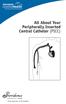 All About Your Peripherally Inserted Central Catheter (PICC) General Information Intravenous (IV) therapy is the delivery of fluid directly into a vein. An intravenous catheter is a hollow tube that is
How To Give Your Cat A Tablet
 Guide to giving your cat a tablet Page 3 Guide to giving your cat a tablet Contents Section Page The basics 3 Keep it simple try giving tablets with food 4 Administering tablets by hand 6 Tools and tricks
Managing Your Non-Tunneled (Percutaneous) Catheter: PICC, SICC, and JCC. What is a PICC catheter?
 Managing Your Non-Tunneled The staff of the Procedure, Vascular Access, Conscious Sedation Service has written this information to explain your new PICC (peripherally inserted central catheter), SICC (subclavian
Foley Catheter Placement
 Foley Catheter Placement Indications for a Foley Catheter Retention of urine leading to urinary hesitancy, straining to urinate, decrease in size and force of the urinary stream, interruption of urinary
Central Line Care for Adults
 Central Line Care for Adults Table of Contents What is a Central Venous Catheter?... 2 Central Venous Catheter Placement: What to Expect... 2 Catheter Care at a Glance... 2 Fast Facts on Central Line Care:
Licensed Child Day Center Program Decision on the Administration of Medication
 Licensed Child Day Center Program Decision on the Administration of Medication NOTE: This sample PROGRAM S DECISION REGARDING MEDICATION plan meets and in many cases exceeds the licensing requirements