
I M NSTALLATION ANUAL. Digital Super Hybrid System. Please read this manual before connecting the Digital Super Hybrid System.
|
|
|
- Della Mills
- 10 years ago
- Views:
Transcription
1 Digital Super Hybrid System I M NSTALLATION ANUAL Please read this manual before connecting the Digital Super Hybrid System. D1232 DIGITAL SUPER HYBRID SYSTEM D816 DIGITAL SUPER HYBRID SYSTEM MODEL KX-TD816AL / KX-TD1232AL Panasonic KX-TD816AL Panasonic KX-TD1232AL

2 Thank you for purchasing the Panasonic Model KX-TD816AL/KX-TD1232AL, Digital Super Hybrid System. System Components Service Unit Telephone Optional Equipment Model No. KX-TD816AL KX-TD1232AL KX-T7220AL KX-T7230AL KX-T7235AL KX-T7250AL KX-T7240AL KX-TD160* 1 KX-TD170AL KX-TD180AL KX-TD180DAL* 3 KX-TD181AL* 2 KX-TD181DAL* 2/ * 3 KX-TD185AL KX-TD192* 2 KX-TD280AL KX-TD281AL* 2 KX-T30865 KX-A216* 1 KX-A46 Digital Super Hybrid System (Main Unit) Digital Super Hybrid System (Main Unit), including the KX-TD196 (Remote Card) Digital Proprietary Telephone Digital Proprietary Telephone with Display Digital Proprietary Telephone with Large Display Digital Proprietary Telephone Digital DSS Console Doorphone Card 8-Station Line Unit 4-CO Line Unit 4-CO Line Unit 8-CO Line Card 8-CO Line Card 4-DID Line Unit System Inter Connection Card (two cards with Connection Cable) 2-ISDN S0 Line Unit 4-ISDN S0 Line Card Doorphone Backup Battery and Adaptor Card Battery Adaptor System Components Table Note The models marked * 1 can be installed only in KX-TD816. The models marked * 2 can be installed only in KX-TD1232. The models marked * 3 supports the Pay Tone service of your Central Office. In this Installation Manual, the suffix AL of each model number is omitted. The Digital Super Hybrid System is abbreviated as DSHS. The Digital Proprietary Telephone is abbreviated as DPT. A Single Line Telephone is abbreviated as SLT. 2

3 Important Information This equipment should be used on PSTN lines requiring 2-wire Loop calling unguarded clearing with Loop Disconnect or DTMF address signaling. The equipment must be connected to direct extension lines and a payphone should not be connected as an extension. Operation in Power Failure In the event of a power failure, single line telephones (SLTs) will be directly connected to specific CO lines as follows: KX-TD816 : CO 1 is connected to the extension jack 1 CO 2 is connected to the extension jack 2 CO 5 is connected to Power Failure Transfer jack KX-TD1232 : three SLTs can be connected to CO 1, CO 2 and CO 9 which are connected to Power Failure Transfer jacks Set the Dialing Mode (Tone or Pulse) of your telephone, according to the CO line. 114 and 000 can be dialed on the apparatus for the purpose of making outgoing calls to the emergency (114) and (000) service. Satisfactory performance can not be guaranteed for every allowed combination of host and subsidiary apparatus. 114 and 000 can be dialed on the apparatus after accessing the CO line for the purpose of making outgoing calls to the emergency (114) and (000) service. During dialing, this apparatus may tinkle the bells of other telephones using the same line. This is not a fault and we advise you not to call Fault Repair Service. Prevention of access by user. This apparatus is intended to be accessible only to authorized personnel. This apparatus must be installed in a locked room or similar environment, such that user access is prevented. Failure to prevent such user access will invalidate any approval given to this apparatus. Caution: Do not push the PAUSE button more than twice following the initial access digit (or digits). Failure to comply with this requirement may result in unsatisfactory operation. Note: No External TRC Terminal is provided due to an Internal Link between PE and TRC. CAUTION Danger of explosion if battery is incorrectly replaced. Replace only with the same or equivalent type recommended by the manufacturer. Dispose of used batteries according to the manufacturer's instructions. 3

4 Attention The apparatus is designed to be installed and operated under controlled conditions of ambient temperature and a relative humidity not greater than 60%. Avoid installing the apparatus in damp or humid environments, such as bathrooms or swimming pools. The apparatus shall not be exposed to dripping or splashing. Keep the unit away from heating appliances and electrical noise generating devices such as fluorescent lamps, motors and televisions. These noise sources can interfere with the performance of the Digital Super Hybrid System. This unit should be kept free of dust, moisture, high temperature (more than 40 C / 104 F) and vibration, and should not be exposed to direct sunlight. Never attempt to insert wires, pins, etc. into the vents or other holes of this unit. If there is any trouble, disconnect the unit from the telephone line. Plug the telephone directly into the telephone line. If the telephone operates properly, do not reconnect the unit to the line until the trouble has been repaired. If the telephone does not operate properly, chances are that the trouble is in the telephone system, and not in the unit. Do not use benzine, thinner, or the like, or any abrasive powder to clean the cabinet. Wipe it with a soft cloth. WARNING THIS UNIT MAY ONLY BE INSTALLED AND SERVED BY QUALIFIED SERVICE PERSONNEL. WHEN A FAILURE OCCURS WHICH RESULTS IN THE INTERNAL PARTS BECOMING ACCESSIBLE, DISCONNECT THE POWER SUPPLY CORD IMMEDIATELY AND RETURN THIS UNIT TO YOUR DEALER. DISCONNECT THE TELECOM CONNECTION BEFORE DISCONNECTING THE POWER CONNECTION PRIOR TO RELOCATING THE EQUIPMENT, AND RECONNECT THE POWER FIRST. THIS UNIT IS EQUIPPED WITH AN EARTHING CONTACT PLUG. FOR SAFETY REASONS THIS PLUG MUST ONLY BE CONNECTED TO AN EARTHING CONTACT SOCKET WHICH HAS BEEN INSTALLED ACCORDING TO REGULATIONS. THE POWER SOCKET WALL OUTLET SHOULD BE LOCATED NEAR THIS EQUIPMENT AND BE EASILY ACCESSIBLE. TO PREVENT FIRE OR SHOCK HAZARD, DO NOT EXPOSE THIS PRODUCT TO RAIN OR MOISTURE. 4

5 Attention The serial number of this product may be found on the label affixed to the bottom of the unit. You should note the serial number of this unit in the space provided and retain this book as a permanent record of your purchase to aid in identification in the event of theft. MODEL NO.: SERIAL NO.: For your future reference DATE OF PURCHASE NAME OF DEALER DEALER S ADDRESS 5

6 Introduction This Installation Manual provides technical information for the Panasonic Digital Super Hybrid System, KX-TD816/KX-TD1232. It is designed to serve as an overall technical reference for the system and includes a description of the system, its hardware and software, features and services and environmental requirements. This manual contains the following sections: Section 1, System Outline. Provides general information on the system including system capacity and specifications. Section 2, Installation. Contains the basic system installation and wiring instructions, as well as how to install the optional cards and units. Section 3, Features. Describes all the basic, optional and programmable features in alphabetical order. It also provides information about the programming required, conditions, connection references, related features and operation for every feature. Section 4, System Programming. Provides step-by-step programming instructions for a proprietary telephone. Section 5, List. Lists tone/ring tone and default values of system programming. Section 6, Troubleshooting. Provides information for system and telephone troubleshooting. NOTE The following documents may be used in conjunction with this manual: User Manual for KX-TD816/KX-TD1232 System, DIGITAL Proprietary Telephones, DSS Console and Single Line Telephones. Programming Table The programming table is designed to be used as a hard copy reference to the userprogrammed data. 6
7 Contents Section 1, System Outline 1.1 System Highlights Basic System Construction Digital Proprietary Telephones Options Specifications General Characteristics System Capacity Section 2, Installation 2.1 Before Installation Installation of the Main Unit Unpacking Name and Location * About the Remote Card (KX-TD196) Wall Mounting Frame Earth Connection Opening Front Cover Connection System Connection Diagram CO Line Connection (KX-TD816 : CO 1 through CO 4) Extension Connection for Digital Proprietary Telephones, Single Line Telephones and DSS Console Paralleled Telephone Connection for a Digital Proprietary Telephone and a Single Line Telephone EXtra Device Port (XDP) Connection for a Digital Proprietary Telephone and a Single Line Telephone External Pager Connection External Music Source Connection Printer Connection Optional Cards and Units Installation Location of Optional Cards and Units CO Line Connection (KX-TD1232 : CO 1 through CO 8) Lightning Protector Installation Station Line Unit Connection CO Line Unit Connection DID Line Unit Connection ISDN S0 Line Unit Connection Installing Expansion Unit (KX-TD170 / KX-TD180(D) / KX-TD185 / KX-TD280) Doorphone and Door Opener Connection *: Available for KX-TD1232 only. 7

8 Contents * System Connection * Backup Battery and Adaptor Card Connection Battery Adapter Connection Power Failure Transfer Connection Starting the System for the First Time System Restart System Data Clear Section 3, Features A Absent Message Capability Account Code Entry Alternate Calling Ring / Voice Answering, Direct CO Line Automatic Callback Busy (Camp-On) Automatic Redial Redial, Automatic Automatic Route Selection (ARS) Automatic Station Release B Background Music (BGM) Background Music (BGM) External Budget Management Busy Lamp Field Busy Station Signaling (BSS) Button, Direct Station Selection (DSS) Button, Flexible Button, Group-CO (G-CO) Button, Loop-CO (L-CO) Button, Single-CO (S-CO) Buttons on Digital Proprietary Telephones C CALL FORWARDING FEATURES SUMMARY Call Forwarding All Calls Call Forwarding Busy Call Forwarding Busy / No Answer Call Forwarding Follow Me Call Forwarding No Answer Call Forwarding to CO Line Call Hold CO Line Call Hold Intercom Call Hold, Exclusive CO Line Call Hold, Exclusive Intercom Call Hold Retrieve CO Line Call Hold Retrieve Intercom * 1 : Available for KX-TD1232 only. * 2 : Available for KX-TD816 only.

9 Contents Calling Line Identification Restriction (CLIR) Call Park Calling Party Control (CPC) Signal Detection Call Pickup, CO Line Call Pickup, Directed Call Pickup, Group Call Pickup Deny Call Splitting CALL TRANSFER FEATURES SUMMARY Call Transfer, Screened to CO Line Call Transfer, Screened to Extension Call Transfer, Unscreened to Extension Call Waiting Charge Fee Reference Class of Service (COS) CO Incoming Call Information Display CO Incoming Call Information Log CO Line Connection Assignment CO Line Connection Assignment Outgoing CO Line Group Conference Conference, Unattended Confirmation Tone Consultation Hold D Data Line Security Delayed Ringing Ringing, Delayed Dial Tone, Distinctive Dial Type Selection Direct Dialing In (DDI) Direct In Lines (DIL) Direct Inward Dialing (DID) Direct Station Selection (DSS) Button Button, Direct Station Selection (DSS) Directed Call Pickup Call Pickup, Directed Display, Call Information Display, Extension Programmed Data Display, Self-Extension Number Display, Time and Date Display Contrast Adjustment Do Not Disturb (DND) Do Not Disturb (DND) Override Door Opener

10 Contents Doorphone Call DSS Console (KX-T7240) E Electronic Station Lockout End-to-End DTMF Signaling (Tone Through) Exclusive Hold Call Hold, Exclusive CO Line / Intercom / 29 Extension Group External Feature Access EXtra Device Port (XDP) F Flexible Button Button, Flexible Flexible Numbering Floating Station Full One-Touch Dialing G Group Call Pickup Call Pickup, Group Group CO (G-CO) Button Button, Group-CO (G-CO) H Handset / Headset Selection Handsfree Answerback Handsfree Operation Hold Recall Host PBX Access HOTEL APPLICATION Check-In / Check-Out Timed Reminder, Remote (Wake-Up Call) I Intercept Routing Intercom Calling L Last Number Redial Redial, Last Number LED Indication, CO Line LED Indication, Intercom Limited Call Duration Line Access, Automatic Line Access, CO Line Group Line Access, Direct Line Access, Individual Line Preference Incoming (No Line / Prime Line / Ringing Line) Line Preference Outgoing (Idle Line / No Line / Prime Line) Lockout Loop-CO (L-CO) Button Button, Loop-CO (L-CO) M Manager Extension Message Waiting Microphone Mute Mixed Station Capacities Module Expansion Music on Hold

11 Contents N Night Service O Off-Hook Call Announcement (OHCA) One-Touch Dialing One-Touch Transfer by DSS Button Operator Operator Call P PAGING FEATURES SUMMARY Paging All Paging External Paging Group Paralleled Telephone Pause Insertion, Automatic Pickup Dialing Power Failure Restart Power Failure Transfer Pulse to Tone Conversion R Recall Redial, Automatic Redial, Last Number Redial, Saved Number Remote Station Lock Control Reverse Circuit Ringing, Delayed Ringing, Discriminating Ringing Tone Selection for CO Buttons S Saved Number Redial Redial, Saved Number Screened Call Transfer to CO Line Call Transfer, Screened to CO Line Screened Call Transfer to Extension Call Transfer, Screened to Extension Secret Dialing Single-CO (S-CO) Button Button, Single-CO (S-CO) Special Display Features for KX-T CO Outgoing Call Log Extension Dialing Station Speed Dialing System Feature Access Menu System Speed Dialing Station Feature Clear Station Hunting Station Message Detail Recording (SMDR) Station Programming

12 Contents Station Programming Data Default Set Station Speed Dialing * System Connection System Data Default Set System Programming and Diagnosis with Personal Computer System Programming with Digital Proprietary Telephone System Speed Dialing System Working Report T Time-Out, Variable Timed Reminder Toll Restriction Toll Restriction Override by Account Code Entry Toll Restriction Override for System Speed Dialing Trunk (CO Line) Answer From Any Station (TAFAS) U Unattended Conference Conference, Unattended Unscreened Call Transfer to Extension Call Transfer, Unscreened to Extension V Voice Mail Integration Volume Control Speaker / Handset Receiver / Headset / Ringer Section 4, System Programming 4.1 General Programming Instructions Using the Digital Proprietary Telephone Programming Ways Entering Characters User Programming Mode Example of Programming Manager Programming [000] Date and Time Set [001] System Speed Dialing Number Set [002] System Speed Dialing Name Set [003] Extension Number Set [004] Extension Name Set [005] Flexible CO Button Assignment [006] Operator / Manager Extension Assignment [007] DSS Console Port and Paired Telephone Assignment [008] Absent Messages [009] Budget Management [010] Charge Margin Rate System Programming [100] Flexible Numbering [101] Day / Night Service Switching Mode *: Available for KX-TD1232 only.

13 Contents [102] Day / Night Service Starting Time [103] Automatic Access CO Line Group Assignment [106] Station Hunting Type [107] System Password [108] One-Touch Transfer by DSS Button [109] Expansion Card / Unit Type [113] VM Status DTMF Set [114] VM Command DTMF Set [115] Adjust Time [116] ROM Version Display [117] Charge Display Selection [118] Charge Verification Assignment [119] Charge Verification ID Code Set [120] User Password [121] Hotel Application Timer Programming [200] Hold Recall Time [201] Transfer Recall Time [202] Call Forwarding No Answer Time [203] Intercept Time [204] Pickup Dial Waiting Time [205] Extension-to-CO Line Call Duration Time [206] CO-to-CO Call Duration Time [207] First Digit Time [208] Inter Digit Time [209] Automatic Redial Repeat Times [210] Automatic Redial Interval Time [211] Dial Start Time [212] Call Duration Count Start Time [213] Message Waiting Ring Interval Time TRS / ARS Programming [300] TRS Override for System Speed Dialing [301] [305] TRS Denied Code Entry for Levels 2 through [306] [310] TRS Excepted Code Entry for Levels 2 through [311] Emergency Dial Set [312] ARS Mode [313] ARS Time [314] [321] ARS Leading Digit Entry for Plans 1 through [322] [329] ARS Routing Plans 1 through [330] ARS Modify Removed Digit [331] ARS Modify Added Number
![.. 4-49 [116] ROM Version Display... 4-50 [117] Charge Display Selection... 4-51 [118] Charge Verification Assignment... 4-52 [119] Charge Verification ID Code Set... 4-53 [120] User Password.](/docs-images/55/9174166/images/page_13.jpg ".. 4-54 [121] Hotel Application... 4-55 4.4 Timer Programming... 4-56 [200] Hold Recall Time... 4-56 [201] Transfer Recall Time... 4-57 [202] Call Forwarding No Answer Time... 4-58 [203] Intercept Time.")
14 Contents 4.6 CO Line Programming [400] CO Line Connection Assignment [401] CO Line Group Assignment [402] Dial Mode Selection [403] Pulse Speed Selection [404] DTMF Time [405] CPC Signal Detection Incoming Set [407] [408] DIL 1:1 Extension Day / Night [409] [410] Intercept Extension Day / Night [411] Host PBX Access Codes [412] Pause Time [413] Register Recall Signal Time [414] Disconnect Time [415] CPC Signal Detection Outgoing Set [416] ISDN Line Number Assignment [417] ISDN Outgoing CLIR Service Assignment [418] ISDN DDI Service Assignment [419] CO Line Name Assignment [420] Reverse Circuit Assignment [430] DID Table Number Assignment [431] DID Incoming Assignment [432] DID Outgoing Assignment [433] DID Subscriber Number Removed Digit and Received Digit [434] DID Added Number [435] DID Wink Time Assignment * [436] Pay Tone Assignment i 4.7 COS Programming [500] [501] Toll Restriction Level Day / Night [502] Extension-to-CO Line Call Duration Limit [503] Call Transfer to CO Line [504] Call Forwarding to CO Line [507] Do Not Disturb Override [508] Account Code Entry Mode Extension Programming [600] EXtra Device Port [601] Class of Service [602] Extension Group Assignment [603] [604] DIL 1:N Extension and Delayed Ringing Day / Night [605] [606] Outgoing Permitted CO Line Assignment Day / Night *: Available for KX-TD1232 only.
![.. 4-89 [411] Host PBX Access Codes... 4-90 [412] Pause Time... 4-92 [413] Register Recall Signal Time... 4-93 [414] Disconnect Time... 4-94 [415] CPC Signal Detection Outgoing Set.](/docs-images/55/9174166/images/page_14.jpg ".. 4-95 [416] ISDN Line Number Assignment... 4-97 [417] ISDN Outgoing CLIR Service Assignment... 4-98 [418] ISDN DDI Service Assignment... 4-99 [419] CO Line Name Assignment.")
15 Contents [607] [608] Doorphone Ringing Assignment Day / Night [609] Voice Mail Access Codes [610] ISDN DDI Number / Extension Number Transformation Resource Programming [800] SMDR Incoming / Outgoing Call Log Printout [801] SMDR Format [802] System Data Printout [803] Music Source Use [804] External Pager BGM [805] External Pager Confirmation Tone [806] [807] EIA (RS-232C) Parameters Port 1 / Port [813] Floating Number Assignment * [814] Modem Standard [815] System Working Report Printout [816] System Working Report Clear Option Programming [990] System Additional Information [991] COS Additional Information Section 5, List 5.1 Tone / Ring Tone Default Values Section 6, Troubleshooting 6.1 Troubleshooting Installation Connection Operation Using Reset Button *: Available for KX-TD1232 only. 15
![.. 4-130 [805] External Pager Confirmation Tone... 4-131 [806] [807] EIA (RS-232C) Parameters Port 1 / Port 2... 4-132 [813] Floating Number Assignment... 4-134 * [814] Modem Standard.](/docs-images/55/9174166/images/page_15.jpg ".. 4-135 [815] System Working Report Printout... 4-136 [816] System Working Report Clear... 4-137 4.10 Option Programming... 4-138 [990] System Additional Information.")
16 Section 1 System Outline This section provides general information on the system, including system capacity and specifications.

17 1.1 System Highlights System Capacity Basic Module System System Expansion Connection KX-TD816 CO line (ISDN S0 line) 4 8 (2) Extension 8 16 KX-TD1232 CO line (ISDN S0 line) 0 12 (6) 24 (12) Extension Module Expansion Expansion modules are used to increase the system capacity. CO line modules and extension modules can be added to the basic system to add CO lines and extensions. EXtra Device Port (XDP) Each extension jack in the system supports the connection of a digital proprietary telephone and a single line device. The devices have different extension numbers and are treated as two completely different extensions. Paralleled Telephone Connection Every jack in the system also supports the parallel connection of a digital proprietary telephone and a single line device. They share the same extension number and are considered by the system to be one extension. Super Hybrid System System Connection* This system supports the connection of digital proprietary telephones, DSS Console and single line devices such as single line telephones, facsimiles, and data terminals. With the addition of optional System Inter Connection Card, two Digital Super Hybrid Systems can be connected together to expand the system capacity. The two systems function as one, however, some functions such as paging and music on hold are duplicated. Digital Proprietary Telephones (DPT) The system supports four different models of digital proprietary telephones which cover the range from a monitor set to a large display handsfree version. 1-2 System Outline *: Available for KX-TD1232 only.

18 1.1 System Highlights Programming System Voice Mail Integration The system can be programmed from a digital proprietary telephone or from a personal computer. The system supports Voice Processing Systems with in-band DTMF signaling. Automatic Route Selection (ARS) Automatically selects the pre-programmed least expensive route for outgoing toll calls. Trunk (CO Line) Answer From Any Station (TAFAS) Ringing occurs over the external paging system; call can be answered from any station. Remote Station Lock Control Allows an operator to lock an extension so that outgoing calls cannot be made. Charge Fee Reference Budget Management Hotel Application Allows the user to see charges and print out the charges. Limits the telephone usage to a pre-assigned amount. Allows to handle the front and operator service such as check-in / check-out and wake-up call setting. System Outline 1-3

19 1.2 Basic System Construction The KX-TD816 Digital Super Hybrid System has a basic capacity of 4 CO lines and 8 extensions, and KX-TD1232 has 16 extensions. It is capable of supporting Panasonic digital proprietary telephones, DSS Consoles and single line devices such as single line telephones, facsimiles. To expand its capabilities the system can be equipped with optional components or customer-supplied peripherals such as external speakers and external music sources (e.g., radios). D1232 DIGITAL SUPER HYBRID SYSTEM D816 DIGITAL SUPER HYBRID SYSTEM Panasonic Panasonic 1-4 System Outline

20 1.3 Digital Proprietary Telephones The following Panasonic digital proprietary telephones are available with this system. Proprietary Telephone KX-T7220 KX-T7230 KX-T7235 KX-T7250 Speakerphone, 24 CO Display, speakerphone, 24 CO Large display, speakerphone, 12 CO Monitor, 6 CO Note CO: CO line access button System Outline 1-5
21 DIGITAL SUPER HYBRID SYSTEM Panasonic DIGITAL SUPER HYBRID SYSTEM Panasonic Panasonic Panasonic 1.4 Options 8-Station Line Unit (KX-TD170) D1232 Each unit adds eight extensions. One expansion unit for KX- TD816, and up to two expansion units for KX-TD1232 can be installed per system. D816 DIGITAL SUPER HYBRID SYSTEM 8 or 16 extensions can be added. 4-CO Line Unit (KX-TD180/KX-TD180D) / 4-DID Line Unit (KX-TD185) / 2-ISDN S0 Line Unit (KX-TD280) D extensions can be added. One of the following units can be installed per system. KX-TD180 : Adds four CO lines. KX-TD180D: Adds four CO lines which support the Pay Tone service of your Central Office. KX-TD185 : Adds four DID lines. KX-TD280 : Adds two ISDN S0 lines. D816 DIGITAL SUPER HYBRID SYSTEM 4 CO lines / 4 DID lines / 2 ISDN S0 lines can be added. 4 CO lines / 4 DID lines / 2 ISDN S0 lines can be added. 8-CO Line Card (KX-TD181/KX-TD181D)* / 4-ISDN S0 Line Card (KX-TD281)* SYSTEM INTER CONNECTION One of the following cards can be installed for KX-TD1232. KX-TD181 : Adds eight CO lines. KX-TD180D: Adds four CO lines which support the Pay Tone service of your Central Office. KX-TD281 : Adds four ISDN S0 lines. 8 CO lines / 4 ISDN S0 lines can be added. 1-6 System Outline *: Available for KX-TD1232 only.
22 Panasonic DIGITAL SUPER HYBRID SYSTEM Panasonic 1.4 Options System Inter Connection Card (KX-TD192)* 1 D1232 DIGITAL SUPER HYBRID SYSTEM D1232 DIGITAL SUPER HYBRID SYSTEM Permits two Digital Super Hybrid Systems to be connected together to double system capacity. Connection Cable Doorphone Card (KX-TD160) This card supports two doorphones and two door openers. The doorphone is an option (KX-T30865). D1232 Panasonic Panasonic Panasonic Doorphone 1 (KX-T30865) Doorphone 2 (KX-T30865) Door Opener 1 Door Opener 2 Note The KX-TD1232 is illustrated as a main unit. Backup Battery and Adaptor Card (KX-A216)* 2 Operate all the features as a backup power supply in the event of a power failure. D816 DIGITAL SUPER HYBRID SYSTEM Panasonic Backup Battery and Adaptor Card (KX-A216) * 1 : Available for KX-TD1232 only. System Outline 1-7 * 2 : Available for KX-TD816 only.
23 Panasonic DIGITAL SUPER HYBRID SYSTEM Panasonic DIGITAL Panasonic DIGITAL Panasonic 1.4 Options DSS Console (KX-T7240) Permits easy and quick access to stations and features. The Busy Lamp Field shows the idle or busy state of each station. DSS Console is designed for use with a digital proprietary telephone. The system supports up to four DSS Consoles per system. D1232 DIGITAL SUPER HYBRID SYSTEM Paired Paired Telephone (Digital (Proprietary Proprietary Telephone) Telephone) DSS DSS Console, KX-T7240/ KX-T7040 Note Pair The KX-TD1232 is illustrated as a main unit. Battery Adaptor (KX-A46) Supports the connection of two car batteries (12 VDC ~2) for power backup in case of a power failure. D1232 Battery Battery Adaptor Adaptor KX-A46 KX-A46 Two car batteries, connected in in series series Battery Battery Adaptor Connector Note The KX-TD1232 is illustrated as a main unit. 1-8 System Outline
24 1.5 Specifications General System Capacity KX-TD816 CO lines (ISDN S0 lines) Extensions KX-TD1232 CO lines (ISDN S0 lines) Extensions 8 max. (2 max.) 16 max. (32 max. with XDP) 12 max. (6 max.) 32 max. (64 max. with XDP) Control Method Switching Stored Program CPU: 16 bits CPU Non Blocking PCM Time Sharing Switch Power Supplies Primary 240 VAC, 50 Hz Secondary Station Supply Volt: 30V Circuit Volt: ± 5V, ± 15V Power Failure Memory back-up duration: seven years by factory-provided lithium battery 3 CO lines max. automatically assigned to SLTs (Power Failure Transfer) System operation for several hours by recommended batteries (consisting of two 12 VDC car batteries) Dialing Outward Dial Pulse (DP) 10 pps, 20 pps Tone (DTMF) Dialing Internal Dial Pulse (DP) 10 pps, 20 pps Tone (DTMF) Dialing Mode Conversion DP-DTMF, DTMF-DP Connector KX-TD816 CO lines Extensions KX-TD1232 CO lines Extensions Paging Output External Music Input Modular jack Modular jack 4-pin connector Amphenol connector Pin Jack (RCA JACK) Two-conductors Jack (MINIJACK 3.5 mm diameter) System Outline 1-9
25 1.5 Specifications Extension Connection Cable Single line telephones KX-T7220, KX-T7230, KX-T7235, KX-T7250 KX-T pair wire (A, B) 2 pair wire (L, H): A and B are not necessary or 2 pair wire (A, B, L, H) 2 pair wire (L, H): A and B are not necessary SMDR (Station Message Detail Recording) Interface EIA (RS-232C) Output Equipment Printer Detail Recording Date, Time, Extension Number, CO Line Number, Dialled Number, Call Duration, Account Code Characteristics Station Loop Limit KX-T7220 / KX-T7230 / KX-T7235 / KX-T ohms Single Line Telephone ohms including set Doorphone...20 ohms Minimum Leakage Resistance ohms Maximum Number of Station Instruments per Line 1 for KX-T7220, KX-T7230, KX-T7235, KX-T7250 or single line telephone 2 by Parallel or extra Device Port Connection of a proprietary telephone and a single line telephone Ring Voltage Primary Power Central Office Loop Limit 70 Vrms at 25 Hz depending on the Ringing Load 240 VAC, 50 Hz ohms max. Environmental Requirements 0 40 C / F, 10 90% 1-10 System Outline
26 1.5.3 System Capacity System Capacity Lines, Cards, Units, Station Equipment KX-TD1232 Max. Quantity Item KX-TD816 Single System Max. Quantity System Connection System Inter Connection Card 2 Service Unit CO Line Card or ISDN S0 Line Card 4-CO Line Unit, DID Line Unit or 2-ISDN S0 Line Unit CO Line ISDN S0 Line Station Line Unit Extension Jack Station Terminal (including DSS Consoles) {DSS Console} {4} {4} {8} Remote Card 1 2 Doorphone Door Opener External Pager External Music Source System Outline 1-11
27 1.5.3 System Capacity System Data Item Max. Quantity Operator 2 System Speed Dialing 500 One-Touch Dialing 24 per station (proprietary telephone) Station Speed Dialing 10 per station Call Park 10 Absent Message 9 CO Line Group 8 Toll Restriction Level 8 Extension Group 16 Class of Service 8 Message Waiting System Outline
28 Section 2 Installation This section contains the basic system installation and wiring instructions, as well as how to install the optional cards and units.
29 2.1 Before Installation Please read the following notes concerning installation and connection before installing the system. Safety Installation Instructions When installing telephone wiring, basic safety precautions should always be followed to reduce the risk of fire, electric shock and injury to persons, including the following: 1. Never install telephone wiring during a lightning storm. 2. Never install telephone jacks in wet locations unless the jack is specifically designed for wet locations. 3. Never touch uninsulated telephone wires or terminals unless the telephone line has been disconnected at the network interface. 4. Use caution when installing or modifying telephone lines. Installation Precautions This set is exclusively made for wall mounting only. Avoid installing in the following places. (Doing so may result in malfunction, noise, or discoloration.) 1. In direct sunlight and hot, cold, or humid places. (Temperature range: 0 C 40 C / 32 F 104 F) 2. Sulfuric gases produced in areas where there are thermal springs, etc. may damage the equipment or contacts. 3. Places in which shocks or vibrations are frequent or strong. 4. Dusty places, or places where water or oil may come into contact with the unit. 5. Near high-frequency generating devices such as sewing machines or electric welders. 6. On or near computers, telexes, or other office equipment, as well as microwave ovens or air conditioners. (It is preferable not to install in the same room with the above equipment.) 7. Install at least 1.8 m from radios and televisions. (both the main unit and proprietary telephones) 8. Do not obstruct area around the main unit (for reasons of maintenance and inspection be especially careful to allow space for cooling above and at the sides of the main unit). Wiring Precautions Make sure to keep the following instructions when wiring. 1. Do not wire the telephone cable in parallel with an AC power source, computer, telex, etc. If the cables are run near those wires, shield the cables with metal tubing or use shielded cables and ground the shields. 2. If cables are run on the floor, use protectors or the like to protect 2-2 Installation
30 2.1 Before Installation the wires where they may be stepped on. Avoid wiring under carpets. 3. Avoid using the same power supply outlet for computers, telexes, and other office equipment. Otherwise, the system operation may be interrupted by the induction noise from such equipment. 4. Please use one pair telephone wire for extension connection of (telephone) equipment such as single line telephones, data terminals, answering machines, computers, voice processing systems, etc., except proprietary telephones (KX-T7220, KX- T7230, KX-T7235, KX-T7250 etc.). 5. The Power Switch of the system must be off during wiring. After all the wirings are completed, turn the Power Switch on. 6. Mis-wiring may cause the system to operate improperly. Refer to Section Installation and Section Connection. 7. If an extension does not operate properly, disconnect the telephone from the extension line and then connect again, or turn off the Power Switch of the system and then on again. 8. The system is equipped with a 3-wire grounding type plug. This is a safety feature. If you are unable to insert the plug into the outlet, contact your electrician to replace your obsolete outlet. Do not defeat the purpose of the grounding-type plug. 9. Use twisted pair cable for CO line connection. 10. CO lines should be installed with lightning protectors. For details, refer to Section Lightning Protector Installation. Warning: Static sensitive devices are used. To protect printed circuit boards from static electricity, do not touch connectors indicated to the right. To discharge body static, touch ground or wear a grounding strap. Warning : Static sensitive connectors REMOTE SYSTEM INTER CONNECTION 8CO/ISDN Installation 2-3
31 2.2 Installation of the Main Unit Unpacking When you unpack the main unit, the following components should be included: Main Unit AC Cord Templet Screw Anchor Plug Pager Connector Music Source Connector Expansion line cord holder 4-pin plugs for doorphone or door opener connection KX-TD816 one one one three three one two KX-TD1232 one one one four four two two one two Name and Location Overview of the Main Unit External Music Jack Paging Jack D1232 DIGITAL SUPER HYBRID SYSTEM Earth Terminal D816 DIGITAL SUPER HYBRID SYSTEM System Clear Switch Reset Button EIA(RS-232C) Connector Earth Terminal EIA (RS-232C) Connector Battery Adaptor Connector Battery Adaptor Connector Panasonic AC Inlet Panasonic AC Inlet Power Indicator Power Switch Power Indicator Power Switch 2-4 Installation
32 2.2 Installation of the Main Unit Inside View of the Main Unit KX-TD816 Extension Modular Jacks CO Modular Jacks Fuse Front Cover KX-TD1232 Remote Card (KX-TD196) Door Opener and Doorphone Connectors Extension Connectors SYSTEM INTER CONNECTION Paging Jack 2 Paging Jack 1 8CO/ISDN External Music Jack 2 External Music Jack 1 System Clear Switch Reset Button Front Cover Installation 2-5
33 DIGITAL SUPER HYBRID SYSTEM 2.2 Installation of the Main Unit About the Remote Card (KX-TD196)* The Remote Card is already installed in KX-TD1232. It allows programming and maintenance of the system from a remote location. D1232 Panasonic Central Office Telephone Line Personal Computer with modem Programming References Section 4, System Programming, [107] System Password [813] Floating Number Assignment [814] Modem Standard System Programming and Diagnosis with Personal Computer 2-6 Installation *: Available for KX-TD1232 only.
34 2.2.4 Wall Mounting KX-TD816 This set is exclusively made for wall mounting only. The wall where the main unit is to be mounted must be able to support the weight of the main unit. If screws other than the ones supplied are used, use the same-sized diameter screws as the enclosed ones. Mounting on Wooden Wall 1. Place the templet (included) on the wall to mark the three screw positions. Mounting on Concrete or Mortar Wall 1. Place the templet (included) on the wall to mark the three screw positions. 2. Drill three holes and drive the anchor plugs (included) with a hammer, flush to the wall. Templet 2. Install the three screws (included) into the wall. To the wall surface Anchor Plug 29 mm (1 1/8 inch) Concrete Wall 6.4 mm (1/4 inch) 3. Install the three screws (included) into the anchor plugs. Wooden Wall Drive the screw to this position Drive the screw to this position 3. Hook the main unit on the screw heads. 4. Hook the main unit on the screw heads. Installation 2-7
35 2.2.4 Wall Mounting KX-TD1232 Mounting on Wooden Wall 1. Place the templet (included) on the wall to mark the four screw positions. Mounting on Concrete or Mortar Wall 1. Place the templet (included) on the wall to mark the four screw positions. 2. Drill four holes and drive the anchor plugs (included) with a hammer, flush to the wall. Templet 2. Install the four screws (included) into the wall. Wooden Wall To the wall surface Anchor Plug 3. Install the four screws (included) into the anchor plugs. Drive the screw to this position 29 mm (1 1/8 inch) Concrete Wall 6.4 mm (1/4 inch) Drive the screw to this position 3. Hook the main unit on the screw heads. 4. Hook the main unit on the screw heads. 2-8 Installation
36 Panasonic 2.2 Installation of the Main Unit Frame Earth Connection IMPORTANT!!! You must connect the frame of the main unit to Earth. D1232 DIGITAL SUPER HYBRID SYSTEM D816 DIGITAL SUPER HYBRID SYSTEM Panasonic To ground Earth To ground Earth Opening Front Cover Two screws are attached to the front cover by springs so that they will not be lost. To open the front cover of the main unit: 1. Loosen the two screws on the right side of the main unit. 2. Open the front cover in the direction of Arrow A. D1232 DIGITAL SUPER HYBRID SYSTEM D816 DIGITAL SUPER HYBRID SYSTEM Screw A Screw A Panasonic Screw Screw Installation 2-9
37 2.3 Connection System Connection Diagram KX-TD816 Optional Line Isolation Unit External Music Source Optional Line Isolation Unit Amplifier Speaker D816 DIGITAL SUPER HYBRID SYSTEM Panasonic Printer for SMDR or Personal Computer for System Programming Battery Adaptor KX-A46 Two car batteries, connected in series Consisting of two 12 VDC To AC Outlet Doorphone KX-T30865 Panasonic Panasonic Door Opener 1 Door Opener 2 Doorphone 1 Doorphone Installation
38 DIGITAL SUPER HYBRID SYSTEM System Connection Diagram KX-TD1232 D1232 Printer for SMDR or Personal Computer for System Programming Battery Adaptor KX-A46 Two car batteries, connected in series Consisting of two 12 VDC Panasonic To AC Outlet Panasonic Panasonic Door Opener 1 Door Opener 2 Doorphone 1 KX-T30865 Doorphone 2 KX-T30865 Optional Line Isolation Unit External Music Source 1 Optional Line Isolation Unit Amplifier Speaker 1 Optional Line Isolation Unit External Music Source 2 Optional Line Isolation Unit Amplifier Speaker 2 Note It is an Austel requirement that an optional Line Isolation Unit, obtainable from your installer, be fitted between the External Music Jack and the External Music Source and between the Paging Jack and the Paging Equipment. Installation 2-11
39 XXXX XXXXXXXXXXXXXXXXXX XXXX AUTO MUTE TALK G H I CH 4 1 TONE 7 ON OFF PROGRAM LOW 10CH T U V D P E R J K L A B C D E F M N O XXXXXXXXXXXX XXXXXXX REDIAL/ PAUSE FULL XXXXXXXXXXX HOLD MUTE MIC SOUND CHARGER XXXXXXXXXXX CHARGE XXXXXXXXXXX PAGE/INTERCOM VOLUME 10CH AUTO SCAN DEGITAL SUPER HYBRID SYSTEM XXXXXXXXXXXXXXXXXX DIGITAL System Connection Diagram KX-TD816 / KX-TD1232 D1232 (CO Lightning Protectors) KX-TD816 : 8 CO Lines KX-TD1232 : 12 CO Lines CO s 1 through 8 (additional) CO s 1 through 12 (additional) Panasonic KX-TD816 : 16 Extensions (8 extensions - initial, KX-TD1232 : 32 Extensions (16 extensions - initial, 8 extensions- additional) 16 extensions- additional) Single Line Telephone (one pair) (one pair) It is recommended that extension of jack 1 is a display proprietary telephone. (two pair) (two pair) DIGITAL Panasonic Data Terminal KX-T7220 Panasonic (two pair) (two pair) KX-T7235 Panasonic (one pair) P R S W X Y AUTO SCAN Panasonic Panasonic Cordless Phone KX-T7250 (two pair) KX-T7230 DIGITAL Panasonic (one pair) (one pair) Panasonic KX-T7240 Telephone Answering Machine with Facsimile Voice Processing System Notes : needs optional cards or adaptor. Parallel telephone connections are possible. The KX-TD1232 is illustrated as a main unit Installation
40 2.3.2 CO Line Connection (KX-TD816: CO1 through CO4) Wire Specifications Connection Use twisted pair cable for installation. The wire specifications for extensions are as follows: Wire Solid wire Diameter of conductor ø0.4 ø0.65 mm (22, 24, 26AWG) Diameter including coating ø0.66 ø1.05 mm Insert the modular plugs of the telephone line cords (4-conductor wiring) into the modular jacks on the system. T: Tip T2 R1 T1 R2 View of TEL Jack (CO) (T1, R1)(T2, R2) CO 3, CO 4 CO 1, CO 2 Use 4-conductor wiring cord To Terminal Board or Modular Jacks from the Central Office. Notes Mis-connection may cause the system to operate improperly. See Section Installation and Connection before connection. Optional card or unit is required to connect CO lines to KX-TD1232. See Section 2.4 Optional Cards and Units Installation. Installation 2-13
41 2.3.3 Extension Connection for Digital Proprietary Telephones, Single Line Telephones and DSS Console (KX-TD816: Jack 1 through Jack 8, KX-TD1232: Jack 1 through Jack 16) 1. Extension Connection for KX-TD816 Wire Specifications Connection In making an extension line connection, use twisted pair cable for installation. The wire specifications for extensions are as follows: Wire Solid wire Diameter of conductor ø 0.4 ø 0.65 mm Diameter including coating ø 0.66 ø 1.05 mm Insert the modular plugs of the telephone line cords (4-conductor wiring) into the modular jacks on the system. Mis-connection may cause the system to operate improperly. See Section Installation and Connection before connection. H: High L: Low R: T: Tip L R T H View of TEL Jack (Extension) Jack 8 Jack 7 Jack 6 Jack 5 Jack 4 Jack 3 Jack 2 Jack 1 To extensions (Jacks 1 8) 2-14 Installation
42 2.3.3 Extension Connection for Digital Proprietary Telephones, Single Line Telephones and DSS Console (KX-TD816: Jack 1 through Jack 8, KX-TD1232: Jack 1 through Jack 16) 2. Extension Connection for KX-TD1232 Connection Insert the connectors to the system as shown. For Cable Pin Numbes to Be Connected, see page Mis-connection may cause the system to operate improperly. See Section Installation and Connection before connection. Connector type 50-pin (Amphenol 57JE series or the equivalent) To extensions (Jacks 9-16) To extensions (Jacks 1-8) After inserting the connector, fasten the connector with the nylon tie. Installation 2-15
43 2.3.3 Extension Connection for Digital Proprietary Telephones, Single Line Telephones and DSS Console (KX-TD816: Jack 1 through Jack 8, KX-TD1232: Jack 1 through Jack 16) Cable Pin Numbers to Be Connected CONN. PIN EXTN. 1-8 EXTN EXTN 8EXTN Jack No.1 Jack No.2 Jack No.3 Jack No.4 Jack No.5 Jack No.6 Jack No.7 Jack No.8 T R D1 D2 P1 P2 T R D1 D2 P1 P2 T R D1 D2 P1 P2 T R D1 D2 P1 P2 T R D1 D2 P1 P2 T R D1 D2 P1 P2 T R D1 D2 P1 P2 T R D1 D2 P1 P2 Jack No.9 Jack No.10 Jack No.11 Jack No.12 Jack No.13 Jack No.14 Jack No.15 Jack No.16 T R D1 D2 P1 P2 T R D1 D2 P1 P2 T R D1 D2 P1 P2 T R D1 D2 P1 P2 T R D1 D2 P1 P2 T R D1 D2 P1 P2 T R D1 D2 P1 P2 T R D1 D2 P1 P2 Jack No.17 Jack No.18 Jack No.19 Jack No.20 Jack No.21 Jack No.22 Jack No.23 Jack No.24 T R D1 D2 P1 P2 T R D1 D2 P1 P2 T R D1 D2 P1 P2 T R D1 D2 P1 P2 T R D1 D2 P1 P2 T R D1 D2 P1 P2 T R D1 D2 P1 P2 T R D1 D2 P1 P2 Jack No.25 Jack No.26 Jack No.27 Jack No.28 Jack No.29 Jack No.30 Jack No.31 Jack No.32 T R D1 D2 P1 P2 T R D1 D2 P1 P2 T R D1 D2 P1 P2 T R D1 D2 P1 P2 T R D1 D2 P1 P2 T R D1 D2 P1 P2 T R D1 D2 P1 P2 T R D1 D2 P1 P Installation
44 2.3.3 Extension Connection for Digital Proprietary Telephones, Single Line Telephones and DSS Console (KX-TD816: Jack 1 through Jack 8, KX-TD1232: Jack 1 through Jack 16) Notes 8EXTN in the table indicates an extension expansion area for KX- TD1232. There are three expansion areas on the main unit of KX- TD1232. Up to two 8-Station Line Units and a 4-CO Line Unit can be installed to any area. It is required to designate which is 8-Station Line Unit 1 and which is 2 by system programming. If a telephone or answering machine with an A-A1 relay is connected to the main unit, set the A-A1 relay switch of the telephone or answering machine to OFF position. Digital Proprietary Telephone Connection With the KX-T7220, KX-T7230, KX-T7235, and KX-T7250 model digital proprietary telephones, 4-conductor wiring is required for each extension. Connect pins L and H only. ( A and B are only needed for Paralleled Telephone or XDP operation.) Single Line Telephone Connection With the single line telephones, 2-conductor wiring is required for each extension. Connect pins A and B. DSS Console Connection A maximum of four DSS Consoles, model KX-T7240, can be installed per system. The DSS Console must be connected in parallel with any proprietary telephone. System Programming is required to designate paired jack numbers of DSS Consoles and proprietary telephones. With the KX-T7240 model DSS Console, 4-conductor wiring is required for each extension. Connect pins L and H only. ( A and B are not necessary.) Station Wiring (3-pair twisted cabling) : 50-Pin Connector Block Terminal Green Red Black Yellow White Blue Line cord Bridging Clips Installation 2-17
45 2.3.3 Extension Connection for Digital Proprietary Telephones, Single Line Telephones and DSS Console (KX-TD816: Jack 1 through Jack 8, KX-TD1232: Jack 1 through Jack 16) Programming References Section 4, System Programming, [007] DSS Console Port and Paired Telephone Assignment [109] Expansion Card / Unit Type DSS Console (KX-T7240) Module Expansion Note After completing all the required inside cabling, including CO lines, extensions, external pagers and external music sources, fasten the cables with the nylon tie (included) as shown Installation
46 2.3.4 Paralleled Telephone Connection for a Digital Proprietary Telephone and a Single Line Telephone Any single line telephone can be connected in parallel with a digital proprietary telephone as follows: Method 1: Using a Modular T-Adaptor D1232 DIGITAL SUPER HYBRID SYSTEM Modular T-Adaptor (Panasonic KX-J66 or USOC RJA2X) 2-conductor wiring cord Connect pins A and B. 4-conductor wiring cord Connect pins L and H only. ( A and B are not necessary.) Digital Proprietary Telephone (DPT=KX-T7220, KX-T7230, KX-T7235, KX-T7250) Single Line Telephone Note The KX-TD1232 is illustrated as a main unit. Installation 2-19
47 2.3.4 Paralleled Telephone Connection for a Digital Proprietary Telephone and a Single Line Telephone Method 2: Using a TO TEL Jack D1232 DIGITAL SUPER HYBRID SYSTEM 2-conductor wiring cord Connect pins A and B. 4-conductor wiring cord Connect pins L, A, B and H. Rear of the telephone To main unit ( TO EMSS is printed.) To Single Line Telephone ( TO TEL is printed.) Single Line Telephone Digital Proprietary Telephone (KX-T7220, KX-T7230, KX-T7235, KX-T7250) TO EMSS LCD ADJ PUSH TO TEL Notes Not only a single line telephone but a single line device such as an answering machine, a facsimile or a modem (personal computer) etc. can be connected in parallel with a digital proprietary telephone. The KX-TD1232 is illustrated as a main unit. Paralleled Telephone 2-20 Installation
48 DIGITAL SUPER HYBRID SYSTEM EXtra Device Port (XDP) Connection for a Digital Proprietary Telephone and a Single Line Telephone With the extra Device Port (XDP) connection, a digital proprietary telephone (KX-T7220, KX-T7230, KX-T7235, or KX-T7250) and a single line telephone can be connected to the same extension jack and have different extension numbers. System programming is required. A single line telephone and a digital proprietary telephone are connected to the main unit by 2-conductor and 4-conductor wiring cords. D conductor wiring cord Connect pins L and H only. ( A and B are not necessary.) 2-conductor wiring cord Connect pins A and B. Digital Proprietary Telephone (KX-T7220, KX-T7230, KX-T7235, KX-T7250) Single Line Telephone Note The KX-TD1232 is illustrated as a main unit. Programming References Section 4, System Programming, [600] EXtra Device Port EXtra Device Port (XDP) Installation 2-21
49 2.3.6 External Pager Connection KX-TD816 One external pager (user-supplied) can be connected to KX-TD816 as illustrated below. Use an RCA connector and shielded cable. To adjust the sound level of the pagers, use the volume control on the amplifiers. Output impedance: 600 Ω D816 DIGITAL SUPER HYBRID SYSTEM Paging Jack Amplifier Speaker Panasonic Optional Line Isolation Unit Paging Equipment 2-22 Installation
50 2.3.6 External Pager Connection KX-TD1232 Up to two external pagers (user-supplied) can be connected to KX- TD1232 per system as illustrated below. You can program the external pager that will send background music and determine whether both pagers will generate a confirmation tone. Use an RCA connector and shielded cable. To adjust the sound level of the pagers, use the volume control on the amplifiers. Output impedance: 600 Ω SYSTEM INTER CONNECTION Paging Jack 2 Paging Jack 1 8CO/ISDN Amplifier Speaker Optional Line Isolation Unit Optional Line Isolation Unit Paging Equipment 2 Amplifier Paging Equipment 1 Speaker Note It is an Austel requirement that an optional Line Isolation Unit, obtainable from your installer, be fitted between the Paging jack and the Paging equipment. Programming References Section 4, System Programming, [804] External Pager BGM [805] External Pager Confirmation Tone Background Music (BGM) External Paging External Paging All Trunk (CO Line) Answer From Any Station (TAFAS) Installation 2-23
51 2.3.7 External Music Source Connection KX-TD816 One music source such as a radio (user-supplied) can be connected to KX-TD816 as illustrated below. Use a two-conductor plug (3.5 mm in diameter). Insert the plug to the earphone / headphone jack on the external music source. Input impedance: 8 kω D816 DIGITAL SUPER HYBIRD SYSTEM External Music Jack Panasonic Optional Line Isolation Unit External Music Source 2-24 Installation
52 2.3.7 External Music Source Connection KX-TD1232 Up to two music sources such as a radio (user-supplied) can be connected to KX-TD1232 per system as illustrated below. Use a two-conductor plug (3.5 mm in diameter). Insert the plug to the earphone / headphone jack on the external music source. Input impedance: 8 kω SYSTEM INTER CONNECTION External Music Jack 2 External Music Jack 1 8CO/ISDN Optional Line Isolation Unit External Music Source 2 Optional Line Isolation Unit External Music Source 1 Notes System Programming of music sources used for Music on Hold and Background Music is required. To adjust the sound level of the Music on Hold, use the volume control on the external music source. It is an Austel requirement that an optional Line Isolation Unit, obtainable from your installer, be fitted between the External Music Jack and the external Music Source. Programming References Section 4, System Programming, [803] Music Source Use [990] System Additional Information, Field (20) Background Music (BGM) Music on Hold Background Music (BGM) External Installation 2-25
53 2.3.8 Printer Connection A user-supplied printer can be connected to the EIA (RS-232C) connector (25-pin) on the main unit. The printer is used to print out SMDR call records and system programming data. Connect the EIA (RS-232C) printer connector to the EIA connector. Cables must be shielded; the maximum length is 2 m. EIA Connector Serial Printer Serial Interface (25-pin) (RS-232C) Note The KX-TD1232 is illustrated as a main unit. The pin configuration of EIA (RS-232C) connector is as follows: Pin No. Signal Name Circuit Type EIA CCITT 1 2 FG SD (TXD) Frame Ground Transmitted Data AA BA RD (RXD) RS (RTS) Received Data Request To Send BB CA CS (CTS) DR (DSR) Clear To Send Data Set Ready CB CC SG CD (DCD) Signal Ground Data Carrier Detect AB CF ER (DTR) Data Terminal Ready CD Installation
54 2.3.8 Printer Connection Printer / Personal Computer (25-pin) Connection Chart EIA (RS-232C) port on the main unit EIA (RS-232C) port on the printer/pc Circuit Type (EIA) Signal Name Pin No. Pin No. Signal Name Circuit Type (EIA) AA BA FG SD (TXD) FG RD (RXD) AA BB BB CB RD (RXD) CS (CTS) SD (TXD) BA CC AB DR (DSR) SG ER (DTR) SG CD AB CD ER (DTR) CS (CTS) DR (DSR) CD (DCD) CB CC CF Printer / IBM Personal Computer (9-pin) Connection Chart If you connect an IBM-PC or printer with 9-pin EIA (RS-232C) connector to your system, see the chart below. EIA (RS-232C) port on the main unit EIA (RS-232C) port on the printer/ibm-pc Circuit Type (EIA) Signal Name Pin No. Pin No. Signal Name Circuit Type (EIA) AA BA FG SD (TXD) RD (RXD) BB BB CA RD (RXD) RS (RTS) SD (TXD) ER (DTR) BA CD CB CC CS (CTS) DR (DSR) SG DR (DSR) AB CC AB CD SG ER (DTR) RS (RTS) CS (CTS) CA CB 25-pin 9-pin Note Please read your printer manual and connect the first EIA pin (FG) of this unit to the printer cable. Installation 2-27
55 2.3.8 Printer Connection EIA (RS-232C) Signals Frame Ground: FG Connects to the unit frame and the earth ground conductor of the AC power cord. Transmitted Data: SD (TXD)...(output) Conveys signals from the unit to the printer. A Mark condition is held unless data or break signals are being transmitted. Received Data: RD (RXD)...(input) Conveys signals from the printer. Request to Send: RS (RTS)...(output) This lead is held ON whenever CR (DSR) is ON. Clear To Send: CS (CTS)...(input) An ON condition of the CS (CTS) circuit indicates that the printer is ready to receive data from the unit. The unit does not attempt to transfer data or receive data when the CS (CTS) circuit is OFF. Data Set Ready: CR (DSR)...(input) An ON condition of the CR (DSR) circuit indicates that the printer is ready. An ON condition does not indicate that communication has been established with the printer. Signal Ground: SG Connects to the DC ground of the unit for all interface signals. Data Terminal Ready: ER (DTR)...(output) This signal line is turned on by the unit to indicate that it is online. The ON condition does not indicate that communication has been established with the printer. The signal line is switched OFF when the unit is offline. Data Carrier Detect: CD (DCD)...(input) The ON condition is an indication to data terminal (DTE) that the carrier signal is being received. Programming References Section 4, System Programming, [800] SMDR Incoming / Outgoing Call Log Printout [801] SMDR Format [802] System Data Printout [806]-[807] EIA (RS-232C) Parameters Port 1 / Port 2 Station Message Detail Recording (SMDR) System Programming and Diagnosis with Personal Computer 2-28 Installation
56 DID DIGITAL SUPER HYBRID SYSTEM 2.4 Optional Cards and Units Installation Location of Optional Cards and Units Precaution The location of the optional cards and units is shown below. To protect the printed circuit boards (P-boards) from static electricity, do not touch parts on the P-boards in the main unit and on the optional cards and units. Expansion Units KX-TD816 One 8-Station Line Unit (KX-TD170) and / or one of 4-CO Line Unit (KX-TD180/KX-TD180D), 4-DID Line Unit (KX-TD185) or 2-ISDN S0 Line Unit (KX-TD280) can be installed to any of the two expansion areas. Expansion area 2 8-Station Line Unit, KX-TD170 8EXT DIGITAL SUPER HYBRID SYSTEM Expansion area 1 4CO DIGITAL SUPER HYBRID SYSTEM 4-CO Line Unit, KX-TD180/ KX-TD180D Panasonic D816 4CO 4-DID Line Unit, KX-TD185 Expansion Unit Connectors Remove the cover plate(s) on the front cover. 2SO ISDN DIGITAL SUPER HYBRID SYSTEM 2-ISDN S0 Line Unit, KX-TD280 Note System Programming is required for expansion unit location. Refer to Section 4.3 [109] Expansion Card / Unit Type. Default : Area 1 = 4-CO Line Unit, Area 2 = 8-Station Line Unit. Installation 2-29
57 DID DIGITAL SUPER HYBRID SYSTEM Location of Optional Cards and Units KX-TD1232 A maximum of two 8-Station Line Units (KX-TD170) and / or one of 4-CO Line Unit (KX-TD180/KX-TD180D), 4-DID Line Unit (KX-TD185) or 2-ISDN S0 Line Unit (KX-TD280) can be installed to any of the three expansion areas. Expansion area 3 Expansion area 2 8EXT DIGITAL SUPER HYBRID SYSTEM 8-Station Line Unit, KX-TD170 Expansion area 1 Panasonic 8EXT DIGITAL SUPER HYBRID SYSTEM 4CO DIGITAL SUPER HYBRID SYSTEM 4-CO Line Unit, KX-TD180/ KX-TD180D Expansion Card Connectors D1232 4CO 4-DID Line Unit, KX-TD185 Remove the cover plate(s) on the front cover. 2SO ISDN DIGITAL SUPER HYBRID SYSTEM 2-ISDN S0 Line Unit, KX-TD280 Note System Programming is required for expansion unit location. Refer to Section 4.3 [109] Expansion Card / Unit Type. Default : Area 1 = 4-CO Line Unit, Area 2, 3 = 8-Station Line Unit Installation
58 2.4.1 Location of Optional Cards and Units Backup Battery and Adaptor Card / Doorphone Card for KX-TD816 Doorphone Card Connector Backup Battery Connector Install Backup Battery and Adaptor Card (KX-A216). Operates all the features in the event of a power failure. Install Doorphone Card (KX-TD160). This card connects two doorphones and two door openers. Front Cover is open. System Inter Connection Card / 8-CO Line Card / 4-ISDN S0 Line Card for KX-TD1232 System Inter Connection Card Connector SYSTEM INTER CONNECTION Install System Inter Connection Card (KX-TD192). This card connects two DSHSs together. CO Line Expansion Card Connector Front Cover is open. 8CO/ISDN Install 8-CO Line Card (KX-TD181/KX-TD181D). Adds eight CO lines. or Install 4-ISDN S0 Line Card (KX-TD281). Adds four ISDN S0 lines. Installation 2-31
59 2.4.2 CO Line Connection (KX-TD1232: CO1 through CO8) Card Installation To connect CO 1 through CO 8 to KX-TD1232, install the optional 8-CO Line Card (KX-TD181/KX-TD181D). To connect four ISDN S0 lines to KX-TD1232, install the optional 4-ISDN S0 Line Card (KX-TD281). 1. Insert the upper end of the 8-CO Line Card or 4-ISDN S0 Line Card into the two hooks on the main unit. 2. Press the two corners at the lower end of the Card. 3. Fix the card with an accessary screw at the lower-right corner. 4. Connect the cord to the connector. 4-ISDN S0 Line Card 8-CO Line Card 4-pin Connector 4 4-pin Connector 1 (on the lower board) Wire Specifications In making a CO line connection, use twisted pair cable for installation. The wire specifications for CO lines are as follows: Wire Diameter of conductor Diameter including coating Solid wire ø 0.4 ø 0.65 mm ø 0.66 ø 1.05 mm Note In case of starting the system for the first time or System Data Clear, the application for location will adapt the practical installation instead of system default setting. System Programming is required for location identification. Refer to Section 4, [109] Expansion Card / Unit Type. Default: 8-CO Line Card 2-32 Installation
60 2.4.2 CO Line Connection (KX-TD1232: CO1 through CO8) 8-CO Line Connection with KX-TD181/KX-TD181D Use 4-pin plugs (included) to connect CO lines. There are four plugs to connect eight CO lines. A single plug is able to connect two CO lines. Mis-connection may cause the system to operate improperly. See Section Connection before connection. 1. Insert required telephone wires into the holes in a plug. Fix the transparent part into the black part. Note: Do not strip the wires. Insert the wires all the way into the plug. 4-pin plug A B A B 2. Insert the plug A into a CO jack B on the card. Jacks for Power Failure Transfer CO 7, CO 8 CO 5, CO 6 CO 3, CO 4 CO 1, CO 2 B View of Connector To Terminal Board or Modular Jacks from the Central Office. A A B A B CO 2 CO 1 For details, refer to Section 2.5 Power Failure Transfer Connection. Installation 2-33
61 2.4.2 CO Line Connection (KX-TD1232: CO1 through CO8) 4-ISDN S0 Line Connection with KX-TD281 Use 4-pin plugs (included) to connect ISDN S0 lines. There are four plugs to connect four ISDN S0 lines. A single plug is able to connect one ISDN S0 line. Mis-connection may cause the system to operate improperly. See Section Connection before connection. 4-pin plug 1. Insert required telephone wires into the holes in a plug. Fix the transparent part into the black part. Note: Do not strip the wires. Insert the wires all the way into the plug. TB TA RA RB 2. Insert the plug into an ISDN port on the card. Port No. 4 Port No. 3 Port No. 2 Port No. 1 To Terminal Board or Modular Jacks from the Central Office Installation
62 2.4.3 Lightning Protector Installation A lightning protector is a device to be installed on a CO line to prevent a dangerous surge from entering the building and damaging equipment. A dangerous surge can occur if a telephone line comes in contact with a power line. Troubles due to lightning surges have been showing a steady increase with the development of electronic equipment. In many countries, there are regulations requiring the installation of a lightning protector. A lightning strike to a telephone cable which is 10 m above ground can be as high as 200,000 volts. This system should be installed with lightning protectors. In addition, connection to earth ground is very important for the protection of the system. Installation Diagram CO Lightning Protectors CO Main Distribution Frame CO EXTN Main Unit EXTN SLT EXTN PT Earth Terminal Frame Earth Earth Installation 2-35
63 2.4.3 Lightning Protector Installation Outside Installation Diagram If you install an extension outside of the main building, the following precautions are recommended: (1) Install the extension wire underground. (2) Use a conduit to protect the wire. (Main Building) CO Protectors (Another Building) CO Main CO Distribution Frame EXTN EXTN EXTN Main Unit EXTN Lightning Protector SLT PT TEL TEL Earth Note The lightning protector for an extension is different from that for CO Installation
64 2.4.3 Lightning Protector Installation Earth Rod Installation Diagram The length of earth rod and the required depth depend on the composition of the soil. Consider the following recommendations: CO Lightning Protector Earth Wire Main Unit (Underground) Earth Rod 1) Installation location of the earth rod...near the protector 2) Check obstructions...none 3) Composition of the earth rod...metal 4) Depth of the earth rod...more than 50 cm 5) Size of the earth wire...thickness is more than 1.6 mm Installation 2-37
65 2.4 Optional Cards and Units Installation Station Line Unit Connection To add eight extensions (KX-TD816: jacks 9 through 16, KX- TD1232: jacks 17 through 24), use the optional 8-Station Line Unit (KX-TD170). To add 16 extensions for KX-TD1232 (jacks 17 through 32), use two KX-TD170s. This unit can be installed in any of the expansion areas provided on the front of the main unit. For the unit installation, see Section Installing Expansion Unit (KX-TD170/KX-TD180(D)/KX-TD185/KX-TD280) CO Line Unit Connection To add four CO lines (KX-TD816: CO 5 through CO 8, KX- TD1232: CO 9 through CO 12), use the optional 4-CO Line Unit (KX-TD180/KX-TD180D). This unit can be installed in any of the expansion areas provided on the front of the main unit. For the unit installation, see Section Installing Expansion Unit (KX-TD170/KX-TD180(D)/KX-TD185/KX-TD280) DID Line Unit Connection To add four DID lines (KX-TD816: CO 5 through CO 8, KX- TD1232: CO 9 through CO 12), use the optional 4-DID Line Unit (KX-TD185). This unit can be installed in any of the expansion areas provided on the front of the main unit. For the unit installation, see Section Installing Expansion Unit (KX-TD170/KX-TD180(D)/KX-TD185/KX-TD280) ISDN S0 Line Unit Connection To add two ISDN S0 lines (KX-TD816: ISDN 1 and ISDN 2, KX- TD1232: ISDN 5 and ISDN 6), use the optional 2-ISDN S0 Line Unit (KX-TD280). This unit can be installed in any of the expansion areas provided on the front of the main unit. For the unit installation, see Section Installing Expansion Unit (KX-TD170/KX-TD180(D)/KX-TD185/KX-TD280) Installation
66 Panasonic Installing Expansion Unit (KX-TD170 / KX-TD180(D) / KX-TD185 / KX-TD280) The following procedures can be used to install either 8-Station Line Unit (KX-TD170), 4-CO Line Unit (KX-TD180/KX- TD180D), 4-DID Line Unit (KX-TD185) or 2-ISDN S0 Line Unit (KX-TD280). System programming is required for unit location identification. Default KX-TD816: bottom = 4-CO Line Unit, top = 8-Station Line Unit KX-TD1232: bottom = 4-CO Line Unit, middle and top = 8-Station Line Unit Note The KX-TD1232 is illustrated as a main unit. 1. Loosen the two the screws on the cover plate. Insert fingers into the slits to remove the cover plate. 3. Hook the cabinet to the main unit and slide the cabinet to the left until it is fixed. D1232 DIGITAL SUPER HYBRID SYSTEM D1232 DEGITAL SUPER HYBRID SYSTEM Slit Slit Panasonic Note Any of the cover plates can be removed, as needed. 2. Connect the cabinet cord to the connector in the main unit firmly. 4. Loosen the outside screw and slide the cover to the right. D1232 DIGITAL SUPER HYBRID SYSTEM D1232 DIGITAL SUPER HYBRID SYSTEM Panasonic Panasonic Outside screw Installation 2-39
67 2.4.8 Installing Expansion Unit (KX-TD170 / KX-TD180(D) / KX-TD185 / KX-TD280) 5. Secure the inside screw (include) to fix the cabinet to the main unit. D1232 DIGITAL SUPER HYBRID SYSTEM Note Be sure to fix the inside screw to the main unit, or the unit may not work properly. Inside screw Panasonic 6. Prepare the required plugs. Two 4-pin plugs are included in KX-TD180(D) or KX-TD280 to connect four CO lines. Eight 6-pin plugs are included in KX-TD170 to connect eight extensions. To prepare a 4-pin plug for KX-TD180(D), perform step 1 on page To prepare a 4-pin plug for KX-TD280, perform step 1 on page To prepare a 6-pin plug for KX-TD170, perform step 1 on page Insert the plug into a jack on the unit. Connect an earth wire to the earth terminal on the extension expansion unit. KX-TD170 KX-TD180(D) Jack for Power Failure Transfer 8EXT DIGITAL SUPER HYBRID SYSTEM P2 L A B H P1 Jack no. 16 or 24 (32) 15 or 23 (31) 14 or 22 (30) 13 or 21 (29) Jack no. 12 or 20 (28) 11 or 19 (27) 10 or 18 (26) 9 or 17 (25) 4CO DIGITAL SUPER HYBRID SYSTEM PFT ports 2CO w/pft 2CO A B A B CO5 or CO9 CO6 or CO10 CO7 or CO11 CO8 or CO12 Panasonic Panasonic To extensions (jack numbers 9 16/ 17 24/25 32) Earth Terminal To Terminal Board or Modular Jacks from the Central Office For details, refer to Section 2.5 Power Failure Transfer Connection Installation
68 2CO Installing Expansion Unit (KX-TD170 / KX-TD180(D) / KX-TD185 / KX-TD280) 7. (Continued) KX-TD185 Jack for Power Failure Transfer DID PFT ports (T1/R1)(T2/R2) CO 5, CO6 or CO 9, CO10 CO7, CO8 or CO11, CO12 4CO DIGITAL SUPER HYBRID SYSTEM 2CO w/pft T2 R1 T1 R2 2CO R: Ring T: Tip View of TEL Jack (CO) Panasonic To Terminal Board or Modular Jacks from the Central Office For details, refer to Section 2.5 Power Failure Transfer Connection. KX-TD280 ISDN DIGITAL SUPER HYBRID SYSTEM 2S0 2CO w/pft TB TA RA RB ISDN Port No.1 or 5 ISDN Port No.2 or 6 Panasonic To Terminal Board or Modular Jacks from the Central Office Installation 2-41
69 DIGITAL SUPER HYBRID SYSTEM Installing Expansion Unit (KX-TD170 / KX-TD180(D) / KX-TD185 / KX-TD280) 8. Tie all of the cords into a bundle. If other cords are exposed in the upper cabinets, tie them also. 9. Close the cabinet cover and secure the outside screw. 10. Cover the cords with the cord holder (included). Notes If two or three expansion units are installed, cut the cabinet covers on the lower cabinets to allow the cords from the upper cabinet to go down through the cabinet covers. To protect the cords, smooth the cut edges. Cut here D1232 Panasonic Cord holder Programming References Section 4, System Programming, [109] Expansion Card / Unit Type 11. Fix the cords to the wall as shown so that the front cover can be opened. Module Expansion D1232 DIGITAL SUPER HYBRID SYSTEM Panasonic 2-42 Installation
70 2.4.9 Doorphone and Door Opener Connection A maximum of two doorphones (KX-T30865) and two door openers (user-supplied) is permitted. A Doorphone Card (KX- TD160) is required for KX-TD816. Installing the Doorphone 1. Loosen the screw to separate the doorphone into two halves. Doorphone Card Installation 1. Connect a 4-conductor modular connector to the Doorphone Card Cabinet, and pass the cord through the groove on the cabinet. Panasonic screw 2. Install the base cover to the wall with two screws. Note Two kinds of screws are included. Please choose an appropriate one depending on your wall type: Type 1: When the doorphone plate has been fixed to the wall. Type 2: When you wish to install the doorphone directly to the wall. 2. Attach the Doorphone Card Cabinet to the main unit and press it down. 3. Connect the cord to the Doorphone Card Connector. 3. Connect the wires from the terminal box to the screws located in the front cover. To the terminal box (See the following page.) 4. Secure both halves together and re-install the screw. To Terminal Box Installation 2-43
71 2.4.9 Doorphone and Door Opener Connection 2. Connection for KX-TD816 Wiring of the Doorphone 1. Connect the Doorphone Card to the terminal box using a 4- conductor modular connector. 2. Connect the wires of doorphone 1 to the red and green screws of the terminal box. 3. Connect the wires of doorphone 2 to the yellow and black screws of the terminal box. 4-conductor wiring is required. Terminal Box Doorphone 1 (KX-T30865) Yellow Red Black Green Doorphone 2 (KX-T30865) Panasonic Panasonic 2-44 Installation
72 2.4.9 Doorphone and Door Opener Connection Connecting Door Openers 1. Loosen the screw to remove the cover. 3. Insert the wires coming from the door openers into holes and tighten the screws. To door opener 2 To door opener 1 Notes For wiring, it is recommended to use UL 1015, AWG 22 twisted wire or the equivalent. The wire should be between 1.2 and 2.4 mm (3/64 and 3/32 inch) in diameter including the coating. 2. Loosen the screws. D= mm (3/64-3/32 inch) Set the door opener paired with the doorphone. Installation 2-45
73 Panasonic Panasonic Doorphone and Door Opener Connection 2. Connection for KX-TD1232 Use 4-pin plugs (included) to connect doorphone or door opener. A plug is able to connect up to two doorphones or door openers. 4- conductor wiring is required. 4-pin plug 1. Insert required wires into the holes in a plug. Fix the transparent part into the black part. Note: Do not strip the wires. Insert the wires all the way into the plug. Door opener 2 or Doorphone 2 Door opener 1 or Doorphone 1 2. Insert the plug into the connector in the main unit. 3. Connect the wires to the doorphone (1 or/and 2) or door opener (1 or/and 2). Doorphone DOORPHONE SYSTEM INTER CONNECTION Doorphone 2 Doorphone 1 8CO/ISDN 4-conductor wiring Doorphone 1 (KX-T30865) Doorphone 2 (KX-T30865) 2-46 Installation
74 2.4.9 Doorphone and Door Opener Connection Door Opener DOOROPENER SYSTEM INTER CONNECTION Door opener 2 Door opener 1 8CO/ISDN 4-conductor wiring is required. To door opener 2 To door opener 1 Notes For wiring, it is recommended to use UL 1015 twisted wire or the equivalent. The wire should be between 1.2 and 2.4 mm in diameter including the coating. D= mm Pair the door opener with the doorphone. Installation 2-47
75 Panasonic Doorphone and Door Opener Connection Maximum distance of doorphone and door opener line The maximum length of the doorphone and door opener line that connects to the main unit is as follows: D1232 DIGITAL SUPER HYBRID SYSTEM 120 m for ø 0.5 mm Panasonic Doorphone KX-T m for ø 0.5 mm Door opener Note The KX-TD1232 is illustrated as a main unit. Programming References Section 4, System Programming, [ ] Doorphone Ringing Assignment Day / Night Door Opener Doorphone Call 2-48 Installation
76 System Connection* To connect two main units, use the optional System Inter Connection Cards (two) and the Connection Cable (included in the cards). 1. Insert the upper end of the System Inter Connection Card into the two hooks on the main unit of the Master System. 2. Press the two corners at the lower end of the System Inter Connection Card. 3. Connect the cord to the System Inter Connection Card connector. KX-TD192 SYSTEM INTER CONNECTION System Inter Connection Card 4. Open the latch on the card. 5. Repeat steps 1 through 4 for the Slave System, using the other card. 6. Insert one connection cable end to the Master System and insert the other end into the Slave System. 7. Close the latches on both systems. Connection Cable *: Available for KX-TD1232 only. Installation 2-49
77 System Connection* 8. Open the ROM Cover in the Slave System and set the Master/Slave switch on the CPU card to Slave. 8CO/ISDN MASTER SLAVE 9. Turn the power on. Notes System Connection is completed about one *: Available for KX-TD1232 o minute later after the power is turned on. To turn the power on for the first time, refer to Section 2.6 Starting the System for the First Time. Programming References Section 4, System Programming, [115] Adjust Time System Connection 2-50 Features *: Available for KX-TD1232 only.
78 Backup Battery and Adaptor Card Connection* The optional Backup Battery and Adaptor Card (KX-A216) are available for KX-TD816. It is a backup power supply to operate all the features in the event of a power failure. In case of power failure, the battery automatically maintains the power to the main unit instantly for about 10 minutes. The battery charges automatically by itself when it is discharged. You can choose KX-A216 or KX-A46 for a backup power supply. For connection of KX-A46, see the next page. 1. Loosen the screw of the adaptor card cover and remove the adaptor card cover from the main unit. Then attach the nylon belt. 3. Fasten the nylon belt to fix the battery. Fix the adaptor card by a screw (included). Screw Nylon belt 2. Insert the battery and adaptor card into the frame. Backup Battery 4. Connect the cord of battery to the adaptor card. Remove the backup battery connector cover on the main unit. Then connect the cord of the adaptor card to the backup battery connector. Adaptor Card Note Make sure of the polarities of the battery. Backup Battery Connector *: Available for KX-TD1232 only. Installation 2-51
79 DIGITAL SUPER HYBRID SYSTEM DIGITAL SUPER HYBRID SYSTEM Battery Adaptor Connection User-supplied car batteries can be used as a backup power supply in the event of a power failure. In case of power failure, the batteries automatically maintain the power to the main unit instantly. The optional Battery Adaptor, model KX-A46, is required. The Battery Adaptor should not be exposed to direct sunlight. Keep the adaptor and car batteries away from heating appliances and fire. Place car batteries in airy place. Connection When connecting the battery adaptor, keep the following in mind. Make sure of the polarities of batteries and wires. Make sure do not short the batteries and wires. To connect the two batteries, use accessory wire. Battery Adaptor Car batteries Red (+) Yellow (-) VDC 1. Assemble the cords and two car batteries (12VDC each) as shown. Fuse Holder Accessory wire + - Blue (-) 12 VDC D816 Earth Terminal Panasonic KX-TD816 Plug To Earth Ground Wire LED 2. Insert the plug of the battery adaptor into the battery adaptor connector on the main unit. Connect the earth wire to the earth terminal on the main unit. Power Switch Earth Terminal D1232 To Earth Ground Wire 3. Turn on the power switch of the battery adaptor. KX-TD1232 Plug LED Power Switch 2-52 Features *: Available for KX-TD1232 only.
80 Battery Adaptor Connection Wall Mounting Wall Metal Plates Screws (big) Screws (small) Rear Front Bottom 1. Drive the accessory four small screws on the bottom of the unit. 2. Place the metal plates so that the screw heads insert into the slots as shown. 3. Slide the metal plates in the directions of the arrows, and drive the screws. 4. Place the templet on the wall to mark two screw positions, and install the big screws into the wall. 5. Hook the battery adaptor on the screw heads. Notes If the Power LED does not go on, check the main unit, battery adaptor, batteries and wiring connection. After connection of the battery adaptor, keep the power switch on unless when the main unit is turned off. (Batteries will discharge.) To charge the discharged batteries, use a proper charging unit. Power Fuse: (8A, 32V) ~2 If the Power LED light goes off during a power failure, the power fuse may have been blown. To change the fuse: A B C Fuse Holder 1. Turn the power switch off. 2. Turn the fuse holder in the direction of Arrow B while pushing it in the direction of Arrow A. 3. Change the fuse. 4. Turn the fuse holder in the direction of Arrow C while pushing it in the direction of Arrow A. 5. Turn the power switch on. Back-up Duration: depends on the amp-hour of the batteries used. e.g. When using two 12 VDC batteries 20 amp-hour, maintenance-free, car batteries, the power is maintained for about three hours. *: Available for KX-TD1232 only. Installation 2-53
81 2.5 Power Failure Transfer Connection Power Failure Transfer connects aspecific single line telephone to selected CO line in the event of system power failure. Single line telephones connected to specific extension jacks or Power Failure Transfer jacks are connected directly to CO lines, as follows: KX-TD816 CO 1 Extension jack 1 CO 2 Extension jack 2 CO 5 Power Failure Transfer jack KX-TD1232 CO 1, CO 2, CO 9 Power Failure Transfer jacks of Master System CO 13, CO 14, CO 21 Power Failure Transfer jacks of Slave System The Power Failure Transfer jack is on the 8-CO Line Card, 4-CO Line Unit and the 4-DID Line Unit. KX-TD181 Power Failure Transfer Jack View of Connentor A KX-TD180 B View of Connentor A B A B Panasonic To a single line telephone To a single line telephone 2-54 Installation
82 2.5 Power Failure Transfer Connection KX-TD185 View of TEL Jack (CO) T2 R1 T1 R2 R: Ring T: Tip Panasonic To a single line telephone Notes In the event of a power failure, system memory is protected by the factory-provided lithium battery. There is no memory loss except for the saved values of the Camp-on, Saved Number Redial, Last Number Redial, Call Park and Message Waiting features. The system automatically changes the current connection when the power supply stops. If DC power is available from backup batteries in the event of an AC power failure, the system does not change the current connection. Programming References None Power Failure Transfer Installation 2-55
83 2.6 Starting the System for the First Time 1. Set the power switch to OFF. 2. Set the system clear switch to CLEAR. 3. Plug the AC power cord into the system and an AC outlet. 4. Turn the power switch on. 5. Press the Reset button with a pointed tool. (The power indicator will flash.) 6. Slide the system clear switch to NORMAL while the power indicator is flashing (approximately within 10 seconds). The system will be initialized with default values. The system will also check the CO lines, extensions, and optional cards and units. KX-TD816 Reset Button System Clear Switch SYSTEM CLEAR D816 DIGITAL SUPER HYBRID SYSTEM RESET NORMAL CLEAR Panasonic To AC Outlet Power Indicator Power Switch 2-56 Installation
84 2.6 Starting the System for the First Time KX-TD1232 System Clear Switch SYSTEM CLEAR CLEAR NORMAL RESET Reset Button To AC Outlet Power Indicator Power Switch Notice After pressing the Reset button, slide the system clear switch to NORMAL at step 6 while the power indicator is flashing (approximately within 10 seconds). Otherwise, the system does not start up with the default values. Installation 2-57
85 2.7 System Restart If after checking the system features you determine that the system is not operating properly, restart the system. Keep in mind that the following features are cleared when you restart the system: Camp-on Call Park The following features are cancelled when you restart the system: Calls on Hold Calls on Exclusive Hold Calls in progress 1. Make sure that the system clear switch is set to NORMAL. 2. Press the Reset button with a pointed tool. Notice If the system clear switch is set to CLEAR, do not slide the system clear switch to NORMAL within 20 seconds of pressing the Reset button. If you do, the system programming data is reset to the default values. (Refer to Section 2.8 System Data Clear. ) Wait over 30 seconds after pressing the Reset button and then slide the system clear switch to NORMAL. If the system still does not operate properly, please see Section Using Reset Button Installation
86 2.8 System Data Clear After storing or changing the system programming data, you can clear the programming data stored in the system. The system will restart with the default settings. 1. Slide the system clear switch to CLEAR. 2. Press the Reset button with a pointed tool. 3. Return the system clear switch to NORMAL while the power indicator is flashing (approximately within 10 seconds). Notice After pressing the Reset button, return the system clear switch to NORMAL at step 3 while the power indicator is flashing (approximately within 10 seconds). Otherwise, the system is not cleared. Installation 2-59
87
88 Section 3 Features This section describes every basic, optional, and programmable features in alphabetical order. It also provides information about the conditions, connection references, programming required, related features, and operation for every feature.
89 A 3 Features Absent Message Capability Once set this option provides a message, on the display of the calling extension, to show the reason for the called extension s absence. Nine messages can be programmed as desired which are available for every extension user. There are six pre-programmed default messages. Setting or cancelling a message can be done by individual extension users but only callers with a display telephone can receive the message. Six default messages, which are changeable, are shown below. The % means a parameter to be entered when assigning a message at individual extension. (1) Will Return Soon (2) Gone Home (3) At Ext %%% (extension number) (4) Back at %% : %% (hour : minute) (5) Out Until %% / %% (month / day) (6) In a Meeting An extension user can select only one message at a time. The selected message is displayed every time the user goes off-hook. Programming References Section 4, System Programming, [008] Absent Messages [100] Flexible Numbering, Absent message set / cancel Operation References User Manual None DPT Features, SLT Features; Absent Message Capability Account Code Entry An Account Code is used to identify incoming and outgoing outside calls for accounting and billing purposes. The account code is appended to the Station Message Detail Recording (SMDR) call record. For incoming outside calls, account codes are optional. For outgoing outside calls, there are three modes available to enter an account code: Verified-All Calls mode; Verified Toll Restriction Override mode; and Option mode. One mode is selected for each extension on a Class of Service basis. In Verified-All Calls mode, the user must always enter a preassigned account code when making any of the following calls 3-2 Features
90 3 Features A unless it has previously been stored in memory: Call Forwarding to CO Line Last Number Redial Line Access One-Touch Dialing Pickup Dialing Saved Number Redial Station Speed Dialing System Speed Dialing In Verified-Toll Restriction Override mode, the user can enter a pre-assigned account code only when the user needs to override toll restriction. In Option mode, the user can enter any account code if needed. An account code can be stored into Memory Dialing (System / Station Speed Dialing; One-Touch Dialing; Pickup Dialing; Call Forwarding to CO Line). The Account button may be used in place of the feature number. A flexible button on the proprietary telephone set can be programmed as the Account button. Account code entry after CPC detection must be done within 15 seconds. Otherwise, SMDR call record is activated and entry becomes impossible afterwards. If disconnection signal is selected in program [990], field (3) and Recall function is enabled in field (15), the Verified-All Calls extension is allowed to make an outside call using the same line with Recall function. If an account code is appended to a call, specified display telephone users can see the charge for the call (Charge Fee Reference). In any mode, emergency dial numbers stored in program [311] Emergency Dial Set can be dialed out without an account code entry. Programming References Section 4, System Programming, [005] Flexible CO Button Assignment [100] Flexible Numbering, Account code entry [508] Account Code Entry Mode [990] System Additional Information, Fields (3), (15) Station Programming...User Manual, Charge Fee Reference Flexible Button Assignment Account Button Charge Fee Reference Toll Restriction Override by Account Code Entry Features 3-3
91 A 3 Features Operation References User Manual DPT Features, SLT Features; Account Code Entry Alternate Calling Ring / Voice This system offers two methods of Intercom Calling Ring- Calling and Voice-Calling. Ring-Calling informs the called party of an incoming call with a ring tone, while the Voice-Calling uses the calling party s voice. The called extension user, if a proprietary telephone, can select tone or voice calling. If the user selects Voice-Calling, the calling party can talk to the user immediately after confirmation tone. The calling extension user is able to change the calling method pre-selected once at a time by the called extension by pressing ; Ring-Calling can be switched to Voice-Calling, and vice versa. This operation is available for both proprietary and single line telephone users during calling. Single line telephone users receive calls with Ring-Calling only. Programming References Station Programming...User Manual, Intercom Alerting Assignment Operation References User Manual Handsfree Answerback DPT Features, SLT Features; Alternate Calling Ring / Voice Answering, Direct CO Line Allows the proprietary telephone user to answer an incoming call by simply pressing the appropriate CO button without lifting the handset or pressing the SP-PHONE / MONITOR button. This feature permits the user to specify the desired line to be answered if multiple incoming lines are ringing. Programming References No programming required. 3-4 Features
92 3 Features A Operation References User Manual CO Line Connection Assignment DPT Features, Answering, Direct CO Line Automatic Callback Busy (Camp-On) Allows the caller to be informed when the called party has completed the current call. Automatic Callback Extension If the caller answers the callback ringing, the called extension automatically starts ringing again. Automatic Callback CO Line If the caller answers the callback ringing, the line is automatically selected to allow the user to make an outside call. Off-hook prior to the start of callback ringing cancels this function. If the callback ringing is not answered in four rings (within 10 seconds) the callback is cancelled. More than one extension user can set this function to one extension or CO line at the same time. Programming References No programming required. Operation References User Manual None DPT Features, SLT Features; Automatic Callback Busy (Camp-On) Features 3-5
93 A 3 Features Automatic Route Selection (ARS) Automatic Route Selection (ARS) is a system programmable feature that automatically selects the least expensive route available at the time an outgoing outside call is made. Previous programming eliminates the necessity for the user to dial the access code of the least expensive carrier. All the user has to do is to dial the feature number for ARS, and the number. The appropriate CO line group is selected and an appropriate access code is added before the number is outpulsed. Toll Restriction check is done before ARS is applied. ARS works according to the selected dialing plan. Thus, if the userdialed number is not found in the dialing plan (Leading Digit Tables), the dialed number is sent out with Local Access (Automatic line access) Code. ARS is not applied to a call made by specifying a CO line group. In other words, it is possible to make an outside call by assigning a CO line group directly (ARS Override). This feature also applies to Call Forwarding to CO Line. Programming References Section 4, System Programming, [100] Flexible Numbering, Automatic line access / ARS [312] ARS Mode [313] ARS Time [314] [321] ARS Leading Digit Entry for Plans 1 through 8 [322] [329] ARS Routing Plans 1 through 8 [330] ARS Modify Removed Digit [331] ARS Modify Added Number 3-6 Features
94 3 Features A Programming Example The following is an example to show how to program ARS so that the user can call the XYZ Company via the least expensive line. Step 1. Program ARS to work when the feature number for ARS is dialed by the user. Use the program [312] ARS Mode to enable it. Step 2. Store the telephone number of an outside party that will use the ARS feature. For example, if the XYZ Company s telephone number is (not including the line access code), store the leading seven digits of the number To store the numbers, use one of the programs [314] through [321] ARS Leading Digit Entry for Plans 1 through 8 (Leading Digit Tables 1 through 8). Here it is supposed that we have selected Leading Digit Table 1 to store the number. Remember that Table number 1 matches Route Plan Table 1. Example: Program Address [314] Leading Digit Table 1 Location Entry Table 1 Step 3. Check all carriers available to call the stored telephone number and their CO line groups. Suppose there are three carriers available to call the XYZ Company and each carrier s line is assigned to a CO line group as follows: Carrier E CO Line Group 1 Carrier F CO Line Group 2 Carrier G CO Line Group 3 Then check the fee charged by each carrier: Features 3-7
95 A 3 Features Carrier G high Charge low Carrier F Carrier E 12 a.m p.m Table 2 Time As shown in Table 2, the least costly route varies with the time of day. To select the least expensive line at a certain time, split the day into three zones as follows: (1) 7:00 a.m. - 1:00 p.m. (2) 1:00 p.m. - 6:00 p.m. (3) 6:00 p.m. - 7:00 a.m. To program the time zones above, use the program [313] ARS Time. Four time zones (Time-A, Time-B, Time-C, Time-D) are provided here. Example: Program Address [313] ARS Time Table Time Zones Time A Time B Time C Time D Table 3 Entry 7:00 a.m. 1:00 p.m. 6:00 p.m. Disable Enter the starting time of each zone. If a zone is not necessary, select "Disable." Enter the starting hour for each zone. Step 4. Determine the priority of the CO line groups in each time zone. The table below shows the carrier and CO line groups selected for each priority and time zone: 3-8 Features
96 3 Features A Least Costly Carrier / CO Line Group (Priority 1) Time A (7:00-13:00) Carrier F/Group 2 Time B (13:00-18:00) Carrier F/Group 2 Time C (18:00-7:00) Carrier E/Group 1 Next Less Costly Carrier / CO Line Group (Priority 2) Carrier E/Group 1 Carrier G/Group 3 Carrier F/Group 2 Most Costly Carrier / CO Line Group (Priority 3) Carrier G/Group 3 Carrier E/Group 1 Carrier G/Group 3 Table 4 To have the system use the priorities shown above, use one of the programs [322] through [329] ARS Routing Plans 1 through 8 (Route Plan Tables 1 through 8). As we have already selected Leading Digit Table 1, select Route Plan Table 1. Enter the CO line group numbers in priority order. If the specified CO line group requires digit modification, designate a digit modification table number from 1 through 8. This table is required to have the system automatically add a specific carrier access code to the user-dialed number. Example: Program [322] Route Plan Table 1 Time A COG Modify Time B COG Modify Time C COG Modify Time D COG Modify Priority Priority Priority Table 5 COG: CO Line Group Modify: Modification Table Number Step 5. Make up the Digit Modification Table. Carriers E, F and G match CO line groups and Modification Tables as follows and have the following Access Code: Carrier E F G COG Mod. Table Access Code Table 6 Features 3-9
97 A 3 Features According to Table 6, enter the Access Codes in the respective Modification Tables using the programs [330] ARS Modify Removed Digit and [331] ARS Modify Added Number as follows: Example: Program [330] Digit Modification Tables Modification Table 1 Modification Table 2 Modification Table 3 Remove Add Remove Add Remove Add Enter the number of the digits to be deleted. Enter the digits to be added. Eventually, if Modification Table 1 is applied, the user-dialed number is modified to to access the least expensive Carrier E. Similarly, if Modification Table 2 is applied, it is modified to to access Carrier F. Enter the Removed Digit program when it is necessary to delete some leading digits from the user-dialed number. For example, if the user manually dials a Carrier Access Code but the carrier is not the least expensive, modification is required. For example, to delete from the beginning of the user-dialed number and to add 10555, enter 5 in Removed Digit program. Enter in Added Number program. When is dialed, Five digits are deleted and is added here is sent to the CO line. Operation References User Manual Line Access, Automatic DPT Features, SLT Features; Outward Dialing Line Access, Automatic 3-10 Features
98 3 Features A Flow Chart of ARS procedures A long distance call is made. Toll Restriction Check Not Restricted Restricted Call is not made. Is ARS Access Code (Default: 9) dialed? Yes No Are the leading seven digits found in a Leading Digit Table? Call is routed via selected line. Yes No Obtains applicable Route Plan Table number from the Leading Digit Table. Call is routed via an idle line. Determines the CO line group of the priority 1 in the Route Plan Table by the present time of the day. Is there any line available in the CO line group of the priority 1? Yes No Obtains applicable Modification Table number for the CO line group from the Route Plan Table. Yes Yes Is the CO line group of the priority 2 assigned in Route Plan Table? Modifies the digits. Is there any line available in the CO line group of the priority 2? No No Calls. Is the CO line group of the priority 3 assigned in Route Plan Table? Yes No Is there any line available in the CO line group of the priority 3? Yes No Sends busy tone. Features 3-11
99 AB 3 Features Automatic Station Release After going off-hook, if an extension user fails to dial any digits within a specified time period, the user will be disconnected from the line after reorder tone is sent. To get a line again, the user must go back on-hook and then off-hook. This function works in the following cases: When making a call (1)The first digit has not been dialed within 10 seconds. (2)After a digit is dialed, the next one is not dialed within five seconds (Intercom call only). Programming References No programming required. Operation References None Not applicable. Background Music (BGM) Allows the proprietary telephone user to listen to background music from the monitor speaker on the telephone. It may be required to select a music source used for BGM by system programming. One external music source can be connected to KX- TD816, and up to two sources can be connected to KX-TD1232 per system. For Music Source 1, it is possible to select the internal or external music source by system programming. The music is interrupted while off-hooked. Connection References Section 2, Installation, External Music Source Connection Programming References Section 4, System Programming, [803] Music Source Use [990] System Additional Information, Field (20) Music on Hold 3-12 Features
100 3 Features B Operation References User Manual DPT Features, Background Music (BGM) Background Music (BGM) External Background music (BGM) can be broadcasted in your office through external pagers. The BGM can be turned on and off by the operator only. It is required to connect an external pager. The pager is a user-supplied item. One pager and one external music source can be installed in KX- TD816, and up to two pagers and up to two external music sources can be installed in KX-TD1232 per system. For Music Source 1, it is possible to select the internal or external music source by system programming. Each pager can be programmed to send BGM or not. Priority of access to external pager is: (1)TAFAS; (2)Paging; (3)BGM. Higher priorities will override BGM. Connection References Section 2, Installation, External Pager Connection External Music Source Connection Programming References Section 4, System Programming, [100] Flexible Numbering, Background music external on / off [803] Music Source Use [804] External Pager BGM [990] System Additional Information, Field (20) Operation References User Manual Background Music (BGM) Operator Service Features Background Music (BGM) External Budget Management Limits the telephone usage to a pre-assigned amount. For example, the limit may be the amount deposit during a hotel at check-in. If the pre-assigned limit is reached, the extension user cannot make further calls until he/she receives authorization from the operator. Features 3-13
101 B 3 Features None Programming References Section 4, System Programming, [010] Budget Management Operation References HOTEL APPLICATION Not applicable. Busy Lamp Field The LED (Light Emitting Diode) indicators of the DSS (Direct Station Selection) buttons, each of which corresponds to a selected extension, tell whether the corresponding extensions are idle or busy. This function is available for DSS buttons on DSS Consoles and for flexible CO buttons assigned as DSS buttons on digital proprietary telephones (DPT). A DSS button indicator lights red if the corresponding extension is busy. Programming References Section 4, System Programming, [005] Flexible CO Button Assignment Station Programming...User Manual, Flexible Button Assignment Direct Station Selection (DSS) Button Operation References Button, Direct Station Selection (DSS) Not applicable. DSS Console (KX-T7240) Busy Station Signaling (BSS) When attempting to call a busy extension, Busy Station Signaling allows you to signal the user on the phone to answer your call. The called extension user hears a Call Waiting tone and is able to answer the call Features
102 3 Features B This feature is effective if the called extension has enabled Call Waiting. If Call Waiting is enabled, the caller will hear ringback tone; if not, the caller will hear reorder tone. If the called party is provided with Off-Hook Call Announcement (OHCA) function, the caller can announce the call through the speaker. Programming References No programming required. Operation References User Manual Call Waiting DPT Features, SLT Features; Busy Station Signaling (BSS) Off-Hook Call Announcement (OHCA) Button, Direct Station Selection (DSS) DSS button permits the proprietary telephone user one-touch access to other extension users. A flexible CO button on a proprietary telephone can be assigned as a DSS button using either system or station programming. DSS buttons are provided on DSS Console with default setting. Changing the setting is possible from the paired telephone using station programming. Once a button is assigned as a DSS button, it provides Busy Lamp Field (BLF) status. The mode of a DSS button on a DSS Console / proprietary telephone can be programmed to disconnect the CO line and calls the extension or hold and transfer the call to the extension (One-Touch Transfer by DSS Button). Programming References Section 4, System Programming, [005] Flexible CO Button Assignment [108] One-Touch Transfer by DSS Button Station Programming...User Manual, Flexible Button Assignment Direct Station Selection (DSS) Button Busy Lamp Field DSS Console (KX-T7240) One-Touch Transfer by DSS Button Features 3-15
103 B 3 Features Operation References User Manual Basic Operation, Making Calls DSS Console Features, Location of Controls Button, Flexible The use of Flexible Buttons is determined by either system or station programming. The following three types of Flexible Buttons are provided on digital proprietary telephones (DPT) and DSS Console: Flexible CO buttons (provided on DPT only) Flexible DSS buttons (provided on DSS Console only) Programmable Feature (PF) buttons The table below shows all of the features which can be assigned to Flexible Buttons. Button Features to be assigned Single-CO Group-CO Loop-CO Direct Station Selection (DSS) Message Waiting Account Code Entry Conference FWD/DND One-Touch Dialing Saved Number Redial Voice Mail Transfer CO (DPT) DSS (DSS) PF (DSS) In the table, indicates that the feature can be assigned to the button. A CO line can only appear on one Single-CO button of any given telephone. A station can only appear on one DSS button of any given telephone or DSS Console. It is possible to have multiple appearances of the same Group-CO or Loop-CO buttons on the same telephone. Incoming and outgoing calls on the line are shown on the button in the following priority. Single-CO > Group-CO > Loop-CO 3-16 Features
104 3 Features B Programming References Section 4, System Programming, [005] Flexible CO Button Assignment Station Programming...User Manual, Flexible Button Assignment Operation References Buttons on Digital Proprietary Telephones Not applicable. DSS Console (KX-T7240) Button, Group-CO (G-CO) To support efficient utilization of CO lines, a group of CO lines (CO line group) can be assigned to a CO button. The function is referred to as Group-CO (G-CO). The G-CO button works in conjunction with the DIL 1:N feature. Any incoming call from any CO line in the CO line group arrives at the G-CO button. To make an outside call, the user can access an idle CO line in the group by simply pressing the dedicated G-CO button. No G-CO button is originally provided on a DPT. It is programmable on a CO button by either system or station programming. It is needed to program the extension for receiving and / or originating calls on CO lines. It is possible to assign the same CO line group to more than one G-CO buttons on the same DPT. It is possible to assign the same line to an S-CO button and to a G-CO button. Immediate, delayed, no ringing or no incoming call (disable) can be selected on an extension CO line group basis. The DPT user can choose a desired ringer frequency for each G-CO button by system or station programming. Programming References Section 4, System Programming, [005] Flexible CO Button Assignment [400] CO Line Connection Assignment [401] CO Line Group Assignment [603] [604] DIL 1:N Extension and Delayed Ringing Day / Night [605] [606] Outgoing Permitted CO Line Assignment Day / Night Station Programming...User Manual, Flexible Button Assignment Group-CO (G-CO) Button Ringing Tone Selection for CO Buttons Features 3-17
105 B 3 Features Answering, Direct CO CO Line Group LED Indication, CO Line Line Access, CO Line Group Line Access, Direct Ringing, Delayed Ringing Tone Selection for CO Buttons Operation References User Manual DPT Features, Answering, Direct CO Line Outward Dialing Line Access, CO Line Group Button, Loop-CO (L-CO) All CO lines can be assigned to a flexible CO button on a digital proprietary telephone (DPT). The assigned button serves as a Loop- CO (L-CO) button. An incoming call on any CO line arrives at the L-CO, unless there are S-CO or G-CO buttons associated with the line or unless the button is already in use. To make an outside call, the DPT user can simply press the dedicated L-CO button. No L-CO button is originally provided on a DPT. A flexible CO button can be assigned as an L-CO button in either system or station programming. It is possible to assign more than one L-CO button on a DPT. Pressing the L-CO button provides the same operation as dialing the automatic line access code. This results in Automatic Line Access or Automatic Route Selection (ARS), if programmed. Immediate, delayed, no ringing or no incoming call (disable) can be selected on an extension CO line group basis. The DPT user can choose a desired ringer frequency for each L-CO button by system or station programming. Programming References Section 4, System Programming, [005] Flexible CO Button Assignment [400] CO Line Connection Assignment [603] [604] DIL 1:N Extension and Delayed Ringing Day / Night [605] [606] Outgoing Permitted CO Line Assignment Day / Night Station Programming...User Manual, Flexible Button Assignment Loop-CO (L-CO) Button Ringing Tone Selection for CO Buttons Answering, Direct CO Line LED Indication, CO Line Line Access, Direct Ringing, Delayed 3-18 Features
106 3 Features B Operation References User Manual Line Access, Automatic Ringing Tone Selection for CO Buttons DPT Features, Outward Dialing Line Access, Automatic Button, Single-CO (S-CO) A Single-CO (S-CO) button is a CO line access button. This allows the digital proprietary telephone user to access a specific line by pressing an S-CO button. An incoming call can be directed to an S- CO button. The default setting for CO buttons is changeable. (Flexible CO Button) An S-CO button provides CO line status. It is possible to assign one CO line to both an S-CO and a G-CO button. If Automatic Route Selection (ARS) is set, it is overridden by an outgoing call made by pressing the S-CO button. Incoming calls appear on the digital proprietary telephone, when an extension is assigned as the incoming call destination and an S-CO, G- CO and/or L-CO button is assigned. Immediate, delayed, no ringing or no incoming call (disable) can be selected on an extension CO line group basis. The DPT user can choose a desired ringing tone type for the S-CO button by system or station programming. Programming References Section 4, System Programming, [005] Flexible CO Button Assignment [400] CO Line Connection Assignment [603] [604] DIL 1:N Extension and Delayed Ringing Day / Night [605] [606] Outgoing Permitted CO Line Assignment Day / Night Station Programming...User Manual, Flexible Button Assignment Single-CO (S-CO) Button Ringing Tone Selection for CO Buttons Answering, Direct CO Line LED Indication, CO Line Line Access, Direct Line Access, Individual Ringing, Delayed Ringing Tone Selection for CO Buttons Operation References User Manual Basic Operation, Making Calls DPT Features, Outward Dialing Line Access, Individual Features 3-19
107 B 3 Features Buttons on Digital Proprietary Telephones Digital proprietary telephones are provided with the feature / line access buttons listed below: Digital Proprietary Telephones KX-T: Buttons AUTO ANSWER / MUTE AUTO DIAL / STORE CO * CONF Function FWD / DND HOLD INTERCOM MESSAGE MONITOR PAUSE PROGRAM RECALL REDIAL SHIFT Soft SP-PHONE TRANSFER VOLUME 7220 (24) 7230 (24) (3) 7235 (12) (10) (3) 7250! (6) : The button is provided on the designated telephones. : The button is provided with an LED (Light Emitting Diode). * : The buttons which can be changed to function as a feature button are called flexible buttons.! : The button is provided without an LED. (x) : Shows the number of buttons only if multiple buttons are provided. The functions of the listed buttons are described below: AUTO ANSWER / MUTE: This dual function button is used for extension auto-answer and microphone mute during a conversation. AUTO DIAL / STORE: Used for System Speed Dialing and storing program changes. CO (Central Office line): Can be re-assigned to a different CO or to various feature buttons. CONF (Conference): Used to establish a three-party conference. Function: Used to perform the displayed function / operation Features
108 3 Features B FWD / DND (Call Forwarding / Do Not Disturb): Used to program Call Forwarding, set Do Not Disturb. HOLD: Used to place a call on hold. INTERCOM: Used to make or receive intercom calls. MESSAGE: Used to send a message or display current message. MONITOR: Used for handsfree operation. PAUSE: Inserts a pause in a speed dial number. PROGRAM: Used to enter / exit programming mode. RECALL: Allows you to disconnect the current call and originate another call without hanging up (Recall). Sends a Register Recall signal to the Central Office or a host PBX to access their features (External Feature Access). REDIAL: Used for Last Number or Automatic Redial. SAVE: Used to store a dialed telephone number for Saved Number Redial. SHIFT: Used to access the second level of Soft button function. Soft: Pressing a Soft button performs the function / operation appearing on the bottom line of the display. SP-PHONE (Speakerphone): Used for handsfree operation. Pressing the button causes the telephone to switch between handset and handsfree operation. TRANSFER: Transfers a call to another extension or external destination. VOLUME: Used to adjust the ringer, speaker, handset and headset volume and the display contrast. Certain buttons are equipped with light indicators (LED s) to show line or feature status. CO buttons can be classified according to the following three types: Single-CO (S-CO) button / Group-CO (G-CO) button / Loop-CO (L- CO) button Programming References Section 4, System Programming, [005] Flexible CO Button Assignment Station Programming...User Manual, Flexible Button Assignment Operation References User Manual None Refer to respective operating instructions. Features 3-21
109 C 3 Features CALL FORWARDING FEATURES SUMMARY Call forwarding features enable you to have your calls forwarded to a specified destination. You may specify the circumstances under which your calls are forwarded. The following Call Forwarding features are available: Call Forwarding All Calls Call Forwarding Busy Call Forwarding Busy / No Answer Call Forwarding Follow Me Call Forwarding No Answer Call Forwarding to CO Line Call Forwarding All Calls This feature is used when you want all your calls to be automatically re-directed to another extension. Types of calls which are forwarded by this feature are: Outside calls DIL 1:1; Intercept Routing Intercom calls Extension; Transfer There can only be one stage of Call Forwarding, if a call is forwarded to an extension which is also in Call Forwarding. In this case, Station Hunting can be activated for the forwarded call. Although calls are forwarded, Message Waiting is not. The MESSAGE button indicator is lit on the originally called extension. If an extension in Call Forwarding is also in a Hunt group, a call directed to the extension is forwarded. Station Hunting still applies for calls directed to other extensions in the Hunt group. Setting this function cancels other Call Forwarding or Do Not Disturb functions, if any. A Floating Station cannot be programmed as the forwarded destination. Programming References Section 4, System Programming, [005] Flexible CO Button Assignment [100] Flexible Numbering, Call forwarding / Do not disturb set / cancel Station Programming...User Manual, Flexible Button Assignment FWD/DND Button None 3-22 Features
110 3 Features C Operation References User Manual DPT Features, SLT Features; Call Forwarding All Calls Call Forwarding Busy A call directed to your extension is forwarded to another extension if your telephone is busy. Types of calls which are forwarded by this feature are: Outside calls DIL 1:1; Intercept Routing Intercom calls Extension; Transfer There can only be one stage of Call Forwarding, if a call is forwarded to a station which is also in Call Forwarding. In this case, Station Hunting is activated for the forwarded call. Although calls are forwarded, Message Waiting is not. The MESSAGE button indicator is lit on the originally called extension. If an extension in Call Forwarding is also in a Hunt group, a call directed to the extension is forwarded. Station Hunting still applies for calls directed to other extensions in the Hunt group. Setting this function cancels other Call Forwarding or Do Not Disturb functions, if any. A Floating Station cannot be programmed as the forwarded destination. Programming References Section 4, System Programming, [005] Flexible Button Assignment [100] Flexible Numbering, Call forwarding / Do not disturb set / cancel Station Programming...User Manual, Flexible Button Assignment FWD/DND Button Operation References User Manual None DPT Features, SLT Features; Call Forwarding Busy Features 3-23
111 C 3 Features Call Forwarding Busy / No Answer Your calls are forwarded to another extension if your extension is busy or you do not answer the call in a pre-determined time. Types of calls which are forwarded by this function are: Outside calls DIL 1:1; Intercept Routing Intercom calls Extension; Transfer This function operates the same way as Call Forwarding Busy and Call Forwarding No Answer. There can only be one stage of Call Forwarding if a call is forwarded to a station which is also in Call Forwarding. In this case, Station Hunting is activated for the forwarded call. Although calls are forwarded, Message Waiting is not. The MESSAGE button indicator is lit on the originally called extension. If an extension in Call Forwarding is also in a Hunt group, a call directed to the extension is forwarded. Station Hunting still applies for calls directed to other extensions in the Hunt group. Setting this function cancels other Call Forwarding or Do Not Disturb functions, if any. A Floating Station cannot be programmed as the forwarded destination. Programming References Section 4, System Programming, [005] Flexible CO Button Assignment [100] Flexible Numbering, Call forwarding / do not disturb set / cancel [202] Call Forwarding No Answer Time Station Programming...User Manual, Flexible Button Assignment FWD/DND Button Call Forwarding Busy Call Forwarding No Answer Operation References User Manual DPT Features, SLT Features; Call Forwarding Busy / No Answer Call Forwarding Follow Me If you forget to set Call Forwarding All Calls before you leave your desk, this allows you to set the same function from the destination extension Features
112 3 Features C Same as the conditions of Call Forwarding All Calls. It is programmable to enable or disable this feature on Class of Service basis. Programming References Section 4, System Programming, [005] Flexible CO Button Assignment [100] Flexible Numbering, Call forwarding / do not disturb set / cancel [991] COS Additional Information, Field (2) Station Programming...User Manual, Flexible Button Assignment FWD / DND Button Operation References User Manual Call Forwarding All Calls DPT Features, SLT Features; Call Forwarding Follow Me Call Forwarding No Answer Calls to your extension are forwarded to another extension if you do not answer the call in a pre-determined time. Types of calls which are forwarded by this function are: Outside calls DIL 1:1; Intercept Routing Intercom calls Extension; Transfer This function operates if an incoming call is not answered in a specific period of time. Therefore, this function also applies if your extension is busy and cannot answer the incoming call within the time. There can only be one stage of Call Forwarding if a call is forwarded to a station which is also in Call Forwarding. In this case, Station Hunting is activated for the forwarded call. Although calls are forwarded, Message Waiting is not. The MESSAGE button indicator is lit on the originally called extension. If an extension in Call Forwarding is also in a Hunt group, a call directed to the extension is forwarded. Station Hunting still applies for calls directed to other extensions in the Hunt group. Setting this function cancels other Call Forwarding or Do Not Disturb functions, if any. A Floating Station cannot be programmed as the forwarded destination. No Answer timer is activated in the following cases: Busy Station Signaling (BSS) While the caller hears dial tone Features 3-25
113 C 3 Features Programming References Section 4, System Programming, [005] Flexible CO Button Assignment [100] Flexible Numbering, Call forwarding / do not disturb set / cancel [202] Call Forwarding No Answer Time Station Programming...User Manual, Flexible Button Assignment FWD/DND Button Operation References User Manual None DPT Features, SLT Features; Call Forwarding No Answer Call Forwarding to CO Line Calls directed to your extension will be sent to an external destination. The outside telephone number must be preprogrammed. Types of calls which are forwarded by this function are: Outside calls DIL 1:1; DID; DDI Intercom calls Extension; Transfer The forwarding extension s Toll Restriction, Automatic Route Selection and Account Code Entry requirements still apply. Although calls are forwarded, Message Waiting is not. The MESSAGE button indicator is lit on the originally called extension. If an extension in Call Forwarding is also in a Hunt group a call directed to the extension is forwarded. Station Hunting still applies for calls directed to other extensions in the Hunt group. Setting this function cancels other Call Forwarding or Do Not Disturb functions, if any. Class of Service programming determines the extensions that are able to perform the function. If an extension is limited by the program [502] Extension-to-CO Line Call Duration Limit according to its Class of Service, the extension is unable to forward an outside call to a CO line. If a call between an extension and an outside party is established by this feature, the duration of the call period can be restricted depending on the setting of a system timer. Programming References Section 4, System Programming, [005] Flexible CO Button Assignment [100] Flexible Numbering, Call forwarding / do not disturb set / cancel 3-26 Features
114 3 Features C [205] Extension-to-CO Line Call Duration Time [502] Extension-to-CO Line Call Duration Limit [504] Call Forwarding to CO Line Station Programming...User Manual, Flexible Button Assignment FWD/DND Button Operation References User Manual Limited Call Duration DPT Features, SLT Features; Call Forwarding to CO Line Call Hold CO Line Allows the extension user to put an outside call on hold. The held call can be retrieved from the user who held it or from any other extension. With a single line telephone, the user can hold only one call whether it is an extension or outside call. Music is sent to the party on hold, if available (Music on Hold). If a call on hold is not retrieved in a specific period of time, Hold Recall results. If an outside party is placed on hold and not retrieved in 30 minutes, it is automatically disconnected. Programming References Section 4, System Programming, [100] Flexible Numbering, Call hold [200] Hold Recall Time Operation References User Manual Hold Recall DPT Features, SLT Features; Call Hold Music on Hold Features 3-27
115 C 3 Features Call Hold Intercom This is used to place an intercom call on hold. The held call can be retrieved from the user who held it or from any other extension. Only one intercom call can be placed on hold in a telephone at a time (up to 10 calls in the system Call Park). With a proprietary telephone, outside calls and one intercom call can be placed on hold at the same time. With a single line telephone, either one CO or intercom call can be held. If a call on hold is not retrieved in a specific period of time, Hold Recall results. Music is sent to the party on hold, if available (Music on Hold). Programming References Section 4, System Programming, [100] Flexible Numbering, Call hold [200] Hold Recall Time Operation References User Manual Call Park Hold Recall DPT Features, SLT Features; Call Hold Music on Hold Call Hold, Exclusive CO Line Allows the proprietary telephone user to prevent any other extension users from retrieving a held outside call. Only the user who held it can retrieve the call. If a call on hold is not retrieved in a specific period of time, Hold Recall results. After Hold Recall results, the held call can be retrieved from any other extension. If an outside party is placed on hold and not retrieved in 30 minutes, it is automatically disconnected. Music is sent to the party on hold, if available (Music on Hold). Programming References Section 4, System Programming, [200] Hold Recall Time 3-28 Features
116 3 Features C Operation References User Manual Hold Recall DPT Features, Call Hold, Exclusive Music on Hold Call Hold, Exclusive Intercom Allows the proprietary telephone user to prevent any other extension users from retrieving a held intercom call. Only the user who held it can retrieve the call. Only one intercom call can be placed on Call Hold or Exclusive Call Hold at a time. If a call on hold is not retrieved in a specific period of time, Hold Recall results. After Hold Recall results, the held call can be retrieved from any other extension. Music is sent to the party on hold, if available (Music on Hold). Programming References Section 4, System Programming, [200] Hold Recall Time Operation References User Manual Hold Recall DPT Features, Call Hold, Exclusive Music on Hold Call Hold Retrieve CO Line Allows the extension user to retrieve a specified outside call that has been placed on hold by another extension. Confirmation tone is sent to the user when the hold is retrieved by the feature number. Eliminating the tone is programmable. Programming References Section 4, System Programming, [100] Flexible Numbering, Call hold retrieve CO line [990] System Additional Information, Field (16) Features 3-29
117 C 3 Features Operation References User Manual Call Hold CO Line DPT Features, SLT Features; Call Hold Retrieve Call Hold Retrieve Intercom Allows the extension user to retrieve a call that has been placed on hold by another extension. Confirmation tone is sent to the user when the hold is retrieved by the feature number. Eliminating the tone is programmable. Programming References Section 4, System Programming, [100] Flexible Numbering, Call hold retrieve intercom [990] System Additional Information, Field (16) Operation References User Manual Call Hold Intercom DPT Features, SLT Features; Call Hold Retrieve Calling Line Identification Restriction (CLIR) Allows the extension user to restrict the presentation of the calling party s number to the called party when making a call. This is one of the ISDN services. If the presentation is enabled, the called party can check the calling party s number before the called party is answered it (Calling Line Identification Presentation, CLIP). Programming References Section 4, System Programming, [416] ISDN Line Number Assignment [417] ISDN Outgoing CLIR Service Assignment Operation References None Not applicable Features
118 3 Features C Call Park Allows the extension user to place a held call into a system parking area. This releases the user from the parked call to perform other operations. The parked call can be retrieved from any other extension user. The system contains 10 parking areas, each of which has its own call park number. Up to 10 calls can be parked at the same time in the system. Under the System Connection*, all users may access the same call parking area. The number of holding slots remains at 10. If a parked call is not retrieved in a specific period of time, Transfer Recall starts. If a parked call is not retrieved in 30 minutes, it is automatically disconnected. Confirmation tone is sent to the user when the parked call is retrieved. Eliminating the tone is programmable. Programming References Section 4, System Programming, [100] Flexible Numbering, Call park / call park retrieve [201] Transfer Recall Time [990] System Additional Information, Field (16) Operation References User Manual None DPT Features, SLT Features; Call Park Calling Party Control (CPC) Signal Detection The Calling Party Control (CPC) Signal is an on-hook indication (disconnect signal) sent from the CO line when the telephone is hung up at the other end. To support efficient utilization of CO lines, the system monitors their state and when CPC Signal is detected from a line, the system disconnects the line and informs the extension with reorder tone. CPC Signal Detection is enabled or disabled on incoming and outgoing outside calls by system programming. Generally CPC Signal Detection works on incoming outside calls, and does not work on outgoing outside calls (except once they are placed on Call Hold, Exclusive Call Hold or Consultation Hold). In this case, if Features 3-31
119 C 3 Features the extension user remains off-hook after the completion of an outgoing outside call, the system does not release all the switches used to establish the connection, and a CO line connected will continue to be seized. To prevent this, it is administrable to make CPC Signal Detection work on outgoing outside calls. (Note: Some Central Offices may send CPC-like signals during the dialing sequence and an attempt to make a call may be terminated. If your CO does not send such signals, it is recommended to make CPC Signal Detection work on outgoing outside calls.) CPC Signal Detection is effective only with the 4-DID Line Unit (KX- TD185) (KX-TD816: CO05 through CO08, KX-TD1232: CO09 through CO12 or CO21 through CO24). In this case, D (4DID) must be selected in program [109] Expansion Card / Unit Type. If your Central Office does not send CPC-like signals, it is also effective to limit the dialed numbers during a call by the program [991] COS Additional Information on a Class of Service basis to prevent unauthorized calls. If CPC Signal is detected during a Conference call, the line is disconnected and the remaining two parties maintain the call. Programming References Section 4, System Programming, [405] CPC Signal Detection Incoming Set [415] CPC Signal Detection Outgoing Set [991] COS Additional Information, Field (1) Operation References None Not applicable. Call Pickup, CO Line Allows any extension user to answer an incoming outside call that is ringing at another s telephone. Call Pickup starts with the lowest CO number. Confirmation tone is sent to the user when the call is picked up. Eliminating the tone is programmable. Programming References Section 4, System Programming, [100] Flexible Numbering, Call pickup, CO line [990] System Additional Information, Field (16) 3-32 Features *: Available for KX-TD1232 only.
120 3 Features C Operation References User Manual None DPT Features, SLT Features; Call Pickup, CO Line Call Pickup, Directed Allows any extension user to answer a call ringing at any other extension. Doorphone calls can be picked up from extensions that are not programmed to answer doorphone calls. Confirmation tone is sent to the user when the call is picked up. Eliminating the tone is programmable. Programming References Section 4, System Programming, [100] Flexible Numbering, Call pickup, directed [990] System Additional Information, Field (16) Operation References User Manual None DPT Features, SLT Features; Call Pickup, Directed Call Pickup, Group Allows the extension user to answer a call that is ringing at another telephone, if the call is ringing within the user s extension group. The user can pick up an incoming outside, intercom, or doorphone call. The priority of Group Call Pickup is as follows: Outside call > Transferred call > Extension call > Doorphone call Group Call Pickup starts with the lowest jack number. Confirmation tone is sent to the user when the call is picked up. Eliminating the tone is programmable. Programming References Section 4, System Programming, [100] Flexible Numbering, Call pickup, group [990] System Additional Information, Field (16) Features 3-33
121 C 3 Features Operation References User Manual None DPT Features, SLT Features; Call Pickup, Group Call Pickup Deny Allows the user to prohibit other extensions from picking up calls ringing at his / her extension by using the call pickup features. Distinctive dial tone is sent to the user on the extension with this feature when the user goes off-hook. Programming References Section 4, System Programming, [100] Flexible Numbering, Call pickup deny set / cancel Operation References User Manual Call Pickup, CO Line Call Pickup, Directed DPT Features, SLT Features; Call Pickup Deny Call Pickup, Group Call Splitting Allows the extension user to alternate between two other parties. Placing the current call on hold allows the user to have a conversation with the other party. Call Splitting is impossible during Doorphone Call or Paging. Programming References No programming required. Operation References User Manual None DPT Features, SLT Features; Call Splitting 3-34 Features
122 3 Features C CALL TRANSFER FEATURES SUMMARY Call Transfer features allow the user to transfer a call to another party. This operation can be screened or unscreened. Screened call transfer is used when you want to announce the call to the other party before completing the transfer. Unscreened call transfer immediately releases the caller to the called party. An intercom or an outside call can be transferred to an extension or to an outside party by: Call Transfer, Screened to CO Line Call Transfer, Screened to Extension Call Transfer, Unscreened to Extension Call Transfer, Screened to CO Line Allows the proprietary telephone user to voice-announce to the external party and transfer the call. Class of Service programming determines the extensions that are able to perform it. Transferring a call to an external party cannot be performed from a single line telephone. Programming References Section 4, System Programming, [205] Extension-to-CO Line Call Duration Time [206] CO-to-CO Call Duration Time [502] Extension-to-CO Line Call Duration Limit [503] Call Transfer to CO Line [990] System Additional Information, Field (1) Operation Reference User Manual Hold Recall DPT Features, Call Transfer to CO Line Features 3-35
123 C 3 Features Call Transfer, Screened to Extension Allows the extension user to voice-announce to the extension and transfer the call. None Programming References Section 4, System Programming, [990] System Additional Information, Field (1) Operation Reference User Manual None DPT Features, SLT Features; Call Transfer to Extension Call Transfer, Unscreened to Extension Allows the user to transfer an intercom or outside call to directly transfer to an extension party. After dialing the destination extension, the user replaces the handset while hearing ringback tone. If the destination party does not answer within the transfer recall time, the call will return to the user or Operator 1. You can select the desired one by system programming. This function is possible when the destination is sending ringback or busy tone. If the destination is busy, Camp-On Transfer occurs. The ringing signal pattern follows the regular ringing pattern depending on the party being transferred: outside or intercom call ringing. It is possible for any extension user to transfer a call to the floating modem.* If music on hold is enabled, music is sent to the caller while being transferred. It is system-programmable whether to send ringback tone or music on hold to the caller by program [990], Field (1). Programming References Section 4, System Programming, [201] Transfer Recall Time [990] System Additional Information, Fields (1), (11) None 3-36 Features *: Available for KX-TD1232 only.
124 3 Features C Operation References User Manual DPT Features, SLT Features; Call Transfer to Extension Call Waiting While in conversation, a call waiting tone informs the user of another incoming call that is waiting. He or she can answer the second call by disconnecting or placing the current call on hold. Call waiting tone can be enabled or disabled by dialing the appropriate feature number. The call waiting tone is generated when an outside call or a doorphone call comes in or when an extension caller executes Busy Station Signaling. Setting Data Line Security temporarily cancels Call Waiting which has been turned on by an extension user. For proprietary telephone users, two types of call waiting tone are provided to prevent them from missing the tone as shown below: A digital proprietary telephone user can select the desired type by station programming. Tone 1 15 s 5 s Tone 2 Intercom CO Programming References Section 4, System Programming, [100] Flexible Numbering, Call waiting set / cancel Station Programming...User Manual, Call Waiting Tone Type Assignment Operation References User Manual Busy Station Signaling (BSS) DPT Features, SLT Features; Call Waiting Features 3-37
125 C 3 Features Charge Fee Reference Allows pre-assigned display telephone users to see charges and print out the charges. Charges are displayed per extension, CO line, Account Code, or the total of each can be referred to. There are two display formats Pulse or AS $. System programming determines the extensions that can see charges. An identification code (ID code), set by system programming, is required to see charges. The first display format Pulse or AS $ is selected by system programming. This can be switched manually at each extension. Exchange rate between pulse counter and AS $ is changeable by station programming. Programming References Section 4, System Programming, [117] Charge Display Selection [118] Charge Verification Assignment [119] Charge Verification ID Code Set Station Programming...User Manual, Charge Fee Reference Operation References User Manual None Station Programming, Charge Fee Reference 3-38 Features
126 3 Features C Class of Service (COS) COS is used to define the features which are allowed for a group of extensions. For Check-In / Check-Out feature, primary and secondary COS numbers can be assigned per extension. Eight Classes of Service are available. A list of the programmable items is given below: (1) The ability to forward a call to an outside party enable / disable (2) The ability to transfer a call to an outside party enable / disable (3) The ability to override Do Not Disturb of the called station enable / disable (4) Account Code Entry operation verified - all calls / verified - toll restriction override / option (5) Outgoing call restriction level (Day mode / Night mode) 1 through 8 (6) Restriction of outside call duration enable / disable (7) The number of permitted dialing digits during an outside call (8) The ability to set Call Forwarding Follow Me enable / disable Programming References Section 4, System Programming, [500] [501] Toll Restriction Level Day / Night [502] Extension-to-CO Line Call Duration Limit [503] Call Transfer to CO Line [504] Call Forwarding to CO Line [507] Do Not Disturb Override [508] Account Code Entry Mode [601] Class of Service [991] COS Additional Information Operation References HOTEL APPLICATION Check-In / Check-Out Not applicable. Features 3-39
127 C 3 Features CO Incoming Call Information Display Provides the display proprietary telephone user with the preset CO line name if an incoming outside call arrives at the telephone. If the CO name is not assigned and the CO line is an ISDN S0 line provided with CLIP (Calling Line Identification Presentation) feature, shows the caller s telephone number and name on the display. It is required to give names to CO lines by system programming. With the CLIP feature, the ISDN S0 line informs the system of the caller s telephone number only. To display the name, the system compares the informed number with the System Speed Dialing Numbers stored in program [001] and if a match is found, decides the caller s name by using the System Speed Dialling Names stored in program [002]. The display of CO line name has the precedence on the operator s telephone. The display DPT (KX-T7230 or KX-T7235) user can record the information of the call received by CLIP feature (CO Incoming Call Information Log feature). Connection References Section 2, Installation, CO Line Connection (KX-TD1232 : CO 1 through CO 8) ISDN S0 Line Unit Connection Programming References Section 4, System Programming, [001] System Speed Dialing Number Set [002] System Speed Dialing Name Set [416] ISDN Line Number Assignment [417] ISDN Outgoing CLIR Service Assignment [419] CO Line Name Assignment Operation Reference User Manual Calling Line Identification Restriction (CLIR) CO Incoming Call Information Log DPT Features, CO Incoming Call Information Display 3-40 Features
128 3 Features C CO Incoming Call Information Log If the display digital proprietary telephone (KX-T7230 or KX- T7235) user cannot answer a call, the telephone automatically records the caller s telephone number, name and the time. The user can call back the caller by checking the call log. This is available if such a telephone receives incoming outside calls from the ISDN S0 line provided with the CLIP (Calling Line Identification Presentation) feature. A maximum of 15 calls are recorded per telephone. The call log is registered at the time the DPT finishes ringing. If a call is directed to multiple DPTs, the call log is registered at the DPT that has the smallest jack number of the ringing DPTs. Transferred call information is also recorded. If the DPT is in Call Forwarding No Answer or IRNA is activated, the call log is registered at the original DPT but not at the destination DPT unless the destination party answers the call and record it manually. The telephone user can control the CO Incoming Call Information Log Mode on the unit when the information area is full. If the user sets this mode, new CO incoming call information is retained but old data is discarded. If the user cancels this mode, new CO incoming call information is not memorized on the unit. To set or cancel the mode, a corresponding feature number is used. The telephone user can lock the display of the unit so that CO incoming call information is not shown on the display, if the user does not want others to see the information. A lock code is required to set or cancel this feature. Operator can cancel the lock in case the user forgets the lock code. Connection References Section 2, Installation, CO Line Connection (KX-TD1232 : CO 1 through CO 8) ISDN S0 Line Unit Connection Programming References Section 4, System Programming, [001] System Speed Dialing Number Set [002] System Speed Dialing Name Set [100] Flexible Numbering, CO incoming call information log mode/co incoming call information log lock [416] ISDN Line Number Assignment [417] ISDN Outgoing CLIR Service Assignment [419] CO Line Name Assignment 3-41 Features Features 3-41
129 C 3 Features Operation Reference User Manual Calling Line Identification Restriction (CLIR) CO Incoming Call Information Display DPT Features, CO Incoming Call Information Log Lock CO Incoming Call Information Log Mode Operator Service Features, CO Incoming Call Information Log Lock Clear CO Line Connection Assignment This allows you to specify the CO lines connected to your system to prevent an extension user from originating an outside call by selecting a line which is not connected. An idle line is selected from the connected ones when an extension user makes an Automatic Line Access. If the user tries to make a call with a disconnected line, reorder tone sounds to indicate that the line is out of use. Programming References Section 4, System Programming, [400] CO Line Connection Assignment Operation References None Not applicable. CO Line Connection Assignment Outgoing Allows you to assign the CO line an extension user can use for outgoing calls. This feature is useful to prevent unauthorized toll calls. When an extension user tries to make an outside call on a disallowed CO line, reorder tone is sent to indicate that the user cannot use the CO line. Day and Night Service are individually programmed. (Night Service) 3-42 Features
130 3 Features C Programming References Section 4, System Programming, [605] [606] Outgoing Permitted CO Line Assignment Day / Night Operation References None Not applicable. CO Line Group CO lines can be grouped into up to eight CO line groups. This allows extensions to call outside parties without designating a specific CO line, since a CO line is automatically selected from the designated CO line group. All CO lines belonging to a CO line group follow the assignment determined for that CO line group. A list of assignments for each CO line group is shown below: The destination of Intercept Routing Disconnect Time Register Recall Signal Time Host PBX Access Code Pause Time (used in Speed Dialing and Recall) Each CO line can only belong to one CO line group. CO lines in a CO line group are selected uniformly if all lines belong to the same system. If System Connection* is employed, a CO line group can include CO lines in both systems. In this case, a CO line is first selected from the user s system. If all lines in the user s system are in use, a line in the other system is selected. Programming References Section 4, System Programming, [401] CO Line Group Assignment [409] [410] Intercept Extension Day / Night [411] Host PBX Access Codes [412] Pause Time [413] Register Recall Signal Time [414] Disconnect Time Operation References None Not applicable. *: Available for KX-TD1232 only. Features 3-43
131 C 3 Features Conference The system supports three-party conference calls, including outside or inside parties. During a two-party conversation, the extension user can add a third party to their conversation, thereby establishing a conference. Possible conference combinations are: 1-inside and 2-outside; 2-inside and 1-outside; and 3-inside. Up to six conference calls are allowed simultaneously. When a two-party call is changed to a three-party call and vice versa, a confirmation tone is sent to all three parties. Eliminating the tone is programmable. The third party must have a CO button which is common to the CO line in use by the original parties. Programming References Section 4, System Programming, [005] Flexible CO Button Assignment [990] System Additional Information, Field (13) Station Programming...User Manual, Flexible Button Assignment Conference (CONF) Button Operation References User Manual Conference, Unattended DPT Features, SLT Features; Conference Conference, Unattended When a proprietary telephone user is in a conference with two outside parties, the user can leave the conference to allow the other two parties to continue conversation. This is called an Unattended Conference. The user may return to the conference, if desired. An Unattended Conference can be established when the extension is allowed to transfer a call to a CO line. The duration of an unattended conference is restricted by a system timer. Hold Recall results to the extension user who left the conference 50 seconds before the time-out. Alarm tone is generated to both outside parties 15 seconds before the time-out. The call is disconnected at the time-out unless the extension returns to the call Features
132 3 Features C Programming References Section 4, System Programming, [206] CO-to-CO Call Duration Time [502] Extension-to-CO Line Call Duration Limit [503] Call Transfer to CO Line Operation References User Manual Conference Hold Recall DPT Features, Conference, Unattended Limited Call Duration Confirmation Tone At the end of many different functions the system confirms the success of the operation by sending a confirmation tone to the extension user through the speaker of the telephone. Confirmation tone 1: (a) Indicates that the new setting differs from the previous setting. (b) Set or cancel the Electronic Station Lockout. 1 s Confirmation tone 2: (a) Indicates that the new setting is identical to the previous setting. (b) In addition, sent when various features are successfully performed or accessed. (e.g. Call Hold; Automatic Callback Busy) (c) Sent when accessing external paging equipment. (e.g. Paging All; Paging External) Confirmation tone from external pagers can be enabled or disabled. 1 s Confirmation tone 3: Sent when a conversation is established just after dialing. For example, when accessing the following features by the feature numbers: Call Park Retrieve Call Pickup Hold Retrieve Features 3-45
133 C 3 Features Paging / Paging Answer TAFAS Answer This tone can be eliminated by system programming so that the user can start talking instantly. 1 s Confirmation tone 4: Sent when moving from a two-party call to a three-party call, and vice versa. (These are caused by Conference.) It is possible to eliminate this tone by system programming. 1 s Confirmation Tone 1 and 2 are provided to reconfirm the assigned feature. Programming References Section 4, System Programming, [805] External Pager Confirmation Tone [990] System Additional Information, Fields (13), (16) Operation References None Not applicable. Consultation Hold Allows the extension user to place a call on hold temporarily to transfer it or make a Conference call or make Call Splitting. The held call can be retrieved from other extensions. With a digital proprietary telephone, Consultation Hold is established by pressing TRANSFER or CONF button. With a single line telephone, it is established by pressing the Register Recall button. With a single line telephone, the user can hold a call only to transfer it. Doorphone calls and paging calls cannot be placed on Consultation Hold Features
134 3 Features D A new incoming call will not arise at the extension which is keeping a call on Consultation Hold. The extension is regarded as busy. If a calling party is placed on hold, music is sent to the party, if available (Music on Hold). If a call on hold is not retrieved in a specific period of time, Transfer Recall starts. If an outside call is placed on hold and not retrieved in 30 minutes, it is automatically disconnected. Programming References Section 4, System Programming, [201] Transfer Recall Time [990] System Additional Information, Fields (2), (5) Operation References Call Splitting Call Transfer, Screened to CO Line Call Transfer, Screened to Extension Not applicable. Call Transfer, Unscreened Conference Conference, Unattended Music on Hold Data Line Security Data Line Security is a function that can be set on individual extensions. Once set, communication between the extension and the other end is protected from any signal such as Call Waiting, Hold Recall. Data equipment or a facsimile may be connected to an extension jack so that the user can perform data communications. During the communication, Data Line Security maintains secure data transmission against tones. If one extension in a conversation has set Data Line Security, it applies to the both extensions. Programming References Section 4, System Programming, [100] Flexible Numbering, Data line security set / cancel Operation References User Manual None DPT Features, SLT Features; Data Line Security Features 3-47
135 D 3 Features Dial Tone, Distinctive Four types of dial tone patterns are available to give some information about features enabled on the telephone set. Dial tone 1: Normal dial tone. None of the features listed below are enabled. 1 s Dial tone 2: Sounds when any one of the features below are set. Absent Message Capability Background Music (BGM) (for digital proprietary telephones only) Call Forwarding Call Pickup Deny Call Waiting Data Line Security Do Not Disturb (DND) Electronic Station Lockout Pickup Dialing Timed Reminder 1 s Dial tone 3: Sounds when performing Account Code Entry. Also sounds when answering Timed Reminder call. 1 s Dial tone 4: Sounds when messages are waiting for the extension. 1 s None Programming References No programming required Features
136 3 Features D Operation References None Not applicable. Dial Type Selection Allows you to select the desired dialing mode for each CO line regardless of the type of extension originating the call (pulse or tone). There are three dialing modes available: DTMF (Dual Tone Multi-Frequency) Mode The dialing signal from an extension, either in tone or pulse, is converted to tone dialing. DTMF signals are transmitted to the CO line. Pulse Dial (Rotary) Mode The dialing signal from an extension, either in tone or pulse, is converted to pulse dialing. Pulse signals are transmitted to the CO line. Call Blocking Mode Set this mode on CO lines that can receive both tone and pulse, but under contract with the Central Office for pulse dialing only. When dialing to the line using an MF4 telephone, only pulse signals are sent to the Central Office. It is possible for the extension user to temporarily convert the preassigned pulse dialing mode to DTMF mode (Pulse to Tone Conversion). DTMF mode cannot be changed to pulse. In case a CO line can receive both DTMF and pulse signals and is contracted for DTMF with a Central Office, DTMF mode should be selected for the line. If it is contracted for pulse dialing mode, Call Blocking mode should be selected for the line. If a line is assigned Pulse Dial mode, select an appropriate pulse speed, pulse break ratio, and inter-digit pause for the line, if needed. If a line is assigned DTMF, select an appropriate DTMF duration for the line, if needed. After a held call is retrieved, the dial mode goes back to the one originally programmed on the CO line. Programming References Section 4, System Programming, [402] Dial Mode Selection [403] Pulse Speed Selection Features 3-49
137 D 3 Features [404] DTMF Time [990] System Additional Information, Fields (17), (21) Operation References End-to-End DTMF Signaling (Tone Through) Not applicable. Pulse to Tone Conversion Direct Dialing In (DDI) Provides an automatic direction of an incoming ISDN S0 line call to a specific extension. This requires a DDI number informed from the ISDN network. The DDI number is converted to a specific extension number by using a pre-programmed 200 (DDI:111) 201 (DDI:112) 202 (DDI:113) DSHS ISDN } DDI number Network External telephone Connection References Explanation 1. An incoming call from the ISDN network reaches your DSHS (Digital Super Hybrid System). The ISDN network informs DSHS of the DDI number. 2. DSHS converts the DDI number to an extension number and directs the call to the extension. The DDI service can be enabled or disabled on a CO line basis. After the extension number is determined, the system operates the call in the same way as the DIL 1:1 operation. If a DDI number cannot be converted to an extension number, the call is put to IRNA destination. Section 2, Installation, CO Line Connection (KX-TD1232 : CO 1 through CO 8) ISDN S0 Line Unit Connection 3-50 Features
138 3 Features D Programming References Section 4, System Programming, [418] ISDN DDI Service Assignment [610] ISDN DDI Number/Extension Number Transformation Operation References None Not applicable. Direct In Lines (DIL) Enables an incoming outside call to go directly to one or more answering points. DIL 1:1 puts an incoming outside call to a single destination. Assignable destinations are: (1) extension; (2) modem*; (3) external pager. This CO line can be used by multiple extension users to make calls but can be used by only one extension to receive calls. DIL 1:N puts an incoming outside call to multiple destinations. Assignable destinations are extensions only. This CO line can be used by multiple extension users to make and receive calls. Both DIL 1:1 and 1:N can have different destinations for day and night modes (Night Service). If a CO line is programmed for both DIL 1:1 and DIL 1:N, it is regarded as a DIL 1:1 line. DIL 1:1 to the modem* allows the caller to perform remote administration. DIL 1:1 to an external pager sounds the pager when receiving incoming calls (TAFAS feature). Programming References Section 4, System Programming, [407] [408] DIL 1:1 Extension Day / Night [603] [604] DIL 1:N Extension and Delayed Ringing Day / Night Operation References None Not applicable. *: Available for KX-TD1232 only. Features 3-51
139 D 3 Features Direct Inward Dialing (DID) Incoming calls can be put through directly to destinations in accordance with the subscriber numbers sent from the Central Office. You can also make outside calls through this feature. Assignable destinations are: (1) extension; (2) external pager (for TAFAS); (3) modem* (for remote system administration). Exactly how a subscriber number received from the exchange is converted into an extension number programmed in [433] DID Subscriber Number Removed Digit and Received Digit and [434] DID Added Number is explained below using an example. <Example> DID Table settings Received Digit: 4 Deleted Digit: 2 Added Dial No.: 2 Subscriber number received from the exchange: Connection References Processing <1> 2 in is ignored since there are four received digits. This leaves <2> 43 is deleted since there are two deleted digits. This leaves 11. <3> Added Dial No. 2 makes the final number 211 which serves as the extension number. Note that digits are inserted at the beginning of the number. An optional 4-DID Line Unit (KX-TD185) must be installed for this feature. If the destination is in Do Not Disturb mode: 1) if IRNA is employed the call is sent to the IRNA destination. 2) if IRNA is not employed the system sends the busy tone. Section 2, Installation, Installing Expansion Unit (KX-TD170 / KX-TD180 / KX-TD185 / KX-TD280) Programming References Section 4, System Programming, [109] Expansion Card / Unit Type [401] CO Line Group Assignment [430] DID Table Number Assignment [431] DID Incoming Assignment [432] DID Outgoing Assignment [433] DID Subscriber Number Removed Digit and Received Digit [434] DID Added Number [435] DID Wink Time Out Assignment 3-52 Features *: Available for KX-TD1232 only.
140 3 Features D Operation References None Not applicable. Display, Call Information The display proprietary telephone shows the user the following call information: Extension number and name These are shown when calling or when called by an extension user and during an established intercom call. A display example: 123: Smith Dialed telephone number This is shown when dialing the telephone number. A display example: Number or name of the caller These are shown when receiving an incoming outside call on ISDN network. A display example: JOHN WHITE CO line number and name This is shown when receiving an outside call. A display example: CO03:AB COMPANY Charge Meter This is shown during an established call. A display example: 201:00005 Charge Fee This is shown during an established call. A display example: CO01:$ Call duration This is shown during an established outside call. The display remains for five seconds after the call is finished. A display example: CO 02 0:02'28 Extension numbers and names, and CO line names are programmable. If no name is stored, only the number is displayed. The display shows no intercom call duration. The outgoing outside call duration starts when the programmable timer expires. Features 3-53
141 D 3 Features It is programmable to select the first display, meter or charge by System Programming. To alternate the display, press the CO button. Programming References Section 4, System Programming, [003] Extension Number Set [004] Extension Name Set [117] Charge Display Selection [212] Call Duration Count Start Time [419] CO Line Name Assignment Operation References CO Incoming Call Information Display Not applicable. Display, Extension Programmed Data Allows the display proprietary telephone user to confirm the features assigned on the buttons on the telephone. When it is onhook (that is, when the handset is on the cradle and the SP-PHONE button is off), pressing a button displays the use of the button or the information assigned to the button for five seconds. Display examples (1) If REDIAL; SAVE; or One-Touch Dialing button is pressed, the stored number is displayed: PP12345& (2) If the DSS or MESSAGE button is pressed, the extension number and the name (if assigned) stored under the DSS button or the source of the Message Waiting is displayed: 223: Tony (3) If Account button is pressed, the display shows: Account (4) If FWD/DND button is pressed, the selected feature assigned on the button is shown as follows: (a) If the Do Not Disturb feature is assigned: Do Not Disturb (b)if Call Forwarding- All Calls to extension 223 is assigned: FWD(All) Ext223 (c) If Call Forwarding Busy to extension 234 is assigned: FWD(BSY) Ext234 (d)if Call Forwarding No Answer to extension 345 is assigned: FWD(NA) Ext345 (e) If Call Forwarding Busy / No Answer to extension 200 is assigned: FWD(B/NA) Ext Features
142 3 Features D Programming References No programming required. (f) If Call Forwarding to CO Line number is assigned: FWD(CO) If the display characters exceed 16 digits, the mark & is shown at the right-hand edge. This is used to display the data programmed for each PF (Programmable Feature), DSS, SAVE, or REDIAL button. If Full One- Touch Dialing is enabled on the telephone Full One-Touch Dialing will be active instead. Operation References None Not applicable. Display, Self-Extension Number Allows the display proprietary telephone user to display their own jack number and extension number in station programming mode. Display example If the jack number is 02 and the extension number is 202: Jack02<=>EXT202 Programming References Station Programming...User Manual, Self-Extension Number Confirmation Operation References None Not applicable. Features 3-55
143 D 3 Features Display, Time and Date Offers the display proprietary telephone user a display of either the present time and the date or the date and the day of the week. It is displayed while on-hook. There are two types of display: Display example 1: Month, Day, Time: 1 Jan 12:00AM Display example 2: Month, Day, Year, Day of the Week: 1 Jan 1994 SAT The present date and time are set by system programming. Programming References Section 4, System Programming, [000] Date and Time Set Operation References User Manual None Appendix Display Examples Display Contrast Adjustment Allows the display proprietary telephone user to adjust the display contrast. Soft buttons and Volume button are used to sharpen the contrast to one of three levels. Programming References Configuration...User Manual, Display Contrast Adjustment (KX-T7230 and KX-T7235 only) Operation References None Not applicable. Do Not Disturb (DND) Allows an extension user to appear busy to incoming CO or extension calls. This can be set or cancelled by the extension user Features
144 3 Features D If your digital proprietary telephone (DPT) is not supplied with the FWD/DND button, it can be assigned on a flexible button. DND does not work for the following calls: doorphone calls; recalls for hold / Timed Reminder alarm or calls directed by Intercept Routing. Setting DND cancels any Call Forwarding feature currently set. A DPT user in DND mode can answer a call by pressing the button showing the arrival of the call. An extension in DND mode can be called by other extension users who are allowed to override DND in their Class of Service (Do Not Disturb Override). Programming References Section 4, System Programming, [005] Flexible CO Button Assignment [100] Flexible Numbering, Call forwarding / do not disturb set / cancel Station Programming...User Manual, Flexible Button Assignment FWD/DND Button Operation References User Manual Do Not Disturb (DND) Override DPT Features, SLT Features; Do Not Disturb (DND) Do Not Disturb (DND) Override Permits the pre-assigned extension user to call another user who sets the Do Not Disturb feature. Dialing 2 enables the caller to override the DND programmed on the called extension s telephone and causes the telephone to ring. Class of Service (COS) programming determines the extension users who can perform DND Override. Programming References Section 4, System Programming, [507] Do Not Disturb Override Operation References User Manual Do Not Disturb (DND) DPT Features, SLT Features; Do Not Disturb (DND) Override Features 3-57
145 D 3 Features Door Opener Allows the extension users to unlock the door for a visitor from their telephones. The door can be unlocked by extension users who have been programmed to receive doorphone calls. However, while engaged on a doorphone call, any extension user can open the door from the telephone to let the visitor in. It is needed to install a user-supplied door opener on each door to be opened. Two door openers can be installed on each system. System Connection* provides for four door openers. Connection References Section 2, Installation, Doorphone and Door Opener Connection Programming References Section 4, System Programming, [100] Flexible Numbering, Door opener [607] [608] Doorphone Ringing Assignment Day / Night Operation References User Manual Doorphone Call DPT Features, SLT Features; Doorphone Call Doorphone Call Your system supports two doorphones. If a visitor presses the doorphone button, pre-assigned extensions are rung. The extension who answers the call can talk to the visitor. It is possible for any extension user to originate a call to a doorphone. It is needed to install an optional Doorphone. Two doorphones can be installed on each system. System Connection* provides for four doorphones. It is necessary to program the extensions that can receive calls from each doorphone during day and night mode. If no extension user answers an incoming doorphone call within 30 seconds, the call stops ringing and is cancelled. While engaged on a doorphone call, any extension user can open the door from the telephone to let the visitor in (Door Opener). This requires a user-supplied door opener Features
146 3 Features D Connection References Section 2, Installation Doorphone and Door Opener Connection Programming References Section 4, System Programming, [100] Flexible Numbering, Doorphone call [607] [608] Doorphone Ringing Assignment Day / Night Operation References User Manual Door Opener DPT Features, SLT Features; Doorphone Call DSS Console (KX-T7240) The Direct Station Selection (DSS) Console provides direct access to stations and busy lamp display as well as providing 16 PF (Programmable Feature) buttons. The DSS Console must be programmed to work with a digital proprietary telephone (DPT). System programming assigns the jack numbers of the DSS Console and its associated DPT. Up to four consoles can be installed per system. A DPT can be paired with up to four DSS Consoles. The paired telephone user can carry out the following operations using the DSS Console: Direct access to an extension (Direct Station Selection) Quick access to an outside party (One-Touch Dialing) Easy transfer of an outside call to an extension (The programmable One-Touch Transfer feature provides simplified operation.) Quick access to a system feature The above functions are enabled simply by pressing buttons on the console which were pre-programmed as function buttons. A DSS Console has two types of buttons. Features 3-59
147 D 3 Features DSS Console KX-T7240 Panasonic DIGITAL DSS buttons PF buttons DSS (Direct Station Selection) buttons: Used to access extensions. Every button is programmed to correspond to an extension. Pressing a button allows the user to call the corresponding extension. Every button is provided with an indicator (Busy Lamp Field), which shows the current state of the corresponding extension as shown in the Table below: Light Off On State of extension Idle Busy Busy Lamp Field Table To meet the user s various needs, DSS buttons can be changed to the other function buttons. PF (Programmable Feature) buttons printed as F1 through F16: These buttons are provided with no default setting. The paired telephone user can program the buttons for the other function buttons Features
148 3 Features E Programming the DSS and PF buttons can be done only from the paired telephone using station programming or programming with a personal computer. System programming with Proprietary Telephone is not available. If the extension number assigned to a DSS button is changed to another number, the DSS button automatically follows the new number. (Reprogramming is not necessary.) During System Connection*, DSS Consoles must be paired with telephones in the same system. Connection References Section 2, Installation, Extension Connection Programming References Section 4, System Programming, [007] DSS Console Port and Paired Telephone Assignment Station Programming...User Manual, Flexible Button Assignment Operation References User Manual, Button, Flexible DSS Console Features One-Touch Transfer by DSS Button Electronic Station Lockout Allows the extension users to lock their stations so that other users cannot make outgoing outside calls. Any 3-digit numeric code can be used to lock the station. The same code is used to unlock it. Making intercom calls and receiving intercom or outside calls are permitted on the locked station. Remote Station Lock Control overrides Electronic Station Lockout. If the operator sets Remote Station Lock on a station that has already been locked by the station user, the user cannot unlock it. It is programmable to admit the press of the Register Recall button during an outside call on the locked station. Emergency dial numbers programmed in [311] Emergency Dial Set can be dialed on a locked station. *: Available for KX-TD1232 only. Features 3-61
149 E 3 Features Programming References Section 4, System Programming, [100] Flexible Numbering, Electronic station lockout set / cancel [990] System Additional Information, Field (15) Operation References User Manual Remote Station Lock Control DPT Features, SLT Features; Electronic Station Lockout End-to-End DTMF Signaling (Tone Through) DTMF signaling is required for access to special network services offered by some telephone companies. This system allows the proprietary telephone user to send DTMF signals to the line during an established call. If the dial type of the line is assigned to DTMF, Tone Through mode is established automatically after the dialing sequence is finished and the call is established. If the dial type of the line is assigned to dial pulse, Tone Through mode is established after the dialing sequence is finished and the # buttons are pressed (Pulse to Tone Conversion). This function also applies to extension and conference calls. Programming References No programming required. Operation References Dial Type Selection Not applicable. Pulse to Tone Conversion Extension Group The system supports 16 extension groups. Any member of an extension group can pick up a call directed to another group member (Group Call Pickup). In addition, there are Paging Group and Station Hunting features Features
150 3 Features E Every extension should belong to an extension group but cannot belong to more than one group. If System Connection* is employed, an extension group can include extensions on both systems. Programming References Section 4, System Programming, [106] Station Hunting Type [602] Extension Group Assignment Operation References Call Pickup, Group Paging Group Not applicable. Station Hunting External Feature Access Allows the extension user to have access to the features of a host PBX or Central Office, such as Call Waiting, etc. Register Recall signal can be sent out to the CO line. This feature is effective only during an outside call. The Register Recall Signal must be assigned as required by the host PBX or CO line. With a proprietary telephone, the RECALL button or the feature number is used to perform this function. With a single line telephone, the feature number is used to perform this feature. During outside calls, a RECALL stored in System Speed Dialing, Station Speed Dialing or One-Touch Dialing functions as External Feature Access, not as Recall. Programming References Section 4, System Programming, [100] Flexible Numbering, External feature access [413] Register Recall Signal Time [990] System Additional Information, Field (3) Operation References User Manual Host PBX Access DPT Features, SLT Features; External Feature Access Recall *: Available for KX-TD1232 only. Features 3-63
151 EF 3 Features EXtra Device Port (XDP) EXtra Device Port (XDP) expands the number of telephones available in the system by allowing an extension jack to contain two telephones. A digital proprietary telephone (DPT) and a single line telephone (SLT) can be connected to the same jack but have different extension numbers so that they can act as completely different extensions. XDP requires previous programming of the individual jack. Enable XDP mode for the desired jack by system programming. Immediately after changing the assignment, changed setting may not work for a maximum of eight seconds. If an SLT is connected to an XDP-enabled jack, neither telephones work. If XDP is disabled for the jack, DPT and SLT may be used as Paralleled Telephones. Connection References Section 2, Installation, EXtra Device Port (XDP) Connection Programming References Section 4, System Programming, [600] EXtra Device Port Operation References Paralleled Telephone Not applicable. Flexible Numbering The numbers used for the access codes of system features and the number used for extension numbers are not fixed. They can be set as required provided there are not any conflicts. Feature numbers can be from one to three digits, utilizing numbers 0 through 9 as well as and #. Extension numbers can be two to four digits in length. Any number can be set as the leading first or second digit. If one digit is assigned as the leading digit, some extensions have 2-digit numbers and some have 3-digit numbers. If two digits are assigned as the leading digits, some have 3-digit numbers and some have 4-digit numbers Features
152 3 Features F Flexible Feature Numbers Number Feature 1st hundred extension block 2nd hundred extension block 3rd through 16th hundred extension block Operator call Automatic line access / ARS CO line group line access System speed dialing Station speed dialing Station speed dialing programming Doorphone call Paging external Paging external answer / TAFAS answer Paging group Paging group answer Call pickup, CO line Call pickup, group Call pickup, directed Call hold Call hold retrieve intercom Call hold retrieve CO line Last number redial Call park / call park retrieve Account code entry Door opener External feature access Station feature clear Message waiting set / cancel / callback Call forwarding / do not disturb set / cancel Call pickup deny set / cancel Data line security set / cancel Call waiting set / cancel Pickup dialing program set / cancel Absent message set / cancel Timed reminder set / cancel / confirm Electronic station lockout set / cancel Night service mode set / cancel Parallel telephone mode set / cancel Background music external on / off CO incoming call information log mode CO incoming call information log lock Timed reminder, remote Default 2 3 None # Default feature numbers are shown above. In addition to the flexible feature numbers above, fixed feature numbers are provided. Features 3-65
153 F 3 Features Fixed Feature Numbers Feature While busy tone is heard Busy Station Signaling (BSS) Off-Hook Call Announcement (OHCA) Automatic Callback Busy While Do Not Disturb tone is heard Do Not Disturb Override While calling or talking Conference Door Open Alternate Calling Ring / Voice Pulse to Tone Conversion Account Code Delimiter When the set is on-hook Background music on / off Time display / date display switching Day / night mode display Default # # / 99 1 # Flexible feature numbers can only be dialed during dial tone. The following are examples of feature number conflicts: Examples: 1 and 11, 0 and 00, 2 and 21, 10 and 101, 32 and 321, etc. Some flexible feature numbers require additional digits to make the feature active. For example, to set Call Waiting, the feature number for Call Waiting must be followed by 1 and to cancel it, the same feature number should be followed by 0. Programming References Section 4, System Programming, [003] Extension Number Set [100] Flexible Numbering Operation References None Not applicable Features
154 3 Features F Floating Station You can assign virtual extension numbers for resources to make them appear to be extensions. These numbers are defined as floating numbers (FN). The following resources can have floating numbers: (1) External paging instruments: used for TAFAS feature. For KX-TD816, one FN is available. For KX-TD1232, four FNs are available. These FNs can be assigned as: a) DIL 1:1 destination b) Intercept Routing destination *(2) Modem: used for system administration. One FN is available. This can be assigned as: a) DIL 1:1 destination b)an extension number to call the modem. (3) Digital Test Access: used for testing. One DTA is available. The FN can be used as an extension. Floating numbers cannot be used for setting a feature such as Call Forwarding, etc. Programming References Section 4, System Programming, [100] Flexible Numbering, 1st through 16th hundred extension blocks [813] Floating Number Assignment Operation References None Not applicable. Full One-Touch Dialing Allows the digital proprietary telephone user to make a call or have access to a system service with one button. There is no need to turn the SP-PHONE / MONITOR button on before pressing the button, which is required for One-Touch Dialing. Handsfree operation is automatically provided by pressing the One-Touch Dialing, DSS, REDIAL, or SAVE button. *: Available for KX-TD1232 only. Features 3-67
155 H 3 Features It is necessary to program automatic handsfree dial mode. This feature is also available with DSS buttons on a DSS Console. This feature is also available with the large display operation of KX- T7235 (Special Display Features for KX-T7235). Programming References Station Programming...User Manual, Full One-Touch Dialing Assignment Operation References User Manual Button, Direct Station Selection (DSS) One-Touch Dialing Redial, Last Number DPT Features, Full One-Touch Dialing Redial, Saved Number Special Display Features for KX-T7235 Handset / Headset Selection The system supports the use of headsets on proprietary telephones. The headset is an user supplied item. To set headset mode on a digital proprietary telephone (DPT), use station programming. To set headset mode on an analog PT, use the handset / headset selector provided on the set and / or on the headset. Programming References Station Programming...User Manual, Handset/Headset Selection Operation References None None 3-68 Features
156 3 Features H Handsfree Answerback Allows the speakerphone telephone user to talk to a caller without lifting the handset, if the user has set handsfree answerback mode. If the user receives an intercom call in the mode, handsfree conversation is established immediately after the user hears beep tone and the caller hears confirmation tone. Handsfree answerback mode is set or cancelled by pressing the AUTO ANSWER button. This feature does not work for calls from outside parties or doorphone calls. Handsfree Answerback set on a telephone overrides the Ring / Voice Intercom Alerting mode preset on the telephone; Handsfree conversation mode is established as soon as confirmation tone is sent. Programming Reference No programming required. Operation References User Manual Alternate Calling Ring / Voice DPT Features, Handsfree Answerback Handsfree Operation Allows the digital proprietary telephone user to dial and to talk to the other party without lifting the handset. Pressing an appropriate button provides handsfree mode. This function can be utilized by pressing a button listed below when the SP-PHONE / MONITOR button indicator is off: SP-PHONE button; MONITOR button; INTERCOM button; CO button The KX-T7250 can be used for handsfree dialing operations, etc., but cannot be used for handsfree conversation. A single press of a One-Touch Button, DSS button, REDIAL button or a SAVE button also provides handsfree mode if Full One-Touch Dialing is enabled. Programming References No programming required. Features 3-69
157 H 3 Features Operation References User Manual Full One-Touch Dialing DPT Features, Handsfree Operation Hold Recall Prevents a call on hold from being kept waiting longer than a predetermined time. If the timer expires, ringing or an alarm tone is generated as a reminder to the user who held the call. If the user is on-hook and its speaker-phone is off, the phone is rung. If the user is off-hook or in speakerphone mode when the timer expires an alarm tone is sent from the built-in speaker of a digital proprietary telephone (DPT) or from the handset receiver of a single line telephone at 15-second intervals. Hold Recall can be disabled by programming. The display PT flashes the indication of the held party for five seconds at 15-second intervals synchronized with the tone. Alarm tone is sent as follows: 15 s Programming References Section 4, System Programming, [200] Hold Recall Time Operation References Call Hold CO Line Call Hold Intercom Not applicable. Call Hold, Exclusive CO Line Call Hold, Exclusive Intercom Host PBX Access The system may be installed behind an existing host PBX. This is performed by connecting a line from the host to a CO line in the Digital Super Hybrid System Features
158 3 Features H To enable Host PBX Access, put the host PBX line in a CO line group. The user accesses the host PBX by selecting that CO line. A Host PBX Access Code is required to access CO lines of the host PBX. A pause, if programmed, can be inserted between the user-dialled Host PBX Access Code and the following digits (Automatic Pause Insertion). Program the pause time required by the Host PBX for that CO line group. Access to the host PBX during a conversation is also possible (External Feature Access). Programming References Section 4, System Programming, [411] Host PBX Access Codes [412] Pause Time Operation References External Feature Access Not applicable. Pause Insertion, Automatic HOTEL APPLICATION Allows the operator to handle the front/operator services such as check-in / check-out, timed reminder (wake-up call). This operation is applicable to only the operator extension with a KX-T7235. Check-In / Check-Out Allows the operator to operate the check-in / check-out service. This feature can control the usage of an outside call by switching the Class of Service between primary and secondary, and count and print out the telephone charge and the other charges (such as mini-bar charges). Hotel application must be enabled by System Programming. When the check-in is assigned, the Class of Service is set to the primary one and the charge counter will be cleared. When the checkout is assigned, the Class of Service is set to secondary one and the total telephone charge and the other charge will be displayed and printed out. The telephone charge can be added to the surcharge according to the pre-assigned margin rate. Features 3-71
159 H 3 Features If the operator uses the paired DSS console, the operator can refer to the check-in status on the DSS console. It is possible to give a header to the printed bill such as the hotel's name or greeting or to assign the starting location of output data with a personal computer. A new page is started for each print-out. It is possible to limit telephone usage to a pre-assigned amount by System Programming. The KX-TD1232 with the KX-TD180D or KX-TD181D supports the Pay Tone service of the Central Office. Your Central Office sends the pay tone or the ISDN S0 line sends pay message so that the counting for fee starts for the call. Programming References Section 4, System Programming, [009] Budget Management [010] Charge Margin Rate [121] Hotel Application [436] Pay Tone Assignment [601] Class of Service Operation References User Manual Section 4, Features, Budget Management Operator Service Features, Hotel Application Charge Fee Reference Timed Reminder, Remote (Wake-Up Call) Allows the operator to set, cancel and confirm the wake-up call remotely for an extension. When either an operator or the extension sets a new time, the preset time is cleared. Programming References Section 4, System Programming, [100] Flexible Numbering, Timed reminder, remote Operation References User Manual Timed Reminder Operator Service Features, Hotel Application 3-72 Features
160 3 Features I Intercept Routing Provides automatic redirection of incoming outside calls. There are two types of Intercept Routing. In the first case a call cannot be placed on the called party. This is called Rerouting. In the second case the call is not answered within a programmed time period. This is called Intercept Routing No Answer (IRNA). Intercept Routing applies to DIL 1:1, DIL 1:N, TAFAS, Call Forwarding, and Station Hunting. The final destination of intercepted calls must be programmed for day and for night modes. There are three possible destinations: 1) an extension 2) an external pager If the destination is in Do Not Disturb, Do Not Disturb does not function and the call is placed there. Programming References Section 4, System Programming, [203] Intercept Time [409] [410] Intercept Extension Day / Night Operation References None Not applicable. Intercom Calling Allows the extension user to call another extension user within the system. Extension numbers are assigned to all extensions by system programming. An extension number is programmed to be two, three, or four digits. Names can be given to extension numbers by system programming. An extension number and a name, if programmed, is shown on the display DPT during an intercom call. DSS buttons permit one-touch access to an extension and provide Busy Lamp Field. KX-T7235 user can make an extension call with an extension dialing directory on the display. Features 3-73
161 L 3 Features After dialing an extension number, the user will hear one of the following: Ringback tone: indicates that the other extension is being called. Confirmation tone: indicates that the user can perform Voice Calling. Busy tone: indicates that the other extension is busy. Do Not Disturb tone: indicates that the other extension has DND assigned. Programming References Section 4, System Programming, [003] Extension Number Set [004] Extension Name Set [005] Flexible CO Button Assignment [100] Flexible Numbering, 1st through 16th hundred extension blocks Station Programming...User Manual, Flexible Button Assignment DSS Button Operation References User Manual Busy Lamp Field DPT Features, SLT Features; Intercom Calling Button, Direct Station Selection (DSS) LED Indication, CO Line The LED (Light Emitting Diode) indicators of the buttons associated with CO lines tell the line conditions with a variety of lighting patterns. This allows the user to determine which lines are idle and which lines are in use. The table below shows the lighting patterns and line conditions according to the CO button type. LED Indicator Off Green On Green slow flash Green moderate flash Green rapid flash Red On Red slow flash CO Line Status Idle I-use I-hold I-Exclusive Hold / CO-to-CO call / Unattended Conference Hold Recall / Incoming call Other-use Other-hold 3-74 Features
162 3 Features L Flashing light (winks) patterns Slow flash Moderate flash Rapid flash 1 s Red slow flash indication appears on the S-CO button only. Programming References Section 4, System Programming, [005] Flexible CO Button Assignment Station Programming...User Manual, Flexible Button Assignment Group-CO (G-CO) Button, Loop-CO (L- CO) Button, Single-CO (S-CO) Button Operation References Button, Group-CO (G-CO) Button, Loop-CO (L-CO) Not applicable. Button, Single-CO (S-CO) LED Indication, Intercom The LED (Light Emitting Diode) indicator of the INTERCOM button indicates the line condition with a variety of lighting patterns. This allows the user to see the current state of the intercom line. The table on the next page shows the lighting patterns and the intercom line conditions. Features 3-75
163 L 3 Features INTERCOM Button Off Green on Green slow flash Green moderate flash Green rapid flash Intercom Status Idle Intercom call / Conference established Intercom call hold Intercom call exclusive hold / Consultation hold Incoming intercom / doorphone call None Programming References No programming required. Operation References Busy Lamp Field Not applicable. Limited Call Duration Limited Call Duration is a system programmable feature that disconnects an outside call when a specified timer expires. A warning tone is sent to the extension user 15 seconds, 10 seconds, and 5 seconds before the time-limit. Limiting the call duration can be enabled or disabled by Class of Service (COS) for each extension. Any outside call except CO-to-CO call is limited by this feature. For CO-to-CO calls, CO-to-CO Call Duration is activated. It is programmable to select the limited call, either incoming and outgoing call or outgoing call only. Programming References Section 4, System Programming, [205] Extension-to-CO Line Call Duration Time [502] Extension-to-CO Line Call Duration Limit [990] System Additional Information, Field (12) Call Forwarding to CO Line Call Transfer, Screened to CO Line Conference, Unattended 3-76 Features
164 3 Features L Operation References Not applicable. Line Access, Automatic Allows the extension user to dial the automatic line access number and access an idle line from the CO line groups assigned for the extension. The digital proprietary telephone user can use the Loop- CO button in place of the access number. This feature functions with Automatic Route Selection (ARS), if ARS is enabled. If so, the least expensive route is automatically selected. Each extension is subject to system programming items for CO lines available to access. An idle CO line is selected from the CO line groups assigned to the station. If one CO line group is available, an idle line is selected from that group. If multiple CO line groups are available, the CO line group hunting sequence is determined by system programming. This feature requires a CO button (G-CO, L-CO or S-CO) assignment on a digital proprietary telephone (DPT). Dialing the line access code selects a CO button on a DPT according to the priority: S-CO > G-CO > L-CO on a hunted CO line group If Idle Line Preference Outgoing is set on the telephone, the user can access an idle line only by going off-hook. The system waits for a programmed time before dialing after a CO line is seized. Programming References Section 4, System Programming, [100] Flexible Numbering, Automatic line access / ARS [103] Automatic Access CO Line Group Assignment [211] Dial Start Time [400] CO Line Connection Assignment [605] [606] Outgoing Permitted CO Line Assignment Day / Night Operation References User Manual CO Line Connection Assignment Outgoing DPT Features, SLT Features; Outward Dialing Line Access, Automatic Features 3-77
165 L 3 Features Line Access, CO Line Group Allows the extension user to dial access a CO line group. An idle line is selected from the CO line group. To specify a CO line group, dial the feature number (the default setting is 8 ) and a desired CO line group number (1 through 8). A digital proprietary telephone user can also specify a CO line group by pressing a Group-CO button. Each extension is subject to system programming items for CO lines available to access. An idle line is selected in sequence from the lines in the specified CO line group. Group-CO buttons must be programmed prior to use. If Idle Line Preference Outgoing is set on the telephone, the user can access an idle line only by going off-hook. Programming References Section 4, System Programming, [005] Flexible CO Button Assignment [100] Flexible Numbering, CO line group line access [211] Dial Start Time [400] CO Line Connection Assignment [401] CO Line Group Assignment [605] [606] Outgoing Permitted CO Line Assignment Day / Night Station Programming...User Manual, Flexible Button Assignment Group-CO (G-CO) Button Button, Group-CO (G-CO) CO Line Connection Assignment Outgoing CO Line Group Operation References User Manual DPT Features, SLT Features; Outward Dialing Line Access, CO Line Group 3-78 Features
166 3 Features L Line Access, Direct Allows the digital proprietary telephone user to select a CO line by pressing an idle CO button, which automatically establishes handsfree operation mode and allows the user to perform On-Hook Dialing. The user need not press the SP-PHONE button, MONITOR button nor lift the handset. There are three types of CO buttons which can be programmed on an extension: Single-CO button, Group-CO button, and Loop-CO button. Each extension is subject to system programming items for CO lines available to access. Programming References Section 4, System Programming, [005] Flexible CO Button Assignment [211] Dial Start Tim [400] CO Line Connection Assignment [605] [606] Outgoing Permitted CO Line Assignment Day / Night Station Programming...User Manual, Flexible Button Assignment Group-CO (G-CO) Button, Loop-CO (L- CO) Button, Single-CO (S-CO) Button Button, Group-CO (G-CO) Button, Loop-CO (L-CO) Button, Single-CO (S-CO) CO Line Connection Assignment Outgoing Operation References User Manual DPT Features, Outward Dialing Line Access, Automatic, Line Access, CO Line Group, Line Access, Individual Line Access, Individual Allows the digital proprietary telephone user one-button access to a CO line without having to dial a line access code. Each extension is subject to system programming items for CO lines available to access. This feature requires a Single-CO (S-CO) button assignment on a proprietary telephone. The system waits for a programmed time before dialing after a CO line is seized. Features 3-79
167 L 3 Features Programming References Section 4, System Programming, [005] Flexible CO Button Assignment [211] Dial Start Time [400] CO Line Connection Assignment [605] [606] Outgoing Permitted CO Line Assignment Day / Night Station Programming...User Manual, Flexible Button Assignment Single-CO (S-CO) Button Button, Single-CO (S-CO) CO Line Connection Assignment Outgoing Operation References User Manual DPT Features, Outward Dialing Line Access, Individual Line Preference Incoming (No Line / Prime Line / Ringing Line) A digital proprietary telephone user can select the method used to answer incoming calls from the following three line preferences: (1) No Line Preference No line is selected when you go off-hook. You must select a line to answer. (2) Prime Line Preference You can assign a prime line beforehand and answer a call on that line, when multiple calls are received simultaneously. (3) Ringing Line Preference When you go off-hook, you answer the call ringing at your telephone. Setting a new line preference feature cancels the previous setting. If Prime Line Preference is selected and an incoming call arrives from a line other than the prime line, it cannot be answered just by going offhook. The Prime Line should be assigned to the Single-CO button. If Ringing Line Preference is selected, going off-hook does not answer a line programmed for no ring even though there is an incoming call. Going off-hook during the delay time does not answer a line programmed for delayed ringing. A single line telephone is always set to Ringing Line Preference and cannot be changed Features
168 3 Features L Programming References Station Programming...User Manual, Preferred Line Assignment Incoming Operation References User Manual None Basic Operation, Receiving Calls Line Preference Outgoing (Idle Line / No Line / Prime Line) A digital proprietary telephone user can select a desired outgoing line preference to originate calls from the following three line preferences: (1) Idle Line Preference: When you go off-hook, you are connected to an idle line. An idle line is automatically selected from the pre-assigned lines. (2) No Line Preference: No line is selected when you go off-hook. You must select a line to make a call. (3) Prime Line Preference: When you go off-hook, you are connected to the preassigned line. Assign a line as your prime line beforehand. Setting a new line preference feature cancels the previous setting. To set Prime Line Preference, one prime line is selected from intercom or CO lines. The CO lines used by users must be connected by programming. To select Idle Line Preference, CO lines available for the user should be programmed. Also CO lines available for Automatic Line Access should be assigned. The user can override the Idle / Prime Line Preference temporarily to select a specific line. To select it, press the desired line access button (INTERCOM or CO button) before going off-hook or pressing the SP- PHONE / MONITOR button; or if Full One-Touch Dialing is enabled, press One-Touch Dialing, DSS, REDIAL, or SAVE button. Programming References Section 4, System Programming, [005] Flexible CO Button Assignment [103] Automatic Access CO Line Group Assignment [400] CO Line Connection Assignment [605] [606] Outgoing Permitted CO Line Assignment Day / Night Features 3-81
169 LM 3 Features Station Programming...User Manual Flexible Button Assignment Group-CO (G-CO) Button, Loop-CO (L- CO) Button, Single-CO (S-CO) Button Preferred Line Assignment Outgoing Operation References User Manual CO Line Connection Assignment Outgoing Basic Operation, Making Calls Lockout If one party in a conversation goes on-hook, they are both disconnected from the speech path automatically. This feature applies to extension and outside calls. Reorder tone is sent to the off-hook party before it is disconnected. In the case of a single line telephone (SLT), if nothing is dialled within a certain period of time after the other party goes on-hook, reorder tone is sent to the SLT and then it is disconnected from the speech path. Programming References No programming required. Operation References User Manual None DPT Features, SLT Features; Lockout Manager Extension One extension in the system can be assigned as the system manager. This extension can perform system programming. Besides the manager extension, the extension that is connected to the jack 1 is able to perform system programming. If extra Device Port mode is enabled at the manager extension, the digital proprietary telephone user is regarded as the manager. Programming References Section 4, System Programming, [006] Operator / Manager Extension Assignment 3-82 Features
170 3 Features M Operation References None Not applicable. Message Waiting The system supports the ability to inform the called party of a message waiting. The user, with a MESSAGE button, knows there is a message if the LED of the MESSAGE button is lit red. If the button is not provided nor assigned, the called party hears special dial tone, when he / she goes off-hook. Pressing the lit MESSAGE button also means to call back the called party or listen to the messages which are stored in the mailbox of the Voice Processing System. For the digital proprietary telephone which is provided with no MESSAGE button, a flexible CO button can be assigned as the MESSAGE button either by system or station programming. Cancelling the message can be performed from the extension setting it or from the extension receiving it. The system supports a maximum of 128 simultaneous messages. Messages are always left on the original extension. It is not sent to a Call Forwarding or Station Hunting destination. A single line telephone user will hear the ring tone as a notification, if he / she receives a message. It is programmable to set the interval of a ring tone by system programming. Programming References Section 4, System Programming, [005] Flexible CO Button Assignment [100] Flexible Numbering, Message waiting set / cancel / callback [213] Message Waiting Ring Interval Time [990] System Additional Information, Field (9) Station Programming...User Manual, Flexible Button Assignment Message Waiting (MESSAGE) Button Dial Tone, Distinctive Voice Mail Integration Operation References DPT Features, SLT Features; User Manual Message Waiting Voice Mail Integration Features 3-83
171 M 3 Features Microphone Mute Allows the digital proprietary telephone user to turn off the microphone, for privacy reasons. This is effective for the microphone only; your voice will only be muted during a handsfree conversation. The user can hear the other party s voice during Microphone Mute. Programming References No programming required. Operation References User Manual None DPT Features, Microphone Mute Mixed Station Capacities This system supports a wide range of telephone sets, not only Digital Proprietary Telephones (DPT) in the Digital Super Hybrid System, but also single line LD telephones (10 pps / 20 pps, employing dial pulse signals) and single line MF4 telephones. The super hybrid method used in this system allows any telephone to be connected to an extension jack without an adaptor. If a telephone is replaced by another one, the stored data (such as feature button storage) is held for the new one. Connection References Section 2, Installation, Extension Connection Station Line Unit Connection Programming References No programming required. Operation References None Not applicable Features
172 3 Features M Module Expansion The KX-TD816 starts with 4 CO line and 8 extension jacks. The KX-TD1232 starts with 16 extension jacks. They can be expanded by installing expansion cards and units. A 8-Station Line Unit adds 8 extension jacks. A 8-CO Line Card adds 8 CO line jacks. A 4-CO Line Unit adds 4 CO line jacks. A 4-DID Line Unit adds 4 DID line jacks. A 4-ISDN S0 Line Card adds 4 ISDN S0 lines. A 2-ISDN S0 Line Unit adds 2 ISDN S0 lines. The KX-TD816 can have one 8-Station Line Unit and one of 4-CO Line Unit, 4-DID Line Unit or 2-ISDN S0 Line Unit. The KX- TD1232 can have one of 8-CO Line Card or 4-ISDN S0 Line Card, a maximum of two 8-Station Line Units and one of 4-CO Line Unit, 4-DID Line Unit or 2-ISDN S0 Line Unit. The number of extension jacks may be different from the number of telephones if the Paralleled Telephone or the extra Device Port feature is enabled. These features allow one extension jack to have two telephones. When an expansion unit is installed, the unit identification is set by system programming. Connection References Section 2, Installation, CO Line Connection (KX-TD1232 : CO 1 through CO 8) Station Line Unit Connection CO Line Unit Connection DID Line Unit Connection ISDN S0 Line Unit Connection Programming References Section 4, System Programming, [109] Expansion Card / Unit Type Operation References EXtra Device Port (XDP) Not applicable. Paralleled Telephone Features 3-85
173 MN 3 Features Music on Hold While a party is on hold, music is automatically sent. Operations such as Call Hold, Exclusive Call Hold, Consultation Hold, or Call Transfer generates Music on Hold. The system has an internal music source. However it may be necessary to connect a user-supplied external music source such as a radio to the system. Up to two music sources for KX-TD1232, and one external music source for KX-TD816 can be connected per system. The music source is used for Music on Hold and / or BGM. In the case of KX-TD1232, elect a music source for each usage. Connection References Section 2, Installation, External Music Source Connection Programming References Section 4, System Programming, [803] Music Source Use [990] System Additional Information, Fields (1), (20) Operation References Background Music (BGM) Not applicable. Night Service This supports both Night and Day modes of operation. The system operation for originating and receiving calls can be different for day and night modes. The system operation for restricting toll calls can be arranged separately to prevent unauthorized toll calls at night. Switching of the Day / Night Mode Day / Night mode can be switched either automatically at a preassigned time or manually by the operator at any time desired. Automatic Night Service: If you select automatic switching mode, your system will switch the Day / Night mode at the programmed time each day. The starting time of the Day / Night mode can be set for each day. Manual Night Service: If you select manual switching mode, the operator can switch the Day / Night mode by dialing the feature number Features
174 3 Features O The following programming items may be assigned in a different way between day mode and night mode: [407] [408] DIL 1:1 Extension Day / Night [409] [410] Intercept Extension Day / Night [500] [501] Toll Restriction Level Day / Night [603] [604] DIL 1:N Extension and Delayed Ringing Day / Night [605] [606] Outgoing Permitted CO Line Assignment Day / Night [607] [608] Doorphone Ringing Assignment Day / Night Programming References Section 4, System Programming, [100] Flexible Numbering, Night service mode set / cancel [101] Day / Night Service Switching Mode [102] Day / Night Service Starting Time Operation References User Manual None DPT Features, SLT Features; Night Service Operator Service Features, Night Service On / Off Off-Hook Call Announcement (OHCA) OHCA allows you to inform a busy extension that another call is waiting by talking through the built-in speaker of the called party s proprietary telephone. If the existing call is using the handset, the second conversation is made with the speakerphone so that the called party can talk to two parties independently. OHCA is performed the same way as Busy Station Signaling (BSS). It depends on the telephone type used by the called party whether BSS or OHCA is activated by the operation. If the called telephone is one of the following, OHCA becomes active: KX-T7235. This feature is only effective if the called extension has set the Call Waiting. If this is not set, the caller will hear reorder tone. Programming References Section 4, System Programming, [100] Flexible Numbering, Call waiting set / cancel Features 3-87
175 O 3 Features Operation References User Manual Call Waiting DPT Features, Off-Hook Call Announcement (OHCA) One-Touch Dialing One-Touch Dialing offers the digital proprietary telephone (DPT) user one-touch access to a desired party or system feature. This is enabled by storing an extension number, a telephone number or a feature number of up to 16-digits on a One-Touch Dialing button. The number of buttons available depends on the type of DPT. One- Touch Dialing buttons can be programmed to flexible buttons: CO, DSS or PF (Programmable Feature). It is possible to store an account code into a One-Touch Dialing button. Speed Dialing, One-Touch Dialing, manual dialing, Last Number Redial and Saved Number Redial can be used together. It is possible to store a number consisting of 17 digits or more by dividing it and storing it in two One-Touch Dialing buttons. In this case, a line access code should not be stored on the second button. If the Full One-Touch Dialing is enabled, there is no need to go offhook, before pressing the One-Touch Dialing button. Programming References Section 4, System Programming, [005] Flexible CO Button Assignment Station Programming...User Manual, Flexible Button Assignment One-Touch Dialing Button Full One-Touch Dialing Assignment DSS Console Features...User Manual, Station Programming One-Touch Dialing Assignment Operation References User Manual Full One-Touch Dialing DPT Features, One Touch Dialing DSS Console Features, One Touch Dialing One-Touch Access for System Features 3-88 Features
176 3 Features O One-Touch Transfer by DSS Button This feature, if programmed, allows the DSS Console and the digital proprietary telephone user to hold an outside call and quickly transfer it to an extension. While talking to an outside party, pressing a DSS button on the console or the proprietary telephone provides automatic hold and transfer. There is no need to press the TRANSFER button. The extension starts ringing immediately. One-Touch Transfer cannot be performed when there is another call on Consultation Hold. If One-Touch Transfer mode is disabled, the user transfers an outside call by pressing the TRANSFER button followed by the DSS button. Programming References Section 4, System Programming, [108] One-Touch Transfer by DSS Button Operation References User Manual Button, Direct Station Selection (DSS) DPT Features, Call Transfer to Extension DSS Console Features, Call Transfer Operator The system supports up to two operators. Any extension can be appointed as an operator. The extension assigned as an operator has the ability to perform the following operations: Switching Day / Night mode manually Setting / clearing station lockout remotely Turning Background Music External on and off Controlling CO Incoming Call Information Log Lock mode Handling Hotel Application If extra Device Port mode is enabled at the operator s extension, the proprietary telephone user is regarded as the operator. The operator can be assigned as a destination of the Transfer Recall by system programming. Features 3-89
177 O 3 Features Programming References Section 4, System Programming, [006] Operator / Manager Extension Assignment [100] Flexible Numbering, Operator call [121] Hotel Application [990] System Additional Information, Field (11) Operation References User Manual None Operator Service Features Operator Call Allows the extension user to call an extension operator by dialing the feature number, if at least one operator is assigned. There can be one or two extensions assigned as Operator 1 and 2. None Programming References Section 4, System Programming, [006] Operator / Manager Extension Assignment [100] Flexible Numbering, Operator call Operation References User Manual None DPT Features, SLT Features; Operator Call 3-90 Features
178 3 Features P PAGING FEATURES SUMMARY Paging allows you to make a voice announcement to multiple persons at the same time. Your message is announced over the built-in speakers of digital proprietary telephones and / or external speakers (external pagers). The paged person can answer your page from a nearby telephone. Making and answering a page is possible from either a proprietary or single line telephone. You can do paging with a call on hold in order to transfer the call (Paging and Transfer). Paging features are classified as follows: Paging All Paging External Paging Group Paging All Allows you to make a voice announcement from the speakers of the digital proprietary telephones and from the external paging devices (external pagers). If one of the paged persons answers your paging, you can talk to the person through the connected line. If System Connection* is established, paging is performed to all digital proprietary telephones and all external paging devices in both systems. The confirmation tone is sent to extensions, when the paging is made or answered. Eliminating the tone is programmable. The confirmation tone is sent from external pagers, before the voice announcement. Eliminating the tone is programmable. The ringing or busy extension cannot receive a page. Connection References Section 2, Installation, External Pager Connection Programming References Section 4, System Programming, [100] Flexible Numbering, Paging external, Paging external answer / TAFAS answer, Paging group, Paging group answer [805] External Pager Confirmation Tone [990] System Additional Information, Field (16) None *: Available for KX-TD1232 only. Features 3-91
179 P 3 Features Operation References User Manual DPT Features, SLT Features; Paging All Paging ANSWER Paging and Transfer Paging External Allows you to make a voice announcement using external paging devices (external pagers). One pager for KX-TD816, and up to two pagers for KX-TD1232 can be contained. For KX-TD1232, it is possible to select one or two pagers to perform your paging. Any telephone user can answer your Paging External. Previous connection of an external pager is required. External pagers can be used for TAFAS, Paging External, or Background Music (BGM) External in this order. For example, if Paging External is overridden by TAFAS, reorder tone is returned to the performer of the Paging External. If BGM is overridden by another higher priority, it is interrupted and starts again when the higher priority is finished. If System Connection* is established, up to four pagers are available. The confirmation tone is sent to the extensions and external pager, when the paging is made or answered. Eliminating the tone is programmable. The confirmation tone is sent from external pagers before the voice announcement. Eliminating the tone is programmable. Connection References Section 2, Installation, External Pager Connection Programming References Section 4, System Programming, [100] Flexible Numbering, Paging external, Paging external answer / TAFAS answer [805] External Pager Confirmation Tone [990] System Additional Information, Field (16) Operation References User Manual None DPT Features, SLT Features; Paging External Paging ANSWER Paging and Transfer 3-92 Features *: Available for KX-TD1232 only.
180 3 Features P Paging Group Allows you to select an extension group and make a voice announcement. All the digital proprietary telephones in the group will receive the page. If a member of the paged group answers your paging, you can talk to the person through the connected line. To select all groups pages all extensions. Confirmation tone is sent when the page is made or answered. Eliminating the tone is programmable. Programming References Section 4, System Programming, [100] Flexible Numbering, Paging group, Paging group answer [990] System Additional Information, Field (16) Operation References User Manual Extension Group DPT Features, SLT Features; Paging Group Paging ANSWER Paging and Transfer Paralleled Telephone Any digital proprietary telephone can be connected in parallel with a single line telephone. The following combination of telephones is available: DPT + SLT (a digital proprietary telephone and a single line telephone/device). When a parallel connection is made, an extension user can make and answer a call using either telephone. The digital proprietary telephone (DPT) can be used to perform normal operations whether or not the SLT is enabled. In the SLT + DPT combination, if one telephone goes off-hook while the other telephone is on a call, the call is switched to the former. When receiving a call; The SLT is enabled; Both the DPT and the SLT ring except when the DPT is in Handsfree Answerback mode or Voice Alerting mode. The SLT is disabled; DPT rings but the SLT does not ring. However the SLT can answer the phone. Features 3-93
181 P 3 Features Connection References When the SLT is in operation, the display and LED indicator on the paired DPT will show in the same way as if the DPT is in operation. If extra Device Port feature is available, a DPT+ SLT can act as completely different extensions. Call Waiting tone can be heard only by DPT. Section 2, Installation, Paralleled Telephone Connection Programming References Section 4, System Programming, [100] Flexible Numbering, Parallel telephone mode set / cancel Operation References User Manual EXtra Device Port (XDP) DPT Features, SLT Features; Paralleled Telephone Connection Pause Insertion, Automatic This function is used to insert a pre-assigned pause between the CO line access number, the host PBX, or carrier access code and the successively dialed digits. This feature requires previous programming of CO line access number and host PBX access codes as well as assignment of the pause duration. This feature works for Speed Dialing, One-Touch Dialing, Last Number Redial, Saved Number Redial, Pickup Dialing, Call Forwarding to CO Line as well as for ordinary calls. Pressing the PAUSE button in dialing number inserts a pause for a pre-assigned time. Programming References Section 4, System Programming [100] Flexible Numbering, Automatic line access / ARS, CO line group line access [411] Host PBX Access Codes [412] Pause Time Host PBX Access Toll Restriction Operation References Not applicable Features
182 3 Features P Pickup Dialing Allows an extension user to make an outgoing call by going offhook, if the user has previously stored the telephone number. This feature is also known as Hot Line. A LD telephone without the # button cannot program this feature. For programming the phone number, replace the LD telephone to the telephone with the # button temporarily. The user uses a feature number to enable or disable pickup dialing. If the feature is enabled and the user goes off-hook, dial tone is generated for the waiting time and then dialing starts. During the waiting time the user can dial another party, overriding the Pickup Dialing function. If the user answers an incoming call or retrieves a call on hold, the Pickup Dialing feature does not work. Programming References Section 4, System Programming, [100] Flexible Numbering, Pickup dialing program set / cancel [204] Pickup Dial Waiting Time Operation References User Manual None DPT Features, SLT Features; Pickup Dialing (Hot Line) Power Failure Restart Returning on electricity, the system restarts the stored data automatically. Before restarting, the system records the error logs if necessary. If System Connection* is established, the Slave system makes a copy of the restored data of the Master system. In the event of a power failure, system memory is protected by the factory-provided lithium battery. There is no memory loss except the memories of Camp-On and Call Park. Programming References No programming required. None *: Available for KX-TD1232 only. Features 3-95
183 P 3 Features Operation References Not applicable. Power Failure Transfer If a power failure should happen, or during a system-off-line state, single line telephone (SLT) which is connected the Power Failure jack should be connected straight to specific CO lines. Connections between the CO lines and the SLTs are as follows: KX-TD816 : CO 1 is connected to extension jack 1 CO 2 is connected to extension jack 2 CO 5 is connected to the power failure transfer jack KX-TD1232 : CO 1, 2 and 9 are connected to the power failure transfer jacks of Master System CO 13, 14 and 21 are connected to the power failure transfer jacks of Slave System Only SLT is available during a power failure. Connection References Programming References No programming required. Section 2, Installation, CO Line Connection (KX-TD816 : CO 1 through CO 4) CO Line Connection (KX-TD1232 : CO 1 through CO 8) CO Line Unit Connection DID Line Unit Connection 2.5 Power Failure Transfer Connection Operation References Power Failure Restart Not applicable. Pulse to Tone Conversion This feature allows the extension user to change from pulse dial to tone (DTMF) dial so that the user can access special services such as computer-accessed long distance service Features
184 3 Features R This feature works only on CO lines set to Pulse Dialing mode or Call Blocking mode. Dial Type Selection provides selection of a dial mode for each CO line. Changing tone to pulse is not possible. Programming References Section 4, System Programming, [402] Dial Mode Selection Operation References User Manual Dial Type Selection DPT Features, SLT Features; Pulse to Tone Conversion Recall The RECALL button is used to allow a digital proprietary telephone user to disconnect from the current call and originate another call without hanging up first. By default setting, pressing RECALL button with a digital proprietary telephone works as External Feature Access. By changing the programmed data, it works as Recall (disconnection). Pressing the RECALL button re-starts the conversation duration, outputs an SMDR record, inserts the automatic pause, and checks toll restriction level again. It is required to enable this function at the locked extension and tollrestricted extension by system programming. Programming References Section 4, System Programming, [414] Disconnect Time [990] System Additional Information, Fields (3), (15) Operation References User Manual External Feature Access DPT Features, Recall Features 3-97
185 R 3 Features Redial, Automatic This is a special feature for the digital proprietary telephones, that provides automatic redialing of the last dialed, saved number or call log, if the called party is busy. If the Last Number Redial, Saved Number Redial or CO Outgoing Call Log operation is performed handsfree, the telephone set will hang up and try again after a predetermined period of time. Redial Repeat Time and Interval Time can be changed by system programming. Pressing RECALL button allows the system to cancel this feature. If any dialing operation is done during Automatic Redial, this function is finished. This feature is not available with KX-T7250. Programming References Section 4, System Programming, [209] Automatic Redial Repeat Times [210] Automatic Redial Interval Time Operation References User Manual Redial, Last Number DPT Features, Redial, Automatic Redial, Saved Number Redial, Last Number Every telephone in the system automatically saves the last telephone number dialed to a CO line and allows the extension user to dial the same number again. With a digital proprietary telephone, REDIAL button is used to carry out Last Number Redial. With a single line telephone, the feature number is used. The memorized telephone number is replaced by a new one if at least one digit to be sent to a CO line is dialed. Dialing a CO line access code alone does not change the memorized number. Certain types of proprietary telephones allow automatic multiple redialing (Automatic Redial) Features
186 3 Features R Programming References Section 4, System Programming, [100] Flexible Numbering, Last number redial Operation References User Manual Redial, Automatic DPT Features, SLT Features; Redial, Last Number Redial, Saved Number Allows the digital proprietary telephone user to save a telephone number and redial the number afterwards. The user can store it while in conversation on a CO line. The saved number can be redialed many times until another one is stored. Certain types of digital proprietary telephones (DPT) allow automatic multiple redialing (Automatic Redial). If the SAVE button is not provided on your DPT, it is possible to assign a flexible button to be the SAVE button. Programming References Section 4, System Programming, [005] Flexible CO Button Assignment Station Programming...User Manual, Flexible Button Assignment SAVE Button Operation References User Manual Button, Flexible DPT Features, Redial, Saved Number Redial, Automatic Features 3-99
187 R 3 Features Remote Station Lock Control The operator is given the privilege of controlling Electronic Station Lockout on any station. Remote Station Lock Control is superior to Electronic Station Lockout. If Station Lockout has already been set by the extension user and Remote Station Lock is set by the operator, cancelling the lock is only possible by the operator. Programming References No programming required. Operation References User Manual Electronic Station Lockout Operator Service Features, Remote Station Lock Control Reverse Circuit This feature can be used to detect a reversal of CO line polarity from Central Office, when trying to make an outside call. This is useful for determining the start and completion of CO line calls. This feature needs system programmings for each CO line. Programming References Section 4, System Programming, [420] Reverse Circuit Assignment Operation References None Not applicable. Ringing, Delayed If Direct In Lines (DIL) 1:N is established, a telephone set is originally set to ring instantly. This setting can be changed to delayed ringing, no ringing or no incoming call (disable) on a CO line number basis Features
188 3 Features R This feature does not apply to DIL 1:1 calls. If delayed, no ringing or no incoming call (disable) is assigned to an extension, the extension can answer an incoming call during no ring or the delay time by pressing the flashing button. Programming References Section 4, System Programming, [603] [604] DIL 1:N Extension and Delayed Ringing Day / Night Operation References Direct In Lines (DIL) Not applicable. Ringing, Discriminating Allows the extension user to identify the incoming call by the ringing pattern. (See Section 5.1 Tone / Ring Tone. ) When there are multiple incoming calls and the extension goes from off-hook to on-hook, the calls are rung according to the following priority: <1> Consultation Hold Recall <2> An incoming call from a line in which the Prime Line Preference Incoming function has been set (with a proprietary telephone only) <3> Call Waiting <4> Incoming calls; Hold Recall; Transfer Recall; Unattended Conference Recall If multiple incoming calls arrive at an on-hook extension simultaneously, priority as to which calls should be rung is generally on a first-come first-served basis. In the case of digital proprietary telephones (DPT), however, when the Prime Line Preference Incoming function has been set, this line takes precedence. Incoming TAFAS calls can be identified by ringing signals sent out from external pagers. The ringing pattern is the same as the outside calls. The DPT user can select a desired tone frequency for each CO button. Programming References No programming required. Operation References Ringing Tone Selection for CO Buttons Not applicable. Features 3-101
189 RS 3 Features Ringing Tone Selection for CO Buttons Allows the digital proprietary telephone user to select the desired ringer frequency for each CO button. This provides discrimination of incoming outside calls. There are eight ringer frequencies available. One of them can be assigned to a CO button that is assigned as each of the following buttons: Single- CO, Group-CO, or Loop-CO button. It is not possible to assign a ringer frequency to any other button. Programming References Section 4, System Programming, [005] Flexible CO Button Assignment Station Programming...User Manual, Ringing Tone Selection for CO Buttons Operation References None Not applicable. Secret Dialing Allows an extension user to conceal all or part of a registered telephone number that normally appears on the display during System Speed Dialing or One-Touch Dialing. Numbers can be assigned to flexible buttons on DPT and DSS Console. When a display telephone user makes a call to the telephone number that is set to Secret Dialing, all or part of the number does not appear on the display. Additionally, KX-T7235 model telephones are capable of Secret Dialing for Station Speed Dialing numbers. When storing a number, press the INTERCOM button at the beginning and the end of the number to be concealed. You can conceal one or more parts of a telephone number. The concealed part will be printed out by SMDR. Programming References No programming required. One-Touch Dialing System Speed Dialing Special Display Features for KX-T7235 Station Speed Dialing Features
190 3 Features S Operation References User Manual DPT Features, Secret Dialing Special Display Features for KX-T7235 The KX-T7235 is provided with a large display that allows the user to originate calls or to access system facilities with ease. The display prompts the user with information related to the desired feature. Examples of this special function are shown below: CO Outgoing Call Log Extension Dialing Station Speed Dialing System Feature Access Menu System Speed Dialing CO Outgoing Call Log Provides a display of the last dialed telephone numbers and allows the user to perform redialing the number by pressing the associated button. The oldest telephone number will be eliminated when over the limited numbers are dialed out. Programming References No programming required. Operation References User Manual None Special Display Features ( for KX-T7235), CO Outgoing Call Log Extension Dialing Provides a display of extension names and numbers. The user can call an extension by pressing the associated function button. System programming of extension numbers and names is required. Features 3-103
191 S 3 Features Programming References Section 4, System Programming, [003] Extension Number Set [004] Extension Name Set [100] Flexible Numbering, 1st through 16th hundred extension blocks Operation References User Manual None Special Display Features ( for KX-T7235), Extension Dialing Station Speed Dialing A list of the names and telephone numbers stored for One-Touch Dialing is displayed allowing the user to make a one-touch call by name without having to know the number. It is necessary to program One-Touch Dialing Numbers and Names into the 10 function buttons F1 through F10. It is programmable to select the first display, number or name. Programming References Section 4, System Programming, [990] System Additional Information, Field (19) Station Programming...User Manual, Station Speed Dialing Number / Name Assignment (KX-T7235 only) Operation References User Manual One-Touch Dialing Special Display Features ( for KX-T7235), Station Speed Dialing System Feature Access Menu This feature provides a display of the system features available at any time and allows the user to have access to the desired features. The features available to access are: Absent Message Capability Call Pickup, Group Call Forwarding (set / cancel) Do Not Disturb (set / cancel) Features
192 3 Features S Programming References No programming required. Message Waiting Paging (access / answer) Paralleled Telephone In addition to the features above, the operator can have the display of the following features: Background Music (BGM) External Call Park Night Service Operation References User Manual None Special Display Features ( for KX-T7235), System Feature Access Menu System Speed Dialing A list of the names stored for System Speed Dialing is displayed. This allows the user to dial by name without having to know the telephone number. All the user needs to do is pressing the button associated with the desired name. The numbers and names for System Speed Dialing must be programmed. If a name is not stored for a number, it is not displayed and cannot be called with this feature. Programming References Section 4, System Programming, [001] System Speed Dialing Number Set [002] System Speed Dialing Name Set Operation References User Manual System Speed Dialing Special Display Features ( for KX-T7235), System Speed Dialing Features 3-105
193 S 3 Features Station Feature Clear Allows the extension user to cancel the functions set on the user s own telephone. The following functions will be cancelled by this feature: Absent Message Capability The message set on the telephone Background Music that has been turned on Call Forwarding Call Pickup Deny Call Waiting enabled Data Line Security Do Not Disturb (DND) Message Waiting All the messages that have been left by other extension users Paralleled Telephone enabled Pickup Dialing Timed Reminder None Programming References Section 4, System Programming, [100] Flexible Numbering, Station feature clear Operation References User Manual None DPT Features, SLT Features; Station Feature Clear Station Hunting If a called extension is busy, Station Hunting redirects the incoming call to an idle member of the extension group. Idle extensions are automatically hunted according to the programmed type. There are four hunting types available Circular, Termination, Voice Mail (VM), and Automated Attendant (AA). Circular hunting: The extensions are hunted until an idle one is found, regardless of jack number. Termination hunting: The extensions are hunted until reaching the extension which has the highest jack number in the group Features
194 3 Features S VM hunting: All the VM ports are hunted until an idle one is found to permit VM Service. AA hunting: All the AA ports are hunted until an idle one is found to permit AA Service. One of the hunting types is selected for each extension group. If all the searched extensions are busy, a busy tone is sent to the caller. If the called extension has set Do Not Disturb or Call Forwarding, Station Hunting skips the extension. Programming References Section 4, System Programming, [106] Station Hunting Type [602] Extension Group Assignment Operation References Extension Group Not applicable. Voice Mail Integration Station Message Detail Recording (SMDR) Station Message Detail Recording (SMDR) automatically records detailed call information for outside calls. A printer connected to the EIA (RS-232C) port can be used to print incoming and outgoing outside calls as well as print a hard copy of the system programming. To print the call records, use the program [800] SMDR Incoming / Outgoing Call Log Printout, which allows you to print out the following records: Records of all outgoing outside calls or outgoing toll calls. Record of incoming outside calls. An example of a printed call record: Date Time Ext CO Dial Number ANS Duration Cost Acc CD 24/06/93 9:00AM :05' $ /06/93 9:10AM 01 <I> ' $ TR 24/06/93 9:20AM <I> ,10 00:20' $ FW (1) (2) (3) (4) (5) (6) (7) (8) (9) (10) Features 3-107
195 S 3 Features Example of SMDR printout format: Explanation (1) Date: shows the date of the call as Day / Month / Year. (2) Time: shows the end time of a call as Hours:Minutes / AM or PM. (3) Ext: shows the extension number, floating number, etc. that engaged in a call. (4) CO: shows the CO line number used for the call. (5) Dial Number Outgoing call: shows the other party s telephone number (maximum 20 digits). Valid digits are 0 through 9,, #, P (if PAUSE button is pressed), or the mark = (if a host PBX access code is entered). Received call: Shows <I> that indicates Incoming. (6) ANS: shows the time between the start of ringing and answer. (7) Duration: shows the duration of the call as Hours: Minutes:Seconds. (8) Cost: shows the cost of the call. (9) Acc (Account Code): shows the account code appended to the call. (10) CD (Condition Code): shows call handling type with the following codes: TR: Transfer FW: Call Forwarding to CO Line RM: Remote access to a modem To print out the record of system programming items that have been assigned, use the program [802] System Data Printout. Connect a printer provided with an EIA (RS-232C) interface to the EIA (RS-232C) connector located on the main unit. After connecting a printer, do not press the RETURN key, if provided on the printer, in 10 seconds. When programmed for outgoing toll calls only, printing occurs only for calls which start with the numbers stored in any Denied Code Table from levels 2 to 6. If ARS is employed, not the user-dialed but the modified number is checked against these tables. This system can store information up to 100 calls. If more calls are originated or received, previous records are deleted starting from the oldest one. This data is not deleted when you reset the system. If the system clock is not set by system programming or if the calendar IC is out of order, the date and time is not printed out Features
196 3 Features S Connection References If Register Recall signal is manually sent out during a conversation, the call record is printed and a new record is started. Section 2, Installation, Printer Connection Programming References Section 4, System Programming, [000] Date and Time Set [212] Call Duration Count Start Time [800] SMDR Incoming / Outgoing Call Log Printout [801] SMDR Format [802] System Data Printout [806] [807] EIA (RS-232C) Parameters Port 1 / Port 2 Operation References None Not applicable. Station Programming Allows the digital proprietary telephone (DPT) user to customize the extension to their needs. The following are the programming items available: For DPT (KX-T7220; KX-T7230; KX-T7235; KX-T7250) Call Waiting Tone Type Assignment Flexible Button Assignment Full One-Touch Dialing Assignment Intercom Alerting Assignment Preferred Line Assignment Incoming / Outgoing Station Programming Data Default Set Handset / Headset Selection Ringing Tone Selection for CO Buttons For display DPT (KX-T7230; KX-T7235) only, Charge Fee Reference (pre-assigned extensions only) Self-Extension Number Confirmation For large display DPT (KX-T7235) only, Station Speed Dialing Number / Name Assignment For operator extension DPT only, CO Incoming Call Information Log Lock Clear Remote Station Lock Control Features 3-109
197 S 3 Features Detailed information and programming instructions are described in the User Manual, Station Programming. During Station Programming, the DPT is considered to be in busy status. Programming References Station Programming...User Manual Operator Service Features...User Manual Remote Station Lock Control Operation References None Not applicable. Station Programming Data Default Set Allows the digital proprietary telephone user to return all the following items programmed on the telephone to default setting. Programming Items Default Call Waiting Tone Type Assignment Tone 1 Full One-Touch Dialing Assignment On Handset / Headset Selection Handset Intercom Alerting Assignment Tone Call Preferred Line Assignment Incoming Ringing Line Preferred Line Assignment Outgoing Intercom Line Station programming is used to set or cancel these items at individual telephones. None Programming References Station Programming...User Manual, Station Programming Data Default Set Operation References Station Programming Not applicable Features
198 3 Features S Station Speed Dialing Allows an extension user to store frequently dialed numbers in order to place a call with abbreviated dialing. It is performed by dialing the feature number and a speed dial number from 0 through 9. Up to 10 numbers can be stored for each telephone. Station Speed Dialing can be followed by manual dialing to supplement the dialed digits. You may make a call with One-Touch Dialing button, instead of Station Speed Dialing. The single line telephone (SLT) may be replaced to a digital proprietary telephone (DPT) temporarily to store one-touch dialing into memory. The Function Buttons F1 through F10 are corresponded to speed dial numbers as follows: F1 0 F6 5 F2 1 F7 6 F3 2 F8 7 F4 3 F9 8 F5 4 F10 9 Programming References Section 4, System Programming, [100] Flexible Numbering, Station speed dialing, Station speed dialing programming Operation References User Manual One-Touch Dialing DPT Features, SLT Features; Station Speed Dialing System Connection* System Connection allows two main units, KX-TD1232 to work together as one system. This expands the capacity of the system, number of extensions, CO lines and so on. Two connected systems are called the master and the slave systems. *: Available for KX-TD1232 only. Features 3-111
199 S 3 Features A maximum capacity of the system is as follows: Item Maximum Quantity Maximum Quantity (Single System) (System Connection) CO Line Extension Jack DSS Console 4 8 Doorphone 2 4 Door Opener 2 4 External Pager 2 4 Music Source 2 4 The following resources can be used by either system: (a) External pagers (b) Music sources used for Music on Hold (c) Music sources used for Background Music (BGM) (d) Station Message Detail Recording (SMDR); EIA (RS-232C) ports (e) Call Parking areas System Inter Connection Card (KX-TD192), optional expansion cards to connect both systems, must be installed for this feature. Connection References Section 2, Installation, System Connection Programming References No programming required. Operation References None Not applicable. System Data Default Set This system permits re-initialization of system-programmed data. If all the programmed data is cleared, the system will restart with the default setting. The default setting for each programming item is listed in Section 5.2, Default Values. Programming References No programming required Features
200 3 Features S Operation References None Section 2, Installation, 2.8 System Data Clear System Programming and Diagnosis with Personal Computer This system can be programmed and administered using a personal computer. The EIA/Remote Programming & Diagnosis floppy is required to perform this feature. The KX-TD816 cannot perform the diagnosis. There are two programming methods: On-Site Programming By connecting a personal computer (PC) to your system, system programming and maintenance can be performed locally. There are two ways available to perform the above: (Method 1.) Using the EIA (RS-232C) port Connect the PC to the EIA (RS-232C) port provided. The main unit has an EIA (RS-232C) port which can be used for either system administration or SMDR. *(Method 2.) Using a modem Remote Card is required (already installed in the main unit). Connect the PC to an extension jack. Assign the floating number of the modem in system programming. Dial this number from the PC. *Remote Programming You can perform system programming and maintenance from a remote site using a PC. Remote Card is required (already installed in the main unit). Assign the floating number of the modem in system programming. Starting system administration from a remote location can be done in the following ways. Call an extension (probably the operator) from a remote location and request a transfer to the modem. Assign the modem as the destination of the DIL 1:1 feature. A digital proprietary telephone can be used to perform system programming. Only one access is allowed to system programming at any one time. To access system administration, a valid password must be entered. The password is factory-programmed and can be changed. *: Available for KX-TD1232 only. Features 3-113
201 S 3 Features System administration can be performed on-line except for the procedures of diagnosis. If the system goes off-line, the system functions as if it was in power failure. (Refer to Power Failure Transfer feature.) Programming References Section 4, System Programming, [107] System Password [813] Floating Number Assignment [814] Modem Standard* Operation References System Programming with Digital Proprietary Telephone Not applicable. Station Message Detail Recording (SMDR) System Programming with Digital Proprietary Telephone This system can be programmed with a personal computer or a digital proprietary telephone (DPT). DPTs available for system programming are: KX-T7235 and KX- T7230 (Display DPTs). Two extensions are allowed to perform system programming. The extensions available are: (1) An extension that is connected to jack 1. (2) An extension that is assigned as a manager. For more information and programming instructions, refer to Section 4, System Programming. During system programming the system operates normally. During system programming the extension is considered to be busy. The display on the DPT permits interactive programming. Only one access is allowed to system programming at any one time. To access system administration, a valid password must be entered. The password is factory-programmed and can be changed. A personal computer can be used to perform system programming. Programming References Section 4, System Programming [006] Operator / Manager Extension Assignment [107] System Password Features *: Available for KX-TD1232 only.
202 3 Features S Operation References System Programming and Diagnosis with Personal Computer Not applicable. System Speed Dialing This feature supports 500 abbreviated dial numbers available to all users. A system speed dial number is dialed out by pressing the AUTO button and a 3-digit code (000 through 499). It is possible to store one hundred 24-digit telephone numbers per system (maximum). Overriding Toll Restriction for System Speed Dialing can be enabled or disabled by system programming. [For digital proprietary telephone users only] Speed Dialing, One-Touch Dialing, manual dialing, Last Number Redial and Saved Number Redial can be used in combination. [For single line telephone users only] If a stored feature number includes or #, LD single line telephones cannot use it. Programming References Section 4, System Programming, [001] System Speed Dialing Number Set [002] System Speed Dialing Name Set [100] Flexible Numbering, System speed dialing [300] TRS Override for System Speed Dialing Operation References User Manual Toll Restriction Override for System Speed Dialing DPT Features, SLT Features; System Speed Dialing Features 3-115
203 S 3 Features System Working Report The Digital Super Hybrid System automatically records the system s working state. A printer connected to the EIA (RS-232C) port can be used to print the recorded data. System programming is required to print out the system working report. Recorded contents are as follows: 1. Date of record The date and time when cleared The date and time when printed out 2. Incoming calls The number of incoming calls The number of answered incoming calls The number of unanswered incoming calls The ratio of the answered calls to the incoming calls Number of answered calls Number of incoming calls 100 (%) The average time from receipt of call to answer of the incoming and answered calls The average duration time of talk of the answered calls 3.Outgoing calls The number of access requested The number of access succeeded The number of access failed The ratio of access succeeded Number of access succeeded 100 (%) Number of access requested The average duration of the dialed calls These records can be deleted by system programming and new data will be recorded thereafter. Connect a printer provided with an EIA (RS-232C) connector located on the main unit. After connecting a printer, do not press the RETURN key, if provided on the printer, in 10 seconds. Connection References Section 2, Installation Printer Connection Features
204 3 Features T Programming References Section 4, System Programming, [806] [807] EIA (RS-232C) Parameters Port 1/Port 2 [815] System Working Report Printout [816] System Working Report Clear Station Message Detail Recording (SMDR) Time-Out, Variable Provides timers to control various features or functions. The following timers are programmable: System Timer Items Range Automatic Redial Interval Time n ~10 s, n: Automatic Redial Repeated Times 1 30 times Call Forwarding No Answer Time-Out 1 12 rings CO Dial Starting Time n ~100 ms, n: 0 40 CO-to-CO Duration Time 1 64 min Extension-to-CO Call Duration Time 1 64 min Hold Recall Time s Intercept Routing Time-Out 3 48 rings Message Waiting Ring Interval Time 0 64 min Pickup Dialing Waiting Time 1 5 s SMDR Duration Count Starting Time 0 60 s Toll Restriction First Digit Time-Out s Toll Restriction Inter-digit Time-Out 5 30 s Transfer Recall Time 3 48 rings CO Line Group Timer Items Disconnect Time 0.5 / 2.0 / 4.0 s Register Recall Signal Time Disable / 80 / 96 / 112 / 200 / 300 / 400 / 500 / 600 / 700 / 800 / 900 / 1000 / 1100 / 1200 ms Pause Time 1.5 / 2.5 / 3.5 / 4.5 s CO Line Timer Items CPC Signal Detection Time n ~8 ms, n: (Incoming) DTMF Digit Time 80 / 160 ms Features 3-117
205 T 3 Features Extension Timer Items Delayed Ringing Count Disable / Immediate / 4 / 6 / 8 rings / No ring Voice Mail Integration Timer Items DTMF Signal Duration 80 / 160 ms DTMF Signal Waiting Time 0.5 / 1.0 / 1.5 / 2.0 s after VPS Answer DTMF Signal Waiting Time 0.5 / 1.0 / 1.5 / 2.0 s after VPS calls Extension Programming References Section 4, System Programming, [200] Hold Recall Time [201] Transfer Recall Time [202] Call Forwarding No Answer Time [203] Intercept Time [204] Pickup Dial Waiting Time [205] Extension-to-CO Line Call Duration Time [206] CO-to-CO Call Duration Time [207] First Digit Time [208] Inter Digit Time [209] Automatic Redial Repeat Times [210] Automatic Redial Interval Time [212] Call Duration Count Start Time [213] Message Waiting Ring Interval Time [404] DTMF Time [405] CPC Signal Detection Incoming Set [412] Pause Time [413] Register Recall Signal Time [414] Disconnect Time [603] [604] DIL 1:N Extension and Delayed Ringing Day / Night [990] System Additional Information, Fields (6) through (8) Operation References None Not applicable. Timed Reminder Each telephone can be set to generate an alarm tone at a preset time as a wake up or reminder. This feature can be programmed to be active only once or every day Features
206 3 Features T Be sure that the system clock works. Setting a new time clears the preset time. The alarm tone continues for 30 seconds. To stop it, lift the handset or, with a digital proprietary telephone, press any button. Programming References Section 4, System Programming, [100] Flexible Numbering, Timed reminder set / cancel / confirm Operation References User Manual HOTEL APPLICATION Timed Reminder, Remote (Wake-Up Call) DPT Features, SLT Features; Timed Reminder Toll Restriction Toll Restriction is a system programmable feature that, in conjunction with the assigned Class of Service, can prohibit certain extension users from placing unauthorized toll calls. Every extension is programmed to belong to one of eight Classes of Service. Each Class of Service is programmed to have a toll restriction level for day mode and night mode. There are eight toll restriction levels available. Toll restriction level 1 is the highest level and the level 8 is the lowest. That is, level 1 allows all toll calls and levels 7 and 8 disallows all toll calls. Levels 2 through 6 are used to restrict calls by combining pre-programmed deny and excepted code tables. Denied Code Tables An outgoing outside call made by an extension with a toll restriction level between 2 and 6 is first checked against the selected Denied Code Tables. If the leading seven digits of the dialed number (not including the line access code) are not found in the table, the call is made. There are five system programs for Denied Code Tables: [301]-[305] TRS Denied Code Entry for Levels 2 through 6: each program is used to make up a Denied Code Table for Levels 2 through 6 respectively. Complete every table by storing numbers that are to be prohibited. These numbers are defined as denied codes. Each table can store up to 20 denied codes, each of which consisting of seven digits. Features 3-119
207 T 3 Features Excepted Code Tables These tables are used to override a programmed denied code. A call denied by the selected Denied Code Tables is checked against the selected Excepted Code Tables, and if a match is found, the call is made. There are five system programs for these tables: [306]-[310] TRS Excepted Code Entry for Levels 2 through 6: each programming is used to make up an Excepted Code Table for Levels 2 through 6. Complete every table by storing numbers that are exceptions to the denied codes. These numbers are defined as excepted codes. Each table can store up to five excepted codes, each of which consisting of seven digits. Applicable Denied and Excepted Code Tables depend on the assigned toll restriction level of an extension as follows: Level 1 Level 2 Level 3 Level 4 Level 5 Level 6 Level 7 Level 8 Denied Code Tables None Table for Level 2 Tables for Levels 2 and 3 Tables for Levels 2 to 4 Tables for Levels 2 to 5 Tables for Levels 2 to 6 None None Excepted Code Tables None Tables for Levels 2 through 6 Tables for Levels 3 through 6 Tables for Levels 4 through 6 Tables for Levels 5 through 6 Tables for Level 6 None None [Explanation] Level 1: allows all calls. Level 2: denies the codes stored in the Denied Code Table for Level 2 except the codes stored in Excepted Code Tables for Levels 2 through 6. Level 3: denies the codes stored in the Denied Code Tables for Levels 2 and 3 except the codes stored in Excepted Code Tables for Levels 3 through 6. Level 4: denies the codes stored in the Denied Code Tables for Levels 2 through 4 except the codes stored in Excepted Code Tables for Levels 4 through 6. Level 5: denies the codes stored in the Denied Code Tables for Levels 2 through 5 except the codes stored in Excepted Code Tables for Levels 5 and 6. Level 6: denies the codes stored in the Denied Code Tables for Levels 2 through 6 except the codes stored in Excepted Code Table for Level Features
208 3 Features T Level 7: Allows intercom calls only. Level 8: Allows operator calls only. Flow Chart of Toll Restriction The user makes a toll call. Is the call made by System Speed Dialing? No No Levels 7, 8 What is the extension toll Level 1 restriction level? Levels 2, 3, 4, 5, 6 Yes Is TRS Override for System Speed Dialing enabled? Yes Is the dialed number found in applicable Denied Code Tables? No Yes Is the dialed number found in applicable Excepted Code Tables? Yes No The call is denied. Reorder Tone is returned to the user. The call is allowed. Features 3-121
209 T 3 Features Toll restriction checks are applied to the following: (1)Account Code Entry (2)Automatic Route Selection (ARS) (3)Dial Access, Automatic (4)Line Access, CO Line Group (5)Line Access, Individual (6)System Speed Dialing Emergency call numbers such as Police or Fire Department numbers should be stored in program [311] Emergency Dial Set so that they are excepted from toll restriction. If a stored Host PBX access code is found in the dialed number, a toll restriction check starts for succeeding telephone number. Toll restriction for System Speed Dialing can be cancelled for the whole system. It is programmable whether the or # the user dials is to be checked or not on the Toll Restriction code. This is useful to prevent unauthorized calls which could be possible through certain Central Offices exchange system. It is programmable to admit the press of the RECALL button, during an outside call on the extensions in levels 7 and 8. Programming References Section 4, System Programming, [207] First Digit Time [208] Inter Digit Time [300] TRS Override for System Speed Dialing [301] [305] TRS Denied Code Entry for Levels 2 through 6 [306] [310] TRS Excepted Code Entry for Levels 2 through 6 [500] [501] Toll Restriction Level Day / Night [601] Class of Service [990] System Additional Information, Field (14) Operation References Toll Restriction Override by Account Code Entry Not applicable. Toll Restriction Override for System Speed Dialing Features
210 3 Features T Toll Restriction Override by Account Code Entry Allows the extension user to override toll restriction temporarily to make a toll call from a toll-restricted telephone. The user can carry out this feature by entering the appropriate account code before dialing the telephone number. The toll restriction level of the user is changed to level 2 by this feature. Thus this can be used by extension users assigned a toll restriction level from 3 through 6. The levels 1 and 2 are not changed. A Class of Service which is assigned Account Code Entry Verified Toll Restriction Override permits the class members to override their toll restrictions. Up to 40 account codes can be programmed by station programming for Verified Account code operation. These are used for Toll Restriction Override. If the user does not enter any account code or enters an invalid account code, an ordinary toll restriction check is done. Flow Chart of TRS Override by Account Code Entry TRS Override by Account Code Entry is attempted. Option What is the account code mode? Verified - All Calls Verified - Toll Restriction Override No Is the entered code identified with the stored codes? Yes Yes Is the TRS level Level 1? No Is the entered code identified with the stored code? Yes No TRS level changes to Level 2. Toll Restriction check starts. The call is not allowed. Reorder tone is returned to the user. Features 3-123
211 T 3 Features Programming References Section 4, System Programming, [100] Flexible Numbering, Account code entry [508] Account Code Entry Mode Station Programming...User Manual Charge Fee Reference Account Code Entry Toll Restriction Operation References User Manual DPT Features, SLT Features; Toll Restriction Override Toll Restriction Override by Account Code Entry Toll Restriction Override for System Speed Dialing Allows you to cancel Toll Restriction on System Speed Dialing. Normally, calls originated by System Speed Dialing are restricted depending on the extension s toll restriction level. Once this function is enabled, it permits all extension users to make System Speed Dialing calls with no restriction. None Programming References Section 4, System Programming, [300] TRS Override for System Speed Dialing Station Programming...User Manual Charge Account Code Set System Speed Dialing Toll Restriction Operation References User Manual DPT Features, SLT Features; Toll Restriction Override Toll Restriction Override for System Speed Dialing Features
212 3 Features T Trunk (CO Line) Answer From Any Station (TAFAS) A tone signal is sent from the external pager when an incoming outside call is received. Any extension user can answer the call. Connect a user-supplied external paging device. One external pager can be installed in KX-TD816. Two external pagers can be installed in KX-TD1232 per system, and System Connection* permits four pagers (maximum). These pagers are numbered from 1 through 4. To answer an incoming call dial the feature number and 1 to 4. The feature number is the same as that used to answer Paging External. Floating numbers of pagers are programmable. TAFAS can be used in the following cases: a) The floating number of an external pager is assigned as the DIL 1:1 destination. In this case all the incoming calls on the specified line will be signalled. b) The floating number of an external pager is assigned as the Intercept Routing destination. In this case incoming calls redirected to the destination will be signalled. Confirmation tone is sent to the user before being connected to the caller. Eliminating the tone is programmable. Connection References Section 2, Installation, External Pager Connection Programming References Section 4, System Programming, [100] Flexible Numbering, Paging external answer / TAFAS answer [813] Floating Number Assignment [990] System Additional Information, Field (16) Operation References User Manual Floating Station DPT Features, SLT Features; Trunk (CO Line) Answer From Any Station (TAFAS) *: Available for KX-TD1232 only. Features 3-125
213 V 3 Features Voice Mail Integration This system can accommodate Voice Processing System (VPS) equipment, which offers the user a Voice Mail and an Automated Attendant Services. If an extension user has set Call Forwarding destination to the VPS, a calling party will be forwarded to the VPS and can leave a voice message in the mailbox of the extension. When a call is transferred to the VPS by the Call Forwarding or Intercept Routing No Answer features, the mailbox number is sent to the VPS automatically with DTMF signalling (Follow On ID). Up to eight extension jacks can be connected to VPS as extensions in the system. System Explanation 1. Voice Mail Service 1.1 Call Forwarding to VM If an extension user sets Call Forwarding (C. FWD) whose destination is the VPS, an incoming call is forwarded to the VPS under the proper conditions. The system sends to the VPS a mailbox number of the corresponding extension at that time. Therefore the calling party can leave his / her message in the mailbox of the desired extension without knowing the mailbox number. Outside Call DIL 1:1 Intercom Call System C.FWD Extension VM 1 VM X VPS VM Hunting Chain VM 2 VM Features
214 3 Features V Outside Call DIL 1:1 System C.FWD Operator Extension VM 1 Transfer VM X VPS VM Hunting Chain VM 2 VM Intercept Routing to VM If a CO line is set as Intercept Routing No Answer (IRNA) whose destination is the VPS, an outside call is forwarded to the VPS under the proper conditions. The system sends to the VPS a mailbox number of the corresponding extension at that time. Therefore the calling party can leave his / her message in the mailbox of the desired extension without knowing the mailbox number. Outside Call DIL 1:1, DIL 1:N System IRNA Extension VM 1 VM X VPS VM Hunting Chain VM 2 VM 3 Features 3-127
215 V 3 Features 1.3 Transferring to VM The extension user can transfer an outside call to the VPS so that calling party can leave his / her message in the mailbox of the desired extension. The extension user should use the Voice Mail (VM) Transfer button, when transferring a call to the VPS. Pressing this button and entering the extension number allows the extension user to transfer the call to the mailbox of the corresponding extension. Outside Call System (1) Transfer (2) Transfer Extension Extension VM 1 (Operator) by VM Transfer busy/no answer Button VM X VPS VM Hunting Chain VM 2 VM 3 Outside Call 1.4 Changing from VM to Automated Attendant (AA) The Automated Attendant Service is automatically activated in the following cases: 1) The incoming call is not answered by the operator and IRNA is activated. 2) The operator is assigned as a destination of DIL 1:1 and the operator sets the Call Forwarding to VPS. DIL 1:1, DIL 1:N System C.FWD, IRNA Operator VM AA 1 VPS VM AA 2 VM AA X VM AA Features
216 3 Features V 1.5 Listening to a Recorded Message If the VPS receives a message, the VPS can turn on the MESSAGE button indicator of the corresponding telephone as a notification to the user of the telephone. The VPS notifies the extension user that there is a message waiting in his / her mailbox. When the MESSAGE button indicator is lit, pressing the button allows the extension user to play back the stored message. 2. Automated Attendant (AA) Service 2.1 AA to Extension AA receives and answers an outside call and offers services such as transferring to a specified extension or the corresponding mailbox by the DTMF signalling which is sent from the calling party. Outside Call DIL 1:1 System Transfer Extension AA 1 AA X VPS AA Hunting Chain AA 2 AA 3 A VPS can be assigned as the destination of the following features: Call Forwarding All Calls Call Forwarding Busy Call Forwarding Busy / No Answer Call Forwarding No Answer Intercept Routing No Answer In these functions, the caller to the extension need not know the mailbox number of the called extension because the code is automatically transmitted to the VPS (Follow On ID function). If a DIL 1:N call is transferred to the VPS by IRNA, your system transmits the mailbox number of the lowest jack number of the receiving extensions. Features 3-129
217 V 3 Features Connection References Programming References Common A mailbox number is a respective extension number by default. The mailbox number can be changed, only if program [990] System Additional Information, Field (18) is set to free. Pressing the Voice Mail Transfer button and dialing the extension number allows the extension user to transfer to the corresponding mailbox. In this case, Follow On ID function is available. The Voice Mail extension should be set to Data Line Security to achieve proper recording. The KX-TD816 has one Extension Cards and can have one 8-Station Line Unit. The KX-TD1232 has two Extension Cards and can have two 8-Station Line Units. It is recommended that you do not connect more than two VM ports to each card or unit. Section 2, Installation, Extension Connection Station Line Unit Connection Section 4, System Programming, [005] Flexible CO Button Assignment [100] Flexible Numbering, Call forwarding / do not disturb set / cancel, Message waiting set / cancel / callback [113] VM Status DTMF Set [114] VM Command DTMF Set [407] [408] DIL 1:1 Extension Day / Night [409] [410] Intercept Extension Day / Night [603] [604] DIL 1:N Extension and Delayed Ringing Day / Night [609] Voice Mail Access Codes [990] System Additional Information, Fields (6) through (9), (18) Station Programming...User Manual, Flexible Button Assignment MESSAGE Button, Voice Mail (VM) Transfer Button For VM Service For AA Service Section 4, System Programming, [106] Station Hunting Type (Select Voice Mail Hunting.) [990] System Additional Information, Field (10) Section 4, System Programming, [106] Station Hunting Type (Select Automated Attendant Hunting.) [990] System Additional Information, Field (24) Features Call Forwarding All Calls Call Forwarding Busy Call Forwarding Busy / No Answer Call Forwarding No Answer Intercept Routing Station Hunting
218 3 Features V Operation References User Manual DPT Features, SLT Features; Voice Mail Integration Voice Mail Transfer Volume Control Speaker / Handset Receiver / Headset / Ringer Allows the digital proprietary telephone user to turn up or down the following volumes as desired: Handset receiver volume Headset volume Ringer volume Speaker volume With a digital proprietary telephone, press the volume control button (VOLUME / UP / DOWN) to select a desired volume level. However the ringer volume of KX-T7220 and KX-T7250 is selected with Ringer Volume Selector (OFF / LOW / HIGH). Programming References No programming required. Operation References User Manual None Configuration, Volume Control Handset Receiver/Headset/Ringer/Speaker Features 3-131
219 Section 4 System Programming This section provides step-by-step programming instructions for a proprietary telephone.
220 4.1 General Programming Instructions Default Setting This system has a default factory setting. If any of the programming needs to be changed, you will find the necessary information in Section 3, Features. This makes the system very simple to install and customize as required by the customer. Any required changes can be written on Programming Tables. Required Telephone Set One of the following digital proprietary telephone (DPT) is required for system programming: KX-T7235, KX-T7230 Extensions Used for Programming Connect one of the above-mentioned telephone sets to either of the following: Jack number 1 Jack programmed as a manager extension To assign the manager extension, see Section 4.2 [006] Operator / Manager Extension Assignment. User Programming Mode Some programming items are allowed to any display DPT user in the system. See Section User Programming Mode. 4-2 System Programming
221 4.1.1 Using the Digital Proprietary Telephone Soft Buttons and SHIFT Button on the Display DPT Three soft buttons are provided just below the display on the display Digital Proprietary Telephones (DPT). The functions of these soft buttons vary as the programming procedures advance from step to step. Those functions that are currently assigned to the buttons are shown on the lower line of the display. (See Viewing the Display on page 4-6 for more information on the display lines.) If the SHIFT button indicator is on, two functions are available with each soft button. To alternate between the two functions, press the SHIFT button on the right side of the display. Soft button variations Type 1 CLR NEXT Soft 1 Soft 2 Soft 3 SHIFT Example: KX-T7230 Display Buttons Type 2 SKP+ CLR NEXT Press SHIFT to alternate SKP- PREV Soft 1 Soft 2 Soft 3 SHIFT Soft 1 Soft 2 Soft 3 SHIFT Type 3 -> SEL+ NEXT Press SHIFT to alternate <- SEL- PREV Soft 1 Soft 2 Soft 3 SHIFT Soft 1 Soft 2 Soft 3 SHIFT System Programming 4-3
222 4.1.1 Using the Digital Proprietary Telephone Type 4 A B C Press SHIFT to alternate a b c Soft 1 Soft 2 Soft 3 SHIFT Soft 1 Soft 2 Soft 3 SHIFT Type 5 SKP+ SEL NEXT Press SHIFT to alternate SKP- CLR PREV Soft 1 Soft 2 Soft 3 SHIFT Soft 1 Soft 2 Soft 3 SHIFT You can use either the soft buttons or the overlay buttons. (For overlay buttons, refer to Using the Overlay below.) Throughout the programming you will see instructions such as Press PREV. If you use the soft buttons, this means press SHIFT, release SHIFT and then press Soft 3. The (PREV) function is performed. Note If you use the soft buttons and if programming instructions tell you to press the following buttons, you may press soft buttons shown below. Instructions SELECT CLEAR Soft button SEL+,SEL-,or SEL CLR Using the Overlay A programming overlay is packed with the telephone at the factory. This overlay should be used at all times while in programming mode since the functions of the telephone keys change while in programming mode as follows: (The original names are in parentheses.) 4-4 System Programming
223 4.1.1 Using the Digital Proprietary Telephone During Operation During Programming (PAUSE) PROGRAM (SP-PHONE) NEXT (REDIAL) PREV (PREVIOUS) (AUTO ANSWER / MUTE) SELECT (RECALL) RECALL (TRANSFER) CLEAR (FWD/DND) (CONF) / (INTERCOM ) SECRET (AUTO DIAL / STORE) STORE (HOLD) END Location of Controls with the Overlay The pictures below show the functions of the buttons of the KX- T7230 and KX-T7235 while in programming mode. PROGRAMSoft-1 Soft-2 Soft-3 SHIFT PROGRAM SHIFT Soft 1 Soft 2 Soft 3 SECRET PAUSE CLEAR SECRET PAUSE CLEAR PREV FLASH END VOLUME STORE SELECT NEXT PREV FLASH END VOLUME STORE SELECT NEXT KX-T7230 KX-T7235 System Programming 4-5
224 4.1.1 Using the Digital Proprietary Telephone Viewing the Display SYS-PGM NO? -> NEXT The display gives you helpful information, such as what you should do now, what you have done, etc.. The KX-T7230 and the KX-T7235 both utilize two information lines for programming. The upper line is called the Message Line and the lower one is called the Function Line. The Message Line (upper) shows you what you should do or what you should select. It also allows you to confirm what you have just entered. The display capacity is 16 digits. If your entry exceeds the capacity, you can shift the display by pressing or button. The Function Line (lower) shows the current function of the soft buttons. These functions change with the programming procedures. Message Line Function Line KX-T7230 Display SYS-PGM NO? -> NEXT Message Line Function Line KX-T7235 Display Before entering the programming mode Before entering programming mode, confirm that: Your telephone is on-hook. No calls are on hold at your telephone. Entering the programming mode Press PROGRAM + (default=1234). + # and enter your System Password The display shows the Initial Message: SYS-PGM NO? -> Notes If nothing is entered in five seconds after the PROGRAM button is pressed, it is cancelled. The System Password entered is not shown on the display. The System Password can be changed by System Programming. Refer to Section 4.3 [107] System Password. During the programming mode, your extension is treated as a busy extension. Only one digital proprietary telephone can be in programming mode at any one time. 4-6 System Programming
225 4.1.2 Programming Ways Advancing to the next stage When SYS-PGM NO? -> is displayed, you can select one of the following: To go to program [000], press the NEXT button. To go to another program, enter the program address. Rotation of jack number Each jack of our Digital Super Hybrid System supports the connection of a digital proprietary telephone and an analog device with different extension numbers (extra Device Port: XDP function). To program this function it is necessary to assign two parts for each jack. The first part of jack one is The second part of jack one is The first part of jack two is 02-1 and so on. The NEXT and PREV buttons can be used to move from jack to jack as required in programs [003], [004] and [601] through [609]. Example; NEXT NEXT NEXT #01-1 #01-2 #02-1 # PREV PREV PREV Note The first part of a jack is for a DPT of a XDP-assigned jack. The second part is for a single line device. Program [600] EXtra Device Port assigns which jacks are XDP. Storing your data Press STORE to store your data. The STORE indicator lights red and confirmation tone sounds. * Confirmation tone (one beep) After pressing STORE, you will hear a beep. This informs you that your storage is completed. * Alarm tone (three beeps) If you hear the alarm, check that your entry is valid. Making another selection within the same program address To make the next higher selection, press NEXT. To make the previous selection, press PREV. To make a specific selection, press SELECT and then enter the number. System Programming 4-7
226 4.1.2 Programming Ways Going to another program address After pressing STORE, you can go to another program with either of the following two methods: (1) To go to the next larger program address: Press Soft 1 (SKP+) or VOLUME (DOWN). To go to the next smaller program address: Press SHIFT + Soft 1 (SKP ) or VOLUME (UP). (2) To go to a specific program address: Press END, then enter the Program Address. Method (1) is useful when you want to perform a series of programs consecutively. For example, to change the programming in addresses [000] to [008], use this method. You can move from [000] to [001], from [001] to [002], and so on by pressing the SKP+ or VOLUME. You can move in reverse order from [008] to [007], etc. by pressing the SKP or VOLUME. This method can also be used to move between neighboring program groups: For example, you can move between the program addresses [008] and [100], [120] and [200], and so on. Also, you can move between the smallest program address [000] and the largest one [992]. Method (2) is useful when you wish to jump to another program address. For example, you have just finished with program [006] and now you want to go to program [301]. Neither SKP+/ VOLUME nor SKP or VOLUME is convenient in this case. So you should press END and enter 301. Note The following programming instructions suppose that you have already entered programming mode and that you will use Method (2). Confirming the entries You may review the stored programming without making any changes. Going back to the operation mode Two ways are available to go back to the operation mode: (1) Lift the handset while in programming mode. (2) When the Initial Message: SYS-PGM NO? > is displayed, press the PROGRAM button. (To display the Initial Message, press END.) 4-8 System Programming
227 System Programming Entering Characters Step 1. Press # Soft 1 (SHIFT) Q q A a D d G g J j M m P p T t W w. / + $ % Soft 2 (SHIFT) Z z B b E e H h K k N n R r U u X x, = Soft 3 (SHIFT)!? C c F f I i L l O o S s V v Y y : ; < > ( ) Step 2. Press Pressing SELECT (Times) Keys # # 1 Q A D G J M P T W / $ 2 q a d g j m p t w. + % 3 Z B E H K N R U X, & 4 z b e h k n r u x 5! C F I L O S V Y : < ( 6? c f i l o s v y ; > ) Combination Table 1 Combination Table 2 * Press SHIFT to alternate between capital and small letters. You can enter characters to store names for speed dial numbers, extension numbers, etc., by using the dialing key pad and the buttons. Each of twelve dialing keys on the dialing key pad has seven characters assigned. See the Combination Tables below.
228 4.1.3 Entering Characters To select a desired character, press the key which has. For example, to select the letter M : Select either of the following two methods: (1) Using the SHIFT and Soft buttons * See Combination Table Press 6. ( M belongs to 6. ) The Function Line shows: M N O 2. Press the Soft 1 (M) button. (Press SHIFT to display the lower case of the above letters.) (2) Using the SELECT button * See Combination Table Press 6. ( M belongs to 6. ) 2. Press the SELECT button once. Pressing the SELECT button an appropriate number of times gives you the desired letter. Pressing SELECT twice gives the letter m, pressing three times gives N, and so on. Example of entering characters: to enter Mike : Using method (1) * See Combination Table Enter Press Soft 1 (M). 3. Enter Press SHIFT. 5. Press Soft 3 (i). 6. Enter Press Soft 2 (k). 8. Enter 3. The display shows: 6 M N O M M N O M4 G H I M4 g h i Mi g h i Mi5 j k l Mik j k l Mik3 d e f 4-10 System Programming
229 4.1.3 Entering Characters 9. Press Soft 2 (e). Mike d e f Using method (2) * See Combination Table 2. The display shows: 1. Enter Press SELECT. M 3. Enter 4. M4 4. Press SELECT six times. Mi 5. Enter 5. Mi5 6. Press SELECT four times. Mik 7. Enter 3. Mik3 8. Press SELECT four times. Mike Notes To erase all the letters, press CLEAR. To erase the last letter, press. System Programming 4-11
230 4.1.4 User Programming Mode Some programming items are permitted to any display digital proprietary telephone user in the system. The programming items are listed below: [000] Date and Time Set [001] System Speed Dialing Number Set [002] System Speed Dialing Name Set [003] Extension Number Set [004] Extension Name Set Entering the user programming mode You can access these programs by entering the User Programming Mode as follows: Before entering the mode, confirm that: Your telephone is on-hook. No calls are on hold at your telephone Press PROGRAM + + and enter the User Password (default: 1234) After entering the mode, perform the same programming steps as the system programming steps in each program address. Notes If nothing is entered in five seconds after the PROGRAM button is pressed, it is cancelled. The User Password is not shown on the display. The password can be changed by system programming. Refer to Section 4.3 [120] User Password. During the programming mode, your extension is treated as a busy extension. Only one digital proprietary telephone can be in programming mode at any one time System Programming
231 4.1.5 Example of Programming The following programming instructions suppose that you have already entered programming mode and that you will employ method (2) on page 4-8. Example: Program [001] System Speed Dialing Number Set Sample of Explanation 001 (1) 4.2 Manager Programming (2) (1) Program address: This address is printed at the top of every page to allow you to quickly find the System Speed Dialing Number Set (3) desired program. (4) Used to program the System Speed Dial numbers. These numbers are available to all extension users. There are 500 numbers from 000 through 499. Selection (5) Speed dial number: 000 through 499 Telephone number: 24 digits (max.) Default (6) Programming (7) 1. Enter 001. (8) (19) All speed dial numbers Not stored Display: SPD Number Set (9) 2. Press NEXT. (10) Display: SPD Code?-> (11) 3. Enter a speed dial number. To enter speed dial number 000, you can also press NEXT. Display example: 000:Not Stored (12) 4. Enter a telephone number. (13) To delete the current entry, press CLEAR. (14) To change the current entry, press CLEAR and the new number. 5. Press STORE. (15) 6. To program another speed dial number, press NEXT or PREV, or SELECT and the desired speed dial number. (16) 7. Repeat steps 4 through 6. (17) 8. Press END. (18) There is a maximum of 500 speed dial numbers. Each speed dial (2) Running title: tells you which group the program belongs to. (3) Program title. (4) Provides a more detailed description of the program. (5) Shows you choices that you can assign. (6) Shows you the default (factory setting). (7) Shows you programming procedures step by step. While programming, use the overlay. Before starting to program, enter the programming mode. (See Entering the programming mode on page 4-6.) (8) Enter the program address. (9) The display shows the program title. If your telephone has soft buttons, the lower line shows the functions that are currently assigned to them. (10) Press either Soft 3 (NEXT) shown on the display or the NEXT shown on the overlay. (11) The message line advises you to enter a speed dial number. (12) If the telephone number has already been stored, the number is displayed. (13) Enter the telephone number that you want to store. Your entry is displayed as you enter the digits. (14) Pressing CLEAR erases the whole entry. (15) Your entry is now stored. The indicator lights red and confirmation tone lets you know that the storage is completed. (16) Select the best way for you to store another speed dial number. Pressing the NEXT / PREV allows you to select the next higher / lower speed dial number. You can also keep pressing them until the desired one is displayed. If you press SELECT System Programming 4-13
232 4.1.5 Example of Programming 001 Sample of 4.2 Manager Programming System Speed Dialing Number Set (contd.) number has a maximum of 24 digits. The valid characters are 0 through 9, and # keys, FLASH, PAUSE, SECRET and (hyphen) buttons. (20) Special Display Features for KX- T7235 System Speed Dialing System Speed Dialing Explanation and the desired speed dial number, the selected code is displayed. (17) You can continue to program another entry. (18) After you have stored all your entries, finish this program by pressing END. After pressing END you can go to any program address you desire. You can return to the Initial Message mode any time by pressing END. To go to the next lager program address, do not press END but press Soft 1 (SKP+) or VOLUME. To go to the next smaller program address, do not press END but press SHIFT + Soft 1 (SKP-) or VOLUME. (19) Tells you what you should notice or consider when doing the programming. (20) Lists all of the features related to the programming. These features are described in Section 3. Programming Structure Program Address [000] [010] [100] [121] [200] [213] [300] [331] [400] [435] [500] [508] [600] [610] [800] [816] [990] [991] Programming Group Manager Programming System Programming Timer Programming TRS/ARS Programming CO Line Programming COS Programming Extension Programming Resource Programming Option Programming These programs may meet frequent changes requested by the customer. Entire system programming. Flexible system timer setting. Assignment of Toll Restriction and ARS. Setting of CO line and CO line group values. Setting of Class of Service (COS). Setting of extension values. Assignment of customer-supplied peripherals connected to the system. Used to answer the user s requirements or troubles, if needed System Programming
233 4.2 Manager Programming Date and Time Set 000 NOTICE It is assumed that you have read Section 4.1 General Programming Instructions. The use of the soft buttons is discussed in the section, therefore we will not make any reference to them in the following instructions. At any time the soft buttons can be used in place of the overlay keys. Sets the current date and time. Selection Day: 1 through 31 Month: Jan. through Dec. Year: 00 through 99 Day of the week: SUN / MON / TUE / WED / THU / FRI / SAT Hour: 1 through 12 Minute: 00 through 59 AM / PM Default 1 Jan. 94 SAT 12:00 AM Programming 1. Enter 000. Display: Day/Time Set 2. Press NEXT. Display example: 1 Jan. 94 SAT 3. Enter the day. 4. Press. To change the current entry, press CLEAR and the new day. 5. Keep pressing SELECT until the desired month is displayed. 6. Press. 7. Enter the year. 8. Press. To change the current entry, press CLEAR and the new year. 9. Keep pressing SELECT until the desired day of the week is displayed. System Programming 4-15
234 Manager Programming Date and Time Set (contd.) 10. Press STORE. 11. Press NEXT. Display example: 12:00 AM 12. Enter the hour. To change the current entry, press CLEAR and the new hour. 13. Press. 14. Enter the minute. To change the current entry, press CLEAR and the new minutes. 15. Press. 16. Press SELECT for AM or PM. 17. Press STORE. 18. Press END. After changing an entry, you can press STORE. You do not have to perform all of the rest of the steps. To go back to the previous field, press at steps 4 through 9 and steps 13 through 16. If you hear the alarm after pressing STORE, check that the date is valid. The clock starts immediately after the STORE button is pressed. You cannot leave the entry empty. Display, Time and Date 4-16 System Programming
235 4.2 Manager Programming System Speed Dialing Number Set 001 Used to program the System Speed Dial numbers. These numbers are available to all extension users. There are 500 numbers from 000 through 499. Selection Speed dial number: 000 through 499 Telephone number: 24 digits (max.) Default All speed dial numbers Not stored Programming 1. Enter 001. Display: SPD Number Set 2. Press NEXT. Display: SPD Code? > 3. Enter a speed dial number. To enter speed dial number 000, you can also press NEXT. Display example: 000: Not Stored 4. Enter a telephone number. To delete the current entry, press CLEAR. To change the current entry, press CLEAR and the new number. 5. Press STORE. 6. To program another speed dial number, press NEXT or PREV, or SELECT and the desired speed dial number. 7. Repeat steps 4 through Press END. There is a maximum of 500 speed dial numbers. Each speed dial number has a maximum of 24 digits. The valid characters are 0 through 9,, and # keys, RECALL, PAUSE, SECRET and (hyphen) buttons. To store the register recall signal, press RECALL. Note: The stored recall will be in effect only during an established call. (Refer to Section 3 External Feature Access. ) To store a hyphen, press the button. System Programming 4-17
236 Manager Programming System Speed Dialing Number Set (contd.) To store a pause, press PAUSE. (Refer to Section 3 Pause Insertion, Automatic. ) To store the feature number to convert pulse signals to DTMF signals, press the # keys. (Refer to Section 3 Pulse to Tone Conversion. ) To prevent the display of all or part of the number, press SECRET before and after confidential parts of the number. The SECRET button must always be entered in a pair. Or your entry is not stored. (Refer to Section 3 Secret Dialing. ) If you are storing an external number, include the line access code (default=9, 81 through 88) before the number. When dialing, pause is automatically inserted after the code. If you are storing an account code, enter the account code before the line access code. (Refer to Section 3 Account Code Entry. ) If you are storing a number for CO Incoming Call Information Display with name, enter (hyphen) after the line access code. The system starts to compare the calling party s number with the System Speed Dialing Number stored after. Example : (Refer to Section 3 CO Incoming Call Information Display. ) It is possible to store a number consisting of 25 digits or more by storing it in two speed dial numbers. A line access code should not be stored in the second speed dial number. To go to another speed dial number at steps 3 through 6, press SELECT and start with step 3. To display parts of the number which have scrolled off the display, press or. Program [002] System Speed Dialing Name Set is used to give names to speed dial numbers. Special Display Features for KX-T7235 System Speed Dialing System Speed Dialing 4-18 System Programming
237 4.2 Manager Programming System Speed Dialing Name Set 002 Assigns names to the system speed dial numbers assigned in program [001] System Speed Dialing Number Set. The large display telephone (KX-T7235) shows the stored name when performing System Speed Dialing. Selection Speed dial number: 000 through 499 Name: 10 characters (max.) Default All speed dial numbers Not stored Programming 1. Enter 002. Display: SPD Name Set 2. Press NEXT. Display: SPD Code? > 3. Enter a speed dial number. To enter speed dial number 000, you can also press NEXT. Display example: 000: Not Stored 4. Enter a name. For entering characters, see Section Entering Characters. To delete the current entry, press CLEAR. To change the current entry, press CLEAR and the new name 5. Press STORE. 6. To program another speed dial number, press NEXT or PREV, or SELECT and the desired speed dial number. 7. Repeat steps 4 through Press END. Speed dial numbers are programmed in program [001] System Speed Dialing Number Set. There is a maximum of 500 names. Each name has a maximum of 10 characters. The stored names are applied to the CO Incoming Call Information Display / Log feature. To go to another speed dial number at steps 3 through 6, press SELECT and start with step 3. Special Display Features for KX-T7235 System Speed Dialing System Programming 4-19
238 Manager Programming Extension Number Set Assigns an extension number to each extension. Selection Jack number: KX-TD through 16 (-1 / -2) KX-TD through 64 (-1 / -2) (-1 = first part, -2 = second part) Extension Number: 2 through 4 digits Default KX-TD816: Jack 01-1 through 16-1 = 201 through 216; Jack 01-2 through 16-2 = 301 through 316 KX-TD1232:Jack 01-1 through 64-1 = 201 through 264; Jack 01-2 through 64-2 = 301 through 364 Programming 1. Enter 003. Display: EXT Number Set 2. Press NEXT. Display: Jack NO? > 3. Enter a jack number. To enter jack number 01, you can also press NEXT. To select the second part (-2), press NEXT after entering a jack number. Display: #01-1:EXT Enter an extension number. To change the current entry, press CLEAR and the new number. 5. Press STORE. 6. To program another jack, press NEXT or PREV, or SELECT and the desired jack number. 7. Repeat steps 4 through Press END. There is a maximum of 32 extension numbers for KX-TD816, and 128 extension numbers for KX-TD1232. Each extension number can be two, three, or four digits, consisting of 0 through 9. The and # keys cannot be used. In the case of KX-TD1232, jack numbers 01 through 32 are for the Master System and 33 through 64 are for the Slave, if available System Programming
239 4.2 Manager Programming Extension Number Set (contd.) 003 An extension number is invalid if the leading first or second digits disagree with the setting of the program [100] Flexible Numbering, (01) (16) 1st through 16th hundred extension blocks. If one digit is assigned as the leading digit, some extensions have two digits and some have three digits. If two digits are assigned, some have three digits and some have four digits. Two extension numbers can be assigned per jack. If XDP is disabled for the jack in program [600] EXtra Device Port, the extension number of the second part (XX-2) is not available. (XX=jack number) For an explanation of jack numbering, see Rotation of jack number on page 4-7. Double entry or incompatible entry is invalid including the assignment of program [813] Floating Number Assignment. Valid entry examples: 10 and 11; 10 and 110. Invalid entry examples: 10 and 106; 210 and 21. Program [004] Extension Name Set is used to give names to extension numbers. Display, Call Information EXtra Device Port (XDP) Flexible Numbering Intercom Calling Special Display Features for KX-T7235 Extension Dialing System Programming 4-21
240 Manager Programming Extension Name Set Assigns names to the extension numbers programmed in program [003] Extension Number Set. Selection Jack number: KX-TD through 16 (-1 / -2) KX-TD through 64 (-1 / -2) (-1 = first part, -2 = second part) Name: 10 characters (max.) Default All jacks Not stored Programming 1. Enter 004. Display: EXT Name Set 2. Press NEXT. Display: Jack NO? > 3. Enter a jack number. To enter jack number 01, you can also press NEXT. To select the second part (-2), press NEXT after entering a jack number. Display: #01-1:Not Stored 4. Enter a name. For entering characters, see Section Entering Characters. To delete the current entry, press CLEAR. To change the current entry, press CLEAR and the new name. 5. Press STORE. 6. To program another jack, press NEXT or PREV, or SELECT and the desired jack number. 7. Repeat steps 4 through Press END. There is a maximum of 32 names for KX-TD816, and 128 names for KX-TD1232. Each name has a maximum of 10 characters. Program [003] Extension Number Set is used to assign extension numbers System Programming
241 4.2 Manager Programming Extension Name Set (contd.) 004 In the case of KX-TD1232, jack numbers 01 through 32 are for the Master System and 33 through 64 are for the Slave, if available. For an explanation of jack numbering, see Rotation of jack number on page 4-7. Display, Call Information Intercom Calling Special Display Features for KX-T7235 Extension Dialing System Programming 4-23
242 Manager Programming Flexible CO Button Assignment Used to determine the use of the flexible CO buttons on digital proprietary telephones from a centralized telephone. Selection Jack number: KX-TD through 16 KX-TD through 64 Button Code (plus parameter, if required): Button Code 0 (Single-CO) 1 (DSS) 2 (One-Touch) 3 (Message Waiting) 4 (FWD/DND) 5 (Save) 6 (Account) 7 (Conference) 8 (Voice Mail Transfer) (Loop-CO) # (Group-CO) CO (ringer frequency) Parameter KX-TD816: 01 through 08 (CO line number) KX-TD1232:01 through 24 (CO line number) 2 through 4 digits (Extension number) 16 digits max. (Telephone number) None None None None None 2 through 4 digits (Extension number) None 1 through 8 (CO line group number) 1 through 8 (ring tone type number) Default KX-TD816 All jacks CO buttons 1 through 8 = Single-CO 01 through 08; Ring tone type 2 KX-TD1232 All jacks CO buttons 1 through 24 = Single-CO 01 through 24; Ring tone type 2 Programming 1. Enter 005. Display: Flexible Key Asn 2. Press NEXT. Display: Jack NO? > 3. Enter a jack number. To enter jack number 01, you can also press NEXT. Display: PT PGM Mode 4. Press a CO button to be changed. The display shows the contents pre-assigned to the button. Display example: CO System Programming
243 4.2 Manager Programming Flexible CO Button Assignment (contd.) Enter a button code (plus parameter, if required). To change the parameter, press CLEAR and the new parameter. 6. Press STORE. 7. To program another CO button of the same jack, repeat steps 4 through 6. To program another jack, press SELECT and repeat steps 3 through Press END. Cancelling 1. Perform the same procedures as steps 1 through 4 above. 2. Enter Press STORE. 4. Press END. A centralized telephone is a telephone connected to jack 01 or a jack programmed as a manager extension in program [006] Operator / Manager Extension Assignment. There is a maximum of 16 proprietary telephones for KX-TD816, and 64 proprietary telephones for KX-TD1232. In the case of KX-TD1232, jack numbers 01 through 32 are for the Master System and 33 through 64 are for the Slave, if available. Jack numbers in the out-of-service system are unacceptable. The number of the CO buttons available depends on the telephone type. (Refer to Section 3 Buttons on Digital Proprietary Telephones. ) To program 24 CO buttons, use the digital proprietary telephone, KX- T7230. If you press the same CO button again at step 5, you can select a desired ringer frequency for the CO button from eight types of ring tone. When you enter the tone type number (1 through 8), you will hear the selected tone type until STORE is pressed. This selection is possible only for the CO buttons that have been assigned to Single-CO, Group-CO, or Loop-CO. Button, Flexible Buttons on Digital Proprietary Telephones System Programming 4-25
244 Manager Programming Operator / Manager Extension Assignment Selection Assigns the jack number for a manager and / or operators. The manager extension can perform system programming. The operator has the ability to perform operator services. OPE-1 (operator 1) / OPE-2 (operator 2) / MNGER (manager) Jack number: KX-TD through 16 KX-TD through 64 Default Operator 1 Jack 01; Operator 2 and Manager Not stored Programming 1. Enter 006. Display: Operator/Manager 2. Press NEXT to program operator 1. Display: OPE-1:Jack01 To program another item, you can also keep pressing NEXT or PREV until the desired one is displayed. 3. Enter a jack number. To delete the current entry, press CLEAR. To change the current entry, press CLEAR and the new jack number. 4. Press STORE. 5. To program another item, press NEXT or PREV. 6. Repeat steps 3 through Press END. Up to two operators and a manager can be programmed. In the case of KX-TD1232, jack numbers 01 through 32 are for the Master System and 33 through 64 are for the Slave, if available. The manager cannot be assigned the jack number of the DSS Console Port set in program [007] DSS Console Port and Paired Telephone Assignment. If the assigned jack is in extra Device Port mode, the digital proprietary telephone jack is treated as the manager / operator extension. If there is no operator or manager, press CLEAR at step 3. Manager Extension Operator 4-26 System Programming
245 4.2 Manager Programming DSS Console Port and Paired Telephone Assignment 007 Assigns the jack numbers for the DSS Console and the paired extension. Selection DSS Console number: KX-TD816; 1 through 4 KX-TD1232; 1 through 4 (for Master), 5 through 8 (for Slave) Jack number for DSS Console: KX-TD816; 02 through 16 KX-TD1232; 02 through 32 (for Master), 33 through 64 (for Slave) Jack number for paired extension: KX-TD816; 01 through 16 KX-TD1232; 01 through 32 (for Master), 33 through 64 (for Slave) Default All DSS Consoles Not stored Programming 1. Enter 007. Display: DSS Console Asn 2. Press NEXT. Display: DSS NO? > 3. Enter a DSS Console number. To enter DSS Console number 1, you can also press NEXT. Display example: DSS 1:# P:# 4. Enter a jack number for the console. To delete the current entry, press CLEAR. To change the current entry, press CLEAR and the new jack number. 5. Press. 6. Enter a jack number for the paired extension. To change the current entry, press CLEAR and the new jack number. Display example: DSS 1:#02 P:#03 7. Press STORE. 8. To program another DSS Console, press NEXT or PREV, or SELECT and the desired DSS Console number. System Programming 4-27
246 Manager Programming DSS Console Port and Paired Telephone Assignment (contd.) 9. Repeat steps 4 through Press END. There is a maximum of four DSS Consoles per system. System Connection* permits eight DSS Consoles. Each DSS Console must be assigned to a DSS Console jack and paired with a digital proprietary telephone jack in the same system. For KX-TD816, DSS Consoles 1 through 4 must be assigned to a jack number between 02 and 16. For KX-TD1232, DSS Consoles 1 through 4 must be assigned to a jack number between 02 and 32 and DSS Consoles 5 through 8 must be assigned to a jack number between 33 and 64, if available. DSS Consoles in the out-of-service system are unassignable. Jack numbers in the out-of-service system are unacceptable. The jack number for the Console and that for the paired extension must be entered together. Multiple DSS Consoles cannot be assigned to the same DSS Console jack. Multiple DSS Consoles can be paired with the same digital proprietary telephone jack. A DSS Console jack cannot be assigned the jack 01 and the jack number of Manager set in program [006] Operator / Manager Extension Assignment. If all incoming CO calls are set to ring at the operator extension telephone in program [407] [408] DIL 1:1 Extension Day / Night, assigning the DSS Consoles to the operator extension makes the operator s job much easier. DSS Console (KX-T7240) 4-28 System Programming *: Available for KX-TD1232 only.
247 4.2 Manager Programming Absent Messages 008 Used to program the absent messages. An absent message, if set by the station user, is displayed on the calling extension s telephone to show the reason for the user s absence. Selection Message number: 1 through 9 Message: 16 characters (max.) Default 1: Will Return Soon 5: Out Until %%/%% 2: Gone Home 6: In a Meeting 3: At Ext %%% 7 through 9: Blank (not stored) 4: Back at %%:%% Programming 1. Enter 008. Display: Message Asn 2. Press NEXT. Display: MSG NO? > 3. Enter a message number. To enter message number 1, you can also press NEXT. Display example: MSG1:Will Return 4. Enter the message. For entering characters, see Section Entering Characters. To delete the current entry, press CLEAR. To change the current entry, press CLEAR and the new message. 5. Press STORE. 6. To program another message, press NEXT or PREV, or SELECT and the desired message number. 7. Repeat steps 4 through Press END. There is a maximum of nine messages. Messages 1 through 6 are programmed at the factory but can be changed. Each message has a maximum of 16 characters. You can enter a maximum of seven % characters per message which can be programmed at each user s station. The station user can enter 0 System Programming 4-29
248 Manager Programming Absent Messages (contd.) through 99, and # for the % characters. If the user enters digits less than the number of % characters, it is recommended to fill the remaining % characters with # or. If there are 4-digit extension numbers available in your system, add one % to Message 3. To display parts of the message which have scrolled off the display, press or. Absent Message Capability 4-30 System Programming
249 4.2 Manager Programming Budget Management 009 Assigns the charge limitation of a call on an extension basis. Selection Jack number:kx-td through 16, (-1 / -2) KX-TD through 64, (-1 / -2) ( =all jacks, 1= first part, 2= second part) Charge limitation (Pulse) : 0 through Default All jacks 0 Pulse Programming 1. Enter 009. Display:Charge Limit 2. Press NEXT. Display:Jack NO? > 3. Enter a jack number. To enter jack number 01, you can also press NEXT. Display example: #01 1: 0 4. Enter a charge limitation. To delete the charge limitation, press CLEAR. 5. Press STORE. 6. To program another jack, press NEXT or PREV, or SELECT and the desired jack number. 7. Press END. If the charge limitation is set to 0, no restriction is applied. To assign all jack numbers to one selection, press the key at step 3. In this case, the display shows the contents programmed for Jack 01. Budget Management System Programming 4-31
250 Manager Programming Charge Margin Rate Assigns the margin rate of a telephone charge. Selection Margin (%): 0 through 999 Default 0% Programming 1. Enter 010. Display: Charge Margin 2. Press NEXT. Display: Margin: 0% 3. Enter a charge margin rate. To delete the charge limitation, press CLEAR. 4. Press STORE. 5. Press END rate Telephone charge = Real charge x ( ) 100 The telephone charge will be printed out when checking out. HOTEL APPLICATION Check-In / Check-Out 4-32 System Programming
251 4.3 System Programming Flexible Numbering 100 Selection Assigns the leading digits of extension numbers and feature numbers for system features. Selection number: 01 through 56 (See Feature Number List on page 4-35 for the corresponding features.) Feature number: 1 or 2 digits (for selection numbers 01 through 16); 1 through 3 digits (for selection numbers 17 through 56) Default See Feature Number List on page Programming 1. Enter 100. Display: FLX Numbering 2. Press NEXT. Display: Select NO? > 3. Enter a selection number. To enter selection number 01, you can also press NEXT. Display example: EXT BL:2 4. Enter the feature number. To delete the feature number, press CLEAR. To change the current entry, press CLEAR and the new number. 5. Press STORE. 6. To program another selection, press NEXT or PREV, or SELECT and the desired selection number. 7. Repeat steps 4 through Press END. To remove all the feature numbers except selection numbers (01) through (16) 1st through 16th extension blocks; 1. Enter Press NEXT. System Programming 4-33
252 System Programming Flexible Numbering (contd.) 3. Enter 00. Display: All Feature CLR? 4. Press STORE. 5. Press END. There is a maximum of 16 extension blocks, and 39 feature numbers for KX-TD816 and 37 feature numbers for KX-TD1232. Each extension block has one or two digits, consisting of 0 through 9. Assign the leading digits for extension numbers of the respective blocks. Assignment of extension blocks defines the limits for programs [003] Extension Number Set and [813] Floating Number Assignment. Each feature number has one through three digits, consisting of 0 through 9,, and #. If or # is included in a feature number, dial pulse telephone users cannot access the feature. Double entry and incompatible combinations are invalid. Valid entry example: 30 and 31, 210 and 211. Invalid entry example: 5 and 5, 30 and 301. If you delete a feature number, the feature cannot be used by dialing operation. You can remove all the feature numbers except selections (01) through (16). To clear an extension block (01) through (16), it is required to change the corresponding numbers assigned in program [003] Extension Number Set and program [813] Floating Number Assignment. Flexible Numbering 4-34 System Programming
253 4.3 System Programming Flexible Numbering (contd.) 100 Feature Number List Number Feature 1st hundred extension block 2nd hundred extension block 3rd through 16th hundred extension block Operator call Automatic line access / ARS CO line group line access System speed dialing Station speed dialing Station speed dialing programming Doorphone call Paging external Paging external answer / TAFAS answer Paging group Paging group answer Call pickup, CO line Call pickup, group Call pickup, directed Call hold Call hold retrieve intercom Call hold retrieve CO line Last number redial Call park / call park retrieve Account code entry Door opener External feature access Station feature clear Message waiting set / cancel / callback Call forwarding / do not disturb set / cancel Call pickup deny set / cancel Data line security set / cancel Call waiting set / cancel Pickup dialing program set / cancel Absent message set / cancel Timed reminder set / cancel / confirm Electronic station lockout set / cancel Night service mode set / cancel Parallel telephone mode set / cancel Background music external on / off CO incoming call information log mode CO incoming call information log lock Timed reminder, remote Default 2 3 None # System Programming 4-35
254 101 Selection Default 4.3 System Programming Day / Night Service Switching Mode This program is used to determine if night mode is automatic or manual. Manual / Auto (automatic) Manual Programming 1. Enter 101. Display: Day/Night Mode 2. Press NEXT. Display example: D/N Mode:Manual 3. Keep pressing SELECT until the desired selection is displayed. 4. Press STORE. 5. Press END. If automatic switching is assigned, day / night mode is switched at the time programmed in [102] Day / Night Service Starting Time. The operator can switch the day / night mode at any time. Night Service 4-36 System Programming
255 4.3 System Programming Day / Night Service Starting Time 102 Selection Default Sets the starting time on a day of the week basis, when automatic day / night switching is programmed in program [101] Day / Night Service Switching Mode. Day of the week selection number: 1 (Sunday) / 2 (Monday) / 3 (Tuesday) / 4 (Wednesday) / 5 (Thursday) / 6 (Friday) / 7 (Saturday) / (every day of the week) Hour: 1 through 12 / Disable (no switching) Minute: 0 through 59 AM / PM Every day of the week Day 9:00 AM / Night 5:00 PM Programming 1. Enter 102. Display: Day/Night Time 2. Press NEXT. Display: Day of Week? > 3. Enter the day of the week selection number. To select Sunday, you can also press NEXT. Display example: Sun-Day: 9:00 AM To select night mode, press NEXT. Display example: Sun-Nig: 5:00 PM 4. Enter the hour. To set no switching, keep pressing SELECT until Disable is displayed and go to step 9. If SELECT is pressed, the display shows the previous entry. If the previous setting was Disable, press SELECT to enter the starting time. To change the current entry, press CLEAR and the new time. 5. Press. 6. Enter the minute. To change the current entry, press CLEAR and the new minutes. 7. Press. System Programming 4-37
256 System Programming Day / Night Service Starting Time (contd.) 8. Press SELECT for AM or PM. 9. Press STORE. 10. To program another day / night mode or day of the week, press NEXT or PREV, or SELECT and the day of the week selection number. 11. Repeat steps 4 through Press END. To select the desired day, you may keep pressing NEXT at step 3. To assign every day of the week to one selection, press the key at step 3. In this case, the display shows the contents programmed for Sunday. If day / night switching is unwanted, select Disable at step 4. You cannot leave the entry empty. Night Service 4-38 System Programming
257 4.3 System Programming Automatic Access CO Line Group Assignment 103 Assigns the sequence in which CO line groups will be accessed when in Automatic Line Access mode. When a user dials the feature number for automatic line access (default=9) or presses the L-CO button, an idle line is hunted in the programmed CO line group order. Selection CO line group number: 1 through 8, eight entries (max.) in desired order Default Programming 1. Enter 103. Display: Local Access 2. Press NEXT. Display example: Access: Enter the CO line group numbers in priority from top to bottom. To delete the current entry, press CLEAR. To change the current entry, press CLEAR and the new order. 4. Press STORE. 5. Press END. There is a maximum of eight CO line groups. Up to eight CO line group numbers can be entered. Automatic Line Access feature works only if Automatic Route Selection mode is turned off in program [312] ARS Mode. Line Access, Automatic Line Access, Direct Line Preference Outgoing System Programming 4-39
258 System Programming Station Hunting Type Used to enable or disable hunting and set the Station Hunting type for each extension group. There are four Station Hunting types available: Circular, Termination, Voice Mail (VM), and Automated Attendant (AA). If circular hunting is assigned for a group, all the extensions in the group are hunted until an idle one is found. If termination hunting is assigned, hunting stops at the extension which has the largest jack number in the group. If VM hunting is assigned, all the VM ports of an extension group are hunted until an idle one is found to permit Voice Mail Service. If AA hunting is assigned, all the AA ports of an extension group are hunted until an idle one is found to permit AA Service. Selection Extension group number: 01 through 16, ( =all extension groups) Disable (no hunting) / Terminate (termination) / Circular / VM (voice mail) / AA (automated attendant) Default All extension groups Disable Programming 1. Enter 106. Display: Call Hunting 2. Press NEXT. Display: EXT GRP NO? > 3. Enter an extension group number. To enter extension group number 1, you can also press NEXT. Display example: Group1: Disable 4. Keep pressing SELECT until the desired selection is displayed. 5. Press STORE. 6. To program another extension group, press NEXT or PREV, or SELECT and the desired extension group number. 7. Repeat steps 4 through Press END. Program [602] Extension Group Assignment is used to assign the extension group members. The system supports a maximum of 8 jacks (16 jacks during System Connection for KX-TD1232) for connection to a Voice Processing System as VM or AA ports. Station Hunting Voice Mail Integration 4-40 System Programming
259 4.3 System Programming System Password 107 Selection Assigns the password required for entering system programming mode and for maintenance from a personal computer. Password: 4 through 7 digits Default 1234 Programming 1. Enter 107. Display: System Password 2. Press NEXT. Display example: Password: Enter a password. To change the current entry, press CLEAR and the new password. 4. Press STORE. 5. Press END. The password can be from four to seven digits long. The valid numbers are from 0 through 9. If less than four digits are entered, they are not stored. You cannot leave the entry empty. System Programming and Diagnosis with Personal Computer System Programming with Digital Proprietary Telephone System Programming 4-41
260 108 Selection Default 4.3 System Programming One-Touch Transfer by DSS Button Enables or disables the function of automatically holding the outside call when a DSS button on the DSS Console or digital proprietary telephone is pressed. Enable / Disable Enable Programming 1. Enter 108. Display: DSS Auto Hold 2. Press NEXT. Display example: Auto HLD:Enable 3. Keep pressing SELECT until the desired selection is displayed. 4. Press STORE. 5. Press END. This assignment applies to all DSS buttons on all DSS Consoles and on all digital proprietary telephones in the system. One-Touch Transfer by DSS Button 4-42 System Programming
261 4.3 System Programming Expansion Card / Unit Type 109 Selection Default Programming Assigns the type of expansion cards/units to be used in the system. This allows the system to identify the card and/or unit in each expansion location. KX-TD816 Areas 1; 2 (Expansion Area) = C (4CO) / S (2S0) / E (EXT) / D (4DID) KX-TD1232 Master / Slave Areas 1; 2; 3; 4 = 1 (Inside the system) : C (8CO) / S (4S0) 2; 3; 4 (Expansion Area) : C (4CO) / S (2S0) / E1 (EXT1) / E2 (EXT2) / D (4DID) KX-TD816: C; E KX-TD1232: Master and Slave C; C; E1; E2 KX-TD Enter 109. Display: Expansion Card 2. Press NEXT. Display example: Mast.:C;E 3. Keep pressing SELECT until the desired selection is displayed. 4. Press STORE. 5. Press END. KX-TD Enter 109. Display: Expansion Card 2. Press NEXT to program Master System. To program Slave, press NEXT again. Display example: Mast.:C;C;E1;E2 3. Keep pressing SELECT until the desired selection is displayed. 4. Press. 5. Keep pressing SELECT until the desired selection is displayed. 6. Repeat steps 4 and 5 until all the required entries are completed. System Programming 4-43
262 System Programming Expansion Card / Unit Type (contd.) 7. Press STORE. If only one system is in operation, go to step Press NEXT to program Slave System. Display example: Slave :C;C;E1;E2 9. Repeat steps 3 and Press END. In case of starting the system for the first time or System Data Clear, the application for location will adapt the practical installation instead of system default setting. There are two expansion areas in KX-TD816, areas 1 and 2 from bottom to top. For KX-TD1232, there is one expansion area inside the system, area 1, and there are three expansion area on the system, area 2, 3 and 4 from bottom to top. If the Slave System of KX-TD1232 is out-of-service, skip the steps 8 and 9. After changing the setting, to make your setting effective, unplug the system once and plug it in again. Otherwise the previous setting will be maintained. Module Expansion 4-44 System Programming
263 4.3 System Programming VM Status DTMF Set 113 Sets the DTMF signals transmitted to your Voice Processing System (VPS) to inform the VPS of the VPS ports states quickly: The following signals are sent to the VPS with the assigned DTMF signals: RBT (ringback tone) : This signal is sent when calling an extension. BT (busy tone) : This is sent when the called extension is busy. ROT (reorder tone) : This is sent when the dialed number is invalid. DND (DND tone) : This is sent when the other extension has DND assigned. Answer : This is sent when the other extension Disconnect answers the call. : This is sent when the other extension hangs up. Confirm (confirmation tone) : This is sent when the feature number for Message Waiting Lamp is valid. FWD VM RBT (FWD to VM ringback tone) : Not available (reserved). FWD VM BT (FWD to VM busy tone) : This is sent when the called extension has set Call Forwarding to VPS. FWD EXT RBT (FWD to extension ringback tone) : Not available (reserved). Selection RBT / BT / ROT / DND / Answer / Disconnect / Confirm / FWD VM RBT / FWD VM BT / FWD EXT RBT DTMF signal number: 3 digits (max.) Default RBT 1; BT 2; ROT 3; DND 4; Answer 5; Disconnect #9 Confirm 9; FWD VM RBT 6; FWD VM BT 7; FWD EXT RBT 8 Programming 1. Enter 113. Display: VM Status Set 2. Press NEXT to program ringback tone status. To program another status, keep pressing NEXT until the desired status is displayed. Display example: RBT :1 System Programming 4-45
264 System Programming VM Status DTMF Set (contd.) 3. Enter a DTMF signal number. To delete the current entry, press CLEAR. To change the current entry, press CLEAR and the new number. 4. Press STORE. 5. To program another selection, keep pressing NEXT or PREV until the desired selection is displayed. 6. Repeat steps 3 through Press END. A DTMF signal number can have a maximum of three digits, consisting of 0 through 9,, # and PAUSE. The DTMF signals are sent to the extensions in the extension group that is assigned as VM or AA in program [106] Station Hunting Type. Voice Mail Integration 4-46 System Programming
265 4.3 System Programming VM Command DTMF Set 114 Sets the DTMF command signals transmitted to your Voice Processing System (VPS). There are four commands available: Leave Message; Get Message; Automated Attendant Service; Voice Mail Service. These commands are used in the following ways: (A) If your VPS is used for Voice Mail (VM) Service (1) Call Forwarding / Intercept Routing to Voice Mail If a call is forwarded to the VPS, your system will send a mailbox number to the VM port. This allows the caller to leave a message without knowing the mailbox number. Required entries (selections): LV-MSG (Leave Message): This command is transmitted to a VM port if a call is forwarded or intercepted and rerouted to the port. AA-SVC (Automated Attendant Service): If AA Service is set to Start in program [990], field (10), the AA-SVC command is sent to a VM port if an incoming outside call is answered by the VM port. Other programming required (program addresses): [106]; [602]; [609]; [990], field (10); [990], field (18) (2) Hearing the message at the extension If the VPS receives a message and lights the MESSAGE button indicator of the concerned telephone, the telephone user can hear the message by pressing the MESSAGE button. Required entries (selections): GETMSG (Get Message): This command is transmitted to a VM port when the message receiver presses the MESSAGE button. VM-SVC (Voice Mail Service): The VM-SVC command is a code transmitted preceding the GETMSG command above. This is effective to switch to VM port when an AA port lights the MESSAGE indicator. Other programming required (program addresses): [609]; [990], field (18) (B) If your VPS is used for Automated Attendant (AA) Service An AA port answers an incoming outside call to provide AA services, such as call transfer, receiving a message. Required entries (selections): VM-SVC (Voice Mail Service): The VM-SVC command is a code transmitted before LV-MSG code if Operator transfers a call to an extension and then it is forwarded to an AA port so that the AA port can be switched to VM port temporarily. Other programming required (program addresses): [106], [602] System Programming 4-47
266 114 Selection 4.3 System Programming VM Command DTMF Set (contd.) LV-MSG / GETMSG / AA-SVC / VM-SVC DTMF signal number: 16 digits (max.) Default LV-MSG H; GETMSG H; AA-SVC #8 ; VM-SVC #6 Programming 1. Enter 114. Display: VM Command Set 2. Press NEXT to program the LV-MSG command. To program another command, keep pressing NEXT until the desired command is displayed. Display example: LV-MSG:H 3. Enter a DTMF signal number. To delete the current entry, press CLEAR. To change the current entry, press CLEAR and the new number. 4. Press STORE. 5. To program another selection, keep pressing NEXT or PREV until the desired selection is displayed. 6. Repeat steps 3 through Press END. A command signal number can have a maximum of 16 digits, consisting of 0 through 9,, #, RECALL and PAUSE. The RECALL button is available only for LV-MSG and GETMSG commands to store H which means Home Position. If H is stored for LV-MSG, a mailbox number programmed in program [609] Voice Mail Access Codes or an extension number will be sent to the VM port (Follow On ID function). If certain codes are required before and after the ID code, insert H between the codes, as aaahbbb. If nothing is stored, it will operate as H. If H is stored for GETMSG, a mailbox number programmed in program [609] Voice Mail Access Codes or an extension number will be sent to the port succeeding the. Voice Mail Integration 4-48 System Programming
267 4.3 System Programming Adjust Time 115 Used to set the time for checking the normality of the system. Every day at the programmed time, system data is checked. If an error is checked, it is recorded onto error log. Selection Hour: 1 through 12 Minute: 00 through 59 AM / PM Default 1:00 AM Programming 1. Enter 115. Display: Adjust Time 2. Press NEXT to program hour. Display example: 1:00 AM 3. Enter the hour. To change the current entry, press CLEAR and the new hour. 4. Press to program minute. 5. Enter the Minute. To change the current entry, enter the new minute. 6. Press to program AM / PM. 7. Press SELECT for AM or PM. 8. Press STORE. 9. Press END. You cannot leave the entry empty. None System Programming 4-49
268 System Programming ROM Version Display Confirms the version of the ROM of Master and Slave Systems. Display example: P011A30101A Version Date Selection System Number: KX-TD816 0 KX-TD (Master) / 1 (Slave) Default Not applicable. Programming 1. Enter 116. Display: ROM Version 2. Press NEXT. Display: System NO?-> 3. Enter the System Number. The display shows the ROM version of the specified system. 4. To confirm the other system, press SELECT and enter the System Number. 5. Press END. The display shows the ROM version of the specified system. The out-of-service system number is unacceptable. For KX-TD816, you can enter the system number 0 only. Skip step 4. None 4-50 System Programming
269 4.3 System Programming Charge Display Selection 117 Selection Assigns the initial display format of charge fee on a display telephone. AS $ / Pulse Default AS $ Programming 1. Enter 117. Display: Charge Meter 2. Press NEXT. Display example: AS $ 3. Keep pressing SELECT until the desired selection is displayed. 4. Press STORE. 5. Press END. None Charge Fee Reference Display, Call Information System Programming 4-51
270 System Programming Charge Verification Assignment Assigns the extension which is allowed to refer or clear for the call information on the extension, CO line, account code, and the total. Selection Jack number: KX-TD through 16, ( =all jacks) KX-TD through 64, ( =all jacks) Enable / Disable Default All jacks Enable Programming 1. Enter 118. Display:Charge Refer Ext 2. Press NEXT. Display:Jack NO? > 3. Enter a jack number. To enter jack number 01, you can also press NEXT. Display example: #01:Enable 4. Keep pressing SELECT until the desired selection is displayed. 5. Press STORE. 6. To program another jack, press NEXT or PREV, or SELECT and the desired jack number. 7. Press END. Feature Reference In the case of KX-TD1232, jack numbers 01 through 32 are for the Master System and 33 through 64 are for the slave. To assign all jack numbers to one selection, press the key at step 3. In this case, the display shows the contents programmed for Jack 01. Charge Fee Reference 4-52 System Programming
271 4.3 System Programming Charge Verification ID Code Set 119 Assigns an ID code required to refer the charge information. Selection 4 digits (0000 through 9999) Default 1234 Programming 1. Enter 119. Display: Charge ID Code 2. Press NEXT. Display example: Code: Enter an ID code. To delete the current entry, press CLEAR. 4. Press STORE. 5. Press END. Feature Reference None Charge Fee Reference System Programming 4-53
272 120 Selection 4.3 System Programming User Password Assigns the password required for entering User Programming mode. In the User Programming Mode, any display digital proprietary telephone user in the system can set the following programs: [000] Date and Time Set [001] System Speed Dialing Number Set [002] System Speed Dialing Name Set [003] Extension Number Set [004] Extension Name Set Password: 4 through 7 digits Default 1234 Programming 1. Enter 120. Display: User Password 2. Press NEXT. Display example: Password: Enter a password. To change the current entry, press CLEAR and the new password. 4. Press STORE. 5. Press END. The password can be from four to seven digits long. The valid numbers are from 0 through 9. If less than four digits are entered, they are not stored. You cannot leave the entry empty. None 4-54 System Programming
273 4.3 System Programming Hotel Application 121 Selection Default Assigns whether the hotel application is enabled or disabled. Disable / Enable Disable Programming 1. Enter 121. Display: Hotel Apply Asn 2. Press NEXT. Display example: Hotel : Disable 3. Keep pressing SELECT until the desired selection is displayed. 4. Press STORE. 5. Press END. Feature Reference If Enable is selected, the menu Hotel is displayed on the operator extension s KX-T7235 and the Check-In / Check-Out feature is available. HOTEL APPLICATION System Programming 4-55
274 200 Selection Default 4.4 Timer Programming Hold Recall Time Assigns the length of the hold recall timer. This timer is used to alert an extension that a call has been held for an extended period of time. Time (seconds): 0 through 240 (0=Hold Recall disabled) 60 s Programming 1. Enter 200. Display: Hold Recall Time 2. Press NEXT. Display example: Time: 60 sec 3. Enter the time. To change the current entry, press CLEAR and the new time. 4. Press STORE. 5. Press END. Select 0 if Hold Recall is not required. You cannot leave the entry empty. Hold Recall 4-56 System Programming
275 4.4 Timer Programming Transfer Recall Time 201 Sets the number of rings before the transfer recall occurs. If a transferred call is not answered before the programmed time of rings, the call returns to the original caller. Selection Number of rings: 3 through 48 Default 12 rings Programming 1. Enter 201. Display: Transfer Recall 2. Press NEXT. Display example: Time:12 rings 3. Enter the number of rings. To change the current entry, press CLEAR and the new number of rings. 4. Press STORE. 5. Press END. One ring is equivalent to five seconds. You cannot leave the entry empty. Call Transfer, Unscreened to Extension System Programming 4-57
276 Timer Programming Call Forwarding No Answer Time Sets the number of rings for the Call Forwarding No Answer feature. If a call is not answered before the programmed number of rings, the call is forwarded to the destination. Selection Number of rings: 1 through 12 Default 3 rings Programming 1. Enter 202. Display: No Answer Time 2. Press NEXT. Display example: Time: 3 rings 3. Enter the number of rings. To change the current entry, press CLEAR and the new number of rings. 4. Press STORE. 5. Press END. One ring is equivalent to five seconds. This timer is also used for Intercept Routing. You cannot leave the entry empty. Call Forwarding Busy / No Answer Call Forwarding No Answer 4-58 System Programming
277 4.4 Timer Programming Intercept Time 203 Sets the number of rings for the Intercept Routing No Answer (IRNA) feature. If a call is not answered before the programmed number of rings, the call is redirected to the programmed station. Selection Number of rings: 3 through 48 Default 12 rings Programming 1. Enter 203. Display: Intercept Time 2. Press NEXT. Display example: Time: 12 rings 3. Enter the number of rings. To change the current entry, press CLEAR and the new number of rings. 4. Press STORE. 5. Press END. One ring is equivalent to five seconds. Programs [409] [410] Intercept Extension Day / Night are used to program the destination of Intercept Routing on a CO line group basis in day and night modes. If the original extension has set Call Forwarding No Answer, Intercept Timer starts after the Call Forwarding. You cannot leave the entry empty. Intercept Routing System Programming 4-59
278 Timer Programming Pickup Dial Waiting Time Sets the number of seconds for Pickup Dialing. If the telephone user lifts the handset, the programmed party is called when the time expires. Selection Time (seconds): 1 through 5 Default 1 s Programming 1. Enter 204. Display: Pickup Dial Time 2. Press NEXT. Display example: Time:1 sec 3. Enter the time. To change the current entry, enter the new time. 4. Press STORE. 5. Press END. This time gives the user an opportunity to dial digits before the automatic dialing process takes place. Pickup Dialing 4-60 System Programming
279 4.4 Timer Programming Extension-to-CO Line Call Duration Time 205 Sets the maximum time allowed for a conversation with an outside party. If an outside call is originated or answered by a programmed extension user and the timer expires, the call is disconnected. Selection Time (minutes): 1 through 64 Default 10 min Programming 1. Enter 205. Display: CO Dur. Time 2. Press NEXT. Display example: Time:10 min 3. Enter the time. To change the current entry, press CLEAR and the new time. 4. Press STORE. 5. Press END. This time-out applies to extensions to which Limited Call Duration is assigned by program [502] Extension-to-CO Line Call Duration Limit. This time cannot be set to zero or be left empty. Limited Call Duration System Programming 4-61
280 Timer Programming CO-to-CO Call Duration Time Sets the maximum time allowed for a conversation between two outside parties. When the timer expires, the CO-to-CO call is disconnected. Selection Time (minutes): 1 through 64 Default 10 min Programming 1. Enter 206. Display: CO-CO Dur. Time 2. Press NEXT. Display example: Time:10 min 3. Enter the time. To change the current entry, press CLEAR and the new time. 4. Press STORE. 5. Press END. You cannot leave the entry empty. Call Forwarding to CO Line Call Transfer, Screened to CO Line 4-62 System Programming
281 4.4 Timer Programming First Digit Time 207 Sets the maximum time allowed between the start of CO dial tone and the first digit dialed on an outgoing outside call. If an extension user fails to dial any digits during this time, the DTMF receiver is released. Selection Time (seconds): 5 through 120 Default 10 s Programming 1. Enter 207. Display: 1st Digit Time 2. Press NEXT. Display example: Time: 10 sec 3. Enter the time. To change the current entry, press CLEAR and the new time. 4. Press STORE. 5. Press END. This timer is used for toll restriction checking. You cannot leave the entry empty. Toll Restriction System Programming 4-63
282 Timer Programming Inter Digit Time Assigns the maximum time allowed between digits on an outgoing toll call. If an extension user fails to dial any digits during this time, the DTMF receiver is released. This timer applies until the Toll Restriction check is completed. Selection Time (seconds): 5 through 30 Default 10 s Programming 1. Enter 208. Display: Inter Digit Time 2. Press NEXT. Display example: Time:10 sec 3. Enter the time. To change the current entry, press CLEAR and the new time. 4. Press STORE. 5. Press END. This timer is used for toll restriction checking. You cannot leave the entry empty. Toll Restriction 4-64 System Programming
283 4.4 Timer Programming Automatic Redial Repeat Times 209 Sets the number of times Automatic Redial is tried. Automatic redialing of the last dialed or saved number is done up to the specified number of times. Selection Number of times: 1 through 30 Default 4 times Programming 1. Enter 209. Display: Redial Times 2. Press NEXT. Display example: Attempt: 4 3. Enter the number of times. To change the current entry, press CLEAR and the new number of times. 4. Press STORE. 5. Press END. Program [210] Automatic Redial Interval Time is used to set the interval time between Automatic Redial attempts. You cannot leave the entry empty. Redial, Automatic System Programming 4-65
284 210 Selection 4.4 Timer Programming Automatic Redial Interval Time Sets the interval time between Automatic Redial attempts. Time (seconds): 3 through 120 ( 10 is the actual time) Default 12 (120 s) Programming 1. Enter 210. Display: Interval Time 2. Press NEXT. Display example: Time: 120 sec 3. Enter the time. To change the current entry, press CLEAR and the new time. 4. Press STORE. 5. Press END. You enter a number from 3 through 120. The actual time is 10 times your input. Program [209] Automatic Redial Repeat Times is used to set the number of times Automatic Redial is tried. You cannot leave the entry empty. Redial, Automatic 4-66 System Programming
285 4.4 Timer Programming Dial Start Time 211 Selection Default Sets the number of milliseconds the system waits before dialing after a CO line is seized. Time (milliseconds): 0 through 40 (100 is the actual time) 0 ms Programming 1. Enter 211. Display: CO Dial Start 2. Press NEXT. Display example: Time: 000 msec 3. Enter the time. To change the current entry, press CLEAR and the new time. 4. Press STORE. 5. Press END. You enter a number from 0 through 40. The actual time is a 100 times your input. You cannot leave the entry empty. Line Access, Automatic Line Access, CO Line Group Line Access, Direct Line Access, Individual System Programming 4-67
286 Timer Programming Call Duration Count Start Time Sets the number of seconds the system waits between the end of dialing and the start of the SMDR timer for outgoing toll calls. When the system has sent out all the digits to the central office and this timer expires, the system starts counting the call. A display telephone shows the elapsed time of the call. The starting time and the duration of a call are recorded in the SMDR record. Selection Time (seconds): 0 through 60 Default 0 s Programming 1. Enter 212. Display: SMDR Durat Time 2. Press NEXT. Display example: Time: 0 sec 3. Enter the time. To change the current entry, press CLEAR and the new time. 4. Press STORE. 5. Press END. The timer starts counting after all the digits are dialed. This timer is not applied to incoming calls. The timer for incoming calls starts immediately. You cannot leave the entry empty. Display, Call Information Station Message Detail Recording (SMDR) 4-68 System Programming
287 4.4 Timer Programming Message Waiting Ring Interval Time 213 Set the interval time of Message Waiting ring for a single line telephone. Selection Time (minutes) : 0 through 64 Default 10 min Programming 1. Enter 213. Display: MW Ring Time 2. Press NEXT. Display example: Interval: 10 min 3. Enter the time. To change the current entry, press CLEAR and enter the new time. 4. Press STORE. 5. Press END. When the internal time is set to 0, the telephone does not ring for Message Waiting notification. Message Waiting System Programming 4-69
288 300 Selection Default 4.5 TRS/ARS Programming TRS Override for System Speed Dialing Allows you to enable toll restriction override for System Speed Dial Numbers. If this is enabled, all extension users can make System Speed Dialing calls with no restriction. Enable / Disable Disable Programming 1. Enter 300. Display: SPD Override 2. Press NEXT. Display example: Override:Disable 3. Keep pressing SELECT until the desired selection is displayed. 4. Press STORE. 5. Press END. Select Enable for toll restriction override; Select Disable for toll restriction. Toll Restriction Override for System Speed Dialing 4-70 System Programming
289 4.5 TRS/ARS Programming TRS Denied Code Entry for Levels 2 through These allow you to specify the numbers which are toll-restricted for each toll restriction level as follows: Program [301]: restricts levels 2 through 6 Program [302]: restricts levels 3 through 6 Program [303]: restricts levels 4 through 6 Program [304]: restricts levels 5 through 6 Program [305]: restricts level 6 Selection Location number: 01 through 20 Toll call number: 7 digits (max.) Default All locations Not stored Programming 1. Enter a program address (301 through 305). Display example: TRS Deny LVL 2 2. Press NEXT. Display: Location NO? > 3. Enter a location number. To enter location number 01, you can also press NEXT. Display example: 01:Not Stored 4. Enter a toll call number. To delete the current entry, press CLEAR. To change the current entry, press CLEAR and the new number. 5. Press STORE. 6. To program another location, press NEXT or PREV, or SELECT and the desired location number. 7. Repeat steps 4 through Press END. There is a maximum of 20 toll call numbers which can be restricted for each program. Each number has a maximum of seven digits, consisting of 0 through 9, and. The character can be used as a wild card character. Programs [306] [310] TRS Excepted Code Entry for Levels 2 through 6 are used to assign exceptions to these numbers. Programs [500] [501] Toll Restriction Level Day / Night are used to set the toll restriction value for each COS. Toll Restriction System Programming 4-71
290 TRS/ARS Programming TRS Excepted Code Entry for Levels 2 through 6 These allow you to assign numbers which are exceptions to the toll restriction specified in programs [301] through [305] as follows: Program [306]: applies to level 2 Program [307]: applies to levels 2 through 3 Program [308]: applies to levels 2 through 4 Program [309]: applies to levels 2 through 5 Program [310]: applies to levels 2 through 6 Selection Location number: 1 through 5 Exceptional number: 7 digits (max.) Default All locations Not stored Programming 1. Enter a program address (306 through 310). Display example: TRS Excp LVL 2 2. Press NEXT. Display: Location NO?-> 3. Enter a location number. To enter location number 1, you can also press NEXT. Display example: 1:Not Stored 4. Enter an exceptional number. To delete the current entry, press CLEAR. To change the current entry, press CLEAR and the new number. 5. Press STORE. 6. To program another location, press NEXT or PREV, or SELECT and the desired location number. 7. Repeat steps 4 through Press END. There is a maximum of five numbers for each program. Each number has a maximum of seven digits, consisting of 0 through 9, and. The character can be used as a wild card character. Toll Restriction 4-72 System Programming
291 4.5 TRS/ARS Programming Emergency Dial Set 311 Stores up to 10 emergency call numbers. Emergency numbers are not subject to toll restriction, Account Code Verified mode or Electronic Station Lockout. Selection Location number: 01 through 10 Emergency number: 3 digits (max.) Default Location 01= 114 / Location 02= 000 Programming 1. Enter 311. Display: Emergency Dial 2. Press NEXT. Display: Location NO?-> 3. Enter a location number. To enter location number 01, you can also press NEXT. Display example: 01: Enter an emergency number. To delete the current entry, press CLEAR. To change the current entry, press CLEAR and the new number. 5. Press STORE. 6. To program another location, press NEXT or PREV, or SELECT and the desired location number. 7. Repeat steps 4 through Press END. There is maximum of 10 emergency numbers. Each number has a maximum of three digits, consisting of 0 through 9. Automatic Route Selection (ARS) Toll Restriction System Programming 4-73
292 312 Selection Default 4.5 TRS / ARS Programming ARS Mode Allows you to turn on or off the Automatic Route Selection (ARS) mode. ARS, if enabled, selects the least expensive route to be used for an outside call. On / Off Off Programming 1. Enter 312. Display: ARS Mode 2. Press NEXT. Display example: ARS:Off 3. Press SELECT until the desired selection is displayed. 4. Press STORE. 5. Press END. If Off is selected, the Automatic Line Access feature functions in place of ARS. Programs [313] through [331] are used to program ARS. Automatic Route Selection (ARS) Line Access, Automatic 4-74 System Programming
293 4.5 TRS / ARS Programming ARS Time 313 Selection Default Assigns times for the four ARS time schedules. It is possible to split a day into four time zones (maximum) so that the least expensive line is selected for that time. According to the service hours and charges offered by your carriers, enter the starting time of each zone. Time schedule: Time-A / Time-B / Time-C / Time-D Time (hour) : 1 through 12 / Disable (no schedule) AM / PM Time-A 8:00 AM; Time-B 5:00 PM; Time-C 9:00 PM; Time-D Disable Programming 1. Enter 313. Display: ARS Time 2. Press NEXT to program Time-A. Display example: Time-A: 8:00 AM To program another time schedule, keep pressing NEXT or PREV until the desired time schedule is displayed. 3. Enter the hour. To set no schedule (Disable), press SELECT, and go to step 6. If Disable is selected, pressing SELECT shows the previous stored hour. To change the current entry, press CLEAR and the new hour. 4. Press to select AM / PM. 5. Press SELECT for AM or PM. 6. Press STORE. 7. To program another time schedule, keep pressing NEXT or PREV until the desired time schedule is displayed. 8. Repeat steps 3 through Press END. The times must be programmed in sequence from Time-A to Time-D. Enter a starting time for each time schedule. Select Disable for an unnecessary schedule. You cannot leave the entry empty. Automatic Route Selection (ARS) System Programming 4-75
294 TRS / ARS Programming ARS Leading Digit Entry for Plans 1 through 8 By entering numbers into each leading digit plan (programs below) you are starting the process to determine which CO line group will be used to route the call. Program: [314] [315] [316] [317] [318] [319] [320] [321] Plan: These eight plans are used to analyze the number which the user dials and to decide the route plan for the call. If the user-dialed number is registered in plan 1, then Routing Plan 1 is selected for the call. ARS Leading Digit Entry for Plans 1 through 8 match ARS Routing Plans 1 through 8 (programs [322] through [329]) respectively. Selection Location number: 01 through 50 Leading digit number: 7 digits (max.) Default All locations Not stored Programming 1. Enter a program address (314 through 321). Display example: ARS Leading PL-1 2. Press NEXT. Display: Location NO?-> 3. Enter a location number. To enter location number 01, you can also press NEXT. Display example: 01:Not Stored 4. Enter a leading digit number. To delete the current entry, press CLEAR. To change the current entry, press CLEAR and the new number. 5. Press STORE. 6. To program another location, press NEXT or PREV, or SELECT and the desired location number. 7. Repeat steps 4 through Press END. There is a maximum of 50 leading digit numbers for each plan. Each number has a maximum of seven digits, consisting of 0 through 9, and. The character can be used as a wild card character. Automatic Route Selection (ARS) 4-76 System Programming
295 4.5 TRS / ARS Programming ARS Routing Plans 1 through Selection Default Assigns the CO line group and modification plan to be used for each route plan and time schedule. Program: [322] [323] [324] [325] [326] [327] [328] [329] Plan: Time schedule: A / B / C / D CO line group number: 1 through 8 Modification table number: 1 through 8 All time schedules Not stored Programming 1. Enter a program address (322 through 329). Display example: ARS Route PL-1 2. Press NEXT to program time schedule A. To program another time schedule, keep pressing NEXT or PREV until the desired time schedule is displayed. Display example: A:G M, G M, G M 3. Enter a CO line group number. To delete the current entry, press CLEAR. To change the current entry, enter the new number. 4. Press to enter the paired modification table number. 5. Enter a modification table number. To delete the current entry, press CLEAR. To change the current entry, enter the new modification table number. 6. Press to enter the next priority CO line group number. 7. Repeat steps 3 through 6 to enter other CO line group numbers and modification table numbers. 8. Press STORE. 9. To program another time schedule, keep pressing NEXT or PREV until the desired time schedule is displayed. 10. Repeat steps 3 through Press END. System Programming 4-77
296 TRS / ARS Programming ARS Routing Plans 1 through 8 (contd.) Up to three CO line groups and modification plans can be assigned for each time schedule. A CO line group number and a modification table number must be entered together. The highest priority CO line group number and modification table number is entered first (left to right). Programs [330] ARS Modify Removed Digit and [331] ARS Modify Added Number are used to make up eight Modification Tables. Automatic Route Selection (ARS) 4-78 System Programming
297 4.5 TRS / ARS Programming ARS Modify Removed Digit 330 Determines how the dialed number should be modified before sending to the central office. You can delete the digits from the beginning of the dialed number. Selection Modification table number: 1 through 8 Number of digits to be deleted: 0 through 9 (0=no deleting) Default All modification tables 0 Programming 1. Enter 330. Display: ARS Modify Remov 2. Press NEXT. Display: Modify Table?-> 3. Enter a modification table number. To enter table number 1, you can also press NEXT. Display example: 1:0 4. Enter the number of digits to be deleted. To change the current entry, enter the new number. 5. Press STORE. 6. To program another modification table, press NEXT or PREV, or SELECT and the desired modification table number. 7. Repeat steps 4 through Press END. There is a maximum of eight Modification Tables. Each table has a 1- digit number of digits to be deleted. Automatic Route Selection (ARS) System Programming 4-79
298 TRS / ARS Programming ARS Modify Added Number Determines how the dialed number should be modified before sending to the central office. Digits are added to the beginning of the dialed number. Selection Modification table number: 1 through 8 Number to be added: 20 digits (max.) Default All modification tables Not stored Programming 1. Enter 331. Display: ARS Modify Add 2. Press NEXT. Display: Modify Table?-> 3. Enter a modification table number. To enter table number 1, you can also press NEXT. Display example:1: 4. Enter the number to be added. To delete the current entry, press CLEAR. To change the current entry, press CLEAR and the new number. 5. Press STORE. 6. To program another modification table, press NEXT or PREV, or SELECT and the desired modification table number. 7. Repeat steps 4 through Press END. There is a maximum of eight Modification Tables, each of which can be given a number to be added. Each number has a maximum of 20 digits, consisting of 0 through 9,, #, and PAUSE. Automatic Route Selection (ARS) 4-80 System Programming
299 4.6 CO Line Programming CO Line Connection Assignment 400 Selection Default Used to identify the CO lines which are connected to the system(s). This prevents users from originating a call to a line which is not connected. CO line number: KX-TD through 08, ( =all CO lines) KX-TD through 24, ( =all CO lines) Connect / No Connect All CO lines Connect Programming 1. Enter 400. Display: CO Connection 2. Press NEXT. Display: CO Line NO? > 3. Enter a CO line number. To enter CO line number 01, you can also press NEXT. Display example: CO01:Connect 4. Keep pressing SELECT until the desired selection is displayed. 5. Press STORE. 6. To program another CO line, press NEXT or PREV, or SELECT and the desired CO line number. 7. Repeat steps 4 through Press END. In the case of KX-TD1232, CO01 through CO12 are for the Master System and CO13 through CO24 are for the Slave, if available. To assign all CO lines to one selection, press the key at step 3. In this case, the display shows the contents programmed for CO01. CO Line Connection Assignment System Programming 4-81
300 401 Selection 4.6 CO Line Programming CO Line Group Assignment Each CO line must be assigned to a CO line group. This program defines the CO line group assignment for each CO line. For example, if there are multiple telephone service companies available, the CO lines can be grouped by company. CO line (CO) number: KX-TD through 08, ( =all CO lines) KX-TD through 24, ( =all CO lines) CO line group (TRG) number: 1 through 8 Default CO01 TRG 1; CO05 TRG 5; CO02 TRG 2; CO06 TRG 6; CO03 TRG 3; CO07 TRG 7; CO04 TRG 4; CO08 TRG 8 (for KX-TD816); CO08 through CO24 TRG 8 (for KX-TD1232) Programming 1. Enter 401. Display : Trunk Group Asn 2. Press NEXT. Display: CO Line NO? > 3. Enter a CO line number. To enter CO line number 01, you can also press NEXT. Display example: CO01:TRG1 4. Enter the CO line group number. To change the current entry, enter the new CO line group number. 5. Press STORE. 6. To program another CO line, press NEXT or PREV, or SELECT and the desired CO line number. 7. Repeat steps 4 through Press END. In the case of KX-TD1232, CO01 through CO12 are for the Master System and CO13 through CO24 are for the Slave, if available. To assign all CO lines to one CO line group, press the key at step 3. In this case, the display shows the contents programmed for CO01. CO Line Group 4-82 System Programming
301 4.6 CO Line Programming Dial Mode Selection 402 Each CO line can be programmed for DTMF, pulse (rotary) or call blocking. This program assigns your choice to each line. DTMF: The dialing signals from an extension, either tone or pulse, are converted to tone signals and transmitted to the CO line. Pulse: The dialing signals from an extension, either tone or pulse, are converted to pulse signals and transmitted to the CO line. Call blocking: If your central office can receive both DTMF and pulse signals but you are contracted for pulse, select this mode. When dialing on the line with an MF4 telephone, only the pulse signals are sent to the CO line. Selection Default CO line number: KX-TD through 08, ( =all CO lines) KX-TD through 24, ( =all CO lines) DTMF / Pulse / C. Block (call blocking) All CO lines DTMF Programming 1. Enter 402. Display : CO Dial Mode 2. Press NEXT. Display : CO Line NO? > 3. Enter a CO line number. To enter CO line number 01, you can also press NEXT. Display example: CO01:DTMF 4. Keep pressing SELECT until the desired selection is displayed. 5. Press STORE. 6. To program another CO line, press NEXT or PREV, or SELECT and the desired CO line number. 7. Repeat steps 4 through Press END. In the case of KX-TD1232, CO01 through CO12 are for the Master System and CO13 through CO24 are for the Slave, if available. To assign all lines to one selection, press the key at step 3. In this case, the display shows the contents programmed for CO01. If DTMF is assigned, set the DTMF time of the line in program [404] DTMF Time. If pulse or call blocking is assigned, set the pulse speed of the line in program [403] Pulse Speed Selection, and set the pulse break ratio and inter-digit pause in program [990] System Additional Information, Field (17) and in Field (21), if needed. Dial Type Selection System Programming 4-83
302 CO Line Programming Pulse Speed Selection A CO line set for pulse or call blocking mode in program [402] Dial Mode Selection can have two pulse rates, 10 pps (low) and 20 pps (high). This program sets the pulse speed for each CO line set to pulse or call blocking mode. Selection Default CO line number: KX-TD through 08, ( =all CO lines) KX-TD through 24, ( =all CO lines) 10 pps / 20 pps All CO lines 10 pps Programming 1. Enter 403. Display: Pulse Speed 2. Press NEXT. Display: CO Line NO? > 3. Enter a CO line number. To enter CO line number 01, you can also press NEXT. Display example: CO01:10pps 4. Keep pressing SELECT until the desired selection is displayed. 5. Press STORE. 6. To program another CO line, press NEXT or PREV, or SELECT and the desired CO line number. 7. Repeat steps 4 through Press END. In the case of KX-TD1232, CO01 through CO12 are for the Master System and CO13 through CO24 are for the Slave, if available. To assign all CO lines to one selection, press the key at step 3. In this case, the display shows the contents programmed for CO01. The pulse speed required is determined by the CO or PBX line. Program [990] System Additional Information, Field (17) and Field (21) are used to select a pulse break ratio and inter-digit pause, if needed. Dial Type Selection 4-84 System Programming
303 4.6 CO Line Programming DTMF Time 404 Selection Default A CO line set to DTMF mode in program [402] Dial Mode Selection can have two settings. This program sets the duration of the DTMF signals sent to a CO line set to DTMF mode. CO line number: KX-TD through 08, ( =all CO lines) KX-TD through 24, ( =all CO lines) Time (milliseconds): 80 / 160 All CO lines 80 ms Programming 1. Enter 404. Display: DTMF Time 2. Press NEXT. Display: CO Line NO? > 3. Enter a CO line number. To enter CO line number 01, you can also press NEXT. Display example: CO01: 80msec 4. Keep pressing SELECT until the desired selection is displayed. 5. Press STORE. 6. To program another CO line, press NEXT or PREV, or SELECT and the desired CO line number. 7. Repeat steps 4 through Press END. In the case of KX-TD1232, CO01 through CO12 are for the Master System and CO13 through CO24 are for the Slave, if available. To assign all CO lines to one selection, press the key at step 3. In this case, the display shows the contents programmed for CO01. The DTMF time required is determined by the CO line or PBX line. Dial Type Selection System Programming 4-85
304 405 Selection Default 4.6 CO Line Programming CPC Signal Detection Incoming Set Assigns the expected minimum duration of the CPC Signal on incoming outside calls. If this is programmed, the system disconnects the line when the CPC Signal is detected. CO line number: KX-TD through 08, ( =all CO lines) KX-TD through 24, ( =all CO lines) Time (milliseconds): Disable (no detection) / 02 through 75 ( 8 is the actual time) (See the table on the following page.) All CO lines 44 (352 ms) Programming 1. Enter 405. Display : CPC Detection 2. Press NEXT. Display: CO Line NO? 3. Enter a CO line number. To enter CO line number 01, you can also press NEXT. Display example: CO01:44 4. Enter the time, or press CLEAR to select Disable. To change the current entry, press CLEAR and the new time. 5. Press STORE. 6. To program another CO line, press NEXT or PREV, or SELECT and the desired CO line number. 7. Repeat steps 4 through Press END. CPC Signal Detection is effective only with the 4-DID Line Unit (KX- TD185) (KX-TD816: CO05 through CO08, KX-TD1232: CO09 through CO12 Master / CO21 through CO24 Slave). In this case, D (4DID) must be selected in program [109] Expansion Card / Unit Type. To assign all CO lines to one selection, press the key at step 3. In this case, the display shows the contents programmed for CO01. You may disable CPC Signal Detection for a CO line. Program [415] CPC Signal Detection Outgoing Set is used to program CPC Signal Detection for outgoing outside calls System Programming
305 4.6 CO Line Programming CPC Signal Detection Incoming Set (contd.) 405 Calling Party Control (CPC) Signal Detection CPC Signal Detection Time Table Entry Time (ms) Entry Time (ms) Entry Time (ms) System Programming 4-87
306 Selection Default 4.6 CO Line Programming DIL 1:1 Extension Day / Night The Direct In Lines (DIL) 1:1 feature allows incoming outside calls to be directed to a specific extension. When a CO line is assigned as DIL 1:1, it is necessary to assign the destination. These programs specify the extension number for day or night mode. CO line number: KX-TD through 08, ( =all CO lines) KX-TD through 24, ( =all CO lines) Extension number: 2 through 4 digits / Disable (no DIL 1:1) All CO lines Disable Day / Night Programming 1. Enter a program address (407 for day or 408 for night). Display example: DIL 1:1 Asn Day 2. Press NEXT. Display: CO Line NO? > 3. Enter a CO line number. To enter CO line number 01, you can also press NEXT. Display example: CO01:Disable 4. Enter an extension number. To change the current entry, press CLEAR and the new number. To disable DIL 1:1, press CLEAR. 5. Press STORE. 6. To program another CO line, press NEXT or PREV, or SELECT and the desired CO line number. 7. Repeat steps 4 through Press END. In the case of KX-TD1232, CO01 through CO12 are for the Master System and CO13 through CO24 are for the Slave, if available. CO line numbers in the out-of-service system are unacceptable. To assign all CO lines to one selection, press the key at step 3. In this case, the display shows the contents programmed for CO01. You set the extension numbers in program [003] Extension Number Set or floating numbers of pagers and the modem in program [813] Floating Number Assignment. If a CO line is also programmed for DIL 1:N in program [603] [604] DIL 1:N Extension and Delayed Ringing Day / Night, it is regarded as a DIL 1:1 line. Direct In Lines (DIL) Night Service 4-88 System Programming
307 4.6 CO Line Programming Intercept Extension Day / Night Intercept Routing provides an automatic re-direction of calls which cannot or have not been answered. These programs set the destination in both day and night modes for each line group. Selection CO line group (TRG) number: 1 through 8, ( =all CO line groups) Extension number: 2 through 4 digits / Disable (no Intercept Routing) Default All CO line groups Disable Day / Night Programming 1. Enter a program address (409 for day or 410 for night). Display example: TRG Intercpt Day 2. Press NEXT. Display: TRK GRP NO? > 3. Enter the CO line group number. To enter CO line group number 1, you can also press NEXT. Display example: TRG1:Disable 4. Enter an extension number. To change the current entry, press CLEAR and the new number. To disable Intercept Routing, press CLEAR. 5. Press STORE. 6. To program another CO line group, press NEXT or PREV, or SELECT and the desired CO line group number. 7. Repeat steps 4 through Press END. You set the extension numbers in program [003] Extension Number Set or floating numbers of pagers in program [813] Floating Number Assignment. You cannot assign the floating number of the modem. To assign all CO line groups to one selection, press the key at step 3. In this case, the display shows the contents programmed for CO line group 1. Program [401] CO Line Group Assignment is used to assign each CO line to a CO line group. Intercept Routing System Programming 4-89
308 CO Line Programming Host PBX Access Codes Assigns Host PBX access codes. If the system is installed behind a host PBX system, an access code is required to make an outside call. Up to four codes can be stored for a CO line group assigned the line. Selection CO line group (TRG) number: 1 through 8, ( =all CO line groups) Access code: 1 or 2 digits, four different entries (max.) Default All CO line groups Not stored Programming 1. Enter 411. Display : TRG Host PBX NO. 2. Press NEXT. Display : TRK GRP NO? > 3. Enter a CO line group number. To enter CO line group number 1, you can also press NEXT. Display example: TRG1:,,, 4. Enter an access code. To delete the current entry, press CLEAR. To change the current entry, press CLEAR and the new access code. Display example: TRG1:01,,, 5. To enter more access codes for the same CO line group, press and enter the access codes until all the required entries are completed. Display example: TRG1:01,08,10,22 6. Press STORE. 7. To program another CO line group, press NEXT or PREV, or SELECT and the desired CO line group number. 8. Repeat steps 4 through Press END System Programming
309 4.6 CO Line Programming Host PBX Access Codes (contd.) 411 This program is only required if a host PBX line is connected to the system. Program [401] CO Line Group Assignment is used to assign the line to a CO line group. There is a maximum of four access codes per CO line group. Each code has one or two digits, consisting of 0 through 9, and. If conflicting access codes (such as 8 and 81) are stored for the same CO line group, the 1-digit code (8) only will be in effect. When the programmed codes are dialed, Automatic Pause Insertion and Toll Restriction are applied to the calls. The programmed pause time (in program [412] Pause Time ) is automatically inserted after the access code. To assign all CO line groups to one selection, press the key at step 3. In this case, the display shows the contents programmed for CO line group 1. External Feature Access Pause Insertion, Automatic Host PBX Access System Programming 4-91
310 CO Line Programming Pause Time Assigns the length of the pause time. The programmed pause time is automatically inserted after a line access code or a host PBX access code programmed in [411] Host PBX Access Codes or manually inserted if the PAUSE button is pressed by the user. Selection CO line group number: 1 through 8, ( =all CO line groups) Time (seconds): 1.5 / 2.5 / 3.5 / 4.5 Default All CO line groups 1.5 s Programming 1. Enter 412. Display: TRG Pause Time 2. Press NEXT. Display: TRK GRP NO? > 3. Enter a CO line group number. To enter CO line group number 1, you can also press NEXT. Display example: TRG1:1.5sec 4. Keep pressing SELECT until the desired time is displayed. 5. Press STORE. 6. To program another CO line group, press NEXT or PREV, or SELECT and the desired CO line group number. 7. Repeat steps 4 through Press END. To assign all CO line groups to one selection, press the key at step 3. In this case, the display shows the contents programmed for CO line group 1. Program [401] CO Line Group Assignment is used to assign each CO line to a CO line group. Host PBX Access Pause Insertion, Automatic 4-92 System Programming
311 4.6 CO Line Programming Register Recall Signal Time 413 Assigns the length of the register recall signal time. If your system is installed behind a host PBX, External Feature Access (EFA) is necessary to obtain its services. To enable it, select a required register recall signal sending time for the CO line group. Selection CO line group (TRG) number: 1 through 8, ( =all CO line groups) Time (milliseconds): Disable (no EFA) / 80 / 96 / 112 / 200 / 300 / 400 / 500 / 600 / 700 / 800 / 900 / 1000 / 1100 / 1200 Default All CO line groups 96 ms Programming 1. Enter 413. Display: Register Recall 2. Press NEXT. Display: TRK GRP NO? > 3. Enter a CO line group number. To enter CO line group number 1, you can also press NEXT. Display example: TRG1: 600msec 4. Keep pressing SELECT until the desired time is displayed. 5. Press STORE. 6. To program another CO line group, press NEXT or PREV, or SELECT and the desired CO line group number. 7. Repeat steps 4 through Press END. You may disable EFA, if not required. The Recall feature will be in effect in place of EFA. Program [414] Disconnect Time is used to select the time required for the Recall feature. The register recall signal time required is determined by the central office or the host PBX lines. To assign all CO line groups to one selection, press the key at step 3. In this case, the display shows the contents programmed for CO line group 1. Program [401] CO Line Group Assignment is used to assign each CO line to a CO line group. External Feature Access Recall System Programming 4-93
312 CO Line Programming Disconnect Time Determines the amount of time between successive accesses to the same CO line. Selection CO line group (TRG) number: 1 through 8, ( =all CO line groups) Time (seconds): 0.5 / 2.0 / 4.0 Default All CO line groups 2.0 s Programming 1. Enter 414. Display: TRG Discnct Time 2. Press NEXT. Display : TRK GRP NO? > 3. Enter a CO line group number. To program CO line group number 1, you can also press NEXT. Display example: TRG1:2.0sec 4. Keep pressing SELECT until the desired time is displayed. 5. Press STORE. 6. To program another CO line group, press NEXT or PREV, or SELECT and the desired CO line group number. 7. Repeat steps 4 through Press END. The disconnect time must be longer than the requirements of the central office or the host PBX. To assign all CO line groups to one selection, press the key at step 3. In this case, the display shows the contents programmed for CO line group 1. Program [401] CO Line Group Assignment is used to assign each CO line to a CO line group. Recall 4-94 System Programming
313 4.6 CO Line Programming CPC Signal Detection Outgoing Set 415 Selection Default Enables or disables CPC Signal Detection during the time between the originated outside call and the established outside call. If this is enabled, the system disconnects the line with the time set in program [405] CPC Signal Detection Incoming Set when CPC Signal is detected. CO line number: KX-TD through 08, ( =all CO lines) KX-TD through 24, ( =all CO lines) Enable (detection) / Disable (no detection) Disable Programming 1. Enter 415. Display: CPC Outgoing Asn 2. Press NEXT. Display: CO Line NO? 3. Enter a CO line number. To enter CO line number 01, you can also press NEXT. Display example: CO01:Disable 4. Keep pressing SELECT until the desired selection is displayed. 5. Press STORE. 6. To program another CO line, press NEXT or PREV, or SELECT and the desired CO line number. 7. Repeat steps 4 through Press END. Some central offices (CO) may send CPC-like signals during the dialing sequence and an attempt to make a call may be terminated. If your CO is such a type, select Disable. CPC Signal Detection is effective only with the 4-DID Line Unit (KX- TD185) (KX-TD816: CO05 through CO08, KX-TD1232: CO09 through CO12 Master / CO21 through CO24 Slave). In this case, D (4DID) must be selected in program [109] Expansion Card / Unit Type. System Programming 4-95
314 CO Line Programming CPC Signal Detection Outgoing Set (contd.) Program [405] CPC Signal Detection Incoming Set is used to set CPC Signal Detection Time. To assign all CO lines to one selection, press the key at step 3. In this case, the display shows the contents programmed for CO01. Calling Party Control (CPC) Signal Detection 4-96 System Programming
315 4.6 CO Line Programming ISDN Line Number Assignment 416 Assigns your telephone number of the ISDN network line. Your telephone number is informed to the called party with the CLIP (Calling Line Identification Presentation) feature offered by the ISDN network service. Selection CO line number: KX-TD through 08 KX-TD through 24 Telephone number: 16 digits (max.) Default All CO lines Not stored Programming 1. Enter 416. Display: ISDN CO NO. 2. Press NEXT. Display: CO Line NO? > 3. Enter a CO line number. To enter CO line number 01, you can also press NEXT. Display example: CO01:Not Stored 4. Enter the telephone number. To delete the current entry, press CLEAR. To change the current entry, press CLEAR and the new number. 5. Press STORE. 6. To program another CO line, press NEXT or PREV, or SELECT and the desired CO line number. 7. Repeat steps 4 through Press END. In the case of KX-TD1232, CO01 through CO12 are for the Master System and CO13 through CO24 are for the Slave, if available. To display parts of the number which have scrolled off the display, press or. Your telephone number is informed to the called party if outgoing CLIR feature is disabled for the ISDN S0 line by program [417] ISDN Outgoing CLIR Service Assignment. CO Incoming Call Information Display CO Incoming Call Information Log Direct Dialing In (DDI) System Programming 4-97
316 417 Selection Default 4.6 CO Line Programming ISDN Outgoing CLIR Service Assignment Assigns whether ISDN CLIR (Calling Line Identification Restriction) service is enabled or disabled for outgoing outside calls. If disabled, the subscriber s number of your system is informed to the called party. CO line number: KX-TD through 08, ( =all CO lines) KX-TD through 24, ( =all CO lines) Enable / Disable All CO lines Enable Programming 1. Enter 417. Display: ISDN CLIR Send 2. Press NEXT. Display: CO Line NO? > 3. Enter a CO line number. To enter CO line number 01, you can also press NEXT. Display example: CO01:Enable 4. Keep pressing SELECT until the desired selection is displayed. 5. Press STORE. 6. To program another CO line, press NEXT or PREV, or SELECT and the desired CO line number. 7. Repeat steps 4 through Press END. In the case of KX-TD1232, CO01 through CO12 are for the Master System and CO13 through CO24 are for the Slave, if available. To assign all CO lines to one selection, press the key at step 3. In this case, the display shows the contents programmed for CO01. Program [416] ISDN Line Number Assignment is used to store the subscriber s number of your system that is informed to the called party. Calling Line Identification Restriction (CLIR) CO Incoming Call Information Display 4-98 System Programming
317 4.6 CO Line Programming ISDN DDI Service Assignment 418 Selection Default Enables or disables ISDN DDI service per CO line. CO line number: KX-TD through 08, ( =all CO lines) KX-TD through 24, ( =all CO lines) Enable / Disable All CO lines Disable Programming 1. Enter 418. Display: ISDN DDI 2. Press NEXT. Display: CO Line NO? > 3. Enter a CO line number. To enter CO line number 01, you can also press NEXT. Display example: CO01:Disable 4. Keep pressing SELECT until the desired selection is displayed. 5. Press STORE. 6. To program another CO line, press NEXT or PREV, or SELECT and the desired CO line number. 7. Repeat steps 4 through Press END. In the case of KX-TD1232, CO01 through CO12 are for the Master System and CO13 through CO24 are for the Slave, if available. To assign all CO lines to one selection, press the key at step 3. In this case, the display shows the contents programmed for CO01. Direct Dialing In (DDI) System Programming 4-99
318 419 Selection Default 4.6 CO Line Programming CO Line Name Assignment Used to set names to CO lines. The preset name is shown on a display proprietary telephone when an incoming outside call is placed to the telephone. CO line number: KX-TD through 08, ( =all CO lines) KX-TD through 24, ( =all CO lines) Name: 10 characters (max.) All CO lines Not stored Programming 1. Enter 419. Display: CO Line Name 2. Press NEXT. Display: CO Line NO? > 3. Enter a CO line number. To enter CO line number 01, you can also press NEXT. Display example: CO01:Not Stored 4. Enter a name. For entering characters, see Section Entering Characters. To delete the current entry, press CLEAR. To change the current entry, press CLEAR and the new name 5. Press STORE. 6. To program another CO line, press NEXT or PREV, or SELECT and the desired CO line number. 7. Repeat steps 4 through Press END. In the case of KX-TD1232, CO01 through CO12 are for the Master System and CO13 through CO24 are for the Slave, if available. There is a maximum of 24 names. Each name has a maximum of 10 characters. To assign all CO lines to one selection, press the key at step 3. In this case, the display shows the contents programmed for CO01. Display, Call Information System Programming
319 4.6 CO Line Programming Reverse Circuit Assignment 420 Selection Default Enables or disables to detect Reverse Circuit. CO line number: KX-TD through 08, ( =all CO lines) KX-TD through 24, ( =all CO lines) Regular (no detection) / Reverse (detection) All CO lines Regular Programming 1. Enter 420. Display: Reverse Circuit 2. Press NEXT. Display: CO Line NO?-> 3. Enter a CO line number. To enter CO line number 01, you can also press NEXT. Display example: CO01:Regular 4. Keep pressing SELECT until the desired selection is displayed. 5. Press STORE. 6. To program another CO line, press NEXT or PREV, or SELECT and the desired CO line number. 7. Repeat steps 4 through Press END. To assign all CO lines to one selection, press the key at step 3. In this case, the display shows the contents programmed for CO01. Reverse Circuit System Programming 4-101
320 CO Line Programming DID Table Number Assignment Assigns DID table number to each CO line group. Selection CO line group (TRG) number: 1 through 8, ( =all CO line groups) DID table number: 1 through 4 Default All CO line groups Not stored Programming 1. Enter 430. Display: DID Table NO. 2. Press NEXT. Display: TRK GRP NO? > 3. Enter a CO line group number. To enter CO line group number 1, you can also press NEXT. Display example: TRG1:Not Stored 4. Enter a DID table number. To change the current entry, press CLEAR and the new number. 5. Press STORE. 6. To program another CO line group, press NEXT or PREV, or SELECT and the desired CO line group number. 7. Repeat steps 4 through Press END. This is the first and the basic programming for the DID feature. If the assignment is changed here, it affects the other programmings ([431] through [435]). Direct Inward Dialing (DID) System Programming
321 4.6 CO Line Programming DID Incoming Assignment 431 Assigns DID incoming method, immediate or wink, to each DID table in accordance with the service of your central office. Immediate: Incoming DID call can be received right after receiving signal arrives. Wink: Incoming DID call can be received after the wink signal is transmitted to the central office (after receiving signal arrives). Selection DID table number: 1 through 4, ( =all DID tables) Immediate / Wink Default All DID tables Wink Programming 1. Enter 431. Display: DID In Asn 2. Press NEXT. Display: DID Table NO? > 3. Enter a DID table number. To enter DID table number 1, you can also press NEXT. Display example: 1:Wink 4. Keep pressing SELECT until the desired selection is displayed. 5. Press STORE. 6. To program another DID table, press NEXT or PREV, or SELECT and the desired DID table number. 7. Repeat steps 4 through Press END. To assign all DID tables to one selection, press the key at step 3. In this case, the display shows the contents programmed for DID table number 1. Direct Inward Dialing (DID) System Programming 4-103
322 CO Line Programming DID Outgoing Assignment Assigns DID outgoing method, immediate or wink, to each DID table in accordance with the service of your central office. Immediate: Outgoing DID number can be transmitted right after seizing the CO line. Wink: Outgoing DID number can be transmitted after receiving the wink signal from the central office after seizing the CO line. Selection DID table number: 1 through 4, ( =all DID tables) Immediate / Wink Default All DID tables Wink Programming 1. Enter 432. Display: DID Out Asn 2. Press NEXT. Display: DID Table NO? > 3. Enter a DID table number. To enter DID table number 1, you can also press NEXT. Display example: 1:Wink 4. Keep pressing SELECT until the desired selection is displayed. 5. Press STORE. 6. To program another DID table, press NEXT or PREV, or SELECT and the desired DID table number. 7. Repeat steps 4 through Press END. The time the system waits for the confirmation wink signal can be programmed in program [435] DID Wink Time Out Assignment. The system disconnects the CO line when the time-out time expires. To assign all DID tables to one selection, press the key at step 3. In this case, the display shows the contents programmed for DID table number 1. Direct Inward Dialing (DID) System Programming
323 4.6 CO Line Programming 433 DID Subscriber Number Removed Digit and Received Digit Assigns received digits of DID subscriber number to each DID table. Besides, removed digits from the received digits can be programmed. In this case, digits are removed from the beginning of the received digits. Selection DID table number: 1 through 4 Number of digits to be deleted (RMV): 0 through 6 (0=no deleting) Number of digits to be received (RCV): 1 through 7 Default All DID tables RMV:0 DID table 1 RCV:1, other DID tables RCV:3 Programming 1. Enter 433. Display: DID RMV/RCV Dial 2. Press NEXT. Display: DID Table NO? > 3. Enter a DID table number. To enter DID table number 1, you can also press NEXT. Display example: 1:RMV:1,RCV:2 4. Enter the number of digits to be deleted or received. To change the current entry, press CLEAR and the new number. 5. Press STORE. 6. To program another DID table, press NEXT or PREV, or SELECT and the desired DID table number. 7. Repeat steps 4 through Press END. You cannot leave the entry empty. Direct Inward Dialing (DID) System Programming 4-105
324 CO Line Programming DID Added Number Assigns added number to the DID subscriber number which is determined in program [433] DID Subscriber Number Removed Digit and Received Digit to make the final number which serves as the extension number. Note that digits are inserted at the beginning of the number. Selection DID table number: 1 through 4 Number of digits to be added: 3 digits (max.) Default All DID tables Not stored Programming 1. Enter 434. Display: DID Add Dial 2. Press NEXT. Display: DID Table NO? > 3. Enter a DID table number. To enter DID table number 1, you can also press NEXT. Display example: 1: Enter the number to be added. To change the current entry, press CLEAR and the new number. 5. Press STORE. 6. To program another DID table, press NEXT or PREV, or SELECT and the desired DID table number. 7. Repeat steps 4 through Press END. Each added number has a maximum of 3 digits, consisting of 0 through 9. Direct Inward Dialing (DID) System Programming
325 4.6 CO Line Programming DID Wink Time Out Assignment 435 DID outgoing method can be set to wink mode in program [432] DID Outgoing Assignment. This program sets the time the system waits for the confirmation wink signal after CO line is seized in accordance with the service of your central office. The system disconnects the CO line when the time-out time expires. Selection DID table number: 1 through 4, ( =all DID tables) Time: 1 through 127 ( 64 milliseconds is the actual time) Default All DID tables 16 Programming 1. Enter 435. Display: Wink Timeout 2. Press NEXT. Display: DID Table NO? > 3. Enter a DID table number. To enter DID table number 1, you can also press NEXT. Display example: 1:16 4. Enter the time. To change the current entry, press CLEAR and the new number. 5. Press STORE. 6. To program another DID table, press NEXT or PREV, or SELECT and the desired DID table number. 7. Repeat steps 4 through Press END. You cannot leave the entry empty. To assign all DID tables to one selection, press the key at step 3. In this case, the display shows the contents programmed for DID table number 1. Direct Inward Dialing (DID) System Programming 4-107
326 CO Line Programming Pay Tone Assignment* Enables Pay Tone of the Central Office. Your Central Office sends the pay tone or the ISDN S0 line sends pay message so that the counting for fee starts for the call. Selection CO line number: 01 through 24, ( =all CO lines) Enable / Disable Default All CO lines Disable Programming 1. Enter 436. Display: Pay-Tone Asn 2. Press NEXT. Display: CO Line NO? 3. Enter a CO line number. To enter CO line number 01, you can also press NEXT. Display example: CO01:Disable 4. Keep pressing SELECT until the desired selection is displayed. 5. Press STORE. 6. To program another CO line, press NEXT or PREV, or SELECT and the desired CO line number. 7. Repeat steps 4 through Press END. An optional 4-CO Line Unit (KX-TD180D) or 8-CO Line Card (KX- TD181D) must be installed to receive the pay tone. An optional 2-ISDN S0 Line Unit (KX-TD280) or 4-ISDN S0 Line Card (KX-TD281) must be installed to receive pay message. In the case of KX-TD1232, CO01 through CO12 are for the Master System and CO13 through CO24 are for the Slave. To assign all CO lines to one selection, press the key in step 3. In this case, the display shows the contents programmed for CO01. HOTEL APPLICATION i System Programming *: Available for KX-TD1232 only.
327 COS Programming Toll Restriction Level Day / Night Each extension must be assigned a Class of Service (COS). These programs set the toll restriction value for each COS in day or night mode. Selection COS number: 1 through 8, ( =all COS) Level number: 1 through 8 Default All COS Level 1 Day / Night Programming 1. Enter a program address (500 for day or 501 for night). Display example: TRS Level Day 2. Press NEXT. Display : COS NO? > 3. Enter a COS number. To enter COS number 1, you can also press NEXT. Display example: COS1:1 4. Enter a level number. To change the current entry, press CLEAR and the new number. 5. Press STORE. 6. To program another COS, press NEXT or PREV, or SELECT and the desired COS number. 7. Repeat steps 4 through Press END. To assign all COS to one selection, press the key at step 3. In this case, the display shows the contents programmed for COS 1. Program [601] Class of Service is used to assign a Class of Service to each extension. Night Service Toll Restriction System Programming
328 4.7 COS Programming Extension-to-CO Line Call Duration Limit 502 This program allows you to restrict the duration of outside calls on a Class of Service (COS) basis. Selection COS number: 1 through 8, ( =all COS) Disable (no limit) / Enable (limit) Default All COS Disable Programming 1. Enter 502. Display: CO Durat. Limit 2. Press NEXT. Display: COS NO? > 3. Enter a COS number. To enter COS number 1, you can also press NEXT. Display example: COS1:Disable 4. Keep pressing SELECT until the desired selection is displayed. 5. Press STORE. 6. To program another COS, press NEXT or PREV, or SELECT and the desired COS number. 7. Repeat steps 4 through Press END. An outside call originated or answered by the programmed extension user is disconnected when the time specified in program [205] Extension-to-CO Line Call Duration Time expires. Extensions in the limited classes cannot establish a CO-to-CO call, that is, cannot transfer / forward an outside call to another CO line. To assign all COS to one selection, press the key at step 3. In this case, the display shows the contents programmed for COS 1. Program [601] Class of Service is used to assign a Class of Service to each extension. Program [990] System Additional Information, Field (12) is used to program Limited Call Duration to be done for outgoing calls only. Call Forwarding to CO Line Call Transfer, Screened to CO Line Conference, Unattended Limited Call Duration System Programming 4-109
329 COS Programming Call Transfer to CO Line This program determines which Classes of Services (COS) are allowed to perform the Call Transfer to CO Line function. Selection COS number: 1 through 8, ( =all COS) Enable / Disable Default All COS Enable Programming 1. Enter 503. Display: Transfer to CO 2. Press NEXT. Display : COS NO? > 3. Enter a COS number. To enter COS number 1, you can also press NEXT. Display example: COS1:Enable 4. Keep pressing SELECT until the desired selection is displayed. 5. Press STORE. 6. To program another COS, press NEXT or PREV, or SELECT and the desired COS number. 7. Repeat steps 4 through Press END. To assign all COS to one selection, press the key at step 3. In this case, the display shows the contents programmed for COS 1. Program [601] Class of Service is used to assign a Class of Service to each extension. Call Transfer, Screened to CO Line System Programming
330 4.7 COS Programming Call Forwarding to CO Line 504 This program determines which Classes of Services (COS) are allowed to perform the Call Forwarding to CO Line function. Selection COS number: 1 through 8, ( =all COS) Disable / Enable Default All COS Disable Programming 1. Enter 504. Display: Call FWD to CO 2. Press NEXT. Display: COS NO? > 3. Enter a COS number. To enter COS number 1, you can also press NEXT. Display example: COS1:Disable 4. Keep pressing SELECT until the desired selection is displayed. 5. Press STORE. 6. To program another COS, press NEXT or PREV, or SELECT and the desired COS number. 7. Repeat steps 4 through Press END. To assign all COS to one selection, press the key at step 3. In this case, the display shows the contents programmed for COS 1. Program [601] Class of Service is used to assign a Class of Service to each extension. Call Forwarding to CO Line System Programming 4-111
331 COS Programming Do Not Disturb Override This program determines which Classes of Services (COS) are allowed to perform Do Not Disturb (DND) Override. Selection COS number: 1 through 8, ( =all COS) Disable / Enable Default All COS Disable Programming 1. Enter 507. Display: DND Override 2. Press NEXT. Display: COS NO? > 3. Enter a COS number. To enter COS number 1, you can also press NEXT. Display example: COS1:Disable 4. Keep pressing SELECT until the desired selection is displayed. 5. Press STORE. 6. To program another COS, press NEXT or PREV, or SELECT and the desired COS number. 7. Repeat steps 4 through Press END. To assign all COS to one selection, press the key at step 3. In this case, the display shows the contents programmed for COS 1. Program [601] Class of Service is used to assign a Class of Service to each extension. Do Not Disturb (DND) Override System Programming
332 4.7 COS Programming Account Code Entry Mode 508 There are three account code modes: Option, Verified-All Calls and Verified-Toll Restriction Override. This program determines the mode to be used by each Class of Service (COS). Option mode: The user can enter any account code, if needed. Verified All Calls mode: The user must always enter a pre-assigned account code to make an outside call. Verified Toll Restriction Override mode: The user must enter a pre-assigned account code when the user needs to override toll restriction. Selection COS number: 1 through 8, ( =all COS) Option / Verify All (Verified-All Calls) / Verify Toll (Verified-Toll Restriction Override) Default All COS Option Programming 1. Enter 508. Display: Call Accounting 2. Press NEXT. Display: COS NO? > 3. Enter a COS number. To enter COS number 1, you can also press NEXT. Display example: COS1:Option 4. Keep pressing SELECT until the desired selection is displayed. 5. Press STORE. 6. To program another COS, press NEXT or PREV, or SELECT and the desired COS number. 7. Repeat steps 4 through Press END. To assign all COS to one selection, press the key at step 3. In this case, the display shows the contents programmed for COS 1. Station programming is used to define the Account Codes for the Verified modes. Program [601] Class of Service is used to assign a Class of Service to each extension. Account Code Entry Toll Restriction Override by Account Code Entry System Programming 4-113
333 Extension Programming EXtra Device Port EXtra Device Port (XDP) allows a single line telephone (SLT) to be connected to the same jack as a digital proprietary telephone (DPT). This program assigns which jacks are XDP. The SLT and DPT of the programmed jack work as independent extensions. Selection Jack number: KX-TD through 16, ( =all jacks) KX-TD through 64, ( =all jacks) Disable / Enable Default All jacks Disable Programming 1. Enter 600. Display: XDP Assign 2. Press NEXT. Display: Jack NO?-> 3. Enter a jack number. To enter jack number 01, you can also press NEXT. Display example: #01:Disable 4. Keep pressing SELECT until the desired selection is displayed. 5. Press STORE. 6. To program another jack, press NEXT or PREV, or SELECT and the desired jack number. 7. Repeat steps 4 through Press END. In the case of KX-TD1232, jack numbers 01 through 32 are for the Master System and 33 through 64 are for the Slave, if available. To assign all jacks to one selection, press the key at step 3. In this case, the display shows the contents programmed for Jack 01. Immediately after changing your assignment, changed setting may not work for a maximum of eight seconds. EXtra Device Port (XDP) System Programming
334 4.8 Extension Programming Class of Service 601 Programs each extension for a Class of Service (COS). The COS determines the call handling abilities of each extension. For Check-In Check-Out feature, a primary and secondary COS number can be assigned per extension. Selection Jack number: KX-TD through 16, (-1 / -2), KX-TD through 64, (-1 / -2), ( =all jacks, -1 = first part, -2 = second part) COS number: 1 through 8 Default All jacks-1/2 Primary, Secondary COS 1, COS 1 Programming 1. Enter 601. Display: COS Assign 2. Press NEXT. Display: Jack NO? > 3. Enter a jack number. To enter jack number 01, you can also press NEXT. To select the second part (-2), press NEXT after entering a jack number. Display example: #01-1:COS1, COS1 4. Enter a primary COS number. To change the current entry, enter the new number. 5. Press. 6. Enter a secondary COS number. To change the current entry, enter the new number. 7. Press STORE. 8. To program another jack, press NEXT or PREV, or SELECT and the desired jack number. 9. Repeat steps 4 through Press END. System Programming 4-115
335 Extension Programming Class of Service (contd) There is a maximum of eight Classes of Services. Every extension must be assigned to a Class of Service and is subject to the COS Programming of programs [500] through [508] and [991]. A secondary COS number can be assigned per extension only for Check-In / Check-Out feature. To program other extensions, you need only to enter a primary number. In the case of KX-TD1232, jack numbers 01 through 32 are for the Master System and 33 through 64 are for the Slave, if available. Jack numbers in the out-of-service system are unacceptable. For an explanation of jack numbering, see Rotation of jack number on page 4-7. To assign all jacks to one COS, press the key at step 3. In this case, the display shows the contents programmed for Jack 01. Class of Service (COS) System Programming
336 4.8 Extension Programming Extension Group Assignment 602 Assigns each extension to an extension group. Extension groups are used for Group Call Pickup, Station Hunting, and Paging Group. This program is also used to assign all Voice Mail ports / Automated Attendant ports of your Voice Processing System, if available, to an extension group. Selection Jack number: KX-TD through 16, (-1 / -2), KX-TD through 64, (-1 / -2), ( =all jacks, -1 = first part, -2 = second part) Extension group number: 01 through 16 Default All jacks-1/2 Extension group 1 Programming 1. Enter 602. Display: EXT Group Asn 2. Press NEXT. Display: Jack NO?-> 3. Enter a jack number. To enter jack number 01, you can also press NEXT. To select the second part (-2), press NEXT after entering a jack number. Display example: #01-1:EXG1 4. Enter the extension group number. To change the current entry, enter the new extension group number. 5. Press STORE. 6. To program another jack, press NEXT or PREV, or SELECT and the desired jack number. 7. Repeat steps 4 through Press END. There is a maximum of 16 extension groups. Each extension can only belong to one group. In the case of KX-TD1232, jack numbers 01 through 32 are for the Master System and 33 through 64 are for the Slave, if available. For an explanation of jack numbering, see Rotation of jack number on page 4-7. To assign all jacks to one extension group, press the key at step 3. In this case, the display shows the contents programmed for Jack 01. Call Pickup, Group Extension Group Paging Group Station Hunting Voice Mail Integration System Programming 4-117
337 Extension Programming DIL 1:N Extension and Delayed Ringing Day / Night A DIL 1:N line can be assigned to ring more than one extension. All incoming calls from the programmed CO lines are directed to the specified extensions. These programs assign the extensions and the notification method for each CO line in both day and night modes. Selection Jack number: KX-TD through 16, (-1 / -2), KX-TD through 64, (-1 / -2), ( =all jacks, -1 = first part, -2 = second part) CO line number: KX-TD through 08, ( =all CO lines) KX-TD through 24, ( =all CO lines) Disab (disable) / Immdt (immediate ringing) / 4RNG (4 ring delay) / 6RNG (6 rings delay) / 8RNG (8 rings delay) / No RNG (no ring) Default All jacks-1/2 all CO lines Immediate ringing Day / Night Programming 1. Enter a program address (603 for day or 604 for night). Display example: DIL 1:N Asn Day 2. Press NEXT. Display: Jack NO?-> 3. Enter a jack number. To enter jack number 01, you can also press NEXT. To select the second part (-2), press NEXT after entering a jack number. Display example: #01-1:CO01:Immdt 4. Enter the CO line number. You can also keep pressing or until the desired CO line number is displayed. 5. Keep pressing SELECT until the desired selection is displayed. 6. Press STORE. 7. To program another jack, press NEXT or PREV, or SELECT and the desired jack number System Programming
338 4.8 Extension Programming DIL 1:N Extension and Delayed Ringing Day / Night (contd.) 8. Repeat steps 4 through Press END. An extension can be assigned as the destination of as many CO lines as is required. In the case of KX-TD1232, jack numbers 01 through 32 are for the Master System and 33 through 64 are for the Slave, if available. Jack numbers in the out-of-service system are unacceptable. For an explanation of jack numbering, see Rotation of jack number on page 4-7. To assign all jacks or all CO lines to one selection, press the key at step 3 or step 4. In these cases, the display shows the contents programmed for Jack 01 or for CO01. There are six notification methods: (1) Immediate ringing: rings immediately (2) 4 ring delay (3) 6 rings delay (4) 8 rings delay (5) No ring: only the indicator flashes (6) Disable: no incoming call When you change the jack number by pressing NEXT or PREV, the CO line number is not changed. Example #03-1:CO06...Press NEXT...#03-2:CO06 Direct In Lines (DIL) Night Service Ringing, Delayed System Programming 4-119
339 Extension Programming Outgoing Permitted CO Line Assignment Day / Night Determines the CO lines which can be accessed by an extension in both day and night modes. The extension users can make outgoing outside calls using the assigned CO lines. Selection Jack number: KX-TD through 16, (-1 / -2), KX-TD through 64, (-1 / -2), ( =all jacks, -1 = first part, -2 = second part) CO line number: KX-TD through 08, ( =all CO lines) KX-TD through 24, ( =all CO lines) Enabl (enable) / Disab (disable) Default All jacks-1/2 all CO lines Enable Day / Night Programming 1. Enter a program address (605 for day or 606 for night). Display example: CO Out Day 2. Press NEXT. Display: Jack NO?-> 3. Enter a jack number. To enter jack number 01, you can also press NEXT. To select the second part (-2), press NEXT after entering a jack number. Display example: #01-1:CO01:Enabl 4. Enter the desired CO line number, or keep pressing or until the desired CO line is displayed. To change the current entry, enter the new number. 5. Keep pressing SELECT until the desired selection is displayed. 6. Press STORE. 7. To program another jack, press NEXT or PREV, or SELECT and the desired jack number. 8. Repeat steps 4 through Press END System Programming
340 4.8 Extension Programming Outgoing Permitted CO Line Assignment Day / Night (contd.) In the case of KX-TD1232, jack numbers 01 through 32 are for the Master System and 33 through 64 are for the Slave, if available. Jack numbers in the out-of-service system are unacceptable. For an explanation of jack numbering, see Rotation of jack number on page 4-7. To assign all jacks or all CO lines to one selection, press the key at step 3 or 4. In these cases, the display shows the contents programmed for Jack 01 or CO01. To assign no CO line group for a station, press CLEAR at step 4. CO Line Connection Assignment Outgoing Night Service System Programming 4-121
341 Extension Programming Doorphone Ringing Assignment Day / Night These programs assign the extensions which will ring when a doorphone call is received during the day and night modes. Programmed extensions are also allowed to open the door. Selection Jack number: KX-TD through 16, (-1 / -2), KX-TD through 64, (-1 / -2), ( =all jacks, -1 = first part, -2 = second part) Doorphone number: KX-TD816 1 and 2, two entries (max.) KX-TD through 4, four entries (max.) Default Jack 01-1 All doorphones; Other jacks no doorphone Day / Night Programming 1. Enter a program address (607 for day or 608 for night). Display example: Doorphone in Day 2. Press NEXT. Display: Jack NO?-> 3. Enter a jack number. To enter jack number 01, you can also press NEXT. To select the second part (-2), press NEXT after entering a jack number. Display example: #01-1: Enter the doorphone numbers. To assign no doorphone, press CLEAR. To change the current entry, press CLEAR and the new doorphone numbers. 5. Press STORE. 6. To program another jack, press NEXT or PREV, or SELECT and the desired jack number. 7. Repeat steps 4 through Press END. In the case of KX-TD1232, jack numbers 01 through 32 are for the Master System and 33 through 64 are for the Slave, if available. For an explanation of jack numbering, see Rotation of jack number on page System Programming
342 4.8 Extension Programming Doorphone Ringing Assignment Day / Night (contd.) To assign all jacks to one selection, press the key at step 3. In this case, the display shows the contents programmed for Jack 01. Two doorphones can be installed in each system. In the case of KX- TD1232, doorphones 1 and 2 are installed in the Master System, 3 and 4 in the Slave, if available. You can enter up to two (for KX-TD816) or four (for KX-TD1232) doorphone numbers for each extension. Door Opener Doorphone Call Night Service System Programming 4-123
343 Extension Programming Voice Mail Access Codes Assigns a mailbox number for each extension, only if program [990] System Additional Information, Field (18) is set to free. Selection Jack number: KX-TD through 16, (-1 / -2), KX-TD through 64, (-1 / -2), (-1 = first part, -2 = second part) Mailbox number: 16 digits (max.) Default All jacks Not stored Programming 1. Enter 609. Display: Mailbox ID Code 2. Press NEXT. Display: Jack NO?-> 3. Enter a jack number. To enter jack number 01, you can also press NEXT. To select the second part (-2), press NEXT after entering a jack number. Display example: #01-1:Not Stored 4. Enter a mailbox number. To delete the current entry, press CLEAR. To change the current entry, press CLEAR and the new number. 5. Press STORE. 6. To program another jack, press NEXT or PREV, or SELECT and the desired jack number. 7. Repeat steps 4 through Press END. In the case of KX-TD1232, jack numbers 01 through 32 are for the Master System and 33 through 64 are for the Slave, if available. Jack numbers in the out-of-service system are unacceptable. For an explanation of jack numbering, see Rotation of jack number on page 4-7. The system supports a maximum of eight jacks (16 jacks during System Connection) for connection to a Voice Processing System as the Voice Mail or Automated Attendant ports. Each mailbox number has a maximum of 16 digits, consisting of 0 through 9,, # and PAUSE. To display parts of the mailbox number which have scrolled off the display, press or. Voice Mail Integration System Programming
344 4.8 Extension Programming 610 ISDN DDI Number / Extension Number Transformation Used to convert a DDI number to an extension number in order to put an incoming DDI call to a specific extension. Selection Jack number: KX-TD through 16, (-1 / -2), KX-TD through 64, (-1 / -2), (-1 = first part, -2 = second part) DDI Number: 1 through 6 digits Default All jacks Not stored Programming 1. Enter 610. Display: DDI No. Trans 2. Press NEXT. Display: Jack NO? > 3. Enter a jack number. To enter jack number 01, you can also press NEXT. To select the second part (-2), press NEXT after entering a jack number. Display: #01-1: Enter a DDI number. To delete the current entry, press CLEAR. 5. Press STORE. 6. To program another jack, press NEXT or PREV, or SELECT and the desired jack number. 7. Repeat steps 4 through Press END. There is a maximum of 128 DDI numbers. Each DDI number can be one through six digits, consisting of 0 through 9. In the case of KX-TD1232, jack numbers 01 through 32 are for the Master System and 33 through 64 are for the Slave, if available. For an explanation of jack numbering, see Rotation of jack number on page 4-7. Direct Dialing In (DDI) System Programming 4-125
345 Resource Programming SMDR Incoming / Outgoing Call Log Printout Used to determine which calls will produce an SMDR printout. Selection Outgoing calls: All (all calls) / Toll (toll calls only) / Off (no printing) Incoming calls: On (all calls) / Off (no printing) Default Outgoing calls All; Incoming calls On Programming 1. Enter 800. Display: Duration Log 2. Press NEXT to program outgoing calls. Display: Outgoing:All 3. Keep pressing SELECT until the desired selection is displayed. 4. Press STORE. 5. Press NEXT to program incoming calls. Display: Incoming:On 6. Keep pressing SELECT until the desired selection is displayed. 7. Press STORE. 8. Press END. It is necessary to connect a printer to the EIA (RS-232C) port provided on the system. After connecting a printer, do not press the RETURN key, if provided on the printer, in 10 seconds. Otherwise, the usage of the EIA port is changed to system programming and printout will not occur. If Toll is selected, the system will print out all the calls starting from the numbers stored in programs [301] [305] TRS Denied Code Entry for Levels 2 through 6. Station Message Detail Recording (SMDR) System Programming
346 4.10 Resource Programming SMDR Format 801 Used to match the SMDR output to the paper size being used in the printer. Page length determines the number of lines per page. Skip perforation determines the number of lines to be skipped at the end of every page. Selection Page length (lines): 4 through 99 Skip perforation (lines): 0 through 95 Default Page length 66; Skip perforation 0 Programming 1. Enter 801. Display: SMDR Format 2. Press NEXT to program page length. Display example: Page Length:66 3. Enter the page length. To change the current entry, press CLEAR and the new page length. 4. Press STORE. 5. Press NEXT to program skip perforation. Display example: Skip Perf: 0 6. Enter the skip perforation. To change the current entry, press CLEAR and the new skip perforation. 7. Press STORE. 8. Press END. The page length should be four lines or more longer than the skip perforation length. A title is positioned on the first three lines on every page. The programmed format becomes valid only if the EIA (RS-232C) cable is connected. If a printer is already connected, disconnect it and connect again. Otherwise the former format becomes valid. Station Message Detail Recording (SMDR) System Programming 4-127
347 Resource Programming System Data Printout Selection Default Starts or stops printing of the system data. All the current systemprogrammed data is printed out. Start / Stop Not applicable. Programming 1. Enter 802. Display: System Data Dump 2. Press NEXT. Display: Print-Out:Start 3. Press STORE to start printing. Printing starts. To stop printing in the middle of printing, press SELECT and go to step 4. When printing is completed, the display shows: Display: Print-Out:Finish 4. Press STORE. Display: Print-Out:Stop 5. Press END. It is necessary to connect a printer to the EIA (RS-232C) port provided on the system. You may stop printing by pressing the END button, while records are being printed out. You cannot restart the printout while records are being output. Station Message Detail Recording (SMDR) System Programming
348 4.10 Resource Programming Music Source Use 803 Selection Assigns the music source to be used for Music on Hold and Background Music (BGM). Hold / BGM Music source number: KX-TD816 1 / No Use KX-TD through 4 / No Use Default Hold and BGM Music 1 Programming 1. Enter 803. Display: Music Source Use 2. Press NEXT to program Music on Hold. Display example: Hold:Music1 3. Enter a music source number. To select no music source, press CLEAR. To change the current entry, enter the new music source number. 4. Press STORE. 5. Press NEXT to program BGM. Display example: BGM :Music1 6. Enter a music source number. To select no music source, press CLEAR. To change the current entry, enter the new music source number. 7. Press STORE. 8. Press END. The music source is a user-supplied item. For KX-TD816, one music source can be installed. For KX-TD1232, two music sources can be installed per system. Music sources 1 and 2 are connected to the Master System, 3 and 4 are to the Slave, if available. Any music source can be used by either system. The system is provided with an internal music source. By default setting external music source is used as Music Source 1. Program [990] System Additional Information, Field (20) is used to select internal music source for Music Source 1. To disable music, press CLEAR at steps 3 and 6. Program [804] External Pager BGM is used to enable / disable BGM for each external pager. Background Music (BGM) Background Music (BGM) External Music on Hold System Programming 4-129
349 Resource Programming External Pager BGM Used to determine which external pagers will receive Background Music (BGM). BGM External is turned on and off by the operator. Selection External pager number: KX-TD816 1 KX-TD through 4 Disable (sends no BGM) / Enable (sends BGM) Default All external pagers Disable Programming 1. Enter 804. Display: Ext Pag BGM 2. Press NEXT. Display: Pager NO?-> 3. Enter an external pager number. To enter pager number 1, you can also press NEXT. Display example: Pager1:Disable 4. Keep pressing SELECT until the desired selection is displayed. 5. Press STORE. 6. To program another pager, press NEXT or PREV, or SELECT and the desired external pager number. 7. Repeat steps 4 through Press END. For KX-TD816, one external pager can be installed. Please skip steps 6 and 7. The external pager is a user-supplied item. For KX-TD1232, two external pagers can be installed per system. External pagers 1 and 2 are installed in the Master System, 3 and 4 in the Slave, if available. Program [006] Operator / Manager Extension Assignment is used to assign an extension as an operator. Program [803] Music Source Use is used to select the music source to be used for BGM. Background Music (BGM) External System Programming
350 4.10 Resource Programming External Pager Confirmation Tone 805 Selection Default Used to remove the confirmation tone for external pagers. The default setting sends confirmation tone 2 to the external pagers before paging is broadcast. This programming applies to all the external pagers. On / Off On Programming 1. Enter 805. Display: Ext-Pag Ack-Tone 2. Press NEXT. Display example: Tone:On 3. Keep pressing SELECT until the desired selection is displayed. 4. Press STORE. 5. Press END. The external pager is a user-supplied item. For KX-TD816, one external pager can be installed, for KX-TD1232, two external pagers can be installed per system. External pagers 1 and 2 are installed in the Master System, 3 and 4 in the Slave, if available. Confirmation Tone Paging All Paging External System Programming 4-131
351 Resource Programming EIA (RS-232C) Parameters Port 1 / Port 2 Assigns the communication parameters for the EIA (RS-232C) interface for Port 1 (for KX-TD816 and Master System of KX- TD1232) or Port 2 (for Slave System of KX-TD1232). New line code: Select the code for your printer or personal computer. If your printer or personal computer automatically feeds lines with carriage return, select CR. If not, select CR+LF. Baud rate: A baud rate code indicates the data transmission speed from the system to the printer or personal computer. Word length: A word length code indicates how many bits compose a character. Parity: A parity code indicates what type of parity is used to detect an error in the string of bits composing a character. Make an appropriate selection depending on the requirements of your printer or personal computer. Stop bit: A stop bit code indicates the end of a bit string which composes a character. Select an appropriate value depending on the requirements of your printer or personal computer. Selection New line code: CR+LF / CR (CR=Carriage Return, LF=Line Feed) Baud rate (baud): 150 / 300 / 600 / 1200 / 2400 / 4800 / 9600 Word length (bits): 7 / 8 Parity bit: None / Mark / Space / Even / Odd Stop bit length (bits): 1 / 2 Default New line code = CR+LF; Baud rate = 9600; Word length = 8; Parity bit = Mark; Stop bit = 1 Port 1 / Port 2 Programming 1. Enter a program address (806 for Port 1 or 807 for Port 2). Display example: RS232C Paramet.1 2. Press NEXT to program new line code. Display example: NL-Code:CR+LF 3. Keep pressing SELECT until the desired selection is displayed. 4. Press STORE. 5. Press NEXT to program baud rate. Display example: Baud Rate: Keep pressing SELECT until the desired selection is displayed System Programming
352 4.10 Resource Programming EIA (RS-232C) Parameters Port 1 / Port 2 (contd.) 7. Press STORE. 8. Press NEXT to program word length. Display example: Word Lengt:8bits 9. Keep pressing SELECT until the desired selection is displayed. 10. Press STORE. 11. Press NEXT to program parity bit. Display example: Parity:Mark 12. Keep pressing SELECT until the desired selection is displayed. 13. Press STORE. 14. Press NEXT to program stop bit. Display example: Stop Bit:1bit 15. Keep pressing SELECT until the desired selection is displayed. 16. Press STORE. 17. Press END. The following combinations are invalid. Parity Word Length Stop Bit Mark 8 2 Space 8 1 Space 8 2 The program address of the out-of-service system port is unacceptable. Station Message Detail Recording (SMDR) System Programming 4-133
353 Resource Programming Floating Number Assignment Selection Default Assigns the floating numbers for External Pagers, modem,* and the Digital Test Access (DTA). These numbers can be used the same way extension numbers are used for station access. Floating station: KX-TD816 Pager1 / DTA KX-TD1232 Pager1 / Pager2 / Pager3 / Pager4 / MODEM / DTA Floating number: 2 through 4 digits KX-TD816 Pager 1=296; DTA=299 KX-TD1232 Pager 1=296; Pager 2=297; Pager 3=396; Pager 4=397; MODEM=399; DTA=299 Programming 1. Enter 813. Display: FLT EXT NO. 2. Press NEXT to program Pager 1. Display example: Pager1:EXT296 To program another floating station, keep pressing NEXT or PREV until the desired floating station is displayed. 3. Enter a floating number. To change the current entry, press CLEAR and the new floating number. 4. Press STORE. 5. To program another floating station, keep pressing NEXT or PREV until the desired floating station is displayed. 6. Repeat steps 3 through Press END. A floating number is composed of two through four numerical digits, 0 through 9. The leading one or two digits of the floating numbers are subject to program [100] Flexible Numbering, (01) through (16) 1st through 16th hundred extension blocks. Floating numbers and extension numbers should be unique. Double entry and incompatible entry for these numbers are invalid. Valid entry example: 10 and 11, 10 and 110; Invalid entry example: 10 and 106, 210 and 21. You cannot leave the entry empty. Floating Station System Programming *: Available for KX-TD1232 only.
354 4.10 Resource Programming Modem Standard* 814 Assigns the modem standard. There are two standards available BELL and CCITT. Selection Default BELL / CCITT CCITT Programming 1. Enter 814. Display: MODEM Standard 2. Press NEXT. Display example: MODEM:CCITT 3. Keep pressing SELECT until the desired selection is displayed. 4. Press STORE. 5. Press END. Select the standard used by your modem. System Programming and Diagnosis with Personal Computer *: Available for KX-TD1232 only. System Programming 4-135
355 Resource Programming System Working Report Printout Selection Default Starts or stops printing of the system working report. Start / Stop Not applicable. Programming 1. Enter 815. Display: SWR Data Dump 2. Press NEXT. Display: Print-Out:Start 3. Press STORE to start printing. Printing starts. To stop printing in the middle of printing, press SELECT and go to step 4. When printing is completed, the display shows: Display: Print-Out:Finish 4. Press STORE. Display: Print-Out:Stop 5. Press END. It is necessary to connect a printer to the EIA (RS-232C) port provided on the system. After connecting a printer, do not press the RETURN key, if provided on the printer, in 10 seconds. Otherwise, the usage of the EIA port is changed to system programming and printout will not occur. You cannot restart the printout while records are being output. System Working Report System Programming
356 4.10 Resource Programming System Working Report Clear 816 Selection Default Clears all the recorded data of the System Working Reports. None Not applicable. Programming 1. Enter 816. Display: SWR Data Clear 2. Press NEXT. Display: Clear 3. Press STORE. System Working Report is cleared. 4. Press END. None System Working Report System Programming 4-137
357 Option Programming System Additional Information Adds the following programming items, if required: Area 1 There are 10 fields available in Area 1 as follows: Display example Field number (10) (9) (8) (7) (6) (5) (4) (reserved) (3) (2) (1) Area 2 There are 13 fields available in Area 2 as follows: Display example Field number (unused)(26)(22) (21) (20)(19)(18)(17)(16) (15)(14)(13)(12)(11) Area 3 KX-TD816 [1] through [8] below match CO lines 1 through 8: KX-TD1232 [1] through [16] below match CO lines 1 through 16: Display example CO number Field number [16] [15][14][13][12][11][10] [9][8] [7] [6] [5] [4] [3] [2] [1] (23)* Area 4 KX-TD1232 [17] through [24] below match CO lines 17 through 24: Display example CO number [24][23][22] [21][20][19][18][17] Field number (reserved) (27)( un- )(25)(24) (23)* used System Programming *: CO numbers [9] through [24] in the field number [23] are available for KX-TD1232 only.
358 4.11 Option Programming 990 System Additional Information (contd.) Area 5 There is 1 field available in Area 5 as follows: Display example Field number (unused) (reserved)(30)(reserved) Explanation for Areas 1 through 5 Field (1) (2) (3) (4) (5) (6) (7) (8) (9) Sound source during transfer. Selection Default References Result of pressing the hookswitch lightly and then placing down the handset (during a CO line call; single line telephones only). Result of pressing the RECALL button on proprietary telephones (during a CO line call). Enables or disables the dial tone between obtaining a CO line and dialing the phone number when using the one-touch dial, redial or speed dial function. Result of pressing the hookswitch lightly (single line telephones only). Sets the duration of the DTMF signals sent to the Voice Processing System (VPS) ports. Sets the time the system waits before sending DTMF signals (such as a mailbox number) to VPS after VPS answers a call. Sets the time the system waits before sending DTMF signals (programmed in [113]) to VPS after the VPS calls an extension. Assigns whether the system turns off the Message Waiting lamp or the VPS does when the user hears a message recorded in a mailbox. 0 : ringback tone 1 : Music on Hold 0 : Consultation Hold 1 : disconnection 0 : disconnection signal 1 : register recall signal 0 : disable 1 : enable 0 : Consultation Hold 1 : disconnection 0 : 80 ms 1 : 160 ms 00 : 0.5 s 01 : 1.0 s 10 : 1.5 s 11 : 2.0 s 00 : 0.5 s 01 : 1.0 s 10 : 1.5 s 11 : 2.0 s 0 : system 1 : VPS CALL TRANSFER FEATURES Music on Hold Consultation Hold External Feature Access Recall None Consultation Hold Voice Mail Integration Voice Mail Integration Voice Mail Integration Message Waiting Voice Mail Integration System Programming 4-139
359 Option Programming System Additional Information (contd.) Field (10) (11) (12) (13) (14) (15) (16) Assigns whether the system starts the Automated Attendant Service or not if an outside call is directed to VPS by Call Forwarding or Intercept Routing. If start is assigned, the AA-SVC code programmed in program [114] is transmitted to the voice mail port and the Follow On ID function does not work. If an outside party is transferred and unanswered, assigns whether Transfer Recall occurs at the transfer originating extension or at Operator 1. If Limited Call Duration is enabled in program [502] Extension-to-CO Line Call Duration Limit, assigns if Limited Call Duration is done for both outgoing and incoming calls or for outgoing calls only. Allows you to remove confirmation tone 4. By default, a beep tone sounds when a three-party conference is started / ended. Determines if the dialed and # will be checked by Toll Restriction. This assignment is required for certain central offices (CO) to prevent toll fraud. Some CO ignore the user-dialed and #. If your CO is such a type, select 0 (no check). Enables or disables the Recall function when receiving an outside call at a locked or toll-restricted station. Recall, if enabled, allows the user to make an outside call using the same line at the station. This is also allowed for those extensions that have Account Code Verified All Calls mode assigned, if 0 (disconnection signal) is selected in field (3) above. Allows you to remove Confirmation Tone 3. This tone is sent when a conversation is established just after dialing the feature numbers for accessing the following features: Call Pickup, Paging, Paging Answer, TAFAS Answer, Hold Retrieve and Call Park Retrieve. Selection 0 : do not start 1 : start 0 : extension 1 : Operator 1 0 : both calls 1 : outgoing calls only 0 : disable 1 : enable 0 : no check 1 : check 0 : disable 1 : enable 0 : disable 1 : enable Default References Voice Mail Integration Call Transfer, Unscreened to Extension Limited Call Duration Confirmation Tone Toll Restriction Recall Confirmation Tone System Programming
360 4.11 Option Programming 990 System Additional Information (contd.) Field Selection Default References (17) A CO line set to pulse or call blocking mode in program [402] Dial Mode Selection can have two settings. This assigns the pulse break ratio during dial pulsing. Select an appropriate ratio depending on the standard in your country. 0 : 60 % 1 : 67 % 1 Dial Type Selection (18) Assigns if an extension s mailbox number is substituted by the extension number or it is programmable (free). If a call is forwarded or rerouted to the VPS, this system automatically transmits the mailbox number to the VPS to specify the user s mailbox. To make it programmable, select 1 (free), then assign the number in program [609] Voice Mail Access Codes. 0 : extension number 1 : free 0 Voice Mail Integration (19) Assigns the first display of a digital large display digital proprietary telephone (KX- T7235) in Station Speed Dialing. 0 : names 1 : numbers 0 Special Display Features for KX- T7235 Station Speed Dialing (20) Assigns the source of Music Source 1 for Music on Hold and BGM. 0 : internal music source 1 : external music source 1 Background Music (BGM) Background Music (BGM) External Music on Hold (21) (22) (23) Selects inter-digit pause for pulse dialing. Selects intercom dial tone frequency. This field is provided to assign PAD Switch Control (volume control of received calls on a CO line). This can be assigned per CO line. The CO numbers [1] through [8] correspond to CO lines 1 through 8 for KX-TD816, and CO numbers [1] through [24] correspond to CO lines 1 through 24 for KX-TD1232 respectively. 00 : 630 ms 01 : 830 ms 10 : 1030 ms 0 : normal 1 : distinctive 0 : 0 db 1 : -3 db None None None (24) Prevents or allows a call originated by an AA port of VPS to another AA port. 0 : prevent 1 : allow 1 Voice Mail Integration (25) Prevents or allows sending pulse dialing signals during an outside call. 0 : prevent 1 : allow 0 None System Programming 4-141
361 Option Programming System Additional Information (contd.) Field Selection Default References (26) Selects the extension hooking signal detection time. 0 : ms 1 : ms 1 None (27) Enables or disables the Digital Test Access. 0 : enable 1 : disable 1 None (30) Assigns whether the system disconnects the CO line or not if nothing is dialed after seizing a CO line. 0 : disconnect 1 : do not disconnect 1 None Selection Default Area code: 01through 12 (06 through 12 are reserved) Selection: See Selection shown above for each area. See Default shown above. Programming 1. Enter 990. Display: System Add Inf. 2. Press NEXT. Display: Area NO?-> 3. Enter an area code (01 through 05). Display example: Keep pressing or to move the cursor to the desired field. 5. Enter your selection (0 or 1). To change the current entry, press STORE and the new selection. 6. To program another field, repeat steps 4 and Press STORE. 8. To program another area, press SELECT and the desired area code. 9. Repeat steps 4 through Press END. None See References shown above System Programming
362 4.11 Option Programming COS Additional Information 991 (1) Sets the number of digits allowed to dial out during an outside call on a Class of Service (COS) basis. If an outside party hangs up and the extension user tries to dial out still on the CO line, the system will disconnects the line at the time the assigned digits are dialed. This program can be added if CPC Signal Detection is not provided by the CO. The Field (1) shown below is used to enter your selection. (2) Enables or disables the Call Forwarding Follow Me feature on a COS basis. The Field (2) below is used to enter your selection. Display example Field number (unused) (2) (1) Selection COS number: 1 through 8, ( =all COS) Field number : 1 or 2 Selection for field (1): 0000: no limit / 0001: 1 digit / 0010: 2 digits / 0011: 3 digits / 0100: 4 digits / 0101: 5 digits / 0110: 6 digits / 0111: 7 digits / 1000: 8 digits / 1001: 9 digits / 1010: 10 digits / 1011: 11 digits / 1100: 12 digits / 1101: 13 digits / 1110: 14 digits / 1111: 15 digits Selection for field (2): 0 : disable / 1 : enable Default Field 1: All COS 0000 / Field 2: All COS 1 Programming 1. Enter 991. Display: COS Add Inf. 2. Press NEXT. Display: COS NO?-> 3. Enter a COS number. Display example: Keep pressing or to move the cursor to the desired field. System Programming 4-143
363 Option Programming COS Additional Information (contd.) 5. Enter your selection (0 or 1). To change the current entry, press STORE and the new selection. 6. To program another field, repeat steps 4 and Press STORE. 8. To program another COS, press SELECT and the desired COS number. 9. Repeat steps 4 through Press END. None Call Forwarding Follow Me Calling Party Control (CPC) Signal Detection Class of Service (COS) System Programming
364 Section 5 List This section lists tone, ring tone and default values of system programming.
365 5.1 Tone / Ring Tone <TONE> 1 sec Confirmation Tone 1 Confirmation Tone 2 Confirmation Tone 3 Confirmation Tone 4 Dial Tone 1 Dial Tone 2 Dial Tone 3 Dial Tone 4 Busy Tone Reorder Tone Ringback Tone 1 Ringback Tone 2 Do Not Disturb (DND) Tone CO-CO Call Limit Warning Tone 5-2 List
366 5.1 Tone / Ring Tone <TONE> 15 sec Hold Alarm Call Waiting Tone 1 (CO/intercom) 5 sec Call Waiting Tone 2 (intercom) Call Waiting Tone 2 (CO) <RING TONE> Intercom Calls / Intercom Hold Recall 1 sec CO Calls / CO Hold Recall Doorphone Calls / Timed Reminder Callback Ringing (Camp-on Recall) List 5-3
367 5.2 Default Values Address Program Default Manager Programming [000] Date and Time Set [001] System Speed Dialing Number Set [002] System Speed Dialing Name Set [003] Extension Number Set [004] Extension Name Set [005] Flexible CO Button Assignment [006] Operator / Manager Extension Assignment [007] DSS Console Port and Paired Telephone Assignment [008] Absent Messages [009] Budget Management [010] Charge Margin Rate System Programming [100] Flexible Numbering [101] Day / Night Service Switching Mode [102] Day / Night Service Starting Time [103] Automatic Access CO Line Group Assignment [106] Station Hunting Type [107] System Password [108] One-Touch Transfer by DSS Button [109] Expansion Card / Unit Type 1 Jan :00 am Not Stored Not Stored KX-TD816 Jack 01-1 through 16-1=201 through 216 Jack 01-2 through 16-2=301 through 316 KX-TD1232 Jack 01-1 through 64-1=201 through 264 Jack 01-2 through 64-2=301 through 364 Not Stored KX-TD816 CO Buttons 1 through 8 of All Jacks=Single - CO 01 through 08; ringing tone type 2 KX-TD1232 CO Buttons 1 through 24 of All Jacks=Single -CO 01 through 24; ringing tone type 2 Operator 1=Jack 01; Operator 2 and Manager=Unassigned Not Stored 1: Will Return Soon; 2: Gone Home 3: At Ext %%%; 4: Back at %%:%% 5: Out Until %%/%%; 6: In a Meeting 7 through 9: Not Stored 0 Pulse 0 % See page Manual Every Day of the Week Day=9:00 am / Night=5:00 pm All Extension Groups=Disable 1234 Enable KX-TD816: C;E KX-TD1232: Master and Slave=C;C;E1;E2 5-4 List
368 5.2 Default Values Address Program Default [113] VM Status DTMF Set RBT=1; BT=2; ROT=3; DND=4; Answer=5; Disconnect=#9; Confirm =9; FWD VM RBT=6; FWD VM BT=7; FWD EXT RBT=8 [114] VM Command DTMF Set LV-MSG=H; GETMSG= H; AA-SVC=#8; VM-SVC=#6 1:00 am Not Applicable AS $ Enable Disable [115] Adjust Time [116] ROM Version Display [117] Charge Display Selection [118] Charge Verification Assignment [119] Charge Verification ID Code Set [120] User Password [121] Hotel Application Timer Programming [200] Hold Recall Time [201] Transfer Recall Time [202] Call Forwarding No Answer Time [203] Intercept Time [204] Pickup Dial Waiting Time [205] Extension-to-CO Line Call Duration Time [206] CO-to-CO Call Duration Time [207] First Digit Time [208] Inter Digit Time [209] Automatic Redial Repeat Times [210] Automatic Redial Interval Time [211] Dial Start Time [212] Call Duration Count Start Time [213] Message Waiting Ring Interval Time TRS/ARS Programming [300] TRS Override for System Speed Dialing [301] [305] TRS Denied Code Entry for Levels 2 through 6 [306] [310] TRS Excepted Code Entry for Levels 2 through 6 [311] Emergency Dial Set [312] ARS Mode [313] ARS Time [314] [321] ARS Leading Digit Entry for Plans 1 through 8 60 s 12 rings 3 rings 12 rings 1 s 10 min 10 min 10 s 10 s 4 times 120 s 0 ms 0 s 10 min Disable Not Stored Not Stored Location 01=114; Location 02=000 Off Time-A=8:00 am; Time-B=5:00 pm; Time-C=9:00 pm; Time-D=Disable Not Stored List 5-5
369 5.2 Default Values Address Program Default [322] [329] ARS Routing Plans 1 through 8 [330] ARS Modify Removed Digit [331] ARS Modify Added Number CO Line Programming [400] CO Line Connection Assignment [401] CO Line Group Assignment [402] Dial Mode Selection [403] Pulse Speed Selection [404] DTMF Time [405] CPC Signal Detection Incoming Set [407] [408] DIL 1:1 Extension Day/Night [409] [410] Intercept Extension Day/Night [411] Host PBX Access Codes [412] Pause Time [413] Register Recall Signal Time [414] Disconnect Time [415] CPC Signal Detection Outgoing Set [416] ISDN Line Number Assignment [417] ISDN Outgoing CLIR Service Assignment [418] ISDN DDI Service Assignment [419] CO Line Name Assignment [420] Reverse Circuit Assignment [430] DID Table Number Assignment [431] DID Incoming Assignment [432] DID Outgoing Assignment [433] DID Subscriber Number Removed Digit and Received Digit [434] DID Added Number [435] DID Wink Time Assignment [436]* Pay Tone Assignment COS Programming [500] [501] Toll Restriction Level Day/ Night Not Stored All Modification Tables=0 (digits) Not Stored All CO Lines=Connect CO01=TRG 1; CO02=TRG 2; CO03=TRG 3; CO04=TRG 4; CO05=TRG 5; CO06=TRG 6; CO07=TRG 7; (KX-TD816) CO08=TRG 8; (KX-TD1232) CO08 through CO24=TRG8 All CO Lines=DTMF All CO Lines=10 pps All CO Lines=80 ms All CO Lines=352 ms All CO Lines=Disable Day/Night All CO Line Groups=Disable Day/Night Not Stored All CO Line Groups=1.5 s All CO Line Groups=96 ms All CO Line Groups=2.0 s Disable All CO Lines Not Stored All CO Lines Enable All CO Lines Disable All CO Lines Not Stored All CO Lines Regular All CO Line Groups Not Stored All DID Tables Wink All DID Tables Wink All DID Tables RMV:0 DID Table 1 RCV:1, Other DID Tables RCV:3 All DID Tables Not Stored All DID Tables 16 All CO Lines Disable All COS=Level 1 Day/Night 5-6 List *: Available for KX-TD1232 only.
370 5.2 Default Values Address Program Default [502] Extension-to-CO Line Call Duration Limit All COS=Disable [503] [504] [507] [508] Call Transfer to CO Line Call Forwarding to CO Line Do Not Disturb Override Account Code Entry Mode All COS=Enable All COS=Disable All COS=Disable All COS=Option Extension Programming [600] EXtra Device Port [601] Class of Service [602] Extension Group Assignment [603] [604] DIL 1:N Extension and Delayed Ringing Day/Night [605] [606] Outgoing Permitted CO Line Assignment Day/Night [607] [608] Doorphone Ringing Assignment Day/Night [609] Voice Mail Access Codes [610] ISDN DDI Number / Extension Number Transformation Resource Programming [800] SMDR Incoming / Outgoing Call Log Printout [801] SMDR Format [802] System Data Printout [803] Music Source Use [804] External Pager BGM [805] External Pager Confirmation Tone [806] [807] EIA (RS-232C) Parameters Port 1/ Port 2 [813] Floating Number Assignment [814]* Modem Standard [815] System Working Report Printout [816] System Working Report Clear Option Programming [990] System Additional Information [991] COS Additional Information All Jacks=Disable All Jacks-1/2=COS 1 All Jacks-1/2=Extension Group 1 All Jacks-1/2=All CO Lines=Immediate Ringing Day/Night All Jacks-1/2=All CO Lines=Enable Day/ Night Jack 01-1= All Doorphones; Other Jacks=No Doorphone Day/Night Not Stored Not Stored Outgoing Calls=All; Incoming Calls=On Page Length=66; Skip Perforation=0 Not Applicable Hold and BGM=Music 1 All External Pagers=Disable On New Line Code=CR+LF; Baud Rate=9600; Word Length=8; Parity Bit=Mark; Stop Bit=1 Port1/Port2 KX-TD816: Pager 1=296; DTA=299 KX-TD1232: Pager 1=296; Pager 2=297; Pager 3=396; Pager 4=397; MODEM=399; DTA=299 CCITT Not Applicable Not Applicable See pages through See page *: Available for KX-TD1232 only. List 5-7
371 Section 6 Troubleshooting This section provides information for system and telephone troubleshooting.
372 6.1 Troubleshooting Installation PROBLEM Extension does not operate. Improper reset operation. Noise in external paging. Volume distortion from external music source. Speed Dialing or One- Touch Dialing does not function. PROBABLE CAUSE Bad printed circuit board (Extension Card). Bad connection between the system and extension. A telephone with an A-A1 relay is connected. Bad extension. Induced noise on the wire between the system and the amplifier. Excessive input level from external music source. Bad programming. POSSIBLE SOLUTION Exchange printed circuit board for another printed circuit board. Take that extension and plug it into the same extension port using a short telephone cord. If the telephone does not work, connection between the system and the extension must be repaired. Use a 2 wires cord. Set the A-A1 relay switch of the telephone to OUT or OFF position. Take that extension and plug it into another extension port that is working. If the telephone does not work, replace the phone. Press the Reset Button. Use a shielded cable as the connection wire between the system and amplifier. A short shielded cable is recommended. Decrease the output level of the external music source by using the volume control on the music source. Enter the CO line access number (9, 81 through 88) into programming. 6-2 Troubleshooting
373 6.1 Troubleshooting Connection Connection between the DSHS and a proprietary telephone: Can you dial an extension? No CAUSE The A/B is connected to the H/L. H A B L H A B L SOLUTION Use the correct cord (inner 2 wires are for A/B and the outer 2 wires are for H/L). DSHS extension *The P1/P2 is connected to the L/H. P2 HA B L P1 P2 H A B L P1 Use the correct cord (2 wires second from the outside for H/L and the outer 2 wires are for P1/P2). DSHS extension Connection between the DSHS and a single line telephone: Yes CAUSE The A/B is connected to the H/L. H A B L DSHS A B extension SOLUTION Use the correct cord (inner 2 wires are for A/B). If a telephone equipped with an A-A1 relay is connected to the DSHS, set the A-A1 relay switch of the telephone to OFF. (Continued to the following page.) *: Available for KX-TD1232 only. Troubleshooting 6-3
374 6.1 Troubleshooting Connection between the central office and the DSHS: (Continued from the previous page.) Can you dial out on a CO line? No CAUSE CO lines are connected to the A/A. CO line A B A B DSHS CO lines are connected to the A/B that is not in a pair. A B A B SOLUTION Reconnect the CO lines to the paired A/B of the telephone jack using 2- conductor wiring. CO line DSHS Operation PROBLEM When using the speakerphone/monitor mode with a DPT, KX-T7220/KX- T7230/KX-T7235/KX-T72 50, nothing is audible. The unit does not ring. During a power interruption, extensions connected to Power Failure Transfer jacks do not operate. PROBABLE CAUSE The HEADSET mode is selected by station programming, Handset/Headset Selection. The Ringer Volume Selector is set to OFF. A DPT is connected to the jack. The dialing mode (tone or pulse) is improper. POSSIBLE SOLUTION When the headset is not used, select the HANDSET mode by station programming. Set to HIGH or LOW. Disconnect the DPT and connect a single line telephone. Set the Tone / Pulse switch to the other position. 6-4 Troubleshooting
375 6.1 Troubleshooting PROBLEM During system connection* operation, originating an intercom/outside call from a system to the other system is not possible. Originating an outside call, Call Transfer, or Conference cannot be performed. PROBABLE CAUSE Interface between the systems is disconnected. The corresponding CO button does not exist on the proprietary telephone. POSSIBLE SOLUTION Connect the interface between the systems and press the Reset Button on both systems. Program the CO button. See Section 4.2 [005] Flexible CO Button Assignment Using Reset Button If the system does not operate properly, use the Reset Button. (If Master and Slave Systems are in operation by System Connection*, reset both systems.) Before using the Reset Button, try the system feature again to confirm whether there definitely is a problem or not. Notes: (a) When the System Clear Switch is set to NORMAL, pressing the Reset Button causes the following: 1. Camp-on is cleared. 2. Calls on Hold are terminated. 3. Calls on Exclusive Hold are terminated. 4. Calls in progress are terminated. 5. Call Park is cleared. Other data stored in memory except the above are not cleared. (b) When the System Clear Switch is set to the CLEAR position, you must press the Reset Button with caution, because all data stored in memory will be cleared by the following operation: pressing the Reset Button and setting the System Clear Switch to the NORMAL position while the Power Indicator is flashing. *: Available for KX-TD1232 only. Troubleshooting 6-5
376 6.1 Troubleshooting Operation (A) If the system does not operate properly, 1. Make sure that the System Clear Switch is set to the NORMAL position. 2. Press the Reset Button with a pointed tool. (B) If the system still does not operate properly, 1. Set the System Clear Switch to the CLEAR position. 2. Press the Reset Button with a pointed tool. 3. Return the System Clear Switch to the NORMAL position while the Power Indicator is flashing (approximately within 10 seconds). (C) If the system still does not work, switch the power off and on again after five minutes. (D) If the system still does not work, 1. Switch the power off. 2. Set the System Clear Switch to the CLEAR position. 3. Switch the power on. 4. Press the Reset Button with a pointed tool. 5. Set the System Clear Switch to the NORMAL position while the Power Indicator is flashing (approximately within 10 seconds). (E) If the system still does not work, switch the power off. If car batteries are connected to the system, disconnect them, too. Then consult an authorized service person. When the power supply stops, single line telephones are automatically connected straight to specific CO lines: KX-TD816 : CO 1 is connected to the extension jack 1 CO 2 is connected to the extension jack 2 CO 5 is connected to Power Failure Transfer jack KX-TD1232 : three SLTs can be connected to CO 1, CO 2 and CO 9 which are connected to Power Failure Transfer jacks 6-6 Troubleshooting
377 Matsushita Electric Industrial Co., Ltd. Central P.O. Box 288, Osaka , Japan Printed in Japan PQQX11289XA S1294MT3108CK
Operating Instructions KX-TA308
 Panasonic Telephone Systems Panasonic KX-TA308 Panasonic KX-TA616 www.voicesonic.com Phone: 877-289-2829 Panasonic KX-TA308, KXTA308, KX TA308, TA308, KX-TA616, KXTA616, KX TA616, TA616 Advanced Hybrid
Electronic Modular Switching System
 POWER Electronic Modular Switching System Please read this manual before connecting the Electronic Modular Switching System. ELECTRONIC MODULAR SWITCHING SYSTEM MODEL KX-T206 Thank you for purchasing the
Electronic Modular Switching System
 POWER Electronic Modular Switching System Please read this manual before connecting the Electronic Modular Switching System. ELECTRONIC MODULAR SWITCHING SYSTEM MODEL KX-T206JT Thank you for purchasing
Electronic Modular Switching System
 POWER Electronic Modular Switching System Please read this manual before connecting the Electronic Modular Switching System. ELECTRONIC MODULAR SWITCHING SYSTEM MODEL KX-T206E Thank you for purchasing
KX-TD816. Digital Super Hybrid System. Model KX-TD1232. Please read this manual before using the Digital Super Hybrid System. D816 Features Guide
 D1232 DIGITAL SUPER HYBRID SYSTEM Digital Super Hybrid System D816 DIGITAL SUPER HYBRID SYSTEM Features Guide Panasonic Panasonic Please read this manual before using the Digital Super Hybrid System. KX-TD816
Quick Reference Guide
 Important Information Digital Proprietary Telephone Quick Reference Guide Model No. KX-T7665 When using the KX-T7665, keep the following conditions in mind. If there is any problem, unplug the extension
Advanced Hybrid System. Installation Manual MODEL KX-TA308. Please read this manual before connecting the Advanced Hybrid System.
 Advanced Hybrid System Installation Manual MODEL KX-TA308 Please read this manual before connecting the Advanced Hybrid System. System Highlights System Capacity Special System Points Basic System Extensions
KX-T7735 KX-T7730 KX-T7720 KX-T7750
 Advanced H y b r i d S y s t e m KXTEB308 The telephone is your main source of communication your link to business partners, customers, friends, and even your family members both inside and outside the
Introducing the Panasonic TD500
 Introducing the Panasonic TD500 Designed for the medium to large organisation. The TD500 is a fully featured, Digital PABX, that is affordable, expandable, and built with the quality you have come to expect
Installation Manual KX-TA308. Advanced Hybrid System. Please read this manual before connecting the Advanced Hybrid System.
 Advanced Hybrid System Installation Manual KX-TA308 MODEL KX-TA616 This manual was printed with soy based ink. Please read this manual before connecting the Advanced Hybrid System. System Highlights System
Digital Super Hybrid Systems KX-TD816 / KX-TD1232
 Digital Super Hybrid Systems KX-TD6 / KX-TD3 Panasonic Digital Super Hybrid Systems Deploy Digital Communication Solutions to Help Your Company Flourish A new weapon for your arsenal from Panasonic to
Quick Reference Guide
 Important Information Digital Proprietary Telephone Quick Reference Guide Model No. KX-T7665 When using the KX-T7665, keep the following conditions in mind. If there is any problem, unplug the extension
Quick Reference Guide
 Quick Reference Guide Model No. KX-T7710 Attention When using the KX-T7710, keep the following conditions in mind. If there is any problem, unplug the extension line and connect a known working phone.
Quick Reference Guide
 Important Information Quick Reference Guide Model No. KX-T7710 When using the KX-T7710, keep the following conditions in mind. If there is any problem, unplug the extension line and connect a known working
DIGITAL SUPER HYBRID TELEPHONE SYSTEM KX-TD308. XDP extra Device Port. Caller ID Display. Voice Mail Integration. Toll Restriction
 DIGITAL SUPER HYBRID TELEPHONE SYSTEM KX-TD308 XDP extra Device Port Caller ID Display Voice Mail Integration Toll Restriction KX-TD308 The Adaptable Digital Solution for Your Small Business or Home Office
Advanced Hybrid System. User Manual. Model No. KX-TA624. Please read this manual before using the Advanced Hybrid System.
 Advanced Hybrid System User Manual Model No. KX-TA624 Please read this manual before using the Advanced Hybrid System. Thank you for purchasing this Panasonic Telephone System. System Components Service
Important Information
 Important Information Proprietary Telephones Quick Reference Guide Model KX-T7730 When using the KX-T7730, keep the following conditions in mind. If there is any problem, unplug the extension line and
Advanced Hybrid System. User Manual KX-TA308. Model No. Please read this manual before connecting the Advanced Hybrid System.
 Advanced Hybrid System User Manual Model No. Please read this manual before connecting the Advanced Hybrid System. KX-TA308 Thank you for purchasing this Panasonic Telephone System. System Components Service
Advanced Hybrid System KX-TES824 KX-TEM824
 Advanced Hybrid System KXTES8 KXTEM8 The Best Solution For Your Communication Needs The telephone is your main source of communication your link to business partners, customers, friends, and even your
Advanced Hybrid System KX-TES824
 Advanced Hybrid System KXTES824 The Best Cost Effective Solution For All Your Communication Needs For voice conversation your telephone system is an integral part of your establishment and is your main
Quick Reference Guide
 Important Information Digital Proprietary Telephone Quick Reference Guide Model No. KX-T7668 When using the KX-T7668, keep the following conditions in mind. If there is any problem, unplug the extension
How To Use Panasonic Digital Super Hybrid Systems
 Digital Super Hybrid Systems KX-TD6 / KX-TD3 Panasonic Digital Super Hybrid Systems Deploy Digital Communication Solutions to Help Your Company Flourish A new weapon for your arsenal from Panasonic to
KX-TD500. Digital Super Hybrid Telephone System
 KX-TD500 Digital Super Hybrid Telephone System The flexible telephone system for your growing business. Panasonic is leading the way in today s diverse marketplace by implementing the latest advances in
Advanced Hybrid Systems KX-TEA308 KX-TES824
 Advanced Hybrid Systems KXTEA308 KXTES84 For voice conversation your telephone system is an integral part of your establishment and is your main tool of communication. It is your primary link to your business
User Manual. Advanced Hybrid System. Model No. KX-TA1232. Please read this manual before using the Advanced Hybrid System.
 A1232 ADVANCED HYBRID SYSTEM KX-TA1232 Panasonic Advanced Hybrid System User Manual Model No. KX-TA1232 Please read this manual before using the Advanced Hybrid System. Thank you for purchasing the Panasonic
Quick Reference Guide
 Panasonic Telephone Systems Panasonic KX-T7667 Digital Proprietary Telephone Quick Reference Guide Important Information www.voicesonic.com Phone: 877-89-89 Panasonic KX-T7667, Panasonic KXT7667, KX T7667,
Panasonic. Proprietary Telephone for Electronic Modular Switching System MODEL NO. KX-17030. Illustrated Model: White 1
 Panasonic Proprietary Telephone for Electronic Modular Switching System MODEL NO. KX-17030 Illustrated Model: White 1 KX-T7030 is compatible with all of the Panasonic Electronic Modular Switching Systems
KX-TD816E/KX-TD1232E. Digital Super Hybrid System. Please read this manual before connecting the Digital Super Hybrid System. MODEL.
 D1232 DIGITAL SUPER HYBRID SYSTEM Digital Super Hybrid System D816 DIGITAL SUPER HYBRID SYSTE M User Manual MODEL Panaso nic Panaso nic KX-TD816E/KX-TD1232E Please read this manual before connecting the
Programming Guide KX-TD816CE
 D816 DIGITAL SUPER HYBRID SYSTEM Panasonic D1232 DIGITAL SUPER HYBRID SYSTEM Panasonic Digital Super Hybrid System Programming Guide KX-TD816CE Model KX-TD1232CE Please read this manual before using the
KX-TD816. Digital Super Hybrid System. Model KX-TD1232. Please read this manual before using the Digital Super Hybrid System. D816 Programming Guide
 D1232 DIGITAL SUPER HYBRID SYSTEM Digital Super Hybrid System D816 DIGITAL SUPER HYBRID SYSTEM Guide Panasonic Panasonic Please read this manual before using the Digital Super Hybrid System. KX-TD816 Model
KX-TD500. Digital Super Hybrid System Features Guide Panasonic KX-TD500, KXTD500, KX TD500, TD500 3DQDVRQLF 7HOHSKRQH 6\VWHPV
 3DQDVRQLF 7HOHSKRQH 6\VWHPV KX-TD500 www.voicesonic.com Phone: 877-289-2829 DIGITA L SUPER HYBR ID SYSTE M RUN OFF LINE ALARM Digital Super Hybrid System Features Guide Panasonic KX-TD500, KXTD500, KX
KX-TD816. Digital Super Hybrid System. Model KX-TD1232. Please read this manual before using Digital Super Hybrid System. D816 User Manual D1232
 D1232 DIGITAL SUPER HYBRID SYSTEM Digital Super Hybrid System D816 DIGITAL SUPER HYBRID SYSTEM User Manual Panasonic Panasonic Please read this manual before using Digital Super Hybrid System. KX-TD816
How To Connect A Cell Phone To A Hybrid Hybrid Phone System
 Digital Super Hybrid Telephone System Panasonic Digital Super Hybrid Systems provide the power, flexibility and expansion capability to fully accommodate your growing business. Designed with outstanding,
KX-TD500. Features Guide. Digital Super Hybrid System. Model No.
 DIGITA L SUPER HYBR ID SYSTE M RUN OFF LINE ALARM Digital Super Hybrid System Features Guide Model No. KX-TD500 Please read this manual before connecting the Digital Super Hybrid System and save this manual
KX-TA824. Advanced Hybrid Telephone System
 KX-TA824 Advanced Hybrid Telephone System b u s i n e s s The Panasonic KX-TA824 Advanced Hybrid Telephone System is expressly designed to streamline office communications by organizing your phone lines
Operating Instructions
 *PSQX1652YA 99.3.16 6:10 PM Page 1 Digital Proprietary Telephones for Digital Super Hybrid Systems Operating Instructions Model KX-T7420 KX-T7425 KX-T7431 KX-T7433 KX-T7436 KX-T7436 Please read this manual
KX-TAW848. Advanced Hybrid Wired/Wireless Telephone System
 KX-TAW848 Advanced Hybrid Wired/Wireless Telephone System System Overview The KX-TAW848, designed specifically for upscale home applications and small business environments, offers a modular design that
Feature Guide KX-TES824 KX-TEM824. Advanced Hybrid System. Model
 Advanced Hybrid System Feature Guide Model KX-TES824 KX-TEM824 Thank you for purchasing a Panasonic Advanced Hybrid System. Please read this manual carefully before using this product and save this manual
Feature Guide KX-TES824
 Advanced Hybrid System Feature Guide KX-TES824 Model KX-TEM824 Thank you for purchasing a Panasonic Advanced Hybrid System. Please read this manual carefully before using this product and save this manual
Quick Reference Guide
 Important Information Digital Proprietary Telephones Quick Reference Guide Model KX-T7625 KX-T763 KX-T7633 KX-T7636 When using the KX-T76 series, keep the following conditions in mind. If there is any
Panasonic KX-TA824, KXTA824, KX TA824, KX-TA82483, KX-TA82481, KX-TA82470, KX-TA82461, KX-TA82491, KX-TA82492, KX-TA82493
 Panasonic KX-TA824 www.voicesonic.com Phone: 877-289-2829 Advanced Hybrid System Programming Manual Model No. KX-TA824 Panasonic KX-TA824, KXTA824, KX TA824, KX-TA82483, KX-TA82481, KX-TA82470, KX-TA82461,
How To Use A Cell Phone On A Cellphone On A Kx-Tvm Series 2 (Kx) (Kox-Tvp) ( Kx) Series 2.5 (Kuk) Series (Kq) Series 1
 Model No. KX-DT321 Thank you for purchasing a Digital Proprietary Telephone (DPT). Please read this manual carefully before using this product and save this manual for future use. For more details, please
Getting Started. Table of Contents. Hybrid IP-PBX
 Hybrid IP-PBX Getting Started Model no. KX-TDA30 Table of Contents 1 Before Installation... 2 2 Installation... 4 3 Starting the Hybrid IP-PBX... 11 4 Customising the Hybrid IP-PBX... 14 5 Confirming the
KX-TA824. Programming Manual. Advanced Hybrid System. Model No.
 Advanced Hybrid System Programming Manual Model No. KX-TA824 Thank you for purchasing a Panasonic Advanced Hybrid System. Please read this manual carefully before using this product and save this manual
2.4 GHz Dual Handset Cordless Telephone Answering System 2255 with Caller ID/Call Waiting
 USER S MANUAL Part 2 2.4 GHz Dual Handset Cordless Telephone Answering System 2255 with Caller ID/Call Waiting Please also read Part 1 Important Product Information AT&T and the globe symbol are registered
KX-TA824. Advanced Hybrid Telephone System
 KX-TA824 Advanced Hybrid Telephone System r e s i d e n t i a l The Panasonic KX-TA824 Advanced Hybrid System is expressly designed to maximize home communications in your home. With its wide array of
Advanced Hybrid System. Installation Manual. Model No. KX-TA624. Please read this manual before connecting the Advanced Hybrid System.
 Advanced Hybrid System Installation Manual Model No. KX-TA624 Please read this manual before connecting the Advanced Hybrid System. Thank you for purchasing this Panasonic Model KX-TA624, Advanced Hybrid
CONNECTING YOUR BUSINESS WITH TOMORROW KX-TD
 CONNECTING YOUR BUSINESS WITH TOMORROW KX-TD Digital business telephone system range KX-TD range Digital super hybrid systems For today The Panasonic brand has been built upon years of manufacturing top
User Guide. Digital Proprietary Telephone. Model No. KX-T7667. Please read this guide before using and save for future reference.
 Digital Proprietary Telephone User Guide Model No. KX-T7667 Please read this guide before using and save for future reference. Document Version: 6- Features List (ICD Group) Outside Line button Off-hook
KX-TDA50. Digital Hybrid IP-PBX System
 KX-TDA50 Digital Hybrid IP-PBX System Making the System Work for You. Panasonic is a major worldwide innovator in business telephone system engineering, and has consistently provided state-of-the-art telephone
Feature Manual KX-TAW848. Advanced Hybrid & Wireless PBX. Panasonic Telephone Systems. Panasonic KX-TAW848, KX TAW848, KXTAW848, TAW848
 Panasonic Telephone Systems KX-TAW848 www.voicesonic.com Phone 877-289-2829 Advanced Hybrid & Wireless PBX Feature Manual Panasonic KX-TAW848, KX TAW848, KXTAW848, TAW848 Thank you for purchasing a Panasonic
Important Information
 Important Information Digital Proprietary Telephones Quick Reference Guide Model KX-T7625E/KX-T7630E KX-T7633E/KX-T7636E When using the KX-T7600 series, keep the following conditions in mind. If there
Quick Reference Guide Digital Proprietary Telephone
 Quick Reference Guide Digital Proprietary Telephone Model No. KX-DT321 Thank you for purchasing a Digital Proprietary Telephone (DPT). Please read this manual carefully before using this product and save
Quick Reference Guide
 Important Information Quick Reference Guide Model Proprietary Telephones KX-T7720/KX-T7730 KX-T7731/KX-T7735 KX-T7736/KX-T7750 When you ship the product: Carefully pack and send it prepaid, adequately
Installation Manual. Digital Super Hybrid System. Version 3. Model No. KX-TD612E
 Digital Super Hybrid System Installation Manual Model No. KX-TD612E Thank you for purchasing a Panasonic Digital Super Hybrid System, Model KX-TD612. Please read this manual before connecting the Digital
Digital Proprietary Telephones
 Digital Proprietary Telephones Quick Ref erence er G uide uid MODELS KX-DT343 KX-DT346 LTD KT-DT300 Q_R_Guide_EN_FA.indd 1 7/14/09 8:50:39 AM Important Information Digital Proprietary Telephones
Additional Operating Instructions for KX-T7400 Series and Added and Changed Features for the Operating Instructions
 Digital Super Hybrid System Additional Operating Instructions for KX-T7400 Series and Added and Changed Features for the Operating Instructions This manual provides a special information about the KX-T7400
Installation Manual. Digital Super Hybrid System. Model No. KX-TD500
 RUN OFF LINE ALARM DIGITAL SUPER HYBRID SYSTEM Digital Super Hybrid System Installation Manual Model No. KX-TD500 Please read this manual before connecting the Digital Super Hybrid System and save this
Installation Manual KX-TES824
 Advanced Hybrid System Installation Manual KX-TES824 Model KX-TEM824 Thank you for purchasing a Panasonic Advanced Hybrid System. Please read this manual carefully before using this product and save this
KX-DT521/KX-DT543/KX-DT546 KX-DT590. Quick Reference Guide. Digital Proprietary Telephone. Digital DSS Console. Note
 Quick Reference Guide Model No. Digital Proprietary Telephone KX-DT521/KX-DT543/KX-DT546 Model No. Digital DSS Console KX-DT590 Thank you for purchasing a Digital Proprietary Telephone (DPT). Please read
Evolio AC Series Model: 208AC 308AC 416AC 432AC
 Evolio AC Series Model: 208AC 308AC 416AC 432AC Precautions 1. Keep the unit away from heating appliances and electrical noise generating devices such as motors and televisions. These noise sources can
KX-TAW848. Advanced Hybrid Wired/Wireless Telephone System
 KX-TAW848 Advanced Hybrid Wired/Wireless Telephone System System Overview The KX-TAW848, designed specifically for upscale residential homes, SOHO applications and small business environments, offers a
Mini-PBX Telephone Switching System User and Installation Guide
 Mini-PBX Telephone Switching System User and Installation Guide Model: TSS308GE-A NZ Imported, Distributed and Serviced by: Atlas Gentech (NZ) Limited 87 Carbine Road Mt Wellington Auckland NZ Ph: (09)
User Manual KX-TES824 KX-TEM824
 Advanced Hybrid System Model User Manual KX-TES824 KX-TEM824 Thank you for purchasing a Panasonic Advanced Hybrid System. Please read this manual carefully before using this product and save this manual
Added and Changed Features for Installation Manual and Programming Tables Vol. 3
 Digital Super Hybrid System KX-TD86CE KX-TD232CE Added and Changed Features for Installation Manual and Programming Tables Vol. 3 Please read this manual first and then the Installation Manual. In this
Panasonic. With Speaker Phone. Proprietary Telephone for Electronic Modular Switching System MODEL NO. KX-T7020. Illustrated Model: White
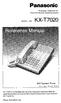 Panasonic Proprietary Telephone for Electronic Modular Switching System MODEL NO. KX-T7020 With Speaker Phone Illustrated Model: White KX-T7020 is compatible with all of the Panasonic Electronic Modular
KX-TA824. Operating Manual. Advanced Hybrid System. Model No.
 Advanced Hybrid System Operating Manual Model No. KX-TA824 Thank you for purchasing a Panasonic Advanced Hybrid System. Please read this manual carefully before using this product and save this manual
How To Use A Ppanasonic Cell Phone With A Cell Phone From A Cellphone From Alexa (Panasonic) For A Long Distance Phone From An Older Model (Panoramos) For An Extra Money (Panamontani
 INTERCOM PLEASE READ BEFORE USE AND SAVE. Integrated Telephone System Operating Instructions Model No. KX-TS8B KX-TS8W Pulse-or-tone dialing capability KX-TS8W LINE Caller ID Compatible Panasonic World
Installation Manual KX-TES824
 Advanced Hybrid System Installation Manual KX-TES824 Model KX-TEM824 Thank you for purchasing a Panasonic Advanced Hybrid System. Please read this manual carefully before using this product and save this
KX-TDA50. Digital Hybrid IP-PBX System
 KX-TDA50 Digital Hybrid IP-PBX System Making the System Work for You. Panasonic is a major worldwide innovator in business telephone system engineering, and has consistently provided state-of-the-art telephone
XN120 Getting Started Guide Rev 1.2 (March 2005) 991409-5
 This guide explains the installation, configuration and operation of the XN120 Telephone System including the exchange line and telephone connections. Further information will be supplied with any optional
Installation Manual. Advanced Hybrid & Wireless PBX. Model No. KX-TAW848
 Advanced Hybrid & Wireless PBX Installation Manual Model No. KX-TAW848 Thank you for purchasing the Panasonic Advanced Hybrid & Wireless PBX, KX-TAW848. Please read this manual carefully before using this
Operating Instructions
 PLEASE READ BEFORE USE AND SAVE. Integrated Telephone System Model No. KX-T7FXW Pulse-or-tone dialing capability Operating Instructions Preparation Basic Operation Advanced Operation Useful Information
CONNECTING YOUR BUSINESS WITH TOMORROW KX-TD. Digital business telephone system range
 CONNECTING YOUR BUSINESS WITH TOMORROW KX-TD Digital business telephone system range KX-TD range Digital super hybrid systems For today The Panasonic brand has been built upon years of manufacturing top
PT Programming Manual KX-TDA50/KX-TDA100 KX-TDA200/KX-TDA600
 Model Hybrid IP-PBX PT Programming Manual KX-TDA50/KX-TDA100 KX-TDA200/KX-TDA600 Thank you for purchasing a Panasonic Hybrid IP-PBX. Please read this manual carefully before using this product and save
PT Programming Manual KX-TDA50/KX-TDA100 KX-TDA200/KX-TDA600. Hybrid IP-PBX. Model No.
 PT Programming Manual Hybrid IP-PBX Model No. KX-TDA50/KX-TDA100 KX-TDA200/KX-TDA600 Thank you for purchasing a Panasonic Hybrid IP-PBX. Please read this manual carefully before using this product and
KX-TA824. Operating Manual. Advanced Hybrid System. Model No.
 Advanced Hybrid System Operating Manual Model No. KX-TA824 Thank you for purchasing a Panasonic Advanced Hybrid System. Please read this manual carefully before using this product and save this manual
Operating Instructions
 Panasonic DECT Digital Cordless Telephone System Operating Instructions Before operating this system, please read these instructions completely. THIS EQUIPMENT IS NOT DESIGNED FOR MAKING EMERGENCY TELEPHONY
KX-TD connection diagram
 KX-TD connection diagram Application Software Ask for a brochure and/or quotation PanaStat (Call Management Software) Desktop Telephony Assistant (3rd Party CTI solution) Integrated Headsets Optional Features:
Installation Manual KX-TVA50 KX-TVA200. Voice Processing System. Model No.
 Installation Manual Voice Processing System KX-TVA50 KX-TVA200 Model No. Thank you for purchasing a Panasonic Voice Processing System. Please read this manual carefully before using this product and save
How To Connect A Cell Phone To A Cell Network
 Contents CHAPTER 1 INTRODUCTION OF IPS SYSTEM PG Introduction Welcome To Your BBS Telephone System 2 Technical Support 3 CHAPTER 2 INSTALLATION GUIDE Installing Your Tools / Equipment Needed 6 Phone System
Table of Contents. Mitel 3000 Getting Started Guide
 Get Started Guide Table of Contents GUIDE TO SYSTEM DOCUMENTATION...1...1 Phone Quick Reference Guide...1 Administrator s Manual...1 Broadband Module Manual...1 IP Phone Quick Reference Guide...1 Documentation
User Manual KX-TD816. Digital Super Hybrid System. Model No. KX-TD1232
 D816 DIGITAL SUPER HYBRID SYSTEM Panasonic D1232 DIGITAL SUPER HYBRID SYSTEM Panasonic Digital Super Hybrid System User Manual KX-TD816 Model No. KX-TD1232 Please read this manual before using the Digital
Dialog 4220 Lite/Dialog 4222 Office
 Dialog 4220 Lite/Dialog 4222 Office System telephones for MD110 Communication System User Guide Flinders University Table of Contents Description 2 Incoming Calls... 10 Outgoing Calls... 12 During Calls
KX-TD7695. Operating Instructions. DECT 6.0 Portable Station. Model No.
 Operating Instructions DECT 6.0 Portable Station Model No. KX-TD7695 Thank you for purchasing a Panasonic DECT 6.0 Portable Station. Please read this manual carefully before using this product and save
PANASONIC COMMUNICATION SYSTEMS ADVANCED HYBRID WIRED/WIRELESS TELEPHONE SYSTEM, ADVANCED HYBRID TELEPHONE SYSTEMS PRODUCT CATALOG
 ADVANCED HYBRID SYSTEMS & VOICE PROCESSING SYSTEMS Effective Date June, 2005 Supersedes all Previous Price Lists PANASONIC COMMUNICATION SYSTEMS ADVANCED HYBRID WIRED/WIRELESS TELEPHONE SYSTEM, ADVANCED
Operating Instructions
 FLASH/ RECALL HOLD KX-T7636 Digital Proprietary Telephones for Hybrid IP PBX Operating Instructions Model No. KX-T7625 KX-T7630 KX-T7633 KX-T7636 CONF FWD/DND PAUSE INTERCOM AUTO ANSWER AUTO DIAL 2 MUTE
How To Use The Panasonic Tda30-100-200 Training Guide
 Training Guide Index Page 1: Page 2: Page 3: Page 4: Page 5: Page 6: Page 7: Page 8: Page 9: Page 10: Page 11: Page 12: Page 13: Procedure on System Programming via Handset To Exit programming System Programming
Panasonic Digital Business System - Operating Instructions March 1997 Issue 24. Panasonic Digital Business System Operating Instructions
 Panasonic Digital Business System Operating Instructions 1 Contents INTRODUCTION 7 IMPORTANT INFORMATION 9 TYPES OF EXTENSION 9 PROPRIETARY KEY TELEPHONES 9 EXTENSION FEATURES 10 KEY TELEPHONE FEATURES
User Manual. Panasonic TVA/TDA Voicemail & System. TeleData, Inc. Business Telephone & Data Solutions. TeleData, Inc.
 TeleData, Inc. User Manual Business Telephone & Data Solutions TeleData, Inc. 42 W. Wilden Goshen, IN 46528 www.teledata-inc.com Panasonic TVA/TDA Voicemail & System Phone: 574-533-699 Fax: 574-533-7588
KX-TDA15. Installation Manual. Hybrid IP-PBX. Model No.
 Model No. Hybrid IP-PBX Installation Manual KX-TDA15 Thank you for purchasing the Panasonic Hybrid IP-PBX, KX-TDA15. Please read this manual carefully before using this product and save this manual for
User Manual KX-TES824
 Advanced Hybrid System User Manual KX-TES824 Model KX-TEM824 Thank you for purchasing a Panasonic Advanced Hybrid System. Please read this manual carefully before using this product and save this manual
Operating Instructions
 Integrated Telephone System Model No. KX-TS05HGW PLEASE READ BEFORE USE AND SAVE. Pulse-or-tone dialing capability Operating Instructions Preparation Basic Operation Advanced Operation Useful Information
ADA COMPLIANT BOX STYLE TELEPHONE INSTALLATION, PROGRAMMING AND OPERATING INSTRUCTIONS FOR MODEL PBX
 ADA COMPLIANT BOX STYLE TELEPHONE INSTALLATION, PROGRAMMING AND OPERATING INSTRUCTIONS FOR MODEL PBX INSTALLATION INSTRUCTIONS Step 1. Determine the position for the Hands-free phone in the elevator phone
Model No. KX-TS560MX. Model shown is KX-TS580MX
 Operating Instructions Integrated Telephone System Model No. KX-TS560MX KX-TS580MX Model shown is KX-TS580MX This unit is compatible with Caller ID. You must subscribe to the appropriate service offered
KX-TD816 KX-TD1232 DIGITAL SUPER HYBRID TELEPHONE SYSTEM XDP E X TRA D EVICE P ORT CALLER ID DISPLAY CTI COMPATIBLE AUTOMATIC ROUTE SELECTION
 DIGITAL SUPER HYBRID TELEPHONE SYSTEM KX-TD16 KX-TD1232 XDP E X TRA D EVICE P ORT CALLER ID DISPLAY CTI COMPATIBLE AUTOMATIC ROUTE SELECTION DIRECT INWARD DIAL (DID) Digital Systems That Adapt to Your
INTRODUCTION TO YOUR COMMANDER CONNECT SYSTEM...7 System description...7 System options...8 Commander Contact Details...8 USING THIS HANDBOOK...
 INTRODUCTION TO YOUR COMMANDER CONNECT SYSTEM...7 System description...7 System options...8 Commander Contact Details...8 USING THIS HANDBOOK...9 INTRODUCING THE KEYSTATIONS...10 Standard Keystation...10
Four-Line Intercom Speakerphone 944
 1 USER S MANUAL Part 2 Four-Line Intercom Speakerphone 944 Please also read Part 1 Important Product Information AT&T and the globe symbol are registered trademarks of AT&T Corp. licensed to Advanced American
BT Big Button 100. User Guide
 BT Big Button 100 User Guide Welcome to your BT Big Button 100 phone Large buttons for easy dialling. Handsfree make and receive calls using the loudspeaker. One-touch 1571 button dials your network answering
Feature Manual KX-TVM50 KX-TVM200. Voice Processing System. Model
 Voice Processing System Feature Manual Model KX-TVM50 KX-TVM200 Thank you for purchasing a Panasonic Voice Processing System. Please read this manual carefully before using this product and save this manual