
THE FUTURE OF THE INTERNET ECONOMY
|
|
|
- Domenic Montgomery
- 10 years ago
- Views:
Transcription
1 THE FUTURE OF THE INTERNET ECONOMY A STATISTICAL PROFILE June 211 update

2 This document has been prepared for the OECD high-level meeting on The Internet Economy: Generating Innovation and Growth Paris, June 211 ( It is an update of the version which was prepared for the OECD Ministerial Meeting on the Future of the Internet Economy held in Seoul in June 28 ( The source for the information herein is official country data unless otherwise indicated in the sources and notes section at the end of the document. ORGANISATION FOR ECONOMIC CO-OPERATION AND DEVELOPMENT The OECD is a unique forum where the governments of 34 democracies work together to address the economic, social and environmental challenges of globalisation. The OECD is also at the forefront of efforts to understand and to help governments respond to new developments and concerns, such as corporate governance, the information economy and the challenges of an ageing population. The Organisation provides a setting where governments can compare policy experiences, seek answers to common problems, identify good practice and work to co-ordinate domestic and international policies. The OECD member countries are: Australia, Austria, Belgium, Canada, Chile, the Czech Republic, Denmark, Estonia, Finland, France, Germany, Greece, Hungary, Iceland, Ireland, Israel, Italy, Japan, Korea, Luxembourg, Mexico, the Netherlands, New Zealand, Norway, Poland, Portugal, the Slovak Republic, Slovenia, Spain, Sweden, Switzerland, Turkey, the United Kingdom and the United States. The Commission of the European Communities takes part in the work of the OECD. OECD 211

3 CONTENTS Glossary 5 The Internet has grown rapidly 7 connecting people and businesses in the OECD 8 and worldwide. 9 Broadband has tremendous potential 1 which is feeding Internet diffusion 11 and driving convergence among ICTs. 12 The Internet is changing traditional behaviour 13 and creating new activities. 15 Broadband is increasing Internet use. 16 New opportunities are emerging for education 17 government and citizen relations 18 and health. 19 The Internet is having an important impact on people s lives. 2 Still, usage could be increased among the elderly and women 21 people with low education and low incomes 22 and among some households and small firms. 23 More and more firms are connected 24 and run their business over the Internet. 25 ICTs are a major driver of growth 26 and productivity. 27 The Internet is opening new market opportunities 28 and stimulating innovation. 29 But it is important to reduce barriers 3 protect privacy 31 and improve security. 32 Sources and notes JUNE 211 3
4

5 GLOSSARY Access. A household has access to the Internet if it has a connection that is functional (i.e., in working order), regardless of whether it is actually used. Access can be via a computer, a mobile phone, games machine or related devices. Blogs. Websites publishing information in a format where the newest items are typically presented at the top of the page and older items move down the page by descending date. Blogs usually allow users to comment on the content in an article/post, allowing for a much more interactive experience. Blogs can cover mainstream topics but are particularly popular for specific content niches. The content can be user-created, professionally created or recycled from other websites. Generally readers can comment on the stories and the blogs maintain readership largely by adding new content at regular intervals. Bot-infected computer. Programs that are covertly installed on a user s machine in order to allow an attacker to control the targeted system remotely through a communication channel, such as Internet relay chat (IRC), P2P, or HTTP. These channels allow the remote attacker to control a large number of compromised computers over a single, reliable channel in a botnet, which can then be used to launch coordinated attacks. Broadband. In this context, broadband refers to fixed broadband subscriptions. A high-speed Internet connection capable of downloading 256 kilobits of data per second or higher. The OECD broadband statistics prior to 21 include Internet connections over DSL, cable modem, fibre, fixed wireless, satellite and other wired connections capable of downloading data at speeds of 256 kilobits per second. Broadband data for 21 follow the current methodology (i.e. excluding terrestrial fixed wireless and satellite subscriptions). Cable modem. A type of modem that provides access to a data signal sent over a cable television infrastructure. Cable modems allow the delivery of broadband internet, voice services and ondemand/interactive forms of television. Digital television. The sending and receiving of moving images and sound by means of discrete (digital) signals, in contrast to the analogue signals used by analogue TV. Digital television allows higherquality images and sound and more programming choices than analogue does. Digital subscriber line (DSL). A family of technologies that provides digital data transmission using a local telephone network. Fibre. Any network architecture that uses optical fibre to replace all or part of the usual copper local loop used for telecommunications. This is also denoted as FTTx. Fixed wireless. A wireless connection between two fixed locations JUNE 211 5
6 Host. A domain name with an associated IP address. It includes any computer or device connected to the Internet via a full- or part-time, direct or dial-up connection. A host is not necessarily an individual device, as a single machine can act like multiple systems with multiple domain names and IP addresses (virtual hosting). ISCED. The International Standard Classification of Education was designed by UNESCO in the early 197 s to serve as an instrument suitable for assembling, compiling and presenting statistics of education both within individual countries and internationally. PCT. The Patent Cooperation Treaty is an international treaty, administered by the World Intellectual Property Organization (WIPO). The PCT makes it possible to seek patent protection for an invention simultaneously in a large number of countries by filing a single international patent application. Peer-to-peer. A network communication structure in which individuals interact directly, without going through a centralised system or hierarchy. Users can share information, contribute to shared projects or transfer files. Subscription. A current contract for a service, commonly billed on a monthly cycle. Usage. An individual or a business uses the Internet if they have all the required equipment in working order (access) and have actually used it. Wireless. The possibility to transfer information over a distance without the use of electrical conductors or wires. Wireless broadband. The OECD wireless broadband statistics include satellite subscriptions, terrestrial fixed wireless subscriptions and terrestrial mobile wireless (standard mobile subscriptions and dedicated data subscriptions) JUNE 211

7 The Internet has grown rapidly 1. Number of OECD fixed Internet subscriptions There are 327 million fixed Internet subscriptions in OECD countries, equivalent to 27% of total population. Millions Broadband Dial-up This number has doubled over the past 1 years OECD broadband subscriptions by geographic area The number of broadband subscriptions has increased across the OECD between % of OECD Internet subscriptions and 21. Europe accounts for almost 45% of OECD Internet subscriptions, OECD Americas for 36% and OECD Asia and Oceania for the remaining 19%. Europe Americas Asia and Oceania There were about 733 million registered Internet hosts worldwide in 21, 17 times more than in More than half of all hosts have a generic domain, e.g..com,.net. OECD country domains (e.g..fr,.kr) account for over one-third of all hosts worldwide. Millions Number of Internet hosts by domain Hosts OECD country domain Generic domains JUNE 211 7
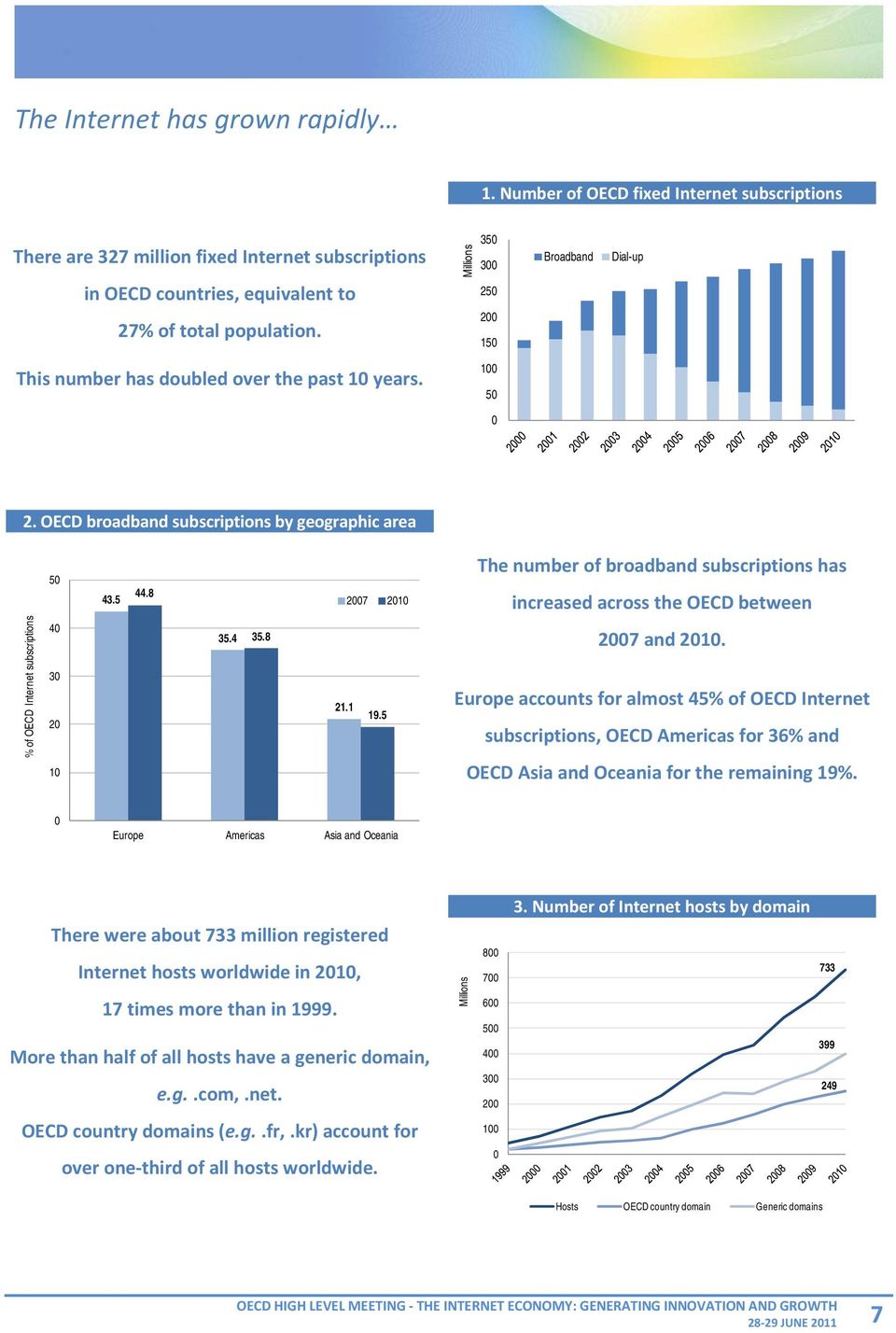
8 connecting people and businesses in the OECD On average, 7% of households in OECD countries have access to the 1. Households with access to the Internet, 21 or latest Internet at home Korea (97%), Iceland (92%) and the Netherlands (91%) have the highest share of households with home access to the Internet. Between 27 and 21, the most % of all households rapid growth for Internet access was in Turkey, Mexico, Greece and 1 the Czech Republic. % of businesses with 1 or more persons employed Businesses using the Internet, 21 or latest On average, 94% of businesses with 1 or more persons employed in OECD countries are connected to the Internet. In Finland, Japan, Korea, the Netherlands and Switzerland over 98% of businesses use the Internet JUNE 211
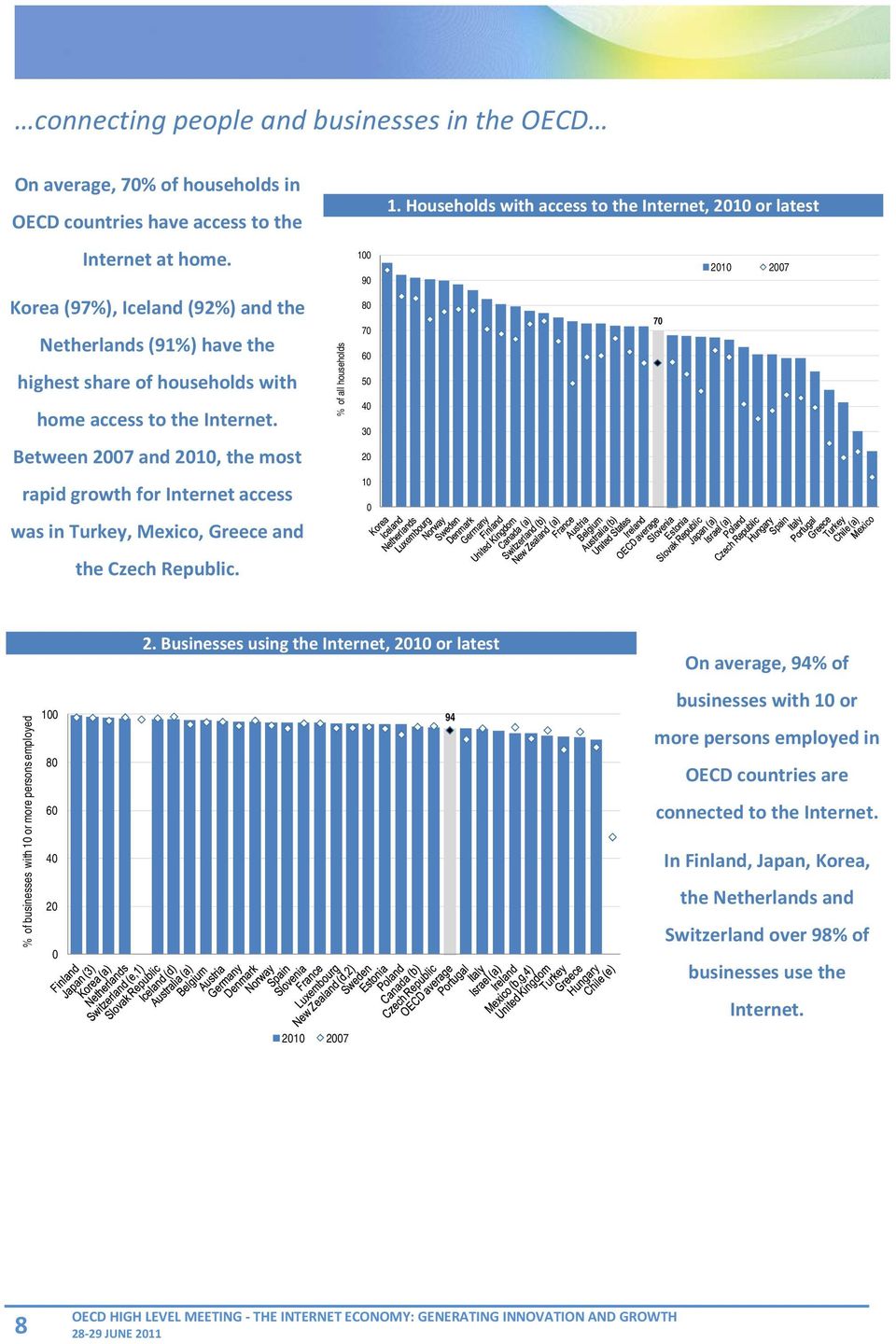
9 and worldwide. 1. Households accessing/individuals using the Internet, 29 or latest Individual use Household access In Singapore and the United Arab Emirates, the share of households with access to the Internet is comparable to those of the top-ranking OECD economies. Singapore United Arab Emirates Hong Kong, China Macao, China (a) Malta Lithuania Latvia Croatia Romania Serbia Russian Fed. Bulgaria Uruguay Egypt Brazil China Lebanon (a) Costa Rica Thailand Panama (a) South Africa Peru (a) Ecuador El Salvador Senegal India Indonesia Cameroon (a) % of all households/individuals 2. Businesses using the Internet, 29 or latest Malta Brazil (a) Latvia Hong Kong, China Serbia (a) Bulgaria Morocco (d) Singapore (a) Russian Fed. Thailand (b) Romania Uruguay (d) Cuba (b) Kazakhstan (a) Senegal (a) China (d) Qatar (a) Egypt Azerbaijan Cameroon (d) Businesses in non-oecd economies are getting better connected too. Over 85% of businesses (with 1 or more employees) had an Internet connection in Malta, Brazil, Latvia, Hong Kong (China) and Serbia % of businesses with 1 or more persons employed JUNE 211 9

10 Broadband has tremendous potential Internet diffusion has been driven by a series of innovations allowing people to choose how they access the Internet. Home PC and fixed telephone lines opened the way to Internet diffusion but broadband and mobile phones are increasing Internet access and enlarging the scope for its use. % of households Historical diffusion of selected goods, Canada Television VCR Fixed phone Internet Cable Mobile phone High-Speed Internet Home PC Satellite dish 2. OECD broadband price and speed changes, similar offers, September 28-1 DSL Cable 15% 2% Broadband speed keeps on increasing while prices are falling. -2% Prices -5% Speeds Over 28-1, the speed of DSL and cable broadband increased annually by 15% and 2%, respectively in OECD countries. At the same time, prices declined by 2% and 5%. New broadband technologies are increasing the potential for Internet use. Fibre provides greater opportunities for content creation by end users because of high upload speeds. In 21, advertised upload speeds on fibre were over 2 times faster than on DSL and cable, despite significant gains on the latter two. 3. OECD average advertised broadband speeds, by technology, September 21 (Mbit/s) Fibre to the home Cable DSL Download speed Upload speed JUNE 211
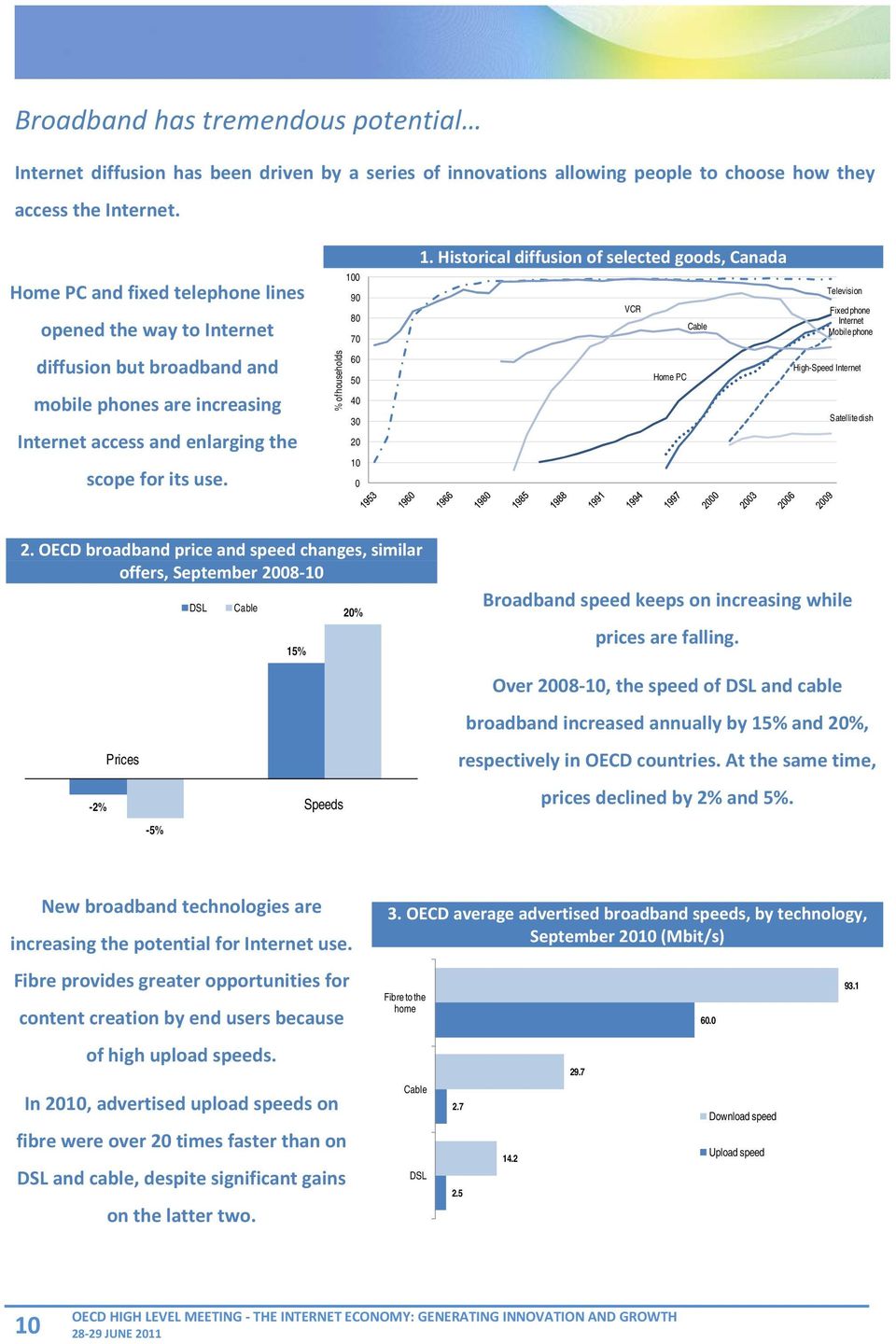
11 which is feeding Internet diffusion Broadband has quickly replaced dial-up Internet in OECD countries. The number of OECD Internet broadband subscriptions grew 2 times over the past decade. 1. Dial-up and broadband Internet subscriptions in the OECD Millions Broadband Over 9% of Internet subscriptions in OECD countries use broadband Dial-up Internet In December 21, there were over 35 million broadband subscriptions in OECD countries. 2. OECD broadband subscriptions, December 21 The United States has the 35 United States: 85.7 million in 21 and 7 million in largest number of broadband subscriptions of all OECD countries, with more than 85 million Millions Millions subscriptions. European 1 OECD countries account for million subscriptions. 3. OECD broadband subscriptions per 1 inhabitants, December per 1 inhabitants On average, there are 25 broadband subscriptions per 1 inhabitants in the OECD JUNE
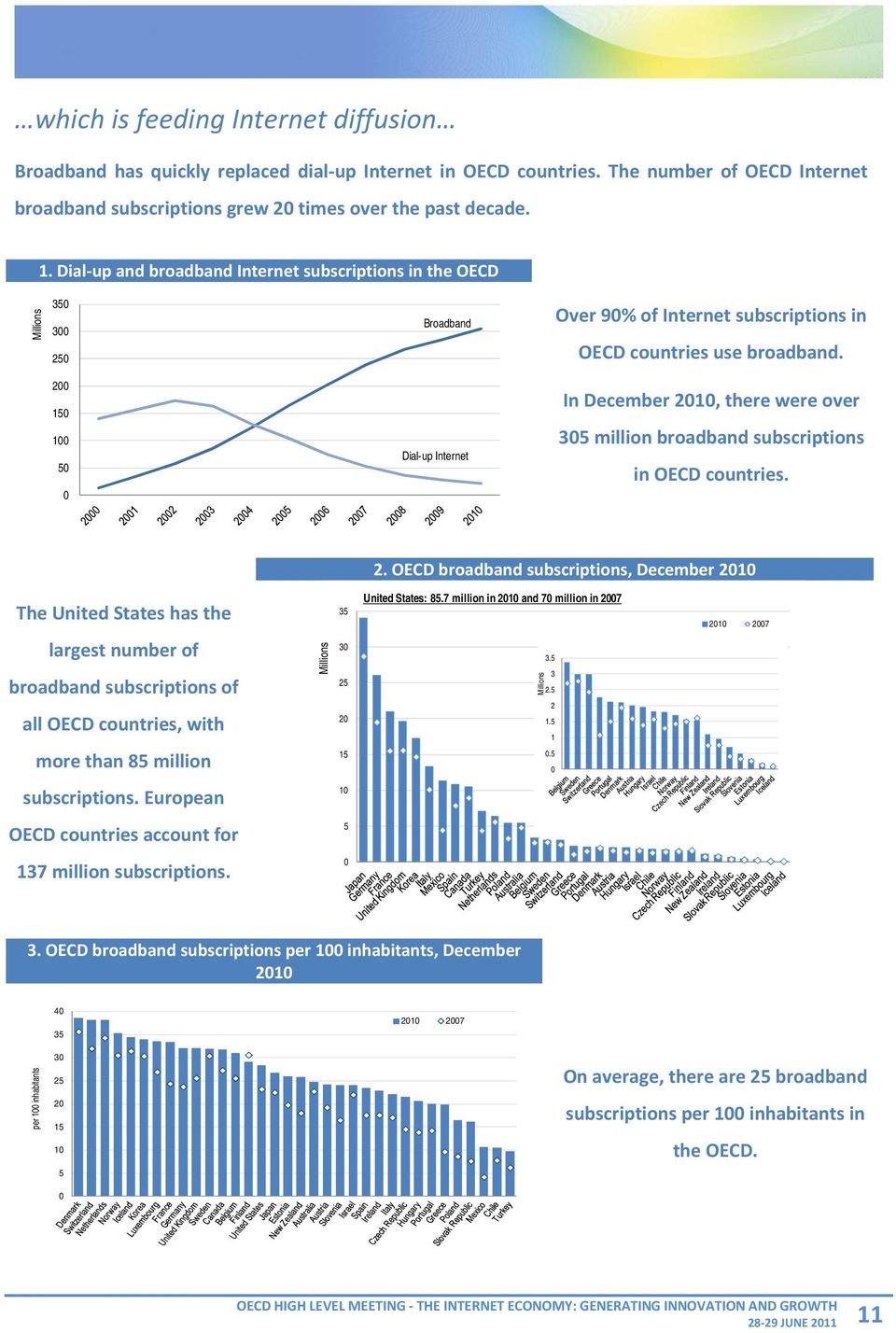
12 and driving convergence among ICTs. Convergence is blurring the boundaries between different forms of ICTs. The Internet is becoming more important, as a broad range of devices for daily activities are now making use of Internet connectivity. Since 25, the number of mobile phone subscriptions worldwide has doubled, with particularly strong growth in non-oecd countries where the number has tripled. Mobile broadband outnumbers fixed broadband in most OECD countries. 1. OECD wireless broadband subscriptions per 1 inhabitants, December 21 1 Korea has 9 wireless broadband subscriptions per 1 inhabitants, followed by Finland, Sweden and Norway with 8 or more subscriptions per 1 inhabitants. per 1 inhabitants % of adults Individuals using a mobile phone with broadband connection to access the Internet, 21 or latest Mobile broadband usage is taking off. In 21, over 2% of adults had a broadband connection via mobile phone in Korea, Iceland and Luxembourg. This number is still relatively low but growing very quickly with the uptake of smart phones. Digital television use is increasing steadily. In 29, over 9% of households had access to digital television in Austria, Finland, the United Kingdom, Luxembourg, Sweden and Spain. By the end of 21, 13 OECD countries have already switched completely to % of all TV households Households with access to digital television, 29 or latest digital TV JUNE 211

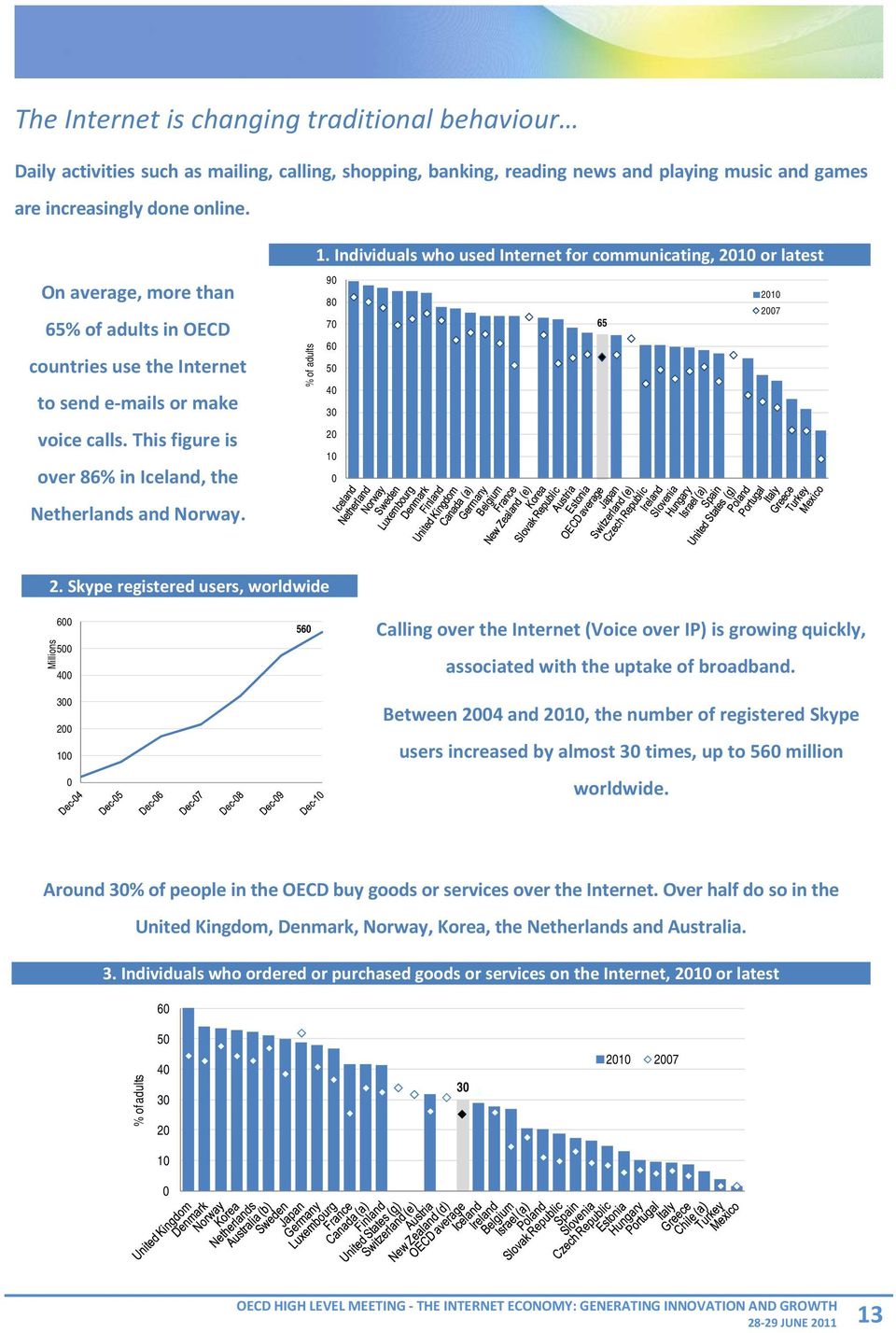
13 The Internet is changing traditional behaviour Daily activities such as mailing, calling, shopping, banking, reading news and playing music and games are increasingly done online. 1. Individuals who used Internet for communicating, 21 or latest On average, more than 65% of adults in OECD countries use the Internet to send s or make % of adults voice calls. This figure is over 86% in Iceland, the 2 1 Netherlands and Norway. 2. Skype registered users, worldwide Millions Calling over the Internet (Voice over IP) is growing quickly, associated with the uptake of broadband. Between 24 and 21, the number of registered Skype users increased by almost 3 times, up to 56 million worldwide. Around 3% of people in the OECD buy goods or services over the Internet. Over half do so in the United Kingdom, Denmark, Norway, Korea, the Netherlands and Australia. 3. Individuals who ordered or purchased goods or services on the Internet, 21 or latest 6 5 % of adults JUNE
14 1. Individuals who used Internet for banking services, 21 or latest % of adults On average, close to 4% of people in OECD countries use banking services on the Internet. E-banking is very popular in the Nordic countries and in the Netherlands, where over 75% of individuals use the Internet for banking. Almost 3% of individuals downloads music or plays games on the Internet. Playing or downloading games and music is most popular in Canada (52%), the Netherlands (51%), Finland (47%) and Korea (44%). 2. Individuals who used Internet for playing/downloading games, 21 or latest % of adults Individuals who used Internet for job research, 21 or latest % of adults Over 25% of adults in Denmark, Canada, Finland, Korea, Estonia and Sweden use the Internet to look for jobs JUNE 211

15 and creating new activities. In Web 2., or the participative Web, Internet users do not simply access information but they create their own content, such as various forms of written, audio, visual and combined media. On average, 15% of Internet users in the OECD created web pages in Internet users who created a web page, In Korea and Iceland, at least one % of Internet users Internet user out of three has created a web page. Around 2% of OECD Internet users use peer-to-peer file sharing. Slovenia has the highest percentage at 32%, followed by Hungary and Spain. % of Internet users 2. Internet users who used peer-to-peer file sharing for exchanging movies, music, etc., Internet use with a social networking activity, 21 Poland Portugal Turkey United States Korea Hungary Slovenia Slovak Republic Denmark Sweden Finland OECD average Spain Estonia Norway Greece Iceland United Kingdom Netherlands Luxembourg Italy Germany France Belgium Czech Republic Ireland Austria % of Internet users 49 Social networking has rapidly gained importance as nearly 5% of OECD Internet users are active social network users. In 21, at least 6% of Internet users in Poland, Portugal, Turkey and the United States engage in social networking on the web JUNE

16 Broadband is increasing Internet use. Broadband users are still more active on the Internet than narrowband users. The difference in use between broadband and narrowband Internet users for some OECD countries is still significant. Up to 37 percentage points for gaming and music in Finland 1. Playing/downloading games and music, 21 or latest Canada (a) Switzerland Finland Hungary Turkey United States (a,1) Slovak Republic United States (a,2) Czech Republic Portugal Norway Luxembourg Greece Slovenia United Kingdom Denmark Italy France Poland (a) Germany Ireland Austria With narrowband Gap With broadband Up to 28 percentage points for Internet banking in the United States 2. Internet banking, 21 or latest Norway Finland (a) Sweden Netherlands (a) Denmark France Canada (a) Luxembourg United States United Kingdom Germany Austria Ireland Switzerland Poland Slovenia Slovak Republic (a) Portugal Czech Republic Italy Hungary Turkey Greece With narrowband Gap With broadband Up to 15 percentage points for sending and receiving in Sweden 3. Sending/receiving s, 21 or latest Netherlands (a) Luxembourg Denmark Hungary United States Switzerland Canada (a) Norway Sweden France Germany United Kingdom Czech Republic Slovak Republic (a) Austria Portugal Finland Ireland Italy Poland Greece With narrowband Gap With broadband Up to 25 percentage points for using travel and accommodation services in the United States 4. Using services related to travel and accommodation, 21 or latest Ireland Denmark United States (a) Finland Norway Luxembourg Canada (a) United Kingdom Greece Germany Sweden Slovenia Switzerland France Netherlands (a) Slovak Republic (a) Czech Republic Hungary (a) Poland Turkey Portugal With narrowband Gap With broadband Up to 21 percentage points for seeking health information 5. Seeking health information on injury, disease or nutrition, 21 or latest Canada (a) Finland Luxembourg Slovenia Portugal (a) Hungary (a) Germany Denmark Netherlands (a) Switzerland Turkey Greece Norway Austria (a) France Italy Sweden Poland Slovak Republic (a) Ireland United Kingdom Czech Republic With narrowband Gap With broadband JUNE 211

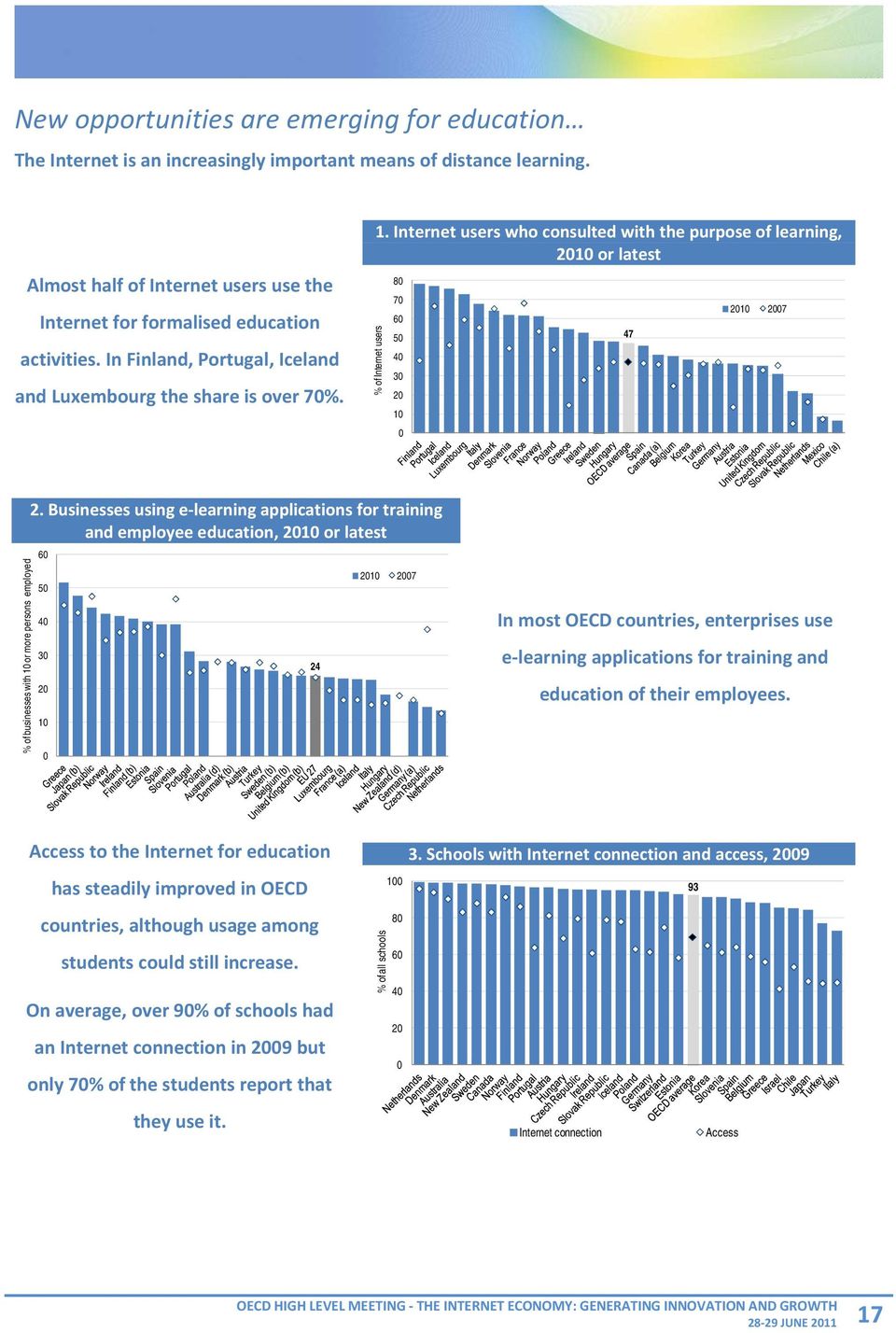
17 New opportunities are emerging for education The Internet is an increasingly important means of distance learning. Almost half of Internet users use the Internet for formalised education activities. In Finland, Portugal, Iceland and Luxembourg the share is over 7%. 1. Internet users who consulted with the purpose of learning, 21 or latest % of Internet users % of businesses with 1 or more persons employed 2. Businesses using e-learning applications for training and employee education, 21 or latest In most OECD countries, enterprises use e-learning applications for training and education of their employees. Access to the Internet for education has steadily improved in OECD countries, although usage among students could still increase. On average, over 9% of schools had an Internet connection in 29 but only 7% of the students report that they use it. % of all schools 3. Schools with Internet connection and access, Internet connection Access JUNE
18 government and citizen relations E-government has the potential to improve relationships between citizens, businesses and governments. Over 4% of citizens in OECD countries use the Internet for interacting with public authorities. 1. Individuals who used the Internet for interactions with public authorities, 21 or latest Iceland Denmark Norway Sweden Finland Luxembourg Netherlands France Austria Slovak Republic Estonia Germany Canada (a) Belgium Slovenia OECD average 41 Spain United Kingdom Ireland Hungary New Zealand (d,1) Poland Korea (1) Portugal Switzerland (f) United States (g,1) Czech Republic Italy Japan (e,1) Greece Turkey Chile (a,2) Mexico (1) The type of interactions range from simply obtaining information from web sites to more complex two-way interactions. Over the past years, on-line tax declarations have accelerated in several countries. 2. Number of online tax declarations Thousands 1 France 8 6 Spain Germany 4 2 Norway % businesses with 1 or more persons employed % of all adults 3. Businesses using the Internet for returning filled-out forms to public authorities, 21 or latest In 21, 66% of OECD businesses used the Internet for returning completed forms to public authorities. This figure was over 8% in the Netherlands, Poland, Finland and Iceland JUNE 211

19 and health. Seeking information on health is another frequent use of the Internet. In 21, more than 5% of adults in Luxembourg, Finland, Canada and Denmark, sought health information on the Web as did over 45% of adults in the Netherlands, Germany and Norway. 1. Individuals who used Internet to seek health information, 21 or latest % of adults The range of possibilities for digital delivery of health-care related services is enormous. In the Czech Republic, 79% of all physicians had access to the Internet in their medical office, 2% had their own website and 1% used it for keeping health records in Physicians using the Internet or their website for selected activities, Czech Republic In 29, 18% of medicines dispensed in Spain were based on an electronic prescription. Of the primary care health centres, 4% had an e- prescription system that allows e-dispensing. This service is available for 26% of the population. 3. Electronic prescriptions in primary health care centres, Spain, With the Internet in their office, total with broadband connection For accessing information on: practical medicine theoretical medicine pharmacology For communication with: health insurance companies patients pharmacies Primary care HC using e-prescription Patients treated using e-prescription Pharmacies dispensing electronically 26 % 4 % 42 % For keeping health records 1 With own Web site, total with application for online appointment % of all independent general practitioners and specialists Medicins dispensed electronically 18 % JUNE

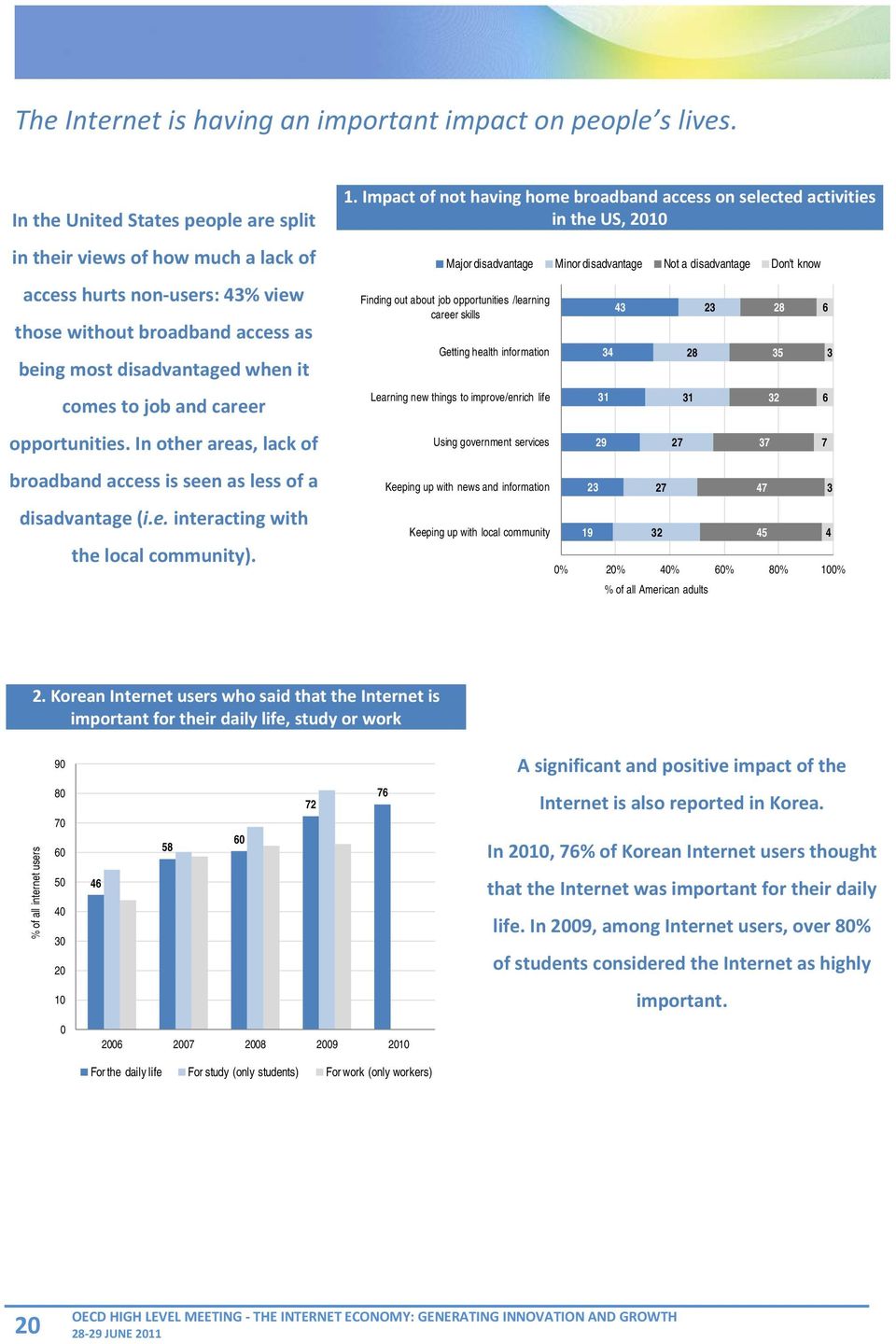
20 The Internet is having an important impact on people s lives. In the United States people are split in their views of how much a lack of access hurts non-users: 43% view those without broadband access as being most disadvantaged when it comes to job and career opportunities. In other areas, lack of broadband access is seen as less of a disadvantage (i.e. interacting with the local community). 1. Impact of not having home broadband access on selected activities in the US, 21 Major disadvantage Minor disadvantage Not a disadvantage Don't know Finding out about job opportunities /learning career skills Getting health information Learning new things to improve/enrich life Using government services Keeping up with news and information Keeping up with local community % 2% 4% 6% 8% 1% % of all American adults Korean Internet users who said that the Internet is important for their daily life, study or work 9 A significant and positive impact of the % of all internet users Internet is also reported in Korea. In 21, 76% of Korean Internet users thought that the Internet was important for their daily life. In 29, among Internet users, over 8% of students considered the Internet as highly 1 important For the daily life For study (only students) For work (only workers) JUNE 211
21 Still, usage could be increased among the elderly and women In 21, the age divide in OECD countries is still present even though elderly people on average have increased their use of the Internet by 44% since 27. Poland, Slovenia and Greece have the largest age divide. 1. Individuals using the Internet from any location, by age group, 21 or latest 1 8 % of adults Men are more likely than women to use the Internet in most OECD countries. This is not the case for Ireland, New Zealand, Estonia, the United States and Canada, where in 21, slightly more women used the Internet than men. Between 27 and 21, the percentage of women using the Internet increased by more than 5% in Turkey and Mexico, but the gap remains large in Turkey, Italy and Portugal. 2. Individuals using the Internet from any location, by gender, % of adults Female Male JUNE
22 people with lower education and lower incomes Internet usage is lower for less educated individuals, both men and women. In 21, Iceland followed by the Nordic countries presented the smallest gap between those with high education levels (university degree and over) and low education levels (primary school or less). Nevertheless, in Korea, Portugal, Turkey and Greece there is still a significant gap. 1. Individuals using the Internet from any location by educational level, 21 or latest 1 8 % of adults High Medium Low Internet penetration is the highest among high-income households. In 21, the difference in Internet access between high and low-income households in Denmark was insignificant. However, in some countries: Slovak Republic, Slovenia, Portugal, the Czech Republic and Hungary the gap is still quite large. 2. Household Internet access by income, 21 or latest 1 8 % of households High income (top quartile) Low income (bottom quartile) While differences between high and low-income households tend to decrease over time, the divides between elderly and young people and between highly and lowly educated individuals are more persistent JUNE 211
23 and among some households and small firms. Households with children keep on using the Internet more than those without. In 21, the divide is the largest in Portugal, Slovenia, Estonia, Poland and Austria. On the other hand, Mexico, Turkey and Korea have the smallest gap. 1. Household Internet access by household type, 21 or latest 1 8 % of households With children Without children Broadband penetration tends to increase with firm size. In Poland and the Slovak Republic, differences in Internet penetration rates between large (25 or more employees) and small firms (1 to 49 employees) exceed 25 percentage points in 21. Meanwhile in Switzerland all firms with 1 or more employees had broadband, followed by Korea, Australia and Spain had less than a 5 percentage point gap in broadband penetration between large and small firms. 2. Broadband penetration by size class, 21 or latest % of businesses with 1 or more persons employed or more [5-249] [1-49] JUNE
24 More and more firms are connected 1. Businesses with a broadband connection, 21 or latest On average, about 86% of businesses with 1 or more persons employed in OECD countries had a broadband connection in 21. % of businesses with 1 or more persons employed In Switzerland, Korea, Australia and Iceland, at least 95% of businesses have a broadband connection. This rate is over 9% in Spain, Canada, New Zealand Finland and France. 2. Businesses with their own website, 21 or latest 85% and more of % of businesses with 1 or more persons employed businesses with 1 or more persons employed in Sweden, Denmark, Finland and Japan have their own web site. On average, 69% of businesses in OECD countries have their own web site JUNE 211
25 and run their business over the Internet. A growing number of businesses in OECD countries purchase and sell goods and services via the Internet. 1. Businesses selling/purchasing over the Internet, 21 or latest In 21, on average, 35% of all businesses with 1 or more persons employed used the Internet for purchasing and 18% for selling goods or services. % of businesses with 1 or more persons employed Selling Purchasing Selling 27 Purchasing Enterprises turnover from e-commerce, 21 or latest Ireland Norway Czech Republic Iceland Sweden Germany Finland Belgium Denmark United Kingdom Hungary Netherlands France Austria Portugal Spain Slovak Republic Slovenia Estonia Switzerland (a) Poland Italy Australia Mexico (a) Greece (a) = 1 3. Growth of e-commerce 9 Australia 8 7 Korea 6 5 Canada 4 3 United States 2 1 Despite its small size, e-commerce has shown a significant increase in many OECD countries. % of total turnover In most OECD countries, e-commerce still represents a small share of total sales. In 21, e-commerce was above 2% of In Korea, e-commerce grew seven-fold between 21 and 21. The growth was even more pronounced in Australia where e-commerce rates in 28 were over eight times the level in 21. total turnover in Ireland and Norway JUNE
26 ICTs are a major driver of growth Over the long term, the OECD ICT sector has seen consistent growth, representing more than 8% of OECD business sector gross value added (GVA). Fast GVA growth in the ICT sector was driven by ICT services (115%). base year = OECD gross value added (GVA) growth by sector 12 Total ICT VA ICT services VA 1 Total business VA Total service VA ICT services were also the leading component of employment growth in the whole business sector. ICT services employment grew by 18% while employment growth in business base year = OECD employment growth by sector Total ICT EMP ICT services EMP Total business EMP Total service EMP services was 12%. Investment in physical capital is 3. Contribution to GDP growth important for growth. It is a way to.9.8 expand and renew capital stock and enable new technologies to enter the production process. During 2-29, ICT investments were more important for growth than Annual average growth (%) non-ict investments in a majority of OECD countries. Non-ICT investments ICT investments JUNE 211
27 and productivity. A series of studies in OECD countries suggested that market services are the main source of overall productivity growth and ICT investments are fuelling productivity growth in total economy. In Belgium and Denmark labour productivity in the total economy increased by over.5% a year over 2-9 due to ICT investments. 1. Contribution of ICT capital growth to labour productivity growth in total economy, 2-9 Annual average growth rate (%) In Denmark, Belgium and Switzerland, ICT investments accounted for over 5% of labour productivity growth in the total economy. Labour productivity growth ICT capital growth Broadband Internet can deliver major productivity gains by enabling flexible working and better use of time. Annual average volume growth rate (%) 2. ICT contribution to labour productivity growth in total industries, A comparison among selected EU countries shows that labour productivity is higher in industries where more employees are linked by broadband.. Labour productivity growth in total industries ICT contribution This is true even after taking into account skills, investment and industry effects JUNE
28 The Internet is opening new market opportunities The penetration of broadband Internet, together with the expansion of the mobile sector, has fuelled rapid growth in communications across the OECD area. Communications has been the fastestgrowing household expenditure item since Household expenditures (1995=1) 1. Changes in the proportion of OECD households expenditure by category Communications Health Education Clothing 2. ICT services trade of OECD countries Computer and information services is the top-ranking USD billions category in terms of growth in trade in services. 1 In 29, OECD member 8 countries exports of computer 6 and information services were 4 above USD 13 billion and Communication services exports Communication services imports accounted for 5% of total Computer and information services exports Computer and information services imports service exports. Advertising expenditures on 3. Advertising expenditure by medium the Internet have been growing faster than on any other medium. 25= Internet In 21, Internet advertising 2 accounted for 14% of global 15 Outdoor advertising expenditure and this figure is expected to reach 18% by Television Newspapers JUNE 211
29 and stimulating innovation. The highly innovative ICT sector invests heavily in R&D. In 28, ICT industries accounted for more than 2% of total business R&D expenditure in most OECD countries. 1. ICT business R&D expenditure by selected ICT industries, 28 or latest ICT manufacturing R&D ICT services R&D Over half of total business R&D expenditure in Finland, Greece and Korea was in ICT sector. As a share of GDP, Israel, Denmark and the United States had the greatest specialisation in ICT services R&D. % of national PCT filings Finland Israel Korea Sweden (1) Japan United States Denmark (a) Ireland Austria (a) France (a) United Kingdom Belgium (a) Iceland Netherlands (a ) Canada Germany (a) Switzerland Norway Estonia Portugal Australia Slovenia Spain Italy Czech Republic (a) Greece (a) Turkey New Zealand (a) Hungary Poland Slovak Republic Chile Mexico (a ) 2. ICT-related patents ICT BERD as share of total BERD, 28 or latest available year % of GDP The share of ICT in total patents applications was at its peak during the dot-com bubble. Since then, ICTrelated patents have been gradually decreasing in most countries with the exception of China, Korea, Japan and Canada. Over 5% of patents were related to ICT in Singapore and Finland. In China, the share of ICT in total patent applications almost tripled over JUNE
30 But it is important to remove barriers, Concerns about security, trust and privacy are still preventing a large number of Internet users in the EU from buying on-line. 1. Reasons for Internet users not buying online in the EU countries, 29 % internet users that did not buy online in the last 12 months No need Prefer to shop in person Security concerns Trust concerns Privacy concerns Lack of skills No payment card Low Internet speed Others In the EU, 35% of Internet users do not buy online because of security concerns. More than 6% still prefer to go to physical shops out of loyalty or to see the products in person. 2. Firms in selected EU countries reporting barriers to sales online as currently important, 29 A barrier No barrier Products or services not suitable for e- commerce Need to reorganise business processes for e-commerce In 29, selected EU businesses reported that the most important barriers were products or services Customers do not want to buy via e- commerce not suitable for e-commerce Technical issues in implementing e- commerce followed by the need to Logistics problems reorganise business processes. Security concerns (payments or transactions) However, adverse experiences and language problems do not Uncertain legal framework represent an impediment for Language problems related to international e-commerce electronic sales. Adverse experiences with electronic sales in past % of firms using computers JUNE 211
31 protect privacy The always-on connectivity enabled by broadband access makes it particularly important for users to actively protect their security and privacy in the online environment. 1. Internet users in selected European OECD countries reporting concern for security and privacy issues, 21 Six out of ten Internet users in European OECD countries are strongly or mildly concerned about security and privacy over the Internet. In Czech Republic, Portugal and the United Kingdom over 75% of Internet users are concerned that children could access inappropriate web sites or connect with potentially dangerous people. I am strongly concerned I am mildly concerned I am not concerned Abuse of personal information Financial loss due to phising and/or pharming Fraudulent payment card use Children protection % of internet users A threat which has been growing with the diffusion of broadband is the creation of networks of compromised computers acting together without their owners knowledge or control (bot-infected computers). 2. OECD bot-infected computers, 21 Germany Italy United Kingdom Poland France Hungary Spain Israel Turkey Portugal Chile Mexico A majority of the world s bot-infected computers are within the OECD. Germany and Italy have the highest rates. The top originating sources of computer attacks worldwide are the United States, China, the United Kingdom and Germany % of Bot- infected computers worldwide JUNE
32 and improve security. In 21, both individual users and businesses report that computer viruses are the type of malicious software or malware with which they come into contact with the most frequently. In 21, the Slovak Republic, Hungary, Italy and Estonia had more than 4% of Internet users encountering viruses. 1. Individuals who have encountered a computer virus in the last year by using the Internet, 21 or latest % of internet users Businesses that have encountered IT security problems, 21 Few businesses reported incidents of unauthorized access, blackmail or threats, but respondents may be unwilling to answer questions on the subject. The three countries reporting the highest proportions of business having problems with viruses were Japan, Mexico and Germany with over 2%. Japan Mexico (b) Germany Australia (b) Portugal Denmark Korea Greece Slovak Republic Luxembourg Ireland Spain Turkey New Zealand Hungary United Kingdom Czech Republic Italy Norway Austria Sweden Netherlands Belgium France Poland Iceland Slovenia Finland % of businesses with 1 or more employees JUNE 211
33 SOURCES AND NOTES General notes Cyprus The following note is included at the request of Turkey: The information in this document with reference to Cyprus relates to the southern part of the Island. There is no single authority representing both Turkish and Greek Cypriot people on the Island. Turkey recognizes the Turkish Republic of Northern Cyprus (TRNC). Until a lasting and equitable solution is found within the context of the United Nations, Turkey shall preserve its position concerning the Cyprus issue. The following note is included at the request of all the European Union Member States of the OECD and the European Commission: The Republic of Cyprus is recognized by all members of the United Nations with the exception of Turkey. The information in this document relates to the area under the effective control of the Government of the Republic of Cyprus. Israel The statistical data for Israel are supplied by and under the responsibility of the relevant Israeli authorities. The use of such data by the OECD is without prejudice to the status of the Golan Heights, East Jerusalem and Israeli settlements in the West Bank under the terms of international law. It should be noted that statistical data on Israeli patents and trademarks are supplied by the patent and trademark offices of the relevant countries. Infrastructure Broadband data in this document prior to 21 go by the previous methodology used by the OECD in which broadband statistics include fixed broadband subscriptions as well as fixed wireless and satellite. Broadband data for 21 follow the current methodology, which excludes terrestrial fixed wireless and satellite subscriptions. In this context, broadband refers to fixed broadband. Data refer to December of each year and include all 34 OECD members. Broadband statistics are based on data from the OECD Broadband Portal [ ICT usage Data presented in this publication are based on the results of the 21 OECD ICT questionnaire (biannual) and the 21 Eurostat Community survey on "ICT usage in households/by individuals" and the 21 Eurostat Community survey on "ICT usage and e-commerce in enterprises" (both annual). EU countries plus Iceland, Norway and Turkey are covered by Eurostat and Australia, Canada, Chile, Israel, Japan, Korea, Mexico, New Zealand, Switzerland and the United States are covered by OECD JUNE
34 In general, these surveys cover: Households with at least one person aged 16-74, and individuals aged For Australia: only includes private dwelling households. Households in remote and sparsely settled parts of Australia are excluded from the survey. For Canada: statistics for 21 and every second year thereafter, include the territories. For other years, statistics include the 1 provinces only. For Israel: the Household expenditure survey does not distinguish between broadband and other bandwidth Internet channels. Individuals aged For Japan: Individuals aged 6+. For New Zealand: Geographic selection of households. This is the Civilian usually resident, noninstitutionalised population aged 15+. For Switzerland: Individuals aged 14+. Eurostat data generally refer to the use of Internet in the last three months at home or at any other location for private purposes. For the other OECD countries, data refer to the use of Internet in the last 12 months with the exception of Israel (three last months) and Switzerland where data refer to Internet users that access in the last six months. Age group breakdown for Eurostat countries and Canada is as follows: 16-24; 25-54; and For the rest of the countries the age group breakdown is: and instead of and Enterprises with at least 1 persons employed. For countries covered by Eurostat: The reference period was January 21, or for some questions the year 29. Economic activities for 21 correspond to the classification NACE Revision 2. The sectors covered are manufacturing, electricity, gas and steam, water supply, construction, wholesale and retail trades, repair of motor vehicles and motorcycles, transportation and storage, accommodation and food service activities, information and communication, real estate, professional, scientific and technical activities, administrative and support activities and repair of computers and communication equipment. Financial intermediation and insurance are excluded for the figures referring to the total economic activities. For previous years the economic activities correspond to NACE.Revision 1.1. Data for 21 and previous years are not directly comparable due to the change of the classification from NACE Rev.1.1 to NACE Rev.2. For countries covered by the OECD ICT questionnaire: The reference period is that of the year surveyed. Economic activities for 21 data correspond to the classification ISIC revision 3.1 with the exception of New Zealand which used ISIC Rev.4. All sectors are covered, including Agriculture and forestry, Fishing, Mining and quarrying and Finance and Insurance. In general, enterprises are broken down by size; small (1-49), medium (5-249) and large enterprises (25 and more persons employed). For Australia: Data are based on ANSZIC6, the following industries are excluded: General government; Rest of the world; Agriculture, forestry and fishing; Public administration and safety; Education and training; Financial asset investing and Superannuation funds; Religious services and Civic, professional and other interest group services; Private households employing staff JUNE 211
35 For Canada: Enterprises are broken down by size; small (1-49), medium (5-299) and large enterprises (3 and more persons employed). Data are based on NAICS 27. Agriculture, fishing, hunting and trapping, and Public administration and defence; Compulsory social security, Education, Health and social work, Other community, repair and personal service activities are excluded. For Israel: Agriculture, fishing, hunting and trapping, and Public administration and defence; Compulsory social security, Education, Health and social work, Other community, repair and personal service activities are excluded. For Japan: Enterprises with more than 1 regular employees and broken down by size (1-299) and (3+ persons employed). Public administration and defence; Compulsory social security, Education, Health and social work, Other community, repair and personal service activities are excluded. For Mexico: Enterprises with at least 2 persons employed. For Switzerland: Enterprises with at least five persons employed. Agriculture, fishing, hunting and trapping is excluded. Page notes Page 7 Figure 1: Number of OECD fixed Internet subscriptions Source: OECD based on OECD Broadband Portal [ June 211. Figure notes: In this chart, broadband data prior to 21 go by the previous methodology used by the OECD, in which broadband statistics include fixed broadband subscriptions (DSL, cable modem, fibre and other fixed broadband technologies) as well as terrestrial fixed wireless and satellite subscriptions. Broadband data for 21 follow the current methodology (i.e. excluding terrestrial fixed wireless and satellite subscriptions). Dial-up subscriptions data for 21 is an estimate. Figure 2: OECD broadband subscriptions by geographic area Source: OECD based on Broadband Portal [ June 211. Figure notes: In this chart, broadband data for 27 go by the previous methodology used by the OECD, in which broadband statistics include fixed broadband subscriptions (DSL, cable modem, fibre and other fixed broadband technologies) as well as terrestrial fixed wireless and satellite subscriptions. Broadband data for 21 follow the current methodology (i.e. excluding terrestrial fixed wireless and satellite subscriptions). OECD Europe includes Turkey. Figure 3: Number of Internet hosts by domain Source: OECD Communications Outlook 211, Internet Software Consortium [ JUNE
36 Page 8 Figure 1: Households with access to the Internet at home, 21 or latest available year, percentage of all households Source: OECD, ICT database and Eurostat, Community Survey on ICT usage in households and by individuals, April 211. Figure notes: a. 29; b. 28. Internet access is via any device (desktop computer, portable computer, TV, mobile phone etc.) with the exception of Japan which covers only access to PC s. Figure 2: Businesses use of the Internet, 21 or latest available year, as a percentage of businesses with 1 or more persons employed Source: OECD, ICT database and Eurostat, Community Survey on ICT usage and e-commerce in enterprises, March 211. Figure notes: a. 29; b. 28; c. 27: d. 26: e. 25; f. 24; g. 23. This indicator corresponds to the access to the Internet for countries covered by Eurostat. Data for 21 and previous years are not directly comparable due to the change of the classification from NACE Rev.1.1 to NACE Rev.2. This indicator corresponds to the access to the Internet. Country notes: For Japan: Businesses with more than 1 regular employees. For Mexico: Businesses with 5 or more employees for 23 and with 2 or more personnel for 28 data. For Switzerland: Businesses with five or more employees and connections equal to or faster than 144 Kilobits per second (mobile and fix). Page 9 Figure 1: Households accessing and individuals using the Internet in non-oecd economies, 29 or latest available year, percentage of all households or all adults Source: Eurostat, Community Survey on ICT usage in households and by individuals, April 211; ITU, World Telecommunication Indicators database March 211; Ministry of Communications and mass media of the Russian Federation, Rosstat, HSE data book Information Society Indicators" (21, 211); and HSE Survey on the usage of ICT by individuals (26, 21). Figure notes: a. 28. Households with at least one person aged under 15. Individuals aged years, except for Eurostat countries (16-74). Data generally refer to Internet use in the last 12 months, for EU countries data refer to Internet use in the last three months. Country notes: For Costa Rica: Data refer to dwellings, not households. For Macao, China: Internet access includes desktops, laptops, handheld computers and other ICT devices. For Peru: Internet access refers to the last month. For Lebanon: individuals aged JUNE 211
37 Figure 2: Businesses in non-oecd economies using the Internet, 29 or latest available year, percentage of businesses with 1 or more persons employed Source: Eurostat, Community Survey on ICT usage and e-commerce in enterprises, March 211; UNCTAD e- business database March 211; Ministry of Communications and mass media of the Russian Federation, Rosstat, HSE data book Information Society Indicators" (21, 211); and HSE Survey on the usage of ICT by individuals (26, 21). Figure notes: a. 28; b. 27; c. 26; d. 25. Country notes: For Brazil data refer to businesses with nine or more employees. For China: Data refer to "establishments" instead of "enterprises". For Romania: Internet access via modem (dial-up access over normal telephone line) or ISDN Page 1 Figure 1: Historical diffusion of selected goods, Canada Source: OECD, based on data from Statistics Canada. Country notes: The drop in cable penetration results from the entry of satellite television providers in this market late in At the beginning of next decade, satellite dish started to progressively replace cable. Figure 2: OECD broadband price and speed changes, similar offers, September Source: OECD Communications Outlook 211, OECD Broadband Portal [ Figure notes: The average price and speed changes were calculated by examining one representative offer from one operator in each country and tracking the price and speed changes for that offer over time. Data were collected each September and local prices were used to calculate percentage changes. If the same speed offer was no longer available then the most similar offer from the same operator was used. Figure 3: OECD average advertised broadband speeds, by technology, September 21 (Mbit/s) Source: OECD Communications Outlook 211, OECD Broadband Portal [ Figure notes: See the OECD broadband portal for information on data sources and notes. Page 11 Figure 1: Dial-up and broadband Internet subscriptions in the OECD Source: OECD based on Broadband Portal [ June 211. Figure notes: In this chart, broadband data prior to 21 go by the previous methodology used by the OECD, in which broadband statistics include fixed broadband subscriptions (DSL, cable modem, fibre and other fixed broadband technologies) as well as terrestrial fixed wireless and satellite subscriptions. Broadband data for 21 follow the current methodology (i.e. excluding terrestrial fixed wireless and satellite subscriptions). Dial-up subscriptions data for 21 is an estimate JUNE
38 Figure 2: OECD broadband subscriptions, December 21 Source: OECD based on Broadband Portal [ June 211. Figure notes: In this chart, broadband data for 27 go by the previous methodology used by the OECD, in which broadband statistics include fixed broadband subscriptions (DSL, cable modem, fibre and other fixed broadband technologies) as well as terrestrial fixed wireless and satellite subscriptions. Broadband data for 21 follow the current methodology (i.e. excluding terrestrial fixed wireless and satellite subscriptions). Figure 3: OECD Broadband subscriptions per 1 inhabitants, December 21 Source and notes: see Figure 2. Page 12 Figure 1: OECD wireless broadband subscriptions per 1 inhabitants, December 21 Source: OECD Broadband Portal [ June 211. Figure notes: The wireless broadband subscriptions per 1 inhabitants data include: satellite subscriptions, terrestrial fixed wireless subscriptions and terrestrial mobile wireless (standard mobile subscriptions and dedicated data subscriptions). Figure 2: Individuals using a mobile phone with broadband connection to access the Internet, 21 or latest available year, as a percentage of adults Source: OECD, ICT database and Eurostat, Community Survey on ICT usage in households and by individuals, April 211. Figure notes: a. 29. For countries covered by Eurostat, individuals were asked about activities they had carried out on the internet in the last three months. For the other OECD countries, it generally refers to the last 12 months. Broadband connection via UMTS (3G). Country notes: For Korea, percentage of individuals aged (surveyed with only internet users). Figure 3: Households with access to digital television, 29 or latest available year, as a percentage of all TV households. Source: OECD Communications Outlook 211, Screen Digest, European Audiovisual Observatory, 21. Figure notes: a. 28. Country notes: For Austria, according to KommAustria, the percentage of TV households was only 6%. Page 13 Figure 1: Individuals who used Internet for communicating, 21 or latest available year, as a percentage of adults Source: OECD, ICT database and Eurostat, Community Survey on ICT usage in households and by individuals, April 211. Figure notes: a. 29; b. 28; c. 27; d.26; e. 25; f. 24; g JUNE 211
39 For countries covered by Eurostat, individuals were asked about activities they had carried out on the internet in the last three months. For the other OECD countries, it generally refers to the last 12 months. Data generally refer to communicating for Eurostat countries. For Israel, Japan, Mexico, New Zealand, Switzerland and the United States data refer to sending and/or receiving s only. For Korea, data refer to sending/receiving e- mails and making voice calls (VoIP). Country notes: For Japan: Internet users accessing from personal computers and mobile phones. For Switzerland: Data refer to Internet users who used the Internet at least once within the last six months. Figure 2: Skype registered users, worldwide Source: OECD, based on ebay reports. Figure 3: Individuals who ordered or purchased goods or services on the Internet, 21 or latest available year, as a percentage of adults Source: OECD, ICT database and Eurostat, Community Survey on ICT usage in households and by individuals, April 211. Figure notes: a. 29; b. 28; c. 27; d.26; e. 25; f. 24; g. 23. For countries covered by Eurostat, data refer to individuals who have bought or ordered goods or services over the Internet for non-work use in the last three months. For the other countries it refers to individuals placing orders over the Internet in the last 12 months. Country notes: For Israel: Data refer to the use of Internet in the last three months. For Korea: Percentage of individuals aged (surveyed only Internet users). For Switzerland: Data refer to Internet users who used the Internet at least once within the last six months. Page 14 Figure 1: Individuals who used Internet for banking services, 21 or latest available year, as a percentage of adults Source: OECD, ICT database and Eurostat, Community Survey on ICT usage in households and by individuals, April 211. Figure notes: a. 29; b. 28; c. 27; d.26; e. 25; f. 24; g. 23. For countries covered by Eurostat, individuals were asked about activities they had carried out on the internet in the last three months. For the other OECD countries, it generally refers to the last 12 months. Country notes: For Switzerland: Data refer to Internet users who used the Internet at least once within the last six months. Figure 2: Individuals who used Internet for playing/downloading games or music, 21 or latest available year, as a percentage of adults Source: OECD, ICT database and Eurostat, Community Survey on ICT usage in households and by individuals, April 211. Figure notes: a. 29; b. 28; c. 27; d.26; e. 25; f. 24; g. 23. For countries covered by Eurostat, individuals were asked about activities they had carried out on the internet in the last three months. For the other OECD countries, it generally refers to the last 12 months JUNE
40 Country notes: 1. Playing/downloading music only (excluding web radio and peer-to-peer). 2. Playing/downloading games only. For Israel: Data refer to the use of Internet in the last three months. For Korea: Web-radio and peer-to-peer are included in playing/downloading music. For Switzerland: Data refer to Internet users who used the Internet at least once within the last six months. Figure 3: Individuals who used Internet for job search, 21 or latest available year, as a percentage of adults Source: OECD, ICT database and Eurostat, Community Survey on ICT usage in households and by individuals, April 211. Figure notes: a. 29; b. 28; c. 27; d.26; e. 25; f. 24; g. 23. For countries covered by Eurostat, individuals were asked about activities they had carried out on the internet in the last three months. For the other OECD countries, it generally refers to the last 12 months. Data refer for Eurostat countries to individuals who used the Internet in the last three months for job research or for sending job applications. Country notes: For Switzerland, data refer to Internet users who used the Internet at least once within the last six months. Page 15 Figure 1: Internet users who created a web page, 21, as a percentage of Internet users Source: OECD, ICT database and Eurostat, Community Survey on ICT usage in households and by individuals, April 211. Figure notes: Internet users are considered for this figure as individuals who have ever used the Internet for countries covered by Eurostat. For countries covered by the OECD ICT questionnaire, data are presented as a percentage of individuals with the exceptions of Japan and Korea. Country notes: For Japan, Internet users accessing from personal computers and mobile phone. For Korea: Minihomepages ('minihompys') and web pages. Data refer to Internet users. Figure 2: Internet users who used peer-to-peer file sharing for exchanging movies, music, etc., in 21, as a percentage of Internet users Source: OECD, ICT database and Eurostat, Community Survey on ICT usage in households and by individuals, April 211. Figure notes: a. 29; b. 28; c. 27; d.26; e. 25; f. 24; g. 23. Figure notes: Internet users are considered for this figure as individuals who have ever used the Internet for countries covered by Eurostat. For countries covered by the OECD ICT questionnaire, data are presented as a percentage of individuals with the exception of Japan and Korea. Country notes: For Japan, Internet users accessing from personal computers and mobile phone. For Korea, data refer to Internet users JUNE 211
41 Figure 3: Internet users with a social networking activity, 21, as a percentage of Internet users Source: OECD, ICT database and Eurostat, Community Survey on ICT usage in households and by individuals, April 211. Figure notes: Social networking is considered as posting messages to chat sites, blogs, newsgroups or on-line discussion forums or instant messaging for European countries. For countries covered by Eurostat, individuals were asked about activities they had carried out on the internet in the last three months. For the other OECD countries, it generally refers to the last 12 months. Internet users are considered for this figure as individuals who have used the Internet in the last three months for countries covered by Eurostat. For countries covered by the OECD ICT questionnaire, data are presented as a percentage of individuals with the exception of Korea. Country notes: For Korea: only online community data was taken into account. Data refer to Internet users. Page 16 Figure 1: Percentage of broadband and narrowband users who report playing/downloading games, films or music, 21 or latest available year, as a difference in the shares (%) of broadband and narrowband users Source: OECD, based on data from ICT database; US FCC Communication Survey; Statistics Canada; Switzerland Federal Statistical Office, and Eurostat, Community Survey on ICT usage in households and by individuals, April 211. Figure notes: a. 29. For countries covered by Eurostat, individuals were asked about activities they had carried out on the internet in the last three months. For the other OECD countries, it generally refers to the last 12 months. Country notes: For the United States, OECD estimates based on PEW Research Center data. 1. Only music. 2. Only games. Figure 2: Percentage of broadband and narrowband users who report Internet banking, 21 or latest available year, as a difference in the shares (%) of broadband and narrowband users Source and notes: see Figure 1. Figure 3: Percentage of broadband and narrowband users who report sending / receiving s, 21 or latest available year, as a difference in the shares (%) of broadband and narrowband users Source and notes: see Figure 1. Figure 4: Percentage of broadband and narrowband users who report using services related to travel and accommodation, 21 or latest available year, as a difference in the shares (%) of broadband and narrowband users Source and notes: see Figure 1. Figure 5: Percentage of broadband and narrowband users who report seeking health information on injury, disease or nutrition, 21 or latest available year, as a difference in the shares (%) of broadband and narrowband users Source and notes: see Figure JUNE
42 Page 17 Figure 1: Internet users who consulted with the purpose of learning, 21 or latest available year, as a percentage of Internet users Source: OECD, ICT database and Eurostat, Community Survey on ICT usage in households and by individuals, April 211. Figure notes: a. 29. Internet users are considered for this figure as individuals who have used the Internet in the last three months for countries covered by Eurostat. For countries covered by the OECD ICT questionnaire, data are presented as a percentage of individuals. For countries covered by Eurostat, individuals were asked about activities they had carried out on the internet in the last three months. For the other OECD countries, it generally refers to the last 12 months. Figure 2: Businesses using e-learning applications for training and education of employees, 21 or latest available year, as a percentage of businesses with 1 or more persons employed Source: OECD, ICT database and Eurostat, Community survey on ICT usage and e-commerce in enterprises, March 211. Figure notes: a. 29; b. 28; c. 27: d. 26: e.25; f.24; g.23. Figure 3: Schools with Internet connection and access, 29, as a percentage of all schools Source: OECD Program for International Students Assessment, PISA 29 ICT questionnaire, Question ID: IC2Q3, Question Label: At school Internet connection, Question Text: Is any of these devices available for you to use at school? Internet connection Figure notes: Data refer to whether an Internet connection is available on school premises for students to use. Based on student self-reports as to whether Internet connection is available for the student him/herself to use at school and whether the student reports that Internet is available and that he/she uses it. Page 18 Figure 1: Individuals who used the Internet for interactions with public authorities, 21 or latest available year, as a percentage of adults Source: OECD, ICT database and Eurostat, Community Survey on ICT usage in households and by individuals, April 211. Figure notes: a. 29; b. 28; c. 27; d.26; e. 25; f. 24; g. 23. Data in this chart refer to Internet use in the last 12 months for all countries. Country notes: 1. Obtaining information from public authorities' websites. 2. Downloading official forms. For Switzerland: Data refer to Internet users who used the Internet at least once within the last six months. Figure 2: Number of on-line tax declarations in selected countries JUNE 211
43 Source: OECD based on data from: Direction Générale des Impôts (DGI), France; Agencia Estatal de Administración Tributaria (AEAT), Spain; the Norwegian Directorate of Taxes; Germany Statistische Zahlen [ Figure 3: Businesses using the Internet for returning filled forms to public authorities, 21 or latest available year, as a percentage of businesses with 1 or more persons employed Source: OECD, ICT database and Eurostat, Community survey on ICT usage and e-commerce in enterprises, March 211. Figure notes: a. 29; b. 28; c. 27; d. 26. Country notes: For Israel and Switzerland data refer to dealing with public authorities in general. For Mexico data refer to businesses using the Internet for government procedures. Page 19 Figure 1: Individuals who used Internet to seek health information, 21 or latest available year, as a percentage of adults Source: OECD, ICT database and Eurostat, Community Survey on ICT usage in households and by individuals, April 211. Figure notes: a. 29; b. 28; c. 27; d.26; e. 25; f. 24; g. 23. For countries covered by Eurostat, individuals were asked about activities they had carried out on the internet in the last three months. For the other OECD countries, it generally refers to the last 12 months. Figure 2: Physicians using the Internet or their website for selected activities, Czech Republic, as a percentage of all independent general practitioners and specialists Source: Czech Statistical Office and Institute of Health Information and Statistics of the Czech Republic, 211. Figure 3: Electronic prescriptions in primary care Health Centres, Spain, 29 Source: Red.es and Ministry of Health and Social Policy, January 21. Page 2 Figure 1: Impact of not having home broadband access on selected activities in the United States, 21, as percentage of all American adults Source: Pew Research Center's Internet & American Life Project, Home Broadband 21, August 21. Figure 2: Korean Internet users who said that the Internet is important for their daily life, study or work, as percentage of all Internet users Source: KISA (Korea Internet & Security Agency), "Survey on the Internet Usage", issues. Figure notes: Percentage of Internet users who agree or somewhat agree with the fact that the Internet is important for selected activities. Internet users aged +6 for years 26, 27 and 28. Internet users aged +12 for 29 and 21. Data refer to Internet use in the last 12 months JUNE
44 Page 21 Figure 1: Individuals using the Internet from any location, by age group, 21 or latest available year, as a percentage of adults Source: OECD, ICT database and Eurostat, Community Survey on ICT usage in households and by individuals, April 211. Figure notes: a. 29; b. 28; c. 27; d. 26. Data generally refer to Internet use in the last 12 months for non-eurostat countries and last three months for countries covered by Eurostat. Individuals aged years, except for Israel (2-74) and Japan (6+). Age group breakdown for Eurostat countries and Canada: 16-24; 25-54; and For non-eurostat countries: and instead of and Country notes: For Israel: Data refer to the use of Internet in the last three months. For Japan: Age group breakdown: 15-19, 2-39, 4-59 and For Switzerland: Data refer to Internet users who used the Internet at least once within the last six months. Figure 2: Individuals using the Internet from any location by gender, 21 or latest available year, as a percentage of adults Source: OECD, ICT database and Eurostat, Community Survey on ICT usage in households and by individuals, April 211. Figure notes: a. 29; b. 28; c. 27; d. 26. Data generally refer to Internet use in the last 12 months for non-eurostat countries and last three months for countries covered by Eurostat. Individuals aged years, except for Israel (2-74) and Japan (6+). Country notes: For Israel: Data refer to the use of the Internet in the last 3 months. For Switzerland: Data refer to Internet users who used the Internet at least once within the last six months. Page 22 Figure 1: Individuals using the Internet from any location, by educational level, 21 or latest available year, as a percentage of adults Source: OECD, ICT database and Eurostat, Community Survey on ICT usage in households and by individuals, April 211. Figure notes: a. 29; b. 28; c. 27; d. 26. ISCED: The International Standard Classification of Education was designed by UNESCO in the early 197s to serve as an instrument suitable for assembling, compiling and presenting statistics of education both within individual countries and internationally. Low = ISCED to 2; medium = ISCED 3 to 4; high = ISCED 5 to 6. Other: includes no formal education. Data generally refer to Internet use in the last 12 months for non-eurostat countries and last three months for countries covered by Eurostat JUNE 211
45 Country notes: For Australia: Underestimated as tertiary level certificate courses are not included. For Israel: Data refer to the use of the Internet in the last three months. For Mexico: The tertiary level of education includes studies of degree and post degree. For Switzerland: Data refer to Internet users who used the Internet at least once within the last six months. For the United States: Tertiary is at least a bachelor's degree. Figure 2: Household Internet access by income quartiles, 21 or latest available year, percentage of households by quartile Source: OECD, ICT database and Eurostat, Community Survey on ICT usage in households and by individuals, April 211. Data for Canada in 21 provided by Canadian Internet Use Survey (CIUS) and data for United Kingdom provided by Ofcom. Figure notes: a. 29; b. 28; c. 27; d. 26. Country notes: For Korea: The survey is not organized by quartile. Top income quartile corresponds to income of more than 3 million won, and bottom income quartile corresponds to income of less than KRW 1 million. Page 23 Figure 1: Household Internet access by household type, 21 or latest available year, percentage of households Source: OECD, ICT database and Eurostat, Community Survey on ICT usage in households and by individuals, April 211. Figure notes: a. 29; b. 28; c. 27; d Data for the United States refer to broadband access. Households with at least one person aged 16-74, with the exception of New Zealand (15+). Country notes: For Australia: Households with or without children under 15 years. For Canada: Dependent children refer to single, never-married children of the household reference person, of any age. For Chile, Israel, Switzerland and the United States: Households with dependent children are defined as households with children under the age of 18. For Korea: Households with dependent children includes all households with children regardless of their age. For Mexico: Dependent children refers to children under 12. For New Zealand: Household child dependency status does not include households where there is a child with an unknown dependency status JUNE
46 Figure 2: Broadband penetration by size class, 21 or latest available year, as a percentage of businesses with 1 or more persons employed Source: OECD, ICT database and Eurostat, Community Survey on ICT usage and e-commerce in enterprises, March 211. Figure notes: a. 29; b. 28; c. 27; d. 26. Page 24 Figure 1: Business with a broadband connection, 21 or latest available year, as a percentage of businesses with 1 or more persons employed Source: OECD, ICT database and Eurostat, Community Survey on ICT usage and e-commerce in enterprises, March 211. Figure notes: a. 29; b. 28; c. 27; d. 26. Most countries define broadband in terms of technology (e.g. ADSL, cable, etc) rather than speed. Figure 2: Business with their own website, 21 or latest available year, as a percentage of businesses with 1 or more persons employed Source: OECD, ICT database and Eurostat, Community Survey on ICT usage and e-commerce in enterprises, March 211. Figure notes: a. 29; b. 28; c. 27; d. 26; e. 25; f. 24; g. 23. Country notes: For Australia: Website includes a presence on another entity's website. Page 25 Figure 1: Businesses selling and purchasing over the Internet, 29 or latest available year, percentage of businesses with 1 or more persons employed Source: OECD, ICT database and Eurostat, Community Survey on ICT usage and e-commerce in enterprises, March 211. Figure notes: a. 28; b. 27; c. 26; d. 25, e. 24, f. 23. The definition of Internet selling and purchasing varies between countries, with some explicitly including orders placed by conventional (e.g. Australia and Canada) and others explicitly excluding such orders (e.g. Ireland, the United Kingdom and some other European countries). Most countries explicitly use the OECD concept of Internet commerce, that is, goods or services are ordered over the Internet but payment and/or delivery may be off line. Selling/purchasing data refer to "over any networks" of at least 1% excluding manually typed s (except UK where for 27 manually typed mails were included). Data on e-commerce refer to the calendar year prior to the survey year JUNE 211
47 Figure 2: Enterprises' total turnover from e-commerce, 29 or latest available year, as a percentage of total enterprise turnover Source: OECD, ICT database and Eurostat, Community Survey on ICT usage and e-commerce in enterprises, March 211. Figure notes: a. 28. Total sales via the Internet or other networks during reference year, excluding VAT. EU enterprises doing e-commerce is only for those whose turnover via e-commerce is >1% of the total turnover. Country notes: For Canada: Data refer to all businesses, not just those that have 1+ employees. Figure 3: Growth of e-commerce, 21 = 1 Source: See country notes. Country notes: Australia Australian business income from orders received via the Internet, to Internet income is defined as income resulting from goods and services ordered over the Internet where the commitment to purchase is via the Internet or web. Excluded from these measures are orders, payments or transactions for which the commitment has been made using other arrangements, such as face to face. The ABS collects these data by asking businesses to estimate what percentage of their income from sales of goods and/or services can be attributed to orders received via the Internet or web. The estimated value of Internet income is derived by applying the percentage to business income from sales of goods and/or services. This method of collecting Internet income has been put in place to address reporting errors previously observed when the actual dollar figure was requested. Includes all employing businesses, except those in the following industries: Agriculture, forestry and fishing; Education and training; Financial asset investing and Superannuation funds; Religious services and Civic, professional and other interest group services; Private households employing staff. Source: Australian Bureau of Statistics, Business Use of Information Technology, to 27-8, cat. no Canada Canadian business sales conducted over the Internet, Percentage of total business operating revenue. Includes all but the smallest employing businesses (whose omission is considered to have a negligible impact on the value of electronic Sales conducted over the Internet with or without online payment. Includes orders received by , on the business's website, by EDI over the Internet and any other methods of receiving orders via the Internet. Excludes Internet sales made on the business's behalf by other organisations and Internet sales made by the business on behalf of other organisations. Source: Statistics Canada, CANSIM tables and 358-1; JUNE
48 Korea Yearly Korean e-commerce. Amount of transaction. Business e-commerce covers B2B (which includes the B2B transaction from cyber shopping mall), B2G, B2C and others. Source: Statistics Korea, May communication United States Quarterly US e-commerce retail sales 4th quarter 1999 to 4th quarter 21. Percentage of total retail sales. E-commerce sales are sales of goods and services where an order is placed by the buyer or price and terms of sale are negotiated over an Internet, extranet, Electronic Data Interchange (EDI) network, electronic mail, or other online system. Payment may or may not be made on line. Estimates are adjusted for seasonal variation, but not for price changes. Total sales estimates are also adjusted for trading-day differences and moving holidays. Source: United States Department of Commerce, Census Bureau, Quarterly Retail E-commerce sales, Page 26 Figure 1: OECD GVA growth by sector Source: OECD Information Technology Outlook 21, based on STAN database. Figure notes: OECD 3 - Data for Chile, Israel, New Zealand and Turkey are not included in the OECD aggregate. Figure 2: OECD Employment growth by sector. Source: OECD Information Technology Outlook 21, based on STAN database. Figure notes: OECD 27 - Data for Chile, Iceland, Israel, New Zealand, Mexico, Poland and Turkey are not included in the OECD aggregate. Figure 3: Contributions to GDP growth 2-9. Annual average growth (%) Source: OECD, Productivity Database, June 211 [ Figure notes: Estimates are based on cost shares and hedonic prices. Page 27 Figure 1: Contribution of ICT capital growth to labour productivity growth, 2-9, annual average growth rates, in % Source: OECD, Productivity Database, June 211. Figure 2: ICT contribution to labour productivity growth in total industries, Source: OECD, STAN database, April 211. Figure notes: The Annual average growth rate (AAGR) is calculated based on geometric average JUNE 211
49 Page 28 Figure 1: Changes in the proportion of OECD households expenditure by category Source: OECD, SNA database March 211. Figure notes: Chile, Greece, New Zealand, Portugal and Turkey are not included in the calculations. Communications includes Telecommunication equipment and services and Postal services. Figure 2: ICT Services trade of OECD countries Source: OECD Information Technology Outlook 21 based on International Monetary Fund BOPS (Balance of Payments Statistics) data. Figure 3: Advertising expenditures by medium, percentage of total expenditure Source: Zenith Optimedia, 21. Page 29 Figure 1: ICT business R&D expenditures by selected ICT industries, 28 or latest available year, as a percentage of GDP Source: OECD, ANBERD database, May 211 and Statistics Sweden, June Figure notes: a. 27. ICT sector is defined here as the sum of the following categories in ISIC 3 Rev.1: 3, 32, 642 and 72. Israel, Slovak Republic, Slovenia and Switzerland only covers category ISIC 32 for ICT manufacturing. Germany, Israel, Slovak Republic and Japan only covers category ISIC 72 for ICT services. Country notes: For Australia: Data are distributed according to the main activity of the enterprise carrying out the R&D (or, in the case of larger enterprises, the divisions carrying out the R&D), with the R&D of independent R&D firms (or their divisions) serving mainly one industry allocated to the industry served. For Austria: Data are distributed according to the main activity of the enterprise carrying out the R&D. For Belgium: Data are distributed according to the product field of the R&D. For Czech Republic: Data are distributed according to the main activity of the enterprise carrying out the R&D. Since 24, the R&D of enterprises in the Research and development industry (ISIC, R-3: 73) has been redistributed to the industries for which the R&D was carried out. For France: Data are distributed according to the product field of the R&D. For Greece: Data are distributed according to the main activity of the enterprise carrying out the R&D. For Hungary: Data are distributed according to the main activity of the enterprise carrying out the R&D, with the R&D of independent R&D firms serving mainly one industry allocated to the industry served. For Israel: Data are distributed according to the main activity of the enterprise carrying out the R&D. Defence R&D is excluded. The statistical data for Israel are supplied by and under the responsibility of the relevant Israeli authorities. The use of such data by the OECD is without prejudice to the status of the Golan Heights, East Jerusalem and Israeli settlements in the West Bank under the terms of international law JUNE
50 For Italy: Data are distributed according to the main activity of the enterprise carrying out the R&D. For Korea: Data are distributed according to the main activity of the enterprise carrying out the R&D. For Portugal: Data are distributed according to the main activity of the enterprise carrying out the R&D. For Spain: Data are distributed according to the main activity of the enterprise carrying out the R&D. Since 2, data for the Research and development industry (ISIC, R-3: 73) have been allocated to the industries served. For Sweden: Data refer to 29 and were provided by Statistics Sweden. For Turkey: Data are distributed according to the main activity of the enterprise carrying out the R&D. For United Kingdom: Data are distributed according to the product field of the R&D for large firms, while for small firms the R&D is allocated to their main activity. R&D firms are redistributed to the industry served. Telecommunications (ISIC, R-3: 642) includes Post (ISIC, R-3: 641). For United States: Data are distributed according to the main activity of the enterprise carrying out the R&D. For 28, the estimates are preliminary. Figure 2: ICT-related patents as a percentage of national total (PCT filings) Source: OECD, Patent Database, January 211. Figure notes: ICT-related patents as a percentage of national total (PCT filings), by priority date and inventors country. Threshold - ratios calculated for countries with more than 1 PCT over the periods. Country notes: The statistical data for Israel are supplied by and under the responsibility of the relevant Israeli authorities. The use of such data by the OECD is without prejudice to the status of the Golan Heights, East Jerusalem and Israeli settlements in the West Bank under the terms of international law. It should be noted that statistical data on Israeli patents and trademarks are supplied by the patent and trademark offices of the relevant countries. Page 3 Figure 1: Reasons for Internet users not buying on-line in the EU countries, 29, percentage of individuals with Internet access that did not buy online in the last 12 months Source: Eurostat, Community Survey on ICT usage in households and by individuals, April 211. Figure 2: Firms in selected EU countries reporting barriers to sales online as currently important, 29, percentage of firms with 1 or more persons employed that use a computer Source: Eurostat, Community survey on ICT usage and e-commerce in enterprises, March 211. Figure notes: Percentages are calculated as a weighted average for countries where data were available: Austria, Germany, Greece, Hungary, Italy, Luxembourg, Portugal, Slovak Republic and Slovenia. Businesses with 1 or more employees that use a computer JUNE 211
51 Page 31 Figure 1: Internet users in European OECD countries reporting concern for security and privacy issues, as a percentage of Internet users Source: Eurostat, Community Survey on ICT usage in households and by individuals, April 211. Figure notes: Percentages are calculated as a weighted average for 24 European OECD countries. Data refer to individuals who used Internet within the last 12 months. Figure 2: OECD bot-infected computers, percentage of bot-infected computers worldwide. Source: Symantec Corporation: Internet Security Threat Reports, April 211. Figure notes: This figure measures the top originating sources of attacks that targeted computers in 21. A network attack is generally considered any malicious activity carried out over a network that has been detected by an intrusion detection system (IDS), intrusion prevention system (IPS), or firewall. Page 32 Figure 1: Individuals who have encountered a computer virus by using the Internet, 21 or latest available year, as a percentage of Internet users Source: OECD, ICT database and Eurostat, Community Survey on ICT usage in households and by individuals, April 211. Figure notes: Resulting in loss of information or time. Internet users are defined for this figure as individuals who used the Internet within the last year. Country notes: For Japan: Internet users aged 6+ accessing from personal computers. For Korea: Data based on the survey conducted among Internet users (online survey via ). Percentage of Internet users aged Figure 2: Businesses that have encountered IT security problems, 21 or latest. Percentage of businesses with 1 or more persons employed. Source: OECD, ICT database and Eurostat, Community survey on ICT usage and e-commerce in enterprises, March 211. Figure notes: a. 29; b. 28. IT security problems are defined in general as security incidents that result in destruction or corruption of data due to infection or malicious software or unauthorised access. For Japan, Korea and Mexico data refer to viruses, trojans or worms only. Country notes: For Australia: Data refer to any IT security problems. For Japan: Object enterprises that use information and communication networks (intra-company or intercompany communication network or the Internet) more than a 1 regular employees. For New Zealand: Includes threats such as virus, trojans or worms, attacks resulting in denial of service, or unauthorised access to business computer systems or data JUNE
2011 ICT Facts and Figures
 The World in 211 ICT Facts and Figures One third of the world s population is online 45% of Internet users below the age of 25 Share of Internet users in the total population Users, developed Using Internet:
DIGITAL ECONOMY DATA HIGHLIGHTS
 DIGITAL ECONOMY DATA HIGHLIGHTS TABLE OF CONTENT The ICT sector: value added, employment, exports and research... 3 Figure 1. Value added of ICT sector and sub-sectors, 213... 3 Figure 2. Employment in
How many students study abroad and where do they go?
 From: Education at a Glance 2012 Highlights Access the complete publication at: http://dx.doi.org/10.1787/eag_highlights-2012-en How many students study abroad and where do they go? Please cite this chapter
Broadband Mapping 2013
 Broadband Mapping 2013 Broadband Mapping 2013 Summary Publisher: The Danish Business Authority A full Danish edition can be downloaded from the website of the Danish Business Authority: www.erst.dk BROADBAND
CO1.2: Life expectancy at birth
 Definitions and methodology CO1.2: at birth at birth is the average number of years a newborn can expect to live if he or she experienced the age-specific mortality rates prevalent in a particular year.
SF3.1: Marriage and divorce rates
 Marriage rates Definitions and methodology SF3.1: Marriage and divorce rates The crude marriage rate is the number of marriages formed each year as a ratio to 1 000 people. This measure disregards other
41 T Korea, Rep. 52.3. 42 T Netherlands 51.4. 43 T Japan 51.1. 44 E Bulgaria 51.1. 45 T Argentina 50.8. 46 T Czech Republic 50.4. 47 T Greece 50.
 Overall Results Climate Change Performance Index 2012 Table 1 Rank Country Score** Partial Score Tendency Trend Level Policy 1* Rank Country Score** Partial Score Tendency Trend Level Policy 21 - Egypt***
What Proportion of National Wealth Is Spent on Education?
 Indicator What Proportion of National Wealth Is Spent on Education? In 2008, OECD countries spent 6.1% of their collective GDP on al institutions and this proportion exceeds 7.0% in Chile, Denmark, Iceland,
U.S. Trade Overview, 2013
 U.S. Trade Overview, 213 Stephanie Han & Natalie Soroka Trade and Economic Analysis Industry and Analysis Department of Commerce International Trade Administration October 214 Trade: A Vital Part of the
Health and welfare Humanities and arts Social sciences, bussiness and law. Ireland. Portugal. Denmark. Spain. New Zealand. Argentina 1.
 Indicator to Which fields of education are students attracted? Women represent the majority of students and graduates in almost all OECD countries and largely dominate in the fields of education, health
Appendix 1: Full Country Rankings
 Appendix 1: Full Country Rankings Below please find the complete rankings of all 75 markets considered in the analysis. Rankings are broken into overall rankings and subsector rankings. Overall Renewable
What Is the Total Public Spending on Education?
 What Is the Total Public Spending on Education? Indicator On average, OECD countries devote 12.9% of total public expenditure to, but values for individual countries range from less than 10% in the Czech
How To Calculate Tertiary Type A Graduation Rate
 Indicator How Many Students Finish Tertiary Education? Based on current patterns of graduation, it is estimated that an average of 46% of today s women and 31% of today s men in OECD countries will complete
World Consumer Income and Expenditure Patterns
 World Consumer Income and Expenditure Patterns 2014 14th edi tion Euromonitor International Ltd. 60-61 Britton Street, EC1M 5UX TableTypeID: 30010; ITtableID: 22914 Income Algeria Income Algeria Income
The world in 2015. MDGs 2000-2015: ICT revolution and remaining gaps 2000 2015*
 ICT Facts Figures & The world in 215 This year governments are making their final assessment of the UN Millennium Development Goals (MDGs), which global leaders agreed upon in the year 2. Over the past
Trends in Digitally-Enabled Trade in Services. by Maria Borga and Jennifer Koncz-Bruner
 Trends in Digitally-Enabled Trade in Services by Maria Borga and Jennifer Koncz-Bruner Digitally-enabled are those for which digital information and communications technologies (ICT) play an important
COMMISSION OF THE EUROPEAN COMMUNITIES COMMISSION STAFF WORKING DOCUMENT. Accompanying document to the
 COMMISSION OF THE EUROPEAN COMMUNITIES Brussels, 04.08.2009 SEC(2009) 1104 COMMISSION STAFF WORKING DOCUMENT Accompanying document to the COMMUNICATION FROM THE COMMISSION TO THE EUROPEAN PARLIAMENT, THE
187/2014-5 December 2014. EU28, euro area and United States GDP growth rates % change over the previous quarter
 187/2014-5 December 2014 This News Release has been revised following an error in the data for Gross Fixed Capital Formation. This affects both the growth of GFCF and its contribution to GDP growth. All
Know the Facts. Aon Hewitt Country Profiles can help: Support a decision to establish or not establish operations in a specific country.
 Aon Hewitt Country Profiles Your eguide to employment requirements and practices Profiles for nearly 90 countries worldwide Risk. Reinsurance. Human Resources. Know the Facts Whether you are a newcomer
99/2015-9 June 2015. EU28, euro area and United States GDP growth rates % change over the previous quarter
 2005Q1 2005Q2 2005Q3 2005Q4 2006Q1 2006Q2 2006Q3 2006Q4 2007Q1 2007Q2 2007Q3 2007Q4 2008Q1 2008Q2 2008Q3 2008Q4 2009Q1 2009Q2 2009Q3 2009Q4 2010Q1 2010Q2 2010Q3 2010Q4 2011Q1 2011Q2 2011Q3 2011Q4 2012Q1
Triple-play subscriptions to rocket to 400 mil.
 Triple-play criptions to rocket to 400 mil. Global triple-play criptions will reach 400 million by 2017; up by nearly 300 million on the end-2011 total and up by 380 million on the 2007 total, according
Foreign Taxes Paid and Foreign Source Income INTECH Global Income Managed Volatility Fund
 Income INTECH Global Income Managed Volatility Fund Australia 0.0066 0.0375 Austria 0.0045 0.0014 Belgium 0.0461 0.0138 Bermuda 0.0000 0.0059 Canada 0.0919 0.0275 Cayman Islands 0.0000 0.0044 China 0.0000
Speed Matters: High Speed Internet for All
 Speed Matters: High Speed Internet for All Communications Workers of America www.speedmatters.org The emergence of a new communications system one based on high speed interactive networks designed for
Digital TV Research. http://www.marketresearch.com/digital-tv- Research-v3873/ Publisher Sample
 Digital TV Research http://www.marketresearch.com/digital-tv- Research-v3873/ Publisher Sample Phone: 800.298.5699 (US) or +1.240.747.3093 or +1.240.747.3093 (Int'l) Hours: Monday - Thursday: 5:30am -
Consumer Credit Worldwide at year end 2012
 Consumer Credit Worldwide at year end 2012 Introduction For the fifth consecutive year, Crédit Agricole Consumer Finance has published the Consumer Credit Overview, its yearly report on the international
Fall 2015 International Student Enrollment
 Fall 2015 International Student Enrollment Prepared by The Office of International Affairs Nova Southeastern University Nova Southeastern University International Student Statistics Fall 2015 International
Consolidated International Banking Statistics in Japan
 Total (Transfer Consolidated cross-border claims in all currencies and local claims in non-local currencies Up to and including one year Maturities Over one year up to two years Over two years Public Sector
The Community Innovation Survey 2010 (CIS 2010)
 The Community Innovation Survey 2010 (CIS 2010) THE HARMONISED SURVEY QUESTIONNAIRE The Community Innovation Survey 2010 FINAL VERSION July 9, 2010 This survey collects information on your enterprise s
Student performance in mathematics, reading and science
 NORWAY Key findings Norway performs around average in mathematics, above average in reading, but below average in science. Norway s mean performance in mathematics declined since the previous PISA assessment
Composition of Premium in Life and Non-life Insurance Segments
 2012 2nd International Conference on Computer and Software Modeling (ICCSM 2012) IPCSIT vol. 54 (2012) (2012) IACSIT Press, Singapore DOI: 10.7763/IPCSIT.2012.V54.16 Composition of Premium in Life and
How does Internet Usage Change in Turkey? An Assessment on Internet Users
 How does Internet Usage Change in Turkey? An Assessment on Internet Users Ü. Barış Urhan Research Associate İrem Kızılca Research Associate TEPAV Evaluation Note February 2011 How does Internet Usage Change
Brochure More information from http://www.researchandmarkets.com/reports/1339929/
 Brochure More information from http://www.researchandmarkets.com/reports/1339929/ The 2011 World Forecasts of Machine Tools That Remove Material by Laser or Light, Photon, Ultrasonic, Electro-Discharge,
PF2.3: Additional leave entitlements for working parents
 OECD Social Policy Division Directorate of Employment, Labour and Social Affairs Definitions and methodology PF2.3: Additional leave entitlements for working parents In addition to leave entitlements around
SunGard Best Practice Guide
 SunGard Best Practice Guide What Number Should I Use? www.intercalleurope.com Information Hotline 0871 7000 170 +44 (0)1452 546742 [email protected] Reservations 0870 043 4167 +44 (0)1452
DIRECT MARKETING STRATEGY. Web & Software Development Services
 DIRECT MARKETING STRATEGY Web & Software Development Services Document created by : Rakesh Negi Business Development & Market Research Consultant New Delhi, India Skype: rakesh_negi1 MSN: [email protected]
Global Effective Tax Rates
 www.pwc.com/us/nes Global s Global s April 14, 2011 This document has been prepared pursuant to an engagement between PwC and its Client. As to all other parties, it is for general information purposes
Schedule of Accreditation issued by United Kingdom Accreditation Service 21-47 High Street, Feltham, Middlesex, TW13 4UN, UK
 Schedule of United Kingdom Service 21-47 High Street, Feltham, Middlesex, TW13 4UN, UK ISO/IEC 17021:2011 to provide environmental management systems certification Kitemark Court Davy Avenue Knowlhill
Global Dialing Comment. Telephone Type. AT&T Direct Number. Access Type. Dial-In Number. Country. Albania Toll-Free 00-800-0010 888-426-6840
 Below is a list of Global Access Numbers, in order by country. If a Country has an AT&T Direct Number, the audio conference requires two-stage dialing. First, dial the AT&T Direct Number. Second, dial
Global Network Access International Access Rates
 Global Network Access International Access Rates We know that you need to communicate with your partners, colleagues and customers around the world. We make every effort to understand the difficulties
The big pay turnaround: Eurozone recovering, emerging markets falter in 2015
 The big pay turnaround: Eurozone recovering, emerging markets falter in 2015 Global salary rises up compared to last year But workers in key emerging markets will experience real wage cuts Increase in
Region Country AT&T Direct Access Code(s) HelpLine Number. Telstra: 1 800 881 011 Optus: 1 800 551 155
 Mondelēz International HelpLine Numbers March 22, 2013 There are many ways to report a concern or suspected misconduct, including discussing it with your supervisor, your supervisor s supervisor, another
Energy Briefing: Global Crude Oil Demand & Supply
 Energy Briefing: Global Crude Oil Demand & Supply November 6, 215 Dr. Edward Yardeni 516-972-7683 eyardeni@ Debbie Johnson 48-664-1333 djohnson@ Please visit our sites at www. blog. thinking outside the
PORTABILITY OF SOCIAL SECURITY AND HEALTH CARE BENEFITS IN ITALY
 PORTABILITY OF SOCIAL SECURITY AND HEALTH CARE BENEFITS IN ITALY Johanna Avato Human Development Network Social Protection and Labor The World Bank Background study March 2008 The Italian Social Security
Reporting practices for domestic and total debt securities
 Last updated: 4 September 2015 Reporting practices for domestic and total debt securities While the BIS debt securities statistics are in principle harmonised with the recommendations in the Handbook on
July 2015. Figure 1. 1 The index is set to 100 in 2000. House prices are deflated by country CPIs in most cases.
 July 2015 Globally, house prices continue a slow recovery. The Global House Price Index, an equally weighted average of real house prices in nearly 60 countries, inched up slowly during the past two years
International investment continues to struggle
 FDI IN FIGURES December 2014 International investment continues to struggle Figures for the first half of 2014 point to stalled FDI flows Findings FDI fell in the first quarter of 2014 before rebounding
International Higher Education in Facts and Figures. Autumn 2013
 International Higher Education in Facts and Figures Autumn 2013 UK Higher Education International Unit International higher education in facts and figures covers the majority of the UK higher education
List of tables. I. World Trade Developments
 List of tables I. World Trade Developments 1. Overview Table I.1 Growth in the volume of world merchandise exports and production, 2010-2014 39 Table I.2 Growth in the volume of world merchandise trade
Labour Force Survey 2014 Almost 10 million part-time workers in the EU would have preferred to work more Two-thirds were women
 75/2015-27 April 2015 Labour Force Survey 2014 Almost 10 million part-time workers in the EU would have preferred to work more Two-thirds were women Among the 44.1 million persons in the European Union
Ninth United Nations Survey of Crime Trends and Operations of Criminal Justice Systems POLICE
 Indicators as defined by the (- ) POLICE 2. Crimes recorded in criminal (police) statistics, by type of crime including attempts to commit crimes 2.2 Total recorded intentional homicide, completed (c)
Audio Conferencing Service Comprehensive Telecommunications Services Group Number 77017 Award Number 20268 Contract Number PS63110
 Audio Conferencing Comprehensive Telecommunications s Number PS63110 Audio Conferencing, Function or Device Reservationless Conferencing Solution Setup Meeting Center Multimedia Minute - Self-, Automated
Malta Companies in International Tax Structuring February 2015
 INFORMATION SHEET No. 126 Malta in International Tax Structuring February 2015 Introduction Malta is a reputable EU business and financial centre with an attractive tax regime and sound legislative framework.
INTERNATIONAL OVERVIEW John Wilkinson SVP Sales & Products
 INTERNATIONAL OVERVIEW John Wilkinson SVP Sales & Products DE- C I X N G N L A U N C H E V E N T 2 Introduction XConnect provides secure, managed ENUM Registries and SIP based peering services to enable
Education at a Glance. Update of Employment and Educational Attainment Indicators
 Education at a Glance Interim Report: Update of Employment and Educational Attainment Indicators Education at a Glance Interim Report: Update of Employment and Educational Attainment Indicators January
193/2014-15 December 2014. Hourly labour costs in the EU28 Member States, 2012 (in )
 193/2014-15 December 2014 Labour Cost Survey 2012 in the EU28 Labour costs highest in the financial and insurance sector Three times higher than in the accommodation and food sector In 2012, average hourly
GfK PURCHASING POWER INTERNATIONAL
 GfK PURCHASING POWER INTERNATIONAL 1 Agenda 1. Europe 3 2. Americas 45 3. Asia & Near East 54 4. Afrika 66 5. Australia 68 6. Overview of countries and available levels 70 2 2 EUROPE 4 GfK
Cisco Global Cloud Index Supplement: Cloud Readiness Regional Details
 White Paper Cisco Global Cloud Index Supplement: Cloud Readiness Regional Details What You Will Learn The Cisco Global Cloud Index is an ongoing effort to forecast the growth of global data center and
Among the 34 OECD countries, Belgium performed above the OECD average in each of
 BELGIUM ***Note- Some results for Belgium published today (3 December 2013) in the PISA 2012 international reports are in need of revision due to a technical error. An erratum is available from the PISA
E-COMMUNICATIONS HOUSEHOLD SURVEY
 Special Eurobarometer 396 E-COMMUNICATIONS HOUSEHOLD SURVEY REPORT Fieldwork: February - March 2013 Publication: November 2013 This survey has been requested by the European Commission, Directorate-General
DSV Air & Sea, Inc. Aerospace Sector. DSV Air & Sea, Inc. Aerospace
 DSV Air & Sea, Inc. Aerospace Sector DSV Air & Sea, Inc. Aerospace Introduction to DSV DSV is a global supplier of transport and logistics services. We have offices in more than 70 countries and an international
Expenditure and Outputs in the Irish Health System: A Cross Country Comparison
 Expenditure and Outputs in the Irish Health System: A Cross Country Comparison Paul Redmond Overview This document analyzes expenditure and outputs in the Irish health system and compares Ireland to other
COST Presentation. COST Office Brussels, 2013. ESF provides the COST Office through a European Commission contract
 COST Presentation COST Office Brussels, 2013 COST is supported by the EU Framework Programme ESF provides the COST Office through a European Commission contract What is COST? COST is the oldest and widest
About us. As our customer you will be able to take advantage of the following benefits: One Provider. Flexible Billing. Our Portal.
 About us At RoamingExpert we specialise in mobile roaming tariffs which are tailored to the specific needs of the yachting industry. Our unique offering generates significant savings when compared to standard
Supported Payment Methods
 Sell Globally in a Snap Supported Payment Methods Global In the global payments market, credit cards are the most popular payment method. However, BlueSnap expands the payment selection by including not
Enterprise Mobility Suite (EMS) Overview
 Enterprise Mobility Suite (EMS) Overview Industry trends driving IT pressures Devices Apps Big data Cloud 52% of information workers across 17 countries report using 3+ devices for work Enable my employees
BT Premium Event Call and Web Rate Card
 BT Managed Event and BT Self-Managed Event (also referred to as Express, Plus and Premium) Conference Bridge and Call for Booked Audio Conferencing Services will comprise the following for each phone-conference:
CMMI for SCAMPI SM Class A Appraisal Results 2011 End-Year Update
 CMMI for SCAMPI SM Class A 2011 End-Year Update Software Engineering Institute Carnegie Mellon University Pittsburgh, PA 15213 1 Outline Introduction Current Status Community Trends Organizational Trends
Supported Payment Methods
 Supported Payment Methods Global In the global payments market, credit cards are the most popular payment method. However, BlueSnap expands the payment selection by including not only the major credit
Business Phone. Product solutions. Key features
 Product solutions Enjoy free calls and significant savings on your business landline bills with from International. Set-up is simple and you don t need to change your existing telephone numbers, plus there
THE ICSID CASELOAD STATISTICS (ISSUE 2015-1)
 THE ICSID CASELOAD STATISTICS (ISSUE 05-) The ICSID Caseload Statistics (Issue 05-) This issue of the ICSID Caseload Statistics updates the profile of the ICSID caseload, historically and for the calendar
EN 106 EN 4. THE MOBILE USE OF THE INTERNET BY INDIVIDUALS AND ENTERPRISES. 4.1. Introduction
 4. THE MOBILE USE OF THE INTERNET BY INDIVIDUALS AND ENTERPRISES 4.1. Introduction This chapter looks at mobile use of the internet by individuals and enterprises, benefiting from new data collected in
Introducing Clinical Trials Insurance Services Ltd
 Introducing Clinical Trials Insurance Services Ltd Important Staff Richard Kelly Managing Director Richard joined CTIS in 2006 having previously managed the Pharmaceutical wholesale division at Heath Lambert
FDI performance and potential rankings. Astrit Sulstarova Division on Investment and Enterprise UNCTAD
 FDI performance and potential rankings Astrit Sulstarova Division on Investment and Enterprise UNCTAD FDI perfomance index The Inward FDI Performance Index ranks countries by the FDI they receive relative
Q3 FDI flows are up, but 2013 is heading towards a second annual decline
 USD billions FDI IN FIGURES February 214 International investment struggles Q3 FDI flows are up, but 213 is heading towards a second annual decline Key findings Despite strong performance in Q3, global
IS SHARING THE NEW BUYING? REPUTATION AND TRUST ARE EMERGING AS NEW CURRENCIES MAY 2014
 IS SHARING THE NEW BUYING? REPUTATION AND TRUST ARE EMERGING AS NEW CURRENCIES MAY 2014 Copyright 2014 The Nielsen Company 1 IT S A MATTER OF TRUST More than two-thirds of global respondents (68%) are
Senate Committee: Education and Employment. QUESTION ON NOTICE Budget Estimates 2015-2016
 Senate Committee: Education and Employment QUESTION ON NOTICE Budget Estimates 2015-2016 Outcome: Higher Education Research and International Department of Education and Training Question No. SQ15-000549
Belgium (Fr.) Australia. Austria. England. Belgium (Fl.) United States 2. Finland 2. Norway 2. Belgium (Fr.) Australia. Austria Norway 2, 4.
 How Much Are Teachers Paid? Indicator The statutory salaries of teachers with at least 15 years of experience average USD 38 914 at the primary level, USD 41 701 at the lower level and USD 43 711 at the
2014 ICTFACTS AND FIGURES
 The in 214 ICTFACTS AND FIGURES I am pleased to present the latest ICT statistics. The new figures show that, by the end of 214, there will be almost 3 billion Internet users, two-thirds of them coming
Sybase Solutions for Healthcare Adapting to an Evolving Business and Regulatory Environment
 Sybase Solutions for Healthcare Adapting to an Evolving Business and Regulatory Environment OVERVIEW Sybase Solutions for Healthcare Adapting to an Evolving Business and Regulatory Environment Rising medical
TOWARDS PUBLIC PROCUREMENT KEY PERFORMANCE INDICATORS. Paulo Magina Public Sector Integrity Division
 TOWARDS PUBLIC PROCUREMENT KEY PERFORMANCE INDICATORS Paulo Magina Public Sector Integrity Division 10 th Public Procurement Knowledge Exchange Platform Istanbul, May 2014 The Organization for Economic
Broadband Coverage in Europe Final Report 2009 Survey Data as of 31 December 2008. DG INFSO 80106 December 2009 IDATE 1
 Broadband Coverage in Europe Final Report 2009 Survey Data as of 31 December 2008 DG INFSO 80106 December 2009 IDATE 1 Table of contents 1. Methodological notes...5 2. Executive summary...7 3. European
1. Perception of the Bancruptcy System... 2. 2. Perception of In-court Reorganisation... 4
 Bankruptcy Systems and In-court Reorganisation of Firms, 2010 Content: 1. Perception of the Bancruptcy System... 2 2. Perception of In-court Reorganisation... 4 3. Perception of Creditor Committees, Fast
The World Market for Medical, Surgical, or Laboratory Sterilizers: A 2013 Global Trade Perspective
 Brochure More information from http://www.researchandmarkets.com/reports/2389480/ The World Market for Medical, Surgical, or Laboratory Sterilizers: A 2013 Global Trade Perspective Description: This report
The face of consistent global performance
 Building safety & security global simplified accounts The face of consistent global performance Delivering enterprise-wide safety and security solutions. With more than 500 offices worldwide Johnson Controls
Delegation in human resource management
 From: Government at a Glance 2009 Access the complete publication at: http://dx.doi.org/10.1787/9789264075061-en Delegation in human resource management Please cite this chapter as: OECD (2009), Delegation
Appendix C. National Subscription Television Regulations
 Appendix C National Subscription Television Regulations Australia At least 10% of annual programme expenditure on pay TV drama services must be on new eligible (Australian) Same requirements as cable television
Statistical Data on Women Entrepreneurs in Europe
 Statistical Data on Women Entrepreneurs in Europe September 2014 Enterprise and Industry EUROPEAN COMMISSION Directorate-General for Enterprise and Industry Directorate D SMEs and Entrepreneurship Unit
The investment fund statistics
 The investment fund statistics Narodowy Bank Polski (NBP) publishes data reported by investment funds which have been defined in Art. 3 section 1 of the Act of 27 May 2004 on investment funds (Journal
How To Get A New Phone System For Your Business
 Cisco Phone Systems Telemarketing Script Cold Call 1. Locate Contact: Name listed Owner General Manager / Office Manager Chief BDM (Business Decision Maker) Note: Avoid talking to IT since this is not
I. World trade developments
 I. World trade developments The value of world merchandise exports increased by 20 per cent in 2011 while exports of commercial services grew by 11 per cent. Key developments in 2011: a snapshot Trade
UNITED STATES. Key findings
 UNITED STATES Key findings Among the 34 OECD countries, the United States performed below average in mathematics in 2012 and is ranked 27 th (this is the best estimate, although the rank could be between
2. Higher education and basic research
 2. Higher education and basic research DNK SWE CHE AUT EST FIN ISL CAN NLD AUS ISR CZE NOR PRT DEU BEL JPN FRA EU28 OECD GBR TUR USA KOR IRL NZL ITA ESP GRC SVK SVN POL ZAF HUN LUX CHN CHL MEX RUS Higher
International Call Services
 International Call Services Affordable rates for business calls. Wherever you are in the world. We ve got plenty to say when it comes to staying in touch when you re overseas. We have agreements with 443
Your Business Connection
 Your Business Connection What Kompass can do for you: Provide highly targeted leads Give in depth information about a company s structure and activity Help with market research and prospect evaluation
2014 UXPA Salary Survey. November 2014
 2014 UXPA Salary Survey November 2014 Summary 1355 Total Responses from 58 Countries Salary Data converted to US Dollars Median Salary decreased 2% (in constant US Dollars) to $92,500 Median US Salary
HP Priority Services - Overview
 HP Priority Services - Overview Premium enterprise-level global support for your entire Install base. May 2016 1 Overview Priority Services: Premium enterprise-level global support for your entire Install