
Predictive Data Center Infrastructure Management (DCIM)
|
|
|
- Ashlyn Wilkinson
- 10 years ago
- Views:
Transcription
1 Predictive Data Center Infrastructure Management (DCIM) A toolset to maximize the return on capital expenditure in the physical data center Sherman Ikemoto, Matt Warner, Akhil Docca, Hassan Moezzi 11/21/2012

2 Table of Contents Executive Summary The Elephant in the Room... 2 Data center capacity Fragmentation... 3 Cooling Fragmentation - Just Because You Don t See It Doesn t Mean It s Not There... 5 You Can t Manage if You Can t Predict Cause and Effect... 7 The Way Forward: Predictive DCIM with the Virtual Facility... 8 List of references:... 9 Page 1
3 Executive Summary The Elephant in the Room Data center capacity is the amount of IT equipment that is intended to be loaded in the data center and is typically expressed in terms of kw/sqft or kw/cabinet. This specification is derived from projections from the business units for the amount of computing capacity required over the long term and is the primary cost driver for the construction of the data center facility. But, most data centers never achieve the capacity they were designed for. This is a financial disaster or owner/operators because a significant percentage of the original capital expenditure is wasted and additional capital must be spent years sooner than planned. The cost of this lost capacity dwarfs all other financial considerations for a data center owner/operator. Often 30% or more of data center capacity is lost in operation. [1] On a global scale, out of 15.5 GW [2] of available data center capacity, a minimum of 4.65 GW is unusable. At industry averages, this amounts to about 31 million square feet of wasted data center floor space and $70B of unrealized capital expense in the data center. The losses are staggering. Gartner has found that 70% of data center facilities have failed to meet their capacity requirements without some level of renovation, expansion or relocation. [3] In an Uptime Institute survey of 21,000 data center operators, 54% of respondents ranked data center capacity as the driver for their long term approach to data center energy efficiency [4] outweighing by far all other drivers. Given the stakes, why isn t much being said about lost capacity? Because these losses are due to fragmentation of infrastructure resources space, power, cooling and networking that build slowly and unperceptively early in the data center life span. As resources fragment, the data center becomes less and less able to support the full, intended IT load. Only well into the operational life of the facility, when the margin on capacity has closed is the problem discovered. Lack of visibility and the delay between cause and detection conceal the elephant in the room: Lost Capacity. This paper addresses the causes of lost data center capacity, the challenge of early detection and avoidance, the business impact, and proposes a way forward for data center operators to start reducing the effects. Page 2

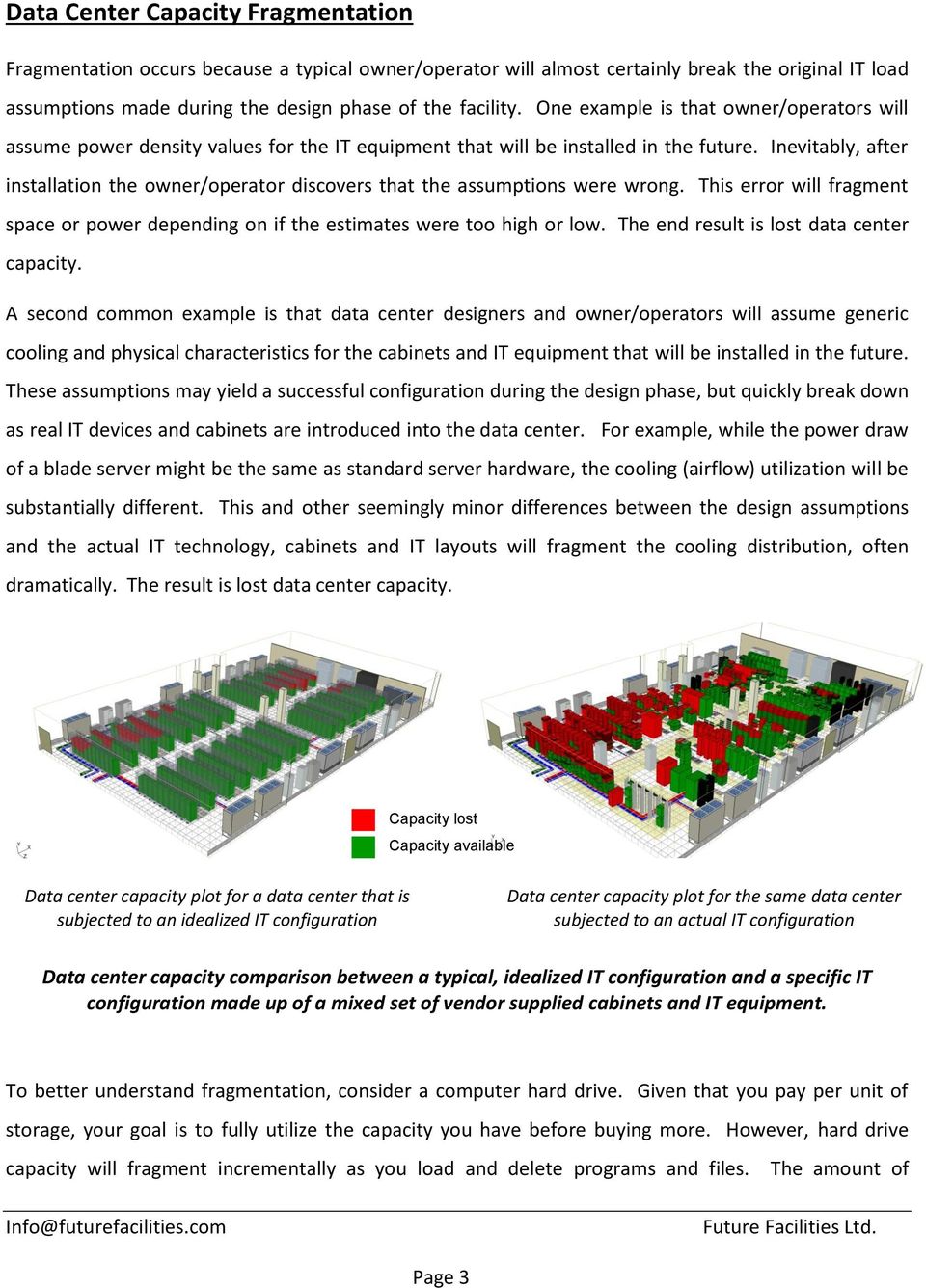
4 Data Center Capacity Fragmentation Fragmentation occurs because a typical owner/operator will almost certainly break the original IT load assumptions made during the design phase of the facility. One example is that owner/operators will assume power density values for the IT equipment that will be installed in the future. Inevitably, after installation the owner/operator discovers that the assumptions were wrong. This error will fragment space or power depending on if the estimates were too high or low. The end result is lost data center capacity. A second common example is that data center designers and owner/operators will assume generic cooling and physical characteristics for the cabinets and IT equipment that will be installed in the future. These assumptions may yield a successful configuration during the design phase, but quickly break down as real IT devices and cabinets are introduced into the data center. For example, while the power draw of a blade server might be the same as standard server hardware, the cooling (airflow) utilization will be substantially different. This and other seemingly minor differences between the design assumptions and the actual IT technology, cabinets and IT layouts will fragment the cooling distribution, often dramatically. The result is lost data center capacity. Capacity lost Capacity available Data center capacity plot for a data center that is subjected to an idealized IT configuration Data center capacity plot for the same data center subjected to an actual IT configuration Data center capacity comparison between a typical, idealized IT configuration and a specific IT configuration made up of a mixed set of vendor supplied cabinets and IT equipment. To better understand fragmentation, consider a computer hard drive. Given that you pay per unit of storage, your goal is to fully utilize the capacity you have before buying more. However, hard drive capacity will fragment incrementally as you load and delete programs and files. The amount of Page 3
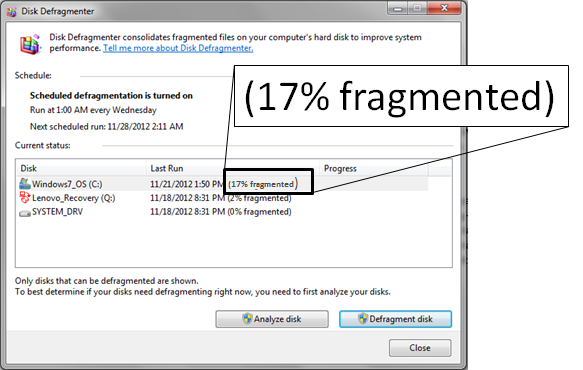
5 fragmentation that occurs depends on how the hard drive is used. Eventually, a point is reached at which the remaining available capacity is too fragmented to be of use. Only with defragmentation tools can you reclaim what has been lost and fully realize your investment in the device. Fragmentation of hard drive storage capacity The concept of resource fragmentation also applies to the data center. Data center capacity, like hard drive storage capacity, will fragment through use, at a rate that depends on how it is used. The simple answer to fully realizing the capacity potential of the data center is continuous defragmentation. This, however, is where the similarities between hard drives and data centers end. The first difference is that hard drive capacity is defined by space only while data center capacity is defined by the combination of space, power, cooling and networking. This makes defragmentation of data center capacity significantly more complicated as it requires coordinated management of four data center resources that are traditionally managed independently. The second difference is that unlike hard drive capacity, data center capacity cannot be tracked by traditional means. This is because cooling a component of capacity is dependent on airflow that is invisible and impractical to monitor with sensors. Cooling problems therefore can be addressed only if airflow is made visible. A simulation technique called computational fluid dynamics (CFD) is the only way to make airflow visible. Therefore, the only means to defragment data center capacity that has been affected by cooling problems is through the use of CFD simulation. The final difference is that unlike the hard drive, defragmentation of data center capacity is often not an option because it puts IT service availability at risk. Therefore, to protect against data center capacity Page 4

6 loss, fragmentation issues must predicted and addressed before IT deployments are physically implemented. These differences have a significant impact on the techniques required to protect against data center capacity fragmentation. Let s take a closer look at a common fragmentation problem. Cooling Fragmentation - Just Because You Don t See It Doesn t Mean It s Not There Early in the life of a data center, capacity management seems straightforward. Cabinets are loaded with IT equipment and placed. Space and power are widely available and utilization is tracked with spread sheets and DCIM tools. IT load growth and capacity utilization seems to be progressing as planned and fragmentation is the furthest issue from your mind. Later, as your data center approaches 50% of full load, fragmentation problems start to appear. With careful tracking, your teams have been able to keep space and power fragmentation under control just barely. However, your temperature monitoring system is registering hot spots that are forming. This of course shouldn t be happening. You have followed the deployment guidelines and best practices, and on paper have plenty of space, power and cooling capacity left! Simple tracking of capacity-used overlooks the problem of capacity fragmentation At this point, you realize that hot spots are a symptom of a problem that you can t see. Your monitoring system has been alerting you to the problem, but does not help you understand the cause. The only options you seem to have are to either lower the temperature of the entire facility or to embark on an expensive infrastructure upgrade. Page 5


7 In reality, cooling has been fragmenting from day one because your IT configuration has been evolving away from the original design configuration. As a consequence, the cooling distribution (airflow) within the room and inside of the cabinets has been changing relative to the original design intent and separating from the space and power distributions. Power Space Physical characteristics of IT equipment and cabinets are idealized for design Actual physical characteristics of IT configurations are non-ideal The physical characteristics of design IT loads and cabinets are always different from the actual IT loads. This is a common cause of cooling fragmentation and lost data center capacity. The total amount of cooling hasn t changed, but its distribution relative to the IT configuration has. This in turn has reduced data cente capacity, because capacity is set by the least available infrastructure resource. Capacity lost Capacity available Data center capacity and cooling distribution for an idealized design IT configuration Data center capacity for the actual IT configuration that the design was intended to represent Cooling distribution and data center capacity are determined by the physical characteristics of the IT configuration. This effect is can be seen only with a simulation model. Page 6

8 Now if cooling (airflow) was visible like space and power, you would have seen it fragmenting as the IT evolved. You would also have seen that best practices and deployment guidelines are effective under specific conditions only, not universally applicable as many in industry believe. This brings you to today where your fragmentation symptoms have stopped further IT deployments and you realize that you must be able to visualize cooling and how it relates to space, power, to protect and optimize data center capacity. You re stuck at 60% of full capacity, and have lost 40% somewhere inside this data center. And you are not alone. You Can t Manage if You Can t Predict Cause and Effect In order to protect and optimize data center capacity, the ability to simulate and visualize the fragmentation of infrastructure resources before IT deployments are made is required. This predictive capability brings to light fragmentation problems that would otherwise be discovered after the IT equipment is deployed when risk of IT service downtime prevents them from being addressed. Simulation also makes the connection between decisions made today and available data center capacity over the long term. This foresight prevents the owner/operator from accumulating fragmentation problems for years before the symptoms become severe enough to detect with a monitoring system. Today, simulation is a common practice in data center design to validate designs and enable innovative energy saving design concepts. Given that the design will change many times during the lifespan of the data center, doesn t it make sense to re-validate each change to ensure the original data center capacity specifications still hold? Modern simulation techniques can fulfill these requirements by integrating live data, data from DCIM systems and the latest IT configuration roadmap information as input to predict the impact of proposed changes before they are implemented. In effect, data collection and the simulation model combined provide operational validation of a continuously changing data center design. The focus of validation in this form is the most critical data center performance metrics: IT service availability and long-term data center capacity. Page 7
9 The Way Forward: Predictive DCIM with the Virtual Facility To this end, the Virtual Facility from Future Facilities is a predictive DCIM solution to identify and avoid the conditions that lead to lost data center capacity and IT service interruptions. The Virtual Facility is a dynamic, 3-dimensional, predictive model of the physical and logical data center. The inputs to the Virtual Facility model are: data collected by the various real-time monitoring components of traditional DCIM solutions such as power consumption, IT asset tracking and environmental data the continuously changing IT and facilities roadmap of future changes Upon consolidation of the input data, simulations are performed to predict the short term and long term consequences of future IT deployment decisions such that rack and cooling resources are maximized. The predictive capability of the Virtual Facility enables the owner/operator to weigh the short and longterm cost and performance consequences of IT deployments, facility upgrades and energy savings programs prior to implementing changes. The latest implementations of the Virtual Facility in the field demonstrate the following outcomes: Increase data center capacity utilization to above 90% from the typical 60-70% Page 8

10 Increase IT service availability by addressing redundancy problems and environmental risks before changes are implemented in the data center Make better operational decisions that extend the lifespan of the data center facility and offset the need for costly infrastructure upgrades For more information, please visit List of references: [1] Future Facilities Data Center Lost Capacity Client Survey [2] Global Data Center Energy Demand Forecasting - DataCenter Dynamics - September 2011 [3] Use Best Practices to Design Data Center Facilities, Gartner research publication ID#: G [4] Special Report: Data Center Capacity and Energy Efficiency Survey, Kenneth Brill, Uptime Institute, March 2008 Page 9
![com List of references: [1] Future Facilities Data Center Lost Capacity Client Survey [2] Global Data Center Energy Demand Forecasting - DataCenter Dynamics - September 2011 [3] Use](/docs-images/43/8958455/images/page_10.jpg "Best Practices to Design Data Center Facilities, Gartner research publication ID#: G00127434 [4] Special Report: Data Center Capacity and Energy Efficiency Survey, Kenneth Brill,")
Optimization in the Virtual Data Center
 THE INFORMATION SOURCE FOR THE DATA CENTER INDUSTRY Data Center Knowledge Guide to Optimization in the Virtual Data Center Realizing the full potential of a mission critical investment March 2013 Brought
Data centers have been cooled for many years by delivering
 The Increasing Challenge of Data Center Design and Management: Is CFD a Must? Mark Seymour, Christopher Aldham, Matthew Warner, Hassan Moezzi Future Facilities, San Jose, California, USA Mark Seymour,
Prediction Is Better Than Cure CFD Simulation For Data Center Operation.
 Prediction Is Better Than Cure CFD Simulation For Data Center Operation. This paper was written to support/reflect a seminar presented at ASHRAE Winter meeting 2014, January 21 st, by, Future Facilities.
Using Simulation to Improve Data Center Efficiency
 A WHITE PAPER FROM FUTURE FACILITIES INCORPORATED Using Simulation to Improve Data Center Efficiency Cooling Path Management for maximizing cooling system efficiency without sacrificing equipment resilience
Managing Cooling Capacity & Redundancy In Data Centers Today
 Managing Cooling Capacity & Redundancy In Data Centers Today About AdaptivCOOL 15+ Years Thermal & Airflow Expertise Global Presence U.S., India, Japan, China Standards & Compliances: ISO 9001:2008 RoHS
Airflow Simulation Solves Data Centre Cooling Problem
 Airflow Simulation Solves Data Centre Cooling Problem The owner s initial design for a data centre in China utilized 40 equipment racks filled with blade servers spread out in three rows along the length
Data center upgrade proposal. (phase one)
 Data center upgrade proposal (phase one) Executive Summary Great Lakes began a recent dialogue with a customer regarding current operations and the potential for performance improvement within the The
BEYOND DIAGRAMS AND SPREADSHEETS DATA CENTER INFRASTRUCTURE MANAGEMENT (DCIM)
 BEYOND DIAGRAMS AND SPREADSHEETS DATA CENTER INFRASTRUCTURE MANAGEMENT (DCIM) THE CHALLENGE. Solve complexity The trend for consolidation and construction of ever- larger data centers has been basically
Using CFD for optimal thermal management and cooling design in data centers
 www.siemens.com/datacenters Using CFD for optimal thermal management and cooling design in data centers Introduction As the power density of IT equipment within a rack increases and energy costs rise,
Applying Data Center Infrastructure Management in Collocation Data Centers
 Applying Data Center Infrastructure Management in Collocation Data Centers Infrastructure Management & Monitoring for Business-Critical Continuity TM Applying Data Center Infrastructure Management (DCIM)
Data Center Infrastructure Management (DCIM) Demystified
 software is quickly becoming the core engine of data center operations. Only 5 years ago, manual spreadsheets, sometimes supplemented with Visio diagrams, were accepted as the default tools for data center
Data Center Lifecycle and Energy Efficiency
 Data Center Lifecycle and Energy Efficiency Lifecycle infrastructure management, power management, thermal management, and simulation solutions enable data center modernization. White Paper October 2014
5 Reasons. Environment Sensors are used in all Modern Data Centers
 5 Reasons Environment Sensors are used in all Modern Data Centers TABLE OF CONTENTS 5 Reasons Environmental Sensors are used in all Modern Data Centers Save on Cooling by Confidently Raising Data Center
Data Center Infrastructure Management. optimize. your data center with our. DCIM weather station. Your business technologists.
 Data Center Infrastructure Management optimize your data center with our DCIM weather station Your business technologists. Powering progress Are you feeling the heat of your data center operations? Data
Why Energy Management Is Driving Adoption of Data Center Infrastructure Management Solutions
 May 2011 Why Is Driving Adoption of Data Center Infrastructure Management Solutions Sponsored by nlyte Software Contents Introduction 1 Key Measures 2 Top Trends behind the Data Center Management Challenge
Strategies for Deploying Blade Servers in Existing Data Centers
 Strategies for Deploying Blade Servers in Existing Data Centers By Neil Rasmussen White Paper #125 Revision 1 Executive Summary When blade servers are densely packed, they can exceed the power and cooling
Data center lifecycle and energy efficiency
 Data center lifecycle and energy efficiency White Paper Lifecycle management, thermal management, and simulation solutions enable data center energy modernization Introduction Data centers are coming under
Improve competiveness of IDC and enterprise data centers with DCIM
 Improve competiveness of IDC and enterprise data centers with DCIM This paper studies the implementation of modern DCIM systems for data centers to improve operational competitiveness with ATEN's DCIM
Power and Cooling for Ultra-High Density Racks and Blade Servers
 Power and Cooling for Ultra-High Density Racks and Blade Servers White Paper #46 Introduction The Problem Average rack in a typical data center is under 2 kw Dense deployment of blade servers (10-20 kw
Combining Cold Aisle Containment with Intelligent Control to Optimize Data Center Cooling Efficiency
 A White Paper from the Experts in Business-Critical Continuity TM Combining Cold Aisle Containment with Intelligent Control to Optimize Data Center Cooling Efficiency Executive Summary Energy efficiency
Enabling an agile Data Centre in a (Fr)agile market
 Enabling an agile Data Centre in a (Fr)agile market Phil Dodsworth Director, Data Centre Solutions 2008 Hewlett-Packard Development Company, L.P. The information contained herein is subject to change without
Dealing with Thermal Issues in Data Center Universal Aisle Containment
 Dealing with Thermal Issues in Data Center Universal Aisle Containment Daniele Tordin BICSI RCDD Technical System Engineer - Panduit Europe [email protected] AGENDA Business Drivers Challenges
Understanding the Promise of (DCIM)
 Understanding the Promise of Data Center Infrastructure Management (DCIM) Chuck Kramer, RCDD, NTS, CDCP, CDFOM Senior Solutions Consultant Emerson Network Power What is DCIM? The monitoring, collection
Overview of Green Energy Strategies and Techniques for Modern Data Centers
 Overview of Green Energy Strategies and Techniques for Modern Data Centers Introduction Data centers ensure the operation of critical business IT equipment including servers, networking and storage devices.
Comprehensive Solutions for Data Centers. Rely on Siemens for maximum uptime, reliability, and efficiency. www.usa.siemens.
 Comprehensive Solutions for Data Centers Rely on Siemens for maximum uptime, reliability, and efficiency. www.usa.siemens.com/datacenters Siemens can meet the demands of your mission critical facility.
Reducing Data Center Energy Consumption
 Reducing Data Center Energy Consumption By John Judge, Member ASHRAE; Jack Pouchet, Anand Ekbote, and Sachin Dixit Rising data center energy consumption and increasing energy costs have combined to elevate
Specialty Environment Design Mission Critical Facilities
 Brian M. Medina PE Associate Brett M. Griffin PE, LEED AP Vice President Environmental Systems Design, Inc. Mission Critical Facilities Specialty Environment Design Mission Critical Facilities March 25,
Energy Management Services
 February, 2012 Energy Management Services Data centers & IT environments are often critical to today s businesses, directly affecting operations and profitability. General & Mechanical Services has the
How green is your data center?
 Siemens Answers: Sustainable Future How green is your data center? Istanbul June 01, 2010 Agenda 1 Solution 2 Siemens Data Center Approach 2 Designing with multiple power density zones can reduce energy
Greener Pastures for Your Data Center
 W H I T E P A P E R Greener Pastures for Your Data Center 2 Executive Summary Following a green path, once a concept relegated to a small group of environmentalists and the U.S. Environmental Protection
Power Distribution Units (PDUs): Power monitoring and environmental monitoring to improve uptime and capacity planning
 Power Distribution Units (PDUs): Power monitoring and environmental monitoring to improve uptime and capacity planning 2009, Raritan Inc. Overview Corporate America is more dependent than ever on computing
Redefining Infrastructure Management for Today s Application Economy
 WHITE PAPER APRIL 2015 Redefining Infrastructure Management for Today s Application Economy Boost Operational Agility by Gaining a Holistic View of the Data Center, Cloud, Systems, Networks and Capacity
Re Engineering to a "Green" Data Center, with Measurable ROI
 Re Engineering to a "Green" Data Center, with Measurable ROI Alan Mamane CEO and Founder Agenda Data Center Energy Trends Benchmarking Efficiency Systematic Approach to Improve Energy Efficiency Best Practices
Model Manage Monitor Maximize your Data Center
 NetZoomDC is the most feature rich, fully-scalable, enterprise Data Center Infrastructure Management (DCIM) software application. It enables data center professionals to Model, Manage, Monitor and Maximize
Cheat Sheets to Data Center Infrastructure Management
 ^ Business-wise, Future-drivenTM Cheat Sheets to Data Center Infrastructure Management The Brands You Trust. Table of Contents Introduction...3 How DCIM helps operations...4 How DCIM helps planning...5
The business case for managed next generation firewalls. Six reasons why IT decision makers should sit up and take notice
 The business case for managed next generation firewalls Six reasons why IT decision makers should sit up and take notice THREATWATCH Cyber threats cost the UK economy 27 billion pounds a year 92 percent
Delivering results with Datacenter Clarity LC TM
 Philippe Heim Boston, September 9th, 2015 Delivering results with Datacenter Clarity LC TM siemens.com Intro movie Page 2 20XX-XX-XX Table of contents 1 Challenges 2 Integrated DCIM solution overview 3
Introducing Computational Fluid Dynamics Virtual Facility 6SigmaDC
 IT Infrastructure Services Ltd Holborn Gate, 330 High Holborn, London, WC1V 7QT Telephone: +44 (0)20 7849 6848 Fax: +44 (0)20 7203 6701 Email: [email protected] www.itisltd.com Introducing Computational
High Density Data Centers Fraught with Peril. Richard A. Greco, Principal EYP Mission Critical Facilities, Inc.
 High Density Data Centers Fraught with Peril Richard A. Greco, Principal EYP Mission Critical Facilities, Inc. Microprocessors Trends Reprinted with the permission of The Uptime Institute from a white
FAC 2.1: Data Center Cooling Simulation. Jacob Harris, Application Engineer Yue Ma, Senior Product Manager
 FAC 2.1: Data Center Cooling Simulation Jacob Harris, Application Engineer Yue Ma, Senior Product Manager FAC 2.1: Data Center Cooling Simulation Computational Fluid Dynamics (CFD) can be used to numerically
Thermal Management of Datacenter
 Thermal Management of Datacenter Qinghui Tang 1 Preliminaries What is data center What is thermal management Why does Intel Care Why Computer Science 2 Typical layout of a datacenter Rack outlet temperature
APC APPLICATION NOTE #92
 #92 Best Practices for Designing Data Centers with the InfraStruXure InRow RC By John Niemann Abstract The InfraStruXure InRow RC is designed to provide cooling at the row and rack level of a data center
Comprehensive Data Center Energy Management Solutions
 FROM INSIGHT TO EFFICIENCY: Comprehensive Data Center Energy Management Solutions Since 1995, facility managers and BAS professionals have relied on the Niagara Framework to provide full convergence of
Data Center Infrastructure Management: ERP for the Data Center Manager
 Data Center Infrastructure Management: ERP for the Data Center Manager 1 2 Topics What s DCIM & the ERP Analogy Why DCIM How DCIM Works How DCIM Helps 3 DCIM by Definition DCIM is a system that collects
Cooling Capacity Factor (CCF) Reveals Stranded Capacity and Data Center Cost Savings
 WHITE PAPER Cooling Capacity Factor (CCF) Reveals Stranded Capacity and Data Center Cost Savings By Lars Strong, P.E., Upsite Technologies, Inc. Kenneth G. Brill, Upsite Technologies, Inc. 505.798.0200
Introducing the. Virtual Facility
 Introducing the Virtual Facility At future facilities, we have developed a groundbreaking methodology enabling owner/operators to improve the performance of a data centre throughout its entire lifecycle.
Microsoft Technology Center: Philadelphia
 A Customer Success from the Experts in Business-Critical Continuity TM. Background Microsoft Technology Center: Philadelphia Microsoft Technology Centers are collaborative, state-of-the-art facilities
CarbonDecisions. The green data centre. Why becoming a green data centre makes good business sense
 CarbonDecisions The green data centre Why becoming a green data centre makes good business sense Contents What is a green data centre? Why being a green data centre makes good business sense 5 steps to
Data Center Power Consumption
 Data Center Power Consumption A new look at a growing problem Fact - Data center power density up 10x in the last 10 years 2.1 kw/rack (1992); 14 kw/rack (2007) Racks are not fully populated due to power/cooling
Managing Data Centre Heat Issues
 Managing Data Centre Heat Issues Victor Banuelos Field Applications Engineer Chatsworth Products, Inc. 2010 Managing Data Centre Heat Issues Thermal trends in the data centre Hot Aisle / Cold Aisle design
DCIM Readiness on the Rise as Significant Data Center Capacity Remains Unused. A Research Report from the Experts in Business-Critical Continuity TM
 DCIM Readiness on the Rise as Significant Data Center Capacity Remains Unused A Research Report from the Experts in Business-Critical Continuity TM Introduction Data center management is in a stage of
Comprehensive Data Center Energy Management Solutions
 FROM INSIGHT TO EFFICIENCY: Comprehensive Data Center Energy Management Solutions Since 1995, facility managers and BAS professionals have relied on the Niagara framework to provide full convergence of
Data centres that deliver [email protected]
 Data centres that deliver [email protected] DATA CENTRE INFRASTRUCTURE MANAGEMENT (DCIM) DCIM solutions are designed to collect and manage information about a data centre s assets, resource use
Data Center Trend: Distributed Power in the White Space
 Data Center Trend: Distributed Power in the White Space By Jason Anderson Product Line Manager Eaton Executive summary Cloud computing vendors and colocation data centers make every effort to maximize
CenterMind G+ Smart and Proactive Environment Monitoring
 CenterMind G+ Smart and Proactive Environment Monitoring Smart and Proactive Environment Monitoring real-time visibility into the state of your computer room or data center environment, 24/7 RiT CenterMind
Converged Infrastructure Solutions. Building a Data Center for the Future
 Converged Solutions Building a Data Center for the Future :: Traffic in data centers is growing at an unprecedented rate, with network traffic growing at 25+% and enterprise storage at 50+% annually, 1
The New Truth in Data Center Management
 1 Beyond spreadsheets with Data Center Infrastructure (DCIM) software to revitalize the management of space, power, equipment and connections 2 Table of Contents Data Center Hits a Boiling Point Integrated
T: 0344 875 4555 [email protected]
 T: 0344 875 4555 [email protected] DATACENTRE UK INTRODUCTION Datacentre UK are specialist providers of energy efficient data centre and physical infrastructure solutions across the UK, Europe
Changing the way companies run their data centers
 Infrastructure Management & Monitoring for Business-Critical Continuity TM Changing the way companies run their data centers The Aperture Suite OPTIMIZE PERFORMANCE OF YOUR DATA CENTER WITHOUT COMPROMISING
DCIM Data Center Infrastructure Monitoring
 DCIM Data Center Infrastructure Monitoring ServersCheck offers a flexible, modular and affordable DCIM solution. It is based on our range of IP & SNMP hardware environmental sensors and management software.
The New Virtualization Management. Five Best Practices
 The New Virtualization Management Five Best Practices Establish a regular reporting schedule to keep track of changes in your environment. Optimizing Capacity, Availability and Performance in a Modern
Data Center Power Distribution and Capacity Planning:
 Data Center Power Distribution and Capacity Planning: Understanding what you know and don t know about power usage in your data center 2009, Raritan Inc. About This Series Raritan, a leading provider of
MAXIMIZING YOUR DATA CENTER INFRASTRUCTURE: CENTRALIZED MANAGEMENT AND WIRE-FREE ENVIRONMENTAL MONITORING
 MAXIMIZING YOUR DATA CENTER INFRASTRUCTURE: CENTRALIZED MANAGEMENT AND WIRE-FREE Chris C. Gaskins Vice President of Product Development RF Code, Inc. AUGUST 2010 Shawn Griggs Director of Product Management
IMPROVING DATA CENTER EFFICIENCY AND CAPACITY WITH AISLE CONTAINMENT
 DATA CENTER RESOURCES WHITE PAPER IMPROVING DATA CENTER EFFICIENCY AND CAPACITY WITH AISLE CONTAINMENT BY: STEVE HAMBRUCH EXECUTIVE SUMMARY Data centers have experienced explosive growth in the last decade.
Design Best Practices for Data Centers
 Tuesday, 22 September 2009 Design Best Practices for Data Centers Written by Mark Welte Tuesday, 22 September 2009 The data center industry is going through revolutionary changes, due to changing market
Ten Steps to Increasing Data Center Efficiency and Availability through Infrastructure Monitoring
 Ten Steps to Increasing Data Center Efficiency and Availability through Infrastructure Monitoring A White Paper from the Experts in Business-Critical Continuity Summary The first decade of the 21st century
DATA CENTER ASSESSMENT SERVICES
 DATA CENTER ASSESSMENT SERVICES ig2 Group Inc. is a Data Center Science Company which provides solutions that can help organizations automatically optimize their Data Center performance, from assets to
Visualization, Management & Optimization Keys for an efficient Data Center Sergio Uribe - CommScope
 Visualization, Management & Optimization Keys for an efficient Data Center Sergio Uribe - CommScope May 14,15-2014 Before to start Lopsided data center budget growth Allocating the cost of IT inefficiency
Vigilent shows market awareness with datacenter dynamic cooling update
 Vigilent shows market awareness with datacenter dynamic cooling update Analyst: Rhonda Ascierto 15 Jan, 2014 Vigilent, formerly known as Federspiel Controls, appears to be pulling ahead in the small yet
AIRAH Presentation April 30 th 2014
 Data Centre Cooling Strategies The Changing Landscape.. AIRAH Presentation April 30 th 2014 More Connections. More Devices. High Expectations 2 State of the Data Center, Emerson Network Power Redefining
Introducing AUDIT-BUDDY
 Introducing AUDIT-BUDDY Optimize the Data Center with AUDIT-BUDDY Executive Summary Proper temperature and humidity for the inlet air into the servers is essential to efficient data center operation. Several
Data center management suite. Providing optimal control and efficiency to data center management. www.siemens.com/datacenters
 Data center management suite Providing optimal control and efficiency to data center management www.siemens.com/datacenters Streamline operations with Siemens suite of integrated management tools You work
Energy Efficiency and Availability Management in Consolidated Data Centers
 Energy Efficiency and Availability Management in Consolidated Data Centers Abstract The Federal Data Center Consolidation Initiative (FDCCI) was driven by the recognition that growth in the number of Federal