
Serial Attached SCSI RAID Controllers Installation and User s Guide
|
|
|
- Mervyn Hicks
- 10 years ago
- Views:
Transcription
1 Serial Attached SCSI RAID Controllers Installation and User s Guide

2 2 Copyright 2008 Adaptec, Inc. All rights reserved. No part of this publication may be reproduced, stored in a retrieval system, or transmitted in any form or by any means, electronic, mechanical, photocopying, recording or otherwise, without the prior written consent of Adaptec, Inc., 691 South Milpitas Blvd., Milpitas, CA Trademarks Adaptec, Adaptec Storage Manager, SerialSelect and the Adaptec logo are trademarks of Adaptec, Inc., which may be registered in some jurisdictions. Microsoft, Windows, and Vista are trademarks of Microsoft Corporation in the US and other countries, used under license. Red Hat is a trademark of Red Hat, Inc. in the US and other countries, used under license. All other trademarks are the property of their respective owners. Changes The material in this document is for information only and is subject to change without notice. While reasonable efforts have been made in the preparation of this document to assure its accuracy, Adaptec, Inc. assumes no liability resulting from errors or omissions in this document, or from the use of the information contained herein. Adaptec reserves the right to make changes in the product design without reservation and without notification to its users. Disclaimer IF THIS PRODUCT DIRECTS YOU TO COPY MATERIALS, YOU MUST HAVE PERMISSION FROM THE COPYRIGHT OWNER OF THE MATERIALS TO AVOID VIOLATING THE LAW WHICH COULD RESULT IN DAMAGES OR OTHER REMEDIES.
3 3 Adaptec Customer Support If you have questions about installing or using your Adaptec product, check this document first you will find answers to most of your questions. If you need further assistance, use the support options listed below. To expedite your service, have your computer in front of you. Note: The phone numbers listed in this section are subject to change. Please refer to the Support section of our Web site at for the most up-to-date contact information. Technical Support Identification (TSID) Number Before contacting Technical Support, you need your product-unique TSID number. The TSID number identifies your product and support status. The TSID number is included on a white, bar-coded label, like this example: Affix a copy of the TSID label to the CD jacket so that you don t lose it. North America Visit our Web site at Search the Adaptec Support Knowledgebase (ASK) at ask.adaptec.com for articles, troubleshooting tips, and frequently asked questions for your product. For information about Adaptec s support options, call , 24 hours per day, 7 days per week. To speak with a Technical Support Specialist, For Hardware products call , Monday to Friday, 5:00 A.M. to 5:00 P.M., Pacific Time. For RAID and Fibre Channel products call , Monday to Friday, 5:00 A.M. to 5:00 P.M., Pacific Time. For support via , submit your question at ask.adaptec.com. You can order Adaptec products, including accessories and cables, by calling Or, you can order cables online at Europe Visit our Web site at German: Call , Monday to Friday, 9:00 to 17:00, CET. For support via , submit your question at ask-de.adaptec.com. French: Call , Monday to Friday, 9:00 to 17:00, CET. For support via , submit your question at ask-fr.adaptec.com. English: Call , Monday to Friday, 9:00 to 17:00, GMT. For support via , submit your question at ask.adaptec.com. You can order Adaptec cables online at Japan Visit our Web site at Call
4 4 Limited 3-Year Hardware Warranty 1. Adaptec, Inc. ( Adaptec ) warrants to the purchaser of this product that it will be free from defects in material and workmanship for a period of three (3) years from the date of purchase. If the product should become defective within the warranty period, Adaptec, at its option, will repair or replace the product, or refund the purchaser s purchase price for the product, provided it is delivered at the purchaser s expense to an authorized Adaptec service facility or to Adaptec. 2. Repair or replacement parts or products will be furnished on an exchange basis and will either be new or reconditioned. All replaced parts or products shall become the property of Adaptec. This warranty shall not apply if the product has been damaged by accident, misuse, abuse or as a result of unauthorized service or parts. 3. Warranty service is available to the purchaser by delivering the product during the warranty period to an authorized Adaptec service facility or to Adaptec and providing proof of purchase price and date. The purchaser shall bear all shipping, packing and insurance costs and all other costs, excluding labor and parts, necessary to effectuate repair, replacement or refund under this warranty. 4. For more information on how to obtain warranty service, write or telephone Adaptec at 691 South Milpitas Boulevard, Milpitas, CA 95035, (800) THIS LIMITED WARRANTY DOES NOT EXTEND TO ANY PRODUCT WHICH HAS BEEN DAMAGED AS A RESULT OF ACCIDENT, MISUSE, ABUSE, OR AS A RESULT OF UNAUTHORIZED SERVICE OR PARTS. 6. THIS WARRANTY IS IN LIEU OF ALL OTHER EXPRESS WARRANTIES WHICH NOW OR HEREAFTER MIGHT OTHERWISE ARISE RESPECT TO THIS PRODUCT. IMPLIED WARRANTIES, INCLUDING THOSE OF MERCHANTABILITY, FITNESS FOR A PARTICULAR PURPOSE AND NON-INFRINGEMENT SHALL (A) HAVE NO GREATER DURATION THAN 3 YEARS FROM THE DATE OF PURCHASE, (B) TERMINATE AUTOMATICALLY AT THE EXPIRATION OF SUCH PERIOD AND (C) TO THE EXTENT PERMITTED BY LAW BE EXCLUDED. IN THE EVENT THIS PRODUCT BECOMES DEFECTIVE DURING THE WARRANTY PERIOD, THE PURCHASER S EXCLUSIVE REMEDY SHALL BE REPAIR, REPLACEMENT OR REFUND AS PROVIDED ABOVE. INCIDENTAL OR CONSEQUENTIAL DAMAGES, INCLUDING WITHOUT LIMITATION LOSS OF DATA, ARISING FROM BREACH OF ANY EXPRESS OR IMPLIED WARRANTY ARE NOT THE RESPONSIBILITY OF ADAPTEC AND, TO THE EXTENT PERMITTED BY LAW, ARE HEREBY EXCLUDED BOTH FOR PROPERTY DAMAGE, AND TO THE EXTENT NOT UNCONSCIONABLE, FOR PERSONAL INJURY DAMAGE. 7. SOME STATES DO NOT ALLOW THE EXCLUSION OR LIMITATION OF INCIDENTAL OR CONSEQUENTIAL DAMAGES FOR CONSUMER PRODUCTS, AND SOME STATES DO NOT ALLOW LIMITATIONS ON HOW LONG AN IMPLIED WARRANTY LASTS, SO THE ABOVE LIMITATION OR EXCLUSIONS MAY NOT APPLY TO YOU. 8. This warranty gives you specific legal rights, and you may also have other rights which vary from state to state.
5 5 Regulatory Compliance Statements Federal Communications Commission Radio Frequency Interference Statement WARNING: Changes or modifications to this unit not expressly approved by the party responsible for compliance could void the user s authority to operate the equipment. This equipment has been tested and found to comply with the limits for a Class B digital device, pursuant to Part 15 of the FCC rules. These limits are designed to provide reasonable protection against harmful interference in a residential installation. This equipment generates, uses, and can radiate radio frequency energy, and if not installed and used in accordance with the instruction manual, may cause harmful interference to radio communications. However, there is no guarantee that interference will not occur in a particular installation. However, if this equipment does cause interference to radio or television equipment reception, which can be determined by turning the equipment off and on, the user is encouraged to try to correct the interference by one or more of the following measures: Reorient or relocate the receiving antenna. Increase the separation between equipment and receiver. Connect the equipment to an outlet on a circuit different from that to which the receiver is connected. Consult the dealer or an experienced radio/television technician for help. Use a shielded and properly grounded I/O cable and power cable to ensure compliance of this unit to the specified limits of the rules. This device complies with part 15 of the FCC rules. Operation is subject to the following two conditions: (1) this device may not cause harmful interference and (2) this device must accept any interference received, including interference that may cause undesired operation. Adaptec, Inc. Use only with the listed ITE: Adaptec RAID 5085/Adaptec RAID 5405/Adaptec RAID 5445/ Adaptec RAID 5805/ ASR-3405/ASR-3805/ASR-3085/ASR-31205/ASR-31605/ Adaptec RAID 51245/Adaptec RAID 51645/Adaptec RAID 52445/ Adaptec RAID 2045/Adaptec RAID 2405 Tested to Comply With FCC Standards FOR HOME OR OFFICE USE European Union Compliance Statement This Information Technology Equipment has been tested and found to comply with EMC Directive 89/336/EEC, as amended by 92/31/EEC and 93/68/EEC, in accordance with: EN55022 (1998+A1:2000+A2:2003) Emissions EN55024 (1998+A1:2001+A2:2003) Immunity: EN (1995) Electrostatic discharge: ±4 kv contact, ±8 kv air EN (1996) Radiated immunity EN (1995) Electrical fast transients/burst: ±1 kv AC, ±0.5 kv I/O EN (1995) Surges ±1 kv differential mode, ±2 kv common mode EN (1996) Conducted immunity: 3 V EN (1994) Supply dips and variation: 30% and 100% In addition, all equipment requiring U.L. listing has been found to comply with EMC Directive 73/23/EEC as amended by 93/68/EEC in accordance with EN60950 with amendments A1, A2, A3, A4, A11. Australian/New Zealand Compliance Statement This device has been tested and found to comply with the limits for a Class B digital device, pursuant to the Australian/New Zealand standard AS/NZS 3548 set out by the Spectrum Management Agency. Canadian Compliance Statement This Class B digital apparatus meets all requirements of the Canadian Interference-Causing Equipment Regulations. Cet appareil numérique de la classe B respecte toutes les exigences du Règlement sur le matériel brouilleur du Canada. Japanese Compliance (Voluntary Control Council Initiative) This equipment complies to class B Information Technology equipment based on VCCI (Voluntary Control Council for Interface). This equipment is designed for home use but it may causes radio frequency interference problem if used too near to a television or radio. Please handle it correctly per this documentation.! Caution: Risk of explosion if the battery is replaced by an incorrect type. Dispose of used batteries according to the instructions.

6 Contents About This Guide What You Need to Know Before You Begin Terminology Used in this Guide How to Find More Information Kit Contents and System Requirements Kit Contents System Requirements About Your RAID Controller Standard RAID Controller Features Array-level Features Advanced Data Protection Suite Adding Enhanced Features Using a Feature Key to Unlock Enhanced Features Adding a Battery Backup Module Upgrading the Controller Firmware About the Adaptec RAID About the Adaptec RAID About the Adaptec RAID About the Adaptec RAID About the Adaptec RAID About the Adaptec RAID About the Adaptec RAID About the Adaptec RAID About the Adaptec RAID About the Adaptec RAID About the Adaptec RAID About the Adaptec RAID About the Adaptec RAID
7 Contents 7 About the Adaptec RAID Getting Started Choosing a RAID Level Selecting Disk Drives and Cables Disk Drives Cables Installation Options Basic Installation Steps Installing with an Operating System Installing on an Existing Operating System Installing the Controller and Disk Drives Before You Begin Installing the Controller Connecting Disk Drives to Your Controllers Connecting Directly to the Controller Connecting to a System Backplane Connecting External Devices Next Steps Creating a Bootable Array Setting the Boot Controller Creating an Array Creating an Array with the ACU Creating an Array with Adaptec Storage Manager Making Your Array Bootable Installing the Driver and an Operating System Before You Begin Creating a Driver Disk Installing with Windows Installing with Windows Server 2003 or Windows XP Installing with Windows Server 2008 or Windows Vista Installing with Red Hat Linux Installing with SUSE Linux Installing with OpenServer Installing with UnixWare Installing with Solaris Installing with VMware Installing with FreeBSD... 53
8 Contents 8 Installing the Driver on an Existing Operating System Before You Begin Creating a Driver Disk Installing on Windows Installing on Windows Server 2003 or Windows XP Installing with Windows Server 2008 or Windows Vista Installing on Red Hat or SUSE Linux Installing on OpenServer Installing on UnixWare Installing on Solaris Installing on VMware Installing on FreeBSD Managing Your Storage Space About Adaptec Storage Manager Installing Adaptec Storage Manager About the Adaptec RAID Controller Configuration Utility About the Adaptec RAID Configuration Utility About the Adaptec Flash Utility Which Utility Should I Use? Solving Problems Troubleshooting Checklist Monitoring Disk Drives Status Silencing the Alarm Recovering from a Disk Drive Failure Failed Disk Drive Protected by a Hot Spare Failed Disk Drive Not Protected by a Hot Spare Failure in Multiple Arrays Simultaneously Disk Drive Failure in a RAID 0 Array Multiple Failures in the Same Array Resetting the Controller Introduction to SAS Terminology Used in This Chapter What is SAS? How Do SAS Devices Communicate? What s a Phy? What s a SAS Port? What s a SAS Address? What s a SAS Connector? What do SAS Cables Look Like? How are Disk Drives Identified in SAS? What are the SAS Connection Options? Direct-attach Connections Backplane Connections... 71

9 Contents 9 SAS Expander Connections How is SAS Different from Parallel SCSI? Understanding RAID Understanding Drive Segments Non-redundant Arrays (RAID 0) RAID 1 Arrays RAID 1 Enhanced Arrays RAID 10 Arrays RAID 5 Arrays RAID 5EE Arrays RAID 50 Arrays RAID 6 Arrays RAID 60 Arrays Selecting the Best RAID Level Using the Adaptec RAID Configuration Utility Introduction to the ARC Utility Running the ARC Utility Navigating the ARC Utility Using the ACU to Create and Manage Arrays Creating a New Array Managing Existing Arrays Initializing Disk Drives Rescanning Disk Drives Secure Erasing Disk Drives Using the ACU to Create and Manage JBODs Creating a New JBOD Managing Existing JBODs Using SerialSelect to Modify Controller Settings Opening SerialSelect Applying Changes and Exiting Modifying Your Controller s Configuration Formatting and Verifying Disk Drives Locating Disk Drives Identifying Disk Drives Viewing the Event Log Using the Array Configuration Utility for DOS Getting Started Working in the ACU Using Menus Running the ACU Using Scripts About Playback Mode About Record Mode Creating the Script File Manually... 95
10 Contents 10 Array Definition Block Keywords ACU Error Codes Sample Scripts Using the Adaptec Flash Utility System Requirements Before You Begin Obtaining the Firmware Creating the Firmware Update Disks Running the Menu-based AFU Running the AFU from the Command Line AFU Commands Updating the Flash Using the AFU Command Line Controller LED and I2C Connector Quick Reference Adaptec RAID 3085 LED Connector Specification Adaptec RAID 3405 LED and I2C Connector Specification Adaptec RAID 3805 LED and I2C Connector Specification Adaptec RAID 5085 LED Connector Specification Adaptec RAID 5405 LED and I2C Connector Specification Adaptec RAID 5445 LED and I2C Connector Specification Adaptec RAID 5805 LED and I2C Connector Specification Adaptec RAID LED and I2C Connector Specification Adaptec RAID LED and I2C Connector Specification Adaptec RAID LED and I2C Connector Specification Adaptec RAID LED and I2C Connector Specification Adaptec RAID LED and I2C Connector Specification Adaptec RAID 2045 LED Connector Specification Adaptec RAID 2405 LED and I2C Connector Specification Safety Information Electrostatic Discharge (ESD) Technical Specifications Environmental Specifications DC Power Requirements Current Requirements Index
11 About This Guide 1 In this chapter... What You Need to Know Before You Begin Terminology Used in this Guide How to Find More Information This Installation and User s Guide explains how to install your Adaptec RAID controller. It also describes the utilities included in your controller kit, and provides a basic overview of Serial Attached SCSI (SAS) and Redundant Array of Independent Disk (RAID) technology. These RAID controller models are described in this Guide: Adaptec RAID 3085 Adaptec RAID 3405 Adaptec RAID 3805 Adaptec RAID 5085 Adaptec RAID 5405 Adaptec RAID 5445 Adaptec RAID 5805 Adaptec RAID Adaptec RAID Adaptec RAID Adaptec RAID Adaptec RAID Adaptec RAID 2045 Adaptec RAID 2405

12 Chapter 1: About This Guide 12 What You Need to Know Before You Begin You should be familiar with computer hardware, data storage, RAID technology, and SAS and Serial ATA (SATA) technology. (For an introduction to SAS, see page 67.) You should also be familiar with Direct-Attached Storage (DAS) or Network-Attached Storage (NAS) whichever is appropriate for your storage space and Storage Area Network (SAN) concepts and technology. Note: Because this Guide covers multiple Adaptec RAID products, some of the features and functions described may not be available for your controller. For more information, see About Your RAID Controller on page 16. Terminology Used in this Guide Because you can use your Adaptec RAID controller to manage data storage in a variety of configurations from DAS to NAS to SAN, the generic term storage space is used to refer to controller(s) and disk drives being managed with Adaptec Storage Manager TM or the other utilities described in this Guide. Many of the terms and concepts referred to in this Guide are known to computer users by multiple names. This Guide uses these terms: Controller (also known as adapter, board, or card) Disk drive (also known as hard disk, hard drive, or hard disk drive) Enclosure (also known as a RAID enclosure, storage enclosure, or JBOD enclosure) Array (also known as a container or logical drive) Note: In DAS environments, Adaptec Storage Manager refers to arrays as logical drives. Why? Your RAID controller creates arrays, which your operating system (and Adaptec Storage Manager) recognizes as logical drives. In NAS environments, Adaptec Storage Manager displays both arrays and logical drives. For more information, refer to the Adaptec Storage Manager User s Guide on the Adaptec Storage Manager Installation CD. How to Find More Information You can find more information about your Adaptec RAID controller and the software and utilities included with it by referring to these documents: Readme.txt Includes updated product information and known issues; located on the RAID Installation CD. Adaptec Storage Manager User s Guide Describes how to install and use the Adaptec Storage Manager software (see page 60) to manage your direct attached storage; located on the Adaptec Storage Manager Installation CD. Adaptec Storage Manager Online Help Describes how to use the Adaptec Storage Manager software; accessible from the main window of Adaptec Storage Manager. Adaptec RAID Controller Command Line Utility User s Guide Describes how to use the included Adaptec RAID Controller Configuration (ARCCONF) command line utility (see page 60) to perform basic array and configuration management functions; located on the Adaptec Storage Manager Installation CD.

13 Kit Contents and System Requirements 2 In this chapter... Kit Contents System Requirements...14 This chapter lists the contents of your Adaptec RAID controller kit and the system requirements that must be met for you to successfully install and use your controller.
14 Chapter 2: Kit Contents and System Requirements 14 Kit Contents Adaptec RAID controller RAID Installation CD (bootable), including controller drivers, and this Guide Adaptec Storage Manager Installation CD (not bootable), including user guides for Adaptec Storage Manager and the ARCCONF command line utility Cables (Not all kits contain cables. If your kit does, the type and quantity vary for cable information about your controller, visit the Adaptec Web site at (Selected models only) Low-profile bracket Adaptec Serial Attached SCSI RAID Controllers Quick Start Guide System Requirements PC-compatible computer with Intel Pentium, or equivalent, processor Motherboard with these features: Compliant with PCI Local Bus Specification, Revision 2.2 or later Support for multifunction devices where one of the devices is a PCI bridge Large memory-mapped address ranges Refer to the Readme file on the RAID installation CD for additional motherboard compatibility information. One of these operating systems: Microsoft Windows Server 2008, Windows Vista TM, Windows Server 2003 (Enterprise and Standard with SP2, 32-bit and 64-bit), Windows XP (32-bit and 64- bit) Red Hat Enterprise Linux 4 Server, Red Hat Enterprise Linux 5 Server (32-bit and 64- bit) SUSE Linux ES 10.0 (32-bit and 64-bit) Note: For the latest on Adaptec s support of Linux, or to download driver sources, visit the Support area of the Adaptec Web site at SCO OpenServer 6.0 UnixWare Sun Solaris TM 10, Solaris 10 x86 U4, Solaris 10 x64 U4 VMware ESX Server 3.0.2, 3.5 (storage management must be done by command-line, BIOS utility, or remote GUI connection see page 83) FreeBSD 6.2, 6.3 Note: For up-to-date operating system version support, visit the Adaptec Web Site at From the main menu select Support>Knowledgebase>Find Answers. Select your controller type and OS support to generate a list of supported operating systems. 128 MB (or more) of RAM Available compatible PCIe slot (depending on your controller model see the descriptions starting on page 16) 20 MB of free disk drive space 16-bit SVGA color monitor with a resolution of at least 800 x 600
15 Chapter 2: Kit Contents and System Requirements 15 CD drive

16 About Your RAID Controller 3 In this chapter... Standard RAID Controller Features Adding Enhanced Features Adding a Battery Backup Module Upgrading the Controller Firmware About the Adaptec RAID About the Adaptec RAID About the Adaptec RAID About the Adaptec RAID About the Adaptec RAID About the Adaptec RAID About the Adaptec RAID About the Adaptec RAID About the Adaptec RAID About the Adaptec RAID About the Adaptec RAID About the Adaptec RAID About the Adaptec RAID About the Adaptec RAID This chapter provides an overview of standard Adaptec RAID controller features, and describes the unique features of your controller. It also explains how to upgrade your controller with enhanced features.

17 Chapter 3: About Your RAID Controller 17 Standard RAID Controller Features Support for SAS, SATA, and SATA II disk drives Flash ROM for updates to controller firmware, BIOS, and the Adaptec RAID Configuration utility Disk drive hot-swapping Event logging and broadcasting including and SNMP messages Multiple options for creating and managing RAID arrays A full software application (Adaptec Storage Manager), a BIOS-based utility (ACU), a command line utility (ARCCONF), and a DOS utility (see Managing Your Storage Space on page 59) Native command queuing (NCQ), which lets disk drives arrange commands into the most efficient order for optimum performance Support for disk drive enclosures with SES2 enclosure management hardware Support for a battery backup module (see page 18) Audible alarm Power-management of disk drives in your storage space to reduce cooling and electricity costs (see page 85) I/O statistics logging and automatic forwarding for remote analysis ( call home ) Array-level Features Note: Not all features are supported by all controllers. For more information, refer to the Adaptec Storage Manager User s Guide or online Help. Support for RAID 0, RAID 1, RAID 5, RAID 10, RAID 50, simple volumes, and spanned volumes Support for JBOD disks (appear as a physical disk drives to the operating system; not redundant) Support for hot spares (global and dedicated) Support for automatic failover, so arrays are automatically rebuilt when a failed disk drive is replaced (applies to redundant arrays in SES2- or SAF-TE-enabled disk drive enclosures only) Optimized disk utilization, which ensures that the full capacity of all disk drives can be used, even if the disk drives vary in size Online capacity expansion, so you can increase the capacity of an array without recreating it Support for array migration from one RAID level to another Advanced Data Protection Suite Copyback Hot Spare You can use this feature to move data from a hot spare back to its original location after a failed disk drive is replaced. Striped Mirror (RAID 1E) A RAID 1 Enhanced array is similar to a RAID 1 array except that data is both mirrored and striped, and more disk drives can be included.

18 Chapter 3: About Your RAID Controller 18 Hot Space (RAID 5EE) A RAID 5EE array is similar to a RAID 5 array except that it includes a distributed spare and must be built from a minimum of four disk drives. Dual Drive Failure Protection (RAID 6) A RAID 6 array is similar to a RAID 5 array except that it includes two independent sets of parity data instead of one. Dual Drive Failure Protection (RAID 60) A RAID 60 array is similar to a RAID 50 array except that it includes four independent sets of parity data instead of two. Adding Enhanced Features As your storage needs change, you can enhance data protection and improve performance by upgrading your Adaptec controller with extra features. Currently, Adaptec offers the snapshot function as an upgrade feature which can be activated with a feature key (sold separately). A snapshot is a frozen image of a logical drive at a particular point in time. You can use this feature to back up your data to tape, clone a disk drive, or copy the data to multiple servers. Note: Snapshots are supported on Adaptec 3-series controllers only. They are available only for Windows and Linux operating systems. To purchase a feature key, contact your Adaptec Reseller or refer to the Adaptec Web site at To unlock the enhanced features with a feature key, see the following section. Using a Feature Key to Unlock Enhanced Features When you receive a feature key, use Adaptec Storage Manager to unlock the new features. For step-by-step instructions, follow the instructions in the online Help or the Adaptec Storage Manager User s Guide on the Adaptec Storage Manager Installation CD. Adding a Battery Backup Module This table shows the battery model supported by your Adaptec RAID controller. RAID Controller Adaptec RAID 5085/Adaptec RAID 5405/Adaptec RAID 5445/Adaptec RAID 5805/ Adaptec 51245/Adaptec 51645/Adaptec Adaptec RAID 3085/Adaptec RAID 3805/Adaptec RAID 3405 Adaptec RAID 31205/Adaptec RAID Battery Model Adaptec Battery Module 800 Adaptec Battery Module 800T To purchase a battery backup module, refer to the Adaptec Web site at Upgrading the Controller Firmware To upgrade the firmware on your Adaptec RAID controller, follow the instructions in Using the Adaptec Flash Utility on page 102. You can also use the Adaptec Storage Manager to upgrade your controller firmware, refer to the Adaptec Storage Manager User s Guide.

19 Chapter 3: About Your RAID Controller 19 About the Adaptec RAID 3085 The Adaptec RAID 3085 is a SAS RAID controller with these features: Diagnostic Activity Board Power Supply LEDs LEDs Drive Activity LED connectors for CN1/CN0 Alarm connector Mode 0 Flash connector CN1 Battery connector CN0 2 external SAS connectors Mounting bracket PCIe x8 connector Form Factor Low-profile MD2 Bus Compatibility PCIe PCIe Bus Width x8 PCIe bus speed 2.5 Gb/s Phys (Unified Serial Ports) 8 Standard cache 256 MB DDR2 Connectors, external 2 mini-sas x4 (SFF-8088) Maximum number of disk drives 8 (or up to 100 with expanders) Enclosure support I2C and SGPIO (Serial General Purpose Output) Onboard speaker Yes Battery Backup Module Adaptec Battery Module 800 (sold separately see page 18)

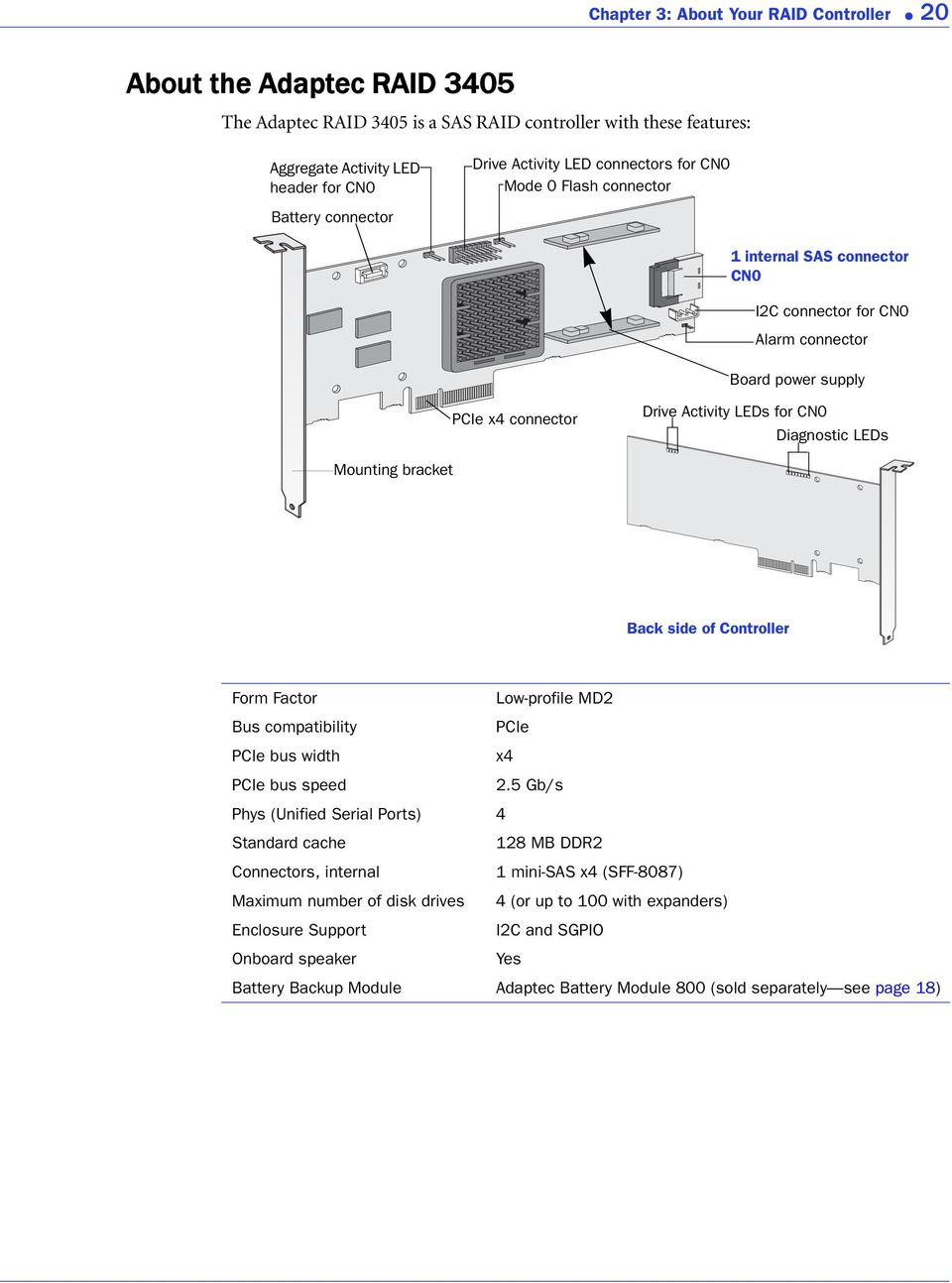
20 Chapter 3: About Your RAID Controller 20 About the Adaptec RAID 3405 The Adaptec RAID 3405 is a SAS RAID controller with these features: Aggregate Activity LED header for CN0 Drive Activity LED connectors for CN0 Mode 0 Flash connector Battery connector 1 internal SAS connector CN0 I2C connector for CN0 Alarm connector Board power supply PCIe x4 connector Drive Activity LEDs for CN0 Diagnostic LEDs Mounting bracket Back side of Controller Form Factor Low-profile MD2 Bus compatibility PCIe PCIe bus width x4 PCIe bus speed 2.5 Gb/s Phys (Unified Serial Ports) 4 Standard cache 128 MB DDR2 Connectors, internal 1 mini-sas x4 (SFF-8087) Maximum number of disk drives 4 (or up to 100 with expanders) Enclosure Support I2C and SGPIO Onboard speaker Yes Battery Backup Module Adaptec Battery Module 800 (sold separately see page 18)
21 Chapter 3: About Your RAID Controller 21 About the Adaptec RAID 3805 The Adaptec RAID 3805 is a SAS RAID controller with these features: Aggregate Activity LED header for CN0 Battery connector Drive Activity LED connectors for CN0/CN1 Mode 0 Flash connector CN1 Board power supply CN0 2 internal SAS connectors I2C connector for CN0 Alarm connector Aggregate Activity LED header for CN1 I2C connector for CN1 PCIe x4 connector Drive Activity LEDs Mounting bracket CN1 CN0 Diagnostic LEDs Back side of Controller Form Factor Low-profile MD2 Bus compatibility PCIe PCIe bus width x4 PCIe bus speed 2.5 Gb/s Phys (Unified Serial Ports) 8 Standard cache 128 MB DDR2 Connectors, internal 2 mini-sas x4 (SFF-8087) Maximum number of disk drives 8 (or up to 100 with expanders) Enclosure Support I2C and SGPIO Onboard speaker Yes Battery Backup Module Adaptec Battery Module 800 (sold separately see page 18)
22 Chapter 3: About Your RAID Controller 22 About the Adaptec RAID 5085 The Adaptec RAID 5085 is a SAS RAID controller with these features: Ext. Alarm Aggregate Activity Mode 0 Flash connector Activity LEDs Diagnostic LEDs Audible Alarm Drive Activity LED connectors for CN1/CN0 CN0 CN1 2 external SAS connectors Mounting bracket PCIe x8 connector Battery connector Form Factor Low-profile MD2 Bus compatibility PCIe PCIe bus width x8 PCIe bus speed 2.5 Gb/s Phys (Unified Serial Ports) 8 Standard cache 512 MB DDR2 Connectors, external 2 mini-sas x4 (SFF-8088) Maximum number of disk drives 8 direct-attached (or up to 256 with expanders) Enclosure Support I2C and SGPIO (Serial General Purpose Output) Onboard speaker Yes Battery Backup Module Adaptec Battery Module 800 (sold separately see page 18)
23 Chapter 3: About Your RAID Controller 23 About the Adaptec RAID 5405 The Adaptec RAID 5405 is a SAS RAID controller with these features: Drive Activity LED connectors for CN0/CN1 Drive Activity LEDs for CN0/CN1 Mode 0 Flash connector Aggregate Activity Diagnostic LEDs Internal mini-sas connector CN0 Status CN0 Mounting bracket PCIe x8 connector I2C connector for CN0 Battery connector Ext. Alarm connector Form Factor Low-profile MD2 Bus compatibility PCIe PCIe bus width x8 PCIe bus speed 2.5 Gb/s Phys (Unified Serial Ports) 4 Standard cache 256 MB DDR2 Connectors, internal 1 mini-sas x4 (SFF-8087) Maximum number of disk drives 4 direct-attached (or up to 256 with expanders) Enclosure Support I2C and SGPIO Onboard speaker Yes Battery Backup Module Adaptec Battery Module 800 (sold separately see page 18)
24 Chapter 3: About Your RAID Controller 24 About the Adaptec RAID 5445 The Adaptec RAID 5445 is a SAS RAID controller with these features: Drive Activity CN1/CN0 Status CN1/CN0 Mode 0 Flash connector Ext. Alarm Diagnostic LEDs (back of card) Internal mini-sas connector CN0 External SAS connector CN1 ABM-800 connector Mounting bracket Aggregate Activity Audible Alarm I2C connector for CN0 PCIe x8 connector Form Factor Low-profile MD2 Bus compatibility PCIe PCIe bus width x8 PCIe bus speed 2.5 Gb/s Phys (Unified Serial Ports) 8 Standard cache 512 MB DDR2 Connectors 1 mini-sas x4 (SFF-8087) internal 1 mini-sas x4 (SFF-8088) external Maximum number of disk drives 8 direct-attached (or up to 256 with expanders) Enclosure Support I2C and SGPIO Onboard speaker Yes Battery Backup Module Adaptec Battery Module 800 (sold separately see page 18)
25 Chapter 3: About Your RAID Controller 25 About the Adaptec RAID 5805 The Adaptec RAID 5805 is a SAS RAID controller with these features: Drive Activity LED connectors for CN0/CN1 Drive Activity LEDs for CN0/CN1 Mode 0 Flash connector Aggregate Activity Diagnostic LEDs CN1 CN0 2 internal mini-sas connectors Status CN1, CN0 I2C connector for CN1 I2C connector for CN0 PCIe x8 connector Battery connector Mounting bracket Ext. Alarm connector Form Factor Bus compatibility PCIe bus width PCIe bus speed Low-profile MD2 PCIe x8 2.5 Gb/s Phys (Unified Serial Ports) 8 Standard cache Connectors, internal Maximum number of disk drives Enclosure Support Onboard speaker 512 MB DDR2 2 mini-sas x4 (SFF-8087) 8 direct-attached (or up to 256 with expanders) I2C and SGPIO Yes Battery Backup Module Adaptec Battery Module 800 (sold separately see page 18)
26 Chapter 3: About Your RAID Controller 26 About the Adaptec RAID The Adaptec RAID is a SAS RAID controller with these features: Activity LED Phys and connectors F E Aggregate LED connectors C B A I2C connector for CN2 I2C connector for CN1 I2C connector for CN0 CN0 Alarm connector Mode 0 Flash connector Battery connector CN1 CN2 3 internal SAS connectors PCIe x8 connector Mounting bracket Activity LED Phys and connectors F = CN2 E = CN1, CN0 Aggregate LED connectors C = CN2 B = CN1 A = CN0 Form Factor Half-size Bus compatibility PCIe PCIe bus width x8 PCIe bus speed 2.5 Gb/s Phys (Unified Serial Ports) 12 Standard cache 256 MB DDR2 Connectors, internal 3 mini-sas x4 (SFF-8087) Maximum number of disk drives 12 (or up to 100 with expanders) Enclosure Support I2C and SGPIO Onboard speaker Yes Battery Backup Module Adaptec Battery Module 800 (sold separately see page 18)
27 Chapter 3: About Your RAID Controller 27 About the Adaptec RAID The Adaptec RAID is a SAS RAID controller with these features: Activity LED Phys and connectors F E Aggregate LED connectors D C B A I2C connector for CN3 I2C connector for CN2 I2C connector for CN1 I2C connector for CN0 CN0 Alarm connector Mode 0 Flash connector Battery connector CN1 CN2 CN3 4 internal SAS connectors Mounting bracket PCIe x8 connector Activity LED Phys and connectors F = CN3, CN2 E = CN1, CN0 Aggregate LED connectors D = CN3 C = CN2 B = CN1 A = CN0 Form Factor Half-size Bus compatibility PCIe PCIe bus width x8 PCIe bus speed 2.5 Gb/s Phys (Unified Serial Ports) 16 Standard cache 256 MB DDR2 Connectors, internal 4 mini-sas x4 (SFF-8087) Maximum number of disk drives 16 (or up to 100 with expanders) Enclosure Support I2C and SGPIO Onboard speaker Yes Battery Backup Module Adaptec Battery Module 800 (sold separately see page 18)
28 Chapter 3: About Your RAID Controller 28 About the Adaptec RAID The Adaptec RAID is a SAS RAID controller with these features: I2C, CN2 Activity CN2 Mode 0 Flash I2C, CN1 I2C, CN0 Activity CN0, CN1 CN6 1 external SAS connector CN0 CN1 CN2 3 internal mini-sas connectors ABM-800 connector Reserved Ext. Alarm Aggregate Activity Form Factor Bus compatibility PCIe bus width PCIe bus speed Full Height, Half Length PCIe x8 2.5 Gb/s Phys (Unified Serial Ports) 16 Standard cache Connectors, Internal Connectors, Exteneral Maximum number of disk drives Enclosure Support Onboard speaker 512 MB DDR2 3 mini-sas x4 (SFF-8087) 1 mini-sas x4 (SFF-8088) 16 direct-attached (or up to 256 with expanders) I2C and SGPIO Yes Battery Backup Module Adaptec Battery Module 800 (sold separately see page 18)
29 Chapter 3: About Your RAID Controller 29 About the Adaptec RAID The Adaptec RAID is a SAS RAID controller with these features: I2C, CN2 I2C, CN3 Mode 0 Flash Activity CN2, CN3 I2C, CN1 I2C, CN0 CN0 Activity CN0, CN1 CN6 1 external SAS connector CN1 CN2 CN3 4 internal mini-sas connectors ABM-800 connector Reserved Ext. Alarm Aggregate Activity Form Factor Full Height, Half Length Bus compatibility PCIe PCIe bus width x8 PCIe bus speed 2.5 Gb/s Phys (Unified Serial Ports) 20 Standard cache 512 MB DDR2 Connectors, Internal 4 mini-sas x4 (SFF-8087) Connectors, Exteneral 1 mini-sas x4 (SFF-8088) Maximum number of disk drives 20 direct-attached (or up to 256 with expanders) Enclosure Support I2C and SGPIO Onboard speaker Yes Battery Backup Module Adaptec Battery Module 800 (sold separately see page 18)
30 Chapter 3: About Your RAID Controller 30 About the Adaptec RAID The Adaptec RAID is a SAS RAID controller with these features: I2C, CN2 Mode 0 Flash connector Activity CN2, CN3 I2C, CN3 I2C, CN1 I2C, CN4 I2C, CN0 I2C, CN5 CN4 CN5 CN0 Activity CN0, CN1 CN6 1 external SAS connector ABM-800 connector CN1 CN2 CN3 6 internal mini-sas connectors Reserved Ext. Alarm Aggregate Activity Activity CN4, CN5 Form Factor Full Height, Half Length Bus compatibility PCIe PCIe bus width x8 PCIe bus speed 2.5 Gb/s Phys (Unified Serial Ports) 28 Standard cache 512 MB DDR2 Connectors, Internal 6 mini-sas x4 (SFF-8087) Connectors, Exteneral 1 mini-sas x4 (SFF-8088) Maximum number of disk drives 28 direct-attached (or up to 256 with expanders) Enclosure Support I2C and SGPIO Onboard speaker Yes Battery Backup Module Adaptec Battery Module 800 (sold separately see page 18)
31 Chapter 3: About Your RAID Controller 31 About the Adaptec RAID 2045 The Adaptec RAID 2045 is a SAS RAID controller with these features: Aggregate Activity Mode 0 Flash connector CN1 1 external mini- SAS connector PCIe x8 connector Mounting bracket Form Factor Low-profile MD2 Bus compatibility PCIe PCIe bus width x8 PCIe bus speed 2.5 Gb/s Phys (Unified Serial Ports) 4 Standard cache 128 MB DDR2 Connectors, external 1 mini-sas x4 (SFF-8088) Maximum number of disk drives 4 direct-attached (or up to 128 with expanders) Enclosure Support I2C and SGPIO Onboard speaker No Battery Backup Module No
32 Chapter 3: About Your RAID Controller 32 About the Adaptec RAID 2405 The Adaptec RAID 2405 is a SAS RAID controller with these features: Activity connector for CN0 Aggregate Activity Mode 0 Flash connector Internal mini-sas connector CN0 I2C, CN0 Mounting bracket PCIe x8 connector Form Factor Low-profile MD2 Bus compatibility PCIe PCIe bus width x8 PCIe bus speed 2.5 Gb/s Phys (Unified Serial Ports) 4 Standard cache 128 MB DDR2 Connectors, internal 1 mini-sas x4 (SFF-8087) Maximum number of disk drives 4 direct-attached (or up to 128 with expanders) Enclosure Support I2C and SGPIO Onboard speaker No Battery Backup Module No
33 Getting Started 4 In this chapter... Choosing a RAID Level Selecting Disk Drives and Cables Installation Options Basic Installation Steps This chapter provides the basic information you need to set up your disk drives and arrays the way you want them. It also describes the options you have for installing your Adaptec controller and disk drives, and creating arrays for data storage. Note: Before you begin, familiarize yourself with your Adaptec controller s physical features and the RAID levels that it supports (see About Your RAID Controller on page 16).
34 Chapter 4: Getting Started 34 Choosing a RAID Level This section provides a brief overview of the RAID levels supported by your Adaptec RAID controller, including the minimum and maximum number of disk drives required by each. RAID 0 (Non-redundant Array) Stripes data across multiple disk drives. Improved performance but no redundancy (see page 75). RAID 1 Array Created from two disk drives where one disk drive is a mirror of the other (the same data is stored on each disk drive). Redundancy, but reduced capacity (see page 76). RAID 1E Array Similar to a RAID 1 array except that data is mirrored and striped, and more disk drives can be included (see page 76). RAID 5 Array Stripes data for improved performance and uses parity data to provide redundancy (see page 78). RAID 5EE Array Similar to a RAID 5 array, but includes a distributed spare and must include a minimum of four disk drives (see page 79). RAID 10 Array Built from two or more equal-sized RAID 1 arrays, stripes and mirrors data across multiple disk drives. Redundancy and improved performance (see page 77). RAID 50 Array Built from multiple disk drives configured as two or more RAID 5 arrays, stripes stored data and parity data across all disk drives (see page 80). RAID 6 Array Similar to a RAID 5 array except that it includes two independent sets of parity data instead of one (see page 81). RAID 60 Array Similar to a RAID 50 array except that it includes four independent sets of parity data instead of two (see page 81). Use the table on page 82 to see how many disk drives you must connect to your RAID controller to support the RAID level you want.
35 Chapter 4: Getting Started 35 Selecting Disk Drives and Cables Disk Drives Your SAS controller supports both SAS and SATA disk drives. When selecting disk drives for your RAID array, ensure that all the disk drives have the same performance level. You can use different-sized disk drives in the array, but the array will be limited to the capacity of the smallest and slowest disk drive. For more information about arrays, refer to the Adaptec Storage Manager User s Guide or online Help. For more information about compatible disk drives, refer to the Adaptec Web site at Cables Depending on your requirements, you can use any of these cables: External mini-sas (SFF-8088 to SFF-8470) Connects to an external SAS enclosure. Internal mini-sas with power (SFF-8087 to SFF-8482) Connects to four SAS or SATA disk drives.
36 Chapter 4: Getting Started 36 Internal mini-sas to SATA fan-out (SFF-8087 to 4x SATA) Connects to four SATA disk drives. External mini-sas to mini-sas (SFF-8088 to SFF-8088) Connects to a backplane or enclosure. Internal mini-sas to mini-sas (SFF-8087 to SFF-8087) Connects to a backplane or enclosure. Cable connectors are keyed so that you can t insert them incorrectly. Adaptec recommends using only Adaptec SAS cables. For more information or to purchase cables, visit the Adaptec Web site at Installation Options When you install your Adaptec controller, you can choose to create a bootable array and then install your operating system and the controller driver on that array. Alternatively, you can complete a standard installation, where the controller driver is installed on an existing operating system.
37 Chapter 4: Getting Started 37 Basic Installation Steps This section describes the installation process. Follow the steps for the installation option you ve chosen. Installing with an Operating System 1 Install and connect your controller and internal disk drives (see page 38). If your controller has an external connector, you can connect external disk drives as well (or instead). 2 Set the boot controller (see page 44). 3 Create a bootable array (see page 44). 4 Install your operating system and the controller driver (see page 48.) 5 Install Adaptec Storage Manager and begin to manage your data storage (see page 59). Installing on an Existing Operating System 1 Install and connect your controller and internal disk drives (see page 38). If your controller has an external connector, you can connect external disk drives as well (or instead). 2 Install the controller driver (see page 54). 3 Install Adaptec Storage Manager and begin to manage your data storage (see page 59).
38 Installing the Controller and Disk Drives 5 In this chapter... Before You Begin Installing the Controller Connecting Disk Drives to Your Controllers Connecting External Devices Next Steps This chapter explains how to install your Adaptec RAID controller, and how to install and connect internal and external disk drives.
39 Chapter 5: Installing the Controller and Disk Drives 39 Before You Begin Read Safety Information on page 137. Familiarize yourself with your Adaptec RAID controller s physical features and the RAID levels that it supports (see page 16). Ensure you have the right quantity of disk drives for the RAID level you want to use for your arrays (see page 35). Ensure that you have the proper cables for your controller and disk drives (see page 35). If you are installing a low-profile RAID controller into a low-profile computer cabinet, replace the original full-height bracket with the low-profile bracket included in the kit.! Installing the Controller Caution: Handle the controller by its bracket or edges only. This section describes how to install your Adaptec RAID controller into your computer cabinet. 1 Turn off your computer and disconnect the power cord. Open the cabinet, following the manufacturer s instructions. 2 Select an available PCIe expansion slot that s compatible with your RAID controller and remove the slot cover, as shown at right. (PCIe bus compatibility is marked to the controller figures in About Your RAID Controller on page 16.)! Caution: Touch a grounded metal object before handling the RAID controller. 3 As shown at right, insert the RAID controller into the expansion slot and press down gently but firmly until it clicks into place. When installed properly, the RAID controller should appear level with the expansion slot. 4 Secure the bracket in the expansion slot, using the retention device (for instance, a screw or lever) supplied with your computer. 5 Connect your computer s disk activity LED cable to the LED connector on the controller (marked on the figures in About Your RAID Controller on page 16). Ensure that the positive lead of the LED cable (usually a red wire or a wire marked with a red stripe) is attached to pin 1. 6 Optional Connect your RAID controller s I2C connector (not available on all models) to an I2C connector on an internal backplane or enclosure, using an I2C cable. For more connection details, see About Your RAID Controller on page Prepare and install your internal disk drives, following the instructions in Connecting Disk Drives to Your Controllers on page 40. If you are not installing internal disk drives, close your computer cabinet, reattach the power cord, then continue with Connecting External Devices on page 41.
40 Chapter 5: Installing the Controller and Disk Drives 40 Connecting Disk Drives to Your Controllers You can connect SAS disk drives, SATA disk drives, or a combination of both to your SAS RAID controller. (See for a list of compatible disk drives.) There are no jumpers or switches to set before installation. If you plan to build a bootable array using internal disk drives, ensure you install at least the minimum number disk drives required to support the RAID level you want. See page 34 for more information. Note: Although you can connect both SAS and SATA disk drives to your SAS controller, Adaptec recommends that you not combine SAS and SATA disk drives within the same array or logical drive. See page 68 for more information. You have two connection options: To connect directly to the controller, see the following section. To connect to a backplane, see page 41. Connecting Directly to the Controller In a direct-attach connection, SAS or SATA disk drives are connected directly to a SAS card with SAS cables.the number of direct-attached disk drives is limited to four per internal SAS connector. (For more information about direct-attach connections, see page 71.) 1 Install your internal SAS or SATA disk drives, following the instructions in your system s documentation. 2 Use internal SAS or mini-sas cables to attach the disk drives to the controller, as shown in the following example. SAS/SATA disk drives internal x4 mini-sas connectors mini-sas to SATA fan-out cable Single-port connector Note: SAS fan-out cables are also available with an additional sideband (SFF-8448) cable that caries SGPIO signals for enclosure management. This additional sideband cable is not used with direct-attached disk drives.
41 Chapter 5: Installing the Controller and Disk Drives 41 3 When all internal disk drives have been installed and attached to the controller, close your computer cabinet, reattach the power cord, then continue with Connecting External Devices on page 41. Connecting to a System Backplane In a backplane connection, disk drives and SAS cards are attached to and communicate with each other through a system backplane. The number of disk drives is limited to the number of slots available on the backplane. Some backplanes have embedded SAS expanders and can support up to 128 end devices. (For more information about backplane and expander connections, see page 71.) 1 Connect one or more internal SAS or SATA disk drives to the backplane. (Refer to your system s documentation for more information.) 2 Use an internal SAS cable to connect the controller to the backplane, as shown in the examples on page 41. Disk drives on backplane Controller connected to backplane with Internal mini-sas to mini-sas (SFF-8087 to SFF-8087) Disk drives on backplane External SAS cable connecting to a drive bay 3 When all internal disk drives have been installed and connected, close your computer cabinet, reattach the power cord, then continue with Connecting External Devices on page 41. Connecting External Devices Controller connected to backplane with multi-lane cable (SFF-8484) Note: If you are not connecting any external devices, see the following section, Next Steps. Use high-quality cables to connect your controller to your external device(s), such as disk drives or disk drive enclosures. Adaptec recommends using only Adaptec cables. For more information or to purchase cables, visit the Adaptec Web site at
42 Chapter 5: Installing the Controller and Disk Drives 42 Next Steps If you are installing the controller driver and an operating system onto a bootable array, continue with Creating a Bootable Array on page 43. If you are completing a standard installation onto an existing operating system, continue with Installing the Driver on an Existing Operating System on page 54.
43 Creating a Bootable Array 6 In this chapter... Setting the Boot Controller Creating an Array Making Your Array Bootable This chapter explains how to set your Adaptec controller to be the boot controller, and how to create a bootable array. Note: If you are completing a standard installation onto an existing operating system, you don t have to complete this task. Skip to Installing the Driver on an Existing Operating System on page 54.
44 Chapter 6: Creating a Bootable Array 44 Setting the Boot Controller Note: If your system won t contain more than one bootable controller, skip to the next section, Creating an Array. Your Adaptec RAID controller supports bootable disk drives and bootable arrays. To enable your system to boot from either a disk drive or an array connected to your controller: 1 Enter the system setup. 2 Navigate to the drive boot sequence. 3 Move the boot controller to the top of the list. For more information, refer to your computer documentation. Creating an Array This section explains how to create an array. A RAID 5 array is created in the examples shown in this section because RAID 5 provides the most security and best performance with a minimum of three disk drives. However, you can choose to create an array with a different RAID level; you can also change array level later, after the operating system is installed. You can create an array using any of these tools: Array Configuration Utility (ACU) BIOS-based menus and keyboard navigation (see the following section). Adaptec Storage Manager Graphical software application (running from a bootable RAID installation CD) that you can navigate with your mouse (see page 60). ARCCONF Command line utility. For instructions, refer to the Adaptec RAID Controller Command Line Utility User s Guide. You can use either tool, but the ACU utility is the quicker and easier tool for this task. Note: Adaptec recommends that you not combine SAS and SATA disk drives within the same array. Adaptec Storage Manager generates a warning if you try to create a logical drive using a combination of SAS and SATA disk drives. See page 68 for more information. Creating an Array with the ACU The ACU is menu-based and instructions for completing tasks appear on-screen. Menus can be navigated using the arrows, Enter, Esc, and other keys on your keyboard. To create a RAID 5 array: 1 Power on your computer. When prompted, press Ctrl+A to enter the ARC utility. Note: During boot up, if your system has insufficient memory the following message will display. Adaptec RAID Configuration Utility will load after, system initialization. Please wait... Or press <Enter> Key to attempt loading the utility forcibly [Generally, not recommended] 2 If you have more than one controller of the same model or family in your computer, select your controller, then press Enter. 3 Select Array Configuration Utility, then press Enter.
45 Chapter 6: Creating a Bootable Array 45 4 Select Initialize Drives, then press Enter. 5 Select at least three disk drives for the array, press Insert for each selected disk drive, then press Enter.! Caution: During initialization, all data is deleted from the disk. Before continuing, back up any data you want to keep. 6 Press Y, then press Enter. The selected disk drives are initialized, then the ACU screen appears. 7 Select Create Array, then press Enter. 8 Select the disk drives that were just initialized, press Insert for each selected disk drive, then press Enter. 9 When the Array Properties screen opens, follow the instructions in the following table. Property Line Array Type Array Label Array Size Stripe Size Read Caching Write Caching Create RAID via [Done] Entry or Selection Select RAID 5, then press Enter. Type a name, then press Enter. Press Enter, then press Enter again to use the default granularity of GB. Press Enter to use the default (256 KB). Press Enter to use the default (Yes). Press Enter to use the default (Enable always). Press Enter to use the default (Build/Verify). Press Enter. 10 When a cache warning message displays, type Y. 11 Once the array is created, a message displays telling you that the array can now be used. Press any key to return to the ACU Menu. You can start using the array immediately. However, performance is reduced until the build process is complete. 12 Press Esc until the Exit utility window appears. 13 Select Yes, then press Enter. The computer restarts. 14 Continue with Making Your Array Bootable on page 47.
46 Chapter 6: Creating a Bootable Array 46 Creating an Array with Adaptec Storage Manager This section describes how to use the Adaptec Storage Manager configuration wizard to build a RAID 5 array. Note: You will need the Adaptec Storage Manager Installation CD to complete this task. To create a RAID 5 array: 1 Insert the Adaptec Storage Manager Installation CD into your CD drive, then restart your computer. 2 When prompted, select the language you want, then press Enter. 3 Review the license information, then press Enter. The main menu opens. 4 Click Launch Configuration Utility. Adaptec Storage Manager opens. 5 Click Create. The Configuration wizard opens. 6 Select Express configuration..., then click Next.
47 Chapter 6: Creating a Bootable Array 47 7 Review the information that is displayed. Note: In DAS environments, Adaptec Storage Manager uses the term logical drives when referring to arrays (see page 12). In this example, Adaptec Storage Manager has used thirteen equal-sized disk drives to automatically create one logical drive with RAID 5 and a hot spare. To exclude specific disk drives from the logical drive, specify a size for the logical drive, or to make other changes to the configuration, click Modify logical devices. 8 Click Apply, then click Yes when prompted to confirm applying your new configuration. Adaptec Storage Manager builds the logical drive. The configuration is saved on the Adaptec controller (as an array, see page 12) and on the physical disk drives. 9 Partition and format your logical drive. The logical drive you created appears as a physical disk drive on your operating system. You must partition and format these logical drives before you can use them to store data. 10 Close all windows, then click Reboot to restart your system. 11 Remove the Adaptec Storage Manager Installation CD. For information on installing and using Adaptec Storage Manager as a full software application, refer to the Adaptec Storage Manager User s Guide or online Help. 12 Continue with the following section. Making Your Array Bootable Use the ACU to make the array bootable (see Creating Bootable Arrays on page 85). Then continue with Installing the Driver and an Operating System on page 48.
48 Installing the Driver and an Operating System 7 In this chapter... Before You Begin Creating a Driver Disk Installing with Windows Installing with Red Hat Linux Installing with SUSE Linux Installing with OpenServer Installing with UnixWare Installing with Solaris Installing with VMware Installing with FreeBSD...53 This chapter explains how to install your Adaptec RAID controller driver and an operating system onto a bootable array (see page 43). To install the driver on an existing operating system, see page 54.
49 Chapter 7: Installing the Driver and an Operating System 49 Before You Begin Install and connect your Adaptec RAID controller and internal disk drives (see page 38). Create a bootable array (see page 43). Create a driver disk (see the following section). Note: For up-to-date operating system version support, visit the Adaptec Web Site at From the main menu select Support>Knowledgebase>Find Answers. Select your controller type and OS support to generate a list of supported operating systems and to download the latest drivers. Creating a Driver Disk Note: You will need a floppy disk to complete this task. To create a driver disk: 1 Set your system BIOS so that your computer boots from the CD drive. (For instructions, refer to your computer documentation.) 2 Turn on your computer, then insert the RAID Installation CD included in your RAID controller kit. 3 Follow the on-screen instructions to get to the Adaptec Start Menu. 4 Click Create Driver Disk(s) for Installing/Updating your OS, then select your operating system. Note: Linux only If prompted, select your operating system and then the version. 5 When prompted, insert a floppy disk, then click OK. The system creates the driver disk. 6 Remove and label the driver disk. 7 Continue with the instructions for your operating system: For Windows, see page 49. For Red Hat Linux, see page 51. For SUSE Linux, see page 51. For OpenServer, see page 51. For UnixWare, see page 52. For Solaris, see page 52 For VMware, see page 53. For FreeBSD, see page 53. Installing with Windows Note: You will need your Windows Installation CD to complete this task.
50 Chapter 7: Installing the Driver and an Operating System 50 Installing with Windows Server 2003 or Windows XP To install the Adaptec RAID controller driver while installing Windows: 1 Insert your Windows CD, then restart the computer. 2 Follow the on-screen instructions to begin the Windows installation. 3 When prompted to install a third-party driver, press F6. Note: When F6 is active, a prompt appears at the bottom of the screen for only 5 seconds. If you miss your chance to press F6, restart your computer. 4 Insert the driver disk, then wait until you are prompted to install a driver. 5 Press S to specify that the driver is on a floppy disk, then press Enter. The computer reads the disk. 6 When the Adaptec driver is found, press Enter. 7 Follow the on-screen instructions to complete the installation. 8 Continue with Managing Your Storage Space on page 59. Installing with Windows Server 2008 or Windows Vista To install the Adaptec RAID controller driver while installing Windows: 1 Insert your Windows CD, then restart the computer. 2 Follow the on-screen instructions to begin the Windows installation. 3 When prompted to specify a location for Windows, select Load Driver. 4 Insert the driver disk, then click OK. 5 When the Adaptec driver is found, press Next. 6 Click Next again to accept the default partition configuration, or refer to your Windows documentation to configure partitions manually. 7 Follow the on-screen instructions to complete the installation. 8 Continue with Managing Your Storage Space on page 59.
51 Chapter 7: Installing the Driver and an Operating System 51 Installing with Red Hat Linux Note: You will need your Red Hat Installation CD to complete this task. To install the Adaptec RAID controller driver while installing Red Hat Linux: 1 Insert the first Red Hat Installation CD. 2 Restart your computer. 3 When the Red Hat Welcome screen appears, type linux dd at the Boot: prompt. 4 When prompted, insert the driver disk, then select OK. 5 Follow the prompts to set up the environment you want. 6 If you are installing other third-party devices, install them now. Otherwise, select Done. 7 Complete the Linux installation, following the instructions included with your operating system. 8 Continue with Managing Your Storage Space on page 59. Installing with SUSE Linux To install the Adaptec RAID controller driver while installing SUSE Linux: 1 Insert the first SUSE Installation CD. 2 Restart your computer. 3 When the SUSE installation selection screen appears, choose the type of installation you want, then press the F6 key to indicate the use of a driver disk. (If F6 is not shown on the screen, you may have an older version of SUSE; press the Alt key instead.) 4 When prompted, insert the driver disk, then press any key to continue. 5 Follow the prompts to set up the environment you want. 6 If you are installing other third-party devices, install them now. Otherwise, select Back. 7 Complete the Linux installation, following the instructions included with your operating system. 8 Continue with Managing Your Storage Space on page 59. Installing with OpenServer Note: You will need your OpenServer Installation CD to complete this task. To install the driver when installing OpenServer: 1 Insert the OpenServer Installation CD. 2 Restart your computer. 3 Follow the on-screen instructions to begin the OpenServer installation. 4 When prompted to load more HBA drivers, insert the driver disk, then select Yes. (To load more HBA drivers, repeat this step.)
52 Chapter 7: Installing the Driver and an Operating System 52 5 When all drivers have loaded, select No. 6 Complete the OpenServer installation, following the instructions included with your operating system. 7 Continue with Managing Your Storage Space on page 59. Installing with UnixWare Note: You will need your UnixWare Installation CD to complete this task. To install the driver when installing UnixWare: 1 Insert the UnixWare Installation CD. 2 Restart your computer. 3 Follow the on-screen instructions to begin the UnixWare installation. 4 When prompted to load more HBA drivers, insert the driver disk, then select Yes. (To load more HBA drivers, repeat this step.) 5 When all drivers have loaded, select No. 6 Complete the UnixWare installation, following the instructions included with your operating system. 7 Continue with Managing Your Storage Space on page 59. Installing with Solaris Note: This task is not necessary if you are installing Solaris 10 Update 2 or later. Instead, you can choose to install Solaris using the in-box driver and update it either during or after the installation is complete, if required. You will need a floppy disk to complete this task. To create a driver disk: 1 Start your computer. 2 Interrupt the autoboot, press the ESC key. The Device Configuration Assistant (DCA) Utility will open. 3 Select F4_Add Driver. 4 Insert a floppy disk. 5 Complete the Solaris installation, following the instructions included with your operating system.
53 Chapter 7: Installing the Driver and an Operating System 53 Installing with VMware Note: You will need your VMware Installation CD to complete this task. To install the driver when installing VMware: 1 Insert the VMware Installation CD. 2 Restart your computer. 3 Follow the on-screen instructions to begin the VMware installation. Note: The VMware embedded driver will see the device and install. 4 Complete the VMware installation, following the instructions included with your operating system. Note: Currently, the Adaptec Storage Manager GUI is not supported on VMware. To create and manage arrays, you must connect to the VMware machine from a remote GUI or use the ARCCONF utility. See page 61 for more information. Installing with FreeBSD Note: You will need your FreeBSD Installation CD to complete this task. To install the driver when installing FreeBSD: 1 Insert the FreeBSD Installation CD. 2 Restart your computer. 3 When the FreeBSD start screen opens, select 6 to escape to loader prompt. 4 Type load kernel. 5 Insert the driver floppy disk. 6 Type load disk0:aacu.ko. If the driver fails to load, run lsdev and check for the floppy disk drive. Then, try again with the appropriate device. 7 Type boot. 8 Complete the FreeBSD installation, following the instructions included with your operating system. 9 Reboot your computer, then remove the driver disk. 10 Repeat Steps 3 through 7 the first time you boot the operating system to load the drivers again for the initial bootup.
54 Installing the Driver on an Existing Operating System 8 In this chapter... Before You Begin Creating a Driver Disk Installing on Windows...56 Installing on Red Hat or SUSE Linux Installing on OpenServer Installing on UnixWare...57 Installing on Solaris Installing on VMware Installing on FreeBSD This chapter explains how to install your Adaptec RAID controller driver. Note: To install the driver while you re installing an operating system, see page 48.
55 Chapter 8: Installing the Driver on an Existing Operating System 55 Before You Begin Before you begin, install and connect your Adaptec RAID controller and internal disk drives (see page 38). You must also create a driver disk (see page 49) before you begin installing the controller driver. Note: For up-to-date operating system version support, visit the Adaptec Web Site at From the main menu select Support>Knowledgebase>Find Answers. Select your controller type and OS support to generate a list of supported operating systems and to download the latest drivers. Creating a Driver Disk Note: You will need a floppy disk to complete this task. To create a driver disk: 1 Set your system BIOS so that your computer boots from the CD drive. (For instructions, refer to your computer documentation.) 2 Turn on your computer, then insert the RAID Installation CD included in your RAID controller kit. 3 Follow the on-screen instructions to get to the Adaptec Start Menu. 4 Click Create Driver Disk(s) for Installing/Updating your OS, then select your operating system. Note: Linux only If prompted, select your operating system and then the version. 5 When prompted, insert a floppy disk, then click OK. The system creates the driver disk. 6 Remove and label the driver disk. 7 Continue with the instructions for your operating system: For Windows, see page 56. For Red Hat or SUSE Linux, see page 56. For OpenServer, see page 57. For UnixWare, see page 57. For Solaris, see page 57. For VMware, see page 58. For FreeBSD, see page 58.
56 Chapter 8: Installing the Driver on an Existing Operating System 56 Installing on Windows Follow the instructions in this section for your version of Windows. Installing on Windows Server 2003 or Windows XP To install the driver on Windows: 1 Start or restart Windows. The Found New Hardware Wizard opens and searches for the driver. 2 Insert the driver disk, select Floppy drive, then click Next. 3 Click Next, then click Next again. 4 Follow the on-screen instructions to complete the driver installation. 5 Remove the driver disk and restart your computer. 6 Continue with Managing Your Storage Space on page 59. Installing with Windows Server 2008 or Windows Vista 1 Start or restart Windows. The Found New Hardware Wizard opens and searches for the driver. 2 Insert the driver disk, then select Locate and Install Driver Software... and Don t Search Online. 3 Click Next, then click Close. 4 When the installation is complete, remove the driver disk and restart your computer. 5 Continue with Managing Your Storage Space on page 59. Installing on Red Hat or SUSE Linux To install the module on Red Hat or SUSE Linux: 1 Insert and mount the RAID Installation CD: Red Hat: mount /dev/cdrom /mnt/cdrom SUSE: mount /dev/cdrom /media/cdrom 2 Install the module RPM: rpm -Uvh mount-point/xxx/yyy.rpm where mount-point is the specific mount point on the Linux system, xxx is the driver path, and yyy.rpm is the rpm file. 3 Reboot your computer to ensure the driver loaded correctly. 4 Run fdisk, mkfs, and create mount points for any new disk drives. 5 Continue with Managing Your Storage Space on page 59.
57 Chapter 8: Installing the Driver on an Existing Operating System 57 Installing on OpenServer To install the driver on OpenServer: 1 Start your computer, then insert the driver disk. 2 Begin the driver package installer: pkgadd -d diskette1 3 At the installer prompt, type go. 4 Select 1 for the aacraid package. 5 When the installation is complete, select q to quit the installer. 6 Reboot your computer and remove the driver disk. 7 Continue with Managing Your Storage Space on page 59. Installing on UnixWare To install the driver on UnixWare: 1 Start your computer, then insert the driver disk. 2 Begin the driver package installer: pkgadd -d diskette1 3 At the installer prompt, type go. 4 Select 1 for the aacraid package. 5 When the installation is complete, select q to quit the installer. 6 Reboot your computer and remove the driver disk. 7 Continue with Managing Your Storage Space on page 59. Installing on Solaris To install the driver on Solaris: 1 Start your computer. 2 Check for any pre-existing Adaptec driver by performing a pkginfo SUNWaac in a terminal window. If there is no pre-existing Adaptec driver on your computer, continue with Step 3. If an Adaptec driver is already installed on your computer, perform a pkgrm SUNWaac to remove it.! Caution: If your operating system currently boots from the Adaptec controller, do not reset your computer after you remove the pre-existing Adaptec driver. Instead, follow the steps in this section to install a new driver before rebooting your computer. 3 Insert and mount the driver disk: volcheck 4 Change to the driver installer directory: cd /floppy/floppy0/du/sol_210/i86pc/tools
58 Chapter 8: Installing the Driver on an Existing Operating System 58 5 Start the driver installer:./install.sh -i 6 Reboot your computer, then remove the driver disk. 7 Continue with Managing Your Storage Space on page 59. Installing on VMware Note: The embedded driver provided by VMware should be suitable for most applications. If an updated driver is needed, use the following procedure. To install the driver on VMware: 1 Start your computer, then insert the driver disk. 2 At the console screen of the VMware server, mount the Adaptec Installation CD: mount r /dev/cdrom /mnt/cdrom. 3 Install the module RPM: rpm -i --force VMware esx-drivers-scsi-aacraid i586.rpm 4 Follow the on-screen instructions to save the boot image and run the vmware-mkinitrd command manually. 5 Reboot your computer and remove the driver disk. Note: Currently, the Adaptec Storage Manager GUI is not supported on VMware. To create and manage arrays, you must connect to the VMware machine from a remote GUI or use the ARCCONF utility. See page 61 for more information. Installing on FreeBSD To install the driver on FreeBSD: 1 Start your computer. 2 Insert and mount the driver disk: mount -t msdos /dev/fd0 /mnt 3 Copy the driver package to the /tmp directory: cp /mnt/aac x.tgz /tmp 4 Install the driver package: pkg_add /tmp/aac x.tgz 5 Reboot your computer, then remove the driver disk.
59 Managing Your Storage Space 9 In this chapter... About Adaptec Storage Manager About the Adaptec RAID Controller Configuration Utility About the Adaptec RAID Configuration Utility About the Adaptec Flash Utility Which Utility Should I Use? Once you have installed your Adaptec RAID controller, disk drives (or other devices), and device driver, you can begin to build and manage your storage space. This chapter introduces Adaptec Storage Manager, and describes the other utilities included with your Adaptec RAID controller.
60 Chapter 9: Managing Your Storage Space 60 About Adaptec Storage Manager Adaptec Storage Manager is a full-featured software application that helps you build a storage space for your online data, using Adaptec RAID controllers and disk drives. With Adaptec Storage Manager, you can group disk drives into logical drives and build in redundancy to protect your data and improve system performance. From a single workstation, you can use Adaptec Storage Manager to monitor and manage all the controllers and disk drives in your storage space, including DAS and NAS. When Adaptec Storage Manager is installed on a computer, the Adaptec Storage Manager agent is also installed automatically. The agent is like a service that keeps your storage space running. It s designed to run in the background, without user intervention, and its job is to monitor and manage system health, event notifications, task schedules, and other on-going processes on that system. It sends notices when tasks are completed successfully, and sounds an alarm when errors or failures occur on that system. The agent uses less memory than the full application. If your storage space includes systems that won t be connected to monitors (and therefore won t require the user interface), you can choose to run the agent only on those systems instead of the full application. For more information, refer to the Adaptec Storage Manager online Help, or to the Adaptec Storage Manager User s Guide on the Adaptec Storage Manager Installation CD. Installing Adaptec Storage Manager Adaptec Storage Manager is included on the Adaptec Storage Manager Installation CD. For installation instructions, refer to the Adaptec Storage Manager User s Guide, also included on the Adaptec Storage Manager Installation CD. About the Adaptec RAID Controller Configuration Utility The Adaptec RAID Controller Configuration (ARCCONF) is a command line utility that you can use to perform some basic array and configuration management functions. With ARCCONF, you can: Create and delete logical drives Modify and copy configuration settings Recover from disk drive failures and troubleshoot ARCCONF and the Adaptec RAID Controller Command Line Utility User s Guide, which describes how to use ARCCONF, are included on the Adaptec Storage Manager Installation CD. Note: Adaptec recommends that only advanced users familiar with command line interfaces use ARCCONF.
61 Chapter 9: Managing Your Storage Space 61 About the Adaptec RAID Configuration Utility The Adaptec RAID Configuration (ARC) utility is a BIOS-based utility that you can use to create and manage controllers, disk drives and other devices, and arrays. The ARC utility comprises these tools: Array Configuration Utility (ACU) For creating and managing arrays, and initializing and rescanning disk drives. (ACU for DOS is also available. See page 92.) SerialSelect For modifying your controller and disk drive settings. Disk Utilities For formatting or verifying disk drives. The ARC utility is included in your controller s BIOS. For more information, see Using the Adaptec RAID Configuration Utility on page 83. Note: The ARC utility is primarily intended for preoperating system installation configuration. About the Adaptec Flash Utility The Adaptec Flash Utility (AFU) is a text-based DOS utility that you can use to update, save, or verify your RAID controller s firmware BIOS and Non-Volatile Random Access Memory (NVRAM).! Caution: Although the AFU contains safeguards to prevent you from accidentally damaging your RAID controller s flash contents, it is still important to use the AFU carefully and correctly to avoid rendering your RAID controller inoperable.adaptec recommends that only advanced users familiar with working in DOS use the AFU. You can also use Adaptec Storage Manager to update the controller firmware/bios. See the Adaptec Storage Manager User s Guide for more information. Which Utility Should I Use? To create a bootable array, Adaptec recommends that you use the BIOS-based ACU (See Using the Adaptec RAID Configuration Utility on page 83). For all subsequent storage management tasks, Adaptec recommends that you install and use Adaptec Storage Manager (see page 60). As a full-featured software application with a graphical user interface, it is the easiest to use and offers the widest range of management functions.
62 Solving Problems 10 In this chapter... Troubleshooting Checklist Silencing the Alarm Recovering from a Disk Drive Failure Resetting the Controller This chapter provides basic troubleshooting information and solutions for solving controller problems.
63 Chapter 10: Solving Problems 63 Troubleshooting Checklist If you encounter difficulties installing or using your Adaptec RAID controller, check these items first: With your computer powered off, check the connections to each disk drive, power supply, LED connector, and so on. Try disconnecting and reconnecting disk drives from the Adaptec RAID controller. Check that your Adaptec RAID controller is installed in a compatible PCIe expansion slot. To double-check the bus compatibility of your controller, see About Your RAID Controller on page 16. Ensure that your Adaptec RAID controller is firmly seated and secured in the PCIe expansion slot. If your Adaptec RAID controller is not detected during system boot, try installing it in a different compatible expansion slot. (See page 39 for instructions.) Did the driver install correctly? If you have external disk drives (or other devices), are they powered on? Check the Readme on your installation CD for compatibility issues and known problems. If you are still unable to resolve a problem, you can find additional troubleshooting information and direction on the Adaptec Web site at or the Support Knowledgebase at ask.adaptec.com. Monitoring Disk Drives Status You can use the blink feature of Adaptec Storage Manager to monitor the status of your SAS and SATA disk drives. When you blink a specific disk drive or set of disk drives, the LED(s) on the selected disk drives flash. This table describes the LED flash states. Controller Device State Slot State LED Flash State Failed Device is faulty On Rebuilding Device is rebuilding Slow flash Blink Identify the device Fast flash Other No error Off For more information about backplanes, see Backplane Connections on page 71. For more information about using Adaptec Storage Manager to monitor your disk drives, refer to the Adaptec Storage Manager User s Guide or the online Help. Silencing the Alarm If your Adaptec RAID controller includes an alarm, the alarm will sound when an error occurs. To silence the alarm, use Adaptec Storage Manager (see Managing Your Storage Space on page 59.) OR SerialSelect (see Modifying Your Controller s Configuration on page 88.)
64 Chapter 10: Solving Problems 64 Recovering from a Disk Drive Failure This section explains how to recover when a disk drive fails: If the array was protected by a hot spare (see page 64). If the array was not protected by a hot spare (see page 64). If there is a disk drive failure in more than one array simultaneously (see page 64). If it is a RAID 0 array (see page 65). If multiple disk drives fail within the same array (see page 65). Note: In DAS environments, Adaptec Storage Manager uses the term logical drives when referring to arrays (see page 12). Failed Disk Drive Protected by a Hot Spare When an array is protected by a hot spare, if a disk drive in that array fails the hot spare is automatically incorporated into the array and takes over for the failed drive. To recover from the failure: 1 Remove and replace the failed disk drive. 2 If copyback is not enabled In Adaptec Storage Manager, remove the hot spare designation from the original hot spare (the disk drive that was built into the array). Then, designate a new hot spare to protect the arrays on that controller. If copyback is enabled Data is automatically moved back to its original location once the controller detects that the failed drive has been replaced. No action is required. Failed Disk Drive Not Protected by a Hot Spare When a array is not protected by a hot spare, if a disk drive in that array fails, remove and replace the failed disk drive. The controller detects the new disk drive and begins to rebuild the array. If the controller fails to rebuild the array, check that the cables, disk drives, and controllers are properly installed and connected. Make sure that the new disk drive is equal or greater in size than the failed disk drive. Then, if necessary, use Adaptec Storage Manager to rebuild the array. For instructions, refer to the Adaptec Storage Manager User s Guide or online Help. Failure in Multiple Arrays Simultaneously If there s a disk drive failure in more than one array at the same time (one failure per array), and the arrays have hot spares protecting them, the controller rebuilds the arrays with these limitations: A hot spare must be of equal or greater size than the failed disk drive it s replacing. Failed disk drives are replaced with hot spares in the order in which they failed. (The array that includes the disk drive that failed first is rebuilt first, assuming an appropriate hot spare is available see bullet above.) If there are more disk drive failures than hot spares, see Failed Disk Drive Not Protected by a Hot Spare.
65 Chapter 10: Solving Problems 65 If copyback is enabled, data is moved back to its original location once the controller detects that the failed drive has been replaced. Disk Drive Failure in a RAID 0 Array Because RAID 0 volumes do not include redundancy, if a disk drive fails in a RAID 0 array, the data can t be recovered. Correct the cause of the failure or replace the failed disk drives. Then, restore your data (if available). Multiple Failures in the Same Array Except in RAID 6 and RAID 60 arrays (see page 74), if more than one disk drive fails at the same time in the same array, the data normally can t be recovered. You may be able to recover the data by forcing the logical drive online or by recreating the logical drive without the initialization step. You can use the BIOS utility, ACU (see page 61), the command-line utility, ARCCONF, or Adaptec Storage Manager. For more information, refer to the Adaptec RAID Controller Command Line Interface User s Guide and the Adaptec. Storage Manager User s Guide. Note: In some instances, RAID 10 and RAID 50 arrays may survive multiple disk drive failures, depending on which disk drives fail. Resetting the Controller This section explains how to reset (or Mode 0 flash) your Adaptec RAID controller. You may want to do this if the controller becomes inoperable, or if a firmware upgrade is unsuccessful. To reset your Adaptec RAID controller: 1 Download the firmware version currently installed on your controller from 2 Extract the downloaded files to a folder on your local hard drive (for example, C:\Download\Drivers). 3 Create a bootable MS DOS floppy disk and copy the AFU.exe file to it. Copy the first firmware image to the same floppy disk. 4 Create additional bootable MS DOS floppy disks and copy each additional firmware image to its own floppy disk. 5 Power off your computer, disconnect the power cord, then open the cabinet following the manufacturer s instructions. 6 Disconnect all cables from the controller, then attach a shorting jumper to the Mode 0 flash connector. (To locate the Mode 0 flash connector on your Adaptec RAID controller, see the figures in About Your RAID Controller on page 16.) 7 Reconnect the power cord, power on your computer, then boot to the floppy disk containing the AFU.exe file (see Step 3). 8 At the prompt, type a:\afu update /c x where x is the controller number.
66 Chapter 10: Solving Problems 66 9 Insert the other floppy disks when prompted. 10 When the flash is complete, power off your computer, disconnect the power cord, then remove the jumper. 11 Close the computer cabinet, reconnect the power cord, then power on your computer. The controller should boot correctly.
67 Introduction to SAS A In this appendix... Terminology Used in This Chapter What is SAS? How Do SAS Devices Communicate? What s a Phy? What s a SAS Port? What s a SAS Address? What s a SAS Connector? What do SAS Cables Look Like? How are Disk Drives Identified in SAS? What are the SAS Connection Options? How is SAS Different from Parallel SCSI? This section provides a basic overview of the main features of SAS, introduces some common SAS terms, and explains how SAS differs from parallel SCSI. Note: For technical articles and tutorials about SAS, refer to the SCSI Trade Association (STA TM ) Web site at
68 Appendix A: Introduction to SAS 68 Terminology Used in This Chapter What is SAS? For convenience, SAS HBAs and SAS RAID controllers are referred to generically in this chapter as SAS cards. HBAs, RAID controllers, disk drives, and external disk drive enclosures are referred to as end devices and expanders are referred to as expander devices. For convenience, this chapter refers to end devices and expander devices collectively as SAS devices. Legacy parallel SCSI is an interface that lets devices such as computers and disk drives communicate with each other. Parallel SCSI moves multiple bits of data in parallel (at the same time), using the SCSI command set. SAS is an evolution of parallel SCSI to a point-to-point serial interface. SAS also uses the SCSI command set, but moves multiple bits of data one at a time. SAS links end devices through direct-attach connections, or through expander devices. SAS cards can typically support up to 128 end devices and can communicate with both SAS and SATA devices. (You can add 128 end devices or even more with the use of SAS expanders. See page 72.) Note: Although you can use both SAS and SATA disk drives in the same SAS domain (see page 72), Adaptec recommends that you not combine SAS and SATA disk drives within the same array or logical drive. The difference in performance between the two types of disk drives may adversely affect the performance of the array. Data can move in both directions simultaneously across a SAS connection (called a link see page 69). Link speed is 300 MB/sec in half-duplex mode. Therefore, a SAS card with eight links has a bandwidth of 2400 MB/sec. Although they share the SCSI command set, SAS is conceptually different from parallel SCSI physically, and has its own types of connectors, cables, connection options, and terminology, as described in the rest of this chapter. To compare SAS to parallel SCSI, see How is SAS Different from Parallel SCSI? on page 73.
69 Appendix A: Introduction to SAS 69 How Do SAS Devices Communicate? SAS devices communicate with each other through links. A link is a physical connection between two phys. As shown in the following figure, SAS devices contain ports (see page 70), ports contain phys, and each phy contains one transmitter and one receiver one transceiver. A phy can belong to one port only. Narrow Port SAS Device Phy Receiver Transmitter link Transmitter Receiver SAS Device Phy Narrow Port Wide Port SAS Device Phy Phy Receiver Transmitter Receiver Transmitter Transmitter Receiver Transmitter Receiver Phy Phy SAS Device Wide Port Phy Receiver Transmitter Transmitter Receiver Phy Wide Port Phy Phy Receiver Transmitter Receiver Transmitter Transmitter Receiver Transmitter Receiver Phy Phy Wide Port Phy Receiver Transmitter Transmitter Receiver Phy What s a Phy? Phys are part of the physical communication connection between SAS devices. Each phy contains a transceiver that sends data back and forth between SAS devices. When a connection is formed between two end devices, a link is established from a phy in one port to a phy in the other port. As shown in the figure above, a wide port can support multiple independent links simultaneously. Phys are internal, within SAS connectors (see page 70). SAS cables physically connect one or more phys on one SAS device to one or more phys on another SAS device.
70 Appendix A: Introduction to SAS 70 What s a SAS Port? Note: Because the physical link between SAS devices is from phy to phy, rather than port to port, a port is more of a virtual concept, different from what is normally considered a port on other types of RAID controllers and storage devices. A port is one or more phys. A narrow port contains one phy. A wide port typically contains four phys. Each port has its own unique SAS address (see page 71), and all the phys in a port share that same SAS address. SAS card port options vary. A SAS card with four phys could be configured with one wide port, with two wide ports that comprise two phys, or with four narrow ports each containing one phy. (A wide port with four phys is referred to as a 4-wide or 4x port.) What s a SAS Address? Each SAS port is identified with a unique SAS address, which is shared by all phys on that port. For example, a SAS disk drive might have two narrow ports. Each port has one unique SAS address. The single phy in each port uses its port s SAS address. In another example, a SAS device might have one 4-wide port. That port has one SAS address, which is shared by all four phys in the port. Unlike SCSI devices and SCSI IDs, SAS devices self-configure their SAS addresses. User intervention is not required to set SAS addresses, and SAS addresses cannot be modified. What s a SAS Connector? A SAS or mini-sas connector is the physical plug or receptacle that you see on a SAS device. It s what you plug a SAS cable into, or the end of the SAS cable that s being plugged in. (See Cables on page 35.) A connector is what forms physical links between phys. Some SAS connectors can support multiple links. The number of links a SAS connector can support is referred to as its width. Narrow connectors support a single link; wide connectors supports more than 1 link. A single SAS device may have one or more connectors. A single SAS connector may help form links between more than two SAS devices. (For instance, as shown in the figure on page 40, the 4-wide internal SAS connector forms links with four independent disk drives.) What do SAS Cables Look Like? Internal standard SAS cables are narrower than internal parallel SCSI cables. The connectors vary in size depending on the number of links they support, from single link connectors to 4-wide (or larger) connectors. Internal fan-out cables let you attach four disk drives to a single 4-wide connector. Mini-SAS connectors support both internal and external SAS connections. The mini-sas connectors are smaller than the standard SAS internal and external connectors. Mini-SAS connectors support single and multilinks with the ability to scale to future speed needs. For examples of some internal SAS/mini-SAS cables and an external SAS/mini-SAS cables, see Cables on page 35.
71 Appendix A: Introduction to SAS 71 How are Disk Drives Identified in SAS? In the BIOS and in the management utilities (see Identifying Disk Drives on page 90), disk drives are identified in the following formats: CNX:DevY = Device Y is attached to Connector X (see Direct-attach Connections below for more information) BoxX:SlotX = Enclosure X is attached to a disk drive in Slot X (see Backplane Connections below for more information) ExpX:PhyX = Expander X is attached to Phy X (see SAS Expander Connections below for more information) where X is the count number. Note: Devices other than disk drives (CDROM, tape drives, etc...) are listed in order after your system disk drives. In parallel SCSI, XX is the disk drive s channel number, YY is the target number, and ZZ is the logical unit number (LUN). What are the SAS Connection Options? You can connect end devices to each other through direct cable connections and through backplane connections. When you use one or more expander devices (see page 72), you can create large configurations. Direct-attach Connections In a direct-attach connection, SAS or SATA disk drives are connected directly to a SAS card with SAS or mini-sas cables. One disk drive is attached to one SAS/mini-SAS connector with one SAS/mini-SAS cable (or multiple disk drives are attached to one SAS/mini-SAS connector with one fan-out cable). The figure on page 40 shows an example of direct-attach connections. The number of direct-attached disk drives is limited to the number of phys supported by the SAS card. (Note that there may be multiple phys within a single connector. See page 72.) Backplane Connections In a backplane connection, disk drives and SAS cards are attached to and communicate with each other through a system backplane. There are two types of backplane connections, passive and active. When connecting to either backplane, it s important to properly connect your disk drive LEDs in order to identify disk drive conditions. See About Your RAID Controller on page 16 for your RAID controller Activity LED connections and locations. Once you have connected to a backplane, the Adaptec Storage Manager enables you to manage your disk drives. For more information, refer to the Adaptec Storage Manager User s Guide on the Adaptec Storage Manager Installation CD..The number of end devices is limited to the number of slots available on the backplane. For example, the Adaptec S50 enclosure, which contains an expander, is a backplane connection that supports up to 12 SAS or SATA disk drives.
72 Appendix A: Introduction to SAS 72 Some backplanes support daisy-chain expansion to other backplanes. For example, you can daisy-chain (connect one to the next) up to nine Adaptec S50 enclosures to a single SAS card in a host system. SAS Expander Connections A SAS expander device literally expands the number of end devices that you can connect together. Expander devices, typically embedded into a system backplane (see page 71), support large configurations of SAS end devices, including SAS cards and SAS and SATA disk drives. With expander devices, you can build large and complex storage topologies. There are two types of SAS expanders: fanout expanders and edge expanders. Each performs a different role in a storage system. (For more information about how SAS expanders work, refer to the STA Web site at You can connect up to 128 SAS ports to an edge expander. (A single edge expander can therefore support up to 128 SAS addresses.) You can connect up to 128 edge expanders to a fanout expander. You can use only one fanout expander in any single SAS domain (a topology of SAS and possibly SATA end devices and expander devices). A single SAS domain can therefore comprise up to 16,384 SAS ports (and therefore up to 16,384 SAS addresses including the fanout expander). The next figure illustrates (in very basic terms) a SAS domain and shows how SAS cards, SAS and SATA disk drives, and expander devices can fit together in a large data storage topology. SAS Domain Disk Drives SAS SAS Edge Expander SATA Edge Expander Disk Drives SATA Disk Drives SATA SAS Edge Expander SATA Disk Drives SATA Fanout Expander SAS Card SAS Card SAS Edge Expander SATA SAS Card Edge Expander SATA Disk Drives SAS Disk Drives SAS SATA Disk Drives
73 Appendix A: Introduction to SAS 73 How is SAS Different from Parallel SCSI? In summary, although SAS and parallel SCSI both use the SCSI command set, how they move data from one place to another is very different. To support point-to-point serial data transport, SAS introduces new types of connectors, cables, connection options, and terminology. Generally speaking, SAS is faster and more flexible than parallel SCSI, and provides more options for building your storage space. SAS lets you mix SAS and SATA disk drives together, and lets you connect many, many more devices. This table describes many of the main differences between the two interfaces. Parallel SCSI Serial Attached SCSI Parallel interface Serial interface Maximum speed 320 MB/sec shared by all devices on the bus Maximum speed 300 MB/sec per phy when in halfduplex mode Supports SCSI devices only Supports SATA and SAS disk drives simultaneously Up to 16 devices per SCSI channel More than 100 disk drives per SAS card, using an expander (see page 72) or 50 SATAII disk drives. Supports single-port devices only Supports single- and dual-port devices Uses SCSI IDs to differentiate between devices connected to the same adapter Uses unique SAS addresses to differentiate between devices User intervention required to set SCSI IDs SAS addresses self-configured by SAS devices Requires bus termination Requires no bus termination Standard SCSI connectors SAS connectors (see page 35)
74 Understanding RAID B In this appendix... Understanding Drive Segments Non-redundant Arrays (RAID 0) RAID 1 Arrays RAID 1 Enhanced Arrays RAID 10 Arrays RAID 5 Arrays RAID 5EE Arrays RAID 50 Arrays RAID 6 Arrays RAID 60 Arrays Selecting the Best RAID Level When you create arrays (or logical drives), you can assign a RAID level to protect your data. Each RAID level offers a unique combination of performance and redundancy. RAID levels also vary by the number of disk drives they support. This appendix describes the RAID levels supported by your Adaptec RAID controller, and provides a basic overview of each to help you select the best level of protection for your data storage.
75 Appendix B: Understanding RAID 75 Understanding Drive Segments A drive segment is a disk drive or portion of a disk drive that is used to create an array. A disk drive can include both RAID segments (segments that are part of an array) and available segments. Each segment can be part of only one logical device at a time. If a disk drive is not part of any logical device, the entire disk is an available segment. Non-redundant Arrays (RAID 0) An array with RAID 0 includes two or more disk drives and provides data striping, where data is distributed evenly across the disk drives in equal-sized sections. However, RAID 0 arrays do not maintain redundant data, so they offer no data protection. Compared to an equal-sized group of independent disks, a RAID 0 array provides improved I/O performance. Drive segment size is limited to the size of the smallest disk drive in the array. For instance, an array with two 250 GB disk drives and two 400 GB disk drives can create a RAID 0 drive segment of 250 GB, for a total of 1000 GB for the volume, as shown in this figure. Disk Drive GB Drive Segment Size (Smallest Disk Drive) Disk Drive GB Disk Drive Disk Drive GB Disk Drive Disk Drive Unused Space = 150 GB Disk Drive GB Disk Drive Unused Space = 150 GB Disk Drives in Logical Drive RAID 0 Logical Drive = 1000 GB
76 Appendix B: Understanding RAID 76 RAID 1 Arrays A RAID 1 array is built from two disk drives, where one disk drive is a mirror of the other (the same data is stored on each disk drive). Compared to independent disk drives, RAID 1 arrays provide improved performance, with twice the read rate and an equal write rate of single disks. However, capacity is only 50 percent of independent disk drives. If the RAID 1 array is built from different- sized disk drives, the free space, drive segment size is the size of the smaller disk drive, as shown in this figure. Drive Segment Size (Smallest Disk Drive) Disk Drive GB Disk Drive Disk Drive GB Disk Drive Unused Space = 150 GB Disk Drives in Logical Drive RAID 1 Logical Drive = 250 GB RAID 1 Enhanced Arrays A RAID 1 Enhanced (RAID 1E) array also known as a striped mirror is similar to a RAID 1 array except that data is both mirrored and striped, and more disk drives can be included. A RAID 1E array can be built from three or more disk drives. In this example, the large bold numbers represent the striped data, and the smaller, non-bold numbers represent the mirrored data stripes. Disk Drive GB Disk Drive GB Disk Drive Disk Drive Disk Drive GB Disk Drive Disk Drives in Logical Drive RAID 1E Logical Drive = 600 GB
77 Appendix B: Understanding RAID 77 RAID 10 Arrays A RAID 10 array is built from two or more equal-sized RAID 1 arrays. Data in a RAID 10 array is both striped and mirrored. Mirroring provides data protection, and striping improves performance. Drive segment size is limited to the size of the smallest disk drive in the array. For instance, an array with two 250 GB disk drives and two 400 GB disk drives can create two mirrored drive segments of 250 GB, for a total of 500 GB for the array, as shown in this figure. Disk Drive GB Drive Segment Size (Smallest Disk Drive) Disk Drive GB Disk Drive Disk Drive GB Disk Drive Disk Drive Unused Space = 150 GB Disk Drive GB Disk Drive Unused Space = 150 GB Disk Drives in Logical Drive RAID 10 Logical Drive = 500 GB
78 Appendix B: Understanding RAID 78 RAID 5 Arrays A RAID 5 array is built from a minimum of three disk drives, and uses data striping and parity data to provide redundancy. Parity data provides data protection, and striping improves performance. Parity data is an error-correcting redundancy that s used to re-create data if a disk drive fails. In RAID 5 arrays, parity data (represented by Ps in the next figure) is striped evenly across the disk drives with the stored data. Drive segment size is limited to the size of the smallest disk drive in the array. For instance, an array with two 250 GB disk drives and two 400 GB disk drives can contain 750 GB of stored data and 250 GB of parity data, as shown in this figure. Disk Drive GB Drive Segment Size (Smallest Disk Drive) Disk Drive GB Disk Drive P Disk Drive GB Disk Drive Disk Drive 3 3 P Unused Space = 150 GB Disk Drive GB Disk Drive 4 P Unused Space = 150 GB Disk Drives in Logical Drive RAID 5 Logical Drive = 750 GB plus Parity
79 Appendix B: Understanding RAID 79 RAID 5EE Arrays A RAID 5EE array also known as a hot space is similar to a RAID 5 array except that it includes a distributed spare drive and must be built from a minimum of four disk drives. Unlike a hot spare, a distributed spare is striped evenly across the disk drives with the stored data and parity data, and can t be shared with other logical disk drives. A distributed spare improves the speed at which the array is rebuilt following a disk drive failure. A RAID 5EE array protects your data and increases read and write speeds. However, capacity is reduced by two disk drives worth of space, which is for parity data and spare data. In this figure, S represents the distributed spare, P represents the distributed parity data. Disk Drive GB Drive Segment Size (Smallest Disk Drive) Disk Drive GB Disk Drive 1 1 S... P Disk Drive GB Disk Drive 2 2 P Disk Drive 3 S 3... S Unused Space = 150 GB Disk Drive GB Disk Drive 4 P Unused Space = 150 GB Disk Drives in Logical Drive Based on the drive segment sizes used: RAID 5EE Logical Drive = 500 GB plus parity and hot spare.
80 Appendix B: Understanding RAID 80 RAID 50 Arrays A RAID 50 array is built from six to forty-eight disk drives configured as two or more RAID 5 arrays, and stripes stored data and parity data across all disk drives in both RAID 5 arrays. (For more information, see RAID 5 Arrays on page 78.) The parity data provides data protection, and striping improves performance. RAID 50 arrays also provide high data transfer speeds. Drive segment size is limited to the size of the smallest disk drive in the array. For example, three 250 GB disk drives and three 400 GB disk drives comprise two equal-sized RAID 5 arrays with 500 GB of stored data and 250 GB of parity data. The RAID 50 array can therefore contain 1000 GB (2 x 500 GB) of stored data and 500 GB of parity data. In this figure, P represents the distributed parity data. RAID 50 Logical Drive = 1000 GB plus Parity RAID 5 A Each RAID 5 Logical Drive has 500 GB Data Storage 250 GB Parity Data RAID 5 B 1, 5, P 3, P, 9 P, 7, 11 2, 6, P 4, P, 10 P, 8, 12 Drive GB Drive GB Drive GB Drive GB Drive GB Drive GB Total Unused Space = 150 GB
81 Appendix B: Understanding RAID 81 RAID 6 Arrays A RAID 6 array also known as dual drive failure protection is similar to a RAID 5 array because it uses data striping and parity data to provide redundancy. However, RAID 6 arrays include two independent sets of parity data instead of one. Both sets of parity data are striped separately across all disk drives in the array. RAID 6 arrays provide extra protection for your data because they can recover from two simultaneous disk drive failures. However, the extra parity calculation slows performance (compared to RAID 5 arrays). RAID 6 arrays must be built from at least four disk drives. Maximum stripe size depends on the number of disk drives in the array. Disk Drive GB Drive Segment Size (Smallest Disk Drive) Disk Drive GB Disk Drive 1 1 P1... P2 Disk Drive GB Disk Drive 2 2 P Disk Drive 3 P P1 Unused Space = 150 GB Disk Drive GB Disk Drive 4 P Unused Space = 150 GB Disk Drives in Logical Drive Based on the drive segment sizes used: RAID 6 Logical Drive = 500 GB plus parity (P1 & P2) RAID 60 Arrays Similar to a RAID 50 array (see page 80), a RAID 60 array also known as dual drive failure protection is built from eight disk drives configured as two or more RAID 6 arrays, and stripes stored data and two sets of parity data across all disk drives in both RAID 6 arrays. Two sets of parity data provide enhanced data protection, and striping improves performance. RAID 60 arrays also provide high data transfer speeds.
82 Appendix B: Understanding RAID 82 Selecting the Best RAID Level Use this table to select the RAID levels that are most appropriate for the logical drives on your storage space, based on the number of available disk drives and your requirements for performance and reliability. RAID Level Redundancy Disk Drive Usage Read Performance Write Performance Built-in Hot Spare Minimum Disk Drives RAID 0 No 100% No 2 RAID 1 Yes 50% No 2 RAID 1E Yes 50% No 3 RAID 10 Yes 50% No 4 RAID 5 Yes 67 94% No 3 RAID 5EE Yes 50 88% Yes 4 RAID 50 Yes 67 94% No 6 RAID 6 Yes 50 88% No 4 RAID 60 Yes 50 88% No 8 Disk drive usage, read performance, and write performance depend on the number of drives in the logical drive. In general, the more drives, the better the performance.
83 Using the Adaptec RAID Configuration Utility C In this appendix... Introduction to the ARC Utility Running the ARC Utility Using the ACU to Create and Manage Arrays Using the ACU to Create and Manage JBODs Using SerialSelect to Modify Controller Settings Formatting and Verifying Disk Drives Locating Disk Drives Identifying Disk Drives Viewing the Event Log...91 The Adaptec RAID Configuration (ARC) utility is a BIOS-based utility that you can use to create and manage controllers, disk drives and other devices, and arrays. Note: Adaptec recommends that only advanced users familiar with working in a computer BIOS use the ARC utility tools. For more information, see Managing Your Storage Space on page 59.
84 Appendix C: Using the Adaptec RAID Configuration Utility 84 Introduction to the ARC Utility The ARC utility comprises these tools: The Array Configuration Utility (ACU) For creating and managing arrays, and initializing and rescanning disk drives (see page 84). Note: Also available ACU for DOS. See page 92. SerialSelect For modifying your controller and disk drive settings (see page 87). Disk Utilities For formatting or verifying disk drives (see page 89). Running the ARC Utility If your Adaptec controller is connected to a RAID enclosure, power on your enclosure (or enclosures) before you power on your computer. Start or restart your computer. When prompted, press Ctrl+A. During boot up, if your system has insufficient memory this message displays: Adaptec RAID Configuration Utility will load after, system initialization. Please wait... Or press <Enter> Key to attempt loading the utility forcibly [Generally, not recommended] Note: The first time you power on your computer after you install a new controller, the BIOS may display a configuration that doesn t match your system s configuration. This is normal. Navigating the ARC Utility All the tools within the ARC utility are menu-based and instructions for completing tasks appear on-screen. Menus can be navigated using the arrows, Enter, Esc, and other keys on your keyboard. Using the ACU to Create and Manage Arrays To open the ACU, start the ARC utility (see page 84). If you have more than one controller, select your controller, then press Enter. Select Array Configuration Utility, then press Enter. Follow the on-screen instructions to create and manage arrays, and initialize, rescan, and erase disk drives. Creating a New Array To begin creating an array, select Create Arrays from the main ACU menu. Only disk drives that can be used in a new array are available for selection. (Disk drives must be initialized before they can be used in an array. See Initializing Disk Drives on page 86 for more information.) Use the Array Properties menu to modify the array s RAID level, size, name, stripe size, and caching settings. Note: For more information about RAID levels and using disk drives to create arrays, see Choosing a RAID Level on page 34.
85 Appendix C: Using the Adaptec RAID Configuration Utility 85 Managing Existing Arrays To view or modify existing arrays, select Manage Arrays from the main ACU menu. From the Manage Arrays menu, you can: View the properties of an array. Note: Failed drives are displayed in a different text color. Make an array bootable (see Creating Bootable Arrays on page 85). Assign or remove hot spares. Modify power management settings. Delete an array.! Caution: Before deleting an array, back up the data to avoid permanently losing it. Creating Bootable Arrays Note: You may need to change the system BIOS to modify the boot order. For more information, refer to your computer documentation. The controller always uses the lowest numbered array as its bootable array. To make an array bootable: 1 Select Manage Arrays from the main ACU menu. 2 Select the array that you want to make bootable, then press Ctrl+B. Note: You cannot make an array bootable while it s building, verifying, or rebuilding. The array s number changes to Array 00, which makes this array the controller s boot array. 3 Restart your computer. Modifying Power Management Settings Power management settings switch the array to low power state when it is inactive for a specific time. To modify power management settings: 1 Select Manage Arrays from the main ACU menu. 2 Select the array, then press Ctrl+W. In the power management console, enter these details: Option Power Management Slow Down Drive After Description When enabled, switches the array to low power state, when the array/ drive is inactive. The duration of inactive state of the array/drive after which itis slowed down to low power mode. This is an optional setting. Note: The disk drive should support low power mode.
86 Appendix C: Using the Adaptec RAID Configuration Utility 86 Option Power Off Drive After Verify Drive After Description The duration of inactive state of the array/drive after which it is powered off. This is an optional setting. Note: Power Off Drive After duration should be greater than Slow Down Drive After Duration. The regular time interval at which the system performs a health check of the array/drive. Initializing Disk Drives If a disk drive appears grayed-out (unavailable for use in a new array), it may need to be initialized. To begin initializing a disk drive, select Initialize Drives from the main ACU menu.! Caution: Do not initialize a disk drive that is part of an array. Initializing a disk drive that s part of an array may make the array unusable. Back up all data from your disk drive before you initialize it. Rescanning Disk Drives To begin rescanning a disk drive, select Rescan Drives from the main ACU menu. Secure Erasing Disk Drives When you perform a secure erase on a disk drive, all data on that disk drive is completely and irretrievably eradicated. Secure erase performs three distinct writing passes to the disk drive being erased it does not just write zeros. Performing a secure erase takes up to six times longer than clearing (or zeroing) a disk drive. You may want to perform a secure erase only on disk drives that contain confidential or classified information. Note: To erase (or zero) a disk drive with non-classified information, you may choose to format it (see page 89) instead, or clear it using Adaptec Storage Manager both options take much less time than the secure erase option. To begin a secure erase, select Secure Erase from the main ACU menu, then select Y (yes). To return to the main ACU menu once the secure erase has begun, press Esc. The selected disk drive(s) cannot be used until the erase is complete. Stopping a Secure Erase To stop a secure erase in progress: 1 In the main ACU window, select Secure Erase. 2 Select the disk drive being secure erased, then press Ctrl+Q. The secure erase stops and the ACU returns to its main window. Using the ACU to Create and Manage JBODs To open the ACU, start the ARC utility (see page 84). If you have more than one controller, select your controller, then press Enter. Select Array Configuration Utility, then press Enter.
87 Appendix C: Using the Adaptec RAID Configuration Utility 87 Follow the on-screen instructions to create and manage JBODs. Creating a New JBOD To begin creating a JBOD, select Create JBOD from the main ACU menu. All the supported disk drives are displayed. Select a disk drive and Enter. Managing Existing JBODs To delete or morph existing JBODs into volumes, select Manage JBODs from the main ACU menu. From the Manage JBODs menu, you can: Morph a JBOD into a volume. Delete a JBOD Converting a JBOD Into a Volume You can convert any JBOD into a volume. 1 Select Manage JBODs from the main ACU menu. 2 Select the JBOD that you want to morph into a volume and press Ctrl+V. Using SerialSelect to Modify Controller Settings The SerialSelect utility is a tool for modifying the settings of your controller and the disk drives connected to it. Opening SerialSelect To open SerialSelect, start the ARC utility (see page 84), select SerialSelect, then press Enter. Follow the on-screen instructions to modify the settings of your controller and connected disk drives as required. Applying Changes and Exiting 1 To exit SerialSelect, press Esc until you are prompted to exit. If you modified any settings, you are prompted to save the changes before you exit. 2 Select Yes to exit, then press any key to restart your computer. Any changes you made take effect after the computer restarts.
88 Appendix C: Using the Adaptec RAID Configuration Utility 88 Modifying Your Controller s Configuration Note: Default controller settings are suitable for most computers. Adaptec recommends that you do not change the default setting. To modify your controller s basic settings, select Controller Configuration from the main SerialSelect menu. To modify your controller s power management settings, select Advanced Configuration. Note: The PHY settings are read-only and not editable. This section describes the controller configuration options. Some options may not be available for your controller. General Controller Settings Note: Default settings are shown in bold type. Option Drive s Write Cache Runtime BIOS Automatic Failover Array Background Consistency Check Array-based BBS Support SATA Native Command Queuing (NCQ) Physical Drives Display During POST DVD/CD-ROM Boot Support Removable Media Devices Boot Support Alarm Control Description When enabled, write cache is enabled on the disk drive. When disabled, write cache is not used on the disk drive. Caution When write cache is enabled, there is a slight possibility of data loss or corruption during a power failure. When enabled, the controller BIOS allows the controller to act as a bootable device. Disabling the BIOS allows another controller to act as a bootable device. When enabled, the controller automatically rebuilds an array when a failed disk drive is replaced. When disabled, the array must be rebuilt manually. When enabled, the controller constantly verifies a redundant array. Note that there may be a significant performance reduction. Default is disabled. When enabled in systems that support BBS, the controller presents attached bootable devices up to the BIOS for boot device selection. This is relevant for logical arrays. Default is disabled. When enabled, NCQ is enabled. Disable this feature if you want to attach more than 48 SATA II disk drives. Only available with SATA II disk drives. When enabled, connected disk drives are displayed during system Power On Self Test (POST). Displaying the disk drives adds a few seconds to the overall POST time. Default is disabled. When enabled, the system can be booted from a bootable CD. (This setting is not available on all RAID controller models.) Note CD s are not supported by current software. When enabled, removable media devices, such as CD drives, are supported. (This setting is not available on all RAID controller models.) When enabled, the alarm sounds. Default is enabled. Note When the alarm is turned off (disabled), it will automatically turn back on after a reboot.
89 Appendix C: Using the Adaptec RAID Configuration Utility 89 Power Management Settings Note: When power management is disabled, no related options will be displayed. Note: Make sure the operating system driver supports power management. Note: Default settings are shown in bold type. Option Power Management Settings Time Zone Stay Awake Start Stay Awake End Spin Up Limit (Internal) Spin Up Limit (External) Description When enabled, switches the system to low power state, based on the specified settings. The time zone of the place in which the system is located. Time specific power management settings are implemented based on the set time zone. By default, it is set to 00:00. The valid range for the time zone settings is -12:00 to +12:00. The time from which the system should operate in the full power mode, irrespective of other power management settings, daily. By default it is set to 00:00. The valid range is 00:00 to 23:59. The time till which the system should operate in the full power mode, irrespective of other power management settings, daily. By default it is set to 00:00. The valid range is 00:00 to 23:59. The number of internal drives to be spun up at any given moment. By default it is set to 0. In the default setting, all the internal drives will spin up. The number of external drives to be spun up at any given moment. By default it is set to 0. In the default setting, all the external drives will spin up. PHY Settings Note: These settings are not available on the Adaptec RAID or Adaptec RAID controllers. Note: These details are read-only and non-editable. Option PHY Rate CRC Checking SAS Address Description The data transfer rate between the controller and devices. The default setting is Auto, which allows the SAS card to adjust the data transfer rate as required. When enabled, determines whether the controller verifies the accuracy of data transfer on the serial bus. Default setting is Yes (enabled). Set to No (disabled) only if the controller is connected to a device that does not support CRC Checking. In a situation where you want each phy on a controller to be in a different SAS domain, this setting specifies a unique world-wide name for each phy. Default is 0. Note: This setting is for SAS address conflict resolution only and should otherwise remain at its default value. Formatting and Verifying Disk Drives You can use the disk utilities to low-level format or verify your disk drives. (New disk drives are low-level formatted at the factory and do not need to be low-level formatted again.)! Caution: Before you format a disk drive, back up all data. Formatting destroys all data on a disk drive.
90 Appendix C: Using the Adaptec RAID Configuration Utility 90 To format or verify a disk drive: 1 Start the ARC utility (see page 84). 2 Select the controller you want, then press Enter. 3 Select Disk Utilities. 4 Select the disk drive you want, then press Enter. 5 Select Format Disk or Verify Disk Media. Locating Disk Drives Note: This feature is only available with disk drives that have an activity LED. You can use the Identify Drive feature to physically locate a disk drive by blinking the LED. To locate a disk drive: 1 Start the ARC utility (see page 84). 2 Select the controller you want, then press Enter. 3 Select Disk Utilities. 4 Select the disk drive you want, then press Enter. 5 Select Identify Drive, then press Enter. 6 When you have finished locating your disk drive, press any key to stop the blinking. Identifying Disk Drives You can identify disk drives by viewing the list of disk drives on your system. Only physical drives that display during POST are shown. To identify a disk drive: 1 Start the ARC utility (see page 84). 2 Select the controller you want, then press Enter. 3 Select Disk Utilities. The Disk Utilities view will provide you with the following information: Location Model Rev# Speed Size CN1=DEV1 Box0=Slot0 Exp0=phy0 The manufacturer information. The revision number of the disk drive. The speed of the disk drive. The size of the disk drive. The location information of a disk drive is determined by three types of connections: Direct attached drives The connection is determined by the cable connected to a device, for example CN1 (connector 1) is connected to DEV1 (device 1). For more information, see Direct-attach Connections on page 71.
91 Appendix C: Using the Adaptec RAID Configuration Utility 91 Storage Enclosure Processor (SEP) managed devices The connection is determined by an active backplane. Box0 (enclosure 0) is connected to slot0 (disk drive slot 0 in the enclosure). For more information, see Backplane Connections on page 71. Expanders The connections is determinded by an expander. Exp0 (expander 0) is connected to phy0 (phy 0 within a connector). For more information, see SAS Expander Connections on page 72. Note: Devices other than disk drives (CDROM, tape drives, etc...) are listed in order after your system disk drives. Viewing the Event Log The BIOS-based event log records all firmware events, such as configuration changes, array creation, and boot activity. Some events are not stored indefinitely the event log is cleared of any non-persistent events each time you restart your computer; additionally, once the log is full, new events overwrite old events. To view the event log: 1 Start the ARC utility (see page 84). 2 Select the controller you want, then press Enter. 3 When the ARC utility menu appears, then press Ctrl+P. 4 Select Controller Log Information, then press Enter. The current event log opens.
92 Using the Array Configuration Utility for DOS D In this appendix... Getting Started Working in the ACU Using Menus Running the ACU Using Scripts This chapter describes the Array Configuration Utility (ACU) for DOS, a text-based utility that you can use to create, configure, and manage arrays. (A BIOS-based ACU is also available. See page 84.) Note: Adaptec recommends that only advanced users familiar with working in DOS use the ACU for DOS utility. For more information, see Managing Your Storage Space on page 59.
93 Appendix D: Using the Array Configuration Utility for DOS 93 Getting Started Note: You need a bootable floppy disk to complete this task. The ACU for DOS runs from a floppy disk which you can create using the RAID Installation CD that came in your Adaptec RAID controller kit. To create the ACU floppy disk: 1 Insert your RAID Installation CD into the CD drive, then browse to this file: packages/firmware/controllermodel/acu.exe Where controllermodel is the model number of your Adaptec RAID controller. 2 Insert a bootable floppy disk and copy the acu.exe file to it. 3 Continue in one of two ways: Work in the ACU using menus (see the following section) Run the ACU using scripts (see page 94) Working in the ACU Using Menus To work in the ACU using menus: 1 Insert the ACU floppy disk (see Getting Started above), then start or restart your computer. The computer boots to the DOS command line. 2 Type ACU on the command line, then press Enter. The ACU is menu-based and instructions for completing tasks appear on-screen. Menus can be navigated using the arrow, Enter, Esc, and other keys on your keyboard. For more information about completing tasks, see Using the ACU to Create and Manage Arrays on page 84.
94 Appendix D: Using the Array Configuration Utility for DOS 94 Running the ACU Using Scripts To work in the ACU using scripts: 1 Insert the ACU floppy disk (see page 93), then start or restart your computer. The computer boots to the DOS command line. 2 Type ACU on the command line, specify a script file, and specify either the /P or /R switches listed in the following table. (Don t specify both.) You may also add one or both of the optional switches. Note: Command line syntax is not case sensitive. Switch Description /P <file> Playback Mode The ACU reads the contents of the specified script file and creates arrays and configures channel settings based on the keywords defined in the script. See page 94. /R <file> Record Mode The ACU writes a RAID controller s existing array configuration to a specified script file, which lets you create the same configuration by running the ACU in playback mode (/P switch) with the resulting script. See page 95. /L <file> (Optional) Log Filename Switch If you include this switch, the ACU records its activity and any errors it encounters in the log file. If you do not include this switch, the ACU displays activity and errors on the screen. The file is a standard MS-DOS file, which can include a drive, directory, filename, and extension. Only the filename and extension (.log) are required. If no drive or directory is specified, the file is placed in the same location as the ACU executable. /C <number> (Optional) Controller Number Switch In systems with more than one controller, this switch specifies which controller to change, where number is the controller number. The default controller number is 0. Note The number assigned to a particular controller depends on the controller s physical PCI slot and the order in which your system scans its PCI slots. About Playback Mode In this mode, the ACU reads the contents of the specified script file and creates arrays based on the keywords specified in the script. The syntax is ACU /P <file> where file is the name of the script file. The file parameter can include a drive, directory, filename, and extension. If no drive or directory is specified, the script file used should be placed in the same location as the ACU executable. Note: The script file syntax allows only one hot spare to be assigned to an array. Therefore, when recording a RAID 10, the ACU can t map hot spares assigned to the individual mirror sets in the resulting script file. Instead, the ACU creates a single list for all hot spares assigned to the RAID 10. For more information, see Method Keyword on page 98.
95 Appendix D: Using the Array Configuration Utility for DOS 95 About Record Mode Note: You can also create a script file manually (see the following section). In Record Mode, the ACU writes a RAID controller s existing array configuration to a specified script file, which lets you create the same configuration by running the ACU in Playback Mode (/P switch) with the resulting script. You can only record one RAID controller at a time with Record Mode. Record multiple RAID controllers separately using separate script files. The syntax is ACU /R <file> where file is the name of the script file. The file parameter can include a drive, directory, filename, and extension, but only the filename and extension are required. If no drive or directory is specified, the file is placed in the same location as the ACU executable. The ACU supports only a subset of available array types. If it encounters an array it can t create, a warning displays (or is recorded in the log file, if the /L switch is used); no keywords for that array are recorded in its script file. When recording an array, the ACU always uses the default Wait setting (equivalent to Wait=Yes) unless you edit the script file and include Wait=No in the array s definition block. For more information, see Wait Keyword on page 99. Creating the Script File Manually Script files contain blocks: Array definition block keywords (see page 96) Optional ACU error codes (see page 99) The syntax rules are: Each keyword must start its own line. Syntax is not case sensitive. Entering Comments in the Script File To enter a comment in the script file, start with a pound character (#). You can start anywhere on a line. For a sample script that includes comments, see Sample Scripts on page 100.
96 Appendix D: Using the Array Configuration Utility for DOS 96 Array Definition Block Keywords The array definition block always begins with the keyword Array and ends with the keyword End. The other required array definition keywords are Drives and Type. Array definition keywords and descriptions are listed in this table. Keyword Required? Description Array Yes Indicates the start of an array definition block. No default. See page 96. Drives Yes Specifies the disk drives used in creating the array. No default. See page 96. End Yes Indicates the end of an array definition block. No default. See page 97. HotspareDrives No Specifies hot spares to assign to the array. No default. See page 97. InitializeAll No Indicates whether to initialize all the drives connected to the controller. Default is No. See page 97. Method Yes Indicates the method (Build/Verify, Clear, or Quick Init) to use when creating a redundant array. Default is Build. See page 98. ReadCache No Indicates whether read caching is enabled for this array. Default is Yes. See page 98. Size No Specifies the size of the array. Default is Maximum. See page 98. StripeSize No Specifies size of contiguous I/O, in bytes. Default is 256. See page 98. Type Yes Indicates the type of array to create. No default. See page 99. Wait No Indicates whether the ACU should wait for the new array s Build/ Verify or Clear to complete before continuing. Default is Yes. See page 99. WriteCache No Indicates whether write caching is enabled for this array. Default is Yes. See page 99. Array Keyword Array is a required keyword, indicating the start of an array definition block. The syntax is Array=<label>, where label is an optional alphanumeric string. For example: Array=MyData Drives Keyword Drives is a required keyword, specifying the devices to use in creating the array. There is no default value. A disk drive is identified by its channel number, ID (target), and LUN, separated by colons; for example, 0:0:0 or 0:1:0. Separate multiple disk drive identifiers with commas. Prior to creating any new arrays, the ACU initializes any drives specified by the Drives keyword. If a disk drive is specified in more than one array definition block in a script, it is initialized only once.! Caution: Any disk drive specified within the script file is initialized, which destroys any data on that disk drive.
97 Appendix D: Using the Array Configuration Utility for DOS 97 For example: Drives=0:0:0 Drives=0:0:0,0:1:0,0:2:0 End Keyword End is a required keyword, indicating the end of the block. HotspareDrives Keyword Hotspare Drives is an optional keyword, specifying the hot spares to assign to the array. The syntax for listing hot spares is the same as the Drives Keyword on page 96. If Hotspare Drives is not specified, no hot spares are assigned to the array. For example: HotspareDrives=0:0:0,0:1:0 The same disk drive can be assigned to protect multiple arrays (as a pool spare). Once a pool spare is used by a failed disk drive, however, it is no longer available to protect the other arrays its assigned to. This keyword does not verify that the available space on the specified hot spares is sufficient to serve as failover for the array. When assigning hot spares to a multilevel array, Hotspare Drives assigns all the hot spares in the list to all arrays within the multilevel array. InitializeAll Keyword If you want the ACU to initialize all drives connected to the controller and delete any existing arrays before any new arrays are created, even those that are not specified in any Drives keyword definition, specify InitializeAll=Yes. Otherwise, the ACU initializes only those drives specified by the Drives keyword.! Caution: Initializing a disk drive automatically deletes any existing arrays with that disk drive as their member. Possible values: Yes Initialize all drives. No (default) Do not initialize all drives; only those drives specified with the Drives keyword are initialized. For example: #Initialize the drives prior array creation. InitializeAll=Yes InitializeAll is a global keyword that you need to specify only once. InitializeAll is always performed prior to array creation regardless of its position in the script. If both InitializeAll=Yes and InitializeAll=No are specified in the same script file, InitializeAll=Yes is always the overriding value. If an array is deleted during a Build/Verify process, the process is automatically terminated.
98 Appendix D: Using the Array Configuration Utility for DOS 98 Method Keyword Method is an optional keyword, indicating which method to use when creating a redundant (RAID 1, 1E, 10, 5, 5EE, 50, 6 and 60) array. Possible values: Build (the default) Perform a Build/Verify process on the array. Takes longer than Clear, but allows you to begin using the array immediately. Clear Clear the array. Faster than a Build/Verify process, but you have to wait for the operation to be completed before you can begin using the array. Quick Init Makes the array available immediately, but does not accomplish a Build/ Verify. Parity and mirror information is created as data is written to the disk drive (called full-stripe write mode), which reduces overall array performance. Maximum performance is achieved by starting and completing a Build/Verify. Skip Init If multiple disk drives fail in the same logical drive, you may be able to recover the data by recreating the logical drive without the initialization step. Omitting the initialization step reconstructs the logical drive metadata without modifying or destroying any other data on the disks. For example: Method=Build ReadCache Keyword ReadCache indicates whether the array uses read caching. Possible values: Yes (default) Enable read caching. No Disable read caching. For example: ReadCache=Yes Size Keyword The Size keyword specifies the size of the array. Specify Maximum (the default) to create an array using the maximum available space, based on the array type and drives selected. Otherwise, specify the size as an integer or a decimal number, followed by the unit keyword MB (megabytes), GB (gigabytes), or TB (terabytes). Note: A unit keyword is required with a numeric size value. If no unit keyword is specified, the ACU exits with an error. For example: Size=2.5GB Size=300MB Size=Maximum StripeSize Keyword The StripeSize keyword specifies the stripe size (in KB) written to each member of a striped array (RAID 0, 10, 5, 5, 5EE, 50, 6 or 60). The possible values for StripeSize are 16, 32, 64, 128, 256, 512 and 1024 KB. Default is 256.
99 Appendix D: Using the Array Configuration Utility for DOS 99 For example: StripeSize=256 Type Keyword Type is a required keyword, indicating the array type. There is no default value. The possible values: Volume, RAID0, RAID1, RAID5, RAID10, or RAID50. Depending on the RAID levels supported by your RAID controller, additional possible values are: RAID1E, RAID5EE, RAID6, RAID60. Wait Keyword Wait is an optional keyword that you can use to tell the ACU to allow the ACU to continue while the Build/Verify or Clear completes in the background; specify Wait=No. Otherwise, the ACU waits by default. If the host is powered off before the Build/Verify or Clear process completes and is then restarted, the process resumes without any user intervention. For example: Wait=Yes Wait=No WriteCache Keyword The WriteCache keyword indicates whether write caching is used for this array if write caching is supported for the system. Possible values are as follows: Yes (default) Enable the write cache. No Disable the write cache. Setting an array s WriteCache keyword to Yes might result in data loss or corruption during a power failure. For example: WriteCache=Yes ACU Error Codes When the ACU detects an error, it reports the error and exits immediately. If a log file is specified, the ACU writes the error code to the log file. Otherwise, it displays the error code on the screen. The possible error messages returned by the ACU are listed in this table. Code Description 0 ACU ran without changes ACU exited with no errors (success) and no report is required. 1 No controller found. 2 Syntax or logical error in the script file The ACU encountered an invalid command or keyword in the specified script file. 3 Unable to open file. 4 Error in the command line parameters You passed an invalid command-line switch to the ACU. (See Running the ACU Using Scripts on page 94 for a list of valid command-line switches.)
100 Appendix D: Using the Array Configuration Utility for DOS 100 Code Description 5 Unable to read system configuration The ACU was unable to get the configuration information from the specified controller. 6 No drives detected. 7 Specified drive not found in system. 8 Specified array size too small You specified an array size that is smaller than the minimum size allowed for this array. 9 Specified array size too big You specified an array size that is larger than the maximum size allowed for this array. 10 Number of drives do not match the array type The number of drives you selected is invalid for the type of array specified. 11 Unable to initialize drive. 12 Error occurred while creating array. 13 Too many spare drives assigned You attempted to assign more than the maximum number of hot spares allowed for the specified array. 14 Insufficient memory to run the application. 15 Incorrect controller number. 16 Controller not responding. 17 Build/Verify/Clear failed. 18 Cannot use drives on shared channel. 21 Failed in getting kernel version. Unknown product ID. 22 Kernel timeout in writing command. 23 No RAID channels available 24 Error: wrong stripe size in creating array - script mode. 100 You ran ACU and made changes The ACU exited with no errors (success) and you must restart the computer. Sample Scripts This command invokes the ACU and creates arrays on controller 1 based on the array keywords defined in the script file A:\RAID.ACU. It also configures Channel 0 and saves a log of the operation in the log file C:\RAID.LOG: A:\> ACU /P A:\RAID.ACU /L C:\RAID.LOG /C1 This sample script file is the RAID.ACU script as referred to in the ACU command above. This script creates these arrays a 500 MB single-disk volume, and a 2-GB two-disk drive RAID 1 with a hot spare: # Create a 500MB volume labeled MySystem Array=MySystem Type=Volume Size=500MB Drives=0:0:0 End # Create a 2GB mirror labeled MyMirror Array=MyMirror Type=RAID1 Size=2GB
101 Appendix D: Using the Array Configuration Utility for DOS 101 # Use drives 1 and 2 Drives=0:1:0,0:2:0 # Disable write cache WriteCache=No # Assign 1 spare drive HotspareDrives=0:3:0 End This sample script file creates a maximum-size three-disk-drive RAID 5: # Create a maximum size RAID 5 labeled MyData Array=MyData Type=RAID5 Size=Maximum # Use the maximum stripe size StripeSize=1024 # Clear the array (don t build/verify it) Method=Clear # Don t wait for clear to complete Wait=No # Use drives 0, 1, 2 Drives=0:0:0, 0:1:0, 0:2:0 End
102 Using the Adaptec Flash Utility E In this appendix... System Requirements Before You Begin Running the Menu-based AFU Running the AFU from the Command Line Updating the Flash Using the AFU Command Line This chapter describes how to use the Adaptec Flash Utility (AFU), a text-based DOS utility that you can use to update, save, or verify the RAID controller s firmware BIOS and NVRAM.! Caution: Although the AFU contains safeguards to prevent you from accidentally damaging your RAID controller s flash contents, it is still important to use the AFU carefully and correctly to avoid rendering your RAID controller inoperable. Adaptec recommends that only advanced users familiar with working in DOS use the AFU. For more information, see Managing Your Storage Space on page 59.
103 Appendix E: Using the Adaptec Flash Utility 103 System Requirements MS DOS version 5.0 or later. Note: You can t run the AFU from a DOS command prompt window under any version of Windows. At least 8 MB of extended memory. Compatibility Notes Supports HIMEM.SYS; compatible with other DOS drivers running under HIMEM.SYS (for example, SMARTDRV.SYS and SETVER.SYS). Before You Begin Does not support DOS extenders installed in memory, such as EMM386.SYS and DOS4GW. 1 Obtain the firmware (see the following section). 2 Create firmware disks (see page 104). There are two ways to run the AFU: 1 Using the AFU menus (see page 104) 2 From the command line (see page 105) Obtaining the Firmware To obtain RAID controller firmware, go to: The RAID Installation CD Includes the AFU executable (AFU.exe) and a separate flash image. The flash image may comprise multiple User Flash Image (UFI) files. The Adaptec Web site Download a new firmware file to get the most recent version of firmware/bios and AFU. See for more information.
104 Appendix E: Using the Adaptec Flash Utility 104 Creating the Firmware Update Disks To create the firmware update disks: 1 Copy these files to empty, formatted floppy disks, a USB flash drive, or a writable CD: AFU.exe Axxxx01.ufi where xxx is the model number of your controller. Note: Most controller model numbers have a suffix (for example Adaptec RAID 3405). Check that the.ufi file is the correct file for your controller before copying. 2 If using floppy disks, copy each additional Axxxx0x.ufi file to a separate floppy disk. (Some RAID controllers have two UFI files; some have four. Each goes onto its own floppy disk.) 3 To use a menu-based AFU, see the following section. To run the AFU from the command line, see page 105. Running the Menu-based AFU To run the menu-based AFU: 1 Shut down your operating system and reboot to DOS from a bootable MS-DOS floppy disk or from a DOS partition on a bootable drive. (You can use a disk drive connected to the controller you are updating.) If your computer isn t set up to boot from the bootable floppy disk, enter the system setup utility and change the setting. 2 Insert the firmware update disk (created using the steps above) containing AFU.exe 3 At the DOS command prompt, type AFU with no arguments. The AFU s main menu is displayed. 4 Select Select Controllers, then select the Adaptec RAID controller(s) to be flashed. To update multiple RAID controllers in the same system, update the boot controller s flash first, restart the computer, then update the flash for the remaining controllers. 5 Select Select an Operation. 6 Choose the operation you want, then follow the on-screen instructions to complete the task: Update flash image Updates all the flash components on a RAID controller with the flash image data from the UFI file. Save flash image Reads the contents of a RAID controller s flash components and saves the data to a UFI file, which you can use to restore a RAID controller s flash if required. Verify flash image Reads the contents of a RAID controller s flash components and compares it to the contents of the specified UFI file. Display flash information Displays version information about a RAID controller s flash components. List flash image Lists all supported RAID controllers detected on your system.
105 Appendix E: Using the Adaptec Flash Utility Complete the flash operation and restart your computer before trying to use the RAID controller again. (You can not use your RAID controller while you are updating its flash.) The AFU processes the selected command, prompts you to insert additional floppy disks as needed, and reports either success or an error message code. Running the AFU from the Command Line Note: You can also run a menu-based AFU (see page 104). To run the AFU from the command line: 1 Shut down your operating system and reboot to DOS from a bootable DOS floppy disk or from a DOS partition on a bootable drive. (You can use a disk connected to the controller you re updating.) If your computer isn t set up to boot from the bootable floppy disk, enter the system setup utility to change the setting. 2 Insert the firmware update disk containing AFU.exe 3 At the DOS command, type AFU followed by a command (see page 105) and any switches you want. Note: To find a controller number, type AFU LIST, then press Enter. The AFU processes the command, prompts you to insert additional floppy disks as needed, exits, and reports either success or an error message code. To update a RAID controller s flash using the command line utility ARCCONF, see page 108. AFU Commands This section lists the available AFU commands. List Displays the AFU-supported RAID controllers installed on your computer. Also displays the ID numbers assigned to each controller. You don t have to restart the computer after completing this command. This example shows a typical system response to a LIST command: A:\> AFU LIST Adaptec Flash Utility V4.0-0 B5749 (c)adaptec Inc All Rights Reserved. Controllers Detected and Recognized: Controller #0 (03:05:00) Adaptec RAID Save Saves the contents of a RAID controller s flash in a UFI file. The name of the UFI file is based on the controller type and can t be changed. You must restart the computer following a SAVE command. The command syntax for the SAVE command is AFU SAVE [/C<Controller ID>] [/D <UFI File Path>]
106 Appendix E: Using the Adaptec Flash Utility 106 These switches are available: /C <Controller ID> One or more RAID controller IDs representing the set of RAID controllers on which to perform the specified command. The default is 0; if the computer has multiple RAID controllers, the AFU defaults to controller 0 unless you specify otherwise. For example: To specify a single RAID controller ID: /C 0 To specify multiple IDs separated by commas: /C 0,2 To indicate all RAID controllers: ALL If you are using multiple RAID controllers, you must specify the controller you want by using the /C switch; otherwise, the AFU displays an error message and exits. /D <UFI File Path> Specifies the path where the UFI files are located. If you do not specify the /D switch, the AFU looks for (or creates) its UFI files in the default location. You cannot specify the name of a UFI file, only its path. UFI filenames are predefined, based on the RAID controller type. In this example, the AFU saves flash contents from RAID controller 0 to a UFI file in the current default drive and directory: A:\> AFU SAVE /C 0 In this example, the AFU saves flash contents from Controller 1 to a UFI file in C:\UFI_FILES: A:\> AFU SAVE /C 1 /D C:\UFI_FILES Update Updates the flash components of one or more RAID controllers on your computer from the flash image data in a UFI file. You must restart the computer following an UPDATE command. The command syntax for the UPDATE command is: AFU UPDATE [/C<Controller ID>] [/D <UFI File Path>] This example shows a typical system response after an update. A:\> AFU UPDATE /C 0 Adaptec Flash Utility V4.0-0 B5749 (c)adaptec Inc All Rights Reserved. Updating Controller 0 (Adaptec RAID 31205) Reading flash image file (Build 5749) AFU is about to update firmware on controllers Adaptec RAID ***PLEASE DO NOT REBOOT THE SYSTEM DURING THE UPDATE*** This might take a few minutes. Writing Adaptec RAID (4MB) Flash Image to controller 0...OK. Verifying...OK Please restart the computer to allow firmware changes to take effect.
107 Appendix E: Using the Adaptec Flash Utility 107 Verify Compares the contents of each of the flash components on a RAID controller to the corresponding image in a UFI file, and indicates whether they match. After using the VERIFY command, you must restart the computer. The command syntax for the VERIFY command is as follows: AFU VERIFY [/C<Controller ID>] [/D <UFI File Path>] This example shows a typical system response after a VERIFY command. A:\> AFU VERIFY /C 0 Adaptec Flash Utility V4.0-0 B5749 (c)adaptec Inc All Rights Reserved. Reading flash image file (Build 5748) Controller #0: Adaptec RAID ROM: Checksum: 797B [VALID] (Build 5748) File: Checksum: 797B [VALID] (Build 5748) Image Compares Correctly Version Displays version information about the flash components on a RAID controller. After using the VERSION command, restart your computer. The command syntax for the VERSION command is: AFU VERSION [/C<Controller ID>] This example displays version information about all supported RAID controllers. A:\> AFU VERSION /C 0 Adaptec Flash Utility V4.0-0 B5749 (c)adaptec Inc All Rights Reserved. Version Information for Controller #0 (Adaptec RAID 31205) ROM: Build 5748 [VALID] Fri Sep 27 13:28:40 EDT 2005 A:\> AFU VERSION /C ALL Help Displays a summary of AFU functions and command switches. For example: A:\> AFU HELP A:\> AFU /?
108 Appendix E: Using the Adaptec Flash Utility 108 Updating the Flash Using the AFU Command Line 1 Create the firmware update disks (see page 104). 2 Shut down your operating system and reboot to DOS from a bootable DOS floppy disk or from a DOS partition on a bootable drive. (You can use a disk connected to the controller you re updating.) If your computer isn t set up to boot from the bootable floppy disk or a bootable device other than a disk drive, enter the system setup utility to change the setting. 3 Insert the firmware update disk containing AFU.exe 4 At the DOS command, if you have multiple controllers and you don t know the number of the controller you want to update, type AFU LIST, then press Enter. Otherwise, skip to the next step. 5 At the DOS command, type AFU followed by a command (see page 105) and any switches you want. 6 Update the flash using the instructions suitable for your requirements: To update a single RAID controller: AFU UPDATE /C <cont_number> Where <cont_number> is the number of the RAID controller whose firmware you are updating. For example, to upgrade Controller 0, type AFU UPDATE /C 0 To update multiple RAID controllers: AFU UPDATE /C <cont_number_a>,<cont_number_b> Where <controller_number_a> and <controller_number_b> are the numbers of the Adaptec RAID controllers whose firmware you are updating. For example, to upgrade controllers 0, 2, and 3, type AFU UPDATE /C 0, 2, 3 To update all RAID controllers simultaneously: AFU UPDATE /C all Note: The UFI file identifies the RAID controllers, so you don t have to worry about flashing the wrong controller. 7 When prompted, insert the first firmware disk into your floppy disk drive. The AFU reads the first disk. 8 When prompted, remove the first firmware disk and insert the second firmware disk into your floppy disk drive. 9 Repeat Step 8 as required until the flash update is complete.
109 Controller LED and I2C Connector Quick Reference F In this appendix... Adaptec RAID 3085 LED Connector Specification Adaptec RAID 3405 LED and I2C Connector Specification Adaptec RAID 3805 LED and I2C Connector Specification Adaptec RAID 5085 LED Connector Specification Adaptec RAID 5405 LED and I2C Connector Specification Adaptec RAID 5445 LED and I2C Connector Specification Adaptec RAID 5805 LED and I2C Connector Specification Adaptec RAID LED and I2C Connector Specification Adaptec RAID LED and I2C Connector Specification Adaptec RAID LED and I2C Connector Specification Adaptec RAID LED and I2C Connector Specification Adaptec RAID LED and I2C Connector Specification Adaptec RAID 2045 LED Connector Specification Adaptec RAID 2405 LED and I2C Connector Specification This chapter provides a reference guide for Adaptec RAID controllers of Activity LED and I2C connectors.
110 Appendix F: Controller LED and I2C Connector Quick Reference 110 Adaptec RAID 3085 LED Connector Specification R ASR-3085 RoHS Kit JA-R ASR-3085/JA RoHS Kit R ASR-3085 RoHS Single R ASR-3085/256MB RoHS Single J10: Adaptec RAID 3085 LED Board Connector: Molex mm 2x8 Header or equivalent LED Mating Cable Connector: Molex or equivalent J10 Pin Number Signal Description Pin Number V CONNECTOR J3-PORT0 Anode 2 2 ACT0_7_LED_L (0) CONNECTOR J3-PORT0 Cathode V CONNECTOR J3-PORT1 Anode 4 4 ACT0_7_LED_L (1) CONNECTOR J3-PORT1 Cathode V CONNECTOR J3-PORT2 Anode 6 6 ACT0_7_LED_L (2) CONNECTOR J3-PORT2 Cathode V CONNECTOR J3-PORT3 Anode 8 8 ACT0_7_LED_L (3) CONNECTOR J3-PORT3 Cathode V CONNECTOR J5-PORT0 Anode ACT0_7_LED_L (4) CONNECTOR J5-PORT0 Cathode V CONNECTOR J5-PORT1 Anode ACT0_7_LED_L (5) CONNECTOR J5-PORT1 Cathode V CONNECTOR J5-PORT2 Anode ACT0_7_LED_L (6) CONNECTOR J5-PORT2 Cathode V CONNECTOR J5-PORT3 Anode ACT0_7_LED_L (7) CONNECTOR J5-PORT3 Cathode 15 Adaptec RAID 3405 LED and I2C Connector Specification R ASR-3405 RoHS KIT JA-R ASR-3405/JA RoHS KIT R ASR-3405 RoHS Single Adaptec RAID 3405 LED Board Connector: Molex mm 2x8 Header or equivalent. LED Mating Cable Connector: Molex or equivalent.
111 Appendix F: Controller LED and I2C Connector Quick Reference 111 J10: J10 Pin Number Signal Description Pin Number V CONNECTOR J5-PORT0 Anode 2 10 ACT0_7_LED_L (7) CONNECTOR J5-PORT0 Cathode V CONNECTOR J5-PORT1 Anode 4 12 ACT0_7_LED_L (6) CONNECTOR J5-PORT1 Cathode V CONNECTOR J5-PORT2 Anode 6 14 ACT0_7_LED_L (5) CONNECTOR J5-PORT2 Cathode V CONNECTOR J5-PORT3 Anode 8 16 ACT0_7_LED_L (4) CONNECTOR J5-PORT3 Cathode 7 Adaptec RAID 3405 Aggregate Activity LED Board Connector: Molex mm 1x2 RA Header or equivalent. J12: LED Mating Cable Connector: Molex or equivalent. Pin Number Signal Description 2 AGGREGATE4_7_L Aggregate Cathode - Connector J5 Ports V Aggregate Anode J8: Adaptec RAID 3405 I2C Board Connector: Molex or equivalent I2C Mating Cable Connector: Molex or equivalent Note: The following pins are tied to Sideband Signals of SFF-8087 connector J5 (Ports 0-3) Pin Number Signal Description 1 I2CDATA I2C Data 2 GND Ground 3 I2CCLK I2C Clock Note: I2C signals are also routed through the SFF-8087 internal connector J5 SFF-8087 Connector J5: Pin Number Signal I2C Description SGPIO Description B8 SB0_CONB SB0-2W_SCL SB0 - SClock B9 SB1_CONB SB1-2W_SDA SB1- SLoad B10 GND SB2 - Ground SB2 - Ground A9 GND SB3 - Ground SB3 - Ground A10 SB4_CONB SB4 - Reset SB4 - SDataOut A11 SB5_CONB SB5 - Backplane Address SB5 - SDataIn
112 Appendix F: Controller LED and I2C Connector Quick Reference 112 Pin Number Signal I2C Description SGPIO Description B11 CONTROLLER_TYPEB_BUF SB6 Controller Type SB6 Controller Type A8 BACKPLANE_TYPEB SB7 Backplane Type SB7 Backplane Type Adaptec RAID 3805 LED and I2C Connector Specification R ASR-3805 RoHS Kit JA-R ASR-3805/JA RoHS Kit R ASR-3805 RoHS Single R ASR-3805/256MB RoHS Single J10: Adaptec RAID 3805 LED Board Connector: Molex mm 2x8 Header or equivalent LED Mating Cable Connector: Molex or equivalent J10 Pin Number Signal Description Pin Number V CONNECTOR J3-PORT0 Anode 2 2 ACT0_7_LED_L (3) CONNECTOR J3-PORT0 Cathode V CONNECTOR J3-PORT1 Anode 4 4 ACT0_7_LED_L (2) CONNECTOR J3-PORT1 Cathode V CONNECTOR J3-PORT2 Anode 6 6 ACT0_7_LED_L (1) CONNECTOR J3-PORT2 Cathode V CONNECTOR J3-PORT3 Anode 8 8 ACT0_7_LED_L (0) CONNECTOR J3-PORT3 Cathode V CONNECTOR J5-PORT0 Anode ACT0_7_LED_L (7) CONNECTOR J5-PORT0 Cathode V CONNECTOR J5-PORT1 Anode ACT0_7_LED_L (6) CONNECTOR J5-PORT1 Cathode V CONNECTOR J5-PORT2 Anode ACT0_7_LED_L (5) CONNECTOR J5-PORT2 Cathode V CONNECTOR J5-PORT3 Anode ACT0_7_LED_L (4) CONNECTOR J5-PORT3 Cathode 15 Adaptec RAID 3805 Aggregate Activity LED Board Connector: Molex mm 1x2 RA Header or equivalent LED Mating Cable Connector: Molex or equivalent
113 Appendix F: Controller LED and I2C Connector Quick Reference 113 J11: Pin Number Signal Description 2 AGGREGATE0_3_L Aggregate Cathode Connector J3 Ports V Aggregate Anode Adaptec RAID 3805 Aggregate Activity LED Board Connector: Molex mm 1x2 RA Header or equivalent J12: LED Mating Cable Connector: Molex or equivalent Pin Number Signal Description 2 AGGREGATE4_7_L Aggregate Cathode Connector J5 Ports V Aggregate Anode J7: Adaptec RAID 3805 I2C Board Connector: Molex or equivalent I2C Mating Cable Connector: Molex or equivalent Pin Number Signal Description 1 SDA I2C Data Connector J3 Ports GND Ground 3 SCL I2C Clock Connector J3 Ports 0-3 Note: Tied to Sideband Signals of SFF-8087 J3 (Ports 0-3) Adaptec RAID 3805 I2C Board Connector: Molex or equivalent I2C Mating Cable Connector: Molex or equivalent J8: The following pins are tied to Sideband Signals of SFF-8087 connector J5 (Ports 0-3) Pin Number Signal Description 1 I2CDATA I2C Data Connector J5 Ports GND Ground 3 I2CCLK I2C Clock Connector J5 Ports 0-3 Note: I2C signals are also routed through the SFF-8087 internal connectors J3 and J5 SFF-8087 Connector J3: Pin Number Signal I2C Description SGPIO Description B8 SB0_CONA SB0-2W_SCL SB0 - SClock B9 SB1_CONA SB1-2W_SDA SB1- SLoad B10 GND SB2 - Ground SB2 - Ground A9 GND SB3 - Ground SB3 - Ground
114 Appendix F: Controller LED and I2C Connector Quick Reference 114 Pin Number Signal I2C Description SGPIO Description A10 SB4_CONA SB4 - Reset SB4 - SDataOut A11 SB5_CONA SB5 - Backplane Address SB5 - SDataIn B11 CONTROLLER_TYPEA_BUF SB6 Controller Type SB6 Controller Type A8 BACKPLANE_TYPEA SB7 Backplane Type SB7 Backplane Type SFF-8087 Connector J5: Pin Number Signal I2C Description SGPIO Description B8 SB0_CONB SB0-2W_SCL SB0 - SClock B9 SB1_CONB SB1-2W_SDA SB1- SLoad B10 GND SB2 - Ground SB2 - Ground A9 GND SB3 - Ground SB3 - Ground A10 SB4_CONB SB4 - Reset SB4 - SDataOut A11 SB5_CONB SB5 - Backplane Address SB5 - SDataIn B11 CONTROLLER_TYPEB_BUF SB6 Controller Type SB6 Controller Type A8 BACKPLANE_TYPEB SB7 Backplane Type SB7 Backplane Type Adaptec RAID 5085 LED Connector Specification R ASR-5085/512MB RoHS SGL J2: Adaptec RAID 5085 Activity LED Header Connector: Molex or equivalent Activity LED Header Mating Cable Connector: Molex or equivalent J2 Pin Number Signal Description Pin Number V LED Anode 2 2 ACTIVITY CN0, LANE 0 LED Cathode V LED Anode 4 4 ACTIVITY CN0, LANE 1 LED Cathode V LED Anode 6 6 ACTIVITY CN0, LANE 2 LED Cathode V LED Anode 8 8 ACTIVITY CN0, LANE 3 LED Cathode V LED Anode ACTIVITY CN1, LANE 0 LED Cathode V LED Anode ACTIVITY CN1, LANE 1 LED Cathode V LED Anode ACTIVITY CN1, LANE 2 LED Cathode 13
115 Appendix F: Controller LED and I2C Connector Quick Reference J2 Pin Number Signal Description Pin Number V LED Anode ACTIVITY CN1, LANE 3 LED Cathode 15 J1: Adaptec RAID 5085 Aggregate Activity LED Board Connector: Molex or equivalent Aggregate LED Mating Cable Connector: Molex or equivalent J1 Pin Number Signal Description 2 ACTIVITY LED Cathode V LED Anode J12: Adaptec RAID 5085 External Alarm Connector: Molex or equivalent Alarm Mating Cable Connector: Molex or equivalent J12 Pin Number Signal Description 2 ~2kHz Square Wave Open collector transistor V Adaptec RAID 5085 Status LED Board Connector: Molex or equivalent J14: Status LED Mating Cable Connector: Molex or equivalent J14 Pin Number Signal Description Pin Number V LED Anode 2 2 STATUS CN0, LANE 0 LED Cathode V LED Anode 4 4 STATUS CN0, LANE 1 LED Cathode V LED Anode 6 6 STATUS CN0, LANE 2 LED Cathode V LED Anode 8 8 STATUS CN0, LANE 3 LED Cathode V LED Anode STATUS CN1, LANE 0 LED Cathode V LED Anode STATUS CN1, LANE 1 LED Cathode V LED Anode STATUS CN1, LANE 2 LED Cathode 13
116 Appendix F: Controller LED and I2C Connector Quick Reference 116 J14 Pin Number Signal Description Pin Number V LED Anode STATUS CN1, LANE 3 LED Cathode 15 Adaptec RAID 5405 LED and I2C Connector Specification R ASR-5405 RoHS KIT JA-R ASR-5405/JA RoHS KIT R ASR-5405 RoHS Single J2: Adaptec RAID 5405 Activity LED Header Connector: Molex or equivalent Activity LED Header Mating Cable Connector: Molex or equivalent J2 Pin Number Signal Description Pin Number V LED Anode 2 2 ACTIVITY CN0, LANE 0 LED Cathode V LED Anode 4 4 ACTIVITY CN0, LANE 1 LED Cathode V LED Anode 6 6 ACTIVITY CN0, LANE 2 LED Cathode V LED Anode 8 8 ACTIVITY CN0, LANE 3 LED Cathode 7 J1: Adaptec RAID 5405 Aggregate Activity LED Board Connector: Molex or equivalent Aggregate LED Mating Cable Connector: Molex or equivalent J1 Pin Number Signal Description 2 ACTIVITY LED Cathode V LED Anode J12: Adaptec RAID 5405 External Alarm Connector: Molex or equivalent Alarm Mating Cable Connector: Molex or equivalent J12 Pin Number Signal Description 2 ~2kHz Square Wave Open collector transistor V
117 Appendix F: Controller LED and I2C Connector Quick Reference 117 J4: Adaptec RAID 5405 I2C Board Connector : Molex or equivalent I2C Mating Cable Connector: Molex or equivalent J4 Pin Number Signal 3 I2C Clock 2 Ground 1 I2C Data J14: Adaptec RAID 5405 Status LED Board Connector: Molex or equivalent Status LED Mating Cable Connector: Molex or equivalent J14 Pin Number Signal Description Pin Number V LED Anode 2 2 STATUS CN0, LANE 0 LED Cathode V LED Anode 4 4 STATUS CN0, LANE 1 LED Cathode V LED Anode 6 6 STATUS CN0, LANE 2 LED Cathode V LED Anode 8 8 STATUS CN0, LANE 3 LED Cathode 7 Adaptec RAID 5445 LED and I2C Connector Specification R ASR-5445 RoHS Kit JA-R ASR-5445/JA RoHS Kit R ASR-5445/512MB RoHS SGL J2: Adaptec RAID 5445 Activity LED Header Connector: Molex or equivalent Activity LED Header Mating Cable Connector: Molex or equivalent J2 Pin Number Signal Description Pin Number V LED Anode 2 2 ACTIVITY CN0, LANE 0 LED Cathode V LED Anode 4 4 ACTIVITY CN0, LANE 1 LED Cathode V LED Anode 6 6 ACTIVITY CN0, LANE 2 LED Cathode V LED Anode 8
118 Appendix F: Controller LED and I2C Connector Quick Reference 118 J2 Pin Number Signal Description 8 ACTIVITY CN0, LANE 3 LED Cathode V LED Anode ACTIVITY CN1, LANE 0 LED Cathode V LED Anode ACTIVITY CN1, LANE 1 LED Cathode V LED Anode ACTIVITY CN1, LANE 2 LED Cathode V LED Anode ACTIVITY CN1, LANE 3 LED Cathode Pin Number J1: Adaptec RAID 5445 Aggregate Activity LED Board Connector: Molex or equivalent Aggregate LED Mating Cable Connector: Molex or equivalent J1 Pin Number Signal Description 2 ACTIVITY LED Cathode V LED Anode J12: Adaptec RAID 5445 External Alarm Connector: Molex or equivalent Alarm Mating Cable Connector: Molex or equivalent J12 Pin Number Signal Description 2 ~2kHz Square Wave Open collector transistor V J4: Adaptec RAID 5445 I2C Board Connector : Molex or equivalent I2C Mating Cable Connector: Molex or equivalent J4 Pin Number Signal 3 I2C Clock 2 Ground 1 I2C Data Adaptec RAID 5445 Status LED Board Connector: Molex or equivalent Status LED Mating Cable Connector: Molex or equivalent
119 Appendix F: Controller LED and I2C Connector Quick Reference 119 J14: J14 Pin Number Signal Description Pin Number V LED Anode 2 2 STATUS CN0, LANE 0 LED Cathode V LED Anode 4 4 STATUS CN0, LANE 1 LED Cathode V LED Anode 6 6 STATUS CN0, LANE 2 LED Cathode V LED Anode 8 8 STATUS CN0, LANE 3 LED Cathode V LED Anode STATUS CN1, LANE 0 LED Cathode V LED Anode STATUS CN1, LANE 1 LED Cathode V LED Anode STATUS CN1, LANE 2 LED Cathode V LED Anode STATUS CN1, LANE 3 LED Cathode 15 Adaptec RAID 5805 LED and I2C Connector Specification R ASR-5805 RoHS KIT JA-R ASR-5805/JA RoHS KIT R ASR-5805/512MB RoHS Single J2: Adaptec RAID 5805 Activity LED Header Connector: Molex or equivalent Activity LED Header Mating Cable Connector: Molex or equivalent J2 Pin Number Signal Description Pin Number V LED Anode 2 2 ACTIVITY CN0, LANE 0 LED Cathode V LED Anode 4 4 ACTIVITY CN0, LANE 1 LED Cathode V LED Anode 6 6 ACTIVITY CN0, LANE 2 LED Cathode V LED Anode 8 8 ACTIVITY CN0, LANE 3 LED Cathode V LED Anode ACTIVITY CN1, LANE 0 LED Cathode 9
120 Appendix F: Controller LED and I2C Connector Quick Reference J2 Pin Number Signal Description Pin Number V LED Anode ACTIVITY CN1, LANE 1 LED Cathode V LED Anode ACTIVITY CN1, LANE 2 LED Cathode V LED Anode ACTIVITY CN1, LANE 3 LED Cathode 15 J1: Adaptec RAID 5805 Aggregate Activity LED Board Connector: Molex or equivalent Aggregate LED Mating Cable Connector: Molex or equivalent J1 Pin Number Signal Description 2 ACTIVITY LED Cathode V LED Anode J12: Adaptec RAID 5805 External Alarm Connector: Molex or equivalent Alarm Mating Cable Connector: Molex or equivalent J12 Pin Number Signal Description 2 ~2kHz Square Wave Open collector transistor V J4: Adaptec RAID 5805 I2C CN0 Board Connector : Molex or equivalent I2C Mating Cable Connector: Molex or equivalent J4 Pin Number Signal 3 I2C Clock 2 Ground 1 I2C Data J5: Adaptec RAID 5805 I2C CN1 Board Connector : Molex or equivalent I2C Mating Cable Connector: Molex or equivalent J5 Pin Number Signal 3 I2C Clock 2 Ground 1 I2C Data
121 Appendix F: Controller LED and I2C Connector Quick Reference 121 J14: Adaptec RAID 5805 Status LED Board Connector: Molex or equivalent Status LED Mating Cable Connector: Molex or equivalent J14 Pin Number Signal Description Pin Number V LED Anode 2 2 STATUS CN0, LANE 0 LED Cathode V LED Anode 4 4 STATUS CN0, LANE 1 LED Cathode V LED Anode 6 6 STATUS CN0, LANE 2 LED Cathode V LED Anode 8 8 STATUS CN0, LANE 3 LED Cathode V LED Anode STATUS CN1, LANE 0 LED Cathode V LED Anode STATUS CN1, LANE 1 LED Cathode V LED Anode STATUS CN1, LANE 2 LED Cathode V LED Anode STATUS CN1, LANE 3 LED Cathode 15 Adaptec RAID LED and I2C Connector Specification R ASR RoHS Single R ASR RoHS Kit J10: Adaptec RAID LED Board Connector: Molex mm 2x8 Header or equivalent LED Mating Cable Connector: Molex or equivalent J10 Pin Number Signal Description V CONNECTOR J3-PORT0 Anode 2 2 ACT0_7_LED_L (0) CONNECTOR J3-PORT0 Cathode V CONNECTOR J3-PORT1 Anode 4 4 ACT0_7_LED_L (1) CONNECTOR J3-PORT1 Cathode V CONNECTOR J3-PORT2 Anode 6 6 ACT0_7_LED_L (2) CONNECTOR J3-PORT2 Cathode V CONNECTOR J3-PORT3 Anode 8 8 ACT0_7_LED_L (3) CONNECTOR J3-PORT3 Cathode V CONNECTOR J5-PORT0 Anode 10
122 Appendix F: Controller LED and I2C Connector Quick Reference 122 J10 Pin Number Signal Description ACT0_7_LED_L (4) CONNECTOR J5-PORT0 Cathode V CONNECTOR J5-PORT1 Anode ACT0_7_LED_L (5) CONNECTOR J5-PORT1 Cathode V CONNECTOR J5-PORT2 Anode ACT0_7_LED_L (6) CONNECTOR J5-PORT2 Cathode V CONNECTOR J5-PORT3 Anode ACT0_7_LED_L (7) CONNECTOR J5-PORT3 Cathode 15 J17: Adaptec RAID LED Board Connector: Molex mm 2x8 Header or equivalent LED Mating Cable Connector: Molex or equivalent Pin Number Signal Description Pin Number V CONNECTOR J18-PORT0 Anode 2 2 ACT8_15_LED_L (0) CONNECTOR J18-PORT0 Cathode V CONNECTOR J18-PORT1 Anode 4 4 ACT8_15_LED_L (1) CONNECTOR J18-PORT1 Cathode V CONNECTOR J18-PORT2 Anode 6 6 ACT8_15_LED_L (2) CONNECTOR J18-PORT2 Cathode V CONNECTOR J18-PORT3 Anode 8 8 ACT8_15_LED_L (3) CONNECTOR J18-PORT3 Cathode 7 Adaptec RAID Aggregate Activity LED Board Connector: Molex mm 1x2 RA Header or equivalent J11: LED Mating Cable Connector: Molex or equivalent Pin Number Signal Description 2 AGGREGATE0_3_L Aggregate Cathode Connector J3 Ports V Aggregate Anode Adaptec RAID Aggregate Activity LED Board Connector: Molex mm 1x2 RA Header or equivalent J12: LED Mating Cable Connector: Molex or equivalent Pin Number Signal Description 2 AGGREGATE4_7_L Aggregate Cathode Connector J5 Ports V Aggregate Anode
123 Appendix F: Controller LED and I2C Connector Quick Reference 123 Adaptec RAID Aggregate Activity LED Board Connector: Molex mm 1x2 RA Header or equivalent J15: J7: LED Mating Cable Connector: Molex or equivalent Pin Number Signal Description 2 AGGREGATE8_11_L Aggregate Cathode Connector J18 Ports V Aggregate Anode Adaptec RAID I2C Board Connector: Molex or equivalent I2C Mating Cable Connector: Molex or equivalent The following pins are tied to Sideband Signals of SFF-8087 connector J3 (Ports 0-3) Pin Number Signal Description 1 SDA_A I2C Data Connector J3 Ports GND Ground 3 SCL_A I2C Clock Connector J3 Ports 0-3 Adaptec RAID I2C Board Connector: Molex or equivalent I2C Mating Cable Connector: Molex or equivalent J8: The following pins are tied to Sideband Signals of SFF-8087 connector J5 (Ports 0-3) Pin Number Signal Description 1 SDA_B I2C Data Connector J5 Ports GND Ground 3 SCL_B I2C Clock Connector J5 Ports 0-3 Adaptec RAID I2C Board Connector: Molex or equivalent I2C Mating Cable Connector: Molex or equivalent J19: The following pins are tied to Sideband Signals of SFF-8087 connector J18 (Ports 0-3) Pin Number Signal Description 1 SDA_C I2C Data Connector J18 Ports GND Ground 3 SCL_C I2C Clock Connector J18 Ports 0-3 I2C signals are also routed through the SFF-8087 internal connectors J3, J5, andj18
124 Appendix F: Controller LED and I2C Connector Quick Reference 124 SFF-8087 Connector J3: Pin Number Signal I2C Description SGPIO Description B8 SB0_CONA SB0-2W_SCL SB0 - SClock B9 SB1_CONA SB1-2W_SDA SB1- SLoad B10 GND SB2 - Ground SB2 - Ground A9 GND SB3 - Ground SB3 - Ground A10 SB4_CONA SB4 - Reset SB4 - SDataOut A11 SB5_CONA SB5 - Backplane Address SB5 - SDataIn B11 CONTROLLER_TYPEA_BUF SB6 Controller Type SB6 Controller Type A8 BACKPLANE_TYPEA SB7 Backplane Type SB7 Backplane Type SFF-8087 Connector J5: Pin Number Signal I2C Description SGPIO Description B8 SB0_CONB SB0-2W_SCL SB0 - SClock B9 SB1_CONB SB1-2W_SDA SB1- SLoad B10 GND SB2 - Ground SB2 - Ground A9 GND SB3 - Ground SB3 - Ground A10 SB4_CONB SB4 - Reset SB4 - SDataOut A11 SB5_CONB SB5 - Backplane Address SB5 - SDataIn B11 CONTROLLER_TYPEB_BUF SB6 Controller Type SB6 Controller Type A8 BACKPLANE_TYPEB SB7 Backplane Type SB7 Backplane Type SFF-8087 Connector J18: Pin Number Signal I2C Description SGPIO Description B8 SB0_CONC SB0-2W_SCL SB0 - SClock B9 SB1_CONC SB1-2W_SDA SB1- SLoad B10 GND SB2 - Ground SB2 - Ground A9 GND SB3 - Ground SB3 - Ground A10 SB4_CONC SB4 - Reset SB4 - SDataOut A11 SB5_CONC SB5 - Backplane Address SB5 - SDataIn B11 CONTROLLER_TYPEC_BUF SB6 Controller Type SB6 Controller Type A8 BACKPLANE_TYPEC SB7 Backplane Type SB7 Backplane Type Adaptec RAID LED and I2C Connector Specification R ASR RoHS Single R ASR RoHS Kit Adaptec RAID LED Board Connector: Molex mm 2x8 Header or equivalent
125 Appendix F: Controller LED and I2C Connector Quick Reference 125 J10: LED Mating Cable Connector: Molex or equivalent Board Pin Number Signal Description Pin Number V CONNECTOR J3-PORT0 Anode 2 2 ACT0_7_LED_L (0) CONNECTOR J3-PORT0 Cathode V CONNECTOR J3-PORT1 Anode 4 4 ACT0_7_LED_L (1) CONNECTOR J3-PORT1 Cathode V CONNECTOR J3-PORT2 Anode 6 6 ACT0_7_LED_L (2) CONNECTOR J3-PORT2 Cathode V CONNECTOR J3-PORT3 Anode 8 8 ACT0_7_LED_L (3) CONNECTOR J3-PORT3 Cathode V CONNECTOR J5-PORT0 Anode ACT0_7_LED_L (4) CONNECTOR J5-PORT0 Cathode V CONNECTOR J5-PORT1 Anode ACT0_7_LED_L (5) CONNECTOR J5-PORT1 Cathode V CONNECTOR J5-PORT2 Anode ACT0_7_LED_L (6) CONNECTOR J5-PORT2 Cathode V CONNECTOR J5-PORT3 Anode ACT0_7_LED_L (7) CONNECTOR J5-PORT3 Cathode 15 J17: Adaptec RAID LED Board Connector: Molex mm 2x8 Header or equivalent LED Mating Cable Connector: Molex or equivalent Board Pin Number Signal Description V CONNECTOR J18-PORT0 Anode 2 2 ACT8_15_LED_L (0) CONNECTOR J18-PORT0 Cathode V CONNECTOR J18-PORT1 Anode 4 4 ACT8_15_LED_L (1) CONNECTOR J18-PORT1 Cathode V CONNECTOR J18-PORT2 Anode 6 6 ACT8_15_LED_L (2) CONNECTOR J18-PORT2 Cathode V CONNECTOR J18-PORT3 Anode 8 8 ACT8_15_LED_L (3) CONNECTOR J18-PORT3 Cathode V CONNECTOR J14-PORT0 Anode ACT8_15_LED_L (4) CONNECTOR J14-PORT0 Cathode V CONNECTOR J14-PORT1 Anode ACT8_15_LED_L (5) CONNECTOR J14-PORT1 Cathode V CONNECTOR J14-PORT2 Anode ACT8_15_LED_L (6) CONNECTOR J14-PORT2 Cathode Pin Number
126 Appendix F: Controller LED and I2C Connector Quick Reference 126 Board Pin Number Signal Description V CONNECTOR J14-PORT3 Anode ACT8_15_LED_L (7) CONNECTOR J14-PORT3 Cathode Pin Number Adaptec RAID Aggregate Activity LED Board Connector: Molex mm 1x2 RA Header or equivalent J11: LED Mating Cable Connector: Molex or equivalent Pin Number Signal Description 2 AGGREGATE0_3_L Aggregate Cathode Connector J3 Ports V Aggregate Anode Adaptec RAID Aggregate Activity LED Board Connector: Molex mm 1x2 RA Header or equivalent J12: LED Mating Cable Connector: Molex or equivalent Pin Number Signal Description 2 AGGREGATE4_7_L Aggregate Cathode Connector J5 Ports V Aggregate Anode Adaptec RAID Aggregate Activity LED Board Connector: Molex mm 1x2 RA Header or equivalent J15: LED Mating Cable Connector: Molex or equivalent Pin Number Signal Description 2 AGGREGATE8_11_L Aggregate Cathode Connector J18 Ports V Aggregate Anode Adaptec RAID Aggregate Activity LED Board Connector: Molex mm 1x2 RA Header or equivalent J16: LED Mating Cable Connector: Molex or equivalent Pin Number Signal Description 2 AGGREGATE12_15_L Aggregate Cathode Connector J14 Ports V Aggregate Anode J7: Adaptec RAID I2C Board Connector: Molex or equivalent I2C Mating Cable Connector: Molex or equivalent
127 Appendix F: Controller LED and I2C Connector Quick Reference 127 The following pins are tied to Sideband Signals of SFF-8087 connector J3 (Ports 0-3) Pin Number Signal Description 1 SDA_A I2C Data Connector J3 Ports GND Ground 3 SCL_A I2C Clock Connector J3 Ports 0-3 Adaptec RAID I2C Board Connector: Molex or equivalent I2C Mating Cable Connector: Molex or equivalent J8: The following pins are tied to Sideband Signals of SFF-8087 connector J5 (Ports 0-3) Pin Number Signal Description 1 SDA_B I2C Data Connector J5 Ports GND Ground 3 SCL_B I2C Clock Connector J5 Ports 0-3 Adaptec RAID I2C Board Connector: Molex or equivalent I2C Mating Cable Connector: Molex or equivalent J19: The following pins are tied to Sideband Signals of SFF-8087 connector J18 (Ports 0-3) Pin Number Signal Description 1 SDA_C I2C Data Connector J18 Ports GND Ground 3 SCL_C I2C Clock Connector J18 Ports 0-3 Adaptec RAID I2C Board Connector: Molex or equivalent I2C Mating Cable Connector: Molex or equivalent J20: The following pins are tied to Sideband Signals of SFF-8087 connector J14 (Ports 0-3) Pin Number Signal Description 1 SDA_C I2C Data Connector J14 Ports GND Ground 3 SCL_C I2C Clock Connector J14 Ports 0-3 I2C signals are also routed through the SFF-8087 internal connectors J3, J5, J18 and J14 SFF-8087 Connector J3: Pin Number Signal I2C Description SGPIO Description B8 SB0_CONA SB0-2W_SCL SB0 - SClock B9 SB1_CONA SB1-2W_SDA SB1- SLoad B10 GND SB2 - Ground SB2 - Ground
128 Appendix F: Controller LED and I2C Connector Quick Reference 128 Pin Number Signal I2C Description SGPIO Description A9 GND SB3 - Ground SB3 - Ground A10 SB4_CONA SB4 - Reset SB4 - SDataOut A11 SB5_CONA SB5 - Backplane Address SB5 - SDataIn B11 CONTROLLER_TYPEA_BUF SB6 Controller Type SB6 Controller Type A8 BACKPLANE_TYPEA SB7 Backplane Type SB7 Backplane Type SFF-8087 Connector J5: Pin Number Signal I2C Description SGPIO Description B8 SB0_CONB SB0-2W_SCL SB0 - SClock B9 SB1_CONB SB1-2W_SDA SB1- SLoad B10 GND SB2 - Ground SB2 - Ground A9 GND SB3 - Ground SB3 - Ground A10 SB4_CONB SB4 - Reset SB4 - SDataOut A11 SB5_CONB SB5 - Backplane Address SB5 - SDataIn B11 CONTROLLER_TYPEB_BUF SB6 Controller Type SB6 Controller Type A8 BACKPLANE_TYPEB SB7 Backplane Type SB7 Backplane Type SFF-8087 Connector J18: Pin Number Signal I2C Description SGPIO Description B8 SB0_CONC SB0-2W_SCL SB0 - SClock B9 SB1_CONC SB1-2W_SDA SB1- SLoad B10 GND SB2 - Ground SB2 - Ground A9 GND SB3 - Ground SB3 - Ground A10 SB4_CONC SB4 - Reset SB4 - SDataOut A11 SB5_CONC SB5 - Backplane Address SB5 - SDataIn B11 CONTROLLER_TYPEC_BUF SB6 Controller Type SB6 Controller Type A8 BACKPLANE_TYPEC SB7 Backplane Type SB7 Backplane Type SFF-8087 Connector J14: Pin Number Signal I2C Description SGPIO Description B8 SB0_COND SB0-2W_SCL SB0 - SClock B9 SB1_COND SB1-2W_SDA SB1- SLoad B10 GND SB2 - Ground SB2 - Ground A9 GND SB3 - Ground SB3 - Ground A10 SB4_COND SB4 - Reset SB4 - SDataOut A11 SB5_COND SB5 - Backplane Address SB5 - SDataIn B11 CONTROLLER_TYPED_BUF SB6 Controller Type SB6 Controller Type A8 BACKPLANE_TYPED SB7 Backplane Type SB7 Backplane Type
129 Appendix F: Controller LED and I2C Connector Quick Reference 129 Adaptec RAID LED and I2C Connector Specification R ASR RoHS Kit R ASR RoHS Single Adaptec RAID Activity LED Header Connector for CN0/CN1: Molex or equivalent J3: Activity LED Header Mating Cable Connector: Molex or equivalent J3 Pin Number Signal Description Pin Number V LED Anode 2 2 ACTIVITY CN1, LANE 0 LED Cathode V LED Anode 4 4 ACTIVITY CN1, LANE 1 LED Cathode V LED Anode 6 6 ACTIVITY CN1, LANE 2 LED Cathode V LED Anode 8 8 ACTIVITY CN1, LANE 3 LED Cathode V LED Anode ACTIVITY CN0, LANE 0 LED Cathode V LED Anode ACTIVITY CN0, LANE 1 LED Cathode V LED Anode ACTIVITY CN0, LANE 2 LED Cathode V LED Anode ACTIVITY CN0, LANE 3 LED Cathode 15 J1: Adaptec RAID Activity LED Board Connector for CN2: Molex or equivalent Activity LED Mating Cable Connector: Molex or equivalent J1 Pin Number Signal Description Pin Number 1 Unused Unused 2 2 Unused Unused 1 3 Unused Unused 4 4 Unused Unused 3 5 Unused Unused 6 6 Unused Unused 5 7 Unused Unused 8
130 Appendix F: Controller LED and I2C Connector Quick Reference J1 Pin Number Signal Description Pin Number 8 Unused Unused V LED Anode ACTIVITY CN2, LANE 0 LED Cathode V LED Anode ACTIVITY CN2, LANE 1 LED Cathode V LED Anode ACTIVITY CN2, LANE 2 LED Cathode V LED Anode ACTIVITY CN2, LANE 3 LED Cathode 15 J10: Adaptec RAID Aggregate Activity LED Board Connector: Molex or equivalent Aggregate LED Mating Cable Connector: Molex or equivalent J10 Pin Number Signal Description 2 ACTIVITY LED Cathode V LED Anode J12: Adaptec RAID External Alarm Connector: Molex or equivalent Alarm Mating Cable Connector: Molex or equivalent J12 Pin Number Signal Description 2 ~2kHz Square Wave Open collector transistor V Adaptec RAID I2C Board Connector : Molex or equivalent I2C Mating Cable Connector: Molex or equivalent J28, J29, J30: J2x Pin Number Signal 3 I2C Clock 2 Ground 1 I2C Data
131 Appendix F: Controller LED and I2C Connector Quick Reference 131 Adaptec RAID LED and I2C Connector Specification R ASR RoHS Kit R ASR RoHS Single Adaptec RAID Activity LED Header Connector for CN0/CN1: Molex or equivalent J3: Activity LED Header Mating Cable Connector: Molex or equivalent J3 Pin Number Signal Description Pin Number V LED Anode 2 2 ACTIVITY CN1, LANE 0 LED Cathode V LED Anode 4 4 ACTIVITY CN1, LANE 1 LED Cathode V LED Anode 6 6 ACTIVITY CN1, LANE 2 LED Cathode V LED Anode 8 8 ACTIVITY CN1, LANE 3 LED Cathode V LED Anode ACTIVITY CN0, LANE 0 LED Cathode V LED Anode ACTIVITY CN0, LANE 1 LED Cathode V LED Anode ACTIVITY CN0, LANE 2 LED Cathode V LED Anode ACTIVITY CN0, LANE 3 LED Cathode 15 J1: Adaptec RAID Activity LED Board Connector for CN2/CN3: Molex or equivalent Activity LED Mating Cable Connector: Molex or equivalent J1 Pin Number Signal Description Pin Number V LED Anode 2 2 ACTIVITY CN3, LANE 0 LED Cathode V LED Anode 4 4 ACTIVITY CN3, LANE 1 LED Cathode V LED Anode 6 6 ACTIVITY CN3, LANE 2 LED Cathode V LED Anode 8
132 Appendix F: Controller LED and I2C Connector Quick Reference J1 Pin Number Signal Description Pin Number 8 ACTIVITY CN3, LANE 3 LED Cathode V LED Anode ACTIVITY CN2, LANE 0 LED Cathode V LED Anode ACTIVITY CN2, LANE 1 LED Cathode V LED Anode ACTIVITY CN2, LANE 2 LED Cathode V LED Anode ACTIVITY CN2, LANE 3 LED Cathode 15 J10: Adaptec RAID Aggregate Activity LED Board Connector: Molex or equivalent Aggregate LED Mating Cable Connector: Molex or equivalent J10 Pin Number Signal Description 2 ACTIVITY LED Cathode V LED Anode J12: Adaptec RAID External Alarm Connector: Molex or equivalent Alarm Mating Cable Connector: Molex or equivalent J12 Pin Number Signal Description 2 ~2kHz Square Wave Open collector transistor V Adaptec RAID I2C Board Connector : Molex or equivalent I2C Mating Cable Connector: Molex or equivalent J27, J28, J29, J30: J2x Pin Number Signal 3 I2C Clock 2 Ground 1 I2C Data
133 Appendix F: Controller LED and I2C Connector Quick Reference 133 Adaptec RAID LED and I2C Connector Specification R ASR RoHS Kit R ASR RoHS Single Adaptec RAID Activity LED Header Connector for CN0/CN1: Molex or equivalent J3: Activity LED Header Mating Cable Connector: Molex or equivalent J3 Pin Number Signal Description Pin Number V LED Anode 2 2 ACTIVITY CN1, LANE 0 LED Cathode V LED Anode 4 4 ACTIVITY CN1, LANE 1 LED Cathode V LED Anode 6 6 ACTIVITY CN1, LANE 2 LED Cathode V LED Anode 8 8 ACTIVITY CN1, LANE 3 LED Cathode V LED Anode ACTIVITY CN0, LANE 0 LED Cathode V LED Anode ACTIVITY CN0, LANE 1 LED Cathode V LED Anode ACTIVITY CN0, LANE 2 LED Cathode V LED Anode ACTIVITY CN0, LANE 3 LED Cathode 15 J1: Adaptec RAID Activity LED Board Connector for CN2/CN3: Molex or equivalent Activity LED Mating Cable Connector: Molex or equivalent J1 Pin Number Signal Description Pin Number V LED Anode 2 2 ACTIVITY CN3, LANE 0 LED Cathode V LED Anode 4 4 ACTIVITY CN3, LANE 1 LED Cathode V LED Anode 6 6 ACTIVITY CN3, LANE 2 LED Cathode V LED Anode 8
134 Appendix F: Controller LED and I2C Connector Quick Reference 134 J1 Pin Number Signal Description 8 ACTIVITY CN3, LANE 3 LED Cathode V LED Anode ACTIVITY CN2, LANE 0 LED Cathode V LED Anode ACTIVITY CN2, LANE 1 LED Cathode V LED Anode ACTIVITY CN2, LANE 2 LED Cathode V LED Anode ACTIVITY CN2, LANE 3 LED Cathode Pin Number Adaptec RAID Activity LED Header Connector for CN4/CN5: Molex or equivalent J2: Activity LED Header Mating Cable Connector: Molex or equivalent J2 Pin Number Signal Description Pin Number V LED Anode 2 2 ACTIVITY CN4, LANE 0 LED Cathode V LED Anode 4 4 ACTIVITY CN4, LANE 1 LED Cathode V LED Anode 6 6 ACTIVITY CN4, LANE 2 LED Cathode V LED Anode 8 8 ACTIVITY CN4, LANE 3 LED Cathode V LED Anode ACTIVITY CN5, LANE 0 LED Cathode V LED Anode ACTIVITY CN5, LANE 1 LED Cathode V LED Anode ACTIVITY CN5, LANE 2 LED Cathode V LED Anode ACTIVITY CN5, LANE 3 LED Cathode 15 Adaptec RAID Aggregate Activity LED Board Connector: Molex or equivalent Aggregate LED Mating Cable Connector: Molex or equivalent
135 Appendix F: Controller LED and I2C Connector Quick Reference 135 J10: J10 Pin Number Signal Description 2 ACTIVITY LED Cathode V LED Anode J12: Adaptec RAID External Alarm Connector: Molex or equivalent Alarm Mating Cable Connector: Molex or equivalent J12 Pin Number Signal Description 2 ~2kHz Square Wave Open collector transistor V Adaptec RAID I2C Board Connector : Molex or equivalent I2C Mating Cable Connector: Molex or equivalent J25, J26, J27, J28, J29, J30: J2x Pin Number Signal 3 I2C Clock 2 Ground 1 I2C Data Adaptec RAID 2045 LED Connector Specification R ASR-2045 RoHS SGL J1: Adaptec RAID 2045 Aggregate Activity LED Board Connector: Molex or equivalent Aggregate LED Mating Cable Connector: Molex or equivalent J1 Pin Number Signal Description 2 ACTIVITY LED Cathode V LED Anode
136 Appendix F: Controller LED and I2C Connector Quick Reference 136 Adaptec RAID 2405 LED and I2C Connector Specification R ASR-2405 RoHS KIT JA-R ASR-2405/JA RoHS KIT R ASR-2405 RoHS SGL J2: Adaptec RAID 2405 Activity LED Header Connector: Molex or equivalent Activity LED Header Mating Cable Connector: Molex or equivalent J2 Pin Number Signal Description Pin Number V LED Anode 2 2 ACTIVITY CN0, LANE 0 LED Cathode V LED Anode 4 4 ACTIVITY CN0, LANE 1 LED Cathode V LED Anode 6 6 ACTIVITY CN0, LANE 2 LED Cathode V LED Anode 8 8 ACTIVITY CN0, LANE 3 LED Cathode 7 J1: Adaptec RAID 2405 Aggregate Activity LED Board Connector: Molex or equivalent Aggregate LED Mating Cable Connector: Molex or equivalent J1 Pin Number Signal Description 2 ACTIVITY LED Cathode V LED Anode J4: Adaptec RAID 2405 I2C Board Connector : Molex or equivalent I2C Mating Cable Connector: Molex or equivalent J4 Pin Number Signal 3 I2C Clock 2 Ground 1 I2C Data
137 Safety Information G To ensure your personal safety and the safety of your equipment: Keep your work area and the computer clean and clear of debris. Before opening the system cabinet, unplug the power cord. Electrostatic Discharge (ESD)! Caution: ESD can damage electronic components when they are improperly handled, and can result in total or intermittent failures. Always follow ESD-prevention procedures when removing and replacing components. To prevent ESD damage: Use an ESD wrist or ankle strap and ensure that it makes skin contact. Connect the equipment end of the strap to an unpainted metal surface on the chassis. If a wrist strap is not available, ground yourself by touching the metal chassis before handling the controller or any other part of the computer. Avoid touching the controller against your clothing. The wrist strap protects components from ESD on the body only. Handle the controller by its bracket or edges only. Avoid touching the printed circuit board or the connectors. Put the controller down only on an antistatic surface such as the bag supplied in your kit. If you are returning the controller to Adaptec, put it back in its antistatic bag immediately.
138 Technical Specifications H In this appendix... Environmental Specifications DC Power Requirements Current Requirements
139 Appendix H: Technical Specifications 139 Environmental Specifications Note: With a Battery Backup Unit (BBU), the ambient temperature should not exceed 40 C Ambient temperature without forced airflow Ambient temperature with forced airflow Relative humidity Altitude 0 C to 40 C 0 C to 55 C 10% to 90%, noncondensing Up to 3,000 meters Note: Forced airflow is recommended. DC Power Requirements Bus Type Description Requirements PCIe Ripple and noise 50 mv peak-to-peak (max) PCIe DC Voltage 3.3 V ± 9%, 12 V ± 8% Current Requirements Adaptec Model Adaptec RAID 5085 Adaptec RAID 5805 Adaptec RAID 5405 Adaptec RAID 5445 Adaptec RAID Adaptec RAID Adaptec RAID Adaptec RAID 3085 Adaptec RAID 3405 Adaptec RAID 3805 Adaptec RAID Adaptec RAID Adaptec RAID 2045 Adaptec RAID 2405 Typical Current VDC; VDC VDC; VDC 3.3VDC; 12.0VDC 3.3VDC; 12.0VDC 3.3VDC; 12.0VDC 3.3VDC; 12.0VDC 3.3VDC; 12.0VDC VDC; VDC VDC; VDC VDC; VDC VDC; VDC VDC; VDC 3.3VDC; 12.0VDC 3.3VDC; 12.0VDC
140 Index A activity LED connector specifications 109 ACU arrays 44 creating arrays 44, 84 creating bootable arrays 85 initializing disk drives 86 managing arrays 85 rescanning disk drives 86 secure erasing disk drives 86 stopping a secure erase 86 ACU for DOS 92 to 101 array definition block keywords 96 creating a floppy disk 93 menus 93 playback mode 94 record mode 95 sample scripts 100 script file syntax 95 scripts 94 switches 94 Adaptec customer support 3 Adaptec Flash Utility. See AFU Adaptec RAID Configuration utility 61, 83 to 91 Adaptec RAID Controller Configuration utility. See ARCCONF Adaptec Storage Manager 60 creating arrays 46 installing 60 adapters. See controllers advanced data protection 17 AFU 61, 102 to 108 Alarm Control setting 88 ARCCONF 60 Array Background Consistency Check setting 88, 89 Array Configuration Utility. See ACU array definition block End keyword 97 HotspareDrives keyword 97 array migration 17 Array-based BBS Support setting 88 arrays creating (ACU) 44, 84 creating (Adaptec Storage Manager) 46 creating bootable arrays 85 making an array bootable 47 managing with ACU 85 non-redundant 75 RAID 1 76 RAID RAID 1E 76 RAID 5 78 RAID RAID 5EE 79 RAID 6 81 RAID arrays (bootable) 43 audible alarm 63 automatic failover 17 Automatic Failover setting 88 B backplane connections 41, 71 battery backup module 18 BBU 18 boards. See controllers boot controller 44 bootable arrays 47
141 Index 141 C creating 43, 85 cards. See controllers CD-ROM Boot Support setting 88 command line interface (flash utility) 105 command line utility 60 connectors 71, 90 contents of controller kit 14 controllers activity LED connector specifications 109 Alarm Control setting 88 Array Background Consistency Check setting 88, 89 Array-based BBS Support setting 88 array-level features 17 Automatic Failover setting 88 CD-ROM Boot Support setting 88 connecting disk drives 40 connecting external devices 41 CRC Checking setting 89 data protection 17 descriptions 16 to 32 disk drives 35 Drive s Write Cache setting 88 enhanced features 18 event log 91 figures 16 to 32 firmware 103 flashing 65 I2C connector specifications 109 installation options 36 installing 39 keyed features 18 modifying general settings 88 modifying settings with SerialSelect 87 modifying with SerialSelect 89 Phy Rate setting 89 Physical Drives Display During POST setting 88 RAID levels 34 Removable Media Devices Boot Support setting 88 resetting 65 Runtime BIOS setting 88 SAS Address setting 89 SAS cables 35 setting boot controller 44 specifications 138 standard features troubleshooting 63 updating firmware 103 upgrading firmware 18 copyback 17 CRC Checking setting 89 customer support 3 D direct-attach connections 40, 71 disk drives 35, 71 connecting to controllers 40 connections 90 external 41 failure recovery multiple arrays 64 multiple disk drives 65 RAID 0 arrays 65 with hot spare 64 without hot spare 64 formatting 89 identifying 90 initializing 86 recovering from failure 64 rescanning 86 SAS identifiers 71 secure erasing 86 stopping a secure erase 86 types of connections 90 verifying 89 drive requirements 35 Drive s Write Cache setting 88 driver and operating system installation 48 driver disk 49 driver installation 54 to 58 drivers installing on FreeBSD 58 installing on Linux 56 installing on OpenServer 57 installing on Solaris 57 installing on UnixWare 57 installing on VMWare 58 installing on Windows 56 installing with FreeBSD 53 installing with Linux 51 installing with OpenServer 51 installing with UnixWare 52 installing with VMWare 53 installing with Windows 49 E electrostatic discharge 137 end devices 68 End property 97 enhanced features 18
142 Index 142 event log 91 expander connections 72 expander devices 68 external devices 41 F failed disk drives 64 multiple arrays 64 multiple disk drives 65 RAID 0 arrays 65 without hot spare 64 feature keys 18 firmware 103 creating floppy disks 104 firmware upgrades 18 flashing controllers 65 floppy disks for firmware update 104 formatting disk drives 89 FreeBSD driver installation 58 OS installation 53 H hard disk, hard disk drive, hard drive. See disk drive hot spares 17 HotspareDrives keyword array definition block 97 I I2C connector specifications 109 initializing disk drives 86 installation backplane 41 controllers 39 creating a driver disk 49 direct-attach 40 disk drives 40 driver 54 to 58 driver and FreeBSD 53 driver and Linux 51 driver and OpenServer 51 driver and operating system 48 driver and UnixWare 52 driver and VMWare 53 driver and Windows 49 existing operating system 37 external devices 41 installation options 36 with operating system 37 K keyed features 18 kit contents 14 L LED connector specifications 109 Linux driver installation 56 OS installation 51 Linux installation 51 locked features 18 M Managing 85, 87 mini-sas direct connection 40 enclosure cable 35 internal cable 35 overview 70 SAS to SATA cable 36 mirroring 34 mode 0 flash 65 N NCQ 17 non-redundant arrays 75 O online expansion 17 OpenServer driver installation 57 OS installation 51 operating system installation 48 operating systems 14 P parity 34 Phy Rate setting 89 phys 69 Physical Drives Display During POST setting 88 playback mode 94 R RAID 17, 18 non-redundant arrays 75 RAID 0 75 RAID 1 76 RAID 10 77
143 Index 143 RAID 1E 17, 76 RAID 5 78 RAID RAID 5EE 18, 79 RAID 6 18, 81 RAID 60 18, 81 RAID controllers. See controllers RAID levels 34 record mode 95 recovering from disk drive failure 64 Red Hat driver installation 56 OS installation 51 Redundant Array of Independent Disks. See RAID Removable Media Devices Boot Support setting 88 replacing failed disk drives 64 requirements 14 drive 35 rescanning disk drives 86 resetting controllers 65 Runtime BIOS setting 88 S safety information 137 SAS 4-wide ports 70 backplane connections 71 cables 35 comparison to parallel SCSI 73 connectors 70 description 68 direct-attach connections 71 disk drives 71 edge expanders 72 end devices 68 expander connections 72 expander devices 68 fanout expanders 72 link speed 68 links 69 narrow connectors 70 narrow ports 70 phys 69 ports 69, 70 SAS address 70 SAS cards 68 SAS devices 68 SAS domain 72 terminology 68 transceivers 69 wide connectors 70 wide ports 70 SAS Address setting 89 SAS devices 68 SAS disk drive identifiers 71 scripts in ACU for DOS 100 secure erasing disk drives 86 stopping a secure erase 86 Serial Attached SCSI. See SAS SerialSelect 87 applying changes 87 exiting 87 modifying controller settings 88 opening 87 snapshot 18 software 60 Solaris driver installation 57 specifications 138 storage management Adaptec RAID Configuration utility 61 Adaptec Storage Manager 60 AFU 61 ARCCONF 60 storage space 12 support, customer 3 SUSE driver installation 56 SUSE installation 51 switches in ACU for DOS 94 system requirements 14 T technical specifications 138 technical support 3 Technical Support Identification (TSID) number 3 terminology 12 SAS 68 tools Adaptec RAID Configuration utility 61 Adaptec Storage Manager 60 AFU 61 ARCCONF 60 troubleshooting tips 62 TSID Number See Technical Support Identification Number U UnixWare driver installation 57 OS installation 52
144 Index 144 updating firmware 103 upgrading firmware 18 utilities Adaptec RAID Controller utility 61 AFU 61 ARCCONF 60 V verifying disk drives 89 VMWare driver installation 58 OS installation 53 W Windows driver installation 56 OS installation 49
145 Adaptec, Inc. 691 South Milpitas Boulevard Milpitas, CA USA 2008 Adaptec, Inc. All rights reserved. Adaptec and the Adaptec logo are trademarks of Adaptec, Inc. which may be registered in some jurisdictions. Part Number: CDP A Rev. A JB 06/08
SAS, SATA, and SCSI RAID Controllers Installation and User s Guide
 SAS, SATA, and SCSI RAID Controllers Installation and User s Guide 2 Copyright 2006 Adaptec, Inc. All rights reserved. No part of this publication may be reproduced, stored in a retrieval system, or transmitted
SAS, SATA, and SCSI RAID Controllers Installation and User s Guide
 SAS, SATA, and SCSI RAID Controllers Installation and User s Guide 2 Copyright 2005-2006 Adaptec, Inc. All rights reserved. No part of this publication may be reproduced, stored in a retrieval system,
Rocket 750. 40-Channel SATA 6Gb/s PCI-Express 2.0 x8 HBA
 Rocket 750 40-Channel SATA 6Gb/s PCI-Express 2.0 x8 HBA Quick Installation Guide v1.0 Dec. 17, 2012 1 Table of Contents HighPoint Rocket 750 HBA... 3 Kit Contents... 3 Board Layout... 4 Hardware Installation...
readme.txt -------------------------------------------------------------------- README.TXT
 README.TXT Adaptec ASR-5085/ASR-5405/ASR-5445/ASR-5805/ASR-51245/ASR-51645/ASR-52445 Unified Serial Controllers Adaptec ASR-2045/ASR-2405 Unified Serial Controllers Adaptec ASR-5405Z/ASR-5445Z/ASR-5805Z
DataCenter 7280 3Gb/s SATA Host Adapter User Manual
 DataCenter 7280 3Gb/s SATA Host Adapter User Manual Revision: 1.1 Date: May 2011 HighPoint Technologies, Inc. Copyright... 3 Trademarks... 3 HighPoint Technologies, Inc.... 4 Highpoint DataCenter 7280
Installation Guide. APA-1460 SlimSCSI. PCMCIA-to-SCSI Host Adapter
 R Installation Guide APA-1460 SlimSCSI PCMCIA-to-SCSI Host Adapter Introduction This document explains how to install and use Adaptec s APA -1460 SlimSCSI PCMCIA-to-SCSI adapters. The SlimSCSI adapters
RocketStor SMART RAID
 RocketStor SMART RAID User Guide v1.0 1 Copyright HighPoint Technologies Inc., 1995-2012. All rights reserved. OS X and Macintosh are registered trademarks of Apple Corporation. All other trademarks and
-------------------------------------------------------------------- README.TXT
 README.TXT ICP ICP9085LI/ICP5085BR SAS RAID Controller ICP ICP9047MA/ICP9087MA SATA RAID Controller ICP ICP9014RO/ICP9024RO SCSI RAID Controller ICP ICP5805BL/ICP5045BL/ICP5085BL/ICP5125BR/ICP5165BR Unified
INSTALLATION AND USER S GUIDE ADAPTEC SERIAL ATA RAID 2810SA
 INSTALLATION AND USER S GUIDE ADAPTEC SERIAL ATA RAID 2810SA R Adaptec Serial ATA RAID 2810SA Installation and User s Guide Copyright 2003 Adaptec, Inc. All rights reserved. No part of this publication
-------------------------------------------------------------------- README.TXT
 README.TXT Adaptec ASR-4000/ASR-4800SAS/ASR-4805SAS RAID Controllers Adaptec AAR-2420SA/AAR-2820SA SATA RAID Controller Adaptec ASR-2130SLP/ASR-2230SLP SCSI RAID Controller as of October 20, 2006 Please
User s Manual. Home CR-H212. 2.5 2-BAY RAID Storage Enclosure
 User s Manual Home CR-H212 2.5 2-BAY RAID Storage Enclosure 1 Introduction 1.1 Features - 2-Bay Bus Powered Portable RAID Enclosure -Works with SATA HDD or SSD -Supports Big (JBOD), RAID0, RAID1, and Normal
4 Port PCIe 2.0 SATA III 6Gbps RAID Controller
 4 Port PCIe 2.0 SATA III 6Gbps RAID Controller PEXSAT34SFF *actual product may vary from photos DE: Bedienungsanleitung - de.startech.com FR: Guide de l'utilisateur - fr.startech.com ES: Guía del usuario
ASM_readme_6_10_18451.txt -------------------------------------------------------------------- README.TXT
 README.TXT Adaptec Storage Manager (ASM) as of June 3, 2009 Please review this file for important information about issues and erratas that were discovered after completion of the standard product documentation.
2 Bay USB 3.0 RAID 3.5in HDD Enclosure
 2 Bay USB 3.0 RAID 3.5in HDD Enclosure SAT3520U3SR *actual product may vary from photos DE: Bedienungsanleitung - de.startech.com FR: Guide de l'utilisateur - fr.startech.com ES: Guía del usuario - es.startech.com
Installation Guide. RAID 5 esata 3Gbps 2 external port Low profi le PCI Express card. GICe702S3R5W6 PART NO. M0557
 Installation Guide RAID 5 esata 3Gbps 2 external port Low profi le PCI Express card 1 GICe702S3R5W6 PART NO. M0557 Table of Contents Caution 4 Introduction 6 Features 7 Package Contents 8 What Is RAID?
Mercury Helios 2 ASSEMBLY MANUAL & USER GUIDE
 Mercury Helios 2 ASSEMBLY MANUAL & USER GUIDE TABLE OF CONTENTS INTRODUCTION...1 1.1 MINIMUM SYSTEM REQUIREMENTS 1.1.1 Apple Mac Requirements 1.1.2 PC Requirements 1.1.3 Supported PCIe Cards 1.2 PACKAGE
esata 6G RAID PCIe 2.0 Controller Card
 esata 6G RAID PCIe 2.0 Controller Card User Manual Table of Contents Part 1: Introduction Page 3 a. Overview Page 3 b. MAXPower esata 6G RAID Features Page 3 c. What is esata 6Gb/s? Page 3 d. What is RAID?
HP SuperSpeed USB 3.0 PCIe x1 Card. User Guide
 HP SuperSpeed USB 3.0 PCIe x1 Card User Guide Copyright 2010 Hewlett-Packard Development Company, L.P. The information contained herein is subject to change without notice. Microsoft, Windows, and Windows
ARCHOS (www.archos.com/support).
 1 ! www.archos.com/register, ARCHOS.. ARCHOS, (www.archos.com/register).. ARCHOS (www.archos.com/support)., Windows, Windows Help Start ( ), Help and Support.. ARCHOS. 2 ,.! /, : ARCHOS 9,,,,,. -.,. ARCHOS
PCI Express 2.0 SATA III RAID Controller Card with Internal Mini-SAS SFF-8087 Connector
 PCI Express 2.0 SATA III RAID Controller Card with Internal Mini-SAS SFF-8087 Connector StarTech ID: PEXSAT34SFF The PEXSAT34SFF PCI Express SATA Controller Card enables 4 AHCI SATA III connections to
SATA PCI Express Adapter PEXSATA22I
 SATA PCI Express Adapter PEXSATA22I FCC Compliance Statement This equipment has been tested and found to comply with the limits for a Class B digital device, pursuant to part 15 of the FCC Rules. These
3.5in Black USB 2.0 IDE SATA External Hard Drive Enclosure
 3.5in Black USB 2.0 IDE SATA External Hard Drive Enclosure UNI3510U2 UNI3510U2EB UNI3510U2EB UNI3510UEBGB *actual product may vary from photos DE: Bedienungsanleitung - de.startech.com FR: Guide de l'utilisateur
Mini PCI Express FireWire Adapter Card
 MPEX1394B3 Instruction Manual Mini PCI Express FireWire Adapter Card 3-Port Mini PCI Express to 1394b FireWire Adapter Card Manual Revision:01/10/2011 For the most up-to-date information, please visit
USB 3.0 to M.2 NGFF SSD Enclosure with UASP
 USB 3.0 to M.2 NGFF SSD Enclosure with UASP SM2NGFFMBU33 *actual product may vary from photos DE: Bedienungsanleitung - de.startech.com FR: Guide de l'utilisateur - fr.startech.com ES: Guía del usuario
P73474-F5U006-UNV-AM-man.qxd 9/18/00 10:10 AM Page 1
 P73474-F5U006-UNV-AM-man.qxd 9/18/00 10:10 AM Page 1 En 4-Port USB PCI Card User Manual Guide d utilisation de la carte PCI USB à quatre ports Manual de usuario para la tarjeta PCI USB de 4 puertos Placa
Intel RAID Expander Card RES3TV360 Hardware User's Guide. Intel Order Number: H40805-002
 Intel RAID Expander Card RES3TV360 Hardware User's Guide Intel Order Number: H40805-002 DISCLAIMER IINFORMATION IN THIS DOCUMENT IS PROVIDED IN CONNECTION WITH INTEL PRODUCTS. NO LICENSE, EXPRESS OR IMPLIED,
Serial ATA Hard Drive Enclosure
 SAT2510U2E SAT2510BU2E Instruction Manual Serial ATA Hard Drive Enclosure 2.5 esata/usb External Hard Drive Enclosure for Serial ATA Hard Drives FCC Compliance Statement This equipment has been tested
4 Port PCI Express Gigabit Ethernet PoE PSE Network Card
 4 Port PCI Express Gigabit Ethernet PoE PSE Network Card ST4000PEXPSE *actual product may vary from photos DE: Bedienungsanleitung - de.startech.com FR: Guide de l'utilisateur - fr.startech.com ES: Guía
Dual msata SSD to 2.5in SATA SSD Converter with RAID
 Dual msata SSD to 2.5in SATA SSD Converter with RAID 25SAT22MSAT *actual product may vary from photos DE: Bedienungsanleitung - de.startech.com FR: Guide de l'utilisateur - fr.startech.com ES: Guía del
3.5 esata USB 2.0 to IDE SATA External Hard Drive Enclosure
 3.5 esata USB 2.0 to IDE SATA External Hard Drive Enclosure UNI3510U2EB UNI3510UEBEU UNI3510UEBGB *actual product may vary from photos DE: Bedienungsanleitung - de.startech.com FR: Guide de l'utilisateur
Internal Drive Mounted Dual SATA Hard Drive RAID Adapter
 Internal Drive Mounted Dual SATA Hard Drive RAID Adapter S322SAT3R *actual product may vary from photos DE: Bedienungsanleitung - de.startech.com FR: Guide de l'utilisateur - fr.startech.com ES: Guía del
4 Port PCI Express Low Profile High Speed USB Card
 4 Port PCI Express Low Profile High Speed USB Card PEXUSB4DP DE: Bedienungsanleitung - de.startech.com FR: Guide de l'utilisateur - fr.startech.com ES: Guía del usuario - es.startech.com IT: Guida per
readme.txt -------------------------------------------------------------------- README.TXT
 README.TXT Adaptec Storage Manager (ASM) as of August 11, 2010 Please review this file for important information about issues and erratas that were discovered after completion of the standard product documentation.
-------------------------------------------------------------------- README.TXT
 README.TXT Adaptec Storage Manager (ASM) as of September 17, 2007 Please review this file for important information about issues and erratas that were discovered after completion of the standard product
3.5 External Hard Drive Enclosure
 UNI3510U2E / UNI3510U2EGB UNI3510U2EB / UNI3510UEBGB Instruction Manual 3.5 External Hard Drive Enclosure 3.5 esata/usb 2.0 to IDE/SATA External Hard Drive Enclosure with One-Touch Backup FCC Compliance
High Density RocketRAID 2711 + Rocket EJ220 Device Board Data RAID Installation Guide
 High Density RocketRAID 2711 + Rocket EJ220 Device Board Data RAID Installation Guide Introduction The HighPoint High Density Storage Solutions hammer down high density storage cost over a single mini-
The SATA II PCIe RAID is an ultra high-speed two channel Serial ATA Generation II RAID controller for use in PCI Express enabled systems.
 SATA II PCIe RAID Quick Installation Guide Introducing the SATA II PCIe RAID The SATA II PCIe RAID is an ultra high-speed two channel Serial ATA Generation II RAID controller for use in PCI Express enabled
AXIS 291 1U Video Server Rack Installation Guide
 AXIS 291 1U Video Server Rack Installation Guide About This Document This document describes how to install Axis blade video servers in the AXIS 291 1U Video Server Rack. Updated versions of this document
DP Hi-Speed USB 4-Port PCIe Quick Installation Guide
 Introduction DP Hi-Speed USB 4-Port PCIe Quick Installation Guide The DP Hi-Speed USB 4-Port PCIe adds 4 high-speed USB 2.0 ports to your system. Features and Benefits Compliant with USB specifications
1 Port PCI Express IDE Controller Adapter Card
 1 Port PCI Express IDE Controller Adapter Card PEX2IDE *actual product may vary from photos DE: Bedienungsanleitung - de.startech.com FR: Guide de l'utilisateur - fr.startech.com ES: Guía del usuario -
IDE ATA/133 Controller
 IDE ATA/133 Controller 2 Port PCI ATA-133 IDE Adapter Card PCIIDE2 Actual product may vary from photo FCC Compliance Statement This equipment has been tested and found to comply with the limits for a Class
6Gb/s MegaRAID SAS RAID Controllers
 6Gb/s MegaRAID SAS RAID Controllers User Guide 41450-04, Rev. B 41450-04B Revision History Version and Date Description of Changes 41450-04, Rev. B, Updated the environmental conditions for the RAID controllers.
Adaptec Storage Manager User s Guide
 Adaptec Storage Manager User s Guide 2 Copyright 2005-2006 Adaptec, Inc. All rights reserved. No part of this publication may be reproduced, stored in a retrieval system, or transmitted in any form or
QuickSpecs. Models HP Smart Array E200 Controller. Upgrade Options Cache Upgrade. Overview
 Overview The HP Smart Array E200 is HP's first entry level PCI Express (PCIe) Serial Attached SCSI (SAS) RAID controller. The full size card has 8 ports and utilizes DDR1-266 memory. The E200 is ideal
3.5 USB 3.0 to SATA III HDD Enclosure with UASP Support
 3.5 USB 3.0 to SATA III HDD Enclosure with UASP Support S3510BMU33 S3510SMU33 *actual product may vary from photos DE: Bedienungsanleitung - de.startech.com FR: Guide de l'utilisateur - fr.startech.com
EVGA Z97 Classified Specs and Initial Installation (Part 1)
 User Guide EVGA Z97 Classified Specs and Initial Installation (Part 1) - 1 - Table of Contents Before you Begin 3 Parts Not in the kit.4 Intentions of the kit 4 Motherboard Specifications 5 Unpacking and
Removable 2.5 SATA HDD Backup System
 Removable 2.5 SATA HDD Backup System SAT2510U3REM SAT2510U3S *actual product may vary from photos DE: Bedienungsanleitung - de.startech.com FR: Guide de l'utilisateur - fr.startech.com ES: Guía del usuario
TS500-E5. Configuration Guide
 TS500-E5 Configuration Guide E4631 Second Edition V2 March 2009 Copyright 2009 ASUSTeK COMPUTER INC. All Rights Reserved. No part of this manual, including the products and software described in it, may
FUSION R400 RAID USB 3.0
 FUSION R400 RAID USB 3.0 1U Rackmount 4-Drive Hardware RAID 5 SATA Storage System with USB 3.0 Interface User s Guide For Windows Contents 1 Fusion R400 RAID USB 3.0 Features 1 2 Drive Installation and
Conference Phone UserÕs Manual. Part No. 54-2070-01R1 Printed in Korea. 2002 Bogen Communications, Inc.
 Part No. 54-2070-01R1 Printed in Korea. 2002 Bogen Communications, Inc. UserÕs Manual Notice Every effort was made to ensure that the information in this guide was complete and accurate at the time of
Adaptec Storage Manager. User s Guide
 Adaptec Storage Manager User s Guide 2 Copyright 2005 Adaptec, Inc. All rights reserved. No part of this publication may be reproduced, stored in a retrieval system, or transmitted in any form or by any
Intel RAID Module RMS3CC080/ RMS3CC040 and Intel RAID Maintenance Free Backup Unit 5 Quick Installation User's Guide
 Intel RAID Module RMS3CC080/ RMS3CC040 and Intel RAID Maintenance Free Backup Unit 5 Quick Installation User's Guide Thank you for buying an Intel RAID Module. Your Intel RAID Module provides reliability,
2-Port SATA 6Gbps PCI Express Controller 2-Port esata 6Gbps PCI Express Controller
 2-Port SATA 6Gbps PCI Express Controller 2-Port esata 6Gbps PCI Express Controller PEXSAT32 PEXESAT32 DE: Bedienungsanleitung - de.startech.com FR: Guide de l'utilisateur - fr.startech.com ES: Guía del
5520UR 00UR 00UR 625UR 625URSAS 00UR URBRP 600URLX 625URLX
 Intel Server Board S5520 5520UR Intel Server System SR600 00UR Intel Server System SR600 00UR URHS Intel Server System SR625UR Intel Server System SR625UR 625URSAS Intel Server System SR2600 00UR URBRP
QuickSpecs. What's New. At A Glance. Models. HP StorageWorks SB40c storage blade. Overview
 DA - 12587 Worldwide Version 5 2.16.2007 Page 1 Overview The HP StorageWorks SB40c is a half-height c-class storage blade supporting up to six hot-plug Small Form Factor (SFF) Serial Attached SCSI (SAS)
Dual M.2 NGFF SATA RAID Adapter
 Dual M.2 NGFF SATA RAID Adapter 25S22M2NGFFR *actual product may vary from photos DE: Bedienungsanleitung - de.startech.com FR: Guide de l'utilisateur - fr.startech.com ES: Guía del usuario - es.startech.com
PCI Express USB 2.0 Adapter Card
 PEXUSB400 Instruction Manual PCI Express USB 2.0 Adapter Card 4-Port (Independent) PCI Express to High Speed USB 2.0 Adapter Card FCC Compliance Statement This equipment has been tested and found to comply
Wireless Keyboard and Optical Mouse Bundle
 Wireless Keyboard and Optical Mouse Bundle Enjoy the freedom of wireless optical precision User Manual F8E832-BNDL TABLE OF CONTENTS Introduction....................................1 Compatible Equipment............................2
Verbatim PowerBay Single USB and esata External Hard Drive Version 1.00
 Verbatim PowerBay Single USB and esata External Hard Drive Version 1.00 User Manual Table of Contents Introduction... 2 Controls, Connectors and Indicators... 2 About the Hard Drive... 2 Locating the Drive
iosafe Solo External Hard Drive
 Users Manual & Limited Warranty iosafe Solo External Hard Drive USB 2.0 Fireproof Waterproof FloSafe Cooling Technology Data Recovery Service 910-10841-00 REV 7.1 2 COPYRIGHTS Copyright iosafe, Inc. 2009.
PCI Express USB Card. PCI Express 4 Port USB 2.0 card PEX400USB2. Instruction Manual. Actual product may vary from photo
 PCI Express USB Card PCI Express 4 Port USB 2.0 card PEX400USB2 Actual product may vary from photo FCC Compliance Statement This equipment has been tested and found to comply with the limits for a Class
Alarm Clock USER GUIDE
 Alarm Clock USER GUIDE Jazwares, Inc. 2012 CONTENTS Please read the instructions along with the Alarm Clock carefully before you use it, so that you can operate it conveniently. WELCOME & Warnings Page
Apogee Duet. QuickStart Guide. V1, April, 2013
 Apogee Duet QuickStart Guide V1, April, 2013 Contents Overview!... 4 Introduction!4 Package contents!5 Duet panel tour! 7 OLED Screen Tour!8 Connecting to your Mac!... 11 System Requirements!11 Install
Installation Guide. Wyse VX0L and VX0LE Thin Clients 1-GB RAM Upgrade Option Kit. Issue: 022808 PN: 883884-07L Rev. A
 Installation Guide Wyse VX0L and VX0LE Thin Clients 1-GB RAM Upgrade Option Kit Issue: 022808 PN: 883884-07L Rev. A ii Copyright Notice 2008, Wyse Technology Inc. All rights reserved. This manual and the
Docking station for two laptops
 Docking station for two laptops USB3DDOCKFT DE: Bedienungsanleitung - de.startech.com FR: Guide de l'utilisateur - fr.startech.com ES: Guía del usuario - es.startech.com IT: Guida per l'uso - it.startech.com
G-SPEED es PRO Mac Installation Guide (with G-Tech PCIe RAID controller)
 G-SPEED es PRO Mac Installation Guide (with G-Tech PCIe RAID controller) TABLE OF CONTENTS 1. INTRODUCTION (Pg 4) 2. SAFETY PRECAUTIONS 3. SYSTEM REQUIREMENTS 4. WHAT S IN THE BOX 5. G-SPEED es PRO OVERVIEW
readme_asm.txt -------------------------------------------------------------------- README.TXT
 README.TXT Adaptec Storage Manager as of March 27, 2006 Please review this file for important information about issues and erratas that were discovered after completion of the standard product documentation.
Serial ATA Hard Drive Docking Station
 Serial ATA Hard Drive Docking Station UNIDOCK2U Instruction Manual USB to SATA, IDE External Hard Drive Docking Station for 2.5 or 3.5 Hard Drives FCC Compliance Statement This equipment has been tested
RocketRAID 600 Series 6Gb/s SATA RAID Host Adapters (RocketRAID 620 and RocketRAID 622)
 RocketRAID 600 Series 6Gb/s SATA RAID Host Adapters (RocketRAID 620 and RocketRAID 622) Quick Installation Guide HighPoint RocketRAID 600 Series PCI-Express 2.0 SATA Revision 3.0, provides dramatically
Addonics. 4-Port External SATA II PCI/PCI-X RAID5 Controller Card (ADS3GX4R5-E) User s Guide Revision 1.1 T E C H N O L O G I E S
 Addonics T E C H N O L O G I E S 4-Port External SATA II PCI/PCI-X RAID5 Controller Card (ADS3GX4R5-E) User s Guide Revision 1.1 FCC Warning Statement This equipment has been tested and found to comply
MegaRAID 6Gb/s SAS RAID Controllers
 MegaRAID 6Gb/s SAS RAID Controllers User Guide 41450-02, Revision D, June 2010 41450-02D Revision History Version and Date Description of Changes 41450-02 Rev. D, June 2010 Added the SAS 9260-16i, SAS
SATA II-150 PCI Quick Installation Guide
 SATA II-150 PCI Quick Installation Guide Introducing the SATA II-150 PCI The SATA II-150 PCI is an ultra high-speed dual channel Serial ATA Generation 2 controller for use in PCI enabled systems. Features
ESATA PCI CARD. User s Manual
 ESATA PCI CARD User s Manual Introduction... 3 System Requirements... 3 RAID Introduction... 3 BIOS Configuration Utility... 5 Configuring Arrays... 5 RAID Mode Definitions... 5 BIOS Configuration Utility...
SATA II-150 PCI RAID
 SATA II-150 PCI RAID Quick Installation Guide Introducing the SATA II-150 PCI RAID The SATA II-150 PCI RAID is an ultra high-speed two channel Serial ATA Generation II RAID controller for use in PCI enabled
4 Drive esata USB FireWire External SATA RAID Enclosure
 4 Drive esata USB FireWire External SATA RAID Enclosure S354UFER *actual product may vary from photos DE: Bedienungsanleitung - de.startech.com FR: Guide de l'utilisateur - fr.startech.com ES: Guía del
2-Bay Raid Sub-System Smart Removable 3.5" SATA Multiple Bay Data Storage Device User's Manual
 2-Bay Raid Sub-System Smart Removable 3.5" SATA Multiple Bay Data Storage Device User's Manual www.vipower.com Table of Contents 1. How the SteelVine (VPMP-75211R/VPMA-75211R) Operates... 1 1-1 SteelVine
2 Port PCI Express SATA 6Gbps Controller - 1x esata + 1x SATA
 2 Port PCI Express SATA 6Gbps Controller - 1x esata + 1x SATA PEXSAT31E1 *actual product may vary from photos DE: Bedienungsanleitung - de.startech.com FR: Guide de l'utilisateur - fr.startech.com ES:
How To Use An Hp Smart Array P212 (Sas) With A 1-Year Warranty On A 2 Terabyte Hard Drive (Sata) And A 1 Terabyte (Sasa) Hard Drive With A 2-Year License (S
 Overview The HP Smart Array P212 is HP's entry level PCI Express (PCIe) Serial Attached SCSI (SAS) RAID controller. The low profile, half height card has 8 ports and utilizes DDR2-800 memory. The P212
This chapter explains how to update device drivers and apply hotfix.
 MegaRAID SAS User's Guide Areas Covered Before Reading This Manual This section explains the notes for your safety and conventions used in this manual. Chapter 1 Overview This chapter explains an overview
AVerMedia AVerKey imicro User s Manual
 FCC NOTICE This device has been tested and found to comply with the limits for a Class B digital device, pursuant to Part 15 of the FCC Rules. These limits are designed to provide reasonable protection
USB 3.0/eSATA Dual 3.5 SATA HDD Enclosure
 USB 3.0/eSATA Dual 3.5 SATA HDD Enclosure S3520BU33ER / S3520WU33ER *actual product may vary from photos DE: Bedienungsanleitung - de.startech.com FR: Guide de l'utilisateur - fr.startech.com ES: Guía
ServeRAID M5015 and M5014 SAS/SATA Controllers for IBM System x IBM Redbooks Product Guide
 ServeRAID M5015 and M5014 SAS/SATA Controllers for IBM System x IBM Redbooks Product Guide The ServeRAID M5015 and ServeRAID M5014 SAS/SATA Controllers for IBM System x are the next-generation 6 Gbps SAS
Gateway Port Replicator User Guide
 Gateway Port Replicator User Guide Using the Port Replicator Identifying features Connecting and disconnecting the port replicator 1 Using the Port Replicator Top Power button Component Icon Description
LSI Software RAID Configuration Utility
 LSI Software RAID Configuration Utility E8581 First Edition August 2013 Copyright 2013 ASUSTeK COMPUTER INC. All Rights Reserved. No part of this manual, including the products and software described in
2 Port PCI to IDE Controller Card
 2 Port PCI to IDE Controller Card PCIIDE2 *actual product may vary from photos DE: Bedienungsanleitung - de.startech.com FR: Guide de l'utilisateur - fr.startech.com ES: Guía del usuario - es.startech.com
StorTrends 3400 Hardware Guide for Onsite Support
 StorTrends 3400 Hardware Guide for Onsite Support MAN-3400-SS 11/21/2012 Copyright 1985-2012 American Megatrends, Inc. All rights reserved. American Megatrends, Inc. 5555 Oakbrook Parkway, Building 200
Triple Expansion Chassis
 Triple Expansion Chassis AP9604 Installation Manual Contents Introduction............................. 1 Installation.............................. 2 Power Considerations...................... 5 Operations..............................
USB 3.0 to 3.5 SATA III Upright HDD Enclosure with UASP
 USB 3.0 to 3.5 SATA III Upright HDD Enclosure with UASP S3510BMU33B *actual product may vary from photos DE: Bedienungsanleitung - de.startech.com FR: Guide de l'utilisateur - fr.startech.com ES: Guía
Intel Matrix Storage Manager 8.x
 Intel Matrix Storage Manager 8.x User's Manual January 2009 Revision 1.0 Document Number: XXXXXX INFORMATION IN THIS DOCUMENT IS PROVIDED IN CONNECTION WITH INTEL PRODUCTS. NO LICENSE, EXPRESS OR IMPLIED,
7 Port PCI USB Card Adapter
 7 Port PCI USB Card Adapter PCIUSB7 *actual product may vary from photos DE: Bedienungsanleitung - de.startech.com FR: Guide de l'utilisateur - fr.startech.com ES: Guía del usuario - es.startech.com IT:
USB 3.0 SATA/IDE 2.5 Hard Drive Enclosure
 USB 3.0 SATA/IDE 2.5 Hard Drive Enclosure UNI251BMU33 *actual product may vary from photos DE: Bedienungsanleitung - de.startech.com FR: Guide de l'utilisateur - fr.startech.com ES: Guía del usuario -
5-Bay Raid Sub-System Smart Removable 3.5" SATA Multiple Bay Data Storage Device User's Manual
 5-Bay Raid Sub-System Smart Removable 3.5" SATA Multiple Bay Data Storage Device User's Manual www.vipower.com Table of Contents 1. How the SteelVine (VPMP-75511R/VPMA-75511R) Operates... 1 1-1 SteelVine
Aura SSD. for the 2013 Apple Mac Pro INSTALLATION GUIDE
 Aura SSD for the 2013 Apple Mac Pro INSTALLATION GUIDE TABLE OF CONTENTS 1. INTRODUCTION...1 1.1 SYSTEM REQUIREMENTS 1.2 PACKAGE CONTENTS 1.3 ABOUT THIS MANUAL 2. INSTALLATION...2 2.1 PREPARING THE MAC
Adaptec Event Monitor Utility. User s Guide
 Adaptec Event Monitor Utility User s Guide 2 Copyright Copyright 2013 PMC-Sierra, Inc. All rights reserved. The information in this document is proprietary and confidential to PMC-Sierra, Inc., and for
DD670, DD860, and DD890 Hardware Overview
 DD670, DD860, and DD890 Hardware Overview Data Domain, Inc. 2421 Mission College Boulevard, Santa Clara, CA 95054 866-WE-DDUPE; 408-980-4800 775-0186-0001 Revision A July 14, 2010 Copyright 2010 EMC Corporation.
PCI Express FireWire & USB 2.0 card
 PCI Express FireWire & USB 2.0 card PCI Express Firewire 800 and USB 2.0 card PEX3U3F800 Actual product may vary from photo FCC Compliance Statement This equipment has been tested and found to comply with