
FACULTY OF EDUCATIONAL STUDIES
|
|
|
- Daniel Hunter
- 10 years ago
- Views:
Transcription

1 UNIVERSITY OF EDUCATION, WINNEBA FACULTY OF EDUCATIONAL STUDIES DEPARTMENT OF EARLY CHILDHOOD CARE AND DEVELOPMENT DIPLOMA IN EARLY CHILDHOOD CARE AND

2 BRIEF HISTORY BACKGROUND OF EACH PROGRAMME OF STUDY Since the establishment of its, nationhood, Ghana s formal educational system has catered for children between late childhood through adolescence to adulthood, to the virtual neglect of children in t he Pre-Primary One bracket. At best early childhood education was left in the hands of private concerns and non-governmental agencies. It has, unfortunately, never been part of the formal structure established and supervised by government until the beginning of the 2007/2008 academic year. This arrangement was not the best for the development of the country s human resources as there was little chance to ensure the quality of efforts at that level. Paying attention to the Early Childhood needs through well-planned and fully supported educational programmes is far from a luxury. Early Childhood Development Education (ECDE) ought to be a fundamental necessity, as through effective early childhood education, the relevant foundations would be laid for more productive education in the person s subsequent years. (Morrison, 1997; Burton, 1985) There is therefore the need to formally focus our quality development on the period of Early Childhood in order to bridge the gap between ECDE and post ECDE aimed at building a stronger foundation for formal education in the country. To achieve these objectives, well-supported and realistically planned programmes must be in place. Through these processes, professional competency level of teachers and other personnel at the Early Childhood Development Education will be achieved. It is in this direction, and in line with the University s Strategic Plan that the Department of Early Childhood Care and Development proposes to mount a Two-year Diploma Programme for prospective teachers who will specifically and professionally handle Early Childhood Development Education in the country. This will be in addition to the Certificate in Preschool Edcuation and the Bachelor of Education in ECCD. Furthermore, as the nation s teacher training colleges have been upgraded into Colleges of Edcuation and have begun offering courses in this area, we believe that ours could not have come at a better time. Unit of the institution to offer/offering each programme of study Name of Faculty: Faculty of Educational Studies Name of Department: Department of Early Childhood Care and Development Date of establishment: 2006/2007 academic year Rationale, goals and objectives of the programme of study (a) Rationale Since the inception of the bachelor of Education programme in ECCD there has some difficulty for government to support the student of the department by way granting them study leave with pay. Many students in levels 100 and 200 are without study leave and are struggling to cope up. Responses to calls on the government to grant study leave to our students have always suggested that the degree programme which takes four your years to complete be broken into two so that there will be a two-year diploma segment. This arrangement will make it easier to turn out many qualified ECCD practitioners within a relatively short period of time. The Diploma programme which will be run on sandwich basis will afford the student-teachers the opportunity to put into practice in their schools the concepts, skills and knowledge acquired form each semester s courses. It is also proposed that the programme will run in both the may-to-august holidays and the December-to-February holidays, with each holiday period constituting a semester.

3 This arrangement, it is envisaged, will shorten the period of training; which means that the students will spend exactly two years on the programme. (b) Goals and objectives The ECCD programme is designed to provide a programme of study focusing on the developmentally appropriate care and education of children from birth through age eight within various early childhood settings. It emphasises the whole child and exposes students to the scientific knowledge base regarding: (1) development of children, (2) learning theory, and (3) appropriate educational practices as well as the opportunity to develop competence in working with parents of young children. Other issues include: assessments and techniques, aspects of child development, principles of guidance, professionalism and advocacy. understand the nature of the early childhood period, defined as 0-8 years understand the diverse roles of the early childhood educator have acquired the basic concepts, knowledge and analytical skills of the variety of disciplines which contribute to an understanding of the early childhood period have acquired specific skills, knowledge and concepts in areas of liberal education drawn from the humanities, the arts and the sciences be able to design integrated curricula for children in various settings be able to implement programmes for a range of early childhood services be able to critically analyse and evaluate programme effectiveness and professional performance understand the need for continued reflection and development as a basis for professional practice in early childhood settings have acquired the skills necessary to undertake research show a commitment and sensitivity to children Progression Students who complete the Diploma in Early Childhood Care and Development with Credit or better can progress to pursue the Bachelor of Education Degree in ECCD. To pursue the Bachelor of Education in ECCD programme such students would be expected to join the regular programme at level 300. Employment prospects of Graduands Levels of Function The programmes train teachers and care givers to acquire appropriate knowledge and skills to enable them interact with children at the following levels Crèche/Day Care (0-2years) Nursery (2-4years) Kindergarten (4-5years) Others (indigenous/traditional childcare) Apart from these functions, the Department engages in outreach and advocacy activities in the communities to sensitise parents to child rights issues. Job Prospects Job opportunities are available in: Early Childhood Education establishments Establishing and /or Managing Early Childhood Care Institutions Social Welfare Operations NGOs with particular interest in Early Childhood Care and Development

4 Entry requirements for admission of students i. A Distinction or Credit in Certificate in Pre-School Education from an accredited institution OR ii. Five (5) SHS/GCE passes including English Language and Mathematics OR iii. Teachers Certificate A iv. People with higher qualifications can apply Short description of courses in the programme ECD 111: Foundations of Early Childhood Education This course is designed to be an overview of historical, philosophical and sociological influences on the field of early childhood education. It examines the historical, philosophical and sociological antecedents of educational programmes for young children. Its scope extends from the ancient Greeks to contemporary influences. The course will also highlight the relevance of major contributions of renowned theorists to the development of early childhood education. It provides early childhood educators with a context for understanding and evaluating current practices. ECD 112: Child Growth and Development This course gives the student a broad, comprehensive overview of the theory and principles of human development from conception to adolescence. Students will learn the basic research concepts and the current research findings on factors contributing to child development. Emphasis is placed on development through the stages of a child s life in the areas of physical, emotional, social, intellectual, and moral development as explained by the theories of Piaget, Vykotsky, Skinner etc. The course will also highlight the factors that affect the child s growth such as environmental, genetic, social and cultural. ECD 113: Psychology of Human Development and Learning This course focuses on developmental psychology and learning theory systems. It covers the broad spectrum of developmental issues that arise over the life span, with particular attention to childhood and adolescence. It involves a consideration of human nature and how we learn within various contexts of learning. Students will study some key developmental theorists and their impact upon human development and learning. Foundational concepts within the three major learning theory systems (behavioural, cognitive, and humanist) will be explored with a view to developing specific principles for teaching and learning. One of the class periods will be spent in an actual classroom where students will observe children in an early childhood setting to see some of the developmental characteristics ECD 114: Personal Growth and Communication Skills Interpersonal and effective communication skills are indispensable when working with children, their families, and communities. This course is, therefore, designed to assist students to develop interpersonal communication skills needed to function effectively as contributing, collaborative, helping staff members in the workplace and to present a professional image to colleagues, parents, and the public. Basic communication theory as well as receptive and responsive communication skills will be explored.

5 ECD 115: Philosophy of Education, School Curriculum, Social Change and National Development The course introduces students to the theoretical basis of the school curriculum. It examines the meaning, purposes and functions of education. It looks at the nature of social change and national development. The role of liberal education and technical education in national development are also discussed. ECD 116: Introduction to Information and Communication Technology This course is designed to expose students to the theory, tools and use of information and communication technology. Emphasis will be laid on practical hands on experience. ECD 121: Policy and Practice of Early Childhood Education This course is designed to expose student teachers to various policies enacted by national and international bodies (UNESCO, WHO, UNICEF, GNCC, GES, etc.) It will also discuss the practices of Early Childhood Education in other countries (Canada, Brazil, U.K. Malaysia etc). The course will further highlight contemporary issues that are likely to influence Early Childhood Education. ECD 122: The Family and the Young Child The course is designed to help the student teacher acquire knowledge of family systems. The student will also be assisted to better appreciate the socialization of children in family systems. To this extent, family systems will be examined. The concepts of parenting, the traditional family systems, indigenous or traditional ECD centres will be treated. Furthermore, the course will help the student teacher to be aware and ready to assume the needed responsibilities of the teacher towards the care and raising of children in the classroom and thereafter. ECD 123: Child Language Acquisition This course provides a foundation of basic knowledge regarding language development in young children. It examines the theories of language acquisition or development and important conclusions about language learning that have signification implications for teaching young children. The course emphasises phonological, morphological, syntactic, semantic and pragmatic abilities in the context of psychological, physiological, socio-cultural and cognitive development. ECD 124: Counting and Number in the Early Years Counting and the use of number are the building blocks for mathematics learning in the preschool years. The knowledge of number and the ability to count properly provide a solid foundation for the learning of mathematics in later years in school. There are various situations in which number is used and there are fundamental principles that guide counting that must be obeyed to make counting meaningful. This course is, therefore, designed to equip the student with various contexts in which number is used, the basic principles that guide the process of counting, how children use counting to solve addition and subtraction tasks and the representations of number that aid them in performing operations. ECD 125: Educational Technology This course introduces students to the use of technology to enhance teaching and learning in all educational settings.

6 ECD 126: Introduction to Special Education in Early Childhood This course is specially designed for students pursuing the 4-year B.Ed degree programme in Early Childhood Development Education. It seeks to create awareness of the existence of handicapping conditions in the ordinary preschool classroom. It will prepare the student teacher to accept such children and to use the knowledge about such handicapped children to improve teaching and learning. It covers all types of exceptionalities. ECD 127: English across the Curriculum This is a consolidation course that seeks to help students improve on their proficiency in the fundamental skills of listening, speaking, reading and writing. The course will, therefore, include intensive reading, writing and some listening practices. Written assignments and readings will be multidisciplinary in nature. Topics will, as such, cover the arts, humanities and mathematics/ science. ECD 231: Monitoring and Evaluation in Early Childhood Education This course will expose student teachers to relevant skills needed in monitoring and evaluating children at early childhood centres. The concepts and implications of monitoring and evaluation will be treated with the aims of helping the student teacher become rather equipped to work at the early childhood centres. ECD 232: Professionalism and the Early Childhood Educator This course aims at preparing the student teacher to appreciate the fact that working as a preschool/kindergarten teacher implies greater risks and choices, and many of these choices have ethical implications. Professional ethical competency must be a conscious part of all work in the school as a whole, and especially at the Early Childhood Centre of Kindergarten. A pre-school teacher must be able to explain group choices, priorities and actions towards children, parents and colleagues. Since it is believed that teaching children requires more than just having knowledge of specified subject matter and skills, student teachers will be encouraged to develop nurturing personal character and outlook. ECD 233: Language and Literacy Development in Early Childhood This course focuses on developing literacy (listening, speaking, writing, and viewing) in young children. The course will examine research which identifies the critical nature of the early years of a child s life for developing language and literacy skills. You will develop an understanding of the interrelatedness of oral language, reading and writing skills so that you can develop teaching strategies to help facilitate this growth (principles, methods, and current teaching techniques). This will include exploring the components of setting up an effective language and literacy environment and how to facilitate quality early language and literacy experiences. The role of the family in language and literacy development will also be highlighted. Learning and teaching theories will be integrated with practical applications. Theories, materials, and methods that develop literacy in developmentally appropriate environments from preschool through grade three will be discussed. Cultural and linguistic differences, English language learners, integrating play, language, and literacy, performance assessments, and adaptations for special needs children will also be explored. ECD 234: Child Health, Nutrition and Safety The course introduces students to developing basic skills in Nutrition, Menu Planning Childhood Disease and Illness and Sanitation and Safety in group settings. The course will also discuss the food we eat, the nutrients, malnutrition, meal planning, hygiene and how this affects good

7 nutrition in relation to health care throughout life. It also exposes students to the role of diet in maintaining health and disease prevention as well as treatment. Communication with health professional and parents on health, safety, and nutrition issues will be included. ECD 235: Mathematics in the Early Years This fundamental course in Mathematics will expose the student teacher to the theories underlying Mathematics. The course is aimed at preparing the student to appreciate the beauty and fun in Mathematics for themselves and more especially for the younger children whom they will be dealing with in the classrooms at the Early Childhood centres. ECD 236: Curriculum Studies in Early Childhood Education Having been exposed to EDC 115 (School Curriculum, Social Change and National Development), students in this course take a specific and critical look at current curriculum for early childhood education in Ghana. ECD 237: Art in Early Childhood Education This course will prepare the student teacher for a deeper appreciation of the Arts, including handicrafts, drawing, painting, cutting, casting and twisting. Beginning with the environment within which the teacher and student live, the course will expose student teachers to the art in creation. All these are to prepare the teacher for subsequent education of the younger pupils at the Early Childhood Stage. ECD 238: Research Methods A study of the various types of research, the logical organisation and reporting of research. In addition, which will enable them to develop a research proposal. As a prerequisite course, it is intended to equip students with relevant skills for conducting real research in Early Childhood Care and Development Education. ECD 241: Management and Administration of Early Childhood Settings This course will equip students with basic management and administrative theories and skills for effective and efficient running of or assisting in early childhood centres either as separate entities or as part of a larger school. The course covers policies, regulations, procedures, and responsibilities for the management of early childhood centres. It also includes management of facilities, budget, equipment, supplies, and arranging environment. ECD 242: Science in Early Childhood Education The pre-school child s life-his interactions with nature, nutrition, growth and development has to do with science. This course is, therefore, designed to expose the student to the basic science concepts that will enable him/her to assess the needs of the child to provide the needed assistance to groom the child into the society. These basic concepts include matter, energy, measurement, nutrition, forces etc. ECD 243: Teaching Methods in Early Childhood Education This course will help student teachers to acquire knowledge of methods used in caring for children at ECD centres. It will expose student to the general teaching methods and various methods unique and appropriate for the early childhood training and development, such as story telling, play and dramatization. The course will also equip student teachers with instruction skills at Early Childhood level, that is strategies in laying solid and firm foundation for academic success in areas such as number word, vocabulary, games, puzzles. The course involve a lot of

8 hands =- on work in schools in and around Winneba. ECD 244: Child Behaviour Management This course will introduce students to the basic principles of behaviour management as they relate to behavioural excesses and deficits, maladaptive behaviour, and special needs children. It will survey the various aspects of behaviour management with children and youth and focus on the underlying causes of behaviour. Theoretical models of behaviour management will be examined. Students will also learn how to apply selected techniques and strategies from these models in response to common behaviour problems in a variety of settings including the family, the community, and the school. ECD 245: Music, Movement and Dance This course aims at preparing the student teacher to first appreciate the various cultural expressions through Music, Dancing and other forms of creative acts. By assisting the student teacher to enjoy the beauty of music and drama, the course will prepare them to develop the appropriate skills of listening and observing artistic presentations of their younger students in the classroom. ECD 246: Teaching Practice ECD 247: Project Work/Long Essay Requirements for graduation a. Subject Requirements Pass all compulsory courses- general, faculty, or departmental b. Credits Requirements: Obtain a minimum of credits c. Other equivalent requirements -Obtain a minimum Cumulative Grade Point average of 1.0 -settle all financial and other obligations to the University Regulations governing assessment of students. Assessment of student s performance shall be by a combination of Continuous Assessment and End of Semester Examination. The weightings for the two modes of assessment are as follows: 1. Continuous Assessment. 40% Class assignments Quizzes and Test (at least two entries per semester are required. 2. End of Semester Examination. 60% 3. A student who does not earn a Continuous Assessment mark does not qualify to take part in the end of semester examination(refer to Students Handbook,2008, p16)

CERTIFICATE IN PRE-SCHOOL EDUCATION
 UNIVERSITY OF EDUCATION, WINNEBA FACULTY OF EDUCATIONAL STUDIES DEPARTMENT OF EARLY CHILDHOOD CARE AND DEVELOPMENT CERTIFICATE IN PRE-SCHOOL EDUCATION PROGRAMME TITLE: CERTIFICATE IN PRE-SCHOOL EDUCATION
Standards for Certification in Early Childhood Education [26.110-26.270]
![Standards for Certification in Early Childhood Education [26.110-26.270]](/thumbs/24/3436110.jpg "Standards for Certification in Early Childhood Education [26.110-26.270]") I.B. SPECIFIC TEACHING FIELDS Standards for Certification in Early Childhood Education [26.110-26.270] STANDARD 1 Curriculum The competent early childhood teacher understands and demonstrates the central
I.B. SPECIFIC TEACHING FIELDS Standards for Certification in Early Childhood Education [26.110-26.270] STANDARD 1 Curriculum The competent early childhood teacher understands and demonstrates the central
School of Education MASTER OF SCIENCE IN EARLY CHILDHOOD EDUCATION. MSED: Early Childhood Education
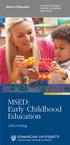 School of Education MASTER OF SCIENCE IN EARLY CHILDHOOD EDUCATION : Early Childhood Education 2012-2014 Master of Science in Education () (Early Childhood Education) Purpose The Master of Science in Education
Pre-Primary Education ( PPE11 )
 FACULTY OF EDUCATION Bachelor s Degree Programmes Pre-Primary Education ( PPE11 ) EDUC180 INTRODUCTION TO EDUCATION This course aims to help students understand the general law of the human education system.
Faculty of Social and Behavioral Sciences
 Faculty of Social and Behavioral Sciences Chair: Basma Faour, Ed.D. Mission The Faculty of Social and Behavioral Sciences (SBS) provides culturally and contextually relevant educational curricula that
Matrix Showing Match between NCATE Curriculum Guidelines for Early Childhood Education and CEOE Competencies. CEOE Subarea Competency III III
 Certification Examinations for Oklahoma Educators (CEOE) Framework Development Correlation Table The Framework Development Correlation Table provides information about possible alignment of some of the
REGULATIONS FOR THE DEGREE OF MASTER OF EDUCATION (MEd)
 215 REGULATIONS FOR THE DEGREE OF MASTER OF EDUCATION (MEd) (See also General Regulations) Any publication based on work approved for a higher degree should contain a reference to the effect that the work
Program Administrator Definition and Competencies
 I. Program Administrator Definition The program administrator is the individual responsible for planning, implementing, and evaluating a child care, preschool or kindergarten program. The role of the administrator
o Ivy Tech ECED 100 Introduction to Early Childhood Education ECED 101 Health, Safety and Nutrition ECED 103 Curriculum in Early Childhood Classroom
 Indiana Department of Education Academic Course Framework EARLY CHILDHOOD EDUCATION I Early Childhood Education I prepares students for employment in early childhood education and related careers that
EA 597 School Planning and Facilities Management (3)
 EA 581 Basic Concepts of Educational Administration (3) An introduction to the basic concepts underlying school building administration. The theory and practice of educational administration is analyzed
A.S. Degree, Early Childhood Education. Degree Type: A.S. Major Code: CHLDD-AS CIP: 1420020203
 A.S. Degree, Early Childhood Education Degree Type: A.S. Major Code: CHLDD-AS CIP: 142002020 This program prepares students for employment as child development center teachers, child development curriculum
Bachelor of Arts in Early Childhood Degree Offerings through the 2010-2012 Catalog*
 Bachelor of Arts in Early Childhood Degree Offerings through the 2010- Catalog* Catalog Number Class Name Course Description Semester Credits Prerequisites Semesters Offered Mode of Delivery EC 210 INTRODUCTION
FACULTY OF EDUCATION UNDERGRADUATE PROGRAMS
 FACULTY OF EDUCATION UNDERGRADUATE PROGRAMS Post Baccalaureate Diploma (Education) The Post Baccalaureate Program (Education) offers students who hold a Bachelor's or advanced degree the opportunity to
UNIVERSITY OF EDUCATION, WINNEBA
 UNIVERSITY OF EDUCATION, WINNEBA COLLEGE OF AGRICULTURE EDUCATION MAMPONG-ASHANTI THE INTEGRATED AND ENVIRONMENTAL SCIENCE EDUCATION DEPARTMENT FOR BACHELOR S DEGREE IN ENVIRONMENTAL HEALTH AND SANITATION
Foundation Degree in Early Childhood Studies
 Foundation Degree in Early Childhood Studies at Ashton Sixth Form College Validated by Staffordshire University Guidance & Information Ashton Sixth Form College Higher Education Contents When are the deadlines?...
MASTER OF EDUCATION 1. MASTER OF EDUCATION DEGREE (M.ED.) (845) 575-3028 [email protected]
 MASTER OF EDUCATION 1 MASTER OF EDUCATION DEGREE (M.ED.) (845) 575-3028 [email protected] MISSION AND OBJECTIVES The Teacher Education programs offered by Marist College are integrally linked
Career Options. Associate Degree. Associate in Science Degree in. Child Development Emphases: Infant/Toddler
 human development School of Social and Behavioral Sciences Dean: Karima Feldhus, PhD Academic Chair: Kari Tucker, PhD Faculty: Julie Bookwalter, Marilee Cosgrove, Donna Gray, Wenli Gau Lin, Susan McClintic,
Child Development and Family Studies
 Early Childhood Education (Formerly Early Childhood Education and Human Development) Program Description This program offers comprehensive study of child development, strategies for child guidance, techniques
B.A. in Education Specialization: Early Childhood Education (P-3) Student Handbook
 B.A. in Education Specialization: Early Childhood Education (P-3) Student Handbook Rowan University College of Education Teacher Education Department 1 Table of Contents Program Description 3 ECED Program
Bachelor of Bachelor of Education (Honours)
 Bachelor of Bachelor of Education (Honours) Detailed Course Requirements The 2016 Monash University Handbook will be available from October 2015. This document contains interim 2016 course requirements
Undergraduate Programs
 SIMON FRASER UNIVERSITY THINKING OF THE WORLD FACULTY OF EDUCATION Undergraduate Programs 1 BACHELOR OF GENERAL STUDIES (EDUCATION) The Bachelor of General Studies (BGS) (Education) is a degree program
NUNAVUT. EDUCATION CAREERS Early Childhood Education PROGRAM REPORT. 171 Early Childhood Education DIPLOMA
 NUNAVUT EDUCATION CAREERS Early Childhood Education PROGRAM REPORT 171 Early Childhood Education DIPLOMA Start Term: No Specified Start Date End Term: No Specified End Date Program Status: Approved Action
Childhood and Special Education/Inclusive Education
 Master of Science in Education: Childhood and Special Education/Inclusive Education Dual Initial Certification Program Childhood 1-6 and Students with Disabilities 1-6 Program Overview The Master of Science
DEGREE PROGRAMME IN EARLY CHILDHOOD EDUCATION CURRICULUM 2014-2017
 DEGREE PROGRAMME IN EARLY CHILDHOOD EDUCATION CURRICULUM 2014-2017 (approved by the faculty council 27.3.2014, updated VAAM044, VAAM045 and VAAM051, VARS030, KTK0006, VARS034 faculty council 26.3.2015)
Costa Rica Early Childhood Care and Education (ECCE) programmes
 IBE/2006/EFA/GMR/CP/21 Country profile prepared for the Education for All Global Monitoring Report 2007 Strong Foundations: Early Childhood Care and Education Costa Rica Early Childhood Care and Education
Please see current textbook prices at www.rcgc.bncollege.com
 PSY203: EDUCATIONAL PSYCHOLOGY SYLLABUS LECTURE HOURS/CREDITS: 3/3 CATALOG DESCRIPTION Prerequisite: PSY101 General Psychology This course focuses on the learning process in children and adolescents, especially
Child Development and Family Studies
 Early Childhood Education (Formerly Early Childhood Education and Human Development) Program Description This program offers comprehensive study of child development, strategies for child guidance, techniques
DIABLO VALLEY COLLEGE CATALOG 2016-2017
 EARLY CHILDHOOD EDUCATION ECE Obed Vazquez, Dean Social Sciences Division Faculty Office Building, Room 136 Possible career opportunities Early childhood educators focus on children from zero to age five.
COURSE REGULATIONS SCHOOL OF EDUCATION BACHELOR OF EDUCATION / BACHELOR OF BEHAVIOURAL SCIENCE COURSE CODES: 3427, 3119 & 3130
 COURSE REGULATIONS SCHOOL OF EDUCATION BACHELOR OF EDUCATION / BACHELOR OF BEHAVIOURAL SCIENCE Early Childhood and Care: 0-8 YEARS (3427) - BEd(ECEC)/BBehSc Primary (3119) - BEd(Prim)/BBehSc Secondary
Bahrain Early Childhood Care and Education (ECCE) programmes
 IBE/2006/EFA/GMR/CP/04 Country profile prepared for the Education for All Global Monitoring Report 2007 Strong Foundations: Early Childhood Care and Education Bahrain Early Childhood Care and Education
DIABLO VALLEY COLLEGE CATALOG 2015-2016
 EARLY CHILDHOOD EDUCATION ECE Obed Vazquez, Dean Social Sciences Division Faculty Office Building, Room 136 Possible career opportunities Early childhood educators focus on children from zero to age five.
MASTER OF TEACHING GRADUATE-ENTRY PROGRAM TO BECOME A TEACHER FACULTY OF EDUCATION AND SOCIAL WORK
 MASTER OF TEACHING GRADUATE-ENTRY PROGRAM TO BECOME A TEACHER FACULTY OF EDUCATION AND SOCIAL WORK 2 MASTER OF TEACHING The Master of Teaching degree at the University of Sydney is a professional qualification
REGULATIONS FOR THE DEGREE OF MASTER OF EDUCATION (MEd)
 247 REGULATIONS FOR THE DEGREE OF MASTER OF EDUCATION (MEd) (See also General Regulations) Any publication based on work approved for a higher degree should contain a reference to the effect that the work
Bachelor of Health Science (Honours)
 (Hons) C About Tung Wah College Tung Wah College (TWC) is a self-financing tertiary education institution incorporated as a wholly owned subsidiary of the Tung Wah Group of Hospitals (TWGHs). TWC builds
EARLY EDUCATION. ADMPS 1001 SOCIAL FOUNDATIONS OF EDUCATION 3 cr. I&L 0020 DIRECTED TUTORING 1-3 cr.
 EARLY EDUCATION ADMPS 1001 SOCIAL FOUNDATIONS OF EDUCATION 3 cr. This course is a broad-based overview of education addressing education issues and policies in the United States. An interdisciplinary approach
Jordan Early Childhood Care and Education (ECCE) programmes
 IBE/2006/EFA/GMR/CP/40 Country profile prepared for the Education for All Global Monitoring Report 2007 Strong Foundations: Early Childhood Care and Education Jordan Early Childhood Care and Education
Master of Education (M.Ed.) English As A Second Language Option Alex Lewis Director/ Professor OKC Campus 109
 Master of Education (M.Ed.) English As A Second Language Option Alex Lewis Director/ Professor OKC Campus 109 Phone: 405.962.1663 Fax: 405.962.1621 [email protected] Mission: The Master of Education degree
Early Childhood Education- Distance Prior Learning Assessment Recognition (PLAR) - Comprehensive. Course Descriptions 2012 Program
 School of Academics, Applied Arts and Tourism Early Childhood Education- Distance Prior Learning Assessment Recognition (PLAR) - Comprehensive Course Descriptions 2012 Program EE1290 Positive Behaviour
Policy for the Organization of Curricula for Undergraduate Degrees. Policy for the Management of Curricula for Undergraduate Degrees
 Nishikyushu University Policy for the Organization of Curricula for Undergraduate Degrees 1. In order to achieve the educational objectives of its faculties and departments, Nishikyushu University shall
Associate Degree Scheme in Applied Social Sciences (Programme Code 8C011) comprising
 Associate Degree Scheme in Applied Social Sciences (Programme Code 8C011) comprising Associate in Applied Social Sciences 應 用 社 會 科 學 副 學 士 Associate in Applied Social Sciences (Psychology) 應 用 社 會 科 學
COURSE REGULATIONS SCHOOL OF EDUCATION. BACHELOR OF EDUCATION (EARLY CHILDHOOD AND CARE: 0-8 YEARS) BEd(ECE) COURSE CODE: 3382
 COURSE REGULATIONS SCHOOL OF EDUCATION BACHELOR OF EDUCATION (EARLY CHILDHOOD AND CARE: 0-8 YEARS) BEd(ECE) COURSE CODE: 3382 THESE COURSE REGULATIONS ARE EFFECTIVE FROM 1.1.2015 SCHOOL OF EDUCATION 1.
The University s course specification template has been developed to fulfil three main functions; it shall act:
 LONDON METROPOLITAN UNIVERSITY Course Specification template The University s course specification template has been developed to fulfil three main functions; it shall act: as a source of information for
Foundations of the Montessori Method (3 credits)
 MO 634 Foundations of the Montessori Method This course offers an overview of human development through adulthood, with an in-depth focus on childhood development from birth to age six. Specific topics
Morris College Teacher Education Curriculum Changes Elementary Education
 EDU 200 Introduction to Education (3) Introduction to Education provides an introduction to the nature of education and its place in our society. An overview of the historical background of systems of
VICTORIAN INSTITUTE OF TEACHING SPECIALIST AREA GUIDELINES for NATIONALLY ACCREDITED PROGRAMS only 2015
 VICTORIAN INSTITUTE OF TEACHING SPECIALIST AREA GUIDELINES for NATIONALLY ACCREDITED PROGRAMS only 2015 All initial teacher education programs offered by Victorian higher education institutions are currently
The University of North Carolina at Pembroke 2015-2016 Academic Catalog
 338 The University of North Carolina at Pembroke 2015-2016 Academic Catalog COURSES BIRTH TO KINDERGARTEN (ECE) ECE 2020. Foundations of Early Childhood (3 credits) This course is designed to introduce
Literacy Education. Master of Science in Education: Program Overview. Program Highlights
 Master of Science in Education: Literacy Education Program Overview The Ralph C. Wilson, Jr., School of Education offers a Master of Science in Literacy Education. The Literacy Education programs lead
Cyprus Early Childhood Care and Education (ECCE) programmes
 IBE/2006/EFA/GMR/CP/24 Country profile prepared for the Education for All Global Monitoring Report 2007 Strong Foundations: Early Childhood Care and Education Cyprus Early Childhood Care and Education
Master of Education (M.Ed.) Bilingual/ Multicultural Education Option Alex Lewis, PhD. Director/ Professor OKC Campus 109
 Master of Education (M.Ed.) Bilingual/ Multicultural Education Option Alex Lewis, PhD. Director/ Professor OKC Campus 109 Phone: 405.962.1663 Fax: 405.962.1621 [email protected] Mission: The Master of
Howard Community College Fall Courses for Educators
 Howard Community College Fall Courses for Educators Fall courses begin August 22, 2015 and end December 14, 2015. For additional information, contact Fran Kroll at 443-518-4854. Fall Semester Tuition &
South Africa Early Childhood Care and Education (ECCE) programmes
 IBE/2006/EFA/GMR/CP/78 Country profile prepared for the Education for All Global Monitoring Report 2007 Strong Foundations: Early Childhood Care and Education South Africa Early Childhood Care and Education
Associate in Applied Science: Early Childhood Education
 A 55 22 0 Associate in Applied Science: Early Childhood Education Concentration Overview The Early Childhood Education curriculum prepares individuals to work with children from birth through eight in
I n t r o d u c t i o n
 and Mission Teachers and education leaders help to build a nation and provide the pathway for the I n t r o d u c t i o n future. They serve their country in important and lasting ways. Having good teachers
MASTER S DEGREE IN SPECIAL EDUCATION
 UNIVERSITY OF EDUCATION, WINNEBA FACULTY OF EDUCATIONAL STUDIES DEPARTMENT OF SPECIAL EDUCATION MASTER S DEGREE IN SPECIAL EDUCATION Rationale of the programme The Department of Special Education, within
School of Social and Behavioral Sciences
 human development School of Social and Behavioral Sciences Acting Dean: Daniel E. Rivas, Ph.D. Academic Chair: Kari Tucker, Ph.D. Faculty: Ingrid Anderson, Julie Bookwalter, Marilee Cosgrove, Donna Gray,
MC-TEACHEC Master of Teaching (Early Childhood)
 MC-TEACHEC Master of Teaching (Early Childhood) Year and Campus: 2016 - Parkville CRICOS Code: Fees Information: Level: Duration & Credit Coordinator: 061226K Subject EFTSL, Level, Discipline & Census
Community, Family and Child Studies Diploma Program
 School of Health and Human Services Community, Family and Child Studies Diploma Program 2011 Page 1 of 21 Program Philosophy We believe we have a collective responsibility to create a just society. We
Chapter 9 EARLY CHILDHOOD SPECIAL EDUCATION AND SCHOOL NURSE
 Chapter 9 EARLY CHILDHOOD SPECIAL EDUCATION AND SCHOOL NURSE Section 1. Basic Programs For Those Who Do Not Hold a Teaching Endorsement. These programs are designed for persons providing professional consultation
OF MASTER ATION EDUC
 OF EDUCATION AN INSTITUTE OF DISTINCTION The National Institute of Education (NIE) is Singapore s national teacher education institute with a key role in shaping Singapore s education. Established in July
Master of Science in Early Childhood Education Singapore, 2004 2005
 Master of Science in Early Childhood Education Singapore, 2004 2005 Sponsored by Wheelock College s Center for International Education, Leadership, and Innovation and RTRC Asia in Singapore Background
Learning and Teaching, Doctoral Program (Ed.D.) in
 Hofstra University 2014-2015 Graduate Studies Bulletin Learning and Teaching, Doctoral Program (Ed.D.) in Professor Torff, Graduate Program Director, 516-463-5803 Leading to the degree of Doctor of Education
EDUCATION STUDIES TRIPOS
 University of Cambridge: Programme Specifications Every effort has been made to ensure the accuracy of the information contained in this programme specification. At the time of publication, the programme
Early Childhood Education
 Degree: Certificates: Early Childhood A.A. - Early Childhood A.A. - Liberal Studies for Elementary Teachers (see Social Science) Infant Specialist Master Teacher Site Supervisor Teacher School Age Specialist
Department of Interdisciplinary Learning and Teaching
 The University of Texas at San Antonio 1 Department of Interdisciplinary Learning and Teaching Mission Statement The mission of the Department of Interdisciplinary Learning and Teaching is to: Advance
Early Care and Education
 Early Care and Education 142 Early Care and Education Location: Trenholm Campus - Bldg. I Program Information Early Care and Education personnel nurture and teach young children in child care centers,
Recommended Course Sequence MAJOR LEADING TO PK-4. First Semester. Second Semester. Third Semester. Fourth Semester. 124 Credits
 ELEMENTARY AND EARLY CHILDHOOD EDUCATION MAJOR LEADING TO PK-4 Recommended Course Sequence 124 Credits Elementary and Early Childhood Education majors will also complete a Reading Education minor within
STUDENT HANDBOOK. Master of Education in Early Childhood Education, PreK-4 and Early Childhood Education Certification Programs
 Master of Education in Early Childhood Education, PreK-4 and Early Childhood Education Certification Programs STUDENT HANDBOOK Lincoln University Graduate Education Program 3020 Market Street Philadelphia,
Pacific Oaks College Academic Catalog
 Value the child. Educate the person. Change the world. Pacific Oaks College Academic Catalog 2010-2011 School of Education Bachelor of Arts Programs -- April 2011 Addendum -- One s work may be finished
GRADUATE EDUCATION COURSE DESCRIPTIONS EDUC 5003 Introduction to Statistics
 GRADUATE EDUCATION COURSE DESCRIPTIONS EDUC 5003 Introduction to Statistics Designed to provide the student with a basic understanding and use of statistical methods in the analysis of their practical
BOK Course Title Course Description Access to Children
 ECE Online Courses Course Number BOK Course Title Course Description Access to Children 18CI1001 TI Educational Technology This course encompasses effectively analyzing, designing, Must videotape a developing,
a curriculum for excellence
 a curriculum for excellence building the curriculum 1 the contribution of curriculum areas RESPONSIBLE CITIZENS EFFECTIVE CONTRIBUTORS a curriculum for excellence building the curriculum 3 18 (1) the contribution
Early Childhood Education Program (ECE) Program Outline
 Early Childhood Education Program (ECE) Program Outline PROGRAM IMPLEMENTATION DATE: September 1977 OUTLINE EFFECTIVE DATE: September 2015 PROGRAM OUTLINE REVIEW DATE: April 2020 GENERAL PROGRAM DESCRIPTION:
College of Education and Human Services Exceptional Student & Deaf Education Course Descriptions
 CATALOG 2010-2011 Graduate Information College of Education and Human Services Exceptional Student & Deaf Education Course Descriptions ASL6215: Advanced American Sign Language Conversational Skills Prerequisites:
Pre-Kindergarten Associate Standards
 Pre-Kindergarten Associate 2008 Ohio/CEC-DEC/NAEYC Ohio Core Body of Knowledge and Competencies Program Standards The Associate License, valid for five years, shall be issued to an individual who holds
How To Get A Foundation Degree
 Foundation Degree Sports Studies 55 50 45 40 35 5 10 15 20 25 30 Foundation Degree What is a Foundation degree? Foundation degrees are intermediate level Higher Education qualifications which are delivered
ARIZONA CTE CAREER PREPARATION STANDARDS & MEASUREMENT CRITERIA EARLY CHILDHOOD EDUCATION, 13.1210.00
 EARLY CHILDHOOD EDUCATION, 13.1210.00 STANDARD 1.0 ANALYZE THE CONTINUUM OF PHYSICAL AND SENSORY DEVELOPMENT OF YOUNG 1.1 Analyze factors influencing prenatal development 1.2 Explain the general progression
Primary Education ( PYE 11 )
 FACULTY OF EDUCATION Bachelor s Degree Programmes Primary Education ( PYE 11 ) EDUC180 INTRODUCTION TO EDUCATION The objective of this course is to enable participants to understand the general concepts
Australian Child Life Therapy Framework: Recommended Undergraduate Degrees for New Recruit Child Life Therapists Version 1, 2014
 Australian Child Life Therapy Framework: Recommended Undergraduate Degrees for New Recruit Child Life Therapists Version 1, 2014 Many thanks to Rebecca Day and Kylie Estreich (Sydney Children s Hospital),
Special Education/Inclusive Education
 Master of Science in Education: Special Education/Inclusive Education Programs for Certified Teachers Program Overview The mission of the Special Education Program is to provide a quality educational experience
Course Description \ Bachelor of Primary Education Education Core
 Course Description \ Bachelor of Primary Education Education Core EDUC 310 :Foundations of Education in Qatar and School Reform : This course has been designed to acquaint the learners with the progress
MASTER OF SCIENCE IN EDUCATION PROGRAM
 DIVISION OF GRADUATE STUDIES Jill Arnold, Director of Graduate/Online Studies The Division of Graduate Studies ensures that its graduates have specialized training that results in a firm grounding in the
Curriculum Bachelor s Degree Programme in Global Nutrition and Health
 Curriculum Bachelor s Degree Programme in Global Nutrition and Health Metropolitan University College and VIA University College August 2011 1 Structure and content of the programme... 4 Teaching and learning
Health education as a new compulsory school subject in Finnish schools
 Health education as a new compulsory school subject in Finnish schools Lasse Kannas, Professor of Health Education, Department of Health Sciences, Faculty of Sport and Health Sciences University of Jyväskylä,
EXTENDED TEACHER PREPARATION PROGRAM
 VCU 1 EXTENDED TEACHER PREPARATION PROGRAM The School of Education, in cooperation with the College of Humanities and Sciences, offers extended teacher preparation programs in early childhood and elementary
CALIFORNIA S TEACHING PERFORMANCE EXPECTATIONS (TPE)
 CALIFORNIA S TEACHING PERFORMANCE EXPECTATIONS (TPE) The Teaching Performance Expectations describe the set of knowledge, skills, and abilities that California expects of each candidate for a Multiple
NUNAVUT. HEALTH & WELLNESS CAREERS Social work PROGRAM REPORT. 014 Social Services Worker Program
 NUNAVUT HEALTH & WELLNESS CAREERS Social work PROGRAM REPORT 014 Social Services Worker Program Start Term: No Specified Start Date End Term: No Specified End Date Program Status: Approved Action Type:
MASTER OF EDUCATIONAL LEADERSHIP IN EARLY CHILDHOOD
 EDUCATIONAL LEADERSHIP IN EARLY CHILDHOOD 01 EDUCATIONAL LEADERSHIP IN EARLY CHILDHOOD The University of Canberra The University of Canberra (UC), established in 1968, is located in Australia s national
OFF-CAMPUS MASTER S PROGRAMS M.Ed. in Educational Leadership. The Head, Hand, and Heart of School Leadership. Degree Requirements:
 M.Ed. in Educational Leadership This program is for experienced classroom teachers who have an inner passion for facilitating student achievement and school improvement. These educators will find the graduate
X Degree Programs, Bachelor of Applied Science (B.A.Sc.)
 240 Program Information The University of Guelph offers an 8 semester (20.00 credits) honours program leading to a Bachelor of Applied Science (B.A.Sc.) degree. Students must select one of the 4 following
International Standard Classification of Education (ISCED) 2011 - Draft
 International Standard Classification of Education (ISCED) 2011 - Draft For Global Consultation June October 2010 Draft ISCED 2011 for global consultation Page 1 0. TABLE OF CONTENTS 0. TABLE OF CONTENTS...1
POSTGRADUATE PROGRAMME REGULATIONS AND SYLLABUSES 2015-2016. Master of Education (MEd) Introduction
 Master of Education (MEd) Introduction The School of Education at Cave Hill aims to be a centre of excellence with respect to teaching, research and human resource development in education for the Eastern
Cork Education and Training Board. Programme Module for. Child Psychology. leading to. Level 6 FETAC
 Cork Education and Training Board Programme Module for Child Psychology leading to Level 6 FETAC May 2012/June 2012 1 Introduction This programme module may be delivered as a standalone module leading
The requirements for completion of the program are that the student must be enrolled for the stipulated number
 Policy for the Granting of Doctoral Degrees Division of Comparative Studies of Societies and Cultures Diploma Policy The requirements for completion of the program are that the student must be enrolled
Child Psychology. www.fetac.ie. Module Descriptor
 The Further Education and Training Awards Council (FETAC) was set up as a statutory body on 11 June 2001 by the Minister for Education and Science. Under the Qualifications (Education & Training) Act,
Early Childhood Education / Course Outcomes
 Early Childhood Education / Course Outcomes Development in Early Childhood CCED102 1. To understand the stages of development from pre- natal to 7/8 years of age in order to have appropriate and reasonable
Masters Degree (MEd) Individualized Plan of Study, Concentration in Early Childhood Studies
 Masters Degree (MEd) Individualized Plan of Study, Concentration in Early Childhood Studies Overview of Plan of Study: MCLA is currently conducting a needs assessment to determine the level of interest
Curriculum Handbook. 7. General Education Requirements
 Curriculum Handbook 7. General Education Requirements Overview This section outlines the standards for courses proposed to meet General Education Requirements for: Napa Valley College General Education
Programme Specification. BA (Hons) Education Studies. Valid from: March 2014 Faculty of Humanities and Social Sciences
 Programme Specification BA (Hons) Studies Valid from: March 2014 Faculty of Humanities and Social Sciences SECTION 1: GENERAL INFORMATION Awarding body: Teaching institution and location: Final award:
PROGRAMME AND COURSE OUTLINE MASTER S PROGRAMME IN MULTICULTURAL AND INTERNATIONAL EDUCATION. 12O ECTS credits. The academic year 2013/2014
 PROGRAMME AND COURSE OUTLINE MASTER S PROGRAMME IN MULTICULTURAL AND INTERNATIONAL EDUCATION 12O ECTS credits The academic year 2013/2014 Oslo and Akershus University College of Applied Sciences Faculty