
One Stop Shop For Educators
|
|
|
- Ilene Jenkins
- 10 years ago
- Views:
Transcription
1 Modern Languages Level II Course Description One Stop Shop For Educators The Level II language course focuses on the continued development of communicative competence in the target language and understanding of the culture(s) of the people who speak the language. It assumes that the students have successfully completed a Level I course or are at a Novice-Mid level of proficiency. Students begin to show a greater level of accuracy when using basic language structures, and they are exposed to more complex features of the language. They continue to focus on communicating about their immediate world and daily life activities, read material on familiar topics, and write short, directed compositions. The major means of communication between students and instructors will be in the target language. Because students may begin formal language learning at various stages of their cognitive development, teachers must adjust vocabulary and content in order to reflect developmentally appropriate interests. This course may be taught over two years (e.g., middle school programs), over one year (e.g., traditional high school programs), or during one semester (e.g., 4 x 4 block schedule). An important component of language classes is the use of the language beyond the classroom in the real world. The integration of technology is an important tool in accessing authentic information in the target language and in providing students the opportunity to interact with native speakers. By the end of Level II, students will exhibit Novice-Mid level proficiency in speaking and writing and Novice-High level proficiency in listening and reading (ACTFL Proficiency Guidelines, 1999). Student Profile (Level II) ACTFL Listening Proficiency Guidelines (Novice-High) Listeners at the Novice-High level are able to understand short, learned utterances and some sentencelength utterances, particularly where context strongly supports understanding and speech is clearly audible. They can comprehend words and phrases from simple questions, statements, high-frequency commands and courtesy formulae. At this level, students may require repetition, rephrasing and/or a slowed rate of speech for comprehension. ACTFL Speaking Proficiency Guidelines (Novice-Mid) Speakers at the Novice-Mid level communicate minimally and with difficulty by using a number of isolated words and memorized phrases limited by the particular context in which the language has been learned. When responding to direct questions, they may utter only two or three words at a time or an occasional stock vocabulary or attempt to recycle their own and their interlocutor s words. Because of hesitations, lack of vocabulary, inaccuracy, or failure to respond appropriately, Novice- Mid speakers may be understood with great difficulty even by sympathetic interlocutors accustomed to dealing with non-natives. When called on to handle topics by performing functions associated with the Intermediate level, they frequently resort to repetition, words from their native language, or silence. rev. March 2009 Page 1 of 8

2 ACTFL Reading Proficiency Guidelines (Novice-High) Readers at the Novice-High level have sufficient control of the writing system to interpret written language areas of practical need. Where vocabulary has been learned, they can read for instructional and directional purposes, standardized messages, phrases, and expressions, such as some items on menus, schedules, timetables, maps and signs. At times, but not on a consistent basis, the Novice- High reader may be able to derive meaning from material at a slightly higher level where context and/or extra linguistic background knowledge are supportive. ACTFL Writing Proficiency Guidelines (Novice-Mid) Writers at the Novice-Mid level are able to copy or transcribe familiar words or phrases, and reproduce from memory a modest number of isolated words and phrases in context. They can supply limited information on simple forms and documents, and other basic biographical information, such as names, numbers, and nationality. Novice-Mid writers exhibit a high degree of accuracy when writing on well-practiced, familiar topics using limited formulaic language. With less familiar topics, there is a marked decrease in accuracy. Errors in spelling or in the representation of symbols may be frequent. There is little evidence of functional writing skills. At this level, the writing may be difficult to understand even by those accustomed to reading the texts of non-natives. rev. March 2009 Page 2 of 8

3 Georgia Performance Standards with Elements I. Communication Interpersonal Mode of Communication (IP) MLII.IP1 The students exchange spoken and written information in the target language, utilizing cultural references where appropriate. The students: A. Express needs and preferences. B. Express feelings and emotions. C. Request help and clarification. D. Give descriptions. E. Give and follow directions and instructions. F. Ask questions and provide responses based on topics such as self, others, and the immediate environment. G. Ask questions and provide responses about plans and events. MLII.IP2 The students demonstrate skills necessary to initiate, sustain, and close oral and written exchanges in the target language. The students: A. Initiate, participate in, and close an oral or written exchange. B. Use simple paraphrasing to convey and comprehend messages. C. Use gestures and body language to convey and comprehend messages. D. Demonstrate Novice-Mid to Novice-High proficiency in oral and written exchanges with respect to proper pronunciation, intonation, and writing mechanics. Interpretive Mode of Communication (INT) MLII.INT1 The students understand spoken and written language on new and familiar topics presented through a variety of media in the target language, including authentic materials. The students: A. Identify main ideas and essential details when reading and listening. B. Interpret culturally authentic materials and information. C. Comprehend and follow oral and written instructions. D. Demonstrate Novice-Mid to Novice-High proficiency in listening and reading comprehension. MLII.INT2 The students interpret verbal and non-verbal cues to understand spoken and written messages in the target language. The students: A. Differentiate among increasingly complex statements, questions, and exclamations. rev. March 2009 Page 3 of 8

4 B. Interpret basic gestures, body language, and intonation that clarify a message. Presentational Mode of Communication (P) MLII.P1 The students present information orally and in writing using familiar and newlyacquired vocabulary, phrases, and patterns. The students: A. Relate main ideas and essential details from level-appropriate print or nonprint material. B. Give brief, organized oral presentations, using visual and technological support as appropriate. A. Write short, organized compositions, using visual and technological support as appropriate. B. Demonstrate Novice-Mid to Novice-High proficiency in oral and written presentations with respect to proper pronunciation, intonation, and writing mechanics. MLII.P2 The students present rehearsed and unrehearsed material in the target language, such as skits, poems, short narratives, and songs. The students: A. Demonstrate Novice-Mid to Novice-High proficiency in pronunciation and intonation when presenting material. B. Demonstrate comprehension of material. II. Cultural Perspectives, Practices, and Products (CU) MLII.CU1 The students understand perspectives, practices, and products of the cultures where the target language is spoken and how they are interrelated. The students: A. Participate in real or simulated cultural events, such as family activities and holiday celebrations. B. Identify patterns of behavior typically associate with cultures, such as eating and shopping customs, leisure activities, and celebration of national holidays. C. Examine the influence of the geography of the countries studied on cultural elements such as food, clothing, dwellings, transportation, language, and art. III. Connections, Comparisons, and Communities (CCC) MLII.CCC1 The students use information acquired in the study of the target language and information acquired in other subject areas to reinforce one another. The students: A. Give examples of the influence of the target language and culture(s) on other subject areas, such as foreign words in the English language. B. Relate information acquired in other subjects discussed in the language class, such as the use of the metric system. rev. March 2009 Page 4 of 8

5 MLII.CCC2 The students demonstrate an understanding of the similarities and differences between the culture(s) studied and those of the students own culture. The students: A. Compare and contrast traditions, such as holidays, foods, and celebrations. B. Compare and contrast social conventions of the target culture(s) with the students own cultures, such as handshaking and kissing on the cheek. C. Compare and contrast the geography of the countries of the target language and the students own country and discuss its impact on culture. MLII.CCC3 The students develop a better understanding of the English language through the study of the target language. The students: A. Compare vocabulary usage and structural patterns of the target language with English. B. Use level-appropriate idiomatic expressions in the target language. MLII.CCC4 The students identify current events and issues in the target culture(s). The students: A. Give information regarding major current events of the target culture(s). B. Understand the impact of major current events on the target culture(s). MLII.CCC5 The students develop and apply target language skills and cultural knowledge beyond the classroom setting for recreational, educational, and occupational purposes. The students: A. Illustrate how the target language and culture(s) studied are evident in and through media, entertainment, and technology. B. Locate and use resources in the target language, such as individuals and organizations accessible through the community or the Internet to reinforce basic cultural knowledge. rev. March 2009 Page 5 of 8

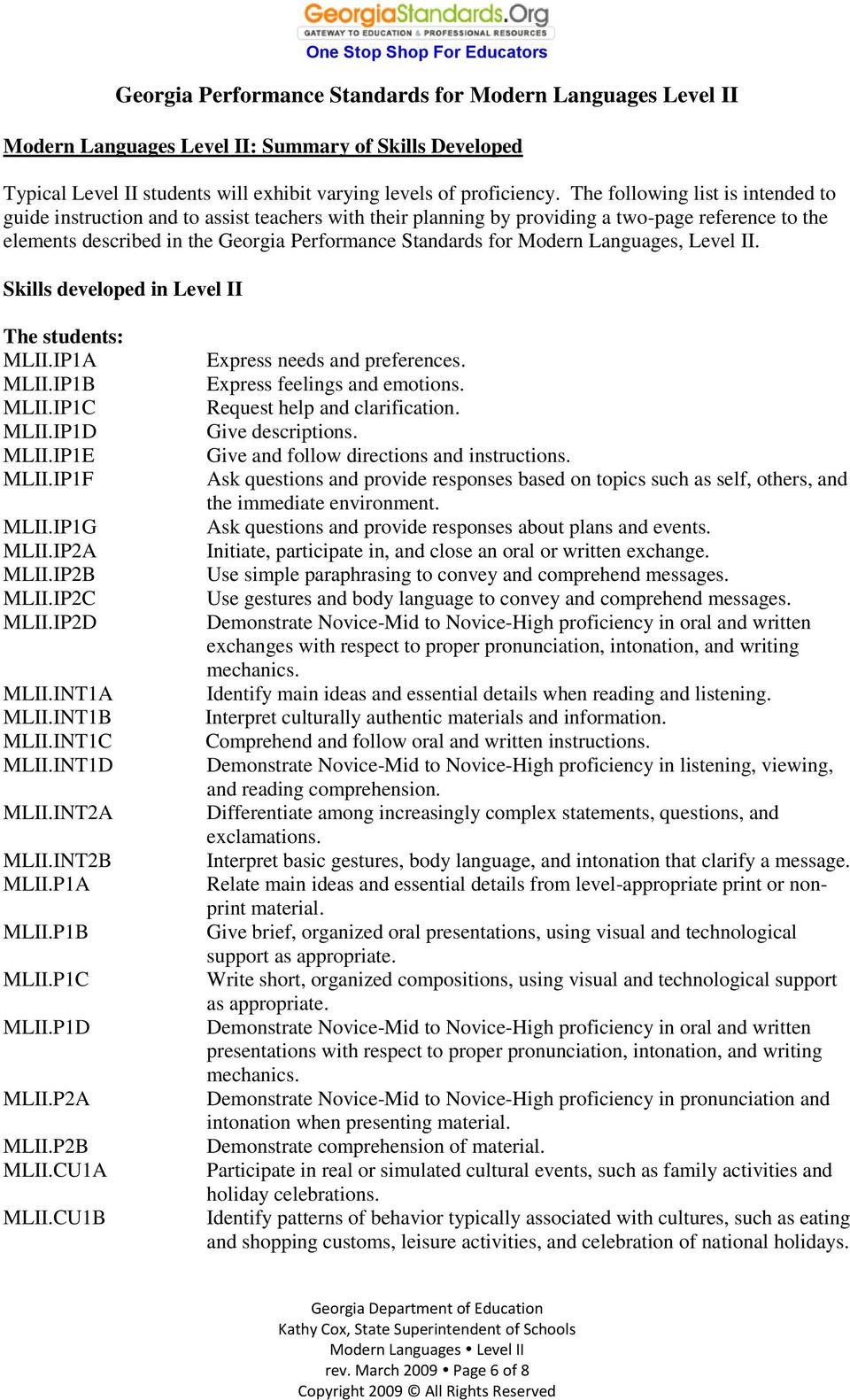
6 Modern Languages Level II: Summary of Skills Developed Typical Level II students will exhibit varying levels of proficiency. The following list is intended to guide instruction and to assist teachers with their planning by providing a two-page reference to the elements described in the Georgia Performance Standards for Modern Languages, Level II. Skills developed in Level II The students: MLII.IP1A MLII.IP1B MLII.IP1C MLII.IP1D MLII.IP1E MLII.IP1F MLII.IP1G MLII.IP2A MLII.IP2B MLII.IP2C MLII.IP2D MLII.INT1A MLII.INT1B MLII.INT1C MLII.INT1D MLII.INT2A MLII.INT2B MLII.P1A MLII.P1B MLII.P1C MLII.P1D MLII.P2A MLII.P2B MLII.CU1A MLII.CU1B Express needs and preferences. Express feelings and emotions. Request help and clarification. Give descriptions. Give and follow directions and instructions. Ask questions and provide responses based on topics such as self, others, and the immediate environment. Ask questions and provide responses about plans and events. Initiate, participate in, and close an oral or written exchange. Use simple paraphrasing to convey and comprehend messages. Use gestures and body language to convey and comprehend messages. Demonstrate Novice-Mid to Novice-High proficiency in oral and written exchanges with respect to proper pronunciation, intonation, and writing mechanics. Identify main ideas and essential details when reading and listening. Interpret culturally authentic materials and information. Comprehend and follow oral and written instructions. Demonstrate Novice-Mid to Novice-High proficiency in listening, viewing, and reading comprehension. Differentiate among increasingly complex statements, questions, and exclamations. Interpret basic gestures, body language, and intonation that clarify a message. Relate main ideas and essential details from level-appropriate print or nonprint material. Give brief, organized oral presentations, using visual and technological support as appropriate. Write short, organized compositions, using visual and technological support as appropriate. Demonstrate Novice-Mid to Novice-High proficiency in oral and written presentations with respect to proper pronunciation, intonation, and writing mechanics. Demonstrate Novice-Mid to Novice-High proficiency in pronunciation and intonation when presenting material. Demonstrate comprehension of material. Participate in real or simulated cultural events, such as family activities and holiday celebrations. Identify patterns of behavior typically associated with cultures, such as eating and shopping customs, leisure activities, and celebration of national holidays. rev. March 2009 Page 6 of 8
7 MLII.CU1C MLII.CCC1A MLII.CCC1B MLII.CCC2A MLII.CCC2B MLII.CCC2C MLII.CCC3A MLII.CCC3B MLII.CCC4A MLII.CCC4B MLII.CCC5A MLII.CCC5B MLII.CCC5C Examine the influence of the geography of the countries studied on cultural elements such as food, clothing, dwellings, transportation, language, and art. Give examples of the influence of the target language and culture(s) on other subject areas, such as foreign words in the English language. Relate information acquired in other subjects discussed in the language class, such as use of the metric system. Compare and contrast traditions, such as holidays, foods, and celebrations. Compare and contrast social conventions of the target culture(s) with the students own cultures, such as handshaking and kissing on the cheek. Compare and contrast the geography of countries of the target language and the students own country and discuss its impact on culture. Compare vocabulary usage and structural patterns of the target language with English. Use level-appropriate idiomatic expressions in the target language. Give information regarding major current events of the target culture(s). Understand the impact of major current events of the target culture(s). Develop and apply target language skills and cultural knowledge beyond the classroom setting for recreational, educational, and occupational purposes. Illustrate how the target language and culture(s) studied are evident in and through media, entertainment, and technology. Locate and use resources in the target language, such as individuals and organizations accessible through the community. rev. March 2009 Page 7 of 8

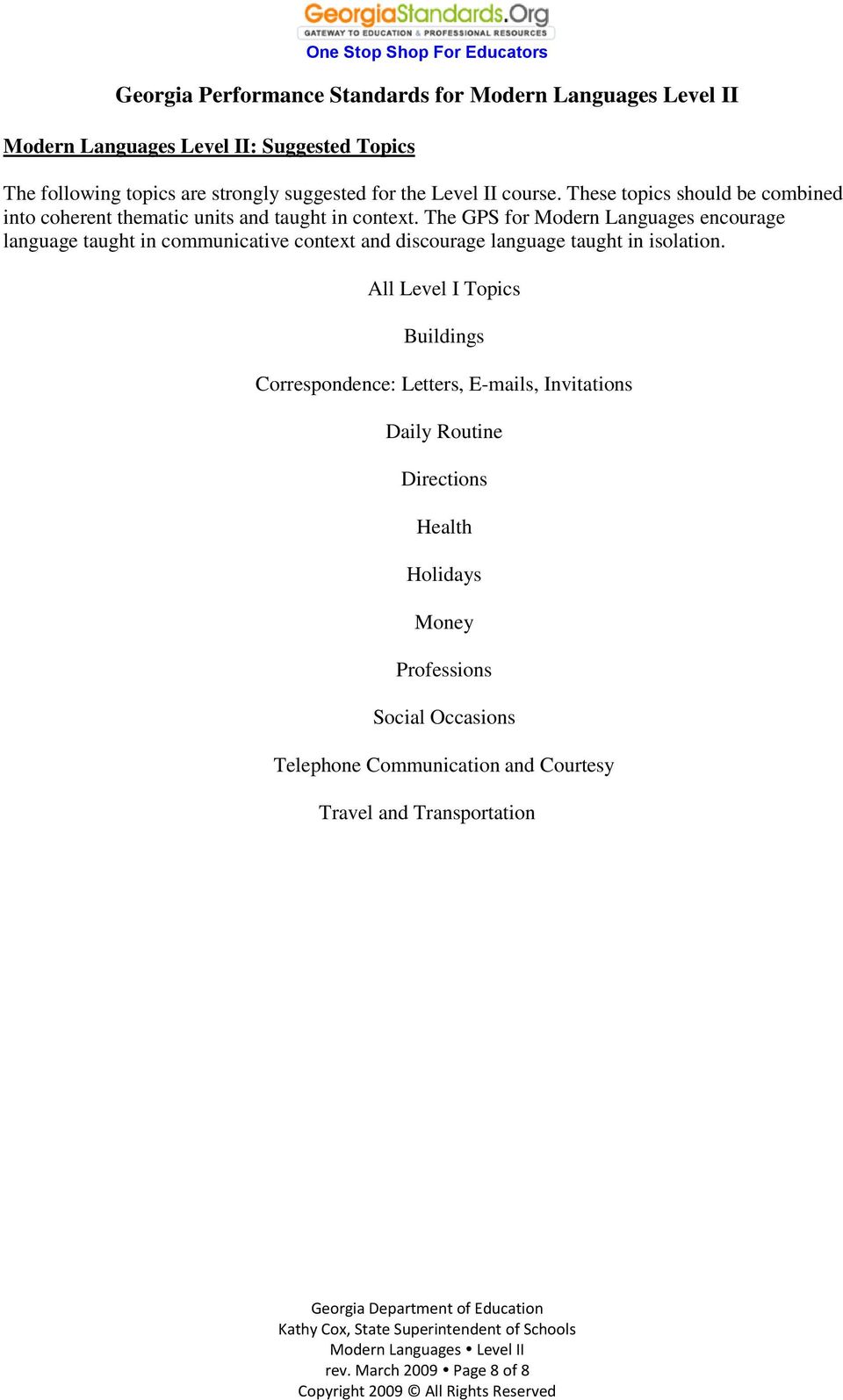
8 Modern Languages Level II: Suggested Topics The following topics are strongly suggested for the Level II course. These topics should be combined into coherent thematic units and taught in context. The GPS for Modern Languages encourage language taught in communicative context and discourage language taught in isolation. All Level I Topics Buildings Correspondence: Letters, s, Invitations Daily Routine Directions Health Holidays Money Professions Social Occasions Telephone Communication and Courtesy Travel and Transportation rev. March 2009 Page 8 of 8
Spanish Level II Online Instructional Materials Correlation to the 2007 Spanish Level II Standards of Learning
 Provider York County School Division Course Title Spanish II Last Updated 2010-11 Course Syllabus URL http://yorkcountyschools.org/virtuallearning/coursecatalog.aspx STANDARD Correlation: Content must
1 st Quarter Pacing: 4X4 Block ( 4.5 weeks), A/B Block, and Traditional Standards of Learning Concepts Resources Pacing
 1 st Quarter Pacing: 4X4 Block ( 4.5 weeks), A/B Block, and Traditional Interpersonal Communication FII.1 The student will exchange spoken and written information and ideas in French. FII.2 The student
French Language and Culture. Curriculum Framework 2011 2012
 AP French Language and Culture Curriculum Framework 2011 2012 Contents (click on a topic to jump to that page) Introduction... 3 Structure of the Curriculum Framework...4 Learning Objectives and Achievement
American Sign Language (ASL) Level II
 American Sign Language (ASL) Level II Course Description This course continues the study and practice of basic skills initiated in ASL 1. It emphasizes comprehending, signing, developing receptive skills,
OKLAHOMA PRIORITY ACADEMIC STUDENT SKILLS FOR LANGUAGES, INTERMEDIATE LEVEL RANGE
 Prentice Hall: Encuentros Maravillosos Gramática A Través De La Literatura 1998 (Foreign, Native American, and/or American Sign Language) Intermediate Level Range Students will exhibit these skills at
Spanish for Native Speakers Level I
 Spanish for Native Speakers Level I Course Description Designed for heritage learners of Spanish, this course can accommodate students from a wide range of backgrounds, from those who are minimally functional
ELPS TELPAS. Proficiency Level Descriptors
 ELPS TELPAS Proficiency Level Descriptors Permission to copy the ELPS TELPAS Proficiency Level Descriptors is hereby extended to Texas school officials and their agents for their exclusive use in determining
PROFICIENCY TARGET FOR END OF INSTRUCTION, SPANISH I
 PROFICIENCY TARGET FOR END OF INSTRUCTION, SPANISH I NOVICE-MID Writers at the Novice-Mid level are able to copy or transcribe familiar words or phrases, and reproduce from memory a modest number of isolated
Priority Academic Student Skills
 OKLAHOMA STANDARDS FOR WORLD LANGUAGES (Foreign, Native American, and/or American Sign Language) Overview The Oklahoma State Board of Education has identified the study of languages (foreign, Native American,
Alignment of the National Standards for Learning Languages with the Common Core State Standards
 Alignment of the National with the Common Core State Standards Performance Expectations The Common Core State Standards for English Language Arts (ELA) and Literacy in History/Social Studies, Science,
Roane State Community College Spanish Program Humanities Divisions. Syllabus
 Roane State Community College Spanish Program Humanities Divisions Syllabus Syllabus for Spanish 2020 Instructor s Name: Instructor's Office Hours: Course Tentative Schedule: Note to Students: The students
Subject: Spanish as a Foreign Language, Middle School Program
 Subject: Spanish as a Foreign Language, Middle School Program Overview: The Spanish as a Foreign Language Program at BNS focuses on the development of communication and comprehension skills. The Middle
Modern foreign languages
 Modern foreign languages Programme of study for key stage 3 and attainment targets (This is an extract from The National Curriculum 2007) Crown copyright 2007 Qualifications and Curriculum Authority 2007
Pasadena City College / ESL Program / Oral Skills Classes / Rubrics (1/10)
 Pronunciation Classes Pasadena City College / ESL Program / Oral Skills Classes / Rubrics (1/10) ESL 246 SLO #1: Students will recognize and begin to produce correct American-English patterns in short
MAP for Language & International Communication Spanish Language Learning Outcomes by Level
 Novice Abroad I This course is designed for students with little or no prior knowledge of the language. By the end of the course, the successful student will develop a basic foundation in the five skills:
ACTFL PROFICIENCY GUIDELINES
 ACTFL PROFICIENCY GUIDELINES 2012 AMERICAN COUNCIL ON THE TEACHING OF FOREIGN LANGUAGES 1001 N. FAIRFAX ST., SUITE 200 ALEXANDRIA, VA 22314 ph 703-894-2900 fax 703-894-2905 www.actfl.org 1 ACTFL PROFICIENCY
PAGE(S) WHERE TAUGHT (If submission is not a book, cite appropriate location(s))
 Prentice Hall: Sendas Literarias 1, Español Completo Para Hispanohablantes with Guía del maestro 2001 Students will exhibit these skills at the end of a K 12 sequence. Communication: Communicate in Languages
6 th Grade Spanish Curriculum
 6 th Grade Spanish Curriculum Mendham Township Middle School Unit 1 Bienvenidos al Español! Summary: In Unit 1 the students will review greetings and farewells, days of the week, months of the year, weather,
AMERICAN COUNCIL ON THE TEACHING OF FOREIGN LANGUAGES (ACTFL)
 AMERICAN COUNCIL ON THE TEACHING OF FOREIGN LANGUAGES (ACTFL) PROGRAM STANDARDS FOR THE PREPARATION OF FOREIGN LANGUAGE TEACHERS (INITIAL LEVEL Undergraduate & Graduate) (For K-12 and Secondary Certification
ANGLAIS LANGUE SECONDE
 ANGLAIS LANGUE SECONDE ANG-5054-6 DEFINITION OF THE DOMAIN SEPTEMBRE 1995 ANGLAIS LANGUE SECONDE ANG-5054-6 DEFINITION OF THE DOMAIN SEPTEMBER 1995 Direction de la formation générale des adultes Service
CORRELATION FLORIDA DEPARTMENT OF EDUCATION INSTRUCTIONAL MATERIALS CORRELATION COURSE STANDARDS/BENCHMARKS
 SUBJECT: French GRADE LEVEL: 6-8 COURSE TITLE: M/J French, Beginning COURSE CODE: 701000 SUBMISSION TITLE: Bien Dit 2013, Level 1A BID ID: 2776 PUBLISHER: Houghton Mifflin Harcourt PUBLISHER ID: 04-1456030-01
Second Language Acquisition Stages Stephen Krashen (1986) Silent and Receptive Stage
 Second Language Acquisition Stages Stephen Krashen (1986) Silent and Receptive Stage do not verbally respond to communication in the second language although there is receptive processing. should be actively
Introduction to the Common European Framework (CEF)
 Introduction to the Common European Framework (CEF) The Common European Framework is a common reference for describing language learning, teaching, and assessment. In order to facilitate both teaching
ACTFL PROFICIENCY GUIDELINESCSPEAKING Revised 1999
 American Council on the Teaching of Foreign Languages ACTFL PROFICIENCY GUIDELINESCSPEAKING Revised 1999 The ACTFL Proficiency Guidelines C Speaking (1986) have gained widespread application as a metric
Common European Framework of Reference for Languages: learning, teaching, assessment. Table 1. Common Reference Levels: global scale
 Common European Framework of Reference for Languages: learning, teaching, assessment Table 1. Common Reference Levels: global scale C2 Can understand with ease virtually everything heard or read. Can summarise
Our Lady of Lourdes Catholic Nursery & Primary School. Modern Foreign Language Policy
 Our Lady of Lourdes Catholic Nursery & Primary School Modern Foreign Language Policy September 2014 Review Date: September 2016 INTRODUCTION This subject policy is one in a series that makes up the Whole
Writing Proficiency TEST Familiarization Manual
 Writing Proficiency TEST Familiarization Manual American Council on the Teaching of Foreign Languages Professional Programs 3 Barker Ave, Suite 300 White Plains, NY 10601-1509 ph 914-963-8830 www.actfl.org
Working people requiring a practical knowledge of English for communicative purposes
 Course Description This course is designed for learners at the pre-intermediate level of English proficiency. Learners will build upon all four language skills: listening, speaking, reading, and writing
PERFORMANCE DESCRIPTORS FOR LANGUAGE LEARNERS
 ACTFL PERFORMANCE DESCRIPTORS FOR LANGUAGE LEARNERS 2012 Edition 1001 N. FAIRFAX ST., SUITE 200 ALEXANDRIA, VA 22314 PH 703-894-2900 FAX 703-894-2905 www.actfl.org ACTFL Performance Descriptors for Language
A Guide to Cambridge English: Preliminary
 Cambridge English: Preliminary, also known as the Preliminary English Test (PET), is part of a comprehensive range of exams developed by Cambridge English Language Assessment. Cambridge English exams have
SPANISH ESSENTIAL CURRICULUM
 UNIT 1 UNIT OVERVIEW: Students will meet the curricular goals and objectives by: Responding to and initiating greetings and farewells Spelling and providing names Describing people and their personalities
TASIS England Summer School. TASIS English Language Program (TELP) Description of Levels and Key Learning Objectives
 TASIS England Summer School TASIS English Language Program (TELP) Description of Levels and TELP Level Descriptions There are 6 levels of instruction, ranging from classes to serve those with very basic
ENGLISH AS AN ADDITIONAL LANGUAGE (EAL) COMPANION TO AusVELS
 ENGLISH AS AN ADDITIONAL LANGUAGE (EAL) COMPANION TO AusVELS For implementation in 2013 Contents English as an Additional Language... 3 Introduction... 3 Structure of the EAL Companion... 4 A Stages Lower
Acalanes Union High School District Adopted: 6/25/14 SUBJECT AREA WORLD LANGUAGE
 Adopted: 6/25/14 SUBJECT AREA WORLD LANGUAGE COURSE TITLE: GRADE LEVEL: Grades 9-12 COURSE LENGTH: One Year PREREQUISITE: Spanish 1 or equivalent experience CREDIT: 10 units UC/CSU CREDIT: Receives UC/CSU
COMMUNICATION COMMUNITIES CULTURES COMPARISONS CONNECTIONS. STANDARDS FOR FOREIGN LANGUAGE LEARNING Preparing for the 21st Century
 COMMUNICATION COMMUNITIES CULTURES COMPARISONS CONNECTIONS STANDARDS FOR FOREIGN LANGUAGE LEARNING Preparing for the 21st Century Language and communication are at the heart of the human experience. The
Elizabethtown Area School District French III
 Elizabethtown Area School District French III Course Number: 610 Length of Course: 18 weeks Grade Level: 10-12 Elective Total Clock Hours: 120 Length of Period: 80 minutes Date Written: Spring 2009 Periods
CHARACTERISTICS FOR STUDENTS WITH: LIMITED ENGLISH PROFICIENCY (LEP)
 CHARACTERISTICS FOR STUDENTS WITH: LIMITED ENGLISH PROFICIENCY (LEP) Research has shown that students acquire a second language in the same way that they acquire the first language. It is an exploratory
French I: Syllabus. Bienvenue! Welcome to the beginning of your French studies. Félicitations! I am really glad you are here!
 Bienvenue! Welcome to the beginning of your French studies. Félicitations! I am really glad you are here! DESCRIPTION (description) French I is an introduction to French language and culture. The fundamentals
Tips for Working With ELL Students
 Session One: Increasing Comprehensibility One goal for every teacher working with ELL students is to increase comprehensibility. In other words, to increase understanding or make course content more intelligible.
Thai Language Self Assessment
 The following are can do statements in four skills: Listening, Speaking, Reading and Writing. Put a in front of each description that applies to your current Thai proficiency (.i.e. what you can do with
East Windsor Regional School District French 3 Curriculum Novice High Level TABLE OF CONTENTS (2013-14)
 TABLE OF CONTENTS (2013-14) ACKNOWLEDGEMENTS.. 3 DISTRICT MISSION STATEMENT...4 INTRODUCTION AND PHILOSOPHY...5 I. Definition of the Course...5 II. Background Information. 6 III. Purpose of this Course...7
English Language Proficiency Standards for Precalculus
 xxviii ENGLISH LANGUAGE PROFICIENCY STANDARDS FOR PRECALCULUS (M) use trigonometric identities such as reciprocal, quotient, Pythagorean, cofunctions, even/odd, and sum and difference identities for cosine
Tools to Use in Assessment
 Tools to Use in Assessment II. Observations and Checklists Teachers have always watched and observed students in the classroom and they have made instructional decisions based on these observations. Too
stress, intonation and pauses and pronounce English sounds correctly. (b) To speak accurately to the listener(s) about one s thoughts and feelings,
 Section 9 Foreign Languages I. OVERALL OBJECTIVE To develop students basic communication abilities such as listening, speaking, reading and writing, deepening their understanding of language and culture
MFL skills map. Year 3 Year 4 Year 5 Year 6 Develop understanding of the sounds of Individual letters and groups of letters (phonics).
 listen attentively to spoken language and show understanding by joining in and responding explore the patterns and sounds of language through songs and rhymes and link the spelling, sound and meaning of
TELPAS. Texas English Language Proficiency Assessment System. grades K 12 Revised July 2011. texas Education agency student assessment division
 Educator guide to telpas TELPAS Texas English Language Proficiency Assessment System grades K 12 Revised July 2011 texas Education agency student assessment division Copyright 2011, Texas Education Agency.
Preproduction STUDENTS
 Preproduction In this stage, students may not respond orally in the second language but there is receptive processing (listening). Students should be ACTIVELY included in ALL class activities but not forced
Touchstone Level 2. Common European Framework of Reference for Languages (CEFR)
 Touchstone Level 2 Common European Framework of Reference for Languages (CEFR) Contents Introduction to CEFR 2 CEFR level 3 CEFR goals realized in this level of Touchstone 4 How each unit relates to the
Integrating the Common Core Standards into the Music Curriculum
 Place Photo Here, Otherwise Delete Box Integrating the Common Core Standards into the Music Curriculum Tom L. Foust January 24 th, 2013 Illinois Music Educators Conference Peoria, Illinois What is the
Guide to Pearson Test of English General
 Guide to Pearson Test of English General Level 3 (Upper Intermediate) November 2011 Version 5 Pearson Education Ltd 2011. No part of this publication may be reproduced without the prior permission of Pearson
LANGUAGE! 4 th Edition, Levels A C, correlated to the South Carolina College and Career Readiness Standards, Grades 3 5
 Page 1 of 57 Grade 3 Reading Literary Text Principles of Reading (P) Standard 1: Demonstrate understanding of the organization and basic features of print. Standard 2: Demonstrate understanding of spoken
Materials: Children s literature written in Spanish, videos, games, and pictures comprise the list of materials.
 Pre-Kindergarten The primary focus of the Spanish program in Pre-Kindergarten is the exposure to a foreign language. Since students are introduced to a language and culture that may not be familiar, an
APEC Online Consumer Checklist for English Language Programs
 APEC Online Consumer Checklist for English Language Programs The APEC Online Consumer Checklist For English Language Programs will serve the training needs of government officials, businesspeople, students,
Government of India OFFICE OF THE DIRECTOR GENERAL OF CIVIL AVIATION Opposite Safdarjung Airport, New Delhi-110003
 Government of India OFFICE OF THE DIRECTOR GENERAL OF CIVIL AVIATION Opposite Safdarjung Airport, New Delhi-110003 CIVIL AVIATION REQUIREMENT SECTION 7 FLIGHT CREW STANDARDS TRAINING AND LICENSING SERIES
ENGLISH FILE Elementary
 Karen Ludlow New ENGLISH FILE Elementary and the Common European Framework of Reference 2 INTRODUCTION What is this booklet for? The aim of this booklet is to give a clear and simple introduction to the
ENGLISH LANGUAGE ARTS
 ENGLISH LANGUAGE ARTS INTRODUCTION Clear student learning outcomes and high learning standards in the program of studies are designed to prepare students for present and future language requirements. Changes
How To Teach English To Other People
 TESOL / NCATE Program Standards STANDARDS FOR THE ACCREDIATION OF INITIAL PROGRAMS IN P 12 ESL TEACHER EDUCATION Prepared and Developed by the TESOL Task Force on ESL Standards for P 12 Teacher Education
The. Languages Ladder. Steps to Success. The
 The Languages Ladder Steps to Success The What is it? The development of a national recognition scheme for languages the Languages Ladder is one of three overarching aims of the National Languages Strategy.
Global Pre-intermediate CEF descriptors
 Global Pre-intermediate Listening A2 Unit Page I can understand what is said clearly, slowly and directly to me in simple everyday conversation; it is possible to make me understand, if the speaker can
Advanced Placement Vertical Teams Curriculum Manual: World Languages
 Austin Independent School District Advanced Placement Vertical Teams Curriculum Manual: World Languages Advanced Academic Services and World Languages Who can take Pre-AP and AP Courses? All students in
Oral Proficiency Interview Familiarization Manual
 Oral Proficiency Interview Familiarization Manual American Council on the Teaching of Foreign Languages Professional Programs 3 Barker Ave, Suite 300 White Plains, NY 10601-1509 ph 914-963-8830 www.actfl.org
GERMAN IA CCO I: Interpersonal Communication
 GERMAN IA 55 GERMAN IA CCO I: Interpersonal Communication Students will engage in conversations or correspondence in German to provide and obtain information, express feelings and emotions, and exchange
CALIFORNIA S TEACHING PERFORMANCE EXPECTATIONS (TPE)
 CALIFORNIA S TEACHING PERFORMANCE EXPECTATIONS (TPE) The Teaching Performance Expectations describe the set of knowledge, skills, and abilities that California expects of each candidate for a Multiple
MASSACHUSETTS Foreign Languages Curriculum Framework Stage 1 Bon voyage! French 1 and Bon voyage! French 2 2005
 MASSACHUSETTS Foreign Languages Curriculum Framework Stage 1 Bon voyage! French 1 and Bon voyage! French 2 2005 STRANDS AND STANDARDS Communication PreK-12 STANDARD 1: Interpersonal Communication Students
Glencoe/McGraw-Hill. Bon voyage! 2002 Level 2 ISBN# 0-07-821257-X. correlated to
 Glencoe/McGraw-Hill Bon voyage! 2002 Level 2 ISBN# 0-07-821257-X Tennessee Foreign Language Goals and Objectives for Emerging Modern Languages Glencoe/McGraw-Hill Bon voyage! Level 2 2002 Tennessee Standards
Language acquisition guide. For use from September 2014 or January 2015
 Language acquisition guide For use from September 2014 or January 2015 Language acquisition guide For use from September 2014 or January 2015 Middle Years Programme Language acquisition guide Published
CHAPTER II REVIEW OF RELATED LITERATURE
 CHAPTER II REVIEW OF RELATED LITERATURE This chapter consists of two parts. The first part starts with the definition of learning styles, the importance of understanding the students learning styles, models
G R A D E S K - I N S T R U C T I O N A N D A S S E S S M E N T
 There are approximately six million English Language Learners, ELLs, in our country today. Exemplary Strategies has been designed for all teachers. Whether the students native language is English, Spanish
Common European Framework of Reference for Languages: Learning, teaching, assessment
 Common European Framework of Reference for Languages: Learning, teaching, assessment Structured overview of all CEFR scales The copyright of the descriptive scales and the illustrative scales (in all languages)
Glencoe/McGraw-Hill. Bon voyage! 2002 Level 3 ISBN# 0-07-821258-8. correlated to
 Glencoe/McGraw-Hill Bon voyage! 2002 Level 3 ISBN# 0-07-821258-8 Tennessee Foreign Language Goals and Objectives for Expanding Modern Languages Glencoe/McGraw-Hill Bon voyage! Level 3 2002 Tennessee Standards
Grade 1 LA. 1. 1. 1. 1. Subject Grade Strand Standard Benchmark. Florida K-12 Reading and Language Arts Standards 27
 Grade 1 LA. 1. 1. 1. 1 Subject Grade Strand Standard Benchmark Florida K-12 Reading and Language Arts Standards 27 Grade 1: Reading Process Concepts of Print Standard: The student demonstrates knowledge
Accelerated Professional Program (APP) Absolute Beginner Varies (Typically 50+ units)
 APP English 1A Absolute Beginner emphasizes the development of practical language skills with a focus on business-related themes, vocabulary, and grammatical structures. The instructor will tailor the
What Does Research Tell Us About Teaching Reading to English Language Learners?
 Jan/Feb 2007 What Does Research Tell Us About Teaching Reading to English Language Learners? By Suzanne Irujo, ELL Outlook Contributing Writer As a classroom teacher, I was largely ignorant of, and definitely
SPANISH FOR CRIMINAL JUSTICE INSTRUCTOR: Latrina R. Thompson OFFICE: Paulding Campus
 SPAN 2034 FALL 2012 SPANISH FOR CRIMINAL JUSTICE INSTRUCTOR: Latrina R. Thompson OFFICE: Paulding Campus EMAIL: [email protected] OFFICE HOURS: by Appt. CLASS: Room #207, Paulding Campus TEXT: Spanish
ENGLISH FILE Pre-intermediate
 Karen Ludlow New ENGLISH FILE Pre-intermediate and the Common European Framework of Reference 2 INTRODUCTION What is this booklet for? The aim of this booklet is to give a clear and simple introduction
Section 8 Foreign Languages. Article 1 OVERALL OBJECTIVE
 Section 8 Foreign Languages Article 1 OVERALL OBJECTIVE To develop students communication abilities such as accurately understanding and appropriately conveying information, ideas,, deepening their understanding
LOTE TEACHER COMPETENCIES FOR PROFESSIONAL DEVELOPMENT
 LOTE TEACHER COMPETENCIES FOR PROFESSIONAL DEVELOPMENT Background In April of 1997, the Texas State Board of Education adopted content and performance standards that describe what students should know
Teaching World Languages: A Practical Guide
 Teaching World Languages: A Practical Guide Chapter 6: Interpersonal Communication The Standards for Language Learning in the 21st Century, (2006) provides the guidelines for foreign language instruction
Guided Reading with Emergent Readers by Jeanne Clidas, Ph.D.
 Bebop Books Guided Reading with Emergent Readers by Jeanne Clidas, Ph.D. What Is Guided Reading? Guided reading involves a small group of children thinking, talking, and reading through a new text with
STUDENT CURRICULUM TEMPLATE Adapted from STARTALK program template
 STUDENT CURRICULUM TEMPLATE Adapted from STARTALK program template Teacher Name: Hong Jiang Grade or Level: Grades 6-8 Language(s): Target Proficiency Level: Novice-Low Novice -Mid Number of Contact Hours:
How do the principles of adult learning apply to English language learners?
 Beginning to Work with Adult English Language Learners: Some Considerations MaryAnn Cunningham Florez and Miriam Burt National Center for ESL Literacy Education (NCLE) October 2001 This article discusses
Albert Einstein Academies Charter Elementary School. Language Policy 2015 2016. Teaching our children today to advance our shared humanity tomorrow
 Albert Einstein Academies Charter Elementary School Language Policy 2015 2016 Teaching our children today to advance our shared humanity tomorrow What is the Purpose of the Language Policy? Achieve a common
North Carolina Standards Correlated to Glencoe Así se dice! Level 1B 2009. Correlations for North Carolina Así se dice! Level 1B Page 1 of 11
 North Carolina Standards Correlated to Glencoe Así se dice! Level 1B 2009 Competency and Objective Statements Competency INTERPERSONAL COMMUNICATION - The Goal 1 learner will engage in conversation and
COMPUTER TECHNOLOGY IN TEACHING READING
 Лю Пэн COMPUTER TECHNOLOGY IN TEACHING READING Effective Elementary Reading Program Effective approach must contain the following five components: 1. Phonemic awareness instruction to help children learn
SPECIFIC LEARNING DISABILITIES (SLD)
 Together, We Can Make A Difference Office 770-577-7771 Toll Free1-800-322-7065 www.peppinc.org SPECIFIC LEARNING DISABILITIES (SLD) Definition (1) Specific learning disability is defined as a disorder
Helping your child with Non-verbal Learning Disability
 Helping your child with Non-verbal Learning Disability What is non-verbal learning disability? Non-verbal learning disability (NVLD) is a term used to describe a pattern of strengths and weaknesses in
Bilingual Education Assessment Urdu (034) NY-SG-FLD034-01
 Bilingual Education Assessment Urdu (034) NY-SG-FLD034-01 The State Education Department does not discriminate on the basis of age, color, religion, creed, disability, marital status, veteran status, national
MATRIX OF STANDARDS AND COMPETENCIES FOR ENGLISH IN GRADES 7 10
 PROCESSES CONVENTIONS MATRIX OF STANDARDS AND COMPETENCIES FOR ENGLISH IN GRADES 7 10 Determine how stress, Listen for important Determine intonation, phrasing, points signaled by appropriateness of pacing,
CHAPTER 11. Business Chinese for Local Businesses. Chun-Yi Peng. City University of New York. 1 Introduction
 CHAPTER 11 Business Chinese for Local Businesses Chun-Yi Peng City University of New York 1 Introduction This report proposes a Chinese course for business purposes aimed to help students understand and
Ribby with Wrea Endowed C.E. Primary School. Modern Foreign Languages Policy
 Ribby with Wrea Endowed C.E. Primary School Modern Foreign Languages Policy Gill Metherell Updated: January 2011 Review Date: January 2012 Introduction Our teaching of a Modern Foreign Language (MFL) is
STUDENT PROGRAM CURRICULUM TEMPLATE & GUIDE
 2010 STUDENT PROGRAM CURRICULUM TEMPLATE & GUIDE Host Institution Fauquier County Public Schools Program Name Language(s) Age of Students Target Proficiency Level Turkish Rising 6 th 9 th grade Novice
Standards of Quality and Effectiveness for Professional Teacher Preparation Programs APPENDIX A
 APPENDIX A Teaching Performance Expectations A. MAKING SUBJECT MATTER COMPREHENSIBLE TO STUDENTS TPE 1: Specific Pedagogical Skills for Subject Matter Instruction Background Information: TPE 1. TPE 1 is
Reading Street and English Language Learners
 Reading Street and English Language Learners How do you identify English language proficiency levels on Reading Street? How do English language learners (ELLs) differ from other learners? ELLs have varying