
Touchstone Level 2. Common European Framework of Reference for Languages (CEFR)
|
|
|
- Christal Cole
- 10 years ago
- Views:
Transcription
1 Touchstone Level 2 Common European Framework of Reference for Languages (CEFR) Contents Introduction to CEFR 2 CEFR level 3 CEFR goals realized in this level of Touchstone 4 How each unit relates to the CEFR 9 Touchstone Second Edition Level 2 CEFR Guide Cambridge University Press 2014 Photocopiable Page 1 of 22

2 Introduction to the Common European Framework of Reference (CEFR) The overall aim of the Council of Europe s Common European Framework of Reference (CEFR) is to provide objective criteria for describing and assessing proficiency in an internationally comparable manner. The Council of Europe s work on the definition of appropriate learning objectives for adult learners dates back to the 1970s. The influential Threshold series (J. A. van Ek and J. L. M. Trim, Cambridge University Press, 1991) provides a detailed description in functional, notional, grammatical, and sociocultural terms of what a user needs to be able to do in order to communicate effectively in the sort of situations commonly encountered in everyday life. Three levels of proficiency are identified, called Waystage, Threshold, and Vantage (roughly corresponding to Elementary, Intermediate, and Upper Intermediate). The Threshold series was followed in 2001 by the publication of the Common European Framework of Reference, which describes six levels of communicative ability in terms of s or can do statements: A1 (Breakthrough), A2 (Waystage), B1 (Threshold), B2 (Vantage), C1 (Effective Operational Proficiency), and C2 (Mastery). Based on the CEFR descriptors, the Council of Europe also developed the European Language Portfolio, a document that enables learners to assess their ability and to keep an internationally recognized record of their learning experience. Touchstone Second Edition and the Common European Framework of Reference The table below shows how Touchstone Second Edition correlates with the Council of Europe s levels and with some major international examinations. CEFR Council of Europe Cambridge English Language Assessment IELTS TOEFL ibt TOEIC Touchstone 1 A1 Breakthrough 120+ Touchstone 2 A2 Waystage 225+ Touchstone 3 B1 Threshold KET (Key English Test) Touchstone 4 PET (Preliminary English Test) Viewpoint 1 B2 Vantage FCE (First Certificate in English) Viewpoint 2 C1 Effective Operational Efficiency CAE (Certificate in Advanced English) () 445+ () Sources: Touchstone Second Edition Level 2 CEFR Guide Cambridge University Press 2014 Photocopiable Page 2 of 22

3 CEFR Level Touchstone, Second Edition, Level 2 covers level A2 of the CEFR. This table describes the general degree of skill achieved by learners at this level. Skill Communication strategies Learners will be able to: understand phrases and very high frequency vocabulary related to areas of the most immediate personal relevance (e.g., basic personal and family information, shopping, local geography, and employment). catch the main point in short, clear, simple, messages and announcements. read short, simple texts, including short, simple personal letters and s. find specific, predictable information in simple, everyday material such as advertisements, catalogs, menus, and timetables. communicate about basic and routine tasks that require a simple and direct exchange of information on familiar topics and activities. handle very short social exchanges. use a series of phrases and sentences to describe in simple terms their family and other people, living conditions, their educational background, and their present or most recent job. write short simple notes, messages, and s relating to matters in areas of immediate need. write a simple personal letter, for example, thanking someone for something. use basic sentence patterns and phrases, groups of a few words and formulae in order to communicate limited information in everyday situations. use some simple grammatical structures correctly. speak with clear enough pronunciation to be understood. perform and respond to basic functions such as information exchange, requests, and invitations, and express opinions and attitudes in a simple way. socialize simply but effectively using common expressions and using everyday, polite forms of greeting and address. initiate, maintain, and close simple conversations, guess some unknown words from context in simple, short texts and utterances, and ask for clarification or repetition. indicate when they are following a conversation. Touchstone Second Edition Level 2 CEFR Guide Cambridge University Press 2014 Photocopiable Page 3 of 22

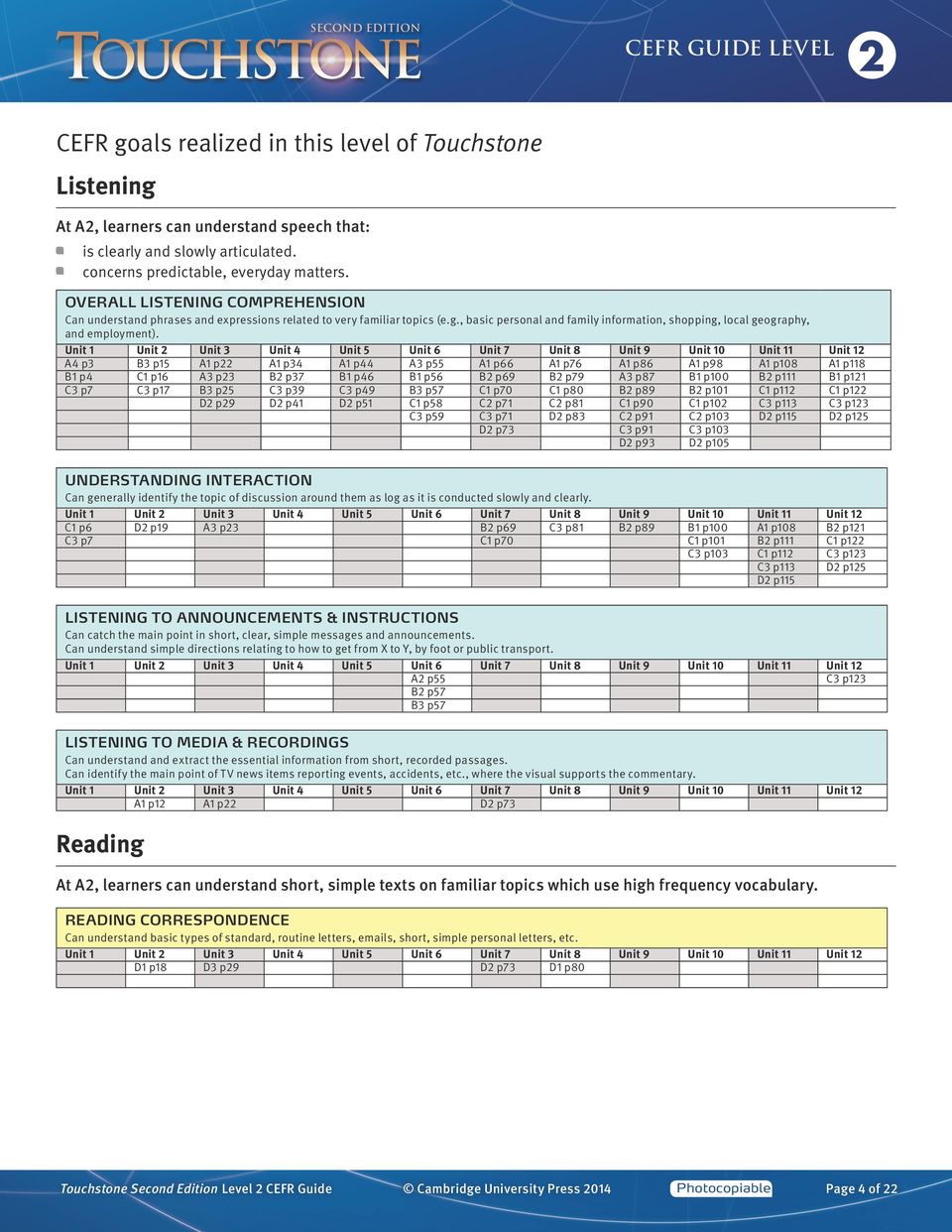
4 CEFR goals realized in this level of Touchstone At A2, learners can understand speech that: is clearly and slowly articulated. concerns predictable, everyday matters. OVERALL LISTENING COMPREHENSION Can understand phrases and expressions related to very familiar topics (e.g., basic personal and family information, shopping, local geography, and employment). A4 p3 B3 p15 A1 p22 A1 p34 A1 p44 A3 p55 A1 p66 A1 p76 A1 p86 A1 p98 A1 p108 A1 p118 B1 p4 C1 p16 A3 p23 B2 p37 B1 p46 B1 p56 B2 p69 B2 p79 A3 p87 B1 p100 B2 p111 B1 p121 C3 p7 C3 p17 B3 p25 C3 p39 C3 p49 B3 p57 C1 p70 C1 p80 B2 p89 B2 p101 C1 p112 C1 p122 D2 p29 D2 p41 D2 p51 C1 p58 C2 p71 C2 p81 C1 p90 C1 p102 C3 p113 C3 p123 C3 p59 C3 p71 D2 p83 C2 p91 C2 p103 D2 p115 D2 p125 D2 p73 C3 p91 C3 p103 D2 p93 D2 p105 UNDERSTANDING INTERACTION Can generally identify the topic of discussion around them as log as it is conducted slowly and clearly. C1 p6 D2 p19 A3 p23 B2 p69 C3 p81 B2 p89 B1 p100 A1 p108 B2 p121 C3 p7 C1 p70 C1 p101 B2 p111 C1 p122 C3 p103 C1 p112 C3 p123 C3 p113 D2 p125 D2 p115 LISTENING TO ANNOUNCEMENTS & INSTRUCTIONS Can catch the main point in short, clear, simple messages and announcements. Can understand simple directions relating to how to get from X to Y, by foot or public transport. A2 p55 C3 p123 B2 p57 B3 p57 LISTENING TO MEDIA & RECORDINGS Can understand and extract the essential information from short, recorded passages. Can identify the main point of TV news items reporting events, accidents, etc., where the visual supports the commentary. A1 p12 A1 p22 D2 p73 At A2, learners can understand short, simple texts on familiar topics which use high frequency vocabulary. READING CORRESPONDENCE Can understand basic types of standard, routine letters, s, short, simple personal letters, etc. D1 p18 D3 p29 D2 p73 D1 p80 Touchstone Second Edition Level 2 CEFR Guide Cambridge University Press 2014 Photocopiable Page 4 of 22
5 READING FOR ORIENTATION Can find specific, predictable information in simple, everyday material such as advertisements, websites, catalogs, menus, reference lists, and timetables. Can understand everyday signs and notices in public places. D1 p60 D1 p70 D3 p61 READING FOR INFORMATION & ARGUMENT D1 p8 D1 p18 D1 p28 D1 p40 D1 p50 D1 p60 D1 p70 D1 p80 D1 p92 D1 p104 D1 p114 D1 p124 D3 p29 D3 p93 D3 p105 Overall spoken interaction At A2, learners can manage simple, routine exchanges fairly easily, but struggle with extended conversations and often need help with understanding. They can: ask and answer questions and exchange ideas and information on familiar topics in predictable everyday situations. handle very short social exchanges and simple transactions. mostly understand speech in a standard accent directed at them which is delivered slowly and clearly provided they can ask for repetition or reformulation from time to time. CONVERSATION Can make and respond to invitations and apologies. A1 p2 C1 p16 C1 p26 C1 p38 C1 p48 C1 p58 A2 p67 C1 p80 B3 p89 A3 p99 A2 p109 A3 p119 C1 p6 C2 p17 C2 p27 C2 p39 C2 p49 C2 p59 C1 p70 C2 p81 C1 p90 B1 p100 C1 p112 C1 p122 C2 p7 C3 p17 C3 p27 C2 p71 C3 p81 C2 p91 C1 p102 C2 p113 C2 p123 C3 p7 D3 p83 C3 p91 C2 p103 C3 p113 C3 p103 INFORMAL DISCUSSION (WITH FRIENDS) Can participate in a discussion about everyday, practical issues in a simple way. Can make and respond to suggestions. Can agree and disagree with others. Can discuss what to do, where to go, and make arrangements to meet. D3 p9 B2 p14 A3 p23 D1 p41 A3 p67 A2 p99 D1 p125 C3 p17 C3 p27 B3 p69 B3 p101 D2 p125 D1 p28 C1 p70 D2 p105 C3 p71 D3 p105 Touchstone Second Edition Level 2 CEFR Guide Cambridge University Press 2014 Photocopiable Page 5 of 22

6 GOAL-ORIENTED COOPERATION (E.G., REPAIRING A CAR, DISCUSSING A DOCUMENT, OR ORGANIZING AN EVENT) Can manage simple, routine tasks such as: asking for and providing things. getting simple discussing what to do next. making and responding to suggestions. asking for and giving directions. A2 p55 B3 p69 C1 p80 C3 p123 B2 p57 C1 p70 C2 p81 B3 p57 C3 p71 TRANSACTIONS TO OBTAIN GOODS & SERVICES Can deal with common aspects of everyday living such as travel tourist information, public transport and accommodation, shopping, buying tickets, and simple transactions in shops, post offices, or banks. Can give and receive information about quantities, numbers, prices, etc. Can make simple purchases by stating what is wanted and asking the price. Can order a meal. C3 p59 INFORMATION EXCHANGE A2 p2 A3 p13 A1 p22 A2 p35 A2 p45 A1 p54 A2 p67 A3 p77 B1 p88 C3 p103 A3 p109 A1 p119 A3 p3 B2 p14 A2 p23 A3 p35 A3 p45 A2 p55 C1 p70 D3 p83 B3 p89 B3 p111 B3 p121 A4 p3 D2 p19 A3 p23 B1 p36 B4 p47 B2 p57 D3 p115 C1 p122 B2 p4 B4 p25 B3 p37 C2 p49 B3 p57 C1 p26 C1 p38 C3 p49 C3 p59 C2 p39 D3 p51 C3 p39 INTERVIEWING AND BEING INTERVIEWED Can answer simple questions and respond to simple statements in an interview. A1 p2 A2 p13 B4 p47 A3 p13 D1 p51 D3 p51 Overall spoken production At A2, learners can give simple descriptions or presentations about everyday things as a short series of simple phrases and sentences linked into a list. SUSTAINED MONOLOGUE: DESCRIBING EXPERIENCE Can tell a story as a simple list of points. Can give short, basic descriptions of: events and activities. plans and arrangements, habits and routines, past activities, and personal experiences. their family, living conditions, educational background, present or most recent job. people, places, and possessions. Can use simple, descriptive to make brief statements about and compare objects and possessions. Can explain what they like or dislike about something. B3 p5 A3 p13 B4 p25 B4 p47 D3 p61 C1 p70 D1 p82 A1 p86 D1 p18 D3 p29 C1 p48 D2 p83 A3 p87 C3 p91 D1 p92 D2 p93 Touchstone Second Edition Level 2 CEFR Guide Cambridge University Press 2014 Photocopiable Page 6 of 22

7 Overall written production and interaction At A2, learners can write a series of simple phrases and sentences linked with simple connectors like and, but, and because. OVERALL WRITTEN PRODUCTION Can write short, simple formulaic notes relating to matters in areas of immediate need. D3 p19 D3 p29 D2 p41 CORRESPONDENCE Can write very simple personal letters, s, etc. D2 p41 D2 p73 CREATIVE WRITING Can write very short, basic descriptions of events, past activities, and personal experiences. Can write a series of simple phrases and sentences about everyday and/or personal matters (e.g., family, people, places, a job or study experience, living conditions, educational background, present or most recent job). D2 p8 A3 p13 A2 p35 C1 p48 D3 p61 D3 p83 B1 p88 D3 p105 B1 p110 D2 p125 D3 p19 D3 p51 D3 p93 D5 p115 COHERENCE Can use the most frequently occurring connectors to link simple sentences and phrases, in order to tell a story or describe something as a simple list of points. D2 p8 D3 p19 D3 p29 D3 p51 D3 p83 D3 p93 D3 p105 D2 p125 VOCABULARY RANGE B3 p5 B1 p14 B1 p24 A1 p34 B3 p47 B1 p56 B1 p68 B1 p78 B1 p88 B1 p100 B3 p110 B1 p120 C1 p38 D1 p50 C1 p112 GRAMMATICAL ACCURACY A3 p3 A1 p12 A1 p22 A2 p35 A2 p45 A2 p55 A1 p66 A1 p76 A1 p86 A1 p98 A2 p109 A2 p119 B2 p4 A2 p13 A2 p23 B3 p37 B1 p46 B1 p56 A2 p67 A2 p77 A2 p87 A2 p99 B3 p111 B2 p121 B4 p15 B4 p25 B2 p46 B2 p57 B3 p69 B3 p79 B3 p101 B3 p101 B3 p121 PHONOLOGICAL CONTROL conversational partners will need to ask for repetition from time to time. A2 p2 B2 p14 B1 p24 A1 p34 A2 p45 A3 p55 A1 p66 A1 p76 A3 p87 A3 p99 A1 p108 A3 p119 B3 p15 B2 p24 A3 p35 A3 p45 B1 p56 A3 p67 A3 p77 B1 p88 B1 p100 A3 p109 B1 p120 B3 p25 C2 p39 B3 p47 C2 p59 B1 p68 B1 p78 B3 p89 C1 p102 C2 p113 C1 p122 B2 p69 B2 p79 C1 p90 C2 p103 B3 p79 D3 p83 Touchstone Second Edition Level 2 CEFR Guide Cambridge University Press 2014 Photocopiable Page 7 of 22

8 SOCIOLINGUISTIC APPROPRIATENESS Can handle very short social exchanges using everyday, polite forms of greeting and address. C1 p6 C1 p16 C1 p26 D2 p41 C1 p80 C1 p90 C1 p102 C1 p122 C3 p27 C2 p81 C3 p91 C2 p103 C2 p123 C3 p81 C3 p103 C3 p123 Communication strategies TAKING THE FLOOR (TURNTAKING), COOPERATING, ASKING FOR CLARIFICATION, COMPENSATING, MONITORING & REPAIR Can use simple techniques to start, maintain, or end a short conversation. Can initiate, maintain, and close simple, face-to-face conversation. Can ask very simply for repetition when they do not understand. Can ask for clarification about key words or phrases not understood using stock phrases. Can indicate whether they are following or not. C1 p6 C1 p26 C1 p38 C1 p48 C1 p59 C2 p71 C1 p102 C1 p112 C2 p7 C3 p27 C2 p39 C2 p49 C2 p59 C2 p113 D1 p8 C3 p49 C3 p59 Touchstone Second Edition Level 2 CEFR Guide Cambridge University Press 2014 Photocopiable Page 8 of 22

9 How each unit relates to the CEFR Unit 1 Communication strategies Can understand phrases and expressions related to very familiar topics (e.g., basic personal and family information, shopping, local geography, and employment). Can generally identify the topic of discussion around them as long as it is conducted slowly and clearly. Can make and respond to invitations and apologies. Can participate in a discussion about everyday, practical issues in a simple way. Can make and respond to suggestions. Can agree and disagree with others. Can discuss what to do, where to go, and make arrangements to meet. Can ask for and provide personal information (e.g., habits, routines, pastimes and past activities). Can answer simple questions and respond to simple statements in an interview. Can tell a story as a simple list of points. Can give short, basic descriptions of: events and activities. plans and arrangements, habits and routines, past activities, and personal experiences. their family, living conditions, educational background, present or most recent job. people, places, and possessions. Can use simple, descriptive to make brief statements about and compare objects and possessions. Can explain what they like or dislike about something. Can write very short, basic descriptions of events, past activities, and personal experiences. Can write a series of simple phrases and sentences about everyday, personal matters (e.g., family, people, places, a job or study experience, living conditions, educational background, present or most recent job). Can link a series of shorter, discrete simple elements into a connected, linear sequence of points. Can handle very short social exchanges, using everyday, polite forms of greeting and address. Can use simple techniques to start, maintain, or end a short conversation. Can initiate, maintain, and close simple, face-to-face conversation. Can ask very simply for repetition when they do not understand. Can ask for clarification about key words or phrases not understood using stock phrases. Can indicate whether they are following or not. A4 p3 B1 p4 C3 p7 C1 p6 C3 p7 D1 p8 A1 p2 C1 p6 C2 p7 C3 p7 D3 p9 A2 p2 A3 p3 A4 p3 B2 p4 A1 p2 B3 p5 D2 p8 D2 p8 B3 p5 A3 p3 B2 p4 A2 p2 C1 p6 C1 p6 C2 p7 D1 p8 Touchstone Second Edition Level 2 CEFR Guide Cambridge University Press 2014 Photocopiable Page 9 of 22

10 Unit 2 Can understand phrases and expressions related to very familiar topics (e.g., very basic personal and family information, shopping, local geography, and employment). Can generally identify the topic of discussion around them as long as it is conducted slowly and clearly. Can understand and extract the essential information from short, recorded passages. Can identify the main point of TV news items reporting events, accidents, etc., where the visual supports the commentary. Can understand basic types of standard, routine letters, s, short, simple personal letters, etc. Can make and respond to invitations and apologies. Can participate in a discussion about everyday, practical issues in a simple way. Can make and respond to suggestions. Can agree and disagree with others. Can discuss what to do, where to go, and make arrangements to meet. Can give and follow simple directions and instructions (e.g. explain how to get somewhere). Can answer simple questions and respond to simple statements in an interview. Can tell a story as a simple list of points. Can give short, basic descriptions of: events and activities. plans and arrangements, habits and routines, past activities, and personal experiences. their family, living conditions, educational background, present or most recent job. people, places and possessions. Can use simple, descriptive to make brief statements about and compare objects and possessions. Can explain what they like or dislike about something. Can write short, simple formulaic notes relating to matters in areas of immediate need. Can write very short, basic descriptions of events, past activities, and personal experiences. Can write a series of simple phrases and sentences about everyday and/or personal matters (e.g., family, people, places, a job or study experience, living conditions, educational background, present or most recent job). Can link a series of shorter, discrete simple elements into a connected, linear sequence of points. Can handle very short social exchanges using everyday, polite forms of greeting and address. B3 p15 C1 p16 C3 p17 D2 p19 A1 p12 D1 p18 D1 p18 C1 p16 C2 p17 C3 p17 B2 p14 C3 p17 A3 p13 B2 p14 D2 p19 A2 p13 A3 p13 A3 p13 D1 p18 D3 p19 A3 p13 D3 p19 D3 p19 B1 p14 A1 p12 A2 p13 B4 p15 B2 p14 B3 p15 C1 p16 Touchstone Second Edition Level 2 CEFR Guide Cambridge University Press 2014 Photocopiable Page 10 of 22

11 Unit 3 Communication strategies Can understand phrases and expressions related to very familiar topics (e.g., basic personal and family information, shopping, local geography, and employment). Can generally identify the topic of discussion around them as long as it is conducted slowly and clearly. Can understand and extract the essential information from short, recorded passages. Can identify the main point of TV news items reporting events, accidents, etc., where the visual supports the commentary. Can understand basic types of standard, routine letters, s, short, simple personal letters, etc. Can make and respond to invitations and apologies. Can participate in a discussion about everyday, practical issues in a simple way. Can make and respond to suggestions. Can agree and disagree with others. Can discuss what to do, where to go, and make arrangements to meet. Can tell a story as a simple list of points. Can give short, basic descriptions of: events and activities. plans and arrangements, habits and routines, past activities, and personal experiences. their family, living conditions, educational background, present or most recent job. people, places, and possessions. Can use simple, descriptive to make brief statements about and compare objects and possessions. Can explain what they like or dislike about something. Can write short, simple formulaic notes relating to matters in areas of immediate need. Can link a series of shorter, discrete simple elements into a connected, linear sequence of points. Can handle very short social exchanges using everyday, polite forms of greeting and address. Can use simple techniques to start, maintain, or end a short conversation. Can initiate, maintain, and close simple, face-to-face conversation. Can ask very simply for repetition when they do not understand. Can ask for clarification about key words or phrases not understood using stock phrases. Can indicate whether they are following or not. A1 p22 A3 p23 B3 p25 D2 p29 A3 p23 A1 p22 D3 p29 D1 p28 D3 p29 C1 p26 C2 p27 C3 p27 A3 p23 C3 p27 D1 p28 A1 p22 A2 p23 A3 p23 B4 p25 C1 p26 B4 p25 D3 p29 D3 p29 D3 p29 B1 p24 A1 p22 A2 p23 B4 p25 B1 p24 B2 p24 B3 p25 C1 p26 C3 p27 C1 p26 C3 p27 Touchstone Second Edition Level 2 CEFR Guide Cambridge University Press 2014 Photocopiable Page 11 of 22

12 Unit 4 Communication strategies Can understand phrases and expressions related to very familiar topics (e.g., basic personal and family information, shopping, local geography, and employment). Can make and respond to invitations and apologies. Can participate in a discussion about everyday, practical issues in a simple way. Can make and respond to suggestions. Can agree and disagree with others. Can discuss what to do, where to go, and make arrangements to meet. Can write short, simple formulaic notes relating to matters in areas of immediate need. Can write very simple personal letters, s, etc. Can write very short, basic descriptions of events, past activities, and personal experiences. Can write a series of simple phrases and sentences about everyday and/or personal matters (e.g., family, people, places, a job or study experience, living conditions, educational background, present or most recent job). Can handle very short social exchanges using everyday, polite forms of greeting and address. Can use simple techniques to start, maintain, or end a short conversation. Can initiate, maintain, and close simple, face-to-face conversation. Can ask very simply for repetition when they do not understand. Can ask for clarification about key words or phrases not understood using stock phrases. Can indicate whether they are following or not. A1 p34 B2 p37 C3 p39 D2 p41 D1 p40 C1 p38 C2 p39 D1 p41 A2 p35 A3 p35 B1 p36 B3 p37 C1 p38 C2 p39 C3 p39 D2 p41 D2 p41 A2 p35 A1 p34 C1 p38 A2 p35 B3 p37 A1 p34 A3 p35 C2 p39 D2 p41 C1 p38 C2 p39 Touchstone Second Edition Level 2 CEFR Guide Cambridge University Press 2014 Photocopiable Page 12 of 22

13 Unit 5 Communication strategies Can understand phrases and expressions related to very familiar topics (e.g., basic personal and family information, shopping, local geography, and employment). Can make and respond invitations and apologies. Can answer simple questions and respond to simple statements in an interview. Can tell a story as a simple list of points. Can give short, basic descriptions of: events and activities. plans and arrangements, habits and routines, past activities, and personal experiences. their family, living conditions, educational background, present or most recent job. people, places, and possessions. Can use simple, descriptive to make brief statements about and compare objects and possessions. Can explain what they like or dislike about something. Can write very short, basic descriptions of events, past activities, and personal experiences. Can write a series of simple phrases and sentences about everyday and/or personal matters (e.g., family, people, places, a job or study experience, living conditions, educational background, present or most recent job). Can link a series of shorter, discrete simple elements into a connected, linear sequence of points. Can use simple techniques to start, maintain, or end a short conversation. Can initiate, maintain, and close simple, face-to-face conversation. Can ask very simply for repetition when they do not understand. Can ask for clarification about key words or phrases not understood using stock phrases. Can indicate whether they are following or not. A1 p44 B1 p46 C3 p49 D2 p51 D1 p50 C1 p48 C2 p49 A2 p45 A3 p45 B4 p47 C2 p49 C3 p49 D3 p51 B4 p47 D1 p51 D3 p51 B4 p47 C1 p48 C1 p48 D3 p51 D3 p51 B3 p47 D1 p50 A2 p45 B1 p46 B2 p46 A2 p45 A3 p45 B3 p47 C1 p48 C2 p49 C3 p49 Touchstone Second Edition Level 2 CEFR Guide Cambridge University Press 2014 Photocopiable Page 13 of 22

14 Unit 6 Can understand phrases and expressions related to very familiar topics (e.g., basic personal and family information, shopping, local geography, and employment). Can catch the main point in short, clear, simple messages and announcements. Can understand simple directions relating to how to get from X to Y, by foot or public transport. Can find specific, predictable information in simple, everyday material such as advertisements, websites, catalogs, menus, reference lists, and timetables. Can understand everyday signs and notices in public places. Can make and respond to invitations and apologies. Can manage simple, routine tasks such as: asking for and providing things. getting simple discussing what to do next. making and responding to suggestions. asking for and giving directions. Can deal with common aspects of everyday living such as travel tourist information, public transport and accommodation, shopping, buying tickets, and simple transactions in shops, post offices or banks. Can give and receive information about quantities, numbers, prices, etc. Can make simple purchases by stating what is wanted and asking the price. Can order a meal. Can tell a story as a simple list of points. Can give short, basic descriptions of: events and activities. plans and arrangements, habits and routines, past activities, and personal experiences. their family, living conditions, educational background, present or most recent job. people, places, and possessions. Can use simple, descriptive to make brief statements about and compare objects and possessions. Can explain what they like or dislike about something. A3 p55 B1 p56 B3 p57 C1 p58 C3 p59 A2 p55 B2 p57 B3 p57 D1 p60 D3 p61 D1 p60 C1 p58 C2 p59 A2 p55 B2 p57 B3 p57 C3 p59 A1 p54 A2 p55 B2 p57 B3 p57 C3 p59 D3 p61 Touchstone Second Edition Level 2 CEFR Guide Cambridge University Press 2014 Photocopiable Page 14 of 22

15 Communication strategies Can write very short, basic descriptions of events, past activities, and personal experiences. Can write a series of simple phrases and sentences about everyday and/or personal matters (e.g., family, people, places, a job or study experience, living conditions, educational background, present or most recent job). Can use simple techniques to start, maintain, or end a short conversation. Can initiate, maintain, and close simple, face-to-face conversation. Can ask very simply for repetition when they do not understand. Can ask for clarification about key words or phrases not understood using stock phrases. Can indicate whether they are following or not. D3 p61 B1 p56 A2 p55 B1 p56 B2 p57 A3 p55 B1 p56 C2 p59 C1 p59 C2 p59 C3 p59 Touchstone Second Edition Level 2 CEFR Guide Cambridge University Press 2014 Photocopiable Page 15 of 22

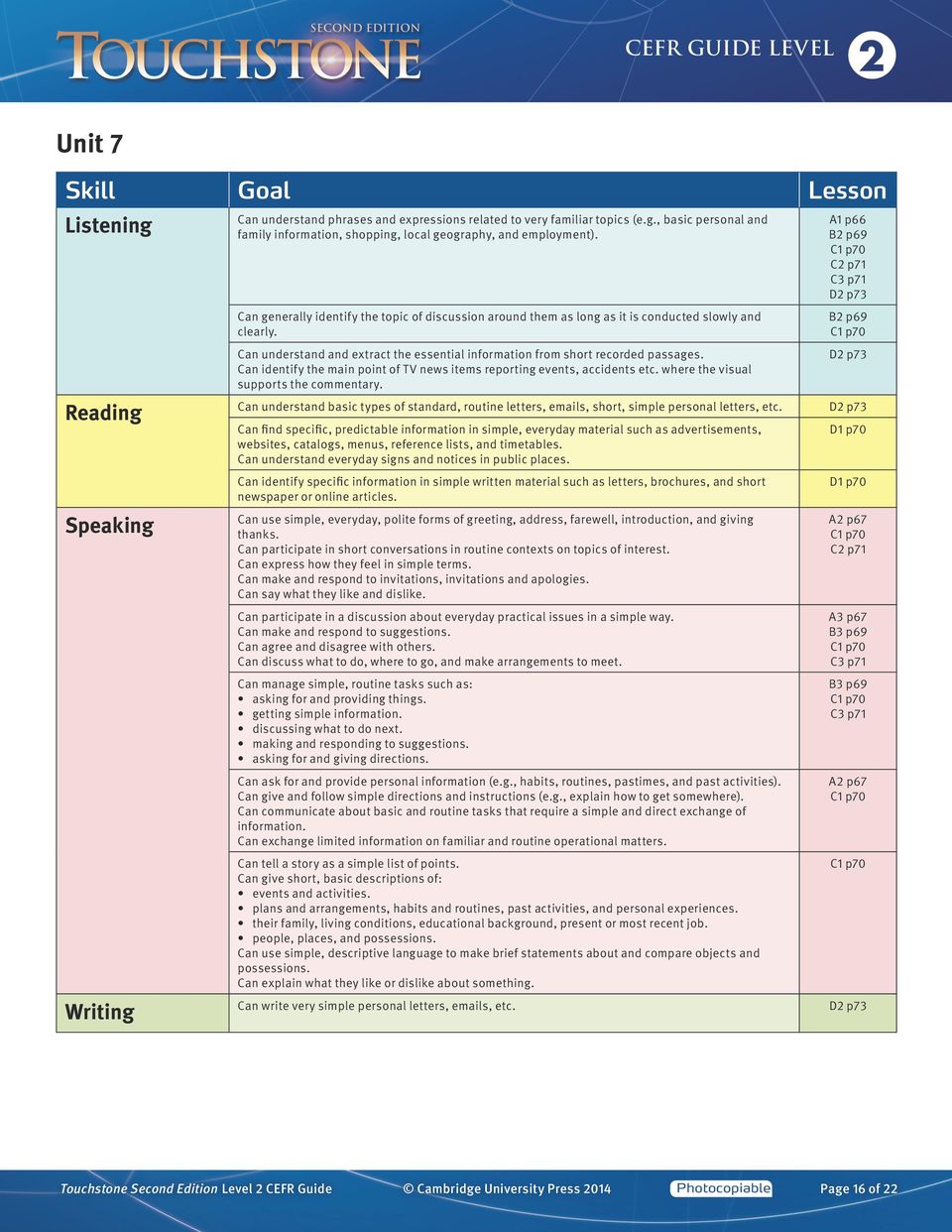
16 Unit 7 Can understand phrases and expressions related to very familiar topics (e.g., basic personal and family information, shopping, local geography, and employment). Can generally identify the topic of discussion around them as long as it is conducted slowly and clearly. Can understand and extract the essential information from short recorded passages. Can identify the main point of TV news items reporting events, accidents etc. where the visual supports the commentary. Can understand basic types of standard, routine letters, s, short, simple personal letters, etc. Can find specific, predictable information in simple, everyday material such as advertisements, websites, catalogs, menus, reference lists, and timetables. Can understand everyday signs and notices in public places. Can make and respond to invitations, invitations and apologies. Can participate in a discussion about everyday practical issues in a simple way. Can make and respond to suggestions. Can agree and disagree with others. Can discuss what to do, where to go, and make arrangements to meet. Can manage simple, routine tasks such as: asking for and providing things. getting simple discussing what to do next. making and responding to suggestions. asking for and giving directions. Can tell a story as a simple list of points. Can give short, basic descriptions of: events and activities. plans and arrangements, habits and routines, past activities, and personal experiences. their family, living conditions, educational background, present or most recent job. people, places, and possessions. Can use simple, descriptive to make brief statements about and compare objects and possessions. Can explain what they like or dislike about something. Can write very simple personal letters, s, etc. A1 p66 B2 p69 C1 p70 C2 p71 C3 p71 D2 p73 B2 p69 C1 p70 D2 p73 D2 p73 D1 p70 D1 p70 A2 p67 C1 p70 C2 p71 A3 p67 B3 p69 C1 p70 C3 p71 B3 p69 C1 p70 C3 p71 A2 p67 C1 p70 C1 p70 D2 p73 Touchstone Second Edition Level 2 CEFR Guide Cambridge University Press 2014 Photocopiable Page 16 of 22
17 Communication strategies Can use simple techniques to start, maintain, or end a short conversation. Can initiate, maintain, and close simple, face-to-face conversation. Can ask very simply for repetition when they do not understand. Can ask for clarification about key words or phrases not understood using stock phrases. Can indicate whether they are following or not. B1 p68 A1 p66 A2 p67 B3 p69 A1 p66 A3 p67 B1 p68 B2 p69 C2 p71 Touchstone Second Edition Level 2 CEFR Guide Cambridge University Press 2014 Photocopiable Page 17 of 22

18 Unit 8 Can understand phrases and expressions related to very familiar topics (e.g., basic personal and family information, shopping, local geography, and employment). Can generally identify the topic of discussion around them as long as it is conducted slowly and clearly. Can understand basic types of standard routine letters, s, short, simple personal letters, etc. Can make and respond to invitations and apologies. Can manage simple, routine tasks such as: asking for and providing things. getting simple discussing what to do next. making and responding to suggestions. asking for and giving directions. Can tell a story as a simple list of points. Can give short, basic descriptions of: events and activities. plans and arrangements, habits and routines, past activities, and personal experiences. their family, living conditions, educational background, present or most recent job. people, places, and possessions. Can use simple, descriptive to make brief statements about and compare objects and possessions. Can explain what they like or dislike about something. Can write very short, basic descriptions of events, past activities, and personal experiences. Can write a series of simple phrases and sentences about everyday and/or personal matters (e.g., family, people, places, a job or study experience, living conditions, educational background, present or most recent job). Can link a series of shorter, discrete simple elements into a connected, linear sequence of points. Can handle very short social exchanges using everyday, polite forms of greeting and address. A1 p76 B2 p79 C1 p80 C2 p81 D2 p83 C3 p81 D1 p80 D1 p80 C1 p80 C2 p81 C3 p81 D3 p83 C1 p80 C2 p81 A3 p77 D3 p83 D1 p82 D2 p83 D3 p83 D3 p83 B1 p78 A1 p76 A2 p77 B3 p79 A1 p76 A3 p77 B1 p78 B2 p79 B3 p79 D3 p83 C1 p80 C2 p81 C3 p81 Touchstone Second Edition Level 2 CEFR Guide Cambridge University Press 2014 Photocopiable Page 18 of 22

19 Unit 9 Can understand phrases and expressions related to very familiar topics (e.g., basic personal and family information, shopping, local geography, and employment). Can generally identify the topic of discussion around them as long as it is conducted slowly and clearly. Can make and respond to invitations and apologies. Can tell a story as a simple list of points. Can give short, basic descriptions of: events and activities. plans and arrangements, habits and routines, past activities, and personal experiences. their family, living conditions, educational background, present or most recent job. people, places, and possessions. Can use simple descriptive to make brief statements about and compare objects and possessions. Can explain what they like or dislike about something. Can write very short, basic descriptions of events, past activities, and personal experiences. Can write a series of simple phrases and sentences about everyday and/or personal matters (e.g., family, people, places, a job or study experience, living conditions, educational background, present or most recent job). Can link a series of shorter, discrete simple elements into a connected, linear sequence of points. Can handle very short social exchanges, using everyday, polite forms of greeting and address. A1 p86 A3 p87 B2 p89 C1 p90 C2 p91 C3 p91 D2 p93 B2 p89 D1 p92 D3 p93 B3 p89 C1 p90 C2 p91 C3 p91 B1 p88 B3 p89 A1 p86 A3 p87 C3 p91 D1 p92 D2 p93 B1 p88 D3 p93 D3 p93 B1 p88 A1 p86 A2 p87 B3 p101 A3 p87 B1 p88 B3 p89 C1 p90 C1 p90 C3 p91 Touchstone Second Edition Level 2 CEFR Guide Cambridge University Press 2014 Photocopiable Page 19 of 22

20 Unit 10 Communication strategies Can understand phrases and expressions related to very familiar topics (e.g., basic personal and family information, shopping, local geography, and employment). Can generally identify the topic of discussion around them as long as it is conducted slowly and clearly. Can make and respond to invitations and apologies. Can participate in a discussion about everyday practical issues in a simple way. Can make and respond to suggestions. Can agree and disagree with others. Can discuss what to do, where to go, and make arrangements to meet. Can write very short, basic descriptions of events, past activities, and personal experiences. Can write a series of simple phrases and sentences about everyday and/or personal matters (e.g., family, people, places, a job or study experience, living conditions, educational background, present or most recent job). Can link a series of shorter, discrete simple elements into a connected, linear sequence of points. Can handle very short social exchanges using everyday, polite forms of greeting and address. Can use simple techniques to start, maintain, or end a short conversation. Can initiate, maintain, and close simple, face-to-face conversation. Can ask very simply for repetition when they do not understand. Can ask for clarification about key words or phrases not understood using stock phrases. Can indicate whether they are following or not. A1 p98 B1 p100 B2 p101 C1 p102 C2 p103 C3 p103 D2 p105 B1 p100 C1 p101 C3 p103 D1 p104 D3 p105 A3 p99 B1 p100 C1 p102 C2 p103 C3 p103 A2 p99 B3 p101 D2 p105 D3 p105 C3 p103 D3 p105 D3 p105 B1 p100 A1 p98 A2 p99 B3 p101 A3 p99 B1 p100 C1 p102 C2 p103 C1 p102 C2 p103 C3 p103 C1 p102 Touchstone Second Edition Level 2 CEFR Guide Cambridge University Press 2014 Photocopiable Page 20 of 22

21 Unit 11 Communication strategies Can understand phrases and expressions related to very familiar topics (e.g., basic personal and family information, shopping, local geography, and employment). Can generally identify the topic of discussion around them as long as it is conducted slowly and clearly. Can make and respond to invitations and apologies. Can write very short, basic descriptions of events, past activities, and personal experiences. Can write a series of simple phrases and sentences about everyday and/or personal matters. (e.g., family, people, places, a job or study experience, living conditions, educational background, present or most recent job). Can use simple techniques to start, maintain, or end a short conversation. Can initiate, maintain, and close simple, face-to-face conversation. Can ask very simply for repetition when they do not understand. Can ask for clarification about key words or phrases not understood using stock phrases. Can indicate whether they are following or not. A1 p108 B2 p111 C1 p112 C3 p113 D2 p115 A1 p108 B2 p111 C1 p112 C3 p113 D2 p115 D1 p114 A2 p109 C1 p112 C2 p113 C3 p113 A3 p109 B3 p111 D3 p115 B1 p110 D5 p115 B3 p110 C1p112 A2 p109 B3 p111 A1 p108 A3 p109 C2 p113 C1 p112 C2 p113 Touchstone Second Edition Level 2 CEFR Guide Cambridge University Press 2014 Photocopiable Page 21 of 22
22 Unit 12 Can understand phrases and expressions related to very familiar topics (e.g., basic personal and family information, shopping, local geography, and employment). Can generally identify the topic of discussion around them as long as it is conducted slowly and clearly. Can catch the main point in short, clear, simple messages and announcements. Can understand simple directions relating to how to get from X to Y, by foot or public transport. Can make and respond to invitations and apologies. Can participate in a discussion about everyday, practical issues in a simple way. Can make and respond to suggestions. Can agree and disagree with others. Can discuss what to do, where to go, and make arrangements to meet. Can manage simple, routine tasks such as: asking for and providing things. getting simple discussing what to do next. making and responding to suggestions. asking for and giving directions. Can write very short, basic descriptions of events, past activities, and personal experiences. Can write a series of simple phrases and sentences about everyday and/or personal matters (e.g., family, people, places, a job or study experience, living conditions, educational background, present or most recent job). Can link a series of shorter, discrete simple elements into a connected, linear sequence of points. Can handle very short social exchanges, using everyday polite forms of greeting and address. A1 p118 B1 p121 C1 p122 C3 p123 D2 p125 B2 p121 C1 p122 C3 p123 D2 p125 C3 p123 D1 p124 A3 p119 C1 p122 C2 p123 D1 p125 D2 p125 C3 p123 A1 p119 B3 p121 C1 p122 D2 p125 D2 p125 B1 p120 A2 p119 B2 p121 B3 p121 A3 p119 B1 p120 C1 p122 C1 p122 C2 p123 C3 p123 Touchstone Second Edition Level 2 CEFR Guide Cambridge University Press 2014 Photocopiable Page 22 of 22
ENGLISH FILE Pre-intermediate
 Karen Ludlow New ENGLISH FILE Pre-intermediate and the Common European Framework of Reference 2 INTRODUCTION What is this booklet for? The aim of this booklet is to give a clear and simple introduction
Global Pre-intermediate CEF descriptors
 Global Pre-intermediate Listening A2 Unit Page I can understand what is said clearly, slowly and directly to me in simple everyday conversation; it is possible to make me understand, if the speaker can
ENGLISH FILE Elementary
 Karen Ludlow New ENGLISH FILE Elementary and the Common European Framework of Reference 2 INTRODUCTION What is this booklet for? The aim of this booklet is to give a clear and simple introduction to the
Thai Language Self Assessment
 The following are can do statements in four skills: Listening, Speaking, Reading and Writing. Put a in front of each description that applies to your current Thai proficiency (.i.e. what you can do with
Introductory Guide to the Common European Framework of Reference (CEFR) for English Language Teachers
 Introductory Guide to the Common European Framework of Reference (CEFR) for English Language Teachers What is the Common European Framework of Reference? The Common European Framework of Reference gives
Common European Framework of Reference for Languages: learning, teaching, assessment. Table 1. Common Reference Levels: global scale
 Common European Framework of Reference for Languages: learning, teaching, assessment Table 1. Common Reference Levels: global scale C2 Can understand with ease virtually everything heard or read. Can summarise
ENGLISH FILE Intermediate
 Karen Ludlow New ENGLISH FILE Intermediate and the Common European Framework of Reference 2 INTRODUCTION What is this booklet for? The aim of this booklet is to give a clear and simple introduction to
Correlation table between Intelligent Business Pre-intermediate and English for Business Level 1 (CEFR A2/B1)
 Correlation table between Intelligent Business Pre-intermediate and English for Business Level 1 (CEFR A2/B1) English for Business Level 1 This qualification is intended for candidates who have achieved
English Discoveries Online Alignment with Common European Framework of Reference
 English Discoveries Online Alignment with Common European Framework of Reference COPYRIGHT NOTICE English Discoveries Online, its documentation, and all related materials are copyrighted. All rights are
Global Scale of English Learning Objectives
 Global Scale of English Learning Objectives for Adult Learners April 2015 All rights reserved; no part of this publication may be reproduced, stored in a retrieval system, or transmitted in any form or
2014-2015 EĞİTİM ÖĞRETİM YILI 8. SINIF İNGİLİZCE DERS KAZANIMLARININ ÇALIŞMA TAKVİMİNE GÖRE DAĞILIM ÇİZELGESİ
 201-2015 EĞİTİM ÖĞRETİM YILI. SINIF İNGİLİZCE DERS KAZANIMLARININ ÇALIŞMA TAKVİMİNE GÖRE DAĞILIM ÇİZELGESİ UNIT 1 FRIENDSHIP Month Week Hour FUNCTIONS SKILLS SEPTEMBER 3 rd & th material. Instructing or
Guide to Pearson Test of English General
 Guide to Pearson Test of English General Level 3 (Upper Intermediate) November 2011 Version 5 Pearson Education Ltd 2011. No part of this publication may be reproduced without the prior permission of Pearson
3 Common Reference Levels
 3 Common Reference Levels 3.1 Criteria for descriptors for Common Reference Levels One of the aims of the Framework is to help partners to describe the levels of proficiency required by existing standards,
and the Common European Framework of Reference
 New and the Common European Framework of Reference Intermediate, third edition Upper-Intermediate Advanced Georgia Smith 2 Contents Introduction p3 New Headway Intermediate, third edition New Headway Upper-Intermediate
CONTENT / ACTIVITY CAN DO PAGE LEVEL GRAMMAR
 Speakout Starter Speakout CEF ALTE UCLES IELTS TOEIC TOEFL ibt PTE Starter - - 0-245 9-18 Elementary /A2 1 KET 3.0 246-500 19-29 1 Pre-intermediate A2/B1 2 PET 4.0 500-650 30-52 2 Intermediate B1+/B2 3
Introduction to the Common European Framework (CEF)
 Introduction to the Common European Framework (CEF) The Common European Framework is a common reference for describing language learning, teaching, and assessment. In order to facilitate both teaching
Common European Framework of Reference for Languages: Learning, teaching, assessment
 Common European Framework of Reference for Languages: Learning, teaching, assessment Structured overview of all CEFR scales The copyright of the descriptive scales and the illustrative scales (in all languages)
Top Notch Second Edition Level 2 Unit-by-Unit CEF Correlations
 Top Notch Second Edition Level 2 Unit-by-Unit Correlations Full Course Correlation with International Standards and Exams LEVEL PTE ALTE UCLES IELTS TOEIC TOEFL (paper) TOEFL ibt Fundamentals A1 - - -
A Guide to Cambridge English: Preliminary
 Cambridge English: Preliminary, also known as the Preliminary English Test (PET), is part of a comprehensive range of exams developed by Cambridge English Language Assessment. Cambridge English exams have
Illinois Institute of Technology Chicago, U.S.A.
 Chicago, U.S.A. 18th Annual Colloquium on International Engineering Education Presenters: Dr. Vanita Misquita, Chicago Mr. Philippe Marc ENSEA, France Nov. 5 6 2015, NYC Graph 1 OUTLINE Criteria used by
2015-2016 EĞİTİM ÖĞRETİM YILI 8. SINIF İNGİLİZCE DERS KAZANIMLARININ ÇALIŞMA TAKVİMİNE GÖRE DAĞILIM ÇİZELGESİ
 2015-20 EĞİTİM ÖĞRETİM YILI 8. SINIF İNGİLİZCE DERS KAZANIMLARININ ÇALIŞMA TAKVİMİNE GÖRE DAĞILIM ÇİZELGESİ UNIT 1 FRIENDSHIP Month Week Hour FUNCTIONS SKILLS SEPTEMBER 5 th Accepting and refusing Apologizing
HANDBOOK A2 B1 ENGLISH ABBREVIATED VERSION. www.telc.net. free download at # 5160-LZB-010101. www.telc.net
 HANDBOOK ENGLISH # 5160-LZB-010101 A2 B1 ABBREVIATED VERSION free download at www.telc.net www.telc.net All rights reserved; no part of this publication may be reproduced, stored in a retrieval system,
MAP for Language & International Communication Spanish Language Learning Outcomes by Level
 Novice Abroad I This course is designed for students with little or no prior knowledge of the language. By the end of the course, the successful student will develop a basic foundation in the five skills:
Understanding skills levels. Understanding skills levels
 6 6 Understanding skills levels Skills are divided into levels, based on national standards. Skill levels start at entry (itself divided into three sub-levels) and go up to level 8. What the levels mean
face2face Upper Intermediate: Common European Framework (CEF) B2 Skills Maps
 face2face Upper Intermediate: Common European Framework (CEF) B2 Skills Maps The table on the right describes the general degree of skill required at B2 of the CEF. Details of the language knowledge required
Top Notch Second Edition Level 3 Unit-by-Unit CEF Correlations
 Top Notch Second Edition Level 3 Unit-by-Unit Correlations Full Course Correlation with International Standards and Exams LEVEL PTE ALTE UCLES IELTS TOEIC TOEFL (paper) TOEFL ibt Fundamentals A1 - - -
Global Scale of English Learning Objectives
 Global Scale of English Learning Objectives for Academic English Published October 2015 A standardised, granular scale which measures English language across reading, writing, speaking and listening. Students
Pasadena City College / ESL Program / Oral Skills Classes / Rubrics (1/10)
 Pronunciation Classes Pasadena City College / ESL Program / Oral Skills Classes / Rubrics (1/10) ESL 246 SLO #1: Students will recognize and begin to produce correct American-English patterns in short
Global Scale of English Learning Objectives
 Global Scale of English Learning Objectives for Adult Learners Published October 2015 A standardised, granular scale which measures English language across reading, writing, speaking and listening. Students
Elementary (A1) Group Course
 COURSE DETAILS Elementary (A1) Group Course 45 hours Two 90-minute lessons per week Study Centre/homework 2 hours per week (recommended minimum) A1(Elementary) min 6 max 8 people Price per person 650,00
CHARTES D'ANGLAIS SOMMAIRE. CHARTE NIVEAU A1 Pages 2-4. CHARTE NIVEAU A2 Pages 5-7. CHARTE NIVEAU B1 Pages 8-10. CHARTE NIVEAU B2 Pages 11-14
 CHARTES D'ANGLAIS SOMMAIRE CHARTE NIVEAU A1 Pages 2-4 CHARTE NIVEAU A2 Pages 5-7 CHARTE NIVEAU B1 Pages 8-10 CHARTE NIVEAU B2 Pages 11-14 CHARTE NIVEAU C1 Pages 15-17 MAJ, le 11 juin 2014 A1 Skills-based
How To Pass Cambriac English: First For Schools
 First Certificate in English (FCE) for Schools CEFR Level B2 Ready for success in the real world Cambridge English: First for Schools Cambridge English: First, commonly known as First Certificate in English
Student Handbook. Part C Courses & Examinations
 Student Handbook Part C Courses & Examinations Student Handbook Part C Courses & Examinations CONTENT Testing & Progress Approach General English Course Descriptions Beginner to Pre-Intermediate Course
English CEF. Pre-intermediate Portfolio Practice Book. Annie McDonald & Mark Hancock
 English Pre-intermediate Portfolio Practice Annie McDonald & Mark Hancock CEF 4 Contents Introduction What is a Language Portfolio? 3 The Language Passport What is a Language Passport? 4 How do I use it?
Exam Information: Graded Examinations in Spoken English (GESE)
 Exam Information: Graded Examinations in Spoken English (GESE) Specifications Guide for Teachers Regulations These qualifications in English for speakers of other languages are mapped to Levels A1 to C2
Comparison of the Cambridge Exams main suite, IELTS and TOEFL
 Comparison of the Cambridge Exams main suite, IELTS and TOEFL This guide is intended to help teachers and consultants advise students on which exam to take by making a side-by-side comparison. Before getting
Score Guide. (Levels A1, 1, 2, 3, 4, 5) PTE GENERAL. February 2012 Version 6
 PTE GENERAL Score Guide (Levels A1, 1, 2, 3, 4, 5) February 2012 Version 6 Pearson Education Ltd 2012. No part of this publication may be reproduced without the prior permission of Pearson Education Ltd.
Macmillan English Campus 4 Crinan Street London, N1 9XW United Kingdom. www.macmillanpracticeonline.com 9 780230 436824
 Macmillan English Campus 4 Crinan Street London, N1 9XW United Kingdom 9 780230 436824 Inspiring learners, enhancing teaching Introducing Macmillan Practice Online Macmillan Practice Online is an online
How To Pass A Cesf
 Graded Examinations in Spoken English (GESE) Syllabus from 1 February 2010 These qualifications in English for speakers of other languages are mapped to Levels A1 to C2 in the Common European Framework
Accelerated Professional Program (APP) Absolute Beginner Varies (Typically 50+ units)
 APP English 1A Absolute Beginner emphasizes the development of practical language skills with a focus on business-related themes, vocabulary, and grammatical structures. The instructor will tailor the
Assessing speaking in the revised FCE Nick Saville and Peter Hargreaves
 Assessing speaking in the revised FCE Nick Saville and Peter Hargreaves This paper describes the Speaking Test which forms part of the revised First Certificate of English (FCE) examination produced by
Spoken English for Work (SEW) exams Guide for Teachers (B1)
 Spoken English for Work (SEW) exams Guide for Teachers (B1) Trinity College London 89 Albert Embankment London SE1 7TP UK T +44 (0)20 7820 6100 F +44 (0)20 7820 6161 E [email protected] www.trinitycollege.co.uk
Reading Listening and speaking Writing. Reading Listening and speaking Writing. Grammar in context: present Identifying the relevance of
 Acknowledgements Page 3 Introduction Page 8 Academic orientation Page 10 Setting study goals in academic English Focusing on academic study Reading and writing in academic English Attending lectures Studying
The. Languages Ladder. Steps to Success. The
 The Languages Ladder Steps to Success The What is it? The development of a national recognition scheme for languages the Languages Ladder is one of three overarching aims of the National Languages Strategy.
Korean Language Evening Class Syllabus
 Korean Language Evening Class Syllabus - 1 - Active Korean 1 1. Course Description This 30 hour course focuses on teaching students without any prior knowledge of the Korean language to read, write, and
Course Syllabus My TOEFL ibt Preparation Course Online sessions: M, W, F 15:00-16:30 PST
 Course Syllabus My TOEFL ibt Preparation Course Online sessions: M, W, F Instructor Contact Information Office Location Virtual Office Hours Course Announcements Email Technical support Anastasiia V. Mixcoatl-Martinez
GESE Elementary steps. Guide for teachers, Grades 4 6
 GESE Elementary steps Guide for teachers, Grades 4 6 What is Trinity College London? Trinity College London is an independent international exams board, fully accredited in England as an awarding body.
Ari Huhta Centre for Applied Language Studies University of Jyväskylä
 How is language proficiency measured: which aspects of proficiency do tests measure and how? Using test results: how to determine language requirements and interpret results? Kuinka kielitaitoa mitataan:
Modern foreign languages
 Modern foreign languages Programme of study for key stage 3 and attainment targets (This is an extract from The National Curriculum 2007) Crown copyright 2007 Qualifications and Curriculum Authority 2007
One Stop Shop For Educators
 Modern Languages Level II Course Description One Stop Shop For Educators The Level II language course focuses on the continued development of communicative competence in the target language and understanding
Section 8 Foreign Languages. Article 1 OVERALL OBJECTIVE
 Section 8 Foreign Languages Article 1 OVERALL OBJECTIVE To develop students communication abilities such as accurately understanding and appropriately conveying information, ideas,, deepening their understanding
PERSONAL INJURY LITIGATION AND THE NON- ENGLISH SPEAKING CLIENT
 PERSONAL INJURY LITIGATION AND THE NON- ENGLISH SPEAKING CLIENT By Justin Valentine There are few specific provisions in the CPR dealing with non-english speaking parties and witnesses. This is surprising
PICAI Italian Language Courses for Adults 6865, Christophe-Colomb, Montreal, Quebec Tel: 514-271 5590 Fax: 514 271 5593 Email: picai@axess.
 PICAI Italian Language Courses for Adults 6865, Christophe-Colomb, Montreal, Quebec Tel: 514-271 5590 Fax: 514 271 5593 Email: [email protected] School Year 2013/2014 September April (24 lessons; 3hours/lesson
English Language (first language, first year)
 Class contents and exam requirements English Language (first language, first year) Code 30123, Learning Path 1 Head Teacher: Prof. Helen Cecilia TOOKE Objectives pag. 2 Program pag. 2 Set and recommended
Working people requiring a practical knowledge of English for communicative purposes
 Course Description This course is designed for learners at the pre-intermediate level of English proficiency. Learners will build upon all four language skills: listening, speaking, reading, and writing
University and College Preparation with Kaplan International in Canada 2015
 University and College Preparation with Kaplan International in Canada 2015 www.kaplaninternational.com Why university and college preparation with Kaplan International in Canada? At Kaplan International,
UNIVERSITÀ DEGLI STUDI DELL AQUILA CENTRO LINGUISTICO DI ATENEO
 TESTING DI LINGUA INGLESE: PROGRAMMA DI TUTTI I LIVELLI - a.a. 2010/2011 Collaboratori e Esperti Linguistici di Lingua Inglese: Dott.ssa Fatima Bassi e-mail: [email protected] Dott.ssa Liliana
International Test of English Proficiency itep Business Orientation Guide
 International Test of English Proficiency itep Business Orientation Guide www.itepexam.com itep...ready When You Are! Table of Contents I. Overview: itep Business...1 A. What to Expect on Exam Day...2
Information for candidates
 Information for candidates The test that opens doors around the world IELTS, the International English Language Testing System, is designed to assess the language ability of candidates who want to study
stress, intonation and pauses and pronounce English sounds correctly. (b) To speak accurately to the listener(s) about one s thoughts and feelings,
 Section 9 Foreign Languages I. OVERALL OBJECTIVE To develop students basic communication abilities such as listening, speaking, reading and writing, deepening their understanding of language and culture
Teaching Framework. Framework components
 Teaching Framework Framework components CE/3007b/4Y09 UCLES 2014 Framework components Each category and sub-category of the framework is made up of components. The explanations below set out what is meant
Curso académico 2015/2016 INFORMACIÓN GENERAL ESTRUCTURA Y CONTENIDOS HABILIDADES: INGLÉS
 Curso académico 2015/2016 INFORMACIÓN GENERAL ESTRUCTURA Y CONTENIDOS HABILIDADES: INGLÉS Objetivos de Habilidades: inglés El objetivo de la prueba es comprobar que el alumno ha adquirido un nivel B1 (dentro
Interpersonal Communication
 6 NCSSFL-ACTFL Can-Do Statements Interpersonal Communication NOVICE LOW I can communicate on some very familiar topics using single words and phrases that I have practiced and memorized. I can greet my
Subject: Spanish as a Foreign Language, Middle School Program
 Subject: Spanish as a Foreign Language, Middle School Program Overview: The Spanish as a Foreign Language Program at BNS focuses on the development of communication and comprehension skills. The Middle
Internationally recognised English language qualifications
 Internationally recognised English language qualifications Contents About LCCI International qualifications from Pearson 3 English for specific purposes 4 - English for Business 4 - English for Business
Syllabus: a list of items to be covered in a course / a set of headings. Language syllabus: language elements and linguistic or behavioral skills
 Lexical Content and Organisation of a Language Course Syllabus: a list of items to be covered in a course / a set of headings Language syllabus: language elements and linguistic or behavioral skills Who
French Language and Culture. Curriculum Framework 2011 2012
 AP French Language and Culture Curriculum Framework 2011 2012 Contents (click on a topic to jump to that page) Introduction... 3 Structure of the Curriculum Framework...4 Learning Objectives and Achievement
EXAMPLES OF SPEAKING PERFORMANCE AT CEFR LEVELS A2 TO C2. (Taken from Cambridge ESOL s Main Suite exams)
 EXAMPLES OF SPEAKING PERFORMANCE AT CEFR LEVELS A2 TO C2 (Taken from Cambridge ESOL s Main Suite exams) Project overview April, 2009 University of Cambridge ESOL Examinations Research and Validation Group
Cambridge Preliminary English Test 3
 Cambridge Preliminary English Test 3 TEACHER S BOOK Examination papers from University of Cambridge ESOL Examinations: English for Speakers of Other Languages PUBLISHED BY THE PRESS SYNDICATE OF THE UNIVERSITY
SOUTH SEATTLE COMMUNITY COLLEGE (General Education) COURSE OUTLINE Revision: (Don Bissonnette and Kris Lysaker) July 2009
 SOUTH SEATTLE COMMUNITY COLLEGE (General Education) COURSE OUTLINE Revision: (Don Bissonnette and Kris Lysaker) July 2009 DEPARTMENT: CURRICULLUM: COURSE TITLE: Basic and Transitional Studies English as
TIP INTRODUCTION (TEST DE INGLÉS PRELIMINAR) A Detailed Specification
 TIP (TEST DE INGLÉS PRELIMINAR) A Detailed Specification INTRODUCTION The TIP exam has been scaled in accordance with the levelling specifications of the Council of Europe Common European Framework (CEF)
Adult Ed ESL Standards
 Adult Ed ESL Standards Correlation to For more information, please contact your local ESL Specialist: Level Two www.cambridge.org/chicagoventures Please note that the Chicago Ventures correlations to the
CEFR Level A1 Level A1 Global Listening Reading Spoken Interaction Spoken Production Writing
 CEFR Level A1 Level A1 is the lowest level of generative language use - the point at which the learner can interact in a simple way, ask and answer simple questions about themselves, where they live, people
Our Lady of Lourdes Catholic Nursery & Primary School. Modern Foreign Language Policy
 Our Lady of Lourdes Catholic Nursery & Primary School Modern Foreign Language Policy September 2014 Review Date: September 2016 INTRODUCTION This subject policy is one in a series that makes up the Whole
Cambridge Primary English as a Second Language Curriculum Framework
 Cambridge Primary English as a Second Language Curriculum Framework Contents Introduction Stage 1...2 Stage 2...5 Stage 3...8 Stage 4... 11 Stage 5...14 Stage 6... 17 Welcome to the Cambridge Primary English
PRICE LIST:Express Publishing ELT Books '2009-2010
 PRICE LIST:Express Publishing ELT Books '2009-2010 Tel: +7(727) 2 506 903 +7(727) 2 506 908 Fax: +7(727) 2 501 835 E-mail:[email protected] Web: www.polygon-int.kz Grammar and Exams ISBN TITLE Sales
Using the CEFR: Principles of Good Practice. October 2011
 Using the CEFR: Principles of Good Practice October 2011 What [the CEFR] can do is to stand as a central point of reference, itself always open to amendment and further development, in an interactive international
COURSE OBJECTIVES SPAN 100/101 ELEMENTARY SPANISH LISTENING. SPEAKING/FUNCTIONAl KNOWLEDGE
 SPAN 100/101 ELEMENTARY SPANISH COURSE OBJECTIVES This Spanish course pays equal attention to developing all four language skills (listening, speaking, reading, and writing), with a special emphasis on
Teacher s Guide for DynEd s Placement Tests
 Teacher s Guide for DynEd s Placement Tests Version 1.9 Copyright 2004-2006, DynEd International, Inc. May 2006 Table of Contents Introduction...3 Placement Test for Kids...4 Placement Test Records...5
ANGLAIS LANGUE SECONDE
 ANGLAIS LANGUE SECONDE ANG-5054-6 DEFINITION OF THE DOMAIN SEPTEMBRE 1995 ANGLAIS LANGUE SECONDE ANG-5054-6 DEFINITION OF THE DOMAIN SEPTEMBER 1995 Direction de la formation générale des adultes Service
GESE Initial steps. Guide for teachers, Grades 1 3. GESE Grade 1 Introduction
 GESE Initial steps Guide for teachers, Grades 1 3 GESE Grade 1 Introduction cover photos: left and right Martin Dalton, middle Speak! Learning Centre Contents Contents What is Trinity College London?...3
SPANISH ESSENTIAL CURRICULUM
 UNIT 1 UNIT OVERVIEW: Students will meet the curricular goals and objectives by: Responding to and initiating greetings and farewells Spelling and providing names Describing people and their personalities
Integrated Skills in English (ISE) examinations
 Integrated Skills in English (ISE) examinations Syllabus from 1 February 2010 These qualifications in English for speakers of other languages are mapped to Levels A2, B1, B2, C1 and C2 in the Common European
Integrated Skills in English (ISE) Guide for Students ISE Foundation (A2) Reading & Writing Speaking & Listening
 Integrated Skills in English (ISE) Guide for Students ISE Foundation (A2) Reading & Writing Speaking & Listening Trinity College London www.trinitycollege.com Charity number 1014792 Patron HRH The Duke
Integrated Skills in English (ISE) examinations
 Integrated Skills in English (ISE) examinations Syllabus from 1 February 2010 These qualifications in English for speakers of other languages are mapped to Levels A2, B1, B2, C1 and C2 in the Common European
Web-Based Language Courses for all UN Staff Members - 2016 OVERVIEW
 Web-Based Language Courses for all UN Staff Members - OVERVIEW For more information, please visit the Language Programme at https://hr.un.org/page/language-programmes-unhq or contact the Language Learning
Speaking skills for Cambridge English: First for Schools (2015)
 Speaking skills for Cambridge English: First for Schools (2015) Cambridge English A not-for-profit department of the University of Cambridge 100 years of expertise in English language assessment Over 4
POLICY FOR TEACHING ENGLISH AS AN ADDITIONAL LANGUAGE (EAL)
 POLICY FOR TEACHING ENGLISH AS AN ADDITIONAL LANGUAGE (EAL) Language is one of the main activities of the mind and the mind is the main part of the personality. Policy Statement English as an Additional
IC2 Class: Conference Calls / Video Conference Calls - 2016
 IC2 Class: Conference Calls / Video Conference Calls - 2016 Technology today is wonderful. That doesn t mean, however, that conferencing calling in a foreign language is easy. In fact, the experience can
FIRST CERTIFICATE Reading and Use of English Writing Listening Speaking Reading:
 Page1 Cambridge FCE B2 FIRST CERTIFICATE Reading and Use of English (1h15min) Reading: 7 parts/52 questions Writing (1h20min) 2 parts. Listening (about 40 min) Speaking (14 min per pair of candidates)
THE POLICY AND PROVISION FOR PUPILS FOR WHOM ENGLISH IS AN ADDITIONAL LANGUAGE
 ROSSALL SCHOOL THE POLICY AND PROVISION FOR PUPILS FOR WHOM ENGLISH IS AN ADDITIONAL LANGUAGE Statement of Aims The school is committed to making appropriate provision of teaching and resources for pupils
Cambridge English: First (FCE) Frequently Asked Questions (FAQs)
 Cambridge English: First (FCE) Frequently Asked Questions (FAQs) Is there a wordlist for Cambridge English: First exams? No. Examinations that are at CEFR Level B2 (independent user), or above such as
Language Development and Deaf Children
 Language Development and Deaf Children What is the difference between speech and language? Language is the words, structures, thoughts and concepts we have in our minds. Speech is one way in which we communicate
ELPS TELPAS. Proficiency Level Descriptors
 ELPS TELPAS Proficiency Level Descriptors Permission to copy the ELPS TELPAS Proficiency Level Descriptors is hereby extended to Texas school officials and their agents for their exclusive use in determining
HANDBOOK ENGLISH BUSINESS B2 C1. www.telc-english.net
 Common European Framework of Reference HANDBOOK ENGLISH BUSINESS www.telc-english.net No part of this publication may be reproduced, stored in a retrieval system, or transmitted in any form or by any means,
Tips for Working With ELL Students
 Session One: Increasing Comprehensibility One goal for every teacher working with ELL students is to increase comprehensibility. In other words, to increase understanding or make course content more intelligible.
Course Engagement and Involvement ENG P107-4. Presecondary
 Course Engagement and Involvement ENG P107-4 Presecondary Language is the roadmap of a culture. It tells you where its people came from and where they are going. Presentation of the Course Engagement
English for Business Communications (8959) Marking Guide for Tutors
 English for Business Communications (8959) Marking Guide for Tutors www.cityandguilds.com June 2008 Version 1.0 About City & Guilds City & Guilds is the UK s leading provider of vocational qualifications,
Defining the general examination and certification requirements, language examination standards and recommendations for renewing and modernizing:
 Defining the general examination and certification requirements, language examination standards and recommendations for renewing and modernizing: 1. The English for Business (EFB) qualifications of LCCI