
Farm Fuel Tank Safety Guide
|
|
|
- Opal Haynes
- 10 years ago
- Views:
Transcription
1 Farm Fuel Tank Safety Guide This brochure is provided by North Dakota Department of Emergency Services, your Local Emergency Planning Committee, and the State Emergency Response Commission along with assistance from the ND Fire Marshal and the ND Department of Health.

2 In North Dakota, It s common practice for farms and ranches to have fuel storage tanks and containers. Almost every year, accidents happen that raise questions on safety issues and reporting requirements. The Farm Fuel Tank Safety Guide is designed to help farmers and ranchers understand what is required of them and how to protect lives, property, and the environment. Regulations SARA Title III (Public Law ) More widely known as the Emergency Planning and Community Right-to-Know Act (EPCRA), Section 304 (a) and (b) state that if a release of an Extremely Hazardous Substance (EHS) or any substance subject to the Comprehensive Environmental Response, Compensation and Liability Act (CERCLA), the owner or operator of a facility shall immediately provide notice (by telephone, radio, or in person) to the emergency coordinator for the Local Emergency Planning Committee (LEPC) and to the State Emergency Response Commission (SERC). Oil spills 25 gallons or less and cleaned up immediately need not be reported. SPCC Regulation 40 CFR 112 The Environmental Protection Agency s Spill Prevention Control and Countermeasures (SPCC) requirements must be complied with if both of the following conditions apply to your farm or ranch facility: 1. You own or operate a non-transportation related fixed facility that could reasonably be expected to discharge oil into or upon the navigable waters of the United States or adjoining shorelines. 2. Your facility has: A total above-ground storage capacity of more than 1,320 gallons (counting only containers with a capacity of 55 gallons or greater);

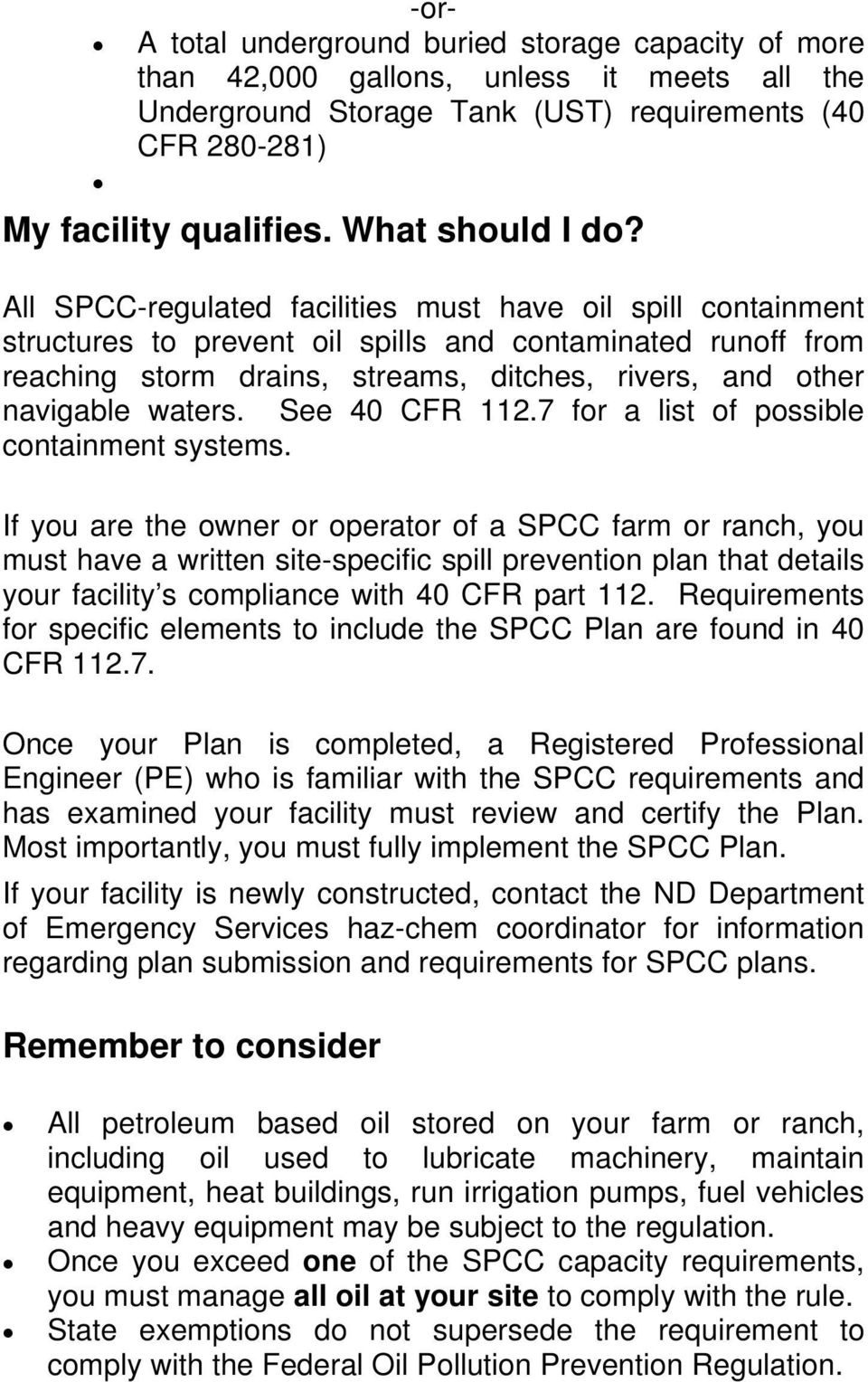
3 -or- A total underground buried storage capacity of more than 42,000 gallons, unless it meets all the Underground Storage Tank (UST) requirements (40 CFR ) My facility qualifies. What should I do? All SPCC-regulated facilities must have oil spill containment structures to prevent oil spills and contaminated runoff from reaching storm drains, streams, ditches, rivers, and other navigable waters. See 40 CFR for a list of possible containment systems. If you are the owner or operator of a SPCC farm or ranch, you must have a written site-specific spill prevention plan that details your facility s compliance with 40 CFR part 112. Requirements for specific elements to include the SPCC Plan are found in 40 CFR Once your Plan is completed, a Registered Professional Engineer (PE) who is familiar with the SPCC requirements and has examined your facility must review and certify the Plan. Most importantly, you must fully implement the SPCC Plan. If your facility is newly constructed, contact the ND Department of Emergency Services haz-chem coordinator for information regarding plan submission and requirements for SPCC plans. Remember to consider All petroleum based oil stored on your farm or ranch, including oil used to lubricate machinery, maintain equipment, heat buildings, run irrigation pumps, fuel vehicles and heavy equipment may be subject to the regulation. Once you exceed one of the SPCC capacity requirements, you must manage all oil at your site to comply with the rule. State exemptions do not supersede the requirement to comply with the Federal Oil Pollution Prevention Regulation.
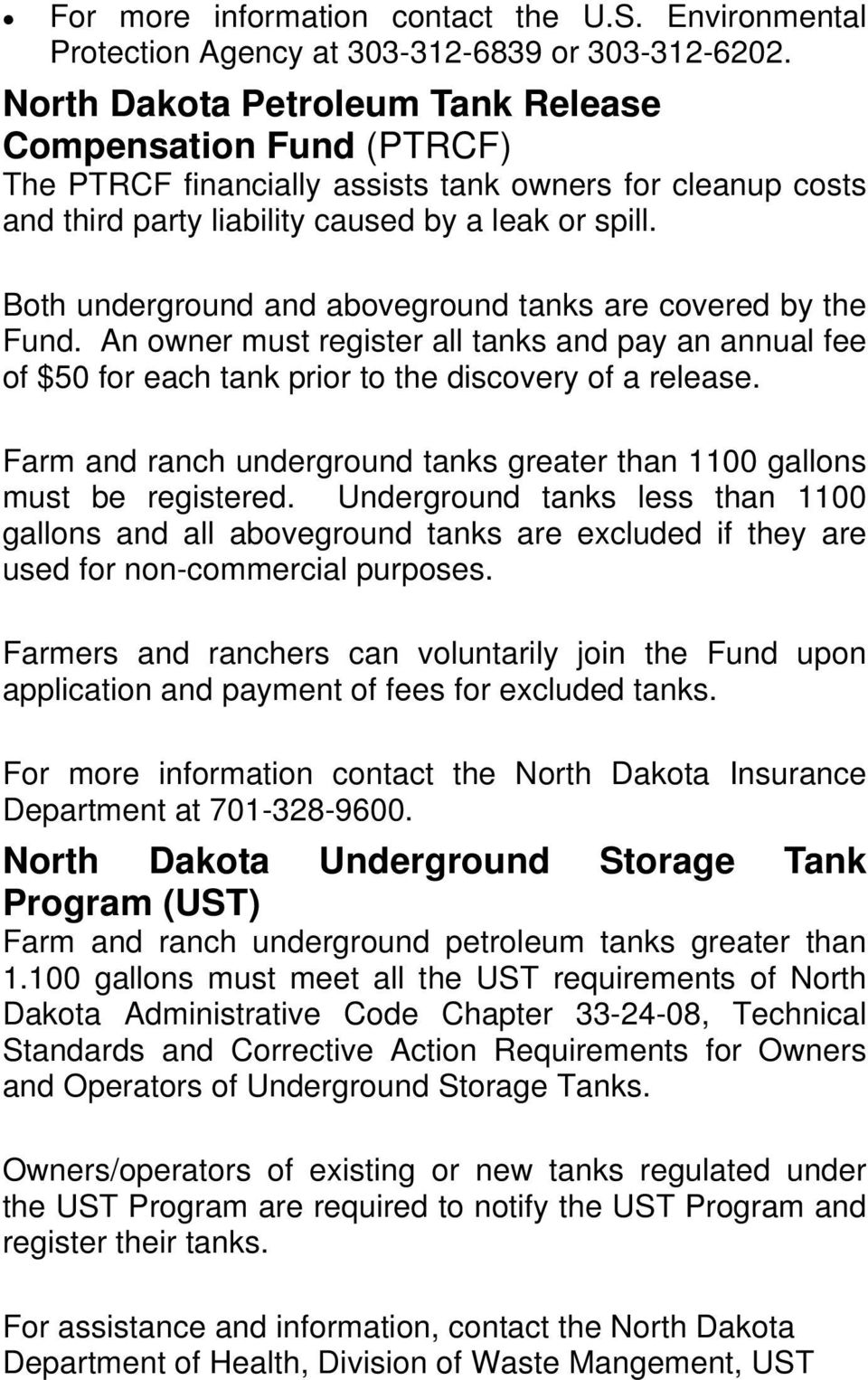
4 For more information contact the U.S. Environmental Protection Agency at or North Dakota Petroleum Tank Release Compensation Fund (PTRCF) The PTRCF financially assists tank owners for cleanup costs and third party liability caused by a leak or spill. Both underground and aboveground tanks are covered by the Fund. An owner must register all tanks and pay an annual fee of $50 for each tank prior to the discovery of a release. Farm and ranch underground tanks greater than 1100 gallons must be registered. Underground tanks less than 1100 gallons and all aboveground tanks are excluded if they are used for non-commercial purposes. Farmers and ranchers can voluntarily join the Fund upon application and payment of fees for excluded tanks. For more information contact the North Dakota Insurance Department at North Dakota Underground Storage Tank Program (UST) Farm and ranch underground petroleum tanks greater than gallons must meet all the UST requirements of North Dakota Administrative Code Chapter , Technical Standards and Corrective Action Requirements for Owners and Operators of Underground Storage Tanks. Owners/operators of existing or new tanks regulated under the UST Program are required to notify the UST Program and register their tanks. For assistance and information, contact the North Dakota Department of Health, Division of Waste Mangement, UST
5 Program at What do I do if I have a leak or spill? 1. Contain the spill and protect lives and property. 2. Contact emergency responders and the Local Emergency Planning Committee (LEPC). 3. All leaks and spills must be dealt with immediately. If you need immediate assistance, the Duty Officer will contact the ND Department of Health. For other assistance and information, contact the Department s Waste Management Division at during normal working hours. 4. Contact the ND Department of Emergency Services Duty Officer through State Radio at with the following information, if possible: Name or type of substance; Actions taken to contain the spill/leak; Estimated quantity released; Time and duration of release; Type of area affected (ground, water, wetlands, river, etc.); Noticeable health effects as a result of the spill/leak; and Your name and contact information. Who do I call for information about SPCC plans? Call the ND Department of Emergency Services haz-chem coordinator at

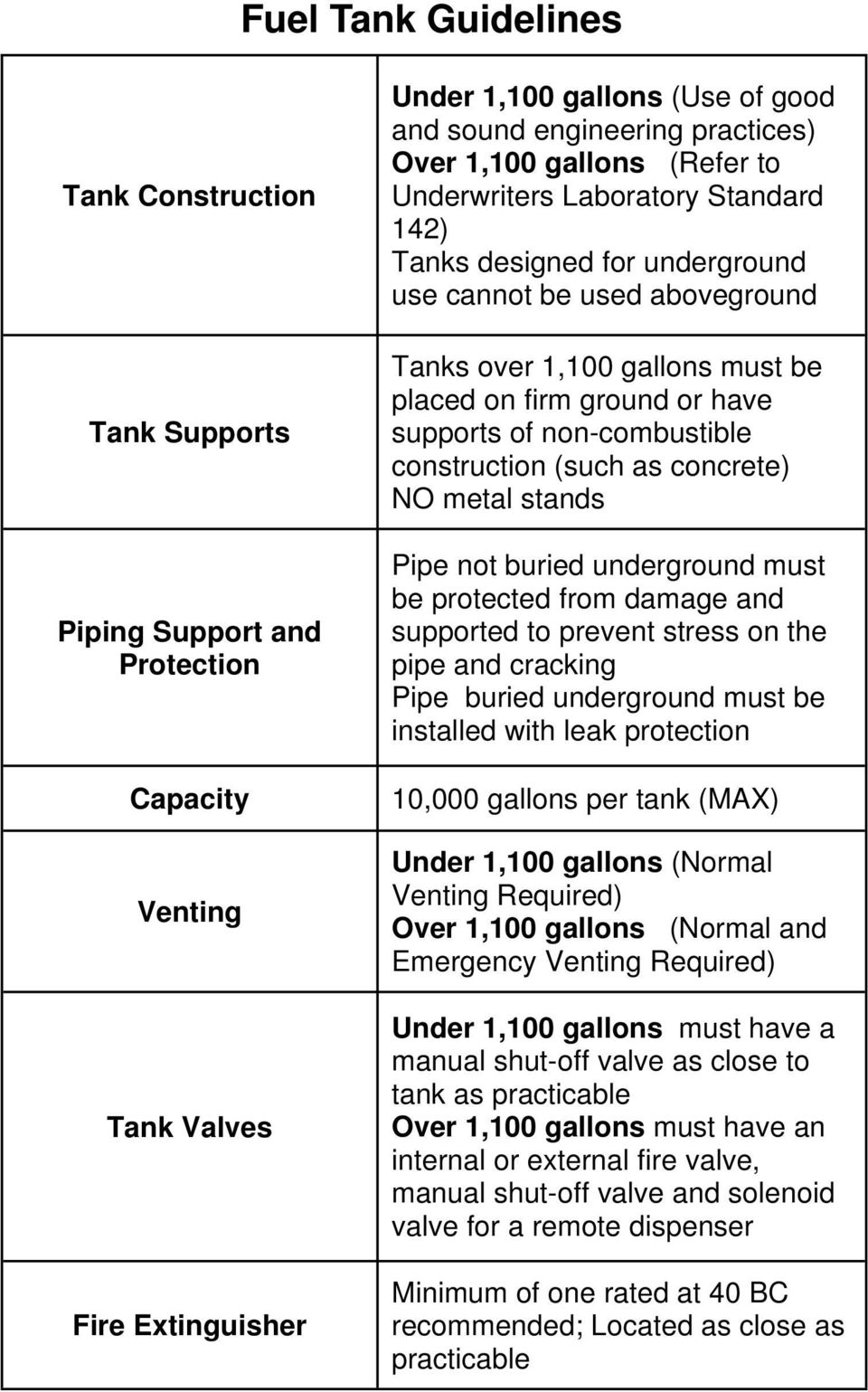
6 Fuel Tank Guidelines Tank Construction Tank Supports Piping Support and Protection Capacity Venting Tank Valves Fire Extinguisher Under 1,100 gallons (Use of good and sound engineering practices) Over 1,100 gallons (Refer to Underwriters Laboratory Standard 142) Tanks designed for underground use cannot be used aboveground Tanks over 1,100 gallons must be placed on firm ground or have supports of non-combustible construction (such as concrete) NO metal stands Pipe not buried underground must be protected from damage and supported to prevent stress on the pipe and cracking Pipe buried underground must be installed with leak protection 10,000 gallons per tank (MAX) Under 1,100 gallons (Normal Venting Required) Over 1,100 gallons (Normal and Emergency Venting Required) Under 1,100 gallons must have a manual shut-off valve as close to tank as practicable Over 1,100 gallons must have an internal or external fire valve, manual shut-off valve and solenoid valve for a remote dispenser Minimum of one rated at 40 BC recommended; Located as close as practicable
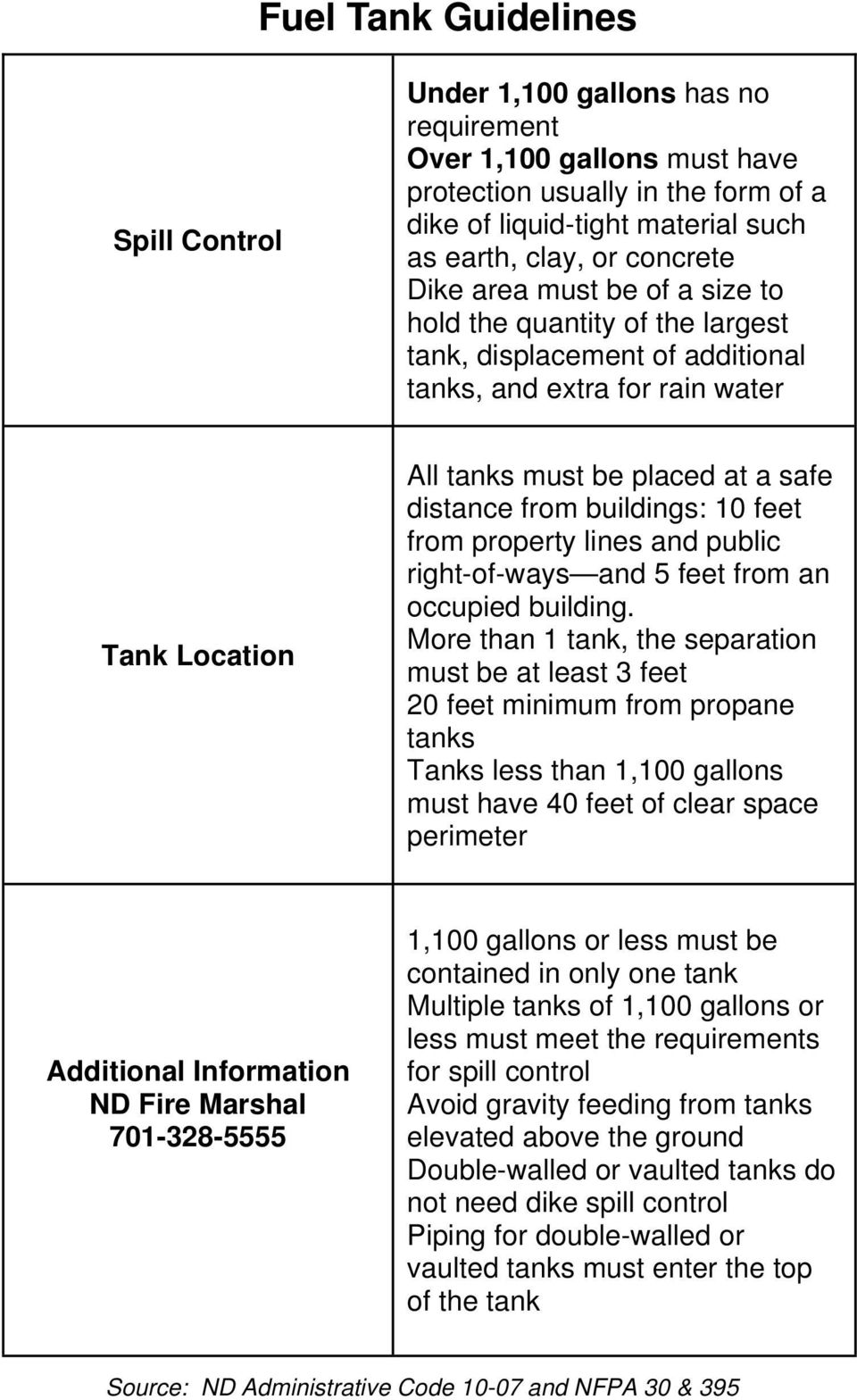
7 Fuel Tank Guidelines Spill Control Under 1,100 gallons has no requirement Over 1,100 gallons must have protection usually in the form of a dike of liquid-tight material such as earth, clay, or concrete Dike area must be of a size to hold the quantity of the largest tank, displacement of additional tanks, and extra for rain water Tank Location All tanks must be placed at a safe distance from buildings: 10 feet from property lines and public right-of-ways and 5 feet from an occupied building. More than 1 tank, the separation must be at least 3 feet 20 feet minimum from propane tanks Tanks less than 1,100 gallons must have 40 feet of clear space perimeter Additional Information ND Fire Marshal ,100 gallons or less must be contained in only one tank Multiple tanks of 1,100 gallons or less must meet the requirements for spill control Avoid gravity feeding from tanks elevated above the ground Double-walled or vaulted tanks do not need dike spill control Piping for double-walled or vaulted tanks must enter the top of the tank Source: ND Administrative Code and NFPA 30 & 395
8

ACTIVITY NAME. Training Requirements for Spill Prevention Control and Countermeasures (SPCC) 40 CFR Part 112 Naval Air Station Corpus Christi Texas
 ACTIVITY NAME Training Requirements for Spill Prevention Control and Countermeasures (SPCC) 40 CFR Part 112 Naval Air Station Corpus Christi Texas CY 2014 BOTTOM LINE UP FRONT To prevent oil discharges
DOES YOUR COMPANY NEED AN SPCC PLAN? Larry Seabolt Remtech Engineers Remediation Specialists
 DOES YOUR COMPANY NEED AN SPCC PLAN? Larry Seabolt What is a Spill Prevention, Control and Countermeasures Plan? Is your company required to have a SPCC plan? What constitutes a SPCC plan? The answer to
A GROUNDWATER PROTECTION PLAN FOR HOME HEATING OIL TANKS
 A GROUNDWATER PROTECTION PLAN FOR HOME HEATING OIL TANKS What is a groundwater protection plan? A groundwater protection plan identifies the activities being conducted that can pollute groundwater and
Spill Prevention, Control and Countermeasure (SPCC) Rule
 Spill Prevention, Control and Countermeasure (SPCC) Rule Code of Federal Regulations Title 40 CFR Part 112 Training Guide for Oil and Fuel handlers on Farms 1 Purpose of SPCC Rule To prevent oil discharges
~CSRMA ALERT~ REVISED SPCC RULE WILL IMPACT MOST POTW S
 ~CSRMA ALERT~ September 17, 2004 REVISED SPCC RULE WILL IMPACT MOST POTW S A CSRMA member in the San Francisco Bay Area was recently inspected by the EPA and Bay Area Regional Water Quality Control Board
Spill Prevention Control and Countermeasure (SPCC) Regulations Fact Sheet
 Spill Prevention Control and Countermeasure (SPCC) Regulations Fact Sheet REGULATORY SUMMARY The Spill Prevention Control and Countermeasure (SPCC) regulations strive to prevent oil from entering navigable
SPILL PREVENTION, CONTROL AND COUNTERMEASURE PLAN
 SPILL PREVENTION, CONTROL AND COUNTERMEASURE PLAN XXXX FARM (CITY OR COUNTY), MICHIGAN CONTACT (NAME), OWNER CERTIFICATION: I hereby certify that I have examined the facility, and being familiar with the
MAINE DEPARTMENT OF ENVIRONMENTAL PROTECTION
 Oxford Hills Bus Garage 36 Brown St, Norway, ME Oil Storage Inspection 2/20/14 CONDITIONS OBSERVED Underground Oil Storage: 12,000 gallon underground oil storage tank (split 10,000 gallon diesel/2,000
Spill Prevention, Control, and Countermeasures (SPCC) Course Material
 Introduction Welcome to the Spill Prevention, Control, and Countermeasures (SPCC) Training course. The ultimate goal of this course is to help you recognize the ways you can avoid pollution of the local
OREGON FIRE CODE Interpretations and Technical Advisories
 OREGON FIRE CODE Interpretations and Technical Advisories A collaborative service by local and state fire professionals, along with our stakeholders and customers, to provide consistent and concise application
 Section A SPCC Plan Implementation Checklist This section of the report addresses compliance with certain requirements of Federal Regulations 40 CFR 112. I. STATUS OF SPCC PLAN (40 CFR 112.3) YES NO A.
Spill Prevention, Control & Cleanup SC-11
 Objectives Cover Contain Educate Reduce/Minimize Product Substitution Description Spills and leaks, if not properly controlled, can adversely impact the storm drain system and receiving waters. Due to
Spill Prevention, Control, and Countermeasures (SPCC) Regulations Update
 Spill Prevention, Control, and Countermeasures (SPCC) Regulations Update The current deadline for most facilities (including typical mining and aggregate operations) is November 10, 2011. All facilities
The following definitions apply with regard to requirements specified in this document:
 GUIDELINES FOR INSTALLATION OF TEMPORARY AND PERMANENT ABOVEGROUND DIESEL FUEL TANKS FOR EMERGENCY AND STANDBY POWER SYSTEMS LOCATED OUTSIDE OF BUILDINGS For Use by Unidocs Member Agencies or where approved
The Comprehensive Environmental Response,
 Purpose and Applicability of Regulations The Comprehensive Environmental Response, Compensation, and Liability Act (CERCLA) was enacted by Congress in 1980 to clean up the nation s hazardous waste sites
Steel Tank Institute AST Inspections. Dana Schmidt, PE STI/SPFA
 Steel Tank Institute AST Inspections Dana Schmidt, PE STI/SPFA Agenda Brief review of SPCC Rule SPCC relevance to small tanks and small facilities. SP001 Standard for Inspection of Aboveground Storage
ENGINEERED DRAWINGS FOR PETROLEUM STORAGE TANKS
 Facility Name: ENGINEERED DRAWINGS FOR PETROLEUM STORAGE TANKS The following is intended to be used as a guideline for information required to appear on engineered drawings involving petroleum storage
The Comprehensive Environmental Response,
 Purpose and Applicability of Regulations Chapter 7 The Comprehensive Environmental Response, Compensation, and Liability Act (CERCLA) was enacted by Congress in 1980 to clean up the nation s hazardous
OIL STORAGE REQUIREMENTS OF THE SPCC REGULATIONS. Christopher J. Ecsedy, P.E. Fuss & O'Neill, Inc. 146 Hartford Road Manchester, CT 06040
 ABSTRACT OIL STORAGE REQUIREMENTS OF THE SPCC REGULATIONS Christopher J. Ecsedy, P.E. Fuss & O'Neill, Inc. 146 Hartford Road Manchester, CT 06040 The SPCC regulations entail numerous requirements for the
Spill Prevention, Control and Countermeasure (SPCC) Training
 Spill Prevention, Control and Countermeasure (SPCC) Training Fort Jackson 2015 Origins of SPCC Regulatory History 1972 Clean Water Act Oil Pollution Act of 1990 Spill Prevention Control and Countermeasures
TRAINING SPCC/SWPP Training UGA. Automotive Center. Campus Transit
 SPILL PREVENTION, CONTROL, AND COUNTERMEASURE TRAINING SPCC/SWPP Training UGA STORM WATER Automotive Center POLLUTION Campus Transit PREVENTION PLAN PLAN Goals of SPCC/SWPP Training Introduce facility
Section 5. Secondary Containment and Impracticability. (as applicable to APSA tank facilities)
 Section 5 Secondary Containment and Impracticability (as applicable to APSA tank facilities) Summary Secondary Containment Requirements APSA/SPCC Plan Compliance Primer Several SPCC rule requirements and
The following definitions apply with regard to requirements specified in this document:
 GUIDELINES FOR INSTALLATION OF TEMPORARY AND PERMANENT ABOVEGROUND DIESEL FUEL TANKS FOR EMERGENCY AND STANDBY POWER SYSTEMS LOCATED OUTSIDE OF BUILDINGS For Use by Unidocs Member Agencies or where approved
Appendix VIII: Spill Prevention, Control and Countermeasure (SPCC) Plans
 Appendix VIII: Spill Prevention, Control and Countermeasure (SPCC) Plans Background What is a Spill Prevention, Control and Countermeasure (SPCC) Plan? An SPCC plan is a written document that describes
SPILL PREVENTION CONTROL AND COUNTERMEASURE PLAN PREPARED FOR: ARKANSAS STATE UNIVERSITY JONESBORO, ARKANSAS ORIGINAL DATE OF PLAN: APRIL 2005
 SPILL PREVENTION CONTROL AND COUNTERMEASURE PLAN PREPARED FOR: ARKANSAS STATE UNIVERSITY JONESBORO, ARKANSAS ORIGINAL DATE OF PLAN: APRIL 2005 DATE OF LAST PLAN AMENDMENT/P.E. CERTIFICATION: MAY 24, 2005
Safe Operating Procedure
 Safe Operating Procedure (Revised 3/14) ABOVEGROUND PETROLEUM STORAGE TANKS INTRODUCTION Aboveground storage tanks (ASTs) are used to store petroleum products at several UNL locations. For example, ASTs
Application for the Construction or Installation of Aboveground Storage Tank (AST) Systems or Associated Underground or Over-water Piping Systems
 Page 1 of 5 Application for the Construction or Installation of Aboveground Storage Tank (AST) Systems or Associated Underground or Over-water Piping Systems New Hampshire Department of Environmental Services
Technical Requirements for Aboveground Storage Tanks (ASTs) Storing Class IIIB Liquids (other than used oil)
 Technical Requirements for Aboveground Storage Tanks (ASTs) Storing Class IIIB Liquids (other than used oil) References: Comm 10 2009 EDITION / NFPA 30 2008 EDITION ITEM DESCRIPTION Comm 10 / NFPA General
Contact Person Sarah Morris-Benavides Revision 1.1 Document Plan 10200.037 Effective Date 07/01/2014 Review Date 03/15/2017.
 Ames Laboratory Federal SPCC regulations (40 CFR Part 112) were created under the authority of the Clean Water Act. The stated purpose is " to prevent oil discharges from reaching navigable waters of the
Design of a Fuel Oil Storage Facility
 Design of a Fuel Oil Storage Facility Background The goal of this project is to design a new, state-of-the-art fuel oil storage facility for the Kanawha Valley Facility, such as the one illustrated in
TITLE 29: EMERGENCY SERVICES, DISASTERS, AND CIVIL DEFENSE CHAPTER I: EMERGENCY MANAGEMENT AGENCY SUBCHAPTER d: STATE EMERGENCY RESPONSE
 TITLE 29: EMERGENCY SERVICES, DISASTERS, AND CIVIL DEFENSE CHAPTER I: EMERGENCY MANAGEMENT AGENCY SUBCHAPTER d: STATE EMERGENCY RESPONSE PART 430 EMERGENCY AND WRITTEN NOTIFICATION OF AN INCIDENT OR ACCIDENT
Waste Oil Collection / Storage
 ENVIRONMENTAL & REGULATORY SERVICES Storage Tank Regulation Section P. O. Box 7837 Madison, Wisconsin 53707-7837 TDD #: (608) 264-8777 http://www.commerce.state.wi.us http://www.wisconsin.gov Jim Doyle,
FUELING AND FUEL STORAGE
 FUELING AND FUEL STORAGE BENCHMARK Implement spill prevention measures whenever fuel is handled or stored. Report, minimize, contain and clean up spills that do occur. FUELING BMPS Spills of diesel, oil,
Safety Manual Title: Spill Prevention & Response Review Date: 6/1/2014
 Operation s Purpose The purpose of this plan is to document spill prevention and response requirements. Each Elkhorn Construction, Inc. jobsite will develop a spill prevention and response plan based on
How To Safely Handle A Spill
 WD DWGB 22 6 2010 Best Management Practices for Fueling and Maintenance of Excavation and Earthmoving Equipment Env Wq 401, Best Management Practices for Groundwater Protection, applies to a variety of
History of the SPCC Rule
 2010 SPCC Training SPCC Rule History of the SPCC Rule The SPCC plan is a document required under the clean water act (CWA) It became effective in 1972 and has changed little in 32 years. The rule was formally
ABOVE-GROUND STORAGE TANKS
 ABOVE-GROUND STORAGE TANKS Above-ground storage tanks in Georgia are regulated by the State Fire Marshall and by the EPA. Above-ground tanks containing 1,100 gallons or less do not require any secondary
ALLEGANY WIND POWER PROJECT CONSTRUCTION SPILL PREVENTION PLAN
 ALLEGANY WIND POWER PROJECT CONSTRUCTION SPILL PREVENTION PLAN Best Management Practices (BMPs) will be implemented during construction of the Allegany Wind Power Project to prevent and contain spills.
Environmental Health & Safety
 Environmental Health & Safety Title: Oil Spill Notification, Reporting, and Response Effective Date: 04/01/2008 Document #: PBS-007-001.JPB Revision Date: Rev. 0 I. Purpose of the Policy: To ensure Oil
Shop Fabricated Aboveground Tank Construction Standards
 Shop Fabricated Aboveground Tank Construction Standards Wayne Geyer Steel Tank Institute Fourth Biennial Freshwater Spills Symposium 2002 March 19-12, 2002 Cleveland, OH One key to clean freshwater is
Critical Regulations SUMMARY OF. Stormwater Management Regulations (National Pollutant Discharge Elimination System or "NPDES ) 40 CFR 122.
 SUMMARY OF Critical Regulations Stormwater Management Regulations (National Pollutant Discharge Elimination System or "NPDES ) 40 CFR 122.26 Spill Prevention, Control, and Countermeasures Rule (SPCC) 40
Spill Control Prevention Plan (SCPP)
 Spill Control Prevention Plan (SCPP) FACILITY INFORMATION PLEASE PRINT Facility Name: Mailing Address: Physical address if different: Owner Name: Owner Address: Primary Contact Name: Work Phone Number:
Spill Prevention Control and Countermeasure Plan
 Spill Prevention Control and Countermeasure Plan Boston College Prepared by: Rizzo Associates, Inc. March 5, 1997 Reviewed and Updated by: ENSR International May, 1998 Last Update Boston College January,
FACILITY ENVIRONMENTAL COMPLIANCE
 FACILITY ENVIRONMENTAL COMPLIANCE 2014 TxDOT Environmental Conference 2014 TxDOT Environmental Conference 2014 TxDOT Environmental Conference Table of Contents 1 Introduction 1 2 Facility Environmental
The Fuel Storage Tank Regulations 2009
 The Fuel Storage Tank Regulations 2009 October 2009 ED/RO1/015 The Fuel Storage Tank Regulations Issued by: The Regulation and Supervision Bureau for the water, wastewater and electricity sector in the
KANSAS STORAGE TANK PROGRAM ABOVEGROUND STORAGE TANK OVERVIEW March 2, 2015
 KANSAS STORAGE TANK PROGRAM ABOVEGROUND STORAGE TANK OVERVIEW March 2, 2015 http://www.kdheks.gov/tanks/index.html Copies of this document are available at: http://www.kdheks.gov/tanks/download/ast_overview.pdf
Civil Engineering Sector Labour-Management Health and Safety Committee
 PROCEDURE FOR THE STORAGE AND HANDLING OF FUEL ON CONSTRUCTION SITES Civil Engineering Sector Labour-Management Health and Safety Committee July 2008 PROCEDURE FOR THE STORAGE AND HANDLING OF FUEL ON CONSTRUCTION
PREVENTING GROUNDWATER POLLUTION: SECONDARY CONTAINMENT
 PREVENTING GROUNDWATER POLLUTION: SECONDARY CONTAINMENT PREVENTING GROUNDWATER POLLUTION IS EVERYONE S JOB! Even if our drinking water comes from rivers, lakes, or reservoirs, we need to be mindful of
UNIVERSITY OF WISCONSIN MADISON
 UNIVERSITY OF WISCONSIN MADISON Contractor Spill Contingency Plan (while working on campus) Departments of: Environment, Health & Safety Physical Plant Table of Contents Spill Contingency Plan Most Common
OIL POLLUTION PREVENTION REGULATIONS
 OIL POLLUTION PREVENTION REGULATIONS The Newly Revised SPCC Rules Spill Prevention Control and Countermeasure NON-TRANSPORTATION RELATED ONSHORE AND OFFSHORE FACILITIES Code of Federal Regulations Title
SPILL PREVENTION, CONTROL AND COUNTERMEASURE (SPCC) PLAN
 SPILL PREVENTION, CONTROL AND COUNTERMEASURE (SPCC) PLAN DEPARTMENT OF PUBLIC WORKS, New Jersey Prepared by Date This is a sample document and is not to be used as an actual SPCC Plan for the applicable
SPCC for Food Services
 Welcome to the University s Annual Oil Spill Prevention, Control and Countermeasures (SPCC ) Compliance Awareness Training for Food Service Employees. Completing this training will fulfill your annual
TULANE UNIVERSITY SPILL PREVENTION CONTROL & COUNTERMEASURE (SPCC) PLAN FOR OIL STORAGE AREAS
 TULANE UNIVERSITY SPILL PREVENTION CONTROL & COUNTERMEASURE (SPCC) PLAN FOR OIL STORAGE AREAS Office of Environmental Health and Safety (504) 988-5486 FAX (504) 988-1693 Revised: Dec 7, 2011 S\BM\emresponseplans\SPCC2011
DIRECTIVE 055: STORAGE REQUIREMENTS FOR THE UPSTREAM PETROLEUM INDUSTRY. August 2012
 DIRECTIVE 055: STORAGE REQUIREMENTS FOR THE UPSTREAM PETROLEUM INDUSTRY August 2012 SECTION 2 The storage requirements in Directive 055 apply to upstream petroleum facilities, well sites, and pipelines
Appendix N Framework Spill Prevention, Containment, and Countermeasures Plan Prepared by: Idaho Power Company 1221 W Idaho Street Boise, ID 83702
 Appendix N Framework Spill Prevention, Containment, and Countermeasures Plan Prepared by: Idaho Power Company 1221 W Idaho Street Boise, ID 83702 November 2011 TABLE OF CONTENTS 1.0 PURPOSE... 1 2.0 RESPONSIBILITY
Kurt Wilson Louisiana Dept. of Environmental Quality Business & Community Outreach Division Small Business/Small Community Assistance Program
 Kurt Wilson Louisiana Dept. of Environmental Quality Business & Community Outreach Division Small Business/Small Community Assistance Program LDEQ Water Regulations Spill Prevention and Control (SPC) Authorized
Natural Resources Conservation Authority Guidelines for Secondary Containment of Hazardous Liquids stored Above-ground
 Natural Resources Conservation Authority Guidelines for Secondary Containment of Hazardous Liquids stored Above-ground December 2011 Table of Contents Definition of Terms... 2 Requirements for Secondary
SPILL PREVENTION, CONTROL, AND COUNTER MEASURES PLAN (SPCC)
 SPILL PREVENTION, CONTROL, AND COUNTER MEASURES PLAN (SPCC) UNIVERSITY RISK MANAGEMENT Occupational and Health Programs 19 Hagood Avenue, Suite 908 Charleston SC 29425 843-792-3604 Revised: June 2015 Spill
Pollution Liability Exposure: Adjustments your automotive business should consider to maintain compliance
 : Adjustments your automotive business should consider to maintain compliance Pollution sounds like such a dirty word. And as an automotive service business owner, employee or operator, you might be producing
Spill Prevention, Control and Countermeasures (SPCC) 40 CFR 112. For Bulk Facilities
 Spill Prevention, Control and Countermeasures (SPCC) 40 CFR 112 For Bulk Facilities Section 311(c) and/or (e) Administrative Order if threat or actual discharge At time of inspection, could not conclude
Used Oil Guidance. Tank and Secondary Containment Requirements For Used Oil Processors
 Used Oil Guidance Tank and Secondary Containment Requirements For Used Oil Processors Washington State Department of Ecology Publication Number 05-04-016 November 2005 For more information The Washington
Inspections Standard Operating Procedure 5 Aboveground Storage Tanks
 Aboveground Storage Tanks Aboveground Storage Tank Inspection This Standard Operating Procedure describes the steps that campus units that manage aboveground oil storage tanks (ASTs) or containers must
September 2008 AFC 4.6.2.1.(2) Page 1 of 5. Maximum Size and Aggregate Capacities of Aboveground Storage Tank Systems at Fuel Dispensing Stations
 FIRE CODE VARIANCE September 2008 AFC 4.6.2.1.(2) Page 1 of 5 ISSUE Maximum Size and Aggregate Capacities of Aboveground Storage Tank Systems at Fuel Dispensing Stations The Alberta Fire Code (AFC) limits
CHAPTER 62-740 PETROLEUM CONTACT WATER
 CHAPTER 62-740 PETROLEUM CONTACT WATER 62-740.010 Declaration of Intent (Repealed) 62-740.020 Applicability 62-740.030 Definitions 62-740.040 General 62-740.100 Management Practices for Producers of PCW
ALL UST SYSTEMS. MOTOR FUEL, USED OIL, BULK HEATING OIL STORAGE (Federal/State Regulated Systems)
 FACTS ABOUT: UST SYSTEMS COMPLIANCE OUTLINE Maryland Department of the Environment In Maryland, certain UST systems must meet various compliance requirements. The following is a summary of the current
MASSACHUSETTS INSTITUTE OF TECHNOLOGY MASSACHUSETTS INSTITUTE OF TECHNOLOGY CAMPUS SPILL PREVENTION, CONTROL, AND COUNTERMEASURE (SPCC) PLAN
 MASSACHUSETTS INSTITUTE OF TECHNOLOGY MASSACHUSETTS INSTITUTE OF TECHNOLOGY CAMPUS SPILL PREVENTION, CONTROL, AND COUNTERMEASURE (SPCC) PLAN Prepared for: Massachusetts Institute of Technology Cambridge,
Pollution Prevention And Best Management Practices For Dry Cleaners Operating In Broward County
 FORWARD In 1991, the Broward County Environmental Protection and Growth Management Department, who was then known as the Department of Natural Resource Protection (DNRP), initiated the development of Pollution
SPILL PREVENTION, CONTROL AND COUNTERMEASURE PLAN. for the PIÑON RIDGE MILL 16910 HIGHWAY 90 BEDROCK, COLORADO 81411. Prepared by:
 SPILL PREVENTION, CONTROL AND COUNTERMEASURE PLAN for the PIÑON RIDGE MILL 16910 HIGHWAY 90 BEDROCK, COLORADO 81411 Prepared by: ENERGY FUELS RESOURCES CORPORATION September 2009 SPILL PREVENTION, CONTROL,
Secondary Containment of Large Aboveground Storage Tanks
 Secondary Containment of Large Aboveground Storage Tanks Technology corner Posted / Last update: 01-08-1999 Publication: Petroleum Equipment & Technology Archive Issued: August 1999 Author: Myers Philip
Outdoor Liquid Container Storage
 Outdoor Liquid Container Storage SC-31 Objectives Cover Contain Educate Reduce/Minimize Description Accidental releases of materials from above ground liquid storage tanks, drums, and dumpsters present
Fuel Storage Who to ask: tank farm owners/operators
 Fuel Storage Fuel Storage Who to ask: tank farm owners/operators 89. How many tank farms are there in the village and who owns them? Fuel tank farm The questions in the following section should be answered
SOP 4: Spill Response and Cleanup Procedures SOP 4: SPILL RESPONSE AND CLEANUP PROCEDURES
 SOP 4: SPILL RESPONSE AND CLEANUP PROCEDURES Municipalities are responsible for any contaminant spill or release that occurs on property they own or operate. Particular areas of concern include any facilities
UPDATE ON MAINE'S UNDERGROUND TANK LAWS
 MAINE OIL DEALERS ASSOCIATION TECHNICAL BULLETIN #6.5 MAINE UNDERGROUND TANK LAW CHANGES September, 1992 [Replaces Technical Bulletin #6.4, issued January, 1992] UPDATE ON MAINE'S UNDERGROUND TANK LAWS
Secondary Containment Options for Aboveground and Underground Tanks. Wayne Geyer Steel Tank Institute
 Secondary Containment Options for Aboveground and Underground Tanks Wayne Geyer Steel Tank Institute Secondary containment tanks first appeared in the United States in the early 1980's, when several local
U. S. EPA REGION 8 OIL PROGRAM
 U. S. EPA REGION 8 OIL PROGRAM Spill Prevention Control and Countermeasure CWA Section 311(j) The original SPCC regulation promulgated in 1973; First effective on January 10, 1974. Codified at 40 CFR part
Draft. ATLANTIC COAST PIPELINE, LLC ATLANTIC COAST PIPELINEINE Docket No. PF15-6-000. and
 ATLANTIC COAST PIPELINE, LLC ATLANTIC COAST PIPELINEINE Docket No. PF15-6-000 and DOMINION TRANSMISSION, INC SUPPLY HEADER PROJECT Docket No. PF15-5-000 Draft Prepared by July 2015 TABLE OF CONTENTS 1.0
COMPLIANCE MANAGEMENT STRATEGIES. Presented by: Megan Kazmierczak, ECS Eclipse
 COMPLIANCE MANAGEMENT STRATEGIES Presented by: Megan Kazmierczak, ECS Eclipse AST vs. UST Compliance requirements Aboveground Storage Tanks (ASTs): Misconception that ASTs are unregulated Most are subject
APPENDIX O. Spill Prevention and Emergency Response Plan. G3 Terminal Vancouver Port Metro Vancouver Project Permit Application APPENDIX O
 APPENDIX O Spill Prevention and Emergency Response Plan APPENDIX O G3 Terminal Vancouver Port Metro Vancouver Project Permit Application G3 TERMINAL VANCOUVER: PORT METRO VANCOUVER SPILL PREVENTION AND
IAC 7/2/08 Agriculture and Land Stewardship[21] Ch 44, p.1
![IAC 7/2/08 Agriculture and Land Stewardship[21] Ch 44, p.1](/thumbs/39/20233896.jpg "IAC 7/2/08 Agriculture and Land Stewardship[21] Ch 44, p.1") IAC 7/2/08 Agriculture and Land Stewardship[21] Ch 44, p.1 CHAPTER 44 ON-SITE CONTAINMENT OF PESTICIDES, FERTILIZERS AND SOIL CONDITIONERS [Prior to 7/27/88, see 21 Ch 9] PESTICIDES 21 44.1(206) Definitions.
IAC 7/2/08 Agriculture and Land Stewardship[21] Ch 44, p.1 CHAPTER 44 ON-SITE CONTAINMENT OF PESTICIDES, FERTILIZERS AND SOIL CONDITIONERS [Prior to 7/27/88, see 21 Ch 9] PESTICIDES 21 44.1(206) Definitions.
Spill Prevention, Control and Countermeasure Plan (SPCC) Program
 United States Environmental Protection Agency Office of Emergency Management August 2013 www.epa.gov/emergencies Spill Prevention, Control and Countermeasure Plan (SPCC) Program Bulk Storage Container
SPILL PREVENTION, CONTROL, AND COUNTERMEASURE (SPCC) REGULATION
 SPILL PREVENTION, CONTROL, AND COUNTERMEASURE (SPCC) REGULATION 40 CFR part 112 A Facility Owner/Operator s Guide to Oil Pollution Prevention authority of Section 311(j)(1)(C) of the Federal Water Pollution
Agenda Item 16 Compilation of States Above-Ground Storage Tank Programs and Regulations
 Agenda Item 16 Compilation of States Above-Ground Storage Tank Programs and Regulations 207 TH TECHNICAL COMMITTEE MEETING FEBRUARY 11-12, 2015 INFORMATIONAL ITEM STEVE BRAUN Recent News January 9 th,
MODULE IV Secondary Containment, Oil Spill Control & Spill Prediction
 Page 1 How to Prepare Your Own SPCC Plan: A Step-by-Step Guide for Tier 1 Qualified Facilities Using the US EPA Tier I SPCC Template MODULE IV Secondary Containment, Oil Spill Control & Spill Prediction
SPILL PREVENTION, CONTROL, & COUNTERMEASURE PLAN
 SPILL PREVENTION, CONTROL, & COUNTERMEASURE PLAN TRANSIT SERVICES 1015, 1145, 1161, & 1165 TRANSIT DRIVE COLORADO SPRINGS Plan Date: December 2011 (Revised May 2013) EMERGENCY INFORMATION In case of a