
Safety Manual Title: Spill Prevention & Response Review Date: 6/1/2014
|
|
|
- Vivien Carroll
- 9 years ago
- Views:
Transcription
1 Operation s Purpose The purpose of this plan is to document spill prevention and response requirements. Each Elkhorn Construction, Inc. jobsite will develop a spill prevention and response plan based on the requirements and template provided. Scope This procedure applies to all Elkhorn Construction, Inc. operations. When work is performed on a non-owned or operated site, the operator's program shall take precedence, however, this document covers Elkhorn Construction, Inc. employees and contractors and shall be used on owned premises, or when an operator's program doesn't exist or is less stringent. Requirements Each work site spill prevention and response plan shall contain the following requirements. Chemical substances should be stored in proper containers to minimize the potential for a spill. Whenever possible, chemicals should be kept in closed containers and stored so they are not exposed to storm water. The program must identify chemicals used that may be potentially spilled or released. This will include both liquid chemicals used at our facilities or brought on to owner client sites. Spill kits must be adequate for any anticipated spills. A proper spill kit must contain the appropriate supplies for materials that may be spilled. Supplies must be easily accessible when required, and considerations must be made for both the type and quantity of materials. The contents of spill response kits shall be periodically assessed to ensure the availability of adequate spill response supplies and adjust inventory as necessary. Elkhorn Construction, Inc. shall ensure the availability of adequate spill response supplies by periodic inspection to assess their availability and adjust the inventory as necessary. Employees must be instructed on spill prevention and the proper response procedures for spilled materials. The training should include materials available for use, proper waste disposal and communication procedures. Areas where chemicals may be used or stored must be maintained using good housekeeping best management practices. This includes, but is not Document No: Revision 1 Page 1 of 14
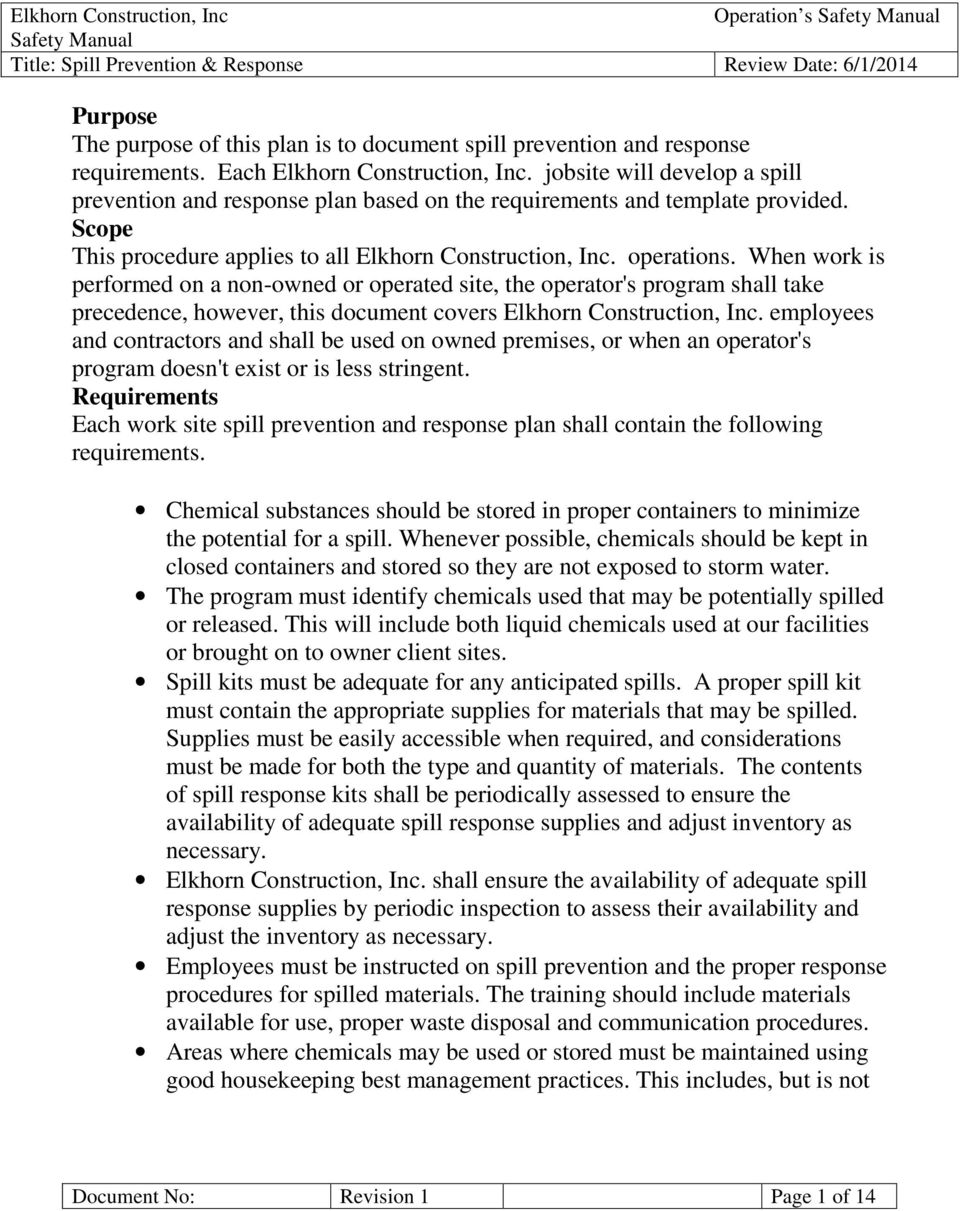
2 Operation s limited to clean and organized storage, labeling and secondary containment where necessary. Proper communication measures for employees to initiate in the event of a spill will be created on a site by site basis. Communication procedures will be based on type and quantity of materials spilled. Environmental spills shall be reported to environmental authorities when required. Reporting procedures will be based on type and quantity of materials spilled. Training All employees will be trained on proper communication, techniques to avoid a spill and spill response. Training shall include use of spill containment s, use of absorbents, and proper disposal techniques based on possible chemicals utilized on projects. Document No: Revision 1 Page 2 of 14
3 Operation s Copies of this plan are located at the facility and are available to all employees. Location(s) of plan(s): Facility Information Facility Name: Mailing Address: Physical address if different: Owner Name: Owner Address: Primary Contact Name: Work Phone Number: Home Phone Number: Mobile Phone Number: Secondary Contact Name: Work Phone Number: Home Phone Number: Mobile Phone Number: Date of Initial Operation: Site Assessment Location - Describe where facility is located. Document No: Revision 1 Page 3 of 14

4 Operation s Document No: Revision 1 Page 4 of 14

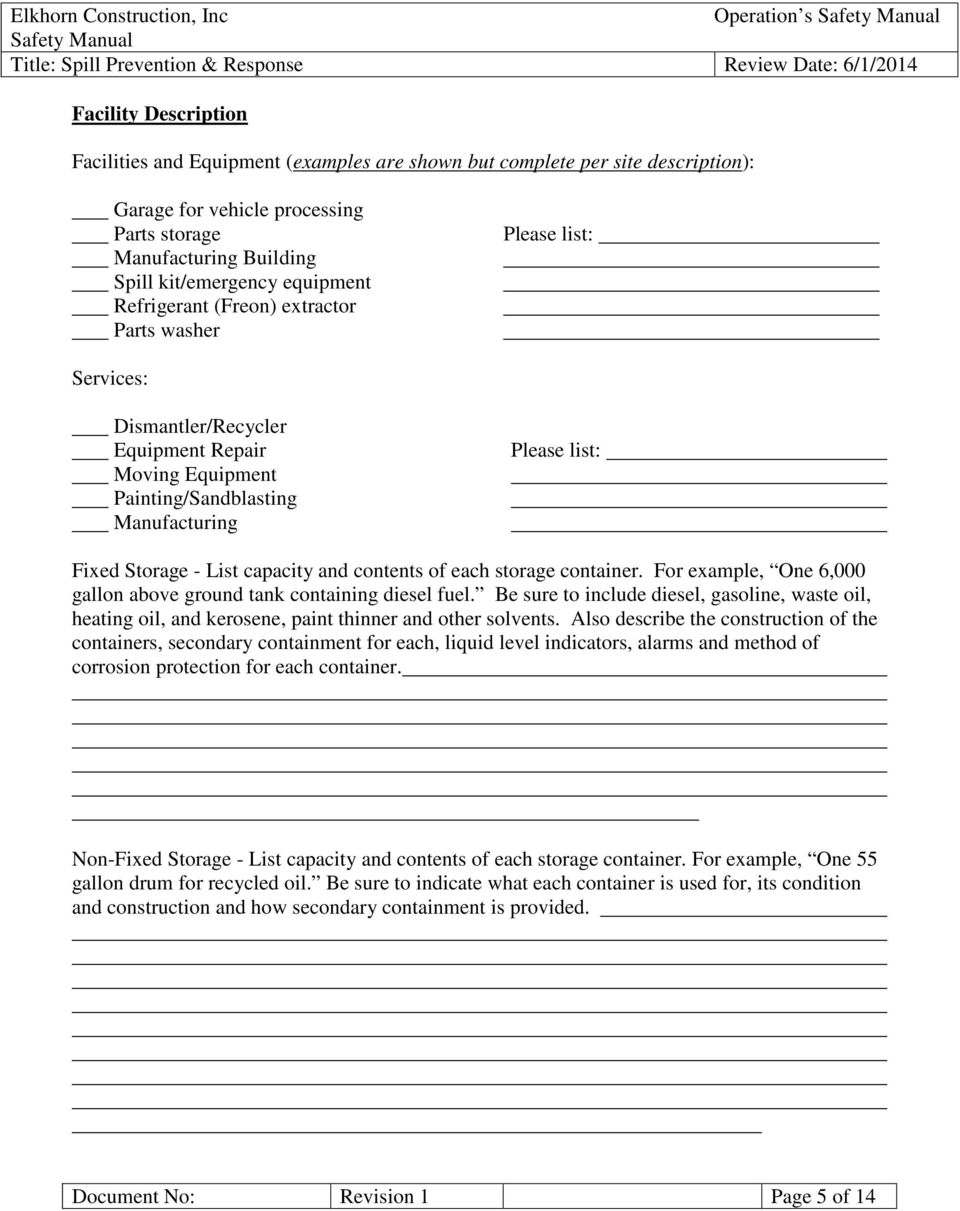
5 Operation s Facility Description Facilities and Equipment (examples are shown but complete per site description): Garage for vehicle processing Parts storage Manufacturing Building Spill kit/emergency equipment Refrigerant (Freon) extractor Parts washer Please list: Services: Dismantler/Recycler Equipment Repair Moving Equipment Painting/Sandblasting Manufacturing Please list: Fixed Storage - List capacity and contents of each storage container. For example, One 6,000 gallon above ground tank containing diesel fuel. Be sure to include diesel, gasoline, waste oil, heating oil, and kerosene, paint thinner and other solvents. Also describe the construction of the containers, secondary containment for each, liquid level indicators, alarms and method of corrosion protection for each container. Non-Fixed Storage - List capacity and contents of each storage container. For example, One 55 gallon drum for recycled oil. Be sure to indicate what each container is used for, its condition and construction and how secondary containment is provided. Document No: Revision 1 Page 5 of 14
6 Operation s Total quantity of stored materials: - The combined quantity of the materials listed above: gallons Document No: Revision 1 Page 6 of 14

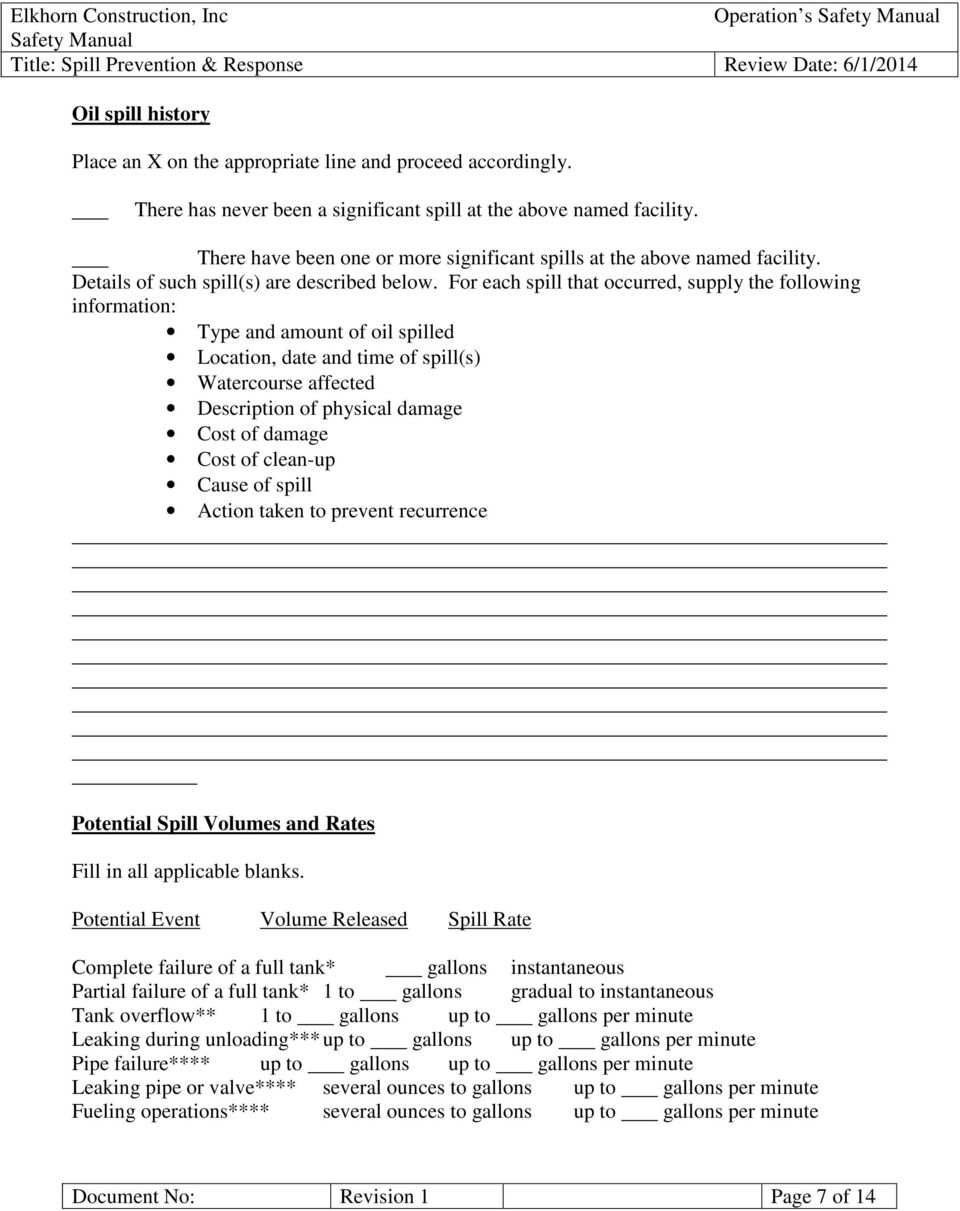
7 Operation s Oil spill history Place an X on the appropriate line and proceed accordingly. There has never been a significant spill at the above named facility. There have been one or more significant spills at the above named facility. Details of such spill(s) are described below. For each spill that occurred, supply the following information: Type and amount of oil spilled Location, date and time of spill(s) Watercourse affected Description of physical damage Cost of damage Cost of clean-up Cause of spill Action taken to prevent recurrence Potential Spill Volumes and Rates Fill in all applicable blanks. Potential Event Volume Released Spill Rate Complete failure of a full tank* gallons instantaneous Partial failure of a full tank* 1 to gallons gradual to instantaneous Tank overflow** 1 to gallons up to gallons per minute Leaking during unloading*** up to gallons up to gallons per minute Pipe failure**** up to gallons up to gallons per minute Leaking pipe or valve**** several ounces to gallons up to gallons per minute Fueling operations**** several ounces to gallons up to gallons per minute Document No: Revision 1 Page 7 of 14
8 Operation s Oil and grease several ounces to quarts spotting * Volume of largest tank ** Calculate using the rate at which fuel is dispensed from the delivery truck into your tank(s). *** Calculate using the rate at which petroleum would be withdrawn from the tank if it should have to be emptied (e.g., if it was being taken out of service). **** Calculate based on the specifications of your equipment. Spill Prevention and Control Spill Prevention - Provide specific descriptions of containment facilities and practices. Include description of items such as double-walled tanks, containment berms, emergency shut-offs, drip pans, fueling procedures and spill response kits. Also, describe how and when employees are trained in proper handling procedures and spill prevention and response procedures. Spill discharge and flow - For each potential spill source; describe where petroleum would flow in the event of a spill. For example, The 6,000 gallon diesel tank has a pre-manufactured secondary containment system capable of holding 110 percent of the total volume of the tank and, A spill from engine repair would be contained inside the shop building and quickly cleaned up with oil absorbents. Incorporate site map by reference (see instructions under Appendices). Spill response - Identify what equipment would be deployed by whom and in what situation. Also, include phone numbers for response agencies, e.g., U.S. Coast Guard, fire department, spill response contractors, etc. A copy of your spill response plan may be attached as an appendix to this plan in lieu of completing this section. Document No: Revision 1 Page 8 of 14
9 Operation s Security - Provide a description of how all containers are protected when the facility is not in operation or unattended. Include a description of fencing, access control, gates, locks, etc. that prevent access by unauthorized individuals. Facility Inspections Routine Inspections - Name facilities and the frequency with which they are inspected. For example, The fuel pumps are inspected daily. The materials storage area is inspected monthly. Describe all facility containers, piping, etc. that is to be inspected. Name the person who has responsibility to implement preventative maintenance programs, oversee on-site inspections, coordinate employee training, maintain records, update the plan as necessary, and ensure that reports are submitted to the proper authorities. Annual Inspections - Include a description of annual comprehensive inspections. For example, A site inspection is also conducted annually by appropriate responsible personnel to verify that the description of potential pollutant sources are accurate, that the map reflects current site conditions, and that the controls to reduce the pollutants identified in this plan are being implemented and are adequate. This annual inspection will be conducted above and beyond the routine inspections done focusing on designated equipment and areas where potential sources are located. Record Keeping Document No: Revision 1 Page 9 of 14
10 Operation s Describe record keeping procedures. For example, Record keeping procedures consist of maintaining all records a minimum of three years. The following items will be kept on file: current plan, internal site reviews, training records, and documentation of any spills or maintenance conducted in regards to these sites. Maintenance Inspection, Employee Training, and Record Keeping logs are included in this template for your use. Document No: Revision 1 Page 10 of 14

11 Operation s Maintenance Inspections Maintenance Coordinator Name: Maintenance Coordinator responsibilities include implementation of preventative maintenance programs and oversight of on-site inspections. Use this table to record inspections: Facility Inspected Date of Inspection Name of Inspector Result Pass/Fail Comments Document No: Revision 1 Page 11 of 14

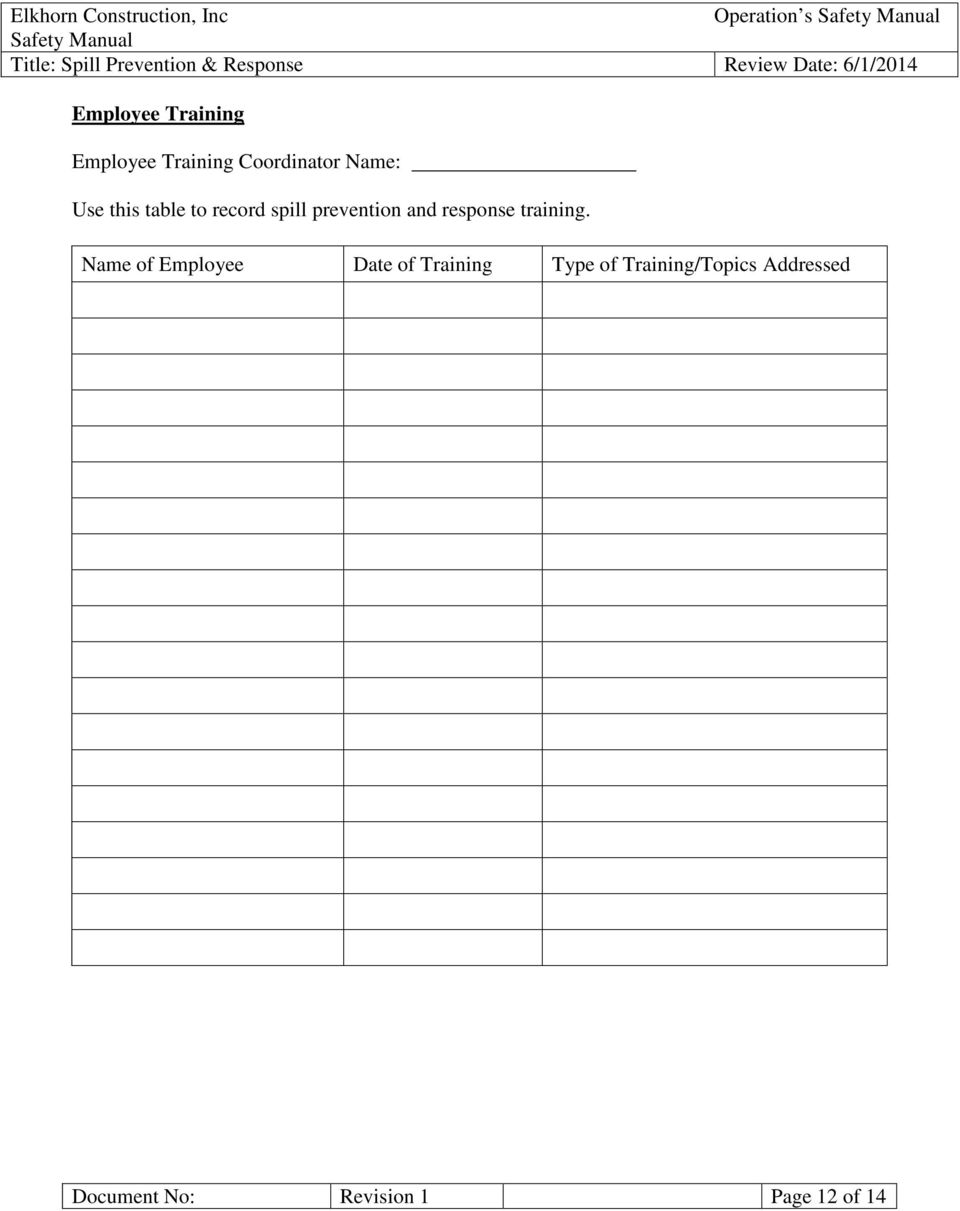
12 Operation s Employee Training Employee Training Coordinator Name: Use this table to record spill prevention and response training. Name of Employee Date of Training Type of Training/Topics Addressed Document No: Revision 1 Page 12 of 14
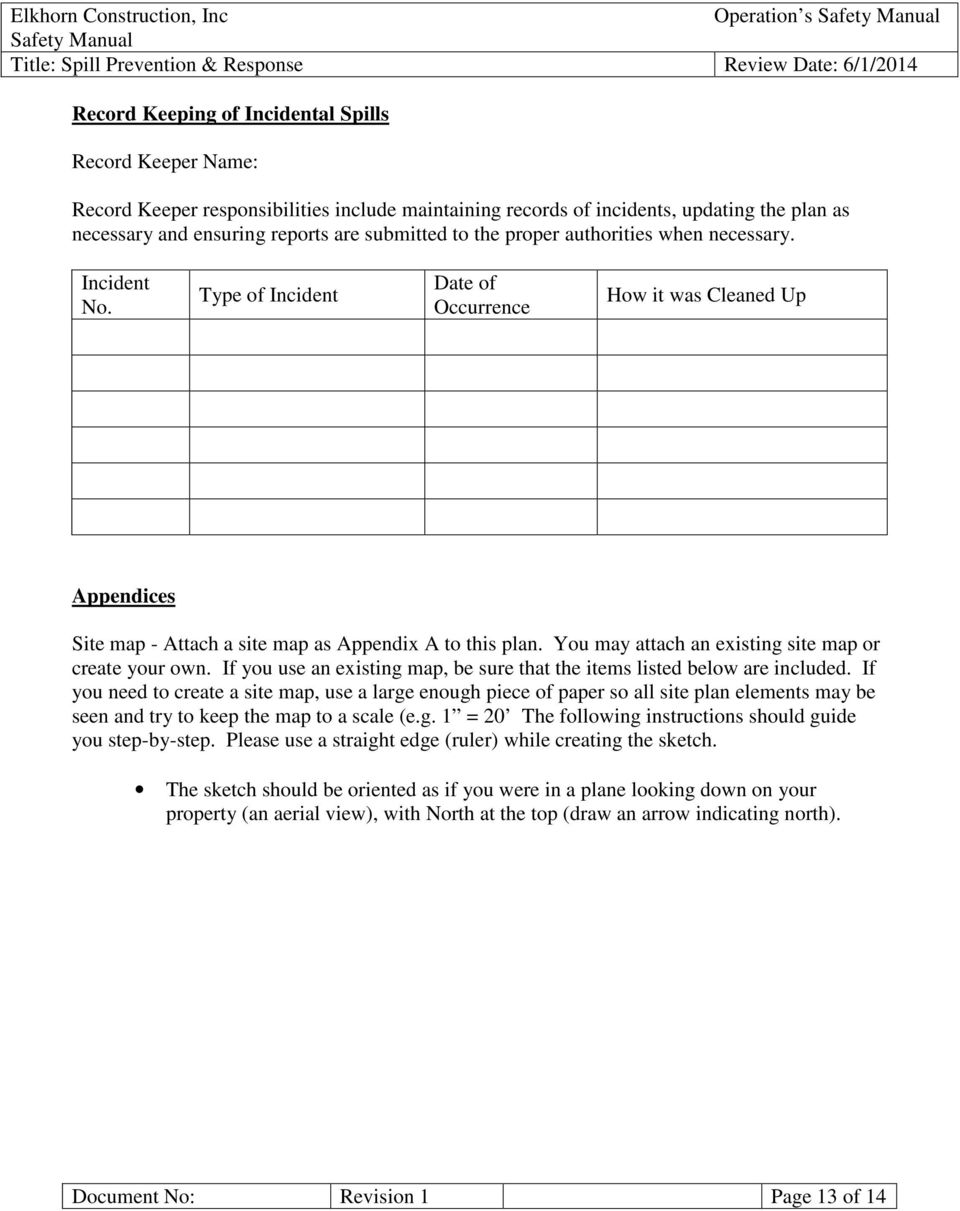
13 Operation s Record Keeping of Incidental Spills Record Keeper Name: Record Keeper responsibilities include maintaining records of incidents, updating the plan as necessary and ensuring reports are submitted to the proper authorities when necessary. Incident No. Type of Incident Date of Occurrence How it was Cleaned Up Appendices Site map - Attach a site map as Appendix A to this plan. You may attach an existing site map or create your own. If you use an existing map, be sure that the items listed below are included. If you need to create a site map, use a large enough piece of paper so all site plan elements may be seen and try to keep the map to a scale (e.g. 1 = 20 The following instructions should guide you step-by-step. Please use a straight edge (ruler) while creating the sketch. The sketch should be oriented as if you were in a plane looking down on your property (an aerial view), with North at the top (draw an arrow indicating north). Document No: Revision 1 Page 13 of 14
14 Title: Operation s Effective Date: Draw and label all roadways surrounding the work site. Draw and label all facilities within the work site as close proportionately as possible. Draw an arrow(s) pointing in the direction of downhill flow of water when it rains. Draw the location and general layout of all vehicles associated with the work site. Label any rivers or waterways surrounding the work site. Draw and label all methods of entry to the work site. Draw and label the location of all fuel containment facilities. Draw and label the location of all in-place spill prevention, control and countermeasure devices. Other attachments - List any additional information to be attached as Appendix B, C, D, etc. Label and staple the attachments to the end of this plan. Appendix A: Site Map Appendix B: Emergency Response Posting Locations Appendix C: Appendix D: Management Approval I certify that I have personally examined and am familiar with the information submitted in this document and that, based on my inquiry of those individuals responsible for obtaining this information, the information submitted is true, accurate and complete. Signature Title Printed name Date Document No: Revision 1 Page 14 of 14
Appendix VIII: Spill Prevention, Control and Countermeasure (SPCC) Plans
 Appendix VIII: Spill Prevention, Control and Countermeasure (SPCC) Plans Background What is a Spill Prevention, Control and Countermeasure (SPCC) Plan? An SPCC plan is a written document that describes
Spill Control Prevention Plan (SCPP)
 Spill Control Prevention Plan (SCPP) FACILITY INFORMATION PLEASE PRINT Facility Name: Mailing Address: Physical address if different: Owner Name: Owner Address: Primary Contact Name: Work Phone Number:
ACTIVITY NAME. Training Requirements for Spill Prevention Control and Countermeasures (SPCC) 40 CFR Part 112 Naval Air Station Corpus Christi Texas
 ACTIVITY NAME Training Requirements for Spill Prevention Control and Countermeasures (SPCC) 40 CFR Part 112 Naval Air Station Corpus Christi Texas CY 2014 BOTTOM LINE UP FRONT To prevent oil discharges
Spill Prevention, Control and Countermeasure (SPCC) Rule
 Spill Prevention, Control and Countermeasure (SPCC) Rule Code of Federal Regulations Title 40 CFR Part 112 Training Guide for Oil and Fuel handlers on Farms 1 Purpose of SPCC Rule To prevent oil discharges
Good Housekeeping Practices for DPW/Fleet Maintenance Facilities
 Good Housekeeping Practices for DPW/Fleet Maintenance Facilities Kevin P. Walker C&S Engineers, Inc. Best Management Practices Best Management Practices (BMPs) are measures and/or controls used to prevent
APPENDIX O. Spill Prevention and Emergency Response Plan. G3 Terminal Vancouver Port Metro Vancouver Project Permit Application APPENDIX O
 APPENDIX O Spill Prevention and Emergency Response Plan APPENDIX O G3 Terminal Vancouver Port Metro Vancouver Project Permit Application G3 TERMINAL VANCOUVER: PORT METRO VANCOUVER SPILL PREVENTION AND
Kurt Wilson Louisiana Dept. of Environmental Quality Business & Community Outreach Division Small Business/Small Community Assistance Program
 Kurt Wilson Louisiana Dept. of Environmental Quality Business & Community Outreach Division Small Business/Small Community Assistance Program LDEQ Water Regulations Spill Prevention and Control (SPC) Authorized
Spill Prevention, Control & Cleanup SC-11
 Objectives Cover Contain Educate Reduce/Minimize Product Substitution Description Spills and leaks, if not properly controlled, can adversely impact the storm drain system and receiving waters. Due to
ALLEGANY WIND POWER PROJECT CONSTRUCTION SPILL PREVENTION PLAN
 ALLEGANY WIND POWER PROJECT CONSTRUCTION SPILL PREVENTION PLAN Best Management Practices (BMPs) will be implemented during construction of the Allegany Wind Power Project to prevent and contain spills.
GUIDANCE FOR DEVELOPMENT OF SPILL AND SLUG PREVENTION CONTROL PLANS AND FACILITIES FOR THE CITY OF ATTLEBORO SEWER USERS
 Company Name: Address: The City of Attleboro s Rules and Regulations for the use of Wastewater Facilities require each user to provide protection from accidental discharge of prohibited materials and substances
SPILL PREVENTION, CONTROL AND COUNTERMEASURE PLAN. for the PIÑON RIDGE MILL 16910 HIGHWAY 90 BEDROCK, COLORADO 81411. Prepared by:
 SPILL PREVENTION, CONTROL AND COUNTERMEASURE PLAN for the PIÑON RIDGE MILL 16910 HIGHWAY 90 BEDROCK, COLORADO 81411 Prepared by: ENERGY FUELS RESOURCES CORPORATION September 2009 SPILL PREVENTION, CONTROL,
History of the SPCC Rule
 2010 SPCC Training SPCC Rule History of the SPCC Rule The SPCC plan is a document required under the clean water act (CWA) It became effective in 1972 and has changed little in 32 years. The rule was formally
SPILL PREVENTION AND RESPONSE PLAN TEMPLATE FOR BUSINESSES IN DAYTON S SOURCE WATER PROTECTION AREA
 SPILL PREVENTION AND RESPONSE PLAN TEMPLATE FOR BUSINESSES IN DAYTON S SOURCE WATER PROTECTION AREA Regulated Substance Management: All Regulated Substances, including chemical wastes, are to be managed
SPILL PREVENTION, CONTROL AND COUNTERMEASURE PLAN
 SPILL PREVENTION, CONTROL AND COUNTERMEASURE PLAN XXXX FARM (CITY OR COUNTY), MICHIGAN CONTACT (NAME), OWNER CERTIFICATION: I hereby certify that I have examined the facility, and being familiar with the
ABOVE-GROUND STORAGE TANKS
 ABOVE-GROUND STORAGE TANKS Above-ground storage tanks in Georgia are regulated by the State Fire Marshall and by the EPA. Above-ground tanks containing 1,100 gallons or less do not require any secondary
SPCC. Created by EPA in 1973 under the Clean Water Act. 10/22/2014. Spill Prevention Control & Countermeasure Plan
 SPCC Created by EPA in 1973 under the Clean Water Act. Purpose: To protect the "navigable" waters of the United States, a business or organization must develop a plan that would prevent any pollution from
CITY OF WASHINGTON SPILL PREVENTION, CONTROL AND COUNTERMEASURE PLAN
 CITY OF WASHINGTON SPILL PREVENTION, CONTROL AND COUNTERMEASURE PLAN Adopted October 5, 2009 Table of Contents Chapter Description Page 1 Facility Descriptions... 3 1.1 Municipal Power Plant, 1001 Park
Spill Prevention, Control and Countermeasure (SPCC) Training
 Spill Prevention, Control and Countermeasure (SPCC) Training Fort Jackson 2015 Origins of SPCC Regulatory History 1972 Clean Water Act Oil Pollution Act of 1990 Spill Prevention Control and Countermeasures
FACILITY ENVIRONMENTAL COMPLIANCE
 FACILITY ENVIRONMENTAL COMPLIANCE 2014 TxDOT Environmental Conference 2014 TxDOT Environmental Conference 2014 TxDOT Environmental Conference Table of Contents 1 Introduction 1 2 Facility Environmental
SPILL CONTAINMENT AND CONTROL PLAN
 SPILL CONTAINMENT AND CONTROL PLAN PUD NO. 1 TREATMENT PLANT 1257 GLASS ROAD PORT ANGELES, WASHINGTON PUD No. 1 Treatment Plant 2431 East Highway 101 P.O. Box 1090 Port Angeles, WA 98362 Facility Description:
SPILL RESPONSE PLAN. What is the Issue? Regulatory Requirements. General Information
 An equal opportunity university SPILL RESPONSE PLAN What is the Issue? Accidental spills of petroleum products, common household cleaning products, hazardous materials or hazardous waste, can have negative
Environmental Management System Procedures
 Environmental Management System s Plan Title Oils and Oil Contaminated Items Delivery, Storage, Use and Disposal Ref No Op-Proc-71 Related Documents EMS-Plan-7 Op-Proc-72 EMS-F-71 EMS-F-72 Record of Revisions
UDOT SPILL PREVENTION and RESPONSE PLAN for CONSTRUCTION SITES
 UDOT SPILL PREVENTION and RESPONSE PLAN for CONSTRUCTION SITES February 2014 The plan contained in the following pages was developed in part from UDOT Construction Division s Safety and Health Manual,
MAINE DEPARTMENT OF ENVIRONMENTAL PROTECTION
 Oxford Hills Bus Garage 36 Brown St, Norway, ME Oil Storage Inspection 2/20/14 CONDITIONS OBSERVED Underground Oil Storage: 12,000 gallon underground oil storage tank (split 10,000 gallon diesel/2,000
Spill Prevention Control and Countermeasure (SPCC) Regulations Fact Sheet
 Spill Prevention Control and Countermeasure (SPCC) Regulations Fact Sheet REGULATORY SUMMARY The Spill Prevention Control and Countermeasure (SPCC) regulations strive to prevent oil from entering navigable
DOES YOUR COMPANY NEED AN SPCC PLAN? Larry Seabolt Remtech Engineers Remediation Specialists
 DOES YOUR COMPANY NEED AN SPCC PLAN? Larry Seabolt What is a Spill Prevention, Control and Countermeasures Plan? Is your company required to have a SPCC plan? What constitutes a SPCC plan? The answer to
Waste Handling & Disposal
 Objectives Cover Contain Educate Reduce/Minimize Product Substitution Description Improper storage and handling of solid wastes can allow toxic compounds, oils and greases, heavy metals, nutrients, suspended
Spill Prevention, Control, and Countermeasures (SPCC) Course Material
 Introduction Welcome to the Spill Prevention, Control, and Countermeasures (SPCC) Training course. The ultimate goal of this course is to help you recognize the ways you can avoid pollution of the local
POLLUTION PREVENTION FACT SHEET: AUTOMOBILE MAINTENANCE
 POLLUTION PREVENTION FACT SHEET: AUTOMOBILE MAINTENANCE Description This pollution prevention measure involves creating a program of targeted outreach and training for businesses involved in automobile
TRAINING SPCC/SWPP Training UGA. Automotive Center. Campus Transit
 SPILL PREVENTION, CONTROL, AND COUNTERMEASURE TRAINING SPCC/SWPP Training UGA STORM WATER Automotive Center POLLUTION Campus Transit PREVENTION PLAN PLAN Goals of SPCC/SWPP Training Introduce facility
Appendix N Framework Spill Prevention, Containment, and Countermeasures Plan Prepared by: Idaho Power Company 1221 W Idaho Street Boise, ID 83702
 Appendix N Framework Spill Prevention, Containment, and Countermeasures Plan Prepared by: Idaho Power Company 1221 W Idaho Street Boise, ID 83702 November 2011 TABLE OF CONTENTS 1.0 PURPOSE... 1 2.0 RESPONSIBILITY
Pollution Prevention And Best Management Practices For Dry Cleaners Operating In Broward County
 FORWARD In 1991, the Broward County Environmental Protection and Growth Management Department, who was then known as the Department of Natural Resource Protection (DNRP), initiated the development of Pollution
Spill Prevention, Control, and Countermeasures (SPCC) Regulations Update
 Spill Prevention, Control, and Countermeasures (SPCC) Regulations Update The current deadline for most facilities (including typical mining and aggregate operations) is November 10, 2011. All facilities
APPENDIX G Materials Storage and Handling Guidelines
 APPENDIX G Materials Storage and Handling Guidelines 1.0 INTRODUCTION Operations at Austin-Bergstrom International Airport (ABIA) comprise several different industrial activities including aircraft, ground
The Federal Spill Prevention, Control & Countermeasures (SPCC) Rule Overview
 The Federal Spill Prevention, Control & Countermeasures (SPCC) Rule Overview January 2012 Presented by: Annie Macmillan, Stephanie Congo The purpose of the SPCC rule is to prevent discharges of oil into
Outdoor Storage of Raw Materials SC-33
 Objectives Cover Contain Educate Reduce/Minimize Description Raw materials, by-products, finished products, containers, and material storage areas exposed to rain and/or runoff can pollute stormwater.
Civil Engineering Sector Labour-Management Health and Safety Committee
 PROCEDURE FOR THE STORAGE AND HANDLING OF FUEL ON CONSTRUCTION SITES Civil Engineering Sector Labour-Management Health and Safety Committee July 2008 PROCEDURE FOR THE STORAGE AND HANDLING OF FUEL ON CONSTRUCTION
SPILL PREVENTION CONTROL AND COUNTERMEASURE PLAN PREPARED FOR: ARKANSAS STATE UNIVERSITY JONESBORO, ARKANSAS ORIGINAL DATE OF PLAN: APRIL 2005
 SPILL PREVENTION CONTROL AND COUNTERMEASURE PLAN PREPARED FOR: ARKANSAS STATE UNIVERSITY JONESBORO, ARKANSAS ORIGINAL DATE OF PLAN: APRIL 2005 DATE OF LAST PLAN AMENDMENT/P.E. CERTIFICATION: MAY 24, 2005
Title: Aircraft Parking
 Environmental Standard Operating Procedure Originating Office: Revision: Prepared By: Approved By: MCAS Miramar Environmental Original Environmental Management Department William Moog Management Department
Regulated Waste Storage
 Regulated Waste Storage Storage of both hazardous and non-hazardous waste is subject to federal and state regulations. Additionally, improper storage of wastes has the potential to contaminate soil, surface
Outdoor Liquid Container Storage
 Outdoor Liquid Container Storage SC-31 Objectives Cover Contain Educate Reduce/Minimize Description Accidental releases of materials from above ground liquid storage tanks, drums, and dumpsters present
UNIVERSITY OF WISCONSIN MADISON
 UNIVERSITY OF WISCONSIN MADISON Contractor Spill Contingency Plan (while working on campus) Departments of: Environment, Health & Safety Physical Plant Table of Contents Spill Contingency Plan Most Common
OIL STORAGE REQUIREMENTS OF THE SPCC REGULATIONS. Christopher J. Ecsedy, P.E. Fuss & O'Neill, Inc. 146 Hartford Road Manchester, CT 06040
 ABSTRACT OIL STORAGE REQUIREMENTS OF THE SPCC REGULATIONS Christopher J. Ecsedy, P.E. Fuss & O'Neill, Inc. 146 Hartford Road Manchester, CT 06040 The SPCC regulations entail numerous requirements for the
Spill Prevention, Control and Countermeasure (SPCC)
 Spill Prevention, Control and Countermeasure (SPCC) History Original promulgation 1973, effective 1974 Codified in 40 CFR 112 (EPA Jurisdiction) Proposed rulemaking 1991, 1993 and 1997 Amended July 17,
APPENDIX 7-B. Hazardous Materials Management Plan
 S TAR-ORION S OUTH D IAMOND P ROJECT E NVIRONMENTAL I MPACT A SSESSMENT APPENDIX 7-B Hazardous Materials Management Plan SX03733 Section 6.0 1.1.1 Hazardous Materials Management Plan 1.1.1.1 Introduction
SOP 4: Spill Response and Cleanup Procedures SOP 4: SPILL RESPONSE AND CLEANUP PROCEDURES
 SOP 4: SPILL RESPONSE AND CLEANUP PROCEDURES Municipalities are responsible for any contaminant spill or release that occurs on property they own or operate. Particular areas of concern include any facilities
Contingency Plan Template. Hazardous Materials and Waste Management Division (303) 692-3300
 Contingency Plan Template Hazardous Materials and Waste Management Division (303) 692-3300 October 2008 Contingency Plan A Large Quantity Generator of hazardous waste must have a written contingency plan
Fuel Storage Who to ask: tank farm owners/operators
 Fuel Storage Fuel Storage Who to ask: tank farm owners/operators 89. How many tank farms are there in the village and who owns them? Fuel tank farm The questions in the following section should be answered
Farm Fuel Tank Safety Guide
 Farm Fuel Tank Safety Guide This brochure is provided by North Dakota Department of Emergency Services, your Local Emergency Planning Committee, and the State Emergency Response Commission along with assistance
 Section A SPCC Plan Implementation Checklist This section of the report addresses compliance with certain requirements of Federal Regulations 40 CFR 112. I. STATUS OF SPCC PLAN (40 CFR 112.3) YES NO A.
MAGB HEALTH, SAFETY AND ENVIRONMENT GROUP POLLUTION INCIDENT RESPONSE PLAN
 MAGB HEALTH, SAFETY AND ENVIRONMENT GROUP POLLUTION INCIDENT RESPONSE PLAN SCOPE: This guidance sets out best practice for producing a Pollution Incident Response Plan to deal with an environmental incident
Section 5. Secondary Containment and Impracticability. (as applicable to APSA tank facilities)
 Section 5 Secondary Containment and Impracticability (as applicable to APSA tank facilities) Summary Secondary Containment Requirements APSA/SPCC Plan Compliance Primer Several SPCC rule requirements and
SPILL PREVENTION PLAN
 SPILL PREVENTION PLAN ASPHALT BATCH PLANT NIRB FILE # 15XN046 Presented to NIRB September 2015 TABLE OF CONTENTS PAGE 1. SPILL CONTROL PLAN... 1 1.1 RESPONSE EQUIPMENT... 1 1.2 GENERAL PROCEDURES IN CASE
Environmental Standard Operating Procedure Originating Office: MCAS Miramar Environmental Management Department
 Environmental Standard Operating Procedure Originating Office: MCAS Miramar Environmental Management Department Revision: Original Prepared By: Environmental Management Department Approved By: William
SPILL PREVENTION, CONTROL AND COUNTERMEASURE (SPCC) PLAN
 SPILL PREVENTION, CONTROL AND COUNTERMEASURE (SPCC) PLAN DEPARTMENT OF PUBLIC WORKS, New Jersey Prepared by Date This is a sample document and is not to be used as an actual SPCC Plan for the applicable
Contingency Plan. Facility Name
 Contingency Plan Facility Name This plan is reviewed annually and amended whenever changes occur that will significantly affect the ability of this facility to respond to an emergency situation. This includes
Contingency Plan. Community College of Denver - Auraria Campus Facility Name
 Contingency Plan Community College of Denver - Auraria Campus Facility Name This plan is reviewed annually and amended whenever changes occur that will significantly affect the ability of this facility
SILICON VALLEY CLEAN WATER. May 2015
 SILICON VALLEY CLEAN WATER May 2015 Slug Discharge Control and Spill Containment Guidelines This document was revised and used with the permission of the Los Angeles County Sanitation District, Industrial
~CSRMA ALERT~ REVISED SPCC RULE WILL IMPACT MOST POTW S
 ~CSRMA ALERT~ September 17, 2004 REVISED SPCC RULE WILL IMPACT MOST POTW S A CSRMA member in the San Francisco Bay Area was recently inspected by the EPA and Bay Area Regional Water Quality Control Board
ABC CIRCUITS 10 Circuit Drive Circuit Town, IN 12345 SLUG CONTROL PLAN
 ABC CIRCUITS 10 Circuit Drive Circuit Town, IN 12345 SLUG CONTROL PLAN The purpose of this plan is to provide detailed instructions for slug prevention and control. A complete copy of this plan is maintained
Suffolk County Department of Health Services. Division of Environmental Quality
 Suffolk County Department of Health Services Division of Environmental Quality Guidelines For the Construction of Storage Areas for Portable Containers ~~~~ Clare B. Bradley, M.D., M.P.H. Suffolk County
Spill Response Procedures & Sorbent Materials
 Spill Response Procedures & Sorbent Materials Document Number: 146 Introduction Emergency spill response is an important part of a company's safety and health program. In the event of a spill, well-prepared
Annual Storm Water Pollution Prevention Plan and Spill Prevention, Control and Countermeasures Plan Compliance Inspection
 Annual Storm Water Pollution Prevention Plan and Spill Prevention, Control and Countermeasures Plan Compliance Inspection September 22, 2014 Prepared By: Facilities Management Environmental Resources University
FOOD SERVICE FACILITIES Best Management Practices Stormwater Management Program City of Bluff City P.O. Box 70, Bluff City, TN 37618 423-538-7144
 FOOD SERVICE FACILITIES Best Management Practices Stormwater Management Program City of Bluff City P.O. Box 70, Bluff City, TN 37618 423-538-7144 This document may be printed and used for reference by
APPLICATION FOR DRY CLEANERS PROGRAM (THIS APPLICATION IS FOR A CLAIMS MADE POLICY)
 APPLICATION FOR DRY CLEANERS PROGRAM (THIS APPLICATION IS FOR A CLAIMS MADE POLICY) INSTRUCTIONS 1. If space is not sufficient to fully answer the questions, please attach additional pages. 2. This form
Stormwater BMPs: Secondary Containment and Spill Control. September 2012
 Stormwater BMPs: Secondary Containment and Spill Control September 2012 Secondary Containment Secondary Containment Helps to minimize the potential for pollution by: Keeping spills in a confined area Preventing
Environmental Health & Safety
 Environmental Health & Safety Title: Oil Spill Notification, Reporting, and Response Effective Date: 04/01/2008 Document #: PBS-007-001.JPB Revision Date: Rev. 0 I. Purpose of the Policy: To ensure Oil
Company Name Chemical Spill Prevention & Clean-up Procedures Program. Last Revised On 00/00/0000
 Company Name Chemical Spill Prevention & Clean-up Procedures Program Last Revised On 00/00/0000 PURPOSE The following program will discuss how prevent chemical spills from occurring and setting forth procedures
Critical Regulations SUMMARY OF. Stormwater Management Regulations (National Pollutant Discharge Elimination System or "NPDES ) 40 CFR 122.
 SUMMARY OF Critical Regulations Stormwater Management Regulations (National Pollutant Discharge Elimination System or "NPDES ) 40 CFR 122.26 Spill Prevention, Control, and Countermeasures Rule (SPCC) 40
Good Housekeeping BMP
 E.1. Good Housekeeping BMP Sweep or vacuum shops floor frequently. Use mopping as an alternative to hosing down work areas. Spot clean any spilled oil or fluids using absorbents or rags. Use dry cleanup
How To Safely Handle A Spill
 WD DWGB 22 6 2010 Best Management Practices for Fueling and Maintenance of Excavation and Earthmoving Equipment Env Wq 401, Best Management Practices for Groundwater Protection, applies to a variety of
BP WIND ENERGY POLICIES AND PROCEDURES
 BP WIND ENERGY POLICIES AND PROCEDURES Document Control Details 1.0 Purpose/Scope 1.1 This procedure provides the minimum requirements to be followed for the storage of flammable or combustible materials
SPILL PREVENTION, CONTROL, AND COUNTER MEASURES PLAN (SPCC)
 SPILL PREVENTION, CONTROL, AND COUNTER MEASURES PLAN (SPCC) UNIVERSITY RISK MANAGEMENT Occupational and Health Programs 19 Hagood Avenue, Suite 908 Charleston SC 29425 843-792-3604 Revised: June 2015 Spill
ATTACHMENT 1-9 CHWSF CONTAINER MANAGEMENT
 1.0 INTRODUCTION ATTACHMENT 1-9 CHWSF CONTAINER MANAGEMENT 1.1 This Attachment provides information about the management of containers in U.S. Army Dugway Proving Ground s (DPG s) Container Storage Building
Waste Oil Collection / Storage
 ENVIRONMENTAL & REGULATORY SERVICES Storage Tank Regulation Section P. O. Box 7837 Madison, Wisconsin 53707-7837 TDD #: (608) 264-8777 http://www.commerce.state.wi.us http://www.wisconsin.gov Jim Doyle,
The following definitions apply with regard to requirements specified in this document:
 GUIDELINES FOR INSTALLATION OF TEMPORARY AND PERMANENT ABOVEGROUND DIESEL FUEL TANKS FOR EMERGENCY AND STANDBY POWER SYSTEMS LOCATED OUTSIDE OF BUILDINGS For Use by Unidocs Member Agencies or where approved
Improper storage of fuel on construction sites will increase the risk of water pollution that may occur as a result of leaks or spills.
 WQ-10 Best Management Practice (BMP) Water Quality Protection Guideline Secondary Containment Design Standards Fuel Storage on Construction Sites According to the EPA, the majority of water pollution in
Contractor Signature: Title:
 LITTLETON/ENGLEWOOD WASTEWATER TREATMENT PLANT SPILL PREVENTION, COUNTERMEASURE, CONTROL AND CLEAN-UP DOCUMENT SUBMISSION The Littleton/Englewood Wastewater Treatment Plant (L/EWWTP) requires that all
Appendix J3 - Outline Fuel Spill Contingency Response Plan. Control room receives call on fuel spill from staff or public
 Appendix J3 - Outline Fuel Spill Contingency Response Plan Control room receives call on fuel spill from staff or public Initial Actions to be taken after Fuel Spill reported Identification of the source
IAC 7/2/08 Agriculture and Land Stewardship[21] Ch 44, p.1
![IAC 7/2/08 Agriculture and Land Stewardship[21] Ch 44, p.1](/thumbs/39/20233896.jpg "IAC 7/2/08 Agriculture and Land Stewardship[21] Ch 44, p.1") IAC 7/2/08 Agriculture and Land Stewardship[21] Ch 44, p.1 CHAPTER 44 ON-SITE CONTAINMENT OF PESTICIDES, FERTILIZERS AND SOIL CONDITIONERS [Prior to 7/27/88, see 21 Ch 9] PESTICIDES 21 44.1(206) Definitions.
IAC 7/2/08 Agriculture and Land Stewardship[21] Ch 44, p.1 CHAPTER 44 ON-SITE CONTAINMENT OF PESTICIDES, FERTILIZERS AND SOIL CONDITIONERS [Prior to 7/27/88, see 21 Ch 9] PESTICIDES 21 44.1(206) Definitions.
MODULE IV Secondary Containment, Oil Spill Control & Spill Prediction
 Page 1 How to Prepare Your Own SPCC Plan: A Step-by-Step Guide for Tier 1 Qualified Facilities Using the US EPA Tier I SPCC Template MODULE IV Secondary Containment, Oil Spill Control & Spill Prediction
This page left intentionally blank
 1 This page left intentionally blank 2 STATE OF TENNESSEE DEPARTMENT OF ENVIRONMENT AND CONSERVATION DIVISION OF UNDERGROUND STORAGE TANKS TECHNICAL CHAPTER 4.2 SPILL AND OVERFILL PREVENTION EFFECTIVE
BEST MANAGEMENT PRACTICES FOR LEAK AND SPILL CONTROL
 BEST MANAGEMENT PRACTICES FOR LEAK AND SPILL CONTROL Summary Keeping a facility clean helps improve productivity and employee morale. In addition, it presents a positive image to customers, stakeholders
Chapter 2 Stormwater Pollution Prevention Plan (SWPPP) for Park Operations
 SWPPP for Park Operations 2 Chapter 2 Stormwater Pollution Prevention Plan (SWPPP) for Park Operations Bordered by Lake Washington & Lake Sammamish, the City of Bellevue has more than 60 miles of streams,
Hazardous Waste Determination and Management Plan
 Hazardous Waste Determination and Management Plan Prepared By: Triumvirate Environmental Developed: November 2014 Updated: Program Approval Associate Vice President of Public Safety & Administrative Services
Contact Person Sarah Morris-Benavides Revision 1.1 Document Plan 10200.037 Effective Date 07/01/2014 Review Date 03/15/2017.
 Ames Laboratory Federal SPCC regulations (40 CFR Part 112) were created under the authority of the Clean Water Act. The stated purpose is " to prevent oil discharges from reaching navigable waters of the
SPCC for Food Services
 Welcome to the University s Annual Oil Spill Prevention, Control and Countermeasures (SPCC ) Compliance Awareness Training for Food Service Employees. Completing this training will fulfill your annual