
UNIVERSITY OF WISCONSIN MADISON
|
|
|
- Maryann Garrett
- 9 years ago
- Views:
Transcription
1 UNIVERSITY OF WISCONSIN MADISON Contractor Spill Contingency Plan (while working on campus) Departments of: Environment, Health & Safety Physical Plant Table of Contents Spill Contingency Plan Most Common Contractor Spills Spill Incident Report Fuel Transfer Checklist
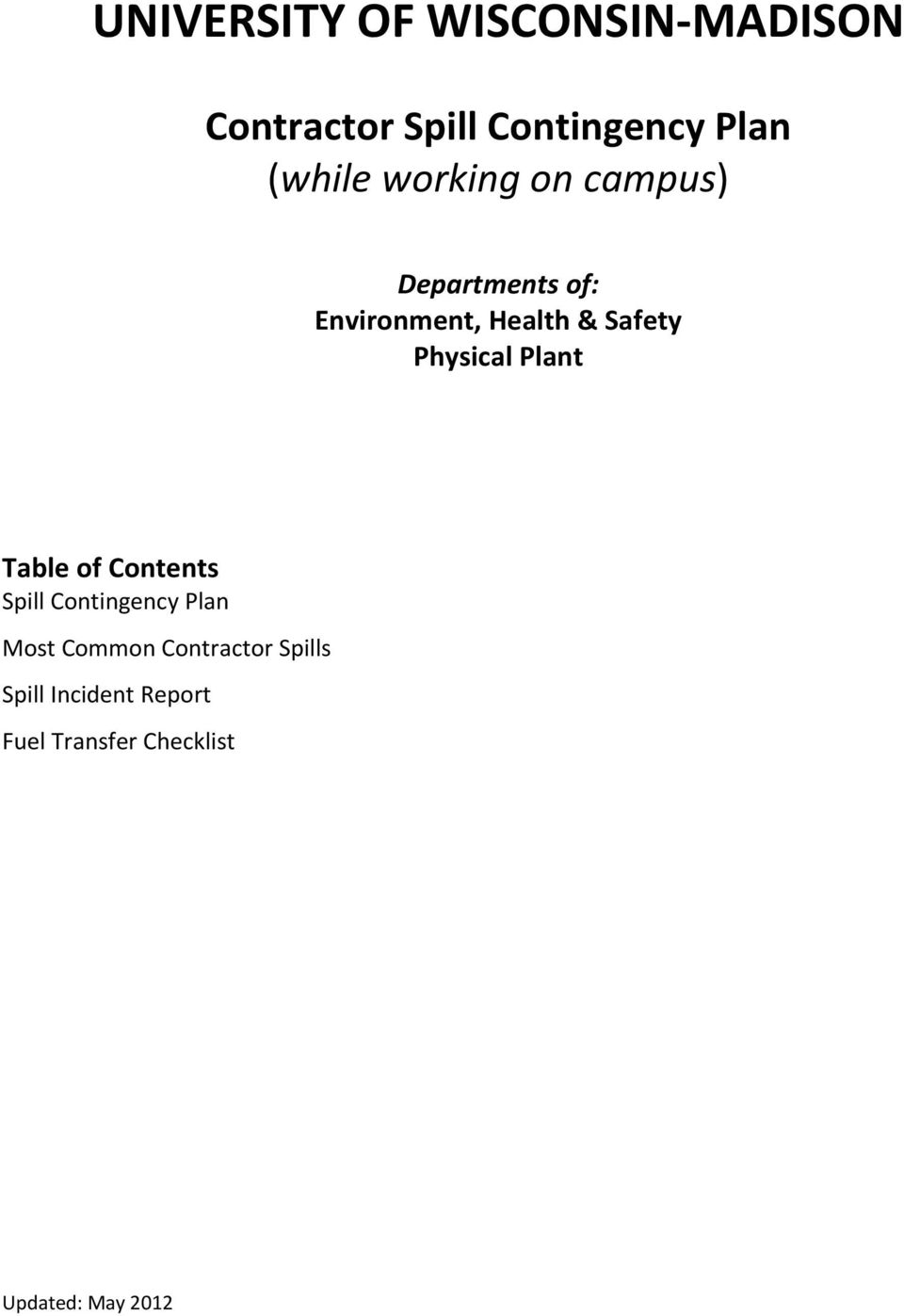
2 UNIVERSITY OF WISCONSIN MADISON Contractor Spill Contingency Plan (while working on campus) This reference guide is written to document required compliance with US EPA, WI DNR and WI DSPS rules (40CFR112, NR706, SPS310) for spills of 5 gallons or less. However, for spills greater than 1 gallon, notify UW Madison EH&S (Environment, Health & Safety Dept.). Contractor shall reimburse the University for damage resulting from a spill and for costs incurred by the University to clean up and dispose of waste. In an emergency, please refer to the Emergency Call List as follows: Police & Fire (Emergencies): 911 UW Madison EH&S: Physical Plant CARS (Central Answering and Response Service): Your Assigned Campus Project Manager: [xxx xxxx] CONTAIN THE SPILL. Follow the spill response and notification steps, start the cleanup procedure, fill out a spill incident report and give report to the Project Manager. Basic Spill Response Steps: 1. Notify others in the area; seal off area if necessary. 2. Check the scene if you can do so safely; identify the source of the incident. 3. If there is a threat to health or the environment, dial 911 and then the numbers on the Emergency Call List. 4. Take reasonable measures to stop the source and contain the spill. 5. If you can do safely, clean up the spill. 6. If you cannot do safely and there is no threat to human health or the environment, call EH&S ( ). 7. Contain, seal and secure the spill cleanup material. Call EH&S ( ) for disposal instructions. 8. Fill out Spill Incident Report. Return report to Project Manager. A copy of the report must be sent to EH&S at 30 East Campus Mall, Madison, WI. Spill Response Equipment: Contractor shall have on hand enough equipment to control spills up to 5 gallons and for the cleanup of equipment at the construction site. Standard spill response kits should contain at a minimum the following: oil absorbents, cellulose socks, latex gloves, dust masks, disposal bags or containers and hand wipes. Contractor shall have additional clean up equipment readily available to assure containment of spill can be kept intact. Clean up materials for disposal should be accessible within 24 hours as long as spill area can be weather tight and stay contained. If spill is too large for cleanup equipment or personnel, if spill has entered storm sewer, if runoff has flowed into surface waters or wetlands, or if material is too hazardous to handle, dial 911 and then the numbers on the Emergency Call List above.

3 Most Common Contractor Spills: Fuel (diesel and gasoline) Petroleum (oil, hydraulic fluid, transmission fluid, brake fluid) Construction spills (form oil, sealers, cleaning acids) Use the process identified on the previous pages for the above spills. Anytime you use an absorbent on a fuel or petroleum product, or you contaminate the soil with fuel or petroleum product, you must call EH&S ( ), who will provide you with disposal instructions. Use the following process to cleanup all types of wash ups onto the ground/soil (e.g., concrete, mortar, plaster, tile set/grout): 1. Stay away from the outer most branches of the tree or shrub (drip line). 2. Pick or create a low spot to contain wash up into a limited area; burn if necessary. 3. After wash up has dried, clean up and dig down a minimum of 6" 8", remove soil and replace with new soil. CONTRACTOR CAN REMOVE this wash up soil and must report cleanup to the Project Manager. If in doubt of what or how to clean up, ask your Project Manager, who can obtain assistance from Environmental Services and the campus landscapers. Preserving campus green space is an important University concern.

4 SPILL INCIDENT REPORT This must be completed and given to the Project Manager within 24hrs of an incident 1. CONTRACTOR NAME: PROJECT NAME: FACILITY NAME: ADDRESS: CITY or TOWN: NEAREST HIGHWAY or INTERSECTION: LOCATION OF SPILL (SPECIFIC): DATE AND TIME OF INCIDENT: NAME AND TEL. NUMBER OF ON SCENE CONTACT: 4. SEVERITY OF THE INCIDENT: a. Name of Spilled Material: b. Total Amount Spilled: c. Amount Recovered: d. Fate of Recovered Materials (i.e., oil, water, soil, absorbents): 5. SIGNIFICANT AREAS AFFECTED BY THE SPILL: (Indicate location of any of the following affected areas, and estimate amount spilled in or on each area) a. Building Area: b. Surface Water: c. Floor Drains: d. Storm Drains: e. Drainage Ditches: f. Soil, Gravel or Lawn Surfaces: g. Concrete Surface: h. Asphalt Surface: 6. LOCAL TERRAIN CONDITIONS: (Check off most appropriate description) a. Flat: (no significant slope) b. Somewhat Flat: (1 5% slope) c. Gently Rolling: (5 10% slope) d. Sharply Rolling: (10 20% slope) e. Steep: (>20% slope) 7. WEATHER CONDITIONS: (Check off most appropriate condition) a. Dry b. Fog or Drizzle c. Rain d. Snow e. Other 8. CAUSE AND SOURCE OF INCIDENT: (Check off most appropriate choice and attach a brief description of the problem) a. Equipment Failure b. Accident c. Human Error d. Other 9. OFFICE NOTIFIED: (Check off the offices which were notified and list the name of the person who took the report in person or by telephone) a. Project Manager b. UW EH&S Dept. c. CARS (Physical Plant) 10. Note any equipment repairs to prevent reoccurrence:

5 11. Report filled out by: Date: Phone No.: [Date] NOTICE TO PETROLEUM PRODUCT VENDORS/EMPLOYEES To: From: All Bulk Petroleum Product Vendors UW Madison Department of Environment, Health & Safety (EH&S) In accordance with of the Code of Federal Regulations 40 CFR 112, all petroleum product vendors who deliver, load, unload, or pick up petroleum products or waste oil to or from UW Madison facilities are required to comply with the following requirements: 1. Exercise caution when maneuvering vehicles to avoid damage to secondary containment structures. [112.7(a)(3)(ii)] 2. Drivers are to be present and alert monitoring the transfer of petroleum product full time while product is being transferred to or from on site storage containers. [112.7(a)(3)(ii)] 3. Chock the tank truck wheels while loading or unloading tanks and do not to remove the wheel chocks until after the transfer is complete and the transfer hose is disconnected to prevent an accidental drive off without removing the transfer hose. [112.7(h)(2)] 4. Prior to filling and departure, closely inspect for discharges at the lowermost drain and all outlets of the tank truck, and if necessary, ensure that they are tightened, adjusted, or replaced to prevent liquid discharge while in transit. [112.7(h)(3)] 5. Continuously monitor for potential tank overfills while loading or unloading storage containers. Check the freeboard capacity of containers prior to filling to estimate the volume to fill the tank and visually monitor the filling process to ensure the tank does not overfill. For tanks with audible air vent alarms, continuously listen for the audible air vent overfill warning whistle. [112.8(c)(8)(i)] 6. Promptly stop and clean up any petroleum product leaks or spills that occur while loading or unloading containers. [[112.8(c)(10)] 7. Immediately report leakage or spillage requiring assistance of site personnel to clean up to the Project Manager and UW Madison EH&S. [112.7(a)(3)(ii)] 8. Prior to loading/unloading, place an empty container under the hose end to be disconnected first with enough capacity to catch the remaining liquid in the transfer hose. Verify that appropriate valves are closed before disconnecting loading/unloading lines. Prior to disconnecting the transfer hose, gravity drain remaining product in the hose to the lowest container. [112.7(a)(3)(ii)] 9. Require that facility personnel oversee all oil loading/unloading activities associated with an outside vendor. [Best Management Practice] This notice is provided for your information to make you aware of these requirements so you can maintain regulatory compliance. This notice is also made as an integral part of the UW Madison campus Spill Prevention Control and Countermeasures (SPCC) Plan maintained on site and available for your inspection in our office.
ACTIVITY NAME. Training Requirements for Spill Prevention Control and Countermeasures (SPCC) 40 CFR Part 112 Naval Air Station Corpus Christi Texas
 ACTIVITY NAME Training Requirements for Spill Prevention Control and Countermeasures (SPCC) 40 CFR Part 112 Naval Air Station Corpus Christi Texas CY 2014 BOTTOM LINE UP FRONT To prevent oil discharges
SPILL PREVENTION, CONTROL AND COUNTERMEASURE PLAN
 SPILL PREVENTION, CONTROL AND COUNTERMEASURE PLAN XXXX FARM (CITY OR COUNTY), MICHIGAN CONTACT (NAME), OWNER CERTIFICATION: I hereby certify that I have examined the facility, and being familiar with the
Spill Prevention, Control and Countermeasure (SPCC) Rule
 Spill Prevention, Control and Countermeasure (SPCC) Rule Code of Federal Regulations Title 40 CFR Part 112 Training Guide for Oil and Fuel handlers on Farms 1 Purpose of SPCC Rule To prevent oil discharges
History of the SPCC Rule
 2010 SPCC Training SPCC Rule History of the SPCC Rule The SPCC plan is a document required under the clean water act (CWA) It became effective in 1972 and has changed little in 32 years. The rule was formally
Civil Engineering Sector Labour-Management Health and Safety Committee
 PROCEDURE FOR THE STORAGE AND HANDLING OF FUEL ON CONSTRUCTION SITES Civil Engineering Sector Labour-Management Health and Safety Committee July 2008 PROCEDURE FOR THE STORAGE AND HANDLING OF FUEL ON CONSTRUCTION
Spill Prevention, Control, and Countermeasures (SPCC) Course Material
 Introduction Welcome to the Spill Prevention, Control, and Countermeasures (SPCC) Training course. The ultimate goal of this course is to help you recognize the ways you can avoid pollution of the local
ALLEGANY WIND POWER PROJECT CONSTRUCTION SPILL PREVENTION PLAN
 ALLEGANY WIND POWER PROJECT CONSTRUCTION SPILL PREVENTION PLAN Best Management Practices (BMPs) will be implemented during construction of the Allegany Wind Power Project to prevent and contain spills.
Spill Control Prevention Plan (SCPP)
 Spill Control Prevention Plan (SCPP) FACILITY INFORMATION PLEASE PRINT Facility Name: Mailing Address: Physical address if different: Owner Name: Owner Address: Primary Contact Name: Work Phone Number:
Spill Prevention, Control and Countermeasure (SPCC) Training
 Spill Prevention, Control and Countermeasure (SPCC) Training Fort Jackson 2015 Origins of SPCC Regulatory History 1972 Clean Water Act Oil Pollution Act of 1990 Spill Prevention Control and Countermeasures
Spill Prevention, Control & Cleanup SC-11
 Objectives Cover Contain Educate Reduce/Minimize Product Substitution Description Spills and leaks, if not properly controlled, can adversely impact the storm drain system and receiving waters. Due to
ABOVE-GROUND STORAGE TANKS
 ABOVE-GROUND STORAGE TANKS Above-ground storage tanks in Georgia are regulated by the State Fire Marshall and by the EPA. Above-ground tanks containing 1,100 gallons or less do not require any secondary
TRAINING SPCC/SWPP Training UGA. Automotive Center. Campus Transit
 SPILL PREVENTION, CONTROL, AND COUNTERMEASURE TRAINING SPCC/SWPP Training UGA STORM WATER Automotive Center POLLUTION Campus Transit PREVENTION PLAN PLAN Goals of SPCC/SWPP Training Introduce facility
Waste Oil Collection / Storage
 ENVIRONMENTAL & REGULATORY SERVICES Storage Tank Regulation Section P. O. Box 7837 Madison, Wisconsin 53707-7837 TDD #: (608) 264-8777 http://www.commerce.state.wi.us http://www.wisconsin.gov Jim Doyle,
SPILL PREVENTION CONTROL AND COUNTERMEASURE PLAN PREPARED FOR: ARKANSAS STATE UNIVERSITY JONESBORO, ARKANSAS ORIGINAL DATE OF PLAN: APRIL 2005
 SPILL PREVENTION CONTROL AND COUNTERMEASURE PLAN PREPARED FOR: ARKANSAS STATE UNIVERSITY JONESBORO, ARKANSAS ORIGINAL DATE OF PLAN: APRIL 2005 DATE OF LAST PLAN AMENDMENT/P.E. CERTIFICATION: MAY 24, 2005
Chapter 2 Stormwater Pollution Prevention Plan (SWPPP) for Park Operations
 SWPPP for Park Operations 2 Chapter 2 Stormwater Pollution Prevention Plan (SWPPP) for Park Operations Bordered by Lake Washington & Lake Sammamish, the City of Bellevue has more than 60 miles of streams,
SOP 4: Spill Response and Cleanup Procedures SOP 4: SPILL RESPONSE AND CLEANUP PROCEDURES
 SOP 4: SPILL RESPONSE AND CLEANUP PROCEDURES Municipalities are responsible for any contaminant spill or release that occurs on property they own or operate. Particular areas of concern include any facilities
SPILL PREVENTION, CONTROL AND COUNTERMEASURE PLAN. for the PIÑON RIDGE MILL 16910 HIGHWAY 90 BEDROCK, COLORADO 81411. Prepared by:
 SPILL PREVENTION, CONTROL AND COUNTERMEASURE PLAN for the PIÑON RIDGE MILL 16910 HIGHWAY 90 BEDROCK, COLORADO 81411 Prepared by: ENERGY FUELS RESOURCES CORPORATION September 2009 SPILL PREVENTION, CONTROL,
Kurt Wilson Louisiana Dept. of Environmental Quality Business & Community Outreach Division Small Business/Small Community Assistance Program
 Kurt Wilson Louisiana Dept. of Environmental Quality Business & Community Outreach Division Small Business/Small Community Assistance Program LDEQ Water Regulations Spill Prevention and Control (SPC) Authorized
SPILL RESPONSE PLAN. What is the Issue? Regulatory Requirements. General Information
 An equal opportunity university SPILL RESPONSE PLAN What is the Issue? Accidental spills of petroleum products, common household cleaning products, hazardous materials or hazardous waste, can have negative
CITY OF WASHINGTON SPILL PREVENTION, CONTROL AND COUNTERMEASURE PLAN
 CITY OF WASHINGTON SPILL PREVENTION, CONTROL AND COUNTERMEASURE PLAN Adopted October 5, 2009 Table of Contents Chapter Description Page 1 Facility Descriptions... 3 1.1 Municipal Power Plant, 1001 Park
Outdoor Storage of Raw Materials SC-33
 Objectives Cover Contain Educate Reduce/Minimize Description Raw materials, by-products, finished products, containers, and material storage areas exposed to rain and/or runoff can pollute stormwater.
SPILL CONTAINMENT AND CONTROL PLAN
 SPILL CONTAINMENT AND CONTROL PLAN PUD NO. 1 TREATMENT PLANT 1257 GLASS ROAD PORT ANGELES, WASHINGTON PUD No. 1 Treatment Plant 2431 East Highway 101 P.O. Box 1090 Port Angeles, WA 98362 Facility Description:
Improper storage of fuel on construction sites will increase the risk of water pollution that may occur as a result of leaks or spills.
 WQ-10 Best Management Practice (BMP) Water Quality Protection Guideline Secondary Containment Design Standards Fuel Storage on Construction Sites According to the EPA, the majority of water pollution in
Environmental Health & Safety
 Environmental Health & Safety Title: Oil Spill Notification, Reporting, and Response Effective Date: 04/01/2008 Document #: PBS-007-001.JPB Revision Date: Rev. 0 I. Purpose of the Policy: To ensure Oil
Waste Handling & Disposal
 Objectives Cover Contain Educate Reduce/Minimize Product Substitution Description Improper storage and handling of solid wastes can allow toxic compounds, oils and greases, heavy metals, nutrients, suspended
SPILL PREVENTION, CONTROL AND COUNTERMEASURE (SPCC) PLAN
 SPILL PREVENTION, CONTROL AND COUNTERMEASURE (SPCC) PLAN DEPARTMENT OF PUBLIC WORKS, New Jersey Prepared by Date This is a sample document and is not to be used as an actual SPCC Plan for the applicable
APPENDIX O. Spill Prevention and Emergency Response Plan. G3 Terminal Vancouver Port Metro Vancouver Project Permit Application APPENDIX O
 APPENDIX O Spill Prevention and Emergency Response Plan APPENDIX O G3 Terminal Vancouver Port Metro Vancouver Project Permit Application G3 TERMINAL VANCOUVER: PORT METRO VANCOUVER SPILL PREVENTION AND
UDOT SPILL PREVENTION and RESPONSE PLAN for CONSTRUCTION SITES
 UDOT SPILL PREVENTION and RESPONSE PLAN for CONSTRUCTION SITES February 2014 The plan contained in the following pages was developed in part from UDOT Construction Division s Safety and Health Manual,
Good Housekeeping Practices for DPW/Fleet Maintenance Facilities
 Good Housekeeping Practices for DPW/Fleet Maintenance Facilities Kevin P. Walker C&S Engineers, Inc. Best Management Practices Best Management Practices (BMPs) are measures and/or controls used to prevent
Appendix N Framework Spill Prevention, Containment, and Countermeasures Plan Prepared by: Idaho Power Company 1221 W Idaho Street Boise, ID 83702
 Appendix N Framework Spill Prevention, Containment, and Countermeasures Plan Prepared by: Idaho Power Company 1221 W Idaho Street Boise, ID 83702 November 2011 TABLE OF CONTENTS 1.0 PURPOSE... 1 2.0 RESPONSIBILITY
FUELING AND FUEL STORAGE
 FUELING AND FUEL STORAGE BENCHMARK Implement spill prevention measures whenever fuel is handled or stored. Report, minimize, contain and clean up spills that do occur. FUELING BMPS Spills of diesel, oil,
How To Safely Handle A Spill
 WD DWGB 22 6 2010 Best Management Practices for Fueling and Maintenance of Excavation and Earthmoving Equipment Env Wq 401, Best Management Practices for Groundwater Protection, applies to a variety of
SPCC for Food Services
 Welcome to the University s Annual Oil Spill Prevention, Control and Countermeasures (SPCC ) Compliance Awareness Training for Food Service Employees. Completing this training will fulfill your annual
IAC 7/2/08 Agriculture and Land Stewardship[21] Ch 44, p.1
![IAC 7/2/08 Agriculture and Land Stewardship[21] Ch 44, p.1](/thumbs/39/20233896.jpg "IAC 7/2/08 Agriculture and Land Stewardship[21] Ch 44, p.1") IAC 7/2/08 Agriculture and Land Stewardship[21] Ch 44, p.1 CHAPTER 44 ON-SITE CONTAINMENT OF PESTICIDES, FERTILIZERS AND SOIL CONDITIONERS [Prior to 7/27/88, see 21 Ch 9] PESTICIDES 21 44.1(206) Definitions.
IAC 7/2/08 Agriculture and Land Stewardship[21] Ch 44, p.1 CHAPTER 44 ON-SITE CONTAINMENT OF PESTICIDES, FERTILIZERS AND SOIL CONDITIONERS [Prior to 7/27/88, see 21 Ch 9] PESTICIDES 21 44.1(206) Definitions.
Temporary Batch Plants
 Categories EC SE TC WE NS WM Erosion Control Sediment Control Tracking Control Wind Erosion Control Non-Stormwater Management Control Waste Management and Materials Pollution Control Legend: Primary Category
Contact Person Sarah Morris-Benavides Revision 1.1 Document Plan 10200.037 Effective Date 07/01/2014 Review Date 03/15/2017.
 Ames Laboratory Federal SPCC regulations (40 CFR Part 112) were created under the authority of the Clean Water Act. The stated purpose is " to prevent oil discharges from reaching navigable waters of the
Extraction Oil and Gas, LLC. Diamond Valley Central Oil Terminal Waste Management Plan
 Extraction Oil and Gas, LLC. Diamond Valley Central Oil Terminal Waste Management Plan Scope: This Extraction Oil and Gas Waste Management Plan has been prepared to provide operations personnel at the
GUIDANCE FOR DEVELOPMENT OF SPILL AND SLUG PREVENTION CONTROL PLANS AND FACILITIES FOR THE CITY OF ATTLEBORO SEWER USERS
 Company Name: Address: The City of Attleboro s Rules and Regulations for the use of Wastewater Facilities require each user to provide protection from accidental discharge of prohibited materials and substances
APPENDIX G Materials Storage and Handling Guidelines
 APPENDIX G Materials Storage and Handling Guidelines 1.0 INTRODUCTION Operations at Austin-Bergstrom International Airport (ABIA) comprise several different industrial activities including aircraft, ground
MAGB HEALTH, SAFETY AND ENVIRONMENT GROUP POLLUTION INCIDENT RESPONSE PLAN
 MAGB HEALTH, SAFETY AND ENVIRONMENT GROUP POLLUTION INCIDENT RESPONSE PLAN SCOPE: This guidance sets out best practice for producing a Pollution Incident Response Plan to deal with an environmental incident
Susceptibility of Your Drinking Water Source to Contamination
 Susceptibility of Your Drinking Water Source to Contamination The aquifer that supplies drinking water to ICASI Culinary School has a moderate susceptibility because of the following reasons: < Available
MODULE IV Secondary Containment, Oil Spill Control & Spill Prediction
 Page 1 How to Prepare Your Own SPCC Plan: A Step-by-Step Guide for Tier 1 Qualified Facilities Using the US EPA Tier I SPCC Template MODULE IV Secondary Containment, Oil Spill Control & Spill Prediction
BEST MANAGEMENT PRACTICES FOR LEAK AND SPILL CONTROL
 BEST MANAGEMENT PRACTICES FOR LEAK AND SPILL CONTROL Summary Keeping a facility clean helps improve productivity and employee morale. In addition, it presents a positive image to customers, stakeholders
Critical Regulations SUMMARY OF. Stormwater Management Regulations (National Pollutant Discharge Elimination System or "NPDES ) 40 CFR 122.
 SUMMARY OF Critical Regulations Stormwater Management Regulations (National Pollutant Discharge Elimination System or "NPDES ) 40 CFR 122.26 Spill Prevention, Control, and Countermeasures Rule (SPCC) 40
Fuel Storage Who to ask: tank farm owners/operators
 Fuel Storage Fuel Storage Who to ask: tank farm owners/operators 89. How many tank farms are there in the village and who owns them? Fuel tank farm The questions in the following section should be answered
VEHICLE SERVICE FACILITIES. Best Management Practices
 VEHICLE SERVICE FACILITIES Best Management Practices Chapter 1 of the Best Management Practices Manual for the City s Storm Water Management Program Public Works Department 809 Center Street, Santa Cruz,
Safety Manual Title: Spill Prevention & Response Review Date: 6/1/2014
 Operation s Purpose The purpose of this plan is to document spill prevention and response requirements. Each Elkhorn Construction, Inc. jobsite will develop a spill prevention and response plan based on
Stormwater BMPs: Secondary Containment and Spill Control. September 2012
 Stormwater BMPs: Secondary Containment and Spill Control September 2012 Secondary Containment Secondary Containment Helps to minimize the potential for pollution by: Keeping spills in a confined area Preventing
Spill Prevention Control and Countermeasure Plan
 Spill Prevention Control and Countermeasure Plan Boston College Prepared by: Rizzo Associates, Inc. March 5, 1997 Reviewed and Updated by: ENSR International May, 1998 Last Update Boston College January,
Annual Storm Water Pollution Prevention Plan and Spill Prevention, Control and Countermeasures Plan Compliance Inspection
 Annual Storm Water Pollution Prevention Plan and Spill Prevention, Control and Countermeasures Plan Compliance Inspection September 22, 2014 Prepared By: Facilities Management Environmental Resources University
Pollution Prevention And Best Management Practices For Dry Cleaners Operating In Broward County
 FORWARD In 1991, the Broward County Environmental Protection and Growth Management Department, who was then known as the Department of Natural Resource Protection (DNRP), initiated the development of Pollution
Outdoor Liquid Container Storage
 Outdoor Liquid Container Storage SC-31 Objectives Cover Contain Educate Reduce/Minimize Description Accidental releases of materials from above ground liquid storage tanks, drums, and dumpsters present
MAINE DEPARTMENT OF ENVIRONMENTAL PROTECTION
 Oxford Hills Bus Garage 36 Brown St, Norway, ME Oil Storage Inspection 2/20/14 CONDITIONS OBSERVED Underground Oil Storage: 12,000 gallon underground oil storage tank (split 10,000 gallon diesel/2,000
FOOD SERVICE FACILITIES Best Management Practices Stormwater Management Program City of Bluff City P.O. Box 70, Bluff City, TN 37618 423-538-7144
 FOOD SERVICE FACILITIES Best Management Practices Stormwater Management Program City of Bluff City P.O. Box 70, Bluff City, TN 37618 423-538-7144 This document may be printed and used for reference by
Environmental Incident Response Plan Farm A
 Environmental Incident Response Plan Farm A Table of Contents Environmental Incident Response Plan Summary Incident Response Procedures: Personal Injury / Fire Emergency Accidental Entry to Manure Storage
BASEMENT FLOODING. Prevention Guide for. Homeowners
 BASEMENT FLOODING Prevention Guide for Homeowners 1 Did You Know? Floods are the most common hazards in Canada. Water damage is a common cause of loss for homeowner insurance. A heavy rainfall can result
Appendix VIII: Spill Prevention, Control and Countermeasure (SPCC) Plans
 Appendix VIII: Spill Prevention, Control and Countermeasure (SPCC) Plans Background What is a Spill Prevention, Control and Countermeasure (SPCC) Plan? An SPCC plan is a written document that describes
Spill Response Procedures & Sorbent Materials
 Spill Response Procedures & Sorbent Materials Document Number: 146 Introduction Emergency spill response is an important part of a company's safety and health program. In the event of a spill, well-prepared
Cheap Spills for Spill Seekers a.k.a Spills and Thrills
 Cheap Spills for Spill Seekers a.k.a Spills and Thrills Thomas Moses, Esq. President, Spill Center St. Louis 2013 ISRI DISCLAIMER The following presentation reflects the views and opinions of Tom Moses
FACILITY ENVIRONMENTAL COMPLIANCE
 FACILITY ENVIRONMENTAL COMPLIANCE 2014 TxDOT Environmental Conference 2014 TxDOT Environmental Conference 2014 TxDOT Environmental Conference Table of Contents 1 Introduction 1 2 Facility Environmental
SPCC. Created by EPA in 1973 under the Clean Water Act. 10/22/2014. Spill Prevention Control & Countermeasure Plan
 SPCC Created by EPA in 1973 under the Clean Water Act. Purpose: To protect the "navigable" waters of the United States, a business or organization must develop a plan that would prevent any pollution from
Draft. ATLANTIC COAST PIPELINE, LLC ATLANTIC COAST PIPELINEINE Docket No. PF15-6-000. and
 ATLANTIC COAST PIPELINE, LLC ATLANTIC COAST PIPELINEINE Docket No. PF15-6-000 and DOMINION TRANSMISSION, INC SUPPLY HEADER PROJECT Docket No. PF15-5-000 Draft Prepared by July 2015 TABLE OF CONTENTS 1.0
New York State Department of Environmental Conservation 625 Broadway, Albany, NY 12233 www.dec.ny.gov. Environmental Self Audit For Small Businesses
 New York State Department of Environmental Conservation 625 Broadway, Albany, NY 12233 www.dec.ny.gov Environmental Self Audit For Small Businesses Disclaimer The materials in this document are intended
First in Service First in Safety
 7840 Nagle Avenue Morton Grove, Illinois 60053 847-470-5235 Fax - 847-965-9511 Wind Damage; Frequently Asked Questions: What can I do with branches that fall in my yard? Bring them out to the parkway;
SPILL PREVENTION AND RESPONSE PLAN TEMPLATE FOR BUSINESSES IN DAYTON S SOURCE WATER PROTECTION AREA
 SPILL PREVENTION AND RESPONSE PLAN TEMPLATE FOR BUSINESSES IN DAYTON S SOURCE WATER PROTECTION AREA Regulated Substance Management: All Regulated Substances, including chemical wastes, are to be managed
Spill Prevention, Control and Countermeasure (SPCC)
 Spill Prevention, Control and Countermeasure (SPCC) History Original promulgation 1973, effective 1974 Codified in 40 CFR 112 (EPA Jurisdiction) Proposed rulemaking 1991, 1993 and 1997 Amended July 17,
Storm Water Management Requirements for Construction Projects Less than One Acre
 Storm Water Management Requirements for Construction Projects Less than One Acre Purpose: UC Irvine s Phase II Small MS4 Storm Water Permit requires construction projects less than one acre in size to
Spill Prevention Control and Countermeasure (SPCC) Regulations Fact Sheet
 Spill Prevention Control and Countermeasure (SPCC) Regulations Fact Sheet REGULATORY SUMMARY The Spill Prevention Control and Countermeasure (SPCC) regulations strive to prevent oil from entering navigable
 Section A SPCC Plan Implementation Checklist This section of the report addresses compliance with certain requirements of Federal Regulations 40 CFR 112. I. STATUS OF SPCC PLAN (40 CFR 112.3) YES NO A.
SILICON VALLEY CLEAN WATER. May 2015
 SILICON VALLEY CLEAN WATER May 2015 Slug Discharge Control and Spill Containment Guidelines This document was revised and used with the permission of the Los Angeles County Sanitation District, Industrial
Farm Fuel Tank Safety Guide
 Farm Fuel Tank Safety Guide This brochure is provided by North Dakota Department of Emergency Services, your Local Emergency Planning Committee, and the State Emergency Response Commission along with assistance
OIL STORAGE REQUIREMENTS OF THE SPCC REGULATIONS. Christopher J. Ecsedy, P.E. Fuss & O'Neill, Inc. 146 Hartford Road Manchester, CT 06040
 ABSTRACT OIL STORAGE REQUIREMENTS OF THE SPCC REGULATIONS Christopher J. Ecsedy, P.E. Fuss & O'Neill, Inc. 146 Hartford Road Manchester, CT 06040 The SPCC regulations entail numerous requirements for the
Improper storage of potential pollutants will increase the risk of water pollution that may occur because of spills.
 WQ-3 Best Management Practice (BMP) Water Quality Protection Guideline Secondary Containment Design and Operation Standards Section 1. Introduction According to the EPA, the majority of water pollution
BEHANS LAND RESTORATION LIMITED RESTORATION OF FORMER QUARRY BLACKHALL, CO. KILDARE OUTLINE CONTINGENCY PLAN MAY 2008
 BEHANS LAND RESTORATION LIMITED RESTORATION OF FORMER QUARRY BLACKHALL, CO. KILDARE OUTLINE CONTINGENCY PLAN MAY 2008 JBA Prepared by : John Barnett and Associates / SLR Consulting 7 Dundrum Business Park
How Your Business Can Prevent Stormwater Pollution
 Tips for a Cleaner Bay How Your Business Can Prevent Stormwater Pollution alameda county You Can Prevent Water Pollution! Storm drains flow directly into creeks and the Bay without any treatment. Because
APPENDIX 7-B. Hazardous Materials Management Plan
 S TAR-ORION S OUTH D IAMOND P ROJECT E NVIRONMENTAL I MPACT A SSESSMENT APPENDIX 7-B Hazardous Materials Management Plan SX03733 Section 6.0 1.1.1 Hazardous Materials Management Plan 1.1.1.1 Introduction
Section 5. Secondary Containment and Impracticability. (as applicable to APSA tank facilities)
 Section 5 Secondary Containment and Impracticability (as applicable to APSA tank facilities) Summary Secondary Containment Requirements APSA/SPCC Plan Compliance Primer Several SPCC rule requirements and
RUTGERS, THE STATE UNIVERSITY OF NEW JERSEY SPILL PREVENTION CONTROL & COUNTERMEASURE PLAN
 RUTGERS, THE STATE UNIVERSITY OF NEW JERSEY SPILL PREVENTION CONTROL & COUNTERMEASURE PLAN FOR INTERNATIONAL CENTER FOR PUBLIC HEALTH AND REGIONAL BIO-CONTAINMENT LABORATORIES Rutgers Environmental Health
Chapter 5: Spills Response
 Chapter 5: Spills Response When printing materials are spilled, the response required by the owner or operator depends on what is spilled and the quantity. The entities who must be informed of a spill
for Gary Hughes GARY HUGHES SELF SERVICE LLC State of Missouri ID: ST 3004261
 SPILL PREVENTION CONTROL & COUNTERMEASURE (SPCC) PLAN for Gary Hughes GARY HUGHES SELF SERVICE LLC State of Missouri ID: ST 3004261 Reporting conditions as of January 1, 2005 TABLE OF CONTENTS Subpart
This page left intentionally blank
 1 This page left intentionally blank 2 STATE OF TENNESSEE DEPARTMENT OF ENVIRONMENT AND CONSERVATION DIVISION OF UNDERGROUND STORAGE TANKS TECHNICAL CHAPTER 4.2 SPILL AND OVERFILL PREVENTION EFFECTIVE
The Federal Spill Prevention, Control & Countermeasures (SPCC) Rule Overview
 The Federal Spill Prevention, Control & Countermeasures (SPCC) Rule Overview January 2012 Presented by: Annie Macmillan, Stephanie Congo The purpose of the SPCC rule is to prevent discharges of oil into
SPILL PREVENTION, CONTROL, AND COUNTER MEASURES PLAN (SPCC)
 SPILL PREVENTION, CONTROL, AND COUNTER MEASURES PLAN (SPCC) UNIVERSITY RISK MANAGEMENT Occupational and Health Programs 19 Hagood Avenue, Suite 908 Charleston SC 29425 843-792-3604 Revised: June 2015 Spill
RESOURCE RECYCLING SOLUTIONS LTD
 RESOURCE RECYCLING SOLUTIONS LTD Iron House Farm, Lancaster Road, Out Rawcliffe, Preston, Lancashire, PR3 6BP Accident Management Plan Issue 01 Walker Resource Management Ltd - www.walkerom.com QC Document
Below Grade Spill Containment Manholes 705-5 Gallon 715-15 Gallon 725-25 Gallon. Installation Instructions
 Below Grade Spill Containment Manholes 705-5 Gallon 715-15 Gallon 725-25 Gallon Installation Instructions Warning Application and use of this product should be in compliance with local, state, and federal
Florida Department of Environmental Protection
 Florida Department of Environmental Protection Background Mobile vehicle and equipment washing involves washing at a location where vehicles are based (such as a trucking company, warehouse, bus station,
OIL POLLUTION PREVENTION REGULATIONS
 OIL POLLUTION PREVENTION REGULATIONS The Newly Revised SPCC Rules Spill Prevention Control and Countermeasure NON-TRANSPORTATION RELATED ONSHORE AND OFFSHORE FACILITIES Code of Federal Regulations Title