
Master s Thesis. Secure Indexes for Keyword Search in Cloud Storage. Supervisor Professor Hitoshi Aida ( ) !!!
|
|
|
- Lenard Gray
- 10 years ago
- Views:
Transcription
1 Master s Thesis Secure Indexes for Keyword Search in Cloud Storage ( ) Supervisor Professor Hitoshi Aida ( ) Electrical Engineering and Information Systems Graduate School of Engineering The University of Tokyo Wanasit Tanakitrungruang ( )

2

3 Abstract Our investigation challenge is designing an auxiliary data structure to support keyword lookups on encrypted documents stored in the cloud. We propose an extension of Color Indexes, a secure indexing technique introduced by Hore et al. The design utilizes false positive search results to hide sensitive information and allows users to adjust security level in trade-off with the performance by tuning system parameters. We focus mainly on improving practicality of the indexes on real world application, especially, analyzing and conducting experiments on the effects of skewed keyword distribution and document sizes. To handle skewed datasets, we recommend using a second level hash function to prevent information leakage from color statistic and using a sampling based technique for more accurate error prediction. The efficiency of our indexes is demonstrated in experiments on English Wikipedia, Reuter-21578, and Enron Corpus. i

4 Table of Contents Abstract Table of Contents i ii 1. Introduction Terms and Notations 2 2. Background Pseudo Random Function (PRF) PRF s Security Game Pseudo Random Generator (PRG) Pseudo Random Permutation (PRP or Block cipher) Indexing & Boolean Retrieval Bloom Filter 8 3. Related Works Searchable Encryption Schema Secure Indexes Homomorphic Encryption Design Basic Color Index Query colors adjustment Comparison to Hore et al s color indexes Basic Color-Index s limitation Two-level hashed Color Index Two-level hashed color indexing limitation Other possible improvements Including random keywords Split large documents into multiple blocks 20 ii

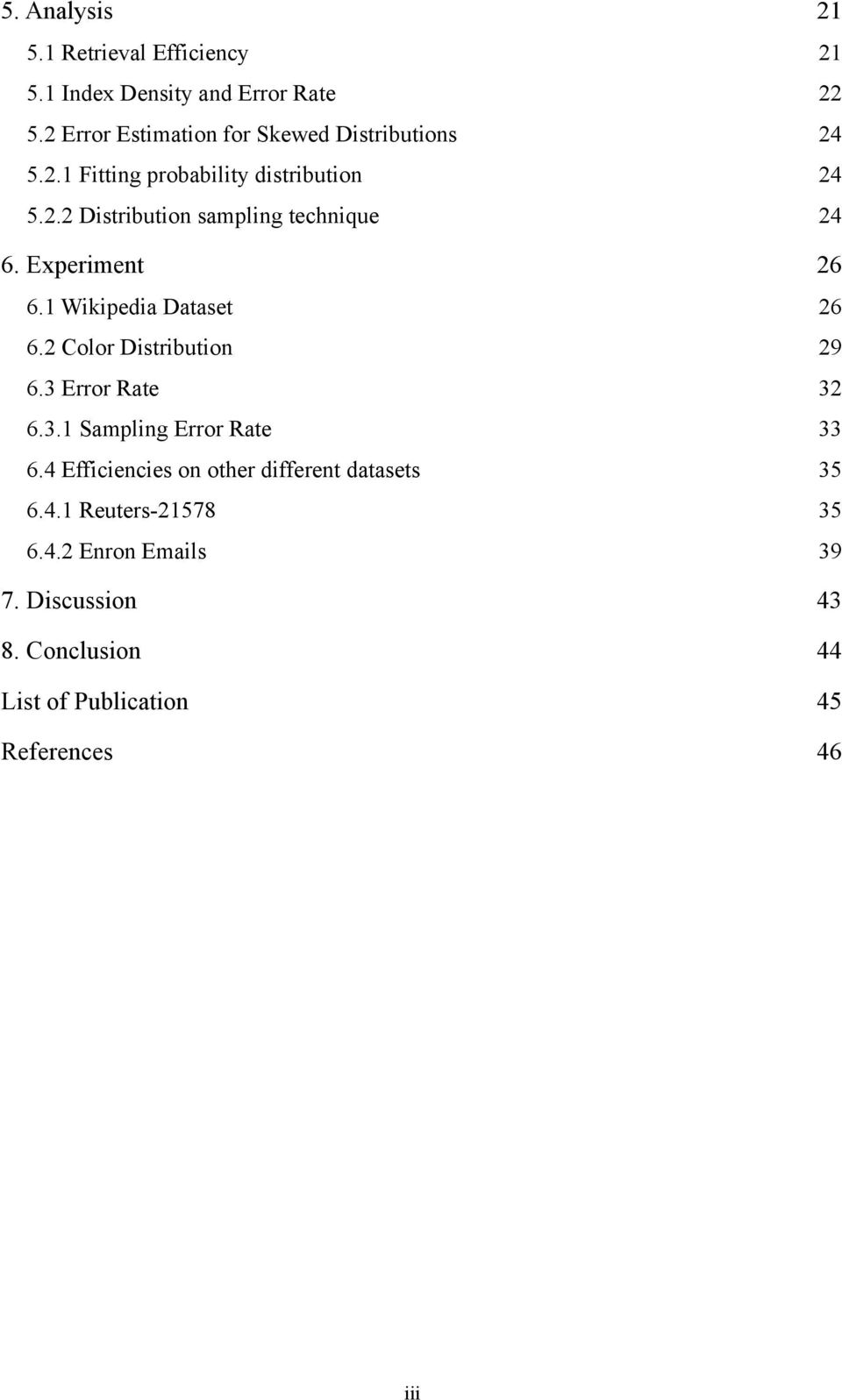
5 5. Analysis Retrieval Efficiency Index Density and Error Rate Error Estimation for Skewed Distributions Fitting probability distribution Distribution sampling technique Experiment Wikipedia Dataset Color Distribution Error Rate Sampling Error Rate Efficiencies on other different datasets Reuters Enron s Discussion Conclusion 44 List of Publication 45 References 46 iii
6 1. Introduction The principle of cloud computing is delegating data storing and processing tasks to some service providers on the cloud. The technology enables organizations to build-up IT capabilities on the fly without investing in infrastructure. At the same time, this concept of handing over important information to the cloud also raises a big privacy and security concern. From the past, the best practice is to encrypt everything before uploading to the cloud, and decrypt the data only after downloaded into a trusted computer, just before using it. This way, people can ensure confidentiality of their information when it s stored on remote servers outside. However, data encryption also prevents cloud services from indexing the data and providing search functionality. Even requiring only a small part of data, users have no choices but download everything, decrypt, and find the data on the client side. When the overall size of data grows larger, it becomes impractical for such a described approach. Therefore, in addition to the security, the system should provide more efficient ways to search and retrieve encrypted documents from cloud storages. This research and other previous works ([3], [9], [10]) have solved this problem by introducing secure indexes or an auxiliary data structure that enables keyword lookups on encrypted documents stored on remote servers while minimizing information leakage. In this work, we introduce our color indexing techniques, as an extension to the work of Hore et al [9]. Our improvement provides users even more flexible control over performance and security level of their queries. The improvement also involves making the indexes more practical in large scale text collections. All analysis and experiments are based on real world data. The remaining parts of the paper are organized as follow: Section 2 introduces related knowledge; Section 3 explains the advancement of secure keyword search techniques and reviews some previous works; Section 4 and 5 introduce the design and analysis of our secure indexes; Section 6 demonstrates our indexes performance by experiments. Section 5 discusses about experiment results and future improvements; Section 6 provides the conclusion. 1

7 1.1 Terms and Notations Term Symbol Meaning Alice - A placeholder name for a user or a trusted client computer. Bob - A placeholder name for a server or cloud service provider. Document Word or Term d w An entry or a unit of information being retrieve. In practice, the retrieved entry can be a text-document, a web page, a database record, or a file. However, for simplicity, we define a document as a set of keywords. A unit of indexable information. We suppose that a document consists of a set of keywords. d = {w 1,w 2,w 3,...,w n } Document size t, d The number of unique words in a document. Pseudo-random function (PRF) f A assumedly secure pseudo random function (Section 2.1) Pseudo-random generator (PRG) g A assumedly secure pseudo random generator (Section 2.1) Secret key k An encryption key. Assumedly, k is uniformly randomly chosen from all possible keys K; thus, the key is secure and unpredictable by attacker. Color code of w code(w) A randomly computed set of colors represent a word. Color index of d Number of possible colors Number of colors computed for a word Number of colors selected for a word Number of colors used in a query I(d) C S S' Q A set of colors represent all indexable words in a document. It is created by combining all color code of each keywords The number of all possible colors. The number of color computed for a word or the size of color code ( S = code(w) ) The number of color selected from color code of a word ( S' < S ) used by Here et al. [9] The number of colors selected color code of a word (Q < S) used in a document query. 2

8 Term Symbol Meaning Collection Size N The number of documents in the collection. Number of correct documents Number of documents returned in a query N w N q The number of documents contain the query keyword or the truepositive results. (Section 5.1) The number of documents returned by the query. This number includes both true and false positive results. (Section 5.1) Number of error documents Error rate N err The number of documents that match a query just by chance whether the documents contains the query keyword or not* (Section 5.1). R The ratio of the error documents to the collection size. ( ) err N err / N Color Density of an index Return Probability of a document D P ret The ratio of colors in the index to the possible colors. (Section 5.2) The probability that the document will be included to the returned results because its index happens to match the query by chance. (Section 5.2) 3

9 2. Background 2.1 Pseudo Random Function (PRF) A pseudo random function (PRF) is a function that products a deterministic but seemingly random output from a given key and input. Given a sequence of input/output pairs of a secure PRF, (x 1, f (k, x 1 )), (x 2, f (k, x 2 )), (x 3, f (k, x 3 )),, (x n, f (k, x n )), if the secret key k is unknown, there is no possible algorithm to find another pair (x n+1, f (k, x n+1 )) with a significant success. Formally, a PRF is a function f : K D R, where K is the set of possible keys, D is the set of possible n bits input and R is the set of possible m bits input. For any key k K, we define a mapping f k : D R as f k (x) = f (k, x). The PRF f is consider secure if f k behaves indistinguishably from a function randomly selected D R functions given k is randomly selected from K. Similar to other cryptographic primitives, the security of PRF is typically defined by a security game between an adversary and an friendly entity, which is normally called the challenger PRF s Security Game Setup : First, the challenger choose a bit b {0,1} If b = 0, the challenger randomly selects a function F from all possible {0,1} n {0,1} m functions If b = 1, the challenger randomly selects a key k K and create F as f k (x) = f (k, x) Queries : The adversary creates an input x of {0,1} n and sends x to the challenger. After receive the input, the challenger computes F(x) from x and return the result to the adversary. The adversary can repeat the query until he acquire enough information about F Challenge : The adversary selects bit b {0,1} as the answer whether F is a real random function or a PRF Theorem : f is a (t,ε,q) - pseudorandom function, if for every adversary Adv with computation time t using q adaptive queries : prob Adv outputs b = 1 in when b = 0 b = 1 in when b = 1 Intuitively, the PRF is secure when the adversary (after taking t computation time and up to q queries) can distinguish the PRFs or the real random functions with only a negligible chance (less than ε ). [ ] prob [ Adv outputs ] < ε 4

10 2.1.2 Pseudo Random Generator (PRG) A pseudo random function (PRG) is a deterministic function that, from a given key k which sometimes called a random seed, products output strings that indistinguishable from the real random strings. Precisely, a PRG is a function g : K Y where K is the set of possible keys and Y is the set of possible {0,1} n strings. g is considered secure if g(k) is indistinguishable from a random {0,1} n string when k is randomly selected from K. A pseudo random generator is an important component of Song et al [19] searchable encryption schema, but it does not directly related to our color indexing. If required, a secure PRG g can be simply built from a secure PRF f as : g(k) = f (1,k) f (2,k)... f (n,k) Pseudo Random Permutation (PRP or Block cipher) A pseudo random permutation (PRP) or a block cipher is a deterministic function that cannot be distinguish with a random permutation. Practically, PRP is similar to PRF that under the same number of input bits and output bits ( f : X K Y where X = Y = {0,1} n ) and the function also needs to be one-to-one. This is because every block cipher requires an inverse function (decryption) that map the random output back to its original input ( f ( 1) :Y K X ). With this limitation, the security of PRP is theoretically considered weaker than PRF. Despite the different, PRP and PRF can normally be used interchangeably. As will be described later, in our problem, PRF is used as a one-way operation of selecting colors (or numbers) from a finite set of possible colors that usually less than 10,000 (<< ); hence, the number of output bits will always be fewer than the input s. We do not have to concern about this different and use a normal block cipher as our PRF

11 2.2 Indexing & Boolean Retrieval Information retrieval (which usually called search ) generally means techniques for finding a set of documents inside a larger collection that matches or satisfies the information need of the user. In this work, we focus only on the keyword search problem. That is, given a set of searching keywords, the system finds the set of documents that include (or exclude) those keywords. A straightforward technique for checking if a document contains searching keywords is linear scanning. This technique is sometime called grepping after grep command in UNIX operating system. Obviously, the limitation of this approach is the scanning time depends on the size of the document. The larger the document, the longer time takes for the system to scan the whole content. Moreover, the system also wastes computing resource from re-scanning the whole dataset on each query. Creating an index or indexing is a technique to avoid such described linear scan. In real life, instead of flipping through each page of the book and scanning for the interested topics, we can verify whether the book contains the topics of interests just by lookup the table of contents. We can think of a document s index as a book s table of content. Thus, during the document update or creation, the system should invest some pre-computation to build a keyword lookup table for each document. This index can reduce the time spending on the document retrievals later. Keyword indexes can be implemented by various kind of data structures (ex. sorted list, b-tree, or tries) depend on the storage space and performance trade-off. However, for simplicity, all the indexes representation in this work are implemented by bit array. Let W be the set of all indexable keywords or terms. We create an index I for each document as a bit array or boolean vector of size W (Figure 2.1). Each boolean item in the index donates existence of a keyword inside the document. We suppose there is an efficient way to lookup the location of the boolean of a given keyword. Let I w donates the bit that represent keyword w. [ ] Information Search Database Privacy Computer Security Information Retrieval Web Search Engine Bit array of size W Figure 2.1: Document indexes implemented as bit arrays. Each bit in the array represent existence of a keyword inside a document. 6

12 To create an index of a document d, we initialize all bits in side the array as 0 s. Then, we extract all the indexable terms w 1,w 2,w 3,...,w n from d s content and set the corresponding bits at the locations of each term I [ w 1 ],I [ w 2 ], I [ w 3 ],...,I [ w n ] to 1 s. To check whether a document contains a searching keyword, we simply check the corresponding value of the bit I w q. We can also construct more complex lookups using boolean operation (AND, OR, NOT). For example a document that contain keyword X or Y but not Z can be check as I [ w x ] OR I w y AND I w z In Section 4, both the concept and the structure of our color index is almost similar to the normal keywords index. But instead of indexing the keywords directly, each boolean element in the color index donates existence of a color, which created by applying one-way cryptography technique to the keywords. While providing boolean retrieving features just like the original keyword index, this modification helps concealing the original search keywords from unauthorized eavesdroppers or untrusted cloud. In addition to indexes, there is another data structure that supports retrieving the list of relevant documents in constant time called inverted-indexes. Instead of looking up the index of each document, for each possible keyword, we can pre-compute the list of the documents that contain the keyword called posting list (Figure 2). w q Figure 2: Inverted indexes created from the same examples as in Figure 1 Inverted indexing technique can be used with the basic color indexing (Section 4.1) as a posting list of each color can be created. However, this data structure is incompatible with two-level hashing technique (Section 4.2) since the second level hash distinguishes colors of the same keyword. The design of inverted indexes for color indexing would be introduced in the future works. 7

13 2.3 Bloom Filter Bloom filter [2] is a probabilistic data structure for representing a set of items. It efficiently (O(1) for both running-time and space requirement) supports two operation adding a new element into the set (1) and testing the existence of a given element in the set with high-probability (2). Bloom filters are comparable to general implementation of set-type collection using hash table as both data structures provides an efficient way (O(1) in on average) to check whether an element is member of the set. While the traditional hash tables require O(n) space and O(n) worst-case running time in exchange for accurate results, Boom filters allow some errors in other to keeps constant running-time and space consumption. A Bloom filter's structure consists of k independent hash functions h 1,h 2,h 3,...,h k and a fixed-size bit array. Initially, all elements in the array are set to 0 s. When an item x is added into the set, the array's elements at positions determined by hashed values of x, h 1 (x),h 2 (x),h 3 (x),...,h k (x), will be set to 1 s. To determine whether a given element y has been added to the Bloom filter, we simply compute y s hashed value and check whether all of the elements at h 1 (y),h 2 (y),h 3 (y),...,h k (y) are 1 s. Note that, if y has already been added into the Bloom filter, the checking result will always be true (no false-negative error). However, there is a probability that all bits at h 1 (y),h 2 (y),h 3 (y),...,h k (y) are set to 1 s by some other items; thus, the testing operation may return true even if y has not been added to the Bloom filter yet. This false positive probability is depended on the number of hash functions, the number of elements in the set, and the size of bit array. Let m be the size of Boom Filter s bit array. The probability that a particular bit is indexed by a hashed value is 1/m. If n is the number of the elements in the set, there will be kn hashed values calculated. Therefore, the probability that a particular bit inside is 1 is : In other for a test result of a value y to be true, all bits indexed by h 1 (y),h 2 (y),h 3 (y),...,h k (y) must be 1. Since each hashed value h i (y) is independent, for a long time, many researches, including the original and most followed literatures, calculated the probability for a test result to be true or the false positive rate of Boom filter as : p = 1 (1 1/ m) kn p k = (1 (1 1/ m) kn ) k 8 (2.1)

14 However, an article published by Bose et al. [5] has proved that is, in fact, just a lower bound of the Boom filter s false positive rate. In fact the true error rate can be estimated in range* p k < p k,n,m p k (1+ O( k (2.2) p In Section 5, all of our designed color indexes are comparable to Boom filters with very large value of m and small value of k, our calculation follows the traditional calculation in (2.1) as it provides enough accurate estimation. Eu-Jin Goh [8] adapted cryptography technique to create a secure version of Bloom filter. In their work, instead of using normal hash functions, his Bloom filter adapts a pseudo random function f and secret keys k 1,k 2,k 3,...,k k (which, in practice, can be derived from a single master key k). With this modification, those secret keys are required in order to determine the positions of item x in the array as f (k 1, x), f (k 2, x), f (k 3, x),...f (k k, x). This way, even when bit array is stored in remote server, there is only the key holder that can compute the locations in the array of an item. As we will described in Section 5, our color indexes have the structure similar to Eu-Jin Goh s Bloom filters. A color index can be view as a Goh s Bloom filter of bit array size C and S keys. Each color inside the index is represented by a bit inside the filter. To check the existence of a given keyword, we compute S colors of the keyword and check if the corresponding bits are 1 s. Our error rate analysis in Section 5 is also based on a statistical model similar to the probabilistic efficiency of Bloom filter. * The exact error rate involves too complex calculation p k,n,m p k ln m k ln p )) m 9

15 3. Related Works Before introducing previous works and explaining the advancement in secure keyword searches, we begin by describing a naive encryption technique to supports keyword searches, word-by-word deterministic encryption, as our starting point. Note that, throughout this section, we use Alice and Bob narrative style, which is popular in security related literatures. Alice represents the user or the data owner who desire to store and retrieve documents from the cloud service securely and efficiently. Bob represents the service provider or honest but curious people on the server side. Without compromising the system or breaking the protocol, Bob tries to learn Alice s sensitive information from any deducible knowledge available to him; and therefore, our security goal is to minimize his chance. Suppose Alice has a collection of documents {d 1,d 2,d 3,...,d N }, which each document is also a collection of words d i = {w 1,w 2,w 3,...w n }. To make the encrypted version of the documents, Alice may straightforwardly apply a symmetric encryption (with a secret-key) to each word in each document. An encrypted version of a document would be: She sends out the encrypted documents and stored them on Bob s server. Later, when she wants to retrieve documents with a keyword w q, she simply sends the encrypted keyword E(w q ) to Bob. Bob scans each document for the keyword encrypted keyword E(w q ) and sends the all matched documents back to Alice. Because Bob does not have the secret key, he cannot decrypt neither the query nor the encrypted documents back to the plain text. Alice believes that Bob cannot understand her secret content. Unfortunately, such a naive technique is not secure in reality. Human languages (ex. English) contain too many patterns and redundancy. There are words that occur numerous times in specific locations (especially prepositions such as is, are, the, and etc). Even when the document is encrypted, each of cipher text of the same word will be the same on every location of the documents ( w i = w j if E(w i ) = E(w j ) ). By analyzing the frequencies and locations of those repeated terms, Bob will be able to observe patterns such as w 1 is a w 2, the w 2 is easy and w 3. Given adequate amount of samples, eventually, the content of documents can be decrypted. The problem can be worst when Bob has already decrypted some of the messages or when he get an access to some of the unencrypted text. For example, he may recognize that the newly added document (the last record in the dataset) is Alice s billing recipe which he also has a copy of it. He can compare the recipe with its encrypted version and use the known words as a context for the further guesses. Once he able to decode any keyword, he can decode the same keyword on every location of every document throughout the whole collection (Ex. he knows that if w 1 = contact, word w on other locations where E(w) = E( w 1 ) must be contact as well). A leakage of even a small number of documents or keywords could breach the security of the whole system. E(d) = {E(w 1 ),E(w 2 ),E(w 3 ),...E(w n )} 10

16 3.1 Searchable Encryption Schema The work of Song et al. [21] is one of the first techniques in cryptography literatures that contributes to solving the problem. Using the described word-by-word encryption together with a PRF and a PRG, they came up with a more secure searchable encryption technique. Their main idea is using a pseudo random generator g (taking Alice s secret key k as a random seed) to generate a random sequence S = S 1,S 2,S 3,.... A ciphered text is generated by hiding the encrypted words E(w i ) as C i = E(w i ) S i. If the sequence S is truly random, each C i will have different random value even if they come from the same word. Thus, this non-deterministic schema is surely more secure. Note that only the key owner can recompute S and use it to recover the original encrypted text ( E(w i ) = C i S i ). The schema, however, doesn t enable search on the encrypted text. Song et al altered the schema by splitting C i into two parts. Let N be number of bits in C i and E(w i ) and let M (< N) be number of bits in S i. They create the first M bits of C i as the XOR of E(w i )[0...M ] and S i. Then, they use a pseudo random function f with S i and E(w i )[0...M ] to generate (N-M)-bit pattern and XOR it with the remaining part: Given an encrypted keyword E(w q ), even without the decryption key, Bob can check if C i is originally from w q. First, he XOR E(w q )[0...M ] with C i [0...M ] to obtain S i. S i is indeed a random value which he doesn t sure if S i = S i. He can check the validity of S i by compute f (S i,e(0...m )) XOR E(w i )[M...N] and compare the result with C i [M...N]. If the computed result is equal C i [M...N] that he knows that S i = S i and C i matches w q. C i [0...M ] = S i E(w i )[0...M ] Note that Song et al s schema relies on the one-way characteristic of PRF f and PRG g. Given E(w q ) Bob can check whether C i matches w q. But, if having only C i, it is impossible for him to guess E(w i ) or w i. This one-way characteristic, however, does not stop Bob from indexing locations of E(w i ) once it has been search. After he has learned enough information, he will be able to see relations and patterns. Eventually, he will be able to guess the content like in word-by-word encryption. In other words, the security of the system is leaking overtime when a new E(w q ) is used to retrieve the keyword. Moreover, Song et al s technique (and word-by-word encryption) requires the server to iterate over the entire content of each document in the collection on every keyword search. Since the technique does not allow indexes to be precomputed. C i [M...N] = f (S i,e(0...m )) E(w i )[M...N] 11

17 3.2 Secure Indexes Over the time, more secure and efficient techniques have been introduced by [3] [9] [10]. Their techniques involve creating secure indexes. These indexes are somewhat similar to the indexes described in Section 2.2 that they allow the server to check whether the documents consists of a given keyword but in more secure way. By applying these techniques, Alice creates an encrypted index from her document, then, encrypts the actual content of document with a different cypher. She sends both the index and the document to store on Bob s server. Later, when she wants to retrieve documents using a keyword, she creates a search token, which usually an encrypted form of the keyword, and sends it to Bob. By performing some operations using the token on an index, he can determine whether the document contains the keyword encoded in the token. He returns all the documents of which indexes match the query back to Alice. Because Bob is not required (also not allowed) to examine the actual contents, secure indexes are both more secure and more efficient compare to Song et al s searchable encryption. Our color indexing schema is also one type of secure indexing techniques. Among previous works in this area, the works of Hore et al [10] and Eu-Jin Goh [9] are most related to our work. The technique introduced in this paper is an extension to the original color indexes of Hore et al. Their color indexes utilize one-way hashing-like techniques called coloring to build secure search indexes. In their system, an index is a set of colors that encode the existence of words but does not disclose their exact identities. The advantage of their design comparing to other previous works is its controllability. The users can balance trade-off between the performance and security level by adjusting three parameters when creating an index number of possible colors (C), number of colors computed for a keyword (S), and number of colors selected for a keyword (S'). As we will explained in detail later in Section 6.1, our design takes this concept further by allowing the users to adjust the number of colors used for a query (Q) instead of S'. This alteration enables the user to dynamically decide the security level on each query; therefore, provides even more flexible control. Hore et al. have not described the implementation details of the indexes. We implement the color indexes by adapting the work of Eu-Jin Goh. In his work, Eu-Jin Goh introduce a secure indexing technique based on Bloom filter. As described in Section 2.3, by replacing normal hash functions with one-way PRF, he create a Bloom filter that requires the secret key holder to compute the locations inside bit array of an item. Those locations can be used as a search token that allows the server to look for the query keyword but not something else. Since, our color indexes have the structure similar to Eu-Jin Goh's Bloom filters, our error rate analysis in Section 5.2 uses a statistical model resembling probabilistic efficiency of Bloom filter. 12
18 3.3 Homomorphic Encryption Homomorphic encryptions are special type of encryptions that allow a certain type of operations to be performed on encrypted data. The result of those operations will also be in encrypted form, which can only be decrypted and learned by the key owner. This rare property make homographic encryptions an ideal solution for the future cloud computing. RSA [18] is a basic example of multiplicatively homomorphism. In fact, it was also this famous public cryptography that introduced the concept of Homomorphism to cryptography researchers for the first time. The paper that mentioned about Homomorphism property of RSA was published by its inventor soon after he realized the potential of this property [19]. Given two RSA cipher messages*, E(m 1 ) = m e 1 modn and E(m 2 ) = m e 2 modn, it is obvious that, without decrypting the messages, users can compute the encrypted multiplication result E(m 1 m 2 ) simply by multiplying those messages together E(m 1 )E(m 2 ) = (m e 1 modn)(m e 2 modn) = (m 1 m 2 ) e modn = E(m 1 m 2 ) Additive homomorphism is more difficult to achieve. Pailler cryptosystem [14] is an example of additive homomorphic encryption (discovered around 10 years later). Given two cipher messages in the system*, E(m 1 ) = g m 1 r n 1 modn 2 and E(m 2 ) = g m 2 r2n modn 2, this time, users can compute the encrypted additive result by multiplying the messages E(m 1 )E(m 2 ) = (g m 1 r n 1 modn 2 )(g m 2 r n 2 modn 2 ) = g m 1+m 2 (r 1 r 2 ) n modn 2 = E(m 1 m 2 ) * In RSA cryptosystem, a public key is (e, m) tuple that pair with a private key (d, m). To encrypt a message m, the sender compute a cipher c = m e modn which can be decrypted by the receiver as m = c d modn ** In Pailler cryptosystem, a public key is (g, n) tuple that pair. To encrypt a message m, the sender compute a cipher c = g m r n modn 2 where r can be any number. For simplicity, we omit the detail of decryption part. 13
![This rare property make homographic encryptions an ideal solution for the future cloud computing. RSA [18] is a basic example of multiplicatively homomorphism.](/docs-images/56/8117338/images/page_18.jpg "In fact, it was also this famous public cryptography that introduced the concept of Homomorphism to cryptography researchers for the first time.")
19 For a long time, cryptographer had discovered only encryption schemas provide either multiplicative or additional but not both of them*. The world first fully-homorphic encryption, an encryption schema that both multiplicative and additive, just has been discovered recently encryption schema by Craig Gentry [8]. Homomorphic cryptosystems are still impractical in our opinion. There are many researches on using additive homographic encryption in private database queries. However, most researches focus on quantitative equal or range queries of tabular data (ex. relational databases) rather than full-text search or pattern matching ([4], [15]). The research, which most related to text search, [25] still requires special hardware tuning to achieve high performance query. Thus, although we believe that Homomorphic encryption is the future of private documents retrieval and many other tasks in cloud computing, we do not adapt the Homomorphic cryptography in our work and focus on traditional secure indexes. * Note that any computation can be broken down to adding and multiplying bits; thus, having both multiplicative and additive homomorphism means an ability to compute any arbitrary function on the data 14

20 4. Design The main idea behind the design of our secure indexes is using a PRF (with a secret key) to create one-way function of selecting S unique colors (from a large set of C colors) for word each word. We call the set of colors selected for word w as w s color code or code(w). Let document d consists of keywords, w 1,w 2,w 3,...w n, we create d s color-index or I(d) by combining the colors of all its keywords : Given a color index I(d) and a color code of lookup keyword code(w q ), we can test whether a keyword w q exists inside the document by checking if I(d) contains all colors of code(w q ). Since all color code of d s keywords have been added to I(d) when the indexes was built. If w q is indeed one of d s keywords, I(d) must contains all colors of code(w q ). The opposite may not be true, however. There is a chance that a combination of color code from other words creates the set of colors that similar to code(w q ). Thus, the testing result can be positive even w q is not one of d s keywords. Therefore, we can conclude the behavior of color indexes as : 1. If w q is a keyword of d, code(w q ) must be subset of I(d) 4.1 Basic Color Index 2. If code(w q ) is subset of I(d), there is a probability that is w q a keyword of d Alice prepares S one-way hash functions h 1,h 2,h 3,...,h S. For each document she wants to store on the cloud, she extracts the document s keywords and computes color code for each keyword w as: code(w) = {h 1 (w),h 2 (w),h 3 (w),...h S (w)} The color selection result must be exactly S unique colors. If some hash functions result in a duplicate color, we resolve the color collision by re-hashing util the colors become unique. According to [2], instead of having S hash functions, Alice can prepare only two hash function. And according to [9], those two hash function can, again, be replaced by a PRF with two secret keys (which can also be derived from a single master key). Each hash function is computed as : I(d) = code(w 1 ) code(w 2 ) code(w 3 )... code(w n ) h i (x) = h a (x) + ih b (x) = f (x,k 1 ) + if (x,k 2 ) h i 15

21 From the color codes, Alice creates an index I(d) = code(w 1 ) code(w 2 )... code(w n ) for each document d. The actual content of the document will be encrypted using a different encryption technique and a different secret key. She then saves both documents and their indexes on the server. * Note that the index building process is one-way operation. If the pseudo random function is truly secure, it will be difficult for Bob to guess which words a color represent. Therefore, Bob cannot guess the original content easily just by observing the colors of I(d). In spite of being secure, I(d) enables the server to do a keyword lookup on the encrypted collection. Later, when she want to retrieve documents with a keyword w q, Alice computes code(w q ) and sends the colors to Bob. Bob iterates through each index I(d) and check if I(d) contains all the seeking colors. He then returns all the matched documents (or the list of the document IDs) back to Alice. As described earlier, if w q is one of d s keywords, I(d) must contain all colors of code(w q ) and d will be included in the returned results. But, there is a chance that I(d) contains code(w q ) even if is not d s keywords. Thus, a number of wrong documents will be included in the returned results. w q Alice has to finalize the search on her computer by decrypting the returned documents and filtering out the errors. Those false positive results are indeed decreasing the performance of the system. Alice wastes her network bandwidth to the unwanted documents, and need to spend her computing resource to refine the final results. For this reason, in this paper, we measure the efficiency of our encryption schema by the proportion between the actual number of seeking documents and the number of documents returned by the query. However, at the same time, the false positive result also provides a crucial benefit for Alice as it helps hiding her access pattern. Intuitively, the more documents returned by the query, the harder for Bob to distinguish which documents Alice is actually looking for. Therefore, we can think of the false positive errors as security feature that trade off with the system performance. And, one important goal of color indexes design is to provide users a flexible control over this trade off by adjusting number of total colors (C) and colors per keyword (S) Query colors adjustment When Alice want to queries using keyword w q, instead of sending all S colors in code(w q ), she can randomly picks Q ( S) colors from code(w q ) and sends those colors to Bob. Bob follows the same described procedure and returns all of the documents of which color indexes contains all of those Q colors. * Ideally, the documents can be stored in a different server separated from the indexes. For example, Alice queries Bob s server for document IDs or their locations where she can download the content later. 16
22 The number of errors in returned results depends on Q. The more colors Alice includes into the query, the more difficult for indexes of unrelated documents to match all of them. Alice can freely control the number of false positive documents of her query by changing value of Q. When she wants her queries to be more secure, she can use small value of Q. Conversely, she can increase value of Q when she wants more accurate queries Comparison to Hore et al s color indexes The color indexes was originally introduced in the work of Hore et al [10]. We directly inherit the concept of using random colors to represent keywords from their work. However, the schema introduced in Section is different from the original. When Alice creates an index I(d) for each document d, instead of including all colors in code(w), the original technique suggests including only randomly selected S S colors. During the query, Alice recomputes and sends code(w) to the server. The server returns all the documents of which color indexes match code(w) by at least by S colors. Like other parameters, S value can be used to control the error rate. Decreasing S makes the system more secure while increasing S results in more accurate queries. However, note that this schema does not allow adjusting query colors (Q) as suggested in Section Since the indexes were built with random subsets of code(w), to ensure that the query match all possible subsets, all colors in code(w) are needed to be included in the query. Thus, we cannot have S and Q in the same system. Because the value of Q can be selected per query as opposed to S that need to be decided before creating the indexes and can not be changed later, we believe that the schema in Section is more suitable for the real application Basic Color-Index s limitation Color indexes rely on the one-way property of a PRF. If the PRF is truly secure, color encoding will be one-way process; there is no efficient algorithm that able to transform the colors back to their original word. Thus, having only a color index alone, it is difficult for attackers to reconstruct the content or the meaning of the document. However, this basic color indexing has a several limitations that allows Bob to take advantage of some open knowledge for deducing the keywords or the information inside the documents. First, Bob can compare color indexes of two documents and recognize the similarities between their contents. For example, if Bob found that two color indexes I(d a ) and I(d b ) have more than 90% of colors in common. Even Bob does not know the meaning of the colors nor the content of d a and d b. He can tell from the colors that d a s and d b s content are somewhat similar, and perhaps they are in the same category or related to each other. Second, he can compare the frequency distribution of the keywords and colors. Ideally the occurrence of keywords should be uniformly distributed and the number of documents contains each keyword should be around the same. However, in practice, the distribution of each keyword is visibly skew 17
23 depend on the type or category of the documents. Therefore, comparing keywords frequency with colors frequency, Bob may be able to guess keywords that some colors represent. For example, Bob know that a frequently used term like the appears in almost every document while a very rare term like hardihood (an old-fashion term for boldness or daring ) appears just only in 39 pages of 4.4 millions Wikipedia articles. He also observed that red is the most popular colors, which included in almost every indexes. From these two information, he could guess that red may be the color that represent word the. 4.2 Two-level hashed Color Index Alice prepares S random hash functions h 1,h 2,h 3,...,h S from a pseudo random function and secret keys as for basic color indexing. She then prepares another one-way PRF f 2 and sends this function to Bob. Before creating an index for document d, she also prepares a unique ID, docid d, for the document This can be randomly generated or if the document already have a unique ID field or attribute, she can use it as the docid d as well. During the index creation, she extracts the document s keywords and computes the colors of each keyword as {h 1 (w),h 2 (w),h 3 (w),...h S (w)} like creating a basic color index. But this time, she uses the function f 2 with docid d to transform the colors one more time : The color index will be created by combining the colors of transformed color codes of each keyword cod e (w) together : Alice then saves the index, I(d), along with the document s ID, docid d, on Bob s server. We call the color indexing technique from Section 4.1 using code(w) = {h 1 (w),h 2 (w),...h S (w)} as one-level hashed color-indexing. And we call the color indexing technique in this section using transformed color code cod e (w) = { f 2 (docid d,h 1 (w)), f 2 (docid d,h 2 (w)),..., f 2 (docid d,h n (w))} as two-level hashed color indexing. As the name suggested, the each color of cod e (w) is created by applying one-way hash function twice. The second level hashing make the color code of the same word becomes different on each document. cod e (w) = { f 2 (docid d,h 1 (w)), f 2 (docid d,h 2 (w)), f 2 (docid d,h 3 (w)),..., f 2 (docid d,h n (w))} I(d) = cod e (w 1 ) cod e (w 2 ) cod e (w 3 )... cod e (w n ) When she wants to query documents with a keyword, Alice computes the first level color code of w q ( code(w q ) ) and sends it to Bob. Having both indexes associate with their IDs, Bob can iterates through each ( I(d), docid d ) pair, computes the second level color code cod e (w q ) from code(w q ) w q 18
24 and docid d. He checks if I(d) contains all cod e (w q )'s colors. He then returns all the matched documents (or the list of the document IDs) back to Alice Two-level hashed color indexing limitation Certainly, the two level hashed color index doesn t provide perfect protection against attackers. Since both document IDs and indexes are stored on Bob s server. He can transform two-level hashed indexes back to one-level hashed form by trying all possible colors. Precisely, for every possible color c, he can check whether I(d) has f 2 (docid d,c) or not. With certain amount of computation, this brute-force technique will eventually reconstruct the original indexes. Let D is the density of a two-level hashed color index calculated as number of colors in the index divide by number of possible colors. Since Alice has to compute f 2 only for colors in the index while Bob has to compute the function for all possible color space. He needs to spend 1/ D times more computation than Alice. The system can also be designed to discourage the attack by using a slow hash function (Ex. PBKDF-2, bcrypt, or scrypt) as f 2. This technique is widely used in passwordbased key derivation systems. 4.3 Other possible improvements The second hashing in two-level hashed color index helps preventing the attackers from recognize the keywords by looking that the distribution of colors, however, the schema has not consider the effect of having document of different sizes.* As we will see from the data in Section 6, most collections consist of documents with various number of keywords. The number of colors inside an index depends on the number of keywords in the source document. The more number of keywords needed to be encoded into the index, the more colors were likely to be included. Knowing this fact, attackers can distinguish very large (or very small) documents in the collection by simply looking for high-density indexes. The variety of documents sizes also affects query performance. Those high-density indexes of large documents are likely to match color queries and be included as false positive results. Thus, having a lot of very large documents (the heavy-tailed distributions in Section 6.1) degrade our system performance. The problem of document size diversity is still an open problem in our research. In this section, we introduce two potential ideas, which are still impractical however. * Throughout this paper, we follow the notation described in Section 1.1. The document size means the number of unique words rather than the actual space requirement. Thus, in our context, large documents means documents with a lot of unique terms and small document means documents with fewer unique terms. 19
25 4.3.1 Including random keywords When building indexes, Alice can add some random colors into the low-density indexes to make all the indexes having around the same number of colors. Adding random colors into the indexes is practically equal to adding random keywords to the documents. Now, Bob cannot distinguish size of documents from the number of colors in their indexes. Note that we can only add random colors to the indexes, but we cannot remove the original colors. Doing so, the resulted indexes will not include all necessary colors and the query can miss target documents (Section 4.1.2). The obvious downside of this technique is it increase overall color density of color indexes. The number of colors on small documents indexes need to be raised to the same level as the largest documents. As described earlier, high-density indexes are more likely to match unrelated queries. Thus, this approach has a significant cost to system performance. Another concern about practicality of this approach is the number of color (equal to the largest document) need to be decided from the beginning before building indexes. And the number cannot be increased (or decreased) later. Thus, once the indexes were built, it will be difficult to add a new document of size larger than the previous largest one to the collection Split large documents into multiple blocks Another possible solution is dividing the large documents into several blocks around the same size and create an index for each block separately. By carefully choosing the size of those blocks we can control the color density in each index. However, splitting the content of the document could conflict with propose of keyword search. For example, users may query documents using a name or title as the keyword, the returned results will include only the headers or the first part of documents while the information that users needed may be on the following parts which do not contain the title. Furthermore, splitting a document into multiple parts by the number of uniques terms is not a straightforward task like splitting the document by actual size. Even the actual document size (number of bytes) and the number of keywords are highly correlated, the occurrence of each keyword may not be uniformly distributed throughout the document. Thus, in order to break the content of large documents into equally keyword-ed blocks, some other information retrieval or natural language processing techniques are needed to applied. We leave this consideration to the future work. 20
26 5. Analysis As mentioned in Section 4, an important advantage of color indexing technique is it allows users to adjust system security (in trade-off with performance) by taking advantage of the false positive query results. The false positive error rate is related to three configurable parameters the number of colors (C), the number of colors per keywords (S), and the number of colors using in document queries (Q). In this section, we analyze the effect of each parameters and provide some basic calculation for estimating the value of each parameters during the indexes design. 5.1 Retrieval Efficiency We define efficiency of a query for a keyword w q on indexes of N documents as the ratio between the number of the actual documents containing w q ( N w ) and the number of the results returned by the query ( N q ). This value indicates the overhead of the document retrieval as the percentage of unused documents that will be transferred and filtered by the clients. Efficiency = N w / N q The set of returned documents is the union of two sets. The first one is the set of the documents contain w (A) and the second one is the set of documents which of their color indexes happen to match the query by chance (B). Hence, Nq is the size of A u B. N q = A B = A + B A B Let N err = B be the number of the document in the second group. Then, we have: N err N q = N w + N err - N err (N w / N) and Efficiency = N w / (N w + N err N err (N w / N)) is the system property that can be adjust by choosing C, S and Q (explained further in following sections). However, as we can observed from equation (5.1), the efficiency also depend on the number of actual matches ( N w ) itself. In other words, different keywords queries on the same system setting yield different efficiencies. (5.1) 21
27 For example, if a user queries for world (807,955 referred articles in Wikipedia), ten thousands unrelated documents overhead would be reasonable. In contrast, if the user queries for tokyo (46,810 referred articles), he would not be satisfy if with the same error rate. Ideally, the design of our color indexes enables the system to keep the efficiency unchanged and predictable by adjusting value of Q for different keywords (Section 4.1.1). When query for a keyword with lower N w (ex. tokyo ), the system can automatically increase Q to reduce the N err. At the same, the system can use smaller Q when the larger error rate is acceptable (ex. world ). In practice, however, such a describe scenario could be possible only if the system is able to estimate before selecting Q and submitting the query. The techniques for estimating the number of keyword matches are beyond our scope. While the value of Q can be decide during the query, C and S need to be decided before the building the indexes and cannot be changed afterword. Straightforwardly, the system efficiency can be increased simply by increasing C to reduce the collision of colors. This adjustment is equivalent to expanding the size of hash table or Bloom filter s bit array. Note that, increase in the number of possible colors also means increase the storage requirement for storing an index as bit array. Thus, in practice, when most of the indexes have very low color density, we would consider adopting other sparse data structure (ex. a list of colors) to save the storage cost. Increasing in S normally results in higher color density (more colors inside an index). Thus, it increases space requirement for indexes in sparse formats. It also increases the error rate when query indexes with the same of value of Q. But, since the maximum value of Q is limited by S (Q S), the increase in S enables the indexes to serve more accurate queries. 5.1 Index Density and Error Rate For comparing the error rate later on collections of different size, let define error rate as number of errors divided by collection size ( N err / N ). During indexes building, we randomly compute select S unique colors (from C possible colors) for each word. Thus, the probability that code(w) contains a given color is equal to S / C. We repeat this selection for all words in the document. Suppose the document has t unique terms, the probability that the document s color index contains a given color is: D(C,S,t) = 1 ((C S) / C) t We call D the density of the color index or the ratio of colors in the index and possible colors, which depends on C, S of the system and t of the document. The expected number of colors in the document s index can be calculated as the expected value from C binomial experiment with probability equal to D D C. Note that color density of the basic color index (Section 4.1) and two level hashed index (Section 4.2) of the same document will be the same. 22 R err N w (5.2)
28 The color density value in equation (5.2) resembles the probability that a certain bit in Bloom filter is 1 s in equation (2.1). In fact, our color index implementation is comparable to a Bloom filter with bit array size C and S hash functions, especially the secure Bloom filters of Goh et al. [9] that also adopts a pseudo random function and a secret key to create one-way computation. In spite of that, the different of two equation comes from the fact that color indexing selects exactly S unique colors for each word instead of using S repeatable hashes. When we retrieve documents with Q ( S) colors, a document will match the query of if its color index contains all the Q seeking colors. Similar to the Bloom filter false positive error, we can further calculate the probability that a document will match the query and be returned as a result by : P ret (C,S,Q,t) = D(C,S,t) Q P ret (C,S,Q,t) = (1 ((C S) / C) t ) Q The expected number of random documents returned by a query of C, S, and Q on the collection can be calculated by summarizing all the return probability of document size ( t i ) of each document in the collection. = = The calculation (5.4) in could be costly when there are too many documents in the collection. To estimate the value of D err, it is desirable to apply the statistic mean of document size to the equations (5.3) and (5.4). Let t is the average number of terms per documents. R err = (1 ((C S) / C) t ) Q (5.5) In fact, this estimation is frequently used in the previous literatures. Unfortunately, in practice, the result of equation (5.5) is invalid. The distribution of document size t in actual text documents collection can be very skewed, as oppose to a normal or uniform distribution that we cannot use statistic mean or median as a reliable point representation. Thus, we need some other forms of calculation for estimated the error rate. R err R err N i=1 N i=1 P ret (C,S,Q,t) / N (1 ((C S) / C) t ) Q / N (5.3) (5.4) 23
29 5.2 Error Estimation for Skewed Distributions To correctly predict the error of color indexes, the shape of document size distribution need to be considered. In this section, we introduce two possible technique to make more accurate prediction and avoid running experiments on the large dataset on equation (5.4) Fitting probability distribution Let suppose that we know the underline probability distribution of document size in the collection. Let the probability that a document in the collection has t unique keywords be P(t). The expected error rate can be calculated as an expectation of weighted random variable: N = = As we will see in Section 6, most collections have a long-tailed document size distribution. As it has happened in information retrieval and natural language researches, let suppose that the underline distribution follows power-law [6]. p(t) = Kt α Where K and α are some positive constants. As we will show in Section 6, this assumption is actually true when t is larger than some value. R err R err R err = i=1 N i=1 N i=1 P ret (C,S,Q,t) P(t) (1 ((C S) / C) t ) Q P(t) The estimation in the equation (5.6) is still not very enlightening or useful. As we already know, the error rate can be generally reduced by increasing C, Q and reducing S. However, to calculate the exact error rate for the setting, we still need to measure the distribution parameters K and α, which is also an expensive computation Distribution sampling technique Instead of consider the size every single document as in equation 5.5, we introduce a more practical sampling technique that can be used to estimate the error rate of any given C, S and Q configuration by the following (1 ((C S) / C) t ) Q Kt α (5.5) (5.6) 24
30 1. Randomly select n number sample documents d 1, d 2, d 3,..., d n from the collection. We then measure the size (number of unique keywords) of each sample t1, t 2, t 3,..., t n. The information of sample sizes should be small enough to be saved on the client side. 2. To estimate R err of a certain C, S, Q setting, use the equation (5.4) to calculate error rate of the query in the sample documents and multiply the result by N / n. R err n R = err (C,S,Q) P ret (C,S,Q, t i ) / n i=1 n R = err (C,S,Q) (1 ((C S) / C) t i )Q / n (5.7) i=1 The intuition behind the estimation in equation (5.7) is we represent the distribution of N document collection with n sampling points. Each of those n random documents roughly represents N/n documents of the same size. 25
31 6. Experiment In this section, we show color indexes efficiency on real text collections. There are three different text collections used in our experiment, English Wikipedia (Wikipedia) (Section 6.1), Reuters (Section 6.4.1), and Enron s (Section 6.4.2). However, we mainly focus on Wikipedia as duo to its size that significantly larger than the two others. We show the flaw of one-level hashed indexes using Wikipedia dataset. We also demonstrate more secure indexes using two-level hashing technique (Section 6.2). On the next part, we show efficiency of different color indexes configurations on Wikipedia. The experiment result is also compared our naive prediction and sampling-based estimation (Section 6.3). In the last part, we compare the measure statistics of other two datasets and compare them with Wikipedia. We describe how characteristics of different text collections can effect the efficiency of color indexes (Section 6.4). 6.1 Wikipedia Dataset We use 2 October 2013 version of xml dump English Wikipedia (downloaded on 5 November 2013 [24]). The dump file in xml is uploaded to Hadoop cluster [1] and extracted only text content with a library provided at [23]. We then run another Hadoop job to filtered-out all redirect and disambiguation pages and selected only articles pages into our collection. For preserving unprocessed natures and the simplicity of the experiment, we simply extract indexable terms and keywords by breaking text content on every non-word characters*. The segmented keywords are converted the words into lowercase form and filtered out again using MySQL s stop words list [13]. Important statistics that directly related to our indexes performance are keywords frequency and number of unique terms in each document. We measure those two statistics on the dataset by counting number of documents each keyword appears in (Keywords Distribution Figure 6.1, 6.2 and Table 6.1) as well as number of keywords appear in each document (Document Size Distribution Figure 6.3, 6.4 and Table 6.2). From Figure 6.1 and 6.2, the keywords distribution seem to be double exponential. The most frequently used words, such as references, links, and externals, have more that 500,000 refer documents each while most of the keywords (around 90% out from 9.6 millions unique term) have only less than 10 refer documents. This skewness directly effect the color distribution in Section 6.2. * Regular expression \W 26
32 Figure 6.1: Histogram of keywords distribution of 1000 randomly selected terms in Wikipedia sorted by frequency. Each point in the figure represents a keyword and y-axis represents the number of documents containing the keyword. Frequency Frequency Figure 6.2: Log-scaled histogram of keywords distribution of 1000 randomly selected terms in Wikipedia sorted by frequency. Each point in the figure represents a keyword and y-axis represents the number of documents containing the keyword. Minimum 1st Quartile Median Mean 3rd Quartile Maximum ,700 Table 6.1: Statistic summary of overall Wikipedia s keywords distribution (9,605,342 unique terms). 27
33 Number of documents Number of unique terms Figure 6.3: Histogram unique terms count on Wikipedia in normal scale. The x-axis represents the document size or the number of unique terms in the document and y-axis represent the number of documents of different size ranges. Number of documents Number of unique terms Figure 6.4: Histogram of unique terms count on Wikipedia in log-log scale. The x-axis represents document size or the number of unique terms in the document (in log scale) and y-axis represent the number of documents at different sizes (in log scale). Table 6.2: Statistic summary of overall Wikipedia s document size distribution (4,442,789 documents). Minimum 1st Quartile Median Mean 3rd Quartile Maximum ,100 28
34 Figure 6.3 and 6.4, Wikipedia has unexpectedly large number of empty articles (the left part of the graph). For simplicity, we keep using all of the articles without filter as we suppose it may happen in other large document collections (Enron s also has a large number of empty documents). It is clearly visible that Wikipedia s document size does not follow well-known normal distribution nor uniformly distributed. The distribution seem to follow a some kind of heavy-tailed distributions. We predict that the document size follows a power law distribution ( P(x) = Kx α ) from its almost straight curve in log-log scaled histogram (when the documents size > 100). We test the power law hypothesis by a goodness-of-fit test described in [6] (using R package available in [16]). From the result, when around 400, Wikipedia s document size fits power law X min distribution with p-value around 0.8 (highly fit). This confirms that, for the documents of more than 400 unique terms (around 20% of the collections), we can apply the power law s distribution to estimate the number of documents. However, we still not be able to find distribution that fit the most part of the distribution. 6.2 Color Distribution Our first experiment on Wikipedia demonstrate a flaw in color distribution of one-level hashed color indexes or Hore et al. s original indexing schema described in Section In this experiment, we created two sets of one-level hashed indexes for Wikipedia using by two different encryption keys on C=8192, S=4 setting (Section 4.1). On each set of indexes, we counted the number of occurrence of each color. The distribution of colors on each indexes are shown in Figure 6.5 and 6.6. As we could expected, the color distribution on two different set of color indexes (using two different keys) are seemingly different. However, comparing statistic summary of the two distributions (Table 6.3), the underline statistic values of both distribution are actually the same. This is because, even using different keys, the colors of both indexes sets are generated from the same keywords distribution. We further demonstrate this relation by comparing sorted color distribution of both indexes sets in Figure 6.7 and 6.8. Two seemingly similar distributions in the figures are created by ranking the colors in each distribution based on their frequencies. In other words, after sorting each entry by its value in y-axis, the distribution in Figure 6.5 and 6.6 are actually the same. 29
35 Frequency Frequency Figure 6.5 (top) histogram of color distribution on C=8192, S=4 one-level hashed color indexes using key derived from string test and Figure 6.6 (bottom) histogram of color distribution on the same color indexes setting using key derived from string test2. (Duo to the difficulty in visualize all 8192 colors, we show 128 randomly sampled colors in the histograms) test test2 Minimum Median Mean Maximum Table 6.3 Statistic summary of color distribution on C=8192, S=4 on level based color indexes of secret keys derived from strings test and test2. SD
36 Figure 6.7 (top) histogram of sorted color distribution on C=8192, S=4 one-level hashed color indexes using key derived from string test and Figure 6.8 (bottom) histogram of sorted color distribution on the same color indexes setting using key derived from string test2. (Duo to the difficulty in visualize all 8192 colors, we show 128 randomly sampled colors in the histograms) Frequency Frequency Frequency Figure 6.9: Histogram of color distribution on C=8192, S=4 two-level hashed color indexes using key derived from string test. (Duo to the difficulty in visualize all 8192 colors, 128 entries shown in the graph were randomly sampled from the 8192 colors.) 31
37 This experiment result demonstrate that one-level hashing technique (and Hore et al s original design) cannot hide the underline statistic of skewed keywords distribution. Knowing the keyword distribution, attackers are able to guess that the frequently used colors must represent frequently used keywords. Our improved color indexing removes the influence of keyword frequencies from the indexes by using second-level hashing (Section 4.2). This second-level hash makes the final colors used to represent the same keyword on each index become different. We show the color distribution on twolevel hashed indexes of the same configuration in Figure Error Rate As described in Section 2.2, when the distribution is skew, simply using the average document size to estimate the error rate will result in an inaccurate prediction. Our goal of the next experiment is to show the different between the estimated error rate and the real error rate of color indexing. First, the error rate ( ) was estimated by equation (5.5) using Wikipedia s average document size t = We estimate R err for color indexes settings using different number of colors (C = 1024, 2048, 4096 and 8192) and color code size (S = 4, 6 and 8). On each configuration, we estimated error rate of query the minimum (Q=1) and maximum (Q=S) accuracy setting. Those estimation are shown in Table 6.4. For the real error rates, we measured the errors by querying random keywords that do not exist in the dataset. Because those non-existing words queries should return empty results in non-encrypted collection; therefore, the number of returned documents in this experiment is entirely due to the false N err positive error ( ). R err We created indexes of the defined configuration, queried them with five different random non-existing keywords, average the number of returned documents, and divide the result with the collection size to get expected R err on the real data (using Q=1 and Q=S). The results of those queries are shown in Table
38 S=4 S=6 S=8 Q=1 Q=S Q=1 Q=S Q=1 Q=S C= % 4.6% 60.8% 5.1% 71.4% 6.7% C= % 0.5% 37.4% 0.3% 46.4% 0.2% C= % 0.04% 20.8% 0.008% 26.8% 0.003% C= % 0.003% 11.0% % 14.4% 0% Table 6.4: Estimated error rate ( ) from equation (5.5) using t =159.5 R err S=4 S=6 S=8 Q=1 Q=S Q=1 Q=S Q=1 Q=S C= % 9.8% 44.1% 12.2% 50.8% 14.8% C= % 3.3% 29.2% 4.1% 35.0% 5.1% C= % 0.8% 17.7% 1.0% 22.0% 1.3% C= % 0.1% 10.0% 0.2% 12.8% 0.2% Table 6.5: Average error rate ( R err ) measured from five random keyword queries on Wikipedia. The experiment result confirmed that using normal estimation with average document size lead to inaccurate estimations. As shown in Table 3 and 4, the estimation always overestimate the error rate when Q=1 while underestimate the result when Q=S. The underestimation also increases with value of C and S. For example, the calculated error from C=8192, S=8, Q=8 is less than , however, real error rate from the experiment is around (or 80,000 false articles from 4.4 million Wikipedia articles) Sampling Error Rate A sampling technique for better estimation is introduced in Section 5.3. In the next part of experiment, we compare estimation in Section and the real error rate in the last section. We randomly randomly select 1000 Wikipedia articles as our samples and measure their sizes. The histogram of those document sizes is shown in Figure Then, we use those sampled sizes to estimate the error rate using equation (5.7). The estimation results are shown in Table
39 Number of documents Number of unique terms Figure Histogram of 1000 randomly selected document sizes from Wikipedia. S=4 S=6 S=8 Q=1 Q=S Q=1 Q=S Q=1 Q=S C= % 10.6% 44.3% 13.0% 50.9% 15.5% C= % 3.8% 29.6% 4.8% 35.4% 5.9% C= % 1.1% 18.2% 1.3% 22.5% 1.7% C= % 0.2% 10.4% 0.3% 13.2% 0.4% Table 6.6: Estimated error rate ( R err ) using equation (5.7) on randomly selected documents from Wikipedia Comparing the results in Table 6.6 with Table 6.4 and 6.5, the sampling technique yields acceptable prediction on most settings. The sampling prediction does not underestimate error rate when querying with Q > 1 unlike the naive prediction. 34
40 6.4 Efficiencies on other different datasets Other than Wikipedia, which is our main experimental dataset because of its size, we also analyze and estimate the efficiency of color indexes in another two smaller datasets Reuters Reuters (Reuters) is a collection of documents published in Reuters newswire in 1987 (Reuters-22173). The data set was originally collected by Reuters Ltd. and Carnegie Group, Inc and made available in Since then, there are a few cleanups by researchers, including 595 duplicates removal, resulting in documents dataset called Reuters [20] We downloaded the dataset from UCI website [17] (28.0MB uncompressed). The collection consists of 22 files which each contains around 1000 documents in a format similar to hypertext markup. We extracted only the news contents inside <BODY> tags using a regular expression*. We then replaced new-lines characters with white spaces, removed the empty documents, and made the final cleaned data is a single line text file of size 16 MB. (This is the format that can be easily processed by Hadoop [1]) Similar to the Wikipedia dataset, we start analyzing the efficiency of color indexing on Reuter collection by measuring keyword and document size distribution. (Figure and Table ) Comparing to the other two, Reuters is the smallest in terms of dataset size and number of the documents**. However, the quality of each document is the highest among the three (the length of each article is closer to the average and the keywords are more evenly distributed). Owning to the fact that news articles must be written by professional writers and carefully checked and cleaned before published. Among the three, the document size of Reuters is the closest to the normal distribution (Figure 1). All the news articles are less than 500 unique terms and most of the article sizes are close to the mean and median (20~80). But, the distribution is still considered skewed. * Regular expression <BODY>(.+?)</BODY> ** The number of documents in Reuters, Enron, and Wikipedia are 19043, , and documents respectively. The dataset size, Reuters has 16 MB, Enron has MB, and Wikipedia has more than 40 GB 35
41 Frequency Frequency Figure 6.11: Keywords distribution of 200 randomly selected terms from Reuters collection in normal scale sorted by frequency. Each point in the figure represents a keyword and y-axis represents the number of documents containing the keyword. Figure 6.12: Keywords distribution of 200 randomly selected terms from Reuters collection in log-scale sorted by frequency. Each point in the figure represents a keyword and y-axis represents the number of documents containing the keyword. Minimum 1st Quartile Median Mean 3rd Quartile Maximum Table 6.7: The summary of Reuters s keywords distribution. 36
42 Number of unique terms Figure 6.13: Histogram of unique terms count on Reuters collection in normal scale. The x-axis represents the document size or the number of unique terms in the document and y-axis represent the number of documents of different size ranges. Number of documents Number of documents Number of unique terms Figure 6.14: Histogram of unique terms count on Reuters collection in log-log scale. The x-axis represents document size or the number of unique terms in the document (in log scale) and y-axis represent the number of documents at different sizes (in log scale). Minimum 1st Quartile Median Mean 3rd Quartile Maximum Table 6.8: The summary of Reuters s unique terms count distribution. 37
43 S=4 S=6 S=8 Q=1 Q=S Q=1 Q=S Q=1 Q=S C= % 0.19% 29.7% 0.07% 37.6% 0.04% C= % 0.02% 16.1% 0.002% 20.9% % C= % 0.001% 8.4% 0% 11.1% 0% C= % 0% 4.3% 0% 5.7% 0% Table 6.9: Estimated error rate ( ) from equation (5.5) using t = 60.3 R err S=4 S=6 S=8 Q=1 Q=S Q=1 Q=S Q=1 Q=S C= % 0.81% 27.6% 0.88% 34.3% 1.2% C= % 0.1% 15.5% 0.07% 19.8% 0.7% C= % 0.009% 8.2% 0.003% 10.7% 0.002% C= % % 4.3% 0% 5.6% 0% Table 6.10: The expected error rate using equation (5.4) on Reuter dataset. We compare the naively estimated error rate and the real error rate on Reuter collection as we did with Wikipedia (Section 6.3). We estimated error rate by equation (5.5) using Reuter average document size t = The estimation results are shown in Table 6.9. Unlike other two datasets, Reuter has very small number of document that makes the calculation of expected error rate from the whole dataset in equation (5.4) feasible. The calculation results are shown in Table Similar to Wikipedia, the naive estimation trend to underestimated the error rate when using Q > 1. This is another claim on invalidity of (5.5). Even Reuter has most of the document size close to the mean, using only the average number is still not enough for representing the distribution. In Reuter the setting that provide the highest query performance is C=8192, S=8 setting. While the highest performance setting for Wikipedia is C=8192, S=1. In fact, when C is large enough, increasing S will enable in higher performance queries. The optimal setting depends on the dataset which we are currently able to measure it only by experiments. 38
44 6.4.2 Enron s Enron s Corpus (Enron) is a collection of real-life messages. The original corpus contains 619,446 messages belonging to 158 employees of Enron corporation. We use August 21, 2009 downloaded from [7]. The data was organized into folders. After decompression, the s are prepared by by filtering out all header information and reply messages. We extracted only text content from the s using a regular expression*. We also transformed each message content into a single-line format by replacing new-line characters with spaces. The cleaned data is a single file of 472,368 lines (511.6 MB). We measure keyword and document size distribution of the dataset as in Wikipedia and Reuter. (Figure and Table ) From Figure , we observe that the distribution of Enron s keywords is similar to the Reuter s and Wikipedia s keywords, which is seem to be double exponential distribution. In fact, at this point, it can be concluded that, when designing any searchable encryption system, we should expect to handle extremely skewed distribution. The document size of Enron has a long-tail distribution (Figure 6.17, 6.18) similar to Wikipedia (Figure 6.3, 6.4). However, if we compare both distributions in detail, we will find that more than 70% of Enron s documents are at the head part of distribution with less than 100 unique keywords (the median is 27). While the remanding part is distributed into the tail which has length around Wikipedia s. This makes the tail of Enron s distribution very flat. The distribution property could be explained as the nature of messages. Most of exchanging s are shorten and quick language. Moreover, we found that many s have been forwarded with no or almost empty additional content**. At the same time, there are small number s that were written formally to describe the subjects in detail. Those s have the size (number of keywords) comparable to the Wikipedia articles. * Regular expression (?:.+?:.+?(?:\r)?\n)+(?:\r)?\n((?:. (:\r)?\n)*?)(?=----- $) ** In case of forwarded messages and discussion threads, we consider only the content of latest message as our indexible text. 39
45 10 3 Frequency Frequency Figure 6.15: Keywords distribution of Enron s collection using 200 randomly selected terms in normal scale sorted by frequency. Each point in the figure represents a keyword and y-axis represents the number of documents containing the keyword. Figure 6.16: Keywords distribution of Enron s collection using 200 randomly selected terms in log-scale sorted by frequency. Each point in the figure represents a keyword and y-axis represents the number of documents containing the keyword. Minimum 1st Quartile Median Mean 3rd Quartile Maximum Table 6.11: The summary of Enron s keywords distribution. 40
46 Number of documents Figure 6.17: Histogram of unique terms count on Reuters collection in normal scale. The x-axis represents the document size or the number of unique terms in the document (between 0 to 1100) and y-axis represent the number of documents of different size ranges. Number of unique terms Number of documents Figure 6.18: Histogram of unique terms count on Reuters collection in log-log scale. The x-axis represents document size or the number of unique terms in the document (in log scale) and y-axis represent the number of documents at different sizes (in log scale). Number of unique terms Minimum 1st Quartile Median Mean 3rd Quartile Maximum Table 6.12: The summary of Reuters s unique terms count distribution. 41
47 Color indexes errors of different configuration on Enron are measure as same as on Wikipedia. Estimated error rates by equation (5.5) using the average size t =58.27 are shown in Table The real error rates are measured by five different non-existing words queries are shown in Table And the error rates estimated via sampling technique (Section 5.2.2) are shown in Table S=4 S=6 S=8 Q=1 Q=S Q=1 Q=S Q=1 Q=S C= % 0.2% 29.0% 0.06% 36.7% 0.03% C= % 0.01% 15.7% 0.002% 20.4% % C= % % 8.2% 0% 10.8% 0% C= % 0% 4.2% 0% 5.5% 0% Table 6.13: Estimated error rate ( ) from equation (5.5) using t = 60.3 R err S=4 S=6 S=8 Q=1 Q=S Q=1 Q=S Q=1 Q=S C= % 2.1% 21.5% 2.5% 26.3% 3.0% C= % 0.65% 12.7% 0.78% 16.0% 1.0% C= % 0.19% 7.1% 0.22% 9.1% 0.27% C= % 0.05% 3.8% 0.05% 5.0% 0.07% Table 6.14: Average error rate ( R err ) measured from five random keyword queries on Enron s Corpus S=4 S=6 S=8 Q=1 Q=S Q=1 Q=S Q=1 Q=S C= % 2.31% 20.5% 2.81% 25.1% 3.27% C= % 0.69% 12.2% 0.92% 15.3% 1.24% C= % 0.12% 6.88% 0.13% 8.79% 0.17% C= % 0.013% 3.70% 0.007% 4.81% 0.006% Table 6.15: Estimated error rate ( R err ) using equation (5.7) on randomly selected documents from Enron s Corpus 42
48 7. Discussion As measured from the datasets in our experiments, the distribution of both number of keywords and document size from the real text can be very skewed. This conflicts with the assumption of previous secure indexes designs. Every collection in our experiments has the same skewed distribution, which seems to be double exponential. This result confirms our believe that, in practice, the frequency of some colors, which represent frequently used keywords, will be visibly higher than the others. Attackers can take advantage of this flaw to guess the original keywords of some colors (Section and 6.2 ). Thus, using our proposed two-level hashed indexes (Section 4.2), which can prevent this attack, is preferred for any kind of text collections. Distribution of document size (or number of keywords per documents) from different kinds of text collections are different. However, we can conclude from our experiment that most of them are highly skewed and have a long-tailed shape. Moreover, those shapes seem to be unfit with any well-known distribution. Thus, in practice, correctly estimating the error rate and tuning index s parameters to achieve expected performance can be challenging and still need to be done by experiments. Using average document size to estimate the error rate (equation 5.5), as suggested in some previous works, is not recommended. Especially when using Q > 1 queries on heavy-tailed distributed collections (ex. Wikipedia and Enron) the prediction will underestimate the real error rate by significant degrees. In order to estimate query performance correctly, it is inevitable to consider the skewed shape of document size distribution. For small datasets (ex. Router) we can summarize the probability for hitting queries of every single document (equation 5.4). However, for the larger collections, using a sampling technique (Equation 5.7) is more preferable. The heavy-tailed distribution in the datasets also effect overall efficiency of color indexes queries. As described in section 4.4, color indexes suffer from large documents at the tail of distributions. Those documents have very high-density indexes that could match almost every query color. Handling those extremely large documents in collections is still an open problem in secure indexes design. In this experiments, we test color index's settings up to C=8192, S=8 due to our schedule constrain. We are aware that, in practice, it may be favorable to use even more colors. For example, in our Wikipedia experiment, the error rate in highest accuracy setting is 0.1% (C=8192, S=4, Q=4). In large collections like Wikipedia, that small percentage means around 4,400 unrelated documents that will be returned to users. Bit array representation of 8192 colors use 1 kilobyte space. For 4.4 million documents of Wikipedia, we need to prepare 4.5 gigabytes storage for storing the indexes. If the density of color indexes are low, which is very likely in the when the median document size is smaller than the average like in our datasets, using sparse vector representation would help saving the storage cost and enable us to use even higher number of colors. 43
49 8. Conclusion In this work, we introduce color indexes a secure indexing technique that enables secure keyword lookup on encrypted data. The design utilizes false positive errors of color matching as a mechanism to hide real information; thus, increase system security in exchange for query performance. Users can control the number of those false positive errors by adjusting system parameters (C, S, and Q). Our color indexes deviate from Hore et al s original technique as it introduce query parameter Q that allows users to adjust security level per query. This provides users more flexibility comparing to the previous design which each parameter needed to be configured before building the indexes. We also add the second level hash function that prevents information leakages from colors distribution of the real data. The previous works have not considered the effect of content statistic. But our experiments have shown that the skewness of data, especially the long-tailed distributions of document size, has a significant effect on the error rate of estimation. It makes naive error estimation using average document size becomes inaccurate. To makes more accurate prediction by considering the distribution s shape while avoiding large computation, a sampling technique has been introduced. There are still other issues of color indexes that have not been addressed in this work. One of the most important issues is how to handle exceptionally large documents at the tail of distribution. Applying information retrieval technique to work with those large documents is still an open problem to the future work. 44
50 List of Publication [1] Tanakitrungruang, W., H. Aida, Secure Indexes for Keyword Search in Cloud Storage, The 13th Forum on Information Technology (FIT 2014), September (To be presented) 45
51 References [1] Apache Hadoop. (Retrieved on ). [2] Bloom, B. Space/time trade-offs in hash coding with allowable errors. Communications of the ACM, 13(7): , July [3] Boneh, D., G. D. Crescenzo, R. Ostrovsky, and G. Persiano. Searchable public key encryption. Eurocrypt 2004, LNCS 3027, pp , [4] Boneh, D., C. Gentry, S. Halevi, F. Wang, D. J. Wu. Private Database Queries Using Somewhat Homomorphic Encryption. Lecture Notes in Computer Science Volume 7954, pp , [5] Bose, P., H. Guo, E. Kranakis, A. Maheshwari, P. Morin, J. Morrison, M Smid and Y. Tang. On the false-positive rate of Bloom filters. Information Processing Letters Volume 108, Issue 4,, Pages , 31 October [6] Clauset, A, CR Shalizi, MEJ Newman, Power-law distributions in empirical data. SIAM review, [7] Enron Dataset. (Retrieved on ). [8] Gentry C. A Fully Homomorphic Encryption Scheme (Ph.D thesis) (Retrieved on ). [9] Goh, Eu-Jin. Secure Indexes. IACR Cryptology eprint Archive, [10] Hore, B., E.C. Chang, M. H. Diallo, S. Mehrotra. Indexing Encrypted Documents for Supporting Efficient Keyword Search. Secure Data Management Lecture Notes in Computer Science Volume 7482, pp , [11] Kirsch, A., M. Mitzenmacher. Less Hashing, Same Performance: Building a Better Bloom Filter. Lecture Notes in Computer Science Volume 4168, pp , [12] Klimt, B., and Y. Yang. Introducing the enron corpus. In First Conference on and Anti-Spam (CEAS) [13] MySQL Full-Text Stopwords. (Retrieved on ). [14] Paillier, P., Public-key cryptosystems based on composite degree residuosity classes, Advances in cryptology EUROCRYPT'99,
52 [15] Park, J.H., Efficient Hidden Vector Encryption for Conjunctive Queries on Encrypted Data, IEEE Transactions on Knowledge and Data Engineering Vol.23, No.10, October [16] powerlaw: Fitting heavy tailed distributions: the powerlaw package (Retrieved on ). [17] Reuters Text Categorization Collection Data Set. (Retrieved on ). [18] Rivest, R. L., A. Shamir, and L. Adleman. A method for obtaining digital signatures and public key cryptosystems. Communications of the ACM, 21(2) : , [19] Rivest, R. L., L. Adleman, M. L. Dertouzos. On data banks and privacy homomorphisms. in Foundation of Secure Computations, Academic Press [20] Silva, C., and B. Ribeiro. Inductive Inference for Large Scale Text Classification: Kernel Approaches and Techniques Appendix A. REUTERS Springer Science & Business Media, Nov 11, [21] Song, D. X., D. Wagner, and A. Perrig. Practical techniques for searches on encrypted data. IEEE Symposium on Security and Privacy, pages 44 55, [22] Tebaa M., S. El Hajji and A. El Ghazi, Homomorphic Encryption Applied to the Cloud omputing Security, Proceedings of the World Congress on Engineering, Vol I, London, U.K. July 4-6, [23] Working with Wikipedia. (Retrieved on ). [24] Wikipedia, English Wikipedia dumps in SQL and XML (Retrieved on ). [25] Yasuda, T. Shimoyama, J. Kogure, K. Yokoyama, T. Koshiba, Secure pattern matching using somewhat homomorphic encryption, Proceedings of the 2013 ACM workshop on Cloud computing security workshop Pages 65-76,
Lecture 10: CPA Encryption, MACs, Hash Functions. 2 Recap of last lecture - PRGs for one time pads
 CS 7880 Graduate Cryptography October 15, 2015 Lecture 10: CPA Encryption, MACs, Hash Functions Lecturer: Daniel Wichs Scribe: Matthew Dippel 1 Topic Covered Chosen plaintext attack model of security MACs
CIS 6930 Emerging Topics in Network Security. Topic 2. Network Security Primitives
 CIS 6930 Emerging Topics in Network Security Topic 2. Network Security Primitives 1 Outline Absolute basics Encryption/Decryption; Digital signatures; D-H key exchange; Hash functions; Application of hash
Lecture 9 - Message Authentication Codes
 Lecture 9 - Message Authentication Codes Boaz Barak March 1, 2010 Reading: Boneh-Shoup chapter 6, Sections 9.1 9.3. Data integrity Until now we ve only been interested in protecting secrecy of data. However,
1 Construction of CCA-secure encryption
 CSCI 5440: Cryptography Lecture 5 The Chinese University of Hong Kong 10 October 2012 1 Construction of -secure encryption We now show how the MAC can be applied to obtain a -secure encryption scheme.
Network Security. Computer Networking Lecture 08. March 19, 2012. HKU SPACE Community College. HKU SPACE CC CN Lecture 08 1/23
 Network Security Computer Networking Lecture 08 HKU SPACE Community College March 19, 2012 HKU SPACE CC CN Lecture 08 1/23 Outline Introduction Cryptography Algorithms Secret Key Algorithm Message Digest
CPSC 467b: Cryptography and Computer Security
 CPSC 467b: Cryptography and Computer Security Michael J. Fischer Lecture 1 January 9, 2012 CPSC 467b, Lecture 1 1/22 Course Overview Symmetric Cryptography CPSC 467b, Lecture 1 2/22 Course Overview CPSC
Cryptography and Network Security Department of Computer Science and Engineering Indian Institute of Technology Kharagpur
 Cryptography and Network Security Department of Computer Science and Engineering Indian Institute of Technology Kharagpur Module No. # 01 Lecture No. # 05 Classic Cryptosystems (Refer Slide Time: 00:42)
Cryptography and Network Security Prof. D. Mukhopadhyay Department of Computer Science and Engineering Indian Institute of Technology, Kharagpur
 Cryptography and Network Security Prof. D. Mukhopadhyay Department of Computer Science and Engineering Indian Institute of Technology, Kharagpur Module No. # 01 Lecture No. # 02 Overview on Modern Cryptography
1 Digital Signatures. 1.1 The RSA Function: The eth Power Map on Z n. Crypto: Primitives and Protocols Lecture 6.
 1 Digital Signatures A digital signature is a fundamental cryptographic primitive, technologically equivalent to a handwritten signature. In many applications, digital signatures are used as building blocks
Common Pitfalls in Cryptography for Software Developers. OWASP AppSec Israel July 2006. The OWASP Foundation http://www.owasp.org/
 Common Pitfalls in Cryptography for Software Developers OWASP AppSec Israel July 2006 Shay Zalalichin, CISSP AppSec Division Manager, Comsec Consulting [email protected] Copyright 2006 - The OWASP
A NOVEL APPROACH FOR MULTI-KEYWORD SEARCH WITH ANONYMOUS ID ASSIGNMENT OVER ENCRYPTED CLOUD DATA
 A NOVEL APPROACH FOR MULTI-KEYWORD SEARCH WITH ANONYMOUS ID ASSIGNMENT OVER ENCRYPTED CLOUD DATA U.Pandi Priya 1, R.Padma Priya 2 1 Research Scholar, Department of Computer Science and Information Technology,
1 Message Authentication
 Theoretical Foundations of Cryptography Lecture Georgia Tech, Spring 200 Message Authentication Message Authentication Instructor: Chris Peikert Scribe: Daniel Dadush We start with some simple questions
Cryptography and Network Security Prof. D. Mukhopadhyay Department of Computer Science and Engineering Indian Institute of Technology, Kharagpur
 Cryptography and Network Security Prof. D. Mukhopadhyay Department of Computer Science and Engineering Indian Institute of Technology, Kharagpur Module No. #01 Lecture No. #10 Symmetric Key Ciphers (Refer
CS 758: Cryptography / Network Security
 CS 758: Cryptography / Network Security offered in the Fall Semester, 2003, by Doug Stinson my office: DC 3122 my email address: [email protected] my web page: http://cacr.math.uwaterloo.ca/~dstinson/index.html
Yale University Department of Computer Science
 Yale University Department of Computer Science On Backtracking Resistance in Pseudorandom Bit Generation (preliminary version) Michael J. Fischer Michael S. Paterson Ewa Syta YALEU/DCS/TR-1466 October
Security Aspects of. Database Outsourcing. Vahid Khodabakhshi Hadi Halvachi. Dec, 2012
 Security Aspects of Database Outsourcing Dec, 2012 Vahid Khodabakhshi Hadi Halvachi Security Aspects of Database Outsourcing Security Aspects of Database Outsourcing 2 Outline Introduction to Database
Advanced Cryptography
 Family Name:... First Name:... Section:... Advanced Cryptography Final Exam July 18 th, 2006 Start at 9:15, End at 12:00 This document consists of 12 pages. Instructions Electronic devices are not allowed.
An Efficient Multi-Keyword Ranked Secure Search On Crypto Drive With Privacy Retaining
 An Efficient Multi-Keyword Ranked Secure Search On Crypto Drive With Privacy Retaining 1 B.Sahaya Emelda and 2 Mrs. P. Maria Jesi M.E.,Ph.D., 1 PG Student and 2 Associate Professor, Department of Computer
Victor Shoup Avi Rubin. fshoup,[email protected]. Abstract
 Session Key Distribution Using Smart Cards Victor Shoup Avi Rubin Bellcore, 445 South St., Morristown, NJ 07960 fshoup,[email protected] Abstract In this paper, we investigate a method by which smart
Public Key Encryption that Allows PIR Queries
 Public Key Encryption that Allows PIR Queries Dan Boneh Eyal Kushilevitz Rafail Ostrovsky William E Skeith III Appeared at CRYPTO 2007: 50-67 Abstract Consider the following problem: Alice wishes to maintain
Lecture 3: One-Way Encryption, RSA Example
 ICS 180: Introduction to Cryptography April 13, 2004 Lecturer: Stanislaw Jarecki Lecture 3: One-Way Encryption, RSA Example 1 LECTURE SUMMARY We look at a different security property one might require
Cryptographic hash functions and MACs Solved Exercises for Cryptographic Hash Functions and MACs
 Cryptographic hash functions and MACs Solved Exercises for Cryptographic Hash Functions and MACs Enes Pasalic University of Primorska Koper, 2014 Contents 1 Preface 3 2 Problems 4 2 1 Preface This is a
Introduction. Digital Signature
 Introduction Electronic transactions and activities taken place over Internet need to be protected against all kinds of interference, accidental or malicious. The general task of the information technology
Efficient Similarity Search over Encrypted Data
 UT DALLAS Erik Jonsson School of Engineering & Computer Science Efficient Similarity Search over Encrypted Data Mehmet Kuzu, Saiful Islam, Murat Kantarcioglu Introduction Client Untrusted Server Similarity
MAC. SKE in Practice. Lecture 5
 MAC. SKE in Practice. Lecture 5 Active Adversary Active Adversary An active adversary can inject messages into the channel Active Adversary An active adversary can inject messages into the channel Eve
Computational Soundness of Symbolic Security and Implicit Complexity
 Computational Soundness of Symbolic Security and Implicit Complexity Bruce Kapron Computer Science Department University of Victoria Victoria, British Columbia NII Shonan Meeting, November 3-7, 2013 Overview
Secure Data transfer in Cloud Storage Systems using Dynamic Tokens.
 Secure Data transfer in Cloud Storage Systems using Dynamic Tokens. P.Srinivas *,K. Rajesh Kumar # M.Tech Student (CSE), Assoc. Professor *Department of Computer Science (CSE), Swarnandhra College of Engineering
Network Security Technology Network Management
 COMPUTER NETWORKS Network Security Technology Network Management Source Encryption E(K,P) Decryption D(K,C) Destination The author of these slides is Dr. Mark Pullen of George Mason University. Permission
YALE UNIVERSITY DEPARTMENT OF COMPUTER SCIENCE
 YALE UNIVERSITY DEPARTMENT OF COMPUTER SCIENCE CPSC 467a: Cryptography and Computer Security Notes 1 (rev. 1) Professor M. J. Fischer September 3, 2008 1 Course Overview Lecture Notes 1 This course is
Privacy Patterns in Public Clouds
 Privacy Patterns in Public Clouds Sashank Dara Security Technologies Group, Cisco Systems, Bangalore email: [email protected] January 25, 2014 Abstract Internet users typically consume a wide range
Secure Collaborative Privacy In Cloud Data With Advanced Symmetric Key Block Algorithm
 Secure Collaborative Privacy In Cloud Data With Advanced Symmetric Key Block Algorithm Twinkle Graf.F 1, Mrs.Prema.P 2 1 (M.E- CSE, Dhanalakshmi College of Engineering, Chennai, India) 2 (Asst. Professor
3-6 Toward Realizing Privacy-Preserving IP-Traceback
 3-6 Toward Realizing Privacy-Preserving IP-Traceback The IP-traceback technology enables us to trace widely spread illegal users on Internet. However, to deploy this attractive technology, some problems
Cryptography: Authentication, Blind Signatures, and Digital Cash
 Cryptography: Authentication, Blind Signatures, and Digital Cash Rebecca Bellovin 1 Introduction One of the most exciting ideas in cryptography in the past few decades, with the widest array of applications,
Practice Questions. CS161 Computer Security, Fall 2008
 Practice Questions CS161 Computer Security, Fall 2008 Name Email address Score % / 100 % Please do not forget to fill up your name, email in the box in the midterm exam you can skip this here. These practice
Secure Deduplication of Encrypted Data without Additional Independent Servers
 Secure Deduplication of Encrypted Data without Additional Independent Servers Jian Liu Aalto University [email protected] N. Asokan Aalto University and University of Helsinki [email protected] Benny Pinkas
Outline. Computer Science 418. Digital Signatures: Observations. Digital Signatures: Definition. Definition 1 (Digital signature) Digital Signatures
 Outline Computer Science 418 Digital Signatures Mike Jacobson Department of Computer Science University of Calgary Week 12 1 Digital Signatures 2 Signatures via Public Key Cryptosystems 3 Provable 4 Mike
Client Server Registration Protocol
 Client Server Registration Protocol The Client-Server protocol involves these following steps: 1. Login 2. Discovery phase User (Alice or Bob) has K s Server (S) has hash[pw A ].The passwords hashes are
VERIFIABLE SEARCHABLE SYMMETRIC ENCRYPTION
 VERIFIABLE SEARCHABLE SYMMETRIC ENCRYPTION BY ZACHARY A. KISSEL B.S. MERRIMACK COLLEGE (2005) M.S. NORTHEASTERN UNIVERSITY (2007) SUBMITTED IN PARTIAL FULFILLMENT OF THE REQUIREMENTS FOR THE DEGREE OF
Dr. Jinyuan (Stella) Sun Dept. of Electrical Engineering and Computer Science University of Tennessee Fall 2010
 CS 494/594 Computer and Network Security Dr. Jinyuan (Stella) Sun Dept. of Electrical Engineering and Computer Science University of Tennessee Fall 2010 1 Introduction to Cryptography What is cryptography?
Overview of Symmetric Encryption
 CS 361S Overview of Symmetric Encryption Vitaly Shmatikov Reading Assignment Read Kaufman 2.1-4 and 4.2 slide 2 Basic Problem ----- ----- -----? Given: both parties already know the same secret Goal: send
Talk announcement please consider attending!
 Talk announcement please consider attending! Where: Maurer School of Law, Room 335 When: Thursday, Feb 5, 12PM 1:30PM Speaker: Rafael Pass, Associate Professor, Cornell University, Topic: Reasoning Cryptographically
Connected from everywhere. Cryptelo completely protects your data. Data transmitted to the server. Data sharing (both files and directory structure)
 Cryptelo Drive Cryptelo Drive is a virtual drive, where your most sensitive data can be stored. Protect documents, contracts, business know-how, or photographs - in short, anything that must be kept safe.
Cryptosystems. Bob wants to send a message M to Alice. Symmetric ciphers: Bob and Alice both share a secret key, K.
 Cryptosystems Bob wants to send a message M to Alice. Symmetric ciphers: Bob and Alice both share a secret key, K. C= E(M, K), Bob sends C Alice receives C, M=D(C,K) Use the same key to decrypt. Public
Outline. CSc 466/566. Computer Security. 8 : Cryptography Digital Signatures. Digital Signatures. Digital Signatures... Christian Collberg
 Outline CSc 466/566 Computer Security 8 : Cryptography Digital Signatures Version: 2012/02/27 16:07:05 Department of Computer Science University of Arizona [email protected] Copyright c 2012 Christian
Message Authentication Code
 Message Authentication Code Ali El Kaafarani Mathematical Institute Oxford University 1 of 44 Outline 1 CBC-MAC 2 Authenticated Encryption 3 Padding Oracle Attacks 4 Information Theoretic MACs 2 of 44
Lecture 5 - CPA security, Pseudorandom functions
 Lecture 5 - CPA security, Pseudorandom functions Boaz Barak October 2, 2007 Reading Pages 82 93 and 221 225 of KL (sections 3.5, 3.6.1, 3.6.2 and 6.5). See also Goldreich (Vol I) for proof of PRF construction.
The Mathematics of the RSA Public-Key Cryptosystem
 The Mathematics of the RSA Public-Key Cryptosystem Burt Kaliski RSA Laboratories ABOUT THE AUTHOR: Dr Burt Kaliski is a computer scientist whose involvement with the security industry has been through
Index Terms Cloud Storage Services, data integrity, dependable distributed storage, data dynamics, Cloud Computing.
 Volume 3, Issue 5, May 2013 ISSN: 2277 128X International Journal of Advanced Research in Computer Science and Software Engineering Research Paper Available online at: www.ijarcsse.com Privacy - Preserving
Big Data & Scripting Part II Streaming Algorithms
 Big Data & Scripting Part II Streaming Algorithms 1, Counting Distinct Elements 2, 3, counting distinct elements problem formalization input: stream of elements o from some universe U e.g. ids from a set
Ch.9 Cryptography. The Graduate Center, CUNY.! CSc 75010 Theoretical Computer Science Konstantinos Vamvourellis
 Ch.9 Cryptography The Graduate Center, CUNY! CSc 75010 Theoretical Computer Science Konstantinos Vamvourellis Why is Modern Cryptography part of a Complexity course? Short answer:! Because Modern Cryptography
Balamaruthu Mani. Supervisor: Professor Barak A. Pearlmutter
 Balamaruthu Mani Supervisor: Professor Barak A. Pearlmutter Plain email text Mail Server Mail Server Encrypted on transfer Encrypted on transfer Sender Email Communication Encryption over network Recipient
Secure Way of Storing Data in Cloud Using Third Party Auditor
 IOSR Journal of Computer Engineering (IOSR-JCE) e-issn: 2278-0661, p- ISSN: 2278-8727Volume 12, Issue 4 (Jul. - Aug. 2013), PP 69-74 Secure Way of Storing Data in Cloud Using Third Party Auditor 1 Miss.
Chapter 11 Security+ Guide to Network Security Fundamentals, Third Edition Basic Cryptography
 Chapter 11 Security+ Guide to Network Security Fundamentals, Third Edition Basic Cryptography What Is Steganography? Steganography Process of hiding the existence of the data within another file Example:
How encryption works to provide confidentiality. How hashing works to provide integrity. How digital signatures work to provide authenticity and
 How encryption works to provide confidentiality. How hashing works to provide integrity. How digital signatures work to provide authenticity and non-repudiation. How to obtain a digital certificate. Installing
First Semester Examinations 2011/12 INTERNET PRINCIPLES
 PAPER CODE NO. EXAMINER : Martin Gairing COMP211 DEPARTMENT : Computer Science Tel. No. 0151 795 4264 First Semester Examinations 2011/12 INTERNET PRINCIPLES TIME ALLOWED : Two Hours INSTRUCTIONS TO CANDIDATES
Overview of Cryptographic Tools for Data Security. Murat Kantarcioglu
 UT DALLAS Erik Jonsson School of Engineering & Computer Science Overview of Cryptographic Tools for Data Security Murat Kantarcioglu Pag. 1 Purdue University Cryptographic Primitives We will discuss the
A Survey and Analysis of Solutions to the. Oblivious Memory Access Problem. Erin Elizabeth Chapman
 A Survey and Analysis of Solutions to the Oblivious Memory Access Problem by Erin Elizabeth Chapman A thesis submitted in partial fulfillment of the requirements for the degree of Master of Science in
1 Signatures vs. MACs
 CS 120/ E-177: Introduction to Cryptography Salil Vadhan and Alon Rosen Nov. 22, 2006 Lecture Notes 17: Digital Signatures Recommended Reading. Katz-Lindell 10 1 Signatures vs. MACs Digital signatures
Department Informatik. Privacy-Preserving Email Forensics. Technical Reports / ISSN 2191-5008. Frederik Armknecht, Andreas Dewald
 Department Informatik Technical Reports / ISSN 2191-5008 Frederik Armknecht, Andreas Dewald Privacy-Preserving Email Forensics Technical Report CS-2015-03 April 2015 Please cite as: Frederik Armknecht,
Lecture 9: Application of Cryptography
 Lecture topics Cryptography basics Using SSL to secure communication links in J2EE programs Programmatic use of cryptography in Java Cryptography basics Encryption Transformation of data into a form that
Cryptography and Network Security Prof. D. Mukhopadhyay Department of Computer Science and Engineering Indian Institute of Technology, Karagpur
 Cryptography and Network Security Prof. D. Mukhopadhyay Department of Computer Science and Engineering Indian Institute of Technology, Karagpur Lecture No. #06 Cryptanalysis of Classical Ciphers (Refer
Data Integrity by Aes Algorithm ISSN 2319-9725
 Data Integrity by Aes Algorithm ISSN 2319-9725 Alpha Vijayan Nidhiya Krishna Sreelakshmi T N Jyotsna Shukla Abstract: In the cloud computing, data is moved to a remotely located cloud server. Cloud will
Lecture 13: Message Authentication Codes
 Lecture 13: Message Authentication Codes Last modified 2015/02/02 In CCA security, the distinguisher can ask the library to decrypt arbitrary ciphertexts of its choosing. Now in addition to the ciphertexts
Key Hopping A Security Enhancement Scheme for IEEE 802.11 WEP Standards
 White Paper Key Hopping A Security Enhancement Scheme for IEEE 802.11 WEP Standards By Dr. Wen-Ping Ying, Director of Software Development, February 2002 Introduction Wireless LAN networking allows the
SYMMETRIC ENCRYPTION. Mihir Bellare UCSD 1
 SYMMETRIC ENCRYPTION Mihir Bellare UCSD 1 Syntax A symmetric encryption scheme SE = (K,E,D) consists of three algorithms: K and E may be randomized, but D must be deterministic. Mihir Bellare UCSD 2 Correct
Effective Secure Encryption Scheme [One Time Pad] Using Complement Approach Sharad Patil 1 Ajay Kumar 2
![Effective Secure Encryption Scheme [One Time Pad] Using Complement Approach Sharad Patil 1 Ajay Kumar 2](/thumbs/24/3828705.jpg "Effective Secure Encryption Scheme [One Time Pad] Using Complement Approach Sharad Patil 1 Ajay Kumar 2") Effective Secure Encryption Scheme [One Time Pad] Using Complement Approach Sharad Patil 1 Ajay Kumar 2 Research Student, Bharti Vidyapeeth, Pune, India [email protected] Modern College of Engineering,
Effective Secure Encryption Scheme [One Time Pad] Using Complement Approach Sharad Patil 1 Ajay Kumar 2 Research Student, Bharti Vidyapeeth, Pune, India [email protected] Modern College of Engineering,
SECURITY EVALUATION OF EMAIL ENCRYPTION USING RANDOM NOISE GENERATED BY LCG
 SECURITY EVALUATION OF EMAIL ENCRYPTION USING RANDOM NOISE GENERATED BY LCG Chung-Chih Li, Hema Sagar R. Kandati, Bo Sun Dept. of Computer Science, Lamar University, Beaumont, Texas, USA 409-880-8748,
The Misuse of RC4 in Microsoft Word and Excel
 The Misuse of RC4 in Microsoft Word and Excel Hongjun Wu Institute for Infocomm Research, Singapore [email protected] Abstract. In this report, we point out a serious security flaw in Microsoft
Secure Computation Martin Beck
 Institute of Systems Architecture, Chair of Privacy and Data Security Secure Computation Martin Beck Dresden, 05.02.2015 Index Homomorphic Encryption The Cloud problem (overview & example) System properties
Secure Data Exchange: A Marketplace in the Cloud
 Secure Data Exchange: A Marketplace in the Cloud Ran Gilad-Bachrach 1, Kim Laine 1, Kristin Lauter 1, Peter Rindal 1,2, and Mike Rosulek 1,2 1 Microsoft Research, Redmond, USA 2 Oregon State University,
One Time Pad Encryption The unbreakable encryption method
 One Time Pad Encryption The unbreakable encryption method One Time Pad The unbreakable encryption method One Time Pad encryption is a very simple, yet completely unbreakable cipher method. It has been
MTAT.07.003 Cryptology II. Digital Signatures. Sven Laur University of Tartu
 MTAT.07.003 Cryptology II Digital Signatures Sven Laur University of Tartu Formal Syntax Digital signature scheme pk (sk, pk) Gen (m, s) (m,s) m M 0 s Sign sk (m) Ver pk (m, s)? = 1 To establish electronic
A Secure & Efficient Data Integrity Model to establish trust in cloud computing using TPA
 A Secure & Efficient Data Integrity Model to establish trust in cloud computing using TPA Mr.Mahesh S.Giri Department of Computer Science & Engineering Technocrats Institute of Technology Bhopal, India
Network Security. Chapter 6 Random Number Generation
 Network Security Chapter 6 Random Number Generation 1 Tasks of Key Management (1)! Generation:! It is crucial to security, that keys are generated with a truly random or at least a pseudo-random generation
CSCE 465 Computer & Network Security
 CSCE 465 Computer & Network Security Instructor: Dr. Guofei Gu http://courses.cse.tamu.edu/guofei/csce465/ Public Key Cryptogrophy 1 Roadmap Introduction RSA Diffie-Hellman Key Exchange Public key and
PORs: Proofs of Retrievability for Large Files
 PORs: Proofs of Retrievability for Large Files Ari Juels RSA Laboratories Burt Kaliski EMC Innovation Network ACM CCS Conference, 2007 presented by Serkan Uzunbaz Source: www.rsa.com/rsalabs/node.asp?id=3357
Capture Resilient ElGamal Signature Protocols
 Capture Resilient ElGamal Signature Protocols Hüseyin Acan 1, Kamer Kaya 2,, and Ali Aydın Selçuk 2 1 Bilkent University, Department of Mathematics [email protected] 2 Bilkent University, Department
Authentication Types. Password-based Authentication. Off-Line Password Guessing
 Authentication Types Chapter 2: Security Techniques Background Secret Key Cryptography Public Key Cryptography Hash Functions Authentication Chapter 3: Security on Network and Transport Layer Chapter 4:
159.334 Computer Networks. Network Security 1. Professor Richard Harris School of Engineering and Advanced Technology
 Network Security 1 Professor Richard Harris School of Engineering and Advanced Technology Presentation Outline Overview of Identification and Authentication The importance of identification and Authentication
How To Create A Multi-Keyword Ranked Search Over Encrypted Cloud Data (Mrse)
 JJT-029-2015 SEARCHABLE SYMMETRIC ENCRYPTION METHOD FOR ENCRYPTED DATA IN CLOUD P.Vidyasagar, R.Karthikeyan, Dr.C.Nalini M.Tech Student, Dept of CSE,Bharath University, Email.Id: [email protected]
Elements of Security
 Elements of Security Dr. Bill Young Department of Computer Sciences University of Texas at Austin Last updated: April 15, 2015 Slideset 8: 1 Some Poetry Mary had a little key (It s all she could export)
Network Security. Chapter 6 Random Number Generation. Prof. Dr.-Ing. Georg Carle
 Network Security Chapter 6 Random Number Generation Prof. Dr.-Ing. Georg Carle Chair for Computer Networks & Internet Wilhelm-Schickard-Institute for Computer Science University of Tübingen http://net.informatik.uni-tuebingen.de/
Paillier Threshold Encryption Toolbox
 Paillier Threshold Encryption Toolbox October 23, 2010 1 Introduction Following a desire for secure (encrypted) multiparty computation, the University of Texas at Dallas Data Security and Privacy Lab created
Counter Expertise Review on the TNO Security Analysis of the Dutch OV-Chipkaart. OV-Chipkaart Security Issues Tutorial for Non-Expert Readers
 Counter Expertise Review on the TNO Security Analysis of the Dutch OV-Chipkaart OV-Chipkaart Security Issues Tutorial for Non-Expert Readers The current debate concerning the OV-Chipkaart security was
How To Understand And Understand The History Of Cryptography
 CSE497b Introduction to Computer and Network Security - Spring 2007 - Professors Jaeger Lecture 5 - Cryptography CSE497b - Spring 2007 Introduction Computer and Network Security Professor Jaeger www.cse.psu.edu/~tjaeger/cse497b-s07/
Secure Large-Scale Bingo
 Secure Large-Scale Bingo Antoni Martínez-Ballesté, Francesc Sebé and Josep Domingo-Ferrer Universitat Rovira i Virgili, Dept. of Computer Engineering and Maths, Av. Països Catalans 26, E-43007 Tarragona,
ELECTRONIC COMMERCE OBJECTIVE QUESTIONS
 MODULE 13 ELECTRONIC COMMERCE OBJECTIVE QUESTIONS There are 4 alternative answers to each question. One of them is correct. Pick the correct answer. Do not guess. A key is given at the end of the module
Cryptography: Motivation. Data Structures and Algorithms Cryptography. Secret Writing Methods. Many areas have sensitive information, e.g.
 Cryptography: Motivation Many areas have sensitive information, e.g. Data Structures and Algorithms Cryptography Goodrich & Tamassia Sections 3.1.3 & 3.1.4 Introduction Simple Methods Asymmetric methods:
Ensuring Data Storage Security in Cloud Computing
 Ensuring Data Storage Security in Cloud Computing Cong Wang 1, Qian Wang 1, Kui Ren 1, and Wenjing Lou 2 1 ECE Department, Illinois Institute of Technology 2 ECE Department, Worcester Polytechnic Institute
Verifiable Outsourced Computations Outsourcing Computations to Untrusted Servers
 Outsourcing Computations to Untrusted Servers Security of Symmetric Ciphers in Network Protocols ICMS, May 26, 2015, Edinburgh Problem Motivation Problem Motivation Problem Motivation Problem Motivation
Private Record Linkage with Bloom Filters
 To appear in: Proceedings of Statistics Canada Symposium 2010 Social Statistics: The Interplay among Censuses, Surveys and Administrative Data Private Record Linkage with Bloom Filters Rainer Schnell,
2.4: Authentication Authentication types Authentication schemes: RSA, Lamport s Hash Mutual Authentication Session Keys Trusted Intermediaries
 Chapter 2: Security Techniques Background Secret Key Cryptography Public Key Cryptography Hash Functions Authentication Chapter 3: Security on Network and Transport Layer Chapter 4: Security on the Application
MACs Message authentication and integrity. Table of contents
 MACs Message authentication and integrity Foundations of Cryptography Computer Science Department Wellesley College Table of contents Introduction MACs Constructing Secure MACs Secure communication and
Security Analysis of DRBG Using HMAC in NIST SP 800-90
 Security Analysis of DRBG Using MAC in NIST SP 800-90 Shoichi irose Graduate School of Engineering, University of Fukui hrs [email protected] Abstract. MAC DRBG is a deterministic random bit generator