
Testing a claim about a population mean
|
|
|
- Primrose Norris
- 10 years ago
- Views:
Transcription
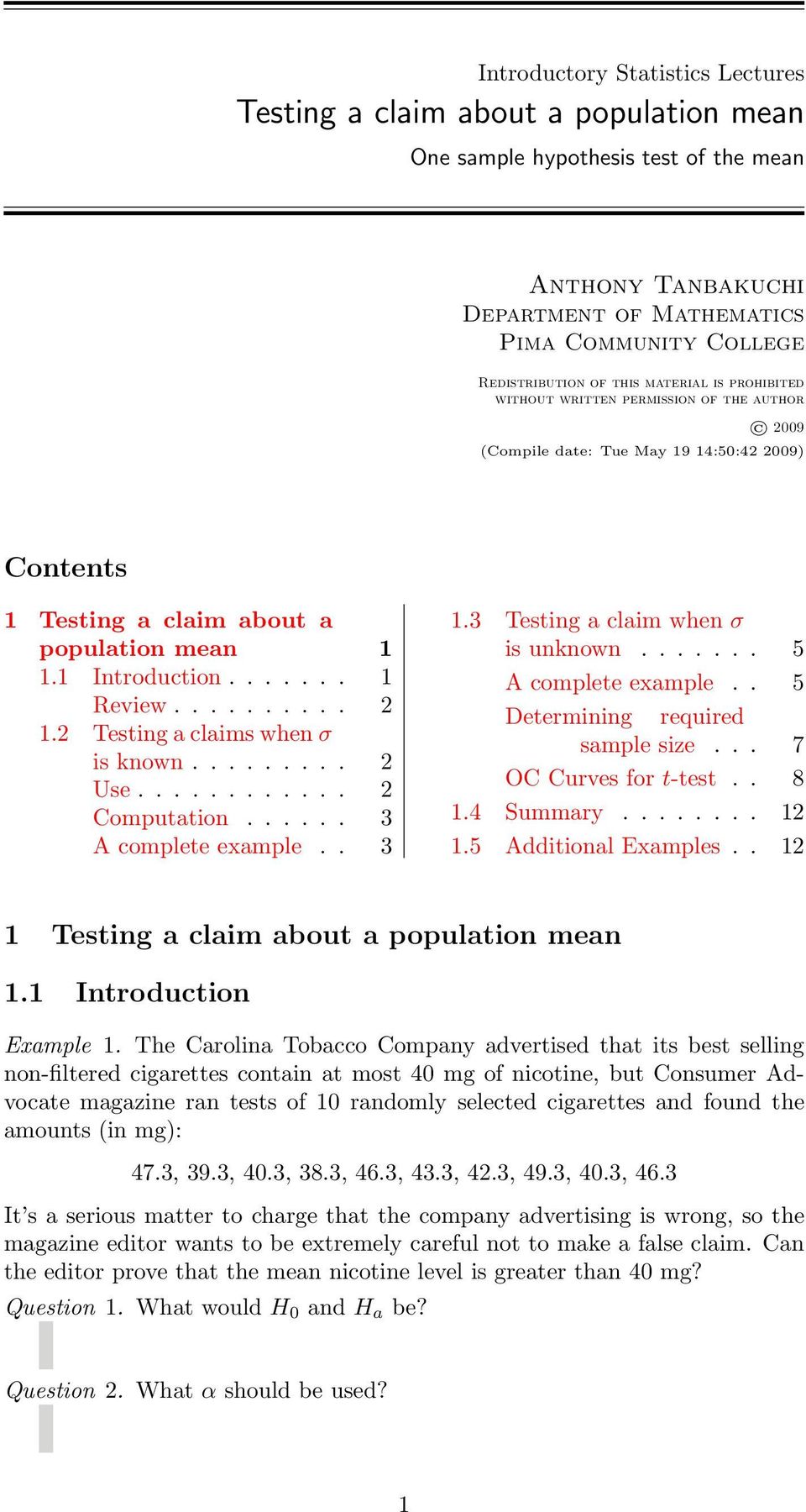
1 Introductory Statistics Lectures Testing a claim about a population mean One sample hypothesis test of the mean Department of Mathematics Pima Community College Redistribution of this material is prohibited without written permission of the author 2009 (Compile date: Tue May 19 14:50: ) Contents 1 Testing a claim about a population mean Introduction Review Testing a claims when σ is known Use Computation A complete example Testing a claim when σ is unknown A complete example.. 5 Determining required sample size... 7 OC Curves for t-test Summary Additional Examples Testing a claim about a population mean 1.1 Introduction Example 1. The Carolina Tobacco Company advertised that its best selling non-filtered cigarettes contain at most 40 mg of nicotine, but Consumer Advocate magazine ran tests of 10 randomly selected cigarettes and found the amounts (in mg): 47.3, 39.3, 40.3, 38.3, 46.3, 43.3, 42.3, 49.3, 40.3, 46.3 It s a serious matter to charge that the company advertising is wrong, so the magazine editor wants to be extremely careful not to make a false claim. Can the editor prove that the mean nicotine level is greater than 40 mg? Question 1. What would H 0 and H a be? Question 2. What α should be used? 1
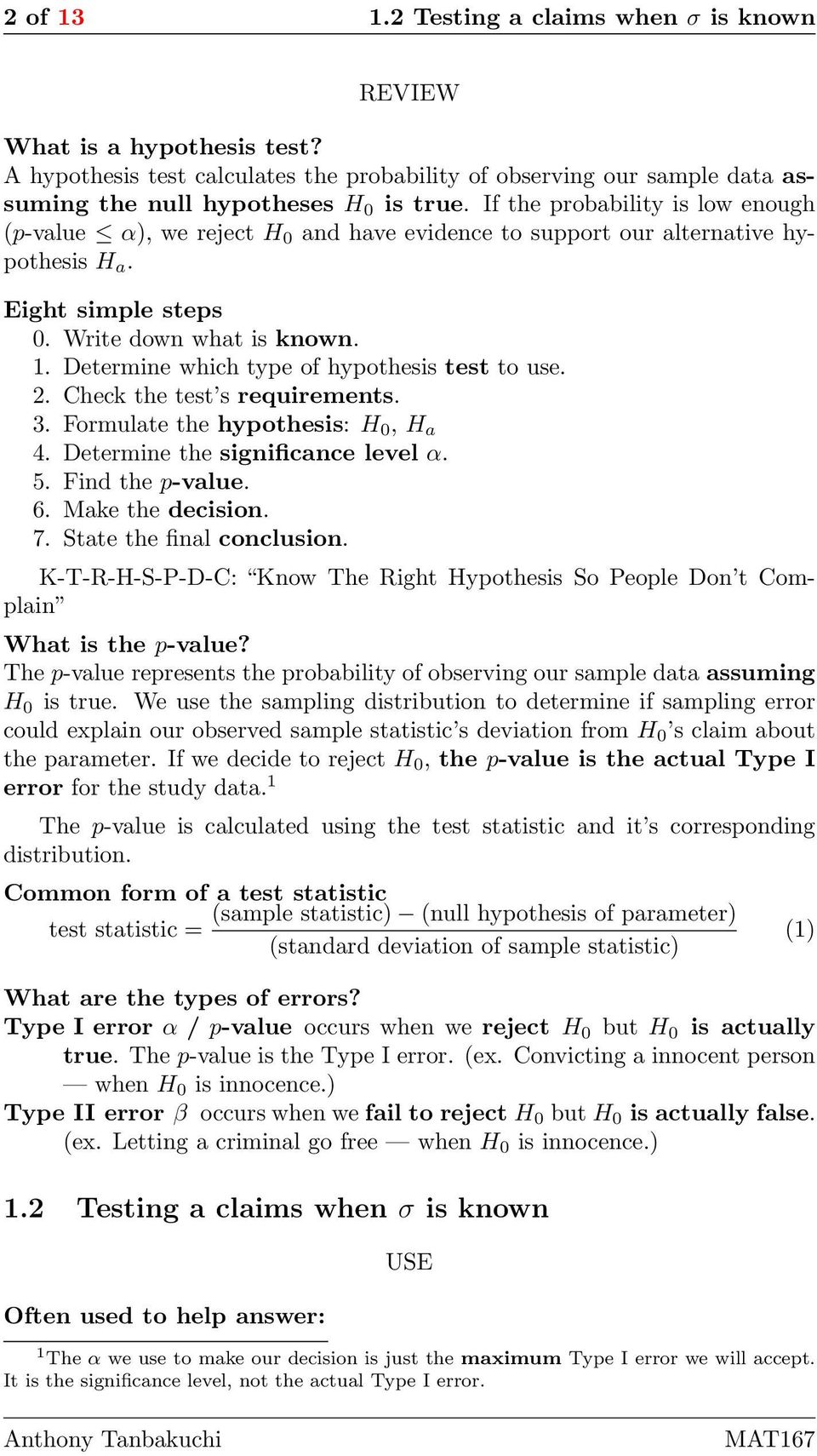
2 2 of Testing a claims when σ is known REVIEW What is a hypothesis test? A hypothesis test calculates the probability of observing our sample data assuming the null hypotheses H 0 is true. If the probability is low enough (p-value α), we reject H 0 and have evidence to support our alternative hypothesis H a. Eight simple steps 0. Write down what is known. 1. Determine which type of hypothesis test to use. 2. Check the test s requirements. 3. Formulate the hypothesis: H 0, H a 4. Determine the significance level α. 5. Find the p-value. 6. Make the decision. 7. State the final conclusion. K-T-R-H-S-P-D-C: Know The Right Hypothesis So People Don t Complain What is the p-value? The p-value represents the probability of observing our sample data assuming H 0 is true. We use the sampling distribution to determine if sampling error could explain our observed sample statistic s deviation from H 0 s claim about the parameter. If we decide to reject H 0, the p-value is the actual Type I error for the study data. 1 The p-value is calculated using the test statistic and it s corresponding distribution. Common form of a test statistic (sample statistic) (null hypothesis of parameter) test statistic = (standard deviation of sample statistic) What are the types of errors? Type I error α / p-value occurs when we reject H 0 but H 0 is actually true. The p-value is the Type I error. (ex. Convicting a innocent person when H 0 is innocence.) Type II error β occurs when we fail to reject H 0 but H 0 is actually false. (ex. Letting a criminal go free when H 0 is innocence.) 1.2 Testing a claims when σ is known Often used to help answer: USE 1 The α we use to make our decision is just the maximum Type I error we will accept. It is the significance level, not the actual Type I error. (1)
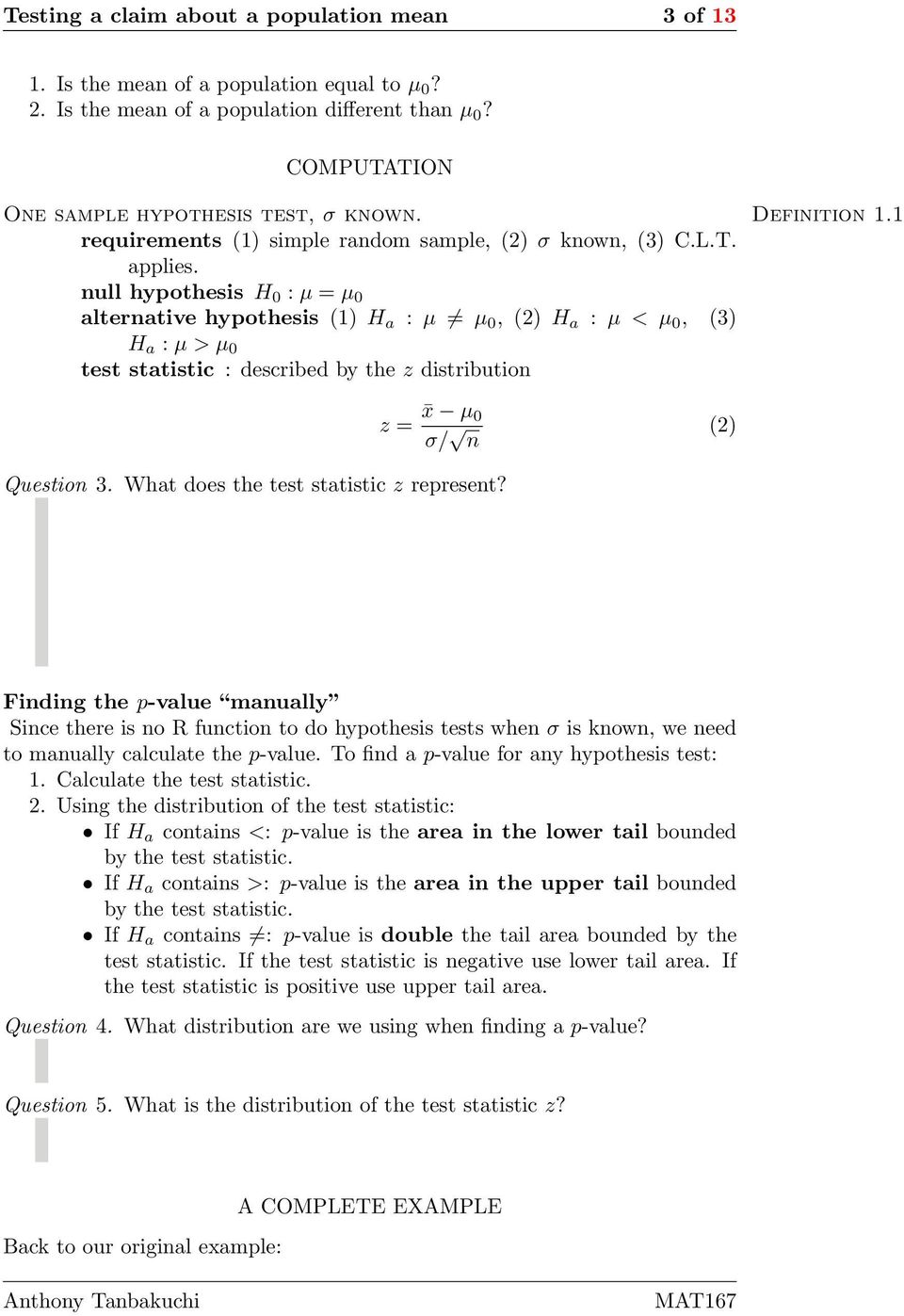
3 Testing a claim about a population mean 3 of Is the mean of a population equal to µ 0? 2. Is the mean of a population different than µ 0? COMPUTATION One sample hypothesis test, σ known. Definition 1.1 requirements (1) simple random sample, (2) σ known, (3) C.L.T. applies. null hypothesis H 0 : µ = µ 0 alternative hypothesis (1) H a : µ µ 0, (2) H a : µ < µ 0, (3) H a : µ > µ 0 test statistic : described by the z distribution z = x µ 0 σ/ n (2) Question 3. What does the test statistic z represent? Finding the p-value manually Since there is no R function to do hypothesis tests when σ is known, we need to manually calculate the p-value. To find a p-value for any hypothesis test: 1. Calculate the test statistic. 2. Using the distribution of the test statistic: If H a contains <: p-value is the area in the lower tail bounded by the test statistic. If H a contains >: p-value is the area in the upper tail bounded by the test statistic. If H a contains : p-value is double the tail area bounded by the test statistic. If the test statistic is negative use lower tail area. If the test statistic is positive use upper tail area. Question 4. What distribution are we using when finding a p-value? Question 5. What is the distribution of the test statistic z? Back to our original example: A COMPLETE EXAMPLE
4 4 of Testing a claims when σ is known Example 2. The Carolina Tobacco Company advertised that its best selling non-filtered cigarettes contain at most 40 mg of nicotine, but Consumer Advocate magazine ran tests of 10 randomly selected cigarettes and found the amounts (in mg): 47.3, 39.3, 40.3, 38.3, 46.3, 43.3, 42.3, 49.3, 40.3, 46.3 It s a serious matter to charge that the company advertising is wrong, so the magazine editor chooses a significance level of α = Can the editor prove that the mean nicotine level is greater than 40 mg? Assume nicotine levels are normally distributed and σ = 3.8. Solving the problem: step-by-step Step 0 known information: R: x = c ( , , , , , , , , , ) R: sigma = 3. 8 Step 1 Test: single sample mean test with sigma known. Step 2 Requirements: (1) simple random sample, (2) σ known, (3) CLT. All ok! Step 3 Hypothesis: H 0 : µ = 40mg, H a : µ > 40mg R: mu0 = 40 Step 4 Significance: α = 0.01 Step 5 p-value: must do manually find (1) test statistic z = x µ 0 σ/ n R: x. bar = mean ( x ) R: x. bar [ 1 ] R: n = l e n g t h ( x ) R: n [ 1 ] 10 R: z = ( x. bar mu0) / ( sigma / s q r t ( n ) ) R: z [ 1 ] (2) find p-value: this is one-tailed with H a :>, find area in upper tail: R: p. v a l = 1 pnorm ( z ) R: p. v a l [ 1 ] Step 6 Decision: since p-val α reject H 0. ( ) Step 7 Conclusion: The sample data supports the claim that the mean level of nicotine is greater than 40 mg. The probability of observing our data by chance if the mean level was 40 mg was true is only

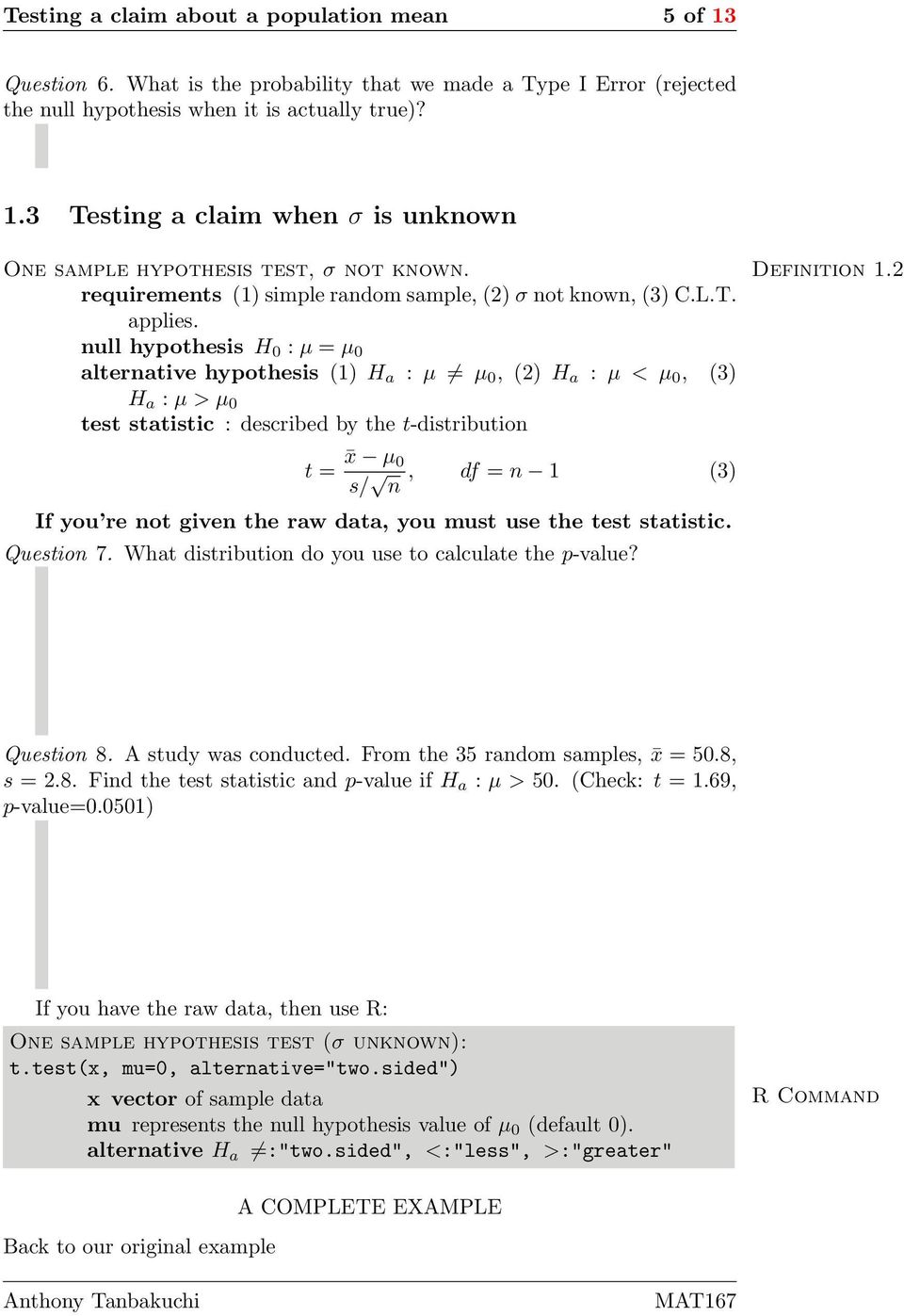
5 Testing a claim about a population mean 5 of 13 Question 6. What is the probability that we made a Type I Error (rejected the null hypothesis when it is actually true)? 1.3 Testing a claim when σ is unknown One sample hypothesis test, σ not known. Definition 1.2 requirements (1) simple random sample, (2) σ not known, (3) C.L.T. applies. null hypothesis H 0 : µ = µ 0 alternative hypothesis (1) H a : µ µ 0, (2) H a : µ < µ 0, (3) H a : µ > µ 0 test statistic : described by the t-distribution t = x µ 0 s/, df = n 1 (3) n If you re not given the raw data, you must use the test statistic. Question 7. What distribution do you use to calculate the p-value? Question 8. A study was conducted. From the 35 random samples, x = 50.8, s = 2.8. Find the test statistic and p-value if H a : µ > 50. (Check: t = 1.69, p-value=0.0501) If you have the raw data, then use R: One sample hypothesis test (σ unknown): t.test(x, mu=0, alternative="two.sided") x vector of sample data mu represents the null hypothesis value of µ 0 (default 0). alternative H a :"two.sided", <:"less", >:"greater" R Command Back to our original example A COMPLETE EXAMPLE
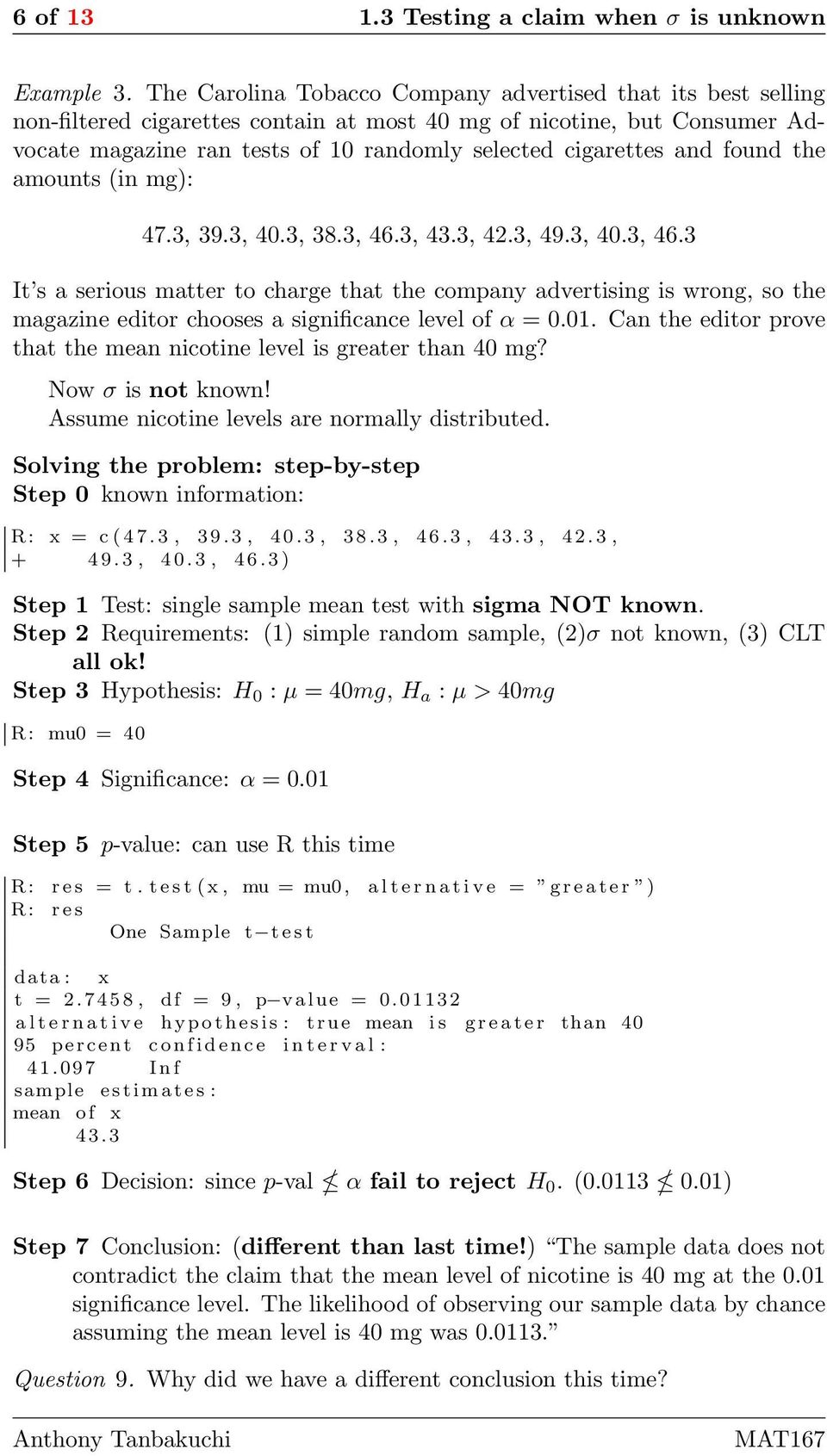
6 6 of Testing a claim when σ is unknown Example 3. The Carolina Tobacco Company advertised that its best selling non-filtered cigarettes contain at most 40 mg of nicotine, but Consumer Advocate magazine ran tests of 10 randomly selected cigarettes and found the amounts (in mg): 47.3, 39.3, 40.3, 38.3, 46.3, 43.3, 42.3, 49.3, 40.3, 46.3 It s a serious matter to charge that the company advertising is wrong, so the magazine editor chooses a significance level of α = Can the editor prove that the mean nicotine level is greater than 40 mg? Now σ is not known! Assume nicotine levels are normally distributed. Solving the problem: step-by-step Step 0 known information: R: x = c ( , , , , , , , , , ) Step 1 Test: single sample mean test with sigma NOT known. Step 2 Requirements: (1) simple random sample, (2)σ not known, (3) CLT all ok! Step 3 Hypothesis: H 0 : µ = 40mg, H a : µ > 40mg R: mu0 = 40 Step 4 Significance: α = 0.01 Step 5 p-value: can use R this time R: r e s = t. t e s t ( x, mu = mu0, a l t e r n a t i v e = g r e a t e r ) R: r e s One Sample t t e s t data : x t = , df = 9, p value = a l t e r n a t i v e h y p o t h e s i s : t r u e mean i s g r e a t e r than p e r c e n t c o n f i d e n c e i n t e r v a l : I n f sample e s t i m a t e s : mean o f x Step 6 Decision: since p-val α fail to reject H 0. ( ) Step 7 Conclusion: (different than last time!) The sample data does not contradict the claim that the mean level of nicotine is 40 mg at the 0.01 significance level. The likelihood of observing our sample data by chance assuming the mean level is 40 mg was Question 9. Why did we have a different conclusion this time?
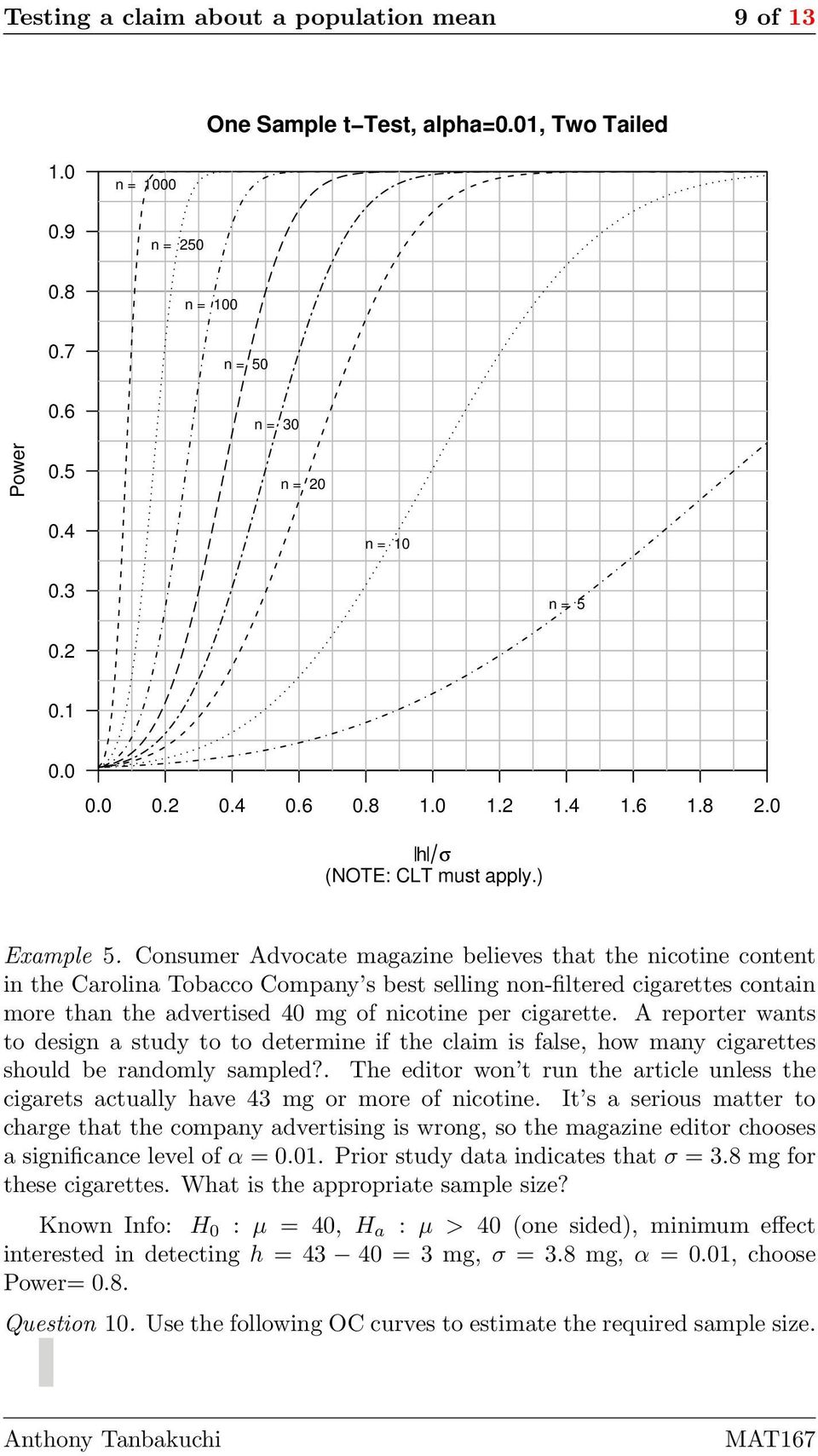
7 Testing a claim about a population mean 7 of 13 DETERMINING REQUIRED SAMPLE SIZE Before you conduct a hypothesis test (post-hoc), you must determine the necessary sample size to detect the smallest effect you are interested in. One sample t-test power Given the following parameters, you can determine the required n: α significance level, typically Power=1 β desired power, typically 0.8 or 0.9. h = µ µ 0 smallest difference in actual mean µ from the null hypothesis mean µ 0 you want to detect. (Effect size.) σ population standard deviation (or best estimate). t-test required sample size: power.t.test(delta=h, sd =σ, sig.level=α, power=1 β, type ="one.sample", alternative="two.sided") delta minimum effect size of interest sd estimate of population standard deviation power desired power alternative set to either one.sided or two.sided Example 4. Consumer Advocate magazine believes that the nicotine content in the Carolina Tobacco Company s best selling non-filtered cigarettes contain more than the advertised 40 mg of nicotine per cigarette. A reporter wants to design a study to to determine if the claim is false, how many cigarettes should be randomly sampled?. The editor won t run the article unless the cigarets actually have 43 mg or more of nicotine. It s a serious matter to charge that the company advertising is wrong, so the magazine editor chooses a significance level of α = Prior study data indicates that σ = 3.8 mg for these cigarettes. What is the appropriate sample size? Known Info: H 0 : µ = 40, H a : µ > 40 (one sided), minimum effect interested in detecting h = = 3 mg, σ = 3.8 mg, α = 0.01, choose Power= 0.8. R: power. t. t e s t ( d e l t a = 3, sd = 3. 8, s i g. l e v e l = , + power = 0. 8, type = one. sample, a l t e r n a t i v e = one. s i d e d ) One sample t t e s t power c a l c u l a t i o n R Command n = d e l t a = 3 sd = 3. 8

8 8 of Testing a claim when σ is unknown One Sample t Test, alpha=0.05, Two Tailed Power n = 1000 n = 250 n = 100 n = 50 n = 30 n = 20 n = n = h σ (NOTE: CLT must apply.) s i g. l e v e l = power = 0. 8 a l t e r n a t i v e = one. s i d e d Thus, required sample size is n = 19. Since our original sample only used n = 10, our power was much less than 0.8. OC CURVES FOR T -TEST Definition 1.3 Operating Characteristic Curves. OC curves for various hypothesis tests provide a simple method for quickly estimating the required sample size (ad-hoc) necessary to achieve a desired power for a given hypothesis test. They are also used to estimate the actual Type II error (pos-hoc) once a study has been conducted. Now we will repeat our previous example using OC curves.

9 Testing a claim about a population mean 9 of 13 One Sample t Test, alpha=0.01, Two Tailed Power n = 1000 n = 250 n = 100 n = 50 n = 30 n = n = n = h σ (NOTE: CLT must apply.) Example 5. Consumer Advocate magazine believes that the nicotine content in the Carolina Tobacco Company s best selling non-filtered cigarettes contain more than the advertised 40 mg of nicotine per cigarette. A reporter wants to design a study to to determine if the claim is false, how many cigarettes should be randomly sampled?. The editor won t run the article unless the cigarets actually have 43 mg or more of nicotine. It s a serious matter to charge that the company advertising is wrong, so the magazine editor chooses a significance level of α = Prior study data indicates that σ = 3.8 mg for these cigarettes. What is the appropriate sample size? Known Info: H 0 : µ = 40, H a : µ > 40 (one sided), minimum effect interested in detecting h = = 3 mg, σ = 3.8 mg, α = 0.01, choose Power= 0.8. Question 10. Use the following OC curves to estimate the required sample size.
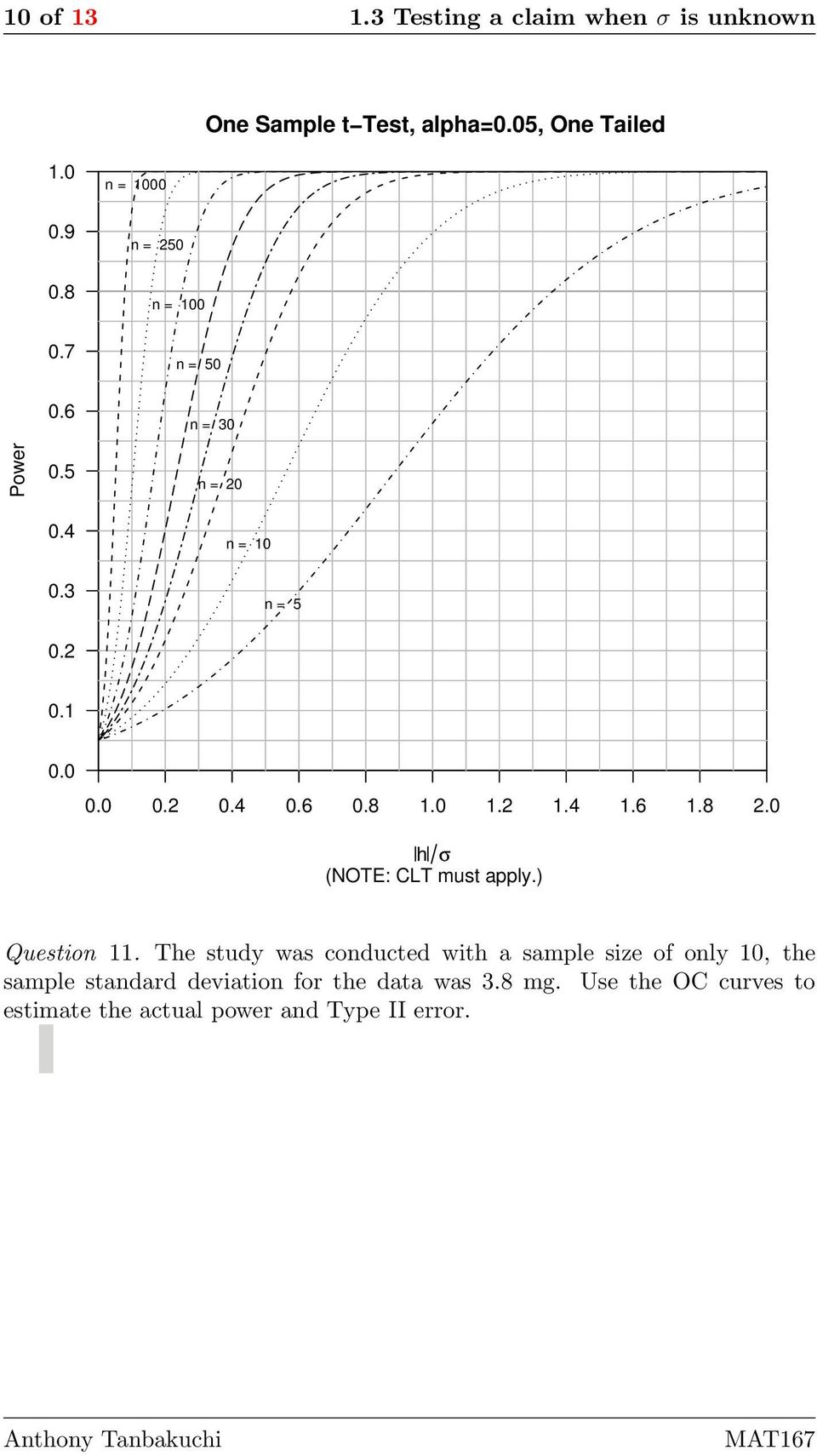
10 10 of Testing a claim when σ is unknown One Sample t Test, alpha=0.05, One Tailed Power n = 1000 n = 250 n = 100 n = 50 n = 30 n = 20 n = 10 n = h σ (NOTE: CLT must apply.) Question 11. The study was conducted with a sample size of only 10, the sample standard deviation for the data was 3.8 mg. Use the OC curves to estimate the actual power and Type II error.
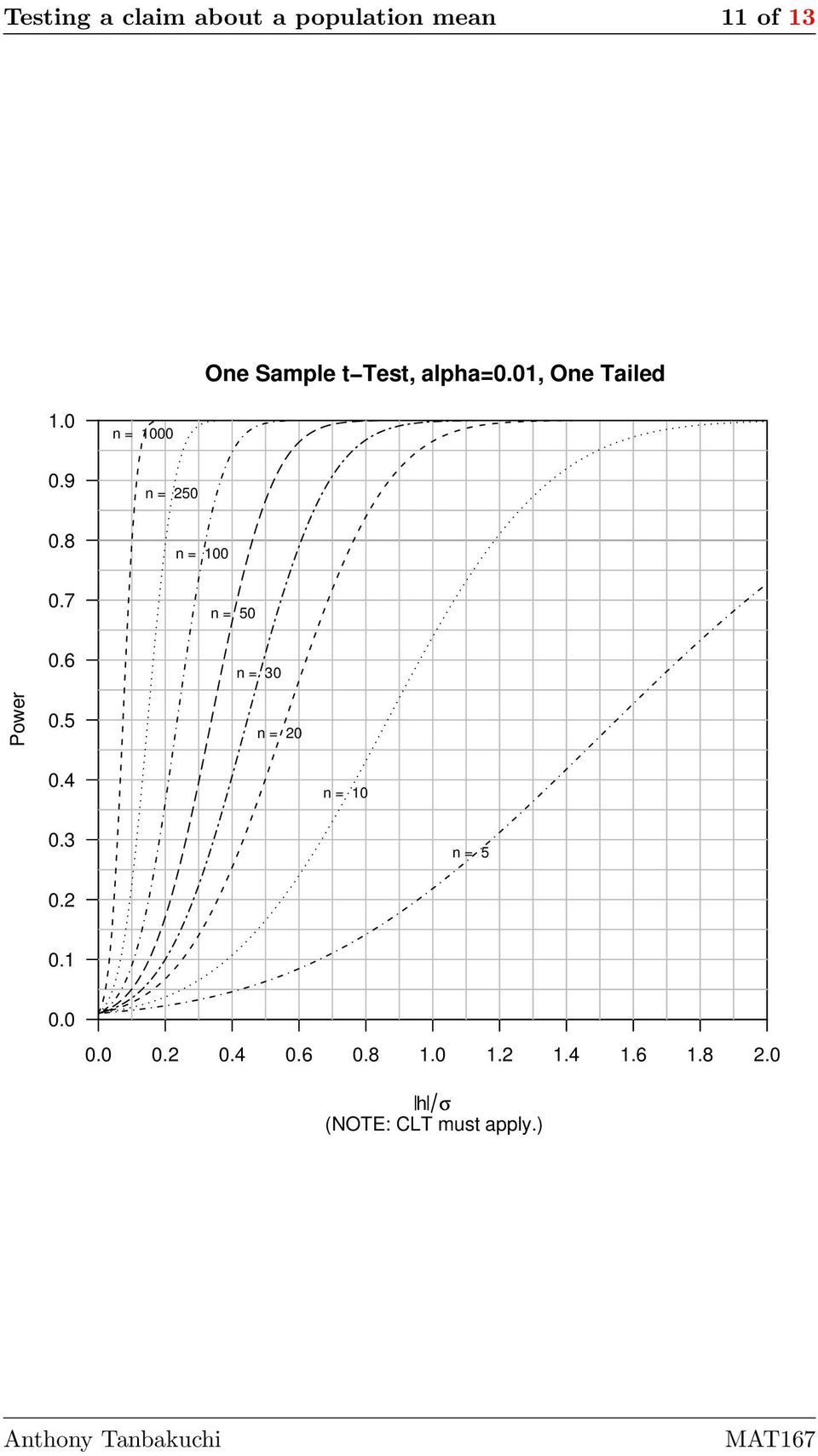
11 Testing a claim about a population mean 11 of 13 One Sample t Test, alpha=0.01, One Tailed Power n = 1000 n = 250 n = 100 n = 50 n = 30 n = n = n = h σ (NOTE: CLT must apply.)
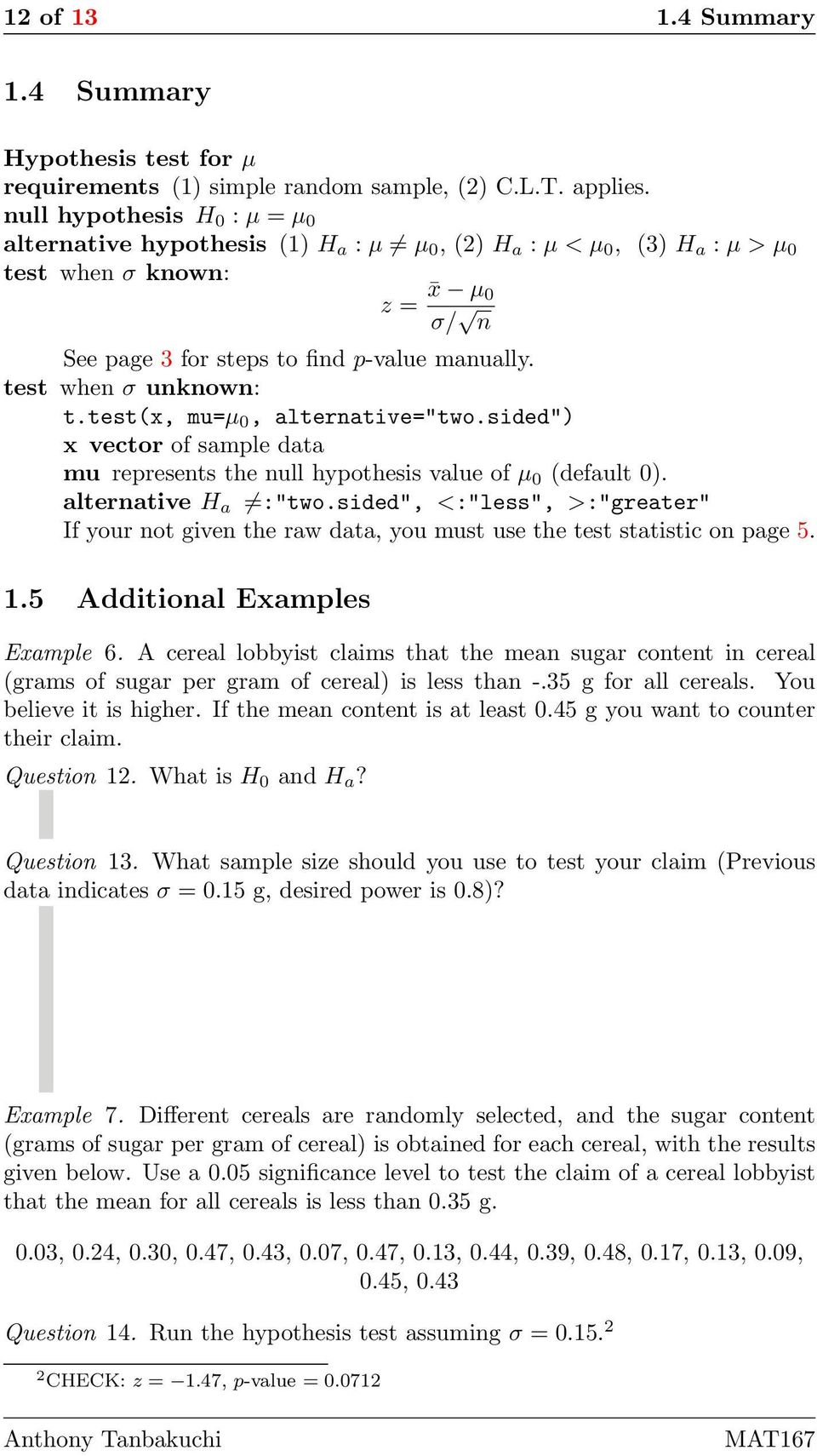
12 12 of Summary 1.4 Summary Hypothesis test for µ requirements (1) simple random sample, (2) C.L.T. applies. null hypothesis H 0 : µ = µ 0 alternative hypothesis (1) H a : µ µ 0, (2) H a : µ < µ 0, (3) H a : µ > µ 0 test when σ known: z = x µ 0 σ/ n See page 3 for steps to find p-value manually. test when σ unknown: t.test(x, mu=µ 0, alternative="two.sided") x vector of sample data mu represents the null hypothesis value of µ 0 (default 0). alternative H a :"two.sided", <:"less", >:"greater" If your not given the raw data, you must use the test statistic on page Additional Examples Example 6. A cereal lobbyist claims that the mean sugar content in cereal (grams of sugar per gram of cereal) is less than -.35 g for all cereals. You believe it is higher. If the mean content is at least 0.45 g you want to counter their claim. Question 12. What is H 0 and H a? Question 13. What sample size should you use to test your claim (Previous data indicates σ = 0.15 g, desired power is 0.8)? Example 7. Different cereals are randomly selected, and the sugar content (grams of sugar per gram of cereal) is obtained for each cereal, with the results given below. Use a 0.05 significance level to test the claim of a cereal lobbyist that the mean for all cereals is less than 0.35 g. 0.03, 0.24, 0.30, 0.47, 0.43, 0.07, 0.47, 0.13, 0.44, 0.39, 0.48, 0.17, 0.13, 0.09, 0.45, 0.43 Question 14. Run the hypothesis test assuming σ = CHECK: z = 1.47, p-value =
13 Testing a claim about a population mean 13 of 13 Question 15. For the previous question, would would the p-value be if H a : µ 0.35 g? Question 16. Run the hypothesis test assuming σ is unknown. 3 3 CHECK: p-value = 0.105
Section 7.1. Introduction to Hypothesis Testing. Schrodinger s cat quantum mechanics thought experiment (1935)
 Section 7.1 Introduction to Hypothesis Testing Schrodinger s cat quantum mechanics thought experiment (1935) Statistical Hypotheses A statistical hypothesis is a claim about a population. Null hypothesis
HYPOTHESIS TESTING: POWER OF THE TEST
 HYPOTHESIS TESTING: POWER OF THE TEST The first 6 steps of the 9-step test of hypothesis are called "the test". These steps are not dependent on the observed data values. When planning a research project,
Hypothesis Testing --- One Mean
 Hypothesis Testing --- One Mean A hypothesis is simply a statement that something is true. Typically, there are two hypotheses in a hypothesis test: the null, and the alternative. Null Hypothesis The hypothesis
HYPOTHESIS TESTING (ONE SAMPLE) - CHAPTER 7 1. used confidence intervals to answer questions such as...
 HYPOTHESIS TESTING (ONE SAMPLE) - CHAPTER 7 1 PREVIOUSLY used confidence intervals to answer questions such as... You know that 0.25% of women have red/green color blindness. You conduct a study of men
BA 275 Review Problems - Week 6 (10/30/06-11/3/06) CD Lessons: 53, 54, 55, 56 Textbook: pp. 394-398, 404-408, 410-420
 BA 275 Review Problems - Week 6 (10/30/06-11/3/06) CD Lessons: 53, 54, 55, 56 Textbook: pp. 394-398, 404-408, 410-420 1. Which of the following will increase the value of the power in a statistical test
LAB 4 INSTRUCTIONS CONFIDENCE INTERVALS AND HYPOTHESIS TESTING
 LAB 4 INSTRUCTIONS CONFIDENCE INTERVALS AND HYPOTHESIS TESTING In this lab you will explore the concept of a confidence interval and hypothesis testing through a simulation problem in engineering setting.
Lesson 1: Comparison of Population Means Part c: Comparison of Two- Means
 Lesson : Comparison of Population Means Part c: Comparison of Two- Means Welcome to lesson c. This third lesson of lesson will discuss hypothesis testing for two independent means. Steps in Hypothesis
Name: Date: Use the following to answer questions 3-4:
 Name: Date: 1. Determine whether each of the following statements is true or false. A) The margin of error for a 95% confidence interval for the mean increases as the sample size increases. B) The margin
Hypothesis testing - Steps
 Hypothesis testing - Steps Steps to do a two-tailed test of the hypothesis that β 1 0: 1. Set up the hypotheses: H 0 : β 1 = 0 H a : β 1 0. 2. Compute the test statistic: t = b 1 0 Std. error of b 1 =
Normal Approximation. Contents. 1 Normal Approximation. 1.1 Introduction. Anthony Tanbakuchi Department of Mathematics Pima Community College
 Introductory Statistics Lectures Normal Approimation To the binomial distribution Department of Mathematics Pima Community College Redistribution of this material is prohibited without written permission
Introduction to. Hypothesis Testing CHAPTER LEARNING OBJECTIVES. 1 Identify the four steps of hypothesis testing.
 Introduction to Hypothesis Testing CHAPTER 8 LEARNING OBJECTIVES After reading this chapter, you should be able to: 1 Identify the four steps of hypothesis testing. 2 Define null hypothesis, alternative
HYPOTHESIS TESTING (ONE SAMPLE) - CHAPTER 7 1. used confidence intervals to answer questions such as...
 HYPOTHESIS TESTING (ONE SAMPLE) - CHAPTER 7 1 PREVIOUSLY used confidence intervals to answer questions such as... You know that 0.25% of women have red/green color blindness. You conduct a study of men
6: Introduction to Hypothesis Testing
 6: Introduction to Hypothesis Testing Significance testing is used to help make a judgment about a claim by addressing the question, Can the observed difference be attributed to chance? We break up significance
t Tests in Excel The Excel Statistical Master By Mark Harmon Copyright 2011 Mark Harmon
 t-tests in Excel By Mark Harmon Copyright 2011 Mark Harmon No part of this publication may be reproduced or distributed without the express permission of the author. [email protected] www.excelmasterseries.com
BA 275 Review Problems - Week 5 (10/23/06-10/27/06) CD Lessons: 48, 49, 50, 51, 52 Textbook: pp. 380-394
 BA 275 Review Problems - Week 5 (10/23/06-10/27/06) CD Lessons: 48, 49, 50, 51, 52 Textbook: pp. 380-394 1. Does vigorous exercise affect concentration? In general, the time needed for people to complete
Two-Sample T-Tests Assuming Equal Variance (Enter Means)
 Chapter 4 Two-Sample T-Tests Assuming Equal Variance (Enter Means) Introduction This procedure provides sample size and power calculations for one- or two-sided two-sample t-tests when the variances of
Hypothesis Test for Mean Using Given Data (Standard Deviation Known-z-test)
 Hypothesis Test for Mean Using Given Data (Standard Deviation Known-z-test) A hypothesis test is conducted when trying to find out if a claim is true or not. And if the claim is true, is it significant.
Business Statistics, 9e (Groebner/Shannon/Fry) Chapter 9 Introduction to Hypothesis Testing
 Business Statistics, 9e (Groebner/Shannon/Fry) Chapter 9 Introduction to Hypothesis Testing 1) Hypothesis testing and confidence interval estimation are essentially two totally different statistical procedures
Introduction to Hypothesis Testing. Hypothesis Testing. Step 1: State the Hypotheses
 Introduction to Hypothesis Testing 1 Hypothesis Testing A hypothesis test is a statistical procedure that uses sample data to evaluate a hypothesis about a population Hypothesis is stated in terms of the
Stat 411/511 THE RANDOMIZATION TEST. Charlotte Wickham. stat511.cwick.co.nz. Oct 16 2015
 Stat 411/511 THE RANDOMIZATION TEST Oct 16 2015 Charlotte Wickham stat511.cwick.co.nz Today Review randomization model Conduct randomization test What about CIs? Using a t-distribution as an approximation
MONT 107N Understanding Randomness Solutions For Final Examination May 11, 2010
 MONT 07N Understanding Randomness Solutions For Final Examination May, 00 Short Answer (a) (0) How are the EV and SE for the sum of n draws with replacement from a box computed? Solution: The EV is n times
Two-Group Hypothesis Tests: Excel 2013 T-TEST Command
 Two group hypothesis tests using Excel 2013 T-TEST command 1 Two-Group Hypothesis Tests: Excel 2013 T-TEST Command by Milo Schield Member: International Statistical Institute US Rep: International Statistical
HYPOTHESIS TESTING WITH SPSS:
 HYPOTHESIS TESTING WITH SPSS: A NON-STATISTICIAN S GUIDE & TUTORIAL by Dr. Jim Mirabella SPSS 14.0 screenshots reprinted with permission from SPSS Inc. Published June 2006 Copyright Dr. Jim Mirabella CHAPTER
22. HYPOTHESIS TESTING
 22. HYPOTHESIS TESTING Often, we need to make decisions based on incomplete information. Do the data support some belief ( hypothesis ) about the value of a population parameter? Is OJ Simpson guilty?
Stats for Strategy Fall 2012 First-Discussion Handout: Stats Using Calculators and MINITAB
 Stats for Strategy Fall 2012 First-Discussion Handout: Stats Using Calculators and MINITAB DIRECTIONS: Welcome! Your TA will help you apply your Calculator and MINITAB to review Business Stats, and will
Two-Sample T-Tests Allowing Unequal Variance (Enter Difference)
 Chapter 45 Two-Sample T-Tests Allowing Unequal Variance (Enter Difference) Introduction This procedure provides sample size and power calculations for one- or two-sided two-sample t-tests when no assumption
THE FIRST SET OF EXAMPLES USE SUMMARY DATA... EXAMPLE 7.2, PAGE 227 DESCRIBES A PROBLEM AND A HYPOTHESIS TEST IS PERFORMED IN EXAMPLE 7.
 THERE ARE TWO WAYS TO DO HYPOTHESIS TESTING WITH STATCRUNCH: WITH SUMMARY DATA (AS IN EXAMPLE 7.17, PAGE 236, IN ROSNER); WITH THE ORIGINAL DATA (AS IN EXAMPLE 8.5, PAGE 301 IN ROSNER THAT USES DATA FROM
Simple Linear Regression Inference
 Simple Linear Regression Inference 1 Inference requirements The Normality assumption of the stochastic term e is needed for inference even if it is not a OLS requirement. Therefore we have: Interpretation
Two Related Samples t Test
 Two Related Samples t Test In this example 1 students saw five pictures of attractive people and five pictures of unattractive people. For each picture, the students rated the friendliness of the person
Independent t- Test (Comparing Two Means)
 Independent t- Test (Comparing Two Means) The objectives of this lesson are to learn: the definition/purpose of independent t-test when to use the independent t-test the use of SPSS to complete an independent
Opgaven Onderzoeksmethoden, Onderdeel Statistiek
 Opgaven Onderzoeksmethoden, Onderdeel Statistiek 1. What is the measurement scale of the following variables? a Shoe size b Religion c Car brand d Score in a tennis game e Number of work hours per week
Chapter 2 Probability Topics SPSS T tests
 Chapter 2 Probability Topics SPSS T tests Data file used: gss.sav In the lecture about chapter 2, only the One-Sample T test has been explained. In this handout, we also give the SPSS methods to perform
3.4 Statistical inference for 2 populations based on two samples
 3.4 Statistical inference for 2 populations based on two samples Tests for a difference between two population means The first sample will be denoted as X 1, X 2,..., X m. The second sample will be denoted
Chapter 8 Hypothesis Testing Chapter 8 Hypothesis Testing 8-1 Overview 8-2 Basics of Hypothesis Testing
 Chapter 8 Hypothesis Testing 1 Chapter 8 Hypothesis Testing 8-1 Overview 8-2 Basics of Hypothesis Testing 8-3 Testing a Claim About a Proportion 8-5 Testing a Claim About a Mean: s Not Known 8-6 Testing
Comparing Two Groups. Standard Error of ȳ 1 ȳ 2. Setting. Two Independent Samples
 Comparing Two Groups Chapter 7 describes two ways to compare two populations on the basis of independent samples: a confidence interval for the difference in population means and a hypothesis test. The
Principles of Hypothesis Testing for Public Health
 Principles of Hypothesis Testing for Public Health Laura Lee Johnson, Ph.D. Statistician National Center for Complementary and Alternative Medicine [email protected] Fall 2011 Answers to Questions
Understanding Confidence Intervals and Hypothesis Testing Using Excel Data Table Simulation
 Understanding Confidence Intervals and Hypothesis Testing Using Excel Data Table Simulation Leslie Chandrakantha [email protected] Department of Mathematics & Computer Science John Jay College of
5/31/2013. Chapter 8 Hypothesis Testing. Hypothesis Testing. Hypothesis Testing. Outline. Objectives. Objectives
 C H 8A P T E R Outline 8 1 Steps in Traditional Method 8 2 z Test for a Mean 8 3 t Test for a Mean 8 4 z Test for a Proportion 8 6 Confidence Intervals and Copyright 2013 The McGraw Hill Companies, Inc.
How To Test For Significance On A Data Set
 Non-Parametric Univariate Tests: 1 Sample Sign Test 1 1 SAMPLE SIGN TEST A non-parametric equivalent of the 1 SAMPLE T-TEST. ASSUMPTIONS: Data is non-normally distributed, even after log transforming.
Biostatistics: Types of Data Analysis
 Biostatistics: Types of Data Analysis Theresa A Scott, MS Vanderbilt University Department of Biostatistics [email protected] http://biostat.mc.vanderbilt.edu/theresascott Theresa A Scott, MS
Introduction. Hypothesis Testing. Hypothesis Testing. Significance Testing
 Introduction Hypothesis Testing Mark Lunt Arthritis Research UK Centre for Ecellence in Epidemiology University of Manchester 13/10/2015 We saw last week that we can never know the population parameters
Testing Hypotheses About Proportions
 Chapter 11 Testing Hypotheses About Proportions Hypothesis testing method: uses data from a sample to judge whether or not a statement about a population may be true. Steps in Any Hypothesis Test 1. Determine
Chapter 7 Notes - Inference for Single Samples. You know already for a large sample, you can invoke the CLT so:
 Chapter 7 Notes - Inference for Single Samples You know already for a large sample, you can invoke the CLT so: X N(µ, ). Also for a large sample, you can replace an unknown σ by s. You know how to do a
Psychology 60 Fall 2013 Practice Exam Actual Exam: Next Monday. Good luck!
 Psychology 60 Fall 2013 Practice Exam Actual Exam: Next Monday. Good luck! Name: 1. The basic idea behind hypothesis testing: A. is important only if you want to compare two populations. B. depends on
Chapter Study Guide. Chapter 11 Confidence Intervals and Hypothesis Testing for Means
 OPRE504 Chapter Study Guide Chapter 11 Confidence Intervals and Hypothesis Testing for Means I. Calculate Probability for A Sample Mean When Population σ Is Known 1. First of all, we need to find out the
1-3 id id no. of respondents 101-300 4 respon 1 responsible for maintenance? 1 = no, 2 = yes, 9 = blank
 Basic Data Analysis Graziadio School of Business and Management Data Preparation & Entry Editing: Inspection & Correction Field Edit: Immediate follow-up (complete? legible? comprehensible? consistent?
Chapter 7: One-Sample Inference
 Chapter 7: One-Sample Inference Now that you have all this information about descriptive statistics and probabilities, it is time to start inferential statistics. There are two branches of inferential
Chapter 26: Tests of Significance
 Chapter 26: Tests of Significance Procedure: 1. State the null and alternative in words and in terms of a box model. 2. Find the test statistic: z = observed EV. SE 3. Calculate the P-value: The area under
Using Stata for One Sample Tests
 Using Stata for One Sample Tests All of the one sample problems we have discussed so far can be solved in Stata via either (a) statistical calculator functions, where you provide Stata with the necessary
Introduction to Hypothesis Testing OPRE 6301
 Introduction to Hypothesis Testing OPRE 6301 Motivation... The purpose of hypothesis testing is to determine whether there is enough statistical evidence in favor of a certain belief, or hypothesis, about
sensr - Part 2 Similarity testing and replicated data (and sensr) p 1 2 p d 1. Analysing similarity test data.
 Similarity testing and replicated data (and sensr) Per Bruun Brockhoff Professor, Statistics DTU, Copenhagen August 17 2015 sensr - Part 2 1. Analysing similarity test data. 2. Planning similarity tests
Hypothesis Testing. Steps for a hypothesis test:
 Hypothesis Testing Steps for a hypothesis test: 1. State the claim H 0 and the alternative, H a 2. Choose a significance level or use the given one. 3. Draw the sampling distribution based on the assumption
Hypothesis testing. c 2014, Jeffrey S. Simonoff 1
 Hypothesis testing So far, we ve talked about inference from the point of estimation. We ve tried to answer questions like What is a good estimate for a typical value? or How much variability is there
Chapter 2. Hypothesis testing in one population
 Chapter 2. Hypothesis testing in one population Contents Introduction, the null and alternative hypotheses Hypothesis testing process Type I and Type II errors, power Test statistic, level of significance
A POPULATION MEAN, CONFIDENCE INTERVALS AND HYPOTHESIS TESTING
 CHAPTER 5. A POPULATION MEAN, CONFIDENCE INTERVALS AND HYPOTHESIS TESTING 5.1 Concepts When a number of animals or plots are exposed to a certain treatment, we usually estimate the effect of the treatment
Non-Inferiority Tests for One Mean
 Chapter 45 Non-Inferiority ests for One Mean Introduction his module computes power and sample size for non-inferiority tests in one-sample designs in which the outcome is distributed as a normal random
Lecture Notes Module 1
 Lecture Notes Module 1 Study Populations A study population is a clearly defined collection of people, animals, plants, or objects. In psychological research, a study population usually consists of a specific
Permutation Tests for Comparing Two Populations
 Permutation Tests for Comparing Two Populations Ferry Butar Butar, Ph.D. Jae-Wan Park Abstract Permutation tests for comparing two populations could be widely used in practice because of flexibility of
Class 19: Two Way Tables, Conditional Distributions, Chi-Square (Text: Sections 2.5; 9.1)
 Spring 204 Class 9: Two Way Tables, Conditional Distributions, Chi-Square (Text: Sections 2.5; 9.) Big Picture: More than Two Samples In Chapter 7: We looked at quantitative variables and compared the
An Introduction to Statistics Course (ECOE 1302) Spring Semester 2011 Chapter 10- TWO-SAMPLE TESTS
 The Islamic University of Gaza Faculty of Commerce Department of Economics and Political Sciences An Introduction to Statistics Course (ECOE 130) Spring Semester 011 Chapter 10- TWO-SAMPLE TESTS Practice
Good luck! BUSINESS STATISTICS FINAL EXAM INSTRUCTIONS. Name:
 Glo bal Leadership M BA BUSINESS STATISTICS FINAL EXAM Name: INSTRUCTIONS 1. Do not open this exam until instructed to do so. 2. Be sure to fill in your name before starting the exam. 3. You have two hours
Calculating P-Values. Parkland College. Isela Guerra Parkland College. Recommended Citation
 Parkland College A with Honors Projects Honors Program 2014 Calculating P-Values Isela Guerra Parkland College Recommended Citation Guerra, Isela, "Calculating P-Values" (2014). A with Honors Projects.
Chapter 4 Statistical Inference in Quality Control and Improvement. Statistical Quality Control (D. C. Montgomery)
 Chapter 4 Statistical Inference in Quality Control and Improvement 許 湘 伶 Statistical Quality Control (D. C. Montgomery) Sampling distribution I a random sample of size n: if it is selected so that the
Study Guide for the Final Exam
 Study Guide for the Final Exam When studying, remember that the computational portion of the exam will only involve new material (covered after the second midterm), that material from Exam 1 will make
UNDERSTANDING THE INDEPENDENT-SAMPLES t TEST
 UNDERSTANDING The independent-samples t test evaluates the difference between the means of two independent or unrelated groups. That is, we evaluate whether the means for two independent groups are significantly
Practice problems for Homework 12 - confidence intervals and hypothesis testing. Open the Homework Assignment 12 and solve the problems.
 Practice problems for Homework 1 - confidence intervals and hypothesis testing. Read sections 10..3 and 10.3 of the text. Solve the practice problems below. Open the Homework Assignment 1 and solve the
KSTAT MINI-MANUAL. Decision Sciences 434 Kellogg Graduate School of Management
 KSTAT MINI-MANUAL Decision Sciences 434 Kellogg Graduate School of Management Kstat is a set of macros added to Excel and it will enable you to do the statistics required for this course very easily. To
MULTIPLE CHOICE. Choose the one alternative that best completes the statement or answers the question.
 STT315 Practice Ch 5-7 MULTIPLE CHOICE. Choose the one alternative that best completes the statement or answers the question. Solve the problem. 1) The length of time a traffic signal stays green (nicknamed
Unit 31 A Hypothesis Test about Correlation and Slope in a Simple Linear Regression
 Unit 31 A Hypothesis Test about Correlation and Slope in a Simple Linear Regression Objectives: To perform a hypothesis test concerning the slope of a least squares line To recognize that testing for a
Point Biserial Correlation Tests
 Chapter 807 Point Biserial Correlation Tests Introduction The point biserial correlation coefficient (ρ in this chapter) is the product-moment correlation calculated between a continuous random variable
Hypothesis Testing. Hypothesis Testing
 Hypothesis Testing Daniel A. Menascé Department of Computer Science George Mason University 1 Hypothesis Testing Purpose: make inferences about a population parameter by analyzing differences between observed
Tutorial 5: Hypothesis Testing
 Tutorial 5: Hypothesis Testing Rob Nicholls [email protected] MRC LMB Statistics Course 2014 Contents 1 Introduction................................ 1 2 Testing distributional assumptions....................
In the general population of 0 to 4-year-olds, the annual incidence of asthma is 1.4%
 Hypothesis Testing for a Proportion Example: We are interested in the probability of developing asthma over a given one-year period for children 0 to 4 years of age whose mothers smoke in the home In the
Chapter 4: Statistical Hypothesis Testing
 Chapter 4: Statistical Hypothesis Testing Christophe Hurlin November 20, 2015 Christophe Hurlin () Advanced Econometrics - Master ESA November 20, 2015 1 / 225 Section 1 Introduction Christophe Hurlin
Chapter 7 Section 7.1: Inference for the Mean of a Population
 Chapter 7 Section 7.1: Inference for the Mean of a Population Now let s look at a similar situation Take an SRS of size n Normal Population : N(, ). Both and are unknown parameters. Unlike what we used
CHAPTER 14 NONPARAMETRIC TESTS
 CHAPTER 14 NONPARAMETRIC TESTS Everything that we have done up until now in statistics has relied heavily on one major fact: that our data is normally distributed. We have been able to make inferences
Chicago Booth BUSINESS STATISTICS 41000 Final Exam Fall 2011
 Chicago Booth BUSINESS STATISTICS 41000 Final Exam Fall 2011 Name: Section: I pledge my honor that I have not violated the Honor Code Signature: This exam has 34 pages. You have 3 hours to complete this
Module 4 (Effect of Alcohol on Worms): Data Analysis
 Module 4 (Effect of Alcohol on Worms): Data Analysis Michael Dunn Capuchino High School Introduction In this exercise, you will first process the timelapse data you collected. Then, you will cull (remove)
Descriptive Statistics
 Descriptive Statistics Primer Descriptive statistics Central tendency Variation Relative position Relationships Calculating descriptive statistics Descriptive Statistics Purpose to describe or summarize
Experimental Design. Power and Sample Size Determination. Proportions. Proportions. Confidence Interval for p. The Binomial Test
 Experimental Design Power and Sample Size Determination Bret Hanlon and Bret Larget Department of Statistics University of Wisconsin Madison November 3 8, 2011 To this point in the semester, we have largely
Inclusion and Exclusion Criteria
 Inclusion and Exclusion Criteria Inclusion criteria = attributes of subjects that are essential for their selection to participate. Inclusion criteria function remove the influence of specific confounding
Chapter 8: Hypothesis Testing for One Population Mean, Variance, and Proportion
 Chapter 8: Hypothesis Testing for One Population Mean, Variance, and Proportion Learning Objectives Upon successful completion of Chapter 8, you will be able to: Understand terms. State the null and alternative
t-test Statistics Overview of Statistical Tests Assumptions
 t-test Statistics Overview of Statistical Tests Assumption: Testing for Normality The Student s t-distribution Inference about one mean (one sample t-test) Inference about two means (two sample t-test)
NCSS Statistical Software
 Chapter 06 Introduction This procedure provides several reports for the comparison of two distributions, including confidence intervals for the difference in means, two-sample t-tests, the z-test, the
Final Exam Practice Problem Answers
 Final Exam Practice Problem Answers The following data set consists of data gathered from 77 popular breakfast cereals. The variables in the data set are as follows: Brand: The brand name of the cereal
2 Precision-based sample size calculations
 Statistics: An introduction to sample size calculations Rosie Cornish. 2006. 1 Introduction One crucial aspect of study design is deciding how big your sample should be. If you increase your sample size
Regression Analysis: A Complete Example
 Regression Analysis: A Complete Example This section works out an example that includes all the topics we have discussed so far in this chapter. A complete example of regression analysis. PhotoDisc, Inc./Getty
C. The null hypothesis is not rejected when the alternative hypothesis is true. A. population parameters.
 Sample Multiple Choice Questions for the material since Midterm 2. Sample questions from Midterms and 2 are also representative of questions that may appear on the final exam.. A randomly selected sample
Section 13, Part 1 ANOVA. Analysis Of Variance
 Section 13, Part 1 ANOVA Analysis Of Variance Course Overview So far in this course we ve covered: Descriptive statistics Summary statistics Tables and Graphs Probability Probability Rules Probability
UNDERSTANDING THE DEPENDENT-SAMPLES t TEST
 UNDERSTANDING THE DEPENDENT-SAMPLES t TEST A dependent-samples t test (a.k.a. matched or paired-samples, matched-pairs, samples, or subjects, simple repeated-measures or within-groups, or correlated groups)
Understand the role that hypothesis testing plays in an improvement project. Know how to perform a two sample hypothesis test.
 HYPOTHESIS TESTING Learning Objectives Understand the role that hypothesis testing plays in an improvement project. Know how to perform a two sample hypothesis test. Know how to perform a hypothesis test
WISE Power Tutorial All Exercises
 ame Date Class WISE Power Tutorial All Exercises Power: The B.E.A.. Mnemonic Four interrelated features of power can be summarized using BEA B Beta Error (Power = 1 Beta Error): Beta error (or Type II
Unit 26 Estimation with Confidence Intervals
 Unit 26 Estimation with Confidence Intervals Objectives: To see how confidence intervals are used to estimate a population proportion, a population mean, a difference in population proportions, or a difference
Stats Review Chapters 9-10
 Stats Review Chapters 9-10 Created by Teri Johnson Math Coordinator, Mary Stangler Center for Academic Success Examples are taken from Statistics 4 E by Michael Sullivan, III And the corresponding Test
Testing for differences I exercises with SPSS
 Testing for differences I exercises with SPSS Introduction The exercises presented here are all about the t-test and its non-parametric equivalents in their various forms. In SPSS, all these tests can
The power of a test is the of. by using a particular and a. value of the that is an to the value
 DEFINITION The power of a test is the of a hypothesis. The of the is by using a particular and a value of the that is an to the value assumed in the. POWER AND THE DESIGN OF EXPERIMENTS Just as is a common
Introduction to Analysis of Variance (ANOVA) Limitations of the t-test
 Introduction to Analysis of Variance (ANOVA) The Structural Model, The Summary Table, and the One- Way ANOVA Limitations of the t-test Although the t-test is commonly used, it has limitations Can only
In the past, the increase in the price of gasoline could be attributed to major national or global
 Chapter 7 Testing Hypotheses Chapter Learning Objectives Understanding the assumptions of statistical hypothesis testing Defining and applying the components in hypothesis testing: the research and null
Introduction. Statistics Toolbox
 Introduction A hypothesis test is a procedure for determining if an assertion about a characteristic of a population is reasonable. For example, suppose that someone says that the average price of a gallon