
Global Insurance Market Trends 2014
|
|
|
- Neil Taylor
- 10 years ago
- Views:
Transcription
1 Global Insurance Market Trends 2014

2 OECD Insurance and Private Pensions Committee The importance of insurance as a foundation for economic activity was acknowledged at the inception of the OECD with the creation of the Insurance Committee in The scope of activities of the Insurance Committee has gradually widened, and now covers the topic of private pensions, reflecting the importance of private pension systems in OECD countries (the Committee was accordingly renamed the Insurance the Private Pensions Committee in 2005). Today, the Committee s work focuses on: promoting insurance market monitoring; collecting and disseminating insurance statistics at the global level; ensuring that insurance markets and private pensions systems are efficient, resilient and stable; supporting the contribution of insurers and private pensions to well-diversified financing of long-term investment and inclusive growth through prudent investment strategies; promoting risk awareness, financial education and adequate consumer protection in insurance and private pensions; strengthening the capacity of private pensions systems to ensure adequate retirement income within overall pensions systems and address the challenges of ageing; and strengthening the capacity of individuals, businesses, and governments to address financial and other risks, including disaster risks, through enhanced insurance and private pension systems. The Committee engages in a range of co-operative activities with non-member economies. This work is published on the responsibility of the Secretary-General of the OECD. The opinions expressed and arguments employed herein do not necessarily reflect the official views of OECD member countries. This document and any map included herein are without prejudice to the status of or sovereignty over any territory, to the delimitation of international frontiers and boundaries and to the name of any territory, city or area. The statistical data for Israel are supplied by and under the responsibility of the relevant Israeli authorities. The use of such data by the OECD is without prejudice to the status of the Golan Heights, East Jerusalem and Israeli settlements in the West Bank under the terms of international law. OECD 2014
3 3 Foreword The OECD has been collecting insurance statistics for almost two decades, with data on the insurance sector dating back to the early 1980s. In response to the financial crisis, the Global Insurance Statistics (GIS) project was launched as part of the OECD s insurance market monitoring activities. The main objective was to expand the scope of the OECD s statistical framework for insurance and extend its global reach, with a view to enhancing the transparency of insurance markets. These changes led to the collection of key balance sheet and income statement items for the direct insurance and reinsurance sectors, and to the geographical expansion of the OECD s international insurance statistics database. As a complement to its insurance market statistics, the OECD decided to initiate the publication of an annual monitoring report that makes use of the GIS database. This publication, the Global Insurance Market Trends, provides an overview of market trends for developing a better understanding of the insurance industry s overall performance and health, and this fourth edition continues this objective. The geographical coverage of the insurance statistics database has been expanded to include the collection of statistics from a number of non-oecd Latin American countries, achieved through cooperation with the Association of Latin American Insurers (ASSAL), a number of non-oecd countries in Asia as well as Latvia and South Africa. The contribution of data from these countries allows for the inclusion in the Global Insurance Market Trends of a more comprehensive overview of insurance market globally. The OECD will seek to include a broader set of countries in future editions of the report. This monitoring report and the GIS database will provide an increasingly valuable cross-country source of data and information on insurance sector developments for use by governmental and supervisory authorities, central banks, the insurance sector and broader financial industry, consumers and the research community.
4

5 5 TABLE OF CONTENTS HIGHLIGHTS... 7 GLOBAL INSURANCE MARKET TRENDS... 9 Underwriting performance... 9 Annual real gross premium growth: Life insurance Annual real gross premium growth: Non-life insurance Claims development: Life sector Claims development: Non-life sector Combined ratio: non-life sector Investment allocation and performance Portfolio investment: life insurance Portfolio allocation: non-life insurers Portfolio Allocation: composite insurers Bond allocation Investment returns Profitability: Return on equity Change in equity position ADDITIONAL NOTES Notes to be taken into consideration when interpreting the data Specific notes FIGURES Figure 1. Annual real gross premium growth: Life sector ( ) (%) Figure 2. Annual real gross premium growth: Non-Life sector ( ) (%) Figure 3. Nominal growth in gross claim payments: Life sector ( ) (%) Figure 4. Nominal growth in gross claim payment: Non-Life sector ( ) (%) Figure 5. Combined ratio for non-life segment ( ) (%) Figure 6. Investment portfolio allocation: Life insurers (2013) (as a % of total investments) Figure 7. Investment portfolio allocation: Non-Life insurers (2013) (as a % of total investments) Figure 8. Investment portfolio allocation: Composite insurers (2013) (as a % of total investments) Figure 9. Portfolio allocation to bonds, public and private-sector bonds (2013) (as a % of total investments)... 26

6 6 TABLES Table 1. Insurers portfolio allocation in bonds and shares by type of insurer ( ) (as a % of total investments) Table 2. Average real net investment return by type of insurer ( ) (%) Table 3. Return on equity by type of insurer ( ) (%) Table 4. Change in equity position by type of insurer ( ) (%) Table 5. Currency exchange rates and consumer price index (CPI) Table 6. List of administrative sources Table 7. Composite undertakings... 40

7 7 HIGHLIGHTS In 2013, while the economic environment continues to be weak for a number of OECD countries, particularly for the euro area, the situation in insurance markets has started to improve with noticeable premium growth in many countries. Life sector premiums grew at a healthy pace in a number of countries that had been facing limited or negative growth since the economic and financial crisis. Premiums continued to register growth in most emerging market economies in Asia and Latin America. However, the recovery in gross life premium growth seen in 2012 in some of the larger life insurance markets reversed in Low investment returns, combined with weak economic growth, have limited the profitability of life insurers in recent years and has affected the range of products and guarantees being offered. Savings products with market-linked returns have faced significant surrenders in recent years although this trend began to reverse in a number of countries in Changes in motor vehicle insurance markets that allowed for premium increases in some countries had a positive impact on results for the non-life sector. However, other countries continued to face a highly-competitive motor insurance market leading to limited premium growth. The weak economic environment in a number of countries continued to impact the non-life sector which has yet to recover in many of the countries most impacted by the economic and financial crisis. Losses from natural catastrophes affected the non-life sector in a number of countries although aggregate economic losses from natural and man-made disasters in 2013 were below 2012 (and 10- year average) levels. Some countries experienced reduced claims growth in the non-life sector following significant growth in past years resulting from large disaster events. The prolonged low interest rate environment has made it more difficult for life insurers, with their generally large holdings of fixed-income assets, to earn adequate returns in relation to their obligations. This could result in a responsive shift of portfolio allocations towards more risky assets in a search for yield to improve investment returns. While no substantial and generalised shifts in investment allocations occurred in 2013, life insurance companies in a few countries have shifted investments away from bonds into other types of assets. The impending exit from unconventional monetary easing in the United States and the United Kingdom and the resulting expectation of an increase in interest rates has been associated with volatility in emerging market assets in Investment returns in the life sector in many nonmember countries declined substantially in 2013 relative to Looking ahead, continued attention is being placed on the impacts of the low interest rate environment, in terms of possible changes in risk appetite to generate returns and reinvestment risk for maturing bond portfolios. Low interest rates continue to be most problematic where insurance products provide guaranteed returns. Interest rate risk remains significant given the increased probability of higher future rates. A sudden rise in rates would have an adverse impact on fixedrate securities and could create broader financial market volatility. Some countries are closely monitoring competitive pressures in sub-sectors to ensure that intense competition does not lead to lower underwriting standards or the under-pricing of premiums. Long-term trends such as increases in longevity, health care costs, and the increased prevalence of natural disasters as a result of climate change are other risks that are attracting close attention.
8 8 As global uncertainty in the macroeconomic environment remains, demand for insurance products will likely remain constrained. Limited demand, combined with competitive pressures within the industry, particularly in the non-life sector, as well as between life insurance companies and banks for consumer savings and investments, is likely to maintain pressure on the industry to cut operational costs and boost investment performance especially given the limited capacity to increase premiums and fees. That said, insurance sectors in some countries have benefitted from new business in unit-linked products as a result of the low deposit rates offered by the banking sector. Insurance regulators in Europe remain focussed on Solvency II implementation. The implementation of Own Risk and Solvency Assessment in a number of countries is also having an impact on the supervisory and regulatory approaches of many insurance sector regulators.
9 9 GLOBAL INSURANCE MARKET TRENDS Underwriting performance Opposing trends of growth and decline of real gross premiums The rate of gross premium growth in both the life and non-life insurance sectors diverged substantially across countries, as some countries saw strong growth while others experienced declines in the life insurance sector, non-life insurance sector or both. Growth in gross premiums in non-oecd countries, experiencing faster economic growth, outperformed premium growth in OECD countries where economic growth has been weaker. Lower penetration rates in non- OECD countries, generally below 5%, may also be contributing to the faster premium growth experienced by those countries in recent years. Few OECD countries experienced positive trends in both life and non-life sectors, while almost all non-oecd countries had positive growth in both sectors Approximately one third of reporting OECD countries (Australia, Canada, Estonia, Finland, France, Germany, Hungary, Israel, Mexico, Sweden, Switzerland and Turkey) experienced positive real growth in gross premiums across both the life and non-life insurance sectors. By contrast, almost all reporting non-oecd countries experienced (often substantial) growth in both life and non-life gross premiums. Countries such as Greece, Ireland and Spain continue to suffer from the impacts of the economic downturn on their insurance market. For example, in Greece, the insurance sector s prospects for growth are limited by high unemployment, depressed salaries and wages, increasing taxation and a continuing recession in the Greek economy. Insurance companies did, however, experience a marginal improvement in profitability. Italy and Portugal, on the other hand, experienced a recovery in gross life premiums in 2013 (although gross non-life premiums in both countries continued to decline), marking a divergence of recovery patterns among the crisisaffected countries. In a number of countries, growth associated with non-life insurance has been driven by developments in the motor vehicle insurance industry. For example, in Turkey, liberalisation of premiums has led to increases in motor vehicle premiums which in turn drove premium growth in the nonlife sector. Premium increases for voluntary automobile insurance and compulsory automobile liability insurance in Japan contributed to growth in non-life premiums. In the Slovak Republic, competitive markets have led to lower premiums, impeding growth in non-life premiums. In Greece, a decline in the number of vehicles in circulation since the financial crisis has led to 10% fall in written premiums for motor third-party liability insurance.
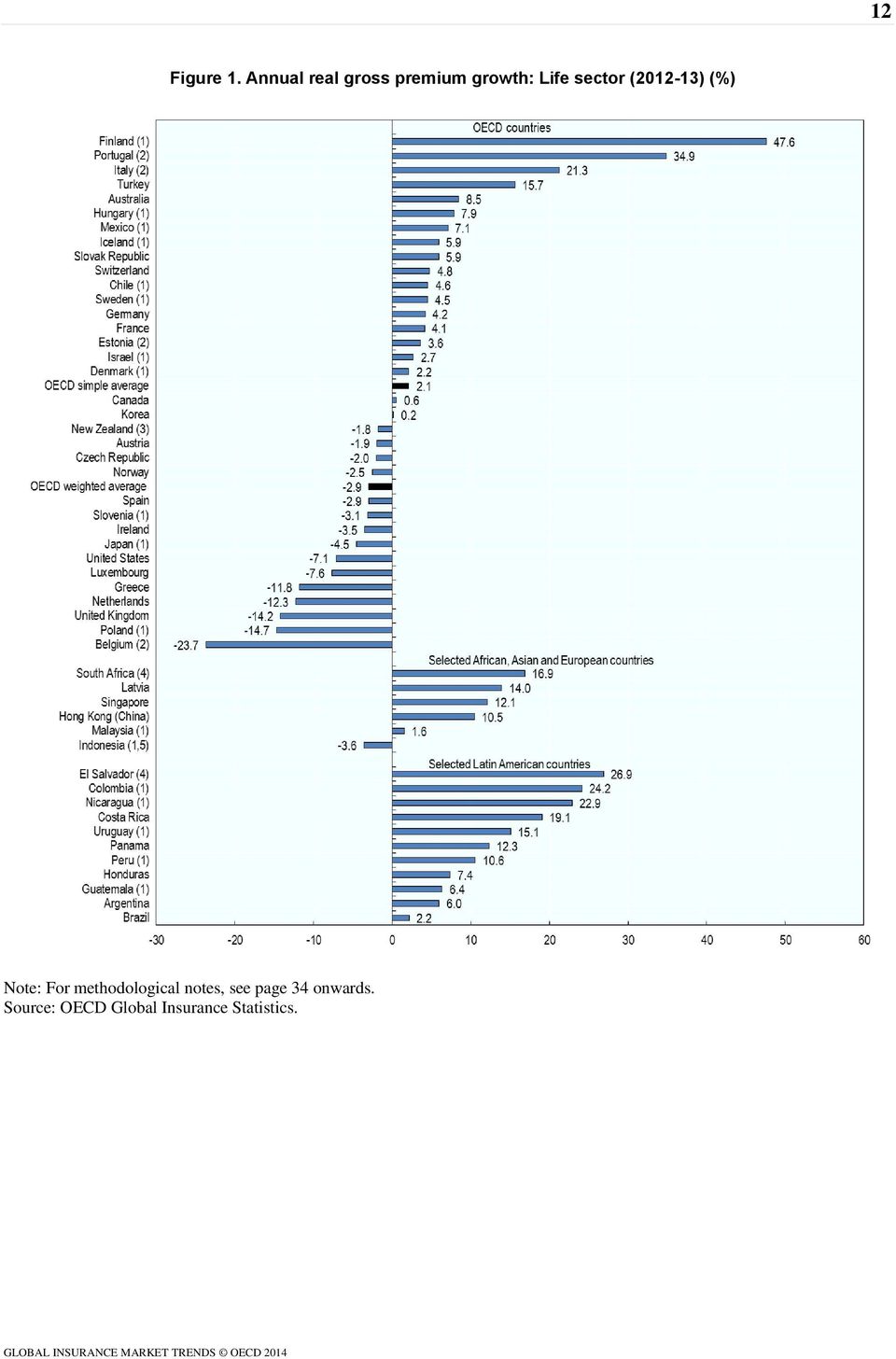
10 10 Claims experienced across countries also varied substantially The combined ratio for the non-life sector in most countries analysed was below 100% in 2013 which indicates that although there may have been instability in underwriting results, there was little overall loss. Annual real gross premium growth: Life insurance Signs of a recovery in the life insurance sector in many countries The disparity of growth of gross premiums in the life sector is high, with some OECD countries having exceptional growth and non-members overall demonstrating relatively strong growth, while a number of OECD counties had negative growth in gross premiums in It has been a year of transition with some of the larger insurance markets falling back into negative growth, while some of the Southern European countries have started to return to growth. In Finland, the growth in real gross life premiums was exceptional, partly due to high demand for unit-linked products as an alternative to lowrate deposits in the banking sector. Italy, Portugal and Turkey also experienced high growth rates in real gross life premiums. In Portugal, gross life premiums increased significantly in 2013 (after a two-year decline) as macroeconomic conditions improved, generating positive impacts for the life sector. Life insurance premiums also grew significantly in Italy, in contrast to substantial declines in 2011 and In Hungary, life premiums increased in 2013, recovering from a decline in New legislation to support long-term life insurance penetration became effective from January 2014 and will benefit policyholders of pension insurance which have a long-term savings component. In Australia, gross premiums in 2013 increased after a number of years of negative or limited growth, mostly as a result of growth in unit-linked superannuation investment business. Similarly, the life sector in Estonia has rebounded after several difficult, post-crisis years with a 3.6% increase in gross premiums in In Mexico, the annual growth in gross life insurance premiums was substantial, primarily as a result of an increase in sales of life insurance products with saving components which continue to have a strong influence on life insurance premium growth. A number of OECD countries continued to experience declining gross premiums However, a number of countries experienced negative real growth in gross life premiums. Belgium saw a sharp decrease of more than 20% in real gross life premiums after strong growth in 2012, predominantly due to the low interest rate environment and the increase, as of January 2013, of the tax on new life insurance contracts from 1.1% to 2%. Greece and the Netherlands saw continued declines of more than 10% in real gross life premiums in 2013 (following a similar decline in 2012). Poland and the United Kingdom also experienced declines of more than 10% in real gross life premiums after strong growth in real gross life premiums the year before. Austria, the Czech Republic, Japan, Slovenia and Spain faced continued declines of gross life premiums, while growth in Ireland, Luxembourg, Norway and the United States turned negative in 2013; in

11 11 some cases (Ireland, Luxembourg, Norway) reversing strong growth in The largest life insurance markets faced negative growth in 2013 A number of non-oecd countries experienced significant life premium growth The largest life insurance markets outside the euro area (by premiums) - - the United States, Japan, United Kingdom and Korea -- experienced negative growth or limited growth, in gross life premiums in 2013, reversing two years of growth. By contrast, the large euro area life insurance markets (France, Germany, and Italy) experienced positive growth in 2013, reversing declines in 2011 and For the majority of reporting non-oecd countries (Colombia, Costa Rica, El Salvador, Hong Kong (China), Latvia, Nicaragua, Panama, Peru, Singapore, South Africa and Uruguay), the performance of the life sector was very strong with positive growth rates in life premiums above 10%, the highest growth in gross life premiums being in El Salvador. In Hong Kong, (China), gross life premiums grew substantially in 2013, maintaining the strong growth trend from previous years, driven by growth in gross premiums from individual life policies and annuities. Indonesia was the only non-member country that saw a decline in gross life premiums in real terms in 2013 after a healthy growth rate in 2012.

12 12 Figure 1. Annual real gross premium growth: Life sector ( ) (%) Note: For methodological notes, see page 34 onwards. Source: OECD Global Insurance Statistics.
13 13 Annual real gross premium growth: Non-life insurance Non-life premiums grew significantly in some OECD countries Changes in premiums of motor vehicle insurance affecting some Natural catastrophe events affecting premiums In 2013, there were a number of OECD countries that experienced significant premium growth in the non-life sector. Finland, Luxembourg, Sweden, Estonia and Turkey all experienced significant growth of real gross non-life premiums. In Turkey, the significant growth in non-life gross premiums was due mainly to an increase in land vehicle liability insurance. Changes in the general conditions of motor vehicle insurance, and an increase in the premiums for motor third-party liability after the introduction of a liberalised premium regime in 2013, drove growth in non-life gross premiums. In Australia, premium growth was evident in householders and fire & industrial special risk (ISR) property classes, reflecting premium rate increases in 2012 and 2013 following natural catastrophe events in 2011 that increased reinsurance costs. In the United Kingdom, there was a moderate level of growth in gross non-life premiums due to the economic recovery in the market following negative premium growth in In Mexico, non-life insurance premiums registered a substantial real annual increase, although this was mostly due to a large, non-life policy written for PEMEX (Mexican Petroleum). No recovery in stressed euro zone countries Non-life insurance premiums declined in Greece, Italy, Portugal and Spain, continuing the trend from previous years (with declines registered in 2010, 2011 and 2012). Estonia experienced a 27.9% increase in gross non-life premiums, although this was primarily due to the pan-baltic merger of a number of insurers into an Estonian headquartered company. Positive growth in all nonmember countries Almost all reporting non-oecd countries experienced positive growth rates in non-life premiums, with the largest increases registered in Argentina and South Africa. The only exception was Singapore where non-life premiums were stable relative to Gross non-life premiums in Colombia grew in 2013, due to increased consumer and mortgage lending by the financial sector, which increased the sales of related insurance products.
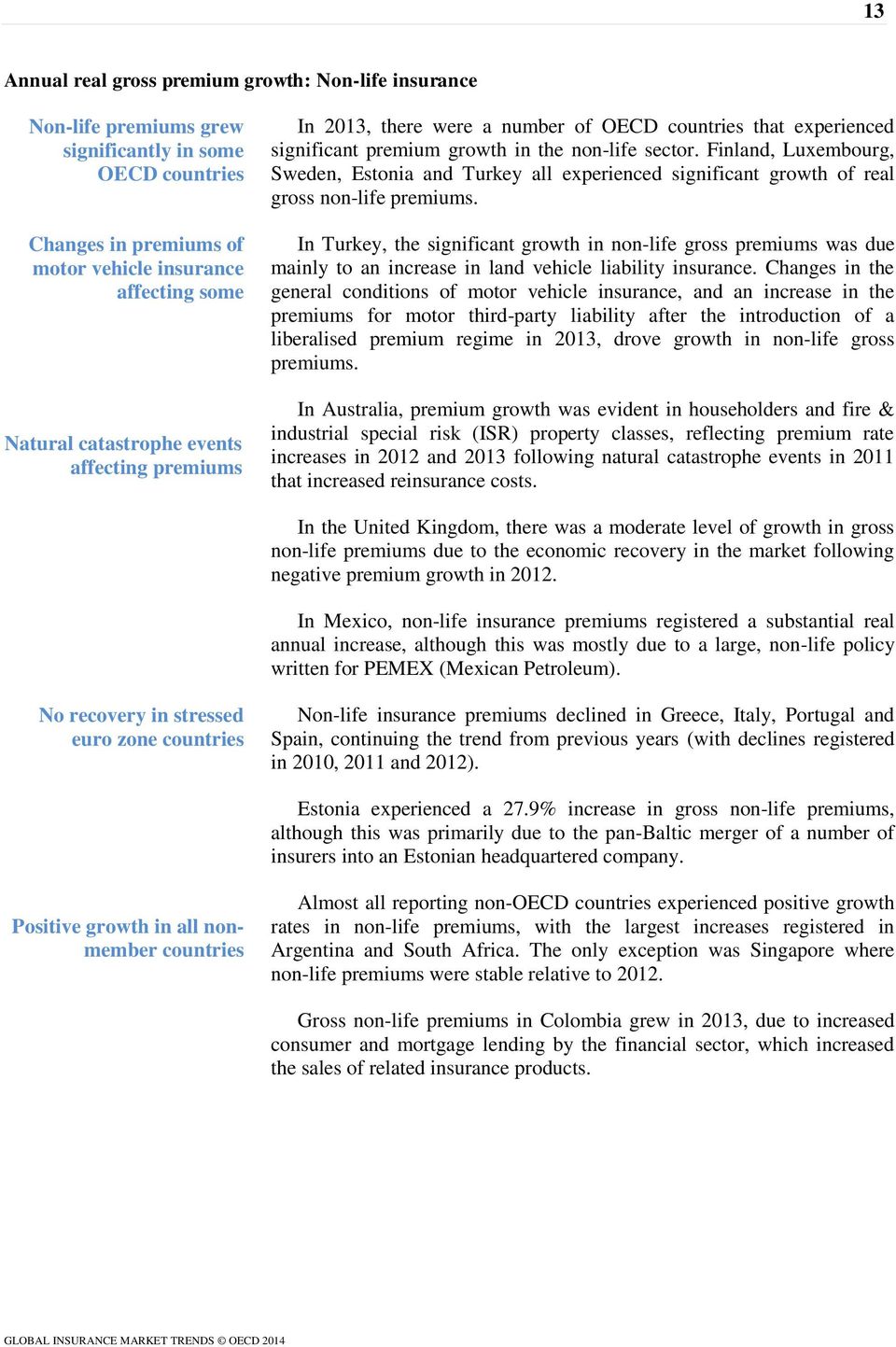
14 14 Figure 2. Annual real gross premium growth: Non-Life sector ( ) (%) Note: For methodological notes, see page 34 onwards. Source: OECD Global Insurance Statistics.
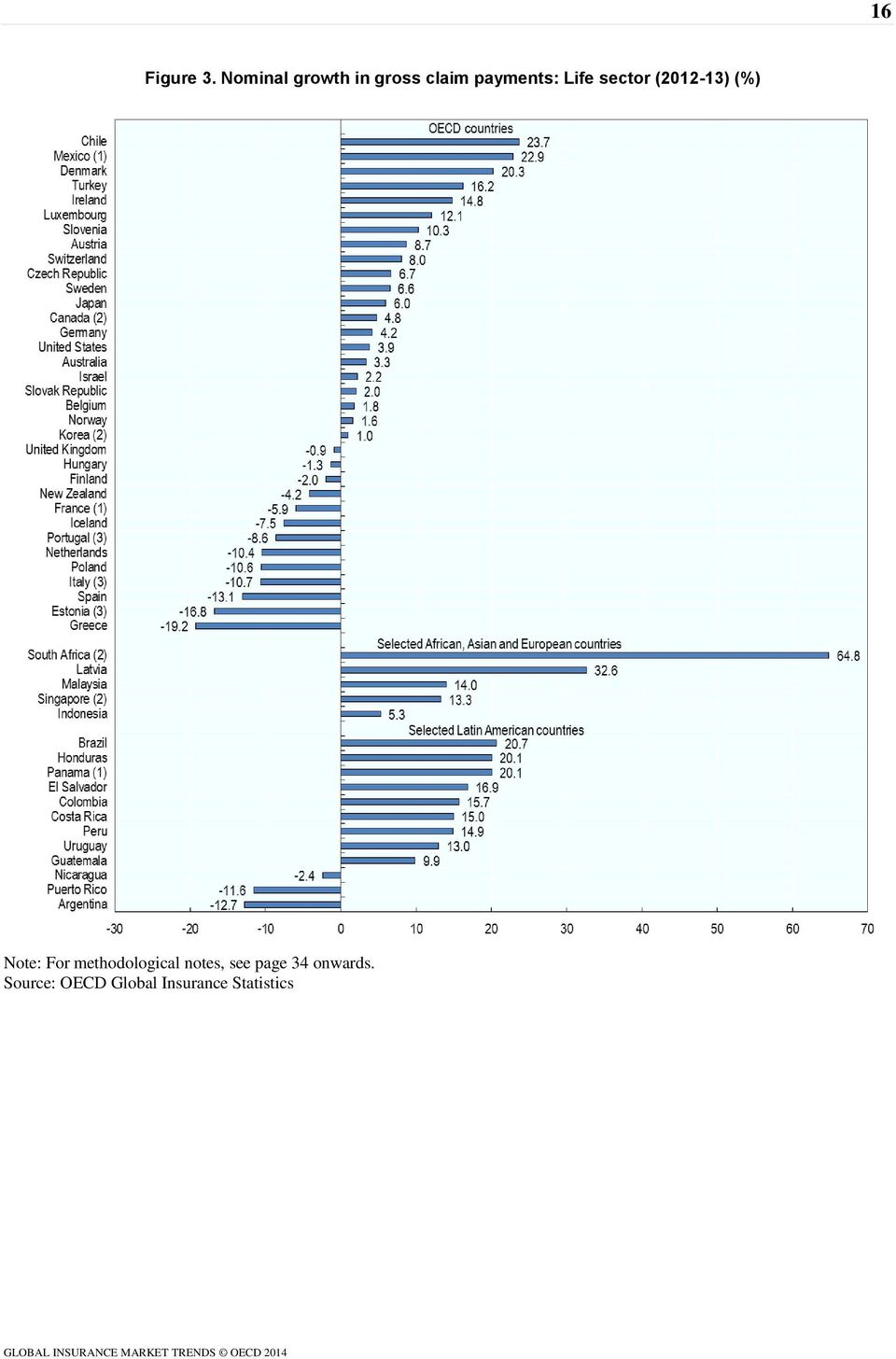
15 15 Claims development: Life sector Gross life insurance claims were stable across most member economies Continued growth in gross claims was observed Surrenders impacting claims Nominal claims in the life segment grew at a moderate rate in most countries, similar to 2012 and in contrast to 2010 and 2011 where claims grew at a significant pace across many countries reflecting surrenders of policies. The largest growth in claim payments was in Chile, Denmark and Mexico. In Mexico, the increase in life claims was driven by increases in claims payments in traditional life insurance and annuities. Gross claims payments also increased substantially in a number of non-member countries, including Brazil, Honduras, Latvia, Panama and South Africa. In Latvia, the increase in claims was partly related to the expiry of a large number of endowment assurance contracts and the resulting payout of insurance indemnities. In some countries, such as Luxembourg, the increase in claims was partly due to surrenders related to unit-linked products where investment returns have been poor. Estonia, Greece, Italy, the Netherlands, Poland, Portugal and Spain experienced substantial reductions in gross life claims. In some of these countries, the reduction of surrenders may be contributing to this trend. In Estonia, life insurance claims have been decreasing for a number of years, mostly in unit-linked products.

16 16 Figure 3. Nominal growth in gross claim payments: Life sector ( ) (%) Note: For methodological notes, see page 34 onwards. Source: OECD Global Insurance Statistics
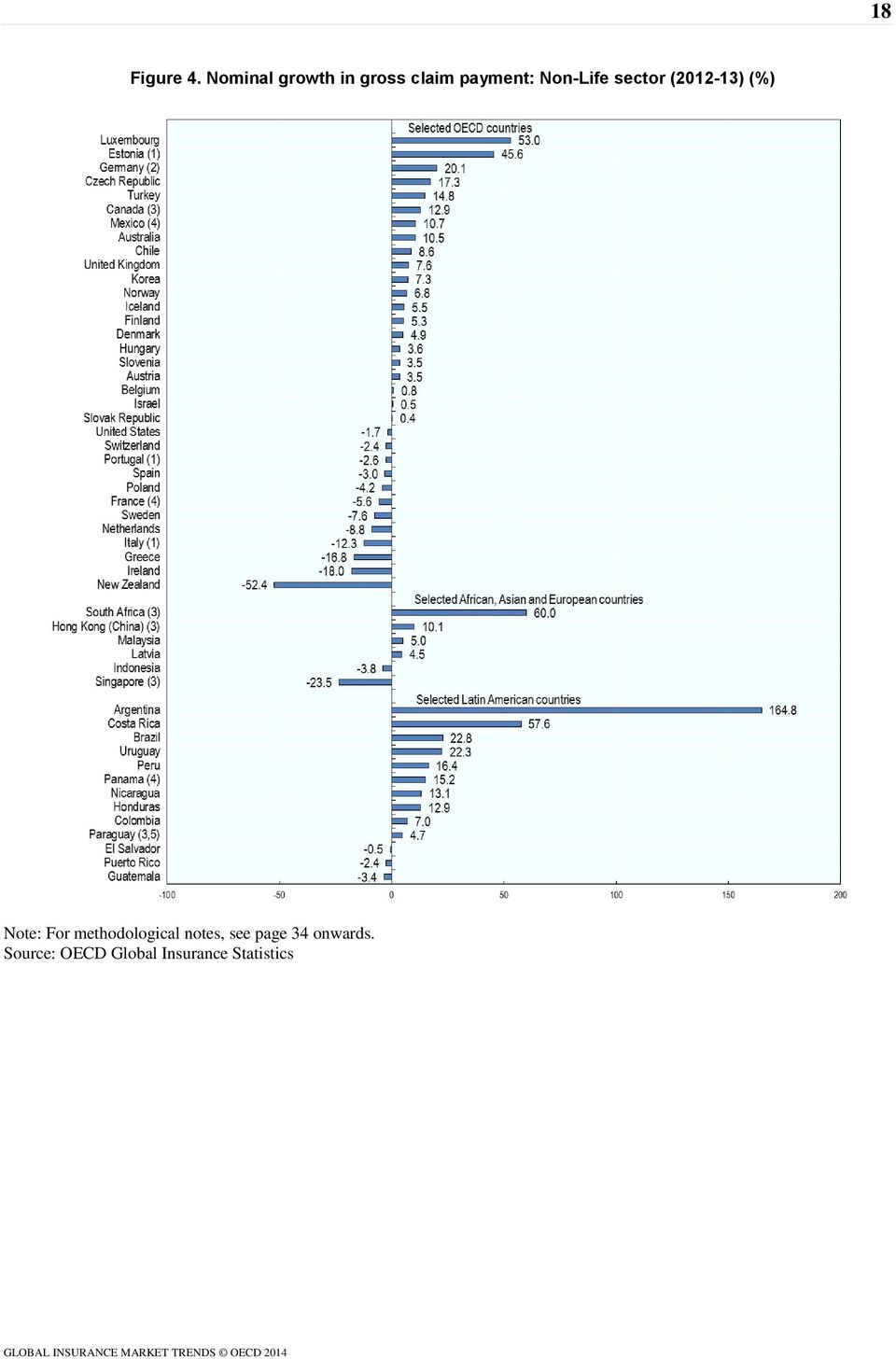
17 17 Claims development: Non-life sector Natural disaster claims had a moderate impact in a number of countries Nominal non-life claims grew at a faster rate in a number of countries than in 2011 and 2012 when growth was more moderate. The occurrence of natural disasters had an impact on claims in a number of countries. Increases in gross non-life claims in Austria and the Czech Republic were influenced by summer floods. Australia experienced an increase in non-life claims as a result of natural disasters in 2013, including flood and storm damage from ex-tropical cyclone Oswald and, to a lesser extent, bushfires in parts of Australia. In Norway, there was a sharp increase in the number of claims for water damage to dwellings and commercial buildings. In Hungary, motor vehicle claims drove a moderate increase in non-life claims in 2013, after several years of declining claims. Luxembourg experienced the greatest increase in non-life claims payments. Significant increases in non-life claims also occurred in Estonia and Mexico. In Estonia, the increase was likely due to the pan-baltic merger described above. Most non-oecd countries also experienced growth in gross non-life claims, often significant, with the exception of El Salvador, Guatemala, Indonesia, Puerto Rico and Singapore. A number of countries experienced significant declines in gross claim payments, including Greece, Ireland, Italy and New Zealand. In Greece and Italy, the decline in gross claims continues the trend from previous years, and may be related to macroeconomic conditions and other factors, such as reduced car ownership in Greece. In Ireland, the decline in claims incurred is due to a fall in claims paid across all the largest non-life companies in 2013 and to a fall in claims provisions that is largely attributable to a single large entity in administration that was overprovided. In New Zealand, the decline was the due to reduced claims related to the Christchurch earthquake after two years of significantly high claims.

18 18 Figure 4. Nominal growth in gross claim payment: Non-Life sector ( ) (%) Note: For methodological notes, see page 34 onwards. Source: OECD Global Insurance Statistics
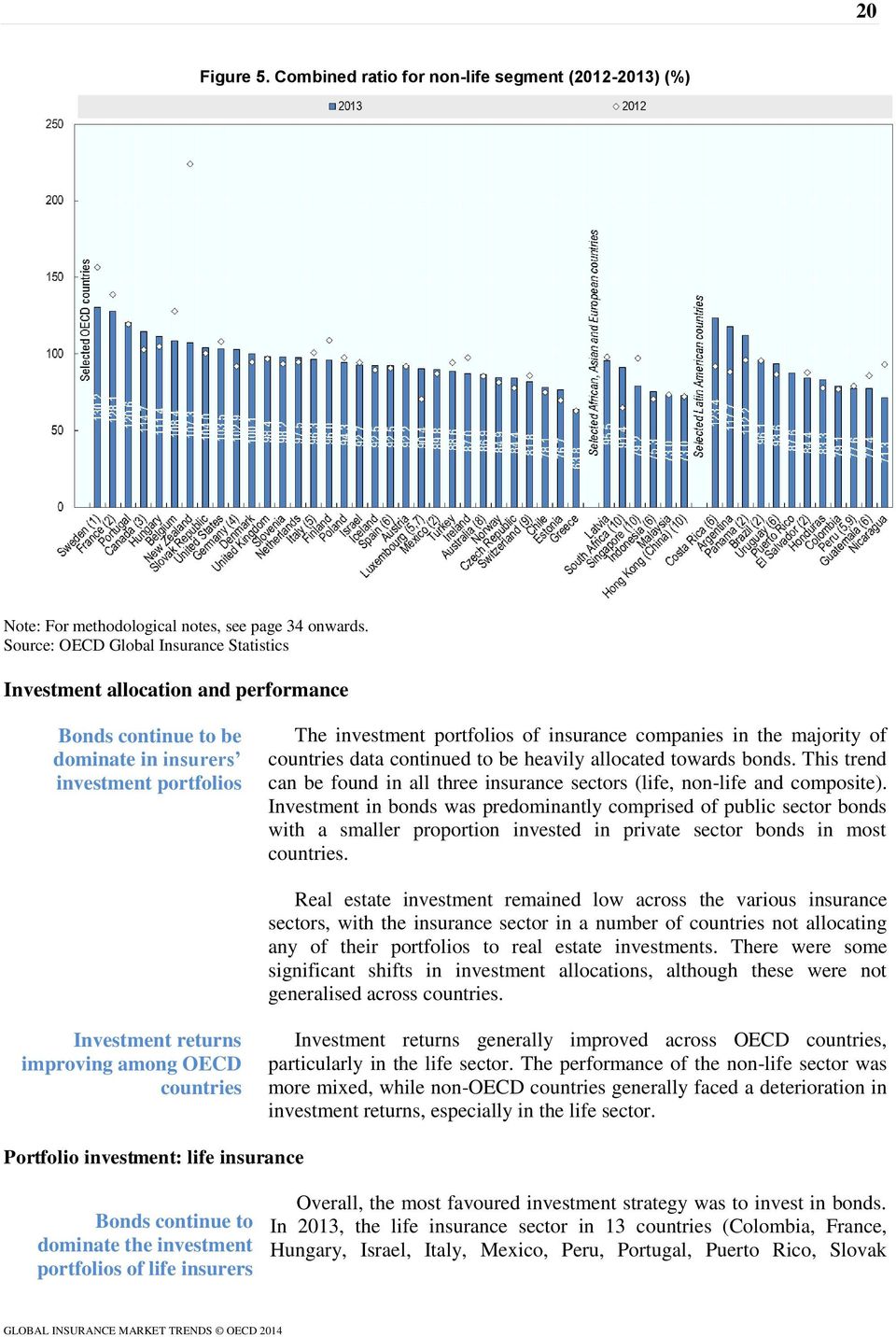
19 19 Combined ratio: non-life sector The combined ratio 1 measures the operational underwriting profitability of insurance companies in the non-life sector on their direct business, allowing for the disaggregation of the sources of profitability. A lower combined ratio can be due to higher premiums, better cost control and/or more rigorous management of risks covered in insurance classes. A combined ratio of more than 100% represents an underwriting loss for the non-life insurer. It should be noted that an underwriting loss does not indicate an overall loss, as these losses can be recovered through investment earnings. Roughly two-thirds of reporting countries had a combined ratio below 100% in 2013, which means that there was an overall underwriting profit in these countries. In 2013, the countries which experienced a combined ratio in excess of 100% included Belgium, Canada, Denmark, France, Germany, Hungary, New Zealand, Portugal, Slovak Republic, Sweden and the United States. Of which, France and Sweden continued to have the highest combined ratios in 2013; although it did fall relative to 2012 in these two countries. The underwriting losses of a few countries improved because of reduced claims and improvements in pricing Italy and Finland had combined ratios that fell under 100% in 2013, after having combined ratios above 100% in 2012, which is likely a result of significant reductions in gross claims in the case of Finland. The combined ratio in Turkey declined in 2013, largely due to improved underwriting results in motor vehicle insurance with to the introduction of the liberalised premium regime. The combined ratio for non-oecd countries has generally been lower than OECD countries, i.e., non-oecd insurers have generally achieved better underwriting performance. 2 In 2013, in three Latin American countries (Argentina, Costa Rica and Panama), the combined ratio increased to reach over 100%. 1 The combined ratio in this report is defined as a sum of gross claims paid, the variations in outstanding claims provisions, gross operating expenses and gross commissions divided by gross written premiums (for direct business only). It should be noted that the inclusion of reinsurance payouts in the calculation would likely have material impacts for many countries and could lead to some underwriting results calculated as losses becoming overall underwriting profits. 2 As the calculation only includes direct business, the difference in the results for OECD and non-oecd members could be due to differences in the use of reinsurance between member and non-member economies.


20 20 Figure 5. Combined ratio for non-life segment ( ) (%) Note: For methodological notes, see page 34 onwards. Source: OECD Global Insurance Statistics Investment allocation and performance Bonds continue to be dominate in insurers investment portfolios The investment portfolios of insurance companies in the majority of countries data continued to be heavily allocated towards bonds. This trend can be found in all three insurance sectors (life, non-life and composite). Investment in bonds was predominantly comprised of public sector bonds with a smaller proportion invested in private sector bonds in most countries. Real estate investment remained low across the various insurance sectors, with the insurance sector in a number of countries not allocating any of their portfolios to real estate investments. There were some significant shifts in investment allocations, although these were not generalised across countries. Investment returns improving among OECD countries Investment returns generally improved across OECD countries, particularly in the life sector. The performance of the non-life sector was more mixed, while non-oecd countries generally faced a deterioration in investment returns, especially in the life sector. Portfolio investment: life insurance Bonds continue to dominate the investment portfolios of life insurers Overall, the most favoured investment strategy was to invest in bonds. In 2013, the life insurance sector in 13 countries (Colombia, France, Hungary, Israel, Italy, Mexico, Peru, Portugal, Puerto Rico, Slovak
21 21 Republic, Spain, Turkey and Uruguay) allocated in excess of 75% of their investments to bonds. In some countries the investment portfolios of life insurers were more than 85% invested in bonds In some countries life insurers made significant investment in shares The life insurance sector in Uruguay allocated, as a whole, almost all of their investments in bonds. The life insurance sector in Hungary, Israel, Italy, Mexico, Slovak Republic and Turkey invested more than 85% of portfolio assets in bonds. Life insurance companies in most of the other reporting countries allocated more than 50% of their investment portfolios to bonds. In Denmark, Iceland, Indonesia, Latvia, Panama, Singapore, Slovenia, South Africa and Sweden, life insurance companies allocated more than 20% of their portfolios to shares. In Panama, 78% of the investment portfolio of life insurers was invested in shares (possibly including investments in mutual funds) 3, and insurers in Denmark and South Africa allocated about half of their investment portfolios to shares. Investment in real estate was minimal. Australia, Chile, Norway and Switzerland were the only countries where life insurance companies made significant investments in real estate (between %). A number of countries reported significant investments in other assets, but limited information was available to grasp the nature of investments in this asset category. Most countries reported relative stability in terms of the allocation of assets across bonds, shares and other asset types. In a few countries, there was a shift in the allocation of assets from bonds, towards shares and other assets in 2013 relative to 2012, including in the Czech Republic, Denmark, France, Greece, Iceland, South Africa and Luxembourg. The opposite trend occurred for instance in Latvia, Spain, Switzerland and Turkey, shifting from other assets, towards bonds and shares. 3 Reporting countries are requested to provide, for mutual funds and other collective investment schemes, portfolio allocation on a look through basis (i.e., reporting should provide data on the ultimate asset class for investments in funds). However, not all countries are able to provide data on that basis.
22 22 Figure 6. Investment portfolio allocation: Life insurers (2013) (as a % of total investments) Note: For methodological notes, see page 34 onwards. Source: OECD Global Insurance Statistics Portfolio allocation: non-life insurers Most countries reported general stability in non-life insurance companies allocation of investment to different asset classes. However, the non-life insurance sector in a number of countries experienced a shift, in some cases substantial, away from bond investments towards shares and other assets in 2013, including, for instance, Denmark, France, Greece, Iceland, Ireland, Israel, Italy, Luxembourg, Norway, Sweden and Switzerland. Iceland and Indonesia s non-life sector, respectively, increased their allocation to shares by 5 and 14 percentage points. Chile, Estonia, Finland, Netherlands, Slovenia and Turkey notably, experienced an opposite shift in investment allocations among non-life companies, increasing their investment into bonds and away from shares and other assets.
23 23 Bonds dominate the investment portfolios of non-life insurers The non-life sector investment more than 85% of portfolios assets in bonds Real estate investment by non-life insurers remains limited in all countries The non-life insurance sector demonstrated a portfolio investment strategy dominated by investment in bonds. In more than half of the reporting countries, the non-life insurance sector allocated over half of portfolio assets to bonds. Non-life sectors in nine countries invested in excess of 75% of their investment portfolio in bonds (Canada, Colombia, Hungary, Italy, Mexico, Paraguay, Puerto Rico, Turkey and Uruguay). Hungary and Uruguay have the greatest proportion of investments in bonds. In Uruguay, all non-life insurer investment was in bonds, while in Hungary almost 90% of the investment portfolio was allocated to bonds. Only the non-life insurers in Austria and Indonesia allocated more than 40% of portfolio assets to shares. Real estate was a small part of investment portfolios in almost all countries. The non-life insurance sector in three countries (Greece, Paraguay and Peru) invested 10% or more of portfolio assets in real estate. Finland, Italy, Slovenia, Spain and Portugal also invested substantial shares of their assets in real estate, but at less than 10% of portfolio assets. Figure 7. Investment portfolio allocation: Non-Life insurers (2013) (as a % of total investments) Note: For methodological notes, see page 34 onwards. Source: OECD Global Insurance Statistics
24 24 Portfolio Allocation: composite insurers Composite sector s investment is dominated by bonds The investment portfolio of composite insurers was dominated by bonds. Composite sectors in the vast majority of countries invested smaller proportions of their portfolios into shares than into bonds. Composites in selected OECD countries invested more than 15% of their portfolios into shares: France, Mexico (which may include investments in mutual fund units which in turn may invest in bonds), 4 and the United Kingdom. The composite sectors in El Salvador, Greece, Spain and the United Kingdom invested a moderate share of their portfolio in real estate assets (between 5 and 10% of their portfolios). In terms of shifts in allocations, the most common shift among the countries with composite insurance companies was a shift away from investments in bonds, towards allocations to shares and other assets, relative to That said, the composite sector in a number of countries made a shift in the opposite direction. 4 Reporting countries are requested to provide, for mutual funds and other collective investment schemes, portfolio allocation on a look through basis (i.e., reporting should provide data on the ultimate asset class for investments in funds). However, not all countries are able to provide data on that basis.
25 25 Figure 8. Investment portfolio allocation: Composite insurers (2013) (as a % of total investments) Note: For methodological notes, see page 34 onwards. Source: OECD Global Insurance Statistics Bond allocation Allocations to public bonds is strong in many countries Among the countries with data available on the breakdown of bond allocation between public and private bonds, insurance companies (life, non-life and composite) in approximately two thirds of reporting countries invested in excess of 50% of their bond portfolio in public sector bonds. Countries which had the highest proportion of public sector bonds in their bond portfolios included Hungary, Turkey and Uruguay. The insurance sectors in Chile, Norway, Paraguay and Puerto Rico had the largest share of their bond allocation dedicated to private bonds. The insurance sectors in Czech Republic, Hungary, Italy, Japan, Mexico, Slovak Republic, Turkey and the United States invest more than half of their portfolios in public bonds, and all allocate more to public than private sector bonds.
26 26 Figure 9. Portfolio allocation to bonds, public and private-sector bonds (2013) (as a % of total investments) Note: For methodological notes, see page 34 onwards. Source: OECD Global Insurance Statistics
27 27 Table 1. Insurers portfolio allocation in bonds and shares by type of insurer ( ) (as a % of total investments) life non-life composite Selected OECD countries Australia Bonds n.a n.a Shares c c n.a n.a Other c c n.a n.a Austria Bonds Shares Other Belgium Bonds Shares Other Canada Bonds Shares Other Chile Bonds n.a n.a Shares n.a n.a Other n.a n.a Czech Republic Bonds Shares Other Denmark Bonds n.a n.a Shares n.a n.a Other n.a n.a Estonia Bonds n.a n.a Shares n.a n.a Other n.a n.a Finland Bonds Shares Other France Bonds Shares Other Germany (1) Bonds n.a n.a Shares n.a n.a Other n.a n.a Greece Bonds Shares Other Hungary Bonds Shares Other Iceland Bonds n.a n.a Shares n.a n.a Other n.a n.a Ireland Bonds n.a n.a Shares n.a n.a Other n.a n.a Israel Bonds Shares Other Italy Bonds Shares Other Japan Bonds n.a n.a Shares n.a n.a Other n.a n.a Korea Bonds n.a n.a Shares n.a n.a Other n.a n.a Luxembourg Bonds Shares Other Mexico Bonds Shares Other Netherlands Bonds n.a n.a Shares n.a n.a Other n.a n.a Norw ay Bonds n.a n.a Shares n.a n.a Other n.a n.a Poland Bonds n.a n.a Shares n.a n.a Other n.a n.a Portugal Bonds Shares Other Slovak Republic Bonds Shares Other
28 28 Table 1. Insurers portfolio allocation in bonds and shares by type of insurer ( ) (as a % of total investments) life non-life composite Selected OECD countries Slovenia Bonds Shares Other Spain Bonds Shares Other Sw eden Bonds n.a n.a Shares n.a n.a Other n.a n.a Sw itzerland Bonds n.a n.a Shares n.a n.a Other n.a n.a Turkey Bonds n.a n.a Shares n.a n.a Other n.a n.a United Kingdom Bonds Shares Other United States Bonds n.a n.a Shares n.a n.a Other n.a n.a Selected African, Asian and European countries Indonesia Bonds Shares Other Latvia Bonds Shares Other Malaysia Bonds Shares Other Singapore Bonds Shares Other South Africa Bonds Shares Other Selected Latin American countries Argentina Bonds Shares Other Bolivia Bonds Shares Other Colombia Bonds n.a n.a Shares n.a n.a Other n.a n.a Costa Rica (2) Bonds Shares Other El Salvador Bonds Shares Other Guatemala Bonds Shares Other Honduras Bonds Shares Other Nicaragua Bonds Shares Other Panama Bonds Shares Other Paraguay Bonds Shares Other Peru Bonds Shares Other Puerto Rico Bonds Shares Other Uruguay Bonds Shares Other c means confidential; "n.a" not applicable; ".." not available. Note: For methodological notes, see page 34 onwards. Source: OECD Global Insurance Statistics
29 29 Investment returns Investment returns of life companies mostly improved in 2013 in the OECD Investment returns of life companies in non-oecd member countries deteriorated Investment returns among non-life companies was mixed Based on available data, the life insurance industry s real net investment returns in 2013 were relatively stable compared to Investment returns edged higher in 2013 in the majority of reporting OECD countries. In Hungary, Iceland and Luxembourg, life insurance companies achieved real net investment returns in 2013 that increased by 4 percentage points (pp) or more over Among non-oecd member countries, investment returns declined in all but Argentina and Colombia. Investment returns in the life sectors in Indonesia, Malaysia and Uruguay declined by 6 pp or more, relative to returns in Among OECD countries, the change in real net investment returns for non-life insurance companies was more balanced as non-life insurers in ten countries achieved marginal improvements, while those in nine countries faced declining returns. The same applied in non-member countries where non-life companies achieved increasing returns in three countries, and faced declining returns in four countries. In Poland, real net investment returns in the non-life sector increased by 5.2 pp. over In Israel, real net investment returns for the non-life sector declined by 4.3 pp in 2013 but remained positive. The investment returns of the composite sector improved in most countries. Composite insurance companies in Hungary and Portugal achieved somewhat higher returns of 5% or higher. The composite sector in Canada, by contrast, faced a decline of 7.6 pp in 2013 relative to 2012.
30 30 Table 2. Average real net investment return by type of insurer ( ) (%) Note: For methodological notes, see page 34 onwards. Source: OECD Global Insurance Statistics Profitability: Return on equity Life Non-life Composite Selected OECD countries Australia n.a n.a Austria Belgium Canada Chile n.a n.a Czech Republic Estonia n.a n.a Germany n.a n.a Hungary Iceland n.a n.a Ireland n.a n.a Israel Italy Japan n.a n.a Korea n.a n.a Luxembourg n.a n.a Netherlands n.a n.a Norw ay n.a n.a Poland n.a n.a Portugal Spain Sw itzerland n.a n.a Turkey n.a n.a Selected African, Asian and European countries Indonesia Latvia Malaysia Singapore Selected Latin American countries Argentina Colombia n.a n.a Costa Rica El Salvador Honduras Nicaragua Peru Puerto Rico (1) Uruguay In general, return on equity (ROE) 5 across the insurance industries in reporting countries has demonstrated significant volatility over the last three years, with dramatic changes in profitability from year-to-year (both positive and negative). Overall trend of improving ROE, especially in countries that faced problems in the crisis The greatest increases in the ROE of the life insurance sector since 2011 occurred in Greece, Italy and Portugal, which have a common experience of economic instability generated by the financial crisis. The life insurance sector in Portugal achieved the most significant recovery in ROE, from a negative 7.8% in 2011, to returns of 17.6% in 2012 and 30.6% in The life insurance sector in Hungary and the Slovak Republic achieved a significant recovery in ROE in 2013 relative to the negative returns in For other countries, the overall trend was a 5 The return on equity (ROE) is calculated, in this report, as the current year s net income divided by the average of the current and the previous year s shareholder equity as reported on the balance sheet calculated at an industry level.
31 31 moderately positive ROE over the period in the range of 5 to 10% in most countries. ROE of non-life sector has been volatile Composite companies across all countries achieved positive ROE. In the non-life insurance sector, ROE over the last three years has been volatile across counties, with substantial changes from year-to-year. The non-life sector in the Czech Republic and Hungary has faced negative returns on equity every year since 2011, although returns have improved. Non-life insurance companies in the Slovak Republic achieved a significant positive reversal in ROE from -43.5% in 2011 to 27% in Non-life insurers in Greece, Finland, Iceland, Mexico, Poland and Switzerland have achieved ROEs above 10% in all years since For composite insurers, ROE is generally increasing in most countries, with particularly significant gains in Greece, where the composite sector achieved positive ROE for the first time since The composite sector in all countries had positive ROE in Note: For methodological notes, see page 34 onwards. Source: OECD Global Insurance Statistics Table 3. Return on equity by type of insurer ( ) (%) ROE Life Non-life Composite Selected OECD countries Australia n.a n.a n.a Belgium Canada Chile n.a n.a n.a Czech Republic Denmark n.a n.a n.a Estonia n.a n.a n.a Finland France Germany n.a n.a n.a Greece Hungary Iceland n.a n.a n.a Ireland n.a n.a n.a Israel Italy Japan n.a n.a n.a Korea n.a n.a n.a Luxembourg n.a n.a n.a Mexico Netherlands New Zealand Norw ay n.a n.a n.a Poland n.a n.a n.a Portugal Slovak Republic Spain Sw itzerland n.a n.a n.a Turkey n.a n.a n.a United Kingdom United States n.a n.a n.a Selected African, Asian and European countries Indonesia Latvia Malaysia Singapore South Africa Thailand n.a n.a n.a Selected Latin American countries Argentina Colombia n.a n.a n.a Costa Rica El Salvador Guatemala Nicaragua Panama Paraguay Peru Puerto Rico Uruguay
32 32 Change in equity position The change in equity position permits an understanding of the evolution of shareholder capital. 6 Changes may occur due to gains and losses recognised in the income statement, dividend distributions, share buybacks and issuance of share capital; they may also reflect unrecognised gains or losses that do not appear in the income statement but which may nonetheless be important for understanding an undertaking s financial position. For instance, unrealised gains and losses on investments held to maturity within an investment portfolio do not appear in the income statement, yet they are reflected in changes to shareholder equity. Shareholder equity declined in most countries across all sectors Table 4 below shows that shareholder equity of the life insurance sector decreased in just under half of reporting countries. In the non-life sector, shareholder equity declined in 15 countries while shareholder equity in the composite sector declined in eight countries. The sharpest decline was observed in the life insurance sector in the Czech Republic, where shareholder equity declined by 46.3% relative to In Estonia, the equity position in the life segment also dropped significantly. In the nonlife sector in Canada, Denmark, Slovak Republic, the United Kingdom and Uruguay, there was a decline in shareholder equity that was greater than -25%. Shareholder equity in the non-life industry in Israel grew dramatically. Among OECD countries, the life insurance sectors in Norway, Spain and the United Kingdom, and both life and non-life insurance industries in Austria, Finland, Greece, Switzerland and Turkey, also exhibited significant increases in shareholder equity. 6 The shareholder equity position is obtained by dividing the total shareholder equity with total assets of the insurer, indicating the level of assets owned by shareholders. This is as opposed to debt to equity ratio, which indicates the leverage of the insurer.
33 33 Table 4. Change in equity position by type of insurer ( ) (%) Note: For methodological notes, see page 34 onwards. Source: OECD Global Insurance Statistics life non life composite Selected OECD countries Australia n.a n.a Austria Belgium Canada Chile n.a n.a Czech Republic Denmark n.a n.a Estonia n.a n.a Finland France Germany n.a n.a Greece Hungary Iceland n.a n.a Ireland n.a n.a Israel Italy Japan n.a n.a Korea n.a n.a Luxembourg n.a n.a Mexico Netherlands n.a n.a New Zealand Norw ay n.a n.a Poland n.a n.a Portugal Slovak Republic Slovenia Spain Sw itzerland n.a n.a Turkey n.a n.a United Kingdom United States n.a n.a Selected African, Asian and European countries Indonesia Latvia Malaysia Singapore South Africa Selected Latin American countries Argentina Colombia n.a n.a Costa Rica El Salvador Guatemala Nicaragua Panama Paraguay Peru Puerto Rico Uruguay
34 34 ADDITIONAL NOTES Notes to be taken into consideration when interpreting the data This report is based on the responses provided by countries on results from the 2014 Global Insurance Statistics (GIS) exercise, including qualitative information supplied by countries or sourced from national administrative sources. More detailed information on the sector will be published in the OECD Insurance Statistics collection. Data collected under the GIS exercise can be found at the following OECD statistical portal: Given possible divergences in national reporting standards, different methods for compiling data for the GIS exercise, and recent amendments to the OECD statistical framework, caution needs to be exercised in interpreting the data. For this reason, countries are regularly requested to provide methodological information relevant for developing a thorough understanding of their submissions to the Global Insurance Statistics (GIS) exercise. The methodological notes below provide some explanations in this respect. Economic data on exchanges rates and the Consumer Price Index (CPI) in countries come from the IMF International Financial Statistics (IFS) and the OECD Main Economic Indicators (MEI) databases. As per the OECD GIS framework, data in Figure 1 to 5 and Tables 3 and 4 normally refer to direct business and include domestically incorporated undertakings (i.e., incorporated under national law) and, where data are available, the branches and agencies of foreign undertakings operating in the country. Tables and figures about the asset allocation of insurers and investment rates of return in this publication only refer to domestic direct insurers. Some countries, particularly within the EU member states (such as Estonia, Italy and Portugal), in submitting data, may not be able to exclude the foreign branches of domestic undertakings. Therefore, data for those countries may include these foreign branches (particularly branches established within the EU). Composite undertakings operate in a number of countries, as shown in Table 7. Conventional signs: "c" means confidential; "n.a." not applicable; ".." not available. Data for Estonia refer to the whole direct business of Estonian companies, and include business written by branches of Estonian insurers. Data for Indonesia are unaudited. The statistical data for Israel are supplied by and under the responsibility of the relevant Israeli authorities. The use of such data by the OECD is without prejudice to the status of the Golan Heights, East Jerusalem and Israeli settlements in the West Bank under the terms of international law. Data on composite insurers from Italy and Portugal include life insurers operating also in accident and sickness line of business. Data from Japan reflect fiscal year instead of calendar year. Non-life insurance statistics for 2013 will be available in Data from Malaysia cover global business (within and outside Malaysia) including Takaful insurance.
35 35 Data for 2013 for the Netherlands are preliminary. Data supplied for New Zealand come from Statistic New Zealand s Annual Enterprise Survey. This is a financial survey of organisations from across the economy, compiling information at the latest balance date for each organisation. Data refer to the end of December for most undertakings operating in life insurance, and to the end of June in most cases for health and general insurance. Specific notes Figure 1: Premiums refer to gross written premiums for direct insurance only, excluding reinsurance business accepted. Given OECD classification standards, life data do not include accident and health insurance. Real growth rates are calculated using the Consumer Prices Index (CPI) from the IMF IFS database. All OECD reporting countries have been included in the calculations of the simple and weighted averages. 1. Data refer to domestic undertakings only. 2. Data refer to undertakings subject to domestic undertakings and branches of insurance undertakings with head office outside EU or EEA countries. 3. Data refer to net written premiums. 4. Data include reinsurance business accepted. 5. The real return is negative because of the increase in the consumer price index between 2012 and Figure 2: Premiums refer to gross written premiums for direct insurance only, excluding reinsurance business accepted. Given OECD classification standards, non-life data include accident and health insurance. Real growth rates are calculated using the Consumer Prices Index (CPI) from the IMF IFS database. All OECD reporting countries have been included in the calculations of the simple and weighted averages. 1. Data refer to undertakings subject to domestic undertakings and branches of insurance undertakings with head office outside EU or EEA countries. 2. Data refer to domestic undertakings only. 3. Data include reinsurance business accepted. Figure 3: The claims payments indicator includes variations in outstanding claims provisions to reflect better the magnitude of the obligations that the industry had in 2013 as a result of insured events that occurred. 1. When the breakdown of gross claims paid or changes in claims outstanding provisions for composite undertakings into their life and non-life businesses was not available, the breakdown in each subsector was assumed to be the same as the one for gross written premiums. 2. Variations in outstanding claims provisions are not taken into account in the chart. 3. Data refer to undertakings subject to domestic undertakings and branches of insurance undertakings with head office outside EU or EEA countries.
36 36 Figure 4: The claims payments indicator includes variations in outstanding claims provisions to reflect better the magnitude of the obligations that the industry had in 2013 as a result of insured events that occurred. 1. Data refer to undertakings subject to domestic undertakings and branches of insurance undertakings with head office outside EU or EEA countries. 2. The increase of claims payments is due large number of natural events which led to unusually high claims expenditures for the German property and casualty insurers. 3. Variations in outstanding claims provisions are not taken into account in the chart. 4. When the breakdown of gross claims paid or changes in outstanding claims provisions for composite undertakings into their life and non-life businesses was not available, the breakdown in each subsector was assumed to be the same as the one for gross written premiums. 5. Claims payments of composite undertakings are not taken into account in the chart. Figure 5: The combined ratio is calculated in this report as the sum of gross claims payments, changes in outstanding claims provision, gross operating expenses, and gross commissions divided by gross written premiums. I.e., Combined ratio = Loss ratio + Expense ratio, where: Loss ratio: (Gross claims paid + changes in outstanding claims provision) / gross written premiums (the latter used as a proxy for gross earned premiums); and, Expense ratio = (Gross operating expenses + commissions) / Gross written premiums. The combined ratio is used in analysing the underwriting performance of insurance companies, especially for non-life insurance where the risk exposure is short-term -- generally one year. The use of the combined ratio for long-term business such as life insurance is of limited use only. Due to limitations in data, it is not possible to calculate the combined ratio using earned premiums and claims incurred data, which would provide a more accurate depiction of underwriting performance. The displayed combined ratio is an aggregate covering different types of business and hence different types of risks. For instance, in the United States, data for the non-life sector are the combination of figures from three types of business: title, property/casualty and health. 1. Commissions are not included in the calculation of the combined ratios. The reason behind the high ratios is that one of the larger Swedish insurance companies had written negative premiums in their annual statement. In 2012 this company decided to lower the premiums to 0 retroactively for the period and in 2013 for the period This lowered the total gross premiums in non-life insurance sector in Sweden and consequently increased the combined ratios. 2. When the breakdown of gross claims paid, changes in claims outstanding provisions, gross operating expenses or commissions for composite undertakings into their life and non-life businesses was not available, the breakdown in each subsector was assumed to be the same as the one for gross written premiums. 3. The non-life business of composite undertakings is not taken into account in the chart. 4. Natural events pushed the average combined ratio of the property and casualty insurers higher than 100% in The value of commissions is not used in the calculation of the combined ratio because it is already included in gross operating expenses. 6. The value for commissions in 2013 is not used in the calculation of the combined ratio for 2013 because it is already included in gross operating expenses.
37 37 7. Data refer to the whole business of Luxembourgish companies in Luxembourg and abroad. 8. Earned premiums (instead of gross written premiums) were used in the calculation of the combined ratio. The numerator of the combined ratios includes reinsurance business. 9. Data include the reinsurance business accepted by direct insurers. 10. Variations in outstanding claims provisions are not taken into account in the calculation of the combined ratio. Figures 6 9 and Table 1: Data exclude assets linked to unit-linked products where risk is fully borne by policyholders. 1. The Other category mainly comprises loans and mutual fund investments for which no look-through was available. 2. Other investments include investments in bonds and other financial instruments that are not related with technical provisions. Table 2: Average real net investment return calculations are based on nominal net investment return reported by countries and CPI figures. 1. The rates of return are nominal. Table 3: ROE was calculated by dividing segment net income for the year N by average segment equity over N-1 and N. Table 4: Change in equity position is calculated as the change in shareholder equity divided by the level of shareholder equity from the previous year.
38 38 Table 5. Currency exchange rates and consumer price index (CPI) National units per USD and CPI (percentage change), 2013 Currency exchange rates, national units per CPI (1) USD OECD countries Australia Austria Belgium Canada Chile Czech Republic Denmark Estonia Finland France Germany Greece Hungary Iceland Ireland Israel Italy Japan Korea Luxembourg Mexico Netherlands New Zealand Norway Poland Portugal Slovak Republic Slovenia Spain Sweden Switzerland Turkey United Kingdom United States Selected African, Asian and European countries Hong Kong (China) India Indonesia Latvia Malaysia Singapore South Africa Thailand Selected Latin American countries Argentina Bolivia Brazil Colombia Costa Rica Cuba.... El Salvador Guatemala Honduras Nicaragua Panama Paraguay Peru Puerto Rico Uruguay The CPI percentage change is calculated as the variation of the end-of-period CPI. For all countries, it refers to annual CPI inflation between December 2012 and December 2013, except for Japan where it refers to annual CPI inflation between March 2013 and March Source: OECD MEI and IMF IFS databases.
39 39 Table 6. List of administrative sources Countries Statistical source Website OECD countries Australia Australian Prudential Regulation Authority (APRA) Austria Financial Market Authority (FMA) Belgium National Bank of Belgium (NBB) Canada Department of Finance Canada Chile Superintendency of Securities and Insurance (SVS) Czech Republic Ministry of Finance Denmark Danish Financial Supervisory Authority (FTNET) Estonia Ministry of Finance of Estonia Finland Ministry of Social Affairs and Health France French Prudential Supervisory Authority (ACPR) Germany Federal Financial Supervisory Authority (BaFin) Greece Bank of Greece Hungary Central Bank of Hungary (MNB) Iceland The Financial Supervisory Authority (FME) Ireland Department of Finance Israel Ministry of Finance Italy Institute for the Supervision of Insurance (ISVAP) Japan Financial Services Agency (FSA) Korea Financial Services Commission (FSC) Luxembourg The Insurance Commission (CAA) Mexico The Insurance and Surety National Commission (CNSF) Netherlands Statistics Netherlands (CBS) New Zealand Statistics New Zealand Norway Financial Supervisory Authority of Norway (Finanstilsynet) Poland Polish Financial Supervision Authority (KNF) Portugal Insurance and Pension Funds Supervisory Authority (ISP) Slovak Republic National Bank of Slovakia (NBS) Slovenia Ministry of Finance Spain Ministry of Economy Sweden Statistics Sweden (SCB) Switzerland State Secretariat for International Financial Matters (SIF) Turkey The Undersecretariat of Turkish Treasury United Kingdom Bank of England United States National Association of Insurance Commissioners (NAIC) Selected African, Asian and European countries Hong Kong (China) Financial Services and the Treasury Bureau (FSTB) India Ministry of Finance Indonesia Financial Services Authority (OJK) Latvia Financial and Capital Market Commission (FKTK) Malaysia Central Bank of Malaysia (BNM) Singapore Monetary Authority of Singapore (MAS) South Africa Financial Services Board (FSB) Thailand Office of Insurance Commission (OIC) Selected Latin American countries Argentina Superintendence of Insurance (SSN) Bolivia Supervision and Control Authority for Pensions and Insurance (APS) Brazil Superintendence of Private Insurance (SUSEP) Colombia Financial Superintendence (SFC) Costa Rica General Insurance Superintendence (SUGESE) Cuba Cuba Insurance Superintendency El Salvador Superintendency of the Financial System (SSF) Guatemala Superintendency of Banks (SIB) Honduras National Commission on Banking and Insurance (CNBS) Nicaragua Superintendency of Banks and Other Financial Institutions (SIBOIF) Panama Insurance and Reinsurance Superintendence of Panama (SSRP) Paraguay Insurance Superintendence Central Bank of Paraguay Peru Superintendency of Banking, Insurance and Private Pension Funds Administrators (SBS) Puerto Rico Office of the Commissioner of Insurance (OCS) Uruguay Central Bank of Uruguay
40 40 Table 7. Composite undertakings Countries in which composite undertakings operate Availability of separate data on composite undertakings OECD countries Australia No x Austria Yes Yes Belgium Yes Yes Canada (1) Yes Yes Chile No x Czech Republic Yes Yes Denmark No x Estonia No x Finland Yes No France Yes Yes Germany No x Greece Yes Yes Hungary Yes Yes Iceland (2) No No Ireland No x Israel Yes Yes Italy Yes Yes Japan No x Korea No x Luxembourg (3) Yes Yes Mexico Yes Yes Netherlands No x New Zealand Yes Yes Norway No x Poland No x Portugal (4) Yes Yes Slovak Republic Yes Yes Slovenia Yes Yes Spain (5) Yes Yes Sweden No x Switzerland No x Turkey No x United Kingdom Yes Yes United States No x Selected African, Asian and European countries Hong Kong (China) Yes No India No x Indonesia.... Latvia.... Malaysia Yes Yes Singapore Yes Yes South Africa Yes Yes Thailand No x Selected Latin American countries Argentina Yes Yes Bolivia.... Brazil Yes Yes Colombia No x Costa Rica Yes Yes Cuba.... El Salvador Yes Yes Guatemala Yes Yes Honduras Yes Yes Nicaragua Yes Yes Panama Yes Yes Paraguay Yes Yes Peru Yes Yes Puerto Rico.... Uruguay Yes Yes 1. Most of life insurance companies are authorized to provide coverage for accident and sickness risks. The data for their life and non-life businesses (including accident and sickness) are provided separately under composite sector. 2. There are no composites, except that 2 life companies which have small operation in accident and sickness insurance which are classified as life company. 3. No official company is allowed to operate in both life and non-life business. However, a Portuguese composite subsidiary operates. 4. For profit and loss accounts (e.g. premiums) data is separated but for the balance sheet information and solvency (e.g. solvency ratio, capital, ROE,...) it is not separated. 5. The composite undertakings operating in Spain have to submit technical and non-technical accounts for all non-life and life classes separately. The balance sheet data are presented together with no differentiation by classes.
41
42
43
44
THE LOW INTEREST RATE ENVIRONMENT AND ITS IMPACT ON INSURANCE MARKETS. Mamiko Yokoi-Arai
 THE LOW INTEREST RATE ENVIRONMENT AND ITS IMPACT ON INSURANCE MARKETS Mamiko Yokoi-Arai Current macro economic environment is of Low interest rate Low inflation and nominal wage growth Slow growth Demographic
Insurance corporations and pension funds in OECD countries
 Insurance corporations and pension funds in OECD countries Massimo COLETTA (Bank of Italy) Belén ZINNI (OECD) UNECE, Expert Group on National Accounts, Geneva - 3 May 2012 Outline Motivations Insurance
How many students study abroad and where do they go?
 From: Education at a Glance 2012 Highlights Access the complete publication at: http://dx.doi.org/10.1787/eag_highlights-2012-en How many students study abroad and where do they go? Please cite this chapter
Reporting practices for domestic and total debt securities
 Last updated: 4 September 2015 Reporting practices for domestic and total debt securities While the BIS debt securities statistics are in principle harmonised with the recommendations in the Handbook on
Appendix 1: Full Country Rankings
 Appendix 1: Full Country Rankings Below please find the complete rankings of all 75 markets considered in the analysis. Rankings are broken into overall rankings and subsector rankings. Overall Renewable
Consumer Credit Worldwide at year end 2012
 Consumer Credit Worldwide at year end 2012 Introduction For the fifth consecutive year, Crédit Agricole Consumer Finance has published the Consumer Credit Overview, its yearly report on the international
SURVEY OF INVESTMENT REGULATION OF PENSION FUNDS. OECD Secretariat
 SURVEY OF INVESTMENT REGULATION OF PENSION FUNDS OECD Secretariat Methodological issues The information collected concerns all forms of quantitative portfolio restrictions applied to pension funds in OECD
International investment continues to struggle
 FDI IN FIGURES December 2014 International investment continues to struggle Figures for the first half of 2014 point to stalled FDI flows Findings FDI fell in the first quarter of 2014 before rebounding
The investment fund statistics
 The investment fund statistics Narodowy Bank Polski (NBP) publishes data reported by investment funds which have been defined in Art. 3 section 1 of the Act of 27 May 2004 on investment funds (Journal
The big pay turnaround: Eurozone recovering, emerging markets falter in 2015
 The big pay turnaround: Eurozone recovering, emerging markets falter in 2015 Global salary rises up compared to last year But workers in key emerging markets will experience real wage cuts Increase in
U.S. Trade Overview, 2013
 U.S. Trade Overview, 213 Stephanie Han & Natalie Soroka Trade and Economic Analysis Industry and Analysis Department of Commerce International Trade Administration October 214 Trade: A Vital Part of the
Foreign Taxes Paid and Foreign Source Income INTECH Global Income Managed Volatility Fund
 Income INTECH Global Income Managed Volatility Fund Australia 0.0066 0.0375 Austria 0.0045 0.0014 Belgium 0.0461 0.0138 Bermuda 0.0000 0.0059 Canada 0.0919 0.0275 Cayman Islands 0.0000 0.0044 China 0.0000
How To Calculate Tertiary Type A Graduation Rate
 Indicator How Many Students Finish Tertiary Education? Based on current patterns of graduation, it is estimated that an average of 46% of today s women and 31% of today s men in OECD countries will complete
What Proportion of National Wealth Is Spent on Education?
 Indicator What Proportion of National Wealth Is Spent on Education? In 2008, OECD countries spent 6.1% of their collective GDP on al institutions and this proportion exceeds 7.0% in Chile, Denmark, Iceland,
Belgium (Fr.) Australia. Austria. England. Belgium (Fl.) United States 2. Finland 2. Norway 2. Belgium (Fr.) Australia. Austria Norway 2, 4.
 How Much Are Teachers Paid? Indicator The statutory salaries of teachers with at least 15 years of experience average USD 38 914 at the primary level, USD 41 701 at the lower level and USD 43 711 at the
BANK FOR INTERNATIONAL SETTLEMENTS P.O. BOX, 4002 BASLE, SWITZERLAND
 BANK FOR INTERNATIONAL SETTLEMENTS P.O. BOX, 4002 BASLE, SWITZERLAND PRESS RELEASE CENTRAL BANK SURVEY OF FOREIGN EXCHANGE AND DERIVATIVES MARKET ACTIVITY IN APRIL 1998: PRELIMINARY GLOBAL DATA The BIS
Know the Facts. Aon Hewitt Country Profiles can help: Support a decision to establish or not establish operations in a specific country.
 Aon Hewitt Country Profiles Your eguide to employment requirements and practices Profiles for nearly 90 countries worldwide Risk. Reinsurance. Human Resources. Know the Facts Whether you are a newcomer
Pension Markets in Focus
 Pension Markets in Focus 2014 1 This annual report reviews trends in the financial performance of pension funds, including investment returns and asset allocation. The underlying data for the tables and
EXTERNAL DEBT AND LIABILITIES OF INDUSTRIAL COUNTRIES. Mark Rider. Research Discussion Paper 9405. November 1994. Economic Research Department
 EXTERNAL DEBT AND LIABILITIES OF INDUSTRIAL COUNTRIES Mark Rider Research Discussion Paper 9405 November 1994 Economic Research Department Reserve Bank of Australia I would like to thank Sally Banguis
Trends in Digitally-Enabled Trade in Services. by Maria Borga and Jennifer Koncz-Bruner
 Trends in Digitally-Enabled Trade in Services by Maria Borga and Jennifer Koncz-Bruner Digitally-enabled are those for which digital information and communications technologies (ICT) play an important
Health and welfare Humanities and arts Social sciences, bussiness and law. Ireland. Portugal. Denmark. Spain. New Zealand. Argentina 1.
 Indicator to Which fields of education are students attracted? Women represent the majority of students and graduates in almost all OECD countries and largely dominate in the fields of education, health
World Manufacturing Production
 Quarterly Report World Manufacturing Production Statistics for Quarter III, 2013 Statistics Unit www.unido.org/statistics Report on world manufacturing production, Quarter III, 2013 UNIDO Statistics presents
What Is the Total Public Spending on Education?
 What Is the Total Public Spending on Education? Indicator On average, OECD countries devote 12.9% of total public expenditure to, but values for individual countries range from less than 10% in the Czech
Delegation in human resource management
 From: Government at a Glance 2009 Access the complete publication at: http://dx.doi.org/10.1787/9789264075061-en Delegation in human resource management Please cite this chapter as: OECD (2009), Delegation
While a large proportion of adults in the United States have universitylevel
 Education at a Glance: OECD Indicators is the authoritative source for accurate and relevant information on the state of education around the world. It provides data on the structure, finances, and performance
Education at a Glance. Update of Employment and Educational Attainment Indicators
 Education at a Glance Interim Report: Update of Employment and Educational Attainment Indicators Education at a Glance Interim Report: Update of Employment and Educational Attainment Indicators January
Supported Payment Methods
 Supported Payment Methods Global In the global payments market, credit cards are the most popular payment method. However, BlueSnap expands the payment selection by including not only the major credit
Insurance Market Outlook
 Munich Re Economic Research May 2014 Premium growth is again slowly gathering momentum After a rather restrained 2013 (according to partly preliminary data), we expect growth in global primary insurance
Development aid in 2015 continues to grow despite costs for in-donor refugees
 OECD Paris, 13 April 2016 Development aid in 2015 continues to grow despite costs for in-donor refugees 2015 Preliminary ODA Figures In 2015, net official development assistance (ODA) flows from member
- 2 - Chart 2. Annual percent change in hourly compensation costs in manufacturing and exchange rates, 2010-2011
 For release 10:00 a.m. (EST) Wednesday, December 19, 2012 USDL-12-2460 Technical Information: (202) 691-5654 [email protected] www.bls.gov/ilc Media Contact: (202) 691-5902 [email protected] INTERNATIONAL
Overview menu: ArminLabs - DHL Medical Express Online-Pickup: Access to the Online System
 Access to the Online System Overview menu: Create shipment: Preselected - Here you can order your shipment including the Pickup 0049 821 78093150 ArminLabs DHL Medical Express Online-Pickup-Manual DHL
Supported Payment Methods
 Sell Globally in a Snap Supported Payment Methods Global In the global payments market, credit cards are the most popular payment method. However, BlueSnap expands the payment selection by including not
OECD Insurance Statistics 2005-2012
 OECD Insurance Statistics 2005-2012 2013 OECD Insurance Statistics 2013 This work is published on the responsibility of the Secretary-General of the OECD. The opinions expressed and arguments employed
DEMOGRAPHICS AND MACROECONOMICS
 1 UNITED KINGDOM DEMOGRAPHICS AND MACROECONOMICS Data from 2008 or latest available year. 1. Ratio of over 65-year-olds the labour force. Source: OECD, various sources. COUNTRY PENSION DESIGN STRUCTURE
41 T Korea, Rep. 52.3. 42 T Netherlands 51.4. 43 T Japan 51.1. 44 E Bulgaria 51.1. 45 T Argentina 50.8. 46 T Czech Republic 50.4. 47 T Greece 50.
 Overall Results Climate Change Performance Index 2012 Table 1 Rank Country Score** Partial Score Tendency Trend Level Policy 1* Rank Country Score** Partial Score Tendency Trend Level Policy 21 - Egypt***
Global Effective Tax Rates
 www.pwc.com/us/nes Global s Global s April 14, 2011 This document has been prepared pursuant to an engagement between PwC and its Client. As to all other parties, it is for general information purposes
TOWARDS PUBLIC PROCUREMENT KEY PERFORMANCE INDICATORS. Paulo Magina Public Sector Integrity Division
 TOWARDS PUBLIC PROCUREMENT KEY PERFORMANCE INDICATORS Paulo Magina Public Sector Integrity Division 10 th Public Procurement Knowledge Exchange Platform Istanbul, May 2014 The Organization for Economic
SF3.1: Marriage and divorce rates
 Marriage rates Definitions and methodology SF3.1: Marriage and divorce rates The crude marriage rate is the number of marriages formed each year as a ratio to 1 000 people. This measure disregards other
World Consumer Income and Expenditure Patterns
 World Consumer Income and Expenditure Patterns 2014 14th edi tion Euromonitor International Ltd. 60-61 Britton Street, EC1M 5UX TableTypeID: 30010; ITtableID: 22914 Income Algeria Income Algeria Income
Q3 FDI flows are up, but 2013 is heading towards a second annual decline
 USD billions FDI IN FIGURES February 214 International investment struggles Q3 FDI flows are up, but 213 is heading towards a second annual decline Key findings Despite strong performance in Q3, global
INTERNATIONAL COMPARISONS OF HOURLY COMPENSATION COSTS
 For release 10:00 a.m. (EST) Tuesday, March 8, 2011 USDL-11-0303 Technical Information: (202) 691-5654 [email protected] www.bls.gov/ilc Media Contact: (202) 691-5902 [email protected] INTERNATIONAL COMPARISONS
EIOPA Stress Test 2011. Press Briefing Frankfurt am Main, 4 July 2011
 EIOPA Stress Test 2011 Press Briefing Frankfurt am Main, 4 July 2011 Topics 1. Objectives 2. Initial remarks 3. Framework 4. Participation 5. Results 6. Summary 7. Follow up 2 Objectives Overall objective
Capital Markets, Savings Division Annual Report 2011. Insurance
 Capital Markets, Insurance and Savings Division Annual Report 2011 Insurance Table of Contents 4.1 Non-life Insurance 76 4.1.1 Introduction 76 4.1.2 Insurance Premiums 77 4.1.3 Concentration Indices and
Competition in the financial sector and its impact on financial intermediation. Dr Mamiko Yokoi-Arai
 International Conference on Asian Market Integration and Financial Innovation February 10, 2012 Competition in the financial sector and its impact on financial intermediation Dr Mamiko Yokoi-Arai Evolution
Clinical Trials. Local Trial Requirements
 Clinical Trials Clinical trials insurance covers the legal liabilities of the insured in respect of clinical trials for bodily injury arising from the trial. The coverage provided by Newline is on the
Digital TV Research. http://www.marketresearch.com/digital-tv- Research-v3873/ Publisher Sample
 Digital TV Research http://www.marketresearch.com/digital-tv- Research-v3873/ Publisher Sample Phone: 800.298.5699 (US) or +1.240.747.3093 or +1.240.747.3093 (Int'l) Hours: Monday - Thursday: 5:30am -
Senate Committee: Education and Employment. QUESTION ON NOTICE Budget Estimates 2015-2016
 Senate Committee: Education and Employment QUESTION ON NOTICE Budget Estimates 2015-2016 Outcome: Higher Education Research and International Department of Education and Training Question No. SQ15-000549
Global Insurance and Lending Market Data: Size, Segmentation and Forecast for Worldwide Markets
 Global Insurance and Lending Market Data: Size, Segmentation and Forecast for Worldwide Markets Accident and health insurance commercial non-life insurance consumer lending life insurance and retirement
ON OECD I-O DATABASE AND ITS EXTENSION TO INTER-COUNTRY INTER- INDUSTRY ANALYSIS " Norihiko YAMANO"
 ON OECD I-O DATABASE AND ITS EXTENSION TO INTER-COUNTRY INTER- INDUSTRY ANALYSIS " Norihiko YAMANO" OECD Directorate for Science Technology and Industry" " 1 February 2012" INTERNATIONAL WORKSHOP ON FRONTIERS
Energy Briefing: Global Crude Oil Demand & Supply
 Energy Briefing: Global Crude Oil Demand & Supply November 6, 215 Dr. Edward Yardeni 516-972-7683 eyardeni@ Debbie Johnson 48-664-1333 djohnson@ Please visit our sites at www. blog. thinking outside the
Region Country AT&T Direct Access Code(s) HelpLine Number. Telstra: 1 800 881 011 Optus: 1 800 551 155
 Mondelēz International HelpLine Numbers March 22, 2013 There are many ways to report a concern or suspected misconduct, including discussing it with your supervisor, your supervisor s supervisor, another
The Case for International Fixed Income
 The Case for International Fixed Income June 215 Introduction Investing in fixed-income securities outside of the United States is often perceived as a riskier strategy than deploying those assets domestically,
FDI increases by 25% in 2015, with corporate and financial restructuring playing a large role
 FDI IN FIGURES April 2016 FDI increases by 25% in 2015, with corporate and financial restructuring playing a large role In 2015, global FDI flows increased by 25% to USD 1.7 trillion, reaching their highest
Highlights and Achievements
 Forum on Tax Administration Highlights and Achievements 2013-2014 This report highlights the main developments and summarises the related activities carried out in the period May 2013 to October 2014 in
ORGANISATION FOR ECONOMIC CO-OPERATION AND DEVELOPMENT
 2 OECD RECOMMENDATION OF THE COUNCIL ON THE PROTECTION OF CRITICAL INFORMATION INFRASTRUCTURES ORGANISATION FOR ECONOMIC CO-OPERATION AND DEVELOPMENT The OECD is a unique forum where the governments of
relating to household s disposable income. A Gini Coefficient of zero indicates
 Gini Coefficient The Gini Coefficient is a measure of income inequality which is based on data relating to household s disposable income. A Gini Coefficient of zero indicates perfect income equality, whereas
Global payments trends: Challenges amid rebounding revenues
 34 McKinsey on Payments September 2013 Global payments trends: Challenges amid rebounding revenues Global payments revenue rebounded to $1.34 trillion in 2011, a steep increase from 2009 s $1.1 trillion.
July 2015. Figure 1. 1 The index is set to 100 in 2000. House prices are deflated by country CPIs in most cases.
 July 2015 Globally, house prices continue a slow recovery. The Global House Price Index, an equally weighted average of real house prices in nearly 60 countries, inched up slowly during the past two years
Taxing Wages 2014 SPECIAL FEATURE: CHANGES IN STRUCTURAL LABOUR INCOME TAX PROGRESSIVITY OVER THE 2000-12 PERIOD IN OECD MEMBER COUNTRIES
 Taxing Wages 2014 SPECIAL FEATURE: CHANGES IN STRUCTURAL LABOUR INCOME TAX PROGRESSIVITY OVER THE 2000-12 PERIOD IN OECD MEMBER COUNTRIES This work is published on the responsibility of the Secretary-General
Consolidated International Banking Statistics in Japan
 Total (Transfer Consolidated cross-border claims in all currencies and local claims in non-local currencies Up to and including one year Maturities Over one year up to two years Over two years Public Sector
SunGard Best Practice Guide
 SunGard Best Practice Guide What Number Should I Use? www.intercalleurope.com Information Hotline 0871 7000 170 +44 (0)1452 546742 [email protected] Reservations 0870 043 4167 +44 (0)1452
The Role of Banks in Global Mergers and Acquisitions by James R. Barth, Triphon Phumiwasana, and Keven Yost *
 The Role of Banks in Global Mergers and Acquisitions by James R. Barth, Triphon Phumiwasana, and Keven Yost * There has been substantial consolidation among firms in many industries in countries around
Expenditure and Outputs in the Irish Health System: A Cross Country Comparison
 Expenditure and Outputs in the Irish Health System: A Cross Country Comparison Paul Redmond Overview This document analyzes expenditure and outputs in the Irish health system and compares Ireland to other
THE UPDATE OF THE EURO EFFECTIVE EXCHANGE RATE INDICES
 September 2004 THE UPDATE OF THE EURO EFFECTIVE EXCHANGE RATE INDICES Executive summary In September 2004, the European Central Bank (ECB) has updated the overall trade weights underlying the ECB nominal
OCTOBER 2010. Russell-Parametric Cross-Sectional Volatility (CrossVol ) Indexes Construction and Methodology
 OCTOBER 2010 Russell-Parametric Cross-Sectional Volatility (CrossVol ) Indexes Construction and Methodology SEPTEMBER 2010 Russell-Parametric Cross-Sectional Volatility (CrossVol) Indexes Construction
Global Insurance Market Trends 2012
 Global Insurance Market Trends 2012 OECD Insurance and Private Pensions Committee The importance of insurance as a foundation for economic activity was acknowledged at the inception of the OECD with the
Review of R&D Tax Credit. Invitation for Submissions
 Review of R&D Credit invitation for submissions Review of R&D Credit Invitation for Submissions February 2013 Economic and Fiscal Divisions Department of Finance Government Buildings, Upper Merrion Street,
IMD World Talent Report. By the IMD World Competitiveness Center
 2014 IMD World Talent Report By the IMD World Competitiveness Center November 2014 IMD World Talent Report 2014 Copyright 2014 by IMD: Institute for Management Development, Lausanne, Switzerland For further
PORTABILITY OF SOCIAL SECURITY AND HEALTH CARE BENEFITS IN ITALY
 PORTABILITY OF SOCIAL SECURITY AND HEALTH CARE BENEFITS IN ITALY Johanna Avato Human Development Network Social Protection and Labor The World Bank Background study March 2008 The Italian Social Security
Development aid stable in 2014 but flows to poorest countries still falling. Detailed summary
 OECD - Paris, 8 April 2015 Development aid stable in 2014 but flows to poorest countries still falling Key aid totals in 2014 Detailed summary In 2014, net official development assistance (ODA) flows from
Financial supplement 2013. Zurich Insurance Group Annual Report 2013
 Financial supplement 2013 Zurich Insurance Group Annual Report 2013 2 Contents Results for the Year ended December 31, 2013 Financial supplement (unaudited) Financial highlights (unaudited) Business operating
The Legal Protection Insurance Market in Europe. October 2013
 The Legal Protection Insurance Market in Europe October 2013 The Legal Protection Insurance Market in Europe October 2013 In its latest publication RIAD, the International Association of Legal Protection
QUARTERLY FINANCIAL STATEMENTS AS AT 30 SEPTEMBER 2011
 QUARTERLY FINANCIAL STATEMENTS AS AT 30 SEPTEMBER Media telephone conference 8 November Agenda Overview Financial highlights Jörg Schneider 2 Munich Re (Group) Jörg Schneider 4 Torsten Oletzky 13 Torsten
A Comparison of the Tax Burden on Labor in the OECD
 FISCAL FACT July 2015 No. 475 A Comparison of the Tax Burden on Labor in the OECD By Sam Jordan & Kyle Pomerleau Research Assistant Economist Key Findings Average wage earners in the United States face
Judicial performance and its determinants: a cross-country perspective
 No. 05 JUNE 2013 Judicial performance and its determinants: a cross-country perspective A GOING FOR GROWTH REPORT Box 1. Description of the data The data used in this study come primarily from three
Financial supplement (unaudited) 2014. Zurich Insurance Group Annual Report 2014
 Financial supplement (unaudited) 204 Zurich Insurance Group Annual Report 204 2 Contents Results for the year ended December 3, 204 Financial supplement (unaudited) Financial highlights (unaudited) Business
CO1.2: Life expectancy at birth
 Definitions and methodology CO1.2: at birth at birth is the average number of years a newborn can expect to live if he or she experienced the age-specific mortality rates prevalent in a particular year.
FY2008 RESULTS. 1 February 2008 to 31 January 2009
 FY RESULTS 1 February to 31 January 2009 Net sales for FY reached 10,407 million. Net sales in local currencies and constant perimeter increased by 12%. INDITEX outperformed the sector in a challenging
INSURANCE MARKET DEVELOPMENT
 INSURANCE MARKET DEVELOPMENT GENERAL INFORMATION Market participants At end-2009, there were 14 insurance companies operating in Latvia whereof four companies were engaged in life insurance and 10 companies
Report on Government Information Requests
 Report on Government Information July 1 - December 31, 2014 apple Apple takes our commitment to protecting your data very seriously and we work incredibly hard to deliver the most secure hardware, software
Brochure More information from http://www.researchandmarkets.com/reports/1339929/
 Brochure More information from http://www.researchandmarkets.com/reports/1339929/ The 2011 World Forecasts of Machine Tools That Remove Material by Laser or Light, Photon, Ultrasonic, Electro-Discharge,
Global Network Access International Access Rates
 Global Network Access International Access Rates We know that you need to communicate with your partners, colleagues and customers around the world. We make every effort to understand the difficulties
Doing Business in Australia and Hong Kong SAR, China
 Doing Business in Australia and Hong Kong SAR, China Mikiko Imai Ollison Private Sector Development Specialist Nan Jiang Private Sector Development Specialist Washington, DC October 29, 2013 What does
Introducing GlobalStar Travel Management
 Introducing GlobalStar Travel Management GlobalStar is a worldwide travel management company owned and managed by local entrepreneurs. In total over 80 market leading enterprises, representing over US$13
BT Premium Event Call and Web Rate Card
 BT Managed Event and BT Self-Managed Event (also referred to as Express, Plus and Premium) Conference Bridge and Call for Booked Audio Conferencing Services will comprise the following for each phone-conference:
Sybase Solutions for Healthcare Adapting to an Evolving Business and Regulatory Environment
 Sybase Solutions for Healthcare Adapting to an Evolving Business and Regulatory Environment OVERVIEW Sybase Solutions for Healthcare Adapting to an Evolving Business and Regulatory Environment Rising medical
Raveh Ravid & Co. CPA. November 2015
 Raveh Ravid & Co. CPA November 2015 About Us Established in 1986 by Abir Raveh, CPA & Itzhak Ravid, CPA 6 Partners, 80 employees Located in Tel Aviv, Israel wide range of professional services highly experienced
Verdict Financial: Wealth Management. Data Collection and Forecasting Methodologies
 Verdict Financial: Wealth Management Data Collection and Forecasting Methodologies April 2014 Contents Global Wealth Markets Methodology Methodology Methodology 2 Global Wealth Markets Section 1: Global
A BETTER RETIREMENT PORTFOLIO FOR MEMBERS IN DC INVESTMENT DEFAULTS
 A BETTER RETIREMENT PORTFOLIO FOR MEMBERS IN DC INVESTMENT DEFAULTS JUNE 2014 TALENT HEALTH RETIREMENT INVESTMENTS EXECUTIVE SUMMARY The majority of defined contribution (DC) plan members typically end
Young Italians difficulties in finding work threaten to undermine investment in education.
 Education at a Glance: OECD Indicators is the authoritative source for accurate and relevant information on the state of education around the world. It provides data on the structure, finances, and performance
Malta Companies in International Tax Structuring February 2015
 INFORMATION SHEET No. 126 Malta in International Tax Structuring February 2015 Introduction Malta is a reputable EU business and financial centre with an attractive tax regime and sound legislative framework.
III. INTERIM MANAGEMENT REPORT OPERATING REVENUES AND FUNDS UNDER MANAGEMENT
 III. INTERIM MANAGEMENT REPORT OPERATING REVENUES AND FUNDS UNDER MANAGEMENT Direct insurance and accepted reinsurance premiums written by the Group s subsidiaries amounted to 6,476.2 million in the first
With data up to: May 2016. Monthly Electricity Statistics
 With data up to: 216 Monthly Electricity Statistics Date of publication: 12 ust 216 Monthly Electricity Statistics TABLE OF CONTENTS Page # HIGHLIGHTS i ORGANISATIONAL AND REGIONAL TABLES OECD Total 1
IOOF QuantPlus. International Equities Portfolio NZD. Quarterly update
 IOOF QuantPlus NZD Quarterly update For the period ended 31 March 2016 Contents Overview 2 Portfolio at glance 3 Performance 4 Asset allocation 6 Overview At IOOF, we have been helping Australians secure