
METHOD SUMMARY & DATA QUALITY OBJECTIVES
|
|
|
- Jemima Flynn
- 10 years ago
- Views:
Transcription
1 METHOD SUMMARY & DATA QUALITY OBJECTIVES TestAmerica West Sacramento Method 1613B: Polychlorinated Dibenzo-p-dioxins (PCDDs) and Polychlorinated Dibenzofurans (PCDFs) by High Resolution Gas Chromatography/High Resolution Mass Spectrometry (HRGC/HRMS) This method provides instrument and extraction procedures for the detection and quantitation of PCDDs (tetra through octa-chlorinated homologues) and PCDFs (tetra through octa-chlorinated homologues) in a variety of sample matrices in part-per-trillion (ppt) to part-per-quadrillion (ppq) concentrations. Method 1613B is used to detect dioxins and furans in variety of matrices and uses additional quality controls to allow more sophisticated determinations of detection limits and target analyte concentrations than other routine GC and GC/MS methods. Method 1613B requires that isotopically labeled analogs of target analytes be spiked into each sample before extraction, and uses fifteen 13 C labeled analogs. 13C-OCDF is not used as an internal standard due to its potential interference with OCDD and 13C-1,2,3,7,8,9-HxCDD is used as a recovery standard. By adding a known amount of labeled compounds to every sample prior to extraction, correction for recovery of the target analytes can be made because the target analytes and their labeled analog exhibit similar effects upon extraction, cleanup, concentration, and gas chromatography. Target analytes are quantitated relative to the labeled analog and therefore their calculated concentration compensates for extraction and cleanup efficiencies. TestAmerica West Sacramento analyzes a batch specific LCS (Laboratory Control Sample) at a frequency of 1 per batch of 20 samples as an ongoing system and standard check. The target analyte concentrations for the LCS are given in Table 2. Sample matrix spikes and/or spike duplicates are performed only at client request. The spike concentrations are nominal values based on a full volume sample preparation (1000 mls for liquids and 10 grams for solids). If less than a full volume of sample is prepared due to sample matrix, sample availability, or method requirements, the spike amount will remain constant and therefore the spike concentrations will vary. See Tables 2 through 5 for specific QC control and corrective action measures. Detection Limits and Reporting Limits: 880 Riverside Parkway, West Sacramento, CA tel fax Revision 12/2008 Page 1 of 11 Method 1613B

2 TestAmerica West Sacramento s Method 1613B provides customizable options to report detection limits and/or reporting limits. Reporting Limit (RL) - When target analytes meet method identification criteria and are free of interferences, they are reported down to the lowest calibration standard concentration (see reporting limits in Table 1). Data can be reported to the RL without the use of qualification if required. Estimated Detection Limit (EDL) - For each analyte not detected, an EDL can be reported. The sample specific EDL is an estimate of the concentration of a given analyte that would have to be present to produce a signal with a peak height of at least 2.5 times the background signal level. The estimate is specific to a particular analysis of the sample and will be affected by sample size, dilution, etc. Because of the toxicological significance of dioxins, the EDL value can be reported for nondetected chemicals rather than reporting the reporting limit (RL). Any analyte with a peak greater than 2.5 times the noise and meets all qualitative requirements but less than the RL would be reported with a J flag. Method Detection Limit (MDL) Qualitatively confirmed analytes are reported as estimated down to the statistically derived MDL to denote the less certain quantitation and the value is qualified with a J flag. Any peak with a calculated concentration below the MDL is reported as not detected with no further qualification. Second column confirmation will be performed only for 2,3,7,8-TCDF positives greater than the RL. Toxicity Equivalence Factors (TEFs) As per client request, the 2,3,7,8-TCDD toxicity equivalence can be calculated in accordance with the procedures given in one of three different formats: TEF values cited in the U.S. Environmental Protection Agency, (1989) Interim procedures for estimating risks associated with exposures to mixtures of chlorinated dibenzo-p-dioxins and dibenzofurans (CDDs and CDFs) and 1989 update. U.S. Environmental Protection Agency, Risk Assessment forum, Washington DC; (EPA 625/3-89/016). WHO TEFs for human risk assessment based on the conclusions of the World Health Organization meeting in Stockholm, Sweden, 15-18, June 1997 (Van den Berg et al, 1998). WHO TEFs for human risk assessment based on the conclusions of the World Health Organization meeting in Geneva, Switzerland, June TEFs are assigned to each 2,3,7,8-substituted PCDDs/PCDFs in order to relate their toxicity to that of 2,3,7,8- TCDD. See Table 7 for the factors used to calculate TEFs. Note that EDL and detection limit values are not normally included in the TEQ adjusted concentration. 880 Riverside Parkway, West Sacramento, CA tel fax Revision 12/2008 Page 2 of 11 Method 1613B

3 Uniform Federal Policy for Quality Assurance Project Plan (UFP-QAPP) Worksheets UFP QAPP Worksheets for Method 1613B pre-filled in with laboratory specific information are available upon request. Available tables include: Table 12 Measurement Performance Criteria Table (Field QC and Laboratory QC Samples). Table 15 Reference Limits and Evaluation Table Table 19 Analytical SOP Requirements Table Table 23 Analytical SOP References Table Table 24 Analytical Instrument Calibration Table Table 25 Analytical Instrument and Equipment Maintenance, Testing, and Inspection Table Table 28 Laboratory QC Samples Table Table 30 Analytical Services Table All tables are available in Microsoft Excel format for easy import into your proposal. Please ask your Project Manager for details. 880 Riverside Parkway, West Sacramento, CA tel fax Revision 12/2008 Page 3 of 11 Method 1613B
4 TABLE 1 REPORTING LIMITS (RLs) Based on Lower Calibration Limits Method 1613B TestAmerica Lower detection limits are achievable using the estimated detection limit option. Analyte Water 1 (pg/l) Soil/Sediment/Tissue 2 (pg/g) Waste 3 (pg/g) RL RL RL Dioxins 2,3,7,8-TCDD ,2,3,7,8-PeCDD ,2,3,4,7,8-HxCDD ,2,3,6,7,8-HxCDD ,2,3,7,8,9-HxCDD ,2,3,4,6,7,8-HpCDD OCDD Furans 2,3,7,8-TCDF ,2,3,7,8-PeCDF ,3,4,7,8-PeCDF ,2,3,4,7,8-HxCDF ,2,3,6,7,8-HxCDF ,2,3,7,8,9-HxCDF ,3,4,6,7,8-HxCDF ,2,3,4,6,7,8-HpCDF ,2,3,4,7,8,9-HpCDF OCDF Note: Totals values are available upon client request. Lower detections are achievable using the estimated detection limit option. 1 Based upon a 1.0 liter sample aliquot. Sensitivity of the method depends on the level of interferences rather than instrumental limitations. 2 Based upon a 10.0 gram sample aliquot. Maximum RL for samples as received. Correction for moisture content may raise reporting limits above these levels. 3 Based upon a 0.1 gram sample aliquot. Maximum RL for samples as received. Correction for moisture content may raise reporting limits above these levels. Typical waste samples may have higher reporting limits and may require additional cleanup techniques. 880 Riverside Parkway, West Sacramento, CA tel fax Revision 12/2008 Page 4 of 11 Method 1613B

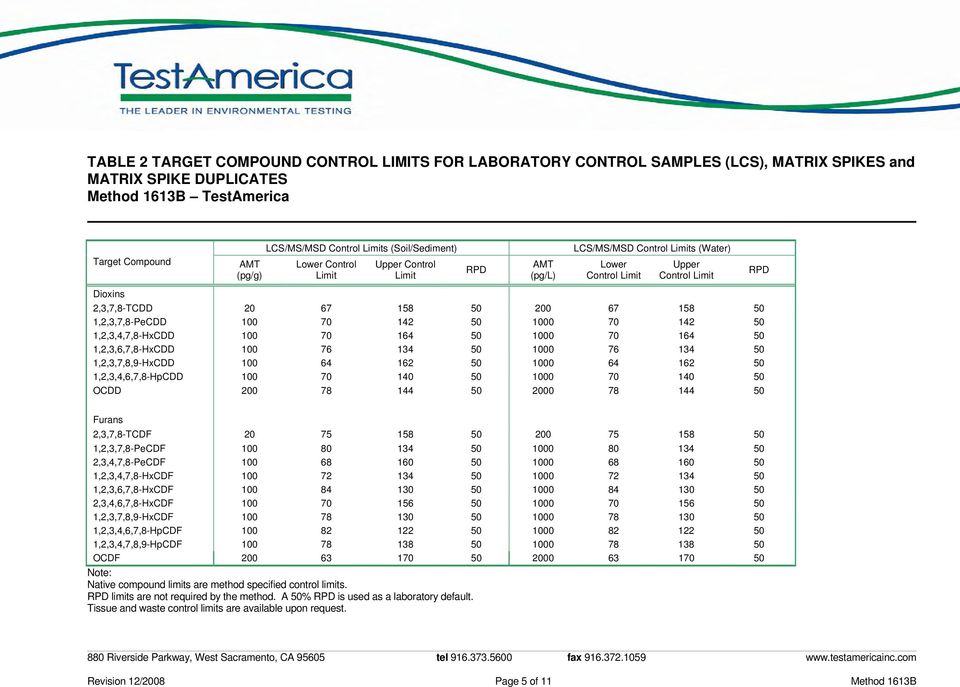
5 TABLE 2 TARGET COMPOUND CONTROL LIMITS FOR LABORATORY CONTROL SAMPLES (LCS), MATRIX SPIKES and MATRIX SPIKE DUPLICATES Method 1613B TestAmerica Target Compound AMT (pg/g) LCS/MS/MSD Control Limits (Soil/Sediment) Lower Control Limit Upper Control Limit RPD AMT (pg/l) LCS/MS/MSD Control Limits (Water) Lower Control Limit Upper Control Limit RPD Dioxins 2,3,7,8-TCDD ,2,3,7,8-PeCDD ,2,3,4,7,8-HxCDD ,2,3,6,7,8-HxCDD ,2,3,7,8,9-HxCDD ,2,3,4,6,7,8-HpCDD OCDD Furans 2,3,7,8-TCDF ,2,3,7,8-PeCDF ,3,4,7,8-PeCDF ,2,3,4,7,8-HxCDF ,2,3,6,7,8-HxCDF ,3,4,6,7,8-HxCDF ,2,3,7,8,9-HxCDF ,2,3,4,6,7,8-HpCDF ,2,3,4,7,8,9-HpCDF OCDF Note: Native compound limits are method specified control limits. RPD limits are not required by the method. A 50% RPD is used as a laboratory default. Tissue and waste control limits are available upon request. 880 Riverside Parkway, West Sacramento, CA tel fax Revision 12/2008 Page 5 of 11 Method 1613B
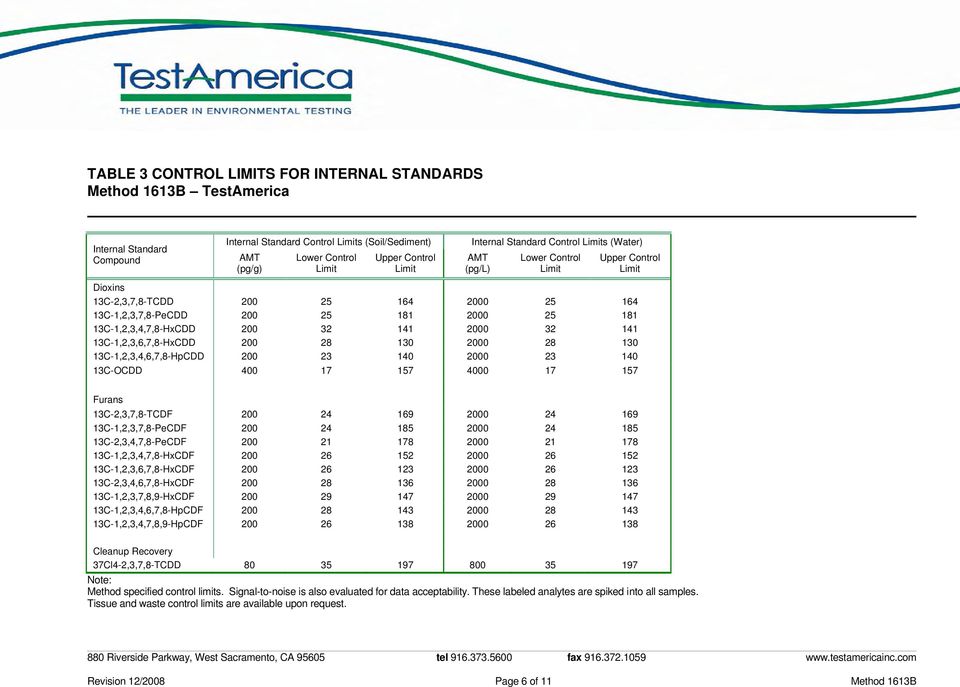
6 TABLE 3 CONTROL LIMITS FOR INTERNAL STANDARDS Method 1613B TestAmerica Internal Standard Compound Internal Standard Control Limits (Soil/Sediment) AMT (pg/g) Lower Control Limit Upper Control Limit Internal Standard Control Limits (Water) AMT (pg/l) Lower Control Limit Upper Control Limit Dioxins 13C-2,3,7,8-TCDD C-1,2,3,7,8-PeCDD C-1,2,3,4,7,8-HxCDD C-1,2,3,6,7,8-HxCDD C-1,2,3,4,6,7,8-HpCDD C-OCDD Furans 13C-2,3,7,8-TCDF C-1,2,3,7,8-PeCDF C-2,3,4,7,8-PeCDF C-1,2,3,4,7,8-HxCDF C-1,2,3,6,7,8-HxCDF C-2,3,4,6,7,8-HxCDF C-1,2,3,7,8,9-HxCDF C-1,2,3,4,6,7,8-HpCDF C-1,2,3,4,7,8,9-HpCDF Cleanup Recovery 37Cl4-2,3,7,8-TCDD Note: Method specified control limits. Signal-to-noise is also evaluated for data acceptability. These labeled analytes are spiked into all samples. Tissue and waste control limits are available upon request. 880 Riverside Parkway, West Sacramento, CA tel fax Revision 12/2008 Page 6 of 11 Method 1613B
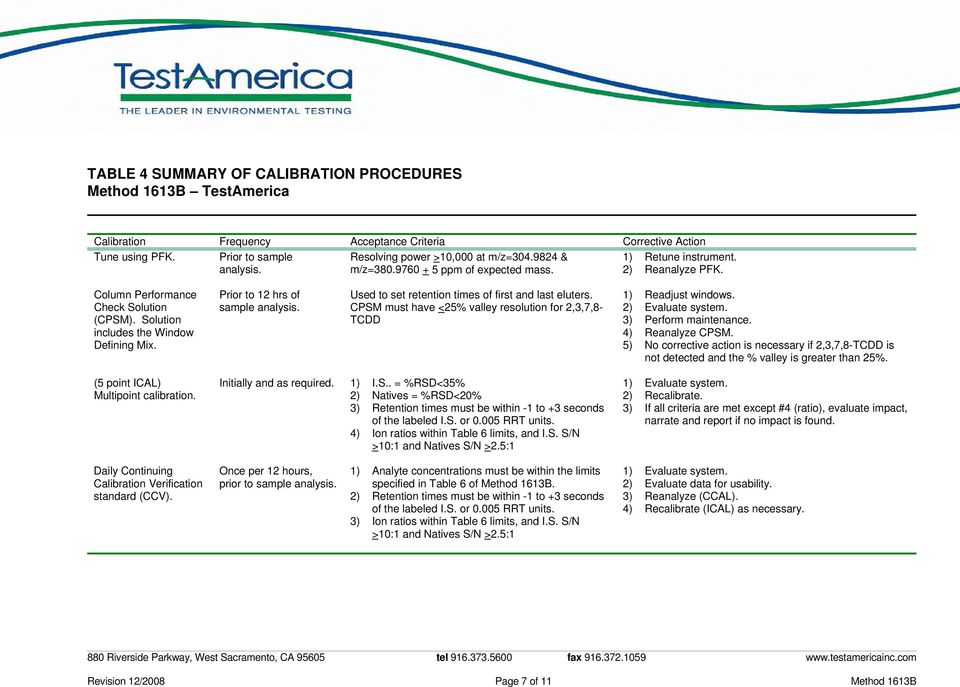
7 TABLE 4 SUMMARY OF CALIBRATION PROCEDURES Method 1613B TestAmerica Calibration Frequency Acceptance Criteria Corrective Action Tune using PFK. Prior to sample Resolving power >10,000 at m/z= & 1) Retune instrument. analysis. m/z= ppm of expected mass. 2) Reanalyze PFK. Column Performance Check Solution (CPSM). Solution includes the Window Defining Mix. Prior to 12 hrs of sample analysis. Used to set retention times of first and last eluters. CPSM must have <25% valley resolution for 2,3,7,8- TCDD 1) Readjust windows. 2) Evaluate system. 3) Perform maintenance. 4) Reanalyze CPSM. 5) No corrective action is necessary if 2,3,7,8-TCDD is not detected and the % valley is greater than 25%. (5 point ICAL) Multipoint calibration. Initially and as required. 1) I.S.. = %RSD<35% 2) Natives = %RSD<20% 3) Retention times must be within -1 to +3 seconds of the labeled I.S. or RRT units. 4) Ion ratios within Table 6 limits, and I.S. S/N >10:1 and Natives S/N >2.5:1 1) Evaluate system. 2) Recalibrate. 3) If all criteria are met except #4 (ratio), evaluate impact, narrate and report if no impact is found. Daily Continuing Calibration Verification standard (CCV). Once per 12 hours, prior to sample analysis. 1) Analyte concentrations must be within the limits specified in Table 6 of Method 1613B. 2) Retention times must be within -1 to +3 seconds of the labeled I.S. or RRT units. 3) Ion ratios within Table 6 limits, and I.S. S/N >10:1 and Natives S/N >2.5:1 1) Evaluate system. 2) Evaluate data for usability. 3) Reanalyze (CCAL). 4) Recalibrate (ICAL) as necessary. 880 Riverside Parkway, West Sacramento, CA tel fax Revision 12/2008 Page 7 of 11 Method 1613B
8 TABLE 5 SUMMARY OF INTERNAL QUALITY CONTROL PROCEDURES Method 1613B TestAmerica QC Element Frequency Acceptance Criteria Corrective Action Internal Standards Every sample, method blank, and LCS. Internal standard recovery within limits stated in Table 3. 1) Check chromatography for interferences. If found, flag data. 2) Check S/N. If < 10:1, re-extract sample. 3) If S/N > 10:1, evaluate data usability, narrate and report. 4) Check instrument and re-analyze the extract if a problem is found and corrected. 5) Re-extract and re-analyze adversely affected samples. Method blank 1 per analytical batch, not to exceed 20 field samples per matrix. No target analyte concentrations above the reporting limit (RL). Exception: OCDD concentration in the method blank is allowed to be 5X the RL without narration. Note Totals are not considered target analytes no corrective action or flagging is necessary for positive totals in the method blank. 1) Re-analyze method blank if instrument carryover is suspected. 2) If still exceeds and analyte concentration in sample < RL or > 10X blank concentration, narrate and report results. 3) If J qualified positives are in the method blank or OCDD < 5X the RL, then no corrective action is necessary. Flag and report 4) If non-compliant and analyte concentration in sample is between RL and 10X blank concentration, re-extract and re-analyze affected samples. Laboratory Control Sample Duplicates Matrix Spike 1 per analytical batch, not to exceed 20 field samples per matrix. As per client request. As per client request. Refer to Table 2 1) Review Internal Standards, as above. 2) Evaluate data for usability. 3) If the LCS recoveries are greater than the upper control limits and sample results are ND and RL are met, no action is required narrate and report. 4) If samples have positives > RL, re-extract and re-analyze affected samples for analytes outside the acceptance criteria. Refer to Table 2 and Table 3. 1) Review data for usability. 2) Narrate any outliers. Refer to Table 2 and Table 3. 1) Review data for usability. 2) Narrate outliers. 880 Riverside Parkway, West Sacramento, CA tel fax Revision 12/2008 Page 8 of 11 Method 1613B

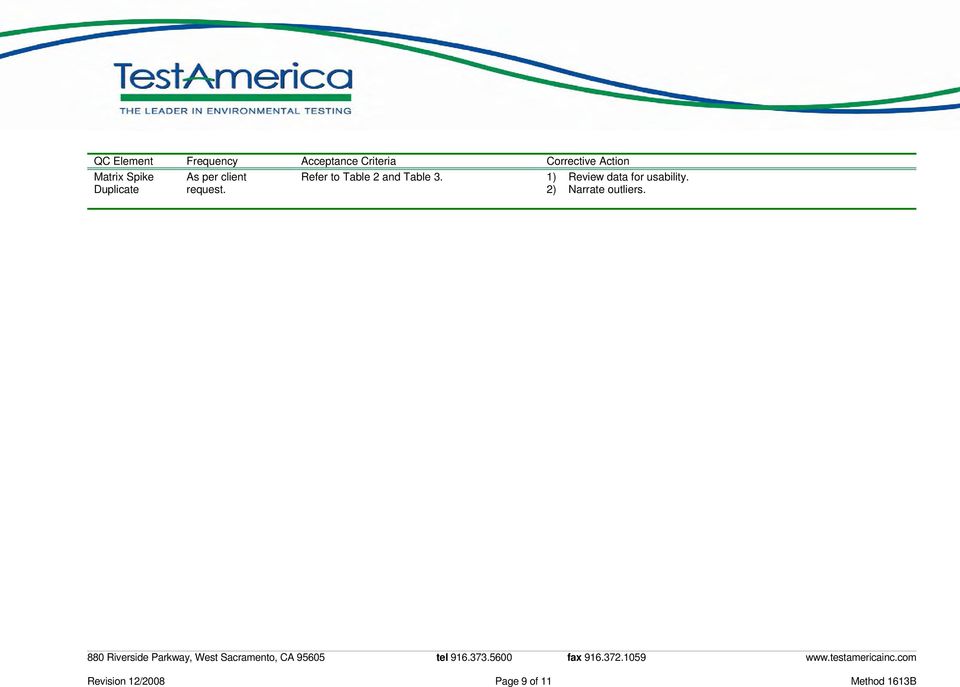
9 QC Element Frequency Acceptance Criteria Corrective Action Matrix Spike Duplicate As per client request. Refer to Table 2 and Table 3. 1) Review data for usability. 2) Narrate outliers. 880 Riverside Parkway, West Sacramento, CA tel fax Revision 12/2008 Page 9 of 11 Method 1613B
10 TABLE 6 CRITERIA FOR ISOTOPIC RATIO MEASUREMENT FOR PCDDs AND PCDFs Method 1613B TestAmerica Number of Chlorine Atoms Ion Type Theoretical Ratio Control Limits ( + 15%) 4 M/(M+2) (M+2)/(M+4) (M+2)/(M+4) a M/(M+2) b M/(M+2) (M+2)/(M+4) (M+2)/(M+4) a b Used only for 13 C-HxCDF (internal standard). Used only for 13 C-HpCDF (internal standard). TABLE 7 PCDDs/PCDFs TOXICITY EQUIVALENCE FACTORS (TEF) Method 1613B TestAmerica Analyte TEF March 1989 (EPA 62/5-89/016) TEF June 1998 WHO TEF June 2005 WHO Dioxins 2,3,7,8-TCDD ,2,3,7,8-PeCDD ,2,3,4,7,8-HxCDD ,2,3,6,7,8-HxCDD ,2,3,7,8,9-HxCDD ,2,3,4,6,7,8-HpCDD OCDD Furans 2,3,7,8-TCDF ,2,3,7,8-PeCDF ,3,4,7,8-PeCDF ,2,3,4,7,8-HxCDF ,2,3,6,7,8-HxCDF ,3,4,6,7,8-HxCDF ,2,3,7,8,9-HxCDF ,2,3,4,6,7,8-HpCDF ,2,3,4,7,8,9-HpCDF OCDF Riverside Parkway, West Sacramento, CA tel fax Revision 12/2008 Page 10 of 11 Method 1613B

11 TABLE 8 PCDDs/PCDFs HOLDING TIMES AND CONTAINERS Method 1613B TestAmerica Method Extraction Holding Time Containers (no preservative other than 4 o C) 1613B 365 Days for soil and water 4 oz jar for soil; 2x 1 Liter amber for water 880 Riverside Parkway, West Sacramento, CA tel fax Revision 12/2008 Page 11 of 11 Method 1613B

12 Document No. WS-QAM, Rev. 3 Effective Date: 06/26/2009 Cover Page 1 of 1 Quality Assurance Manual TestAmerica West Sacramento 880 Riverside Parkway West Sacramento, Ca Phone No Fax No Copyright Information: This documentation has been prepared by TestAmerica Laboratories, Inc. and its affiliates ( TestAmerica ), solely for their own use and the use of their customers in evaluating their qualifications and capabilities in connection with a particular project. The user of this document agrees by its acceptance to return it to TestAmerica upon request and not to reproduce, copy, lend, or otherwise disclose its contents, directly or indirectly, and not to use it for any other purpose other than that for which it was specifically provided. The user also agrees that where consultants or other outside parties are involved in the evaluation process, access to these documents shall not be given to said parties unless those parties also specifically agree to these conditions. THIS DOCUMENT CONTAINS VALUABLE CONFIDENTIAL AND PROPRIETARY INFORMATION. DISCLOSURE, USE OR REPRODUCTION OF THESE MATERIALS WITHOUT THE WRITTEN AUTHORIZATION OF TESTAMERICA IS STRICTLY PROHIBITED. THIS UNPUBLISHED WORK BY TESTAMERICA IS PROTECTED BY STATE AND FEDERAL LAW OF THE UNITED STATES. IF PUBLICATION OF THIS WORK SHOULD OCCUR THE FOLLOWING NOTICE SHALL APPLY: COPYRIGHT 2009 TESTAMERICA LABORATORIES, INC. ALL RIGHTS RESERVED. Facility Distribution No. Distributed To:

13 Document No. WS-QAM Section Revision No.: 3 Section Effective Date: 06/26/2009 Table of Contents Page 1 of 8 SECTION 2 TABLE OF CONTENTS Section No. Title Page No. Effective Date 1.0 Cover Page and Signatures COVER 06/26/ TABLE OF CONTENTS /26/ INTRODUCTION (NELAC ) /26/ Introduction And Compliance References /26/ Terms And Definitions /26/ Scope / Fields Of Testing /26/ Management Of The Manual /26/ ORGANIZATION AND MANAGEMENT (NELAC 5.4.1) /26/ Overview /26/ Roles And Responsibilities /26/ Deputies /26/ QUALITY SYSTEM (NELAC 5.4.2) /26/ Quality Policy Statement /26/ Ethics And Data Integrity /26/ Quality System Documentation /26/ Qa/Qc Objectives For The Measurement Of Data /26/ Criteria For Quality Indicators /26/ Statistical Quality Control /26/ Quality System Metrics /26/ DOCUMENT CONTROL (NELAC 5.4.3) /26/ Overview /26/ Document Approval And Issue /26/ Procedures For Document Control Policy /26/ Obsolete Documents /26/ SERVICE TO THE CLIENT (NELAC 5.4.7) /26/ Overview /26/ Review Sequence And Key Personnel /26/ Documentation /26/ Special Services /26/ Client Communication /26/ Reporting /26/ Client Surveys /26/ SUBCONTRACTING OF TESTS (NELAC 5.4.5) /26/ Overview /26/ Qualifying And Monitoring Subcontractors /26/ Oversight And Reporting /26/ Contingency Planning /26/2009 Company Confidential & Proprietary

14 Section No. Title Document No. WS-QAM Section Revision No.: 3 Section Effective Date: 06/26/2009 Table of Contents Page 2 of 8 Page No. Effective Date 9.0 PURCHASING SERVICES AND SUPPLIES (NELAC 5.4.6) /26/ Overview /26/ Glassware /26/ Reagents, Standards & Supplies /26/ Purchase Of Equipment/Instruments/Software /26/ Services /26/ Suppliers /26/ COMPLAINTS (NELAC 5.4.8) /26/ Overview /26/ External Complaints /26/ Internal Complaints /26/ Management Review /26/ CONTROL OF NON-CONFORMING WORK (NELAC 5.4.9) /26/ Overview /26/ Responsibilities And Authorities /26/ Evaluation Of Significance And Actions Taken /26/ Prevention Of Nonconforming Work /26/ Method Suspension/Restriction (Stop Work Procedures) /26/ CORRECTIVE ACTION (NELAC ) /26/ Overview /26/ General /26/ Closed Loop Corrective Action Process /26/ Technical Corrective Actions /26/ Basic Corrections /26/ PREVENTIVE ACTION (NELAC ) /26/ Overview /26/ Management Of Change /26/ CONTROL OF RECORDS (NELAC ) /26/ Overview /26/ Technical And Analytical Records /26/ Laboratory Support Activities /26/ Administrative Records /26/ Records Management, Storage And Disposal /26/ AUDITS (NELAC ) /26/ Internal Audits /26/ External Audits /26/ Audit Findings /26/ MANAGEMENT REVIEWS (NELAC ) /26/ Quality Assurance Report /26/ Annual Management Review /26/ Potential Integrity Related Managerial Reviews /26/2009 Company Confidential & Proprietary

15 Document No. WS-QAM Section Revision No.: 3 Section Effective Date: 06/26/2009 Table of Contents Page 3 of 8 Section Effective Title Page No. No. Date 17.0 PERSONNEL (NELAC 5.5.2) /26/ Overview /26/ Education And Experience Requirements For Technical Personnel /26/ Training /26/ Data Integrity And Ethics Training Program /26/ ACCOMMODATIONS AND ENVIRONMENTAL CONDITIONS (NELAC 5.5.3) /26/ Overview /26/ Environment /26/ Work Areas /26/ Floor Plan /26/ Building Security /26/ TEST METHODS AND METHOD VALIDATION (NELAC 5.5.4) /26/ Overview /26/ Standard Operating Procedures (Sops) /26/ Laboratory Methods Manual /26/ Selection Of Methods /26/ Laboratory Developed Methods And Non-Standard Methods /26/ Validation Of Methods /26/ Method Detection Limits (Mdl)/ Limits Of Detection (Lod) /26/ Instrument Detection Limits (Idl) /26/ Verification Of Detection And Reporting Limits /26/ Retention Time Windows /26/ Evaluation Of Selectivity /26/ Estimation Of Uncertainty Of Measurement /26/ Sample Reanalysis Guidelines /26/ Control Of Data /26/ EQUIPMENT (AND CALIBRATIONS) (NELAC 5.5.5) /26/ Overview /26/ Preventive Maintenance /26/ Support Equipment /26/ Instrument Calibration /26/ Tentatively Identified Compounds (TICS) GC/MS Analysis /26/ Gc/Ms Tuning /26/ MEASUREMENT TRACEABILITY (NELAC 5.5.6) /26/ Overview /26/ Nist-Traceable Weights And Thermometers /26/ Reference Standards / Materials /26/2009 Company Confidential & Proprietary

16 Section No. Title Document No. WS-QAM Section Revision No.: 3 Section Effective Date: 06/26/2009 Table of Contents Page 4 of 8 Page No. Effective Date 21.4 Documentation And Labeling Of Standards, Reagents, And Reference Materials /26/ SAMPLING (NELAC 5.5.7) /26/ Overview /26/ Sampling Containers /26/ Definition Of Holding Time /26/ Sampling Containers, Preservation Requirements, Holding Times /26/ Sample Aliquots / Subsampling /26/ HANDLING OF SAMPLES (NELAC 5.5.8) /26/ Chain Of Custody (Coc) /26/ Sample Receipt /26/ Sample Storage /26/ Hazardous Samples And Foreign Soils /26/ Sample Shipping /26/ Sample Disposal /26/ ASSURING THE QUALITY OF TEST RESULTS (NELAC 5.5.9) /26/ Overview /26/ Controls /26/ Negative Controls /26/ Positive Controls /26/ Sample Matrix Controls /26/ Acceptance Criteria (Control Limits) /26/ Additional Procedures To Assure Quality Control /26/ REPORTING RESULTS (NELAC ) /26/ Overview /26/ Test Reports /26/ Reporting Level or Report Type /26/ Supplemental Information For Test /26/ Environmental Testing Obtained From Subcontractors /26/ Client Confidentiality /26/ Format Of Reports /26/ Amendments To Test Reports /26/2009 Company Confidential & Proprietary

17 Document No. WS-QAM Section Revision No.: 3 Section Effective Date: 06/26/2009 Table of Contents Page 5 of 8 LIST OF TABLES Table No. Title Page Effective Date 14-1 Example - Record Index /26/ Example - Special Record Retention Requirements /26/ Types of Internal Audits and Frequency /26/ Example - Laboratory Instrumentation /26/ Example Schedule of Routine Maintenance /26/ Example Negative Controls /26/ Sample Matrix Control /26/2009 Company Confidential & Proprietary

18 Document No. WS-QAM Section Revision No.: 3 Section Effective Date: 06/26/2009 Table of Contents Page 6 of 8 LIST OF FIGURES Figure No. Title Page Effective Date 4-1 Corporate and Laboratory Organizational Chart /26/ Example Corrective Action Report /26/ Example Demonstration of Capability Documentation /26/ Work Flow /26/ Example: Chain of Custody (COC) /26/ Example: Sample Acceptance Policy /26/2009 LIST OF APPENDICES Appendix No. Title Page Effective Date 1 Laboratory Floor Plan Appendix /26/ Glossary / Acronyms Appendix /26/ Laboratory Certifications, Accreditations, Validations Appendix /26/ Listing of Methods Performed Appendix /26/ Data Qualifiers Appendix /26/2009 Company Confidential & Proprietary

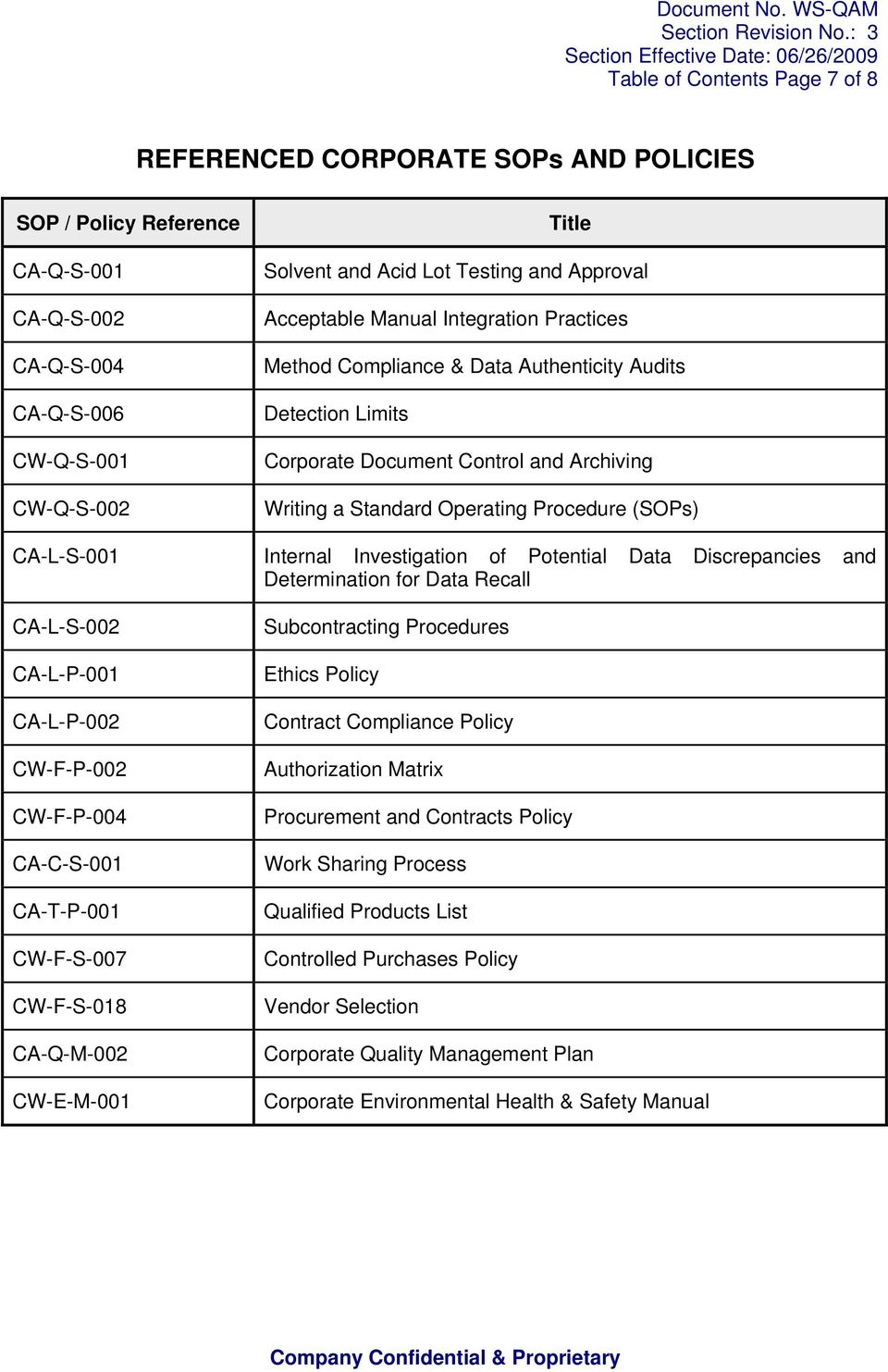
19 Document No. WS-QAM Section Revision No.: 3 Section Effective Date: 06/26/2009 Table of Contents Page 7 of 8 REFERENCED CORPORATE SOPs AND POLICIES SOP / Policy Reference CA-Q-S-001 CA-Q-S-002 CA-Q-S-004 CA-Q-S-006 CW-Q-S-001 CW-Q-S-002 Title Solvent and Acid Lot Testing and Approval Acceptable Manual Integration Practices Method Compliance & Data Authenticity Audits Detection Limits Corporate Document Control and Archiving Writing a Standard Operating Procedure (SOPs) CA-L-S-001 Internal Investigation of Potential Data Discrepancies and Determination for Data Recall CA-L-S-002 CA-L-P-001 CA-L-P-002 CW-F-P-002 CW-F-P-004 CA-C-S-001 CA-T-P-001 CW-F-S-007 CW-F-S-018 CA-Q-M-002 CW-E-M-001 Subcontracting Procedures Ethics Policy Contract Compliance Policy Authorization Matrix Procurement and Contracts Policy Work Sharing Process Qualified Products List Controlled Purchases Policy Vendor Selection Corporate Quality Management Plan Corporate Environmental Health & Safety Manual Company Confidential & Proprietary
20 REFERENCED LABORATORY SOPs Document No. WS-QAM Section Revision No.: 3 Section Effective Date: 06/26/2009 Table of Contents Page 8 of 8 SOP Reference Title WS-PEHS-001 WS-PM-0003 WS-PQA-0011 WS-PQA-003 WS-PQA-012 WS-PQA-013 WS-QA-0003 WS-QA-0004 WS-QA-0005 WS-QA-0006 WS-QA-0016 WS-QA-0017 WS-QA-0018 WS-QA-0021 WS-QA-0022 WS-QA-0023 WS-QA-0028 WS-QA-0041 Respiratory Protection Plan Program Setup and Distillation Manual Integration Documentation Procedures Quality Control Program Technical Data Review Requirements Procedures to Address Customer Complaints Sample Receipt and Procedures Maintenance and Calibration Check of Fixed and Adjustable Volume Autopipettors, Autodispensers and Volumetric Containers Temperature Monitoring and Corrective Actions for Refrigerators and Freezers Method Detection Limits (MDL) and Instrument Detection Limits (IDL) Thermometer Calibration Standards and Reagents Preparation and Quality Control Check Procedure [Quality Assurance Procedure] Subsampling and Compositing of Samples Preparation and Management of Standard Operating Procedures Employee Orientation and Training Nonconformance and Corrective Action System Multi-Incremental Subsampling of Soils and Sediments Calibration and Calibration Check of Balances Company Confidential & Proprietary

21 Document No. WS-QAM Section Revision No.: 3 Section Effective Date: 06/26/2009 Page 3-1 of 3-2 SECTION 3 INTRODUCTION (NELAC ) 3.1 INTRODUCTION AND COMPLIANCE REFERENCES TestAmerica West Sacramento s Quality Assurance Manual (QAM) is a document prepared to define the overall policies, organization objectives and functional responsibilities for achieving TestAmerica s data quality goals. The laboratory maintains a local perspective in its scope of services and client relations and maintains a national perspective in terms of quality. The QAM has been prepared to assure compliance with the 2003 National Environmental Laboratory Accreditation Conference (NELAC) standards and ISO/IEC Guide (1999). In addition, the policies and procedures outlined in this manual are compliant with TestAmerica s Corporate Quality Management Plan (CQMP) and the various accreditation and certification programs listed in Appendix 3. The CQMP provides a summary of TestAmerica s quality and data integrity system. It contains requirements and general guidelines under which all TestAmerica facilities shall conduct their operations. The QAM has been prepared to be consistent with the requirements of the following documents: EPA 600/4-88/039, Methods for the Determination of Organic Compounds in Drinking Water, EPA, Revised July EPA 600/R-95/131, Methods for the Determination of Organic Compounds in Drinking Water, Supplement III, EPA, August EPA 600/ , Handbook for Analytical Quality Control in Water and Wastewater Laboratories, EPA, March EPA SW-846, Test Methods for the Evaluation of Solid Waste, 3 rd Edition, September 1986; Update I, July 1992; Update II, September 1994; Update III, December 1996, and Update IV, February Federal Register, 40 CFR Parts 136, 141, 172, 173, 178, 179 and 261. USEPA Contract Laboratory Program. Statement of Work for Inorganics Analysis. Multi-Media, Multi-Concentration. Document ILM04.0. USEPA Contract Laboratory Program. Statement of Work for Organics Analysis. Multi-Media, Multi- Concentration. Document Number OLMO3.1, August APHA, Standard Methods for the Examination of Water and Wastewater, 18 th Edition, 19 th, 20 th and 21 st Edition. U.S. Department of Defense, Quality Systems Manual for Environmental Laboratories, Final Version 3, January U.S. Department of Defense, Quality Systems Manual for Environmental Laboratories, Final Version 4.1, April U.S. Department of Defense, Air Force Center for Environmental Excellence Quality Assurance Project Plan (QAPP), Version , May Toxic Substances Control Act (TSCA). Company Confidential & Proprietary
22 3.2 TERMS AND DEFINITIONS Document No. WS-QAM Section Revision No.: 3 Section Effective Date: 06/26/2009 Page 3-2 of 3-2 A Quality Assurance Program is a company-wide system designed to ensure that data produced by the laboratory conforms to the standards set by state and/or federal regulations. The program functions at the management level through company goals and management policies, and at the analytical level through Standard Operating Procedures (SOPs) and quality control. The TestAmerica program is designed to minimize systematic error, encourage constructive, documented problem solving, and provide a framework for continuous improvement within the organization. Refer to Appendix 2 for the Glossary/Acronyms. 3.3 SCOPE / FIELDS OF TESTING The laboratory analyzes a broad range of environmental and industrial samples every month. Sample matrices vary among air, drinking water, effluent water, groundwater, hazardous waste, sludge and soils. The Quality Assurance Program contains specific procedures and methods to test samples of differing matrices for chemical, physical and biological parameters. The Program also contains guidelines on maintaining documentation of analytical process, reviewing results, servicing clients and tracking samples through the laboratory. The technical and service requirements of all requests to provide analyses are thoroughly evaluated before commitments are made to accept the work. Measurements are made using published reference methods or methods developed and validated by the laboratory. The methods covered by this manual include the most frequently requested methodologies needed to provide analytical services in the United States and its territories. The specific list of test methods used by the laboratory can be found in Appendix 4. The approach of this manual is to define the minimum level of quality assurance and quality control necessary to meet requirements. All methods performed by the laboratory shall meet these criteria as appropriate. In some instances, quality assurance project plans (QAPPs), project specific data quality objectives (DQOs) or local regulations may require criteria other than those contained in this manual. In these cases, the laboratory will abide by the requested criteria following review and acceptance of the requirements by the Laboratory Director and the Quality Assurance (QA) Manager. In some cases, QAPPs and DQOs may specify less stringent requirements. The Laboratory Director and the QA Manager must determine if it is in the lab s best interest to follow the less stringent requirements. 3.4 MANAGEMENT OF THE MANUAL Review Process This manual is reviewed annually by senior laboratory management to assure that it reflects current practices and meets the requirements of the laboratory s clients and regulators as well as the CQMP. Occasionally, the manual may need changes in order to meet new or changing regulations and operations. The QA Manager will review the changes in the normal course of business and incorporate changes into revised sections of the document. All updates will be reviewed by the senior laboratory management staff. The laboratory updates and approves such changes according to our SOP Preparation and Management of Standard Operating Procedures (refer to SOP No. WS-QA-0021). Company Confidential & Proprietary
23 Document No. WS-QAM Section Revision No.: 3 Section Effective Date: 06/26/2009 Page 4-1 of 4-5 SECTION 4 ORGANIZATION AND MANAGEMENT (NELAC 5.4.1) 4.1 OVERVIEW TestAmerica West Sacramento is a local operating unit of TestAmerica Laboratories, Inc. The organizational structure, responsibilities and authorities of the corporate staff of TestAmerica Laboratories, Inc. are presented in the CQMP. The laboratory has day-to-day independent operational authority overseen by corporate officers (e.g., President, Chief Operating Officer, Corporate Quality Assurance, etc.). The laboratory operational and support staff work under the direction of the Laboratory Director. The organizational structure for both Corporate & TestAmerica West Sacramento is presented in Figure ROLES AND RESPONSIBILITIES In order for the Quality Assurance Program to function properly, all members of the staff must clearly understand and meet their individual responsibilities as they relate to the quality program. The following descriptions briefly define each role in its relationship to the Quality Assurance Program Quality Assurance Program The responsibility for quality lies with every employee of the laboratory. All employees have access to the QAM, are trained to this manual, and are responsible for upholding the standards therein. Each person carries out his/her daily tasks in a manner consistent with the goals and in accordance with the procedures in this manual and the laboratory s SOPs. Role descriptions for corporate personnel are defined in the CQMP. This manual is specific to the operations of TestAmerica s West Sacramento laboratory Laboratory Director / Technical Director TestAmerica West Sacramento s Laboratory Director is responsible for the overall quality, safety, financial, technical, human resource and service performance of the whole laboratory and reports to their respective GM. The Laboratory Director provides the resources necessary to implement and maintain an effective and comprehensive Quality Assurance and Data Integrity Program Quality Assurance (QA) Manager The QA Manager has responsibility and authority to ensure the continuous implementation of the quality system based on ISO The QA Manager reports directly to the Laboratory Director and has access to Corporate QA for advice and resources. This position is able to evaluate data objectively and perform assessments without outside (i.e., managerial) influence. Corporate QA may be used as a resource in dealing with regulatory requirements, certifications and other quality assurance related items. The QA Manager directs the activities of the QA department to accomplish its mission. Company Confidential & Proprietary
24 Document No. WS-QAM Section Revision No.: 3 Section Effective Date: 06/26/2009 Page 4-2 of Operations Manager/Technical Director The Operations Manager has the responsibility for the day to day operations of the analytical staff within the laboratory. The Operations Manager reports directly to the Laboratory Director. The Operations Manager schedules analytical operations, ensures that the laboratory meets quality requirements, investigates technical issues as they arise, and performs other tasks as required by the NELAC standards Manager of Customer Services The Manager of Customer Services has the responsibility for the day to day operations of the client services staff, which includes the Project Management and other administrative groups within the laboratory. The Manager of Customer Services reports directly to the Laboratory Director. The Manager of Customer Services has signature authority for contracts for laboratory services (as detailed in TestAmerica policy), and for laboratory reports Project Manager Project Managers are a liaison between the laboratory s clients and the analytical staff. They report directly to the Manager of Customer Service. The Project Managers have signature authority for final reports, and review project data packages for completeness and compliance with client needs and quality requirements Project Administrator Project Administrators are a liaison between the laboratory s clients and the analytical staff. They report directly to the Manager of Customer Service. The Project Administrators review project data packages for completeness and compliance with client needs and quality requirements Department Manager, Team Leader, or Supervisor Department Managers report directly to the Operations Manager. They supervise the daily activities of analysis with a given laboratory area, and either oversee the review and approval, or perform the review and approval of all analytical data within that area Analyst Analysts report to their respective Department Managers. They perform sample analyses and generate analytical data in accordance with documented procedures Sample Custodian The Sample Custodian ensures the implementation of proper sample receipt procedures, including maintaining chain-of-custody. The Sample Custodian logs samples into the LIMS and ensures that all samples are stored appropriately Report Production Staff The Report Production Staff accurately generates and compiles analytical reports and the associated deliverables as required by the client. Company Confidential & Proprietary
25 4.3 DEPUTIES Document No. WS-QAM Section Revision No.: 3 Section Effective Date: 06/26/2009 Page 4-3 of 4-5 The following table defines who assumes the responsibilities of key personnel in their absence: Title Key Personnel Deputy Laboratory Director Karla Buechler Dave Herbert QA Manager Douglas Weir Lisa Stafford Technical Director Karla Buechler Michael Flournoy Robert Hrabak Operations Manager Robert Hrabak David Allameh Customer Services Manager Michael Flournoy Dave Herbert Business Manager Development Dave Herbert Michael Flournoy EHS Coordinator Joe Schairer Richard Kester Company Confidential & Proprietary
26 Document No. WS-QAM Section Revision No.: 3 Section Effective Date: 06/26/2009 Page 4-4 of 4-5 Figure 4-1. Corporate and Laboratory Organization Chart Company Confidential & Proprietary
27 Document No. WS-QAM Section Revision No.: 3 Section Effective Date: 06/26/2009 Page 4-5 of 4-5 Company Confidential & Proprietary
28 Document No. WS-QAM Section Revision No.: 3 Section Effective Date: 06/26/2009 Page 5-1 of 5-5 SECTION 5 QUALITY SYSTEM (NELAC 5.4.2) 5.1 QUALITY POLICY STATEMENT It is TestAmerica s Policy to: Provide data of known quality to its clients by adhering to approved methodologies, regulatory requirements and the QA/QC protocols. Effectively manage all aspects of the laboratory and business operations by the highest ethical standards. Continually improve systems and provide support to quality improvement efforts in laboratory, administrative and managerial activities. TestAmerica recognizes that the implementation of a quality assurance program requires management s commitment and support as well as the involvement of the entire staff. Provide clients with the highest level of professionalism and the best service practices in the industry. Every staff member at the laboratory plays an integral part in quality assurance and is held responsible and accountable for the quality of their work. It is, therefore, required that all laboratory personnel are trained and agree to comply with applicable procedures and requirements established by this document. 5.2 ETHICS AND DATA INTEGRITY TestAmerica is committed to ensuring the integrity of its data and meeting the quality needs of its clients. The elements of TestAmerica s Ethics and Data Integrity Program include: An Ethics Policy (Corporate Policy No. CA-L-P-001) and Employee Ethics Statements. Ethics and Compliance Officers (ECOs). A Training Program. Self-governance through disciplinary action for violations. A Confidential mechanism for anonymously reporting alleged misconduct and a means for conducting internal investigations of all alleged misconduct. (Corporate SOP No. CA-L-S- 001.) Procedures and guidance for recalling data if necessary (Corporate SOP No. CA-L-S-001). Effective external and internal monitoring system that includes procedures for internal audits (Section 15). Produce results, which are accurate and include QA/QC information that meets client predefined Data Quality Objectives (DQOs). Present services in a confidential, honest and forthright manner. Company Confidential & Proprietary
29 Document No. WS-QAM Section Revision No.: 3 Section Effective Date: 06/26/2009 Page 5-2 of 5-5 Provide employees with guidelines and an understanding of the Ethical and Quality Standards of our Industry. Operate our facilities in a manner that protects the environment and the health and safety of employees and the public. Obey all pertinent federal, state and local laws and regulations and encourage other members of our industry to do the same. Educate clients as to the extent and kinds of services available. Assert competency only for work for which adequate personnel and equipment are available and for which adequate preparation has been made. Promote the status of environmental laboratories, their employees, and the value of services rendered by them. 5.3 QUALITY SYSTEM DOCUMENTATION The laboratory s Quality System is communicated through a variety of documents. Quality Assurance Manual Each laboratory has a lab specific quality assurance manual. Corporate SOPs and Policies - Corporate SOPs and Policies are developed for use by all relevant laboratories. They are incorporated into the laboratory s normal SOP distribution, training and tracking system. Corporate SOPs may be general or technical. Work Instructions - A subset of procedural steps, tasks or forms associated with an operation of a management system (e.g., checklists, preformatted bench sheets, forms). Laboratory SOPs General and Technical Corporate Quality Policy Memorandums Laboratory QA/QC Policy Memorandums Order of Precedence In the event of a conflict or discrepancy between policies, the order of precedence is as follows: Corporate Quality Policy Memorandum Corporate Quality Management Plan (CQMP) Corporate SOPs and Policies Laboratory QA/QC Policy Memorandum Laboratory Quality Assurance Manual (QAM) Laboratory SOPs and Policies Other (Work Instructions (WI), memos, flow charts, etc.) Note: The laboratory s has the responsibility and authority to operate in compliance with regulatory requirements of the jurisdiction in which the work is performed. Where the CQMP conflicts with those regulatory requirements, the regulatory requirements of the jurisdiction shall hold primacy. The laboratory s (QAM) shall take precedence over the CQMP in those cases. Company Confidential & Proprietary
30 5.4 QA/QC OBJECTIVES FOR THE MEASUREMENT OF DATA Document No. WS-QAM Section Revision No.: 3 Section Effective Date: 06/26/2009 Page 5-3 of 5-5 Quality Assurance (QA) and Quality Control (QC) are activities undertaken to achieve the goal of producing data that accurately characterize the sites or materials that have been sampled. Quality Assurance is generally understood to be more comprehensive than Quality Control. Quality Assurance can be defined as the integrated system of activities that ensures that a product or service meets defined standards. Quality Control is generally understood to be limited to the analyses of samples and to be synonymous with the term analytical quality control. QC refers to the routine application of statistically based procedures to evaluate and control the accuracy of results from analytical measurements. The QC program includes procedures for estimating and controlling precision and bias and for determining reporting limits. Request for Proposals (RFPs) and Quality Assurance Project Plans (QAPP) provide a mechanism for the client and the laboratory to discuss the data quality objectives in order to ensure that analytical services closely correspond to client needs. The client is responsible for developing the QAPP. In order to ensure the ability of the laboratory to meet the Data Quality Objectives (DQOs) specified in the QAPP, clients are advised to allow time for the laboratory to review the QAPP before being finalized. Additionally, the laboratory will provide support to the client for developing the sections of the QAPP that concern laboratory activities. Historically, laboratories have described their QC objectives in terms of precision, accuracy, representativeness, comparability, completeness, selectivity and sensitivity (PARCCSS) Precision The laboratory objective for precision is to meet the performance for precision demonstrated for the methods on similar samples and to meet data quality objectives of the EPA and/or other regulatory programs. Precision is defined as the degree of reproducibility of measurements under a given set of analytical conditions (exclusive of field sampling variability). Precision is documented on the basis of replicate analysis, usually duplicate or matrix spike (MS) duplicate samples Accuracy The laboratory objective for accuracy is to meet the performance for accuracy demonstrated for the methods on similar samples and to meet data quality objectives of the EPA and/or other regulatory programs. Accuracy is defined as the degree of bias in a measurement system. Accuracy may be documented through the use of laboratory control samples (LCS) and/or MS. A statement of accuracy is expressed as an interval of acceptance recovery about the mean recovery Representativeness The laboratory objective for representativeness is to provide data which is representative of the sampled medium. Representativeness is defined as the degree to which data represent a characteristic of a population or set of samples and is a measurement of both analytical and field sampling precision. The representativeness of the analytical data is a function of the procedures used in procuring and processing the samples. The representativeness can be Company Confidential & Proprietary
31 Document No. WS-QAM Section Revision No.: 3 Section Effective Date: 06/26/2009 Page 5-4 of 5-5 documented by the relative percent difference between separately procured, but otherwise identical samples or sample aliquots. The representativeness of the data from the sampling sites depends on both the sampling procedures and the analytical procedures. The laboratory may provide guidance to the client regarding proper sampling and handling methods in order to assure the integrity of the samples Comparability The comparability objective is to provide analytical data for which the accuracy, precision, representativeness and reporting limit statistics are similar to these quality indicators generated by other laboratories for similar samples, and data generated by the laboratory over time. The comparability objective is documented by inter-laboratory studies carried out by regulatory agencies or carried out for specific projects or contracts, by comparison of periodically generated statements of accuracy, precision and reporting limits with those of other laboratories Completeness The completeness objective for data is 90% (or as specified by a particular project), expressed as the ratio of the valid data to the total data over the course of the project. Data will be considered valid if they are adequate for their intended use. Data usability will be defined in a QAPP, project scope or regulatory requirement. Data validation is the process for reviewing data to determine its usability and completeness. If the completeness objective is not met, actions will be taken internally and with the data user to improve performance. This may take the form of an audit to evaluate the methodology and procedures as possible sources for the difficulty or may result in a recommendation to use a different method Selectivity Selectivity is defined as: The capability of a test method or instrument to respond to a target substance or constituent in the presence of non-target substances. Target analytes are separated from non-target constituents and subsequently identified/detected through one or more of the following, depending on the analytical method: extractions (separation), digestions (separation), interelement corrections (separation), use of matrix modifiers (separation), specific retention times (separation and identification), confirmations with different columns or detectors (separation and identification), specific wavelengths (identification), specific mass spectra (identification), specific electrodes (separation and identification), etc Sensitivity Sensitivity refers to the amount of analyte necessary to produce a detector response that can be reliably detected (Method Detection Limit) or quantified (Reporting Limit). 5.5 CRITERIA FOR QUALITY INDICATORS The laboratory maintains a Reference Data Summary from the LIMS that summarize the precision and accuracy acceptability limits for performed analyses. This summary includes an Company Confidential & Proprietary
32 Document No. WS-QAM Section Revision No.: 3 Section Effective Date: 06/26/2009 Page 5-5 of 5-5 effective date, is updated each time new limits are generated and is managed by the laboratory s QA department. Unless otherwise noted, limits within these tables are laboratory generated. Some acceptability limits are derived from US EPA methods when they are required. Where US EPA method limits are not required, the laboratory has developed limits from evaluation of data from similar matrices. Criteria for development of control limits are contained in Quality Control Program Policy WS-PQA-003 and Section STATISTICAL QUALITY CONTROL Statistically-derived precision and accuracy limits are required by selected methods (such as SW-846) and programs [such as the Ohio Voluntary Action Plan (VAP)]. The laboratory routinely utilizes statistically-derived limits to evaluate method performance and determine when corrective action is appropriate. The analysts are instructed to use the current limits in the laboratory (dated and approved by the Technical Director and QA Manager) and entered into the Laboratory Information Management System (LIMS). The Quality Assurance department maintains an archive of all limits used within the laboratory. If a method defines the QC limits, the method limits are used. If a method requires the generation of historical limits, the lab develops such limits from recent data in the QC database of the LIMS following the guidelines described in Quality Control Program Policy WS-PQA-003 and Section 24. All calculations and limits are documented and dated when approved and effective. On occasion, a client requests contract-specified limits for a specific project. Surrogate recoveries are determined for a specific time period as defined above. The resulting ranges are entered in LIMS. Current QC limits are entered and maintained in the LIMS analyte database. As sample results and the related QC are entered into LIMS, the sample QC values are compared with the limits in LIMS to determine if they are within the acceptable range. The analyst then evaluates if the sample needs to be rerun or re-extracted/rerun or if a comment should be added to the report explaining the reason for the QC outlier QC Charts As the QC limits are calculated, QC charts are generated showing warning and control limits for the purpose of evaluating trends. The QA Manager evaluates these to determine if adjustments need to be made or for corrective actions to methods. All findings are documented and kept on file. Control charts are generated according to laboratory SOP No. WS-PQA-003, Quality Control Program. 5.7 QUALITY SYSTEM METRICS In addition to the QC parameters discussed above, the entire Quality System is evaluated on a monthly basis through the use of specific metrics (refer to Section 16). These metrics are used to drive continuous improvement in the laboratory s Quality System. Company Confidential & Proprietary
33 Document No. WS-QAM Section Revision No.: 3 Section Effective Date: 06/26/2009 Page 6-1 of 6-2 SECTION 6 DOCUMENT CONTROL (NELAC 5.4.3) 6.1 OVERVIEW The QA Department is responsible for the control of documents used in the laboratory to ensure that approved, up-to-date documents are in circulation and out-of-date (obsolete) documents are archived or destroyed. The following documents, at a minimum, must be controlled: Laboratory Quality Assurance Manual Laboratory Standard Operating Procedures (SOP) Laboratory Policies Work Instructions and Forms Corporate Policies and Procedures distributed outside the intranet Corporate Quality posts Corporate Manuals, SOPs, Policies, Work Instructions, White Papers and Training Materials on the company intranet site. These Corporate documents are only considered controlled when they are read on the intranet site. Printed copies are considered uncontrolled unless the laboratory physically distributes them as controlled documents. A detailed description of the procedure for issuing, authorizing, controlling, distributing, and archiving Corporate documents is found in Corporate SOP No. CW-Q-S-001, Corporate Document Control and Archiving. The laboratory s internal document control procedure is defined in SOP No. WS-QA-0021, Preparation and Management of Standard Operating Procedures. The laboratory QA Department also maintains access to various references and document sources integral to the operation of the laboratory. This includes reference methods and regulations. Instrument manuals (hard or electronic copies) are also maintained by the laboratory. The laboratory maintains control of records for raw analytical data and supporting records such as audit reports and responses, logbooks, standard logs, training files, MDL studies, Proficiency Testing (PT) studies, certifications and related correspondence, and corrective action reports. Raw analytical data consists of bound logbooks, instrument printouts, any other notes, magnetic media, electronic data and final reports. 6.2 DOCUMENT APPROVAL AND ISSUE The pertinent elements of a document control system for each document include a unique document title and number, the number of pages of the item, the effective date, revision number and the laboratory s name. The QA personnel are responsible for the maintenance of this system. Controlled documents are authorized by the QA Department. In order to develop a new document, a manager submits an electronic draft to the QA Department for suggestions and approval before use. Upon approval, QA personnel add the identifying version information to Company Confidential & Proprietary
34 Document No. WS-QAM Section Revision No.: 3 Section Effective Date: 06/26/2009 Page 6-2 of 6-2 the document and retain the official document on file. The official document is provided to all applicable operational units (may include electronic access). Controlled documents are identified as such and records of their distribution are kept by the QA Department. Document control may be achieved by either electronic or hardcopy distribution. The QA Department maintains a list of the official versions of controlled documents. Quality System Policies and Procedures will be reviewed at a minimum of every year and revised as appropriate. Changes to documents occur when a procedural change warrants. 6.3 PROCEDURES FOR DOCUMENT CONTROL POLICY For changes to the QA Manual, refer to SOP No. WS-QA-0021, Preparation and Management of Standard Operating Procedures. Uncontrolled copies must not be used within the laboratory. Previous revisions and back-up data are stored by the QA department. Electronic copies are stored on the Public server in the QA folder for the applicable revision, and are accessible using the laboratory s Intranet. For changes to SOPs, refer to SOP No. CW-Q-S-002, Writing a Standard Operating Procedure SOP and SOP No. WS-QA-0021, Preparation and Management of Standard Operating Procedures. The SOP identified above also defines the process of changes to SOPs. Forms, worksheets, work instructions and information are organized in the QA office. There is a database tracking forms. Electronic versions are kept on a hard drive in the QA department. The procedure for the care of these documents is in SOP No. WS-QA-0021, Preparation and Management of Standard Operating Procedures. 6.4 OBSOLETE DOCUMENTS All invalid or obsolete documents are removed, or otherwise prevented from unintended use. The laboratory has specific procedures as described above to accomplish this. In general, obsolete documents are collected from employees according to distribution lists and are marked obsolete on the cover or destroyed. At least one copy of the obsolete document is archived according to SOP No. WS-QA-0021, Preparation and Management of Standard Operating Procedures. Company Confidential & Proprietary
35 Document No. WS-QAM Section Revision No.: 3 Section Effective Date: 06/26/2009 Page 7-1 of 7-5 SECTION 7 SERVICE TO THE CLIENT (NELAC 5.4.7) 7.1 OVERVIEW The laboratory has established procedures for the review of work requests and contracts, oral or written. The procedures include evaluation of the laboratory s capability and resources to meet the contract s requirements within the requested time period. All requirements, including the methods to be used, must be adequately defined, documented and understood. For many environmental sampling and analysis programs, testing design is site or program specific and does not necessarily fit into a standard laboratory service or product. It is the laboratory s intent to provide both standard and customized environmental laboratory services to our clients. A thorough review of technical and QC requirements contained in contracts is performed to ensure project success. The appropriateness of requested methods, and the lab s capability to perform them must be established. Projects, proposals and contracts are reviewed for adequately defined requirements and the laboratory s capability to meet those requirements. Alternate test methods that are capable of meeting the clients requirements may be proposed by the lab. A review of the lab s capability to analyze non-routine analytes is also part of this review process. All projects, proposals and contracts are reviewed for the client s requirements in terms of compound lists, test methodology requested, sensitivity (detection and reporting levels), accuracy, and precision requirements (% Recovery and RPD). The reviewer ensures that the laboratory s test methods are suitable to achieve these regulatory and client requirements and that the laboratory holds the appropriate certifications and approvals to perform the work. The laboratory and any potential subcontract laboratories must be certified, as required, for all proposed tests. The laboratory must determine if it has the necessary physical, personnel and information resources to meet the contract, and if the personnel have the expertise needed to perform the testing requested. Each proposal is checked for its impact on the capacity of the laboratory s equipment and personnel. As part of the review, the proposed turnaround time will be checked for feasibility. Electronic or hard copy deliverable requirements are evaluated against the lab s capacity for production of the documentation. If the laboratory cannot provide all services but intends to subcontract such services, whether to another TestAmerica facility or to an outside firm, this will be documented and discussed with the client prior to contract approval. (Refer to Section 8 for Subcontracting Procedures.) The laboratory informs the client of the results of the review if it indicates any potential conflict, deficiency, lack of accreditation, or inability of the lab to complete the work satisfactorily. Any discrepancy between the client s requirements and the laboratory s capability to meet those requirements is resolved in writing before acceptance of the contract. It is necessary that the contract be acceptable to both the laboratory and the client. Amendments initiated by the client and/or TestAmerica, are documented in writing. Company Confidential & Proprietary
36 Document No. WS-QAM Section Revision No.: 3 Section Effective Date: 06/26/2009 Page 7-2 of 7-5 All contracts, QAPPs, Sampling and Analysis Plans (SAPs), contract amendments, and documented communications become part of the project record. The same contract review process used for the initial review is repeated when there are amendments to the original contract by the client, and the participating personnel are informed of the changes. 7.2 REVIEW SEQUENCE AND KEY PERSONNEL Appropriate personnel will review the work request at each stage of evaluation. For routine projects and other simple tasks, a review by the Project Manager (PM) is considered adequate. The PM confirms that the laboratory has all required certifications, and can meet the clients data quality and reporting requirements. The PM will also get approval by the Laboratory Director to commit to delivery schedules that are shorter than the published standard TATs. The Laboratory Director updates these TATs on a routine basis, and it is the responsibility of CSMs and PMs to review them prior to making commitments for the laboratory. It is recommended that, where there is a sales person assigned to the account, an attempt should be made to contact that sales person to inform them of the incoming samples. If the project is an air, drinking water, or high resolution opportunity, a message describing the opportunity will be immediately sent to the appropriate specialty market distribution list. New opportunities with an estimated value greater than $100K are passed to the laboratory CSM or BDM, and a message regarding the project details is immediately forwarded to the Large Opportunity Tracking (LOT) distribution list. Specialty market distribution will be included in this notification as appropriate, as well as the associated sales person. The contract review process is outlined in TestAmerica s Corporate SOP No. CA-L-P-002, Contract Compliance Policy. This review encompasses all facets of the operation. The scope of work is distributed to the appropriate personnel, as needed based on scope of contract, to evaluate all of the requirements shown above (not necessarily in the order below.) Legal & Contracts Director General Manager The Customer Service Manager The Business Development Manager Laboratory and/or Corporate Technical Directors Laboratory and/or Corporate Information Technology Managers/Directors Regional and/or National Account representatives Laboratory and/or Corporate Quality Laboratory and/or Corporate Environmental Health and Safety Managers/Directors Company Confidential & Proprietary
37 Document No. WS-QAM Section Revision No.: 3 Section Effective Date: 06/26/2009 Page 7-3 of 7-5 The Laboratory Director reviews the formal laboratory quote and makes final acceptance for their facility. The National Account Director, Legal Contracts Director, or local account representative then submits the final proposal to the client. In the event that one of the above personnel is not available to review the contract, his or her back-up will fulfill the review requirements. The Legal & Contracts Director maintains copies of all signed contracts, as does the local Business Development Manager. 7.3 DOCUMENTATION Appropriate records are maintained for every contract or work request. All stages of the contract review process are documented and include records of any significant changes. Contract negotiations and finalization is the responsibility of the Business Development Manager. These records are archived by client and project in a restricted network folder accessible to laboratory department managers, project managers, and senior managers. Records are maintained of pertinent discussions with a client relating to the client s requirements or the results of the work during the period of execution of the contract. Each Laboratory Project Manager keeps a phone log of conversations with the client. In addition, all conversations involving notification of important information, or actions directed by the client are documented with a follow up and archived in the contracts folder or the SDG documentation and case narrative. Instances include change in scope, alterations to the requests listed on a chain of custody, directions to proceed in the event of a non-conformance, and any other conversation that changes the direction of a COC or contract Project-Specific Quality Planning Communication of contract specific technical and QC criteria is an essential activity in ensuring the success of site specific testing programs. To achieve this goal, the laboratory assigns a PM to each client. It is the PM s responsibility to ensure that project-specific technical and QC requirements are effectively evaluated and communicated to the laboratory personnel before and during the project. QA department involvement may be needed to assist in the evaluation of custom QC requirements. PM s are the primary client contact and they ensure resources are available to meet project requirements. Although PM s do not have direct reports or staff in production, they coordinate opportunities and work with laboratory management and supervisory staff to ensure available resources are sufficient to perform work for the client s project. Project management is positioned between the client and laboratory resources. Prior to work on a new project, the dissemination of project information and/or project opening meetings may occur to discuss schedules and unique aspects of the project. Items to be discussed may include the project technical profile, turnaround times, holding times, methods, analyte lists, reporting limits, deliverables, sample hazards, or other special requirements. The PM introduces new projects to the laboratory staff through project kick-off meetings or to the Company Confidential & Proprietary
38 Document No. WS-QAM Section Revision No.: 3 Section Effective Date: 06/26/2009 Page 7-4 of 7-5 supervisory staff during production meetings. These meetings provide direction to the laboratory staff in order to maximize production and client satisfaction, while maintaining quality. In addition, project notes may be associated with each sample batch as a reminder upon sample receipt and analytical processing. During the project, any change that may occur within an active project is agreed upon between the client/regulatory agency and the PM/laboratory. These changes (e.g., use of a non-standard method or modification of a method) and approvals must be documented prior to implementation. Documentation pertains to any document, e.g., letter, , variance, contract addendum, which has been signed by both parties. Such changes are updated to the QAS and introduced to the managers at these meetings. The laboratory staff is then introduced to the modified requirements via the PM or the individual laboratory Department Manager. After the modification is implemented into the laboratory process, documentation of the modification is made in the case narrative of the data report(s). The laboratory strongly encourages client visits to the laboratory and for formal/informal information sharing session with employees in order to effectively communicate ongoing client needs as well as project specific details for customized testing programs. 7.4 SPECIAL SERVICES The laboratory cooperates with clients and their representatives to monitor the laboratory s performance in relation to work performed for the client. It is the laboratory s goal to meet all client requirements in addition to statutory and regulatory requirements. The laboratory has procedures to ensure confidentiality to clients (Section 15 and 25). Note: ISO 17025/NELAC 2003 states that a laboratory shall afford clients or their representatives cooperation to clarify the client s request. This topic is discussed in Section 7. The laboratory s standard procedures for reporting data are described in Section 25. Special services are also available and provided upon request. These services include: Reasonable access for our clients or their representatives to the relevant areas of the laboratory for the witnessing of tests performed for the client. Assist client-specified third party data validators as specified in the client s contract. Supplemental information pertaining to the analysis of their samples. Note: An additional charge may apply for additional data/information that was not requested prior to the time of sample analysis or previously agreed upon. 7.5 CLIENT COMMUNICATION Project managers are the primary communication link to the clients. They shall inform their clients of any delays in project completion as well as any non-conformances in either sample receipt or sample analysis. Project management will maintain ongoing client communication throughout the entire client project. Any member of senior staff or technical experts is available to discuss any technical questions or concerns that the client may have. Company Confidential & Proprietary
39 Document No. WS-QAM Section Revision No.: 3 Section Effective Date: 06/26/2009 Page 7-5 of REPORTING The laboratory works with our clients to produce any special communication reports required by the contract. 7.7 CLIENT SURVEYS The laboratory assesses both positive and negative client feedback. The results are used to improve overall laboratory quality and client service. TestAmerica s Sales and Marketing teams periodically develops lab and client specific surveys to assess client satisfaction. Company Confidential & Proprietary
40 Document No. WS-QAM Section Revision No.: 3 Section Effective Date: 06/26/2009 Page 8-1 of 8-4 SECTION 8 SUBCONTRACTING OF TESTS (NELAC 5.4.5) 8.1 OVERVIEW For the purpose of this quality manual, the phrase subcontract laboratory refers to a laboratory external to the TestAmerica laboratories. The phrase work sharing refers to internal transfers of samples between the TestAmerica laboratories. The term outsourcing refers to the act of subcontracting tests. When contracting with our clients, the laboratory makes commitments regarding the services to be performed and the data quality for the results to be generated. When the need arises to outsource testing for our clients due to project scope, changes in laboratory capabilities, capacity or unforeseen circumstances, we must be assured that the subcontractors or work sharing laboratories understand the requirements and will meet the same commitments we have made to the client. Refer to TestAmerica s Corporate SOPs on Subcontracting Procedures (CA-L-S-002) and the Work Sharing Process (CA-C-S-001). When outsourcing analytical services, the laboratory will assure, to the extent necessary, that the subcontract or work sharing laboratory maintains a program consistent with the requirements of this document, the requirements specified in NELAC/ISO and/or the client s Quality Assurance Project Plan (QAPP). All QC guidelines specific to the client s analytical program are transmitted to the subcontractor and agreed upon before sending the samples to the subcontract facility. Additionally, work requiring accreditation will be placed with an appropriately accredited laboratory. The laboratory performing the subcontracted work will be identified in the final report, as will non-nelac accredited work where required. Project Managers (PMs), Customer Service Managers (CSM), or Regional Account Executives (RAE) for the Export Lab are responsible for obtaining client approval prior to outsourcing any samples. The laboratory will advise the client of a subcontract or work sharing arrangement in writing and when possible approval from the client shall be retained in the project folder. Note: In addition to the client, some regulating agencies, such as the US Army Corps of Engineers and the USDA, require notification prior to placing such work. Documentation of approval is stored electronically in the QBIS folder on the world share on the laboratory s server. 8.2 QUALIFYING AND MONITORING SUBCONTRACTORS Whenever a PM or Customer Service Manager (CSM) becomes aware of a client requirement or laboratory need where samples must be outsourced to another laboratory, the other laboratory(s) shall be selected based on the following: The first priority is to attempt to place the work in a qualified TestAmerica laboratory; Firms specified by the client for the task (Documentation that a subcontractor was designated by the client must be maintained with the project file. This documentation can be as simple as placing a copy of an from the client in the project folder); Company Confidential & Proprietary
41 Document No. WS-QAM Section Revision No.: 3 Section Effective Date: 06/26/2009 Page 8-2 of 8-4 Firms listed as pre-qualified and currently under a subcontract with TestAmerica: A listing of all approved subcontracting laboratories and supporting documentation is available on the TestAmerica intranet site. Verify necessary accreditation, where applicable, (e.g., on the subcontractors NELAC, A2LA accreditation or State Certification). Firms identified in accordance with the company s Small Business Subcontracting program as small, women-owned, veteran-owned and/or minority-owned businesses; NELAC or A2LA accredited laboratories. In addition, the firm must hold the appropriate certification to perform the work required. All TestAmerica laboratories are pre-qualified for work sharing provided they hold the appropriate accreditations, can adhere to the project/program requirements, and the client approved sending samples to that laboratory. The client must provide acknowledgement that the samples can be sent to that facility (an is sufficient documentation or if acknowledgement is verbal, the date, time, and name of person providing acknowledgement must be documented). The originating laboratory is responsible for communicating all technical, quality, and deliverable requirements as well as other contract needs. (Corporate SOP No. CA- C-S-001, Work Sharing Process). When the potential sub-contract laboratory has not been previously approved, PMs or CSMs may nominate a laboratory as a subcontractor based on need. The decision to nominate a laboratory must be approved by the Laboratory Director/Manager. The Laboratory Director/Manager requests that the QA Manager begin the process of approving the subcontract laboratory as outlined in Corporate SOP No. CA-L-S-002, Subcontracting Procedures. The client must provide acknowledgement that the samples can be sent to that facility (an is sufficient documentation or if acknowledgement is verbal, the date, time, and name of person providing acknowledgement must be documented) Once the appropriate accreditation and legal information is received by the laboratory, it is evaluated for acceptability (where applicable) and forwarded to Corporate Contracts for formal contracting with the laboratory. They will add the lab to the approved list on the intranet site along with the associate documentation and notify the finance group for JD Edwards The client will assume responsibility for the quality of the data generated from the use of a subcontractor they have requested the lab to use. The qualified subcontractors on the intranet site are known to meet minimal standards. TestAmerica does not certify laboratories. The subcontractor is on our approved list and can only be recommended to the extent that we would use them The status and performance of qualified subcontractors will be monitored periodically by the Corporate Contracts and/or Quality Departments. Any problems identified will be brought to the attention of TestAmerica s Corporate Finance or Corporate Quality personnel. Complaints shall be investigated. Documentation of the complaint, investigation and corrective action will be maintained in the subcontractor s file on the intranet site. Complaints are posted using the Vendor Performance Report. Information shall be updated on the intranet when new information is received from the subcontracted laboratories. Company Confidential & Proprietary
42 Document No. WS-QAM Section Revision No.: 3 Section Effective Date: 06/26/2009 Page 8-3 of 8-4 Subcontractors in good standing will be retained on the intranet listing. The QA Manager will notify all TestAmerica laboratories, Corporate Quality and Corporate Contracts if any laboratory requires removal from the intranet site. This notification will be posted on the intranet site and ed to all Lab Directors/Managers, QA Managers and Sales Personnel. 8.3 OVERSIGHT AND REPORTING The PM must request that the selected subcontractor be presented with a subcontract, if one is not already executed between the laboratory and the subcontractor. The subcontract must include terms which flow down the requirements of our clients, either in the subcontract itself or through the mechanism of work orders relating to individual projects. A standard subcontract and the Lab Subcontractor Vendor Package (posted on the intranet) can be used to accomplish this, and the Legal & Contracts Director can tailor the document or assist with negotiations, if needed. The PM (or CSM) responsible for the project must advise and obtain client consent to the subcontract as appropriate, and provide the scope of work to ensure that the proper requirements are made a part of the subcontract and are made known to the subcontractor. Prior to sending samples to the subcontracted laboratory, the PM confirms their certification status to determine if it is current and scope-inclusive. The information is documented in the QBIS directory in the project folder, and is retained in the Quality Assurance office. For TestAmerica laboratories, certifications can be viewed on the company s TotalAccess Database. The Sample Control department is responsible for ensuring compliance with QA requirements and applicable shipping regulations when shipping samples to a subcontracted laboratory. All subcontracted samples must be accompanied by a Chain of Custody (COC). A copy of the original COC sent by the client must be included with all samples subbed within TestAmerica. Through communication with the subcontracted laboratory, the PM monitors the status of the subcontracted analyses, facilitates successful execution of the work, and ensures the timeliness and completeness of the analytical report. Non-NELAC accredited work must be identified in the subcontractor s report as appropriate. If NELAC accreditation is not required, the report does not need to include this information. Reports submitted from subcontractor laboratories are not altered and are included in their original form in the final project report. This clearly identifies the data as being produced by a subcontractor facility. Results submitted by a network work-sharing laboratory on the same LIMS will be designated in the case narrative. Note: The results submitted by a TestAmerica work sharing laboratory may be transferred electronically and the results reported by the TestAmerica work sharing lab are identified on the final report. The report must explicitly indicate which lab produced the data for which methods and samples. The final report must include a copy of the completed COC for all work sharing reports. Company Confidential & Proprietary
43 8.4 CONTINGENCY PLANNING Document No. WS-QAM Section Revision No.: 3 Section Effective Date: 06/26/2009 Page 8-4 of 8-4 The Laboratory Director may waive the full qualification of a subcontractor process temporarily to meet emergency needs. In the event this provision is utilized, the QA Manager will be required to verify certifications. The comprehensive approval process must then be initiated within 30 calendar days of subcontracting. Company Confidential & Proprietary
44 Document No. WS-QAM Section Revision No.: 3 Section Effective Date: 06/26/2009 Page 9-1 of 9-4 SECTION 9 PURCHASING SERVICES AND SUPPLIES (NELAC 5.4.6) 9.1 OVERVIEW Evaluation and selection of suppliers and vendors is performed, in part, on the basis of the quality of their products, their ability to meet the demand for their products on a continuous and short term basis, the overall quality of their services, their past history, and competitive pricing. This is achieved through evaluation of objective evidence of quality furnished by the supplier, which can include certificates of analysis, recommendations, and proof of historical compliance with similar programs for other clients. To ensure that quality critical consumables and equipment conform to specified requirements, all purchases from specific vendors are approved by a member of the supervisory or management staff. Capital expenditures are made in accordance with TestAmerica s Corporate Controlled Purchases Procedure, SOP No. CW-F-S Contracts will be signed in accordance with TestAmerica s Corporate Authorization Matrix Policy, Policy No. CW-F-P-002. Request for Proposals (RFP s) will be issued where more information is required from the potential vendors than just price. Process details are available in TestAmerica s Corporate Procurement and Contracts Policy (Policy No. CW-F-P-004). RFP s allow TestAmerica to determine if a vendor is capable of meeting requirements such as supplying all of the TestAmerica facilities, meeting required quality standards and adhering to necessary ethical and environmental standards. The RFP process also allows potential vendors to outline any additional capabilities they may offer. 9.2 GLASSWARE Glassware used for volumetric measurements must be Class A or verified for accuracy according to laboratory procedure. Pyrex (or equivalent) glass should be used where possible. For safety purposes, thick-wall glassware should be used where available. 9.3 REAGENTS, STANDARDS & SUPPLIES Purchasing guidelines for equipment and reagents must meet the requirements of the specific method and testing procedures for which they are being purchased. Solvents and acids are pre-tested in accordance with TestAmerica s Corporate SOP on Solvent & Acid Lot Testing & Approval, SOP No. CA-Q-S Purchasing Chemical reagents, solvents, glassware, and general supplies are ordered as needed to maintain sufficient quantities on hand. Materials used in the analytical process must be of a known quality. The wide variety of materials and reagents available makes it advisable to specify recommendations for the name, brand, and grade of materials to be used in any determination. This information is contained in the method SOP. Only personnel trained in the ordering program JDE may place orders using the program. All relevant information, including quantity, must be entered. Only approved vendors may be used. Company Confidential & Proprietary
45 Document No. WS-QAM Section Revision No.: 3 Section Effective Date: 06/26/2009 Page 9-2 of 9-4 A vendor must be approved by corporate to be on the approved vendor list in JDE. The Laboratory Director or designee approves all orders placed in JDE Receiving It is the responsibility of the facilities manager to receive the shipment. It is the responsibility of the analyst who ordered the materials to date the material when received. Once the ordered reagents or materials are received, the analyst compares the information on the label or packaging to the original order to ensure that the purchase meets the quality level specified. Material Safety Data Sheets (MSDSs) are available online through the Company s intranet website. Anyone may review these for relevant information on the safe handling and emergency precautions of on-site chemicals Specifications All methods in use in the laboratory specify the grade of reagent that must be used in the procedure. If the quality of the reagent is not specified, it may be assumed that it is not significant in that procedure and, therefore, any grade reagent may be used. It is the responsibility of the analyst to check the procedure carefully for the suitability of grade of reagent. Chemicals must not be used past the manufacturer s expiration date and must not be used past the expiration time noted in a method SOP. If expiration dates are not provided, the laboratory may contact the manufacturer to determine an expiration date. The laboratory assumes a five year expiration date on inorganic dry chemicals unless noted otherwise by the manufacturer or by the reference source method. Chemicals should not be used past the manufacturer s or SOP s expiration date unless verified. See laboratory SOP No. WS-QA-0017, Standards and Reagent Preparation and Quality Control Check Procedures, for standard verification procedures. Wherever possible, standards must be traceable to national or international standards of measurement or to national or international reference materials. Records to that effect are available to the user. Compressed gases in use are checked for pressure and secure positioning every other day. The minimum total pressure must be 250 psig for the automatic bank of gas tanks before the system switches to the next bank of tanks. No individual compressed gas tanks are used at the instrument benches at the laboratory. The quality of the gases must meet method or manufacturer specification or be of a grade that does not cause any analytical interference. Water used in the preparation of standards or reagents must have a specific conductivity of less than 1- mmho/cm (or specific resistivity of greater than 1.0 megaohm-cm) at 25 o C. The specific conductivity is checked and recorded daily. If the water s specific conductivity is greater than the specified limit, the Facility Manager and appropriate Department Managers must be notified immediately in order to notify all departments, decide on cessation (based on intended use) of activities, and make arrangements for correction. Company Confidential & Proprietary
46 Document No. WS-QAM Section Revision No.: 3 Section Effective Date: 06/26/2009 Page 9-3 of 9-4 The laboratory may purchase reagent grade (or other similar quality) water for use in the laboratory. This water must be certified clean by the supplier for all target analytes or otherwise verified by the laboratory prior to use. This verification is documented. Standard lots are verified before first time use if the laboratory switches manufacturers or has historically had a problem with the type of standard. See laboratory SOP No. WS-QA-0017, Standards and Reagent Preparation and Quality Control Check Procedures, for standard QC procedures. Purchased VOA vials must be certified clean and the certificates must be maintained. If uncertified VOA vials are purchased, all lots must be verified clean prior to use. This verification must be maintained. Records of manufacturer s certification and traceability statements are maintained in files or binders in each laboratory section. These records include date of receipt, lot number (when applicable), and expiration date (when applicable) Storage Reagent and chemical storage is important from the aspects of both integrity and safety. Lightsensitive reagents may be stored in brown-glass containers. Storage conditions are per the Corporate Environmental Health & Safety Manual (Corp. Doc. No. CW-E-M-001) and method SOPs or manufacturer instructions. 9.4 PURCHASE OF EQUIPMENT/INSTRUMENTS/SOFTWARE When a new piece of equipment is needed, either for additional capacity or for replacing inoperable equipment, the analyst or supervisor makes a supply request to the Technical Director and/or the Laboratory Director. If they agree with the request, the procedures outlined in TestAmerica s Corporate Policy No. CA-T-P-001, Qualified Products List are followed. A decision is made as to which piece of equipment can best satisfy the requirements. The appropriate written requests are completed and purchasing places the order. Upon receipt of a new or used piece of equipment, an identification name is assigned and added to the equipment list. IT must also be notified so that they can synchronize the instrument for back-ups. Its capability is assessed to determine if it is adequate or not for the specific application. For instruments, a calibration curve is generated, followed by MDLs, Demonstration of Capabilities (DOCs), and other relevant criteria (refer to Section 19). For software, its operation must be deemed reliable and evidence of instrument verification must be retained by the IT Department or QA Department. Software certificates supplied by the vendors are filed with the LIMS Administrator. The manufacturer s operation manual is retained at the bench. 9.5 SERVICES Service to analytical instruments (except analytical balances) is performed on an as needed basis. Routine preventative maintenance is discussed in Section 20. The need for service is determined by analysts and/or Department Managers. The service providers that perform the services are approved by the Department Managers/Technical Director. Company Confidential & Proprietary
47 9.6 SUPPLIERS Document No. WS-QAM Section Revision No.: 3 Section Effective Date: 06/26/2009 Page 9-4 of 9-4 TestAmerica selects vendors through a competitive proposal / bid process, strategic business alliances or negotiated vendor partnerships (contracts). This process is defined in the Corporate Finance documents on Vendor Selection (SOP No. CW-F-S-018) and Procurement & Contracts Policy (Policy No. CW-F-P-004). The level of control used in the selection process is dependent on the anticipated spending amount and the potential impact on TestAmerica business. Vendors that provide test and measuring equipment, solvents, standards, certified containers, instrument related service contracts or subcontract laboratory services shall be subject to more rigorous controls than vendors that provide off-the-shelf items of defined quality that meet the end use requirements. The JD Edwards purchasing system includes all suppliers/vendors that have been approved for use. Evaluation of suppliers is accomplished by ensuring the supplier ships the product or material ordered and that the material is of the appropriate quality. This is documented by signing off on packing slips or other supply receipt documents. The purchasing documents contain the data that adequately describe the services and supplies ordered. Any issues of vendor performance are to be reported immediately by the laboratory staff to the Corporate Purchasing Group by completing a Vendor Performance Report. The Corporate Purchasing Group will work through the appropriate channels to gather the information required to clearly identify the problem and will contact the vendor to report the problem and to make any necessary arrangements for exchange, return authorization, credit, etc. As deemed appropriate, the Vendor Performance Reports will be summarized and reviewed to determine corrective action necessary, or service improvements required by vendors The laboratory has access to a listing of all approved suppliers of critical consumables, supplies and services. This information is provided through the JD Edwards purchasing system New Vendor Procedure TestAmerica employees who wish to request the addition of a new vendor must complete a J.D. Edwards Vendor Add Request Form. New vendors are evaluated based upon criteria appropriate to the products or services provided as well as their ability to provide those products and services at a competitive cost. Vendors are also evaluated to determine if there are ethical reasons or potential conflicts of interest with TestAmerica employees that would make it prohibitive to do business with them as well as their financial stability. The QA Department and/or the Technology Director are consulted with vendor and product selection that have an impact on quality. Company Confidential & Proprietary
48 Document No. WS-QAM Section Revision No.: 3 Section Effective Date: 06/26/2009 Page 10-1 of 10-2 SECTION 10 COMPLAINTS (NELAC 5.4.8) 10.1 OVERVIEW The laboratory considers an effective client complaint handling processes to be of significant business and strategic value. Listening to and documenting client concerns captures client knowledge that enables our operations to continually improve processes and client satisfaction. An effective client complaint handling process also provides assurance to the data user that the laboratory will stand behind its data, service obligations and products. A client complaint is any expression of dissatisfaction with any aspect of our business services (e.g., communications, responsiveness, data, reports, invoicing and other functions) expressed by any party, whether received verbally or in written form. Client inquiries, complaints or noted discrepancies are documented, communicated to management, and addressed promptly and thoroughly. The laboratory has procedures for addressing both external and internal complaints with the goal of providing satisfactory resolution to complaints in a timely and professional manner. The nature of the complaint is identified, documented and investigated, and an appropriate action is determined and taken. In cases where a client complaint indicates that an established policy or procedure was not followed, the QA Department must evaluate whether a special audit must be conducted to assist in resolving the issue. A written confirmation or letter to the client, outlining the issue and response taken is recommended as part of the overall action taken. The process of complaint resolution and documentation utilizes the procedures outlined in Section 12 (Corrective Actions) and is documented following laboratory policy WS-PQA-013 Procedure to Address Customer Complaints EXTERNAL COMPLAINTS An employee that receives a complaint initiates the complaint resolution process by first documenting the complaint according to laboratory policy WS-PQA-013 Procedure to Address Customer Complaints. Complaints fall into two categories: correctable and non-correctable. An example of a correctable complaint would be one where a report re-issue would resolve the complaint. An example of a non-correctable complaint would be one where a client complains that their data was repeatedly late. Non-correctable complaints should be reviewed for preventive action measures to reduce the likelihood of future occurrence and mitigation of client impact. The general steps in the complaint handling process are: Receiving and Documenting Complaints Complaint Investigation and Service Recovery Process Improvement Company Confidential & Proprietary
49 Document No. WS-QAM Section Revision No.: 3 Section Effective Date: 06/26/2009 Page 10-2 of 10-2 The laboratory shall inform the initiator of the complaint of the results of the investigation and the corrective action taken, if any INTERNAL COMPLAINTS Internal complaints include, but are not limited to: errors and non-conformances, training issues, internal audit findings, and deviations from methods. Corrective actions may be initiated by any staff member who observes a nonconformance and shall follow the procedures outlined in Section 12. In addition, Corporate Management, Sales and Marketing and IT may initiate a complaint by contacting the laboratory or through the corrective action system described in Section MANAGEMENT REVIEW The number and nature of client complaints is reported by the QA Manager to the laboratory and QA Director in the QA Monthly report. Monitoring and addressing the overall level and nature of client complaints and the effectiveness of the solutions is part of the Annual Management Review (Section 16). Company Confidential & Proprietary
50 Document No. WS-QAM Section Revision No.: 3 Section Effective Date: 06/26/2009 Page 11-1 of 11-3 SECTION 11 CONTROL OF NON-CONFORMING WORK (NELAC 5.4.9) 11.1 OVERVIEW When data discrepancies are discovered or deviations and departures from laboratory SOPs, policies and/or client requests have occurred, corrective action is taken immediately. First, the laboratory evaluates the significance of the nonconforming work. Then, a corrective action plan is initiated based on the outcome of the evaluation. If it is determined that the nonconforming work is an isolated incident, the plan could be as simple as adding a qualifier to the final results and/or making a notation in the case narrative. If it is determined that the nonconforming work is a systematic or improper practices issue, the corrective action plan could include a more in depth investigation and a possible suspension of an analytical method. In all cases, the actions taken are documented using the laboratory s corrective action system (refer to Section 12). Due to the frequently unique nature of environmental samples, sometimes departures from documented policies and procedures are needed. When an analyst encounters such a situation, the problem is presented to the Department Manager for resolution. The Department Manager may elect to discuss it with the Operations Manager or QA Manager or have a representative contact the client to decide on a logical course of action. Once an approach is agreed upon, the analyst documents it using the laboratories corrective action system described in Section 12. This information can then be supplied to the client in the form of a footnote or a case narrative with the report. Project Management may encounter situations where a client may request that a special procedure be applied to a sample that is not standard lab practice. Based on a technical evaluation, the lab may accept or opt to reject the request based on technical or ethical merit. An example might be the need to report a compound that the lab does not normally report. The lab would not have validated the method for this compound following the procedures in Section 19. The client may request that the compound be reported based only on the calibration. Such a request would need to be approved by the Laboratory Director and QA Manager, documented and included in the project folder. Deviations must also be noted on the final report with a statement that the compound is not reported in compliance with NELAC (or the analytical method) requirements and the reason. Data being reported to a non-nelac state would need to note the change made to how the method is normally run RESPONSIBILITIES AND AUTHORITIES TestAmerica s Corporate SOP entitled Internal Investigation of Potential Data Discrepancies and Determination for Data Recall (SOP No. CA-L-S-001) outlines the general procedures for the reporting and investigation of data discrepancies and alleged incidents of misconduct or violations of TestAmerica s data integrity policies as well as the policies and procedures related to the determination of the potential need to recall data. Under certain circumstances, the Laboratory Director/Manager, a Lab Supervisor, or a member of the QA team may authorize departures from documented procedures or policies. The departures may be a result of procedural changes due to the nature of the sample; a one-time procedure for a client; QC failures with insufficient sample to reanalyze, etc. In most cases, the Company Confidential & Proprietary
51 Document No. WS-QAM Section Revision No.: 3 Section Effective Date: 06/26/2009 Page 11-2 of 11-3 client will be informed of the departure prior to the reporting of the data. Any departures must be well documented using the laboratory s corrective action procedures. This information may also be documented in logbooks and/or data review checklists as appropriate. Any impacted data must be referenced in a case narrative and/or flagged with an appropriate data qualifier. Any misrepresentation or possible misrepresentation of analytical data discovered by any laboratory staff member must be reported to facility Senior Management within 24 hours. The Senior Management staff is comprised of the Laboratory Director, the QA Manager, the Operations Manager, the Manager of Project Management, and the Business Development Manager. The reporting of issues involving alleged violations of the company s Data Integrity or Manual Integration procedures must be conveyed to an Ethics and Compliance Officer (ECO), Director of Quality & Client Advocacy and the laboratory s Quality Director within 24 hours of discovery. Whether an inaccurate result was reported due to calculation or quantitation errors, data entry errors, improper practices, or failure to follow SOPs, the data must be evaluated to determine the possible effect. The Laboratory Director/Manager, QA Manager, ECOs, Corporate Quality, the COO, General Managers and the Quality Directors have the authority and responsibility to halt work, withhold final reports, or suspend an analysis for due cause as well as authorize the resumption of work EVALUATION OF SIGNIFICANCE AND ACTIONS TAKEN For each nonconforming issue reported, an evaluation of its significance and the level of management involvement needed is made. This includes reviewing its impact on the final data, whether or not it is an isolated or systematic issue, and how it relates to any special client requirements. TestAmerica s Corporate Data Investigation & Recall Procedure (SOP No. CA-L-S-001) distinguishes between situations when it would be appropriate for laboratory management to make the decision on the need for client notification (written or verbal) and data recall (report revision) and when the decision must be made with the assistance of the ECOs and Corporate Management. Laboratory level decisions are documented and approved using the laboratory s standard nonconformance/corrective action reporting in lieu of the data recall determination form contained in TestAmerica s Corporate SOP No. CA-L-S PREVENTION OF NONCONFORMING WORK If it is determined that the nonconforming work could recur, further corrective actions must be made following the laboratory s corrective action system. On a monthly basis, the QA Department evaluates non-conformances to determine if any nonconforming work has been repeated multiple times. If so, the laboratory s corrective action process may be followed METHOD SUSPENSION/RESTRICTION (STOP WORK PROCEDURES) In some cases, it may be necessary to suspend/restrict the use of a method or target compound which constitutes significant risk and/or liability to the laboratory. Suspension/restriction procedures can be initiated by any of the persons noted in Section 11.2, Paragraph 5. Company Confidential & Proprietary
52 Document No. WS-QAM Section Revision No.: 3 Section Effective Date: 06/26/2009 Page 11-3 of 11-3 Prior to suspension/restriction, confidentiality will be respected, and the problem with the required corrective and preventive action will be stated in writing and presented to the Laboratory Director. The Laboratory Director shall arrange for the appropriate personnel to meet with the QA Manager as needed. This meeting shall be held to confirm that there is a problem, that suspension/restriction of the method is required and will be concluded with a discussion of the steps necessary to bring the method/target or test fully back on line. In some cases, that may not be necessary if all appropriate personnel have already agreed there is a problem and there is agreement on the steps needed to bring the method, target or test fully back on line. The QA Manager will also initiate a corrective action report as described in Section 12 if one has not already been started. A copy of any meeting notes and agreed upon steps should be faxed or ed by the laboratory to the appropriate General Manager and member of Corporate QA. This fax/ acts as notification of the incident. After suspension/restriction, the lab will hold all reports to clients pending review. No faxing, mailing or distributing through electronic means may occur. The report must not be posted for viewing on the internet. It is the responsibility of the Laboratory Director to hold all reporting and to notify all relevant laboratory personnel regarding the suspension/restriction (e.g., Project Management, Log-in, etc ). Clients will NOT generally be notified at this time. Analysis may proceed in some instances depending on the non-conformance issue. Within 72 hours, the QA Manager will determine if compliance is now met and reports can be released, OR determine the plan of action to bring work into compliance, and release work. A team, with all principals involved (Laboratory Director, Technical Director, QA Manager, Supervisor) can devise a start-up plan to cover all steps from client notification through compliance and release of reports. Project Management and the Directors of Client Services and Sales and Marketing must be notified if clients must be notified or if the suspension/restriction affects the laboratory s ability to accept work. The QA Manager must approve start-up or elimination of any restrictions after all corrective action is complete. This approval is given by final signature on the completed corrective action report. Company Confidential & Proprietary
53 Document No. WS-QAM Section Revision No.: 3 Section Effective Date: 06/26/2009 Page 12-1 of 12-5 SECTION 12 CORRECTIVE ACTION (NELAC ) 12.1 OVERVIEW A major component of TestAmerica s Quality Assurance (QA) Program is the problem investigation and feedback mechanism designed to keep the laboratory staff informed on quality related issues and to provide insight to problem resolution. When nonconforming work or departures from policies and procedures in the quality system or technical operations are identified, the corrective action procedure provides a systematic approach to assess the issues, restore the laboratory s system integrity, and prevent reoccurrence. Corrective actions are documented using Non-Conformance Memos (NCM) (refer to Figure 12-1) GENERAL Problems within the quality system or within analytical operations may be discovered in a variety of ways, such as QC sample failures, internal or external audits, proficiency testing (PT) performance, client complaints, staff observation, etc. The purpose of a corrective action system is to: Identify non-conformance events and assign responsibility(s) for investigating. Resolve non-conformance events and assign responsibility for any required corrective action. Identify Systematic Problems before they become serious. Identify and track client complaints and provide resolution Non-Conformance Memo (NCM) - is used to document the following types of corrective actions: Deviations from an established procedure or SOP QC outside of limits (non matrix related) Isolated Reporting / Calculation Errors Failed or Unacceptable PT results Corrective Action Report (CAR) - is used to document the following types of corrective actions: Issues found while reviewing NCMs that warrant further investigation. Internal and external audit findings. Corrective actions that cross multiple departments in the laboratory. Systematic reporting / calculation errors. Company Confidential & Proprietary
54 12.3 CLOSED LOOP CORRECTIVE ACTION PROCESS Document No. WS-QAM Section Revision No.: 3 Section Effective Date: 06/26/2009 Page 12-2 of 12-5 Any employee in the company can initiate a corrective action. There are four main components to a closed-loop corrective action process once an issue has been identified: Cause Analysis, Selection and Implementation of Corrective Actions (both short and long term), Monitoring of the Corrective Actions, and Follow-up Cause Analysis Upon discovery of a non-conformance event, the event must be defined and documented. An NCM or CAR must be initiated, someone is assigned to investigate the issue and the event is investigated for cause. Laboratory SOP No. WS-QA-0023, Nonconformance and Corrective Action System, provides some general guidelines on determining responsibility for assessment. The cause analysis step is the key to the process as a long term corrective action cannot be determined until the cause is determined. If the cause is not readily obvious, the Department Manager or QA Manager (or QA designee) is consulted Selection and Implementation of Corrective Actions Where corrective action is needed, the laboratory shall identify potential corrective actions. The action(s) most likely to eliminate the problem and prevent recurrence are selected and implemented. Responsibility for implementation is assigned. Corrective actions shall be to a degree appropriate to the magnitude of the problem identified through the cause analysis. Whatever corrective action is determined to be appropriate, the laboratory shall document and implement the changes. The NCM or CAR is used for this documentation Monitoring of the Corrective Actions The Department Manager and QA Manager are responsible to ensure that the corrective action taken was effective. Ineffective actions are documented and re-evaluated until acceptable resolution is achieved. Department Managers are accountable to the Laboratory Director to ensure final acceptable resolution is achieved and documented appropriately. Each NCM and CAR is entered into a database for tracking purposes and reviewed to ensure that the corrective actions have taken effect. The QA Manager reviews monthly NCMs and CARs for trends. Highlights are included in the QA monthly report (refer to Section 16). If a significant trend develops that adversely affects quality, an audit of the area is performed and corrective action implemented. Any out-of-control situations that are not addressed acceptably at the laboratory level may be reported to the Corporate Quality Director by the QA Manager, indicating the nature of the out-of-control situation and problems encountered in solving the situation. Company Confidential & Proprietary
55 Follow-up Audits Document No. WS-QAM Section Revision No.: 3 Section Effective Date: 06/26/2009 Page 12-3 of 12-5 Follow-up audits may be initiated by the QA Manager and shall be performed as soon as possible when the identification of a nonconformance casts doubt on the laboratory s compliance with its own policies and procedures, or on its compliance with state or federal requirements. These audits often follow the implementation of the corrective actions to verify effectiveness. An additional audit would only be necessary when a critical issue or risk to business is discovered. (Also refer to Section , Special Audits.) 12.4 TECHNICAL CORRECTIVE ACTIONS In addition to providing acceptance criteria and specific protocols for technical corrective actions in the method SOPs, the laboratory has general procedures to be followed to determine when departures from the documented policies and procedures and quality control have occurred (refer to Section 11). The documentation of these procedures is through the use of an NCM or CAR. Laboratory SOP No. WS-QA-0023, Nonconformance and Corrective Action System includes examples of general technical corrective actions. For specific criteria and corrective actions, refer to the analytical methods or specific method SOPs. The laboratory may also maintain Work Instructions on these items that are available upon request. Laboratory SOP No. WS-QA-0023, Nonconformance and Corrective Action System provides some general guidelines for identifying the individual(s) responsible for assessing each QC type and initiating corrective action. The SOP also provides general guidance on how a data set should be treated if associated QC measurements are unacceptable. Specific procedures are included in Method SOPs, Work Instructions, QAM Sections 19 and 20. All corrective actions are reviewed monthly, at a minimum, by the QA Manager and highlights are included in the QA monthly report. To the extent possible, samples shall be reported only if all quality control measures are acceptable. If the deficiency does not impair the usability of the results, data will be reported with an appropriate data qualifier and/or the deficiency will be noted in the case narrative. Where sample results may be impaired, the Project Manager is notified by an NCM and appropriate corrective action (e.g., reanalysis) is taken and documented BASIC CORRECTIONS When mistakes occur in records, each mistake shall be crossed-out, [not obliterated (e.g. no white-out)], and the correct value entered alongside. All such corrections shall be initialed (or signed) and dated by the person making the correction. In the case of records stored electronically, the original uncorrected file must be maintained intact and a second corrected file is created. This same process applies to adding additional information to a record. All additions made later than the initial must also be initialed (or signed) and dated. Company Confidential & Proprietary
56 Document No. WS-QAM Section Revision No.: 3 Section Effective Date: 06/26/2009 Page 12-4 of 12-5 When corrections are due to reasons other than obvious transcription errors, the reason for the corrections (or additions) shall also be documented. Figure Example Non Conformance Memo Example Screens: Company Confidential & Proprietary
57 Company Confidential & Proprietary Document No. WS-QAM Section Revision No.: 3 Section Effective Date: 06/26/2009 Page 12-5 of 12-5
58 Document No. WS-QAM Section Revision No.: 3 Section Effective Date: 06/26/2009 Page 13-1 of 13-2 SECTION 13 PREVENTIVE ACTION (NELAC ) 13.1 OVERVIEW The laboratory s preventive action programs improve, or eliminate potential causes of nonconforming product and/or nonconformance to the quality system. This preventive action process is a proactive continuous process improvement activity that can be initiated through feedback from clients, employees, business providers, and affiliates. The QA Department has the overall responsibility to ensure that the preventive action process is in place, and that relevant information on actions is submitted for management review. Dedicating resources to an effective preventive action system emphasizes the laboratory s commitment to its Quality Program. It is beneficial to identify and address negative trends before they develop into complaints, problems and corrective actions. Additionally, customer service and satisfaction can be improved through continuous improvements to laboratory systems. Opportunities for improvement may be discovered during management reviews, the QA Metrics Report, internal or external audits, proficiency testing performance, client complaints, staff observation, etc. The monthly QA Metrics Report shows performance indicators in all areas of the quality system. These areas include revised reports, corrective actions, audit findings, internal auditing and data authenticity audits, client complaints, PT samples, holding time violations, SOPs, ethics training, etc. These metrics are used to help evaluate quality system performance on an ongoing basis and provide a tool for identifying areas for improvement. The laboratory s corrective action process is integral to implementation of preventive actions. A critical piece of the corrective action process is the implementation of actions to prevent further occurrence of a non-compliance event. Historical review of corrective action provides a valuable mechanism for identifying preventive action opportunities The following elements are part of a preventive action system: Identification of an opportunity for preventive action. Process for the preventive action. Define the measurements of the effectiveness of the process once undertaken. Execution of the preventive action. Evaluation of the plan using the defined measurements. Verification of the effectiveness of the preventive action. Close-Out by documenting any permanent changes to the Quality System as a result of the Preventive Action. Documentation of Preventive Action is incorporated into the monthly QA reports, corrective action process and management review. Company Confidential & Proprietary
59 Document No. WS-QAM Section Revision No.: 3 Section Effective Date: 06/26/2009 Page 13-2 of Any Preventive Actions undertaken or attempted shall be taken into account during the Annual Management Review (Section 16). A highly detailed recap is not required; a simple recount of success and failure within the preventive action program will provide management a measure for evaluation MANAGEMENT OF CHANGE The Management of Change process is designed to manage significant events and changes that occur within the laboratory. Through these various tracking indicators, the potential risks inherent with a new event or change are identified and evaluated. The risks are minimized or eliminated through pre-planning and the development of preventive measures. The types of indicators monitored under this collective system include: SOP Tracking o Current Revisions w/ Effective Dates o Required Annual/Biennial Revisions w/ Due Date Proficiency Testing (PT) Sample Tracking o Pass / Fail most current 2 out of 3 studies. Instrument / Equipment List o Current / Location Accreditations o New / Expiring Method Capabilities o Current Listing by program (e.g., Potable Water, Soils, etc.) Key Personnel o Technical Managers, Department Supervisors, etc... These items are maintained on TestAmerica s Intranet (Proposal Library) or on our internal database (TotalAccess) which uploads to our company internet site. Company Confidential & Proprietary
60 Document No. WS-QAM Section Revision No.: 3 Section Effective Date: 06/26/2009 Page 14-1 of 14-7 SECTION 14 CONTROL OF RECORDS (NELAC ) The laboratory maintains a record system appropriate to its needs and that complies with applicable standards or regulations as required. The system produces unequivocal, accurate records that document all laboratory activities. The laboratory retains all original observations, calculations and derived data, calibration records and a copy of the analytical report for a minimum of five years after it has been issued OVERVIEW The laboratory has established procedures for identification, collection, indexing, access, filing, storage, maintenance and disposal of quality and technical records. A record index is listed in Table Quality records are maintained by the QA department in a database, which is backed up as part of the regular laboratory backup. Records are of two types; either electronic or hard copy paper formats depending on whether the record is computer or hand generated (some records may be in both formats). Technical records are maintained by Department Managers. Table Record Index 1 Technical Records Official Documents QA Records Project Records Record Types 1 : - Raw Data - Logbooks 2 - Standards - Certificates - Analytical Records - Lab Reports - Quality Assurance Manual (QAM) - Work Instructions - Policies - SOPs - Manuals - Internal & External Audits/Responses - Certifications - Corrective/Preventive Actions - Management Reviews - Method & Software Validation / Verification Data - Data Investigation - Sample Receipt & COC Documentation - Contracts and Amendments - Correspondence - QAPP - SAP - Telephone Logbooks - Lab Reports Retention Time: 5 Years from analytical report issue* 5 Years from document retirement date* 5 Years from archival* Data Investigation: 5 years or the life of the affected raw data storage whichever is greater (beyond 5 years if ongoing project or pending investigation) 5 Years from analytical report issue* Company Confidential & Proprietary
61 Document No. WS-QAM Section Revision No.: 3 Section Effective Date: 06/26/2009 Page 14-2 of 14-7 Administrative Records Record Types 1 : Finance and Accounting EH&S Manual, Permits, Disposal Records Employee Handbook Personnel files, Employee Signature & Initials, Administrative Training Records (e.g., Ethics) Administrative Policies Technical Training Records Retention Time: 10 years 7 years Indefinitely 7 Years (HR Personnel Files must be maintained indefinitely) 7 years 1 Record Types encompass hardcopy and electronic records. 2 Examples of Logbook types: Maintenance, Instrument Run, Preparation (standard and samples), Standard and Reagent Receipt, Archiving, Balance Calibration, Temperature (hardcopy or electronic records). * Exceptions listed in Table All records are stored and retained in such a way that they are secure and readily retrievable at the laboratory facility or the Iron Mountain data storage facility that provides a suitable environment to prevent damage or deterioration and to prevent loss. All records shall be protected against fire, theft, loss, environmental deterioration, and vermin. In the case of electronic records, electronic or magnetic sources, storage media are protected from deterioration caused by magnetic fields and/or electronic deterioration. Access to the data is limited to laboratory and company employees. Records archived off-site are stored in a secure location where a record is maintained of any entry into the storage facility. Whether on-site or off-site storage is used, logs are maintained in each storage box to note removal and return of records. Records are maintained on-site at the laboratory for at least 1 month after their generation and moved offsite for the remainder of the required storage time. Records are maintained for a minimum of five years unless otherwise specified by a client or regulatory requirement. For raw data and project records, record retention shall be calculated from the date the project report is issued. For other records, such as Controlled Documents, QA, or Administrative Records, the retention time is calculated from the date the record is formally retired. Records related to the programs listed in Table 14-2 have lengthier retention requirements and are subject to the requirements in Section Programs with Longer Retention Requirements Some regulatory programs have longer record retention requirements than the standard record retention time. These are detailed in Table 14-2 with their retention requirements. In these cases, the longer retention requirement is enacted. If special instructions exist such that client data cannot be destroyed prior to notification of the client, the container or box containing that data is marked as to who to contact for authorization prior to destroying the data. Company Confidential & Proprietary
62 Document No. WS-QAM Section Revision No.: 3 Section Effective Date: 06/26/2009 Page 14-3 of 14-7 Table Example: Special Record Retention Requirements Program Drinking Water All States Drinking Water Lead and Copper Rule Commonwealth of MA All environmental data 310 CMR FIFRA 40 CFR Part 160 Housing and Urban Development (HUD) Environmental Lead Testing Alaska Louisiana All Michigan Department of Environmental Quality all environmental data Navy Facilities Engineering Service Center (NFESC) NY Potable Water NYCRR Part 55-2 Ohio VAP TSCA - 40 CFR Part Retention Requirement 10 years (project records) 12 years (project records) 10 years Retain for life of research or marketing permit for pesticides regulated by EPA 10 years 10 years 10 years 10 years 10 years 10 years 10 years and State contacted prior to disposal 10 years after publication of final test rule or negotiated test agreement 1 Note: Extended retention requirements must be noted with the archive documents or addressed in facility-specific records retention procedures The laboratory has procedures to protect and back-up records stored electronically and to prevent unauthorized access to or amendment of these records. All analytical data is maintained as hard copy or in a secure readable electronic format. For analytical reports that are maintained as copies in PDF format, refer to Section for more information The record keeping system allows for historical reconstruction of all laboratory activities that produced the analytical data, as well as rapid recovery of historical data (records stored off site should be accessible within 2 days of a request for such records). The history of the sample from when the laboratory took possession of the samples must be readily understood through the documentation. This shall include inter-laboratory transfers of samples and/or extracts. The records include the identity of personnel involved in sampling, sample receipt, preparation, or testing. All analytical work contains the initials (at least) of the personnel involved. The laboratory s copy of the COC is stored with the invoice and the work order sheet generated by the LIMS. The chain of custody would indicate the name of the sampler. If any sampling notes are provided with a work order, they are kept with this package. All information relating to the laboratory facilities equipment, analytical test methods, and related laboratory activities, such as sample receipt, sample preparation, or data verification are documented. Company Confidential & Proprietary
63 Document No. WS-QAM Section Revision No.: 3 Section Effective Date: 06/26/2009 Page 14-4 of 14-7 The record keeping system facilitates the retrieval of all working files and archived records for inspection and verification purposes (e.g., set format for naming electronic files, set format for what is included with a given analytical data set. Refer to SOP WS-QA-0009, Document Archiving. Instrument data is stored by project, except for inorganics and calibration data. Inorganics and calibration data is stored sequentially by instrument as appropriate. Run logs are maintained for each instrument or method; a copy of each day s run long or instrument sequence is stored with the data to aid in re-constructing an analytical sequence. Where an analysis is performed without an instrument, bound logbooks or bench sheets are used to record and file data. Standard and reagent information is recorded in logbooks or entered into the LIMS for each method as required. Changes to hardcopy records shall follow the procedures outlined in Section 12 and 19. Changes to electronic records in LIMS or instrument data are recorded in audit trails. The reason for a signature or initials on a document is clearly indicated in the records such as sampled by, prepared by, reviewed by, or analyzed by. All generated data except those that are generated by automated data collection systems, are recorded directly, promptly and legibly in permanent dark ink. Hard copy data may be scanned into PDF format for record storage as long as the scanning process can be verified in order to ensure that no data is lost and the data files and storage media must be tested to verify the laboratory s ability to retrieve the information prior to the destruction of the hard copy that was scanned. Also refer to Section Computer and Electronic Data Related Requirements TECHNICAL AND ANALYTICAL RECORDS The laboratory retains records of original observations, derived data and sufficient information to establish an audit trail, calibration records, staff records and a copy of each analytical report issued, for a minimum of five years unless otherwise specified by a client or regulatory requirement. The records for each analysis shall contain sufficient information to enable the analysis to be repeated under conditions as close as possible to the original. The records shall include the identity of laboratory personnel responsible for the sampling, performance of each analysis and reviewing results Observations, data and calculations are recorded real-time and are identifiable to the specific task Changes to hardcopy records shall follow the procedures outlined in Section 12 and 19. Changes to electronic records in LIMS or instrument data are recorded in audit trails. The essential information to be associated with analysis, such as strip charts, tabular printouts, computer data files, analytical notebooks, and run logs, include: laboratory sample ID code; Date of analysis; Time of Analysis is also required if the holding time is seventy-two (72) hours or less, or when time critical steps are included in the analysis (e.g., drying times, incubations, etc.); instrumental analyses have the date and time of analysis recorded as part of their general operations. Where a time critical step exists in an analysis, location for such Company Confidential & Proprietary
64 Document No. WS-QAM Section Revision No.: 3 Section Effective Date: 06/26/2009 Page 14-5 of 14-7 a time is included as part of the documentation in a specific logbook or on a benchsheet or in the LIMs. Instrumentation identification and instrument operating conditions/parameters. Operating conditions/parameters are typically recorded in instrument maintenance logs where available. analysis type; all manual calculations and manual integrations; analyst's or operator's initials/signature; sample preparation including cleanup, separation protocols, ID codes, volumes, weights, instrument printouts, meter readings, calculations, reagents; test results; standard and reagent origin, receipt, preparation, and use; calibration criteria, frequency and acceptance criteria; data and statistical calculations, review, confirmation, interpretation, assessment and reporting conventions; quality control protocols and assessment; electronic data security, software documentation and verification, software and hardware audits, backups, and records of any changes to automated data entries; and Method performance criteria including expected quality control requirements. These are indicated both in the LIMS and on specific analytical report formats LABORATORY SUPPORT ACTIVITIES In addition to documenting all the above-mentioned activities, the following are retained QA records and project records (previous discussions in this section relate where and how these data are stored): all original raw data, whether hard copy or electronic, for calibrations, samples and quality control measures, including analysts work sheets and data output records (chromatograms, strip charts, and other instrument response readout records); a written description or reference to the specific test method used which includes a description of the specific computational steps used to translate parametric observations into a reportable analytical value; copies of final reports; archived SOPs; correspondence relating to laboratory activities for a specific project; all corrective action reports, audits and audit responses; proficiency test results and raw data; and results of data review, verification, and crosschecking procedures Company Confidential & Proprietary
65 Sample Handling Records Document No. WS-QAM Section Revision No.: 3 Section Effective Date: 06/26/2009 Page 14-6 of 14-7 Records of all procedures to which a sample is subjected while in the possession of the laboratory are maintained. These include but are not limited to records pertaining to: sample preservation including appropriateness of sample container and compliance with holding time requirement; sample identification, receipt, acceptance or rejection and login; sample storage and tracking including shipping receipts, sample transmittal / COC forms; and procedures for the receipt and retention of samples, including all provisions necessary to protect the integrity of samples ADMINISTRATIVE RECORDS The laboratory also maintains the administrative records in either electronic or hard copy form. Refer to Table RECORDS MANAGEMENT, STORAGE AND DISPOSAL All records (including those pertaining to test equipment), certificates and reports are safely stored, held secure and in confidence to the client. Certification related records are available upon request All information necessary for the historical reconstruction of data is maintained by the laboratory. Records that are stored only on electronic media must be supported by the hardware and software necessary for their retrieval Records that are stored or generated by computers or personal computers have hard copy, write-protected backup copies, or an electronic audit trail controlling access The laboratory has a record management system for control of laboratory notebooks, instrument logbooks, standards logbooks, and records for data reduction, validation, storage and reporting. Laboratory notebooks are issued on a per analysis basis, and are numbered sequentially. All data are recorded sequentially within a series of sequential notebooks. Bench sheets are filed sequentially. Standards are maintained in a logbook or using the Veritas Electronic Standards Logbook. Records are considered archived when noted as such in the records management system Transfer of Ownership In the event that the laboratory transfers ownership or goes out of business, the laboratory shall ensure that the records are maintained or transferred according to client s instructions. Upon ownership transfer, record retention requirements shall be addressed in the ownership transfer agreement and the responsibility for maintaining archives is clearly established. In addition, in cases of bankruptcy, appropriate regulatory and state legal requirements concerning laboratory records must be followed. In the event of the closure of the laboratory, all records will revert to the control of the corporate headquarters. Should the entire company cease to exist, as much Company Confidential & Proprietary
66 Document No. WS-QAM Section Revision No.: 3 Section Effective Date: 06/26/2009 Page 14-7 of 14-7 notice as possible will be given to clients and the accrediting bodies who have worked with the laboratory during the previous 5 years of such action Records Disposal Records are removed from the archive and destroyed after 5 years unless otherwise specified by a client or regulatory requirement. On a project specific or program basis, clients may need to be notified prior to record destruction. Records are destroyed in a manner that ensures their confidentiality such as shredding, mutilation or incineration. (Refer to Tables 14-1 and 14-2) Electronic copies of records must be destroyed by erasure or physically damaging off-line storage media so no records can be read If a third party records management company is hired to dispose of records, a Certificate of Destruction is required. Company Confidential & Proprietary
67 Document No. WS-QAM Section Revision No.: 3 Section Effective Date: 06/26/2009 Page 15-1 of 15-4 SECTION 15 AUDITS (NELAC ) 15.1 INTERNAL AUDITS Internal audits are performed to verify that laboratory operations comply with the requirements of the lab s quality system and with the external quality programs under which the laboratory operates. Audits are planned and organized by the QA staff. Personnel conducting the audits should be independent of the area being evaluated. Auditors will have sufficient authority, access to work areas, and organizational freedom necessary to observe all activities affecting quality and to report the assessments to laboratory management and when requested to corporate management. Audits are conducted and documented as described in the TestAmerica Corporate SOP on performing Internal Audits, SOP No. CA-Q-S-004. The types and frequency of routine internal audits are shown in Table Special or ad hoc assessments may be conducted as needed under the direction of the QA staff. Table Types of Internal Audits and Frequency Description Performed by Frequency Quality Systems QA Department or All areas of the laboratory annually Designee QA Technical Audits QA Department All methods within a 2-year period, - Evaluate raw data or Designee with at least 15% of methods every versus final reports quarter - Analyst integrity - Data authenticity SOP Method Compliance Technical Director - All SOPs within a 2-year period - All new analysts or new analyst/methods within 3 months of IDOC Special QA Department or Surveillance or spot checks performed Designee as needed Performance Testing Analysts with QA oversight Two successful per year for each NELAC field of testing or as dictated by regulatory requirements Annual Quality Systems Audit An annual quality systems audit is required to ensure compliance to analytical methods and SOPs, the laboratory s Data Integrity and Ethics Policies, NELAC quality systems, client and state requirements, and the effectiveness of the internal controls of the analytical process, including but not limited to data review, quality controls, preventive action and corrective action. The completeness of earlier corrective actions is assessed. The audit is divided into modules for each operating or support area of the lab, and each module is comprehensive for a given Company Confidential & Proprietary
68 Document No. WS-QAM Section Revision No.: 3 Section Effective Date: 06/26/2009 Page 15-2 of 15-4 area. The area audits may be done on a rotating schedule throughout the year to ensure adequate coverage of all areas. This schedule may change as situations in the laboratory warrant QA Technical Audits QA technical audits are based on client projects, associated sample delivery groups, and the methods performed. Reported results are compared to raw data to verify the authenticity of results. The validity of calibrations and QC results are compared to data qualifiers, footnotes, and case narratives. Documentation is assessed by examining run logs and records of manual integrations. Manual calculations are checked. Where possible, MintMiner is used to identify unusual manipulations of the data deserving closer scrutiny. QA technical audits will include all methods within a two-year period SOP Method Compliance Compliance of all SOPs with the source methods and compliance of the operational groups with the SOPs will be assessed by the Technical Director at least every two years. The work of each newly hired analyst is assessed within 3 months of working independently, (e.g., completion of method IDOC). In addition, as analysts add methods to their capabilities, (new IDOC) reviews of the analyst work products will be performed within 3 months of completing the documented training Special Audits Special audits are conducted on an as needed basis, generally as a follow up to specific issues such as client complaints, corrective actions, PT results, data audits, system audits, validation comments, regulatory audits or suspected ethical improprieties. Special audits are focused on a specific issue, and report format, distribution, and timeframes are designed to address the nature of the issue Performance Testing The laboratory participates semi-annually in performance audits conducted through the analysis of PT samples provided by a third party. The laboratory generally participates in the following types of PT studies: Soil, Water Supply, Water Pollution, Air, and round-robin studies for sediments and biological materials. It is TestAmerica s policy that PT samples be treated as typical samples in the production process. Furthermore, where PT samples present special or unique problems, in the regular production process they may need to be treated differently, as would any special or unique request submitted by any client. The QA Manager must be consulted and in agreement with any decisions made to treat a PT sample differently due to some special circumstance. Written responses to unacceptable PT results are required. In some cases it may be necessary for blind QC samples to be submitted to the laboratory to show a return to control. Company Confidential & Proprietary
69 Document No. WS-QAM Section Revision No.: 3 Section Effective Date: 06/26/2009 Page 15-3 of EXTERNAL AUDITS External audits are performed when certifying agencies or clients conduct on-site inspections or submit performance testing samples for analysis. It is TestAmerica s policy to cooperate fully with regulatory authorities and clients. The laboratory makes every effort to provide the auditors with access to personnel, documentation, and assistance. Laboratory supervisors are responsible for providing corrective actions to the QA Manager who coordinates the response for any deficiencies discovered during an external audit. Audit responses are due in the time allotted by the client or agency performing the audit. A copy of the audit report and the labs corrective action plan will be forwarded to Corporate Quality. The laboratory cooperates with clients and their representatives to monitor the laboratory s performance in relation to work performed for the client. The client may only view data and systems related directly to the client s work. All efforts are made to keep other client information confidential Confidential Business Information (CBI) Considerations During on-site audits, auditors may come into possession of information claimed as business confidential. A business confidentiality claim is defined as a claim or allegation that business information is entitled to confidential treatment for reasons of business confidentiality or a request for a determination that such information is entitled to such treatment. When information is claimed as business confidential, the laboratory must place on (or attach to) the information at the time it is submitted to the auditor, a cover sheet, stamped or typed legend or other suitable form of notice, employing language such as trade secret, proprietary or company confidential. Confidential portions of documents otherwise non-confidential must be clearly identified. CBI may be purged of references to client identity by the responsible laboratory official at the time of removal from the laboratory. However, sample identifiers may not be obscured from the information. Additional information regarding CBI can be found in within the 2003 NELAC standards AUDIT FINDINGS Audit findings are documented using the corrective action process and database. The laboratory s corrective action responses for both types of audits may include action plans that could not be completed within a predefined timeframe. In these instances, a completion date must set and agreed to by operations management and the QA Manager. Developing and implementing corrective actions to findings is the responsibility of the Department Manager where the finding originated. Findings that are not corrected by specified due dates are reported monthly to management in the QA monthly report. A copy of the audit report and the labs corrective action plan will be forwarded to Corporate Quality. If any audit finding casts doubt on the effectiveness of the operations or on the correctness or validity of the laboratory s test results, the laboratory shall take timely corrective action, and shall notify clients in writing if the investigations show that the laboratory results have been affected. Once corrective action is implemented, a follow-up audit is scheduled to ensure that the problem has been corrected. Company Confidential & Proprietary
70 Document No. WS-QAM Section Revision No.: 3 Section Effective Date: 06/26/2009 Page 15-4 of 15-4 Clients must be notified promptly in writing, of any event such as the identification of defective measuring or test equipment that casts doubt on the validity of results given in any test report or amendment to a test report. The investigation must begin within 24-hours of discovery of the problem and all efforts are made to notify the client within two weeks after the completion of the investigation. Company Confidential & Proprietary
71 Document No. WS-QAM Section Revision No.: 3 Section Effective Date: 06/26/2009 Page 16-1 of 16-2 SECTION 16 MANAGEMENT REVIEWS (NELAC ) 16.1 QUALITY ASSURANCE REPORT A comprehensive QA Report shall be prepared each month by the laboratory s QA Department and forwarded to the Laboratory Director, Technical Directors, Operation Manager, laboratory senior management, their Quality Director as well as the General Manager. All aspects of the QA system are reviewed to evaluate the suitability of policies and procedures. During the course of the year, the Laboratory Director, General Manager or Corporate QA may request that additional information be added to the report. On a monthly basis, Corporate QA compiles information from all the monthly laboratory reports. The Corporate Quality Directors prepare a report that includes a compilation of all metrics and notable information and concerns regarding the QA programs within the laboratories. The report also includes a listing of new regulations that may potentially impact the laboratories. This report is presented to the Senior Management Team and General Managers ANNUAL MANAGEMENT REVIEW The senior lab management team (Laboratory Director, Technical Directors, Operations Manager, Customer Service Manager, Business Development Manager, and QA Manager) conducts a review annually of its quality systems and LIMS to ensure its continuing suitability and effectiveness in meeting client and regulatory requirements and to introduce any necessary changes or improvements. It will also provide a platform for defining quality goals & objectives. Corporate Operations and Corporate QA personnel is be included in this meeting at the discretion of the Laboratory Director. The LIMS review consists of examining any audits, complaints or concerns that have been raised through the year that are related to the LIMS. The laboratory will summarize any critical findings that can not be solved by the lab and report them to Corporate IT. This management review (Corporate Work Instruction No. CA-Q-WI-020) uses information generated during the preceding year to assess the big picture by ensuring that routine actions taken and reviewed on a monthly basis are not components of larger systematic concerns. The monthly review should keep the quality systems current and effective; therefore, the annual review is a formal senior management process to review specific existing documentation. Significant issues from the following documentation are compiled or summarized by the QA Manager prior to the review meeting: Matters arising from the previous annual review. Prior Monthly QA Reports issues. Laboratory QA Metrics. Review of report reissue requests. Review of client feedback and complaints. Issues arising from any prior management or staff meetings. Company Confidential & Proprietary
72 Document No. WS-QAM Section Revision No.: 3 Section Effective Date: 06/26/2009 Page 16-2 of 16-2 Minutes from prior senior lab management meetings. Issues that may be raised from these meetings include: o Adequacy of staff, equipment and facility resources. o Adequacy of policies and procedures. o Future plans for resources and testing capability and capacity. The annual internal double blind PT program sample performance (if performed), Compliance to the Ethics Policy and Data Integrity Plan. Including any evidence/incidents of inappropriate actions or vulnerabilities related to data Integrity. A report is generated by the QA Manager and management. The report is distributed to the appropriate General Manager and the Quality Director. The report includes, but is not limited to: The date of the review and the names and titles of participants. A reference to the existing data quality related documents and topics that were reviewed. Quality system or operational changes or improvements that will be made as a result of the review [e.g., an implementation schedule including assigned responsibilities for the changes (Action Table)]. Changes to the quality systems requiring update to the laboratory QA Manual shall be included in the next revision of the QA Manual POTENTIAL INTEGRITY RELATED MANAGERIAL REVIEWS Potential integrity issues (data or business related) must be handled and reviewed in a confidential manner until such time as a follow-up evaluation, full investigation, or other appropriate actions have been completed and issues clarified. TestAmerica s Corporate Data Investigation/Recall SOP shall be followed (SOP No. CA-L-S-001). All investigations that result in finding of inappropriate activity are documented and include any disciplinary actions involved, corrective actions taken, and all appropriate notifications of clients. TestAmerica s COO, VP of Client & Technical Services, General Managers and Quality Directors receive a monthly report from the Director of Quality & Client Advocacy summarizing any current data integrity or data recall investigations. The General Manager s are also made aware of progress on these issues for their specific labs. Company Confidential & Proprietary
73 Document No. WS-QAM Section Revision No.: 3 Section Effective Date: 06/26/2009 Page 17-1 of 17-4 SECTION 17 PERSONNEL (NELAC 5.5.2) 17.1 OVERVIEW The laboratory s management believes that its highly qualified and professional staff is the single most important aspect in assuring a high level of data quality and service. The staff consists of professionals and support personnel as outlined in the organization chart in Figure 4-1. All personnel must demonstrate competence in the areas where they have responsibility. Any staff that is undergoing training shall have appropriate supervision until they have demonstrated their ability to perform their job function on their own. Staff shall be qualified for their tasks based on appropriate education, training, experience and/or demonstrated skills as required. The laboratory employs sufficient personnel with the necessary education, training, technical knowledge and experience for their assigned responsibilities. All personnel are responsible for complying with all QA/QC requirements that pertain to the laboratory and their area of responsibility. Each staff member must have a combination of experience and education to adequately demonstrate a specific knowledge of their particular area of responsibility. Technical staff must also have a general knowledge of lab operations, test methods, QA/QC procedures and records management. Laboratory management is responsible for formulating goals for lab staff with respect to education, training and skills and ensuring that the laboratory has a policy and procedures for identifying training needs and providing training of personnel. The training shall be relevant to the present and anticipated responsibilities of the lab staff. The laboratory only uses personnel that are employed by or under contract to, the laboratory. Contracted personnel, when used, must meet competency standards of the laboratory and work in accordance to the laboratory s quality system EDUCATION AND EXPERIENCE REQUIREMENTS FOR TECHNICAL PERSONNEL The laboratory makes every effort to hire analytical staff that possesses a college degree (AA, BA, BS) in an applied science with some chemistry in the curriculum. Exceptions can be made based upon the individual s experience and ability to learn. Selection of qualified candidates for laboratory employment begins with documentation of minimum education, training, and experience prerequisites needed to perform the prescribed task. Minimum education and training requirements for TestAmerica employees are outlined in job descriptions and are generally summarized for analytical staff in the table below. The laboratory maintains job descriptions for all personnel who manage, perform or verify work affecting the quality of the environmental testing the laboratory performs. Job Descriptions are located on the TestAmerica intranet site s Human Resources web-page (Also see Section 4 for position descriptions/responsibilities). Company Confidential & Proprietary
74 Document No. WS-QAM Section Revision No.: 3 Section Effective Date: 06/26/2009 Page 17-2 of 17-4 Experience and specialized training are occasionally accepted in lieu of a college degree (basic lab skills such as using a balance, colony counting, aseptic or quantitation techniques, etc., are also considered). As a general rule for analytical staff: Specialty Education Experience Extractions, Digestions, some electrode methods H.S. Diploma On the job training (ph, DO, Redox, etc.), or Titrimetric and (OJT) Gravimetric Analyses GFAA, CVAA, FLAA, Single component or short list Chromatography (e.g., Fuels, BTEX-GC, IC ICP, ICPMS, Long List or complex chromatography (e.g., Pesticides, PCB, Herbicides, HPLC, etc.), GCMS Spectra Interpretation Technical Directors/Department Managers General Technical Director Wet Chem only (no advanced instrumentation) A college degree in an applied science or 2 years of college and at least 1 year of college chemistry A college degree in an applied science or 2 years of college chemistry A college degree in an applied science or 2 years of college chemistry Bachelors Degree in an applied science or engineering with 24 semester hours in chemistry An advanced (MS, PhD.) degree may substitute for one year of experience Associates degree in an applied science or engineering or 2 years of college with 16 semester hours in chemistry Or 2 years prior analytical experience is required or 5 years of prior analytical experience And 2 years relevant experience Or 5 years of prior analytical experience And 2 years experience in environmental analysis of representative analytes for which they will oversee And 2 years relevant experience When an analyst does not meet these requirements, they can perform a task under the direct supervision of a qualified analyst, peer reviewer or Department Manager, and are considered an analyst in training. The person supervising an analyst in training is accountable for the quality of the analytical data and must review and approve data and associated corrective actions TRAINING The laboratory is committed to furthering the professional and technical development of employees at all levels. Company Confidential & Proprietary
75 Document No. WS-QAM Section Revision No.: 3 Section Effective Date: 06/26/2009 Page 17-3 of 17-4 Orientation to the laboratory s policies and procedures, in-house method training, and employee attendance at outside training courses and conferences all contribute toward employee proficiency. Below are examples of various areas of required employee training: Required Training Time Frame Employee Type Environmental Health & Safety Prior to lab work All Ethics New Hires 1 week of hire All Ethics Comprehensive 90 days of hire All Data Integrity 30 days of hire Technical and PMs Quality Assurance 90 days of hire All Ethics Comprehensive Annually All Refresher Initial Demonstration of Prior to unsupervised Technical Capability (DOC) method performance The laboratory maintains records of relevant authorization/competence, education, professional qualifications, training, skills and experience of technical personnel (including contracted personnel) as well as the date that approval/authorization was given. These records are kept on file at the laboratory. Also refer to Demonstration of Capability in Section 19. The training of technical staff is kept up to date by: Each employee must have documentation in their training file that they have read, understood and agreed to follow the most recent version of the laboratory QA Manual and SOPs in their area of responsibility. This documentation is updated as SOPs are updated. Documentation from any training courses or workshops on specific equipment, analytical techniques or other relevant topics is maintained in their training file. Documentation of proficiency (refer to Section 19). An Ethics Agreement signed by each staff member (renewed each year) and evidence of annual ethics training. A Confidentiality Agreement signed by each staff member signed at the time of employment. Human Resources maintains documentation and attestation forms on employment status & records; benefit programs; timekeeping/payroll; and employee conduct (e.g., ethics). This information is maintained in the employee s secured personnel file. Further details of the laboratory's training program are described in the Laboratory Training SOP WS-QA-0022, Employee Orientation and Training DATA INTEGRITY AND ETHICS TRAINING PROGRAM Establishing and maintaining a high ethical standard is an important element of a Quality System. Ethics and data integrity training is integral to the success of TestAmerica and is provided for each employee at TestAmerica. It is a formal part of the initial employee orientation within 1 week of hire, comprehensive training within 90 days, and an annual refresher for all employees. Senior management at each facility performs the ethics training for their staff. Company Confidential & Proprietary
76 Document No. WS-QAM Section Revision No.: 3 Section Effective Date: 06/26/2009 Page 17-4 of 17-4 In order to ensure that all personnel understand the importance TestAmerica places on maintaining high ethical standards at all times; TestAmerica has established a Corporate Ethics Policy (Policy No. CA-L-P-001) and an Ethics Statement. All initial and annual training is documented by signature on the signed Ethics Statement demonstrating that the employee has participated in the training and understands their obligations related to ethical behavior and data integrity. Violations of this Ethics Policy will not be tolerated. Employees who violate this policy will be subject to disciplinary actions up to and including termination. Criminal violations may also be referred to the Government for prosecution. In addition, such actions could jeopardize TestAmerica's ability to do work on Government contracts, and for that reason, TestAmerica has a Zero Tolerance approach to such violations. Employees are trained as to the legal and environmental repercussions that result from data misrepresentation. Key topics covered in the presentation include: Organizational mission and its relationship to the critical need for honesty and full disclosure in all analytical reporting. Ethics Policy How and when to report ethical/data integrity issues. Confidential reporting. Record keeping. Discussion regarding data integrity procedures. Specific examples of breaches of ethical behavior (e.g. peak shaving, altering data or computer clocks, improper macros, etc., accepting/offering kickbacks, illegal accounting practices, unfair competition/collusion) Internal monitoring. Investigations and data recalls. Consequences for infractions including potential for immediate termination, debarment, or criminal prosecution. Importance of proper written narration / data qualification by the analyst and project manager with respect to those cases where the data may still be usable but are in one sense or another partially deficient. Additionally, a data integrity hotline ( ) is maintained by TestAmerica and administered by the Corporate Quality Department. Company Confidential & Proprietary
77 Document No. WS-QAM Section Revision No.: 3 Section Effective Date: 06/26/2009 Page 18-1 of 18-3 SECTION 18 ACCOMMODATIONS AND ENVIRONMENTAL CONDITIONS (NELAC 5.5.3) 18.1 OVERVIEW The laboratory is a 66,000 ft 2 secure laboratory facility with controlled access and designed to accommodate an efficient workflow and to provide a safe and comfortable work environment for employees. All visitors sign in and are escorted by laboratory personnel. Access is controlled by various measures. The laboratory is equipped with structural safety features. Each employee is familiar with the location, use, and capabilities of general and specialized safety features associated with their workplace. The laboratory provides and requires the use of protective equipment including safety glasses, protective clothing, gloves, etc., OSHA and other regulatory agency guidelines regarding required amounts of bench and fume hood space, lighting, ventilation (temperature and humidity controlled), access, and safety equipment are met or exceeded. Traffic flow through sample preparation and analysis areas is minimized to reduce the likelihood of contamination. Adequate floor space and bench top area is provided to allow unencumbered sample preparation and analysis space. Sufficient space is also provided for storage of reagents and media, glassware, and portable equipment. Ample space is also provided for refrigerated sample storage before analysis and archival storage of samples after analysis. Laboratory HVAC and deionized water systems are designed to minimize potential trace contaminants. The laboratory is separated into specific areas for sample receiving, sample preparation, volatile organic sample analysis, non-volatile organic sample analysis, inorganic sample analysis, and administrative functions ENVIRONMENT Laboratory accommodation, test areas, energy sources, lighting are adequate to facilitate proper performance of tests. The facility is equipped with heating, ventilation, and air conditioning (HVAC) systems appropriate to the needs of environmental testing performed at this laboratory. The environment in which these activities are undertaken does not invalidate the results or adversely affect the required accuracy of any measurements. The laboratory provides for the effective monitoring, control and recording of environmental conditions that may affect the results of environmental tests as required by the relevant specifications, methods, and procedures. Such environmental conditions include humidity, voltage, and temperature in the laboratory. In the event of a power outage, the laboratory can be equipped with a back up power supply for sample storage, as detailed in SOP No. WS-QA- 0005, Temperature Monitoring and Corrective Action for Refrigerators and Freezers. Company Confidential & Proprietary
78 Document No. WS-QAM Section Revision No.: 3 Section Effective Date: 06/26/2009 Page 18-2 of 18-3 When any of the method or regulatory required environmental conditions change to a point where they may adversely affect test results, analytical testing will be discontinued until the environmental conditions are returned to the required levels. Environmental conditions of the facility housing the computer network and LIMS are regulated to protect against raw data loss WORK AREAS There is effective separation between neighboring areas when the activities therein are incompatible with each other. Examples include: Volatile organic chemical handling areas, including sample preparation and waste disposal, and volatile organic chemical analysis areas. Access to and use of all areas affecting the quality of analytical testing is defined and controlled by secure access to the laboratory building as described below in the Building Security section. Adequate measures are taken to ensure good housekeeping in the laboratory and to ensure that any contamination does not adversely affect data quality. These measures include regular cleaning to control dirt and dust within the laboratory. Work areas are available to ensure an unencumbered work area. Work areas include: Access and entryways to the laboratory. Sample receipt areas. Sample storage areas. Chemical and waste storage areas. Data handling and storage areas. Sample processing areas. Sample analysis areas FLOOR PLAN A floor plan can be found in Appendix BUILDING SECURITY Building keys and alarm codes are distributed to employees as necessary. Employees wear photographic identification name cards while on the premises. Visitors to the laboratory sign in and out in a visitor s logbook. A visitor is defined as any person who visits the laboratory who is not an employee of the laboratory. In addition to signing into the laboratory, the Environmental, Health and Safety Manual contains requirements for visitors and vendors. There are specific safety forms that must be reviewed and signed. Company Confidential & Proprietary
79 Document No. WS-QAM Section Revision No.: 3 Section Effective Date: 06/26/2009 Page 18-3 of 18-3 Visitors (with the exception of company employees) are escorted by laboratory personnel at all times, or the location of the visitor is noted in the visitor s logbook. Company Confidential & Proprietary
80 Document No. WS-QAM Section Revision No.: 3 Section Effective Date: 06/26/2009 Page 19-1 of SECTION 19 TEST METHODS AND METHOD VALIDATION (NELAC 5.5.4) 19.1 OVERVIEW The laboratory uses methods that are appropriate to meet our clients requirements and that are within the scope of the laboratory s capabilities. These include sampling, handling, transport, storage and preparation of samples, and, where appropriate, an estimation of the measurement of uncertainty as well as statistical techniques for analysis of environmental data. Instructions are available in the laboratory for the operation of equipment as well as for the handling and preparation of samples. All instructions, Standard Operating Procedures (SOPs), reference methods and manuals relevant to the working of the laboratory are readily available to all staff. Deviations from published methods are documented (with justification) in the laboratory s approved SOPs. SOPs are submitted to clients for review at their request. Significant deviations from published methods require client approval and regulatory approval where applicable STANDARD OPERATING PROCEDURES (SOPS) The laboratory maintains SOPs that accurately reflect all phases of the laboratory such as assessing data integrity, corrective actions, handling customer complaints as well as all analytical methods and sampling procedures. The method SOPs are derived from the most recently promulgated/approved, published methods and are specifically adapted to the laboratory facility. Modifications or clarifications to published methods are clearly noted in the SOPs. All SOPs are controlled in the laboratory. All SOPs contain a revision number, effective date, and appropriate approval signatures. Controlled copies are available to all staff. Procedures for writing an SOP are incorporated by reference to TestAmerica s Corporate SOP entitled Writing a Standard Operating Procedure, No. CW-Q-S-002 or the laboratory s SOP WS-QA-0021 (Preparation and Management of Standard Operating Procedures). SOPs are reviewed at a minimum of every 2 years (annually for Drinking Water and DoD SOPs), and where necessary, revised to ensure continuing suitability and compliance with applicable requirements LABORATORY METHODS MANUAL For each test method, the laboratory shall have available the published referenced method as well as the laboratory developed SOP. Note: If more stringent standards or requirements are included in a mandated test method or regulation than those specified in this manual, the laboratory shall demonstrate that such requirements are met. If it is not clear which requirements are more stringent, the standard from the method or regulation is to be followed. Any exceptions or deviations from the referenced methods or regulations are noted in the specific analytical SOP. Company Confidential & Proprietary
81 Document No. WS-QAM Section Revision No.: 3 Section Effective Date: 06/26/2009 Page 19-2 of The laboratory maintains an SOP Index for both technical and non-technical SOPs. Technical SOPs are maintained to describe a specific test method. Non-technical SOPs are maintained to describe functions and processes not related to a specific test method SELECTION OF METHODS Since numerous methods and analytical techniques are available, continued communication between the client and laboratory is imperative to assure the correct methods are utilized. Once client methodology requirements are established, this and other pertinent information is summarized by the Project Manager. These mechanisms ensure that the proper analytical methods are applied when the samples arrive for log-in. For non-routine analytical services (e.g., special matrices, non-routine compound lists), the method of choice is selected based on client needs and available technology. The methods selected should be capable of measuring the specific parameter of interest, in the concentration range of interest, and with the required precision and accuracy Sources of Methods Routine analytical services are performed using standard EPA-approved methodology. In some cases, modification of standard approved methods may be necessary to provide accurate analyses of particularly complex matrices. When the use of specific methods for sample analysis is mandated through project or regulatory requirements, only those methods shall be used. When clients do not specify the method to be used or methods are not required, the methods used will be clearly validated and documented in an SOP and available to clients and/or the end user of the data. The analytical methods used by the laboratory are those currently accepted and approved by the U. S. EPA and the state or territory from which the samples were collected. Reference methods include: Compendium of Methods for the Determination of Toxic Organic Compounds in Ambient Air, US EPA, January Guidelines Establishing Test Procedures for the Analysis of Pollutants under the Clean Water Act, and Appendix A-C; 40 CFR Part 136, USEPA Office of Water. Revised as of July 1, 1995, Appendix A to Part Methods for Organic Chemical Analysis of Municipal and Industrial Wastewater (EPA 600 Series) Methods for Chemical Analysis of Water and Wastes, EPA 600 ( ), Methods for the Determination of Inorganic Substances in Environmental Samples, EPA-600/R- 93/100, August Methods for the Determination of Metals in Environmental Samples, EPA/600/4-91/010, June Supplement I: EPA-600/R-94/111, May Methods for the Determination of Organic Compounds in Drinking Water, EPA-600/ , December 1988, Revised, July 1991, Supplement I, EPA , July 1990, Supplement II, EPA-600/R , August Supplement III EPA/600/R-95/131 - August 1995 (EPA 500 Series) (EPA 500 Series methods) Technical Notes on Drinking Water Methods, EPA-600/R94-173, October 1994 Company Confidential & Proprietary
82 NIOSH Manual of Analytical Methods, 4 th ed., August Document No. WS-QAM Section Revision No.: 3 Section Effective Date: 06/26/2009 Page 19-3 of Statement of Work for Inorganics Analysis, ILM04.1, USEPA Contract Laboratory Program Multimedia, Multi-concentration. Statement of Work for Organics Analysis, OLM04.2, USEPA Contract Laboratory Program, Multimedia, Multi-concentration. Statement of Work for Organic Analysis, Multi-Media, Multi-Concentration, OLMO4.1, USEPA Contract Laboratory Program, September Standard Methods for the Examination of Water and Wastewater, 18 th /19 th /20 th edition; Eaton, A.D. Clesceri, L.S. Greenberg, A.E. Eds; American Water Works Association, Water Pollution Control Federation, American Public Health Association: Washington, D.C. Test Methods for Evaluating Solid Waste Physical/Chemical Methods (SW846), Third Edition, September 1986, Final Update I, July 1992, Final Update IIA, August 1993, Final Update II, September 1994; Final Update IIB, January 1995; Final Update III, December 1996, Update IVA, IVB February Annual Book of ASTM Standards, American Society for Testing & Materials (ASTM), Philadelphia, PA. National Status and Trends Program, National Oceanographic and Atmospheric Administration, Volume I-IV, Manual for the Certification of Laboratories Analyzing Drinking Water (EPA 815-R , January 2005) Code of Federal Regulations (CFR) 40, Parts 136, 141, 172, 173, 178, 179 and 261 Underground Storage Tanks Procedures Manual, State of Alaska Department of Environmental Conservation, Division of Spill Prevention and Response Contaminated Sites Program, November 7, 2002 Tri-Regional Board Staff Recommendations for Preliminary Investigation and Evaluation of Underground Tank Sites, North Coast Regional Water Quality Control Board, San Francisco Bay Regional Water Quality Control Board and Central Valley Regional Water Quality Control Board, August 10, 1990 Analytical Methods for Petroleum Hydrocarbons, Washington State Department of Ecology, June 1997 Compendium of Methods for the Determination of Air Pollutants in Indoor Air, (EPA 600/ , April 1990) Compendium of Methods for the Determination of Inorganic Compounds in Ambient Air, (EPA 625/R- 96/010a, June 1999 Methods for Determining Emissions of Toxic Air Contaminants from Stationary Sources, Stationary Source Test Methods, Volume 3, California Air Resources Board The laboratory reviews updated versions to all the aforementioned references for adaptation based upon capabilities, instrumentation, etc., and implements them as appropriate. As such, the laboratory strives to perform only the latest versions of each approved method as regulations allow or require. Other reference procedures for non-routine analyses may include methods established by specific states (e.g., Underground Storage Tank methods), ASTM or equipment manufacturers. Sample type, source, and the governing regulatory agency requiring the analysis will determine the method utilized. Company Confidential & Proprietary
83 Document No. WS-QAM Section Revision No.: 3 Section Effective Date: 06/26/2009 Page 19-4 of The laboratory shall inform the client when a method proposed by the client may be inappropriate or out of date. After the client has been informed, and they wish to proceed contrary to the laboratory s recommendation, it will be documented Demonstration of Capability Before the laboratory may institute a new method and begin reporting results, the laboratory shall confirm that it can properly operate the method. In general, this demonstration does not test the performance of the method in real world samples, but in an applicable and available clean matrix sample. If the method is for the testing of analytes that are not conducive to spiking, demonstration of capability may be performed on quality control samples A demonstration of capability (DOC, Lab SOP WS-QA-0022) is performed whenever there is a change in instrument type (e.g., new instrumentation), method or personnel The initial demonstration of capability must be thoroughly documented and approved by the Technical Director and QA Manager prior to independently analyzing client samples. All associated documentation must be retained in accordance with the laboratories archiving procedures The laboratory must have an approved SOP, demonstrate satisfactory performance, and conduct an MDL study (when applicable). There may be other requirements as stated within the published method or regulations (i.e., retention time window study). Note: In some instances, a situation may arise where a client requests that an unusual analyte be reported using a method where this analyte is not normally reported. If the analyte is being reported for regulatory purposes, the method must meet all procedures outlined within this QA Manual (SOP, MDL, and Demonstration of Capability). If the client states that the information is not for regulatory purposes, the result may be reported as long as the following criteria are met: The instrument is calibrated for the analyte to be reported using the criteria for the method and ICV/CCV criteria are met (unless an ICV/CCV is not required by the method or criteria are per project DQOs). The laboratory s nominal or default reporting limit (RL) is equal to the quantitation limit (QL), must be at or above the lowest non-zero standard in the calibration curve and must be reliably determined. Project RLs are client specified reporting levels which may be higher than the QL. Results reported below the QL must be qualified as estimated values. Also see Section , Relationship of Limit of Detection (LOD) to Quantitation Limit (QL). The client request is documented and the lab informs the client of its procedure for working with unusual compounds. The final report must be footnoted: Reporting Limit based on the low standard of the calibration curve. Company Confidential & Proprietary
84 Document No. WS-QAM Section Revision No.: 3 Section Effective Date: 06/26/2009 Page 19-5 of Initial Demonstration of Capability (IDOC) Procedures The spiking standard used must be prepared independently from those used in instrument calibration The analyte(s) shall be diluted in a volume of clean matrix sufficient to prepare four aliquots at the concentration specified by a method or the laboratory SOP At least four aliquots shall be prepared (including any applicable clean-up procedures) and analyzed according to the test method (either concurrently or over a period of days) Using all of the results, calculate the mean recovery in the appropriate reporting units and the standard deviations for each parameter of interest When it is not possible to determine the mean and standard deviations, such as for presence, absence and logarithmic values, the laboratory will assess performance against criteria described in the Method SOP Compare the information obtained above to the corresponding acceptance criteria for precision and accuracy in the test method (if applicable) or in laboratory generated acceptance criteria (LCS or interim criteria) if there is no mandatory criteria established. If any one of the parameters do not meet the acceptance criteria, the performance is unacceptable for that parameter When one or more of the tested parameters fail at least one of the acceptance criteria, the analyst must proceed according to either option listed below: Locate and correct the source of the problem and repeat the test for all parameters of interest beginning with above. Beginning with above, repeat the test for all parameters that failed to meet criteria. Repeated failure, however, will confirm a general problem with the measurement system. If this occurs, locate and correct the source of the problem and repeat the test for all compounds of interest beginning with above. Note: Results of successive LCS analyses can be used to fulfill the DOC requirement. A certification statement (refer to SOP WS-QA-0022 as an example) shall be used to document the completion of each initial demonstration of capability. A copy of the certification is archived in the analyst s training folder LABORATORY DEVELOPED METHODS AND NON-STANDARD METHODS Any new method developed by the laboratory must be fully defined in an SOP and validated by qualified personnel with adequate resources to perform the method. Method specifications and the relation to client requirements must be clearly conveyed to the client if the method is a nonstandard method (not a published or routinely accepted method). The client must also be in agreement to the use of the non-standard method. Company Confidential & Proprietary
85 Document No. WS-QAM Section Revision No.: 3 Section Effective Date: 06/26/2009 Page 19-6 of VALIDATION OF METHODS Validation is the confirmation by examination and the provision of objective evidence that the particular requirements for a specific intended use are fulfilled. All non-standard methods, laboratory designed/developed methods, standard methods used outside of their scope, and major modifications to published methods must be validated to confirm they are fit for their intended use. The validation will be as extensive as necessary to meet the needs of the given application. The results are documented with the validation procedure used and contain a statement as to the fitness for use Method Validation and Verification Activities for All New Methods While method validation can take various courses, the following activities can be required as part of method validation. Method validation records are designated QC records and are archived accordingly Determination of Method Selectivity Method selectivity is the demonstrated ability to discriminate the analyte(s) of interest from other compounds in the specific matrix or matrices from other analytes or interference. In some cases to achieve the required selectivity for an analyte, a confirmation analysis is required as part of the method Determination of Method Sensitivity Sensitivity can be both estimated and demonstrated. Whether a study is required to estimate sensitivity depends on the level of method development required when applying a particular measurement system to a specific set of samples. Where estimations and/or demonstrations of sensitivity are required by regulation or client agreement, such as the procedure in 40 CFR Part 136 Appendix B, under the Clean Water Act, these shall be followed Relationship of Limit of Detection (LOD) to the Quantitation Limit (QL) An important characteristic of expression of sensitivity is the difference in the LOD and the QL. The LOD is the minimum level at which the presence of an analyte can be reliably concluded. The QL is the minimum concentration of analyte that can be quantitatively determined with acceptable precision and bias. For DoD QSM 4.1 projects the QL is referred to as the LOQ. For most instrumental measurement systems, there is a region where semi-quantitative data is generated around the LOD (both above and below the estimated MDL or LOD) and below the QL. In this region, detection of an analyte may be confirmed but quantification of the analyte is unreliable within the accuracy and precision guidelines of the measurement system. When an analyte is detected below the QL, and the presence of the analyte is confirmed by meeting the qualitative identification criteria for the analyte, the analyte can be reliably reported, but the amount of the analyte can only be estimated. If data is to be reported in this region, it must be done so with a qualification that denotes the semi-quantitative nature of the result. Company Confidential & Proprietary
86 Document No. WS-QAM Section Revision No.: 3 Section Effective Date: 06/26/2009 Page 19-7 of Determination of Interferences A determination that the method is free from interferences in a blank matrix is performed Determination of Range Where appropriate to the method, the quantitation range is determined by comparison of the response of an analyte in a curve to established or targeted criteria. Generally the upper quantitation limit is defined by highest acceptable calibration concentration. The lower quantitation limit or QL cannot be lower than the lowest non-zero calibration level, and can be constrained by required levels of bias and precision Determination of Accuracy and Precision Accuracy and precision studies are generally performed using replicate analyses, with a resulting percent recovery and measure of reproducibility (standard deviation, relative standard deviation) calculated and measured against a set of target criteria Documentation of Method The method is formally documented in an SOP. If the method is a minor modification of a standard laboratory method that is already documented in an SOP, an SOP Attachment describing the specific differences in the new method is acceptable in place of a separate SOP Continued Demonstration of Method Performance Continued demonstration of Method Performance is addressed in the SOP. Continued demonstration of method performance is generally accomplished by batch specific QC samples such as LCS, method blanks or PT samples METHOD DETECTION LIMITS (MDL)/ LIMITS OF DETECTION (LOD) Method detection limits (MDL) are initially determined in accordance with 40 CFR Part 136, Appendix B or alternatively by other technically acceptable practices that have been accepted by regulators. MDL is also sometimes referred to as Limit of Detection (LOD). The MDL theoretically represents the concentration level for each analyte within a method at which the Analyst is 99% confident that the true value is not zero. The MDL is determined for each analyte initially during the method validation process and updated as required in the analytical methods, whenever there is a significant change in the procedure or equipment, or based on project specific requirements (refer to ). Generally, the analyst prepares at least seven replicates of solution spiked at one to five times the estimated method detection limit (most often at the lowest standard in the calibration curve) into the applicable matrix with all the analytes of interest. Each of these aliquots is extracted (including any applicable clean-up procedures) and analyzed in the same manner as the samples. Where possible, the seven replicates should be analyzed over 2-4 days to provide a more realistic MDL. Alternatively, the MDL may be determined using a series (ideally ) of method blanks for uncensored methods which always return a signal (i.e., ICP). Refer to the Corporate SOP No. CA-Q-S-006 or the laboratory s SOP No. WS-QA-0006, for details on the laboratory s MDL process. Company Confidential & Proprietary
87 19.8 INSTRUMENT DETECTION LIMITS (IDL) Document No. WS-QAM Section Revision No.: 3 Section Effective Date: 06/26/2009 Page 19-8 of The IDL is sometimes used to assess the reasonableness of the MDLs or in some cases required by the analytical method or program requirements. IDLs are most used in metals analyses but may be useful in demonstration of instrument performance in other areas IDLs are calculated to determine an instrument s sensitivity independent of any preparation method. IDLs are calculated either using 7 replicate spike analyses, like MDL but without sample preparation, or by the analysis of 10 instrument blanks and calculating 3 x the absolute value of the standard deviation If IDL is > than the MDL, it may be used as the reported MDL VERIFICATION OF DETECTION AND REPORTING LIMITS Once an MDL is established, it must be verified, on each instrument, by analyzing a quality control sample (prepared as a sample) at approximately 2-3 times the calculated MDL. The analytes must be qualitatively identified. This verification does not apply to methods that are not readily spiked (e.g. ph, turbidity, etc.) or where the lab does not report to the MDL. The analytes must be qualitatively identified or see SOP No. WS-QA-0006 for other options. If the MDL does not verify, then the lab will not report to the MDL, or redevelop their MDL or use the level where qualitative identification is established. MDLs must be verified at least annually When the laboratory establishes a quantitation limit, it must be initially verified by the analysis of a low level standard or QC sample at 1-2 the reporting limit and annually thereafter. The annual requirement is waved for methods that have an annually verified MDL. The laboratory will comply with any regulatory requirements RETENTION TIME WINDOWS Most organic analyses and some inorganic analyses use chromatography techniques for qualitative and quantitative determinations. For every chromatography analysis or as specific in the reference method, each analyte will have a specific time of elution from the column to the detector. This is known as the analyte s retention time. The variance in the expected time of elution is defined as the retention time window. As the key to analyte identification in chromatography, retention time windows must be established on every column for every analyte used for that method. These records are kept with the files associated with an instrument for later quantitation of the analytes. Complete details are available in the laboratory SOPs EVALUATION OF SELECTIVITY The laboratory evaluates selectivity by following the checks within the applicable analytical methods, which include mass spectral tuning, second column confirmation, ICP interelement interference checks, chromatography retention time windows, sample blanks, spectrochemical, atomic absorption or fluorescence profiles, co-precipitation evaluations and specific electrode response factors. Company Confidential & Proprietary
88 19.12 ESTIMATION OF UNCERTAINTY OF MEASUREMENT Document No. WS-QAM Section Revision No.: 3 Section Effective Date: 06/26/2009 Page 19-9 of Uncertainty is a parameter associated with the result of a measurement, that characterizes the dispersion of the values that could reasonably be attributed to the measurand (as defined by the International Vocabulary of Basic and General Terms in Metrology, ISO Geneva, 1993, ISBN ). Knowledge of the uncertainty of a measurement provides additional confidence in a result s validity. Its value accounts for all the factors which could possibly affect the result, such as adequacy of analyte definition, sampling, matrix effects and interferences, climatic conditions, variances in weights, volumes, and standards, analytical procedure, and random variation. Some national accreditation organizations require the use of an expanded uncertainty : the range within which the value of the measurand is believed to lie within at least a 95% confidence level with the coverage factor k= Uncertainty is not error. Error is a single value, the difference between the true result and the measured result. On environmental samples, the true result is never known. The measurement is the sum of the unknown true value and the unknown error. Unknown error is a combination of systematic error, or bias, and random error. Bias varies predictably, constantly, and independently from the number of measurements. Random error is unpredictable, assumed to be Gaussian in distribution, and reducible by increasing the number of measurements The minimum uncertainty associated with results generated by the laboratory can be determined by using the Laboratory Control Sample (LCS) accuracy range for a given analyte. The LCS limits are used to assess the performance of the measurement system since they take into consideration all of the laboratory variables associated with a given test over time (except for variability associated with the sampling and the variability due to matrix effects). The percent recovery of the LCS is compared either to the method-required LCS accuracy limits or to the statistical, historical, in-house LCS accuracy limits To calculate the uncertainty for the specific result reported, multiply the result by the decimal of the lower end of the LCS range percent value for the lower end of the uncertainty range, and multiply the result by the decimal of the upper end of the LCS range percent value for the upper end of the uncertainty range. These calculated values represent a 99%-certain range for the reported result. As an example, suppose that the result reported is 1.0 mg/l, and the LCS percent recovery range is 50 to 150%. The uncertainty range would be 0.5 to 1.5 mg/l, which could also be written as 1.0 +/- 0.5 mg/l In the case where a well recognized test method specifies limits to the values of major sources of uncertainty of measurement (e.g., 524.2, 525, etc.) and specifies the form of presentation of calculated results, no further discussion of uncertainty is required SAMPLE REANALYSIS GUIDELINES Because there is a certain level of uncertainty with any analytical measurement, a sample reanalysis may result in either a higher or lower value from an initial sample analysis. There are also variables that may be present (e.g., sample homogeneity, analyte precipitation over time, etc.) that may affect the results of a reanalysis. Based on the above comments, the laboratory will reanalyze samples at a client s request with the following caveats. Client specific Contractual Terms & Conditions for reanalysis protocols may supersede the following items. Company Confidential & Proprietary
89 Document No. WS-QAM Section Revision No.: 3 Section Effective Date: 06/26/2009 Page of Homogenous samples: If a reanalysis agrees with the original result to within the RPD limits for MS/MSD or Duplicate analyses, or within ± 1 reporting limit for samples 5x the reporting limit, the original analysis will be reported. At the client s request, both results may be reported on the same report but not on two separate reports. If the reanalysis does not agree (as defined above) with the original result, then the laboratory will investigate the discrepancy and reanalyze the sample a third time for confirmation if sufficient sample is available. Any potential charges related to reanalysis are discussed in the contract terms and conditions or discussed at the time of the request. The client will typically be charged for reanalysis unless it is determined that the lab was in error. Due to the potential for increased variability, reanalysis may not be applicable to Nonhomogenous, Encore, and Sodium Bisulfate preserved samples. See the Department Manager or Laboratory Director if unsure CONTROL OF DATA The laboratory has policies and procedures in place to ensure the authenticity, integrity, and accuracy of the analytical data generated by the laboratory Computer and Electronic Data Related Requirements The three basic objectives of our computer security procedures and policies are shown below. More detail is outlined in SOP Nos. S-ITQ-005, QuantIMS/JDE user Profile Setup and Maintenance, and S-ITQ-007, Software Testing, Validation and Verification. The laboratory is currently running the QuantIMS which is a custom in-house developed LIMS system that has been highly customized to meet the needs of the laboratory. It is referred to as LIMS for the remainder of this section. The LIMS utilizes DB2 which is an industry standard relational database platform. It is referred to as Database for the remainder of this section Maintain the Database Integrity: Assurance that data is reliable and accurate through data verification (review) procedures, password-protecting access, anti-virus protection, data change requirements, as well as an internal LIMS permissions procedure. LIMS Database Integrity is achieved through data input validation, internal user controls, and data change requirements. Spreadsheets and other software developed in-house must be verified with documentation through hand calculations prior to use Ensure Information Availability: Protection against loss of information or service is ensured through scheduled back-ups, stable file server network architecture, secure storage of media, line filter, Uninterruptible Power Supply (UPS), and maintaining older versions of software as revisions are implemented Maintain Confidentiality: Ensure data confidentiality through physical access controls, and encryption of when electronically transmitting data. Company Confidential & Proprietary
90 Data Reduction Document No. WS-QAM Section Revision No.: 3 Section Effective Date: 06/26/2009 Page of The complexity of the data reduction depends on the analytical method and the number of discrete operations involved (e.g., extractions, dilutions, instrument readings and concentrations). The analyst calculates the final results from the raw data or uses appropriate computer programs to assist in the calculation of final reportable values. For manual data entry, e.g., Wet Chemistry, the data is reduced by the analyst and then verified by the Department Manager or alternate analyst prior to updating the data in LIMS. The data review checklists are signed by both the analyst and alternate reviewer to confirm the accuracy of the manual entry(s). Manual integration of peaks will be documented and reviewed and the raw data will be flagged in accordance with the TestAmerica Corporate SOP No. CA-Q-S-002, Acceptable Manual Integration Practices and WS-PQA Analytical results are reduced to appropriate concentration units specified by the analytical method, taking into account factors such as dilution, sample weight or volume, etc. Blank correction will be applied only when required by the method or per manufacturer s indication; otherwise, it should not be performed. Calculations are independently verified by appropriate laboratory staff. Calculations and data reduction steps for various methods are summarized in the respective analytical SOPs or program requirements All raw data must be retained in the worklist folder, computer file (if appropriate), and/or runlog. All criteria pertinent to the method must be recorded. The documentation is recorded at the time observations or calculations are made and must be signed or initialed/dated (month/day/year). It must be easily identifiable who performed which tasks if multiple people were involved In general, concentration results are reported in milligrams per liter (mg/l) or micrograms per liter (μg/l) for liquids and milligrams per kilogram (mg/kg) or micrograms per kilogram (μg/kg) for solids. For values greater than 10,000 mg/l, results can be reported in percent, i.e., 10,000 mg/l = 1%. Units are defined in each lab SOP In reporting, the analyst or the instrument output records the raw data result using values of known certainty plus one uncertain digit. If final calculations are performed external to LIMS, the results should be entered in LIMS with at least three significant figures. In general, results are reported to 2 significant figures on the final report For those methods that do not have an instrument printout or an instrumental output compatible with the LIMS System, the raw results and dilution factors are entered directly into LIMS by the analyst, and the software calculates the final result for the analytical report. LIMS has a defined significant figure criterion for each analyte The laboratory strives to import data directly from instruments or calculation spreadsheets to ensure that the reported data are free from transcription and calculation errors. For those analyses with an instrumental output compatible with the LIMS, the raw results and dilution factors are transferred into LIMS electronically after reviewing the quantitation report, and removing unrequested or poor spectrally- Company Confidential & Proprietary
91 Document No. WS-QAM Section Revision No.: 3 Section Effective Date: 06/26/2009 Page of matched compounds. The analyst prints a copy of what has been entered to check for errors. This printout and the instrument s printout of calibrations, concentrations, retention times, chromatograms, and mass spectra, if applicable, are retained with the data file. The data file is stored in a monthly folder on the instrument computer; periodically, this file is transferred to the server and, eventually, to a tape file Logbook / Worksheet Use Guidelines Logbooks and worksheets are filled out real time and have enough information on them to trace the events of the applicable analysis/task. (e.g. calibrations, standards, analyst, sample ID, date, time on short holding time tests, temperatures when applicable, calculations are traceable, etc.) Corrections are made following the procedures outlined in Section 12. Logbooks are controlled by the QA department. A record is maintained of all logbooks in the lab. Unused portions of pages must be Z d out, signed and dated. Worksheets are created with the approval of the Technical Director/QA Manager at the facility. The QA Manager controls all worksheets following the procedures in Section Review / Verification Procedures Review procedures are out lined in several SOPs (WS-PQA-003, Quality Control Program, WS-PQA-012, Technical Data Review Requirements, WS-PM-0004, Final Report Assembly and Third Level Data Review ) to ensure that reported data are free from calculation and transcription errors, and that QC parameters have been reviewed and evaluated before data is reported. The laboratory also has an SOP discussing Manual Integrations to ensure the authenticity of the data (WS-PQA-0011, Manual Integration Documentation and Practices ). The general review concepts are discussed below, more specific information can be found in the SOPs The data review process at the laboratory starts at the Sample Control level. Sample Control personnel review chain-of-custody forms and input the sample information and required analyses into a computer LIMS. The Sample Control Supervisor reviews the transaction of the chain-of-custody forms and the inputted information. The Project Managers perform final review of the chain-of-custody forms and inputted information The next level of data review occurs with the analysts. As results are generated, analysts review their work to ensure that the results generated meet QC requirements and relevant EPA methodologies. The analysts transfer the data into the LIMS and add data qualifiers if applicable. To ensure data compliance, a different analyst performs a second level of review. Second level review is accomplished by checking reported results against raw data and evaluating the results for accuracy. During the second level review, blank runs, QA/QC check results, continuing calibration results, laboratory control samples, sample data, qualifiers and spike information are evaluated. One hundred percent of all sample data from manual methods and from automated methods, all GC/MS spectra and all manual integrations are reviewed. Manual integrations are also electronically reviewed utilizing auditing software to help Company Confidential & Proprietary
92 Document No. WS-QAM Section Revision No.: 3 Section Effective Date: 06/26/2009 Page of ensure compliance to ethics and manual integration policies. Issues that deem further review include the following: QC data are outside the specified control limits for accuracy and precision Reviewed sample data does not match with reported results Unusual detection limit changes are observed Samples having unusually high results Samples exceeding a known regulatory limit Raw data indicating some type of contamination or poor technique Inconsistent peak integration Transcription errors Results outside of calibration range Unacceptable analytical results may require reanalysis of the samples. Any problems are brought to the attention of the Laboratory Director, Project Manager, Quality Assurance Manager, Operations Manager, or Department Manager for further investigation. Corrective action is initiated whenever necessary The results are then entered or directly transferred into the computer database and a hard copy (or.pdf) is printed for the client As a final review prior to the release of the report, the Project Manager reviews the results for appropriateness and completeness. This review and approval ensures that client requirements have been met and that the final report has been properly completed. The process includes, but is not limited to, verifying that chemical relationships are evaluated, COC is followed, cover letters/ narratives are present, flags are appropriate, and project specific requirements are met Any project that requires a data package is subject to a tertiary data review for transcription errors and acceptable quality control requirements. The Project Manager then signs the final report. The accounting personnel also check the report for any clerical or invoicing errors. When complete, the report is sent out to the client A visual summary of the flow of samples and information through the laboratory, as well as data review and validation, is presented in Figure Manual Integrations Computerized data systems provide the analyst with the ability to re-integrate raw instrument data in order to optimize the interpretation of the data. Though manual integration of data is an invaluable tool for resolving variations in instrument performance and some sample matrix problems, when used improperly, this technique would make unacceptable data appear to meet quality control acceptance limits. Improper re-integrations lead to legally indefensible data, a poor reputation, or possible laboratory decertification. Because guidelines for re-integration of Company Confidential & Proprietary
93 Document No. WS-QAM Section Revision No.: 3 Section Effective Date: 06/26/2009 Page of data are not provided in the methods and most methods were written prior to widespread implementation of computerized data systems, the laboratory trains all analytical staff on proper manual integration techniques using TestAmerica s Corporate SOP (CA-Q-S-002) as the guideline for our internal SOP No. WS-PQA-0011, Manual Integration Documentation and Practices The analyst must adjust baseline or the area of a peak in some situations, for example when two compounds are not adequately resolved or when a peak shoulder needs to be separated from the peak of interest. The analyst must use professional judgment and common sense to determine when manual integrating is required. Analysts are encouraged to ask for assistance from a senior analyst or manager when in doubt Analysts shall not increase or decrease peak areas to for the sole purpose of achieving acceptable QC recoveries that would have otherwise been unacceptable. The intentional recording or reporting of incorrect information (or the intentional omission of correct information) is against company principals and policy and is grounds for immediate termination Client samples, performance evaluation samples, and quality control samples are all treated equally when determining whether or not a peak area or baseline should be manually adjusted All manual integrations receive a second level review. Manual integrations must be indicated on an expanded scale after chromatograms such that the integration performed can be easily evaluated during data review. Expanded scale before chromatograms are also required for all manual integrations on QC parameters (calibrations, calibration verifications, laboratory control samples, internal standards, surrogates, etc.) unless the laboratory has another documented corporate approved procedure in place that can demonstrate an active process for detection and deterrence of improper integration practices. Company Confidential & Proprietary
94 Document No. WS-QAM Section Revision No.: 3 Section Effective Date: 06/26/2009 Page of Figure 19-1 Example: Demonstration of Capability Documentation Company Confidential & Proprietary
95 Document No. WS-QAM Section Revision No.: 3 Section Effective Date: 06/26/2009 Page of Figure 19-2 Example: Work Flow Data Collection Process Samples collected, preserved and packaged, and field documentation prepared. Chain of custody initiated Responsibility of the Field Personnel Samples shipped Samples placed into proper storage environment. Samples logged in Holding times and analysis request reviewed. Samples examined for condition upon receipt. Chain of custody completed. Samples received in the laboratory. Responsibility of the Laboratory Sample Custodian and Project Manager Log-in reviewed by Project Managers - analyses prioritized by Dept. Mgrs. Samples analyzed Data and QC sample results reviewed. Data verified. Report compiled Data reported/ EDD generated via QDS Responsibility of Laboratory Associates Responsibility of Project Manager User creates a job with the QDS Program Server detects new job and builds a list of all the tasks needed. Electronic Data Reporting Server extracts the data from the LIMS system into the reporting database. Did it run without problems? Yes Server runs each identified task against the reporting database. Did it run without problems? No Job Errors Out Yes Job is complete Any warnings generated? Yes Review and correct any errors Process complete No Company Confidential & Proprietary
96 Document No. WS-QAM Section Revision No.: 3 Section Effective Date: 06/26/2009 Page 20-1 of SECTION 20 EQUIPMENT (AND CALIBRATIONS) (NELAC 5.5.5) 20.2 OVERVIEW The laboratory purchases the most technically advanced analytical instrumentation for sample analyses. Instrumentation is purchased on the basis of accuracy, dependability, efficiency and sensitivity. Each laboratory is furnished with all items of sampling, preparation, analytical testing and measurement equipment necessary to correctly perform the tests for which the laboratory has capabilities. Each piece of equipment is capable of achieving the required accuracy and complies with specifications relevant to the method being performed. Before being placed into use, the equipment (including sampling equipment) is calibrated and checked to establish that it meets its intended specification. The calibration routines for analytical instruments establish the range of quantitation. Calibration procedures are specified in laboratory SOPs. A list of laboratory instrumentation is presented in Table Equipment is only operated by authorized and trained personnel. Manufacturers instructions for equipment use are readily accessible to all appropriate laboratory personnel PREVENTIVE MAINTENANCE The laboratory follows a well-defined maintenance program to ensure proper equipment operation and to prevent the failure of laboratory equipment or instrumentation during use. This program of preventive maintenance helps to avoid delays due to instrument failure Routine preventive maintenance procedures and frequency, such as cleaning and replacements, should be performed according to the procedures outlined in the manufacturer's manual. Qualified personnel must also perform maintenance when there is evidence of degradation of peak resolution, a shift in the calibration curve, loss of sensitivity, or failure to continually meet one of the quality control criteria Table 20-2 lists examples of scheduled routine maintenance. It is the responsibility of each Department Manager to ensure that instrument maintenance logs are kept for all equipment in his/her department. Preventative maintenance procedures may be also outlined in analytical SOPs or instrument manuals. (Note: for some equipment, the log used to monitor performance is also the maintenance log. Multiple pieces of equipment may share the same log as long as it is clear as to which instrument is associated with an entry.) Instrument maintenance logs are controlled and are used to document instrument problems, instrument repair and maintenance activities. Maintenance logs shall be kept for all major pieces of equipment. Instrument maintenance logs may also be used to specify instrument parameters Documentation must include all major maintenance activities such as contracted preventive maintenance and service and in-house activities such as the replacement of electrical components, lamps, tubing, valves, columns, detectors, cleaning and adjustments. Company Confidential & Proprietary
97 Document No. WS-QAM Section Revision No.: 3 Section Effective Date: 06/26/2009 Page 20-2 of Each entry in the instrument log includes the Analyst's initials, the date, a detailed description of the problem (or maintenance needed/scheduled), a detailed explanation of the solution or maintenance performed, and a verification that the equipment is functioning properly (state what was used to determine a return to control. e.g. CCV run on date was acceptable, or instrument recalibrated on date with acceptable verification, etc.) must also be documented in the instrument records When maintenance or repair is performed by an outside agency, service receipts detailing the service performed can be affixed into the logbooks adjacent to pages describing the maintenance performed. This stapled in page must be signed across the page entered and the logbook so that it is clear that a page is missing if only half a signature is found in the logbook If an instrument requires repair (subjected to overloading or mishandling, gives suspect results, or otherwise has shown to be defective or outside of specified limits) it shall be taken out of operation and tagged as out-of-service or otherwise isolated until such a time as the repairs have been made and the instrument can be demonstrated as operational by calibration and/or verification or other test to demonstrate acceptable performance. The laboratory shall examine the effect of this defect on previous analyses In the event of equipment malfunction that cannot be resolved, service shall be obtained from the instrument vendor manufacturer, or qualified service technician, if such a service can be tendered. If on-site service is unavailable, arrangements shall be made to have the instrument shipped back to the manufacturer for repair. Back up instruments, which have been approved, for the analysis shall perform the analysis normally carried out by the malfunctioning instrument. If the back up is not available and the analysis cannot be carried out within the needed timeframe, the samples shall be subcontracted If an instrument is sent out for service or transferred to another facility, it must be recalibrated and verified (including new initial MDL study) prior to return to lab operations SUPPORT EQUIPMENT This section applies to all devices that may not be the actual test instrument, but are necessary to support laboratory operations. These include but are not limited to: balances, ovens, refrigerators, freezers, incubators, water baths, temperature measuring devices, thermal/pressure sample preparation devices and volumetric dispensing devices if quantitative results are dependent on their accuracy, as in standard preparation and dispensing or dilution into a specified volume. All raw data records associated with the support equipment are retained to document instrument performance Weights and Balances The accuracy of the balances used in the laboratory is checked every working day, before use. All balances are placed on stable counter tops. Each balance is checked prior to initial serviceable use with at least two certified ASTM type 1 weights spanning its range of use (weights that have been calibrated to ASTM type 1 weights may also be used for daily verification). ASTM type 1 weights used only for calibration of other weights (and no other purpose) are inspected for corrosion, damage or nicks at least annually Company Confidential & Proprietary
98 Document No. WS-QAM Section Revision No.: 3 Section Effective Date: 06/26/2009 Page 20-3 of and if no damage is observed, they are calibrated at least every 5 years by an outside calibration laboratory. Any weights (including ASTM Type 1) used for daily balance checks or other purposes are recalibrated/recertified annually to NIST standards (this may be done internally if laboratory maintains calibration only ASTM type 1 weights). All balances are serviced annually by a qualified service representative, who supplies the laboratory with a certificate that identifies traceability of the calibration to the NIST standards. All of this information is recorded in logs, and the recalibration/recertification certificates are kept on file. See SOP No. WS-QA-0041, Calibration and Calibration Check of Balances for more details ph, Conductivity, and Turbidity Meters The ph meters used in the laboratory are accurate to ± 0.1 ph units, and have a scale readability of at least 0.05 ph units. The meters automatically compensate for the temperature, and are calibrated with at least two working range buffer solutions before each use. Conductivity meters are also calibrated before each use with a known standard to demonstrate the meters do not exceed an error of 1% or one umhos/cm. Turbidity meters are also calibrated before each use. All of this information is documented in logs. Consult ph and Conductivity, and Turbidity SOPs for further information Thermometers All thermometers are calibrated on an annual basis with a NIST-traceable thermometer. IR thermometers, digital probes and thermocouples are calibrated quarterly. The NIST thermometer is recalibrated every five years (unless thermometer has been exposed to temperature extremes or apparent separation of internal liquid) by an approved outside service and the provided certificate of traceability is kept on file. The NIST thermometer(s) have increments of at least 1 degree (0.5 degree or less increments are required for drinking water microbiological laboratories), and have ranges applicable to method and certification requirements. The NIST traceable thermometer is used for no other purpose than to calibrate other thermometers. All of this information is documented in logbooks. Monitoring method-specific temperatures, including incubators, heating blocks, water baths, and ovens, is documented in method-specific logbooks. More information on this subject can be found in the SOP No. WS-QA-0016, Thermometer Calibration. Company Confidential & Proprietary
99 Refrigerators/Freezer Units, Waterbaths, Ovens and Incubators Document No. WS-QAM Section Revision No.: 3 Section Effective Date: 06/26/2009 Page 20-4 of The temperatures of all refrigerator units and freezers used for sample storage are monitored 7 days a week; and each working day for units used for standard storage. Ovens, waterbaths and incubators are monitored on days of use. Drying oven temperature must be recorded before and at the end of use. For example, an oven used for moisture determination must have its temperature recorded at the start and end of the drying process. Temperature must be ± 5% of set temperature for DoD work. All of this equipment has a unique identification number, and is assigned a unique thermometer for monitoring. Sample storage refrigerator temperatures are kept between > 0ºC and 6 ºC. Specific temperature settings/ranges for other refrigerators, ovens waterbaths, and incubators can be found in method specific SOPs. All of this information is documented in Daily Temperature Logbooks and method-specific logbooks Autopipettors, Dilutors, and Syringes Mechanical volumetric dispensing devices including burettes (except Class A Glassware) are given unique identification numbers and the delivery volumes are verified gravimetrically, at a minimum, on a quarterly basis. Glass micro-syringes are considered the same as Class A glassware. For those dispensers that are not used for analytical measurements, a label can be applied to the device stating that it is not calibrated. Any device not regularly verified can not be used for any quantitative measurements. See SOP WS-QA-0004, Maintenance and Calibration Check of Fixed and Adjustable Volume Autopipettors, Autodispensers and Volumetric Containers. Micro-syringes are purchased from Hamilton Company. Each syringe is traceable to NIST. The laboratory keeps on file an Accuracy and Precision Statement of Conformance from Hamilton attesting established accuracy Autoclaves Autoclaves used for sample digestion are capable of maintaining conditions of 15 psi at 120ºC for 15 minutes. The temperature of the autoclave is verified quarterly INSTRUMENT CALIBRATIONS Calibration of analytical instrumentation is essential to the production of quality data. Strict calibration procedures are followed for each method. These procedures are designed to determine and document the method detection limits, the working range of the analytical instrumentation and any fluctuations that may occur from day to day. Further details regarding the calculations involved are present in SOP No. CA-Q-S-005, Calibration Curves (General). Company Confidential & Proprietary
100 Document No. WS-QAM Section Revision No.: 3 Section Effective Date: 06/26/2009 Page 20-5 of Sufficient raw data records are retained to allow an outside party to reconstruct all facets of the initial calibration. Records contain, but are not limited to, the following: calibration date, method, instrument, analyst(s) initials or signatures, analysis date, analytes, concentration, response, type of calibration (Average RF, curve, or other calculations that may be used to reduce instrument responses to concentration.) Sample results must be quantitated from the initial calibration and may not be quantitated from any continuing instrument calibration verification unless otherwise required by regulation, method or program. If the initial calibration results are outside of the acceptance criteria, corrective action is performed and any affected samples are reanalyzed if possible. If the reanalysis is not possible, any data associated with an unacceptable initial calibration will be reported with appropriate data qualifiers (refer to Section 12). Note: Instruments are calibrated initially and as needed after that and at least annually, however, the annual requirement does not apply to Isotope dilution CALIBRATION STANDARDS Calibration standards are prepared using the procedures indicated in the Reagents and Standards section of the determinative method SOP Standards for instrument calibration are obtained from a variety of sources. All standards are traceable to national or international standards of measurement, or to national or international standard reference materials The lowest concentration calibration standard that is analyzed during an initial calibration must be at or below the stated reporting limit for the method based on the final volume of extract (or sample) All initial calibrations are verified with a standard obtained from a second source and traceable to a national standard, when available (or vendor certified different lot if a second source is not available). For unique situations, such as air analysis where no other source or lot is available, a standard made by a different analyst would be considered a second source. This verification occurs immediately after the calibration curve has been analyzed, and before the analysis of any samples Calibration Verification The calibration relationship established during the initial calibration must be verified at least daily as specified in the laboratory method SOPs in accordance with the referenced analytical methods and NELAC (2003) standard, Section The process of calibration verification applies to both external standard and internal standard calibration techniques, as well as to linear and non-linear calibration models. Note: The process of calibration verification referred to is fundamentally different from the approach called "calibration" in some methods. As described in those methods, the calibration factors or response factors calculated during calibration are used to update the calibration Company Confidential & Proprietary
101 Document No. WS-QAM Section Revision No.: 3 Section Effective Date: 06/26/2009 Page 20-6 of factors or response factors used for sample quantitation. This approach, while employed in other EPA programs, amounts to a daily single-point calibration. All target analytes and surrogates, including those reported as non-detects, must be included in periodic calibration verifications for purposes of retention time confirmation and to demonstrate that calibration verification criteria are being met. All samples must be bracketed by periodic analyses of standards that meet the QC acceptance criteria (e.g., calibration and retention time). The frequency is found in the determinative methods or SOPs. Note: If an internal standard calibration is being used (basically GCMS) then bracketing standards are not required, only daily verifications are needed. The results from these verification standards must meet the calibration verification criteria and the retention time criteria (if applicable) Verification of Linear Calibrations Calibration verification for calibrations involves the calculation of the percent drift or the percent difference of the instrument response between the initial calibration and each subsequent analysis of the verification standard. (These calculations are available in the laboratory method SOPs.) Verification standards are evaluated based on the % Difference from the average CF or RF of the initial calibration or based on % Drift or % Recovery if a linear or quadratic curve is used Verification of a Non-Linear Calibration Calibration verification of a non-linear calibration is performed using the percent drift or percent recovery calculations. Regardless of whether a linear or non-linear calibration model is used, if initial verification criterion is not met, then no sample analyses may take place until the calibration has been verified or a new initial calibration is performed that meets the specifications listed in the method SOPs. If the calibration cannot be verified after the analysis of a single verification standard, then adjust the instrument operating conditions and/or perform instrument maintenance, and analyze another aliquot of the verification standard. If the calibration cannot be verified with the second standard, then a new initial calibration is performed TENTATIVELY IDENTIFIED COMPOUNDS (TICS) GC/MS ANALYSIS For samples containing components not associated with the calibration standards, a library search may be made for the purpose of tentative identification. The necessity to perform this type of identification will be determined by the purpose of the analyses being conducted. Data system library search routines should not use normalization routines that would misrepresent the library or unknown spectra when compared to each other. Note: If the TIC compound is not part of the client target analyte list but is calibrated by the laboratory and is both qualitatively and/or quantitatively identifiable, it should not be reported as a TIC. If the compound is reported on the same form as true TICs, it should be qualified and/or narrated that the reported compound is qualitatively and quantitatively (if verification in control) reported compared to a known standard that is in control (where applicable). Company Confidential & Proprietary
102 Document No. WS-QAM Section Revision No.: 3 Section Effective Date: 06/26/2009 Page 20-7 of For example, the RCRA permit or waste delisting requirements may require the reporting of non-target analytes. Only after visual comparison of sample spectra with the nearest library searches may the analyst assign a tentative identification GC/MS TUNING Prior to any GCMS analytical sequence, including calibration, the instrument parameters for the tune and subsequent sample analyses within that sequence must be set. Prior to tuning/auto-tuning the mass spec, the parameters may be adjusted within the specifications set by the manufacturer or the analytical method. These generally don't need any adjustment but it may be required based on the current instrument performance. If the tune verification does not pass it may be necessary to clean the source or perform additional maintenance. Any maintenance is documented in the maintenance log. Table Laboratory Equipment and Instrumentation Instrument Type Manufacturer Model Number Serial Number Year Put Into Service Condition When Received GC Agilent 6890N CN New Hewlett-Packard 6890 US New Hewlett-Packard 6890 US New Hewlett-Packard 6890 US New Hewlett-Packard 6890 US New Agilent 6890N CN New Hewlett-Packard 6890 US Used Hewlett-Packard 6890 US New Agilent 6890N CN New Company Confidential & Proprietary
103 Document No. WS-QAM Section Revision No.: 3 Section Effective Date: 06/26/2009 Page 20-8 of Instrument Type Manufacturer Model Number Serial Number Year Put Into Service Condition When Received HPLC Varian ProstarV New Waters 2695 B02SM4 915M 2002 New B M C N Agilent 1100 DE New DE DE Agilent 1100 DE New DE DE Agilent 1200 DE New JP DE DE DE LCMS Micromass Quattro New Micromass Quattro Premier XE VAB New Agilent 6410A Triple Quad US New Waters Quattro Premier XE VAB New HIRES Fisons VG New Fisons VG New Fisons Ultima S176U 1992 New Micromass Ultima M New VG Analytical VG70 US New Micromass Ultima M New Waters Ultima M Used Waters Ultima Premier P New METALS Leeman PS200 II HG New Leeman PS200 II HA New Perkin-Elmer Optima 4300DV 077N New Perkin-Elmer ELAN New Perkin-Elmer ELAN New Perkin-Elmer ELAN 9000 DRC-e W Used Company Confidential & Proprietary
104 Document No. WS-QAM Section Revision No.: 3 Section Effective Date: 06/26/2009 Page 20-9 of Instrument Type Manufacturer Model Number Serial Number Year Put Into Service Condition When Received GCMS Semivolatiles Hewlett-Packard HP 5973 US New Hewlett-Packard HP 5973 US New Hewlett-Packard HP 5973 US New Hewlett-Packard HP 5975 US New Hewlett-Packard HP 5973 US New Hewlett-Packard HP 5973 US New Volatiles Varian Saturn New CP Hewlett-Packard HP 5973 US New Hewlett-Packard HP 5973 US New Hewlett-Packard HP 5973 US New Hewlett-Packard HP 5973 US New General Chemistry Man-Tech Associates PC-Titrate 190H New 2330 MS-0L0-477 MS-0C1-471 MS-0B1-276 MS-0E1-579 OI Corp Flow System New Systea EasyChem Plus 2006E New Mettler-Toledo MC126 / New S/N Dionex DX New Dionex ICS New Dionex ICS New Accumet AB15 AB New Thermo Genesis 20 3SGH New OI Corp Model 1010 J New Solids Module C HF Scientific Micro New Company Confidential & Proprietary
105 Document No. WS-QAM Section Revision No.: 3 Section Effective Date: 06/26/2009 Page of Table Schedule of Routine Maintenance INSTRUMENT MAINTENANCE FREQUENCY APCI/ESI LC/MS/MS Change pump seals. As Needed Change in-line filters in autosampler (HPLC). Check/replace in-line frit if excessive pressure or poor performance. Replace column if no change following in-line frit change. Clean corona needle. Replace sample inlet tube in APCI (10.1 cm). Replace fused silica tube in ESI interface. Clean lenses. Clean skimmer. Ballast rough pump 30 minutes. Check solvent reservoirs for sufficient level of solvent. Daily (2) Verify that pump is primed, operating pulse free. Check needle wash reservoir for sufficient solvent. Verify capillary heater temperature functioning. Verify vaporizer heater temperature. Verify rough pump oil levels. Verify turbo-pump functioning. Verify nitrogen pressure for auxiliary and sheath gasses. Verify that corona and multiplier are functioning. Replace rough-pump oil (4-6 months). Semi-Annually Replace oil mist and odor elements. Replace activated alumina filter if applicable. Vacuum system components including fans and fan covers. Annually Clean/replace fan filters, if applicable. HIGH PRESSURE LIQUID Replace columns when peak shape and resolution indicate As Needed CHROMATOGRAPH(1) that chromatographic performance of column is below method requirements. Rinse flow cell with 1N nitric acid if dirty flow cell. Change pump seals when flow becomes inconsistent. Backflush column if applicable. Change in-line filters for solvents. Check level of solution in reservoirs. If adding, verify that Daily (2) solvent is from the same source. If changing, rinse delivery lines to prevent contamination of the new solvent. Check gas supply if applicable. Flush with an appropriate solvent to remove all bubbles. Pre-filter all samples. Change pump seals. Every 6-9 Months Company Confidential & Proprietary
106 Document No. WS-QAM Section Revision No.: 3 Section Effective Date: 06/26/2009 Page of INSTRUMENT MAINTENANCE FREQUENCY GAS CHROMATOGRAPH(1) Replace septum. As Needed Clean injector port Cut off front portion of capillary columns. Replace column if this fails to restore column performance or when column performance (e.g. peak tailing, poor resolution, high backgrounds, etc.) indicates it is required. Change glass wool plug in injection port and/or replace injection port liner when front portion of capillary column is removed. Replace or repair flow controller if constant gas flow cannot be maintained. Detectors: clean when baseline indicates contamination or when response is low. FID: clean/replace jet, replace ignitor. ECD: follow manufacturers suggested maintenance schedule Replace fuse. Reactivate external carrier gas dryers. HP 7673 Autosampler: replace syringe, fill wash bottle, dispose of waste bottle contents. Check inlets, septa. Check for sufficient supply of carrier and detector gases. Daily (2) Check for correct column flow and/or inlet pressures. Check temperatures of injectors and detectors. Verify temperature programs. Check baseline level. Inspect chromatogram to verify symmetrical peak shape and adequate resolution between closely eluting peaks. ECD: perform wipe test. Semi-Annually PURGE AND TRAP Change trap. As Needed SYSTEMS Check purge flow. Flush lines (after foaming sample). Periodic leak checks (when replace traps/spargers) Replace/condition traps and/or spargers (when poor response or disappearance of reactive or poorly trapped compounds), clean sample lines, valves (if they become contaminated), and clean or replace glassware/spargers. Bake trap as needed to correct for high background. Change trap whenever loss of sensitivity, or erratic response or failing resolution is observed. Purge & trap autosamplers: leak check system, clean sample lines, valves. Bake out trap & analyze primers (as needed) prior to Daily (2) commencing analysis. GAS CHROMATOGRAPHY/LOW- RESOLUTION MASS SPECTROMETER (1) Replace septum. Clean injector port. Cut off front portion of capillary columns. Replace column if this fails to restore column performance or when column performance (e.g. peak tailing, poor resolution, high backgrounds, etc.) indicates it is required. Replace injection port liner when front portion of capillary column is removed. Check level of oil in mechanical pumps and diffusion pump if vacuum is insufficient. Add oil if needed. Replace electron multiplier when the tuning voltage approaches the maximum and/or when sensitivity falls below required levels. As Needed Company Confidential & Proprietary
107 Document No. WS-QAM Section Revision No.: 3 Section Effective Date: 06/26/2009 Page of INSTRUMENT MAINTENANCE FREQUENCY Clean Source, including all ceramics and lenses - the source cleaning is indicated by a variety of symptoms including inability of the analyst to tune the instrument to specifications, poor response, and high background contamination. Replace filaments when both filaments burn out or performance indicates need for replacement. Check mass calibration (PFTBA or FC-43). Check ion source and analyzer (clean, replace parts as needed). Check vacuum, relays, gas pressures and flows. Change oil in the mechanical rough pump. Relubricate the turbomolecular pump-bearing wick. HP 7673 Autosampler: Replace syringe. Check for sufficient gas supply. Check for correct column Daily (2) flow and/or inlet pressure. Check temperatures of injector, detector. Verify temperature programs. Check inlets, septa. Check baseline level. Check values of lens voltages, electron multiplier, and relative abundance and mass assignments of the calibration compounds. Inspect chromatogram to verify symmetrical peak shape and adequate resolution between closely eluting peaks. Autosampler: fill wash bottle, dispose of waste bottle contents. Replace the exhaust filters on the mechanical rough pump every 1-2 years. Annually GAS CHROMATOGRAPHY/HIGH- RESOLUTION MASS SPECTROMETER (1) Full Bake-Out. Change oil in rotary pump. Change oil in diffusion pump. Replace o-rings. Solvent rinse the flight tube. Clean the first field free region. Check detector voltages. Clean and dust connectors, etc on the outside of the instrument. Check the vacuum: ~5 x MBAR on both analyzer ion gauges, and ~5 x 10⁻⁶ MBAR on the source, with no helium flowing. Check isolation valve for leaks, correct if needed. Check for thermal trip by taking the magnet to maximum current, and verify that the coolant flow is acceptable. Replace septum. Clean injector port. Cut off front portion of capillary columns. Replace column if this fails to restore column performance or when column performance (e.g. peak tailing, poor resolution, high backgrounds, etc.) indicates it is required. Replace injection port liner when front portion of capillary column is removed. Clean Source, including all ceramics and lenses - the source cleaning is indicated by a variety of symptoms including inability of the analyst to tune the instrument to specifications, poor response, and high background contamination. Replace filaments when performance indicates need for replacement. As Needed Company Confidential & Proprietary
108 Document No. WS-QAM Section Revision No.: 3 Section Effective Date: 06/26/2009 Page of INSTRUMENT MAINTENANCE FREQUENCY Check resolution sensitivity. Daily (2) Check stability. Check for sufficient gas supply. Check for correct column flow and/or inlet pressure. Check temperatures of injector, detector. Verify temperature programs. Check inlets, septa. Check baseline level. Check values of lens voltages, electron multiplier, and relative abundance and mass assignments of the calibration compounds. Inspect chromatogram to verify symmetrical peak shape and adequate resolution between closely eluting peaks. COLD VAPOR ATOMIC Change pump tubing. As Needed ABSORPTION (LEEMAN PS Check/change Hg lamp. 200) (1) Clean optical cell. Change drying tube. Grease pump. Check sample tip for clogs. Daily (2) Check drying tube. Check pump tubing/drain tubing. Check gas pressure. Check liquid/gas separator. Check tubing. INDUCTIVELY COUPLED ARGON PLASMA/MASS SPECTROMETRY (ICAP/MS) (1) ICP (1) Check electronic settings for optimum sensitivity: resolution, mass calibration, ion optics. Measure quartz torch for proper alignment when removed and cleaned. Clean spray chamber and nebulizer. Clean all filters and fans. Check chiller coolant level. Check and drain oil mist eliminator on roughing pumps. Check sample waste container level. Check quartz torch condition. Check RF coil. Check peristaltic pump: proper roller pressure, sample introduction tubing, correct pump rotation, condition of drain tubing. Check condition of sampler and skimmer cones. Check oil level of roughing pumps. Replace oil in roughing pumps. Check that argon feed pressure is psi. Check that chiller coolant pressure is psig, no leaks. Check purge and shear gasses. Nitrogen purge gas pressure psig, compressed air shear gas pressure psig. Check radial purge and axial windows for deposits. Check that nebulizer is not clogged. Check that capillary tubing is clean and in good condition. Check that peristaltic pump windings are secure. Check that exhaust vent is operational Check that torch, glassware, aerosol injector tube are clean. Clean plasma torch assembly to remove accumulated deposits. Check RF coil. Clean nebulizer and drain chamber; keep free flowing to maintain optimum performance. As Needed Daily (2) Every 2-3 Months Daily (2) Monthly or As Needed Company Confidential & Proprietary
109 Document No. WS-QAM Section Revision No.: 3 Section Effective Date: 06/26/2009 Page of INSTRUMENT MAINTENANCE FREQUENCY Clean filters on back of power unit to remove dust. Replace when needed: peristaltic pump tubing. sample capillary tubing. autosampler sipper probe. Check performance with manganese. Check O-rings. Clean/lubricate pump rollers Check chiller coolant filter. (may require more or less Semi-Annually frequently) Notify manufacturer service engineer for scheduled Annually preventive maintenance service. ION CHROMATOGRAPH (1) Clean micromembrane suppressor when decreases in As Needed sensitivity are observed. Check fuses when power problems occur. Change column when peak shape and resolution deteriorate or when retention time shortening indicates that exchange sites have become deactivated. De-gas pump head when flow is erratic. Check all air and liquid lines for discoloration and crimping, if indicated. Check/change bed supports guard and analytical columns, if indicated. Check plumbing/leaks. Daily (2) Check eluent level. Check gases. Check pump pressure. Check conductivity meter. Check pump heads for leaks. Weekly Check filter (inlet). Change pump seals. Annually Change injection valve. Clean conductivity cell. Check conductivity cell for calibration. ALPKEM COLORIMETRIC AUTO ANALYZER (1) SYSTEA COLORIMETRIC AUTO ANALYZER (1) Prepare fresh reagents. Replace tubing. (About every 100 hours of use) Check detector. Make sure there are no trapped bubbles in detector cell. Check Valves Check peristaltic tubing. Check sampler. Clean pump, and XYZ Sampler. Lubricate pump roller. Clean pump rollers with steel wool and lubricate. Prepare fresh reagents. Replace waste tubing. Replace probes. Replace lamp Perform washes. Perform filters autozero. Check temperatures. As Needed Daily (2) Weekly Monthly Semi-Annually As Needed Daily (2) CHEMICAL OXYGEN DEMAND (COD) Electronics serviced. As Needed REACTOR (1) Check temperature with NIST reference thermometer. Annually Company Confidential & Proprietary
110 Document No. WS-QAM Section Revision No.: 3 Section Effective Date: 06/26/2009 Page of INSTRUMENT MAINTENANCE FREQUENCY AUTO TITRATOR (1) Electronics serviced. As Needed Calibrate with check standards. Daily (2) (When Used) Inspect electrodes daily, clean as needed. Inspect electrode proper levels of filling solutions daily, fill as needed. Clean probe, each use. Prime buret Check rinse water reservoir. CONDUCTANCE METER (1) Electronics serviced. As Needed Replace batteries SPECTROPHOTOMETER (1) Replace lamp. As Needed Replace fuse. Check instrument manual. Annually Perform wavelength calibration. Replace lamp annually or when erratic response is observed. PH METER (1) Clean electrode. As Needed Refill reference electrode. Inspect electrode. Verify electrodes are properly Daily (2) connected and filled. Inspect electrode proper levels of filling solutions. Make sure electrode is stored in buffer. TOTAL ORGANIC CARBON Check injection port septum after runs. As Needed ANALYZER (OI 1010 AND Perform leak test. Calibrate reagent pumps. SOLIDS) Change sample loops. Adjust flow. Indicating drying tube. NDIR zero, after 100 hours of use. Sample pump, after 2000 hours for use. Digestion vessel/condensation chamber. Permeation tube, after 2000 hours of use. NDIR cell, after 2000 hours of use. Check: Daily (2) Nitrogen supply, (oxygen supply for solids). Persulfate supply (1010 unit). Acid supply (1010 unit). Rinse water reservoir supply (1010 unit). IR millivolts for stability (after 30 min. warm-up). TURBIDIMETER (1) Electronics serviced. As Needed Clean instrument housing. Monthly DIGESTION BLOCK Check temperature with NIST thermometer. Annually SONICATOR (1) Replace probe tip. As Needed Disassemble and clean sonicator probe tips. Tune sonicator assembly. Inspect probe tips for inconsistencies (etching/pitting). Daily (2) (When Used) ANALYTICAL/TOP LOADING BALANCES (1) Check using ASTM Class 3 weights once daily or before use. Clean pan and weighing compartment. Daily (2) REFRIGERATORS/WALK-IN Manufacturer cleaning and calibration. Annually COOLERS (1) Refrigerant system and electronics serviced. As Needed Temperatures checked and logged. Daily (2) Company Confidential & Proprietary
111 Document No. WS-QAM Section Revision No.: 3 Section Effective Date: 06/26/2009 Page of INSTRUMENT MAINTENANCE FREQUENCY OVENS (1) Electronics serviced. As Needed Temperatures checked and logged. Daily (2) ZYMARK PE WORKSTATION SONICATION WATER BATH (1) Change O-rings whenever there are visible leaks or poor sealing on the SPE columns. Sample lines are clean after samples have been extracted by SPE with a program Clean Sample Lines with methanol followed by water. Occasionally for a more rigorous cleaning, or after a highly contaminated sample, a mixture of methanol/dcm at 50:50 may be used in place of methanol, follow by methanol, then water (never use acetone). Syringe pump may be primed using a program Prime Solvent Lines whenever air bubbles are suspected in the lines from running out of solvents and whenever solvents are changed. Syringe pump in good condition replace if showing signs of wear or suspected of poor performance. Sample pumps may be re-calibrated whenever major repairs are performed, or whenever the pumps are suspected to be out of calibration. Follow manufacturer s procedure for re-calibrating the sample pumps. For method 8330, the pump loads 1050 ml of sample on the SPE. It should used up the whole sample bottle (quart bottles and 1-L bottles). If the water bath is dirty, empty and refill with tap water. A couple drops of anti-bacterial solution may be added to inhibit the growth of bacteria in the water. The water level in the sonication batch should be about 1.2 to 1 inch from the top while in operation. Do not allow sonication batch to operate with water bath at lower levels. If the level is low, add more water, if the levels is too high, remove water to the proper level. As Needed As Needed Footnotes to Preventive Maintenance Tables (1) Refer to manufacturer s instructions for each instrument to identify and perform maintenance operations. (2) Daily checks and verifications are performed prior to instrument startup and are not documented in maintenance logs unless problems are noted. Company Confidential & Proprietary
112 Document No. WS-QAM Section Revision No.: 3 Section Effective Date: 06/26/2009 Page 21-1 of 21-3 SECTION 21 MEASUREMENT TRACEABILITY (NELAC 5.5.6) 21.1 OVERVIEW Traceability of measurements shall be assured using a system of documentation, calibration, and analysis of reference standards. Laboratory equipment that are peripheral to analysis and whose calibration is not necessarily documented in a test method analysis or by analysis of a reference standard shall be subject to ongoing certifications of accuracy. At a minimum, these must include procedures for checking specifications of ancillary equipment: balances, thermometers, temperature, Deionized (DI) and Reverse Osmosis (RO) water systems, automatic pipettes and other volumetric measuring devices. (Refer to Section 20.3). With the exception of Class A Glassware (including glass microliter syringes that have a certificate of accuracy), quarterly accuracy checks are performed for all mechanical volumetric devices. Wherever possible, subsidiary or peripheral equipment is checked against standard equipment or standards that are traceable to national or international standards. Class A Glassware should be routinely inspected for chips, acid etching or deformity. If the Class A glassware is suspect, the accuracy of the glassware will be assessed prior to use NIST-TRACEABLE WEIGHTS AND THERMOMETERS Reference standards of measurement shall be used for calibration only and for no other purpose, unless it can be shown that their performance as reference standards would not be invalidated. For NIST-traceable weights and thermometers, the laboratory requires that all calibrations be conducted by a calibration laboratory accredited by A2LA, NVLAP (National Voluntary Laboratory Accreditation Program), APLAC (Asia-Pacific Laboratory Accreditation Cooperation), or EA (European Cooperation for Accreditation). A certificate and scope of accreditation is kept on file at the laboratory REFERENCE STANDARDS / MATERIALS Reference standards/materials, where commercially available, are traceable to certified reference materials. Commercially prepared standard materials are purchased from vendors accredited by A2LA or NVLAP, with an accompanying Certificate of Analysis that documents the standard purity. If a standard cannot be purchased from a vendor that supplies a Certificate of Analysis, the purity of the standard is documented by analysis. The receipt of all reference standards must be documented. Reference standards are labeled with a unique Standard Identification Number and expiration date. All documentation received with the reference standard is retained as a QC record and references the Standard Identification Number. All reference, primary and working standards/materials, whether commercially purchased or laboratory prepared, must be checked regularly to ensure that the variability of the standard or material from the true value does not exceed method requirements. The accuracy of calibration standards is checked by comparison with a standard from a second source. In cases where a second standard manufacturer is not available, a vendor certified different lot is acceptable for use as a second source. For unique situations, such as air analysis where no Company Confidential & Proprietary
113 Document No. WS-QAM Section Revision No.: 3 Section Effective Date: 06/26/2009 Page 21-2 of 21-3 other source or lot is available, a standard made by a different analyst would be considered a second source. The appropriate Quality Control (QC) criteria for specific standards are defined in laboratory SOPs. In most cases, the analysis of an Initial Calibration Verification (ICV) or LCS (where there is no sample preparation) is used as the second source confirmation. These checks are generally performed as an integral part of the analysis method (e.g. calibration checks, laboratory control samples). All standards and materials must be stored and handled according to method or manufacturer s requirements in order to prevent contamination or deterioration. Refer to the Corporate Environmental Health & Safety Manual or laboratory SOPs. For safety requirements, please refer to method SOPs and the laboratory Environmental Health and Safety Manual DOCUMENTATION AND LABELING OF STANDARDS, REAGENTS, AND REFERENCE MATERIALS Reagents must be at a minimum the purity required in the test method. The date of reagent receipt and the expiration date are documented. The lots for most of the common solvents and acids are tested for acceptability prior to company wide purchase. (Refer to TestAmerica s Corporate SOP (CA-Q-S-001), Solvent and Acid Lot Testing and Approval.) All manufacturer or vendor supplied Certificate of Analysis or Purity must be retained, stored appropriately, and readily available for use and inspection. These records are maintained in the departments, and online. Records must be kept of the date of receipt and date of expiration of standards, reagents and reference materials. In addition, records of preparation of laboratory standards, reagents, and reference materials must be retained, stored appropriately, and be readily available for use and inspection. For detailed information on documentation and labeling, please refer to method specific SOPs and SOP No. WS-QA-0017, Standards and Reagent Preparation and Quality Control Check Procedures. Commercial materials purchased for preparation of calibration solutions, spike solutions, etc., are usually accompanied with an assay certificate or the purity is noted on the label. If the assay purity is 96% or better, the weight provided by the vendor may be used without correction. If the assay purity is less than 96% a correction will be made to concentrations applied to solutions prepared from the stock commercial material (for 1613B dioxin/furan analyses the purity must be 98% or corrections must be made) All standards, reagents, and reference materials must be labeled in an unambiguous manner. Standards are logged into the laboratory s LIMS system, and are assigned a unique identification number. The following information is typically recorded in the electronic database or standards logbook. Standard ID Description of Standard Preparer s name Final volume and number of vials prepared Solvent type and lot number Preparation Date Company Confidential & Proprietary
114 Document No. WS-QAM Section Revision No.: 3 Section Effective Date: 06/26/2009 Page 21-3 of 21-3 Expiration Date Standard source type (stock or daughter) Standard type (spike, surrogate, other) Parent standard ID (if applicable) Parent Standard Analyte Concentration (if applicable) Parent Standard Amount used (if applicable) Component Analytes Final concentration of each analyte Comment box (text field) Records are maintained electronically for standard and reference material preparation. These records show the traceability to purchased stocks or neat compounds. These records also include method of preparation, date of preparation, expiration date and preparer s name or initials. Preparation procedures are provided in the Method SOPs All standards, reagents, and reference materials must be clearly labeled with a minimum of the following information: Expiration Date (include prep date for reagents) Standard ID Special Health/Safety warnings if applicable In addition, the following information may be helpful: Date of receipt for commercially purchased items or date of preparation for laboratory prepared items Date opened (for multi-use containers, if applicable) Description of standard (if different from manufacturer s label or if standard was prepared in the laboratory) Concentration (if applicable) Initials of analyst preparing standard or opening container All containers of prepared reagents must include a preparation date, expiration date and an ID number to trace back to preparation. Procedures for preparation of reagents can be found in the Method SOPs. Standard ID numbers must be traceable through associated logbooks, worksheets and raw data. All reagents and standards must be stored in accordance to the following priority: 1) with the manufacturer s recommendations; 2) with requirements in the specific analytical methods as specified in the laboratory SOP. Company Confidential & Proprietary
115 Document No. WS-QAM Section Revision No.: 3 Section Effective Date: 06/26/2009 Page 22-1 of SECTION 22 SAMPLING (NELAC 5.5.7) 22.1 OVERVIEW The laboratory does not provide sampling services. The laboratory s responsibility in the sample collection process lies in supplying the sampler with the necessary coolers, reagent water, sample containers, preservatives, sample labels, custody seals, COC forms, ice, and packing materials required to properly preserve, pack, and ship samples to the laboratory 22.2 SAMPLING CONTAINERS The laboratory offers clean sampling containers for use by clients. These containers are obtained from reputable container manufacturers and meet EPA specifications as required. Any certificates of cleanliness that are provided by the supplier are maintained at the laboratory Preservatives Upon request, preservatives are provided to the client in pre-cleaned sampling containers. In some cases containers may be purchased pre-preserved from the container supplier. Whether prepared by the laboratory or bought pre-preserved, the grades of the preservatives are at a minimum: Hydrochloric Acid Reagent ACS (Certified VOA Free) or equivalent Methanol Purge and Trap grade Nitric Acid Instra-Analyzed or equivalent Sodium Bisulfate ACS Grade or equivalent Sodium Hydroxide Instra-Analyzed or equivalent Sulfuric Acid Instra-Analyzed or equivalent Sodium Thiosulfate ACS Grade or equivalent 22.3 DEFINITION OF HOLDING TIME The date and time of sampling documented on the COC form establishes the day and time zero. As a general rule, when the maximum allowable holding time is expressed in days (e.g., 14 days, 28 days), the holding time is based on calendar day measured. Holding times expressed in hours (e.g., 6 hours, 24 hours, etc.) are measured from date and time zero. The first day of holding time ends twenty-four hours after sampling. Holding times for analysis include any necessary reanalysis. However there are some programs, such as AFCEE and Alaska Department of Environmental Conservation, which determine holding time compliance based on the date and specific time of analysis compared to the time of sampling regardless of how long the holding time is. Company Confidential & Proprietary
116 Document No. WS-QAM Section Revision No.: 3 Section Effective Date: 06/26/2009 Page 22-2 of SAMPLING CONTAINERS, PRESERVATION REQUIREMENTS, HOLDING TIMES The preservation and holding time criteria specified in the following tables are derived from the source documents for the methods. If method requires holding times (this information is available in the SOPs) or preservation requirements are not met, the reports will be qualified using a flag, footnote or case narrative. As soon as possible or ASAP is an EPA designation for tests for which rapid analysis is advised, but for which neither EPA nor the laboratory have a basis for a holding time SAMPLE ALIQUOTS / SUBSAMPLING Taking a representative sub-sample from a container is necessary to ensure that the analytical results are representative of the sample collected in the field. The size of the sample container, the quantity of sample fitted within the container, and the homogeneity of the sample need consideration when sub-sampling for sample preparation. It is the laboratory s responsibility to take a representative subsample or aliquot of the sample provided for analysis. Analysts should handle each sample as if it is potentially dangerous. At a minimum, safety glasses, gloves, and lab coats must be worn when preparing aliquots for analysis. Guidelines on taking sample aliquots & subsampling are located SOP Nos. WS-QA-0018, Subsampling and Compositing of Samples (Method ASTM D ) and WS-QA-0028, Multi-Incremental Subsampling of Soils and Sediments. Company Confidential & Proprietary
117 Document No. WS-QAM Section Revision No.: 3 Section Effective Date: 06/26/2009 Page 22-3 of Table Holding Times, Preservation and Container Requirements: Drinking Water (SDWA) PARAMETER CONTAINER PRESERVATION 1,2 Temp. 23 Chemical HOLDING TIME 3 SAMPLE VOLUME Asbestos Plastic/Glass 4ºC None 48 hours 5 1 L Coliforms (Total and Fecal) Plastic/Glass o C Na 2 S 2 O 3 30 hours ml Cyanide Plastic/Glass 4ºC NaOH to ph >12 Ascorbic acid 9 or 14 days 500 ml Sodium arsenite 9 Fluoride Plastic/Glass None None None 250 ml None Perchlorate (EPA 331.0) Plastic/Glass 20 4ºC Filtered, 1/3 Headspace to minimize anaerobic conditions 28 days 250 ml Heterotrophic Plate Count Plastic/Glass o C Na 2 S 2 O 3 8 hours (24 hours 22 ) 120 ml Mercury Plastic/Glass None HNO 3 to ph<2 28 days 250 ml Metals 4 Plastic/Glass None HNO 3 to ph< months 250 ml Nitrate Plastic/Glass 4ºC None 48 hours ml Nitrate-Nitrite Plastic/Glass None H 2 SO 4 to ph<2 28 days 250 ml Nitrite Plastic/Glass 4ºC None 48 hours 250 ml THMs Only Glass 8 4ºC Na 2 S 2 O 3 9 HCl to ph <2 may also be used 14 days 3 X 40 ml Volatile Organic Compounds Glass 8 4ºC HCl to ph <2 Na 2 S 2 O 3 9 or Ascorbic acid 9 14 days / 24 hrs 25 3 X 40 ml EDB, DBCP, 1,2,3- TCP (EPA 504.1) Glass 8 4ºC Na 2 S 2 O 3 14 days 11 3 X 40 ml Organochlorine Pesticides/PCBs Glass 8 4ºC Na 2 S 2 O 3 14 days 11 (EPA 505) 10 3 X 40 ml Company Confidential & Proprietary
118 Document No. WS-QAM Section Revision No.: 3 Section Effective Date: 06/26/2009 Page 22-4 of PARAMETER Nitrogen and Phos. Pesticides (EPA 507) CONTAINER PRESERVATION 1,2 Temp. 23 Chemical HOLDING TIME 3 SAMPLE VOLUME Glass-Amber 8 4ºC Na 2 S 2 O 3 14 days 12 1 L Total PCBs (EPA 508A) Glass-Amber 8 4ºC None 14 days 13 1 L Pesticides and PCBs (EPA 508.1) 14 Glass-Amber 8 4ºC HCl to ph <2 Na 2 S 2 O days 13 1 L Chlorinated Acids (EPA 515.1) Nitrosamines (EPA 521) Semivolatiles (EPA 525.2) N-Methylcarbamoyloxamines and N-Methylcarbamates (EPA 531.1) Acetamide Herbicide Degradates (EPA 535) Glyphosate (EPA 547) Endothall (EPA 548) Diquat/Parquat (EPA 549.1) Chlorinated Disinfection Byproducts, Chlorinated Solvents, and Halogenated Pesticides/Herbicides (EPA 551) Haloacetic Acids (EPA 552.1) Glass-Amber 8 4ºC Na 2 S 2 O 3 14 days 12 1 L Glass-Amber 8 4ºC Na 2 S 2 O 3 14 days 12 1 L Glass-Amber 8 4ºC Glass 8 4ºC Glass-Amber 8 4ºC HCl to ph <2 Na 2 S 2 O days 13 1 L Na 2 S 2 O 3, Monochloroacetic Acid buffer to ph<3 Ammonium Chloride 28 days 3 X 60 ml 14 days ml Glass 8 4ºC Na 2 S 2 O 3 14 days 3 X 60 ml Na 2 S 2 O 3 4ºC None 7 days 15 1 L Glass-Amber 8 (Silanized or PVC amber) 4ºC Glass 8 4ºC Glass-Amber 8 4ºC H 2 SO 4 to PH <2 Na 2 S 2 O days 16 1 L Phosphate Buffer and Ammonium Chloride days 17 Ammonium Chloride 3 X 60 ml 28 days ml 2,3, 7, 8 TCDD Glass-Amber 8 4ºC Na 2 S 2 O 3 1 year 1 L Key to Table 1. Sample preservation should be performed immediately upon sample collection. For composite chemical samples, each aliquot should be preserved at the time of collection. When use of an automated sampler makes it impossible to preserve each aliquot, then chemical samples may be preserved by maintaining at 4 o C until compositing and sample splitting is completed. 2. When any sample is to be shipped by common carrier or sent through the United States mails, it must comply with the Department of Transportation Hazardous Materials Regulations (49 CFR Part 172). The person offering such material for transportation is responsible for ensuring compliance. For the Company Confidential & Proprietary
119 Document No. WS-QAM Section Revision No.: 3 Section Effective Date: 06/26/2009 Page 22-5 of Key to Table preservation requirements of Table 6-8, the Office of Hazardous Materials, Materials Transportation Bureau, Department of Transportation has determined that the Hazardous Materials Regulations do not apply to the following materials: Hydrochloric acid, (HCl) in water, solutions at concentrations of 0.04% by weight or less (ph about 1.96 or greater); Nitric acid (HNO 3 ) in water solutions at concentrations of 0.15% by weight or less (ph about 1.62 or greater); Sulfuric acid (H 2 SO 4 ) in water solutions at concentrations of 0.35% by weight or less ph about 1.15 or greater); and Sodium hydroxide (NaOH) in water solutions at concentrations of 0.080% by weight or less (ph about or less). 3. Samples should be analyzed as soon as possible after collection. The times listed are the maximum times that samples may be held before analysis and still be considered valid. 4. All metals except Hg. 5. Instructions for containers, preservation procedures and holding times as specified in Method must be adhered to for all compliance analysis including those conducted with Method If the sample is chlorinated, the holding time for an un-acidified sample kept at 4 o C is extended to 14 days. 7. Nitrate-Nitrite refers to a measurement of total nitrite. 8. With Teflon lined septum. 9. If chlorinated, add reagent prior to acidification (for Cyanide, add before NaOH). 10. Heptachlor has a 7 day hold time days until extraction. 24 hours after extraction days until extraction. 28 days after extraction days until extraction. 30 days after extraction. 14. For cyanazine, cool to 4 o C only days until derivitization. 1 day after derivitization days until extraction. 21 days after extraction days until extraction. 14 days after extraction days until extraction. 48 hours after extraction. 19. Sodium Sulfite may be used as a dechlorinating agent in some instances. Verify with laboratory prior to sampling. 20. Sterilized. Plastic must be Polypropylene CFR part regulations to avoid filtration or disinfection state 8 hours (DW compliance testing). Most facilities are using either disinfection or filtration so the 8 would not apply in most cases CFR part regulations for Disinfection By-Product rule state 8 hours (DW compliance testing) where SM 9215 allows up to 24 hours if sample is stored between > 0 and < 4 o C. 23. For samples with a temperature requirement of 4 o C, a sample temperature of just above the water freezing temperature to < 6 o C is acceptable. 24. Acid preservation may be omitted for shipping and laboratory will acidify at least 24 hours prior to analysis. 25. Holding Time is 24 hours if ph adjustment is not performed. Company Confidential & Proprietary
120 Document No. WS-QAM Section Revision No.: 3 Section Effective Date: 06/26/2009 Page 22-6 of Table 22-2 Holding Times, Preservation and Container Requirements: NPDES Bacteria, Protozoa, Toxicity Tests PRESERVATION 2,3 PARAMETER CONTAINER 1 Temp. Chemical Total, Fecal, and E.coli Coliforms Plastic/Glass 10ºC HOLDING TIME 4 SAMPLE VOLUME % Na 2 S 2 O hours 100 ml Fecal Streptococci Plastic/Glass 10ºC % 6 Na 2 S 2 O 3 6 hours 100 ml Enterococci Plastic/Glass 10ºC % 6 Na 2 S 2 O 3 6 hours 100 ml Cryptosporidium LPDE Plastic 0-8ºC None 96 Hours 500 ml Giardia LPDE Plastic 0-8ºC None 96 Hours 500 ml Toxicity Acute/Chronic Plastic/Glass < 6ºC 5 None 36 Hours 2 L Key to Table 1. Plastic should be Polypropylene or other sterilizable plastic. 2. Sample preservation should be performed immediately upon sample collection. For composite chemical samples, each aliquot should be preserved at the time of collection. When use of an automated sampler makes it impossible to preserve each aliquot, then chemical samples may be preserved by maintaining at 4 o C until compositing and sample splitting is completed. 3. When any sample is to be shipped by common carrier or sent through the United States mails, it must comply with the Department of Transportation Hazardous Materials Regulations (49 CFR Part 172). The person offering such material for transportation is responsible for ensuring compliance. For the preservation requirements of Table 6-8, the Office of Hazardous Materials, Materials Transportation Bureau, Department of Transportation has determined that the Hazardous Materials Regulations do not apply to the following materials: Hydrochloric acid, (HCl) in water, solutions at concentrations of 0.04% by weight or less (ph about 1.96 or greater); Nitric acid (HNO 3 ) in water solutions at concentrations of 0.15% by weight or less (ph about 1.62 or greater); Sulfuric acid (H 2 SO 4 ) in water solutions at concentrations of 0.35% by weight or less ph about 1.15 or greater); and Sodium hydroxide (NaOH) in water solutions at concentrations of 0.080% by weight or less (ph about or less). 4. Samples should be analyzed as soon as possible after collection. The times listed are the maximum times that samples may be held before analysis and still be considered valid. 5. Samples must not be frozen. Sufficient ice should be placed with the samples in the shipping container to ensure that ice is still present when the samples arrive at the laboratory. However, even if ice is present, when samples arrive, it is necessary to measure the temperature of the samples and confirm that the < 6 o C temperature has not been exceeded. 6. Should only be used in the presence of residual chlorine. Company Confidential & Proprietary
121 Document No. WS-QAM Section Revision No.: 3 Section Effective Date: 06/26/2009 Page 22-7 of Table 22-3 Holding Times, Preservation and Container Requirements: NPDES - Inorganic PRESERVATION 2,3 PARAMETER CONTAINER 1 Temp 14. Chemical HOLDING TIME 4 SAMPLE VOLUME Acidity Plastic/Glass < 6ºC None 14 days 100 ml Alkalinity Plastic/Glass < 6ºC None 14 days 100 ml Ammonia Plastic/Glass < 6ºC H 2 SO 4 to ph<2 28 days 400 ml BOD 5 Day Plastic/Glass < 6ºC None 48 hours 1000 ml Boron Plastic 5 None HNO 3 to ph<2 6 months 200 ml Bromide Plastic/Glass None None 28 days 100 ml CBOD 5 Day Plastic/Glass < 6ºC None 48 hours 1000 ml COD Plastic/Glass < 6ºC H 2 SO 4 to ph<2 28 days 100 ml Chloride Plastic/Glass None None 28 days 50 ml Chlorine, Residual Plastic/Glass None None 15 min ml Color Plastic/Glass < 6ºC None 48 hours 50 ml Cyanide Total 16, 17 Plastic/Glass < 6ºC Cyanide Amenable 16, 17 Plastic/Glass < 6ºC NaOH to ph >12, 0.6 g Ascorbic Acid 7 14 days 100 ml NaOH to ph >12, 0.6 g Ascorbic Acid 7 14 days 100 ml Fluoride Plastic None None 28 days 300 ml Hardness Plastic/Glass None HNO 3 to ph<2 8 6 months 100 ml Hexavalent Chromium Plastic/Glass < 6ºC Ammonium sulfate buffer ph = days / 24 hrs ml Hydrogen Ion (ph) Plastic/Glass None None 15 min ml Kjeldahl and organic Nitrogen Plastic/Glass < 6ºC H 2 SO 4 to ph <2 28 days 500 ml Mercury 11 Plastic/Glass None HNO 3 to ph<2 28 days 200 ml Metals 9,10 Plastic/Glass None HNO 3 to ph< months 200 ml Nitrate Plastic/Glass < 6ºC None 48 hours 100 ml Nitrate-Nitrite Plastic/Glass < 6ºC H 2 SO 4 to ph <2 28 days 100 ml Nitrite Plastic/Glass < 6ºC None 48 hours 100 ml Oil and Grease Glass < 6ºC H 2 SO 4 or HCl to ph <2 28 days 1 L Company Confidential & Proprietary
122 PRESERVATION 2,3 PARAMETER CONTAINER 1 Temp 14. Chemical Organic Carbon (TOC) Plastic/Glass < 6ºC Document No. WS-QAM Section Revision No.: 3 Section Effective Date: 06/26/2009 Page 22-8 of HOLDING TIME 4 SAMPLE VOLUME H 2 SO 4 or HCl to ph < days 250 ml Orthophosphate Plastic/Glass < 6ºC Filter within 15 min. 48 hours 250 ml Oxygen, Dissolved Probe Oxygen, Winkler Glass 13 None Glass 13 None None 15 min ml Fix on site and store in dark. 8 hours 300 ml Phenols Glass < 6ºC H 2 SO 4 to ph <2 28 days 500 ml Phosphorus, Elemental Glass < 6ºC None 48 hours 250 ml Phosphorus, Total Plastic/Glass < 6ºC H 2 SO 4 to ph <2 28 days 250 ml Residue, Total Plastic/Glass < 6ºC None 7 days 1 L Residue, Filterable Plastic/Glass < 6ºC None 7 days 1 L Residue, Non- Filterable Plastic/Glass < 6ºC None 7 days 1 L Residue, Settleable Plastic/Glass < 6ºC None 48 hours 1 L Residue, Volatile Plastic/Glass < 6ºC None 7 days 1 L Silica Plastic 5 < 6ºC None 28 days 250 ml Specific Conductance Plastic/Glass < 6ºC None 28 days 250 ml Sulfate Plastic/Glass < 6ºC None 28 days 250 ml Sulfide Plastic/Glass < 6ºC Zinc acetate plus NaOH to ph>9 7 days 500 ml Sulfite Plastic/Glass None None 15 min ml Surfactants Plastic/Glass < 6ºC None 48 hours 1 L Temperature Plastic/Glass None None N/A 100 ml Turbidity Plastic/Glass < 6ºC None 48 hours 1 L Key to Table 1. Plastic should be Polyethylene. 2. Sample preservation should be performed immediately upon sample collection. For composite chemical samples, each aliquot should be preserved at the time of collection. When use of an automated sampler makes it impossible to preserve each aliquot, then chemical samples may be preserved by maintaining at < 6ºC until compositing and sample splitting is completed. Company Confidential & Proprietary
123 Document No. WS-QAM Section Revision No.: 3 Section Effective Date: 06/26/2009 Page 22-9 of Key to Table 3. When any sample is to be shipped by common carrier or sent through the United States mails, it must comply with the Department of Transportation Hazardous Materials Regulations (49 CFR Part 172). The person offering such material for transportation is responsible for ensuring compliance. For the preservation requirements of Table 6-8, the Office of Hazardous Materials, Materials Transportation Bureau, Department of Transportation has determined that the Hazardous Materials Regulations do not apply to the following materials: Hydrochloric acid, (HCl) in water, solutions at concentrations of 0.04% by weight or less (ph about 1.96 or greater); Nitric acid (HNO 3 ) in water solutions at concentrations of 0.15% by weight or less (ph about 1.62 or greater); Sulfuric acid (H 2 SO 4 ) in water solutions at concentrations of 0.35% by weight or less ph about 1.15 or greater); and Sodium hydroxide (NaOH) in water solutions at concentrations of 0.080% by weight or less (ph about or less). 4. Samples should be analyzed as soon as possible after collection. The times listed are the maximum times that samples may be held before analysis and still be considered valid. 5. May also be collected in quartz or PFTE Plastic. 6. For compliance testing, the analysis must be performed in the field at the time of analysis. If transported to the laboratory for analysis, the analysis will be performed as soon as practical and reported qualified. 7. Should only be used in the presence of residual chlorine. (Alternatively, sodium arsenite may be used.) 8. H 2 SO 4 to a ph <2 is also acceptable. 9. Except Mercury and Hexavalent Chromium. 10. For dissolved metals, samples must be filtered on site before adding HNO 3 preservative (or before shipping to laboratory). 11. Samples collected for determination of trace level mercury (100 ng/l) using EPA 1631 must be collected in tightly capped Fluor polymer or glad bottles and preserved with BrCl or HCl solution within 48 hours of sample collection. The time to preservation may be extended to 28 days if a sample is oxidized in the sample bottle. Samples collected for dissolved trace level mercury should be filtered in the laboratory. However, if circumstances prevent overnight shipping, samples should be filtered in a designated clean area in the field in accordance with procedures given in Method Samples that been collected for determination of total or dissolved trace level mercury must be analyzed within 90 days of sample collection. 12. Phosphoric acid (H 3 PO 4 ) may also be used. 13. Should have glass lid or top. 14. Aqueous samples must be preserved at 6 C unless otherwise indicated, and should not be frozen unless data demonstrating that sample freezing does not adversely impact sample integrity is maintained on file and accepted as valid by the regulatory authority. Also, for purposes of NPDES monitoring, the specification of C is used in place of the 4 C and <4 C sample temperature requirements listed in some methods. It is not necessary to measure the sample temperature to three significant figures (1/100th of 1 degree); rather, three significant figures are specified so that rounding down to 6 C may not be used to meet the 6 C requirement. The preservation temperature does not apply to samples that are analyzed immediately (less than 15 minutes). 15. Holding time is 24 hours if ph adjustment is not performed. 16. In the Field: Samples are to be tested for Sulfide using lead acetate paper prior to the addition of Sodium Hydroxide (NaOH). If sulfide is present, the sample must be treated with Cadmium Chloride and filtered prior to the addition of NaOH. If the sulfide test and treatment is not performed in the field, the lab will test the samples for sulfide using lead acetate paper at the time of receipt and if sulfide is present in the sample, the client will be notified and given the option of retaking the sample and treating in the field per the method requirements or the laboratory can analyze the samples as delivered (with sulfide treatment by laboratory) and qualify the results in the final report. 17. It is the responsibility of the client to notify the laboratory if thiosulfate, sulfite, or thiocyanate are known or suspected to be present in the sample. This notification may be on the chain of custody. The samples may need to be subcontracted to a laboratory that performs a UV digestion. If the lab does not perform the UV digestion on samples that contain these compounds, the results must be qualified in the final report. 18. Acid preservation may be omitted for shipping and laboratory will acidify at least 24 hours prior to analysis. Company Confidential & Proprietary
124 Document No. WS-QAM Section Revision No.: 3 Section Effective Date: 06/26/2009 Page of Table 22-4 Holding Times, Preservation and Container Requirements: NPDES - Organic PARAMETER Purgeable Halocarbons Purgeable Aromatic Hydrocarbons Acrolein and Acrylonitrile CONTAINER PRESERVATION 1,2 Temp. 15 Chemical Glass 4 < 6ºC % Na 2 S 2 O 3 5 Glass 4 < 6ºC Glass 4 < 6ºC % Na 2 S 2 O 3 5, HCl to ph<2 Phenols 9 Glass 4 < 6ºC % Na 2 S 2 O 3 5 Benzidines 9 Glass 4 < 6ºC % Na 2 S 2 O 3 5 HOLDING TIME 3 SAMPLE VOLUME 14 days 40 ml 14 days 6 40 ml % Na 2 S 2 O 5 3, 7 adjust ph to days 40 ml 7 days 8 1 L 7 days 8, 11 1 L Phthalate esters 9 Glass 4 < 6ºC None 7 days 8 1 L Nitrosamines 9,12 Glass 4 < 6ºC % Na 2 S 2 O 3 5,13 7 days 8 1 L PCBs 9 Glass 4 < 6ºC None 1 year 8 1 L Nitroaromatics and Isophorone 9 Glass4 < 6ºC % Na 2 S 2 O 3 5,13 Polynuclear Aromatic Hydrocarbons 9 Glass 4 < 6ºC % Na 2 S 2 O 3 5,13 7 days 8 1 L 7 days 8 1 L Haloethers 9 Glass 4 < 6ºC % Na 2 S 2 O 3 7 days 8 1 L Chlorinated Hydrocarbons 9 Glass 4 < 6ºC None 7 days 8 1 L CDD/CDFs 9 Aqueous: Field/Lab Preservation CDD/CDFs 9 Solids/Mixed Phase/ - Field Preservation CDD/CDFs 9 Tissue Field Preservation CDD/CDFs 9 Solids/Mixed Phase/Tissue - Lab Preservation Glass < 6ºC ph <9, % Na 2 S 2 O year 1 L Glass < 6ºC None 7 days 1 L Glass < 6ºC None 24 hours Glass < -10ºC None 1 year 1 L Pesticides 9 Glass < 6ºC ph days 8 1 L Company Confidential & Proprietary
125 Document No. WS-QAM Section Revision No.: 3 Section Effective Date: 06/26/2009 Page of Key to Table 1. Sample preservation should be performed immediately upon sample collection. For composite chemical samples, each aliquot should be preserved at the time of collection. When use of an automated sampler makes it impossible to preserve each aliquot, then chemical samples may be preserved by maintaining at < 6 o C until compositing and sample splitting is completed. 2. When any sample is to be shipped by common carrier or sent through the United States mails, it must comply with the Department of Transportation Hazardous Materials Regulations (49 CFR Part 172). The person offering such material for transportation is responsible for ensuring compliance. For the preservation requirements of Table 6-8, the Office of Hazardous Materials, Materials Transportation Bureau, Department of Transportation has determined that the Hazardous Materials Regulations do not apply to the following materials: Hydrochloric acid, (HCl) in water, solutions at concentrations of 0.04% by weight or less (ph about 1.96 or greater); Nitric acid (HNO 3 ) in water solutions at concentrations of 0.15% by weight or less (ph about 1.62 or greater); Sulfuric acid (H 2 SO 4 ) in water solutions at concentrations of 0.35% by weight or less ph about 1.15 or greater); and Sodium hydroxide (NaOH) in water solutions at concentrations of 0.080% by weight or less (ph about or less). 3. Samples should be analyzed as soon as possible after collection. The times listed are the maximum times that samples may be held before analysis and still be considered valid. 4. With Teflon lined septum. 5. Should only be used in the presence of residual chlorine. Ascorbic may be used instead. 6. Samples receiving no ph adjustments must be analyzed within 7 days. If 2-chlorovinylethylether is a target analyte, the sample should not be acidified. 7. The ph adjustment is not required if acrolein is not being measured. Samples for acrolein receiving no ph adjustment must be analyzed within three days of sampling days until extraction, 40 days after extraction. (PCB only 1 year after extraction) 9. When the extractable analytes of concern fall within a single chemical category, the specified preservative and maximum holding times should be observed for optimum safeguard of sample integrity. When the analytes of concern fall within two or more categories, the sample may be preserved by cooling to < 6 o C reducing residual chlorine with % sodium thiosulfate, storing in the dark, and adjusting the ph to 6-9. Samples preserved in this manner may be held for 7 days before extraction and for 40 days after extraction. Exceptions to this optional preservation and holding time procedure are noted in footnote 5 (re the requirement for thiosulfate reduction of residual chlorine) and footnotes 10 and 11(re the analysis of Benzidine). 10. If 1,2-diphenylhydrazine is likely to be present, adjust ph to of the sample to to prevent rearrangement to benzidine. 11. Extracts may be stored up to 30 days before analysis if storage temperature is < 0 o C. 12. For the analysis of diphenylnitrosamine, add % Na 2 S 2 O 3 and adjust ph to 7-10 with NaOH within 24 hours of sampling. 13. Store in dark. 14. The ph adjustment may be performed upon receipt in the laboratory and may be omitted if the samples are extracted within 72 hours of collection. For the analysis of aldrin, add % Na 2 S 2 O Aqueous samples must be preserved at 6 C unless otherwise indicated, and should not be frozen unless data demonstrating that sample freezing does not adversely impact sample integrity is maintained on file and accepted as valid by the regulatory authority. Also, for purposes of NPDES monitoring, the specification of C is used in place of the 4 C and <4 C sample temperature requirements listed in some methods. It is not necessary to measure the sample temperature to three significant figures (1/100th of 1 degree); rather, three significant figures are specified so that rounding down to 6 C may not be used to meet the 6 C requirement. The preservation temperature does not apply to samples that are analyzed immediately (less than 15 minutes). Company Confidential & Proprietary
126 Document No. WS-QAM Section Revision No.: 3 Section Effective Date: 06/26/2009 Page of Table Holding Times, Preservation and Container Requirements: NPDES - Radiological PARAMETER CONTAINER PRESERVATION 1,2 Temp. Chemical HOLDING TIME 3 SAMPLE VOLUME Alpha, Beta, Radium Plastic/Glass None HNO 3 to ph<2 6 months 1 L Key to Table 1. Sample preservation should be performed immediately upon sample collection. For composite chemical samples, each aliquot should be preserved at the time of collection. When use of an automated sampler makes it impossible to preserve each aliquot, then chemical samples may be preserved by maintaining at 4 o C until compositing and sample splitting is completed. 2. When any sample is to be shipped by common carrier or sent through the United States mails, it must comply with the Department of Transportation Hazardous Materials Regulations (49 CFR Part 172). The person offering such material for transportation is responsible for ensuring compliance. For the preservation requirements of Table 6-8, the Office of Hazardous Materials, Materials Transportation Bureau, Department of Transportation has determined that the Hazardous Materials Regulations do not apply to the following materials: Nitric acid (HNO 3 ) in water solutions at concentrations of 0.15% by weight or less (ph about 1.62 or greater). 3. Samples should be analyzed as soon as possible after collection. The times listed are the maximum times that samples may be held before analysis and still be considered valid. Company Confidential & Proprietary
127 Document No. WS-QAM Section Revision No.: 3 Section Effective Date: 06/26/2009 Page of Table Holding Times, Preservation and Container Requirements: RCRA - Aqueous PARAMETER CONTAINER 1 PRESERVATION 2,3 Temp. 12 Chemical HOLDING TIME 4 SAMPLE VOLUME Chloride Plastic/Glass 4ºC None 28 days 100 ml Cyanide -Total Plastic/Glass 4ºC NaOH to ph > days 250 ml Cyanide -Amenable Plastic/Glass 4ºC NaOH to ph > days 250 ml Hydrogen Ion (ph) Plastic/Glass 4ºC None 24 hours ml Nitrate Plastic/Glass 4ºC None 48 hours 28 days Oil and Grease Glass 4ºC HCl 28 days 1 L Organic carbon (TOC) Plastic/Glass 4ºC ph to <2 6 Store in dark 28 days 28 days Sulfate Plastic/Glass 4ºC None 28 days 400 ml Sulfide Plastic/Glass 4ºC Add Zn Acetate 7 days 400 ml Chromium VI Plastic/Glass 4ºC None 24 hours 250 ml Mercury Plastic/Glass None HNO 3 to ph<2 28 days 250 ml Other Metals Plastic/Glass None HNO 3 to ph< months 250 ml Acrolein and Acrylonitrile Glass 10 4ºC % Na 2 S 2 O 3 7 Benzidines Glass 10 4ºC % Na 2 S 2 O 3 7 Chlorinated Hydrocarbons Glass 10 4ºC % Na 2 S 2 O 3 7 Adjust ph to days 1 L 7 days 8 1 L 7 days 8 1 L Dioxins and Furans Glass 10 4ºC None 30 days 8 1 L Haloethers Glass 10 4ºC % Na 2 S 2 O 3 7 Nitroaromatics and cyclic ketones Glass 10 4ºC Nitrosamines Glass 10 4ºC Organochlorine Pesticides Organophosphorus Pesticides 7 days 8 1 L % Na 2 S 2 O 3 7, store in dark 7 days 8 1 L % Na 2 S 2 O 3 7, store in dark 7 days 8 1 L Glass 10 4ºC None 7 days 8 1 L Glass 10 4ºC Adjust ph 9 7 days 8 1 L PCBs Glass 10 4ºC None None 14 1 L Phenols Glass 10 4ºC % Na 2 S 2 O days 8 1 L Company Confidential & Proprietary
128 PRESERVATION 2,3 PARAMETER CONTAINER 1 Temp. 12 Chemical Document No. WS-QAM Section Revision No.: 3 Section Effective Date: 06/26/2009 Page of HOLDING TIME 4 SAMPLE VOLUME Phthalate Esters Glass 10 4ºC None 7 days 8 1 L Polynuclear Aromatic Hydrocarbons Glass 10 4ºC Purgeable Hydrocarbons Glass 10 4ºC % Na 2 S 2 O 3 7, store in dark 7 days 8 1 L % Na 2 S 2 O 3 7 Adjust ph < days 40 ml Purgeable Halocarbons Glass 10 4ºC % Na 2 S 2 O days 40 ml Total Organic Halides (TOX) Glass 10 4ºC Radiological Tests (Alpha, Beta, Radium) Adjust ph to <2 with H 2 SO 4 28 days 1 L Plastic/Glass None HNO 3 to ph<2 6 months 250 ml Key to Table 1. Plastic should be Polyethylene. 2. Sample preservation should be performed immediately upon sample collection. For composite chemical samples, each aliquot should be preserved at the time of collection. When use of an automated sampler makes it impossible to preserve each aliquot, then chemical samples may be preserved by maintaining at 4 o C until compositing and sample splitting is completed. 3. When any sample is to be shipped by common carrier or sent through the United States mails, it must comply with the Department of Transportation Hazardous Materials Regulations (49 CFR Part 172). The person offering such material for transportation is responsible for ensuring compliance. For the preservation requirements of Table 6-8, the Office of Hazardous Materials, Materials Transportation Bureau, Department of Transportation has determined that the Hazardous Materials Regulations do not apply to the following materials: Hydrochloric acid, (HCl) in water, solutions at concentrations of 0.04% by weight or less (ph about 1.96 or greater); Nitric acid (HNO 3 ) in water solutions at concentrations of 0.15% by weight or less (ph about 1.62 or greater); Sulfuric acid (H 2 SO 4 ) in water solutions at concentrations of 0.35% by weight or less ph about 1.15 or greater); and Sodium hydroxide (NaOH) in water solutions at concentrations of 0.080% by weight or less (ph about or less). 4. Samples should be analyzed as soon as possible after collection. The times listed are the maximum times that samples may be held before analysis and still be considered valid. 5. If oxidizing agents are present, add 5 ml 0.1 N NaAsO 2 or 0.06 g of ascorbic acid per L. See Cyanide SOP for additional information about other interferences. 6. Adjust ph to <2 with H 2 SO 4, HCl, or solid NaHSO 4. Free Chlorine must be removed prior to adjustment. 7. Free Chlorine must be removed by the appropriate addition of Na 2 S 2 O days until extraction. 40 days after extraction. 9. Adjust ph to 5-8 using NaOH or H 2 SO With Teflon lined septum. 11. Holding Time is listed as As Soon as Possible in SW 846. Per EPA MICE, the recommended maximum holding time for ph in water is 24 hours and ph in soil is 7 days. There are no mandated regulatory requirements. 12. For samples with a temperature requirement of 4 o C, a sample temperature of just above the water freezing temperature to < 6 o C is acceptable. 13. Based on guidance from EPA MICE, if samples are received without ph adjustment, the holding time is 7 days. 14. Analysis to be completed within 40 days after extraction. 15. Acid preservation may be omitted for shipping and laboratory will acidify at least 24 hours prior to analysis. Company Confidential & Proprietary
129 Document No. WS-QAM Section Revision No.: 3 Section Effective Date: 06/26/2009 Page of Table Holding Times, Preservation and Container Requirements: RCRA Non-Aqueous PARAMETER CONTAINER 1 PRESERVATION Temp. 7 Chemical HOLDING TIME 2 SAMPLE WEIGHT Chloride Glass 4ºC None 28 days 50 g Cyanide -Total Glass 4ºC None 14 days 50 g Cyanide - Amenable Glass 4ºC None 14 days 50 g Hydrogen Ion (ph) Glass 4ºC None 7 days 6 50 g Nitrate Glass 4ºC None N/A 50 g Oil and Grease Glass 4ºC None 28 days 50 g Sulfide Glass 4ºC Add Zn Acetate, zero headspace 7 days 50 g Chromium VI Glass 4ºC None 30 days 50 g Mercury Plastic/Glass None None 28 days 50 g Other Metals Plastic/Glass None None 6 months 50 g Acrolein and Acrylonitrile Glass 4 4ºC None 14 days 50 g Benzidines Glass 4 4ºC None 14 days 3 50 g Chlorinated Hydrocarbons Glass 4 4ºC None 14 days 3 50 g Dioxins and Furans Glass 4 4ºC None 30 days 3 50 g Haloethers Glass 4 4ºC None 14 days 3 50 g Nitroaromatics and cyclic ketones Glass 4 4ºC None 14 days 3 50 g Nitrosamines Glass 4 4ºC None 14 days 3 50 g Organochlorine Pesticides Organophosphorus Pesticides Glass 4 4ºC None 14 days 3 50 g Glass 4 4ºC None 14 days 3 50 g PCBs Glass 4 4ºC None None 8 50 g Phenols Glass 4 4ºC None 14 days 3 50 g Phthalate Esters Glass 4 4ºC None 14 days 3 50 g Polynuclear Aromatic Hydrocarbons Glass 4 4ºC None 14 days 3 50 g Company Confidential & Proprietary
130 PRESERVATION PARAMETER CONTAINER 1 Temp. 7 Chemical Purgeable Hydrocarbons Purgeable Halocarbons Total Organic Halides (TOX) Document No. WS-QAM Section Revision No.: 3 Section Effective Date: 06/26/2009 Page of HOLDING TIME 2 SAMPLE WEIGHT Glass 4 4ºC None 14 days 5 50 g Glass 4 4ºC None 14 days 5 50 g Glass 4 4ºC None 28 days 50 g Key to Table 1. Plastic should be Polyethylene. 2. Samples should be analyzed as soon as possible after collection. The times listed are the maximum times that samples may be held before analysis and still be considered valid days until extraction. 40 days after extraction. 4. With Teflon Lined Septum. 5. See Volatile SOP for more detailed preservation requirements. 6. Holding Time is listed as As Soon as Possible in SW 846. Per EPA MICE, the recommended maximum holding time for ph in water is 24 hours and ph in soil is 7 days. There are no mandated regulatory requirements. 7. For samples with a temperature requirement of 4 o C, a sample temperature of just above the water freezing temperature to < 6 o C is acceptable. 8. Analysis to be completed within 40 days after extraction. Company Confidential & Proprietary
131 Table Holding Times, Preservation and Container Requirements: Air Samples PRESERVATION PARAMETER CONTAINER 1 Temp. Chemical Volatile Organics Summa Canister Document No. WS-QAM Section Revision No.: 3 Section Effective Date: 06/26/2009 Page of HOLDING TIME 2 SAMPLE WEIGHT None None 30 days 6L or 1L Volatile Organics Tedlar Bag None None 72 hrs 3,4 1 L Key to Table 1. Plastic should be Polyethylene. 2. Samples should be analyzed as soon as possible after collection. The times listed are the maximum times that samples may be held before analysis and still be considered valid. 3. Holding Time is based on SW 846 Method 0040 SAMPLING OF PRINCIPAL ORGANIC HAZARDOUS CONSTITUENTS FROM COMBUSTION SOURCES USING TEDLAR BAGS. Some states specifically enforce this holding time (e.g. Florida, New Jersey) and others have not specified this information in their regulatory requirements. 4. The holding time is 72 hours unless the laboratory has a documented validation study that indicates a longer HT is acceptable for the analytes of interest. Company Confidential & Proprietary
132 Document No. WS-QAM Section Revision No.: 3 Section Effective Date: 06/26/2009 Page 23-1 of 23-6 SECTION 23 HANDLING OF SAMPLES (NELAC 5.5.8) Sample management procedures at the laboratory ensure that sample integrity and custody are maintained and documented from sampling/receipt through disposal CHAIN OF CUSTODY (COC) The COC form is the written documented history of any sample and is initiated when bottles are sent to the field, or at the time of sampling. This form is completed by the sampling personnel and accompanies the samples to the laboratory where it is received and stored under the laboratory s custody. The purpose of the COC form is to provide a legal written record of the handling of samples from the time of collection until they are received at the laboratory. It also serves as the primary written request for analyses from the client to the laboratory. The COC form acts as a purchase order for analytical services when no other contractual agreement is in effect. An example of a COC form may be found in Figure Field Documentation The information the sampler needs to provide at the time of sampling on the container label is: Sample identification Date and time Preservative During the sampling process, the COC form is completed and must be legible (see Figure 23-1). This form includes information such as: Client name, address, phone number and fax number (if available) Project name and/or number The sample identification Date, time and location of sampling Sample collectors name The matrix description The container description The total number of each type of container Preservatives used Analysis requested Requested turnaround time (TAT) Any special instructions Purchase Order number or billing information (e.g. quote number) if available Company Confidential & Proprietary
133 Document No. WS-QAM Section Revision No.: 3 Section Effective Date: 06/26/2009 Page 23-2 of 23-6 The date and time that each person received or relinquished the sample(s), including their signed name. The samples are stored in a cooler with ice, as applicable, and remain solely in the possession of the client s field technician until the samples are delivered to the laboratory. The sample collector must assure that each container is in his/her physical possession or in his/her view at all times, or stored in such a place and manner to preclude tampering. The field technician relinquishes the samples in writing on the COC form to the sample control personnel at the laboratory or to a TestAmerica courier. Samples are only considered to be received by lab when personnel at the laboratory have physical contact with the samples. Note: Independent couriers are not required to sign the COC form. The COC is usually kept in the sealed sample cooler. The receipt from the courier is stored in log-in by date; it lists all receipts each date Legal / Evidentiary Chain-of-Custody If samples are identified for legal/evidentiary purposes on the COC, legal COCs will be generated per the Manual for Certification of Laboratories Analyzing Drinking Water, Fifth Edition, January 2005, Appendix A, and SOP No. WS-QA-0003, Sample Receipt and Procedures SAMPLE RECEIPT Samples are received at the laboratory by designated sample receiving personnel and a unique laboratory project identification number is assigned. Each sample container shall be assigned a unique sample identification number that is cross-referenced to the client identification number such that traceability of test samples is unambiguous and documented. Each sample container is affixed with a durable sample identification label. Sample acceptance, receipt, tracking and storage procedures are summarized in SOP No. WS-QA-0003, Sample Receipt and Procedures Laboratory Receipt Laboratory receipt procedures are summarized in SOP No. WS-QA Sample Acceptance Policy The laboratory has a written sample acceptance policy (Figure 23-2) that clearly outlines the circumstances under which samples shall be accepted or rejected. These include: a COC filled out completely; samples must be properly labeled; proper sample containers with adequate volume for the analysis (Sampling Guide) and necessary QC; samples must be preserved according to the requirements of the requested analytical method (Sampling Guide); sample holding times must be adhered to (Sampling Guide); Company Confidential & Proprietary
134 Document No. WS-QAM Section Revision No.: 3 Section Effective Date: 06/26/2009 Page 23-3 of 23-6 the project manager will be notified if any sample is received in damaged condition. Data from samples which do not meet these criteria are flagged and the nature of the variation from policy is defined. A copy of the sample acceptance policy is provided to each client prior to shipment of samples. Once sample acceptance is verified, the samples are logged into the LIMS according SOP No. WS-QA SAMPLE STORAGE In order to avoid deterioration, contamination or damage to a sample during storage and handling, from the time of receipt until all analyses are complete, samples are stored in refrigerators suitable for the sample matrix. In addition, samples to be analyzed for volatile organic parameters are stored in separate refrigerators designated for volatile organic parameters only. Samples are never to be stored with reagents, standards or materials that may create contamination. To ensure the integrity of the samples during storage, refrigerator blanks are maintained in the volatile sample refrigerators and analyzed every two weeks. Analysts and technicians retrieve the sample container allocated to their analysis from the designated refrigerator and place them on carts, analyze the sample, and return the remaining sample or empty container to the refrigerator from which it originally came. All unused portions of samples, including empty sample containers, are returned to the secure sample control area. All samples are kept in the refrigerators for 30 days past invoicing, unless other arrangements have been made with the client. Access to the laboratory is controlled such that sample storage need not be locked at all times unless a project specifically demands it. Samples are accessible to laboratory personnel only. Visitors to the laboratory are prohibited from entering the refrigerator and laboratory areas unless accompanied by an employee of TestAmerica HAZARDOUS SAMPLES AND FOREIGN SOILS Foreign soil samples are sent out for incineration by a USDA-approved waste disposal facility SAMPLE SHIPPING In the event that the laboratory needs to ship samples, the samples are placed in a cooler with enough ice to ensure the samples remain just above freezing and at or below 6.0 C during transit. The samples are carefully surrounded by packing material to avoid breakage (yet maintain appropriate temperature). A trip blank is enclosed for those samples requiring water/solid volatile organic analyses. The chain-of-custody form is signed by the sample control technician and attached to the shipping paperwork. Samples are generally shipped overnight express or hand-delivered by a TestAmerica courier to maintain sample integrity. All personnel involved with shipping and receiving samples must be trained to maintain the proper chain-ofcustody documentation and to keep the samples intact and on ice. The Environmental, Health and Safety Manual contains additional shipping requirements. Company Confidential & Proprietary
135 Document No. WS-QAM Section Revision No.: 3 Section Effective Date: 06/26/2009 Page 23-4 of SAMPLE DISPOSAL Samples should be retained for a minimum of 30 days after the project report is sent, however, provisions may be made for earlier disposal of samples once the holding time is exceeded. Some samples are required to be held for longer periods based on regulatory or client requirements (e.g., 60 days after project report is sent). The laboratory must follow the longer sample retention requirements where required by regulation or client agreement. Several possibilities for sample disposal exist: the sample may be consumed completely during analysis, the sample may be returned to the customer or location of sampling for disposal, or the sample may be disposed of in accordance with the laboratory s waste disposal procedures (SOP: WS- EHS-001, Waste Disposal ). All procedures in the laboratory Environmental, Health and Safety Manual are followed during disposal. Samples are normally maintained in the laboratory no longer than two months from receipt unless otherwise requested. Unused portions of samples found or suspected to be hazardous according to state or federal guidelines may be returned to the client upon completion of the analytical work. Company Confidential & Proprietary
136 Document No. WS-QAM Section Revision No.: 3 Section Effective Date: 06/26/2009 Page 23-5 of 23-6 Figure Example: Chain of Custody (COC) Company Confidential & Proprietary
137 Document No. WS-QAM Section Revision No.: 3 Section Effective Date: 06/26/2009 Page 23-6 of 23-6 Figure 23-2 Example: Sample Acceptance Policy NELAC and TestAmerica West Sacramento have specific requirements under which all samples will be received by the laboratory for analysis. TestAmerica West Sacramento will review your sample shipment against those requirements as listed below, and will communicate any discrepancies to you. Your project manager will assist you in the appropriate resolution of any issues related to sample receipt. Please contact your project manager with any questions. TestAmerica West Sacramento requirements are as follows: Proper, full and complete documentation, which includes sample identification, the location, date and time of collection, the collector's name, the preservation type, the sample matrix type, the requested testing method, and any special remarks concerning the samples, shall be provided. Samples must be accompanied by written disclosure of the known or suspected presence of any hazardous substances, as defined by applicable federal or state law. Each sample shall be collected in the appropriate sample container and labeled with unique, durable and indelible identification. Drinking waters samples for Method 1613B that may have residual chlorine must be checked and treated in the field, or collected in sodium thiosulfate preserved containers. The samples shall arrive at the laboratory with adequate remaining holding time for the analyses requested. Sufficient sample volume must be available to perform the requested analyses. Received samples must not exhibit obvious signs of damage, contamination or inadequate preservation. For samples undergoing chemical warfare degradate analysis, the sample must be screened for agent prior to shipment in accordance with appendix 10 of our Sample Receipt Procedure (WS-QA-0003). Samples containing mammalian tissue will not be accepted without prior coordination with a project manager. Additional conditions for receipt and handling of tissue are outlined in Appendix 11 of our Sample Receipt Procedure (WS-QA-0003). The laboratory will notify the client/project Manager upon sample receipt if the samples fail to meet any of the above requirements. When completing the chain of custody form, please do not forget to sign your name in the "relinquished by" box. Company Confidential & Proprietary
138 Document No. WS-QAM Section Revision No.: 3 Section Effective Date: 06/26/2009 Page 24-1 of 24-7 SECTION 24 ASSURING THE QUALITY OF TEST RESULTS (NELAC 5.5.9) 24.1 OVERVIEW In order to assure our clients of the validity of their data, the laboratory continuously evaluates the quality of the analytical process. The analytical process is controlled not only by instrument calibration as discussed in Section 20, but also by routine process quality control measurements (e.g. Blanks, Laboratory Control Samples (LCS), Matrix Spikes (MS), duplicates (DUP), surrogates, Internal Standards (IS)). These quality control checks are performed as required by the method or regulations to assess precision and accuracy. In addition to the routine process quality control samples, Proficiency Testing (PT) Samples (concentrations unknown to laboratory) are analyzed to help ensure laboratory performance CONTROLS Sample preparation or pre-treatment is commonly required before analysis. Typical preparation steps include homogenization, grinding, solvent extraction, sonication, acid digestion, distillation, reflux, evaporation, drying and ashing. During these pre-treatment steps, samples are arranged into discreet manageable groups referred to as preparation (prep) batches. Prep batches provide a means to control variability in sample treatment. Control samples are added to each prep batch to monitor method performance and are processed through the entire analytical procedure with investigative/field samples NEGATIVE CONTROLS Table Example Negative Controls Control Type Details Method Blank Are used to assess preparation and analysis for possible contamination during the preparation (MB) and processing steps. The specific frequency of use for method blanks during the analytical sequence is defined in the specific standard operating procedure for each analysis. Generally it is 1 for each batch of samples; not to exceed 20 environmental samples. The method blank is prepared from a clean matrix similar to that of the associated samples that is free from target analytes (e.g., Reagent water, Ottawa sand, glass beads, etc.) and is processed along with and under the same conditions as the associated samples. Calibration Blanks Solvent/Reagent /Consumable Material Blanks The method blank goes through all of the steps of the process (including as necessary: filtration, clean-ups, etc.). Are prepared and analyzed along with calibration standards where applicable. They are prepared using the same reagents that are used to prepare the standards. In some analyses the calibration blank may be included in the calibration curve. When new lots of solvents, reagents or consumable materials are received, a blank using these new materials must be prepared and shown to be ND to less than ½ the reporting limit. The blank can be a batch Method Blank with the exception of DoD method blanks which cannot be used for this purpose. Company Confidential & Proprietary
139 Control Type Instrument Blanks Trip Blank 1 Field Blanks 1 Equipment Blanks 1 Holding Blanks Document No. WS-QAM Section Revision No.: 3 Section Effective Date: 06/26/2009 Page 24-2 of 24-7 Table Example Negative Controls Details Are blank reagents or reagent water that may be processed during an analytical sequence in order to assess contamination in the analytical system. In general, instrument blanks are used to differentiate between contamination caused by the analytical system and that caused by the sample handling or sample prep process. Instrument blanks may also be inserted throughout the analytical sequence to minimize the effect of carryover from samples with high analyte content. Are required to be submitted by the client with each shipment of samples requiring aqueous and solid volatiles analyses. Additionally, trip blanks may be prepared and analyzed for volatile analysis of air samples, when required by the client. A trip blank may be purchased (certified clean) or is prepared by the laboratory by filling a clean container with pure deionized water that has been purged to remove any volatile compounds. Appropriate preservatives are also added to the container. The trip blank is sent with the bottle order and is intended to reflect the environment that the containers are subjected to throughout shipping and handling and help identify possible sources if contamination is found. The field sampler returns the trip blank in the cooler with the field samples. Are sometimes used for specific projects by the field samplers. A field blank prepared in the field by filling a clean container with pure reagent water and appropriate preservative, if any, for the specific sampling activity being undertaken. (EPA OSWER) Are also sometimes created in the field for specific projects. An equipment blank is a sample of analyte-free media which has been used to rinse common sampling equipment to check effectiveness of decontamination procedures. (NELAC) Also referred to as refrigerator or freezer blanks, are used to monitor the sample storage units for volatile organic compounds during the storage of VOA samples in the laboratory 1 When known, these field QC samples should not be selected for matrix QC as it does not provide information on the behavior of the target compounds in the field samples. Usually, the client sample ID will provide information to identify the field blanks with labels such as "FB", "EB", or "TB." Evaluation criteria and corrective action for these controls are defined in the specific standard operating procedure for each analysis POSITIVE CONTROLS Control samples (e.g., QC indicators) are analyzed with each batch of samples to evaluate data based upon (1) Method Performance (Laboratory Control Sample (LCS) or Blank Spike (BS)), which entails both the preparation and measurement steps; and (2) Matrix Effects (Matrix Spike (MS) (Matrix spikes are not applicable to air) or Sample Duplicate (MD, DUP), which evaluates field sampling accuracy, precision, representativeness, interferences, and the effect of the matrix on the method performed. Each regulatory program and each method within those programs specify the control samples that are prepared and/or analyzed with a specific batch Note that frequency of control samples vary with specific regulatory, methodology and project specific criteria. Complete details on method control samples are as listed in each analytical SOP Method Performance Control - Laboratory Control Sample (LCS) The LCS measures the accuracy of the method in a blank matrix and assesses method performance independent of potential field sample matrix affects in a laboratory batch The LCS is prepared from a clean matrix similar to that of the associated samples that is free from target analytes (for example: Reagent water, Ottawa sand, glass Company Confidential & Proprietary
140 Document No. WS-QAM Section Revision No.: 3 Section Effective Date: 06/26/2009 Page 24-3 of 24-7 beads, etc.) and is processed along with and under the same conditions as the associated samples. The LCS is spiked with verified known amounts of analytes or is made of a material containing known and verified amounts of analytes, taken through all preparation and analysis steps along with the field samples. Where there is no preparation taken for an analysis (such as in aqueous volatiles), or when all samples and standards undergo the same preparation and analysis process (such as Phosphorus), a calibration verification standard is reported as the LCS. In some instances where there is no practical clean solid matrix available, aqueous LCS s may be processed for solid matrices; final results may be calculated as mg/kg or ug/kg, assuming 100% solids and a weight equivalent to the aliquot used for the corresponding field samples, to facilitate comparison with the field samples Certified pre-made reference material purchased from a NIST/A2LA accredited vendor may also be used for the LCS when the material represents the sample matrix or the analyte is not easily spiked (e.g. solid matrix LCS for metals, TDS, etc.) The specific frequency of use for LCS during the analytical sequence is defined in the specific standard operating procedure for each analysis. It is generally 1 for each batch of samples; not to exceed 20 environmental samples If the mandated or requested test method, or project requirements, do not specify the spiking components, the laboratory shall spike all reportable components to be reported in the Laboratory Control Sample (and Matrix Spike) where applicable (e.g. no spike of ph). However, in cases where the components interfere with accurate assessment (such as simultaneously spiking chlordane, toxaphene and PCBs in Method 608), the test method has an extremely long list of components or components are incompatible, at a minimum, a representative number of the listed components (see below) shall be used to control the test method. The selected components of each spiking mix shall represent all chemistries, elution patterns and masses, permit specified analytes and other client requested components. However, the laboratory shall ensure that all reported components are used in the spike mixture within a two-year time period For methods that have 1-10 target analytes, spike all components For methods that include target analytes, spike at least 10 or 80%, whichever is greater For methods with more than 20 target analytes, spike at least 16 components Exception: Due to analyte incompatibility in pesticides, Toxaphene and Chlordane are only spiked at client request based on specific project needs Exception: Due to analyte incompatibility between the various PCB aroclors, aroclors 1016 and 1260 are used for spiking as they cover the range of all of the aroclors. Specific aroclors may be used by request on a project specific basis. Company Confidential & Proprietary
141 Document No. WS-QAM Section Revision No.: 3 Section Effective Date: 06/26/2009 Page 24-4 of SAMPLE MATRIX CONTROLS Control Type Matrix Spikes (MS) Use Typical Frequency 1 Table Sample Matrix Control Details used to assess the effect sample matrix of the spiked sample has on the precision and accuracy of the results generated by the method used; At a minimum, with each matrix-specific batch of samples processed, an MS is carried through the complete analytical procedure. Unless specified by the client, samples used for spiking are randomly selected and rotated between different client projects.if the mandated or requested test method does not specify the spiking components, the laboratory shall spike all reportable components to be reported in the Laboratory Control Sample and Matrix Spike. Refer to the method SOP for complete details essentially a sample fortified with a known amount of the test analyte(s). Description Surrogate Use Measures method performance to sample matrix (organics only). Typical Frequency 1 Description Are added to all samples, standards, and blanks, for all organic chromatography methods except when the matrix precludes its use or when a surrogate is not available. The recovery of the surrogates is compared to the acceptance limits for the specific method. Poor surrogate recovery may indicate a problem with sample composition and shall be reported, with data qualifiers, to the client whose sample produced poor recovery. Are similar to matrix spikes except the analytes are compounds with properties that mimic the analyte of interest and are unlikely to be found in environment samples. Duplicates 2 Use For a measure of analytical precision, with each matrix-specific batch of samples processed, a matrix duplicate (MD or DUP) sample, matrix spike duplicate (MSD), or LCS duplicate (LCSD) is carried through the complete analytical procedure. Typical Duplicate samples are usually analyzed with methods that do not require matrix spike analysis. Frequency 1 Description Performed by analyzing two aliquots of the same field sample independently or an additional LCS. Internal Standards Use Are spiked into all environmental and quality control samples (including the initial calibration standards) to monitor the qualitative aspect of organic and some inorganic analytical measurements. Typical All organic and ICP methods as required by the analytical method. Frequency 1 Description Used to correct for matrix effects and to help troubleshoot variability in analytical response and are assessed after data acquisition. Possible sources of poor internal standard response are sample matrix, poor analytical technique or instrument performance. 1 See the specific analytical SOP for type and frequency of sample matrix control samples. 2 LCSD s are normally not performed except when regulatory agencies or client specifications require them. The recoveries for the spiked duplicate samples must meet the same laboratory established recovery limits as the accuracy QC samples. If an LCSD is analyzed both the LCS and LCSD must meet the same recovery criteria and be included in the final report. The precision measurement is reported as Relative Percent Difference (RPD). Poor precision between duplicates (except LCS/LCSD) may indicate non-homogeneous matrix or sampling ACCEPTANCE CRITERIA (CONTROL LIMITS) As mandated by the test method and regulation, each individual analyte in the LCS, MS, or Surrogate Spike is evaluated against the control limits published in the test method. Where there are no established acceptance criteria, the laboratory calculates in-house control limits with the use of control charts or, in some cases, utilizes client project specific control limits. When this occurs, the regulatory or project limits will supersede the laboratory s in-house limits. Company Confidential & Proprietary
142 Document No. WS-QAM Section Revision No.: 3 Section Effective Date: 06/26/2009 Page 24-5 of 24-7 Note: For methods, analytes and matrices with very limited data (e.g., unusual matrices not analyzed often), interim limits are established using available data or by analogy to similar methods or matrices Once control limits have been established, they are verified, reviewed, and updated if necessary on an annual basis unless the method requires more frequent updating. Control limits are established per method (as opposed to per instrument) regardless of the number of instruments utilized Laboratory generated % Recovery acceptance (control) limits are generally established by taking + 3 Standard Deviations (99% confidence level) from the average recovery of a minimum of data points (more points are preferred) Regardless of the calculated limit, the limit should be no tighter than the Calibration Verification (ICV/CCV). (Unless the analytical method specifies a tighter limit) In-house limits cannot be any wider than those mandated in a regulated analytical method. Client or contract required control limits are evaluated against the laboratory s statistically derived control limits to determine if the data quality objectives (DQOs) can be achieved. If laboratory control limits are not consistent with DQOs, then alternatives must be considered, such as method improvements or use of an alternate analytical method The lowest acceptable recovery limit will be 10% (the analyte must be detectable and identifiable). Exception: The lowest acceptable recovery limit for Benzidine will be 5% and the analyte must be detectable and identifiable The maximum acceptable recovery limit will be 150% The maximum acceptable RPD limit will be 35% for waters and 40% for soils. The minimum RPD limit is 10% If either the high or low end of the control limit changes by < 5% from previous, the control chart is visually inspected and, using professional judgment, they may be left unchanged if there is no affect on laboratory ability to meet the existing limits The lab must be able to generate a current listing of their control limits and track when the updates are performed. In addition, the laboratory must be able to recreate historical control limits. See Policy WS-PQA-003 for further details A LCS that is within the acceptance criteria establishes that the analytical system is in control and is used to validate the process. Samples that are analyzed with an LCS with recoveries outside of the acceptance limits may be determined as out of control and should be reanalyzed if possible. If reanalysis is not possible, then the results for all affected analytes for samples within the same batch must be qualified when reported. The internal corrective action process (see Section 12) is also initiated if an LCS exceeds the acceptance limits. Sample results may be qualified and reported without reanalysis if: Company Confidential & Proprietary
143 Document No. WS-QAM Section Revision No.: 3 Section Effective Date: 06/26/2009 Page 24-6 of The analyte results are below the reporting limit and the LCS is above the upper control limit If the analytical results are above the relevant regulatory limit and the LCS is below the lower control limit Or, for NELAC and Departement Of Defense (DOD) work, there are an allowable number of Marginal Exceedances (ME): <11 analytes 0 marginal exceedances are allowed Analytes 1 marginal exceedance is allowed Analytes 2 marginal exceedances are allowed Analytes 3 marginal exceedances are allowed Analytes 4 marginal exceedances are allowed > 90 Analytes 5 marginal exceedances are allowed Marginal exceedances are recovery exceedances between 3 SD and 4 SD from the mean recovery limit (NELAC) Marginal exceedances must be random. If the same analyte exceeds the LCS control limit repeatedly, it is an indication of a systematic problem. The source of the error must be located and corrective action taken. The laboratory has a system to monitor marginal exceedances to ensure that they are random Though marginal excedences may be allowed, the data must still be qualified to indicate it is outside of the normal limits If the MS/MSDs do not meet acceptance limits, the MS/MSD and the associated spiked sample is reported with a qualifier for those analytes that do not meet limits. If obvious preparation errors are suspected, or if requested by the client, unacceptable MS/MSDs are reprocessed and reanalyzed to prove matrix interference. A more detailed discussion of acceptance criteria and corrective action can be found in the lab s method SOPs and in Section If a surrogate standard falls outside the acceptance limits, if there is not obvious chromatographic matrix interference, reanalyze the sample to confirm a possible matrix effect. If the recoveries confirm or there was obvious chromatographic interference, results are reported from the original analysis and a qualifier is added. If the reanalysis meets surrogate recovery criteria, the second run is reported (or both are reported if requested by the client). Under certain circumstances, where all of the samples are from the same location and share similar chromatography, the reanalysis may be performed on a single sample rather than all of the samples and if the surrogate meets the recovery criteria in the reanalysis, all of the affected samples would require reanalysis. Company Confidential & Proprietary
144 24.7 ADDITIONAL PROCEDURES TO ASSURE QUALITY CONTROL Document No. WS-QAM Section Revision No.: 3 Section Effective Date: 06/26/2009 Page 24-7 of The laboratory has written and approved method SOPs to assure the accuracy of the test method including calibration (see Section 20), use of certified reference materials (see Section 21) and use of PT samples (see Section 15) A discussion regarding MDLs, Limit of Detection (LOD) and Limit of Quantitation (LOQ) can be found in Section Use of formulae to reduce data is discussed in the method SOPs and in Section Selection of appropriate reagents and standards is included in Section 9 and A discussion on selectivity of the test is included in Section Constant and consistent test conditions are discussed in Section The laboratories sample acceptance policy is included in Section 23. Company Confidential & Proprietary
145 Document No. WS-QAM Section Revision No.: 3 Section Effective Date: 06/26/2009 Page 25-1 of 25-6 SECTION 25 REPORTING RESULTS (NELAC ) 25.1 OVERVIEW The results of each test are reported accurately, clearly, unambiguously, and objectively in accordance with State and Federal regulations as well as client requirements. Analytical results are issued in a format that is intended to satisfy customer and laboratory accreditation requirements as well as provide the end user with the information needed to properly evaluate the results. Where there is conflict between client requests and laboratory ethics or regulatory requirements, the laboratory s ethical and legal requirements are paramount, and the laboratory will work with the client during project set up to develop an acceptable solution. Refer to Section 7. A variety of report formats are available to meet specific needs. In cases where a client asks for simplified reports, there must be a written request from the client. There still must be enough information that would show any analyses that were out of conformance (QC out of limits) and there should be a reference to a full report that is made available to the client. Review of reported data is included in Section TEST REPORTS Analytical results are reported in a format that is satisfactory to the client and meets all requirements of applicable accrediting authorities and agencies. A variety of report formats are available to meet specific needs. The report is printed or prepared electronically, reviewed, and signed by the appropriate project manager. At a minimum, the standard laboratory report shall contain the following information: A report title (e.g. Analytical Report For Samples) with a sample results column header Each report cover page printed on company letterhead, which includes the laboratory name, address and telephone number A unique identification of the report (e.g. work order number) and on each page an identification in order to ensure the page is recognized as part of the report and a clear identification of the end. Note: Page numbers of report are represented as page # of ##. Where the first number is the page number and the second is the total number of pages A copy of the chain of custody (COC). Any COCs involved with Subcontracting are included. The applicable COC is an integral part of the report. Company Confidential & Proprietary
146 Document No. WS-QAM Section Revision No.: 3 Section Effective Date: 06/26/2009 Page 25-2 of 25-6 Any additional addenda to the report must be treated in a similar fashion so it is a recognizable part of the report and cannot accidentally get separated from the report (eg. Sampling information) The name and address of client and a project name/number, if applicable Client project manager or other contact Description and unambiguous identification of the tested sample(s) including the client identification code Date of receipt of sample, date and time of collection, and date(s) of test preparation and performance, and time of preparation or analysis if the required holding time for either activity is less than or equal to 72 hours Date reported or date of revision, if applicable Method of analysis including method code (EPA, Standard Methods, etc) Reporting limit Method detection limits (if requested) Definition of Data qualifiers and reporting acronyms (e.g. ND) Sample results QC data consisting of method blank, surrogate, LCS, and MS/MSD recoveries and control limits Condition of samples at receipt including temperature. This may be accomplished in a narrative or by attaching sample login sheets (Refer to Sec Item 3 regarding additional addenda) A statement expressing the validity of the results, that the source methodology was followed and all results were reviewed for error A statement to the effect that the results relate only to the items tested and the sample as received by the laboratory A statement that the report shall not be reproduced except in full, without prior express written approval by the laboratory coordinator A signature and title of the person(s) accepting responsibility for the content of the report and date of issue. Signatories are appointed by the Lab Director When NELAC accreditation is required, the lab shall certify that the test results meet all requirements of NELAC or provide reasons and/or justification if they do not. Company Confidential & Proprietary
147 Document No. WS-QAM Section Revision No.: 3 Section Effective Date: 06/26/2009 Page 25-3 of The laboratory includes a cover letter Where applicable, a narrative to the report that explains the issue(s) and corrective action(s) taken in the event that a specific accreditation or certification requirement was not met When soil samples are analyzed, a specific identification as to whether soils are reported on a wet weight or dry weight basis Appropriate laboratory certification number for the state of origin of the sample, if applicable If only part of the report is provided to the client (client requests some results before all of it is complete), it must be clearly indicated on the report (e.g., partial report). A complete report must be sent once all of the work has been completed Any non-testamerica subcontracted analysis results are provided as a separate report on the official letterhead of the subcontractor. All TestAmerica subcontracting is clearly identified on the report as to which laboratory performed a specific analysis. Note: Refer to the Corporate SOP on Electronic Reporting and Signature Policy (No. CA-I-P- 002) for details on internally applying electronic signatures of approval REPORTING LEVEL OR REPORT TYPE The laboratory offers three levels of quality control reporting. Each level, in addition to its own specific requirements, contains all the information provided in the preceding level. The packages provide the following information in addition to the information described above: Level II is a report with the features described in Section 25.2 above plus summary information, including results for the method blank reported to the laboratory MDL if required, percent recovery for laboratory control samples and matrix spike samples, and the RPD values for all MSD and sample duplicate analyses. Level III contains all the information supplied in Level II, but presented on the CLP-like summary forms or instrument print-outs, and relevant calibration information. No raw data is provided unless it is necessary to provide the relevant calibration information. Level VI is the same as Level III with the addition of all raw supporting data. In addition to the various levels of QC packaging, the laboratory also provides reports in electronic deliverable form, either via or CD ROM. Initial reports may be provided to clients by facsimile. All faxed reports are followed by hardcopy. Procedures used to ensure client confidentiality are outlined in Section Electronic Data Deliverables (EDDs) EDDs are routinely offered as part of TestAmerica s services. West Sacramento offers a variety of EDD formats including Environmental Restoration Information Management System (ERPIMS), New Agency Standard (NAS), Format A, Excel, Dbase, GISKEY, and Text Files. Company Confidential & Proprietary
148 Document No. WS-QAM Section Revision No.: 3 Section Effective Date: 06/26/2009 Page 25-4 of 25-6 EDD specifications are submitted to the IT department by the PM for review and undergo the contract review process. Once the facility has committed to providing data in a specific electronic format, the coding of the format may need to be performed. This coding is documented and validated. The validation of the code is retained by the IT staff coding the EDD. EDDs shall be subject to a review to ensure their accuracy and completeness. If EDD generation is automated, review may be reduced to periodic screening if the laboratory can demonstrate that it can routinely generate that EDD without errors. Any revisions to the EDD format must be reviewed until it is demonstrated that it can routinely be generated without errors. If the EDD can be reproduced accurately and if all subsequent EDDs can be produced error-free, each EDD does not necessarily require a review SUPPLEMENTAL INFORMATION FOR TEST The lab identifies any unacceptable QC analyses or any other unusual circumstances or observations such as environmental conditions and any non-standard conditions that may have affected the quality of a result. This is typically in the form of a footnote or a qualifier and/or a narrative explaining the discrepancy in the front of the report Numeric results with values outside of the calibration range, either high or low are qualified as estimated Where quality system requirements are not met, a statement of compliance/noncompliance with requirements and/or specifications is required, including identification of test results derived from any sample that did not meet NELAC sample acceptance requirements such as improper container, holding time, or temperature Where applicable, a statement on the estimated uncertainty of measurements; information on uncertainty is needed when a client s instructions so require Opinions and Interpretations - The test report contains objective information, and generally does not contain subjective information such as opinions and interpretations. If such information is required by the client, the Laboratory Director will determine if a response can be prepared. If so, the Laboratory Director will designate the appropriate member of the management team to prepare a response. The response will be fully documented, and reviewed by the Laboratory Director, before release to the client. There may be additional fees charged to the client at this time, as this is a non-routine function of the laboratory. Note: Review of data deliverable packages for submittal to regulatory authorities requires responses to non-conforming data concerning potential impact on data quality. This necessitates a limited scope of interpretation, and this work is performed by the QA Department. This is the only form of interpretation of data that is routinely performed by the laboratory. When opinions or interpretations are included in the report, the laboratory provides an explanation as to the basis upon which the opinions and interpretations have been made. Opinions and interpretations are clearly noted as such and where applicable, a comment should be added suggesting that the client verify the opinion or interpretation with their regulator. Company Confidential & Proprietary
149 Document No. WS-QAM Section Revision No.: 3 Section Effective Date: 06/26/2009 Page 25-5 of ENVIRONMENTAL TESTING OBTAINED FROM SUBCONTRACTORS If the laboratory is not able to provide the client the requested analysis, the samples would be subcontracted following the procedures outlined in the Corporate SOP on Subcontracting (SOP # CA-L-S-002). Data reported from analyses performed by a subcontractor laboratory are clearly identified as such on the analytical report provided to the client. Results from a subcontract laboratory outside of TestAmerica are reported to the client on the subcontract laboratory s original report stationary and the report includes any accompanying documentation CLIENT CONFIDENTIALITY In situations involving the transmission of environmental test results by telephone, facsimile or other electronic means, client confidentiality must be maintained. TestAmerica will not intentionally divulge to any person (other than the Client or any other person designated by the Client in writing) any information regarding the services provided by TestAmerica or any information disclosed to TestAmerica by the Client. Furthermore, information known to be potentially endangering to national security or an entity s proprietary rights will not be released. Note: This shall not apply to the extent that the information is required to be disclosed by TestAmerica under the compulsion of legal process. TestAmerica will, to the extent feasible, provide reasonable notice to the client before disclosing the information. Note: Authorized representatives of an accrediting authority are permitted to make copies of any analyses or records relevant to the accreditation process, and copies may be removed from the laboratory for purposes of assessment Report deliverable formats are discussed with each new client. If a client requests that reports be faxed or ed, the reports are faxed with a cover sheet or ed with the following note that includes a confidentiality statement similar to the following: This material is intended only for the use of the individual(s) or entity to whom it is addressed, and may contain information that is privileged and confidential. If you are not the intended recipient, or the employee or agent responsible for delivering this material to the intended recipient, you are hereby notified that any dissemination, distribution or copying of this communication is strictly prohibited. If you have received this communication in error, please notify us immediately by telephone at (916) (or for s: please notify us immediately by or by phone ( ) and delete this material from any computer FORMAT OF REPORTS The format of reports is designed to accommodate each type of environmental test carried out and to minimize the possibility of misunderstanding or misuse. Company Confidential & Proprietary
150 25.8 AMENDMENTS TO TEST REPORTS Document No. WS-QAM Section Revision No.: 3 Section Effective Date: 06/26/2009 Page 25-6 of 25-6 Corrections, additions, or deletions to reports are only made when justification arises through supplemental documentation. Justification is documented using the laboratory s corrective action system (refer to Section 12). The revised report is retained on the Archive data server, as is the original report. The revised report is stored in the Archive data server under the sample number followed by Amend. The revised report will have the word revised or amended next to the date in the footer. When the report is re-issued, a notation of Amended is placed on the cover/signature page of the report or at the top of the narrative page with a brief explanation of reason for the re-issue and a reference back to the last final report generated. For Example: Report was revised on 11/3/07 to include toluene in sample NQA1504 per client s request. This final report replaces the final report generated on 10/27/ POLICIES ON CLIENT REQUESTS FOR AMENDMENTS Policy on Data Omissions or Reporting Limit Increases Fundamentally, our policy is simply to not omit previously reported results (including data qualifiers) or to not raise reporting limits and report sample results as ND. This policy has few exceptions. Exceptions are: Laboratory error. Sample identification is indeterminate (confusion between COC and sample labels). An incorrect analysis (not analyte) was requested (e.g., COC lists 8315 but client wanted 8310). A written request for the change is required. Incorrect limits reported based on regulatory requirements. The requested change has absolutely no possible impact on the interpretation of the analytical results and there is no possibility of the change being interpreted as misrepresentation by anyone inside or outside of our company Multiple Reports TestAmerica does not issue multiple reports for the same workorder where there is different information on each report (this does not refer to copies of the same report) unless required to meet regulatory needs and approved by QA. Company Confidential & Proprietary
151 Document No. WS-QAM Section Revision No.: 3 Section Effective Date: 06/26/2009 Appendix 1 Page 1 of 1 Appendix 1. Laboratory Floor Plan Facility Size Square Feet Total Area 66,000 Lab Area 43,000 Storage Area 5,200 Linear Feet Bench Top 3,000 Hoods 500 Company Confidential & Proprietary
152 Document No. WS-QAM Section Revision No.: 3 Section Effective Date: 06/26/2009 Appendix 2 Page 1 of 12 Appendix 2. Glossary/Acronyms Glossary: Acceptance Criteria: Specified limits placed on characteristics of an item, process, or service defined in requirement documents. (ASQC) Accreditation: The process by which an agency or organization evaluates and recognizes a laboratory as meeting certain predetermined qualifications or standards, thereby accrediting the laboratory. In the context of the National Environmental Laboratory Accreditation Program (NELAP), this process is a voluntary one. (NELAC) Accrediting Authority: The Territorial, State, or Federal Agency having responsibility and accountability for environmental laboratory accreditation and which grants accreditation (NELAC) [ ] Accuracy: The degree of agreement between an observed value and an accepted reference value. Accuracy includes a combination of random error (precision) and systematic error (bias) components which are due to sampling and analytical operations; a data quality indicator. (QAMS) Analyst: The designated individual who performs the hands-on analytical methods and associated techniques and who is the one responsible for applying required laboratory practices and other pertinent quality controls to meet the required level of quality. (NELAC) Batch: Environmental samples which are prepared and/or analyzed together with the same process and personnel, using the same lot(s) of reagents. A preparation batch is composed of one to 20 environmental samples of the same matrix, meeting the above mentioned criteria and with a maximum time between the start of processing of the first and last sample in the batch to be 24 hours. An analytical batch is composed of prepared environmental samples (extracts, digestates or concentrates) and /or those samples not requiring preparation, which are analyzed together as a group using the same calibration curve or factor. An analytical batch can include samples originating from various environmental matrices and can exceed 20 samples. (NELAC Quality Systems Committee) Blank: A sample that has not been exposed to the analyzed sample stream in order to monitor contamination during sampling, transport, storage or analysis. The blank is subjected to the usual analytical and measurement process to establish a zero baseline or background value and is sometimes used to adjust or correct routine analytical results. (ASQC) Blind Sample: A sample for analysis with a composition known to the submitter. The analyst/laboratory may know the identity of the sample but not its composition. It is used to test the analyst s or laboratory s proficiency in the execution of the measurement process. Company Confidential & Proprietary
153 Company Confidential & Proprietary Document No. WS-QAM Section Revision No.: 3 Section Effective Date: 06/26/2009 Appendix 2 Page 2 of 12 Calibration: To determine, by measurement or comparison with a standard, the correct value of each scale reading on a meter, instrument, or other device. The levels of the applied calibration standard should bracket the range of planned or expected sample measurements. (NELAC) Calibration Curve: The graphical relationship between the known values, such as concentrations, of a series of calibration standards and their instrument response. (NELAC) Calibration Method: A defined technical procedure for performing a calibration. (NELAC) Calibration Standard: A substance or reference material used to calibrate an instrument (QAMS) Certified Reference Material (CRM): A reference material one or more of whose property values are certified by a technically valid procedure, accompanied by or traceable to a certificate or other documentation which is issued by a certifying body. (ISO Guide ) Chain of Custody: An unbroken trail of accountability that ensures the physical security of samples and includes the signatures of all who handle the samples. (NELAC) [5.12.4] Clean Air Act: The enabling legislation in 42 U>S>C> 7401 et seq., Public Law , 84 Stat Pub. L , 91 Stat., 685 and Pub. L , 91 Stat., 1399, as amended, empowering EPA to promulgate air quality standards, monitor and enforce them. (NELAC) Comprehensive Environmental Response, Compensation and Liability Act (CERCLA/SUPERFUND): The enabling legislation in 42 U.S.C et seq., as amended by the Superfund Amendments and Reauthorization Act of 1986 (SARA), 42 U.S.C et seq., to eliminate the health and environmental threats posed by hazardous waste sites. (NELAC) Compromised Samples: Those samples which are improperly sampled, insufficiently documented (chain of custody and other sample records and/or labels), improperly preserved, collected in improper containers, or exceeding holding times when delivered to a laboratory. Under normal conditions, compromised samples are not analyzed. If emergency situation require analysis, the results must be appropriately qualified. (NELAC) Confidential Business Information (CBI): Information that an organization designates as having the potential of providing a competitor with inappropriate insight into its management, operation or products. NELAC and its representatives agree to safeguarding identified CBI and to maintain all information identified as such in full confidentiality. Confirmation: Verification of the identity of a component through the use of an approach with a different scientific principle from the original method. These may include, but are not limited to: Second column confirmation Alternate wavelength
154 Document No. WS-QAM Section Revision No.: 3 Section Effective Date: 06/26/2009 Appendix 2 Page 3 of 12 Derivatization Mass spectral interpretation Alternative detectors or Additional Cleanup procedures (NELAC) Conformance: An affirmative indication or judgement that a product or service has met the requirements of the relevant specifications, contract, or regulation; also the state of meeting the requirements. (ANSI/ASQC E4-1994) Correction: Actions necessary to correct or repair analysis specific non-conformances. The acceptance criteria for method specific QC and protocols as well as the associated corrective actions. The analyst will most frequently be the one to identify the need for this action as a result of calibration checks and QC sample analysis. No significant action is taken to change behavior, process or procedure. Corrective Action: The action taken to eliminate the causes of an existing nonconformity, defect or other undesirable situation in order to prevent recurrence. (ISO 8402) Data Audit: A qualitative and quantitative evaluation of the documentation and procedures associated with environmental measurements to verify that the resulting data re of acceptable quality (i.e., that they meet specified acceptance criteria). (NELAC) Data Reduction: The process of transforming raw data by arithmetic or statistical calculations, standard curves, concentration factors, etc., and collation into a more useable form. (EPA-QAD) Deficiency: An unauthorized deviation from acceptable procedures or practices, or a defect in an item. (ASQC) Detection Limit: The lowest concentration or amount of the target analyte that can be identified, measured, and reported with confidence that the analyte concentration is not a false positive value. See Method Detection Limit. (NELAC) Document Control: The act of ensuring that documents (and revisions thereto) are proposed, reviewed for accuracy, approved for release by authorized personnel, distributed properly, and controlled to ensure use of the correct version at the location where the prescribed activity if performed. (ASQC) Duplicate Analyses: The analyses or measurements of the variable of interest performed identically on two subsamples of the same sample. The results from duplicate analyses are used to evaluate analytical or measurement precision but not the precision of sampling, preservation or storage internal to the laboratory. (EPA-QAD) Environmental Detection Limit (EDL): The smallest level at which a radionuclide in an environmental medium can be unambiguously distinguished for a given confidence interval using a particular combination of sampling and measurement Company Confidential & Proprietary
155 Document No. WS-QAM Section Revision No.: 3 Section Effective Date: 06/26/2009 Appendix 2 Page 4 of 12 procedures, sample size, analytical detection limit, and processing procedure. The EDL shall be specified for the 0.95 or greater confidence interval. The EDL shall be established initially and verified annually for each test method and sample matrix. (NELAC Radioanalysis Subcommittee) Equipment Blank: Sample of analyte-free media which has been used to rinse common sampling equipment to check effectiveness of decontamination procedures. (NELAC) External Standard Calibration: Calibrations for methods that do not utilize internal standards to compensate for changes in instrument conditions. Federal Insecticide, Fungicide and Rodenticide Act (FIFRA): The enabling legislation under 7 U.S.C. 135 et seq., as amended, that empowers the EPA to register insecticides, fungicides, and rodenticides. (NELAC) Federal Water Pollution Control Act (Clean Water Act, CWA): The enabling legislation under 33 U.S.C et seq., Public Law Stat 816, that empowers EPA to set discharge limitations, write discharge permits, monitor, and bring enforcement action for noncompliance. (NELAC) Field Blank: Blank prepared in the field by filing a clean container with pure de-ionized water and appropriate preservative, if any, for the specific sampling activity being undertaken (EPA OSWER) Field of Testing: NELAC s approach to accrediting laboratories by program, method and analyte. Laboratories requesting accreditation for a program-method-analyte combination or for an up-dated/improved method are required to submit to only that portion of the accreditation process not previously addressed (see NELAC, section 1.9ff). (NELAC) Holding Times (Maximum Allowable Holding Times): The maximum times that samples may be held prior to analyses and still be considered valid or not compromised. (40 CFR Part 136) Internal Standard: A known amount of standard added to a test portion of a sample and carried through the entire measurement process as a reference for evaluating and controlling the precision and bias of the applied analytical test method. (NELAC) Internal Standard Calibration: Calibrations for methods that utilize internal standards to compensate for changes in instrument conditions. Instrument Blank: A clean sample (e.g., distilled water) processed through the instrumental steps of the measurement process; used to determine instrument contamination. (EPA-QAD) Company Confidential & Proprietary
156 Document No. WS-QAM Section Revision No.: 3 Section Effective Date: 06/26/2009 Appendix 2 Page 5 of 12 Laboratory Control Sample (however named, such as laboratory fortified blank, spiked blank, or QC check sample): A sample matrix, free from the analytes of interest, spiked with verified known amounts of analytes or a material containing known and verified amounts of analytes, taken through all preparation and analysis steps. Where there is no preparation taken for an analysis (such as in aqueous volatiles), or when all samples and standards undergo the same preparation and analysis process (such as Phosphorus), there is no LCS. It is generally used to establish intra-laboratory or analyst specific precision and bias or to assess the performance of all or a portion of the measurement system. An LCS shall be prepared at a minimum of 1 per batch of 20 or less samples per matrix type per sample extraction or preparation method except for analytes for which spiking solutions are not available such as total suspended solids, total dissolved solids, total volatile solids, total solids, ph, color, odor, temperature, dissolved oxygen or turbidity. The results of these samples shall be used to determine batch acceptance. Note: NELAC standards allow a matrix spike to be used in place of this control as long as the acceptance criteria are as stringent as for the LCS. (NELAC) Laboratory Duplicate: Aliquots of a sample taken from the same container under laboratory conditions and processed and analyzed independently. (NELAC) Least Squares Regression (1 st Order Curve): The least squares regression is a mathematical calculation of a straight line over two axes. The y axis represents the instrument response (or Response ratio) of a standard or sample and the x axis represents the concentration. The regression calculation will generate a correlation coefficient (r) that is a measure of the "goodness of fit" of the regression line to the data. A value of 1.00 indicates a perfect fit. In order to be used for quantitative purposes, r must be greater than or equal to 0.99 for organics and for inorganics. Limit of Detection (LOD): An estimate of the minimum amount of a substance that an analytical process can reliably detect. An LOD is analyte- and matrix-specific and may be laboratory dependent. (Analytical Chemistry, 55, p.2217, December 1983, modified) See also Method Detection Limit. Matrix: The component or substrate that contains the analyte of interest. For purposes of batch and QC requirement determinations, the following matrix distinctions shall be used: Aqueous: Any aqueous sample excluded from the definition of Drinking Water matrix or Saline/Estuarine source. Includes surface water, groundwater, effluents, and TCLP or other extracts. Drinking Water: any aqueous sample that has been designated as a potable or potential potable water source. Saline/Estuarine: any aqueous sample from an ocean or estuary, or other salt water source such as the Great Salt Lake. Non-aqueous Liquid: any organic liquid with <15% settleable solids. Biological Tissue: any sample of a biological origin such as fish tissue, shellfish, or plant material. Such samples shall be grouped according to origin. Solids: includes soils, sediments, sludges, and other matrices with >15% settleable solids. Chemical Waste: a product or by-product of an industrial process that results in a matrix not previously defined. Company Confidential & Proprietary
157 Document No. WS-QAM Section Revision No.: 3 Section Effective Date: 06/26/2009 Appendix 2 Page 6 of 12 Air: whole gas or vapor samples including those contained in flexible or rigid wall containers and the extracted concentrated analytes of interest from a gas or vapor that are collected with a sorbant tube, impinger solution, filter, or other device. (NELAC) Matrix Spike (spiked sample or fortified sample): Prepared by adding a known mass of target analyte to a specified amount of matrix sample for which an independent estimate of target analyte concentration is available. Matrix spikes are used, for example, to determine the effect of the matrix on a method's recovery efficiency. Matrix spikes shall be performed at a frequency of one in 20 samples per matrix type per sample extraction or preparation method except for analytes for which spiking solutions are not available such as, total suspended solids, total dissolved solids, total volatile solids, total solids, ph, color, odor, temperature, dissolved oxygen or turbidity. The selected sample(s) shall be rotated among client samples so that various matrix problems may be noted and/or addressed. Poor performance in a matrix spike may indicate a problem with the sample composition and shall be reported to the client whose sample was used for the spike. (QAMS) Matrix Spike Duplicate (spiked sample or fortified sample duplicate): A second replicate matrix spike is prepared in the laboratory and analyzed to obtain a measure of the precision of the recovery for each analyte. Matrix spike duplicates or laboratory duplicates shall be analyzed at a minimum of 1 in 20 samples per matrix type per sample extraction or preparation method. The laboratory shall document their procedure to select the use of an appropriate type of duplicate. The selected sample(s) shall be rotated among client samples so that various matrix problems may be noted and/or addressed. Poor performance in the duplicates may indicate a problem with the sample composition and shall be reported to the client whose sample was used for the duplicate. (QAMS) Method Blank: A sample of a matrix similar to the batch of associated samples (when available) that is free from the analytes of interest and is processed simultaneously with and under the same conditions as samples through all steps of the analytical procedures, and in which no target analytes or interferences are present at concentrations that impact the analytical results for sample analyses. (NELAC) Method Detection Limit: The minimum concentration of a substance (an analyte) that can be measured and reported with 99% confidence that the analyte concentration is greater than zero and is determined from analysis of a sample in a given matrix containing the analyte. (40 CFR Part 136, Appendix B) National Environmental Laboratory Accreditation Conference (NELAC): A voluntary organization of State and Federal environmental officials and interest groups purposed primarily to establish mutually acceptable standards for accrediting environmental laboratories. A subset of NELAP. (NELAC) Negative Control: Measures taken to ensure that a test, its components, or the environment do not cause undesired effects, or produce incorrect test results. (NELAC) Performance Audit: The routine comparison of independently obtained qualitative and quantitative measurement system data with routinely obtained data in order to evaluate the proficiency of an analyst or laboratory. (NELAC) Company Confidential & Proprietary
158 Document No. WS-QAM Section Revision No.: 3 Section Effective Date: 06/26/2009 Appendix 2 Page 7 of 12 Performance Based Measurement System (PBMS): A set of processes wherein the data quality needs, mandates or limitations of a program or project are specified and serve as criteria for selecting appropriate test methods to meet those needs in a costeffective manner. (NELAC) Positive Control: Measures taken to ensure that a test and/or its components are working properly and producing correct or expected results from positive test subjects. (NELAC) Precision: The degree to which a set of observations or measurements of the same property, obtained under similar conditions, conform to themselves; a data quality indicator. Precision is usually expressed as standard deviation, variance or range, in either absolute or relative terms. (NELAC) Preservation: Refrigeration and/or reagents added at the time of sample collection (or later) to maintain the chemical and/or biological integrity of the sample. (NELAC) Proficiency Testing: A means of evaluating a laboratory s performance under controlled conditions relative to a given set of criteria through analysis of unknown samples provided by an external source. (NELAC) [2.1] Proficiency Testing Program: The aggregate of providing rigorously controlled and standardized environmental samples to a laboratory for analysis, reporting of results, statistical evaluation of the results and the collective demographics and results summary of all participating laboratories. (NELAC) Proficiency Test Sample (PT): A sample, the composition of which is unknown to the analyst and is provided to test whether the analyst/laboratory can produce analytical results within specified acceptance criteria. (QAMS) Quality Assurance: An integrated system of activities involving planning, quality control, quality assessment, reporting and quality improvement to ensure that a product or service meets defined standards of quality with a stated level of confidence. (QAMS) Quality Assurance [Project] Plan (QAPP): A formal document describing the detailed quality control procedures by which the quality requirements defined for the data and decisions pertaining to a specific project are to be achieved. (EAP-QAD) Quality Control: The overall system of technical activities which purpose is to measure and control the quality of a product or service so that it meets the needs of users. (QAMS) Quality Control Sample: An uncontaminated sample matrix spiked with known amounts of analytes from a source independent from the calibration standards. It is generally used to establish intra-laboratory or analyst specific precision and bias or to assess the performance of all or a portion of the measurement system. (EPA- QAD) Company Confidential & Proprietary
159 Document No. WS-QAM Section Revision No.: 3 Section Effective Date: 06/26/2009 Appendix 2 Page 8 of 12 Quality Manual: A document stating the management policies, objectives, principles, organizational structure and authority, responsibilities, accountability, and implementation of an agency, organization, or laboratory, to ensure the quality of its product and the utility of its product to its users. (NELAC) Quality System: A structured and documented management system describing the policies, objectives, principles, organizational authority, responsibilities, accountability, and implementation plan of an organization for ensuring quality in its work processes, products (items), and services. The quality system provides the framework for planning, implementing, and assessing work performed by the organization and for carrying out required QA and QC (ANSI/ASQC-E-41994) Quantitation Limits: The maximum or minimum levels, concentrations, or quantities of a target variable (e.g., target analyte) that can be quantified with the confidence level required by the data user. (NELAC) Range: The difference between the minimum and the maximum of a set of values. (EPA-QAD) Reagent Blank (method reagent blank): A sample consisting of reagent(s), without the target analyte or sample matrix, introduced into the analytical procedure at the appropriate point and carried through all subsequent steps to determine the contribution of the reagents and of the involved analytical steps. (QAMS) Reference Material: A material or substance one or more properties of which are sufficiently well established to be used for the calibration of an apparatus, the assessment of a measurement method, or for assigning values to materials. (ISO Guide ) Reference Standard: A standard, generally of the highest metrological quality available at a given location, from which measurements made at that location are derived. (VIM-6.0-8) Replicate Analyses: The measurements of the variable of interest performed identically on two or more sub-samples of the same sample within a short time interval. (NELAC) Report Limit (RL): The laboratory nominal Quantitation Limit (QL) or the level of sensitivity required by the client but not lower than the LOD. Resource Conservation and Recovery Act (RCRA): The enabling legislation under 42 USC 321 et seq. (1976), that gives EPA the authority to control hazardous waste from the cradle-to-grave, including its generation, transportation, treatment, storage, and disposal. (NELAC) Safe Drinking Water Act (SDWA): The enabling legislation, 42 USC 300f et seq. (1974), (Public Law ), that requires the EPA to protect the quality of drinking water in the U.S. by setting maximum allowable contaminant levels, monitoring, and enforcing violations. (NELAC) Company Confidential & Proprietary
160 Document No. WS-QAM Section Revision No.: 3 Section Effective Date: 06/26/2009 Appendix 2 Page 9 of 12 Sample Duplicate: Two samples taken from and representative of the same population and carried through all steps of the sampling and analytical procedures in an identical manner. Duplicate samples are used to assess variance of the total method including sampling and analysis. (EPA-QAD) Second Order Polynomial Curve (Quadratic): The 2 nd order curves are a mathematical calculation of a slightly curved line over two axis. The y axis represents the instrument response (or Response ratio) of a standard or sample and the x axis represents the concentration. The 2 nd order regression will generate a coefficient of determination (COD or r 2 ) that is a measure of the "goodness of fit" of the quadratic curvature the data. A value of 1.00 indicates a perfect fit. In order to be used for quantitative purposes, r 2 must be greater than or equal to Selectivity: (Analytical chemistry) the capability of a test method or instrument to respond to a target substance of constituent in the presence of non-target substances. (EPA-QAD) Sensitivity: The capability of a method or instrument to discriminate between measurement responses representing different levels (e.g., concentrations) of a variable of interest. (NELAC) Spike: A known mass of target analyte added to a blank, sample or sub-sample; used to determine recovery efficiency or for other quality control purposes. If the mandated or requested test method does not specify the spiking components, the laboratory shall spike all reportable components to be reported in the Laboratory Control Sample and Matrix Spike. However, in cases where the components interfere with accurate assessment (such as simultaneously spiking chlordane, toxaphene and PCBs in Method 608), the test method has an extremely long list of components or components are incompatible, a representative number (at a minimum 10%) of the listed components may be used to control the test method. The selected components of each spiking mix shall represent all chemistries, elution patterns and masses permit specified analytes and other client requested components. However, the laboratory shall ensure that all reported components are used in the spike mixture within a two-year time period.. (NELAC) Standard: The document describing the elements of laboratory accreditation that has been developed and established within the consensus principles of NELAC and meets the approval requirements of NELAC procedures and policies. (ASQC) Standard Operating Procedures (SOPs): A written document which details the method of an operation, analysis, or action whose techniques and procedures are thoroughly prescribed and which is accepted as the method for performing certain routine or repetitive tasks. (QAMS) Standardized Reference Material (SRM): A certified reference material produced by the U.S. National Institute of Standards and Technology or other equivalent organization and characterized for absolute content, independent of analytical method. (EPA-QAD) Company Confidential & Proprietary
161 Document No. WS-QAM Section Revision No.: 3 Section Effective Date: 06/26/2009 Appendix 2 Page 10 of 12 Surrogate: A substance with properties that mimic the analyte of interest. It is unlikely to be found in environment samples and is added to them for quality control purposes. Surrogate compounds must be added to all samples, standards, and blanks, for all organic chromatography methods except when the matrix precludes its use or when a surrogate is not available. Poor surrogate recovery may indicate a problem with sample composition and shall be reported to the client whose sample produced poor recovery. (QAMS) Systems Audit (also Technical Systems Audit): A thorough, systematic, qualitative on-site assessment of the facilities, equipment, personnel, training, procedures, record keeping, data validation, data management, and reporting aspects of a total measurement system. (EPA-QAD) Toxic Substances Control Act (TSCA): The enabling legislation in 15 USC 2601 et seq., (1976) that provides for testing, regulating, and screening all chemicals produced or imported into the United States for possible toxic effects prior to commercial manufacture. (NELAC) Traceability: The property of a result of a measurement whereby it can be related to appropriate standards, generally international or national standards, through an unbroken chain of comparisons. (VIM-6.12) Uncertainty: A parameter associated with the result of a measurement that characterizes the dispersion of the value that could reasonably be attributed to the measured value. Company Confidential & Proprietary
162 Document No. WS-QAM Section Revision No.: 3 Section Effective Date: 06/26/2009 Appendix 2 Page 11 of 12 Acronyms: A2LA American Association for Laboratory Accreditation ANSI American National Standards Institute ASQ American Society for Quality ASTM American Society for Testing and Materials BS Blank Spike BSD Blank Spike Duplicate CAR Corrective Action Report CCB Continuing Calibration Blank CCC Calibration Check Compound CCV Continuing Calibration Verification CERCLA Comprehensive Environmental Response, Compensation and Liability Act CF Calibration Factor CFR Code of Federal Regulations CLP Contract Laboratory Program COC Chain of Custody CRS Change Request Form DL Detection Limit DOC Demonstration of Capability DQO Data Quality Objectives DU Duplicate DUP - Duplicate EHS Environment, Health and Safety EPA Environmental Protection Agency GC - Gas Chromatography GC/MS - Gas Chromatography/Mass Spectrometry HPLC - High Performance Liquid Chromatography ICB Initial Calibration Blank ICP - Inductively Coupled Plasma Atomic Emission Spectroscopy ICV Initial Calibration Verification IDL Instrument Detection Limit IH Industrial Hygiene IS Internal Standard LOD- Level of Detection LOQ- Level of Quantitation LCS Laboratory Control Sample LCSD Laboratory Control Sample Duplicate LIMS Laboratory Information Management System MDL Method Detection Limit MS Matrix Spike MSD Matrix Spike Duplicate MSDS - Material Safety Data Sheet NELAC - National Environmental Laboratory Accreditation Conference NELAP - National Environmental Laboratory Accreditation Program NIOSH National Institute for Occupational Safety and Health NPDES National Pollutant Discharge Elimination System NRC Nuclear Regulatory Commission NRM National Reference Material PT Performance Testing PUF Polyurethane Foam Company Confidential & Proprietary
163 Document No. WS-QAM Section Revision No.: 3 Section Effective Date: 06/26/2009 Appendix 2 Page 12 of 12 QAM Quality Assurance Manual QA/QC Quality Assurance / Quality Control QAPP Quality Assurance Project Plan RF Response Factor RPD Relative Percent Difference RSD Relative Standard Deviation SD Standard Deviation SOP: Standard Operating Procedure SPCC System Performance Check Compound TAT Turn-Around-Time VOA Volatiles VOC Volatile Organic Compound WS Water Supply WP Water Pollution Company Confidential & Proprietary
164 Document No. WS-QAM Section Revision No.: 3 Section Effective Date: 06/26/2009 Appendix 3 Page 1 of 1 Appendix 3. Laboratory Certifications, Accreditations, Validations West Sacramento maintains certifications, accreditations, certifications, and validations with numerous state and national entities. Programs vary but may include on-site audits, reciprocal agreements with another entity, performance testing evaluations, review of the QA Manual, Standard Operating Procedures, Method Detection Limits, training records, etc. At the time of this QA Manual revision, the laboratory has accreditation/certification/licensing with the following organizations: Organization Certificate Number Or Laboratory ID Number Organization Certificate Number Or Laboratory ID Number AFCEE -- Nevada CA44 Alaska UST-055 New Jersey CA005 Arizona AZ0708 New Mexico -- Arkansas New York California 01119CA Oregon CA Colorado -- Pennsylvania Connecticut PH-0691 South Carolina EPA - UCMR -- Texas T TX EPA UCMR2 -- Utah QUAN1 Florida E87570 USACE -- Georgia 960 USDA Soil Permit S Guam -- Virginia Hawaii -- Washington C1281 Illinois West Virginia (DOH) 9930C Kansas E West Virginia (DEP) 334 Louisiana Wisconsin Michigan 9947 Wyoming 8TMS-Q NFESC (Navy) -- The certificates and parameter lists (which may differ) for each organization may be found on the corporate web site, the laboratory s public server, the final report review table, and in the QA office. Company Confidential & Proprietary
165 Document No. WS-QAM Section Revision No.: 3 Section Effective Date: 06/26/2009 Appendix 4 Page 1 of 6 Appendix 4: Listing of Methods Performed Preparation Only Methods Method Aqueous Solid Waste Biological Air Organics Calif. CAM-WET X X X EPA 1311 X X X EPA 3510C X EPA 3520C X EPA 3535 X EPA 3540B X EPA 3542 EPA 3550B X X EPA 3580A X EPA 3600C X X X EPA 3620B X X X EPA 3630C X X X EPA 3640A X X X EPA 5030B X X X EPA 5035 X X X X Inorganics Calif. CAM WET X X X EPA 1311 X X X EPA 1312 (W) X X X EPA 3005A X EPA 3010A X EPA 3050B X X X Company Confidential & Proprietary
166 Document No. WS-QAM Section Revision No.: 3 Section Effective Date: 06/26/2009 Appendix 4 Page 2 of 6 Organics Methods Performed Parameter Method Aqueous Solid Waste Biological Air Volatile Organics SW B X X X Base Neutrals and Acids SW B X X X X (BNAs) TO-13A X IP-7 X EPA 23 X Organochlorine Pesticides SW A X X X X TO-4A X TO-10A X IP-8 X WS-ID-0014 X X X X PCBs EPA 8082 X X X X TO-4A X TO-10A X Petroleum Hydrocarbons EPA 8015B X X X CA LUFT X X X AK101 X X X Ak102 X X X AK103 X X X NWTPH-Gx X X X NWTPH-Dx X X X GRO/DRO X X X Nitroaromatics and EPA 8330 X X X X Nitroamines EPA 8330A X X X EPA 8330B X X X EPA 8321A X X X (modified) WS-LC-0001 X X X WS-LC-0009 X X X WS-LC-0010 X X X PAHs EPA 8270C (SIM X X X X X Isotope dilution) EPA 8270C (SIM) X X X CARB 429 X X X X X TO-13A X IP-7 X Nonyl Phenols WS-MS-0013 X X X CBSA WS-LC-0013 X X Chemical Warfare EPA 8321A X X Degradates (Modified) WS-LC-0004 X X Company Confidential & Proprietary
167 Document No. WS-QAM Section Revision No.: 3 Section Effective Date: 06/26/2009 Appendix 4 Page 3 of 6 Parameter Method Aqueous Solid Waste Biological Air Organosulfur Degradates EPA 8270C X X WS-MS-0003 X X PFOA/PFOS WS-LC-0020 X X PPCPs (Pharmaceuticals & EPA 1694 X Personal Care Products) Steroids & Hormones EPA 1698 X PCB Congeners EPA 1668A X X X X X Dioxins & Furans EPA 1613B X X EPA 8290 X X X X EPA 8280A X X X X NCASI 551 X X DLFM01.1 X X X EPA 0023A X EPA 23 X TO-9 X Company Confidential & Proprietary
168 Document No. WS-QAM Section Revision No.: 3 Section Effective Date: 06/26/2009 Appendix 4 Page 4 of 6 Metals Methods Performed Parameter Methods Aqueous Solid Waste Biological Air Trace Metals EPA X EPA X EPA 6010B X X X X X EPA 6020 X X X X X EPA 0060 X EPA 12 X CARB 12 X EPA 29 X CARB 436 X Hardness SM 2340B X EPA X EPA X Mercury EPA X EPA X EPA 6020 X X EPA 7470A X EPA 7471A X X X X EPA 101A X ASTM D X Ontario-Hydro X EPA 0060 X EPA 29 X CARB 436 X Company Confidential & Proprietary
169 Document No. WS-QAM Section Revision No.: 3 Section Effective Date: 06/26/2009 Appendix 4 Page 5 of 6 Inorganics Methods Performed Parameter Method Aqueous Solid Waste Biological Air Alkalinity (Carbonate, Bicarbonate, Total) SM 2320B X Ammonia EPA X Bromide EPA X EPA 9056 X X EPA 9057 EPA 26A CARB 421 Carbon, Total Inorganic EPA 9060 X X Carbon, Total Organic EPA 9060 X X SM 5310 C X Chloride EPA X EPA 9056 X X EPA 9057 EPA 26A CARB 421 Chromium, Hexavalent EPA 7196A X X EPA 0061 EPA 306 CARB 426 Conductivity EPA 9050A X SM 2510 B X Cyanide, Free EPA 9012A X X SM 4500 CN E X Cyanide, Total EPA X EPA 9012A X X CARB 426 Demand, Chemical Oxygen EPA X Flouride EPA X X EPA 9056 X X EPA 9214 X X SM 4500 F C X EPA 9057 EPA 26A CARB 421 n-hexane Extractable Materials EPA 1664A X EPA 9070A X EPA 9071B X Moisture ASTM 2216 X X X X X X X X X X X X X X Company Confidential & Proprietary
170 Nitrate EPA X EPA X EPA 9056 X X CARB 421 Nitrate-Nitrite EPA X Nitrite EPA X EPA X EPA 9056 X X CARB 421 Nitrocellulose EPA X X WS-WC-0050 X X Total Kjeldahl Nitrogen EPA X Orthophosphate EPA X EPA X EPA 9056 X X Document No. WS-QAM Section Revision No.: 3 Section Effective Date: 06/26/2009 Appendix 4 Page 6 of 6 Particulates in Air EPA 5 X 40 CFR Part 50 X Perchlorate EPA X EPA X EPA 6850 X X WS-LC-0012 X X ph SM 4500 H+ B X EPA X EPA 9040A X EPA 9041A X EPA 9045C X X Phenolics EPA X EPA 9066 X X Phosphorus, Total EPA X EPA X Solids, Total SM 2540 B X Solids, Total Dissolved SM 2540 C X Solids, Total Suspended SM 2540 D X Settleable Solids SM 2540 F X Sulfate EPA X EPA 9065 X Sulfide SM 4500 S2- D X Turbidity SM 2130 B X X X Company Confidential & Proprietary
171 Document No. WS-QAM Section Revision No.: 3 Section Effective Date: 06/26/2009 Appendix 5 Page 1 of 1 Appendix 5. Data Qualifiers Qualifier Qualifier Footnote Organic Inorganic U U Analyte analyzed for but was not detected. G G Elevated reporting limit. The reporting limit is elevated due to matrix interference. J B Estimated result. Result is less than RL. E I Estimated result. Result concentration exceeds the calibration range. B J Method blank contamination. The associated method blank contains the target analyte at a reportable level. P * Relative percent difference (RPD) is outside stated control limits. a N Spiked analyte recovery is outside stated control limits. * Surrogate recovery is outside stated control limits. PG The percent difference between the original and confirmation analyses is greater than 40%. Company Confidential & Proprietary
172 ENVIRONMENTAL SAMPLE ANALYSIS QUALITY ASSURANCE AND QUALITY CONTROL MANUAL STANDARD OPERATING PRACTICE REVISION 16, OCTOBER 2008 Dr. John C. Hill President Dr. Norman E. Hester Technical Director Dr. Pat Iyer, Manager Quality Assurance/Quality Control PROPERTY OF TRUESDAIL LABORATORIES, INC. CONFIDENTIAL AND PROPRIETARY UNCONTROLLED COPY CONTROLLED AS COPY NO.
173
174 TRUESDAIL LABORATORIES, INC. l Environmental QA/QC Manual Revision 16 10/08 Record of Annual Review ANNUAL REVIEW OF QA/QC MANUAL Revisions Made Date Reviewer Yes No 4/96 Dr. Norman Hester 3/97 Dr. Norman Hester 3/98 Dr. Norman Hester 5/99 Dr. Norman Hester 4/00 Dr. Norman Hester 10/01 Dr. Norman Hester 3/02 Dr. Norman Hester 2/03 Dr. Pat Iyer 4/04 Dr. Pat Iyer 7/05 Dr. Pat Iyer 9/06 Dr. Pat Iyer 6/07 Dr. Norman Hester 5/08 Dr. Norman Hester 10/08 Dr. Norman Hester M:\Mareda\ENVQAMAN 2008 Rev 16.doc01/28/09 10:16 A1/P1 wp a
175
176 TRUESDAIL LABORATORIES, INC. Environmental QA/QC Manual REVISION 16 10/08 Table of Contents TABLE OF CONTENTS ANNUAL REVIEW OF QA/QC MANUAL...A SECTION 1 INTRODUCTION...7 SECTION 2 -- ORGANIZATION, STRUCTURE, AND PERSONNEL Description of the Corporation Location Prime Functions Geographical Area Served Departments and Laboratories Functions of the Departments and Laboratories Human Resources Accounting Word Processing Purchasing Marketing Forensics Safety Department Quality Department Racing Chemistry Department Water and Waste Laboratory Field Services Microbiology Laboratory Instrumental Methods Department Radiochemistry General Chemistry Laboratory Mechanical Testing Facilities Personnel General Management General Personnel Job Training Programs New Employee Training Job Training for Employees Quality Training Program Certification Program Training...15 M:\Mareda\ENVQAMAN 2008 Rev 16.doc 01/28/09 10:16 A1/P1 wp 1 / 89
177 TRUESDAIL LABORATORIES, INC. Environmental QA/QC Manual REVISION 16 10/08 Table of Contents 2.10 Personnel Qualification General Management Technical Director Department Manager or Supervisor Scientific Staff Technicians...16 SECTION 3 -- ENVIRONMENTAL QUALITY ASSURANCE PROGRAM Quality Assurance Objectives Precision and Accuracy Completeness Internal Quality Control Checks External Quality Control Checks Definitions of Internal Quality Control Components System Blank Method/Reagent Blank Calibration Blank Calibration Standard Instrument Check Standard Quality Control Check Standards Spiked Duplicate Interference Check Sample Internal Standards Surrogate Compound Control Chart Quality Planning...20 Special Operational Procedures Precision and Accuracy Procedures Precision Accuracy Quality Assurance Reports to Management...22 SECTION 4 -- OPERATIONAL PROCEDURES Initial Job Order Procedure Sampling Procedures Sample Custody Sample Storage Sample Disposal Procedures, Standards, and Regulations Procurement...25 M:\Mareda\ENVQAMAN 2008 Rev 16.doc 01/28/09 10:16 A1/P1 wp 2 / 89
178 TRUESDAIL LABORATORIES, INC. Environmental QA/QC Manual REVISION 16 10/08 Table of Contents 4.4 Calibration Procedures and Frequency Environmental Analytical Instruments Calibration of Supporting Equipment Analytical and Test Procedures Data Acquisition and Recording Certification of Reports Data Reduction and Validation Data Reduction for EPA Gas Chromatograph Methods Data Reduction for Metals Data Reduction for EPA GC/MS Methods Data Reduction for Wet Chemistry Methods Data Validation Outliers Reporting Procedure Billing and Mailing of Invoice and Report Record Retention Confidentiality Outside Review...33 SECTION 5 -- INTERNAL QUALITY ASSURANCE AUDITS General Audits Systems and Performance Audits Systems Audit Performance Audits...35 SECTION 6 -- FACILITIES AND EQUIPMENT Facilities Preventative Maintenance Volumetric Glassware, Analytical Balances and Thermometers Volumetric Glassware Analytical Balances Thermometers Reagents, Solvents and Gases Reagents Solvents Gases Water, Vacuum, Electrical Service, and Ventilation Water Air...40 M:\Mareda\ENVQAMAN 2008 Rev 16.doc 01/28/09 10:16 A1/P1 wp 3 / 89
179 TRUESDAIL LABORATORIES, INC. Environmental QA/QC Manual REVISION 16 10/08 Table of Contents Vacuum Electrical Service Ventilation Laboratory Containers Cleaning...41 SECTION 7 -- CORRECTIVE ACTIONS Nonconforming Incoming Chemicals and Supplies Out of Control Procedures...42 Table 1: Out of Control Procedures Correcting Test Reports Notice of Out of Calibration Conditions Notification to Clients...44 SECTION 8 -- EXTERNAL QUALITY ASSURANCE ACTIVITIES FOR ENVIRONMENTAL SAMPLES...45 Quality Assurance/Performance Evaluation Results...45 SECTION 9 -- PURCHASING AND RECEIVING Material and Equipment Procurement Purchase Requests Purchase Orders Repair and Replacement of Apparatus Quality Assurance Personnel Approved Vendors Selection of Suppliers Calibration Services Quality Assurance Personnel Receiving Inspection...48 Receiving of Chemicals and Supplies...48 SECTION 10 DOCUMENT CONTROL In-House Controlled Documents Quality Related Documents Quality Assurance Manuals Job related document control...49 SECTION 11 AGE CONTROL Incoming Chemicals and Supplies Measurement Standards...50 M:\Mareda\ENVQAMAN 2008 Rev 16.doc 01/28/09 10:16 A1/P1 wp 4 / 89
180 TRUESDAIL LABORATORIES, INC. Environmental QA/QC Manual REVISION 16 10/08 Table of Contents 11.3 Test Samples...50 SECTION HOUSEKEEPING, SAFETY, AND...51 ENVIRONMENTAL CONTROL...51 SECTION LABORATORY CERTIFICATIONS FOR...52 ENVIRONMENTAL TESTING...52 APPENDIX A LIST OF PERSONNEL...53 A.1 Principal Officers...53 A.2 Principal Managers...53 A.3 Analytical Services Group...53 A.3.1 Group Managers...53 A.4 Racing Chemistry...54 A.5 Mechanical Testing...54 A.6 Forensics Department...54 A.7 Quality Department...54 A.8 Safety Department...54 A.9 Facilities Department...54 APPENDIX B SAMPLE FORMS...55 Controlled Stamp Record...60 Calibration History Record...61 Laboratory Record Green Sheet...62 Laboratory Workbook Record...63 Survey Check List Calibration Services...64 Chain of Custody Form...65 Sampling Guide...66 Sampling Guide (Cont.)...67 Water and Waste Laboratory Equipment...70 Analytical Equipment Purchase Date...70 Water and Waste Laboratory (Cont.)...73 Field Sampling Equipment...73 Microbiology Laboratory Equipment...74 Instrumental Laboratory Equipment...75 Analytical...77 APPENDIX D EXAMPLES OF EXTERNAL AUDIT REPORTS...78 M:\Mareda\ENVQAMAN 2008 Rev 16.doc 01/28/09 10:16 A1/P1 wp 5 / 89
181 TRUESDAIL LABORATORIES, INC. Environmental QA/QC Manual REVISION 16 10/08 Table of Contents AUDIT FORM APPENDIX F CERTIFICATIONS...83 APPENDIX G DISTRIBUTION LIST...84 M:\Mareda\ENVQAMAN 2008 Rev 16.doc 01/28/09 10:16 A1/P1 wp 6 / 89
182 TRUESDAIL LABORATORIES, INC. Environmental QA/QC Manual Revision 16 10/08 Section 1 Introduction SECTION 1 INTRODUCTION Truesdail Laboratories Inc. has made a commitment to quality. Throughout our 77-year history, we have always provided the best analytical services. The purpose of this Manual is to describe our Quality Assurance System, specifically as it applies to environmental analyses. It is derived from a combination of: A quality assurance project plan originally developed for the U.S. Army Corps of Engineers, under regulation ER , QAMS-005/80 from the Office of Monitoring Systems and Quality Assurance of the U.S. Environmental Protection Agency, and Our General Quality Assurance Manual, which was developed in accordance with ASPR SQ and applicable portions of MIL-I-45208A. Truesdail Laboratories' goal is to maintain both the functions of Quality Assurance and Quality Control in accordance with ISO and other criteria as set forth by client contracts and/or purchase orders. The function of Quality Assurance is to provide an operating system under which Truesdail Laboratories can perform services and attest to the reliability of these services. This includes making precision measurements in analyzing, inspecting and testing solutions, materials, products, systems, and/or performing research. The function of Quality Control is to control the quality of our services so that they meet the needs of all users. This includes methods, samples, control charts and evaluation of data so that the analyst and management can feel confident in their data. The Quality Assurance and Quality Control Managers of the Laboratory shall establish and maintain the quality systems and all related forms and procedures. It is the responsibility of the department heads to monitor their department to insure compliance with the instructions and procedures outlined by this manual and the Quality Department, and to insure that all equipment calibration is current. Management will meet with its Quality Assurance staff and department heads on a regular basis to determine if the policies are implemented, evaluate problems, and make plans for the future as new testing and/or Quality Assurance and Control requirements become known. Findings from management reviews and actions that arise from them shall be recorded. Management shall ensure that the actions are carried out. It is the responsibility of the Technical Director to oversee the Laboratories and mediate disputes between quality and performance of services. This manual is to be reviewed annually by the Technical Director or his designee. M:\Mareda\ENVQAMAN 2008 Rev 16.doc 01/28/09 10:16 A1/P1 wp 7 / 89
183 TRUESDAIL LABORATORIES, INC. Environmental QA/QC Manual Revision 16 10/08 Section 2 Organization, Structure, and Personnel SECTION 2 -- ORGANIZATION, STRUCTURE, AND PERSONNEL 2.1 Description of the Corporation Truesdail Laboratories, Inc. was founded in 1931 by Dr. Roger W. Truesdail as an independent consulting, testing, and research organization. Its activities in the fields of Chemistry, Microbiology, Engineering and Forensic Science are designed to benefit its clients by satisfying the clients' needs for professional technical talent and specialized laboratory facilities on an on call basis. The Laboratories and offices occupy 40,000 square feet of floor space. The organization is staffed by chemists, microbiologists, engineers, metallurgists, and support personnel who are thoroughly experienced in the application of their special disciplines to the consulting, testing, and research requirements of our clients. Professional engineer registration is for California. Memberships are maintained in professional, scientific, and technical societies and organizations including American Society for Testing and Materials (ASTM), and the American Chemical Society (ACS). A science reference library is maintained to provide readily available technical information. This includes books, scientific and technical periodicals, and in-house files of technical data developed in the course of thousands of unique investigations. An accumulation of approvals from clients and regulatory agencies and a superior evaluation of performance standards have made Truesdail one of the nation s most competent and diversified laboratories. Truesdail Laboratories, Inc. began as a one-man operation offering consultation, analysis and testing in the field of nutrition and food chemistry. There are now more than 80 employees engaged in a broad scope of activities. 2.2 Location TRUESDAIL LABORATORIES, INC Franklin Avenue Tustin, California (714) , Fax (714) , Web site: Facility ~ 40,000 sq.ft. 2.3 Prime Functions The facility provides the space and laboratories for the professional staff members to conduct the analyses, tests, examinations and consultations in their fields of competence. M:\Mareda\ENVQAMAN 2008 Rev 16.doc 01/28/09 10:16 A1/P1 wp 8 / 89
184 TRUESDAIL LABORATORIES, INC. Environmental QA/QC Manual Revision 16 10/08 Section 2 Organization, Structure, and Personnel 2.4 Geographical Area Served Truesdail s staff members have been engaged in field assignments throughout the USA and foreign countries as far away as Japan and Italy. However, the major portion of our work is in the Southern California area. 2.5 Departments and Laboratories Administration Department Human Resources Accounting Word Processing Purchasing Marketing Quality Department Quality Assurance Quality Control Safety Department Analytical Services Department Water and Waste Instrumental Methods GC/HPLC Laboratory GC/MS Laboratory Extraction Laboratory General Chemistry Microbiology Radiochemistry Field Services Mechanical Testing Racing Chemistry Department Chromatography Immunoassay GC/MS Forensics Department Facilities Department M:\Mareda\ENVQAMAN 2008 Rev 16.doc 01/28/09 10:16 A1/P1 wp 9 / 89
185 TRUESDAIL LABORATORIES, INC. Environmental QA/QC Manual Revision 16 10/08 Section 2 Organizaiton, Structure, and Personnel Organizational Chart John C. Hill, Ph.D. President Pat Iyer, Ph.D. Quality Control MIS Norman Hester, Ph.D. Technical Director & Racing Mona Nassimi Analytical Services(AS) Manager Randy L. Gates Manager of Administration Julie Hagihara Racing See Separate Chart AS Business Manager Ali Kharrazi AS Assistant Manager Accounting & Office Planning Log-In AS Administration Field Services General Chemistry Hope Trinidad Wet Chemistry Paymon Abri Microbiology Mark Kotani AS Organics & Air Analysis Rossina T omova Radiochemistry Hope Trinidad Metal Analysis M:\Mareda\ENVQAMAN 2008 Rev 16.doc 01/28/09 10:16 A1/P1 wp 10 / 89
186 TRUESDAIL LABORATORIES, INC. Environmental QA/QC Manual Revision 16 10/08 Section 2 Organizaiton, Structure, and Personnel 2.7 Functions of the Departments and Laboratories Human Resources Personnel consultation, and orientation Accounting Financial statements, analysis, budgeting, and taxes Word Processing Report processing, proposals, and standard operating procedures Purchasing Coordinates ordering and buying lab supplies Marketing Customer service and promotional material design Forensics Accident reconstruction, failure analysis, product evaluation, industrial hygiene, mechanical, electrical, metallurgical, and safety investigations Safety Department Safety manual, safety audits, safety meetings, material safety data sheets (MSDS), coordination and disposal of laboratory hazardous waste Quality Department Quality Assurance Preparation and maintenance of quality assurance manual; host for auditors and surveys; quality audits; quality training; review of safety related orders; monitors equipment calibrations Quality Control Quality Control maintains contacts with regulatory agencies regarding new methods including EPA, DOHS and NIST, new approvals and renewals of the certification processes, which involve performance evaluation samples and on-site visits. Stays abreast of new method developments and obtains copies of new methods. Quality Control provides QC samples for on-going and normal routine QC within the lab, and buys outside standards check samples. Quality Control provides blind analytical check samples within the lab if there is a problem with a particular method or process. Monitors training of new analysts and cross training for existing analysts. Provides QC M:\Mareda\ENVQAMAN 2008 Rev 16.doc 01/28/09 10:16 A1/P1 wp 11 / 89
187 TRUESDAIL LABORATORIES, INC. Environmental QA/QC Manual Revision 16 10/08 Section 2 Organizaiton, Structure, and Personnel documentation to clients upon request including annual and quarterly QC reports with results of current QC samples, QC charts, written report, and cover letters. Quality Control is responsible for temperature charts and checking that thermometers are calibrated. Coordinates and controls a QC data base, and provides statistical analysis when required. Quality Control performs special assignments such as analysis of complicated data and preparation of proposals Racing Chemistry Department Routine Drug Testing for Equine, canine and human samples. Drug screening for stimulants, depressants, and medications. Special and legal samples Water and Waste Laboratory Analysis and certification of drinking water. Analysis of industrial and municipal effluents for organic and inorganic pollutants. Analysis of soils and solid wastes for hazards. Project Management. Sample Control Field Services Pickup and delivery services. Sample collection, flow studies, industrial waste monitoring, NPDES monitoring. Building inspections (ACM). Flow Meter Calibration Microbiology Laboratory Bacteriological examinations, fungus contamination studies, fungus and bacteria resistance. Product efficacy testing. Asbestos determinations. Particle counts. Food contamination studies. Microscopic evaluations Instrumental Methods Department Organic chemical analysis with modern instrumentation. Gas Chromatography, Gas Chromatography/Mass Spectrometry, High Pressure Liquid Chromatography, and UV Spectrometry Radiochemistry General Chemistry Laboratory Routine wet chemistry. Environmental exposure testing. Microanalytical chemistry. Penetrant qualifications. Lubricating oil and fuel analysis. Physical properties. Fourier transform infra-red (FTIR) spectrometry. Special investigations Mechanical Testing M:\Mareda\ENVQAMAN 2008 Rev 16.doc 01/28/09 10:16 A1/P1 wp 12 / 89
188 TRUESDAIL LABORATORIES, INC. Environmental QA/QC Manual Revision 16 10/08 Section 2 Organizaiton, Structure, and Personnel Physical and chemical properties analysis for metals, wood, rubber, plastics and composites. Product safety and qualification testing for furniture, chairs, service equipment, ladders and other assemblies. Microphotography. Laboratory facilities for consultants and legal investigations Facilities Maintenance and repair of building and equipment. Trouble-shoots malfunctioning instruments and coordinates service contracts. 2.8 Personnel The following personnel are directly involved in the process of ensuring the collection of valid data for environmental reports. The List of Personnel is maintained in Appendix A. This is non-mandatory information, which will be updated upon review General Management President responsible for company direction, policies, and management protocols. Controller responsible for all accounting functions and office procedures. Reports to the President. Technical Director oversees all technical and laboratory activities. Reports to the President. Manager of Analytical Services responsible for direction of Environmental Services Group which includes the Water and Waste, Instrumental Methods, General Chemistry, Microbiology, Air Analysis, and Field Services Department. Reports to the President. Chief Racing Chemist responsible for direction of the Racing Chemistry Department which includes the Racing Laboratory. Reports to the Technical Director. Chief Microbiologist responsible for direction of the Microbiology Laboratory. Reports to the Manager of Analytical Services. Department Manager responsible for all personnel assigned to his/her department. Reports to the Manager of Analytical Services, except for department manager for racing chemistry, who reports to the Technical Director. Project Manager responsible for all jobs accepted or assigned to their area of expertise General Personnel Registered Professional Engineer - Staff engineer responsible for conducting engineering and legal investigations involving special talents. Reports to the Technical Director. Quality Assurance/Quality Control Reviews quality related documents requiring the President's signature. Responsible for developing implementing and monitoring quality M:\Mareda\ENVQAMAN 2008 Rev 16.doc 01/28/09 10:16 A1/P1 wp 13 / 89
189 TRUESDAIL LABORATORIES, INC. Environmental QA/QC Manual Revision 16 10/08 Section 2 Organizaiton, Structure, and Personnel assurance and control activities, and ensuring conformance with department managers. Reports to the President. Hazardous Waste Manager Responsible for guidance in the labeling, storage, disposal, associated paperwork, regulations and permits regarding hazardous waste generated by the laboratories. Reports to the Technical Director and/or the President. Assistant Manager Responsible for the operation of his/her respective department and the responsibilities of the Department Manager/Supervisor in his/her absence. Reports to their Department Manager. Senior Chemist, and Group Leader responsible for leading and managing other less experienced persons in the best method to use on each assignment. Test Engineer - responsible for conducting tests as assigned. Reports to the department Manager/Supervisor and/or Assistant Manager. Chemist responsible for conducting chemical analysis and tests as assigned. Reports to the department Manager/Supervisor and/or Assistant Manager. Technician responsible for applying his special skills to assist those responsible for the assignment. Reports to the department Manager/Supervisor and/or Assistant Manager. 2.9 Job Training Programs Technical employee training is covered by SOP 5.11, rev. 10/ New Employee Training Program Administration New employee training programs are administered by the immediate supervisor of the activity in which the new employee is assigned Methods of Determining Job Competence Supervisors will observe and check the work product for errors. Also special samples may be assigned to the new employee to check agreement of his data to a known value Job Training for Employees Special Courses and Training Sessions These will be utilized as required Quality System M:\Mareda\ENVQAMAN 2008 Rev 16.doc 01/28/09 10:16 A1/P1 wp 14 / 89
190 TRUESDAIL LABORATORIES, INC. Environmental QA/QC Manual Revision 16 10/08 Section 2 Organizaiton, Structure, and Personnel All personnel connected with testing and calibration activities shall familiarize themselves with the quality documentation and implement the policies and procedures in their work Documentation It is the responsibility of each employee to document his/her training in new methods and in using new equipment. This is to be done by taking notes and organizing them into a notebook, using a job training notebook, or maintaining them in his/her laboratory data record. The Department Manager shall maintain a file documenting the analysts training and proficiency Quality Training Program The Quality Department will meet with the department managers. They will review any quality issues, requirements or problems that the department managers are responsible for, and determine the need for additional training of personnel. They will review how the quality system is working and determine if any changes are needed. The Quality Assurance Manager shall keep a log of these meetings and note any discussion pertaining to quality assurance Certification Program Training Individual records of all employees specified in product certification must also be kept. This includes records for managers, and directors involved with the certification program Personnel Qualification General Management Each member of the technical management team shall have a minimum of a bachelors degree in science or engineering with applicable professional license or certificates in one or more fields which he directs. He must demonstrate capability in applicable field. Each is a full time employee of the Laboratory Technical Director The Technical Director shall have as a minimum a Ph.D. degree in the physical sciences with applicable professional license or certificates in one or more fields which he directs and five years or more experience in one or more fields which he directs. Must demonstrate capability in applicable field. Must be a full time employee. Affiliations with technical and professional societies pertinent to field shall be maintained Department Manager or Supervisor A Department Manager or Supervisor shall have a bachelors degree or higher in the physical sciences or biological science, three years or more experience relevant to the technology M:\Mareda\ENVQAMAN 2008 Rev 16.doc 01/28/09 10:16 A1/P1 wp 15 / 89
191 TRUESDAIL LABORATORIES, INC. Environmental QA/QC Manual Revision 16 10/08 Section 2 Organizaiton, Structure, and Personnel supervised. They are fulltime employees with affiliations with technical and professional societies pertinent to field Scientific Staff The staff member shall have a bachelors degree or higher pertinent to his field of work. Should be working towards or have achieved any applicable license or certificate. As a minimum, he should have on-the-job training by supervisor or predecessor and demonstrate capability in applicable fields Technicians The Technician shall be qualified by education and/or experience to perform inspections, testing or analysis. Should be high school graduate with some college training. Should strive for any applicable certificates in their field. Should have sufficient on-the-job training and/or trade school. The Technician must demonstrate competence in assigned work. M:\Mareda\ENVQAMAN 2008 Rev 16.doc 01/28/09 10:16 A1/P1 wp 16 / 89
192 TRUESDAIL LABORATORIES, INC. Section Environmental QA/QC Manual Revision 16 10/08 Section 3 Environmental Quality Assurance Organization, Structure & Personnel SECTION 3 -- ENVIRONMENTAL QUALITY ASSURANCE PROGRAM 3.1 Quality Assurance Objectives The laboratory shall determine, where feasible, the accuracy and precision of all analyses performed. Reporting Limits Linear calibration ranges (or working calibration ranges) and method detection limits (MDLs) shall be established and statistically verified for each method as a part of the method validation process at least annually and whenever there is a change in methodology or instrumentation, linear calibration ranges and MDLs shall be reestablished and verified. For methods with stated MDLs, demonstration of ability to achieve such MDL is required. A minimum of three calibration standards which bracket sample concentration and a blank should be used to construct a calibration curve. Methods for analytical testing shall demonstrate a quantitation limit equal to or less than 20% of the lowest relevant action level or regulatory limit of interest Precision and Accuracy The Quality Assurance objectives for precision, accuracy, and completeness are based on results from the analysis of quality control samples whose values are known. We use standard statistical methods (see Section 3.4) to describe the performance of each measurement system (in terms of accuracy and precision), and the result of each subsequent quality control sample can be used to determine whether the system is performing as it should. Examples of accuracy and precision information are given in Appendix E Completeness Completeness is the percentage of measurements made which are determined to be valid measurements. We use completeness as a measure of how effective our quality assurance program has been, and our goal is to keep completeness as high as possible. Although it makes a nice goal, we do not always expect to achieve 100% completeness. Because all of our control limits are defined statistically, we know that some quality control sample results will be out of control. Some methods will fail to reach 100% completeness for procedural as well as statistical reasons. For methods that are automated, sample analysis proceeds unattended, and control limits are often assessed after field samples have been analyzed. Some wet chemistry methods do not permit analysts to stop after analysis of quality control samples before analyzing field samples, and these methods will also fall below 100% completeness from time to time Internal Quality Control Checks M:\Mareda\ENVQAMAN 2008 Rev 16.doc 01/28/09 10:16 A1/P1 wp 17 / 89
193 TRUESDAIL LABORATORIES, INC. Section Environmental QA/QC Manual Revision 16 10/08 Section 3 Environmental Quality Assurance Organization, Structure & Personnel The total proportion of samples analyzed to meet the requirements of internal quality assurance will be 10%. A blank, a spiked blank, and a duplicate spiked blank should be analyzed with each batch of 20 samples or less, or each matrix, or as needed to meet contractual requirements. Quality assurance requirements sometimes state that field samples must be analyzed in duplicate. Prior to analysis, however, there is no guarantee that any given sample will contain a detectable amount of any parameter of interest. If a clean sample is chosen for duplicate analysis, we cannot monitor the precision of the method. It is more efficient for statistical purposes to spike laboratory blanks in duplicate, so that both the accuracy and precision of the method can be monitored while field samples are being analyzed. Matrix effects on the method are monitored in different ways. For some methods, a portion of a field sample is spiked with a known amount of a parameter of interest, and the recovery of this spiked material is monitored, by comparison with the unspiked portion of the sample. For other methods, surrogate parameters may be added directly to all field samples. Surrogate parameters are chemically similar to environmental pollutants, but are not expected to be found in field samples. Again, the recovery of known amounts of surrogate parameters reflects matrix effects. As part of the quality assurance program for each matrix for which it is accredited, the laboratory shall adhere to all stated QA/QC requirements as published in the method being used. AIHA specific QA/QC requirements state accuracy and precision at a frequency at 5% per batch of samples. Wipe sampling should be conducted at least quarterly to determine surface levels of lead in the laboratory. Consult the method being used for specific QA/QC acceptance limit External Quality Control Checks We participate in several programs which submit blind samples on a periodic schedule. Our performance in analyzing these samples is compared to other laboratories and to established true values for the parameters in the samples. A listing of various external programs is given in Section Definitions of Internal Quality Control Components Definitions of the elements of the internal quality control system are given below. Note that some of the elements are general in nature, while others are mainly applicable to organic or inorganic analysis System Blank The system is run without a sample in the same manner as if a sample were present. It is used to verify that the background due to column or other equipment contamination is below detection limits. M:\Mareda\ENVQAMAN 2008 Rev 16.doc 01/28/09 10:16 A1/P1 wp 18 / 89
194 TRUESDAIL LABORATORIES, INC. Section Environmental QA/QC Manual Revision 16 10/08 Section 3 Environmental Quality Assurance Organization, Structure & Personnel Method/Reagent Blank A sample of reagent water, which is processed exactly as if it were an environmental sample, is used to monitor the background due to reagents and labware used Calibration Blank A volume of deionized distilled water acidified with HNO 3 and HCl and analyzed directly Calibration Standard A sample prepared using a concentrated standard (certified as traceable to NBS and EPA standards by the manufacturer) which is carefully diluted as directed by the calibration section of the Standard Operating Procedures. These standards are used to quantitate the compound in environmental samples Instrument Check Standard A multi-element standard of known concentrations prepared by the analyst to match the midpoint of the calibration standard series and used to monitor the performance of the instrument on a daily basis Quality Control Check Standards Quality control check standards must be obtained from (1) a second source which is different from the source of the calibration standard or (2) the same source but with a different lot number compared to the lot number of the calibration standard. Results of analysis are compared with calibration standard results. If the relative percent difference is 25% or greater then the instrument must be recalibrated Spiked Duplicate These are prepared by addition to two aliquots of media material (i.e. soil or water), known amounts of the compounds being assayed from a laboratory reagent stock, and analyzing these duplicate samples. The results from analysis of the untreated environmental sample and the spiked environmental sample are used to calculate percent recovery of the spike: P = 100 (A-B)/T Where: P = percent recovery A = measured value of the analyte concentration in the spiked sample B = measured value of the analyte concentration in the untreated environmental sample T = known amount of compound added expressed as final concentration in the sample This assumes the volume of the spiked aliquot was not significantly increased during the spiking process. This is assured by using concentrated solutions of spiking compounds. Tolerance limits for acceptable percent recovery are described in Section 3.4. The results from the analysis of the duplicated spiked aliquots are used to monitor the precision of the measurement system. Precision data are assessed using the equations in Section M:\Mareda\ENVQAMAN 2008 Rev 16.doc 01/28/09 10:16 A1/P1 wp 19 / 89
195 TRUESDAIL LABORATORIES, INC. Section Environmental QA/QC Manual Revision 16 10/08 Section 3 Environmental Quality Assurance Organization, Structure & Personnel Interference Check Sample A sample containing both parameters of interest and interfering compounds at known concentrations is used to verify background and inter-element correction factors Internal Standards These are prepared by addition of a known amount of a compound (not expected to be present in the environmental sample) from a laboratory reagent stock. The internal standard is added just prior to analysis of the sample. The internal standard is used to monitor the operation and sensitivity of the analytical system and the effectiveness of the purge and trap apparatus Surrogate Compound A surrogate compound is chemically similar to the analytes. Surrogates are prepared by addition of a known amount of a compound (not expected to be present in the environmental sample) from a laboratory reagent stock. The surrogate compound is added just prior to analysis of the sample (usually mixed with the internal standard). The surrogate compound is used to assess the accuracy and precision of the method. Typically the acceptable surrogate recovery range is 20% Control Chart The basis for objective consideration of analysis results for a control sample is the control chart. Construction of such a chart assumes that the laboratory data approximate a normal distribution. A useful way to plot such data is to let the vertical scale (ordinate) represent the units of analytical results, and to enter the results along the horizontal axis (abscissa) in the order in which they were obtained. The mean and the limits of dispersion, expressed in terms of the standard deviation, are then calculated and plotted. (See Section and 3.4 for detailed calculations.) The upper and lower control limits (UCL, LCL) are set at +3 and -3 standard deviations from the mean, respectively, and the upper and lower warning limits (UWL, LWL) at +2 and -2 standard deviations. Results which fall outside the control limits signal an analysis which is out of control and indicate that analytical results for unknown samples obtained in the same run are suspect. See Section 7.2 for out of control procedures. While results that fall outside the warning limits do not require strong action, a response may be necessary when results exceed these limits on a regular basis. An example of standard control charts along with the data used to generate them are given in Appendix E. 3.3 Quality Planning Special Operational Procedures M:\Mareda\ENVQAMAN 2008 Rev 16.doc 01/28/09 10:16 A1/P1 wp 20 / 89
196 TRUESDAIL LABORATORIES, INC. Section Environmental QA/QC Manual Revision 16 10/08 Section 3 Environmental Quality Assurance Organization, Structure & Personnel Customer contracts or purchase orders, drawings and specifications are reviewed to identify and make timely provisions for special or unusual requirements. 3.4 Precision and Accuracy Procedures This section describes procedures used to assess precision, accuracy, and completeness of the measurement systems both by the means required by EPA Methods, and by the statistical methods used by Truesdail Laboratories as part of internal quality control procedures Precision Precision will be determined using data from the analysis of spiked laboratory duplicates of media materials. EPA Methods base precision control limits on the standard deviation of spike recovery data, as described in Section The limits for precision are taken from the relevant EPA method. Results which fall outside these limits are considered out of control and require appropriate action to be taken as described in Section 7. In addition, Truesdail Laboratories uses the results of duplicate analyses to monitor precision. The Relative Percent Difference (RPD) between the analyses of the duplicate samples is calculated as follows: RPD = (s-d) x 100 (s+d)/2 where s = the first sample value and d = the duplicate value Duplicate analyses which return values above five times the method detection limit and an RPD greater than 20% are considered to be insufficiently precise and out of control procedures are initiated as described in Section 7. RPD values are plotted as RPD versus sample number Accuracy For EPA Organic Methods, spike recovery data are used to determine the accuracy of the measurement system. After data for five spiked environmental samples are collected, average percent recovery, P, is calculated, along with the standard deviation, SD. P is compared with the established limits for accuracy, and SD is compared with the limits for precision. In addition, a control chart is maintained for spike recovery results. Limits are set for a range from P + 3SD to P 3SD. Results which are outside these limits are out of control. See Section 7 for the appropriate action to be taken. For EPA Metals methods accuracy will be monitored using data from analysis of instrument check standards and a standard control chart as described in Section A minimum of 20 determinations are needed for construction of the control chart. The mean is calculated and plotted on the graph. Standard deviation is calculated as follows: SD = n x 2 - ( x) 2 n(n-1) M:\Mareda\ENVQAMAN 2008 Rev 16.doc 01/28/09 10:16 A1/P1 wp 21 / 89
197 TRUESDAIL LABORATORIES, INC. Section Environmental QA/QC Manual Revision 16 10/08 Section 3 Environmental Quality Assurance Organization, Structure & Personnel Warning limits are set at X + 2 SD and X - 2 SD. Control limits are set at X + 3 SD and X - 3 SD, and all four limits are plotted on the chart. Results of analysis of instrument check standards are plotted in sequence along the horizontal axis. Failure of the results of analysis of the instrument check standards to be within + 25% of true value or within established control limits, indicates that referral should be made to the out of control actions listed in Section 7. For calibration blank data a similar chart is constructed with the exception that control limits are placed at X + 2 SD. If the result of analysis of the calibration blank falls outside the control limits, the analysis is repeated twice and the average of all three determinations is plotted. If this result is still outside the control limits, the analysis is out of control; see Section 7 for out of control procedures. 3.5 Quality Assurance Reports to Management The Quality Assurance Manager reports to upper management which include assessments of data accuracy, precision, and completeness derived from summaries of standard control charts. Corrective actions and maintenance reports are also to be reported. These reports help management focus attention on areas which are not performing up to expectations. Results of external quality control checks and internal audits will be included as they become available. M:\Mareda\ENVQAMAN 2008 Rev 16.doc 01/28/09 10:16 A1/P1 wp 22 / 89
198 TRUESDAIL LABORATORIES, INC. Environmental QA/QC Manual Revision 16 10/08 Section 4 Operational Procedures SECTION 4 -- OPERATIONAL PROCEDURES 4.1 Initial Job Order Procedure Job orders are initiated on the basis of: Written requests received with samples (typically on a chain of custody form) by mail, , facsimile, or purchase order. Purchase orders (PO s) are preferable when accepting a job. The PO s, or a release to a blanket PO, shall be kept with the Laboratory Record as outlined below. When an order is received without a PO number on it, the words Verbal are recorded in the slot for a PO number. Occasionally a client s PO is received after the samples arrive and the report and invoice are prepared. Late PO s are to be filed with the respective invoice and report paperwork. Oral requests received either by telephone or personal contact. Signed contracts with a schedule of tests to be performed. Once a contract is signed, the original is kept in the contracts drawers in the accounting office and copies are distributed to the responsible departments. Upon receipt at Truesdail of a sample, the job order is assigned a sequential number, labeled, and entered into Truesdail s computer system. (The sequential numbers are audited weekly to ensure all jobs are processed.) Sample testing associated with contracts can also be tracked by contract identification the client s or Truesdail s in the computer system under the job segment of Truesdail s accounting system. From the data entered into the computer system, a green Laboratory Record is generated and any necessary yellow copies for intracompany testing. This Laboratory Record, with the respective paperwork including any PO, and the sample, are turned over to the project manager assigned to the job. The analysis of the sample is then scheduled on a do list. 4.2 Sampling Procedures Obtaining representative samples and maintaining their integrity are critical parts of any testing program. Analytical methods have been standardized, but the results of analysis are only as good as the sampling methods. If requested by the client, Truesdail can provide trained staff to collect samples or the client can be advised of the best way to collect, contain and deliver the samples. When samples are collected on-site by our staff, the method used will be in accordance with the pertinent regulations or standards and will be so described in the workbook and report. This specifically includes (but is not limited to) the collection of water and sewage, stack emissions, ambient air, and working atmosphere (industrial hygiene) samples. M:\Mareda\ENVQAMAN 2008 Rev 16.doc 01/28/09 10:16 A1/P1 wp 23 / 89
199 TRUESDAIL LABORATORIES, INC. Environmental QA/QC Manual Revision 16 10/08 Section 4 Operational Procedures When a client chooses to collect their own samples, our staff can brief clients and provide written directions on proper methods of sample selection or collection. The majority of the samples analyzed are submitted by the client. We have no control over their quality and no knowledge of whether they are truly representative of the material in question. Truesdail Laboratories can also provide clients with the appropriate sample containers. A Sampling Guide Form lists the container types, sizes, preservatives, container closures and maximum holding times for analytical parameters. The form is made available to clients to assist with their sampling programs. A copy of the Sampling Guide form is included in Appendix B Sample Custody Truesdail Laboratories recommends that all environmental samples submitted for analysis be accompanied by a chain-of-custody form. The chain-of-custody form is used to document the name of the person collecting the samples, the date and time of collection for each sample, and a description of each sample and the analyses it requires. We will use chain-of-custody forms provided by our clients, or we can provide our own form. When samples are delivered to Truesdail Laboratories, the log-in clerk signs the chain-of-custody form, including the date and time, establishing the change in custody of the samples. A copy of Truesdail's chain-of-custody form is given in Appendix B. Upon arrival at Truesdail Laboratories, the condition of the samples is noted, and they are logged into a standard log book. The client is immediately notified if any problems are found with the samples at log-in. A laboratory identification number is assigned, sample information is entered into our log-in database system, and aliquots of the sample are dispersed for analysis. Samples sent from one laboratory to another within Truesdail Laboratories are accompanied by a two part intra-company analytical request form, which functions as an intra-company chain-ofcustody form. One copy is retained by the originating lab, one travels with the sample or aliquot, and becomes part of the file used to compile the report when analyses are completed. The Laboratory Supervisor assigns the job to a qualified technical staff member who will be responsible for performing the work through his/her own individual efforts and with the assistance of other staff members when necessary. The assigned technical staff member will collect and assemble all laboratory work sheets with data and calculations Sample Storage Environmental sample storage is available at room temperature, at refrigerator temperature (4 o C)), and frozen (-20 o C). Samples are assigned to an appropriate storage area, depending on the nature of the analysis required. Each storage location has a unique identifying number, which is recorded on the Laboratory Record for that sample when the sample is stored. Refrigerators and freezers used for sample storage are used exclusively for sample storage. Standards are stored in separate refrigerators and freezers to avoid potential contamination of samples Sample Disposal Samples and extracts are retained for three months after analysis and then disposed of appropriately. The results of analysis are used as a guide to determine whether the sample should be considered normal or hazardous waste. Longer periods of sample and extract storage can be arranged and, if requested, the client can be notified prior to disposal. M:\Mareda\ENVQAMAN 2008 Rev 16.doc 01/28/09 10:16 A1/P1 wp 24 / 89
200 TRUESDAIL LABORATORIES, INC. Environmental QA/QC Manual Revision 16 10/08 Section 4 Operational Procedures 4.3 Procedures, Standards, and Regulations Procurement It is the responsibility of the Laboratory Managers/Supervisors to obtain and maintain the current edition of all official regulations, standard procedures and other documents and publications pertinent to their departments. This is accomplished by referring to the current index of a standard such as ASTM, or by placing a call to a document house, agency or the client to determine the latest revision date. The documents will be kept in the location designated by the department heads. Standards used in laboratory and field testing include: American Chemical Society (ACS) American Public Health Association (APHA) American Society for Testing and Materials (ASTM) Association of Official Analytical Chemists (AOAC) Bay Area Pollution Control District (BAPCD) California Department of Health Services (DOHS) Department of Defense (DOD) Environmental Protection Agency (EPA) Los Angeles County Sanitation District (LACSD) National Institute of Occupational Safety and Health (NIOSH) National Institute of Standards and Technology (NIST) Occupational Safety and Health Agency (OSHA) South Coast Air Quality Management District (SCAQMD) Truesdail Laboratories Inc. Standard Operating Procedure Manual for Environmental Analysis United States Pharmacopoeia (USP) 4.4 Calibration Procedures and Frequency When possible, all calibration standards are purchased from reliable vendors who can demonstrate traceability to NIST or EPA Standards. In cases where commercial standards of this quality are not available, we make our own standards using the highest-grade reagents. Our analytical balances are calibrated against NIST traceable standards annually by an outside firm. We also have available NIST Class S weights for internal audits of the balances and for analyst use if a problem is encountered Environmental Analytical Instruments M:\Mareda\ENVQAMAN 2008 Rev 16.doc 01/28/09 10:16 A1/P1 wp 25 / 89
201 TRUESDAIL LABORATORIES, INC. Environmental QA/QC Manual Revision 16 10/08 Section 4 Operational Procedures Instruments are calibrated according to our Standard Operating Procedure (SOP) for the relevant method. Our SOPs for environmental methods are based on, and compliant with, EPA methods. Typically, after the instrument is demonstrated to be within specifications, a multipoint calibration curve is made and verified. Daily check standards, run prior to any sample analysis each day, are used to ensure the current calibration curve is still valid. When the results for the daily check standard show that the calibration curve is no longer valid, the corrective actions described in Section 7 will be applied. Some methods (especially those used in the EPA's Contract Laboratory Program) require a new calibration curve on a regular schedule, regardless of whether or not the existing curve is still valid Calibration of Supporting Equipment Calibration Measuring and test equipment which requires periodic calibration shall be described in accordance with ANSI/NCSL Z540-1, and ISO Measurement standards shall be maintained under the control of each department supervisor. All equipment which is calibrated is given a unique number and location. All equipment which is calibrated has an interval date and source of calibration on its calibration record. Each type of equipment (thermometer, micrometer, balance or gauge) is calibrated according to its own specification. These specifications state the required environmental test conditions for calibration, use and storage. Where required for coordination with use, the calibrated equipment (thermometer, gauge, or balance) shall be tagged giving the date calibrated and date due. The Quality Assurance Director has ultimate responsibility for all phases of the quality assurance program, equipment calibration and documentation. The Department Supervisors are responsible for assuring that the calibrations are performed properly and on time. All documentation, procedures, calibration data records and reference standards are kept by the Department Head. The Quality Assurance Manager shall have access to these records and shall make them available to Client and Government representatives Adequacy of Standards Inspection gauges and test equipment used in testing and analysis shall have the capabilities for accuracy, stability, range, and resolution required for the intended use. Calibration shall be performed by comparison with higher level accuracy standards Environmental Control Measuring and test equipment shall be calibrated and utilized in an environment controlled to the extent necessary to assure continued measurement of required accuracy to maintain precision measurement under standard conditions. Environmental factors which may affect accuracy of measuring and test equipment include temperature, humidity, vibration, storage and cleanliness. Housekeeping and cleanliness are part of Good Laboratory Practices and shall be adhered to. M:\Mareda\ENVQAMAN 2008 Rev 16.doc 01/28/09 10:16 A1/P1 wp 26 / 89
202 TRUESDAIL LABORATORIES, INC. Environmental QA/QC Manual Revision 16 10/08 Section 4 Operational Procedures Thermometers Thermometers shall be calibrated either by single point calibration at the temperature for which they monitor in service or multipoint calibration through their range or the range of intended use. Bulb thermometers shall be used and stored in a vertical position whenever possible to prevent liquid separation. Micrometers Micrometers shall be calibrated at the ambient air conditioned environment of the laboratory and used in the same manner. They shall be kept clean. Balances Balances shall be calibrated at the ambient air conditioned environment of the laboratory and used in the same manner. They shall be kept clean. Second floor analytical balances experience effects of vibration and floor movement. They shall be operated with this in mind and checked for proper zeroing with each use. Gauges Gauges shall be calibrated either by single point calibration at the humidity, pressure or flow which they monitor in service or multipoint calibration through their range or the range of intended use. They shall be calibrated at ambient temperature of the laboratory and used at these conditions unless otherwise required, in which case, they shall be calibrated at the temperature(s) of the intended use and so noted on the calibration records. In the event of use of environmental condition compensation corrections, the correction factors shall be developed over the range of use and kept with the record. All gauges shall be kept clean to the extent possible with their use Calibration Intervals Measuring equipment and standards will be calibrated at periodic intervals established on the basis of stability, purpose, and degree of usage. Intervals shall be shortened as required to assure continued accuracy as determined by results of the previous calibrations, and a mandatory recall system shall be maintained to insure continued accuracy. The Microbiology Laboratory thermometers shall be calibrated at no less than once every six months. Maximum recommended intervals are as follows: Laboratory Thermometers...1 year Secondary Standard Thermometers...1 year Microbiology Thermometers...6 months Micrometers...1 year Gage Blocks...2 years Balances...1 year Weight Sets...2 years Pressure Gauges...1 year Pressure Gauge Calibrators...2 years Humidity Gauges...1 year Flow Gauges...1 year Volume Gauges...1 year M:\Mareda\ENVQAMAN 2008 Rev 16.doc 01/28/09 10:16 A1/P1 wp 27 / 89
203 TRUESDAIL LABORATORIES, INC. Environmental QA/QC Manual Revision 16 10/08 Section 4 Operational Procedures Water Meters...1 year The quality assurance manager may extend a calibration interval of an out of calibration instrument to allow for use until a calibration may be performed. Recall System A recall system shall be in effect for all measuring and test equipment (thermometers, micrometers, balances and gauges) to assure timely calibrations, thereby precluding use of an instrument beyond its calibration due date. The recall system may include provisions for the temporary extension of the calibration due date for limited periods of time under certain conditions such as the completion of a test in progress. The individual department supervisor shall be responsible for his own instruments. Outside vendors usually call Turesdail with the calibration due date and perform the calibration. A central file shall be created indicating the name of the instrument, the calibration due date, and will be kept by the Quality Assurance Manager. Inspections are to be performed by the Quality Department to ensure compliance. Any equipment found past due will be impounded or appropriately tagged. Substitute equipment should be available where needed. Equipment that is currently performing a test shall not be impounded without replacement Calibration Procedures Calibration procedures of inspection gages and instruments by company personnel will be accomplished per MIL-STD-120 (or GGG-C-105B). Calibration of thermometers will be accomplished per ASTM E 77. Other calibrations will be performed in accordance with S.O.P's for each instrument. Each class of calibrated equipment shall have a copy of the calibration method in the vicinity of the calibration records and available for utilization. Calibration procedures shall specify the accuracy of the instruments being calibrated and the measurement standard to be used or the required accuracy of the standard. The procedure shall require that calibration be performed by comparison with higher accuracy level standards. These procedures shall identify and prevent the use of any unsatisfactory equipment Out of Tolerance Evaluators Data Out of tolerance data shall be used to determine adjustments to calibration intervals, to determine the adequacy of measuring and test equipment, and to determine the adequacy of calibration and measuring and test procedures. Measuring and test equipment which does not perform satisfactorily shall be identified and its use prevented. Significance Equipment shall be considered significantly out of tolerance when it does not perform to the level it is calibrated and not necessarily to the level to which it was originally manufactured. For example, a de-rated set of Class S weights may be used as a set of M:\Mareda\ENVQAMAN 2008 Rev 16.doc 01/28/09 10:16 A1/P1 wp 28 / 89
204 TRUESDAIL LABORATORIES, INC. Environmental QA/QC Manual Revision 16 10/08 Section 4 Operational Procedures Class P weights. Equipment so used shall be clearly identified to any changes in the original precision. Equipment determined to be inaccurate and not suitable for a downgrade in precision may not be reclassified and its use shall be prevented. Reporting Channels Reporting channels for out of tolerance data vary significantly due to the diversity of possible out of tolerance data. However, the department supervisor shall be notified. The supervisor then directs the action, which often involves the department or group manager, the quality department, and the maintenance/facilities department. Notice of Out of Calibration Conditions In the event that an inspection gage or instrument is found to be out of calibration when recalibrated, the department supervisor shall be notified and a record of the condition shall be made in the calibration file for the device. The supervisor then directs the action which often involves the department or group manager, the quality department and the maintenance/facilities department. The impact of accuracy of results on products tested or examined by equipment found to be out of tolerance during calibration will be determined. Appropriate corrective action will be taken to correct possible reporting errors. The calibration interval of the measuring or test equipment shall be adjusted to prevent recurrence Calibration Status Calibration status of measuring equipment and standards will be indicated by labels to assure adherence to calibration schedules. The label will indicate date of last calibration, date when next calibration is due, and by whom calibrated. Any measuring or test equipment which does not perform satisfactorily shall be identified as such and preferably removed to prevent its use. Items not calibrated to their full capacity or which require functional check only shall be labeled to indicate condition. Although usually removed to prevent use, measuring and test equipment available for use that is not calibrated shall be tagged NOT CALIBRATED, FOR REFERENCE USE ONLY. Red stickers are available from the Quality Assurance Manager for this purpose Storage and Handling All inspection gages and test equipment shall be handled, stored and transported in a manner which shall not adversely affect the calibration or condition of the equipment. Items shall be packaged properly when required, and shall be stored under adequate storage conditions. Improper storage, handling or transportation of measuring and test equipment shall be reported to the department manager and as appropriate, to the quality department. Some storage recommendations are as follows: Item Thermometers, bulb Micrometers/Calipers Balances Storage Conditions Vertically, protected from shock In original cases away from corrosives, oiled lightly as appropriate, protected from vibration and shock Cleaned of any daily spillage, left in rest or off position, analytical protected from vibration M:\Mareda\ENVQAMAN 2008 Rev 16.doc 01/28/09 10:16 A1/P1 wp 29 / 89
205 TRUESDAIL LABORATORIES, INC. Gauges Environmental QA/QC Manual Revision 16 10/08 Section 4 Operational Procedures Individually on appropriate shelves or boxes, kept clean of excessive dust 4.5 Analytical and Test Procedures All analyses, tests, and measurements preferably are to be in accordance with a standard method from Truesdail's Standard Operating Procedures Manuals or some standard publication and shall be so stated on the Laboratory Record. Detailed analytical procedures are found in Truesdail's Standard Operating Procedure Manual. This document is available in the Laboratory as a separate document. The methods described follow EPA standard procedures or other appropriate methods ( Standard Methods, or ASTM). Frequently the client will specify a particular procedure to be used. The client's instructions will be authorized by the supervisor only. Many assignments or samples are received for which there is no standard method for analysis or testing. In such cases, procedures will be devised based on technical experience and judgment and approved by the supervisor. The procedure used must be described in the laboratory workbook or report in sufficient detail to enable repetition of the work by someone else at a later date. All in-house procedures shall indicate the revision number, date and preparer. Any changes in procedures specified by a client shall be authorized by the client and preferably this notification will be in writing by the customer. 4.6 Data Acquisition and Recording Two part laboratory workbooks are assigned to individuals and/or work stations. They are the preferred recording medium for all handwritten original (primary) data. Laboratory work sheets shall be signed, dated, and indicate the method used in analysis. To the extent practical, data shall be collected and processed utilizing automated and computer assisted systems. Hard copy of printed data and/or electronic media such as floppy discs or tapes shall be likewise labeled with the name of the analyst, date, methods of analysis, etc. Any changes made to original data shall be single line crossed out and initialed by the person making the change. If the date of change is other than that indicated on the laboratory work sheet, then the initialed change shall also be dated. Original data shall be written in nonerasable ink. White Out shall never be used over original data. Where applicable, test data shall be rounded off per ASTM recommended Practice E29. Results of tests shall not include significant figures in excess of those substantiated by the precision of the instruments and methods used. For most analysis, no more than three significant figures are reported Certification of Reports Purchase orders which stipulate that a Certificate of Conformance (C of C) is required with shipment of items on the purchase order is a request to certify the work was done as requested and not necessarily a statement of whether or not the items passed or failed a requested procedure. It is recommended that the QA Department review all reports requiring a C of C. This requirement is met by adding the following statement, or suitable facsimile, below the conclusion and above the signature: M:\Mareda\ENVQAMAN 2008 Rev 16.doc 01/28/09 10:16 A1/P1 wp 30 / 89
206 TRUESDAIL LABORATORIES, INC. Environmental QA/QC Manual Revision 16 10/08 Section 4 Operational Procedures Certification: The above testing was performed in accordance with the above purchase order, the above referenced methods and the Quality Assurance Manual, rev. O, 3/31/03. Caution must be used to be certain that the client has approved the version of the QA manual that the report is being certified to. If they have issued their purchase order on an old revision, then the C of C is written to that revision. 4.7 Data Reduction and Validation Data Reduction for EPA Gas Chromatograph Methods Data collection and reduction is automated using Maxima software from Dynamic Solutions. Standard output from the Maxima software is passed to a custom spreadsheet application where QC data are checked, and final reports are generated. If QC data show an out of control situation, appropriate corrective action is taken as indicated in Section 7. When the QC data show that the system is in control, but above the warning limits, results are flagged for special review Data Reduction for Metals For each ICP, data are collected and reduced using software provided by the manufacturer. These software packages report analytical results to the analyst in concentration units. QC results are reported like field sample results, and must be compared to the control charts by the analyst. For AA data, a custom spreadsheet application is used to reduce data output from the instrument Data Reduction for EPA GC/MS Methods GC/MS data collection and reduction is fully automated for all methods using Hewlett-Packard's Aquarius software system running on HP 1000 mini-computers. Final reports to the analysts are in EPA report format Data Reduction for Wet Chemistry Methods Wet chemistry methods are not typically performed using computer-aided instruments. Analysts record raw data in lab notebooks, then enter these raw numbers into custom spreadsheet applications for final data reduction. QC data are handled in the same way as field samples. Reports in standard format are used for final report preparation Data Validation Data validation begins with review of QC sample results by the analyst. For manually operated instruments QC sample results can be checked against control charts, to avoid collecting invalid data. Most environmental methods are automated, so validation does not begin until after field samples have been analyzed. Data collected while a system was in control but out of warning limits are marked for special attention during higher level reviews. Samples analyzed while the system was out of control follow the corrective actions in Section 7. M:\Mareda\ENVQAMAN 2008 Rev 16.doc 01/28/09 10:16 A1/P1 wp 31 / 89
207 TRUESDAIL LABORATORIES, INC. Environmental QA/QC Manual Revision 16 10/08 Section 4 Operational Procedures Outliers QC charts are regularly updated to reflect results of QC sample analyses. However, points which are determined to be outliers will not be included in the population used to update control and warning limits. This is the first stage at which points will be screened for suitability. These results will still be taken as indications that a warning or control limit has been exceeded. 4.8 Reporting Procedure Final reports are prepared using report forms generated by the computer-aided instruments, or the custom spreadsheet used to reduce raw data. During report preparation, QC sample results are again reviewed to verify that the system was in control when field samples were analyzed. Final reports are reviewed by a manager, and QC results are included in this process as well. At any stage, if a question arises about the validity of sample data, corrective action is taken. The assigned technical staff member will prepare and submit a report along with all test data to the laboratory supervisor. The report should describe the scope of the problem, proper method numbers, other designation or procedures, summarize the results and present a conclusion or recommendation if required. All test reports shall refer to the unique Laboratory Number assigned to the sample. In the event that a report is revised in any way and the client has received a report by any means, the preferred distinction is with revision letters, i.e. A, B, C, etc. The typed report is proofread by the supervisor. The handwritten or draft copy of the report should be discarded after proofreading to minimize file congestion. The supervisor will evaluate the report, check data, and approve the accounting and invoice data. The Laboratory Record and report are sent to billing for invoicing, packaging, and mailing Billing and Mailing of Invoice and Report The papers are divided into two packets 1. The first packet is clipped together and forwarded to billing. Green laboratory record All original pages of the report Duplicate pages of the report if client requested All client paperwork that is to be returned, such as PO acknowledgments or client copies 2. The second packet is stapled together and retained in the department A copy of the laboratory record All client's paperwork All Truesdail paperwork including copies of the final report All original data The invoice is processed in billing and a package prepared for mailing to the client which includes an original with copies, plus packet No. 1. M:\Mareda\ENVQAMAN 2008 Rev 16.doc 01/28/09 10:16 A1/P1 wp 32 / 89
208 TRUESDAIL LABORATORIES, INC. Environmental QA/QC Manual Revision 16 10/08 Section 4 Operational Procedures Billing retains and files a copy of the invoice with the Laboratory Record and sends a copy of the invoice to the department. The department attaches their copy of the invoice to packet No. 2 and files by client Record Retention Laboratory worksheets with calculations and data, file copies and other records generated for a job assignment will be maintained in a secure location for ten years. This material is the property of the Laboratory and its clients and must be maintained intact for future reference. All such documentation shall be available for customer review upon request. After the ten-year retention period, the material will be discarded. Should a special request be made for extended retention, these records shall be kept in a separate file noting a discard date Confidentiality Material generated as a result of work performed in the Laboratories and the fact a particular analysis has been performed for a client are confidential information between the client and the Laboratory. There will be no release of information to any individual other than the client without the client's permission. The only exception to this is in response to subpoena, in which case the client will be notified of such. 4.9 Outside Review Truesdail Laboratories will allow clients and /or their representatives reasonable access to relevant areas of the laboratory for the witnessing of tests and/or calibrations performed for the client. M:\Mareda\ENVQAMAN 2008 Rev 16.doc 01/28/09 10:16 A1/P1 wp 33 / 89
209 TRUESDAIL LABORATORIES, INC. Environmental QA/QC Manual Revision 16 10/08 Section 5 Internal Qluality Assurance Audits SECTION 5 -- INTERNAL QUALITY ASSURANCE AUDITS 5.1 General Audits The Quality Department will audit the Laboratories annually. The findings of each audit will be forwarded to the responsible department manager indicating corrective actions to be taken and a follow-up date. These findings shall be in the form of an internal memo. The Quality Assurance Manager will submit a signed and dated report to the upper management of the company. Any deficiencies noted will be resolved in a timely manner. The audit will be performed to the checklist of Appendix B so as to assure the following: Service performed was strictly in conformance with the details of a purchase order or that any deviation was covered by a change to the purchase order. All changes or corrections on the laboratory data sheets are initialed and dated by the person making the corrections. Controlled in-house methods and procedures have a signature and a date as to when issued to assure the latest revision is being used. A copy of the results of each audit go to the department supervisor. A complete set is submitted to the Technical Director. The Quality Department will audit the Purchasing Department annually to assure that technical and quality requirements are included in the purchase of services or products which are required to meet client specifications. 5.2 Systems and Performance Audits Systems Audit The measurement system for analysis of each parameter consists of four basic components: personnel, reagents and instrumentation, methods of analysis, and the quality assurance program. Standards for evaluation of each of these components are described or referenced below. Requirements for personnel training and experience are contained in Section 2. All reagents used are of the highest quality and meet or exceed the requirements listed in the EPA standard procedures used. The instruments used are substantially in compliance with requirements of EPA standard methods. In all cases where instrument specifications deviate from requirements, the modification was made to improve performance. Documentation, which demonstrates that these modified instruments do perform as well as or better than required by EPA standard methods, has been demonstrated. This quality assurance program has been prepared following Interim Guidelines and Specifications for Preparing Quality Assurance Project Plans publication number QAMS-005/80 of the Office of Monitoring Systems and Quality Assurance, Office of Research and M:\Mareda\ENVQAMAN 2008 Rev 16.doc 01/28/09 10:16 A1/P1 wp 34 / 89
210 TRUESDAIL LABORATORIES, INC. Environmental QA/QC Manual Revision 16 10/08 Section 5 Internal Qluality Assurance Audits Development, the U.S. Environmental Protection Agency, and the U.S. Army Corps of Engineers regulation ER Performance Audits Summaries are made from quality control data for each parameter measured, and reviewed to determine that accuracy and precision remain within the allowed limits. If drift in the mean or excessive scattering of quality control analysis values outside warning limits is detected, action will be taken to bring the measurement system into better control. The quality control standards used in this process originate from the Environmental Monitoring and Support Laboratory of the U.S. Environmental Protection Agency in Cincinnati, Ohio, if available. This constitutes an external check on Truesdail Laboratories performance. In addition, external samples are analyzed on a semi-annual or annual basis as part of overall Laboratory auditing procedures. Examples of the EPA Cincinnati reports, as well as other outside audit reports, are given in Appendix E. M:\Mareda\ENVQAMAN 2008 Rev 16.doc 01/28/09 10:16 A1/P1 wp 35 / 89
211 TRUESDAIL LABORATORIES, INC. Environmental QA/QC Manual Revision 16 10/08 Section 6 Facilities and Equipment SECTION 6 -- FACILITIES AND EQUIPMENT 6.1 Facilities Truesdail Laboratories offers both engineering and chemical analytical services. The main facility in Tustin, California contains 40,000 square feet. This includes the Racing Chemistry Laboratories, Mechanical Testing on the first floor, and Air Analysis, Water and Waste, Instrumental Methods, Microbiology, and General Chemistry, on the second floor. Floor plans of the Laboratory and a list of the major pieces of equipment in laboratories, which have most of their work in the environmental area, are given in Appendix C. The space available at Truesdail Laboratories is composed of operational areas, office services, sample preparation, wet chemistry rooms, and instrumentation facilities. All rooms which encompass the Chemistry Laboratories are equipped with adequate lighting, counter space, exits, and any other structural requirements as outlined by state and local building regulations. Each laboratory is equipped with a water sprinkler system, portable fire extinguishers, emergency eyewash and emergency shower systems. 6.2 Preventative Maintenance Preventative maintenance is intended to keep an instrument operating within specifications. In some cases there are components, which are expected to become dirty with use, such as the source in a GC/MS, which is therefore scheduled for cleaning at regular intervals. In other cases, there are components, which are gradually destroyed or consumed during use, such as the septum on a gas chromatograph. These components are scheduled for regular replacement, and spare parts are always kept on hand. Specific preventative maintenance is part of the Standard Operating Procedure for each method. Each instrument has a maintenance logbook which is used for documenting all maintenance of that instrument. 6.3 Volumetric Glassware, Analytical Balances and Thermometers Volumetric Glassware In order to maintain reliable results, standard solutions are prepared in class A volumetric flasks. Class A volumetric pipets are also used for sample and standard aliquots where applicable (see chart below). Serological pipets are employed for the dispensing of reagents where extreme accuracy is not required. For all titrimetric procedures class A microburets are used. All syringes are calibrated and certified by the distributor (Hamilton, Supelco), and inspected prior to each use by the analyst. Tolerances for volumetric glassware: M:\Mareda\ENVQAMAN 2008 Rev 16.doc 01/28/09 10:16 A1/P1 wp 36 / 89
212 TRUESDAIL LABORATORIES, INC. Environmental QA/QC Manual Revision 16 10/08 Section 6 Facilities and Equipment Type Capacity, ml Limit of Error, ml Volumetric flasks Volumetric pipets Buret Analytical Balances The analytical balances are some of the most important equipment items in an analytical laboratory, because the accuracy of all weight-prepared standards will be affected by the accuracy of the balance. Balances are fragile instruments, subject to shock, vibration, temperature and humidity changes, mishandling, corrosion, and spilled material. A balance must be well protected and cared for if the laboratory is to produce reliable data. Analytical balances are mounted on shock isolated tables away from traffic, temperature and humidity changes, vibration, shock, drafts, and air contaminants. Analytical balances receive maintenance and are calibrated annually by an outside calibration service, using NIST traceable weights. Calibration includes cleaning and inspection of the balance's internal mechanism. Calibration, in addition to the annually scheduled calibrations, will be performed at the discretion of the laboratory staff if daily operating checks are not satisfactory or if damage is suspected Thermometers Thermometers are used throughout the lab to monitor ovens, water baths, refrigerators, and to provide standard conditions for analyses. Truesdail Laboratories maintains a number of N.I.S.T. traceable thermometers covering a variety of temperature ranges. The primary references are maintained in a secured area and are not available for routine use. All thermometers employed routinely are cross-checked against those reference thermometers on an annual basis. Microbiology Laboratory thermometers (±0.2 C), however, are cross-checked against reference thermometers every six months. Correction factors are noted and each M:\Mareda\ENVQAMAN 2008 Rev 16.doc 01/28/09 10:16 A1/P1 wp 37 / 89
213 TRUESDAIL LABORATORIES, INC. Environmental QA/QC Manual Revision 16 10/08 Section 6 Facilities and Equipment thermometer is tagged noting the next due date for calibration. A copy of our standard form for checking thermometers is found in Appendix B, page B Reagents, Solvents and Gases The proper selection, preparation, and storage of chemical compounds is essential to the production of reliable analytical data. The composition of these compounds is a focal point of continuous scrutiny by the analyst. For this purpose, a method blank (a blank sample composed of those compounds incorporated into the analysis) is run concurrently with each analysis performed. Errors associated with the use of reagents, solvents and/or gases are minimized by the use of method blanks, monitored inventory control, and use of proper techniques in the handling and storage of materials. At any point that a method blank fails to perform according to the parameters of the method, an inquiry as to the source of the interference is conducted. Outlined below are the three areas of prominent concern Reagents The purity of the reagents employed in any analysis has a direct effect on the accuracy of the results obtained. Therefore, the registered purity as published by the producer is noted along with other pertinent information (such as lot no., date received, quantity, etc.) to ensure the materials meet the requirements of the purchase orders. The analyst will use reagents of sufficient purity as recommended by the method and/or SOP employed in the analysis. The labeling of all reagents employed includes compound or mixture name, lot no., date made, or date received, and quantity. Most suppliers also print a list of impurities and all chemicals are now accompanied with hazard information. The hazard information (material safety data sheets) is essential in the safe handling of reagents and is contained in the safety information file. The file is placed in a common area to allow all personnel access to the safety information of the chemicals used in the laboratory. The preparation of standards and solutions is conducted in accordance with the method employed and all procedures and practices such as standardization, weight tolerances, or physical conditions are followed. Commercially prepared calibration and stock standards are purchased for all analyses requiring such. Organic standards are purchased from commercial suppliers such as Ultra Scientific, Supelco and Chem Service. Fisher Scientific, Baker, MCB, etc., are the suppliers for inorganic and some metals standards (ACS grade). Calibration standards for metals are purchased from Banco, Fisher and other supply houses. Pesticide grade organic solvents are purchased from Burdick and Jackson and J.J. Baker. All other reagents are supplied as ACS grade by Fisher, Baker, MCB, Mallenkrodt, etc. All reagents are stored in proper containers recommended by the procedure. Generally, dry chemical reagents are stored in a separate storage area at the rear of the building, in alphabetical order, for easy access. For those reagents with special handling or storage requirements, specific information is outlined in the manual under laboratory safety Solvents M:\Mareda\ENVQAMAN 2008 Rev 16.doc 01/28/09 10:16 A1/P1 wp 38 / 89
214 TRUESDAIL LABORATORIES, INC. Environmental QA/QC Manual Revision 16 10/08 Section 6 Facilities and Equipment The solvents employed at Truesdail Laboratories are certified by the producer as to the grade of solvent, (such as technical, pesticide spectral, etc.). The physical nature of solvents warrant special care in the handling and mixing of solutions. These guidelines are outlined in greater detail in the Laboratory Safety Manual. Solvents are stored in a special vented, fire-resistant storage room. Small quantities employed in daily use are stored in special storage cabinets under the fume hoods. At no time will a solvent be subjected to an environment not conducive to safety or control Gases A complete list of delivery invoices and contracts with the distributor are logged in the gas logbook. The handling of gas containers, installation of gas lines, or the day to day use in analyses is always conducted under the immediate control of the analyst. All gas lines are regulated with proper equipment and techniques in gas detection. Further information on these techniques are outlined in the Laboratory Safety Manual. All gases are stored in tanks certified by the producer as conforming to state and/or federal regulations. These tanks are stored in the loading dock area of the building for safe and easy access. Any tank brought into the laboratory for routine use is safely secured; i.e., chained or strapped down. 6.5 Water, Vacuum, Electrical Service, and Ventilation Water Each room is supplied with one or more sinks with hot and cold running water and deionized water as needed. Spaced periodically throughout the facility are floor drains to accommodate any water overflow. The following types of water are currently in use at Truesdail Labs: Deionized Water The deionized water is supplied by a service exchange deionization system composed of two packed bed ion exchange resin tanks and an activated carbon tank, followed by a particulate filter. This system was installed and is serviced by Pacific Industrial Water. The quality of the water produced by the system meets the specifications listed below. Resistivity is continuously monitored and a light changes color if resistivity is out of specification. Particulates <0.1 mg/l Electrical resistivity > o C The resin tanks are changed if the indicator lights show a problem. Sterile Water Sterile water is produced by autoclaving deionized water at 121 o C at 15 psi for 15 minutes. Once a month, Truesdail performs a total plate count on the water employed for bacterial analyses. If it is found to be contaminated by any colony forming units, samples are retested after sterility has been reestablished. Reagent Water and Hydrocarbon Free Water (ASTM - DH93, Type 1) Ultra-high purity water is produced in the laboratory from our standard D.I. water by passing it through a Barnstead Nanopure water purification system. The system employs ion M:\Mareda\ENVQAMAN 2008 Rev 16.doc 01/28/09 10:16 A1/P1 wp 39 / 89
215 TRUESDAIL LABORATORIES, INC. Environmental QA/QC Manual Revision 16 10/08 Section 6 Facilities and Equipment exchange resin beds and an activated carbon bed to purify the water. After the resin and charcoal beds, a 0.2 filter removes particulates. Particulate <0.2 Electrical resistivity >18x o C The reagent water is further purified for analyses of volatile (purgeable) organics by sparging with ultra-high purity nitrogen or helium. Bottles of water used for preparation of blanks, calibration solutions, and travel blanks are set up next to the analyses with a continuous purge Air Compressed air available to the laboratory is supplied by an industrial compressor distributed by Ingersol-Rand, Rotary Screw Operations, Davidson, North Carolina. This compressor has a capacity of 125 CFM and a rated operating pressure of 150 PSIG. The compressor contains an oil and water trap, and is supplied with a blow down valve located outside of the laboratory building. This system is serviced by the facilities department as required Vacuum Vacuum is provided by an A-B Industries air cooled, oil sealed, rotary vane pump directly coupled to operate by motor speed. The pumps are serviced and maintained by the facilities department at Truesdail Labs Electrical Service Independent circuits for 110-volt lines are conveniently located throughout the laboratory to provide a safely grounded supply of power. Most hot plates, autoclaves and ovens are supplied with 220-volt lines with independent breakers. Power to sensitive instrumentation with microprocessors, computer systems, etc., are equipped with voltage surge protection and/or regulation as required to insure maximum up-time Ventilation Fume hoods are provided in those rooms where extractions, digestions and distillations are conducted. These hoods have a volume of approximately 16 cubic feet to 30 cubic feet and are supplied with a cupsink, water and gas lines (some with D.I. water). Hood face velocities are checked with calibrated flow meters and with smoke tests to insure proper flows. 6.6 Laboratory Containers In all cases, polyethylene or borosilicate (Pyrex, Kimax) containers are used for storage of standards and reagents, including tinted glass for photosensitive reagents. Most metal stock solutions are stored in polyethylene bottles located in the spectroscopy laboratory, except for those elemental solutions known to react with polyethylene (such as antimony). Disposable glassware is used for instruments that employ autosamplers. Disposable glassware is rinsed prior to use with 10 percent nitric acid for metals analysis, or with reagent water for ion chromatography. Standard solutions of alkalies (silica, boron, and the alkali metals) are stored in polyethylene bottles. M:\Mareda\ENVQAMAN 2008 Rev 16.doc 01/28/09 10:16 A1/P1 wp 40 / 89
216 TRUESDAIL LABORATORIES, INC. 6.7 Cleaning Environmental QA/QC Manual Revision 16 10/08 Section 6 Facilities and Equipment All general glassware is cleaned by washing in detergents (Alconox, Liquinox, and Alcojet) followed by rinsing with tap water and then again with deionized water. After rinsing, the clean glassware is inverted on an open air drying rack. This method supplies clean glassware for most procedures employed; however, further steps are taken for specific analyses. These steps are outlined below according to procedure. Glassware used in trace metal analysis is washed with non-ionic detergent, rinsed three times with 10% nitric acid, rinsed three times with deionized water and air dried. Glassware used in anion analysis of ammonia, phosphate, nitrate and fluoride are cleaned by continuous rinsing with deionized water for a period of approximately one minute. Glassware for use in organic sampling and analyses is rinsed with reagent organic free water prior to being employed. Glassware used in sampling extractions, for standards and in analyses is fired in a ceramics kiln to oxidize any residual organics. After firing, it is stored wrapped in aluminum foil. Cells are cleaned with periodic soaking in non-ionic detergent followed by rinsing with deionized water and allowed to air dry. Glassware for critical low level determinations can also be rinsed with reagent/hydrocarbon free water. Glass bottles used for sample collection are cleaned with non-ionic detergent, tap water, and deionized water. Glassware used for sampling low level volatile organics determinations (such as drinking water) is treated as an expendable. Precleaned glassware that has been Q.C. inspected is purchased from major vendors (I-Chem, Eagle-Picher), used once and discarded. M:\Mareda\ENVQAMAN 2008 Rev 16.doc 01/28/09 10:16 A1/P1 wp 41 / 89
217 TRUESDAIL LABORATORIES, INC. Environmental QA/QC Manual Revision 16 10/08 Section 7 Corrective Action SECTION 7 -- CORRECTIVE ACTIONS 7.1 Nonconforming Incoming Chemicals and Supplies In the event items are received defective, not as ordered or otherwise unacceptable, the responsible party shall notify the purchasing department as needed and the vendor to arrange for return. Such items shall be segregated from acceptable chemicals and supplies either by tag or physical placement to preclude their use. 7.2 Out of Control Procedures Methods for establishing and updating limits for data acceptability are described in Appendix E. Standard control charts for each method contain the information necessary for determining when a process is out of control. When a result for a quality control sample indicates that a measurement system is out of control, the series of actions described in Table 1 will be initiated. The tests are performed in order, until the cause of the out-of-control situation is found, then the remedial action listed for that cause will be taken. A corrective action form is filled out describing the initial indication of the out-of-control situation, the cause that was discovered, and the actions taken to return to control. All corrective action forms must be filled out and signed by the analyst who took the corrective action. They must be reviewed and initialed by the applicable department manager. All procedures can be reviewed and initialed by the Technical Director. An example of a corrective action form is given in Appendix B. M:\Mareda\ENVQAMAN 2008 Rev 16.doc 01/28/09 10:16 A1/P1 wp 42 / 89
218 TRUESDAIL LABORATORIES, INC. Environmental QA/QC Manual Revision 16 10/08 Section 7 Corrective Action Table 1: Out of Control Procedures Suspected Cause Test Remedial Action Mathematical Error (Bookkeeping right values for parameters) Quality Control Check (or instrument check) Sample deviates from expected concentration Instrument Calibration Instrument Maintenance Required Check Calculations Prepare fresh Quality Control check sample and analyze Make new calibration standards, recalibrate reanalyze quality control check sample Perform instrument maintenance as required in SOP manual. Perform sensitivity checks and recalibrate Correct error and continue analysis Proceed with analysis Reevaluate all environmental samples just preceding bad Q.C. result. If new result deviated by more than 25% and client specifications require tight precision, then reanalyze all samples since last valid Q.C. result. Reanalyze all samples since last valid Q.C. result 7.3 Correcting Test Reports If a customer should request a corrected test report, this request shall be evaluated at Truesdail by the person who signed and submitted the test report to the customer. If corrective action is deemed necessary by Truesdail Laboratories, a CORRECTED REPORT will be issued. A CORRECTED REPORT should be clearly labeled in order to distinguish it from the original report. A CORRECTED REPORT shall have the same laboratory number previously stated in Reporting Procedure. 7.4 Notice of Out of Calibration Conditions In the event that an inspection gage or instrument is found to be out of calibration when recalibrated, the department supervisor shall be notified and a record of the condition shall be made in the calibration file for the device. The supervisor then directs the action which often involves the department or group manager, the quality department and the maintenance/facilities department. The impact of accuracy of results on products tested or examined by equipment found to be out of tolerance during calibration will be determined. M:\Mareda\ENVQAMAN 2008 Rev 16.doc 01/28/09 10:16 A1/P1 wp 43 / 89
219 TRUESDAIL LABORATORIES, INC. Environmental QA/QC Manual Revision 16 10/08 Section 7 Corrective Action Appropriate corrective action will be taken to correct possible reporting errors. The calibration interval of the measuring or test equipment shall be adjusted to prevent recurrence. 7.5 Notification to Clients Clients shall be notified of any out of calibration conditions, which affect results submitted to them. Clients will also be notified of any deviation from requirements listed in purchase orders or contracts. M:\Mareda\ENVQAMAN 2008 Rev 16.doc 01/28/09 10:16 A1/P1 wp 44 / 89
220 TRUESDAIL LABORATORIES, INC. Environmental QA/QC Manual Revision 16 10/08 Section 8 External Quality Assurance Activities SECTION 8 -- EXTERNAL QUALITY ASSURANCE ACTIVITIES FOR ENVIRONMENTAL SAMPLES Truesdail Laboratories participates in a number of external programs which provide our independent assessment of the laboratories capabilities. Appendix E gives some examples of reports which we routinely receive from the various auditing programs. Water and Waste Analysis: We participated in the WS and WP audit programs from EPA Cincinnati. We also participated in the radiation audit program from EPA Las Vegas. For bulk asbestos determinations, we participated in the AIHA PAT program. Industrial Hygiene: Truesdail Laboratories participates in the Proficiency Analytical Testing Program (PAT) sponsored by the National Institute for Occupational Safety and Health (NIOSH). Air Analysis: The Environmental Protection Agency sponsors an Air Pollution audit program through its facility in Research Triangle Park, N.C. Also related to air pollution audits are results for fuel analyses. Since 2000, we have participated in commercial P.E. programs for drinking water, wastewater, solid waste. Microbiological P.E. has been from commercial sources starting in Examples of our results follow in Appendix E. Quality Assurance/Performance Evaluation Results Listed below is a summary of our EPA Performance Evaluation results through Date EPA WS - Drinking Water Proficiency Testing Round # of Parameters Reported Grade 9/ % 3/ % 10/ % 4/ % 10/ % 11/ % 4/ % 10/ % 2/ % 8/ % 2/ % 8/ % M:\Mareda\ENVQAMAN 2008 Rev 16.doc 01/28/09 10:16 A1/P1 wp 45 / 89
221 TRUESDAIL LABORATORIES, INC. Environmental QA/QC Manual Revision 16 10/08 Section 8 External Quality Assurance Activities Date EPA WP - Wastewater Proficiency Testing Round # of Parameters Reported Grade 03/ % 6/ % 12/ % 5/ % 12/ % 5/ % 10/ % 3/ % 8/ % 12/ % 6/ % 12/ % 6/ % M:\Mareda\ENVQAMAN 2008 Rev 16.doc 01/28/09 10:16 A1/P1 wp 46 / 89
222 TRUESDAIL LABORATORIES, INC. Environmental QA/QC Manual Revision 16 10/08 Section 9 Purchasing and Receiving SECTION 9 -- PURCHASING AND RECEIVING 9.1 Material and Equipment Procurement Purchase Requests Routine replacement of chemicals, glassware, small hardware, etc. are initiated by any staff member by notifying the purchasing agent. Requests for new equipment or apparatus procurement involving $250 or less, capital expenditure will be made to a supervisor or department head for approval. Major (over $500) new equipment requests will be made in writing on the capital expenditure requisition form by department heads and submitted to the President for approval Purchase Orders Purchases of chemicals and supplies shall be made by purchase order. The majority of purchase orders are made verbally but assigned a sequential number. A record of the order is maintained by the purchasing department. The record contains the purchase order number, date of order, supplier and items covered. The purchase order shall indicate the responsible recipient of the order. All chemicals or substances requiring certification will be procured per the specification required for the material and the purchase order will reflect these requirements. This is usually the catalog number of the chemical procured for which quality requirements are then traceable through the chemical catalog. Chemicals will be procured with reference to their standards. Purchase of outside services shall be made by written purchase order. Technical and quality requirements shall be stated as required. In no event shall nuclear safety related work be subcontracted without authorization of the Quality Assurance Manager. Any shipping of test samples shall be done in a manner that prevents contamination, damage, or loss and minimizes deterioration Repair and Replacement of Apparatus The need of repair or adjustment of an apparatus will be reported at once to a supervisor or department head who will decide (after consultation with others) whether the equipment can be repaired either in-house or outside the facility, or should be replaced Quality Assurance Personnel QA personnel are not involved in the procurement of ordinary laboratory chemicals, supplies, or apparatus. 9.2 Approved Vendors Selection of Suppliers Supplier selection will be based on historical performance and/or on-site surveys. Subcontractor approval for safety related testing services is covered in our Standard Operating Procedures Manual. M:\Mareda\ENVQAMAN 2008 Rev 16.doc 01/28/09 10:16 A1/P1 wp 47 / 89
223 TRUESDAIL LABORATORIES, INC. Environmental QA/QC Manual Revision 16 10/08 Section 9 Purchasing and Receiving For subcontracted testing, Truesdail will review our clients requirements from either a purchase order or contract to make sure that the requirements are passed down to subcontractors and that the subcontractors have the capabilities to perform the work. Truesdail will be responsible for subcontracted work and the results from subcontractors will be reviewed to ensure adherence. Approval of laboratories by DOHS ELAP or NELAC programs may be substituted for on-site audits of subcontractors. Clients will be made aware of subcontracted work and their approval will be obtained as required Calibration Services Quality Assurance personnel shall verify by survey the certification systems of outside calibration services that are used. This includes manufacturers who calibrate their own manufactured equipment. The outside calibration vendors shall be audited every two years. These audits may be extended by the quality assurance manager to permit convenient scheduling. Exceptions to this requirement are recognized government agencies serving as a branch of the National Institute of Standards and Technology (NIST) Quality Assurance Personnel QA personnel shall maintain a list and/or file of qualified vendors. 9.3 Receiving Inspection Receiving of Chemicals and Supplies Incoming items are logged in the receiving record for purposes of record of receipt and destination only. Receiving assures that material received corresponds with that ordered and that necessary labeling or certifications are included on all shipments. They are routed to the appropriate department or laboratory where they are inspected for content and condition. Shippers of items received in damaged condition shall be notified by telephone followed by a written confirmation. General use chemicals are inspected and preferably, dated prior to stocking (see Section 11 on Age Control). Packing slips are forwarded to Accounts Payable. Invoices correlated with the packing slips are approved by the person who requested the supply and then forwarded to Accounts Payable. The record of these inspections is manifested by the approval of invoices and is maintained in the Accounts Payable files. M:\Mareda\ENVQAMAN 2008 Rev 16.doc 01/28/09 10:16 A1/P1 wp 48 / 89
224 TRUESDAIL LABORATORIES, INC. Environmental QA/QC Manual Revision 16 10/08 Section 10 Document Control SECTION 10 DOCUMENT CONTROL 10.1 In-House Controlled Documents All controlled in-house procedures shall be dated and signed and reflect latest revision. A list of all in-house controlled documents shall be maintained by the Quality Assurance Manager and/or the Technical Director. Uncontrolled in-house procedures shall be noted as such. It shall be the responsibility of each department manager to prepare, review, approve and issue documents and changes thereto relative to their department Quality Related Documents All quality related documents shall be reviewed for adequacy, approved for release by authorized personnel and properly distributed. Changes to documents shall receive the same degree of review and approval as original documents Quality Assurance Manuals Maintenance and distribution of the Quality Assurance Manual shall be the responsibility of the Quality Assurance Manager. Maintenance and distribution of the Environmental Quality Assurance Manual shall be the responsibility of the Technical Director. The distributions shall be controlled by distribution logs which include manual number, company name, address, date sent, date acknowledgment received and revision sent. When the quality assurance manual is revised, it shall be reviewed by the Technical Director and Quality Assurance Manager. It shall be approved by the Quality Assurance / Quality Control Manager, Technical Director and the President. Once the manual is approved, it shall be released and sent to controlled copy holders within 30 days. A letter of acknowledgment shall include instructions to dispose of superseded, obsolete or voided sections of the Quality Assurance Manual Job related document control This subject is covered in Section M:\Mareda\ENVQAMAN 2008 Rev 16.doc 01/28/09 10:16 A1/P1 wp 49 / 89
225 TRUESDAIL LABORATORIES, INC. Environmental QA/QC Manual Revision 16 10/08 Section 11 Age Control SECTION 11 AGE CONTROL 11.1 Incoming Chemicals and Supplies Procured items subject to age deterioration shall be dated upon receipt and the expiration date shall be indicated. It is preferred that all chemicals not rapidly consumed in the course of testing be dated upon stocking and dated when opened Measurement Standards Standard materials subject to age deterioration or otherwise dated as expired, shall not be used as primary standards after their expiration date. Such materials may be used as check standards providing that additional primary standards are used as appropriate Test Samples Test samples shall be kept for three months and then disposed either by returning to the client or in accordance with state and local requirements. Samples of a useful nature may be used as appropriate in the laboratory. Samples such as consumer items may be removed from company premises by employees with written permission from the department supervisor.
226 TRUESDAIL LABORATORIES, INC. Environmental QA/QC Manual Revision 16 10/08 Section 12 Housekeeping, Safety, and Controll SECTION HOUSEKEEPING, SAFETY, and ENVIRONMENTAL CONTROL 12.1 Truesdail Laboratories shall maintain all work areas relating to the function of any testing area, handling area, or other related areas in a clean and orderly fashion so as not to impair the process of obtaining reliable data or to interfere with the control and identification of materials being processed. All areas of operation shall be kept safe for workers. Many chemicals in the laboratory are inherently unsafe. They cannot be made safe. Use and handling shall be performed in accordance with Truesdail Laboratories Safety Manual Rev. 2 or current. The laboratory is temperature controlled within a normal range of o F during normal working hours. Timer switches are located adjacent to thermostats for operation at night or on weekends. Twenty-four hour environmental control is available as needed for special sample and/or apparatus conditioning The Laboratory Managers are responsible for the overall cleanliness of the facility. They are also responsible for the monitoring and control of environmental conditions relative to test requirements The chemists and technicians operating in each area are responsible for maintaining clean and safe work conditions in their work area The Technical Director shall make periodic inspections and direct the staff as needed. No record of these inspections is required.
227 TRUESDAIL LABORATORIES, INC. Environmental QA/QC Manual Revision 16 10/08 Appendix B Sample Formsl SECTION LABORATORY CERTIFICATIONS FOR ENVIRONMENTAL TESTING Sample Certificates and letters from various certifying organizations are given in Appendix F. We are currently certified or accredited by the following organizations: California Department of Health Services for analyses of Drinking Water, Wastewater, and Hazardous Waste. American Industrial Hygiene Association for industrial hygiene testing. California Air Resources Board for air pollution source testing. South Coast Air Quality Management District for air pollution source testing. U.S. Navy NEESA program. L.A. County Sanitation District. International Association of Plumbing and Mechanical Officials (IAPMO) for faucet testing. AHERA Inspector certification.
228 TRUESDAIL LABORATORIES, INC. Environmental QA/QC Manual Revision 16 10/08 Appendix B Sample Formsl Page A1 APPENDIX A LIST OF PERSONNEL A.1 Principal Officers President and Member of the Board John C. Hill, Ph.D. Chairman of the Board James A. Charley, Ph.D. Secretary and Treasurer Linda C. Hill Member of the Board William J. Charley A.2 Principal Managers President Technical Director Manager of Operations Manager of Analytical Services John C. Hill, Ph.D. Norman E. Hester, Ph.D. Randy L. Gates Mona Nassimi A.3 Analytical Services Group Manager Mona Nassimi, M.S. A.3.1 Group Managers General Chemistry Microbiology Field Services Radiochemistry Metals Wet Chemistry Ali Kharrazi, M.S. Paymon Abri Felipe Reyes Rossina Tomova, M.S. Hope Trinidad Hope Trinidad
229 TRUESDAIL LABORATORIES, INC. Environmental QA/QC Manual Revision 16 10/08 Appendix B Sample Formsl Page A2 A.4 Racing Chemistry Assistant Manager Julie Hagihara, B.A. A.5 Mechanical Testing Manager Pat Iyer, Ph.D., P.E. A.6 Forensics Department Engineer Gordon Banerian, Ph.D., P.E. A.7 Quality Department Quality Assurance and Control Pat Iyer, Ph.D., P.E. A.8 Safety Department Safety Officer Ali Kharrazi, M.S. A.9 Facilities Department Manager Ramil Soberano, B.A.
230 TRUESDAIL LABORATORIES, INC. Environmental QA/QC Manual Revision 16 10/08 Appendix B Sample Formsl Page B1 APPENDIX B SAMPLE FORMS B.2-4 Quality Assurance Audit B.5 Q.A. Corrective Action Request B.6 Controlled Stamp Record B.7 Calibration History Record B.8 Laboratory Record Green Sheet B.9 Laboratory Workbook Record B.10 Survey Checklist Calibration Services B.11 Chain of Custody Form B.12 Sampling Guide
231 TRUESDAIL LABORATORIES, INC. Environmental QA/QC Manual Revision 16 10/08 Appendix B Sample Formsl Page B2
232 TRUESDAIL LABORATORIES, INC. Environmental QA/QC Manual Revision 16 10/08 Appendix B Sample Formsl Page B3
233 TRUESDAIL LABORATORIES, INC. Environmental QA/QC Manual Revision 16 10/08 Appendix B Sample Formsl Page B4
234 TRUESDAIL LABORATORIES, INC. Environmental QA/QC Manual Revision 16 10/08 Appendix B Sample Formsl Page B5
235 TRUESDAIL LABORATORIES, INC. Environmental QA/QC Manual Revision 16 10/08 Appendix B Sample Formsl Page B6 Controlled Stamp Record
236 TRUESDAIL LABORATORIES, INC. Environmental QA/QC Manual Revision 16 10/08 Appendix B Sample Formsl Page B7 Calibration History Record
237 TRUESDAIL LABORATORIES, INC. Environmental QA/QC Manual Revision 16 10/08 Appendix B Sample Formsl Page B8 Laboratory Record Green Sheet
238 TRUESDAIL LABORATORIES, INC. Environmental QA/QC Manual Revision 16 10/08 Appendix B Sample Formsl Page B9 Laboratory Workbook Record
239 TRUESDAIL LABORATORIES, INC. Environmental QA/QC Manual Revision 16 10/08 Appendix B Sample Formsl Page B10 Survey Check List Calibration Services
240 TRUESDAIL LABORATORIES, INC. Environmental QA/QC Manual Revision 16 10/08 Appendix B Sample Formsl Page B11 Chain of Custody Form
241 TRUESDAIL LABORATORIES, INC. Environmental QA/QC Manual Revision 16 10/08 Appendix B Sample Formsl Page B12 Sampling Guide Suggested Holding Parameter Method* Container Volume** Preservative Time Inorganic and Wet Chemistry Acidity (as CaCO 3 ) P,G C 14 days Alkalinity (as CaCO 3 ) 305.1, SM2320B P,G C 14 days Ammonia 350.1, 350.2, P,G C, H 2 SO 4 to ph<2 28 days Biochemical Oxygen Demand P,G C 48 hours (BOD) Boron Direct P,G 200 HNO 3 to ph,2 28 days Bromide P,G 200 None 28 days Chemical Oxygen Demand 410.1, 410.2, HACH P,G C, H 2 SO 4 to ph<2 28 days (COD) 8000 Chloride 325.2, 325.3, 9252 P,G 200 None 28 days Chlorine, residual P,G 200 None Immediate Chromium Hexavalent P,G C 24 hours Coliform, Total SM9221B, 9222B P,G C 6 hours (sterile) Coliform, Fecal SM9221C, 9222D P,G C 6 hours (sterile) Color 110.2, P,G C 48 hours Cyanide 335.2, 335.3, 9010 P,G C, ascorbic acid, 14 days NaOH to ph >12 Flashpoint 1010 P,G 100 None Not specified Fluoride 340.1, P 500 None 28 days Hardness (Total) P,G C, HNO 3 or 6 months H 2 SO 4 to ph<2 Iodide P,G C 24 hours Metals 6010, 200, 7000 P,G 500 HNO 3 to ph<2 6 months series Mercury 245.1, 7471 P,G 500 HNO 3 to ph<2 28 days Nitrate 352.1, 353.1, P,G C 48 hours Nitrite P,G C 48 hours Nitrate-Nitrite 353.1, P,G C, H 2 SO 4 to ph<2 28 days Nitrogen Total (Kjeldahl) 351.2, P,G C, H 2 SO 4 to ph<2 28 days Odor G C 24 hours Oil & Grease 413.1, G C, H 2 SO 4 or HCl 28 days to ph<2 Organic Lead DHS (LUFT) G-A C 14 days ph P,G 100 None Immediate Phenols 420.1, G-A C, H 2 SO 4 to ph<2 28 days Phosphates Ortho 365.1, P,G C, filter on site 48 hours
242 TRUESDAIL LABORATORIES, INC. Environmental QA/QC Manual Revision 16 10/08 Appendix B Sample Formsl Sampling Guide (Cont.) Page B13 Suggested Holding Parameter Method* Container Volume** Preservative Time Phosphorus, Total (as P) 365.1, P,G C, H 2 SO 4 to ph<2 28 days Radiochemistry (Alpha, beta & 900 & 9000 series P,G 2000 HNO 3 to ph <2 1 year radionuclides) Silica 370.1, P C 28 days Solids Dissolved TDS P,G C 7 days Solids Suspended TSS P,G C 7 days Solids Total TS P,G C 7 days Solids Volatile TVS P,G C 7 days Specific Conductance EC P,G C 28 days Sulfate 375.3, P,G C 28 days Sulfide 376.1, P,G C, Zn acetate, 7 days NaOH to ph >7 Sulfite P,G 200 None required Immediate Surfactants (MBAS) P,G C 48 hours Total Organic Carbon (TOC) in G C, H 2 SO 4 or HCl 28 days water to ph<2 Total Organic Halogen (TOX) 9020 G-TLC-A C, H 2 SO 4 to ph<2 7 days Turbidity P,G C 48 hours Organic Analyses Base/Neutrals/Acid 525, 625, 8250, 8270, CLP G-TLC-A C 7/40 days (5/35 days for CLP) EDB and DBCP 504 VOA-G-A 3x40 vials 4 C 7 days/14 soil Chlorinated pesticides & PCBs 508, 608, 8080 G-TLC-A C 7/40 days Chlorinated Herbicides 515.1, 615, 8150 G-TLC-A C 7/40 days Diesel (EFH) 8015m G-A C 7 days/14 soil Gasoline (VFH) 8015m, 8020 VOA-G 2x40 vials 4 C 7 days/14 soil Organophosphorus Pesticides 507, 614, 8140 G-TLC-A C 7/40 days Phenolics 604 G-TLC-A C 7 days Purgeable Halocarbons 601, 8010 VOA-G 2x40 vials 4 C 14 days Purgeable Aromatics 602, 8020 VOA-G 2x40 vials 4 C 7 days/14 soil Volatile Organics in water 502.2, 524.1, VOA-G 2x40 vials 4 C 14 days Soil samples are typically collected in brass or steel tubes and wide mouth jars (500ml) with Teflon-lined caps and preserved at 4 C. G = Glass P = Polyethylene G-A = Amber Glass VOA = Glass vial with Teflon-lined septum G-TLC-A = Amber Glass with Teflon-lined cap * The methods listed are EPA references, except for SM which references Standard Methods for the Examination of Water and Wastes, 19th. Edition. We also reference 40CFR, Part 136. ** More than one analysis can be performed on the same sample which would reduce the volume required. Additional volume would be required for matrix spikes and duplicates.
243 TRUESDAIL LABORATORIES, INC. Environmental QA/QC Manual Revision 16 10/08 Appendix B Sample Formsl Floor Plan, First Floor W e s t R a c i n g C h e m i s t r y L a b o r a t o r y W e s t R a c i n g C h e m i s t r y L a b o r a t o r y S t o r a g e a n d T e s t i n g A r e a E x i t E x i t R e c e i v i n g / S h i p p i n g R a c i n g C h e m i s t r y F r e e z e r M e c h a n i c a l T e s t i n g S t o r a g e a n d S h o p E x i t S a m p l e L o g - I n E l e v a t o r W o m e n ' s R e s t r o o m M e n ' s R e s t r o o m W a t e r L a b F i e l d S e r v i c e s S t a i r w a y R a c i n g C h e m i s t r y O f f i c e s F i e l d S e r v i c e s M a n a g e r S t o r a g e E a s t R a c i n g C h e m i s t r y L a b o r a t o r y L u n c h r o o m S t o r a g e A t r i u m R a c i n g M a n a g e r F a c i l i t i e s E n g i n e e r Q A / Q C M a n a g e r E q u i p m e n t S t o r a g e K i t c h e n M e n ' s R e s t r o o m W o r d P r o c e s s i n g B r o c h u r e R o o m W o m e n ' s R e s t r o o m O f f i c e O f f i c e M I S A c c o u n t i n g R e c o r d s T e c h n i c a l D i r e c t o r A t r i u m M a i l r o o m C o p y / F a x A c c o u n t i n g R e c o r d s H u m a n R e s o u r c e s A c c o u n t i n g O f f i c e F o r e n s i c R e c o r d s S t o r a g e C o n f e r e n c e R o o m S u p p l i e s C o m p u t e r R o o m L o b b y P r e s i d e n t C o n f e r e n c e R o o m B i l l i n g C o n t r o l l e r E x i t
244 TRUESDAIL LABORATORIES, INC. Environmental QA/QC Manual Revision 16 10/08 Appendix B Sample Formsl Water and Waste Laboratory Equipment Truesdail's Water and Waste Laboratory occupies about 5,000 square feet of space. This laboratory is responsible for determinations of inorganic chemicals, metals, and radioactivity. Purchase dates are in parentheses. All equipment is maintained and fully functional. A list of major equipment in this department follows: Analytical Equipment Purchase Date Spectro CIR-OS M160 Axial ICP-OES (2003) Software Controlled "Intelligent" Auto Sampler Two Seconds Data Acquisition Time across 160nm to 800nm Spectrum Axial Plasma for Maximum Sensitivity and Substantially Lower MDL's than Standard ICP Full PC based Data System with remote access capability for 24hr operations Spectromass 2000 ICP-MS (1999) Intelligient Auto Sampler Windows 98 Workstation with Integrated QC Software Package Full Spectrum of Elemental Analysis 3% TDS Analysis Capability Buck Scientific Cold Vapor Generator (1998) Ultra Trace Level Gold Amalgam Concentrator Perkin Elmer ICP 5500 Plasma Emission Spectrometer (1985) P.E. Data Work Station 3600 A.A. Optics Auto Sampler ARL Simultaneous ICP 3560 (1989) Windows 98 Work Station CETAC Auto Sampler Vacuum Upgrade 24 elements ARL Model 902 Atomic Absorption Spectrometer (1990) HG900 Hydride Generator GF2000 Graphite Furnace Auto Sampler AST Data Work Station
245 TRUESDAIL LABORATORIES, INC. Environmental QA/QC Manual Revision 16 10/08 Appendix B Sample Formsl ARL Model 902 Atomic Absorption Spectrometer (1990) HG 900 Hydride Generator Flame Unit - Acetylene and Nitrous Oxide Auto samplers AST Data Work Station
246 TRUESDAIL LABORATORIES, INC. Environmental QA/QC Manual Revision 16 10/08 Appendix D Examples of External Audit Reports Water and Waste Equipment (cont.) Purchase Date Perkin Elmer 5100 Atomic Absorption Spectrometer (1995) Graphite Furnace Zeeman background correction Auto sampler IBM (clone) Data Work Station Dionex ICS-2500 Ion Chromatograph (2003) Auto Sampler Windows PC Data System Dionex ICS-2000 Ion Chromatograph (2003) Auto Sampler Windows PC Data System Dionex 4000 Ion Chromatograph with advanced chromatography modules for anions and cations (1989) Auto Sampler Windows PC Data System (1998) Dorhmann/Envirotech Model 80 TOC Analyzer (1990) Dorhmann/Envirotech Model 50A TOC Analyzer (1987) D54 Ultra Low Organics Module Dorhmann/Envirotech Model MC-3 TOX Analyzer (1991) CEM Model MSD-2000 Microwave Digestion System (1992) Technicon II Auto Sampler Ludlum 2000-Alpha Scintillation Counter (1996) Random Model SC-5 - Alpha Scintillation Counter (1995) Tennelec LB-5100 Series III-Automatic Low Background Alpha/Beta Counting System (1990) Protean Ulta Low Level Alpha/Beta Counter (1996) Beckman LS-100C Liquid Scintillation Counter (1984) Turner Fluorometer Model 110 Abott Auto-Logic III Gamma Counter Model Precision Scientific BOD Incubator (1986) HACH 2100AN Turbidimeter (1998) Fischer & Porter Amperometric Titrator (1993) Labline Circulating Water Bath PS Model 104 Convection Oven Bausch and Lomb Spectronic 20 (3)
247 TRUESDAIL LABORATORIES, INC. Water and Waste Laboratory (Cont.) Environmental QA/QC Manual Revision 16 10/08 Appendix D Examples of External Audit Reports Spectronic Instruments Model 20 Genesis (1998) Bausch and Lomb Spectronic 21 (1987) Orion Digital ph Meter Model 501 (1984) Orion Model SA720 ph Meter (1989) Field Sampling Equipment 3 - ISCO 1870 Flowmeters 1 - ISCO 1700 Flowmeter 1 - Manning UF 1100 Flowmeter 6 - ISCO 1680 Samplers 3 - ISCO 1391 Samplers 3 - ISCO 2910 Samplers 1 - ISCO 3710 Sampler 1 - ISCO 2900 Sampler 4 - Plastifab Portable Flumes, 2 ea. 6", 10" and 12" 4 - ISCO Flow Programs 1 - VWR ph Meter 7-12V Lead/Acid Batteries 4 - ISCO Battery Chargers (Trickle Chargers) 2 - Battery Chargers (Fast Chargers) 1 - Airflow 2351 (Vertical Fan and Hose) 1 - Rope and Harness 1 - Manhole Cover Lifter 1 - Large Rubber Boots 5 - Assorted Marker Cones 1 - Hand Truck 1 - Yellow Poncho 2 - MSA Canister Type Respirations 1 - Full Body Harness 1 - Portable Tripod with winch 1 - Recording ph Meter 3 - Calibrated Water Meters 2 - Portable Gas Analyzers 3 - Teflon & Stainless Steel Bailers 1 - Portable D.O. Meter Coliwasa Samplers Drum Thiefs 2-3" Soil Augers (20 feet) 1 - Soil Core Sampler (25 feet)
248 TRUESDAIL LABORATORIES, INC. Environmental QA/QC Manual Revision 16 10/08 Appendix D Examples of External Audit Reports Page C6 Microbiology Laboratory Equipment Truesdail's Microbiology Department examines water, waste, and other environmental samples (including foods) for microbiological contaminations. The staff in the microbiology department is also responsible for determination of asbestos in environmental samples. Where available, purchase dates are given in parentheses. All equipment is maintained and fully functional. A list of equipment in this department follows: Asbestos Testing Purchase Date 2 - Low Power Microscopes A.O., 30X Bausch & Lomb, 15-90X 2 - Polarized Light (1988) Olympus DOS Megi ML RM (with phase contrast) 1 - Toyodo Phase Contrast Microscope 1 - Airfiltronix Model 4500 Work Station Hood with HEPA filter Microbiology 1 - Castle Thermatic Model 60 Autoclave (1987) 4 - Precision Scientific Incubators (R.T. temp to 60 o C) 2 - Fungus Chambers (Truesdail designed) 4' x 2' x 3' 1-1/2' x 2' x 3' 1 - A.O. Darkfield Quebec Colony Counter, Model Water Baths Labline (R.T. Temp to 120 C) Precision Scientific (R.T. Temp 20 to 100 C)
249 TRUESDAIL LABORATORIES, INC. Environmental QA/QC Manual Revision 16 10/08 Appendix D Examples of External Audit Reports Page C7 Instrumental Laboratory Equipment The Instrumental Analysis Laboratory occupies three rooms, totaling about 4,000 square feet. One room houses GCs, HPLC, and data systems. A second room houses our GC/MS units and their data systems. A third room is the solvent extraction and sample preparation area. The Instrumental Laboratory provides the bulk of organic pollutant analyses. Where available, purchase dates are given in parentheses. All equipment is maintained and fully functional. A list of major equipment in this department follows: Purchase Date Varian Saturn 2100 GC/MS with NIST Mass Spectral Library (2002) Saturn PC based Data System with environmental quantitation software Varian CP-8400 Auto Sampler Varian Saturn 2200 GC/MS (2002) Saturn PC based Data System with environmental quantitation software Varian CP-8400 Auto Sampler 3 - Hewlett Packard 5970 B GC/MS (1985 & 1989) ProLab Data System with NIST Mass Spectral Library (1999) Techmar LSC II Purge and Trap Device 1 Hewlett Packard 5972 GC/MS (1996) ProLab Data System with NIST Mass Spectral Library (1999) PTA 30 W/S Auto Sampler O.I. Model 4460A Sample Concentrator 1 - Hewlett Packard 5995C GC/MS (1986) ProLab GC/MS Data System with NIST Mass Spectral Library (1999) Tekmar LSC II Purge and Trap Device O.I. Model 4460 sample concentration 2 - Hewlett Packard 5971 GC/MS (1991) ProLab GC/MS Data System with NIST Mass Spectral Library (1999) 1 - Technicon Fast LC HPLC UV Detector (1988) 1 - Shimadzu SCL-6A HPLC (1985) Shimadzu SPD-6AV UV-VIS Detector Kratos Model 150 Fluorescent Detector 1 - Hewlett-Packard 5730 GC Dual FID, Dual TC Detectors (1981) 1 - Hewlett-Packard 402 GC Dual FID Detectors and Tracor-Hall Detector
250 TRUESDAIL LABORATORIES, INC. Environmental QA/QC Manual Revision 16 10/08 Appendix D Examples of External Audit Reports Page C8 Instrumental Laboratory Equipment (cont.) Purchase Date 1 - Hewlett-Packard 5750 GC Dual FID, Dual TC & Electron Capture Detector (1984) 1 - Hewlett-Packard 5700 GC Dual FID Detectors 1 - Carle 221 GC FID Detector 1 - Carle 400 GC, FID Detector 1 - Perkin-Elmer Model 154B GC NDIR Detector (1990) 4 - Tracor 540 GC, PID and Hall Detectors (1984, 1985, 1988, 1990) Techmar LSC II Purge and Trap Device (3) O.I Sample Concentrator PTA 30 Auto Sampler 1 - Tracor 540 GC, FID and N/P Detectors (1986) Precision Sampling Auto Sampler 1 - Tracor 540 GC, PID and FID Detectors (1984) Precision Sampling Auto Sampler Techmar ISC II Purge and Trap 4 - Tracor 540 GC, Dual ECD's (1987, 1987, 1991, 1992) Precision Sampling Auto Sampler 1 - Tracor 540 GC, FPD and TCD Detectors (1988) 1 - Shimadzu 9A GC, Dual FID (1986) Tekmar LSC II Purge and Trap Device Tekmar ALS Auto Sampler 12 - Shimadzu CR3A Electronic GC Integrator/Recorder 1 - Hewlett-Packard 3390 Electronic Integrator/Recorder 1 - Spectra Physics 41A Electronic Integrator/Recorder 1 - Perkin Elmer 257 Infra Red Analyzer (1985) 1 - Analect Instruments FX6160 FTIR Spectrophotometer (1985) 1 - Beckman D.U. 50 U.V. - Visible Spectrophotometer (1986) IBM XT Data System 8 - Dynamic Solutions Chromatography Work Stations ( ) NEC at Computer, 1.2 MB Disc, 20 MB Disc 8-Detector Data Acquisition Board NEC Printer 1 - Head Systems - Ultrasonics Sonicator with 1/2" horn, 1/2" standard microtip, 3/4" distrupter horn 1 SRI 8610 GC, FID, and TCD Detectors
251 TRUESDAIL LABORATORIES, INC. Environmental QA/QC Manual Revision 16 10/08 Appendix D Examples of External Audit Reports Page C9 Analytical 3 - ORSAT Analyzer Absorption Spectrometer 1 - Turner Spectrophotometer 2 - Carle GC/FID with Methanizer - EPA Beckman I.R. Analyzers - EPA 25 (equiv.) 1 - Sartorius Torsion Balance mg. 1 - Right-A-Weigh Balance mg. 1 - Trap Condensate Recovery System - EPA 25 (equiv.) 3 - Computing Integrators for FID, IR, TCD, FPD. - NBS Traceable Cal Gases for GCs - Complete Chemical Lab, Hood, Benches, etc. 1 - Tracor 540 GC with TCD and FPD detectors - Fixed gases and sulfur
252 TRUESDAIL LABORATORIES, INC. Environmental QA/QC Manual Revision 16 10/08 Appendix D Examples of External Audit Reports Page D1 APPENDIX D EXAMPLES OF EXTERNAL AUDIT REPORTS PRODUCT CERTIFICATION AUDIT FORM Company Date Location(s) Audit participants Description of product ModelNumber(s) Brand Name(s) 1.0 Organization and Management 1.1 Organization Chart with clearly defined management structure? 1.2 Name and title of individual(s) responsible for the product line to be certified? 1.3 Is the quality assurance organization clearly defined? 1.4 Does QA/QC report directly to senior management? 1.5 Name of QA/QC person(s) responsible for the product to be certified? 2.0 Quality Assurance/Control Plan 2.1 Is there in place a written QA/QC manual that covers the operations producing the product to be certified? 2.2 Does the QA/QC Manual Cover: A reference to the QA/QC standards being used such as ISO or ANSI etc. Goals of program Organization/ structure/personnel Purchasing and subcontracting Equipment and calibration
253 TRUESDAIL LABORATORIES, INC. Document control Internal audits Corrective actions Personnel qualifications Employee training Operational Procedures Environmental QA/QC Manual Revision 16 10/08 Appendix D Examples of External Audit Reports Page D2 2.3 Is the QA/QC manual regularly updated and is it maintained with a document control system? 3.0 Standard Operating Procedures / Manufacturing Specifications 3.1 Are there written, standard operating and manufacturing procedures? 3.2 Are written procedures maintained under strict document control, with changes and modifications dated and signed? 3.4 Are the standard procedures readily available to the workers producing the product? 3.4 What internal audits are performed to insure workers are following procedures? 4.0 Subcontractor requirements for Quality Assurance/ Material Specifications 4.1 How are specifications and quality assurance requirements passed through to subcontractors and suppliers? 4.2 Are on-site inspections and/or audits done on suppliers or subcontractors? 4.3 Are any of the subcontractors and suppliers approved by other certifying agencies? 5.0 Documentation of in-house QA/QC (records review) 5.1 What documentation is available for routine in-house testing and inspections? 5.2 How long are records kept? 5.3 Is there a standard corrective action protocol? 6.0 Audit trail of parts: purchasing specifications, invoices, shipping and receiving documentation 6.1 Do purchasing orders and subcontracts clearly specify the items or materials to be purchased with drawings, descriptions, QC requirements etc.
254 TRUESDAIL LABORATORIES, INC. Environmental QA/QC Manual Revision 16 10/08 Appendix D Examples of External Audit Reports Page D3 6.2 Do invoices agree with descriptions of purchased parts or materials? 6.3 Do shipping and receiving documents clearly identify parts and materials, and how are records kept? 6.4 Are "First Article" inspections done on received goods and what records are kept? 7.0 Results of any prior audits by other certifying organizations 7.1 Has this product ever been certified by any other organization? 7.2 Has any of the components in this product been certified? 7.3 Have any similar models of this product been certified? 8.0 Results of prior sample testing, in house and external 8.1 What tests and analyses relevant to certification parameters are routinely ran? 8.2 Are any tests routinely ran outside the company? 8.3 Are results available from any previous certification effort? 9.0 Review of product/packaging markings 9.1 Do products and/or packaging clearly display the certification mark? 9.2 What other documents carry the certification mark (brochures, fliers, ads, posters etc.) 10.0 Records of complaints received about certified products 10.1 Are records of complaints about a product kept? 10.2 Are records of corrective actions maintained? 11.0 Samples to be tested 11.1 Can samples be taken at random from the warehouse or production line? 11.2 Can the auditor leave with samples to be tested or must they be shipped? 12.0 Other Comments Auditor(s) Signature Date Date
255 TRUESDAIL LABORATORIES, INC. Environmental QA/QC Manual Revision 16 10/08 Appendix D Examples of External Audit Reports Page D4 VENDOR QUALITY SYSTEM ON-SITE AUDIT Vendor Name: Address: City/State/Zip Code: Vendor contact and members of audit team: ITEM ANSI/NCSL 1.0 Z RESPONSIBILITIES AND EVALUATION COMPLIES Is the Quality Control manual current and approved by management? YES NO Is the quality program, including procedures, processes and products YES NO available for review? ITEM MIL-I A MEASURING AND TEST EQUIPMENT (M&TE) COMPLIES Is there a written description of the calibration system covering the M&TE and YES NO measurement standards? Are measurement standards traceable to NIST (National Institute of Standards YES NO and Technology)? Do the measurement standards have the accuracy, stability, range, and YES NO resolution required for the intended use? Are the measurement systems calibrated at periodic intervals and is there a YES NO effective recall system for the mandatory recall of M&TE and measurement systems? Do calibration records include: (a) individual record of calibration (b) description/ YES NO identification of item (c) calibration interval (d) calibration date (e) identification of calibration source (f) calibration used (g) calibration results (h) calibration actions taken? Are M&TE labeled and identified with calibration date? YES NO Comments Audit Completed By: Name: Title: Signature: Date:
256 TRUESDAIL LABORATORIES, INC. Environmental QA/QC Manual Revision 16 10/08 Appendix D Examples of External Audit Reports Page E1 A. PERFORMANCE EVALUATION SAMPLE RESULTS Truesdail participated in several QA/QC programs sponsored by EPA until they were ultimately cancelled. We have included a summary of our EPA WST WP results through termination of the program. In 1998, Radiochemistry results are given for the last EPA performance evaluation. Results for Microbiology performance evaluations are included through termination by the State in Most of our pollution performance evaluation results are prior to 1994 when EPA ended the air pollution performance evaluation program. Recent performance evaluation results for water, wastewater, and solid waste have been included for samples from commercial sources.
257 TRUESDAIL LABORATORIES, INC. Environmental QA/QC Manual Revision 16 10/08 Appendix E Page F1 APPENDIX F CERTIFICATIONS Copies of our certifications are attached as follows: California Department of Health Services, Environmental Laboratory Accreditation Program (ELAP) Certificate - Tustin Facility California Department of Health Services, Environmental Laboratory Accreditation Program (ELAP) Certificate - Hesperia Facility Environmental Protection Agency (EPA) ICR Chemistry Laboratory Approval Environmental Protection Agency (EPA) UCMR Testing for Perchlorate California Air Resources Board (ARB) Independent Contractors Program, Certifications South Coast Air Quality Management District, Laboratory Approval Program Naval Energy and Environmental Support Activity (NEESA) Approval Los Angeles County Sanitation District Certification American National Standards Institute (ANSI), Accreditation Certificates IAPMO Research and Testing
258 TRUESDAIL LABORATORIES, INC. Environmental QA/QC Manual Revision 16 10/08 Appendix G Distribution LIst Page G1 APPENDIX G DISTRIBUTION LIST Copy Number Assigned To Date Original President - John Hill 5/08 1QA/QC Manager Pat Iyer 5/08 2Technical Director Norman Hester 5/08 3Technical Director Norman Hester 5/08 4Operations Manager Randy Gates 5/08 5Air Analysis Jeff Swallow 5/08 6Microbiology Paymon Abri 5/08 7Chemistry Ali Kharrazi 5/08 8Analytical Services Manager Mona Nassimi 5/08 9Radiochemistry Rossina Tomova 5/08 10Extra Copy Norman Hester 5/08 11Extra Copy Norman Hester 5/08 12Word Processor Mareda Murray 5/08
259 TRUESDAIL LABORATORIES, INC Environmental QA/QC Manual Revision 16 10/08 Appendix G Distribution LIst VENDOR QUALITY SYSTEM ON-SITE AUDIT Vendor Name: Address: City/State/Zip Code: Vendor contact and members of audit team: ITEM ANSI/NCSL 1.0 Z RESPONSIBILITIES AND EVALUATION COMPLIES Is the Quality Control manual current and approved by management? YES NO Is the quality program, including procedures, processes and products YES NO available for review? ITEM MIL-I A MEASURING AND TEST EQUIPMENT (M&TE) COMPLIES Is there a written description of the calibration system covering the M&TE and YES NO measurement standards? Are measurement standards traceable to NIST (National Institute of Standards YES NO and Technology)? Do the measurement standards have the accuracy, stability, range, and YES NO resolution required for the intended use? Are the measurement systems calibrated at periodic intervals and is there a YES NO effective recall system for the mandatory recall of M&TE and measurement systems? Do calibration records include: (a) individual record of calibration (b) description/ YES NO identification of item (c) calibration interval (d) calibration date (e) identification of calibration source (f) calibration used (g) calibration results (h) calibration actions taken? Are M&TE labeled and identified with calibration date? YES NO Comments Audit Completed By: Name: Title: Clients 5/08 Signature: Date:
260
261
262 Method 1613 AQUEOUS MDL 16-Oct-09 Congener MDL RL 2,3,7,8-TCDD ,2,3,7,8-PeCDD ,2,3,4,7,8-HxCDD ,2,3,6,7,8-HxCDD ,2,3,7,8,9-HxCDD ,2,3,4,6,7,8-HpCDD OCDD ,3,7,8-TCDF ,2,3,7,8-PeCDF ,3,4,7,8-PeCDF ,2,3,4,7,8-HxCDF ,2,3,6,7,8-HxCDF ,3,4,6,7,8-HxCDF ,2,3,7,8,9-HxCDF ,2,3,4,6,7,8-HpCDF ,2,3,4,7,8,9-HpCDF OCDF
263
264 TABLE OF CONTENTS 1. INTRODUCTION POLICY ORGANIZATION AND FACILITIES MANAGEMENT RESPONSIBILITIES APPROVED SIGNATORIES FACILITIES QUALITY SYSTEM QUALITY DOCUMENTS USE OF QUALITY DOCUMENTS DOCUMENT CONTROL QUALITY ASSURANCE OBJECTIVES AND QUALITY CONTROL PROCEDURES PURCHASING QUALITY MATERIALS AND SERVICES CONTROL OF QUALITY MATERIALS AND SERVICES PROCUREMENT DOCUMENTS SAMPLE CONTROL RECEIPT OF MATERIALS STORAGE, HANDLING, AND DISPOSAL NOTIFICATION OF PROBLEMS RECORDS TRACEABILITY OF MATERIALS VERIFICATION OF ITEMS DEVELOPED IN-HOUSE CONTROL OF LABORATORY SAMPLES STANDARDS AND REAGENTS TRACEABILITY QUALITY CONTROL RECORDS CERTIFICATES OF ANALYSIS INSTRUMENTS AND EQUIPMENT PROCESS CONTROL INSTRUMENTS AND FACILITIES PERFORMANCE AUDITS Quality Manual, October 2009, Rev. 12 ii
265 8. LABORATORY INSTRUMENTATION CALIBRATION STANDARDS AND INSTRUMENTS CALIBRATION RECORDS QUALITY RECORDS DOCUMENTATION OF QUALITY RECORDS QUALITY AND TECHNICAL RECORDS RECORDS MANAGEMENT AND STORAGE CORRECTIVE ACTION CAUSES OF NONCONFORMANCE CORRECTIVE ACTION DOCUMENTATION REPORTS HANDLING AND STORAGE OF REPORTS PACKAGING AND DELIVERY OF REPORTS LABORATORY REPORT FORMAT AND CONTENT PERFORMANCE AND SYSTEM AUDITS SYSTEM AUDITS MANAGEMENT REVIEWS PERFORMANCE AUDITS EXTERNAL AUDITS DATA AUDITS TRAINING INITIAL ON-SITE TRAINING TRAINING PROGRAMS TRAINING DOCUMENTATION CLIENT SERVICES ROUTINE SERVICES CONTRACT REVIEW RESPONSES TO CLIENT AUDITS, INQUIRIES, AND COMPLAINTS STATISTICAL TECHNIQUES STATISTICAL PROCESS CONTROL PROCEDURES Quality Manual, October 2009, Rev. 12 iii
266 16. SUBCONTRACTING DATA INTEGRITY AND ETHICS APPENDIX Key Resumes List of Certifications NELAP Accredited Methods Quality Manual, October 2009, Rev. 12 iv
267 FOREWORD The Quality Manual (QM) describes the Quality System implemented at Vista Analytical Laboratory in El Dorado Hills, California. The policies and procedures outlined in this QM are designed and developed to comply with the established NELAC Standards. It is the intent of Vista to meet or exceed the Quality Assurance/Quality Control (QA/QC) requirements set by ISO 17025, NELAC, the USEPA or other appropriate governmental or private entities to assure that all analytical data generated are scientifically valid, defensible, comparable, and of known acceptable precision and accuracy. The QM shall be amended to reflect any changes to Vista s capability, location or Quality System. The Quality Assurance Manager is responsible for the maintenance and annual review of the QM. Quality Manual, October 2009, Rev. 12 v
268 1. INTRODUCTION Vista Analytical Laboratory in El Dorado Hills, CA was established in 1990 and is a privately owned California corporation. Vista provides state-of-the-art mass spectrometry services to chemical manufacturers, environmental engineering firms, and the pulp and paper industry as well other industrial and governmental clients. Vista operates with the intent of providing data of the highest quality with responsive service in a short turnaround time. Vista has an expanding national and international client base attributable to its reliable reputation in performing difficult trace level analyses. Vista s expertise lies in the analysis of semivolatile organic compounds such as Dioxin/Furans (PCDD/PCDF), Polynuclear Aromatic Hydrocarbons (PAHs), Polychlorinated Biphenyls (PCBs), Polychlorinated Naphthalenes (PCNs), Hexachlorobenzene (HCB), Hexachlorocyclopentadiene (HCP), and Polybrominated Diphenyl Ethers (PBDEs) Policy It is the policy of Vista to meet the specific quality requirements and to satisfy the needs of the client, the regulatory authorities or organizations providing recognition throughout data generation and process operations. A Quality System has been established to achieve this policy. The system encompasses all of the applicable elements of the established NELAC Standards. It is Vista s intent to provide full compliance with this Quality System throughout all phases of client services and to ensure that only an acceptable final product is presented to the client It is Management s responsibility to instill a commitment of the quality standards throughout the company, and to ensure each employee has a clear understanding of the Quality System. Quality is the responsibility of all Vista employees. All Vista employees must comply with all QA/QC procedures as it pertains to their function. All employees shall be accountable for the quality of their individual assignments and functional responsibilities. Employees shall be responsible for reporting any nonconformance to Management or the QA Manager. The laboratory shall have sufficient personnel with necessary education training, technical knowledge and experience for the assigned positions. Quality Manual, October 2009, Rev. 12 Page 1 of 56
269 Management is responsible to ensure personnel are free from any commercial, financial, and other undue pressures, which might affect the quality of work All Vista employees shall be confident in their independence of judgment and maintain integrity at all times. Quality Manual, October 2009, Rev. 12 Page 2 of 56
270 2. ORGANIZATION AND FACILITIES The management staff of Vista consists of a Laboratory President, a Chief Financial Officer, the Laboratory Director, and QA Manager. The organization and management structure of Vista Analytical Laboratory is shown in the following organizational chart. William J. Luksemburg Martha M. Maier Laboratory Director Scott Jimison Chief Financial Officer Rose M. Harrelson Quality Assurance Manager 2.1. Management Responsibilities President The President is responsible for the management of financial/technical operations, as well as implementation of corporate goals, objectives and policies and review of laboratory operations. This includes directing the routine analysis and method development work and overseeing marketing of laboratory services. In addition, the President is responsible for overseeing the Quality Assurance Department and ensuring that the Quality System is in compliance with applicable regulations Chief Financial Officer The Chief Financial Officer is responsible for all financial and facility services. The management of the facility includes overseeing building maintenance. The Chief Financial Officer supervises all administrative personnel Laboratory Director The Laboratory Director manages the production scheduling and client management for the laboratory, is responsible for final review and interpretation of analytical data and final reports, and also serves as technical director. The Laboratory Director is also responsible for certifying the qualifications and training of the analysts. Should the Technical Director be absent for more than 15 consecutive calendar days, the Director of the Instrument Quality Manual, October 2009, Rev. 12 Page 3 of 56
271 Laboratory shall be designated acting Technical Director. In the absence of the Technical Director for more than 65 calendar days, all laboratory Accrediting Bodies shall be notified in writing by the Quality Assurance Manager Quality Assurance Manager The Quality Assurance Manager is responsible for managing the QA activities of the entire laboratory. The Quality Assurance Manager reports directly to the President of the laboratory. The Quality Assurance Manager serves as the focal point for QA/QC and is responsible for the oversight and/or review of quality control data. When QA oversight is necessary, the QA Manager functions must be independent from the laboratory operations. The QA Manager works with management to ensure that the Vista QM and associated SOPs are followed as written. QA Manager maintains a position that is free from outside influence in order to evaluate the data and perform all other QA Manager responsibilities objectively Approved signatories Approved signatories include the laboratory President, the Laboratory Director, the QA Manager and the Director of the Instrumentation Laboratory. These responsible parties are listed on the QM title page Facilities Vista Analytical Laboratory operates from El Dorado Hills, CA. The facility consists of 9,000 square feet The facility has been constructed and maintained to ensure that results are not invalidated or do not adversely affect the required accuracy of measurement Layout 1104 Windfield Way, El Dorado Hills, CA Quality Manual, October 2009, Rev. 12 Page 4 of 56
272 LCMS Lab Vista Analytical Laboratory 1104 Windfield Way El Dorado Hills, CA Quality Manual, October 2009, Rev. 12 Page 5 of 56
273 3. QUALITY SYSTEM The Quality System applies to Vista Analytical Laboratory. The company s Quality System is designed to comply with the applicable requirements of NELAC Standards and to satisfy the needs of the client or organization providing recognition. All policies, systems, and procedures are documented to assure quality of the data. Personnel shall familiarize themselves with quality documentation and implement the policies and procedures in their work. Senior Management will review the effectiveness and suitability of the Quality System at least annually. The reviews shall address issues that impact quality. The results of the reviews shall be used to design and implement improvements to the system. The reviews include reports from management and supervisory personnel, recent internal audits, external audits, proficiency testing, client feedback, and corrective action reports. The QA Manager will maintain records of the review meeting, findings, and corrective actions Quality Documents The Quality System is outlined and documented in the Quality Manual and supporting quality documents. The documented quality system assures that services provided to clients comply with specified quality criteria The Quality Manual contains Quality Policies covering the applicable requirements of the NELAC quality standard Program specific quality criteria are specified in the Quality Assurance Program Plan (QAPP) Procedural activities that affect quality are described in more detail in the Standard Operating Procedures (SOPs) Use of Quality Documents Management will review and approve all quality documents prior to issuance. All quality documentation shall be communicated to, understood by, available to, and implemented by the appropriate personnel A QAPP or other project-specific requirements submitted by the client will be reviewed to determine whether they are within the scope of the Analytical Procedures. Any discrepancies will be discussed with the client and documented prior to commencement of the project. Quality Manual, October 2009, Rev. 12 Page 6 of 56
274 The Quality Manual will be understood and implemented throughout the company. The QAPP and SOPs will be understood and implemented throughout applicable operations Quality documents shall be periodically reviewed to ensure continuing suitability and compliance with applicable requirements. The Quality System will be reviewed on an ongoing basis and revised as needed to ensure that it effectively encompasses the company s quality criteria. The QA Manager will maintain the Quality Manual. Revisions to the Quality Manual may be made by replacing individual policies or the entire manual Any departures from policies or planned activities that affect quality will be approved by management prior to occurrence The QAPP will be maintained by the designated responsible manager, or the QA Manager. Revision may be made to individual sections of the entire plan Standard Operating Procedures will be maintained as designated in the specific SOP with revisions being made on an as needed basis Document Control Standard Operating Procedures (SOPs) or any documents that specify quality requirements or otherwise affect quality are Controlled Documents. All controlled documents will be prepared, issued and revised in accordance with the applicable SOPs. The SOPs are presented in Table Procedures are established to control and maintain the issue, distribution, and revisions of all controlled documentation Appropriate documents shall be made available at all locations where operations essential to the effective functioning of the laboratory are performed Complete and current copies of the controlled documents shall be made available upon issuance, and obsolete copies will be removed from all points of issue or use. The controlled document copies will be stamped, in red, as an Official QA Copy All original controlled documents are archived by QA Manager. Quality Manual, October 2009, Rev. 12 Page 7 of 56
275 A master list will be used to ensure that the correct revision of each SOP is available for use, and that obsolete revisions are removed from service. Each controlled document has an associated revision number and effective date to enable tracking of current revisions Document changes are reviewed and approved by the appropriate personnel Documents are periodically reviewed and, where necessary, revised to ensure continuing suitability and compliance with applicable requirements. The Quality Manual (QM) will be revised as needed and reviewed annually QA Manager will maintain records of revisions for Controlled Documents and the QAPP. Quality Manual, October 2009, Rev. 12 Page 8 of 56
276 Table 3.1 List of Standard Operating Procedures SOP # Title 1 Laboratory Security 2 Laboratory Audits 3 Standard Operating Procedures 5 Data Collection, Reporting, and Archival 6 Corrective Actions 7 Control Charts 8 Method Detection Limits 9 Manual integrations 10 Instrument Maintenance Logbooks and Schedule 11 Laboratory Support instrument Calibration 12 Sample Receiving and Sample Control Procedures 13 Consignment Tracking 14 Bottle Order Preparation 15 Reagents and Standards Preparation, Handling, and Documentation 16 Sample Preparation and Analysis of PUF Samples for PCDD/PCDFs by EPA Method TO-9A 17 Preparation and Shipping of Air Sampling Media for in Field Use 18 Sample Preparation of MM5 Train for Analysis of PAHs by Method CARB Sample Preparation of MM5 Train for Analysis of PCBs and PCDD/PCDFs by Methods CARB 428 and Method 23 or Method 0023A 20 Sample Preparation and Analysis of Sampling Trains and PUFs and PUF/XAD2 for Analysis of PCBs by Modified Method Sample Preparation and Analysis of Sampling Trains and PUFs and PUF/XAD for Analysis of PBDEs by Modified Method 1614 (Draft) 22 Preparation of Surface Wipes 23 Polychlorinated Dibenzo Dioxin/Furans by USEPA Method 8280A 24 Polychlorinated Dibenzo Dioxin/Furans by USEPA Method Tetrachlorodibenzodioxin in Aqueous Samples by Modified USEPA Method Polychlorinated Dibenzo Dioxin/Furans by Method 1613B 28 Sample Analysis of HCB/B by Modified Method 1625B 29 Modified Method 8290 for the Analysis for PCDD/PCDFs, Coplanar, and monoortho PCBs in Human Serum or Blood 30 Polybrominated Dibenzo-Dioxin/Furans by Modified EPA Method Analysis of Polychlorinated Biphenyls (PCBs) by Method Analysis of Various Matrices for Polybrominated Diphenyl Ethers (PBDE) by EPA Method Analysis of Polychlorinated Naphthalenes (PCN) by Modified EPA Method 1668A Quality Manual, October 2009, Rev. 12 Page 9 of 56
277 Table 3.1 List of Standard Operating Procedures SOP # Title Preparation And Analysis Of Human Serum/Blood Using Modified Method For PCDD/PCDFs And Modified Method 1668A For Coplanar/Mono-Ortho PCBs 35 Glassware Preparation 36 Sample Preparation of MM5 Train for Analysis of PCDDs/PCDFs/PCBs/PAHs by EPA Method 0023A/CARB 428/CARB NCASI Computer Systems Quality Manual, October 2009, Rev. 12 Page 10 of 56
278 3.4. Quality Assurance Objectives and Quality Control Procedures Quality assurance objectives employed at Vista provide routine mechanisms of ongoing control and evaluation of measurement data quality. The quality control (QC) procedures routinely followed evaluate method performance in terms of accuracy and criteria specified by the method or protocol Accuracy and precision Accuracy and precision objectives for HRMS analyses are listed in Table 3.2. Vista's internal quality control procedures include the analysis of method blanks, duplicate samples, laboratory control samples, and matrix spikes Definitions Accuracy: Accuracy is the nearness of a measurement to the true or theoretical value. Accuracy is assessed by determining recoveries from laboratory control samples, matrix spikes or by comparing values obtained from reference samples Analytical Batch: An analytical batch is a set of samples of the same matrix that are analyzed together using the same method, reagents, and standards. QC results associated with individual analytical batches such as ongoing precision and recovery samples, laboratory control samples, method blanks, matrix spike samples, and duplicate samples are evaluated together to assess data quality. Each batch will be assigned a unique batch number, which will be used to associate sample results with quality control data. All samples associated with a particular batch must be extracted on the same day Clean-up Recovery Standard: A clean-up recovery standard is a reference substance that is an isotopically labeled analyte that is added to the sample extract prior to any clean-up procedures. This standard is used to quantitatively assess losses occurring throughout the clean-up process Control/Warning Limits: Warning and control limits are limits used in laboratory control charts tracking average recovery and relative percent difference. For a Means Chart, typical warning and control levels are ± 2 and ± 3 standard deviations (s) from the central line (i.e., average mean recovery), Quality Manual, October 2009, Rev. 12 Page 11 of 56
279 respectively. Similarly, the warning and control limits for a RPD Chart are usually set at + 2s and + 3s above the mean RPD, respectively Detection Limit (DL): The lowest concentration of an analyte within an environmental matrix that a method or equipment can detect Duplicate Sample (DS): Duplicate samples are two separate aliquots taken from the same source. Duplicate samples are analyzed independently to assess laboratory precision Estimated Maximum Possible Concentration (EMPC): The EMPC is calculated when the response has a S/N in excess of 2.5, but the ion abundance criteria are not met Internal Standards (IS): An internal standard is a reference substance that is an isotopically labeled analyte which is added to the sample prior to extraction and used in the quantitation and identification of native analytes Laboratory Control Sample: A laboratory control sample is prepared by adding a known quantity of native standards to an interferant free matrix Method Blank (MB): A method blank is a sand, XAD or deionized water preparation that is free of native analyte or interferants that has been prepared and analyzed using the same procedures followed for the rest of the analytical batch. The method blank is used to determine the level of background laboratory contamination, if present Method Detection Limit: The minimum concentration of a substance that can be measured and reported with 99% confidence that the analyte concentration is greater than zero in the matrix tested. MDLs follow 40 CFR Part Method Quantitation Limit (MQL): The method quantitation limit is defined as the quantity of native analyte that corresponds to the lowest concentration of the calibration curve. The Method Quantitation Limit is also known as the Reporting Limit. Quality Manual, October 2009, Rev. 12 Page 12 of 56
280 Matrix Spike (MS/MSD): A matrix spike sample is prepared by adding a known quantity of native standards to a sample matrix prior to extraction. Matrix spike concentration levels will vary according to the matrix encountered and study objectives Native Standard: A native standard is a reference substance that is a non-isotopically labeled analyte. Native standards are used in conjunction with internal standards to determine response factors and quantitatively assess accuracy Ongoing Precision and Recovery (OPR): A laboratory blank spiked with known quantities of analytes. The OPR is analyzed exactly like a sample. Its purpose is to assure that the results produced by the laboratory remain within the specified limits Precision: Precision is the agreement between a set of replicate measurements. RPD is used as the principal measure of precision and is based on the analysis of duplicate quality control samples Pre-Spike Standards: A pre-spike standard is an isotopically labeled analyte that is spiked into an MM5 resin cartridge or PUF prior to sampling. The recoveries of pre-spike standards provide a measure of the air sampling efficiency for native analytes Quality Control Sample: Quality control samples are analyzed to access the various aspects of the analytical process in order to monitor quality within the laboratory. The most frequently used QC samples are method blanks, duplicates, matrix spikes, matrix spike duplicates and LCS pairs Recovery Standard: A recovery standard is a reference substance that is an isotopically labeled analyte which is added to the sample extract after clean-up and prior to injection. This standard is used to quantitatively assess the absolute recoveries of the internal and clean-up recovery standards Resin QC: A resin QC is an XAD-2 preparation that is analyzed to assess possible background contamination originating from the resin. Quality Manual, October 2009, Rev. 12 Page 13 of 56
281 Reporting Limit: See Method Quantitation Limit Signal to Noise Ratio: Dimensionless measure of the relative Calculations strength of an analytic signal to the average strength of background instrument noise Percent Recovery (%R): Percent recovery is a measure of accuracy and is calculated according to the following expression: (Amount %R = (Amount Relative Percent Difference (RPD): Percent Recovery (%R) from duplicate LCS or matrix spike analyses are used to calculate RPD using the following expression: RPD = Similarly, the RPD for duplicate sample analyses, is calculated using the sample concentration (C), as follows: RPD Relative Standard Deviation (RSD): Also known as the coefficient of variation Quality Control Procedures Method Blanks: % R (% R C = (C 1 Found) Spiked) - % R + % R 2 1 C + C 2 ) 1 2 DS A method blank is run with each analytical batch or 20 samples (whichever is less) per method and matrix type. 2 2 ) X 100 SD RSD = 100 Mean 100 Quality Manual, October 2009, Rev. 12 Page 14 of 56
282 For any method involving the determination of native 2,3,7,8- substituted isomers except hepta- or octa-pcdd/pcdf, the levels measured in the method blank must be less than the MQL, or ten times lower than the concentration found in samples within the analytical batch, unless otherwise mandated by project or client requirements. All samples within an analytical batch are re-extracted and analyzed if the method blank associated with that batch does not meet internal standard recovery criteria or contamination limits specified above. Otherwise, the data is qualified appropriately Ongoing Precision and Recovery/Laboratory Control Samples A single OPR or a pair of LCS is analyzed with every batch of clients' samples. All samples within an analytical batch are re-extracted and analyzed if the native or internal standard recoveries from the LCS do not fall within the acceptable control range for accuracy or if the RPD falls outside the specified precision limit established by the method. If the OPR/LCS is not within the acceptable control range and the analytes are not detected in the samples, then it is at the discretion of the Laboratory Director to re-extract the QC sample or qualify the data that is reported Matrix Spike and Duplicate Sample Analyses An MS, MS/MSD, or duplicates are analyzed upon client request, method requirements, or at the discretion of the Laboratory Director. If the RPD from duplicate samples exceeds 25% or the MS/MSD exceeds 20%, corrective action will be taken as directed in the method, unless there is demonstrated matrix effect Quality Control Charts Quality control data are calculated as needed by the QA Manager and distributed to the Laboratory Director for review if necessary. A set of current QC control charts is maintained in QA Manager. Quality Manual, October 2009, Rev. 12 Page 15 of 56
283 Original copies of the QC charts and any associated tabular data are stored in QA Manager. QC control charts are available upon written request of clients or regulatory agencies or may be reviewed during facility audits. Table 3.2 Accuracy and Precision Objectives DATA ACCEPTANCE/REJECTION CRITERIA Precision/Accuracy and QC Requirements Internal Standard METHOD Method Blank Recovery Limits One/extraction batch EPA 8280/ ML, report in 8280A ng/g or ng/l 5% regulatory limit or amount in sample EPA 8290/0023A EPA 23 T0-9A EPA 613 One/extraction batch Run between calibration std and 1st sample One/extraction batch Run between calibration std and 1st sample One/extraction batch Run between calibration std and 1st sample One/extraction batch OPR Recovery Limits % % % % Surrogate % IS Tetra-Hexa % Hepta-Octa % Surrogate % IS Tetra-Hexa % Hepta-Octa % % % % % Duplicate Sample Analysis By client request RPD 25% By client request RPD 25% Not applicable Not applicable By client request RPD 25% MS/MSD By client request RPD 20% By client request RPD 20% Not applicable Not applicable 10% of samples or 1/month RPD 20% Quality Manual, October 2009, Rev. 12 Page 16 of 56
284 Table 3.2 Accuracy and Precision Objectives DATA ACCEPTANCE/REJECTION CRITERIA Precision/Accuracy and QC Requirements Internal METHOD Method Blank Standard Recovery Limits One/extraction batch after OPR Must be 1/3 of EPA 1613A minimum level (10 Tables 7 and EPA 1613B pg/l or regulatory Table 7A compliance level whichever is greater). EPA 1668 NCASI 551 CARB 428 PCB s CARB 428 D/F CARB 429 EPA 1614 (DRAFT) One/extraction batch 10X amount in sample Method Blank IS & RS Recovery >40% One/extraction batch 10X amount in sample One/extraction batch Must be ML One/extraction batch 5% amount in sample Method Blank ML; 1/3 regulatory limit or amount in sample Samples % OPR Recovery per SOP % or S/N > 10:1 if %R is >20% H Qualifier % or S/N >10:1 Surrogates= % IS= % or S/N >10: % or S/N > 10:1 H Qualifier Tetra-Hepta: % Tetra-Hepta: % Samples Deca: % OPR Recovery Limits See Tables 6 and 6A OPR Recovery per SOP % % % Field Spikes % Tetra- Hepta: % Deca: % Duplicate Sample Analysis By client request RPD 25% By client request RPD 25% By client request RPD 25% Not applicable Not applicable By client request RPD 25% By client request RPD 25% MS/MSD By client request RPD 20% By client request RPD 20% By client request RPD 20% Not applicable Not applicable Not applicable By client request RPD 20% Quality Manual, October 2009, Rev. 12 Page 17 of 56
285 Table 3.2 Accuracy and Precision Objectives DATA ACCEPTANCE/REJECTION CRITERIA Precision/Accuracy and QC Requirements Internal METHOD Method Blank Standard Recovery Limits % Mod 1668A One/extraction % (PCN) batch Samples Method 1625 One/extraction batch Method Table 8 OPR Recovery Limits % Method Table 8 Duplicate Sample Analysis By client request RPD 25% By client request RPD 25% MS/MSD By client request RPD 20% By client request RPD 20% Quality Manual, October 2009, Rev. 12 Page 18 of 56
286 4. PURCHASING 4.1. Quality Materials and Services Materials and services that affect the quality of the company s services will be designated as quality material and services. Purchases shall be made only from approved suppliers (based on historical experience or quality certifications) Control of Quality Materials and Services Quality Materials and Services and, where appropriate, potential suppliers Quality Systems, shall be evaluated to ensure that specified quality requirements are met. Any purchased equipment and consumable materials, whenever possible, shall be inspected, calibrated, or otherwise verified as complying with any standard specifications relevant to the calibrations or tests concerned prior to use. Records of actions taken to check compliance shall be maintained Procurement Documents Procurement documents will clearly specify all information and requirements necessary to ensure that the correct materials and services are purchased and received. Any discrepancies between request and contracts shall be resolved before any work commences. Request and contracts shall be reviewed to determine the effect of financial, legal and time schedule aspects. Any amendments to the request or contract after work has commenced shall require another review process. Quality Manual, October 2009, Rev. 12 Page 19 of 56
287 5. SAMPLE CONTROL Samples and other material received from clients shall be handled and maintained in accordance with laboratory SOPs Receipt of Materials Samples and materials received from clients, and any other materials received from an outside source in the regular course of business, will be inspected upon receipt to insure that they meet specified quality requirements. All conditions, including any abnormalities or departures from standard conditions, shall be recorded according to SOPs Immediately after inspection samples will be logged into the laboratory computer system. A unique laboratory identification number is assigned to each sample at the time of login. This unique laboratory identification allows the sample to be controlled and tracked during storage, handling, and disposal Other materials will be properly identified upon verification that they meet specified quality requirements Storage, Handling, and Disposal Samples and materials received from clients will be stored and handled in a manner that ensures the integrity and quality characteristics are maintained All samples are stored away from all standards; reagents, food, or any other potentially contaminating sources in such a manner as to prevent cross contamination Samples, sample extracts, and any other sample preparation fractions are stored according to the conditions specified by preservation protocols or according to the appropriate test method Samples are stored for a minimum of 90 days. If the client provides any relevant instructions regarding sample storage, then the samples are stored according to the client s request Samples will be disposed of in a manner that: Protects the environment Complies with applicable regulatory requirements Quality Manual, October 2009, Rev. 12 Page 20 of 56
288 Complies with any project specific requirements Excess materials will either be returned to the client, or disposed of in accordance with the applicable SOPs Access to laboratories and sample storage facilities will be restricted to authorized personnel to further ensure that sample integrity is maintained Ambient conditions will be monitored in storage facilities and laboratories where control of those conditions is necessary to maintain the integrity of the sample Notification of Problems Clients or suppliers will be notified if the integrity of their samples or materials is jeopardized either upon receipt or while in the possession of the company Records Records of all procedures to which a sample is subjected to while in the laboratory shall be maintained. Chain of custody records shall establish an intact, continuous record of the physical possession, storage, and disposal of all samples. Quality Manual, October 2009, Rev. 12 Page 21 of 56
289 Table 5 Sample Containers, Preservatives and Maximum Holding Times Method Sample Type Maximum Holding Times Container Type Preservation EPA Method 8280 Aqueous Solid Extraction: 30 days (1) Analysis: 45 days (2) Amber Glass Glass Container 4 o C 4 o C EPA Method 8290 Aqueous Solid Fish/Tissue Extraction: 30 days (1) Analysis: 45 days (2) Tissues: Extraction: 30 days (1) Analysis: 45 days (1) Amber Glass Glass Container Glass Container 4 o C dark 4 o C -20 o C EPA Method 1668 Aqueous Solid Fish/Tissue Extraction: 1 year (1) Analysis: 1 year (2) AGB AGJ AGJ 0 4 o C (3,6) dark < 4 o C dark (7) < -10 o C dark (8) < 4 o C dark (7) < -10 o C dark (8) EPA Methods 1613A & 1613B Aqueous Solid Fish/Tissue Extraction: 1 year (1) Analysis: 1 year (2) AGB AGB AGJ 0 4 o C (3) dark < 4 o C dark (7) < -10 o C dark (8) < 4 o C dark (7) < -10 o C dark (8) EPA Method 613 EPA Method 513 Aqueous Aqueous Extraction: 7 days (1) Analysis: 40 days (2) AGB 4 o C (3) dark Extraction: 90 days (1) Analysis: 40 days (2) AGB Ambient dark EPA Method 23 MM5 Train Extraction: 30 days (1) Analysis: 45 days (2) Trap Prep: 30 days Train and/or AGB Adsorbents on ice (7) EPA Method T0-9A (4) PUF Extraction: 7 days (1) Analysis: 40 days (2) PUF Prep: 30 days < 4 o C Quality Manual, October 2009, Rev. 12 Page 22 of 56
290 Table 5 Sample Containers, Preservatives and Maximum Holding Times Method Sample Type Maximum Holding Times Container Type Preservation CARB Method 428 (4) MM5 Train Extraction: 30 days (1) Analysis: 45 days (2) Trap Prep: 30 days Train and/or AGB 0 4 o C dark (5) CARB Method 429 MM5 Train Extraction: 21 days (1) Analysis: 40 days (2) Resin QC Date: 21 days Train and/or AGB 4 o C dark NCASI 551 (4) All Samples 4 o C EPA Method 1614 (Draft) Aqueous (3) Solid Fish/Tissue Extraction: 1 year (1) Analysis: 1 year (2) AGB AGJ AGJ 0 4 o C (3) dark < 6 o C dark < -10 o C dark < 6 o C dark < -10 o C dark PCN Aqueous Solid Fish/Tissue Extraction: 1 year (1) Analysis: 1 year (2) AGB AGJ AGJ 0 4 o C (3) dark < -10 o C dark < -10 o C dark < -10 o C dark EPA Method 1625 All samples Extraction: 7 days (1) Analysis: 40 days (2) Amber Glass Containers 0 4 o C (3) dark (1) (2) (3) (4) (5) (6) (7) (8) From collection From extraction If residual chlorine is present sodium thiosulfate is added as per the method Holding times set by Vista Analytical Laboratory Recommended by Vista Analytical Laboratory Adjust sample to ph 2-3 with sulfuric acid From collection until laboratory receipt Storage at laboratory Quality Manual, October 2009, Rev. 12 Page 23 of 56
291 6. TRACEABILITY OF MATERIALS Procedures for identifying, controlling, and tracking items purchased from vendors, items developed in-house, samples received from clients, and client reports are detailed in SOPs. Purchased materials and supplies will be checked to confirm that they meet quality specifications Verification of Items Developed In-house Items developed in-house such as computer programs, equipment, and procedures, will be tested to verify that they meet the intended objectives. Test records will be maintained so that client reports can be traced to specific items Control of Laboratory Samples Each sample will be assigned a unique laboratory ID number that will be used to track the sample as it is processed through the laboratory. This unique ID number is also used to associate the analytical results with the sample Samples will be batched for analysis. Each batch will be assigned a unique batch number that will be used to associate sample results with quality control data Standards and Reagents Traceability Documented procedures shall exist for the purchase, reception, and storage of consumable materials used for the technical operations within the laboratory. Certificate of Analysis records for all standards shall be retained by QA Manager. Reagent and standard preparation documentation shall indicate traceability to purchased stock or neat compounds, reference to method of preparation, date of preparation, expiration date, and preparer s initials Quality Control Records Records will be maintained to trace calibration standards and instrument calibration data to NIST or USEPA standards as appropriate. If NIST or USEPA standards are not available other standards will be used which are acceptable to specific project requirements. Quality Manual, October 2009, Rev. 12 Page 24 of 56
292 Each instrument will be assigned a unique ID number. Records will be maintained to document the performance and maintenance of each instrument Records will be maintained to identify the individuals responsible for preparing calibration standards, analyzing samples, and reviewing analytical data Quality control records will be maintained to demonstrate that individual test procedures have been verified. Individual analytical results will be traceable to these quality control records Certificates of Analysis All client reports and certificate of Analysis will be uniquely identified. Where appropriate, contract or purchase order numbers will be referenced on client reports. When requested, test procedures will be referenced on Certificates of Analysis Instruments and Equipment All measuring operations and testing equipment effecting accuracy or validity of tests shall be calibrated and verified before being put into service and on a continuing basis. Quality Manual, October 2009, Rev. 12 Page 25 of 56
293 7. PROCESS CONTROL Analytical procedures and other processes that directly affect the quality of services will be conducted under controlled conditions using SOPs that are written at a level of detail appropriate to the complexity of the process. Personnel will be properly trained before being given responsibility for an analytical procedure or other process that directly affects the quality of a service Instruments and Facilities Analytical instruments will be maintained in a condition, which will ensure that they are able to meet specified operating conditions Laboratory facilities will be designed to meet specific operating conditions, and maintained in a condition, which will ensure that the operating conditions are consistently met Results of quality control checks will be recorded Performance Audits The laboratory shall ensure the quality of results provided to clients by implementing checks to monitor the quality of the laboratories analytical activities Internal QC procedures Participation in proficiency testing or other interlaboratory comparisons Use of certified reference materials. Quality Manual, October 2009, Rev. 12 Page 26 of 56
294 8. LABORATORY INSTRUMENTATION All laboratory instrumentation and testing equipment used by the company will be maintained and calibrated in accordance with SOPs to verify proper operation. Table 8 details a list of current laboratory instrumentation for analysis. Instrumentation will be placed into service dependent upon the capability of achieving the accuracy required and shall comply with relevant specifications to the instrument. Authorized personnel shall operate laboratory instrumentation and testing equipment. Instrumentation and equipment will be used in a manner that ensures that measurement uncertainty is known and consistent with specified quality requirements. Methods and intervals of calibration specified for each instrument will be based on the individual operating characteristics of the instrument and the quality requirements of the analytical procedure Calibration Standards and Instruments Calibration and verification procedures will use standards and instruments, whenever applicable, that are traceable to recognized national or international standards. Where traceability to national standards does not exist, the basis for the calibration will be documented Prior to use, laboratory instrumentation and testing equipment shall be calibrated and checked to establish that it meets the laboratory s specification requirements and complies with the relevant standard specifications Where applicable, reference standards and instrumentation will be checked periodically between calibration and verification procedures Calibration Records Except for procedures requiring reanalysis, calibration prior to each analysis and previous calibration data will be reviewed when an instrument is out of calibration to determine whether or not the analytical results are acceptable Instruments that are unable to maintain calibration or not operating properly will be taken out of service. Instruments will not be placed back into service until they have been repaired and verified to be operating properly. Quality Manual, October 2009, Rev. 12 Page 27 of 56
295 The records for each test or calibration shall contain sufficient information to indicate whether specified quality or process parameters are achieved. Each instrument will be assigned a unique ID number. Records will be maintained to document the performance and maintenance of each instrument. Table 8 Instrument List Name ID Acquired Waters Autospec Ultima High Resolution Mass Spectrometer VG Waters Autospec Ultima High Resolution Mass Spectrometer VG Waters Autospec Ultima High Resolution Mass Spectrometer VG Waters Autospec Ultima High Resolution Mass Spectrometer VG Waters Autospec Ultima High Resolution Mass Spectrometer VG Quality Manual, October 2009, Rev. 12 Page 28 of 56
296 9. QUALITY RECORDS Procedures for identification, collection, indexing, access, filing, storage, maintenance and disposal of quality and technical records shall be in accordance with SOPs. Quality records shall include internal audits and management reviews as well as records of corrective actions and preventative actions. Technical records include original observations, calculations and derived data, calibration records and a copy of final report Documentation of Quality Records Quality records will be generated in accordance with the specification of applicable procedures, programs, and contracts. These records will be maintained to demonstrate that specified quality requirements are met, and that the Quality System is functioning successfully Quality records of subcontractor services which affect the quality of the company s services will be required to meet the conditions of this section Documents will be clean and legible, and will reference back to the specific activities or procedures to which they apply Quality and Technical Records Quality and technical records shall be conducted in accordance with SOPs History of all samples must be traceable and readily understood through the documentation Instruments may not be used in analytical procedures unless maintenance and calibration records indicate that specified quality requirements are achieved. The results of instrument maintenance and calibration inspections will be clearly identified either on the instrument or in maintenance and calibration documents Work must pass specified quality requirements before it will be released to the succeeding step in the process or, finally, to the clients. The results of quality control checks on work processes will be documented in a manner that clearly indicates the status of the work to the responsible personnel. Quality Manual, October 2009, Rev. 12 Page 29 of 56
297 Individuals authorized to conduct instrument maintenance and calibration procedures and quality control checks will be identified in the documentation Records Management and Storage The laboratory shall retain on record all original observations, calculations and derived data, calibration records and a copy of report for a minimum of five years. This applies to both manual and electronic data. Individual records will be reviewed and noted if storage requirements longer than five years are required based on client, project or state specific regulations Records must provide sufficient information for an adequate audit trail that produces the same results for the sample analytical data. The sample from receipt to analysis must be readily understood through documentation All records shall be safely stored, held secure and in confidence to the clients. NELAP related records shall be available to the accrediting authority All records shall be archived and protected from fire, theft, loss, and environmental deterioration. Any access to archived information shall be documented in the Archive Access Log Quality documents will be stored in a manner that protects them from loss, damage, unauthorized alterations, and held in confidence to the client Documents will be indexed and filed in a manner that allows them to be readily retrieved. Clients will be provided access to records that document the quality of work done for them If the laboratory were to transfer ownership, the procedures on handling documents would remain the same. The transfer would ensure that the procedures in place prior to transfer show little significant change for client ease into transition If the laboratory were to go out of business, the laboratory would contact the client with the option of how they would like to proceed with their data. All data would be handled according to client or Vista approval for proper destruction or safekeeping. Quality Manual, October 2009, Rev. 12 Page 30 of 56
298 10. CORRECTIVE ACTION Nonconforming conditions are when any aspect of the quality system or technical operations does not conform to procedures or to client requirements. Nonconforming conditions have an adverse effect to the quality specifications and are handled in accordance with SOPs. If a nonconformance occurs, where necessary, the client shall be notified. The applicable SOPs provide instructions for determining the root cause of nonconforming conditions, designing and implementing corrective action, and evaluating the effectiveness of the corrective action Causes of Nonconformance Procedures will be implemented to determine the root cause of nonconformance conditions, and the corrective action will be designed to eliminate the root cause and prevent reoccurrence Corrective Action Corrective actions are taken immediately, together with any decision about the acceptability of the nonconforming work. When nonconforming work is identified, the Laboratory Director and Quality Assurance Manger work together to investigate the source of the nonconformance. Either manager may halt work and withholding test reports, as necessary. Work shall not resume until the Laboratory Director has authorized the resumption of work Procedures that result in or allow nonconformance conditions will be revised. If necessary, new procedures will be written The revised or new procedures will be implemented and evaluated to ensure that the corrective action steps taken effectively eliminate the nonconformance conditions Documentation Results of root cause analyses and corrective action steps implemented to eliminate nonconformance conditions will be documented and reported to appropriate levels of management in accordance with laboratory SOPs. Records of corrective actions are maintained by QA Manager. Quality Manual, October 2009, Rev. 12 Page 31 of 56
299 11. REPORTS Handling, storage, packaging, and, when applicable, delivery of client reports will be conducted in accordance with SOPs to ensure that specified quality requirements and confidentiality of the reports are maintained. The reports shall include all the information requested by the client or required by the method used. Reports may also include electronic data. Electronic data will follow the same criteria as reports. Any information not reported to the client shall be readily available in the laboratory Handling and Storage of Reports Reports and files will be handled in a manner that ensures that client confidentiality is maintained, and that the reports are protected from loss, damage, or unauthorized alterations All reports and files will be coded for ease of identification and retrieval File cabinets and storage rooms will be designed to protect filed copies of reports from loss, damage, or unauthorized alterations Computer files will be backed up to electronic storage media and stored in a manner that protects them from loss, damage, or unauthorized personnel The condition of reports and files in storage will be periodically evaluated to ensure that there is no deterioration, and that the reports remain readily accessible to authorized personnel NELAP related records shall be made available to the accrediting authority, and shall be maintained for a minimum of five years. Individual records will be reviewed and noted if storage requirements longer than five years are required based on client, project or state specific regulations Packaging and Delivery of Reports Client reports will be inspected prior to delivery to ensure that they meet specified quality requirements. Then the reports will be packaged for delivery to the client in a manner that ensures protection while in transit When required by specific contractual stipulations, the company will assume responsibility for protection of client reports while en route to the client. Quality Manual, October 2009, Rev. 12 Page 32 of 56
300 11.3. Laboratory Report Format and Content All laboratory reports shall include, at least, the following information: A title, indicating the nature of the document (i.e. Test Report, Laboratory Results); Name and address of the laboratory, location analysis was conducted if different from the address of the laboratory, and a phone number with name of a contact person; Unique identification of the report and of each page, and the total number of pages. It must be clear that discrete pages are associated with a specific report, and that the report contains a specified number of pages; NELAC accredited logo and a statement certifying that the report meets all requirements of NELAC and cannot be reproduced; Name and address of client, where appropriate and project name if applicable; Description and unambiguous identification of the tested sample including the client identification code; Identification of test results derived from any sample that did not meet NELAC sample acceptance requirements such as improper container, holding time, or temperature; Date of receipt of sample, date and time of sample collection, date(s) of performance test, and time of sample preparation and/or analysis if the required holding time for either activity is less than or equal to 72 hours; Identification of the test method used, or unambiguous description of any non-standard method used; If the laboratory collected the sample, reference to sampling procedure; Any deviations from, additions to or exclusions from the test method, and any non-standard conditions that may have affected the quality of results, and including the use and definitions of data qualifiers Measurements, examinations and derived results, supported by tables, graphs, sketches and photographs as appropriate, and any Quality Manual, October 2009, Rev. 12 Page 33 of 56
301 failures identified; identify whether data are calculated on a dry weight or wet weight basis, identify the reporting units A signature and title, or an equivalent electronic identification of the person(s) accepting responsibility for the content of the report, and date of issue; Clear identification of all test data provided by outside sources, such as subcontracted laboratories, clients, etc. The original report from subcontracted laboratories should be included in the client laboratory report Reports shall, when required, include a statement of compliance/non-compliance with requirements and/or specifications, including identification or test results derived from any sample that did not meet NELAC sample acceptance requirements such as improper container, holding time, or temperature Additional information, which may be required by specific methods, clients or groups of clients After issuance of the report, the report remains unchanged Any report that requires amending must clearly state that the report has been revised. The amended report must also meet the requirements set forth within Chapter 5 of the NELAC standards. Quality Manual, October 2009, Rev. 12 Page 34 of 56
302 DATA QUALIFIERS & ABBREVIATIONS B C D E This compound was also detected in the method blank. Result was obtained from a confirmation analysis using either a DB-225 or SP-2331 GC column. Dilution The associated compound concentration exceeded the calibration range of the instrument. H The signal-to-noise ratio is greater than 10:1. I J P Chemical Interference The amount detected is below the Lower Calibration Limit of the instrument. The amount reported is the maximum possible concentration due to possible chlorinated diphenylether interference. * See Cover Letter Conc. DL MDL EMPC NA RL ND TEQ Concentration Sample-specific estimated detection limit The minimum concentration of a substance that can be measured and reported with 99% confidence that the analyte concentration is greater than zero in the matrix tested. Estimated Maximum Possible Concentration Not applicable Reporting Limit concentrations that correspond to low calibration point Not Detected Toxic Equivalency Unless otherwise noted, solid sample results are reported in dry weight. Tissue samples are reported in wet weight. Quality Manual, October 2009, Rev. 12 Page 35 of 56
303 12. PERFORMANCE AND SYSTEM AUDITS Performance, System, and External audits are conducted to verify conformance with Vista's quality assurance program, to determine the effectiveness of the QA program, and to continually improve Vista's data quality System Audits Internal audits (facility audits) of activities affecting the quality of the company s services will be conducted by the QA Manager on a regular schedule in accordance with laboratory SOPs. Internal audits are performed periodically and at least annually. The QA Manager is trained and qualified as an auditor who, wherever possible, is independent of the activities being audited. Internal audits verify that operations continue to comply with the requirements of the quality system and NELAC standards It is the responsibility of the QA Manager to plan and organize audits based on a predetermined schedule or as requested by management SOPs and checklists will be used to focus the internal audit on specific activities of the area to be audited Personnel will not be allowed to audit activities for which they are responsible or in which they are directly involved, unless it is demonstrated that an effective, nonbiased, audit can be performed Results of internal audits will be documented by the audit team and submitted to the manager(s) in charge of the audited area and the management of the QA Manager Appropriate corrective action steps will be promptly taken to address any deficiencies or areas for improvement identified by the internal audit. Laboratory management shall ensure that these actions are within the agreed time frame Laboratory management shall immediately notify, in writing, any client whose work may have been affected by any found deficiencies All records of internal facility inspections and responses will be maintained by the QA Manager. Quality Manual, October 2009, Rev. 12 Page 36 of 56
304 12.2. Management Reviews Management shall review the quality system annually to evaluate its continuing suitability and effectiveness and make any necessary changes or improvements The review may include account reports from managerial and supervisory personnel, the outcome of recent internal audits, assessments by external bodies, the results of interlaboratory comparisons or proficiency tests, any changes in the volume and type of work undertaken, feedback from clients, corrective actions, in-depth monitoring of data integrity, and other relevant factors Performance Testing Samples Performance testing samples are conducted as single blind assay samples. A performance testing sample (PT), purchased from an independent contractor, is analyzed twice a year. The acceptable result for the PT sample is unknown until after the experimental result is reported to the contractor. Other externally originated PTs are analyzed when supplied by the client as either a single blind or as a double blind sample and are scheduled through the laboratory as routine samples. All performance testing samples are handled in the same manner as real environmental samples including staff, method, procedures, equipment, facilities, and frequency The samples shall be analyzed and the results returned to the PT Provider no later than 45 calendar days from the opening of the study When analyzing a PT sample, the same calibration, laboratory quality control and acceptance criteria, sequence of analytical steps, number of replicates and other procedures are employed as used when analyzing routine samples No PT sample, or a portion of a PT sample, shall be sent to another laboratory for any analysis No PT sample or portion of a PT sample shall be received from another laboratory for any analysis Vista Analytical Laboratory management or staff shall not communicate with any individual at another laboratory concerning Quality Manual, October 2009, Rev. 12 Page 37 of 56
305 the PT sample or attempt to obtain the assigned value of any PT sample from their PT Provider Vista shall maintain copies of all written, printed, and electronic records, resulting from the analysis of any PT sample for five years or for as long as is required by the applicable regulatory program, whichever is greater. All of these laboratory records shall be made available to the assessors during on-site audits of the laboratory In the event that the laboratory receives test results that are "unacceptable", the likely cause is investigated, identified, and resolved. A Corrective Action PT sample, for which the laboratory shall report only the analytes for which corrective action was required, will then be analyzed. Documentation of the corrective action as well as the corrective action PT scores will then be submitted to the applicable accrediting authorities External Audits External audits are performed on an on-going basis by clients, regulating agencies (State and Federal), or other third party auditors. These audits are pre-scheduled with the client and Quality Assurance Manager to ensure that the appropriate laboratory personnel are available to address all audit inquiries. All deviations or deficiencies noted during the audit are to be addressed in the time frame provided by the auditor Data Audits Data audits at Vista utilize a three tier data review system involving laboratory directors, client managers and the QA Manager Tier 1. In the initial phase, the analyst, defined as the instrument operator, completes final data calculations, enters the data and submits the results to a laboratory director for review. In the case of anomalies, the laboratory director may require the analyst to prepare a corrective action report (CAR) discussing the potential causes for the problems encountered as well as the recommended corrective action. The analyst reviews the data, signs and dates the raw data and any CARs (if applicable). The laboratory director after review of the data will approve all final datasheets. Quality Manual, October 2009, Rev. 12 Page 38 of 56
306 Tier 2. The second tier review requires the project manager, defined as the laboratory director signing the cover letter of the final report, to review and approve the data package. The project manager examines the data for completeness and assesses whether the package as a whole meets the data quality objectives set by the client. The project manager is required to discuss or explain any data anomalies in the text of the cover letter Tier 3. The third tier review is performed by the Quality Assurance Manager. The QA Manager will audit approximately 5% of the data packages and review all aspects of the data package covered during the second and third tier reviews. The QA Manager review may result in a request to the laboratory director for additional information regarding the data set and if necessary, re-analysis of selected samples. Quality Manual, October 2009, Rev. 12 Page 39 of 56
307 13. TRAINING Training assessments and all related training documentation shall be conducted in accordance with SOPs Initial On-Site Training The training requirement of each employee will be assessed periodically to ensure the competency of their job responsibilities that career development objectives are being met, and that general-purpose educational opportunities are being utilized. The training program shall be relevant to the present and anticipated tasks of the laboratory Previous training, education, and experience will be considered when evaluating the training needs of each employee Manuals, texts, SOPs, journals, analytical methods and in-house Analytical Procedures are available for all new trainees, with on the job training performed by senior staff Training Programs Job related training will be provided through regularly scheduled in-house seminars and courses, university courses, conferences and seminars, and one-on-one on the job tutorials Specified performance criteria must be successfully met while under supervision before personnel will be made responsible for activities that affect the quality objectives of the company Training Documentation Training records will be maintained in each individual s training file. These records will be readily available to supervisors to ensure that employees have demonstrated capability prior to performing activities for which they are responsible. Employees are responsible for keeping their training file up-to-date. The training files shall maintain records of competence, education and professional qualifications, training, skills and experience of all technical personnel, including contracted personnel Evidence on file demonstrating each employee has read and understood the current version of in-house quality documents (QM, QAPP, SOPs). Quality Manual, October 2009, Rev. 12 Page 40 of 56
308 Documentation of training courses Documentation of continued proficiency at least once per year. Quality Manual, October 2009, Rev. 12 Page 41 of 56
309 14. CLIENT SERVICES Routine client service as well as responses to client inquires, audit reports, recommendations, and complaints will be handled in accordance with SOPs Routine Services Each client will be assigned a Project Manager who will be responsible for ensuring that the needs of the client are clearly understood and communicated to the appropriate areas of the company The Project Manager reviews all new work to ensure that it has the appropriate facilities and resources before commencing such work. Once the Project Manager accepts the new work, an acknowledgement letter is sent to the client for confirmation Clients will be given the opportunity to verify that the company s services conform to specified requirements. Regardless of whether or not client verifications are conducted, the Quality System will be responsible for ensuring that all services conform to specified requirements As the client s representative, the Project Manager will be responsible for ensuring that the client s needs are met. The Project Manager will maintain good communication, advice and guidance in technical matters, and opinions and interpretations based on results All client data are managed and maintained with the utmost care and diligence to ensure that the protection of clients confidential information and proprietary rights are a primary concern Contract Review For all analytical service to be provided contract review is accomplished through the generation of a written quote or contract. Sales and client services personnel are responsible for implementing and documenting contract review. Client requirements are defined and documented in the written quote or contract Responses to Client Audits, Inquiries, and Complaints Quality Manual, October 2009, Rev. 12 Page 42 of 56
310 The QA Manager will be responsible for coordinating responses to client audits Complaints received from clients or other parties regarding data or laboratory activities will be directed to the appropriate project manager and reported to the laboratory president or laboratory director If a corrective action(s), which may require completion of a CAR (corrective action report), is taken, this will be documented and archived with the appropriate project data All complaints will be documented and records of actions in response to any complaints will be maintained If a complaint raises doubt regarding the laboratory s policies or compliance with NELAP or other standards, those areas shall be promptly reviewed or audited by the laboratory QA Manager. Quality Manual, October 2009, Rev. 12 Page 43 of 56
311 15. STATISTICAL TECHNIQUES Statistical techniques used to monitor the performance of activities that directly affect quality objectives will be conducted in accordance with SOPs Statistical Process Control Procedures Statistical Process Control will be used to monitor analytical procedure performance indicators such as accuracy and precision, and process performance indicators such as turnaround time and Nonconformance reports Results of SPC analyses will be used to improve processes that affect quality objectives. Quality Manual, October 2009, Rev. 12 Page 44 of 56
312 16. SUBCONTRACTING Vista Analytical may subcontract services, or may refer a client directly to another lab, for a particular analysis. Subcontracted laboratories are held responsible for the implementation of their own QM and meeting their data quality objectives Clients shall be notified prior to subcontracting any portion of their testing to another laboratory Services requiring NELAC accreditation will only be subcontracted to a laboratory with NELAC accreditation For DoD clients, subcontractor laboratories must have documented compliance with DoD QSM requirements, must be approved by the specific DoD laboratory approval process, must demonstrate the ability to generate acceptable results through the analysis of proficiency testing samples, and must receive project-specific approval from the DoD client before any samples are analyzed For services associated with projects outside of California, individual state accreditations may need to be met Vista Analytical shall retain records demonstrating that the above requirements have been met. Original reports received from a subcontracted laboratory will be included with the clients test report. Quality Manual, October 2009, Rev. 12 Page 45 of 56
313 17. DATA INTEGRITY AND ETHICS Vista Analytical Laboratory expects employee compliance with all laboratory SOPs and applicable regulatory guidelines and standards. Vista encourages participation in cooperative and educational efforts designed to promote and inform laboratory personnel of the necessity of active compliance Vista does not condone and will not tolerate the fraudulent manipulation or falsification of data, intentional non-compliance, gross negligence, or any other unethical conduct. Employees who are aware of, or reasonably suspicious of, any case fraudulent or unethical conduct shall notify the laboratory President, Director, or QA Manager. Allegations of unethical conduct may be reported anonymously and will be fully investigated under the direction of the Quality Assurance Manager Any employee who knowingly manipulates and/or falsifies data or documents or engages in any unethical conduct is subject to immediate release from employment and other serious consequences Vista Analytical Laboratory provides mandatory initial and annual or as needed, Laboratory Ethics and Data Integrity refresher training to all employees. Topics covered are approved by management, documented in writing, and provided to all trainees Training topics include: Quality System requirements Personnel training requirements Vista Analytical Laboratory Ethics policy Examples of actions that are strictly prohibited Other breaches of data integrity Pertinent SOPs and other quality documents Potential consequences of misconduct Confidential mechanism for reporting allegations Investigation procedures and documentation All employees sign an ethics statement and documentation of training attendance that demonstrates they have participated and understand their obligations related to data integrity. This sheet is maintained in individual training records Upon hire, new employees are required to read and sign a confidentiality statement. This signed statement is maintained in personnel files. Quality Manual, October 2009, Rev. 12 Page 46 of 56
314 APPENDIX Key Resumes Certifications Quality Manual, October 2009, Rev. 12 Page 47 of 56
315 William J. Luksemburg President EDUCATION B.S. Chemistry, California State University, Fresno, CA (1974) EXPERIENCE Present President, Vista Analytical Laboratory Responsible for the management of business planning including venture funding, sales and marketing and the review of laboratory operations of Vista Analytical Laboratory, formerly Alta Analytical Laboratory Director of HRMS Services, Alta Analytical Laboratory Mr. Luksemburg, a co-founder, directed the routine analysis and method development work in the High Resolution Mass Spectrometry department. He was responsible for marketing HRMS dioxin services to environmental engineering firms, the pulp and paper industry, government agencies and other industrial clients. Mr. Luksemburg was also responsible for the development of new markets using HRMS instrumentation. In addition Mr. Luksemburg directed routine and special projects, reviewed and interpreted data, and interfaced with clients Principal Scientist/HRMS Manager, Enseco-Cal Lab As Principal Scientist in the Special Services department at Enseco-Cal Lab Mr. Luksemburg coordinated the operation and maintenance of five high resolution magnetic sector instruments. He was responsible for developing a business that now is one of the major suppliers of HRMS PCDD/PCDF analysis to the pulp and paper industry in the U.S. Mr. Luksemburg also coordinated the training and development of the staff in the operation and maintenance of HRMS instruments Senior Chemist, Radian Corporation In Radian's Sacramento laboratory, Mr. Luksemburg was GC/MS supervisor for ABN and VOA analysis. He coordinated the activities of five chemists in the operation and maintenance of four quadrupole mass spectrometers Chemist, Carnation Company As a staff chemist, Mr. Luksemburg was involved in the analysis of products and ingredients used in Carnation's animal feed division. Quality Manual, October 2009, Rev. 12 Page 48 of 56
316 QUALIFICATIONS Mr. Luksemburg has over 30 years experience in production analytical laboratories including 25 years experience in the field of environmental mass spectrometry. Much of this experience has involved PCDD/PCDF analysis of environmental samples, concentrated on High Resolution Mass Spectrometry analysis of PCDDs/PCDFs in a variety of matrices. Mr. Luksemburg is recognized throughout the pulp and paper industry for his research and production work on dioxins and furans. He recently was recognized on the international level when his chapter on dioxin analysis of pulp and paper (Rappe, 1991), was published by the World Health Organization. He is one of the few individuals in the world to successfully adapt the high-resolution magnetic sector instruments to "production" analysis of environmental samples at the picogram and femtogram levels. RECENT PUBLICATIONS AND PRESENTATIONS "Determination of Method Detection Limits in Pulp and Paper Mill Effluents," in Rotorua, New Zealand, at the ISWPC Post Symposium Workshop, May "Comparison of NCASI Method 551, EPA Method 1613A, and the Proposed FDA Method for the Analysis of 2,3,7,8-TCDD and 2,3,7,8-TCDF in Food Packaging Material," in Boston, MA, at the 1993 TAPPI Environmental Conference, March Extraction of Large Volumes of Aqueous Samples Using Solid Phase Extraction Disks, in Portland, OR at the 1994 TAPPI Environmental Conference, April PCDDs and PCDFs in Urban Stormwater Discharged to San Francisco Bay, California, in Amsterdam at the 1996 Dioxin 16th Symposium on Chlorinated Dioxins and Related Compounds, August NCASI Technical Bulletin No. 551, "NCASI Procedures for the Preparation and Isomer Specific Analysis of Pulp and Paper Industry Samples for 2,3,7,8,-TCDD and 2,3,7,8-TCDF," LaFleur, L., Ramage, K., Bousquet, T., Brunck, R., Luksemburg, W., Miille, M., Peterson, R., and Valmores, S., (1989). "Optimization of Extraction Procedures for the Analysis of TCDD/TCDF in Pulp, Paper Base Stocks, and Pulp Industry Solid Wastes," Lafleur, L., Ramage, K., Gillespie, W., Luksemburg, L., Miille, M., and Valmores, S., Chemosphere, Vol. 19, pp , "Analytical Procedures for the Analysis of TCDD and TCDF in Food Sources," LaFleur, L., Bousquet, T., Ramage, K., Davis, T., Luksemburg, W., and Peterson, R., Presented by L. Lafleur at Dioxin '89, Toronto, Canada. Waiting publication in Chemosphere. "Determination of Polychlorinated Dibenzo-p-Dioxins and Polychlorinated Dibenzofurans in Pulp and Paper Industry Wastewaters, Solid Wastes, Ashes and Bleached Pulps," Luksemburg, Quality Manual, October 2009, Rev. 12 Page 49 of 56
317 W., Environmental Carcinogens-Methods of Analysis and Exposure Measurement-Volume 11, World Health Organization, Christopher Rappe, Editor, Potential Sources of Polychlorinated Dibenzothiophenes in the Passaic River, New Jersey, Huntley, S., Wenning, R., Paustenbach, D., Wong, A., and Luksemburg, W., Chemosphere, Vol. 29, No.2, pp , Polychlorinated Dioxins and Dibenzofurans in Environmental Samples From China, Luksemburg, W., Mitzel, R., Huaidong, Z., Hedin, J., Silverbush, B. and Wong, A., Dioxin `96, Vol. 28, pp , Transport of Chlorinated Dioxin and Furan Contaminants in Pentachlorophenol-treated Wood to Milk and Adipose Tissue of Dairy Cattle, Fries, G., Wenning, R., Paustenbach, D., Mathur, D., and Luksemburg, W., Dioxin 96, Vol. 29, pp , Polychlorinated Dioxins and Dibenzofurans in Environmental Samples from China, Luksemburg, W., Mitzel, R. S., Hedin, J. M., Silverbush, B. B., Wong, A. S., Zhou, H. D., Dioxin `96, Vol. 28, pp. 262, Polychlorinated Dioxins and Dibenzofurans (PCDDs/PCDFs) in Environmental and Human Hair Samples Around a Pentachlorophenol Plant in China, Luksemburg, W., Mitzel, R.S., Hedin, J. M., Silverbush, B. B., Wong, A. S., Zhou, H. D., Dioxin `97, Vol. 32, p. 38, A Congener Specific Evaluation of Transfer of Chlorinated Dibenzo-p-dioxins and Dibenzofurans to Milk of Cows Following Ingestion of Pentachlorophenol-Treated Wood, Fries, G., Paustenbach, D., Mather, D., Luksemburg, W., Env. Sci. Technol., Vol. 33, p , Complete Mass Balance O Dietary Polychlorinated Dibenzo-p-dioxins and Dibenzo furans in Dairy Cattle and Characterization of the Apparent Synthesis of Hepta- and Octachlorodioxins, Fries, G., Paustenbach, D., Luksemburg, W., J. of Ag. and Food Chem., Vol. 50, #15, pp Occupational Contamination with PCDD/F During Recycling of Non-Gamma HCH in a Chinese Chemical Factory. Part IV Comparison of Samples In and Outside the Factory with Isomer and Congener Patterns, Olie, K., Coenraads, P., Tang, N., Wong, A., Dioxin 2002, Vol. 56, pp , Polychlorinated Dibenzodioxins and Dibenzofurans (PCDDs/PCDFs) Levels in Environmental and Juman Hair Samples Around an Electronic waste Processing Site in Guiyu, Guangdong Province, China, Luksemburg, W., Mitzel, R., Peterson, R., Hedin, J., Maier, M., Schuld, M., Zhou, H., Wong, A., Dioxin 2002, Vol. 55, pp , Quality Manual, October 2009, Rev. 12 Page 50 of 56
318 Benthic, Infaunal Community, Sediment Toxicity and Bioaccumulation Potential of PCDD/Fs in Sediments from Arcata Bay, California, Moore, D., Diener, D., Irwin, M., Wenning, R., Mackey, L., Luksemburg, W., Dioxin 2003, Vol. 62, pp. 5-8, Levels of Polybrominated Diphenyl Ethers (PBDEs) in Fish, Beef, and Fowl Purchased in Food Markets in Northern California USA, Luksemburg, W., Wenning, R., Patterson, A., and Maier, M., Presented at BFR 2004, June, 2004, Toronto, Canada. Levels of PCDD/PCDF, PCBs and PBDEs inwild and Farm Raised Fish, Luksemburg, W., Maier, M., Patterson, A., USEPA National Forum on Contaminants in Fish, San Diego, CA USA (2004). Levels of Polybrominated Diphenyl Ethers(PBDEs) in the Hackensack River and Newark Bay, New Jersey USA, Wenning, R., Von Burg, A., and Luksemburg, W., Presented at BFR 2004, June, 2004, Toronto, Canada. PROFESSIONAL AFFILIATIONS American Society for Mass Spectrometry American Chemical Society Technical Association of the Pulp and Paper Industry Society of Environmental Toxicology and Chemistry American Association for the Advancement of Science Quality Manual, October 2009, Rev. 12 Page 51 of 56
319 Martha M. Maier Laboratory Director EDUCATION B.S. Chemistry, University of Wisconsin, Madison, WI (1983) B.S. Philosophy, University of Wisconsin, Madison, WI (1983) EXPERIENCE Present Laboratory Director, Vista Analytical Laboratory, Inc. The Laboratory Director for Vista Analytical Laboratory, formerly Alta Analytical, oversees the routine operations of the laboratory. Performs the interpretation and final review of analytical data, and issues final reports. Acts as a liaison between the laboratory and the Quality Assurance department. Project manager for routine and special projects Director, Ultra-Trace Analyses Group, Paradigm Analytical Laboratories, Inc Responsible for extractions, analyses, final review and processing of all data generated by the group. Served as project manager. Oversaw the development of analytical procedures for the analysis for PCBs by HRMS (Method 1668A), as well as the implementation of NELAP certification Bioanalytical Project Manager, Alta Analytical Laboratory Liaison between pharmaceutical clients and the Liquid Chromatography Mass Spectrometry (LCMS) Services group, ensuring efficient study management and timely reporting of laboratory results. Directed all phases of study conduct, including: review of study protocols and sponsor Standard Operating Procedures; initiation, maintenance and review of study and raw data files; scheduling of sample analyses; and preparation of final reports Associate Scientist, Alta Analytical Laboratory Involved in sales and project management. Directed sample analysis, reviewed data and prepared reports. Presented papers and gave educational seminars and presentations on dioxin/furan analysis. Arranged exhibit schedule and represented the laboratory at technical meetings and industry conferences. From , acted as laboratory representative for the Eastern U.S., both in sales and project management capacities Technical Sales, Enseco-Cal Lab Coordinated the dioxin/furan marketing program. Prepared bids, organized exhibits, and oversaw the production of marketing materials. Acted as a liaison between the salespeople and the dioxin/furan laboratory. Quality Manual, October 2009, Rev. 12 Page 52 of 56
320 HR GC/MS Operator, Enseco-Cal Lab Dioxin/furan analysis of pulp, food, and low-level environmental samples using high resolution GC/MS. Promoted to scientist position in December Involved in data review and project management GC/MS Operator, Enseco-Cal Lab Dioxin/furan analysis using low-resolution GC/MS systems. Promoted to lead person in May GC/MS BNA Operations Supervisor, Radian Corporation Responsible for the scheduling and completion of all semi volatile analyses. Trained other operators in BNA analysis and routine instrument maintenance GC/MS Operator, Radian Corporation Analyzed environmental samples for volatile and semi volatile organic pollutants using EPA Methods 624, 625, SW-8240, SW-8270, and by EPA Contract Lab Protocol. Performed routine maintenance on all systems. Responsible for interfacing the GC/MS lab with the laboratory database management system Analytical Chemist, Wisconsin Department of Agriculture Assayed pesticide formulations using HPLC, GC, and TLC. Researched, developed and modified methods. QUALIFICATIONS Ms. Maier has over 22 years of experience in the environmental laboratory, including 19 years of specialization in dioxin/furan analysis. AFFILIATIONS Air & Waste Management Association American Chemical Society Technical Association of the Pulp & Paper Industry Quality Manual, October 2009, Rev. 12 Page 53 of 56
321 James M. Hedin Director of Instrumentation Laboratory EDUCATION B.S. B.S. Chemistry, University of Minnesota, Duluth, MN (1986) EXPERIENCE Present Director of Instrumentation Laboratory, Vista Analytical Laboratory Mr. Hedin performs routine analysis and method development work in the High Resolution Mass Spectrometry department at Vista Analytical Laboratory, formerly Alta Analytical Laboratory. He is responsible for routine maintenance of HR/MS instruments, training of new staff, review and interpretation of data, and client service Associate Scientist, Alta Analytical Laboratory Mr. Hedin performs routine analysis and method development work in the High Resolution Mass Spectrometry department. He is responsible for routine maintenance of HR/MS instruments. Mr. Hedin also aids in the training of new staff, reviews and interprets data, and interfaces with clients GC/MS Chemist, Enseco-Cal Lab As GC/MS Chemist at Enseco-Cal Laboratory, Mr. Hedin was responsible for the operation and maintenance of quadrapole GC/MS instruments. His duties entailed sample analysis by EPA methods for volatiles and semi-volatiles and also aided in the training of the staff in the department Extraction Chemist, Enseco-Cal Lab Mr. Hedin's duties entailed sample extraction for Dioxin/Furan Analysis by High Resolution Mass Spectrometry, training of new staff, and the development of new extraction techniques. QUALIFICATIONS Mr. Hedin has over 20 years experience in production analytical laboratories and environmental mass spectrometry. Most of this experience has involved PCDD/PCDF analysis of environmental samples and High Resolution Mass Spectrometry analysis of PCDD's/PCDFs in a variety of matrices. PROFESSIONAL AFFILIATIONS American Society for Mass Spectrometry Quality Manual, October 2009, Rev. 12 Page 54 of 56
322 Rose M. Harrelson Quality Assurance Manager EDUCATION B.S. Physiology, University of California, Davis (1989) EXPERIENCE Present Quality Assurance Manager, Vista Analytical Laboratory Ensure compliance to the laboratory Quality System according to the National Environmental Laboratory Accreditation Program (NELAP) standards and Alta s Quality Manual (QM); review and manage performance of MDLs, IPRs, PE samples; review data packages for compliance and completeness; maintain state certifications; maintain and update SOPs; maintain and update control charts; provide employee orientation and training; maintain and update QM and SOQ Quality Assurance Specialist, Air Toxics Ltd. Technical and QA review of analytical data, technical liaison between clients and laboratory operations; create, implement, and maintain QA controls and documentation; review and revise SOPs; collection and assessment of QC data; internal and external lab audit reports and responses; implement preventive and corrective actions; manage laboratory certifications; develop, implement, and manage the internal training program; serve as project manager for proficiency testing samples Quality Assurance Specialist, Quanterra Environmental Services Facilitated the implementation of Quality Assurance policies at the facility; performed as the QA Unit for the pesticide registration GLP program; reviewed work proposals and project plans for quality assurance aspects; coordinated audit activities at the facility; conducted QA training courses; responded to auditors regarding audits and performance evaluation samples; recommended corrective action as appropriate; maintained state certifications and agency approvals; maintained records pertaining to control charts, method validation and method detection limits, performance evaluation results, audit results, QC database, and customer service; assisted in the standardization and development of laboratory SOPs. QUALIFICATIONS Ms. Harrelson has over 18 years of experience in the environmental laboratory, including 15 years of specialization in laboratory Quality Assurance. Quality Manual, October 2009, Rev. 12 Page 55 of 56
323 CERTIFICATIONS Accrediting Authority Certificate Number State of Alaska, DEC CA State of Arizona AZ0639 State of Arkansas, DEQ State of Arkansas, DOH Reciprocity through CA State of California NELAP Primary AA 02102CA State of Colorado N/A State of Connecticut PH-0182 State of Florida, DEP E87777 State of Indiana Department of Health C-CA-02 Commonwealth of Kentucky State of Louisiana, Health and Hospitals LA08000 State of Louisiana, DEQ State of Maine State of Michigan 9932 State of Mississippi Reciprocity through CA Naval Facilities Engineering Service Center NFESC413 State of Nevada CA A State of New Jersey CA003 State of New Mexico Reciprocity through CA State of New York, DOH State of North Carolina State of North Dakota, DOH R-078 State of Oklahoma D9919 State of Oregon CA State of Pennsylvania State of South Carolina State of Tennessee TN02996 State of Texas T TX U.S. Army Corps of Engineers N/A State of Utah CA16400 Commonwealth of Virginia State of Washington C1285 State of Wisconsin State of Wyoming 8TMS-Q Current certificates and lists of licensed parameters are located in the Quality Assurance office and are available upon request. Quality Manual, October 2009, Rev. 12 Page 56 of 56
324
325
326
MIDLAND AREA SOIL SAMPLING MIDLAND, MICHIGAN
 QUALITY ASSURANCE PROJECT PLAN MIDLAND AREA SOIL SAMPLING MIDLAND, MICHIGAN Revised May 2013 URS Corporation 9400 Amberglen Boulevard Austin, Texas 78729 (512) 454-4797 TABLE OF CONTENTS Section 1 Objectives
QUALITY MANUAL GREAT LAKES INSTITUTE FOR ENVIRONMENTAL RESEARCH ANALYTICAL LABORATORIES. October 2008 Revision 08
 QUALITY MANUAL GREAT LAKES INSTITUTE FOR ENVIRONMENTAL RESEARCH ANALYTICAL LABORATORIES October 2008 Revision 08 Great Lakes Institute for Environmental Research University of Windsor Windsor, Ontario
Medical Cannabis Laboratory Approval Program
 Medical Cannabis Laboratory Approval Program Application Process and Required Documentation After the publication of the Medical Cannabis Laboratory Application, currently expected by February 16, 2015,
State Water Resources Control Board Environmental Laboratory Accreditation Program
 State Water Resources Control Board Environmental Laboratory Accreditation Program P.O. Box 100, Floor 24 850 Marina Bay Parkway, Build. P 500 N Central Ave, Suite 500 Sacramento, CA 95812-0100 Richmond,
CHAPTER ONE TABLE OF CONTENTS 1.0 INTRODUCTION... 1
 CHAPTER ONE TABLE OF CONTENTS Section Page 1.0 INTRODUCTION... 1 2.0 QA PROJECT PLAN... 1 2.1 DATA QUALITY OBJECTIVES... 2 2.2 PROJECT OBJECTIVES... 2 2.3 SAMPLE COLLECTION... 3 2.4 ANALYSIS AND TESTING...
Ecology Quality Assurance Glossary
 Ecology Quality Assurance Glossary Edited by William Kammin, Ecology Quality Assurance Officer Accreditation - A certification process for laboratories, designed to evaluate and document a lab s ability
ASSURING THE QUALITY OF TEST RESULTS
 Page 1 of 12 Sections Included in this Document and Change History 1. Purpose 2. Scope 3. Responsibilities 4. Background 5. References 6. Procedure/(6. B changed Division of Field Science and DFS to Office
Analytical Data Package Reports
 Analytical Data Package Reports TriMatrix offers a variety of analytical data packages formatted to meet the reporting needs and varying data quality objectives of its clients. The data packages offered
1 Quality Assurance and Quality Control Project Plan
 1 Quality Assurance and Quality Control Project Plan The purpose of this section is to describe the quality assurance/quality control program that will be used during the system specific field testing
DRY CLEANING PROGRAM QUALITY ASSURANCE MANAGEMENT PLAN
 DIVISION OF ENVIRONMENT QUALITY MANAGEMENT PLAN PART III: DRY CLEANING PROGRAM QUALITY ASSURANCE MANAGEMENT PLAN Revision 3 January 8, 2013 Kansas Department of Health and Environment Division of Environment
Technical Guidance Manual for the Implementation of the Hawai`i State Contingency Plan. Interim Final SECTION 10
 Technical Guidance Manual for the Implementation of the Hawai`i State Contingency Plan SECTION 10 DATA QUALITY ASSURANCE AND QUALITY CONTROL (QA/QC) Hawai`i HEER TGM 10-1 December 31, 2008 CONTENTS Acronyms
APPENDIX C. DATA VALIDATION REPORT
 APPENDIX C. DATA VALIDATION REPORT T-117 Upland Investigation Upland Investigation Data Report Appendices PROJECT NARRATIVE Basis for the Data Validation This report summarizes the results of the validation
EPA NATIONAL LEAD LABORATORY ACCREDITATION PROGRAM. LABORATORY QUALITY SYSTEM REQUIREMENTS (LQSR) REVISION 3.0 (November 05, 2007)
 EPA NATIONAL LEAD LABORATORY ACCREDITATION PROGRAM LABORATORY QUALITY SYSTEM REQUIREMENTS (LQSR) REVISION 3.0 (November 05, 2007) The requirements in this document apply to all lead testing laboratories
DIVISION OF ENVIRONMENT QUALITY MANAGEMENT PLAN PART III: SUPERFUND (MACA) PROGRAM QUALITY ASSURANCE MANAGEMENT PLAN
 DIVISION OF ENVIRONMENT QUALITY MANAGEMENT PLAN PART III: SUPERFUND (MACA) PROGRAM QUALITY ASSURANCE MANAGEMENT PLAN Revision 3 February 21, 2012 Kansas Department of Health and Environment Division of
Step-by-Step Analytical Methods Validation and Protocol in the Quality System Compliance Industry
 Step-by-Step Analytical Methods Validation and Protocol in the Quality System Compliance Industry BY GHULAM A. SHABIR Introduction Methods Validation: Establishing documented evidence that provides a high
APPENDIX N. Data Validation Using Data Descriptors
 APPENDIX N Data Validation Using Data Descriptors Data validation is often defined by six data descriptors: 1) reports to decision maker 2) documentation 3) data sources 4) analytical method and detection
Evaluating Laboratory Data. Tom Frick Environmental Assessment Section Bureau of Laboratories
 Evaluating Laboratory Data Tom Frick Environmental Assessment Section Bureau of Laboratories Overview of Presentation Lab operations review QA requirements MDLs/ PQLs Why do we sample? Protect physical,
Laboratory Quality Assurance Manual
 Laboratory Quality Assurance Manual (Revision 8) Effective Date: 03/22/2013 Approved By: Randall Warden President (260) 483-4759 03/22/2013 Date Greg Neyman Vice-President (260) 483-4759 03/22/2013 Date
DATA QUALITY ASSESSMENT AND DATA USABILITY EVALUATION TECHNICAL GUIDANCE
 New Jersey Department of Environmental Protection Site Remediation Program DATA QUALITY ASSESSMENT AND DATA USABILITY EVALUATION TECHNICAL GUIDANCE Version 1.0 April 2014 Preamble The results of analyses
QUALITY ASSURANCE PLAN
 QUALITY ASSURANCE PLAN Revision 16.0 June 2013 (Initial Version Release: January 2001) Prepared By: J. Nathan Hawley and Josh Kirkpatrick Basic Laboratory, Inc. Basic Laboratory, Inc. 2218 Railroad Avenue
Approvals [Signature On File]
![Approvals [Signature On File]](/thumbs/24/4276680.jpg "Approvals [Signature On File]") Page 1 of 7 Minimum Reporting Requirements for Analytical Data (Chemistry) for the Water Quality Planning Bureau Approvals SOP WQPBDMS-010 Prepared by: Chris Shirley, QA Officer, WQPB Michael Pipp, Environmental
Page 1 of 7 Minimum Reporting Requirements for Analytical Data (Chemistry) for the Water Quality Planning Bureau Approvals SOP WQPBDMS-010 Prepared by: Chris Shirley, QA Officer, WQPB Michael Pipp, Environmental
9. Quality Assurance 9.1 INTRODUCTION 9.2 FIELD SAMPLING QUALITY ASSURANCE 9.3 ANALYTICAL QUALITY ASSURANCE. 9.3.1 Internal Quality Control
 9. Quality Assurance Setting The overall goal of a well-designed and well-implemented sampling and analysis program is to measure accurately what is really there. Environmental decisions are made on the
STANDARD OPERATING PROCEDURES
 PAGE: 1 of 33 CONTENTS 1.0 SCOPE AND APPLICATION 2.0 METHOD SUMMARY 3.0 SAMPLE PRESERVATION, CONTAINERS, HANDLING, AND STORAGE 4.0 INTERFERENCES AND POTENTIAL PROBLEMS 5.0 EQUIPMENT/APPARATUS 6.0 REAGENTS
APPENDIX 7-B SUGGESTED OUTLINE OF A QUALITY ASSURANCE PROJECT PLAN
 APPENDIX 7-B SUGGESTED OUTLINE OF A QUALITY ASSURANCE PROJECT PLAN This outline is recommended for use by UST consultants/contractors in preparing a generic Quality Assurance Project Plan (QAPP) for use
NC SBI QUALITY ASSURANCE PROGRAM
 NC SBI QUALITY ASSURANCE PROGRAM for the SBI Reviewed by: Deputy Assistant Director Bill Weis Date: Approved by: Assistant Director Jerry Richardson Date: Originating Unit: SBI Effective Date: July 25,
PERFORMANCE-BASED EVALUATION OF LABORATORY QUALITY SYSTEMS An Objective Tool to Identify QA Program Elements that Actually Impact Data Quality
 PERFORMANCE-BASED EVALUATION OF LABORATORY QUALITY SYSTEMS An Objective Tool to Identify QA Program Elements that Actually Impact Data Quality ABSTRACT Sevdâ K Aleckson, Western Region Quality Assurance
ISO/IEC 17025 QUALITY MANUAL
 1800 NW 169 th Pl, Beaverton, OR 97006 Revision F Date: 9/18/06 PAGE 1 OF 18 TABLE OF CONTENTS Quality Manual Section Applicable ISO/IEC 17025:2005 clause(s) Page Quality Policy 4.2.2 3 Introduction 4
Quality Assurance Plan
 Page 1 of 84 Quality Assurance Plan Analytical Laboratory Services, Inc. Prepared By: Environmental Program 34 Dogwood Lane Middletown, PA 17057 Tel: (717) 944-5541 Fax: (717) 944-1430 Helen MacMinn Quality
QUALITY ASSURANCE / QUALITY CONTROL POLICY BREG SOIL AND WATER QUALITY LABORATORY UNIVERSITY OF DELAWARE
 QUALITY ASSURANCE / QUALITY CONTROL POLICY BREG SOIL AND WATER QUALITY LABORATORY UNIVERSITY OF DELAWARE Department of Bioresources Engineering Rm 111 Worrilow Hall 531 S. College Ave. Newark, DE 19716-2140
QUALITY ASSURANCE PROJECT PLAN FOR BROWNFIELDS/VOLUNTARY CLEANUP PROGRAM SITES
 QUALITY ASSURANCE PROJECT PLAN FOR BROWNFIELDS/VOLUNTARY CLEANUP PROGRAM SITES Prepared by the Missouri Department of Natural Resources Division of Environmental Quality Hazardous Waste Program Brownfields/Voluntary
COPY. Revision History
 Revision History COPY The top row of this table shows the most recent changes to this controlled document. For previous revision history information, archived versions of this document are maintained by
Commonwealth of Kentucky. Wastewater Laboratory Certification Manual
 Commonwealth of Kentucky Wastewater Laboratory Certification Manual March 2013 This page intentionally left blank ii TABLE OF CONTENTS I. INTRODUCTION I-1 II. GENERAL LABORATORY REQUIREMENTS II-1 1.0 Personnel
Data Quality. Tips for getting it, keeping it, proving it! Central Coast Ambient Monitoring Program
 Data Quality Tips for getting it, keeping it, proving it! Central Coast Ambient Monitoring Program Why do we care? Program goals are key what do you want to do with the data? Data utility increases directly
P07 CALA Application of Requirements in ISO/IEC 17025:2005 Revision 3.4 April 9, 2014
 P07 CALA Application of Requirements in ISO/IEC 17025:2005 Revision 3.4 April 9, 2014 1 TABLE OF CONTENTS FOREWORD... 1 1.0 SCOPE... 1 1.5 Safety Requirements... 1 4.0 MANAGEMENT REQUIREMENTS... 1 4.1
4 QUALITY ASSURANCE 4.1 INTRODUCTION
 4 QUALITY ASSURANCE 4.1 INTRODUCTION BNL has an established Quality Assurance/Quality Control (QA/QC) Program to ensure that the accuracy, precision, and reliability of environmental monitoring data are
DATA QUALITY OBJECTIVES
 The Wastewater Treatment Plant Operators Guide to Biosolids Sampling Plans CHAPTER 5 DATA QUALITY OBJECTIVES Goals of the Sampling Plan ESSENTIAL ELEMENTS OF A SAMPLING PLAN Description of the Facility
Version 5.7 June 2015. Prepared Bv
 Uncontrolled Copy Quelffy SysrEMs MnruuAL FoR EI*TvIRoNMENTAL ArunlYTrcAL SERVIcES $$ eurofl ns Calscience Version 5.7 June 2015 Prepared Bv Eurofins Calscience, lnc. 74trl0 Lincoln Way Garden Grove, GA
Pace Analytical e-report
 Date Issued: July 28, 2014 Pace Analytical e-report Report prepared for: ATLANTIC TESTING LABORATORIES, LTD 22 CORPORATE DR CLIFTON PARK, NY 12065 CONTACT: Derek Converse ----------------------------------------------
ENVIRONMENTAL LABORATORY SECTOR VOLUME 1 MANAGEMENT AND TECHNICAL REQUIREMENTS FOR LABORATORIES PERFORMING ENVIRONMENTAL ANALYSIS
 EL-VM-ISO-00 Formatted ENVIRONMENTAL LABORATORY SECTOR VOLUME MANAGEMENT AND TECHNICAL REQUIREMENTS FOR LABORATORIES PERFORMING ENVIRONMENTAL ANALYSIS Module : Quality Systems General Requirements Working
EPA GUIDANCE FOR QUALITY ASSURANCE PROJECT PLANS EPA QA/G-5
 United States Office of Research and EPA/600/R-98/018 Environmental Protection Development February 1998 Agency Washington, D.C. 20460 EPA GUIDANCE FOR QUALITY ASSURANCE PROJECT PLANS FOREWORD The U.S.
City of Raleigh Public Utilities Department. Wastewater EMS Manual
 City of Raleigh Public Utilities Department Wastewater EMS Manual TABLE OF CONTENTS PAGE 2 Wastewater EMS Manual Table of Contents Management Direction 1) EMS Manual 2) Management Policy Planning 3) Process
DIVISION OF ENVIRONMENT QUALITY MANAGEMENT PLAN VOLUNTARY CLEANUP AND PROPERTY REDEVELOPMENT PROGRAM QUALITY ASSURANCE MANAGEMENT PLAN
 DIVISION OF ENVIRONMENT QUALITY MANAGEMENT PLAN PART III: VOLUNTARY CLEANUP AND PROPERTY REDEVELOPMENT PROGRAM QUALITY ASSURANCE MANAGEMENT PLAN January 29, 2015 Kansas Department of Health and Environment
DATA VALIDATION STANDARD OPERATING PROCEDURES FOR CONTRACT LABORATORY PROGRAM ROUTINE ANALYTICAL SERVICES
 DATA VALIDATION STANDARD OPERATING PROCEDURES FOR CONTRACT LABORATORY PROGRAM ROUTINE ANALYTICAL SERVICES UNITED STATES ENVIRONMENTAL PROTECTION AGENCY REGION IV SCIENCE AND ECOSYSTEM SUPPORT DIVISION
NABL NATIONAL ACCREDITATION
 NABL 160 NABL NATIONAL ACCREDITATION BOARD FOR TESTING AND CALIBRATION LABORATORIES GUIDE for PREPARING A QUALITY MANUAL ISSUE NO. : 05 AMENDMENT NO : 00 ISSUE DATE: 27.06.2012 AMENDMENT DATE: -- Amendment
US EPA REGION III QUALITY MANAGEMENT PLAN REVIEW CHECKLIST
 US EPA REGION III Organization: EPA Organization: EPA Program: Contact: EPA Contact: EPA Contract/Grant/IAG Number: Phone Number: Phone Number: Reviewer: Date Reviewed: Reviewer Organization: Check New
4 PROJECT PLAN DOCUMENTS
 1 4 PROJECT PLAN DOCUMENTS 2 3 4 5 6 7 8 9 10 11 12 13 14 15 16 17 18 19 20 21 22 23 24 25 26 27 28 29 30 31 32 33 4.1 Introduction The project plan documents are a blueprint for how a particular project
Third Party Data Validation: What you need to know and do!
 Third Party Data Validation: What you need to know and do! Anand Mudambi & Pamela Wehrmann 2012 DoD EMDQ Workshop San Diego, CA Course Objectives/Outline The course will provide an overview of third party
Analytical Laboratories, Inc.
 Quality Manual Director: Michael Moore Quality Manager: Brian McGovern Deputy Quality Manager: James Hibbs Date of Issue: November 15, 213 Uncontrolled Copy: 184 North 33 rd St. Boise, ID. 8373 Ph: (28)
Determination of PCDD/Fs in Environmental Samples using Accelerated Solvent Extraction (ASE) and GC-MS/MS
 Determination of PCDD/Fs in Environmental Samples using Accelerated Solvent Extraction (ASE) and Paul Silcock, 1 David Gardner, 2 John Fardon, 2 Steve Moss 2 and Inge de Dobbeleer 1 1 Thermo Scientific
«a/science r nvironmental
 QUALITY SYSTEMS MANUAL FOR ENVIRONMENTAL ANALYTICAL SERVICES «a/science r nvironmental l.aboratories, Inc. Version 5.6 February 2014 Prepared By Calscience Environmental Laboratories, Inc. 7 440 Lincoln
UC Davis Analytical Laboratory Quality Manual
 1 of 18 Quality Manual Director: Dirk Holstege Laboratory Supervisor: Traci Francis Management Services Officer: Nikki Schwab Quality Assurance Officer: Kelly Gardner Date of Issue: October 7, 2010 224
Quality Assurance Manual
 Clinical Laboratory of San Bernardino, Inc. Quality Assurance Manual Clinical Laboratory of San Bernardino, Inc. 21881 Barton Road, Grand Terrace, CA 92313 Telephone (909) 825-7693 Facsimile (909) 825-7696
VALIDATION OF ANALYTICAL PROCEDURES: TEXT AND METHODOLOGY Q2(R1)
 INTERNATIONAL CONFERENCE ON HARMONISATION OF TECHNICAL REQUIREMENTS FOR REGISTRATION OF PHARMACEUTICALS FOR HUMAN USE ICH HARMONISED TRIPARTITE GUIDELINE VALIDATION OF ANALYTICAL PROCEDURES: TEXT AND METHODOLOGY
Analytical. Resources Inc. Quality. Assurance. Plan
 Analytical Resources Inc. Quality Assurance Plan Quality Assurance Plan Analytical Resources, Inc. 4611 S. 134 th Place, Suite 100 Tukwila, WA 98168-3240 Revision 014-004 Uncontrolled Copy This Quality
Company Quality Manual Document No. QM Rev 0. 0 John Rickey Initial Release. Controlled Copy Stamp. authorized signature
 Far West Technology, Inc. ISO 9001 Quality Manual Document No.: QM Revision: 0 Issue Date: 27 August 1997 Approval Signatures President/CEO Executive Vice President Vice President/CFO Change Record Rev
Standard Practice for Quality Control Systems for Nondestructive Testing Agencies 1
 Designation: E 1212 99 AMERICAN SOCIETY FOR TESTING AND MATERIALS 100 Barr Harbor Dr., West Conshohocken, PA 19428 Reprinted from the Annual Book of ASTM Standards. Copyright ASTM Standard Practice for
TargetQuan 3 Software. Leading the way in regulatory. POPs quantification. Bullet Bullet Bullet
 TargetQuan 3 Software Leading the way in regulatory POPs quantification Bullet Bullet Bullet Leading the way in regulatory POPs quantification Analyse Samples Open Sequence Process Sequence Analyse Samples
Canadian Environmental Technology Verification Program Applicant Information Package CONTENTS
 Canadian Environmental Technology Verification Program CONTENTS Contents... 1 Overview... 2 Performance Verification... 2 Application Information... 2 How much does verification cost?... 2 What is the
DHI DANETV Test Centre Quality Manual
 Purpose This quality manual has been prepared to comply with the requirements from the EU ETV pilot programme and the international standard for inspection, ISO/IEC 17020. The quality manual is integrated
Minnesota Pollution Control Agency. Quality Assurance Project Plan Guidance
 www.pca.state.mn.us Minnesota Pollution Control Agency Quality Assurance Project Plan Guidance Overview The following guidance is for use in building Quality Assurance Project Plans (QAPPs) for the Minnesota
This report contains the analytical results for the samples received under chain of custody by TestAmerica on October 29, 2010.
 November 17, 2010 TestAmerica Project Number: G0K120465 Cathy Knudsen Planteco Environmental Consult 337 S Milledge Avenue Suite 202 Athens, GA 30605 Dear Ms. Knudsen, This report contains the analytical
Appendix B. Eugene/Springfield Environmental Services Laboratory Quality Assurance Plan
 Appendix B Eugene/Springfield Environmental Services Laboratory Quality Assurance Plan City of Eugene NPDES Stormwater Monitoring Plan May 2011 Users of this document are responsible to ensure it is the
1. PURPOSE To provide a written procedure for laboratory proficiency testing requirements and reporting.
 Document #: FDPD-QMS.024.003 Page 1 of 12 Table of Contents 1. Purpose 2. Scope 3. Responsibility 4. References 5. Related Documents 6. Definitions 7. Safety 8. Equipment/Materials Needed 9. Process Description
INTEGRATED MANAGEMENT SYSTEM MANUAL IMS. Based on ISO 9001:2008 and ISO 14001:2004 Standards
 INTEGRATED MANAGEMENT SYSTEM MANUAL IMS Based on ISO 9001:2008 and ISO 14001:2004 Standards Approved by Robert Melani Issue Date 30 December 2009 Issued To Management Representative Controlled Y N Copy
Haulsey Engineering, Inc. Quality Management System (QMS) Table of Contents
 Haulsey Engineering, Inc. Quality Management System (QMS) Table of Contents 1.0 Introduction 1.1 Quality Management Policy and Practices 2.0 Quality System Components 2.1 Quality Management Plans 2.2 Quality
Luminus Devices, Inc Luminus Testing Laboratory Quality Management Systems Manual
 Luminus Devices, Inc Luminus Testing Laboratory Quality Management Systems Manual ISO/IEC 17025 NVLAP, NIST HANDBOOKS 150,150-1 This document belongs to Luminus Devices, Inc. It cannot be reproduced without
Quality Management System Policy Manual
 Quality Management System Burns Engineering, Inc. 10201 Bren Road East Minnetonka, MN 55343 4. 4.1 General Requirements The Quality Manual consists of the quality system policy documents and the quality
Quality Management System Manual
 Quality Management System Manual This manual has been reviewed and approved for use by: Jack Zazulak President, Aurora Machine Limited March 07, 2011 Date - Copyright Notice - This document is the exclusive
APPENDIX II TIER I CHECKLIST
 APPENDIX II TIER I CHECKLIST Data Validation PRF - Tier I Page 1 Data Validation Plan Review Form Tier I This Plan Review Form is # 1 of 1 forms completed in the review of this closure plan. Facility Name
Checklist. Standard for Medical Laboratory
 Checklist Standard for Medical Laboratory Name of hospital..name of Laboratory..... Name. Position / Title...... DD/MM/YY.Revision... 1. Organization and Management 1. Laboratory shall have the organizational
Working Copy - 1,- / t&,1 r. Responsibilities of the Laboratory Quality Assurance Officer. EffectiveDate: 7/ltl/ l'rritials: tuwt
 QAM.Q-1 13 Approval: Responsibilities of the Laboratory Quality Assurance Officer Laboratory Manager/ Quality Assurance Officer Concurrefirco - -/^/ - 1,- Rev. 4 EffectiveDate: 7/ltl/ Date,i / t&,1 r Renewat
How To Get Blood Test Records From A Blood Alcohol Test
 CAUSE NO. THE STATE OF TEXAS IN THE COUNTY CRIMINAL V. COURT AT LAW NO. HARRIS COUNTY, TEXAS STANDING DISCOVERY ORDER ON COPYING AND PRODUCTION OF BLOOD TESTING RECORDS THE COURT ORDERS the District Attorney
ISO 9001:2008 QUALITY MANUAL. Revision B
 ISO 9001:2008 QUALITY MANUAL Revision B Because we want you to achieve the highest levels of performance, we connect care Because with leading we want science you to achieve continuously the highest improve,
Quality Assurance (QA) & Quality Control (QC)
 Quality Assurance (QA) & Quality Control (QC) In the laboratory Georges Ruta Water Quality Scientist City West Water 1 City West Water Water Supply & Sewerage Authority Melbourne Pop. >800,000 Area 580
Uncontrolled Document
 SOUTHWEST RESEARCH INSTITUTE QUALITY SYSTEM MANUAL July 2015 Revision 5 Quality System Manual Page iii TABLE OF CONTENTS 1.0 PURPOSE... 1 2.0 SCOPE... 1 3.0 TERMS AND DEFINITIONS... 2 4.0 QUALITY MANAGEMENT
VDOT GOVERNANCE DOCUMENT
 VDOT GOVERNANCE DOCUMENT Minimum Requirements for Quality Assurance and Quality Control on Design Build and Public-Private Transportation Act Projects Location and Design Division Alternate Project Delivery
Help Desk Review of Quality Assurance Project Plans
 Help Desk Review of Quality ssurance Project Plans May 2, 2011 pproved by Beverly H. van Buuren, Surface Water mbient Monitoring Program Quality ssurance Officer, on May 2, 2011 1. Purpose This document
EA IAF/ILAC Guidance. on the Application of ISO/IEC 17020:1998
 Publication Reference EA IAF/ILAC-A4: 2004 EA IAF/ILAC Guidance on the Application of ISO/IEC 17020:1998 PURPOSE This guidance document is for ISO/IEC 17020: General Criteria for the operation of various
Determination of Total Suspended Solids (TSS) and Total Volatile Solids (TVS) in Waters of Fresh/Estuarine/Coastal Waters
 Determination of Total Suspended Solids (TSS) and Total Volatile Solids (TVS) in Waters of Fresh/Estuarine/Coastal Waters 1. SCOPE and APPLICATION 1.1 Gravimetric analysis is used to determine total suspended
Laboratory Data Management. August 2011
 Laboratory Data Management and Reporting Mid-Atlantic ti EQuIS Users Group Meeting August 2011 Company Information Founded d 1986 Employee-owned since 1997 Laboratories Six Service Centers Two Total Staff
State Meat and Poultry Inspection (MPI) Program Laboratory Quality Management System Checklist
 This checklist is intended to help laboratories improve the quality of their testing programs with regard to meat and poultry testing samples, in order to ensure those laboratories are at least equal to
ISO 9001: 2008 Construction Quality Management System Sample - Selected pages (not a complete plan)
 ISO 9001: 2008 Construction Quality Management System Sample - Selected pages (not a complete plan) Part 1: Project-Specific Quality Plan Part 2: Company Quality Manual Part 3: Submittal Forms Part 4:
FMC Technologies Measurement Solutions Inc.
 Table of Contents 1 Revision History... 4 2 Company... 5 2.1 Introduction... 5 2.2 Quality Policy... 6 2.3 Quality Organization... 6 2.4 Company Processes... 7 3 Scope and Exclusions... 8 3.1 Scope...
CORPORATE QUALITY MANUAL
 Corporate Quality Manual Preface The following Corporate Quality Manual is written within the framework of ISO 9001:2008 Quality System by the employees of CyberOptics. CyberOptics recognizes the importance
The Columbia Analytical / Kelso QA
 U N C O N T R O C L O L P E Y D Revision20 Page: 2 of 71 1.0 TABLE OF CONTENTS Section Heading Page - Title Page with Provision Signatures... 1 1.0 Table of Contents... 2 2.0 Introduction and Company Quality
New Jersey Department of Environmental Protection Division of Remediation Management Response Site Remediation Program
 New Jersey Department of Environmental Protection Division of Remediation Management Response Site Remediation Program NJDEP- SRP Low Level USEPA TO-15 Method (NJDEP-LLTO-15-3/2007) March 2007 March 2009
1.0 INTRODUCTION 1.1 Overview
 Guidance document for the writing of standard operating procedures (Taken from United States Environmental Protection Agency Guidance for Preparing Standard Operating Procedures (SOPs) EPA QA/G- 6 [EPA/600/B-
Developing Quality Assurance Project Plans using Data Quality Objectives and other planning tools. Developing QAPPs 5/10/2012 1
 Developing Quality Assurance Project Plans using Data Quality Objectives and other planning tools 1 Introductions 2 Agenda I. Developing a QAPP II. Systematic Planning using Data Quality Objectives III.
BASE CONSTRUCTION INC
 BASE CONSTRUCTION INC 14252 CULVER DRIVE A-630 IRVINE,CA 92604-0326 OFFICE:949 387-3471 Shop 714 994 9563 CELL:949 735-5292 FAX:949 786-8753 QUALITY ASSURANCE and QUALITY CONTROL MANUAL 1 TABLE OF CONTENTS
AEROSPACE STANDARD. Quality Management Systems - Requirements for Aviation, Space and Defense Organizations RATIONALE
 AEROSPACE STANDARD AS9100C Issued 1999-11 Revised 2009-01 Superseding AS9100B Quality Management Systems - Requirements for Aviation, Space and Defense Organizations RATIONALE This standard has been revised