
EPA GUIDANCE FOR QUALITY ASSURANCE PROJECT PLANS EPA QA/G-5
|
|
|
- Pierce Perkins
- 10 years ago
- Views:
Transcription
1 United States Office of Research and EPA/600/R-98/018 Environmental Protection Development February 1998 Agency Washington, D.C EPA GUIDANCE FOR QUALITY ASSURANCE PROJECT PLANS

2 FOREWORD The U.S. Environmental Protection Agency (EPA) has developed the Quality Assurance Project Plan (QAPP) as an important tool for project managers and planners to document the type and quality of data needed for environmental decisions and to use as the blueprint for collecting and assessing those data from environmental programs. The development, review, approval, and implementation of the QAPP is part of the mandatory Agency-wide Quality System that requires all organizations performing work for EPA to develop and operate management processes and structures for ensuring that data or information collected are of the needed and expected quality for their desired use. The QAPP is an integral part of the fundamental principles of quality management that form the foundation of the Agency's Quality System and the requirements for a QAPP are contained in EPA QA/R-5, EPA Requirements for Quality Assurance Project Plans for Environmental Data Operations. This document is one of the U.S. Environmental Protection Agency Quality System Series requirements and guidance documents. These documents describe the EPA policies and procedures for planning, implementing, and assessing the effectiveness of the Quality System. Requirements documents (identified as EPA/R-x) establish criteria and mandatory specifications for quality assurance (QA) and quality control (QC) activities. Guidance documents (identified as EPA QA/G-x) provide suggestions and recommendations of a nonmandatory nature for using the various components of the Quality System. This guidance document contains advice and recommendations on how to meet the requirements of EPA QA/R-5. In addition to this guidance document on writing a QAPP, other EPA documents are available to assist the QAPP writer; these are discussed in Appendix A. Effective use of this document assumes that appropriate management systems for QA and QC have been established by the implementing organization and are operational. For requirements and guidance on the structure of this management system, refer to Appendix A. Questions regarding this document or other documents from the Quality System Series may be directed to: U.S. EPA Quality Assurance Division (8724R) Office of Research and Development 401 M Street, SW Washington, DC Phone: (202) Fax: (202) All requirements and guidance documents are available on the EPA s Quality Assurance Division website: i

3 ii

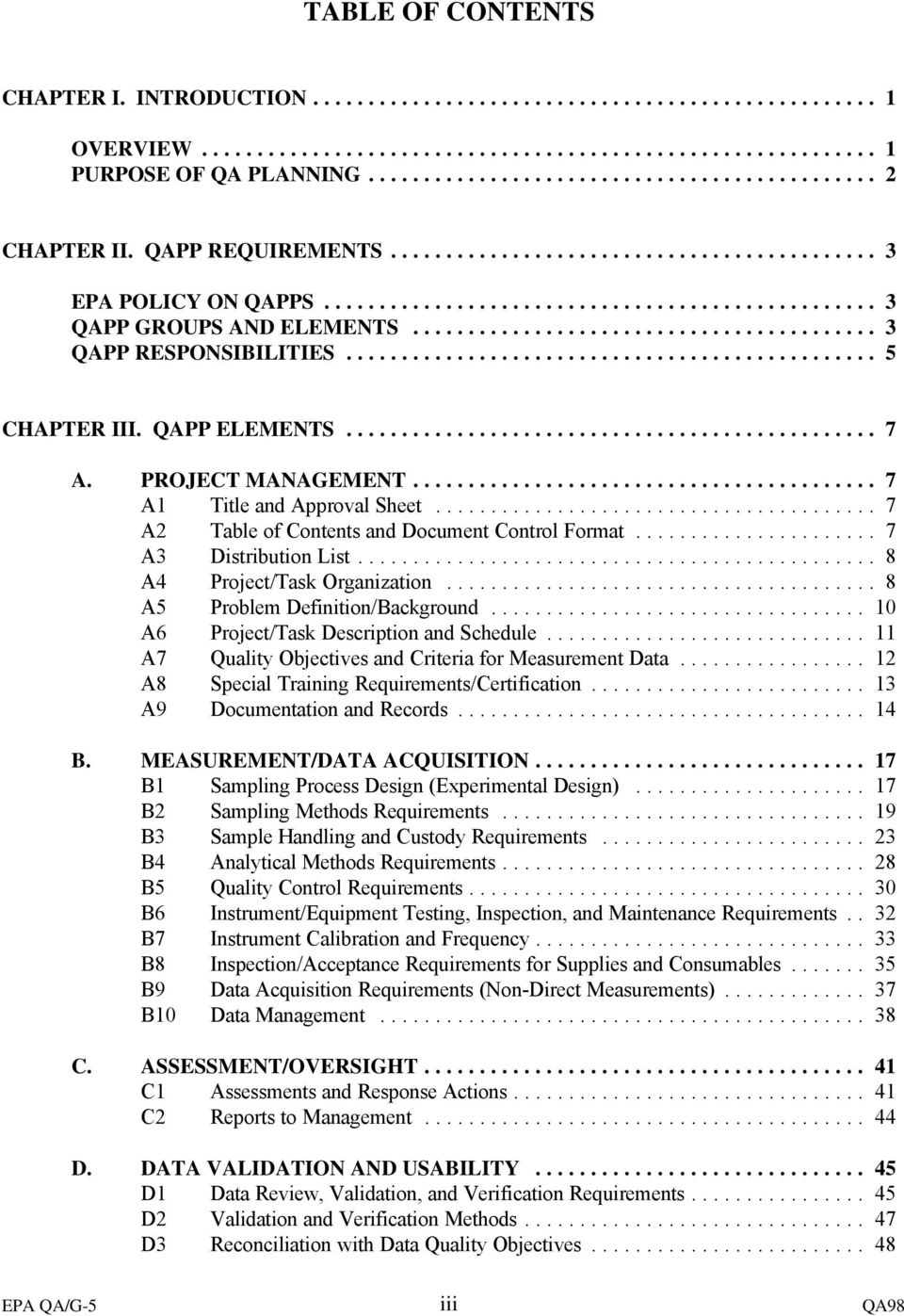
4 TABLE OF CONTENTS CHAPTER I. INTRODUCTION... 1 OVERVIEW... 1 PURPOSE OF QA PLANNING... 2 CHAPTER II. QAPP REQUIREMENTS... 3 EPA POLICY ON QAPPS... 3 QAPP GROUPS AND ELEMENTS... 3 QAPP RESPONSIBILITIES... 5 CHAPTER III. QAPP ELEMENTS... 7 A. PROJECT MANAGEMENT... 7 A1 Title and Approval Sheet... 7 A2 Table of Contents and Document Control Format... 7 A3 Distribution List... 8 A4 Project/Task Organization... 8 A5 Problem Definition/Background A6 Project/Task Description and Schedule A7 Quality Objectives and Criteria for Measurement Data A8 Special Training Requirements/Certification A9 Documentation and Records B. MEASUREMENT/DATA ACQUISITION B1 Sampling Process Design (Experimental Design) B2 Sampling Methods Requirements B3 Sample Handling and Custody Requirements B4 Analytical Methods Requirements B5 Quality Control Requirements B6 Instrument/Equipment Testing, Inspection, and Maintenance Requirements.. 32 B7 Instrument Calibration and Frequency B8 Inspection/Acceptance Requirements for Supplies and Consumables B9 Data Acquisition Requirements (Non-Direct Measurements) B10 Data Management C. ASSESSMENT/OVERSIGHT C1 Assessments and Response Actions C2 Reports to Management D. DATA VALIDATION AND USABILITY D1 Data Review, Validation, and Verification Requirements D2 Validation and Verification Methods D3 Reconciliation with Data Quality Objectives iii
5 CHAPTER IV. QAPP REVISIONS AND RELATED GUIDANCE QAPP REVISIONS COMPARISON WITH PREVIOUS GUIDANCE (QAMS 005/80) APPENDIX A. CROSSWALKS BETWEEN QUALITY ASSURANCE DOCUMENTS... A-1 AA1. Relationship Between E4 and EPA Quality System... A-1 AA2. Crosswalk Between QA/R-5 and QAMS-005/80... A-3 AA3. Crosswalk Between EPA QA/R-5 and ISO A-4 AA4. Crosswalk Between the DQO Process and the QAPP... A-5 AA5. EPA Quality Assurance Documents... A-7 APPENDIX B. GLOSSARY OF QUALITY ASSURANCE AND RELATED TERMS... B-1 APPENDIX C. CHECKLISTS USEFUL IN QUALITY ASSURANCE REVIEW... C-1 AC1. Sample Handling, Preparation, and Analysis Checklist... C-1 AC2. QAPP Review Checklist... C-5 AC3. Chain-of-Custody Checklist... C-8 APPENDIX D. DATA QUALITY INDICATORS... D-1 AD1. Principal DQIs: PARCC... D-1 AD2. Other Data Quality Indicators... D-5 APPENDIX E. QUALITY CONTROL TERMS... E-1 AE1. Quality Control Operations... E-1 AE2. Quality Control Requirements in Existing Programs... E-3 APPENDIX F. SOFTWARE FOR THE DEVELOPMENT AND PREPARATION OF A QUALITY ASSURANCE PROJECT PLAN... F-1 AF1. Overview of Potential Need for Software in QAPP Preparation... F-1 AF2. Existing Software... F-3 AF3. Software Availability and Sources... F-5 APPENDIX G. ISSUES IN DATA MANAGEMENT... G-1 AG1. Introduction... G-1 AG2. Regulatory and Policy Framework... G-1 AG3. QA Planning for Information Systems... G-3 AG4. References... G-14 iv

6 LIST OF FIGURES Figure 1. QA Planning and the Data Life Cycle... 2 Figure 2. An Example of a Table of Contents and a Distribution List... 9 Figure 3. An Example of a Project Organization Chart Figure 4. The DQO Process Figure 5. An Example of a Sample Log Sheet Figure 6. An Example of a Sample Label Figure 7. An Example of a Custody Seal Figure 8. An Example of a Chain-Of-Custody Record Figure 9. Example of a Record for Consumables Figure 10. Example of Inspection/Acceptance Testing Requirements Figure 11. Example of a Log for Tracking Supplies and Consumables Figure AA1. Relationships Among EPA Quality System Documents at the Program Level... A-9 Figure AA2. Relationships Among EPA Quality System Documents at the Project Level... A-10 Figure AD1. Measurement Bias and Random Measurement Uncertainties. Shots at a Target... D-3 LIST OF TABLES Table 1. Project Quality Control Checks Table AA1. Numbering System for EPA s Quality System Documents... A-7 Table AA2. Quality System Documents... A-8 Table AD1. Principal Types of Error... D-6 Table AE1. Comparison of QC Terms... E-6 Table AE2. QC Requirements for Programs... E-13 Table AE3. QC Requirements for Methods... E-16 Table AF1. Software Available to Meet QAPP Development Needs... F-4 Table AG1. Project Scope and Risks... G-5 Table AG2. Software Development Life Cycle... G-7 v

7 LIST OF ACRONYMS ACS ADQ CFR DQA DQI DQO EPA ISO MSR NIST OSHA PARCC PE QA QAD QAMS QAPP QC RCRA SOP SRM TSA American Chemical Society Audit of Data Quality Code of Federal Regulations Data Quality Assessment Data Quality Indicator Data Quality Objective Environmental Protection Agency International Organization for Standardization Management Systems Review National Institute of Standards and Technology Occupational Safety and Health Administration Precision, Accuracy, Representativeness, Comparability, and Completeness Performance Evaluation Quality Assurance Quality Assurance Division Quality Assurance Management Staff (now QAD) Quality Assurance Project Plan Quality Control Resource Conservation and Recovery Act Standard Operating Procedure Standard Reference Material Technical Systems Audit vi

8 CHAPTER I INTRODUCTION OVERVIEW This document presents detailed guidance on how to develop a Quality Assurance Project Plan (QAPP) for environmental data operations performed by or for the U.S. Environmental Protection Agency (EPA). This guidance discusses how to address and implement the specifications in Requirements for QA Project Plans for Environmental Data Operations (EPA QA/R-5). The QAPP is the critical planning document for any environmental data collection operation because it documents how quality assurance (QA) and quality control (QC) activities will be implemented during the life cycle of a program, project, or task. The QAPP is the blueprint for identifying how the quality system of the organization performing the work is reflected in a particular project and in associated technical goals. QA is a system of management activities designed to ensure that the data produced by the operation will be of the type and quality needed and expected by the data user. QA is acknowledged to be a management function emphasizing systems and policies, and it aids the collection of data of needed and expected quality appropriate to support management decisions in a resource-efficient manner. In order to obtain environmental data for decision making, a project should be conducted in three phases: planning, implementation, and assessment. The first phase involves the development of Data Quality Objectives (DQOs) using the DQO Process or a similar structural systematic planning process. The DQOs provide statements about the expectations and requirements of the data user (such as the decision maker). In the second phase, the QAPP translates these requirements into measurement performance specifications and QA/QC procedures for the data suppliers to provide the information needed to satisfy the data user's needs. This guidance links the results of the DQO Process with the QAPP to complete documentation of the planning process. Once the data have been collected and validated in accordance with the elements of the QAPP, the data should be evaluated to determine whether the DQOs have been satisfied. In the assessment phase, the Data Quality Assessment (DQA) Process applies statistical tools to determine whether the data meet the assumptions made during planning and whether the total error in the data is small enough to support a decision within tolerable decision error rates expressed by the decision maker. Plans for data validation and DQA are discussed in the final sections of the QAPP. Thus, the activities addressed and documented in the QAPP cover the entire project life cycle, integrating elements of the planning, implementation, and assessment phases. A QAPP is composed of four sections of project-related information called groups, which are subdivided into specific detailed elements. The degree to which each QAPP element should be addressed will be dependent on the specific project and can range from not applicable to extensive documentation. This document provides a discussion and background of the elements of a QAPP that will typically be necessary. There is no Agency-wide template for QAPP format; however, QAD encourages organizational consistency in the presentation and content of the elements contained within the QAPP. The final decision on the specific need for these elements for project-specific QAPPs will be made by the overseeing or sponsoring EPA organization(s). The Agency encourages the specific tailoring of implementation documents within the EPA s general QA framework on a project-specific basis. 1

9 PLANNING Data Quality Objectives Process Quality Assurance Project Plan Development QA PLANNING FOR DATA COLLECTION Data Quality Objectives Process OUTPUTS Data Quality Objectives Data Collection Design IMPLEMENTATION Field Data Collection and Associated Quality Assurance/Quality Control Activities INPUTS Quality Assurance Project Plan Development ASSESSMENT Quality Assurance Project Plan Data Validation Data Quality Assessment Figure 1. QA Planning and the Data Life Cycle. PURPOSE OF QA PLANNING The EPA Quality System is a structured and documented management system describing the policies, objectives, principles, organization, responsibilities, accountability, and implementation plan of an organization for ensuring quality in its work processes, products, and services. The Agency s Quality System is described in EPA QA/G-0, The EPA Quality System. EPA policy requires that all projects involving the generation, acquisition, and use of environmental data be planned and documented and have an Agency-approved QAPP prior to the start of data collection. The primary purpose of the QAPP is to provide an overview of the project, describe the need for the measurements, and define QA/QC activities to be applied to the project, all within a single document. The QAPP should be detailed enough to provide a clear description of every aspect of the project and include information for every member of the project staff, including samplers, lab staff, and data reviewers. The QAPP facilitates communication among clients, data users, project staff, management, and external reviewers. Effective implementation of the QAPP assists project managers in keeping projects on schedule and within the resource budget. Agency QA policy is described in the Quality Manual and EPA QA/R-1, EPA Quality System Requirements for Environmental Programs. 2

10 CHAPTER II QAPP REQUIREMENTS EPA POLICY ON QAPPS It is EPA s internal policy requirement 1 that the collection of environmental data by or for the Agency be supported by a QA program, or quality system. The authority for this requirement for work done for EPA through extramural agreements may be found in 48 CFR, Chapter 15, Part 1546 for contractors, and 40 CFR, Parts 30, 31, and 35 for financial assistance recipients, and may be included in negotiated interagency agreements and consent agreements in enforcement actions. A key component of this mandatory quality system is the development, review, approval, and implementation of the QAPP. A QAPP must address all of the elements contained in QA/R-5 unless otherwise specified by the EPA QA Manager responsible for the data collection. The format of the QAPP is decided by the QA approving authority prior to preparation of the QAPP. The QAPP is the logical product of the planning process for any data collection, as it documents how QA and QC activities will be planned and implemented. To be complete, the QAPP must meet certain specifications for detail and coverage, but the extent of detail is dependent on the type of project, the data to be collected, and the decisions to be made. Overall, the QAPP must provide sufficient detail to demonstrate that: the project's technical and quality objectives are identified and agreed upon, the intended measurements or data acquisition methods are consistent with project objectives, the assessment procedures are sufficient for determining if data of the type and quality needed and expected are obtained, and any potential limitations on the use of the data can be identified and documented. Documents prepared prior to the QAPP (e.g., standard operating procedures [SOPs], test plans, and sampling plans) can be appended or, in some cases, incorporated by reference. QAPP GROUPS AND ELEMENTS The elements of a QAPP are categorized into "groups" according to their function. Specifications for each element are found in EPA Requirements for Quality Assurance Project Plans (EPA QA/R-5). Summaries of each requirement of the elements from that document are contained in a box at the beginning of each specific element description. The elements of a QAPP are: Group A: Project Management This group of QAPP elements covers the general areas of project management, project history and objectives, and roles and responsibilities of the participants. The following 9 elements ensure that 1 EPA Order , Policy and Program Requirements to Implement the Mandatory Quality Assurance Program, was issued originally in April 1984 and will be revised in

11 the project's goals are clearly stated, that all participants understand the goals and the approach to be used, and that project planning is documented: A1 A2 A3 A4 A5 A6 A7 A8 A9 Title and Approval Sheet Table of Contents and Document Control Format Distribution List Project/Task Organization and Schedule Problem Definition/Background Project/Task Description Quality Objectives and Criteria for Measurement Data Special Training Requirements/Certification Documentation and Records Group B: Measurement/Data Acquisition This group of QAPP elements covers all of the aspects of measurement system design and implementation, ensuring that appropriate methods for sampling, analysis, data handling, and QC are employed and will be thoroughly documented: B1 B2 B3 B4 B5 B6 B7 B8 B9 B10 Sampling Process Design (Experimental Design) Sampling Methods Requirements Sample Handling and Custody Requirements Analytical Methods Requirements Quality Control Requirements Instrument/Equipment Testing, Inspection, and Maintenance Requirements Instrument Calibration and Frequency Inspection/Acceptance Requirements for Supplies and Consumables Data Acquisition Requirements (Non-Direct Measurements) Data Management Group C: Assessment/Oversight The purpose of assessment is to ensure that the QAPP is implemented as prescribed. This group of QAPP elements addresses the activities for assessing the effectiveness of the implementation of the project and the associated QA/QC activities: C1 C2 Assessments and Response Actions Reports to Management Group D: Data Validation and Usability Implementation of Group D elements ensures that the individual data elements conform to the specified criteria, thus enabling reconciliation with the project s objectives. This group of elements covers the QA activities that occur after the data collection phase of the project has been completed: D1 D2 D3 Data Review, Validation, and Verification Requirements Validation and Verification Methods Reconciliation with Data Quality Objectives 4

12 QAPP RESPONSIBILITIES QAPPs may be prepared by EPA organizations and by groups outside EPA including contractors, assistance agreement holders, or other Federal agencies under interagency agreements. Generally, all QAPPs prepared by non-epa organizations must be approved by EPA for implementation. Writing a QAPP is often a collaborative effort within an organization, or among organizations, and depends on the technical expertise, writing skills, knowledge of the project, and availability of the staff. Organizations are encouraged to involve technical project staff and the QA Manager or the QA Officer in this effort to ensure that the QAPP has adequate detail and coverage. None of the environmental data collection work addressed by the QAPP may be started until the initial QAPP has been approved by the EPA Project Officer and the EPA QA Manager and then distributed to project personnel except under circumstances requiring immediate action to protect human health and the environment or to operations conducted under police power. In some cases, EPA may grant conditional or partial approval to a QAPP to permit some work to begin while noncritical deficiencies in it are being resolved. However, the QA Manager should be consulted to determine the length of time and nature of the work that may continue and the type of work that may be performed under a conditionally approved QAPP. Some organizations have defined and outlined these terms as: Approval: No remaining identified deficiencies exist in the QAPP and the project may commence. Partial Approval: Some activities identified in the QAPP still contain critical deficiencies while other activities are acceptable. If the acceptable activities are not contingent upon the completion of the activities with the deficiencies, a partial approval may be granted to allow those activities to proceed. Work will continue to resolve the portions of the QAPP that contain deficiencies. Conditional Approval: Approval of the QAPP or portions thereof will be granted upon agreement to implement specific conditions, specific language, etc. by entities required to approve the QAPP in order to expedite the initiation of field work. In most situations, the conditional approval is upgraded to final approval upon receipt, review, and sign off by all entities of the revised/additional QAPP pages. The organizational group performing the work is responsible for implementing the approved QAPP. This responsibility includes ensuring that all personnel involved in the work have copies of or access to the approved QAPP along with all other necessary planning documents. In addition, the group must ensure that these personnel understand their requirements prior to the start of data generation activities. Moreover, organizations are responsible for keeping the QAPP current when changes to technical aspects of the project change. QAPPs must be revised to incorporate such changes and the QAPP must be re-examined to determine the impact of the changes. Any revisions to the QAPP must be re-approved and distributed to all participants in the project. 5

13 6

14 CHAPTER III QAPP ELEMENTS A PROJECT MANAGEMENT The following project management elements address the procedural aspects of project development and what to include in the QAPP project background, task description, and quality objectives elements. Summaries from R-5 are contained in the text box following the title of each element. A1 TITLE AND APPROVAL SHEET Include title of plan; name of the organization(s); and names, titles, signatures of appropriate approving officials, and their approval dates. The title and approval sheet includes the title of the QAPP; the name(s) of the organization(s) implementing the project; and the names, titles, and signatures, and the signature dates of the appropriate approving officials. The approving officials typically include: the organization's Technical Project Manager, the organization's Quality Assurance Officer or Manager, the EPA (or other funding agency) Technical Project Manager/Project Officer, Laboratory Directors, Laboratory QA Officers, the EPA (or other funding agency) Quality Assurance Officer or Manager, and other key staff, such as the QA Officer of the prime contractor when a QAPP is prepared by a subcontractor organization. The purpose of the approval sheet is to enable officials to document their approval of the QAPP. The title page (along with the organization chart) also identifies the key project officials for the work. The title and approval sheet should also indicate the date of the revision and a document number, if appropriate. A2 TABLE OF CONTENTS AND DOCUMENT CONTROL FORMAT List sections, figures, tables, references, and appendices. The table of contents lists all the elements, references, and appendices contained in a QAPP, including a list of tables and a list of figures that are used in the text. The major headings for most QAPPs should closely follow the list of required elements; an example is shown in Figure 2. While the exact format of the QAPP does not have to follow the sequence given here, it is generally more convenient to do so, and it provides a standard format to the QAPP reviewer. Moreover, consistency in the format makes the document more familiar to users, who can expect to find a specific item in the same place in every QAPP. The table of contents of the QAPP may include a document control component. This information should appear in the upper right-hand corner of each page of the QAPP when document control format is desired. For example: 7

15 Project No. or Name Element or Section No. Revision No. Revision Date Section/Element Page of This component, together with the distribution list (see element A3), facilitates control of the document to help ensure that the most current QAPP is in use by all project participants. Each revision of the QAPP should have a different revision number and date. A3 DISTRIBUTION LIST List all the individuals and their organizations who will receive copies of the approved QAPP and any subsequent revisions. Include all persons who are responsible for implementation (including managers), the QA managers, and representatives of all groups involved. All the persons and document files designated to receive copies of the QAPP, and any planned future revisions, need to be listed in the QAPP. This list, together with the document control information, will help the project manager ensure that all key personnel in the implementation of the QAPP have up-to-date copies of the plan. A typical distribution list appears in Figure 2. A4 PROJECT/TASK ORGANIZATION Identify the individuals or organizations participating in the project and discuss their specific roles and responsibilities. Include principal data users, the decision makers, the project QA manager, and all persons responsible for implementation. Ensure that the project QA manager is independent of the unit generating the data. Provide a concise organization chart showing the relationships and the lines of communication among all project participants; other data users who are outside of the organization generating the data; and any subcontractor relationships relevant to environmental data operations. A4.1 Purpose/Background The purpose of the project organization is to provide EPA and other involved parties with a clear understanding of the role that each party plays in the investigation or study and to provide the lines of authority and reporting for the project. A4.2 Roles and Responsibilities The specific roles, activities, and responsibilities of participants, as well as the internal lines of authority and communication within and between organizations, should be detailed. The position of the QA Manager or QA Officer should be described. Include the principal data users, the decision maker, project manager, QA manager, and all persons responsible for implementation of the QAPP. Also included should be the person responsible for maintaining the QAPP and any individual approving 8

16 CONTENTS Section List of Tables... iv List of Figures...v A Project Management Project/Task Organization Problem Definition/Background Project/Task Description Data Quality Objectives Project Quality Objectives Measurement Performance Criteria Documentation and Records...10 B Measurement Data Acquisition Sampling Process Design Analytical Methods Requirements Organics Inorganics Process Control Monitoring Quality Control Requirements Field QC Requirements Laboratory QC Requirements Instrument Calibration and Frequency Data Acquisition Requirements Data Management...22 C Assessment/Oversight Assessment and Response Actions Technical Systems Audits Performance Evaluation Audits Reports to Management...24 D Data Validation and Usability Data Review, Validation, and Verification Requirements Reconciliation with Data Quality Objectives Assessment of Measurement Performance Data Quality Assessment...27 Distribution List N. Wentworth, EPA/ORD (Work Assignment Manager)* B. Waldron, EPA/ORD (QA Manager) J. Warren, State University (Principal Investigator) T. Dixon, State University (QA Officer) G. Johnson, State University (Field Activities) F. Haeberer, State University (Laboratory Activities) B. Odom, State University (Data Management) E. Renard, ABC Laboratories (Subcontractor Laboratory) P. Lafornara, ABC Laboratories (QA Manager Subcontractor Laboratory) *indicates approving authority Figure 2. An Example of a Table of Contents and a Distribution List 9

17 deliverables other than the project manager. A concise chart showing the project organization, the lines of responsibility, and the lines of communication should be presented; an example is given in Figure 3. For complex projects, it may be useful to include more than one chart one for the overall project (with at least the primary contact) and others for each organization. Where direct contact between project managers and data users does not occur, such as between a project consultant for a potentially responsible party and the EPA risk assessment staff, the organization chart should show the route by which information is exchanged. EPA Work Assignment Manager *N. Wentworth Office of Research & Development EPA QA Manager B. Waldron Office of Research & Development Principal Investigator J. Warren State University Engineering Department communication only Project QA Officer T. Dixon, post doctoral fellow State University Chemistry Department Field Activities G. Johnson, graduate student State University Engineering Department Laboratory Activities F. Haeberer, graduate student State University Chemistry Department Data Management B. Odom, assistant professor State University Mathematics Department Subcontractor ABC Laboratories (GC/MS Analyses Only) Laboratory Manager E. Renard QA Manager P. Lafornara *approving authority Figure 3. An Example of a Project Organization Chart A5 PROBLEM DEFINITION/BACKGROUND State the specific problem to be solved or decision to be made and include sufficient background information to provide a historical and scientific perspective for this particular project. A5.1 Purpose/Background The background information provided in this element will place the problem in historical perspective, giving readers and users of the QAPP a sense of the project s purpose and position relative to other project and program phases and initiatives. 10

18 A5.2 Problem Statement and Background This discussion must include enough information about the problem, the past history, any previous work or data, and any other regulatory or legal context to allow a technically trained reader to make sense of the project objectives and activities. This discussion should include: a description of the problem as currently understood, indicating its importance and programmatic, regulatory, or research context; a summary of existing information on the problem, including any conflicts or uncertainties that are to be resolved by the project; a discussion of initial ideas or approaches for resolving the problem there were considered before selecting the approach described in element A6, Project/Task Description ; and the identification of the principal data user or decision maker (if know). Note that the problem statement is the first step of the DQO Process and the decision specification is the second step of the DQO Process. A6 PROJECT/TASK DESCRIPTION AND SCHEDULE Provide a description of the work to be performed and the schedule for implementation. Include measurements that will be made during the course of the project; applicable technical, regulatory, or program-specific quality standards, criteria, or objectives; any special personnel and equipment requirements; assessment tools needed; a schedule for work to be performed; and project and quality records required, including types of reports needed. A6.1 Purpose/Background The purpose of the project/task description element is to provide the participants with a background understanding of the project and the types of activities to be conducted, including the measurements that will be taken and the associated QA/QC goals, procedures, and timetables for collecting the measurements. A6.2 Description of the Work to be Performed (1) Measurements that are expected during the course of the project. Describe the characteristic or property to be studied and the measurement processes and techniques that will be used to collect data. (2) Applicable technical quality standards or criteria. Cite any relevant regulatory standards or criteria pertinent to the project. For example, if environmental data are collected to test for compliance with a permit limit standard, the standard should be cited and the numerical limits should be given in the QAPP. The DQO Process refers to these limits as "action levels," because the type of action taken by the decision maker will depend on whether the measured levels exceed the limit (Step 5 of the DQO Process). (3) Any special personnel and equipment requirements that may indicate the complexity of the project. Describe any special personnel or equipment required for the specific type of work being planned or measurements being taken. 11

19 (4) The assessment techniques needed for the project. The degree of quality assessment activity for a project will depend on the project's complexity, duration, and objectives. A discussion of the timing of each planned assessment and a brief outline of the roles of the different parties to be involved should be included. (5) A schedule for the work performed. The anticipated start and completion dates for the project should be given. In addition, this discussion should include an approximate schedule of important project milestones, such as the start of environmental measurement activities. (6) Project and quality records required, including the types of reports needed. An indication of the most important records should be given. A7 QUALITY OBJECTIVES AND CRITERIA FOR MEASUREMENT DATA Describe the project quality objectives and measurement performance criteria. A7.1 Purpose/Background The purpose of this element is to document the DQOs of the project and to establish performance criteria for the mandatory systematic planning process and measurement system that will be employed in generating the data. A7.2 Specifying Quality Objectives This element of the QAPP should discuss the desired quality of the final results of the study to ensure that the data user s needs are met. The Agency strongly recommends using the DQO Process (see Figure 4), a systematic procedure for planning data collection activities, to ensure that the right type, quality, and quantity of data are collected to satisfy the data user's needs. DQOs are qualitative and quantitative statements that: clarify the intended use of the data, define the type of data needed to support the decision, identify the conditions under which the data should be collected, and specify tolerable limits on the probability of making a decision error due to uncertainty in the data. 1. State the Problem 2. Identify the Decision 3. Identify Inputs to the Decision 4. Define the Study Boundaries 5. Develop a Decision Rule 6. Specify Limits on Decision Errors 7. Optimize the Design for Obtaining Data Data Quality Indicators (DQIs) can be evolved from DQOs for a sampling activity through the use of the DQO Process Figure 4. The DQO Process (Appendix D). Figure 4 shows the seven steps of the DQO Process, which is explained in detail in EPA QA/G-4, Guidance for the Data Quality Objectives Process. 12
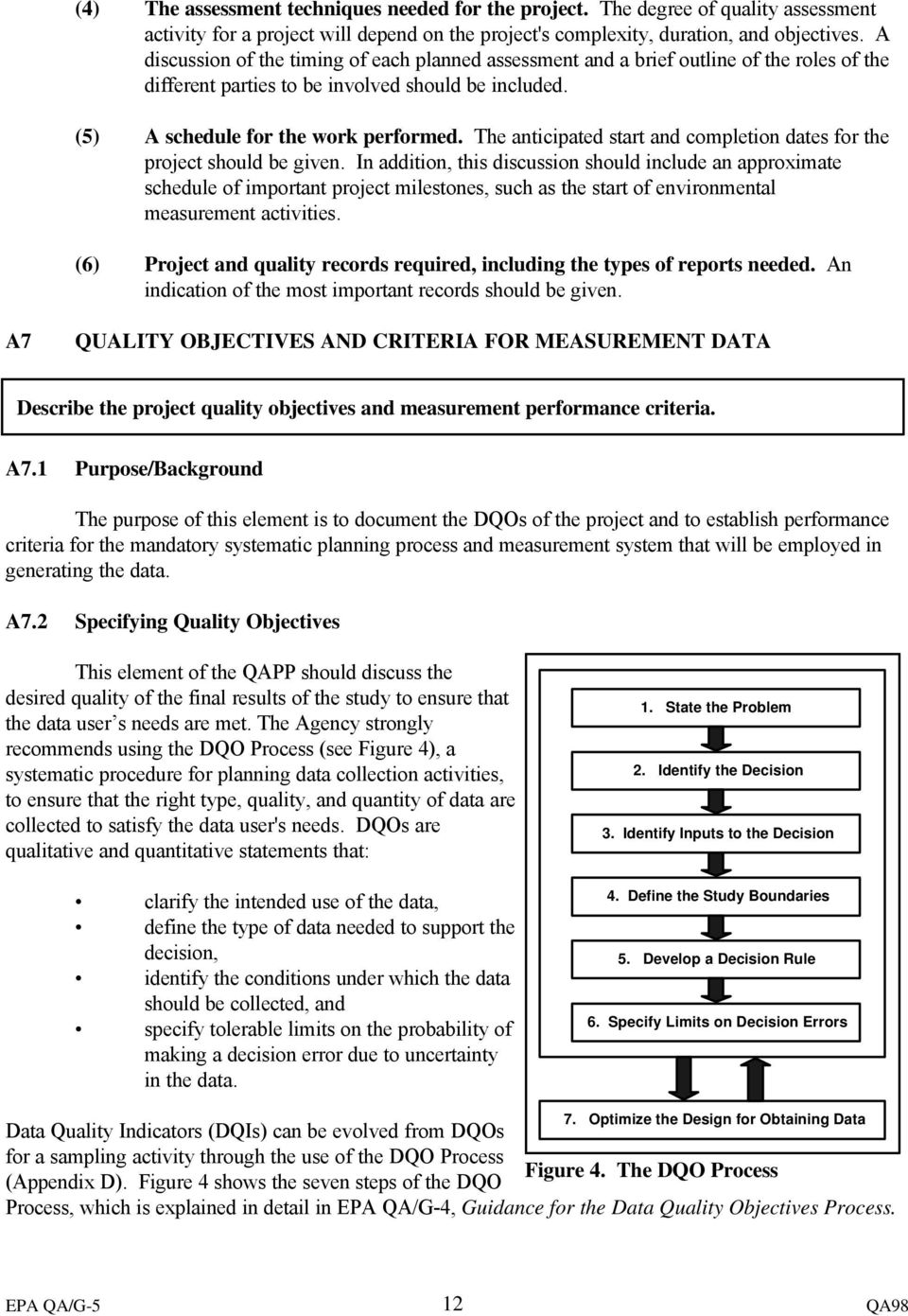
20 Appendix A.4 provides a crosswalk between the requirements of the QAPP and the DQO outputs. The QAPP should include a reference for a full discussion of the proposed DQOs. For exploratory research, sometimes the goal is to develop questions that may be answered by subsequent work. Therefore, researchers may modify activities advocated in QA/G-4 to define decision errors (see EPA QA/G-4R, Data Quality Objectives for Researchers). A7.3 Specifying Measurement Performance Criteria While the quality objectives state what the data user's needs are, they do not provide sufficient information about how these needs can be satisfied. The specialists who will participate in generating the data need to know the measurement performance criteria that must be satisfied to achieve the overall quality objectives. One of the most important features of the QAPP is that it links the data user's quality objectives to verifiable measurement performance criteria. Although the level of rigor with which this is done and documented will vary widely, this linkage represents an important advancement in the implementation of QA. Once the measurement performance criteria have been established, sampling and analytical methods criteria can be specified under the elements contained in Group B. A8 SPECIAL TRAINING REQUIREMENTS/CERTIFICATION Identify and describe any specialized training or certification requirements and discuss how such training will be provided and how the necessary skills will be assured and documented. A8.1 Purpose/Background The purpose of this element is to ensure that any specialized training requirements necessary to complete the projects are known and furnished and the procedures are described in sufficient detail to ensure that specific training skills can be verified, documented, and updated as necessary. A8.2 Training Requirements for specialized training for nonroutine field sampling techniques, field analyses, laboratory analyses, or data validation should be specified. Depending on the nature of the environmental data operation, the QAPP may need to address compliance with specifically mandated training requirements. For example, contractors or employees working at a Superfund site need specialized training as mandated by the Occupational Safety and Health (OSHA) regulations. If hazardous materials are moved offsite, compliance with the training requirements for shipping hazardous materials as mandated by the Department of Transportation (DOT) in association with the International Air Transportation Association may be necessary. This element of the QAPP should show that the management and project teams are aware of specific health and safety needs as well as any other organizational safety plans. A8.3 Certification Usually, the organizations participating in the project that are responsible for conducting training and health and safety programs are also responsible for ensuring certification. Training and certification should be planned well in advance for necessary personnel prior to the implementation of the project. 13

21 All certificates or documentation representing completion of specialized training should be maintained in personnel files. A9 DOCUMENTATION AND RECORDS Itemize the information and records that must be included in the data report package and specify the desired reporting format for hard copy and electronic forms, when used. Identify any other records and documents applicable to the project, such as audit reports, interim progress reports, and final reports, that will be produced. Specify or reference all applicable requirements for the final disposition of records and documents, including location and length of retention period. A9.1 Purpose/Background This element defines which records are critical to the project and what information needs to be included in reports, as well as the data reporting format and the document control procedures to be used. Specification of the proper reporting format, compatible with data validation, will facilitate clear, direct communication of the investigation. A9.2 Information Included in the Reporting Packages The selection of which records to include in a data reporting package must be determined based on how the data will be used. Different "levels of effort" require different supporting QA/QC documentation. For example, organizations conducting basic research have different reporting requirements from organizations collecting data in support of litigation or in compliance with permits. When possible, field and laboratory records should be integrated to provide a continuous reporting track. The following are examples of different records that may be included in the data reporting package. A9.2.1 Field Operation Records The information contained in these records documents overall field operations and generally consists of the following: Sample collection records. These records show that the proper sampling protocol was performed in the field. At a minimum, this documentation should include the names of the persons conducting the activity, sample number, sample collection points, maps and diagrams, equipment/method used, climatic conditions, and unusual observations. Bound field notebooks are generally used to record raw data and make references to prescribed procedures and changes in planned activities. They should be formatted to include pre-numbered pages with date and signature lines. Chain-of-custody records. Chain-of-custody records document the progression of samples as they travel from the original sampling location to the laboratory and finally to their disposal area. (See Appendix C for an example of a chain-of-custody checklist.) 14
22 QC sample records. These records document the generation of QC samples, such as field, trip, and equipment rinsate blanks and duplicate samples. They also include documentation on sample integrity and preservation and include calibration and standards traceability documentation capable of providing a reproducible reference point. Quality control sample records should contain information on the frequency, conditions, level of standards, and instrument calibration history. General field procedures. General field procedures record the procedures used in the field to collect data and outline potential areas of difficulty in gathering specimens. Corrective action reports. Corrective action reports show what methods were used in cases where general field practices or other standard procedures were violated and include the methods used to resolve noncompliance. If applicable, to show regulatory compliance in disposing of waste generated during the data operation, procedures manifest and testing contracts should be included in the field procedures section. A9.2.2 Laboratory Records The following list describes some of the laboratory-specific records that should be compiled if available and appropriate: Sample Data. These records contain the times that samples were analyzed to verify that they met the holding times prescribed in the analytical methods. Included should be the overall number of samples, sample location information, any deviations from the SOPs, time of day, and date. Corrective action procedures to replace samples violating the protocol also should be noted. Sample Management Records. Sample management records document sample receipt, handling and storage, and scheduling of analyses. The records verify that the chain-ofcustody and proper preservation were maintained, reflect any anomalies in the samples (such as receipt of damaged samples), note proper log-in of samples into the laboratory, and address procedures used to ensure that holding time requirements were met. Test Methods. Unless analyses are performed exactly as prescribed by SOPs, this documentation will describe how the analyses were carried out in the laboratory. This includes sample preparation and analysis, instrument standardization, detection and reporting limits, and test-specific QC criteria. Documentation demonstrating laboratory proficiency with each method used could be included. QA/QC Reports. These reports will include the general QC records, such as initial demonstration of capability, instrument calibration, routine monitoring of analytical performance, calibration verification, etc. Project-specific information from the QA/QC checks such as blanks (field, reagent, rinsate, and method), spikes (matrix, matrix spike replicate, analysis matrix spike, and surrogate spike), calibration check samples (zero check, span check, and mid-range check), replicates, splits, and so on should be included in these reports to facilitate data quality analysis. 15
23 A9.2.3 Data Handling Records These records document protocols used in data reduction, verification, and validation. Data reduction addresses data transformation operations such as converting raw data into reportable quantities and units, use of significant figures, recording of extreme values, blank corrections, etc. Data verification ensures the accuracy of data transcription and calculations, if necessary, by checking a set of computer calculations manually. Data validation ensures that QC criteria have been met. A9.3 Data Reporting Package Format and Documentation Control The format of all data reporting packages must be consistent with the requirements and procedures used for data validation and data assessment described in Sections B, C, and D of the QAPP. All individual records that represent actions taken to achieve the objective of the data operation and the performance of specific QA functions are potential components of the final data reporting package. This element should discuss how these various components will be assembled to represent a concise and accurate record of all activities impacting data quality. The discussion should detail the recording medium for the project, guidelines for hand-recorded data (e.g., using indelible ink), procedures for correcting data (e.g., single line drawn through errors and initialed by the responsible person), and documentation control. Procedures for making revisions to technical documents should be clearly specified and the lines of authority indicated. A9.4 Data Reporting Package Archiving and Retrieval The length of storage for the data reporting package may be governed by regulatory requirements, organizational policy, or contractual project requirements. This element of the QAPP should note the governing authority for storage of, access to, and final disposal of all records. A9.5 References Kanare, Howard M Writing the Laboratory Notebook. Washington, DC: American Chemical Society. U.S. Environmental Protection Agency Guidance on Evaluation, Resolution, and Documentation of Analytical Problems Associated with Compliance Monitoring. EPA/821/B-93/
24 B B1 MEASUREMENT/DATA ACQUISITION SAMPLING PROCESS DESIGN (EXPERIMENTAL DESIGN) Describe the experimental design or data collection design for the project. Classify all measurements as critical or non-critical. B1.1 Purpose/Background The purpose of this element is to describe all the relevant components of the experimental design; define the key parameters to be estimated; indicate the number and type of samples expected; and describe where, when, and how samples are to be taken. The level of detail should be sufficient that a person knowledgeable in this area could understand how and why the samples will be collected. This element provides the main opportunity for QAPP reviewers to ensure that the right samples will be taken. Strategies such as stratification, compositing, and clustering should be discussed, and diagrams or maps showing sampling points should be included. Most of this information should be available as outputs from the final steps of the planning (DQO) process. In addition to describing the design, this element of the QAPP should discuss the following: a schedule for project sampling activities, a rationale for the design (in terms of meeting DQOs), the sampling design assumptions, the procedures for locating and selecting environmental samples, a classification of measurements as critical or noncritical, and the validation of any nonstandard sampling/measurement methods. Elements B1.2 through B1.8 address these subjects. B1.2 Scheduled Project Activities, Including Measurement Activities This element should give anticipated start and completion dates for the project as well as anticipated dates of major milestones, such as the following: schedule of sampling events; schedule for analytical services by offsite laboratories; schedule for phases of sequential sampling (or testing), if applicable; schedule of test or trial runs; and schedule for peer review activities. The use of bar charts showing time frames of various QAPP activities to identify both potential bottlenecks and the need for concurrent activities is recommended. B1.3 Rationale for the Design The objectives for an environmental study should be formulated in the planning stage of any investigation. The requirements and the rationale of the design for the collection of data are derived 17
25 from the quantitative outputs of the DQO Process. The type of design used to collect data depends heavily on the key characteristic being investigated. For example, if the purpose of the study is to estimate overall average contamination at a site or location, the characteristic (or parameter) of interest would be the mean level of contamination. This information is identified in Step 5 of the DQO Process. The relationship of this parameter to any decision that has to be made from the data collected is obtained from Steps 2 and 3 of the DQO Process (see Figure 4). The potential range of values for the parameter of interest should be considered during development of the data collection methodology and can be greatly influenced by knowledge of potential ranges in expected concentrations. For example, the number of composite samples needed per unit area is directly related to the variability in potential contaminant levels expected in that area. The choice between a probability-based (statistical) data collection design or a nonrandom (judgmental) data collection methodology depends on the ultimate use of the data being collected. This information is specified in Steps 5 and 6 of the DQO Process. Adherence to the data collection design chosen in Step 7 of the DQO Process directly affects the magnitude of potential decision error rates (false positive rate and false negative rate) established in Step 6 of the DQO Process. Any procedures for coping with unanticipated data collection design changes also should be briefly discussed. B1.4 Design Assumptions The planning process usually recommends a specific data collection method (Step 7 of the DQO Process), but the effectiveness of this methodology rests firmly on assumptions made to establish the data collection design. Typical assumptions include the homogeneity of the medium to be sampled (for example, sludge, fine silt, or wastewater effluent), the independence in the collection of individual samples (for example, four separate samples rather than four aliquots derived from a single sample), and the stability of the conditions during sample collection (for example, the effects of a rainstorm during collection of wastewater from an industrial plant). The assumptions should have been considered during the DQO Process and should be summarized together with a contingency plan to account for exceptions to the proposed sampling plan. An important part of the contingency plan is documenting the procedures to be adopted in reporting deviations or anomalies observed after the data collection has been completed. Examples include an extreme lack of homogeneity within a physical sample or the presence of analytes that were not mentioned in the original sampling plan. Chapter 1 of EPA QA/G-9 provides an overview of sampling plans and the assumptions needed for their implementation. S provides guidance on the construction of sampling plans to meet the requirements generated by the DQO Process. B1.5 Procedures for Locating and Selecting Environmental Samples The most appropriate plan for a particular sampling application will depend on: the practicality and feasibility (e.g., determining specific sampling locations) of the plan, the key characteristic (the parameter established in Step 5 of the DQO Process) to be estimated, and the implementation resource requirements (e.g., the costs of sample collection, transportation, and analysis). This element of the QAPP should also describe the frequency of sampling and specific sample locations (e.g., sample port locations and traverses for emissions source testing, well installation designs for groundwater investigations) and sampling materials. When decisions on the number and location of samples will be made in the field, the QAPP should describe how these decisions will be driven whether by actual observations or by field screening data. When locational data are to be collected, stored, and transmitted, the methodology used must be described (or referenced) and include the following: 18
26 procedures for finding prescribed sample locations, contingencies for cases where prescribed locations are inaccessible, location bias and its assessment, and procedures for reporting deviations from the sampling plan. When appropriate, a map of the sample locations should be provided and locational map coordinates supplied. S provides nonmandatory guidance on the practicality of constructing sampling plans and references to alternative sampling procedures. B1.6 Classification of Measurements as Critical or Noncritical All measurements should be classified as critical (i.e., required to achieve project objectives or limits on decision errors, Step 6 of the DQO Process) or noncritical (for informational purposes only or needed to provide background information). Critical measurements will undergo closer scrutiny during the data gathering and review processes and will have first claim on limited budget resources. It is also possible to include the expected number of samples to be tested by each procedure and the acceptance criteria for QC checks (as described in element B5, Quality Control Requirements ). B1.7 Validation of Any Nonstandard Methods For nonstandard sampling methods, sample matrices, or other unusual situations, appropriate method validation study information may be needed to confirm the performance of the method for the particular matrix. The purpose of this validation information is to assess the potential impact on the representativeness of the data generated. For example, if qualitative data are needed from a modified method, rigorous validation may not be necessary. Such validation studies may include round-robin studies performed by EPA or by other organizations. If previous validation studies are not available, some level of single-user validation study or ruggedness study should be performed during the project and included as part of the project's final report. This element of the QAPP should clearly reference any available validation study information. B2 SAMPLING METHODS REQUIREMENTS Describe the procedures for collecting samples and identify the sampling methods and equipment. Include any implementation requirements, support facilities, sample preservation requirements, and materials needed. Describe the process for preparing and decontaminating sampling equipment, including disposing decontamination by-products; selecting and preparing sample containers, sample volumes, preservation methods, and maximum holding times for sampling and/or analysis. Describe specific performance requirements for the method. Address what to do when a failure in the sampling occurs, who is responsible for corrective action, and how the effectiveness of the corrective action shall be determined and documented. B2.1 Purpose/Background Environmental samples should reflect the target population and parameters of interest. As with all other considerations involving environmental measurements, sampling methods should be chosen with respect to the intended application of the data. Just as methods of analysis vary in accordance with 19
27 project needs, sampling methods can also vary according to these requirements. Different sampling methods have different operational characteristics, such as cost, difficulty, and necessary equipment. In addition, the sampling method can materially affect the representativeness, comparability, bias, and precision of the final analytical result. In the area of environmental sampling, there exists a great variety of sample types. It is beyond the scope of this document to provide detailed advice for each sampling situation and sample type. Nevertheless, it is possible to define certain common elements that are pertinent to many sampling situations with discrete samples (see S). If a separate sampling and analysis plan is required or created for the project, it should be included as an appendix to the QAPP. The QAPP should simply refer to the appropriate portions of the sampling and analysis plan for the pertinent information and not reiterate information. B2.2 Describe the Sample Collection, Preparation, and Decontamination Procedures (1) Select and describe appropriate sampling methods from the appropriate compendia of methods. For each parameter within each sampling situation, identify appropriate sampling methods from applicable EPA regulations, compendia of methods, or other sources of methods that have been approved by EPA. When EPA-sanctioned procedures are available, they will usually be selected. When EPA-sanctioned procedures are not available, standard procedures from other organizations and disciplines may be used. A complete description of non-epa methods should be provided in (or attached to) the QAPP. Procedures for sample homogenization of nonaqueous matrices may be described in part (2) as a technique for assuring sample representativeness. In addition, the QAPP should specify the type of sample to be collected (e.g., grab, composite, depth-integrated, flow- weighted) together with the method of sample preservation. (2) Discuss sampling methods' requirements. Each medium or contaminant matrix has its own characteristics that define the method performance and the type of material to be sampled. Investigators should address the following: actual sampling locations, choice of sampling method/collection, delineation of a properly shaped sample, inclusion of all particles within the volume sampled, and subsampling to reduce the representative field sample into a representative laboratory aliquot. Having identified appropriate and applicable methods, it is necessary to include the requirements for each method in the QAPP. If there is more than one acceptable sampling method applicable to a particular situation, it may be necessary to choose one from among them. DQOs should be considered in choosing these methods to ensure that: a) the sample accurately represents the portion of the environment to be characterized, b) the sample is of sufficient volume to support the planned chemical analysis, and c) the sample remains stable during shipping and handling. (3) Describe the decontamination procedures and materials. Decontamination is primarily applicable in situations of sample acquisition from solid, semi-solid, or liquid media, but it should be addressed, if applicable, for continuous monitors as well. The investigator must 20
28 consider the appropriateness of the decontamination procedures for the project at hand. For example, if contaminants are present in the environmental matrix at the 1% level, it is probably unnecessary to clean sampling equipment to parts-per-billion (ppb) levels. Conversely, if ppblevel detection is required, rigorous decontamination or the use of disposable equipment is required. Decontamination by-products must be disposed of according to EPA policies and the applicable rules and regulations that would pertain to a particular situation, such as the regulations of OSHA, the Nuclear Regulatory Commission (NRC), and State and local governments. B2.3 Identify Support Facilities for Sampling Methods Support facilities vary widely in their analysis capabilities, from percentage-level accuracy to ppb-level accuracy. The investigator must ascertain that the capabilities of the support facilities are commensurate with the requirements of the sampling plan established in Step 7 of the DQO Process. B2.4 Describe Sampling/Measurement System Failure Response and Corrective Action Process This section should address issues of responsibility for the quality of the data, the methods for making changes and corrections, the criteria for deciding on a new sample location, and how these changes will be documented. This section should describe what will be done if there are serious flaws with the implementation of the sampling methodology and how these flaws will be corrected. For example, if part of the complete set of samples is found to be inadmissable, how replacement samples will be obtained and how these new samples will be integrated into the total set of data should be described. B2.5 Describe Sampling Equipment, Preservation, and Holding Time Requirements This section includes the requirements needed to prevent sample contamination (disposable samplers or samplers capable of appropriate decontamination), the physical volume of the material to be collected (the size of composite samples, core material, or the volume of water needed for analysis), the protection of physical specimens to prevent contamination from outside sources, the temperature preservation requirements, and the permissible holding times to ensure against degradation of sample integrity. B2.6 References Publications useful in assisting the development of sampling methods include: Solid and Hazardous Waste Sampling U.S. Environmental Protection Agency Test Methods for Evaluating Solid Waste (SW-846). 3rd Ed., Chapter 9. U.S. Environmental Protection Agency Characterization of Hazardous Waste Sites - A Methods Manual. Vol. I, Site Investigations. EPA-600/ Environmental Monitoring Systems Laboratory. Las Vegas, NV. U.S. Environmental Protection Agency Characterization of Hazardous Waste Sites - A Methods Manual. Vol. II, Available Sampling Methods. EPA-600/ Environmental Monitoring Systems Laboratory. Las Vegas, NV. U.S. Environmental Protection Agency A Compendium of Superfund Field Operations Methods. NTIS PB EPA/540/P-87/001. Washington, DC. 21
29 Ambient Air Sampling U.S. Environmental Protection Agency Quality Assurance Handbook for Air Pollution Measurement Systems. Vol. I, Principles. EPA 600/ Section and Appendix M.5.6. U.S. Environmental Protection Agency Quality Assurance Handbook for Air Pollution Measurement Systems. Vol. II, EPA 600/R b. Sections and and individual methods. U.S. Environmental Protection Agency Compendium of Methods for the Determination of Toxic Organic Compounds in Ambient Air. EPA/ Environmental Monitoring Systems Laboratory. Research Triangle Park, NC. Supplement: EPA September Source Testing (Air) U.S. Environmental Protection Agency Quality Assurance Handbook for Air Pollution Measurement Systems. Vol. III, EPA 600/R c. Section 3.0 and individual methods. Water/ Ground Water U.S. Environmental Protection Agency. Handbook: Ground Water. Cincinnati, OH. EPA/625/6-87/016. March U.S. Environmental Protection Agency. RCRA Ground Water Monitoring Technical Enforcement Guidance Document. Washington, DC U.S. Environmental Protection Agency. Standard Methods for the Examination of Water and Wastewater. 16th ed. Washington, DC Acid Precipitation U.S. Environmental Protection Agency Quality Assurance Handbook for Air Pollution Measurement Systems. Vol. V, EPA 600/94-038e. Meteorological Measurements U.S. Environmental Protection Agency Quality Assurance Handbook for Air Pollution Measurement Systems. Vol. IV, EPA 600/ Radioactive Materials and Mixed Waste U.S. Department of Energy Radioactive-Hazardous Mixed Waste Sampling and Analysis: Addendum to SW-846. Soils and Sediments U.S. Environmental Protection Agency Sediment Sampling Quality Assurance User's Guide. NTIS PB EPA/600/4-85/048. Environmental Monitoring Systems Laboratory. Las Vegas, NV. U.S. Environmental Protection Agency Soil Sampling Quality Assurance User's Guide. EPA/600/8-89/046. Environmental Monitoring Systems Laboratory. Las Vegas, NV. Barth, D.S., and T.H. Starks Sediment Sampling Quality Assurance User's Guide. EPA/ /048. Prepared for Environmental Monitoring and Support Laboratory. Las Vegas, NV. Statistics, Geostatistics, and Sampling Theory Myers, J.C Geostatistical Error Measurement. New York: Van Nostrand Reinhold. Pitard, F.F Pierre Gy's Sampling Theory and Sampling Practice. Vol I and II. Boca Raton, FL: CRC Press. 22
30 Miscellaneous American Chemical Society Joint Board/Council Committee on Environmental Improvement Practical Guide for Environmental Sampling and Analysis, Section II. Environmental Analysis. Washington, DC. ASTM Committee D Standard Practices for Sampling Wastes from Pipes and Other Point Discharges. Document No. D R7. Keith, L EPA's Sampling and Analysis Methods Database Manual. Austin, TX: Radian Corp. Keith, L Environmental Sampling and Analysis: A Practical Guide. Chelsea, MI: Lewis Publishers, Inc. B3 SAMPLE HANDLING AND CUSTODY REQUIREMENTS Describe the requirements and provisions for sample handling and custody in the field, laboratory, and transport, taking into account the nature of the samples, the maximum allowable sample holding times before extraction or analysis, and available shipping options and schedules. Include examples of sample labels, custody forms, and sample custody logs. B3.1 Purpose/Background This element of the QAPP should describe all procedures that are necessary for ensuring that: (1) samples are collected, transferred, stored, and analyzed by authorized personnel; (2) sample integrity is maintained during all phases of sample handling and analyses; and (3) an accurate written record is maintained of sample handling and treatment from the time of its collection through laboratory procedures to disposal. Proper sample custody minimizes accidents by assigning responsibility for all stages of sample handling and ensures that problems will be detected and documented if they occur. A sample is in custody if it is in actual physical possession or it is in a secured area that is restricted to authorized personnel. The level of custody necessary is dependent upon the project s DQOs. While enforcement actions necessitate stringent custody procedures, custody in other types of situations (i.e., academic research) may be primarily concerned only with the tracking of sample collection, handling, and analysis. Sample custody procedures are necessary to prove that the sample data correspond to the sample collected, if data are intended to be legally defensible in court as evidence. In a number of situations, a complete, detailed, unbroken chain of custody will allow the documentation and data to substitute for the physical evidence of the samples (which are often hazardous waste) in a civil courtroom. Some statutes or criminal violations may still necessitate that the physical evidence of sample containers be presented along with the custody and data documentation. An outline of the scope of sample custody--starting from the planning of sample collection, field sampling, sample analysis to sample disposal--should also be included. This discussion should further stress the completion of sample custody procedures, which include the transfer of sample custody from field personnel to lab, sample custody within the analytical lab during sample preparation and analysis, and data storage. 23
31 B3.2 Sample Custody Procedure The QAPP should discuss the sample custody procedure at a level commensurate with the intended use of the data. This discussion should include the following: (1) List the names and responsibilities of all sample custodians in the field and laboratories. (2) Give a description and example of the sample numbering system. (3) Define acceptable conditions and plans for maintaining sample integrity in the field prior to and during shipment to the laboratory (e.g., proper temperature and preservatives). (4) Give examples of forms and labels used to maintain sample custody and document sample handling in the field and during shipping. An example of a sample log sheet is given in Figure 5; an example sample label is given in Figure 6. (5) Describe the method of sealing shipping containers with chain-of-custody seals. An example of a seal is given in Figure 7. (6) Describe procedures that will be used to maintain the chain of custody and document sample handling during transfer from the field to the laboratory, within the laboratory, and among contractors. An example of a chain-of-custody record is given in Figure 8. (7) Provide for the archiving of all shipping documents and associated paperwork. (8) Discuss procedures that will ensure sample security at all times. (9) Describe procedures for within-laboratory chain-of-custody together with verification of the printed name, signature, and initials of the personnel responsible for custody of samples, extracts, or digests during analysis at the laboratory. Finally, document disposal or consumption of samples should also be described. A chain-of-custody checklist is included in Appendix C to aid in managing this element. Minor documentation of chain-of-custody procedures is generally applicable when: Samples are generated and immediately tested within a facility or site; and Continuous rather than discrete or integrated samples are subjected to real- or near realtime analysis (e.g., continuous monitoring). The discussion should be as specific as possible about the details of sample storage, transportation, and delivery to the receiving analytical facility. 24
32 FOR SURVEY SAMPLE LOG SHEET NO. DATE TYPE OF SAMPLE SAMPLER: (Signature) A N A L Y S E S R E Q U I R E D TIME SAMPLE TAKEN TOTAL VOLUME STATION NUMBER STATION DESCRIPTION PRESERVATIVE TYPE CONTAINER NUTRIENTS BOD COD TOC TOTAL SOLIDS SUSPENDED SOLIDS ALKALINITY DO ph* CONDUCTIVITY* TEMPERATURE* TOTAL COLIFORM FECAL COLIFORM TURBIDITY OIL AND GREASE METALS BACTI PESTICIDES HERB TRACE ORGANICS PHENOL CYANIDE REMARKS *Field Measurements U.S. EPA, NEIC Director Figure 5. An Example of a Sample Log Sheet 25
33 Sample Description: (Name of Sampling Organization) Plant: Location: Date: Time: Media: Station: Sample Type: Preservative: Sampled By: Sample ID No.: Remarks: Lab No. Figure 6. An Example of a Sample Label Signature CUSTODY SEAL Date CUSTODY SEAL Date Signature Figure 7. An Example of a Custody Seal 26
34 SAMPLERS (Signature) STATION NUMBER STATION LOCATION DATE TIME SAMPLE TYPE WATER AIR SEQ NO. NO. OF CONTAINERS ANALYSIS REQUIRED Comp Grabx Relinquished by: (Signature) Received by: (Signature) DATE/TIME Relinquished by: (Signature) Received by: (Signature) DATE/TIME Relinquished by: (Signature) Received by: (Signature) DATE/TIME Received by: (Signature) Received by Mobile Laboratory for field DATE/TIME analysis: (Signature) Received by: (Signature) DATE/TIME Received for Laboratory by: DATE/TIME Method of Shipment: Distribution: Original - Accompany Shipment 1 Copy - Survey Coordinator Field Files Figure 8. An Example of a Chain-of-Custody Record 27
35 B4 ANALYTICAL METHODS REQUIREMENTS Identify the analytical methods and equipment required, including sub-sampling or extraction methods, laboratory decontamination procedures and materials (such as the case of hazardous or radioactive samples), waste disposal requirements (if any), and specific performance requirements for the method. Identify analytical methods by number, date, and regulatory citation (as appropriate). If a method allows the user to select from various options, then the method citations should state exactly which options are being selected. For non-standard methods, such as unusual sample matrices and situations, appropriate method performance study information is needed to confirm the performance of the method for the particular matrix. If previous performance studies are not available, they must be developed during the project and included as part of the project results. Address what to do when a failure in the analytical system occurs, who is responsible for corrective action, and how the effectiveness of the corrective action shall be determined and documented. Specify the laboratory turnaround time needed, if important to the project schedule. Specify whether a field sampling and/or laboratory analysis case narrative is required to provide a complete description of any difficulties encountered during sampling or analysis. B4.1 Purpose/Background The choice of analytical methods will be influenced by the performance criteria, Data Quality Objectives, and possible regulatory criteria. If appropriate, a citation of analytical procedures may be sufficient if the analytical method is a complete SOP. For other methods, it may suffice to reference a procedure (i.e., from Test Methods for Evaluating Solid Waste, SW-846) and further supplement it with the particular options/variations being used by the lab, the detection limits actually achieved, the calibration standards and concentrations used, etc. If the procedure is unique or an adaption of a standard method, complete analytical and sample preparation procedures will need to be attached to the QAPP. Specific monitoring methods and requirements to demonstrate compliance traditionally were specified in the applicable regulations and/or permits. However, this approach is being replaced by the Performance-Based Measurement System (PBMS). PBMS is a process in which data quality needs, mandates, or limitations of a program or project are specified and serve as a criterion for selecting appropriate methods. The regulated body selects the most cost-effective methods that meet the criteria specified in the PBMS. Under the PBMS framework, the performance of the method employed is emphasized rather than the specific technique or procedure used in the analysis. Equally stressed in this system is the requirement that the performance of the method be documented and certified by the laboratory that appropriate QA/QC procedures have been conducted to verify the performance. PBMS applies to physical, chemical, and biological techniques of analysis performed in the field as well as in the laboratory. PBMS does not apply to the method-defined parameters. 28
36 The QAPP should also address the issue of the quality of analytical data as indicated by the data s ability to meet the QC acceptance criteria. This section should describe what should be done if the calibration check samples exceed the control limits due to mechanical failure of the instrumentation, a drift in the calibration curve occurs, or if a reagent blank indicates contamination. This section should also indicate the authorities responsible for the quality of the data, the protocols for making changes and implementing corrective actions, and the methods for reporting the data and its limitations. Laboratory contamination from the processing of hazardous materials such as toxic or radioactive samples for analysis and their ultimate disposal should be a considered during the planning stages for selection of analysis methods. Safe handling requirements for project samples in the laboratory with appropriate decontamination and waste disposal procedures should also be described. B4.2 Subsampling If subsampling is required, the procedures should be described in this QAPP element, and the full text of the subsampling operating procedures should be appended to the QAPP. Because subsampling may involve more than one stage, it is imperative that the procedures be documented fully so that the results of the analysis can be evaluated properly. B4.3 Preparation of the Samples Preparation procedures should be described and standard methods cited and used where possible. Step-by-step operating procedures for the preparation of the project samples should be listed in an appendix. The sampling containers, methods of preservation, holding times, holding conditions, number and types of all QA/QC samples to be collected, percent recovery, and names of the laboratories that will perform the analyses need to be specifically referenced. B4.4 Analytical Methods The citation of an analytical method may not always be sufficient to fully characterize a method because the analysis of a sample may require deviation from a standard method and selection from the range of options in the method. The SOP for each analytical method should be cited or attached to the QAPP, and all deviations or alternative selections should be detailed in the QAPP. The matrix containing the subject analytes often dictates the sampling and analytical methods. Gaseous analytes often must be concentrated on a trap in order to collect a measurable quantity. If the matrix is a liquid or a solid, the analytes usually must be separated from it using various methods of extraction. Sometimes the analyte is firmly linked by chemical bonds to other elements and must be subjected to digestion methods to be freed for analysis. Often the selected analytical methods may be presented conveniently in one or several tables describing the matrix, the analytes to be measured, the analysis methods, the type, the precision/accuracy data, the performance acceptance criteria, the calibration criteria, and etc. Appendix C contains a checklist of many important components to consider when selecting analytical methods. B4.5 References Greenberg, A.E., L.S. Clescer, and A. D. Eaton, eds Standard Methods for the Examination of Water and Wastewater. 18 th ed. American Public Health Association. Water Environment Federation. 29
37 U.S. Environmental Protection Agency Quality Control: Variability in Protocols. EPA/600/9-91/034. Risk Reduction Engineering Laboratory. U.S. EPA. Cincinnati, OH. U.S. Environmental Protection Agency. Test Methods for Evaluating Solid Waste. SW-846. Chapter 2, Choosing the Correct Procedure. B5 QUALITY CONTROL REQUIREMENTS Identify required measurement QC checks for both the field and the laboratory. State the frequency of analysis for each type of QC check, and the spike compounds sources and levels. State or reference the required control limits for each QC check and corrective action required when control limits are exceeded and how the effectiveness of the corrective action shall be determined and documented. Describe or reference the procedures to be used to calculate each of the QC statistics. B5.1 Purpose/Background QC is the overall system of technical activities that measures the attributes and performance of a process, item, or service against defined standards to verify that they meet the stated requirements established by the customer. QC is both corrective and proactive in establishing techniques to prevent the generation of unacceptable data, and so the policy for corrective action should be outlined. This element will rely on information developed in section A7, Quality Objectives and Criteria for Measurement Data, which establishes measurement performance criteria. B5.2 QC Procedures This element documents any QC checks not defined in other QAPP elements and should reference other elements that contain this information where possible. Most of the QC acceptance limits of EPA methods are based on the results of interlaboratory studies. Because of improvements in measurement methodology and continual improvement efforts in individual laboratories, these acceptance limits may not be stringent enough for some projects. In some cases, acceptance limits are based on intralaboratory studies (which often result in narrower acceptance limits than those based on interlaboratory limits), and consultation with an expert may be necessary. Other elements of the QAPP that contain related sampling and analytical QC requirements include: Sampling Process Design (B1), which identifies the planned field QC samples as well as procedures for QC sample preparation and handling; Sampling Methods Requirements (B2), which includes requirements for determining if the collected samples accurately represent the population of interest; Sample Handling and Custody Requirements (B3), which discusses any QC devices employed to ensure samples are not tampered with (e.g., custody seals) or subjected to other unacceptable conditions during transport; Analytical Methods Requirements (B4), which includes information on the subsampling methods and information on the preparation of QC samples in the sample matrix (e.g., splits, spikes, and replicates); and 30
38 Instrument Calibration and Frequency (B7), which defines prescribed criteria for triggering recalibration (e.g., failed calibration checks). Table 1 lists QC checks often included in QAPPs. The need for the specific check depends on the project objectives. Table 1. Project Quality Control Checks QC Check Information Provided Blanks field blank reagent blank rinsate blank method blank Spikes matrix spike matrix spike replicate analysis matrix spike surrogate spike Calibration Check Samples zero check span check mid-range check Replicates, splits, etc. collocated samples field replicates field splits laboratory splits laboratory replicates analysis replicates transport and field handling bias contaminated reagent contaminated equipment response of entire laboratory analytical system analytical (preparation + analysis) bias analytical bias and precision instrumental bias analytical bias calibration drift and memory effects calibration drift and memory effects calibration drift and memory effects sampling + measurement precision precision of all steps after acquisition shipping + interlaboratory precision interlaboratory precision analytical precision instrument precision Many QC checks result in measurement data that are used to compute statistical indicators of data quality. For example, a series of dilute solutions may be measured repeatedly to produce an estimate of the instrument detection limit. The formulas for calculating such Data Quality Indicators (DQIs) should be provided or referenced in the text. This element should also prescribe any limits that define acceptable data quality for these indicators (see also Appendix D, Data Quality Indicators ). A QC checklist should be used to discuss the relation of QC to the overall project objectives with respect to: the frequency and point in the measurement process in which the check sample is introduced, the traceability of the standards, the matrix of the check sample, the level or concentration of the analyte of interest, the actions to be taken if a QC check identifies a failed or changed measurement system, the formulas for estimating DQIs, and the procedures for documenting QC results, including control charts. 31
39 Finally, this element should describe how the QC check data will be used to determine that measurement performance is acceptable. This step can be accomplished by establishing QC warning and control limits for the statistical data generated by the QC checks (see standard QC textbooks or refer to T for operational details). Depending on the breadth of the potential audience for reviewing and implementing the QAPP, it may be advantageous to separate the field QC from the laboratory QC requirements. B6 INSTRUMENT/EQUIPMENT TESTING, INSPECTION, AND MAINTENANCE REQUIREMENTS Describe how inspections and acceptance testing of environmental sampling and measurement systems and their components will be performed and documented. Identify and discuss the procedure by which final acceptance will be performed by independent personnel and/or by the EPA Project Officer. Describe how deficiencies are to be resolved and when re-inspection will be performed. Describe or reference how periodic preventive and corrective maintenance of measurement or test equipment shall be performed. Identify the equipment and/or systems requiring periodic maintenance. Discuss how the availability of critical spare parts, identified in the operating guidance and/or design specifications of the systems, will be assured and maintained. B6.1 Purpose/Background The purpose of this element of the QAPP is to discuss the procedures used to verify that all instruments and equipment are maintained in sound operating condition and are capable of operating at acceptable performance levels. B6.2 Testing, Inspection, and Maintenance The procedures described should (1) reflect consideration of the possible effect of equipment failure on overall data quality, including timely delivery of project results; (2) address any relevant sitespecific effects (e.g., environmental conditions); and (3) include procedures for assessing the equipment status. This element should address the scheduling of routine calibration and maintenance activities, the steps that will be taken to minimize instrument downtime, and the prescribed corrective action procedures for addressing unacceptable inspection or assessment results. This element should also include periodic maintenance procedures and describe the availability of spare parts and how an inventory of these parts is monitored and maintained. The reader should be supplied with sufficient information to review the adequacy of the instrument/equipment management program. Appending SOPs containing this information to the QAPP and referencing the SOPs in the text are acceptable. Inspection and testing procedures may employ reference materials, such as the National Institute of Standards and Technology s (NIST s) Standard Reference Materials (SRMs), as well as QC standards or an equipment certification program. The accuracy of calibration standards is important because all data will be measured in reference to the standard used. The types of standards or special programs should be noted in this element, including the inspection and acceptance testing criteria for all 32
40 components. The acceptance limits for verifying the accuracy of all working standards against primary grade standards should also be provided. B7 INSTRUMENT CALIBRATION AND FREQUENCY Identify all tools, gauges, instruments, and other sampling, measuring, and test equipment used for data collection activities affecting quality that must be controlled and, at specified periods, calibrated to maintain performance within specified limits. Identify the certified equipment and/or standards used for calibration. Describe or reference how calibration will be conducted using certified equipment and/or standards with known valid relationships to nationally recognized performance standards. If no such nationally recognized standards exist, document the basis for the calibration. Indicate how records of calibration shall be maintained and be traceable to the instrument. B7.1 Purpose/Background This element of the QAPP concerns the calibration procedures that will be used for instrumental analytical methods and other measurement methods that are used in environmental measurements. It is necessary to distinguish between defining calibration as the checking of physical measurements against accepted standards and as determining the relationship (function) of the response versus the concentration. The American Chemical Society (ACS) limits the definition of the term calibration to the checking of physical measurements against accepted standards, and uses the term standardization to describe the determination of the response function. B7.2 Identify the Instrumentation Requiring Calibration The QAPP should identify any equipment or instrumentation that requires calibration to maintain acceptable performance. While the primary focus of this element is on instruments of the measurement system (sampling and measurement equipment), all methods require standardization to determine the relationship between response and concentration. B7.3 Document the Calibration Method that Will Be Used for Each Instrument The QAPP must describe the calibration method for each instrument in enough detail for another researcher to duplicate the calibration method. It may reference external documents such as EPAdesignated calibration procedures or SOPs providing that these documents can be easily obtained. Nonstandard calibration methods or modified standard calibration methods should be fully documented and justified. Some instrumentation may be calibrated against other instrumentation or apparatus (e.g., NIST thermometer), while other instruments are calibrated using standard materials traceable to national reference standards. QAPP documentation for calibration apparatus and calibration standards are addressed in B7.4 and B7.5. Calibrations normally involve challenging the measurement system or a component of the measurement system at a number of different levels over its operating range. The calibration may cover a narrower range if accuracy in that range is critical, given the end use of the data. Single-point 33
41 calibrations are of limited use, and two-point calibrations do not provide information on nonlinearity. If single- or two-point calibrations are used for critical measurements, the potential shortcomings should be carefully considered and discussed in the QAPP. Most EPA-approved analytical methods require multipoint (three or more) calibrations that include zeros, or blanks, and higher levels so that unknowns fall within the calibration range and are bracketed by calibration points. The number of calibration points, the calibration range, and any replication (repeated measures at each level) should be given in the QAPP. The QAPP should describe how calibration data will be analyzed. The use of statistical QC techniques to process data across multiple calibrations to detect gradual degradations in the measurement system should be described. The QAPP should describe any corrective action that will be taken if calibration (or calibration check) data fail to meet the acceptance criteria, including recalibration. References to appended SOPs containing the calibration procedures are an acceptable alternative to describing the calibration procedures within the text of the QAPP. B7.4 Document the Calibration Apparatus Some instruments are calibrated using calibration apparatus rather than calibration standards. For example, an ozone generator is part of a system used to calibrate continuous ozone monitors. Commercially available calibration apparatus should be listed together with the make (the manufacturer's name), the model number, and the specific variable control settings that will be used during the calibrations. A calibration apparatus that is not commercially available should be described in enough detail for another researcher to duplicate the apparatus and follow the calibration procedure. B7.5 Document the Calibration Standards Most measurement systems are calibrated by processing materials that are of known and stable composition. References describing these calibration standards should be included in the QAPP. Calibration standards are normally traceable to national reference standards, and the traceability protocol should be discussed. If the standards are not traceable, the QAPP must include a detailed description of how the standards will be prepared. Any method used to verify the certified value of the standard independently should be described. B7.6 Document Calibration Frequency The QAPP must describe how often each measurement method will be calibrated. It is desirable that the calibration frequency be related to any known temporal variability (i.e., drift) of the measurement system. The calibration procedure may involve less-frequent comprehensive calibrations and more-frequent simple drift checks. The location of the record of calibration frequency and maintenance should be referenced. B7.7 References American Chemical Society Calibration. Analytical Chemistry, Vol. 52, pps. 2,242-2,249. Dieck, R.H Measurement Uncertainty Methods and Applications. Research Triangle Park, NC: Instrument Society of America. Dux, J.P Handbook of Quality Assurance for the Analytical Chemistry Laboratory. New York: Van Nostrand Reinhold. 34
42 ILAC Task Force E Guidelines for the Determination of Recalibration Intervals of Testing Equipment Used in Testing Laboratories. International Organization for Legal Metrology (OIML). International Document No Rue Twigot, Paris 95009, France. Ku, H.H., ed Precision Measurement and Calibration. Selected NBS Papers on Statistical Concepts and Procedures. Special Publication 300. Vol. 1. Gaithersburg, MD: National Bureau of Standards. Liggett, W "Tests of the Recalibration Period of a Drifting Instrument." In Oceans '86 Conference Record. Vol. 3. Monitoring Strategies Symposium. The Institute of Electrical and Electronics Engineers, Inc., Service Center. Piscataway, NJ. Pontius, P.E Notes on the Fundamentals of Measurement as a Production Process. Publication No. NBSIR Gaithersburg, MD: National Bureau of Standards. Taylor, J.T Quality Assurance of Chemical Measurements. Boca Raton, FL: Lewis Publishers, Inc. B8 INSPECTION/ACCEPTANCE REQUIREMENTS FOR SUPPLIES AND CONSUMABLES Describe how and by whom supplies and consumables shall be inspected and accepted for use in the project. State acceptance criteria for such supplies and consumables. B8.1 Purpose The purpose of this element is to establish and document a system for inspecting and accepting all supplies and consumables that may directly or indirectly affect the quality of the project or task. If these requirements have been included under another section, it is sufficient to provide a reference. B8.2 Identification of Critical Supplies and Consumables Clearly identify and document all supplies and consumables that may directly or indirectly affect the quality of the project or task. See Figures 9 and 10 for example documentation of inspection/acceptance testing requirements. Typical examples include sample bottles, calibration gases, reagents, hoses, materials for decontamination activities, deionized water, and potable water. For each item identified, document the inspection or acceptance testing requirements or specifications (e.g., concentration, purity, cell viability, activity, or source of procurement) in addition to any requirements for certificates of purity or analysis. B8.3 Establishing Acceptance Criteria Acceptance criteria must be consistent with overall project technical and quality criteria (e.g., concentration must be within ± 2.5%, cell viability must be >90%). If special requirements are needed for particular supplies or consumables, a clear agreement should be established with the supplier, including the methods used for evaluation and the provisions for settling disparities. B8.4 Inspection or Acceptance Testing Requirements and Procedures Inspections or acceptance testing should be documented, including procedures to be followed, individuals responsible, and frequency of evaluation. In addition, handling and storage conditions for supplies and consumables should be documented. 35
43 B8.5 Tracking and Quality Verification of Supplies and Consumables Procedures should be established to ensure that inspections or acceptance testing of supplies and consumables are adequately documented by permanent, dated, and signed records or logs that uniquely identify the critical supplies or consumables, the date received, the date tested, the date to be retested (if applicable), and the expiration date. These records should be kept by the responsible individual(s) (see Figure 11 for an example log). In order to track supplies and consumables, labels with the information on receipt and testing should be used. These or similar procedures should be established to enable project personnel to (1) verify, prior to use, that critical supplies and consumables meet specified project or task quality objectives; and (2) ensure that supplies and consumables that have not been tested, have expired, or do not meet acceptance criteria are not used for the project or task. Unique identification no. (if not clearly shown) Date received Date opened Date tested (if performed) Date to be retested (if applicable) Expiration date Figure 9. Example of a Record for Consumables Critical Supplies and Consumables Inspection/ Acceptance Testing Requirements Acceptance Criteria Testing Method Frequency Responsible Individual Handling/Storage Conditions Figure 10. Example of Inspection/Acceptance Testing Requirements Critical Supplies and Consumable (Type, ID No.) Date Received Meets Inspection/ Acceptance Criteria (Y/N, Include Date) Requires Retesting (Y/N, If Yes, Include Date) Expiration Date Comments Initials/Date Figure 11. Example of a Log for Tracking Supplies and Consumables 36
44 B9 DATA ACQUISITION REQUIREMENTS (NON-DIRECT MEASUREMENTS) Identify any types of data needed for project implementation or decision making that are obtained from non-measurement sources such as computer databases, programs, literature files, and historical databases. Define the acceptance criteria for the use of such data in the project and discuss any limitations on the use of the data resulting from uncertainty in its quality. Document the rationale for the original collection of data and indicate its relevance to this project. B9.1 Purpose/Background This element of the QAPP should clearly identify the intended sources of previously collected data and other information that will be used in this project. Information that is non-representative and possibly biased and is used uncritically may lead to decision errors. The care and skepticism applied to the generation of new data are also appropriate to the use of previously compiled data (for example, data sources such as handbooks and computerized databases). B9.2 Acquisition of Non-Direct Measurement Data This element s criteria should be developed to support the objectives of element A7. Acceptance criteria for each collection of data being considered for use in this project should be explicitly stated, especially with respect to: Representativeness. Were the data collected from a population that is sufficiently similar to the population of interest and the population boundaries? How will potentially confounding effects (for example, season, time of day, and cell type) be addressed so that these effects do not unduly alter the summary information? Bias. Are there characteristics of the data set that would shift the conclusions. For example, has bias in analysis results been documented? Is there sufficient information to estimate and correct bias? Precision. How is the spread in the results estimated? Does the estimate of variability indicate that it is sufficiently small to meet the objectives of this project as stated in element A7? See also Appendix D. Qualifiers. Are the data evaluated in a manner that permits logical decisions on whether or not the data are applicable to the current project? Is the system of qualifying or flagging data adequately documented to allow the combination of data sets? Summarization. Is the data summarization process clear and sufficiently consistent with the goals of this project? (See element D2 for further discussion.) Ideally, observations and transformation equations are available so that their assumptions can be evaluated against the objectives of the current project. 37
45 This element should also include a discussion on limitations on the use of the data and the nature of the uncertainty of the data. B10 DATA MANAGEMENT Describe the project data management scheme, tracing the path of the data from their generation in the field or laboratory to their final use or storage. Describe or reference the standard record-keeping procedures, document control system, and the approach used for data storage and retrieval on electronic media. Discuss the control mechanism for detecting and correcting errors and for preventing loss of data during data reduction, data reporting, and data entry to forms, reports, and databases. Provide examples of any forms or checklists to be used. Identify and describe all data handling equipment and procedures to process, compile, and analyze the data, including any required computer hardware and software. Address any specific performance requirements and describe the procedures that will be followed to demonstrate acceptability of the hardware/software configuration required. Describe the process for assuring that applicable Agency information resource management requirements and locational data requirements are satisfied. If other Agency data management requirements are applicable, discuss how these requirements are addressed. B10.1 Purpose/Background This element should present an overview of all mathematical operations and analyses performed on raw ( as-collected ) data to change their form of expression, location, quantity, or dimensionality. These operations include data recording, validation, transformation, transmittal, reduction, analysis, management, storage, and retrieval. A diagram that illustrates the source(s) of the data, the processing steps, the intermediate and final data files, and the reports produced may be helpful, particularly when there are multiple data sources and data files. When appropriate, the data values should be subjected to the same chain-of-custody requirements as outlined in element B3. Appendix G has further details. B10.2 Data Recording Any internal checks (including verification and validation checks) that will be used to ensure data quality during data encoding in the data entry process should be identified together with the mechanism for detailing and correcting recording errors. Examples of data entry forms and checklists should be included. B10.3 Data Validation The details of the process of data validation and prespecified criteria should be documented in this element of the QAPP. This element should address how the method, instrument, or system performs the function it is intended to consistently, reliably, and accurately in generating the data. Part D of this document addresses the overall project data validation, which is performed after the project has been completed. 38
46 B10.4 Data Transformation Data transformation is the conversion of individual data point values into related values or possibly symbols using conversion formulas (e.g., units conversion or logarithmic conversion) or a system for replacement. The transformations can be reversible (e.g., as in the conversion of data points using a formulas) or irreversible (e.g., when a symbol replaces actual values and the value is lost). The procedures for all data transformations should be described and recorded in this element. The procedure for converting calibration readings into an equation that will be applied to measurement readings should be documented in the QAPP. Transformation and aberration of data for statistical analysis should be outlined in element D3, Reconciliation with Data Quality Objectives. B10.5 Data Transmittal Data transmittal occurs when data are transferred from one person or location to another or when data are copied from one form to another. Some examples of data transmittal are copying raw data from a notebook onto a data entry form for keying into a computer file and electronic transfer of data over a telephone or computer network. The QAPP should describe each data transfer step and the procedures that will be used to characterize data transmittal error rates and to minimize information loss in the transmittal. B10.6 Data Reduction Data reduction includes all processes that change the number of data items. This process is distinct from data transformation in that it entails an irreversible reduction in the size of the data set and an associated loss of detail. For manual calculations, the QAPP should include an example in which typical raw data are reduced. For automated data processing, the QAPP should clearly indicate how the raw data are to be reduced with a well-defined audit trail, and reference to the specific software documentation should be provided. B10.7 Data Analysis Data analysis sometimes involves comparing suitably reduced data with a conceptual model (e.g., a dispersion model or an infectivity model). It frequently includes computation of summary statistics, standard errors, confidence intervals, tests of hypotheses relative to model parameters, and goodness-of-fit tests. This element should briefly outline the proposed methodology for data analysis and a more detailed discussion should be included in the final report. B10.8 Data Tracking Data management includes tracking the status of data as they are collected, transmitted, and processed. The QAPP should describe the established procedures for tracking the flow of data through the data processing system. B10.9 Data Storage and Retrieval The QAPP should discuss data storage and retrieval including security and time of retention, and it should document the complete control system. The QAPP should also discuss the performance requirements of the data processing system, including provisions for the batch processing schedule and the data storage facilities. 39
47 40
48 C C1 ASSESSMENT/OVERSIGHT ASSESSMENTS AND RESPONSE ACTIONS Identify the number, frequency, and type of assessment activities needed for this project. List and describe the assessments to be used in the project. Discuss the information expected and the success criteria for each assessment proposed. List the approximate schedule of activities, identify potential organizations and participants. Describe how and to whom the results of the assessments shall be reported. Define the scope of authority of the assessors, including stop work orders. Define explicitly the unsatisfactory conditions under which the assessors are authorized to act and provide an approximate schedule for the assessments to be performed. Discuss how response actions to non-conforming conditions shall be addressed and by whom. Identify who is responsible for implementing the response action and describe how response actions shall be verified and documented. C1.1 Purpose/Background During the planning process, many options for sampling design (see S, Guidance on Sampling Design to Support QAPPs), sample handling, sample cleanup and analysis, and data reduction are evaluated and chosen for the project. In order to ensure that the data collection is conducted as planned, a process of evaluation and validation is necessary. This element of the QAPP describes the internal and external checks necessary to ensure that: all elements of the QAPP are correctly implemented as prescribed, the quality of the data generated by implementation of the QAPP is adequate, and corrective actions, when needed, are implemented in a timely manner and their effectiveness is confirmed. Although any external assessments that are planned should be described in the QAPP, the most important part of this element is documenting all planned internal assessments. Generally, internal assessments are initiated or performed by the internal QA Officer so the activities described in this element should be related to the responsibilities of the QA Officer as discussed in Section A4. C1.2 Assessment Activities and Project Planning The following is a description of various types of assessment activities available to managers in evaluating the effectiveness of environmental program implementation. C1.2.1 Assessment of the Subsidiary Organizations A. Management Systems Review (MSR). A form of management assessment, this process is a qualitative assessment of a data collection operation or organization to establish whether the prevailing quality management structure, policies, practices, and procedures are adequate for ensuring that the type and quality of data needed are obtained. The 41
49 MSR is used to ensure that sufficient management controls are in place and carried out by the organization to adequately plan, implement, and assess the results of the project. See the Guidance for the Management Systems Review Process (EPA QA/G-3). B. Readiness reviews. A readiness review is a technical check to determine if all components of the project are in place so that work can commence on a specific phase. C1.2.2 Assessment of Project Activities A. Surveillance. Surveillance is the continual or frequent monitoring of the status of a project and the analysis of records to ensure that specified requirements are being fulfilled. B. Technical Systems Audit (TSA). A TSA is a thorough and systematic onsite qualitative audit, where facilities, equipment, personnel, training, procedures, and record keeping are examined for conformance to the QAPP. The TSA is a powerful audit tool with broad coverage that may reveal weaknesses in the management structure, policy, practices, or procedures. The TSA is ideally conducted after work has commenced, but before it has progressed very far, thus giving opportunity for corrective action. C. Performance Evaluation (PE). A PE is a type of audit in which the quantitative data generated by the measurement system are obtained independently and compared with routinely obtained data to evaluate the proficiency of an analyst or laboratory. "Blind" PE samples are those whose identity is unknown to those operating the measurement system. Blind PEs often produce better performance assessments because they are handled routinely and are not given the special treatment that undisguised PEs sometimes receive. The QAPP should list the PEs that are planned, identifying: the constituents to be measured, the target concentration ranges, the timing/schedule for PE sample analysis, and the aspect of measurement quality to be assessed (e.g., bias, precision, and detection limit). A number of EPA regulations and EPA-sanctioned methods require the successful accomplishment of PEs before the results of the test can be considered valid. PE materials are now available from commercial sources and a number of EPA Program Offices coordinate various interlaboratory studies and laboratory proficiency programs. Participation in these or in the National Voluntary Laboratory Accreditation Program (NVLAP, run by NIST) should be mentioned in the QAPP. D. Audit of Data Quality (ADQ). An ADQ reveals how the data were handled, what judgments were made, and whether uncorrected mistakes were made. Performed prior to producing a project s final report, ADQs can often identify the means to correct systematic data reduction errors. E. Peer review. Peer review is not a TSA, nor strictly an internal QA function, as it may encompass non-qa aspects of a project and is primarily designed for scientific review. Whether a planning team chooses ADQs or peer reviews depends upon the nature of the 42
50 project, the intended use of the data, the policies established by the sponsor of the project, and overall the conformance to the Program Office or Region s peer-review policies and procedures. Reviewers are chosen who have technical expertise comparable to the project s performers but who are independent of the project. ADQs and peer reviews ensure that the project activities: were technically adequate, were competently performed, were properly documented, satisfied established technical requirements, and satisfied established QA requirements. In addition, peer reviews assess the assumptions, calculations, extrapolations, alternative interpretations, methods, acceptance criteria, and conclusions documented in the project s report. Any plans for peer review should conform with the Agency s peerreview policy and guidance. The names, titles, and positions of the peer reviewers should be included in the final QAPP, as should their report findings, the QAPP authors documented responses to their findings, and reference to where responses to peer-review comments may be located, if necessary. F. Data Quality Assessment (DQA). DQA involves the application of statistical tools to determine whether the data meet the assumptions that the DQOs and data collection design were developed under and whether the total error in the data is tolerable. Guidance for the Data Quality Assessment Process (EPA QA/G-9) provides nonmandatory guidance for planning, implementing, and evaluating retrospective assessments of the quality of the results from environmental data operations. C1.3 Documentation of Assessments The following material describes what should be documented in a QAPP after consideration of the above issues and types of assessments. C1.3.1 Number, Frequency, and Types of Assessments Depending upon the nature of the project, there may be more than one assessment. A schedule of the number, frequencies, and types of assessments required should be given. C1.3.2 Assessment Personnel The QAPP should specify the individuals, or at least the specific organizational units, who will perform the assessments. Internal audits are usually performed by personnel who work for the organization performing the project work but who are organizationally independent of the management of the project. External audits are performed by personnel of organizations not connected with the project but who are technically qualified and who understand the QA requirements of the project. C1.3.3 Schedule of Assessment Activities A schedule of audit activities, together with relevant criteria for assessment, should be given to the extent that it is known in advance of project activities. 43
51 C1.3.4 Reporting and Resolution of Issues Audits, peer reviews, and other assessments often reveal findings of practice or procedure that do not conform to the written QAPP. Because these issues must be addressed in a timely manner, the protocol for resolving them should be given here together with the proposed actions to ensure that the corrective actions were performed effectively. The person to whom the concerns should be addressed, the decision making hierarchy, the schedule and format for oral and written reports, and the responsibility for corrective action should all be discussed in this element. It also should explicitly define the unsatisfactory conditions upon which the assessors are authorized to act and list the project personnel who should receive assessment reports. C2 REPORTS TO MANAGEMENT Identify the frequency and distribution of reports issued to inform management of the status of the project; results of performance evaluations and systems audits; results of periodic data quality assessments; and significant quality assurance problems and recommended solutions. Identify the preparer and the recipients of the reports, and the specific actions management is expected to take as a result of the reports. C2.1 Purpose/Background Effective communication between all personnel is an integral part of a quality system. Planned reports provide a structure for apprising management of the project schedule, the deviations from approved QA and test plans, the impact of these deviations on data quality, and the potential uncertainties in decisions based on the data. Verbal communication on deviations from QA plans should be noted in summary form in element D1 of the QAPP. C2.2 Frequency, Content, and Distribution of Reports The QAPP should indicate the frequency, content, and distribution of the reports so that management may anticipate events and move to ameliorate potentially adverse results. An important benefit of the status reports is the opportunity to alert the management of data quality problems, propose viable solutions, and procure additional resources. If program assessment (including the evaluation of the technical systems, the measurement of performance, and the assessment of data) is not conducted on a continual basis, the integrity of the data generated in the program may not meet the quality requirements. These audit reports, submitted in a timely manner, will provide an opportunity to implement corrective actions when most appropriate. C2.3 Identify Responsible Organizations It is important that the QAPP identify the personnel responsible for preparing the reports, evaluating their impact, and implementing follow-up actions. It is necessary to understand how any changes made in one area or procedure may affect another part of the project. Furthermore, the documentation for all changes should be maintained and included in the reports to management. At the end of a project, a report documenting the Data Quality Assessment findings to management should be prepared. 44
52 D D1 DATA VALIDATION AND USABILITY DATA REVIEW, VALIDATION, AND VERIFICATION REQUIREMENTS State the criteria used to review and validate data. Provide examples of any forms or checklists to be used. Identify any project-specific calculations required. D1.1 Purpose/Background The purpose of this element is to state the criteria for deciding the degree to which each data item has met its quality specifications as described in Group B. Investigators should estimate the potential effect that each deviation from a QAPP may have on the usability of the associated data item, its contribution to the quality of the reduced and analyzed data, and its effect on the decision. The process of data verification requires confirmation by examination or provision of objective evidence that the requirements of these specified QC acceptance criteria are met. In design and development, verification concerns the process of examining the result of a given activity to determine conformance to the stated requirements for that activity. For example, have the data been collected according to a specified method and have the collected data been faithfully recorded and transmitted? Do the data fulfill specified data format and metadata requirements. The process of data verification effectively ensures the accuracy of data using validated methods and protocols and is often based on comparison with reference standards. The process of data validation requires confirmation by examination and provision of objective evidence that the particular requirements for a specific intended use have been fulfilled. In design and development, validation concerns the process of examining a product or result to determine conformance to user needs. For example, have the data and assessment methodology passed a peer review to evaluate the adequacy of their accuracy and precision in assessing progress towards meeting the specific commitment articulated in the objective or subobjective. The method validation process effectively develops the QC acceptance criteria or specific performance criteria. Each of the following areas of discussion should be included in the QAPP elements. The discussion applies to situations in which a sample is separated from its native environment and transported to a laboratory for analysis and data generation. However, these principles can be adapted to other situations (for example, in-situ analysis or laboratory research). D1.2 Sampling Design How closely a measurement represents the actual environment at a given time and location is a complex issue that is considered during development of element B1. See Guidance on Sampling Designs to Support QAPPs (S). Acceptable tolerances for each critical sample coordinate and the action to be taken if the tolerances are exceeded should be specified in element B1. Each sample should be checked for conformity to the specifications, including type and location (spatial and temporal). By noting the deviations in sufficient detail, subsequent data users will be able to 45
53 determine the data s usability under scenarios different from those included in project planning. The strength of conclusions that can be drawn from data (see Guidance Document for Data Quality Assessment, EPA QA/G-9) has a direct connection to the sampling design and deviations from that design. Where auxiliary variables are included in the overall data collection effort (for example, microbiological nutrient characteristics or process conditions), they should be included in this evaluation. D1.3 Sample Collection Procedures Details of how a sample is separated from its native time/space location are important for properly interpreting the measurement results. Element B2 provides these details, which include sampling and ancillary equipment and procedures (including equipment decontamination). Acceptable departures (for example, alternate equipment) from the QAPP, and the action to be taken if the requirements cannot be satisfied, should be specified for each critical aspect. Validation activities should note potentially unacceptable departures from the QAPP. Comments from field surveillance on deviations from written sampling plans also should be noted. D1.4 Sample Handling Details of how a sample is physically treated and handled during relocation from its original site to the actual measurement site are extremely important. Correct interpretation of the subsequent measurement results requires that deviations from element B3 of the QAPP and the actions taken to minimize or control the changes, be detailed. Data collection activities should indicate events that occur during sample handling that may affect the integrity of the samples. At a minimum, investigators should evaluate the sample containers and the preservation methods used and ensure that they are appropriate to the nature of the sample and the type of data generated from the sample. Checks on the identity of the sample (e.g., proper labeling and chain-of-custody records) as well as proper physical/chemical storage conditions (e.g., chain-of-custody and storage records) should be made to ensure that the sample continues to be representative of its native environment as it moves through the analytical process. D1.5 Analytical Procedures Each sample should be verified to ensure that the procedures used to generate the data (as identified in element B4 of the QAPP) were implemented as specified. Acceptance criteria should be developed for important components of the procedures, along with suitable codes for characterizing each sample's deviation from the procedure. Data validation activities should determine how seriously a sample deviated beyond the acceptable limit so that the potential effects of the deviation can be evaluated during DQA. D1.6 Quality Control Element B5 of the QAPP specifies the QC checks that are to be performed during sample collection, handling, and analysis. These include analyses of check standards, blanks, spikes, and replicates, which provide indications of the quality of data being produced by specified components of the measurement process. For each specified QC check, the procedure, acceptance criteria, and corrective action (and changes) should be specified. Data validation should document the corrective actions that were taken, which samples were affected, and the potential effect of the actions on the validity of the data. 46
54 D1.7 Calibration Element B7 addresses the calibration of instruments and equipment and the information that should be presented to ensure that the calibrations: were performed within an acceptable time prior to generation of measurement data; were performed in the proper sequence; included the proper number of calibration points; were performed using standards that bracketed the range of reported measurement results (otherwise, results falling outside the calibration range are flagged as such); and had acceptable linearity checks and other checks to ensure that the measurement system was stable when the calibration was performed. When calibration problems are identified, any data produced between the suspect calibration event and any subsequent recalibration should be flagged to alert data users. D1.8 Data Reduction and Processing Checks on data integrity evaluate the accuracy of raw data and include the comparison of important events and the duplicate rekeying of data to identify data entry errors. Data reduction is an irreversible process that involves a loss of detail in the data and may involve averaging across time (for example, hourly or daily averages) or space (for example, compositing results from samples thought to be physically equivalent). Since this summarizing process produces few values to represent a group of many data points, its validity should be well-documented in the QAPP. Potential data anomalies can be investigated by simple statistical analyses (see Guidance for Data Quality Assessment, EPA QA/G-9). The information generation step involves the synthesis of the results of previous operations and the construction of tables and charts suitable for use in reports. How information generation is checked, the requirements for the outcome, and how deviations from the requirements will be treated, should be addressed in this element. D2 VALIDATION AND VERIFICATION METHODS Describe the process to be used for validating and verifying data, including the chain of custody for data throughout the life cycle of the project or task. Discuss how issues shall be resolved and identify the authorities for resolving such issues. Describe how the results are conveyed to the data users. Precisely define and interpret how validation issues differ from verification issues for this project. 47
55 D2.1 Purpose/Background The purpose of this element is to describe, in detail, the process for validating (determining if data satisfy QAPP-defined user requirements) and verifying (ensuring that conclusions can be correctly drawn) project data. The amount of data validated is directly related to the DQOs developed for the project. The percentage validated for the specific project together with its rationale should be outlined or referenced. The QAPP should have a clear definition of what is implied by verification and validation. D2.2 Describe the Process for Validating and Verifying Data The individuals responsible for data validation together with the lines of authority should be shown on an organizational chart and may be indicated in the chart in element A7. The chart should indicate who is responsible for each activity of the overall validation and verification processes. The data to be validated should be compared to actual events using the criteria documented in the QAPP. The data validation procedure for all environmental measurements should be documented in the SOPs for specific data validation. Verification and validation issues are discussed at length in Guidance on Environmental Verification and Validation, (EPA QA/G-8). D3 RECONCILIATION WITH DATA QUALITY OBJECTIVES Describe how the results obtained from the project or task will be reconciled with the requirements defined by the data user or decision maker. Outline the proposed methods to analyze the data and determine possible anomalies or departures from assumptions established in the planning phase of data collection. Describe how issues will be resolved and discuss how limitations on the use of the data will be reported to decision makers. D3.1 Purpose/Background The purpose of element D3 is to outline and specify, if possible, the acceptable methods for evaluating the results obtained from the project. This element includes scientific and statistical evaluations of data to determine if the data are of the right type, quantity, and quality to support their intended use. D3.2 Reconciling Results with DQOs The DQA process has been developed for cases where formal DQOs have been established. Guidance for Data Quality Assessment (EPA QA/G-9) focuses on evaluating data for fitness in decision making and also provides many graphical and statistical tools. DQA is a key part of the assessment phase of the data life cycle, as shown in Figure 1. As the part of the assessment phase that follows data validation and verification, DQA determines how well the validated data can support their intended use. If an approach other than DQA has been selected, an outline of the proposed activities should be included. 48
56 QAPP REVISIONS CHAPTER IV QAPP REVISIONS AND RELATED GUIDANCE During the course of environmental data collection, it is possible that changes will occur and revisions to the QAPP will have to be made. Any changes to the technical procedures should be evaluated by the EPA QA Officer and Project Officer to determine if they significantly affect the technical and quality objectives of the project. If so, the QAPP should be revised and reapproved, and a revised copy should be sent to all the persons on the distribution list. COMPARISON WITH PREVIOUS GUIDANCE (QAMS-005/80) EPA's previous guidance for preparing QAPPs, Interim Guidelines and Specifications for Preparing Quality Assurance Project Plans (QAMS-005/80), was released in December The evolution of EPA programs, changing needs, and changes to quality management practices have mandated the preparation of a new guidance. The QAPPs that will be generated based on this guidance will be slightly different from those in the past because: New QAPP specifications are given in the R-5 requirements document. Additional guidance documents from the Agency including Guidance for the Data Quality Objectives Process (EPA QA/G-4), and Guidance for Data Quality Assessment (EPA QA/G-9), are available on important quality management practices. These guidance documents show how the DQO Process, the QAPP, and the DQA Process link together in a coherent way (see Appendix A for a crosswalk between the DQOs and the QAPP). The new guidance includes flexibility in the requirements and reporting format. However, if an element of the QAPP is not applicable to a particular project, the rationale for not addressing the element should be included. The elements of the QAPP are now organized in an order that corresponds to the customary planning, implementation, and assessment phases of a project. They have been categorized into four groups for ease of implementation: Project Management, Measurement/Data Acquisition, Assessment/Oversight, and Data Validation and Usability. There are more elements identified than in the previous QAMS-005/80 guidance and this encourages flexibility in construction of defensible QAPPs. A comparison between the requirements of QAMS-005/80 and the R-5 document is presented in Appendix A, Crosswalk Between EPA QA/R-5 and QAMS-005/80. 49
57 APPENDIX A CROSSWALKS BETWEEN QUALITY ASSURANCE DOCUMENTS This appendix consists of five sections. The first section describes the relationship between the systems requirements developed in ANSI/ASQC E and the Environmental Protection Agency (EPA) Quality System requirements. The second section provides a crosswalk between the requirements document for Quality Assurance Project Plans (QAPPs), EPA QA/R-5, EPA Requirements for Quality Assurance Project Plans for Environmental Data Operations, and its predecessor document, QAMS 005/80, Interim Guidelines and Specifications for Preparing Quality Assurance Project Plans. The third section provides a crosswalk between QA/R-5 and the elements of International Organization for Standardization (ISO) The fourth section is a crosswalk between the requirements of the QAPP and the steps of the Data Quality Objectives (DQOs) Process. The final section describes the Agency s QA documents at the program and project levels. AA1. RELATIONSHIP BETWEEN E4 AND EPA QUALITY SYSTEM EPA Order establishes a mandatory Agency-wide Quality System that applies to all organizations, both internal and external, performing work for EPA. (The authority for the requirements defined by the Order are contained in the applicable regulations for extramural agreements.) These organizations must ensure that data collected for the characterization of environmental processes and conditions are of the appropriate type and quality for their intended use and that environmental technologies are designed, constructed, and operated according to defined expectations. All EPA Regional, Office, and Laboratory quality systems established in accordance with these requirements shall comply with ANSI/ASQC E4-1994, Specifications and Guidelines for Quality Systems for Environmental Data Collection and Environmental Technology Programs, which conforms generally to ISO In addition, EPA has developed two documents S EPA QA/R-1, EPA Quality Systems Requirements for Environmental Programs, and EPA QA/R-2, EPA Requirements for Quality Management Plans S that specify the requirements for developing, documenting, implementing, and assessing a Quality System. This appendix describes these three Agency documents (Order , EPA QA/R-1, and EPA QA/R-2) in order to define their relationships and roles in laying the foundation for EPA's Quality System. ANSI/ASQC E provides the basis for the preparation of a quality system for an organization's environmental programs. The document provides the requisite management and technical area elements necessary for developing and implementing a quality system. The document first describes the quality management elements that are generally common to environmental problems, regardless of their technical scope. The document then discusses the specifications and guidelines that apply to project-specific environmental activities involving the generation, collection, analysis, evaluation, and reporting of environmental data. Finally, the document contains the minimum specifications and guidelines that apply to the design, construction, and operation of environmental technology. EPA QA/R-1 provides the details on EPA quality management requirements to organizations conducting environmental programs. This document states that "... all EPA organizations and all organizations performing work for EPA shall develop and establish Quality Systems, as appropriate, that conform to the American National Standard ANSI/ASQC E4-1994, Specifications and Guidelines for Quality Systems for Environmental Data Collection and Environmental Technology Programs, and its additions and supplements from the American National Standards Institute (ANSI) and the American Society for Quality Control (ASQC)." R-1 applies to all EPA programs and organizations, unless explicitly exempted, that produce, acquire, or use environmental data depending on the purposes for A-1
58 which the data will be used. This document also applies to systems, facilities, processes, and methods for pollution control, waste treatment, waste remediation, and waste packaging and storage. Essentially, R-1 formally describes how EPA Order applies to extramural organizations. EPA Requirements for Quality Management Plans, EPA QA/R-2, discusses the development, review, approval, and implementation of the Quality Management Plan (QMP). The QMP is a means of documenting how an organization will plan, implement, and assess the effectiveness of the management processes and structures (required under R-1) that relate to the Quality System. R-2 describes the program elements that should be part of a QMP. These requirements match the quality management elements described in ANSI/ASQC E that are generally common to environmental projects. These elements include the following: (1) management and organization, (2) quality system and description, (3) personnel qualifications and training, (4) procurement of items and services, (5) documents and records, (6) computer hardware and software, (7) planning, (8) implementation of work processes, (9) assessment and response, and (10) quality improvement. The procedures, roles, and responsibilities for QAPPs are addressed in the organization's QMP. In essence, the QMP establishes the nature of the requirements for QAPPs for work done by or for that organization. A-2
59 AA2. CROSSWALK BETWEEN EPA QA/R-5 AND QAMS-005/80 QAMS-005/80 ELEMENTS QA/R-5 ELEMENTS 1.0 Title Page with Provision for Approval Signatures A1 Title and Approval Sheet 2.0 Table of Contents A2 Table of Contents 3.0 Project Description A5 Problem Definition/Background 4.0 Project Organization and Responsibility 5.0 QA Objectives for Measurement Data (PARCC) A6 A4 A9 A7 Project/Task Description Project/Task Organization Documentation and Records Quality Objectives and Criteria for Measurement Data 6.0 Sampling Procedures B1 Sampling Process Design B2 Sampling Methods Requirements 7.0 Sample Custody A8 Special Training Requirements or Certification B3 Sample Handling and Custody Requirements 8.0 Calibration Procedures and Frequency B7 Instrument Calibration and Frequency 9.0 Analytical Procedures B4 Analytical Methods Requirements 10.0 Data Reduction, Validation, and Reporting 11.0 Internal Quality Control Checks and Frequency D1 D2 B9 B10 B5 Data Review, Validation, and Verification Requirements Validation and Verification Methods Data Acquisition Requirements Data Quality Management Quality Control Requirements 12.0 Performance and Systems C1 Assessments and Response Actions 13.0 Preventive Maintenance B6 Instrument/Equipment Testing, Procedures and Schedules Inspection, and Maintenance Requirements 14.0 Specific Routine Procedures Measurement Parameters Involved B8 D3 Inspection/Acceptance Requirements for Supplies and Consumables Reconciliation with Data Used to Assess PARCC for Quality Objectives Measurement 15.0 Corrective Action C1 Assessments and Response Actions 16.0 QA Reports to Management A3 Distribution List C2 Reports to Management A-3
60 AA3. CROSSWALK BETWEEN EPA QA/R-5 AND ISO 9000 EPA QA/R-5 Elements ISO 9000 Elements A1 Title and Approval Sheet N/A A2 Table of Contents N/A A3 Distribution List N/A A4 Project/Task Organization 4 Management Responsibility A5 Problem Definition/Background N/A A6 Project/Task Description N/A A7 Quality Objectives and Criteria for Measurement Data 5 Quality System Principles 5.2 Structure of the Quality System A8 Special Training Requirements/Certification N/A A9 Documentation and Records N/A B1 Sampling Process Design 8 Quality in Specification and Design B2 Sampling Methods Requirements 10 Quality of Production B3 Sample Handling and Custody Requirements 16 Handling and Post-Production Functions B4 Analytical Methods Requirements 10 Quality of Production B5 Quality Control Requirements 11 Control of Production B6 Instrument/Equipment Testing, Inspection, and Maintenance Requirements 13 Control of Measuring and Test Equipment B7 Instrument Calibration and Frequency N/A B8 Inspection/Acceptance Requirements for Supplies and Consumables 9 Quality in Procurement 11.2 Material Control and Traceability B9 Data Acquisition Requirements N/A B10 Data Quality Management N/A C1 Assessments and Response Actions 5.4 Auditing the Quality System 14 Nonconformity 15 Corrective Action C2 Reports to Management 5.3 Documentation of the Quality System 6 Economics - Quality Related Costs D1 Data Review, Validation, and Verification Requirements 11.7 Control of Verification Status D2 Validation and Verification Methods 12 Verification Status D3 Reconciliation with User Requirements N/A 7 Quality in Marketing A-4
61 AA4. CROSSWALK BETWEEN THE DQO PROCESS AND THE QAPP A1 Elements Requirements DQO Overlap Title and Approval Sheet Title and approval sheet. PROJECT MANAGEMENT A2 Table of Contents Document control format. N/A A3 Distribution List Distribution list for the QAPP revisions and final guidance. A4 A5 A6 A7 A8 A9 B1 B2 B3 B4 B5 Project/Task Organization Problem Definition/Backgro und Project/Task Description Data Quality Objectives for Measurement Data Special Training Requirements/ Certification Documentation and Record Sampling Process Designs (Experimental Design) Sampling Methods Requirements Sample Handling and Custody Requirements Analytical Methods Requirements Quality Control Requirements Identify individuals or organizations participating in the project and discuss their roles, responsibilities and organization. 1) State the specific problem to be solved or the decision to be made. 2) Identify the decision maker and the principal customer for the results. 1) Hypothesis test, 2) expected measurements, 3) ARARs or other appropriate standards, 4) assessment tools (technical audits), 5) work schedule and required reports. Decision(s), population parameter of interest, action level, summary statistics and acceptable limits on decision errors. Also, scope of the project (domain or geographical locale). Identify special training that personnel will need. Itemize the information and records that must be included in a data report package, including report format and requirements for storage, etc. MEASUREMENT/DATA ACQUISITION Outline the experimental design, including sampling design and rationale, sampling frequencies, matrices, and measurement parameter of interest. Sample collection method and approach. Describe the provisions for sample labeling, shipment, chain-of-custody forms, procedures for transferring and maintaining custody of samples. Identify analytical method(s) and equipment for the study, including method performance requirements. Describe routine (real-time) QC procedures that should be associated with each sampling and measurement technique. List required QC checks and corrective action procedures. N/A List the members of the scoping team. Step 1: State the Problem. Step 1: State the Problem requires definition of the DQO scoping or planning team, which includes the decision maker, technical staff, data users, etc. This step also requires the specification of each member's role and responsibilities. Step 1: State the Problem/Step 2: Identify the Decision requires a description of the problem. It also identifies the decision makers who could use the data. Step 1: State the Problem/Step 2: Identify the Decision requires a work schedule. Step 3: Identify the Inputs requires the ARARs or standards and expected measurements. Step 6: Specify Limits on Decision Errors. Step 1: State the Problem, Step 2: Identify the Decision, Step 4: Define the Boundaries, Step 5: Develop a Decision Rule, Step 6: Specify Limits on Decision Errors. Step 3: Identify the Inputs to the Decision. Step 3: Identify the Inputs to the Decision, Step 7: Optimize the Design for Obtaining Data. Step 5: Develop a Decision Rule, Step 7: Optimize the Design for Obtaining Data. Step 7: Optimize the Design for Obtaining Data. Step 3: Identify the Inputs to the Decision. Step 3: Identify the Inputs to the Decision, Step 7: Optimize the Design for Obtaining Data. Step 3: Identify the Inputs to the Decision. A-5
62 B6 B7 B8 B9 Elements Requirements DQO Overlap Instrument/Equip ment Testing Inspection and Maintenance Requirements Instrument Calibration and Frequency Inspection/Accepta nce Requirements for Supplies and Consumables Data Acquisition Requirements (Non-direct Measurements) Discuss how inspection and acceptance testing, including the use of QC samples, must be performed to ensure their intended use as specified by the design. Identify tools, gauges and instruments, and other sampling or measurement devices that need calibration. Describe how the calibration should be done. Define how and by whom the sampling supplies and other consumables will be accepted for use in the project. Define the criteria for the use of nonmeasurement data such as data that come from databases or literature. B10 Data Management Outline the data management scheme including the path and storage of the data and the data record-keeping system. Identify all data handling equipment and procedures that will be used to process, compile, and analyze the data. ASSESSMENT/OVERSIGHT C1 C2 D1 D2 D3 Assessments and Response Actions Reports to Management Data Review, Validation, and Verification Requirements Validation and Verification Methods Reconciliation With Data Quality Objectives Describe the assessment activities needed for this project. These may include DQA, PE, TSA, MSR/PR/RR Identify the frequency, content, and distribution of reports issued to keep management informed. DATA VALIDATION AND USABILITY State the criteria used to accept or reject the data based on quality. Describe the process to be used for validating and verifying data, including the chain-of-custody for data throughout the lifetime of the project. Describe how results will be evaluated to determine if DQOs have been satisfied. Step 3: Identify the Inputs to the Decision. Step 3: Identify the Inputs to the Decision. N/A Step 1: State the Problem, Step 7: Optimize the Design for Obtaining Data. Step 3: Identify the Inputs to the Decision, Step 7: Optimize the Design for Obtaining Data. Step 5: Develop a Decision Rule, Step 6: Specify Limits on Decision Errors. N/A Step 7: Optimize the Design for Obtaining Data. Step 3: Identify the Inputs to the Decision. Step 7: Optimize the Design for Obtaining Data. A-6
63 AA5. EPA QUALITY ASSURANCE DOCUMENTS The Quality Assurance Division issues QA documents for use both internally (National Programs, Centers, and Laboratories) and externally (state and local agencies, contractors, extramural agreement holders, and nonprofit groups). The scopes of the documents span all aspects of QA and can be obtained by writing QAD directly or by visiting the QAD Website: QAD documents fall into three categories: the EPA Quality Manual (for internal use); Requirements documents (for external use, labeled R-xx ); and Guidance documents (for internal and external use, labeled G-xx ). Requirements documents and the Quality Manual contain the Agency s QA policies and Guidance documents contain nonmandatory guidance on how to achieve these QA requirements. Table A1 shows the general numbering system for EPA s Quality System documents, and Table A2 illustrates some specific documents available and under construction. The auxiliary letter on some of the documents denotes specialized audiences or areas of interest. Figure A1 shows the relationship among the documents at the Policy and Program levels. Figure A2 demonstrates the sequence and interrelationship of documents at the Program level. Not all of the documents listed in Table A2 are available, as some are in various stages of development and will not be finalized until late Consult the Website or contact QAD directly for information on the current status and availability of all QAD documents. Table AA1. Numbering System for EPA s Quality System Documents 1 = Quality System Policy and Quality Manual 6 = Standard Operating Procedures (SOPs) 2 = Quality Management Plans (QMPs) 7 = Technical Assessments (TAs) 3 = Management Systems Reviews (MSRs) 8 = Data Verification and Validation 4 = Data Quality Objectives (DQOs) 9 = Data Quality Assessment (DQA) 5 = Quality Assurance Project Plans (QAPPs) 10 = Training Issues A-7
64 Table AA2. Quality System Documents Overview QA/G-0 Program level QA/R-1 QA/G-1 QA/R-2 QA/G-2 QA/G-2C QA/G-2EA QA/G-2F QA/G-3 QA/G-10 Project level QA/G-4 QA/G-4CS QA/G-4D QA/G-4HW QA/G-4R QA/R-5 QA/G-5 QA/G-5I QA/G-5S QA/G-5T QA/G-6 QA/G-7 QA/G-8 QA/G-9 QA/G-9D EPA Quality System Description EPA Quality Systems Requirements for Environmental Programs Guidance for Developing Quality Systems for Environmental Data Operations EPA Requirements for Quality Management Plans Guidance for Preparing Quality Management Plans Guide to Satisfying EPA Quality Assurance Requirements for Contracts Guide to Implementing Quality Assurance in Extramural Agreements Guide to Satisfying EPA Quality Assurance Requirements for Financial Assistance Agreements Guidance for the Management Systems Review Process Guidance for Determining Quality Training Requirements for Environmental Data Operations Guidance for the Data Quality Objectives Process The Data Quality Objectives Process: Case Studies Data Quality Objectives Decision Errors Feasibility Trials (DEFT) Software Guidance for the Data Quality Objectives Process for Hazardous Waste Sites Guidance for the Data Quality Objectives for Researchers EPA Requirements for Quality Assurance Project Plans EPA Guidance for Quality Assurance Project Plans Guidance for Data Quality Indicators Guidance on Sampling Designs to Support Quality Assurance Project Plans Guidance on Specialized Topics in Quality Assurance Guidance for the Preparation of Standard Operating Procedures for Quality-Related Operations Guidance on Technical Assessments for Environmental Data Operations Guidance on Environmental Data Verification and Validation Guidance for Data Quality Assessment: Practical Methods for Data Analysis Data Quality Evaluation Statistical Toolbox (DataQUEST). A-8
65 ORGANIZATION/PROGRAM POLICY Agencywide Policies Internal assessment Quality Assurance Annual Report and Work Plan (QAARWP) Ensures resources for implementation of Quality System procedures Performance measures Requirements and procedures Quality System structure, procedures, standards Internal assessment of Quality System effectiveness EPA Quality Manual EPA Program/ Regional Policy Quality Management Plan (QMP) (G-2) (R-2) Organizational responsibilities, Quality System structure, procedures, standards, personnel Authority Training (G-10) Requirements, procedures Ensure adequacy of knowledge, skills Quality System structure, procedures, standards Revisions to QMP EPA Order (R-1) Assessment of training needs Assess conformity of project components to QMP ANSI/ ASQC E4 ISO 9000 Series Assessment of Quality System effectiveness Management Systems Reviews (MSRs) (G-3) Performance measures Individual Projects Figure AA1. Relationships Among EPA Quality System Documents at the Program Level A-9
66 PLANNING IMPLEMENTATION ASSESSMENT INITIAL PLANNING DESIGN IMPLEMENTATION PLANNING R-5 Requirements for QA Project Plans G-4/G-4R/G-4HW Guidance on the DQO Process (decision making) Decision rule, Limits on decision errors G-5S Guidance on Sampling Plans Sampling plan, analytical methods G-5 Guidance on QA Project Plans Protocols, specifications DATA COLLECTION Routine data, Ancillary data, QC data G-9 Guidance for Data Quality Assessment Examples G-4CS DQO Process Case Studies G-4D DEFT Software G-5I Guidance on Data Quality Indicators Background information G-5T Specialized Topics in Quality Assurance SOP document Assessment protocols G-6 Guidance for Preparing Standard Operating Procedures TSAs, PEs, surveillance SOP performance G-7 Guidance on Technical Assessments G-8 Guidance on Verification and Validation G-9D DataQUEST Software KEY G-xx EPA QA guidance document primary outputs/inputs background/reference information Figure AA2. Relationship Among EPA Quality System Documents at the Project Level A-10
67 APPENDIX B GLOSSARY OF QUALITY ASSURANCE AND RELATED TERMS Acceptance criteria Specified limits placed on characteristics of an item, process, or service defined in requirements documents. (ASQC Definitions) Accuracy A measure of the closeness of an individual measurement or the average of a number of measurements to the true value. Accuracy includes a combination of random error (precision) and systematic error (bias) components that are due to sampling and analytical operations; the EPA recommends using the terms precision and bias, rather than accuracy, to convey the information usually associated with accuracy. Refer to Appendix D, Data Quality Indicators for a more detailed definition. Activity An all-inclusive term describing a specific set of operations of related tasks to be performed, either serially or in parallel (e.g., research and development, field sampling, analytical operations, equipment fabrication), that, in total, result in a product or service. Assessment The evaluation process used to measure the performance or effectiveness of a system and its elements. As used here, assessment is an all-inclusive term used to denote any of the following: audit, performance evaluation (PE), management systems review (MSR), peer review, inspection, or surveillance. Audit (quality) A systematic and independent examination to determine whether quality activities and related results comply with planned arrangements and whether these arrangements are implemented effectively and are suitable to achieve objectives. Audit of Data Quality (ADQ) A qualitative and quantitative evaluation of the documentation and procedures associated with environmental measurements to verify that the resulting data are of acceptable quality. Authenticate The act of establishing an item as genuine, valid, or authoritative. Bias The systematic or persistent distortion of a measurement process, which causes errors in one direction (i.e., the expected sample measurement is different from the sample s true value). Refer to Appendix D, Data Quality Indicators, for a more detailed definition. Blank A sample subjected to the usual analytical or measurement process to establish a zero baseline or background value. Sometimes used to adjust or correct routine analytical results. A sample that is intended to contain none of the analytes of interest. A blank is used to detect contamination during sample handling preparation and/or analysis. Calibration A comparison of a measurement standard, instrument, or item with a standard or instrument of higher accuracy to detect and quantify inaccuracies and to report or eliminate those inaccuracies by adjustments. Calibration drift The deviation in instrument response from a reference value over a period of time before recalibration. B-1
68 Certification The process of testing and evaluation against specifications designed to document, verify, and recognize the competence of a person, organization, or other entity to perform a function or service, usually for a specified time. Chain of custody An unbroken trail of accountability that ensures the physical security of samples, data, and records. Characteristic Any property or attribute of a datum, item, process, or service that is distinct, describable, and/or measurable. Check standard A standard prepared independently of the calibration standards and analyzed exactly like the samples. Check standard results are used to estimate analytical precision and to indicate the presence of bias due to the calibration of the analytical system. Collocated samples Two or more portions collected at the same point in time and space so as to be considered identical. These samples are also known as field replicates and should be identified as such. Comparability A measure of the confidence with which one data set or method can be compared to another. Completeness A measure of the amount of valid data obtained from a measurement system compared to the amount that was expected to be obtained under correct, normal conditions. Refer to Appendix D, Data Quality Indicators, for a more detailed definition. Confidence Interval The numerical interval constructed around a point estimate of a population parameter, combined with a probability statement (the confidence coefficient) linking it to the population's true parameter value. If the same confidence interval construction technique and assumptions are used to calculate future intervals, they will include the unknown population parameter with the same specified probability. Confidentiality procedure A procedure used to protect confidential business information (including proprietary data and personnel records) from unauthorized access. Configuration The functional, physical, and procedural characteristics of an item, experiment, or document. Conformance An affirmative indication or judgment that a product or service has met the requirements of the relevant specification, contract, or regulation; also, the state of meeting the requirements. Consensus standard A standard established by a group representing a cross section of a particular industry or trade, or a part thereof. Contractor Any organization or individual contracting to furnish services or items or to perform work. Corrective action Any measures taken to rectify conditions adverse to quality and, where possible, to preclude their recurrence. B-2
69 Data Quality Assessment (DQA) The scientific and statistical evaluation of data to determine if data obtained from environmental operations are of the right type, quality, and quantity to support their intended use. The five steps of the DQA Process include: 1) reviewing the DQOs and sampling design, 2) conducting a preliminary data review, 3) selecting the statistical test, 4) verifying the assumptions of the statistical test, and 5) drawing conclusions from the data. Data Quality Indicators (DQIs) The quantitative statistics and qualitative descriptors that are used to interpret the degree of acceptability or utility of data to the user. The principal data quality indicators are bias, precision, accuracy (bias is preferred), comparability, completeness, representativeness. Data Quality Objectives (DQOs) The qualitative and quantitative statements derived from the DQO Process that clarify study s technical and quality objectives, define the appropriate type of data, and specify tolerable levels of potential decision errors that will be used as the basis for establishing the quality and quantity of data needed to support decisions. Data Quality Objectives (DQO) Process A systematic strategic planning tool based on the scientific method that identifies and defines the type, quality, and quantity of data needed to satisfy a specified use. DQOs are the qualitative and quantitative outputs from the DQO Process. Data reduction The process of transforming the number of data items by arithmetic or statistical calculations, standard curves, and concentration factors, and collating them into a more useful form. Data reduction is irreversible and generally results in a reduced data set and an associated loss of detail. Data usability The process of ensuring or determining whether the quality of the data produced meets the intended use of the data. Deficiency An unauthorized deviation from acceptable procedures or practices, or a defect in an item. Demonstrated capability The capability to meet a procurement s technical and quality specifications through evidence presented by the supplier to substantiate its claims and in a manner defined by the customer. Design The specifications, drawings, design criteria, and performance requirements. Also, the result of deliberate planning, analysis, mathematical manipulations, and design processes. Design change Any revision or alteration of the technical requirements defined by approved and issued design output documents and approved and issued changes thereto. Design review A documented evaluation by a team, including personnel such as the responsible designers, the client for whom the work or product is being designed, and a quality assurance (QA) representative but excluding the original designers, to determine if a proposed design will meet the established design criteria and perform as expected when implemented. Detection Limit (DL) A measure of the capability of an analytical method to distinguish samples that do not contain a specific analyte from samples that contain low concentrations of the analyte; the lowest concentration or amount of the target analyte that can be determined to be different from zero by a single measurement at a stated level of probability. DLs are analyte- and matrix-specific and may be laboratory-dependent. B-3
70 Distribution 1) The appointment of an environmental contaminant at a point over time, over an area, or within a volume; 2) a probability function (density function, mass function, or distribution function) used to describe a set of observations (statistical sample) or a population from which the observations are generated. Document control The policies and procedures used by an organization to ensure that its documents and their revisions are proposed, reviewed, approved for release, inventoried, distributed, archived, stored, and retrieved in accordance with the organization s requirements. Duplicate samples Two samples taken from and representative of the same population and carried through all steps of the sampling and analytical procedures in an identical manner. Duplicate samples are used to assess variance of the total method, including sampling and analysis. See also collocated sample. Environmental conditions The description of a physical medium (e.g., air, water, soil, sediment) or a biological system expressed in terms of its physical, chemical, radiological, or biological characteristics. Environmental data Any parameters or pieces of information collected or produced from measurements, analyses, or models of environmental processes, conditions, and effects of pollutants on human health and the ecology, including results from laboratory analyses or from experimental systems representing such processes and conditions. Environmental data operations Any work performed to obtain, use, or report information pertaining to environmental processes and conditions. Environmental monitoring The process of measuring or collecting environmental data. Environmental processes Any manufactured or natural processes that produce discharges to, or that impact, the ambient environment. Environmental programs An all-inclusive term pertaining to any work or activities involving the environment, including but not limited to: characterization of environmental processes and conditions; environmental monitoring; environmental research and development; the design, construction, and operation of environmental technologies; and laboratory operations on environmental samples. Environmental technology An all-inclusive term used to describe pollution control devices and systems, waste treatment processes and storage facilities, and site remediation technologies and their components that may be utilized to remove pollutants or contaminants from, or to prevent them from entering, the environment. Examples include wet scrubbers (air), soil washing (soil), granulated activated carbon unit (water), and filtration (air, water). Usually, this term applies to hardware-based systems; however, it can also apply to methods or techniques used for pollution prevention, pollutant reduction, or containment of contamination to prevent further movement of the contaminants, such as capping, solidification or vitrification, and biological treatment. Estimate A characteristic from the sample from which inferences on parameters can be made. Evidentiary records Any records identified as part of litigation and subject to restricted access, custody, use, and disposal. B-4
71 Expedited change An abbreviated method of revising a document at the work location where the document is used when the normal change process would cause unnecessary or intolerable delay in the work. Field blank A blank used to provide information about contaminants that may be introduced during sample collection, storage, and transport. A clean sample, carried to the sampling site, exposed to sampling conditions, returned to the laboratory, and treated as an environmental sample. Field (matrix) spike A sample prepared at the sampling point (i.e., in the field) by adding a known mass of the target analyte to a specified amount of the sample. Field matrix spikes are used, for example, to determine the effect of the sample preservation, shipment, storage, and preparation on analyte recovery efficiency (the analytical bias). Field split samples Two or more representative portions taken from the same sample and submitted for analysis to different laboratories to estimate interlaboratory precision. Financial assistance The process by which funds are provided by one organization (usually governmental) to another organization for the purpose of performing work or furnishing services or items. Financial assistance mechanisms include grants, cooperative agreements, and governmental interagency agreements. Finding An assessment conclusion that identifies a condition having a significant effect on an item or activity. An assessment finding may be positive or negative, and is normally accompanied by specific examples of the observed condition. Goodness-of-fit test The application of the chi square distribution in comparing the frequency distribution of a statistic observed in a sample with the expected frequency distribution based on some theoretical model. Grade The category or rank given to entities having the same functional use but different requirements for quality. Graded approach The process of basing the level of application of managerial controls applied to an item or work according to the intended use of the results and the degree of confidence needed in the quality of the results. (See also Data Quality Objectives (DQO) Process.) Guidance A suggested practice that is not mandatory, intended as an aid or example in complying with a standard or requirement. Guideline A suggested practice that is not mandatory in programs intended to comply with a standard. Hazardous waste Any waste material that satisfies the definition of hazardous waste given in 40 CFR 261, Identification and Listing of Hazardous Waste. Holding time The period of time a sample may be stored prior to its required analysis. While exceeding the holding time does not necessarily negate the veracity of analytical results, it causes the qualifying or flagging of any data not meeting all of the specified acceptance criteria. Identification error The misidentification of an analyte. In this error type, the contaminant of concern is unidentified and the measured concentration is incorrectly assigned to another contaminant. B-5
72 Independent assessment An assessment performed by a qualified individual, group, or organization that is not a part of the organization directly performing and accountable for the work being assessed. Inspection The examination or measurement of an item or activity to verify conformance to specific requirements. Internal standard A standard added to a test portion of a sample in a known amount and carried through the entire determination procedure as a reference for calibrating and controlling the precision and bias of the applied analytical method. Laboratory split samples Two or more representative portions taken from the same sample and analyzed by different laboratories to estimate the interlaboratory precision or variability and the data comparability. Limit of quantitation The minimum concentration of an analyte or category of analytes in a specific matrix that can be identified and quantified above the method detection limit and within specified limits of precision and bias during routine analytical operating conditions. Management Those individuals directly responsible and accountable for planning, implementing, and assessing work. Management system A structured, nontechnical system describing the policies, objectives, principles, organizational authority, responsibilities, accountability, and implementation plan of an organization for conducting work and producing items and services. Management Systems Review (MSR) The qualitative assessment of a data collection operation and/or organization(s) to establish whether the prevailing quality management structure, policies, practices, and procedures are adequate for ensuring that the type and quality of data needed are obtained. Matrix spike A sample prepared by adding a known mass of a target analyte to a specified amount of matrix sample for which an independent estimate of the target analyte concentration is available. Spiked samples are used, for example, to determine the effect of the matrix on a method's recovery efficiency. Mean (arithmetic) The sum of all the values of a set of measurements divided by the number of values in the set; a measure of central tendency. Mean squared error A statistical term for variance added to the square of the bias. Measurement and Testing Equipment (M&TE) Tools, gauges, instruments, sampling devices, or systems used to calibrate, measure, test, or inspect in order to control or acquire data to verify conformance to specified requirements. Memory effects error The effect that a relatively high concentration sample has on the measurement of a lower concentration sample of the same analyte when the higher concentration sample precedes the lower concentration sample in the same analytical instrument. Method A body of procedures and techniques for performing an activity (e.g., sampling, chemical analysis, quantification), systematically presented in the order in which they are to be executed. B-6
73 Method blank A blank prepared to represent the sample matrix as closely as possible and analyzed exactly like the calibration standards, samples, and quality control (QC) samples. Results of method blanks provide an estimate of the within-batch variability of the blank response and an indication of bias introduced by the analytical procedure. Mid-range check A standard used to establish whether the middle of a measurement method s calibrated range is still within specifications. Mixed waste A hazardous waste material as defined by 40 CFR 261 Resource Conservation and Recovery Act (RCRA) and mixed with radioactive waste subject to the requirements of the Atomic Energy Act. Must When used in a sentence, a term denoting a requirement that has to be met. Nonconformance A deficiency in a characteristic, documentation, or procedure that renders the quality of an item or activity unacceptable or indeterminate; nonfulfillment of a specified requirement. Objective evidence Any documented statement of fact, other information, or record, either quantitative or qualitative, pertaining to the quality of an item or activity, based on observations, measurements, or tests that can be verified. Observation An assessment conclusion that identifies a condition (either positive or negative) that does not represent a significant impact on an item or activity. An observation may identify a condition that has not yet caused a degradation of quality. Organization A company, corporation, firm, enterprise, or institution, or part thereof, whether incorporated or not, public or private, that has its own functions and administration. Organization structure The responsibilities, authorities, and relationships, arranged in a pattern, through which an organization performs its functions. Outlier An extreme observation that is shown to have a low probability of belonging to a specified data population. Parameter A quantity, usually unknown, such as a mean or a standard deviation characterizing a population. Commonly misused for "variable," "characteristic," or "property." Peer review A documented critical review of work generally beyond the state of the art or characterized by the existence of potential uncertainty. Conducted by qualified individuals (or an organization) who are independent of those who performed the work but collectively equivalent in technical expertise (i.e., peers) to those who performed the original work. Peer reviews are conducted to ensure that activities are technically adequate, competently performed, properly documented, and satisfy established technical and quality requirements. An in-depth assessment of the assumptions, calculations, extrapolations, alternate interpretations, methodology, acceptance criteria, and conclusions pertaining to specific work and of the documentation that supports them. Peer reviews provide an evaluation of a subject where quantitative methods of analysis or measures of success are unavailable or undefined, such as in research and development. B-7
74 Performance Evaluation (PE) A type of audit in which the quantitative data generated in a measurement system are obtained independently and compared with routinely obtained data to evaluate the proficiency of an analyst or laboratory. Pollution prevention An organized, comprehensive effort to systematically reduce or eliminate pollutants or contaminants prior to their generation or their release or discharge into the environment. Precision A measure of mutual agreement among individual measurements of the same property, usually under prescribed similar conditions expressed generally in terms of the standard deviation. Refer to Appendix D, Data Quality Indicators, for a more detailed definition. Procedure A specified way to perform an activity. Process A set of interrelated resources and activities that transforms inputs into outputs. Examples of processes include analysis, design, data collection, operation, fabrication, and calculation. Project An organized set of activities within a program. Qualified data Any data that have been modified or adjusted as part of statistical or mathematical evaluation, data validation, or data verification operations. Qualified services An indication that suppliers providing services have been evaluated and determined to meet the technical and quality requirements of the client as provided by approved procurement documents and demonstrated by the supplier to the client s satisfaction. Quality The totality of features and characteristics of a product or service that bears on its ability to meet the stated or implied needs and expectations of the user. Quality Assurance (QA) An integrated system of management activities involving planning, implementation, assessment, reporting, and quality improvement to ensure that a process, item, or service is of the type and quality needed and expected by the client. Quality Assurance Program Description/Plan See quality management plan. Quality Assurance Project Plan (QAPP) A formal document describing in comprehensive detail the necessary quality assurance (QA), quality control (QC), and other technical activities that must be implemented to ensure that the results of the work performed will satisfy the stated performance criteria. The QAPP components are divided into four classes: 1) Project Management, 2) Measurement/Data Acquisition, 3) Assessment/Oversight, and 4) Data Validation and Usability. Requirements for preparing QAPPs can be found in EPA QA/R-5. Quality Control (QC) The overall system of technical activities that measures the attributes and performance of a process, item, or service against defined standards to verify that they meet the stated requirements established by the customer; operational techniques and activities that are used to fulfill requirements for quality. The system of activities and checks used to ensure that measurement systems are maintained within prescribed limits, providing protection against out of control conditions and ensuring the results are of acceptable quality. Quality control (QC) sample An uncontaminated sample matrix spiked with known amounts of analytes from a source independent of the calibration standards. Generally used to establish intra- B-8
75 laboratory or analyst-specific precision and bias or to assess the performance of all or a portion of the measurement system. Quality improvement A management program for improving the quality of operations. Such management programs generally entail a formal mechanism for encouraging worker recommendations with timely management evaluation and feedback or implementation. Quality management That aspect of the overall management system of the organization that determines and implements the quality policy. Quality management includes strategic planning, allocation of resources, and other systematic activities (e.g., planning, implementation, and assessment) pertaining to the quality system. Quality Management Plan (QMP) A formal document that describes the quality system in terms of the organization s structure, the functional responsibilities of management and staff, the lines of authority, and the required interfaces for those planning, implementing, and assessing all activities conducted. Quality system A structured and documented management system describing the policies, objectives, principles, organizational authority, responsibilities, accountability, and implementation plan of an organization for ensuring quality in its work processes, products (items), and services. The quality system provides the framework for planning, implementing, and assessing work performed by the organization and for carrying out required quality assurance (QA) and quality control (QC). Radioactive waste Waste material containing, or contaminated by, radionuclides, subject to the requirements of the Atomic Energy Act. Readiness review A systematic, documented review of the readiness for the start-up or continued use of a facility, process, or activity. Readiness reviews are typically conducted before proceeding beyond project milestones and prior to initiation of a major phase of work. Record (quality) A document that furnishes objective evidence of the quality of items or activities and that has been verified and authenticated as technically complete and correct. Records may include photographs, drawings, magnetic tape, and other data recording media. Recovery The act of determining whether or not the methodology measures all of the analyte contained in a sample. Refer to Appendix D, Data Quality Indicators, for a more detailed definition. Remediation The process of reducing the concentration of a contaminant (or contaminants) in air, water, or soil media to a level that poses an acceptable risk to human health. Repeatability The degree of agreement between independent test results produced by the same analyst, using the same test method and equipment on random aliquots of the same sample within a short time period. Reporting limit The lowest concentration or amount of the target analyte required to be reported from a data collection project. Reporting limits are generally greater than detection limits and are usually not associated with a probability level. B-9
76 Representativeness A measure of the degree to which data accurately and precisely represent a characteristic of a population, a parameter variation at a sampling point, a process condition, or an environmental condition. See also Appendix D, Data Quality Indicators. Reproducibility The precision, usually expressed as variance, that measures the variability among the results of measurements of the same sample at different laboratories. Requirement A formal statement of a need and the expected manner in which it is to be met. Research (applied) A process, the objective of which is to gain the knowledge or understanding necessary for determining the means by which a recognized and specific need may be met. Research (basic) A process, the objective of which is to gain fuller knowledge or understanding of the fundamental aspects of phenomena and of observable facts without specific applications toward processes or products in mind. Research development/demonstration The systematic use of the knowledge and understanding gained from research and directed toward the production of useful materials, devices, systems, or methods, including prototypes and processes. Round-robin study A method validation study involving a predetermined number of laboratories or analysts, all analyzing the same sample(s) by the same method. In a round-robin study, all results are compared and used to develop summary statistics such as interlaboratory precision and method bias or recovery efficiency. Ruggedness study The carefully ordered testing of an analytical method while making slight variations in test conditions (as might be expected in routine use) to determine how such variations affect test results. If a variation affects the results significantly, the method restrictions are tightened to minimize this variability. Scientific method The principles and processes regarded as necessary for scientific investigation, including rules for concept or hypothesis formulation, conduct of experiments, and validation of hypotheses by analysis of observations. Self-assessment The assessments of work conducted by individuals, groups, or organizations directly responsible for overseeing and/or performing the work. Sensitivity the capability of a method or instrument to discriminate between measurement responses representing different levels of a variable of interest. Refer to Appendix D, Data Quality Indicators, for a more detailed definition. Service The result generated by activities at the interface between the supplier and the customer, and the supplier internal activities to meet customer needs. Such activities in environmental programs include design, inspection, laboratory and/or field analysis, repair, and installation. Shall A term denoting a requirement that is mandatory whenever the criterion for conformance with the specification permits no deviation. This term does not prohibit the use of alternative approaches or methods for implementing the specification so long as the requirement is fulfilled. B-10
77 Significant condition Any state, status, incident, or situation of an environmental process or condition, or environmental technology in which the work being performed will be adversely affected sufficiently to require corrective action to satisfy quality objectives or specifications and safety requirements. Software life cycle The period of time that starts when a software product is conceived and ends when the software product is no longer available for routine use. The software life cycle typically includes a requirement phase, a design phase, an implementation phase, a test phase, an installation and check-out phase, an operation and maintenance phase, and sometimes a retirement phase. Source reduction Any practice that reduces the quantity of hazardous substances, contaminants, or pollutants. Span check A standard used to establish that a measurement method is not deviating from its calibrated range. Specification A document stating requirements and referring to or including drawings or other relevant documents. Specifications should indicate the means and criteria for determining conformance. Spike A substance that is added to an environmental sample to increase the concentration of target analytes by known amounts; used to assess measurement accuracy (spike recovery). Spike duplicates are used to assess measurement precision. Split samples Two or more representative portions taken from one sample in the field or in the laboratory and analyzed by different analysts or laboratories. Split samples are quality control (QC) samples that are used to assess analytical variability and comparability. Standard deviation A measure of the dispersion or imprecision of a sample or population distribution expressed as the positive square root of the variance and has the same unit of measurement as the mean. Standard Operating Procedure (SOP) A written document that details the method for an operation, analysis, or action with thoroughly prescribed techniques and steps and that is officially approved as the method for performing certain routine or repetitive tasks. Supplier Any individual or organization furnishing items or services or performing work according to a procurement document or a financial assistance agreement. An all-inclusive term used in place of any of the following: vendor, seller, contractor, subcontractor, fabricator, or consultant. Surrogate spike or analyte A pure substance with properties that mimic the analyte of interest. It is unlikely to be found in environmental samples and is added to them to establish that the analytical meyhod has been performed properly. Surveillance (quality) Continual or frequent monitoring and verification of the status of an entity and the analysis of records to ensure that specified requirements are being fulfilled. Technical review A documented critical review of work that has been performed within the state of the art. The review is accomplished by one or more qualified reviewers who are independent of those who performed the work but are collectively equivalent in technical expertise to those who performed the original work. The review is an in-depth analysis and evaluation of documents, activities, material, data, B-11
78 or items that require technical verification or validation for applicability, correctness, adequacy, completeness, and assurance that established requirements have been satisfied. Technical Systems Audit (TSA) A thorough, systematic, on-site qualitative audit of facilities, equipment, personnel, training, procedures, record keeping, data validation, data management, and reporting aspects of a system. Traceability The ability to trace the history, application, or location of an entity by means of recorded identifications. In a calibration sense, traceability relates measuring equipment to national or international standards, primary standards, basic physical constants or properties, or reference materials. In a data collection sense, it relates calculations and data generated throughout the project back to the requirements for the quality of the project. Trip blank A clean sample of a matrix that is taken to the sampling site and transported to the laboratory for analysis without having been exposed to sampling procedures. Validation Confirmation by examination and provision of objective evidence that the particular requirements for a specific intended use have been fulfilled. In design and development, validation concerns the process of examining a product or result to determine conformance to user needs. See also Appendix G, Data Management. Variance (statistical) A measure or dispersion of a sample or population distribution. Verification Confirmation by examination and provision of objective evidence that specified requirements have been fulfilled. In design and development, verification concerns the process of examining a result of a given activity to determine conformance to the stated requirements for that activity. B-12
79 APPENDIX C CHECKLISTS USEFUL IN QUALITY ASSURANCE REVIEW This appendix contains three checklists: AC.1 AC.2 AC.3 Sample Handling, Preparation, and Analysis Checklist QAPP Review Checklist Chain-of-Custody Checklist These three checklists were developed as tools for quality assurance (QA) managers to screen for completeness of documentation. This appendix was not intended to be used or adapted for auditing purposes. The items listed on the checklists are not ranked or identified to indicate which items are trivial and which are of major importance. When using these checklists, it is extremely important to ensure that a mechanism be established for assessing and addressing important comments or violations during the data assessment (e.g., Data Quality Assessment [DQA]) stage. AC1. SAMPLE HANDLING, PREPARATION, AND ANALYSIS CHECKLIST This checklist covers most of the appropriate elements performed during the analysis of environmental samples. Functions not appropriate for a specific analysis should be annotated. Information on the collection and handling of samples should be completely documented to allow the details of sample collection and handling to be re-created. All information should be entered in ink at the time the information was generated in a permanently bound logbook. Errors should not be erased or crossed-out but corrected by putting a line through the erroneous information and by entering, initialing, and dating the correct information. Blank spaces should have an obliterating line drawn through to prevent addition of information. Each set of information should have an identifying printed name, signature, and initials. Sample Handling C Field Logs C Sample Labels C Chain-of-Custody Records C Sample Receipt Log Sample Preparation and Analysis C Sample Preparation Log C Sample Analysis Log C Instrument Run Log Documentation of events occurring during field sampling to identify individual field samples. Links individual samples with the field log and the chain-ofcustody record. Documentation of exchange and transportation of samples from the field to final analysis. Documentation of receipt of the laboratory or organization of the entire set of individual samples for analysis. Documents the preparation of samples for a specific method. Records information on the analysis of analytical results. Records analyses of calibration standards, field samples, and quality control (QC) samples. Chemical Standards C Chemical Standard Receipt Log Records receipt of analytical standards and chemicals. C Standards/Reagent Preparation Log Records of the preparation of internal standards, reagents, spiking solutions, surrogate solutions, and reference materials. C-1
80 AC.1 SAMPLE HANDLING, REPORTING, AND ANALYSIS CHECKLIST Field Logs ELEMENT Project name/id and location Sampling personnel Geological observations including map Atmospheric conditions Field measurements Sample dates, times, and locations Sample identifications present Sample matrix identified Sample descriptions (e.g., odors and colors) Number of samples taken per location Sampling method/equipment Description of any QC samples Any deviations from the sampling plan Difficulties in sampling or unusual circumstances COMMENT Sample Labels ELEMENT Sample ID Date and time of collection Sampler s signature Characteristic or parameter investigated Preservative used COMMENT Chain of Custody Records ELEMENT Project name/id and location Sample custodian signatures verified and on file Date and time of each transfer Carrier ID number Integrity of shipping container and seals verified Standard Operating Procedures (SOPs) for receipt on file Samples stored in same area Holding time protocol verified SOPs for sample preservation on file Identification of proposed analytical method verified Proposed analytical method documentation verified QA Plan for proposed analytical method on file COMMENT C-2
81 AC.1 SAMPLE HANDLING, REPORTING, AND ANALYSIS CHECKLIST (CONTINUED) Sample Receipt Log ELEMENT Date and time of receipt Sample collection date Client sample ID Number of samples Sample matrices Requested analysis, including method number(s) Signature of the sample custodian or designee Sampling kit code (if applicable) Sampling condition Chain-of-custody violations and identities COMMENT SAMPLE PREPARATION AND ANALYSIS Sample Preparation Logs ELEMENT Parameter/analyte of investigation Method number Date and time of preparation Analyst s initials or signature Initial sample volume or weight Final sample volume Concentration and amount of spiking solutions used QC samples included with the sample batch ID for reagents, standards, and spiking solutions used COMMENT Sample Analysis Logs ELEMENT Parameter analyte of investigation Method number/reference Date and time of analysis Analyst s initials or signature Laboratory sample ID Sample aliquot Dilution factors and final sample volumes (if applicable) Absorbance values, peak heights, or initial concentrations reading Final analyte concentration Calibration data (if applicable) Correlation coefficient (including parameters) Calculations of key quantities available Comments on interferences or unusual observations QC information, including percent recovery COMMENT C-3
82 AC.1 SAMPLE HANDLING, REPORTING, AND ANALYSIS CHECKLIST (CONTINUED) Instrument Run Logs ELEMENT Name/type of instrument Instrument manufacturer and model number Serial number Date received and date placed in service Instrument ID assigned by the laboratory (if used) Service contract information, including service representative details Description of each maintenance or repair activity performed Date and time when of each maintenance or repair activity Initials of maintenance or repair technicians COMMENT CHEMICAL STANDARDS Chemical/Standard Receipt Logs ELEMENT Laboratory control number Date of receipt Initials or signature of person receiving chemical Chemical name and catalog number Vendor name and log number Concentration or purity of standard Expiration date COMMENT Standards/Reagent Preparation Log ELEMENT Date of preparation Initials of analyst preparing the standard solution or reagent Concentration or purity of standard or reagent Volume or weight of the stock solution or neat materials Final volume of the solution being prepared Laboratory ID/control number assigned to the new solution Name of standard reagent Standardization of reagents, titrants, etc. (if applicable) Expiration date COMMENT References Roserance, A. and L. Kibler Generating Defensible Data, Environmental Testing and Analysis. May/June. Roserance, A. and L. Kibler Documentation and Record Keeping Guidelines. In Proceedings of the 12th Annual Waste Testing and Quality Assurance Symposium. July. C-4
83 AC.2 QAPP REVIEW CHECKLIST A1. Title and Approval Sheet Title Organization s name Dated signature of project manager ELEMENT Dated signature of quality assurance officer Other signatures, as needed A2. Table of Contents A3. Distribution List A4. Project/Task Organization Identifies key individuals, with their responsibilities (data users, decisionmakers, project QA manager, subcontractors, etc.) Organization chart shows lines of authority and reporting responsibilities A5. Problem Definition/Background Clearly states problem or decision to be resolved Provides historical and background information A6. Project/Task Description Lists measurements to be made Cites applicable technical, regulatory, or program-specific quality standards, criteria, or objectives Notes special personnel or equipment requirements Provides work schedule Notes required project and QA records/reports A7. Quality Objectives and Criteria for Measurement Data States project objectives and limits, both qualitatively and quantitatively States and characterizes measurement quality objectives as to applicable action levels or criteria A8. Special Training Requirements/Certification Listed States how provided, documented, and assured A9. Documentation and Records Lists information and records to be included in data report (e.g., raw data, field logs, results of QC checks, problems encountered) States requested lab turnaround time Gives retention time and location for records and reports B1. Sampling Process Design (Experimental Design) States the following: Type and number of samples required Sampling design and rationale Sampling locations and frequency Sample matrices COMMENTS C-5
84 AC.2 QAPP REVIEW CHECKLIST (CONTINUED) ELEMENT Classification of each measurement parameter as either critical or needed for information only Appropriate validation study information, for nonstandard situations B2. Sampling Methods Requirements Identifies sample collection procedures and methods Lists equipment needs Identifies support facilities Identifies individuals responsible for corrective action Describes process for preparation and decontamination of sampling equipment Describes selection and preparation of sample containers and sample volumes Describes preservation methods and maximum holding times B3. Sample Handling and Custody Requirements Notes sample handling requirements Notes chain-of-custody procedures, if required B4. Analytical Methods Requirements Identifies analytical methods to be followed (with all options) and required equipment Provides validation information for nonstandard methods Identifies individuals responsible for corrective action Specifies needed laboratory turnaround time B5. Quality Control Requirements Identifies QC procedures and frequency for each sampling, analysis, or measurement technique, as well as associated acceptance criteria and corrective action References procedures used to calculate QC statistics including precision and bias/accuracy B6. Instrument/Equipment Testing, Inspection, and Maintenance Requirements Identifies acceptance testing of sampling and measurement systems Describes equipment preventive and corrective maintenance Notes availability and location of spare parts B7. Instrument Calibration and Frequency Identifies equipment needing calibration and frequency for such calibration Notes required calibration standards and/or equipment Cites calibration records and manner traceable to equipment B8. Inspection/Acceptance Requirements for Supplies and Consumables States acceptance criteria for supplies and consumables Notes responsible individuals B9. Data Acquisition Requirements for Nondirect Measurements COMMENTS C-6
85 AC.2 QAPP REVIEW CHECKLIST (CONTINUED) ELEMENT Identifies type of data needed from nonmeasurement sources (e.g., computer databases and literature files), along with acceptance criteria for their use Describes any limitations of such data Documents rationale for original collection of data and its relevance to this project B10. Data Management Describes standard record-keeping and data storage and retrieval requirements Checklists or standard forms attached to QAPP Describes data handling equipment and procedures used to process, compile, and analyze data (e.g., required computer hardware and software) Describes process for assuring that applicable Office of Information Resource Management requirements are satisfied C1. Assessments and Response Actions Lists required number, frequency and type of assessments, with approximate dates and names of responsible personnel (assessments include but are not limited to peer reviews, management systems reviews, technical systems audits, performance evaluations, and audits of data quality) Identifies individuals responsible for corrective actions C2. Reports to Management Identifies frequency and distribution of reports for: Project status Results of performance evaluations and audits Results of periodic data quality assessments Any significant QA problems Preparers and recipients of reports D1. Data Review, Validation, and Verification States criteria for accepting, rejecting, or qualifying data Includes project-specific calculations or algorithms D2. Validation and Verification Methods Describes process for data validation and verification Identifies issue resolution procedure and responsible individuals Identifies method for conveying these results to data users D3. Reconciliation with User Requirements Describes process for reconciling project results with DQOs and reporting limitations on use of data COMMENTS References Personal Communication, Margo Hunt, EPA Region II, February, Personal Communication, Robert Dona, EPA Region VII, November, C-7
86 AC.3 CHAIN-OF-CUSTODY CHECKLIST 1. Is a sample custodian designated? If yes, name of sample custodian. 2. Are the sample custodian's procedures and responsibilities documented? If yes, where are these documented? Item Y N Comment 3. Are written Standard Operating Procedures (SOPs) developed for receipt of samples? If yes, where are the SOPs documented (laboratory manual, written instructions, etc.)? 4. Is the receipt of chain-of-custody record(s) with samples being documented? If yes, where is this documented? 5. Is the nonreceipt of chain-of-custody record(s) with samples being documented? If yes, where is this documented? 6. Is the integrity of the shipping container(s) being documented (custody seal(s) intact, container locked, or sealed properly, etc.)? If yes, where is security documented? 7. Is the lack of integrity of the shipping container(s) being documented (i.e., evidence of tampering, custody seals broken or damaged, locks unlocked or missing, etc.)? If yes, where is nonsecurity documented? 8. Is agreement between chain-of-custody records and sample tags being verified and documented? If yes, state source of verification and location of documentation. 9. Are sample tag numbers recorded by the sample custodian? If yes, where are they recorded? 10. Are written SOPs developed for sample storage? If yes, where are the SOPs documented (laboratory manual, written instructions, etc.)? 11. Are samples stored in a secure area? If yes, where and how are they stored? 12. Is sample identification maintained? If yes, how? 13. Is sample extract (or inorganics concentrate) identification maintained? If yes, how? 14. Are samples that require preservation stored in such a way as to maintain their preservation? If yes, how are the samples stored? C-8
87 AC.3 CHAIN-OF-CUSTODY CHECKLIST (CONTINUED) Item Y N Comment 15. Based upon sample records examined to determine holding times, are sample holding time limitations being satisfied? Sample records used to determine holding times: 16. Are written SOPs developed for sampling handling and tracking? If yes, where are the SOPs documented (laboratory manual, written instructions, etc.)? 17. Do laboratory records indicate personnel receiving and transferring samples in the laboratory? If yes, what laboratory records document this? 18. Does each instrument used for sample analysis (GC, GC/MS, AA, etc.) have an instrument log? If no, which instruments do not? 19. Are analytical methods documented and available to the analysts? If yes, where are these documented? 20. Are QA procedures documented and available to the analysts? If yes, where are these documented? 21. Are written SOPs developed for compiling and maintaining sample document files? If yes, where are the SOPs documented (laboratory manual, written instructions, etc.)? 22. Are sample documents filed by case number? If no, how are documents filed? 23. Are sample document files inventoried? 24. Are documents in the case files consecutively numbered according to the file inventories? 25. Are documents in the case files stored in a secure area? If yes, where and how are they stored? 26. Has the laboratory received any confidential documents? 27. Are confidential documents segregated from other laboratory documents? If no, how are they filed? 28. Are confidential documents stored in a secure manner? If yes, where and how are they stored? 29. Was a debriefing held with laboratory personnel after the audit was completed? 30. Were any recommendations made to laboratory personnel during the debriefing? C-9
88 APPENDIX D DATA QUALITY INDICATORS INTRODUCTION Data Quality Indicators (DQIs) are qualitative and quantitative descriptors used in interpreting the degree of acceptability or utility of data. The principal DQIs are precision, bias, representativeness, comparability, and completeness. Secondary DQIs include sensitivity, recovery, memory effects, limit of quantitation, repeatability, and reproducibility. Establishing acceptance criteria for the DQIs sets quantitative goals for the quality of data generated in the analytical measurement process. DQIs may be expressed for entire measurement systems, but it is customary to allow DQIs to be applied only to laboratory measurement processes. The issues of design and sampling errors, the most influential components of variability, are discussed separately in S, Guidance on Sampling Designs to Support QAPPs. Of the five principal DQIs, precision and bias are the quantitative measures, representativeness and comparability are qualitative, and completeness is a combination of both quantitative and qualitative measures. The five principal DQIs are also referred to by the acronym PARCC, with the "A" in PARCC referring to accuracy instead of bias. This inconsistency results because some analysts believe accuracy and bias are synonymous, and PARCC is a more convenient acronym than PBRCC. Accuracy comprises both random error (precision) and systematic error (bias), and these indicators are discussed separately in this appendix. DQIs are discussed at length in I, Guidance on Data Quality Indicators. AD1. PRINCIPAL DQIs: PARCC AD1.1 PARCC: Precision Precision is a measure of agreement among replicate measurements of the same property, under prescribed similar conditions. This agreement is calculated as either the range (R) or as the standard deviation (s). It may also be expressed as a percentage of the mean of the measurements, such as relative range (RR) (for duplicates) or relative standard deviation (RSD). For analytical procedures, precision may be specified as either intralaboratory (within a laboratory) or interlaboratory (between laboratories) precision. Intralaboratory precision estimates represent the agreement expected when a single laboratory uses the same method to make repeated measurements of the same sample. Interlaboratory precision refers to the agreement expected when two or more laboratories analyze the same or identical samples with the same method. Intralaboratory precision is more commonly reported; however, where available, both intralaboratory and interlaboratory precision are listed in the data compilation. When possible, a sample subdivided in the field and preserved separately is used to assess the variability of sample handling, preservation, and storage along with the variability of the analysis process. When collocated samples are collected, processed, and analyzed by the same organization, intralaboratory precision information on sample acquisition, handling, shipping, storage, preparation. and analysis is obtained. Both samples can be carried through the steps in the measurement process together D-1
89 to provide an estimate of short-term precision. Likewise, the two samples, if separated and processed at different times or by different people and/or analyzed using different instruments, provide an estimate of long-term precision. AD1.2 PARCC: Bias Bias is the systematic or persistent distortion of a measurement process that causes errors in one direction. Bias assessments for environmental measurements are made using personnel, equipment, and spiking materials or reference materials as independent as possible from those used in the calibration of the measurement system. When possible, bias assessments should be based on analysis of spiked samples rather than reference materials so that the effect of the matrix on recovery is incorporated into the assessment. A documented spiking protocol and consistency in following that protocol are important to obtaining meaningful data quality estimates. Spikes should be added at different concentration levels to cover the range of expected sample concentrations. For some measurement systems (e.g., continuous analyzers used to measure pollutants in ambient air), spiking samples may not be practical, so assessments should be made using appropriate blind reference materials. For certain multianalyte methods, bias assessments may be complicated by interferences among multiple analytes, which prevents all of the analytes from being spiked into a single sample. For such methods, lower spiking frequencies can be employed for analytes that are seldom or never found. The use of spiked surrogate compounds for multianalyte gas chromatography/ mass spectrometry (GC/MS) procedures, while not ideal, may be the best available procedure for assessment of bias. AD1.3 PARCC: Accuracy Accuracy is a measure of the closeness of an individual measurement or the average of a number of measurements to the true value. Accuracy includes a combination of random error (precision) and systematic error (bias) components that result from sampling and analytical operations. Accuracy is determined by analyzing a reference material of known pollutant concentration or by reanalyzing a sample to which a material of known concentration or amount of pollutant has been added. Accuracy is usually expressed either as a percent recovery (P) or as a percent bias (P - 100). Determination of accuracy always includes the effects of variability (precision); therefore, accuracy is used as a combination of bias and precision. The combination is known statistically as mean square error. Mean square error (MSE) is the quantitative term for overall quality of individual measurements or estimators. To be accurate, data must be both precise and unbiased. Using the analogy of archery, to be accurate, one must have one s arrows land close together and, on average, at the spot where they are aimed. That is, the arrows must all land near the bull s-eye (see Figure AD.1). Mean square error is the sum of the variance plus the square of the bias. (The bias is squared to eliminate concern over whether the bias is positive or negative.) Frequently, it is impossible to quantify all of the components of the mean square error--especially the biases--but it is important to attempt to quantify the magnitude of such potential biases, often by comparison with auxiliary data. AD1.4 PARCC: Representativeness Representativeness is a measure of the degree to which data accurately and precisely represent a characteristic of a population parameter at a sampling point or for a process condition or environmental D-2
90 Process Process (a) High bias + low precision = low accuracy (b) Low bias + low precision = low accuracy Process Process (c) High bias + high precision = low accuracy (d) Low bias + high precision = high accuracy Figure AD1. Measurement Bias and Random Measurement Uncertainties: Shots at a Target condition. Representativeness is a qualitative term that should be evaluated to determine whether in situ and other measurements are made and physical samples collected in such a manner that the resulting data appropriately reflect the media and phenomenon measured or studied. AD1.5 PARCC: Comparability Comparability is the qualitative term that expresses the confidence that two data sets can contribute to a common analysis and interpolation. Comparability must be carefully evaluated to establish whether two data sets can be considered equivalent in regard to the measurement of a specific variable or groups of variables. In a laboratory analysis, the term comparability focuses on method type comparison, holding times, stability issues, and aspects of overall analytical quantitation. There are a number of issues that can make two data sets comparable, and the presence of each of the following items enhances their comparability: C C C C two data sets should contain the same set of variables of interest; units in which these variables were measured should be convertible to a common metric; similar analytic procedures and quality assurance should be used to collect data for both data sets; time of measurements of certain characteristics (variables) should be similar for both data sets; D-3
91 C C C C C measuring devices used for both data sets should have approximately similar detection levels; rules for excluding certain types of observations from both samples should be similar; samples within data sets should be selected in a similar manner; sampling frames from which the samples were selected should be similar; and number of observations in both data sets should be of the same order or magnitude. These characteristics vary in importance depending on the final use of the data. The closer two data sets are with regard to these characteristics, the more appropriate it will be to compare them. Large differences between characteristics may be of only minor importance, depending on the decision that is to be made from the data. Comparability is very important when conducting meta-analysis, which combines the results of numerous studies to identify commonalities that are then hypothesized to hold over a range of experimental conditions. Meta-analysis can be very misleading if the studies being evaluated are not truly comparable. Without proper consideration of comparability, the findings of the meta-analysis may be due to an artifact of methodological differences among the studies rather than due to differences in experimentally controlled conditions. The use of expert opinion to classify the importance of differences in characteristics among data sets is invaluable. AD1.6 PARCC: Completeness Completeness is a measure of the amount of valid data obtained from a measurement system, expressed as a percentage of the number of valid measurements that should have been collected (i.e., measurements that were planned to be collected). Completeness is not intended to be a measure of representativeness; that is, it does not describe how closely the measured results reflect the actual concentration or distribution of the pollutant in the media sampled. A project could produce 100% data completeness (i.e., all samples planned were actually collected and found to be valid), but the results may not be representative of the pollutant concentration actually present. Alternatively, there could be only 70% data completeness (30% lost or found invalid), but, due to the nature of the sample design, the results could still be representative of the target population and yield valid estimates. Lack of completeness is a vital concern with stratified sampling. Substantial incomplete sampling of one or more strata can seriously compromise the validity of conclusions from the study. In other situations (for example, simple random sampling of a relatively homogeneous medium), lack of completeness results only in a loss of statistical power. The degree to which lack of completeness affects the outcome of the study is a function of many variables ranging from deficiencies in the number of field samples acquired to failure to analyze as many replications as deemed necessary by the QAPP and DQOs. The intensity of effect due to incompleteness of data is sometimes best expressed as a qualitative measure and not just as a quantitative percentage. Completeness can have an effect on the DQO parameters. Lack of completeness may require reconsideration of the limits for the false negative and positive error rates because insufficient completeness will decrease the power of the statistical test. The following four situations demonstrate the importance of considering the planned use of the data when determining the completeness of a study. The purpose of the study is to determine whether the average concentration of dioxin in surface soil is no more than 1.0 ppb. The DQOs specified that the D-4
92 sample average should estimate the true average concentration to within ±0.30 ppb with 95 % confidence. The resulting sampling design called for 30 samples to be drawn according to a simple random sampling scheme. The results were as follows: Study result Completeness Outcome ppb ± 0.28 ppb 97% satisfies DQOs and study purpose ppb ± 0.28 ppb 87% satisfies DQOs and study purpose ppb ± 0.60 ppb 93% doesn t satisfy either ppb ± 0.60 ppb 67% fails DQOs but meets study purpose For all but the third situation, the data that were collected completely achieved their purpose, meeting data quality requirements originally set out, or providing a conclusive answer to the study question. The degree of incompleteness did not affect some situations (situations 2 and 4) but may have been a prime cause for situation 3 to fail the DQO requirements. Expert opinion would then be required to ascertain if further samples for situation 3 would be necessary in order to meet the established DQOs. Several factors may result in lack of completeness: (1) the DQOs may have been based on poor assumptions, (2) the survey design may have been poorly implemented, or (3) the design may have proven impossible to carry out given resource limitations. Lack of completeness should always be investigated, and the lessons learned from conducting the study should be incorporated into the planning of future studies. AD2. OTHER DATA QUALITY INDICATORS AD2.1 Sensitivity Sensitivity is the capability of a method or instrument to discriminate between measurement responses representing different levels of a variable of interest. Sensitivity is determined from the value of the standard deviation at the concentration level of interest. It represents the minimum difference in concentration that can be distinguished between two samples with a high degree of confidence. AD2.2 Recovery Recovery is an indicator of bias in a measurement. This is best evaluated by the measurement of reference materials or other samples of known composition. In the absence of reference materials, spikes or surrogates may be added to the sample matrix. The recovery is often stated as the percentage measured with respect to what was added. Complete recovery (100%) is the ultimate goal. At a minimum, recoveries should be constant and should not differ significantly from an acceptable value. This means that control charts or some other means should be used for verification. Significantly low recoveries should be pointed out, and any corrections made for recovery should be stated explicitly. AD2.3 Memory Effects A memory effect occurs when a relatively high-concentration sample influences the measurement of a lower concentration sample of the same analyte when the higher concentration sample precedes the lower concentration sample in the same analytical instrument. This represents a fault in an analytical measurement system that reduces accuracy. D-5
93 AD2.4 Limit of Quantitation The limit of quantitation is the minimum concentration of an analyte or category of analytes in a specific matrix that can be identified and quantified above the method detection limit and within specified limits of precision and bias during routine analytical operating conditions. AD2.5 Repeatability Repeatability is the degree of agreement between independent test results produced by the same analyst using the same test method and equipment on random aliquots of the same sample within a short time period. AD2.6 Reproducibility Reproducibility is the precision that measures the variability among the results of measurements of the same sample at different laboratories. It is usually expressed as a variance and low values of variance indicate a high degree of reproducibility. AD2.7 DQIs and the QAPP At a minimum, the following DQIs should be addressed in the QAPP: accuracy and/or bias, precision, completeness, comparability, and representativeness. Accuracy (or bias), precision, completeness, and comparability should be addressed in Section A7.3, Specifying Measurement Performance Criteria. Refer to that section of the G-5 text for a discussion of the information to present and a suggested format. Representativeness should be discussed in Sections B4.2 (Subsampling) and B1 (Sampling Design). Table AD1. Principal Types of Error Types of Error Random Error (precision; P in PARCC) Sources of Error Natural variability in the population from which the sample is taken. Measurement system variability, introduced at each step of sample handling and measurement processes. Systematic Error (accuracy/bias; A in PARCC) Interferences that are present in sample matrix. Loss (or addition) of contaminants during sample collection and handling. Loss (or addition) of contaminants during sample preparation and analysis. Calibration error or drift in the response function estimated by the calibration curve. D-6
94 Lack of representativeness ( R in PARCC) Sample is not representative of the population, which often occurs in judgmental sampling because not all the units of the population have equal or known selection probabilities. Sample collection method does not extract the material from its natural setting in a way that accurately captures the desired qualities to be measured. Subsample (taken from a sample for chemical analysis) is not representative of the sample, which occurs because the sample is not homogeneous and the subsample is taken from the most readily available portion of the sample. Consequently, other parts of the sample had less chance of being selected for analysis. Lack of comparability ( C in PARCC) Failure to use similar data collection methods, analytical procedures, and QA protocols. Failure to measure the same parameters over different data sets. Lack of completeness ( C in PARCC) Lack of completeness sometimes caused by loss of a sample, loss of data, or inability to collect the planned number of samples. Incompleteness also occurs when data are discarded because they are of unknown or unacceptable quality. AD2.8 References American Society for Quality Control Definitions of Environmental Quality Assurance Terms. Milwaukee, WI: ASQC Press. Gilbert, R.O Statistical Methods for Environmental Pollution Monitoring. New York: Van Nostrand. Ott, W.R Environmental Statistics and Data Analysis. Boca Raton, FL: Lewis Publishers Inc. Taylor, J.K. and T.W. Stanley. eds Quality Assurance for Environmental Measurements. Philadelphia, PA: American Society for Testing and Materials. Taylor, J.K Quality Assurance of Chemical Measurements. Chelsea, MI: Lewis Publishers Inc. U.S. Environmental Protection Agency Chapter 5. Calculation of Precision, Bias, and Method Detection Limit for Chemical and Physical Measurements. U.S. Environmental Protection Agency AEERL Quality Assurance Procedures Manual for Contractors and Financial Assistance Recipients. D-7
95 U.S. Environmental Protection Agency EPA Requirements for Quality Management Plans. EPA QA/R-2, Draft Interim Final. August. Youden, W.J Journal of the Association of Official Analytical Chemists. Vol. 50. p D-8
96 APPENDIX E QUALITY CONTROL TERMS AE1. QUALITY CONTROL OPERATIONS Quality control (QC) plays an increasingly important role in environmental studies, especially when those studies are conducted to decide how to address an environmental problem. To minimize the chance of making an incorrect decision, data of adequate quality must be collected. The purpose of QC is to ensure that measurement and other data-producing systems operate within defined performance limits as specified in planning. QC programs can both lower the chances of making an incorrect decision and help the data user understand the level of uncertainty that surrounds the decision. QC operations help identify where error is occurring, what the magnitude of that error is, and how that error might impact the decision-making process. This appendix provides a brief overview of this complex topic. It surveys the different types of QC samples that can be applied to environmental studies and evaluates how they are currently deployed as specified by EPA methods and regulations. AE1.1 General Objectives The most important QC questions a project manager should consider are: C C What are the QC requirements for the methods to be used in the project? What types of problems in environmental measurement systems do these requirements enable the Agency to detect? Addressing these questions should provide the manager with the background needed for defining a uniform, minimum set of QC requirements for any environmental data collection activity. Understanding existing QC requirements for environmental data generation activities provides a framework for considering what set of QC requirements should be considered "core" requirements irrespective of the end use of the data. While it is difficult to define a standard of data quality regardless of its intended use, core QC requirements can be established that will enable one to provide data of known quality in accordance with the Agency s QA program. This program requires that all environmental data collection efforts gather information on bias, variability, and sample contamination. These error types are incurred throughout the data generation process, including all sampling and analytical activities (i.e., sample collection, handling, transport, and preparation; sample analysis; and subsampling). The principal issue centers on what level of detail in the error structure should QC operations be capable of revealing, given that it is impractical to explore every known potential source of error. AE1.2 Background Many of the essential elements of a Quality Assurance Project Plan (QAPP) apply directly to sampling and analytical activities and include: Quality assurance (QA) objectives for measurement data specified in terms of Data Quality Indicators (precision, accuracy, bias, representativeness and comparability); sampling procedures; sample custody; calibration procedures and frequency; analytical procedures; internal QC checks and frequency; performance and system audits and frequency; and specific routine procedures that should be used to assess both data precision and the completeness of the specific measurement parameters involved. E-1
97 AE1.3 Definitions and Terminology In order to ensure that managers have a uniform perspective of QC requirements, it is necessary to discuss some basic terminology and definitions. QC and QA, total study error and its components, types of QC operations, and Good Laboratory Practices (GLPs) will be discussed here. Specific definitions of these terms and others are provided in Appendix B, Glossary of Quality Assurance and Monitoring Terms, while Table E.1 summarizes the results of a study on how these terms are defined and used in EPA and non-epa literature. Five commonly available sources are discussed in Table E.1: Appendix B in ; American Society for Quality Control (1996); van Ee, Blume, and Starks (1989); Taylor (1987); and Keith (1988). AE1.1.3 Quality Control vs. Quality Assurance All of the cited literature provides somewhat similar definitions for both QA and QC. QC activities are designed to control the quality of a product so that it meets the user's needs. QA includes QC as one of the activities needed to ensure that the product meets defined standards of quality. These two terms have been defined in slightly different ways by other authors, but all are in agreement that QC is a component of QA. Many authors define QC as "those laboratory operations whose objective is to ensure that the data generated by the laboratory are of known accuracy to some stated, quantitative degree of probability" (Dux 1986). The objective of QC is not to eliminate or minimize errors but to measure or estimate what they are in the system as it exists. The same authors then define QA as the ability to prove that the quality of the data is as reported. QA relies heavily on documentation, including documentation of implemented QC procedures, accountability, traceability, and precautions to protect raw data. AE1.3.2 QC Samples Table E.1 offers a broad survey of commonly used QC terms, including the definitions of QC sample types that span the measurement process. The authors cited in Table E.1 define different sample types in varied ways; however, the definitions are not contradictory. AE1.3.3 Good Laboratory Practices The Food and Drug Administration (FDA) promulgated the first version of the Good Laboratory Practices (GLPs) in The EPA enacted similar guidance requirements in 1983 for Resource Conservation Recovery Act (RCRA) and Federal Insecticide, Fungicide, and Rodenticide Act (FIFRA) compliance. The FIFRA GLPs were revised in Though much of the content relates to laboratory animal science, many requirements are relevant to the analytical chemist. The GLP standards for FIFRA (40 Code of Federal Regulations [CFR] Part 160) and the Toxic Substances Control Act (TSCA) (40 CFR 792) are similar (Dux 1986). Selected topics of FIFRA subparts A through K appear below. Subpart A Subpart B Subpart C Subpart D Subpart E General Provisions. Organization and Personnel. Includes QA unit. Facilities. Includes: facilities for handling test, control, and reference substances; laboratory operations areas; and specimen and data storage facilities. Equipment. Includes: maintenance and calibration of equipment. Testing Facilities Operation. Includes: standard operation procedures (SOPs); reagents and solutions. E-2
98 Subpart F Subpart G Subpart H Subpart I Subpart J Test, Control, and Reference Substances. Includes: characterization and handling; mixtures of substances with carriers. Protocol for and Conduct of a Study. Reserved. Reserved. Records and Reports. Includes: reporting of study results; storage and retrieval of records and data; and retention of records. GLPs are defined similarly by the Agency and by Taylor (1987) as an acceptable way to perform some basic laboratory operation or activity that is known or believed to influence the quality of its outputs. AE2. QUALITY CONTROL REQUIREMENTS IN EXISTING PROGRAMS To identify QC requirements for this section, standard EPA method references, such as SW-846, and the CFR were reviewed together with information on non-epa methods identified through a computerized literature search. Within the EPA literature, some of the major programs were reviewed, including the Drinking Water, Air and the Contract Laboratory Program (CLP). Different types of methods, such as gas chromatography (GC), atomic absorption (AA), and inductively coupled plasma (ICP), and different media were included in this process, but it was not intended to be exhaustive. AE2.1 Summary of QC Requirements by Program and Method Table AE.2 presents the frequency of QC requirements for different selected programs and Table AE.3 presents information for methods. In cases where different programs use dissimilar terms for similar QC samples, the table uses the term from the program or method. AE2.2 Comparing Various QC Requirements AE2.2.1 QC Requirements for Program Offices Table AE.2 shows that QC requirements vary considerably and are established by the Program Office responsible for the data collection activity. Ambient air monitoring methods (Office of Air Quality Planning and Standards [OAQPS]) require periodic analysis of standards for assessment of accuracy (combination of imprecision and bias) for manual methods, and analysis of collocated samples for the assessment of imprecision. Prevention of Significant Deterioration (PSD) and State and Local Air Monitoring Stations (SLAMS) make a unique distinction in defining two terms: precision checks and accuracy checks. These checks entail essentially the same QC requirements, but they are performed by different parties; the accuracy check is essentially an external audit, while the precision check is an internal QC operation. It should be noted that some water methods require additional QC operations for GC/MS than for other methods (e.g., tuning, isotopic dilution). In general, the wet chemistry analytical methods (the toxicity characteristic leaching procedure [TCLP] being a preparation method) require periodic analysis of blanks and calibration standards. Most require analysis of matrix spikes and replicate samples, the exceptions being the 200 Series (no spikes or replicates) and the 600 series (GC/MS require no replicates). While the QC operations for the PSD and SLAMS methods appear minimal, these monitoring programs require active QA programs that include procedures for zero/span checks. (The zero check may be considered a blank sample, while the span check may be considered a calibration check sample.) E-3
99 The Program Office Quality Assurance Officer (QAO) or representative should have details on specific QC requirements. AE2.2.2 Organized by Type of Potential Problem Table AE.3 lists the QC requirements of various EPA measurement methods and presents the required frequencies for different kinds of QC operations. The table is divided into four sections, one for each general type of QC problem: C C C C Contamination: This occurs when the analyte of interest or an interferant is introduced through any of a number of sources, including contaminated sample equipment, containers, and reagents. The contaminant can be the analyte of interest or another chemical that interferes with the measurement of the analyte or causes loss or generation of the analyte. Calibration Drift: This is a nonrandom change in the measurement system over time, such as a (systematic) change in instrument response over time. It is often detectable by periodic remeasurement of a standard. Bias: This can be regarded as a systematic error caused by contamination and calibration drift and also by numerous other causes, such as extraction efficiency by the solvent, matrix effect, and losses during shipping and handling. Imprecision: This is a random error, observed as different results from repeated measurements of the same or identical samples. For internal consistency, the names of QC operations used in Table AE.3 are those given in the specific reference methods. AE2.3 Using QC Data The relationships between monitoring design specifications and the final use of the data described above incorporate two significant assumptions: (1) laboratory measurements, through the use of internal standards or other adjustments that are integral to the analytical protocol, are unbiased; and (2) the variance structure of these measurements does not change over time. Bias enters as a consequence of under-recovery of the contaminant of interest during the sample preparation stage of the analytical protocol and as undetected drift in calibration parameters. The variance of measurements also may change over time due to unintentional changes in the way samples are prepared and/or to degradation of the electromechanical instrumentation used to analyze the samples. QC samples are intended to detect bias and variability changes and should be specified in the QAPP. QC samples that address bias are calibration check standards (CCSs) and spiked samples (performance check samples [PCSs]). CCSs typically consist of reagent water samples spiked with the concentrations used to develop the calibration curve. Measurements obtained by analyzing these samples, which reflect the existing calibration relationship, are compared to the actual concentrations that were added to the samples. If the difference exceeds a prespecified calibration test limit, the measurement system is considered "out of control" and the calibration function is re-estimated. E-4
100 Detecting a change in calibration parameters is a statistical decision problem in detecting a material change in the calibration function. In many QC programs, CCSs typically are analyzed at the beginning and end of each shift and after any other QC sample has detected a failure. By definition, significant change in the calibration parameters leads to biased measurements of field samples. This can be detected through use of statistical tests. A spiked sample typically has the same matrix characteristics found in field samples, but it has been spiked (as soon after the sample is taken as is practical) with a known concentration of the target contaminant. Because spiked samples are intended to detect recovery changes, they are processed through the same preparation steps as field samples, and the spiked sample measurement is used to form an estimate of recovery. Significant changes lead to the conclusion that measurements of field samples are biased. The second of the two monitoring program assumptions identified at the beginning of this section is a constant variance structure for monitoring data over time. Measurements from split (or duplicate) field samples provide a check on this variance assumption. Changes in measurement variability, for example a uniform increase in the standard deviation or changes in the way variability depends on concentration, have a direct impact on subsequent investigations. AE2.4 Classifying QC Samples: Control versus Assessment QC programs are designed foremost to detect a measurement process entering an "out of control" state so that corrective measures can be initiated. QC samples used in this way are performing a control function. Each of the three types of QC samples previously discussed, CCSs, spiked samples, and split (or duplicate) samples, may be used for control. In addition, spiked samples and split samples also may be used to estimate measurement bias and variability. QC samples that also can be used to estimate measurement parameters are sometimes referred to as quality assessment samples. These should not be confused with the much larger Data Quality Assessment Process; see also EPA QA/G-9, Guidance for Data Quality Assessment. QC samples that are used for control must be analyzed and reported soon after they are obtained if their intervention potential is to be realized. Among the three types of QC samples discussed above, CCSs are the most likely to be effective for control purposes. Spiked samples and split samples generally are not effective for control purposes, in part because they are analyzed "blind" and therefore the results cannot be reviewed immediately. Spiked samples and split samples, however, may be used for control if consecutive batches of similar field samples are being analyzed. Spiked samples and split samples can be effective quality assessment samples. For example, spiked samples may be used to indicate the presence of bias. The estimate is applied as a bias correcting adjustment to individual measurements or to batches of measurements before the measurements are used in compliance tests. The adjustment improves the test by eliminating bias. However, the variance of the adjusted estimate used in the test is greater than the variance of the unadjusted estimate. Split (or duplicate) samples also can be used as quality assessment samples, but their application in the monitoring program is not as constructive as the application of spiked samples. Split samples lead to an estimate of the measurement replication component of variability. (The variance of a measurement has, at a minimum, a sampling component and a measurement replication component, which is sometimes referred to as measurement error. If the sampling design involves stratification, the variance will include additional components.) If the estimate based on split samples suggests a measurement replication standard deviation larger than the value assumed in establishing the original sampling design, a loss in efficiency will result. E-5
101 Table AE1. Comparison of QC Terms Terms ASQC, Definitions of Environmental Quality Assurance Terms or Appendix B van Ee, Blume, and Starks A Rationale for the Assessment of Errors in the Sampling of Soils John Keenan Taylor Quality Assurance of Chemical Measurements Lawrence H. Keith, ed. Principles of Environmental Sampling Blank sample A clean sample or a sample of matrix processed so as to measure artifacts in the measurement (sampling and analysis) process. Blanks provide a measure of various cross-contamination sources, background levels in reagents, decontamination efficiency, and other potential error that can be introduced from sources other than the sample. A rinsate blank (decontamination sample) measures any chemical that may have been on the sampling and sample preparation tools after the decontamination process is completed. The measured value obtained when a specified component of a sample is not present during measurement. Measured value/signal for the component is believed to be due to artifacts; it should be deducted from a measured value to give a net value due to the component contained in a sample. The blank measurement must be made to make the correction process valid. Samples expected to have negligible or unmeasurable amounts of the substance of interest. They are necessary for determining some of the uncertainty due to random errors. Three kinds required for proper quality assurance: equipment blanks, field blanks. and sampling blanks. Blind sample A subsample submitted for analysis with a composition and identity known to the submitter but unknown to the analyst. Used to test analyst or laboratory proficiency in execution of the measurement process. Single-Blind Samples: Field Rinsate Blanks, Preparation Rinsate Blank, Trip Blank A sample submitted for analysis whose composition is known to the submitter but unknown to the analyst. One way to test the proficiency of a measurement process. Calibration standard A substance or reference material used to calibrate an instrument. (calibration check standard, reference standard, quality control check sample) In physical calibration, an artifact measured periodically, the results of which typically are plotted on a control chart to evaluate the measurement process. Or quality control calibration standard (CCS). In most laboratory procedures, a solution containing the analyte of interest at a low but measurable concentration. Standard deviation of the CCSs is a measure of instrument precision unless the CCS is analyzed as a sample, in which case it is a measure of method precision. Checks sample Example: ICP Interference Check Sample - Part A contains potential interfering analytes. Part B contains both the analytes of interest and the target analytes. Part A and B are analyzed separately to determine the potential for interferences. Check standard A substance or reference material obtained from a source independent from the source of the calibration standard; used to prepare check samples. (control standard) Laboratory control standards are certified standards, generally supplied by an outside source. They are used to ensure that the accuracy of the analysis is in control. E-6
102 Table AE1. Comparison of QC Terms Terms ASQC, Definitions of Environmental Quality Assurance Terms or Appendix B van Ee, Blume, and Starks A Rationale for the Assessment of Errors in the Sampling of Soils John Keenan Taylor Quality Assurance of Chemical Measurements Lawrence H. Keith, ed. Principles of Environmental Sampling Double blind samples Samples that can not be distinguished from routine samples by analytical laboratory. Examples: Field Evaluation Samples, Low Level Field Evaluation Samples, External Laboratory Evaluation Samples, Low Level External Laboratory Evaluation Samples, Field Matrix Spike, Field Duplicate, Field Split A sample known by the submitter but submitted to an analyst so that neither its composition nor its identification as a check sample are known to the analyst. Duplicate measurement A second measurement made on the same (or identical) sample of material to assist in the evaluation of measurement variance. Duplicate sample Two samples taken from and representative of the same population and carried through all steps of the sampling and analytical procedures in an identical manner. Used to assess variance of the total method including sampling and analysis. Field duplicate - an additional sample taken near the routine field sample to determine total within-batch measurement variability. Analytical laboratory duplicate - a subsample of a routine sample analyzed by the same method. Used to determine method precision. It is non-blind so it can only be used by the analyst in internal control, not an unbiased estimate of analytical precision. A second sample randomly selected from a population of interest to assist in the evaluation of sample variance. Error The difference between a computed, observed, or measured value or condition and the true, specified, or theoretical value or condition. Difference between the true or expected value and the measured value of a quantity or parameter. Field blank Used to estimate incidental or accidental contamination of a sample during the collection procedure. One should be allowed per sampling team per day per collection apparatus. Examples include matched-matrix blank, sampling media or trip blank, equipment blank. E-7
103 Table AE1. Comparison of QC Terms Terms ASQC, Definitions of Environmental Quality Assurance Terms or Appendix B van Ee, Blume, and Starks A Rationale for the Assessment of Errors in the Sampling of Soils John Keenan Taylor Quality Assurance of Chemical Measurements Lawrence H. Keith, ed. Principles of Environmental Sampling Good Laboratory Practices (GLPs) Either general guidelines or formal regulations for performing basic laboratory operations or activities that are known or believed to influence the quality and integrity of the results. An acceptable way to perform some basic operation or activity in a laboratory that is known or believed to influence the quality of its outputs. GLPs ordinarily are essentially independent of the measurement techniques used. Instrument blank Also called system blank. Used to establish baseline response of an analytical system in the absence of a sample. Not a simulated sample but a measure of instrument or system background response. Method blank One of the most important in any process. DDI water processed through analytical procedure as a normal sample. After use to determine the lower limit of detection, a reagent blank is analyzed for each 20 samples and whenever a new batch of reagents is used. Non-blind sample QC samples with a concentration and origin known to the analytical laboratory. Examples: Laboratory Control Sample, Pre-digest Spike, Post-digest Spike, Analytical Laboratory Duplicate, Initial Calibration Verification and Continuing Calibration Verification Solutions, Initial Calibration Blank and Continuing Calibration Blank Solution, CRDL Standard for ICP and AA, Linear Range Verification Check Standard, ICP Interference Check Sample. Performance Evaluation (PE) A type of audit in which the quantitative data generated in a measurement system are obtained independently and compared with routinely obtained data to evaluate the proficiency of an analyst or laboratory. (Defined in, App. B) E-8
104 Table AE1. Comparison of QC Terms Terms ASQC, Definitions of Environmental Quality Assurance Terms or Appendix B van Ee, Blume, and Starks A Rationale for the Assessment of Errors in the Sampling of Soils John Keenan Taylor Quality Assurance of Chemical Measurements Lawrence H. Keith, ed. Principles of Environmental Sampling Quality assessment Assessment is the evaluation of environmental data to determine if they meet the quality criteria required for a specific application. The overall system of activities that provides an objective measure of the quality of data produced. The overall system of activities whose purpose is to provide assurance that the quality control activities are done effectively. It involves a continuing evaluation of performance of the production system and the quality of the products produced. Quality assessment sample (QAS) Those samples that allow statements to be made concerning the quality of the measurement system. Allow assessment and control of data quality to assure that it meets original objectives. Three categories: double-blind, single-blind, and non-blind. Quality assurance (QA) An integrated system of activities involving planning, quality control, quality assessment, reporting and quality improvement to ensure that a product or service meets defined standards of quality with a stated level of confidence. A system of activities whose purpose is to provide to the producer or user of a product or service the assurance that it meets defined standards of quality. It consists of two separate, but related activities, quality control and quality assessment. Same as van Ee. Quality control (QC) The overall system of technical activities whose purpose is to measure and control the quality of a product or service so that it meets the needs of users. The aim is to provide quality that is satisfactory, adequate, dependable, and economical. The overall system of activities whose purpose is to control the quality of the measurement data so that they meet the needs of the user. The overall system of activities whose purpose is to control the quality of a product or service so that it meets the needs of users. The aim is to provide quality that is satisfactory, adequate dependable, and economic. Quality control sample An uncontaminated sample matrix spiked with known amounts of analytes from a source independent from the calibration standards. Generally used to establish intralaboratory or analyst specific precision and bias or to assess performance of all or part of the measurement system. (Laboratory control sample) (Defined in, App. B) A sample of well-characterized soil, whose analyte concentrations are known to the laboratory. Used for internal laboratory control. Also called QC audit sample. A material of known composition that is analyzed concurrently with test samples to evaluate a measurement process. Used in quality control procedures to determine whether or not the analytical procedures are in control. E-9
105 Table AE1. Comparison of QC Terms Terms ASQC, Definitions of Environmental Quality Assurance Terms or Appendix B van Ee, Blume, and Starks A Rationale for the Assessment of Errors in the Sampling of Soils John Keenan Taylor Quality Assurance of Chemical Measurements Lawrence H. Keith, ed. Principles of Environmental Sampling Reagent blank A sample consisting of reagent(s), without the target analyte or sample matrix, introduced into analytical procedure at the appropriate point and carried through all subsequent steps to determine the contribution of the reagents in the absence of matrix and the involved analytical steps to error in the observed value (analytical blank, laboratory blank). (Defined in, App. B) Also called method blank. Used to detect and quantitate contamination introduced during sample preparation and analysis. Contains all reagents used in sample preparation and analysis and is carried through the complete analytical procedure. Reference material A material or substance, one or more properties of which are sufficiently well established to be used for the calibration of an apparatus, the assessment of a measurement method, or for the assignment of values to materials. Sample preparation blank Required when methods like stirring, mixing, blending, or subsampling are used to prepare a sample prior to analysis. One should be prepared per 20 samples processed. Sampling equipment blank Used to determine types of contaminants introduced through contact with sampling equipment; also to verify the effectiveness of cleaning procedures. Prepared by collecting water or solvents used to rinse sampling equipment. Solvent blank Used to detect and quantitate solvent impurities; the calibration standard corresponds to zero analyte concentration. Consists only of solvent used to dilute the sample. E-10
106 Table AE1. Comparison of QC Terms Terms ASQC, Definitions of Environmental Quality Assurance Terms or Appendix B van Ee, Blume, and Starks A Rationale for the Assessment of Errors in the Sampling of Soils John Keenan Taylor Quality Assurance of Chemical Measurements Lawrence H. Keith, ed. Principles of Environmental Sampling Spiked sample A sample prepared by adding a known mass of target analyte to a specified amount of matrix sample for which an independent estimate of target analyte concentration is available. Spiked samples are used, for example, to determine the effect of the matrix on a method's recovery efficiency (matrix spike). A sample prepared by adding a known amount of reference chemical to one of a pair of split samples. Comparing the results of the analysis of a spiked member to that of the non-spiked member of the split measures spike recovery and provides a measure of the analytical bias. Field matrix spike - a routine sample spiked with the contaminant of interest in the field. Matrix control or field spike -for sample matrices where a complex mixture (e.g. sediments, sludges) may interfere with analysis, a field spike may be required to estimate the magnitude of those interferences. Losses from transport, storage treatment, and analysis can be assessed by adding a known amount of the analyte of interest to the sample in the field. Split sample Two or more representative portions taken from a sample or subsample and analyzed by different analysts or laboratories. Split samples are used to replicate the measurement of the variable(s) of interest. Samples can provide: a measure of within-sample variability; spiking materials to test recovery; and a measure of analytical and extraction errors. Where the sample is split determines the components of variance that are measured. Field split - a sample is homogenized and spilt into two samples of theoretically equal concentration at the sampling site. Indicate within-batch measurement error. Also called replicates. A replicate portion or subsample of a total sample obtained in such a manner that is not believed to differ significantly from other portions of the same sample. Total measurement error The sum of all the errors that occur from the taking of the sample through the reporting of results; the difference between the reported result and the true value of the population that was to have been sampled. Transport blank Used to estimate sample contamination from the container and preservative during transport and storage of the sample. One should be allowed per day per type of sample. E-11
107 Table AE1. Comparison of QC Terms Terms ASQC, Definitions of Environmental Quality Assurance Terms or Appendix B van Ee, Blume, and Starks A Rationale for the Assessment of Errors in the Sampling of Soils John Keenan Taylor Quality Assurance of Chemical Measurements Lawrence H. Keith, ed. Principles of Environmental Sampling Trip blank A clean sample of matrix that is carried to the sampling site and transported to the laboratory for analysis without having been exposed to sampling procedures. (Defined in, App. B) Used when volatile organics are sampled. Consists of actual sample containers filled with ASTM Type II water, kept with routine samples throughout sampling event, packaged for shipment with routine samples and sent with each shipping container to the laboratory. Used to determine the presence or absence of contamination during shipment. A type of field blank also called sampling media blank. To detect contamination associated with the sampling media such as filters, traps, and sample bottles. Consists of sampling media used for sample collection. E-12
108 Table AE2. QC Requirements for Programs Potential Problems: Contamination Calibration Drift Bias Imprecision QC Samples to Identify Potential Problems: Blanks Calibration Check Samples Spike Standard Replicate Collocated Other CLP Organics: 1991 Statement of Work, Exhibit E Volatiles A method blank once every 12 hours. Continuing calibration standard every 12 hours. BFB analysis once every 12 hours. Matrix spike with every case, batch, 20 samples, or 14 days. 3 system monitoring compounds added to every sample. Matrix spike duplicate with every case, batch, 20 samples, or 14 days. Semivolatiles A method blank with every batch. DFTPP analysis once every 12 hours. Continuing calibration standard every 12 hours. Matrix spike with every case, batch, 20 samples, or 14 days. 8 surrogates spiked into each sample. Matrix spike duplicate with every case, batch, 20 samples, or 14 days. Pesticides/ Aroclor Instrument blank at start of analyses and every 12 hours. Method blank with each case, 14 days, or batch. Sulfur blanks are sometimes required. Performance evaluation mixture to bracket 12-hour periods. Matrix spike with every 20 samples. 2 surrogates added to each sample. Matrix spike duplicate with every 20 samples. E-13
109 Table AE2. QC Requirements for Programs Potential Problems: Contamination Calibration Drift Bias Imprecision QC Samples to Identify Potential Problems: Blanks Calibration Check Samples Spike Standard Replicate Collocated Other CLP Inorganics: 1991 Statement of Work, Exhibit E Initial calibration blank; then continuing calibration blank 10% or every 2 hours. Preparation blank with every batch. Initial calibration verification standard; then continuing calibration verification 10% or every 2 hours. 1 spike for every batch. Method of standard additions for AA if spikes indicate problem. Interference check sample for ICP 2 x /8 hours. Laboratory control sample with each batch. 1 duplicate/ batch. For AA, duplicate injections. PSD 40 CFR Part 58 Appendix B For SO 2, NO 2, O 3, and CO, response check 1/ sampling quarter. For TSP and lead, sample flow check 1/sampling quarter. For lead, check with audit strips 1/quarter. For TSP and lead, collocated sample 1/week or every 3rd day for continuous sampling. For SO 2, NO 2, O 3, and CO, precision check once every 2 weeks. E-14
110 Table AE2. QC Requirements for Programs Potential Problems: Contamination Calibration Drift Bias Imprecision QC Samples to Identify Potential Problems: Blanks Calibration Check Samples Spike Standard Replicate Collocated Other SLAMS 40 CFR Part 58 Appendix A For automated SO 2, NO 2, O 3, and CO response check for at least 1 analyzer (25% of all) each quarter. For manual SO 2 and NO 2, analyze audit standard solution each day samples are analyzed (at least 2x/quarter). For TSP, PM 10, and lead, sample flow rate check at least 1 analyzer/quarter (25% of all analyzers). For lead, check with audit strips 1/quarter. For manual methods, including lead, collocated sample 1/week. For automated SO 2, NO 2, O 3, and CO, precision check once every 2 weeks. A Rationale for the Assessment of Errors in the Sampling of Soils, by van Ee, Blume, and Starks Preparation rinsate blanks and field rinsate blanks discussed, but no frequency given. At least 21 pairs of field evaluation samples. At least 20 pairs of external laboratory evaluation samples if estimating components of variance is important. At least 20 pairs or 10 triples of field duplicates. At least 20 pairs of preparation splits if estimating variance is important. E-15
111 Table AE3. QC Requirements for Methods Potential Problems: Contamination Calibration Drift Bias Imprecision QC Samples to Identify Potential Problems: Blanks Calibration Check Samples Spike Standard Replicate Collocated Other SW-846 Method 7000 (Proposed Update I) Atomic Absorption Reagent blank as part of daily calibration. Mid-range standard analyzed every 10 samples. 1 spiked matrix sample analyzed every 20 samples or analytical batch. Method of standard additions required for difficult matrices. 1 replicate sample every 20 samples or analytical batch; 1 spiked replicate sample for each matrix type. SW-846 Method 8000 (Proposed Update I) Gas Chromatography Reagent blank before sample analysis and for each batch of up to 20 samples. A daily calibration sample analyzed. 1 matrix spike for each batch of up to 20 samples. QC check sample required, but frequency not specified. 1 replicate or matrix spike replicate for each analytical batch of up to 20 samples Volatile Aromatic and Unsaturated Organic Compounds in Water by Purge and Trap GC (from PB ) Laboratory reagent blank with each batch. Field reagent blank with each set of field samples. Calibration verified daily with 1 or more calibration standards. Laboratory-fortified blank with each batch or 20 samples. QC sample analyzed at least quarterly. Samples collected in duplicate. Laboratory- fortified blanks analyzed in duplicate at least quarterly. 200 Atomic Absorption Methods (from EPA ) Reagent blank at least daily. Daily checks at least with reagent blank and 1 standard. Verification with an additional standard every 20 samples. Analysis of an unknown performance sample at least once per year. 624-Purgeables 40 CFR Part 136, Appendix A Reagent water blank daily. Analyze BFB every day analyses are performed. Spike a minimum of 5% of samples. Surrogate standards used with all samples. Analyze QC check samples as 5% of analyses. E-16
112 Table AE3. QC Requirements for Methods Potential Problems: Contamination Calibration Drift Bias Imprecision QC Samples to Identify Potential Problems: Blanks Calibration Check Samples Spike Standard Replicate Collocated Other 1624-Volatile Organic Compounds by Isotope Dilution GC/MS 40 CFR Part 136, Appendix A Blanks analyzed initially and with each sample lot. Aqueous standard with BFB, internal standards, and pollutants is analyzed daily. A standard used to compare syringe injection with purge and trap. All samples spiked with labeled compounds. 8 aliquots of the aqueous performance standard analyzed initially. TCLP-Fed. Reg., Vol 55, No. 126 Friday, June 29, blank for every 20 extractions. 1 matrix spike for each waste type and for each batch. SW-846 Method 6010 (Proposed Update I) Inductively Coupled Plasma Atomic Emission Spectroscopy At least 1 reagent blank with every sample batch. Verify calibration every 10 samples and at the end of the analytical run with a blank and standard. Spiked replicate samples analyzed at a frequency of 20%. An interference check sample analyzed at the beginning and end of each run or 8- hour shift. 1 replicate with every batch or 20 samples. Also spiked replicates analyzed, as discussed under "Spikes." E-17
113 AE2.4 References American Society for Quality Control. Environmental Restoration Committee. Terms and Definitions Task Group Definitions of Environmental Quality Assurance Terms. Milwaukee, WI: Quality Press. American Society for Quality Control. Chemical Process Industries Division Quality Assurance for the Chemical Process Industries, a Manual of Good Practices. Washington, DC. Dux, James P Handbook of Quality Assurance for the Analytical Chemistry Laboratory. Federal Insecticide, Fungicide and Rodenticide Act (FIFRA) Good Laboratory Practices Standards. Final Rule. Federal Register, vol. 54, no. 158, August. Good Laboratory Practices: An Agrochemical Perspective Division of Agrochemicals, 194th Meeting of the American Chemical Society. Grant, E.L. and R.S. Leavenworth Statistical Quality Control, 6th Edition. New York: McGraw-Hill. Griffith, Gary K Statistical Process Control Methods for Long and Short Runs, 2nd Edition. Milwaukee, WI: ASCQ Quality Press. Hayes, Glenn E. and Harry G. Romig Modern Quality Control. Revised Edition. Encino, CA. Juran, J.M. and Frank M. Gryna Quality Planning and Analysis, 3rd Edition. New York: McGraw-Hill. Keith, Lawrence H., ed Principles of Environmental Sampling. Washington, DC: American Chemical Society Press. Taylor, John Keenan Quality Assurance of Chemical Measurements. Chelsea, MI: Lewis Publishers, Inc. van Ee, J. Jeffrey, Louis J. Blume, and Thomas H. Starks A Rationale for the Assessment of Errors in Sampling of Soils. EPA/600/X-89/203. E-18
114 APPENDIX F SOFTWARE FOR THE DEVELOPMENT AND PREPARATION OF A QUALITY ASSURANCE PROJECT PLAN This appendix contains three sections: AF1. AF2. AF3. an overview of the potential need for software in QAPP preparation, information on existing software, and information on software availability and sources. The information presented in this appendix on various types of software that may be useful in constructing a QAPP is only a subset of what is available to the QA Manager. Mention of certain products or software does not constitute endorsement, only that some potentially useful material can be obtained from those products. AF1. OVERVIEW OF POTENTIAL NEED FOR SOFTWARE IN QAPP PREPARATION The general structure of a QAPP can be adapted easily for an organization s needs by automating some of the components of the QAPP. Several commercial and governmental organizations have produced software to facilitate this automation. The software needs are categorized under the four classes of QAPP elements. Within each category is an explanation of the general functions of the software that could prove useful in preparing, reviewing, or implementing a QAPP. In addition, the QAPP elements to which the software applies are listed. AF1.1 Class A: Project Management This type of software can be used to produce planning documentation and preparation of the QAPP document. In addition, this type of software can be used to produce other project documentation such as Standard Operating Procedures (SOPs), Quality Management Plans (QMPs), and Data Quality Objectives (DQOs) reports. GENERAL SOFTWARE FUNCTIONS Provides the user guidance on what to address in each QAPP element and serves as a template for the production of the QAPP document. Generates flowcharts to assist in preparing project organization charts and in illustrating processes that occur in the project, such as sample collection and analysis or data management. Identifies training or certification required for personnel in given program areas. Provides applicable regulatory standards (e.g., action or clean-up levels) for the various program areas (e.g., air, water, and solid waste). Provides guidance on implementing the DQO Process. QAPP ELEMENTS All elements A4, B10 A8 A6 A5, A6, A7 F-1
115 AF1.2 Class B: Measurement and Data Acquisition This type of software can be used to assist in the design of a sampling plan. In addition, this software can provide information on analytical methods and sample collection and handling. GENERAL SOFTWARE FUNCTIONS Assists in the development of sampling designs that will meet specified DQOs. The software should handle a variety of general design types with and without compositing, such as simple random sampling, grid sampling, and stratified sampling. Provides information on analytical procedures and sampling methods for various contaminants and media. This software provides QC data for the analytical method (method detection limit [MDL], precision, and bias), references to standard methods, and SOPs (where calibration and maintenance information could be found). Assists in tracking samples and assisting with documenting sample handling and custody. Integrates QC design and sampling design to meet DQOs and facilitate Data Quality Assessment (DQA). QAPP ELEMENTS B1 B2, B4, B5, B6, B7 B3 B1, B5, B10 AF1.3 Class C: Assessment and Oversight This software can assist in assessment and oversight activities. GENERAL SOFTWARE FUNCTIONS Produces checklists, checklist templates, or logic diagrams (such as problem diagnostics) for Technical Systems Audits (TSAs), Management Systems Reviews (MSRs), and Audits of Data Quality (ADQs). Perform DQA and facilitates corrective actions during the implementation phase as preliminary or field screening data become available. QAPP ELEMENTS C1 C1, C2 AF1.4 Class D: Data Validation and Usability This software assists in validating data and assessing its usability. GENERAL SOFTWARE FUNCTIONS Assists in performing data validation and usability. Assists in performing data quality assessment. QAPP ELEMENTS D2 D3 F-2
116 AF2. EXISTING SOFTWARE This information is summarized as a list of identified software; a more detailed description of each item is found in Section AF3. A variety of commercial software packages are available to assist in statistical analysis, laboratory QC, and related activities, but this appendix focuses on software used specifically by those preparing, implementing, and reviewing QAPPs. See Table AF.1 for a summary of the software described below. AF2.1 Template Software Several applications have been implemented in word-processing software that provide guidance on how to complete each QAPP element and a template for the discussion portion. Four examples of these applications are: C Quality Integrated Work Plan Template (QIWP) (Section AF3, No. 2) C QAPP Template (Section AF3, No. 3) C Region 5 QAPP Template (Section AF3, No. 4) A more sophisticated application, Quality Assurance Sampling Plan for Environmental Response (QASPER), was identified that combines a template with links to a variety of lists that provide the user response options (Section AF3, No. 1). AF2.2 Flowcharting Software Various flowcharting software is commercially available. One example found in QA/QC literature is allclear III (Section AF3, No. 5). Other more sophisticated packages link the flowchart diagrams to active databases or simulation modeling capabilities. AF2.3 Regulatory Standards Software This software provides regulatory limits under the various statutes for a wide variety of contaminants: C Environmental Monitoring Methods Index (EMMI) (Section AF3, No. 6) C Clean-Up Criteria for Contaminated Soil and Groundwater (an example of a commercially available product) (Section AF3, No. 8) AF2.4 Sampling Design Software A variety of software has been developed to assist in the creation of sampling designs: C Decision Error Feasibility Trials (DEFT) (Section AF3, No. 9) C GeoEAS (Section AF3, No. 10) C ELIPGRID-PC (Section AF3, No. 11) C DQOPro (Section AF3, No. 12) In addition, there are many statistical packages that support sampling design. F-3
117 AF2.5 Analytical Methods Software This software provides information on method detection limits (MDLs) and method summaries for a wide variety of analytical methods: C EMMI (Section AF3, No. 6) C EPA s Sampling and Analysis Methods Database (Section AF3, No. 7) AF2.6 Data Validation Software The Research Data Management and Quality Control System (RDMQ) (Section AF3, No. 13) is a data management system that allows for the verification, flagging, and interpretation of data. AF2.7 Data Quality Assessment Software Several software packages have been developed to perform data quality assessment tasks. Examples of this software include: C DataQUEST (Section AF3, No. 14) C ASSESS (Section AF3, No. 15) C RRELSTAT (Section AF3, No.16) Note that most commercially available statistical packages (not listed above) perform a variety of DQA tasks. AF2.8 QAPP Review QATRACK (Section AF3, No. 17) is used to track QAPPs undergoing the review process. Table AF1. Software Available to Meet QAPP Development Needs SOFTWARE NEED PROJECT MANAGEMENT QAPP ELEMENTS EXISTING SOFTWARE Template guidance All elements QASPER, QWIP, QAPP Template Flowcharting A4, B10 allclear III Regulatory standards A6 EMMI, Clean-Up Criteria for Contaminated Soil and Groundwater MEASUREMENT AND DATA ACQUISITION Sample design B1 DEFT, GeoEAS, ELIPGRID-PC, DRUMs, DQOPro, miscellaneous statistical packages Analytical and sampling procedures B2, B4, B5, B6, B7 EMMI, EPA s Sampling and Analysis Database Integrating QC design and sampling design to meet DQOs and facilitate DQA. B1, B5, B10 DQOPro F-4
118 SOFTWARE NEED ASSESSMENT AND OVERSIGHT QAPP ELEMENTS EXISTING SOFTWARE Data Quality Assessment C1, C2 DataQUEST, ASSESS, RRELSTAT DATA VALIDATION AND USABILITY Data validation D2 RDMQ Data Quality Assessment D3 DataQUEST, ASSESS, RRELSTAT, miscellaneous statistical packages AF3. SOFTWARE AVAILABILITY AND SOURCES The wide variety of existing software has potential to meet the needs identified for preparing QAPPs. As illustrated in Table AF.1, at least one example of a software tool was identified that could potentially be applied to aspects of QAPP preparation or implementation for all but three of the need areas. The capabilities of the existing software should match the QAPP needs, as most of the software was developed for use with a QAPP or for environmental data collection or analysis. Software not designed for these uses could be modified or used to form the basis of an application that is more tailored to QAPP preparation or implementation. AF3.1 Quality Assurance Sampling Plan for Environmental Response (QASPER), Version 4.0 QASPER allows the creation and editing of a Quality Assurance sampling plan for environmental response. The plan template consists of 11 sections: (1) title page, (2) site background, (3) data use objectives, (4) sampling design, (5) sampling and analysis, (6) SOPs, (7) QA requirements, (8) data validation, (9) deliverables, (10) project organization and responsibilities, and (11) attachments. While preparing the plan, the user may enter the required information or select from the options provided in a variety of picklists. The picklists cover topics such as holding times, methods, preservatives, and sampling approaches. The user may add or delete options from the picklists. QASPER also provides various utility functions such as backing up, restoring, exporting, and importing a plan. Output may be directed to a file or a printer. Contact: EPA, (732) , Quality Assurance Sampling Plan for Environmental Response (QASPER Version 4.0 User s Guide; latest version is QASPER Version 4.1, January AF3.2 Quality Integrated Work Plan (QIWP) Template for R&D and Monitoring Projects The QIWP template is a tool designed to assist with planning, managing, and implementing a specific monitoring or R&D project. The QIWP template is formatted with comment boxes that provide guidance on the information to provide in each section. When activated, the text in the comment boxes will appear on screen; however, they will not appear in a printout. An asterisk indicates where the user should begin entering the discussion for each section. The QIWP document control format is already set up in the template header. When a particular element is considered not applicable, the rationale for that decision must be stated in response to that element. Once the user is satisfied with the information entered under all elements of the template, the resulting printout is the combined project work plan and QA plan. In addition, a printout of the QIWP template, prior to entering project related information, can be used as a checklist for planning and review purposes. Other software packages available are the QWIP Template for Model Development Projects and the QWIP Template for Model Application Projects. Contact: EPA, (919) and North American Research Strategy for Tropospheric Ozone (NARSTO) homepage. F-5
119 AF3.3 Region 2 QAPP Template This package contains an annotated template containing instructions for completing each section of the QAPP. The users are also instructed where to insert their discussions within the template. After completing the QAPP, the italicized instructions are not printed, leaving only the preparer s discussion. In addition, a table of contents is automatically generated. The template describes the information that should be provided under the main topics of project management, measurement/data acquisition, data, assessment/oversight, and references. The project management section covers the introduction, goals of the project, organization of the project participants and of QA, and DQOs. The measurement/data acquisition section discusses the topics to address to describe the statistical research design and sampling. This section also covers the elements related to sample analysis: description of the instrument, calibration, QC, consumables, and preventative maintenance. The data section provides for a discussion of the data management procedures. The assessment/oversight section covers audits and QA reports. The next section is a list of references. Finally, six tables are provided as examples for displaying information on the following topics: (1) measurement quality criteria; (2) sample collection, handling, and preservation; (3) instrument data and interferences; (4) instrument calibration, (5) QC checks; and (6) preventive maintenance. Contact: EPA, (401) , or (503) AF3.4 Region 5 QAPP Template This software consists of two model documents (one for Superfund sites and one for RCRA sites) that describe the preparation of a QAPP in a series of elements. Each element contains two types of information: (1) content requirements that are presented as smaller text and (2) structural guidance that is presented as larger text and headed by the appropriate section number. This information is intended to show to the QAPP preparer the requirements that must be described in each element and the level of detail that is typically needed to gain Region 5 approval. Example text is provided that should be deleted and replaced with the specific site information. A TSCA Model Plan template is also available that attempts to be a comprehensive guide to all the data gathering activities for Fiscal Year 94 Title IV grantees. In this template, headers are provided in background format, and text that may apply to specific situations is in an italic font. Open spaces indicate where the preparer s input is required. Contact: EPA, (312) AF3.5 allclear III This software enables the creation of simple process diagrams, organizational charts, or decision trees. It also creates diagrams from text outlines, spreadsheets, and database information. Contact: American Society for Quality Control Quality Press, Publications Catalogue, (800) AF3.6 Environmental Monitoring Methods Index (EMMI) This software consists of an analytical methods database containing more than 4,200 analytes, 3,400 analytical and biological methods, and 47 regulatory and nonregulatory lists. EMMI crossreferences analytes, methods, and lists and has information about related laws, organizations, and other chemical databases. This information does not include measurement method performance such as precision and bias. Contact: DynCorp Environmental Technical Support, (703) F-6
120 AF3.7 EPA s Sampling and Analysis Methods Database, 2nd Edition This software has a menu-driven program allowing the user to search a database of 178 EPAapproved analytical methods with more than 1,300 method and analyte summaries. The database covers industrial chemicals, pesticides, herbicides, dioxins, and PCBs and focuses on water, soil matrices, and quality parameters. The software generates reports that are stand-alone documents that can be browsed, printed, or copied to files. Each report contains information for initial method selection such as applicable matrices, analytical interferences and elimination recommendations, sampling and preservation requirements, MDLs, and precision, accuracy, and applicable concentration ranges. Contact: Radian Corporation, (512) AF3.8 Clean-Up Criteria for Contaminated Soil and Groundwater, 2nd edition This software consists of a one-volume document and diskette summarizing cleanup criteria developed by EPA, all 50 State regulatory agencies, and select countries outside the United States. Contact: ASTM Publications Catalogue, (610) , AF3.9 Decision Error Feasibility Trials (DEFT) This package allows quick generation of cost information about several simple sampling designs based on the DQO constraints. The DQO constraints can be evaluated to determine their appropriateness and feasibility before the sampling and analysis design is finalized. This software supports the Guidance for the Data Quality Objectives Process, EPA QA/G-4, that provides general guidance to organizations on developing data quality criteria and performance specifications for decision-making. The Data Quality Objectives Decision Error Feasibility Trials (DEFT) User s Guide, contains detailed instructions on how to use DEFT software and provides background information on the sampling designs that the software uses. Contact: EPA, (202) AF3.10 GeoEAS Geostatistical Environmental Assessment Software (GeoEAS) is a collection of interactive software tools for performing two-dimensional geostatistical analyses of spatially distributed data. Programs are provided for data file management, data transformations, univariate statistics, variogram analysis, cross-validation, kriging, contour mapping, post plots, and line/scatter plots. Users may alter parameters and re-calculate results or reproduce graphs, providing a what if analysis capability. This software and a user s guide can be downloaded through the Office of Research and Development (ORD) World Wide Web site at or Contact: GEO-EAS User s Guide, EPA/600/8-91/008, April, 1991, EPA, (702) AF3.11 ELIPGRID-PC ELIPGRID-PC calculates the probabilities related to hitting a single hot spot. The user has the following options: (1) calculating the probability of detecting a hot spot of given size and shape when using a specified grid, (2) calculating the grid size required to find a hot spot of given size and shape with specified confidence, (3) calculating the size of the smallest hot spot likely to be hit with a specified sampling grid, (4) calculating a grid size based on fixed sampling cost, and (5) displaying a graph of the F-7
121 probability of hitting a hot spot versus sampling costs. Contact: ELIPGRID-PC: UPGRADED VERSION, Oak Ridge National Laboratory/TM-13103, (970) AF3.12 DQOPro This software consists of a series of three computer programs that calculate the number of samples needed to meet specific DQOs. DQOPro provides answers for three objectives: (1) determining the rate at which an event occurs, (2) determining an estimate of an average within a tolerable error, and (3) determining the sampling grid necessary to detect hot-spots. Contact: Radian International, (512) AF3.13 Research Data Management and Quality Control System (RDMQ) This software is a data management system that allows for the verification, flagging, and interpretation of data. RDMQ is a menu-driven application with facilities for loading data, applying QC checks, viewing and changing data, producing tabular and graphical reports, and exporting data in ASCII files. RDMQ provides a shell environment that allows the user to perform these tasks in a structured manner. Contact: Environment Canada, (416) , or EPA, (919) AF3.14 DataQUEST This tool is designed to provide a quick and easy way for managers and analysts to perform baseline Data Quality Assessment. The goal of the system is to allow those not familiar with standard statistical packages to review data and verify assumptions that are important in implementing the DQA Process. This software supports the Guidance for Data Quality Assessment, EPA QA/G-9, that demonstrates the use of the DQA Process in evaluating environmental data sets. Contact: EPA, (202) AF3.15 ASSESS 1.01a This software tool was designed to calculate variances for quality assessment samples in a measurement process. The software performs the following functions: (1) transforming the entire data set, (2) producing scatter plots of the data, (3) displaying error bar graphs that demonstrate the variance, and (4) generating reports of the results and header information. Contact: EPA, (702) AF3.16 QATRACK This Microsoft Access software provides a database that tracks QAPPs requiring approval. Data are entered into QATRACK during the assistance agreement start-up stage, as soon as the QA manager reviews and signs the agreement. Users can edit the data, query the database to perform data reviews, and archive files once the QAPP is approved. Contact: EPA, (919) F-8
122 APPENDIX G ISSUES IN DATA MANAGEMENT AG1. INTRODUCTION provides guidance on many different operations that involve generating, collecting, manipulating, and interpreting environmental data. These activities include field sampling, sample handling and storage, laboratory analysis, modeling, data storage and retrieval, and Data Quality Assessment. All these activities generate data or require data to be manipulated in some way, usually with the aid of a computerized data management tool such as a database, spreadsheet, computer model, or statistical program. This appendix expands the guidance currently provided in, Section B10, Data Management. Guidance is provided on Quality Assurance (QA) considerations and planning for the development, implementation, and testing of computer-based tools that perform the data management aspects of the overall environmental project described in the Quality Assurance Project Plan (QAPP). These data management aspects include data storage, data acquisition, data transformations, data reduction, modeling, and other data management tasks associated with environmental data collection projects. This guidance can be used for applications developed in-house or for those developed using commercial software. It can be used for systems of different sizes, from individual spreadsheet applications to large integrated systems. The amount of planning and documentation involved are tailored according to the use of the data and the size and complexity of the application. This appendix incorporates into the QA elements of guidance from the EPA Office of Information Resources Management (OIRM) and applicable industry standards, such as those of the Institute of Electronic and Electrical Engineers, relating to development of information and data management systems. Because data and information system development projects differ widely in many different respects, this appendix does not attempt to address the low-level details of planning, implementation and assessment nor does it provide step-by-step procedures to follow when developing a data management system. These details are left to other EPA guidance documents (See Section AG2.4), national consensus standards, and the best judgement of the personnel on each project. AG2. REGULATORY AND POLICY FRAMEWORK This section provides a brief overview of the legislation, policies, standards and guidelines most applicable to the development of EPA data management and information systems. Sections AG2.1 and AG2.2 of this overview are intended to provide the QAPP preparer (specifically the preparer of the data management section) with a general understanding of the relevant agency-level policies, Sections AG2.3 and AG2.4 provide a reference for the major guidance documents containing more specific and detailed information on development of data management systems. AG2.1 Legislation The following is a summary of the major legislative policies that pertain to information technology and the development of data management systems. The two most relevant pieces of legislation are: (1) the Paperwork Reduction Act (PRA) of 1980 (P.L ) as amended in 1986 (P.L ) and 1995 (P.L ), and G-1
123 (2) the Clinger-Cohen Act of 1996 (P.L ). (Note that the Clinger-Cohen Act is the amended title for the Information Technology Management Reform Act and the Federal Acquisition Reform Act of 1996 (P.L )). The overall purpose of the PRA is to reduce paperwork and enhance the economy and efficiency of the government and private sector by improving Federal information policy development and implementation. The PRA establishes a broad mandate for executive agencies to perform their information activities in an efficient, effective, and economical manner. The 1995 amendments established several broad objectives for improving the management of Federal information resources. These objectives include maximizing the utility of information, improving the quality and use of information to strengthen decision making, and establishing uniform resource management policies. The Clinger-Cohen Act (CCA) sets forth requirements for the Office of Management and Budget (OMB) and the individual executive agencies. OMB responsibilities include promoting and improving the acquisition, use, and disposal of information technology by the Federal Government to improve the productivity, efficiency, and effectiveness of Federal programs. In addition, the CCA requires each agency to design and implement a process for maximizing the value and assessing and managing the risks of information technology acquisitions. The CCA also requires each agency to utilize the same performance- and results-based management practices as encouraged by OMB. AG2.2 Policy Circulars and Executive Orders Circular A-130 implements OMB authority under the PRA and sets forth the policy that applies to the information activities of all the executive agencies. The policies include requirements for information management planning as well as information systems and information technology management. Part of the information management policy is that agencies, when creating or collecting data, need to plan from the outset how to perform the following data management functions: (1) data processing and transmission, (2) data end use and integrity protection, (3) data access, (4) data dissemination, (5) data storage and retrieval, and (6) data disposal. In addition, these planning activities need to be documented. The information systems and information technology management policies describe an information system life cycle that is defined as the phases through which an information system passes. These phases are typically characterized as initiation, development, operation, and termination. However, no specific number of phases is set, and the life cycle management techniques that agencies use may vary depending on the complexity and risk inherent in the project. In addition, the division between the phases of the system life cycle may not be distinct. Current implementation of the CCA comes through Executive Order 13011, which outlines the executive agencies. The agencies are to strengthen the quality of decisions about the use of information resources to meet mission needs and establish mission-based performance measures for information systems. In addition, to establish agency-wide and project-level management structures and processes responsible and accountable for managing, selecting, controlling, and evaluating investments in information systems. G2.3 Federal Information Processing Standards The National Institute of Standards and Technology (NIST) develops standards for Federal computer systems. NIST issues these standards and guidelines as Federal Information Processing Standards (FIPS) for government-wide use. NIST develops FIPS when there are compelling Federal government requirements (such as for security and interoperability) and there are no acceptable industry standards or solutions. FIPS publications include standards, guidelines, and program information G-2
124 documents in the following seven subject areas: (1) general publications, (2) hardware standards and guidelines, (3) software standards and guidelines, (4) data standards and guidelines, (5) computer security standards and guidelines, (6) operations standards and guidelines, and (7) telecommunications standards. Additional information about FIPS, including ordering information and a list and description of the individual documents, is available online using the World Wide Web (WWW) at the following Uniform Resource Locator (URL) address: http// AG2.4 EPA Guidance EPA s Office of Information Resources Management (OIRM), which has the primary functional responsibility for Information Resources Management (IRM) policy development and overall management of EPA s IRM program, has published several IRM guidance documents. The Information Resources Management Policy Manual 2100 establishes a policy framework for managing information resources in the Agency. The document is intended to provide a structure for the implementation of legislation concerning the management of Federal information resources such as the PRA. Also, the manual establishes the authorities and responsibilities under which the OIRM will function. The Policy Manual consists of twenty chapters that cover subjects such as software management, information security, system life cycle management, and information and data management. The Policy Manual can be obtained online using the WWW at the following URL address: The System Design and Development Guidance document provides a framework that Agency managers can use to document a problem and justify the need for an information-system-based solution. The document also provides guidance for identifying solutions to specified problems and for information system development. The guidance consists of three volumes (A, B, and C). Volume A provides a method for documenting the need for an information system and developing an initial system concept that describes the inputs, outputs, and processes of the proposed system. Volume B provides guidance for developing design options that satisfy the initial system concept developed in Volume A. Volume B also gives guidance for selecting the most cost-effective solution. Volume C describes the system-design and development process (and the required associated documentation) and outlines a software management plan that is used to ensure the quality of EPA software design, development, implementation, and maintenance efforts. This document can be obtained online using the WWW at the following URL address: Additional EPA guidance documents pertaining to information system development, operations, and maintenance are listed in Section G4, References. Up-to-date OIRM documents can be obtained online using the WWW at the following URL address: Another source of guidance is EPA Quality Assurance Division s (QAD) Development Management System Template. The template includes a description of the roles of management in planning for the development of data management systems. The responsible project officer or contracting officer representative outlines a management scheme based upon the planning and documentation activities that satisfy OIRM policy or an organization s Quality Management Plan. The project manager works with the quality assurance manager to identify the tasks, work products, and management procedures for the project. AG3. QA PLANNING FOR INFORMATION SYSTEMS Data generated or managed by an information system must be defensible and appropriate to their final use or the conclusions to be drawn from the data. To help ensure that data will be defensible, G-3
125 project teams should include adequate QA planning in the development of data management or other information systems. There are three elements to QA planning for data management: C C C Needs Analysis identifying applicable qualitative and quantitative requirements and establishing corresponding quality goals. Planning and Implementing implementing an appropriate planning and management framework for achieving these goals. Verification testing and auditing to determine that the established goals are being met. AG3.1 Quality Assurance Needs Analysis The type and magnitude of the QA effort needed in developing a new information system depends on the qualitative and quantitative criteria that the data must meet and on the complexity and magnitude of the project. Other specific concerns such as security and system performance also help define the QA program requirements. Only by establishing the ultimate needs and objectives for data quality in the early planning stages can appropriate decisions be made to guide the system development process to a successful conclusion. AG3.1.1 Quantitative and Qualitative Criteria Considerations similar to those in the Data Quality Objectives (DQO) framework can be used to identify and define the general criteria that computer-processed data must meet. For example, very high standards must be set for information systems that generate or manage data supporting Congressional testimony, for developing new laws and regulations, for litigation, or for real-time health and safety protection. More modest levels of defensibility and rigor are required for data used for technology assessment or "proof of principle," where no litigation or regulatory actions are expected. Still lower levels of defensibility apply to basic exploratory research requiring extremely fast turn-around, or high flexibility and adaptability. In this case, the work may have to be replicated under tighter controls or the results carefully reviewed prior to publication. By analyzing the end-use needs, appropriate criteria can be established to guide the information system development process. More detailed criteria can also be developed to address the specific ways in which computergenerated or computer-processed results can be in error. The following are some specific questions to be asked when quantitative or qualitative objectives are being defined: C C C C What is the required level of accuracy/uncertainty for numerical approximations? Are the correct data elements being used in calculations (e.g., the correct "cell" in a spreadsheet)? Have the appropriate statistical models, mathematical formulas, etc. been chosen? What "chain-of-custody" requirements pertain to the data and results? AG3.1.2 Project Scope, Magnitude, and Complexity Criteria Software and systems development projects vary widely in scope and magnitude. Application of effective management controls (including the QA program) are critical for successful performance on large projects. Risks associated with large, complex projects commonly include overruns and schedule delays. The integrity of results can also be compromised by rushing to complete an overdue project. Table G1 summarizes risks as a function of project size or scope. G-4
126 Table AG1. Project Scope and Risks PROJECT SCOPE POTENTIAL RISKS Large Project (information system development is a major component) Medium Size Project (including projects in which an information system is not the major component) Small Projects (including projects in which computer-related development is a minor component) Projects with ad hoc software development and data management practices (no QA program) C C C C C C C C C C C C Major budget overruns Schedule slippage Unusable system or data Public relations problems Budget overrun Schedule slippage Uncertain data quality Lack of confidence in data Lack of data traceability Schedule slippage Lack of confidence in data Inefficient use of time and resources EPA OIRM s Chapter 17, System Life Cycle Management, in Information Resources Management Policy Manual, provides a similar rationale for categorizing information systems. Four system types are defined based on the significance of the risk assessment for the Information System. Major factors included in this risk assessment are the importance of the data, the cost of the system, and the organizational scope of the system. For the purposes of a management review, OIRM defines Information Systems using the following classes: C C C C A Major Agency System is a system that is mission critical for multiple AAships or Regions or Agency Core Financial System or has a life cycle cost greater than $25 million or $5 million annually. A Major AAship or Regional System is a system that is mission critical for one AAship or Regional Office or has a life cycle cost greater than $10 million or $1 million annually. A Significant Program Office System is a system that is mission critical in one Program Office or has a life cycle cost greater than $2 million or $100,000 annually. A Local Office or Individual Use System is a system for local office or individual user or costs less than $100,000 annually for one project. AG3.1.3 Other Quality Issues While the issues discussed in the preceding two sections are of key importance in determining the necessary level of the QA effort, there are many individual quality issues that should not be overlooked in defining the requirements for a particular project. These issues should be addressed in project planning, implementation, and testing. Some commonly encountered issues are discussed in the following text. AG Security Issues. There are many different types of threats to data security and communications. Common concerns include viruses, hackers, and interception of . If these concerns apply for a particular system, the following issues should be addressed during system planning. Tests and audits may be planned to assess system vulnerability. Some of the management and QA techniques that can be employed in this assessment include: G-5
127 C C C reviewing the project requirements documentation to ensure that security issues are included among project requirements; reviewing the testing documents to ensure that security features are adequately and thoroughly tested; and planning audits to be conducted by security personnel outside the immediate project team. AG Communication Issues. Most business computers are extensively interconnected through the Internet, agency networks, or local networks. Computer communications is a rapidly changing area of technology. Consequently, communications software and hardware are frequently the source of problems to developers and users. Some communication issues that might be addressed in system planning, design, and testing include the following: C C C adequately defining the communication interfaces; thoroughly testing the communications hardware and software, including "stress testing" under high load and adverse conditions; and conducting a beta test that encompasses users with a variety of different hardware and communications connections. AG Software Installation Issues. Many software packages are being developed and distributed by the Agency to run on the individual user's personal computer. Many of these use auto-installation routines that copy files into various directories and modify system initialization and registry files. Planning the necessary systems requirements should address the following considerations: C C C testing on as many different platforms as possible including various combinations of processors, memory sizes, video controllers, and printers (Beta Testing can be extremely helpful for this); including an "uninstall" program that not only deletes files, but also properly removes entries in the initialization and registry files; and ensuring that both the setup and uninstall routines are thoroughly tested and debugged before release. AG Response Time Issues. A frequently overlooked aspect of computerized systems is the impact of of system load and the resulting effect on response time. Response time is important not only for real-time data acquisition and control systems, but also for interactive user interfaces. It is a good idea to establish quantitative objectives for response time performance for all interactive and real-time systems. These goals must be explicit and testable. A typical specification might be that the user should not wait longer than x seconds for a response after submitting a request to the program. AG Compliance with EPA and other Federal Policies and Regulations. Since individual managers and scientists may not track information systems regulations and policy, requirements should be determined at project inception. Some of the more important policies have been summarized in Section AG2 of this appendix. Many of the policies and guidances are aimed at ensuring individual project success, while others are intended to foster Agency-wide goals, including consistency of hardware and software platforms, purchasing economies, and security. For example, EPA s Acquisition Regulation requires Agency contractors to collect and review OIRM s most recent policies by downloading the most current documents available online at OIRM s WWW Site. G-6
128 AG3.2 System Development Planning Proper planning, execution, and QA protocols are vital to the success of projects involving information systems development, software development, or computer data processing. The project management team should work closely with the responsible QA staff to implement a program that best suits the needs of the individual project. A few of the issues to be addressed include the level of documentation required, schedule, personnel assignments, and change control. The following section describes a commonly used planning framework and associated documentation that is based on the widely recognized software- or system-development life cycle. AG3.2.1 System Development Life Cycle Software and information system development projects tend to evolve in distinct phases. Recognition of this fact can be helpful in planning and managing a new project. Table G2 outlines eight commonly recognized stages in the system development life cycle, along with typical activities and documentation for each stage. This approach can be modified to meet the needs of individual projects. Table AG2. Software Development Life Cycle LIFE CYCLE STAGE TYPICAL ACTIVITIES DOCUMENTATION Needs Assessment and High- Level Requirements Definition Detailed Requirements Analysis System Design Implementation Controls Testing, Verification, and Validation Assessment of needs and requirements through literature search, interviews with users and other experts. Listing of all inputs, outputs, actions, computations, etc. that the system is to perform. Listing of ancillary needs such as security, user interface requirements. Design team meetings. Translation of requirements into a design to be implemented. Coding and configuration control. Design/implementation team meetings. Verification that the system meets requirements. Verification that the design has been correctly implemented. Beta Testing (users outside team). Acceptance Testing (for final acceptance of a contracted product). Implement necessary corrective actions. C Needs Assessment Documentation (e.g., QA Project Plan) C Requirements Document C Detailed Requirements Document, including Performance, Security, User Interface Requirements etc. C System Development Standards C Design Document(s) including Technical Design (algorithms, etc.), Software/Systems Design C In-line comments C Change control documentation C Test Plan C Test Result Documentation C Corrective Action Documentation C Beta Test Comments C Acceptance Test Results G-7
129 LIFE CYCLE STAGE Installation and Training TYPICAL ACTIVITIES Installing data management system and training users. DOCUMENTATION C Installation Documentation C User s Guide Operations, Maintenance, and User Support System Retirement and Archival Use of the system or data requires usage instructions and maintenance resources. Information on how data or software can be retrieved if needed. C User s Guide C Maintenance Manual or Programmer's Manual C Project files C Final Report AG3.2.2 Planning Documentation Individual project and QA managers should tailor documentation to meet the specific needs of their project. References in Section AG4 such as EPA System Design and Development Guidance and Chapter 17, System Life Cycle Management, in Information Resources Management Policy Manual describe in more detail the various types of documentation related to the system life cycle planning phases. The following list describes in more detail some of the planning documentation listed in Table AG2: C C C C C Requirements Documentation The high-level requirements document gives an overview of the functions an information system must perform. Detailed requirements documents define all critical functions that the completed information system must support. Performance goals derived from analysis of the project's DQOs should be included among the requirements. In addition, frequently overlooked issues such as those described in Section AG3.1.3 should be addressed. Requirements documentation should be reviewed by the end-user, if possible, to ensure that critical functions and other requirements have not been overlooked. Design Documentation Design documents are used to plan and describe the structure of the computer program. These are particularly important in multi-programmer projects in which modules written by different individuals must interact. Even in small or singleprogrammer projects, a formal design document can be useful for communication and for later reference. Coding Standards or SOPs These may apply to a single project, an entire organizational Branch, or other functional group. Uniform standards for code formats, subroutine calling conventions, and in-line documentation can significantly improve the maintainability of software. Testing Plans Testing, which is discussed in Section AG3.3, must be planned in advance and must address all original requirements and performance goals. Specific procedures for the corrective action and retesting process should be described in QA planning documents and implemented in the Testing Plan. Data Dictionary A data dictionary can be useful to developers, users, and maintenance programmers who may need to modify the system later. The data dictionary is often G-8
130 developed before code is written as part of the design process. The dictionary should be updated as necessary when new elements are added to the data structure. A data dictionary need not be a separately written document. For example, the record definition files required for many database systems can serve this purpose, provided that they are available in a form that is readily accessible to the user or maintenance programmer. C C C User s Manual The user's manual can often borrow heavily from the requirements document because all of the software's functions should be specified there. The scope of the user s manual should take into account such issues as the level and sophistication of the intended user and the complexity of the interface. Online help can also be used to serve this function. Maintenance Manual The maintenance manual s purpose is to explain a program's logic and organization for the maintenance programmer. This manual should also contain crucial references documenting algorithms, numerical methods, and assumptions. Instructions on how to rebuild the system from source code must be included. The maintenance manual will often borrow heavily from the design manual. Source Code It is usually not necessary to print the source code in hard copy form unless needed for a specific purpose. However, it is very important to archive computerreadable copies of source code according to the policies of each Office, Region, National Center, or Laboratory. AG3.3 Audits and Testing As with any project involving generation or handling of environmental data, audits can be used to verify that goals and objectives are being met. Audits of the Information System development process, audits of security, and data verification audits may be particularly helpful when conducted by personnel outside the immediate project team. Security audits by someone with expertise in this field can be valuable when data confidentiality and prevention of tampering are important issues. Data verification audits can be conducted using a known data set. Such a data set might be developed by an end-user or an outside expert to verify that the information system produces the expected results. Testing procedures and criteria need not be specified in detail by the QA Project Plan (or equivalent document); however, the general extent and approach to testing should be described. QA planning documents for developing a new information system should generally provide the following project elements: C C C C a list of planned test documentation to be written; a description of the types of testing that will be conducted; a schedule for testing and audits; and a section on corrective actions. The purpose of testing is not simply to detect errors but also to verify that the completed software meets user requirements. In designing any test, the correct or acceptable outputs should be known in advance, if possible. Testing should be planned in an orderly, structured way and documented. A phased approach to testing, which is often employed in larger scale information system development projects, might employ a sequence of testing procedures such as those presented in Sections AG3.3.1 through AG G-9
131 AG3.3.1 Individual Module Tests Individual module tests are applied to individual functions. For sequential programming languages, such as FORTRAN, BASIC, or C, individual modules might include functions and subroutines. For other types of software (e.g., spreadsheets), defining a functional module is more problematic, because the software may not be designed in a modular way. However, well-planned design strategies, such as compartmentalized design, can ease the testing effort. AG3.3.2 Integration Tests Integration tests are done to check the interfaces between modules and to detect unanticipated interactions between them. Integration testing should be done in a hierarchical way, increasing the number of modules tested and the subsystem complexity as testing proceeds. Each level of subsystem integration should ideally correspond to a unified subset of system functions such as the "user interface." Because all the elements may not be present, it may be necessary to develop test data sets or hardware/software test beds to conduct the tests effectively. When problems are encountered at any level of integration or system testing, it is necessary to track the errors back to their origin, which may be any phase of the project. When the original reason for the problem is identified, all affected modules and subsystems should be corrected and retested as described in the next section. AG3.3.3 Regression Testing After a system module has been modified, all testing performed on the original version of the module should be repeated, including all integration tests that include the module. This reduces the chance that any new bugs introduced by the changes will go undetected while modifying the code to correct an existing problem. Spreadsheets may be particularly difficult to test thoroughly after changes have been made because their data dependencies are often difficult to trace. In such cases, it may be useful to have a suite of tests that can be run whenever a change is made to verify that other functions are not affected. AG3.3.4 System Testing Testing the full system is the ultimate level of integration testing and should be done in a realistic simulation of the end-user s operational environment. If a detailed requirements document was written, each requirement should be tested systematically. It is often helpful for a representative end-user to participate in the system test to verify that all requirements have been implemented as intended. Elements of the special tests described in Section AG3.3.5 can be incorporated into the system test. For some projects, the in-house system test may be the final stage of testing. For larger or more critical projects, formal acceptance tests or beta testing would follow. The system test should exercise all functions possible, and the data sets used to demonstrate the software should be as realistic as possible. AG3.3.5 Other Special Testing AG Stress Testing should be included in the system-level testing whenever a system might be load-sensitive (e.g., real-time data acquisition and control systems). The stress test should attempt to simulate the maximum input, output, and computational load expected during peak usage. The specific rates of input, output, and processing for which the system is designed are important criteria in the G-10
132 original requirements specification. The maximum load is a key quality indicator and should have been specified early in planning. The load can be defined quantitatively using criteria such as the frequency of inputs and outputs or the number of computations or disk accesses per unit of time. Developing an artificial test bed to supply the necessary inputs may be necessary. The test bed can consist of hardware, software, or a combination of the two that presents the system with realistic inputs to be processed. The project team can write programs to carry out this testing, or automated tools may be available commercially. Test data sets may be necessary if the software needs external inputs to run. AG Acceptance Testing refers to contractually required testing that must be done before acceptance by the customer and final payment. Specific procedures and the criteria for passing the acceptance test should be listed before the test is done. A stress test is a recommended part of the acceptance test, along with thorough evaluation of the user interface. AG Beta Testing refers to a system-level verification in which copies of the software are distributed outside the project group. In beta testing, the users typically do not have a supplied testing protocol to follow; instead, they use the software as they would normally and record any anomalies encountered. Users report these observations to the developers, who address the problems before release of the final version. AG Spreadsheet testing is particularly difficult because of an inherent lack of readability and structure. One of the best ways to test spreadsheets is to challenge them with known data, although this can be very time-consuming. Another approach is to independently recode some or all of the spreadsheet and compare results. Software packages for spreadsheet analysis exist, but their usefulness for testing must be evaluated on a case-by-case basis. AG3.4 Examples The following examples present three different data management projects: a computer model, a spreadsheet, and a local-area-network-distributed database. Some of the QA, management, and testing issues peculiar to each type of project are discussed. AG3.4.1 Model Development Mathematical models are widely used in the environmental sciences. Modeling is necessary when the complexity of a particular situation makes a simple solution impossible, as when many different processes are closely coupled and occur simultaneously. Some models are used to generate data that may be used for planning and regulatory purposes. A high level of mathematical and scientific expertise is required to develop and test the algorithms used to represent the different physical processes. This expertise is often a scarce and valuable resource. Consequently, a team approach may be used under which the senior scientific staff concentrates on developing, testing, and documenting the "core" algorithms, while support staff take care of other duties on the development project, including developing the user interface, communications, coding, and documentation. Quality Assurance planning for developing a new model should include the following: C The staffing section of the QAPP should state the relevant qualifications for the key scientific personnel. The need for peer review of novel algorithms should be addressed if new research developments are to be incorporated in the model. Guidance documents on conducting peer review of models are referenced in Section AG4.5. The topics G-11
133 addressed include verification testing, model code documentation, and review of the conceptual and mathematical performance of a model. C C C The end use of the data produced will dictate how exhaustively the models must be tested and the types of demonstrations that should be done before release. A regulatory model should be compared with existing regulatory models using identical or similar data sets. Environmental models such as air dispersion models can be compared with actual field data. However, care should be taken in evaluating discrepancies between model results and the field data, because differences between monitoring data and model results can arise from a variety of sources. Capabilities and needs of the end-users will dictate how much effort is spent developing and testing the user interface and on providing user documentation and online help functions. User interface issues should be addressed in the requirements definition, and these functions should be tested exhaustively. Beta testing results should be reviewed carefully to identify problems with the user interface. It may be possible to develop specific objectives for parameters such as bias and precision by modeling cases that have known and accurate results. This is usually possible only in relatively simple cases, since new models are usually developed to expand beyond the capabilities of currently available models. AG3.4.2 Spreadsheet for Data Processing in an Ongoing Project Spreadsheets have replaced hand calculators for many simple applications but can sometimes grow to approach the complexity of a database management system. Spreadsheets developed on an ad hoc basis are usually not tested in any systematic way and may not be archived with project data. Consequently, there can be little accountability for the correctness of calculations, even when those results are used for sensitive applications such as regulatory reporting. This lack of testing and verification can present significant risks. The following QA guidelines are suggested for spreadsheets developed or used in support of projects involving environmental data: C C C C QA or other project planning documents should indicate all data processing tasks to be done using spreadsheets. The origin of any spreadsheets obtained from outside the project group should be documented. Spreadsheets should be developed by personnel with the appropriate education and training. Personnel who maintain or use the spreadsheet should also have appropriate qualifications and training. Documentation should be provided for correct use and maintenance of the spreadsheet. Data quality audits for projects processing environmental data should examine all spreadsheets used to produce reportable data for the project. Questions such as the following should be asked during the audit: - Have all critical calculations performed by the spreadsheet been verified (i.e., has the spreadsheet been tested)? Is there a record of validation including the date and the specific inputs and outputs? G-12
134 - Have significant changes been made to the spreadsheet since the last time its output was validated? - Are users properly trained in the use of the spreadsheet? Do they have sufficient reference material? An interview with users other than the spreadsheet developer may be helpful in determining this. - What provisions are there for quality control of manual data input? As with any other type of manual data entry situation, duplicate key entry or similar means of quality control should be used when entering large data sets. - Does the spreadsheet incorporate complex table lookup functions or macros? These features significantly complicate spreadsheets and can make their detailed operation virtually impossible to understand fully. In such cases, the auditor should review the reasonableness of outputs produced by the spreadsheet using a known data set. C Provisions should be made for archiving the spreadsheet in a format that is usable in case data have to be reprocessed. The time window in which data may have to be reprocessed should be considered. Some spreadsheets (as well as other types of computer software) can sometimes remain in use long after the original project has ended, and documentation must be provided so that the spreadsheet s functions can be understood at a later time. AG3.4.3 A Local-Area-Network-Distributed Database Application Communication software is complex and is evolving rapidly. This leads to fundamental concerns in the areas of security, privacy, and accountability. The following example, based on a real system now in use for reporting and distributing environmental data, will illustrate some of the QA considerations relevant to a relatively simple distributed application: The data base application resides on a centralized server with PC- or workstation-based clients accessing the data over a local area network (LAN). Users can also communicate with the server using dial-up access or via the Internet. By relying on a commercially available communications product, the system has been developed by existing project personnel, none of whom have formal training in computer science. The database programming was done using a popular, commercially available data base development product. Individual project team members and some outside users can log on remotely and are able to add and modify data, query the data base, and generate reports. Management and QA planning for this project should address the normal concerns of ensuring that the system is acquired and installed within budget and on-schedule, and that calculations and reports are correct. QA concerns specific to this system include the following: AG Security. There are many potential security vulnerabilities, and planners should identify as many of these as possible and state explicitly how they will be prevented. Specific tests should be conducted that address the security features of the system. Some specific methods for addressing security vulnerabilities include the following: C C Using separate passwords for user log on, for remote dial-in, and for access to sensitive portions of the database. Restricting downloads of files that could contain viruses and performing regular virus checks on all machines on the network. Viruses are easily transmitted over the Internet, and can spread rapidly over LANs. Viruses represent both an operational and a security G-13
135 risk. Recent viruses have infected wordprocessor macros. Because word processing files are frequently interchanged via the WWW and , even such "nonexecutable" files can pose a danger. AG Privacy. Since this system may contain records of proprietary business data and voluntarily submitted emissions information, the records must be kept private. The means for ensuring that privacy is protected was a fundamental requirement for the system. Regular QA reviews are done to verify that established privacy-related procedures are being followed. These include encrypting the identifying records and restricting use only to personnel with special password-protected access. AG Personnel Qualifications and Training. Although it is common for technical or clerical personnel to develop small information systems using currently available User-friendly software and systems environments, this practice can represent a significant risk to a larger project. On the project described in the example, the qualifications of project staff had been carefully evaluated with respect to experience with similar information-systems development projects of comparable magnitude. A key person with this experience was identified and was made the lead programmer/developer. The QA Officer also had significant computer background and was able to provide additional support during project implementation. A number of books, utility programs, and other aids were purchased for the project. AG Data Defensibility and Traceability. With many different users having read/write access to a common data set, assurance of data integrity was a concern. If absolute traceability of each data item had been required, an Audit Trail, which records each transaction and includes the date, time, and person responsible for the change, would be a fundamental part of the requirement. However, an audit trail was not deemed necessary for this particular project. Backup copies of the data base are being maintained on a weekly basis and are archived. This serves the dual purpose of providing a backup as well as to trace any data tampering that might occur. Backups have proved valuable in this relatively open environment when a user inadvertently overwrites or deletes files. Occasional internal audits are performed to detect any unexplained changes in the data set over time. AG4. REFERENCES This section provides references that were used in developing this appendix along with documents that provide more detailed coverage of the topics listed below. AG4.1 General U.S. Environmental Protection Agency Air Pollution Prevention and Control Division Quality Assurance Procedures Manual, Appendix G Quality Assurance Planning for Software and Data Management Projects. Revision 1. Research Triangle Park, NC. U.S. Environmental Protection Agency EPA Guidance for Quality Assurance Project Plans, EPA QA/G-5. Washington, DC. AG4.2 Legislation Clinger-Cohen Act of 1996 (P.L ). (Note that the Clinger-Cohen Act is the amended title for the Information Technology Management Reform Act and the Federal Acquisition Reform Act of 1996 (P.L ). Information Technology Management Reform Act of G-14
136 Paperwork Reduction Act of 1980 (P.L ) as amended in 1986 (P.L ) and 1995 (P.L ). AG4.3 Executive Orders and Policy Directives Executive Order, Federal Information Technology, July 17, Office of Management and Budget Circular Number A-130, Management of Federal Information Resources, February, AG4.4 System Development, Operations and Maintenance Guidance Documents Institute of Electrical and Electronics Engineers Software Engineering. Piscataway, NJ. U.S. Environmental Protection Agency Data Standards for the Electronic Transmission of Laboratory Measurement Results. EPA Directive Number Washington, DC. U.S. Environmental Protection Agency EPA Information Security Manual. EPA Directive Number Washington, DC. U.S. Environmental Protection Agency EPA System Design and Development Guidance. EPA Directive Number Washington, DC. U.S. Environmental Protection Agency Hardware and Software Standards. Washington, DC. U.S. Environmental Protection Agency Operations and Maintenance Manual. EPA Directive Number Washington, DC. U.S. Environmental Protection Agency EPA Information Paper, Distributed System Management, Draft for Comments. EPA 722/003. Washington, DC. U.S. Environmental Protection Agency Information Resources Management Policy Manual. EPA Directive Number Washington, DC. U.S. Environmental Protection Agency Information Technology Architecture Road Map. EPA 612/002A. Washington, DC. AG4.5 Modeling U.S. Environmental Protection Agency Guidance for Conducting External Peer Review of Environmental Regulatory Models. EPA 100-B U.S. Environmental Protection Agency Report of the Agency Task Force on Environmental Regulatory Modeling. EPA 500-R G-15
4 PROJECT PLAN DOCUMENTS
 1 4 PROJECT PLAN DOCUMENTS 2 3 4 5 6 7 8 9 10 11 12 13 14 15 16 17 18 19 20 21 22 23 24 25 26 27 28 29 30 31 32 33 4.1 Introduction The project plan documents are a blueprint for how a particular project
APPENDIX N. Data Validation Using Data Descriptors
 APPENDIX N Data Validation Using Data Descriptors Data validation is often defined by six data descriptors: 1) reports to decision maker 2) documentation 3) data sources 4) analytical method and detection
COPY. Revision History
 Revision History COPY The top row of this table shows the most recent changes to this controlled document. For previous revision history information, archived versions of this document are maintained by
CHAPTER ONE TABLE OF CONTENTS 1.0 INTRODUCTION... 1
 CHAPTER ONE TABLE OF CONTENTS Section Page 1.0 INTRODUCTION... 1 2.0 QA PROJECT PLAN... 1 2.1 DATA QUALITY OBJECTIVES... 2 2.2 PROJECT OBJECTIVES... 2 2.3 SAMPLE COLLECTION... 3 2.4 ANALYSIS AND TESTING...
4 QUALITY ASSURANCE 4.1 INTRODUCTION
 4 QUALITY ASSURANCE 4.1 INTRODUCTION BNL has an established Quality Assurance/Quality Control (QA/QC) Program to ensure that the accuracy, precision, and reliability of environmental monitoring data are
QUALITY ASSURANCE PROJECT PLAN FOR BROWNFIELDS/VOLUNTARY CLEANUP PROGRAM SITES
 QUALITY ASSURANCE PROJECT PLAN FOR BROWNFIELDS/VOLUNTARY CLEANUP PROGRAM SITES Prepared by the Missouri Department of Natural Resources Division of Environmental Quality Hazardous Waste Program Brownfields/Voluntary
APPENDIX 7-B SUGGESTED OUTLINE OF A QUALITY ASSURANCE PROJECT PLAN
 APPENDIX 7-B SUGGESTED OUTLINE OF A QUALITY ASSURANCE PROJECT PLAN This outline is recommended for use by UST consultants/contractors in preparing a generic Quality Assurance Project Plan (QAPP) for use
Data Quality. Tips for getting it, keeping it, proving it! Central Coast Ambient Monitoring Program
 Data Quality Tips for getting it, keeping it, proving it! Central Coast Ambient Monitoring Program Why do we care? Program goals are key what do you want to do with the data? Data utility increases directly
POLICY AND PROGRAM REQUIREMENTS FOR THE MANDATORY AGENCY-WIDE QUALITY SYSTEM
 Classification No.: CIO 2105.0 (formerly ) Approval Date: May 5, 2000 POLICY AND PROGRAM REQUIREMENTS FOR THE MANDATORY AGENCY-WIDE QUALITY SYSTEM 1. PURPOSE. This Order re-affirms the policy defined by
Developing Quality Assurance Project Plans using Data Quality Objectives and other planning tools. Developing QAPPs 5/10/2012 1
 Developing Quality Assurance Project Plans using Data Quality Objectives and other planning tools 1 Introductions 2 Agenda I. Developing a QAPP II. Systematic Planning using Data Quality Objectives III.
Help Desk Review of Quality Assurance Project Plans
 Help Desk Review of Quality ssurance Project Plans May 2, 2011 pproved by Beverly H. van Buuren, Surface Water mbient Monitoring Program Quality ssurance Officer, on May 2, 2011 1. Purpose This document
QUALITY MANAGEMENT PLAN
 QUALITY MANAGEMENT PLAN August 2010 EQR 10-04 Revised 11-2014 ARIZONA DEPARTMENT OF ENVIRONMENTAL QUALITY QUALITY MANAGEMENT PLAN Approval and Concurrences 2 ARIZONA DEPARTMENT OF ENVIRONMENTAL QUALITY
Minnesota Pollution Control Agency. Quality Assurance Project Plan Guidance
 www.pca.state.mn.us Minnesota Pollution Control Agency Quality Assurance Project Plan Guidance Overview The following guidance is for use in building Quality Assurance Project Plans (QAPPs) for the Minnesota
DRY CLEANING PROGRAM QUALITY ASSURANCE MANAGEMENT PLAN
 DIVISION OF ENVIRONMENT QUALITY MANAGEMENT PLAN PART III: DRY CLEANING PROGRAM QUALITY ASSURANCE MANAGEMENT PLAN Revision 3 January 8, 2013 Kansas Department of Health and Environment Division of Environment
1 Quality Assurance and Quality Control Project Plan
 1 Quality Assurance and Quality Control Project Plan The purpose of this section is to describe the quality assurance/quality control program that will be used during the system specific field testing
Ecology Quality Assurance Glossary
 Ecology Quality Assurance Glossary Edited by William Kammin, Ecology Quality Assurance Officer Accreditation - A certification process for laboratories, designed to evaluate and document a lab s ability
3.3 Data Collection Systems Design... 22 3.4 Planning Documents... 23 3.4.1 Work Plan... 23 3.4.2 Field Sampling Plan (FSP)... 24 3.4.
 TABLE OF CONTENTS 1 INTRODUCTION... 1 1.1 Commitment to Quality... 1 1.2 QA Program Principles... 1 1.2.1 Client Satisfaction... 1 1.2.2 Employee Participation... 2 1.2.3 Problem Prevention... 2 1.2.4
US EPA REGION III QUALITY MANAGEMENT PLAN REVIEW CHECKLIST
 US EPA REGION III Organization: EPA Organization: EPA Program: Contact: EPA Contact: EPA Contract/Grant/IAG Number: Phone Number: Phone Number: Reviewer: Date Reviewed: Reviewer Organization: Check New
DIVISION OF ENVIRONMENT QUALITY MANAGEMENT PLAN PART III: SUPERFUND (MACA) PROGRAM QUALITY ASSURANCE MANAGEMENT PLAN
 DIVISION OF ENVIRONMENT QUALITY MANAGEMENT PLAN PART III: SUPERFUND (MACA) PROGRAM QUALITY ASSURANCE MANAGEMENT PLAN Revision 3 February 21, 2012 Kansas Department of Health and Environment Division of
9. Quality Assurance 9.1 INTRODUCTION 9.2 FIELD SAMPLING QUALITY ASSURANCE 9.3 ANALYTICAL QUALITY ASSURANCE. 9.3.1 Internal Quality Control
 9. Quality Assurance Setting The overall goal of a well-designed and well-implemented sampling and analysis program is to measure accurately what is really there. Environmental decisions are made on the
<name of project> Software Project Management Plan
 The document in this file is adapted from the IEEE standards for Software Project Management Plans, 1058-1998, which conforms to the requirements of ISO standard 12207 Software Life Cycle Processes. Tailor
1.0 INTRODUCTION 1.1 Overview
 Guidance document for the writing of standard operating procedures (Taken from United States Environmental Protection Agency Guidance for Preparing Standard Operating Procedures (SOPs) EPA QA/G- 6 [EPA/600/B-
Canadian Environmental Technology Verification Program Applicant Information Package CONTENTS
 Canadian Environmental Technology Verification Program CONTENTS Contents... 1 Overview... 2 Performance Verification... 2 Application Information... 2 How much does verification cost?... 2 What is the
Haulsey Engineering, Inc. Quality Management System (QMS) Table of Contents
 Haulsey Engineering, Inc. Quality Management System (QMS) Table of Contents 1.0 Introduction 1.1 Quality Management Policy and Practices 2.0 Quality System Components 2.1 Quality Management Plans 2.2 Quality
PERFORMANCE-BASED EVALUATION OF LABORATORY QUALITY SYSTEMS An Objective Tool to Identify QA Program Elements that Actually Impact Data Quality
 PERFORMANCE-BASED EVALUATION OF LABORATORY QUALITY SYSTEMS An Objective Tool to Identify QA Program Elements that Actually Impact Data Quality ABSTRACT Sevdâ K Aleckson, Western Region Quality Assurance
DIVISION OF ENVIRONMENT QUALITY MANAGEMENT PLAN VOLUNTARY CLEANUP AND PROPERTY REDEVELOPMENT PROGRAM QUALITY ASSURANCE MANAGEMENT PLAN
 DIVISION OF ENVIRONMENT QUALITY MANAGEMENT PLAN PART III: VOLUNTARY CLEANUP AND PROPERTY REDEVELOPMENT PROGRAM QUALITY ASSURANCE MANAGEMENT PLAN January 29, 2015 Kansas Department of Health and Environment
Data Quality Assessment: A Reviewer s Guide EPA QA/G-9R
 United States Office of Environmental EPA/240/B-06/002 Environmental Protection Information Agency Washington, DC 20460 Data Quality Assessment: A Reviewer s Guide EPA QA/G-9R FOREWORD This document is
Technical Guidance Manual for the Implementation of the Hawai`i State Contingency Plan. Interim Final SECTION 10
 Technical Guidance Manual for the Implementation of the Hawai`i State Contingency Plan SECTION 10 DATA QUALITY ASSURANCE AND QUALITY CONTROL (QA/QC) Hawai`i HEER TGM 10-1 December 31, 2008 CONTENTS Acronyms
EPA NATIONAL LEAD LABORATORY ACCREDITATION PROGRAM. LABORATORY QUALITY SYSTEM REQUIREMENTS (LQSR) REVISION 3.0 (November 05, 2007)
 EPA NATIONAL LEAD LABORATORY ACCREDITATION PROGRAM LABORATORY QUALITY SYSTEM REQUIREMENTS (LQSR) REVISION 3.0 (November 05, 2007) The requirements in this document apply to all lead testing laboratories
Medical Cannabis Laboratory Approval Program
 Medical Cannabis Laboratory Approval Program Application Process and Required Documentation After the publication of the Medical Cannabis Laboratory Application, currently expected by February 16, 2015,
European Forum for Good Clinical Practice Audit Working Party
 European Forum for Good Clinical Practice Audit Working Party REVISION OF THE ENGAGE 1 AUDITING GUIDELINE. AN OPTIONAL GUIDELINE FOR GCP COMPLIANCE AND QUALITY MANAGEMENT SYSTEMS AUDITING This document
Uniform Federal Policy for Implementing Environmental Quality Systems
 Publication Numbers: EPA: EPA-505-F-03-001 DoD: DTIC ADA 395303 DOE: DOE/EH-0667 Intergovernmental Data Quality Task Force Uniform Federal Policy for Implementing Environmental Quality Systems Evaluating,
DATA QUALITY OBJECTIVES
 The Wastewater Treatment Plant Operators Guide to Biosolids Sampling Plans CHAPTER 5 DATA QUALITY OBJECTIVES Goals of the Sampling Plan ESSENTIAL ELEMENTS OF A SAMPLING PLAN Description of the Facility
VDOT GOVERNANCE DOCUMENT
 VDOT GOVERNANCE DOCUMENT Minimum Requirements for Quality Assurance and Quality Control on Design Build and Public-Private Transportation Act Projects Location and Design Division Alternate Project Delivery
Evaluating Laboratory Data. Tom Frick Environmental Assessment Section Bureau of Laboratories
 Evaluating Laboratory Data Tom Frick Environmental Assessment Section Bureau of Laboratories Overview of Presentation Lab operations review QA requirements MDLs/ PQLs Why do we sample? Protect physical,
ASSURING THE QUALITY OF TEST RESULTS
 Page 1 of 12 Sections Included in this Document and Change History 1. Purpose 2. Scope 3. Responsibilities 4. Background 5. References 6. Procedure/(6. B changed Division of Field Science and DFS to Office
PROJECT MANAGEMENT PLAN TEMPLATE < PROJECT NAME >
 PROJECT MANAGEMENT PLAN TEMPLATE < PROJECT NAME > Date of Issue: < date > Document Revision #: < version # > Project Manager: < name > Project Management Plan < Insert Project Name > Revision History Name
Develop Project Charter. Develop Project Management Plan
 Develop Charter Develop Charter is the process of developing documentation that formally authorizes a project or a phase. The documentation includes initial requirements that satisfy stakeholder needs
NABL NATIONAL ACCREDITATION
 NABL 160 NABL NATIONAL ACCREDITATION BOARD FOR TESTING AND CALIBRATION LABORATORIES GUIDE for PREPARING A QUALITY MANUAL ISSUE NO. : 05 AMENDMENT NO : 00 ISSUE DATE: 27.06.2012 AMENDMENT DATE: -- Amendment
APPENDIX E THE ASSESSMENT PHASE OF THE DATA LIFE CYCLE
 APPENDIX E THE ASSESSMENT PHASE OF THE DATA LIFE CYCLE The assessment phase of the Data Life Cycle includes verification and validation of the survey data and assessment of quality of the data. Data verification
QUALITY MANUAL GREAT LAKES INSTITUTE FOR ENVIRONMENTAL RESEARCH ANALYTICAL LABORATORIES. October 2008 Revision 08
 QUALITY MANUAL GREAT LAKES INSTITUTE FOR ENVIRONMENTAL RESEARCH ANALYTICAL LABORATORIES October 2008 Revision 08 Great Lakes Institute for Environmental Research University of Windsor Windsor, Ontario
Third Party Data Validation: What you need to know and do!
 Third Party Data Validation: What you need to know and do! Anand Mudambi & Pamela Wehrmann 2012 DoD EMDQ Workshop San Diego, CA Course Objectives/Outline The course will provide an overview of third party
NC SBI QUALITY ASSURANCE PROGRAM
 NC SBI QUALITY ASSURANCE PROGRAM for the SBI Reviewed by: Deputy Assistant Director Bill Weis Date: Approved by: Assistant Director Jerry Richardson Date: Originating Unit: SBI Effective Date: July 25,
Software Project Management Plan (SPMP)
 Software Project Management Plan (SPMP) The basic template to be used is derived from IEEE Std 1058-1998, IEEE Standard for Software Project Management Plans. The following is a template for the SPMP.
Quality Assurance Program Plan. July 2006. U.S. Department of Energy Office of Legacy Management
 U. S. Department of Energy Office of Legacy Management July 2006 July 2006 Page i DOE-LM Policy Statement The U.S. Department of Energy (DOE) Office of Legacy Management (LM) performs long-term surveillance
Quality Assurance Manual for Low Level Radioactive. Waste Disposal Facility
 WM 07 Conference, February 25 March 1 2007, Tucson, AZ Quality Assurance Manual for Low Level Radioactive Waste Disposal Facility Yasser T. Mohamed Hot Laboratories and Waste Management Center, Egyptian
ISO 9001: 2008 Construction Quality Management System Sample - Selected pages (not a complete plan)
 ISO 9001: 2008 Construction Quality Management System Sample - Selected pages (not a complete plan) Part 1: Project-Specific Quality Plan Part 2: Company Quality Manual Part 3: Submittal Forms Part 4:
City of Raleigh Public Utilities Department. Wastewater EMS Manual
 City of Raleigh Public Utilities Department Wastewater EMS Manual TABLE OF CONTENTS PAGE 2 Wastewater EMS Manual Table of Contents Management Direction 1) EMS Manual 2) Management Policy Planning 3) Process
Comments on and improvements for the following proposed Chemical Management System Guide are welcome. Please e-mail them to [email protected].
 Comments on and improvements for the following proposed Chemical Management System Guide are welcome. Please e-mail them to [email protected]. 1.0 Introduction --------- DRAFT 9-28-98 ----------- CHEMICAL
PERFORMANCE EVALUATION AUDIT CHECKLIST EXAMPLE. EIIP Volume VI
 Final 7/96 APPENDIX E - PERFORMANCE EVALUATION AUDIT APPENDIX E PERFORMANCE EVALUATION AUDIT CHECKLIST EXAMPLE APPENDIX E - PERFORMANCE EVALUATION AUDIT Final 7/96 This page is intentionally left blank.
074-8432-552 Page 1 of 7 Effective Date: 12/18/03 Software Supplier Process Requirements
 Page 1 of 7 Software Supplier Process Requirements 1.0 QUALITY SYSTEM FRAMEWORK 1.1 QUALITY POLICY The Seller shall document and implement a quality program in the form of Quality manual or detailed Quality
US EPA - Region III BROWNFIELDS. Quality Assurance Project Plan. Template
 U.S. Environmental Protection Agency (EPA) Region III 1650 Arch Street Philadelphia, PA 19107 US EPA - Region III BROWNFIELDS Quality Assurance Project Plan Template Interim Final March 2001 DISLAIMER
Building Credibility: Quality Assurance & Quality Control for Volunteer Monitoring Programs
 Building Credibility: Quality Assurance & Quality Control for Volunteer Monitoring Programs Elizabeth Herron URI Watershed Watch/ National Facilitation of CSREES Volunteer Monitoring Ingrid Harrald Cook
8. Master Test Plan (MTP)
 8. Master Test Plan (MTP) The purpose of the Master Test Plan (MTP) is to provide an overall test planning and test management document for multiple levels of test (either within one project or across
Test/QA Plan for Selective Catalytic Reduction Systems at SwRI Version 1.0 November 2006
 TEST/QA PLAN FOR THE VERIFICATION TESTING OF SELECTIVE CATALYTIC REDUCTION CONTROL TECHNOLOGIES FOR HIGHWAY, NONROAD, AND STATIONARY USE DIESEL ENGINES EPA Cooperative Agreement No. CR83191101 Southwest
PHASE 3: PLANNING PHASE
 PHASE 3: PLANNING PHASE The Planning Phase focuses principally on required project planning work. Proper comprehensive project planning is essential to a successful IT project, and incomplete project planning
Information Technology Project Oversight Framework
 i This Page Intentionally Left Blank i Table of Contents SECTION 1: INTRODUCTION AND OVERVIEW...1 SECTION 2: PROJECT CLASSIFICATION FOR OVERSIGHT...7 SECTION 3: DEPARTMENT PROJECT MANAGEMENT REQUIREMENTS...11
Quality Management Plan
 Quality Management Plan 6666 West Quincy Avenue Denver, Colorado 80235-3098 Telephone (303) 347-6100 September 1, 2011 CONTENTS Page APPROVALS ACRONYMS AND ABBREVIATIONS ii vi 1 INTRODUCTION 1 2 FOUNDATION
Quality Procedures and Work Instructions Manual
 Quality Procedures and Work Instructions Manual Revision Number: (1) ISSUED TO: MANUAL NO: REVISION NO: ISSUE DATE: President Date 1 ii. Table of Contents 1 of 4 0 Section Number Name Revision Date i.
ISO/IEC 17025 QUALITY MANUAL
 1800 NW 169 th Pl, Beaverton, OR 97006 Revision F Date: 9/18/06 PAGE 1 OF 18 TABLE OF CONTENTS Quality Manual Section Applicable ISO/IEC 17025:2005 clause(s) Page Quality Policy 4.2.2 3 Introduction 4
Project Management Standards: A Review of Certifications/Certificates
 Project Standards: A Review of Certifications/Certificates Standards for Project Supporting Certification and Certificates Certificate Certification The Project Body of Knowledge PMBOK Guide Projects in
MEAT GRADING AND CERTIFICATION BRANCH QUALITY MANUAL
 United States Department of Agriculture Marketing and Regulatory Programs Agricultural Marketing Service Livestock and Seed Program Meat Grading & Certification Branch MGC Instruction 800 May 9, 2005 Page
Quality Assurance QUALITY ASSURANCE PLAN
 Revision 2 Page 1 of 40 QUALITY ASSURANCE PLAN PLAN APPROVALS: Jeff Shouse Signature on File DIRECTOR OF QUALITY ASSURANCE DIRECTOR OF QUALITY ASSURANCE (signature) DATE Rodney Baltzer Signature on File
PHASE 3: PLANNING PHASE
 PHASE 3: PLANNING PHASE The ning Phase focuses principally on required project planning work. Proper comprehensive project planning is essential to a successful IT project, and incomplete project planning
INTEGRATED MANAGEMENT SYSTEM MANUAL IMS. Based on ISO 9001:2008 and ISO 14001:2004 Standards
 INTEGRATED MANAGEMENT SYSTEM MANUAL IMS Based on ISO 9001:2008 and ISO 14001:2004 Standards Approved by Robert Melani Issue Date 30 December 2009 Issued To Management Representative Controlled Y N Copy
R000. Revision Summary Revision Number Date Description of Revisions R000 Feb. 18, 2011 Initial issue of the document.
 2 of 34 Revision Summary Revision Number Date Description of Revisions Initial issue of the document. Table of Contents Item Description Page 1. Introduction and Purpose... 5 2. Project Management Approach...
Implementation of ANSI/AAMI/IEC 62304 Medical Device Software Lifecycle Processes.
 Implementation of ANSI/AAMI/IEC 62304 Medical Device Software Lifecycle Processes.. www.pharmout.net Page 1 of 15 Version-02 1. Scope 1.1. Purpose This paper reviews the implementation of the ANSI/AAMI/IEC
A COMPARISON OF PRINCE2 AGAINST PMBOK
 Introduction This comparison takes each part of the PMBOK and gives an opinion on what match there is with elements of the PRINCE2 method. It can be used in any discussion of the respective merits of the
Generic CMMS Quality Assurance Plan
 Generic CMMS Quality Assurance Plan Scope In accordance with the Quality Policy, the Quality System of CMMS is based upon the requirements and structure of ISO (the International Organization for Standardization)
OPERATIONAL STANDARD
 1 of 11 1. Introduction The International Safe Transit Association (ISTA), a non-profit association whose objective is to prevent product damage and excess packaging usage within the distribution environment.
Sample Management SOP 2v8 Page 1 STANDARD OPERATING PROCEDURE NO. 2 SAMPLE MANAGEMENT REVISION LOG. Revision Number Description Date
 Sample Management SOP 2v8 Page 1 STANDARD OPERATING PROCEDURE NO. 2 SAMPLE MANAGEMENT REVISION LOG Revision Number Description Date 2.0 Original SOP 2.1 Revisions by McLemore after field testing 1/3/04
Quality Management System Manual
 Quality Management System Manual This manual has been reviewed and approved for use by: Jack Zazulak President, Aurora Machine Limited March 07, 2011 Date - Copyright Notice - This document is the exclusive
QUALITY ASSURANCE and QUALITY CONTROL DATA STANDARD
 QUALITY ASSURANCE and QUALITY CONTROL DATA STANDARD Standard No.: EX000012.1 January 6, 2006 This standard has been produced through the Environmental Data Standards Council (EDSC). The Environmental Data
Department of Administration Portfolio Management System 1.3 June 30, 2010
 E 06/ 30/ 2010 EX AM PL 1. 3 06/ 28/ 2010 06/ 24/ 2010 06/ 23/ 2010 06/ 15/ 2010 06/ 18/ 2010 Portfolio System 1.3 June 30, 2010 Contents Section 1. Project Overview... 1 1.1 Project Description... 1 1.2
Commonwealth of Kentucky. Wastewater Laboratory Certification Manual
 Commonwealth of Kentucky Wastewater Laboratory Certification Manual March 2013 This page intentionally left blank ii TABLE OF CONTENTS I. INTRODUCTION I-1 II. GENERAL LABORATORY REQUIREMENTS II-1 1.0 Personnel
CORPORATE QUALITY MANUAL
 Corporate Quality Manual Preface The following Corporate Quality Manual is written within the framework of ISO 9001:2008 Quality System by the employees of CyberOptics. CyberOptics recognizes the importance
Data Management Implementation Plan
 Appendix 8.H Data Management Implementation Plan Prepared by Vikram Vyas CRESP-Amchitka Data Management Component 1. INTRODUCTION... 2 1.1. OBJECTIVES AND SCOPE... 2 2. DATA REPORTING CONVENTIONS... 2
Maine Department of Environmental Protection Quality Management Plan
 Maine Department of Environmental Protection Quality Management Plan Approved Revision No.6 May 12, 2015 Maine Department of Environmental Protection #17 State House Station Augusta, Maine 04333-0017 Revision:
Laboratory Quality Assurance Manual
 Laboratory Quality Assurance Manual (Revision 8) Effective Date: 03/22/2013 Approved By: Randall Warden President (260) 483-4759 03/22/2013 Date Greg Neyman Vice-President (260) 483-4759 03/22/2013 Date
Good Research Practice
 Page 1 of 8 The Royal Veterinary College Introduction Preface Good Research Practice Funding bodies need to be assured of the quality and validity of research they fund and ensure their contractors are