
DRY CLEANING PROGRAM QUALITY ASSURANCE MANAGEMENT PLAN
|
|
|
- Bruce Heath
- 10 years ago
- Views:
Transcription
1 DIVISION OF ENVIRONMENT QUALITY MANAGEMENT PLAN PART III: DRY CLEANING PROGRAM QUALITY ASSURANCE MANAGEMENT PLAN Revision 3 January 8, 2013 Kansas Department of Health and Environment Division of Environment Bureau of Environmental Remediation Curtis State Office Building 1000 SW Jackson, Suite 410 Topeka, Kansas
2 Concurrences and Approvals Concurrences, KDHE Division of Environment, Bureau of Environmental Remediation Name: Title: Scott Yankey Superfund and Drycleaning Unit Leader, Drycleaner Program Signature Date Name: Title: Bob Jurgens Section Chief, Assessment and Restoration Section Signature Date Name: Title: Kent Schierkolk QA Representative, Bureau of Environmental Remediation Signature Date Name: Title: Gary Blackburn Director, Bureau of Environmental Remediation Signature Date

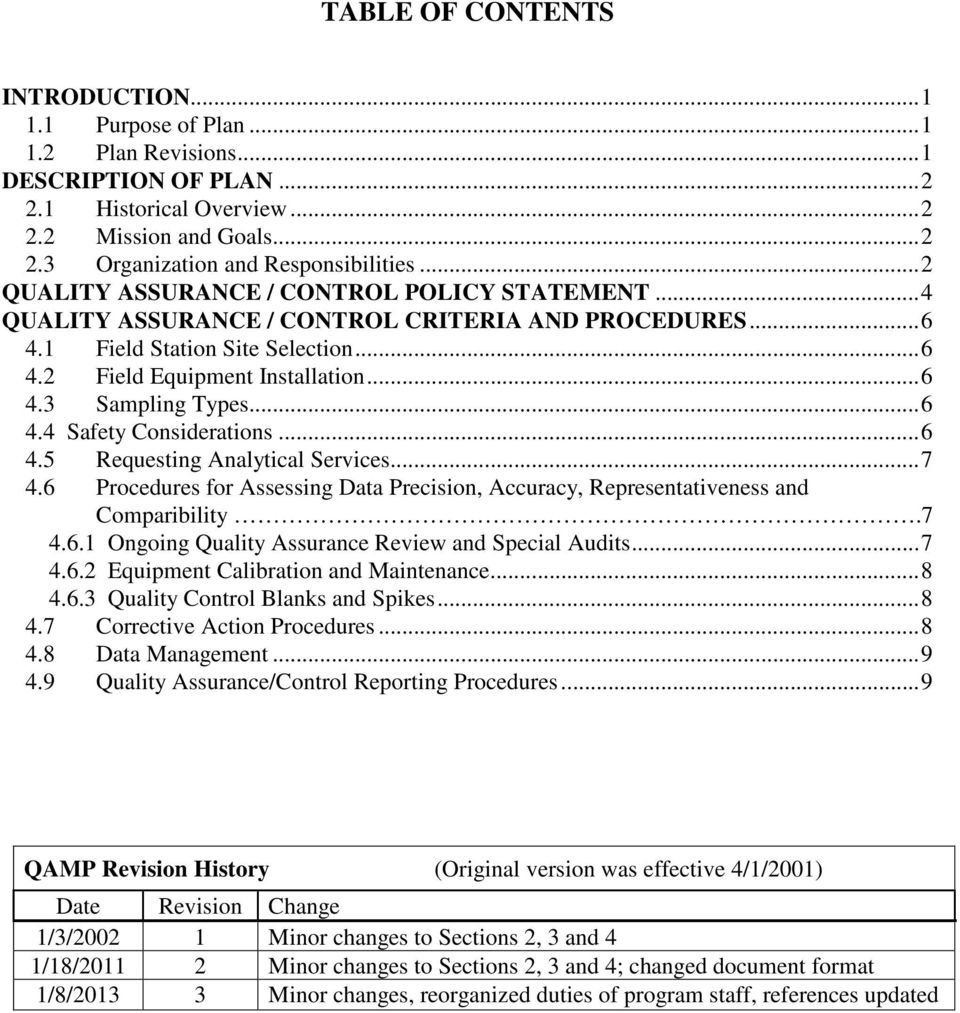
3 TABLE OF CONTENTS INTRODUCTION Purpose of Plan Plan Revisions...1 DESCRIPTION OF PLAN Historical Overview Mission and Goals Organization and Responsibilities...2 QUALITY ASSURANCE / CONTROL POLICY STATEMENT...4 QUALITY ASSURANCE / CONTROL CRITERIA AND PROCEDURES Field Station Site Selection Field Equipment Installation Sampling Types Safety Considerations Requesting Analytical Services Procedures for Assessing Data Precision, Accuracy, Representativeness and Comparibility Ongoing Quality Assurance Review and Special Audits Equipment Calibration and Maintenance Quality Control Blanks and Spikes Corrective Action Procedures Data Management Quality Assurance/Control Reporting Procedures...9 QAMP Revision History (Original version was effective 4/1/2001) Date Revision Change 1/3/ Minor changes to Sections 2, 3 and 4 1/18/ Minor changes to Sections 2, 3 and 4; changed document format 1/8/ Minor changes, reorganized duties of program staff, references updated
4 Page 1 of 9 INTRODUCTION 1.1 Purpose of Plan This document presents the quality assurance management plan for the Dry Cleaning Program. The plan describes the mission, developmental history, organizational structure, environmental monitoring protocols, data handling procedures, and quality assurance (QA) and quality control (QC) requirements of these programs. Standard operating procedures (SOPs) and equipment used in the programs are presented in the Appendix A of the plan. 1.2 Plan Revisions To be effective and useable, this document must be maintained in an up-to-date condition. As required by the Division of Environment Quality Management Plan (Part I, section 7), the contents of the plan are reviewed on at least an annual basis. Minor changes in the report's organizational structure or terminology may be approved by the Section Chief. However, major revisions which substantially change the contents of the document, especially in terms of QA policies or procedures, require the added approval of the Bureau QA Representative, Bureau Director and Division Director.
5 Page 2 of 9 Section 2 DESCRIPTION OF PLAN 2.1 Historical Overview The Dry Cleaning Program began in July of 1995 as a result of the passage of the Drycleaner Environmental Response Act (K.S.A , ). In January of 1997 the dry cleaning regulations became effective ( through ). The laws established a new dry cleaner program that contained more stringent requirements for the operation of dry cleaning facilities and established the Drycleaning Facility Release Trust Fund. The Dry Cleaning Program is designed to inspect operating dry cleaning facilities to verify and correct any operational deficiencies. The inspections are performed to verify the facility is complying with the secondary containment requirements; registration; solvent and waste water handling, storage, and disposal requirements; record keeping; and solvent delivery system requirements. The program is also designed to accept dry cleaning facilities into the trust fund. The trust fund was established to provide money for the investigation and remediation of dry cleaning facilities. The Bureau of Environmental Remediation (BER) is the primary bureau for all the activities related to the Drycleaner Environmental Response Act. 2.2 Mission and Goals The mission of the Dry Cleaning Program is to prevent additional environmental contamination from dry cleaning facilities and to remediate soils and groundwater that have been impacted by dry cleaning facilities. The primary goal of the Program is to monitor the dry cleaning facilities to insure that all contaminants present at the facilities are not allowed into the environment. Therefore, no additional contaminated dry cleaning sites will occur in the future. Another goal is to limit exposure to humans and the environment due to off-site migration of the contamination and to appropriately remediate the site to limit this exposure. This goal is to be accomplished by (1) on-site inspections and discussions of operating requirements by KDHE staff with facility owners and their consultants, (2) approval of site investigation and remedial plans by KDHE, and, (3) installation and operating remedial technologies to reduce the contaminants to an acceptable risk-based limit. 2.3 Organization and Responsibilities ORGANIZATIONAL CHART (See exhibit 1 in the BER QA Plan Part II) The Bureau Director's responsibilities are defined in the BER QA management plan presented in Part II of the Quality Assurance Management Plan (QAMP).
6 Page 3 of 9 The Section Chief is responsible for supervising the Unit Leader of the Superfund / Drycleaning Unit. The operations and implementation of uniform policies and procedures for the Dry Cleaning Program is the responsibility of the Section Chief. Additionally, the Section Chief is responsible for planning, organizing, supervising and directing the statewide activities of the Dry Cleaning Program. The Unit Leader is the Dry Cleaner Program Manager and is responsible to ensure the requirements of the program-level QA management plans and SOPs are implemented in a consistent, timely and reliable manner. Working with the Section Chief, the Unit Leader strives to improve the precision, accuracy and reliability of all environmental data collected and products (reports) generated as part of Dry Cleaner Program activities through the effective allocation of staff and resources. The Superfund / Drycleaning Unit is composed of Environmental Geologists and Scientists, with support from an Environmental Technician. The Environmental Geologists and Scientists are responsible for conducting all aspects of the dry cleaning site assessment and remedial activities under the supervision of the Unit Leader and are the Project Managers for each contaminated dry cleaning site. The Environmental Technician IV from the Response Unit performs the facility inspections, monitors compliance of the operating dry cleaning facilities, and assists with field observations and sampling activities. For work completed by staff, all site assessments and remedial work must have a Work Plan submitted to and approved by the Unit Leader which meets the objectives and minimum data quality and quantity required of such investigations. All final site assessment and remedial reports must be approved by the Unit Leader before submission to the Section and Bureau Chief.
7 Page 4 of 9 Section 3 QUALITY ASSURANCE / CONTROL POLICY STATEMENT Project managers and the Unit Leader possess standard operating procedures for administration of quality assurance/quality control for the Dry Cleaning Program. Project managers can develop site specific Quality Assurance Project Plans (QAPPs), when appropriate, in accordance with KDHE's SOPs and numerous federal regulatory guidance documents for QA/QC. Sometimes the Unit's role within the program is limited to reviewing and approving work plans and reports for investigative and remedial activities conducted by an environmental contractor. As an element of the review process, the Unit requests the responsible party, or environmental contractor, provide a well-defined QAPP, with respect to certain SOPs included in Appendix A. Project Managers review each of these site specific QAPPs to determine compliance with KDHE's SOPs. Project managers are responsible for environmental sampling, including any split, duplicate, or collocated environmental samples to ensure the representativeness and general quality of the various samples collected at a site throughout the investigation. All sampling activities conducted by Dry Cleaning project managers follow the following general program guidelines: (1) The objectives of any investigation shall be determined prior to implementation of data collection activities. This determination shall be accomplished during the planning stage of the project and development of the appropriate Work Plan so that appropriate procedures will be incorporated into the implementation of the project and the resulting data will have a reasonable probability of meeting the stated objectives. (2) Sample collection and analysis activities and data management activities shall be subjected to periodic evaluation by supervisory personnel to identify and, if necessary, correct deficiencies and enhance the overall quality of the Dry Cleaning Program. (3) All data collection activities will be accomplished and documented in accordance with a Divisional QA plan and applicable SOP=s. Federal guidance documents frequently referenced for quality assurance/ quality control by Dry Cleaning staff include, but are not limited to: * A Compendium of Superfund Field Operations Methods (EPA/540/P-87/001, December 1987); * Data Quality Objectives for Remedial Response Activities (EPA/540/G-87/003, March 1987); * Guidance for Data Useability in Risk Assessment (EPA/540/G-90/008, October 1990); * Guidance for Conducting Remedial Investigations and Feasibility Studies Under CERCLA (EPA/540/G-89/004, October 1988);
8 Page 5 of 9 * Handbook of Suggested Practices for the Design and Installation of Ground Water Monitoring Wells. (EPA/600/4-89/034, March 0991); * RCRA Ground Water Monitoring: Draft Technical Guidance; (CEPA 530-R-001 P , November 1992). * Risk Assessment Guidance for Superfund (EPA/540/1-89/002, December 1989). * Standard Operating Safety Guides (EPA Publication /PB , June 1992); * Standard Practices for Description and Identification of Soils; (American Society for Testing and Materials Standard D A, June 2009); * Standard Practice for Design and Installation of Ground Water Monitoring Wells (American Society for Testing and Materials Standard D (2010)e1, August 2010); * Standard Practice for Soil Exploration and Sampling by Auger Boring; (American Society for Testing and Materials Standard D , February 2009);
9 Page 6 of 9 Section 4 QUALITY ASSURANCE / CONTROL CRITERIA AND PROCEDURES 4.1 Field Station Site Selection The selection of sampling locations is based on several factors including type and purpose of the sample, representativeness, accessibility (permission to sample), location of existing wells, location of potential source areas of contamination and location of potential target areas. Selection criteria vary depending upon the type of medium being sampled and the purpose of the sampling which are described in site-specific QAPPs. 4.2 Field Equipment Installation Generally field staff will use non-dedicated sampling equipment that is either disposable or reusable. Sampling equipment designated for reuse must be decontaminated as specified in SOP (BER-05). Some sites as designated by the project manager may have dedicated sampling equipment in place. 4.3 Sampling Types Program staff primarily provide QA/QC management services through the collection of split, duplicate, replicate, and/or collocated environmental samples concurrent with environmental sampling performed by the responsible party or an environmental contractor. In addition, program staff may occasionally be required to collect independent environmental samples. Ground water is the most frequent environmental media sampled, followed by surface and subsurface soils, surface water, sludge, sediment, and air. In addition, program staff may be required to collect special samples including influent and effluent water samples associated with ground water or surface water remedial systems, or remedial performance samples including potentially hazardous wastes or materials which have been stabilized to facilitate handling and transport or to reduce contaminant mobility. Program staff collecting QA/QC environmental samples adhere to the sample collection procedures specified in the KDHE-approved site-specific sampling plan. KDHE's approval of the site-specific sampling plan is dependent upon the plan's compliance with field methods and sampling procedures provided in the KDHE SOP=s (BER-01, BER-02, BER-03, BER-04 and BER-33). This document is a compilation of demonstrated field techniques that have been used during investigative and remedial activities at solid waste disposal sites. The purpose of the plan is to ensure that sampling data collection activities will be comparable to and compatible with data previously collected. 4.4 Safety Considerations Field and laboratory staff that participate in environmental monitoring programs encounter potentially dangerous situations on a frequent basis. In addition to the routine possibility of automobile or equipment accidents, employees may encounter extremely slippery surfaces, toxic or hazardous

10 Page 7 of 9 substances, infectious microorganisms, fire or electrocution hazards, vicious dogs, belligerent persons, or other threatening situations. Injuries or illnesses resulting from such situations may lead to substantial human suffering and, from a QA/QC perspective, deprive programs of the services of a valuable employee for an extended period of time. Although it is not possible to predict every conceivable risk that may arise during the course of work, supervisors must ensure that those risks faced by staff on a recurring basis are addressed in the SOPs and are discussed during employee training. Field and laboratory staff are expected to abide by the safety protocols contained within the QMP and SOPs and to integrate safety considerations into all aspects of their work. Field staff should follow SOPs BER-18, BER-20, BER-21 and BER-24. BER routinely budgets for ongoing safety training expenses and annual medical physicals for field staff associated with monitoring and/or field inspections of hazardous materials (refer to BER-17). Project managers are expected to bring potentially unsafe practices or situations to the attention of their Unit Leader. In turn, the Unit Leader shall evaluate the practice or situation and either take the appropriate corrective action or, in complicated circumstances, seek the advice of the Section Chief or higher level supervisor. Major corrective actions warranting changes in an SOP shall be implemented by staff only upon approval of the Section Chief, Bureau QA Representative and Bureau Director. 4.5 Requesting Analytical Services Program staff can employ several approaches for the submission of environmental samples to a laboratory for analyses. Staff can submit environmental samples directly to the Kansas Health and Environmental Laboratory (KHEL) or contract the services of an outside laboratory. The selected laboratory must have a specific QA and QC Plan approved by the Division Director prior to utilization by the Section. Generally, the KHEL will be used for the majority of the program's analytical service. However, the purpose of the contractual arrangements is to provide additional analytical capacity QA and QC (inter-laboratory duplicates) and to provide expanded analytical services. 4.6 Procedures for Assessing Data Precision, Accuracy, Representativeness and Comparability Ongoing Quality Assurance Review and Special Audits QA/QC aspects of the Dry Cleaning Program are subject to ongoing review by the Unit Leader. Staff are expected to cooperate fully with administrative requests for information on data precision/accuracy and overall QC performance. The Unit Leader is expected to track the QC performance of Project Managers, assist managers in identifying QC deficiencies within their assigned sites, and facilitate the initiation of any necessary corrective actions. The Section Chief is expected to track the QC performance of the program, assist the Unit Leader and Project Managers in identifying QC deficiencies within their programs, and facilitate the initiation of any necessary corrective actions. The results are reported to the Bureau QA Representative and the Bureau Director.

11 Page 8 of Equipment Calibration and Maintenance All field equipment must be checked out by staff from the Bureau's Equipment and Supply Technician. The individual users of field equipment are responsible for the maintenance (in accordance with manufacturer's procedural manuals and/or SOPs) of the equipment while being used in field operations. The user should ensure the equipment is checked for proper operation and is current with calibration requirements (if needed) prior to leaving for the field. The user should record any malfunctions encountered while in the field in the logbook associated with the equipment. The user should make sure the malfunctions are communicated to the Unit Leader and the Bureau's Equipment and Supply Technician upon return of the equipment to storage so that appropriate action can be initiated to repair the item of equipment, or initiate actions (e.g., prepare a Purchase Requests or Purchase Acquisitions) to have the equipment repaired upon return from the field Quality Control Blanks and Spikes Quality control procedures must be taken by field staff to ensure the integrity of the samples collected. Without checks on the sampling and analytical procedures, the potential exists for contradictory or incorrect results. Procedures describing quality control samples are defined in BER-12 or are included in site specific QAPPs. 4.7 Corrective Action Procedures In the context of QA, Dry Cleaning Program corrective actions are procedures that may be implemented on environmental samples that do not meet predetermined QA specifications. In general, the corrective action procedures program addresses the analysis of any cause precipitating a negative audit finding and identifies the appropriate corrective action(s) necessary to address it. Program staff, or the appropriate QA/QC program designee, are responsible for reviewing data validation reports, audit reports and nonconformance reports to identify significant or repetitious conditions adverse to quality, or deficiencies regarding the implementation or adherence to required QA practices. In addition, the program staff, or QA/QC designee, is required to investigate the source(s) of the problem and is responsible for defining and/or implementing the necessary actions to remedy the problem. The quality characteristics of data generated by sampling, monitoring, or analyzing, is defined in the following terms: Precision: A measure of mutual agreement among individual measurements of the same property, usually under prescribed similar conditions. Precision is best expressed in terms of the standard deviation. Various measures of precision exist depending on the prescribed similar conditions. Completeness: A measure of the amount of valid data obtained from a measurement system, compared with the amount needed to obtain the project data quality objectives. Representativeness: The degree to which data accurately and precisely represent a characteristic of the population, the parameter variations at a sampling point, a process condition, or an environmental condition. It also includes how well the sampling point represents the parameter variations that are under study.

12 Page 9 of 9 Comparability: The confidence with which one data set can be compared with another; a qualitative characteristic that must be assured in terms of sampling, analysis, reporting, etc. The exact values of the quality characteristics will vary depending upon the analytical processes and procedures employed. Site-specific work plans will detail the recommended field activities and analytical methodologies necessary to establish the appropriate data quality characteristics. Corrective actions may include re-sampling, re-analyzing samples, or auditing laboratory procedures. 4.8 Data Management All work plans submitted in association with the Dry Cleaning Program require a data management system. The system should include field logs, sample management and tracking procedures, and document control and inventory procedures for both laboratory data and field measurements. The system should ensure that the data collected during the investigation are of adequate quality and quantity to support the findings of the investigation, risk assessment (if performed), and corrective action research. For each measurement, the data reduction scheme planned for collected data, including all equations used to calculate the concentration or value of the measured parameter, should be described. The principal criteria employed to validate the integrity of the data during collection and reporting should be referenced. All data collected should be validated by the appropriate level of laboratory quality control to ascertain whether it is appropriate for its intended use. All task management and quality controls implemented shall be documented within the appropriate report appendix. 4.9 Quality Assurance/Control Reporting Procedures All reports or deliverables submitted through the Dry Cleaning Program require a QA/QC status summary of the project and any conditions adverse to the quality. The report should contain an assessment of measurement data accuracy, precision and completeness, results of any performance audits, results of system audits, any reported non-conformance, and any QA problems, together with recommended solutions or corrective actions.
DIVISION OF ENVIRONMENT QUALITY MANAGEMENT PLAN PART III: SUPERFUND (MACA) PROGRAM QUALITY ASSURANCE MANAGEMENT PLAN
 DIVISION OF ENVIRONMENT QUALITY MANAGEMENT PLAN PART III: SUPERFUND (MACA) PROGRAM QUALITY ASSURANCE MANAGEMENT PLAN Revision 3 February 21, 2012 Kansas Department of Health and Environment Division of
DIVISION OF ENVIRONMENT QUALITY MANAGEMENT PLAN VOLUNTARY CLEANUP AND PROPERTY REDEVELOPMENT PROGRAM QUALITY ASSURANCE MANAGEMENT PLAN
 DIVISION OF ENVIRONMENT QUALITY MANAGEMENT PLAN PART III: VOLUNTARY CLEANUP AND PROPERTY REDEVELOPMENT PROGRAM QUALITY ASSURANCE MANAGEMENT PLAN January 29, 2015 Kansas Department of Health and Environment
APPENDIX N. Data Validation Using Data Descriptors
 APPENDIX N Data Validation Using Data Descriptors Data validation is often defined by six data descriptors: 1) reports to decision maker 2) documentation 3) data sources 4) analytical method and detection
APPENDIX 7-B SUGGESTED OUTLINE OF A QUALITY ASSURANCE PROJECT PLAN
 APPENDIX 7-B SUGGESTED OUTLINE OF A QUALITY ASSURANCE PROJECT PLAN This outline is recommended for use by UST consultants/contractors in preparing a generic Quality Assurance Project Plan (QAPP) for use
QUALITY ASSURANCE PROJECT PLAN FOR BROWNFIELDS/VOLUNTARY CLEANUP PROGRAM SITES
 QUALITY ASSURANCE PROJECT PLAN FOR BROWNFIELDS/VOLUNTARY CLEANUP PROGRAM SITES Prepared by the Missouri Department of Natural Resources Division of Environmental Quality Hazardous Waste Program Brownfields/Voluntary
NC SBI QUALITY ASSURANCE PROGRAM
 NC SBI QUALITY ASSURANCE PROGRAM for the SBI Reviewed by: Deputy Assistant Director Bill Weis Date: Approved by: Assistant Director Jerry Richardson Date: Originating Unit: SBI Effective Date: July 25,
4 QUALITY ASSURANCE 4.1 INTRODUCTION
 4 QUALITY ASSURANCE 4.1 INTRODUCTION BNL has an established Quality Assurance/Quality Control (QA/QC) Program to ensure that the accuracy, precision, and reliability of environmental monitoring data are
CHAPTER ONE TABLE OF CONTENTS 1.0 INTRODUCTION... 1
 CHAPTER ONE TABLE OF CONTENTS Section Page 1.0 INTRODUCTION... 1 2.0 QA PROJECT PLAN... 1 2.1 DATA QUALITY OBJECTIVES... 2 2.2 PROJECT OBJECTIVES... 2 2.3 SAMPLE COLLECTION... 3 2.4 ANALYSIS AND TESTING...
9. Quality Assurance 9.1 INTRODUCTION 9.2 FIELD SAMPLING QUALITY ASSURANCE 9.3 ANALYTICAL QUALITY ASSURANCE. 9.3.1 Internal Quality Control
 9. Quality Assurance Setting The overall goal of a well-designed and well-implemented sampling and analysis program is to measure accurately what is really there. Environmental decisions are made on the
Data Quality. Tips for getting it, keeping it, proving it! Central Coast Ambient Monitoring Program
 Data Quality Tips for getting it, keeping it, proving it! Central Coast Ambient Monitoring Program Why do we care? Program goals are key what do you want to do with the data? Data utility increases directly
1 Quality Assurance and Quality Control Project Plan
 1 Quality Assurance and Quality Control Project Plan The purpose of this section is to describe the quality assurance/quality control program that will be used during the system specific field testing
COPY. Revision History: Changes were made to reflect the current practice of only including the most recent changes in the revision history.
 Revision History COPY The top row of this table shows the most recent changes to this controlled document. For previous revision history information, archived versions of this document are maintained by
QUALITY MANAGEMENT PLAN
 QUALITY MANAGEMENT PLAN August 2010 EQR 10-04 Revised 11-2014 ARIZONA DEPARTMENT OF ENVIRONMENTAL QUALITY QUALITY MANAGEMENT PLAN Approval and Concurrences 2 ARIZONA DEPARTMENT OF ENVIRONMENTAL QUALITY
Risk-Based Decision Making for Site Cleanup
 July 2013 Risk-Based Decision Making for Site Cleanup The Oklahoma Department of Environmental Quality (DEQ) has adopted a risk based decision making process to provide a framework for determining cleanup
COPY. Revision History
 Revision History COPY The top row of this table shows the most recent changes to this controlled document. For previous revision history information, archived versions of this document are maintained by
Uniform Federal Policy for Implementing Environmental Quality Systems
 Publication Numbers: EPA: EPA-505-F-03-001 DoD: DTIC ADA 395303 DOE: DOE/EH-0667 Intergovernmental Data Quality Task Force Uniform Federal Policy for Implementing Environmental Quality Systems Evaluating,
DATA QUALITY OBJECTIVES
 The Wastewater Treatment Plant Operators Guide to Biosolids Sampling Plans CHAPTER 5 DATA QUALITY OBJECTIVES Goals of the Sampling Plan ESSENTIAL ELEMENTS OF A SAMPLING PLAN Description of the Facility
ENVIRONMENTAL, HEALTH AND SAFETY PERSONNEL MANAGEMENT LEVELING GUIDE
 ENVIRONMENTAL, HEALTH AND SAFETY PERSONNEL MANAGEMENT LEVELING GUIDE Levels Job Codes Scope of Position Top Environmental Affairs Executive (Corporate) 1000 The most senior Environmental, Health and Safety
Canadian Environmental Technology Verification Program Applicant Information Package CONTENTS
 Canadian Environmental Technology Verification Program CONTENTS Contents... 1 Overview... 2 Performance Verification... 2 Application Information... 2 How much does verification cost?... 2 What is the
Quality Assurance/Quality Control in Acid Deposition Monitoring
 Quality Assurance/Quality Control in Acid Deposition Monitoring Acid Deposition and Oxidant Research Center (Network Center of EANET) Introduction Wet deposition data are used for -assessments of spatial
ENVIRONMENTAL, HEALTH & SAFETY MANAGEMENT SYSTEMS MANUAL
 September 7, 202 940. General Requirements (ISO 400 4.; OHSAS 800 4.).. Alcoa Fastening Systems Republic Operations (AFS Republic) has established, documented, implemented, maintains, and continuously
Office of Research Facilities Development and Operations Contractor Safety Policy
 Office of Research Facilities Development and Operations Contractor Safety Policy The National Institutes of Health (NIH) is committed to providing a safe environment for everyone who enters the NIH campus.
Air Quality Performance Test Guidelines. Kansas Department of Health and Environment Bureau of Air and Radiation
 Air Quality Performance Test Guidelines Kansas Department of Health and Environment Bureau of Air and Radiation December 22, 2004 TABLE OF CONTENTS 1. INTRODUCTION 2. TEST PLANNING 2.1 EPA Test Methods
Developing Quality Assurance Project Plans using Data Quality Objectives and other planning tools. Developing QAPPs 5/10/2012 1
 Developing Quality Assurance Project Plans using Data Quality Objectives and other planning tools 1 Introductions 2 Agenda I. Developing a QAPP II. Systematic Planning using Data Quality Objectives III.
NIST HANDBOOK 150-5 CHECKLIST CONSTRUCTION MATERIALS TESTING
 NIST HANDBOOK 150-5 CHECKLIST CONSTRUCTION MATERIALS TESTING Instructions to the Assessor: This checklist addresses specific accreditation criteria prescribed in NIST Handbook 150-5, Construction Materials
HAZARDOUS WASTE PERSONNEL TRAINING. Hazardous Waste Management Branch Office of Solid and Hazardous Waste Management
 IDEM Indiana Department of Environmental Management Office of Land Quality P.O. Box 6015 Indianapolis, IN 46206-6015 OLQ PH: (317) 232-8941 Nonrule Policy Document Title: Hazardous Waste Personnel Training
4 PROJECT PLAN DOCUMENTS
 1 4 PROJECT PLAN DOCUMENTS 2 3 4 5 6 7 8 9 10 11 12 13 14 15 16 17 18 19 20 21 22 23 24 25 26 27 28 29 30 31 32 33 4.1 Introduction The project plan documents are a blueprint for how a particular project
EPA GUIDANCE FOR QUALITY ASSURANCE PROJECT PLANS EPA QA/G-5
 United States Office of Research and EPA/600/R-98/018 Environmental Protection Development February 1998 Agency Washington, D.C. 20460 EPA GUIDANCE FOR QUALITY ASSURANCE PROJECT PLANS FOREWORD The U.S.
ASSURING THE QUALITY OF TEST RESULTS
 Page 1 of 12 Sections Included in this Document and Change History 1. Purpose 2. Scope 3. Responsibilities 4. Background 5. References 6. Procedure/(6. B changed Division of Field Science and DFS to Office
3.3 Data Collection Systems Design... 22 3.4 Planning Documents... 23 3.4.1 Work Plan... 23 3.4.2 Field Sampling Plan (FSP)... 24 3.4.
 TABLE OF CONTENTS 1 INTRODUCTION... 1 1.1 Commitment to Quality... 1 1.2 QA Program Principles... 1 1.2.1 Client Satisfaction... 1 1.2.2 Employee Participation... 2 1.2.3 Problem Prevention... 2 1.2.4
US EPA REGION III QUALITY MANAGEMENT PLAN REVIEW CHECKLIST
 US EPA REGION III Organization: EPA Organization: EPA Program: Contact: EPA Contact: EPA Contract/Grant/IAG Number: Phone Number: Phone Number: Reviewer: Date Reviewed: Reviewer Organization: Check New
State of Rhode Island Department of Environmental Management Division of Site Remediation. Policy Memo 95-01
 State of Rhode Island Department of Environmental Management Division of Site Remediation Policy Memo 95-01 Guidelines for the Management of Investigation Derived Wastes 1.0 Purpose The purpose of this
KANSAS STORAGE TANK PROGRAM ABOVEGROUND STORAGE TANK OVERVIEW March 2, 2015
 KANSAS STORAGE TANK PROGRAM ABOVEGROUND STORAGE TANK OVERVIEW March 2, 2015 http://www.kdheks.gov/tanks/index.html Copies of this document are available at: http://www.kdheks.gov/tanks/download/ast_overview.pdf
ILLINOIS DEPARTMENT OF CENTRAL MANAGEMENT SERVICES CLASS SPECIFICATION STATE POLICE EVIDENCE TECHNICIAN SERIES
 ILLINOIS DEPARTMENT OF CENTRAL MANAGEMENT SERVICES CLASS SPECIFICATION STATE POLICE EVIDENCE TECHNICIAN SERIES CLASS TITLE POSITION CODE STATE POLICE EVIDENCE TECHNICIAN I 41901 STATE POLICE EVIDENCE TECHNICIAN
Quality Assurance Program Plan. July 2006. U.S. Department of Energy Office of Legacy Management
 U. S. Department of Energy Office of Legacy Management July 2006 July 2006 Page i DOE-LM Policy Statement The U.S. Department of Energy (DOE) Office of Legacy Management (LM) performs long-term surveillance
Technical Guidance Manual for the Implementation of the Hawai`i State Contingency Plan. Interim Final SECTION 10
 Technical Guidance Manual for the Implementation of the Hawai`i State Contingency Plan SECTION 10 DATA QUALITY ASSURANCE AND QUALITY CONTROL (QA/QC) Hawai`i HEER TGM 10-1 December 31, 2008 CONTENTS Acronyms
Appendix B. Eugene/Springfield Environmental Services Laboratory Quality Assurance Plan
 Appendix B Eugene/Springfield Environmental Services Laboratory Quality Assurance Plan City of Eugene NPDES Stormwater Monitoring Plan May 2011 Users of this document are responsible to ensure it is the
The Comprehensive Environmental Response,
 Purpose and Applicability of Regulations The Comprehensive Environmental Response, Compensation, and Liability Act (CERCLA) was enacted by Congress in 1980 to clean up the nation s hazardous waste sites
Section VI Principles of Laboratory Biosecurity
 Section VI Principles of Laboratory Biosecurity Since the publication of the 4th edition of BMBL in 1999, significant events have brought national and international scrutiny to the area of laboratory security.
QUALITY MANUAL GREAT LAKES INSTITUTE FOR ENVIRONMENTAL RESEARCH ANALYTICAL LABORATORIES. October 2008 Revision 08
 QUALITY MANUAL GREAT LAKES INSTITUTE FOR ENVIRONMENTAL RESEARCH ANALYTICAL LABORATORIES October 2008 Revision 08 Great Lakes Institute for Environmental Research University of Windsor Windsor, Ontario
OH&S Management Systems Audit Checklist (NAT, E3)
 3.1.2 3.1.1 Introduction OH&S Management Systems Audit Checklist (NAT, E3) This audit checklist is based on Element 3 (Implementation) of the National Self-Insurers OHS Audit Tool. For a full copy of the
GUIDANCE FOR WATER UTILITY RESPONSE, RECOVERY & REMEDIATION ACTIONS FOR MAN-MADE AND/OR TECHNOLOGICAL EMERGENCIES
 Office of Water (4601M) EPA 810-R-02-001 www.epa.gov/safewater April 2002 GUIDANCE FOR WATER UTILITY RESPONSE, RECOVERY & REMEDIATION FOR MAN-MADE AND/OR TECHNOLOGICAL EMERGENCIES DISCLAIMER The statements
EPA NATIONAL LEAD LABORATORY ACCREDITATION PROGRAM. LABORATORY QUALITY SYSTEM REQUIREMENTS (LQSR) REVISION 3.0 (November 05, 2007)
 EPA NATIONAL LEAD LABORATORY ACCREDITATION PROGRAM LABORATORY QUALITY SYSTEM REQUIREMENTS (LQSR) REVISION 3.0 (November 05, 2007) The requirements in this document apply to all lead testing laboratories
SPILL PREVENTION AND RESPONSE PLAN TEMPLATE FOR BUSINESSES IN DAYTON S SOURCE WATER PROTECTION AREA
 SPILL PREVENTION AND RESPONSE PLAN TEMPLATE FOR BUSINESSES IN DAYTON S SOURCE WATER PROTECTION AREA Regulated Substance Management: All Regulated Substances, including chemical wastes, are to be managed
Division of Public Health Administrative Manual
 PURPOSE To establish a protocol for the development of a written Division of Public Health Hazard Communications Program at each applicable office or laboratory workplace and to assure that employees are
8.0 ENVIRONMENTAL PROTECTION MONITORING AND FOLLOW-UP
 8.0 ENVIRONMENTAL PROTECTION MONITORING AND FOLLOW-UP 8.1 INTRODUCTION Mitigation measures, monitoring and other follow-up actions identified in Chapter 7 (Environmental Effects Assessment and Mitigation)
Importance of a QA/QC Process Establishing database structures and policies Protecting client confidentiality and handling COIs Defining data
 Data Management Best Management Practices Chris Mickle Cambridge Data Analysis and Statistics Subdiscipline Leader Environmental Data Management Group Leader Today s Topics Importance of a QA/QC Process
Haulsey Engineering, Inc. Quality Management System (QMS) Table of Contents
 Haulsey Engineering, Inc. Quality Management System (QMS) Table of Contents 1.0 Introduction 1.1 Quality Management Policy and Practices 2.0 Quality System Components 2.1 Quality Management Plans 2.2 Quality
Office of Environmental Quality Five Year Strategic Plan July, 2017 - June 2022
 Office of Environmental Quality Five Year Strategic Plan July, 2017 - June 2022 Agency Number: 13-856 Program: Office of Environmental Compliance Program Authorization: La. R.S. 30:2011(C)(1)c) Vision
Business Management System Manual. Context, Scope and Responsibilities
 Business Management System BMS Manual Page 1 of 11 Business Management System Manual Context, Scope and Responsibilities ISO 9001:2015 BMS.0100 R1 MAS Solutions LLC 29810 FM 1093 Suite C Fulshear, TX 77441
Assessment of Environmental Liability Insurance Options for Cleanup Activities
 Assessment of Environmental Liability Insurance Options for Cleanup Activities Brownfields Technology Support Center May 1999 ASSESSMENT OF ENVIRONMENTAL LIABILITY INSURANCE OPTIONS FOR CLEANUP ACTIVITIES
R000. Revision Summary Revision Number Date Description of Revisions R000 Feb. 18, 2011 Initial issue of the document.
 2 of 34 Revision Summary Revision Number Date Description of Revisions Initial issue of the document. Table of Contents Item Description Page 1. Introduction and Purpose... 5 2. Project Management Approach...
Department of Environmental Engineering
 Department of Environmental Engineering Master of Engineering Program in Environmental Engineering (International Program) M.Eng. (Environmental Engineering) Plan A Option 1: (1) Major courses: minimum
Minnesota Pollution Control Agency. Quality Assurance Project Plan Guidance
 www.pca.state.mn.us Minnesota Pollution Control Agency Quality Assurance Project Plan Guidance Overview The following guidance is for use in building Quality Assurance Project Plans (QAPPs) for the Minnesota
TABLE OF CONTENTS. NJDEP and EPA Approvals...i. NJDEP Organizational Structure Flow Chart (Figure1)...3
 TABLE OF CONTENTS NJDEP and EPA Approvals......i NJDEP Senior Staff Approvals......iii I. Introduction and Purpose...1 II. NJDEP Organizational Structure...2 III. Quality System Organizational Structure...2
DEPARTMENT OF ENVIRONMENTAL PROTECTION BUREAU OF WATER SUPPLY MANAGEMENT. Principles for Ground Water Pollution Prevention and Remediation
 DEPARTMENT OF ENVIRONMENTAL PROTECTION BUREAU OF WATER SUPPLY MANAGEMENT DOCUMENT NUMBER: 383-0800-001 EFFECTIVE DATE: December 1, 1996 TITLE: AUTHORITY: POLICY: Principles for Ground Water Pollution Prevention
POLICY AND PROGRAM REQUIREMENTS FOR THE MANDATORY AGENCY-WIDE QUALITY SYSTEM
 Classification No.: CIO 2105.0 (formerly ) Approval Date: May 5, 2000 POLICY AND PROGRAM REQUIREMENTS FOR THE MANDATORY AGENCY-WIDE QUALITY SYSTEM 1. PURPOSE. This Order re-affirms the policy defined by
Building Credibility: Quality Assurance & Quality Control for Volunteer Monitoring Programs
 Building Credibility: Quality Assurance & Quality Control for Volunteer Monitoring Programs Elizabeth Herron URI Watershed Watch/ National Facilitation of CSREES Volunteer Monitoring Ingrid Harrald Cook
CORPORATE QUALITY MANUAL
 Corporate Quality Manual Preface The following Corporate Quality Manual is written within the framework of ISO 9001:2008 Quality System by the employees of CyberOptics. CyberOptics recognizes the importance
ANNUAL FIRE PROTECTION SUMMARY INFORMATION REPORTING GUIDE Revised: May 2011
 ANNUAL FIRE PROTECTION SUMMARY INFORMATION REPORTING GUIDE Revised: May 2011 Organizations responsible for maintaining property under stewardship of DOE and the Administrator, NNSA, will seek concurrence
Pharmaceutical Wholesaler Site Inspection Checklist
 Pharmaceutical Wholesaler Site Inspection Checklist Date and time of inspection: Legal business name and plant name: Location (address): Phone number: Fax number: Email address: Web site URL: Contact Person:
Quality Assurance Guidance for Conducting Brownfields Site Assessments
 United States Office of Solid Waste and EPA 540-R-98-038 Environmental Protection Emergency Response OSWER 9230.0-83P Agency (5102G) PB98-963307 September 1998 Quality Assurance Guidance for Conducting
Quality Assurance QUALITY ASSURANCE PLAN
 Revision 2 Page 1 of 40 QUALITY ASSURANCE PLAN PLAN APPROVALS: Jeff Shouse Signature on File DIRECTOR OF QUALITY ASSURANCE DIRECTOR OF QUALITY ASSURANCE (signature) DATE Rodney Baltzer Signature on File
Guide on the Segregation, Packaging, Labelling and Storage of Laboratory Chemical Wastes for Schools
 APPENDIX II Guide on the Segregation, Packaging, Labelling and Storage of Laboratory Chemical Wastes for Schools (Prepared by Environmental Protection Department) 1. Introduction The Waste Disposal (Chemical
Quality Assurance Manual for Low Level Radioactive. Waste Disposal Facility
 WM 07 Conference, February 25 March 1 2007, Tucson, AZ Quality Assurance Manual for Low Level Radioactive Waste Disposal Facility Yasser T. Mohamed Hot Laboratories and Waste Management Center, Egyptian
US EPA - Region III BROWNFIELDS. Quality Assurance Project Plan. Template
 U.S. Environmental Protection Agency (EPA) Region III 1650 Arch Street Philadelphia, PA 19107 US EPA - Region III BROWNFIELDS Quality Assurance Project Plan Template Interim Final March 2001 DISLAIMER
Facilities Division Integrated Safety Management Plan March 16, 2006
 Facilities Division Integrated Safety Management Plan March 16, 2006 Contents Facilities Division Introduction 1.0 Integrated safety Management 2.0 Accountability 3.0 Satellite Accumulation Area 4.0 Facilities
Tooele Army Depot South August 5, 2015 Explosive Destruction System
 ATTACHMENT 9 -PERSONNEL TRAINING 9.1 General Provisions The Permittee shall ensure site operating personnel have the necessary knowledge and skills to perform hazardous waste duties safely and efficiently,
Position Classification Standard for Property Disposal Clerical and Technical Series, GS-1107. Table of Contents
 Position Classification Standard for Property Disposal Clerical and Technical Series, GS-1107 Table of Contents SERIES DEFINITION...2 EXCLUSIONS...2 OCCUPATIONAL INFORMATION...2 TITLES...4 EVALUATING POSITIONS...4
June 2010 HEALTH, SAFETY, AND ENVIRONMENT MANAGEMENT SYSTEM (HSEMS)
 June 2010 HEALTH, SAFETY, AND ENVIRONMENT MANAGEMENT SYSTEM (HSEMS) TABLE OF CONTENTS PAGE PART I INTRODUCTION Corporate Health, Safety and Environment Policy.. 1 Purpose... 2 HSEMS Framework... 3 PART
WORKPLACE HEALTH AND SAFETY AUDITING GUIDELINES
 WHS UNIT WORKPLACE HEALTH AND SAFETY AUDITING GUIDELINES Contents 1 Purpose... 1 2 Scope... 1 3 Definitions... 1 4 Responsibilities... 1 4.1 WHS Unit... 1 4.2 Auditor(s)... 1 4.3 Managers of Faculties
Overview of the Remedial Action Cost Engineering Requirements (RACER ) Software
 Overview of the Remedial Action Cost Engineering Requirements (RACER ) Software For More Information, Please Contact: Andrew Schleppi RACER Product Line Manager 717 17th Street, Suite 2600 Denver, CO 80202
Asbestos Storage Facility Plan Examples
 Asbestos Storage Facility Plan Examples The purpose of this document This document contains examples of what an operational plan, plans and specification, contingency plan and closure plan should look
QUALITY ASSURANCE / QUALITY CONTROL POLICY BREG SOIL AND WATER QUALITY LABORATORY UNIVERSITY OF DELAWARE
 QUALITY ASSURANCE / QUALITY CONTROL POLICY BREG SOIL AND WATER QUALITY LABORATORY UNIVERSITY OF DELAWARE Department of Bioresources Engineering Rm 111 Worrilow Hall 531 S. College Ave. Newark, DE 19716-2140
Evaluating Laboratory Data. Tom Frick Environmental Assessment Section Bureau of Laboratories
 Evaluating Laboratory Data Tom Frick Environmental Assessment Section Bureau of Laboratories Overview of Presentation Lab operations review QA requirements MDLs/ PQLs Why do we sample? Protect physical,
City of Raleigh Public Utilities Department. Wastewater EMS Manual
 City of Raleigh Public Utilities Department Wastewater EMS Manual TABLE OF CONTENTS PAGE 2 Wastewater EMS Manual Table of Contents Management Direction 1) EMS Manual 2) Management Policy Planning 3) Process
State Meat and Poultry Inspection (MPI) Program Laboratory Quality Management System Checklist
 This checklist is intended to help laboratories improve the quality of their testing programs with regard to meat and poultry testing samples, in order to ensure those laboratories are at least equal to
OCCUPATIONAL GROUP: Inspection and Safety. CLASS FAMILY: Safety and Loss Control CLASS FAMILY DESCRIPTION:
 OCCUPATIONAL GROUP: Inspection and Safety CLASS FAMILY: Safety and Loss Control CLASS FAMILY DESCRIPTION: This family of positions includes those whose purpose is to perform inspections on various entities
CHAPTER VII CONSTRUCTION QUALITY CONTROL INSPECTION PROGRAM 1
 CHAPTER VII CONSTRUCTION QUALITY CONTROL INSPECTION PROGRAM 1 1 This Chapter of the FERC Engineering Guidelines has been prepared under contract with R & H Thomas, Inc. JANUARY 1993 Chapter VII Construction
Guidance for the Quality Assurance of Fire Protection Systems
 Guidance for the Quality Assurance of Fire Protection Systems Prepared for: Office of Energy Research Office of Environment, Safety and Health Technical Support Prepared by: Roy F. Weston, Inc. October
Contingency Plan. Facility Name
 Contingency Plan Facility Name This plan is reviewed annually and amended whenever changes occur that will significantly affect the ability of this facility to respond to an emergency situation. This includes
Overview of the Remedial Action Cost Engineering Requirements (RACER ) Software
 Overview of the Remedial Action Cost Engineering Requirements (RACER ) Software For More Information, Please Contact: Andrew Schleppi RACER Product Line Manager 717 17th Street, Suite 2600 Denver, CO 80202
CHAPTER 7 QUALITY ASSESSMENT
 CHAPTER 7 QUALITY ASSESSMENT Chapter 7 QUALITY ASSESSMENT 7.1 OVERVIEW OF CBB-SPECIFIC QUALITY ASSURANCE/QUALITY CONTROL PROGRAM An extensive, site-specific Quality Assurance/Quality Control (QA/QC) program
Writing a Request for Proposals for Environmental Site Assessment or Cleanup
 Writing a Request for Proposals for Environmental Site Assessment or Cleanup Overview Communities that receive a brownfields grant typically need to hire a consultant to do an environmental site assessment
The Comprehensive Environmental Response,
 Purpose and Applicability of Regulations Chapter 7 The Comprehensive Environmental Response, Compensation, and Liability Act (CERCLA) was enacted by Congress in 1980 to clean up the nation s hazardous
PERFORMANCE-BASED EVALUATION OF LABORATORY QUALITY SYSTEMS An Objective Tool to Identify QA Program Elements that Actually Impact Data Quality
 PERFORMANCE-BASED EVALUATION OF LABORATORY QUALITY SYSTEMS An Objective Tool to Identify QA Program Elements that Actually Impact Data Quality ABSTRACT Sevdâ K Aleckson, Western Region Quality Assurance
SHE Standards. Safety, Health and Environmental Protection Standards
 SHE Standards Safety, Health and Environmental Protection Standards Revision 2.01 December 2010, Valid from December 01, 2010 2 Contents SHE Standards Contents Foreword 3 1 Management Process 1.1 Policy,