
Sunrise-Sunset Line Graphs
|
|
|
- Virgil Turner
- 10 years ago
- Views:
Transcription
1 Sunrise-Sunset Line Graphs Objectives To guide children as they analyze data from the sunrise-sunset routine; and to demonstrate how to make and read a line graph. epresentations etoolkit Algorithms Practice EM Facts Workshop Game Family Letters Assessment Management Common Core State Standards Curriculum Focal Points Interactive Teacher s Lesson Guide Teaching the Lesson Ongoing Learning & Practice Differentiation Options Key Concepts and Skills Find the maximum, imum, and range using data from the Sunrise and Sunset Record. [Data and Chance Goal 2] Draw conclusions from a line graph. [Data and Chance Goal 2] Draw line segments on a line graph. [Geometry Goal 1] Key Activities Children make a line graph of the Length-of- Day data they have collected so far. Adding to the graph will be part of the yearlong weekly sunrise-sunset routine Playing Beat the Calculator (Multiplication) Math Journal 1, p. 156 Student Reference Book, p. 279 calculator Children practice multiplication facts. Ongoing Assessment: Recognizing Student Achievement Use an Exit Slip Math Masters, p. 398 [Operations and Computation Goal 3] Math Boxes 5 12 Math Journal 1, p. 126 Children practice and maintain skills tough Math Box problems. ENRICHMENT Math Masters, p. 162 Student Reference Book, p. 234 Children calculate changes in world population as they read and interpret data from a chart and line graph. EXTRA PRACTICE Heights of 8-Year-Old Children Student Reference Book, pp and 235 half-sheet of paper Children find landmarks for a set of data. Key Vocabulary line graph Materials Math Journal 1, pp. 27 and 125 Home Link 5 11 Math Masters, pp. 159 and 160 transparency of Math Masters, p. 159 Place-Value Book straightedge slate Home Link 5 12 Math Masters, p. 161 Children practice and maintain skills tough Home Link activities. Advance Preparation Make copies of Math Masters, pages 159 and 160 and position them next to the Sunrise-Sunset wall chart and the class Sunrise and Sunset Record. Teacher s Reference Manual, Grades 1 3 pp Lesson
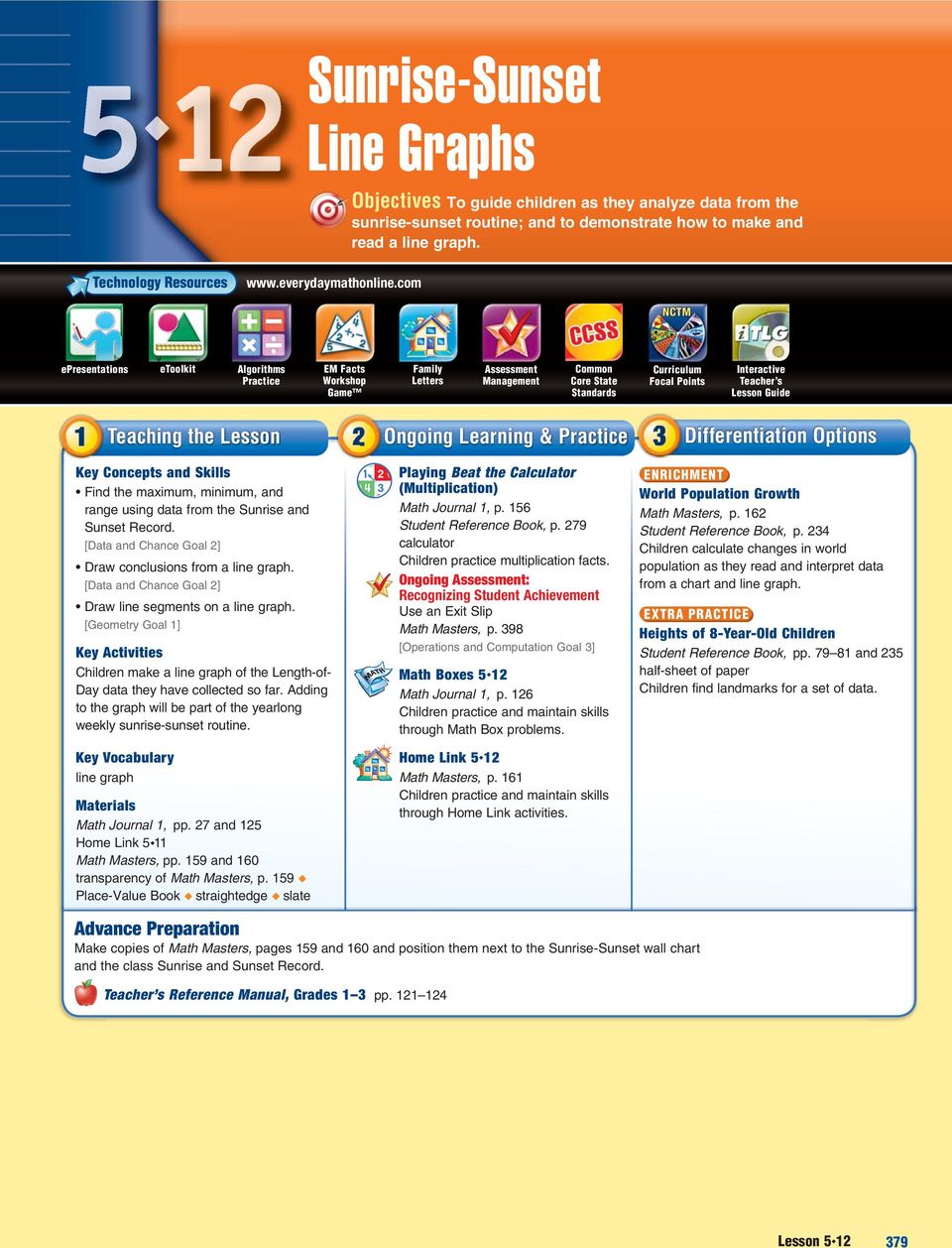
2 Getting Started Mathematical Practices SMP2, SMP3, SMP4, SMP5, SMP6, SMP7, SMP8 Content Standards 3.OA.7, 3.MD.1 Mental Math and Reflexes Dictate decimals while children display them with their Place-Value Books. In decimal numbers greater than 1, the decimal point is read as and. Suggestions: fifty-tee hundredths 0.53 two and thirty-five hundredths 2.35 four-hundredths 0.04 twenty and seven-hundredths one and four-tenths 1.4 forty and nine-tenths 40.9 For each number, ask questions such as the following: Which digit is in the tenths place? What is the value of the digit x? How many hundredths are there? Math Message Look at your Sunrise and Sunset Record on journal page 27. Which day was the longest day so far? Which was the shortest? How much longer was the longest day than the shortest day? Write the answers on your slate. Home Link 5 11 Follow-Up Partners or small groups take turns reading the number sentences in Problems 1 8 aloud to the class. 1 Teaching the Lesson Math Message Follow-Up WHOLE-CLASS DISCUSSION Children share strategies for finding the difference between the lengths of the longest and shortest days. Time Making a Line Graph of the Lengths of Days (Math Journal 1, pp. 27 and 125; Math Masters, pp. 159 and 160) ELL PROBLEM SOLVING WHOLE-CLASS 1 13 Sunrise and Sunset Record Time of Sunrise Time of Sunset Length of Day In today s lesson, the data from the Sunrise and Sunset Record is going to be transferred to a Length-of-Day line graph. Draw an enlarged date box on the board. (Model it after the ones on the bottom of the Length-of-Day graph.) Using a transparency of Math Masters, page 159, show children how to copy the dates from journal page 27 to the date boxes below the grid on journal page 125. Explain that the slash separates the month and the day. Explain the scale on the vertical (upright) axis. The labels represent the lengths of days in hours and utes. The heavy horizontal rules indicate whole hours. To support English Language learners, label the graph with the terms vertical axis and horizontal axis. Math Journal 1, p _EMCS_S_SMJ_G3_U01_ indd 27 4/18/11 3:00 PM 380 Unit 5 Place Value in Whole Numbers and Decimals
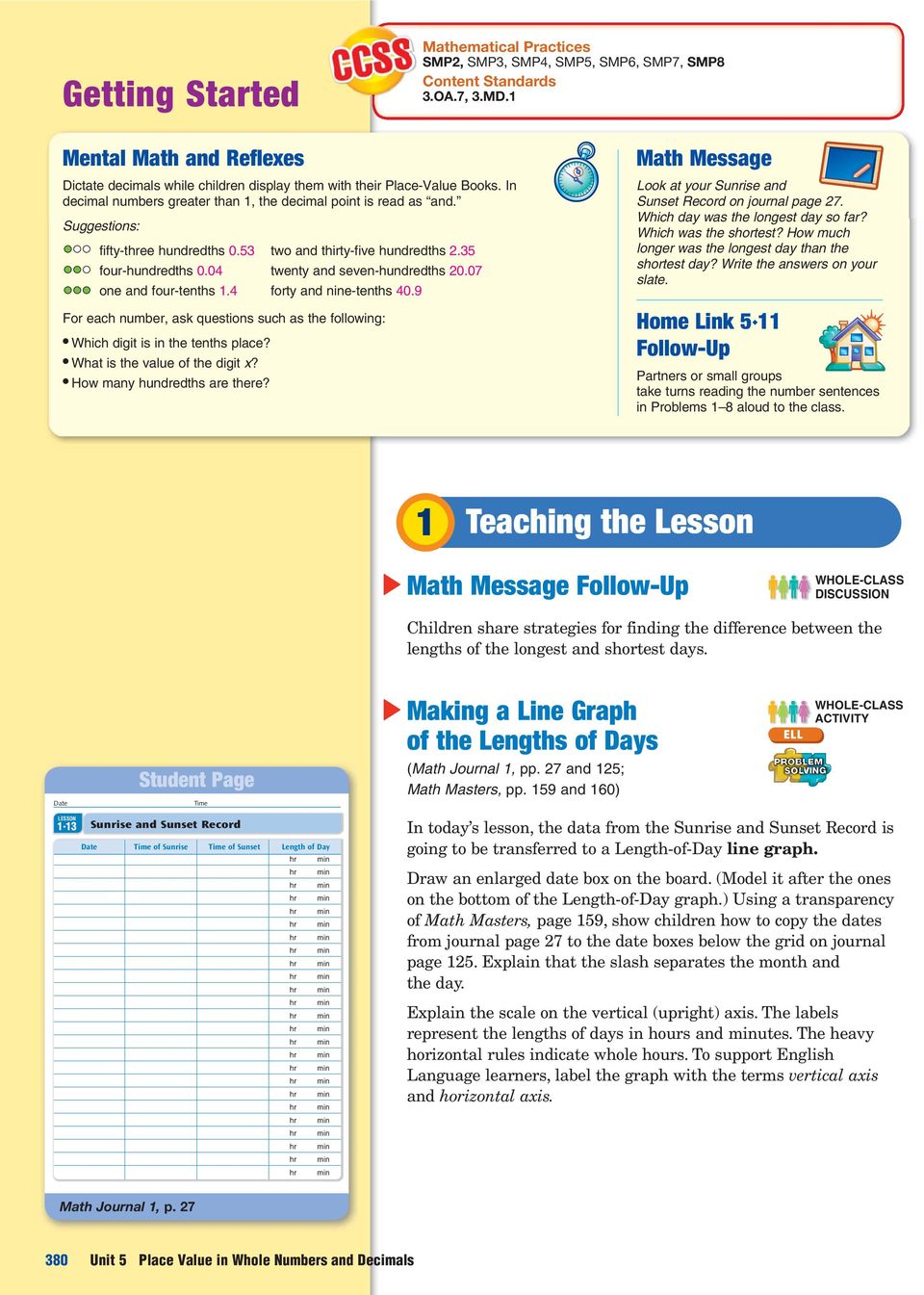
3 Teaching Master Adjusting the Activity ELL Write the word whole on the board and explain its meaning. Whole hours means entire or complete hours. This will prevent children from hearing and thinking the word hole. A U D I T O R Y K I N E S T H E T I C T A C T I L E V I S U A L Length-of-Day Line Graph 30 Each interval between consecutive whole hours is divided into six equal parts, each part representing 10 utes. The halfway point between consecutive whole hours is labeled 30. Show the class how to graph the length of day above the first date. Children make a dot in the appropriate place on the vertical rule above the first date box. This dot will most likely fall between two consecutive 10-ute marks. Children continue to graph the lengths of days from journal page 27 onto the grid on journal page 125. Use the overhead to demonstrate correct graphing technique Links to the Future Math Masters, p. 159 The activities in this lesson are an early exposure to creating and using line graphs. Creating and using line graphs is a Grade 4 Goal. After everyone has graphed all the data, ask children to use their straightedges to connect consecutive dots. The graph created is a line graph. The line graph is a representation of the data that the children are collecting. Children can look for patterns in the data table and in the data on the line graph. Spend a few utes sharing observations about the graph. For example: Find the highest point on the graph. Which date corresponds to this point? Is that the longest day so far? The longest day of the year, the summer solstice, is around June 21. Find the lowest point on the graph. Which date corresponds to this point? Is that the shortest day so far? The shortest day of the year, the winter solstice, is around December 21. What does it mean when the lines connecting the points go down? The days are getting shorter. What does it mean when the lines go up? The days are getting longer. Is there a turning point at which the lines change direction (either up or down)? At each solstice NOTE Math Masters, page 159 is similar to journal page 125. Teaching Master Length-of-Day Line Graph continued Math Masters, p. 160 Lesson
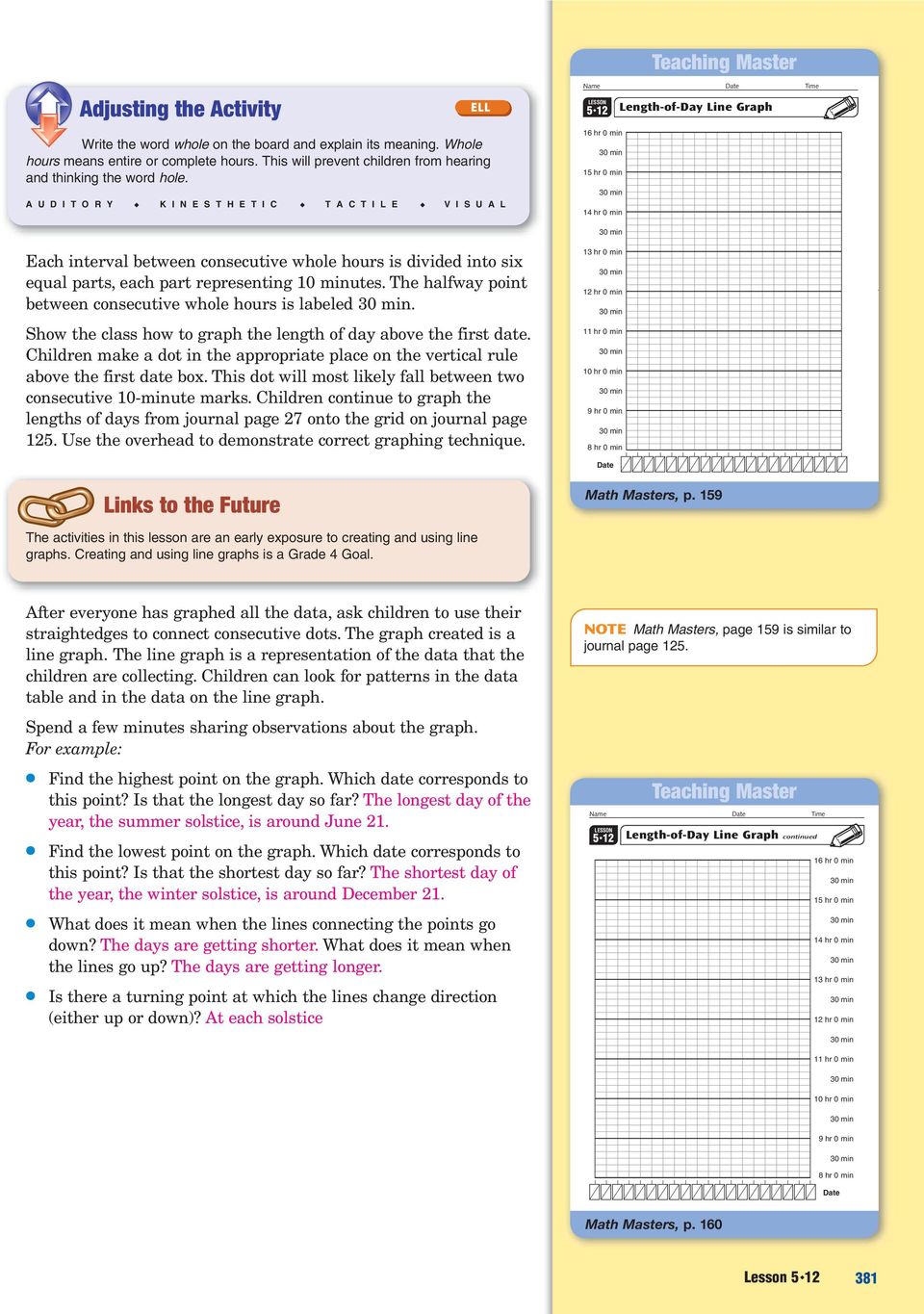
4 5 12 Math Boxes 1. Color 0.08 of the grid. 3. Which is more? 1.36 or or or or Time 2. What is the maximum number of points? 25 What is the mode? 25 points 4. One side of this square is 4 cm long. Perimeter = Number of Points 4 cm cm Point Totals A B C D E Players Tell children that from now on, whenever they record the sunrisesunset data for a certain day, they will also plot the length of that day on their line graphs. NOTE By the time children finish Math Journal 1, the Sunrise and Sunset Record, page 27, and the Length-of-Day line graph, page 125, will most likely be complete. In Math Journal 2, children will find a new Sunrise and Sunset Record on page 279, and a new Length-of-Day line graph on pages 280 and 281. Children should continue to enter data on these pages. The classroom copies of Math Masters, pages 159 and 160 positioned next to the Sunrise-Sunset chart, will serve as the yearlong record of the children s data. Each week, as children record the data in their journals, one child should record the data on the classroom copies of the journal pages Write the number that has 4 in the tenths place 0 in the hundredths place 6 in the ones place 9 in the thousandths place Math Journal 1, p This polygon has 12 sides. Name the shape. dodecagon Ongoing Learning & Practice Playing Beat the Calculator (Student Reference Book, p. 279; Math Journal 1, p. 156) SMALL-GROUP _EMCS_S_SMJ_G3_U05_ indd 126 1/26/11 9:17 AM Children develop automaticity with multiplication facts by playing Beat the Calculator. Have children add a check mark on the Fact Power Table (journal page 156) for each fact that they solve correctly when playing the role of the Brain. For Fact Power Table directions, see Lesson 4-5. For game directions, see page 279 in the Student Reference Book. HOME LINK 5 12 Family Note Home Link Master Subtraction & Multiplication Practice Ask your child to explain the counting-up and trade-first subtraction methods. Please return this Home Link to school tomorrow Ongoing Assessment: Recognizing Student Achievement Exit Slip Use an Exit Slip (Math Masters, page 398) to assess children s progress toward demonstrating automaticity with multiplication facts tough Children record the facts from the Fact Power Table for which they earned at least one check mark. Children are making adequate progress if they record at least 15 facts from the unshaded portion of the record sheet. Some children may record more than 15 facts. [Operations and Computation Goal 3] Make a ballpark estimate. Subtract and show your work. Check to see if your answer makes sense. 1. Use the counting-up method Use the trade-first method Multiplication. Write facts that you know. Sample answer: 450 (Ballpark estimate) Sample answer: 450 (Ballpark estimate) Answers vary facts 4. 3 facts 5. 4 facts 4 2 = 8 Math Masters, p. 161 Unit Math Boxes 5 12 (Math Journal 1, p. 126) Mixed Practice Math Boxes in this lesson are paired with Math Boxes in Lesson The skill in Problem 6 previews Unit 6 content. Writing/Reasoning Have children write an answer to the following: For Problem 3, explain how you know which number in each pair is more. Sample answer: I wrote the pairs of numbers one under the other. Then I compared each digit starting with the ones. If they were the same, I compared the tenths. If they were the same, I compared the hundredths. If the digits weren t the same, the larger digit was in the larger number. EM3MM_G3_U05_ indd 161 1/7/11 3:29 PM 382 Unit 5 Place Value in Whole Numbers and Decimals
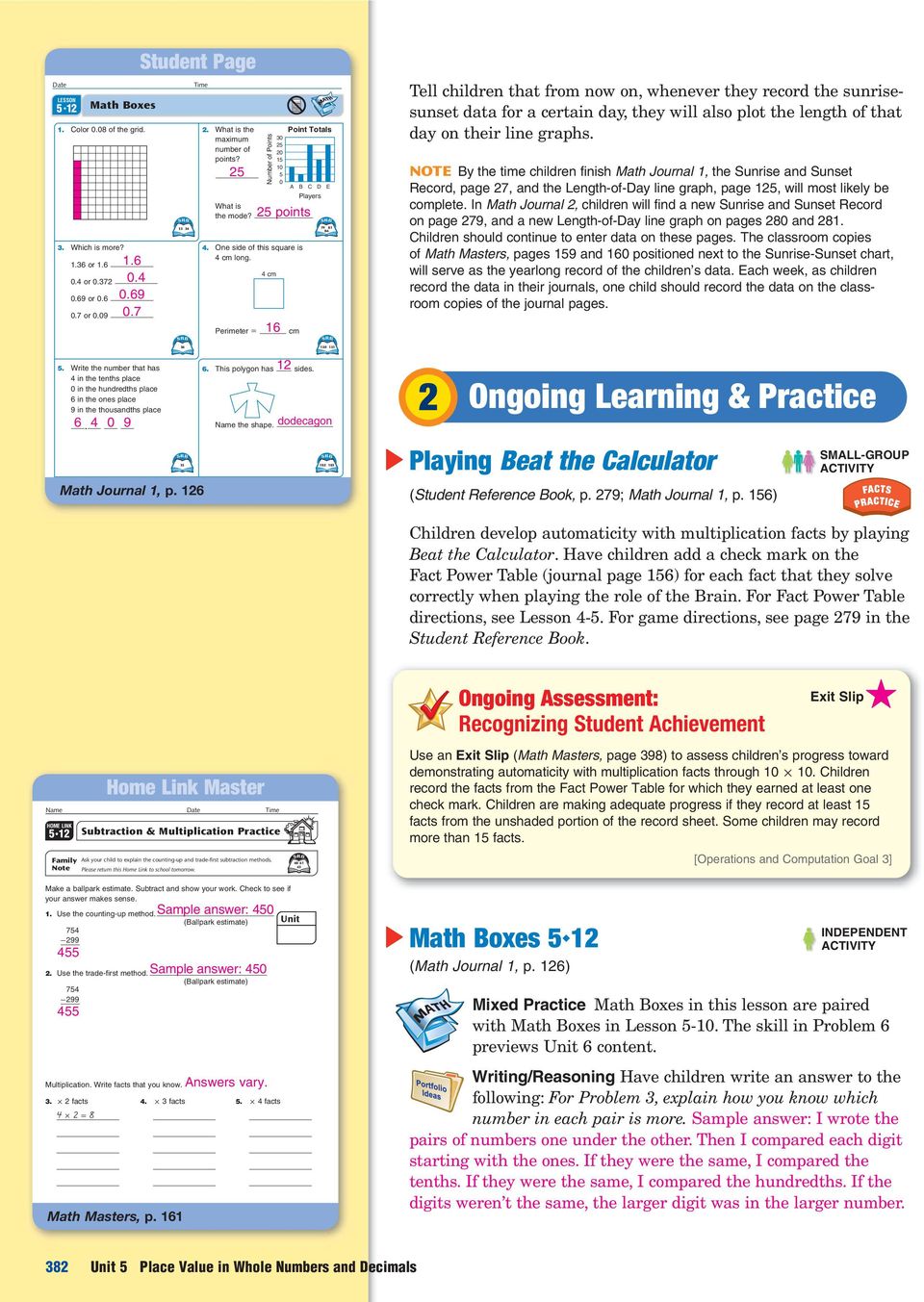
5 Home Link 5 12 (Math Masters, p. 161) Home Connection Children practice multidigit subtraction using two different strategies. They write multiplication facts they know. 3 Differentiation Options ENRICHMENT (Math Masters, p. 162; Student Reference Book, p. 234) 5 15 Min To further explore interpreting data on a line graph, have children answer questions on Math Masters, page 162 using data from the World Population Table and the graph on Student Reference Book, page 234. Teaching Master Use the data about world population on Student Reference Book, page 234 to help you answer the questions below. 1. About how many people were added to the world population between 1500 and 1804? How many years is that? 304 years 2. About how many people were added to the world population between 1804 and 1960? How many years is that? 156 years 3. About how many people were added to the world population between 1960 and 1999? How many years is that? 39 years 500,000,000 2,000,000,000 3,000,000, Compare your answers for Questions 1, 2, and 3. What do you notice about population growth? Sample answer: Population is increasing more rapidly in recent years. 5. Look at the World Population Graph. What does the line graph illustrate, or show, about world population? Sample answer: The population has grown much larger and faster in the last 500 years than in the previous 1,500 years. 6. Use the World Population Table to predict when the world population will reach 8,000,000,000. Explain. Use the back of this page, if needed. Sample answer: About 24 years. 1 billion more people were added from 1987 to 1999; that s 12 years. In 24 years, 2 billion would be added. Math Masters, p. 162 EXTRA PRACTICE Heights of 8-Year-Old Children (Student Reference Book, pp and 235) PARTNER Min To provide additional practice in finding data landmarks, have children detere the maximum 148 cm, imum 107 cm, range 41 cm, mode 126 cm, and median 126 cm for the Heights of Third Graders data set on page 235 in the Student Reference Book. Children record their answers on a half-sheet of paper. They may refer to pages in their Student Reference Books as needed. Data Bank There are more than 6 billion people in the world today. The table and graph below show how the world s population has grown. By the year 2050, the world will have about 10 billion people. World Population Table Population Population 1000 B.C. 50,000, ,000,000,000 A.D ,000, ,000,000, ,000, ,000,000, ,000, ,000,000, ,000,000, ,000,000,000 Source: United Nations Population Division World Population Student Reference Book, p. 234 Lesson

Objective To guide the development and use of a rule for generating equivalent fractions. Family Letters. Assessment Management
 Equivalent Fractions Objective To guide the development and use of a rule for generating equivalent fractions. www.everydaymathonline.com epresentations etoolkit Algorithms Practice EM Facts Workshop Game
The Distributive Property
 The Distributive Property Objectives To recognize the general patterns used to write the distributive property; and to mentally compute products using distributive strategies. www.everydaymathonline.com
Objectives To review making ballpark estimates; and to review the counting-up and trade-first subtraction algorithms. materials. materials.
 Objectives To review making ballpark estimates; and to review the counting-up and trade-first subtraction algorithms. Teaching the Lesson materials Key Activities Children make ballpark estimates for -digit
Baseball Multiplication Objective To practice multiplication facts.
 Baseball Multiplication Objective To practice multiplication facts. www.everydaymathonline.com epresentations etoolkit Algorithms Practice EM Facts Workshop Game Family Letters Assessment Management Common
Middle Value (Median) of a Set of Data
 Middle Value (Median) of a Set of Data Objectives To guide children as they sort numerical data and arrange data in ascending or descending order, and as they find the middle value (median) for a set of
Change Number Stories Objective To guide children as they use change diagrams to help solve change number stories.
 Number Stories Objective To guide children as they use change diagrams to help solve change number stories. www.everydaymathonline.com epresentations etoolkit Algorithms Practice EM Facts Workshop Game
Parentheses in Number Sentences
 Parentheses in Number Sentences Objective To review the use of parentheses. www.everydaymathonline.com epresentations etoolkit Algorithms Practice EM Facts Workshop Game Family Letters Assessment Management
The Lattice Method of Multiplication
 The Lattice Method of Multiplication Objective To review and provide practice with the lattice method for multiplication of whole numbers and decimals. www.everydaymathonline.com epresentations etoolkit
Factor Trees. Objective To provide experiences with finding the greatest common factor and the least common multiple of two numbers.
 Factor Trees Objective To provide experiences with finding the greatest common factor and the least common multiple of two numbers. www.everydaymathonline.com epresentations etoolkit Algorithms Practice
Reading and Writing Large Numbers
 Reading and Writing Large Numbers Objective To read and write large numbers in standard, expanded, and number-and-word notations. www.everydaymathonline.com epresentations etoolkit Algorithms Practice
Reading and Writing Small Numbers
 Reading Writing Small Numbers Objective To read write small numbers in stard exped notations wwweverydaymathonlinecom epresentations etoolkit Algorithms Practice EM Facts Workshop Game Family Letters Assessment
Objective To guide exploration of the connection between reflections and line symmetry. Assessment Management
 Line Symmetry Objective To guide exploration of the connection between reflections and line symmetry. www.everydaymathonline.com epresentations etoolkit Algorithms Practice EM Facts Workshop Game Family
Subtracting Mixed Numbers
 Subtracting Mixed Numbers Objective To develop subtraction concepts related to mixed numbers. www.everydaymathonline.com epresentations etoolkit Algorithms Practice EM Facts Workshop Game Family Letters
Comparing and Ordering Fractions
 Comparing and Ordering Fractions Objectives To review equivalent fractions; and to provide experience with comparing and ordering fractions. www.everydaymathonline.com epresentations etoolkit Algorithms
Review: Comparing Fractions Objectives To review the use of equivalent fractions
 Review: Comparing Fractions Objectives To review the use of equivalent fractions in comparisons. www.everydaymathonline.com epresentations etoolkit Algorithms Practice EM Facts Workshop Game Family Letters
Comparing Fractions Objective To provide practice ordering sets of fractions.
 Comparing Fractions Objective To provide practice ordering sets of fractions. www.everydaymathonline.com epresentations etoolkit Algorithms Practice EM Facts Workshop Game Family Letters Assessment Management
Objective To introduce the concept of square roots and the use of the square-root key on a calculator. Assessment Management
 Unsquaring Numbers Objective To introduce the concept of square roots and the use of the square-root key on a calculator. www.everydaymathonline.com epresentations etoolkit Algorithms Practice EM Facts
Measuring with a Ruler
 Measuring with a Ruler Objective To guide children as they measure line segments to the nearest inch, _ inch, _ inch, centimeter, _ centimeter, and millimeter. www.everydaymathonline.com epresentations
Hidden Treasure: A Coordinate Game. Assessment Management. Matching Number Stories to Graphs
 Hidden Treasure: A Coordinate Game Objective To reinforce students understanding of coordinate grid structures and vocabulary. www.everydaymathonline.com epresentations etoolkit Algorithms Practice EM
Volume of Right Prisms Objective To provide experiences with using a formula for the volume of right prisms.
 Volume of Right Prisms Objective To provide experiences with using a formula for the volume of right prisms. www.everydaymathonline.com epresentations etoolkit Algorithms Practice EM Facts Workshop Game
Addition of Multidigit Numbers
 Addition of Multidigit Numbers Objectives To review the partial-sums algorithm used to solve multidigit addition problems; and to introduce a column-addition method similar to the traditional addition
The Half-Circle Protractor
 The Half-ircle Protractor Objectives To guide students as they classify angles as acute, right, obtuse, straight, and reflex; and to provide practice using a half-circle protractor to measure and draw
Box Plots. Objectives To create, read, and interpret box plots; and to find the interquartile range of a data set. Family Letters
 Bo Plots Objectives To create, read, and interpret bo plots; and to find the interquartile range of a data set. www.everydaymathonline.com epresentations etoolkit Algorithms Practice EM Facts Workshop
Buying at the Stock-Up Sale
 Buying at the Stock-Up Sale Objective To guide children as they multiply using mental math and the partial-products algorithm. www.everydaymathonline.com epresentations etoolkit Algorithms Practice EM
Review of Basic Fraction Concepts
 Review of asic Fraction Concepts Objective To review fractions as parts of a whole (ONE), fractions on number lines, and uses of fractions. www.everydaymathonline.com epresentations etoolkit lgorithms
Volume of Pyramids and Cones
 Volume of Pyramids and Cones Objective To provide experiences with investigating the relationships between the volumes of geometric solids. www.everydaymathonline.com epresentations etoolkit Algorithms
Calculator Practice: Computation with Fractions
 Calculator Practice: Computation with Fractions Objectives To provide practice adding fractions with unlike denominators and using a calculator to solve fraction problems. www.everydaymathonline.com epresentations
Objective To introduce a formula to calculate the area. Family Letters. Assessment Management
 Area of a Circle Objective To introduce a formula to calculate the area of a circle. www.everydaymathonline.com epresentations etoolkit Algorithms Practice EM Facts Workshop Game Family Letters Assessment
Assessment Management
 Facts Using Doubles Objective To provide opportunities for children to explore and practice doubles-plus-1 and doubles-plus-2 facts, as well as review strategies for solving other addition facts. www.everydaymathonline.com
Capacity. Assessment Management
 Capacity Objective To review units of capacity. www.everydaymathonline.com epresentations etoolkit Algorithms Practice EM Facts Workshop Game Family Letters Assessment Management Common Core State Standards
Line Plots. Objective To provide experience creating and interpreting line plots with fractional units. Assessment Management
 Line Plots Objective To provide experience creating and interpreting line plots with fractional units. www.everydaymathonline.com epresentations etoolkit Algorithms Practice EM Facts Workshop Game Family
Frames and Arrows Having Two Rules
 Frames and Arrows Having Two s Objective To guide children as they solve Frames-and-Arrows problems having two rules. www.everydaymathonline.com epresentations etoolkit Algorithms Practice EM Facts Workshop
Multiplication and Division of Positive and Negative Numbers
 Multiplication and Division of Positive Objective o develop and apply rules for multiplying and dividing positive and www.everydaymathonline.com epresentations eoolkit Algorithms Practice EM Facts Workshop
Objectives To review and provide practice with the lattice method for multiplication.
 Objectives To review and provide practice with the lattice method for multiplication. Teaching the Lesson materials Key Activities Students review the lattice method for multiplication with - and -digit
Mathematics Success Grade 6
 T276 Mathematics Success Grade 6 [OBJECTIVE] The student will add and subtract with decimals to the thousandths place in mathematical and real-world situations. [PREREQUISITE SKILLS] addition and subtraction
Multiplying Fractions by Whole Numbers
 Multiplying Fractions by Whole Numbers Objective To apply and extend previous understandings of multiplication to multiply a fraction by a whole number. www.everydaymathonline.com epresentations etoolkit
NUMBER CORNER YEARLONG CONTENT OVERVIEW
 August & September Workouts Calendar Grid Quilt Block Symmetries Identifying shapes and symmetries Calendar Collector Two Penny Toss Probability and data analysis Computational Fluency Mental Math Fluently
Unit 1: Family Letter
 Name Date Time HOME LINK Unit 1: Family Letter Introduction to Third Grade Everyday Mathematics Welcome to Third Grade Everyday Mathematics. It is part of an elementary school mathematics curriculum developed
U.S. Traditional Long Division, Part 1 Objective To introduce U.S. traditional long division.
 Algorithm Project U.S. Traditional Long Division, Part 1 Objective To introduce U.S. traditional long division. www.everydaymathonline.com etoolkit Algorithms Practice EM Facts Workshop Game Family Letters
Everyday Mathematics. Grade 4 Grade-Level Goals CCSS EDITION. Content Strand: Number and Numeration. Program Goal Content Thread Grade-Level Goal
 Content Strand: Number and Numeration Understand the Meanings, Uses, and Representations of Numbers Understand Equivalent Names for Numbers Understand Common Numerical Relations Place value and notation
Everyday Mathematics. Grade 4 Grade-Level Goals. 3rd Edition. Content Strand: Number and Numeration. Program Goal Content Thread Grade-Level Goals
 Content Strand: Number and Numeration Understand the Meanings, Uses, and Representations of Numbers Understand Equivalent Names for Numbers Understand Common Numerical Relations Place value and notation
EVERY DAY COUNTS CALENDAR MATH 2005 correlated to
 EVERY DAY COUNTS CALENDAR MATH 2005 correlated to Illinois Mathematics Assessment Framework Grades 3-5 E D U C A T I O N G R O U P A Houghton Mifflin Company YOUR ILLINOIS GREAT SOURCE REPRESENTATIVES:
Autumn - 12 Weeks. Spring 11 Weeks. Summer 12 Weeks. Not As We Know It Limited 2014
 A Year 5 Mathematician Planning of coverage and resources. Autumn - 12 Weeks Spring 11 Weeks Summer 12 Weeks TARGETS NHM YR 5 Collins 5 Abacus 5 Abacus 6 LA Prior Step NHM 4 CPM 4 Ginn 4 Number, place
NCTM Curriculum Focal Points for Grade 5. Everyday Mathematics, Grade 5
 NCTM Curriculum Focal Points and, Grade 5 NCTM Curriculum Focal Points for Grade 5 Number and Operations and Algebra: Developing an understanding of and fluency with division of whole numbers Students
Local Government and Leaders Grade Three
 Ohio Standards Connection: Government Benchmark A Identify the responsibilities of the branches of the U.S. government and explain why they are necessary. Indicator 2 Explain the structure of local governments
Medium term Plans for Spring Year 5
 Medium term Plans for Spring Year 5 Help these children be in a better position to achieve good results in the Y6 Sats in 2015. Although these tests will officially be based on the old curriculum, it is
Rational Number Project
 Rational Number Project Fraction Operations and Initial Decimal Ideas Lesson 12: Overview Students review ordering and equivalence and practice adding and subtracting decimals in problem solving contexts.
This lesson introduces students to decimals.
 NATIONAL MATH + SCIENCE INITIATIVE Elementary Math Introduction to Decimals LEVEL Grade Five OBJECTIVES Students will compare fractions to decimals. explore and build decimal models. MATERIALS AND RESOURCES
Assessment Management
 Weight Objectives To review grams and ounces as units of mass and weight; and to guide the estimation and measurement of weight in grams and ounces. www.everydaymathonline.com epresentations etoolkit Algorithms
Grade 5 Math Content 1
 Grade 5 Math Content 1 Number and Operations: Whole Numbers Multiplication and Division In Grade 5, students consolidate their understanding of the computational strategies they use for multiplication.
Everyday Mathematics CCSS EDITION CCSS EDITION. Content Strand: Number and Numeration
 CCSS EDITION Overview of -6 Grade-Level Goals CCSS EDITION Content Strand: Number and Numeration Program Goal: Understand the Meanings, Uses, and Representations of Numbers Content Thread: Rote Counting
Everyday Mathematics GOALS
 Copyright Wright Group/McGraw-Hill GOALS The following tables list the Grade-Level Goals organized by Content Strand and Program Goal. Content Strand: NUMBER AND NUMERATION Program Goal: Understand the
Scope and Sequence KA KB 1A 1B 2A 2B 3A 3B 4A 4B 5A 5B 6A 6B
 Scope and Sequence Earlybird Kindergarten, Standards Edition Primary Mathematics, Standards Edition Copyright 2008 [SingaporeMath.com Inc.] The check mark indicates where the topic is first introduced
1 BPS Math Year at a Glance (Adapted from A Story of Units Curriculum Maps in Mathematics P-5)
 Grade 5 Key Areas of Focus for Grades 3-5: Multiplication and division of whole numbers and fractions-concepts, skills and problem solving Expected Fluency: Multi-digit multiplication Module M1: Whole
Grade 6 Mathematics Performance Level Descriptors
 Limited Grade 6 Mathematics Performance Level Descriptors A student performing at the Limited Level demonstrates a minimal command of Ohio s Learning Standards for Grade 6 Mathematics. A student at this
Annotated work sample portfolios are provided to support implementation of the Foundation Year 10 Australian Curriculum.
 Work sample portfolio summary WORK SAMPLE PORTFOLIO Annotated work sample portfolios are provided to support implementation of the Foundation Year 10 Australian Curriculum. Each portfolio is an example
Fun with Fractions: A Unit on Developing the Set Model: Unit Overview www.illuminations.nctm.org
 Fun with Fractions: A Unit on Developing the Set Model: Unit Overview www.illuminations.nctm.org Number of Lessons: 7 Grades: 3-5 Number & Operations In this unit plan, students explore relationships among
Student Progress Monitoring in Mathematics Pamela M. Stecker, PhD
 Student Progress Monitoring in Mathematics Pamela M. Stecker, PhD Clemson University Session Objectives Discuss curriculum-based measurement as one research-validated form of progress monitoring. Contrast
BPS Math Year at a Glance (Adapted from A Story Of Units Curriculum Maps in Mathematics K-5) 1
 Grade 4 Key Areas of Focus for Grades 3-5: Multiplication and division of whole numbers and fractions-concepts, skills and problem solving Expected Fluency: Add and subtract within 1,000,000 Module M1:
Hands-On Data Analysis
 THE 2012 ROSENTHAL PRIZE for Innovation in Math Teaching Hands-On Data Analysis Lesson Plan GRADE 6 Table of Contents Overview... 3 Prerequisite Knowledge... 3 Lesson Goals.....3 Assessment.... 3 Common
Progress Check 6. Objective To assess students progress on mathematical content through the end of Unit 6. Looking Back: Cumulative Assessment
 Progress Check 6 Objective To assess students progress on mathematical content through the end of Unit 6. Looking Back: Cumulative Assessment The Mid-Year Assessment in the Assessment Handbook is a written
Colour by Numbers Image Representation
 Activity 2 Colour by Numbers Image Representation Summary Computers store drawings, photographs and other pictures using only numbers. The following activity demonstrates how they can do this. Curriculum
ISAT Mathematics Performance Definitions Grade 4
 ISAT Mathematics Performance Definitions Grade 4 EXCEEDS STANDARDS Fourth-grade students whose measured performance exceeds standards are able to identify, read, write, represent, and model whole numbers
Minnesota Academic Standards
 A Correlation of to the Minnesota Academic Standards Grades K-6 G/M-204 Introduction This document demonstrates the high degree of success students will achieve when using Scott Foresman Addison Wesley
Grade 5 Mathematics Curriculum Guideline Scott Foresman - Addison Wesley 2008. Chapter 1: Place, Value, Adding, and Subtracting
 Grade 5 Math Pacing Guide Page 1 of 9 Grade 5 Mathematics Curriculum Guideline Scott Foresman - Addison Wesley 2008 Test Preparation Timeline Recommendation: September - November Chapters 1-5 December
Third Grade Math Games
 Third Grade Math Games Unit 1 Lesson Less than You! 1.3 Addition Top-It 1.4 Name That Number 1.6 Beat the Calculator (Addition) 1.8 Buyer & Vendor Game 1.9 Tic-Tac-Toe Addition 1.11 Unit 2 What s My Rule?
Representing Data Using Frequency Graphs
 Lesson 25 Mathematics Assessment Project Formative Assessment Lesson Materials Representing Data Using Graphs MARS Shell Center University of Nottingham & UC Berkeley Alpha Version If you encounter errors
Charlesworth School Year Group Maths Targets
 Charlesworth School Year Group Maths Targets Year One Maths Target Sheet Key Statement KS1 Maths Targets (Expected) These skills must be secure to move beyond expected. I can compare, describe and solve
GRADE 5 SKILL VOCABULARY MATHEMATICAL PRACTICES Evaluate numerical expressions with parentheses, brackets, and/or braces.
 Common Core Math Curriculum Grade 5 ESSENTIAL DOMAINS AND QUESTIONS CLUSTERS Operations and Algebraic Thinking 5.0A What can affect the relationship between numbers? round decimals? compare decimals? What
First Grade Exploring Two-Digit Numbers
 First Grade Exploring Two-Digit Numbers http://focusonmath.files.wordpress.com/2011/02/screen-shot-2011-02-17-at-3-10-19-pm.png North Carolina Department of Public Instruction www.ncdpi.wikispaces.net
Grade 5 Common Core State Standard
 2.1.5.B.1 Apply place value concepts to show an understanding of operations and rounding as they pertain to whole numbers and decimals. M05.A-T.1.1.1 Demonstrate an understanding that 5.NBT.1 Recognize
Vocabulary Cards and Word Walls Revised: June 29, 2011
 Vocabulary Cards and Word Walls Revised: June 29, 2011 Important Notes for Teachers: The vocabulary cards in this file match the Common Core, the math curriculum adopted by the Utah State Board of Education,
Grade 4 Unit 3: Multiplication and Division; Number Sentences and Algebra
 Grade 4 Unit 3: Multiplication and Division; Number Sentences and Algebra Activity Lesson 3-1 What s My Rule? page 159) Everyday Mathematics Goal for Mathematical Practice GMP 2.2 Explain the meanings
Convert between units of area and determine the scale factor of two similar figures.
 CHAPTER 5 Units of Area c GOAL Convert between units of area and determine the scale factor of two. You will need a ruler centimetre grid paper a protractor a calculator Learn about the Math The area of
Rational Number Project
 Rational Number Project Fraction Operations and Initial Decimal Ideas Lesson : Overview Students estimate sums and differences using mental images of the 0 x 0 grid. Students develop strategies for adding
District 203 K-4 Elementary Summer School 2015
 District 203 K-4 Elementary Summer School 2015 The following Elementary Summer School courses will be conducted from Monday, June 8, 2014, through Friday, June 26, 2015. THE SAME COURSES WILL BE OFFERED
DesCartes (Combined) Subject: Mathematics 2-5 Goal: Data Analysis, Statistics, and Probability
 DesCartes (Combined) Subject: Mathematics 2-5 Goal: Data Analysis, Statistics, and Probability RIT Score Range: Below 171 Below 171 Data Analysis and Statistics Solves simple problems based on data from
called and explain why it cannot be factored with algebra tiles? and explain why it cannot be factored with algebra tiles?
 Factoring Reporting Category Topic Expressions and Operations Factoring polynomials Primary SOL A.2c The student will perform operations on polynomials, including factoring completely first- and second-degree
Counting Money and Making Change Grade Two
 Ohio Standards Connection Number, Number Sense and Operations Benchmark D Determine the value of a collection of coins and dollar bills. Indicator 4 Represent and write the value of money using the sign
Basic Understandings
 Activity: TEKS: Exploring Transformations Basic understandings. (5) Tools for geometric thinking. Techniques for working with spatial figures and their properties are essential to understanding underlying
Plotting Ordered Pairs on a Four Quadrant Grid Grade Five
 Ohio Standards Connection Geometry and Spatial Sense Benchmark C Specify locations and plot ordered pairs on a coordinate plane. Indicator 6 Extend understanding of coordinate system to include points
Warm-Up 1. 1. What is the least common multiple of 6, 8 and 10?
 Warm-Up 1 1. What is the least common multiple of 6, 8 and 10? 2. A 16-page booklet is made from a stack of four sheets of paper that is folded in half and then joined along the common fold. The 16 pages
PoW-TER Problem Packet A Phone-y Deal? (Author: Peggy McCloskey)
 PoW-TER Problem Packet A Phone-y Deal? (Author: Peggy McCloskey) 1. The Problem: A Phone-y Deal? [Problem #3280] With cell phones being so common these days, the phone companies are all competing to earn
Dr Brian Beaudrie pg. 1
 Multiplication of Decimals Name: Multiplication of a decimal by a whole number can be represented by the repeated addition model. For example, 3 0.14 means add 0.14 three times, regroup, and simplify,
MATHS LEVEL DESCRIPTORS
 MATHS LEVEL DESCRIPTORS Number Level 3 Understand the place value of numbers up to thousands. Order numbers up to 9999. Round numbers to the nearest 10 or 100. Understand the number line below zero, and
5 th Grade Texas Mathematics: Unpacked Content
 5 th Grade Texas Mathematics: Unpacked Content What is the purpose of this document? To increase student achievement by ensuring educators understand specifically what the new standards mean a student
Statistics and Probability
 Statistics and Probability TABLE OF CONTENTS 1 Posing Questions and Gathering Data. 2 2 Representing Data. 7 3 Interpreting and Evaluating Data 13 4 Exploring Probability..17 5 Games of Chance 20 6 Ideas
Measures of Spread and Their Effects Grade Seven
 Ohio Standards Connection Data Analysis and Probability Benchmark F Determine and use the range, mean, median and mode to analyze and compare data, and explain what each indicates about the data. Indicator
5 Mathematics Curriculum
 New York State Common Core 5 Mathematics Curriculum G R A D E GRADE 5 MODULE 1 Topic C Place Value and Rounding Decimal Fractions 5.NBT.4 Focus Standard: 5.NBT.4 Use place value understanding to round
MACMILLAN/McGRAW-HILL. MATH CONNECTS and IMPACT MATHEMATICS WASHINGTON STATE MATHEMATICS STANDARDS. ESSENTIAL ACADEMIC LEARNING REQUIREMENTS (EALRs)
 MACMILLAN/McGRAW-HILL MATH CONNECTS and IMPACT MATHEMATICS TO WASHINGTON STATE MATHEMATICS STANDARDS ESSENTIAL ACADEMIC LEARNING REQUIREMENTS (EALRs) And GRADE LEVEL EXPECTATIONS (GLEs) / Edition, Copyright
Understanding Ratios Grade Five
 Ohio Standards Connection: Number, Number Sense and Operations Standard Benchmark B Use models and pictures to relate concepts of ratio, proportion and percent. Indicator 1 Use models and visual representation
Introduce Decimals with an Art Project Criteria Charts, Rubrics, Standards By Susan Ferdman
 Introduce Decimals with an Art Project Criteria Charts, Rubrics, Standards By Susan Ferdman hundredths tenths ones tens Decimal Art An Introduction to Decimals Directions: Part 1: Coloring Have children
2 Mathematics Curriculum
 New York State Common Core 2 Mathematics Curriculum GRADE GRADE 2 MODULE 3 Topic E: Model Numbers Within 1000 with Place Value Disks 2.NBT.A Focus Standard: 2.NBT.A Understand place value. Instructional
Algebra Geometry Glossary. 90 angle
 lgebra Geometry Glossary 1) acute angle an angle less than 90 acute angle 90 angle 2) acute triangle a triangle where all angles are less than 90 3) adjacent angles angles that share a common leg Example:
Big Ideas, Goals & Content for 4 th grade Data Collection & Analysis Unit
 Big Ideas, Goals & Content for 4 th grade Data Collection & Analysis Unit Big Ideas Graphs are a way of organizing data and they appear in newspapers, magazines, on the Internet and other places in everyday
MathSphere MATHEMATICS. Equipment. Y6 Fractions 6365 Round decimals. Equivalence between decimals and fractions
 MATHEMATICS Y6 Fractions 6365 Round decimals. Equivalence between decimals and fractions Paper, pencil, ruler Fraction cards Calculator Equipment MathSphere 6365 Round decimals. Equivalence between fractions
Algebra Unit Plans. Grade 7. April 2012. Created By: Danielle Brown; Rosanna Gaudio; Lori Marano; Melissa Pino; Beth Orlando & Sherri Viotto
 Algebra Unit Plans Grade 7 April 2012 Created By: Danielle Brown; Rosanna Gaudio; Lori Marano; Melissa Pino; Beth Orlando & Sherri Viotto Unit Planning Sheet for Algebra Big Ideas for Algebra (Dr. Small)
Kolbe Academy Home School
 GRADE FIVE MATHEMATICS Singapore Math Primary 5A Singapore Math Primary 5B TABLE OF CONTENTS I. Syllabus 2 II. Daily Course Plan A. Quarter 1 8 B. Quarter 2 19 C. Quarter 3 29 D. Quarter 4 40 III. Unit
DesCartes (Combined) Subject: Mathematics Goal: Data Analysis, Statistics, and Probability
 DesCartes (Combined) Subject: Mathematics Goal: Data Analysis, Statistics, and Probability RIT Score Range: Below 171 Below 171 171-180 Data Analysis and Statistics Data Analysis and Statistics Solves
Illinois State Standards Alignments Grades Three through Eleven
 Illinois State Standards Alignments Grades Three through Eleven Trademark of Renaissance Learning, Inc., and its subsidiaries, registered, common law, or pending registration in the United States and other