
Monitoring and evaluation of policy instruments to support renewable electricity in EU Member States
|
|
|
- Victor Montgomery
- 10 years ago
- Views:
Transcription
1 Final Report Monitoring and evaluation of policy instruments to support renewable electricity in EU Member States A research project funded by the German Federal Environment Agency (UBA) and the Ministry for the Environment, Nature Conservation and Nuclear Safety (BMU) Funding label: The project is based on the European projects OPTRES, Green-X and FORRES Authors: Mario Ragwitz (Fraunhofer ISI) Anne Held (Fraunhofer ISI) Gustav Resch (EEG) Thomas Faber (EEG) Claus Huber (EEG) Reinhard Haas (EEG)

2 Acknowledgement The project "Monitoring and evaluation of policy instruments to support renewable electricity in EU Member States" has been supported by the German Federal Environment Agency (UBA) and the German Ministry for the Environment, Nature Conservation and Nuclear Safety (BMU). The results achieved in the frame of this project are based on the earlier EU projects Green-X "Deriving optimal promotion strategies for increasing the share of RES-E in a dynamic European electricity market" and FORRES 2020 "Analysis of the EU renewable energy sources' evolution up to 2020" and have significantly profited from the EU project OPTRES "Assessment and optimisation of renewable energy support schemes in the European electricity market", which was carried out in parallel. Imprint: Fraunhofer Institute Systems and Innovation Research Breslauer Str. 48, D Karlsruhe, Germany Printed in Germany September 2006 Photography (cover page) by Gustav Resch Contact details: Dr. Mario Ragwitz Fraunhofer Institute Systems and Innovation Research Breslauer Str. 48 D Karlsruhe Germany Phone: +49(0)721/ Fax: +49(0)721/ [email protected] Dr. Gustav Resch Vienna University of Technology Energy Economics Group (EEG) Gusshausstrasse 25 / A-1040 Vienna Austria Phone: +43(0)1/ Fax: +43(0)1/ [email protected].
3 CONTENTS Page Executive Summary Introduction General characterisation of support schemes for renewable energy sources in the electricity sector (RES-E) Current status of RES-E markets in selected EU Member States Effectiveness of the implemented support schemes in selected EU Member States The impact of support schemes on the future deployment of RES-E Design criteria for RES-E support instruments Main findings on the properties of feed-in systems and quota systems References GLOSSARY...95 Annex A Detailed results with respect to chapter 5 (future RES-E deployment)...98 Annex B Short characterisation of the Green-X model Page I
4 Page II
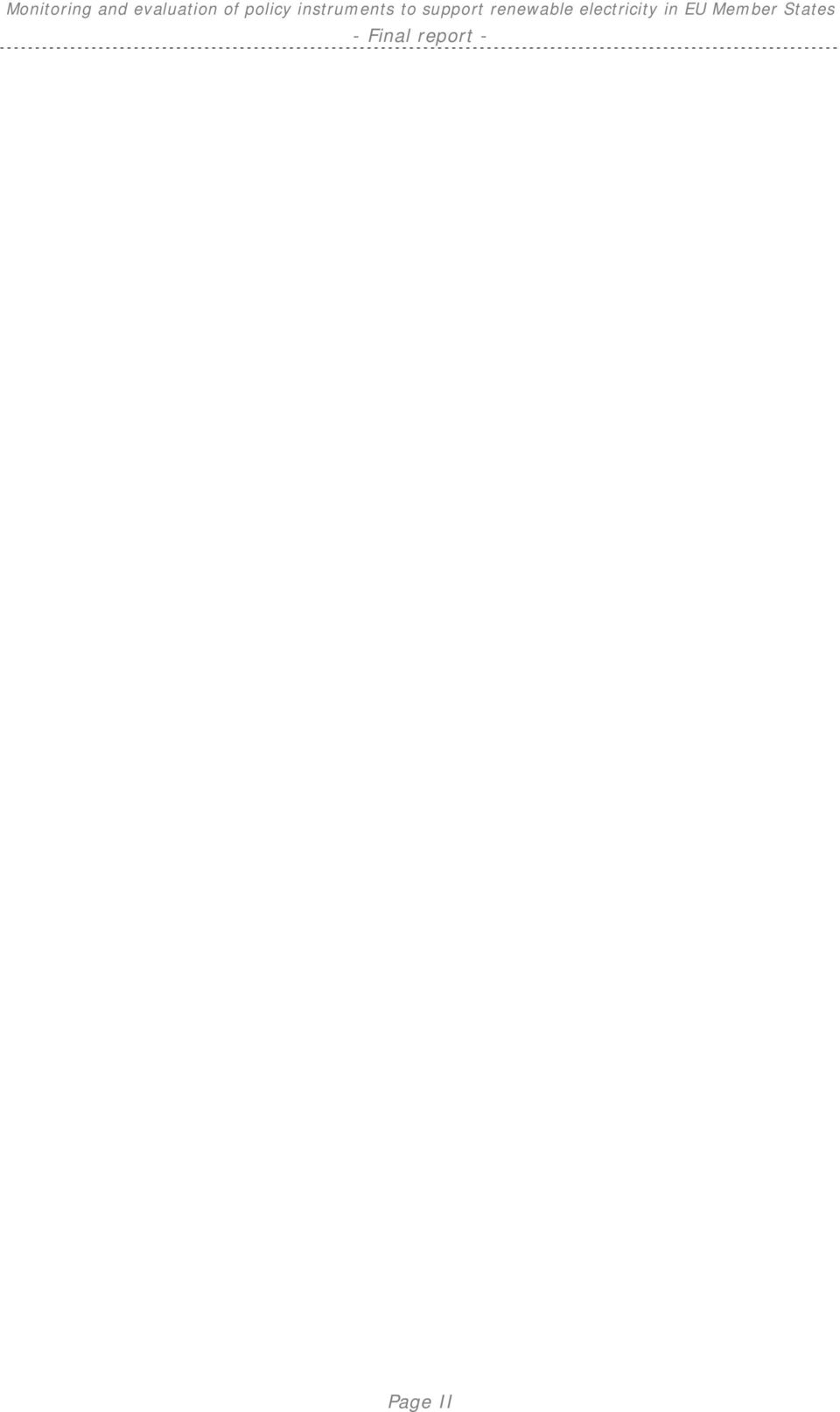
5 EXECUTIVE SUMMARY Since the publication of the White Paper "Energy for the future" (EC, 1997) and the adoption of the Directive 2001/77/EC (EC, 2001) on renewable energies in the electricity sector (RES-E), the EU renewable energy sector has developed in a dynamic way. All member states have introduced policies to support the market introduction of RES-E and most of them have started to improve the corresponding administrative framework conditions. The main existing policies comprise feed-in tariffs, quota obligations based on tradable green certificates (TGCs), investment grants, tender procedures and tax measures. Due to the different nature of the various policy schemes, the effects of these instruments on technological development, RES-E market diffusion and evolution of generation costs as well as cost for society differ significantly. Until now RES-E support measures have been implemented exclusively on a national level, aiming to meet the national indicative targets as set in the RES-E directive. However, based on the presently implemented policies, most of these targets will most likely not be met as was indicated in the communication of the European Commission in 2004 COM (2004) 366 (only Denmark, Finland, Germany and Spain are on track to reach the national target). An important reason for this is that the support level offered to RES-E is still very heterogeneous among the EU countries and certainly too low in a number of Member States, i.e. sometimes below long-term marginal costs. Furthermore, the identified key barriers to the development of RES-E which are of an administrative, financial, and social nature as well as insufficient electricity grid capacity are not being appropriately addressed by national authorities. Additionally the risk level associated with RES-E investments is still evaluated as comparatively high by the relevant financial institutions in some markets. Altogether, the effectiveness of present RES-E support is still limited in a number of cases and shows a rather uneven distribution across the EU. Besides these facts, the economic efficiency of RES-E support is lower than would be possible in an advanced policy environment and shows a clear heterogeneity among member states. In the present project the main national support instruments for RES-E implemented in EU Member States have been analysed based on a historical assessment of past achievements as well as on a prospective model based analysis. As general conclusions from the present study it can be stated that the continuity and long term investment stability of any implemented policy is a key criterion for the stable growth of RES-E markets as well as for reaching RES-E targets at low costs, most of the European success story to promote RES-E during the past decades was driven by implemented feed-in tariffs, which have proven to be an effective as well as economically efficient policy instrument, in order to minimise the costs for society, technology specific instruments are preferable to non-technology specific support, Page 1

6 non-economic barriers (e.g. grid and administrative barriers) need to be diminished in order to increase the growth of many renewable energy markets in Europe. More detailed conclusions from the analysis of historic trends and the modelbased prospective analysis read as follows: Based on the analysis of historic trends: The best progress towards the targets set in the RES-E directive was achieved in countries with stable support systems and low overall barriers for the development of RES-E, i.e. Denmark, Finland, Germany and Spain in the present analysis. The effectiveness of the promotion of innovative technologies like wind energy, agricultural biogas and photovoltaics has been the highest in countries having feed-in tariffs as their main support system, even though not all feed-in countries have been equally successful. These technologies offer most significant future potentials for the mid to long term. Low cost options in the overall RES-E technology portfolio like sewage gas and certain fractions of solid biomass have been supported effectively but not always efficiently in countries with non-technology specific RES-E promotion schemes like tax incentives and quota obligations based on TGCs, although significant progress can be seen under some of the implemented feed-in systems as well. Comparing the current level of support offered under the different systems with the resulting effectiveness of the promotion schemes for the case of wind energy it is striking that three countries - Italy, the UK and Belgium - which have recently transformed their markets into quota systems as the main support instrument, show a high expected annuity of support (and therefore high costs for consumers) but low growth rates. The high annuity results in particular from the extrapolation of the presently observed high certificate prices. Although the latter assumption might be questioned (empirical evidence supporting this assumption is given in the report), the results show that certificate systems can lead to high producer profits resulting from high investment risks. On the other hand, it seems typical for countries supporting wind energy based on feed-in-tariffs to be more effective at generally moderate levels of support. An exception to this rule can be observed in countries, where administrative barriers are preventing rapid development of wind energy. Referring to the model-based prospective analysis: Results suggest that the most significant efficiency gains can be achieved simply by strengthening and improving national RES-E support schemes more than two thirds of the overall cost reduction potential of policy harmonisation can be attributed to the optimisation of national support schemes. The effectiveness of the various RES-E support schemes largely depends on the credibility of the system. The continuation of a policy avoiding stopand-go is important to create a stable growth in renewable energy sources and, in addition, also cause lower societal costs as a result of a lower risk premium (of investors). Page 2

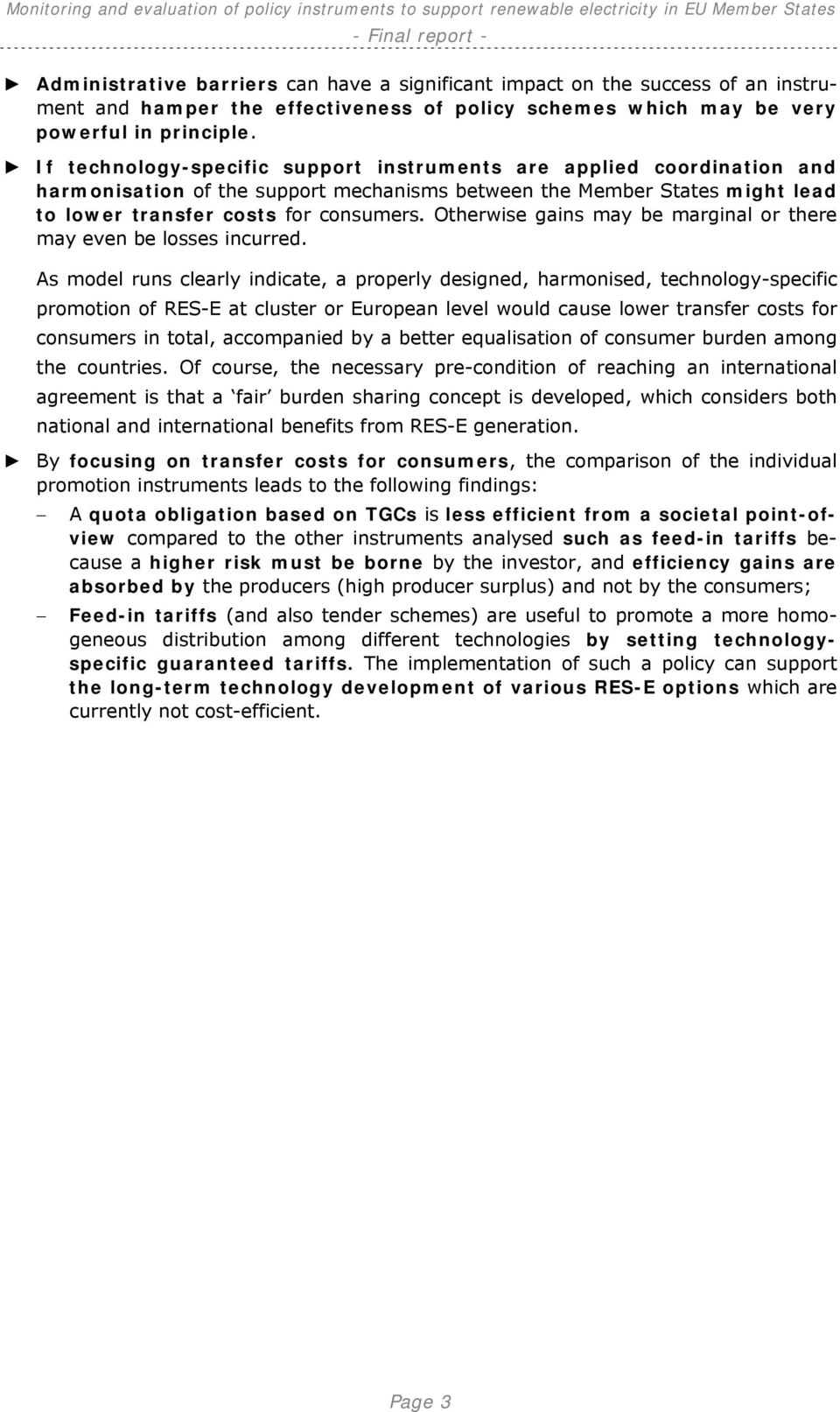
7 Administrative barriers can have a significant impact on the success of an instrument and hamper the effectiveness of policy schemes which may be very powerful in principle. If technology-specific support instruments are applied coordination and harmonisation of the support mechanisms between the Member States might lead to lower transfer costs for consumers. Otherwise gains may be marginal or there may even be losses incurred. As model runs clearly indicate, a properly designed, harmonised, technology-specific promotion of RES-E at cluster or European level would cause lower transfer costs for consumers in total, accompanied by a better equalisation of consumer burden among the countries. Of course, the necessary pre-condition of reaching an international agreement is that a fair burden sharing concept is developed, which considers both national and international benefits from RES-E generation. By focusing on transfer costs for consumers, the comparison of the individual promotion instruments leads to the following findings: A quota obligation based on TGCs is less efficient from a societal point-ofview compared to the other instruments analysed such as feed-in tariffs because a higher risk must be borne by the investor, and efficiency gains are absorbed by the producers (high producer surplus) and not by the consumers; Feed-in tariffs (and also tender schemes) are useful to promote a more homogeneous distribution among different technologies by setting technologyspecific guaranteed tariffs. The implementation of such a policy can support the long-term technology development of various RES-E options which are currently not cost-efficient. Page 3
8 1 INTRODUCTION It is the European Union's objective to increase the share of electricity produced from renewable energy sources to 21 % in the EU-25 (22% in the EU-15) by This is the core element of Directive 2001/77/EC, which requires the Member States of the EU to apply appropriate instruments in order to achieve the national targets for RES in the electricity sector. The choice of instrument is left largely up to the Member States themselves. However, Articles 3 and 4 of the Directive provide for a monitoring system which observes the development in the individual Member States. If it can be anticipated that national targets will not be reached, it is then possible for the Commissions to request a Community framework for regulations promoting electricity from renewable energy sources (see Article /77/EC). As provided for in the Communication of the EU Commission COM(2004) 366 and asked for by the Council (Energy) in its conclusions of 29 November 2004, further targets are then to be set in 2007 for the year This present report examines the development of renewable energy sources in the electricity sector (RES-E) in the individual Member States of the European Union. In particular, the support instruments being used in the Member States are documented and assessed with regard to their impacts on the share of renewable energies in electricity production in empirical investigations as well as model-based scenario calculations. The effectiveness and efficiency of current and future instruments promoting electricity production from renewable energy sources in Europe are analysed in detail. The most effective and efficient instruments are identified and the (future) costs of electricity production from renewable energy sources and the government support necessary to guarantee stable growth are estimated. The intention is to identify the essential elements for the further development of national and EU-wide measures. The core questions analysed in this report can be summarized as follows: Which support instruments for renewable electricity are currently being implemented in the individual Member States of the EU? Which instrument changes have occurred in the past or are planned in the future? Which of the support instruments used (e.g. feed-in tariffs, investment grants, tender schemes, quotas based on tradable green certificates) are the most effective; which are the most efficient from a historical perspective and from a prospective analysis? What are the general minimum criteria able to be determined for effective and efficient support instruments? 1.1 Method of approach evaluation criteria Support instruments have to be effective in order to increase the penetration of RES-E and efficient with respect to minimising the resulting public costs (transfer cost for society) over time. The criteria used for the evaluation of the various instruments are based on the following conditions: Page 4

9 Minimise generation costs This aim is fulfilled if total RES-E generation costs (GC) are minimised. In other words, the system should provide incentives for investors to select technologies, sizes and sites such that generation costs are minimised. Lower producer profits If such cost-efficient systems are found various options should be evaluated with the aim of minimising the transfer costs for consumer / society.1 This means that feed-in tariffs, subsidies or trading systems should be designed in such a way that public transfer payments are also minimised. This implies lowering generation costs as well as producer surplus (PS)2. p MC Market clearing price = price for certificate price, costs [ /MWh] Producer surplus (PS) MC p C Generation Costs (GC) Transfer costs for consumer (additional costs for society) Quota Q = PS + GC p C * Q quantity [GWh/year] p C... market price for (conventional) electricity p MC... marginal price for RES-E (due to quota obligation) MC... marginal generation costs Figure 1. Basic definitions of the cost elements (illustrated for a TGC system) In some cases both goals minimise generation costs and producer surplus may not be reached together so that compromises have to be found. For a better illustration of the cost definitions used, the various cost elements are shown in Figure 1. 1 Transfer costs for consumers / society (sometimes also called additional / premium costs for society) are defined as the direct premium financial transfer costs resulting from the consumer to the producer due to the RES-E policy compared to the reference case of consumers purchasing conventional electricity from the power market. This means that these costs do not consider any indirect costs or externalities (environmental benefits, change of employment, etc.). The transfer costs for society are either expressed in M /year or related to the total electricity consumption. In the latter case, the premium costs refer to each MWh of electricity consumed. 2 The producer surplus is defined as the profit of green electricity generators. If for example, a green producer receives a feed-in tariff of 60 for each MWh of electricity he sells and his generation costs are 40 /MWh, the resulting profit would be 20 for each MWh. The sum of the profits of all green generators equals the producer surplus. Page 5

10 2 GENERAL CHARACTERISATION OF SUPPORT SCHEMES FOR RENEWABLE ENERGY SOURCES IN THE ELECTRICITY SECTOR (RES-E) Promotion instruments can be classified according to different criteria (i.e. whether they affect demand for or supply of RES-E or whether they support capacity or generation). So that a common terminology can be applied at least within this thesis, Table 1 provides a classification of these instruments, covering all the currently applied strategies referring to the promotion of RES-E deployment. A brief explanation of the terminology is provided below for instruments of high relevance. Table 1. Classification of promotion strategies Direct Price-driven Quantity-driven Indirect Investment incentives Tax incentives Feed-in tariffs Rate-based incentives Regulatory Investment focussed Generation based Tendering system Tendering system Quota obligation (RPS) based on Environmental taxes TGCs Shareholder pro- Investment grammes Voluntary focussed Contribution programmes Voluntary agreements Generation based Green tariffs Investment incentives establish an incentive for the development of RES-E projects as a percentage over total costs, or as a predefined amount of per installed kw. The level of incentive is usually technology-specific. Feed-in tariffs (FITs) are generation-based price-driven incentives. The price per unit of electricity that a utility or supplier or grid operator is legally obligated to pay for electricity from RES-E producers is determined by the system. Thus, a federal (or provincial) government regulates the tariff rate. It usually takes the form of either a total price for RES-E production, or an additional premium on top of the electricity market price paid to RES-E producers. Apart from the level of the tariff, its guaranteed duration represents an important parameter for assessing the actual financial incentive. FITs allow technologyspecific and band-specific promotion as well as an acknowledgement of future cost- Page 6

11 reductions by implementing decreasing tariffs (see, e.g. the German Renewable Energy Act). Quota obligations based on Tradable Green Certificates (TGCs) are generation-based quantity-driven instruments. The government defines targets for RES-E deployment and obliges any party of the electricity supply-chain (e.g. generator, wholesaler, or consumer) with their fulfilment. Once defined, a parallel market for renewable energy certificates is established and their price is set according to demand and supply conditions (forced by the obligation). Hence, for RES-E producers, financial support may arise from selling certificates in addition to the income from selling electricity on the power market. Production tax incentives are generation-based price-driven mechanisms that work through payment exemptions from the electricity taxes applied to all producers. This type of instrument thus differs from premium feed-in tariffs solely in terms of the cash flow for RES-E producers: it represents an avoided cost rather than additional income. Tendering systems are quantity-driven mechanisms. The financial support can either be investment-focused or generation-based. In the first case, a fixed amount of capacity to be installed is announced and contracts are given following a predefined bidding process which offers winners a set of favourable investment conditions, including investment subsidies per installed kw. The generation-based tendering systems work in a similar way. However, instead of providing up-front support, they offer support in the size of the bid price per kwh for a guaranteed duration. As well as the regulatory instruments described above, more and more voluntary approaches have appeared with on-going market liberalisation. They are mainly based on the willingness of consumers to pay premium rates for renewable energy. However, in terms of effectiveness so far i.e. actual installations resulting from their appliance their impact on total RES-E deployment is negligible. Figure 2 provides an overview of the renewable electricity support systems used in the EU-25 and Bulgaria and Romania. Page 7

12 Feed-in Tarif f Quota CZ LV EE HU SK CY BG RO SI DE LT LU DK PT ES GR AT FR NL Certificate Systems SE IT PL UK BE IE NL UK MT FI SL Tender Tax measures Figure 2. Overview of renewable electricity support systems in EU-25 & BU, RO Page 8

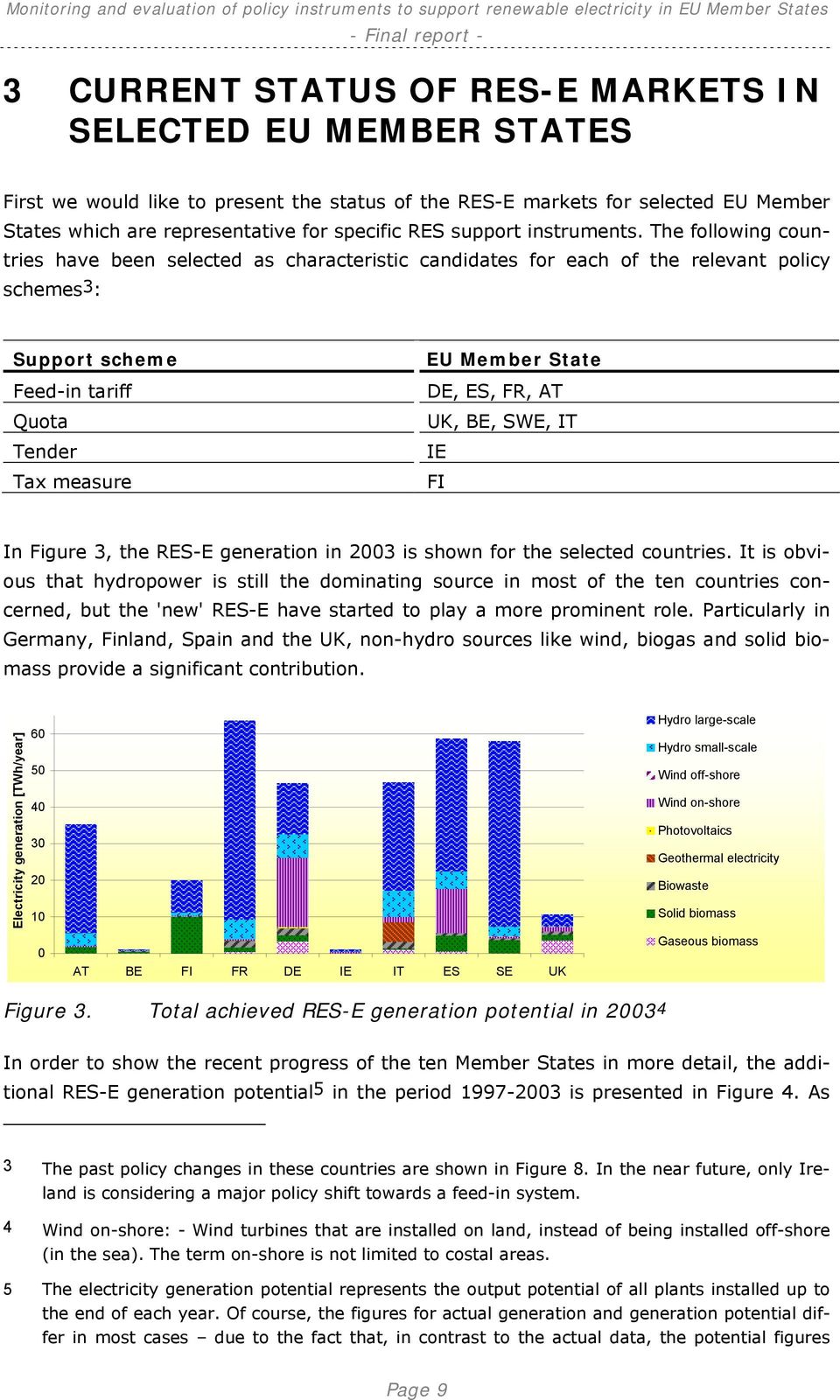
13 3 CURRENT STATUS OF RES-E MARKETS IN SELECTED EU MEMBER STATES First we would like to present the status of the RES-E markets for selected EU Member States which are representative for specific RES support instruments. The following countries have been selected as characteristic candidates for each of the relevant policy schemes3: Support scheme Feed-in tariff Quota Tender Tax measure EU Member State DE, ES, FR, AT UK, BE, SWE, IT IE FI In Figure 3, the RES-E generation in 2003 is shown for the selected countries. It is obvious that hydropower is still the dominating source in most of the ten countries concerned, but the 'new' RES-E have started to play a more prominent role. Particularly in Germany, Finland, Spain and the UK, non-hydro sources like wind, biogas and solid biomass provide a significant contribution. Electricity generation [TWh/year] AT BE FI FR DE IE IT ES SE UK Hydro large-scale Hydro small-scale Wind off-shore Wind on-shore Photovoltaics Geothermal electricity Biowaste Solid biomass Gaseous biomass Figure 3. Total achieved RES-E generation potential in In order to show the recent progress of the ten Member States in more detail, the additional RES-E generation potential5 in the period is presented in Figure 4. As 3 The past policy changes in these countries are shown in Figure 8. In the near future, only Ireland is considering a major policy shift towards a feed-in system. 4 Wind on-shore: - Wind turbines that are installed on land, instead of being installed off-shore (in the sea). The term on-shore is not limited to costal areas. 5 The electricity generation potential represents the output potential of all plants installed up to the end of each year. Of course, the figures for actual generation and generation potential differ in most cases due to the fact that, in contrast to the actual data, the potential figures Page 9
14 can be seen, Germany and Spain have by far the largest achievements since 1997 in terms of additional generation capacity of new RES-E. By far the slowest progress was made in Belgium and Ireland. In terms of technology, wind energy dominates followed by solid biomass and biogas. Austria, France, Italy and Spain have added large-scale hydropower generation capacity. Changes of RES-E generation potential (2003 versus 1997) [TWh/year] AT BE FI FR DE IE IT ES SE UK Hydro large-scale Hydro small-scale Wind off-shore Wind on-shore Photovoltaics Geothermal electricity Biowaste Solid biomass Gaseous biomass Figure 4. Total additional RES-E generation potential (2003 versus 1997) In a next step we would like to show the progress made by these countries since the publication of the White Paper "Energy for the future" in 1997 in terms of the RES-E share in gross electricity consumption. In Figure 5, the RES-E share is shown based on the generation potential, which represents the actual generation corrected by the annual volatility of hydropower and wind energy. As can be observed, only a few countries have actually significantly increased their RES-E share within the considered period. Notably Finland, Germany and Spain have made reasonable progress towards reaching the 2010 targets. 80% Share of RES-E in gross electricity consumption [%] 70% 60% 50% 40% 30% 20% 10% EU-Target for % Figure 5. AT BE FI FR DE IE IT ES SE UK EU15 Share of renewable electricity generation potential in gross electricity consumption (2003 versus 1997) based on the generation potential represent normal conditions, e.g. in case of hydropower, the normal hydrological conditions, and furthermore, not all plants are installed at the beginning of each year. Page 10
![Changes of RES-E generation potential (2003 versus 1997) [TWh/year] 30 25 20 15 10 5 0-5 AT BE FI FR DE IE IT ES SE UK Hydro large-scale Hydro small-scale Wind off-shore Wind on-shore Photovoltaics](/docs-images/56/7514074/images/page_14.jpg "Geothermal electricity Biowaste Solid biomass Gaseous biomass Figure 4.")
15 80% Additional generation potential in 2003 compared to 1997 as share of the RES-E target [%] 60% 40% 20% 0% -20% -40% AT BE FI FR DE IE IT ES SE UK -60% Figure 6. Additional generation potential in 2003 compared to 1997 as a share of the total additional generation potential needed by 2010 according to the RES-E directive In Figure 6 we show the progress made in reaching the Member State targets for 2010 in more detail by depicting the fraction of the difference to target between 1997 and 2010 which was already achieved by If countries were on track in a linear annual breakdown of the target, they should have fulfilled 46.2% of the difference to target by As can be seen, most countries, except Austria and France, have increased their RES-E share since However, only Finland, Germany and Spain show the growth needed to reach the target based on a linear extrapolation of the historical development. Clearly, there are two different explanations for slow progress in reaching the RES-E target: too little progress concerning the development of renewable technologies or a high growth in gross electricity consumption. Clearly a slow progress towards reaching the RES-E target might have two different reasons: too little progress concerning the development of renewable technologies or a high growth of gross electricity consumption. In order to separate the two effects Figure 7 shows the average annual growth rate of the renewable electricity generation potential and the average annual growth of the electricity consumption. As can be seen especially in countries like Ireland, Austria and Spain the progress made on the development of RES-E was diminished to a significant extent by the growing electricity consumption. In other countries like Sweden and France the slow progress on the promotion of renewables was the main reason for the limited success in approaching the targets. We would like to clearly state here that the average annual growth of the RES-E generation potential given in Figure 7 should not be primarily used to evaluate the progress with respect to RES-E in the different countries. The reason is that this quantity represents a biased indicator (if applied for measuring RES-E progress), which is naturally at a high level in countries with low RES-E share and visa versa. In order to judge the progress in terms of RES-E promotion the effectiveness indicator defined in section 4 represents the better suited indicator. Page 11

16 14% 12% Average annual growth RES-E generation potential (97-03) Average annual growth electricity demand (97-03) Average annual growth of RES-share (97-03) 10% 8% 6% 4% 2% 0% -2% AT BE FI FR DE IE IT ES SE UK EU-15-4% Figure 7. Comparison of average annual growth rates of renewable electricity generation potential and electricity demand in the period In the following tables a detailed characterisation of the present status of the RES-E markets and the policy environment in the selected member states will be given. Besides stating the main policy instrument for the promotion of RES-E the crucial implementation details of this policy are given as well as additional support schemes, which supplement the main instrument. Furthermore we shortly review the status of the RES markets in those countries and give the critical barriers that hindered stronger progress during the recent past (This information builds on the results derived in the EU financed projects FORRES 2020 and OPTRES.).6 6 For further information please visit: and Page 12

17 Austria Main instrument Feed-in tariffs (terminated by 31 December 2004) Main implementation details Renewable Energy Act (Ökostromgesetz). Technology-specific FITs guaranteed for 13 years for plants which get all permissions between 1 January 2003 and 31 December 2004 and, hence, start operation by the end of An amendment to the Renewable Energy Act, which was proposed in 2004, was rejected in December Since the active period of the former instrument has not been extended, there is currently a kind of "policy vacuum" in Austria. No new plants receive permissions. In August 2005 the time limit for implementing of already approved biogas, biomass and small hydro installations has been extended until December The level of tariffs implemented in 2003 can be summarised as follows: In general, this support is guaranteed for the first 13 years of operation. Small hydro: PV systems: /MWh (Only active in early 2003 as a limitation was included i.e. until a national cumulative capacity of 15 MW was reached) 600 /MWh for plants < 20 kw peak ;470 /MWh for plants > 20 kw peak Additional support Status of RES-E market Main barriers Wind systems: 78 /MWh for new plants Geothermal energy: 70 /MWh for electricity fed into the grid Solid biomass and waste with large biogenic fraction: /MWh, 65 /MWh (hybrid plants) Biogas: /MWh Sewage and landfill gas: /MWh Investment incentives of up to 30% on federal and regional level. Stimulated by the feed in tariffs a steady growth especially in the sectors of wind energy and biomass electricity was observed. Currently there is a hold on further RES-E investments, because no support (other than moderate investment incentives) exists. Continuity is the main problem due to short operational period (until end of 2004) of the feed in tariffs. In some areas grid shortages represent a barrier. Page 13

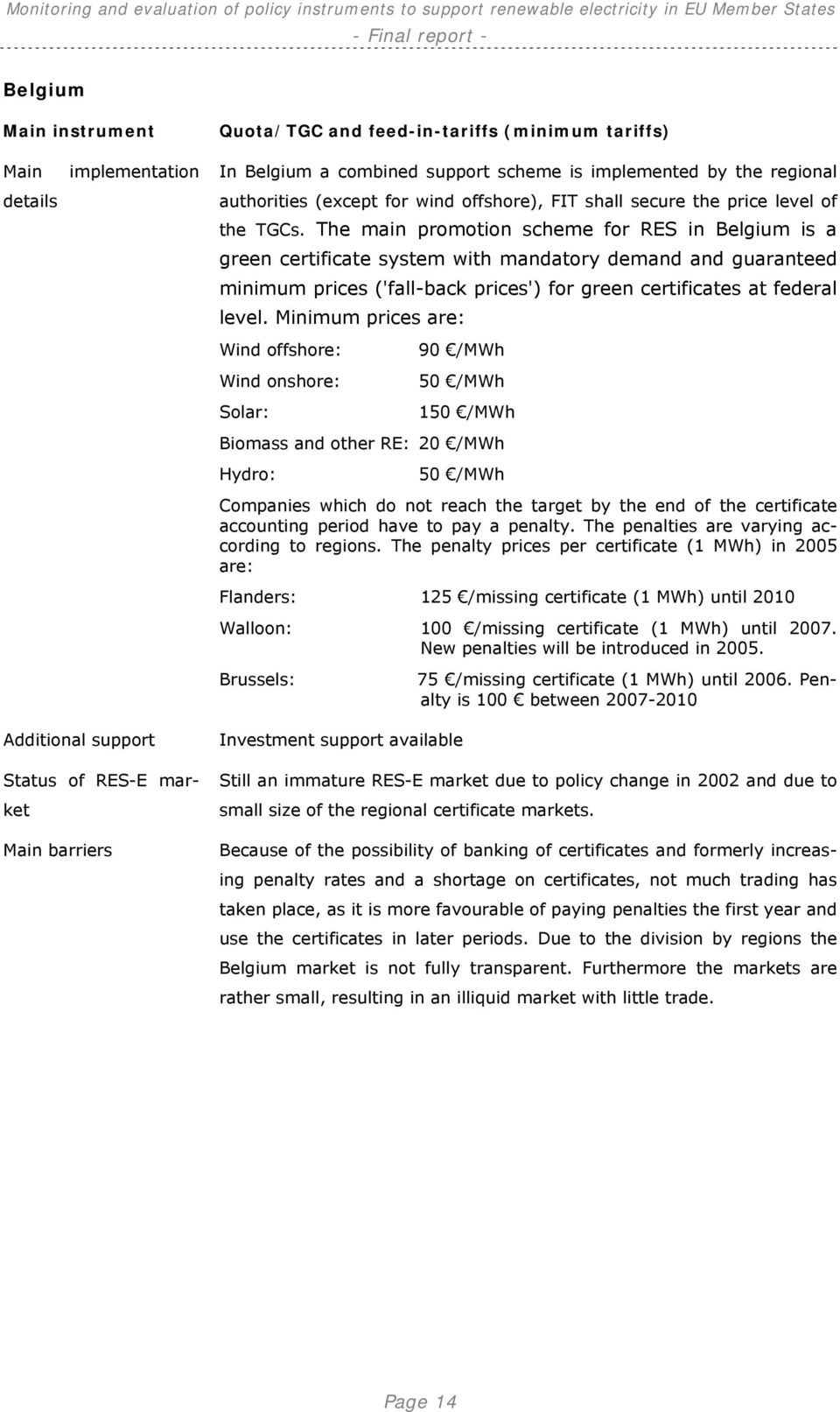
18 Belgium Main instrument Quota/TGC and feed-in-tariffs (minimum tariffs) Main details implementation In Belgium a combined support scheme is implemented by the regional authorities (except for wind offshore), FIT shall secure the price level of the TGCs. The main promotion scheme for RES in Belgium is a green certificate system with mandatory demand and guaranteed minimum prices ('fall-back prices') for green certificates at federal level. Minimum prices are: Wind offshore: Wind onshore: Solar: 90 /MWh 50 /MWh 150 /MWh Biomass and other RE: 20 /MWh Hydro: 50 /MWh Companies which do not reach the target by the end of the certificate accounting period have to pay a penalty. The penalties are varying according to regions. The penalty prices per certificate (1 MWh) in 2005 are: Flanders: 125 /missing certificate (1 MWh) until 2010 Walloon: 100 /missing certificate (1 MWh) until New penalties will be introduced in Brussels: 75 /missing certificate (1 MWh) until Penalty is 100 between Additional support Status of RES-E market Main barriers Investment support available Still an immature RES-E market due to policy change in 2002 and due to small size of the regional certificate markets. Because of the possibility of banking of certificates and formerly increasing penalty rates and a shortage on certificates, not much trading has taken place, as it is more favourable of paying penalties the first year and use the certificates in later periods. Due to the division by regions the Belgium market is not fully transparent. Furthermore the markets are rather small, resulting in an illiquid market with little trade. Page 14
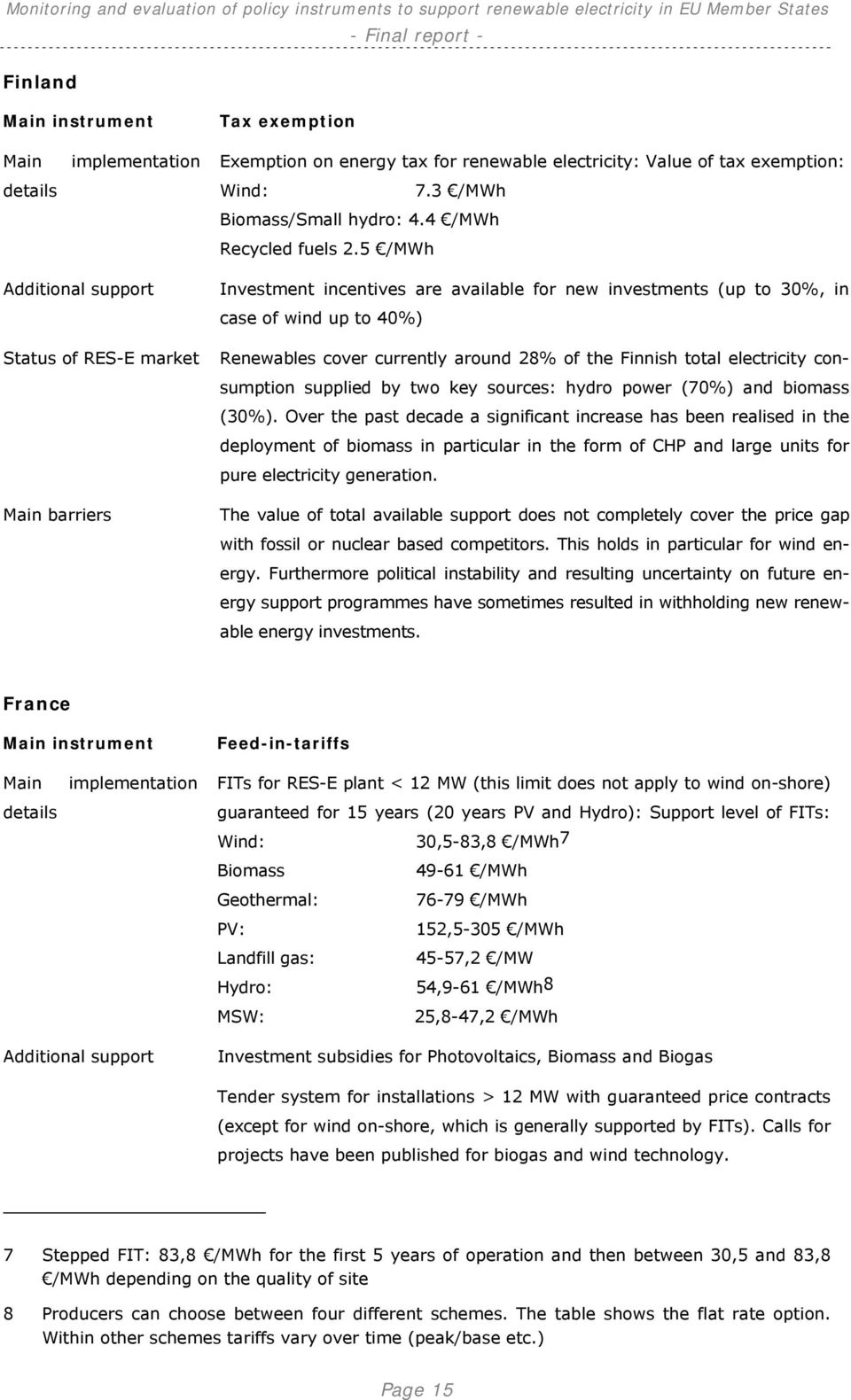
19 Finland Main instrument Tax exemption Main implementation Exemption on energy tax for renewable electricity: Value of tax exemption: details Wind: 7.3 /MWh Biomass/Small hydro: 4.4 /MWh Recycled fuels 2.5 /MWh Additional support Investment incentives are available for new investments (up to 30%, in case of wind up to 40%) Status of RES-E market Renewables cover currently around 28% of the Finnish total electricity consumption supplied by two key sources: hydro power (70%) and biomass (30%). Over the past decade a significant increase has been realised in the deployment of biomass in particular in the form of CHP and large units for pure electricity generation. Main barriers The value of total available support does not completely cover the price gap with fossil or nuclear based competitors. This holds in particular for wind energy. Furthermore political instability and resulting uncertainty on future energy support programmes have sometimes resulted in withholding new renewable energy investments. France Main instrument Feed-in-tariffs Main details implementation FITs for RES-E plant < 12 MW (this limit does not apply to wind on-shore) guaranteed for 15 years (20 years PV and Hydro): Support level of FITs: Wind: 30,5-83,8 /MWh7 Biomass Geothermal: PV: Landfill gas: Hydro: MSW: /MWh /MWh 152,5-305 /MWh 45-57,2 /MW 54,9-61 /MWh8 25,8-47,2 /MWh Additional support Investment subsidies for Photovoltaics, Biomass and Biogas Tender system for installations > 12 MW with guaranteed price contracts (except for wind on-shore, which is generally supported by FITs). Calls for projects have been published for biogas and wind technology. 7 Stepped FIT: 83,8 /MWh for the first 5 years of operation and then between 30,5 and 83,8 /MWh depending on the quality of site 8 Producers can choose between four different schemes. The table shows the flat rate option. Within other schemes tariffs vary over time (peak/base etc.) Page 15
20 Status of RES-E market Renewables cover currently around 16% of the French total electricity consumption. This supply is covered mainly by hydro power. Despite significant resources wind, biomass and geothermal energy play currently an insignificant role in the electricity sector. Main barriers Concerning wind, resistance by local authorities regarding the regulative approval of new projects can be specified as a problem. Moreover grid integration and future acceptance by the grid operator represents a barrier to further RES-development. Germany Main instrument Feed-in tariffs Main details implementation German Renewable Energy Act: FITs guaranteed for in general 20 years In more detail, FITs for new installations (installed after August 8, 2004) are (digression):9 Hydro: Wind 10 : Biomass & Biogas: /MWh (1%/a for large hydro) /MWh (2%/a) /MWh (1,5 %/a) Landfill-, Sewage- & Mine Gas: /MWh (1,5 %/a, except of Mine Gas) PV & Solar thermal electricity: /MWh (5-6,5%/a) Geothermal: /MWh (1%/a, starting 2010) Additional support Soft loans and investment incentives by the market incentive programme for biomass CHP, small hydropower. Soft loans by a federal investment bank DtA (a relevant share of Germanys wind energy investments is financed by government loans) Status of RES-E market The renewable energy market in Germany is mature showing large growth rates even at high penetration rates. Biomass and wind-offshore might be considered as the only source that is lacking behind the expectations (high growth of biomass can be observed since the revision of the Renewable Energy Act in 2004). The stable policy support has stimulated continuous and high growth especially in the case of wind energy, PV and biogas installations during the past decade. 9 The level of the tariff per kwh is constant for an installation after commissioning for in general 20 years, but depends on the date of commissioning. The later the initial operation is, the lower the tariff will be according the degression rates given in brackets. 10 Stepped FIT: In case of onshore wind 87 /MWh for the first 5 years of operation and then between 55 and 87 /MWh depending on the quality of site. Page 16

21 Main barriers Partially exploited potentials and limited grid capacity in the northern parts of Germany presently slow down growth of onshore wind energy on a high level of the market. Offshore wind energy develops slower than expected due to unexpected high costs and unsolved technical problems (high distance from land and large water depths). Biomass development was slower than expected (until 2005) due to fuel price uncertainty and high infrastructure costs. Most of the low-cost potentials (wood wastes) have already been exploited. Ireland Main instrument Tender (until end of 2005) / Feed-in Tariffs starting in 2006 Main details implementation Tender system: Alternative Energy Requirement (AER V, AER VI)11: Price caps of purchase contracts: Large scale wind (> 85MW): 52 /MWh; Small scale wind (< 85MW): 57 /MWh; Offshore Wind : 84 /MWh; Biomass: 64 /MWh; Biomass-CHP: 70 /MWh; Biomassanaerobic digestion: 70 /MWh; Hydro (< 5 MW): 70 /MWh Tariffs under the new feed-in tariff (draft figures January 2006): Large scale wind (>5MW) Small scale wind (<5MW) 57 /MWh 59 /MWh Biomass (including landfill gas) 70 /MWh Hydro and other biomass 72 /MWh The duration of the feed-in tariff is 15 years. Additional support Status of RES-E market Tax relief for investment in RES-E Traditionally hydropower is by far the most important renewable electricity source in Ireland, though in recent years production from other RES-E such as wind and biogas is increasing. However, compared to a high wind power potential in Ireland, until 2003 relatively moderate growth rates could be observed. As a result of the bidding round in 2004 the amount of additionally installed wind power capacity was considerably higher than in former years (153 MW). Main barriers The crucial barriers for further growth rates in Ireland are caused by the characteristics of the tender system. One constraint can be the fact, that bidding winners do not realize their projects due to non-economic contract conditions. The AER also tends to lead to relatively poor quality of equipment as the lower-price bids win the competition. Uncertainty about 11 Front weighting of the tariffs is allowed by offering the possibility to increase the price the first 7,5 years of the contract combined with a decrease of 35 % for the remaining contract duration. Page 17
22 future target setting (both levels and technology preferences) seems to one constraint of the Irish tender system, since it is a stop-start programme. Moreover projects eligible may not exceed certain capacity levels which may lead to a certain inefficiency of the project design. Italy Main instrument Quota/TGC Main details implementation Quota obligation (based on TGCs) on electricity suppliers: 2.35% target (2004), increasing yearly up to 2008; TGC issued for all (new) RES-E (incl. large Hydro and MSW) with rolling redemption12; Relatively high certificate prices up to 117 /MWh, certificates are issued only for plants with production of more than 50 MWh per year. Green certificates are only issued during the first 8 years of operation of a plant. Additional support Status of RES-E market Feed-in tariffs for PV, tariffs /MWh; total capacity limit 100 MW The quota system can be called still rather immature. The interim targets of the quota obligation set by the national government have not been reached. Among the new renewables in the electricity sector only wind energy and biowaste have shown relevant growth rates in the recent years. Main barriers The major problem of developing new production capacity seems to be problems in getting authorisation at the local level, high risk level for investors and high grid connection costs. 12 In general only plant put in operation after 1 st of April 1999 are allowed to receive TGCs for their produced green electricity. Moreover, this allowance is limited to the first 8 years of operation (rolling redemption). Page 18
23 Spain Main instrument Feed-in Tariff Main details implementation FITs (Royal Decree 436/2004): RES-E producer have the right to opt for a fixed price or for a premium tariff13. Both are adjusted by the government according to the variation in the average electricity sale price. In more detail the level of the fixed tariff for 2004 amounted to: Wind: PV14: Small Hydro: Biomass: 64.9 /MWh c/kwh /MWh /MWh Most operators have chosen the premium option in 2005 due to high electricity prices. Additional support ICO-IDAE funding line, which provides with special conditions to investments in RE and RUE investments. In general, investment incentives, soft loans and tax incentives were defined under the Plan de Fomento de las Energias Renovables (RES Promotion Plan), whose aim is to support RES investments with 13.1 % public financial sources Status of RES-E market Wind power has developed impressively. The biomass sector still needs an integral policy and probably higher tariffs in the feed-in system. Concentrating solar thermal power production shows impressive activities with regard to project development: about 200 MW of installed capacity are under construction. Main barriers Small hydro needs to overcome the administrative barriers. Sweden Main instrument Quota / TGC Main details implementation Quota obligation (based on TGC) on consumers: Increasing from 7.4% in 2003 up to 16.9% in Non-compliance leads to a penalty, which is fixed at 150% of the average certificate price in a year (26 /MWh in 2005). The certificate price is insufficient to initiate significant investments into new capacities. Additional support Investment incentives of 15% for wind power. During a transition period the certificate trading scheme will be complemented by targeted support for wind power production in the form of environmental bonus, ( In case of a premium tariff, RES-E generators earn in addition to the (compared to fixed rate lower) premium tariff the revenues from the selling of their electricity on the power market. 14 Depending on the plant size: <5kW: 360 /MWh or >5kW: 180 /MWh Page 19
24 /MWh) for wind energy in This will be progressively be phased out by The environmental tax benefits can make some biomass CHP systems competitive. Status of RES-E market Main barriers Renewables cover currently approximately 50% of the Swedish total electricity consumption. This supply is covered mainly by hydro power. The use of biomass has increased substantially over the past decade, but this growth is mainly based on biomass co-firing, which can be profitable in the present quota system. New investments in biomass generation capacity is limited. Wind capacity installed in Sweden is relatively low although the wind resource in the south of the country is comparable to Denmark. Low penalty level set in the quota system leads to the strategy to fulfil the quota through buy-out. The Government has declared that in the (near) future the certificate system may be opened for import. This market opening may pose a threat for investments in renewables in Sweden if a level playing field with the relevant import country (Norway) is lacking. United Kingdom Main instrument Quota / TGC Main details implementation Quota obligation (based on TGCs) for all RES-E: Increasing from 3% in 2003 up to 10.4% by 2010 and 15.4% in The non-compliance buy-out price for was set at 30.51/MWh (45 /MWh), for at 31.39/MWh (45 /MWh), for at 32.33/MWh (48 /MWh). The actual certificate price is typically higher than the buyout price due to the system of recycle payments. Additional support Status of RES-E market In addition to the TGC system, eligible RES-E are exempt from the Climate Change Levy certified by Levy Exemption Certificates (LEC s), which cannot be separately traded from physical electricity. The 2004 levy rate is 4.3 /MWh (6.3 /MWh). Investment grants in the frame of different programs (e.g. Clear Skies Scheme, DTI s Offshore Wind Capital Grant Scheme, the Energy Crops Scheme, Major PV Demonstration Program and the Scottish Community Renewable Initiative). The UK RES market can probably be called the most mature market among the countries with quota obligations in Europe. The relative success of the systems is partially based on the fact that buy-out revenues for non-compliances are recycled to the suppliers in proportion to the certificates they have used for complying with the obligation. This mechanism increased the certificate price above the buy-out price because the market is short. High prices in the first year gave the Renew- Page 20
25 able obligation certificate market a kick- start. Targets specified for 2010 and 2020 and duration specified until Compared to other quota systems the UK system provides a higher long-term security for achieving targets and for renewable energy investors. Main barriers Grid connection issues and grid capacities as well as severe competition on the electricity market disadvantage RES despite of the support programs. Page 21
26 4 EFFECTIVENESS OF THE IMPLEMENTED SUPPORT SCHEMES IN SELECTED EU MEMBER STATES Under the effectiveness of a policy scheme for the promotion of renewable electricity we understand the increase of electricity generation potential15 due to this policy as compared to a suitable reference quantity. Such a reference quantity could be the additional available renewable electricity generation potential16 or the gross electricity consumption. We define the effectiveness of a Member State policy in the following as the ratio of the change of the electricity generation potential during a given period of time and the additional realisable mid-term potential until 2020 for a specific technology, where the exact definition of the effectiveness reads as follows: E E G i n i n i n = ADD i Gn Gn 1 i ADD POTn 1 Effectiveness Indicator for RES technology i for the year n Electricity generation potential by RES technology i in year n i POT Additional generation potential of RES technology i in year n until 2020 n i This definition of the effectiveness has the advantage of giving an unbiased indicator with regard to the available potentials of a specific country for individual technologies. Member States, only need to develop specific RES-E sources proportionally to the given potential to show comparable effectiveness of their instruments. This appears to be the correct approach because the Member State targets determined in the RES-E directive are also derived based mainly on the realisable generation potential of each country. In the following section we will show this effectiveness indicator for the sectors wind onshore and PV for the period and for solid biomass and biogas for the period As in most EU Member States, significant policy changes took effect during this period. The evolution of the main support instrument for each country is given in Figure 8. This figure shall serve as the relevant basis for the interpretation of the effectiveness indicator presented. As can be seen, only Austria, Finland, Germany, Ireland and Spain did not experi- 15 The electricity generation potential represents the normalised output potential of all plants installed up to the end of each year. Of course, the figures for actual generation and generation potential differ in most cases due to the fact that, in contrast to the actual data, the potential figures represent normal conditions, e.g. in case of hydropower, the normal hydrological conditions, and furthermore, not all plants are installed at the beginning of each year. 16 The additional potential up to 2020 used in this report is based on the figures derived in the EU projects Green-X and FORRES 2020, which have been officially used by the European Commission do analyse future targets for renewable energies up to Page 22
27 ence a major policy shift during the period Belgium, Sweden and the UK changed their instruments into quota systems based on tradable green certificates during 2002 or later. Although the introduction of the new systems in these Member States took place during or after 2002, the policy changes caused investment instabilities even in the periods before this date. Therefore, for the period (or ) for which the effectiveness indicator is analysed in the subsequent section, a mixed policy is considered in Belgium, France, Italy, Sweden and the UK. In principle it would seem desirable to present temporal correlations between the implemented policies and the effectiveness indicator which are both known in the time domain. However, previous analyses have shown that only restricted information results from the temporal representation of the effectiveness indicator. Therefore we will show this quantity as an average value for the period for case of biogas and solid biomass and for the case of wind on-shore and PV. AT BE Wind Bioenergy PV Wind Bioenergy PV Feed-in system Quota/TGC FI FR Wind Bioenergy PV Wind Bioenergy PV Tender Tax incentives change of the system DE Wind Bioenergy PV adaptation of the system IE Wind Bioenergy PV IT Wind Bioenergy PV ES Wind Bioenergy PV SE Wind Bioenergy PV UK Wind Bioenergy PV Figure 8. Evolution of the main policy support scheme in selected EU Member States Figure 9 shows the average annual effectiveness indicator for wind on-shore electricity generation for the years for all countries selected in the present analysis. Page 23
28 Several messages can be derived from this figure. Firstly, the three Member States Germany, Spain, and Ireland with the highest effectiveness during the considered period did not experience a major policy shift during the entire period Even more striking is the fact that Germany and Spain - two countries with long term stability of RES-E support based on feed-in systems - show a significantly higher effectiveness than the rest of the countries considered here. The high investment security and low administrative and regulative barriers have stimulated a strong and continuous growth in wind energy during the last decade. It is commonly stated that the high level of the feed-in tariffs would be the main driver for investments in wind energy in these two countries. However, as will be shown at the end of this section in Figure 15 and Figure 18, the tariff level is not particularly high in the two countries when compared with the other countries analysed here. The conclusion can therefore be drawn that a long term and stable policy environment is a key criterion for success in developing RES markets. As can be observed in a country like France, high administrative barriers can significantly hamper the development of wind energy even under a stable policy environment combined with reasonably high feed-in tariffs. A detailed analysis of the main barriers and success factors in wind energy for each of the countries analysed is given in Table 2. 10% average annual effectiveness indicator [%] 8% 6% 4% 2% Tax incentives/rebates Quota / tradable green certificates Feed-in tariffs Tender 0% Figure 9. AT BE FI FR DE IE IT ES SE UK EU 15 Effectiveness indicator for wind on-shore electricity in the period Note: The relevant policy schemes during this period are shown in different colours Page 24
29 Table 2. Member State Summary of main barriers and success factors for wind energy ( ) Support level Main barriers Comments AT sufficient grid capacity policy instability The growth of wind energy has significantly accelerated since the new feed-in law was launched in 2003 BE high investment risk Continuous growth at a low level, no acceleration of market growth observed since the introduction of the quota system in 2002 FI low level of support social acceptance FR sufficient - high administrative / regulative grid connection rules DE sufficient grid (some regions) regional planning IE sufficient stop-and-go character of support system grid capacity IT high investment risk grid capacity Finland is one of the few countries in the EU- 15 where the level of support is clearly insufficient to promote wind on-shore Significant administrative / regulative barriers exist at regional / department level. Large number of administrative procedures necessary to get a project approved In Northern Germany, insufficient grid capacity hampers development of wind energy. New distance regulations for wind energy constitute a clear barrier regarding regional planning. The nature of the tender system implies that very discontinuous growth takes place leading to market instabilities, many projects that have been awarded are not realised because offers are economically unfeasible Despite the high support level growth is only moderate due to the uncertainty of the certificate system, lack of private financial funds and experience among investors as well as limited grid capacity in some regions ES sufficient - high The market grew continuously at high level high support and generally low barriers SE low level of support investment risk Support level is clearly insufficient to develop viable projects UK high investment risk The tender system (until 2002) showed very low effectiveness: many projects that have been awarded are not realised because offers were economically unfeasible or environmental and planning permissions were not granted. Since the introduction of the quota system, the high level of investment risk is the main barrier followed by insufficient grid capacities in the Western UK Page 25
30 Table 3. Member State Summary of main barriers and success factors / solid biomass electricity ( ) Support level Main barriers Comments AT high policy instability The growth of biomass electricity has significantly accelerated since the new feed-in law was launched in Austria focused its policy on small plants which led to comparatively high promotion costs BE high investment risk Some growth in biomass since the introduction of the quota system in 2002 in particular because co-firing is permitted FI sufficient level of support Finland shows a continuous growth of biomass electricity due to strong tradition in the forestry industry and a well balanced mix of investment support and generation-based support FR low - sufficient level of support administrative / regulative barriers DE sufficient level of support (until 2004) security of fuel supply IE low stop-and-go character of support system technology selection of the tender system Significant administrative / regulative barriers exist at regional/department level, a large number of administrative procedures is necessary to get a project approved Limited security of the fuel (wood) supply (missing infrastructure and markets) led to some retention for banks and finance organisations and consequently to the cancellation of a number of projects Biomass was hardly targeted in the Irish tender rounds also based on the fact that the potential of cheap wood-based fuels is very limited IT high investment risk Despite the high support level the growth is only moderate due to the uncertainty of the certificate system, lack of private financial funds and experience among investors, the option of co-firing biomass offers large potentials at low costs ES low level of support The main barrier to a stronger growth in the biomass sector is the level of support SE low - sufficient level of support investment risk Sweden has shown growth since 2000 (the moderate effectiveness is based on capacity growth until 2000), neither the quota system nor the tax incentives have given sufficient support despite the fact that Sweden has a traditionally strong forestry sector UK high investment risk The tender system (until 2002) showed moderate effectiveness but with a clear stop and go nature (most projects were realised in one year ). Since the introduction of the quota system, the high level of investment risk is the main barrier, the option of co-firing biomass offers significant potentials at low costs In Figure 10 the effectiveness indicator for RES support for electricity from solid biomass is shown. It can be seen that, on the EU-15 level, a significantly smaller proportion of the available potential was able to be exploited on an annual basis during the period Page 26
31 2003. As is well known, the development of biomass electricity is lagging behind expectations on an EU level even though it is cost efficient in countries where sufficient exploitable wood waste potentials exist. The main barrier to the development of this RES-E source is often infrastructural rather than economic. Since solid biomass represents the cheapest RES-E source in some countries such as Finland and Sweden it attracts the largest share of RES-E investment under policy schemes which are not technologyspecific. The tax measures in Finland and in Sweden (before 2002) as well as the present Swedish support scheme (quota obligation) result in concentration on the current leastcost technology. Very often additional RES-E generation under these support schemes is possible even without investments in additional generation capacity. The static efficiency of these instruments is improved at the cost of ignoring promising future technology options with significant potential for technology learning. Certainly the long term traditions in the biomass sector and the importance of the forestry industry in countries like Finland and Sweden are strong success factors for the development of the biomass electricity sector. Thereby, the low generation costs of biomass plants in Finland are a result of the fact that most plants are large scale industrial units operating in CHP mode.17 The demand for (industrial process) heat in the Scandinavian countries is a good basis for CHP-plants leading to reduced electricity generation costs. For this reason Finland has a good background for building of cost-efficient large-scale plants. Finland possesses for example of the worlds largest biofuel-fired CHP-plant, Alhomens Kraft with an electrical capacity of 240 MW. Moreover, the dominant solid biofuel source in Finland is black liquor18. All the described factors lead to favourable generation costs in Finland. However, the nature of the RES support scheme which promotes only the cheapest technology options is a critical success factor as well, which can also be concluded from the UK case. A detailed analysis of the main barriers and success factors in the field of biomass electricity for each of the countries analysed is given in Table 3 17 In 2000, the share of biomass CHP in electricity production from all RES was 34%. 18 In 2000, more than half of the biomass fuel used for primary energy supply was black liqour. Page 27
32 5% average annual effectiveness indicator [%] 4% 3% 2% 1% Tax incentives/rebates Quota / tradable green certificates Feed-in tariffs Tender 0% AT BE FI FR DE IE IT ES SE UK EU 15 Figure 10. Effectiveness indicator for solid biomass electricity in the period Note: The relevant policy schemes during this period are shown in different colours In Figure 11 the effectiveness indicator for RES support for biogas electricity is shown. Similar to the sector of solid biomass electricity, the overall progress on EU level was relatively low in the period The highest growth is shown by Germany, which applies fixed feed-in tariffs and the UK, which used a tender system until 2002 and a quota system since Italy, Austria and Belgium also showed a comparatively high effectiveness. However, the biogas development in the UK, in Italy and in Belgium seems to be dominated by landfill gas, which represents the cheapest kind of biogas fuel. This conclusion results from observing the composition of gaseous biomass in the year 2001 illustrated in Figure 12. Thus, the policy effectiveness reached by the German and the Austrian systems seems to have a better performance than the UK, Italy and Belgium for the case of the more innovative option of agricultural biogas. The Swedish and the Finish tax rebates have been unable to trigger relevant investments in biogas plants. This demonstrates again that these systems are not suited to stimulate the market diffusion of new technologies. Similarly the Irish tender rounds seem to have ignored biogas as an option for increasing RES-E generation capacity. A detailed analysis of the main barriers and success factors in biogas electricity is given in Table 4 for each of the countries analysed. 3,0% average annual effectiveness indicator [%] 2,5% 2,0% 1,5% 1,0% 0,5% Tax incentives/rebates Quota / tradable green certificates Feed-in tariffs Tender 0,0% AT BE FI FR DE IE IT ES SE UK EU 15 Page 28
33 Figure 11. Effectiveness indicator for biogas electricity in the period Note: The relevant policy schemes during this period are shown in different colours 100% Composition of gaseous biomass 80% 60% 40% 20% Sewage gas Biogas Landfill gas 0% AT BE DE IT UK Figure Share of different gaseous biomass types in selected countries for the year Page 29
34 Table 4. Member state Summary of main barriers and success factors / biogas electricity ( ) Support level Main barriers Comments AT high policy instability The growth of biogas electricity has significantly accelerated since the new feed-in law was launched in Austria focused its policy on small plants which led to comparatively high promotion costs; in the sector of agricultural biogas in particular the Austrian policy was very successful Austria shows a balanced share between agricultural biogas and landfill gas BE high investment risk Biogas electricity production showed steady growth until 2002 The high level of investment risk led to low growth in recent years The biogas portfolio is largely dominated by landfill gas FI low level of support No targeted support given for biogas electricity FR low level of support administrative / regulative barriers DE sufficient administrative regulations regarding the approval / licensing of biogas plants IE low stop & go nature of support system technology selection of the tender system IT high investment risk for the more expensive biogas fractions pure focus on landfill gas The level of support is too low to generate sufficient interest among investors; significant administrative / regulative barriers exist at regional / department level. The biogas portfolio is largely dominated by landfill gas The steady market growth observed during the last decade has accelerated since the tariffs were increased in Almost equal share between agricultural biogas and landfill gas Biogas was hardly targeted in the Irish tender rounds, existing biogas production is almost entirely based on landfill gas Strong growth of biogas electricity especially since 2001 Almost the entire biogas generation is based on landfill gas Despite the high support level, the growth in agricultural biogas is very low due to the uncertainty of the certificate system, lack of private funds and experience among investors ES low - sufficient level of support The strongest growth was achieved in sewage gas SE low level of support investment risk UK high pure focus on landfill gas investment risk for the more expensive biogas fractions Sweden shows hardly any growth in the biogas sector since both the former tax incentives as well as the present certificate system are not sufficiently attractive to justify investments The tender system (until 2002) showed high effectiveness with a clear focus on expansion of landfill gas; hardly any development in agricultural biogas. The growth continues under the quota system Page 30
35 As presented in Figure 13, the sector of photovoltaic electricity generation has the strongest growth in Germany followed by Austria and Spain during the considered period ( ). The support system in these three countries consisted of fixed feed-in tariffs supplemented by additional mechanisms like soft loans in Germany. As was expected, quota obligations and tax measures give only very little incentives for investments in PV technology, since these schemes generally promote only the cheapest available technology. A detailed analysis of the main barriers and success factors in the filed of photovoltaics is given in Table 5 for each of the countries analysed. 2,0% average annual effectiveness indicator [%] 1,5% 1,0% 0,5% Tax incentives/rebates Quota / tradable green certificates Feed-in tariffs Tender 0,0% AT BE FI FR DE IE IT ES SE UK EU 15 Figure 13. Effectiveness indicator for photovoltaic electricity in the period Note: The relevant policy schemes during this period are shown in different colours Table 5. Summary of main barriers and success factors / PV ( ) Member state Support level Main barriers Comments AT high policy instability capacity cap The level of support under the former feed-in act was reasonably high, however the overall capacity cap of 15 MW was the main barrier BE low level of support The level of support of 15 cents / kwh is insufficient to stimulate investments. FI low level of support No targeted support for PV FR low level of support The level of support of 15 cents / kwh is insufficient to stimulate investments. DE sufficient - high Very strong growth of PV; since amendment of the renewable energy act in the growth has accelerated significantly leading to a slightly overheated market IE low level of support No targeted support for PV IT low level of support The level of support is insufficient to stimulate any investments ES sufficient The increased capacity limit (to 100 kw) determining eligibility for the higher tariff level makes many medium-scale projects profitable and has significantly driven the market during the last year SE low level of support No targeted support for PV UK low level of support No targeted support for PV Page 31
36 Finally we would like to present the average effectiveness indicator for small hydropower in Figure 14. It can be seen that the effectiveness takes the highest level in Spain followed by Belgium and Germany. It should be considered here, however, that the remaining potential in Belgium is by far the smallest among the countries under consideration. The level of support is moderate to sufficient in all countries considered, except in Finland where the support level has to be considered insufficient. Administrative procedures within the EU are generally complex and lengthy, and present a significant barrier to small hydro deployment. In particular the licensing of water use, environmental and planning permission, construction authorisation and plant commissioning represent the main administrative barriers for the construction of small hydro plants. 25% average annual effectiveness indicator [%] 20% 15% 10% 5% Tax incentives/rebates Quota / tradable green certificates Feed-in tariffs Tender 0% AT BE FI FR DE IE IT ES SE UK EU 15 Figure 14. Effectiveness indicator for small hydro power in the period Note: The relevant policy schemes during this period are shown in different colours 4.1 Evaluation of the level of RES support in relation to the effectiveness To complete this section, we would like to compare the observed effectiveness of the different support schemes with the level of financial support as seen from the perspective of an investor for the case of wind energy (we concentrate on the case of wind energy for the reason that costs as well as support levels can be analysed in a very transparent way). This analysis will be performed for the most recent year In a first step, the actual level of the payments per kwh of electricity generation in the year 2004 is shown for the policy systems considered. In a second step, we present the effectiveness indicator defined as above versus the expected annuity for an investment in wind energy for each country. In this way, one can correlate the effectiveness of a policy with the average annuity of expected profit. As a result it is possible to analyse whether the success of a specific policy is primarily based on the high financial incentives, or whether other aspects have a crucial impact on the market diffusion of wind power in the countries considered. Page 32
37 Figure 15 shows the actual average country-specific level of support and the range of tariffs for the year Belgium applies a mixture of quota obligations and a minimum tariff system to increase investment security, whereas the system can be generally classified as a quota system. The level of support for countries applying quota obligations turns out to be generally higher than in other countries if only the payments during one individual year are considered. One exception is the very low support level in Sweden. The Irish tender system is characterised by a relatively modest support level as well. 16 Average level of support [ Cent/kWh] Tender System Quota / TGC Feed-in system 0 AT BE-Flanders BE-Wallonia FR DE IE IT ES-Market option ES-Fixed Price SE UK Figure 15. Comparison of actual support for wind power on-shore (2004)19 14 Normalised level of support [ Cent/kWh] Tender System Quota / TGC Feed-in system AT BE-Flanders BE-Wallonia FR DE IE IT ES-Market option ES-Fixed Price SE UK Figure 16. Normalised level of support for wind on-shore in selected EU Member States (2004) Note: the data presented above is scaled for the country-specific duration of support, additional support measures are considered and the country-specific resource conditions are accounted for. The annual payments presented in Figure 15 now have to be translated into a quantity that characterises the total expected profit of an investment. Therefore the duration of the payments has to be included.20 Another aspect is that the support level presented 19 For the case of Germany the tarifs reflect the situation after the revision of the FIT in An extreme example is the Italian certificate price which appears to be very high. However, considering the duration of the support, the high price partly is justified by the fact that Italian Page 33
38 contains only the most important instruments. Additional measures like soft loans or tax reductions are not shown. Furthermore it has to be taken into account that different wind conditions require different support levels. Thus country-specific wind yields are used to calculate the income generated during the lifetime of the plant. In a first step we would like to show the normalised support level by considering the duration of support and by including relevant additional support measures like production and investment tax incentives as well as the country-specific resource availability. The duration of support is accounted for by calculating the annuity of the support level based on a uniform interest rate of 6.6% and a duration of support of 15 years. The resource availability is accounted for by normalising the support level to a uniform number of 2000 full-load hours per year. Therefore the actual support level is rescaled linearly by the ratio of the country-specific full-load hours and the uniform value (in this way the support level for countries with very good resource conditions is increased while the support level for countries with poor resource conditions is decreased). An alternative approach to calculating the actual support over the entire lifetime from an investor s perspective is to determine the average expected annuity of the renewable investment. The annuity calculates the specific discounted average return on every produced kwh by taking into account income and expenditure throughout the entire lifetime of a technology. i A = (1 (1 + i) n ) n t= 1 Income t Expenditure t (1 + i) A= annuity; i=interest rate; t=year; n=technical lifetime t The average expected annuity of wind energy investments for Germany, Spain, France, Austria, Belgium, Italy, Sweden, the UK and Ireland was calculated based on the expected support level during the period the promotion is given. The level of support in the German system is annually adjusted according to the degression incorporated in the German EEG. For the four countries using quota obligation systems, the certificate prices of the year 2004 were extrapolated for the entire active period of the support.21 Furthermore an interest rate of 6.6% was assumed22 and country-specific prices of wind technology were used according to the average market prices of wind turbines in those countries in Therefore the annuity of expected profit considers country-specific wind resources, duration of support as well as additional promotion instruments like soft loans and investment incentives. An important limitation of this approach concerns the renewable electricity producers are only allowed to deal with green certificates during the first 8 years of the plant's operation time. 21 This assumption is questionable because certificate prices might relax as the certificate markets in those countries mature. However, only very little knowledge exists about the temporal development of prices in these markets. 22 An interest rate of 4% was used for Germany based on the soft loans granted. Page 34
39 fact that an estimate is needed of the future evolution of certificate prices in quota systems. Such an estimate does not usually exist. We assumed therefore that TGC prices remain constant at 2004 levels. This assumption is justified by the development of green certificate prices observed during the last two years in the European market shown in Figure 17. Except for the development in the UK no clear trend towards declining certificate prices can be observed in the recent past. The decreasing TGC price in UK was accompanied by a sharply increasing electricity price in 2005, therefore the total level of support for RES-E did not decrease. Level of premium support [ /MWh] st Q nd Q rd Q th Q st Q nd Q rd Q th Q st Q nd Q 2005 Italy UK - RO Flanders Wallonia Sweden Figure 17. Development of Green-certificate prices in Belgium, Italy, Sweden and UK between 2003 and In a second step, the correlation shall be analysed between the annuity for investments and the effectiveness of the support instrument as shown in Figure 9. This is done in a qualitative manner by plotting the effectiveness versus the annuity in Figure 18. It should be mentioned that Belgium has two different quota schemes, one in Wallonia and the other in Flanders. Based on the new Spanish feed-in law (RD 436/2004), three different tariff options exist in parallel, a fixed price option, a market-oriented option with a feedin-premium and a transitional solution with a lower premium price. In a similar way, the correlation between the effectiveness and the normalised level of support is shown in Figure 19. Page 35
40 Effectiveness indicator 20% 15% 10% AT ES- Fixed Price IE DE ES- Market Option 5% BE- BE- Flanders UK SE FR Wallonia IT FI 0% Annual expected profit [ Cent/kWh] Feed-in tariffs Quota/TGC Tender Tax incentives/rebates Figure 18. Effectiveness indicator in relation to the annuity of expected profit for wind on-shore (2004) Effectiveness indicator 20% 15% 10% 5% 0% ES- Fixed tariff DE SE AT IE ES- Premium tariff IT BE- Wallonien FR BE- Flandern Normalised support level [ Cent/kWh] Feed-in system Tender system Quota / TGC UK Figure 19. Effectiveness indicator in relation to the normalised level of support for wind on-shore (2004) Results: Generally the expected annuity as well as the effectiveness shows a broad spectrum in quantitative terms for the countries under consideration. It has to be mentioned that the different instruments show a different level of experience and policy schemes in some countries - in particular quota obligation systems - are still in a transitional period. It is striking that three countries - Italy, the UK and Belgium - which have recently transformed their markets into quota systems as the main support instrument, have a Page 36
41 high expected annuity of support but low growth rates. The high annuity results in particular from the extrapolation of the presently observed certificate prices. Based on this assumption, which is mainly justified by empirical observations 23, the results show that certificate systems can lead to high producer profits resulting from high investment risks 24. On the other hand, it seems typical for countries with feed-in-tariffs to be more effective at generally moderate levels of support. An exception to this rule is France, where administrative barriers are preventing rapid development of wind energy. Spain had the highest growth rates in terms of the effectiveness indicator offering an adequate profit. The reason why the profits are expected to be higher in Spain than in the other feed-in countries is not a high support level, but rather relatively low electricity generation costs due to good resource conditions on the one hand and low investment costs on the other hand. Ireland reached a level of effectiveness in 2004 similar to countries with feed-in-tariffs like Germany and Austria despite a significantly lower absolute support level, but with similar expected profit. A lower support level is required in Ireland than in Germany because of the significantly better wind resources (2600 full load hours have been assumed for the typical Irish location, the corresponding figure in Germany amounts to 1800). 25 Since relatively favourable wind conditions were assumed for Austria, the support level does not seem to be able to stimulate further capacity growth for sites with unfavourable wind conditions. As a consequence it can be suspected that the effectiveness of the Austrian support system will drop in the future, since the quality of the remaining wind sites usually decreases in line with capacity growth. In Sweden, the small growth in wind power is the result of a very low expected profit. As a general conclusion it can be stated that the investigated feed-in systems are effective at relatively low producer profits. On the other hand, it can be observed that the present quota systems only achieve rather low effectiveness at comparably high profit margins. We would like to emphasise however, that these quota systems are 23 Until now there is no clear trend of decreasing certificate prices under the different quota systems in the EU. Such decrease of certificate prices should be expected only if the risk level under existing certificate markets decreases significantly. 24 It should be stated here however, that in the case that long term contracts are negotiated between RES producer and the obliged party, e.g. a utility, only a certain fraction of the 'producer profit' will actually be earned by the RES producer. 25 The high Irish growth rate in 2004 has to be carefully considered since the comparatively high capacity development in 2004 is due to the impacts of the last Irish bidding round. In former years the growth rate was much smaller (a tender system seems to be an instrument which allows rapid growth in a short period of time). Page 37
42 relatively new instruments in the countries currently applying them. Therefore the behaviour observed might still be marked by significant transient effects. Page 38
43 5 THE IMPACT OF SUPPORT SCHEMES ON THE FUTURE DEPLOYMENT OF RES-E - a model based analysis of markets, technology portfolios and costs under different policy assumptions In this chapter, an evaluation of the different support schemes for RES-E is conducted from a future perspective. Based on calculations made with the help of the computer model Green-X26, the economic efficiency of policy instruments will be analysed in depth, in which the transfer costs for consumers / society (due to the promotion of RES- E) are the dominant indicator for the assessment. 5.1 Definition of investigated scenarios As illustrated below, a broad set of scenarios is examined: The reference scenario indicates RES-E deployment if no further support would be given for new RES-E after This variant clearly indicates the transfer costs for consumers referring to existing plants (installed up to 2006) due to earlier support guarantees expiring in the following years. No harmonisation: national policies remain in place and determine the future development of RES-E. Two variants are investigated: RES-E policies are applied as currently implemented (without any adaptation) until 2020, i.e. a business as usual (BAU) forecast. Under this variant a moderate RES-E deployment is projected for the future up to Strengthened efforts are made by the Member States to meet the overall RES-E directive target in As a result it is predicted that national RES-E policies will improve with respect to their efficiency and effectiveness. More precisely, it is assumed that these changes will become effective immediately (2006) and applied policy settings will stay in place also beyond Besides adapting financial support conditions, a removal of non-financial barriers (i.e. administrative deficiencies etc.) is also presumed for the future. In addition to this default case, resulting in an accelerated RES-E deployment and, consequently, an ambitious RES-E target for 2020, two further sub-variants of 26 The Green-X computer model is the core product developed in the project Green-X. It is an independent computer programme and allows different scenarios to be simulated enabling a comparative and quantitative analysis of the interactions between RES-E, CHP, DSM activities and GHG-reduction within the liberalised electricity sector both for the EU as a whole and individual EU 15 Member States over time. Note: for details regarding the project or the model Green-X please visit Page 39
44 strengthened national policies are analysed: First, a case of national policies causing a similar to above overall future RES-E deployment (ambitious target), but without enhanced promotion of novel, currently more expensive RES-E options such as photovoltaics. Secondly, a case of efficient & effective national policies for achieving only a moderate RES-E deployment by 2020 similar to the BAU forecast (BAU-target). Starting in 2006, a harmonisation of support schemes takes place at the EU-15 level. To be able to analyse the effect of different (harmonised) policies compared to the above scenarios, it is assumed that the same RES-E targets as under BAU conditions on the one hand and as resulting under strengthened national efforts on the other should be reached by The following currently most promising and favourable policies were investigated under harmonised conditions: feed-in tariffs, quota obligations based on tradable green certificates (TGCs), and tender and tax incentives. In addition, the impact of a coordination of instruments is investigated for the dominating schemes (i.e. feed-in tariffs and quota obligations based on tradable green certificates) at cluster level. Thereby, two clusters are defined: The Member States Austria, France, Germany and Spain (which currently stick to feed-in tariffs) comprise one cluster; and another cluster is made up of Belgium, Italy, Sweden and the United Kingdom (i.e. countries which currently apply quota obligations based on TGCs). For both cluster coordinated feed-in tariffs and quota obligations are compared to purely national as well as harmonised (at EU-15 level) support schemes. Again, it is assumed that similar RES-E targets as above (i.e. BAU and ambitious target) should be achieved by 2020 on cluster level. Accordingly, it is assumed that coordination activities will start in The following figures aim to illustrate these cases. Thereby, Figure 20 depicts the different paths of the resulting RES-E deployment within the EU-15, whilst Figure 21 lists the set of investigated policy scenarios in a detailed manner Note that the overall RES-E targets are similar but on technology and country level differences are obviously. 28 Please note that the depiction of investigated policy scenarios as done in Figure 21 excludes the reference case, where it is assumed that no support will be provided for new RES-E from 2006 on. Page 40
45 RES-E deployment [%] 35% 30% 25% 20% 15% Historical development Indicative RES-E Target (2010) Introduction of new policies Reference case (no continuation of RES-E support after 2006) BAU-forecast Strengthened national policies 30.9% 24.6% 13.7% Figure 20. 0% Investigated paths of future RES-E deployment in the EU-15 Ambitious-target on EU-15 level (RES-E by 2020: 1079 TWh 30.9%) on cluster* level No harmonisation Harmonisation in 2006 Coordinated actions in 2006 (on cluster* level) Business as usual (BAU) Continuation of current RES-E policies up to 2020 Strengthened national policies Efficient & effective policies on national level Variant: Default Ambitious- Variant: variant: Target BAU-target Ambitious- excl. novel target RES-E options Harmonised feed-in tariff scheme Harmonised international TGC system Harmonised tax incentive scheme Harmonised tender scheme Coordinated feed-in tariff scheme Coordinated international TGC system on EU-15 level (RES-E by 2020: 857 TWh 24.6%) on cluster* level BAU-target * Two clusters are investigated: Cluster A Austria + Germany + France + Spain Cluster B Belgium + Italy + Sweden + United Kingdom Figure 21. Detailed overview on investigated policy cases 5.2 Key assumptions Besides the comprehensive database for RES-E including potentials and costs for RES-E within Europe on a country and technology level, assumptions with respect to future technological change and technology diffusion, etc. - which was derived in the project Green-X and continuously updated within follow-up activities, the assumptions made with respect to the applied policy instruments are discussed below. Page 41
46 5.2.1 General assumptions Gross electricity consumption Electricity demand was set according to the DG TREN Outlook 2030: European Energy and Transport Trends to 2030 Outlook (Mantzos et. al 2003) Baseline forecast. This means that electricity demand is projected to rise on average by 1.8% p. a. up to 2010 and by 1.5 % p. a. thereafter. Of course, on country level different demand projections are used. For example while the demand forecast for France is 2.2% p.a. up to 2010, a projection of only 1.1% p.a. is assumed for Germany. Primary energy prices for biomass products Biowaste Agricultural residues Agricultural products Forestry residues Forestry products Fuel price [ /MWh] Figure 22. Variation of the prices for the different biomass products in EU 15 Figure 22 gives an overview about the variations of biomass prices in EU 15 countries. The price level differs among the countries and biomass fractions. Current prices are based on an assessment conducted within the Green-X project and are expressed in Prices are lowest for biowaste, followed by forestry and agricultural residues, and they are high for both forestry and agricultural products. It is assumed that the costs for bioenergy products remain constant till In the period a slight rise of 0.5% per annum and after 2015 a price increase of 1% is projected. Reference electricity prices For each EU 15 Member State the power price has been derived initially endogenously within the Green-X model considering interconnection constraint among the countries. These calculations are based on: Primary energy projections from DG Research s World Energy, Technology and Climate Policy Outlook (WETO, 2003). A moderate CO 2 constraint (assuming a tradable emission allowance price up to 10 /t-co 2 ) The impact of RES-E policies has been considered reflecting the BAU-conditions (i.e. a continuation of current support for RES-E) as common for all simulation runs with respect to the analysis of support schemes. Figure 23 provides an illustration of the dynamic development of the resulting reference electricity prices for each country as well as for the EU-15 on average. Page 42
47 Wholesale electricity price (excl. RES- E premium) [ /MWh] Austria Denmark France Greece Italy Netherlands Spain United Kingdom Belgium Finland Germany Ireland Luxembourg Portugal Sweden EU15 average Figure 23. Development of applied reference electricity prices in EU-15 countries Interest rate / weighted average cost of capital The determination of the necessary rate of return is based on the weighted average cost of capital (WACC) methodology. WACC is often used as an estimate of the internal discount rate of a project or the overall rate of return desired by all investors (equity and debt providers). This means, the WACC formula29 determines the required rate of return on a company s total asset base and is determined by the Capital Asset Pricing Model (CAPM) and the return on debt. Formally, the pre-tax cost of capital is given by: WACC = g d r d + g e r e = g d [r fd + r pd ] + g e [r fe + r pe ] (1 + r t ) Table 6. Example on value setting for WACC calculation WACC methodology Abbreviation / calculation Default risk assessment Dept (d) Equity (e) High risk assessment Dept (d) Equity (e) Share equity / debt g 75.0% 25.0% 75.0% 25.0% Nominal risk free rate r n 4.1% 4.1% 4.1% 4.1% Inflation rate i 1.9% 1.9% 1.9% 1.9% Real risk free rate r f = r n i 2.0% 2.0% 2.0% 2.0% Expected market rate of return r m 4.3% 7.1% 4.3% 11.0% Risk premium r p = r m - r f 2.3% 5.1% 2.3% 9.1% Equity beta b Tax rate (corporation tax) r t 30.0% 30.0% Post-tax cost r pt 4.3% 10.2% 4.3% 16.6% 29 The WACC represents the necessary rate a prospective investor will look for a prospective investing in a new plant. Page 43
48 Real cost Weighted average cost of capital r = r pt * (1+r t ) 4.3% 13.2% 4.3% 21.5% WACC 6.5% 8.6% Table 6 illustrates exemplarily the determination of the WACC. In total, a set of three options are considered in the analysis, varying from 6.5% up to 8.6%. The different values are based on different risk assessment, a standard risk level and a set of risk levels characterised by a higher expected market rate of return. The 6.5% value is used as default for stable planning conditions as given e.g. under advanced fixed feed-in tariffs; whilst the higher values are applied in scenarios with lower stable planning conditions, i.e. in the cases where support schemes cause a higher risk for the investors (e.g. a TGC system). For a detailed listing of the policy-specific settings see Table 7. To analyse the effects of different strategies, for the simulation no technology-specific risk premiums (different WACC according to their maturity and risk characteristics) are used. Table 7. Policy-specific settings with respect to the WACC Support scheme Interest rate / weighted average cost of capital (Fixed) Feed-in tariffs 6.5% Premium feed-in tariffs 7.55% Tender 7.55% Quotas / tradable green certificates 8.6% Tax incentives 8.6% Potentials and costs for RES-E The general modelling approach within Green-X to describe both supply-side electricity generation technologies is to derive dynamic cost-resource curves for each generation option in the investigated region. Dynamic cost curves are characterised by the fact that the costs as well as the potential for electricity generation can change year by year. The magnitude of these changes is given endogenously in the model, i.e. the difference in the values compared to the previous year depends on the outcome of this year and the (policy) framework conditions set for the simulation year. The following overview aims to illustrate the background data of the Green-X model with respect to potentials and costs for RES-E from a static point-of-view The data has been derived initially in 2001 based on a detailed literature survey and a development of an overall methodology with respect to the assessment of specific resource conditions of several RES-E options. In the following, especially within the projects Green-X and Page 44
49 RES-E - Electricity generation potential [TWh/year] _ AT BE DK FI FR DE GR IE Additional potential 2020 Achieved potential 2004 IT LU NL PT ES SE UK Biogas (Solid) Biomass Biowaste Geothermal electricity Hydro large-scale Hydro small-scale Photovoltaics Solar thermal electricity Tide & Wave Wind onshore Wind offshore Figure 24. Achieved (2004) and additional mid-term potential 2020 for electricity from RES in the EU-15 by country (left) and by RES-E category (right) RES-E such as hydropower or wind energy represent energy sources characterised by a natural volatility. Therefore, in order to provide accurate forecasts of the future development of RES-E, historical data for RES-E had to be translated into electricity generation potentials the achieved potential. More precisely, this potential data refers to the year 2004 taking into account the recent development on country level of this rapidly growing market. Thereby, a forecast is undertaken to deliver missing data on country and technology level for the year In addition, future potentials were assessed taking into account the country-specific situation as well as realisation constraints. Figure 24 depicts the achieved and additional mid-term potential for RES-E in the EU-15 by country (left-hand side) as well as by RES-E category (right-hand side). For EU-15 countries, the already achieved potential for RES-E equals 441 TWh32, whereas the additional realisable potential up to 2020 amounts to 1056 TWh (about 38% of current gross electricity consumption). The country-specific situation with respect to the achieved as well as the future potential shares of available RES-E options is depicted below in more detail. Figure 25 indicates the share of the various RES-E in the achieved potential for each EU-15 country. As already mentioned, (large-scale) hydropower dominates current RES-E generation in most EU-15 countries. However, for countries like Belgium, Denmark, FORRES 2020, comprehensive revisions and updates have been undertaken, taking into account reviews of national experts etc. 31 At technology-level, actual data for the year 2004 is only available for wind energy and photovoltaics for all investigated countries. 32 The electricity generation potential represents the output potential of all plants installed up to the end of each year. Of course, the figures for actual generation and generation potential differ in most cases due to the fact that, in contrast to the actual data, the potential figures represent normal conditions, e.g. in case of hydropower, the normal hydrological conditions, and furthermore, not all plants are installed at the beginning of each year. Page 45
50 Germany, the Netherlands or the UK most characterised by rather poor hydro resources wind, biomass, biogas or biowaste are in a leading position. Next, Figure 26 shows the share of different energy sources in the additional RES-E mid-term potential for the EU-15 for The largest potential is found in the sector of wind energy (43%) followed by solid biomass (23%), biogas (8%) as well as promising future options such as tidal & wave (11%) or solar thermal energy (3%). Share of total RES-E generation % 90% 80% 70% 60% 50% 40% 30% 20% 10% 0% AT BE DK FI FR DE GR IE IT LU NL PT ES SE UK Biogas Biowaste Hydro large-scale Photovoltaics Tide & Wave Wind offshore 8,5% 15,3% EU-15 total RES-E breakdown 2004 (Solid) Biomass Geothermal electricity Hydro small-scale Solar thermal electricity Wind onshore 2% 7,0% 2% 1,3% 62% Figure 25. RES-E as a share of the total achieved potential in 2004 for the EU-15 by country (left) as well as for total EU-15 (right) Share of additional RES-E _ generation potential % 90% 80% 70% 60% 50% 40% 30% 20% 10% 0% AT BE DK FI FR DE GR IE IT LU NL PT ES SE UK Biogas Biowaste Hydro large-scale Photovoltaics Tide & Wave Wind offshore 24% EU-15 total Breakdown of additonal RES-E 19% generation potential up to 2020 (Solid) Biomass Geothermal electricity Hydro small-scale Solar thermal electricity Wind onshore 11% 8% 3% 23% 2% 4% 2% 3% Figure 26. RES-E as a share of the total additional realisable potential in 2020 for the EU-15 by country (left) as well as for total EU-15 (right) In the model Green-X, the electricity generation costs for the various generation options are calculated by a rather complex procedure internalized within the overall set of modelling procedures. In this way, plant-specific data (e.g. investment costs, efficiencies, full load-hours, etc.) are linked to general model parameters such as interest rate and depreciation time. The latter parameters are dependent on a set of Page 46
51 user input data as policy instrument settings, etc.. Nevertheless, in order to give a better illustration of the current33 economic conditions of the various RES-E options, Figure 27 depicts long-run marginal generation costs34 by RES-E category. Thereby, for the calculation of the capital recovery factor two different settings are applied with respect to the payback time:35 On the one hand, a default setting, i.e. a payback time of 15 years, is used for all RES-E options see Figure 27 (left), and on the other hand, the payback is set equal to the technology-specific life time see Figure 27 (right). The broad range of costs for several RES-E represents, on the one hand, resourcespecific conditions as are relevant e.g. in the case of photovoltaics or wind energy, which appear between and also within countries. On the other hand, costs also depend on the technological options available compare, e.g. co-firing and small-scale CHP plants for biomass. Wind offshore Wind onshore Tide & Wave Solar thermal electricity Photovoltaics Current market price_ cost range (LRMC) PV: 430 to 1640 /MWh Wind offshore Wind onshore Tide & Wave Solar thermal electricity Photovoltaics Current market price_ cost range (LRMC) PV: 340 to 1260 /MWh Hydro small-scale Hydro small-scale Hydro large-scale Hydro large-scale Geothermal electricity Geothermal electricity Biowaste Biowaste (Solid) Biomass (Solid) Biomass (Solid) Biomass co-firing (Solid) Biomass co-firing Biogas Biogas Costs of electricity (LRMC - Payback time: 15 years) [ /MWh] Costs of electricity (LRMC - Payback time: Lifetime) [ /MWh] Figure 27. Long-term marginal generation costs (for the year 2005) of different RES-E technologies in EU-15 countries based on a default payback time of 15 years (left) and by setting payback time equal to lifetime (right). Future cost projection technological learning Within the model Green-X the following dynamic developments of the electricity generation technologies are considered Investment costs (experience curves or expert forecast) 33 Generation costs refer to the starting year for model simulations, i.e and, hence, are expressed in Long-run marginal costs are relevant for the economic decision whether to build a new plant or not. 35 For both cases a default weighted average cost of capital (WACC) in size of 6.5% is used. Page 47
52 Operation & Maintenance costs (expert forecast) Improvement of the energy efficiency (expert forecast) For most technologies the investment cost forecast is based on technological learning, see Table 8 As learning is taking place on the international level the deployment of a technology on the global level must be considered. For the model runs global deployment consists of the following components: Deployment within the EU-15 Member States is endogenously determined, i.e. it is derived within the model. For the new EU Member States (EU-10+) forecasts of the future development by RES-E categories are taken from the project FORRES 2020 ; for details see Ragwitz et al. (2004). Expected developments in the Rest of the world are based on forecasts as presented in the IEA World Energy Outlook 2004 (IEA, 2004). Default assumptions with respect to technological learning or the cost decrease, respectively, as depicted in Table 8 are based on a literature survey and discussions at expert level. Major references are discussed below: Various studies have recently treated the aspects of technological learning with respect to energy technologies. In a general manner, covering a broad set of RES-E technologies, experience curves are discussed in Grübler et al. (1998), Wene C. O. (2000), McDonald, Schrattenholzer (2001) and BMU (2004). A focus on photovoltaics is given in Schäffer et al. (2004), whilst in case of wind energy Neij et al. (2003) provides the most comprehensive recent survey. With respect to the future cost development of emerging new technologies like tidal and wave energy a stick to expert forecasts given by OXERA Environmental (2001) seems preferable.36 Table 8. Dynamic assessment of investment costs for different RES-E technologies RES-E category Applied approach Assumptions Biogas Biomass Geothermal electricity Experience curve (global) Experience curve (global) Experience curve (global) LR (learning rate) = 12.5% up to 2010, 10% afterwards LR = 12.5% up to 2010, 10% afterwards LR = 8% Hydropower Expert forecast Cost decrease 1.25%/yr Photovoltaics Experience curve LR = 20% up to 2010, 12% afterwards (global) Solar thermal elec- Experience curve LR = 20% up to 2010, 12% afterwards 36 The currently implemented modelling approach accounts solely learning on the commercial market place. Efforts with respect to R&D, which do not result in additional deployment measurable in terms of MW installed, would otherwise be neglected, but are of crucial relevance for technologies in the early phase of deployment see (Grübler et al., 1998). Page 48
53 tricity (global) Tidal & Wave Expert forecast Cost decrease 5%/yr up to 2010, 1%/yr after 2010 Wind on- & offshore Experience curve (global) LR = 9.5% Note: Learning rates refer to a cost development in terms of real and not nominal cost Assumptions for simulated support schemes A number of key input parameters as described below are defined for each of the model runs referring to the specific design of the support instruments. General scenario conditions Consumer expenditure is heavily dependent on the design of policy instruments. In the policy variants investigated, it is obvious that the design options of the various instruments are chosen in a way that such expenditure is low. Accordingly, it is assumed that the investigated schemes are characterised by: stable planning horizon continuous RES-E policy / long term RES-E targets clear and well defined tariff structure / yearly targets for RES-E technologies In addition, for all investigated scenarios, with the exception of the BAU scenario (i.e. currently implemented policies remain available without adaptation up to 2020), the following design options are assumed: financial support is restricted to new capacity only 37 limiting the time in which investors can receive (additional) financial support. 38 With respect to model parameters reflecting non-financial aspects of support, the following settings are applied39: A stimulation of technological learning is considered leading to reduced investment and O&M costs for RES-E, increased energy efficiency over time. Removal of non-financial barriers and high public acceptance in the long term This means that only plants constructed in the period 2005 to 2020 are eligible to receive the support given under the new schemes. Existing plants (constructed before 2005) remain in their old scheme. 38 In the model runs, it is assumed that the time frame is restricted to 15 years for all instruments providing a generation-based support. 39 Note that equal settings for non-financial barriers are applied in all scenarios in order to be able to clearly determine the aspects related to design. 40 In the scenario runs, it is assumed that the existing social, market and technical barriers (e.g. grid integration) can be overcome in time. Nevertheless, their impact is still relevant as is re- Page 49
54 In the following, the model settings and assumptions are described for each type of support instrument separately. Feed-in tariffs Feed-in tariffs are defined as technology-specific; settings are applied in order to achieve an overall low burden for consumers. In this way, tariffs decrease over time reflecting the achieved cost reductions on a technology level, but this annually adapted level of support refers only to new installations. More precisely, whenever a new plant is installed, the level of support is fixed for the guaranteed duration (of 15 years as commonly applied in the case of generation-based support). A low risk premium (leading to a WACC of 6.5%) is applied to reflect the small degree of uncertainty associated with the well defined design of this instrument. Quota obligations based on tradable green certificates (TGCs) A common TGC system (covering all RES-E options)41 is investigated to increase liquidity and competition on the TGC market. Compared to the other support schemes, risk is assumed to be on a high level (leading to a WACC of 8.6%). Thereby, risk refers to the uncertainty about future earnings (on the power as well as on the TGC market). Tenders A common tendering system (covering all RES-E options) is applied. The winners of the yearly auctions receive support according to their bids guaranteed for a period of 15 years i.e. a PPA guaranteeing support similar to a fixed feed-in tariff. A moderate risk premium (leading to a WACC of 7.55%) is assumed, which refers solely to the risk of making investments (i.e. required permissions, planning etc.) prior to an auction (not knowing if bids will be successful). In order to illustrate the impacts of investors' strategic behaviour,42 two variants are calculated which differ by neglecting or considering this impact. Tax incentives Tax incentives are technology-specific; premiums are defined for each RES-E option separately in order to achieve an overall low burden for consumers, incentives deflected in the BAU-settings applied compared to, e.g. the more optimistic view assumed for reaching a more ambitious target in More precisely, it is assumed that this common TGC system does neither include technologyspecific quotas nor any technology specific weighting mechanisms etc.. Accordingly, it represents a policy scheme suitable for supporting most efficient RES-E options in a competitive environment. 42 If an investor knows that the costs of his plant are (much) lower than the marginal bid that will still be accepted (win), he can increase his offer strategically, i.e. it is sufficient that the offer price is a bit lower than the expected marginal offer. Page 50
55 crease over time reflecting the achieved cost reductions on a technology level. A high risk premium (leading to a WACC of 8.6%) is applied referring to the uncertainty about future earnings from selling electricity on the power market and about future support. 5.3 Results of the model runs National support schemes - Business as usual (BAU) vs. strengthened national policies Before comparing the outcomes of the scenarios referring to the investigated support instruments in particular, the currently implemented broad variety of different national policies is analysed: On the one hand, the BAU-scenario is depicted representing the likely future under non-harmonised conditions among the EU-15 Member States. As mentioned before, within this variant a continuation of current RES-E policies is assumed up to On the other hand, the strengthened national policies scenario illustrates the consequences of immediate actions set by Member States in order to meet the 2010 targets of the RES-E directive. Thereby, it is assumed that, besides strengthening the effectiveness, an improvement of the efficiency of the national support schemes is undertaken. This includes also a rigorous removing of non-economic deficits for the deployment of RES-E as currently still appearing within several countries. The total amount of RES-E generation within the EU-15 was around 449 TWh/a in Without any changes in the support schemes in place on a country-level (i.e. BAU), electricity production would rise to about 584 TWh/a in 2010 (19.1% of gross electricity demand) and 857 TWh/a in 2020 (24.6%). The amount for 2010 is - following the BAU demand projection taken from Mantzos et al. (2003) around 93 TWh/a or about 3 percentage points less than the indicative target described in the RES-E Directive (2001/77/EC). In contrast, rigorously and immediately improving the support conditions (including a removal of non-financial deficiencies) in all countries would make it possible to meet the overall RES-E target on EU-15 level.44 In this variant, a RES-E generation of 682 TWh (22.2%) will be achieved by 2010, rising to 1079 TWh (30.9%) by Note: RES-E generation in 2004 refers to the available potential of RES-E i.e. installed capacity times normal (average) full load hours by technology. This means actual generation can differ from this value due to (i) variation of generation from average conditions (e.g. for hydropower or wind) and (ii) new capacity built in 2004 is not fully available for the whole period Note that it is utterly impossible for all countries to meet their target by Therefore, it is assumed that shortfalls in, e.g. Austria, are compensated by overfulfilment in countries such as Germany. Page 51
56 The dynamic development of RES-E generation is depicted in Figure 28 for both cases illustrating the overall deployment (left) and the technology-specific development (right) on EU-15 level. Due to limited public support and acceptance, the amount of largescale hydropower plants increases only marginally in absolute terms. 45 In relative terms, the share drops significantly from around 60% in 2004 to 35% (BAU) and 29% (strengthened national policies) in The winner among the technologies considered is wind energy, both onshore and offshore. Electricity generation from RES-E (in total) [TWh/year] REFERENCE (no further promotion of RES-E) BAU (continuation of current policies) Strengthened national policies Wind offshore Wind onshore Tide & wave Solar thermal electricity Photovoltaics Hydro large-scale Hydro small-scale Geothermal electricity Biowaste Solid biomass [% of total] [% of total] 100% 80% 60% 40% 20% 0% 100% 80% 60% 40% Breakdown of total RES-E generation by RES-E option Case: BAU (contiuation of current policies) Case: Strengthened national policies Gaseous biomass 20% 0% Figure 28. Development of total RES-E generation in the period 2004 to 2020 on EU-15 level in the BAU case and with strengthened national policies Under BAU conditions it can be expected that by 2020 around 42% (25%) of total RES-E production from new plants (installed in the period 2005 to 2020) is coming from wind onshore, leading to a share of around 27% on total RES-E generation in Corresponding figures for wind offshore are 25% with regard to new installations and 14% as share of total RES-E generation by 2020, respectively. In the BAU case other RES-E options will achieve a much less significant increase. For the variant on strengthened policies corresponding figures are e.g. for wind offshore 31% with regard to new installations, and 20% for total RES-E generation by It is notable that for achieving a higher RES-E deployment, almost all RES-E options have to substantially enter the market. In this context, besides wind energy, other relevant increases can be expected for solid biomass (e.g. +4% with regard to total RES-E generation or 15% in terms of RES-E generation dedicated to new installations) and biogas. 45 Considering the effects of the Water Framework directive (European Union and Parliament, 2000), total electricity generation from (large-scale) hydro may even be lower in 2020 compared to the current level. Page 52
57 A graphical illustration of the issues described above is given in Figure 29, indicating a technology-specific breakdown of electricity generation from new RES-E plant (installed in the period 2005 to 2020) at the EU-15 level for both policy variants. Please note, that within the BAU-case the overall generation potential of new plant is in size of 455 TWh, whilst under strengthened national policies 677 TWh refer to new installations by Wind offshore 25,4% Business as usual (BAU) Gaseous biomass 5,2% 455 TWh Solid biomass 12,4% Biowaste 2,1% Geoth. electricity 0,5% Hydro largescale 5,1% Hydro smallscale 1,4% PV 1,8% Wind offshore 30,9% Strengthened national policies Gaseous biomass 6,6% 677 TWh Solid biomass 15,0% Biowaste 2,7% Geoth. electricity 0,5% Hydro largescale 5,3% Hydro smallscale 1,4% Wind onshore 42,2% Solar thermal electricity Tide & wave 2,8% 1,7% Wind onshore 32,9% Tide & wave 2,7% PV 1,2% Solar thermal electricity 1,0% Figure 29. Technology-specific breakdown of electricity generation from new RES-E plant (installed in the period 2005 to 2020) at EU-15 level for the BAU-case (left) and with strengthened national policies (right) High investments are necessary to be able to build up the new capacity. Figure 30 shows the total investment needs for RES-E over time up to 2020 for both cases. Thereby, on the right hand side of this figure a breakdown of the investment needs is given for each RES-E option for the BAU-case (upper part) as well as for the case of strengthened national policies (lower part). While necessary investments into wind onshore and biogas plants are relative stable over time especially within the BAU variant, investments into solid biomass plants (including biowaste) mainly occur in the first years ( ) and for wind offshore and solar thermal electricity mainly after The investments (within the EU and worldwide) stimulate technological learning, leading to lower generation costs in the future. Page 53
58 Investment needs / Capital expenditure for new RES-E plant [M /year] Strengthened national policies BAU (continuation of current policies) REFERENCE (no further promotion of RES-E) Wind offshore Wind onshore Tide & wave Solar thermal electricity Photovoltaics Hydro large-scale Hydro small-scale Geothermal electricity Biowaste Solid biomass [% of total] [% of total] 100% 80% 60% 40% 20% 0% 100% 80% 60% 40% Breakdown of investment needs by RES-E option Case: BAU (contiuation of current policies) Case: Strengthened national policies Gaseous biomass 20% 0% Figure 30. Total investment needs in the period within the EU- 15 in the BAU case and under strengthened national policies Next, Figure 31 provides a comparison of the necessary specific financial support for new RES-E installations (on average) for both cases. This indicator describes from an investors point-of-view the average additional premium on top of the power price guaranteed (for a period of 15 years) for a new RES-E installation in a certain year, whilst from a consumer perspective it indicates the required additional expenditure per MWh RES-E for a new RES-E plant compared to a conventional option (characterised by the power price). The importance of improving the design of policy instruments is getting apparent: A higher share of RES-E deployment is possible to achieve with less financial support per MWh RES-E as can be seen by comparing the figures for the BAU-case and strengthened national policies variant.46 Financial support (premium to power price) for new RES-E generation [ /MWh RES ] BAU (continuation of current policies) Strengthened national policies Figure 31. Comparison of financial support (premium to power price on av- 46 For a detailed discussion on how to strengthen (national) support policies we refer to the paragraph as stated at the end of this section and to chapter 6 of this report, respectively. Page 54
59 erage at EU-15 level) for yearly newly installed RES-E plant in the period for the BAU case and under strengthened national policies The overall yearly financial support required to achieve the RES-E deployment depicted above is discussed next. Figure 32 illustrates the necessary yearly consumer expenditure at the EU-15 level for both variants expressed as an (average) premium per MWh total demand. In this context, the consumer expenditure due to the support for RES-E represents a net value referring to the direct costs of applying a certain support scheme.47 As can be seen, a fairly steady rise in required spending occurs in the next ten years in the BAU-case, starting from a level of 2.9 /MWh DEM in 2005 up to about 6.3 /MWh DEM in After 2015, the required expenditure remains nearly constant at a level of 5.5 /MWh DEM up to Obviously, within the strengthened policy variant, which is characterized by a tremendously 51% higher RES-E deployment in the investigated period 2006 to 2020, greater financial support (+26%) is required to achieve the ambitious RES-E target set for Accordingly, a steeper rise in required expenses occurs in the period up to 2010, leading to a peak at 7.4 /MWh DEM by Later on, the necessary premium remains more or less constant, increasing slowly to about 8.5 /MWh DEM by Required premium per MWh total demand - due to the promotion of RES-E [ /MWh DEM ] REFERENCE (no further promotion of RES-E) BAU (continuation of current policies) Strengthened national policies Wind offshore Wind onshore Tide & wave Solar thermal electricity Photovoltaics Hydro large-scale Hydro small-scale Breakdown of yearly transfer costs (due to the promotion of RES-E) by RES-E option Case: BAU (contiuation of current policies) Geothermal electricity Biowaste Solid biomass Gaseous biomass [% of total] [% of total] 100% 80% 60% 40% 20% 0% 100% 80% 60% 40% 20% 0% Case: Strengthened national policies E.g. in a fixed feed-in tariff, its marginal value per MWh RES-E is calculated by subtracting the reference wholesale electricity price from the guaranteed promotional tariff. 48 Note: these figures represent the average on an EU-15 level. On a country-level, huge differences appear in case of non-harmonised support (BAU). For a detailed discussion of this topic, see Huber et al. (2004). 49 The decrease in the consumer expenditure on EU-15 level is caused by a significant reduction of the TGC price in the UK in the years after In the period , the required quota obligation cannot be reached, so high penalties have to be paid. Page 55
60 Figure 32. Development of necessary yearly transfer costs for consumer due to the promotion of RES-E on EU-15 level in the period for the BAU case and under strengthened national policies An overall comparison at EU-15 level of both RES-E generation and corresponding cumulative transfer costs for consumer is given in Figure 36 below. This depiction shows the most important indicators for the evaluation of support instruments: On the one hand, it depicts the resulting RES-E generation in 2020 referring to new installations in the period 2006 to 2020 and thereby indicating the effectiveness of a support scheme. On the other hand, with respect to the efficiency of financial support it shows the required cumulative transfer costs for consumer again, referring to new RES-E installations in the period 2006 to Both indicators are expressed in relative terms, indicating the deviation of the strengthened national policies -scenario to the BAU-case. As can be seen, the surplus of 51% in terms of additional RES-E deployment as under strengthened efforts compared to the BAU-case results in only 26% higher cumulative transfer cost. Total transfer costs due to RES-E policy RES-E generation Strengthened national policies (additional) t ransfer cost 26% (additional) RES-E generation 51% 0% 10% 20% 30% 40% 50% 60% RES-E generation & cumulative transfer costs for consumer in 2020 (referring to new RES-E installations from 2006 to 2020) [% - deviation to BAU-case] Figure 33. Comparison of RES-E generation from new plant (installed 2006 to 2020) and corresponding cumulative transfer costs for consumer at EU-15 level 2020 for the BAU case and under strengthened national policies expressing the deviation to the BAU case Note: In the case of a TGC scheme total transfer costs paid after 2020 are estimated assuming that the average TGC price of the last three years is constant up to the phase out of the support Sub-variants with regard to strengthened national policies As mentioned in section 5.1, two further sub-variants of strengthened national policies are analysed: On the one hand, a case of national policies resulting in similar to the default variant - an accelerated RES-E deployment and, consequently, an ambitious RES-E target for 2020 is achieved. In contrast to the default case of strengthened national policies no enhanced promotion of novel, currently more expensive RES-E options such as photovoltaics is assumed. Secondly, a case of efficient & effective national policies for achieving only a moderate RES-E deployment by 2020 similar to the BAU forecast (BAU-target) is assessed. Page 56
61 In the following, the outcomes will be discussed with a focus on consequences from a financial point-of-view. Below, Figure 34 compares the necessary financial support for new RES-E installations (on average at EU-15 level) for all variants on purely national RES-E policies. As can be seen by comparing the BAU-case (grey line) with the corresponding sub-variant of strengthened national policies for achieving a similar RES-E deployment by 2020 (pink line), a reduction of financial premiums per MWh RES-E to less than half of current levels is feasible by improving support conditions and removal of non-financial barriers solely on national level. In contrast, an exclusion of novel RES-E options for achieving a more ambitious RES-E target does not affect financial support levels as much on European average compare the default case of strengthened national policies (red line) with the variant where an exclusion of novel RES-E options is assumed (dotted red line). Financial support (premium to power price) for new RES-E generation [ /MWh RES ] BAU (continuation of current policies) Strengthened national policies Strengthened national policies - excl. novel RES-E options Strengthened national policies - BAU-target Figure 34. Comparison of financial support (premium to power price on average at EU-15 level) for yearly newly installed RES-E plant in the period for the BAU-case and all variants on strengthened national policies Finally, Figure 35 provides a comparison at EU-15 level of RES-E generation and corresponding cumulative transfer costs for consumer (due to the promotion of RES-E) both referring to new RES-E installations in the period 2006 to Thereby, both indicators are expressed in relative terms, indicating the deviation of the strengthened national policies -variants to the BAU-case. Total transfer costs due to RES-E policy RES-E generation Strengthened national policies - BAU-target Strengthened national policies - excl. novel RES-E options Strengthened national policies -60% -40% -20% 0% 20% 40% 60% RES-E generation & cumulative transfer costs for consumer in 2020 (referring to new RES-E installations from 2006 to 2020) [% - deviation to BAU-case] Page 57
62 Figure 35. Comparison of RES-E generation from new plant (installed 2006 to 2020) and corresponding cumulative transfer costs for consumer at EU-15 level 2020 for all variants on strengthened national policies expressing the deviation to the BAU case Note: In the case of a TGC scheme total transfer costs paid after 2020 are estimated assuming that the average TGC price of the last three years is constant up to the phase out of the support As illustrated, for achieving a significantly higher RES-E deployment by 2020 compared to the BAU-case, i.e. +51% in terms of new RES-E installations, 26% higher cumulative transfer cost for the default case on strengthened national policy, where also novel RES-E options are promoted. Hence, if such more expensive RES-E options are excluded from the promotion policy, the necessary consumer expenditures can be slightly reduced, i.e. transfer costs increase by 18% (compared to BAU). In contrast, for achieving a similar RES-E deployment by 2020 as under BAU conditions, adapted effective & efficient national policies (i.e. the variant strengthened national policies BAU-target ) would reduce the overall consumer burden by -48%. Remark: How can (national) support policies for RES-E be strengthened / improved? Remove non-financial deficits Non-economic deficits comprise administrative (planning, bureaucracy) as well as technical barriers (grid connection / extension). It is of great importance for achieving an effective policy and, consequently, an enhanced RES-E deployment to rigorously remove these barriers. In this context, the following measures are recommended: Introduce transparent mechanisms and rules for grid access of new RES-E plant; Start / continue information campaigns; Integrate and coordinate RES-E support with other policies like climate change, agricultural policy or demand side management issues. Target new support schemes solely to new RES-E installations 50 Within any support mechanisms existing and new plants should not be mixed. This means that existing plant (constructed before a new support scheme is introduced) should remain in their old scheme, whilst the new scheme refers to new plant solely. 50 Assuming a fully competitive market with transparent framework conditions, there would be no need to provide any support for existing plants that are fully depreciated or that were financially supported in an adequate way in the past. However, in practice, as long as market transparency for instance with regard to the use of system charges is still lacking, there is a need to provide additional guidance also for them. Page 58
63 Guarantee, but strictly limit the duration of financial support The support mechanism of any instrument should be guaranteed for a certain, but restricted time frame. As a rule of thumb a period of 15 to 20 years can be recommended as this often represents an acceptable depreciation time from an investor s point of view. In contrast, a lifetime guarantee of financial support results in unnecessarily high societal cost. It is obviously, that both guaranteed duration and the provided specific support, e.g. the height of a feed-in tariff, have to be set in a close context to each other That means a long guaranteed duration would allow lower specific support, whilst a short support period would require high specific support to achieve a similar deployment. Page 59
64 Remark: How can (national) support policies for RES-E be strengthened / improved? (continued) Include the full basket of available RES-E options From a societal point-of-view the use of the full basket of available RES-E technologies is highly recommended. The effects of neglecting some technologies especially inexpensive options such as hydropower increase both generation costs and transfer costs for consumer. Set incentives to accelerate future cost reductions Clear and transparent mechanism to reduce the specific financial support over time is highly recommended to avoid unnecessarily high societal cost. This can easily be implemented in case of feed-in tariffs by setting dynamically decreasing rates, which aim to reflect future experience gains (in line with the expected learning rate) Comparison of the harmonised support schemes reaching the BAU or the ambitious target in 2020 at the EU-15 level In the following, a brief comparison is made of the support schemes at EU-15 level. Two different RES-E targets, i.e. the BAU target and an ambitious target (as under strengthened national policies), have to be met by For a comparison of the effectiveness and economic efficiency of the support schemes, three indicators as used above, but now briefly explained, are taken into consideration in the following. (Average) financial support for new RES-E plant Unit: /MWh RES This indicator shows the dynamic development of the necessary financial support for new RES-E installations (on average). Expressed values refer to the corresponding year. From an investor's point-of-view, the amount represents the average additional premium on top of the power price provided (for a period of 15 years) for a new RES- E installation in a certain year, whilst from a consumer perspective, it indicates the required additional expenditure per MWh RES for a new RES-E plant compared to a conventional option (characterised by the power price). Page 60
65 Financial support (premium to power price) for new RES-E generation [ /MWh RES ] BAU (continuation of current policies) Strengthened national policies (BAU-target) Feed-in tariffs (harmonised) Quota / tradable green certificates (harmonised) Tender (harmonised) - no strategic behaviour Tender (harmonised) - strategic behaviour Tax incentives (harmonised) Financial support (premium to power price) for new RES-E generation [ /MWh RES ] Strengthened national policies Strengthened national policies - excl. novel RES-E options Feed-in tariffs (harmonised) Quota / tradable green certificates (harmonised) Tender (harmonised) - no strategic behaviour Tender (harmonised) - strategic behaviour Tax incentives (harmonised) Figure 36. Comparison of financial support (premium to power price on average at EU-15 level) for yearly newly installed RES-E plant for the investigated support schemes in case of the BAU (left) & the ambitious target (right) Figure 36 illustrates the average financial support at the EU-15 level for a new RES-E plant over time for all modelling variants referring to the BAU (left) as well as the ambitious target (right). As can be seen, the required financial support per MWh RES decreases in every case referring to the BAU target over time. In order to achieve the ambitious RES-E target, the differences between the support instruments become more evident as discussed at the end of this section. (Yearly) transfer costs for consumers (due to the promotion of RES-E) Unit: /MWh DEMAND Transfer costs for consumers / society (sometimes also called additional / premium costs for consumers / society) are defined as the direct premium financial transfer costs borne by consumers due to the RES-E policy compared with consumers purchasing conventional electricity from the power market. This means that these costs do not take any indirect costs or externalities (environmental benefits, change of employment, etc.) into account. The transfer costs for consumers are related to the total electricity consumption, i.e. they refer to each MWh of electricity consumed. Page 61
66 Required premium per MWh total demand - due to the promotion of RES-E [ /MWh DEM ] BAU (continuation of current policies) Strengthened national policies (BAU-target) Feed-in tariffs (harmonised) Quota / tradable green certificates (harmonised) Tender (harmonised) - no strategic behaviour Tender (harmonised) - strategic behaviour Tax incentives (harmonised) Required premium per MWh total demand - due to the promotion of RES-E [ /MWh DEM ] Strengthened national policies Strengthened national policies - excl. novel RES-E options Feed-in tariffs (harmonised) Quota / tradable green certificates (harmonised) Tender (harmonised) - no strategic behaviour Tender (harmonised) - strategic behaviour Tax incentives (harmonised) Figure 37. Comparison of the average required premium per MWh total demand at EU-15 level (i.e. the yearly transfer costs for consumers) due to the promotion of RES-E for the support schemes investigated for the BAU (left) & the ambitious target (right) Figure 37 provides a comparison of the required consumer expenditure, i.e. the yearly transfer costs due to the promotion of RES-E for all modelling variants referring to the BAU- (left) as well as the ambitious target (right). Note that these figures represent an average premium on EU-15 level whilst the country-specific situation differs even in the case of harmonised promotion settings. Total transfer costs for consumers (due to the promotion of RES-E) Units: % (in comparison to the BAU-case) Total or cumulated transfer costs for consumers in 2020 summarise both the cumulated consumer burden within the investigated period 2005 (or 2006) to 2020 as well as the residual costs for the years after Its calculation is done as follows: the required yearly consumer expenditure in the period 2005 to 2020 as well as the estimated residual expenditure for the years after 2020 are translated into their present value in More precisely, the cumulated cost burden within the investigated period is calculated by summing up present values of the yearly transfer costs. Residual costs refer to RES-E plants installed up to 2020, and accordingly their guaranteed 52 An interest rate of 2.5% is applied as default. Page 62
67 support.53 A comparison of the cumulated transfer costs for consumers due to the promotion of new RES-E installed in the period 2006 to 2020, i.e. the time in which the investigated support schemes are actually applied, is given in Figure 38 for all investigated cases. total transfer costs paid in the period 2006 to 2020 (estimated) residual transfer costs paid after 2020 Tax incentives (harmonised) Ambitious target BAU target Tender (harmonised) - strategic behaviour Tender (harmonised) - no strategic behaviour Quota / tradable green certificates (harmonised) Feed-in tariffs (harmonised) Strengthened national policies - excl. novel RES-E options Strengthened national policies Tax incentives (harmonised) Tender (harmonised) - strategic behaviour Tender (harmonised) - no strategic behaviour Quota / tradable green certificates (harmonised) Feed-in tariffs (harmonised) Strengthened national policies - BAU-target BAU (continuation of current policies) BAU Strengthened national policies 0% 50% 100% 150% 200% 250% Cumulative transfer costs for consumer due to the promotion of new RES-E plant (installed 2006 to 2020) [% - compared to BAU-case] Figure 38. Comparison of necessary cumulated consumer expenditure due to the promotion of new RES-E (installed 2006 to 2020) for the harmonised support schemes in case of the BAU-target (down) and the ambitious target (up) Note: In the case of a TGC scheme, the total transfer costs paid after 2020 are estimated assuming that the average TGC price of the last three years remains constant up to the phase-out of the support Results: Looking at the BAU target, if current policies are retained up to 2020 (BAU), then cumulative consumer expenditure is the highest. However, national policies which are reinforced and improved represent a proper solution. This is clearly visible when comparing both variants of strengthened national policies referring to the ambitious target with the corresponding harmonised policy schemes. For both purely national variants a lower consumer burden occurs compared to most harmonised policy options. This underpins the importance of improving the design of support instruments. 53 Assume, e.g. a wind power plant is installed in 2015 and support is guaranteed by a feed-in tariff scheme for 10 years. Accordingly, residual costs describe the required net transfer costs for the years 2021 to Page 63
68 The total transfer costs for society are lowest when applying tendering schemes if strategic investor behaviour is neglected, but a high burden occurs if such (probable) behaviour is taken into account. A TGC system results in the highest support (neglecting tendering systems with strategic behaviour in the case of the BAU-target). In the case referring to the BAUtarget, financial support rises in the early years (up to 2011) of implementation, but falls later on. For the ambitious target, the financial support is quite steady, characterised by a slight growth in the last period. Tax incentives also require higher transfer costs and/or financial incentives to achieve a RES-E penetration similar to that achieved under feed-in tariffs. This is a result of the higher risk from an investor s point-of-view i.e. associated with uncertain earnings on the conventional power market as well as due to a possible phase-out of the support scheme. Technology-specific feed-in tariffs represent the best option among all harmonised policy variants, setting a steadily decreasing financial incentive and leading to a low societal burden Comparison of setting coordinated activities on cluster level In the following the impact of setting coordinated activities among groups of countries is investigated. Thereby, two clusters of countries are taken into consideration: Cluster A compromising Austria, France, Germany and Spain all countries which currently apply feed-in tariff schemes; Cluster B consisting of Belgium, Italy, Sweden and the United Kingdom countries which currently apply a TGC-system for the promotion of RES-E. More precisely, it is investigated how harmonisation on cluster level may improve the situation with respect to transfer costs for consumer due to the promotion of RES-E. For both clusters two different support schemes, namely feed-in tariffs and quotas are applied in order to achieve a similar54 RES-E deployment at the cluster level in 2020 as under BAU-conditions (i.e. continuation of current policies) as well as with regard to the ambitious target (i.e. by strengthening national policies). Furthermore, these scenarios are compared to the harmonised cases at EU-15 level (as discussed in the previous section) with respect to deployment and transfer costs for consumer. CLUSTER A (Austria, France, Germany, Spain) 54 More precisely, as the applied Green-X model represents a simulation tool where RES-E deployment results as a consequence of applied policy settings, a tolerance interval in size of +/- 1% in terms of total RES-E deployment was accepted. Page 64
69 The consequences of setting harmonised activities within this group of countries (which currently use Feed-in tariff schemes) are illustrated below. First, Figure 39 gives a comparison of the financial support (i.e. premium to power price on average) for yearly newly installed RES-E plant. Thereby, all variants referring to the BAUtarget are shown on the left hand side, whilst the policy cases for the ambitious target are shown on the right. Next, in a similar manner the resulting yearly transfer cost for consumer are illustrated in Figure 40. Financial support (premium to power price) for new RES-E generation [ /MWh RES] BAU (continuation of current policies) Strengthened national policies (BAU-target) Feed-in tariffs (harmonised) Quota / tradable green certificates (harmonised) Feed-in tariffs (cluster) Quota / tradable green certificates (cluster) Premium Feed-in tariffs (cluster) Financial support (premium to power price) for new RES-E generation [ /MWh RES] Strengthened national policies Strengthened national policies - excl. novel RES-E options Feed-in tariffs (harmonised) Quota / tradable green certificates (harmonised) Feed-in tariffs (cluster) Quota / tradable green certificates (cluster) Premium Feed-in tariffs (cluster) Figure 39. Comparison of financial support (premium to power price on average) for yearly newly installed RES-E plant for the support schemes investigated at cluster level (CLUSTER A) for the BAU (left) & the ambitious target (right) Page 65
70 Required premium per MWh total demand - due to the promotion of RES-E [ /MWh DEM] BAU (continuation of current policies) Strengthened national policies (BAU-target) Feed-in tariffs (harmonised) Quota / tradable green certificates (harmonised) Feed-in tariffs (cluster) Quota / tradable green certificates (cluster) Premium Feed-in tariffs (cluster) Required premium per MWh total demand - due to the promotion of RES-E [ /MWh DEM] Strengthened national policies Strengthened national policies - excl. novel RES-E options Feed-in tariffs (harmonised) Quota / tradable green certificates (harmonised) Feed-in tariffs (cluster) Quota / tradable green certificates (cluster) Premium Feed-in tariffs (cluster) Figure 40. Comparison of the average required premium per MWh total demand (i.e. the yearly transfer costs for consumers) due to the promotion of RES-E for the support schemes investigated at cluster level (CLUSTER A) for the BAU (left) & the ambitious target (right) Total transfer costs due to RES-E policy RES-E generation Premium Feed-in tariffs (cluster) Quota / tradable green certificates (cluster) Ambitious target Feed-in tariffs (cluster) Quota / tradable green certificates (harmonised) Feed-in tariffs (harmonised) Strengthened national policies - excl. novel RES-E options Strengthened national policies Premium Feed-in tariffs (cluster) BAU target Quota / tradable green certificates (cluster) Feed-in tariffs (cluster) Quota / tradable green certificates (harmonised) Feed-in tariffs (harmonised) Strengthened national policies - BAU-target -80% -60% -40% -20% 0% 20% 40% 60% 80% RES-E generation & cumulative transfer costs for consumer in 2020 (referring to new RES-E installations from 2006 to 2020) [% - deviation to BAU-case] Figure 41. Comparison of RES-E generation from new plant (installed 2006 to 2020) and corresponding cumulative transfer costs for consumer at cluster level for all investigated cases expressing the deviation to the BAU case (CLUSTER A) Page 66
71 Note: In the case of a TGC scheme total transfer costs paid after 2020 are estimated assuming that the average TGC price of the last three years is constant up to the phase out of the support Finally, Figure 41 compares at cluster level both RES-E generation and corresponding cumulative transfer costs for consumer for all investigated cases. More precisely, this figure provides a comparison of the most important indicators for the evaluation of support instruments: On the one hand, indicating the effectiveness of a support scheme it depicts the resulting RES-E generation in 2020 referring to new installations in the period 2006 to On the other hand, with respect to the efficiency of financial support it shows the required cumulative transfer costs for consumer again, referring to new RES-E installations in the period 2006 to Thereby, for a better comparison both indicators are expressed in relative terms, indicating the deviation to the BAU-case. Results: Compared to the BAU-case, i.e. the continuation of current policies, the transfer costs (referring to new installations in the period 2006 to 2020) can be reduced by more than 60 per cent within all the coordinated support variants investigated (at cluster level).55 By setting coordinated activities within this group of countries (which currently stick to feed-in tariff schemes), the transfer costs due to the promotion of RES-E can be significantly reduced. Similar to the in-depth investigation on the EU-15 level, feed-in tariffs are the preferable instrument to reduce the consumer burden. Also the premium feed-in tariff variant, where a higher risk is taken into consideration, results in lower transfer costs compared to a TGC system. In the case of an ambitious target, the TGC system is the worst option even when compared to non-harmonised national (but strengthened) policies. In contrast, by improving support schemes with respect to their effectiveness and efficiency at the national level, i.e. as assumed within the strengthened national policies variants, differences to coordinated actions become smaller or even vanish. Only the variants which refer to coordinated actions based on feed-in systems are preferable to solely national efforts. In a premium feed-in scheme, transfer costs can be reduced by 7% and by 12% within a fixed feed-in system compared to the default case of strengthened national policies. These improvements are mainly caused by setting differing technological preferences, i.e. by neglecting novel RES-E options as assumed for all coordinated activities, which result in a lower consumer burden according to the model-based analysis. By neglecting these currently more expensive RES-E options also for the purely national policy in- 55 Of course, such efficiency improvements are also achievable solely at a national level as can be seen in the case of strengthened national policies which result in an uneven higher RES-E deployment. Page 67
72 vestigations as done in the case strengthened national policies excl. novel RES-E options, it can be seen that almost similar improvements of the economic efficiency can be achieved compared to the pure fixed feed-in tariff system. The only remaining differences appear due to the fact that in a common feed-in system, where all investigated countries stick to this policy scheme, the main preferences of it affect all countries. Namely these are the lower risk, which occurs from an investor s viewpoint, and the technology specific support, that reduces unnecessarily high producer margins. Accordingly, societal costs are still marginal lower in a coordinated fixed feed-in system compared to the case of strengthened national polices, where still some countries stick to non-technology specific support policies. Note that a harmonisation on EU-15 level would result in lower transfer costs but also a lower RES-E deployment in this group of countries. This is caused by the fact that e.g. a high RES-E deployment is already currently achieved within three of the four cluster countries, consequently the cheap available additional realisable potential is smaller compared to the other European Member States. CLUSTER B (Belgium, Italy, Sweden, United Kingdom) Similar to above, the following figures aim to illustrate the consequences of investigated policy variants referring to CLUSTER B. In this context, a comparison of the financial support (i.e. premium to power price on average) for yearly newly installed RES-E plant is depicted in Figure 42. Again, scenarios referring to the BAU-target are placed left and policy cases with regard to the ambitious target are shown on the right. Below, in a similar manner the resulting yearly transfer cost for consumer are illustrated in Figure 43. Finally, the overall comparison at cluster level of RES-E generation and cumulative transfer costs for consumer, both referring to new RES-E installations from 2006 to 2020, is shown in Figure 44. Financial support (premium to power price) for new RES-E generation [ /MWh RES] BAU (continuation of current policies) Strengthened national policies (BAU-target) Feed-in tariffs (harmonised) Quota / tradable green certificates (harmonised) Feed-in tariffs (cluster) Quota / tradable green certificates (cluster) Financial support (premium to power price) for new RES-E generation [ /MWh RES] Strengthened national policies Strengthened national policies - excl. novel RES-E options Feed-in tariffs (harmonised) Quota / tradable green certificates (harmonised) Feed-in tariffs (cluster) Quota / tradable green certificates (cluster) Page 68
73 Figure 42. Comparison of financial support (premium to power price on average) for yearly newly installed RES-E plant for the support schemes investigated at cluster level (CLUSTER B) for the BAU (left) & the ambitious target (right) Required premium per MWh total demand - due to the promotion of RES-E [ /MWh DEM] BAU (continuation of current policies) Strengthened national policies (BAU-target) Feed-in tariffs (harmonised) Quota / tradable green certificates (harmonised) Feed-in tariffs (cluster) Quota / tradable green certificates (cluster) Required premium per MWh total demand - due to the promotion of RES-E [ /MWh DEM] Strengthened national policies Strengthened national policies - excl. novel RES-E options Feed-in tariffs (harmonised) Quota / tradable green certificates (harmonised) Feed-in tariffs (cluster) Quota / tradable green certificates (cluster) Figure 43. Comparison of the average required premium per MWh total demand (i.e. the yearly transfer costs for consumers) due to the promotion of RES-E for the support schemes investigated at cluster level (CLUSTER B) for the BAU (left) & the ambitious target (right) Total transfer costs due to RES-E policy RES-E generation Quota / tradable green certificates (cluster) Ambitious target Feed-in tariffs (cluster) Quota / tradable green certificates (harmonised) Feed-in tariffs (harmonised) Strengthened national policies - excl. novel RES-E options Strengthened national policies Quota / tradable green certificates (cluster) BAU target Feed-in tariffs (cluster) Quota / tradable green certificates (harmonised) Feed-in tariffs (harmonised) Strengthened national policies - BAU-target -60% -40% -20% 0% 20% 40% 60% 80% 100% 120% RES-E generation & cumulative transfer costs for consumer in 2020 (referring to new RES-E installations from 2006 to 2020) [% - deviation to BAU-case] Page 69
74 Figure 44. Comparison of RES-E generation from new plant (installed 2006 to 2020) and corresponding cumulative transfer costs for consumer at cluster level for all investigated cases expressing the deviation to the BAU case (CLUSTER B) Note: In the case of a TGC scheme total transfer costs paid after 2020 are estimated assuming that the average TGC price of the last three years is constant up to the phase out of the support Results: Coordinated activities are preferable from a societal point-of-view compared to the BAU-case for the countries which currently have TGC-systems. The gains i.e. reduced transfer costs are not as high as for the CLUSTER A.56 Similar to the investigations done before, feed-in tariffs, coordinated at cluster level, would be the preferable instrument to reduce the consumer burden for these countries as well. However, with improved TGC systems, which allow trade at cluster level and include all available RES-E options, the consumer burden (referring to new installations in the period 2006 to 2020) can also be reduced compared to the BAU-case. Improvements made at a national level as in the "strengthened national policies" case are preferable to a TGC system coordinated at cluster level. This is caused by the fact that setting additional support measures on a national level (as is done in the UK by applying investment subsidies and tax incentives) seems preferable to opting for a pure TGC system at cluster level.57 Note that in the case of striving for an ambitious RES-E target, a harmonisation on EU-15 level would result compared to the case of strengthened national policies in a higher RES-E deployment, whilst the associated transfer costs can only be reduced in the case of harmonised feed-in systems. 56 This indicates that current (BAU) promotion activities, especially for novel technologies such as photovoltaics, are weaker in this set of countries compared to the strong incentives set in countries like Germany and Spain. Accordingly, within the countries comprised within CLUSTER B, which all currently stick to TGC-systems as dominant promotion instrument, no novel RES-E options contribute to the achievement of the BAU-target. Additionally, the BAUtarget is also in total comparatively lower than in the countries of CLUSTER A. Consequently, the cost burden can not be reduced as much with coordinated actions. 57 The additional support as done by applying investment subsidies and / or tax incentives represents a rather save income for investor s compared to the unsafe earnings as gained through the TGC-system. Accordingly, the level of investor risk and the corresponding risk premium is slightly reduced compared to a pure TGC-system. Page 70
75 5.3.4 Consequences from a national point-of-view: The case of Germany and the UK In the following the impact of setting harmonised policies or coordinated actions is analysed from a national viewpoint. Such an assessment is undertaken exemplarily for Germany and the United Kingdom. Both countries are chosen due to their differing background regarding RES-E: On the one hand, Germany is well known for its significant historical achievements in promoting RES-E by setting favourable incentives. Consequently, Germany is today for several years the leading country world wide with respect to wind power installations and, additionally, extensive promoter of novel RES-E options such as PV. However, domestic resource conditions are rather moderate for both technologies. In contrary, the UK is characterised by favourable resource conditions, e.g. large future potentials in the area of wind or wave energy. The achieved progress in terms of MW installed is comparatively low. Besides, the UK is a representative for a country consequently sticking to a TGC-system with regard to the promotion of RES-E, whilst Germany strives for promotional activities based on Feed-in systems. Germany First, the two purely national policy variants are discussed i.e. the BAU-case, representing a continuation of current RES-E policies and the case of a strengthened and improved national promotional policy. In both variants the indicative target as set by the RES-E directive will be fulfilled in this country. Differences among the policy variants appear especially in the period after 2015, where within the BAU-case the continuous growth of RES-E will slow down suddenly due to the rapidly decreasing financial support. Consequently, in the BAU-case total RES-E deployment in 2020 will contribute to meet 21% of the gross national electricity demand, whilst in case of a strengthened and improved national promotional policy 28.4% would be feasible. In this context, Figure 45 gives a brief illustration of the overall deployment (left) as well as the technology-specific development (right). Page 71
76 Electricity generation from RES-E (in total) [TWh/year] REFERENCE (no further promotion of RES-E) BAU (continuation of current policies) Strengthened national policies Wind offshore Wind onshore Tide & wave Solar thermal electricity Photovoltaics Hydro large-scale Hydro small-scale Geothermal electricity Biowaste Solid biomass Gaseous biomass [% of total] [% of total] 100% 80% 60% 40% 20% 0% 100% 80% 60% 40% 20% 0% Breakdown of total RES-E generation by RES-E option Case: BAU (contiuation of current policies) Case: Strengthened national policies Figure 45. Development of total RES-E generation in the period 2004 to 2020 in Germany in the BAU case and with strengthened national policies Due to less public support and acceptance as well as the diminishing future potential, the share of large scale hydro will decrease steadily in relative terms. The most promising future option for Germany is wind offshore, where a huge growth is expected especially under strengthened efforts. Investment needs / Capital expenditure for new RES-E plant [M /year] Strengthened national policies BAU (continuation of current policies) REFERENCE (no further promotion of RES-E) Wind offshore Wind onshore Tide & wave Solar thermal electricity Photovoltaics Hydro large-scale Hydro small-scale Geothermal electricity Biowaste Solid biomass [% of total] [% of total] 100% 80% 60% 40% 20% 0% 100% 80% 60% 40% Breakdown of investment needs by RES-E option Case: BAU (contiuation of current policies) Case: Strengthened national policies Gaseous biomass 20% 0% Figure 46. Total investment needs in the period within Germany in the BAU case and under strengthened national policies The required investments in new RES-E plant are illustrated in Figure 46 for the period up to While necessary investments into wind onshore are decreasing Page 72
77 steadily, although replacement of existing wind mills takes place, wind offshore and photovoltaics seems to attract the most with growing shares. Figure 47 compares the necessary financial support for new RES-E installations (on average) for both cases. As mentioned previously, this indicator describes from an investors point-of-view the average additional premium on top of the power price guaranteed (normalised for a period of 15 years) for a new RES-E installation in a certain year, whilst from a consumer perspective it indicates the required additional expenditure per MWh RES-E for a new RES-E plant compared to a conventional option (characterised by the power price). We would like to emphasise here that these figures can not be compared directly to the average remuneration for German EEG-generation, because it only considers new generation installed after Within both cases it is noticeable that the expressed average financial support decreases rather fast in the period 2009 to This is mainly caused by the fact that a large reduction of yearly PV installations is projected for the same period - as feed-in rates decrease faster than projected progress in terms of cost reductions. Again, the importance of improving the design of policy instruments as well as of a rigorous removal of non-economic hindrances is getting apparent: A higher share of RES-E deployment is possible to achieve with less financial support per MWh RES-E as can be seen by comparing the figures for the BAU-case and strengthened policies variant. Only in the final period up to 2020 financial support is on higher level under strengthened policies due to the diminishing support and the consequently low further penetration within the BAU-case Financial support (premium to power price) for new RES-E generation [ /MWh RES ] BAU (continuation of current policies) Strengthened national policies Figure 47. Comparison of financial support (average premium to power price) for new RES-E generation in Germany in the period for the BAU case and under strengthened national policies Next, Figure 48 illustrates the necessary yearly consumer expenditure for both variants expressed as (average) premium per MWh total demand. Due to the diminishing additional deployment in the second decade, consumer burden is higher under strengthened efforts but accompanying RES-E deployment is uneven higher. Page 73
78 Required premium per MWh total demand - due to the promotion of RES-E [ /MWh DEM ] REFERENCE (no further promotion of RES-E) BAU (continuation of current policies) Strengthened national policies Wind offshore Wind onshore Tide & wave Solar thermal electricity Photovoltaics Hydro large-scale Hydro small-scale Breakdown of yearly transfer costs (due to the promotion of RES-E) by RES-E option Case: BAU (contiuation of current policies) Geothermal electricity Biowaste Solid biomass Gaseous biomass [% of total] [% of total] 100% 80% 60% 40% 20% 0% 100% 80% 60% 40% 20% 0% Case: Strengthened national policies Figure 48. Development of necessary yearly transfer costs for consumer due to the promotion of RES-E in Germany in the period for the BAU case and under strengthened national policies Finally, a comparison of the impact of applied harmonised, respectively nonharmonised policy set-tings on resulting RES-E deployment and accompanying transfer costs for consumer is undertaken. Thereby, utmost all variants are taken into account. Breakdown of RES-E generation from new plant (installed 2005 to 2020) in 2020 for all cases referring to the BAU-target: Wind offshore Wind onshore Tide & wave Solar thermal electricity Photovoltaics Hydro small-scale Hydro large-scale Geothermal electricity Biowaste Solid biomass Gaseous biomass Premium Feed-in tariffs (cluster) Quota / tradable green certificates (cluster) Feed-in tariffs (cluster) Quota / tradable green certificates (harmonised) Feed-in tariffs (harmonised) Strengthened national policies (BAU-target) BAU (continuation of current policies) [TWh] Breakdown of RES-E generation from new plant (installed 2005 to 2020) in 2020 for all cases referring to the ambitious target: Wind offshore Wind onshore Tide & wave Solar thermal electricity Photovoltaics Hydro small-scale Hydro large-scale Geothermal electricity Biowaste Solid biomass Gaseous biomass Premium Feed-in tariffs (cluster) Quota / tradable green certificates (cluster) Feed-in tariffs (cluster) Quota / tradable green certificates (harmonised) Feed-in tariffs (harmonised) Strengthened national policies - excl. novel RES-E options Strengthened national policies [TWh] Figure 49. Technology-specific breakdown of electricity generation from new RES-E plant (installed in the period 2005 to 2020) in Germany for 2020 for the investigated cases referring to the BAU- (left) and the ambitious target (right) Figure 49 (left) illustrates which RES-E options contribute most for the achievement of the BAU-target. As stated above, the highest penetration can be expected for wind offshore but also wind onshore and especially under BAU-conditions solid and Page 74
79 gaseous biomass are of relevance. This is also the case for the more ambitious target, where a slightly more homogenous contribution can be observed, see Figure 49 (right). Below, Figure 50 compares for all investigated cases referring to the ambitious target from a national perspective exemplarily for Germany the resulting RES-E generation and the corresponding cumulative transfer costs for consumer, both referring to new RES-E installations in the period 2006 to Total transfer costs due to RES-E policy RES-E generation Premium Feed-in tariffs (cluster) Quota / tradable green certificates (cluster) Ambitious target Feed-in tariffs (cluster) Quota / tradable green certificates (harmonised) Feed-in tariffs (harmonised) Strengthened national policies - excl. novel RES-E options Strengthened national policies 0% 10% 20% 30% 40% 50% 60% 70% RES-E generation & cumulative transfer costs for consumer in 2020 (referring to new RES-E installations from 2006 to 2020) [% - deviation to BAU-case] Figure 50. Comparison of RES-E generation from new plant (installed 2006 to 2020) and corresponding cumulative transfer costs for consumer in Germany for all cases referring to the ambitious target expressing the deviation to the BAU case Note: In the case of a TGC scheme total transfer costs paid after 2020 are estimated assuming that the average TGC price of the last three years is constant up to the phase out of the support Results: As can be seen in the prior figures, all policy variants result in a higher RES-E deployment in 2020 compared to the BAU-case. This is caused by the rapid decrease in financial support (e.g. in wind offshore or PV) under BAU-conditions and the resulting stop in deployment in the later years. Consequently, even within an EU-wide TGC-system, a higher RES-E penetration can be expected for Germany in Feed-in systems applied under harmonised conditions or coordinated at cluster level as well as strengthened national policies58 are the most promising policy option 58 The consumer burden in case of strengthened national policies referring to the ambitious target can be kept on a similar level as within coordinated or harmonised feed-in tariffs simply by reducing support of novel RES-E options. However, the consequences of such a strategy have to be analysed and discussed in a broader context. Page 75
80 for Germany independent of the target to be achieved. Obviously, also by opting for a TGC-System a stronger application of RES-E could be achieved, but only with very high societal costs. United Kingdom Again, as a starting point the two purely national policy variants are discussed i.e. the BAU-case, where a continuation of current RES-E policies is assumed and the case of a strengthened and improved national support policy. Electricity generation from RES-E (in total) [TWh/year] REFERENCE (no further promotion of RES-E) BAU (continuation of current policies) Strengthened national policies Wind offshore Wind onshore Tide & wave Solar thermal electricity Photovoltaics Hydro large-scale Hydro small-scale Geothermal electricity Biowaste Solid biomass Gaseous biomass [% of total] [% of total] 100% 80% 60% 40% 20% 0% 100% 80% 60% 40% 20% 0% Breakdown of total RES-E generation by RES-E option Case: BAU (contiuation of current policies) Case: Strengthened national policies Figure 51. Development of total RES-E generation in the period 2004 to 2020 in the UK in the BAU case and under strengthened national policies Investment needs / Capital expenditure for new RES-E plant [M /year] Strengthened national policies BAU (continuation of current policies) REFERENCE (no further promotion of RES-E) Wind offshore Wind onshore Tide & wave Solar thermal electricity Photovoltaics Hydro large-scale Hydro small-scale Geothermal electricity Biowaste Solid biomass Gaseous biomass [% of total] [% of total] 100% 80% 60% 40% 20% 0% 100% 80% 60% 40% 20% 0% Breakdown of investment needs by RES-E option Case: BAU (contiuation of current policies) Case: Strengthened national policies Page 76
81 Figure 52. Total investment needs in the period within the UK in the BAU case and under strengthened national policies In the BAU-case United Kingdom will fail to fulfil the indicative target as set by the RES-E directive a RES-E share of 9% can be expected, which is about 1% in terms of total demand below the goal. With slight adaptations of the current support scheme and especially by improving the situation with respect to non-economic hindrances, the goal can be met as indicated by the strengthened policy variant. Differences among the two policy variants appear in the first decade up to 2015, which illustrates the importance of immediate actions. In this context, Figure 51 provides a brief depiction of the overall deployment (left) and the technology-specific development (right). Similar to Germany, wind energy represents the most promising RES-E option onshore in the near future and offshore in the mid-term. This is also illustrated in Figure 52, which shows the necessary capital expenditures in new RES-E plant for the period up to Financial support (premium to power price) for new RES-E generation [ /MWh RES ] BAU (continuation of current policies) Strengthened national policies Figure 53. Comparison of financial support (average premium to power price) for new RES-E generation in the UK in the period for the BAU case and under strengthened national policies Figure 53 depicts the necessary financial support for new RES-E installations (on average) for both cases. The situation in the UK in the near future is characterised by a high demand for RES-E (due to the quota obligation), accompanied by a slightly decreasing lack of investors confidence and still valuable non-economic barriers such as less social acceptance for wind onshore. This market shortage results in high TGC prices as expressed in the figure above. However, even in the BAU-case it can be expected that improvements will take place, which cause the drop in required or respectively provided support premiums after Next, the necessary financial incentive for the promotion of RES-E is presented. Figure 54 illustrates the accompanying yearly transfer costs for consumer for both variants expressed as (average) premium per MWh total demand. In this context, Page 77
82 the consumer expenditure due to the support for RES-E represents a net value referring to the direct costs of applying a certain support scheme. As there can be seen a rather steep rise in required expenditures occurs in the next ten year in the BAU-case, starting from a level of 2.9 /MWh DEM in 2005 up to about 13 /MWh DEM in After 2015 required expenditures drop significantly to a steady level of about 5.5 /MWh DEM. Within the strengthened policy variant, characterised by a possible faster deployment of RES-E in the short term, the gap between demand and supply can sooner be closed. Consequently, transfer costs do not reach such a high peak as under BAU-conditions. Required premium per MWh total demand - due to the promotion of RES-E [ /MWh DEM ] REFERENCE (no further promotion of RES-E) BAU (continuation of current policies) Strengthened national policies Wind offshore Wind onshore Tide & wave Solar thermal electricity Photovoltaics Hydro large-scale Hydro small-scale Breakdown of yearly transfer costs (due to the promotion of RES-E) by RES-E option Case: BAU (contiuation of current policies) Geothermal electricity Biowaste Solid biomass Gaseous biomass [% of total] [% of total] 100% 80% 60% 40% 20% 0% 100% 80% 60% 40% 20% 0% Case: Strengthened national policies Figure 54. Development of necessary yearly transfer costs for consumer due to the promotion of RES-E in the UK in the period for the BAU case and under strengthened national policies Breakdown of RES-E generation from new plant (installed 2005 to 2020) in 2020 for all cases referring to the BAU-target: Breakdown of RES-E generation from new plant (installed 2005 to 2020) in 2020 for all cases referring to the ambitious target: Wind offshore Wind offshore Wind onshore Wind onshore Tide & wave Premium Feed-in tariffs (cluster) Tide & wave Premium Feed-in tariffs (cluster) Solar thermal electricity Photovoltaics Hydro small-scale Hydro large-scale Geothermal electricity Quota / tradable green certificates (cluster) Feed-in tariffs (cluster) Quota / tradable green certificates (harmonised) Feed-in tariffs (harmonised) Solar thermal electricity Photovoltaics Hydro small-scale Hydro large-scale Geothermal electricity Quota / tradable green certificates (cluster) Feed-in tariffs (cluster) Quota / tradable green certificates (harmonised) Feed-in tariffs (harmonised) Biowaste Solid biomass Gaseous biomass Strengthened national policies (BAU-target) BAU (continuation of current policies) Biowaste Solid biomass Gaseous biomass Strengthened national policies - excl. novel RES-E options Strengthened national policies [TWh] [TWh] Page 78
83 Figure 55. Technology-specific breakdown of electricity generation from new RES-E plant (installed in the period 2005 to 2020) in the UK for 2020 for the investigated cases referring to the BAU- (left) and the ambitious target (right) Figure 55 (left) depicts the RES-E options contributing most to the achievement of the BAU-target within various of the investigates policy variants. Again, the highest penetration can be expected for wind offshore but also wind onshore and especially under BAU-conditions solid and gaseous biomass are of relevance. This is also the case for the more ambitious target, where a slightly more homogenous contribution can be observed, see Figure 55 (right). An overall comparison with respect to United Kingdom is given in Figure 56, depicting the resulting RES-E generation and the associated cumulative transfer costs for consumer, both referring to new RES-E installations in the period 2006 to 2020, for all investigated cases. Total transfer costs due to RES-E policy RES-E generation Quota / tradable green certificates (cluster) Ambitious target Feed-in tariffs (cluster) Quota / tradable green certificates (harmonised) Feed-in tariffs (harmonised) Strengthened national policies - excl. novel RES-E options Strengthened national policies Quota / tradable green certificates (cluster) BAU target Feed-in tariffs (cluster) Quota / tradable green certificates (harmonised) Feed-in tariffs (harmonised) Strengthened national policies (BAU-target) -60% -40% -20% 0% 20% 40% 60% 80% RES-E generation & cumulative transfer costs for consumer in 2020 (referring to new RES-E installations from 2006 to 2020) [% - deviation to BAU-case] Figure 56. Comparison of RES-E generation from new plant (installed 2006 to 2020) and corresponding cumulative transfer costs for consumer in the United Kingdom for all investigated cases expressing the deviation to the BAU case Note: In the case of a TGC scheme total transfer costs paid after 2020 are estimated assuming that the average TGC price of the last three years is constant up to the phase out of the support Results: The policy variants referring to the ambitious target result in a higher RES-E deployment in 2020 due to the assumed rigorous removal of non-economic deficits, which play a crucial role in the UK. Page 79
84 For achieving an ambitious mid-term RES-E goal, feed-in tariffs occur as the preferable option due to the technology specification of support conditions. Especially coordinated actions on the basis of feed-in tariffs i.e. applied on cluster level seem to be favourable for the UK. Comparing the variants referring to the moderate BAU-target, a similar conclusion can be drawn. Thereby, all policy variants seem to be preferable compared to the status quo. 5.4 Sensitivity analysis In the following, sensitivity cases will be outlined, accompanying the set of scenarios as described in the previous sections. In more detail, resulting electricity generation from RES-E and accompanying transfer costs for consumer will be compared to the default development of the BAU-scenario as well as the case of strengthened national policies for a variation of: The reference price for (conventional) electricity (i.e. by imposing differing CO 2 - constraints); Assumptions referring to technological learning (i.e. by varying learning rates as assumed on technology level). Impact of the reference price for (conventional) electricity (due to differing CO 2 -constraints) 60 Reference electricity price (on average at EU-15 level) [ /MWh] _ default setting high price case Figure 57 Development of the applied reference electricity price (on the wholesale market) up to 2020 for the sensitivity investigations The first sensitivity case describes the impact of the reference price for (conventional) electricity on the outcomes of the analysis. Figure 57 depicts the development of this parameter for the investigated cases. Note that these scenarios are calculated by modelling also the conventional power market in the EU15. Hence, differing reference Page 80
85 prices are a result of applied CO 2 constraints, i.e. represented by the impact of Tradable Emission Allowances (TEA). More precisely, the following variants are investigated: A moderate price case i.e. where a moderate impact of TEA can be observed (assuming an increasing tradable emission allowance price up to 10 /t-co 2 ). This variant represents the default case with respect to the conventional power market as used for all scenarios illustrated in the previous sections. A high price case i.e. characterised by high reference prices as a result of a strong impact of TEA (assuming an increasing tradable emission allowance price up to 20 /t-co 2 ).59 As can be seen in Figure 57, in case of a high CO 2 constraint the power market requires a few years to match with the changing framework conditions. However, differences in prices will obviously remain also in the mid to long term, but they are rather small between a high and a medium CO 2 constraint (in contrast to a case where no CO 2 constraint is applied). Ambitious target Strengthened national policies - high price case Total transfer costs due to RES-E policy RES-E generation BAU target BAU - high reference prices -16% -14% -12% -10% -8% -6% -4% -2% 0% 2% RES-E generation & cumulative transfer costs for consumer in 2020 (referring to new RES-E installations from 2006 to 2020) [% - deviation to default-case] Figure 58 Comparison of RES-E generation from new plant (installed 2006 to 2020) and corresponding cumulative transfer costs for consumer at the EU-15 level for all sensitivity cases (variation of reference price) expressing the deviation to the default cases (BAU (lower part) & strengthened national policies (upper part)) The impact on RES-E deployment retaining current RES-E policies (BAU-policies) as well as in case of strengthened national policies is depicted in Figure 58, illustrating the deviation to the default cases at EU-15 level with regard to new RES-E installations in the investigated period 2006 to On the face of it, one might argue that RES-E generation would not be influenced tremendously by a moderate variation of the reference price for (conventional) electricity on EU-15 level, as only a few countries are currently applying a promotional scheme where the financial incentive is defined as fixed premium on top of the elec- 59 Considering recent developments market for tradable emission allowances, one might conclude that the presumed high price case can be seen as a rather moderate projection of future conventional power prices. Page 81
86 tricity market price.60 Hence, the results of the sensitivity cases do indeed show only small differences in terms of RES-E deployment: In the BAU-case a rather small positive correlation can be observed (+0,2%). Surprisingly, a negative correlation can be observed in case of an ambitious target i.e. a higher reference price results in a slightly lower RES-E deployment (-2%). The reason for this must be seen in the dynamic deployment in the early years where it can be argued that more cheaper technologies penetrate the market. Considering the resulting transfer costs for consumer due to the promotion of RES-E, a higher sensitivity can be expected and also observed in Figure 58. The sensitivity investigation clearly indicates: Transfer costs and electricity prices are negatively correlated. Consequently, the consumer burden due to higher electricity prices would be of course only partly compensated by lower promotional costs and vice versa. The impact on transfer costs is comparatively much higher than on RES-E deployment61 (i.e. in size of -14% compared to +/-0% for RES-E deployment). Impact of technological learning Next, the impact of technological learning is investigated. Two variants are compared with the default assumptions with respect to technological learning as applied in all previous investigations. Again, policy settings are similar in all cases, i.e. assuming a retaining of current RES-E policies on country-level (BAU-case) and an improvement of national promotion strategies (strengthened national policies). Based on these assumptions the impact of technological learning on both RES deployment and corresponding transfer costs can be observed. In contrast to these assumptions, for achieving a similar RES deployment the impact of technological learning on societal transfer cost is obvious: Reduced technological progress, i.e. lower learning, would cause a higher cost burden, whilst increased progress, i.e. higher learning, would result in lower cost. In more detail, the following variants are analysed: A low learning case i.e. characterized by low learning rates for all RES-E (LR = 85% of default); A high learning case i.e. characterized, in contrast to above, by high learning rates (LR = 115% of default). 60 Compare e.g. the Spanish RES-E policy which contains as major instrument technology specific premium feed-in tariffs. Under such a scheme the financial incentive for new RES-E is positive correlated to the electricity market price. 61 A further aspect neglected in these model runs is the impact of electricity prices on the overall demand for electricity, characterised by its price elasticity. A reduced demand in case of a higher reference price would cause a higher RES-E premium per MWh of demand for consumer. Page 82
87 Varied settings with respect to technological learning refer to the future development of investment-, O&M-costs as well as improvements of the conversion efficiency and related performance parameter. For those RES-E options, where it was decided to stick to expert forecasts (e.g. tidal and wave energy see section 5.1), similar adaptations are undertaken. Total transfer costs due to RES-E policy RES-E generation Ambitious target BAU target Strengthened national policies - low learning Strengthened national policies - high learning BAU - low learning BAU - high learning -20% -15% -10% -5% 0% 5% 10% RES-E generation & cumulative transfer costs for consumer in 2020 (referring to new RES-E installations from 2006 to 2020) [% - deviation to default-case] Figure 59 Comparison of RES-E generation from new plant (installed 2006 to 2020) and corresponding cumulative transfer costs for consumer at the EU-15 level for all sensitivity cases (variation of technological learning) expressing the deviation to the default cases (BAU (lower part) & strengthened national policies (upper part)) Similar to the previous sensitivity case, the impact of the variation of settings with respect to technological learning on the deployment of new RES-E plant up to 2020 at EU-15 level is illustrated in Figure 59, indicating the deviation to the default cases. The following can be observed: In the high learning case for both targets (i.e. the moderate BAU- and the ambitious target) a higher RES-E deployment occurs. Of no surprise, in the low learning case a lower RES-E deployment takes place. Summing up, variations of technological learning as investigated in size of + / - 15% to default effect RES-E deployment in size of -4.5% to + 6%. With respect to the resulting transfer costs for consumer due to the promotion of new RES-E the following observations are of relevance: The higher RES-E deployment in case of higher learning leads to no significant cost increase, as lower financial incentives are required due to the accelerated decrease of RES-E generation costs. The lower RES-E deployment in case of lower learning has a high impact on resulting transfer cost i.e. where -4% RES-E deployment cause about -18% less consumer burden. Page 83
88 In general, a stronger impact of technological progress on RES-E deployment can be observed for novel, currently more expensive RES-E options. Accordingly, their lower or higher penetration has also a stronger impact on the resulting transfer costs than in case of inexpensive RES-E technologies. Page 84
89 6 DESIGN CRITERIA FOR RES-E SUPPORT INSTRUMENTS A number of design criteria for RES-E policy instruments are generic, i.e. they should be implemented regardless of the specific support scheme under consideration. Therefore we would like to list these design criteria first before moving on to the design criteria for the different instruments: feed-in tariffs, quota systems based on TGCs and tender systems. This chapter builds on the conclusions derived from the empirical as well as the model based investigations performed in this study. 6.1 Design criteria for support schemes generic Minimum design criteria, which are independent of the policy instrument chosen in a particular country, should be respected. These are: The full basket of technologies given in the RES-E directive which can be reasonably utilised in a given country should be included in a support scheme. This requirement encompasses the inclusion of the least cost generation options, e.g. refurbishment of large hydropower, as well as of less mature and more expensive technologies, e.g. concentrating solar power in southern European countries. Least cost generation options contribute to a high static efficiency of the support scheme, whereas the early promotion of less mature technologies increases the dynamic efficiency. Long-term and sufficiently ambitious targets are essential in order to ensure a sufficient level of investor security. Also the applied policy instrument should remain active long enough to provide stable planning horizons. It follows that stop-and-go policies are not suitable and that for a given project the support scheme should not change during its lifetime. A transparent and fair access to the electricity grid should be provided. Generally the financial incentive level should be higher than the marginal costs of generation (in the case of a quota system the level of penalty is relevant). The support offered by any promotion instrument should be restricted to a certain time frame. Only new capacities should be considered by any adaptation or change of the instrument. The abuse of market power in the different markets should be avoided; it is important to consider the compatibility with the conventional power market and other policies. Besides these generic design criteria, instrument-specific design criteria have been identified and are discussed in the following section. Page 85
90 6.2 Design criteria instrument-specific Quota System The following criteria should be implemented for a quota system: Guarantee a sufficient market liquidity and competition within TGC markets in order to secure market functionality. In a quota system one should aim for an international market in the medium term. Small technology-specific markets should be avoided, e.g. one negative example is the former TGC system for small hydropower in Austria. Even in larger markets, the concentration of market power may occur (e.g. currently observed in UK) and violate the market functionality. Therefore a minimum number of independent players should be required in TGC markets. The penalty needs to be set correctly, i.e. it should be significantly higher than marginal production costs at quota level. The violation of this requirement led to the limited effectiveness of the Swedish and the Polish quota systems. Additional support has to supplement the quota system in order to support less mature technologies unless the system is designed to support different types of technologies, e. g. by using technology-specific certification periods. A guaranteed minimum tariff should be implemented in immature markets in order to ensure investment security. Set long term quota in order to ensure investor confidence. Feed-in System The following criteria should be implemented for a feed-in system: The level of tariffs needs to be guaranteed for a sufficiently long duration in order to reduce investment risks. Technology-specific tariffs should be used and the level of tariffs should be sufficiently high (higher than marginal generation cost in order to ensure a sufficient return on investments). In order to enforce technological learning, the tariff offered for new contracts should decrease in a foreseeable manner over time. If reasonable, a graduated tariff design should be implemented to reduce windfall profits and therefore reduce costs for consumers Graduated feed-in tariffs have to be based on a well defined efficiency criteria. Such a criteria is given in the case of wind energy by the actual achieved capacity factor as currently implemented for the support of wind onshore in countries like France, Germany, and Portugal. In case of biomass or hydropower the plant size or the fuel input may serve as a differentiator for support heights. Page 86
91 Tender system The following criteria should be implemented for a tender system: Ensure continuity of calls and predictability over time. Tenders should be technology-specific and a reasonable capacity (not too high and not too low) should be included in the tenders. If capacity is too low, administration and transaction costs increase, if the capacity is too high, the options for strategic bidding increase. The interaction with other policy objectives has to be considered beforehand, e.g. environmental planning rules have to be coordinated at an early stage in order not to violate the projects (successful bids) in the realisation phase. A penalty for non-compliance should be implemented in order to avoid unreasonably low bids. Page 87
92 7 MAIN FINDINGS ON THE PROPERTIES OF FEED-IN SYSTEMS AND QUOTA SYSTEMS The main properties of the two most important instruments used in Europe, of feed-in systems and quota systems are listed in the following. The different key properties given in the following are either derived in the scope of the present analysis or based on previous work mainly on EU level. For each statement given in the following the key references will be given. I. Analysis of the main properties of feed-in systems 1. Proven to be successful and effective Feed-in tariffs (FITs) have been successful in triggering a considerable increase of RES-E technologies in almost all the countries in which they have been introduced and where their effectiveness was not significantly hampered by major barriers (administrative barriers, grid access, etc.). (see section 4 of this report and Green-X (2004), OPTRES (2005), Uyterlinde (2003), Huber (2001)). 2. The risk premium required by investors can be minimised by the high level of price security in the system The capital costs for RES investments observed in countries with established feed-in systems have proven to be significantly lower than in countries with other instruments which involve higher risks of future return on investments. (see section 4 of this report and Green-X (2004), Huber (2001), Cleijne (2004)). 3. Low costs for society Feed-in tariffs can lower costs for society primarily in two ways. The application of stepped tariffs reduces producer profits in comparison to support schemes with uniform market clearing, thus reducing the cost for society. A tariff which is reduced over time in line with technology learning can also reduce the cost for society. (see section 5 of this report and Green-X (2004), OPTRES (2005), Huber (2001)). 4. Helps to promote a specific portfolio among different RES-E technologies The technological differentiation of feed-in tariffs helps to promote a specific portfolio of technologies. In this way, learning can be stimulated across the portfolio which helps to reduce future costs. Another way to express this fact is that feed-in tariffs typically have a very high dynamic efficiency. Due to an early market diffusion of technologies that are important for stable RES growth in the long term, the future costs for society can be significantly reduced. The latter advantage might, however cause higher RES-E generation Page 88
93 costs in the short term (see next item). (see section 5 of this report and Green-X (2004), OPTRES (2005), Huber (2001)). 5. Leads to a minimisation of costs for society but not necessarily to minimisation of generation costs (depending on the technology portfolio supported under the feed-in system)63 A feed-in tariff does not necessarily lead to the minimisation of generation costs, especially if technology-specific tariffs and stepped tariffs are applied. Nevertheless, a feed-in tariff can lead to cost minimisation for society if the tariffs are selected appropriately (see section 5 of this report and Green-X (2004), OPTRES (2005), Huber (2001)). Important aspects of so doing are: 1. The risk reduction for investors due to guaranteed tariffs leads to lower generation costs since capital can be acquired at lower interest rates. 2. Stepped tariffs can help to reduce producer surplus. 3. Decreasing tariffs over time help to reduce costs for society and encourages cost reductions. 4. Since market liquidity problems cannot occur, the abuse of market power can be excluded. 6. Helps to reach an area or plant-size specific distribution of a RES-E technology As the tariffs can be stepped according to plant size or location, a more homogenous distribution with regard to plant size and location can be achieved. In this way, the acceptance of renewable technologies can be enhanced as more people have contact with the technology and their density in hot-spot areas is lower at the beginning. (see Green-X (2004), Huber (2001)). 7. Relatively homogenous premium costs for society over time The combination of technology-specific tariffs and stepped tariffs can lead to more homogeneous costs for society over time. This is because technologies with higher costs can be integrated into the support from the beginning thus inducing technology learning at an early stage, which helps to overcome price hikes later on when the growth of cheaper technologies reaches its limits. (see Green-X (2004), OPTRES (2005)). 63 Costs for society are the sum of the generation costs and the producer profit. Although generation costs might not be minimal for certain support systems the total costs for society might be minimised. The most prominent example of reducing the costs for society (based on the same generation costs) is the application of stepped feed-in tariffs, in order to reduce the producer profit. Page 89
94 8. Encourages competition among manufacturers but not among investors in the early phase of deployment A tariff system does not encourage the same degree of competition among investors for the cheapest generation costs in the early phase of development which might occur under the conditions of a perfect market. Therefore it is not guaranteed that the entire potential for the reduction of specific generation costs is being exploited. However, competition among manufacturers is encouraged to a full degree, since perfect market conditions exist for RES plants and components. This results in the realisation of cost-efficient RES installations under feed-in systems. Furthermore even if generation costs are slightly above the theoretical minimum due to the absence of competition among investors, the costs for society are not necessarily higher, depending on the analysed time frame, RES-E target and the setting of the feedin tariffs (see item "Does not necessarily lead to minimisation of generation costs (if RES- E specific tariffs are applied) but to minimisation of costs for society"). (see Green-X (2004), OPTRES (2005)). 9. RES-E targets will be met by adjusting tariff level over time A tariff system creates a protected market, which is not linked to the development of electricity demand. Therefore it is not possible to exactly meet a specific target for RES-E. But as tariffs for new contracts can be adjusted, there is flexibility for the modification of the system in line with set targets. In contrast to other systems, overachievement of the set targets is also possible. (see Green-X (2004), OPTRES (2005)). II. Analysis of the main properties of the quota system in combination with tradable green certificates 1. Must be proven to be successful and effective this mainly depends on the applied design criteria The quota systems based on TGCs implemented in five EU member states have so far shown only limited growth, in all cases the interim targets set by the national governments have not been fulfilled. So far these markets are rather young and it has to be seen, whether these systems become more effective as markets mature. High investment risk is currently the main barrier in countries with quota systems. Up to now, there is no rigorous and comprehensive publication, which assesses the performance of TGC schemes. Perhaps it is too early to determine (except in those cases where it has become manifestly clear that a TGC system has not worked like for small scale hydro power in Austria). In most cases narrow markets emerge as the real problem. The success of a TGC system depends on the right design, including admitted technologies, validity of the certificates, penalty level, market volume, stability of the conditions, etc. (see section 4 of this report and Green-X (2004), OPTRES (2005), Huber (2001)). Page 90
95 2. Investors are confronted with a higher risk Due to the uncertainty on the TGC market a higher risk for investors occurs, leading to higher weighted average cost of capital and therefore higher generation costs and higher costs for the consumer. (see Green-X (2004), OPTRES (2005), Huber (2001), Cleijne (2004)). 3. Leads to higher costs for society if targets are set ambitious (but not RES-E specific) Despite the fact that tradable green certificates may lead to minimal total RES-E system costs, it is likely / possible that costs for society are not minimal. The reason is that the producer can absorb most of the efficiency gains.64 The premium costs for society mainly depend on the RES-E target, the market conditions as well as the additional support schemes. The direct premium costs for the consumer can be diminished if (i) TGC system is standardised, (ii) an international TGC system is applied, and (iii) an additional support scheme or different technology specific targets in the case of an ambitious RES-E target is given. (see section 5 of this report and Green-X (2004), OPTRES (2005), Huber (2001)). 4. Helps to promote currently most cost efficient RES-E technologies Within a single TGC system all RES-E technologies compete on the same TGC market. Hence, only the currently most efficient RES-E options will be chosen to generate electricity, i.e. currently more expensive technologies will not be promoted. The consequences are that the efficiency of already relative mature technologies increases, however currently less efficient but for the future promising and necessary technologies are less promoted. (see section 5 of this report and Green-X (2004), OPTRES (2005), Huber (2001)). 5. Leads in theory to minimisation of generation costs (if just one RES-E target) A quota obligation system based on tradable green certificates leads in theory to minimal total RES-E system costs in the short term due to the concentration on the lowest cost technologies (whether this is actually the case depends on the balance between cost savings due to the application of low cost technologies and the level of cost increase due to higher costs of capital). In the medium to long term, however, inefficiencies may occur due to the lack of incentives to invest in currently less mature technologies. (see section 5 of this report and Green-X (2004), OPTRES (2005), Huber (2001)). 64 In this context, the terminology producer shall represent the whole chain of actors involved in the supply side of a RES-E technology i.e. from the technology manufacturer up to the investor. Thinking in a broader sense, as recent developments in the UK have shown, it might also happen that other actors, that are involved in the trading scheme especially those with strong market power like conventional energy supplier, gain high revenues from the unnecessarily high subsidisation. Page 91
96 6. Leads to a concentration effect of RES-E technologies with respect to area and plant type distribution Due to the focus on the most competitive technologies and locations for RES-E technologies a concentration effect is caused by quota systems. 7. Costs for society increase over time as more expensive generation options need to be exploied The additional costs for the consumer are relatively low at the beginning of the TGC system (if one abstracts from high risk premium for an immature quota system). The reasons are, firstly, a low TGC volume in the initial stage, and secondly, a low TGC price as most cost efficient generation options will be exploited first. But these costs increase by the end of the period (depending on how ambitious the target is). (see section 5 of this report and Green-X (2004), OPTRES (2005), Huber (2001)). 8. Competition among investors Due to the establishment of a market structure competition among investors occurs. The level of competition depends on the market structure. Preconditions are completely fully liquid and transparent market for TGCs characterised by many sellers and buyers and, usually, the absence of market power. In countries with a high market volume or if the market is based at the international level these conditions are fulfilled. However, implementing a TGC system in a small size should be pursued with caution. (see Green-X (2004), Huber (2001), Cleijne (2004)). 9. RES-E target can be reached exactly (in theory) One conceptual advantage of a quota obligation is that the target will be reached exactly under the assumption that a sufficiently high incentive is set. This means that the penalty for not purchasing a certificate is higher than the investment needed to meet the quota. It has to be noted, however, that the presently applied quota systems are not on track with the targets set in the RES-E directive and that in some examples, e.g. in the UK, the interim targets set by the national governments are not reached, despite the fact that the penalty is set at a reasonable level. Applying an international trading scheme it is important that the penalty is set correct in all participating countries (that means above the marginal generation cost). If in at least one country the penalty is set incorrectly, i.e. it is lower than the marginal generation costs (minus the power price), the common target will not be reached. (see section 5 of this report and Green-X (2004), OPTRES (2005), Huber (2001)). Page 92
97 8 REFERENCES BMU (2004). Ökologisch optimierter Ausbau der Nutzung erneuerbarer Energien in Deutschland (in German). Prepared by DLR/ifeu/WI for the German Ministry for Environment, Germany. Cleijne H, W. Ruijgrok: Modelling risks of renewable energy investments, Green-X Work package 2 report, July 2004, available under Grübler A., N. Nakićenović, D.G. Victor (1998). Dynamics of energy technologies and global change. In: Energy Policy 27 (1999), p Green-X (2004): Deriving Optimal Promotion Strategies for increasing the share of RES- E in a Dynamic European Electricity Market, Final Report of the research project Green-X for the DG RTD of the EC, CONTRACT N : NNE , web site: Huber C., T. Erge, T. Faber, J. Green, R. Haas, G. Resch, W. Ruijgrok, J. Twidell (2001): Final Report, Report of the project Organising a Joint European Green Electricity Market (ElGreen), Energy Economics Group (EEG), Vienna University of Technology, Austria. Huber C., T. Faber, R. Haas, G. Resch, J. Green, S. Ölz, S. White, H. Cleijne, W. Ruijgrok, P.E. Morthorst, K. Skytte, M. Gual, P. Del Rio, F. Hernández, A. Tacsir, M. Ragwitz, J. Schleich, W. Orasch, M. Bokemann, C. Lins (2004). Action plan for a dynamic RES-E policy. Report of the European research project Green-X funded by the European Commission, DG Research; Energy Economics Group (EEG), Vienna University of Technology, Austria - available at McDonald A., L. Schrattenholzer (2000). Learning rates for energy technologies. In: Energy Policy 29 (2001), p Morthorst P.E., K. Skytte, C. Huber, G. Resch, p: Del Rio; M. Gual, M. Ragwitz, J. Schleich, S. White: Analysis of trade-offs between different support mechanisms, Green-X Work package 4 report, March 2004, available under Neij L., P. D. Andersen, M. Durstewitz, P. Helby, M. Hoppe-Kilpper, P. E. Morthorst (2003). Experience curves: A tool for Energy Policy Assessment (EXTOOL). Final report of the project EXTOOL a European research project funded by the EC, DG RESEARCH; Coordinated by Lund University, Sweden. OPTRES: Assessment and optimisation of renewable support schemes in the European electricity market (2005), Project financed by the European Commission DG TREN, CONTRACT N : EIE/04/073/S , web site: OXERA Environmental (2001). Renewable Electricity Entry Scenario. Report prepared by OXERA Environmental, United Kingdom. Ragwitz, M.; Schleich, J.; Huber, C.; Faber, T.; Voogt, M.; Ruijgrok, W.; Bodo, P. (2004): FORRES 2020: Analysis of the renewable energy's evolution up to 2020, Final report Page 93
98 of the research project FORRES 2020 of the European Commission DGTREN (Tender Nr. TREN/D2/ ). Schaeffer et al. (2004). Learning from the sun Final report of the Photex project. Report of the European research project Photex, supported by EC, DG TREN; coordinated by ECN, Netherlands. Uyterlinde M A, Daniels B W, De Noord M, De Zoeten-Dartenset C, Skytte K, Meibom P, Lescot D, Hoffman T, Stronzik M, Gual M, del Río P, Hernández P. (2003). ADMIRE- REBUS Assessment and Dissemination of Major Investment Opportunities for Renewable Electricity in Europe using the REBUS tool. Interim Report. ECN, Petten (NL). Page 94
99 9 GLOSSARY 65 Biofuel fuel derived from organic sources, e.g biogas, biomass and the biodegradable fraction of waste. Use of biofuel is neutral in terms of carbon dioxide emissions. Biogas the combustible mix of methane (50-75%), carbon dioxide (25-50%), as well as oxygen and nitrogen derived from the anaerobic digestion of organic material, especially wastes. Agricultural, sewage, landfill and organic wastes, produce biogas by anaerobic digestion that can be collected and combusted for electricity generation. Note that several EU countries exclude landfill gas and sewage gas from their renewable energy support programmes because of the link with established processes. Biomass - forestry and agricultural crops and residues used as fuel. Energy crops are grown specifically as a biomass fuel. All EU countries classify biomass as a renewable energy source, although several impose conditions before granting support. Fixed Feed-In Tariffs - are generation-based price-driven incentives. The price per unit of electricity that a utility or supplier or grid operator is legally obligated to pay for electricity from RES-E producers is determined by the system. Premium Feed-In Tariffs - rather than fixing the total price per kwh paid to the renewable electricity producers, government fixes a premium to be added to the electricity price. Thus, the total payment per kwh produced fluctuates with the level of the power price. Geothermal electricity the geothermal heat derived from the ground is used to generate electricity and/or to supply heat for hot water and for heating buildings. Geothermal heat extracted from hot underground environment is accepted as being renewable in all EU countries. Green Tariffs - electricity tariffs that either guarantee to provide a certain percentage of electricity from renewable energy sources, or guarantee that a certain percentage of the money paid for the tariff will be invested in new renewable energy capacity. Hydro power - for electricity can either use a dam or use the natural flow of water in a run of the river system. Large hydro power (larger than 10 MW) and small hydro power (smaller than 10 MW) are differentiated. Electricity from established large hydro plant are often excluded from renewable energy support programmes, since most large hydro schemes have been in operation for many years, are fully depreciated and do not need additional support for financial viability. Investment Incentives establish an incentive for the development of RES-E projects as a percentage over total costs, or as a predefined amount of per installed kw. The level of incentive is usually technology-specific. 65 This glossary contains individual definitions used in the EU project REXPANSION "A Review of Promotion Strategies for RES-E in EU15 countries". Page 95
100 Municipal Waste municipal waste can be used as a fuel to produce electricity and heat. The biological content of municipal waste is considered as renewable energy source, and so in some countries the biomass portion of the waste is eligible for support. Quota Obligation the government defines targets for RES-E deployment and obliges any party of the electricity supply-chain (e.g. generator, wholesaler, or consumer) with their fulfilment. Renewable Electricity (RES-E) - electricity generated from renewable non-fossil energy sources, i.e. wind, solar, geothermal, wave, tidal, hydropower, biomass, landfill gas, sewage treatment plant gas and biogas (this corresponds to the definition in Directive 2001/77/EC on renewables, article 2). Renewable Energy Sources (RES) in general, it comprises all energy sources obtained from persistent and continuing flows of energy occurring in the environment. EU countries have historically taken differing approaches to defining which technologies are classified as being renewable. This particularly applies to sources linked to wastes and to large hydro plant. Likewise categorisation of the many forms of agricultural biomass and biofuels may vary between countries. These decisions have partly been dependent on government policy objectives and public perceptions in each given country. Directive 2001/77/EC on renewables, article 2, defines renewable energy sources as non-fossil energy sources (wind, solar, geothermal, wave, tidal, hydropower, biomass, landfill gas, sewage treatment plant gas and biogas. Solar energy energy initially absorbed from sunshine. If the solar radiation is absorbed in a device providing a controlled energy supply, e.g. hot water or electricity, this is an active solar system. A solar thermal device uses heat, e.g. a solar water heater or a heat engine for electricity generation. Alternatively, the solar radiation may be absorbed as light in a solar photovoltaic (PV) device for immediate electricity generation based on the photoelectric effect. All EU countries consider PV to be a renewable energy technology. Tendering systems / Auction - developers of renewable electricity projects are invited to bid for a limited capacity or electricity production in a given period. The companies that bid to supply electricity at the lowest costs win the contracts to do so. In a tendering system strategic behaviour may occur due to the fact that bidders have expectations of marginal bids for a certain action. Tidal Energy - there are two different technologies, tidal barriers and tidal currents. Several EU countries have small support programmes to encourage the development of tidal power systems Tidal barriers utilise the rise and fall of the tide (the tidal range) to trap sea-water at high tide in a reservoir behind a barrage. As the water leaves and/or enters the reservoir in a constrained duct, submerged hydro turbines generate electricity, as in conventional hydropower. There is only one significant tidal barrier power plant, which is at La Rance, Brittany, in France. Page 96
101 Tidal-current (or stream) power is derived from water turbines submerged in the wide expanse of a tidal flow or current; there is no constructed barrier. Such a turbine is therefore the water-equivalent of a wind turbine. As yet, there are no commercial tidalcurrent power plants. Tradable Green Certificate Systems (TGC) based on a target defined in a quota obligation system, a parallel market for renewable energy certificates is established and their price is set according to demand and supply conditions (forced by the obligation). Hence, for RES-E producers, financial support may arise from selling certificates in addition to the income from selling electricity on the power market. Wave power the energy in waves can be captured in a number of ways. One method is to funnel the waves into a partially filled vertical tube, to form an oscillating water column. The motion of the water forces air back and forth through an air turbine to produce electricity. Power from such devices is already sold commercially to the grid in Scotland. Several other types of wave energy device are under development. Several European countries with Atlantic coastlines support the development of wave power. Wind energy wind turbines, which capture the energy from the wind to produce electricity. They have been developed for various purposes, from large groups of gridconnected wind turbines, wind farms, both on-shore and off-shore, to very small autonomous turbines used for battery charging or in combined wind-diesel projects for off-grid application. Currently all EU countries accept wind power as being a renewable energy source. Wind on-shore - wind turbines that are installed on land, instead of being installed offshore (in the sea). The term on-shore is not limited to costal areas. Wind off-shore - wind turbines that are installed in the sea. Page 97
102 ANNEX A DETAILED RESULTS WITH RESPECT TO CHAPTER 5 (FUTURE RES-E DEPLOYMENT) Technology specific breakdown of new RES-E generation (installed 2005 to 2020) for various investigated cases at EU-15 level BAU-target Ambitious-target Breakdown of new RES-E generation (installed 2005 to 2020) [TWh] REFERENCE (no further promotion of RES-E) BAU (continuation of current policies) Strengthened national policies - BAU-target Feed-in tariffs (harmonised) Quota / tradable green certificates (harmonised) Tender (harmonised) - no strategic behaviour Tender (harmonised) - strategic behaviour Gaseous biomass 6,09 22,52 29,19 23,15 22,02 23,29 23,29 22,10 43,15 43,58 48,81 48,92 51,40 51,40 4 Solid biomass 4,85 53,42 35,61 20,01 26,90 25,22 25,22 20,05 97,51 100,56 70,24 72,42 64,60 64,60 7 Biowaste 1,76 9,11 10,99 7,66 8,92 10,12 10,12 6,51 17,65 18,87 20,48 19,83 17,64 17,64 1 Geothermal electricity 0,21 1,15 0,99 0,96 0,96 0,96 0,96 0,96 1,81 1,81 1,82 1,82 1,93 1,93 Hydro large-scale 6,40 21,88 26,70 27,06 27,17 27,02 27,02 27,14 34,28 34,28 33,68 34,34 34,20 34,20 3 Hydro small-scale 1,55 6,01 6,43 6,51 6,44 6,56 6,56 6,42 9,32 9,32 9,44 9,32 9,23 9,23 Photovoltaics 0,15 6,12 0,30 0,23 0,23 0,00 0,00 0,23 7,66 0,31 0,31 0,31 0,46 0,46 Solar thermal electricity 0,11 12,08 4,37 0,16 0,16 0,00 0,00 0,16 6,75 7,64 0,17 1,16 0,53 0,53 Tide & wave 0,22 7,19 11,23 11,23 8,55 7,97 7,97 10,00 17,67 20,25 21,76 18,17 14,30 14,30 2 Wind onshore 21,78 181,46 166,15 186,49 186,55 191,81 191,81 184,35 214,49 214,50 214,13 225,75 224,97 224,97 22 Wind offshore 1,13 109,30 137,74 149,00 136,16 144,21 144,21 146,21 201,50 201,51 220,12 214,61 213,24 213,24 22 RES-E TOTAL 44,26 430,24 429,70 432,48 424,05 437,18 437,18 424,14 651,77 652,62 640,94 646,65 632,49 632,49 64 Tax incentives (harmonised) Strengthened national policies Strengthened national policies - excl. novel RES-E options Feed-in tariffs (harmonised) Quota / tradable green certificates (harmonised) Tender (harmonised) - no strategic behaviour Tender (harmonised) - strategic behaviour Page 98
103 Technology specific breakdown of new RES-E generation (installed 2005 to 2020) for various investigated cases in Germany BAU-target Ambitious-target Breakdown of new RES-E generation (installed 2005 to 2020) [TWh] REFERENCE (no further promotion of RES-E) BAU (continuation of current policies) Strengthened national policies (BAU-target) Feed-in tariffs (harmonised) Quota / tradable green certificates (harmonised) Feed-in tariffs (cluster) Quota / tradable green certificates (cluster) Premium Feed-in tariffs (cluster) Strengthened national policies Strengthened national policies - excl. novel RES-E options Feed-in tariffs (harmonised) Quota / tradable green certificates (harmonised) Feed-in tariffs (cluster) Quota / tradable green certificates (cluster) Premium Feed-in tariffs (cluster) Gaseous biomass 2,07 6,82 5,21 4,31 5,19 5,11 4,92 5,44 7,25 7,66 7,66 7,45 7,70 7,59 7,73 Solid biomass 1,90 18,06 4,34 4,14 4,79 4,14 5,35 5,33 16,87 18,16 18,16 16,78 23,18 19,74 25,54 Biowaste 0,48 0,70 1,29 1,29 1,37 1,29 1,63 1,29 2,58 2,58 2,58 2,58 2,58 2,58 2,58 Geothermal electricity 0,00 0,00 0,00 0,00 0,00 0,00 0,00 0,00 0,00 0,00 0,00 0,00 0,00 0,00 0,00 Hydro large-scale 0,00 0,00 1,16 1,16 1,16 1,16 1,16 1,16 2,13 2,13 2,40 2,38 1,79 2,40 1,79 Hydro small-scale 0,00 0,98 0,00 0,00 0,00 0,09 0,18 0,18 1,06 1,06 1,06 0,92 1,06 0,86 1,04 Photovoltaics 0,22 2,88 0,28 0,22 0,22 0,22 0,22 0,22 3,68 0,28 0,28 0,28 0,28 0,28 0,28 Solar thermal electricity 0,00 0,00 0,00 0,00 0,00 0,00 0,00 0,00 0,00 0,00 0,00 0,00 0,00 0,00 0,00 Tide & wave 0,00 0,00 0,00 0,00 0,00 0,00 0,00 0,00 0,50 1,99 0,79 0,99 0,58 1,22 0,50 Wind onshore 4,23 21,46 18,94 21,93 23,31 21,93 23,19 24,99 31,02 31,02 31,02 36,59 31,02 36,52 33,18 Wind offshore 0,47 39,58 60,68 67,41 68,17 74,14 70,07 74,14 74,14 74,14 74,14 74,14 74,14 74,14 74,14 RES-E TOTAL 9,37 90,48 91,88 100,44 104,20 108,07 106,71 112,74 139,20 139,00 138,07 142,09 142,31 145,31 146,77 Page 99
104 ANNEX B SHORT CHARACTERISATION OF THE GREEN-X MODEL Year of implementation: Client: Consortium: Publications / Web: European Commission, DG Research; FP5 Programme (ENG2-CT ) Project co-ordinator: EEG - Energy Economics Group at Vienna University of Technology, Institute of Power Systems and Energy Economics Project partners: IT Power, United Kingdom KEMA - KEMA Nederland B.V., The Netherlands RISOE - Risoe National Laboratory, Denmark CSIC - The Spanish Council for Scientific Research (Institute of Economy and Geography), Spain FhG-ISI - Fraunhofer Institute for Systems and Innovation Research, Germany WIENSTROM GmbH, Austria EGL - Elektrizitäts-Gesellschaft Laufenburg AG, Switzerland EREC - European Renewable Energy Council, Belgium Huber et al. (2004): Action plan for deriving dynamic RES-E policies and Green-X deriving optimal promotion strategies for increasing the share of RES-E in a dynamic European electricity market Huber et al. (2004): Final report of the project Green-X, Web page: Page 100
105 Scenario selection on a yearly basis ( ) Framework conditions Investor and consumer (primary energy prices, Policy strategies behaviour electricity demand etc.) Determination of costresource curves year n supply-side per technology Economic assessment supply-side per technology potential, costs, offer prices Economic assessment demand-side per sub-sector demand elasticity, switch prices Determination of costresource curves year n demand-side per sub-sector RES-E CHP Conv. power Feedback year n+1 Trade-offs link of different technologies and markets (supply and demand) RES-E, CHP, DSM, power market, TEA Feedback year n+1 Industry Household Tertiary Results Costs and Benefits on a yearly basis ( ) Database Costs (basis 2002) and Potential (basis 2020) Supply technologies (RES-E, CHP, conventional power) Options reducing electricity demand (DSM) Figure 60 Overview on the computer model Green-X (electricity sector) The computer model Green-X is an independent software tool developed under Microsoft Windows by EEG in the EC-funded project Green-X (5th FWP DG Research, Contract N o : ENG2-CT ). 66 Two major variants of the Green-X model are currently available67: An extended variant with respect to the intra-sectoral coverage was developed, which includes besides RES-E endogenous modelling of all conventional power generation options of the electricity sector (incl. interconnections and according restrictions). Geographically this variant covers solely the EU-15. It allows a comparative, quantitative analysis of interactions between RES-E, conventional electricity and CHP generation, demand-side activities and GHG-reduction in the electricity sector, both within the EU-15 as a whole, as well as for individual member states. 66 For more details see: 67 A further extension of the geographical coverage to Croatia as well as the sectoral coverage with respect to the inclusion of missing energy sectors (RES-transport and RES non-grid connected heat) is currently undertaken within follow-up activities of Green-X. This adaptation process will be completed at the end of Page 101
106 An extended variant with regard to the geographical coverage for RES. It covers besides the EU-15 all new member states (EU-10) as well as Bulgaria and Romania. It enables a comparative and quantitative analysis of the future deployment of RES (in the electricity sector as well as the grid-connected heat sector incl. CHP) based on applied energy policy strategies in a dynamic context. In this context, the impact of conventional generation within each sector is described by exogenous forecasts of reference energy prices on country level. Within the model Green-X, the most important RES-E (e.g. biogas, biomass, biowaste, wind on- & offshore, hydropower large- & small-scale, solar thermal electricity, photovoltaics, tidal & wave energy, geothermal electricity) and RES-H technologies (e.g. biomass, geothermal energy) are described for each investigated country by means of dynamic cost-resource curves. Dynamic cost curves are characterised by the fact that the costs as well as the potential for electricity generation / demand reduction can change each year. The magnitude of these changes is given endogenously in the model, i.e. the difference in the values compared to the previous year depends on the outcome of this year and the (policy) framework conditions set for the simulation year. Based on the derivation of the dynamic cost curve, an economic assessment takes place considering scenario-specific conditions like selected policy strategies, investor and consumer behaviour as well as primary energy and demand forecasts. Policies that can be selected are the most important price-driven strategies (feed-in tariffs, tax incentives, investment subsidies, subsidies on fuel input) and demand-driven strategies (quota obligations based on tradable green certificates (including international trade), tendering schemes). All the instruments can be applied to all RES technologies (and conventional options within the EU-15) separately for both combined heat and power and power production only. In addition, general taxes can be adjusted and the effects simulated. These include energy taxes (to be applied to all primary energy carriers as well as to electricity and heat) and environmental taxes on CO 2 -emissions, policies supporting demand-side measures and climate policy options (trading of emission allowances on both the national and international level). As Green-X is a dynamic simulation tool, the user has the possibility to change policy and parameter settings within a simulation run (i.e. by year). Furthermore, each instrument can be set for each country individually. Within this step, a transition takes place from generation and saving costs to bids, offers and switch prices. It is worth mentioning that the policy setting influences the effective support, e.g. the guaranteed duration and the stability of the planning horizon or the kind of policy instrument to be applied. The results are derived on a yearly basis by determining the equilibrium level of supply and demand within each considered market segment e.g. tradable green certificate market (TGC, both national and international), electricity power market and tradable emissions allowance market. This means that the supply for the different technologies is summed up within each market and the point of equilibrium varies with the demand calculated. Page 102
107 A broad set of results with respect to RES can be gained on country and technologylevel: total electricity generation of RES-E within the country, total grid-connected heat generation from RES-H (CHP and heat plants), share of RES-E / grid-connected RES-H generation in total electricity / grid-connected heat production, average generation costs of RES-E / RES-H per kwh, electricity generation for each RES-E technology, grid-connected heat generation (CHP and heat plants) from each RES-H technology, average generation cost of each RES-E / grid-connected RES-H technology per kwh, import / export balance of RES-E, impact of simulated strategies on generation costs, impact of selected strategies on total costs and benefits to the society (consumer) premium price due to RES-E / RES-H strategy. Modelling details: From static to dynamic the concept of dynamic cost resource curves for RES- E The developed methodology of dynamic cost-resource curves with respect to electricity generation from renewable energy sources will be explained in the following. This concept refers to three basic principles, which are subject of explanation below. Basic principles Static cost-resource curves In general, renewable energy sources are characterised by a limited resource, and if no cost dynamics are considered costs rise with increased utilization, as e.g. in case of wind power sites with the best wind conditions will be exploited first, and as a consequence if best sites are gone, rising generation costs appear. On proper tool to describe both costs and potentials represents the (static) cost-resource curve68. In principle, a static cost-resource curve describes the relationship between (categories of) technical available potentials (of e.g. wind energy, hydropower, biogas) and 68 For static cost-resource curves as explained above in literature no common terminology is applied. Other names commonly applied to this term are supply curves or cost curves. Nevertheless, with respect to (renewable) energy sources the term static cost-resource curves gives at least in the opinion of the author - a clear and unambiguous wording. Page 103
108 the corresponding (full) costs of utilisation of this potential at this point-of-time (Note, no learning effects are included in static cost-resource curves!). On the left-hand side of Figure 61 a theoretically ideal continuous static cost-resource curve is depicted, taking into account that every location is slightly different from each other and, hence, looking at all locations e.g. for wind energy in a certain geographic area a continuous curve emerges after these potentials have been classified and sorted in a least cost way. The stepped function as shown on the right-hand side of Figure 61 represents a more practical approach as in real life the accuracy as needed for a continuous design is impossible. Thereby, sites with similar economic characteristics (e.g. in case of wind, sites with same range of full-load hours) are described by one band and, hence, a stepped curve emerges. Static cost-resource curve costs = f (potential); t = constant continuous function stepped (discrete) function costs costs band 1 band 2 band 3 potential potential Figure 61 Characteristic run of a static cost-resource curve: Continuous (left) and stepped function (right) Experience curves Forecasting technological development is a crucial activity, especially for a long time horizon. Considerable efforts have been made recently to improve the modelling of technology development in energy models. A rather conventional approach relies exclusively on exogenous forecasts based on expert judgements of technology development (e.g. efficiency improvements) and economic performance (e.g. described by investment and O&M-costs). Recently, within the scientific community, this has often been replaced by a description of technology-based cost dynamics which allow endogenous forecasts, at least to some extent, of technological change in energy models: This approach of so-called technological learning or experience / learning curves takes into account that a decline of costs depends on accumulation of actual experience and not simply on the passage of time. In general, experience curves describe how costs decline with cumulative production. In this context, the later is used as an indication for the accumulated experience gained in producing and applying a certain technology. In many cases empirical analysis have proven that costs decline by a constant percentage with each doubling of the units produced or installed, respectively. In general, an experience curve is expressed as follows: Page 104
109 C CUM where: C CUM C 0 CUM b = 0 C CUM b Costs per unit as a function of output Costs of the first unit produced or installed Cumulative production over time Experience index Thereby, the experience index (b) is used to describe the relative cost reduction i.e. (1-2 b ) for each doubling of the cumulative production. The value (2 b ) is called the progress ratio (PR) of cost reduction. Progress ratios or their pendant, the learning rates (LR) i.e. LR=1-PR are used to express the progress of cost reduction for different technologies. Hence, a progress ratio of 85% means that costs per unit are reduced by 15% for each time cumulative production is doubled. Costs per unit linear scale Cumulative production of units Costs per unit log-log scale Cumulative production of units Figure 62 Characteristic run of an experience curve: On a linear (left) and on a log-log scale (right). Note: Parameter settings: LR=15%, C 0 =100. In Figure 62 the characteristic run of an experience curve is illustrated: As indicated, by plotting such a curve on a log-log scale, a straight line occurs. Thereby, the gradient of the line reflects the according learning rate. As described in (Grübler et al., 1998): such straight-line plots should not be misunderstood to imply that linear progress can be maintained indefinitely. The potential for cost reduction becomes increasingly exhausted as the technology matures. Mechanisms for the often called learning by doing are manifold, including experience gained at different levels (i.e., of individuals in performing routine tasks, of organisations with respect to logistics, plant management) as well as economics of scale. For a brief discussion of this topic with respect to energy technologies in a general manner Page 105
110 see (Grübler et al., 1998)69 or (Wene C.O., 2000) and in particular focussing on wind energy (Neij et al., 2003). Technology diffusion Additionally to experience curves, another approach is of importance in the discussion of technology dynamics, aiming to identify general patterns by which technologies diffuse through competitive markets:70 In accordance with general diffusion theory, penetration of a market by any new commodity typically follows an S-curve pattern, see Figure 63. It points to relatively modest growth in the early stage of deployment71, whilst the costs of technologies are gradually reduced to an economically competitive level. As this is achieved for more competitive technological concepts, there will be accelerating growth72 in deployment over the medium term. This will finally be followed by a slowing down in deployment73, corresponding to nearly full penetration of the market. 100% Market penetration [%] 80% 60% 40% 20% 0% Time Figure 63 S-curve pattern: Market penetration of a new commodity 69 Thereby, the authors state that a learning curve (as discussed above) related to cumulative production or installation refer solely to the commercial marketplace. Consequently, learning due to RD&D expenditures are neglected, which is of crucial importance in case of emerging new technologies in their early phase of market penetration. Hence, they suggest a different approach by referring to cumulative investments for further details see (Grübler et al., 1998). 70 For a brief discussion of this topic see (Grübler et al., 1998). 71 As long as the market is immature, high relative growth rates but low growth in absolute terms (i.e. capacity increase) can be observed. 72 Hence, also for successful technologies relative growth rates usually decrease constantly. In contrary, with increasing market maturity yearly installations measured in absolute terms still increase as long as approximately half of the overall long-term potential is exploited. 73 I.e. growth measured in both relative and absolute terms decreases. Page 106
111 9.1.1 The concept of dynamic cost resource curves for RES-E The Green-X approach: Dynamic cost-resource curves Potentials by RES-E technology (by band) by country Costs of electricity by RES-E technology (by band) by country DYNAMIC COST-RESOURCE CURVES by RES-E technology by country by year Dynamic aspects Costs: Dynamic cost assessment Potentials: Dynamic restrictions costs potential Figure 64 Method of approach regarding dynamic cost-resource curves for RES-E (for the model Green-X) A dynamic cost-resource curve represents a tool to provide the linkage between all three approaches described in the previous section, i.e., the formal description of costs and potentials by means of static cost-resource curves, the dynamic cost assessment as e.g. done by application of experience curves, and the implication of dynamic restrictions in accordance with technology diffusion. In the following, the method of approach regarding dynamic cost-resource curves as developed for the model Green-X will be described. Thereby, Figure 64 gives an overall illustration. As mentioned above, the approach comprises the following parts: The development of static cost-resource curves for each RES-E category in each investigated country. As mentioned before, static cost-resource curves describe available potentials and the according costs. Accordingly, an assessment of potentials and costs has to be undertaken according to model specific requirements i.e. for Green-X a clear distinction between already existing plant, i.e. the achieved potential, and new generation options, i.e. the additional mid-term potential, is undertaken. In case of new plants the economic conditions are described by long-term marginal costs, whilst for existing plants short-term marginal costs, including solely fuel and O&M costs, are of determinant. With respect to the potentials, for new options the additional realisable mid-term potentials were assessed for each RES-E category on country-level, representing the maximal additional achievable potential up to the year 2020 under the assumption, that all existing barriers can be overcome and all driving forces are active. In addition, Page 107
112 existing plants are described by their generation potentials, referring to normal climatic conditions in case of RES-E with natural volatility (e.g. hydropower, wind energy). The dynamic assessment, including a dynamic assessment of costs as well as of deployment restrictions Dynamics have to be reflected in a suitable periodic manner e.g. within the model Green-X this is done on a yearly basis. Hence, in order to derive dynamic costresource curves for each year, a dynamic assessment of the previous described static cost-resource curves is undertaken. It consists of two parts: The dynamic cost assessment and the application of dynamic restrictions. Within Green-X costs74 in particular investment costs and operation- & maintenance costs are adapted dynamically on technology level. Thereby, two different approaches can be applied: Standard cost forecasts or endogenous technological learning. Default settings are applied as follows: For conventional power generation technologies as well as some RES-E technologies well-accepted expert judgements are adopted. For most of RES-E technologies, e.g. wind power or PV, the approach of technological learning is applied. In this context, technology-specific learning rates are assumed at least for each decade separately75, as default referring to the global development76. Next, to derive realisable potentials for each single year of the simulation, dynamic restrictions have to be applied to the predefined overall mid-term potentials. Generally spoken, this can be done by applying a restriction in accordance with the technology diffusion theory, following an S-curve pattern. Within Green-X such an approach is chosen to describe the impact of market and administrative restrictions, representing the maturity of the market. Thereby, it represents the most important in the set of dynamic parameter describing the impact of non-economic barriers on the deployment of a certain RES-E. Note, besides market and administrative barriers also other restrictions can be included. In the model Green-X for instance industrial, social and 74 Note, besides the above mentioned cost parameters, dynamics are also considered with respect to other performance issues i.e. efficiency improvements and in case of wind turbines an up-scaling of potentials (and achievable full load hours, respectively) in accordance with increasing hub-heights (due to rising turbine sizes). 75 In many cases experience has shown that the rate of technological learning is often closely linked to the development stage of a certain technology i.e. at an early stage of development, if a technology is brand new, high learning rates can be expected and later, as the technology matures, a slowdown occurs compare e.g. (Grübler et al., 1998) or (Wene, 2000). 76 As learning is usually taking place on the international level, the deployment of a technology on the global level must be considered. Page 108
113 technical restrictions are considered additionally. Important in this respect is to apply them on the correct level: E.g. technical restrictions refer to characteristics within a certain region, whilst industrial barriers, indicating the production capacity of an industry (e.g. the manufacturing of wind turbines), refer to the international level. Page 109
Recent developments of feed-in systems in the EU A research paper for the International Feed-In Cooperation
 1 Recent developments of feed-in systems in the EU A research paper for the International Feed-In Cooperation January 2012 A report commissioned by the Ministry for the Environment, Nature Conservation
IEWT 2011 TOWARDS AN EFFECTIVE AND EFFICIENT RES TARGET FULFILLMENT FROM BAU TO STRENGTHENED NATIONAL POLICIES WITH PROACTIVE RISK MITIGATION
 TOWARDS AN EFFECTIVE AND EFFICIENT RES TARGET FULFILLMENT FROM BAU TO STRENGTHENED NATIONAL POLICIES WITH PROACTIVE RISK MITIGATION Vienna University of Technology, 7 th IEWT Slide 1 Cost estimates of
Implementing the cooperation mechanisms of the RES directive current status and open questions
 Implementing the cooperation mechanisms of the RES directive current status and open questions Corinna Klessmann, Ecofys Germany RE-SHAPING Workshop, Vilnius, 16.05.2011 Supported by Intelligent Energy
Emerging market for Green Certificates
 Emerging market for Green Certificates Dr Marianne OSTERKORN, Director of REEEP Dr Xavier LEMAIRE, SERN/REEEP CONTENT 1. What is a certificate system? 2. How certificates system works 3. What are the benefits
ERMInE Database. Presentation by Nils Flatabø SINTEF Energy Research. ERMInE Workshop 2 - Northern Europe Oslo, 1. November 2006
 ERMInE Database Presentation by Nils Flatabø SINTEF Energy Research ERMInE Workshop 2 - Northern Europe Oslo, 1. November 26 Overview Content of the Ermine Database Electronic Questionnaire RTD&D Data
Summary of the Impact assessment for a 2030 climate and energy policy framework
 Summary of the Impact assessment for a 2030 climate and energy policy framework Contents Overview a. Drivers of electricity prices b. Jobs and growth c. Trade d. Energy dependence A. Impact assessment
Renewable Energy Sources (RES) Support Levels, 2009
 Austria Hydropower Green electricity act Feed-in tariff (incentive only) 3.25 644,000 5.05 Wind (onshore) Green electricity act Feed-in tariff (incentive only) 59.46 1,915,000 31.05 Biomass Green electricity
Germany's energy transition: Status quo and Challenges.
 Ulrich Benterbusch Germany's energy transition: Status quo and Challenges. 2 nd Session Group of Experts on Renewable Energy, UNECE, Geneva 1 Agenda. Energy transition: Status quo and official goals. German
Renewable Energy Sources Act (EEG) Key features, development and perspectives
 Renewable Energy Sources Act (EEG) Key features, development and perspectives Nicolas Oetzel Federal Ministry for the Environment, Nature Conservation and Nuclear Safety Division KI III 1, General and
Germany's renewable energy sector in the context of energy transition.
 Oliver Frank Germany's renewable energy sector in the context of energy transition. May 11 th, Hong Kong 1 Agenda. About dena Energy transition / main trends in the German energy sector Renewable Energies
The Transition to Tendering Perspective from the Manufacturing Industry
 The Transition to Tendering Perspective from the Manufacturing Industry Johannes Schiel, VDMA Power Systems Berlin, 12.11.2015 Lessons from Denmark Agora Event 2: Towards a Renewable Future - Energy Scenarios,
SURVEY ON THE TRAINING OF GENERAL CARE NURSES IN THE EUROPEAN UNION. The current minimum training requirements for general care nurses
 SURVEY ON THE TRAINING OF GENERAL CARE NURSES IN THE EUROPEAN UNION This survey serves as a background document for the discussion of the Commission's legislative proposal to modernize the minimum requirements
OVERVIEW OF PURCHASE AND TAX INCENTIVES FOR ELECTRIC VEHICLES IN THE EU
 01.04.2014 OVERVIEW OF PURCHASE AND TAX INCENTIVES FOR ELECTRIC VEHICLES IN THE EU This table provides an overview of the incentives that are granted in the Member States of the European Union for the
2020 RES scenarios for Europe
 22 RES scenarios for Europe - are Member States well on track for achieving 22 RES targets? Authors: Gustav Resch, Lukas Liebmann, André Ortner, Sebastian Busch TU VIENNA / EEG Vienna, September 214 Compiled
Renewable Electricity and Liberalised Markets REALM. JOULE-III Project JOR3-CT98-0290 GREECE ACTION PLAN. By ICCS / NTUA K. Delkis
 Renewable Electricity and Liberalised Markets REALM JOULE-III Project JOR3-CT98-0290 GREECE ACTION PLAN By ICCS / NTUA K. Delkis October 1999 INTRODUCTION AND BACKGROUND Background to Renewable Energy
THE GREEN ELECTRCITY MARKET IN DENMARK: QUOTAS, CERTIFICATES AND INTERNATIONAL TRADE. Ole Odgaard Denmark
 Workshop on Best Practices in Policies and Measures, 11 13 April 2000, Copenhagen THE GREEN ELECTRCITY MARKET IN DENMARK: QUOTAS, CERTIFICATES AND INTERNATIONAL TRADE Ole Odgaard Denmark Abstract: The
Design of Feed-in Tariffs for Sub-5MW Electricity in Great Britain. Quantitative analysis for DECC. Final Report. July 2009 URN 09D/704
 Design of Feed-in Tariffs for Sub-5MW Electricity in Great Britain Quantitative analysis for DECC July 2009 URN 09D/704 Element Energy Limited 60 Newman Street London W1T 3DA Tel: 020 7462 5299 Fax: 020
Renewable Energy Promotion Policies in Taiwan. Bureau of Energy Ministry of Economic Affairs
 Renewable Energy Promotion Policies in Taiwan Bureau of Energy Ministry of Economic Affairs October 2015 1 Outline Current Development of Renewables in Taiwan Taiwan s New Renewable Energy Policy 2 Current
Report on the Possibility for Insurance Companies to Use Hedge Funds 1
 CEIOPS-DOC-06/05 Rev.1 Report on the Possibility for Insurance Companies to Use Hedge Funds 1 December 2005 1. Introduction The purpose of this survey is to gather information at Community level on the
Renewable energy sources penetration in most of BSEC countries
 Renewable energy sources penetration in most of BSEC countries Prof. Dimitrios MAVRAKIS Director Energy Policy and Development Centre (KEPA) National and Kapodistrian University of Athens Energy Policy
Examples for financing of biogas projects in Italy
 IEE Project BiogasIN Examples for financing of biogas projects in Italy D.3.2., WP3 - Henning Hahn, Dominik Rutz, Erik Ferber, Franz Kirchmayer - November 2010 Contents 1. Introduction... 3 2. Basics of
Effects of a White Certificate trading scheme on the energy system of the EU-27
 Effects of a White Certificate trading scheme on the energy system of the EU-27 Ralf Kuder Institute of Energy Economics and the Rational Use of Energy University of Stuttgart 08.09.2009, Vienna Overview
CO2 BASED MOTOR VEHICLE TAXES IN THE EU IN 2015
 CO2 BASED MOTOR VEHICLE TAXES IN THE EU IN 2015 COUNTRY AT (AUSTRIA) BE (BELGIUM) BG (BULGARIA) CO2/FUEL CONSUMPTION TAXES A fuel consumption tax (Normverbrauchsabgabe or NoVA) is levied upon the first
ANALYSIS OF THE STAKEHOLDER CONSULTATION ON
 ANALYSIS OF THE STAKEHOLDER CONSULTATION ON Science and Technology, the key to Europe s future: guidelines for future European policy to support research COM(353)2004 DG Research, European Commission,
Nagel:Renewable Energy in Europe
 Nagel:Renewable Energy in Europe 1. An example: The German Renewable Energy Sources Act (EEG) of 2000, 2. Factual development in the EU 3. The bill of 2004 4. The RES-Electricity Directive of 2001 5. The
Renewable Energy Promotion Policies in Chinese Taipei
 Renewable Energy Promotion Policies in Chinese Taipei Bureau of Energy, Ministry of Economic Affairs Chinese Taipei November 12, 2014 RE for CT - 1 Current Development of Renewables in Chinese Taipei RE
Yongmin Zhang, Wenwen Liu. University of Nottingham Ningbo China, Ningbo, China
 Management Studies, April 2015, Vol. 3, No. 3-4, 110-128 doi: 10.17265/2328-2185/2015.0304.005 D DAVID PUBLISHING Some Recommendations for Improving Renewable Energy Policies in China Yongmin Zhang, Wenwen
Subsidising Biomass Electricity - Contracts for Difference and what they mean for dedicated and converted biomass power stations
 January 2014 Subsidising Biomass Electricity - Contracts for Difference and what they mean for dedicated and converted biomass power stations New Government support for renewable electricity, and hence
Investing in renewable technologies CfD contract terms and strike prices
 Investing in renewable technologies CfD contract terms and strike prices December 2013 Crown copyright 2013 You may re-use this information (not including logos) free of charge in any format or medium,
THE AMENDED RENEWABLE ENERGY SOURCES ACT 2014 (EEG 2014)
 THE AMENDED RENEWABLE ENERGY SOURCES ACT 2014 (EEG 2014) 18.08.2014 Energy Regulatory & Governmental Affairs The Amended Renewable Energy Sources Act 2014 (EEG 2014) With the most recent amendment of the
Renewable Energy Certificate systems in Europe (the path to international trade)
 Renewable Energy Certificate systems in Europe (the path to international trade) Marcel Galjee Board member RECS International Athens, March 31 st 2004 Outline of the presentation About RECS RECS International
This seeks to define Contracts for Difference (CfDs) and their relevance to energy related development in Copeland.
 Contracts for Difference and Electricity Market Reform LEAD OFFICER: REPORT AUTHOR: John Groves Denice Gallen Summary and Recommendation: This seeks to define Contracts for Difference (CfDs) and their
The energy industry and energy price issues in Slovakia during recent years 1
 The energy industry and energy price issues in Slovakia during recent years 1 Ing. Mikulá Cár, PhD. National Bank of Slovakia The energy industry and energy prices are becoming a subject of political decisions
Electricity Generation Costs
 October 2012 Introduction Electricity generation costs are a fundamental part of energy market analysis, and a good understanding of these costs is important when analysing and designing policy. DECC regularly
Integrating 300 GW wind power in European power systems: challenges and recommendations. Frans Van Hulle Technical Advisor
 Integrating 300 GW wind power in European power systems: challenges and recommendations Frans Van Hulle Technical Advisor Worldbank, SDN Week, Washington, February 21-22, 2008 Leonard Crettaz What is the
Experiences and future perspectives of biomethane in Germany from a regulatory perspective
 Experiences and future perspectives of biomethane in Germany from a regulatory perspective Dr. Wolfgang Urban Ecologic Institute On secondment to the Federal Ministry for the Environment, Nature Conservation
Study on comparison tools and third-party verification schemes
 Justice and Consumers Study on comparison tools and third-party verification schemes ECCG 25/03/2015 Julien Brugerolle JUST E6 Introduction Study objectives Explore consumer behavioural patterns in the
Public Debt and Contingent Liabilities: A Cross-Country Comparison
 Public Debt and Contingent Liabilities: A Cross-Country Comparison Melchior Vella and Gevit Duca * 1. Contingent Liabilities 1.1 What are contingent liabilities? Contingent liabilities are obligations
INNOBAROMETER 2015 - THE INNOVATION TRENDS AT EU ENTERPRISES
 Eurobarometer INNOBAROMETER 2015 - THE INNOVATION TRENDS AT EU ENTERPRISES REPORT Fieldwork: February 2015 Publication: September 2015 This survey has been requested by the European Commission, Directorate-General
Options for financing biogas plants
 IEE Project BiogasIN Options for financing biogas plants D.5.5, WP 5 Dominik Rutz Erik Ferber WIP Renewable Energies Sylvensteinstr. 2 81369 Munich, Germany February 2011 Contents 1. Introduction... 3
TRENDS 2015 IN PHOTOVOLTAIC APPLICATIONS EXECUTIVE SUMMARY
 TRENDS 2015 IN PHOTOVOLTAIC APPLICATIONS EXECUTIVE SUMMARY Report IEA-PVPS T1-27:2015 FOREWORD.... The IEA PVPS Programme is proud to provide you with its 20 th edition of the international survey report
Renewable energy opportunities in the transformation of the energy system
 Renewable energy opportunities in the transformation of the energy system Dipl.Ing. Josef Plank, R 20 Vienna 2014 10 09 President of Renewable Energy Austria (EEÖ) Managing Director of RENERGIE GmbH Energy
State of the art of solid biomass technologies in Germany
 Energy State of the art of solid biomass technologies in Germany Jens Giersdorf Deutsches Biomasseforschungszentrum gemeinnützige GmbH (DBFZ) November 27, 2012, São Paulo, Brazil www.german-renewable-energy.com
Wind in power 2014 European statistics. February 2015 THE EUROPEAN WIND ENERGY ASSOCIATION
 Wind in power 2014 European statistics February 2015 1 WIND IN POWER: 2014 EUROPEAN STATISTICS Contents Executive summary... 3 2014 annual installations... 5 Wind power capacity installations... 5 Power
SPANISH EXPERIENCE IN RENEWABLE ENERGY AND ENERGY EFFICIENCY. Anton Garcia Diaz Economic Bureau of the Prime Minister
 SPANISH EXPERIENCE IN RENEWABLE ENERGY AND ENERGY EFFICIENCY Anton Garcia Diaz Economic Bureau of the Prime Minister «Symposium on Strengthening Sino-Spain cooperation in multiple Fields» New Energy Cooperation
DOCTORAL (Ph.D) THESIS
 DOCTORAL (Ph.D) THESIS UNIVERSITY OF KAPOSVÁR FACULTY OF ECONOMIC SCIENCE Department of Finance and Economics Head of Doctors School: DR. GÁBOR UDOVECZ Doctor of the Hungarian Academy of Sciences Supervisor:
OBSTACLES TO GREEN ELECTRICITY GENERATION BUSINESS
 OBSTACLES TO GREEN ELECTRICITY GENERATION BUSINESS Arta Denina¹, Janis Zvanitajs² Riga Technical University Faculty of Engineering and Management Meza str. 1/7, Riga, LV-1048, Latvia E-mail: ¹[email protected],
Methodologies for estimating Levelised Cost of Electricity (LCOE) Implementing the best practice LCoE methodology of the guidance
 Methodologies for estimating Levelised Cost of Electricity (LCOE) Implementing the best practice LCoE methodology of the guidance Methodologies for estimating Levelised Cost of Electricity (LCOE) Implementing
Estimating the Price of ROCs
 Estimating the Price of ROCs Jeff Bryan Ian Lange Alex MacDonald Stirling Economics Discussion Paper 2013-08 July 2013 Online at http://www.management.stir.ac.uk/research/economics/workingpapers Estimating
EUROPEAN SEMESTER THEMATIC FICHE ACCESS TO FINANCE
 EUROPEAN SEMESTER THEMATIC FICHE ACCESS TO FINANCE Access to finance is key to business development. Investment and innovation are not possible without adequate financing. A difficulty in getting finance
Our patent and trade mark attorneys are here to help you protect and profit from your ideas, making sure they re working every bit as hard as you do.
 Our patent and trade mark attorneys are here to help you protect and profit from your ideas, making sure they re working every bit as hard as you do. Our people work with everyone from multi-nationals
User language preferences online. Analytical report
 Flash Eurobarometer 313 The Gallup Organization Flash Eurobarometer European Commission User language preferences online Analytical report Fieldwork: January 2011 Publication: May 2011 This survey was
Success story: Feed-In Tariffs Support renewable energy in Germany
 Success story: Feed-In Tariffs Support renewable energy in Germany This document will show how this success story has been brought about and is made up of the following sections: 1. What is a Feed-In Tariff?
Energy Efficiency and Renewable Energy Sources in Sweden
 Energy Efficiency and Renewable Energy Sources in Sweden Swedish Energy Agency www.stem.se Yelena Varasteh [email protected] Slovakia, 24-25 April 2006 Total energy supply in Sweden in 2004 Total
TURKEY S HYDROPOWER POTENTIAL and
 ERE OTOPRODÜKTÖR, ELEKTRİK ÜRETİM, İLETİM ve DAĞITIM SANAYİ ve TİCARET A.Ş. TURKEY S HYDROPOWER POTENTIAL and REVIEW of ELECTRICITY GENERATION POLICIES from EU PERSPECTIVE FEASIBILITY CRITERIA FOR HEPP
Country profiles: Austria
 Country profiles: Austria Last updated: date (09/05/2014) 1 Implementation of Tracking Systems As electricity tracking system Austria uses electricity disclosure, which provides consumers with details
European judicial training 2014. Justice
 European judicial training 2014 Justice Europe Direct is a service to help you find answers to your questions about the European Union. Freephone number (*): 00 800 6 7 8 9 10 11 (*) Certain mobile telephone
REDUCTION OF BUREAUCRATIC BARRIERS FOR SUCCESSFUL PV DEPLOYMENT IN THE EU KEY RECOMMENDATIONS
 REDUCTION OF BUREAUCRATIC BARRIERS FOR SUCCESSFUL PV DEPLOYMENT IN THE EU KEY RECOMMENDATIONS September 2011 THE PV LEGAL PROJECT Many countries have already recognised the potential of solar energy and
Executive Summary. The core energy policy is as follows:
 Executive Summary Energy management must become more sustainable and less dependent on increasingly scarce fossil fuels. Energy is a fundamental element of the economy, and the Netherlands must do more
Quantifying the "merit-order" effect in European electricity markets
 Rapid Response Energy Brief Quantifying the "merit-order" effect in European electricity markets Lead author: Paul Deane (UCC) Authoring team: Seán Collins, Brian Ó Gallachóir (UCC), Cherrelle Eid (IFRI),
The Legal Protection Insurance Market in Europe. October 2013
 The Legal Protection Insurance Market in Europe October 2013 The Legal Protection Insurance Market in Europe October 2013 In its latest publication RIAD, the International Association of Legal Protection
Re-assessing Costs in the European Power Sector. July 2013
 Re-assessing Costs in the European Power Sector July 2013 The rise in non-conventional energy production in the United States along with the need to rebuild Europe s economy has led to a new focus and
FEED-IN TARIFF (FiT) IN MALAYSIA www.seda.gov.my
 IN MALAYSIA www.seda.gov.my 1 Introduction to Feed-in Tariff Mechanism Feed-in Tariff mechanism oblige energy utilities to buy renewable energy from producers, at a mandated price. By guaranteeing access
THE ROLE OF PUBLIC SUPPORT IN THE COMMERCIALISATION OF INNOVATIONS
 Flash Eurobarometer THE ROLE OF PUBLIC SUPPORT IN THE COMMERCIALISATION OF INNOVATIONS REPORT Fieldwork: January February 2014 Publication: May 2014 This survey has been requested by the European Commission,
SMES, RESOURCE EFFICIENCY AND GREEN MARKETS
 Eurobarometer SMES, RESOURCE EFFICIENCY AND GREEN MARKETS REPORT Fieldwork: September 2013 Publication: December 2013 This survey has been requested by the European Commission, Directorate-General for
Renewable Energy Sector in the EU: its Employment and Export Potential
 Renewable Energy Sector in the EU: its Employment and Export Potential A Final Report to DG Environment ECOTEC Research & Consulting Limited Priestley House 28-34 Albert Street Birmingham B4 7UD United
RETAILERS ATTITUDES TOWARDS CROSS- BORDER TRADE AND CONSUMER PROTECTION
 Eurobarometer RETAILERS ATTITUDES TOWARDS CROSS- BORDER TRADE AND CONSUMER PROTECTION REPORT Fieldwork: September - October 2012 Publication: June 2013 This survey has been requested by the European Commission,
1. Measures to promote the use of biofuels or other renewable fuels for transport
 Important notice: this report has been submitted in the language of the Member State, which is the sole authentic version. Translation into the English language is being provided for information purposes
The coverage rate of social benefits. Research note 9/2013
 Research note 9/2013 SOCIAL SITUATION OBSERVATORY INCOME DISTRIBUTION AND LIVING CONDITIONS APPLICA (BE), EUROPEAN CENTRE FOR THE EUROPEAN CENTRE FOR SOCIAL WELFARE POLICY AND RESEARCH (AT), ISER UNIVERSITY
Renewable Energy Supply
 Renewable Energy Supply Financing RE Projects in Chile Rodrigo Violic Head of Project Finance, Banco BICE Bonn, Germany, June 3, 2015 The Chilean Energy Sector Current installed capacity of c. 20,000 MW
DANISH DISTRICT ENERGY PLANNING EXPERIENCE
 MOWAT ENERGY, A RESEARCH HUB AT THE MOWAT CENTRE, AT THE REQUEST OF THE ONTARIO MINISTRY OF ENERGY FUTURE INNOVATION IN ENERGY PLANNING: A SPECIAL SESSION TO ADVISE ON ONTARIO S LONG-TERM ENERGY FUTURE
Saving energy: bringing down Europe s energy prices
 Saving energy: bringing down Europe s energy prices Saving energy: bringing down Europe s energy prices By: Dr. Edith Molenbroek, Prof. Dr. Kornelis Blok Date: May 2012 Project number: BUINL12344 Ecofys
Renewable Energy Strategy for 2020 and Regulatory Framework. Eng. Hatem Amer Egyptian Electric Regulatory and Consumer Protection Agency
 Renewable Energy Strategy for 2020 and Regulatory Framework Eng. Hatem Amer Egyptian Electric Regulatory and Consumer Protection Agency Objectives of the Agency Regulate, supervise, and control all matters
Broadband Coverage in Europe Final Report 2009 Survey Data as of 31 December 2008. DG INFSO 80106 December 2009 IDATE 1
 Broadband Coverage in Europe Final Report 2009 Survey Data as of 31 December 2008 DG INFSO 80106 December 2009 IDATE 1 Table of contents 1. Methodological notes...5 2. Executive summary...7 3. European
Preparatory Paper on Focal Areas to Support a Sustainable Energy System in the Electricity Sector
 Preparatory Paper on Focal Areas to Support a Sustainable Energy System in the Electricity Sector C. Agert, Th. Vogt EWE Research Centre NEXT ENERGY, Oldenburg, Germany corresponding author: [email protected]
EUROPEAN YOUTH: PARTICIPATION IN DEMOCRATIC LIFE
 Flash Eurobarometer EUROPEAN YOUTH: PARTICIPATION IN DEMOCRATIC LIFE REPORT Fieldwork: April 2013 Publication: May 2013 This survey has been requested by the European Commission, Directorate-General for
Impacts of large-scale solar and wind power production on the balance of the Swedish power system
 Impacts of large-scale solar and wind power production on the balance of the Swedish power system Joakim Widén 1,*, Magnus Åberg 1, Dag Henning 2 1 Department of Engineering Sciences, Uppsala University,
Contracts for Difference - the new support regime for low carbon generation
 Contracts for Difference - the new support regime for low carbon generation James Taylor Raj Bavishi 11 November 2014 UK Incentive Regimes Small scale Feed in Tariffs and the Renewables Obligations have
4th Basic Plan Targets of Renewable Energy Deployment
 Yeonji Kim 4th Basic Plan Targets of Renewable Energy Deployment Changes in 2035 RE Share Target ratio of waste has decreased largely PV Generation Capacity Target : 17.5GW by 2035 Expected Share of RE
INNOVATION IN THE PUBLIC SECTOR: ITS PERCEPTION IN AND IMPACT ON BUSINESS
 Flash Eurobarometer INNOVATION IN THE PUBLIC SECTOR: ITS PERCEPTION IN AND IMPACT ON BUSINESS REPORT Fieldwork: February-March 22 Publication: June 22 This survey has been requested by the European Commission,