
BiPAC 6404VGP R3 VoIP/802.11g Broadband Firewall Router User Manual
|
|
|
- Carmella Summers
- 10 years ago
- Views:
Transcription
1 BiPAC 6404VGP R3 VoIP/802.11g Broadband Firewall Router User Manual Version release: 6.22b Last Revised: Date

2 Table of Contents Chapter 1: Introduction...1 Introduction to your Router...1 Features...1 Chapter 2: Installing the Router...4 Important note for using this router...4 Package Contents...4 Device Description...5 Cabling...7 Chapter 3: Basic Installation...8 Connecting Your Router...9 Network Configuration...10 Factory Default Settings...18 Information from your ISP...19 Configuring with your Web Browser...20 Chapter 4: Configuration...21 Status...22 EWAN Status ARP Table...23 DHCP Table...24 Routing Table...25 NAT Sessions...26 UPnP Portmap VoIP Status...27 VoIP Call Log...27 Event Log...28 Error Log...29 Diagnostic...29 Quick Start...30 Configuration...34 LAN - Local Area Network...35 WAN - Wide Area Network...56 System...60 Firewall and Access Control...66 VoIP - Voice over Internet Protocol...81 Virtual Server (known as Port Forwarding)...97 Wake on LAN Time Schedule Advanced Logout Chapter 5: Troubleshooting Appendix: Product Support & Contact...117
3 Chapter 1: Introduction Introduction to your Router Welcome to the VoIP/802.11g Broadband Firewall Router. The router is an all-in-one VoIP Broadband router, combining a Broadband router, Ethernet network switch and 2 ports for Voice over IP functionalities, providing everything you need to get the machines on your network connected to the Internet over your DSL/Cable broadband connection. With features such as a Quick-Start wizard and DHCP Server, you can be online in no time at all and with a minimum of fuss and configuration, catering for first-time users to the guru requiring advanced features and control over their Internet connection and network. Features Voice over IP compliance with SIP standard The router supports cost-effective, toll-quality voice calls over the Internet. It complies with the most popular industrial standard, SIP protocol, to ensure the interoperability with SIP devices and major VoIP Gateways. The VoIP router supports call waiting, silence suppression, voice activity detection (VAD), comfort noise generation (CNG), line echo cancellation, caller ID (Bell 202, V3) and so on g Wireless AP with WPA Support (Wireless Router only) With integrated g Wireless Access Point in the router, the device offers a quick and easy access among wired network, wireless network and broadband connection with single device simplicity, and as a result, mobility to the users. In addition to 54 Mbps g data rate, it also interoperates backward with existing b equipment. The Wi-Fi Protected Access (WPA-PSK and WPA2-PSK) and Wired Equivalent Privacy (WEP) supported features enhance the security level of data protection and access control via Wireless LAN. Fast Ethernet Switch A 4-port 10/100Mbps fast Ethernet switch is built in with automatic switching between MDI and MDI-X for 10Base-T and 100Base-TX ports. An Ethernet straight or crossover cable can be used directly for auto detection. EWAN The router offers a WAN port to be used to connect to Cable Modems, VDSL and fibre optic lines. This alternative, yet faster method to connect to the internet will provide users more flexibility to get online. Quick Installation Wizard It supports a WEB GUI page to install this device quickly. With this wizard, end users can enter the information easily which they get from their ISP, then surf the Internet immediately. Universal Plug and Play (UPnP) and UPnP NAT Traversal This protocol is used to enable simple and robust connectivity among stand-alone devices and PCs from many different vendors. It makes network simple and affordable for users. UPnP architecture leverages TCP/IP and the Web to enable seamless proximity networking in addition to control and data transfer among networked devices. With this feature enabled, users can now connect to Net meeting or MSN Messenger seamlessly. 1

4 Network Address Translation (NAT) Allows multi-users to access outside resources such as the Internet simultaneously with one IP address/one Internet access account. Many application layer gateway (ALG) are supported such as web browser, ICQ, FTP, Telnet, , News, Net2phone, Ping, NetMeeting, IP phone and others. SOHO Firewall Security with DoS and SPI Along with the built-in NAT natural firewall feature, the router also provides advanced hacker pattern-filtering protection. It can automatically detect and block Denial of Service (DoS) attacks. The router is built with Stateful Packet Inspection (SPI) to determine if a data packet is allowed through the firewall to the private LAN. Domain Name System (DNS) Relay It provides an easy way to map the domain name (a friendly name for users such as and IP address. When a local machine sets its DNS server with this router s IP address, every DNS conversion request packet from the PC to this router will be forwarded to the real DNS in the outside network. Dynamic Domain Name System (DDNS) The Dynamic DNS service allows you to alias a dynamic IP address to a static hostname. This dynamic IP address is the WAN IP address. For example, to use the service, you must first apply for an account from a DDNS service like More than 5 DDNS servers are supported. Virtual Server ( port forwarding ) Users can specify some services to be visible from outside users. The router can detect incoming service requests and forward either a single port or a range of ports to the specific local computer to handle it. For example, a user can assign a PC in the LAN acting as a WEB server inside and expose it to the outside network. Outside users can browse inside web servers directly while it is protected by NAT. A DMZ host setting is also provided to a local computer exposed to the outside network, Internet. Rich Packet Filtering Not only filters the packet based on IP address, but also based on Port numbers. It will filter packets from and to the Internet, and also provides a higher level of security control. Dynamic Host Configuration Protocol (DHCP) Client and Server In the WAN site, the DHCP client can get an IP address from the Internet Service Provider (ISP) automatically. In the LAN site, the DHCP server can allocate a range of client IP addresses and distribute them including IP address, subnet mask as well as DNS IP address to local computers. It provides an easy way to manage the local IP network. Static and RIP1/2 Routing It has routing capability and supports easy static routing table or RIP1/2 routing protocol. Simple Network Management Protocol (SNMP) It is an easy way to remotely manage the router via SNMP. 2

5 Web based GUI It supports web based GUI for configuration and management. It is user-friendly and comes with on-line help. It also supports remote management capability for remote users to configure and manage this product. Firmware Upgradeable Device can be upgraded to the latest firmware through the WEB based GUI. Rich Management Interfaces It supports flexible management interfaces with local console port, LAN port, and WAN port. Users can use terminal applications through the console port to configure and manage the device, or Telnet, WEB GUI, and SNMP through LAN or WAN ports to configure and manage the device. 3

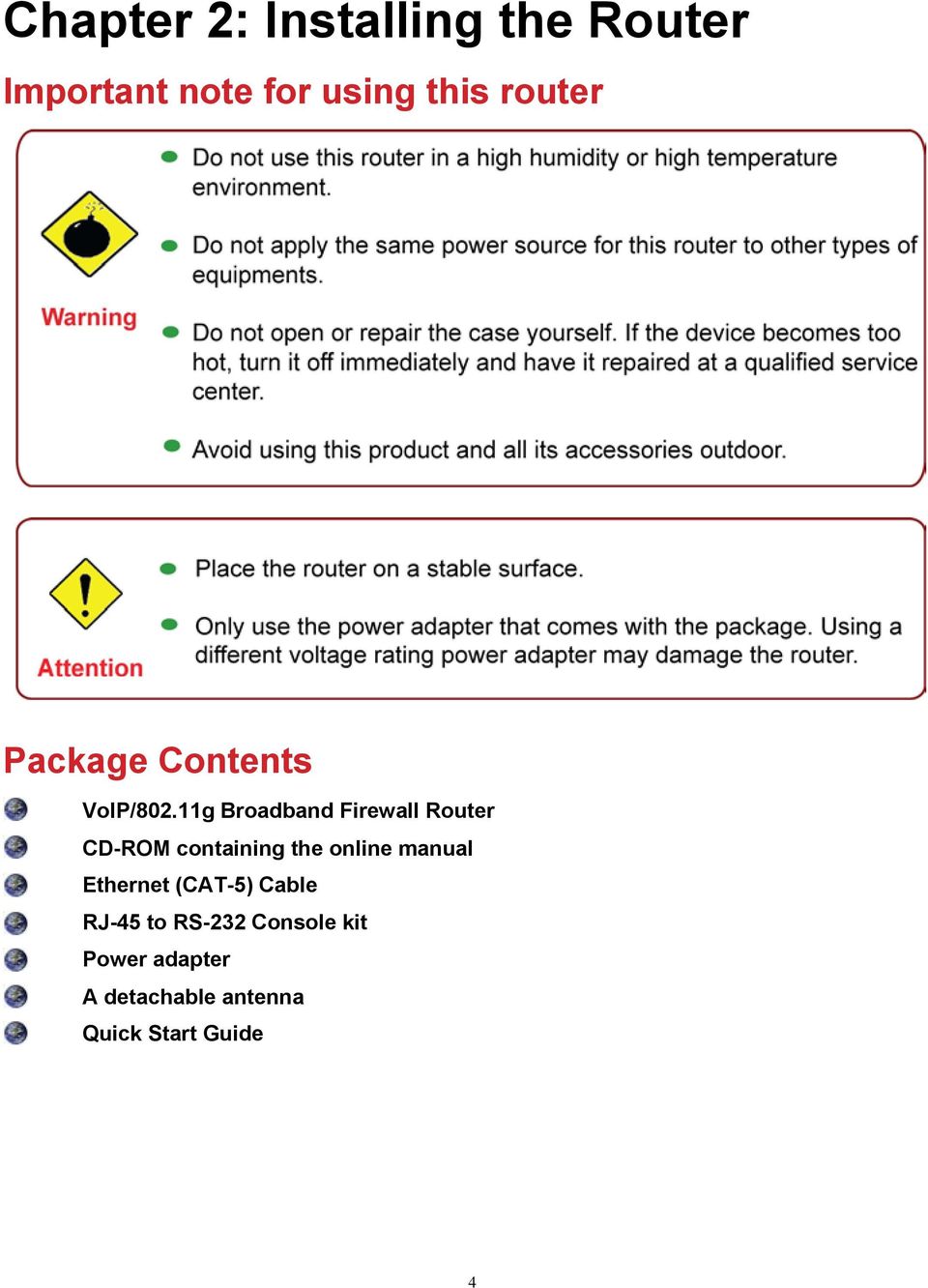
6 Chapter 2: Installing the Router Important note for using this router Package Contents VoIP/802.11g Broadband Firewall Router CD-ROM containing the online manual Ethernet (CAT-5) Cable RJ-45 to RS-232 Console kit Power adapter A detachable antenna Quick Start Guide 4
7 Device Description The Front LEDs 1 Power LED 2 Ethernet Port 3 Wireless Phone 1x - 2x (RJ-11 connector) Line(Router with LINE port only) VoIP 1x - 2x (RJ-11 connector) 7 WAN 8 Internet Meaning Both red and green LEDs lit together when power is ON. Lit red means system failure. Restart the device or contact support. Lit green when the device is ready. Lit when one of LAN ports is connected to an Ethernet device. Lit green when the speed of transmission hits 100Mbps; Lit orange when the speed of transmission hits 10Mbps. Blink when data is being Transmitted / Received. Lit green when the wireless connection is established. Flash when sending/receiving data. Flash once per second while Wi-Fi protected setup is in progress. Lit green when phone is off hook. Lit green when the inbound and outbound calls are transmitted through PSTN. Lit green when phone 1 has registered successfully. Lit orange when phone 2 has registered successfully. If both phone 1 & 2 have succeeded in registration, both green and orange LEDs will lit together. Lit green/orange when connected to an modem or Cable modem's Ethernet port well. Lit red when WAN port fails to get IP address. Lit green when WAN port gets IP address successfully. Lit off when the device is in bridge mode or when WAN connection is absent. 5

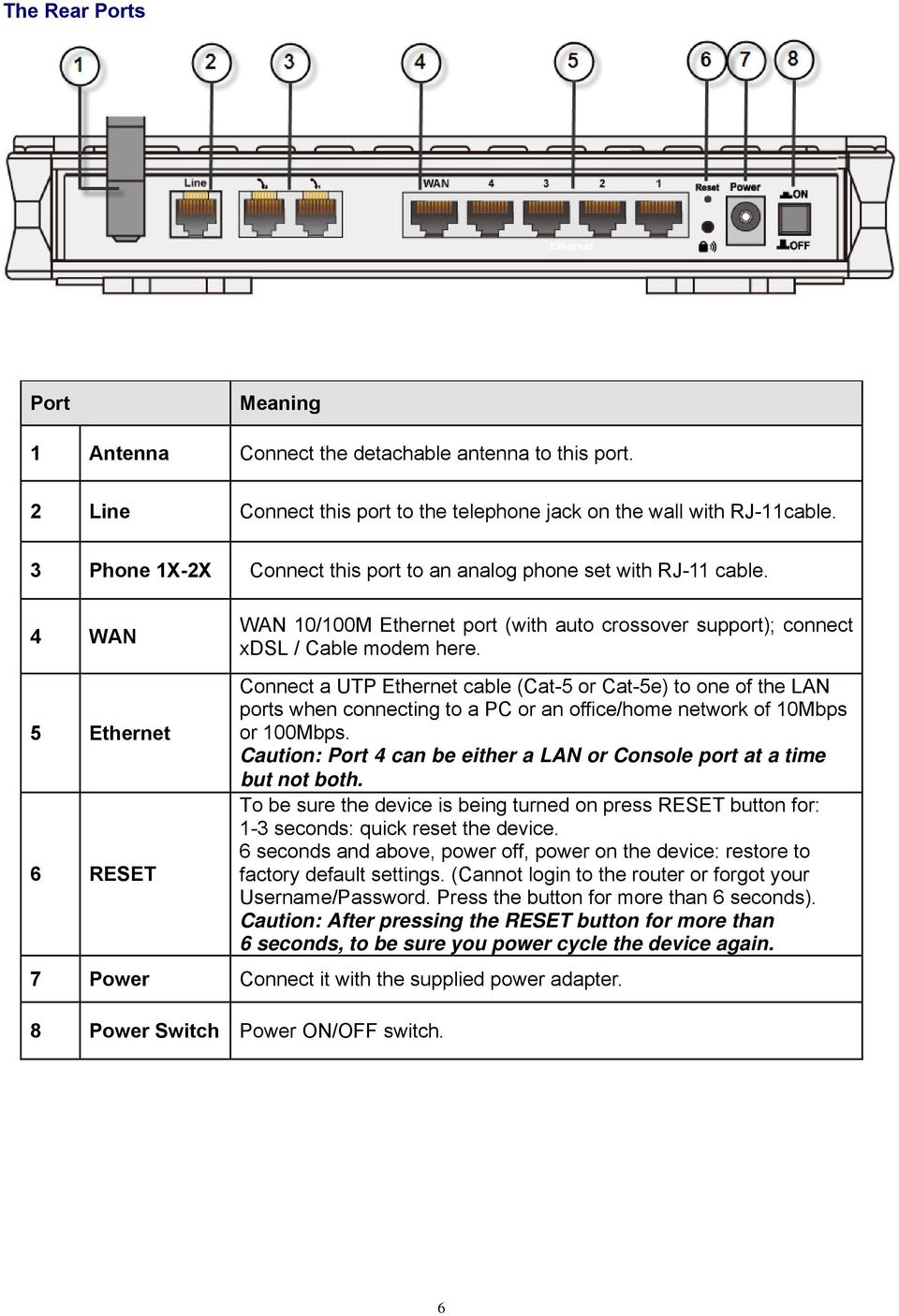
8 The Rear Ports Port Meaning 1 Antenna Connect the detachable antenna to this port. 2 Line Connect this port to the telephone jack on the wall with RJ-11cable. 3 Phone 1X-2X Connect this port to an analog phone set with RJ-11 cable. 4 WAN 5 Ethernet 6 RESET WAN 10/100M Ethernet port (with auto crossover support); connect xdsl / Cable modem here. Connect a UTP Ethernet cable (Cat-5 or Cat-5e) to one of the LAN ports when connecting to a PC or an office/home network of 10Mbps or 100Mbps. Caution: Port 4 can be either a LAN or Console port at a time but not both. To be sure the device is being turned on press RESET button for: 1-3 seconds: quick reset the device. 6 seconds and above, power off, power on the device: restore to factory default settings. (Cannot login to the router or forgot your Username/Password. Press the button for more than 6 seconds). Caution: After pressing the RESET button for more than 6 seconds, to be sure you power cycle the device again. 7 Power Connect it with the supplied power adapter. 8 Power Switch Power ON/OFF switch. 6
9 Cabling The most common problem associated with Ethernet is bad cabling. Make sure that all connected devices are turned on. On the top of the product is a bank of LEDs, as a first check, verifies that the relevant LAN Link and WAN Link LEDs are lit. If they are not, verify that you are using the proper cables. 7

10 Chapter 3: Basic Installation The router can be configured through your web browser. A web browser is included as a standard application in the following operating systems: Linux, Mac OS, Windows 7/98/NT/2000/XP/Me/Vista, etc. The product provides an easy and user-friendly interface for configuration. Please check your PC network components. The TCP/IP protocol stack and Ethernet network adapter must be installed. If not, please refer to your Windows-related or other operating system manuals. There are ways to connect the router, either through an external repeater hub or connect directly to your PCs. However, make sure that your PCs have an Ethernet interface installed properly prior to connecting the router device. You ought to configure your PCs to obtain an IP address through a DHCP server or a fixed IP address that must be in the same subnet as the router. The default IP address of the router is and the subnet mask is (i.e. any attached PC must be in the same subnet, and have an IP address in the range of to ). The best and easiest way is to configure the PC to get an IP address automatically from the router using DHCP. If you encounter any problem accessing the router web interface it is advisable to uninstall your firewall program on your PCs, as they can cause problems accessing the IP address of the router. Users should make their own decisions on what is best to protect their network. Please follow the following steps to configure your PC network environment. 8

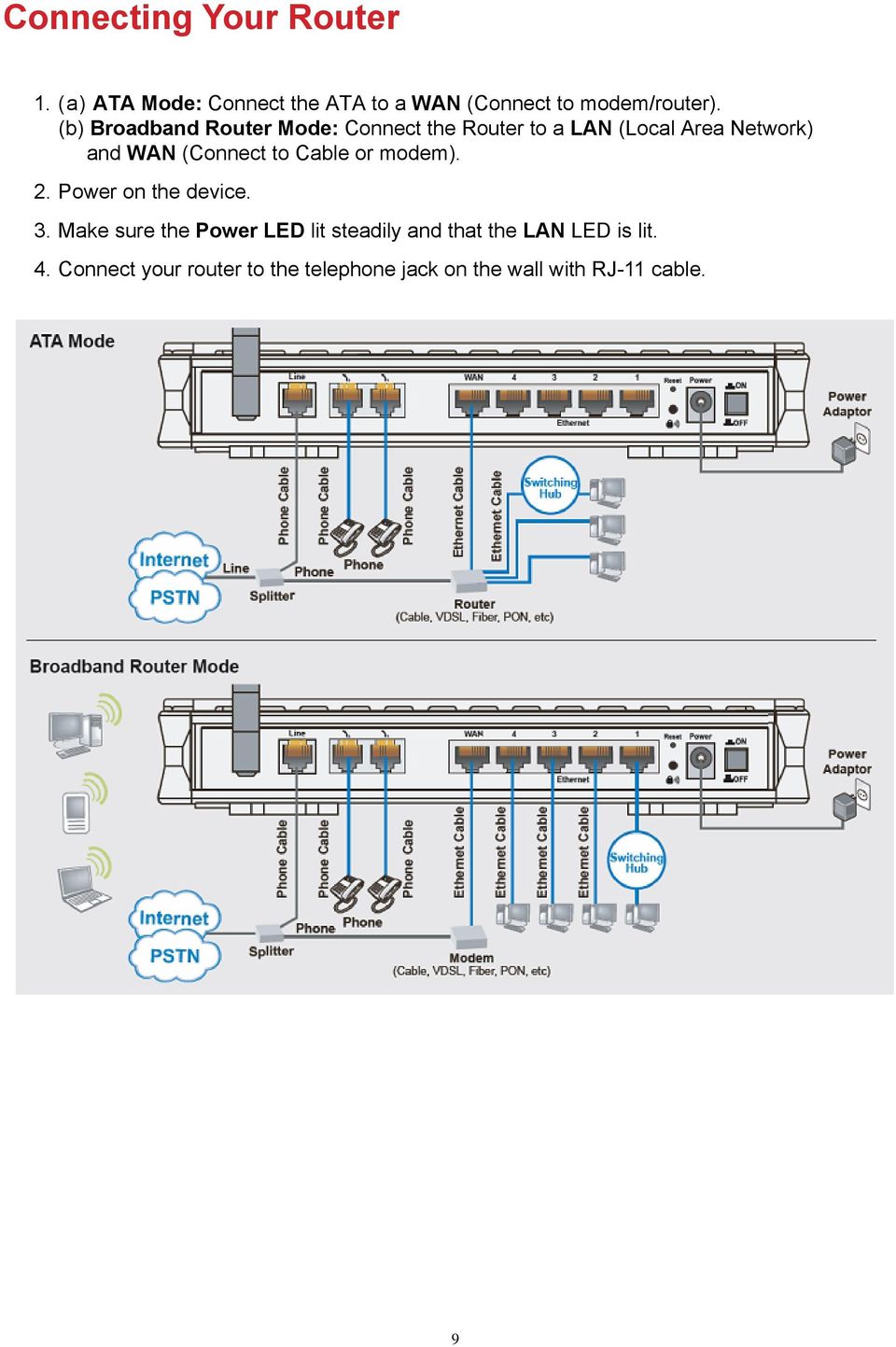
11 Connecting Your Router 1. (a) ATA Mode: Connect the ATA to a WAN (Connect to modem/router). (b) Broadband Router Mode: Connect the Router to a LAN (Local Area Network) and WAN (Connect to Cable or modem). 2. Power on the device. 3. Make sure the Power LED lit steadily and that the LAN LED is lit. 4. Connect your router to the telephone jack on the wall with RJ-11 cable. 9
12 Network Configuration Configuring PC in Windows 7 1. Go to Start. Click on Control Panel. 2. Then click on Network and Internet. 3. When the Network and Sharing Center window pops up, select and click on Change adapter settings on the left window panel. 4. Select the Local Area Connection, and right click the icon to select Properties. 10

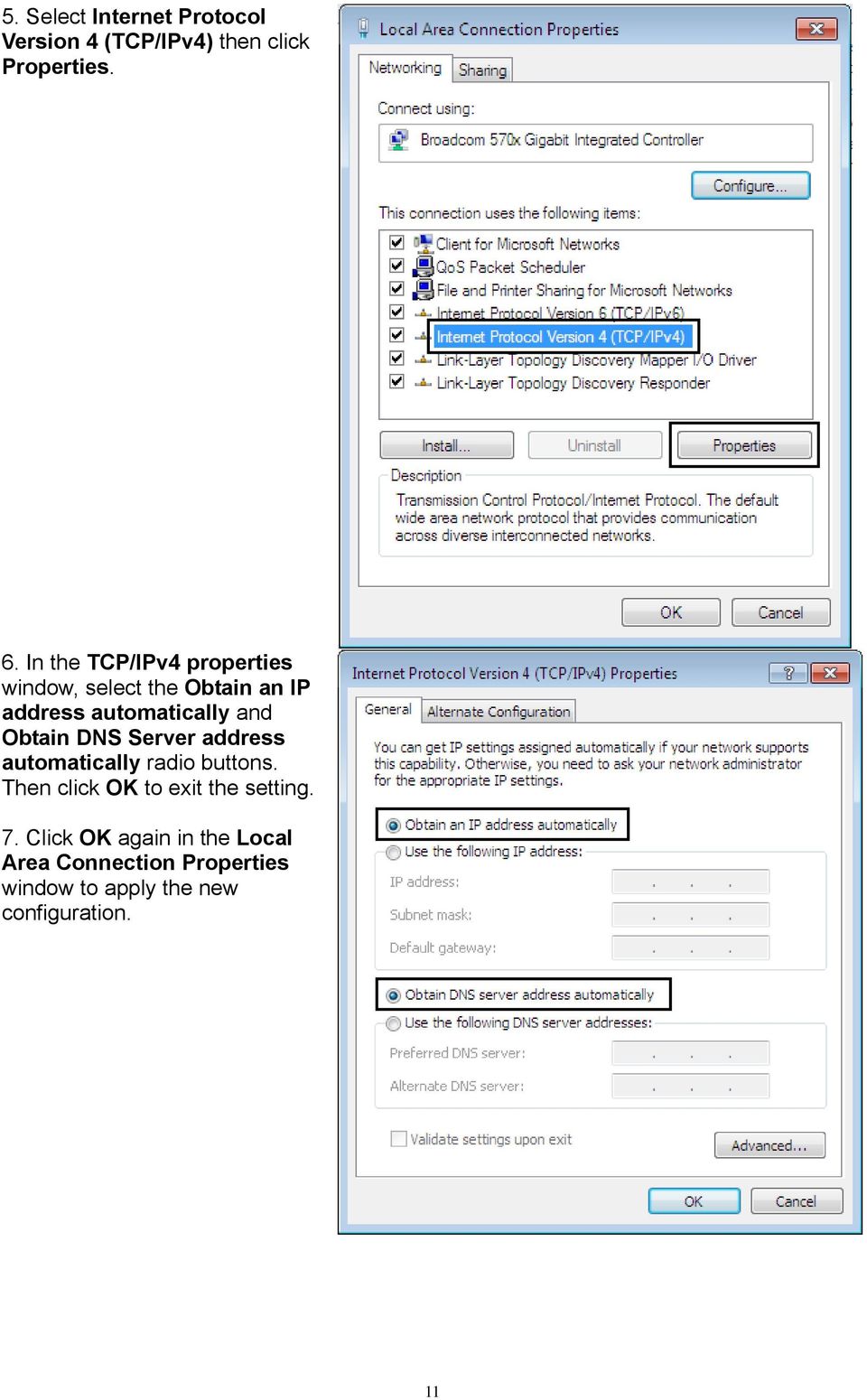
13 5. Select Internet Protocol Version 4 (TCP/IPv4) then click Properties. 6. In the TCP/IPv4 properties window, select the Obtain an IP address automatically and Obtain DNS Server address automatically radio buttons. Then click OK to exit the setting. 7. Click OK again in the Local Area Connection Properties window to apply the new configuration. 11
14 Configuring PC in Windows Vista 1. Go to Start. Click on Network. 2. Then click on Network and Sharing Center at the top bar. 3. When the Network and Sharing Center window pops up, select and click on Manage network connections on the left window column. 4. Select the Local Area Connection, and right click the icon to select Properties. 12

15 5. Select Internet Protocol Version4 (TCP/IPv4) then click Properties. 6. In the TCP/IPv4 properties window, select the Obtain an IP address automatically and Obtain DNS Server address automatically radio buttons. Then click OK to exit the setting. 7. Click OK again in the Local Area Connection Properties window to apply the new configuration. 13

16 Configuring PC in Windows XP 1. Go to Start > Control Panel (in Classic View). In the Control Panel, double-click on Network Connections 2. Double-click Local Area Connection. 3. In the Local Area Connection Status window, click Properties. 4. Select Internet Protocol (TCP/IP) and click Properties. 5. Select the Obtain an IP address automatically and the Obtain DNS server address automatically radio buttons. 6. Click OK to finish the configuration. 14

17 Configuring PC in Windows Go to Start > Settings > Control Panel. In the Control Panel, double-click on Network and Dial-up Connections. 2. Double-click Local Area Connection. 3. In the Local Area Connection Status window click Properties. 4. Select Internet Protocol (TCP/IP) and click Properties. 5. Select the Obtain an IP address automatically and the Obtain DNS server address automatically radio buttons. 6. Click OK to finish the configuration. 15

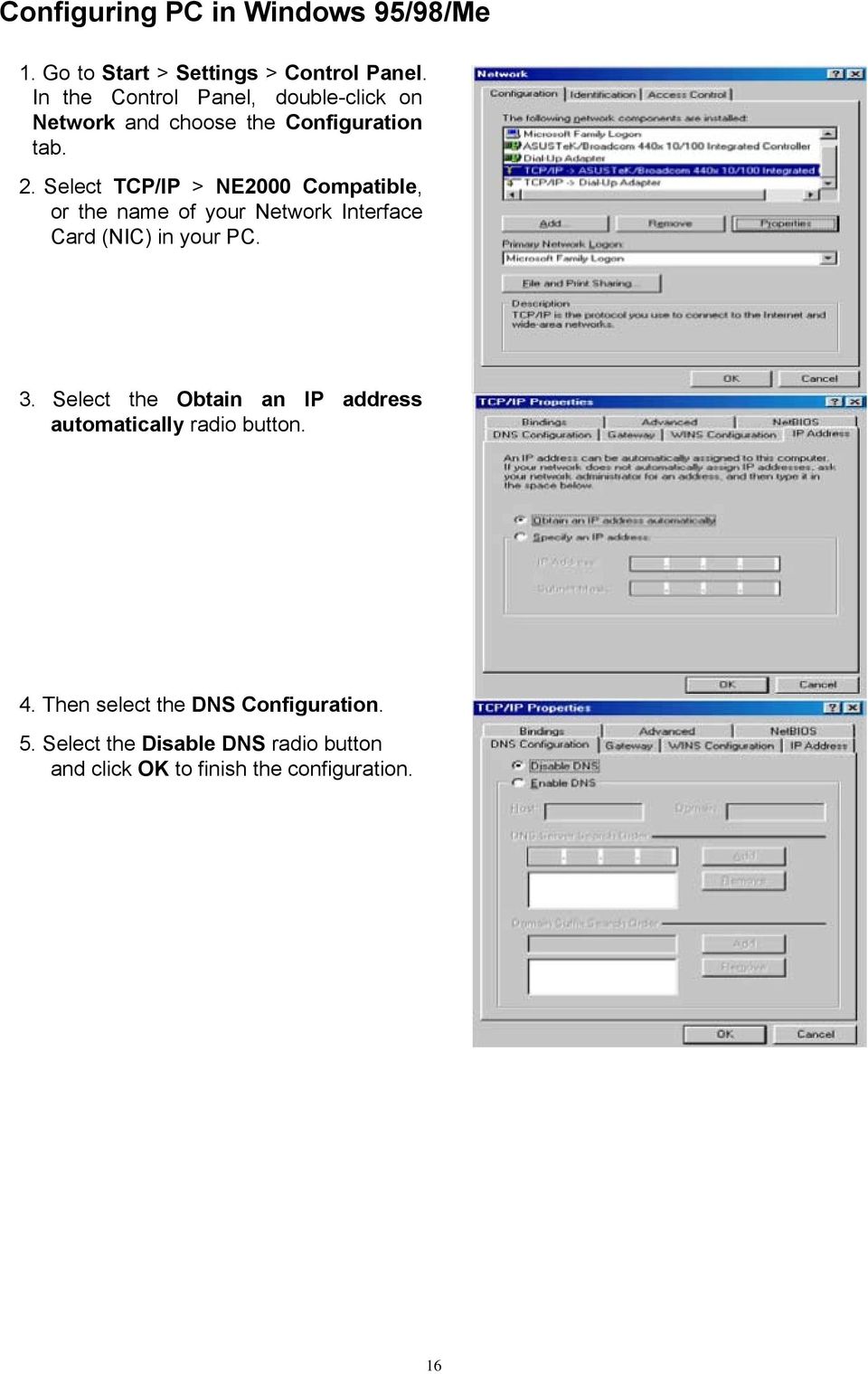
18 Configuring PC in Windows 95/98/Me 1. Go to Start > Settings > Control Panel. In the Control Panel, double-click on Network and choose the Configuration tab. 2. Select TCP/IP > NE2000 Compatible, or the name of your Network Interface Card (NIC) in your PC. 3. Select the Obtain an IP address automatically radio button. 4. Then select the DNS Configuration. 5. Select the Disable DNS radio button and click OK to finish the configuration. 16
19 Configuring PC in Windows NT Go to Start > Settings > Control Panel. In the Control Panel, double-click on Network and choose the Protocols tab. 2. Select TCP/IP Protocol and click Properties. 3. Select the Obtain an IP address from a DHCP server radio button and click OK. 17

20 Factory Default Settings Before configuring your router, you need to know the following default settings. Web Interface (Username and Password) Username: admin Password: admin The default username and password are admin and admin respectively. Device LAN IP settings IP Address: Subnet Mask: ISP setting in WAN site PPPoE DHCP server DHCP server is enabled. Start IP Address: IP pool counts: 100 LAN and WAN Port Addresses The parameters of LAN and WAN ports are pre-set in the factory. The default values are shown in the table. LAN Port IP address Subnet Mask DHCP server function IP addresses for distribution to PCs Enabled in ports 1, 2, 3 and IP addresses continuing from through WAN Port The PPPoE function is enabled to automatically get the WAN port configuration from the ISP. 18

21 Information from your ISP Before configuring this device, you have to check with your ISP (Internet Service Provider) to find out what kind of service is provided such as DHCP (Obtain an IP Address Automatically, Static IP (Fixed IP Address) or PPPoE. Gather the information as illustrated in the following table and keep it for reference. DHCP (Obtain an IP Address Automatically) Configure this WAN Interface to use DHCP client protocol to get an IP address from your ISP automatically. Your ISP provides an IP address to the router dynamically when logging in. Static IP Address) IP(Fixed Configure this WAN interface with a specific IP address. This IP address should be provided by your ISP. PPPoE PPPoE (PPP over Ethernet) is known as a dial-up DSL or cable service. It is designed to integrate the broadband services into the current widely deployed, easy-to-use, and low-cost dial-up-access networking infrastructure. 19
22 Configuring with your Web Browser Open your web browser, enter the IP address of your router, which by default is , and click Go, a user name and password window prompt will appear. The default username and password are admin and admin respectively. (See Figure 3.14) Figure 3.14: User name & Password Prompt Window Congratulations! You are now successfully logging onto the VoIP / g Broadband Router! 20
23 Chapter 4: Configuration At the configuration homepage, the left navigation column provides you the link to each configuration page. The category of each configuration page is listed as below. Status EWAN Status ARP Table DHCP Table Routing Table NAT Sessions UPnP Portmap VoIP Status VoIP Call Log Event Log Error Log IDS Log Diagnostic LAN WAN Quick Start Configuration System Firewall VoIP Virtual Server Wake on LAN Time Schedule Advanced Language (provides user interface in English and French languages) 21
24 Status EWAN Status The router offers a WAN port to be used to connect to Cable Modems and fiber optic lines. This alternative, yet faster method to connect to the internet will provide users more flexibility to get online. Total TX Bytes / Packets: The statistics of total data transmission in bytes / packets since system ready. Total RX Bytes / Packets: The statistics of total data received in bytes / packets since system ready. 22
25 ARP Table This section displays the router ARP (Address Resolution Protocol) Table which shows the mapping of Internet (IP) addresses to Ethernet (MAC) addresses. This is a quick way of determining the MAC address of the network interface of your PCs that use the Firewall MAC Address Filter function. See the Firewall section of this manual for more information on this feature. IP Address: Shows a list of IP addresses of devices on your LAN (Local Area Network). MAC Address: Shows the MAC (Media Access Control) addresses of each device on your LAN. Interface: Shows the interface name (on the router) that this IP Address connects to. Static: Static status of the ARP table entry: no for dynamically-generated ARP table entries. yes for static ARP table entries added by the user. 23
26 DHCP Table Leased: Shows the information of the DHCP assigned IP addresses. Expired: Shows the information of all expired IP addresses. Permanent: Shows the fixed host mapping information. Leased Table IP Address: Shows the IP address that is assigned to each client. MAC Address: Shows the MAC address of each client. Client Host Name: Shows the Host Name (Computer Name) of the client. Expiry: Shows the current lease time of each client. 24
27 Routing Table Routing Table Valid: A check mark indicates a successful routing status. Destination: Shows the IP address of the destination network. Netmask: Shows the destination Netmask address. Gateway/Interface: Shows the IP address of the gateway or the existing interface that this route will use. Cost: The number of hops counted as the cost of the route. RIP Routing Table Destination: Shows the IP address of the destination network. Netmask: Shows the destination Netmask address. Gateway: Shows the IP address of the gateway that this route will use. Cost: The number of hops counted as the cost of the route. 25
28 NAT Sessions This section lists all the current NAT sessions between external (WAN) and internal (LAN) interface. UPnP Portmap This section lists all the established port-mapping using UPnP (Universal Plug and Play). See the Advanced section of this manual for more details on UPnP and the router UPnP configuration options. 26
29 VoIP Status This table shows the status of the phone ports when VoIP feature has been activated. It displays information such as domain name, display name & phone number of the VoIP device. VoIP Call Log The call log records the data from your VoIP devices such as the date / time of dial out calls, the duration of the calls, information about the missed calls and also incoming calls. 27
30 Event Log This page displays all the event Log entries of the router such as when gets disconnected and during Firewall triggered events like Intrusion or Blocking Logging. Please see the Firewall section of this manual for more details on how to enable Firewall logging. Click Refresh button to get the latest event log information. Click Clear button to clear the log information. Click Save button to backup the event log information to your computer. Click Save button, you will enter page as follows to save the backup to your computer. 28
31 Error Log Any errors encountered by the router (e.g. invalid names given to entries) are logged to this window. IDS Log Any records about hacker attacks and intrusion attempts from the Internet are logged to this window. Diagnostic It tests the connection to computer(s) which is connected to the LAN ports and also the WAN Internet connection. If PING is shown FAIL and the rest is PASS, you ought to check your PC s DNS setting is correct. 29
32 Quick Start 1. Click Quick Start. Select the connect mode you want. There is only one option: EWAN. Obtain an IP Address Automatically When connecting to the ISP, the router also functions as a DHCP client. This router can automatically obtain an IP address, subnet mask, gateway address, and DNS server addresses if the ISP assigns this information via DHCP. Fixed IP Address Select this option to set static IP information. You will need to enter in the Connection type, IP address, Netmask, and gateway address, provided to you by your ISP. Each IP address entered in the fields must be in the appropriate IP form, which are four IP octets separated by a dot (x.x.x.x). The Router will not accept the IP address if it is not in this format. 30
33 IP Address: Your WAN IP address. Leave this at to automatically obtain an IP address from your ISP. Subnet Netmask: The default is User can change it to other such as Type the subnet mask assigned to you by your ISP (if given). Gateway: You must specify a gateway IP address (supplied by your ISP). Obtain DNS automatically: Click to activate DNS and to enable the system to automatically detect DNS. Primary DNS / Secondary DNS: Enter the IP addresses of the DNS servers. The DNS servers are passed to the DHCP clients along with the IP address and the netmask. PPPoE PPPoE (PPP over Ethernet) provides access control in a manner similar to dial-up services using PPP. Username: Enter the username provided by your ISP. You can input up to 128 alphanumeric characters (case sensitive). This is in the format of username@ispname instead of simply username. Password: Enter the password provided by your ISP. You can input up to 128 alphanumeric characters (case sensitive). Service Name: Enter a name for this connection. IP Address: Your WAN IP address. Leave this at to automatically obtain an IP address from your ISP. Obtain DNS automatically: Click to activate DNS and to enable the system to automatically detect DNS. Primary DNS / Secondary DNS: Enter the IP addresses of the DNS servers. The DNS servers are passed to the DHCP clients along with the IP address and the netmask. 31
34 2. Configure the Wireless LAN setting. WLAN Service: Default setting is set to Enable. If you want to use wireless, both g and b device in your network, you can select Enable. ESSID: The ESSID is the unique name of a wireless access point (AP) to be distinguished from another. For security propose, change to a unique ID name to the AP which is already built-in to the router s wireless interface. It is case sensitive and must not excess 32 characters. Make sure your wireless clients have exactly the ESSID as the device, in order to get connected to your network. ESSID Broadcast: It is function in which transmits its ESSID to the air so that when wireless client searches for a network, router can then be discovered and recognized. Default setting is Enable. Enable: When Enable is selected, you can allow anybody with a wireless client to be able to locate the Access Point (AP) of your router. Disable: Select Disable if you do not want broadcast your ESSID. When select Disable, no one will be able to locate the Access Point (AP) of your router. Regulation Domain: There are seven Regulation Domains for you to choose from, including North America (N.America), Europe, France, etc. The Channel ID will be different based on this setting. Channel ID: Select the ID channel that you would like to use. Security Mode: You can disable or enable with WPA or WEP for protecting wireless network. The default mode of wireless security is Disable. 32
35 3. Set up VoIP. SIP: To use VoIP SIP as VoIP call signaling protocol. Default is set to Disable. Region: This selection is a drop-down box, which allows user to select the country for which the VoIP device must work. When a country is selected, the country parameters are automatically loaded. SIP Service Provider: This section allows you to select the service provider. When the selection is done, respective parameters below are automatically displayed. Phone Number: This parameter holds the registration ID of the user within the VoIP SIP registrar. Username: If the username is same as the Phone Number, leave it blank. Otherwise, fill in the space with your username given by your VoIP provider. Password: This parameter holds the password used for authentication within VoIP SIP registrar. Display Name: This parameter will be appeared on the Caller ID. 4. Wait for the configuration. 33
36 Configuration When you click this item, the column will expand to display the sub-items that will allow you to further configure your router. LAN, WAN, System, Firewall, VoIP, Virtual Server, Wake on LAN, Time Schedule and Advanced The function of each configuration sub-item is described in the following sections. 34
37 LAN - Local Area Network Here are the items within the LAN section: Ethernet, IP Alias, IPv6 Autoconfig, Ethernet Client Filter, Wireless, Wireless Security, Wireless Client Filter, WPS and DHCP Server. Ethernet The router supports more than one Ethernet IP addresses in the LAN that supports multiple internet access at the same time. Users usually only have one subnet in their LAN. The default IP address for the router is Primary IP Address IP Address: The default IP on this router. Subnet Mask: The default subnet mask on this router. RIP: RIP v1, RIP v2, and RIP v2 Multicast. Check to enable RIP function. 35
38 IP Alias This function enables the creation of multiple virtual IP interfaces for this router. It helps to connect two or more local networks to the ISP or remote node. In this case, an internal router is not required. IP Address: Specify an IP address for this virtual interface. Netmask: Specify a subnet mask for this virtual interface. Security Interface: Specify the firewall setting for this virtual interface. Internal: This mean the network is behind NAT. All traffic will do network address translation when sending out data to the Internet if NAT is enabled. External: This means there is no NAT on this IP interface and it is connected directly to the Internet. This function is mostly used when you are provided with multiple public IP addresses by the ISP. In this case, you can use the public IP address in the local network whose gateway IP address points to the IP address on this interface. DMZ: Specify this network to a DMZ area. There is no NAT on this interface. 36
39 IPv6 Autoconfig The IPv6 address composes of two parts, thus, the prefix and the interface ID. BiPAC 6404VGP R3 dynamically configure IPv6 address on host with Stateless auto-configuration mode. Stateless auto-configuration requires no manual configuration of hosts, minimal (if any) configuration of routers, and no additional servers. The stateless mechanism allows a host to generate its own addresses using a combination of locally available information (MAC address) and information(prefix) advertised by routers. Routers advertise prefixes that identify the subnet(s) associated with a link, while hosts generate an "interface identifier" that uniquely identifies an interface on a subnet. An address is formed by combining the two. When using stateless configuration, you needn t configure anything on the client. Link Local Address: the Link local address for this device. Dynamic IPv6 Address: this field displays the dynamic obtained IPv6 address if you haven t set static IPv6 address. Interface Address/Prefix length: enter the static LAN IPv6 address. Issue Router Advertisements: check whether to enable issue Router Advertisement feature. It is to send Router Advertisement messages periodically. 37
40 Ethernet Client Filter The Ethernet Client Filter can support up to 16 Ethernet network computers. It enables you to accept traffic from specific authorized computers or can restrict unwanted computer(s) to access your LAN. There are no pre-defined Ethernet MAC address filter rules, you can add the filter rules to meet your requirements. Ethernet Client Filter: Default setting is set Disable. Allowed: check to enable a specific PC to access your LAN by inserting the MAC Address in the space provided or click the Candidate button. Make sure your PC s MAC is listed. Blocked: check to prevent an unwanted PC from accessing your LAN by inserting the MAC Address in the space provided or click the Candidate button. Make sure your PC s MAC is not listed. The maximum number of client is 16. The MAC addresses should be 6 bytes long and are presented only in hexadecimal characters. Only numbers (0-9) and letters (a - f) are acceptable. Note: Follow the MAC Address Format xx:xx:xx:xx:xx:xx. Semicolon ( : ) must be included. Candidates: automatically detects devices that are connected to the router through the Ethernet. Click the Candidate button to access the Active PC in LAN window. Active PC in LAN: Active PC in LAN window displays a list of IP Address & MAC Address of each Ethernet device which connects to the router. You can check the checkbox next to the IP address to block or to allow the PC from accessing the LAN. Then, click Add to insert the IP to the Ethernet Client Filter table. The maximum number of supported Ethernet client is
41 Wireless Parameters WLAN Service: Choose Disabled/Enable/TimeSlot from the drop-down list. Mode: The default setting is b+g (Mixed mode). If you do not know or do not have both 11g and 11b devices on your network, then keep the setting in mixed mode. From the drop-down menu, you can select g if you have only 11g card. If you have only 11b card, then select b. ESSID: The ESSID is a unique name of a wireless access point (AP) used to distinguish one from another. For security purpose, change the default wlan-ap to a unique ID name that is already built into the router wireless interface. It is case sensitive and must not exceed 32 characters. Make sure your wireless clients have exactly the ESSID as the device in order to connect to your network. Note: It is case sensitive and must not exceed 32 characters. ESSID Broadcast: It is used to broadcast its ESSID on the network so that when a wireless client searches for a network, the router can be discovered and recognized. Default setting is Enable. Enable: When enabled, you allow anybody with a wireless client to be able to locate the Access Point (AP) of your router. 39
42 Disable: When disabled, you do not broadcast your ESSID. Therefore, no one will be able to locate the Access Point (AP) of your router. Regulation Domain: There are seven Regulation Domains for you to choose from, including North America (N.America), Europe, France, etc. The Channel ID will be different based on this setting. Channel ID: Select the wireless connection ID channel that you would like to use. Note: Wireless performance may degrade if the selected ID channel is already being occupied by other AP(s). TX PowerLevel: It is a function that enhances the wireless transmission signal strength. User may adjust this power level from minimum 1 up to maximum 100 or 127 depending on the models used. Please refer to the note table for the appropriate power level range of your model. Note: The Power Level maybe different in each access network user premises environment so choose the most suitable level for your network. Connected: Display either as true or false. That it is the connection status between the system and the build-in wireless card. AP MAC Address: It is a unique hardware address of the Access Point. AP Firmware Version: The Access Point firmware version. WMM: This feature works concurrently with QoS that enables the system to prioritize the flow of data packets according to 4 categories: Voice, Video, Best Efforts and Background. Wireless Distribution System (WDS) It is a wireless access point mode that enables wireless link and communication with other access points. It is easy to install simply by defining the peer s MAC address of the connected AP. WDS takes advantage of the cost saving and flexibility with no extra wireless client device is required to bridge between two access points and extending an existing wired or wireless infrastructure network to create a larger network. It can connect up to 4 wireless APs for extending cover range at the same time. In addition, WDS also enhances its link connection security mode. Key encryption and channel must be the same for both access points. WDS Service: The default setting is Disabled. Check Enable radio button to activate this function. 1. Peer WDS MAC Address: It is the associated AP MAC Address. It is important you re your peer s AP must include your MAC address in order to acknowledge and communicate with each other. 2. Peer WDS MAC Address: It is the second associated AP MAC Address. 3. Peer WDS MAC Address: It is the third associated AP MAC Address. 4. Peer WDS MAC Address: It is the fourth associated AP MAC Address. Note: For MAC Address, Semicolon ( : ) must be included. 40
43 Wireless Security You can disable or enable the wireless security function using WPA or WEP for wireless network protection. The default mode of wireless security is set to disabled. WPA-PSK / WPA2-PSK Security Mode: You can disable or enable with WPA or WEP for protecting wireless network. The default mode of wireless security is Disable. WPA Shared Key: The key for network authentication. The input format is in character style and key size should be in the range between 8 and 63 characters. Group Key Renewal: The period of renewal time for changing the security key automatically between wireless client and Access Point (AP). Default value is 600 seconds. 41
44 WEP WEP Authentication: To prevent unauthorized wireless stations from accessing data transmitted over the network, the router offers secure data encryption, known as WEP. If you require high security for transmissions, there are two options to select from: Open System, Share key. WEP Encryption: To prevent unauthorized wireless stations from accessing data transmitted over the network, the router offers highly secure data encryption, known as WEP. If you require high security for transmissions, there are two alternatives to select from: WEP 64 and WEP 128. WEP 128 will offer increased security over WEP 64. Passphrase: This is used to generate WEP keys automatically based upon the input string and a pre-defined algorithm in WEP64 or WEP128. Default Used WEP Key: Select the encryption key ID; please refer to Key (1~4) below. Key (1-4): Enter the key to encrypt wireless data. To allow encrypted data transmission, the WEP Encryption Key values on all wireless stations must be the same as the router. There are four keys for your selection. The input format is in HEX style, 10 and 26 HEX codes are required for WEP64 and WEP128 respectively. 42
45 Wireless Client / MAC Address Filter The MAC Address supports up to 16 wireless network PCs and helps you manage your network control to accept traffic from specific authorized PCs or to restrict unwanted PC(s) to access your LAN. There are no pre-defined MAC Address filter rules; you can add the filter rules to meet your requirements. Filter Action: Default setting is set to Disable. Allowed: To authorize specific device to access your LAN by insert the MAC Address in the space provided or click the Candidate button. Make sure your PC s MAC is listed. Blocked: To prevent unwanted device from accessing the LAN by insert the MAC Address in the space provided or click the Candidate button. Make sure your PC s MAC is not listed. The maximum client is 16. The MAC addresses are 6 bytes long; they are presented only in hexadecimal characters. The number 0-9 and letters a - f are acceptable. Note: Follow the MAC Address Format xx:xx:xx:xx:xx:xx. Semicolon ( : ) must be included. Candidates: It automatically detects for devices that are connected to the router through the Wireless feature. Click the Candidate button to access the Associated Wireless Client window. Associate Wireless Client: Displays a list MAC addresses of all wireless devices that are currently connected to the router. You can check the checkbox next to the MAC address to block or allow the wireless client to access the network. Then, Add to insert to the Wireless Client (MAC Address) Filter table. The maximum Wireless client is
46 WPS WPS (WiFi Protected Setup) feature is a standard protocol created by Wi-Fi Alliance. This protocol is used to build a Wi-Fi network within a home / small office environment in an easy and secured manner. This feature thus provides a much simplified method to configure Wi-Fi Protected Access to those who know very little about wireless security. Set up of security-enabled Wi-Fi network Step 1: Note down the AP s PIN from Web (Ex: ). Step 2: Open wireless client s WPS utility (Ex: Atheros Jumpstart WPS utility), select Configure a wireless network and apply next button. 44
47 Step 3: Enter AP s PIN into the utility and click on the next button. Step 4: These are two ways to trigger AP as Enrolee role, you can choose one to do it. Push AP s WPS button 1 second and release it. In the AP s WPS configuration page, change Role to Enrollee and apply Start button. 45
48 Step 5: Jumpstart WPS utility search WPS AP. Step 6: SSID and security will be generated automatically (You can change it) and apply next button. 46
49 Step 7: WPS set up complete. And you have set up security-enabled Wi-Fi networks. 47
50 Set up of security-enabled Wi-Fi network using WCN in Vista Step 1: Note down the AP s PIN from Web (Ex: ). Step 2: In Vista s Control Panel, select Network and Internet and choose View network computers and devices. Double click the Firewall Router icon and enter the AP s PIN code then click Next. 48
51 Step 3: Enter the AP SSID and apply Next button. Step 4: Enter the Passphrase and apply Next button. 49
52 Step 5: WCN set up complete. And you have set up security-enabled Wi-Fi networks. 50
53 Adding a new WPS device (wireless client) to a network - Use PBC Method Step 1: Push AP s WPS button more than one second and you will see AP s WLAN led will flashing per second. Step 2: Open wireless client s WPS utility, select Join a wireless network and apply next button. Note: After you push AP s WPS button, below steps should be completed between 2 minutes. Step 3: Select Push the button on my access point and apply next button. 51
54 Step 4: New WPS device have join into the wireless network. 52
55 Adding a new WPS device (wireless client) to a network - Use PIN Method Step 1: Open wireless client s WPS utility, select Join a wireless network and apply next button. Step 2: Note down the wireless client s PIN (Ex: ) and apply Start button for active wireless client WPS PIN method. 53
56 Step 3: Enter wireless client s PIN into Enrollee s PIN of Web and apply Start button. Step 4: New WPS device have join into the wireless network. 54
57 DHCP Server You can disable or enable the DHCP (Dynamic Host Configuration Protocol) server or enable the router s DHCP relay functions. The DHCP protocol allows your router to dynamically assign IP addresses to the PCs on your network if they are configured to obtain IP addresses automatically. To disable the router DHCP Server, check Disabled and click Next, then click Apply. When the DHCP Server is disabled you will need to manually assign a fixed IP address to each PC on your network, and set the default gateway for each PC to the IP address of the router (by default this is ). To configure the router DHCP Server, check DHCP Server and click Next. You can then configure parameters of the DHCP Server including the IP pool (starting IP address and ending IP address to be allocated to PCs on your network), lease time for each assigned IP address (the period of time the IP address assigned will be valid), DNS IP address and the gateway IP address. These details are sent to the DHCP client (i.e. your PC) when it requests an IP address from the DHCP server. Click Apply to enable this function. If you check Use Router as a DNS Server, the Router will perform the domain name lookup, find the IP address from the outside network automatically and forward it back to the requesting PC in the LAN (your Local Area Network). If you check DHCP Relay Agent and click Next, then you will have to enter the IP address of the DHCP server which will assign an IP address back to the DHCP client in the LAN. Use this function only if advised to do so by your network administrator or ISP. Click Apply to enable this function. 55
58 WAN - Wide Area Network WAN refers to your Wide Area Network connection, i.e. your router s connection to your ISP and the Internet. Here is the item within the WAN section: WAN Profile. WAN Profile Obtain an IP Address Automatically (EWAN) When connecting to the ISP, This router also functions as a DHCP client. It can automatically obtain an IP address, netmask, gateway address, and DNS server addresses if the ISP assigns this information via DHCP. Profile Port: Select the profile port as EWAN. Protocol: Select Obtain an IP Address Automatically. Obtain DNS: A Domain Name System (DNS) contains a mapping table for domain name and IP addresses. DNS helps to find the IP address of a specific domain name. Check the checkbox to obtain DNS automatically. Primary DNS/ Secondary DNS: Enter the IP addresses of the DNS servers. The DNS servers are passed to the DHCP clients along with the IP address and the Netmask. IPv6: check to enable IPv6 service. Enter IPv6 Gateway address and set IPv6 DNS as same in IPv4 mode. 56
59 Fixed IP Address (EWAN) Select this option to set static IP information. You will need to enter in the Connection type, IP address, netmask, and gateway address, provided to you by your ISP. Each IP address entered in the fields must be in the appropriate IP form, which is four IP octets separated by a dot (x.x.x.x). The Router will not accept the IP address if it is not in this format. IP: Your WAN IP address. Leave this at to automatically obtain an IP address from your ISP. Netmask: The default is User can change it to other such as Type the netmask assigned to you by your ISP (if given). Gateway: You must specify a gateway IP address (supplied by your ISP). Obtain DNS: A Domain Name System (DNS) contains a mapping table for domain name and IP addresses. DNS helps to find the IP address of a specific domain name. Check the checkbox to obtain DNS automatically. Primary DNS/ Secondary DNS: Enter the IP addresses of the DNS servers. The DNS servers are passed to the DHCP clients along with the IP address and the netmask. IPv6: check to enable IPv6 service. Enter IPv6 Gateway address and set IPv6 DNS as same in IPv4 mode. 57
60 PPPoE (EWAN) PPPoE (PPP over Ethernet) provides access control in a manner similar to dial-up services using PPP. Profile Port: Select the profile port as EWAN. Username: Enter the username provided by your ISP. You can input up to 128 alphanumeric characters (case sensitive). This is in the format of username@ispname instead of simply username. Password: Enter the password provided by your ISP. You can input up to 128 alphanumeric characters (case sensitive). Service Name: Enter a name for this connection. IP: Your WAN IP address. Leave this at to automatically obtain an IP address from your ISP. Connection: Always on: If you want the router to establish a PPPoE session when starting up and to automatically re-establish the PPPoE session when disconnected by the ISP. Connect on Demand: If you want to establish a PPPoE session only when there is a packet requesting access to the Internet (i.e. when a program on your computer attempts to access the Internet). Idle Timeout: Auto-disconnect the router when there is no activity on the line for a predetermined period of time. MTU: Maximum Transmission Unit. The size of the largest datagram (excluding media-specific headers) that IP will attempt to send through the interface. RIP: RIP v1, RIP v2, and RIP v2 Multicast. Check to enable RIP function. Auth. Protocol: Default is Auto. Your ISP advises on using Chap or Pap. MAC Spoofing: Select Enable and enter a MAC address that will temporarily change your router s MAC address to the one you have specified in this field. Leave it as Disabled if you do not wish to change the MAC address of your router. 58
61 Obtain DNS: Select Automatic to use DNS. Primary DNS/ Secondary DNS: Enter the IP addresses of the DNS servers. The DNS servers are passed to the DHCP clients along with the IP address and the subnet mask. IPv6: check to enable IPv6 service. Enter IPv6 Gateway address and set IPv6 DNS as same in IPv4 mode. 59
62 System Here are the items within the System section: Time Zone, Remote Access, Firmware Upgrade, Backup/Restore, Restart and User Management. Time Zone The router does not have a real time clock on board; instead, it uses the Simple Network Time Protocol (SNTP) to get the current time from an SNTP server outside your network. Choose your local time zone, click Enable and click the Apply button. After a successful connection to the Internet, the router will retrieve the correct local time from the SNTP server you have specified. If you prefer to specify an SNTP server other than those in the list, simply enter its IP address as shown above. Your ISP may provide an SNTP server for you to use. Daylight Saving is also known as Summer Time Period. Many places in the world adapt it during summer time to move one hour of daylight from morning to the evening in local standard time. Check Enable checkbox to set your local time. Resync Period (in minutes) is the periodic interval the router will wait before it re-synchronizes the router s time with that of the specified SNTP server. In order to avoid unnecessarily increasing the load on your specified SNTP server you should keep the poll interval as high as possible at the absolute minimum every few hours or even days. 60
63 Remote Access This feature enables system administrator to set the time interval where the router can be accessed for administration purpose from a remote site (i.e. from outside your LAN). If you wish to permanently enable remote access, set the time period to 0 minute. Firmware Upgrade Your router firmware is the software that enables it to operate and provides all its functionality. Think of your router as a dedicated computer, and the firmware as the software it runs. Over time this software may be improved and revised, and your router allows you to upgrade the software it runs to take advantage of these changes. Clicking on Browse will allow you to select the new firmware image file you have downloaded to your PC. Once the correct file is selected, click Upgrade to update the firmware in your router. 61
64 Backup / Restore This function allows you to save a backup of the current configuration of your router to a file on your PC, or to restore a previously saved configuration. This is very useful if you wish to customize the setting of the router, knowing in advance that you can always restore the setting if any mistakes do occur. Therefore, it is advisable that you create a backup of the configuration of your router before customizing its configuration. Create a Router Configuration Backup To create a backup of the setting, simply press the Backup button and specify the location on where to save your configuration file. You may also change the name of the file if you wish to keep multiple backups. Restoring the Router Configuration To restore the configuration of the router, press Browse to locate the configuration file from your PC. Once the file has been located, click on the file then click on the Restore button to load the setting. Note: You should only restore the setting with the files that have been created using the Backup function with the most current firmware version. Settings files saved to your PC should not be manually edited in any way. 62
65 Restart Router Click Restart with option Current Settings to reboot your router (and restore your last saved configuration). If you wish to restart the router using the factory default settings (for example, after a firmware upgrade or if you have saved an incorrect configuration), select Factory Default Settings to reset to factory default settings. You may also reset your router to factory settings by holding the small Reset pinhole button more than 6 seconds on the back of your router. Caution: After pressing the RESET button for more than 6 seconds, to be sure you power cycle the device again. 63
66 User Management In order to prevent unauthorized access to your router s configuration interface, it requires that all users are to login the GUI with a password. You can set up multiple user accounts, each with their own password. You can Edit any existing user accounts and Add new user account to grant access to the device configuration interface. Edit Account Information You can change the information of any account whether the account is active or valid. 1. To edit an account, select the Edit radio button of the account to be edited. Once selected, all information of that account will be displayed. 2. Delete the information to be edited and replace it with the new one. 3. When it is done, simply click on the Edit/ Delete button to save your changes. Note: It is recommended that you change the password immediately to prevent security breach to your GUI. 64
67 To Add an Account 1. Check the Valid checkbox, fill in all the information: User name, Comment (optional), Password, Confirm Password. 2. When it is done, click the Add button. To delete a user account 1. Click on the Delete radio button of the account you want to delete. 2. Then click the Edit/Delete to confirm the deletion. Note: You can delete any user account except for the default admin account. Thus there is no delete radio button available for this account. 65
68 Firewall and Access Control Your router includes a full SPI (Stateful Packet Inspection) firewall for Internet access controlling from your LAN. This feature also protects your system from being attacked by hackers. When using NAT, the router acts as a natural Internet firewall, as all PCs on your LAN will have their own private IP addresses which are not directly accessible from the Internet. The router provides three levels of security support. NAT natural firewall: This masks LAN users IP addresses which are invisible to users on the Internet, thus making it more difficult for a hacker to target a machine on your network. This natural firewall is turned on when NAT function is enabled. Firewall Security and Policy (General Settings): Inbound direction of Packet Filter rules to prevent unauthorized computers or applications to access your local network from the Internet. Intrusion Detection: Enable Intrusion Detection to detect, prevent and log malicious attacks. Access Control: Prevent access from PCs on your local network: Firewall Security and Policy (General Settings): Outbound direction of Packet Filter rules to prevent unauthorized computers or applications from accessing the Internet. URL Filter: To block PCs on your local network from unwanted websites. Listed are the items under the Firewall section: General Settings, Packet Filter, Intrusion Detection, URL Filter, IM/P2P Blocking and Firewall Log. 66
69 General Settings You can choose to disable Firewall and still be able to access the URL Filter, Intrusion Detection and IM/P2P Blocking or enable the Firewall using the preset filter rules and modify the port filter rules as required. The Packet Filter is used to filter packets based on Applications (Port) or IP addresses. There are four policy options to choose from: All blocked/user-defined: no predefined port or address filter rules by default, meaning that all inbound (Internet to LAN) and outbound (LAN to Internet) packets will be blocked. Users have to add their own filter rules to access the Internet. High/Medium/Low security level: the predefined port filter rules for High, Medium and Low security are displayed in the Port Filters of the Packet Filter. Select either High, Medium or Low security level to enable Firewall protection. The only difference between these three is the preset port filter rules in the Packet Filter. Firewall function is the same for all levels; it is only the list of preset port filters that changes between each setting. For more detail on level of preset port filter information, please refer to Table 1: Predefined Port Filter. If you choose the preset security levels and add custom filters, the level of filter rules will be saved and you do not need to re-configure the rules again if you disable or switch to the other security level. The Block WAN Request is a standalone function that is not affected by whether the security is enabled or disabled. This is used to prevent any scan tools that might be from hackers. 67
70 Packet Filter This function is only available when Firewall is enabled with one of the four security levels selected (All blocked, High, Medium and Low). The preset port filter rules in the Packet Filter must be modified accordingly to the level of security selected. See Table1: Predefined Port Filter for more detail information. 68
71 Example: Predefined Port Filters Rules The predefined port filter rules for High, Medium and Low security levels are listed. See Table 1. Note: Firewall All Blocked/User-defined, you must define and create the port filter rules yourself. No predefined rule is being preconfigured. Table 1: Predefined Port Filter Application Protocol Port Number Firewall - Low Firewall - Medium Firewall High HTTP(80) TCP(6) NO YES NO YES NO YES DNS(53) UDP NO YES NO YES NO YES DNS(53) TCP(6) NO YES NO YES NO YES FTP(21) TCP(6) NO YES NO YES NO NO Telnet(23) TCP(6) NO YES NO YES NO NO SMPT(25) TCP(6) NO YES NO YES NO YES POP3(110) TCP(6) NO YES NO YES NO YES NEWS(NNTP) TCP(6) NO YES NO YES NO NO PING ICMP(1) N/A N/A NO YES NO YES NO YES H.323(1720) TCP(6) YES YES NO YES NO NO T.120(1503) TCP(6) YES YES NO YES NO NO SSH(22) TCP(6) NO YES NO YES NO NO NTP/SNTP UDP(17) NO YES NO YES NO YES HTTP/HTTP Proxy(8080) TCP(6) NO YES NO NO NO NO HTTPS(443) TCP(6) NO YES NO YES N/A N/A ICQ(5190) TCP(6) YES YES N/A N/A N/A N/A MSN(1863) TCP(6) YES YES N/A N/A N/A N/A MSN(7001) UDP(17) YES YES N/A N/A N/A N/A MSN VEDIO TCP(6) NO YES N/A N/A N/A N/A Inbound: Internet to LAN Outbound: LAN to Internet YES: Allowed NO: Blocked N/A: Not Applicable 69
72 Packet Filter Add TCP/UDP Filter Rule Name Helper: User defined description for entry identification. You may also choose from the Select drop-down menu for an existing predefined rule. The maximum name length is 32 characters. Time Schedule: A self defined time period. You may specify a time schedule for your prioritization policy. For setup and detail, refer to Time Schedule section. Source IP Address (es) / Destination IP Address (es): This is the Address-Filter used to allow or block traffic to/from particular IP address (es). Select the Subnet Mask of the IP address range you wish to allow/block the traffic to or from means all IP Addresses. Tip: To block access, to/from a single IP address, enter that IP address as the Host IP Address and use a Host Subnet Mask of Type: It is the packet protocol type used by the application, select TCP, UDP or both TCP/UDP. Protocol Number: Insert the port number. Source Port: This Port or Port Ranges defines the port allowed to be used by the Remote/WAN to connect to the application. Default is set from range 0 ~ It is recommended that this option be configured by an advanced user. Destination Port: This is the Port or Port Ranges that defines the application. Inbound / Outbound: Select Allow or Block the access to the Internet ( Outbound ) or from the Internet ( Inbound ). When all changes are made, click Add button to apply your changes. 70
73 Packet Filter Add Raw IP Filter Go to Type drop-down menu, select Use Protocol Number. Rule Name Helper: User defined description for entry identification. You may also choose from the Select drop-down menu for an existing predefined rule. Time Schedule: A self defined time period. You may specify a time schedule for your prioritization policy. For setup and detail, refer to Time Schedule section. Source IP Address (es) / Destination IP Address (es): This is the Address-Filter used to allow or block traffic to/from particular IP address (es). Select the Subnet Mask of the IP address range you wish to allow/block the traffic to or from; means all IP Addresses. Tip: To block access to/from a single IP address, enter that IP address as the Host IP Address and use a Host Subnet Mask of Type: It is the packet protocol type used by the application, select TCP, UDP or both TCP/UDP. Protocol Number: Insert the port number, i.e. GRE 47. Source Port: This Port or Port Ranges defines the port allowed to be used by the Remote/WAN to connect to the application. Default is set from range 0 ~ It is recommended that this option be configured by an advanced user. Destination Port: This is the Port or Port Ranges that defines the application. Inbound / Outbound: Select Allow or Block the access to the Internet ( Outbound ) or from the Internet ( Inbound ). When all changes are made, click Add button to apply your changes. 71
74 Example: Configuring your firewall to allow a publicly accessible web server on your LAN The predefined port filter rule for HTTP (TCP port 80) is the same whether the firewall is set to a high, medium or low security level. To setup a web server located on the local network when the firewall is enabled, you have to configure the Port Filters setting for HTTP. As you can see from the diagram below, when the firewall is enabled with one of the three presets (Low/Medium/High) security level selected, an inbound HTTP access is not allowed which means remote access through HTTP to your router is not allowed. Note: Inbound indicates accessing from the Internet to LAN and Outbound is from LAN to the Internet. 72
75 Configuring Packet Filter: 1. Click Packet Filters. You will then be presented with the predefined port filter rules screen (in this case for the low security level), shown below: Note: You may click Edit the predefined rule instead of Delete it. This is an example to show to how you add a filter on your own. 2. If you want to delete a filter rule, select the delete radio button of the HTTP rule you want to delete. Then click the Edit/Delete button to delete the rule. 3. To add a new rule, Input the Rule Name, Time Schedule, Source/Destination IP, Type, Source / Destination Port, Inbound and Outbound. Then click the Add button. 73
76 Intrusion Detection The router Intrusion Detection System (IDS) is used to detect hacker s attack and intrusion attempts from the Internet. If the IDS function of the firewall is enabled, inbound packets are filtered and blocked depending on whether they are detected as possible hacker attacks, intrusion attempts or other connections that the router determines to be suspicious. Blacklist: If the router detects a possible attack, the source IP or destination IP address will beaded to the Blacklist. Any further attempts using this IP address will be blocked for the time period specified in the Block Duration. The default setting for this function is false (disabled). Some types of attack are denied immediately without using the Blacklist function, such as Land attack and Echo / CharGen scan. Intrusion Detection: If enabled, IDS will block Smurf attack attempts. Default is false. Block Duration: Victim Protection Block Duration: This is the duration for blocking Smurf attacks. Default value is 600 seconds. Scan Attack Block Duration: This is the duration for blocking hosts that attempt a possible Scan attack. Scan attack types include X mas scan, IMAP SYN/FIN scan and similar attempts. Default value is seconds. DoS Attack Block Duration: This is the duration for blocking hosts that attempt a possible Denial of Service (DoS) attack. Possible DoS attacks this attempts to block include Ascend Kill and WinNuke. Default value is 1800 seconds. Max TCP Open Handshaking Count: This is a threshold value to decide whether a SYN Flood attempt is occurring or not. Default value is 100 TCP SYN per seconds. Max PING Count: This is a threshold value to decide whether an ICMP Echo Storm is occurring or not. Default value is 15 ICMP Echo Requests (PING) per second. Max ICMP Count: This is a threshold to decide whether an ICMP flood is occurring or not. Default value is 100 ICMP packets per seconds except ICMP Echo Requests (PING). Clear Blacklist: Clear the current blacklist. Blacklist: Show the blacklist information. 74
77 For SYN Flood, ICMP Echo Storm and ICMP flood, IDS will just warn the user in the Event Log. It cannot protect against such attacks. Intrusion Name Table 2: Hacker attack types recognized by the IDS Detect Parameter Blacklist Type of Block Duration Drop Packet Show Log Ascend Kill Ascend Kill data Src IP DoS Yes Yes WinNuke TCP Port 135, 137~139, Src IP DoS Yes Yes Flag: URG Smurf ICMP type 8 Victim Dst IP Des IP is broadcast Protection Land attack SrcIP = DstIP Yes Yes Yes Yes Echo/CharGen Scan UDP Echo Port and CharGen Port Yes Yes Echo Scan CharGen Scan UDP Dst Port = Echo(7) UDP Dst Port = CharGen(19) Src IP Scan Yes Yes Src IP Scan Yes Yes X mas Tree Scan TCP Flag: X mas Src IP Scan Yes Yes IMAP SYN/FIN Scan SYN/FIN/RST/ACK Scan Net Bus Scan Back Orifice Scan SYN Flood ICMP Flood ICMP Echo TCP Flag: SYN/FIN DstPort: IMAP(143) Src IP Scan Yes Yes SrcPort: 0 or TCP, No Existing session Src IP And Scan Hosts Scan Yes Yes more than five. TCP No Existing session SrcIP DstPort = Net Bus Scan Yes Yes 12345,12346, 3456 UDP, DstPort = SrcIP Scan Yes Yes Orifice Port (31337) Max TCP Open Handshaking Yes Count (Default 100 c/sec) Max ICMP Count (Default 100 c/sec) Max PING Count (Default 15 c/sec) Yes Yes Src IP: Source IP Src Port: Source Port Dst Port: Destination Port Dst IP: Destination IP 75
78 URL Filter URL (Uniform Resource Locator) (e.g. an address in the form of or filter rule allows you to prevent users on your network from accessing specific websites defined by their URL. There are no predefined URL filter rules, therefore you can add filter rules to meet your requirements. Enable/Disable: To enable or disable URL Filter feature. Block Mode: It can support up to 4 timeslots. Disabled: No action will be performed by the Block Mode. Always On: Action is enabled. URL filter rules will be monitoring and checking all hours of the day. TimeSlot1 ~ TimeSlot16: It is self-defined time period. You may specify the time period to check the URL filter rules, i.e. during working hours. For setup and detail, refer to Time Schedule section. Keywords Filtering: Allow blocking against specific keywords within a particular URL rather than having to specify a complete URL (e.g. to block any image called advertisement.gif ). When enabled, your specified keywords list will be checked to see if any keywords are present in URLs accessed to determine if the connection attempt should be blocked. Please note that the URL filter blocks web browser (HTTP) connection attempts using port 80 only. 76
79 For example, if the URL is the connection will be dropped if the keyword abcde occurs in the URL. Domains Filtering: This function checks the whole URL address but not the IP address against your list of domains to block or allow. If it is matched, the URL request will either be sent (Trusted) or dropped (Forbidden). For this function to be activated, both enable and disable checkboxes of Domain Filtering must be checked. Here is the checking procedure: 1. Check the domain in the URL to determine if it is in the trusted list. If yes, the connection attempt is sent to the remote web server. 2. If not, check if it is listed in the forbidden list. If yes, then the connection attempt will be dropped. 3. If the packet does not match either of the above two conditions, it is sent to the remote web server. 4. Please be noted that the completed URL, www + domain name should be specific. e.g.: In order to block traffic to enter or In the example below, the URL request for will be sent to the remote web server because it is listed in the trusted list, whilst the URL request for or will be dropped, because is in the forbidden list. 77
80 Example: Andy wishes to disable all WEB traffic except for the ones listed in the trusted domain, which would prevent Bobby from accessing other websites. Andy selects both conditions in the Domain Filtering thinking that this will stop Bobby. But Bobby knows this function, Domain Filtering, ONLY disables all WEB traffic except for Trusted Domain, BUT not its IP address. If this is the situation, Block surfing by IP address function can become helpful. Now, Andy can successfully prevent Bobby from accessing other websites. Restrict URL Features: This function enhances the restriction to your URL rules. Block Java Applet: This function can block Web content that includes Java Applets. It is to prevent someone who wants to damage your system via standard HTTP protocol. Block surfing by IP address: A further restriction against someone who uses IP address as URL to cheat around the Domains Filtering rule. 78
81 IM / P2P Blocking IM, short for Instant Message, is a client software that allows users to communicate & exchange text messages with other IM users in real time over the Internet. A P2P application, known as Peerto-peer, is group of users who share their files with each other within the network over the Internet across the globe. Both Instant Message and Peer-to-peer applications make communication faster and easier but your network can become increasingly insecure at the same time. Billion s IM and P2P blocking helps users to restrict LAN PCs to access the commonly used IM, Yahoo and MSN, and P2P, BitTorrent and edonkey, applications over the Internet. Instant Message Blocking: The default is set to Disabled. Disabled: Instant Message blocking is not triggered. No action will be performed. Always On: Action is enabled. TimeSlot1 ~ TimeSlot16: This is the self defined time period. You may specify the time period to trigger the blocking, i.e. during working hours. For setup and detail, refer to Time Schedule section. Yahoo/MSN Messenger: Check the checkbox to block either or both Yahoo or/and MSN Messenger. To be sure you enabled the Instant Message Blocking first. Peer to Peer Blocking: The default is set to Disabled. Disabled: Instant Message blocking is not triggered. No action will be performed. Always On: Action is enabled. TimeSlot1 ~ TimeSlot16: This is the self defined time period. You may specify the time period to trigger the blocking, i.e. during working hours. For setup and detail, refer to Time Schedule section. BitTorrent / edonkey: Check the checkbox to block either or both Bit Torrent or/and edonkey. To be sure you enabled the Peer to Peer Blocking first. 79
82 Firewall Log Firewall Log displays a log that contains information of any unexpected actions that occur to your firewall settings. Check the Enable checkbox to activate event logging. Log information can be seen in the Status Event Log after the feature is enabled. 80
83 VoIP - Voice over Internet Protocol VoIP enables telephone calls through existing Internet connection instead of going through the PSTN (Public Switched Telephone Network). It is not only cost-effective, especially for a long distance telephone charges, but also toll-quality voice calls over the Internet. Here are the items within the VoIP section: SIP Device Parameters, SIP Accounts, Phone Port, PSTN Dial Plan, VoIP Dial Plan, Call Features, Speed Dial and Ring &Tone. 81
84 SIP Device Parameters This section provides easy setup for your VoIP service. Phone port 1 and 2 can be registered to different SIP Service Provider. SIP Device Parameters SIP: To use VoIP SIP as VoIP call signaling protocol. Default is set to Disable. Silence Suppression (VAD): Voice Activation Detection (VAD) prevents transmitting the nature silence to consume the bandwidth. It is also known as Silence Suppression which is a software application that ensures the bandwidth is reserved only when voice activity is activated. Default is set to Enable. Echo Cancellation: G.168 echo canceller is an ITU-T standard. It is used for isolating the echo while you are on the phone. This helps you not to hear much of your own voice reflecting on the phone while you talk. Default is set to Enable. RTP Port: Provide the based value from the media (RTP) ports that are assigned for various endpoints and the different call sessions that may exist within an end-point. (Range from 5100 to 65535, default value is 5100) Region: This selection is a drop-down box, which allows user to select the country for which the VoIP device must work. When a country is selected, the country parameters are automatically loaded. 82
85 Voice QoS, DSCP Marking: Differentiated Services Code Point (DSCP), it is the first 6 bits in the ToS byte. DSCP Marking allows users to assign specific application traffic to be executed in priority by the next Router based on the DSCP value. See Table 4. The DSCP Mapping Table: Note: To be sure the router(s) in the backbones network have the capability in executing and checking the DSCP through-out the QoS network. Advanced Parameters VoIP through IP Interface: IP Interface decides where to send/receive the voip traffic; it includes: ipwan and iplan. Easy way to select the interface is to check the location of the SIP server. If it locates some where in the Internet then select ipwan. If the VoIP SIP server is on the local Network then select iplan. Voice Frame Size: Frame size is available from 10ms to 60ms. Frame size meaning how many milliseconds the Voice packets will be queued and sent out. It is ideal to have the same frame size in both of Caller and Receiver. Dial Plan Priority: Define the priority between VoIP and PSTN dial plan. PSTN Auto-fallback: Whenever VoIP SIP responses error and error code matching with the codes in the Edit section, the VoiP calls will automatically fallback to PSTN. In the other word, the call will be called via the PSTN when VoIP SIP returns an error code. Click the Edit to add or remove the responses code. To be sure the code is separated by a comma (,). For more information about SIP responses codes, please check to link to org/wiki/view/sip+response+codes where you can get to know the meaning of each error code. T.38 Fax Relay: It allows the transfer of facsimile documents in real-time between two standard Group 3 facsimile terminals over the Internet or other networks using IP protocols. It will only function when both sites are support this feature and enabled. 83
86 Advanced PSTN Environment Adjustment PSTN Environment Adjustment options will help you to adjust the onhook and offhook voltage detection values for your environment. You should use these if the default values are incorrect and result in PSTN calls not being detected properly, e.g. calls being terminated within 5 seconds of being answered. The actual levels are determined by your environment including the number and type of telephones used. Note: ONHOOK means hung up. To take your phone OFFHOOK, lift the receiver then press Hook/Flash until you hear your normal PSTN dialtone, not your VoIP dialtone. Wait several seconds and then press Check Level. You should check the OFFHOOK value for each telephone you have connected to this device. Set the OFFHOOK voltage to the lowest setting registered for all your telephones, e.g. if your telephones return values of 4, 5 and 7 then you should set your OFFHOOK voltage to 4. Note: The detected values will not automatically be set by the Check Level function; you must enter the lowest level detected after testing all your telephones. 84
87 SIP Accounts This section reflects and contains the basic settings of the VoIP module from the selected provider in the Wizard section. Fail to provide the correct information will stop making calls out to the Internet. Profile Name: Assign a name for profile identification. Registrar Address (or Hostname): Indicate the VoIP SIP registrar IP address. Registrar Port: Specify the port of the VoIP SIP registrar on which it will listen for register requests from VoIP device. Expire: This is the duration for the registration message being sent. User Domain/Realm: Set a different domain name for the VoIP SIP proxy server. Outbound Proxy Address: Indicate the VoIP SIP outbound proxy server IP address. This parameter is very useful when VoIP device is behind a NAT. Outbound Proxy Port: Specify the port of the VoIP SIP outbound proxy on which it will listen for messages. Phone Number: This parameter holds the registration ID of the user within the VoIP SIP registrar. Username: Same as Phone Number. Password: This parameter holds the password used for authentication within the VoIP SIP registrar. Display Name: This parameter will appear on the Caller ID. Direct in Dial: Select the ringing port when getting an incoming VoIP call. 85
88 Phone Port This section displays the status and allows for further editing on the account information of the Phones. Click Edit to update your phone information. Port: It allows you to change the phone port setting for specific FXS port. *69 (Return Call): Dial *69 to return the last missed call. It is only available for VoIP call(s). *20 (Do not Disturb ON): Dial *20 to enable the No Disturb feature. Your phone will not ring if someone calls. *90x (Blind Call Transfer): Dial *90 + phone-number to transfer a call to a third party. This feature is enabled by default. x# Speed Dial (x:2..9): Refer to the Phone Port section in the Web GUI. Set up your Speed Dial phone book first before accessing the Speed Dial feature. This feature is enabled by default. ## Redial: Press ## to redial the latest phone number. This feature is enabled by default. *74<x><number>#: Use your phone key pad to insert a phone number to the Speed Dial phone book. Or you can update your Speed Dial phone number manually. Refer to the Phone Port section in the Web GUI for details. *67 Anonymous Call: Hide your phone number from being displayed at the remote terminal. It is only applied to the next call when you enter this control character. The detailed operation procedure is Off Hook -> *67 -> On Hook -> Off Hook -> Dial. This feature is disabled by default. Phone Number + #: This is the fast dial which you can dial out a phone number immediately without waiting. Note: Refer to the Special Dial Code section in this Manual for more details. 86
89 Codec Preference Codec is known as Coder-Decoder, it is used for data signal conversion. Set the priority of voice compression with Priority 1 represents the top priority. G.729: It is used to encode and decode voice information into a single packet to reduce bandwidth consumption. G.711μ-LAW: It is a basic non-compressed encoder and decoder technique. μ-law uses pulse code modulation (PCM) encoder and decoder to convert a 14-bit linear sample. G.711A-LAW: It is a basic non-compressed encoder and decoder technique. A-LAW uses pulse code modulation (PCM) encoder and decoder to convert a 13-bit linear sample. G : It is used to encode and decode voice information into a single packet to reduce bandwidth consumption. Currently only supports bit rate with 32Kbps. DTMF Method: The Inband, RFC 2833 and SIP INFO (RFC 2976) are supported. Volume Control Volume control enables you to adjust the voice quality of telephone to the best & comfortable level. Press - the minus sign to reduce either the microphone, speaker s level of your telephone or both. Press +, the plus sign to increase either the microphone, speaker s level of your telephone or both. 87
90 PSTN Dial Plan (Router with LINE port only) This section enables you to configure the VoIP with PSTN switching on your system. You can define a range of dial plans that will make regular call to switch from VoIP to PSTN line. Prefix number is an essential key to make a difference between VoIP and Regular phone call. If the actual numbers dialed match with the prefix number defined in this dial plan, the dialed number will be rerouted to the PSTN to make a regular call. Otherwise, the number will be rerouted to the VoIP networks. Note: In order to utilize this feature, you must have registered and connected to your SIP Server first. Prefix: Specify the number(s) that will be used to switch from VoIP to PSTN when making a call. Number of Digits: Specify the total number of digits you wish to dial out. The maximum number of digit is 15. Action: Specify a dialing method that you wish to use when making PSTN call(s). Dial with Prefix: With this selected, the prefix which is dialed together with the phone number will be dialed out as well via FXO when making a regular call. Note: The prefix number dialed has to match the number of digit specified. Dial without Prefix: With this selected, the prefix which is dialed together with the phone number will not be dialed out with the phone number via FXO when making a regular call. Note: The length of the number of digit dialed should match the number of digit specified. Dial at Timeout: The number & the prefix entered will be dialed out via the FXO port after a defined timeout interval although the number of digits of the phone number entered does not match the number of digits specified. Note: The length of the number of digit dialed must not exceed the number of digit defined otherwise dialing will be invalid. Dial at Timeout no Prefix: The phone number will be dialed out via the FXO port excluding the prefix after a defined timeout interval although the number of digit of the phone number entered does not match the number of digit specified. 88
91 Note: The length of the number of digit dialed must not exceed the number of digit defined otherwise dialing will be invalid. PSTN Dial Plan Examples: 1. Dial with Prefix If you dial , the number will be dialed out via FXO for making a regular phone call. 2. Dial without Prefix 89
92 If you dial 9102, only 102 will be dialed out via FXO port for making a regular phone call. 3. Dial at Timeout If you only dial , the number will be dialed to make a regular call via FXO port after a defined timeout interval even though the number of digit entered does not match the number of digit defined. Number 7070 will still be a valid number for the device to complete the dialing because it does not exceed the number of digit defined. 4. Dial at Timeout no Prefix If you only dial 97070, the number that is dialed out via FXO port for making a regular call will not have its prefix. Even though 7070 (only 4 digits) does not match the number of digit defined in the field, 7070 is still a valid phone number since it has not exceeded the number of digit defined. 90
93 VoIP Dial Plan This feature makes dialing phone number a lot more convenient and easy. Instead of having to memorize long digits of every single contact, VoIP Dial Plan provides you the ease to create dial plans that will enable you to make your phone calls without the need to memorize the phone number. To access this feature, go to Configuration > VoIP > VoIP Dial Plan. Dial Plan Rules Click the Add button to create and define a VoIP dial plan rule. Prefix Processing: Prepend xxx unconditionally: xxx number is appended unconditionally to the front of the dialing number when making a call. Prefix can also be included with any number and/or character such as +, *, #. Note: For special service with +, *, #, you may need to check with your VoIP or Local Telephone 91
94 Service Provider for information. If Prefix is xxx, delete it: Prefix xxx is removed from the dialing numbers before making a call. If Prefix is xxx, replace with: Prefix xxx is replaced when making a call. No prefix: No prefix is appended to the front of the numbers dialed. This is the default setting for Prefix Processing section. Main Digit Sequence: The call(s) can be called out via SIP, PSTN or ENUM. x: Any numeric number between 0 and 9.. ( period ): Repeat numeric number(s) between 0 and 9. * (asterisk sign): It is a normal character * on the phone key pad. Please check if any special service is provided by your VoIP Service Provider or your Local Telephone Service Provider. # (pound sign): It is a normal character # on the phone key pad. Please check if any special service is provided by your VoIP Service Provider or the Local Telephone Service Provider. <@ Current Profile>: Refer to the VoIP account registered on the VoIP Wizard for Port 1 or 2. <@ PSTN>: Making a telephone call via the PSTN line. <@ENUM>: Making a VoIP SIP direct call via an Electronic number (ENUM) 164 to an ENUM callee. Electronic Number (ENUM) uses DNS (Domain Network System) based technology to map between a traditional phone number (PSTN) to an Internet addresses/ SIP URL. The ENUM number must be registered via a public ENUM site or your VoIP Service Provider. <@ SIPgateway>: It is used for the Intelligent Call Routing feature where you need to set up your SIP account on the VoIP User defined Profiles link on the VoIP Wizard page. Go to the VoIP Wizard in this manual for more information. Dial-Plan Examples: Description Any digit number between 0 and 9 in variable length. Maximum x. length is 16. Any 3 digit number only between 0 and 9. Total length is 3. xxx Note: No period is needed (.) Any number between 0 and 9 with variable length but no xxxx. shorter than 3 digits. Maximum length is 16. Any number (0-9) starting with 123. Maximum length is x. [x x]x. Any number (0-9) starting with 1 or 2 or 4. Maximum length For example: [124]x. is16. [x-x]x. Any number (0-9) starting with number 1 to 3. Maximum length For example: [1-3]x. is 16. x[x-x]x. Any number (0-9) starting with 9, the second number between For example: 9[4-6]8x. 4-6, and third number 8. Maximum length is
95 Special Dial Plan Examples: *xx*x. *xx **xx*x. #xx. ##xx*x. Description Starting with * sign + any two digit numbers + any number (0-9) in variable length. Maximum length is 16. Starting with * sign + any 2 digit numbers between 0 and 9. Total length including the * is 3. Note: No period is needed (.) Starting with ** sign + any two digit numbers between 0 + any number (0-9) in variable length. Maximum length is 16. Starting with # sign + any digit number (0-9) in variable length but no shorter than 1 digits. Maximum length is 16. Starting with ## sign + any two digit numbers + * sign + any number (0-9) in variable length. Maximum length is
96 Call Feature VoIP has all the basic features of a traditional phone. Besides the provided basic features, VoIP also comes with several enhanced features that allows you to further customize their settings to suit your personal needs such as call forwarding setting, call waiting time length, conference call feature, anonymous call feature and incoming no answer timer. Speed Dial Speed Dial comes in handy to store frequently used telephone numbers which you can press number from 0 to 9 and the pound sign (#) on the phone keypad to activate the function. For example, speed dial to phone number lists on 9, just press keypad 9 then #. Your router will automatically call out to number listed on entry 9. 94
97 Ring & Tone This section allows advanced user to change the existing or newly defined parameters for various ring tones (dial tone, busy tone, answer tone and etc.) 95
98 Country Specific Ring & Tone Region: Select a country ring tone from the drop-down list that pertains to your residence. This VoIP router will display the default parameters of each ring tone according to the country selected. If your country is not found in the list, you may manually enter the parameters of the ring tone that pertains to the country. Ring Parameters Ring Cadence (in ms): Ring cadence is defined by three fields, Frequency: On Time1, Off Time1, On Time2, Off Time2 and On Time3, Off Time3. Frequency is specified in Hertz. Time is given in milliseconds. Tone Parameters You may need to check with your local telephone service provider for such information. Also, it is recommended that this option be configured by an advanced user unless you are instructed to do so. 96
99 Virtual Server (known as Port Forwarding) In TCP/IP and UDP networks, a port is a 16-bit number used to identify which application program (usually a server) incoming connections should be delivered to. Some ports have numbers that are pre-assigned to them by the IANA (the Internet Assigned Numbers Authority), and these are referred to as well-known ports. Servers follow the well-known port assignments so clients can locate them. If you wish to run a server on your network that can be accessed from the WAN (i.e. from other machines on the Internet that are outside your local network), or any application that can accept incoming connections (e.g. Peer-to-peer/P2P software such as instant messaging applications and P2P file-sharing applications) and are using NAT (Network Address Translation), then you will usually need to configure your router to forward these incoming connection attempts using specific ports to the PC on your network running the application. You will also need to use port forwarding if you want to host an online game server. The reason for this is that when using NAT, your publicly accessible IP address will be used by and point to your router, which then needs to deliver all traffic to the private IP addresses used by your PCs. Please see the WAN configuration section of this manual for more information on NAT. The device can be configured as a virtual server so that remote users accessing services such as Web or FTP services via the public (WAN) IP address can be automatically redirected to local servers in the LAN network. Depending on the requested service (TCP/UDP port number), the device redirects the external service request to the appropriate server within the LAN network. 97
100 Add Virtual Server Because NAT can act as a natural Internet firewall, your router protects your network from being accessed by outside users when using NAT, as all incoming connection attempts will point to your router unless you specifically create Virtual Server entries to forward those ports to a PC on your network. When your router needs to allow an outside user to access the internal server, e.g. a web server, FTP server, server or game server, the router can act as a virtual server. You can set up a local server with a specific port number for this service, e.g. web/http (port 80), FTP (port 21), Telnet (port 23), SMTP (port 25), or POP3 (port 110). When an incoming access request to the router for a specified port is received, it will be forwarded to the corresponding internal server. Application: User defined description to identify this entry or click the Application drop-down menu to select an existing predefined rule. : 20 predefined rules are available. Application, Protocol and External/Redirect Ports will be filled after the selection. Protocol: It is the supported protocol for the virtual server. In addition to specifying the port number to be used, you will also need to specify the protocol used. The protocol used is determined by a particular application. Most applications will use TCP or UDP. Time Schedule: User defined time period to enable your virtual server. You may specify a time schedule or select Always on for this Virtual Server Entry. For setup and detail, refer to Time Schedule section. External Port: The Port number on the Remote/WAN side used when accessing the virtual server. Redirect Port: The Port number used by the Local server in the LAN network. Internal IP Address: The private IP in the LAN network, which will be providing the virtual server application. List all existing PCs connecting to the network. You may assign a PC with IP address and MAC from this list. 98
101 Example: If you like to remotely access your Router through the Web/HTTP all the time, you will need to enable port number 80 (Web/HTTP) and map to the Router s IP Address. Then all incoming HTTP requests from you (Remote side) will be forwarded to the Router with an IP address of Since port number 80 has already been predefined, next to the Application click Helper. A window with a list of predefined rules will pop, you can then select HTTP Sever. Application: HTTP_Sever Time Schedule: Always On Protocol: tcp External Port: Redirect Port: IP Address: Add: Click it to apply your settings. Edit/Delete: Click it to edit or delete this virtual server application. 99
102 Edit DMZ Host DMZ Host is a local computer that is exposed to the Internet. When setting a particular internal IP address as the DMZ Host, all incoming packets especially those that do not use the port number that is being used by any other Virtual Server entries will be checked by the Firewall and NAT algorithms before being passed to the DMZ host. Cautious: The local computer that is exposed to the Internet may face various security risks. Go to Configuration > Virtual Server > Edit DMZ Host Enabled: It activates your DMZ function. Disabled: As set in default setting, it disables the DMZ function. Internal IP Address: Give a static IP address to the DMZ Host when Enabled radio button is checked. Be aware that this IP will be exposed to the WAN/Internet. List all the existing PCs connected to the network. You may assign a PC with an IP address from this list. Select the Apply button to apply your changes. 100
103 Edit One-to-One NAT (Network Address Translation) One-to-One NAT maps a specific private / local IP address to a global / public IP address. If you have multiple public / WAN IP addresses from your ISP, you are eligible to use these IP addresses in One-to-One NAT Go to Configuration > Virtual Server > Edit One-to-one NAT NAT Type: Select the desired NAT type. One-to-One NAT function is set to Disabled by default. Global IP Address: Subnet: The subnet of the public/wan IP address given by your ISP. If your ISP has provided this information, you may insert it here. Otherwise, use IP Range method. IP Range: The IP address range of your public/wan IP addresses. For example, IP: , end IP: Select the Apply button to apply your changes. Check to create a new One-to-One NAT rule: Application: User defined description to identify this entry or click the to select an existing predefined rule. drop-down menu 101
104 : 20 predefined rules are available. Application, Protocol and External/Redirect Ports will be filled after the selection. Protocol: It is the supported protocol for the virtual server. In addition to specifying the port number to be used, you will also need to specify the protocol used. The protocol used is determined by the particular application. Most applications will use TCP or UDP. Time Schedule: User defined time period to enable your virtual server. You may specify a time schedule or select Always on for this Virtual Server Entry. For setup and detail, refer to Time Schedule section. Global IP: Define a public / WAN IP address for this Application. This Global IP address must be defined in the Global IP Address blank. External Port: The Port number on the Remote / WAN side used when accessing the virtual server. Redirect Port: The Port number used by the Local server in the LAN network. Internal IP Address: The private IP in the LAN network which provides the virtual server application. List all the existing PCs connecting to the network. You may assign a PC with an IP address from this list. Select the Add button to apply your changes. 102
105 Example: List of some well-known and registered port numbers. The Internet Assigned Numbers Authority (IANA) is the central coordinator for the assignment of unique parameter values for Internet protocols. Port numbers range from 0 to 65535, but only ports numbers 0 to 1023 are reserved for privileged services and are designated as well-known ports (Please refer to Table 5). The registered ports are numbered from 1024 through The remaining ports, referred to as dynamic or private ports, are numbered from through For further information, please see IANA s website at For help on determining which private port numbers are used by common applications on this list, please see the FAQs (Frequently Asked Questions) at Table 5: Well-known and registered Ports Port Number Protocol Description 20 TCP FTP Data 21 TCP FTP Contro 22 TCP & UDP SSH Remote Login Protocol 23 TCP Telnet 25 TCP SMTP (Simple Mail Transfer Protocol) 53 TCP & UDP DNS (Domain Name Server) 69 UDP TFTP (Trivial File Transfer Protocol) 80 TCP World Wide Web HTTP 110 TCP POP3 (Post Office Protocol Version 3) 119 TCP NEWS (Network News Transfer Protocol) 123 UDP NTP (Network Time Protocol) / SNTP (Simple Network Time Protocol) 161 TCP SNMP 443 TCP & UDP HTTPS 1503 TCP T TCP H TCP ICQ 7070 UDP RealAudio 103
106 Wake on LAN This feature provides greater flexibility for users to turn on / boot the computer of the network from a remotely site. MAC Address: Enter the MAC address of the target computer or you can select the MAC address directly from the Select drop down menu on the right. : You can select the MAC from this list. 104
107 Time Schedule The Time Schedule supports up to 16 time slots which helps you to manage your Internet connection. In each time profile, you may schedule specific day(s) i.e. Monday through Sunday to restrict or allow the use of the Internet by users or applications. Time Schedule correlates closely with router time. Since router does not have a real time clock on board, it uses the Simple Network Time Protocol (SNTP) to get the current time from an SNTP server. Refer to Time Zone for details. Your router time should correspond with your local time. If the time is not set correctly, your Time Schedule will not function properly. 105
108 Configuration of Time Schedule Edit a Time Slot 1. Choose any Time Slot (ID 1 to ID 16) to edit, click Edit radio button. Note: Watch it carefully, the days you have selected will present in capital letter. Lower case letter shows the day(s) is not selected, and no rule will apply on this day(s). 2. A detailed setting of this Time Slot will be shown. ID: This is the index of the time slot. Name: A user defined description to identify this time portfolio. Day in a week: The default is set from Monday through Friday. You may also specify the days for schedule to be applied to. Start Time: The default is set at 8:00 AM. You may specify the start time of the schedule. End Time: The default is set at 18:00 (6:00PM). You may specify the end time of the schedule. Choose Edit radio button and click Edit/Delete button to apply your changes. 106
109 Delete a Time Slot Click on the Delete radio button of the Time Slot you wish to delete under the Time Slot section, and then click the Edit/Delete button to confirm the deletion of the selected Time profile, i.e. erase the Day and back to default setting of Start Time / End Time. 107
110 Advanced Configuration options within the Advanced section are for users who wish to take advantage of the more advanced features of the router. Users who do not understand the features should not attempt to reconfigure their router, unless advised to do so by support staff. These are the items within the Advanced section: Static Route, Static ARP, Dynamic DNS, Device Management and IGMP. Static Route Go to Configuration > Advanced > Static Route. Destination: This is the destination subnet IP address. Netmask: Subnet mask of the destination IP addresses based on the above destination subnet IP. Gateway: This is the gateway IP address to which packets are to be forwarded. Interface: Select the interface through which packets are to be forwarded. Cost: This is the same meaning as Hop. This should usually be left at 1. Static ARP IP Address: Fill in the IP address of the host computer that is sending the data packet. MAC Address: Fill in the MAC address of the computer that the incoming data packets are to be forwarded. 108
111 Dynamic DNS The Dynamic DNS function allows you to alias a dynamic IP address to a static hostname, allowing users whose ISP does not assign them a static IP address to use a domain name. This is especially useful for hosting servers via your connection, so that anyone wishing to connect to you may use your domain name, rather than having to use your dynamic IP address, which changes from time to time. This dynamic IP address is the WAN IP address of the router, which is assigned to you by your ISP. You will first need to register and establish an account with the Dynamic DNS provider using their website, for example There are more than 5 DDNS services supported. Dynamic DNS: Disable: Check to disable the Dynamic DNS function. Enable: Check to enable the Dynamic DNS function. The following fields will be activated and required. Dynamic DNS Server: Select the DDNS service you have established an account with. Domain Name, Username and Password: Enter your registered domain name and your username and password for this service. Period: Set the time period between updates, for the Router to exchange information with the DDNS server. In addition to updating periodically as per your settings, the router will perform an update when your dynamic IP address changes. 109
112 Device Management The Device Management advanced configuration setting allows you to control your router security option and device monitoring features. Device Host Name Host Name: Assign it a name. Note: The Host Name must have more than a word. These two words should be connected with a. period inbetween. Example: Host Name: homegateway ==> Incorrect Host Name: home.gateway or my.home.gateway ==> Correct) 110
113 Embedded Web Server ( 2 Management IP Accounts) HTTP Port: This is the port number that the router embedded web server (for web-based configuration) will use. The default value is the standard HTTP port 80. Users may specify an alternative if, for example, they are running a web server on a PC within their LAN. Management IP Address: You may specify an IP address for logon and access the router web server. Setting the IP address to will disable IP address restrictions, allowing users to login from any IP address. Expire to auto-logout: Specify a duration for the system to log the user out of the configuration session automatically. For Example: User A changes the HTTP port number to 100, specifies their own IP address as and sets the logout time as 100 seconds. The router will only allow User A to access the Web GUI from the IP address by typing in their web browser. Nevertheless, after 100 seconds the device will automatically log User A out of the system. Universal Plug and Play (UPnP) UPnP offers peer-to-peer network connectivity for PCs and other network devices, along with control and data transfer features between devices. UPnP offers many advantages for users that run NAT routers through UPnP NAT Traversal and on supported systems. This makes tasks such as port forwarding become easier by letting the application control the required settings & remove the need for the user to control the advanced configuration of their device. Both operating system and the relevant application must support UPnP in addition to the router. Windows XP and Windows ME natively support UPnP (when the component is installed) while Windows 98 users may install the Internet Connection Sharing client from Windows XP in order to gain support for UPnP. Nevertheless Windows 2000 does not support UPnP. Disable: Check to disable the router s UPnP functionality. Enable: Check to enable the router s UPnP functionality. UPnP Port: Its default setting is It is highly recommended for users to use this port value. If this value conflicts with other ports already being used, you may wish to change the port. SNMP Access Control (Software on a PC within the LAN is required in order to utilize this function) Simple Network Management Protocol. Disable: Check to disable the router s SNMP functionality. Enable: Check to enable the router s SNMP functionality. SNMP V1 and V2: Read Community: Specify a name to be identified as the Read Community and an IP address. This community string will be checked against the string entered in the configuration file. Once the string name is matched, user with this IP address will be able to view the data. Write Community: Specify a name to be identified as the Write Community and an IP address. This community string will be checked against the string entered in the configuration file. Once the string name is matched, users with this IP address will be able to view and modify the data. Trap Community: Specify a name to be identified as the Trap Community and an IP address. This community string will be checked against the string entered in the configuration file. Once the string name is matched, users with this IP address will be sent SNMP Traps. SNMP V3: 111
114 Specify a name and password for authentication and define the access right from an identified IP address. Once the authentication has succeeded, users with this IP address will be able to view and modify the data. SNMP Version: SNMPv2c and SNMPv3 SNMPv2c is the combination of the enhanced protocol features of SNMPv2 without the SNMPv2 security. The c comes from the fact that SNMPv2c uses the SNMPv1 community string paradigm for security, but is widely accepted as the SNMPv2 standard. SNMPv3 is a strong authentication mechanism, authorization with fine granularity for remote monitoring. Traps supported: Cold Start, Authentication Failure. The following MIBs are supported: From RFC 1213 (MIB-II) System group Interface group Address Translation group IP group ICMP Group TCP group UDP group EGP (not applicable) Transmission SNMP group From RFC 1650 (EtherLike-MIB) dot3stats From RFC 1493 (Bridge MIB) dot1 dbase group dot1 dtp group From RFC 1472 (PPP/Security MIB) PPP security group From RFC 1473 (PPP/IP MIB) PPP IP group From RFC 1474 (PPP/Bridge MIB) PPP Bridge group From RFC 1573 (IfMIB) ifmibobjects group From RFC 1695 (atmmib) atmmibobjects From RFC 1907 (SNMPv2) only snmpsetserialno OID From RFC 1471 (PPP/LCP MIB) ppplink group ppplgr group (not applicable) dot1 dstp group (if configured as spanning tree) 112
115 IGMP IGMP, known as Internet Group Management Protocol, is used to manage hosts from multicast group. IGMP Proxy: Enables or disables the router s IGMP Proxy. Upstream Interface: When IGMP Proxy enabled, sets one of the router s existing IP interfaces as the upstream interface; all other router interfaces are designated downstream interfaces. IGMP Forward All: Enables/Disables your router s ability to forward multicast traffic to ALL interfaces. IGMP Snooping: Enables/Disables the IGMP Snoop functionality in the bridge. When the IGMP snoop functionality is enabled, all the attached bridge interfaces are designated as downstream interfaces. MLD MLD, short for Multicast Listener Discovery protocol, is a component if the Internet Protocol version 6(IPv6) suite. MLD is used by IPv6 to discover multicast listeners on a directly attached link, much as IGMP used in IPv4. The protocol is embedded in ICMPv6 instead of using a separate protocol. MLDv1 is similar to IGMPv2 and MLDv2 is similar to IGMPv3. MLD Proxy: check whether to enable this function. MLD (Multicast Listener Discovery Protocol) Proxy intercepts the MLD request from Clients and forwards it to the router after some dealings. Support MLDv1 and MLDv2. Upstream Interface: When MLD Proxy enabled, sets one of the router s existing IP interfaces as the 113
116 upstream interface; all other router interfaces are designated downstream interfaces. MLD Forward All: select enable to forward the multicast packets to all ports. If select disable, the multicast packets will be forwarded to ports set according to the MLD Snooping below. MLD Snooping: similar to IGMP snooping, listens in on the MLD conversation between hosts and routers by processing MLD packets sent in a multicast network, and it analyzes all MLD packets between hosts and the connected multicast routers in the network. Without MLD snooping, multicast traffic is treated in the same manner as broadcast traffic - that is, it is forwarded to all ports. With MLD snooping, multicast traffic of a group is only forwarded to ports that have members of that group. 114
117 Logout To exit the router web interface, choose Logout. Please save your configuration setting before logging out of the system. Be aware that the router configuration interface can only be accessed by one PC at a time. Therefore when a PC has logged into the system interface, the other users cannot access the system interface until the current user has logged out of the system. If the previous user forgets to logout, the second PC can only access the router web interface after a user-defined auto logout period which is by default 3 minutes. You can however modify the value of the auto logout period using the Advanced > Device Management section of the router web interface. Please see the Advanced section of this manual for more information. 115
118 Chapter 5: Troubleshooting If your router is not functioning properly, please refer to the suggested solutions provided in this chapter. If your problems persist or the suggested solutions do not meet your needs, please kindly contact your service provider or Billion for support. Problems with the router Problem None of the LEDs lit when the router is turned on. You have forgotten your login username and/or password Suggested Action Check the connection between the router and the adapter. If the problem persists, most likely it is due to the malfunction of your hardware. Please contact your service provider for technical support. Try the default username "admin" and password "admin". If this fails, you can restore your router to its factory settings by holding the Reset button on the back of your router more than 6 seconds. Problems with LAN interface Problem Cannot PING any PC on LAN Suggested Action Check the Ethernet LEDs on the front panel. The LED should be on for the port that has a PC connected. If it does not lit, check to see if the cable between your router and the PC is properly connected. Make sure you have first uninstalled your firewall program before troubleshooting. Verify that the IP address and the subnet mask are consistent for both the router and the workstations. 116
119 Appendix: Product Support & Contact Following the suggestions listed in the Troubleshooting section of the user manual can help you solve most of your problems. However if your problems persist or you come across other technical issues that are not listed in the Troubleshooting section, please contact the dealer from where you purchased your product. Contact Billion Worldwide: MAC OS is a registered Trademark of Apple Computer, Inc. Windows 7 / 98, Windows NT, Windows 2000, Windows Me, Windows XP and Windows Vista are registered Trademarks of Microsoft Corporation. 117
BiPAC 7404V series. VoIP/(802.11g) ADSL2+ (VPN) Firewall Router. Quick Start Guide
 BiPAC 7404V series VoIP/(802.11g) ADSL2+ (VPN) Firewall Router Quick Start Guide VoIP/(802.11g) ADSL2+ (VPN) Firewall Router For more detailed instructions on configuring and using the Billion VoIP/(802.11g)
BiPAC 7401VGP R3. VoIP/ 802.11g ADSL2+ Firewall Router. User Manual
 BiPAC 7401VGP R3 VoIP/ 802.11g ADSL2+ Firewall Router User Manual Version released: 6.22b Last Revised Date: 14-07-2011 Table of Contents Chapter 1: Introduction...1 Introduction to your Router...1 Features...1
BiPAC 7401VGP R3. VoIP/ 802.11g ADSL2+ Firewall Router. User Manual
 BiPAC 7401VGP R3 VoIP/ 802.11g ADSL2+ Firewall Router User Manual Version released: 6.24b.dm2 Last Revised Date: July 04, 2012 Table of Contents Chapter 1: Introduction...1 Introduction to your Router...1
Front LEDs... 2 Rear Ports... 3 BASIC INSTALLATION... 4 Connecting Your Router... 5 Network Configuration... 6
 0 P a g e Table of contents Front LEDs... 2 Rear Ports... 3 BASIC INSTALLATION... 4 Connecting Your Router... 5 Network Configuration... 6 Gateway Configuration... 11 Accessing your gateway... 11 Displaying
MN-700 Base Station Configuration Guide
 MN-700 Base Station Configuration Guide Contents pen the Base Station Management Tool...3 Log ff the Base Station Management Tool...3 Navigate the Base Station Management Tool...4 Current Base Station
BiPAC 7404VNOX /VNPX. 3G/VoIP/802.11n ADSL2+ (VPN) Firewall Router. User Manual
 BiPAC 7404VNOX /VNPX 3G/VoIP/802.11n ADSL2+ (VPN) Firewall Router User Manual Version release: 1.24 (6.24b.dm2) Last Revised: July 04, 2012 Table of Contents Chapter 1: Introduction...1 Introduction to
Technical Reference OPEN824RL / RLW ADSL / VoIP Routers
 OPEN824RL / RLW VoIP/(802.11g) ADSL2+ Router Technical Reference Copyright Copyright 2006 OPEN Networks Pty Ltd. All rights reserved. The content of this manual is subject to change without notice. The
BiPAC 7404V(G)OX BiPAC 7404V(G)PX
 BiPAC 7404V(G)OX BiPAC 7404V(G)PX 3G/VoIP/(802.11g) ADSL2+ (VPN) Firewall Router User Manual Version release 5.53.s5.rc3 Last Revised Date 23-10-2008 Table of Contents Chapter 1: Introduction...1 Introduction
BiPAC 7404VNOX /VNPX. 3G/VoIP/802.11n ADSL2+ (VPN) Firewall Router. User Manual
 BiPAC 7404VNOX /VNPX 3G/VoIP/802.11n ADSL2+ (VPN) Firewall Router User Manual Version release: 1.12 (5.53.s6.b1.dg4) Last Revised: Date 03-08-2010 Table of Contents Chapter 1: Introduction...1 Introduction
BiPAC 7800(N) (802.11n) Dual WAN ADSL2+ Firewall Router. User Manual
 BiPAC 7800(N) (802.11n) Dual WAN ADSL2+ Firewall Router User Manual Version released 1.02b Last revised date 06-03-2009 Table of Contents Chapter 1: Introduction... 1 Introduction to your Router... 1 Features...
Broadband Phone Gateway BPG510 Technical Users Guide
 Broadband Phone Gateway BPG510 Technical Users Guide (Firmware version 0.14.1 and later) Revision 1.0 2006, 8x8 Inc. Table of Contents About your Broadband Phone Gateway (BPG510)... 4 Opening the BPG510's
BiPAC 7401VP/VGP VoIP/(802.11g) ADSL2+ Router User s Manual Version Release 2.04
 BiPAC 7401VP/VGP VoIP/(802.11g) ADSL2+ Router User s Manual Version Release 2.04 Table of Contents CHAPTER 1: INTRODUCTION... 3 INTRODUCTION TO YOUR ROUTER... 3 FEATURES... 3 CHAPTER 2: INSTALLING THE
BEC 7300N. (802.11n) draft ADSL2+ Firewall Router. User Manual
 BEC 7300N (802.11n) draft ADSL2+ Firewall Router User Manual Table of Contents Chapter 1... 4 1.1 Introducing the BEC 7300N... 4 1.2 Features... 6 1.3 Applications of the BEC 7300N... 9 Chapter 2... 10
CHAPTER 1: INTRODUCTION... 4 INTRODUCTION TO YOUR ROUTER... 4 FEATURES... 4 CHAPTER 2: INSTALLING THE ROUTER... 7 IMPORTANT NOTE FOR USING THIS
 BiPAC 7404V Series VoIP/(802.11g) ADSL2+ (VPN) Firewall Router User s Manual Version Release 5.52 Last Revision Date: Aug 2007 tlg Table of Contents CHAPTER 1: INTRODUCTION... 4 INTRODUCTION TO YOUR ROUTER...
(802.11n) Dual WAN ADSL2+ / Broadband Firewall Router User Manual. Version released: 1.06d
 (802.11n) Dual WAN ADSL2+ / Broadband Firewall Router User Manual Version released: 1.06d Last revised on Aug. 2011 1 Contents Chapter 1: Introduction... 8 2 Introduction to your Router... 8 Features...
Wireless Broadband Router. Manual
 Wireless Broadband Router Manual 1 Introduction... 4 Features... 4 Minimum Requirements... 4 Package Content... 4 Note... 4 Get to know the Broadband Router... 5 Back Panel... 5 Front Panel... 6 Setup
TW100-BRV204 VPN Firewall Router
 TW100-BRV204 VPN Firewall Router Cable/DSL Internet Access 4-Port Switching Hub User's Guide Table of Contents CHAPTER 1 INTRODUCTION... 1 TW100-BRV204 Features... 1 Package Contents... 3 Physical Details...
BiPAC 7300(G) (802.11g) ADSL2+ Router. User s Manual
 BiPAC 7300(G) (802.11g) ADSL2+ Router User s Manual Chapter 1... 1 1.1 Introducing the BiPAC 7300(G)... 1 1.2 Features... 3 1.3 Applications of the BiPAC 7300(G)... 6 Chapter 2... 7 2.1 Important Notes...
Nokia Siemens Networks. CPEi-lte 7212. User Manual
 Nokia Siemens Networks CPEi-lte 7212 User Manual Contents Chapter 1: CPEi-lte 7212 User Guide Overview... 1-1 Powerful Features in a Single Unit... 1-2 Front of the CPEi-lte 7212... 1-2 Back of the CPEi-lte
UIP1868P User Interface Guide
 UIP1868P User Interface Guide (Firmware version 0.13.4 and later) V1.1 Monday, July 8, 2005 Table of Contents Opening the UIP1868P's Configuration Utility... 3 Connecting to Your Broadband Modem... 4 Setting
BiPAC 7300(N) 802.11n ADSL2+ Firewall Router User Manual
 BiPAC 7300(N) 802.11n ADSL2+ Firewall Router User Manual Version Released: 1.17 (FW: 1.08a) Last Revised on June 29 2011 Table of Contents Chapter 1... 4 1.1 Introducing the BiPAC 7300(N)... 4 1.2 Features...
Broadband Router ESG-103. User s Guide
 Broadband Router ESG-103 User s Guide FCC Warning This equipment has been tested and found to comply with the limits for Class A & Class B digital device, pursuant to Part 15 of the FCC rules. These limits
BiPAC 7800(N) (802.11n) Dual WAN ADSL2+ Firewall Router. User Manual
 BiPAC 7800(N) (802.11n) Dual WAN ADSL2+ Firewall Router User Manual Version released: 1.06f Last revised on Dec 27 2011 Table of Contents Chapter 1: Introduction... 1 Introduction to your Router... 1 Features...
Chapter 3 Connecting the Router to the Internet
 Chapter 3 Connecting the Router to the Internet This chapter describes how to set up the router on your Local Area Network (LAN) and connect to the Internet. It describes how to configure your DG834GT
BiPAC 7404V series VoIP/(802.11g) ADSL2+ (VPN) Firewall Router User s Manual Version Release 2.06e
 BiPAC 7404V series VoIP/(802.11g) ADSL2+ (VPN) Firewall Router User s Manual Version Release 2.06e Table of Contents CHAPTER 1: INTRODUCTION... 3 INTRODUCTION TO YOUR ROUTER... 3 FEATURES... 3 CHAPTER
your Gateway Windows network installationguide 802.11b wireless series Router model WBR-100 Configuring Installing
 your Gateway Windows network installationguide 802.11b wireless series Router model WBR-100 Installing Configuring Contents 1 Introduction...................................................... 1 Features...........................................................
TW100-BRF114 Firewall Router. User's Guide. Cable/DSL Internet Access. 4-Port Switching Hub
 TW100-BRF114 Firewall Router Cable/DSL Internet Access 4-Port Switching Hub User's Guide Table of Contents CHAPTER 1 INTRODUCTION...1 TW100-BRF114 Features...1 Package Contents...3 Physical Details...
TeleWell TW-EA510 v3. ADSL2+ Router WLAN 54 Mbps (802.11b+g) English User s Manual
 TeleWell TW-EA510 v3 ADSL2+ Router WLAN 54 Mbps (802.11b+g) English User s Manual CE Chapter 1... 1 1.1 Introducing the TW-EA510 v3 ADSL2+ Router... 1 1.2 Features... 3 Chapter 2... 6 2.1 Important Notes...
Broadband Router ALL1294B
 Broadband Router ALL1294B Broadband Internet Access 4-Port Switching Hub User's Guide Table of Contents CHAPTER 1 INTRODUCTION... 1 Broadband Router Features... 1 Package Contents... 3 Physical Details...
WHR-300HP2 User Manual
 AirStation WHR-300HP2 User Manual www.buffalotech.com 35020025-01 Contents Chapter 1 - Product Overview...6 Package Contents...6 Diagrams and Layout...6 Front Panel...6 Back Panel...8 Bottom...9 Chapter
BEC 6200WZL. 4G/LTE Cellular Broadband Router. Quick Start Guide
 BEC 6200WZL 4G/LTE Cellular Broadband Router Quick Start Guide 1 BEC 6200WZL 4G/LTE Cellular Broadband Router PLEASE READ THE QUICK START GUIDE AND FOLLOW THE STEPS CAREFULLY. THIS QUICK START GUIDE WILL
ADSL Router and DHCP Server Configuration
 BiPAC 7404V Series VoIP/(802.11g) ADSL2+ (VPN) Firewall Router User s Manual Version Release 5.07 Last Revision Date: 08-15-2006 Table of Contents CHAPTER 1: INTRODUCTION... 4 INTRODUCTION TO YOUR ROUTER...
Chapter 4 Customizing Your Network Settings
 . Chapter 4 Customizing Your Network Settings This chapter describes how to configure advanced networking features of the Wireless-G Router Model WGR614v9, including LAN, WAN, and routing settings. It
Link Link sys E3000 sys RE1000
 User Guide High Performance Extender Wireless-N Router Linksys Linksys RE1000 E3000Wireless-N Table of Contents Contents Chapter 1: Product Overview 1 Front 1 Top 1 Bottom 1 Back 2 Chapter 2: Advanced
LevelOne. User Manual. FBR-1430 VPN Broadband Router, 1W 4L V1.0
 LevelOne FBR-1430 VPN Broadband Router, 1W 4L User Manual V1.0 Table of Contents CHAPTER 1 INTRODUCTION... 1 VPN BROADBAND ROUTER FEATURES... 1 Internet Access Features... 1 Advanced Internet Functions...
P-2302HWUDL-P1. Quick Start Guide. 802.11g Wireless VoIP Station Gateway. with Built-in DECT Base Station
 P-2302HWUDL-P1 802.11g Wireless VoIP Station Gateway with Built-in DECT Base Station Quick Start Guide Version 3.60 Edition 1 3/2007 Overview The P-2302HWUDL-P1 model is a router with IEEE 802.11g wireless
Prestige 202H Plus. Quick Start Guide. ISDN Internet Access Router. Version 3.40 12/2004
 Prestige 202H Plus ISDN Internet Access Router Quick Start Guide Version 3.40 12/2004 Table of Contents 1 Introducing the Prestige...3 2 Hardware Installation...4 2.1 Rear Panel...4 2.2 The Front Panel
CPEi 800/825 Series. User Manual. * Please see the Introduction Section
 CPEi 800/825 Series User Manual * Please see the Introduction Section Contents Introduction...iii Chapter 1: CPEi 800/825 User Guide Overview... 1-1 Powerful Features in a Single Unit... 1-2 Front of the
DSL-2600U. User Manual V 1.0
 DSL-2600U User Manual V 1.0 CONTENTS 1. OVERVIEW...3 1.1 ABOUT ADSL...3 1.2 ABOUT ADSL2/2+...3 1.3 FEATURES...3 2 SPECIFICATION...4 2.1 INDICATOR AND INTERFACE...4 2.2 HARDWARE CONNECTION...4 2.3 LED STATUS
Broadband Router User s Manual
 Broadband Router User s Manual Table of Contents Chapter 1 Introduction...4 1.1 The Broadband Router......4 1.2 Physical Features of Broadband Router...4 1.3 Non-Physical Features of Broadband Router..
Wireless DSL Gateway GT704WG. User s Manual
 Wireless DSL Gateway GT704WG User s Manual Table of Contents 1 Introduction 1 Minimum System Requirements 1 Features 2 Getting to Know the Gateway 3 2 Performing a Quick Setup 7 Accessing Quick Setup Screens
Wireless Broadband Firewall Gateway
 Wireless Broadband Firewall Gateway User s Manual Federal Communication Commission Interference Statement This equipment has been tested and found to comply with the limits for a Class B digital device,
Wireless Cable Gateway CG3100Dv3
 Wireless Cable Gateway CG3100Dv3 User Manual 350 East Plumeria Drive San Jose, CA 95134 USA October 2011 202-10942-01 v1.0 2011 NETGEAR, Inc. All rights reserved No part of this publication may be reproduced,
User Manual DIR-632. Multifunction Wireless Router Supporting WiMAX, 3G GSM/CDMA with Built-in 8-port Switch
 DIR-632 Multifunction Wireless Router Supporting WiMAX, 3G GSM/CDMA with Built-in 8-port Switch October 2011 Contents Chapter 1. Introduction...5 Contents and Audience...5 Conventions...5 Document Structure...5
BR-6104K / BR-6104KP Fast Ethernet Broadband Router User s Manual
 BR-6104K / BR-6104KP Fast Ethernet Broadband Router User s Manual 1 Introduction... 4 Features... 4 Minimum Requirements... 4 Package Content... 4 Note... 4 Get to know the Broadband Router... 4 Back Panel...
Belkin Wireless Cable/DSL Gateway Router
 Belkin Wireless Cable/DSL Gateway Router User Manual F5D6230-3 Table of Contents Introduction................................................ 1-3 Knowing your Belkin Router....................................
HomePNA3.0 (with 802.11g) ADSL2+ Firewall Router
 HomePNA3.0 (with 802.11g) ADSL2+ Firewall Router User s Manual Version Release 1.04 8/15/2006 Table of Contents CHAPTER 1: INTRODUCTION... 3 INTRODUCTION TO YOUR ROUTER... 3 FEATURES... 3 CHAPTER 2: INSTALLING
VDSL2/GigE Wireless 11n Gateway. Model #: T1200H, T2200H. User Manual. Ver 1.0. Solutions for the Digital Life
 VDSL2/GigE Wireless 11n Gateway Model #: T1200H, T2200H User Manual Ver 1.0 Solutions for the Digital Life Table of Contents Introduction 1 Minimum System Requirements 1 Features 2 Getting to Know the
Chapter 2 Connecting the FVX538 to the Internet
 Chapter 2 Connecting the FVX538 to the Internet Typically, six steps are required to complete the basic connection of your firewall. Setting up VPN tunnels are covered in Chapter 5, Virtual Private Networking.
PePWave Surf Series PePWave Surf Indoor Series: Surf 200, AP 200, AP 400
 PePWave Surf Series PePWave Surf Indoor Series: Surf 200, AP 200, AP 400 PePWave Surf Outdoor Series: Surf AP 200/400-X, PolePoint 400-X, Surf 400-DX User Manual Document Rev. 1.2 July 07 COPYRIGHT & TRADEMARKS
WAP3205 v2. User s Guide. Quick Start Guide. Wireless N300 Access Point. Default Login Details. Version 1.00 Edition 2, 10/2015
 WAP3205 v2 Wireless N300 Access Point Version 1.00 Edition 2, 10/2015 Quick Start Guide User s Guide Default Login Details Web Address http://zyxelsetup Password www.zyxel.com 1234 Copyright 2014 ZyXEL
Overview. Introduction
 Table of Contents Manual... 1 Overview... 3 Introduction... 3 Package Contents... 4 System Requirements... 4 Hardware Overview... 5 Rear Panel... 5 Front Pannel... 6 Features... 7 Configuration... 8 Log
Voice Gateway with Router
 Voice User Guide Model No. SPA3102 Copyright and Trademarks Specifications are subject to change without notice. Linksys is a registered trademark or trademark of Cisco Systems, Inc. and/or its affiliates
A Division of Cisco Systems, Inc. Broadband Router. with 2 Phone Ports. Voice Installation and Troubleshooting Guide RTP300. Model No.
 A Division of Cisco Systems, Inc. Broadband Router with 2 Phone Ports Voice Installation and Troubleshooting Guide Model No. RTP300 Copyright and Trademarks Specifications are subject to change without
BR-6624. Load Balancing Router. Manual
 BR-6624 Load Balancing Router Manual TABLE OF CONTENTS 1: INTRODUCTION...1 Internet Features...1 Other Features...3 Package Contents...4 Physical Details...4 2: BASIC SETUP...8 Overview...8 Procedure...8
ENHWI-N3. 802.11n Wireless Router
 ENHWI-N3 802.11n Wireless Router Product Description Encore s ENHWI-N3 802.11n Wireless Router s 1T1R Wireless single chip can deliver up to 3x faster speed than of 802.11g devices. ENHWI-N3 supports home
Quick Start Guide. WRV210 Wireless-G VPN Router with RangeBooster. Cisco Small Business
 Quick Start Guide Cisco Small Business WRV210 Wireless-G VPN Router with RangeBooster Package Contents WRV210 Router Ethernet Cable Power Adapter Product CD-ROM Quick Start Guide Welcome Thank you for
Wireless LAN Access Point. IEEE 802.11g 54Mbps. User s Manual
 Wireless LAN Access Point IEEE 802.11g 54Mbps User s Manual Table of Contents Chapter 1 Introduction... 1 1.1 Package Contents...2 1.2 Features...2 1.3 Specifications...2 1.4 Physical Description...3 Chapter
Linksys Gateway SPA2100-SU Manual
 Linksys Gateway SPA2100-SU Manual Manuel de l'utilisateur Table of Contents Looking for Basic Setup Instructions?... 3 Most Recent Version of this Manual... 3 Advanced Setup Instructions... 4 Wiring Your
N150 WiFi Router (N150R)
 Easy, Reliable & Secure N150 WiFi Router (N150R) User Manual 350 East Plumeria Drive San Jose, CA 95134 USA August 2012 202-11000-01 v1.0 Trademarks Brand and product names are trademarks or registered
Wireless-N. User Guide. Broadband Router WRT300N WIRELESS. Model No.
 2.4 GHz WIRELESS Wireless-N Broadband Router User Guide Model No. WRT300N Copyright and Trademarks Specifications are subject to change without notice. Linksys is a registered trademark or trademark of
Chapter 6 Using Network Monitoring Tools
 Chapter 6 Using Network Monitoring Tools This chapter describes how to use the maintenance features of your Wireless-G Router Model WGR614v9. You can access these features by selecting the items under
Chapter 6 Using Network Monitoring Tools
 Chapter 6 Using Network Monitoring Tools This chapter describes how to use the maintenance features of your RangeMax Wireless-N Gigabit Router WNR3500. You can access these features by selecting the items
Wireless Router Setup Manual
 Wireless Router Setup Manual NETGEAR, Inc. 4500 Great America Parkway Santa Clara, CA 95054 USA 208-10082-02 2006-04 2006 by NETGEAR, Inc. All rights reserved. Trademarks NETGEAR is a trademark of Netgear,
Load Balancer LB-2. User s Guide
 Load Balancer LB-2 User s Guide TABLE OF CONTENTS 1: INTRODUCTION...1 Internet Features...1 Other Features...3 Package Contents...4 Physical Details...4 2: BASIC SETUP...8 Overview...8 Procedure...8 3:
WRE2205. User s Guide. Quick Start Guide. Wireless N300 Range Extender. Default Login Details. Version 1.00 Edition 1, 06/2012
 WRE2205 Wireless N300 Range Extender Version 1.00 Edition 1, 06/2012 Quick Start Guide User s Guide Default Login Details LAN IP Address http://192.168.1.2 User Name admin Passwordwww.zyxel.com 1234 Copyright
Load Balancing Router. User s Guide
 Load Balancing Router User s Guide TABLE OF CONTENTS 1: INTRODUCTION... 1 Internet Features... 1 Other Features... 3 Package Contents... 4 Physical Details... 4 2: BASIC SETUP... 8 Overview... 8 Procedure...
ZyAIR G-2000 Plus 802.11g Wireless 4-port Router Quick Start Guide
 ZyAIR G-2000 Plus 802.11g Wireless 4-port Router Quick Start Guide Version 3.60 3/2005 Table of Contents 1 Introducing the ZyAIR... 3 2 Hardware Connections... 4 2.1 Side Panel and Connections... 4 2.2
Proscend 120. VDSL2 Router. User Manual. Version 0.01
 Proscend 120 VDSL2 Router User Manual Version 0.01 Tables of Contents 1 INTRODUCTION... 3 1.1 FEATURES... 3 1.2 SPECIFICATION... 4 1.3 DEVICE REQUIREMENTS... 5 2 GETTING TO KNOW THE DEVICE... 6 2.1 PARTS
Wireless-N. User Guide. Broadband Router WRT300N (EU/LA) WIRELESS. Model No.
 2,4 GHz WIRELESS Wireless-N Broadband Router User Guide Model No. WRT300N (EU/LA) Copyright and Trademarks Specifications are subject to change without notice. Linksys is a registered trademark or trademark
Prestige 2602HW-C Series. Prestige 2602HWL-C Series
 Prestige 2602HW-C Series 802.11g Wireless ADSL VoIP IAD Prestige 2602HWL-C Series 802.11g Wireless ADSL VoIP IAD with Lifeline Quick Start Guide Version 3.40 3/2005 Prestige 2602HW Series Quick Start Guide
BROADBAND INTERNET ROUTER USER S MANUAL. Version 1.0. - Page 1 of 13 -
 Version 1.0 - Page 1 of 13 - 10/100M Broadband Router GETTING TO KNOW 2 3 4 1 5 7 6 - Page 2 of 13 - LED Indicator S/N Indicator Function 1 Power LED (Green) LED lights up steadily indicate that the power
Static Business Class HSI Basic Installation NETGEAR 7550
 Static Business Class HSI Basic Installation Table of Contents Multiple LAN Support... 3 Full BHSI Install Summary... 7 Physical Connections... 8 Auto Configuration... 9 Auto Configuration... 9 Gateway
BROADBAND FIREWALL ROUTER WITH 1-USB + 1-PARALLEL PRINT SERVER PORT
 BROADBAND FIREWALL ROUTER WITH 1-USB + 1-PARALLEL PRINT SERVER PORT USER S MANUAL V1.0 Trademarks Windows 95/98/Me and Windows NT/2000/XP are registered trademarks of Microsoft Corporation. All other brands
Linksys WAP300N. User Guide
 User Guide Contents Contents Overview Package contents 1 Back view 1 Bottom view 2 How to expand your home network 3 What is a network? 3 How to expand your home network 3 Where to find more help 3 Operating
Quick Installation Guide DSL-2750U/NRU. 3G/ADSL/Ethernet Router with Wi-Fi and Built-in Switch
 DSL-2750U/NRU 3G/ADSL/Ethernet Router with Wi-Fi and Built-in Switch BEFORE YOU BEGIN Delivery Package Router DSL-2750U/NRU Power adapter RJ-11 telephone cable Straight-through Ethernet cable (CAT 5E)
Connecting to the Internet. LAN Hardware Requirements. Computer Requirements. LAN Configuration Requirements
 Connecting to the Internet LAN Hardware Requirements Computer Requirements LAN Configuration Requirements Installation Performed by Time Warner Cable Technician Connecting via Ethernet Connecting via USB
Multi-Homing Security Gateway
 Multi-Homing Security Gateway MH-5000 Quick Installation Guide 1 Before You Begin It s best to use a computer with an Ethernet adapter for configuring the MH-5000. The default IP address for the MH-5000
Wireless-G. User Guide. GHz 2.4 802.11g. A Division of Cisco Systems, Inc. WIRELESS. Model No.WRT54GP2
 Your Internet Telephone Company offering you more - connecting you for less A Division of Cisco Systems, Inc. GHz 2.4 802.11g Wireless-G WIRELESS User Guide Model No.WRT54GP2 Copyright and Trademarks Specifications
Wireless-G. GHz 2.4 802.11g. Broadband Router with 2 Phone Ports. Installation and Troubleshooting Guide WRT54GP2. VoIP
 A Division of Cisco Systems, Inc. GHz 2.4 802.11g VoIP Wireless-G Broadband Router with 2 Phone Ports Installation and Troubleshooting Guide Model No. WRT54GP2 Copyright and Trademarks Specifications are
N300 WiFi ADSL2+ Modem Router (N300RM)
 Easy, Reliable & Secure N300 WiFi ADSL2+ Modem Router (N300RM) User Manual 350 East Plumeria Drive San Jose, CA 95134 USA December 2012 202-11208-01 v1.0 Trademarks Brand and product names are trademarks
WiFi Cable Modem Router C3700
 User Manual Note: This document is for certification purposes only. Images are for position only and might differ from the actual product. October 2013 350 East Plumeria Drive San Jose, CA 95134 USA Support
SIP Proxy Server. Administrator Installation and Configuration Guide. V2.31b. 09SIPXM.SY2.31b.EN3
 SIP Proxy Server Administrator Installation and Configuration Guide V2.31b 09SIPXM.SY2.31b.EN3 DSG, DSG logo, InterPBX, InterServer, Blaze Series, VG5000, VG7000, IP590, IP580, IP500, IP510, InterConsole,
High Speed Internet DSL Modem GT701C. User s Manual
 High Speed Internet DSL Modem GT701C User s Manual Table of Contents 1 Introduction 1 Minimum System Requirements 1 Features 2 Getting to Know the Modem 3 2 Performing a Quick Setup 7 Accessing Quick Setup
NOTICE. All brand and product names are the trademarks of their respective owners. Copyright 2011 All rights reserved.
 X7N USER MANUAL NOTICE This document contains proprietary information protected by copyright, and this Manual and all the accompanying hardware, software, and documentation are copyrighted. No part of
Sweex Wireless BroadBand Router + 4 port switch + print server
 Sweex Wireless BroadBand Router + 4 port switch + print server Advantages Internet Sharing - A broadband internet connection makes it possible for several PCs to use the internet simultaneously. Wireless
BIPAC 6500 Broadband VPN Firewall Router with 4-port 10/100M Switch User Manual
 BIPAC 6500 Broadband VPN Firewall Router with 4-port 10/100M Switch User Manual Table of Content Chapter 1...1 1.1 An Overview of BIPAC 6500... 1 1.2 Package Contents... 2 1.3 BIPAC 6500 Features... 2
Prestige 623R-T. Quick Start Guide. ADSL Dual-link Router. Version 3.40
 Prestige 623R-T ADSL Dual-link Router Quick Start Guide Version 3.40 February 2004 Introducing the Prestige The Prestige 623R-T ADSL Dual-link Router is the ideal all-in-one device for small networks connecting
N300 Wireless ADSL2+ Modem Router DGN2200M Mobile Edition
 N300 Wireless ADSL2+ Modem Router DGN2200M Mobile Edition User Manual 350 East Plumeria Drive San Jose, CA 95134 USA November 2011 202-10604-02 v1.0 2011 NETGEAR, Inc. All rights reserved No part of this
Prestige 324. Prestige 324. Intelligent Broadband Sharing Gateway. Version 3.60 January 2003 Quick Start Guide
 Prestige 324 Intelligent Broadband Sharing Gateway Version 3.60 January 2003 Quick Start Guide 1 Introducing the Prestige The Prestige is a broadband sharing gateway with a built-in four-port 10/100 Mbps
A Division of Cisco Systems, Inc. GHz 2.4 802.11g. Wireless-G. Access Point with SRX. User Guide WIRELESS WAP54GX. Model No.
 A Division of Cisco Systems, Inc. GHz 2.4 802.11g WIRELESS Wireless-G Access Point with SRX User Guide Model No. WAP54GX Copyright and Trademarks Specifications are subject to change without notice. Linksys
LW310V2 Sweex Wireless 300N Router
 LW310V2 Sweex Wireless 300N Router Please notice! On the included CD-ROM you will find the Setup Wizard. This easy install procedure will show you how to setup the router step-by-step. Do not expose the
Chapter 1 Configuring Internet Connectivity
 Chapter 1 Configuring Internet Connectivity This chapter describes the settings for your Internet connection and your wireless local area network (LAN) connection. When you perform the initial configuration
How To Check If Your Router Is Working Properly
 Chapter 6 Using Network Monitoring Tools This chapter describes how to use the maintenance features of your RangeMax Dual Band Wireless-N Router WNDR3300. You can access these features by selecting the
Chapter 7 Troubleshooting
 Chapter 7 Troubleshooting This chapter provides troubleshooting tips and information for your ProSafe VPN Firewall 200. After each problem description, instructions are provided to help you diagnose and
BT Business Total Broadband Fibre User Guide
 BT Business Total Broadband Fibre User Guide Fibre Contents Learn about 4 Your Fibre Hub and BT Business Total Broadband Fibre service. Extra features 7 Setting up extra features once you re online security,
High Speed. Internet BroadBand Router. User Guide
 High Speed Internet BroadBand Router User Guide FCC Warning This equipment has been tested and found to comply with the regulations for a Class B digital device, pursuant to Part 15 of the FCC Rules. These
High Speed. Internet BroadBand Router. User Guide
 High Speed Internet BroadBand Router User Guide FCC Warning This equipment has been tested and found to comply with the regulations for a Class B digital device, pursuant to Part 15 of the FCC Rules.
How To Set Up A Computer With A Network Connection On A Cdrom 2.5 (For A Pc) Or Ipad (For Mac) On A Pc Or Mac Or Ipa (For Pc) On An Ipad Or Ipro (
 Connect the supplied power-adapter to the power inlet port and connect it to a wall outlet. Then, the router automatically enters the self-test phase. During self-test phase, RNX-EasyN400 s Power LED will
Hands-on MESH Network Exercise Workbook
 Hands-on MESH Network Exercise Workbook Santa Clara County RACES Date: 18 March 2015 Version: 1.0 scco_wifi_intro_exonly_v150318.docx 1 Table of Contents HANDS ON! Exercise #1: Looking at your Network