
City of Kenora Water Treatment and Distribution System. Drinking Water Quality Management System. Operational Plan Version 11
|
|
|
- Gwendolyn Todd
- 10 years ago
- Views:
Transcription
1 City of Kenora Water Treatment and Distribution System Drinking Water Quality Management System Operational Plan Version 11 Uncontrolled Printed Copy Revision 11 March 3, 2015 Page 1

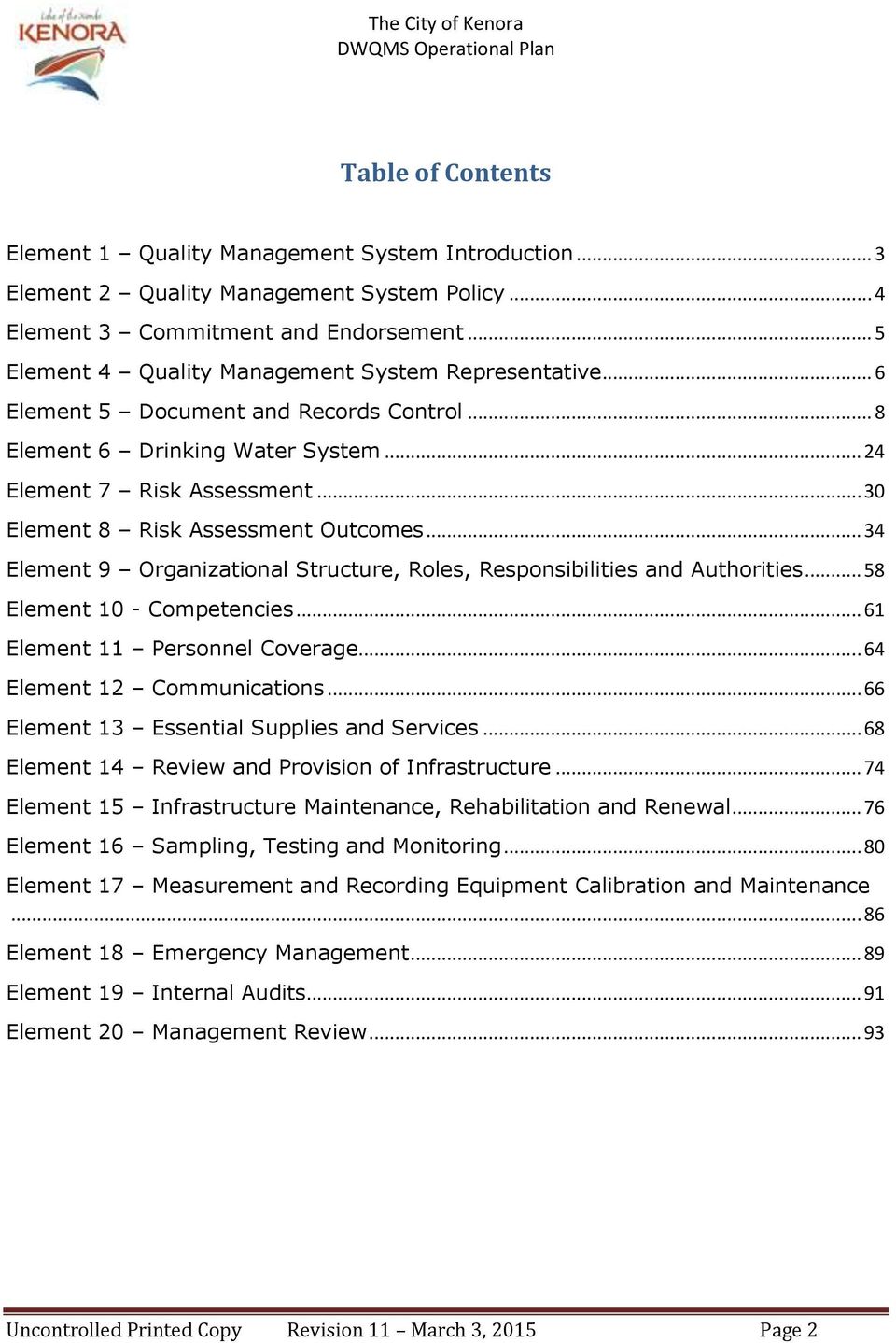
2 Table of Contents Element 1 Quality Management System Introduction... 3 Element 2 Quality Management System Policy... 4 Element 3 Commitment and Endorsement... 5 Element 4 Quality Management System Representative... 6 Element 5 Document and Records Control... 8 Element 6 Drinking Water System Element 7 Risk Assessment Element 8 Risk Assessment Outcomes Element 9 Organizational Structure, Roles, Responsibilities and Authorities Element 10 - Competencies Element 11 Personnel Coverage Element 12 Communications Element 13 Essential Supplies and Services Element 14 Review and Provision of Infrastructure Element 15 Infrastructure Maintenance, Rehabilitation and Renewal Element 16 Sampling, Testing and Monitoring Element 17 Measurement and Recording Equipment Calibration and Maintenance Element 18 Emergency Management Element 19 Internal Audits Element 20 Management Review Uncontrolled Printed Copy Revision 11 March 3, 2015 Page 2
3 TITLE: QMS Introduction QMS REFERENCE: ELEMENT NO. 1 Element 1 Quality Management System Introduction Quality Management can be defined as the policy and associated organizational structures, procedures, responsibilities, and evaluation measures that ensure the capability of delivering a product to specified standards. The use of Quality Management systems by modern industry has steadily increased over the last 30 years, since the development of the first ISO standard in Whether implemented voluntarily or as a requirement of suppliers to larger manufacturers, Quality Management has repeatedly proven beneficial in terms of accountability, quality control, efficiency, and productivity. The idea of mandated province-wide implementation of a Quality Management Standard by drinking water system owners originated as a recommendation in the Part Two Report of the Walkerton Inquiry. In brief, Recommendations 51 through 57 from the report state the following: - Drinking water systems should be operated by authorities that are accredited based on successful third party audits conducted by a certified accrediting body. - The Ministry of the Environment, in partnership with other relevant stakeholders, should develop a Drinking Water Quality Management Standard against which the third party audits will be conducted. - All municipalities should prepare Operational Plans describing how the requirements of the Quality Management Standard are achieved. The Provincial Government has committed to implementing all recommendations tabled by the report author, The Honorable Dennis R. O Connor. In accordance with those recommendations, this Operational Plan serves as a Quality Management System Guidance Manual that describes the methods by which the City of Kenora implements Quality Management. The Plan is written to meet or exceed the requirements of the Ministry of the Environment prescribed standard and is applicable to the management and operation of those works described in Section 6 of this Plan. Uncontrolled Printed Copy Revision 11 March 3, 2015 Page 3

4 TITLE: QMS Policy QMS REFERENCE: ELEMENT NO. 2 Element 2 Quality Management System Policy The Mayor, Council, and employees of the City of Kenora are dedicated to the operation and maintenance of a potable drinking water system that will provide the residents of Kenora with clean, safe drinking water. The system shall be operated in such a manner that it meets the requirements of all applicable governing legislation and regulations. The City of Kenora shall implement a Quality Management System, which will assist in the management, operation and maintenance of the drinking water system, and will identify any potential hazards, risks or gaps through the internal auditing process. Internal audits shall be conducted to: - Confirm the QMS has been effectively communicated throughout the organization - Identify any sources of variation - Promote awareness of the requirements for quality - Ensure the controls for quality are in the hands of the process owners - Identify any shortfalls in the management, operation and maintenance of the system - Provide the foundation for continual improvement to the Quality Management System and the Drinking Water System The QMS shall meet all requirements of the Ministry of the Environment s Drinking Water Management Standard and shall be available at the Kenora Water Treatment Plant, Operations Centre, Municipal Office, and on the City of Kenora Website. Uncontrolled Printed Copy Revision 11 March 3, 2015 Page 4

5 PROCEDURE TITLE: Commitment and Endorsement QMS REFERENCE: ELEMENT NO. 3 Element 3 Commitment and Endorsement The Mayor and Council of the City of Kenora, being the Owner and Operating Authority for the Kenora Water System are committed to the implementation, maintenance and continual improvement of the Drinking Water Quality Management System. In conjunction with senior management both parties realize the need for sufficient resources, funding and staffing to maintain and make continual improvements to the Drinking Water Quality Management System. The Designated Quality Management Representative has read and understands the roles and responsibilities required by the Quality Management system and is committed to the appointment. Date Signed Signed Signed Signed Signed Signed David Canfield, Mayor City of Kenora Louis Roussin, Chair Operations Committee Karen Brown, Chief Administrative Officer Richard Perchuk, Manager of Operations Biman Paudel, Water and Sewer Supervisor Bruce Graham, Designated QMS Representative Uncontrolled Printed Copy Revision 11 March 3, 2015 Page 5

6 TITLE: QMS Representatives QMS REFERENCE: ELEMENT NO. 4 Element 4 Quality Management System Representative The Designated Quality Management System Representative identified in Element 3 Commitment and Endorsement shall: a) Administer the Quality Management System by ensuring that processes and procedures needed for the Quality Management System are established and maintained, b) Report to Top Management on the performance of the Quality Management System and any need for improvement, c) Ensure that current versions of documents required by the Quality Management System are being used at all times d) Ensure that personnel are aware of all applicable legislative and regulatory requirements that pertain to their duties for the operation of the subject system, and e) Promote awareness of the Quality Management System throughout the Operating Authority. In addition, the Designated QMS representative will communicate with the QMS representatives from Treatment and Distribution to ensure that any changes to existing procedures or the addition of new procedures are incorporated into the Operational Plan and that all associated documents are updated accordingly. The Designated QMS Representative will be responsible for planning and conducting internal audits of the Quality Management System as required by the DWQMS. The Designated QMS Representative will be responsible for arranging of external audits as required by the DWQMS. The QMS Representative Water Treatment identified in Element 3 Commitment and Endorsement is responsible to ensure that the Quality Management System is incorporated into the daily operation of the Water Treatment Plant as specified in the Operational Plan. The QMS Representative Water Treatment will ensure that current versions of documents required by the Quality Management System are being used at all times and will communicate to the Designated QMS Representative any Uncontrolled Printed Copy Revision 11 March 3, 2015 Page 6

7 TITLE: QMS Representatives QMS REFERENCE: ELEMENT NO. 4 changes to existing procedures or the addition of new procedures so that they can be incorporated into the Operational Plan. The QMS Representative Water Treatment will assist with the planning and conducting of internal audits of the Quality Management System as required by the DWQMS and will participate in external audits as a key contact for the Water Treatment portion of the City of Kenora Drinking Water System. The QMS Representative Water Distribution identified in Element 3 Commitment and Endorsement is responsible to ensure that the Quality Management System is incorporated into the daily operation of the Water Distribution System as specified in the Operational Plan. The QMS Representative Water Distribution will ensure that current versions of documents required by the Quality Management System are being used at all times and will communicate to the Designated QMS Representative any changes to existing procedures or the addition of new procedures so that they can be incorporated into the Operational Plan. The QMS Representative Water Distribution will assist with the planning and conducting of internal audits of the Quality Management System as required by the DWQMS and will participate in external audits as a key contact for the Water Distribution portion of the City of Kenora Drinking Water System. Uncontrolled Printed Copy Revision 11 March 3, 2015 Page 7

8 TITLE: Document and Records Control QMS REFERENCE: ELEMENT NO. 5 Element 5 Document and Records Control 5.1 Introduction The Documents and Records Control Procedures described below contain details for managing documents and records required by the Quality Management System (QMS). The procedures address how documents and records are: made readily identifiable; kept current; protected; kept legible; made available at all times; and ultimately disposed of. 5.2 Documents Control Procedure Procedure Description This procedure outlines the methods used by City of Kenora employees to control the creation, approval, distribution, revision, and protection of all documents related to the Quality Management System (QMS). Reason for Procedure Consistent control ensures the currency, accuracy, and ease of retrieval of each QMS document. Proper maintenance of documents is critical for conformance with the Drinking Water Quality Management Standard (DWQMS), and also for compliance with drinking water legislation. Responsibility The QMS Representatives for treatment and distribution shall be responsible for the control of all QMS documents. All documents must meet the approval of the QMS committee before initial or revision issuance. The presence of a signature in the QMS header on the document indicates this approval. Procedure a) Documents requiring control by the QMS include: Internal Documents Operational Plan Standard Operating Procedures Emergency Operating Procedures Annual Management Review Documentation Uncontrolled Printed Copy Revision 11 March 3, 2015 Page 8

9 TITLE: Document and Records Control QMS REFERENCE: ELEMENT NO. 5 External Documents Applicable Drinking Water Regulations Applicable Industry Standards Equipment Manuals b) The QMS Representatives for treatment and distribution shall maintain a current list of all internal and external documents. The list shall indicate the Document Title, Document Format (Hard Copy or Electronic), Document Location, Document Source (Internal or External), and whether it is a Treatment or Distribution Document. c) Internal Documents 1) A standard header shall identify all QMS internal documents. This header contains the title of the document, QMS element reference, indication of revision frequency, and signature of approval from the QMS Representative. 2) A standard footer shall identify all QMS internal documents. The footer will include the revision number and date as well as the words Uncontrolled Printed Copy. 2) All original (electronic) QMS internal documentation shall be stored on the City s central computer. The electronic version shall be password protected to restrict access to the Designated QMS Representative and the QMS Representatives for Water Treatment and Water distribution or their designates. 3) The currency of each printed internal document is ensured by comparison of the revision date in the document footer to that of the original stored on the City s computer system. Past versions of QMS internal documentation will be archived in separate folders. 4) New or changed internal documents will be presented to all affected employees. Uncontrolled Printed Copy Revision 11 March 3, 2015 Page 9

10 TITLE: Document and Records Control QMS REFERENCE: ELEMENT NO. 5 d) External Documents 1) Each external document affected by the QMS shall be clearly marked as Controlled Copy and initialed by one of the QMS Representatives. 2) Controlled copies of external QMS documents shall be stored in the Water and Wastewater Shop at the Operations Centre or in the Water Treatment Plant. 3) Current equipment manuals shall be indicated on the Equipment Manual Index Form located in the manual binder on the bookshelf in the Water Treatment Plant office. On an annual basis the QMS Representative will confirm that all equipment manuals on hand represent the most up-to-date versions available. If a newer version is available the QMS Representative will obtain a copy and replace the outdated one in the manual binder. e) Communication of Changes or Updates to Documents When a new internal or external document is created or when an existing one is changed or updated, the Water and Wastewater Supervisor will communicate this information to all affected staff during a crew meeting and this communication shall be documented as part of the meeting minutes. f) Internal and external documents shall be reviewed at least annually, as a component of the annual internal audit and management review. A review may also take place when a significant change occurs in operations, such as a change in the type of process chemical or a change of equipment. Obsolete or out-of-date documents will be disposed of promptly. 5.3 Records Control Procedure Uncontrolled Printed Copy Revision 11 March 3, 2015 Page 10

11 TITLE: Document and Records Control QMS REFERENCE: ELEMENT NO. 5 Procedure Description This procedure provides guidance for the identification, use, retention, storage, protection, and disposal of all records generated that are related to the Quality Management System (QMS). Reason for Procedure Consistent control ensures the ease of retrieval of each record generated by City of Kenora employees. Proper maintenance of records is critical for conformance with the Drinking Water Quality Management Standard (DWQMS) and also for compliance with drinking water legislation and regulations. Responsibility The QMS Team shall be responsible for ensuring that an effective method for controlling all QMS records exists. Procedure 1) Records may be retained electronically and/or in hard copy, but always according to the Document and Records Control master list included below at ) All Ministry of the Environment required records shall be maintained as per the relevant regulations at a minimum. 3) Filing and storage of paper records shall be such that they are protected from damage and are readily retrievable. Records from the current year and the previous year are kept in filing cabinets. All records older than two years are stored in banker s boxes, clearly marked with the types of records contained within, the dates those records pertain to, and the appropriate disposal dates for those records. These banker s boxes will be stored either at the Water Treatment Plant or in the Water and Wastewater Shop at the Operations Centre. Uncontrolled Printed Copy Revision 11 March 3, 2015 Page 11

12 TITLE: Document and Records Control QMS REFERENCE: ELEMENT NO. 5 4) Records from the Document and Records Control master list that are identified as electronic are stored on the City of Kenora central computer and are backed up each day. 5) Records shall be made available to the public where required by legislation. 5.4 Security and Protection of Documents and Records An electronic copy of the Operational Plan is maintained by the Designated QMS Representative and is password protected and backed up daily on the City s computer network. Any document or record identified as being electronic is stored on the City s network and is backed up daily. Any document or record identified as being hard copy at the Water Treatment Plant is stored in filing cabinets and/or bankers boxes in the office or blower room. These are retained indefinitely or for the minimum as required by legislation. Any document or record identified as being hard copy for the Distribution System is stored in filing cabinets and/or bankers boxes in the Water and Wastewater Shop at the Operations Centre. These are retained indefinitely or for the minimum as required by legislation. Uncontrolled Printed Copy Revision 11 March 3, 2015 Page 12

13 TITLE: Document and Records Control QMS REFERENCE: ELEMENT NO Document and Record Master List The Table below identifies the documents and records associated with the DWQMS program. Document and Records Control Document List Document Title Document Format Document Location Operational Plan. Electronic. On the City s website City Hall-City Services-Sewer & Water-Water Treatment Standard Operating Procedures. Electronic. Treatment SOP files are located in the SOP folder in My Documents/DWQMS. Legislation. Electronic. Shortcuts to the applicable acts and regulations are on each operator s desktop. Document Source Internally Created. Internally Created. E-Laws. Treatment Or Distribution Document Treatment and Distribution. Treatment and Distribution. Treatment and Distribution. Procedure for Electronic and paper Paper copy is MOE. Treatment. Uncontrolled Printed Copy Revision 11 March 3, 2015 Page 13

14 TITLE: Document and Records Control QMS REFERENCE: ELEMENT NO. 5 Document Title Document Format Document Location Disinfection of Drinking Water in Ontario. Practices for the Collection and Handling of Drinking Water Samples. copy. Electronic and paper copy. Permit to Take Water. Paper copy. Drinking Water License. Operator s Certificates. Paper copy. Paper copy. located on bookshelf in office. Link to electronic version is on each operator s desktop. Paper copy is located on bookshelf in office. Link to electronic version is on each operator s desktop. Located in filing cabinet in office. Displayed on wall in office. Certificates for water treatment operators are displayed on wall in lobby of the WTP. Certificates for water distribution operators are MOE. MOE. MOE. Document Source MOE / OWWCO. Treatment Or Distribution Document Treatment. Treatment. Treatment and Distribution. Treatment and Distribution. Uncontrolled Printed Copy Revision 11 March 3, 2015 Page 14

15 TITLE: Document and Records Control QMS REFERENCE: ELEMENT NO. 5 Document Title Document Format Document Location Maintenance Manuals. CL-17 Chlorine Analyzer Depolox 3 Chlorine Analyzer Hach 1720C Turbidimeter Hach 1720D Turbidimeter DR890 Colorimeter DR2700 Spectrophotom eter Paper copy. displayed on the wall in the Supervisors office in the Water and Wastewater shop. Manuals are located in the manual binder on the bookshelf in the WTP office. Document Source Manufacturer. Treatment Or Distribution Document Treatment. Uncontrolled Printed Copy Revision 11 March 3, 2015 Page 15

16 TITLE: Document and Records Control QMS REFERENCE: ELEMENT NO. 5 Document and Records Control Record List Name Format Location Required Retention Time ALS Laboratory Analysis Results On-Site Lab Test Results 2010 Current are electronic, Pre 2010 are paper copy Current are recorded on daily entry pads and then Electronic files are located in the ALS folder of the WTP account. Paper copies are located in file folders in the filing cabinet in the blower room. At the end of the month the daily entry pads are filed in a Uncontrolled Printed Copy Revision 11 March 3, 2015 Page 16 Actual Retention Time Treatment or Distribution Record 2 years for microbiological results. 6 years for chemical results. 15 years for 5 year sodium and fluoride tests. 15 years for lead tests. Indefinite. Treatment. 2 years. Indefinite. Treatment.

17 TITLE: Document and Records Control QMS REFERENCE: ELEMENT NO. 5 Name Format Location Required Retention Time Distribution Chlorine Levels entered electronically. Pre 2008 are recorded in logbooks. Paper copy. folder in the blower room for storage. Electronic entries are kept in the WTP My Documents folder in the Waterplant Database files. Logbooks are stored in the drawer of the lab computer desk. Current sheets are kept on the lab desk in the blue distribution chlorine book. Full sheets are filed in a folder Actual Retention Time Treatment or Distribution Record 2 years. Indefinite. Treatment. Uncontrolled Printed Copy Revision 11 March 3, 2015 Page 17

18 TITLE: Document and Records Control QMS REFERENCE: ELEMENT NO. 5 Name Format Location Required Retention Time Operator Log Books Online Monitoring Records Paper copy. Electronic. in the filing cabinets in the blower room. For treatment, current year is located in the Daily Log Book binder on the lab computer desk. Previous years are filed in the filing cabinet in the blower room. For distribution, SCADA Logs on the WTP SCADA computer. Accessed through trends screen. Actual Retention Time Treatment or Distribution Record 5 years. Indefinite. Treatment and Distribution. 2 years. Indefinite. Treatment. Uncontrolled Printed Copy Revision 11 March 3, 2015 Page 18

19 TITLE: Document and Records Control QMS REFERENCE: ELEMENT NO. 5 Name Format Location Required Retention Time Raw Water Quality Internal Instrument Calibrations 2008 Current are recorded on daily entry pads and then entered electronically. Pre 2008 are recorded in logbooks. Paper copy. At the end of the month the daily entry pads are filed in a folder in the blower room for storage. Electronic entries are kept in the WTP My Documents folder in the Waterplant Database files. Logbooks are stored in the drawer of the lab computer desk. Recorded in calibration and maintenance Actual Retention Time Treatment or Distribution Record 2 years. Indefinite. Treatment. 2 years. Indefinite. Treatment. Uncontrolled Printed Copy Revision 11 March 3, 2015 Page 19

20 TITLE: Document and Records Control QMS REFERENCE: ELEMENT NO. 5 Name Format Location Required Retention Time Third Party Instrumentation Calibrations Adverse Records Training Records Electronic 2007 current. Paper copy pre Paper copy. Paper copy. binder on lab computer desk. Electronic are located in the Summa folder in WTP My Documents folder. Paper copies are kept in the Calibrations folder in the office filing cabinet. Store in the Adverse folder in the office filing cabinet. Certificates of training are kept in each operator s Actual Retention Time Treatment or Distribution Record 2 years. Indefinite. Treatment. 2 years. Indefinite. Treatment. Minimum of three years for Certificate or License Indefinite. Treatment and Distribution Uncontrolled Printed Copy Revision 11 March 3, 2015 Page 20

21 TITLE: Document and Records Control QMS REFERENCE: ELEMENT NO. 5 Name Format Location Required Retention Time Internal Audits External Audits Paper copy and electronic. Paper copy and electronic. personal file. Paper copies of Internal Audit results are filed in the designated QMS Representatives office. All Internal Audit documents are scanned and stored electronically on the City s central computer system. Paper copies of External Audit results are filed in the designated QMS renewals. Minimum of three years to match audit cycle. Minimum of three years to match audit cycle. Actual Retention Time Indefinite Indefinite Treatment or Distribution Record Treatment and Distribution Treatment and Distribution Uncontrolled Printed Copy Revision 11 March 3, 2015 Page 21
22 TITLE: Document and Records Control QMS REFERENCE: ELEMENT NO. 5 Name Format Location Required Retention Time Management Reviews Paper copy and electronic Representatives office. All External Audit documents are scanned and stored electronically on the City s central computer system. Paper copies of Management Reviews are filed in the designated QMS Representatives office. All Management Review documents are scanned and Minimum of three years to match audit cycle. Actual Retention Time Indefinite Treatment or Distribution Record Treatment and Distribution Uncontrolled Printed Copy Revision 11 March 3, 2015 Page 22
23 TITLE: Document and Records Control QMS REFERENCE: ELEMENT NO. 5 Name Format Location Required Retention Time stored electronically on the City s central computer system. Annual Reports Electronic. Annual Reports can be found on the City of Kenora s website under City Hall, Sewer and Water, Annual and Quarterly Reports. Actual Retention Time Treatment or Distribution Record 6 years. Indefinite. Treatment and Distribution. Uncontrolled Printed Copy Revision 11 March 3, 2015 Page 23
24 TITLE: Drinking Water System QMS REFERENCE: ELEMENT NO. 6 Element 6 Drinking Water System General The City of Kenora Water Supply System provides a potable water supply to the residents and businesses of the City of Kenora. The facilities, consisting of a Class III conventional design water treatment plant having an approved capacity of 25,229 m3/d, and a Class II water distribution system, are owned and operated by the City of Kenora. The source water for the treatment process is drawn from a surface water source (Lake of The Woods) located adjacent to the City through a 36 HDPE intake approximately 900 feet southwest of the plant. Potentially pathogenic organisms are removed from the raw water source by the following processes: 1. Pre-chlorination 2. Coagulation/flocculation/sedimentation 3. Filtration 4. Post-chlorination (primary disinfection) 5. Trim Chlorination/Ammonium Sulphate Addition for Chlor-ammination (secondary disinfection) This multiple barrier approach helps to ensure consistently compliant drinking water quality, and ultimately improves the level of public health protection. Raw Water Supply Water is drawn from Lake of the Woods and flows into the plant low-lift pumping well eventually being pumped through the plant to the clarifiers. Chlorine is added to provide initial disinfection in the low-lift pumping well. The addition of chlorine to the raw water supply is referred to as prechlorination and serves primarily as a measure to prevent microbiological growth within the raw water pipeline and clarifiers. The pre-chlorine residual is measured periodically in the raw water entering the treatment facility. Coagulation / Flocculation / Sedimentation Water flows from the low-lift pumping well through the raw water pipeline to a baffled mixing chamber located on the uppermost floor of the water treatment plant. Alum (aluminum sulphate) is added to the incoming raw water upstream from the clarifiers in the raw water pipeline to promote settling and enhance filtration. Rapid mixing of the alum with the raw water occurs as the raw water passes through an in-line static mixer. Polymer is added to the alum-water solution in the baffled mixing chamber on the uppermost floor. The alum-water-polymer solution enters the clarifiers where gentle mixing promotes the formation of floc masses which attract Uncontrolled Printed Copy Revision 11 March 3, 2015 Page 24
25 TITLE: Drinking Water System QMS REFERENCE: ELEMENT NO. 6 and gather debris present in the source raw water. The process water and floc remain in the clarifiers. The floc is suspended by incoming water. Excess floc is disposed of by an automatic extraction system. Supernatant (the clear liquid above the suspended floc) flows from the clarifiers via open channels to the top of the dual media filters. Most of the particulate matter that was present in the raw water is captured by the floc particles and removed by gravity/extraction in the clarifiers, however, during normal operations, some floc passes from the clarifiers to the top of the filters. Filtration The water treatment plant has four dual media filters. The top layer of the filter is anthracite while the filter media below the anthracite layer is sand. The anthracite/sand combination is effective in removing residual particulate matter (floc) carried over from the clarifiers. As debris accumulates in the filters and limits flow, the filters must be cleaned by reversing the flow (referred to as backwashing) and directing the backwash to a wastewater tank. Turbidity, a measure of the cloudiness of water, is measured continuously in the effluent from each filter to monitor the effectiveness of the filtration process. If the turbidity rises above a set point value, an alarm warns staff that corrective actions are needed. Filtered water passes through the filter under-drain into the clear-well. The clear-well is a baffled tank with three sections located beneath the filters that are used to store filtered water and to provide disinfectant contact time. Disinfection (Chlorination) Primary disinfection (post-chlorination) occurs immediately following filtration, after the filter effluent enters the clear-well. Primary chlorination disinfects the filtered water, ensuring that any potentially pathogenic organisms that may remain after clarification and filtration are rendered harmless. Consistent disinfection is ensured by continuous monitoring of the chlorine residual in the treated water leaving the clear-well. If the residual drops to a predetermined level, an alarm is initiated and an operator is notified prior to levels becoming unacceptable and being allowed to enter the distribution system. Secondary disinfection is accomplished by adding sufficient trim chlorine and ammonium sulphate at the water treatment plant creating chloramines (combined chlorine), to maintain a residual throughout the entire distribution system. Secondary disinfection prevents re-growth of micro-organisms within the distribution system. Uncontrolled Printed Copy Revision 11 March 3, 2015 Page 25
26 TITLE: Drinking Water System QMS REFERENCE: ELEMENT NO. 6 Process Waste Residuals Management Filter backwash water and extracted alum floc from the clarifiers is directed to the wastewater storage tank where it is allowed to settle out. The heavier settled sludge is pumped to the municipal sanitary sewer. The remaining clarified water may be discharged back to Lake of the Woods. Distribution System and Elevated Storage Tank Treated water is pumped from the clear-well into the distribution system. Distribution piping typically ranges in size from 150 mm to 250 mm, and may consist of cast iron, ductile iron, concrete, or PVC, depending on the location and date of installation. Three pressure booster stations, (one at the south end of the city on Pine Portage Road and the other two on the Airport Road, are used to ensure adequate system pressure in areas of higher elevation or locations significantly removed from the plant and elevated storage tanks. Typical system pressure ranges from 45 P.S.I. to 80 P.S.I. Standpipes in three different locations (Fourth Street North, Valley Drive, and Keewatin) are an integral component of the distribution system to provide relatively constant system pressure and a reserve volume of water for community fire protection. Sample Analysis Provincial regulations dictate the sampling and monitoring requirements for the system. Water quality is tested throughout the treatment process and from various locations throughout the distribution system. Where required by regulation, samples are submitted to an accredited laboratory for analysis. Uncontrolled Printed Copy Revision 11 March 3, 2015 Page 26
27 TITLE: Drinking Water System QMS REFERENCE: ELEMENT NO ) Drinking Water System Process Diagrams Uncontrolled Printed Copy Revision 11 March 3, 2015 Page 27
28 TITLE: Drinking Water System QMS REFERENCE: ELEMENT NO. 6 Uncontrolled Printed Copy Revision 11 March 3, 2015 Page 28
29 TITLE: Drinking Water System QMS REFERENCE: ELEMENT NO Source Water Overview General The raw water source for the treatment plant is Lake of the Woods. The water from Lake of the Woods is typically low in turbidity ( NTU), low in color apparent, slightly basic, and very soft (~54 mg/l as CaCO3). Temperature fluctuates significantly throughout the seasons ranging from approximately 2 Celsius in the winter to as high as 25 Celsius during the summer. Chemical and bacteriological analysis of the raw water indicates a source of relatively good quality. Events Seasonal changes in raw water temperatures cause vertical turnover of the lake water during spring and fall. Turnover typically takes place over a relatively short duration (~2 7 days). During that period, settled solids from the lakebed are re-suspended, resulting in increased raw water turbidity. Operators must be prepared to make appropriate plant adjustments to respond to changing turbidity levels experienced throughout the year. Changes in water temperature will also impact treatment process performance (settling and disinfection). Optimal treatment requires adjustments to treatment chemical dosages (disinfectants and coagulants) in response to temperature fluctuations. Threats Potential sources of raw water contamination include spills from nearby settling ponds, lake traffic mishaps, and waste from recreational watercraft. Operational Challenges Lake of the Woods provides high quality source water, which is, for the most part consistently low in bacteriological contamination and turbidity. Operator response is needed for changes in turbidity and temperature levels. Uncontrolled Printed Copy Revision 11 March 3, 2015 Page 29
30 TITLE: Risk Assessment QMS REFERENCE: ELEMENT NO. 7 Element 7 Risk Assessment The procedure below describes the method of hazard identification, risk assessment, and critical control point determination for the City of Kenora Water System. The procedure consists of hazard identification, risk assessment, critical control point determination, and critical limit identification. The results of the Risk Assessment are incorporated in the table entitled Risk Assessment Outcomes which is included in Element 8. An annual review will be conducted to ensure the currency of the information and the validity of the assumptions used in the risk assessment. A risk assessment will be completed as often as is deemed necessary or at least once every thirty-six months whichever is less. 1.0 Procedure Description This procedure describes the method of hazard identification, risk assessment, and critical control point determination used by the City of Kenora. The procedure consists of hazard identification, risk assessment, critical control point determination, and critical limit identification. Each exercise is described in detail below. 2.0 Reason for Procedure The systematic approach used for risk identification and assessment lessens the likelihood of overlooking potential treatment process hazards and associated risks to drinking water quality and public health. Hazard analysis, identifying critical control points, establishing critical limits and control instructions provides all operators with consistent direction for responding to conditions that pose a risk of jeopardizing drinking water quality. 3.0 Responsibility The designated QMS Representative, with the assistance of the Overall- Responsible Operator, will form a committee consisting of at least four persons who are familiar with the facilities. The Hazard Assessment Committee is responsible for identifying all actual and potential hazards, assessing the associated risks, determining critical control points, and setting critical limits. The committee communicates all associated Uncontrolled Printed Copy Revision 11 March 3, 2015 Page 30
31 TITLE: Risk Assessment QMS REFERENCE: ELEMENT NO. 7 procedures to the remainder of City of Kenora operators through training sessions and documentation. 4.0 Procedure The hazard analysis procedure is reviewed at least annually, prior to the annual management review. These exercises may also be completed when a significant change occurs in operations, such as a change in the type of process chemical or a change of equipment. 4.1 Hazard Identification and Control Measures Using a process flow diagram as a guide, the committee studies the water treatment process from the raw water intake to the point of customer use. While studying the diagram, the committee reviews the existing list of hazards and identifies any new potential hazards. Special attention is given to areas within the process where changes have occurred since conducting the previous hazard identification exercise. All hazards identified will be recorded in the Description of Hazardous Event/Hazard Column of the Risk Assessment Outcomes Table. Once all of the hazards have been identified, the committee identifies measures in place to control the hazards and those are recorded in the Control Measures Column of the Risk Assessment Outcomes Table. The reliability and redundancy of equipment is considered during this exercise. 4.2 Risk Assessment A risk assessment is performed for all events that are deemed to be controllable and the hazardous results of which are measurable. Controllable events are those that may be prevented through the actions of an operator. All other events are considered emergency situations and require the development of a contingency plan. Each controllable event is assigned a numeric value ranging from 1 to 5 in three different categories: likelihood, consequence, and detectability (see Table 1). The three assigned numbers for each event are then multiplied to determine the overall risk value. Uncontrolled Printed Copy Revision 11 March 3, 2015 Page 31
32 TITLE: Risk Assessment QMS REFERENCE: ELEMENT NO. 7 Table 1: Likelihood, consequence, and detectability rating system. Description Likelihood of Hazardous Event Occurring Rating Rare May occur in exceptional circumstances and has not occurred in the past. 1 Unlikely Could occur at some time, historically has occurred less than once every five or ten years. 2 Possible Has occurred or may occur once or more per year. 3 Likely Has occurred or may occur on a monthly to quarterly basis. 4 Almost Certain One or more occurrences on a monthly or more frequent basis. 5 Description Consequence of Hazardous Event Occurring Rating Insignificant Insignificant impact, little public exposure, little or no health risk. 1 Minor Limited public exposure, minor health risk. 2 Moderate Minor public exposure, health impact on small part of the population. Major Large part of population at risk. 4 Catastrophic Major impact for large part of the population, complete failure of systems. 5 3 Description Detectability of Hazardous Event Rating Very detectable Moderately detectable Normally detectable Poorly detectable Easy to detect, on-line monitoring through SCADA 1 Alarm present but not in SCADA, may require operator to walk by and notice alarm; problem is indicated promptly by in-house lab test results. Visually detectable on rounds or through regular maintenance. 3 Visually detectable but not inspected on a regular basis; not normally detected before problem becomes evident; lab tests are not done on a regular basis (e.g. quarterly). Undetectable Cannot be detected The highest overall risk values are typically indicators of critical events. Based on a review of the overall risk values and the associated events, a threshold number of 18 was chosen. All events associated with risk values which are equivalent to or greater than the threshold number are considered critical. Discretion may be used when determining which events are indeed Uncontrolled Printed Copy Revision 11 March 3, 2015 Page 32
33 TITLE: Risk Assessment QMS REFERENCE: ELEMENT NO. 7 critical, regardless of the calculated risk. Careful evaluation is required for each hazard event. In the case where an event having a higher calculated risk value is not determined by the committee to be critical, an explanation of the reasoning for this distinction is required. An explanation of the reasoning is also required when the committee deems an event with a lower calculated risk critical. Note that there are three events that are always critically hazardous to water quality: high turbidity, inadequate primary disinfection, and low system pressure. A risk assessment will be completed as often as is deemed necessary or at least once every thirty-six months whichever is less. 4.3 Critical Control Point Determination From the identified critical events, the committee then traces backwards through the water treatment process to determine the specific points where each critically hazardous event originates. These points then become control points. The final point in a series that leads to a critical event is identified as the critical control point. Critical control points require the establishment of controlled conditions, including: critical control limits, equipment redundancy, and control and recovery procedures. 4.4 Critical Limits Critical limits are established for values that measure critical events. The limits provide operators with a range of acceptable values within which no preventive or corrective actions are required. Critical limits define the point at which an operator must take action to prevent escalation of the critical event or to correct the critical event. Critical limits are determined based on regulatory requirements, process monitoring capabilities, off-hours response time, and historical plant performance. Process alarms (if available) are normally set at, or near critical limits. Responses to breached critical limits are detailed in the Operations Manual. Uncontrolled Printed Copy Revision 11 March 3, 2015 Page 33
34 Likelihood Consequence Detectability Total CCP? The City of Kenora TITLE: Risk Assessment Outcomes QMS REFERENCE: ELEMENT NO. 8 Element 8 Risk Assessment Outcomes The following tables present the results of the Risk Assessment Outcomes exercise that was conducted subsequent to the Hazard Identification exercise completed as part of Element 7. Activity or Process Step Description of Hazardous Event / Hazard Control Measures Critical Control Limits Monitoring Procedures Processes Response Procedures Source Water Spill Contamination of raw water. Chemical or biological. Possible response to Spills Action Center. Possible response to low clearwell effluent chlorine No None SCADA alarm on low clearwell chlorine (only if contaminant has effect on chlorine residual, otherwise undetectable). In the event of a known spill or contamination of the raw water source, the City of Kenora Emergency Plan would be activated. Raw Water Low Lift Pump Failure Eventual loss of system pressure. Redundancy. SCADA Alarm for low lift failure or low channel level for mechanical failure No None SCADA Alarm Shut down plant if necessary. Determine lowlift fault from fault code. Reset pump unless major problem use alternate pump or call electrician for assistance. Uncontrolled Printed Copy Revision 11 March 3, 2015 Page 34
35 Likelihood Consequence Detectability Total CCP? The City of Kenora TITLE: Risk Assessment Outcomes QMS REFERENCE: ELEMENT NO. 8 Activity or Process Step Description of Hazardous Event / Hazard Control Measures Critical Control Limits Monitoring Procedures Processes Response Procedures Clarification Vacuum pump failure; sludge blanket collapses due to lack of suspension None No None Daily Visual Inspection Switch to spare vacuum pump and repair defective unit Clarification Extractors Quitting (closed position); Causes Sludge Blanket to enlarge due to gradual buildup of extra sludge None No None Daily Visual Inspection If turbidity is an issue refer to Filter Effluent Turbidity CLR instructions on page 41. Manually dump sludge if necessary. Repair extractors to working order. Filtration Filter Breakthrough or Underdrain Failure Unfiltered water into clearwell SCADA Alarm on high filter effluent turbidity or high loss of head. Auto shut down of filter Yes 0.3 NTU or 1.6 m LOH SCADA alarm set points on filter turbidity and filter loss of head. Refer to Filter Effluent Turbidity CLR instructions on page 41. Uncontrolled Printed Copy Revision 11 March 3, 2015 Page 35
36 Likelihood Consequence Detectability Total CCP? The City of Kenora TITLE: Risk Assessment Outcomes QMS REFERENCE: ELEMENT NO. 8 Activity or Process Step Description of Hazardous Event / Hazard Control Measures Critical Control Limits Monitoring Procedures Processes Response Procedures Chemical Addition Alum system failure - Loss of coagulant Ammonium Sulphate system failure - Loss of nitrogen for chloramination Post Chlorinator Failure - Primary disinfection affected Trim Chlorinator Failure - Secondary disinfection affected Polymer Pump Failure - Loss of coagulant aid SCADA alarm on loss of alum flow and automatic plant shut down SCADA alarm on high effluent free chlorine SCADA alarm on clearwell effluent due to inadequate CT values SCADA alarm for low trim chlorine. Daily Inspections No None No None No None No None No None SCADA alarm on loss of alum flow. SCADA alarm for low tank level and high effluent free chlorine. Clearwell chlorine analyzers on both influent and effluent. Trim chlorine analyzer Daily Numbers will indicate low consumption. Switch to standby pump and identify problem. Repair as needed. Shut down plant. Restore feed to pumps. Refer to Primary Disinfection CLR instructions on page 44. Shut down plant and repair chlorinator. Refer to Secondary Disinfection CLR instructions on page 47. Shut plant down and repair chlorinator. Switch to standby pump and identify problem. Repair as needed. Uncontrolled Printed Copy Revision 11 March 3, 2015 Page 36
37 Likelihood Consequence Detectability Total CCP? The City of Kenora TITLE: Risk Assessment Outcomes QMS REFERENCE: ELEMENT NO. 8 Activity or Process Step Description of Hazardous Event / Hazard Control Measures Critical Control Limits Monitoring Procedures Processes Response Procedures Chemical Addition Process Flow Sodium Hydroxide Pump Failure - Lowers effluent ph Backwash pump failure Inability to backwash filters Highlift pump failure eventual loss of system pressure Sludge pump failure may affect ability to backwash filters Highlift check valve failure Potential effect on primary disinfection. Generator failure Inability to run plant during power outage SCADA alarm for low effluent ph SCADA alarm for low backwash flow SCADA alarm for Zone 1 Standpipe low level SCADA alarm for high wastewater tank level SCADA alarm for clearwell effluent low chlorine Monthly load tests No None No None No None No None No None Yes None Effluent ph analyzer Filter console flow meter and observation while backwashing Zone 1 Standpipe level transmitter Wastewater tank level transmitter Clearwell effluent chlorine analyzer SCADA alarm alerts operator to initial power failure and operator Switch to standby pump and identify problem. Repair as needed. Switch to alternate pump and identify problem. Repair as needed. Switch to alternate pump and identify problem. Repair as needed. Repair pump. Use Supernatants to pump wastewater to lowlift waste sump. Use pumper truck if necessary. Repair check valve. Refer to Loss of Power Due to Generator Failure on page 58. Uncontrolled Printed Copy Revision 11 March 3, 2015 Page 37
38 Likelihood Consequence Detectability Total CCP? The City of Kenora TITLE: Risk Assessment Outcomes QMS REFERENCE: ELEMENT NO. 8 Activity or Process Step Description of Hazardous Event / Hazard Control Measures Critical Control Limits Monitoring Procedures Processes Response Procedures Process Flow Distribution Adder Subtractor Failure May affect primary disinfection Effluent Flow Transmitter Failure May affect secondary disinfection Power Failure while standpipe is out of Service - Negative distribution system pressure Standpipe Low level Potential loss of distribution system pressure Water main break resulting in negative SCADA alarm for clearwell effluent low chlorine SCADA alarm for loss of signal Pressure switch alarm at standpipe or SCADA Alarm at plant SCADA alarm for low standpipe level with backup dialer at standpipe No None No Yes None Power failure alarm No None None No None present while generator is required. Clearwell effluent chlorine analyzer SCADA alarm for loss of signal. SCADA and Paravox / Pressure switch at Zone 1 Standpipe. Pump phase failures. SCADA and pressure switches at standpipes. Customer notifies of loss of pressure. Shut down process and replace with spare unit. Shut down process and call electrician to replace unit. Contact Health Unit and issue boil water advisory. Refer to Distribution System Pressure CLR on page 50. Determine cause of low level and take appropriate corrective action. Dispatch personnel to repair leak and issue boil water Uncontrolled Printed Copy Revision 11 March 3, 2015 Page 38
39 Likelihood Consequence Detectability Total CCP? The City of Kenora TITLE: Risk Assessment Outcomes QMS REFERENCE: ELEMENT NO. 8 Activity or Process Step Description of Hazardous Event / Hazard Control Measures Critical Control Limits Monitoring Procedures Processes Response Procedures Distribution pressure possibility of contamination. Low Chlorine Residual possibility of contamination Fire suppression in areas of low system pressure negative system pressure and possibility of contamination Flushing to remove stagnant water from system Yes 0.25 mg/l Combined Chlorine None No None Regular distribution system chlorine testing. Customer notifies of loss of pressure. advisory. Notify Ministry of Environment and Health Unit as per regulations and follow their directions. Refer to Secondary Disinfection CLR on page 47. Issue boil water advisory and flush lines to remove contaminants. Uncontrolled Printed Copy Revision 11 March 3, 2015 Page 39
40 TITLE: Controlled Conditions for CCPs QMS REFERENCE: ELEMENT NO. 8 Controlled Conditions for Critical Control Points Controlled conditions for each critical control point identified in the summary table are described in detail in the following sets of instructions: Number 1 - Filter Effluent Turbidity Critical Limit Response The following provides instruction to operators responding to a filtered water turbidity critical limit alarm. If any circumstances are encountered that are not addressed by the instructions below, the Overall-Responsible Operator must be immediately notified. 1. Check the treated water (not filtered) turbidity reading (and recent trending). A gradual increase in treated water turbidity indicates that the alarm condition is unlikely the result of a false reading and that the condition has been occurring for a significant period of time. If the elevated turbidity is observed in the finished water, proceed immediately to step 3. If not, the filtered water measurement triggering the alarm may be false, or has not yet begun to affect the treated water. NOTE: If the filtered water turbidity is measured above 1 NTU for 15 consecutive minutes or longer, the operator must immediately follow the procedure for reporting adverse water quality in accordance with Ontario Regulation 170/03. Without compromising community fire protection or system pressure, every effort must be made to avoid pumping the adverse water to the distribution system. The Overall- Responsible Operator must be immediately notified 2. Collect and analyze samples of effluent from the abnormal filter(s) to confirm the continuous analyzer readings. If the reading(s) is confirmed proceed to step 3. If the reading cannot be confirmed, and is deemed erroneous, recalibrate the continuous analyzer to resolve the alarm condition. 3. If only one of the two filters is contributing the elevated turbidity, shut off that filter, directing process flow through the second filter. Visually examine the problem filter for any abnormalities. If the filter appears normal, proceed Uncontrolled Printed Copy Revision 11 March 3, 2015 Page 40
41 TITLE: Controlled Conditions for CCPs QMS REFERENCE: ELEMENT NO. 8 with backwashing when conditions are favorable. If, within 15 minutes following the backwash, turbidity levels have not returned to normal, shut off the problem filter and continue troubleshooting. 4. If both filters are contributing to the elevated turbidity, visually inspect the sedimentation tanks and filters for abnormalities. Check for changes in raw water turbidity and coagulant dosages. Adjust and / or resume coagulant flow as needed, based on jar testing results or comparable historical data. Note that changes resulting from coagulant adjustment may not take full effect for up to 12 hours. (3 hydraulic retention times through flocculation tank, sedimentation tanks and filters) If a treatment unit must be taken off line indefinitely and / or the cause of elevated turbidity cannot be determined and rectified by the above actions, the Overall-Responsible-Operator and the Manager of Operations must be immediately notified. All observations and corrective actions directly and indirectly related to the alarm condition must be detailed in the plant log book in accordance with Ontario Regulation 128/04. Rationale: The critical limit of 0.3 NTU is a conservative value, significantly lower than the applicable regulatory and guideline limits. The limit is set at 0.3 NTU to allow adequate time for a corrective response before the regulatory limit is reached. Although much lower than the regulatory maximum, the control limit is approximately 10 times the normal historical average, clearly indicating an abnormal condition that requires further investigation and possible control actions. Considerations:. Regulatory limit: 1 NTU. Procedural limit: 95% of continuous measurement values = <0.5 NTU. Monitoring capability: continuous with alarm. Operator response time: 30 minutes. Historical (normal) performance: <0.05 NTU Uncontrolled Printed Copy Revision 11 March 3, 2015 Page 41
42 TITLE: Controlled Conditions for CCPs QMS REFERENCE: ELEMENT NO. 8. Alarm limit: 0.3 NTU (approximately 10X normal historical average). Rate of filtration (2 filters on-line): 60 L/s = m 3 /s = 3.6 m 3 /min (each filter). Rate of filtration (1 filter on-line): 120 L/s = m 3 /s = 7.2 m 3 /min. Filter volume: m D x m W x m L = 125 m 3. Filter hydraulic retention time (HRT): 125 m 3 / 3.6 m 3 /min = 35 min. Flocculation and sedimentation tanks combined volume: 1445 m 3. Flocculation and sedimentation tanks HRT: 1445 m 3 / 7.2 m 3 /min = 200 min Safeguards: The following safeguards are currently in place to prevent the distribution of filtered water that fails to meet the critical limit.. Each filter turbidity analyzer is equipped with a high limit alarm (set to the critical limit) that rings at the plant when operators are present, and signals a dispatch to the on-call operator after normal working hours. The filtered water turbidity alarms will alert the operator to potential problems before the finished water being pumped to the distribution system is affected. Uncontrolled Printed Copy Revision 11 March 3, 2015 Page 42
43 TITLE: Controlled Conditions for CCPs QMS REFERENCE: ELEMENT NO. 8 Number 2 - Primary Disinfection Critical Limit Response Critical Limit Values: Clearwell Usable Volume 1.5m 919 m/3 (3 Sections Used) 320 m/3 (Center and East Section Used) 343 m/3 (Center and West Section Used) Minimum Clearwell Level (Plant automatic shutdown) Minimum Free Cl2 Residual (mg/l) 1.5 Meters 1 < m³/day ph >=6< Meters 3 < m³/day ph >=6< Meters 2.8 < m³/day ph >=6<6.5 Critical Limit Response Instructions: The following are instructions for operators responding to a disinfection system critical limit alarm. If any circumstances are encountered that are not addressed by the instructions below, the Overall-Responsible Operator and or the Operations Manager must be immediately notified. Low Chlorine Residual: Clear-well Effluent Free Chlorine NOTE: Table above represents worst case scenario during winter operation at maximum design flow. Use C/T Auto Chart (My Documents) or appropriate charts in Procedure for Disinfection of Drinking Water in Ontario for current conditions. If the calculated disinfection CT is inadequate using current conditions, the operator must immediately follow the procedure for reporting adverse water quality in accordance with Ontario Regulation 170/03. Plant and boosters may be shut down in order to determine and correct problem. Without compromising community fire protection or system pressure, every effort must be made to avoid pumping the adverse water to the distribution system. The Overall-responsible Operator and/or the Manager of Operations must be promptly notified. 1. Confirm the low continuous analyzer reading by measuring the residual in a grab sample Uncontrolled Printed Copy Revision 11 March 3, 2015 Page 43
44 TITLE: Controlled Conditions for CCPs QMS REFERENCE: ELEMENT NO. 8 using the portable spectrophotometer. If the continuous analyzer reading is not confirmed, proceed with recalibrating or repairing the continuous analyzer in accordance with the manufacturer s instructions. 2. If the low continuous analyzer reading is confirmed, calculate the disinfection CT using current condition values (ph, temp., effluent flow rate, clear-well level, clear-well effluent chlorine residual) and baffling factor of 0.7. If the CT is adequate, continue troubleshooting to determine the cause of the low residual. 3. If the calculated disinfection CT is inadequate using current conditions, the operator must immediately follow the procedure for reporting adverse water quality in accordance with Ontario Regulation 170/03 after shutting down plant and boosters to prevent additional adverse water from entering the distribution system and manually shutting down all filters to prevent additional inadequately chlorinated water from entering the clearwell. Immediately Correct the Deficiency. 4. Increase the disinfectant dosage rate. 5. Confirm consistent disinfectant flow by checking chlorinators for proper operation. A standby chlorinator is available for use if necessary. 6. Check the disinfectant piping, valves, and check valves for leaks or potential obstructions on the suction and discharge sides of the chlorinator. Clean/repair as needed. 7. Clear-well contents may be pumped to Lake of the Woods, providing chlorine residual is zero, by utilizing sump pumps. 7. All observations and corrective actions directly and indirectly related to the alarm condition must be detailed in the plant log book in accordance with Ontario Regulation 128/04. Rationale: Five variables and one fixed factor including plant effluent flow rate, clearwell volume, free chlorine residual, ph, and temperature as well as a fixed factor of 0.7 (baffling factor) are used to calculate disinfection CT. CT values are calculated using worst case variable values (values of the five variables Uncontrolled Printed Copy Revision 11 March 3, 2015 Page 44
45 TITLE: Controlled Conditions for CCPs QMS REFERENCE: ELEMENT NO. 8 that would result in the lowest achieved C/T using each of the above mentioned factors measured over the previous 24 hours). Considerations: Baffling factor =.7 (Fixed) 3 section clear-well configuration in normal operation, two section capability Regulatory Limits: 2-log (99%) removal / inactivation of Cryptosporidium ocysts 3-log (99.9%) removal / inactivation of Giardia cysts of which 0.5-log must be provided through disinfection 4-log (99.99%) removal / inactivation of viruses of which 2-log must be provided through disinfection Disinfecting agent(s): conventional filtration, chlorine gas Monitoring capability: Continuous clear-well effluent free chlorine residual, clear-well influent free chlorine residual (sampled at the beginning of the clear-well shortly after chlorinated water has passed the first baffle in the center section) and clear-well level. Both analyzers equipped with alarms. Operator response time: 30 minutes Normal clear-well effluent free chlorine residual: 0.8 mg/l 1.6 mg/l (depending on variable CT factors Uncontrolled Printed Copy Revision 11 March 3, 2015 Page 45
46 TITLE: Controlled Conditions for CCPs QMS REFERENCE: ELEMENT NO. 8 Number 3 - Secondary Disinfection Critical Limit Response The following provides instruction to operators responding to secondary disinfection issue within the plant or distribution system. If any circumstances are encountered that are not addressed by the instructions below, the Overall-Responsible Operator and or the Sewer and Water Supervisor must be immediately notified. Secondary Disinfection issue within the plant: Critical Limits: Trim Chlorine = 1.30 mg/l Plant Effluent Total Chlorine = 1.20 mg/l Plant Effluent Free Chlorine = 0.80 mg/l Plant Effluent ph = Secondary disinfection can be compromised by certain situations within the plant: -Trim Chlorinator Failure -Clear-well Effluent Analyzer Failure -Ammonium Sulphate Pump Failure -Caustic Soda Pump Failure (could impede formation of chloramines) Any alarms relative to the above critical limits should be troubleshot using the available contingency plans. When a problem arises with any related instrumentation, it must be determined whether or not the problem could jeopardize the secondary disinfection process. If the problem will cause issues with secondary disinfection in the distribution system, shut down the plant immediately and deal with the instrument / dosing pump in question. Secondary Disinfection issue in the distribution system: Critical Limit = 0.25 mg/l Combined Cl2 1. If a distribution chlorine sample shows 0.25 mg/l combined chlorine or less, repeat the test to confirm the low chlorine residual. Once confirmed begin reporting process with NWHU and SAC. NOTE: if a grab sample from the distribution system has a combined chlorine residual below 0.25 mg/l, the operator must immediately follow the procedures for reporting adverse water quality (Schedule 16) and for corrective actions (Schedule 17) in accordance with Ontario Regulation 170/03 as amended. The Overall-Responsible Uncontrolled Printed Copy Revision 11 March 3, 2015 Page 46
47 TITLE: Controlled Conditions for CCPs QMS REFERENCE: ELEMENT NO. 8 Operator and / or the Sewer and Water Supervisor must be promptly notified. 2. Ensure that the residual of treated water leaving the plant is consistent with recent operating values. If not, determine the cause and make the appropriate repair/correction. (See Primary Disinfection Critical Limit Response) 3. Have the sewer and water crew open the nearest downstream hydrant from alarm condition location and continue flushing until the measured chlorine residual is restored above 1.00 mg/l combined chlorine. 4. If the cause of low distribution system chlorine residual cannot be determined and rectified by the above actions, the Overall- Responsible-Operator and Sewer and Water Supervisor must be immediately notified. 5. All observations and corrective actions directly and indirectly related to the alarm condition must be detailed in the plant log book in accordance with Ontario Regulation 128/04, as well as be reported to SAC following the procedure dictated in Reg 170/03. Safeguards: The following safeguards are currently in place to ensure there is adequate secondary disinfection. 1. Secondary disinfection is continuously monitored and controlled to ensure that treated water leaving the WTP enters the distribution system containing a combined chlorine residual of approximately 2.00 mg/l, which under normal operating conditions will maintain a sufficient residual throughout the entire distribution system. 2. Chlorine residuals are routinely tested throughout the distribution system, with certain dead ends and anticipated trouble spots tested regularly. These testing locations are located on dead ends at the far ends of the distribution system and would be the first to show signs of deteriorating or inadequate secondary disinfection. 3. Daily verification of chemical dosage and analyzer readings. Uncontrolled Printed Copy Revision 11 March 3, 2015 Page 47
48 TITLE: Controlled Conditions for CCPs QMS REFERENCE: ELEMENT NO Regular chlorinator maintenance. 5. Daily chemical stock verification. 6. Automatic switchover of chlorine cylinders. 7. Conservative SCADA alarm set points. Uncontrolled Printed Copy Revision 11 March 3, 2015 Page 48
49 TITLE: Controlled Conditions for CCPs QMS REFERENCE: ELEMENT NO. 8 Number 4 - Distribution System Pressure Critical Limit Response The following are instructions for operators responding to a distribution system pressure critical limit alarm. If any circumstances are encountered that are not addressed by the instructions below, the Overall-Responsible Operator must be immediately notified. A) Zone 1 Standpipe Low Level (Standpipe in service) Critical Limit Values: Zone 1 Standpipe Low Level Alarm = 9 m. 1. Check the operation of the high lift pumps, by checking flow rate. If the high-lift is running but there is no flow, the check valve has most likely not opened on startup due to faulty check valve or internal high-lift pump failure. If this is the case, shut down the high-lift and switch to alternate high-lift. Troubleshoot valve and or pump and repair as necessary. If the high-lift is not running, check to make sure the tank level is below the start set point on the SCADA system. 2. If flow rate indicates high-lift pump is okay, check the SCADA system for signs of increased system demand or a water main break. (indicated by long slow filling cycle, or drop during filling cycle) Attempt to determine if high volume water users have increased consumption. (i.e. Is there a fire? Is industry consumption up?) If the increased demand is for emergency use, (i.e. a fire), monitor the situation. Depending on the situation it may be beneficial to shut down Norman and/or Brinkman boosters for the time being. Only start up a second high-lift if absolutely necessary. 3. If Zone 1 is dropping off for no apparent reason it is quite possibly due to a leak in the marine line. Check the suction pressure at Norman Booster. If the suction pressure is lower than normal this may indicate trouble with the marine line. Call in the sewer and water crew to investigate. B) Zone 1 Standpipe Low Level (Standpipe out of service) Critical Limit Values: Pressure switch /Paravox dialer = 8.75 m Phase Failure Alarms WTP 1. A pressure switch and Paravox dialer is installed at Zone 1 Standpipe and may be modified for standpipe maintenance in order to be notified of negative pressure immediately upon hydro or high-lift pump failure at the water treatment plant. Uncontrolled Printed Copy Revision 11 March 3, 2015 Page 49
50 TITLE: Controlled Conditions for CCPs QMS REFERENCE: ELEMENT NO Phase failure alarms are installed at the Water Treatment Plant and initiate an alarm should hydro power fail. If an operator is called out due to a low pressure/hydro failure alarm, immediately contact NWHU and a boil water advisory will be issued for the entire city. C) Zone 2 Standpipe Low Level (Standpipe in service) Critical Limit Values: Zone 2 Standpipe Low Level Alarm = 17.0 m 1. Check to see if there is a pump running at Brinkman Booster. Check Suction pressure to determine adequate suction supply. Check flow rate to determine if pump if fully functional. Acceptable suction pressure with pump running and zero or low flow rate could indicate internal pump problem or faulty pressure regulating valve. Shut down faulty pump and switch to alternate. 2. If a pump is not running, check to make sure the standpipe level is below the start set point in the SCADA system. If it is below the set point, check if there are any pump faults. Check UPS battery condition as pumps may not start if battery is low. 3. If a pump is running with acceptable suction pressure and adequate flow rate at Brinkman Booster, and Zone 2 Standpipe is still falling, attempt to determine if there are any unusually large volumes of water being used, such as fighting a fire. If so, monitor the tank volume and only turn on a second pump if it is absolutely necessary. If there is no obvious reason that extra water is being used, it is most likely a leak in the distribution system. Call out the sewer and water crew to investigate. D) Zone 2 Standpipe Low Level (Standpipe out of service) Critical Limit Values: Modified pressure switch setting 1. Brinkman booster station has a pressure switch that may be modified for standpipe maintenance in order to be notified of negative pressure immediately upon hydro or a booster pump failure at Brinkman Booster. 2. Phase failure alarms are installed at Brinkman Booster and initiate an alarm should hydro power fail at Brinkman Booster. If an operator is called out due to a low pressure/hydro failure alarm at Brinkman Booster, immediately contact NWHU and a boil water advisory will be issued for the Zone 2, Zone 3 and Zone 4 pressure zones. Uncontrolled Printed Copy Revision 11 March 3, 2015 Page 50
51 TITLE: Controlled Conditions for CCPs QMS REFERENCE: ELEMENT NO. 8 E) Keewatin Standpipe Low Level (Standpipe in service) Critical Limit Values: Keewatin Standpipe Low Level Alarm = 14.5 m 1. Check to see if there is a pump running at Norman Booster. If a pump is not running, check to make sure the standpipe level is below the start set point in the SCADA system. If it is below the set point, check if there are any pump faults. Check UPS battery condition as pumps may not start if battery is low. 2. Check Suction pressure to determine adequate suction supply. Check flow rate to determine if pump if fully functional. Acceptable suction pressure with pump running and zero or low flow rate would indicate internal pump problem or faulty pressure regulating valve. Shut down faulty pump and switch to alternate and or repair pressure regulating valve. 3. If a pump is running with acceptable suction pressure and adequate flow rate at Norman Booster and Keewatin Standpipe is still falling, attempt to determine if there are any unusually large volumes of water being used, such as fighting a fire. If so, monitor the tank volume and only turn on a second pump if it is absolutely necessary. If there is no obvious reason that extra water is being used, it is most likely a leak in the distribution system. Call out the sewer and water crew to investigate. 4. Check the suction pressure and flow rate at Norman Booster. If Keewatin Standpipe is dropping off along with abnormally low suction pressure and a lower flow rate than normal it is quite possibly due to a leak in the marine line. Call in the sewer and water crew to investigate. F) Keewatin Standpipe Low Level (Standpipe out of service) Critical Limit Values: Norman Booster Phase failure due to power failure Norman Booster Low Suction Alarm (marine line failure) 1. Phase failure alarms are installed at Norman Booster and initiate an alarm should hydro power fail. 2. A low suction pressure switch at Norman Booster will initiate an alarm should the marine line fail. Uncontrolled Printed Copy Revision 11 March 3, 2015 Page 51
52 TITLE: Controlled Conditions for CCPs QMS REFERENCE: ELEMENT NO. 8 If an operator is called out due to a hydro failure alarm, immediately contact NWHU and a boil water advisory will be issued for the Norman / Keewatin pressure zone. If an operator is called out due to a low suction pressure alarm determine there is adequate pressure at Keewatin standpipe. If there is inadequate pressure at Keewatin Standpipe immediately contact NWHU and a boil water advisory will be issued for the Norman / Keewatin pressure zone. G) Booster Station Alarm 1. In the event of a general power failure, at Norman, Brinkman, or Pine Portage Booster contact Kenora Hydro and for a general power failure at Zone 3 and Zone 4 contact Hydro One to report the problem and to determine when power will resume. Zone 3 meter # and zone 4 meter # These numbers will aid Hydro One in identifying booster location when contacted. Backup generators are supplied at Norman, Brinkman, Zone 3 and Zone 4 Boosters. Pine Portage does not have a backup generator. 2. If low suction pressure is preventing booster pump operation, check the related standpipe level. Turn pumps off to prevent damage. 3. If the standpipe level is normal, check the system pressure upstream from the station at the nearest hydrant. If the hydrant pressure is normal, check the suction pressure gauge and repair or replace as needed. 4. If the pump is not operating, check the variable frequency drive and reset if necessary. 5. If the duty pump will not start due to a mechanical or electrical malfunction, switch duty to the lag or standby pump and resume operation. 6. If neither pump will start due to a suspected electrical problem, immediately contact an electrician. Uncontrolled Printed Copy Revision 11 March 3, 2015 Page 52
53 TITLE: Controlled Conditions for CCPs QMS REFERENCE: ELEMENT NO. 8 H) Power Interruption at WTP 1. The WTP is equipped with a backup diesel powered generator, capable of running all instrumentation, metering pumps, and one high lift pump. The generator will start automatically following a short delay when power is interrupted. An operator must remain at the plant while the auxiliary diesel generator is running. The operator must monitor all necessary treatment equipment and make arrangements for refilling the fuel tank if needed. The operator must also contact Kenora Hydro to determine the anticipated duration of the interruption so that alternate staffing can be scheduled as needed. If the diesel generator fails to start, immediately notify an electrician. Rationale: Positive pressure must be continuously maintained throughout the distribution system to prevent potential incidents of backflow. Backflow occurs when potentially contaminated liquid reverses flow through a private connection and enters the municipal system creating a potentially high health risk to other users. In all zones, pressure is controlled under normal circumstances by the water level in the standpipes. During normal operation power failures generally do not affect distribution pressures. Pine Portage area may experience lower pressures than normal with a local power failure at the booster although they will still be acceptable. During standpipe maintenance with the standpipe isolated, a power or highlift pump failure will create a problem with negative pressure as there is no buffer to maintain normal system pressure. Under this circumstance the operator must immediately contact the NWHU and a boil water advisory will be issued for the affected area. Standpipe Critical Level All standpipes have low level alarms that are below and near the lead start point. The alarm point is chosen to notify operators of problems as they arise as early as possible providing operators with the maximum amount of time available to identify and correct problems before low distribution pressure should become a problem. Uncontrolled Printed Copy Revision 11 March 3, 2015 Page 53
54 TITLE: Controlled Conditions for CCPs QMS REFERENCE: ELEMENT NO. 8 High Lift Pump Discharge Pressure Critical Limit There are no alarms on the high-lift discharge pressure. Adequate high-lift discharge pressure is maintained through adequate standpipe water level. Alarms are provided for standpipe water levels. Booster Station Critical Limits The booster stations provide additional system pressure to areas of the distribution system that experience significant pressure loss due to increased system head loss associated with geographical distance from the related standpipe, and elevation differences in the local geography. Under ideal circumstances, it is desirable to maintain system pressure at or above 45 psi in all service areas. Zone 3, Zone 4, and Pine Portage Boosters It is important to note that system pressure in Pine Portage area will remain positive even if the booster pumps fail to function. Zone 3 and Zone 4 boosters are equipped with low discharge pressure alarms and immediate contact of NWHU in order to have a boil water advisory issued will be necessary. Considerations: 6 Pressure Zones Including: 1. Zone 1 area of the city fed by WTP high lift pumps and Zone 1 Standpipe west to Norman Booster Station, east to Transmitter Road, north to Brinkman Booster and South to Ridge Road(Golf Coarse Bay) 2. Norman / Keewatin area fed by the Norman Booster Station and Keewatin Standpipe 3. Pine Portage area fed by the Pine Portage Booster Station off of Zone 1 area 4. Zone 2 area fed by Brinkman Booster and Zone 2 Standpipe 5. Zone 3 area fed by Zone 2 area and Zone 3 Booster Station 6. Zone 4 area fed by Zone 3 area and Zone 4 Booster Station Uncontrolled Printed Copy Revision 11 March 3, 2015 Page 54
55 TITLE: Controlled Conditions for CCPs QMS REFERENCE: ELEMENT NO. 8 Pressure controls: 1. Zone 3 and Zone 4 Boosters equipped with lead and lag pumps controlled by variable frequency drives which maintain continuous discharge pressures of 80 psi and 85 psi respectively Elevated storage tanks: Zone 1 Standpipe Zone 2 Standpipe Keewatin Standpipe 3. High lift check /pressure regulating valve for standpipe maintenance in Zone 1 (set at approximately 70 psi) if elevated storage tank must be isolated. Monitoring: 1. Continuous pressure monitoring at booster stations equipped with low suction and discharge pressure alarms User selectable suction or discharge alarm at Brinkman Booster. 2. Continuous standpipe level monitoring with high and low level alarms 3. Paravox alarm and pressure switch combination at Zone 1 Standpipe as backup low level or standpipe maintenance low pressure alarm. Safeguards: The following is a summary of safeguards that are currently in place to prevent or minimize loss of positive distribution system pressure: 1. 3 Standpipes 2. Continuous standpipe level monitoring complete with conservative low and high level alarms. 3. Paravox alarm and pressure switch combination at Zone 1 Standpipe as backup low level or standpipe maintenance low pressure alarm. 4. Lead, lag, and standby high lift pumps, each capable of meeting current peak demands. 5. Continuous monitoring of low suction / discharge pressure complete with alarms at Zone 3, Zone 4, Norman, Brinkman and Pine Portage Booster Stations 6. User selectable suction or discharge alarm at Brinkman Booster. 7. Pump redundancy at all booster stations. 8. Power failure alarms at all booster stations. Uncontrolled Printed Copy Revision 11 March 3, 2015 Page 55
56 TITLE: Controlled Conditions for CCPs QMS REFERENCE: ELEMENT NO Generators at the Water Treatment Plant, Zone 3, Zone 4, Norman, and Brinkman Booster Stations. Reporting and Recording 1. If a low pressure event in the distribution system is encountered where it is suspected that backflow or other contamination of the distribution system may have occurred, the local Medical Officer of Health must be immediately notified as well as the Overall-Responsible Operator and the Sewer and Water Supervisor. Although not required by regulation, notification will also be made to the Ontario Ministry of the Environment Spills Action Center. 2. All observations and corrective actions directly and indirectly related to responses to low pressure conditions must be detailed in the plant log book. Uncontrolled Printed Copy Revision 11 March 3, 2015 Page 56
57 TITLE: Controlled Conditions for CCPs QMS REFERENCE: ELEMENT NO. 8 Number 5 - Loss of Power Due To Generator Failure During Power Outage Critical Limit Response If the generator quits while running or fails to start, immediately shut down Norman and Brinkman booster pumps. If the SCADA system is still powered up by UPS this can be done from the plant, but if the UPS is no longer providing power to the PLC this will have to be done locally at the booster stations. Troubleshoot generator. Determine problem and repair if possible. Depending on the complexity of the repair, this could be done by operators, city mechanics, or a third party contractor. With the booster stations shut down, Zone 1 standpipe can last anywhere from four to ten hours depending on demand before pressure loss becomes an issue. If it is determined that the repair will take a few hours or more it may be good to consider contacting the local radio station to advise residents to reduce water usage if possible. The fire department should also be notified as this could affect water availability for fire protection. If generator repair is not possible within a reasonable time frame a backup generator should be arranged. The generator will need to be rented from a supplier in Winnipeg or Thunder Bay. An electrician will need to be on site to connect the generator to the MCC. In the case that the generator cannot be repaired before low pressures occur in the distribution system, a boil water advisory will need to be issued. Uncontrolled Printed Copy Revision 11 March 3, 2015 Page 57
58 TITLE: Organizational Structure QMS REFERENCE: ELEMENT NO. 9 Element 9 Organizational Structure, Roles, Responsibilities and Authorities Figure 9.1 City of Kenora DWQMS Organizational Chart Owner Operating Authority City of Kenora Mayor and Council Chief Administrator Officer Top Management Manager of Operations Sewer & Water Supervisor Designated QMS Representative QMS Water Representative Distribution Treatment System ORO Operators Chief Operator Water Treatment Water Distribution System Water Treatment Operators Water & Sewer Foreman Water Distribution Water & Sewer System Repairmen QMS Water Representative Distribution System Distribution Water Distribution System Water Distribution System Water Distribution System Uncontrolled Printed Copy Revision 11 March 3, 2015 Page 58
59 TITLE: Organizational Structure QMS REFERENCE: ELEMENT NO. 9 Table 9.2 QMS Roles, Responsibilities, and Authorities Title/Role Responsibilities Authorities -provision of safe drinking water -to ensure a QMS is in place -to ensure compliance with applicable regulations Mayor and Council Owner and Operating Authority CAO Top Management -to set budgets, user fees, manning levels -to approve Operational Plan Title/Role Responsibilities Authorities -oversight of Operations -bringing concerns from Mayor and Council to Operations Manager -ensuring concerns are addressed in an appropriate manner -receiving complaints or concerns raised by members of the public Manager of Operations Top Management Water & Sewer Supervisor Top Management Chief Operator, Water Treatment - ORO -direct oversight of Water and Sewer Department -to ensure the QMS is in place and is being followed -participates in Management Review -day-to-day operation of the drinking water system -ensuring that operators are properly certified and trained -participates in Management Review -approve budget requests -approve manning requests -give direction to Operations Manager -to hire, discipline, and terminate employees -submit budget requests and manning requests to council for approval -approve training for staff -recommend hiring, discipline and termination of staff -submit budget and manning requests Title/Role Responsibilities Authorities -to ensure the treatment plant is operated in accordance with applicable legislation and the QMS Water & Sewer Foreman ORO Water Treatment Operators -day-to-day operation of the distribution system -assigning appropriate staff (in terms of numbers and qualifications) to deal with the distribution of safe drinking water -to give direction to staff at the Water Treatment Plant -to give direction to staff -discipline staff Title/Role Responsibilities Authorities -to maintain their certification -to work in accordance with applicable legislation and the QMS Water & Sewer Repairmen -to maintain their certification -to work in accordance with applicable legislation and the QMS -to suggest changes to the QMS -to suggest changes to the QMS Uncontrolled Printed Copy Revision 11 March 3, 2015 Page 59
60 TITLE: Organizational Structure QMS REFERENCE: ELEMENT NO. 9 Title/Role Responsibilities Authorities -to ensure that the QMS is in place, that it is being used, and that it is in compliance with applicable legislation -to approve changes to the QMS and ensure that all changes are incorporated into the QMS -participates in Management Review Designated QMS Representative QMS Representative Treatment QMS Representative Distribution -to ensure that the QMS is in place and is used in the treatment portion of the drinking water system -to ensure that the QMS is in place and is used in the distribution portion of the drinking water system -to approve changes to the QMS and incorporate the changes into the QMS -to approve changes to the QMS for Treatment -to approve changes to the QMS for Distribution Uncontrolled Printed Copy Revision 11 March 3, 2015 Page 60
61 Owner /Operating Authority CAO Manager of Operations Water & Sewer Supervisor Chief Operator (WTP) Operator (WTP) Sewer & Water Foreman Water & Sewer Repairman The City of Kenora TITLE: Competencies QMS REFERENCE: ELEMENT NO. 10 Element 10 - Competencies The following table lists the minimum levels of competencies required of trained City of Kenora staff whose performance may have a direct impact on drinking water quality. Notes: - Roman numerals denote required operator certification - 0 indicates competency not required - 1 indicates basic level of competence - 2 indicates intermediate level of competence - 3 indicates advanced level of competence Supervisory Skills Presentations/Training Verbal Communications Written Communications Technical Writing Research Skills Budget Preparation/Analysis Long-term Planning Scheduling/Work Planning Contract Management Record Keeping Regulatory Requirements Emergency Procedures OETC WT Certification 0 0 III 0 III III 0 0 OETC WD Certification 0 0 II II I I II I I Water Treatment Unit Processes Process troubleshooting Technical mathematics Chemistry Biology Fluid Mechanics Laboratory techniques Sampling/preservation Pumps/valves/piping maintenance Electrical instrumentation/controls Motor controls Interpreting plans/blue-prints Uncontrolled Printed Copy Revision 11 March 3, 2015 Page 61
62 TITLE: Competencies QMS REFERENCE: ELEMENT NO. 10 Computer software applications Computer aided design SCADA IMPORTANT NOTE different competencies are not considered equivalent, therefore cumulative totals are not appropriate for overall skill level comparison. Levels of Competency The competency identification table on the previous page indicates the skill level required for each position whose actions may have a direct impact on water quality. At competency Level 1, a basic, theoretical level of understanding is required. Level 1 understanding is normally acquired through a combination of theoretical instruction, on-the-job training, review of journal articles, and specialty seminar attendance. Level 2 indicates an intermediate, theoretical and working knowledge of a skill, typically acquired through post-secondary theoretical and practical instruction, on-the-job experience, and participation in specialty workshops and courses. Level 3 indicates advanced theoretical and working understanding of a particular subject area, particularly as it pertains to the person s responsibilities in the water treatment process. Level 3 is achieved through a combination of successful completion of a post-secondary degree or diploma in engineering, science, or technology, at least 10 years of directly related experience and training, as well as regular participation at specialty seminars and courses. Satisfying Competencies Identified competency requirements for City of Kenora staff are satisfied by the following:. Candidates considered for hire must submit proof of relevant postsecondary education and must demonstrate technical competency and communications skills to an interview panel of City of Kenora staff.. New employees undergo comprehensive on-the-job training at all facilities, conducted and documented by experienced staff. Training documentation is signed by the employee and trainer, acknowledging Uncontrolled Printed Copy Revision 11 March 3, 2015 Page 62
63 TITLE: Competencies QMS REFERENCE: ELEMENT NO. 10 successful information transfer. Training files are maintained for all City of Kenora staff.. All employees receive a minimum of 40 hours training for WTP, and 35 hours for distribution in various topics including safety, treatment process operations, contingency plans, regulatory requirements, equipment operation, and new technologies. The training is provided by experienced City of Kenora staff, technical experts, or contracted professional trainers. Training provision and certification levels meet or exceed those required by legislation.. The City of Kenora staff are briefed on operating conditions and provided regulatory updates with management staff. Employees are informed of training opportunities, such as relevant conferences and seminars.. The City of Kenora provides funding to staff for required training provided the training is related to Water system duties. Uncontrolled Printed Copy Revision 11 March 3, 2015 Page 63
64 TITLE: Personnel Coverage QMS REFERENCE: ELEMENT NO. 11 Element 11 Personnel Coverage The City of Kenora employs licensed operators, all of whom are required to hold operator certification for water treatment and water distribution. At the present time there are 4 Water Treatment Operators, with licenses ranging from Class 1 to Class 3, and ten Sewer and Water Repairmen with licenses ranging from OIT to Class 2 Water Distribution. The Operations Manager holds a Class3 WT and Class 2 Water Distribution, while both the Sewer and Water Supervisor and Foreman hold a class 2 license in Water Distribution. Unionized positions include: Chief Operator, WTP Operator, and Sewer and Water Repairman. In the event of a union walkout, plant coverage will be provided by the licensed managers. Summary Table of WTP Personnel Coverage Weekdays (0800hr 1630hr)* After Hours all days (1630hr 0800hr)* Weekends / Holidays (0800hr 1630hr)* Chief Operator (permanent -1) X X X WTP Operator (at least 1) X X X On-call Duty Operator (1) X Weekend Duty Operator (1) X One Chief Operator is permanently designated as the Overall-Responsible- Operator (ORO) for the City of Kenora water treatment plant, the Overall Responsible Operator(ORO) for the Water Distribution System shall be either the Water and Sewer Supervisor or Water and Sewer Foreman. In the event of the absence of the Overall Responsible Operator (ORO,) alternate OROs are designated and properly documented in the log book. The Chief Operator, under normal operating conditions, is assisted by 3 operators who are assigned duty rotations, and work under the direction of the Chief Operator at the WTP. The WTP is staffed in this manner on weekdays, typically between the hours of 0800 hr and 1630 hr. Uncontrolled Printed Copy Revision 11 March 3, 2015 Page 64
65 TITLE: Personnel Coverage QMS REFERENCE: ELEMENT NO. 11 Weekend and holiday shifts are covered by one of the licensed union operators on a rotating schedule. The weekend day shift operator is responsible for monitoring the boosters, standpipes and the WTP. Off hours emergencies at the booster stations, standpipes and WTP are addressed by a rotational call out system which is activated by alarm set points on the SCADA system, which sends a signal to a telemetry system when alarm conditions are encountered. The telemetry system then notifies the Operator by telephone. One unionized operator is assigned to on-call duty according to a rotating schedule for the distribution system. The schedule is prepared and revised as needed by the Sewer and Water Foreman. Rationale One licensed operator is capable of completing all minimal weekend monitoring tasks at the water treatment facilities during routine operations. Similarly, most alarm conditions can be addressed by a single operator when following standard operational documentation. If circumstances arise where additional staff is required, the operator can request the assistance of any of the other off-duty licensed operators. Contact information for all operators is documented, and readily accessible to the on-call operator. The required emergency response time of 30 minutes is considered reasonable based on the extent of alarm coverage, conservative alarm set points, and the multiple monitoring and treatment barriers in place that prevent risk to public health. Uncontrolled Printed Copy Revision 11 March 3, 2015 Page 65
66 TITLE: Communications QMS REFERENCE: ELEMENT NO. 12 Element 12 Communications Communications is a key aspect of the QMS. Information about the QMS must be communicated to the owner, all operating authority personnel, suppliers, and members of the public. This includes communicating the QMS itself, as well as any changes or updates that are made to the QMS from time to time. The Manager of Operations for the City of Kenora has been identified as Top Management as it relates to QMS communication responsibilities. The Manager of Operations may delegate or assign specific QMS communications responsibilities to any member of the QMS team including the Designated QMS Representative, the QMS Representatives from Treatment and Distribution, and the Supervisor of the Water Department. The table below identifies the various target audiences who require QMS communications, the type of information those audiences require, and the means of conveying the required information to the target audiences, and the member of the QMS team responsible for the communication. Target Audience Mayor and Council as Owner (Includes CAO) Water Treatment Operators, Water and Sewer Repairmen as Operating Authority Suppliers Information to Communicate and Means of Communication The Mayor and Council need to be aware of the status of the City s QMS Program including the results of audits as well as management reviews. The Mayor and Council will review the QMS Policy Statement and renew their commitment to and endorsement of the QMS Program at least annually. The methods of communication will be primarily via and when necessary reports will be presented at Council meetings. The Manager of Operations as Top Management or the Designated QMS Representative will be responsible for communicating QMS information to the Mayor and Council. In order that all operating personnel are aware of the requirements of the QMS, information sessions will be held to review the QMS and the Operational Plan. Information about the QMS and the Operational Plan will be communicated at Crew Meetings and will be posted on bulletin boards at the Treatment Plant and the Operations Centre. The Supervisor of the Water Department or the QMS Representatives from Treatment and Distribution will be responsible for communicating QMS information to operating personnel. Pertinent information from the QMS will be communicated to suppliers as Uncontrolled Printed Copy Revision 11 March 3, 2015 Page 66
67 TITLE: Communications QMS REFERENCE: ELEMENT NO. 12 Public needed. The Supervisor of the Water Department or the QMS Representatives from Treatment and Distribution will be responsible for communicating QMS information to suppliers. The Operational Plan as well as explanatory information about the DWQMS will be available in printed form at City Hall and will be posted electronically on the City of Kenora website. The Designated QMS Representative will be responsible for ensuring that the current version of the Operational Plan is posted on the website and available in printed form. If a member of the public has questions about the QMS it will be the responsibility of the Manager of Operations or the Supervisor of the Water Department to provide the answers. Uncontrolled Printed Copy Revision 11 March 3, 2015 Page 67
68 TITLE: Essential Supplies and Services QMS REFERENCE: ELEMENT NO. 13 Element 13 Essential Supplies and Services The following table identifies critical equipment and suppliers for the Water Treatment Plant. The left-hand column identifies the critical equipment, the centre column identifies the primary supplier for that piece of equipment, and the right-hand column identifies the manufacturer of the equipment. When a piece of equipment is needed the primary supplier is the first point of contact to provide said equipment. If for some reason the primary supplier is unable to provide the required equipment, the manufacturer of that equipment must be contacted to discuss alternate means of obtaining the required equipment. Low Lift Pumping Station Supplier Manufacturer Low Lift Pumps Three (3) single stage, submersible, vertical turbine Mid Continental Pump Supply Ltd 1641 Dublin Ave Winnipeg, MB, R3H0G9 FMC Pump Division Peerless Pumps Indianapolis, Indiana Filter System Supplier Manufacturer Filters Three(3) rapid gravity dual media and Partilok under drain system Filters One(1) rapid gravity dual media and Orthos Monolithic Flat Panel underdrain system Backwash Pumps Two (2) single stage, double suction, horizontal centrifugal Air Blower One (1) multi-stage centrifugal ECODYNE Limited 4475 Corporate Drive Burlington, Ontario L7L 5T9 Canada ORTHOS Liquid Systems, Inc. PO Box 1267 Bluffton, SC Aurora Pump A Unit of General Signal Ltd. 387 Humberline Dr Rexdale, ON M9W 5T5 Ph: (416) Hoffman Industries of Canada Limited 58 Bertal Rd Toronto, ON Ph: (416) ECODYNE Limited 4475 Corporate Drive Burlington, Ontario L7L 5T9 Canada ORTHOS Liquid Systems, Inc. PO Box 1267 Bluffton, SC Aurora Pump 800 Airport Road North Aurora IL U.S.A. Phone: Fax: (Domestic) (International) Hoffman Industries of Canada Limited 58 Bertal Rd Toronto, ON Ph: (416) Uncontrolled Printed Copy Revision 11 March 3, 2015 Page 68
69 TITLE: Essential Supplies and Services QMS REFERENCE: ELEMENT NO. 13 Wastewater Disposal System Supplier Manufacturer Sludge Pump One (1) SSP Series D Rotating Lobe Pump Model D H05 Supernatant Pumps Two (2) submersible, with dry pit configuration Aquateck Ltd Pitfield Blvd. Ville St. Laurent, QC H4S 1T Flygt Canada Limited 108 Skyway Ave Rexdale, ON M9W 4Y9 Ph: (416) SSP Pumps Alfa Laval Eastourne Ltd Flygt Canada Limited 108 Skyway Ave Rexdale, ON M9W 4Y9 Ph: (416) High Lift Pumping and Storage Supplier Manufacturer High Lift Pumps Three (3) single stage, double suction, horizontal configuration Industrial Fluid Consultants Inc. 74 Durand Road Winnipeg, MB R2J 3T2 Phone: Allis-Chalmers Industrial Pump Division Cincinnati, Ohio Chemical System Supplier Manufacturer Alum Metering Pump Two (2) Blue-White Series M4 Peristaltic Pumps Polymer Metering Pump One (1) BIF Model: One (1) BIF Model: Polymer Transfer Pump One (1) Viking Series 115 Model: H Caustic Soda Transfer Pump One (1) Vanton Flex-I-Liner Model: XB-P240B/E Caustic Soda Metering Pumps Two (2) Prominent Sigma 2 Motor Driven Metering Pumps Model# S2CAHM12130PVTS070UD3000C SPD Sales Limited 6415 Northam Drive Mississauga, ON L4V 1J2 (905) Industrial Fluid Consultants Inc. 74 Durand Road Winnipeg, MB R2J 3T2 Canada Phone: Viking Pump Canada Winnipeg, MB Phone: Fax: [email protected] Mequipco Ltd. # Pembina Hwy Winnipeg, MB R3T 5J3 Ph: (204) Metcon Sales & Engineering 15 Connie Crescent Concord, ON L4K 1L3 (905) Blue-White Industries 5300 Business Drive Huntington Beach, CA (714) Lutz-Jesco America Corp. 55 Bermer Park New York, USA Ph: (585) Viking Pump of Canada Inc. Vanton Pump and Equipment Corp. Hillsdale, New Jersey Prominent Fluid Controls 490 Southgate Drive Guelph, ON N1G 4P5 (519) Uncontrolled Printed Copy Revision 11 March 3, 2015 Page 69
70 TITLE: Essential Supplies and Services QMS REFERENCE: ELEMENT NO. 13 Ammonium Sulphate Transfer Pumps Two (2) Vanton Flex-I-Liner Model: XB-P90B/E Ammonium Sulphate Metering Pumps Two (2) US Filter/Wallace and Tiernan Premia Micro Series Model: P75MPH7XAVTC1 Mequipco Ltd. # Pembina Hwy Winnipeg, MB R3T 5J3 Ph: (204) Mequipco Ltd. # Pembina Hwy Winnipeg, MB R3T 5J3 Ph: (204) Vanton Pump and Equipment Corp. Hillsdale, New Jersey US Filter/Wallace and Tiernan Vineland, New Jersey The following table identifies Essential Supplies or Services required for the Water Treatment Plant. The left-hand column lists the supply or service, the centre column identifies the primary supplier for that supply or service, and the right-hand column identifies a contingency supplier for the supply or service. When supplies or services are needed the primary supplier is the first point of contact to provide said supply or service. In the event that the primary supplier is unable to provide the needed supply or service, the contingency supplier must be contacted to make alternative arrangements for the provision of the needed supply or service. Supply or Service Primary Supplier Contingency Supplier Accredited Laboratory Services Disinfectant (Chlorine) Coagulant (Aluminum Sulphate) ALS Laboratories 1081 Barton St Thunder Bay, ON P7B 5N3 (807) (Phone) (807) (After Hours) (800) (Toll Free) (807) (Fax) Brenntag 681 Plinquet St Winnipeg, MB R2J 2X2 (800) (Toll Free) (204) (Phone) (204) (Fax) Border Chemical 104 Regent Ave West Winnipeg, MB (204) (Phone) Coagulant Aid Northland Chemical Inc. Cleartech Maxxam Analytics 6740 Campobello Road Mississauga, ON L5N 2L8 (905) (Phone) (905) (Fax) Cleartech 340 Saulteaux Crescent Winnipeg, MB R3J 3T2 (800) (Phone) (888) (Fax) General Chemical 90 East Halsey Road Parsippany, NJ (800) (Toll Free) (973) (Phone) (973) (Fax) Uncontrolled Printed Copy Revision 11 March 3, 2015 Page 70
71 TITLE: Essential Supplies and Services QMS REFERENCE: ELEMENT NO. 13 (LT22S Polymer) 2460 Anson Dr., Unit #9 Mississauga ON L5S 1G7 (416) ph Control (Sodium Hydroxide) Chloramination (Ammonium Sulphate) Fluoridation (Sodium Silicofluoride) Wallace and Tiernan Products (Chlorinators, Chlorine Analyzers) Hach Products Underwater Services (Water Intake, Marine Line Repairs) Laboratory Supplies Brenntag 681 Plinquet St Winnipeg, MB R2J 2X2 (800) (Toll Free) (204) (Phone) (204) (Fax) Brenntag 681 Plinquet St Winnipeg, MB R2J 2X2 (800) (Toll Free) (204) (Phone) (204) (Fax) Brenntag 681 Plinquet St Winnipeg, MB R2J 2X2 (800) (Toll Free) (204) (Phone) (204) (Fax) Mequipco # Pembina Highway Winnipeg, MB R3T 5J3 (204) (Phone) (204) (Fax) Hach Sales and Service Canada Ltd. 400 Britannia Rd. E. Unit #1 Mississauga ON L4S 1X9 (800) Dominion Divers 19 Archibald Street Winnipeg, MB R2J 0V7 (800) (Toll Free) (204) (Phone) (204) (Fax) Anachemia Science De Baets Street Winnipeg, MB R2J 3W6 340 Saulteaux Crescent Winnipeg, MB R3J 3T2 (800) (Phone) (888) (Fax) Cleartech 340 Saulteaux Crescent Winnipeg, MB R3J 3T2 (800) (Phone) (888) (Fax) General Chemical 90 East Halsey Road Parsippany, NJ (800) (Toll Free) (973) (Phone) (973) (Fax) Cleartech 340 Saulteaux Crescent Winnipeg, MB R3J 3T2 (800) (Phone) (888) (Fax) Evoqua Water Technologies Alpharetta, Georgia (866) VWR International 2360 Argentia Rd. Mississauga ON L5N 5Z7 (800) Galcon Marine 7 Alden Avenue Toronto, ON M8Z 1C4 (416) (Phone) (416) Cleartech 340 Saulteaux Crescent Winnipeg, MB R3J 3T2 Uncontrolled Printed Copy Revision 11 March 3, 2015 Page 71
72 TITLE: Essential Supplies and Services QMS REFERENCE: ELEMENT NO. 13 Instrumentation Calibration Electrical Work Electrical Supplies Plumbing Supplies Golden Anderson Products SCADA System Engineering Service Pump Supply and Service (800) (Toll Free) (204) (Phone) (204) (Fax) Summa Engineering 6423 Northam Drive Mississauga, ON L4V 1J2 (905) (Phone) (905) (Fax) Don Henton D.A. Electric (807) (Cell) (807) (Home) Eecol 1027 Railway Street Kenora, ON P9N 3W8 (807) (Phone) (807) (Fax) B.A. Robinson Unit Railway St Kenora, ON P9N 3W8 (807) (Phone) (807) (Fax) Pumps and Systems 1112 Russell Street, Unit 1 Thunder Bay, ON P7B 5N2 (807) (Phone) (807) (Fax) (888) (Toll Free) Automation Now 1131 Central Ave. Suite A Thunder Bay ON P7B 7C9 (807) RAL Engineering Leslie Street, Suite 47 Newmarket, ON L3Y 3E3 (905) (Phone) (905) (Fax) (905) (Cell) Mid-Continental Pump Supply (800) (Phone) (888) (Fax) Synergy Controls 1072 Webbwood Drive, Unit 1 Sudbury, ON P3C 3B7 (705) (Phone) (705) (Fax) City of Kenora Electrician Westburne Unit 4 1 Dennis Place Kenora, ON P9N 3X9 (807) (Phone) (807) (Fax) Wolseley Unit 5 1 Dennis Place Kenora, ON P9N 3X9 (807) (Phone) Summa Engineering 6423 Northam Drive Mississauga, ON L4V 1J2 (905) (Phone) (905) (Fax) Industrial Fluid Consultants 585 Plinguet Street Uncontrolled Printed Copy Revision 11 March 3, 2015 Page 72
73 TITLE: Essential Supplies and Services QMS REFERENCE: ELEMENT NO. 13 Mechanical Contractors Seals Motors 73 Airport Road Winnipeg, MB R3H 0V5 (204) (Phone) (204) (Fax) (204) (Cell) A.K. Contracting P.O. Box 1830 Kenora, ON P9N 3X8 (807) (Phone) (807) Kepco Sealing Supplies 1560 Orange Street Winnipeg, MB R3E 3H5 (204) (Phone) (204) (Fax) King s Electric Motors 633 Tyne Avenue Winnipeg, MB R2L 1J5 (204) (Phone) (204) (Fax) Winnipeg, MB R2J 0G3 (204) (Phone) (204) (Fax) (204) (Cell) Danron Enterprises 500 Sargent Avenue Winnipeg, MB R3B 1V8 (204) (Phone) Quality of Supplier Products and Services The above list identifies all suppliers and services deemed essential for the production and delivery of safe drinking water. All chemical supplies must meet ANSI and NSF standards. Appropriate paper work must be provided upon chemical delivery to confirm the product being delivered. All laboratories must be accredited to test the parameters for all samples that are submitted to them. Uncontrolled Printed Copy Revision 11 March 3, 2015 Page 73
74 TITLE: Review and Provision of Infrastructure QMS REFERENCE: ELEMENT NO. 14 Element 14 Review and Provision of Infrastructure The Manager of Operations conveys all pertinent information to the CAO and Mayor and Council through scheduled Committee and Council meetings. Documentation of the condition of the treatment and distribution system infrastructure components is based on performance and maintenance records, and the asset management program. The condition assessment includes comments on available capacity and recommendations for future upgrading or replacement. The Infrastructure Review Procedure 1.0 Procedure Description This procedure defines the process used by the City of Kenora to review the adequacy of the infrastructure and resources necessary to operate and maintain the drinking water system safely and effectively. 2.0 Reason for Procedure The Infrastructure Review Procedure ensures periodic evaluation of the condition and capacity of infrastructure components. Evaluation results are used to prioritize future resource allocation. 3.0 Responsibility The Manager of Operations, in consultation with the Municipal Engineer, shall prepare the Infrastructure Review. 4.0 Procedure 4.1 This procedure is applicable to all City of Kenora infrastructure components that fall under the scope of the DWQMS. 4.2 Infrastructure review is conducted at least once each year. 4.3 In conducting the review consideration shall be given to previous Infrastructure Reviews, input from union staff, MOE Compliance Inspection Reports, flow data trends, water quality reports, customer concerns, and maintenance records to determine priority needs. Uncontrolled Printed Copy Revision 11 March 3, 2015 Page 74
75 TITLE: Review and Provision of Infrastructure QMS REFERENCE: ELEMENT NO The Infrastructure Review shall be presented at a Manager s meeting. The Annual Report shall be forwarded to the owner and made available to any member of the public in accordance with legislation. 4.5 The Infrastructure Review shall be revisited and revised (if deemed necessary) by management during the preparation of the proposed annual budget. 5.0 Associated Documents. MOE Compliance Inspection Reports. Plant daily rounds records (spreadsheet summary). Plant laboratory records (spreadsheet summary). Drinking Water Quality Management Standard Uncontrolled Printed Copy Revision 11 March 3, 2015 Page 75
76 TITLE: Infrastructure Maintenance QMS REFERENCE: ELEMENT NO. 15 Element 15 Infrastructure Maintenance, Rehabilitation and Renewal Infrastructure maintenance, rehabilitation, and renewal are addressed by the following: Planned Maintenance: Planned maintenance on the water distribution system is scheduled by the Sewer & Water Foreman. Maintenance is documented in the distribution log book. The Chief Operator is responsible for scheduled maintenance at the Water Treatment Plant. Scheduled tasks are typically defined by manufacturer s literature when available. Tasks may be revised or created as needed based on operator experience and observations. Planned maintenance tasks are communicated to the person responsible by the Chief Operator. Completed maintenance is documented in the appropriate log book. Unplanned Maintenance: Unplanned maintenance tasks result from equipment malfunction or breakage. Unplanned maintenance is authorized by the Water and Sewer Supervisor, the Operations Manager, or the Overall Responsible Operator of the affected facility. The Overall Responsible Operator typically responds to unplanned maintenance during normal working hours while the rotational on-call operator responds during off-hours. Documentation of unplanned maintenance tasks is documented in the appropriate log book. Measures to prepare for and expedite unplanned maintenance include equipment redundancy (back-up units), spare parts inventory, availability of updated plans / water atlas, as well as documented repair and safety procedures. Renewal / Capital Upgrades: Replacement of aging fixed heavy equipment, as well as upgrades, expansions, and in-ground systems improvements are planned by the Water and Sewer Supervisor, Municipal Engineer, and Manager of Operations. All major expenses are identified in the Capital budget and require approval by City of Kenora Mayor and Council. Uncontrolled Printed Copy Revision 11 March 3, 2015 Page 76
77 TITLE: Infrastructure Maintenance QMS REFERENCE: ELEMENT NO. 15 Where practical, replacement of aging in-ground infrastructure is coordinated with road reconstruction activity conducted by contractor or City Departments. Infrastructure Maintenance, Rehabilitation and Renewal Procedure 1.0 Procedure Description This procedure describes the maintenance activities performed within the drinking water systems operated by the City of Kenora, including preventative maintenance, unscheduled maintenance, and system rehabilitation and renewal. 2.0 Reason for Procedure Maintenance activities may significantly impact the quality of drinking water produced and/or delivered to the customers. Pre-planning and a documented systematic approach to addressing maintenance activities, where possible, can minimize this impact. 3.0 Responsibility The following are responsible for maintenance and renewal activities depending on the urgency of the task, risk to public health, and financial requirements: - City of Kenora - Operations Manager - Water & sewer Supervisor - Overall Responsible Operators for treatment and distribution systems 4.0 Procedure 4.1 All maintenance activities shall be in accordance with the manufacturer s O&M manuals and shall be logged in the appropriate book. log 4.2 Routine system rehabilitation and renewal shall be addressed annually during budget preparation, typically one to two months prior to the calendar year end for the budget applying to the following year. A list of required replacement or desired new equipment is compiled and prioritized by the Uncontrolled Printed Copy Revision 11 March 3, 2015 Page 77
78 TITLE: Infrastructure Maintenance QMS REFERENCE: ELEMENT NO. 15 City of Kenora s management team, typically including the Operations Manager and Water & Sewer Supervisor. A proposed budget is presented by the Operations Manager to the Manager of Finance with justification provided for the requested maintenance and capital projects. If the Manager of Finance does not approve the proposed budget, the management team prepares a revised, reduced version by deferring lower priority items. 4.3 Major upgrades and expansion are addressed as needed based on regulatory requirements, assessment of risk to public health, development review, reserve account balances, and grant or loan availability. 4.4 If feasible, rehabilitation or replacement of water distribution piping is coordinated with the City Engineering Department to coincide with scheduled road resurfacing projects. 5.0 Monitoring for Effectiveness 5.1 The effectiveness of the maintenance and rehabilitation program will be monitored by reviewing the incidents of unplanned or unexpected equipment failure, premature failure of treatment and distribution infrastructure, and customer complaints. 5.2 Regular preventive maintenance is a key contributor to a system that runs effectively and efficiently. When equipment fails unexpectedly it may be an indication that preventive maintenance activities are inadequate or absent. All incidents of unplanned or unexpected equipment failure will trigger a review of the preventive maintenance records for that equipment to determine if the preventive maintenance was performed according to the manufacturer s recommendations or as determined by the Operators responsible. 5.3 Premature failure of treatment and distribution infrastructure may be an indicator of an inadequate maintenance program. As part of the PSAB process, the City s entire infrastructure was catalogued and assigned an expected service life. When there is a failure of any of the infrastructure related to water treatment or distribution, a review will be done to determine whether that infrastructure had reached its expected service life or not. If it is determined that the failure was premature then maintenance records will be reviewed to determine if additional maintenance would have helped avoid the failure. Uncontrolled Printed Copy Revision 11 March 3, 2015 Page 78
79 TITLE: Infrastructure Maintenance QMS REFERENCE: ELEMENT NO Customer complaints will often trigger maintenance activities and may cause additional maintenance activities to be planned for a particular area or piece of the infrastructure. When repeated customer complaints are received that all relate to a similar concern, maintenance records will be reviewed to ensure that planned maintenance was indeed carried out. In the event that all the planned maintenance was completed and there are still customer complaints, the maintenance plan will be amended or the infrastructure may be replaced. Uncontrolled Printed Copy Revision 11 March 3, 2015 Page 79
80 TITLE: Sampling, Testing and Monitoring QMS REFERENCE: ELEMENT NO. 16 Element 16 Sampling, Testing and Monitoring The City of Kenora uses a sampling program for the City of Kenora Water Supply System based on legislative requirements. This program is described in detail in the procedure entitled Sampling, Monitoring and Analysis. Operators sample according to the AWWA Standards for Disinfecting Water Mains throughout any maintenance project undertaken within the City of Kenora water distribution system. Specific sampling and monitoring procedures are established for operating the City of Kenora Water Supply System under abnormal circumstances. Laboratory results are acquired from in-house analyses, as well as from a selected accredited laboratory. In-house laboratory results are entered into an annual spreadsheet by a plant operator and then stored at the WTP. Bacteriological and chemical results from the accredited laboratory are stored at the WTP. Copies of bacteriological and chemical analytical results are provided to members of the public upon request. In-house laboratory results may also be provided upon request. All analytical results are reviewed and stored at the WTP. The annual report is provided to Mayor and Council, the Ministry of the Environment, and any water systems supplied with water from the City of Kenora system. The annual report is also available to any interested member of the public and is available for viewing at City Hall and on the City of Kenora website. Uncontrolled Printed Copy Revision 11 March 3, 2015 Page 80
81 TITLE: Sampling, Testing and Monitoring QMS REFERENCE: ELEMENT NO. 16 Sampling, Monitoring and Analysis Procedures 1. Procedure Description This procedure describes the sampling schedule and analytical program used for monitoring water quality at the City of Kenora Water Supply System. It also outlines the responsibilities of operators and outside agencies in regards to analyses performed and reporting duties. 2. Reason for Procedure Regular and strict adherence to a schedule is required to meet legislated and regulatory requirements and to ensure that all operators involved are aware of their responsibilities and the required timing. All sampling and analysis is performed to comply with Ontario Regulation 170/03, as amended, or to monitor additional parameters that affect water quality monitoring or aid in process control. 3. Responsibility Only those operators who have been issued a valid Drinking-Water Operator Certificate or granted due to other levels of license are permitted to carry out drinking water sampling and conduct laboratory analyses. The operator on duty performs all drinking water sampling, as well as the daily analyses. All other analyses must be performed by the staff of an accredited laboratory. 4. Procedures 4.1 Continuous Monitoring The following parameters are monitored continuously with online analyzers with local displays and with HMI/SCADA system displays located in the plant laboratory. Filter Effluent Turbidity Clearwell Effluent Free Chlorine Residual Trim Chlorine Residual Treated Chlorine residual Treated Free Chlorine Residual Uncontrolled Printed Copy Revision 11 March 3, 2015 Page 81
82 TITLE: Sampling, Testing and Monitoring QMS REFERENCE: ELEMENT NO The operator on duty shall verify online monitoring readings daily by comparison to bench-top results (see section 4.2 Daily Sampling and Analysis). The bench-top results are recorded on the Water Plant Database Spreadsheet and analyzer readings are recorded by the SCADA system Chlorine analyzers shall be adjusted when necessary per manufacturer s instructions Turbidity analyzers shall be calibrated at least quarterly as per manufacturer s instructions. 4.2 Daily Sampling and Analysis Routine laboratory tests shall be conducted daily at the plant by the operators on duty to confirm online analyzer readings, as well as to check additional parameters that aid in water quality monitoring and process control Data shall be recorded on the Water Plant Database Spreadsheet, and filed in the plant filing cabinet by year Samples are taken daily at the following analyzers to verify their reading and adjust if necessary. Clearwell Effluent Chlorine Analyzer Trim Chlorine Analyzer Effluent Total Chlorine Analyzer Effluent Free Chlorine Analyzer The following parameter are tested daily from the treated sample tap in the lab. Effluent Turbidity Effluent ph Fluoride Uncontrolled Printed Copy Revision 11 March 3, 2015 Page 82
83 TITLE: Sampling, Testing and Monitoring QMS REFERENCE: ELEMENT NO Weekly Sampling and Analysis Weekly bacteriological analysis is performed on raw water, treated water and distribution system water from various points in the distribution system. The raw water is tested for the following: E-Coli (quantitative) Total Coliform (quantitative) The treated water is tested for the following: E-Coli (presence/absence) Total Coliform (presence/absence) Heterotrophic Plate Count (HPC) The distribution samples are tested for the following: E-Coli (presence/absence) Total Coliform (presence/absence) HPC on at least 25% of samples submitted to lab Weekly samples collected for bacteriological testing shall include nonchlorinated raw water, treated water, and distribution samples. Bacteriological Sampling shall be conducted in accordance with the requirements of Ontario Regulation 170/ Non-chlorinated raw water shall be collected from the low lift pump discharge sampling point Distribution samples shall be collected from several points throughout the distribution system to meet the requirements of Ontario Regulation 170/ Three total chlorine samples shall be taken weekly in the distribution system a minimum of seventy-two hours after weekly bacteriological samples are taken. These analyses are performed at various locations in the distribution system in order to confirm that there is adequate secondary disinfection. Uncontrolled Printed Copy Revision 11 March 3, 2015 Page 83
84 TITLE: Sampling, Testing and Monitoring QMS REFERENCE: ELEMENT NO A Chain of Custody form, including the sample details and total chlorine residual of the samples, shall be completed and submitted to the laboratory with the samples. One copy of this form is retained for filing at the plant. 4.4 Quarterly Sampling and Analysis Every three months (normally in January, April, July and October), drinking water from the distribution system shall be tested for Trihalomethanes (THM s). THM samples must be collected from the furthest point in the distribution system Sewer Lift #961, which is located on Jones Road. Nitrates/Nitrites samples are collected from the treated water sample tap on the highlift discharge header. 4.5 Annual Sampling and Analysis Samples are collected every 12 months (normally collected in January) and must be analyzed for organics and inorganics as per Schedule 23 and 24 of Reg 170/03. Samples to be analyzed under Schedule 23 and 24 shall be collected from the treated water sample tap located on the highlift discharge header. 4.6 Sampling and Analysis Required Every Five Years Samples are collected every five years to be analyzed for sodium and fluoride. Samples are collected from the treated water sample tap on the highlift discharge header. 4.7 Lead Sampling Requirements Under the Lead Sampling Program, samples are collected twice annually from the distribution system as per Schedule 15.1 of Reg 170/03. Sample locations and quantities vary per year, dependent on a cycle determined in Schedule Algal Toxin Sampling Samples are collected during the summer and fall algae season under the voluntary DWSP Algal Toxin program. Raw and treated water samples are tested for microcystin toxins as well and taste and odour parameters weekly. Uncontrolled Printed Copy Revision 11 March 3, 2015 Page 84
85 TITLE: Sampling, Testing and Monitoring QMS REFERENCE: ELEMENT NO Associated Documents Instructions for testing of: chlorine residuals, fluoride, color Model 1720C LOW RANGE PROCESS TURBIDIMETER Instruction Manual 1720D Low Range Process Turbidimeter Laboratory Turbidimeter MODEL 2100N IS Instrument Manual Cat No DEPOLOX 3 PLUS RESIDUAL ANALYZER FOR MEASURING CHLORINE AND/OR ph OR FLUORIDE BOOK NO. IM BA UA ISSUE A DR/2700 SPECTROPHOTOMETER HANDBOOK DOCO DR/890 DATALOGGING COLORIMETER HANDBOOK Ontario Regulation 170/03 - Refer to Large Municipal Residential schedules for sampling and reporting requirements as well as adverse procedures. Uncontrolled Printed Copy Revision 11 March 3, 2015 Page 85
86 TITLE: Equipment Calibration and Maintenance QMS REFERENCE: ELEMENT NO. 17 Element 17 Measurement and Recording Equipment Calibration and Maintenance Methods of measurement and recording equipment calibration and maintenance are described in detail in the following procedure. 1.0 Procedure Description This procedure describes the method used by the Kenora Area Water Treatment Plant and Distribution System to ensure that all measurement and recording equipment is calibrated and maintained. 2.0 Reason for Procedure Accuracy of measurement and recording equipment is essential to providing quality drinking water to the consumer with confidence that the characteristics of the water meet or exceed the legislated requirements and internal targets set by the City of Kenora. 3.0 Responsibility The operator/maintainer shall conduct the calibration and maintenance of all continuous monitoring equipment. Recording equipment maintenance and repair will be outsourced as necessary. The operators shall ensure that all calibration and maintenance for bench-top equipment is performed at the required frequency. Calibration records are kept as described in our document and records control list. 4.0 Procedure In House Equipment Calibration and Maintenance 4.1 The following pieces of equipment in use at facilities operated by the City of Kenora are calibrated and maintained by City of Kenora employees: Depolox 3 plus residual analyzer Model 1720C low range process turbidimeter Model 1720D low range process turbidimeter Model 2100N IS laboratory turbidimeter Uncontrolled Printed Copy Revision 11 March 3, 2015 Page 86
87 TITLE: Equipment Calibration and Maintenance QMS REFERENCE: ELEMENT NO. 17 DR 2800 spectrophotometer DR 890 datalogging colorimeter CL-17 chlorine analyzer 4.2 The outlook maintenance task list shall be used to indicate that the calibration and maintenance of continuous monitoring equipment is required. 4.3 The frequency of calibration and maintenance shall be at least that which is required by O. Reg.170/03, or as recommended by the manufacturer, whichever is more frequent. 4.4 All calibration and maintenance shall be performed according to the manufacturer s instructions. 4.5 All calibration and maintenance shall be recorded in the maintenance record binder at the water treatment plant. Third Party Calibration and Maintenance 4.6 The following pieces of equipment in use at facilities operated by the City of Kenora are calibrated and maintained by outside service providers: Filter effluent flow meters Filter signal adder Filter loss of head transmitters Influent flow meter Effluent flow meter Backwash flow meter Alum pump controls Polymer pump controls Standpipe level transmitters Booster station flow meters Booster station pressure transmitters 4.7 The outlook maintenance task list shall be used to indicate that the calibration and maintenance of equipment is required. A reminder prompt will be scheduled for approximately two months prior to the required calibration and maintenance dates to allow time for the outside service provider to arrange and schedule their visit. Uncontrolled Printed Copy Revision 11 March 3, 2015 Page 87
88 TITLE: Equipment Calibration and Maintenance QMS REFERENCE: ELEMENT NO All calibration and maintenance shall be performed according to the manufacturer s instructions. 4.9 Upon completion of the calibration and maintenance by the outside service provider, a Calibration Report will be sent to the City of Kenora. This report will be kept on file at the Water Treatment Plant. 5.0 Associated Documents The following documents are used to assist with the In House calibration and maintenance: Model 1720C LOW RANGE PROCESS TURBIDIMETER Instruction Manual 1720D Low Range Process Turbidimeter Laboratory Turbidimeter MODEL 2100N IS Instrument Manual Cat No DEPOLOX 3 PLUS RESIDUAL ANALYZER FOR MEASURING CHLORINE AND/OR ph OR FLUORIDE BOOK NO. IM BA UA ISSUE A DR2800 SPECTROPHOTOMETER HANDBOOK DR/890 DATALOGGING COLORIMETER HANDBOOK Uncontrolled Printed Copy Revision 11 March 3, 2015 Page 88
89 TITLE: Emergency Management QMS REFERENCE: ELEMENT NO. 18 Element 18 Emergency Management The procedure entitled Emergency Conditions outlines the conditions at the City of Kenora Water Supply System that are considered to be major emergencies. This procedure also lists those persons responsible for initiating the response and recovery measures, as well as the process to be followed as emergencies escalate. Specific instructions for responding to emergencies, including emergency situations that have the potential to result in acute drinking water health risks, are included in the plant and distribution system operations manuals. Each operator is required to review the written emergency procedures and contingency plans annually. When practical, emergency procedures are tested on an annual basis. Training will be provided to all individuals involved in the emergency response procedures so that roles and responsibilities are clearly understood. Emergency Contact List Operations Manager - Richard Perchuk Water & Sewer Supervisor Biman Paudel Overall Responsible Operator Water Treatment Water & Sewer Foreman Ray Lindquist (home) (cell) (home) (cell) (cell) (home) (cell) Uncontrolled Printed Copy Revision 11 March 3, 2015 Page 89
90 TITLE: Emergency Management QMS REFERENCE: ELEMENT NO. 18 Emergency Procedures 1.0 Procedure Description This procedure describes conditions associated with the City of Kenora Water Supply System that are considered to be emergencies, as well as those persons responsible for initiating the response and recovery measures. 2.0 Reason for Procedure Establishing a procedure for emergency conditions indicates a level of preparedness, promotes an efficient response, and supports a rapid recovery. 3.0 Responsibility The certified operator on duty must be capable of identifying and be prepared for responding to any emergency condition that may arise at the water treatment plant or within the distribution system. Operator training is conducted regularly to ensure the safe and timely response to emergencies. 4.0 Procedure 4.1 Potential Emergency Situations Breakdown or malfunction of critical treatment process equipment at the Water Treatment Plant Major Power Failure Insufficient Operators available at Water Treatment Plant Loss of essential supplier/chemical shortage Security breach/vandalism/acts of terrorism 4.2 Response Refer to Emergency Response Binder for response procedures for each of the emergency situations referred to above. 4.3 Testing and Training When practical, emergency procedures are tested on an annual basis. Training will be provided to all individuals involved in the emergency response procedures so that roles and responsibilities are clearly understood. All testing and training will be documented. Uncontrolled Printed Copy Revision 11 March 3, 2015 Page 90
91 TITLE: Internal Audits QMS REFERENCE: ELEMENT NO. 19 Element 19 Internal Audits Internal Audits will be conducted at least once every twelve months to determine the effectiveness of the QMS, and to explore opportunities for improvement. The Designated QMS Representative and the Distribution QMS Representative have completed Internal Auditor training. Neither are directly involved with the operation of the treatment or distribution systems so they will be responsible for leading the internal audits. From time to time we may utilize trained auditors from neighbouring communities to participate in our internal audit process. All findings from Internal Audits will be reported to Top Management and any recommended changes will be discussed with Top Management. If changes are implemented as a result of Internal Audits they will be communicated to all operators involved with the drinking water system. Internal audit reports will also be provided to the Third Party Audit group as required by the QMS. Internal Audits and Management Reviews, in addition to Third-party Audits, are mechanisms used to fulfill the check and improve imperatives of the quality management system. Detailed Procedures for Conducting Internal Audits 1.0 Procedure Description This procedure defines the process used by the City of Kenora to conduct internal audits of the Quality Management System (QMS) for the City of Kenora Water Supply System. 2.0 Reason for Procedure Internal audits are conducted to confirm that the QMS is effectively implemented and meets or exceeds the requirements of the Ministry of the Environment s Drinking Water Quality Management Standard (DWQMS). 3.0 Responsibility Internal audits shall only be conducted by persons approved by the QMS Representative and having the following qualifications: - City of Kenora employees who have completed internal audit training. Uncontrolled Printed Copy Revision 11 March 3, 2015 Page 91
92 TITLE: Internal Audits QMS REFERENCE: ELEMENT NO Employees of other operating authorities who have completed internal audit training and who have completed a minimum of two internal audits of quality management systems within their own organizations. 4.0 Procedure 4.1 This procedure is applicable to City of Kenora management, water treatment plant operations, and distribution activities that fall under the scope of the QMS. 4.2 Internal audits are conducted at least once every twelve months. 4.3 Internal auditors will be selected by the QMS Representative. 4.4 Internal auditors shall review the DWQMS and previous internal and third-party audit reports in preparation for the audit. 4.5 The audit checklist created and maintained by the QMS Representative shall be used by the internal auditor as a guideline and for record-keeping purposes for conducting the interviews and document review during the audit. 4.6 The audit report shall be in the form of a completed audit checklist. 4.7 Where a non-conformance to the DWQMS is found during the internal audit, this shall be communicated within the audit report by attaching the Corrective Action Request (CAR) form (GEN-F7). It is the responsibility of the QMS Representative to ensure that all CARs are followed up and responses to the CARs are provided to the internal auditor within 45 days of the internal audit. 4.8 When all CARs have been responded to, the internal audit report and response to CARs are submitted to the Management Review Committee. The internal audit shall be considered closed when this is complete. 5.0 Associated Documents. Management Review Procedure. Internal Audit Checklist. CAR Form. Internal Audit Schedule. Drinking Water Quality Management Standard.Operational Plan Uncontrolled Printed Copy Revision 11 March 3, 2015 Page 92
93 TITLE: Management Review QMS REFERENCE: ELEMENT NO. 20 Element 20 Management Review A Management Review will be completed annually with representatives from the Owner and Operating Authority, Top Management, and the QMS Representatives. The purpose of the Management Review is to review results from any Internal Audits that have been completed since the last Management Review as well as to evaluate the continued suitability, adequacy and effectiveness of the QMS. Detailed Procedures for Conducting Management Reviews 1.0 Procedure Description This procedure defines the process for the review of the effectiveness of the Quality Management System (QMS) by the Management Review Committee. 2.0 Reason for Procedure Management reviews are conducted to assess and ensure the continuing suitability, adequacy, and effectiveness of the QMS. 3.0 Responsibility Management reviews shall be conducted during a meeting of the following participants: - QMS Representative. - QMS Alternates. - Operations Manager The meeting is chaired by QMS Representative or Alternate. 4.0 Procedure 4.1 This procedure is applicable to the City of Kenora management, water treatment plant operations, and distribution and collection activities that fall under the scope of the QMS. 4.2 A management review shall be conducted at least once every twelve months, following the completion and documentation of an internal audit and prior to the next scheduled third-party audit. 4.3 Prior to the Management Review Meeting, the QMS Representative or Alternate shall provide a meeting agenda and summaries of the following information to the Management Review Committee: a) incidents of regulatory non-compliance Uncontrolled Printed Copy Revision 11 March 3, 2015 Page 93
94 TITLE: Management Review QMS REFERENCE: ELEMENT NO. 20 b) incidents of adverse drinking-water tests c) deviations from critical control point limits and response actions d) the efficacy of the risk assessment process e) internal and third-party audits results f) results of emergency response testing g) operational performance h) raw water supply and drinking water quality trends i) follow-up on action-items from previous management reviews j) the status of management action items identified between reviews k) changes that could affect the Quality Management System l) customer feedback m) the resources needed to maintain the Quality Management System n) the results of the infrastructure review o) Operational Plan currency, content and updates, and p) staff suggestions 4.4 The Management Review Committee shall review and discuss all information presented. The Committee shall make recommendations and initiate an action plan, as appropriate, to improve the content and implementation of the Operational Plan and related procedures, and to ensure the provision of adequate resources. The action plan will outline the personnel responsible for delivering the action items and the proposed timelines for the implementation. 4.5 Minutes of management review meetings shall be maintained by the QMS Representative or Alternate. The minutes shall document all new and outstanding action items as well as any decisions made by the Committee. 4.6 The QMS Representative and Alternate shall be responsible for communication and implementation of the management review action items. The QMS Representative or alternate will provide the minutes of management review meetings to the Chief Administrative Officer within three weeks of the Management Review. Uncontrolled Printed Copy Revision 11 March 3, 2015 Page 94
ONTARIO'S DRINKING WATER QUALITY MANAGEMENT STANDARD
 July 2007 ONTARIO'S DRINKING WATER QUALITY MANAGEMENT STANDARD POCKET GUIDE PIBS 6278e The Drinking Water Quality Management Standard (DWQMS) was developed in partnership between the Ministry of the Environment
MINISTRY OF THE ENVIRONMENT DRINKING WATER QUALITY MANAGEMENT STANDARD
 MINISTRY OF THE ENVIRONMENT DRINKING WATER QUALITY MANAGEMENT STANDARD October 2006 Introduction The Safe Drinking Water Act, 2002 (SDWA) requires Owners and Operating Authorities of municipal residential
Municipality of Strathroy-Caradoc
 Municipality of Strathroy-Caradoc Drinking Water Quality Management Standard OPERATIONAL PLAN Version 3 November 15, 2013 DRINKING WATER QUALITY MANAGEMENT STANDARD OPERATIONAL PLAN Table Of Contents PART
ONTARIO'S DRINKING WATER QUALITY MANAGEMENT STANDARD
 September 2007 ONTARIO'S DRINKING WATER QUALITY MANAGEMENT STANDARD POCKET GUIDE PIBS 6278e The Drinking Water Quality Management Standard (DWQMS) was developed in partnership between the Ministry of the
Advanced_O&M_Task_List_Example_Tool_06_02_16: O&M Example
 Name Type of O&M Activity O&M Activity Frequency O&M Tracking Location Runa Valves Exercise mainline valves. Semi Inspect pumps, motors, and controls Once per week / Onsite Kreger 6 inch PVC Lakeview Heights
Site Attendance Guidelines for Automated/Unattended Monitoring and Process Controlled Facilities
 Site Attendance Guidelines for Automated/Unattended Monitoring and Process Controlled Facilities June 2015 EPB #428 The guidelines will be revised and updated as new information warrants change. Please
The Corporation of the Town of Tecumseh Public Works & Environmental Services
 Quality Management Systems A QMS is a system to: establish policy and objectives and achieve those objectives, and direct and control an organization with regard to quality. Quality management for Ontario
COMPREHENSIVE DRINKING WATER SOURCE-TO-TAP ASSESSMENT GUIDELINE
 COMPREHENSIVE DRINKING WATER SOURCE-TO-TAP ASSESSMENT GUIDELINE MODULE 4 EVALUATE WATER SYSTEM MANAGEMENT, OPERATION AND MAINTENANCE PRACTICES Source Protection Emergency Response Training Treatment Multiple
The Corporation of Haldimand County. Quality Management System (QMS) Operational Plan For. Caledonia and Cayuga Distribution System
 The Corporation of Haldimand County Quality Management System (QMS) Operational Plan For Caledonia and Cayuga Distribution System Dunnville Drinking Water System Nanticoke Drinking Water System 05-Feb-13
Water Quality Contingency Planning Standard EPB 540B
 Water Quality Contingency Planning Standard EPB 540B November 15, 2012 Water Quality Contingency Planning Standard The Water Quality Contingency Plan Standard is provided to aid waterworks owners and operators
December 2003 EPB 241B. Some sections are completed, some are partially complete and some are left blank.
 Note: As of October 1, 2012 The Water Security Agency and Saskatchewan Ministry of Environment share responsibility and authority for the administration of The Environmental Management and Protection Act,
Source Water Protection Practices Bulletin Managing Sanitary Sewer Overflows and Combined Sewer Overflows to Prevent Contamination of Drinking Water
 United States Office of Water EPA 916-F-01-032 Environmental Protection (4606) July 2001 Agency Source Water Protection Practices Bulletin Managing Sanitary Sewer Overflows and Combined Sewer Overflows
Removing Heavy Metals from Wastewater
 Removing Heavy Metals from Wastewater Engineering Research Center Report David M. Ayres Allen P. Davis Paul M. Gietka August 1994 1 2 Removing Heavy Metals From Wastewater Introduction This manual provides
2. AUDIT OBSERVATIONS
 Drinking Water Audit Report Local Authority: Kerry County Council Date of Audit: 16/09/08 Plant Inspected: Dromin Water Treatment Plant Listowel File Reference: DW2008/554 Supply Code (1300PUB1204) Auditors:
Town of New Castle Utility Department Introduction
 Town of New Castle Utility Department Introduction Town of New Castle Utility Department Mission Statement Our commitment is to ensure that our customers receive high quality water and wastewater treatment
The Town of South Bruce Peninsula. South Bruce Peninsula Drinking Water Systems. Financial Plan #094-301A
 The Town of South Bruce Peninsula South Bruce Peninsula Drinking Water Systems #094-301A September 9, 2014 Town of South Bruce Peninsula South Bruce Peninsula Drinking Water Systems Page i Table of Contents
CWD BALDWIN PLANT NEW RESIDUALS HANDLING SYSTEM
 CWD BALDWIN PLANT NEW RESIDUALS HANDLING SYSTEM OTCO Water Workshop March, 2011 Frank Woyma Plant Manager Nick Pizzi Vice-President EE&T ENVIRONMENTAL ENGINEERING & TECHNOLOGY, INC. Objectives Review the
EASTERN IRRIGATION SCHEME, VICTORIA: OPERATION OF AN ULTRA-FILTRATION PLANT FOR A CLASS A RECYCLED WATER SCHEME. David Aitken. Earth Tech Engineering
 EASTERN IRRIGATION SCHEME, VICTORIA: OPERATION OF AN ULTRA-FILTRATION PLANT FOR A CLASS A RECYCLED WATER SCHEME Paper Presented by : David Aitken Authors: David Aitken, Plant Operator, Liz Roder, Operations
Residuals Management Somersworth Drinking Water Treatment Facility. Ian Rohrbacher, Treatment Operator IV
 Residuals Management Somersworth Drinking Water Treatment Facility A HISTORICAL OVERVIEW OF SURFACE WATER TREATMENT RESIDUALS HANDLING Ian Rohrbacher, Treatment Operator IV Background We are a Grade III
Sanitary Sewer Overflow Response Plan Working Committee SANITARY SEWER OVERFLOW RESPONSE PLAN
 Sanitary Sewer Overflow Response Plan Working Committee SANITARY SEWER OVERFLOW RESPONSE PLAN I. PURPOSE The Municipality / Authority has structured this Sanitary Sewer Overflow Response Plan to satisfy
Water Water Treatment Plant Tour
 Water Water Treatment Plant Tour Don Rankin, Superintendent Topeka, KS 66606 785-368-3111 Tel 785-368-3825 FAX For a complete list of contacts with phone numbers, FAX numbers and email addresses, click
City of West Palm Beach makes Water Treatment Plant Improvements by Implementing Priority Projects
 October 13, 2014 Tulsa, OK City of West Palm Beach makes Water Treatment Plant Improvements by Implementing Priority Projects Ron Cass Gert-Jan Schers Location West Palm Beach 2 Consent Order - 2008 Source
Nova Scotia Environment. A Guide to Assist Nova Scotia Municipal Water Works Develop a Comprehensive Operations Manual
 Nova Scotia Environment A Guide to Assist Nova Scotia Municipal Water Works Develop a Comprehensive Operations Manual Nova Scotia Environment A Guide to Assist Nova Scotia Municipal Water Works Develop
WASTEWATER TREATMENT OBJECTIVES
 WASTEWATER TREATMENT OBJECTIVES The student will do the following: 1. Define wastewater and list components of wastewater. 2. Describe the function of a wastewater treatment plant. 3. Create a wastewater
WATER SUPPLY SYSTEMS FOR 150/5220-4B AAS-100 AIRCRAFT FIRE AND RESCUE PROTECTION
 WATER SUPPLY SYSTEMS FOR 150/5220-4B AAS-100 AIRCRAFT FIRE AND RESCUE PROTECTION 1. PURPOSE. This Advisory Circular (AC) provides guidance for the selection of a water source and standards for the design
Cambridge Wastewater Treatment Facility
 Cambridge Wastewater Treatment Facility Emergency Situations If you have a water or sewer emergency that relates to the City s utility system call the Public Works office at 763-689-1800 on normal working
TALLINN WATER TREATMENT AND SEWERAGE Tuuli Myllymaa
 TALLINN WATER TREATMENT AND SEWERAGE Tuuli Myllymaa Tallinn is the capital of Estonia. It has approximately 450,000 inhabitants and the town area is about 150 km 2. Tallinn Water Ltd., owned by the City
Florida Department of Environmental Protection
 Florida Department of Environmental Protection Background Mobile vehicle and equipment washing involves washing at a location where vehicles are based (such as a trucking company, warehouse, bus station,
How To Water System
 Mid-Monroe Water System: Soluble Iron and Manganese Removal via Oxidation & Filtration Daniel Rickard, P.E. Engineering Project Manager Pennsylvania-American Water Company Who Is American Water We are
Septic System Owner s Manual
 Septic System Owner s Manual Sponsored by: copyright 2013 No part of this publication may be reproduced without our consent. www.callbrownies.com Brownie s Septic and Plumbing has provided quality service
Certification of Drinking-Water System Operators and Water Quality Analysts Regulation, O. Reg. 128/04
 CERTIFICATION GUIDE FOR OPERATORS AND WATER QUALITY ANALYSTS OF DRINKING WATER SYSTEMS Certification of Drinking-Water System Operators and Water Quality Analysts Regulation, O. Reg. 128/04 Revised: April
ABC CIRCUITS 10 Circuit Drive Circuit Town, IN 12345 SLUG CONTROL PLAN
 ABC CIRCUITS 10 Circuit Drive Circuit Town, IN 12345 SLUG CONTROL PLAN The purpose of this plan is to provide detailed instructions for slug prevention and control. A complete copy of this plan is maintained
Asset Management Answering the 5 Core Questions
 Asset Management Answering the 5 Core Questions by Timothy Taber, PE Barton & Loguidice Page 1 Drivers Asset Management Case Study 1. What is the current state of my assets? 2. What is my required sustainable
Protecting your private water supplies. The possible causes of contamination and their remediation to prevent this risk.
 Protecting your private water supplies The possible causes of contamination and their remediation to prevent this risk. Contamination from a variety of sources can occur potentially at any point throughout
Operational Plan. Web version. For: Guelph Drinking Water System (OP #017-401) [Corporation of the City of Guelph] -And-
![Operational Plan. Web version. For: Guelph Drinking Water System (OP #017-401) [Corporation of the City of Guelph] -And-](/thumbs/27/10986803.jpg "Operational Plan. Web version. For: Guelph Drinking Water System (OP #017-401) [Corporation of the City of Guelph] -And-") Web version For: Guelph Drinking Water System (OP #017-401) [Corporation of the City of Guelph] -And- Gazer Mooney Subdivision Distribution System (OP #104-403) [Township of Guelph/Eramosa] Prepared by:
Web version For: Guelph Drinking Water System (OP #017-401) [Corporation of the City of Guelph] -And- Gazer Mooney Subdivision Distribution System (OP #104-403) [Township of Guelph/Eramosa] Prepared by:
SILICON VALLEY CLEAN WATER. May 2015
 SILICON VALLEY CLEAN WATER May 2015 Slug Discharge Control and Spill Containment Guidelines This document was revised and used with the permission of the Los Angeles County Sanitation District, Industrial
Drinking Water Quality Management System Financial Plan Number 047-101 O.Reg. 453/07
 Drinking Water Quality Management System Financial Plan Number 047-101 O.Reg. 453/07 TABLE OF CONTENTS TABLE OF Contents... 2 1. INTRODUCTION... 4 1.1 MUNICIPAL DRINKING WATER LICENSING PROGRAM... 4 1.2
Work Practice: Wastewater Collection System Maintenance Plan Potential Safety Hazards
 Potential Safety Hazards Required items Potential PPE None Additional References - Collection System Related Work Practices & Forms Jet Truck Cleaning Work Practice (Do not drive on peoples driveway) CDL
Chemical Feed System Operation and Design Considerations
 PNWS AWWA MAY 7, 2014 EUGENE, OREGON Chemical Feed System Operation and Design Considerations Kevin Batridge Lake Oswego Tigard Water Partnership Austin Peters MWH Global Chemical Delivery and Storage
GUIDANCE FOR WATER UTILITY RESPONSE, RECOVERY & REMEDIATION ACTIONS FOR MAN-MADE AND/OR TECHNOLOGICAL EMERGENCIES
 Office of Water (4601M) EPA 810-R-02-001 www.epa.gov/safewater April 2002 GUIDANCE FOR WATER UTILITY RESPONSE, RECOVERY & REMEDIATION FOR MAN-MADE AND/OR TECHNOLOGICAL EMERGENCIES DISCLAIMER The statements
Corrosivity of Water Supplies
 WD-DWGB-3-4 2009 Corrosivity of Water Supplies What is meant by Corrosivity? Corrosive water can be defined as a condition of water quality which will dissolve metals from metallic plumbing at an excessive
RULE 8-8 - ORGANIC COMPOUNDS - WASTEWATER COLLECTION AND SEPARATION SYSTEMS
 BAY AREA AIR QUALITY MANAGEMENT DISTRICT RULE 8-8 - ORGANIC COMPOUNDS - WASTEWATER COLLECTION AND SEPARATION SYSTEMS (ADOPTED: January 17, 1979) (AMENDED: November 1, 1989; October 6, 1993; June 15, 1994;
VILLAGE OF GRANVILLE SEWER BACK-UP and WATER LEAK POLICIES
 VILLAGE OF GRANVILLE SEWER BACK-UP and WATER LEAK POLICIES SEWER BACK-UP POLICY General Sewer back-ups are an unfortunate, but common problem in older communities. A sewer back-up can create a health or
CERTIFICATION TO OPERATE WATER AND WASTEWATER TREATMENT SYSTEMS APPLICATION INSTRUCTIONS
 COMMONWEALTH OF PENNSYLVANIA DEPARTMENT OF ENVIRONMENTAL PROTECTION STATE BOARD FOR CERTIFICATION OF WATER AND WASTEWATER SYSTEMS OPERATORS CERTIFICATION TO OPERATE WATER AND WASTEWATER TREATMENT SYSTEMS
Routine Maintenance and Inspection
 THE CORPORATION OF THE VILLAGE OF WARFIELD POLICY TITLE: Sanitary Sewer Operations POLICY: #5435 PURPOSE: This policy is to provide the Village of Warfield s procedures for maintaining its sanitary sewer
El Paso Water Utilities Public Service Board. Application for Renewal Industrial Wastewater Discharge Permit
 El Paso Water Utilities Public Service Board Application for Renewal Industrial Wastewater Discharge Permit Application for Renewal for Industrial Wastewater Discharge Permit must be completed and submitted
Emergency Response Plan
 Emergency Response Plan Third revised version placed in the Public Document Repository on July 1, 2011 I certify under penalty of law that this document and all attachments were prepared under my direction
WATER TREATMENT IN AUCKLAND
 WATER TREATMENT IN AUCKLAND Auckland's water (like water throughout New Zealand) is a combination of water from dams and water from underground springs. Depending on the source of the water, it has different
Improper storage of potential pollutants will increase the risk of water pollution that may occur because of spills.
 WQ-3 Best Management Practice (BMP) Water Quality Protection Guideline Secondary Containment Design and Operation Standards Section 1. Introduction According to the EPA, the majority of water pollution
WASTE Application Form - Dublin Waste to Energy SECTION J ACCIDENT PREVENTION & EMERGENCY RESPONSE
 SECTION J ACCIDENT PREVENTION & EMERGENCY RESPONSE Describe the existing or proposed measures, including emergency procedures, to minimise the impact on the environment of an accidental emission or spillage.
BULK WATER HAULING GUIDELINES
 BULK WATER HAULING GUIDELINES Under The Public Health Act regulations, Bulk Water Haulers must obtain a permit to sell or convey water for sale for domestic purposes. For the purposes of this guideline,
ANAEROBIC/ANOXIC TANKS
 PROCESS DESCRIPTION In the anaerobic/anoxic tanks, wastewater is prepared for further treatment in the biological reactors. Denitrification and luxury uptake of phosphorus take place by mixing a food source
COMPLIANCE. OPERATIONAL, PLANNING and DEVELOPMENT SERVICES
 POSITION TITLE DEPARTMENT SUMMARY OF DUTIES SUPERVISED BY EDUCATION. EXPERIENCE MAJOR RESPONSIBILITIES COORDINATOR, WATER/WASTEWATER COMPLIANCE OPERATIONAL, PLANNING and DEVELOPMENT SERVICES The Coordinator
CREATING A GREEN FUTURE THROUGH WATER REMEDIATION
 CREATING A GREEN FUTURE THROUGH WATER REMEDIATION Cornerstone Principles for Conducting Business Active Treatment Systems, Inc. goes to great lengths to instill in every employee the importance of ethical
CHAPTER 8 UPGRADING EXISTING TREATMENT FACILITIES
 CHAPTER 8 UPGRADING EXISTING TREATMENT FACILITIES 8-1. General. Upgrading of wastewater treatment plants may be required to handle increased hydraulic and organic loadings to meet existing effluent quality
SECTION 15041 DISINFECTION OF PIPE AND WATER STORAGE FACILITIES
 SECTION 15041 DISINFECTION OF PIPE AND WATER STORAGE FACILITIES PART 1 GENERAL 1.01 DESCRIPTION This section describes requirements for disinfection by chlorination of potable water mains, services, pipe
SECTION IV - TESTS AND INSPECTIONS PART 1 - GENERAL. 1.01 Testing - General
 SECTION IV - TESTS AND INSPECTIONS PART 1 - GENERAL 1.01 Testing - General Testing shall be of the type and frequency described in each section and summarized in Item 1 of this section. In addition to
WASTE WATER TREATMENT SYSTEM (OPERATING MANUALS )
 Page 1 of 76 1.0 PURPOSE The purpose of the Wastewater Treatment System is to remove contaminates from plant wastewater so that it may be sent to the Final Plant Effluent Tank and eventually discharged
Experts Review of Aerobic Treatment Unit Operation and Maintenance. Bruce Lesikar Texas AgriLife Extension Service
 Experts Review of Aerobic Treatment Unit Operation and Maintenance Bruce Lesikar Texas AgriLife Extension Service Overview Overview of Aerobic Treatment Units Installing for accessibility to system components
National Precast Concrete Association
 National Precast Concrete Association NOTES 1. This manual does not claim or imply that it addresses any safety-related issues associated with its use. Operation and maintenance of precast concrete grease
Construction Specification for Sewer Bypass Flow Pumping
 Engineering and Construction Services Division Standard Specifications for Sewers and Watermains TS 4.01 April 2013 Pumping Table of Contents TS 4.01.01 SCOPE... 2 TS 4.01.02 REFERENCES... 2 TS 4.01.03
Terms of Reference. Aqaba Water and Wastewater Utility Asset Valuation
 Technical Support for Procurement and Project Management and Private Sector Participation to the Ministry of Water and Irrigation, Water Authority of Jordan and the Jordan Valley Authority Support for
Revised April (May) 2015
 Section 19.0 Cross Connection Control Policy 19.1 Responsibility 19.1.1 The Elkhart Water Utility has the responsibility to supply safe, potable water from the source to the point of delivery defined as
DRAFT July, 2006 Page 1 of 18
 DRAFT July, 2006 Page 1 of 18 Swimming Pool Venue Environmental Health Outbreak Investigation Survey: An Environmental Health Systems Approach to Recreational Water Illness Prevention - Information Collection
PREPARING INDUSTRIAL ENGINEERING REPORTS
 PREPARING INDUSTRIAL ENGINEERING REPORTS EARLE HARTLING, LOS ANGELES COUNTY SANITATION DISTRICT JOHN ROBINSON, JOHN ROBINSON CONSULTING, INC WateReuse LA Chapter December 2, 2014 Presentation Overview
Septic Tank Use & Maintenance Tips
 Yellowhead County Hamlet of Cadomin Septic Tank Use & Maintenance Tips This guide gives an overview of the responsibilities for property owners in Cadomin. For Seasonal, Permanent & Vacationing Cadomin
Description of the Water Conserv II Facility
 Description of the Water Conserv II Facility Introduction The Water Conserv II (WCII) Water Reclamation Facility provides service to a majority of the southwest section of Orlando. The WCII facility has
PROPAK AquaBio Complete Water Restoration Systems
 PROPAK AquaBio Complete Water Restoration Systems Conserving natural resources and lowering operating expenses is no longer an option, it is a necessity. Water, sewer and discharge fees are continuing
Active Treatment Systems
 Categories EC Erosion Control SE Sediment Control TC Tracking Control WE Wind Erosion Control Non-Stormwater NS Management Control Waste Management and WM Materials Pollution Control Legend: Primary Category
Case Study: Research Leads To Large-Scale Microfiltration Plants 10/01/1999
 Case Study: Research Leads To Large-Scale Microfiltration Plants 10/01/1999 What are the advantages of low-pressure membrane treatment processes for surface water supplies? How are the requirements of
Cross Connection Control and Backflow Prevention Program Guidelines
 Cross Connection Control and Backflow Prevention Program Guidelines February 2010 EPB #422 Note: As of October 1, 2012 The Water Security Agency and Saskatchewan Ministry of Environment share responsibility
HAZARDOUS WASTE PERSONNEL TRAINING. Hazardous Waste Management Branch Office of Solid and Hazardous Waste Management
 IDEM Indiana Department of Environmental Management Office of Land Quality P.O. Box 6015 Indianapolis, IN 46206-6015 OLQ PH: (317) 232-8941 Nonrule Policy Document Title: Hazardous Waste Personnel Training
FWEA Utility Council Sanitary Sewer Overflow (SSO) Enforcement Policy Recommendations
 FWEA Utility Council Sanitary Sewer Overflow (SSO) Enforcement Policy Recommendations Purpose and Objective The FWEA Utility Council formed the SSO Sub-Workgroup to provide a venue to discuss the increase
GUIDANCE FOR DEVELOPMENT OF SPILL AND SLUG PREVENTION CONTROL PLANS AND FACILITIES FOR THE CITY OF ATTLEBORO SEWER USERS
 Company Name: Address: The City of Attleboro s Rules and Regulations for the use of Wastewater Facilities require each user to provide protection from accidental discharge of prohibited materials and substances
Design Criteria & Service Goals
 4.1 Design Life of Improvements The design life of a water system component is sometimes referred to as its useful life or service life. The selection of a design life is a matter of judgment based on
A HOMEOWNERS GUIDE ON-SITE SEWAGE MANAGEMENT SYSTEMS
 GEORGIA DEPARTMENT OF HUMAN RESOURCES ENVIRONMENTAL HEALTH SECTION A HOMEOWNERS GUIDE TO ON-SITE SEWAGE MANAGEMENT SYSTEMS March 12, 2002 WHAT IS AN ON-SITE SEWAGE MANAGEMENT SYSTEM An on-site sewage management
City of Charlottetown Wastewater Treatment Expansion & Upgrading
 City of Charlottetown Wastewater Treatment Expansion & Upgrading Background As Canada s smallest provincial capital, the City of the Charlottetown has a population of approximately 34,000 residents and
ATTACHMENT 1 DRINKING WATER STATE REVOLVING LOAN FUND INTENDED USE PLAN (IUP) RANKING FRAMEWORK. for PENNVEST DRINKING WATER PROJECTS
 ATTACHMENT 1 DRINKING WATER STATE REVOLVING LOAN FUND INTENDED USE PLAN (IUP) RANKING FRAMEWORK for PENNVEST DRINKING WATER PROJECTS April, 2014 Prepared by Bureau of Point and Non-Point Source Management
Texas Commission on Environmental Quality Page 1 Chapter 217 - Design Criteria for Domestic Wastewater Systems
 Texas Commission on Environmental Quality Page 1 217.31. Applicability. SUBCHAPTER B: TREATMENT FACILITY DESIGN REQUIREMENTS 217.31-217.39 Effective August 28, 2008 This subchapter details the design values
History of the SPCC Rule
 2010 SPCC Training SPCC Rule History of the SPCC Rule The SPCC plan is a document required under the clean water act (CWA) It became effective in 1972 and has changed little in 32 years. The rule was formally
Facilities Maintenance Standards rev 9-1-2015
 Facilities Maintenance Standards rev 9-1-2015 Purpose The purpose of these standards is to outline the minimum requirements for maintaining state owned facilities and infrastructures in a manner that will
Policy Clarifications on the Eligibility of Water and Wastewater Utility Projects for FEMA s Public Assistance and Hazard Mitigation Assistance Grants
 Policy Clarifications on the Eligibility of Water and Wastewater Utility Projects for FEMA s Public Assistance and Hazard Mitigation Assistance Grants I. Introduction and Purpose This document provides
 IMPACT OF CHEMICALS ADDITION IN WATER/WASTEWATER TREATMENT ON TDS CONCENTRATION AND SLUDGE GENERATION Jurek Patoczka, PhD, PE Hatch Mott MacDonald 27 Bleeker Str., Millburn, NJ 07041 (973) 912 2541 [email protected]
Grease Trap Maintenance, Procedures and Cleaning Logs
 SAWS Grease Reduction Program Grease Trap Maintenance, Procedures and Cleaning Logs Don t Feed the Grease Monster Best Management Practices for Commercial Food and Restaurant Facilities Train kitchen staff
SEPTIC SYSTEMS. 1. Building sewer connects the building plumbing to the septic tank.
 SEPTIC SYSTEMS Who Has A Septic System? Approximately 30 percent of Connecticut s population is served by on-site subsurface sewage disposal systems (a.k.a. septic systems). This means a large percentage
Civil Engineering Sector Labour-Management Health and Safety Committee
 PROCEDURE FOR THE STORAGE AND HANDLING OF FUEL ON CONSTRUCTION SITES Civil Engineering Sector Labour-Management Health and Safety Committee July 2008 PROCEDURE FOR THE STORAGE AND HANDLING OF FUEL ON CONSTRUCTION
Facility Classification Standards
 Facility Classification Standards Approval Date: April 3, 2009 Effective Date: April 3, 2009 Approved By: Nancy Vanstone, Deputy Minister Version Control: Replaces Facility Classification Standards dated
DESCRIPTION OF STORMWATER STRUCTURAL CONTROLS IN MS4 PERMITS
 DESCRIPTION OF STORMWATER STRUCTURAL CONTROLS IN MS4 PERMITS Phase I MS4 permits require continuous updating of the stormwater system inventory owned and operated by the MS4. They also include inspection
Operation & Maintenance Manual SYSTEM NAME
 Operation & Maintenance Manual and Maintenance Log FOR SYSTEM NAME FLORIDA RURAL WATER ASSOCIATION 2970 Wellington Circle ~ Tallahassee FL 32309 Telephone: 850-668-2746 ~ Fax: 850-893-4581 E-mail: [email protected]
Repairs Made With Under Pressure Installations Can Offer Reduced Risks And Expenses
 Repairs Made With Under Pressure Installations Can Offer Reduced Risks And Expenses They also give the community a built-in re-entry system for future monitoring and repair. BY BRETT HANES According to
OPERATIONS & MAINTENANCE PLAN
 APPENDIX B OPERATIONS & MAINTENANCE PLAN (O & M Plan) Guidance Manual for Preparing Public Water Supply System O & M Plans MAY, 2000 Drinking Water Permitting & Engineering Program Georgia Environmental
Owner-User Pressure Equipment Integrity Management Requirements
 the pressure equipment safety authority Owner-User Pressure Equipment Integrity Management Requirements AB-512 Edition 2, Revision 0 Issued 2015-06-25 Owner-user Pressure Equipment Integrity Management
SANITARY SEWER SYSTEM ASSESSMENT
 SANITARY SEWER SYSTEM ASSESSMENT What is this tool? The Sanitary Sewer System Assessment is a form that helps your utility identify and document all of the components in your utility s sanitary sewer system.