
Spatial Data Infrastructures in Spain: State of play 2011
|
|
|
- Philomena Lucas
- 10 years ago
- Views:
Transcription
1 Spatial Data Infrastructures in : State of play 2011 SPATIAL APPLICATIONS DIVISION K.U.LEUVEN RESEARCH & DEVELOPMENT Celestijnenlaan 200 E, BE-3001 LEUVEN TEL.: FAX: URL:
2 Report meta-information Title Spatial Data Infrastructures in : State of play 2011 Creator Date Issued Subject Publisher Description Contributor Previous Contributor Danny Vandenbroucke & Dimitrios Biliouris (SADL) INSPIRE State of Play K.U.Leuven (SADL + ICRI) Format MS Word 97/2000 Audience Identifier Language This report is summarizing the review of SDI in Danny Vandenbroucke & Catharina Bamps (SADL), Katleen Janssen (ICRI), Joep Crompvoets (OE) Marco Fritz, Catharina Bamps, Jos Van Orshoven, Danny Vandenbroucke (SADL); Peter Beusen, Katleen Janssen (ICRI); Sebastián Mas Mayoral, Diana López, Jordi Guimet, Antonio Rodríguez Pascual (ES), Dimitrios Biliouris INSPIRE stakeholders rcr09esv12.0.doc EN Coverage Summer 2010 Spring 2011 K.U.Leuven (SADL) 2
3 Version number Date Modified by Comments Marco Fritz (SADL) & First version Peter Beusen (ICRI) Jos Van Orshoven (SADL) Completion & harmonization with 31 other country reports Catharina Bamps (SADL) Integration of completing and correcting comments received from Mr Sebastián Mas Mayoral (Subdirector General de Geomática y Teledetección, Instituto Geográfico Nacional) Addition of : - Report meta-information - Executive summary - Abbreviations/acronyms Jos Van Orshoven (SADL) Harmonisation with 31 other country reports Catharina Bamps Integration of comments from (SADL) - Mrs Diana López, responsible environmental GIS databases, Autonomous government of Catalunia, - Dr. Jordi Guimet i Pereña, Project director PROJECTE IDEC - limited review of web sites General review, correction and update. Addition of table pointing to changes with regard to Version Katleen Janssen (ICRI) General, review, correction and update of legal framework Jos Van Orshoven Consolidation (SADL) Diana López Agostini Update of status 2005 (Governm. Catalunia) Jordi Guimet (IDEC) Update of status Antonio Rodríguez Update of status 2005 Pascual (IGN) Katleen Janssen (ICRI) General review, correction and update of legal framework Danny Vandenbroucke Review of the 2005 update and consolidation K.U.Leuven (SADL) 3
4 Danny Vandenbroucke Final Report based on minor comments from Commission Jordi Guimet (IDEC) Update status 2006 for IDEC, new legal framework Antonio Rodríguez Update of status 2006 for IDEE Pascual (IGN) Katleen Janssen (ICRI) General review, correction and update of legal framework Danny Vandenbroucke Review of the 2006 update, integration of input from the visit to (29-30/11/06) and consolidation Katleen Janssen (ICRI) Correction and update legal and organizational framework Danny Vandenbroucke, Ludo Engelen (SADL) Danny Vandenbroucke (SADL) Dimitrios Biliouris (SADL) Integration results survey Metadata and final changes Update of status Katleen Janssen (ICRI) Correction and update of legal status Catharina Bamps (SADL) Restructure, correction and update of status 2010 This document does not represent the position of the Commission or its services. No inferences should be drawn from these documents as to the content or form of the current and future proposals to be presented by the Commission. This document does neither represent the position of the Member States and countries under study. K.U.Leuven (SADL) 4
5 Executive summary The National SDI of (Infraestructura de Datos Espaciales de España (IDEE)) is a collaborative project based on co-operation & agreement among the stakeholders not only at the three government levels of but also with academia and companies. It is being set up according to the INSPIRE principles. IDEE is being developed, coordinated and managed by the National Geographic High Council (NGHC) - Consejo Superior Geográfico which is also the INSPIRE contact point. The fundamental legal framework for the NGHC was established by Art. 9 Law 7/86 for Cartography in, the NGHC was created by Royal Decree 1792/1999 and its powers as coordinator and operator of the IDEE have recently been set out by the Law of Infrastructure and Geographic Information Services in (LISIGE) Law 14/2010 of 5th July. The NGHC is the governing body of the National Cartographic System, collegiate under the Ministry of Public Works (Infrastructure and Transport). Its members are representatives of the three governmental levels of (14 Ministeries, 17 Regional Governments and 2 Federations of Local Authorities). The technical secretariat of the NGHC is held by the National Geographic Institute. In November 2002, the Geomatic Commission of the NGHC established a Working Group for the definition and development of the National Spatial Data Infrastructure in : WG IDEE. This NSDI Working Group is open to all relevant actors actually involved in the process at state, regional and local level (e.g. technical experts, geographic data producers and users, private sector, academia, governmental bodies etc.). Currently, the WG has 378 individual members working in 12 second-level working groups. The Law of Infrastructure and Geographic Information Services in (LISIGE) - Law 14/2010 of 5th July transposed the INSPIRE directive (2010/02/CE) to the Spanish legislature. The Act has been designed by 5 Ministries under co-ordination of the National Geographic Institute jointly with the Regions. The Act specifies the SDI defining the National Infrastructure for Geographical Information (INIG), currently named Infrastructure of Geographic Information of (IIGE), defines the powers of the NGHC as coordinator and operator of the IDEE. The NGHC prepares the actions to implement the NSDI and to guarantee the access to and interoperability of the NSDI thereby integrating the contribution of all key-stakeholders. The NGHC is the seat for the newly established Spanish NSDI Executive Board which is represented by the 3 levels of the Government and NGHC Commission representatives, which prepares the Work Programme and defines the actions to be developed by the NGHC secretariat (CNIG). Furthermore, LISIGE contains the conditions of the geographic data and services that are part of the IDEE, refers to the the Geographic Information Structure of the Spanish National Administration (IDEAGE) and the obligation of the IGN to create and maintain the appropriate national SDI geoportal, it complements Law 7/1986 Management of K.U.Leuven (SADL) 5
6 Mapping and establishing the National Cartographic System as a coordinating framework for cartographic activity. GI OGC webservices and SDI geoportals at national level are provided by IDEE ( and IDEAGE ( : the SDI Geoportal of services from the Spanish National Administration. The geoportal IDEAGE provides a Geographic Services Directory to discover which Ministry or National Administration provides a WMS, WMS-Cache, WFS, WCS or WPS-service and it gives access to a Data Catalogue, a Gazetteer and a Viewer. The IDEE website provides access to the main node of distribution and screening of data and geographical Services in. It is available in 7 languages (Spanish, English, Basque, Galician, Catalan, Portuguese and French) and it implements different types of OGC services: Web Map Service, Catalogue Service for Web, Gazetteer, Web Map Context, Web Feature Service, Web Coverage Service, Web Coordinate Transformation Service, Web Processing Service and Styled Layer Descriptor. It gives also access to the SDIs of the 17 Autonomous Regions (all operational except for the region of Madrid), several thematical SDIs and GIS initiatives at national, regional and local level. IDEE is based on open standards and compliant with ISO (ISO/TC211), CEN /(CEN/TC 287),AESO (AEN/CTN 148) and OGC standards. The funding is spread over different authorities: the national Government is funding IDEE, the Regional SDIs are financed by the Regional Governments and the Local Authorities are funding the local SDIs. IDEE and INSPIRE have driven projects for data and services harmonisation and Interoperability and have changed data policy in towards open access to geographic data and services. In January 2010, adopted the Royal Decree 4/2010 which implements the National Interoperability Framework planned in the egovernment Law 11/2007 (Law 11/2007 on electronic access of citizens to Public Services). The National Interoperability framework has been developed with the participation of all Public Administrations (General State, Regional and Local governments and professional associations of the ICT Industry. Concluding, the Spanish SDI is considered one of the most developed ones in Europe with a very active SDI and INSPIRE-minded community at all governmental levels. This is mainly due to a good coordination, cooperation and agreement at all levels of the government and with all the stakeholders of the NSDI network. Although the NSDI is clearly lead, all stakeholders work on the basis of equality and partnership and see each other as an equal node in the SDI network. The Spanish SDI has been launched with no fixed regulations, but experience in running collaboratively the NSDI has permitted to establish a good legal framework: Royal Decree 1545/2007 and Law on the Geographic Information Infrastructures in. The latter is considered the first legal framework at national level to regulate the SDI, defining the National Infrastructure for Geographical Information (INIG), currently named Infrastructure of Geographic Information of (IIGE), and establishing a generic geo-portal for the whole of, IDEE, the Spanish acronym for Spatial Data Infrastructure of. K.U.Leuven (SADL) 6
7 At the same time, the Portuguese and Spanish NSDI are establishing an Iberian SDI aiming to be actually interoperable in terms of geoportal interoperability, trans-border projects and client interoperability. K.U.Leuven (SADL) 7
8 Table of Contents EXECUTIVE SUMMARY... 5 TABLE OF CONTENTS... 8 ABBREVIATIONS AND ACRONYMS GENERAL INFORMATION METHOD THE NSDI-SCENE IN SPAIN DETAILS OF THE SPANISH NSDI IDEE INTRODUCTION COMPONENT 1: COORDINATION AND ORGANIZATIONAL ISSUES COMPONENT 2: LEGAL FRAMEWORK AND FUNDING COMPONENT 3: DATA FOR THEMES OF THE INSPIRE ANNEXES COMPONENT 4: METADATA COMPONENT 5: NETWORK SERVICES COMPONENT 6: ENVIRONMENTAL THEMES AND ACTIVITIES COMPONENT 7: STANDARDS USE AND EFFICIENCY OF THE NSDI ANNEXES LIST OF SDI ADDRESSES / CONTACTS FOR SPAIN LIST OF REFERENCES FOR SPAIN K.U.Leuven (SADL) 8
9 Abbreviations and acronyms AENOR Asociación Española de Normalización y Certificación AESIG Asociación Española de Sistemas de Información Geográfica AGE Central Public Administration BCN Digital Cartographic Databases BTA Base Topogràfica Armonizada - Harmonised Topographic Database CCCC Cartographic Coordination Commission of Catalunya CEDERCAM Asociación para el Desarrollo Rural de Castilla-La Mancha CICTEX Cartographical and Territorial Information Centre of Extremadura CNIG Centro Nacional de Información Geográfica CSG Consejo Superior Geográfico (National Geographical High Board) CSW Catalog Service for Web CT Core Thematic Data CWS Catalogue Web Service DIGA Directorio de Informacion Geografica Accessible EUPL European Public Licence EUROGI European Umbrella Organisation for Geographic Information EIEL Lugo Local Entities Lugo SDI FEGA Fondo Europeo de Garantía Agraria FIR Further Investigation Required GEOEUSKADI Basque Country SDI GI Geographical Information GINIE Geographic Information Network in Europe GIS Geographical Information System GML Global Markup Language ICC Institute of Cartography of Catalunya IDCV Comunidad Valenciana SDI IDEA Andalucia SDI IdeAC Coruña SDI IDEAGE Geographic Information Structure of the Spanish National Administration IDEC Catalunya SDI IDECAN Canarias SDI IDECLM Castilla-La Mancha SDI IDECYL Castilla y León SDI IDEE Infraestructura de Datos Espaciales de España IDEG Galicia SDI IDEIB Menorca SDI K.U.Leuven (SADL) 9
10 Idelocal Catalonia local SDI IDEMAP Malaga SDI IDENA Navarra SDI IDEOL Valencia SDI IDERIOJA la Rioja SDI IDRM Region of Murcia SDI. IDEZAM Léon SDI IDEZAR Zaragoza SDI IGME State Geological Institute IGN Instituto Geográfico Nacional IIGE Infrastructure of Geographic Information of INE-E National Statistical Institute INIG National Infrastructure for Geographical Information INSPIRE INfrastructure for SPatial InfoRmation in Europe INTA Instituto Nacional de Técnicas Aeroespaciales (Ministry of Defence) ISO International Organization for Standardization KML Keyhole Markup Language LISIGE Law of Infrastructure and Geographic Information Services in LOPD Protección de Datos de Carácter Personal LORTAD Regulación del Tratamiento Automatizado de los Datos de Carácter Personal MARM Ministry of Environment MIGRA Mecanismo de Intercambio de Información Geográfica Relacional formado por Agregación MNE Modelo de Nomenclátor de España (Spanish Gazetteer Model) NCGI National Center of Geographical Information NEM Núcleo Español de Metadatos (Spanish Core Metadata) NGHC Consejo Superior Geográfico NGO Non-Governmental Organization NOMECALLES Nomenclator/Callejero de la Comunidad de Madrid NRGE National Reference Geographic Equipment NSDI National Spatial Data Infrastructures OGC Open Geospatial Consortium OSGEO Open Source Geospatial Foundation OTALEX Territorial Observatory of Alentejo (Portugal) and Extremadura ( PNOA National Plan for Aerial Orthophoto PPP Public-Private Partnerships PRG Platform Resources Geoinformation PSI Policy and legislation on access to public sector information K.U.Leuven (SADL) 10
11 QMS REF SCN SDI SEIS SGE SOAP IDERioja SIGCX SIGN II SIGPAC SIOSE SITAR SITGA SITNA SIMA SLD SME Te EDE TRACASA UTM WCS WCTS WFS WG WMC WMS WPS Quality Management System Reference data Sistema Cartográfico Nacional Spatial Data Infrastructure Sistema Español de Información de Suelos Servicio Geográfico del Ejército Simple Object Access Protocol La Rioja SDI Sistema de Información Geográfica de Extremadura Spatial Data Infrastructure for rural territory in Galicia-Northern Portugal Sistema de Información Geográfica para una Política Agraria Común Land Cover and Land Use Information System of Aragón SDI Galicia SDI, Sistema de Información Territorial de Navarra Internet Map Server of the Environmental Department of the Catalonia Government Styled Layer Descriptor (SLD) Small and Medium Enterprise Tenerife SDI Valenciana SDI Trabajos Catastrales, SA the Cadastre for the Region of Navarra Universal Transverse Mercator Web Coverage Service Coordinate Transformation Service Web Feature Service Working Group Web Map Context Web Map Service Web Processing Service K.U.Leuven (SADL) 11
12 1 GENERAL INFORMATION 1.1 Method This report is summarizing the review of the NSDI in, and reflects the degree to which the situation of the Spatial Data Infrastructures in is similar to the ideas set out in the INSPIRE position papers 1, the most recent INSPIRE monitoring and scoping documents and a interviews (country visit) with the main stakeholders in July 2011.The 2010 update is based on the mandatory INSPIRE Monitoring Report for 2010, information received from Mr Sebastian Más Mayoral and Mr Antonio Rodríguez Pascual from the National Geographic Institute. 1.2 The NSDI-scene in Infraestructura de Datos Espaciales de España, IDEE The public administration in is organized according to three distinct levels: the national, regional and local level. At the national level, there are 14 Ministeries managing Geographic Information. Regionally, each of the 17 autonomous regions and 2 autonomous cities (Ceuta and Melilla), are generating and managing GI on their territories and have a regional mapping agency or a regional mapping service. At the local level, 8111 municipalities, 47 provincial governments and representatives of the Island Councils are acting (Local Authorities). The Spanish National Spatial Data Infrastructure (IDEE for Infraestructura de Datos Espaciales de España) was launched in November 2002 and is available at from June IDEE is based on INSPIRE principles and guidelines, is compliant with the ISO19100 suite of standards and Open Geospatial Consortium specifications, and also complies with the harmonization requirements established at national level by the Spanish Working Group for the IDEE. IDEE is a collaborative project to involve every national, regional and local stakeholder (national, regional and local governments, academia, companies) according to the Spanish Administrative Organization, to integrate data, metadata and geographical information produced in The National Geographic High Council NGHC ( Consejo Superior Geográfico ) is the governmental collegiate body appropriate as Public Authority in to define,develop, coordinate and manage the NSDI (IDEE) and its national Geoportal. Art. 9 Law 7/86 for Cartography in, establishes the fundamental legal framework for the NGHC, the Royal Decree 1792/1999 defines the creation of the NGHC, the Royal Decree 1545/2007 establishes the National Cartographic System and defines the NSDI according to INSPIRE and the Law of Infrastructure and Geographic Information Services in (LISIGE) Law 14/2010 of 5th July sets out the powers as coordinator and operator of the IDEE. K.U.Leuven (SADL) 12
13 The National Geographical High Council depends on the Ministry of Public Works (Infrastructure and Transport).and its members are representatives from the three governmental levels of : Representatives from 14 Ministries: Culture; Defence; Economy and Finance (Cadastre, Office for National Statistics); Education; Environment and Rural and Marine Affairs (Agriculture); Foreign Affairs and Cooperation; Health, Social Policy and Equality; Industry, Tourism and Trade; Interior; Justice; Public Works (Infrastructure and Works: National Geographic Institute, NGHC); Regional Policy and Public Administration; Science and Innovation; Work and Immigration. 17 Representatives from every Regional Government 6 Representatives from the Spanish Federation of Provinces and Municipalities (Local Authorities). The NGHC is the INSPIRE contact point and responsible for the NSDI coordination. The LISIGI established a new body: the Spanish NSDI Executive Board. The President is the NGHC SDI Commission President, the vice-presidents are the NGHC Geo standards Commission President and Geo names Commission President. The Secretariat is organized by the CNIG (IGN). Representatives of the 3 Governmental levels are in the Executive Board: 2 representatives of the National Government, 5 of the Regional Governments, 1 of the Local Government and 3 experts from relevant SDI projects. The Executive Board has the task to define the work Programme and internal regulations, to coordinate the INSPIRE Monitoring & Reporting activity, revision WG IDEE, E- Board communication website and new design of the national geoportal. The National Geographic Institute holds the technical secretariat. The Working Group for the definition and development of the National Spatial Data Infrastructure in : WG IDEE, was set up in November 2002 by the Geomatic Commission (nowadays known as SDIs Commission ) of the NGHC and is developing IDEE following the INSPIRE principles and rules. It consists of: Chairperson: D. Sebastián Mas Mayoral (IGN). Secretary: D. Antonio F. Rodríguez Pascual (IGN). 6 Members (Cartographic Institute Catalonia, University of Zaragoza, Regional Service IGN Catalonia, University Jaume I de Castellón, National Geographic Information Center (CNIG), Government of Navarra) The members of this NSDI Working Group, which is open to all relevant actors actually involved in the process, can be located at national, regional and local level (e.g. technical experts, geographic data producers and users, private sector, academia, governmental bodies etc.) and there are also representatives from Portugal (Portuguese Geographic Institute), Andorra and France. At this moment, 378 individual members are part of the WB and are working in 12 second-level working groups. The recently established Executive Board is responsible for the revision of the WG IDEE. K.U.Leuven (SADL) 13
14 Although IDEE is clearly leaded, all stakeholders work on the basis of equality and partnership and see each other as equal node in the SDI network. The NGHC s IDEE is funded by the national Government and the Regional SDIs are funded by the Regional Governments. There are 17 Regional SDIs with 16 operational SDIs and geoportals (the SDI of the Region of Madrid is still under construction). Local Authorities are developing and funding local SDIs. The current National Website for the IDEE ( opened up in June 2004 and it provides access to the main node of distribution and screening of data and Geographical Services in. The IDE of the University of Zaragoza that, under the umbrella of a Collaboration Agreement with IGN, has developed most of the technology for the National Geoportal. An IDEE blog is running since June 2008 ( Overview of SDI-regional initiatives IDEAGE is the geoportal of the Central Public Administration (AGE) and allows for discovery, viewing and looking up of geospatial information produced by AGE ( It gives free access to a standard viewer that acts as a Web Map Service (WMS) client, a standard Name Catalogue service client, a standard Metadata Catalogue service client, and a service directory that contains a list of the IDE services created by the Bodies and Agencies of the Central Public Administration. In 2009, the Regional SDIs of Coruña (IdeAC), Catalunya (IDEC), Navarra (IDENA) and la Rioja (IDERIOJA) were identified as examples of best practises sub-national SDIs throughout Europe and were selected for recording in the SDI best practise database of the European network esdinetplus. Moreover, the SDIs of Catalunya and la Rioja were evaluated as outstanding and excellent Best Practise Regional SDIs and selected out of 135 regional and local SDIs for the European SDI Best Practise Award 2009.For the 2011 edition, the SDI of Zaragoza (IDEZar (Infraestructura de Datos Espaciales de Zaragoza)) was identified as a Best Practice sub-national SDI. IDENA is the platform/sdi offered by SITNA, Navarra Territorial Information System, to enhance collaboration of public administrations that provide GI while compliant with INSPIRE and IDEE requirements. Funding model: centralized investment to maintain the platform and decentralized cost for new developments and updating of the layers by the organisations or departments that are in charge of the information. IDENA provides OGC services: CSW, WFS, WCS, WMC. Awareness among the open data community has increased the frequency of visits to 3 mio hits per month. The Spatial Data infrastructure of Catalonia (IDEC) is the multi-lingual (Spanish, Catalan and English) platform to interchange and share geo-spatial information through the internet involving all Public Administrations like the Catalan Government, the Spanish Government, Local Authorities as well as other public and private institutions of Catalonia. K.U.Leuven (SADL) 14
15 Law number 16/2005 of the Geographic Information and the Cartographic Institute of Catalonia (Institut Cartogràfic de Cataluña - ICC), as approved by the Parliament of Catalonia according to the INSPIRE Directive, identified the ICC as the competent Institution for the Catalan SDI and defined the Cartographic Plan on the basic guidelines of the organization, functions and use of the SDI of Catalonia; The Law specified further that the Catalan SDI is to be based on the generic principles of noduplication but accessibility and sharing of geo-information use in order to allow and guarantee the generic use of reference data and fundamental thematic data like environmental data, demographic data etc.. It created also the IDEC Support Centre to act as the basic and technical Centre for the promotion, development and maintenance of the SDI with the purpose of promoting geospatial information and applied services making them accessible to guarantee a shared use. The Support Centre is a unit managed by the ICC accordingly the policies and guidelines of the Cartographic Plan. The Cartographic Coordination Commission of Cataluña is the basic body for the coordination and collaboration between the regional administrations and the local entities in the area of the cartography and related geographic information. An Order of Law 16/2005 establishes adequate procedures for the CCCC to monitor the activities and developments of the SDI. A specific WG (CT3-INSPIRE) was created to deal with the (technical) Inspire implementation and to prepare and support the Catalan administration units. The group represents Regional government organizations and local authorities. IDEC aims to connect users with providers (brokers); it maintains a very well developed map viewer and various thematic geoportals, sectoral and local initiatives with numerous services, datasets and registered organizations. IDEC publishes evolution indicators: quantative data of the activities that represent the evolution of the SDI e.g. number of data metadata, number of available layers, number of thematic SDIs, IDEC geoportal monthly access etc...: currently metadata sets, layers, 200 providers and 100 physical WMS. In 2003, the Regional Government of La Rioja initiated the IDERioja SDI based on Oracle Spatial and using ISO geographic information standards and Open Geospatial Consortium standards to improve on-line access (Spanish and English) to geospatial information following the INSPIRE guidelines. The geoportal allows free geodata downloads, and unlimited geographic database searches. The Map viewers include regional, local and thematic viewers. The SDI involves specifically the local level authorities and the regional government supports the more than 170 Municipalities in setting up a local Geoportal e.g. WMS and WFS Municipal services In 2007, IDERioja was selected as a finalist for the European e-government award as an example of good practise exchange in the category of effective and efficient administration. AESIG (Asociación Española de Sistemas de Información Geográfica) was established in Its goal is to promote the introduction, use and development of geographic information technologies while encouraging research and development. Moreover, AESIG acts as a forum for debate and discussion between individuals, groups and K.U.Leuven (SADL) 15
16 organisations, users and providers of these technologies, in order to establish and standardise common technologies, stimulate technological investigations and developments, while promoting, representing and defending the interests of the GI-sector. AESIG promotes the collaboration between public and private organisations concerned with GI. ( AESIG is the Spanish member of the European Umbrella Organisation for Geographic Information (EUROGI). The National Center for Geographic Information (CNIG) was created in 1989 and is an autonomous body depending from the Ministry of Works, it is dedicated to GIdistribution and also involved in the NSDI. It is the data-center of the National Geographic Institute, it sells digital data generated by itself, IGN or other GI producers, in a non-profit orientated way, just marginal and distribution cost recovery. This pricing framework is fixed by public official regulation on a national level. 2 Details of the Spanish NSDI IDEE 2.1 Introduction This chapter presents the status of the different components regarding the Spanish NSDI in more detail. The components presented are: 1 Coordination and organisational issues; 2) Legal framework and funding; 3) Data for themes of the INSPIRE annexes; Metadata; 5) Network services; 6) Environmental themes and activities; and 7) Standards. Finally, the use and efficiency of the Spanish NSDI is briefly presented 2.2 Component 1: Coordination and organizational issues Co-operation & agreement are the keywords to describe IDEE from an organisational point of view. Launched without fixed regulations, the stakeholders at the three government levels of but also academia and companies have and are still running collaboratively the NSDI. This collaborative project has enabled the setting up of a sound legal framework :Royal Decree 1545/2007 and Law on the Geographic Information Infrastructures in -LISIGE - Law 14/2010 of 5th July transposing the INSPIRE directive (2010/02/CE) to the Spanish legislature. The Act specifies the SDI defining the National Infrastructure for Geographical Information (INIG), currently named Infrastructure of Geographic Information of (IIGE).The LISIGE, Law for GI Services and Infrastructures, contains chapters on General Provisions, Coordination and Management of the SDIs of, Geographic data and GI interoperable services, the SDI of AGE and GI services organization (the National Cartographic System and the National Geographic High Council = the INSPIRE contact point). IDEE can be seen as an SDI composed of other SDIs reflecting the structure of the three main levels of the Spanish government where each has a high level of own responsibilities and self-governance: the 14 Ministries of the National Government which are data producers or have specific Institutes or Agencies dedicated for such tasks (e.g. Cadastre under Ministry of Economy and Finances, IGN under Ministry of Public Works K.U.Leuven (SADL) 16
17 etc). 17 Autonomous Regions and 2 Autonomous cities (Ceuta and Melilla) and more than 8,100 Municipalities. The IDEE project shares and assumes INSPIRE objectives and goals, which can be summarized as follows: 1) To make the sharing of GI among governmental agencies possible, in order to save investments and resources and to avoid data inconsistency; 2) To ease e-government, with the help of open, distributed, interoperable and easily available GI; 3) To give open access to GI managed for government to all citizens and users, recognizing the right of people to read and see the geospatial data captured and maintained by their government, following the spirit of the Aarhus Convention and according to Directive 2003/98 about the Re-use of information managed by the Government (Public Sector Information:PSI); 4) To open IDEE to the private sector giving to any organization the possibility to publish their GI trough the IDEE Geoportal under some conditions of interoperability and metadata standardization; IDEE integrates the servers, services, nodes, geoportals and resources of all SDI initiatives in in a fully distributed, polycentric, open, interoperable system. Each individual SDI is to have at least three minimum services: Catalogue (CWS), Gazetteer (Gaz) and Web Map Service (WMS). Every Geoportal of IDEE should be able to perform a cascade searching in all the resource catalogues included in its area of responsibility as well as in the Gazetteers of its area and it should also be able to view, overlay and analyze the results of these searches. In fact, the basic philosophy has been to create an SDI where all levels of Government share their information (INSPIRE) and open the GI for the citizen (similar to the Aarhus Convention). The principle of decentralisation is being applied with local, regional and national SDI nodes. One of the objectives of IDEE is to be open to public administrations, private sector and citizens by providing access to the available standardized data, metadata and geographic services and by offering the possibility to integrate their own data, metadata, and services in this infrastructure. In addition to the technical developments, efforts are made by the Working Group to propose a common data policy, including licensing and pricing. Several efforts have been made and a number of services are available for developers. Analytically these services include:ogc Services: Web Map Service (WMS), Web Feature Service (WFS), WFS Gazetteer (WFS-G), Web Coverage Service ( WCS), Catalog Service for Web (CSW), Styled Layer Descriptor (SLD), Web Map Context (WMC), Geoparsing (advanced geocoding). There are also some implementations of the OSGeo Recommendation WMS- C (WMS-tile caching) to improve the performance of visualization services. And OGC Client: CSW Client 2.0.0, Distributed Gazetteer Client. Therefore, not only data are commonly used, but also services and technical solutions are shared. K.U.Leuven (SADL) 17
18 So the Spanish NSDI is a collective work produced by all the relevant actors in the Spanish GI sector: universities; official bodies of national, regional and local governments, private companies, users, etc. But especially important is the role played by regional initiatives in, covering its area of responsibility, fostering users communities, involving local level and developing powerful and well established SDIs. 16 of the 17 Regions have built their own regional SDI node and are integrated in IDEE: Andalucía (IDEAndalucía), Aragón (SITAR), Canarias (IDECAN), Cantabria (WMS- Cantabria), Castilla-La Mancha (IDECLM), Castilla y León (IDECYL), Catalonia (IDEC), Navarra (IDENA), Valenciana (terr@sit), Extremadura (IDExtremadura), Galicia (IDEG), Balearic Islands (IDEIB), La Rioja (IDERIOJA), Basque Country (GEOEUSKADI), Principado de Asturias (SITPA-IDEAS), Region of Murcia (IDERM). Further more, the Regional SDIs have links to the local initiatives. The SDI of Catalunia was the first fully developed regional SDI in with a fully functional geoportal. In 2010 there are data elements 161 entities that contribute with metadata, 169 entities with accessible WMS and 657 participant entities in thematic SDIs. There are 37,040 metadata registries, 283 local SDI WMS services and 114 univers SDI WMS servies, 8 WFS accessible services, 1 WPS service and 5000 available layers of data. Moreover, 9732 IDEC services are accessed monthly and datasets of around 50 products can be downloaded. A number of sectoral, thematical and local initiatives are taking place in the framework of the strategy set by IDEC. Notable examples are IDEC Univers which is a network of universities and research centres for discovery, access and exchange of their geospatial information; IDEC Litoral: the Catalan Coastal Spatial Data Infrastructure which collects geospatial information from different public administration bodies as also public and private institutions working with coastal information; IDEC Local initiative aims to facilitate the participation of local authorities in the building of Spatial Data Infrastructure of Catalonia (IDEC) by creating a network of interactive maps with local geospatial information, by providing local services to access local geo-information and by building a platform for all geodata, services and applications to support joint cooperative projects between the government and local administrations. ( Moreover, IDEC has developed the Platform Resources of Geoinformation (PRG). PRG is a web site available to the public administrations and its agencies and provides several functions to use by web browsing, such as the extensive inventory of geoinformation available through the IDEC network and services with applications. The main elements are: Access to all geographic data available on the network or geo IDEC. Simple and intuitive tools for creating and customizing applications (editing: to add own information or create new geodata with the tools) Readily available applications that can be adapted to user needs. K.U.Leuven (SADL) 18
19 The local authorities are involved in several ways. One way is the setting-up of local SDIs linked to the regional SDI and IDEE. Examples are SDI Malaga (IDEMAP), SDI Seville (IDE Sevilla),SDI Jaén (IDEJaén), SDI Zaragoza (IDEZAR), SDI Tenerife (teide), SDI Cabildo (IdeCabildo), SDI Burgos (IDE Burgos), SDI Soria (Soria Global), SDI Léon (IDEZAM), SDI Barcelona (IDE Barcelona), SDI Pamplona (IDEPamplona), SDI La Coruña (IdeAC), SDI Menorca (IDEIB), SDI Mallorca, the SDI Getafe (IDEGetafe), SDI Valencia (IDEOL), SDI Gijón (IDE Gijón). Some Regional Governments, like Catalonia and La Rioja, have deployed a specific strategy to promote the implementation of local Geoportals e.g. Catalonia local SDI (Idelocal), geoportal Barcelona, municipios de la Rioja, geoportal, Las Palmas. SDI local entities Lugo (EIEL Lugo), geoportal Fuenlabrada (IDE Fuenlabrada). Another way is through the use of services from the regional SDI and the development of specific applications like GeoPISTA: Territorial (Land) Information System for municipalities (local authorities), which focuses on the interoperability at the local level and (1) to make control of geographic information easier for local authorities, (2) to offer better access to geographic information at lower cost and (3) to improve efficiency of municipal services GeoPISTA has become now LocalGIS GeoPISTA. It is structured in functional modules: Municipal Management Modules (planning, infrastructure, heritage, cadastre, work licensing, concessions and authorizations, pollutant control activities, administration) and Citizen Service Module (urban guide) and aims to include all local authorities. Universities and private companies are developing (parts) of IDEE and the regional SDI, and they are also seen as contributors to create added value and as users of the infrastructure. This makes that there is a strong SDI development in the private sector and that big companies like Telefonica are interested to make investments in this fields since it is seen as an opportunity to broaden existing markets. This collaboration is further enhanced, harmonised and simplified with the constantly updated IDEE resources and services Conclusions of Component 1 The approach and territorial coverage of the SDI is truly national and a number of the SDI components have reached a significant level of operationality. Moreover, the subnational level plays an important role. There is clear coordination but several important stakeholders play a pre-dominant role. The coordinating structure National Geographic High Council (NGHC) with the Management Board is taking the lead. In practice, it is the NMA who is taking the role of the secretariat. In the NGHC the Ministries are represented, but also representatives from universities and private sector, even NGOs. Commercial and professional users are involved in the formulation of the strategy, as well as utility companies, universities, etc. Based on these conclusions we score the indicators as follows: The approach and territorial coverage of the SDI is truly national K.U.Leuven (SADL) 19
20 One or more components of the SDI have reached a significant level of operationality (6) The officially recognised or de facto coordinating body of the SDI is a NDP, i.e. a NMA or a comparable organisation (Partially) The officially recognised or de facto coordinating body for the SDI is an organisation controlled by data users (Partially) An organisation of the type national GI-association is involved in the coordination of the SDI (No) Producers and users of spatial data are participating in the SDI Only public sector actors are participating in the SDI (No) 2.3 Component 2: Legal framework and funding Legal framework The legal framework for the NSDI is based on: Art. 9 Law 7/86, , for Cartography in, sets up the fundamental legal framework of the NGHC - Consejo Superior Geográfico and establishes capability to set up and manage the NSDI. Royal Decree 1792/1999 ( ) creates the NGHC Article 10.1.g) of the new text on Royal Legislative Decree 1/1996, 12 April 1996 setting up Intellectual Property Rights maps, spatial data and information representation are protected by Law. Article 10.1.h), sets up the same for photographs and other equivalent documents. Art. 6 Law 15/1999. Personal Data protection. Restricted access to GI further to the legal protection of privacy. Royal Decree 1545/2007, Nov 23rd defines: o The National Reference Geographic Equipment (NRGE) o Official Cartographic Production Planning o Central Cartographic Register o Geographic Information National Infrastructure NSDI IDEE according to the INSPIRE Directive o establishes the National Cartographic System (Sistema Cartográfico Nacional) as an activity model looking at efficiency and coordination K.U.Leuven (SADL) 20
21 among public geographic data and services providers. This National Cartographic System (SCN) includes in principle all public data producers at the three levels of government in (National, Regional and Local), but it is voluntary for each member at Regional and Local level to be integrated or not in it. On 15th May 2007, the EU INSPIRE Directive 2007/2/EC came into force, after which the Ministry of Foreign Affairs and Co-operation launched a Committee for the transposition of the INSPIRE directive: the new Law Drafting team. The Ministry of Public Works (Infrastructure and Transport (IGN-E)) was given the chair and together with the Ministries of Environment, Agriculture, Economy and Finances, Industry, Tourism and Commerce and Public Health drafts were sent out to the NGHC and these were amended. In July 2009, the National Government approved the new Law process which was then send out to the Regions for approval or amendment. In November 2009, the final draft was sent to the State Council. The Council of Ministers approved the final draft on December 30th 2009 and sent the Law project to the Parliament. After the analysis by the Commission for Infrastructure and Transport of the Congress of Deputies, the Law was approved on April 28th 2010 with some amendments and then sent to the Senate for analysis and amendments. On June 9th 2010 the Senate approved the Law project and on June 17th 2010 the Congress of Deputies approved the Law. On July 6th 2010, the Law 14/2010 of 5 th July on Geographic Information Infrastructures and Services in (LISIGE) was published and came into force. The Law of Infrastructure and Geographic Information Services in (LISIGE) - Law 14/2010 of 5th July transposes the INSPIRE directive (2010/02/CE) to the Spanish legislature. In this new Law 14/2010, supplementing the Law 7 / 1986 Management of Cartography, the emphasis is on the use of geographic information generated by government for citizens and for society in general and, in line with Law 37/2007 Reuse of Public Sector Information, promotes the web publication of data and geographic services. The Act defines what is meant by SDI defining the National Infrastructure for Geographical Information (INIG) currently named Infrastructure of Geographic Information of (IIGE), sets out the powers of the NGHC as coordinator and operator of the IDEE, contains the conditions of the geographic data and services that are part of the IDEE, refers to the the spatial data infrastructure of the Spanish National Administration (IDEAGE) and the obligation of the IGN to create and maintain the geoportal, complements Law 7/1986 Management of Mapping and establishing the National Cartographic System a a coordinating framework for cartographic activity. The Act transposes the entire content of the INSPIRE Directive and beyond in some specific points, mainly: covers not only the relevant environmental information, but extends to all sorts of topics, adding to the themes of the INSPIRE annexes an additional annex to General Thematic Data that includes all types of mapping; K.U.Leuven (SADL) 21
22 includes the concept of Geographic Information Reference which allows a user and application to georeference the data so that thematic data can be located, combine data from various sources and interpret data by placing them in a general geographical context; establish a better guarantee for exceptional cases where a web mapping service may not be free. Such situations must be approved by the NGHC. A new coordination structures of an executive nature is established by the law: the Executive Board of the IIGE. Indeed, the LISIGE, and previously the Royal Decree 1545/2007, also includes the organisational bases for developing the implementation of the Inspire Directive, giving responsibility to a specific body, the Executive Board of the IIGE, for the task of coordinating and directing the said development. At the same time, different Autonomous Communities have published legislation and have set up collaboration mechanisms for the development of SDIs. This is the case of: Catalonia, where the Spatial Data Infrastructure of Catalonia (IDEC) is established via the Law 16/2005, of 27 December, on geographical information and on the ICC and the Decree 398/2006, of 24 October, which approves the Implementing regulations of the Law 16/2005 and the Decree 62/2010 of 18 May which approves the Cartographic Plan of Catalonia, which includes the basic characteristics of organisation, functioning and use of Geographic Information Infrastructure of Catalonia, and specifically of the IDEC. The IDEC is created for the purpose of facilitating the use and shared access to geographical information on the general principle of non-duplication of data and interoperability. Andalusia, whose Decree 141/2006, of 18 July, which regulates cartographical activity in the Autonomous Community of Andalusia, defines the SDI of Andalusia, makes the Cartographic Institute of Andalusia responsible for its coordination and establishes a Cartographic Register in that Community. Castile and Leon, which on 4 December 2008 approved the Decree 82/2008 on the regulation of cartography in Castile and Leon, which defines the SDI of that region and assigns its technical management and coordination to the Territorial Information Centre. afia.pdf Extremadura, in the Decree 181/2006, of 31 October, which regulates the composition and functions of the Cartographical and Territorial Information Centre of Extremadura (CICTEX), and assigns to it the functions of promoting, maintaining and coordinating a SDI in Extremadura. Canarias: The funding is spread over the different authorities; SDI geoportals implementation and maintenance cost: investment from the 3 levels of government (national/regional/ local budget). Transformation cost K.U.Leuven (SADL) 22
23 o Every agency assumes its data transformation cost Harmonization cost o Multilateral or bilateral projects: cost shared by partner agencies; NSDI geoportal (IDEE) implementation and maintenance cost: investment from IGN-E budget as NGHCs Technical secretariat; Public-private partnerships (PPP s) Cooperation between Public Authorities and the private sector/universities is well developed. For example National/Regional Mapping Agencies, National Government Agencies and several Provincial/Local Government authorities have set up interoperable OGC web services to access and share spatial data. At the same time the Ministry of Works (Infrastructure and Transport) has published a regulation (Order FOM/956/2008- March 31 st 2008) establishing free access to IGN s spatial data for noncommercial uses. Similarly, the production and harmonization of geographic information can be seen in the Aerial Orthophotography National Plan (PNOA), Land Cover & Use Information System (SIOSE) (17 regions and different Ministeries) and CartoCiudad (seamless network of roads). The Spanish Cadastre is the main data provider in the IDEE, covering 95% of the Spanish territory covering addresses (also by IGN and NIS) and Admnistrative units, buildings, soil, available in shapefile and in the future also in GML. The Spanish Cadastre has launched a mass download service for cadastral data, allowing re-use by citizens and businesses both for commercial and non-commercial purposes. The launch of the service is a direct consequence of the recently approved Sustainable Economy act, which incorporated the reform of the Land Registry Act. All digital cartography and descriptive information about the property is accessible on-line for free through the Cadastral Electronic Office. Data on 75 million real estate properties in (excluding Basque country and Navarra) can now be accessed for download an re-use, and ensures free access to all digital cartography material excluding information of the owners (natural or legal persons) and economic valuation of the property. To be able to access the data a re-user must identify itself digitally and accept the terms and conditions attached to the data. Those terms and conditions (exclusive Licence) are described in more detail in Resolution 23rd March 2011, by the Spanish Cadastre describing also the data access and available data formats. The license is valid for 10 years, for every update that is downloaded.. The owner of the rights of the products generated from the cadastral information is that person who carried out the transformation of value. The last 2 months, more than 2200 companies and individual persons have made massive downloads. From 2002, the private sector participates in the WG SDI: more than 80 companies;e.g. Telefonica, Esri, Intergraph.to develop services companies as re-users or transforming K.U.Leuven (SADL) 23
24 datasets; 40 different companies are currently working with the info from the administration. One of the actions of the Avanza Plan, the Spanish strategy on the advancement of the Information Society,: deals with the devolopment of the PSItransposition to Spanish company (GI) uses (integrators of information); Policy and legislation on access to and re-use of public sector information (PSI) Measures taken to facilitate sharing: Legislation o At national level: Law 11/2007 on electronic access of citizens to Public Services. Law 37/2007 Re-use of Public Sector Information. Royal Decree 1545/2007, of 23 November, which regulates the SCN. Royal Decree 1071/2007, of 27 July, which regulates the official reference geodesic system in. Ministerial Order FOM/956/2008, of 31 March, which approves the policy for public dissemination of the geographical information generated by the Directorate General of the IGN. LISIGE Resolution 23 rd March 2011: mass download service for cadastral data allowing re-use by citizens and businesses for both commercial and non-commercial purposes. The NGI was awarded the PSI Alliance 5 Stars Award (June 2011).This Award aims to reward the best public authority in Europe according to nominations from re-users that have to meet five conditions in order to be able to state it making data freely available and accessible (information on the website about assets and prices for re use, a person/unit responsible for contact with re-users and a process for dealing with complaints, solutions for deliveries of raw data (not value added data) to the re-users, no unreasonable intellectual property rights restrictions connected to the information and pricing based upon marginal costs) o At Autonomous Community level: Law 16/2005 of 27 December, on geographical information and on the Cartographic Institute of Catalonia. Decree 141/2006, of 18 July, which regulates cartographical activity in the Autonomous Community de Andalusia. Castile and Leon: Decree 82/2008, of 4 December, on the regulation of cartography in Castile and Leon. Foral Community of Navarre: Basic technical rule for the preparation, management and use of geo-referenced information. Version IDENA 03/09. Galicia: Decree 394/2009, of 8 October, which modifies the Decree 148/2003, of 9 January, which creates the Commission for K.U.Leuven (SADL) 24
25 the Coordination of Geographic and Cartographic Information Systems Legal protection of GI by intellectual property rights Ministerial Order FOM/956/2008, of 31 March, which approved the policy for public dissemination of the geographical information generated by the Directorate General of the IGN. This Order made freely available, free of charge, all the information included in the National Reference Geographic Equipment and other information, for noncommercial use, free of charge but via the acceptance of the conditions established in a licence for use. It also establishes the conditions for commercial use of the geographic information, encouraging the development of added value services regarding the geographic information, the only requirement as regards an economic consideration being a percentage of the profits that the provider obtains for the provision of the added value services. In its article 5 it mentions that: 1 - The IGN and the CNIG will maintain specialised services, via the Internet, for the availability, analysis and processing on line both of the digital geographical information produced by the IGN and of the geographic information services aimed at the Public Administrations. 2 To this effect, it will make available the necessary resources to ensure the availability of the same to the different units of the General State Administration and of the Autonomous Community and Local Administrations. Furthermore, the existence of the geo-portals made available by the data producers and the service providers, the majority of public origin, can be considered as a mechanism for the sharing of data, both between authorities and among the public in general Restricted access to GI further to the legal protection of privacy Art. 6 Law 15/1999. Personal Data protection. Restricted access to GI further to the legal protection of privacy. A company needs to ask for permission of the data subject to use addresses, names and other personal data in different documents and uses from which they were collected Licensing framework The IGN has changed its regulation for data policy and the new data policy has been established as: Open access to GI data and services: Public Sector Information: free access, free use, free of charge, no license for PSI download (data and metadata); Non commercial use: free access, free of charge, but mention of origin and ownership; K.U.Leuven (SADL) 25
26 Services for viewing, analysis and geoprocessing on line: free of charge by Internet Downloading By Internet (IGN/CNIG+Cadastre+Regions+.): free of charge for non commercial uses Click licence, creative commons or equivalent Commercial use (CNIG/IGN): agreement/contract with CNIG Cadastre: The use of cadastral data is free for both individuals and businesses, including commercial use. (Resolution 23 rd March 2011); The owner of the rights of the products generated from the cadastral information is that person who carried out the transformation of value. Direct internal use at companies To be integrated in company Management systems = Non commercial use Can be published on Internet giving added value to the original GI when the uses are not commercial Funding model for SDI and pricing policy By Law every agency/institution managing data and/or services related with INSPIRE implementation must assume their funding. The funding of the National SDI Geoportal and coordination must be assumed by National Geographic Institute of, as National Geographic High Council s Technical Secretariat, through the State General Budget assigned to this agency. For example, general funding from IGN for the National SDI Geoportal and NSDI activities was 1,300,000 /year during The Ministries that are involved in the production of geographic data fund their own IDEE nodes or portals. Regional SDIs are funded by Regional Governments while every agency assumes its data harmonisation expenses. In multilateral or bilateral projects the expenses are shared by partner agencies (Rodriguez, 2009). Examples of the costs deriving from the application of the INSPIRE Directive which are being produced in the Spanish Public Administrations and the ways in which these are assumed by the public institutions: Costs of transforming the geographical information to adapt it to the data specifications established by the INSPIRE implementing rules, and costs of generation and maintenance of metadata: Each institution of the Public Administrations assumes, with its own budget, its costs for the transformation of data and generation of metadata Costs of harmonisation of the geographical information: In the projects of harmonisation or joint production, both bilateral and multilateral, costs are shared between the institutions participating in the project. Each project has its own formulas for sharing costs, but in the projects between the General State Administration and Autonomous Community Administrations, in general, the costs are shared at 66% K.U.Leuven (SADL) 26
27 General State Administration and 34% Autonomous Community Administrations. In other cases, when the project does not involve other Administrations, the cost falls completely upon the data producer, as for example when an Autonomous Community integrates the BTA model (Base Topográfica Armonizada - Harmonised Topographic Database) in its production chain. Costs of implementation and operation of interoperable geographical information services: the costs are assumed by the institutions that provide the interoperable services. Costs of implementation and operation of the SDI Geo-portals: the costs are assumed respectively by the budgets of the State Administration, the Autonomous Communities and the Local Authorities, which establish the corresponding geo-portals. Costs of implementation and maintenance of the IIGE Geo-portal 1 : the cost is assumed with the corresponding budget of the IGN, in the General Budget of the Spanish State, as Technical Secretariat of the CSG. This cost has amounted to an average of 1,300,000 per year, during the last 5 years Conclusions of Component 2 The INSPIRE directive has been transposed (Law of Infrastructure and Geographic Information Services in (LISIGE) - Law 14/2010 of 5th July). The emphasis is on the use of geographic information generated by government for citizens and for society in general and, in line with Law 37/2007 Reuse of Public Sector Information, promotes the web publication of data and geographic services. By law, a new body has been established: the Spanish NSDI Executive Board composed of NGHC commission representatives and representatives of the 3 levels of Government. The National Ministries and Regional have set up their data policy on the general idea that free access to GI information contributes to the growth of the GI business and consequently to the Government budget by company taxation. Cooperation between Public Authorities and the private sector/universities is well developed. There is a clear collaboration between public and private sector, but it is not so clear whether it is in the form of co-financing. A success factor of the SDI implementation is that most of the Geographic Information producers and Public Authorities are applying a data policy based on open access to geographic information data and services. The geoportal and the coordination of IDEE are funded by the State general budget that is assigned to CNIG. Based on these conclusions we score the indicators as follows: 1 K.U.Leuven (SADL) 27
28 There is a legal instrument or framework determining the SDI-strategy or development There are true PPP s or other co-financing mechanisms between public and private sector bodies with respect to the development and operation of the SDIrelated projects (Partially) There is a freedom of information (FOI) act which contains specific FOI legislation for the GI-sector GI can specifically be protected by copyright Privacy laws are actively being taken into account by the holders of GI There is a framework or policy for sharing GI between public institutions There are simplified and standardised licences for personal use (No) The long-term financial security of the SDI-initiative is secured (Partially) There is a pricing framework for trading, using and/or commercialising GI 2.4 Component 3: Data for themes of the INSPIRE annexes Data sets of different resolutions covering the INSPIRE and other themes According to the INSPIRE MR indicator DSi1 monitoring the geographical coverage of spatial data sets from Annex I, II and III, the extent is 98%. There are three levels of Public Administration in, and by consequence three groups of main producers of reference data and thematic data: National, Regional and Local. At National Level the official producers for reference data are: Geodetic Reference System: National Geographical Institute (IGN-E) Administrative Units: Boundary lines of Regions, Provinces and Municipalities: IGN-E Statistical Units: National Statistical Institute (INE-E) Postal Units: General Post Office (Public Institution depending on the Ministry of Public Works and Transportation). Property Right Units: Cadastral parcels: State Cadastral Office, Ministry of Economy and Finance. This is an official and mandatory registry of parcels for whole. K.U.Leuven (SADL) 28
29 Land Registry parcels: Parcel registration in Land Registry is not mandatory. This registry is not covering completely. Today by Law the Cadastral Registry and the Land Registry are coordinating the updating. Postal addresses: National Statistical Institute (INE-E) / General Post Offices. Topographical themes: National Geographical Institute (IGN-E) National coverage with BCN25 (x,y,z< 3 m) and BCN200 (x,y,z<33 m) Orthoimages: three organisations at the National Government level are getting the same orthophotos: o National Geographical Institute (IGN-E) o Cadastre (Ministry of Finance) o Ministry of Agriculture Geographical Names: National Geographical Institute (IGN-E). (Geographical names (Toponymy)) / National Statistical Institute (INE-E) (Settlement names). Fundamental Thematic Data: o Land Cover: National Geographical Institute (IGN-E). o Bedrock Geology: State Geological Institute (IGME) o Water Catchments: Ministry of Environment. o Biomes/Bio-ecological regions: Ministry of Environment. o Protected sites: Ministry of Environment. o Agriculture: Ministry of Agriculture + Cadastre o Society and population data: National Statistical Institute At Regional Level there are official producers for some of the reference data considered: Topographical themes: Regional Governments Mapping Institutes or Services o Main data scales: 1:1.000, or in some regions 1:500, for urban zones 1:2.000 for urban zones or specific zones 1:5.000 for rural zones 1: for rural zones Regional level is producing other data scales as derived from the biggest ones. They have no homogeneous national coverage homogeneous at these scales. Orthoimages: Regional Governments Mapping Institutes or Services are producing orthophotos at scales 1:5.000 or 1: Geographical names: Regional Governments Mapping Institutes or Services Fundamental thematic data: Regional Ministries or Departments of Environment. At Local Level. Local Authorities of the main cities in are producing topographical themes at data scales 1:500, 1:1.000, and 1: K.U.Leuven (SADL) 29
30 Regarding the three INSPIRE annexes addressing the 34 spatial data themes, IDEE is providing discovery and view services for most of them while a number of them can be also downloaded. LISIGE transposes the entire content of the INSPIRE Directive and beyond namely, it covers not only the relevant environmental information, but extends to all sorts of topics, adding to the themes of the INSPIRE annexes an additional annex to General Thematic Data that includes all types of mapping The recently established Spanish NSDI Executive Board is responsible for the INSPIRE M&R activities and will define the official datasets for each INSPIRE theme as also the responsible actor for each of them. The currently reported number of datasets and services will thus be reduced in the next M&R report because until now everything that was reported was included; Geodetic reference systems and projections The spatial reference system used is the Universal Transverse Mercator (UTM) coordinate system based on the International Spheroid of 1924 and the WGS84 the Canary Islands the WGS Quality of the data The quality Assessment of the IDEE is still a topic of research. It is acknowledged that there is a need to identify a set of indicators to describe the status of the IDEE and to measure these indicators over time to reach conclusions regarding their evolution. The SDI of Catalonia (IDEC) launched a proposal of a new framework of indicators to control and monitor the evolution of IDEC in the period The main indicators for included existing resources, participants, use of resources, level of GI law compliance, other aspects and results. For , following indicators are selected: growth, use of resources, quality of services/resources, implementation Inspire, user and private sector participation. Currently, these indicators regarding the evolution of the features, resources and assets of the SDI for 2010 are published on the website. Quality of services / resources are measured by Network Behavior e.g. total number of available map servers services on the network IDEC, % total of services that allow the downloading of data, % Servers mapping with Inspire behaviour, % Map servers with 99% of availability, Number of accesses / visits (if are known) to all layers of the network (except ICC) Quality assurance in the IDEE can be considered at three different levels: A) Quality of the data set. The majority of the providers of official data carry out quality controls on the data in a more or less formalised manner. Many of them have a formal QMS implemented and others carry out assessments to measure the quality of the data. K.U.Leuven (SADL) 30
31 Some examples: The ICC has obtained the ISO 9001 certificate for its 1:5,000 Topographical Database. PNOA, a collaborative project carried out by the IGN and the Autonomous Community Governments, has a complete and formal definition of the quality controls of the whole productive process. SIOSE, a project similar to the above but in the sphere of land cover and use at a scale of 1:25,000, also has a quality assurance system. B) Quality of metadata The quality of the metadata and metadata services is controlled informally. Interactive controls are regularly carried out of the metadata catalogues. C) Quality of services The SDI Observatory, a working sub-group established by the WG IDEE to monitor the development of SDIs in and to work in other related activities, is studying which service quality indicators are of interest for inclusion in the framework of the Spanish SDIs, included among which are those required within the framework of the INSPIRE initiative. Many stakeholders are developing applications to determine the quality parameters of the INSPIRE services automatically. The main problem regarding the quality assurance of the data is its cost. In some cases the geographic information data sets involve an enormous quantity of data, complex production processes and the requirement that they should be extremely up-to-date. Quality parameters have not yet been established to describe the quality of data and services. To date, little attention has been given to filling in the capabilities documents appropriately, one of the best sources of service metadata. A standard measuring procedure for the quality assurance of services is not yet established. QMS and data quality are habitual lines of work in the IGN and in the Regional Cartographic Agencies and in the other data producing organisations. The Spanish IGN has a Strategic Plan that includes a project entitled Quality with the objective of implementing the EFQM model. The consensus has been defined between the IGN and the Regional Cartographic Agencies for a common data specification for the topographical databases: the Harmonised Topographic Database (BTA). This specification includes a quality section with parameters of data quality, thresholds, methods and measurements. Few actions have been developed to ensure the quality of metadata. The WG IDEE has proposed, and obtained, the approval of some recommendations on services and client K.U.Leuven (SADL) 31
32 applications ( Recommendations on WMS services, Recommendations on geo-portals and viewers ) to increase the availability, flexibility and interoperability of those resources. The corresponding control list has been used informally by the experts of the SDI unit of the IGN to verify and inform regarding problems in the existing resources. A verification and certification process is expected to be formally defined based on this experience.the CNIG, as part of the IGN, has a project, included in the Strategic Plan of the IGN-CNIG, with the objective of becoming incorporated as a certifying authority, able to certify compliance with ISO standards, OGC standards and adequacy with the recommendations of the CSG proposed by the GT IDEE. Some steps have been completed and now the first main certification process has been established. Source: Official report in order to answer the IR M&R INSPIRE Member State Report Interoperability and harmonisation of data On 8th January 2010, adopted the Royal Decree 4/2010 which implements the National Interoperability Framework planned in the egovernment Law 11/2007 (Law 11/2007 on electronic access of citizens to Public Services). The National Interoperability framework has been developed with the participation of all Public Administrations (General State, Regional and Local governments - represented by one hundred experts) and professional associations of the ICT Industry. The framework is set up in accordance with the European Interoperability Framework and support the Principle of Technological Neutrality (Accessibility): the licensing conditions of applications owned by Public Administrations and that can be made available for other Public Administrations or for the citizens, must allow the free use/reuse of these applications. Public bodies are not to discriminate users because of the technological solutions they have adopted. The Decree includes important provisions, especially Articles 16 and 17 related to the reuse of Public Sector software, the applicable licensing condition and the use of software repositories or forges. There is no general obligation to distribute all Public Sector software: this is left to the appreciation of the administration. However, if the distribution is decided, it must be under open source conditions (combined with strong copy-left conditions). This means that, by default (and by choice when it is appropriate), the Administration will distribute its software under the terms of the EUPL-European Public Licence (the OSI approved licence which has the same value in 22 European languages). One of the objectives of the NGHC is to ensure the harmonisation of the information produced by the multiple public organisations that form part of it and which concurrently carry out cartographic activities in the national territory, to ensure its coherence, continuity and interoperability. There is a need to harmonise information between the regions since there are differences between regions at different scales while even orthophotos can be different. K.U.Leuven (SADL) 32
33 There are various projects for the harmonisation of data: Concise Geographic Gazetteer of : is the first body of standardized toponymy produced by the competent authorities in geographic names. To draw up the nomenclature of the Iberian Peninsula, the Balearic Islands and the Canary Islands a map was used based on a scale of 1:1, from the National Geographic Institute of the year The original data base, which included 5,200 toponyms, has been modified following a selection criteria (number of inhabitants, surface, longitude) established in the project to develop the most complete nomenclature of that includes 3660 toponyms. The cooperation of the general state administration as well as that of the various autonomous administrations has been crucial to ensure that the proper names have been used in the CGNE; these government bodies, being an authority on the geographic names of, have thoroughly reviewed the corresponding toponymy. CartoCiudad Project:.official street map database of PNOA:.National Plan for Aerial Orthophoto SIOSE Project: Land Cover and Land Use Information System of BTA (Harmonised Topographic Database) prepared by the Geographic Information Standards Commission of the NGHC. Collaboration agreement between the FEGA (Fondo Español de Garantia Agraria) and the Directorate General for Cadastre for the production of a common cartographic layer of plots for SIGPAC and the cadastral GIS. At the same time cross-border issues are solved in numerous projects. Moreover, the INSPIRE principles and guidelines are already being applied with ISO standards and OGC specifications being used. The IDEE Geoportal has a section for developers that provide technical information on Web Services relating to Geographic Information available within the IDEE framework to be used for the implementation of value-added applications and services. These services include: OGC Services: Web Map Service (WMS), Web Feature Service (WFS), Web Coverage Service ( WCS), Web Processing Service (WPS), Catalog Service for Web (CSW), Styled Layer Descriptor (SLD), Web Map Context (WMC), Coordinate Transformation Service (WCTS) and some implementations of the OSGeo Recommendation WMS-C to improve the performance of visualization services; OGC Client: CSW Client and Distributed Gazetteer Client Language and culture The IDEE geoportal is provided in 7 languages (Spanish, Catalan, Basque, Galician, Portuguese, French and English), IDEAGE is available in 5 languages (Spanish, Catalan, Basque, Galician and English) as also the metadata and most documents are available in different languages. Regional SDIs are multi-lingual and a Spanish and an English version are available. K.U.Leuven (SADL) 33
34 Geographical names are managed in Spanish (Castellano), but also in the other official languages of : Catalan, Basque, Galician. Secondary names are set in the official languages of. As character set is the repertoire 1,6, 100 of ISO 8859 used, this includes all characters used in Conclusions of Component 3 Already from the previous SoP reports geodatasets are identified which provide a basis for contributing to the coverage of pan-europe for the INSPIRE-selected data themes and components while the geodetic reference system and projection systems are standardised, documented and interconvertable (all necessary parameters are known). Regarding quality control there are some elements available but no standard procedures exist. Interoperability is one of the main concerns and besides the technical interoperability which receives much attention, specific harmonisations projects are ongoing (e.g. SIOSE). Spanish is the operational language but most websites provide information documents in English and other languages like Catalan, Galician, Basque, French, Portuguese as it happens in IDEE portal. Based on these conclusions we score the indicators as follows: Geodatasets exist which provide a basis for contributing to the coverage of pan- Europe for the INSPIRE-selected data themes and components The geodetic reference system and projection systems are standardised, documented and interconvertable There is a documented data quality control procedure applied at the level of the SDI (Partially) Concern for interoperability goes beyond conversion between different data formats The national language is the operational language of the SDI English is used as secondary language 2.5 Component 4: Metadata Availability of metadata The INSPIRE MR indicators monitoring the existence of metadata, give a score of 94% for the Annex I themes, 89% for Annex II datasets and 77% for the Annex III themes. One of the main objectives of the IDEE-initiative is to produce metadata. IDEE created the Metadata Geographic Information Website: ( which presents established rules on how to create metadata. K.U.Leuven (SADL) 34
35 Inside it is possible to find: General information on metadata. Norms, description of tools. Methodologies to apply for the creation of metadata. Methodology Action Plan that aims to provide technical assistance to agencies of the National Administration to start the documentation process of geographic information Metadata catalogues A list of the available data catalogues can be found at: and the national catalogue service can be seen at: It includes data and services from all the regional and local IDEs in (e.g. Andalucía, Aragon, etc). The Searching service, based on a Catalogue Web Service, offers a powerful and versatile interface to look for available datasets at a particular scale, with a selected extent, for a specific date and belonging to a specific category or provider. Scales range from more than 1/5,000 to 1/1,000,000 and smaller. The available categories are: Agriculture and Farming, Biota, Administrative Boundaries, Climatology, Meteorology and Atmosphere, Economy, Elevation, Environment, Geoscientific Information, Health, Imagery and Base Maps, Military Intelligence, Inland Waters, Location, Oceans and seas, Cadastre, Society, Structures, Transportation, Utilities and Communications Metadata implementation The NGHC by means of the subwg IDEE Metadata formulates recommendations based on consensus. In 2008, the IGN established a new data policy setting up that Metadata are Public Sector Information accessible under conditions of: Free access, free use, free of charge, with no licensing need. Technical agreements of data models: NEM (Metadata Spanish Profile) MNE (Spanish Gazetteer Model) Software: IME : ISO Metadata Editor prepared by the INTA (National Institute of Aerospace Technology K.U.Leuven (SADL) 35
36 Metadata Portal of LatinGeo CatMEdit: metadata editor of the WG IDEE prepared by the University of Zaragoza for metadata capture, multiplatform, with multilingual support, thesaurus facilities, ISO compliant interface and XML export facilities MetaD : metadata editor prepared by the IDEC Centre of Support Additionally, a Toponomy Editor to graphically edit geonames according to MNE and using WMS services is also available as free software Conclusions of Component 4 Metadata are systematically produced for the spatial datasets of the themes of the INSPIRE annexes and other themes. The 2010 MR states that 86% of the reported INSPIRE data sets have metadata. A list of the available data catalogues can be found at IDEE. Based on these conclusions we score the indicators as follows: Metadata are produced for a significant fraction of geodatasets of the themes of the INSPIRE annexes One or more standardised metadata catalogues are available covering more than one data producing agency There is a coordinating authority for metadata implementation at the level of the SDI (No) 2.6 Component 5: Network Services Geoportal The IDEE Geoportal was opened in 2003 December as a provisional beta version, the first version appeared in July 2004, and the second version with a new interface dates from Today it is available in 7 languages (Spanish, English, Basque, Galician, Catalan, Portuguese and French) and it implements different OGC specifications (WMS, CSW, Gaz, WMC, WMS-C WFS, WCS, WCTS, WPS and SLD, KML, GML) in a chainable and usable way. The main characteristics of the services and application at national level available from the Geoportal are: 1) The Gazetteer service is based on a database of more than 500,000 geonames, and is implemented as a WFS using the Spanish Gazetteer Model (MNE), a conceptual model for geonames defined by WG IDEE, including some key K.U.Leuven (SADL) 36
37 attributes (language, source and etymology), and allowing several names for the same feature. 2) The Map Viewer access directly to more than 833 services throughout offering more than layers, classified as reference data at the three levels of government (National, Regional and Local), thematic data and other non official data, following the INSPIRE annexes classification. Some Basic visualization commands are available as: zoom in, zoom out, pan, hide layers, distance and area measure, see coordinates, etc. 3) Catalogue service allows search and selection in a metadata database, describing more than 40,000 datasets produced by IGN and the Catalonia Cartographic Institute. 4) A Catalogue Service of Services allows the searching of captured on-line descriptions from Capabilities information about OGC services available in, and provides the address to find them. 5) Data Download: It is possible to freely download some general and basic reference data in GML format: Administrative Boundaries of at three scales, Geodetic Networks and a Euroglobal, Map Data Base at 1:1,000,000. 6) There are also two simple examples of remote sensing analysis: a Corine-Land Cover analysis utility, based on WFS and offering a statistics about land uses in each municipality; and a DTM analysis application, based on WCS, allowing the calculation of maximum, minimum, and average height of an area. 7) A set of software tools are available as freeware: a simple OGC conformant client application for access WMS and Gazetteer services from PDA; the IGN- CNIG 2D/3D Viewer, a thick OGC client to perform a virtual flight over a cartographic layer(s) served as an WMS and using a DTM obtained via WCS; a simple light WMS viewer to be inlaid in a web page. 8) Two Free Software applications: CatMDEdit for metadata capture, multiplatform, with multilingual support, thesaurus facilities, ISO compliant interface and XML export facilities and a Toponomy Editor to graphically edit geonames according to MNE and using WMS services. Some figures of usage and statistics of IDEE Geoportal are provided below: More than 85,000 visits from January to April More than 28,000,000 individual requests to the services in April More than 6,300,000 individual requests to WMS IDEBase service. More than 20,200,000 individual requests to WMS PNOA service. More than 1,500,000 individual requests to other WMS service. Accesses from 105 countries (Rodriguez, 2009). One of the tasks of the recently installed Spanish NSDI Executive Board it the redesign of the national geoportal in order to establish the connection to all geoportals and to all the services provided by the geoportals that are available in : regional geoportals K.U.Leuven (SADL) 37
38 and local ones (more than 8000 municipalities). A reporting mechanism is thought of as to identify official download centers. Regional SDIs are then to report on these services e.g by RSS system. The SDI of the Ministeries is called IDEAGE and is made up by all the departments of the Spanish National Administration that publish geographic information on the Net. The main purpose is to harmonize and promote the activities of geographic information produced by the Spanish National Administration. It gives access to a geographic services directory (WMS, WMS-C, WFS, WCS, WPS), a data catalogue, a Gazetteer and a Viewer Network services Web Map Service is the standard geoservice implemented in IDEE, but there are eight more OGC specifications implemented at the SDI national node (Catalogue Service Web, Gazetteer, Web Feature Service, Web Coverage Service, Web Map Context, Style Layer Descriptor, Web Coordinate Transformation Service and Web Processing Service), fully documented and described, with examples in the Developer s Corner page of IDEE Geoportal ( The CartoCiudad ( project provides at national level the following services: a Gazetteer service providing coordinates of a given postal address; a WPS to calculate minimum walking path between two postal addresses included in the same municipality; - a WPS to compute an influence area, the convex hull of all points placed nearer than 200 m ( The Regional SDI of Catalonia ( has a set of SOAP services available, defined and documented in its Geoportal ( The Spanish Cadastre (Dirección General de Catastro) has also a set of SOAP services fully described on the Net ( IGN has implemented, as a solution to speed up OGC WMS services, some WMS- C services (WMS Tile Caching) following the definition of tiles to implement a cache recommended by the Open Source Geospatial Foundation (OSGEO) ( IDEE-Base, PNOA orthophotos and CartoCiudad WMS are published by applying the OSGEO Tiling Recommendation and cache storages to improve performance. The services of IDEE are available at: K.U.Leuven (SADL) 38
39 They comprise more than 833 WMS services and layers in total with 76 national, 328 regional, 390 local and 39 services for the rest of the world. Moreover, there are 211 WFS, 18 WCS, 6 WPS, 12 CWS and 1 WCTS. Apart from the OGC services there are 3 OSGEO and SOAP respectively. The DEAGE geoportal provides access to WMS, WMS-C, WFS, WCS, WPS services, a data catalogue, a Gazetteer and a Viewer Discovery services The INSPIRE MR indicator monitors a 74% accessibility level of metadata for datasets and services through discovery services, The IDEE Services Search ( ServicesSearch/ServicesSearch.html?locale=en) is an application that allows the edition of service metadata as well as search and retrieval of metadata records that fulfil the specified criteria of users: search by geographic name, by location, by service type (discovery service, download service, invoke spatial data service, other service, transformation service, view service), by provider, by service classification (ISO19119) (e.g. geographic communication services, geographic processing services, geographic workflow/task management services). An example is that it allows to add the selected map service in the Geoportal map viewer. The geoportal of IDEAGE allows for discovery of GI and GI services produced by the Spanish National Administration Viewing services 61% of the spatial datasets can be accessed through view and download services according to the INSPIRE MR indicator. The IDEE geoportal Map Viewer access directly to more than 833 WMS services throughout and more than layers including reference, thematic data and other data, following the INSPIRE annexes classification. The geoportal of IDEAGE allows for viewing of GI produced by the Spanish National Administration. The majority of the regional geoportals provide conventional viewing services e.g. the geoportal from ideandalucia provides IDEAvisor and Makemaps but also a 3D Mapping viewer which allows loading of WMS services of local layers for 2D, 2,5 D (perspective) and 3D (virtual flight); the geoportal from IDECanarias which provides a 2D and 3D viewer; geoinformation viewer from IDEC; 2D and 3D viewer from IDE Valencia; etc The LISIGE includes a stronger guarantee for free visualization services for public bodies e.g. metereological information is now freely available. K.U.Leuven (SADL) 39
40 The WMS of the IDE MARM (Ministry of Environment) are listed on their website: Download services The INSPIRE MR indicator points out that 61% of the spatial datasets can be accessed through view and download services. The IDEE geoportal supplies the list of download centers of geographic data available in at national, regional and local level. The Ministry of Environment has been merged with the Ministery of Agriculture into the Ministry of Environment, Rural and Marine affairs and deals with the natural resources:environment, agriculture, water, food industry etc.. Mash-up with cadastral data are provided e.g. LPSI, coastal info, ortophotos, cross-sectoral etc The website provides access to downloadable datasets (shapefile), WMS, WFS Transformation services Various examples of transformation systems are available: WCTS of the IDEE 2. Web Service that allows users to transform the coordinates of geometric elements, given in GML format, from one Reference System to another e.g. ED50 to ETRS89 and ETRS89 to ED50. IDEC GeoServeis SOAP 3. This is a SOAP geo-service for searching for place names and other functionalities offered by IDEC. WPS of the IDEC Support Centre 4. Service intended for the transformation of coordinates of GML entities based on EPSG codes. WPS of the Universistat Jaume I (UJI) 5. Service intended for the transformation of coordinates of GML entities based on EPSG codes, offered by the IDEC. Furthermore, various services have also been implemented that support the definition of styles or SLD Invoking services No information has been found 2 Address of the service: 3 Consultation made in the IDEC catalogue: address of the service: K.U.Leuven (SADL) 40
41 2.6.3 Spatial data services and other services The IDEE geoportal provides access to a territory analysis service ( measurement of altitude service: a tool that allows to consult the digital model 1: and 1: and to obtain: o o The highest, the lowest and the average altitude of the visible zone. The altitude of any point of the land on which the cursor is placed. The Spanish Thematic Network of Linked Data which is led by the Polytechnic University of Madrid aims to transfer the public sources of data on subjects like Spanish geospatial information (semantic approach) to facilitate the exchange and transfer of knowledge between researchers.one of the data sources provided is called GeoLink Data containing currently data from the IGN and the National Statistics Institute Use of software The IDEE geoportal provides free software tools and applications like PDA viewer- WMS pocket, a application which provides the following basic OGC services for PDA platforms: o o GPS Location Service: View map services (IDEE-Base, Catastro, SIGPAC) from GPRS location, based on user coordinates. Geographic Name Search service.. Search for a geographic feature using the "IDEE Nomenclator" service, based on WFS-MNE profile Simple Viewer Cartographic 2D/3D Viewer the Concise Geographic Nomenclature of page Distribution using the new Geodesics Reference System (ETRS89). NGI Toponymy Editor is an interactive toponymy tool that can modify, manage, and update toponyms, their coordinates, and other related attributes Conclusions of Component 5 has several discovery, viewing and download services (21, 184 and 39 respectively, according to the 2010 MR). At the same time the 2010 MR states that are 3 transformation and 4 middleware services. Based on these conclusions we score the indicators as follows: There are one or more discovery services making it possible to search for data and services through metadata K.U.Leuven (SADL) 41
42 There are one or more view services available for to visualise data from the themes of the INSPIRE annexes There are one ore more on-line download services enabling (parts of) copies of datasets There are one or more transformation services enabling spatial datasets to be transformed to achieve interoperability There are middleware services allowing data services to be invoked 2.7 Component 6: Environmental themes and activities The INSPIRE MR indicator that monitors the geographical coverage of spatial data sets from Annex I, II and III, is 98%. Thematic Environmental data are included in the list of available data of IDEE, see section The LISIGE defines and includes the concept of Reference Data: LISIGE Annex I: INSPIRE Annex I, II + new theme: settlements (the latter is not an INSPIRE requirement but LISIGE includes it); LISIGE Annex II: INSPIRE Annex III Furthermore, the LISIGE goes beyond INSPIRE requirements by including not only environmental GI but also by inclusion of settlements and an Annex of thematic data including all application areas Conclusions of Component 6 Based on the information provided on the previous paragraph we score the indicator as follows: Thematic environmental data are covered by the described SDI-initiative or there is an independent thematic environmental SDI (Partially) 2.8 Component 7: Standards Inside the IDEE Metadata Geographic Information Website ( rules are established on how to create metadata to interchange experiences, to offer advice and to facilitate the collaboration. The main metadata standards are presented and these are: K.U.Leuven (SADL) 42
43 NEM (the Spanish Core metadata) : NEM is a profile of the international standard ISO19115: 2003, consisting of a minimum set of metadata elements for resource description, which enables the interoperability of metadata that is generated in. Its implementation is not intended directly but use is encouraged. Each institution or agency must consider the metadata which are considered appropriate according to geographic characteristics of the products that generate, and once established, they should at least include the items set the profile NEM, thus ensuring compatibility with other initiatives. ISO AENOR is the Standardisation Spanish Organisation which is the Spanish member of CEN and ISO. AEN/CTN 148 is the Technical Committee of AENOR dealing with Geographic Information. This Technical Committee is acting by AENOR in CEN/TC 287 and ISO/TC 211. In 1998 the standard UNE : 1998 EXP MIGRA ( Mecanismo de Intercambio de Información Geográfica Relacional formado por Agregación ) was set up as Spanish Standard for GI. This is a profile from CEN/TC 287 standards. In 1998, CEN/TC 287 standards were set up as European standards and UNE ENV 12765: 1999 Metadata was also set up as a Spanish standard. Nowadays ISO is set up as the global standard and CEN developed a new European standard for metadata based on ISO The Technical Committee AEN/CTN 148 of AENOR is working to establish a new version of MIGRA as a profile from ISO and to adopt new standards that will be created by CEN based on the ISO family. The national and regional SDIs in adopt ISO standard and OGC standards. Dublin Core Conclusions of Component 7 Based on these conclusions we score the indicator as follows: The SDI-initiative is devoting significant attention to standardisation issues 2.9 Use and efficiency of the NSDI Agreements have been reached between the IGN, the Institut Géographique National of France, the Portuguese National Geographic and the Àrea de Cartografia d Andorra so that the map services considered to be of reference can be discovered and viewed correctly from the IDEE geo-portal. Furthermore, there has been participation in different projects of a cross-border nature. K.U.Leuven (SADL) 43
44 Special attention has been given to Cross Border collaborations with the French, Portuguese SDIs and with Andorra in order to discover and view the different map services correctly from the IDEE geo-portal. The French and Spanish NMAs (IGN and IGP) have taken a number of actions towards a seamless cross border service. These are: Participation in the joint INSPIRE pilot projects (e.g. SDIGER); Translation of both Geoportals to the other party's mother language; Implementation of the mechanisms needed to plug the Spanish WMS-C services in the French geoportal viewer; Implementation of the mechanisms needed to access the French WMS-C in the Spanish geoportal using an Application Programming Interface (API) specific solution; Cooperation to support the French initiative to develop Open Source software for accessing datasets, OGC compliant, for European NMAs (Rodriguez et al., 2009). Similarly, interoperability towards an Iberic SDI is being set forward between and Portugal which involved a number of actions and projects such as: OTALEX ( the Territorial Observatory of Alentejo (Portugal) and Extremadura (), defined as a trans-national, multilingual crossborder SDI based on the collaboration of ten public bodies from and Portugal. It involves all three administrative levels: State (e.g. Instituto Geográfico Nacional and Instituto Geográfico Portugués), Regional and Local. It enhances the harmonisation of data and indicators on both sides of the border and allows performance of geo-processing for an improved analysis of territorial alterations caused by natural phenomena or by human activity. The geoportal provides access to a metadata catalogue, a map viewer and a Gazetteer. SIGN II ( Spatial Data Infrastructure for rural territory in Galicia-Northern Portugal is an SDI project involving seven partners and covering the area of 40 municipalities from Galicia and 16 municipalities form the Northern part of Portugal. It gives access to a 3D viewer, WMS, WFS, CSW and a features catalogue. Terra Douro, a transborder territorial observatory for the definition and evaluation of policies of sustainable development, defined as an SDI project, involving seven partners and covering the area of 4 NUTS III, Salamanca and Zamora in, and Alto Trás-Os- Montes and Douro in Portugal (Julião et al., 2009). The three projects have been developed under the umbrella of INTERREG III A Program (Julião et al., 2009). K.U.Leuven (SADL) 44
45 3 Annexes 3.1 List of SDI addresses / contacts for Table: SDI contact list National Web address Organisational mailing address Over-all contact person: tel./fax/ Universidad de Zaragoza Departamento Informática e Ingeniería de Sistemas Centro Politécnico Superior C/. María de Luna 3 E Zaragoza Investigador responsable: Dr. Pedro R. Muro Medrano [email protected] Tfno.: [34] Instituto Geografico Nacional General Ibanez Ibero 3 ; Madrid Contact person: Sebastián Mas-Mayoral Tel: Fax: Instituto Geografico Nacional General Ibanez Ibero 3 ; Madrid Contact person: Antonio F.Rodríguez Pascual Tel: Fax: Centro Nacional de Información Geográfica General Ibáñez de Ibero, Madrid Contact person: Pedro Vivas White Tel: Fax: [email protected] Universidad Jaume I Departamento de Informática Escuela Superior de Campus Riu Sec E Castellón de la Plana Investigador responsable: Dr. Carlos Granell [email protected] Tfno.: [34] K.U.Leuven (SADL) 45
46 Tecnología Ciencias Experimentales, y Universidad Politécnica de Madrid Departamento de Ingeniería Topográfica y Cartografía a.upm.es/ Campus SUR de la UPM km 7,5 de la Autovía de Valencia E Madrid Investigador responsable: Dr. Miguel Angel Bernabé Poveda [email protected] Tfno.: [34] AENOR Asociación Española de Normalización y Certificación Departamento Comercial Calle Génova, Madrid Tel. : /33/36 Fax. : IDEC (Projecte per a la creació de la Infrastructura de Dades Espacials de Catalunya) -idec.net The Cartographic Institute of Catalunya: Institut Cartogràfic de Catalunya Project director : Dr. Jordi Guimet i Pereña Tel Fax Parc de Montjuïc Barcelona 3.2 List of references for Table: List of references used to compile the Country Report Web sites: ps/standards_architecture/nsdis_state_play&vm=detailed&sb=title [2] [3] [4] [5] [6] K.U.Leuven (SADL) 46
47 [7] [8] [9] [10] [11] [12] [13] [14] [15] [16] [17] [18] [19] [20] [21] [22] [23] [24] [25] [26] [27] [28] [29] [30] K.U.Leuven (SADL) 47
48 [31] [32] [33] [34] [35] [36] [37] [38] G2001.pdf [39] E%20IDE.pps [40] [41] [42] [43] [44] [45] [46] [47] [48] [49] [50] [51] [52] [53] [54] [55] K.U.Leuven (SADL) 48
49 [56] [57] [58] [59] [60] [61] [62] G.pdf [63] [65] [66] [67] Publications : M. Craglia, A. Annoni, R.S. Smith and P. Smits [Eds.]: Spatial Data Infrastructures: Country reports. Final version D 5.3.2(b). GINIE reports, September [1] GINIE - GI in the Wider Europe Complete Book, October 2003 [64] A. Rodríguez, S. Mas, D. Richard, F. Chirié. IGN and IGN France collaboration to set up cross border INSPIRE compliant services Abad, P., Mas, S., Alonso, J.A., Rodríguez, A. and Sánchez, A. Spanish SDI as a platform of resources and web services Proceedings INSPIRE workshop 2008, Maribor, Slovenia, Junio 23-25, Alonso, J.A., Legal and organisational framework for the Spanish national SDI Proceedings INSPIRE workshop 2008, Maribor, Slovenia, Junio 23-25, J. Mezcua-Rodriguez. The Spatial Data Infrastructure of as an example of success in Europe. Ninth United Nations Regional Cartographic Conference for the Americas New York, August 2009 J. Nogueras-Iso, J. Barrera, A.F. Rodríguez, R. Recio, C. Laborda and F.J. Zarazaga-Soria. Development and Deployment of a Services Catalog in Compliance with the INSPIRE Metadata Implementing Rules. SDI Convergence. Research, Emerging Trends, and Critical Assessment. B. K.U.Leuven (SADL) 49
50 van Loenen, J.W.J. Besemer, J.A. Zevenbergen (Editors). Nederlandse Commissie voor Geodesie Netherlands Geodetic Commission 48, A.Rodríguez, S. Mas, P. Abad, J.A., Alonso, A. Sanchez, and C. Gonzalez. Data and services availability in Spanish NSDI GSDI 11 world conference, ( R.P., Julião, S., M. Mayoral, A.R., Pascual, D., Furtado. Portugal and twin SDI s From national projects to an Iberian SDI. GSDI 11 world conference, 2009 S. Mas Mayoral, Antonio F. Rodríguez-Pascual. National spatial data infrastructure of : organisational & legal framework. Proceedings of the 24 th International Cartographic Conference 2009, Santiago, ef/3_3.pdf Monthly newsletter: SOBRE IDEs: Blog de la IDEE: K.U.Leuven (SADL) 50
The Spatial Data Infrastructure of Spain as an example of success in Europe *
 UNITED NATIONS E/CONF.99/IP.16 ECONOMIC AND SOCIAL COUNCIL Ninth United Nations Regional Cartographic Conference for the Americas New York, 10-14 August 2009 Item 7(b) of the provisional agenda Best Practices
THE SPATIAL DATA INFRASTRUCTURE OF SPAIN AS AN EXAMPLE OF SUCCESS IN EUROPE
 THE SPATIAL DATA INFRASTRUCTURE OF SPAIN AS AN EXAMPLE OF SUCCESS IN EUROPE Julio Mezcua-Rodríguez ([email protected]) Instituto Geográfico Nacional (National Geographic Institute). General Ibañez Ibero,
Building a SDI for small countries the Portuguese example
 Building a SDI for small countries the Portuguese example Rui Pedro Julião Instituto Geográfico Português Deputy Director-General [email protected] Abstract Portugal was one of the SDI pioneers in the beginning
The INE presents the new statistical operation Household Projection 2014-2029
 28 October 2014 Household Projection 2014 2029 The INE presents the new statistical operation Household Projection 2014-2029 If the current trends are maintained, the number of households would stand at
gvsig: A GIS desktop solution for an open SDI.
 gvsig: A GIS desktop solution for an open SDI. ALVARO ANGUIX1, LAURA DÍAZ1, MARIO CARRERA2 1 IVER Tecnologías de la Información. Valencia, Spain. Tel. +34 96 316 34 00; Fax. +34 96 316 34 00 Email: [email protected]
The value of unpaid bills of exchange decreases 21.6% in April, as compared with the same month of 2014
 11 June 2015 Unpaid Bills of Exchange Statistics (UBE) April 2015. Provisional data The value of unpaid bills of exchange decreases 21.6% in April, as compared with the same month of 2014 1.8% of the total
CatMDEdit Metadata editor
 Advanced Information Systems Laboratory GeoSpatiumLab S.L. CatMDEdit Metadata editor University of Zaragoza Computer Science and Systems Engineering Department Advanced Information Systems Laboratory (IA3)
PDOK Kaart, the Dutch Mapping API
 PDOK Kaart, the Dutch Mapping API Haico van der Vegt*, Leo van der Sluijs* * Cadastre, Land Registry and Mapping Agency of the Netherlands Abstract. PDOK (public services on the map) is a partnership of
In Spain, 56,030 titles were published in 2014, that is, 0.7% less than in the previous year
 26 March 2015 Book Publishing Activity Year 2014 In Spain, 56,030 titles were published in 2014, that is, 0.7% less than in the previous year The majority of the titles published correspond to the subjects
Current demographic trends are to lead Spain to lose one tenth of its population in the coming 40 years
 19 November 2012 Population Projections for 2012 Current demographic trends are to lead Spain to lose one tenth of its population in the coming 40 years From 2018 onwards, there will be more deaths than
THE RENEWAL OF SNIG UNDER INSPIRE UMBRELLA
 THE RENEWAL OF SNIG UNDER INSPIRE UMBRELLA GEIRINHAS, João; FONSECA, Alexandra; JULIÃO, Rui Pedro. [email protected]; [email protected]; [email protected] Instituto Geográfico Português Abstract SNIG, the
gvsig: Open Source for handling Geospatial Information
 gvsig: Open Source for handling Geospatial Information Mario Carrera Rodríguez [email protected] Generalitat Valenciana (GV) is the government of the Valencian Community (Castellón, Valencia, Alicante)
The population registered in the Continuous Municipal Register decreased by 404,619 persons, standing at 46.7 million persons in the last year
 22 April 2014 Preview of the Continuous Municipal Register Statistics at 1 January 2014 Provisional data The population registered in the Continuous Municipal Register decreased by 404,619 persons, standing
EUROPARC-Spain and the Spanish system of Protected Areas
 EUROPARC-Spain and the Spanish system of Protected Areas Ideas in action in Spain: the Action Plan for Parks Idee in azione in Spagna: il piano di azione Dr. José V. De Lucio Director EUROPARC-Spain EUROPARC-Spain
Average household water consumption stood at 137 litres per inhabitant per day, that is, 3.5% less than in 2011
 5 November 2013 Survey on Water Supply and Sewerage Year 2012 Average household water consumption stood at 137 litres per inhabitant per day, that is, 3.5% less than in 2011 The greatest unit costs of
Overnight stays in hotel establishments registered an increase of 5.1% in October, as compared to the same month of 2013
 24 November 214 Hotel Tourism Short-Term Trends (HOS/HPI/IPHS) October 214. Provisional data Overnight stays in hotel establishments registered an increase of 5.1% in October, as compared to the same month
SPATIAL DATA WEB SERVICES PRICING MODEL INRASTRUCTURE
 SPATIAL DATA WEB SERVICES PRICING MODEL INRASTRUCTURE L.Ozmus 1,B.Erkek 2,S.Colak 3, I.Cankurt 4 and S.Bakıcı 5 1 General Directorate of Land Registry and Cadastre, Ankara, Turkey, [email protected] 2 General
Average household water consumption stood at 130 litres per inhabitant per day, that is, 3.7% less than in 2012
 1 October 2015 Survey on Water Supply and Sewerage Year 2013 Average household water consumption stood at 130 litres per inhabitant per day, that is, 3.7% less than in 2012 The unit value of water increases
EXPLORING AND SHARING GEOSPATIAL INFORMATION THROUGH MYGDI EXPLORER
 EXPLORING AND SHARING GEOSPATIAL INFORMATION THROUGH MYGDI EXPLORER Subashini Panchanathan Malaysian Centre For Geospatial Data Infrastructure ( MaCGDI ) Ministry of National Resources and Environment
UK Location Programme
 Location Information Interoperability Board Data Publisher How To Guide Understand the background to establishing an INSPIRE View Service using GeoServer DOCUMENT CONTROL Change Summary Version Date Author/Editor
PUBLIC EMPLOYMENT IN SPAIN
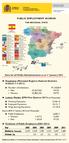 SECRETARIAT OF STATE FOR THE CIVIL SERVICE GENERAL DIRECTORATE OF CIVIL SERVICE PUBLIC EMPLOYMENT IN SPAIN THE REGIONAL STATE NSI 1-1-2010 SPAIN 505,990 km 2 47,021,031 Inhab. Andalusia 87,599 km 2 8,370,975
An Esri White Paper June 2011 ArcGIS for INSPIRE
 An Esri White Paper June 2011 ArcGIS for INSPIRE Esri, 380 New York St., Redlands, CA 92373-8100 USA TEL 909-793-2853 FAX 909-793-5953 E-MAIL [email protected] WEB esri.com Copyright 2011 Esri All rights reserved.
Plant health care in Spain
 Plant health care in Spain GALICIA ASTURIAS CANTABRIAP.VASCO NAVARRA LA RIOJA CASTILLA Y LEON ARAGON CATALUNYA MADRID EXTREMADURA CASTILLA- LA MANCHA VALENCIA BALEARES ANDALUCIA MURCI A CEUTA Y MELILLA
EMPLOYMENT INTEGRATION: The role of associations of people with mental illness and their families
 Mental Health and Well-being in the Workplace 17th March 2009, Berlin EMPLOYMENT INTEGRATION: The role of associations of people with mental illness and their families Maria Jesús San Pío Programs and
Overnight stays in hotel establishments increase 1.9% in 2013
 24 January 214 (updated 27 January 214) Hotel Tourism Short-Term Trends (HOS/HPI/IPHS) Year 213. Overnight stays in hotel establishments increase 1.9% in 213 Hotels earn 41.2 euros per available room and
Overnight stays in hotel establishments register an increase of 4.3% in February, as compared to the same month of 2014
 23 March 215 Updated at 1:3pm Hotel Tourism Short-Term Trends (HOS/HPI/IPHS) February 215. Provisional data Overnight stays in hotel establishments register an increase of 4.3% in February, as compared
Tourism survey for Spanish residents (ETR/FAMILITUR) Q2 2015
 28 September 2015 Tourism survey for Spanish residents (ETR/FAMILITUR) Q2 2015 In the second quarter of 2015 Spanish residents made 46.8 million trips. 50.8% were for leisure, 34.6% to visit family or
Tourist mature destinations as complex spaces. Notes about the elaboration process of an atlas of Costa del Sol
 Tourist mature destinations as complex spaces. Notes about the elaboration process of an atlas of Costa del Sol Sergio J. Reyes Corredera Universidad de Málaga, ETS Arquitectura, Málaga, España. e-mail:
NIPP. Ivica Skender NSDI Working group for technical standards
 Implementing rules for network services Ivica Skender NSDI Working group for technical standards [email protected] Content Working group for technical standards INSPIRE implementing rule for Network
Francesco Tortorelli
 Francesco Tortorelli Joint CEN/TC 287 and OGC Workshop Bringing GI Standards-making bodies together Frascati (Rome), 30 September 2013 (AgID) AgID (previously CNIPA and DigitPA) is a government agency
Presentation of the Quality Office of the UdL. Universitat de Lleida September 2014 Oficina de Qualitat Vicerectorat de Qualitat i Planificació
 Presentation of the Quality Office of the UdL Universitat de Lleida September 2014 Oficina de Qualitat Vicerectorat de Qualitat i Planificació Preliminary information: Spanish university system 17 Autonomous
Use of ITC infrastructures by company size. Percentage of enterprises
 26 June 2015 Survey on ICT and Electronic Commerce Use in Enterprises Year 2014 First quarter 2015 Main results - 98.4% of Spanish enterprises with 10 or more employees have Internet access in the first
The monthly variation of turnover 1 for the market Services Sector is 0.6% after adjusting for seasonal and calendar effects
 14 August 2015 Services Sector Activity Indicators (SSAI). Base 2010 June 2015. Provisional data The monthly variation of turnover 1 for the market Services Sector is 0.6% after adjusting for seasonal
ICT in the National Health System
 ICT in the National Health System The Healthcare Online programme Progress update January 2010 01. Introduction 02. The National Health System: basic data 03. Healthcare centres connectivity 04. Electronic
Hospital Morbidity Survey Year 2011. The number of inpatient admissions to hospital in Spain decreases 1.1% in 2011
 26 December 2012 Hospital Morbidity Survey Year 2011 The number of inpatient admissions to hospital in Spain decreases 1.1% in 2011 the circulatory and tumours cause the largest number of hospital stays
Survey on ICT and Electronic Commerce Use in Companies 2011/12
 25 June 2012 Survey on ICT and Electronic Commerce Use in Companies 2011/12 Main results - 97.5% of Spanish companies with 10 or more employees have Internet access, in. And seven out of 10 have websites.
Overnight stays in non-hotel tourist accommodation increase 6.9% in November as compared to the same month of 2014
 29 December 2015 Non-Hotel Tourist Accommodation Occupancy Survey November 2015. Overnight stays in non-hotel tourist accommodation increase 6.9% in November as compared to the same month of 2014 Overnight
Spatial Data Infrastructures in Bulgaria: State of play 2010
 Spatial Data Infrastructures in : State of play 2010 SPATIAL APPLICATIONS DIVISION K.U.LEUVEN RESEARCH & DEVELOPMENT Celestijnenlaan 200 E, BE-3001 LEUVEN TEL.: 32 16 32 97 32 FAX: 32 16 32 97 24 URL:
INSPIRE Infrastructure for Spatial Information in Europe. INSPIRE Network Services Architecture. Network Services Architecture Creator.
 INSPIRE Infrastructure for Spatial Information in Europe Title Network Creator Network Drafting Team Date 19-07-2008 Subject Status Draft Publisher Network Drafting Team Type Text Description Network describes
IDEE. CatMDEdit - User Manual of the tool for the creation and edition of Geographic Metadata. Infraestructura de Datos Espaciales Española
 IDEE CatMDEdit - User Manual of the tool for the creation and edition of Geographic Metadata Infraestructura de Datos Espaciales Española CatMDEdit 3.5.3 Copyright (C) 2004, TeIDE This software is provided
Organization of the Health Care System in Spain
 Organization of the Health Care System in Spain Patricia Santa Olalla Peralta Dirección General de Salud Pública Ministerio de Sanidad y Consumo Viral Hepatitis Prevention Board Meeting Madrid, November
INSPIRE Evaluation: Summary of findings for EU Member States
 INSPIRE Evaluation: Summary of findings for EU Member States Assessing data and services metadata resources through direct o bservations SPATIAL APPLICATIONS DIVISION K.U.LEUVEN RESEARCH & DEVELOPMENT
Enabling embedded maps
 Enabling embedded maps Case: National geoportal of Finland Antti Rainio National Land Survey of Finland Trends: Web Services, Mapping Mashup, Open Source, Open Data Decentralised data s Service interfaces
Overnight stays in non-hotel tourist accommodation increase 12.3% in October as compared to the same month of 2014
 27 November 2015 Non-Hotel Tourist Accommodation Occupancy Survey October 2015. Overnight stays in non-hotel tourist accommodation increase 12.3% in October as compared to the same month of 2014 Overnight
gvsig: Open Source GIS client. Spatial Data Infrastructure Client.
 Séminaire gvsig Rennes, 31 Mars 2006 gvsig: Open Source GIS client. Spatial Data Infrastructure Client. Luis W. Sevilla Gabriel Carrión Rico Martín García Hernández Francisco J. Peñarrubia Alvaro A. Anguix
Carlos Iglesias, Open Data Consultant.
 Carlos Iglesias, Open Data Consultant. [email protected] http://es.linkedin.com/in/carlosiglesiasmoro/en @carlosiglesias mobile: +34 687 917 759 Open Standards enthusiast and Open advocate that
Amalia Velasco Martín-Varés, International Affairs Coordinator Spanish Directorate General for Cadastre
 One step further: Everybody can now freely download and use the Spanish Cadastral Information by a new license agreement http:// sedecatastro.gob.es Amalia Velasco Martín-Varés, International Affairs Coordinator
A Shared Data Infrastructure (SDI) for integrated coastal management in the Mediterranean and Black Sea Basins
 A Shared Data Infrastructure (SDI) for integrated coastal management The ICZM Protocol and the INSPIRE Directive The ICZM Protocol and the INSPIRE Directive Every day we access an enormous and continuous
Cadastre in the context of SDI and INSPIRE
 Cadastre in the context of SDI and INSPIRE Dr. Markus Seifert Bavarian Administration for Surveying and Cadastre Cadastre in the digital age the approach in Germany 3 rd CLGE Conference, Hanover, 11.10.2012
CURSO Inspire INSPIRE. SPEAKER: Pablo Echamendi Lorente. JEUDI 23/ THURSDAY 23 rd W S V : G E O S P A T I A L D A T A A C C E S S
 CURSO Inspire JEUDI 23/ THURSDAY 23 rd SPEAKER: Pablo Echamendi Lorente WS 5 SCHEDULE WMS OVERVIEW ACTIONS OGC SPECIFICATIONS OTHER SERVICES OVERVIEW proposal: Member States shall establish and operate
Services and Rates Guide 2015
 Services and Rates Guide 2015 Publication for pet businesses The printed magazine EspeciesPRO is a free-distribution informative journal aimed at Spanish pet businesses and other professionals linked to
Standardized data sharing through an open-source Spatial Data Infrastructure: the Afromaison project
 Standardized data sharing through an open-source Spatial Data Infrastructure: the Afromaison project Yaniss Guigoz - University of Geneva/GRID-Geneva 1 EcoARM2ERA and AFROMAISON Why Afromaison in this
Overnight stays in hotel establishments registered an increase of 2.7% in August, as compared to the same month of 2013
 23 September 214 Hotel Tourism Short-Term Trends (HOS/HPI/IPHS) August 214. Provisional data Overnight stays in hotel establishments registered an increase of 2.7% in August, as compared to the same month
Making Geospatial Data Available and Accessible in Jamaica
 Making Geospatial Data Available and Accessible in Jamaica Presented by Cecille Blake, National GIS Coordinator Office of the Prime Minister, National Spatial Data Management Division 9 th UNRCC New York
Evolving Infrastructure: Growth and Evolution of Spatial Portals
 Evolving Infrastructure: Growth and Evolution of Spatial Portals Jeanne FOUST, USA, Winnie S.M. TANG, Hong Kong SAR, China and Jan SELWOOD, Japan Key words: GIS, Global, Spatial Infrastructures, Internet/Web,
Spanish Regional Accounts. Base 2010. Regional Gross Domestic Product. Year 2014 Income accounts of the household sector.
 27 March 2015 Spanish Regional Accounts. Base 2010 Regional Gross Domestic Product. Year 2014 Income accounts of the household sector. 2010-2012 series Main results Regional Gross Domestic Product. Year
PRESENTATION OF E.164 NATIONAL NUMBERING PLAN COUNTRY CODE 34 SPAIN SHORT CODES. 0 3 3 Short codes Social value services
 PRESENTATION OF E.164 NATIONAL NUMBERING PLAN COUNTRY CODE 34 SPAIN (Updated 01-10-2013) N(S)N number 00 2 2 International prefix SHORT CODES 0 3 3 Short codes Social value services 1 4 4 Short codes 103
Population Figures at 1 January 2014 Migration Statistics 2013 Provisional data
 30 June 2014 Population Figures at 1 January 2014 Migration Statistics 2013 Provisional data Main results The population of Spain decreases by 220,130 persons in 2013, standing at 46,507,760 inhabitants
Spanish Society of Cartography, Photogrammetry and Remote Sensing (SECFT)
 Spanish Society of Cartography, Photogrammetry and Remote Sensing (SECFT) NATIONAL REPORT SPAIN 2007-2011 National Report Submitted to the XXV International Cartographic Conference International Cartographic
Spain: ICT R&D and participation to FP7
 Spain: ICT R&D and participation to FP7 Research & Development expenditure in ICT In 2011, public support for ICT R&D (ICT GBAORD) in Spain was 686.7M, roughly 9% of total public funding for R&D, which
Monitoring and Reporting Drafting Team Monitoring Indicators Justification Document
 INSPIRE Infrastructure for Spatial Information in Europe Monitoring and Reporting Drafting Team Monitoring Indicators Justification Document Title Creator Justification document Creation date 2008-12-15
Building up a SDI What is needed? Ulla Kronborg Mazzoli Danish ministry for the Environment National Survey and Cadastre
 Building up a SDI What is needed? Ulla Kronborg Mazzoli Danish ministry for the Environment National Survey and Cadastre He who knows all the answers has not yet been asked all the questions. - Author
A Java Tool for Creating ISO/FGDC Geographic Metadata
 F.J. Zarazaga-Soria, J. Lacasta, J. Nogueras-Iso, M. Pilar Torres, P.R. Muro-Medrano17 A Java Tool for Creating ISO/FGDC Geographic Metadata F. Javier Zarazaga-Soria, Javier Lacasta, Javier Nogueras-Iso,
GeoMedia Product Update. Title of Presentation. Lorilie Barteski October 15, 2008 Edmonton, AB
 Product Update Title of Presentation Lorilie Barteski Edmonton, AB Know the audience poll Existing /Pro users Version 6.1 Version 6.0 Version 5.2 or earlier Existing WebMap users Version 6.1 Version 6.0
Statistical and Spatial Frameworks. Standards and Data Infrastructure
 Distr. GENERAL 01 May 2013 WP.11 ENGLISH ONLY UNITED NATIONS ECONOMIC COMMISSION FOR EUROPE CONFERENCE OF EUROPEAN STATISTICIANS EUROPEAN COMMISSION STATISTICAL OFFICE OF THE EUROPEAN UNION (EUROSTAT)
Cloud Computing and Government Services August 2013 Serdar Yümlü SAMPAŞ Information & Communication Systems
 eenviper White Paper #4 Cloud Computing and Government Services August 2013 Serdar Yümlü SAMPAŞ Information & Communication Systems 1 Executive Summary Cloud computing could revolutionise public services
Non-Hotel Tourist Accommodation Occupancy Survey Year 2012. Provisional data
 13 February 213 Non-Hotel Tourist Accommodation Occupancy Survey Year 212. Provisional data Main results In 212, it was registered 11.9 million of overnight stays in non-hotel tourist accommodation (holiday
Technology Trends In Geoinformation
 Technology Trends In Geoinformation Dato Prof. Sr Dr. Abdul Kadir Bin Taib Department of Survey and Mapping Malaysia (JUPEM) Email: [email protected] www.jupem.gov.my NGIS 2008 3 rd. National GIS Conference
OFFICIAL STATE GAZETTE. No. 269 Tuesday, November 8, 2011 Section 1 Page 116296 I. GENERAL PROVISIONS MINISTRY OF THE PRESIDENCY
 OFFICIAL STATE GAZETTE No. 269 Tuesday, November 8, 2011 Section 1 Page 116296 I. GENERAL PROVISIONS MINISTRY OF THE PRESIDENCY Royal Decree 1495/2011, of 24 th October 2011, whereby the Law 37/2007, of