
Diagnostic Trouble Code (DTC) Charts and Descriptions
|
|
|
- Caitlin Floyd
- 10 years ago
- Views:
Transcription
1 2007 PCED On Board s SECTION 4: Powertrain DTC Charts and Descriptions Procedure revision date: 03/29/2006 Trouble Code (DTC) Charts and Descriptions Note: Refer to the applicable Workshop Manual section to diagnose the body and chassis DTCs. P Intake Camshaft Position Actuator Circuit/Open (Bank 1) The powertrain control module (PCM) monitors the variable camshaft timing (VCT) circuit to the PCM for high and low voltage. The test fails if the voltage exceeds or falls below a calibrated limit for a calibrated amount of time. Open or short in the VCT circuit Open VPWR circuit Open or short in the VCT solenoid valve This DTC is a circuit check. Testing should include the harness and solenoid coil. All GO to Pinpoint Test HK. P Intake Camshaft Position Timing - Over-Advanced (Bank 1) The powertrain control module (PCM) monitors the variable camshaft timing (VCT) position for an over-advanced camshaft timing. The test fails when the camshaft timing exceeds a maximum calibrated value or remains in an advanced position. Camshaft timing improperly set Continuous oil flow to the VCT piston chamber VCT solenoid valve stuck open Camshaft advance mechanism binding (VCT unit) This DTC is a functional check of the VCT unit. Diagnose any base engine concerns related to the engine oil pressure or engine timing. Refer to the Workshop Manual Section , Engine System. All GO to Pinpoint Test HK. GO to Pinpoint Test HK.

2 P Intake Camshaft Position Timing - Over-Retarded (Bank 1) The powertrain control module (PCM) monitors the variable camshaft timing (VCT) position for over-retarded camshaft timing. The test fails when the camshaft timing exceeds a maximum calibrated value or remains in a retarded position. Camshaft timing improperly set Continuous oil flow to the VCT piston chamber VCT solenoid valve stuck open Camshaft advance mechanism binding (VCT unit) This DTC is a functional check of the VCT unit. Diagnose any base engine concerns related to the engine oil pressure or engine timing. Refer to the Workshop Manual Section , Engine System. All GO to Pinpoint Test HK. GO to Pinpoint Test HK. P Crankshaft Position - Camshaft Position Correlation - Bank 1 Sensor A The powertrain control module (PCM) monitors the variable camshaft timing (VCT) position for a misalignment between the camshaft and crankshaft. The test fails when the misalignment is greater than 1 tooth. Worn timing chain tensioner Worn timing chain tensioner arm Loose timing chain Check or adjust the timing. All Refer to the Workshop Manual Section , Engine, to verify the timing. P Crankshaft Position - Camshaft Position Correlation - Bank 2 Sensor A See the description for DTC P0016. See the possible causes for DTC P0016. See the diagnostic aids for DTC P0016. All Refer to the Workshop Manual Section , Engine, to verify the timing.

3 P Intake Camshaft Position Actuator Circuit/Open (Bank 2) See the description for DTC P0010. See the possible causes for DTC P0010. See the diagnostic aids for DTC P0010. All GO to Pinpoint Test HK. P Intake Camshaft Position Timing - Over-Advanced (Bank 2) See the description for DTC P0011. See the possible causes for DTC P0011. See the diagnostic aids for DTC P0011. All GO to Pinpoint Test HK. GO to Pinpoint Test HK. P Intake Camshaft Position Timing - Over-Retarded (Bank 2) See the description for DTC P0012. See the possible causes for DTC P0012. See the diagnostic aids for DTC P0012. All GO to Pinpoint Test HK. GO to Pinpoint Test HK. P Oxygen Sensor Signals Swapped Bank 1 Sensor 1/Bank 2 Sensor 1 The heated oxygen sensor (HO2S) monitor determines if the HO2S signal response for a fuel shift corresponds to the correct engine bank. The test fails when there is no response from the HO2S being tested.

4 Crossed HO2S harness connectors Crossed HO2S wiring at the harness connectors Crossed HO2S wiring at the PCM connectors Connect the HO2S connector to the correct bank. All GO to Pinpoint Test DW. P Oxygen Sensor Signals Swapped Bank 1 Sensor 2/Bank 2 Sensor 2 The heated oxygen sensor (HO2S) monitor determines if the HO2S signal response for a fuel shift corresponds to the correct engine bank. The test fails when there is no response from the HO2S being tested. Crossed HO2S harness connectors Crossed HO2S wiring at the harness connectors Crossed HO2S wiring at the PCM connectors Connect the HO2S connector to the correct bank. All GO to Pinpoint Test DW. P005x - HO2S Heater Resistance (Bank 1, Sensor 1), (Bank 1, Sensor 2), (Bank 1, Sensor 3), and (Bank 2, Sensor 1) Heater current requirements too low or high in the heated oxygen sensor (HO2S) heater control circuit (HO2S11, HO2S12, HO2S13, HO2S21). VPWR circuit open HO2S heater circuit open HO2S heater circuit short in the harness Damaged HO2S heater Inspect the connectors for signs of damage, water ingress, or corrosion. All GO to Pinpoint Test DW.

5 P HO2S Heater Resistance (Bank 2, Sensor 2) Heater current requirements too low or high in the heated oxygen sensor (HO2S) heater control circuit (HO2S22). See the possible causes for DTC P005x. See the diagnostic aids for DTC P005x. All GO to Pinpoint Test DW. P Manifold Absolute Pressure (MAP)/Mass Air Flow (MAF) - Throttle Position Correlation The powertrain control module (PCM) monitors a vehicle operation rationality check by comparing sensed throttle position to mass air flow readings. If during a key on engine running (KOER) self-test, the comparison of the throttle position (TP) sensor and MAF sensor readings are not consistent with the calibrated load values, the test fails and a DTC is stored in continuous memory. Air leak between MAF sensor and throttle body TP sensor not seated properly Damaged TP sensor Damaged MAF sensor Diagnose any MAP, MAF, or TP circuit DTCs first. Drive the vehicle and exercise the throttle and the TP sensor in all gears. A TP PID less than 4.82% (0.24 volt) with a LOAD PID greater than 55%, or a TP PID greater than 49.05% (2.44 volts) with a LOAD PID less than 30% indicates a concern is present. Vehicles With Electronic Throttle Control (ETC) GO to Pinpoint Test DV. GO to Pinpoint Test DV. All others GO to Pinpoint Test DH. GO to Pinpoint Test DH. P Intake Air Temperature Sensor 2 Circuit Low Indicates the sensor signal is less than the self-test minimum. The intake air temperature 2 (IAT2) sensor minimum is 0.2 volt.

6 Grounded circuit in the harness Incorrect harness connection Damaged sensor Monitor the IAT2 PID value. A typical IAT2 temperature should be greater than the IAT1 temperature. Refer to Section 6, Reference Values. All GO to Pinpoint Test DU. P Intake Air Temperature Sensor 2 Circuit High Indicates the sensor signal is greater than the self-test maximum. The intake air temperature 2 (IAT2) sensor maximum is 4.6 volts. Open circuit in the harness Sensor signal short to voltage Incorrect harness connection Damaged sensor Monitor the IAT2 PID value. A typical IAT2 temperature should be greater than the IAT1 temperature. Refer to Section 6, Reference Values. All GO to Pinpoint Test DU. P Mass or Volume Air Flow A Circuit Low The mass air flow (MAF) sensor circuit is monitored by the powertrain control module (PCM) for low air flow (or voltage) input through the comprehensive component monitor (CCM). If during key on, engine running (KOER) the air flow (or voltage) changes below a minimum calibrated limit, the test fails. MAF sensor disconnected MAF circuit open to PCM VPWR open to MAF sensor PWR GND open to the MAF sensor MAF RTN circuit open to PCM MAF circuit shorted to GND Intake air leak (near the MAF sensor) A closed throttle indication (throttle position [TP] sensor system) Damaged MAF sensor A MAF V PID reading less than 0.23 volt in continuous memory or KOER indicates a hard fault.

7 All GO to Pinpoint Test DC. GO to Pinpoint Test DC. P Mass or Volume Air Flow A Circuit High The mass air flow (MAF) sensor circuit is monitored by the powertrain control module (PCM) for high air flow (or voltage) input through the comprehensive component monitor (CCM). If during key on, engine off (KOEO), or key on, engine running (KOER), the air flow (or voltage) changes above a maximum calibrated limit, the test fails. MAF sensor screen is blocked MAF circuit shorted to voltage Damaged MAF sensor A MAF V PID (MAF PID) reading greater than 4.6 volts during KOER indicates a hard fault. All GO to Pinpoint Test DC. P Mass or Volume Air Flow A Circuit Intermittent/Erratic A concern exists in the mass air flow (MAF) sensor A circuit, or the air tube containing the sensor, causing an incorrect air flow reading. Intermittent circuit A open or short Air leaks in the tube from the MAF to the throttle body Verify the integrity of the MAF sensor circuit A for an intermittent concern. Check the MAF sensor tube for air leaks. All GO to Pinpoint Test DC. GO to Pinpoint Test DC. P Manifold Absolute Pressure (MAP/BARO) Sensor Range/Performance MAP sensor input to the powertrain control module (PCM) is monitored and is not within the calibrated value. Slow responding MAP sensor Electrical circuit failure

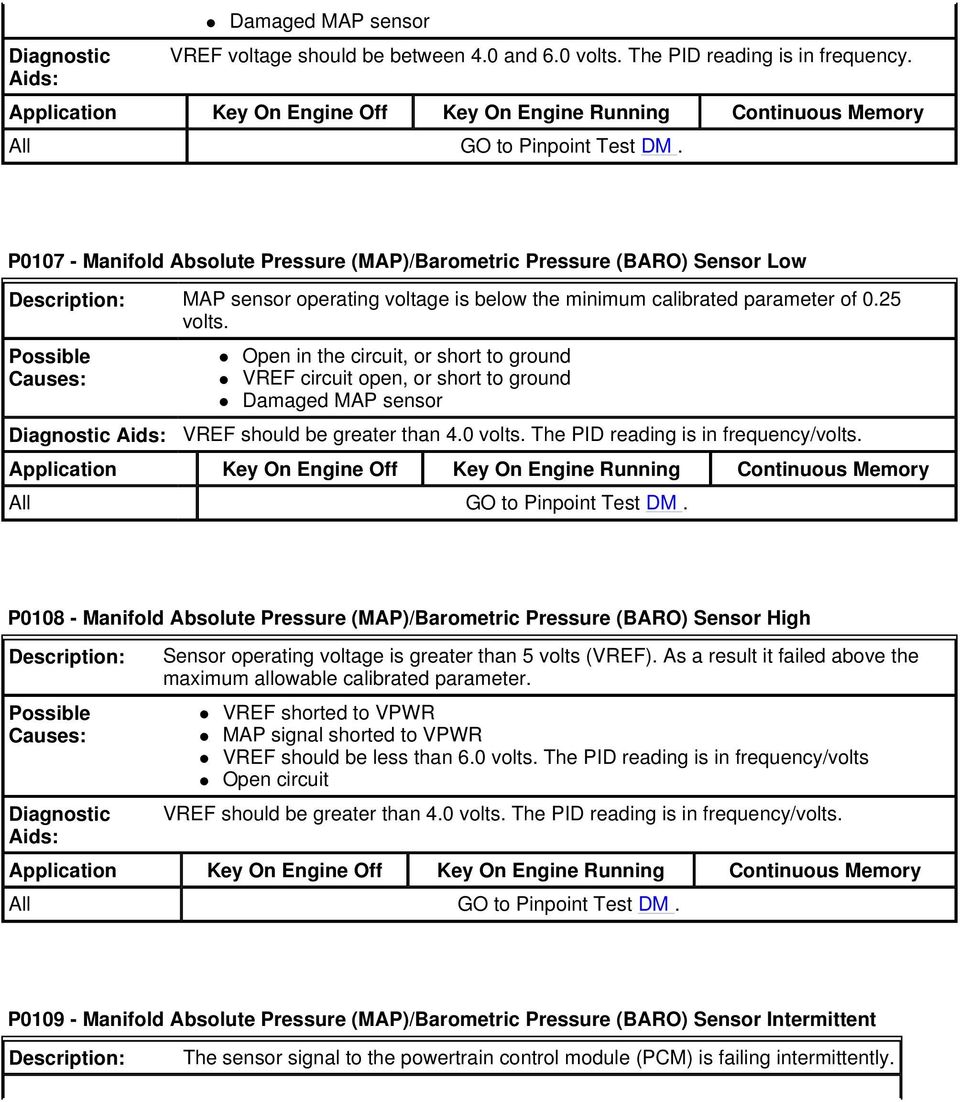
8 Damaged MAP sensor VREF voltage should be between 4.0 and 6.0 volts. The PID reading is in frequency. All GO to Pinpoint Test DM. P Manifold Absolute Pressure (MAP)/Barometric Pressure (BARO) Sensor Low MAP sensor operating voltage is below the minimum calibrated parameter of 0.25 volts. Open in the circuit, or short to ground VREF circuit open, or short to ground Damaged MAP sensor VREF should be greater than 4.0 volts. The PID reading is in frequency/volts. All GO to Pinpoint Test DM. P Manifold Absolute Pressure (MAP)/Barometric Pressure (BARO) Sensor High Sensor operating voltage is greater than 5 volts (VREF). As a result it failed above the maximum allowable calibrated parameter. VREF shorted to VPWR MAP signal shorted to VPWR VREF should be less than 6.0 volts. The PID reading is in frequency/volts Open circuit VREF should be greater than 4.0 volts. The PID reading is in frequency/volts. All GO to Pinpoint Test DM. P Manifold Absolute Pressure (MAP)/Barometric Pressure (BARO) Sensor Intermittent The sensor signal to the powertrain control module (PCM) is failing intermittently.
9 Loose electrical connection Damaged MAP sensor Check the harness and connection. All GO to Pinpoint Test DM. P Intake Air Temperature (IAT) Sensor 1 Circuit Range/Performance Indicates the IAT rationality test has failed. This DTC indicates that the IAT value is higher than a calibrated value and could prevent 1 or more on-board diagnostic (OBD) monitors from completing. The PCM runs this logic after an engine off and a calibrated soak period (typically 6 hours). This soak period allows IAT and engine coolant temperature (CHT or ECT) to stabilize and not differ by more than a calibrated value. DTC P0111 is set when: the IAT at engine start exceeds the ECT or CHT by more than a calibrated value, typically 17 C (30 F). IAT Sensor Make sure the IAT and the CHT or ECT are similar when the engine is cold. All GO to Pinpoint Test DA. P Intake Air Temperature (IAT) Sensor 1 Circuit Low Indicates the sensor signal is less than the self-test minimum. The IAT sensor minimum is 0.2 volt or 121 C (250 F). Grounded circuit in the harness Damaged sensor Improper harness connection An IAT V PID reading less than 0.2 volt with key ON engine OFF or during any engine operating mode indicates a concern is present. All GO to Pinpoint Test DA.

10 P Intake Air Temperature (IAT) Sensor 1 Circuit High Indicates the sensor signal is greater than the self-test maximum. The IAT sensor maximum is 4.6 volts or -50 C (-58 F). Open circuit in the harness Sensor signal short to voltage Damaged sensor Improper harness connection An IAT V PID reading greater than 4.6 volts with the key ON engine OFF or during any engine operating mode indicates a concern is present. All GO to Pinpoint Test DA. P Intake Air Temperature (IAT) Sensor 1 Intermittent/Erratic Indicates the sensor signal was intermittent during the comprehensive component monitor (CCM). Damaged harness Damaged sensor Damaged harness connector Monitor the IAT on a scan tool. Look for sudden changes in the reading when the harness is wiggled or the sensor is tapped. All GO to Pinpoint Test DA. P Engine Coolant Temperature (ECT) Sensor 1 Circuit Range/Performance Indicates the engine coolant temperature rationality test has failed. This DTC indicates that the ECT or cylinder head temperature (CHT) value is higher than the calibrated value and could prevent 1 or more on-board diagnostic (OBD) monitors from completing. The PCM runs this logic after an engine off and a calibrated soak period (typically 6 hours). This soak period allows the intake air temperature (IAT) and the CHT or ECT to stabilize and not differ by more than a calibrated value. DTC P0116 is set when all of the following conditions are met: The ECT at engine start exceeds the IAT at engine start by more than a calibrated value, typically 17 C (30 F).

11 The ECT exceeds a calibrated value, typically 107 C (225 F). The fuel system, heated oxygen and misfire monitors have not completed. The calibrated time to set DTC P0116 has expired. ECT or CHT sensor Coolant system concern Make sure the IAT and the ECT are similar when the engine is cold. Also make sure the ECT or CHT sensor and the actual engine operating temperatures are the same. Vehicles with only a CHT sensor GO to Pinpoint Test DL. All others GO to Pinpoint Test DX. P Engine Coolant Temperature (ECT) Sensor 1 Circuit Low Indicates the sensor signal is less than the self-test minimum. The ECT sensor minimum is 0.2 volt or 121 C (250 F). Grounded circuit in the harness Damaged sensor Incorrect harness connection A concern is present if an ECT V PID reading less than 0.2 volt with the key ON engine OFF or during any engine operating mode. All GO to Pinpoint Test DX. P Engine Coolant Temperature (ECT) Sensor 1 Circuit High Indicates the sensor signal is greater than the self-test maximum. The ECT sensor maximum is 4.6 volts or -50 C (-58 F). Open circuit in the harness Sensor signal short to voltage Improper harness connection Damaged sensor An ECT V PID reading greater than 4.6 volts with the key ON engine OFF or during any engine operating mode indicates a concern is present.

12 All GO to Pinpoint Test DX. P Engine Coolant Temperature (ECT) Sensor 1 Circuit Intermittent/Erratic Indicates the ECT circuit became intermittently open or shorted while the engine was running. On vehicles that are not equipped with an ECT sensor, the cylinder head temperature (CHT) sensor can be used and can set this DTC. Damaged harness Damaged sensor Damaged harness connector Low engine coolant Monitor the ECT or the CHT on a scan tool, look for sudden changes in the reading when the harness is wiggled or the sensor is tapped. Vehicles with only a CHT sensor GO to Pinpoint Test DL. All others GO to Pinpoint Test DX. P Throttle/Pedal Position Sensor A Circuit Range/Performance For Vehicles With Electronic Throttle Control (ETC) The electronic throttle control (ETC) throttle position (TP) sensor 1 circuit was flagged as a concern by the powertrain control module (PCM) indicating an out of range in either the closed or wide open throttle (WOT) modes. Obstruction in the throttle plate movement Damaged throttle body TP circuit open to PCM Damaged TP sensor SIG RTN circuit open to the TP sensor This concern exhibits a symptom of limited power. A TP1 PID reading less than 13% (0.65 volt), or greater than 93% (4.65 volts) in key ON, engine OFF or key ON, engine running indicates a concern is present. For All Others The throttle position (TP) sensor circuit is monitored by the powertrain control module (PCM) for a non-closed throttle position at idle. The test fails if the key on engine running (KOER) self-test terminates upon placing the transmission gear selector in DRIVE or REVERSE or the TP closed throttle position is not achieved when closing the

13 throttle (idle) after opening it (in PARK or NEUTRAL). Binding throttle linkage Damaged throttle body TP circuit open to PCM Damaged TP sensor SIG RTN circuit open to the TP sensor Drive the vehicle, bring it to a stop, and turn the key to the OFF position. Start the vehicle, and run the KOER self-test at idle. Vehicles With Electronic Throttle Control (ETC) GO to Pinpoint Test DV. All others GO to Pinpoint Test DH. P Throttle/Pedal Position Sensor A Circuit Low For Vehicles With Electronic Throttle Control (ETC) For All Others The ETC throttle position (TP) sensor 1 circuit was flagged as a concern by the powertrain control module (PCM) indicating a low voltage or open circuit. Open ETC TP sensor harness Short to ground in the ETC TP sensor harness Damaged TP sensor SIG RTN circuit open to the TP sensor This concern exhibits a symptom of limited power. A TP1 PID reading less than 3.42% (0.17 volt) in key ON, engine OFF or key ON, engine running indicates a concern is present. The TP sensor circuit is monitored by the PCM for a high TP rotation angle (or voltage) input through the comprehensive component monitor (CCM). The test fails if the TP rotation angle (or voltage) changes above the maximum calibrated limit. TP sensor not seated properly TP circuit open to PCM VREF open to TP sensor TP circuit short to GND Damaged TP sensor This concern exhibits a symptom of limited power. A TP PID reading less than 3.42% (0.17 volt) in key ON, engine OFF or key ON, engine running indicates a concern is present.

14 Vehicles With Electronic Throttle Control (ETC) GO to Pinpoint Test DV. All others GO to Pinpoint Test DH. P Throttle/Pedal Position Sensor A Circuit High For Vehicles With Electronic Throttle Control (ETC) The ETC throttle position (TP) sensor 1 circuit was flagged as a concern by the powertrain control module (PCM) indicating a high voltage. TP sensor harness short to VREF TP sensor harness is short to voltage Damaged TP sensor VREF circuit short to TP sensor Drive the vehicle, bring it to a stop, and turn the key to the OFF position. Start the vehicle and carry out the key on engine running (KOER) self-test at idle. Access the KOER DTCs on the scan tool. The TP1 signal is normally at a high voltage at closed throttle, and a lower voltage at wide open throttle (WOT) (opposite of TP2). For All Others The TP sensor circuit is monitored by the PCM for a high TP rotation angle (or voltage) input through the comprehensive component monitor (CCM). The test fails if the TP rotation angle (or voltage) changes above the maximum calibrated limit. TP sensor not seated properly TP sensor harness is short to voltage TP sensor harness short to VREF SIG RTN circuit open to the TP sensor Damaged TP sensor A TP PID reading greater than 93% (4.65 volts) in key ON, engine OFF or key ON, engine running indicates a concern is present. Vehicles With Electronic Throttle Control (ETC) GO to Pinpoint Test DV. All others GO to Pinpoint Test DH.

15 P Insufficient Coolant Temperature For Closed Loop Fuel Control Indicates the engine coolant temperature (ECT) or the cylinder heat temperature (CHT) sensor has not achieved the required temperature level to enter closed loop operating conditions within a specified amount of time after starting the engine. Insufficient warm up time Low engine coolant level Leaking or stuck open thermostat Malfunctioning ECT sensor Malfunctioning CHT sensor Compare the thermostat specification to the actual ECT using the engine temperature PID (ECT or CHT). The temperature reading should be similar when the engine is at a normal operating temperature. Vehicles with only a CHT sensor GO to Pinpoint Test DL. All others GO to Pinpoint Test DX. P Intake Air Temperature (IAT) Too High Indicates that the IAT2 sensor has detected a concern in the charge air cooler CAC system. Blockage of heat exchangers Low fluid level Fluid leakage CAC pump or relay failure Crossed CAC coolant lines Monitor the IAT2 PID. A typical IAT2 temperature should be greater than the IAT1 temperature. Refer to Section 6, Reference Values for IAT values. All GO to Pinpoint Test DU. P Coolant Thermostat (Coolant Temperature Below Thermostat Regulating Temperature) Indicates that the thermostat monitor has not achieved the required engine operating temperature within a specified amount of time after starting the engine. Insufficient warm up time

16 Low engine coolant level Leaking or stuck open thermostat Inoperative engine coolant temperature (ECT) sensor Inoperative cylinder head temperature (CHT) sensor Refer to Section 1, Thermostat Monitor for system information. Vehicles with only a CHT sensor GO to Pinpoint Test DL. All others GO to Pinpoint Test DX. P012B - Turbocharger/Supercharger Inlet Pressure Sensor Circuit Range/Performance Manifold absolute pressure (MAP) sensor input to the powertrain control module (PCM) is monitored and is not within the calibrated value. Slow responding MAP sensor Electrical circuit failure Damaged MAP sensor VREF voltage should be between 4.0 and 6.0 volts. The PID reading is in frequency. All GO to Pinpoint Test DM. P012C - Turbocharger/Supercharger Inlet Pressure Sensor Circuit Low MAP sensor operating voltage is below the minimum calibrated parameter of 0.25 volts. Open in the circuit, or short to ground VREF circuit open, or short to ground Damaged MAP sensor VREF should be greater than 4.0 volts. The PID reading is in frequency/volts. All GO to Pinpoint Test DM.

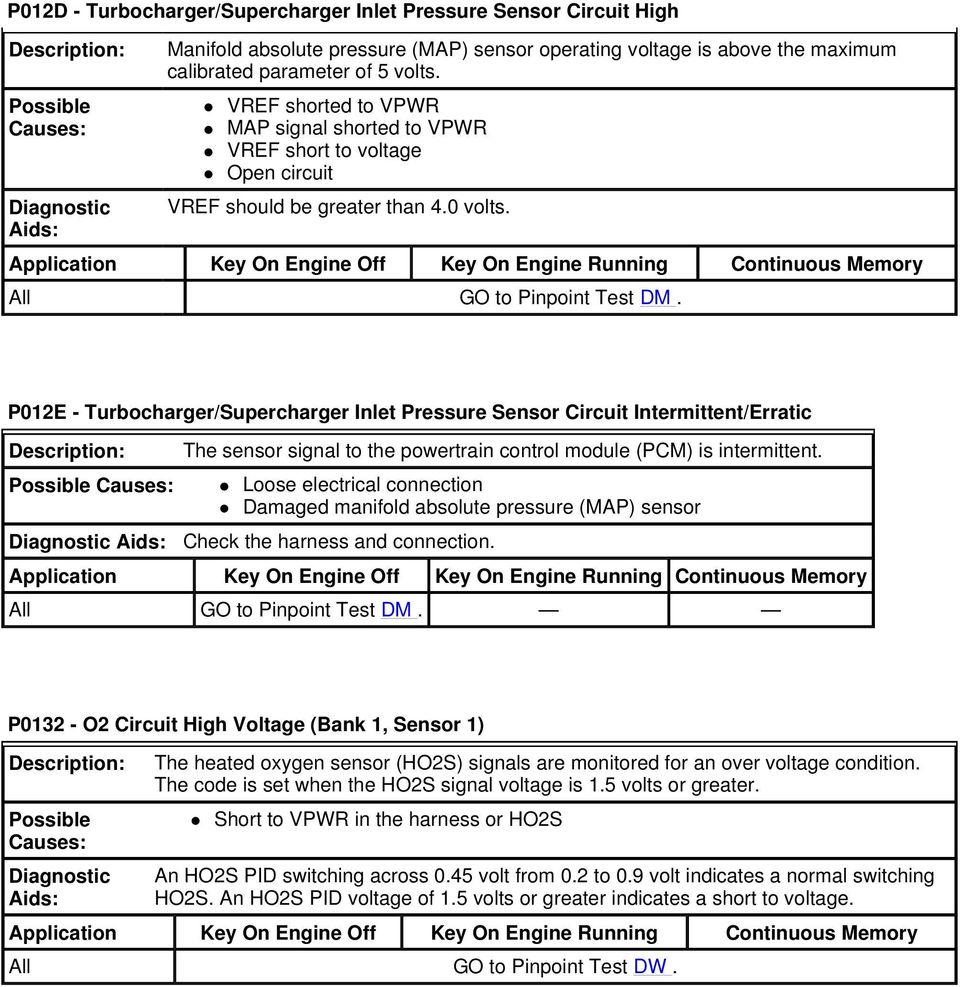
17 P012D - Turbocharger/Supercharger Inlet Pressure Sensor Circuit High Manifold absolute pressure (MAP) sensor operating voltage is above the maximum calibrated parameter of 5 volts. VREF shorted to VPWR MAP signal shorted to VPWR VREF short to voltage Open circuit VREF should be greater than 4.0 volts. All GO to Pinpoint Test DM. P012E - Turbocharger/Supercharger Inlet Pressure Sensor Circuit Intermittent/Erratic The sensor signal to the powertrain control module (PCM) is intermittent. Loose electrical connection Damaged manifold absolute pressure (MAP) sensor Check the harness and connection. All GO to Pinpoint Test DM. P O2 Circuit High Voltage (Bank 1, Sensor 1) The heated oxygen sensor (HO2S) signals are monitored for an over voltage condition. The code is set when the HO2S signal voltage is 1.5 volts or greater. Short to VPWR in the harness or HO2S An HO2S PID switching across 0.45 volt from 0.2 to 0.9 volt indicates a normal switching HO2S. An HO2S PID voltage of 1.5 volts or greater indicates a short to voltage. All GO to Pinpoint Test DW.
18 P O2 Circuit Slow Response (Bank 1, Sensor 1) The heated oxygen sensor (HO2S) monitor checks the HO2S frequency and amplitude. The test fails if the frequency and amplitude fall below a calibrated limit during testing. Contaminated HO2S Exhaust leaks Short/open wiring Incorrect fueling MAF sensor Deteriorating HO2S Inlet air leaks Access the HO2S test results from the generic OBD menu to verify the DTC. All GO to Pinpoint Test DW. P O2 Heater Circuit (Bank 1, Sensor 1) During testing the heated oxygen sensor (HO2S) heaters are checked for open and short circuits and excessive current draw. The test fails when the current draw exceeds a calibrated limit or an open or short circuit is detected. Vacuum hose disconnected on exhaust gas recirculation (EGR) system module (ESM) applications Short to VPWR in the harness or HO2S Water in the harness connector Open VPWR circuit Open GND circuit Low battery voltage Corrosion or incorrect harness connections Damaged HO2S heater Check the HO2S electrical connector for damage, corrosion, and water intrusion. Damaged HO2S heater. All GO to Pinpoint Test DW. P O2 Circuit High Voltage (Bank 1, Sensor 2) See the description for DTC P0132.

19 See the possible causes for DTC P0132. See the diagnostic aids for DTC P0132. All GO to Pinpoint Test DW. P O2 Circuit Slow Response (Bank 1, Sensor 2) The heated oxygen sensor (HO2S) monitor tracks the rate of voltage change during the rise and fall of the HO2S signal. When the rate of voltage change is less than a calibrated value, the powertrain control module (PCM) begins to modify the fuel trim attempting to increase the HO2S voltage switch rate. The DTC is set when the PCM is at the allowable limit or has exceeded an allowable length of time for fuel trim modification, without detecting an acceptable rate of voltage change. Contaminated or damaged HO2S Deteriorating HO2S Exhaust leaks Aftermarket accessories Performance modifications Access the HO2S test results from the generic OBD menu to verify the DTC. All GO to Pinpoint Test DW. P O2 Heater Circuit (Bank 1, Sensor 2) See the description for DTC P0135. See the possible causes for DTC P0135. See the diagnostic aids for DTC P0135. All GO to Pinpoint Test DW. P O2 Circuit High Voltage (Bank 1, Sensor 3) See the description for DTC P0132.

20 See the possible causes for DTC P0132. See the diagnostic aids for DTC P0132. All GO to Pinpoint Test DW. P O2 Heater Circuit (Bank 1, Sensor 3) See the description for DTC P0135. See the possible causes for DTC P0135. See the diagnostic aids for DTC P0135. All GO to Pinpoint Test DW. P Fuel Delivery Error At least 1 bank is lean at wide open throttle (WOT). Severely restricted fuel filter Severely restricted fuel supply line Damaged or worn fuel pump Damaged or contaminated mass air flow (MAF) sensor All GO to Pinpoint Test HC. P O2 Circuit High Voltage (Bank 2, Sensor 1) See the description for DTC P0132. See the possible causes for DTC P0132. See the diagnostic aids for DTC P0132. All GO to Pinpoint Test DW. GO to Pinpoint Test DW.

21 P O2 Circuit Slow Response (Bank 2, Sensor 1) See the description for DTC P0133. See the possible causes for DTC P0133. See the diagnostic aids for DTC P0133. All GO to Pinpoint Test DW. P O2 Heater Circuit (Bank 2, Sensor 1) See the description for DTC P0135. See the possible causes for DTC P0135. See the diagnostic aids for DTC P0135. All GO to Pinpoint Test DW. P O2 Circuit High Voltage (Bank 2, Sensor 2) See the description for DTC P0132. See the possible causes for DTC P0132. See the diagnostic aids for DTC P0132. All GO to Pinpoint Test DW. GO to Pinpoint Test DW. P O2 Circuit Slow Response (Bank 2, Sensor 2) See the description for DTC P0139. See the possible causes for DTC P0139. See the diagnostic aids for DTC P0139.
22 All GO to Pinpoint Test DW. P O2 Heater Circuit (Bank 2, Sensor 2) See the description for DTC P0135. See the possible causes for DTC P0135. See the diagnostic aids for DTC P0135. All GO to Pinpoint Test DW. P System Too Lean (Bank 1) The adaptive fuel strategy continuously monitors the fuel delivery hardware. The test fails when the adaptive fuel tables reach a rich calibrated limit. Refer to Section 1, Powertrain Control Software Fuel Trim for more information. Fuel System: Damaged or leaking fuel pulse damper Fuel filter plugged or dirty Damaged or worn fuel pump Leaking fuel pump check valve Leaking/contaminated fuel injectors Low fuel pressure or running out of fuel Evaporative emission (EVAP) canister purge valve is leaking when the canister is clean Fuel supply line restricted Fuel rail pressure sensor bias Exhaust System: Exhaust leaks in the exhaust manifold gasket or mating gaskets before or near the heated oxygen sensor (HO2S) EGR System: Vacuum hose disconnected on exhaust gas recirculation (EGR) system module (ESM) applications
23 EGR valve tube/gasket leak EGR vacuum regulator solenoid leak Intake Air System: Air leaks after the mass air flow (MAF) sensor Vacuum leaks Positive crankcase ventilation (PCV) system is leaking or the valve is stuck open Improperly seated engine oil dipstick Damaged or contaminated MAF sensor Secondary Air Injection: Damaged secondary air injection system or a mechanically stuck valve View freeze frame data to determine the operating conditions when the DTC was set. Observe the LONGFT1 and LONGFT2 PIDs. Refer to Section 2, Adaptive Fuel DTC Techniques for more information. All GO to Pinpoint Test H. P System Too Rich (Bank 1) The adaptive fuel strategy continuously monitors the fuel delivery hardware. The test fails when the adaptive fuel tables reach a rich calibrated limit. Refer to Section 1, Powertrain Control Software Fuel Trim for more information. Fuel System: Damaged or leaking fuel pulse damper Leaking fuel injectors Fuel return line restricted Fuel rail pressure sensor bias EVAP canister purge valve is leaking when the canister is full Base engine. Engine oil contamination Intake Air System: Damaged or contaminated mass air flow (MAF) sensor
24 View freeze frame data to determine the operating conditions when the DTC was set. Observe the LONGFT1 and LONGFT2 PIDs. Refer to Section 2, Adaptive Fuel DTC Techniques for more information. All GO to Pinpoint Test H. P System Too Lean (Bank 2) See the description for DTC P0171. See the possible causes for DTC P0171. See the diagnostic aids for DTC P0171. All GO to Pinpoint Test H. P System Too Rich (Bank 2) See the description for DTC P0172. See the possible causes for DTC P0172. See the diagnostic aids for DTC P0172. All GO to Pinpoint Test H. P Fuel Temperature Sensor A Circuit The comprehensive component monitor (CCM) monitors the fuel temperature sensor circuit to the powertrain control module (PCM) for low and high voltage. The test fails if the voltage falls below or exceeds a calibrated limit and amount of time during testing. Open or short in the harness Low ambient temperature operation Improper harness connection Damaged fuel temperature sensor Verify the FRT PID value to determine an open or short.
25 All GO to Pinpoint Test DD. P Fuel Temperature Sensor A Circuit Range/Performance The comprehensive component monitor (CCM) monitors the fuel temperature sensor for acceptable operating temperature. The test fails if the voltage falls below or exceeds a calibrated limit, for a calibrated amount of time during testing. Open or short in the harness Low ambient temperature operation Incorrect harness connection Damaged fuel temperature sensor Damaged powertrain control module (PCM) Verify the FRT PID value to determine an open or short. All GO to Pinpoint Test DD. GO to Pinpoint Test DD. P Fuel Temperature Sensor A Circuit Low The comprehensive component monitor (CCM) monitors the fuel temperature sensor circuit to the powertrain control module (PCM) for low voltage. The test fails if the voltage falls below a calibrated limit for a calibrated amount of time during testing. Short in the harness VREF open or short Low ambient temperature operation Incorrect harness connection Damaged fuel temperature sensor Verify the FRT PID and VREF values to determine an open or short. All GO to Pinpoint Test DD. P Fuel Temperature Sensor A Circuit High
26 The comprehensive component monitor (CCM) monitors the fuel temperature sensor circuit to the powertrain control module (PCM) for high voltage. The test fails if the voltage exceeds a calibrated limit for a calibrated amount of time during testing. Open circuit Open or short to voltage in the harness Incorrect harness connection Damaged fuel temperature sensor Verify the FRT PID value to determine an open or short. All GO to Pinpoint Test DD. P Fuel Rail Pressure Sensor A Circuit The comprehensive component monitor (CCM) monitors the fuel rail pressure (FRP) sensor to the powertrain control module (PCM) for VREF voltage. The test fails when the VREF voltage from the PCM drops to a voltage less than a minimum calibrated value. VREF open in harness VREF open in sensor Vacuum leaks Verify a VREF voltage between 4 and 6 volts. All GO to Pinpoint Test DD. P Fuel Rail Pressure Sensor A Circuit Range/Performance The comprehensive component monitor (CCM) checks the fuel rail pressure (FRP) sensor for an acceptable fuel pressure. The test fails when the fuel pressure falls below or exceeds a minimum/maximum calibrated value for a calibrated period of time. High fuel pressure Low fuel pressure Damaged FRP sensor Excessive resistance in the circuit Vacuum leaks Low or no fuel A FRP PID value during key ON, engine running of 138 kpa (20 psi) to 413 kpa (60 psi) is
27 acceptable. All GO to Pinpoint Test DD. P Fuel Rail Pressure Sensor A Circuit Low The comprehensive component monitor (CCM) monitors the fuel rail pressure (FRP) sensor circuit to the powertrain control module (PCM) for low voltage. The test fails if the voltage falls below a calibrated limit for a calibrated amount of time during testing. FRP signal short to SIG RTN or PWR GND Damaged FRP sensor A FRP PID value during key ON, engine OFF or key ON, engine running less than 0.3 volt indicates a concern is present. All GO to Pinpoint Test DD. P Fuel Rail Pressure Sensor A Circuit High The comprehensive component monitor (CCM) monitors the fuel rail pressure (FRP) sensor circuit to the powertrain control module (PCM) for high voltage. The test fails if the voltage exceeds a calibrated limit for a calibrated amount of time during testing. FRP signal short to VREF or VPWR FRP signal open Damaged FRP sensor An FRP signal high condition can be caused by any number of conditions, including a short on FRP signal to VREF, a more positive voltage level, an open FRP signal or signal return. The FRP signal line is pulled up by the PCM and VREF at the sensor, and down by the sensor through SIGRTN. All GO to Pinpoint Test DD. P Engine Oil Temperature (EOT) Sensor Circuit Range/Performance Indicates the value from the EOT sensor is not within the powertrain control module (PCM)
28 predicted engine oil temperature range, based on other PCM inputs. Engine not at operating temperature Cooling system problem or stuck thermostat EOT circuit failure The EOT rationality test looks for the EOT sensor value to be within a calibrated delta of the PCM predicted engine oil temperature. Make sure the EOT sensor reading is similar to the engine temperature. If the EOT reading greatly differs from engine temperature, check the EOT circuitry for correct operation. All GO to Pinpoint Test DY. P Engine Oil Temperature (EOT) Sensor Circuit Low Indicates EOT signal voltage is low (high temperature). Damaged harness Damaged harness connector Damaged sensor An EOT V PID reading less than 0.2 volt with the key on engine off (KOEO) or during any engine operating mode indicates a short to ground. All GO to Pinpoint Test DY. P Engine Oil Temperature (EOT) Sensor Circuit High Indicates EOT signal voltage is high (low temperature). Damaged harness Damaged harness connector Damaged sensor An EOT V PID reading greater than 4.5 volts with the key ON engine OFF or during any engine operating mode indicates an open circuit. All GO to Pinpoint Test DY.
29 P020x - Injector Circuit/Open - Cylinder X Note: x represents injector numbers 1 through 9. The comprehensive component monitor (CCM) monitors the operation of the fuel injector drivers in the powertrain control module (PCM). The test fails when the fuel injector circuitry is inoperative. Open circuit Damaged fuel injector Damaged PCM PID Data Monitor INJx_F fault flags equals YES. This DTC is set when a concern is detected between the PCM and the fuel injector. All GO to Pinpoint Test KG. P Injector Circuit/Open - Cylinder 10 See the description for DTC P020x. See the possible causes for DTC P020x. See the diagnostic aids for DTC P020x. All GO to Pinpoint Test KG. P Engine Coolant Over-Temperature Condition Indicates an engine overheat condition was detected by the engine temperature sensor (CHT or ECT depending how the vehicle is equipped). Engine cooling system concerns Low engine coolant level Base engine concerns Monitor the engine temperature PID (CHT or ECT) for an overheat condition. Typical engine temperature should be close to cooling system thermostat specification. All GO to Pinpoint Test DX.
30 P Transmission Fluid Temperature Over-Temperature Condition Indicates a transmission overheat condition was sensed by the transmission fluid temperature (TFT) sensor. Low transmission fluid level Transmission cooling system concerns Monitor the transmission temperature PID TFT for an overheat condition. All Refer to the Workshop Manual Section , Automatic Transmission. P Engine Over Speed Condition Indicates the vehicle has been operated in a manner which caused the engine speed to exceed a calibrated limit. The engine RPM is continuously monitored and evaluated by the powertrain control module (PCM). The DTC is set when the RPM exceeds the calibrated limit set within the PCM. For additional information on the engine RPM limiter, refer to Section 1, Powertrain Control Software. Wheel slippage (water, ice, mud, and snow) Excessive engine RPM in NEUTRAL or operated in the wrong transmission gear The DTC indicates the vehicle has been operated in a manner which caused the engine speed to exceed a calibrated limit. All GO to Pinpoint Test ND. P Throttle/Pedal Position Sensor/Switch B Circuit Range/Performance The electronic throttle control (ETC) throttle position (TP) sensor 2 circuit was flagged as a concern by the powertrain control module (PCM) indicating an out of range in either the closed or wide open throttle (WOT) modes. Binding throttle linkage Damaged throttle body TP circuit open to PCM Damaged TP sensor SIG RTN circuit open to the TP sensor Self-test operator error (foot resting on the accelerator pedal during test) This concern exhibits a symptom of limited power. A TP2 PID reading greater than 96.42%
31 (4.65 volts) during key ON, engine OFF or key ON, engine running indicates a concern is present. All GO to Pinpoint Test DV. P Throttle/Pedal Position Sensor/Switch B Circuit Low The electronic throttle control (ETC) throttle position (TP) sensor 2 circuit was flagged as a concern by the powertrain control module (PCM) indicating a low voltage, or open circuit. Open ETC TP sensor harness Short to ground in the ETC TP sensor harness Damaged TP sensor SIG RTN circuit open to the TP sensor This concern exhibits a symptom of limited power. A TP2 PID reading less than 3.42% (0.17 volt) during key ON, engine OFF or key ON, engine running indicates a concern is present. All GO to Pinpoint Test DV. P Throttle/Pedal Position Sensor/Switch B Circuit High The electronic throttle control (ETC) throttle position (TP) sensor 2 circuit was flagged as a concern by the powertrain control module (PCM) indicating a high voltage. ETC TP sensor harness shorted to VREF Damaged TP sensor ETC TP2 circuit open VREF circuit short to TP sensor This concern exhibits a symptom of limited power. A TP2 PID reading greater than 93% (4.65 volts) in key ON, engine OFF or key ON, engine running indicates a concern is present. All GO to Pinpoint Test DV. P Fuel Pump Primary Circuit
32 The powertrain control module (PCM) monitors the fuel pump (FP) circuit output from the PCM. The test fails when the FP output is commanded ON (grounded) and excessive current draw is detected on the FP circuit. The test also fails when the FP output is commanded OFF and voltage is not detected on the FP circuit. The PCM expects to detect VPWR voltage coming through the fuel pump relay coil to the FP circuit. Open or shorted (FP) circuit Open VPWR circuit to the fuel pump relay Damaged fuel pump relay Damaged PCM A concern is present when the FP_F PID reads YES. An open circuit or short to ground can only be detected with the fuel pump commanded OFF. A short to voltage can only be detected with the fuel pump commanded ON. During the key on engine off (KOEO) and key on engine running (KOER) self-test, the fuel pump output command is cycled on and off. All GO to Pinpoint Test KA. P Fuel Pump Secondary Circuit Low The powertrain control module (PCM) monitors the fuel pump monitor (FPM) circuit. The test fails if the PCM commands the fuel pump ON and B+ voltage is not detected on the FPM circuit. Open B+ circuit to the fuel pump relay Open FP PWR circuit between the fuel pump relay and its connection to the FPM circuit Damaged fuel pump relay During the key on engine off (KOEO) self-test, the PCM commands the fuel pump ON so this test can be carried out. All GO to Pinpoint Test KA. P Fuel Pump Secondary Circuit High The powertrain control module (PCM) monitors the fuel pump monitor (FPM) circuit. This test fails when the PCM detects voltage on the FPM circuit while the fuel pump is commanded OFF. The FPM circuit is wired to a pull-up voltage inside the PCM. The FPM circuit goes high if, with the key ON, engine OFF and the fuel pump commanded OFF, the FPM/FP PWR circuit loses its path to ground through the fuel pump. The FPM circuit also goes high if the FPM/FP PWR circuit is short to voltage.
33 Inertia fuel shutoff (IFS) switch not reset or electrically open Open circuit between the fuel pump and the FPM connection to the FP PWR circuit Poor fuel pump ground Fuel pump electrically open Fuel pump secondary circuits short to voltage Fuel pump relay contacts always closed Open FPM circuit between the PCM and the connection to the FP PWR circuit Continuous memory P0232 can be set if the IFS switch is tripped then reset, or if the fuel pump circuit is activated when the PCM expected the circuit to be off. This DTC may set during a fuel system test or prime procedure. All GO to Pinpoint Test KA. P Vehicle Over Speed Condition Indicates the vehicle has been operated in a manner which caused the vehicle speed to exceed a calibration limit. The vehicle speed is continuously monitored and evaluated by the powertrain control module (PCM). The DTC is set when the vehicle speed exceeds the calibrated limit set within the PCM. For additional information on the vehicle speed limiter, refer to Section 1, Powertrain Control Software. Vehicle driven at a high rate of speed The DTC indicates the vehicle has been operated in a manner which caused the engine speed to exceed a calibrated limit. All GO to Pinpoint Test ND. P Engine Oil Over Temperature Condition Indicates the engine oil temperature protection strategy in the powertrain control module (PCM) has been activated. This temporarily prohibits high engine speed operation by disabling injectors, to reduce the risk of engine damage from high engine oil temperature. On engines equipped with an oil temperature sensor, the PCM reads oil temperature to determine if it is excessive. When an oil temperature sensor is not present, the PCM uses an oil algorithm to determine actual temperature. Engine shutdown strategy function is the same on vehicles with and without oil temperature sensors. Very high engine RPM for an extended period of time Overheating condition
34 Damaged engine oil temperature (EOT) sensor or circuit (vehicles with an EOT sensor) Base engine concerns The engine is operating in high RPM range due to improper gear selection. This may cause a lack/loss of power or surge. All GO to Pinpoint Test DY. P Random Misfire Detected The random misfire DTC indicates multiple cylinders are misfiring or the powertrain control module (PCM) cannot identify which cylinder is misfiring. Camshaft position sensor (CMP) Low fuel (less than 1/8 tank) Stuck open EGR valve Blocked EGR passages One or more EGR passages may be blocked or partially blocked. If this is the case the misfire detection monitor indicates the EGR port to check for possible blockage. All GO to Pinpoint Test HD. P030x - Cylinder x Misfire Detected NOTE: x represents cylinder numbers 1 through 9. The misfire detection monitor is designed to monitor engine misfire and identify the specific cylinder in which the misfire has occurred. Misfire is defined as lack of combustion in a cylinder due to absence of spark, poor fuel metering, poor compression, or any other cause. Ignition system Fuel injectors Running out of fuel EVAP canister purge valve Fuel pressure Evaporative emission system EGR system Base engine The malfunction indicator lamp (MIL) blinks once per second when a misfire severe enough to cause catalyst damage is detected. If the MIL is on steady state due to a misfire, this
35 indicates the threshold for emissions was exceeded and caused the vehicle to fail an inspection and maintenance tailpipe test. All GO to Pinpoint Test HD. P Cylinder 10 Misfire Detected See the description for DTC P030x. See the possible causes for DTC P030x. See the diagnostic aids for DTC P030x. All GO to Pinpoint Test HD. P Crankshaft Position System Variation Not Learned. The powertrain control module (PCM) is unable to learn and correct for mechanical inaccuracies in crankshaft pulse wheel tooth spacing. This DTC disables the misfire monitor. Damaged crankshaft pulse wheel teeth Damaged crankshaft position (CKP) sensor Requires visual inspection of the CKP sensor and the crankshaft pulse wheel teeth for damage. All GO to Pinpoint Test HD. P Misfire Detected On Startup (First 1000 Revolutions) DTC P0316 is set in addition to any type B misfire DTC which occurs in the first 1,000 revolution test interval following engine start. Damaged crankshaft position (CKP) sensor Ignition system Fuel injectors Running out of fuel Fuel quality
36 Base engine Damaged powertrain control module (PCM) Freeze frame data and the DTC P03xx are also stored, indicating which cylinder the misfire occurred. All GO to Pinpoint Test HD. P Ignition/Distributor Engine Speed Input Circuit The ignition engine speed sensor input signal to powertrain control module (PCM) is continuously monitored. The test fails when the signal indicates that 2 successive erratic profile ignition pickup (PIP) pulses occurred. Loose wires/connectors Arcing secondary ignition components (coil, wires and plugs) On-board transmitter (2-way radio) The DTC indicates that 2 successive erratic PIP pulses occurred. All GO to Pinpoint Test NC. P Knock Sensor 1 Circuit (Bank 1) The KS detects vibrations upon increase and decrease in engine RPM. The knock sensor generates a voltage based on this vibration. A DTC is set if the voltage goes outside a calibrated level. KS circuit short to GND KS sensor circuit short to voltage KS circuit open Damaged KS A knock sensor voltage greater than 0.5 volt with the key ON engine OFF indicates a concern is present. All GO to Pinpoint Test DG. GO to Pinpoint Test DG.
37 P Knock Sensor 1 Circuit Range/Performance (Bank 1) See the description for DTC P0325. See the possible causes for DTC P0325. See the diagnostic aids for DTC P0325. All GO to Pinpoint Test DG. GO to Pinpoint Test DG. P Knock Sensor 2 Circuit (Bank 2) See the description for DTC P0325. See the possible causes for DTC P0325. See the diagnostic aids for DTC P0325. All GO to Pinpoint Test DG. GO to Pinpoint Test DG. P Knock Sensor 2 Circuit Range/Performance (Bank 2) See the description for DTC P0325. See the possible causes for DTC P0325. See the diagnostic aids for DTC P0325. All GO to Pinpoint Test DG. GO to Pinpoint Test DG. P Camshaft Position Sensor A Circuit (Bank 1 or single sensor) The test fails when the powertrain control module (PCM) can no longer detect the signal from the camshaft position (CMP) sensor on bank 1. CMP circuit open CMP circuit short to GND CMP circuit short to voltage SIG RTN open (VR sensor) CMP GND open (Hall-effect sensor)
38 CMP circuit short to CMP2 circuit (if equipped) CMP incorrectly installed (Hall-effect sensor) Damaged CMP sensor shielding Damaged CMP sensor Damaged PCM Harness routing, harness alterations, improper shielding, or electrical interference from other improperly functioning systems may have an intermittent impact on the CMP signal. All GO to Pinpoint Test DR. P Camshaft Position Sensor A Circuit Intermittent (Bank 1 or single sensor) The test fails when the powertrain control module (PCM) detects an intermittent signal from the camshaft position (CMP) sensor. Intermittent open circuit Intermittent short circuit Damaged sensor shielding Damaged sensor Harness routing, harness alterations, improper shielding, or electrical interference from other improperly functioning systems may have an intermittent impact on the CMP signal. All GO to Pinpoint Test DR. P Camshaft Position Sensor A Circuit (Bank 2) The test fails when the powertrain control module (PCM) can no longer detect the signal from the camshaft position (CMP) sensor on bank 2. See the possible causes for DTC P0340. See the diagnostic aids for DTC P0340. All GO to Pinpoint Test DR.
39 P Camshaft Position Sensor A Circuit Intermittent (Bank 2) See the description for DTC P0344. See the possible causes for DTC P0344. See the diagnostic aids for DTC P0344. All GO to Pinpoint Test DR. P Ignition Coil Primary/Secondary Circuit Each ignition primary circuit is continuously monitored. The test fails when the powertrain control module (PCM) does not receive a valid ignition diagnostic monitor (IDM) pulse signal from the ignition module (integrated in the PCM). Open or short in the ignition START/RUN circuit Open coil driver circuit Coil driver circuit short to ground Damaged coil Coil driver circuit short to VPWR Use the 12-volt non-powered test lamp to verify START/RUN voltage at the ignition coil harness connector. Check the coil driver circuit for open, short to VPWR, or short to ground. All GO to Pinpoint Test JE. P Ignition Coil A Primary/Secondary Circuit See the description for DTC P0350. See the possible causes for DTC P0350. See the diagnostic aids for DTC P0350. Application Coil-on-plug (COP) ignition testing Key On Engine Off Key On Engine Running Continuous Memory GO to Pinpoint Test JF. GO to Pinpoint Test JF. Coil pack ignition testing GO to Pinpoint Test JE. GO to Pinpoint Test JE.
40 P Ignition Coil B Primary/Secondary Circuit See the description for DTC P0350. See the possible causes for DTC P0350. See the diagnostic aids for DTC P0350. Application Coil-on-plug (COP) ignition testing Key On Engine Off Key On Engine Running Continuous Memory GO to Pinpoint Test JF. GO to Pinpoint Test JF. Coil pack ignition testing GO to Pinpoint Test JE. GO to Pinpoint Test JE. P Ignition Coil C Primary/Secondary Circuit See the description for DTC P0350. See the possible causes for DTC P0350. See the diagnostic aids for DTC P0350. Application Coil-on-plug (COP) ignition testing Key On Engine Off Key On Engine Running Continuous Memory GO to Pinpoint Test JF. GO to Pinpoint Test JF. Coil pack ignition testing GO to Pinpoint Test JE. GO to Pinpoint Test JE. P Ignition Coil D Primary/Secondary Circuit See the description for DTC P0350. See the possible causes for DTC P0350. See the diagnostic aids for DTC P0350. Application Coil-on-plug (COP) ignition testing Key On Engine Off Key On Engine Running Continuous Memory GO to Pinpoint Test JF. GO to Pinpoint Test JF.
41 Coil pack ignition testing GO to Pinpoint Test JE. GO to Pinpoint Test JE. P Ignition Coil E Primary/Secondary Circuit See the description for DTC P0350. See the possible causes for DTC P0350. See the diagnostic aids for DTC P0350. All GO to Pinpoint Test JF. GO to Pinpoint Test JF. P Ignition Coil F Primary/Secondary Circuit See the description for DTC P0350. See the possible causes for DTC P0350. See the diagnostic aids for DTC P0350. All GO to Pinpoint Test JF. GO to Pinpoint Test JF. P Ignition Coil G Primary/Secondary Circuit See the description for DTC P0350. See the possible causes for DTC P0350. See the diagnostic aids for DTC P0350. All GO to Pinpoint Test JF. GO to Pinpoint Test JF. P Ignition Coil H Primary/Secondary Circuit See the description for DTC P0350.
42 See the possible causes for DTC P0350. See the diagnostic aids for DTC P0350. All GO to Pinpoint Test JF. GO to Pinpoint Test JF. P Ignition Coil I Primary/Secondary Circuit See the description for DTC P0350. See the possible causes for DTC P0350. See the diagnostic aids for DTC P0350. All GO to Pinpoint Test JF. GO to Pinpoint Test JF. P Ignition Coil J Primary/Secondary Circuit See the description for DTC P0350. See the possible causes for DTC P0350. See the diagnostic aids for DTC P0350. All GO to Pinpoint Test JF. GO to Pinpoint Test JF. P Exhaust Gas Recirculation (EGR) Flow The electric EGR (EEGR) system is monitored once per drive cycle at high and low load conditions. The test fails when a concern is detected by powertrain control module (PCM) calculations indicating the EGR flow is less or greater than expected. EEGR valve stuck open or closed Connector to EEGR not seated EEGR motor winding circuits short or open No voltage to the EEGR Harness open or short to voltage or ground Vacuum signal to manifold absolute pressure (MAP) restricted or leaking Mass air flow (MAF) sensor signal erroneous
43 Carbon build up in the EEGR valve seat area One or more sensors is not responding or is out of range All of the following sensors input data to the PCM for correct operation of the EEGR system: engine coolant temperature (ECT), crankshaft position (CKP), intake air temperature (IAT), MAF, throttle position (TP), MAP. Any DTC relating to these sensors must be resolved prior to addressing DTC P0400. All GO to Pinpoint Test KD. P Exhaust Gas Recirculation (EGR) Flow Insufficient Detected The EGR system is monitored during steady state driving conditions while the EGR is commanded on. The test fails when the signal from the differential pressure feedback EGR (DPFE) sensor indicates that EGR flow is less than the desired minimum. Vacuum supply EGR valve stuck closed EGR valve leaks vacuum EGR flow path restricted EVR circuit short to voltage VREF open to DPFE sensor DPFE sensor downstream hose is off or plugged EVR circuit open VPWR open to EGR vacuum regulator solenoid DPFE sensor hoses are both off DPFE sensor hoses are reversed Damaged EGR orifice tube Damaged EGR vacuum regulator solenoid Carry out the key on engine running (KOER) self-test and look for DTC P1408 as an indication of a hard fault. If DTC P1408 is not present, look for contamination, restrictions, leaks, and intermittent concerns. Vehicles with an EGR system module (ESM) GO to Pinpoint Test HH. All others GO to Pinpoint Test HE. P Exhaust Gas Recirculation (EGR) Flow Excessive Detected
44 The EGR system is monitored for undesired EGR flow during idle. The EGR monitor looks at the differential pressure feedback EGR (DPFE) signal at idle and compares it to the stored signal measured during key on engine off (KOEO). The test fails when the signal at idle is greater than at KOEO by a calibrated amount. EGR valve stuck open Plugged EGR vacuum regulator solenoid vent Plugged EGR tube Slow responding DPFE sensor Damaged DPFE sensor Incorrect vacuum hose connection Plugged vacuum hoses EVR circuit short to ground Damaged EGR vacuum regulator solenoid A DPFEGR PID reading that is greater at idle than during KOEO by 0.5 volt or a rough engine idle may indicate a hard fault. Vehicles with an EGR system module (ESM) GO to Pinpoint Test HH. GO to Pinpoint Test HH. All others GO to Pinpoint Test HE. GO to Pinpoint Test HE. P Exhaust Gas Recirculation (EGR) Control Circuit For Vehicles With an Electric EGR (EEGR) For All Others The EEGR system is continuously monitored to check the 4 EEGR motor coils, circuits, and the powertrain control module (PCM) for opens, shorts to voltage and ground. If a concern is detected, the EEGR system is disabled and additional monitoring is suspended for the remainder of the drive until the next drive cycle. EEGR motor windings open Connector to EEGR not seated Open circuit in the harness from the PCM to the EEGR Short circuit in the EEGR motor Short circuit in the harness from the PCM to the EEGR PCM This test checks the electrical function of the EGR vacuum regulator solenoid. The test fails when the EVR circuit voltage is either too high or too low when compared to the expected voltage range. The EGR system must be enabled for the test to be completed.
45 EVR circuit open EVR circuit short to voltage or ground VPWR open to EGR vacuum regulator solenoid EGR vacuum regulator solenoid PCM The EGR vacuum regulator solenoid resistance is between 26 and 40 ohms. Vehicles with an EGR system module (ESM) Vehicles With an Electric EGR (EEGR) GO to Pinpoint Test HH. GO to Pinpoint Test KD. All others GO to Pinpoint Test HE. P Exhaust Gas Recirculation (EGR) Sensor A Circuit Low The EGR monitor checks the differential pressure feedback EGR (DPFE) sensor signal to the powertrain control module (PCM) for low voltage. The test fails when the average voltage to the PCM drops to a voltage less than the minimum calibrated value. DPFE circuit short to ground Damaged DPFE sensor VREF short to ground A DPFEGR PID reading less than 0.05 volt with the key ON, engine OFF or running indicates a hard fault. Vehicles with an EGR system module (ESM) GO to Pinpoint Test HH. All others GO to Pinpoint Test HE. P Exhaust Gas Recirculation (EGR) Sensor A Circuit High The EGR monitor checks the EGR sensor signal to the powertrain control module (PCM) for high voltage. The test fails when the average voltage to the PCM exceeds the maximum calibrated value.
46 Differential pressure feedback EGR (DPFE) circuit open VREF short to voltage Damaged DPFE sensor DPFE circuit short to voltage SIG RTN circuit open A DPFEGR PID reading greater than 4.5 volts with the key ON, engine OFF or running indicates a hard fault. Vehicles with an EGR system module (ESM) GO to Pinpoint Test HH. All others GO to Pinpoint Test HE. P Secondary Air Injection (AIR) System The AIR system detected a lack of air flow with the secondary AIR pump ON. AIR inlet hose leak. AIR inlet hose disconnected. Measured air flow is less than expected. Visually inspect the secondary AIR inlet hose. All GO to Pinpoint Test HM. P Secondary Air Injection (AIR) System - Switching Valve A Circuit On the primary side of the AIR relay, open and short faults on the AIR command circuit are detected during normal operation by the powertrain control module (PCM) output driver. Short to voltage or ground in the AIR command circuit Open in the AIR command circuit AIR bypass solenoid fault AIR relay fault For intermittent faults use the AIR PCM output driver fault PID (AIRF) during a harness wiggle test with the AIR PCM output driver in OFF and ON states. The AIR PCM output driver fault PID AIRF instantly detects open circuits and shorts to ground with the PCM output driver off. The AIR PCM output driver fault PID AIRF instantly detects open circuits and shorts to ground with the PCM output driver off. The AIR PCM output driver fault PID AIRF instantly detects a short to voltage or low resistance load with the PCM output driver on. Use the output test mode to toggle the PCM output driver from OFF to ON. Refer to Section 2, Output Test Mode (OTM).
47 All GO to Pinpoint Test HM. P Catalyst System Efficiency Below Threshold (Bank 1) Indicates the bank 1 catalyst system efficiency is below the acceptable threshold. Use of leaded fuel Damaged heated oxygen sensor (HO2S) Out of range engine coolant temperature (ECT) sensor High fuel pressure Damaged exhaust manifold Damaged catalytic converter Oil contamination Cylinder misfiring Downstream HO2S wires improperly connected Damaged exhaust system pipe Damaged muffler/tailpipe assembly Retarded spark timing Leaking fuel injector Compare HO2S upstream HO2S11 and downstream HO2S12 switch rate and amplitude. Under normal closed loop fuel conditions, high efficiency catalysts have oxygen storage which makes the switching frequency of the downstream HO2S very slow and reduces the amplitude of those switches as compared to the upstream HO2S. As catalyst efficiency deteriorates, its ability to store oxygen declines and the downstream HO2S signal begins to switch more rapidly with increased amplitude, approaching the switching rate and amplitude of the upstream HO2S. Once beyond an acceptable limit the DTC is set. All GO to Pinpoint Test HF. P Catalyst System Efficiency Below Threshold (Bank 2) Indicates the bank 2 catalyst system efficiency is below the acceptable threshold. See the possible causes for DTC P0420. See the diagnostic aids for DTC P0420. All GO to Pinpoint Test HF.
48 P Evaporative Emission System Leak Detected (Small Leak) The powertrain control module (PCM) monitors the complete evaporative emission (EVAP) control system for the presence of a small fuel vapor leak. System failure occurs when a fuel vapor leak from an opening as small as mm (0.040 in) is detected by the EVAP running loss monitor test. Aftermarket EVAP hardware that does not conform to the required specifications Small holes or cuts in the fuel vapor hoses/tubes Canister vent solenoid stays partially open on closed command Damaged, missing or loosely installed fuel filler cap Loose fuel vapor hose/tube connections to the EVAP system components EVAP system component seals leaking at or near the EVAP canister purge valve, fuel tank pressure sensor, canister vent (CV) solenoid, fuel vapor control valve tube assembly or fuel vapor vent valve assembly Check for a missing fuel filler cap or the integrity of the cap. Check for loose or damaged vapor hoses. Visually inspect the EVAP canister inlet port, CV solenoid filter, and canister vent hose assembly for contamination or debris. All GO to Pinpoint Test HX. P Evaporative Emission System Purge Control Valve Circuit The powertrain control module (PCM) monitors the state of the evaporative emission (EVAP) canister purge valve circuit output driver. The test fails when the signal moves outside the minimum or maximum limit for the commanded state. VPWR circuit open EVAP canister purge valve circuit short to GND Damaged EVAP canister purge valve EVAP canister purge valve circuit open EVAP canister purge valve circuit short to VPWR Damaged PCM To verify normal function, monitor the EVAP canister purge valve signal PID EVAPPDC (or EVMV for electronic valve) and the signal voltage (PCM control side). With the valve closed, the EVAPPDC indicates a 0% duty cycle (0 ma for EVMV) and voltage approximately equal to battery voltage. When the valve is commanded fully open, EVAPPDC indicates 100% duty cycle (1000 ma for EVMV) and a voltage drop of 3 volts minimum is normal. Output test mode may be used to switch output on/off to verify function. All GO to Pinpoint Test HX.
49 P Evaporative Emission System Vent Control Circuit Monitors the canister vent (CV) solenoid circuit for an electrical failure. The test fails when the signal moves outside the minimum or maximum allowable calibrated parameters for a specified canister vent duty cycle by powertrain control module (PCM) command. VPWR circuit open KAPWR circuit open (vehicles equipped with engine off natural vacuum (EONV) EVAP leak check monitor) CV solenoid circuit short to PWR GND or CHASSIS GND Damaged CV solenoid CV solenoid circuit open CV solenoid circuit short to VPWR CV solenoid circuit short to KAPWR (vehicles equipped with engine off natural vacuum (EONV) EVAP leak check monitor) Damaged PCM To verify normal functioning, monitor the EVAP canister vent solenoid signal PID EVAPCV and the signal voltage (PCM control side). With the valve open, EVAPCV indicates 0% duty cycle and a voltage approximately equal to battery voltage. When the valve is commanded fully closed, EVAPCV indicates 100% duty cycle, and a minimum voltage drop of 4 volts is normal. Output test mode may be used to switch output on/off to verify function. All GO to Pinpoint Test HX. P Evaporative Emission System Pressure Sensor/Switch Range/Performance Note: For some vehicle applications, DTC P0451 is set for a fuel tank pressure (FTP) sensor range (offset) concern. The DTC P0454 replaces the original P0451 for intermittent (noisy) sensor concerns. Until the phase in process is complete, noisy or offset FTP sensor concerns may set DTC P0451. The fuel tank pressure changes greater than 14 inches of water in 0.10 seconds. FTP sensor output is offset by + /- 1.7 inches of water. Intermittent open or short in the FTP sensor or the FTP sensor signal Contaminated or damaged sensor Damaged powertrain control module (PCM) Monitor the FTP PID and note if it changes from above 15 inches of water to below minus (-) 15 inches of water often in 1 minute. With the FTP sensor at atmospheric pressure, the FTP PID normally indicates 0 inches of water. Look for a minimum reading of +/- 1.7 inches of water as an indication of an offset condition.
50 All GO to Pinpoint Test HX. P Evaporative Emission System Pressure Sensor/Switch Low The powertrain control module (PCM) monitors the evaporative emission (EVAP) control system fuel tank pressure (FTP) sensor input signal to the PCM. The test fails when the signal average drops below a minimum allowable calibrated parameter. Contamination internal to the FTP sensor connector FTP circuit short to GND or SIG RTN Damaged FTP sensor An FTP voltage PID reading less than 0.22 volt in key ON, engine OFF or key ON, engine running indicates a concern is present. All GO to Pinpoint Test HX. P Evaporative Emission System Pressure Sensor/Switch High The powertrain control module (PCM) monitors the evaporative emission (EVAP) control system fuel tank pressure (FTP) sensor input signal to the PCM. The test fails when the signal average jumps above a minimum allowable calibrated parameter. FTP circuit open VREF short to VPWR FTP circuit short to VREF or VPWR SIG RTN circuit open Damaged FTP sensor An FTP voltage PID reading greater than 4.50 volts in key ON, engine OFF or key ON, engine running indicates a concern is present. All GO to Pinpoint Test HX. P Evaporative Emission System Pressure Sensor/Switch Intermittent The fuel tank pressure changes greater than 14 inches of water in 0.10 seconds.
51 Intermittent open or short in the fuel tank pressure (FTP) sensor or the FTP sensor signal Contaminated or damaged sensor Monitor the FTP PID and note if it changes from above 15 inches of water to below minus (-) 15 inches of water often in 1 minute. All GO to Pinpoint Test Z. P Evaporative Emission System Leak Detected (Gross Leak/No Flow) The powertrain control module (PCM) monitors the complete evaporative emission (EVAP) control system for no purge flow, the presence of a large fuel vapor leak, or multiple small fuel vapor leaks. System failure occurs when no purge flow, which is attributed to fuel vapor blockages or restrictions, a large fuel vapor leak, or multiple fuel vapor leaks are detected by the EVAP running loss monitor test with the engine running, but not at idle. Aftermarket EVAP hardware that does not conform to the required specifications Disconnected or cracked fuel EVAP canister tube, EVAP canister purge outlet tube, or EVAP return tube EVAP canister purge valve stuck closed Damaged EVAP canister Damaged or missing fuel filler cap Insufficient fuel filler cap installation Loose fuel vapor hose/tube connections to the EVAP system components Blockages or restrictions in the fuel vapor hoses/tubes Fuel vapor control valve tube assembly or fuel vapor vent valve assembly blocked Canister vent (CV) solenoid stuck open Mechanically inoperative fuel tank pressure (FTP) sensor Check for audible vacuum noise or significant fuel odor in the engine compartment or near the EVAP canister and fuel tank. All GO to Pinpoint Test HX. P Evaporative Emission System Leak Detected (Very Small Leak) The powertrain control module (PCM) monitors the complete evaporative emission (EVAP) control system for the presence of a very small fuel vapor leak. The system failure occurs when a fuel vapor leak from an opening as small as mm (0.020 inch) is detected by the EVAP running loss monitor test.
52 Very small holes or cuts in the fuel vapor hoses/tubes Loose fuel vapor hose/tube connections to the EVAP system components EVAP system component seals leaking. See the Causes for DTC P0442 Check for a missing fuel filler cap or the integrity of the cap. Check for loose or damaged vapor hoses. Visually inspect the EVAP canister inlet port, CV solenoid filter, and canister vent hose assembly for contamination or debris. All GO to Pinpoint Test HX. P Evaporative Emission System Leak Detected (Fuel Cap Loose/Off) A fuel tank pressure change less than a minus (-) 7 inches of water in 30 seconds has occurred after refueling; or there is excessive purge, fuel vapor, flow greater than 0.06 lb/min (0.45 gm/s). Fuel filler cap not installed on refueling (storing continuous memory DTC) and the fuel cap indicator lamp (FCIL) may also be illuminated Damaged, missing, or loosely installed fuel filler cap Check for a missing fuel filler cap or the integrity of the cap. If OK, clear continuous memory DTCs and reinitiate the EVAP emission running loss monitor drive cycle. All GO to Pinpoint Test HX. P Fuel Level Sensor A Circuit The powertrain control module (PCM) monitors the fuel level input (FLI) communications network message for a concern. The test fails when the PCM determines that the value of the FLI signal is stuck. The PCM calculates the amount of fuel used during operation. If the FLI signal does not change or does not correspond with the calculated fuel usage, the DTC is set. Empty fuel tank Fuel pump (FP) module concern Incorrectly installed fuel gauge Damaged instrument cluster FLI short to VPWR Overfilled fuel tank Damaged fuel gauge FLI circuit open FLI circuit short to CASE GND or PWR GND
53 Stuck float arm Monitor the FLI PIDs in key ON, engine running. A concern is present if the FLI percentage PID is at 25% fill and the FLI voltage PID is less than 0.90 volt with a non-matching fuel gauge or the FLI percentage PID is at 75% fill and the FLI voltage PID is greater than 2.45 volts with a non-matching fuel gauge. All Refer to the Workshop Manual Section , Instrument Cluster for fuel level indicator diagnosis. P Fuel Level Sensor A Circuit Range/Performance The powertrain control module (PCM) monitors the fuel level input (FLI) communications network message for a concern. The test fails when the FLI signal repeatedly moves in and out of range, exceeding the minimum or maximum allowable calibrated parameters for a specified fuel fill percentage in the fuel tank. Excessive electrical noise Intermittent open circuit Verify aftermarket equipment does not generate the radio frequency interference / electromagnetic interference (RFI/EMI) which may cause noisy FLI input signal. All Refer to the Workshop Manual Section , Instrument Cluster for fuel level indicator diagnosis. P Fuel Level Sensor A Circuit Low The powertrain control module (PCM) monitors the fuel level input (FLI) communications network message for a concern. The test fails when the FLI signal is less than the minimum allowable calibrated parameter for a specified fuel fill percentage in the fuel tank. Empty fuel tank Fuel pump (FP) module concern Incorrectly installed fuel gauge Damaged instrument cluster Damaged fuel gauge FLI circuit open FLI circuit short to ground See the diagnostic aids for DTC P0460.
54 All Refer to the Workshop Manual Section , Instrument Cluster for fuel level indicator diagnosis. P Fuel Level Sensor A Circuit High The powertrain control module (PCM) monitors the fuel level input (FLI) communications network message for a concern. The test fails when the FLI signal is greater than the maximum allowable calibrated parameter for a specified fuel fill percentage in the fuel tank. Fuel pump (FP) module concern Incorrectly installed fuel gauge Damaged instrument cluster FLI short to VPWR Overfilled fuel tank Damaged fuel gauge See the diagnostic aids for DTC P0460. All Refer to the Workshop Manual Section , Instrument Cluster for fuel level indicator diagnosis. P Fan 1 Control Circuit For Relay Controlled Electric Cooling Fan Monitors the low fan control (LFC) primary circuit output from the powertrain control (PCM). The test fails when the PCM grounds the LFC circuit and excessive current draw is detected on the LFC circuit; or with the LFC circuit not grounded by the PCM the voltage is not detected on the LFC circuit (the PCM expects to detect VPWR voltage coming through the low speed fan control relay coil to the LFC circuit). Open or short LFC circuit Open VPWR circuit to the low speed FC relay Damaged low speed FC relay When the LFCF PID reads YES, a concern is currently present. During the key on engine off (KOEO) self-test, the cooling fan is cycled on and off. A short to voltage can only be detected when the PCM is grounding the LFC circuit. During the KOEO and key on engine running (KOER) self-test, the LFC circuit is cycled on and off. For Variable Speed Electric Cooling Fan
55 This test checks the fan control-variable (FCV) output circuit. The DTC sets if the powertrain control module (PCM) detects the voltage on the FCV circuit is not within the expected range. For Cooling Fan Clutch FCV circuit open or short B+ or ground circuit concern to cooling fan VPWR open to cooling fan (if applicable) Damaged cooling fan module During the key on engine off (KOEO) self-test, the cooling fan is cycled on and off. This test checks the fan control-variable (FCV) output circuit for the cooling fan clutch. The DTC sets if the powertrain control module (PCM) detects the voltage on the FCV circuit is not within the expected range. FCV circuit open in the harness FCV circuit short to voltage or ground in the harness Damaged cooling fan clutch solenoid. During the key on engine off (KOEO) self-test, the cooling fan is cycled on and off. Crown Victoria, Five Hundred, Freestyle, Fusion, Grand Marquis, Milan, Montego, Town Car, Zephyr Cooling Fan Clutch GO to Pinpoint Test KN. GO to Pinpoint Test HV. All others GO to Pinpoint Test KF. P Fan 2 Control Circuit Monitors the HFC primary circuit output from the powertrain control module (PCM). The test fails, when the HFC output is commanded on (grounded) and excessive current draw is detected on the HFC circuit; or when the HFC circuit is commanded off and voltage is not
56 detected on the HFC circuit (the PCM expects to detect VPWR voltage through the high speed FC relay coil to the HFC circuit). Open or short HFC circuit Open VPWR circuit to the high speed FC relay Damaged high speed FC relay When the HFCF PID reads YES, a concern is currently present. An open circuit or short to ground can only be detected when the PCM is not grounding the HFC circuit. A short to voltage can only be detected when the PCM is grounding the HFC circuit. During the key on engine off (KOEO) and key on engine running (KOER) self-test, the HFC circuit is cycled on and off. All GO to Pinpoint Test KF. P Fan 3 Control Circuit Monitors the MFC primary circuit output from the powertrain control module (PCM). The test fails, when the MFC output is commanded on (grounded) and excessive current draw is detected on the MFC circuit; or when the MFC circuit is commanded off and voltage is not detected on the MFC circuit (the PCM expects to detect IGN START/RUN voltage through the medium speed FC relay coil to the MFC circuit). Open or short MFC circuit Open IGN START/RUN circuit to the medium speed FC relay Damaged medium speed FC relay When the MFCF PID reads YES, a concern is currently present. An open circuit or short to ground can only be detected when the PCM is not grounding the MFC circuit. A short to voltage can only be detected when the PCM is grounding the MFC circuit. During the key on engine off (KOEO) and key on engine running (KOER) self-test, the MFC circuit is cycled on and off. Use output test mode to command the low speed/high speed fan on. The PCM also activates the medium speed fan output. All GO to Pinpoint Test KF. P Fan Performance The fan control module, referred to as the cooling fan motor, indicates a cooling fan motor stall or cooling fan motor overheat condition. Cooling fan motor mechanical concerns Obstructions
57 Check for a mechanical concern with the cooling fan motor or for obstructions limiting the cooling fan motor operation. All GO to Pinpoint Test KN. P Secondary Air Injection (AIR) System Insufficient Flow (Bank 1) The secondary AIR system detected that there was insufficient mass air flow change during pump switching (ON/OFF). Secondary AIR pump with no or low air flow Secondary AIR bypass solenoid leaking/blocked or stuck open/closed Secondary AIR diverter valve leaking/blocked or stuck open/closed Secondary AIR air hose restricted Secondary AIR vacuum hoes restricted or leaking Measured air flow is less than expected. Visually inspect the secondary AIR inlet hose. All GO to Pinpoint Test HM. GO to Pinpoint Test HM. P Vehicle Speed Sensor (VSS) A Indicates the powertrain control module (PCM) detected an error in the vehicle speed information. Vehicle speed data is received from either the VSS, the transfer case speed sensor (TCSS) or the anti-lock brake system (ABS) control module. If the engine RPM is above the torque converter stall speed (automatic transmission) and the engine load is high, it can be inferred that the vehicle must be moving. If there is insufficient vehicle speed data input, a concern is indicated and a DTC is set. On most vehicle applications the malfunction indicator lamp (MIL) is illuminated when this DTC is set. Open in the VSS+/VSS- harness circuit Open in the TCSS signal or the TCSS signal return harness circuit Short to GND in the VSS harness circuit Short to GND in the TCSS harness circuit Short to PWR in the VSS harness circuit Short to PWR in the TCSS harness circuit Damaged drive mechanism for VSS or TCSS Damaged VSS or TCSS Damaged wheel speed sensors Damaged wheel speed sensor harness circuits Damage in the module(s) connected to the VSC/VSS circuit
58 Open or short in the vehicle speed circuit VSS signal between the ABS VSS signal output and the VSS signal inputs to the PCM and other modules (F-Super Duty) Monitor the VSS PID while driving the vehicle. This DTC is set when the PCM detects a sudden loss of vehicle speed signal over a period of time. If vehicle speed data is lost, check the source of the vehicle speed input: VSS, TCSS or ABS. Note: On some manual shift-on-the-fly (MSOF) applications, VSS and TCSS PID can be monitored. However if no TCSS PID is available and VSS PID is zero, TCSS circuitry frequency must be checked for loss of sensor signal. If another vehicle electronic module has generated the P0500 and the vehicle does not receive its vehicle speed input from the VSS, TCSS or ABS, check the PCM for output shaft speed (OSS) sensor DTCs. On OSS applications the PCM uses the OSS to calculate the vehicle speed. If no OSS DTCs are found check for correct PCM configuration, tire size and axle ratio. F-Super Duty GO to Pinpoint Test DF. Vehicles with an automatic transmission and output shaft speed (OSS) sensor DTCs Refer to the Workshop Manual Section , Automatic Transmission. All others GO to Pinpoint Test DP. P Vehicle Speed Sensor (VSS) A Intermittent/Erratic/High Indicates poor or noisy VSS performance. Vehicle speed data is received from either the VSS, the transfer case speed sensor (TCSS), or the antilock brake system (ABS) control module. Noisy VSS/TCSS input signal from the radio frequency interference / electromagnetic interference (RFI/EMI) external sources, such as ignition components or the charging circuit Damaged VSS or driven gears Damaged TCSS Damaged wiring harness or connectors Malfunction in the module(s) or circuit connected to the VSS/TCSS circuit Aftermarket add-on Monitor the VSS PID while driving the vehicle, and check for intermittent vehicle speed indication. Verify the ignition and charging systems are functioning correctly. Application Key On Engine Off Key On Engine Continuous Memory
59 Running F-Super Duty GO to Pinpoint Test DF. Five Hundred, Freestyle, Montego, Navigator Vehicles with an automatic transmission and output shaft speed (OSS) sensor DTCs The powertrain control module (PCM) uses information from the anti-lock brake system (ABS) module and the transmission control module (TCM) to calculate vehicle speed. Check these modules for DTCs. Refer to the Workshop Manual Section , Automatic Transmission. All others GO to Pinpoint Test DP. P Idle Air Control (IAC) System For Vehicles With Electronic Throttle Control (ETC) For All Others The powertrain control module (PCM) attempts to control engine speed during the key on, engine running (KOER) self-test. The test fails when the desired RPM could not be reached or controlled during the self-test. Failure mode effects management (FMEM) condition is present Intake air restriction Exhaust restriction Sludged throttle body Vacuum leaks Damaged electronic throttle body (ETB) Damaged PCM This DTC is informational only and it may be accompanied by other DTCs. Diagnose other DTCs first. If other DTCs are not present inspect the intake air system for air restrictions, vacuum leaks, and damage. If no concerns are present, clear the DTC and carry out the KOER self-test. The powertrain control module (PCM) attempts to control engine speed during the key on, engine running (KOER) self-test. The test fails when the desired RPM could not be reached or controlled during the self-test. IAC circuit open VPWR to IAC solenoid open B+ or VPWR to IAC solenoid open Air inlet is plugged IAC circuit shorted to PWR Damaged IAC valve
60 Vehicles With Electronic Throttle Control (ETC) Refer to the Description, Causes and Aids for the DTC. All others GO to Pinpoint Test KE. P Idle Air Control (IAC) System RPM Lower Than Expected For Vehicles With Electronic Throttle Control (ETC) For All Others This DTC is set when the powertrain control module (PCM) detects an engine idle speed that is less than the desired RPM. Intake air restriction Vacuum leaks Exhaust restriction Engine mechanical concern Sludged throttle body Damaged electronic throttle body (ETB) Damaged PCM This DTC is informational only and it may be accompanied by other DTCs. Diagnose other DTCs first. If other DTCs are not present inspect the intake air system for air restrictions and damage. If no concerns are present, clear the DTC and carry out the KOER self-test. This DTC is set when the powertrain control module (PCM) detects an engine idle speed that is less than the desired RPM. IAC circuit open Air inlet is plugged B+ or VPWR to IAC solenoid open Damaged or incorrect IAC valve IAC valve stuck closed VPWR to IAC solenoid open IAC circuit shorted to PWR Disconnect the IAC valve and look for little or no change in engine RPM as an indication of a stuck or damaged valve. Vehicles With Electronic Throttle Control (ETC) Refer to the Description, Causes and Aids for the DTC. All others GO to Pinpoint Test KE.
61 P Idle Air Control (IAC) System RPM Higher Than Expected For Vehicles With Electronic Throttle Control (ETC) For All Others This DTC is set when the powertrain control module (PCM) detects an engine idle speed that is greater than the desired RPM. Intake air leak after throttle body Vacuum leaks Damaged EVAP system EGR valve leaks vacuum Damaged electronic throttle body (ETB) Damaged PCM This DTC is informational only and it may be accompanied by other DTCs. Diagnose other DTCs first. If other DTCs are not present inspect the intake air system for air or vacuum leaks and damage. If no concerns are present, clear the DTC and repeat the self-test. This DTC is set when the powertrain control module (PCM) detects an engine idle speed that is greater than the desired RPM. IAC circuit shorted to ground Damaged or incorrect IAC valve IAC valve stuck open Intake air leak after throttle body Vacuum leaks Damaged EVAP system EGR valve leaks vacuum Disconnect the IAC valve and look for little or no change in engine RPM as an indication of a stuck or damaged valve. Vehicles With Electronic Throttle Control (ETC) Refer to the Description, Causes and Aids for the DTC. All others GO to Pinpoint Test KE. P050A - Cold Start Idle Air Control Performance The cold start emission reduction monitor has detected an airflow performance deficiency. The cold start emission reduction monitor validates the operation of the components of the
62 system required to achieve the cold start emission reduction strategy, retarded spark timing (P050B) and elevated idle airflow (P050A). When the idle airflow test portion of the cold start emission reduction strategy is enabled, the idle air control system requests a higher idle RPM to increase the engine airflow. The cold start emission reduction monitor compares the actual airflow measured by the MAF sensor to the requested PCM airflow. The DTC is set when the airflow is less than the calibrated limit. Damaged intake air system tubes Restricted air filter Restricted or blocked idle air control or intake passages Air or vacuum leaks Base engine problem This DTC is an informational DTC and may be accompanied by other DTCs. Diagnose other DTCs first. If other DTCs are not present inspect the intake air system for air restrictions and damage. If no concerns are present, clear the DTCs and repeat the self-test. The cold start emission reduction monitor runs during a cold start. Before repeating the selftest, a 2 to 3 hour soak period is required for the cold start emission reduction monitor to run at start up. All Refer to the Description, Causes and Aids for the DTC. P050B - Cold Start Ignition Timing Performance The cold start ignition timing performance has a functional response test of actual spark timing angle actual versus commanded spark timing in the powertrain control module (PCM). Spark timing Spark capture circuit Spark timing monitor Spark capture circuit monitor Diagnose all other powertrain related DTCs first. Vehicles with coil pack ignition system GO to Pinpoint Test JC. All others GO to Pinpoint Test JB. P050E - Cold Start Engine Exhaust Temperature Out of Range For Vehicles With Electronic Throttle Control (ETC)
63 The powertrain control module (PCM) calculates the actual catalyst warm up temperature during a cold start. The PCM then compares the actual temperature to the expected catalyst temperature model. The difference between the actual and expected temperatures is a ratio. When this ratio exceeds the calibrated value this DTC is set and the malfunction indicator lamp (MIL) illuminates. Intake air restriction Exhaust restriction Engine mechanical concern Damaged or sludged electronic throttle body (ETB) Vacuum leaks Damaged PCM This DTC is informational only and it may be accompanied by other DTCs. Diagnose other DTCs first. If other DTCs are not present inspect the intake air system for air restrictions, vacuum leaks, and damage. If no concerns are present, clear the DTC and carry out the key ON, engine running (KOER) self-test. For All Others The powertrain control module (PCM) attempts to control engine speed during the key on, engine running (KOER) self-test. The test fails when the desired RPM could not be reached or controlled during the self-test. IAC circuit open VPWR to IAC solenoid open B+ or VPWR to IAC solenoid open Air inlet is plugged IAC circuit shorted to PWR Damaged IAC valve Vehicles With Electronic Throttle Control (ETC) All others Refer to the Description, Causes and Aids for the DTC. Refer to the Description, Causes and Aids for the DTC. P Idle Air Control (IAC) Circuit This DTC is set when the powertrain control module (PCM) detects an electrical load failure on the IAC output circuit. IAC circuit open VPWR to IAC solenoid open B+ or VPWR to IAC solenoid open IAC circuit shorted to PWR
64 Damaged IAC valve IAC circuit short to GND All GO to Pinpoint Test KE. P Fan Speed Sensor Circuit No Signal The powertrain control module (PCM) uses the fan speed sensor (FSS) input to monitor the cooling fan clutch speed. If the indicated fan speed is lower than the calibrated value during the key on engine running (KOER) self-test, the DTC is set. FSS VPWR circuit open in the harness FSS PWRGND circuit open in the harness FSS circuit open in the harness FSS circuit short to voltage or ground in the harness Damaged FSS sensor Damaged PCM Visually inspect the cooling fan clutch for damage or obstruction. All GO to Pinpoint Test HV. P A/C Refrigerant Pressure Sensor A Circuit Low The ACP sensor inputs a voltage to the powertrain control module (PCM). If the voltage is below the calibrated level the DTC sets. ACP circuit short to GND or SIGRTN VREF circuit open Open ACP circuit Damaged ACP sensor Verify the VREF voltage is between 4 and 6 volts. All GO to Pinpoint Test DS.
65 P A/C Refrigerant Pressure Sensor A Circuit High The ACP sensor inputs a voltage to the powertrain control module (PCM). If the voltage is above a calibrated level the DTC sets. ACP sensor circuit short to PWR ACP circuit open ACP circuit short to VREF Damaged ACP sensor Verify the VREF voltage is between 4 and 6 volts. All GO to Pinpoint Test DS. P A/C Refrigerant Charge Loss Indicates frequent A/C compressor clutch cycling. Mechanical A/C system concern (such as low refrigerant charge, damaged A/C cycling switch) Intermittent open between the cycling pressure switch and the powertrain control module (PCM) Intermittent open in the IGN RUN circuit to cycling pressure switch (if applicable) This test is designed to protect the transmission. In some strategies, the PCM unlocks the torque converter during A/C clutch engagement. If a concern is present that results in frequent A/C clutch cycling, damage could occur if the torque converter is cycled at these intervals. This test detects this condition, sets the DTC and prevents the torque converter from excessive cycling. All GO to Pinpoint Test KM. P A/C Evaporator Temperature Sensor Circuit Low Indicates the ACET signal input was less than the self-test minimum. The self-test minimum is 0.13 volts. ACET circuit short to ground or SIG RTN Damaged ACET sensor
66 The powertrain control module (PCM) sources a low current 5 volts on the ACET circuit (this voltage can be measured with the sensor disconnected). As the A/C evaporator air temperature changes, the ACET circuit resistance to SIG RTN (ground) changes (which changes the voltage the PCM detects). When the ACET signal is detected below the selftest minimum, check for shorts to the SIG RTN or ground, which would pull the voltage low. All GO to Pinpoint Test DJ. P A/C Evaporator Temperature Sensor Circuit High Indicates the ACET signal input was greater than the self-test maximum. The self-test maximum is 4.5 volts. ACET circuit open SIG RTN circuit open to the ACET sensor ACET circuit short to voltage (VREF) Damaged ACET sensor The powertrain control module (PCM) sources a low current 5 volts on the ACET circuit (this voltage can be measured with the sensor disconnected). As the A/C evaporator air temperature changes, the ACET circuit resistance to SIG RTN (ground) changes (which changes the voltage the PCM detects). When the ACET signal is detected above the selftest maximum, check for open circuits (ACET or SIG RTN), which would cause the voltage to remain high. Although not as probable, also check for a short to voltage (VREF). All GO to Pinpoint Test DJ. P Power Steering Pressure (PSP) Sensor/Switch Circuit Low Indicates the PSP sensor input signal was less than the self-test minimum. PSP sensor damaged SIG RTN circuit open VREF circuit open or shorted PSP sensor signal circuit open or shorted View the PSP PID to monitor the PSP input. Application Key On Engine Off Key On Engine Running Continuous Memory All GO to Pinpoint Test DT.
67 P Power Steering Pressure (PSP) Sensor Circuit High Input Indicates the PSP sensor input signal was greater than the self-test maximum. PSP sensor damaged VREF circuit shorted to voltage PSP sensor signal circuit open PSP sensor signal circuit shorted to voltage View the PSP PID to monitor the PSP input. All GO to Pinpoint Test DT. P Cruise Control Multifunction Input A Circuit Range / Performance Application All Key On Engine Off Key On Engine Running Continuous Memory Refer to the Workshop Manual Section , Speed Control. P Cruise Control Multifunction Input A Circuit High Application All Key On Engine Off Key On Engine Running Continuous Memory Refer to the Workshop Manual Section , Speed Control. P Serial Communication Link Indicates an error occurred in the powertrain control module (PCM). This DTC may be set alone or in combination with P2105. Damaged PCM
68 All GO to Pinpoint Test QE. P Powertrain Control Module (PCM) Programming Error This DTC indicates a programming error within the vehicle ID (VID) block. VID data corrupted by the scan tool during VID reprogramming Using the scan tool, reprogram the VID block. If the PCM does not allow reprogramming of the VID block, reflashing of the PCM is required. All The VID block must programmed. Refer to Section 2, Flash Electrically Erasable Programmable Read Only Memory (EEPROM). P Internal Control Module Keep Alive Memory (KAM) Error Indicates the powertrain control module (PCM) has experienced an internal memory concern. However, there are external items that can cause this DTC. Reprogramming Battery terminal corrosion KAPWR to PCM interrupt/open Loose battery connection If KAPWR is interrupted to the PCM because of a battery or PCM disconnect, this DTC can be generated on the first power-up. All GO to Pinpoint Test QB. GO to Pinpoint Test QB. P Internal Control Module Random Access Memory (RAM) Error Indicates the powertrain control module (PCM) RAM has been corrupted.
69 Module reprogramming Aftermarket performance products. Damaged PCM All Reprogram or update the calibration. Check for other DTCs or drive symptoms for further action. Make sure to check for aftermarket performance products before installing a new PCM. If it is necessary to install a new PCM, refer to Section 2, Flash Electrically Erasable Programmable Read Only Memory (EEPROM). P Internal Control Module Read Only Memory (ROM) Error The powertrain control module (PCM) ROM has been corrupted. An attempt was made to change the calibration Module programming error Damaged PCM All Reprogram or update the calibration. Reprogram the vehicle identification VID block (use as built data). Check for other DTCs or drive symptoms for further action. Make sure to check for aftermarket performance products before installing a new powertrain control module (PCM). If it is necessary to install a new PCM, refer to Section 2, Flash Electrically Erasable Programmable Read Only Memory (EEPROM). P Control Module Processor This DTC indicates a register readback (powertrain control module [PCM] internal communications) error. Damaged PCM Internal PCM concern. Install a new PCM. All Make sure to check for aftermarket performance products before installing a new PCM.
70 Reprogram or update the calibration. Check for other DTCs and diagnose those first. Make sure to check for aftermarket performance products before installing a new PCM. Clear the DTCs, repeat the self-test. If the DTC is retrieved again, install a new PCM. Refer to Section 2, Flash Electrically Erasable Programmable Read Only Memory (EEPROM). P Control Module Performance Indicates that the powertrain control module (PCM) internal central processing unit (CPU) has encountered an error. The PCM monitors itself and carries out internal checks of its own CPU. If any of these checks returns an incorrect value, the DTC is set. Module programming error Aftermarket performance products Damaged PCM All Reprogram or update the calibration. Check for other DTCs or drive symptoms for further action. Make sure to check for aftermarket performance products before installing a new PCM. If it is necessary to install a new PCM, refer to Section 2, Flash Electrically Erasable Programmable Read Only Memory (EEPROM). P060A - Internal Control Module Monitoring Processor Performance Indicates an error occurred in the powertrain control module (PCM). This DTC is set in combination with P2105. Software incompatibility issue Damaged PCM Verify the PCM is at the latest calibration level. All GO to Pinpoint Test QE. P060B - Internal Control Module A/D Processing Performance
71 Indicates an error occurred in the powertrain control module (PCM). This DTC is set in combination with P2104 or P2110. Damaged PCM Inspect the harness for damage. Verify correct operation of the sensors using VREF and related circuits. All GO to Pinpoint Test QE. P060C - Internal Control Module Main Processor Performance Indicates an error occurred in the powertrain control module (PCM). Software incompatibility issue Damaged PCM Verify the PCM is at the latest calibration level. All GO to Pinpoint Test QE. P Control Module Vehicle Options Error Application Indicates a powertrain control module (PCM) vehicle options error. Module reprogramming Aftermarket performance products. PCM Key On Engine Off Key On Engine Running Continuous Memory All See Note 1 P061B - Internal Control Module Torque Calculation Performance Indicates a calculation error occurred in the powertrain control module (PCM).
72 Check for sensor and circuit related DTCs. Do not install a new electronic throttle body (ETB) for this DTC. All GO to Pinpoint Test QE. P061C - Internal Control Module Engine RPM Performance Indicates a calculation error occurred in the powertrain control module (PCM). Crankshaft position (CKP) sensor circuit is open or short CKP sensor circuit intermittent Damaged CKP sensor Camshaft position (CMP) sensor circuit is open or short CMP sensor circuit intermittent Damaged CMP sensor Damaged PCM Verify correct operation of the CKP and CMP sensors and related circuits. All GO to Pinpoint Test QE. P061D - Internal Control Module Engine Air Mass Performance Indicates an error occurred in the powertrain control module (PCM). Software incompatibility issue Damaged PCM Verify the PCM is at the latest calibration level. All GO to Pinpoint Test QE. P061F - Internal Control Module Throttle Actuator Controller Performance Indicates an error occurred in the powertrain control module (PCM).
73 Verify correct operation of the electronic throttle control (ETC) components and related circuits. All GO to Pinpoint Test QE. P Generator Control Circuit The powertrain control module (PCM) reads the GENLI and sends a DTC through the network when the GENLI indicates a concern. I-line control (ILC) circuit short to ground ILC circuit short to voltage ILC circuit open GENLI circuit short to voltage or ground GENLI circuit open B+ circuit open Generator drive mechanism Damaged generator/regulator assembly Damaged PCM Verify the battery voltage is 14.5 volts. Verify the generator/regulator has the correct part number. All GO to Pinpoint Test HY. P Generator Field Terminal Circuit The powertrain control module (PCM) monitors the generator load from the generator/regulator in the form of frequency. The frequency range is determined by the temperature of the voltage regulator, where 97% indicates a full load, and less than 6% indicates no load. GENLI circuit short to voltage or ground GENLI circuit open GENRC circuit short to voltage or ground GENRC circuit open ILC circuit short to voltage or ground ILC circuit open Battery-sense circuit open Generator drive mechanism
74 Damaged generator/regulator assembly Damaged PCM Verify the battery voltage is 14.5 volts. Verify the generator/regulator has the correct part number. All GO to Pinpoint Test HY. P Generator Field Terminal Circuit Low The powertrain control module (PCM) monitors generator load from the generator/regulator in the form of frequency. The concern indicates the input is lower than the load should be in normal operation. The load input could be low when no generator output exists. GENRC circuit short to ground GENLI circuit short to ground Open B+ wire during operation Low system voltage Broken generator belt Damaged generator/regulator assembly Verify the battery voltage is 14.5 volts. Verify the generator/regulator has the correct part number. All GO to Pinpoint Test HY. P Generator Field Terminal Circuit High The powertrain control module (PCM) monitors generator load from the generator/regulator in the form of frequency. The concern indicates the input is higher than the load should be in normal operation. The load input could be high when a battery short to ground exists. GENLI circuit short to voltage GENRC circuit short to voltage B+ open prior to start-up Open GENRC prior to start-up Open ILC prior to start-up Verify the battery voltage is 14.5 volts. Verify the generator/regulator has the correct part number.
75 All GO to Pinpoint Test HY. P062C - Internal Control Module Vehicle Speed Performance Indicates an error occurred in the powertrain control module (PCM). Module communications network concerns Output shaft speed (OSS) sensor concern Turbine shaft speed (TSS) sensor concern Anti-lock brake system (ABS) concern Repair any ABS DTCs, ABS-related DTCs in other modules, or vehicle communication concerns. All GO to Pinpoint Test QE. P Sensor Reference Voltage A Circuit Low Indicates the reference voltage (VREF) circuit is lower than VREF minimum. VREF short to ground Damaged sensor Incorrect harness connection This DTC is set due to an under voltage condition on the VREF circuit. All GO to Pinpoint Test C. P Sensor Reference Voltage A Circuit High Indicates the reference voltage (VREF) circuit is higher than VREF maximum. VREF short to voltage Damaged sensor Incorrect harness connection This DTC is set due to an over voltage condition on the VREF circuit. All GO to Pinpoint Test C.
76 P Air Conditioning Clutch Relay (A/CCR) Control Circuit Monitors the A/CCR circuit output from the powertrain control module (PCM). The test fails when the PCM grounds the A/CCR circuit, excessive current draw is detected on the A/CCR circuit; or, with the A/CCR circuit not grounded by the PCM, voltage is not detected on the A/CCR circuit (the PCM expects to detect VPWR voltage coming through the A/CCR relay coil to the A/CCR circuit). Open or short A/CCR circuit Damaged A/CCR relay Open VPWR circuit to the A/CCR relay The A/CCR control circuit can be monitored using the WACF and WAC PID. When the WACF PID reads YES, a concern is present. An open circuit or short to ground can only be detected when the PCM is not grounding the circuit. A short to voltage can only be detected when the PCM is grounding the circuit. During the key on engine off (KOEO) and key on engine running (KOER) self-test, the WAC circuit is cycled on and off. Verify the A/C and the defrost were OFF during the KOEO and KOER self-tests. Check ACCS the PID to verify. If the vehicle is not equipped with A/C, ignore DTC P0645. All GO to Pinpoint Test KM. P Actuator Supply Voltage A Circuit/Open Voltage to all transmission solenoids has been interrupted. Refer to the Workshop Manual Section , Automatic Transmission. All Refer to the Workshop Manual Section , Automatic Transmission. P Intake Manifold Tuning Valve (IMTV) Control Circuit Open - Bank 1 The IMTV system is monitored for failure during continuous, key on engine off (KOEO), or key on engine running (KOER) self-tests. The test fails when the signal is more or less than an expected calibrated range.
77 IMTV signal circuit open, shorted to PWR GND or SIG RTN Damaged IMTV actuator An IMTVM PID reading may indicate a fault. All GO to Pinpoint Test HU. P Intake Manifold Tuning Valve (IMTV) Control Circuit Open - Bank 2 The IMTV system is monitored for failure during continuous, key on engine off (KOEO), or key on engine running (KOER) self-tests. The test fails when the signal is more or less than an expected calibrated range. IMTV signal circuit open, shorted to PWR GND or SIG RTN Damaged IMTV actuator An IMTVM PID reading may indicate a fault. All GO to Pinpoint Test HU. P Electronic Control Module (ECM)/Powertrain Control Module (PCM) Power Relay Control Circuit/Open This DTC sets when the ignition switch position run (ISP-R) circuit indicates the key is in the OFF, ACC, or LOCK position, and the amount of time the PCM remains powered through the PCM power relay exceeds a predetermined amount of time. PCM relay control (PCMRC) circuit short to ground in the harness Damaged PCM power relay Ability to communicate with the PCM when the key is in the OFF, ACC, or LOCK position indicates a hard fault. All GO to Pinpoint Test B. P Electronic Control Module (ECM)/Powertrain Control Module (PCM) Power Relay Sense
78 Circuit Low This DTC sets when the passive anti theft system (PATS) system indicates the key is in ON or START position and the ignition switch position run (ISP-R) circuit indicates OFF, ACC, or LOCK position. Ignition circuit fuse ISP-R circuit open in the harness ISP-R circuit short to ground in the harness Damaged ignition switch Damaged PATS system Diagnose and repair all PATS DTCs first. All GO to Pinpoint Test B. P Electronic Control Module (ECM)/Powertrain Control Module (PCM) Power Relay Sense Circuit High This DTC sets when the passive anti theft system (PATS) system indicates the key is in the OFF, ACC, or LOCK position and the ignition switch position run (ISP-R) circuit indicates ON or START position. ISP-R circuit short to voltage in the harness Damaged PATS system Damaged ignition switch Diagnose and repair all PATS DTCs first. All GO to Pinpoint Test B. P Brake Switch B Input Circuit Indicates the powertrain control module (PCM) did not receive a brake pedal position (BPP) input. Open or short in the BPP circuit Open or short in the stoplamp circuits Damage in module(s) connected to the BPP circuit. Damaged brake switch Misadjusted brake switch
79 Check for proper function of the stoplamps. Using a scan tool, check the BPP PID. The stoplamps and PID should toggle on and off with brake pedal activation. Freestar/Monterey, Town Car Expedition, Navigator Verify the brake pedal was applied and released during the key on engine running (KOER) self-test. For additional concerns, refer to the Workshop Manual Section , Exterior Lighting. Verify the brake pedal was applied and released during the key on engine running (KOER) self-test. For additional concerns, refer to the Workshop Manual Section , Anti-Lock Control. All others GO to Pinpoint Test FD. P Clutch Switch Input Circuit When the clutch pedal is applied the voltage goes to low. If the powertrain control module (PCM) does not see this change from high to low the DTC is set. Clutch pedal position (CPP) circuit short to voltage Damaged CPP switch CPP circuit open in the SIGRTN When the clutch pedal is applied and then released, the CPP switch voltage should cycle. All GO to Pinpoint Test TA. GO to Pinpoint Test TA. P Transmission Range Sensor A Circuit (PRNDL) Input Application All Key On Engine Off Key On Engine Running Continuous Memory Refer to the Workshop Manual Section , Automatic Transmission. P Transmission Range Sensor A Circuit Low
80 Application All Key On Engine Off Key On Engine Running Continuous Memory Refer to the Workshop Manual Section , Automatic Transmission. P Transmission Range Sensor A Circuit High Application All Key On Engine Off Key On Engine Running Continuous Memory Refer to the Workshop Manual Section , Automatic Transmission. P071x - Transmission Code Application All Key On Engine Off Key On Engine Running Continuous Memory Refer to the Workshop Manual Section , Automatic Transmission. P Output Shaft Speed (OSS) Sensor Circuit The OSS sensor inputs a signal to the powertrain control module (PCM) based on the speed of the output shaft of the transmission. OSS sensor circuit short to GND OSS sensor circuit short to PWR OSS sensor circuit open Damaged OSS sensor Verify the sensor signal output varies with the vehicle speed.
81 Manual transmission All others GO to Pinpoint Test DP. Refer to the Workshop Manual Section , Automatic Transmission. P Output Shaft Speed (OSS) Sensor Circuit Range/Performance The OSS sensor signal is very sensitive to noise. This noise distorts the input to the powertrain control module (PCM). Wiring misrouted Aftermarket add-on Wiring damaged Wiring insulation wear Check the routing of the harness. Check the wiring and the connector for damage. Manual transmission All others GO to Pinpoint Test DP. Refer to the Workshop Manual Section , Automatic Transmission. P Output Shaft Speed (OSS) Sensor Circuit No Signal The OSS sensor failed to provide a signal to the PCM upon initial movement of vehicle. Damaged OSS connector Damaged OSS sensor, or not installed properly Harness intermittently shorted or open Check the wiring, connector, and sensor for damage. Manual transmission All others GO to Pinpoint Test DP. Refer to the Workshop Manual Section , Automatic Transmission.
82 P Output Shaft Speed (OSS) Sensor Circuit Intermittent The OSS sensor signal to the PCM is irregular or interrupted. Harness connector not properly seated Harness intermittently shorted or open Harness connector damaged OSS sensor damaged, or not installed properly Verify harness and connector integrity. Verify proper installation of the OSS sensor. Manual transmission GO to Pinpoint Test DP. All others Refer to the Workshop Manual Section , Automatic Transmission. P073x - Transmission Code Application All Key On Engine Off Key On Engine Running Continuous Memory Refer to the Workshop Manual Section , Automatic Transmission. P074x - Transmission Code Application All Key On Engine Off Key On Engine Running Continuous Memory Refer to the Workshop Manual Section , Automatic Transmission. P075x - Transmission Code
83 Application All Key On Engine Off Key On Engine Running Continuous Memory Refer to the Workshop Manual Section , Automatic Transmission. P076x - Transmission Code Application All Key On Engine Off Key On Engine Running Continuous Memory Refer to the Workshop Manual Section , Automatic Transmission. P077x - Transmission Code Application All Key On Engine Off Key On Engine Running Continuous Memory Refer to the Workshop Manual Section , Automatic Transmission. P078x - Transmission Code Application All Key On Engine Off Key On Engine Running Continuous Memory Refer to the Workshop Manual Section , Automatic Transmission.
84 P079x - Transmission Code Application All Key On Engine Off Key On Engine Running Continuous Memory Refer to the Workshop Manual Section , Automatic Transmission. P Upshift Switch Circuit Application All Key On Engine Off Key On Engine Running Continuous Memory Refer to the Workshop Manual Section , Automatic Transmission. P Clutch Pedal Switch A Circuit The powertrain control module (PCM) monitors the clutch pedal position bottom of travel (CPP-BT) switch only during the calibrated engine speed range (cranking speed range). This DTC is set when the CPP-BT switch does not indicate that the clutch is disengaged (clutch pedal pressed) when the engine is cranked. Damaged CPP-BT switch Damaged CPP-BT harness Open PWRGND circuit to the CPP-BT switch Vehicle push-started with the clutch engaged (clutch pedal released) Aftermarket remote starting device Verify that the vehicle was not push-started with the clutch engaged. Check for aftermarket equipment such as remote starting devices which may bypass the clutch pedal position switch when cranking the engine. F L GO to Pinpoint Test TA. All others Refer to the Workshop Manual Section , Starting System to diagnose the symptom no start, no crank.
85 P Clutch Pedal Switch B Circuit The powertrain control module (PCM) monitors the clutch pedal position top of travel (CPP- TT) switch only during the calibrated engine speed range (cranking speed range). This DTC is set when the CPP-TT does not indicate that the clutch is disengaged (clutch pedal pressed) when the engine is cranked. Damaged CPP-TT switch Damaged CPP-TT harness Open PWRGND circuit to the CPP-TT switch Vehicle push-started with the clutch engaged (clutch pedal released) Aftermarket remote starting device Verify that the vehicle was not push-started with the clutch engaged. Check for aftermarket equipment such as remote starting devices which may bypass the clutch pedal position switch when cranking the engine. All Refer to the Workshop Manual Section , Speed Control. P Transmission Fluid Pressure Sensor/Switch A Circuit Application All Key On Engine Off Key On Engine Running Continuous Memory Refer to the Workshop Manual Section , Automatic Transmission. P09xx - Transmission Code Application All Key On Engine Off Key On Engine Running Continuous Memory Refer to the Workshop Manual Section , Automatic Transmission.
86 P On-Board (OBD) Systems Readiness Test Not Complete The OBD monitors are carried out during the OBD drive cycle. DTC P1000 is stored in continuous memory if any of the OBD monitors do not carry out their full diagnostic check. The vehicle is new from the factory Battery or powertrain control module (PCM) had recently been disconnected An OBD monitor concern occurred before completion of an OBD drive cycle PCM DTCs have recently been cleared with a scan tool Power take off (PTO) circuit concern or PTO is on during testing. This DTC, inspection/maintenance (I/M) readiness function is part of the PCM strategy. A battery disconnection or clearing codes using a scan tool results in the various I/M readiness bits being set to a not-ready condition. As each non-continuous OBD monitor completes a full diagnostic check, the I/M readiness bit associated with that monitor is set to a ready condition. This may take 1 or 2 drive cycles based on whether concerns are detected or not. The readiness bits for comprehensive component monitoring (CCM), misfire, and fuel system monitoring are considered complete once all the non-continuous monitors have been evaluated. Because the EVAP and secondary air injection (AIR) system monitors require certain ambient conditions to run, special logic can bypass the monitor for the purpose of clearing the EVAP/secondary AIR system I/M readiness bit, due to continued presence of these extreme conditions. DTC P1000 does not need to be cleared from the PCM except to pass an I/M test. The malfunction indicator lamp (MIL) flashes after a period of time with the key in the RUN position (engine not running) if DTC P1000 is set. All See Note 2 See Note 2 GO to Pinpoint Test QC. P Key On Engine Running (KOER) Not Able To Complete, KOER Aborted This non-malfunction indicator lamp (MIL) DTC is set when the KOER self-test does not complete in the time allowed. Incorrect self-test procedure Unexpected response from the self-test monitors RPM out of specification Carry out the KOEO self-test. Refer to Section 3, Step 1: Powertrain Control Module (PCM) Quick Test. All Refer to the Description, Causes and Aids for the DTC.
87 P Mass Air Flow (MAF) Sensor Circuit Intermittent The MAF sensor circuit is monitored by the powertrain control module (PCM) for sudden voltage (or air flow) input change through the comprehensive component monitor (CCM). If during the last 40 warm-up cycles in key on, engine running (KOER) the PCM detects a voltage (or air flow) change beyond the minimum or maximum calibrated limit, a continuous memory DTC is stored. Poor continuity through the MAF sensor connectors Poor continuity through the MAF sensor harness Intermittent open or short inside the MAF sensor While accessing the MAF V PID on the scan tool, lightly tap on the MAF sensor or wiggle the MAF sensor connector and harness. If the MAF V PID suddenly changes below 0.23 volt or above 4.60 volts, an intermittent fault is indicated. All GO to Pinpoint Test DC. P Mass Air Flow (MAF) Sensor Out of Self-Test Range The MAF sensor circuit is monitored by the powertrain control module (PCM) for an out of range air flow (or voltage) input. If, during key on engine off (KOEO), the air flow voltage signal is greater than 0.27 volt the test fails. Likewise, if, during key on engine running (KOER), the air flow voltage signal is not within 0.46 volt to 2.44 volts, the test fails. Low battery charge MAF sensor partially connected MAF sensor contamination PWR GND open to the MAF sensor MAF RTN circuit open to PCM Damaged MAF sensor A MAF V PID reading greater than 0.27 volt (KOEO) or a MAF V PID reading outside the 0.46 volt to 2.44 volts range (KOER) indicates a hard fault. All GO to Pinpoint Test DC. GO to Pinpoint Test DC. P Intake Air Temperature (IAT) Circuit Intermittent Indicates the IAT sensor signal was intermittent. Damaged harness
88 Damaged sensor Damaged harness connector Monitor the IAT on a scan tool. Look for sudden changes in the reading when the harness is wiggled or the sensor is tapped. All GO to Pinpoint Test DA. P Intake Air Temperature 2 (IAT2) Circuit Low (Supercharged/Turbocharged engines) Indicates the sensor signal is less than the self-test minimum. The IAT2 sensor minimum is 0.2 volt. Grounded circuit in the harness Incorrect harness connection Damaged sensor Monitor the IAT2 PID value. A typical IAT2 temperature should be greater than the IAT1 temperature. Refer to Section 6, Reference Values. All GO to Pinpoint Test DU. P Intake Air Temperature 2 (IAT2) Circuit High (Supercharged/Turbocharged engines) Indicates the sensor signal is greater than the self-test maximum. The IAT2 sensor maximum is 4.6 volts. Open circuit in the harness Sensor signal short to voltage Incorrect harness connection Damaged sensor Monitor the IAT2 PID value. A typical IAT2 temperature should be greater than the IAT1 temperature. Refer to Section 6, Reference Values. All GO to Pinpoint Test DU. P Engine Coolant Temperature (ECT) Sensor Out of Self-Test Range
89 Indicates the ECT sensor is out of self-test range. The correct range is 0.3 to 3.7 volts. Overheating condition Malfunctioning thermostat Damaged ECT sensor Low engine coolant Damaged harness connector The ECT must be greater than 10 C (50 F) to pass the key on engine off (KOEO) self-test and greater than 82 C (180 F) to pass the key on engine running (KOER) self-test. Vehicles with only a (CHT) sensor GO to Pinpoint Test DL. GO to Pinpoint Test DL. All others GO to Pinpoint Test DX. GO to Pinpoint Test DX. P Engine Coolant Temperature (ECT) Sensor Circuit Intermittent Indicates the ECT circuit became intermittently open or shorted while the engine was running. Damaged harness Damaged sensor Damaged harness connector Low engine coolant Monitor the ECT on a scan tool. Look for sudden changes in the reading when the harness is wiggled or the sensor is tapped. All GO to Pinpoint Test DX. P Throttle Position Sensor A Out Of Range Low (Ratch Too Low) The throttle position (TP) sensor circuit is monitored by the powertrain control module (PCM) for a low TP rotation angle or voltage input below the closed throttle position through the comprehensive component monitor (CCM). The test fails if the TP rotation angle or voltage remains within the calibrated self-test range, but falls between % ( volt). TP circuit with frayed wires Corrosion or loose connection on the TP circuit connectors and pins
90 VREF open to TP sensor VREF short to SIG RTN A TP PID between % ( volt) in key ON, engine OFF or key ON, engine running indicates a concern is present. All GO to Pinpoint Test DH. P Throttle Position Sensor A Out Of Self-Test Range The throttle position (TP) sensor circuit is monitored by the powertrain control module (PCM) for an out of range TP rotation angle or voltage input. The test fails if the TP rotation angle or voltage reading is less than 13.27% (0.66 volt) or greater than 23.52% (1.17 volts). Binding or bent throttle linkage TP sensor not seated properly Throttle plate below closed throttle position Throttle plate/screw misadjusted Damaged TP sensor The TP PID reading not between % ( volts) in key ON, engine OFF or key ON, engine running indicates a concern is present. All GO to Pinpoint Test DH. GO to Pinpoint Test DH. P Exhaust Temperature Out of Range, O2 Sensor Tests Not Completed The heated oxygen sensor (HO2S) monitor uses an exhaust temperature model to determine when the HO2S heaters are cycled ON. The test fails when the inferred exhaust temperature is below a minimum calibrated value. Engine not operating long enough prior to carrying out the key on engine running (KOER) self-test Exhaust system too cool Monitor the HO2S heater PIDs to determine their ON/OFF state. DTC P1127 is present if the exhaust is not hot. All GO to Pinpoint Test DW.
91 P115E - Throttle Actuator Control (TAC) Throttle Body Air Flow Trim at Max Limit During idle, the powertrain control module (PCM) monitors the throttle angle and air flow. If the air flow is determined to be less than expected, the PCM adjusts the throttle angle to compensate. The air flow reduction is typically the result of sludge buildup around the throttle plate. This DTC indicates the PCM has reached the maximum allowed compensation and is no longer able to compensate for the buildup. Sludge around the throttle plate All Install a new ETB. Refer to the Workshop Manual Section , Fuel Charging and Controls. P117A - Engine Oil Over Temperature Forced Limited Power Indicates the engine oil protection strategy is enabled when the engine oil temperature (EOT) reaches a predetermined level in the powertrain control module (PCM). The PCM then limits the engine RPMs until the EOT returns to normal. Engine overheating Low engine coolant Loaded weight is greater than the maximum vehicle weight rating. Refer to Owner's Literature for vehicle weight ratings. This DTC is an informational DTC and may be set by an engine overheating concern. If the engine overheats, check the cooling system. Refer to the Workshop Manual Section , Engine Cooling for cooling system diagnosis. All Refer to the Description, Causes and Aids for the DTC. P Engine Oil Temperature (EOT) Sensor Out of Self-Test Range Indicates the EOT signal was out of self-test range. Damaged harness Damaged sensor Damaged harness connector
92 The engine should be at operating temperature before carrying out the self-test. All GO to Pinpoint Test DY. P Wastegate Failed Closed (Over pressure) Indicates that boost pressure is continuously higher than desired. EGR valve MAF sensor SIP sensor Supercharger bypass actuator stuck closed Supercharger This DTC is informational only and it may be accompanied by other DTCs. Diagnose other DTCs first. All GO to Pinpoint Test KJ. P Wastegate Failed Open (Under pressure) Indicates that boost pressure is continuously lower than desired. EGR valve MAF sensor SIP sensor Supercharger bypass actuator stuck open Supercharger This DTC is informational only and it may be accompanied by other DTCs. Diagnose other DTCs first. All GO to Pinpoint Test KJ. P Charge Air Cooler (CAC) Pump Driver This DTC sets when the powertrain control module (PCM) commands the supercharger CAC pump to operate but no current is detected.
93 CAC pump motor open circuit CAC pump relay coil open Open circuit between the relay and pump CAC pump motor shorted Open circuit between the PCM and the relay Poor CAC pump ground connection Check for voltage at the relay. Check the fuse in the voltage circuit. Check the ground connection of the CAC pump motor. All GO to Pinpoint Test KP. P Fuel Pump Driver Module Disabled or Off Line The powertrain control module (PCM) monitors the fuel pump monitor (FPM) circuit from the fuel pump driver module (FPDM). With the key ON, engine OFF or key ON, engine running the FPDM continuously sends a duty cycle signal to the PCM through the FPM circuit. The test fails if the PCM stops receiving the duty cycle signal. Inertia fuel shutoff (IFS) switch needs to be reset Open FPDM ground circuit Open circuit to FPDM PWR RLY Open FPDM PWR circuit Open or short FPM circuit (engine should start) Damaged IFS switch Damaged FPDM PWR RLY Damaged FPDM The PCM expects to see one of the following duty cycle signals from the FPDM on the FPM circuit: 1) 50% (500 ms on, 500 ms off), all OK. 2) 25% (250 ms on, 750 ms off), FPDM did not receive a fuel pump (FP) duty cycle command from the PCM, or the duty cycle that was received was invalid. 3) 75% (750 ms on, 250 off), the FPDM detected a concern in the circuits between the FPDM and the fuel pump. All GO to Pinpoint Test KB. P Fuel Pump Driver Module Disabled or Off Line The powertrain control module (PCM) monitors the fuel pump monitor 2 (FPM2) circuit from the fuel pump driver module 2 (FPDM2). With the key ON, engine OFF or key ON, engine running the FPDM2 continuously sends a duty cycle signal to the PCM through the FPM2 circuit. The test fails if the PCM stops receiving the duty cycle signal.
94 Inertia fuel shutoff (IFS) switch needs to be reset Open FPDM2 ground circuit Open circuit to FPDM2 PWR RLY Open FPDM2 PWR circuit Open or short FPM2 circuit (engine should start) Damaged IFS switch Damaged FPDM2 PWR RLY Damaged FPDM2 The PCM expects to see one of the following duty cycle signals from the FPDM2 on the FPM2 circuit: 1) 50% (500 ms on, 500 ms off), all OK. 2) 25% (250 ms on, 750 ms off), the FPDM2 did not receive a fuel pump (FP) duty cycle command from the PCM, or the duty cycle that was received was invalid. 3) 75% (750 ms on, 250 off), the FPDM2 detected a concern in the circuits between the FPDM2 and the fuel pump. All GO to Pinpoint Test KB. P Fuel Pump Control Out Of Range This DTC indicates the fuel pump driver module (FPDM) detected an invalid or missing fuel pump (FP) duty cycle signal on the fuel pump control (FPC) circuit from the powertrain control module (PCM). The FPDM sends a message to the PCM through the fuel pump monitor (FPM) circuit, indicating this concern was detected. The PCM sets the DTC when the message is received. FPC circuit open or short Electronic throttle control (ETC) system concern. Check for ETC DTCs Damaged FPDM Damaged PCM The FPDM sends a 25% duty cycle (250 ms on, 750 ms off) through the FPM circuit to the PCM while the concern is being detected by the FPDM. If the concern is no longer detected, the FPDM returns to sending an all OK (50% duty cycle) message to the PCM. For ETC applications, check if ETC DTC P2105 is present. An ETC system concern could cause DTC P1235, and should be diagnosed first. All GO to Pinpoint Test KB. P Fuel Pump Control Out Of Range This DTC indicates the fuel pump driver module 2 (FPDM2) detected an invalid or missing fuel pump (FP) duty cycle signal on the fuel pump control (FPC) circuit from the powertrain
95 control module (PCM). The FPDM2 sends a message to the PCM through the fuel pump monitor 2 (FPM2) circuit, indicating this concern was detected. The PCM sets the DTC when the message is received. FPC circuit open or short Damaged FPDM2 Damaged PCM The FPDM2 sends a 25% duty cycle (250 ms on, 750 ms off) through the FPM2 circuit to the PCM while the concern is being detected by the FPDM2. If the concern is no longer detected, the FPDM2 returns to sending an all OK (50% duty cycle) message to the PCM. All GO to Pinpoint Test KB. P Fuel Pump Secondary Circuit This DTC indicates that the fuel pump driver module (FPDM) detected a fuel pump secondary circuit concern. The FPDM sends a message to the powertrain control module (PCM) through the fuel pump monitor (FPM) circuit indicating this concern was detected. The PCM sets the DTC when the message is received. Open or short FP PWR circuit Open FP RTN circuit to FPDM Open or short circuit in the fuel pump Locked fuel pump rotor Damaged FPDM The FPDM sends a 75% duty cycle (750 ms on, 250 ms off) through the FPM circuit to the PCM while the concern is being detected by the FPDM. If the concern is no longer detected, the PCM returns to sending an all OK (50% duty cycle) message to the PCM. The FPDM controls pump speed by supplying a variable ground on the FP RTN circuit. All GO to Pinpoint Test KB. P Fuel Pump Secondary Circuit This DTC indicates the fuel pump driver module (FPDM2) detected a fuel pump secondary circuit concern. The FPDM2 sends a message to the powertrain control module (PCM) through the fuel pump monitor (FPM2) circuit, indicating this concern was detected. The PCM sets the DTC when the message is received. Open or short FP2PWR circuit Open FP2RTN circuit to FPDM2
96 Open or short circuit in the fuel pump Locked fuel pump rotor Damaged FPDM2 The FPDM2 sends a 75% duty cycle (750 ms on, 250 ms off) through the FPM2 circuit to the PCM while the concern is being detected by the FPDM2. If the concern is no longer detected, the PCM returns to sending an all OK (50% duty cycle) message to the PCM. The FPDM2 controls pump speed by supplying a variable ground on the FP2RTN circuit. All GO to Pinpoint Test KB. P Alternator Load High Input The powertrain control module (PCM) monitors generator load from the generator/regulator in the form of frequency. The concern indicates the input is higher than the load should be in normal operation. The load input could be high when a battery short to ground exists. GENLI circuit short to voltage GENRC circuit short to voltage B+ open prior to start-up Open GENRC prior to start-up Open ILC prior to start-up Damaged PCM Verify the battery voltage is 14.5 volts. Verify the generator/regulator has the correct part number. All GO to Pinpoint Test HY. P Alternator Load Low Input The powertrain control module (PCM) monitors generator load from the generator/regulator in the form of frequency. The concern indicates the input is lower than the load should be in normal operation. The load input could be low when no generator output exists. GENRC circuit short to ground GENLI circuit short to ground Open B+ wire during operation Low system voltage Broken generator belt Damaged generator/regulator assembly Damaged PCM
97 Verify the battery voltage is 14.5 volts. Verify the generator/regulator has the correct part number. All GO to Pinpoint Test HY. P Alternator Load Input The powertrain control module (PCM) monitors the generator load from the generator/regulator in the form of frequency. The frequency range is determined by the temperature of the voltage regulator, where 97% indicates a full load, and less than 6% indicates no load. GENLI circuit shorted to voltage or ground GENLI circuit open GENRC circuit shorted to power or ground GENRC circuit open ILC circuit shorted to voltage or ground ILC circuit open Battery-sense circuit open Generator drive mechanism Damaged generator/regulator assembly Damaged PCM Verify the battery voltage is 14.5 volts. Verify the generator/regulator has the correct part number. All GO to Pinpoint Test HY. P Theft Detected, Vehicle Immobilized Indicates the passive anti-theft system (PATS) determined a theft condition existed and the engine is disabled. This DTC is a good indicator to check the PATS for DTCs. Previous theft condition Anti-theft system failure Theft indicator flashing rapidly or on solid when ignition switch is in the ON position. Check anti-theft system for DTCs. All GO to Pinpoint Test QD.
98 P Engine RPM or Vehicle Speed Limiter Reached Indicates the vehicle has been operated in a manner which caused the engine or vehicle to exceed a calibration limit. The engine RPM and vehicle speed are continuously monitored and evaluated by the powertrain control module (PCM). The DTC is set when the RPM or vehicle speed falls out of a calibrated range. For additional information on the engine RPM/vehicle speed limiter, refer to Section 1, Powertrain Control Software. Wheel slippage (water, ice, mud, and snow) Excessive engine RPM in NEUTRAL or operated in the wrong transmission gear Vehicle driven at a high rate of speed The DTC indicates the vehicle was operated in a manner which caused the engine RPM or vehicle speed to exceed a calibrated limit. All GO to Pinpoint Test ND. P Cylinder Head Over Temperature Condition Indicates an engine overheat condition was sensed by the cylinder head temperature (CHT) sensor. Low engine coolant level Base engine concerns Engine cooling system concerns CHT sensor concern On some applications when this fault occurs the engine temperature warning indicator illuminates or forces the temperature gauge to the full H (hot) zone. The warning indicator can be triggered by either grounding the engine temperature warning circuit when wired to the powertrain control module (PCM), or by sending a PCM network message to the instrument cluster. All GO to Pinpoint Test DL. P Cylinder Head Temperature (CHT) Sensor Out of Self-Test Range Indicates the CHT sensor is out of self-test range. The engine is not at a normal operating temperature. Cold engine
99 Engine overheating Damaged harness connector Low engine coolant level Damaged CHT sensor Bring the engine to operating temperature. If cold, repeat the self-test. If the engine overheats, check the cooling system. Refer to the Workshop Manual Section , Engine Cooling for cooling system diagnosis. All GO to Pinpoint Test DL. P Cylinder Head Temperature (CHT) Sensor Circuit High Indicates a CHT sensor circuit open. Open CHT sensor circuit CHT sensor circuit short to voltage Damaged CHT sensor Improper harness connection A CHT V PID reading of greater than 4.6 volts with key ON engine OFF, or during any engine operating mode, indicates a concern is present. Note: DTC P0118 may also be reported when this DTC is set. Either of these DTCs activate the MIL. All GO to Pinpoint Test DL. P128A - Cylinder Head Temperature (CHT) Sensor Circuit Intermittent/Erratic Indicates the CHT circuit became intermittently open or shorted while the engine was running. Damaged harness or connector Damaged sensor Monitor the CHT on a scan tool. Look for sudden changes in the reading when the harness is wiggled or the sensor is tapped. All GO to Pinpoint Test DL.
100 P Cylinder Head Temperature (CHT) Sensor Circuit Low Indicates a CHT sensor circuit short to ground. Grounded circuit in CHT harness Damaged CHT sensor Improper harness connection A CHT V PID value reading of less than 0.2 volt with key ON engine OFF, or during any engine operating mode, indicates a concern is present. DTC P0117 may also be reported when this DTC is set. Either of these DTCs activates the malfunction indicator lamp (MIL). All GO to Pinpoint Test DL. P Cylinder Head Over Temperature Protection Active Indicates an engine overheat condition was detected by the cylinder head temperature (CHT) sensor. A failure mode effects management (FMEM) strategy called fail-safe cooling was activated to cool the engine. Engine cooling system concerns Low engine coolant level Base engine concerns Refer to Section 1, Powertrain Control Software, for more information on the fail-safe cooling strategy and cylinder head temperature sensor. All GO to Pinpoint Test DL. P Crankshaft/Camshaft Sensor Range/Performance The input signal to the powertrain control module (PCM) from the crankshaft position (CKP) sensor or the camshaft position (CMP) sensor is erratic. Damaged CKP sensor Damaged CMP sensor Base engine concerns Harness concerns Check the harness for routing, alterations, improper shielding, or electrical interference from other improperly functioning systems.
101 All GO to Pinpoint Test JD. P System Voltage Out Of Self -Test Range This DTC indicates that the 12-volt system voltage is too high or too low during the key on engine off (KOEO) or key on engine running (KOER) self-test. It sets if the system voltage falls below or exceeds the calibrated threshold at any time during the KOEO or KOER selftest. Battery or charging system concern. Make sure the battery voltage is between 11 and 18 volts before running a KOEO or KOER self-test. All Refer to the Workshop Manual Section , Charging System to diagnose the charging system concern. P Differential Pressure Feedback Sensor Upstream Hose Off or Plugged While driving, the exhaust gas recirculation (EGR) monitor commands the EGR valve closed and checks the differential pressure across the EGR orifice. The test fails when the signal from the differential pressure feedback EGR (DPFE) sensor indicates EGR flow is in the negative direction. The upstream hose is disconnected The upstream hose is plugged (ice) Plugged or damaged EGR tube Look for signs of water or icing in the hose. Verify the hose connection and routing (no excessive dips). Check the DPFE sensor for correct mounting and function. View the DPFEGR PID while applying and releasing vacuum directly to the sensor with a hand pump. All GO to Pinpoint Test HE. GO to Pinpoint Test HE. P Differential Pressure Feedback Sensor Downstream Hose Off or Plugged While driving, the exhaust gas recirculation (EGR) monitor commands the EGR valve
102 closed and checks the differential pressure across the EGR orifice. The test fails when the signal from the differential pressure feedback EGR (DPFE) sensor continues to indicate EGR flow even after the EGR valve is commanded closed. Downstream hose is disconnected Downstream hose is plugged (ice) Plugged or damaged EGR tube Look for signs of water or icing in the hose. Verify the hose connection and routing (no excessive dips). Check the DPFE sensor for correct mounting and function. View the DPFEGR PID while applying and releasing vacuum directly to the sensor with a hand pump. All GO to Pinpoint Test HE. P Exhaust Gas Recirculation (EGR) Flow Out of Self-Test Range (Non-MIL) This test is carried out during the key on engine running (KOER) on-demand self-test only. The EGR system is commanded on at a fixed engine speed. The test does not pass and the DTC is set when the measured EGR flow falls above or below the required calibration. For electric EGR (EEGR) system, see possible causes for DTC P0400. For vacuum activated systems, see the possible causes for DTC P0401. For EEGR, use the output state control function of the scan tool and monitor the manifold absolute pressure (MAP) PID and the EEGR PID (EGRMDSD) while commanding the EEGR on. If EGR is introduced into the engine at idle, the RPM drops or stalls out. For vacuum systems see diagnostic aids for DTC P0401. Vehicles With an Electric EGR (EEGR) Vehicles with an EGR system module (ESM) GO to Pinpoint Test KD. GO to Pinpoint Test HH. All others GO to Pinpoint Test HE. P Exhaust Gas Recirculation (EGR) Vacuum Regulator Solenoid Circuit This test checks the electrical function of the EGR vacuum regulator solenoid. The
103 test fails when the EVR circuit voltage is either too high or too low when compared to the expected voltage range. The EGR system must be enabled for the test to be completed. EVR circuit open EVR circuit short to voltage or ground VPWR open to EGR vacuum regulator solenoid Damaged EGR vacuum regulator solenoid The EGR vacuum regulator solenoid resistance is between 26 and 40 ohms. Vehicles with an EGR system module (ESM) GO to Pinpoint Test HH. All others GO to Pinpoint Test HE. P A/C Evaporator Air Temperature Circuit Low Indicates the A/CET signal input was less than the self-test minimum. The self-test minimum is 0.13 volts. A/CET circuit short to ground or SIG RTN Damaged A/CET sensor The powertrain control module (PCM) sources a low current 5 volt reference on the A/CET circuit (this voltage can be measured with the sensor disconnected). As the A/C evaporator air temperature changes, the A/CET circuit resistance to SIG RTN (ground) changes (which changes the voltage the PCM detects). When the A/CET signal is detected below the selftest minimum, check for shorts to SIG RTN or ground which would pull the voltage low. All GO to Pinpoint Test DJ. P A/C Evaporator Air Temperature Circuit High Indicates the A/CET signal input was greater than the self-test minimum. The self-test maximum is 4.5 volts. A/CET circuit open SIG RTN circuit open to A/CET sensor A/CET circuit short to voltage (VREF) Damaged A/CET sensor
104 The powertrain control module (PCM) sources a low current 5 volt reference on the A/CET circuit (this voltage can be measured with the sensor disconnected). As the A/C evaporator air temperature changes, the A/CET circuit resistance to SIG RTN (ground) changes (which changes the voltage the PCM detects). When the A/CET signal is detected above the selftest maximum, check for open circuits (A/CET or SIG RTN), which would cause the voltage to remain high. Although not as probable, also check for a short to voltage (VREF). All GO to Pinpoint Test DJ. P Evaporative Emission System Control Valve (Low/No Flow) A fuel tank pressure change greater than minus (-) 7 inches of water in 30 seconds occurred with a purge, fuel vapor, flow at less than 0.02 lb/min (0.15 gm/s). Blocked fuel vapor hose between the EVAP canister purge valve and the fuel tank pressure (FTP) sensor Blocked fuel vapor hose between the EVAP canister purge valve and the engine intake manifold Blocked vacuum hose between the EVAP canister purge valve solenoid and the engine intake manifold EVAP canister purge valve mechanically stuck closed Check for blockages between the fuel tank, the EVAP canister purge valve, and the engine intake manifold. Check for obstructions in the EVAP canister purge valve diaphragm and ports. All GO to Pinpoint Test HX. P Unable to Bleed Up Fuel Tank Vacuum Monitors the fuel vapor vacuum and pressure in the fuel tank. System failure occurs when the evaporative emission (EVAP) running loss monitor detects excessive fuel tank vacuum with the engine running, but not at idle. Blockages or kinks in the EVAP canister tube or EVAP canister purge outlet tube between the fuel tank, the EVAP canister purge valve and the EVAP canister Fuel filler cap stuck closed, preventing vacuum relief Contaminated fuel vapor elbow on the EVAP canister Restricted EVAP canister CV solenoid stuck partially or fully open Plugged CV solenoid filter EVAP canister purge valve stuck open
105 VREF circuit open in the harness near the fuel tank pressure (FTP) sensor, the FTP sensor or the powertrain control module (PCM) Damaged FTP sensor Visually inspect the EVAP canister inlet port, CV solenoid filter, and canister vent hose assembly for contamination or debris. Check EVAP canister purge valve for vacuum leak. All GO to Pinpoint Test HX. P Evaporative Emission System Vent Control Circuit Monitors the canister vent (CV) solenoid circuit for an electrical failure. The test fails when the signal moves outside the minimum or maximum allowable calibrated parameters for a specified canister vent duty cycle by powertrain control module (PCM) command. VPWR circuit open CV solenoid circuit short to PWR GND or CHASSIS GND Damaged CV solenoid CV solenoid circuit open CV solenoid circuit short to VPWR To verify normal functioning, monitor the evaporative emission (EVAP) CV solenoid signal PID EVAPCV and the signal voltage on the PCM control side. With the valve open, the EVAPCV PID indicates 0% duty cycle and a voltage approximately equal to battery voltage. When the valve is commanded fully closed, the EVAPCV PID indicates 100% duty cycle, and a minimum voltage drop of 4 volts is normal. Output test mode may be used to switch the output on and off to verify function. All GO to Pinpoint Test HX. P Wide Open Throttle A/C Cutout Circuit Monitors the A/CCR circuit output from the powertrain control module (PCM). The test fails when the PCM grounds the A/CCR circuit, excessive current draw is detected on the A/CCR circuit; or, with the A/CCR circuit not grounded by the PCM, voltage is not detected on the A/CCR circuit (the PCM expects to detect VPWR voltage coming through the A/CCR relay coil to the A/CCR circuit). Open or short A/CCR circuit Damaged A/CCR relay Open VPWR circuit to the A/CCR relay
106 The A/CCR control circuit can be monitored using the WACF and WAC PID. When the WACF PID reads YES, a concern is present. An open circuit or short to ground can only be detected when the PCM is not grounding the circuit. A short to voltage can only be detected when the PCM is grounding the circuit. During the key ON engine OFF (KOEO) and the key OFF engine running (KOER) self-test, the WAC circuit is cycled on and off. Verify the A/C and the defrost were off during KOEO and KOER self-test (Check the A/CCS PID to verify). If the vehicle is not equipped with A/C, ignore DTC P1460. All GO to Pinpoint Test KM. P A/C Pressure Sensor Circuit High The A/CP sensor inputs a voltage to the PCM. If the voltage is above a calibrated level the DTC sets. A/CP sensor circuit short to PWR A/CP circuit open A/CP circuit short to VREF Damaged A/CP sensor Verify a VREF voltage between 4 and 6 volts. All GO to Pinpoint Test DS. P Air Conditioning Pressure (A/CP) Sensor Low Voltage Detected The A/CP sensor inputs a voltage to the powertrain control module (PCM). If the voltage is below the calibrated level the DTC sets. The A/CP sensor inputs a voltage to the PCM. If the voltage is below the calibrated level the DTC sets. A/CP circuit short to GND or SIGRTN VREF circuit open Open A/CP circuit Damaged A/CP sensor Verify a VREF voltage between 4 and 6 volts.
107 All GO to Pinpoint Test DS. P Air Conditioning Pressure Sensor (A/CP) Insufficient Pressure Change Each time the A/C clutch engages, the powertrain control module (PCM) is looking for a pressure change in the refrigerant. If the change in pressure is outside of the calibration the DTC sets. A/C system mechanical failure Open ACP or VREF circuit A/C sensor damaged A/C system electrical failure A/C clutch always engaged Verify the A/C system function, including refrigerant charge. Refer to the Workshop Manual Section , Climate Control System. All GO to Pinpoint Test DS. P A/C Demand Out Of Self-Test Range The diagnostic trouble code (DTC) sets when the powertrain control module (PCM) receives a request for A/C during the self-test. A/C or defrost on during self-test A/CCS circuit short to voltage Damaged A/C demand switch Damaged WAC relay If the A/C or defrost was on during self-test, turn the A/C or defrost off and repeat the selftest. An A/C request to the PCM may come through the communication link or on a dedicated hardwire circuit from the A/C switch. All GO to Pinpoint Test KM. GO to Pinpoint Test KM. P Rapid A/C Cycling Indicates frequent A/C compressor clutch cycling. Mechanical A/C system concern (such as low refrigerant charge, damaged A/C
108 cycling switch) Intermittent open between the cycling pressure switch and the powertrain control module (PCM) Intermittent open in the IGN RUN circuit to cycling pressure switch (if applicable) This test is designed to protect the transmission. In some strategies, the PCM unlocks the torque converter during A/C clutch engagement. If a concern is present that results in frequent A/C clutch cycling, damage could occur if the torque converter is cycled at these intervals. This test detects this condition, sets the DTC and prevents the torque converter from excessive cycling. All GO to Pinpoint Test KM. P Fan Control Primary Circuit Monitors the LFC primary circuit output from the powertrain control module (PCM). The test fails if the PCM grounds the LFC circuit, excessive current draw is detected on the LFC circuit, or with the LFC circuit not grounded by the PCM, voltage is not detected on the LFC circuit (the PCM expects to detect VPWR voltage coming through the. Open or short LFC circuit Open VPWR circuit to the low speed FC relay Damaged low speed FC relay When the LFCF PID reads YES, a concern is currently present. An open circuit or short to ground can only be detected when the PCM is not grounding the LFC circuit. A short to voltage can only be detected when the PCM is grounding the LFC circuit. During the key on engine off (KOEO) and key on engine running (KOER) self-test, the LFC circuit is cycled on and off. All GO to Pinpoint Test KF. P Additional Fan Relay Circuit Monitors the MFC primary circuit output from the powertrain control module (PCM). The test fails if the MFC output commanded on (grounded), excessive current draw is detected on the MFC circuit or, with the MFC circuit commanded off, voltage is not detected on the MFC circuit (the PCM expects to detect IGN START/RUN voltage through the medium speed FC relay coil to the MFC circuit). Open or short MFC circuit
109 Open IGN START/RUN circuit to the medium speed FC relay Damaged medium speed FC relay When the MFCF PID reads YES, a concern is currently present. An open circuit or short to ground can only be detected when the PCM is not grounding the MFC circuit. A short to voltage can only be detected when the PCM is grounding the MFC circuit. During the key on engine off (KOEO) and key on engine running (KOER) self-test, the MFC circuit is cycled on and off. When using output test mode on a scan tool, and commanding the low speed fan on, the PCM also activates the medium speed fan output. All GO to Pinpoint Test KF. P High Fan Control Primary Circuit Monitors the HFC primary circuit output from the powertrain control module (PCM). The test fails if the HFC output commanded on (grounded), excessive current draw is detected on the HFC circuit or, with the HFC circuit commanded off, voltage is not detected on the HFC circuit (the PCM expects to detect VPWR voltage through the high speed FC relay coil to the HFC circuit). Open or short HFC circuit Open VPWR circuit to the high speed FC relay Damaged high speed FC relay When the HFCF PID reads YES, a concern is currently present. An open circuit or short to ground can only be detected when the PCM is not grounding the HFC circuit. A short to voltage can only be detected when the PCM is grounding the HFC circuit. During the key on engine off (KOEO) and key on engine running (KOER) self-test, the HFC circuit is cycled on and off. All GO to Pinpoint Test KF. P PCV Heater Control Circuit This DTC sets when the powertrain control module (PCM) detects a positive crankcase ventilation (PCV) heater circuit failure. Open or shorted PCV circuit Damaged PCV heater assembly
110 Make sure the PCV valve is correct for the engine application and the PCV heater circuit is properly connected. All GO to Pinpoint Test HG. P Vehicle Speed Sensor (VSS) Indicates the VSS input signal was intermittent. This DTC is set when a VSS concern interferes with other on-board diagnostics (OBD) tests, such as the catalyst efficiency monitor, the EVAP monitor or the HO2S monitor. Intermittent VSS connections Intermittent open in the VSS harness circuit(s) Intermittent short in VSS harness circuit(s) Damaged VSS Check the wiring, connector, and sensor for damage. Application Key On Engine Off Key On Engine Running F-Super Duty GO to Pinpoint Test DF. Five Hundred, Freestyle, Montego, Navigator Vehicles with an automatic transmission and output shaft speed (OSS) sensor DTCs Continuous Memory The powertrain control module (PCM) uses information from the anti-lock brake system (ABS) module and the transmission control module (TCM) to calculate vehicle speed. Check these modules for DTCs. Refer to the Workshop Manual Section , Automatic Transmission. All others GO to Pinpoint Test DP. P Vehicle Speed Sensor (VSS) Out of Self-Test Range Indicates the VSS input signal is out of self-test range. If the powertrain control module (PCM) detects a VSS input signal any time during the selftest, DTC P1501 is set and the test aborts. Noise on the VSS input signal from the radio frequency interference/electro magnetic interference (RFI/EMI) External sources, such as ignition wires, the charging circuit or aftermarket equipment
111 Verify the VSS input is 0 km/h (0 mph) when the vehicle transmission is in PARK. Application Key On Engine Off Key On Engine Running F-Super Duty Five Hundred, Freestyle, Montego, Navigator Vehicles with an automatic transmission and output shaft speed (OSS) sensor DTCs All others GO to Pinpoint Test DF. GO to Pinpoint Test DF. Continuous Memory The powertrain control module (PCM) uses information from the anti-lock brake system (ABS) module and the transmission control module (TCM) to calculate vehicle speed. Check these modules for DTCs. Refer to the Workshop Manual Section , Automatic Transmission. GO to Pinpoint Test DP. GO to Pinpoint Test DP. P Vehicle Speed Sensor (VSS) Intermittent Indicates the powertrain control module (PCM) detected an error in the vehicle speed information. Vehicle speed data is received from either the VSS, transfer case speed sensor (TCSS) or anti-lock brake system (ABS) control module. This DTC is set the same way as P0500. However, it is intended to flash the transmission control indicator lamp (TCIL) for first time VSS circuit error/malfunctions. See the possible causes for DTC P0500. See the diagnostic aids for DTC P0500. F-Super Duty GO to Pinpoint Test DF. Vehicles with an automatic transmission and output shaft speed (OSS) sensor DTCs Refer to the Workshop Manual Section , Automatic Transmission. All others GO to Pinpoint Test DP. P Idle Air Control (IAC) Circuit
112 This DTC is set when the powertrain control module (PCM) detects an electrical load failure on the IAC output circuit. IAC circuit open VPWR to IAC solenoid open IAC circuit short to voltage IAC circuit short to GND Damaged IAC valve All GO to Pinpoint Test KE. P Idle Air Control (IAC) Overspeed Error This DTC is set when the powertrain control module (PCM) detects an engine idle speed that is greater than the desired RPM. IAC circuit short to GND Damaged IAC valve IAC valve stuck open Intake air leak after throttle body Vacuum leaks Failed EVAP system Disconnect the IAC valve and look for little or no change in engine RPM as an indication of a stuck or damaged valve. All GO to Pinpoint Test KE. P Idle Air Control (IAC) Underspeed Error This DTC is set when the powertrain control module (PCM) detects an engine idle speed that is less than the desired RPM. IAC circuit open Air inlet is plugged Damaged or incorrect IAC valve IAC valve stuck closed VPWR to IAC solenoid open IAC circuit short to voltage
113 Disconnect the IAC valve and look for little or no change in engine RPM as an indication of a stuck or damaged valve. All GO to Pinpoint Test KE. P Intake Manifold Runner Control (IMRC) Stuck Closed (Bank 1) This DTC is set when the vacuum actuated IMRC is commanded open, but the IMRC monitor indicates closed. IMRC monitor circuit open Suspect IMRC solenoid Mechanical concern - bind, seize, damage, or obstruction of IMRC hardware Monitor the IMRC and IMRCM PIDs. The IMRCM state should change when the IMRC is commanded open or closed. All GO to Pinpoint Test HU. P Intake Manifold Runner Control (IMRC) Stuck Closed (Bank 2) This DTC is set when the vacuum actuated IMRC is commanded open, but the IMRC monitor indicates closed. IMRC monitor circuit open Suspect IMRC solenoid Mechanical concern - bind, seize, damage, or obstruction of IMRC hardware Monitor the IMRC and IMRCM PIDs. The IMRCM state should change when the IMRC is commanded open or closed. All GO to Pinpoint Test HU. P Intake Manifold Runner Control (IMRC) Input Error (Bank 1) The IMRC system is monitored for failure during continuous or key on engine off (KOEO) self-test. Each DTC distinguishes the corresponding failed bank for IMRC actuator assemblies with dual monitor switches. The test fails when the signal is outside an
114 expected calibrated range. Mechanical concern - bind, seize, damage, or obstruction of IMRC hardware Monitor the IMRC and IMRCM PIDs. The IMRCM state should change when the IMRC is commanded open or closed. All GO to Pinpoint Test HU. GO to Pinpoint Test HU. P Intake Manifold Runner Control (IMRC) Input Error (Bank 2) The IMRC system is monitored for failure during continuous or key on engine off (KOEO) self-test. Each DTC distinguishes the corresponding failed bank for IMRC actuator assemblies with dual monitor switches. The test fails when the signal is outside an expected calibrated range. Mechanical concern - bind, seize, damage, or obstruction of IMRC hardware Monitor the IMRC and IMRCM PIDs. The IMRCM state should change when the IMRC is commanded open or closed. All GO to Pinpoint Test HU. GO to Pinpoint Test HU. P Intake Manifold Runner Control (IMRC) Stuck Open Bank 1 This DTC is set when the electrically actuated IMRC is commanded closed, but the IMRC monitor indicates open. IMRC monitor signal circuit shorted to PWR GND or SIG RTN Damaged IMRC actuator Monitor the IMRC and IMRCM PIDs. The IMRCM state should change when the IMRC is commanded open or closed. All GO to Pinpoint Test HU. P Intake Manifold Runner Control (IMRC) Stuck Closed Bank 1
115 This DTC is set when the electrically actuated IMRC is commanded open, but the IMRC monitor indicates closed. IMRC monitor circuit open IMRC control circuit open IMRC monitor circuit short to VREF IMRC monitor return circuit open Damaged IMRC actuator IMRC VPWR circuit open Monitor the IMRC and IMRCM PIDs. The IMRCM state should change when the IMRC is commanded open or closed. All GO to Pinpoint Test HU. P151A - Intake Manifold Runner Controller Performance The intake manifold runner control (IMRC) system is monitored for failures. The test fails when the system detects a loss of bi-directional communication or signal(s) between the PCM and the IMRC solenoid. IMRC control circuit open Mechanical concern - bind, seize, damage, or obstruction of IMRC hardware IMRC control circuit short to voltage IMRC VPWR circuit open IMRC GND circuit open Damaged IMRC actuator View the IMRCF PID to monitor for a fault. All GO to Pinpoint Test HU. P Intake Manifold Runner Control (IMRC) Circuit This DTC indicates a failure in the IMRC primary control circuit. IMRC control circuit open Monitor the IMRC and IMRCM PIDs. The IMRCM state should change when the IMRC is commanded open or closed.
116 All GO to Pinpoint Test HU. P Intake Manifold Runner Control (IMRC) Stuck Open (Bank 1) This DTC is set when the vacuum actuated IMRC is commanded closed, but the IMRC monitor indicates open. IMRC monitor signal circuit shorted to PWR GND or SIG RTN Damaged IMRC solenoid Blocked vacuum hoses Monitor the IMRC and IMRCM PIDs. The IMRCM state should change when the IMRC is commanded open or closed. All GO to Pinpoint Test HU. P Intake Manifold Runner Control (IMRC) Stuck Open (Bank 2) This DTC is set when the vacuum actuated IMRC is commanded closed, but the IMRC monitor indicates open. IMRC monitor signal circuit shorted to PWR GND or SIG RTN Damaged IMRC solenoid Blocked vacuum hoses Monitor the IMRC and IMRCM PIDs. The IMRCM state should change when the IMRC is commanded open or closed. All GO to Pinpoint Test HU. P Engine Air Filter Restriction The powertrain control module (PCM) monitors the manifold absolute pressure (MAP) at various engine speeds during wide open throttle (WOT) operation, and compares the information to a calibrated value. If the air flow is out of range, the DTC is set. Intake air restriction Clogged air filter
117 If this DTC is set, inspect the intake air system and replace the air filter if no obstructions are found. All REFER to the Workshop Manual Section P Intake Manifold Communication Control (IMCC) Circuit (Bank 1) The IMCC or intake manifold tuning (IMTV) system is monitored for failure during continuous or key on engine off (KOEO) self-test. The test fails when the powertrain control module (PCM) detects a concern with the IMTV output circuit. Open IMTV circuit Open VPWR circuit Shorted IMTV circuit Damaged IMTV An IMTV fault PID (IMTVF) displaying YES may indicate a fault. All GO to Pinpoint Test HU. GO to Pinpoint Test HU. P Power Steering Pressure (PSP) Sensor Out of Self-Test Range The PSP sensor input signal to the powertrain control module (PCM) is continuously monitored. The test fails when the signal falls out of a maximum or minimum calibrated range. Steering wheel not turned during self-test. PSP sensor or circuit damaged Power steering concern The DTC indicates the PSP sensor is out of self-test range. All GO to Pinpoint Test DT. GO to Pinpoint Test DT. P Speed Control Command Switch Out Of Range High
118 Application All Key On Engine Off Key On Engine Running Continuous Memory Refer to the Workshop Manual Section , Speed Control. P Speed Control Command Switch Out Of Range Low Application All Key On Engine Off Key On Engine Running Continuous Memory Refer to the Workshop Manual Section , Speed Control. P Speed Control Output Circuit Application All Key On Engine Off Key On Engine Running Continuous Memory Refer to the Workshop Manual Section , Speed Control. P Speed Control Unable to Hold Speed Application All Key On Engine Off Key On Engine Running Continuous Memory Refer to the Workshop Manual Section , Speed Control.
119 P Brake Pedal Switch Circuit Indicates the brake input rationality test for brake pedal position (BPP) and brake pressure switch (BPS) has failed. One or both inputs to the powertrain control module (PCM) did not change state when expected. On some vehicles with stability assist, the BPP switch is connected to the anti-lock brake system (ABS) module and the ABS generates a driver brake application (DBA) signal, which is then sent to the PCM. Misadjusted brake switches, BPP or BPS Blown fuse Damaged BPP switch Damaged BPS switch Open or short in the BPP circuit Open or short in the DBA circuit Open or short in the BPS circuit DTC P1572 is set when the PCM does not sense the proper sequence of the brake pedal input signal from both the BPP and BPS switches when the brake pedal is pressed and released. All GO to Pinpoint Test FD. P Electronic Throttle Monitor Data Available Indicates the actuation of restraint deployment, and the availability of electronic throttle monitor data. This DTC indicates the actuation of the restraint deployment system. Do not install a new powertrain control module (PCM), because there is no concern indicated. All Refer to the Description, Causes and Aids for the DTC. P Keep Alive Power (KAPWR) Voltage Too Low Indicates the KAPWR circuit has experienced a voltage interrupt. Open KAPWR circuit Intermittent KAPWR
120 Loss of KAPWR to the powertrain control module (PCM) results in immediate malfunction indicator lamp (MIL) illumination and DTC P1633. All GO to Pinpoint Test QB. P Tire/Axle Ratio Out of Acceptable Range This DTC indicates the tire and axle information contained in the vehicle ID block (VID) does not match the vehicle hardware. Incorrect tire size Incorrect axle ratio Incorrect VID configuration parameters Using the scan tool, view the tire and axle parameters within the VID. They must match the vehicle hardware. All Refer to the Description, Causes and Aids for the DTC. P Inductive Signature Chip Communication Error Indicates the powertrain control module (PCM) has lost communication with the inductive signature chip. Damaged PCM All DTC P1636 indicates the PCM has lost communication with the inductive signature chip. Install a new PCM. Refer to Section 2, Flash Electrically Erasable Programmable Read Only Memory (EEPROM). P Vehicle ID (VID) Block Corrupted, Not Programmed This DTC indicates the VID block is not programmed or the information within is corrupt. New powertrain control module (PCM)
121 Incorrect PCM Incorrect VID configuration Program the PCM to the most recent calibration available. All The VID block must programmed. Refer to Section 2, Flash Electrically Erasable Programmable Read Only Memory (EEPROM). P Powertrain DTCs Available in Another Module Vehicles using a secondary engine control module can request that the powertrain control module (PCM) illuminates the malfunction indicator lamp (MIL) when a failure occurs which affects emissions. DTCs stored in a secondary module, which requested the MIL to be turned on All Refer to the Description, Causes and Aids for the DTC. P Fuel Pump Primary Circuit For Vehicles Equipped With a FPDM See the description for DTC P1235/P1236. See the possible causes for DTC P1235/P1236. See the diagnostic aids for DTC P1235/P1236. For All Others See the description for DTC P0230. See the possible causes for DTC P0230. See the diagnostic aids for DTC P0230. Application Key On Engine Off Key On Engine Running Continuous Memory Vehicles Equipped With a FPDM GO to Pinpoint Test KB. All others GO to Pinpoint Test KA.
122 P Power Steering Pressure (PSP) Switch Out of Self-Test Range In the key on engine off (KOEO) self-test, this DTC indicates the PSP input to the powertrain control module (PCM) is high. In the key on engine running (KOER) self-test, this DTC indicates the PSP input did not change state. The steering wheel must be turned during KOER self-test PSP switch/shorting bar damaged SIG RTN circuit open PSP circuit open or shorted to SIGRTN Check if the vehicle was towed or a power steering repair was carried out. Observe the PSP V PID while checking the wires for intermittent concerns. All GO to Pinpoint Test FF. GO to Pinpoint Test FF. P Power Steering Pressure (PSP) Switch Input The powertrain control module (PCM) counts the number of vehicle speed transitions from 0 to a calibrated speed. After a calibrated number of speed transitions, the PCM expects the PSP input to change. This DTC is set if the transition is not detected. Vehicle towed with the engine running The power steering hydraulic concern was repaired but the DTC was not erased PSP switch/shorting bar damaged SIG RTN circuit open PSP circuit open or shorted to SIGRTN Check if the vehicle was towed or a power steering repair was carried out. Observe the PSP V PID while checking the wires for intermittent concerns. All GO to Pinpoint Test FF. P Control Module Software Corrupted Indicates an error occurred in the powertrain control module (PCM). This DTC is set in combination with P2105. Software incompatibility issue
123 Damaged PCM Verify the PCM is at the latest calibration level. All GO to Pinpoint Test QE. P Brake Switch Out of Self-Test Range Indicates that during the key on engine off (KOEO) self-test, the brake pedal position (BPP) signal was high, or during the key on engine running (KOER) self-test, the BPP signal did not cycle high and low. Open or short in the BPP circuit Open or short in the stoplamp circuits Concern in module(s) connected to the BPP circuit Damaged brake switch Misadjusted brake switch Check for correct function of the stoplamps. Using the scan tool, check the BPP PID. The stoplamps and PID should toggle on and off with brake pedal activation. Freestar/Monterey, Town Car Expedition, Navigator Verify the brake pedal was applied and released during the KOER self-test. For additional concerns, refer to the Workshop Manual Section , Exterior Lighting. Verify the brake pedal was applied and released during the KOER self-test. For additional concerns, refer to the Workshop Manual Section , Anti-Lock Control. All others GO to Pinpoint Test FD. P Transmission Range Sensor Out of Self-Test Range The transmission range circuit is not indicating PARK/NEUTRAL during self-test. Gear selector not in PARK/NEUTRAL Verify the gear selector is in PARK/NEUTRAL. All Refer to the Workshop Manual Section , Automatic Transmission.
124 P Park/Neutral Position (PNP) Switch Out of Self-Test Range This DTC indicates that the voltage is high when it should be low. PNP/CPP circuit short to PWR Damaged PNP or CPP switch PNP/CPP circuit open in the SIGRTN When activating either the PNP or CPP switch, the voltage should cycle from 5 volts to low. All Refer to the Workshop Manual Section , Automatic Transmission. P1729-4x4L Switch The 4x4L switch is an on/off switch. If the powertrain control module (PCM) does not sense appropriate voltage when the switch is cycled on and off, a DTC sets for mechanical shift on the fly systems. The 4x4L harness between the PCM and the 4x4L switch is open or shorted Damaged 4x4L switch Verify the 4x4L switch cycles on/off. All Refer to the Workshop Manual Section A, Four-Wheel Drive Systems. P Transmission Control Switch (TCS) Out of Self-Test Range During key on engine running (KOER) self-test the TCS must be cycled, or a DTC is set. TCS not cycled during the self-test. TCS circuit short or open Damaged TCS switch Verify the TCS switch cycles on/off. All GO to Pinpoint Test TB.
125 P1781-4x4L Switch Out of Self-Test Range The 4x4L switch is an on/off switch. If the powertrain control module (PCM) does not sense low voltage when the switch is on, the DTC sets. 4x4L harness open or shorted Damaged electronic shift module Verify the 4x4L switch cycles on/off. All Refer to the Workshop Manual Section A, Four-Wheel Drive Systems. P17xx - Application All Key On Engine Off Key On Engine Running Continuous Memory Refer to the Workshop Manual Section , Automatic Transmission. P18xx - All Refer to the Workshop Manual Section A, Four-Wheel Drive Systems. P Output Shaft Speed (OSS) Sensor Circuit Intermittent The OSS sensor signal to the powertrain control module (PCM) is irregular or interrupted.
126 Harness connector not properly seated Harness intermittently shorted or open Harness connector damaged OSS sensor damaged, or not installed properly Verify harness and connector integrity. Verify proper installation of the OSS sensor. Manual transmission All others GO to Pinpoint Test DP. Refer to the Workshop Manual Section , Automatic Transmission. P Turbine Shaft Speed (TSS) Sensor Circuit Intermittent The TSS sensor signal to the powertrain control module (PCM) is irregular or interrupted. Harness connector not properly seated Harness intermittently shorted or open Harness connector damaged TSS sensor damaged or not installed properly Verify harness and connector integrity. Verify proper installation of the TSS sensor. All Refer to the Workshop Manual Section , Automatic Transmission. P Intake Manifold Runner Control (IMRC) Stuck Open (Bank 1) This DTC is set when the IMRC is commanded closed, but the IMRC monitor indicates open. This DTC replaces P1518 and P1537. IMRC monitor signal circuit shorted to PWR GND or SIG RTN Damaged IMRC actuator or solenoid Blocked vacuum hoses Monitor the IMRC and IMRCM PIDs. The IMRCM state should change when the IMRC is commanded open or closed. All GO to Pinpoint Test HU.
127 P Intake Manifold Runner Control (IMRC) Stuck Open (Bank 2) This DTC is set when the IMRC is commanded closed, but the IMRC monitor indicates open. This DTC replaces P1538. IMRC monitor signal circuit shorted to PWR GND or SIG RTN Damaged IMRC actuator or solenoid Damaged PCM Blocked vacuum hoses An IMRCM PID reading near approximately 1 volt at closed throttle may indicate a fault. All GO to Pinpoint Test HU. P Intake Manifold Runner Control (IMRC) Stuck Closed (Bank 1) This DTC is set when the IMRC is commanded open, but the IMRC monitor indicates closed. This DTC replaces P1512 and P1519. IMRC monitor circuit open IMRC control circuit open IMRC monitor circuit short to VREF Damaged IMRC actuator or solenoid Monitor the IMRC and IMRCM PIDs. The IMRCM state should change when the IMRC is commanded open or closed. All GO to Pinpoint Test HU. P Intake Manifold Runner Control (IMRC) Stuck Closed (Bank 2) This DTC is set when the IMRC is commanded open, but the IMRC monitor indicates closed. This DTC replaces P1513. IMRC monitor circuit open IMRC control circuit open IMRC monitor circuit short to VREF Damaged IMRC actuator or solenoid Monitor the IMRC and IMRCM PIDs. The IMRCM state should change when the IMRC is
128 commanded open or closed. All GO to Pinpoint Test HU. P Intake Manifold Runner Control (IMRC) Circuit Open (Bank 1) This DTC indicates a failure in the IMRC primary control circuit. This DTC replaces P1520. IMRC control circuit open Monitor the IMRC and IMRCM PIDs. The IMRCM state should change when the IMRC is commanded open or closed. All GO to Pinpoint Test HU. P Intake Manifold Runner Position Sensor/Switch Circuit (Bank 1) The intake manifold runner control (IMRC) system is monitored for failure during continuous or key on engine off (KOEO) self-test. Each DTC distinguishes the corresponding failed bank for IMRC actuator assemblies with dual monitor switches. The test fails when the signal on the monitor pin is outside an expected calibrated range. This DTC replaces P1516. IMRC monitor circuit open Mechanical concern - bind, seize, damage or obstruction of IMRC hardware Monitor the IMRC and IMRCM PIDs. The IMRCM state should change when the IMRC is commanded open or closed. All GO to Pinpoint Test HU. P Intake Manifold Runner Position Sensor/Switch Circuit Range/Performance (Bank 1) The intake manifold runner control (IMRC) system is monitored for failures. Each DTC distinguishes the corresponding failed bank. The test fails when the system detects the presence of a broken or persistently out of range linkage.
129 Mechanical concern - bind, seize, damage, or obstruction of IMRC hardware All GO to Pinpoint Test HU. P Intake Manifold Runner Position Sensor/Switch Circuit (Bank 2) The intake manifold runner control (IMRC) system is monitored for failure during continuous or key on engine off (KOEO) self-test. Each DTC distinguishes the corresponding failed bank for IMRC actuator assemblies with dual monitor switches. The test fails when the signal on the monitor pin is outside an expected calibrated range. This DTC replaces P1517. IMRC monitor circuit open Mechanical concern - bind, seize, damage or obstruction of IMRC hardware Monitor the IMRC and IMRCM PIDs. The IMRCM state should change when the IMRC is commanded open or closed. All GO to Pinpoint Test HU. P Intake Manifold Runner Position Sensor/Switch Circuit Range/Performance (Bank 2) See the description for DTC P2015. See the possible causes for DTC P2015. Application Key On Engine Off Key On Engine Running Continuous Memory All GO to Pinpoint Test HU. P Fuel Level Sensor B Circuit Fuel level information is sent to the powertrain control module (PCM) on the communication link.
130 Communication link concern Damaged instrument cluster Damaged smart junction box (SJB) Damaged PCM Refer to the Workshop Manual Section , Instrument Cluster for fuel level indicator diagnosis. All Refer to the Workshop Manual Section , Instrument Cluster for fuel level indicator diagnosis. P Fuel Level Sensor B Circuit Range/Performance See the description for DTC P2065. See the possible causes for DTC P2065. See the diagnostic aids for DTC P2065. All Refer to the Workshop Manual Section , Instrument Cluster for fuel level indicator diagnosis. P Fuel Level Sensor B Circuit Low See the description for DTC P2065. See the possible causes for DTC P2065. See the diagnostic aids for DTC P2065. All Refer to the Workshop Manual Section , Instrument Cluster for fuel level indicator diagnosis. P Fuel Level Sensor B Circuit High
131 See the description for DTC P2065. See the possible causes for DTC P2065. See the diagnostic aids for DTC P2065. All Refer to the Workshop Manual Section , Instrument Cluster for fuel level indicator diagnosis. P Intake Manifold Tuning Valve (IMTV) Stuck Open Bank 1 The IMTV system is monitored for failure during continuous, key on engine off (KOEO), or key on engine running (KOER) self-tests. The test fails when the signal is more or less than an expected calibrated range. IMTV signal circuit shorted to PWR GND or SIG RTN Damaged IMRC actuator An IMTVM PID reading may indicate a fault. All GO to Pinpoint Test HU. GO to Pinpoint Test HU. P Intake Manifold Tuning Valve (IMTV) Stuck Closed Bank 1 The IMTV system is monitored for failure during continuous, key on engine off (KOEO), or key on engine running (KOER) self-tests. The test fails when the signal is more or less than an expected calibrated range. IMTV signal circuit shorted to PWR GND or SIG RTN Damaged IMRC actuator IMTV circuit open An IMTVM PID reading may indicate a fault. All GO to Pinpoint Test HU. GO to Pinpoint Test HU.
132 P Throttle Actuator Control (TAC) System - Ice Breakage This DTC only identifies that the strategy has carried out several open and close cycles to remove potential ice build up. This DTC does not imply any system concerns, only that the mode has occurred, and that mode may be causing a long start time. Ice or oil in the intake air system could be the result of a positive crankcase ventilation (PCV) system concern Check the PCV system for evidence of water or ice. Disconnect the intake air fresh air plenum from the throttle body. Check for water or oily residue at the PCV fresh air port. Disconnect the tube at the valve cover and check the tube for ice obstruction/ice. Start the engine and, to check the PCV system, place a piece of cardboard on the crankcase vent in the rocker cover. If the cardboard is held on the crankcase vent and fumes are not exiting, reconnect the tube to the valve cover and the intake air port. If the test passes, the PCV system is OK. If the cardboard is not held in place, turn off the engine and check the PCV valve side of the system for ice or obstruction and repair as necessary. If no obstruction is found there, isolate and repair any obstruction in the intake manifold connection. If no obstruction is found there, make sure the PCV coolant heater is functional and repair as necessary. If no concern is present, make sure the PCV valve is allowing the proper vacuum flow and repair as necessary. All Refer to the Description, Causes and Aids for the DTC. P Throttle Actuator Control (TAC) Motor Circuit/Open A powertrain control module (PCM) fault flag is set indicating the motor circuit is open. May require cycling the key. TAC motor has an open winding TAC motor is damaged TAC motor harness is open TAC motor harness is short to PWR TAC motor harness circuits are short together TAC motor harness connector is unplugged A TAC motor circuit PID reading may indicate a concern, if available. All GO to Pinpoint Test DV.
133 P Throttle Actuator Control (TAC) Motor Range/Performance A powertrain control module (PCM) fault flag is set indicating the motor circuit is open, and may require cycling the key. TAC motor circuits are cross-wired A TAC motor circuit PID reading may indicate a concern, if available. All GO to Pinpoint Test DV. P Throttle Actuator Control (TAC) System - Forced Idle The TAC system is in the failure mode effects management (FMEM) mode of forced idle. This DTC is an informational DTC and may be set in combination with a number of other DTCs which are causing the FMEM. Diagnose other DTCs first. All GO to Pinpoint Test QE. P Throttle Actuator Control (TAC) System - Forced Engine Shutdown The TAC system is in the failure mode effects management (FMEM) mode of forced engine shutdown. This DTC is an informational DTC and may be set in combination with a number of other DTCs which are causing the FMEM. Diagnose other DTCs first. All GO to Pinpoint Test QE. P Throttle Actuator Control (TAC) System - Forced Limited Power
134 The TAC system is in the failure mode effects management (FMEM) mode of forced limited power. This DTC indicates the FMEM action is in effect due to a concern in an electronic throttle control (ETC) related component or module. This DTC is an informational DTC and may be set in combination with a number of other DTCs which are causing the FMEM. Diagnose other DTCs first. Do not install a new electronic throttle body (ETB) for this DTC. All GO to Pinpoint Test QE. P Throttle Actuator Control (TAC) Module Processor The electronic throttle control (ETC) area of the powertrain control module (PCM) failed the self-test. The concern could be the result of an incorrect throttle position (TP) command, or TAC motor wires shorted together. TAC motor wire shorted together TAC motor circuit wires short to PWR Damaged electronic throttle body (ETB) Damaged PCM A TAC motor circuit PID reading may indicate a concern, if available. All GO to Pinpoint Test DV. P Throttle Actuator Control (TAC) System - Forced Limited RPM The TAC system is in the failure mode effects management (FMEM) mode of forced limited RPM. This DTC is an informational DTC and may be set in combination with a number of other DTCs which are causing the FMEM. Diagnose other DTCs first. All GO to Pinpoint Test QE.
135 P Throttle Actuator Control (TAC) System - Stuck Open This powertrain control module (PCM) fault status indicates the throttle plate is at a greater angle than commanded. Binding throttle body, stuck open TAC motor circuits are cross-wired TAC motor harness circuits are shorted together Damaged PCM All GO to Pinpoint Test DV. P Throttle Actuator Control (TAC) System - Stuck Closed This powertrain control module (PCM) fault status indicates the throttle plate is at a lower angle than commanded. Binding throttle body, stuck closed Damaged PCM All GO to Pinpoint Test DV. P Throttle/Pedal Position Sensor/Switch D Circuit Range/Performance The accelerator pedal position (APP) sensor fault flag is set for sensor 1 by the powertrain control module (PCM), indicating the signal is out of the normal self-test operating range. APP sensor 1 is open, or short to ground or voltage APP sensor signal circuits are short together Damaged APP sensor Damaged PCM An APP1 sensor PID reading may indicate a concern.
136 All GO to Pinpoint Test DK. P Throttle/Pedal Position Sensor/Switch D Circuit Low The accelerator pedal position (APP) sensor 1 is out of self-test range low. APP sensor harness short to ground Damaged APP sensor An APP1 sensor PID reading may indicate a concern. Application Key On Engine Off Key On Engine Running Continuous Memory All GO to Pinpoint Test DK. P Throttle/Pedal Position Sensor/Switch D Circuit High The accelerator pedal position (APP) sensor 1 is out of self-test range high. APP sensor harness open APP sensor harness is short to VREF Damaged APP sensor An APP1 sensor PID reading may indicate a concern. Application Key On Engine Off Key On Engine Running Continuous Memory All GO to Pinpoint Test DK. P Throttle/Pedal Position Sensor/Switch E Circuit Range/Performance The accelerator pedal position (APP) sensor fault flag is set for sensor 2 by the powertrain control module (PCM), indicating the signal is out of the normal self-test operating range. APP sensor assembly is binding Damaged APP sensor Damaged PCM An APP2 sensor PID reading may indicate a concern.
137 All GO to Pinpoint Test DK. P Throttle/Pedal Position Sensor/Switch E Circuit Low The accelerator pedal position (APP) sensor 2 is out of self-test range low. APP sensor circuit is short to ground APP sensor circuit is open Damaged APP sensor An APP2 sensor PID reading may indicate a concern. Application Key On Engine Off Key On Engine Running Continuous Memory All GO to Pinpoint Test DK. P Throttle/Pedal Position Sensor/Switch E Circuit High The accelerator pedal position (APP) sensor 2 is out of self-test range high. APP sensor assembly is binding APP sensor harness is short to voltage Damaged APP sensor An APP2 sensor PID reading may indicate a concern. Application Key On Engine Off Key On Engine Running Continuous Memory All GO to Pinpoint Test DK. P Throttle/Pedal Position Sensor/Switch F Circuit Range/Performance The accelerator pedal position (APP) sensor fault flag is set for sensor 3 by the powertrain control module (PCM), indicating the signal is out of the normal self-test operating range. APP sensor assembly is binding Damaged APP sensor Damaged PCM An APP3 sensor PID reading may indicate a concern. All GO to Pinpoint Test DK.
138 P Throttle/Pedal Position Sensor/Switch F Circuit Low The accelerator pedal position (APP) sensor 3 is out of self-test range low. APP sensor assembly is binding APP sensor harness short to ground Damaged APP sensor An APP3 sensor PID reading may indicate a concern. Application Key On Engine Off Key On Engine Running Continuous Memory All GO to Pinpoint Test DK. P Throttle/Pedal Position Sensor/Switch F Circuit High The accelerator pedal position (APP) sensor 3 is out of self-test range high. APP sensor assembly is binding APP sensor harness is short to voltage Damaged APP sensor An APP3 sensor PID reading may indicate a concern. Application Key On Engine Off Key On Engine Running Continuous Memory All GO to Pinpoint Test DK. P Throttle/Pedal Position Sensor/Switch A/B Voltage Correlation The powertrain control module (PCM) flagged a concern indicating that throttle position (TP) 1 and TP2 disagree by more than a calibrated limit. TP sensor shorted internally to VREF TP sensor harness is short to voltage TP sensor signal wires are short together Damaged TP sensor Compare the TP1 and TP2 PID values for a full sweep and correlation. Refer to the chart in pinpoint test DV. GO to Pinpoint Test DV. Check the wiring harness for an open or a short circuit. Check the TP sensor for an internal open or short circuit. If no circuit concerns are present, install a new TP sensor.
139 All GO to Pinpoint Test DV. P O2 Sensor Signal Biased/Stuck Lean - Bank 1, Sensor 1 A heated oxygen sensor (HO2S) indicating lean at the end of a test is trying to correct for an over-rich condition. The test fails when the fuel control system no longer detects switching for a calibrated amount of time. Electrical: Short to VPWR in the harness or HO2S Water in the harness connector Open/shorted HO2S circuit Corrosion or incorrect harness connections Damaged HO2S Damaged powertrain control module (PCM) Fuel System: Excessive fuel pressure Leaking/contaminated fuel injectors Leaking fuel pressure regulator Low fuel pressure or running out of fuel Vapor recovery system Intake Air System: Air leaks after the mass air flow (MAF) sensor Vacuum leaks Positive crankcase ventilation (PCV) system Improperly seated engine oil dipstick EGR System: Leaking gasket Stuck EGR valve Leaking diaphragm or EGR vacuum regulator Base Engine: Oil overfill Camshaft timing Cylinder compression
140 Exhaust leaks before or near the HO2S(s) All GO to Pinpoint Test H. GO to Pinpoint Test H. P O2 Sensor Signal Biased/Stuck Rich - Bank 1, Sensor 1 A heated oxygen sensor (HO2S) indicating rich at the end of a test is trying to correct for an over-lean condition. The test fails when the fuel control system no longer detects switching for a calibrated amount of time. See the possible causes for DTC P2195. All GO to Pinpoint Test H. P O2 Sensor Signal Biased/Stuck Lean - Bank 2, Sensor 1 See the description for DTC P2195. See the possible causes for DTC P2195. All GO to Pinpoint Test H. GO to Pinpoint Test H. P O2 Sensor Signal Biased/Stuck Rich - Bank 2, Sensor 1 See the description for DTC P2196. See the possible causes for DTC P2195.
141 All GO to Pinpoint Test H. P Secondary Air Injection (AIR) System Control A Circuit Low The AIR system monitor circuit is low, indicating the secondary AIR pump is off although the secondary AIR pump was commanded on by the powertrain control module (PCM). Open B+ circuit Open VPWR circuit Open voltage circuit between the AIR relay and the secondary AIR pump Damaged AIR relay The AIR monitor circuit PCM input contains a pull up voltage through a resistance internal to the PCM. This voltage is normally held low by the resistance path through the secondary AIR pump when the secondary AIR pump is off. A single electrical open circuit component such as an AIR relay coil in this multicomponent circuit is not detected by the PCM output driver, yet it sets DTC P2257. All GO to Pinpoint Test HM. P Secondary Air Injection (AIR) System Control A Circuit High The AIR system monitor circuit is high, indicating the secondary AIR pump is on although the secondary AIR pump was commanded off by the powertrain control module (PCM). AIR relay fault - stuck closed Secondary AIR pump fault - circuit open in motor Open ground to secondary AIR pump Open AIR monitor circuit between the secondary AIR pump and the PCM Short to voltage in the AIR relay to secondary AIR pump voltage circuit The AIR monitor circuit PCM input contains a pull up voltage through a resistance internal to the PCM. This voltage is normally held low by the resistance path through the secondary AIR pump when the secondary AIR pump is off. All GO to Pinpoint Test HM. P O2 Sensor Signal Stuck Lean - Bank 1, Sensor 2
142 The downstream heated oxygen sensor (HO2S) is forced rich and lean and monitored by the powertrain control module (PCM). The test fails if the PCM does not detect the output of the HO2S in a calibrated amount of time. Pinched, shorted, and corroded wiring and pins Crossed HO2S wires Exhaust leaks Contaminated or damaged HO2S All GO to Pinpoint Test H. GO to Pinpoint Test H. P O2 Sensor Signal Stuck Rich - Bank 1, Sensor 2 See the description for DTC P2270. See the possible causes for DTC P2270. All GO to Pinpoint Test H. GO to Pinpoint Test H. P O2 Sensor Signal Stuck Lean - Bank 2, Sensor 2 See the description for DTC P2270. See the possible causes for DTC P2270. All GO to Pinpoint Test H. GO to Pinpoint Test H. P O2 Sensor Signal Stuck Rich - Bank 2, Sensor 2 See the description for DTC P2270. See the possible causes for DTC P2270.
143 All GO to Pinpoint Test H. GO to Pinpoint Test H. P O2 Sensor Signal Stuck Lean - Bank 1, Sensor 3 See the description for DTC P2270. See the possible causes for DTC P2270. All GO to Pinpoint Test H. GO to Pinpoint Test H. P O2 Sensor Signal Stuck Rich - Bank 1, Sensor 3 See the description for DTC P2270. See the possible causes for DTC P2270. All GO to Pinpoint Test H. GO to Pinpoint Test H. P Secondary Air Injection System High Airflow (Bank 1) The secondary AIR system detects excessive mass air flow change with the pump ON and a rich exhaust system air fuel ratio. Secondary AIR outlet hose leak. Secondary AIR outlet hose is disconnected. Measured air flow is less than expected. Visually inspect the secondary AIR inlet hose. All GO to Pinpoint Test HM.
144 P260F - Evaporative System Monitoring Processor Performance This DTC sets when a concern is detected internal to the powertrain control module (PCM). The microprocessor that controls the engine off natural vacuum (EONV) leak check monitor is separate from the main processor within the PCM. Module communications network concerns PCM calibration level Damaged PCM Verify the PCM is at the latest calibration level. Reprogram if necessary. All GO to Pinpoint Test HX. Pxxxx - All For Pxxxx DTCs not listed in this chart, refer to the customer's symptom to determine the applicable Workshop Manual section for diagnosis. U Lost Communication With Transaxle Control Module (TCM) The powertrain control module (PCM) continuously monitors the controller area network (CAN) for messages from the TCM. This DTC sets when the PCM fails to receive the TCM message within the defined amount of time. Damaged CAN communication bus circuit Network DTC concerns occur during module-to-module communication. For additional description and operation of the vehicle communication network, refer to the Workshop Manual Section , Module Communications Network.
145 All U Lost Communication With The Anti-lock Brake System (ABS) Control Module The powertrain control module (PCM) continuously monitors the controller area network (CAN) for messages from the ABS. This DTC sets when the PCM fails to receive the ABS message within the defined amount of time. Damaged CAN communication bus circuit Network DTC concerns occur during module-to-module communication. For additional description and operation of the vehicle communication network, refer to the Workshop Manual Section , Module Communications Network. All U Lost Communication With Instrument Panel Cluster Control Module Missing message concerns are logged by a module upon failure to receive a message from another module within a defined retry period. Open VPWR circuit to the sending module Open GND circuit to the sending module Open network circuits to the sending module Carry out the diagnostics for the associated network module. All Refer to the Workshop Manual Section , Instrument Cluster. U Internal Control Module Software Incompatibility This DTC indicates that there are incompatible software levels within the powertrain control module (PCM) that control the electronic throttle control (ETC) system. The ETC system uses 3 different microprocessors within the PCM, each having its own software level and function. The 3 microprocessors must have the correct level of software in order to communicate and function together.
146 Verify the PCM is at the latest calibration level. All GO to Pinpoint Test QE. U SCP (J1850) Invalid or Missing Data for Vehicle Speed Network DTC(s) occur during module-to-module communication concerns. Two types of network concerns can be categorized: Invalid data network concerns - data is transferred within the normal inter-module message, but contains known invalid data. The transmitting module logs a DTC related to the invalid data concern. Missing message network concerns - missing message concerns are logged by the module upon failure to receive a message from another module within a defined retry period. Carry out the on-board diagnostics for the associated network module. For additional information concerning the description and operation of the vehicle communication network, refer to the Workshop Manual Section , Module Communications Network. All Refer to the Workshop Manual Section , Anti-Lock Control. Uxxxx - Network Communication Trouble Code (DTC) Powertrain related DTC from another module. All For U DTC(s) received during self-test of a module other than the powertrain control module (PCM), refer to Section 3, QT Step 1: Powertrain Control Module QT (PCM) Quick Test.
147 Note: 'x' equals any number 0 through 9 or letter A through F. Note 1: Reprogram or update the calibration. Check for other DTCs and diagnose those first. Make sure to check for aftermarket performance products before installing a new PCM. Clear the DTCs, repeat the selftest. If the DTC is retrieved again, install a new PCM. Refer to Section 2, Flash Electrically Erasable Programmable Read Only Memory (EEPROM). Note 2: DTC P1000 is ignored in the key on engine off (KOEO) and key on engine running (KOER) selftests. Disregard DTC P1000 and continue as directed.
DTC Database (OBD-II Trouble Codes)
 Auto Consulting S.a.s di Cofano A. & C. Attrezzature diagnostiche Elaborazioni elettroniche Formazione tecnica DTC Database (OBD-II Trouble Codes) Definitions for generic powertrain diagnostic trouble
ON-Board Diagnostic Trouble Codes
 ON-Board Diagnostic Trouble Codes The list below contains standard diagnostic trouble codes (DTC s) that are used by some manufacturers to identify vehicle problems. The codes provide below are generic
Powertrain DTC (P000-P0999) for EOBD Vehicles (Directive 98/69/EC of the European Parliament)
 Powertrain DTC (P000-P0999) for EOBD Vehicles (Directive 98/69/EC of the European Parliament) 1 Trouble Fault location Probable cause code 1 P0000 No fault found - P0001 Fuel volume regulator control -
Powertrain DTC Summaries EOBD
 Powertrain DTC Summaries Quick Reference Diagnostic Guide Jaguar XJ Range V6, V8 N/A and V8 SC 2003.5 Model Year Refer to pages 2 9 for important information regarding the use of Powertrain DTC Summaries.
SAS light Check Engine Malfunction Indicator Lamp
 SAS light Check Engine Malfunction Indicator Lamp Here's how to do it: In car ECM Diagnostics/ECM Reset procedure: 1) Sit in the driver's seat. 2) Turn the ignition key to the ON position and wait three
ENGINE DIAGNOSTICS & CONTROL
 ENGINE DIAGNOSTICS & CONTROL CONTROL SYSTEM WIRING DIAGRAM Page 1 Page 2 MONITORING SYSTEM AND CONTROL SYSTEM DEVICE RELATIONSHIP CHART : Applicable Component Input Battery Ignition switch A/C switch,
Important: Always perform the Diagnostic System Check - Vehicle prior to using this diagnostic procedure. P0106, P0107 P0107
 Page 1 of 5 DTC P0106 DTC Descriptor 2006 Pontiac GTO GTO (VIN V) Service Manual Document ID: 1417869 DTC P0106: Manifold Absolute Pressure (MAP) Sensor Diagnostic Fault Information Important: Always perform
Lotus Service Notes Section EMR
 ENGINE MANAGEMENT SECTION EMR Sub-Section Page Diagnostic Trouble Code List EMR.1 3 Component Function EMR.2 7 Component Location EMR.3 9 Diagnostic Guide EMR.4 11 CAN Bus Diagnostics; Lotus TechCentre
Table of Contents. 1.what is OBD2. 2. Product Information. 1. Safety Precautions and Warnings 1. obd2 was developed by the Califrnia Air Resources
 Table of Contents 1. Safety Precautions and Warnings 1 2. General Information 2.1 On-Board-Diagnostics (OBD )II 2 2.2 Diagnostic Trouble Codes (DTCs) 2 2.3 Location of the Data Link Connector (DTC) 3 2.4
Lotus Service Notes Section EMP
 ENGINE MANAGEMENT SECTION EMP Sub-Section Page Diagnostic Trouble Code List EMP.1 3 'Lotus Scan' Diagnostic Tool EMP.2 43 Engine Management Component Location EMP.3 45 Mechanical Throttle Setting Procedure
DTC Summaries. V8 AJ26 Engine Management 1997. Refer to page 2 for important information regarding the use of this Summary.
 DTC Summaries V8 AJ26 Engine Management 1997 OBD II MONITORING CONDITIONS: When testing for DTC reoccurrence, it can be determined if the Service Drive Cycle was of sufficient length by performing a PDU
Oregon Fuel Injection
 FORD POWERSTROKE DIAGNOSTICS 1994-2003 This guide is not a substitute for the proper diagnostic manuals and a scan tool. It is intended to be used with the proper tools to help diagnose and solve drivability
Diagnostic Trouble Code (DTC) Charts
 Diagnostic Trouble Code (DTC) Charts Note: Before proceeding to the Pinpoint Test, refer to the Diagnostic Trouble Code (DTC) Descriptions for additional information to assist in diagnosis. 6.0L Diesel
Technical Service Information
 Technical Service Information COMPLAINT: CAUSE: 1996-20 DEFINITIONS When a VW/Audi vehicle is exhibiting a symptom or is in fail-safe, the technician, in many cases, is unable to communicate with the on-board
FAULT CODE READER OBD11 FOR PETROL ENGINES PART NO
 FAULT CODE READER OBD11 FOR PETROL ENGINES PART NO 77004 HANDBOOK FAULT CODE READER FOR PETROL ENGINES with OBD11 INDEX Page 1. Introduction 4 2. Instructions 5 3. Common Terms 6 4. Precautions 6 5. Fault
Typical ECM/PCM Inputs
 Typical ECM/PCM Inputs The computer system components fall into two categories: sensors (inputs) and controlled components (outputs). Each system has sensors. Not every system has all the ones listed,
OBD II Diagnostic Trouble Codes. Table Of Contents
 Table Of Contents Introduction 2 PO100 - PO199 Numbered Code 2 PO200 - PO299 Numbered Code 4 PO300 - PO399 Numbered Code 6 PO400 - PO499 Numbered Code 7 PO500 - PO599 Numbered Code 9 PO600 - PO699 Numbered
DRIVEABILITY HO2S (HEATED OXYGEN SENSOR), Article No. CATALYST, AND FUEL SYSTEM MONITORS 01-9-7 SERVICE TIPS OBD II VEHICLES ONLY
 DRIVEABILITY HO2S (HEATED OXYGEN SENSOR), Article No. CATALYST, AND FUEL SYSTEM MONITORS 01-9-7 SERVICE TIPS OBD II VEHICLES ONLY FORD: LINCOLN: MERCURY: 1994-1997 THUNDERBIRD 1994-2001 MUSTANG 1995-2001
CP9125 OBD II PocketScan Code Reader For use with OBD II Compliant Vehicles
 CP9125 OBD II PocketScan Code Reader For use with OBD II Compliant Vehicles 4 1 2 3 1 2 3 4 LCD Display - Is a Single Line Display with 8 characters. ERASE Key - Used to Erase Trouble Codes and I/M Monitor
Ford Motor Company Group Diagnostic Trouble Codes
 Ford Motor Company Group Diagnostic Trouble Codes Here is the list of DTC's. This is a HUGE file (48 pages ) so it's probably easiest to use your scroll function to locate the code you're looking for.
Emissions Readiness Monitor Strategies
 Emissions Readiness Monitor Strategies A presentation by NYS DMV s Office of Clean Air for New York State Automobile Dealers Association 10/30/2012 1 What is the payoff for mastering readiness monitor
E - THEORY/OPERATION
 E - THEORY/OPERATION 1995 Volvo 850 1995 ENGINE PERFORMANCE Volvo - Theory & Operation 850 INTRODUCTION This article covers basic description and operation of engine performance-related systems and components.
Fault codes DM1. Industrial engines DC09, DC13, DC16. Marine engines DI09, DI13, DI16 INSTALLATION MANUAL. 03:10 Issue 5.0 en-gb 1
 Fault codes DM1 Industrial engines DC09, DC13, DC16 Marine engines DI09, DI13, DI16 03:10 Issue 5.0 en-gb 1 DM1...3 Abbreviations...3 Fault type identifier...3...4 03:10 Issue 5.0 en-gb 2 DM1 DM1 Fault
Engine Control Components
 2007 PCED On Board Diagnostics SECTION 1: Description and Operation Procedure revision date: 03/29/2006 Engine Control Components Note: Transmission inputs, which are not described in this section are
COMMON RAIL SYSTEM (CRS) SERVICE MANUAL: Operation
 ISUZU ELF 4HK1/4JJ1 Engine COMMON RAIL SYSTEM (CRS) SERVICE MANUAL: Operation Issued : June 2007 Revised : July 2009 00400601EA 2009 DENSO CORPORATION All rights reserved. This material may not be reproduced
Note: This information obtained from internet sources and not verified- use at your own risk!!!!
 Cummins Engine Diagnostic Fault Codes for 2003 and later engines (generally for 2004 and later Alpines; see page 13 for earlier engine diagnostic codes): Note: This information obtained from internet sources
Volvo Vehicle Communications Software Manual
 Volvo Vehicle Communications Software Manual August 2013 EAZ0025B47A Rev. C Trademarks Snap-on is a trademark of Snap-on Incorporated. All other marks are trademarks or registered trademarks of their respective
Module 6 Engine Control Module (ECM)
 Module 6 Engine Control Module (ECM) Author: Grant Swaim E-mail: [email protected] URL: www.tech2tech.net Phone: (336) 632-9882 Fax: (336) 632-9688 Postal Address: Tech-2-Tech Website PO Box 18443 Greensboro,
VOLKSWAGEN POWERTRAIN CONTROL SYSTEMS DIAGNOSTICS ONE
 LEARNING GUIDE POWERTRAIN SPECIALIST VOLKSWAGEN POWERTRAIN CONTROL SYSTEMS DIAGNOSTICS ONE COURSE NUMBER: PT310-01 Notice Due to the wide range of vehicles makes and models, the information given during
DIAGNOSIS SYSTEM (3S GTE and 5S FE)
 Diagnosis System (3SGTE and 5SFE) FI39 DIAGNOSIS SYSTEM (3SGTE and 5SFE) DESCRIPTION The ECM contains a builtin, selfdiagnosis system by which troubles with the engine signal network are detected and a
The On-Board Refueling Vapor Recovery (ORVR) Evaporative Emission (EVAP) system.
 «1A: Description and Operation» Overview The Evaporative Emission (EVAP) system prevents fuel vapor build-up in the sealed fuel tank. Fuel vapors trapped in the sealed tank are vented through the vapor
Scan Tool Test Procedures Steve Zack - SPX. Scan Tool Test Procedures
 Scan Tool Test Procedures Steve Zack - SPX Scan Tool Test Procedures Steve Zack - SPX 1 PCM Input Tests While performing many of these tests, to obtain the fastest possible Datastream refresh rate, please
Service Information Trucks
 Service Information Trucks Group 28 Release2 Engine Control Module (ECM), Diagnostic Trouble Code (DTC), Guide 2010 Emissions CHU CXU GU TD 89047073 Foreword The descriptions and service procedures contained
DTC P1271/78 FUEL PRESSURE REGULATOR CIRCUIT MALFUNCTION (OPEN/SHORT) DTC P1272/78 FUEL PRESSURE REGULATOR SYSTEM MALFUNCTION
 05 596 DIAGNOSTICS ECD SYSTEM (1KD FTV)(From August, 2004) DTC P1271/78 FUEL PRESSURE REGULATOR CIRCUIT MALFUNCTION (OPEN/SHORT) 05NJ6 01 DTC P1272/78 FUEL PRESSURE REGULATOR SYSTEM MALFUNCTION For more
Powertrain DTC Summaries EOBD
 Powertrain DTC Summaries Quick Reference Diagnostic Guide Jaguar S-TYPE 2001 Model Year STARTING VIN: L86902 Revised April, 2002 P0325, P0330 Jaguar S-TYPE 2001 Model Year KEY TO COLUMN HEADINGS DTC SYS
Diagnosing Hydraulic Problems
 Diagnosing Hydraulic Problems 1 Problems A pressure test is a key check when you need to determine if a problem is caused by something that is inside or outside of the transmission. Low automatic transmission
AUTOMATIC TRANSMISSION IN-CAR DIAGNOSTICS
 Learning Guide CHASSIS ELECTRICAL SPECIALIST AUTOMATIC TRANSMISSION IN-CAR DIAGNOSTICS COURSE NUMBER: C050-01 Notice Due to the wide range of vehicles makes and models, the information given during the
PREPARATION FOR TESTING
 Table of Contents INTRODUCTION WHAT IS OBD?... 1 YOU CAN DO IT!... 2 SAFETY PRECAUTIONS SAFETY FIRST!... 3 ABOUT THE SCAN TOOL VEHICLES COVERED... 5 BATTERY REPLACEMENT... 6 SCAN TOOL CONTROLS CONTROLS
DTC Error Codes FORD Specific Trouble Codes Page 1 of 13
 FORD Specific Trouble Codes Page 1 of 13 P1000 OBD-II Monitor Testing Incomplete P1001 KOER Test Cannot Be Completed P1039 Vehicle Speed Signal Missing or Improper P1051 Brake Switch Signal Missing or
Diagnostic Fault Codes For Cummins Engines
 Section - Diagnostic Fault Codes For Cummins Engines Applies to Engine Models T, T, QSL T, QSM, QS, QSK9, QSK, QST, QSK//8 Note: These fault codes are current at date of publication. Always refer to engine
Emission Control Systems Warranties
 2004 Chevrolet TrailBlazer - 2WD Emission Control Systems Warranties This section outlines the emission warranties that General Motors provides for your vehicle in accordance with the U.S. Federal Clean
ABOUT THE DIAGNOSTIC TOOL
 Table of Contents INTRODUCTION WHAT IS OBD?... 1 YOU CAN DO IT!... 2 SAFETY PRECAUTIONS SAFETY FIRST!... 3 ABOUT THE DIAGNOSTIC TOOL VEHICLES COVERED... 5 BATTERY REPLACEMENT... 6 DIAGNOSTIC TOOL CONTROLS
Dodge Motor Company Group Diagnostic Trouble Codes
 Dodge Motor Company Group Diagnostic Trouble Codes Here is the list of DTC's. This is a HUGE file (48 pages ) so it's probably easiest to use your scroll function to locate the code you're looking for.
Module 21 Fuel Injectors - Dual Point Injection (DPI)
 Module 21 Fuel Injectors - Dual Point Injection (DPI) Author: Grant Swaim E-mail: [email protected] URL: www.tech2tech.net Phone: (336) 632-9882 Fax: (336) 632-9688 Postal Address: Tech-2-Tech Website
Gyártóspecifikus GM hibakódok táblázat
 Gyártóspecifikus GM hibakódok táblázat Általános tájékoztató a GM típusokhoz. Egyes típusoknál fordulhatnak elı eltérések. A listát mindenki csak a saját felelısségére használja. Az esetleg tévedésekbıl
5.0L SEFI EEC IV TESTING
 5.0L SEFI EEC IV TESTING 1987 Lincoln Mark VII 1987 Computerized Engine Controls FORD MOTOR CO. EEC IV DIAGNOSIS & TESTING 5.0L SEFI DIAGNOSIS & TESTING DIAGNOSTIC PROCEDURE This diagnostic procedure is
APPENDIX D PUBLIC AWARENESS INFORMATION
 APPENDIX D PUBLIC AWARENESS INFORMATION READINESS FAILURE FACT SHEET Beginning December 2004, New York will implement a new motor vehicle emission testing program in 53 of New York s upstate counties,
Mass or Volume Air Flow Circuit Low Input
 P0100 P0101 P0102 P0103 P0104 P0105 P0106 P0107 P0108 P0109 P0109 P0110 P0111 P0112 P0113 P0114 P0115 P0116 P0117 P0118 P0119 P0120 P0121 P0122 P0123 P0124 P0125 P0126 P0128 Mass or Volume Air Flow Circuit
DESCRIPTION. DTC P0351 Ignition Coil "A" Primary / Secondary Circuit. DTC P0352 Ignition Coil "B" Primary / Secondary Circuit
 1 of 10 6/4/2012 10:38 PM Last Modified: 3-27-2012 6.4 C From: 201203 Model Year: 2013 Model: FR-S Doc ID: RM000000XH40PUX Title: FA20 ENGINE CONTROL: SFI SYSTEM: P0351-P0354: Ignition Coil "A" Primary
Austin High School Automotive Service Technology Engine Repair 9 th grade Course Syllabus
 Austin High School Automotive Service Technology Engine Repair 9 th grade Course Syllabus 1 Prerequisites: Students entering the Automotive Technology Program for engine repair must be of the ninth grade
LAND ROVER FUEL INJECTION SYSTEMS
 LAND ROVER FUEL INJECTION SYSTEMS INTRODUCTION Land Rover vehicles use one of two types of electronically controlled fuel injection systems: Multiport Fuel Injection (MFI) or Sequential Multiport Fuel
Turbocharger system components, servicing
 21-1 Turbocharger system components, servicing Engine codes: AAZ, 1Z, AHU Observe rules of cleanliness Page 21-10 Turbocharger hoses and lines, connecting Page 21-11 WARNING! Do not re-use any fasteners
Automotive Sensor Simulator. Automotive sensor simulator. Operating manual. AutoSim
 Automotive sensor simulator Operating manual AutoSim Contents Introduction.. page 3 Technical specifications.... page 4 Typical application of AutoSim simulator..... page 4 Device appearance... page 5
REMOVAL AND INSTALLATION
 303-01C-1 REMOVAL AND INSTALLATION Engine Body On Special Tool(s) Adapter For 303-D043 303-D043-02 or equivalent Special Tool(s) 303-01C-1 Turbocharger Lifting Bracket 303-1266 Wrench, Fan Clutch Nut 303-214
TOYOTA ELECTRONIC TRANSMISSION CHECKS & DIAGNOSIS
 Checks and Adjustments The transmission requires regular maintenance intervals if it is to continue to operate without failure. As we discussed in previous sections, transmission fluid loses certain properties
P0010 "A" Camshaft Position Actuator Circuit (Bank 1) P0011 "A" Camshaft Position - Timing Over-Advanced (Bank 1) P0012 "A" Camshaft Position -
 GM OBD2 Module Trouble Code Comprehensive List Gas and Diesel PCM - TCM - BCM - DDM - IPC - EBCM (ABS) - CANBUS Messaging P0010 "A" Camshaft Position Actuator Circuit (Bank 1) P0011 "A" Camshaft Position
This bulletin is intended to aid technicians in the correct procedure of performing diagnostics on a Power Stroke 6.0L.
 Technical Bulletin November 2010 Power Stroke 6.0L Diagnostics Submitted by: Tony Salas This bulletin is intended to aid technicians in the correct procedure of performing diagnostics on a Power Stroke
The Aftertreatment System Technician's Guide has been revised.
 NUMBER: 2 ATS 07 S.M. REF.: Listed in Table 1 ENGINE: ATS DATE: April 2007 SUBJECT: UPDATES TO AFTERTREATMENT SYSTEM TROUBLESHOOTING PUBLICATION: 7SE63 The Aftertreatment System Technician's Guide has
SECTION 412-00 Climate Control System General Information and Diagnostics
 412-00-i Climate Control System General Information and Diagnostics 412-00-i SECTION 412-00 Climate Control System General Information and Diagnostics CONTENTS PAGE DIAGNOSIS AND TESTING Climate Control
2004 MY OBD System Operation Summary for 6.0L Diesel Engine
 2004 MY OBD System Operation Summary for 6.0L Diesel Engine Table of Contents Introduction OBD-I and OBD-II...2 OBD-II Systems...2 OBD-I Systems...2 General Description 6.0 DIT V8...3 Misfire Monitor...5
DTC P0440 Evaporative Emission Control System Malfunction. DTC P0442 Evaporative Emission Control System Leak Detected (Small Leak)
 EINE (5VZFE) DI225 DI9TT01 DTC P0440 Evaporative Emission Control System Malfunction DTC P0442 Evaporative Emission Control System Leak Detected (Small Leak) CIRCUIT DESCRIPTION The vapor pressure sensor,
LPEFI Liquid Propane Electronic Fuel Injection General Diagnostic Manual
 LPEFI Liquid Propane Electronic Fuel Injection General Diagnostic Manual Revision 10 February, 2014 Manual # M4-121-10 Bi-Phase Technologies, LLC Eagan, Minnesota, U.S.A. This manual is for general diagnosis
Global OBD Vehicle Communication Software Manual
 Global OBD Vehicle Communication Software Manual August 2013 EAZ0025B43C Rev. A Trademarks Snap-on is a trademark of Snap-on Incorporated. All other marks are trademarks or registered trademarks of their
Engine Diagnostic and Drivability Training
 Engine Diagnostic and Drivability Training 1 Preface Preface This Participant s Manual is designed to support the training course for applicable vehicles and vehicle systems. Refer to service information
DTC P0125 Insufficient Coolant Temperature for Closed Loop Fuel Control
 EINE (5VZFE) DI195 DI8YY02 DTC P0125 Insufficient Coolant Temperature for Closed Loop Fuel Control CIRCUIT DESCRIPTION To obtain a high purification rate of the CO, HC and x components of the exhaust gas,
Evaporative emissions system
 just a test. Evaporative emissions system 20-48 Function description of EVAP canister system Depending upon the air pressure and ambient temperature, fuel vapor will form above the level of fuel in the
Technician High Pressure Pump Guide for the 7.3 Power Stroke Engine
 Technician High Pressure Pump Guide for the 7.3 Power Stroke Engine HIGH PRESSURE PUMP. PUMP LEAKS. ICP SYSTEM DIAGNOSTICS. REPAIR PARTS. TOOLS IPR TEST TOOLS AND ICP PUMP LEAK REPAIR High pressure pumps
2001 MY OBD System Operation Summary for 7.3L Diesel Engine
 2001 MY OBD System Operation Summary for 7.3L Diesel Engine Table of Contents Introduction OBD-I and OBD-II... 2 OBD-II Systems...2 OBD-I Systems...2 Misfire Monitor... 3 Low Data Rate System...3 Misfire
Signature and ISX CM870 Electronics
 Signature and ISX CM870 Electronics Cummins West Training Center System Description General Information The Signature and ISX CM870 engine control system is an electronically operated fuel control system
Trucks. Group 28 Release1. Engine Control Module (ECM), AftertreatmentControlModule (ACM), VMAC IV Diagnostic Trouble Code (DTC)
 ServiceInformation Trucks Group 28 Release1 Engine Control Module (ECM), AftertreatmentControlModule (ACM), VMAC IV Diagnostic Trouble Code () 89091093 Foreword The descriptions and service procedures
VAG VW AUDI SEAT SKODA
 VAG VW AUDI SEAT SKODA Diagnostic Trouble Code (DTC) Definitions The following Diagnostic Trouble Code (DTC) definitions lists provide both VAG and SAE (OBD-II) trouble codes. For codes not listed in this
NISSAN FIGARO FAULT CODES AND DIAGNOSTICS
 NISSAN FIGARO FAULT CODES AND DIAGNOSTICS The Nissan Figaro uses an engine management system with the acronym ECCS you ll see it in large letters on the plenum box when you open the bonnet. It stands for
Diesel: Troubleshooting
 Diesel: Troubleshooting Probable Cause Engine not starting Hard to start engine Runs rough at lower RPM Lack of power Diesel knock / pinking Black White Blue Low compression X X X Low fuel pressure X X
YOU CAN DO IT!... 1. SAFETY PRECAUTIONS Safety First... 2
 CAR READER Table of Contents Title Page No. YOU CAN DO IT!............................................. 1 SAFETY PRECAUTIONS Safety First............................................. 2 ABOUT THE CAR READER
Increasing Reliability and Availability for Automotive Embedded Devices by Enhanced Wiring Diagnosis
 Increasing Reliability and Availability for Automotive Embedded Devices by Enhanced Wiring Diagnosis Overview Introduction Potential situations and their detection Deficits of previously eisting concepts
BLUES CURING THE FUEL INJECTOR. In 1992, General Motors. BY JEFF MASTERMAN Armed with a pressure gauge, a good
 CURING THE FUEL INJECTOR BLUES In 1992, General Motors introduced a very unique fuel injection system on its 4.3-liter Vortec V6 truck engine. Dubbed Central Port Injection, or CPI, the system looked and
INSTRUMENT PANEL. 1995 Volvo 850 DESCRIPTION & OPERATION. 1995-96 ACCESSORIES & EQUIPMENT Volvo Instrument Panels
 INSTRUMENT PANEL 1995 Volvo 850 1995-96 ACCESSORIES & EQUIPMENT Volvo Instrument Panels 850 WARNING: When working around steering column and before performing repairs, disconnect and shield battery ground
Via Raffaello,33/A - 42100 Reggio Emilia Italia Tel +39 0522.514.461 Fax +39 0522 514469 - E-mail: aftersales@landi-gas.
 Trouble Shooting Solving problems with LSI-NSI software Update to version 2.1.0 1/14 Rev.0 2/14 Rev.0 CONTENTS 1.1. Switching from petrol to gas PAGE 4 1.2. Drop at medium-high speeds PAGE 5 1.3. Functioning
Heater and Air Conditioner, Blend Air System, Troubleshooting 83.06
 A/C Performance Diagnosis Problem Warm Airflow When the Air Conditioner is On, A/C Not Working, or Poor A/C Performance (dash outlet temperature is too high) Problem Warm Airflow When the Air Conditioner
Thermo Top - Troubleshooting Tree
 Thermo Top - Troubleshooting Tree 07-15-2002 CAUTION Troubleshooting requires comprehensive knowledge about the structure and theory of operation of the Thermo Top heater. Troubleshooting and repairs may
HOLDEN GEN III V8 ENGINE MANAGEMENT
 HOLDEN HOLDEN LTD A.C.N. 006 893 232 SERVICE TRAINING COPYRIGHT - HOLDEN LTD Reproduction in whole or in part prohibited without written approval February 2000 SUBJECT CONTENTS NOTES GENERAL INFORMATION
M272 Engine 287 HO M272 (FAH) 10/05/04
 M272 Engine 287 HO M272 (FAH) 10/05/04 1 Objectives Students will be able to: identify differences between M112 and M272 explain the camshaft adjusters operation identify major components of the M272 explain
Service Manual Trucks
 Service Manual Trucks Group 36 Vehicle Electronic Control Unit (MID 144), Diagnostic Trouble Code (DTC), Guide From build date 1.2007 PV776-88951780 Foreword The descriptions and service procedures contained
Hydraulic Trouble Shooting
 Hydraulic Trouble Shooting Hydraulic systems can be very simple, such as a hand pump pumping up a small hydraulic jack, or very complex, with several pumps, complex valving, accumulators, and many cylinders
Technician Turbocharger Guide for the 6.0L Power Stroke Engine
 Technician Turbocharger Guide for the 6.0L Power Stroke Engine Vanes VGT Actuator Piston Turbine Wheel Shaft Seal Compressor Wheel VGT Control Valve TURBOCHARGER DESCRIPTION AND BASIC OPERATION The turbocharger
Volkswagen Audi OBD-II Readiness Code Charts
 Volkswagen Audi OBD-II Readiness Code Charts February 2013 EAZ0031B02A Rev. E Trademark Acknowledgments Snap-on is a trademark of Snap-on Incorporated. All other marks are trademarks of their respective
DIAGNOSING FORD MISFIRES
 A2003 Ford F-150 V8 rolls into your shop, with the customer complaint that the vehicle runs rough at times. This occurs mostly under light-to-moderate acceleration and the Check Engine light is not illuminated.
Table of Contents General Information Disclaimer...2 Locating Connector, 87-2000... 3 Locating Connector 2001-on...4 Tool face panel description...
 IMPORTANT DISCLAIMER - READ NOW Thank you for purchasing the R5/FCX scanner/resetter for BMWs. This product was designed to provide a long service life and ease of use at a low cost. In designing this
Hydraulic Troubleshooting PRESENTED BY
 Hydraulic Troubleshooting PRESENTED BY NORMAN KRONOWITZ Introduction Welcome to the CMA/Flodyne/Hydradyne s Hydraulic Troubleshooting presentation. We will introduce many aspects of troubleshooting hydraulic
TEST INFORMATION ADVANCED ENGINE PERFORMANCE SPECIALIST TEST (L1)
 REVISED 2016 With Composite Vehicle Type 4 TEST INFORMATION FOR THE ADVANCED ENGINE PERFORMANCE SPECIALIST TEST (L1) OVERVIEW TEST SPECIFICATIONS TASK LIST GLOSSARY OF TERMS SAMPLE QUESTIONS INDUSTRY TRAINING
CAUTION: CAREFULLY READ INSTRUCTIONS BEFORE PROCEEDING. NOT LEGAL FOR SALE OR USE IN CALIFORNIA OR ON ANY POLLUTION CONTROLLED VEHICLES.
 Twin Tec Installation Instructions for Twin Cam Ignition CAUTION: CAREFULLY READ INSTRUCTIONS BEFORE PROCEEDING. T LEGAL FOR SALE OR USE IN CALIFORNIA OR ON ANY POLLUTION CONTROLLED VEHICLES. OVERVIEW
Wynn s Extended Care
 Wynn s Extended Care Every car deserves to receive the very best care... especially yours. How Do You Keep Your Reliable Transportation Reliable? Count on Wynn s Because Wynn s has been caring for cars
Measuring Value Block
 Página 1 de 82 01-165 Measuring Value Block Safety precautions Observe following if test and measuring instruments are required during a test drive: Test and measuring instruments must be secured to rear
1. SAFETY PRECAUTIONS AND WARNINGS
 Table of Contents 1. SAFETY PRECAUTIONS AND WARNINGS...1 2. INTRODUCTION...3 2.1 On Board Diagnostics (OBD)...3 2.2 Vehicles Covered...4 2.3 Diagnostic Trouble Codes (DTCs)...6 2.4 Location of the Data
ENGINE 1ZZ-FE AND 2ZZ-GE ENGINES
 ENGINE CONTROL SYSTEM 1. General The engine control system for the 1ZZ-FE and 2ZZ-GE engines have following system. System SFI Sequential Multiport Fuel Injection ESA Electronic Spark Advance IAC (Idle
Electronic Diesel Control EDC 16
 Service. Self-Study Programme 304 Electronic Diesel Control EDC 16 Design and Function The new EDC 16 engine management system from Bosch has its debut in the V10-TDI- and R5-TDI-engines. Increasing demands
ENGINE KNOCKING OR RATTLING
 EINE KNOCKI OR RTTLI DIGNOSTICS ECD SYSTEM (1KD FTV)(From ugust, 2004) 05 713 05M5P 02 This troubleshooting procedure checks for knocking and rattling. Knocking is most likely to occur while the engine
COVERING MILLIONS Preferred Protection Plan, a Service Group Company www.sgifs.com PO Box 26830, Austin, TX 78755-0800.
 COVERING MILLIONS Preferred Protection Plan, a Service Group Company www.sgifs.com PO Box 26830, Austin, TX 78755-0800. 1-877-565-0816 PPP-308 0903 rev 0408 BENEFITS New and Pre-Owned Vehicles Preferred
Table Z. Troubleshooting Chart for Air Conditioners. Cause
 Troubleshooting Chart for Air Conditioners Type of Unit Complaint Cause With open-type compressor Electric motor will not start Power failure Check circuit for power source Compressor stuck Locate cause
Throttle Body Fuel Injection
 Throttle Body Fuel Injection Initial Calibration of the TBI Disclaimer The author of this presentation assumes NO responsibility for information provided causing the owner to modify or alter their motorhome