
ENTERASYS WEBVIEW WEB-BASED MANAGEMENT FOR THE VH-2402S/VH-2402S2 WEB MANAGEMENT GUIDE
|
|
|
- Emil Chandler
- 10 years ago
- Views:
Transcription
1 ENTERASYS WEBVIEW WEB-BASED MANAGEMENT FOR THE VH-2402S/VH-2402S2 WEB MANAGEMENT GUIDE

2

3 Notice NOTICE Enterasys Networks reserves the right to make changes in specifications and other information contained in this document without prior notice. The reader should in all cases consult Enterasys Networks to determine whether any such changes have been made. The hardware, firmware, or software described in this manual is subject to change without notice. IN NO EVENT SHALL ENTERASYS NETWORKS BE LIABLE FOR ANY INCIDENTAL, INDIRECT, SPECIAL, OR CONSEQUENTIAL DAMAGES WHATSOEVER (INCLUDING BUT NOT LIMITED TO LOST PROFITS) ARISING OUT OF OR RELATED TO THIS MANUAL OR THE INFORMATION CONTAINED IN IT, EVEN IF ENTERASYS NETWORKS HAS BEEN ADVISED OF, KNOWN, OR SHOULD HAVE KNOWN, THE POSSIBILITY OF SUCH DAMAGES. Enterasys Networks, Inc. 35 Industrial Way Rochester, NH by Enterasys Networks, Inc. All Rights Reserved Printed in Taiwan Order Number: August 2002 LANVIEW is a registered trademark of Enterasys Networks. ENTERASYS NETWORKS, NETSIGHT, MATRIX, WEBVIEW, and any logos associated therewith, are trademarks of Enterasys Networks. SPECTRUM is a registered trademark of Aprisma Management Technologies, Inc. All other product names mentioned in this manual may be trademarks or registered trademarks of their respective companies i

4 Notice ii

5 Table of Contents 1. OVERVIEW Enterasys WebView Features System Requirements Conventions USING WEB-BASED MANAGEMENT Setting Up Web Management Setting an IP Address Setting a Default Gateway Setting the Administrator Password Setting Trap Destinations Enabling Web Management Starting and Stopping Enterasys WebView Enterasys WebView User Interface Areas of the User Interface Configuration Options Using Help CONFIGURING AND MONITORING THE SWITCH Screen Hierarchy System Information Switch Information Main Board Agent Module Expansion Slot IP Configuration SNMP Configuration SNMP Community Trap Managers Security Configuration Change Password Firmware Upgrade Options Web Upload Management TFTP Download Management Configuration Save and Restore Configuration Upload Management Configuration Download Management Address Table Configuration STA (Spanning Tree Algorithm) Spanning Tree Information Spanning Tree Configuration STA Port Configuration Configuring Bridge MIB Extensions Bridge Capability Table of Contents iii
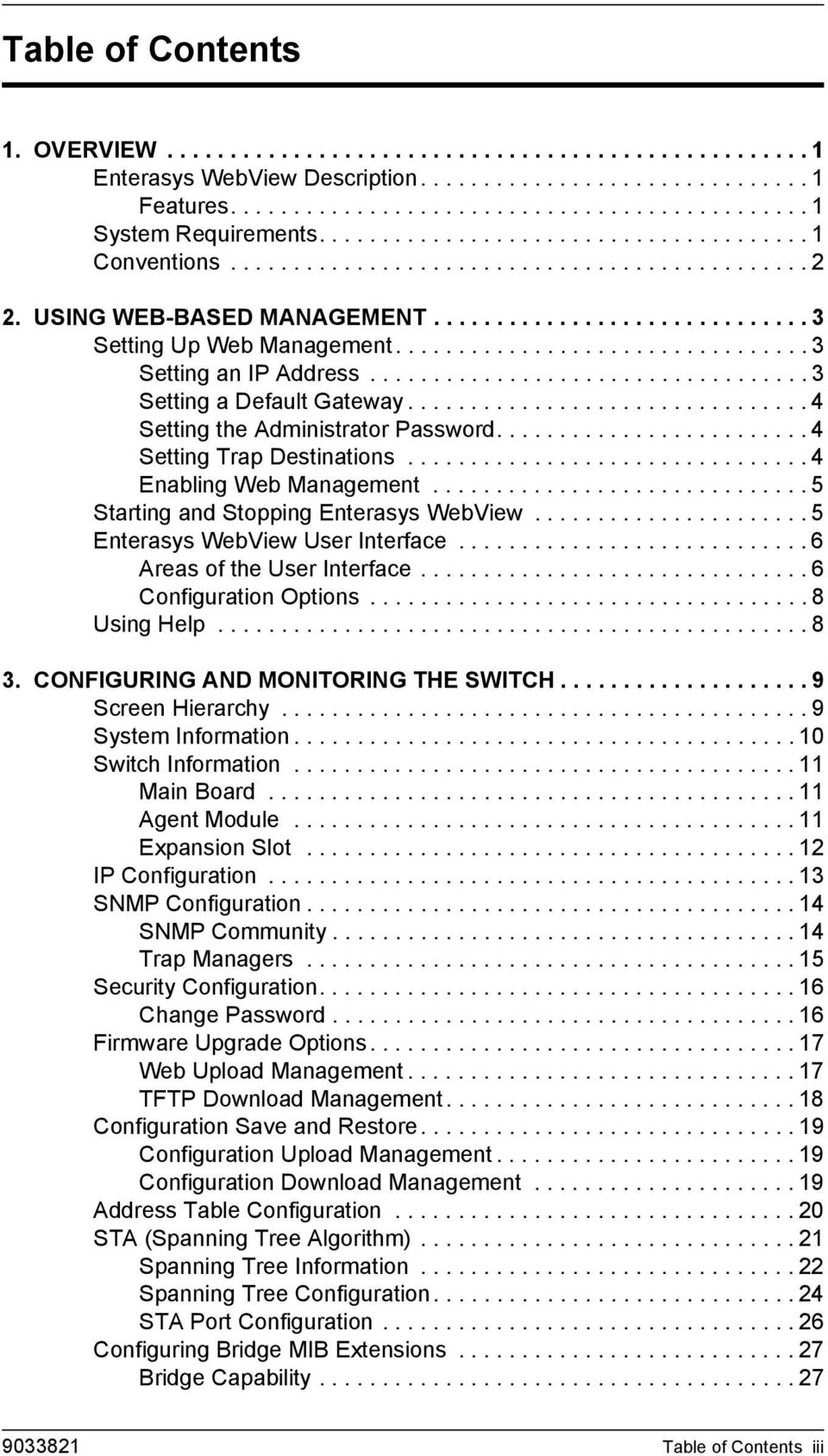
6 Bridge Settings Priority Port Priority Configuration Port Traffic Class Information VLAN Management Configuring Virtual LANs VLAN Basic Information VLAN Current Table VLAN Static List VLAN Static Table VLAN Static Membership by Port VLAN Port Configuration IGMP Multicast Filtering Configuring IGMP Multicast Router Port Information Static Multicast Router Port Configuration IGMP Member Port Table IP Multicast Registration Table Port Menus Port Information Port Configuration Expansion Port Information Expansion Port Configuration Port Broadcast Storm Protection Configuration Port Security Configuration Using a Port Mirror for Analysis Port Trunk Configuration Port Statistics Etherlike Statistics RMON Statistics System Restart APPENDIX A. TROUBLESHOOTING Troubleshooting Cannot Connect to the Switch System is Disconnected from the Switch Frequently Asked Questions Can I Open More Than One Window for Same Switch? Will Network Congestion Prevent Use of Enterasys WebView?.. 58 How Do I Confirm a Successful Software Download? INDEX iv Table of Contents VH-2402S/VH-2402S2

7 1. OVERVIEW Enterasys WebView This user guide describes Enterasys WebView, a web browser-based utility which allows you to remotely configure and manage Enterasys Networks products, including the VH-2402S/VH-2402S2 stackable switches. There is no software to install as Web management capability is built into the unit s VH-SMGMT/VH-SMGMT2 Management Module. Enterasys WebView provides a graphical, real-time representation of the front panel on a switch. This graphic, along with additionally defined areas of the browser interface, allow you to interactively configure a switch, monitor its status, and view statistical information. Enterasys WebView provides a simple, intuitive method for managing the VH-2402S/VH-2402S2 stackable switches. These switches can also be managed via the serial console, Telnet, or SNMP. Features Switch configuration and monitoring from any Java-enabled browser (Preferred browsers include Internet Explorer 4.0 or above, or Netscape Navigator 4.0 or above) Easy to navigate menuing system Detailed parameter descriptions using the Help button Switch operating status viewing front panel color indications Alarm configuration capability Web management enable System Requirements The requirements for running Enterasys WebView are relatively simple. You will need a Java-enabled, frames-capable Web browser and a TCP/ IP network connection to the switch, whether over a local network, a remote private network, or over the Internet. When connecting over the Internet, the integrity of your connection will have an impact on the speed and performance of tasks. If your connection is subject to prohibitive periods of network congestion, or experiences high packet loss, you may need to consider a different Internet service provider. In addition, Enterasys WebView uses SNMP for some of its communications with the switch. This may cause problems when the application is run across some Internet firewalls, which may be configured to disallow SNMP access Overview 1

8 Conventions This guide uses the following user input conventions: When you read Select, use the mouse to either select the link identified by a hand icon, or select the identified button or area. When you read Enter, type in the text and select the button identified in the procedure. 2 Overview VH-2402S/VH-2402S2

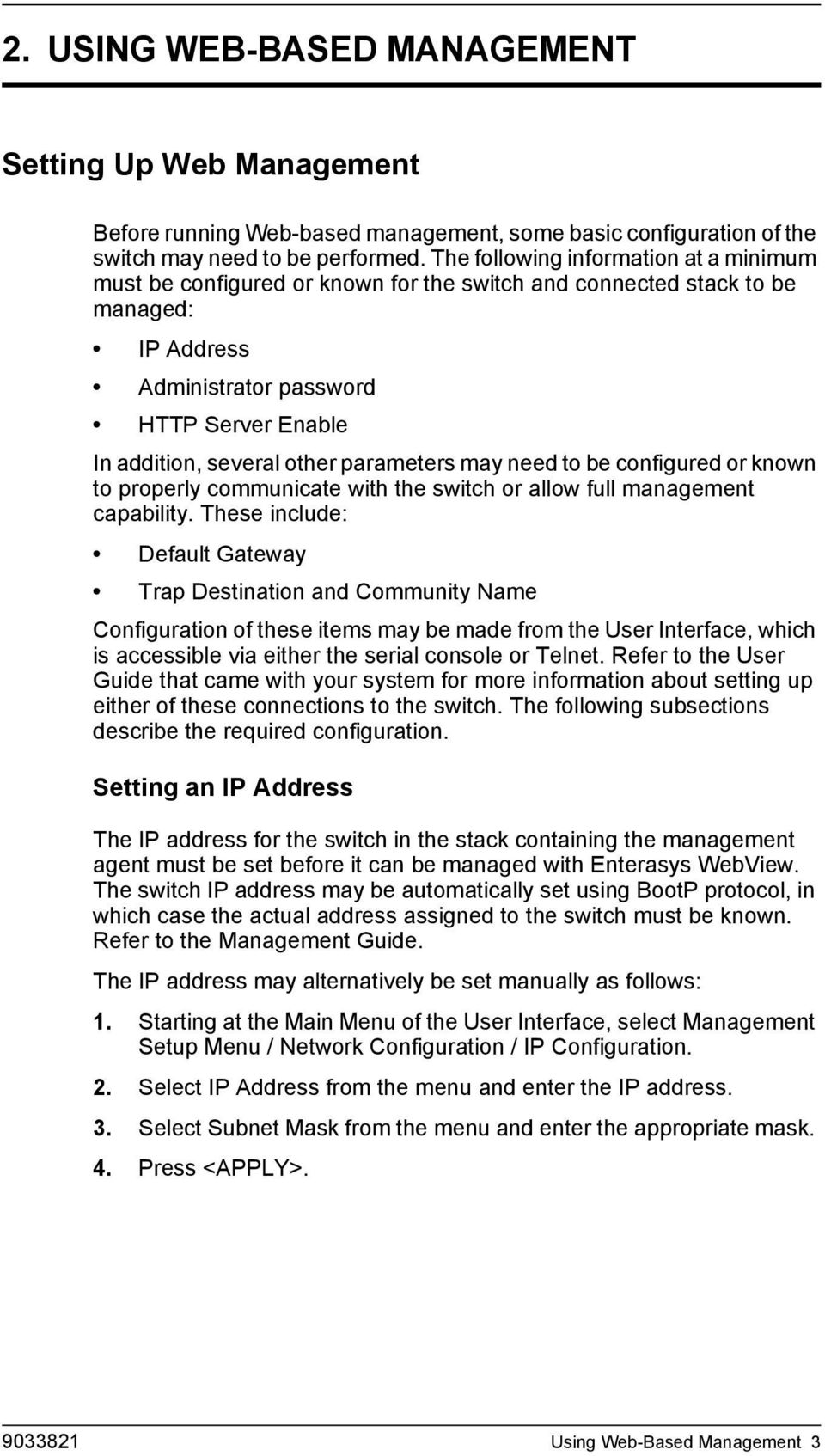
9 2. USING WEB-BASED MANAGEMENT Setting Up Web Management Before running Web-based management, some basic configuration of the switch may need to be performed. The following information at a minimum must be configured or known for the switch and connected stack to be managed: IP Address Administrator password HTTP Server Enable In addition, several other parameters may need to be configured or known to properly communicate with the switch or allow full management capability. These include: Default Gateway Trap Destination and Community Name Configuration of these items may be made from the User Interface, which is accessible via either the serial console or Telnet. Refer to the User Guide that came with your system for more information about setting up either of these connections to the switch. The following subsections describe the required configuration. Setting an IP Address The IP address for the switch in the stack containing the management agent must be set before it can be managed with Enterasys WebView. The switch IP address may be automatically set using BootP protocol, in which case the actual address assigned to the switch must be known. Refer to the Management Guide. The IP address may alternatively be set manually as follows: 1. Starting at the Main Menu of the User Interface, select Management Setup Menu / Network Configuration / IP Configuration. 2. Select IP Address from the menu and enter the IP address. 3. Select Subnet Mask from the menu and enter the appropriate mask. 4. Press <APPLY> Using Web-Based Management 3
10 Setting a Default Gateway The default gateway parameter defines the IP address of a router or other network device to which IP packets are to be sent if destined for a subnet outside of that in which the switch is operating. This parameter must be set if you are attempting to manage the switch using Enterasys WebView from a remote network or across the Internet. 1. Starting at the Main Menu of the User Interface, select Management Setup Menu / Network Configuration / IP Configuration. 2. Select Gateway IP from the menu and enter the router IP address. Press <APPLY>. Setting the Administrator Password Management access to the switch using Enterasys WebView is restricted based on the an administrator password. Administrators have read/write access for parameters governing the SNMP agent. You should therefore assign a password to the default administrator (User Name: ADMIN) as soon as possible, and store it in a safe place. (If for some reason your password is lost, or you cannot gain access to the system s configuration program, contact your Enterasys distributor for assistance.) 1. Starting at the Main Menu of the User Interface, select Management Setup Menu / Console Login Configuration. 2. Move to the Password field for the User Name ADMIN in this menu, and enter the password. Press <APPLY>. Setting Trap Destinations If you wish to record SNMP traps, or events, generated by the switch, you must configure the destination for IP Trap Managers. A trap destination is the IP address of the system being used to manage the device, in this case the IP address of the computer system on which Enterasys WebView is being run. 1. Starting at the Main Menu of the User Interface, select Management Setup Menu / SNMP Configuration / IP Trap Managers. 2. Select an entry for an IP Trap Manager from the menu, then enter the IP address and community name. 3. Move to the Status field, and use the Space bar to select ENABLED. 4. Press <APPLY>. 4 Using Web-Based Management VH-2402S/VH-2402S2

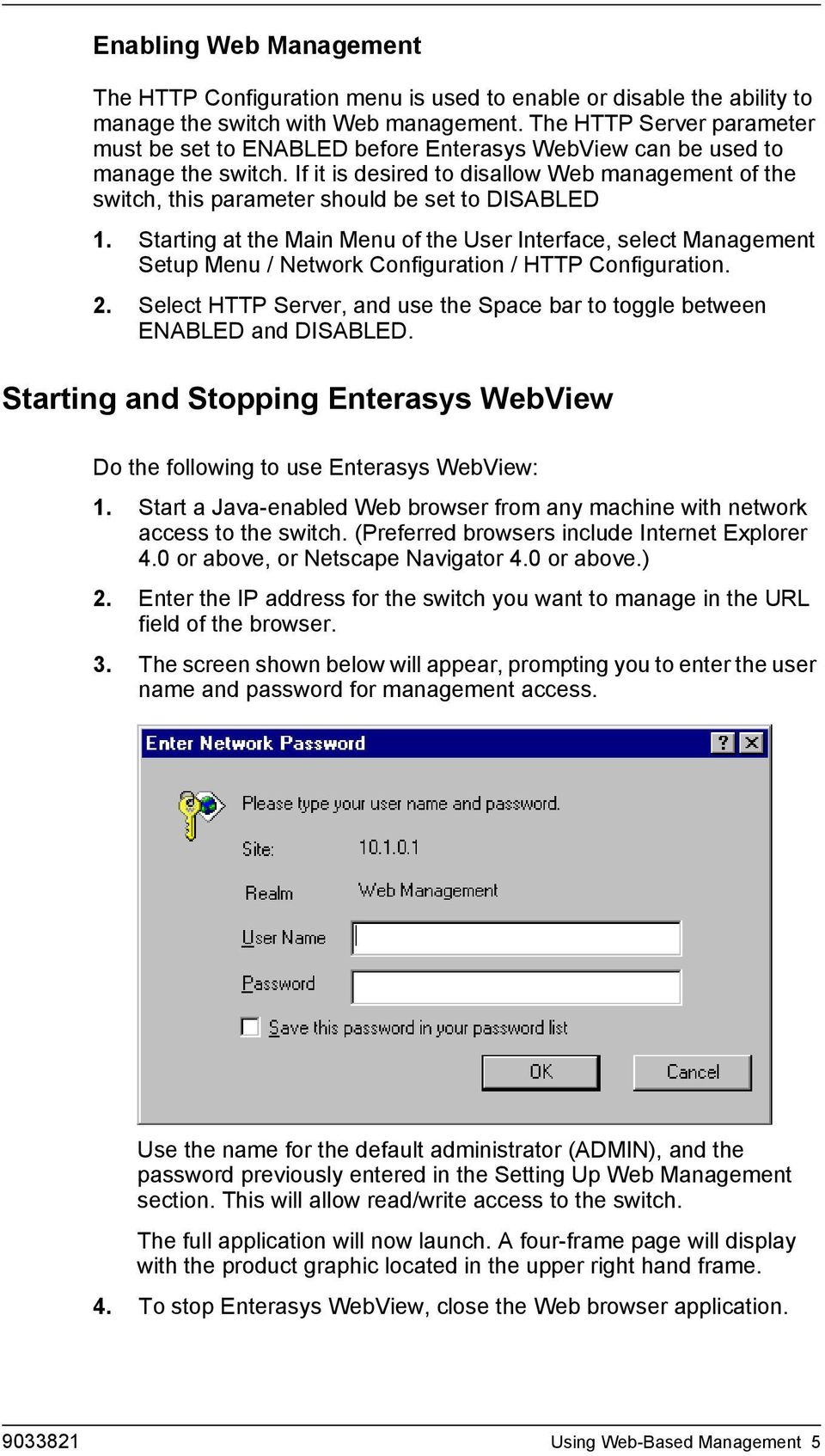
11 Enabling Web Management The HTTP Configuration menu is used to enable or disable the ability to manage the switch with Web management. The HTTP Server parameter must be set to ENABLED before Enterasys WebView can be used to manage the switch. If it is desired to disallow Web management of the switch, this parameter should be set to DISABLED 1. Starting at the Main Menu of the User Interface, select Management Setup Menu / Network Configuration / HTTP Configuration. 2. Select HTTP Server, and use the Space bar to toggle between ENABLED and DISABLED. Starting and Stopping Enterasys WebView Do the following to use Enterasys WebView: 1. Start a Java-enabled Web browser from any machine with network access to the switch. (Preferred browsers include Internet Explorer 4.0 or above, or Netscape Navigator 4.0 or above.) 2. Enter the IP address for the switch you want to manage in the URL field of the browser. 3. The screen shown below will appear, prompting you to enter the user name and password for management access. Use the name for the default administrator (ADMIN), and the password previously entered in the Setting Up Web Management section. This will allow read/write access to the switch. The full application will now launch. A four-frame page will display with the product graphic located in the upper right hand frame. 4. To stop Enterasys WebView, close the Web browser application Using Web-Based Management 5
12 Enterasys WebView User Interface The Enterasys WebView user interface provides access to various switch configuration and management screens, allows you to view performance statistics, and permits you to graphically monitor system status. Areas of the User Interface Figure 2-1 shows the Enterasys WebView user interface. The user interface is divided into four distinct areas as described in Table 2-1. Area 1 Area 2 Area 4 Area 3 Figure 2-1. Enterasys WebView User Interface 6 Using Web-Based Management VH-2402S/VH-2402S2

13 Table 2-1. Areas of the User Interface Area Function 1 Displays the Enterasys Networks logo. Selecting this area takes you directly to the Enterasys Networks Web site. 2 Presents a graphical near real-time image of the front panel of the selected switch. This area displays the switch s ports and expansion modules, showing port activity, duplex mode, or flow control, depending on the specified mode. Various areas of the graphic can be selected for performing management functions, including the ports, expansion modules, management module, or the case. 3 Displays a list of links allowing you to go to the associated menu or screen by selecting the item. 4 Presents switch information based on your selection. Table 2-2 describes configuration and system information functions available In Area 3. Table 2-2. Area 3 Functions Function System Switch IP SNMP Security Upgrade Configuration Save&Restore Address Table STA Bridge Extension Priority VLAN Management VLAN IGMP Port Mirror Trunk Provides basic system description, including contact information. Shows hardware/firmware version numbers, power status, and expansion modules in use. Includes boot state, IP address, and Telnet session count. Configures communities and trap managers; and activates traps. Sets password for system access. Downloads new version of firmware to update your system. Allows you to save/restore the switch configuration to a file on a server. Provides full listing or unicast addresses, sorted by address or VLAN. Enables Spanning Tree Algorithm; also sets parameters for switch priority, hello time, maximum message age, and forward delay; as well as port priority and path cost. Displays/configures extended bridge capabilities provided by this switch, including support for traffic classes, GMRP multicast filtering, and VLAN extensions. Configures default port priorities and queue assignments. Allows you to restrict management access to the switch to one VLAN. Configures VLAN group members, automatic registration with GVRP, and other port-specific VLAN settings. Configures IGMP multicast filtering. Enables any port, sets communication mode to auto-negotiation, full duplex or half duplex, and enables/disables flow control. Sets the source and target ports for mirroring. Specifies ports to group into aggregate trunks Using Web-Based Management 7

14 Function Statistics Restart Displays statistics on network traffic passing through the selected port. Configuration Options Web pages that include selection options have a drop-down list with a Select button to confirm the selection. Configurable parameters have a dialog box or a drop-down list. Once a configuration change has been made on a page, be sure to click on the Apply button at the bottom of the page to confirm the new setting. The following table summarizes the Web page configuration buttons. Table 2-3. Web Page Configuration Buttons Button Select Apply Revert Refresh Help Action Sets the selected option from the drop-down list. Sets specified values in the SNMP agent. Cancels specified values prior to pressing the Apply button. Immediately updates values from the SNMP agent. Provides help on using the Web management interface. Using Help General Enterasys WebView help guidelines are available by using the Help button in Area 3. 8 Using Web-Based Management VH-2402S/VH-2402S2

15 3. CONFIGURING AND MONITORING THE SWITCH This section, arranged by topic, describes how to perform common monitoring and configuration tasks on an VH-2402S/VH-2402S2 switch using Enterasys WebView. After you have properly configured the switch, and started Enterasys WebView, you can perform any of the tasks described in the following sections. Screen Hierarchy The contents of this chapter are arranged following the structure shown in Figure 3-1. System Switch IP SNMP Security Upgrade Configuration Save&Restore Address Table STA Bridge Extension Priority VLAN Management VLAN IGMP Port Mirror Trunk Statistics Restart Main Board Agent Module Expansion Slot SNMP Community Trap Managers Web Upload Management TFTP Download Management STA Information STA Configuration STA Port Configuration Port Priority Configuration Port Traffic Class Information VLAN Basic Information VLAN Current Table VLAN Static List VLAN Static Table VLAN Static Membership by Port VLAN Port Configuration IGMP Configuration Multicast Router Port Information Static Multicast Router Port Configuration IGMP Member Port Table IP Multicast Registration Table Port Information Port Configuration Expansion Port Information Expansion Port Configuration Port Broadcast Storm Protection Configuration Port Security Configuration Port Statistics RMON Statistics Figure 3-1. Enterasys WebView Screen Hierarchy Configuring and Monitoring the Switch 9

16 System Information Use the System Information screen to display descriptive information about the switch, or for quick system identification as shown in the following figure and table. Figure 3-2. System Information System Name 1 IP Address 2 Object ID Location 1 Contact 1 System Up Time Name assigned to the switch system. IP address of the agent you are managing. The agent module supports SNMP over UDP/IP transport protocol. In this environment, all systems on the Internet, such as network interconnection devices and any PC accessing the agent module (or running management software) must have an IP address. Valid IP addresses consist of four numbers, of 0 to 255, separated by periods. Anything outside of this format will not be accepted by the configuration program. MIB II object identifier for switch s network management subsystem. Specifies the area or location where the system resides. Contact person for the system. Length of time the current management agent has been running. 1 Maximum string length is 255, but the screen only displays 45 characters. You can use the arrow keys to browse the whole string. 2 The default value is Configuring and Monitoring the Switch VH-2402S/VH-2402S2

17 Switch Information Use the Switch Information screen to display hardware/firmware version numbers for the main board and agent module, as well as the power status and modules plugged into the system. Main Board Figure 3-3. Switch Information - Main Board Serial Number Number of Ports Hardware Version Firmware Version Internal Power Status Redundant Power Status Serial number of the main board. Number of ports in this unit (including modules). Hardware version of the main board. System firmware version in ROM. Power status for the switch. Redundant power status for the switch. Agent Module Figure 3-4. Switch Information - Agent Module Hardware Version POST ROM Version Firmware Version Role Hardware version of the agent module. Agent module s Power-On Self-Test version. Agent module s firmware version. Shows if this module is Master or Backup Master Configuring and Monitoring the Switch 11

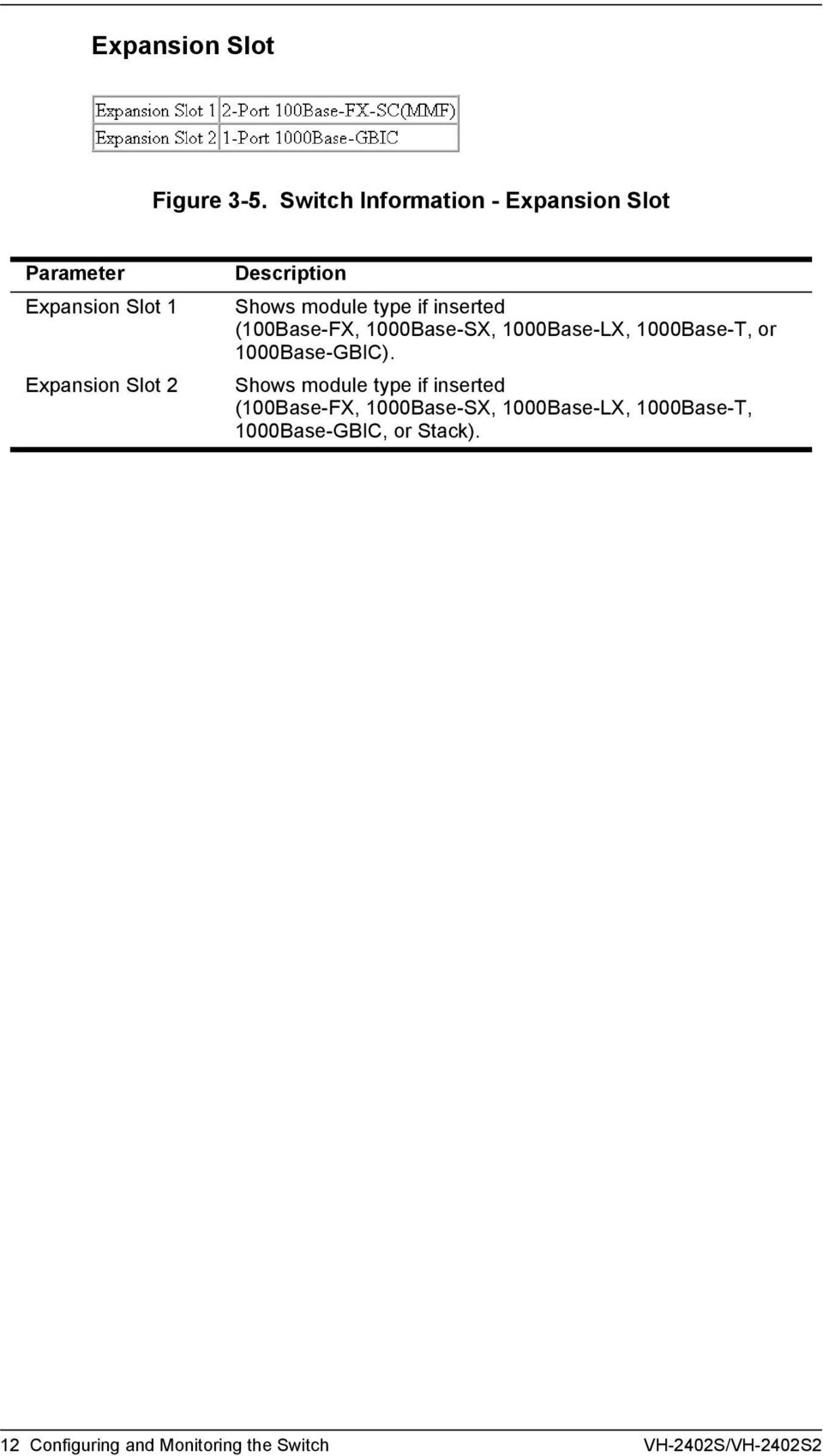
18 Expansion Slot Figure 3-5. Switch Information - Expansion Slot Expansion Slot 1 Expansion Slot 2 Shows module type if inserted (100Base-FX, 1000Base-SX, 1000Base-LX, 1000Base-T, or 1000Base-GBIC). Shows module type if inserted (100Base-FX, 1000Base-SX, 1000Base-LX, 1000Base-T, 1000Base-GBIC, or Stack). 12 Configuring and Monitoring the Switch VH-2402S/VH-2402S2
19 IP Configuration Use the IP Configuration screen to set the bootup option, configure the Ethernet IP address for the agent module, or set the number or concurrent Telnet sessions allowed. The screen shown below is described in the following table. Figure 3-6. IP Configuration Default IP State USER- CONFIG Specifies whether IP functionality is enabled via manual configuration, or set by Boot Protocol (BootP). Options include: BootP Get IP - IP is enabled but will not function until a BootP reply has been received. BootP requests will be periodically broadcast by the switch in an effort to learn its IP address. (BootP values include the IP address, default gateway, and subnet mask.) USER-CONFIG - IP functionality is enabled based on the default or user specified IP Configuration. (This is the default setting.) IP Address IP address of the agent you are managing. The agent module supports SNMP over UDP/IP transport protocol. In this environment, all systems on the Internet, such as network interconnection devices and any PC accessing the agent module (or running management software) are assigned an IP address. Valid IP addresses consist of four numbers, of 0 to 255, separated by periods. Anything outside of this format will not be accepted by the configuration program. Master IP Shows the IP address of the switch in the stack operating as Master. Backup Master IP Shows the IP address of the switch in the stack operating as Backup Master. (Not implemented in the current firmware release.) Subnet Mask Subnet mask of the agent you have selected. This mask identifies the host address bits used for routing to specific subnets Configuring and Monitoring the Switch 13
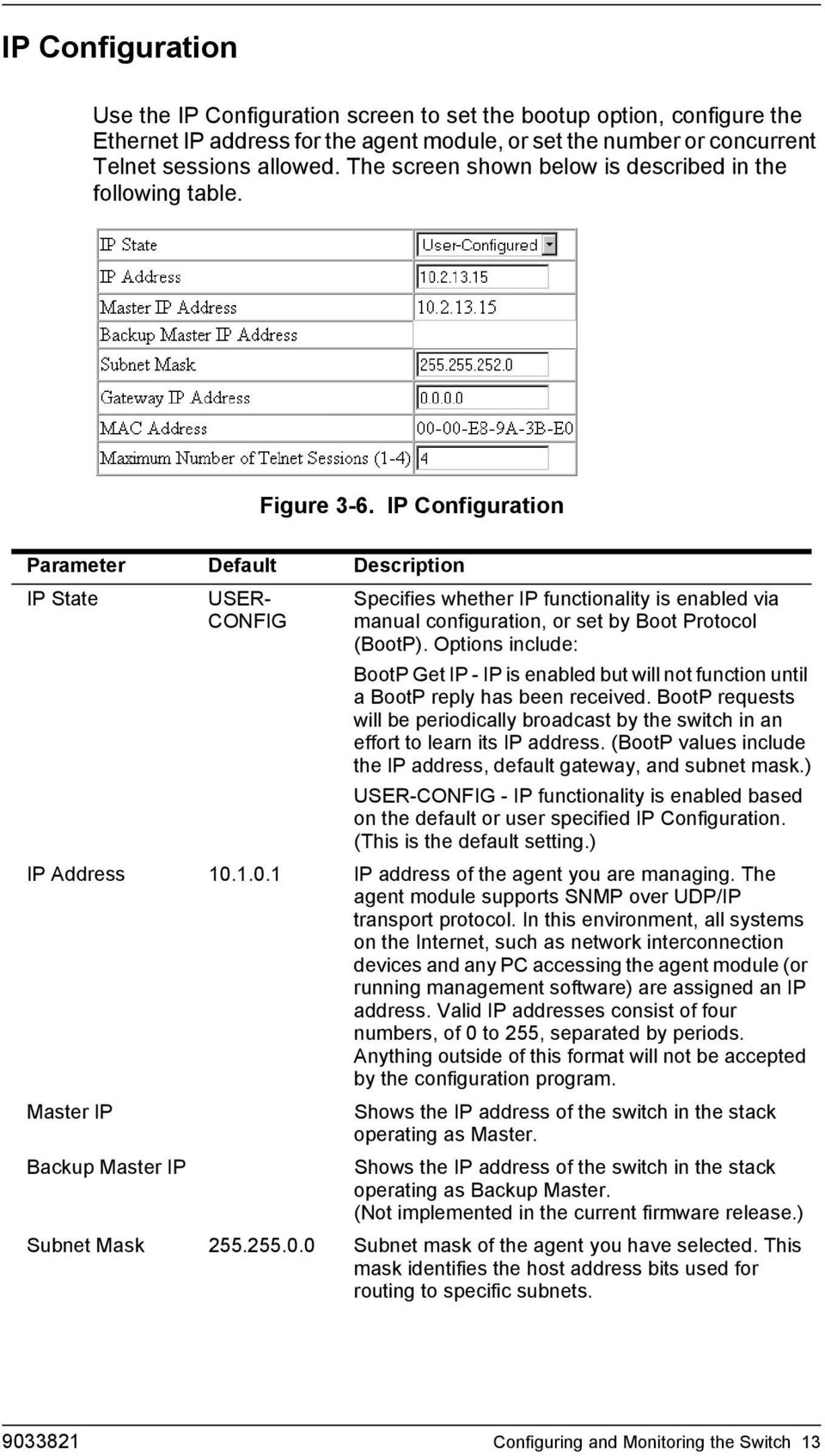
20 Default Gateway IP Gateway used to pass trap messages from the switch s agent to the management station. Note that the gateway must be defined if the management station is located in a different IP segment. MAC Address Physical address of the agent module. Number of Telnet sessions 4 Sets the number of concurrent Telnet sessions allowed to access the agent module. SNMP Configuration Use the SNMP Configuration screen to display and modify parameters for the Simple Network Management Protocol (SNMP). The switch includes an on-board SNMP agent which monitors the status of its hardware, as well as the traffic passing through its ports. A computer attached to the network, called a Network Management Station (NMS), can be used to access this information. Access rights to the on-board agent are controlled by community strings. To communicate with the switch, the NMS must first submit a valid community string for authentication. The options for configuring community strings and related trap functions are described in the following figures and table. SNMP Community The following figure and table describe how to configure the community strings authorized for management access. Up to 5 community names may be entered. Figure 3-7. SNMP Community SNMP Community Capability Add/Remove Community String Access Mode Up to 5 community strings may be used. Add/remove strings from the active list. A community entry authorized for management access. (The maximum string length is 20 characters). Management access is restricted to Read Only or Read/Write. 14 Configuring and Monitoring the Switch VH-2402S/VH-2402S2

21 Trap Managers The following figure and table describe how to specify management stations that will receive authentication failure messages or other trap messages from the switch. Up to 5 trap managers may be entered. Figure 3-8. Trap Managers Trap Manager Capability Trap Manager IP Address Trap Manager Community String Add/Remove Enable Authentication Traps Up to 5 trap managers may be used. IP address of the trap manager. A community authorized to receive trap messages. Add/remove strings from the active list. Issues a trap message to specified IP trap managers whenever authentication of an SNMP request fails. Default: enabled Configuring and Monitoring the Switch 15
22 Security Configuration Use the Security Configuration screen to restrict management access based on a specified password. The Administrator has write access for parameters governing the SNMP agent. You should therefore assign a password to the Administrator as soon as possible, and store it in a safe place. (If for some reason your password is lost, or you cannot gain access to the system s configuration program, contact your Enterasys distributor for assistance.) Change Password Figure 3-9. Change Password This password is for the system Administrator, with access privilege of Read/Write for all screens. Passwords can consist of up to 11 alphanumeric characters and are not case sensitive. (User name: admin; default password: null) 16 Configuring and Monitoring the Switch VH-2402S/VH-2402S2
23 Firmware Upgrade Options You can upgrade system firmware via a Web browser, a TFTP server, or a direct connection to the console port (see the VH-2402S/VH-2402S2 Management Guide). Web Upload Management Use the Web Upload Management menu to load software updates into the switch. The upload file should be an VH-2402S/VH-2402S2 binary file from Enterasys; otherwise the agent will not accept it. The success of the upload operation depends on the quality of the network connection. After uploading the new software, the agent will automatically restart itself. s shown on this screen are indicated in the following figure and table. Figure Web Upload Management Upload Mode File Name Start Web Upload Indicates an upload to permanent flash ROM. The binary file to download. Use the browse button to locate the file on your local network. Starts uploading the file over the network Configuring and Monitoring the Switch 17
24 TFTP Download Management Use the TFTP Download Management menu to load software updates into the switch. The download file should be an VH-2402S/VH-2402S2 binary file from Enterasys; otherwise the agent will not accept it. The success of the download operation depends on the accessibility of the TFTP server and the quality of the network connection. After downloading the new software, the agent will automatically restart itself. s shown on this screen are indicated in the following figure and table. Figure TFTP Download Management Server IP Address Download Mode File Name Start TFTP Download IP address of a TFTP server. Indicates a download to permanent flash ROM. The binary file to download. Issues request to TFTP server to download the specified file. 18 Configuring and Monitoring the Switch VH-2402S/VH-2402S2
25 Configuration Save and Restore Use the Configuration Save&Restore screen to save the switch configuration settings to a file on a TFTP server. The file can be later downloaded to the switch to restore the switch s settings. The success of the operation depends on the accessibility of the TFTP server and the quality of the network connection. Configuration Upload Management Use the Configuration Upload Management to save the switch configuration to a file on a TFTP sever. s shown on this screen are indicated in the following figure and table. Figure Configuration Upload Management Server IP Address File Name Start Configuration TFTP Upload IP address of a TFTP server. The name of the file to contain the switch configuration settings. Issues a request to upload the configuration settings to the specified file on the TFTP server. Configuration Download Management Use the Configuration Download Management to restore switch configuration settings from a file on a TFTP sever. s shown on this screen are indicated in the following figure and table. Figure Configuration Download Management Server IP Address File Name Start Configuration TFTP Download IP address of the TFTP server. The name of the file that contains the switch configuration settings you wish to restore. Issues a request to the TFTP server to download the specified file Configuring and Monitoring the Switch 19
26 Address Table Configuration The Address Table contains the unicast MAC addresses and VLAN identifier associated with each port (that is, the source port associated with the address and VLAN), sorted by MAC address or VLAN. You can also clear the entire address table, or information associated with a specific address; or set the aging time for deleting inactive entries. The information displayed in the Address Table is indicated in the following figure and table. Figure Address Table Aging Time Dynamic Address Counts Static Address Counts Address Table Address Table Sort Key New Static Address Add/Remove Clear Table Time-out period in seconds for aging out dynamically learned forwarding information. Range: secs; default: 300 secs. The number of dynamically learned addresses currently in the table. The number of static addresses currently in the table. All entries, sorted by address or VLAN ID. The system displays the MAC address of each node, the switch unit and port whose address table includes this MAC address, the associated VLAN(s), and the address status (i.e., dynamic or static). Use these fields to add or remove a static entry to the address table. Indicate the address, stack unit, port and VLAN group when adding a new entry. Adds/removes selected address. Removes all addresses from the address table. 20 Configuring and Monitoring the Switch VH-2402S/VH-2402S2
27 STA (Spanning Tree Algorithm) The Spanning Tree Algorithm can be used to detect and disable network loops, and to provide backup links between switches, bridges or routers. This allows the switch to interact with other bridging devices (that is, STA compliant switch, bridge or router) in your network to ensure that only one route exists between any two stations on the network. For a more detailed description of how to use this algorithm, refer to Appendix A, Spanning Tree Concepts, in the VH-2402S/VH-2402S2 Management Guide Configuring and Monitoring the Switch 21
28 Spanning Tree Information The Spanning Tree Information screen displays a summary of the STA information for the overall bridge or for a specific port or module. To make any changes to the parameters for the Spanning Tree, use the Spanning Tree Configuration menu. Also note that this screen cannot be accessed unless you have already enabled the Spanning Tree Algorithm via the Spanning Tree Configuration menu (page 24). Spanning Tree The parameters shown in the following figure and table describe the current bridge STA Information. Figure STA Information - Spanning Tree Spanning Tree State Bridge ID Max Age Hello Time Forward Delay Root Port Designated Root Root Path Cost Configuration Changes Last Topology Change Shows if the switch is enabled to participate in an STAcompliant network. A unique identifier for this bridge, consisting of bridge priority plus MAC address (where the address is normally taken from Port 1). The maximum time (in seconds) a device can wait without receiving a configuration message before attempting to reconfigure. The time interval (in seconds) at which the root device transmits a configuration message. The maximum time (in seconds) the root device will wait before changing states (i.e., listening to learning to forwarding). The number of the port on this switch that is closest to the root. This switch communicates with the root device through this port. If there is no root port, then this switch has been accepted as the root device of the spanning tree network. The priority and MAC address of the device in the spanning tree that this switch has accepted as the root device. The path cost from the root port on this switch to the root device. The number of times the spanning tree has been reconfigured. The time since the spanning tree was last reconfigured. 22 Configuring and Monitoring the Switch VH-2402S/VH-2402S2
29 Ports The parameters shown in the following figure and table are for port or module STA Information (Port 1~28). Figure STA Information - Ports Port Status Forward Transitions Designated Cost Designated Bridge Designated Port Displays the current state of this port within the spanning tree: No Link There is no valid link on the port. Disabled Port has been disabled by the user or has failed diagnostics. Blocked Port receives STA configuration messages, but does not forward packets. Listening Port will leave blocking state due to topology change, starts transmitting configuration messages, but does not yet forward packets. Learning Has transmitted configuration messages for an interval set by the Forward Delay parameter without receiving contradictory information. Port address table is cleared, and the port begins learning addresses. Forwarding The port forwards packets, and continues learning addresses. The rules defining port status are: A port on a network segment with no other STAcompliant bridging device is always forwarding. If two ports of a switch are connected to the same segment and there is no other STA device attached to this segment, the port with the smaller ID forwards packets and the other is blocked. All ports are blocked when the switch is booted, then some of them change state to listening, to learning, and then to forwarding. The number of times the port has changed status to forwarding state. The cost for a packet to travel from this port to the root in the current spanning tree configuration. The slower the media, the higher the cost. The priority and MAC address of the device through which this port must communicate to reach the root of the spanning tree. The priority and number of the port on the designated bridging device through which this switch must communicate with the root of the spanning tree Configuring and Monitoring the Switch 23
30 Spanning Tree Configuration The following figures and tables describe Bridge STA configuration. Switch Figure STA Configuration - Switch Default Usage Enabled Enable this parameter to participate in an STAcompliant network. Priority 32,768 Device priority is used in selecting the root device, root port, and designated port. The device with the highest priority becomes the STA root device. (Remember that the lower the numeric value, the higher the priority.) However, if all devices have the same priority, the device with the lowest MAC address will then become the root device. Range: Configuring and Monitoring the Switch VH-2402S/VH-2402S2
31 When the Switch Becomes Root Figure STA Configuration - When the Switch Becomes Root Default Hello Time 2 The time interval (in seconds) at which the root device transmits a configuration message. The minimum value is 1. The maximum value is the lower of 10 or [(Max. Message Age / 2) -1]. Max (Message) Age 20 The maximum time (in seconds) a device can wait without receiving a configuration message before attempting to reconfigure. All device ports (except for designated ports) should receive configuration messages at regular intervals. Any port that ages out STA information (provided in the last configuration message) becomes the designated port for the attached LAN. If it is a root port, a new root port is selected from among the device ports attached to the network. The minimum value is the higher of 6 or [2 x (Hello Time + 1)]. The maximum value is the lower of 40 or [2 x (Forward Delay - 1)]. Forward Delay 15 The maximum time (in seconds) the root device will wait before changing states (i.e., listening to learning to forwarding). This delay is required because every device must receive information about topology changes before it starts to forward frames. In addition, each port needs time to listen for conflicting information that would make it return to a blocking state; otherwise, temporary data loops might result. Maximum value is 30. Minimum value is the higher of 4 or [(Max. Message Age / 2) + 1] Configuring and Monitoring the Switch 25
32 STA Port Configuration The following figure and table describe STA configuration for ports or modules.... Figure STA Port Configuration Default Fast forwarding mode (all ports) ENABLED Allows you to enable or disable fast forwarding for all ports on the switch. Priority 128 Defines the priority for the use of a port in the STA algorithm. If the path cost for all ports on a switch are the same, the port with the highest priority (i.e., lowest value) will be configured as an active link in the spanning tree. Where more than one port is assigned the highest priority, the port with lowest numeric identifier will be enabled. The range is (Path) Cost 100/19/4 This parameter is used by the STA algorithm to determine the best path between devices. Therefore, lower values should be assigned to ports attached to faster media, and higher values assigned to ports with slower media. The default and recommended range is: Standard Ethernet: 100(50~600) Fast Ethernet: 19(10~60) Gigabit Ethernet: 4(3~10) The full range is Note: Path cost takes precedence over port priority. Fast Forward ENABLED This parameter is used to enable/disabled the Fast Spanning Tree mode for the port. In this mode, ports skip the Blocked, Listening and Learning states and proceed straight to Forwarding. Fast Forwarding enables end-node workstations and servers to overcome time-out problems when the Spanning Tree Algorithm is implemented in a network. Therefore, Fast Forwarding should only be enabled for ports that are connected to an end-node device. 26 Configuring and Monitoring the Switch VH-2402S/VH-2402S2
33 Configuring Bridge MIB Extensions The Bridge MIB includes extensions for managed devices that support Traffic Classes, Multicast Filtering and Virtual LANs. To configure these extensions, use the Extended Bridge Configuration screen as shown below: Bridge Capability Figure Bridge Capability Extended Multicast Filtering Services Traffic Classes Static Entry Individual Port Configurable PVID Tagging Local VLAN Capable Indicates that this switch does not support the filtering of individual multicast addresses based on GMRP (GARP Multicast Registration Protocol). Note that this function is not available for the current firmware release. This switch provides mapping of user priorities to multiple traffic classes. (Refer to the Priority menu on page 29.) This switch allows static filtering for unicast and multicast addresses. (Refer to the Address Table Configuration on page 19.) This switch allows you to override the default PVID setting (Port VLAN ID used in frame tags) and its egress status (VLAN- Tagged or Untagged) on each port. (Refer to VLAN Port Configuration on page 37.) This switch does not support multiple local bridges (that is, multiple Spanning Trees) Configuring and Monitoring the Switch 27
34 Bridge Settings Figure Bridge Settings Traffic Class* Multiple traffic classes are supported by this switch as indicated under Bridge Capabilities. However, you can disable this function by clearing this checkbox. VLAN Learning As default this switch uses Shared VLAN Learning (SVL), whereby all ports share one VLAN filtering database. However, you can set the switch to use Independent VLAN Learning (IVL), where each port maintains its own filtering database. Note that when you change from one method to the other, the switch will automatically reset and the current VLAN configuration will be lost.. GMRP* GARP Multicast Registration Protocol (GMRP) allows network devices to register endstations with multicast groups. Note that this function is not available for the current firmware release. The Internet Group Management Protocol (IGMP) is currently used by this switch to provide automatic multicast filtering. GVRP* GARP VLAN Registration Protocol (GVRP) defines a way for switches to exchange VLAN information in order to register necessary VLAN members on ports across the network. This function should be enabled to permit VLANs groups which extend beyond the local switch. * Not implemented in the current firmware release. 28 Configuring and Monitoring the Switch VH-2402S/VH-2402S2
35 Priority IEEE 802.1p defines up to 8 separate traffic classes. This switch supports Quality of Service (QoS) by using two priority queues, with strict priority queuing for each port. You can use the Priority menu to configure the default priority for each port, or to display the mapping for the traffic classes as described in the following sections. Port Priority Configuration The default priority for all ingress ports is zero. Therefore, any inbound frames that do not have priority tags will be placed in the low priority output queue. Default priority is only used to determine the output queue for the current port; no priority tag is actually added to the frame. You can use the Port Priority Configuration screen to adjust default priority for any port as shown below:... Figure Port Priority Configuration Port Default Ingress User Priority Number of Egress Traffic Classes Numeric identifier for switch port. Default priority can be set to any value from 0~7, where 0~3 specifies the low priority queue and 4~7 specifies the high priority queue. Indicates that this switch supports two priority output queues Configuring and Monitoring the Switch 29
36 Port Traffic Class Information This switch provides two priority levels with strict priority queuing for port egress. This means that any frames with a default or user priority from 0~3 are sent to the low priority queue 0 while those from 4~7 are sent to the high priority queue 1 as shown in the following screen:... Figure Port Traffic Class Information Port User Priority Numeric identifier for switch port. Shows that user priorities 0~3 specify the low priority queue and 4~7 specify the high priority queue. 30 Configuring and Monitoring the Switch VH-2402S/VH-2402S2
37 VLAN Management Use the VLAN Management screen to define which VLAN has management access to the switch. s shown on this screen are indicated in the following figure and table.: Figure VLAN Management Default CPU Join VLAN All Select ALL to give all VLANs access to switch management, or ONE to restrict access to a specified VLAN. If you select just one VLAN, you must specify its VLAN ID on the following line. VLAN ID 1 Specifies the VLAN ID that has access to switch management Configuring and Monitoring the Switch 31
38 Configuring Virtual LANs You can use the VLAN configuration menu to assign any port on the switch to any of up to 256 LAN groups. In conventional networks with routers, broadcast traffic is split up into separate domains. Switches do not inherently support broadcast domains. This can lead to broadcast storms in large networks that handle a lot of IPX and NetBeui traffic. By using IEEE 802.1Q compliant VLANs and GARP VLAN Registration Protocol, you can organize any group of network nodes into separate broadcast domains, confining broadcast traffic to the originating group. This also provides a more secure and cleaner network environment. For more information on how to use VLANs, refer to Virtual LANs in the VH-2402S/VH-2402S2 Management Guide. The VLAN configuration screens are described in the following sections. VLAN Basic Information The VLAN Basic Information screen displays basic information on the VLAN type supported by this switch. Figure VLAN Basic Information VLAN Version Number MAX VLAN ID MAX Supported VLANs Current Number of VLANs Configured The VLAN version used by this switch as specified in the IEEE 802.1Q standard. Maximum VLAN ID recognized by this switch. Maximum number of VLANs that can be configured on this switch. The number of VLANs currently configured on this switch. 32 Configuring and Monitoring the Switch VH-2402S/VH-2402S2
39 VLAN Current Table This screen shows the current port members of each VLAN and whether or not the port supports VLAN tagging. Ports assigned to a large VLAN group that crosses several switches should use VLAN tagging. However, if you just want to create a small port-based VLAN for one or two switches, you can assign ports to the same untagged VLAN (page 37). The current configuration is shown in the following screen. Figure VLAN Current Table VLAN Entry Delete Count VLAN ID Up Time at Creation Status Egress Ports Untagged Ports The number of times a VLAN entry has been deleted from this table. The ID for the VLAN currently displayed. The value of sysuptime (System Up Time) when this VLAN was created. Shows how this VLAN was added to the switch: Dynamic GVRP: Automatically learned via GVRP. Permanent: Added as a static entry. Shows the ports which have been added to the displayed VLAN group. Shows the untagged VLAN port members. VLAN Static List Use this screen to create or remove VLAN groups. Figure VLAN Static List Configuring and Monitoring the Switch 33
40 Current New Status Add Remove Lists all the current VLAN groups created for this system. Up to 256 VLAN groups can be defined. To allow this switch to participate in external VLAN groups, you must use the VLAN ID for the concerned external groups. Allows you to specify the name and numeric identifier for a new VLAN group. (The VLAN name is only used for management on this system; it is not added to the VLAN tag.) Enables/disables the specified VLAN. Adds a new VLAN group to the current list. Removes a VLAN group from the current list. If any port is assigned to this group as untagged, it will be reassigned to VLAN group 1 as untagged. VLAN Static Table Use this screen to modify the settings for an existing VLAN. You can add/ delete port members for a VLAN from any unit in the stack, disable or enable VLAN tagging for any port, or prevent a port from being automatically added to a VLAN via the GVRP protocol. (Note that VLAN 1 is fixed as an untagged VLAN containing all ports in the stack, and cannot be modified via this screen.) Figure VLAN Static Table - Add/Modify VLAN MODE VLAN Name Status Indicates if displayed VLAN is selected by VLAN ID or VLAN name. The ID for the VLAN currently displayed. Range: A user-specified symbolic name for this VLAN. String length: 8 alphanumeric characters Enables/disables the specified VLAN. 34 Configuring and Monitoring the Switch VH-2402S/VH-2402S2
41 Use the screens shown below to assign ports to the specified VLAN group as an IEEE 802.1Q tagged port. Assign ports as tagged if they are connected to 802.1Q VLAN compliant devices. If the port is connected to VLAN-unaware devices, frames will passed to the untagged VLAN group this port has been assigned to under VLAN Port Configuration (page 37). Figure VLAN Static Table - Port Assignment Egress Ports Forbidden Egress Ports Untagged Ports Adds ports to the specified VLAN. Prevents a port from being automatically added to this VLAN via GVRP. Adds ports to the specified VLAN as untagged Configuring and Monitoring the Switch 35
42 VLAN Static Membership by Port Use the screen shown below to assign VLAN groups to the selected port. To perform detailed port configuration for a specific VLAN, use the VLAN Static Table (page 34). Figure VLAN Static Membership by Port Port Number Add/Remove Port number on the switch selected from the upper display panel. Add or remove selected VLAN groups for the port indicated in the Port Number field. 36 Configuring and Monitoring the Switch VH-2402S/VH-2402S2
43 VLAN Port Configuration Use this screen to configure port-specific settings for IEEE 802.1Q VLAN features.... Figure VLAN Port Configuration PVID Ingress Filtering* The VLAN ID assigned to untagged frames received on this port. Use the PVID to assign ports to the same untagged VLAN. If enabled, incoming frames for VLANs which do not include this port in their member set will be discarded at the inbound port Q Trunk Status Used to enable/disable the VLAN trunk status for the port. A VLAN Trunk link between two VLAN-aware switches will carry traffic from all VLANs, allowing VLAN tagged frames to maintain their VLAN ID across multiple switches. When enabled, a port joins all configured VLANs and the untagged port VLAN ID (PVID) is set to 4000, a reserved VLAN ID for trunk ports. * This control does not affect VLAN independent BPDU frames, such as GVRP or STP. However, it does affect VLAN dependent BPDU frames, such as GMRP Configuring and Monitoring the Switch 37
44 IGMP Multicast Filtering Multicasting is used to support real-time applications such as video conferencing or streaming audio. A multicast server does not have to establish a separate connection with each client. It merely broadcasts its service to the network, and any hosts which want to receive the multicast register with their local multicast switch/router. Although this approach reduces the network overhead required by a multicast server, the broadcast traffic must be carefully pruned at every multicast switch/router it passes through to ensure that traffic is only passed on the hosts which subscribed to this service. This switch uses IGMP (Internet Group Management Protocol) to query for any attached hosts who want to receive a specific multicast service. The switch looks up the IP Multicast Group used for this service and adds any port which received a similar request to that group. It then propagates the service request on to any neighboring multicast switch/router to ensure that it will continue to receive the multicast service. (For more information, see IP Multicast Filtering in the VH-2402S/VH-2402S2 Management Guide.) Configuring IGMP This protocol allows a host to inform its local switch/router that it wants to receive transmissions addressed to a specific multicast address group. Use the IGMP Configuration screen to set key parameters for multicast filtering as shown below. Figure IGMP Configuration IGMP Status Act as IGMP Querier IGMP Query Count IGMP Report Delay If enabled, the switch will monitor network traffic to determine which hosts want to receive multicast traffic. If enabled, the switch can serve as the querier, which is responsible for asking hosts if they want to receive multicast traffic. The maximum number of queries issued for which there has been no response before the switch takes action to solicit reports. The time (in minutes) between receiving an IGMP Report for an IP multicast address on a port before the switch sends an IGMP Query out that port and removes the entry from its list. Note: The default values are indicated in the sample screen. 38 Configuring and Monitoring the Switch VH-2402S/VH-2402S2
45 Multicast Router Port Information You can use the Multicast Router Port Information screen to display the ports on this switch that are attached to a neighboring multicast router/ switch for each VLAN ID. Figure Multicast Router Port Information VLAN ID Multicast Router Port List The VLAN ID assigned to the multicast group in the displayed port list. The list of switch ports that are attached to a neighboring multicast router/switch Configuring and Monitoring the Switch 39
46 Static Multicast Router Port Configuration You can use the Static Multicast Router Port Configuration screen to assign ports that are attached to a neighboring multicast router/switch. Figure Static Multicast Router Port Configuration Current VLAN ID Unit Port Add Remove A list of the switch ports that have been manually configured as being attached to a neighboring multicast router/switch. The VLAN ID assigned to the multicast group that is to be added/ removed from the list. The stack unit ID of a port to be added/removed from the list. The port number of a port to be added/removed from the list. Adds a new router port to the current list. Removes a router port from the current list. 40 Configuring and Monitoring the Switch VH-2402S/VH-2402S2
47 IGMP Member Port Table You can use the IGMP Member Port Table screen to assign ports that are attached to hosts who want to receive a specific multicast service. Figure IGMP Member Port Table IGMP Member Port List VLAN ID Multicast IP Unit Port Add Remove The current switch ports that are listed as being attached to a IGMP host. The VLAN ID assigned to this multicast group. The IP address of a specific multicast service requested by the host. The stack unit ID of a port to be added/removed from the list. The port number of a port to be added/removed from the list. Adds a new host port to the current list. Removes a host port from the current list Configuring and Monitoring the Switch 41
48 IP Multicast Registration Table Use the IP Multicast Registration Table to display all the multicast groups active on this switch, including multicast IP addresses and the corresponding VLAN ID. Figure IP Multicast Registration Table IGMP groups counter Dynamic groups counter VLAN ID Multicast IP Address Learned by Multicast Group Port List The total number of multicast groups learned by IGMP. The total number of multicast groups learned dynamically. VLAN ID assigned to this multicast group. IP address for specific multicast services. Indicates the manner in which this address was learned: dynamic or IGMP. The switch ports registered for the indicated multicast service. 42 Configuring and Monitoring the Switch VH-2402S/VH-2402S2
49 Port Menus Port Information The Port Information screen displays the port status, link state, the communication speed and duplex mode, as well as the flow control status. To change any of the port settings, use the Port Configuration menu. The parameters shown in the following figure and table are for the RJ-45 ports.... Figure Port Information Admin Status Link Status Speed Status Duplex Status Flow Control Status Shows if the port is enabled or not. Indicates if the port has a valid connection to an external device. Shows the port speed (10M or 100M). Displays the current duplex mode. Shows the flow control type in use. Flow control can eliminate frame loss by blocking traffic from end stations connected directly to the switch. Back pressure is used for half duplex and IEEE 802.3x for full duplex. Note that flow control should not be used if a port is connected to a hub Configuring and Monitoring the Switch 43
50 Port Configuration Use the Port Configuration menus to configure any port on the switch.... Figure Port Configuration Default Flow Control Mode Disabled Allows you enable/disable flow control for all ports on the switch. Admin Status Enable Allows you to disable a port due to abnormal behavior (e.g., excessive collisions), and then reenable it after the problem has been resolved. You may also disable a port for security reasons. Speed/Duplex Status Auto- Negotiation Used to set the current port speed, duplex mode, and auto-negotiation. The default for RJ-45 ports is auto-negotiation. Flow Control Status Disabled Used to enable or disable flow control. Flow control can eliminate frame loss by blocking traffic from end stations or segments connected directly to the switch when its buffers fill. Back pressure is used for half duplex and IEEE 802.3x for full duplex. Note that flow control should not be used if a port is connected to a hub. Note: Auto-negotiation is not available for 100BASE-FX ports. 44 Configuring and Monitoring the Switch VH-2402S/VH-2402S2
51 Expansion Port Information The Expansion Port Information screen displays the port status, link state, the communication speed and duplex mode, as well as the flow control status. To change any of the port settings, use the Expansion Port Configuration menu. The parameters shown in the following figure and table are for expansion ports. Figure Expansion Port Information Admin Status Link Status Speed Status Duplex Status Flow Control Status Shows in the port is enabled or not. Indicates if the port has a valid connection to an external device. Shows the port speed (10M, 100M, or 1000M). Displays the current duplex mode (half or full duplex). Shows the flow control type in use. Flow control can eliminate frame loss by blocking traffic from end stations connected directly to the switch. Back pressure is used for half duplex and IEEE 802.3x for full duplex. Note that flow control should not be used if a port is connected to a hub Configuring and Monitoring the Switch 45
52 Expansion Port Configuration Use the Expansion Port Configuration menus to configure any port or module on the switch. Figure Expansion Port Configuration Default Admin Status Enable Allows you to disable a port due to abnormal behavior (e.g., excessive collisions), and then reenable it after the problem has been resolved. You may also disable a port for security reasons. Speed/Duplex Status Auto- Negotiation Used to set the port to full- or half-duplex mode, or auto-negotiation. The default for Gigabit ports is auto-negotiation. However, note that autonegotiation is not available for the 100Mbps fiber ports. Flow Control Status Disabled Used to enable or disable flow control. Flow control can eliminate frame loss by blocking traffic from end stations or segments connected directly to the switch when its buffers fill. Back pressure is used for half duplex and IEEE 802.3x for full duplex. Note that flow control should not be used if a port is connected to a hub. 46 Configuring and Monitoring the Switch VH-2402S/VH-2402S2
53 Port Broadcast Storm Protection Configuration Use the Port Broadcast Storm Protection Configuration screen to configure broadcast storm control for all ports in the switch stack. Figure Port Broadcast Storm Protection Configuration Broadcast Control Threshold Averaging Interval Allows you to enable/disable broadcast storm control for all ports in the switch stack. When enabled, the switch stack will employ a broadcast-control mechanism if the packet-per-second threshold is exceeded. This mechanism drops all broadcast packets from the stack for the time period specified in the Averaging Interval field. (Default is Disabled.) The packet-per-second threshold for broadcast packets received on all ports in the switch stack. (Default is 200 pps.) Specifies the time period for which broadcast packets will be dropped from the switch stack. Values can be 200 ms, 500 ms, 1, 5, or 10 seconds. (Default is 1 second.) Configuring and Monitoring the Switch 47
54 Port Security Configuration Use the Port Security Configuration screen to enable and configure port security for the switch. Port Security allows you to configure each port with a list of MAC addresses of devices that are authorized to access the network through that port. Figure Port Security Configuration Port Number Mode Secure address count Secure address count for port MAC Address List MAC Address Add Remove Clear All The port number on the unit. Port security can set to three states; Static, Disable, or Learning. When set to Static, the switch will drop packets from the port if the source MAC address does not match one of the addresses in the MAC Address list. If set to Learning, the switch will add the source MAC address of all packets received on the port to the authorized MAC Address list. The total number of authorized MAC addresses configured. The number of authorized MAC addresses configured for the specified port. A list of the current authorized MAC addresses that can access the network through the specified port. A specific MAC address to be added or deleted from the list. Adds a new MAC address to the current list. Removes a MAC address from the current list. Clears all the MAC addresses for the current port. 48 Configuring and Monitoring the Switch VH-2402S/VH-2402S2
55 Using a Port Mirror for Analysis You can mirror traffic from any source port to a target port for real-time analysis. You can then attach a logic analyzer or RMON probe to the target port and study the traffic crossing the source port in a completely unobtrusive manner. When mirroring port traffic, note that the target port must be configured in the same VLAN and be operating at the same speed as the source port (see VLAN Static List on page 33). If the target port is operating at a lower speed, the source port will be forced to drop its operating speed to match that of the target port. You can use the port mirror configuration screen to designate a single RJ-45 port pair for mirroring as shown below: Figure Mirror Port Configuration Status Mirror Source Unit Mirror Source Port Mirror Target Unit Mirror Target Port Enables/disables port mirroring. The switch containing the mirror source port. The port whose traffic will be monitored. The switch containing the mirror target port. The port that will duplicate or mirror all the traffic happening on the monitored port Configuring and Monitoring the Switch 49
56 Port Trunk Configuration Port trunks can be used to increase the bandwidth of a network connection or to ensure fault recovery. You can configure up five trunk connections (combining 2~4 ports into a fat pipe) between any two standalone VH-2402S/VH-2402S2 switches, or up to 12 for an entire stack. However, before making any physical connections between devices, use the Trunk Configuration menu to specify the trunk on the devices at both ends. When using a port trunk, note that: The ports used in a trunk must all be of the same media type (RJ-45, 100Mbps fiber, or 1000Mbps fiber). The ports that can be assigned to the same trunk also have certain other restrictions (see the next page). Ports can only be assigned to one trunk. The ports at both ends of a connection must be configured as trunk ports. The ports at both ends of a trunk must be configured in an identical manner, including speed, duplex mode, and VLAN assignments. None of the ports in a trunk can be configured as a mirror source port or mirror target port. All the ports in a trunk have to be treated as a whole when moved from/to, added or deleted from a VLAN. The Spanning Tree Algorithm will treat all the ports in a trunk as a whole. Enable the trunk prior to connecting any cable between the switches to avoid creating a loop. Disconnect all trunk port cables or disable the trunk ports before removing a port trunk to avoid creating a loop. 50 Configuring and Monitoring the Switch VH-2402S/VH-2402S2
57 Use the Port Trunking Configuration screen to set up port trunks as shown below: Figure Port Trunk Configuration Trunk Number Unit Port A unique identifier for this trunk. You can configure up to five trunks per standalone switch, or up to 12 for an entire stack. The switch unit this trunk is configured for. The port members of this trunk. Select from 2 ~ 4 ports per trunk. The RJ-45 ports used for each trunk must all be on the same internal switch chip. The port groups permitted include: Group 1 Group 2 Group 3 1,2,3,4, 5,6,7,8, 9,10,11,12, 13,14,15,16 17,18,19,20 21,22,23,24 Only two 100Mbps fiber ports can be configured as a trunk and these must be on the same module. 1000Base-SX/LX ports can be trunked to any other like uplink port in the stack Configuring and Monitoring the Switch 51
58 Port Statistics Use the Port Statistics menu to display Etherlike or RMON statistics for any port in the stack. Select the required stack unit, and port or module. The statistics displayed are indicated in the following figure and table. Etherlike Statistics Etherlike Statistics display key statistics from the Ethernet-like MIB for each port. Error statistics on the traffic passing through each port are displayed. This information can be used to identify potential problems with the switch (such as a faulty port or unusually heavy loading). Values displayed have been accumulated since the last system reboot. Alignment Errors FCS Errors Single Collision Frames* Multiple Collision Frames* SQE Test Errors* Deferred Transmissions* Figure Etherlike Statistics For 10 Mbps ports, this counter records alignment errors (missynchronized data packets). For 100 Mbps ports, this counter records the sum of alignment errors and code errors (frames received with rxerror signal). The number of frames received that are an integral number of octets in length but do not pass the FCS check. The number of successfully transmitted frames for which transmission is inhibited by exactly one collision. A count of successfully transmitted frames for which transmission is inhibited by more that one collision. A count of times that the SQE TEST ERROR message is generated by the PLS sublayer. A count of frames for which the first transmission attempt on a particular interface is delayed because the medium was busy. Late Collisions The number of times that a collision is detected later than 512 bit-times into the transmission of a packet. Excessive Collisions* Internal Mac Transmit Errors* Carrier Sense Errors* Frames Too Long Internal Mac Receive Errors The number of frames for which transmission failed due to excessive collisions. The number of frames for which transmission failed due to an internal MAC sublayer transmit error. The number of times that the carrier sense condition was lost or never asserted when attempting to transmit a frame. The number of frames received that exceed the maximum permitted frame size. The number of frames for which reception failed due to an internal MAC sublayer receive error. * The reported values will always be zero because these statistics are not supported by the internal chip set. 52 Configuring and Monitoring the Switch VH-2402S/VH-2402S2
59 RMON Statistics RMON Statistics display key statistics for each port or media module from RMON group 1. (RMON groups 2, 3 and 9 can only be accessed using SNMP management software.) The following screen displays overall statistics on traffic passing through each port. RMON statistics provide access to a broad range of statistics, including a total count of different frame types passing through each port. Values displayed have been accumulated since the last system reboot. Figure RMON Statistics Drop Events Received Bytes Received Frames Broadcast Frames Multicast Frames CRC/Alignment Errors The total number of events in which packets were dropped due to lack of resources. Total number of bytes of data received on the network. This statistic can be used as a reasonable indication of Ethernet utilization. The total number of frames (bad, broadcast and multicast) received. The total number of good frames received that were directed to the broadcast address. Note that this does not include multicast packets. The total number of good frames received that were directed to this multicast address. For 10Mbs ports, the counter records CRC/alignment errors (FCS or alignment errors). For 100Mbs ports, the counter records the sum of CRC/alignment errors and code errors (frame received with rxerror signal). Undersize Frames The total number of frames received that were less than 64 octets long (excluding framing bits, but including FCS octets) and were otherwise well formed. Oversize Frames The total number of frames received that were longer than 1518 octets (excluding framing bits, but including FCS octets) and were otherwise well formed. Fragments The total number of frames received that were less than 64 octets in length (excluding framing bits, but including FCS octets) and had either an FCS or alignment error Configuring and Monitoring the Switch 53
60 Jabbers The total number of frames received that were longer than 1518 octets (excluding framing bits, but including FCS octets), and had either an FCS or alignment error. Collisions The best estimate of the total number of collisions on this Ethernet segment. 64 Byte Frames The total number of frames (including bad packets) received and transmitted that were 64 octets in length (excluding framing bits but including FCS octets) Byte Frames Byte Frames Byte Frames Byte Frames Byte Frames The total number of frames (including bad packets) received and transmitted that were between 65 and 127 octets in length inclusive (excluding framing bits but including FCS octets). The total number of packets (including bad packets) received and transmitted that were between 128 and 255 octets in length inclusive (excluding framing bits but including FCS octets). The total number of packets (including bad packets) received and transmitted that were between 256 and 511 octets in length inclusive (excluding framing bits but including FCS octets). The total number of packets (including bad packets) received and transmitted that were between 512 and 1023 octets in length inclusive (excluding framing bits but including FCS octets). The total number of packets (including bad packets) received and transmitted that were between 1024 and 1518 octets in length inclusive (excluding framing bits but including FCS octets). 54 Configuring and Monitoring the Switch VH-2402S/VH-2402S2
61 System Restart Use the Restart screen to reset the management agent. The reset screen includes options as shown in the following figure and table. Figure System Restart Screen POST Reload Factory Defaults Keep IP Setting Keep User Authentication Runs the Power-On Self-Test Reloads the factory defaults Retains the settings defined in the IP Configuration menu. Retains the user names and passwords defined in the Console Login Configuration menu Configuring and Monitoring the Switch 55
62 56 Configuring and Monitoring the Switch VH-2402S/VH-2402S2
63 APPENDIX A. TROUBLESHOOTING This appendix describes problems potentially encountered when using Enterasys WebView and presents suggested solutions for correcting these problems. Troubleshooting Cannot Connect to the Switch If you attempt to connect to the switch and the main window does not appear, make sure that the correct IP address is entered in the URL field of the browser. Check the network connections of both your workstation and the switch. Try to Ping the IP address to see If it s indeed reachable. Set the IP gateway if necessary. Make sure the correct password is entered. Make sure the HTTP Server parameter is set to ENABLED. System is Disconnected from the Switch If your workstation is disconnected from the switch during an active session, you may see the following messages: or, Device is not responding to SNMP queries Reconnect the workstation to the switch. You may need to re-enter your latest changes, but the user interface should become available again for use. If the user interface does not become available after reconnecting, close the Enterasys WebView window and start a new session Troubleshooting 57
64 Frequently Asked Questions Can I Open More Than One Window for Same Switch? Yes. You can start multiple browser sessions with the switch at once. Will Network Congestion Prevent Use of Enterasys Web- View? It could. If there is significant network delay after a configuration command is issued, the system could time out. In addition, excessive delays when gathering switch statistics could interfere with the accuracy of performance statistics. How Do I Confirm a Successful Software Download? After the download is complete, go to the Switch Information screen to verify that the software version running on the switch is the same as the software just upgraded. If the version has not been upgraded, retry the procedure. 58 Troubleshooting VH-2402S/VH-2402S2
65 INDEX A address table, static unicast, 20 Administrator password, setting, 4, 16 agent module, information, 11 aging time of address table, 20 Apply button, 8 B BootP configuration, 13 bridge capability, 27 bridge MIB extensions, 27 broadcast storm control, 47 buttons, configuration, 8 C community strings, configuring, 14 configuration options, 8 configuration, basic, 3 conventions in the Web Management Guide, 2 D default gateway, setting, 4 E Enterasys WebView starting and stopping, 5 user interface, 6 expansion port configuration, 46 information, 12, 45 F features of WebView, 1 firewalls, problems with, 1 firmware upgrade TFTP download, 18 Web upload, 17 firmware version, 11 frequently asked questions, 58 front panel components, 7 H hardware version, 11 help button, 8 hierarchy of screens, 9 HTTP server, enabling, 3 I IGMP, 38 image of front panel, 7 Internet connection, 1 IP address of a router, 4 setting, 3 IP configuration, 13 M MAC address of agent, 14 main boad information, 11 main menu, description, 7 management basic configuration, 3 enabling the HTTP server, 5 firmware upgrades, 17 using SNMP, 14 VLAN access, 31 Web help, 8 MIB extensions, configuring, 27 mirror port configuration, 49 modules, information on, 12 multicast filtering, configuring, 38 N navigating the user interface, 6 network congestion problems, 1 network management station access, 14 O option buttons, 8 overview of screen hierarchy, 9 P password configuration, 16 Ping. using for troubleshooting, Index 1
66 port broadcast storm control, 47 configuration, 44 information, 43 mirror, 49 security, 48 statistics, 52 trunking, 50 priority port configuration, 29 traffic class, 30 problems firewalls, 1 network congestion, 1 troubleshooting, 57 Q Quality of Service (QoS), 29 R Refresh button, 8 requirements of system, 1 restarting the system, 55 restoring switch configuration, 19 Revert button, 8 RMON probes and mirror ports, 49 S saving switch configuration, 19 screen hierarchy, 9 security configuration, 16 Select button, 8 serial number of main board, 11 SNMP community, 14 configuration, 14 sofware upgrades, 17 spanning tree algorithm, 21 statistics Etherlike, 52 RMON, 53 switch information, 11 system information, 10 requirements, 1 system restart, 55 T tagging, VLAN, 33, 35 TCP/IP, 1 Telnet sessions, maximum number of, 14 Trap destinations, setting, 4 trap managers, configuring, 15 Traps, enabling, 15 troubleshooting, 57 trunks, configuring, 50 U upgrading firmware, 17 user authentication, 4 user interface, description, 6 V VLAN management access, 31 static list, 33 static membership by port, 36 static table, 34 tagging, 33 VLAN configuration, 32 W Web access, 5 Web browser requirements, 1 Web management enabling, 5 setting up, 3 2 Index VH-2402S/VH-2402S2
67
68 150xxxxxxxxxA R01
Management Software. Web Browser User s Guide AT-S106. For the AT-GS950/48 Gigabit Ethernet Smart Switch. Version 1.0.0. 613-001339 Rev.
 Management Software AT-S106 Web Browser User s Guide For the AT-GS950/48 Gigabit Ethernet Smart Switch Version 1.0.0 613-001339 Rev. A Copyright 2010 Allied Telesis, Inc. All rights reserved. No part of
Management Software. User s Guide AT-S84. For the AT-9000/24 Layer 2 Gigabit Ethernet Switch. Version 1.1. 613-000368 Rev. B
 Management Software AT-S84 User s Guide For the AT-9000/24 Layer 2 Gigabit Ethernet Switch Version 1.1 613-000368 Rev. B Copyright 2006 Allied Telesyn, Inc. All rights reserved. No part of this publication
AT-GS950/8. AT-GS950/8 Web Users Guide AT-S107 [1.00.043] Gigabit Ethernet Smart Switch. 613-001484 Rev A
![AT-GS950/8. AT-GS950/8 Web Users Guide AT-S107 [1.00.043] Gigabit Ethernet Smart Switch. 613-001484 Rev A](/thumbs/25/5371342.jpg "AT-GS950/8. AT-GS950/8 Web Users Guide AT-S107 [1.00.043] Gigabit Ethernet Smart Switch. 613-001484 Rev A") AT-GS950/8 Gigabit Ethernet Smart Switch AT-GS950/8 Web Users Guide AT-S107 [1.00.043] 613-001484 Rev A Copyright 2011 Allied Telesis, Inc. All rights reserved. No part of this publication may be reproduced
AT-GS950/8 Gigabit Ethernet Smart Switch AT-GS950/8 Web Users Guide AT-S107 [1.00.043] 613-001484 Rev A Copyright 2011 Allied Telesis, Inc. All rights reserved. No part of this publication may be reproduced
Easy Smart Configuration Utility
 Easy Smart Configuration Utility REV1.1.0 1910010977 CONTENTS Chapter 1 About this Guide...1 1.1 Intended Readers... 1 1.2 Conventions... 1 1.3 Overview of This Guide... 1 Chapter 2 Getting Started...4
ProCurve Switch 1700-8 ProCurve Switch 1700-24
 Management and Configuration Guide ProCurve Switch 1700-8 ProCurve Switch 1700-24 www.procurve.com ProCurve Series 1700 Switch Management and Configuration Guide Copyright 2007 Hewlett-Packard Development
ALL8894WMP. User s Manual. 8-Port 10/100/1000Mbps with 4-port PoE. Web Management Switch
 ALL8894WMP 8-Port 10/100/1000Mbps with 4-port PoE Web Management Switch User s Manual Content Content I Introduction..3 Product Overview.3 Web Management Feature.3 Specification..4 Mechanical...4 Performance...5
WSG24POE Switch. User Manual
 WSG24POE Switch User Manual Version: 01/01/2011 Introduction! 4 Product Overview! 4 Specifications! 5 Package Contents! 5 Hardware Description! 6 Physical Dimensions/ Weight! 6 Front Panel! 6 LED Indicators!
Web Browser Interface User s Guide
 Management Software AT-S62 Web Browser Interface User s Guide AT-8516F/SC, AT-8524M, AT-8524POE, AT-8550GB and AT-8550SP LAYER 2+ FAST ETHERNET SWITCHES VERSION 1.3.0 PN 613-000127 Rev A Copyright 2005
Management Software. User s Guide AT-S88. For the AT-FS750/24POE Fast Ethernet Smart Switch. Version 1.0. 613-000555 Rev. B
 Management Software AT-S88 User s Guide For the AT-FS750/24POE Fast Ethernet Smart Switch Version 1.0 613-000555 Rev. B Copyright 2007 Allied Telesis, Inc. All rights reserved. No part of this publication
24 Port Gigabit Ethernet Web Smart Switch. Users Manual
 24 Port Gigabit Ethernet Web Smart Switch Users Manual Content Web Smart Switch Configure login -------------------------------- 2 Configuration System Configuration ---------------------------------------------------
netis Web Management Switch User's Guide Manual Version:1.1: 2015-03-12-1
 netis Web Management Switch User's Guide Manual Version:1.1: 2015-03-12-1 1 COPYRIGHT & TRADEMARKS Specifications are subject to change without notice. NETIS is a registered trademark of NETCORE Technologies
User Manual 24 Port PoE 10/100/1000M with 4 Combo Gigabit SFP Open Slot Web Smart Switch
 User Manual 24 Port PoE 10/100/1000M with 4 Combo Gigabit SFP Open Slot Web Smart Switch FCC Warning This Equipment has been tested and found to comply with the limits for a Class-A digital device, pursuant
AT-S63 and AT-S63 NE Version 1.0.0 Management Software for the AT-9400 Series Layer 2+ Gigabit Ethernet Switches Software Release Notes
 AT-S63 and AT-S63 NE Version 1.0.0 Management Software for the AT-9400 Series Layer 2+ Gigabit Ethernet Switches Software Release Notes Supported Platforms Please read this document before you begin to
Gigabit Ethernet Web Smart 8-Port Switch 2 Combo SFP Open Slot
 Gigabit Ethernet Web Smart 8-Port Switch 2 Combo SFP Open Slot User s Manual (DN-80201) Content Introduction ------------------------------------------------------------------------------------4 Product
management and configuration guide hp procurve series 2500 switches www.hp.com/go/procurve
 management and configuration guide hp procurve series 2500 switches www.hp.com/go/procurve HP ProCurve Switches 2512 and 2524 Software Release F.01or Greater Management and Configuration Guide Copyright
AT-S60 Version 1.1.4 Management Software for the AT-8400 Series Switch. Software Release Notes
 AT-S60 Version 1.1.4 Management Software for the AT-8400 Series Switch Supported Platforms Software Release Notes Please read this document before you begin to use the AT-S60 management software. The AT-S60
ProSAFE 8-Port and 16-Port Gigabit Click Switch
 ProSAFE 8-Port and 16-Port Gigabit Click Switch Model GSS108E and GSS116E User Manual March 2015 202-11520-01 350 East Plumeria Drive San Jose, CA 95134 USA Support Thank you for selecting NETGEAR products.
Chapter 3 Management. Remote Management
 Chapter 3 Management This chapter describes how to use the management features of your ProSafe 802.11a/g Dual Band Wireless Access Point WAG102. To access these features, connect to the WAG102 as described
16-PORT POWER OVER ETHERNET WEB SMART SWITCH
 16-PORT POWER OVER ETHERNET WEB SMART SWITCH User s Manual (DN-95312) - 0 - Content Web Smart Switch Configure login ---------------------------------- 2 Administrator Authentication Configuration ---------------------------------------------
ProSafe Plus Switch Utility
 ProSafe Plus Switch Utility User Guide 350 East Plumeria Drive San Jose, CA 95134 USA September 2010 202-10524-03 v1.0 ProSafe Plus Switch Utility User Guide 2010 NETGEAR, Inc. All rights reserved. No
AT-S41 Version 1.1.4 Management Software for the AT-8326 and AT-8350 Series Fast Ethernet Switches. Software Release Notes
 AT-S41 Version 1.1.4 Management Software for the AT-8326 and AT-8350 Series Fast Ethernet Switches Software Release Notes Please read this document before you begin to use the AT-S41 management software.
Monitoring and Analyzing Switch Operation
 B Monitoring and Analyzing Switch Operation Contents Overview..................................................... B-3....................................... B-4 Menu Access To Status and Counters.........................
HP ProCurve 1800 Switches. Management and Configuration Guide
 HP ProCurve 1800 Switches Management and Configuration Guide July 2009 HP ProCurve 1800 Switches Management and Configuration Guide Copyright 2006, 2009 Hewlett-Packard Development Company, L.P. The information
How To Switch In Sonicos Enhanced 5.7.7 (Sonicwall) On A 2400Mmi 2400Mm2 (Solarwall Nametra) (Soulwall 2400Mm1) (Network) (
 You can read the recommendations in the user, the technical or the installation for SONICWALL SWITCHING NSA 2400MX IN SONICOS ENHANCED 5.7. You'll find the answers to all your questions on the SONICWALL
Chapter 4 Management. Viewing the Activity Log
 Chapter 4 Management This chapter describes how to use the management features of your NETGEAR WG102 ProSafe 802.11g Wireless Access Point. To get to these features, connect to the WG102 as described in
How To Install An At-S100 (Geo) On A Network Card (Geoswitch)
 AT-S100 Version 1.0.3 Patch 1 Management Software for the AT-9000/28 Managed Layer 2 GE ecoswitch and AT-9000/28SP Managed Layer 2 GE ecoswitch Software Release Notes Please read this document before you
Easy Smart Configuration Utility
 Easy Smart Configuration Utility REV1.0.0 1910010939 CONTENTS Chapter 1 About this Guide...3 1.1 Intended Readers... 3 1.2 Conventions... 3 1.3 Overview of This Guide... 3 Chapter 2 Getting Started...6
8-Port Gigabit managed POE Switch. User s Manual. Version: 2.3
 8-Port Gigabit managed POE Switch User s Manual Version: 2.3 September 9, 2007 1 TABLE OF CONTENT 1.0 INTRODUCTION... 3 1.1 MAIN FEATURES... 3 1.2 START TO MANAGE THIS SWITCH... 5 2.0 WEB MANAGEMENT...
AT-S63 Version 3.1.0 Management Software for the AT-9400 Basic Layer 3 Gigabit Ethernet Switches Software Release Notes
 AT-S63 Version 3.1.0 Management Software for the AT-9400 Basic Layer 3 Gigabit Ethernet Switches Software Release Notes Please read this document before you begin to use the management software. Supported
Management Switch User's Guide
 Management Switch User's Guide 1 1 Management This chapter describes three management methods of the Switch. Web-based management Console management Telnet management SNMP provides v1/v2 1.1 Web-based
AT-S105 Version 1.2.0 Management Software Release Notes AT-FS750/24POE and AT-FS750/48 Fast Ethernet WebSmart Switches
 AT-S105 Version 1.2.0 Management Software Release Notes AT-FS750/24POE and AT-FS750/48 Fast Ethernet WebSmart Switches Please read this document before you begin to use the management software. NOTE This
HARTING Ha-VIS Management Software
 HARTING Ha-VIS Management Software People Power Partnership HARTING Management Software Network Management Automation IT - with mcon Switches from HARTING With the Ha-VIS mcon families, HARTING has expanded
NMS300 Network Management System
 NMS300 Network Management System User Manual June 2013 202-11289-01 350 East Plumeria Drive San Jose, CA 95134 USA Support Thank you for purchasing this NETGEAR product. After installing your device, locate
SonicOS Enhanced 5.7.0.2 Release Notes
 SonicOS Contents Platform Compatibility... 1 Key Features... 2 Known Issues... 3 Resolved Issues... 4 Upgrading SonicOS Enhanced Image Procedures... 6 Related Technical Documentation... 11 Platform Compatibility
AT-S95 Version 1.0.0.35 AT-8000GS Layer 2 Stackable Gigabit Ethernet Switch Software Release Notes
 AT-S95 Version 1.0.0.35 AT-8000GS Layer 2 Stackable Gigabit Ethernet Switch Software Release Notes Please read this document before you begin to use the management software. Supported Platforms The following
GS510TP and GS110T Gigabit Smart Switches
 GS510TP and GS110T Gigabit Smart Switches Software Administration Manual 350 East Plumeria Drive San Jose, CA 95134 USA December 2011 202-10883-01 v1.0 2011 NETGEAR, Inc. All rights reserved No part of
Layer 3 Network + Dedicated Internet Connectivity
 Layer 3 Network + Dedicated Internet Connectivity Client: One of the IT Departments in a Northern State Customer's requirement: The customer wanted to establish CAN connectivity (Campus Area Network) for
ADMINISTRATION GUIDE Cisco Small Business
 ADMINISTRATION GUIDE Cisco Small Business 200 Series Smart Switch Administration Guide Contents Chapter 1: Getting Started 1 Starting the Web-based Switch Configuration Utility 1 Launching the Configuration
Objectives. The Role of Redundancy in a Switched Network. Layer 2 Loops. Broadcast Storms. More problems with Layer 2 loops
 ITE I Chapter 6 2006 Cisco Systems, Inc. All rights reserved. Cisco Public 1 Objectives Implement Spanning Tree Protocols LAN Switching and Wireless Chapter 5 Explain the role of redundancy in a converged
Web Interface. Security Network Access Port Security. Enabling and Disabling Port Security
 Security Network Access Port Security Enabling and Disabling Port Security You can enable and disable security and set the mode of operation on a port using the Port Security wizard. To access the wizard:
AT-S62 and AT-S62 NE Version 1.2.1 Management Software for AT-8500 Series Switches Software Release Notes
 Supported Platforms AT-S62 and AT-S62 NE Version 1.2.1 Software Release Notes AT-S62 and AT-S62 NE Version 1.2.1 Management Software for AT-8500 Series Switches Software Release Notes Please read this
FCC Certifications. CE Mark Warning
 FCC Certifications This Equipment has been tested and found to comply with the limits for a Class A digital device, pursuant to part 15 of the FCC Rules. These limits are designed to provide reasonable
Command Line Interface
 bridge addressdatabase add Adding a Statically Configured Address to an Address Forwarding Database You can add a statically configured address to a forwarding database using the add command on the addressdatabase
SIP Proxy Server. Administrator Installation and Configuration Guide. V2.31b. 09SIPXM.SY2.31b.EN3
 SIP Proxy Server Administrator Installation and Configuration Guide V2.31b 09SIPXM.SY2.31b.EN3 DSG, DSG logo, InterPBX, InterServer, Blaze Series, VG5000, VG7000, IP590, IP580, IP500, IP510, InterConsole,
Command Line User s Guide
 Management Software AT-S63 Command Line User s Guide For AT-9400 Switch Stacks AT-S63 Version 3.2.0 for AT-9400 Basic Layer 3 Switches 613-001027 Rev. A Copyright 2008 Allied Telesis, Inc. All rights reserved.
Intel Express 460T Standalone Switch
 Intel Express 460T Standalone Switch User Guide Copyright 2001, Intel Corporation. All rights reserved. Intel Corporation, 5200 NE Elam Young Parkway, Hillsboro OR 97124-6497 Intel Corporation assumes
AT-S84 Version 1.3.0 (1.0.0.90) Management Software for the AT-9000/24 Gigabit Ethernet Switch Software Release Notes
 AT-S84 Version 1.3.0 (1.0.0.90) Management Software for the AT-9000/24 Gigabit Ethernet Switch Software Release Notes Please read this document before you begin to use the management software. Supported
Chapter 6 Using Network Monitoring Tools
 Chapter 6 Using Network Monitoring Tools This chapter describes how to use the maintenance features of your Wireless-G Router Model WGR614v9. You can access these features by selecting the items under
POE WEB-MANAGED GIGABIT ETHERNET SWITCH USER MANUAL. with 2 SFP Ports MODELS 560535 & 560559 INT-560535/560559-UM-0212-03
 POE WEB-MANAGED GIGABIT ETHERNET SWITCH with 2 SFP Ports USER MANUAL MODELS 560535 & 560559 INT-560535/560559-UM-0212-03 1 Contents CHAPTER 1 Introduction... 5 Web Browser... 5 Logging In... 6 CHAPTER
ALL8844WMP User Manual ALL8844WMP. 24 Port Gigabit Ethernet + 4 Combo Gigabit SFP PoE Web Management Switch. User Manual
 ALL8844WMP 24 Port Gigabit Ethernet + 4 Combo Gigabit SFP PoE Web Management Switch User Manual FCC Warning This Equipment has been tested and found to comply with the limits for a Class-A digital device,
Starting a Management Session
 Management Software AT-S63 Starting a Management Session AT-S63 Version 2.2.0 for the AT-9400 Layer 2+ Switches AT-S63 Version 3.0.0 for the AT-9400 Basic Layer 3 Switches 613-000817 Rev. A Copyright 2007
8-PORT PoE WEB-MANAGED DESKTOP GIGABIT SWITCH USER MANUAL
 8-PORT PoE WEB-MANAGED DESKTOP GIGABIT SWITCH USER MANUAL MODEL 560542 intellinet-network.com INT-560542-UM-0314-04 Thank you for purchasing the Intellinet Network Solutions 8-Port PoE Web- Managed Desktop
Chapter 6 Using Network Monitoring Tools
 Chapter 6 Using Network Monitoring Tools This chapter describes how to use the maintenance features of your RangeMax Wireless-N Gigabit Router WNR3500. You can access these features by selecting the items
Avaya Wireless AP Device Manager User Guide
 Avaya Wireless AP Device Manager User Guide February 2003 Avaya Wireless AP Device Manager User Guide Copyright Avaya Inc. 2003 ALL RIGHTS RESERVED The products, specifications, and other technical information
USER MANUAL GUIMGR Graphical User Interface Manager for FRM301/FRM401 Media Racks
 USER MANUAL GUIMGR Graphical User Interface Manager for FRM301/FRM401 Media Racks CTC Union Technologies Co., Ltd. Far Eastern Vienna Technology Center (Neihu Technology Park) 8F, No. 60 Zhouzi St. Neihu,
User Manual. Onsight Management Suite Version 5.1. Another Innovation by Librestream
 User Manual Onsight Management Suite Version 5.1 Another Innovation by Librestream Doc #: 400075-06 May 2012 Information in this document is subject to change without notice. Reproduction in any manner
How To Check If Your Router Is Working Properly On A Nr854T Router (Wnr854) On A Pc Or Mac) On Your Computer Or Ipad (Netbook) On An Ipad Or Ipa (Networking
 Chapter 7 Using Network Monitoring Tools This chapter describes how to use the maintenance features of your RangeMax NEXT Wireless Router WNR854T. These features can be found by clicking on the Maintenance
ProSafe Plus Switch Utility
 ProSafe Plus Switch Utility User Guide 350 East Plumeria Drive San Jose, CA 95134 USA December 2012 202-10524-05 NETGEAR, Inc. All rights reserved No part of this publication maybe reproduced, transmitted,
Barracuda Link Balancer
 Barracuda Networks Technical Documentation Barracuda Link Balancer Administrator s Guide Version 2.2 RECLAIM YOUR NETWORK Copyright Notice Copyright 2004-2011, Barracuda Networks www.barracuda.com v2.2-110503-01-0503
GS752TP, GS728TP, and GS728TPP Gigabit Smart Switches
 GS752TP, GS728TP, and GS728TPP Gigabit Smart Switches Software Administration Manual December 2013 202-11137-04 350 East Plumeria Drive San Jose, CA 95134 USA Support Thank you for selecting NETGEAR products.
Chapter 2 Quality of Service (QoS)
 Chapter 2 Quality of Service (QoS) Software release 06.6.X provides the following enhancements to QoS on the HP 9304M, HP 9308M, and HP 6208M-SX routing switches. You can choose between a strict queuing
WEB CONFIGURATION. Configuring and monitoring your VIP-101T from web browser. PLANET VIP-101T Web Configuration Guide
 WEB CONFIGURATION Configuring and monitoring your VIP-101T from web browser The VIP-101T integrates a web-based graphical user interface that can cover most configurations and machine status monitoring.
Broadband Router ESG-103. User s Guide
 Broadband Router ESG-103 User s Guide FCC Warning This equipment has been tested and found to comply with the limits for Class A & Class B digital device, pursuant to Part 15 of the FCC rules. These limits
SSL-VPN 200 Getting Started Guide
 Secure Remote Access Solutions APPLIANCES SonicWALL SSL-VPN Series SSL-VPN 200 Getting Started Guide SonicWALL SSL-VPN 200 Appliance Getting Started Guide Thank you for your purchase of the SonicWALL SSL-VPN
TRENDnet User s Guide. Cover Page
 Cover Page Table of Contents Contents Product Overview... 1 Package Contents... 1 Features... 1 Product Hardware Features... 2 Application Diagram... 3 Switch Installation... 4 Desktop Hardware Installation...
Barracuda Link Balancer Administrator s Guide
 Barracuda Link Balancer Administrator s Guide Version 1.0 Barracuda Networks Inc. 3175 S. Winchester Blvd. Campbell, CA 95008 http://www.barracuda.com Copyright Notice Copyright 2008, Barracuda Networks
How To Configure Voice Vlan On An Ip Phone
 1 VLAN (Virtual Local Area Network) is used to logically divide a physical network into several broadcast domains. VLAN membership can be configured through software instead of physically relocating devices
Exploring the Remote Access Configuration Utility
 Exploring the Remote Access Configuration Utility in Ninth-Generation Dell PowerEdge Servers The Remote Access Configuration Utility supports local and remote server management in ninth-generation Dell
Read Me First for the HP ProCurve Routing Switch 9304M and Routing Switch 9308M
 Read Me First for the HP ProCurve Routing Switch 9304M and Routing Switch 9308M Contents: Software Updates Are Free! New Software Release 05.0.84 Module Installation Getting Started Your Free Ticket to
How To Program A Talkswitch Phone On A Cell Phone On An Ip Phone On Your Ip Phone (For A Sim Sim) On A Pc Or Ip Phone For A Sim Phone On Iphone Or Ipro (For An Ipro) On
 TALKSWITCH DOCUMENTATION ADDING IP PHONES TO TALKSWITCH RELEASE 6.50 CT.TS005.008104 ANSWERS WITH INTELLIGENCE COPYRIGHT INFORMATION Copyright 2011 Fortinet, Inc. All rights reserved. Fortinet, FortiGate,
SyncThru TM Web Admin Service Administrator Manual
 SyncThru TM Web Admin Service Administrator Manual 2007 Samsung Electronics Co., Ltd. All rights reserved. This administrator's guide is provided for information purposes only. All information included
Command Line Interface User s Guide
 Management Software AT-S85 and AT-S97 Command Line Interface User s Guide AT-MCF2000 Media Converter Series Version 1.3.0 613-000789 Rev. A Copyright 2007 Allied Telesis, Inc. All rights reserved. No part
ADMINISTRATION GUIDE Cisco Small Business
 ADMINISTRATION GUIDE Cisco Small Business SFE/SGE Managed Switches 2009 Cisco Systems, Inc. All rights reserved. OL-20139-01 Contents Contents Chapter 1: Getting Started 1 Starting the Application 1 Understanding
USER GUIDE WEB-BASED SYSTEM CONTROL APPLICATION. www.pesa.com August 2014 Phone: 256.726.9200. Publication: 81-9059-0703-0, Rev. C
 USER GUIDE WEB-BASED SYSTEM CONTROL APPLICATION Publication: 81-9059-0703-0, Rev. C www.pesa.com Phone: 256.726.9200 Thank You for Choosing PESA!! We appreciate your confidence in our products. PESA produces
LotWan Appliance User Guide USER GUIDE
 LotWan Appliance User Guide USER GUIDE Copyright Information Copyright 2014, Beijing AppEx Networks Corporation The description, illustrations, pictures, methods and other information contain in this document
Ed. 00 GWIM. Firewall Handbook
 Ed. 00 GWIM Firewall Handbook COPYRIGHT This manual is proprietary to SAMSUNG Electronics Co., Ltd. and is protected by copyright. No information contained herein may be copied, translated, transcribed
Gigabyte Content Management System Console User s Guide. Version: 0.1
 Gigabyte Content Management System Console User s Guide Version: 0.1 Table of Contents Using Your Gigabyte Content Management System Console... 2 Gigabyte Content Management System Key Features and Functions...
Chapter 4 Managing Your Network
 Chapter 4 Managing Your Network This chapter describes how to perform network management tasks with your ADSL2+ Modem Wireless Router. Backing Up, Restoring, or Erasing Your Settings The configuration
Introduction... 3 Features... 3 Minimum Requirements... 3 Package Contents... 3 Understand your storage server... 4 Back Panel... 4 Front Panel...
 Introduction... 3 Features... 3 Minimum Requirements... 3 Package Contents... 3 Understand your storage server... 4 Back Panel... 4 Front Panel... 5 Getting started... 7 Chapter 1... 14 Status... 14 Chapter
AT-S39 Version 3.1.1 Management Software for the AT-8000 Series Fast Ethernet Switches. Software Release Notes
 AT-S39 Version 3.1.1 Management Software for the AT-8000 Series Fast Ethernet Switches Supported Platforms Software Release Notes Please read this document before you begin to use the AT-S39 management
SUPERSTACK 3 SWITCH 4200 SERIES MANAGEMENT QUICK REFERENCE GUIDE
 SUPERSTACK 3 SWITCH 4200 SERIES MANAGEMENT QUICK REFERENCE GUIDE Summary of Software Features This table summarizes the software features that are supported by the Switch 4200 series. Feature Automatic
How To Check If Your Router Is Working Properly
 Chapter 6 Using Network Monitoring Tools This chapter describes how to use the maintenance features of your RangeMax Dual Band Wireless-N Router WNDR3300. You can access these features by selecting the
Vantage RADIUS 50. Quick Start Guide Version 1.0 3/2005
 Vantage RADIUS 50 Quick Start Guide Version 1.0 3/2005 1 Introducing Vantage RADIUS 50 The Vantage RADIUS (Remote Authentication Dial-In User Service) 50 (referred to in this guide as Vantage RADIUS)
AlliedWare Plus Version 2.1.2 AT-9000 Layer 2-4 Gigabit Ethernet EcoSwitches Software Release Notes
 4 AlliedWare Plus Version 2.1.2 AT-9000 Layer 2-4 Gigabit Ethernet EcoSwitches Software Release Notes Please read this document before you begin to use the management software. The document has the following
PREFACE http://www.okiprintingsolutions.com 07108001 iss.01 -
 Network Guide PREFACE Every effort has been made to ensure that the information in this document is complete, accurate, and up-to-date. The manufacturer assumes no responsibility for the results of errors
Quick Start Guide. WRV210 Wireless-G VPN Router with RangeBooster. Cisco Small Business
 Quick Start Guide Cisco Small Business WRV210 Wireless-G VPN Router with RangeBooster Package Contents WRV210 Router Ethernet Cable Power Adapter Product CD-ROM Quick Start Guide Welcome Thank you for
Symantec Database Security and Audit 3100 Series Appliance. Getting Started Guide
 Symantec Database Security and Audit 3100 Series Appliance Getting Started Guide Symantec Database Security and Audit 3100 Series Getting Started Guide The software described in this book is furnished
Sharp Remote Device Manager (SRDM) Server Software Setup Guide
 Sharp Remote Device Manager (SRDM) Server Software Setup Guide This Guide explains how to install the software which is required in order to use Sharp Remote Device Manager (SRDM). SRDM is a web-based
GVRP Overview. Overview
 3 GVRP Contents Overview...................................................... 3-2................................................... 3-3 General Operation........................................... 3-4
Title Page Web/SNMP Management SmartSlot Card
 Title Page Web/SNMP Management SmartSlot Card AP9606 User s Guide Thank You! Thank you for selecting the APC Web/SNMP Management SmartSlot Card. It has been designed for many years of reliable, maintenance-free
Chapter 8 Router and Network Management
 Chapter 8 Router and Network Management This chapter describes how to use the network management features of your ProSafe Dual WAN Gigabit Firewall with SSL & IPsec VPN. These features can be found by
MN-700 Base Station Configuration Guide
 MN-700 Base Station Configuration Guide Contents pen the Base Station Management Tool...3 Log ff the Base Station Management Tool...3 Navigate the Base Station Management Tool...4 Current Base Station
Net Inspector 2015 GETTING STARTED GUIDE. MG-SOFT Corporation. Document published on October 16, 2015. (Document Version: 10.6)
 MG-SOFT Corporation Net Inspector 2015 GETTING STARTED GUIDE (Document Version: 10.6) Document published on October 16, 2015 Copyright 1995-2015 MG-SOFT Corporation Introduction In order to improve the
Efficient Video Distribution Networks with.multicast: IGMP Querier and PIM-DM
 Efficient Video Distribution Networks with.multicast: IGMP Querier and PIM-DM A Dell technical white paper Version 1.1 Victor Teeter Network Solutions Engineer This document is for informational purposes
CentreWare Internet Services Setup and User Guide. Version 2.0
 CentreWare Internet Services Setup and User Guide Version 2.0 Xerox Corporation Copyright 1999 by Xerox Corporation. All rights reserved. XEROX, The Document Company, the digital X logo, CentreWare, and
EtherDevice Switch EDS-726 Series
 Managed Redundant EtherDevice TM Switch Solutions EtherDevice Switch EDS-726 Series 26-Port Gigabit Ethernet Switch Modular, Managed, Redundant Features Industrial Networking Capability Redundant Gigabit
3.1 RS-232/422/485 Pinout:PORT1-4(RJ-45) RJ-45 RS-232 RS-422 RS-485 PIN1 TXD PIN2 RXD PIN3 GND PIN4 PIN5 T+ 485+ PIN6 T- 485- PIN7 R+ PIN8 R-
 MODEL ATC-2004 TCP/IP TO RS-232/422/485 CONVERTER User s Manual 1.1 Introduction The ATC-2004 is a 4 Port RS232/RS485 to TCP/IP converter integrated with a robust system and network management features
LANs and VLANs A Simplified Tutorial
 Application Note LANs and VLANs A Simplified Tutorial Version 3.0 May 2002 COMPAS ID 90947 Avaya Labs 1 Companion document IP Addressing: A Simplified Tutorial COMPAS ID 92962 2 Introduction As the name
> Technical Configuration Guide for Microsoft Network Load Balancing. Ethernet Switch and Ethernet Routing Switch Engineering
 Ethernet Switch and Ethernet Routing Switch Engineering > Technical Configuration Guide for Microsoft Network Load Balancing Enterprise Solutions Engineering Document Date: March 9, 2006 Document Version:
Advanced Traffic Management Guide. ProCurve Switches Q.10.XX. www.procurve.com
 Advanced Traffic Management Guide 2510 ProCurve Switches Q.10.XX www.procurve.com ProCurve Series 2510 Switches August 2006 Advanced Traffic Management Guide Copyright 2006 Hewlett-Packard Development