
An Approximation Algorithm for the Unconstrained Traveling Tournament Problem
|
|
|
- Rudolf Johnson
- 10 years ago
- Views:
Transcription
1 An Approximation Algorithm for the Unconstrained Traveling Tournament Problem Shinji Imahori 1, Tomomi Matsui 2, and Ryuhei Miyashiro 3 1 Graduate School of Engineering, Nagoya University, Furo-cho, Chikusa-ku, Nagoya , Japan. [email protected] 2 Faculty of Science and Engineering, Chuo University, Kasuga, Bunkyo-ku, Tokyo , Japan. [email protected] 3 Institute of Engineering, Tokyo University of Agriculture and Technology, Naka-cho, Koganei, Tokyo , Japan. [email protected] 1 The Unconstrained Traveling Tournament Problem A deterministic 3-approximation algorithm is proposed for the unconstrained traveling tournament problem, which is a variant of the traveling tournament problem. For the unconstrained traveling tournament problem, this is the first proposal of an approximation algorithm with a constant approximation ratio. In addition, the proposed algorithm yields a solution that meets both the norepeater and mirrored constraints. In the field of tournament timetabling, the traveling tournament problem (TTP) is a well-known benchmark problem established by Easton, Nemhauser, and Trick [2]. The present paper considers the unconstrained traveling tournament problem (UTTP), which is a variant of the TTP. In the following, some terminology and the TTP are introduced. The UTTP is then defined at the end of this section. Given a set T = {0, 1,..., n 1} of n teams, where n 4 and is even, a game is specified by an ordered pair of teams. Each team in T has its home venue. A double round-robin tournament is a set of games in which every team plays every other team once at its home venue and once in an away game (i.e., at the venue of the opponent). Consequently, 2(n 1) slots are necessary to complete a double round-robin tournament. Each team stays at its home venue before a tournament and then travels to play its games at the chosen venues. After a tournament, each team returns to its home venue if the last game is played as an away game. When a team plays two consecutive away games, the team goes directly from the venue of the first opponent to the venue of another opponent without returning to its home venue. The present study was supported in part by Grants-in-Aid for Scientific Research, by the Ministry of Education, Culture, Sports, Science and Technology of Japan. 508

2 For any pair of teams i, j T, d ij 0 denotes the distance between the home venues of i and j. Throughout the present paper, we assume that triangle inequality (d ij + d jk d ik ), symmetry (d ij = d ji ), and d ii = 0 hold for any i, j, k T. Denote the distance matrix (d ij ) by D. Given a constant (positive integer) u 3, the traveling tournament problem [2] is defined as follows. Traveling Tournament Problem (TTP(u)) Input: A set of teams T and a distance matrix D = (d ij ). Output: A double round-robin schedule of n teams such that C1. No team plays more than u consecutive away games, C2. No team plays more than u consecutive home games, C3. Game i at j immediately followed by game j at i is prohibited, C4. The total distance traveled by the teams is minimized. Constraints C1 and C2 are referred to as the atmost constraints, and Constraint C3 is referred to as the no-repeater constraint. Various studies on the TTP have been conducted in recent years (see [4] for detail), and most of these studies considered TTP(3) [5]. Most of the best upper bounds of TTP instances are obtained using metaheuristic algorithms. On the other hand, little research on approximation algorithms has been conducted for the TTP. Recently, Miyashiro, Matsui, and Imahori [3] proposed a (2 + O(1/n))-approximation algorithm for TTP(3). In addition, Yamaguchi, Imahori, Miyashiro, and Matsui [6] proposed an approximation algorithm for TTP(u), where u n. For TTP(3), the approximation ratio of [6] is better than that of [3]. The unconstrained traveling tournament problem (UTTP) is a variant of the TTP, in which Constraints C1 through C3 are ignored. In other words, the UTTP is equivalent to TTP(n 1) without the no-repeater constraint. Although the UTTP is simpler than the TTP, no approximation algorithm for the UTTP has yet been proposed. The method proposed in [6] cannot be applied to the UTTP because the condition u n is necessary for the method. The method in [3], proposed for TTP(3), can be applied to the UTTP with a few modifications. However, this leads to a ((2/3)n + O(1))-approximation algorithm, which is not a constant approximation ratio with regard to n. In the present paper, we propose a deterministic 3-approximation algorithm for the UTTP. In addition, the solution obtained by the algorithm meets both the no-repeater and mirrored constraints, which are sometimes required in practice. 2 Approximation Algorithm In this section, we describe the proposed approximation algorithm for the UTTP. A key concept of the algorithm is the use of the circle method and a shortest Hamilton cycle. The classical schedule obtained by the circle method satisfies the property such that the orders of opponents in almost all teams are very similar to a mutual cyclic order of teams. Roughly speaking, the proposed algorithm 509
![Given a constant (positive integer) u 3, the traveling tournament problem [2] is defined as follows. Traveling Tournament Problem (TTP(u)) Input: A set of teams T and a distance matrix D = (d ij ).](/docs-images/57/6566149/images/page_2.jpg "Output: A double round-robin schedule of n teams such that C1. No team plays more than u consecutive away games, C2. No team plays more than u consecutive home games, C3.")
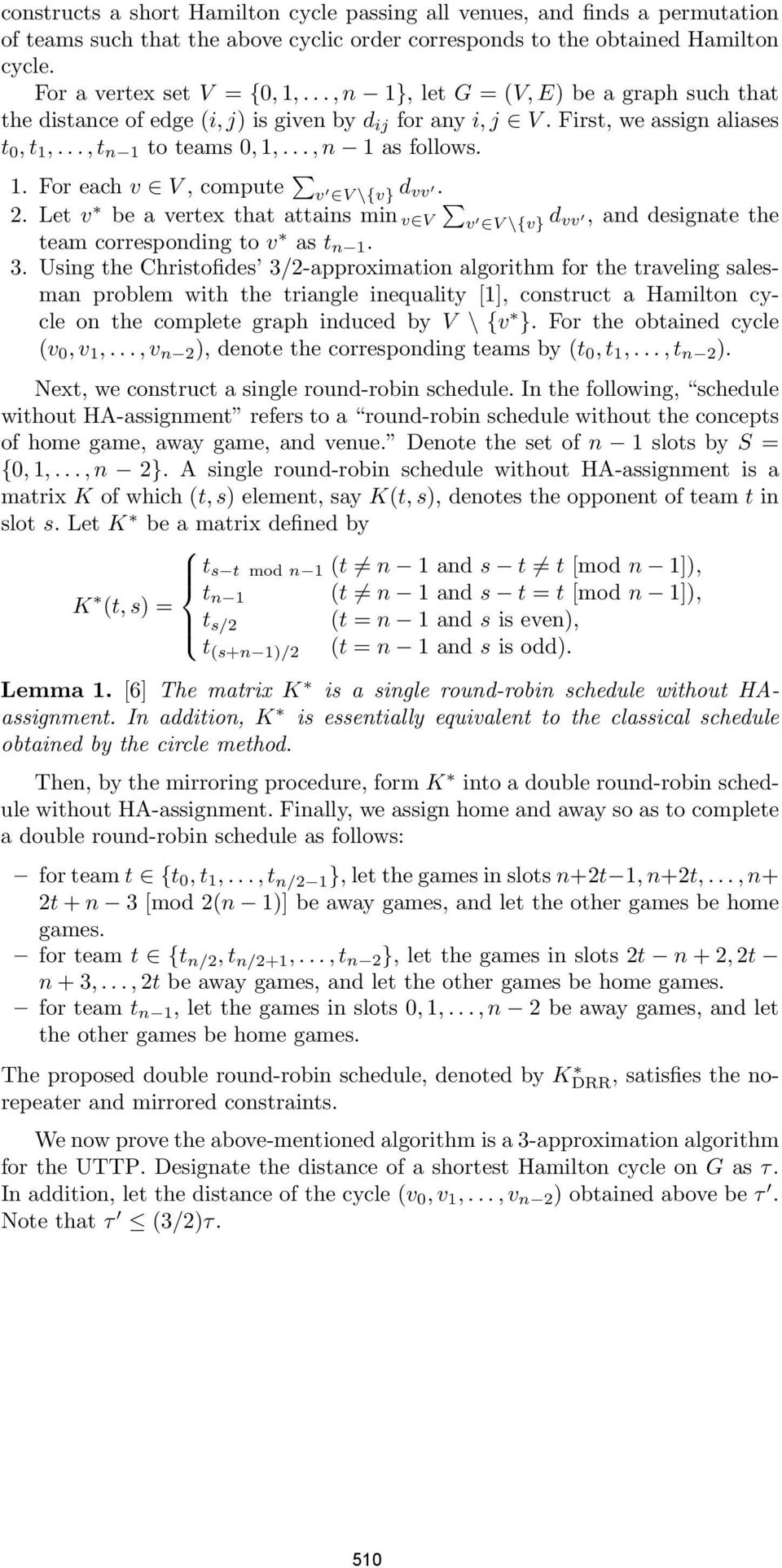
3 constructs a short Hamilton cycle passing all venues, and finds a permutation of teams such that the above cyclic order corresponds to the obtained Hamilton cycle. For a vertex set V = {0, 1,..., n 1}, let G = (V, E) be a graph such that the distance of edge (i, j) is given by d ij for any i, j V. First, we assign aliases t 0, t 1,..., t n 1 to teams 0, 1,..., n 1 as follows. 1. For each v V, compute v V \{v} d vv. 2. Let v be a vertex that attains min v V v V \{v} d vv, and designate the team corresponding to v as t n Using the Christofides 3/2-approximation algorithm for the traveling salesman problem with the triangle inequality [1], construct a Hamilton cycle on the complete graph induced by V \ {v }. For the obtained cycle (v 0, v 1,..., v n 2 ), denote the corresponding teams by (t 0, t 1,..., t n 2 ). Next, we construct a single round-robin schedule. In the following, schedule without HA-assignment refers to a round-robin schedule without the concepts of home game, away game, and venue. Denote the set of n 1 slots by S = {0, 1,..., n 2}. A single round-robin schedule without HA-assignment is a matrix K of which (t, s) element, say K(t, s), denotes the opponent of team t in slot s. Let K be a matrix defined by t s t mod n 1 (t n 1 and s t t [mod n 1]), K t (t, s) = n 1 (t n 1 and s t = t [mod n 1]), t s/2 (t = n 1 and s is even), (t = n 1 and s is odd). t (s+n 1)/2 Lemma 1. [6] The matrix K is a single round-robin schedule without HAassignment. In addition, K is essentially equivalent to the classical schedule obtained by the circle method. Then, by the mirroring procedure, form K into a double round-robin schedule without HA-assignment. Finally, we assign home and away so as to complete a double round-robin schedule as follows: for team t {t 0, t 1,..., t n/2 1 }, let the games in slots n+2t 1, n+2t,..., n+ 2t + n 3 [mod 2(n 1)] be away games, and let the other games be home games. for team t {t n/2, t n/2+1,..., t n 2 }, let the games in slots 2t n + 2, 2t n + 3,..., 2t be away games, and let the other games be home games. for team t n 1, let the games in slots 0, 1,..., n 2 be away games, and let the other games be home games. The proposed double round-robin schedule, denoted by KDRR, satisfies the norepeater and mirrored constraints. We now prove the above-mentioned algorithm is a 3-approximation algorithm for the UTTP. Designate the distance of a shortest Hamilton cycle on G as τ. In addition, let the distance of the cycle (v 0, v 1,..., v n 2 ) obtained above be τ. Note that τ (3/2)τ. 510
4 Lemma 2. The following propositions hold for G. (1) For any path of two edges, its distance is bounded by τ. (2) The distance of any Hamilton cycle is bounded by nτ/2. In K DRR, team t n 1 plays n 1 consecutive away games, and thus the distance by team t n 1 can be bounded by nτ/2 from Lemma 2(2). In addition, analyzing the structure of the proposed schedule reveals the following lemma. Lemma 3. Let l(i, j, k) be the distance of path (i, j, k) for i, j, k V. In KDRR, the traveling distance of teams can be bounded by τ + l(v 0, v, v 1 ) (t = t 0 ), τ + l(v t, v, v t+1 ) + l(v n t 1, v t, v n t 2 ) (t {t 1, t 2,..., t n/2 2 }), τ + l(v n/2 1, v, v n/2 1 ) (t = t n/2 1 ), τ + l(v t 1, v, v t ) (t {t n/2, t n/2+1,..., t n 2 }), nτ/2 (t = t n 1 ). Although the following lemma is not obvious, we omit the proof due to space limitations. Lemma 4. Let v be a vertex that attains min v V v V \{v} d vv. Then, the following holds: v V \{v } d vv nτ/4. Theorem 1. The proposed algorithm is a 3-approximation algorithm for the UTTP. Proof. Let the distance of KDRR be d(k DRR ). From Lemmas 2 through 4, we have: d(kdrr) τ (n 1) + l(v t, v, v t+1 ) + l(v n/2 1, v, v n/2 1 ) + t {t 1,t 2,...,t n/2 2 } (3/2)τ(n 1) + t {t 0,t 1,...,t n 3} l(v n t 1, v t, v n t 2 ) + nτ/2 v V \{v } 2d vv + τ + τ(n/2 2) + nτ/2 (3/2)τ(n 1) + 2(nτ/4) + τ + τ(n/2 2) + nτ/2 3nτ. Since nτ is a lower bound of the distance of any double round-robin schedule, this concludes the proof. References 1. Christofides, N.: Worst-case analysis of a new heuristic for the traveling salesman problem. Report 388, Graduate School of Industrial Administration, Carnegie- Mellon University, Easton, K., Nemhauser, G., Trick, M.: The traveling tournament problem: description and benchmarks. Lecture Notes in Computer Science 2239 (2001)

5 3. Miyashiro, R., Matsui, T., Imahori, S.: An approximation algorithm for the traveling tournament problem. Annals of Operations Research, to appear 4. Rasmussen, R.V., Trick, M.A.: Round robin scheduling a survey. European Journal of Operational Research 188 (2008) Trick, M.: Challenge traveling tournament problems. Web page, as of Yamaguchi, D., Imahori, S., Miyashiro, R., Matsui, T.: An improved approximation algorithm for the traveling tournament problem. Lecture Notes in Computer Science 5878 (2009)

MATHEMATICAL ENGINEERING TECHNICAL REPORTS. An Improved Approximation Algorithm for the Traveling Tournament Problem
 MATHEMATICAL ENGINEERING TECHNICAL REPORTS An Improved Approximation Algorithm for the Traveling Tournament Problem Daisuke YAMAGUCHI, Shinji IMAHORI, Ryuhei MIYASHIRO, Tomomi MATSUI METR 2009 42 September
Sport Timetabling. Outline DM87 SCHEDULING, TIMETABLING AND ROUTING. Outline. Lecture 15. 1. Problem Definitions
 Outline DM87 SCHEDULING, TIMETABLING AND ROUTING Lecture 15 Sport Timetabling 1. Problem Definitions Marco Chiarandini DM87 Scheduling, Timetabling and Routing 2 Problems we treat: single and double round-robin
Complexity of the Traveling Tournament Problem
 Complexity of the Traveling Tournament Problem Clemens Thielen and Stephan Westphal Department of Mathematics, University of Kaiserslautern, Paul-Ehrlich-Str 14, D-67663 Kaiserslautern, Germany {thielen,westphal}@mathematikuni-klde
MATHEMATICAL ENGINEERING TECHNICAL REPORTS. The Best-fit Heuristic for the Rectangular Strip Packing Problem: An Efficient Implementation
 MATHEMATICAL ENGINEERING TECHNICAL REPORTS The Best-fit Heuristic for the Rectangular Strip Packing Problem: An Efficient Implementation Shinji IMAHORI, Mutsunori YAGIURA METR 2007 53 September 2007 DEPARTMENT
The Goldberg Rao Algorithm for the Maximum Flow Problem
 The Goldberg Rao Algorithm for the Maximum Flow Problem COS 528 class notes October 18, 2006 Scribe: Dávid Papp Main idea: use of the blocking flow paradigm to achieve essentially O(min{m 2/3, n 1/2 }
Offline sorting buffers on Line
 Offline sorting buffers on Line Rohit Khandekar 1 and Vinayaka Pandit 2 1 University of Waterloo, ON, Canada. email: [email protected] 2 IBM India Research Lab, New Delhi. email: [email protected]
ONLINE DEGREE-BOUNDED STEINER NETWORK DESIGN. Sina Dehghani Saeed Seddighin Ali Shafahi Fall 2015
 ONLINE DEGREE-BOUNDED STEINER NETWORK DESIGN Sina Dehghani Saeed Seddighin Ali Shafahi Fall 2015 ONLINE STEINER FOREST PROBLEM An initially given graph G. s 1 s 2 A sequence of demands (s i, t i ) arriving
arxiv:1112.0829v1 [math.pr] 5 Dec 2011
![arxiv:1112.0829v1 [math.pr] 5 Dec 2011](/thumbs/39/18839218.jpg "arxiv:1112.0829v1 [math.pr] 5 Dec 2011") How Not to Win a Million Dollars: A Counterexample to a Conjecture of L. Breiman Thomas P. Hayes arxiv:1112.0829v1 [math.pr] 5 Dec 2011 Abstract Consider a gambling game in which we are allowed to repeatedly
How Not to Win a Million Dollars: A Counterexample to a Conjecture of L. Breiman Thomas P. Hayes arxiv:1112.0829v1 [math.pr] 5 Dec 2011 Abstract Consider a gambling game in which we are allowed to repeatedly
Near Optimal Solutions
 Near Optimal Solutions Many important optimization problems are lacking efficient solutions. NP-Complete problems unlikely to have polynomial time solutions. Good heuristics important for such problems.
Approximation Algorithms
 Approximation Algorithms or: How I Learned to Stop Worrying and Deal with NP-Completeness Ong Jit Sheng, Jonathan (A0073924B) March, 2012 Overview Key Results (I) General techniques: Greedy algorithms
! Solve problem to optimality. ! Solve problem in poly-time. ! Solve arbitrary instances of the problem. #-approximation algorithm.
 Approximation Algorithms 11 Approximation Algorithms Q Suppose I need to solve an NP-hard problem What should I do? A Theory says you're unlikely to find a poly-time algorithm Must sacrifice one of three
Chapter 11. 11.1 Load Balancing. Approximation Algorithms. Load Balancing. Load Balancing on 2 Machines. Load Balancing: Greedy Scheduling
 Approximation Algorithms Chapter Approximation Algorithms Q. Suppose I need to solve an NP-hard problem. What should I do? A. Theory says you're unlikely to find a poly-time algorithm. Must sacrifice one
! Solve problem to optimality. ! Solve problem in poly-time. ! Solve arbitrary instances of the problem. !-approximation algorithm.
 Approximation Algorithms Chapter Approximation Algorithms Q Suppose I need to solve an NP-hard problem What should I do? A Theory says you're unlikely to find a poly-time algorithm Must sacrifice one of
Labeling outerplanar graphs with maximum degree three
 Labeling outerplanar graphs with maximum degree three Xiangwen Li 1 and Sanming Zhou 2 1 Department of Mathematics Huazhong Normal University, Wuhan 430079, China 2 Department of Mathematics and Statistics
5.1 Bipartite Matching
 CS787: Advanced Algorithms Lecture 5: Applications of Network Flow In the last lecture, we looked at the problem of finding the maximum flow in a graph, and how it can be efficiently solved using the Ford-Fulkerson
JUST-IN-TIME SCHEDULING WITH PERIODIC TIME SLOTS. Received December May 12, 2003; revised February 5, 2004
 Scientiae Mathematicae Japonicae Online, Vol. 10, (2004), 431 437 431 JUST-IN-TIME SCHEDULING WITH PERIODIC TIME SLOTS Ondřej Čepeka and Shao Chin Sung b Received December May 12, 2003; revised February
CMPSCI611: Approximating MAX-CUT Lecture 20
 CMPSCI611: Approximating MAX-CUT Lecture 20 For the next two lectures we ll be seeing examples of approximation algorithms for interesting NP-hard problems. Today we consider MAX-CUT, which we proved to
2.3 Convex Constrained Optimization Problems
 42 CHAPTER 2. FUNDAMENTAL CONCEPTS IN CONVEX OPTIMIZATION Theorem 15 Let f : R n R and h : R R. Consider g(x) = h(f(x)) for all x R n. The function g is convex if either of the following two conditions
Midterm Practice Problems
 6.042/8.062J Mathematics for Computer Science October 2, 200 Tom Leighton, Marten van Dijk, and Brooke Cowan Midterm Practice Problems Problem. [0 points] In problem set you showed that the nand operator
Outline. NP-completeness. When is a problem easy? When is a problem hard? Today. Euler Circuits
 Outline NP-completeness Examples of Easy vs. Hard problems Euler circuit vs. Hamiltonian circuit Shortest Path vs. Longest Path 2-pairs sum vs. general Subset Sum Reducing one problem to another Clique
A permutation can also be represented by describing its cycles. What do you suppose is meant by this?
 Shuffling, Cycles, and Matrices Warm up problem. Eight people stand in a line. From left to right their positions are numbered,,,... 8. The eight people then change places according to THE RULE which directs
6.852: Distributed Algorithms Fall, 2009. Class 2
 .8: Distributed Algorithms Fall, 009 Class Today s plan Leader election in a synchronous ring: Lower bound for comparison-based algorithms. Basic computation in general synchronous networks: Leader election
UPPER BOUNDS ON THE L(2, 1)-LABELING NUMBER OF GRAPHS WITH MAXIMUM DEGREE
 UPPER BOUNDS ON THE L(2, 1)-LABELING NUMBER OF GRAPHS WITH MAXIMUM DEGREE ANDREW LUM ADVISOR: DAVID GUICHARD ABSTRACT. L(2,1)-labeling was first defined by Jerrold Griggs [Gr, 1992] as a way to use graphs
The positive minimum degree game on sparse graphs
 The positive minimum degree game on sparse graphs József Balogh Department of Mathematical Sciences University of Illinois, USA [email protected] András Pluhár Department of Computer Science University
Applied Algorithm Design Lecture 5
 Applied Algorithm Design Lecture 5 Pietro Michiardi Eurecom Pietro Michiardi (Eurecom) Applied Algorithm Design Lecture 5 1 / 86 Approximation Algorithms Pietro Michiardi (Eurecom) Applied Algorithm Design
Analysis of Approximation Algorithms for k-set Cover using Factor-Revealing Linear Programs
 Analysis of Approximation Algorithms for k-set Cover using Factor-Revealing Linear Programs Stavros Athanassopoulos, Ioannis Caragiannis, and Christos Kaklamanis Research Academic Computer Technology Institute
Stiffie's On Line Scheduling Algorithm
 A class of on-line scheduling algorithms to minimize total completion time X. Lu R.A. Sitters L. Stougie Abstract We consider the problem of scheduling jobs on-line on a single machine and on identical
Finding and counting given length cycles
 Finding and counting given length cycles Noga Alon Raphael Yuster Uri Zwick Abstract We present an assortment of methods for finding and counting simple cycles of a given length in directed and undirected
Breaking The Code. Ryan Lowe. Ryan Lowe is currently a Ball State senior with a double major in Computer Science and Mathematics and
 Breaking The Code Ryan Lowe Ryan Lowe is currently a Ball State senior with a double major in Computer Science and Mathematics and a minor in Applied Physics. As a sophomore, he took an independent study
Algorithm Design and Analysis
 Algorithm Design and Analysis LECTURE 27 Approximation Algorithms Load Balancing Weighted Vertex Cover Reminder: Fill out SRTEs online Don t forget to click submit Sofya Raskhodnikova 12/6/2011 S. Raskhodnikova;
A 2-factor in which each cycle has long length in claw-free graphs
 A -factor in which each cycle has long length in claw-free graphs Roman Čada Shuya Chiba Kiyoshi Yoshimoto 3 Department of Mathematics University of West Bohemia and Institute of Theoretical Computer Science
Incremental Network Design with Shortest Paths
 Incremental Network Design with Shortest Paths Tarek Elgindy, Andreas T. Ernst, Matthew Baxter CSIRO Mathematics Informatics and Statistics, Australia Martin W.P. Savelsbergh University of Newcastle, Australia
Stationary random graphs on Z with prescribed iid degrees and finite mean connections
 Stationary random graphs on Z with prescribed iid degrees and finite mean connections Maria Deijfen Johan Jonasson February 2006 Abstract Let F be a probability distribution with support on the non-negative
Lecture 4 Online and streaming algorithms for clustering
 CSE 291: Geometric algorithms Spring 2013 Lecture 4 Online and streaming algorithms for clustering 4.1 On-line k-clustering To the extent that clustering takes place in the brain, it happens in an on-line
Reductions & NP-completeness as part of Foundations of Computer Science undergraduate course
 Reductions & NP-completeness as part of Foundations of Computer Science undergraduate course Alex Angelopoulos, NTUA January 22, 2015 Outline Alex Angelopoulos (NTUA) FoCS: Reductions & NP-completeness-
COMBINATORIAL PROPERTIES OF THE HIGMAN-SIMS GRAPH. 1. Introduction
 COMBINATORIAL PROPERTIES OF THE HIGMAN-SIMS GRAPH ZACHARY ABEL 1. Introduction In this survey we discuss properties of the Higman-Sims graph, which has 100 vertices, 1100 edges, and is 22 regular. In fact
CSC2420 Fall 2012: Algorithm Design, Analysis and Theory
 CSC2420 Fall 2012: Algorithm Design, Analysis and Theory Allan Borodin November 15, 2012; Lecture 10 1 / 27 Randomized online bipartite matching and the adwords problem. We briefly return to online algorithms
SEMITOTAL AND TOTAL BLOCK-CUTVERTEX GRAPH
 CHAPTER 3 SEMITOTAL AND TOTAL BLOCK-CUTVERTEX GRAPH ABSTRACT This chapter begins with the notion of block distances in graphs. Using block distance we defined the central tendencies of a block, like B-radius
Analysis of Algorithms, I
 Analysis of Algorithms, I CSOR W4231.002 Eleni Drinea Computer Science Department Columbia University Thursday, February 26, 2015 Outline 1 Recap 2 Representing graphs 3 Breadth-first search (BFS) 4 Applications
Every tree contains a large induced subgraph with all degrees odd
 Every tree contains a large induced subgraph with all degrees odd A.J. Radcliffe Carnegie Mellon University, Pittsburgh, PA A.D. Scott Department of Pure Mathematics and Mathematical Statistics University
SHARP BOUNDS FOR THE SUM OF THE SQUARES OF THE DEGREES OF A GRAPH
 31 Kragujevac J. Math. 25 (2003) 31 49. SHARP BOUNDS FOR THE SUM OF THE SQUARES OF THE DEGREES OF A GRAPH Kinkar Ch. Das Department of Mathematics, Indian Institute of Technology, Kharagpur 721302, W.B.,
Lecture 6 Online and streaming algorithms for clustering
 CSE 291: Unsupervised learning Spring 2008 Lecture 6 Online and streaming algorithms for clustering 6.1 On-line k-clustering To the extent that clustering takes place in the brain, it happens in an on-line
THE SCHEDULING OF MAINTENANCE SERVICE
 THE SCHEDULING OF MAINTENANCE SERVICE Shoshana Anily Celia A. Glass Refael Hassin Abstract We study a discrete problem of scheduling activities of several types under the constraint that at most a single
Page 1. CSCE 310J Data Structures & Algorithms. CSCE 310J Data Structures & Algorithms. P, NP, and NP-Complete. Polynomial-Time Algorithms
 CSCE 310J Data Structures & Algorithms P, NP, and NP-Complete Dr. Steve Goddard [email protected] CSCE 310J Data Structures & Algorithms Giving credit where credit is due:» Most of the lecture notes
Algebra 2 Chapter 1 Vocabulary. identity - A statement that equates two equivalent expressions.
 Chapter 1 Vocabulary identity - A statement that equates two equivalent expressions. verbal model- A word equation that represents a real-life problem. algebraic expression - An expression with variables.
THE TRAVELING SALESMAN PROBLEM AND ITS VARIATIONS
 THE TRAVELING SALESMAN PROBLEM AND ITS VARIATIONS Edited by GREGORY GUTIN Royal Holloway, University of London, UK ABRAHAM PUNNEN University of New Brunswick, St. John, Canada Kluwer Academic Publishers
Cycles and clique-minors in expanders
 Cycles and clique-minors in expanders Benny Sudakov UCLA and Princeton University Expanders Definition: The vertex boundary of a subset X of a graph G: X = { all vertices in G\X with at least one neighbor
Large induced subgraphs with all degrees odd
 Large induced subgraphs with all degrees odd A.D. Scott Department of Pure Mathematics and Mathematical Statistics, University of Cambridge, England Abstract: We prove that every connected graph of order
Approximated Distributed Minimum Vertex Cover Algorithms for Bounded Degree Graphs
 Approximated Distributed Minimum Vertex Cover Algorithms for Bounded Degree Graphs Yong Zhang 1.2, Francis Y.L. Chin 2, and Hing-Fung Ting 2 1 College of Mathematics and Computer Science, Hebei University,
CHAPTER 9. Integer Programming
 CHAPTER 9 Integer Programming An integer linear program (ILP) is, by definition, a linear program with the additional constraint that all variables take integer values: (9.1) max c T x s t Ax b and x integral
Graphical degree sequences and realizations
 swap Graphical and realizations Péter L. Erdös Alfréd Rényi Institute of Mathematics Hungarian Academy of Sciences MAPCON 12 MPIPKS - Dresden, May 15, 2012 swap Graphical and realizations Péter L. Erdös
On an anti-ramsey type result
 On an anti-ramsey type result Noga Alon, Hanno Lefmann and Vojtĕch Rödl Abstract We consider anti-ramsey type results. For a given coloring of the k-element subsets of an n-element set X, where two k-element
A simpler and better derandomization of an approximation algorithm for Single Source Rent-or-Buy
 A simpler and better derandomization of an approximation algorithm for Single Source Rent-or-Buy David P. Williamson Anke van Zuylen School of Operations Research and Industrial Engineering, Cornell University,
GENERATING SETS KEITH CONRAD
 GENERATING SETS KEITH CONRAD 1 Introduction In R n, every vector can be written as a unique linear combination of the standard basis e 1,, e n A notion weaker than a basis is a spanning set: a set of vectors
Asking Hard Graph Questions. Paul Burkhardt. February 3, 2014
 Beyond Watson: Predictive Analytics and Big Data U.S. National Security Agency Research Directorate - R6 Technical Report February 3, 2014 300 years before Watson there was Euler! The first (Jeopardy!)
Linear Programming I
 Linear Programming I November 30, 2003 1 Introduction In the VCR/guns/nuclear bombs/napkins/star wars/professors/butter/mice problem, the benevolent dictator, Bigus Piguinus, of south Antarctica penguins
The Clar Structure of Fullerenes
 The Clar Structure of Fullerenes Liz Hartung Massachusetts College of Liberal Arts June 12, 2013 Liz Hartung (Massachusetts College of Liberal Arts) The Clar Structure of Fullerenes June 12, 2013 1 / 25
Zachary Monaco Georgia College Olympic Coloring: Go For The Gold
 Zachary Monaco Georgia College Olympic Coloring: Go For The Gold Coloring the vertices or edges of a graph leads to a variety of interesting applications in graph theory These applications include various
Optimization in R n Introduction
 Optimization in R n Introduction Rudi Pendavingh Eindhoven Technical University Optimization in R n, lecture Rudi Pendavingh (TUE) Optimization in R n Introduction ORN / 4 Some optimization problems designing
Factoring & Primality
 Factoring & Primality Lecturer: Dimitris Papadopoulos In this lecture we will discuss the problem of integer factorization and primality testing, two problems that have been the focus of a great amount
= 2 + 1 2 2 = 3 4, Now assume that P (k) is true for some fixed k 2. This means that
 Instructions. Answer each of the questions on your own paper, and be sure to show your work so that partial credit can be adequately assessed. Credit will not be given for answers (even correct ones) without
Scheduling Home Health Care with Separating Benders Cuts in Decision Diagrams
 Scheduling Home Health Care with Separating Benders Cuts in Decision Diagrams André Ciré University of Toronto John Hooker Carnegie Mellon University INFORMS 2014 Home Health Care Home health care delivery
Online Adwords Allocation
 Online Adwords Allocation Shoshana Neuburger May 6, 2009 1 Overview Many search engines auction the advertising space alongside search results. When Google interviewed Amin Saberi in 2004, their advertisement
Network File Storage with Graceful Performance Degradation
 Network File Storage with Graceful Performance Degradation ANXIAO (ANDREW) JIANG California Institute of Technology and JEHOSHUA BRUCK California Institute of Technology A file storage scheme is proposed
NEW MODELS FOR THE MIRRORED TRAVELING TOURNAMENT PROBLEM
 NEW MODELS FOR THE MIRRORED TRAVELING TOURNAMENT PROBLEM Marco Antonio Moreira de Carvalho Instituto Tecnológico de Aeronáutica ITA Praça Marechal Eduardo Gomes, 50, São José dos Campos SP, Brasil [email protected]
Find-The-Number. 1 Find-The-Number With Comps
 Find-The-Number 1 Find-The-Number With Comps Consider the following two-person game, which we call Find-The-Number with Comps. Player A (for answerer) has a number x between 1 and 1000. Player Q (for questioner)
A Graph-Theoretic Network Security Game
 A Graph-Theoretic Network Security Game Marios Mavronicolas 1, Vicky Papadopoulou 1, Anna Philippou 1, and Paul Spirakis 2 1 Department of Computer Science, University of Cyprus, Nicosia CY-1678, Cyprus.
A REMARK ON ALMOST MOORE DIGRAPHS OF DEGREE THREE. 1. Introduction and Preliminaries
 Acta Math. Univ. Comenianae Vol. LXVI, 2(1997), pp. 285 291 285 A REMARK ON ALMOST MOORE DIGRAPHS OF DEGREE THREE E. T. BASKORO, M. MILLER and J. ŠIRÁŇ Abstract. It is well known that Moore digraphs do
(67902) Topics in Theory and Complexity Nov 2, 2006. Lecture 7
 (67902) Topics in Theory and Complexity Nov 2, 2006 Lecturer: Irit Dinur Lecture 7 Scribe: Rani Lekach 1 Lecture overview This Lecture consists of two parts In the first part we will refresh the definition
GRAPH THEORY LECTURE 4: TREES
 GRAPH THEORY LECTURE 4: TREES Abstract. 3.1 presents some standard characterizations and properties of trees. 3.2 presents several different types of trees. 3.7 develops a counting method based on a bijection
Distributed Computing over Communication Networks: Maximal Independent Set
 Distributed Computing over Communication Networks: Maximal Independent Set What is a MIS? MIS An independent set (IS) of an undirected graph is a subset U of nodes such that no two nodes in U are adjacent.
ON DEGREES IN THE HASSE DIAGRAM OF THE STRONG BRUHAT ORDER
 Séminaire Lotharingien de Combinatoire 53 (2006), Article B53g ON DEGREES IN THE HASSE DIAGRAM OF THE STRONG BRUHAT ORDER RON M. ADIN AND YUVAL ROICHMAN Abstract. For a permutation π in the symmetric group
6.231 Dynamic Programming and Stochastic Control Fall 2008
 MIT OpenCourseWare http://ocw.mit.edu 6.231 Dynamic Programming and Stochastic Control Fall 2008 For information about citing these materials or our Terms of Use, visit: http://ocw.mit.edu/terms. 6.231
IRREDUCIBLE OPERATOR SEMIGROUPS SUCH THAT AB AND BA ARE PROPORTIONAL. 1. Introduction
 IRREDUCIBLE OPERATOR SEMIGROUPS SUCH THAT AB AND BA ARE PROPORTIONAL R. DRNOVŠEK, T. KOŠIR Dedicated to Prof. Heydar Radjavi on the occasion of his seventieth birthday. Abstract. Let S be an irreducible
On the independence number of graphs with maximum degree 3
 On the independence number of graphs with maximum degree 3 Iyad A. Kanj Fenghui Zhang Abstract Let G be an undirected graph with maximum degree at most 3 such that G does not contain any of the three graphs
SEQUENCES OF MAXIMAL DEGREE VERTICES IN GRAPHS. Nickolay Khadzhiivanov, Nedyalko Nenov
 Serdica Math. J. 30 (2004), 95 102 SEQUENCES OF MAXIMAL DEGREE VERTICES IN GRAPHS Nickolay Khadzhiivanov, Nedyalko Nenov Communicated by V. Drensky Abstract. Let Γ(M) where M V (G) be the set of all vertices
ENUMERATION OF INTEGRAL TETRAHEDRA
 ENUMERATION OF INTEGRAL TETRAHEDRA SASCHA KURZ Abstract. We determine the numbers of integral tetrahedra with diameter d up to isomorphism for all d 1000 via computer enumeration. Therefore we give an
Complexity Theory. IE 661: Scheduling Theory Fall 2003 Satyaki Ghosh Dastidar
 Complexity Theory IE 661: Scheduling Theory Fall 2003 Satyaki Ghosh Dastidar Outline Goals Computation of Problems Concepts and Definitions Complexity Classes and Problems Polynomial Time Reductions Examples
New Exact Solution Approaches for the Split Delivery Vehicle Routing Problem
 New Exact Solution Approaches for the Split Delivery Vehicle Routing Problem Gizem Ozbaygin, Oya Karasan and Hande Yaman Department of Industrial Engineering, Bilkent University, Ankara, Turkey ozbaygin,
A NOTE ON OFF-DIAGONAL SMALL ON-LINE RAMSEY NUMBERS FOR PATHS
 A NOTE ON OFF-DIAGONAL SMALL ON-LINE RAMSEY NUMBERS FOR PATHS PAWE L PRA LAT Abstract. In this note we consider the on-line Ramsey numbers R(P n, P m ) for paths. Using a high performance computing clusters,
Warshall s Algorithm: Transitive Closure
 CS 0 Theory of Algorithms / CS 68 Algorithms in Bioinformaticsi Dynamic Programming Part II. Warshall s Algorithm: Transitive Closure Computes the transitive closure of a relation (Alternatively: all paths
Misleading Stars: What Cannot Be Measured in the Internet?
 Noname manuscript No. (will be inserted by the editor) Misleading Stars: What Cannot Be Measured in the Internet? Yvonne-Anne Pignolet Stefan Schmid Gilles Tredan Abstract Traceroute measurements are one
Introduction to Logic in Computer Science: Autumn 2006
 Introduction to Logic in Computer Science: Autumn 2006 Ulle Endriss Institute for Logic, Language and Computation University of Amsterdam Ulle Endriss 1 Plan for Today Now that we have a basic understanding
How To Understand The Theory Of Media Theory
 Fundamentals of Media Theory ergei Ovchinnikov Mathematics Department an Francisco tate University an Francisco, CA 94132 [email protected] Abstract Media theory is a new branch of discrete applied mathematics
Single machine models: Maximum Lateness -12- Approximation ratio for EDD for problem 1 r j,d j < 0 L max. structure of a schedule Q...
 Lecture 4 Scheduling 1 Single machine models: Maximum Lateness -12- Approximation ratio for EDD for problem 1 r j,d j < 0 L max structure of a schedule 0 Q 1100 11 00 11 000 111 0 0 1 1 00 11 00 11 00
Ph.D. Thesis. Judit Nagy-György. Supervisor: Péter Hajnal Associate Professor
 Online algorithms for combinatorial problems Ph.D. Thesis by Judit Nagy-György Supervisor: Péter Hajnal Associate Professor Doctoral School in Mathematics and Computer Science University of Szeged Bolyai
A Turán Type Problem Concerning the Powers of the Degrees of a Graph
 A Turán Type Problem Concerning the Powers of the Degrees of a Graph Yair Caro and Raphael Yuster Department of Mathematics University of Haifa-ORANIM, Tivon 36006, Israel. AMS Subject Classification:
8.1 Min Degree Spanning Tree
 CS880: Approximations Algorithms Scribe: Siddharth Barman Lecturer: Shuchi Chawla Topic: Min Degree Spanning Tree Date: 02/15/07 In this lecture we give a local search based algorithm for the Min Degree
SPERNER S LEMMA AND BROUWER S FIXED POINT THEOREM
 SPERNER S LEMMA AND BROUWER S FIXED POINT THEOREM ALEX WRIGHT 1. Intoduction A fixed point of a function f from a set X into itself is a point x 0 satisfying f(x 0 ) = x 0. Theorems which establish the
The Open University s repository of research publications and other research outputs
 Open Research Online The Open University s repository of research publications and other research outputs The degree-diameter problem for circulant graphs of degree 8 and 9 Journal Article How to cite: