
Cisco Adaptive Security Appliances (ASA) Firewall and Virtual Private Network (VPN) Platform Security Target
|
|
|
- Cassandra Kelly
- 10 years ago
- Views:
Transcription
1 Cisco Adaptive Security Appliances (ASA) Firewall and Virtual Private Network (VPN) Platform Security Target This document provides the basis for an evaluation of a specific Target of Evaluation (TOE). The evaluated solution is the Cisco Adaptive Security Appliances (ASA) Firewall and Virtual Private Network (VPN) Platform solutions running ASA 8.4(4.1) with Cisco AnyConnect, or Cisco VPN Client. This Security Target (ST) defines a set of assumptions about the aspects of the environment, a list of threats that the product intends to counter, a set of security objectives, a set of security requirements, and the IT security functions provided by the TOE which meet the set of requirements. Version 1.0 September 2012 Prepared By: Cisco Systems, Inc. 170 West Tasman Dr. San Jose, CA Americas Headquarters: Cisco Systems, Inc., 170 West Tasman Drive, San Jose, CA USA 2012 Cisco Systems, Inc. All rights reserved. This document may be freely reproduced and distributed whole and intact including this copyright notice

2 Table of Contents Table of Contents 2 List of Tables 4 List of Figures 5 Security Target Introduction 5 ST and TOE Identification 5 TOE Overview 6 TOE Product Type 6 Supported non-toe Hardware/ Software/ Firmware 7 TOE Description 8 Physical Scope of the TOE 10 Logical Scope of the TOE 11 VPN and/or Firewall Information Flow Control 12 IPSec VPN 12 SSL VPN 13 Single or Multiple Context 14 Routed or Transparent Mode 14 Audit 15 Identification & Authentication 15 Management 16 Cryptography 16 TOE Evaluated Configuration 17 Excluded Functionality 18 Configuration Considerations 18 Conformance Claims 18 Common Criteria Conformance Claim 18 Protection Profile Conformance 18 Protection Profile Refinements 19 2 Cisco ASA 8.4(4.1) Firewall and VPN Security Target

3 Protection Profile Additions 19 Protection Profile Conformance Claim Rationale 21 TOE Appropriateness 21 TOE Security Problem Definition Consistency 21 Statement of Security Objectives Consistency 22 Statement of Security Requirements Consistency 22 Security Problem Definition 22 Assumptions 23 Threats 23 Organizational Security Policies 25 Security Objectives 26 Security Objectives for the TOE 26 Security Objectives for the Environment 28 Security Requirements 29 Conventions 29 TOE Security Functional Requirements 30 Security audit (FAU) 32 Cryptographic Support (FCS) 36 User Data Protection (FDP) 37 Identification and Authentication (FIA) 43 Security Management (FMT) 45 Protection of the TSF (FPT) 47 Resource Utilization (FRU) 47 TOE Access (FTA) 48 Trusted Path/ Channels (FTP) 48 Extended Components Definition 49 Security audit (FAU) 49 Cryptographic Support (FCS) 49 Identification and Authentication (FIA) 52 Protection of the TSF (FPT) 53 Cisco ASA 8.4(4.1) Firewall and VPN Security Target 3

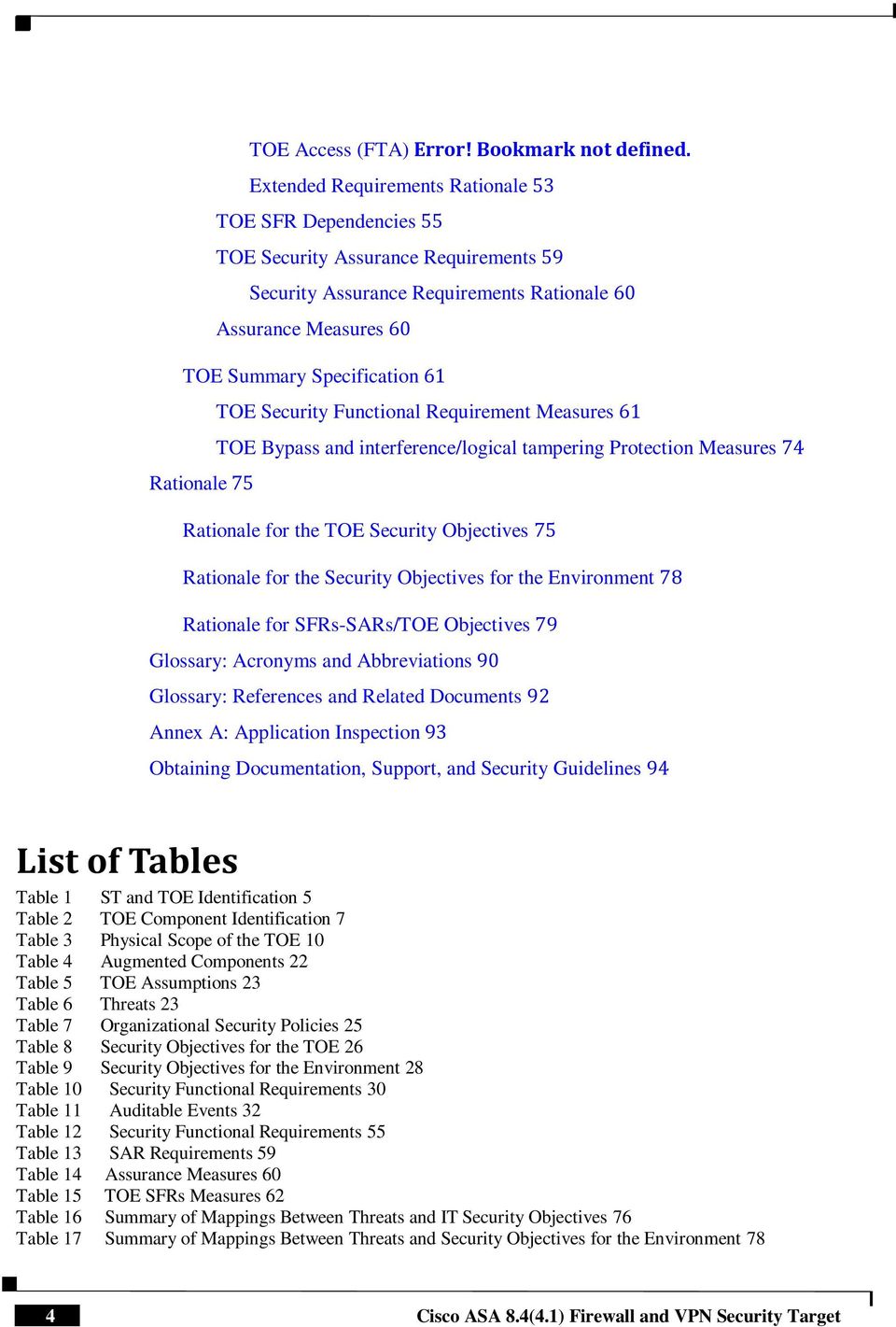
4 TOE Access (FTA) Error! Bookmark not defined. Extended Requirements Rationale 53 TOE SFR Dependencies 55 TOE Security Assurance Requirements 59 Security Assurance Requirements Rationale 60 Assurance Measures 60 TOE Summary Specification 61 TOE Security Functional Requirement Measures 61 TOE Bypass and interference/logical tampering Protection Measures 74 Rationale 75 Rationale for the TOE Security Objectives 75 Rationale for the Security Objectives for the Environment 78 Rationale for SFRs-SARs/TOE Objectives 79 Glossary: Acronyms and Abbreviations 90 Glossary: References and Related Documents 92 Annex A: Application Inspection 93 Obtaining Documentation, Support, and Security Guidelines 94 List of Tables Table 1 ST and TOE Identification 5 Table 2 TOE Component Identification 7 Table 3 Physical Scope of the TOE 10 Table 4 Augmented Components 22 Table 5 TOE Assumptions 23 Table 6 Threats 23 Table 7 Organizational Security Policies 25 Table 8 Security Objectives for the TOE 26 Table 9 Security Objectives for the Environment 28 Table 10 Security Functional Requirements 30 Table 11 Auditable Events 32 Table 12 Security Functional Requirements 55 Table 13 SAR Requirements 59 Table 14 Assurance Measures 60 Table 15 TOE SFRs Measures 62 Table 16 Summary of Mappings Between Threats and IT Security Objectives 76 Table 17 Summary of Mappings Between Threats and Security Objectives for the Environment 78 4 Cisco ASA 8.4(4.1) Firewall and VPN Security Target
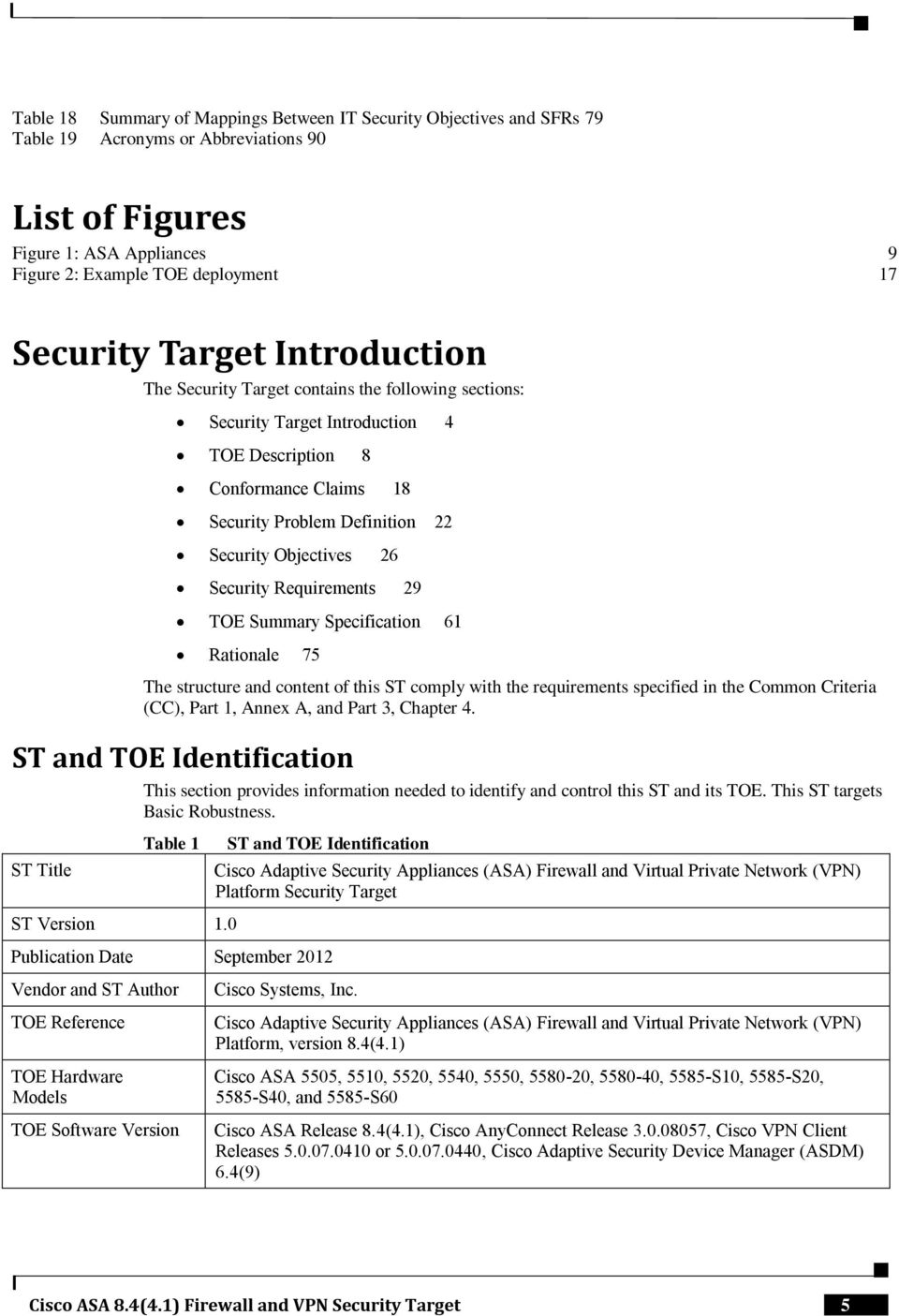
5 Table 18 Summary of Mappings Between IT Security Objectives and SFRs 79 Table 19 Acronyms or Abbreviations 90 List of Figures Figure 1: ASA Appliances 9 Figure 2: Example TOE deployment 17 Security Target Introduction The Security Target contains the following sections: Security Target Introduction 4 TOE Description 8 Conformance Claims 18 Security Problem Definition 22 Security Objectives 26 Security Requirements 29 TOE Summary Specification 61 Rationale 75 The structure and content of this ST comply with the requirements specified in the Common Criteria (CC), Part 1, Annex A, and Part 3, Chapter 4. ST and TOE Identification This section provides information needed to identify and control this ST and its TOE. This ST targets Basic Robustness. ST Title Table 1 ST and TOE Identification Cisco Adaptive Security Appliances (ASA) Firewall and Virtual Private Network (VPN) Platform Security Target ST Version 1.0 Publication Date September 2012 Vendor and ST Author TOE Reference TOE Hardware Models TOE Software Version Cisco Systems, Inc. Cisco Adaptive Security Appliances (ASA) Firewall and Virtual Private Network (VPN) Platform, version 8.4(4.1) Cisco ASA 5505, 5510, 5520, 5540, 5550, , , 5585-S10, 5585-S20, 5585-S40, and 5585-S60 Cisco ASA Release 8.4(4.1), Cisco AnyConnect Release , Cisco VPN Client Releases or , Cisco Adaptive Security Device Manager (ASDM) 6.4(9) Cisco ASA 8.4(4.1) Firewall and VPN Security Target 5
6 ST Evaluation Status Keywords In Evaluation Firewall, VPN, Encryption, Data Protection, Authentication TOE Overview The TOE is a purpose-built security platform that combines application-aware firewall and VPN services for small and medium-sized business (SMB) and enterprise applications. TOE Product Type The TOE consists of hardware and software used to construct Virtual Private Networks (VPNs) and Firewall solutions. For firewall services, the ASA 5500 Series provides application-aware stateful packet filtering firewalls. A stateful packet filtering firewall controls the flow of IP traffic by matching information contained in the headers of connection-oriented or connection-less IP packets against a set of rules specified by the authorized administrator for firewalls. This header information includes source and destination host (IP) addresses, source and destination port numbers, and the transport service application protocol (TSAP) held within the data field of the IP packet. Depending upon the rule and the results of the match, the firewall either passes or drops the packet. The stateful firewall remembers the state of the connection from information gleaned from prior packets flowing on the connection and uses it to regulate current packets. The packet will be denied if the security policy is violated. In addition to IP header information, the TOE mediates information flows on the basis of other information, such as the direction (incoming or outgoing) of the packet on any given firewall network interface. For connection-oriented transport services, the firewall either permits connections and subsequent packets for the connection or denies the connection and subsequent packets associated with the connection. The application-inspection capabilities automate the network to treat traffic according to detailed policies based not only on port, state, and addressing information, but also on application information buried deep within the packet header. By comparing this deep-packet inspection information with corporate policies, the firewall will allow or block certain traffic. For example, it will automatically drop application traffic attempting to gain entry to the network through an open port-even if it appears to be legitimate at the user and connection levels-if a business's corporate policy prohibits that application type from being on the network. For VPN Services, the ASA 5500 Series provides a complete remote-access VPN solution that supports numerous connectivity options, including Cisco VPN Client for IP Security (IPSec), Cisco Clientless SSL VPN, network-aware site-to-site VPN connectivity, and Cisco AnyConnect VPN client. IPSec provides confidentiality, authenticity, and integrity for IP data transmitted between trusted (private) networks over untrusted (public) links or networks. SSL VPN uses a Web browser and Secure Socket Layer (SSL) encryption to secure connections between remote users and specific, supported internal protected resources. AnyConnect uses the Datagram Transport Layer Security (DTLS) and SSL protocols to provide remote users with secure VPN connections to the ASA. Note: these VPN configurations are only supported in Routed Single Context Mode. For management purposes, the ASDM is included. ASDM allows the ASA to be managed from a graphical user interface. Its features include: Rapid Configuration: in-line and drag-and-drop policy editing, auto complete, configuration wizards, appliance software upgrades, and online help; 6 Cisco ASA 8.4(4.1) Firewall and VPN Security Target

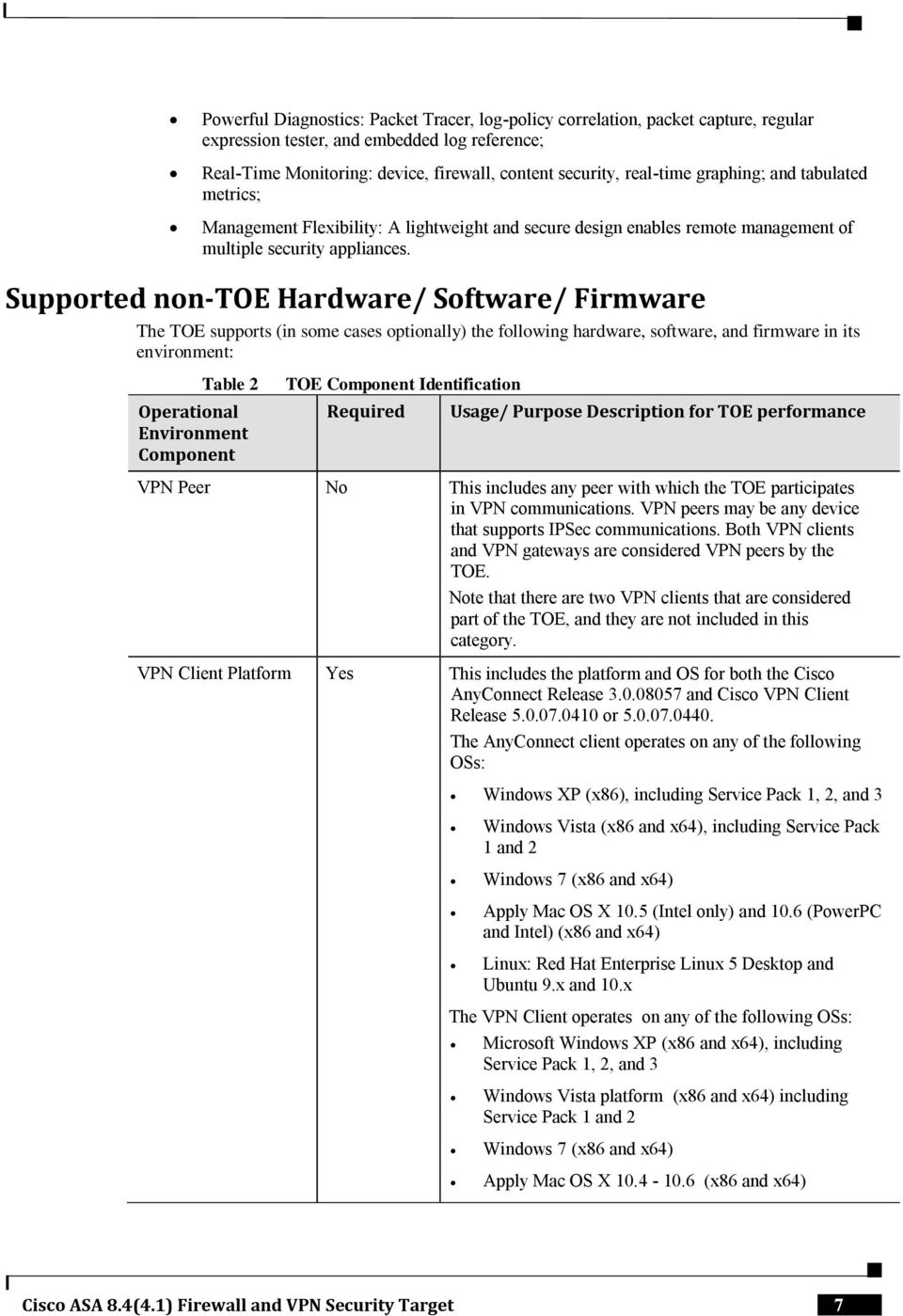
7 Powerful Diagnostics: Packet Tracer, log-policy correlation, packet capture, regular expression tester, and embedded log reference; Real-Time Monitoring: device, firewall, content security, real-time graphing; and tabulated metrics; Management Flexibility: A lightweight and secure design enables remote management of multiple security appliances. Supported non-toe Hardware/ Software/ Firmware The TOE supports (in some cases optionally) the following hardware, software, and firmware in its environment: Table 2 Operational Environment Component TOE Component Identification Required Usage/ Purpose Description for TOE performance VPN Peer No This includes any peer with which the TOE participates in VPN communications. VPN peers may be any device that supports IPSec communications. Both VPN clients and VPN gateways are considered VPN peers by the TOE. Note that there are two VPN clients that are considered part of the TOE, and they are not included in this category. VPN Client Platform Yes This includes the platform and OS for both the Cisco AnyConnect Release and Cisco VPN Client Release or The AnyConnect client operates on any of the following OSs: Windows P (x86), including Service Pack 1, 2, and 3 Windows Vista (x86 and x64), including Service Pack 1 and 2 Windows 7 (x86 and x64) Apply Mac OS 10.5 (Intel only) and 10.6 (PowerPC and Intel) (x86 and x64) Linux: Red Hat Enterprise Linux 5 Desktop and Ubuntu 9.x and 10.x The VPN Client operates on any of the following OSs: Microsoft Windows P (x86 and x64), including Service Pack 1, 2, and 3 Windows Vista platform (x86 and x64) including Service Pack 1 and 2 Windows 7 (x86 and x64) Apply Mac OS (x86 and x64) Cisco ASA 8.4(4.1) Firewall and VPN Security Target 7
8 Operational Environment Component ASDM Management Platform Required Yes Usage/ Purpose Description for TOE performance The ASDM 6.4(9) operates from any of the following operating systems: Microsoft Windows P (x86), including Service Pack 1, 2, and 3 Windows Vista (x86 and x64), including Service Pack 1 and 2 Windows 7 (x86 and x64) Mac OS (x86 and x64) Note that that ASDM software is installed on the ASA appliance and the management platform is used to connect to the ASA and run the ASDM. The only software installed on the management platform is a Cisco ASDM Launcher. Webrowser No The following web browsers are supported for access to the ASDM; Internet Explorer (6 or higher) Firefox (3 or higher) Safari (3 or higher) Remote Authentication Server Yes A RADIUS or TACACS+ server is required for use with the TOE. If these remote AAA servers will be used to authenticate ASA administrators, they should provide password complexity controls and account lockout controls consistent with those provided in Cisco ASA, as defined in FIA_PMG_ET1 and FIA_AFL.1. NTP Server No The TOE supports communications with an NTP server, with support for NTPv3 recommended. Peer Certificate Authority (CA) No The TOE supports OCSP communication with other CAs. Syslog Server Yes A syslog server with the capability to support SSLprotected TCP syslog communications is required for use with the TOE. TOE Description 8 Cisco ASA 8.4(4.1) Firewall and VPN Security Target

9 Figure 1: ASA Appliances This section provides an overview of the Cisco ASA Firewall and VPN Platforms Target of Evaluation (TOE). This section also defines the TOE components included in the evaluated configuration of the TOE. The TOE consists of a number of components including: One or more 5500 Appliances: The appliance is a single-use device with a hardened version of the Linux Kernel 2.6 (32 bit for everything but the 5580s and 64 bit for the 5580s) running ASA Release 8.4(4.1). Cisco ASA-5505, ASA-5510, ASA-5520, ASA-5540, ASA-5550, ASA , , 5585-S10, 5585-S20, 5585-S40, and 5585-S60 each with the following processor and interface configurations: o o o o o o o MHz AMD Geode L (G3) Eight 10/100 copper Ethernet ports GHz Intel Celeron Five 10/100 copper Ethernet ports (two can be 10/100/1000 copper Ethernet ports), one out-of-band management port GHz Intel Celeron Four 10/100/1000 copper Ethernet ports, one out-of-band management port GHz Intel Pentium 4 Four 10/100/1000 copper Ethernet ports, one out-ofband management port GHz Intel Pentium 4 Eight Gigabit Ethernet ports, four small form factorpluggable (SFP) fiber ports, one Fast Ethernet port Two 2.6GHz AMD Opteron Two RJ-45 management Gigabit Ethernet ports, with space for 6 interface expansion cards: Up to twelve 10Gigabit Ethernet (10GE) ports (two per ASA GE-SR card) Up to twenty-four Gigabit Ethernet ports (four per ASA5580-4GE-FI card) Up to twenty-four 10/100/1000 Ethernet ports (four per ASA5580-4GE-CU card) Four 2.6GHz AMD Opteron Two RJ-45 Gigabit Ethernet management ports, with space for 6 interface expansion cards: Up to twelve 10Gigabit Ethernet (10GE) ports (two per ASA GE-SR card) Up to twenty-four Gigabit Ethernet ports (four per ASA5580-4GE-FI card) Up to twenty-four 10/100/1000 Ethernet ports (four per ASA5580-4GE-CU card) Cisco ASA 8.4(4.1) Firewall and VPN Security Target 9

10 o o o o 5585-S10 Two RJ-45 management Gigabit Ethernet ports, two RJ45 ports (auxiliary and console), eight Gigabit Ethernet ports (expandable to sixteen), two 10 Gigabit Ethernet SFP+ fiber ports (expandable to four), 5585-S20 Two RJ-45 management Gigabit Ethernet ports, two RJ45 ports (auxiliary and console), eight Gigabit Ethernet ports (expandable to sixteen) and a two 10 Gigabit Ethernet SFP+ fiber ports (expandable to four) 5585-S40 Two RJ-45 management Gigabit Ethernet ports, two RJ45 ports (auxiliary and console), six Gigabit Ethernet ports (expandable to twelve) and a four 10 Gigabit Ethernet SFP+ fiber ports (expandable to eight) 5585-S60 Two RJ-45 management Gigabit Ethernet ports, two RJ45 ports (auxiliary and console), six Gigabit Ethernet ports (expandable to twelve) and a four 10 Gigabit Ethernet SFP+ fiber ports (expandable to eight) VPN clients: The following VPN clients are included with the TOE. o Cisco AnyConnect Release (including Cisco SSL VPN Clientless software) o Cisco VPN Client Release or ASDM software: The ASDM 6.4(9) software is installed on the ASA server. Only the Cisco ASDM Launcher is installed locally on the management platform. The ASDM software can also be launched by connecting to the https port on the ASA Physical Scope of the TOE The TOE is a hardware and software solution that makes up the Cisco ASA Firewall and VPN Platforms solution. The TOE is comprised of the following: Table 3 Physical Scope of the TOE TOE Configuration Hardware Configurations Software Version ASA 5505 ASA 5510 ASA 5520 The Cisco ASA 5505 features a flexible 8-port 10/100 Fast Ethernet switch, whose ports can be dynamically grouped to create up to three separate VLANs for home, business, and Internet traffic for improved network segmentation and security. The Cisco ASA 5510 Adaptive Security Appliance provides highperformance firewall and VPN services and five integrated 10/100 Fast Ethernet interfaces (2 can be 10/100/1000) and support for up to 100 VLANs. The Cisco ASA 5520 Adaptive Security Appliance provides highperformance firewall and VPN services and four Gigabit Ethernet interfaces and support for up to 150 VLANs. ASA release 8.4(4.1), including a Linux Kernel 2.6 ASA release 8.4(4.1), including a Linux Kernel 2.6 ASA release 8.4(4.1), including a Linux Kernel Cisco ASA 8.4(4.1) Firewall and VPN Security Target

11 ASA 5540 ASA 5550 ASA ASA ASA-5585-S10 ASA-5585-S20 ASA-5585-S40 ASA-5585-S60 The Cisco ASA 5540 Adaptive Security Appliance provides highperformance firewall and VPN services and four Gigabit Ethernet interfaces and support for up to 200 VLANs. The Cisco ASA 5540 Adaptive Security Appliance provides highperformance firewall and VPN services via eight Gigabit Ethernet interfaces, four Small Form-Factor Pluggable (SFP) fiber interfaces, and support for up to 250 VLANs. The Cisco ASA 5580 Adaptive Security Appliances provide six interface expansion card slots with support for up to 24 Gigabit Ethernet interfaces or up to 12 10Gigabit Ethernet interfaces or up to twenty-four 10/100/1000 Ethernet ports, and support for up to 1024 VLANs. The Cisco ASA 5585 Adaptive Security Appliance provides highperformance firewall and VPN services and 6-16 Gigabit Ethernet interfaces, Gigabit Ethernet interfaces, and support for up to 1024 VLANs. ASA release 8.4(4.1), including a Linux Kernel 2.6 ASA release 8.4(4.1), including a Linux Kernel 2.6 ASA release 8.4(4.1), including a Linux Kernel 2.6 ASA release 8.4(4.1), including a Linux Kernel 2.6 Cisco AnyConnect (including Cisco SSL VPN Clientless software) Not applicable Release Cisco VPN Client Not applicable or ASDM 6.4(9) Not applicable Release 6.4(9) Logical Scope of the TOE The TOE is comprised of several security features. The following security features are defined in more detail below. VPN and/or Firewall Information Flow Control Audit Identification & Authentication Management Cisco ASA 8.4(4.1) Firewall and VPN Security Target 11

12 Cryptography These features are described in more detail in the subsections below. VPN and/or Firewall Information Flow Control The Information Control functionality of the TOE allows authorized administrators to set up rules between interfaces of the TOE. These rules control whether a packet is transferred from one interface to another and/or transferred encrypted based upon: User identities (source and/or destination) Presumed address of source subject Presumed address of destination subject Service used Transport layer protocol Security-relevant service command Network interface on which the connection request occurs and is to depart Packets will be dropped unless a specific rule or policy in an access control list (ACL) has been set up to allow the packet to pass. The order of Access Control Entries (ACEs) in an ACL is important. When the TOE decides whether to forward or drop a packet, the TOE tests the packet against the ACE in the order in which the entries are listed. After a match is found, no more ACEs are checked such that if the ACE at the beginning of the ACL explicitly permits all traffic, no further ACEs are checked. Interface ACLs are applied first before IPSec negotiations occur in the evaluated configuration. In providing the Information Flow Control functionality, the TOE has the ability to translate network addresses contain within a packet, called Network Address Translation. Depending upon the TOE configuration the address can be translated into a permanently defined static address, an address selected from a range or into a single address with a unique port number (Port Address Translation). Also Network Address Translation can be disabled, so that addresses are not changed when passing through the TOE. The TOE has the ability to reject requests in which the subject specifies the route in which information flows en route to the receiving subject. Through use of protocol filtering proxies, the TOE can also reject Telnet or FTP command requests that do not conform to generally accepted, published protocol definitions. IPSec VPN The IPSec VPN Function includes IPSec and Internet Security Association and Key Management Protocol (ISAKMP) functionality to support VPNs. A secure connection between two IPSec peers is called a tunnel. The TOE implements ISAKMP and IPSec tunneling standards to build and manage VPN tunnels. ISAKMP and IPSec accomplish the following: Negotiate tunnel parameters Establish tunnels Authenticate users Encrypt and decrypt data Manage data transfer across the tunnel. 12 Cisco ASA 8.4(4.1) Firewall and VPN Security Target

13 The TOE implements IPSec in two types of configurations: LAN-to-LAN configurations are between two IPSec security gateways, such as security appliance units or other protocol-compliant VPN devices. A LAN-to-LAN VPN connects networks in different geographic locations. Remote access configurations provide secure remote access for Cisco VPN clients, such as mobile users. A remote access VPN lets remote users securely access centralized network resources. The Cisco VPN client complies with the IPSec protocol and is specifically designed to work with the TOE. In IPSec LAN-to-LAN connections, the TOE can function as initiator or responder. In IPSec remote access connections, the ASA functions only as responder. Initiators propose Security Associations (SAs); responders accept, reject, or make counter-proposals all in accordance with configured SA parameters. To establish a connection, both entities must agree on the SAs. The TOE IPSec implementation contains a number of functional components that comprise the IPSec VPN function. In IPSec terminology, a peer is a remote-access client or another secure gateway. SSL VPN SSL VPN connectivity is provided through a clientless solution and a client solution AnyConnect. The clientless SSL VPN, which is actually branded as SSL VPN, uses the SSL (v3.1) protocol and its successor, Transport Layer Security (TLS) v1.0 to provide a secure connection between remote users and specific, supported internal resources as configured by the administrator. The TOE recognizes connections that need to be proxied, and the HTTP server interacts with the authentication subsystem to authenticate users. Establishing an SSL VPN session requires the following: Use of HTTPS to access the TOE. In a Web browser, remote users enter the TOE IP address in the format where address is the IP address or DNS hostname of the TOE interface. Administrator enabling clientless SSL VPN sessions on the TOE interface that remote users connect to with the svc enable command. SSL uses digital certificates for device authentication. The TOE creates a self-signed SSL server certificate when it boots, or the administrator can install in the TOE an SSL certificate that has been issued by a defined trust point (i.e., Certificate Authority). The user is prompted to enter a username and password. If configured, the user can be authenticated using a digital certificate. A remote RADIUS server or internal authentication server can be used to authenticate remote users. Once the user successfully authenticates to the TOE, the user continues the connection using a clientless SSL VPN connection. The clientless connection provides easy access to a broad range of web resources and web-enabled applications from almost any computer on the Internet. These include secure access to the following resources: Internal web sites Web-enabled applications NT/Active Directory file shares proxies, including POP3S, IMAP4S, and SMTPS The AnyConnect client provides remote end users running Microsoft Windows Vista, Windows 7, Windows P or Windows 2000, Linux, or Macintosh OS, with a Cisco SSL VPN client, and supports applications and functions that are unavailable to a clientless, browser-based SSL VPN connection. The same client version is used for all of the various OS platforms. In addition, the AnyConnect client supports connecting to IPv6 resources over an IPv4 network tunnel. AnyConnect Cisco ASA 8.4(4.1) Firewall and VPN Security Target 13

14 Single or Multiple Context utilizes the SSL v3.1 and DTLS v1.0 protocol. DTLS is a standards-based SSL protocol that provides a low-latency data path using UDP, and it is specified in RFC DTLS allows the AnyConnect client establishing an SSL VPN connection to use two simultaneous tunnels an SSL tunnel and a DTLS tunnel. Using DTLS avoids latency and bandwidth problems associated with some SSL connections and improves the performance of real-time applications that are sensitive to packet delays. If DTLS is not enabled, SSL VPN connections connect with an SSL VPN tunnel only. The client is configured by the authorized administrator on the ASA and can be automatically downloaded to remote users when they log in, or it can be manually installed as an application on PCs by a network administrator. After downloading, it can automatically uninstall itself after the connection terminates, or it can remain on the remote PC for future SSL VPN connections. Authentication of AnyConnect users can be done via user ID and reusable password, or via digital certificates. A security context is a collection of processes that exist to model the logical virtual firewall into the constraints of the hardware. Each security context (virtual device) is treated as a separate independent device with its own security policy, interfaces, administrators, and configuration file. When the firewall is operating in single routed mode one instance of a security context is present and executing. When the firewall is configured in multiple-context mode multiple security contexts are executing simultaneously. Each context in multiple-context mode is made up of the same processes used in single routed mode, but a process establishes the context for a request and then sets its operating variables to use the control/data memory owned by the context. There is no difference between the processes that are running for a single instance of a context in single, routed mode or multiple-context mode. Multiple contexts are similar to having multiple stand-alone devices. The ASA 5505 does not support multiple contexts. Its only separation support is creation of up to 20 VLANs on its eight switch ports. The other platforms also support VLANs (up to the amounts indicated in Table 3). Routed or Transparent Mode The security appliance can run in these two firewall modes: Routed mode Transparent mode In routed mode, the security appliance is considered to be a router hop in the network. It can perform NAT between connected networks, and can use OSPF or passive RIP (in single context mode). Routed mode supports many interfaces. Each interface is on a different subnet. Interfaces can be shared between contexts. Note that IPv6 is only supported in Routed mode. In transparent mode, the security appliance acts like a "bump in the wire," or a "stealth firewall," and is not a router hop. The security appliance connects the same network on its inside and outside interfaces. No dynamic routing protocols or NAT are used. However, like routed mode, transparent mode also requires access lists to allow any traffic through the security appliance, except for ARP packets, which are allowed automatically. Transparent mode can allow certain types of traffic in an access list that is blocked by routed mode, including unsupported routing protocols. Transparent mode can also optionally use EtherType access lists to allow non-ip traffic. Transparent mode only supports two interfaces, an inside interface and an outside interface, in addition to a dedicated management interface, depending on the platform (all but the 5505). 14 Cisco ASA 8.4(4.1) Firewall and VPN Security Target

15 NOTE: The TOE must run in Routed Single Context mode only when configured to perform VPN transmissions. Audit The TOE s Audit security function supports audit record generation and review. The TOE provides date and time information that is used in audit timestamps. The events generated by the TOE include all commands executed by the authorized administrator, in addition to cryptographic operations, traffic decisions, indication of the logging starting and stopping and other system events. The local buffer on the ASA stores the audit records, and its size is configurable by the authorized administrator. The same protection is given to these stored events that is given to all system files on the ASA. Access to them is restricted only to the authorized administrator, who has no access to edit them, only to copy or delete (clear) them. The audit records can be viewed either locally or remotely (via SSH v2) on the ASA CLI or through a Real-Time Log Viewer in ASDM (secured via HTTPS tunnel). The Real-Time Log Viewer in ASDM allows for filtering of events or searches by keyword and for sorting of events by the header fields in the event viewer. This allows an authorized administrator to quickly locate the information that they are looking for and quickly detect issues. This log viewer needs to be open and active during TOE operation in order to display the records as they are received. When the buffer on the ASA reaches its capacity, the administrator will be notified that this has occurred via an alert log entry, and in order to minimize the number of events lost, new sessions through the ASA will be temporarily stopped. This will give the administrator the time to offload the audit events to another server. This can be done directly from the Real-Time Log Viewer on ASDM, where functionality is given to save the events to a local file on the host machine for backup. The TOE can be configured to export audit events to an external SYSLOG server. Communication with that server can be protected using SSL and the TOE can determine when communication with the SYSLOG server fails and can be configured to stop forwarded traffic should that occur. Identification & Authentication Authentication performed by the TOE makes use of a reusable password mechanism for access to the TOE by authorized administrators as well as by human users establishing VPN connections. The TOE by default is configured to perform local authentication and stores user names and passwords in an internal user authentication database which is only accessible by the administrator via privileged commands at the CLI or screens in ASDM. The TOE can be configured to use an external authentication server for single-use authentication such that the TOE is responsible for correctly invoking the external authentication mechanism, and for taking the correct actions based on the external server s authentication decisions. A lockout mechanism is enforced after an administrator-specified number of failed attempts. This functionality is enforced for all locally authenticated users. The lockout results in the user being unable to authenticate until an authorized administrator unlocks the account. The TOE can be configured to display an advisory banner when administrators log in and also to terminate administrator sessions after a configured period of inactivity. VPN users are authenticated through their client (or through SSL session if clientless) to the TOE via a reusable password mechanism. If enabled, certificate-based authentication is used for clientless SSL VPN. ASA administrators can also configure a banner to be displayed to VPN users connecting with AnyConnect or the VPN Client components of the ToE. Cisco ASA 8.4(4.1) Firewall and VPN Security Target 15

16 Management The Management functionality permits an authorized administrator from a physically secure local connection, an SSHv2 encrypted connection (the encryption is subject to FIPS PUB security functional requirements) or an HTTPS-tunneled ASDM connection from an internal trusted host or a remote connected network to perform the following actions: Cryptography Enable or disable the operation of the TOE. Enable or disable the multiple use authentication functions. Enable, disable, determine and modify the behavior of the audit trail management. Enable, disable, determine and modify the behavior of the functionality to backup and restore TSF data, information flow rules, and audit trail data. Enable, disable, determine and modify the behavior of communication of authorized external IT entities with the TOE. Delete and create attributes/ rules for VPN and information flow. Delete attributes from a rule, modify attributes in a rule, add attributes to a rule. Query, modify, delete, and assign the user attributes. Set the time and date used to form the timestamps. Specify the limits for the number of authentication failures. All of these management functions are restricted to the authorized administrator of the TOE. The authorized administrator is defined as having the full set of privileges on the ASA, which is indicated by a level 15 privilege on a scale from 0 to 15. All local user credentials on the ASA are stored in a central database. The users are differentiated as ASA administrators, VPN users, or cut-through proxy users through a service-type attribute and by privilege level. Only ASA administrators have any local privileges on the ASA. Note that the VPN user role is not an administrative role, and its only purpose is to establish VPN connections to or through the TOE. It has no other privileges with respect to the TOE. The Cisco VPN Client uses cryptography at two abstraction levels: User space: Here cryptography is used for IKE. Once the IKE exchange is completed the keys are plumbed down to the kernel space. For supporting IKE, the module utilizes AES, Triple- DES, HMAC-SHA-1, SHA-1, RSA (digital signatures), RSA (encrypt/decrypt), and Diffie- Hellman. These algorithms are provided by RSA Crypto-C Micro Edition dynamic library. Kernel space: At this level, cryptography is used for bulk IPSec encryption/decryption and MACing. To support this, the module uses AES, Triple-DES, SHA-1 and HMAC-SHA-1 algorithms. These algorithms are provided by RSA BSAFE Crypto-Kernel library. The Cisco AnyConnect client uses cryptography at two junctures: Session setup: Here cryptography is used as part of the protocol used to set-up HTTPS sessions using TLS. Data protection: Once the session set-up is complete, cryptography is used to protect data that traverses over the TLS and DTLS tunnels. 16 Cisco ASA 8.4(4.1) Firewall and VPN Security Target

17 Unlike session set-up, all crypto for data protection is offloaded to the openssl library on Windows, Linux as well as MAC OS platforms. To ensure that openssl utilizes only FIPS approved crypto algorithms, the client has a policy file (called AnyConnectLocalPolicy) where FIPS mode can be set. The ASA uses cryptography in the following forms: Identity certificates for the ASA itself, and also for use in IPSEC, TLS, and SSH negotiations. This is provided by RSA keys. Key agreement for IKE, TLS, and SSH sessions. This is provided by Diffie-Hellman. For TLS traffic keys, SSH session keys, IPSec authentication keys, IPSec traffic keys, IKE authentication keys, and IKE encryption keys. These are provided in the form of AES or Triple-DES keys. TOE Evaluated Configuration The following figure provides a visual depiction of an example TOE deployment. The TOE boundary is surrounded with a hashed red line. Figure 2: Example TOE deployment = TOE Boundary Peer CA Mgmt Workstation ASDM Syslog server Any ASA 5500 Appliance NTP server RADIUS/ TACACS+ server VPN peer AnyConnect or IPSec VPN Client VPN peer The previous figure includes the following: Cisco ASA 8.4(4.1) Firewall and VPN Security Target 17

18 Several examples of TOE Models (e.g., 5505, 5510, 5520, 5540, 5550, 5580-x, and 5585-x) VPN Peer (Operational Environment) or another instance of the TOE ASA appliance VPN Peer (Operational Environment) with Cisco VPN Client or AnyConnect Client Management Workstation (Operational Environment) with ASDM Remote Authentication Server (Operational Environment) NTP Server (Operational Environment) Peer CA (Operational Environment) Syslog server (Operational Environment) Excluded Functionality The following functionality is excluded from the evaluation: The TTL decrement feature is not to be enabled in the evaluated configuration. SNMP is excluded from the evaluated configuration Secure Policy Manager is excluded from the evaluated configuration Filtering of non-ip traffic provided by the EtherType option when configuring information flow policies is excluded from the evaluated configuration Configuration Considerations The following configuration consideration must be made in the evaluated configuration: The TOE must run in Routed Single Context mode only when configured to perform VPN transmissions. SSH authentication must use remote AAA server configured for single use authentication. Conformance Claims Common Criteria Conformance Claim The TOE and ST are CC part 3 conformant. The claimed assurance package is EAL4 augmented with ALC_FLR.2. The TOE and ST are CC Part 2 extended. Protection Profile Conformance This ST claims compliance to the following Common Criteria validated Protection Profile (PP): U.S. Government Protection Profile for Application-level Firewall in Basic Robustness Environments, Version 1.1, July 25, 2007 [FWPP] This ST has adopted the Security Problem Definition, Security Objectives, and Security Functional Requirements (SFRs) from the following PP to demonstrate support for the evolution of that new PP, but does not claim conformance to accommodate current customer demand for higher assurance (e.g., EAL4) evaluations. 18 Cisco ASA 8.4(4.1) Firewall and VPN Security Target

19 Security Requirements for Network Devices, Version 1.0, 10 December 2010 [NDPP] Protection Profile Refinements The names of all of the Objectives on the Environment were changed from O. to OE. in this ST. A.PHYSEC was modified to reflect the TOE boundary includes not just the physical Firewall and VPN Gateway appliance, but also the VPN client software that resides on VPN user workstations. O.EAL was modified to reflect the increased EAL from the PP (defined for EAL2) and this ST (EAL4) in which the TOE must be resistant to attackers possessing an Enhanced-Basic attack potential as defined within the [CEM]. T.LOWEP and OE.LOWEP were renamed to T.ENHEP and OE.ENHEP respectively to reflect the increased EAL from the PP (defined as EAL2) for environments with low/basic attack potential to EAL4 for use in environments with enhanced attack potential. FAU_STG.1 was refined to be specific to protection of audit records while they re stored locally on the TOE in order to avoid any confusion with FAU_STG_ET.1, which is specific to protection of audit records transmitted to a remote audit server. Protection Profile Additions The following threats were added to the TOE: T.UNTRUSTPATH T.UNAUTHPEER T.VLAN T.ADMIN_ERROR T.RESOURCE_EHAUSTION T.TSF_FAILURE T.UNAUTHORIZED_ACCESS T.UNAUTHORIZED_UPDATE T.UNDETECTED_ACTIONS T.USER_DATA_REUSE The following polices were added to the TOE: P.INTEGRITY P.ACCESS_BANNER The following objectives were added to the TOE: O.TRUSTEDPATH O.INTEGRITY O.KEYCONF O.PEERAUTH Cisco ASA 8.4(4.1) Firewall and VPN Security Target 19

20 O.VLAN O.DISPLAY_BANNER O.PROTECTED_COMMUNICATIONS O.RESIDUAL_INFORMATION_CLEARING O.RESOURCE_AVAILABILITY O.SESSION_LOCK O.SYSTEM_MONITORING O.TOE_ADMINISTRATION O.TSF_SELF_TEST O.VERIFIABLE_UPDATES The following objectives were added to the IT environment: OE.NTP OE.SYSLOG The following requirements were added to the set of SFRs on the TOE: FAU_GEN.2 FAU_STG_ET.1 FAU_STG_ET.3 FCS_CKM.1 (three iterations) FCS_CKM.4 FCS_COP.1 (four iterations) FCS_HTTPS_ET.1 FCS_IKE_ET.1 FCS_RBG_ET.1 FCS_SSH_ET.1 FCS_TLS_ET.1 FDP_IFC.1 (two more iterations) FDP_IFF.1 (two more iterations) FIA_PMG_ET.1 FIA_UAU.1 FIA_UAU.6 FIA_UAU.7 FIA_UAU_ET.5 FMT_MSA.1 (four more iterations) 20 Cisco ASA 8.4(4.1) Firewall and VPN Security Target

21 FMT_MSA.2 FMT_MSA.3 (one more iteration) FMT_MTD.1 (one more iteration) FMT_SMF.1 FPT_ITT.1 (two iterations) FPT_PTD_ET.1 FPT_PTD_ET.2 FPT_RPL.1 FPT_TST_ET.1 FPT_TUD_ET.1 FRU_RSA.1 FTA_SSL.3 FTA_TAB.1 FTP_ITC.1 (two iterations) FTP_TRP.1 (two iterations) The following objectives were augmented from the PP: O.SELFPRO The following requirements were augmented from the PP: FAU_GEN.1 FDP_RIP.2 FIA_UAU.5 FMT_MSA.3 FMT_SMR.1 Protection Profile Conformance Claim Rationale TOE Appropriateness The ASA TOE provides all of the Firewall functionality at a level of security commensurate with that identified in the U.S. Government Protection Profile for Application-level Firewall in Basic Robustness Environments, Version 1.1, July 25, TOE Security Problem Definition Consistency The Assumptions, Threats, and Organization Security Policies included in the Security Target are identical to those from the Protection Profile for which conformance is claimed, with the additions noted above. All concepts covered in the Protection Profile s Security Problem Definitions are included in the Security Target. Cisco ASA 8.4(4.1) Firewall and VPN Security Target 21
22 Statement of Security Objectives Consistency The Security Objectives included in the Security Target are identical to those specified in the Protection Profile for which conformance is claimed, with the additions noted above. All concepts covered in the Protection Profile s Statement of Security Objectives are included in the Security Target. Statement of Security Requirements Consistency The Security Functional Requirements (SFRs) included in the Security Target are identical to those SFRs specified in the Protection Profile for which conformance is claimed, with the additions noted above. All concepts covered in the Protection Profile s Statement of Security Requirements are included in the Security Target. Additionally, the Security Assurance Requirements included in the Security Target exceed the Security Assurance Requirements included in the Protection Profile. The objective and requirements that were augmented are included in the table below with a rationale for how they still meet the intent of the PP. Table 4 Augmented Component O.SELFPRO Augmented Components Augmentation Added or data at the end. Rationale The claims requested by the PP are met and exceeded with the addition of or data at the end of the objective. FAU_GEN.1 FDP_RIP.2 FIA_UAU.5 FMT_MSA.3 FMT_SMR.1 Added additional required audit events. Upgraded FDP_RIP.1 to FDP_RIP.2 Added bullets for certificate-based and reusable password mechanisms for VPN users. Added the VPN SFP to the set of security policies with restrictive values. Added the VPN user role to the SFR. The claim has been extended to also require additional auditable events related to additional functional claims. The PP targets only network packets while the TOE ensures residual information is properly handled for all objects. The PP contained no concept of VPN users, which are not privileged. These users have similar authentication requirements as are required for authorized administrators. This still meets the intent of the PP. The PP contains two SFPs, that are both referenced in this SFR. Adding another SFP to the ST and this SFR still meets the intent of the PP. The PP contained no concept of VPN users, which are not privileged. Adding a nonprivileged role does not violate the intent of the PP. Security Problem Definition This chapter identifies the following: Significant assumptions about the TOE s operational environment. 22 Cisco ASA 8.4(4.1) Firewall and VPN Security Target
23 IT related threats to the organization countered by the TOE. Environmental threats requiring controls to provide sufficient protection. Organizational security policies for the TOE as appropriate. This document identifies assumptions as A.assumption with assumption specifying a unique name. Threats are identified as T.threat with threat specifying a unique name. Policies are identified as P.policy with policy specifying a unique name. Assumptions The specific conditions listed in the following subsections are assumed to exist in the TOE s operational environment. These assumptions include both practical realities in the development of the TOE security requirements and the essential environmental conditions on the use of the TOE. Table 5 TOE Assumptions Assumption Name A.PHYSEC Assumption Definition The hardware component of the TOE is physically secure. A. LOWEPENHEP The threat of malicious attacks aimed at discovering exploitable vulnerabilities is considered low enhanced. A.GENPUR* A.PUBLIC* A.NOEVIL A.SINGEN A.DIRECT A.NOREMO There are no general purpose computing capabilities (e.g., the ability to execute arbitrary code or applications) and storage repository capabilities on the TOE. The TOE does not host public data. Authorized administrators are non-hostile and follow all administrator guidance; however, they are capable of error. Information can not flow among the internal and external networks unless it passes through the TOE. Human users within the physically secure boundary protecting the TOE may attempt to access the TOE from some direct connection (e.g., a console port) if the connection is part of the TOE. Human users who are not authorized administrators cannot access the TOE remotely from the internal or external networks. A.REMACC Authorized administrators may access the TOE remotely from the internal and external networks. *Note: The assumptions A.GENPUR, and A.PUBLIC and their corresponding objectives for the operational environment OE.GENPUR, and OE.PUBLIC are drawn from the FWPP and relate only to the firewall appliance component of the TOE containing a web server for remote administration from ASDM. These Assumptions and Objectives are irrelevant to the VPN client components of the TOE that are incapable of hosting any data. Threats The following table lists the threats addressed by the TOE and the operational environment. The assumed level of expertise of the attacker for all the threats identified below is enhanced-basic. Table 6 Threats Threat Name Threat Definition Cisco ASA 8.4(4.1) Firewall and VPN Security Target 23
24 Threat Name T.NOAUTH T.REPEAT T.REPLAY T.ASPOOF T.MEDIAT T.OLDINF T.PROCOM T.AUDACC T.SELPRO T.AUDFUL Threat Definition An unauthorized person may attempt to bypass the security of the TOE so as to access and use security functions and/or non-security functions provided by the TOE. An unauthorized person may repeatedly try to guess authentication data in order to use this information to launch attacks on the TOE. An unauthorized person may use valid identification and authentication data obtained to access functions provided by the TOE. An unauthorized person on an external network may attempt to by-pass the information flow control policy by disguising authentication data (e.g., spoofing the source address) and masquerading as a legitimate user or entity on an internal network. An unauthorized person may send impermissible information through the TOE, which results in the exploitation of resources on the internal network. Because of a flaw in the TOE functioning, an unauthorized person may gather residual information from a previous information flow or internal TOE data by monitoring the padding of the information flows from the TOE. An unauthorized person or unauthorized external IT entity may be able to view, modify, and/or delete security related information that is sent between a remotely located authorized administrator and the TOE. Persons may not be accountable for the actions that they conduct because the audit records are not reviewed, thus allowing an attacker to escape detection. An unauthorized person may read, modify, or destroy security critical TOE configuration data. An unauthorized person may cause audit records to be lost or prevent future records from being recorded by taking actions to exhaust audit storage capacity, thus masking an attackers actions. T. LOWEPENHEP The threat of malicious attacks aimed at discovering exploitable vulnerabilities is considered low enhanced. T.TUSAGE T.UNAUTHPEER The TOE may be inadvertently configured, used, and administered in an insecure manner by either authorized or unauthorized persons. An unauthorized IT entity may attempt to establish a VPN security association with the TOE and violate TOE 24 Cisco ASA 8.4(4.1) Firewall and VPN Security Target
25 Threat Name T.UNTRUSTPATH T.VLAN T.ADMIN_ERROR T.RESOURCE_EHAUSTION T.TSF_FAILURE T.UNAUTHORIZED_ACCESS T.UNAUTHORIZED_UPDATE T.UNDETECTED_ACTIONS T.USER_DATA_REUSE Threat Definition security policies. A malicious user or process may intercept traffic and cause TSF data to be inappropriately accessed (viewed, modified, or deleted) during transfer with a remote VPN endpoint (client or gateway). An attacker may attempt to force a frame from for one VLAN to cross into another VLAN for which it is not authorized compromising the integrity of the admindefined traffic flows. An administrator may unintentionally install or configure the TOE incorrectly, resulting in ineffective security mechanisms. A process or user may deny access to TOE services by exhausting critical resources on the TOE. Security mechanisms of the TOE may fail, leading to a compromise of the TSF by an attacker or unauthorized user. A user may gain unauthorized access to the TOE data and TOE executable code. A malicious user, process, or external IT entity may masquerade as an authorized entity in order to gain unauthorized access to data or TOE resources. A malicious user, process, or external IT entity may misrepresent itself as the TOE to obtain identification and authentication data. A malicious party attempts to supply the end user with an update to the product that may compromise the security features of the TOE. Malicious remote users or external IT entities may take actions that adversely affect the security of the TOE. These actions may remain undetected and thus their effects cannot be effectively mitigated. User data may be inadvertently sent to a destination not intended by the original sender, resulting in unintended disclosure of user data to an attacker. Organizational Security Policies An organizational security policy is a set of rules, practices, and procedures imposed by an organization to address its security needs. The following table, Organizational Security Policies, identifies the organizational security policies Table 7 Policy Name Organizational Security Policies Policy Definition P.CRYPTO AES (Advanced Encryption Standard as specified in FIPS 197) encryption (as specified in SP ) must be used to protect remote Cisco ASA 8.4(4.1) Firewall and VPN Security Target 25
26 Policy Name P.INTEGRITY P.ACCESS_BANNER Policy Definition administration functions, and the associated cryptographic module must comply, at a minimum, with FIPS (level 1). The TOE shall support the IETF Internet Protocol Security Encapsulating Security Payload (IPSEC ESP) as specified in RFC Sensitive information transmitted to a VPN peer shall apply integrity mechanisms as specified in Use of HMAC-SHA-1 within ESP and AH (RFC 2404). The TOE shall display an initial banner describing restrictions of use, legal agreements, or any other appropriate information to which users consent by accessing the TOE. Security Objectives This Chapter identifies the security objectives of the TOE and the operational environment. The security objectives identify the responsibilities of the TOE and the TOE s operational environment in meeting the security needs. This document identifies objectives of the TOE as O.objective with objective specifying a unique name. Objectives that apply to the operational environment are designated as OE.objective with objective specifying a unique name. Security Objectives for the TOE The following table, Security Objectives for the TOE, identifies the security objectives of the TOE. These security objectives reflect the stated intent to counter identified threats and/or comply with any security policies identified. An explanation of the relationship between the objectives and the threats/policies is provided in the rationale section of this document. Table 8 TOE Security Obj. Security Objectives for the TOE TOE Security Objective Definition O.IDAUTH O.SINUSE O.MEDIAT O.SECSTA O.ENCRYP The TOE must uniquely identify and authenticate the claimed identity of all users, before granting a user access to TOE functions or, for certain specified services, to a connected network. The TOE must prevent the reuse of authentication data for users attempting to authenticate to the TOE from a connected network. The TOE must mediate the flow of all information between clients and servers located on internal and external networks governed by the TOE, and must ensure that residual information from a previous information flow is not transmitted in any way. Upon initial start-up of the TOE or recovery from an interruption in TOE service, the TOE must not compromise its resources or those of any connected network. The TOE must protect the confidentiality of its dialogue with 26 Cisco ASA 8.4(4.1) Firewall and VPN Security Target
27 TOE Security Obj. O.SELPRO O.AUDREC O.ACCOUN O.SECFUN O.LIMET O.EAL O.TRUSTEDPATH O.INTEGRITY O.KEYCONF O.PEERAUTH O.VLAN TOE Security Objective Definition an authorized administrator through encryption, if the TOE allows administration to occur remotely from a connected network. The TOE must also protect the confidentiality of its dialogue with VPN peers. The TOE must protect itself against attempts by unauthorized users to bypass, deactivate, or tamper with TOE security functions or data. The TOE must provide a means to record a readable audit trail of security-related events, with accurate dates and times, and a means to search and sort the audit trail based on relevant attributes. The TOE must provide user accountability for information flows through the TOE and for authorized administrator use of security functions related to audit. The TOE must provide functionality that enables an authorized administrator to use the TOE security functions, and must ensure that only authorized administrators are able to access such functionality. The TOE must provide the means for an authorized administrator to control and limit access to TOE security functions by an authorized external IT entity. The TOE must be structurally tested and shown to be resistant to attackers possessing Enhanced-Basic attack potential. The TOE will provide a means to ensure VPN users are not communicating with some other entity pretending to be the TOE, and that the TOE is communicating with an authorized IT entity and not some other entity pretending to be an authorized IT entity. The TOE must be able to protect the integrity of data transmitted to a remote VPN endpoint (client or gateway) via encryption and provide VPN tunnel authentication for such data. Upon receipt of data from a remote VPN endpoint, the TOE must be able to decrypt the data and verify that the received data accurately represents the data that was originally transmitted. The TOE must provide the means of protecting the confidentiality of cryptographic keys when they are used to encrypt/decrypt packet flows between the TOE and a remote VPN endpoint and when kept in short and long-term storage. The TOE will authenticate each peer TOE that attempts to establish a VPN security association with the TOE. The TOE must provide a means for the logical separation of Virtual LANs (VLANs) that will ensure packet flows are restricted to their authorized VLANs Cisco ASA 8.4(4.1) Firewall and VPN Security Target 27
28 TOE Security Obj. O.DISPLAY_BANNER O.PROTECTED_COMMUNIC ATIONS O.RESIDUAL_INFORMATIO N_CLEARING O.RESOURCE_AVAILABILI TY O.SESSION_LOCK O.SYSTEM_MONITORING O.TOE_ADMINISTRATION O.TSF_SELF_TEST O.VERIFIABLE_UPDATES TOE Security Objective Definition The TOE will display an advisory warning regarding use of the TOE. The TOE will provide properly protected communication channels for administrators, other parts of a distributed TOE, and authorized IT entities. The TOE will ensure that any data contained in a protected resource is not available when the resource is reallocated. The TOE shall provide mechanisms that mitigate user attempts to exhaust TOE resources (e.g., persistent storage). The TOE shall provide mechanisms that mitigate the risk of unattended sessions being hijacked. The TOE will provide the capability to generate audit data and send those data to an external IT entity. The TOE will provide mechanisms to ensure that only administrators are able to log in and configure the TOE, and provide protections for logged-in administrators. The TOE will provide the capability to test some subset of its security functionality to ensure it is operating properly. The TOE will provide the capability to help ensure that any updates to the TOE can be verified by the administrator to be unaltered and (optionally) from a trusted source. Security Objectives for the Environment The assumptions identified previously are incorporated as security objectives for the environment. They levy additional requirements on the environment, which are largely satisfied through procedural or administrative measures. The following table, Security Objectives for the Environment, identifies the security objectives for the environment. Table 9 Security Objectives for the Environment Environment Security Obj. OE.PHYSEC OE.LOWEPENHEP OE.GENPUR* OE.PUBLIC* OE.NOEVIL OE.SINGEN Operational Environment Security Objective Definition The hardware component of the TOE is physically secure. The threat of malicious attacks aimed at discovering exploitable vulnerabilities is considered enhanced. There are no general-purpose computing capabilities (e.g., the ability to execute arbitrary code or applications) and storage repository capabilities on the TOE. The TOE does not host public data. Authorized administrators are non-hostile and follow all administrator guidance; however, they are capable of error. Information cannot flow among the internal and external networks unless it passes through the TOE. 28 Cisco ASA 8.4(4.1) Firewall and VPN Security Target
29 Environment Security Obj. OE.DIRECT OE.NOREMO OE.REMACC OE.GUIDAN OE.ADMTRA OE.NTP Operational Environment Security Objective Definition Human users within the physically secure boundary protecting the TOE may attempt to access the TOE from some direct connection (e.g., a console port) if the connection is part of the TOE. Human users who are not authorized administrators can not access the TOE remotely from the internal or external networks. Authorized administrators may access the TOE remotely from the internal and external networks. The TOE must be delivered, installed, administered, and operated in a manner that maintains security. Authorized administrators are trained as to establishment and maintenance of security policies and practices. The IT environment may be configured with an NTP server that is able to provide reliable time to the TOE. OE.SYSLOG The IT environment must supply a syslog server capable of receiving SSL-protected TCP syslog information. *Note: The assumptions A.GENPUR, and A.PUBLIC and their corresponding objectives for the operational environment OE.GENPUR, and OE.PUBLIC are drawn from the FWPP and relate only to the firewall appliance component of the TOE containing a web server for remote administration from ASDM. These Assumptions and Objectives are irrelevant to the VPN client components of the TOE that are incapable of hosting any data. Security Requirements This section identifies the Security Functional Requirements for the TOE. The Security Functional Requirements included in this section are derived verbatim from Part 2 of the Common Criteria for Information Technology Security Evaluation, Version 3.1, Revision 3, dated: July 2009 and all National Information Assurance Partnership (NIAP) and international interpretations. Conventions The CC defines operations on Security Functional Requirements: assignments, selections, assignments within selections and refinements. This document uses the following font conventions to identify the operations defined by the CC: Refinement made by PP author: Indicated with bold text and strikethroughs, if necessary; Refinement made by ST author: Indicated with bold italicized text and strikethroughs, if necessary; Selection: Indicated with underlined text; Selection made by ST author: Indicated with underlined italicized text; Assignment: text in brackets ([ ]); Assignment made by ST author: Indicated with italicized text in brackets; Assignment within a Selection: Indicated with underlined text in brackets; Cisco ASA 8.4(4.1) Firewall and VPN Security Target 29
30 Iteration: Indicated by appending the iteration number in parenthesis, e.g., (1), (2), (3). Explicitly stated SFRs are identified by having a label _ET after the requirement name for TOE SFRs. TOE Security Functional Requirements This section identifies the Security Functional Requirements for the TOE. The TOE Security Functional Requirements that appear in the following table are described in more detail in the following subsections. Table 10 SFR Component ID FAU_GEN.1 FAU_GEN.2 FAU_SAR.1 FAU_SAR.3 FAU_STG.1 FAU_STG.4 FCS_CKM.1(1) FCS_CKM.1(2) FCS_CKM.1(3) FCS_CKM.4 Security Functional Requirements Component Name Audit data generation User identity association Audit review Selectable audit review Protected audit trail storage Prevention of audit data loss Cryptographic key generation RSA Cryptographic key generation Diffie-Hellman Cryptographic key generation (for asymmetric keys) Cryptographic key destruction FCS_COP.1(1) FCS_COP.1(2) FCS_COP.1(3) FCS_COP.1(4) FDP_IFC.1(1) FDP_IFC.1(2) FDP_IFC.1(3) FDP_IFC.1(4) FDP_IFF.1(1) FDP_IFF.1(2) FDP_IFF.1(3) FDP_IFF.1(4) FDP_RIP.2 FIA_AFL.1 FIA_ATD.1 Cryptographic operation Remote administration and Other Encryption Cryptographic Operation (for keyed-hash message authentication) Cryptographic Operation (for cryptographic signature) Cryptographic Operation (for cryptographic hashing) Subset information flow control Subset information flow control Subset information flow control Subset information flow control Simple security attributes Simple security attributes Simple security attributes Simple security attributes Full Residual Information Protection Authentication failure handling User attribute definition 30 Cisco ASA 8.4(4.1) Firewall and VPN Security Target
31 SFR Component ID FIA_UAU.1 FIA_UAU.5 FIA_UAU.6 FIA_UAU.7 FIA_UID.2 FMT_MOF.1(1) FMT_MOF.1(2) FMT_MSA.1(1) FMT_MSA.1(2) FMT_MSA.1(3) FMT_MSA.1(4) FMT_MSA.1(5) FMT_MSA.1(6) FMT_MSA.1(7) FMT_MSA.1(8) FMT_MSA.2 FMT_MSA.3(1) FMT_MSA.3(2) FMT_MTD.1(1) FMT_MTD.1(2) FMT_MTD.2 FMT_SMF.1 FMT_SMR.1 FPT_ITT.1 FPT_RPL.1 FPT_STM.1 FRU_RSA.1 FTA_SSL.3 FTA_TAB.1 FTP_ITC.1(1) FTP_ITC.1(2) FTP_TRP.1(1) Component Name Timing of authentication Multiple authentication mechanisms Re-authenticating Protected Authentication Feedback User identification before any action Management of security functions behavior Management of security functions behavior Management of security attributes Management of security attributes Management of security attributes Management of security attributes Management of security attributes Management of security attributes Management of security attributes Management of security attributes Secure security attributes Static attribute initialization Static attribute initialization Management of TSF data Management of TSF data Management of limits on TSF data Specification of Management Functions Security roles Basic Internal TSF Data Transfer Protection Replay Detection Reliable time stamps Maximum Quotas TSF-initiated Termination Default TOE Access Banners Inter-TSF Trusted Channel (Prevention of Disclosure) Inter-TSF Trusted Channel (Detection of Modification) Trusted Path Cisco ASA 8.4(4.1) Firewall and VPN Security Target 31
32 SFR Component ID FTP_TRP.1(2) Extended Component ID FAU_STG_ET.1 FAU_STG_ET.3 FCS_HTTPS_ET.1 FCS_IKE_ET.1 FCS_IPSEC_ET.1 FCS_RBG_ET.1 FCS_SSH_ET.1 FCS_TLS_ET.1 FIA_PMG_ET.1 FIA_UAU_ET.5 FPT_PTD_ET.1 FPT_PTD_ET.2 FPT_TST_ET.1 FPT_TUD_ET.1 Component Name Trusted Path Component Name External Audit Trail Storage Action in case of Loss of Audit Server Connectivity Explicit: HTTPS Internet Key Exchange Explicit: IPSEC Extended: Cryptographic Operation (Random Bit Generation) Explicit: SSH Explicit: TLS Password Management Extended: Password-based Authentication Mechanism Management of TSF Data (for reading of authentication data) Management of TSF Data (for reading of all symmetric keys) TSF Testing Extended: Trusted Update Security audit (FAU) FAU_GEN.1 Audit data generation FAU_GEN.1.1 FAU_GEN.1.2 Table 11 Auditable Events The TSF shall be able to generate an audit record of the following auditable events: a) Start-up and shutdown of the audit functions; b) All auditable events for the not specified level of audit; and c) [the events listed in Table 11]. The TSF shall record within each audit record at least the following information: a) Date and time of the event, type of event, subject identity, outcome (success or failure) of the event; and b) For each audit event type, based on the auditable event definitions of the functional components included in the PP/ST, [information specified in column three of Table 11]. Functional Component Auditable Event Additional Audit Record Content FAU_GEN.1 None. 32 Cisco ASA 8.4(4.1) Firewall and VPN Security Target
33 Functional Component Auditable Event Additional Audit Record Content FAU_GEN.2 FAU_STG_ET.1 None. None. FAU_STG_ET.3 Loss of connectivity. No additional information. FCS_CKM.1(3) FCS_COP.1(1) FCS_COP.1(2) FCS_COP.1(3) FCS_COP.1(4) FCS_IPSEC_ET.1 FCS_HTTPS_ET.1 FCS_RBG_ET.1 FCS_TLS_ET.1 FCS_SSH_ET.1 FDP_IFF.1 FDP_IFF.1(3) Failure on invoking functionality. Success and failure, and the type of cryptographic operation Failure on invoking functionality. Failure on invoking functionality. Failure on invoking functionality. Failure to establish a IPSEC Session. Establishment/Termination of a IPSEC Session. Failure to establish a HTTPS Session. Establishment/Termination of a HTTPS Session. Failure of the randomization process. Failure to establish a TLS Session. Establishment/Termination of a TLS Session. Failure to establish an SSH Session. Establishment/Termination of an SSH Session. All decisions on requests for information flow. Errors during IPSec processing, errors during SSL processing No additional information. The identity of the external IT entity attempting to perform the cryptographic operation No additional information. No additional information. No additional information. Reason for failure. Non-TOE endpoint of connection (IP address) for both successes and failures. Reason for failure. Non-TOE endpoint of connection (IP address) for both successes and failures. No additional information. Reason for failure. Non-TOE endpoint of connection (IP address) for both successes and failures. Reason for failure. Non-TOE endpoint of connection (IP address) for both successes and failures. The presumed addresses of the source and destination subject. Application-specific attributes leading to a denial of flow. The presumed addresses of the source and destination subject. Cisco ASA 8.4(4.1) Firewall and VPN Security Target 33
34 Functional Component Auditable Event Additional Audit Record Content FDP_RIP.2 FIA_AFL.1 FIA_PMG_ET.1 FIA_UAU.5 FIA_UAU_ET.5 None. The reaching of the threshold for unsuccessful authentication attempts and the subsequent restoration by the authorized administrator of the users capability to authenticate. None. Any use of the authentication mechanism. All use of the authentication mechanism. The identity of the offending user and the authorized administrator The user identities provided to the TOE Origin of the attempt (e.g., IP address). FIA_UAU.6 Attempt to re-authenticate. Origin of the attempt (e.g., IP address). FIA_UAU.7 FIA_UID.2 FMT_MOF.1(1) FMT_MOF.1(2) FMT_SMF.1 FMT_SMR.1 FPT_ITT.1 FPT_PTD_ET.1 FPT_PTD_ET.2 None. All use of the user identification mechanism. Use of the functions listed in this requirement pertaining to audit. Use of the functions listed in this requirement pertaining to audit. All administrator actions. Modifications to the group of users that are part of the authorized administrator role. None. None. None. The user identities provided to the TOE The identity of the authorized administrator performing the operation The identity of the authorized administrator performing the operation The identity of the authorized administrator performing the modification and the user identity being associated with the authorized administrator role FPT_RPL.1 Detected replay attacks. Origin of the attempt (e.g., IP address). FPT_STM.1 Changes to the time. The identity of the authorized administrator performing the operation The old and new values for the time. 34 Cisco ASA 8.4(4.1) Firewall and VPN Security Target
35 Functional Component Auditable Event Additional Audit Record Content Origin of the attempt (e.g., IP address) FPT_TUD_ET.1 Initiation of update. No additional information. FPT_TST_ET.1 Indication that TSF self-test was completed. Any additional information generated by the tests beyond success or failure. SCHEME needs to be consulted. FRU_RSA.1 Maximum quota being exceeded. Resource identifier. FTA_SSL.3 FTA_TAB.1 FTP_ITC.1(1) FTP_ITC.1(2) FTP_TRP.1(1) FTP_TRP.1(2) The termination of a remote session by the session locking mechanism. None. Initiation of the trusted channel. Termination of the trusted channel. Failure of the trusted channel functions. Initiation of the trusted channel. Termination of the trusted channel. Failure of the trusted channel functions. Initiation of the trusted channel. Termination of the trusted channel. Failures of the trusted path functions. Initiation of the trusted channel. Termination of the trusted channel. Failures of the trusted path functions. No additional information. Identification of the initiator and target of failed trusted channels establishment attempt. Identification of the initiator and target of failed trusted channels establishment attempt. Identification of the claimed user identity. Identification of the claimed user identity. FAU_GEN.2 FAU_SAR.1 User identity association FAU_GEN.2.1 For audit events resulting from actions of identified users, the TSF shall be able to associate each auditable event with the identity of the user that caused the event. Audit review Cisco ASA 8.4(4.1) Firewall and VPN Security Target 35
36 FAU_SAR.3 FAU_STG.1 FAU_STG.4 FAU_SAR.1.1 FAU_SAR.1.2 The TSF shall provide [an authorized administrator] with the capability to read [all audit trail data] from the audit records. The TSF shall provide the audit records in a manner suitable for the user to interpret the information. Selectable audit review FAU_SAR.3.1 The TSF shall provide the ability to perform searches and sorting of audit data based on: a) [user identity; b) presumed subject address; c) ranges of dates; d) ranges of times; e) ranges of addresses]. Protected audit trail storage FAU_STG.1.1 The TSF shall protect the locally stored audit records from unauthorized deletion. FAU_STG.1.2 The TSF shall be able to prevent modifications to the audit records. Prevention of audit data loss FAU_STG.4.1 The TSF shall prevent auditable events, except those taken by the authorized administrator and [shall limit the number of audit records lost] if the audit trail is full. Cryptographic Support (FCS) FCS_CKM.1(1) Cryptographic Key Generation RSA FCS_CKM.1.1(1) The TSF shall generate cryptographic keys in accordance with a specified cryptographic key generation algorithm [RSA] and specified cryptographic key sizes [1024, 2048 bits] that meet the following: [PKCS #1 Version 2.1 and ANSI 9.31]. FCS_CKM.1(2) Cryptographic Key Generation Diffie-Hellman FCS_CKM.1.1(2) The TSF shall generate cryptographic keys in accordance with a specified cryptographic key generation algorithm [Diffie-Hellman Key agreement] and specified cryptographic key sizes [768, 1024, or 1536 bits] that meet the following: [NIST SP Recommendation for Key Management Section 6.1]. FCS_CKM.1(3) Cryptographic key generation (for asymmetric keys) FCS_CKM.1.1(3) The TSF shall generate asymmetric cryptographic keys in accordance with a domain parameter generator and [a random number generator] that meet the following: [ ANSI 9.80 (3 January 2000), Prime Number Generation, Primality Testing, and Primality Certificates using random integers with deterministic tests, or constructive generation methods Generated key strength shall be equivalent to, or greater than, a symmetric key strength of 112 bits using conservative estimates. For domain parameters used in RSA-based key establishment schemes NIST Special Publication B Recommendation for Pair-Wise 36 Cisco ASA 8.4(4.1) Firewall and VPN Security Target
37 FCS_CKM.4 Key Establishment Schemes Using Integer Factorization Cryptography ] Cryptographic Key Destruction FCS_CKM.4.1 The TSF shall destroy cryptographic keys in accordance with a specified cryptographic key destruction method [overwrite with zeroes] that meets the following: [zeroization requirements within FIPS PUB 140-2]. FCS_COP.1(1) Cryptographic operation (for data encryption/decryption including remote administration) FCS_COP.1.1(1) The TSF shall perform [encryption of remote authorized administrator sessions, bulk encryption and decryption for SSL VPN, and encryption/decryption for IKE and IPSec] in accordance with a specified cryptographic algorithm: [AES (Advanced Encryption Standard as specified in FIPS 197) encryption (as specified in SP and A) and Triple- DES as specified in FIPS 186-3] and cryptographic key sizes [that are at least 128 or 256 binary digits in length (for AES) or are 168 binary digits in length (for Triple-DES)] that meet the following: [FIPS PUB (Level 1)]. FCS_COP.1(2) Cryptographic operation (for keyed-hash message authentication) FCS_COP.1.1(2) The TSF shall perform [keyed-hash message authentication] in accordance with a specified cryptographic algorithm [HMAC-SHA-1], and cryptographic key sizes [160 bits], and message digest sizes 160 bits that meet the following: [FIPS Pub The Keyed-Hash Message Authentication Code, and FIPS PUB 180-3, Secure Hash Standard. ] FCS_COP.1(3) Cryptographic operation (for cryptographic signature) FCS_COP.1.1(3) The TSF shall perform [cryptographic signature services] in accordance with a [RSA Digital Signature Algorithm (rdsa) with a key size (modulus) of 1024, 2048 bits or greater] that meets the following: [For RSA Digital Signature Algorithm (rdsa): FIPS PUB 186-2, Digital Signature Standard ] FCS_COP.1(4) Cryptographic operation (for cryptographic hashing) FCS_COP.1.1(4) The TSF shall perform [cryptographic hashing services] in accordance with a specified cryptographic algorithm [SHA-1, SHA-2] and cryptographic key message digest sizes [160, 256, 512] bits that meet the following: [FIPS Pub Secure Hash Standard ] User Data Protection (FDP) FDP_IFC.1(1) FDP_IFC.1(2) Subset information flow control FDP_IFC.1.1(1) The TSF shall enforce the [UNAUTHENTICATED SFP] on: a) [subjects: unauthenticated external IT entities that send and receive information through the TOE to one another; b) information: traffic sent through the TOE from one subject to another; c) operation: pass information]. Subset information flow control FDP_IFC.1.1(2) The TSF shall enforce the [AUTHENTICATED SFP] on: a) [subjects: a human user or external IT entity that sends and receives FTP and Telnet information through the TOE to one another, only after the human user initiating the information flow has authenticated at the TOE per FIA_UAU.5, Cisco ASA 8.4(4.1) Firewall and VPN Security Target 37
38 FDP_IFC.1(3) FDP_IFC.1(4) FDP_IFF.1(1) b) information: FTP and Telnet traffic sent through the TOE from one subject to another; c) operation: initiate service and pass information]. Subset information flow control FDP_IFC.1.1(3) When the TOE is operating in routed single context mode, the TSF shall enforce the [VPN SFP] on: a) [subjects: source subject: TOE interface on which information is received; a) destination subject: TOE interface to which information is destined.; b) information: traffic sent through the TOE from one subject to another; c) operations: encrypt, decrypt, or ignore and pass information]. Subset information flow control FDP_IFC.1.1(4) The TSF shall enforce the [VLAN SFP] based on: a) [subjects: physical network interfaces; b) information: Ethernet frame; c) operations: permit or deny layer two communication.] Simple security attributes FDP_IFF.1.1(1) The TSF shall enforce the [UNAUTHENTICATED SFP] based on at least the following types of subject and information security attributes: FDP_IFF.1.2(1) a) [subject security attributes: presumed address; none; b) information security attributes: presumed address of source subject; presumed address of destination subject; transport layer protocol; TOE interface or context on which traffic arrives and departs; service; composition of packets for those protocols listed in Annex A; none]. The TSF shall permit an information flow between a controlled subject and another controlled subject via a controlled operation if the following rules hold: a) [Subjects on an internal network can cause information to flow through the TOE to another connected network if: 38 Cisco ASA 8.4(4.1) Firewall and VPN Security Target
39 FDP_IFF.1.3(1) FDP_IFF.1.4(1) FDP_IFF.1.5(1) FDP_IFF.1.6(1) all the information security attribute values are unambiguously permitted by the information flow security policy rules, where such rules may be composed from all possible combinations of the values of the information flow security attributes, created by the authorized administrator; the presumed address of the source subject, in the information, translates to an internal network address; the presumed address of the destination subject, in the information, translates to an address on the other connected network or context; and the packets for those protocols listed in Annex A conform to their protocol specifications. b) Subjects on the external network can cause information to flow through the TOE to another connected network if: all the information security attribute values are unambiguously permitted by the information flow security policy rules, where such rules may be composed from all possible combinations of the values of the information flow security attributes, created by the authorized administrator; the presumed address of the source subject, in the information, translates to an external network address; the presumed address of the destination subject, in the information, translates to an address on the other connected network or context; and the packets for those protocols listed in Annex A conform to their protocol specifications.] The TSF shall enforce the [none]. The TSF shall provide the following [none]. The TSF shall explicitly authorize an information flow based on the following rules: [none]. The TSF shall explicitly deny an information flow based on the following rules: a) [The TOE shall reject requests for access or services where the information arrives on an external TOE interface, and the presumed address of the source subject is an external IT entity on an internal network; b) The TOE shall reject requests for access or services where the information arrives on an internal TOE interface, and the presumed address of the source subject is an external IT entity on the external network; c) The TOE shall reject requests for access or services where the information arrives on either an internal or external TOE interface, and the presumed address of the source subject is an external IT entity on a broadcast network; d) The TOE shall reject requests for access or services where the information arrives on either an internal or external TOE interface, and the presumed address of the source subject is an external IT entity on the loopback network; Cisco ASA 8.4(4.1) Firewall and VPN Security Target 39
40 FDP_IFF.1(2) e) The TOE shall reject requests in which the subject specifies the route in which information shall flow en route to the receiving subject; and f) For application protocols supported by the TOE (e.g., DNS, HTTP, SMTP, and POP3 and others specified in Annex A), the TOE shall deny any access or service requests that do not conform to its associated published protocol specification (e.g., RFC). This shall be accomplished through protocol filtering proxies that are designed for that purpose. Simple security attributes FDP_IFF.1.1(2) The TSF shall enforce the [AUTHENTICATED SFP] based on at least the following types of subject and information security attributes: FDP_IFF.1.2(2) a) [subject security attributes: presumed address; none; b) information security attributes: user identity; presumed address of source subject; presumed address of destination subject; transport layer protocol; TOE interface or context on which traffic arrives and departs; service (i.e., FTP and Telnet); security-relevant service command; composition of packets for those protocols listed in Annex A; and none]. The TSF shall permit an information flow between a controlled subject and another controlled subject via a controlled operation if the following rules hold: a) [Subjects on an internal network can cause information to flow through the TOE to another connected network if: the human user initiating the information flow authenticates according to FIA_UAU.5; all the information security attribute values are unambiguously permitted by the information flow security policy rules, where such rules may be composed from all possible combinations of the values of the information flow security attributes, created by the authorized administrator; he presumed address of the source subject, in the information, translates to an internal network address; the presumed address of the destination subject, in the information, translates to an address on the other connected network or context; 40 Cisco ASA 8.4(4.1) Firewall and VPN Security Target
41 FDP_IFF.1.3(2) FDP_IFF.1.4(2) FDP_IFF.1.5(2) FDP_IFF.1.6(2) and the packets for those protocols listed in Annex A conform to their protocol specifications. b) Subjects on the external network can cause information to flow through the TOE to another connected network if: the human user initiating the information flow authenticates according to FIA_UAU.5; all the information security attribute values are unambiguously permitted by the information flow security policy rules, where such rules may be composed from all possible combinations of the values of the information flow security attributes, created by the authorized administrator; the presumed address of the source subject, in the information, translates to an external network address; and the presumed address of the destination subject, in the information, translates to an address on the other connected network or context; and the packets for those protocols listed in Annex A conform to their protocol specifications.] The TSF shall enforce the [none]. The TSF shall provide the following [none]. The TSF shall explicitly authorize an information flow based on the following rules: [none]. The TSF shall explicitly deny an information flow based on the following rules: a) [The TOE shall reject requests for access or services where the information arrives on an external TOE interface, and the presumed address of the source subject is an external IT entity on an internal network; b) The TOE shall reject requests for access or services where the information arrives on an internal TOE interface, and the presumed address of the source subject is an external IT entity on the external network; c) The TOE shall reject requests for access or services where the information arrives on either an internal or external TOE interface, and the presumed address of the source subject is an external IT entity on a broadcast network; d) The TOE shall reject requests for access or services where the information arrives on either an internal or external TOE interface, and the presumed address of the source subject is an external IT entity on the loopback network; e) The TOE shall reject requests in which the subject specifies the route in which information shall flow en route to the receiving subject; and f) The TOE shall reject Telnet or FTP command requests that do not conform to generally accepted published protocol definitions (e.g., RFCs). This must be accomplished through protocol filtering proxies designed for that purpose. Cisco ASA 8.4(4.1) Firewall and VPN Security Target 41
42 FDP_IFF.1(3) Simple security attributes FDP_IFF.1.1(3) The TSF shall enforce the [VPN SFP] based on the following types of subject and information security attributes when the TOE is operating in routed single context mode: FDP_IFF.1.2(3) FDP_IFF.1.3(3) FDP_IFF.1.4(3) FDP_IFF.1.5(3) FDP_IFF.1.6(3) a) [subject security attributes: presumed address; b) information security attributes: user identity; presumed address of source subject; presumed address of destination subject transport layer protocol]. The TSF shall permit an information flow between a source subject and a destination subject via a controlled operation if the following rules hold when the TOE is operating in routed single context mode: [the user identity is part of the VPN users group; the information security attributes match the attributes in a VPN policy rule (contained in the VPN ruleset defined by the authorized administrator) according to the following algorithm [access control policies are followed first, then the VPN flow decision is made]; and the selected information flow policy rule specifies that the information flow is to be permitted, and what specific operation from FDP_IFC.1(3) is to be applied to that information flow]. The TSF shall enforce the [following additional rules] when the TOE is operating in routed single context mode: [ incoming IPSec or TLS-encapsulated traffic shall be decrypted per FCS_COP.1(1), based on VPN security attributes defined in a VPN policy rule established by the authorised administrator for the security association; outgoing traffic shall be encrypted per FCS_COP.1.(1) using IKE/IPSec or TLS, based on VPN security attributes defined in a VPN policy rule established by the authorised administrator for the security association and tunnelled to the VPN peer corresponding to the destination address; all traffic that does not match a VPN policy rule shall be ignored and passed.] The TSF shall provide the following [none]. The TSF shall explicitly authorize an information flow based on the following rules: [none]. The TSF shall explicitly deny an information flow based on the following rules when the TOE is operating in routed single context mode: 42 Cisco ASA 8.4(4.1) Firewall and VPN Security Target
43 FDP_IFF.1(4) FDP_RIP.2 a) [The TOE shall reject requests for access or services where the presumed source identity of the information received by the TOE is not included in the set of source identifiers for the source subject; b) The TOE shall reject requests for access or services where the presumed source identity of the information received by the TOE specifies a broadcast identity; c) The TOE shall reject requests for access or services where the presumed source identity of the information received by the TOE specifies a loopback identifier; d) The TOE shall reject requests in which the information received by the TOE contains the route (set of host network identifiers) by which information shall flow from the source subject to the destination subject]. Simple security attributes FDP_IFF.1.1(4) The TSF shall enforce the [VLAN SFP] based on the following types of subject and information security attributes: FDP_IFF.1.2(4) FDP_IFF.1.3(4) FDP_IFF.1.4(4) FDP_IFF.1.5(4) FDP_IFF.1.6(4) a) [subject security attributes: receiving/transmitting VLAN interface; b) information security attributes: VLAN ID in Header]. The TSF shall permit an information flow between a source subject and a destination subject via a controlled operation if the following rules hold: [if the receiving VLAN interface is configured to be in the same VLAN as the transmitting VLAN interface]. The TSF shall enforce the [information flow so that only packets contain a matching VLAN ID in the header will be forwarded to the appropriate VLAN interfaces]. The TSF shall provide the following [modification of VLAN ID after information flow has been permitted via FDP_IFF.1(1), FDP_IFF.1(2), or FDP_IFF.1(3)]. The TSF shall explicitly authorize an information flow based on the following rules: [none]. The TSF shall explicitly deny an information flow based on the following rules: [frames associated with a receiving VLAN interface will not be forwarded out a transmitting VLAN interface not configured to be in the same VLAN]. Full residual information protection FDP_RIP.2.1 The TSF shall ensure that any previous information content of a resource is made unavailable upon the [allocation of the resource to] all objects. Identification and Authentication (FIA) FIA_AFL.1 Authentication failure handling FIA_AFL.1.1 The TSF shall detect when [a non-zero number determined by the authorized administrator] of unsuccessful authentication attempts occur related to [authorized TOE administrator access or authorized TOE IT entity access]. Cisco ASA 8.4(4.1) Firewall and VPN Security Target 43
44 FIA_ATD.1 FIA_UAU.1 FIA_UAU.5 FIA_AFL.1.2 When the defined number of unsuccessful authentication attempts has been met or surpassed, the TSF shall [prevent the offending user from successfully authenticating until an authorized administrator takes some action to make authentication possible for the user in question]. User attribute definition FIA_ATD.1.1 The TSF shall maintain the following list of security attributes belonging to individual users: a) [identity; b) association of a human user with the authorized administrator role; c) password or other authentication credential]. Timing of authentication FIA_UAU.1.1 The TSF shall allow [establishment of ASDM (HTTPS) or SSH session or initiation of VPN sessions] on behalf of the user to be performed before the user is authenticated. FIA_UAU.1.2 The TSF shall require each user to be successfully authenticated before allowing any other TSF-mediated actions on behalf of that user. Multiple authentication mechanisms FIA_UAU.5.1 The TSF shall provide [password and single-use authentication mechanisms] to support user authentication. FIA_UAU.5.2 The TSF shall authenticate any user's claimed identity according to the [following multiple authentication mechanism rules: a) single-use authentication mechanism shall be used for authorized administrators to access the TOE remotely such that successful authentication must be achieved before allowing any other TSF-mediated actions on behalf of that authorized administrator; b) single-use authentication mechanism shall be used for authorized external IT entities accessing the TOE such that successful authentication must be achieved before allowing any other TSF-mediated actions on behalf of that authorized external IT entity; c) single-use authentication mechanism shall be used for human users sending or receiving information through the TOE using FTP or Telnet such that successful authentication must be achieved before allowing any other TSF-mediated actions on behalf of that human user; d) reusable password mechanism shall be used for authorized administrators to access the TOE via a directly connected terminal such that successful authentication must be achieved before allowing any other TSF-mediated actions on behalf of that authorized administrator. e) if configured, certificate-based authentication mechanism shall be used for VPN users accessing the TOE to establish an SSL VPN session such that successful authentication must be achieved before allowing any other TSFmediated actions on behalf of that VPN user f) reusable password mechanism shall be used for VPN users to access the TOE to establish a VPN session such that successful authentication must be achieved before allowing any other TSF-mediated actions]. 44 Cisco ASA 8.4(4.1) Firewall and VPN Security Target
45 FIA_UAU.6 FIA_UAU.7 FIA_UID.2 Re-authenticating FIA_UAU.6.1 The TSF shall re-authenticate the user under the conditions: [when the user changes their password, no other conditions]. Protected authentication feedback FIA_UAU.7.1 The TSF shall provide only [obscured feedback] to the user while the authentication is in progress at the local console. User identification before any action FIA_UID.2.1 The TSF shall require each user to identify itself before allowing any other TSF-mediated actions on behalf of that user. Security Management (FMT) FMT_MOF.1(1) Management of security functions behavior FMT_MOF.1.1(1) The TSF shall restrict the ability to enable, disable the functions: a) [operation of the TOE; b) multiple use authentication functions described in FIA_UAU.5] to [an authorized administrator]. FMT_MOF.1(2) Management of security functions behavior FMT_MOF.1.1(2) The TSF shall restrict the ability to enable, disable, determine and modify the behavior of the functions: a) [audit trail management; b) backup and restore for TSF data, information flow rules, and audit trail data; and c) communication of authorized external IT entities with the TOE] to [an authorized administrator]. FMT_MSA.1(1) Management of security attributes FMT_MSA.1.1(1) The TSF shall enforce the [UNAUTHENTICATED_SFP] to restrict the ability to [delete attributes from a rule, modify attributes in a rule, add attributes to a rule] the security attributes [listed in section FDP_IFF1.1(1)] to [the authorized administrator]. FMT_MSA.1(2) Management of security attributes FMT_MSA.1.1(2) The TSF shall enforce the [AUTHENTICATED_SFP] to restrict the ability to [delete attributes from a rule, modify attributes in a rule, add attributes to a rule] the security attributes [listed in section FDP_IFF1.1(2)] to [the authorized administrator]. FMT_MSA.1(3) Management of security attributes FMT_MSA.1.1(3) The TSF shall enforce the [UNAUTHENTICATED_SFP] to restrict the ability to delete and [create] the security attributes [information flow rules described in FDP_IFF.1(1)] to [the authorized administrator]. FMT_MSA.1(4) Management of security attributes FMT_MSA.1.1(4) The TSF shall enforce the [AUTHENTICATED_SFP] to restrict the ability to delete and [create] the security attributes [information flow rules described in FDP_IFF.1(2)] to [the authorized administrator]. FMT_MSA.1(5) Management of security attributes Cisco ASA 8.4(4.1) Firewall and VPN Security Target 45
46 FMT_MSA.1.1(5) The TSF shall enforce the [VPN SFP] to restrict the ability to [delete attributes from a rule, modify attributes in a rule, add attributes to a rule] the security attributes [listed in section FDP_IFF1.1(3)] to [the authorized administrator]. FMT_MSA.1(6) Management of security attributes FMT_MSA.1.1(6) The TSF shall enforce the [VPN SFP] to restrict the ability to delete and [create] the security attributes [vpn rules described in FDP_IFF.1(3)] to [the authorized administrator]. FMT_MSA.1(7) Management of security attributes FMT_MSA.1.1(7) The TSF shall enforce the [VLAN SFP] to restrict the ability to [delete attributes from a rule, modify attributes in a rule, add attributes to a rule] the security attributes [listed in section FDP_IFF1.1(4)] to [the authorized administrator]. FMT_MSA.1(8) Management of security attributes FMT_MSA.1.1(8) The TSF shall enforce the [VLAN SFP] to restrict the ability to delete and [create] the security attributes [VLAN rules described in FDP_IFF.1(4)] to [the authorized administrator]. FMT_MSA.2 Secure Security Attributes FMT_MSA.2.1 The TSF shall ensure that only secure values are accepted for [cryptographic security attributes]. FMT_MSA.3(1) Static attribute initialization FMT_MSA.3.1(1) The TSF shall enforce the [UNAUTHENTICATED_SFP and AUTHENTICATED_SFP and VPN SFP] to provide restrictive default values for information flow security attributes that are used to enforce the SFP. FMT_MSA.3.2(1) The TSF shall allow [the authorized administrator] to specify alternative initial values to override the default values when an object or information is created. FMT_MSA.3(2) Static attribute initialization FMT_MSA.3.1(2) The TSF shall enforce the [VLAN SFP] to provide restrictive default values for information flow security attributes that are used to enforce the SFP. FMT_MSA.3.2(2) The TSF shall allow [the authorized administrator] to specify alternative initial values to override the default values when an object or information is created. FMT_MTD.1(1) Management of TSF data FMT_MTD.1.1(1) The TSF shall restrict the ability to query, modify, delete, [and assign] the [user attributes defined in FIA_ATD.1.1] to [the authorized administrator]. FMT_MTD.1(2) Management of TSF data FMT_MTD.1.1(2) The TSF shall restrict the ability to [set] the [time and date used to form the timestamps in FPT_STM.1.1] to [the authorized administrator]. FMT_MTD.2 FMT_SMF.1 Management of limits on TSF data FMT_MTD.2.1 The TSF shall restrict the specification of the limits for [the number of authentication failures] to [the authorized administrator]. FMT_MTD.2.2 The TSF shall take the following actions, if the TSF data are at, or exceed, the indicated limits: [actions specified in FIA_AFL.1.2]. Specification of Management Functions FMT_SMF.1.1 The TSF shall be capable of performing the following management functions: 46 Cisco ASA 8.4(4.1) Firewall and VPN Security Target
47 FMT_SMR.1 Security roles FMT_SMR.1.1 FMT_SMR.1.2 [a) Enable or disable the operation of the TOE; b) Enable or disable the multiple use authentication functions described in FIA_UAU.5; c) Enable, disable, determine and modify the behavior of the audit trail management; d) Enable, disable, determine and modify the behavior of the functionality to backup and restore TSF data, information flow rules, and audit trail data; e) Enable, disable, determine and modify the behavior of communication of authorized external IT entities with the TOE; f) Delete attributes from a rule, modify attributes in a rule, add attributes to a rule for all security attributes in FDP_IFF.1(1), (2), (3), and (4); g) Delete and create attributes/ rules defined in FDP_IFF.1(1), (2), (3), and (4); h) Query, modify, delete, and assign the user attributes defined in FIA_ATD.1.1; i) Set the time and date used to form the timestamps in FPT_STM.1.1; j) Specify the limits for the number of authentication failures; k) Ability to configure the list of TOE services available before an entity is identified and authenticated, as specified in FIA_UID.2, respectively; l) Ability to configure the cryptographic functionality; m) Ability to update the TOE, and to verify the updates using the published hash (FCS_COP.1(4)).] The TSF shall maintain the role [authorized administrator and VPN user]. The TSF shall be able to associate users with the authorized administrator and VPN user roles. Protection of the TSF (FPT) FPT_ITT.1 FPT_RPL.1 FPT_STM.1 Basic internal TSF data transfer protection FPT_ITT.1.1 The TSF shall protect TSF data from [disclosure, modification] when it is transmitted between separate parts of the TOE Replay detection FPT_RPL.1.1 FPT_RPL.1.2 Reliable time stamps FPT_STM.1.1 The TSF shall detect replay for the following entities: [network packets terminated at the TOE]. The TSF shall perform: [reject the data] when replay is detected. The TSF shall be able to provide reliable time stamps for its own use. Resource Utilization (FRU) FRU_RSA.1 Maximum quotas FRU_RSA.1.1 The TSF shall enforce maximum quotas of the following resources: [number of interactive administrative sessions], [no other resource] that [authorized administrators] can use [simultaneously]. Cisco ASA 8.4(4.1) Firewall and VPN Security Target 47
48 TOE Access (FTA) FTA_SSL.3 FTA_TAB.1 TSF-initiated termination FTA_SSL.3.1 The TSF shall terminate local and remote interactive sessions after a [Authorized Administrator-configurable time interval of session inactivity]. Default TOE Access Banners FTA_TAB.1.1 Before establishing an user administrator session the TSF shall display an authorized administrator-specified advisory notice and consent warning message regarding unauthorized use of the TOE. Trusted Path/ Channels (FTP) FTP_ITC.1(1) FTP_ITC.1(2) Inter-TSF trusted channel (prevention of disclosure) FTP_ITC.1.1(1) The TSF shall use [IPSEC, OCSP, SSL, TLS, and DTLS] to provide a trusted communication channel between itself and authorized IT entities that is logically distinct from other communication channels and provides assured identification of its end points and protection of the channel data from disclosure. FTP_ITC.1.2(1) FTP_ITC.1.3(1) The TSF shall permit the TSF, or the authorized IT entities to initiate communication via the trusted channel. The TSF shall initiate communication via the trusted channel for [all authentication functions, [VPN connections, exporting audit records to an external server, and certificate traffic with external CAs]]. Inter-TSF trusted channel (detection of modification) FTP_ITC.1.1(2) The TSF shall use [IPSEC, OCSP, SSL, TLS, and DTLS] in providing a trusted communication channel between itself and authorized IT entities that is logically distinct from other communication channels and provides assured identification of its end points and detection of the modification of data. FTP_ITC.1.2(2) FTP_ITC.1.3(2) The TSF shall permit the TSF, or the authorized IT entities to initiate communication via the trusted channel. The TSF shall initiate communication via the trusted channel for [all authentication functions, [VPN connections, exporting audit records to an external server, and certificate traffic with external CAs]]. FTP_TRP.1(1) Trusted path (prevention of disclosure) FTP_TRP.1.1(1) The TSF shall provide a communication path between itself and remote administrators using [SSH or TLS/HTTPS] that is logically distinct from other communication paths and provides assured identification of its end points and protection of the communicated data from disclosure. FTP_TRP.1.2(1) FTP_TRP.1.3(1) The TSF shall permit remote administrators to initiate communication via the trusted path. The TSF shall require the use of the trusted path for [all remote administrative actions]. FTP_TRP.1(2) Trusted path (detection of modification) FTP_TRP.1.1(2) The TSF shall provide a communication path between itself and remote administrators using [SSH or TLS/HTTPS] that is logically distinct from other communication paths and provides assured identification of its end points and detection of modification of the communicated data. 48 Cisco ASA 8.4(4.1) Firewall and VPN Security Target
49 FTP_TRP.1.2(2) FTP_TRP.1.3(2) The TSF shall permit remote administrators to initiate communication via the trusted path. The TSF shall require the use of the trusted path for [all remote administrative actions]. Extended Components Definition This Security Target contains two Security Functional Requirements that are not drawn from existing CC part 2 Security Function Requirements. The identification structure of each Security Functional Requirement is modeled after the Security Functional Requirements included in CC part 2. The identification structure includes the following: A. Class The extended SFRs included in this ST are part of the identified classes of requirements. B. Family The extended SFRs included in this ST are part of several SFR families C. Component The extended SFRs are not hierarchical to any other components, though they may have identifiers terminating on other than 1. The dependencies for each extended component are identified in the TOE SFR Dependencies section of this ST below. Security audit (FAU) FAU_STG_ET.1 External audit trail storage FAU_STG_ET.1.1 The TSF shall be able to [transmit the generated audit data to an external IT entity over a trusted channel defined in FTP_ITC.1]. FAU_STG_ET.3 Action in case of loss of audit server connectivity FAU_STG_ET.3.1 The TSF shall [block new permit actions] if the link to the external IT entity collecting the audit data generated by the TOE is not available. Cryptographic Support (FCS) FCS_HTTPS_ET.1 HTTPS FCS_HTTPS_ET.1.1 The TSF shall implement the HTTPS protocol that complies with RFC FCS_HTTPS_ET.1.2 The TSF shall implement HTTPS using TLS as specified in FCS_TLS_ET.1. FCS_IKE_ET.1 Internet Key Exchange FCS_IKE_ET.1.1 The TSF shall provide cryptographic key establishment techniques in accordance with RFC 2409 as follows(s): Phase 1, the establishment of a secure authenticated channel between the TOE and another remote VPN endpoint, shall be performed using one of the following, as configured by the authorized administrator: Main Mode Aggressive Mode New Group mode shall include one of the following private groups bit, bit, bit MOD P, [No other mode]. Phase 2, negotiation of security services for IPsec, shall be done using Quick Mode, using SHA-1 as the pseudo-random function. Cisco ASA 8.4(4.1) Firewall and VPN Security Target 49
50 FCS_IKE_ET.1.2 FCS_IKE_ET.1.3 FCS_IKE_ET.1.4 FCS_IKE_ET.1.5 FCS_IKE_ET.1.6 FCS_IKE_ET.1.7 FCS_IKE_ET.1.8 Quick Mode shall generate key material that provides perfect forward secrecy. The TSF shall require the nonce, and the x of g^xy] be randomly generated using FIPS-approved random number generator when computation is being performed. When performing authentication using pre-shared keys, the key shall be generated using the FIPS approved random number generator specified in FCS_RBG_ET.1. The TSF shall compute the value of SKEYID (as defined in RFC 2409), using SHA-1 as the pseudo-random function. The TSF shall be capable of authentication using the methods for Signatures: SKEYID = sha(ni_b Nr_b, g^xy) Pre-shared keys: SKEYID = sha(pre-shared-key, Ni_b Nr_b) [Authentication using Public key encryption, computing SKEYID as follows: SKEYID = sha(sha(ni_b Nr_b), CKY-I Nr_b] The TSF shall compute authenticated keying material as follows: SKEYID_d = sha(skeyid, g^xy CKY-I CKY-R 0) SKEYID_a = sha(skeyid, SKEYID_d g^xy CKY-I CKY-R 1) SKEYID_e = sha(skeyid, SKEYID_a g^xy CKY-I CKY-R 2) [none] To authenticate the Phase 1 exchange, the TSF shall generate HASH_I if it is the initiator, or HASH_R if it is the responder as follows: HASH_I = sha(skeyid, g^xi g^xr CKY-I CKY-R SAi_b IDii_b) HASH_R = sha(skeyid, g^xr g^xi CKY-R CKY-I SAi_b IDir_b) The TSF shall be capable of authenticating IKE Phase 1 using the following methods as defined in RFC 2409, as configured by the authroized administrator: a) Authentication with digital signatures: The TSF shall use [RSA, no other digital signature algorithms ] b) when an RSA signature is applied to HASH I or HASH R it must be first PKCS#1 encoded. The TSF shall check the HASH_I and HASH_R values sent against a computed value to detect any changes made to the proposed transform negotiated in phase one. If changes are detected the session shall be terminated and an alarm shall be generated. c) [.509 certificates Version 3, [no other versions]].509 V3 implementations, if implemented, shall be capable of checking for validity of the certificate path, and at option of SA, check for certificate revocation. d) Authentication with a pre-shared key: The TSF shall allow authentication using a pre-shared key. The TSF shall compute the hash values for Quick Mode in the following way: HASH(1) = sha(skeyid_a, M-ID SA Ni [ KE ] [ IDci IDcr )] 50 Cisco ASA 8.4(4.1) Firewall and VPN Security Target
51 FCS_IKE_ET.1.9 HASH(2) = sha(skeyid_a, M-ID Ni_b SA Nr [ KE ] [ IDci IDcr)] HASH(3) = sha(skeyid_a, 0 M-ID Ni_b Nr_b) The TSF shall compute new keying material during Quick Mode as follows: [when using perfect forward secrecy KEYMAT = sha(skeyid_d, g(qm)^xy protocol SPI Ni_b Nr_b), When perfect forward secrecy is not used KEYMAT = sha(skeyid_d protocol SPI Ni_b Nr_b)] FCS_IPSEC_ET.1 IPSEC FCS_IPSEC_ET.1.1 The TSF shall implement IPsec using the ESP protocol as defined by RFC 4303 using the cryptographic algorithms AES-CBC-128, AES-CBC-256 (both specified by RFC 3602), [no other algorithms] and using IKEv1 as defined in RFCs 2407, 2408, 2409, and RFC 4109; [IKEv2 as defined in RFCs 4306, 4307] to establish the security association. FCS_IPSEC_ET.1.2 The TSF shall ensure that IKEv1 Phase 1 exchanges use only main mode. FCS_IPSEC_ET.1.3 The TSF shall ensure that IKEv1 SA lifetimes are able to be limited to 24 hours for Phase 1 SAs and 8 hours for Phase 2 SAs. FCS_IPSEC_ET.1.4 The TSF shall ensure that IKEv1 SA lifetimes are able to be limited to [200] MB of traffic for Phase 2 SAs. FCS_IPSEC_ET.1.5 The TSF shall ensure that all IKE protocols implement DH Groups 14 (2048- bit MODP), and [24 (2048-bit MODP with 256-bit POS), 19 (256-bit Random ECP), 20 (384-bit Random ECP), [no other DH groups]]. FCS_IPSEC_ET.1.6 The TSF shall ensure that all IKE protocols implement Peer Authentication using the [rdsa] algorithm. FCS_IPSEC_ET.1.7 The TSF shall support the use of pre-shared keys (as referenced in the RFCs) for use in authenticating its IPsec connections. FCS_IPSEC_ET.1.8 The TSF shall support the following: 1. Pre-shared keys shall be able to be composed of any combination of upper and lower case letters, numbers, and special characters (that #, $, %, ^, &, *, (, and ) ); 2. Pre-shared keys of 22 characters and [up to 128 characters]. FCS_RBG_ET.1 Cryptographic operation (random bit generation) FCS_RBG_ET.1.1 The TSF shall perform all random bit generation (RBG) services in accordance with [FIPS Pub Annex C: 9.31 Appendix 2.4 using 3-Key Triple DES] seeded by an entropy source that accumulated entropy from at least one independent TSF-hardware-based noise source. FCS_RBG_ET.1.2 The deterministic RBG shall be seeded with a minimum of [160 bits] of entropy at least equal to the greatest length of the keys and authorization factors that it will generate. FCS_SSH_ET.1 SSH FCS_SSH_ET.1.1 The TSF shall implement the SSH protocol that complies with RFCs 4251, 4252, 4253, and FCS_SSH_ET.1.2 The TSF shall ensure that the SSH connection be rekeyed after no more than 2 28 packets have been transmitted using that key. Cisco ASA 8.4(4.1) Firewall and VPN Security Target 51
52 FCS_SSH_ET.1.3 FCS_SSH_ET.1.4 FCS_SSH_ET.1.5 FCS_SSH_ET.1.6 FCS_SSH_ET.1.7 FCS_SSH_ET.1.8 FCS_SSH_ET.1.9 FCS_TLS_ET.1 TLS FCS_TLS_ET.1.1 The TSF shall ensure that the SSH protocol implements a timeout period for authentication as defined in RFC 4252 of [between 1 and 60 minutes], and provide a limit to the number of failed authentication attempts a client may perform in a single session to [a maximum number of 3] attempts. The TSF shall ensure that the SSH protocol implementation supports the following authentication methods as described in RFC 4252: public keybased, password-based. The TSF shall ensure that, as described in RFC 4253, packets greater than [35,000 bytes] bytes in an SSH transport connection are dropped. The TSF shall ensure that the SSH transport implementation uses the following encryption algorithms: AES-CBC-128, AES-CBC-256, [no other algorithms]. The TSF shall ensure that the SSH transport implementation uses SSH_RSA and [no other public key algorithms] as its public key algorithm(s). The TSF shall ensure that data integrity algorithms used in the SSH transport connection is [hmac-sha1, hmac-sha1-96, hmac-md5, and hmac-md5-96]. The TSF shall ensure that diffie-hellman-group14-sha1 is the only allowed key exchange method used for the SSH protocol. The TSF shall implement one or more of the following protocols [TLS1.0 (RFC 2346)] supporting the following ciphersuites: Mandatory Ciphersuites: TLS_RSA_WITH_AES_128_CBC_SHA TLS_RSA_WITH_AES_256_CBC_SHA TLS_DHE_RSA_WITH_AES_128_CBC_SHA TLS_DHE_RSA_WITH_AES_256_CBC_SHA Optional Ciphersuites: [none]. Identification and Authentication (FIA) FIA_PMG_ET.1 Password management FIA_PMG_ET.1.1 The TSF shall provide the following password management capabilities for administrative passwords: 1. Passwords shall be able to be composed of any combination of upper and lower case letters, numbers, and special characters (that #, $, %, ^, &, *, (, and ) ); 2. Minimum password length shall be settable by the Authorized Administrator, and support passwords of 8 characters or greater; 3. Passwords composition rules specifying the types and number of required characters that comprise the password shall be settable by the Authorized Administrator. 4. Passwords shall have a maximum lifetime, configurable by the Authorized Administrator. 5. New passwords must contain a minimum of 4 character changes from the previous password. 52 Cisco ASA 8.4(4.1) Firewall and VPN Security Target
53 FIA_UAU_ET.5 Password-based authentication mechanism FIA_UAU_ET.5.1 The TSF shall provide a local password-based authentication mechanism, [[remote password-based authentication via RADIUS or TACACS+]] to perform user authentication. FIA_UAU_ET.5.2 The TSF shall ensure that, when connecting remotely, users with expired passwords are [locked out until their password is reset by an administrator]. Protection of the TSF (FPT) FPT_PTD_ET.1 Management of TSF data (for reading of authentication data) FPT_PTD_ET.1.1 The TSF shall prevent reading of the plaintext passwords. FPT_PTD_ET.2 Management of TSF data (for reading of all symmetric keys) FPT_PTD_ET.2.1 The TSF shall prevent reading of all pre-shared keys, symmetric key, and private keys. FPT_TUD_ET.1 Trusted update FPT_TUD_ET.1.1 The TSF shall provide authorized administrators the ability to query the current version of the TOE firmware/software. FPT_TUD_ET.1.2 FPT_TUD_ET.1.3 FPT_TST_ET.1 TSF testing FPT_TST_ET.1.1 Extended Requirements Rationale FAU_STG_ET.1: FAU_STG_ET.3: FCS_HTTPS_ET.1: FCS_IKE_ET.1: FCS_IPSEC_ET.1: FCS_RBG_ET.1: FCS_SSH_ET.1: FCS_TLS_ET.1: FIA_PMG_ET.1: The TSF shall provide authorized administrators the ability to initiate updates to the TOE firmware/software. The TSF shall provide a means to verify firmware/software updates to the TOE using a [published hash] prior to installing those updates. The TSF shall run a suite of self tests during initial start-up (on power on) to demonstrate the correct operation of the TSF. This SFR was taken from Protection Profile Security Requirements for Network Devices, 10 December 2010, Version 1.0 (NDPP) where it is defined as a requirement to export audit records outside the TOE. This SFR was taken from Protection Profile NDPP where it is defined as a requirement to detect, and take a defined action, when an external audit server becomes inaccessible. This SFR was taken from Protection Profile NDPP where it is defined as a requirement specific to HTTPS. This SFR was taken from PD-0105 where IKE is defined as an acceptable instance of single-use authentication. This SFR was taken from Protection Profile NDPP where it is defined as a requirement specific to IPSEC. This SFR was taken from Protection Profile NDPP where it is defined as a requirement specific to random bit generation. This SFR was taken from Protection Profile NDPP where it is defined as a requirement specific to SSH. This SFR was taken from Protection Profile NDPP where it is defined as a requirement specific to TLS. This SFR was taken from Protection Profile NDPP where it is defined as a requirement for specific password composition and aging constraints. Note Cisco ASA 8.4(4.1) Firewall and VPN Security Target 53
54 FIA_UAU_ET.5: that Security Administrator has been replaced with Authorized Administrator. This SFR was taken from Protection Profile NDPP where it is defined as a requirement allowing the identification of required external authentication services. FPT_PTD_ET.1: This SFR was taken from Protection Profile NDPP (as FPT_PTD.1(1)) where it is defined as a requirement specifically disallowing access to identified TSF data. FPT_PTD_ET.2: This SFR was taken from Protection Profile NDPP (as FPT_PTD.1(2)) where it is defined as a requirement specifically disallowing access to identified TSF data. FPT_TST_ET.1: FPT_TUD_ET.1: This SFR was taken from Protection Profile NDPP where it is defined as a requirement for TSF self tests during initialization. This SFR was taken from Protection Profile NDPP where it is defined as a requirement for secure TOE update capabilities. Note that Security Administrator has been replaced with Authorized Administrator. Summary of representation of SFRs from the Network Device Protection Profile (NDPPv1.0): [Note: This ST does not claim conformance to the NDPP.] SFR from NDPP FAU_GEN.1 FAU_GEN.2 FAU_STG_ET.1 FAU_STG_ET.3 FCS_CKM.1 FCS_CKM_ET.4 FCS_COP.1(1) FCS_COP.1(2) FCS_COP.1(3) FCS_COP.1(4) FCS_HTTPS_ET.1 FCS_IPSEC_ET.1 FCS_RBG_ET.1 FCS_SSH_ET.1 FCS_TLS_ET.1 FCS_COMM_PROT_ET.1 FDP_RIP.2 FIA_PMG_ET.1 FIA_UIA_ET.1 FIA_UAU_ET.5 FIA_UAU.6 FIA_UAU.7 FMT_MTD.1 FMT_SMF.1 FMT_SMR.1 FPT_ITT.1(1) Representation in this ST Redundant to FWPP. Added to this ST. Added to this ST. Added to this ST. Added to this ST. Added to this ST as FCS_CKM.4. Added to this ST. Added to this ST as FCS_COP.1(3). Added to this ST as FCS_COP.1(4). Added to this ST as FCS_COP.1(2). Added to this ST. Added to this ST. Added to this ST. Added to this ST. Added to this ST. Redundant to iterations of FTP_ITC, and FTP_TRP. Added to this ST, superseding FDP_RIP.1 from FWPP. Added to this ST. Redundant to FIA_UID.2 from FWPP. Added to this ST. This iteration differs from FIA_UAU.5 (from FWPP) in that this iteration is specific to password expiration. Added to this ST. Added to this ST. Added to this ST as FMT_MTD.1(1) and FMT_MTD.1(2). Added to this ST. Redundant to FMT_SMR.1 from FWPP. Added to this ST as FPT_ITT Cisco ASA 8.4(4.1) Firewall and VPN Security Target
55 FPT_ITT.1(2) FPT_PTD.1(1) FPT_PTD.1(2) FPT_RPL.1 FPT_STM.1 FPT_TUD_ET.1 FPT_TST_ET.1 FRU_RSA.1 FTA_SSL_ET.1 FTA_SSL.3 FTA_TAB.1 FTP_ITC.1(1) FTP_ITC.1(2) FTP_TRP.1(1) FTP_TRP.1(2) Added to this ST merged with FPT_ITT.1. Added to this ST. Added to this ST. Added to this ST. Redundant to FPT_STM.1 from FWPP. Added to this ST. Added to this ST. Added to this ST. Merged with FTA_SSL.3 from NDPP. Added to this ST. Added to this ST. Added to this ST. Added to this ST. Added to this ST. Added to this ST. TOE SFR Dependencies This section of the Security Target demonstrates that the identified TOE and IT Security Functional Requirements include the appropriate hierarchical SFRs and dependent SFRs. The following table lists the TOE Security Functional Components and the Security Functional Components each are dependent upon and any necessary rationale. N/A in the Rationale column means the Security Functional Requirement has no dependencies and therefore, no dependency rationale is required. Table 12 Security Functional Requirements SFR Dependency Rationale FAU_GEN.1 FPT_STM.1 Met by FPT_STM.1 FAU_GEN.2 FAU_GEN.1 FIA_UID.1 Met by FAU_GEN. Met by FIA_UID.2 FAU_SAR.1 FAU_GEN.1 Met by FAU_GEN.1 FAU_SAR.3 FAU_SAR.1 Met by FAU_SAR.1 FAU_STG.1 FAU_GEN.1 Met by FAU_GEN.1 FAU_STG.4 FAU_STG.1 Met by FAU_STG.1 FCS_CKM.1(1) FCS_CKM.1(2) FCS_CKM.1(3) FCS_CKM.2 or FCS_COP.1 FCS_CKM.4 FCS_CKM.2 or FCS_COP.1 FCS_CKM.4 FCS_CKM.2 or FCS_COP.1 Met by FCS_COP.1(2), (3), and (4) Met by FCS_CKM.4 Met by FCS_COP.1(2), (3), and (4) Met by FCS_CKM.4 Met by FCS_COP.1(2), (3), and (4) Cisco ASA 8.4(4.1) Firewall and VPN Security Target 55
56 SFR Dependency Rationale FCS_CKM.4 Met by FCS_CKM.4 FCS_CKM.4 FDP_ITC.1 or FDP_ITC.2 or FCS_CKM.1 Met by FCS_CKM.1(*) FCS_COP.1(1) FDP_ITC.1 or 2 or FCS_CKM.1 FCS_CKM.4 FCS_COP.1(2) FDP_ITC.1 or 2 or FCS_CKM.1 FCS_CKM.4 FCS_COP.1(3) FDP_ITC.1 or 2 or FCS_CKM.1 FCS_CKM.4 FCS_COP.1(4) FDP_ITC.1 or 2 or FCS_CKM.1 FCS_CKM.4 Functional component FCS_COP.1 depends on the following functional components: FCS_CKM.1 Cryptographic key generation, FCS_CKM.4 Cryptographic key destruction and FMT_MSA.2 Secure Security Attributes. Cryptographic modules must be FIPS PUB compliant. If the cryptographic module is indeed compliant with this FIPS PUB, then the dependencies of key generation, key destruction and secure key values will have been satisfied in becoming FIPS PUB compliant. For more information, refer to section 4.7 of FIPS PUB Met by FCS_CKM.1 and FCS_CKM.4 and FMT_MSA.2 Met by FCS_CKM.1(1) and (2) Met by FCS_CKM.4 Met by FCS_CKM.1(1) and (3) Met by FCS_CKM.4 Met by FCS_CKM.1(1) and (2) Met by FCS_CKM.4 FDP_IFC.1(1) FDP_IFF.1 Met by FDP_IFF.1(1) FDP_IFC.1(2) FDP_IFF.1 Met by FDP_IFF.1(2) FDP_IFC.1(3) FDP_IFF.1 Met by FDP_IFF.1(3) FDP_IFC.1(4) FDP_IFF.1 Met by FDP_IFF.1(4) FDP_IFF.1(1) FDP_IFF.1(2) FDP_IFF.1(3) FDP_IFF.1(4) FDP_IFC.1 FMT_MSA.3 FDP_IFC.1 FMT_MSA.3 FDP_IFC.1 FMT_MSA.3 FDP_IFC.1 FMT_MSA.3 Met by FDP_IFC.1(1) Met by FMT_MSA.3(1) Met by FDP_IFC.1(2) Met by FMT_MSA.3(1) Met by FDP_IFC.1(3) Met by FMT_MSA.3(1) Met by FDP_IFC.1(4) Met by FMT_MSA.3(2) 56 Cisco ASA 8.4(4.1) Firewall and VPN Security Target
57 SFR Dependency Rationale FDP_RIP.2 No dependencies N/A FIA_AFL.1 FIA_UAU.1 Met by FIA_UAU.1 FIA_ATD.1 No dependencies N/A FIA_UAU.1 FIA_UID.1 Met by FIA_UID.2 FIA_UAU.5 No dependencies N/A FIA_UAU.6 No dependencies N/A FIA_UAU.7 FIA_UAU.1 Met by FIA_UID.2 FIA_UID.2 No dependencies N/A FMT_MOF.1(1) FMT_MOF.1(2) FMT_MSA.1(1) FMT_MSA.1(2) FMT_MSA.1(3) FMT_MSA.1(4) FMT_MSA.1(5) FMT_MSA.1(6) FMT_SMR.1 FMT_SMF.1 FMT_SMR.1 FMT_SMF.1 FDP_ACC.1 or FDP_IFC.1 FMT_SMR.1 FMT_SMF.1 FDP_ACC.1 or FDP_IFC.1 FMT_SMR.1 FMT_SMF.1 FDP_ACC.1 or FDP_IFC.1 FMT_SMR.1 FMT_SMF.1 FDP_ACC.1 or FDP_IFC.1 FMT_SMR.1 FMT_SMF.1 FDP_ACC.1 or FDP_IFC.1 FMT_SMR.1 FMT_SMF.1 FDP_ACC.1 or FDP_IFC.1 FMT_SMR.1 FMT_SMF.1 Met by FMT_SMR.1 Met by FMT_SMF.1 Met by FMT_SMR.1 Met by FMT_SMF.1 Met by FDP_IFC.1(1) Met by FMT_SMR.1 Met by FMT_SMF.1 Met by FDP_IFC.1(2) Met by FMT_SMR.1 Met by FMT_SMF.1 Met by FDP_IFC.1(1) Met by FMT_SMR.1 Met by FMT_SMF.1 Met by FDP_IFC.1(2) Met by FMT_SMR.1 Met by FMT_SMF.1 Met by FDP_IFC.1(3) Met by FMT_SMR.1 Met by FMT_SMF.1 Met by FDP_IFC.1(3) Met by FMT_SMR.1 Met by FMT_SMF.1 Cisco ASA 8.4(4.1) Firewall and VPN Security Target 57
58 SFR Dependency Rationale FMT_MSA.1(7) FMT_MSA.1(8) FMT_MSA.2 FMT_MSA.3(1) FMT_MSA.3(2) FMT_MTD.1(1) FMT_MTD.1(2) FMT_MTD.2 FDP_ACC.1 or FDP_IFC.1 FMT_SMR.1 FMT_SMF.1 FDP_ACC.1 or FDP_IFC.1 FMT_SMR.1 FMT_SMF.1 FDP_ACC.1 or FDP_IFC.1 FMT_MSA.1 FMT_SMR.1 FMT_MSA.1 FMT_SMR.1 FMT_MSA.1 FMT_SMR.1 FMT_SMF.1 FMT_SMR.1 FMT_SMF.1 FMT_SMR.1 FMT_MTD.1 FMT_SMR.1 Met by FDP_IFC.1(4) Met by FMT_SMR.1 Met by FMT_SMF.1 Met by FDP_IFC.1(4) Met by FMT_SMR.1 Met by FMT_SMF.1 Met by FDP_IFC.1(3) Met by FMT_MSA.1 Met by FMT_SMR.1 Met by FMT_MSA.1 Met by FMT_SMR.1 Met by FMT_MSA.1 Met by FMT_SMR.1 Met by FMT_SMF.1 Met by FMT_SMR.1 Met by FMT_SMF.1 Met by FMT_SMR.1 Met by FMT_MTD.1 Met by FMT_SMR.1 FMT_SMF.1 No dependencies N/A FMT_SMR.1 FIA_UID.1 Met by FIA_UID.2 FPT_ITT.1 No dependencies N/A FPT_RPL.1 No dependencies N/A FPT_STM.1 No dependencies N/A FRU_RSA.1 No dependencies N/A FTA_SSL.3 No dependencies N/A FTA_TAB.1 No dependencies N/A FTP_ITC.1(1) No dependencies N/A FTP_ITC.1(2) No dependencies N/A FTP_TRP.1(1) No dependencies N/A FTP_TRP.1(2) No dependencies N/A FAU_STG_ET.1 FAU_GEN.1 Met by FAU_GEN.1 58 Cisco ASA 8.4(4.1) Firewall and VPN Security Target
59 SFR Dependency Rationale FAU_STG_ET.3 FAU_STG_ET.1 Met by FAU_STG_ET.1 FCS_HTTPS_ET.1 FCS_TLS_ET.1 Met by FCS_TLS_ET.1 FCS_IKE_ET.1 None required by PD Supported by FCS_RBG_ET.1 FCS_IPSEC_ET.1 FCS_COP.1 FCS_COP.1(*) FCS_RBG_ET.1 No dependencies N/A FCS_SSH_ET.1 FCS_COP.1 FCS_COP.1(*) FCS_TLS_ET.1 FCS_COP.1 FCS_COP.1(*) FIA_PMG_ET.1 No dependencies N/A FIA_UAU_ET.5 No dependencies N/A FPT_PTD_ET.1 No dependencies N/A FPT_PTD_ET.2 No dependencies N/A FPT_TST_ET.1 No dependencies N/A FPT_TUD_ET.1 No dependencies N/A TOE Security Assurance Requirements The TOE assurance requirements for this ST are EAL4 Augmented with ALC_FLR.2 derived from Common Criteria Version 3.1, Revision 3. The Security Target Claims conformance to EAL4 Augmented with ALC_FLR.2. The assurance requirements are summarized in the table below. Table 13 SAR Requirements Assurance Class Components Components Description Development ADV_ARC.1 Architectural Design with domain separation and non-bypassability ADV_FSP.4 ADV_IMP.1 ADV_TDS.3 Complete functional specification Implementation representation of the TSF Basic modular design Guidance Documents AGD_OPE.1 Operational user guidance AGD_PRE.1 Preparative User guidance Life Cycle Support ALC_CMC.4 Production support, acceptance procedures and automation ALC_CMS.4 ALC_DEL.1 ALC_DVS.1 ALC _LCD.1 Problem tracking CM coverage Delivery procedures Identification of security measures Developer defined life-cycle model Cisco ASA 8.4(4.1) Firewall and VPN Security Target 59
60 Assurance Class Components Components Description ALC_TAT.1 ALC_FLR.2 Well-defined development tools Flaw Reporting Procedures Tests ATE_COV.2 Analysis of coverage ATE_DPT.2 ATE_FUN.1 ATE_IND.2 Testing: basic design Functional testing Independent testing sample Vulnerability Assessment AVA_VAN.3 Focused vulnerability analysis Security Assurance Requirements Rationale This Security Target claims conformance to EAL4 Augmented with ALC_FLR.2. This target was chosen to ensure that the TOE has a moderate level of assurance in enforcing its security functions when instantiated in its intended environment which imposes no restrictions on assumed activity on applicable networks. Augmentation was chosen to address having flaw remediation procedures and correcting security flaws as they are reported. The level of security assurance exceeds that which was claimed in the PPs, basic robustness. This level of robustness was chosen for an international applicability. The chosen assurance level is consistent with the postulated threat environment. Specifically, the threat of malicious attacks aimed at discovering exploitable vulnerabilities is considered low, and the product will have undergone a search for obvious flaws. This is supported by the inclusion of the AVA_VAN.3 requirement. Assurance Measures The TOE satisfies the identified assurance requirements. This section identifies the Assurance Measures applied by Cisco to satisfy the assurance requirements. The table below lists the details. Table 14 Component ADV_ARC.1 Assurance Measures How the requirement will be met The architecture of the TOE that is used to protect the TSF documented by Cisco in their development evidence. ADV_FSP.4 ADV_IMP.1 ADV_TDS.3 AGD_OPE.1 AGD_PRE.1 The externally visible interfaces of the TOE used by the users of the TOE along with the description of the security functions and a correspondence between the interfaces and the security functions from the ST are documented by Cisco in their development evidence. The development evidence also contains a tracing to the SFRs described in this ST. Cisco provides access to the TSF implementation to the evaluation lab. The design of the TOE will be described in the development evidence. This evidence will also contain a tracing to the TSFI defined in the FSP. The administrative guidance is detailed to provide descriptions of how administrative users of the TOE can securely administer the TOE using those functions and interfaces detailed in the guidance. Cisco documents the installation, generation, and startup procedures so 60 Cisco ASA 8.4(4.1) Firewall and VPN Security Target
61 Component ALC_CMC.4 ALC_CMS.4 ALC_DEL.1 ALC_DVS.1 ALC_FLR.2 ALC_LCD.1 ALC_TAT.1 ATE_COV.2 ATE_DPT.2 ATE_FUN.1 ATE_IND.2 AVA_VAN.3 How the requirement will be met that the users of the TOE can put the components of the TOE in the evaluated configuration. Cisco performs configuration management on configuration items of the TOE. Configuration management is performed on the TOE and the implementation representation of the TOE. Cisco uniquely identifies configuration items and each release of the TOE has a unique reference. The Configuration Management documentation contains a configuration item list. Cisco documents the delivery procedure for the TOE to include the procedure on how to download certain components of the TOE from the Cisco website and how certain components of the TOE are physically delivered to the user. The delivery procedure detail how the end-user may determine if they have the TOE and if the integrity of the TOE has been maintained. Further, the delivery documentation describes how to acquire the proper license keys to use the TOE components. Cisco implements security controls over the development environment. Cisco meets these requirements by documenting the security controls. Cisco documents the flaw remediation and reporting procedures so that security flaw reports from TOE users can be appropriately acted upon, and TOE users can understand how to submit security flaw reports to the developer. Cisco documents the TOE development life-cycle to meet these requirements. Cisco uses well-defined development tools for creating the TOE. Cisco demonstrates the interfaces tested during functional testing using a coverage analysis. Cisco demonstrates the TSF subsystems tested during functional testing using a depth analysis. Cisco functional testing documentation contains a test plan, a description of the tests, along with the expected and actual results of the test conducted against the functions specified in the ST. Cisco will help meet the independent testing by providing the TOE to the evaluation facility. Cisco will provide the TOE for testing. TOE Summary Specification TOE Security Functional Requirement Measures This chapter identifies and describes how the Security Functional Requirements identified above are met by the TOE. Cisco ASA 8.4(4.1) Firewall and VPN Security Target 61
62 TOE SFRs FAU_GEN.1 Table 15 TOE SFRs Measures How the SFR is Met Shutdown and start-up of the audit functions are logged by events for reloading the ASA, and the events when the ASA comes back up. When audit is enabled, it is on whenever the TOE is on. Also, if logging is ever disabled, it is displayed in the ASDM Real-Time Log Viewer as a syslog disconnection and then a reconnection once it is re-established followed by an event that shows that the "logging enable" command was executed. See the table within this cell for other required events and rationale. ASA generates events in the following format, with fields for date and time, type of event (the ASA-x-xxxxxx identifier code), subject identities, and outcome of the event: Jul :39:21: %ASA : Group = , IP = , Sending IKE Delete With Reason message: Disconnected by Administrator. Auditable Event Rationale Modifications to the group of users that are part of the authorized administrator role. All use of the user identification mechanism. Any use of the authentication mechanism. The reaching of the threshold for unsuccessful authentication attempts and the subsequent restoration by the authorized administrator of the user s capability to authenticate. All decisions on requests for information flow. Success and failure, and the type of cryptographic operation Changes to the time. All changes to the configuration (and hence all security relevant administrator actions) are logged when the logging level is set to at least the 'notifications' level. These changes would fall into the category of configuration changes. The identity of the administrator taking the action and the user being affected (assigned to the authorized administrator role) are both included within the event. Events will be generated for attempted identification/ authentication, and the username attempting to authenticate will be recorded in the event. Events will be generated for attempted identification/ authentication, and the username attempting to authenticate will be recorded in the event along with the origin or source of the attempt. Failed attempts for authentication will be logged, and when the threshold is reached, it will also be logged. All changes to the configuration are logged when the logging level is set to at least the 'notifications' level. Changes to restore a locked account would fall into the category of configuration changes. In order for events to be logged for information flow requests, the 'log' keyword may need to be in each line of an access control list. The presumed addresses of the source and destination subjects are included in the event. Attempts for VPN connections are logged (whether successful or failed). Requests for encrypted session negotiation are logged (whether successful or failed). The identity of the user performing the cryptographic operation is included in the event. Changes to the time are logged. 62 Cisco ASA 8.4(4.1) Firewall and VPN Security Target
63 TOE SFRs How the SFR is Met Use of the functions listed in this requirement pertaining to audit. Loss of connectivity with an external syslog server. Initiation of an update to the TOE. All changes to the configuration are logged when the logging level is set to at least the 'notifications' level. These changes would fall into the category of configuration changes. Loss of connectivity with an external syslog server is logged as a terminated or failed cryptographic channel. TOE updates are logged as configuration changes. Termination of a remote session. Note that the TOE does not support session locking, so there is no corresponding audit. Initiation, termination and failures in trusted channels and paths. Termination of a remote session is log as a terminated cryptographic path. Requests for encrypted session negotiation are logged (whether successful or failed). Similarly, when an established cryptographic channel or path is terminated or fails a log record is generated. FAU_GEN.2 The ASA ensures each action performed by the administrator at the CLI is logged with the administrator s identity and as a result they are traceable to a specific user. FAU_SAR.1 The ASA is configured to restrict the ability to enter privileged configuration mode to level 15 users (the authorized administrator) once aaa authorizations has been enabled. Privileged configuration (EEC) mode is where the commands are available to view audit records. They are not available outside of this mode from the CLI. From ASDM, the authorized administrator can also view all audit trail data via the Home screen, the Log Buffer, or the Real-Time Log Viewer. Audit records can be viewed by the authorized administrator via the CLI using the 'show logging' command. All audit records (whether viewed locally on the ASA or via ASDM) are stored on the ASA in an internal syslog buffer. FAU_SAR.3 The ASA stores the events in order by date. Events are added to the bottom of the buffer display as they are generated, and ASDM displays these new events at the top. The ASDM allows for searches and filtering of the events based on keywords. These audit records can be viewed either locally or remotely (SSH) via the CLI on the ASA or through a viewer in ASDM. The viewer in ASDM allows for filtering of events or searches by keyword and for sorting of events by the header fields in the event viewer: Severity Date Time Syslog ID Source ID (User Identity) Cisco ASA 8.4(4.1) Firewall and VPN Security Target 63
64 TOE SFRs FAU_STG.1 FAU_STG.4 FCS_CKM.1(1) through (3), FCS_CKM.4, FCS_COP.1(1) through (4), and FCS_RBG_ET.1 FDP_IFC.1(1) and FDP_IFF.1(1) How the SFR is Met Source (Presumed subject address) Destination ID Destination (address/ Presumed subject address) Ranges of dates, times can be done through searching for multiple dates and times manually. Ranges of addresses can be done through searching for partial address strings ( to find all addresses from /24 subnet). The local audit records on the CLI can be searched using include functionality ( show logging include x ) and keywords. Sorting of events cannot be done through the CLI. Audit records can be viewed by the authorized administrator via the CLI using the 'show logging' command. Audit records are stored on the ASA in an internal syslog buffer. This buffer can only be deleted by the authorized administrator using the 'clear logging buffer' command, which can be executed from the CLI or through the ASDM command line executer. The buffer cannot be altered. As the ASA's internal syslog buffer fills up, it will begin to overwrite the oldest events first. In order to minimize the number of events that will be lost, events can be exported from the server to an external syslog server using TCP syslog connections. In the event that the external server cannot be reached by the ASA new traffic sessions through the ASA will be stopped, and an alert event will be logged to alert the administrator. New VPN sessions will also be denied. The ASA will continue to attempt to connect to the external server five times, and once a connection is re-established new connections will resume. Existing connections will have already been logged and are therefore unaffected during the pause in new flows. The number of events that will be lost is equal to the number of events that it takes the administrator to note the issue, copy events off the system, and clear the logs. The ASA uses a FIPS validated implementation of AES with 128, 192, and 256 bit keys. Satisfying P.CRYPTO, all the ASA models in the TOE implement AES in hardware using the Cavium Nitrox Lite (FIPS validations #105, #564, #1394, and #1407, relevant to FIPS Cert# 1436 for all ASA models in the TOE). Configuring the ASA software in or out of FIPS mode does not modify the ASA s use of the FIPS-validated AES through implementation of the Cavium Nitrox Lite. AES is used in CBC mode (as described in NIST SP A) and three key Triple-DES with 168 bit keys. The ASA implements a random number generator (RNG) that meets ANSI 9.31 and is based on the RSA key establishment schemes, as specified in NIST SP B Recommendation for Pair-Wise Key Establishment Schemes Using Integer Factorization Cryptography. The ASA meets all requirements specified in FIPS for destruction of keys and Critical Security Parameters (CSPs). The ASA provides cryptographic hashing services using SHA-1 or SHA-2 and keyed-hash message authentication using HMAC-SHA-1 with 160-bit key sizes. The ASA provides cryptographic signature services using RSA with key sizes (modulus) of 1024 or 2048 bits. The key size is configurable. In the ASA cryptographic functions are used to establish TLS, HTTPS, and SSH sessions, for IPSec traffic and authentication keys, and for IKE authentication and encryption keys. The TOE supports the ability to set up rules between interfaces of the ASA for unauthenticated traffic. These rules control whether a packet is transferred from one interface to another based on: presumed address of source 64 Cisco ASA 8.4(4.1) Firewall and VPN Security Target
65 TOE SFRs FDP_IFC.1 (2) and FDP_IFF.1(2) FDP_IFC.1(3) and FDP_IFF.1(3) How the SFR is Met presumed address of destination transport layer protocol Service used Network interface on which the connection request occurs Packets will be dropped unless a specific rule has been set up to allow the packet to pass (where the attributes of the packet match the attributes in the rule and the action associated with the rule is to pass traffic). Rules are enforced on a first match basis from the top down. As soon as a match is found the action associated with the rule is applied. These rules are entered in the form of access lists at the CLI (via access list and access group commands) or via ASDM on the Configuration > Firewall > Access Rules screen. Above and beyond access list checks, the ASA also confirms that for the protocols referenced in Annex A that the packets conform to the protocol specifications. The means that if malformed DNS packets are detected that conform to an access list, that they will still be dropped. The TOE supports the ability to set up rules between interfaces of the ASA for traffic requiring authentication. These rules control whether a packet is transferred from one interface to another based on: User identity presumed address of source presumed address of destination transport layer protocol Service used Security-relevant service command Network interface on which the connection request occurs Packets will be dropped unless a specific rule has been set up to allow the packet to pass(where the attributes of the packet match the attributes in the rule and the action associated with the rule is to pass traffic). Rules are enforced on a first match basis from the top down. As soon as a match is found the action associated with the rule is applied. Telnet and FTP traffic can be forced to authenticate. These rules are entered in the form of access lists at the CLI (via access list and access group commands) or via ASDM on the Configuration > Firewall > Access Rules screen. Above and beyond access list checks, the ASA also confirms that for the protocols referenced in Annex A that the packets conform to the protocol specifications. The means that if telnet or ftp packets are detected that conform to an access list but are not among the accepted commands specified in the proxy, that they will still be dropped. The TOE facilitates IPSec VPN communication with IPSec enabled IT devices. The TOE compares plaintext traffic received from IPSec VPN or destined to IPsec VPN to the configured information flow policies. If the information flow meets a configured information flow policy that allows the traffic, then traffic originated from a VPN tunnel or destined to a VPN tunnel is permitted. If the information flow meets a configured policy that denies traffic, such traffic is not permitted. The TOE supports the ability to set up VPN rules for the interfaces of the ASA. These rules determine whether or not a packet is sent via an encrypted tunnel to or from the interface based on: User identity Cisco ASA 8.4(4.1) Firewall and VPN Security Target 65
66 TOE SFRs FDP_IFC.1(4) and FDP_IFF.1(4) FDP_RIP.2 FIA_AFL.1 How the SFR is Met Presumed address of source Presumed address of destination VPN tunnels will not be established unless a specific policy allowing them has been set up. Rules are enforced on a first match basis from the top down. As soon as a match is found the action associated with the rule is applied. These policies are created in the form of crypto policies at the CLI (via crypto map commands) or via ASDM on the Configuration > Remote Access VPN and Configuration > Site-to-Site VPN pages. The TOE will take the following actions based on the VPN policy: pass packets without modifying; send IPSEC encrypted and authenticated packets to a VPN peer using ESP in tunnel mode as defined in RFC 2406; send TLS encrypted and authenticated packets to a VPN peer over an HTTPS tunnel; decrypt, verify authentication and pass received packets from a VPN peer in tunnel mode using ESP; decrypt, verify authentication and pass received packets from a VPN peer in tunnel mode using TLS handshake; Note: the TOE does not support IPv6 IPSec VPNs. The TOE only supports IPSec VPN via IPv4. The ASA 5505 comes preconfigured with two VLANs: VLAN1 and VLAN2. By default, Ethernet switch port 0/0 is allocated to VLAN2. All other switch ports are allocated by default to VLAN1. Up to 20 active VLANs are supported on the ASA Because there are only 8 physical ports, the additional VLANs are useful for assigning to trunk ports, which aggregate multiple VLANs on a single physical port. The ASA 5510, 5520, 5540, 5550, 5580, and 5585 do not come preconfigured with any VLANs, however their physical ports can be divided into sub-interfaces using an option on the interface command. Physical ports on the same VLAN communicate with each other using hardware switching. VLANs communicate with each other using routes and bridges. For example, when a switch port on VLAN1 is communicating with a switch port on VLAN2, the adaptive security appliance applies configured security policies to the traffic and routes or bridges the traffic between the two VLANs. To impose strict access control and provide protection of sensitive devices, one can apply security policies to VLANs that restrict communications between VLANs. One can also apply security policies to individual ports. For example, one can allocate each physical port to a separate VLAN, such as Outside, DMZ 1, DMZ 2, Engineering, Sales, Customer Service, Finance, and HR. Within the ASA operating environment all processes are allocated separate memory locations within the RAM. Whenever memory is re-allocated it is flushed of data prior to re-allocation. The TOE accounts for all packets traversing the firewall in relation to the associated information stream. Therefore, no residual information relating to other packets will be reused on that stream. For authentication using the internal user authentication database, the ASA enforces lockout settings set using the 'aaa local authentication attempts max-fail number' command (or set through ASDM on Configuration > Device Management > Users/AAA > AAA Server Groups page). The number of failures to be detected and trigger the lockout can be between 1 and 16. Administrative accounts with privilege level 15 are exempt from lockout due to successive failed 66 Cisco ASA 8.4(4.1) Firewall and VPN Security Target
67 TOE SFRs FIA_ATD.1 FIA_UAU.5.1 and FIA_UAU_ET.5 FIA_UAU.6 FIA_UAU.7 FIA_UID.2, FIA_UAU.1, How the SFR is Met login attempts. To enforce the ability to lockout any local account after consecutive failed logins, administrators ensure that no privilege level 15 accounts exist in the local user database, and require administrators to use the enable command to activate the level 15 privileges after successfully authenticating. NOTE: All accounts (administrators and VPN users) that are authenticated to the remote AAA server and not to the local ASA user database will not be subjected to the account lockout function of the ASA. When account authentication is deferred to a remote AAA server the remote AAA server is expected to enforce account lockout due to consecutive failed login attempts. The TOE administrator can define which authentication mechanism are used for each interface (e.g. whether to use remote AAA or LOCAL, or to allow fallback from remote AAA to LOCAL for each of serial, SSH, or ASDM). NOTE: VPN peers are not locked out by automated mechanisms. The IKEv1 protocol provides a pre-shared key method of an ISAKMP SA establishment, and when this method is used any IKE peer which possesses a pre-shared secret key is considered legitimate due to the anonymous nature of the IKEv1 DH key exchange procedure. Thus, policy based VPN peer lockout can only be achieved by manual methods (e.g. a pre-shared key removal or modification). The ASA supports definition of administrators by individual user IDs, and these IDs are associated with a specific privilege level. The highest privilege level being 15, which is the authorized administrator. This associates human users, through their respective IDs, with the authorized administrator role. Through the CLI the username and password commands is used to maintain, create, and delete users and maintain their attributes. Through ASDM this is done on the Configuration > Device Management > Users/AAA > User Accounts page. Certificates can also be used for SSL VPN authentication with the TOE. These certificates are used through integration with TACACS+, RADIUS, and other remote authentication servers. The ASA supports integration with TACACS+, RADIUS, and other remote authentication servers that support single-use authentication passwords, certificates, and IKE. These servers can be used for single-use authentication of administrators (both local serial console and remote), IT entities, and traffic. Through the CLI the aaa server is used to establish connections with external authentication servers, while the ability to utilize the internal user authentication database for authentication is configured with the aaa authentication local command. Through ASDM this is done on the Configuration > Device Management > Users/AAA > AAA Server Groups and Configuration > Device Management > Users/AAA > AAA Access > Authentication pages respectively. NOTE: The TSF polls the NTP server. Hence, FIA_UAU.5 does not apply because the TSF accesses the NTP server rather than the other way around. In the case of users defined on an external authentication server, if the user s password expires the user will not be able to log in until they either change their password in accordance with the requirements of the external authentication server or an administrator intervenes to correct the situation. Users changing their passwords are first prompted to enter their old password. When a user enters their password at the local console, the ASA displays only * characters so that the user password is obscured. For remote session authentication, the ASA does not echo any characters as they are entered. In the evaluated configuration, once the aaa authentication settings are in-place, there is no CLI access without identification and authentication. By default, ASDM uses the internal user authentication database for identification and authentication. No access is allowed without encountering one of these authentication prompts. The only actions that can be taken prior to Cisco ASA 8.4(4.1) Firewall and VPN Security Target 67
68 TOE SFRs How the SFR is Met authentication is establishment of an HTTPS or SSH session on behalf of the administrator, or initiation of VPN sessions on behalf of a VPN user. These sessions are negotiated at the request of the administrator and VPN user, and the cryptographic settings are negotiated between the various clients/ browsers and the TOE without the input of the administrator or VPN user. FMT_MOF.1(1) The ASA is configured to restrict the ability to enter privileged configuration mode to level 15 users (the authorized administrator). Privileged configuration (EEC) mode is where the commands are available to modify all settings, including authentication settings. They are not available outside of this mode. The ASDM uses the same privileges that the user would have at the CLI to determine access to administrative functions in the ASDM GUI. FMT_MOF.1(2) The ASA is configured to restrict the ability to enter privileged configuration mode to level 15 users (the authorized administrator) once aaa authorizations has been enabled. Privileged configuration (EEC) mode is where the commands are available to modify all settings, including authentication settings. They are not available outside of this mode. The following commands are used for each item in the SFR: enable: 'logging enable'; disable: 'no logging enable'; determine/ modify: 'show config', 'logging', 'clear logging buffer'; review: 'show logging' archive audit trail data: 'logging savelog', 'copy' (or tftp copy); backing up the config: 'write memory' (copy running-config start-config) and then 'tftp copy'; restoring a saved config: 'tftp copy', then 'copy flash:[x config] running-config', then 'write memory' 'ssh' (use 'interface' keyword to specify/ limit interfaces); '(no) snmp server'; '(no) telnet'; 'http server enable'; 'http' (with the 'interface' keyword) The ASDM uses the same privileges that the user would have at the CLI to determine access to administrative functions in the ASDM GUI. FMT_MSA.1(1) through FMT_MSA.1(8) FMT_MSA.2 FMT_MSA.3(1) and FMT_MSA.3(2) The ASA access policies are configured to protect the ASA itself and to restrict the ability to enter privileged configuration mode to level 15 users (the authorized administrator). See the rationale for FMT_SMF.1, below, for the commands used to meet the functionality. The ASDM uses the same privileges that the user would have at the CLI to determine access to administrative functions in the ASDM GUI. This means that the same user can authenticate to either the CLI or ASDM and result in the same set of privileges. When the VPN clients are configured in FIPS mode, the defined encryption functions will not operate with key sizes or algorithms that are not FIPS compliant. The ASA will only accept cryptographic parameters that the administrator explicitly enables for peer-to-peer VPNs, and client VPNs. By default, all interfaces on the ASA are disabled, and when they are enabled they must have a security level assigned to them (between 0 and 100). The default is that traffic is only allowed to flow from higher security levels to lower levels and to deny all traffic from lower security levels to higher. The ASA 5505 comes preconfigured with two VLANs: VLAN1 and VLAN2. The ASA 5510, 5520, 5540, 5550, 5580, and 5585 do not come preconfigured with any VLANs. Regardless of the out-of-the-box configuration, the TOE enforces restrictive default values for information with respect to VLANs in that whenever VLANs are configured, the default behavior of the TOE is to restrict traffic flow of any VLAN to remain among ports assigned to that VLAN and isolated from all other traffic flows. The administrator can specify alternative initial values by configuring additional VLANs, reassigning VLANs to non-default interfaces, configuring VLAN trunks, or by explicitly allowing Layer 3 traffic (with IP addressing) to be routed out of any VLAN to other VLANs or to non-vlan networks as permitted by the 68 Cisco ASA 8.4(4.1) Firewall and VPN Security Target
69 TOE SFRs FMT_MTD.1(1), FMT_MTD.1(2) and FMT_MTD.2 How the SFR is Met UNUATHENTICATED_SFP, the AUTHENTICATED_SFP, or the VPN_SFP. The ASA is configured to restrict the ability to enter privileged configuration mode to level 15 users (the authorized administrator) once aaa authorizations has been enabled. Privileged configuration (EEC) mode is where the commands are available to modify user attributes. They are not available outside of this mode. See the rationale for FMT_SMF.1, below, for the commands used to meet the functionality. The ASDM uses the same privileges that the user would have at the CLI to determine access to administrative functions in the ASDM GUI. FMT_SMF.1 The ASA is configured to restrict the ability to enter privileged configuration mode to level 15 users (the authorized administrator) once aaa authorizations has been enabled. Privileged configuration (EEC) mode is where the commands are available to modify user attributes ( username and password commands), operation of the TOE ( reload ), authentication functions ( aaa commands'), audit trail management ( logging commands), backup and restore of TSF data ( copy commands), communication with authorized external IT entities ( ssh and access list commands), information flow rules ( access list commands), modify the timestamp ( clock commands), and specify limits for authentication failures ( aaa local authentication lockout ). These commands are not available outside of this mode. Communications with external IT entities, include the host machine for ASDM. This is configured through the use of https commands that enable communication with the host and limit the IP addresses from which communication is accepted. Note that the ASA does not provide services (other than connecting using SSH, HTTPS, and establishment of VPNs) prior to authentication so there are no applicable commends. There are specific commands for the configuration of cryptographic services. Trusted updates to the product can be verified using cryptographic checksum (i.e., a published hash). The ASDM uses the same privileges that the user would have at the CLI to determine access to administrative functions in the ASDM GUI. All administrative configuration is done through the Configuration page. FMT_SMR.1 The ASA supports multiple levels of administrators, the highest of which is a privilege 15. In this evaluation privilege 15 would be the equivalent of the authorized administrator with full read-write access. Multiple level 15 administrators with individual usernames can be created. Through the CLI the username command is used to maintain, create, and delete users. Through ASDM this is done on the Configuration > Device Management > Users/AAA > User Accounts page. Usernames defined within the local user database are distinguished based on their privilege level (0-15) and the service-type attribute assigned to the username, which by default it admin, allowing the username to authenticate (with valid password) to admin interfaces. 'aaa authentication ssh console LOCAL' can be used to set the ASA to authenticate SSH users against the local database. 'aaa authorization exec' can be used to require re-authentication of users before they can get to EEC mode. The ASA also supports creating of VPN User accounts, which cannot login locally to the ASA, but can only authenticate VPN sessions initiated from VPN Clients. VPN users are accounts with privilege level 0, and/or with their service-type attribute set to remote-access. When command authorization has been enabled the default sets of privileges take effect at certain levels, and the levels become customizable. When aaa authorization command LOCAL has NOT been applied to the config: Cisco ASA 8.4(4.1) Firewall and VPN Security Target 69
70 TOE SFRs FPT_ITT.1 FPT_RPL.1 FPT_STM.1 FRU_RSA.1 FTA_SSL.3 How the SFR is Met o o o o All usernames with level 2 and higher have the same full read-write access as if they had level 15 once their interactive session (CLI or ASDM) is effectively at level 2 or higher. Usernames with privilege levels 1 and higher can login to the CLI, and enable to their max privilege level (the level assigned to their username). Usernames with privilege levels 2-14 can login to ASDM, and have full read-write access. Privilege levels cannot be customized. When aaa authorization command LOCAL has been applied to the config: o Default command authorizations for privilege levels 3 and 5 take effect, where level 3 provides Monitor Only privileges, levels 4 and higher inherit privileges from level 3, level 5 provides Read Only privileges (a superset of Monitor Only privileges), and levels 6-14 inherit privileges from level 5. o Privilege levels (including levels 3 and 5) can be customized from the default to add/remove specific privileges. o To display the set of privileges assigned to levels 3 or 5 (or any other privilege level), use show running-config all privilege all, which shows all the default configuration settings that are not shown in the output of show running-config all. The communication between the ASA and the ASDM is protected (from disclosure and modification) via HTTPS session. This protects the data from disclosure by encryption within the TLSv1 protocol, and by checksums that verify that data has not been modified. The communication between the ASA and the VPN client for delivery of certificates is protected via PKCS12 encrypted containers. This protects the certificate from disclosure and modification during delivery. By virtue of the cryptographic channel and path mechanisms implemented by ASA, and replayed network packets directed at the ASA will be detected and discarded. Note: The intended scope of this requirement is trusted communications with the ASA (e.g., administrator to ASA, IT entity (e.g., syslog server) to ASA, ASDM to ASA). As such, it does not apply to receipt of multiple network packets due to network congestion or lost packet acknowledgments. The ASA provides a source of date and time information for the firewall, used in audit timestamps and in validating service requests. This function can only be accessed from within the configuration exec mode via the privileged mode of operation of the firewall. The clock function is reliant on the system clock provided by the underlying hardware. This functionality can be set at the CLI using the clock commands or in ASDM through the Configuration > Device Setup > System Time page. The TOE can optionally be set to receive time from an NTP server. An administrator can configure a maximum number of concurrent sessions for remote administrative interfaces. An administrator can configure maximum inactivity times for both local and remote administrative sessions. When a session is inactive (i.e., not session input) for the configured period of time the ASA will terminate the session, requiring the administrator to log in again to establish a new session when needed. 70 Cisco ASA 8.4(4.1) Firewall and VPN Security Target
71 TOE SFRs FTA_TAB.1 FTP_ITC.1(1) and FTP_ITC.1(2) FTP_TRP.1(1) and FTP_TRP.1(2) FAU_STG_ET.1 and FAU_STG_ET.3 FCS_HTTPS_ET. 1 FCS_IKE_ET.1 How the SFR is Met The ASA provides administrators with the capability to configure advisory banner or warning message(s) that will be displayed prior to completion of the logon process to VPN users (via AyConnect and Cisco VPN Client) and/or ASA administrators in at the local console or via a remote connection. As such, they can decide whether to continue to log in after reviewing the con figured messages. The ASA protects (i.e., from disclose and modification) the certificate traffic between the ASA and other Certificate Authorities using OCSPs. The ASA uses a local CA feature for revocation checking using OCSP when validating the client certificate. The ASA also protects communications with a remote syslog server via SSL. The ASA uses SSLv3.1, DTLS and TLSv1 to provide a secure connection between remote users and specific, supported internal resources as configured by the administrator. IPSec is used by the ASA to establish secure VPN connections with client and gateway peers. The ASA uses SSHv2 or TLS/HHTPS (for ASDM) to provide the trusted path (with protection from disclosure and modification) for all remote administration sessions. The ASA can be configured export syslog records to a specified, external syslog server. The ASA protects communications with an external syslog server via SSL. If the SSL connection fails, the ASA can be configured such that it will block any new permit actions that might occur. In other words, it can be configured to stop forwarding network traffic when it discovers it can no longer communicate with its configured syslog server. The ASA implements HTTPS in accordance with RFC 2818 using its implementation of TLS as specified in FCS_TLS_ET.1. IPSec provides authentication and encryption services to prevent unauthorized viewing or modification of data as it travels over the external network. The TOE implementation of the IPSec standard (RFCs ) uses the Encapsulating Security Payload (ESP) protocol to provide authentication, encryption, and anti-replay services. IPSec Internet Key Exchange (v1 and v2), also called ISAKMP, is the negotiation protocol that lets two peers agree on how to build an IPSec SA. IKE separates negotiation into two phases: phase 1 and phase 2. Phase 1 creates the first tunnel, which protects later ISAKMP negotiation messages. The key negotiated in phase 1 enables IKE peers to communicate securely in phase 2. During Phase 2 IKE establishes the IPSec SA. IKE maintains a trusted channel, referred to as a Security Association (SA), between IPSec peers that is also used to manage IPSec connections, including: The negotiation of mutually acceptable IPSec options between peers, The establishment of additional Security Associations to protect packets flows using ESP, and The agreement of secure bulk data encryption Triple-DES (168-bit) /AES (128, 192 or 256 bit) keys for use with ESP. An ISAKMP policy includes an authentication method, encryption method, HMAC method, a Diffie-Hellman group and a policy lifetime. When IKE negotiations begin, the peer that initiates the negotiation sends all of its policies to the remote peer. The remote peer checks all the peer s policies against each of its configured polices in priority order (highest priority first) until it discovers a match. A match exists when both policies from the two peers contain the same encryption, hash, authentication, and Diffie-Hellman parameter values, and when the remote peer policy specifies a lifetime less than or equal to the lifetime in the policy of the initiator. IKE authenticates IPSec peers using pre-shared keys, RSA keys or digital certificates. It also handles the generation and agreement of secure session keys using the Diffie-Hellman algorithm and Cisco ASA 8.4(4.1) Firewall and VPN Security Target 71
72 TOE SFRs FCS_IPSEC_ET.1 FCS_RBG_ET.1 How the SFR is Met negotiates the parameters used during IPSec ESP. The TOE generates secure RSA public/private keys (1024 and 2048 bit key lengths) for use with a Public Key Infrastructure (PKI). If configured by the authorized administrator, the TOE interacts with a certificate authority using the Simple Certificate Enrollment Protocol (SCEP) to download a certificate authority's digital certificate and to request and download a digital certificate for the TOE itself. This can be done during TOE installation or while the TOE is operational. The TOE can destroy keys it creates by overwriting them. After the two peers agree upon a policy, the security parameters of the policy are identified by an SA established at each peer, and these IKE SAs apply to all subsequent IKE traffic during the negotiation. IPSec tunnels are sets of IPSec SAs that the TOE establishes between peers. The SAs define the security settings to apply to sensitive data, and also specify the keying material the peers use. The peers negotiate the settings to use for each SA during Phase 2. Each SA consists of transform sets and crypto maps. A transform set is a combination of security settings that define how the TOE protects data. During IPSec SA negotiations (Phase 2), the peers must identify a transform set that is the same as at both peers. The TOE then applies the matching transform set to create an SA that protects data flows as specified by the crypto map ACL for the associated crypto map. For two peers to succeed in establishing an SA, they must have at least one compatible (match) crypto map. IKE extended authentication (auth) is a draft RFC based on the IKE protocol and requires username and password to perform user authentication in a separate phase after the IKE authentication phase 1 exchange. auth does not replace IKE. IKE allows for device authentication (using pre-shared keys, RSA keys or digital certificates) and auth allows for VPN user authentication, which occurs after IKE device (peer) authentication. auth occurs after IKE phase 1 but before IKE IPSec SA negotiation phase 2. The TOE can be configured to use the internal user authentication database mechanism or an external authentication server for auth user authentication. The ASA implements IPsec using the ESP protocol as defined by RFC 4303, using the cryptographic algorithms AES-CBC-128, AES-CBC-256 (both specified by RFC 3602), and using IKEv1 and IKEv2, as specified for FCS_IKE_ET.1, to establish security associations. The IKE Phase 1 exchanges use only main mode and the IKE SA lifetimes are able to be limited to 24 hours for Phase 1 SAs and 8 hours for Phase 2 SAs. Furthermore, the IKE SA lifetime limits can be configured so that no more than 200 MB of traffic can be exchanged for Phase 2 SAs. The IKE protocols supported by the ASA implement the following DH groups: 14 (2048-bit MODP), 24 (2048-bit MODP with 256-bit POS), 19 (256-bit Random ECP), and 20 (384-bit Random EC) and use the rdsa algorithm for Peer Authentication. Pre-shared keys can be configured in ASA for IPSec connection authentication. However, preshared keys are only supported when using IKEv2 for peer-to-peer VPNs and when using IKEv1 for remote access VPNs. The pre-shared keys can be composed of any combination of upper and lower case letters, numbers, and special characters (that #, $, %, ^, &, *, (, and ) and can be at least 22 characters in length. The ASA implements a random bit generator (RBG) based on the AES-256 block cipher, as specified in FIPS Pub Annex C: 9.31 Appendix 2.4. The ASA uses the following Cavium chips: CN505, CN1010, CN1520, CN1610, and CN1620. Versions of the CN1010, CN1520, CN1610 and CN1620 have been FIPS validated. Specific hardware and firmware versions are identified on the FIPS validation list. The relevant certificate numbers are #870/#871 (CN1010), #1360/#1361 (CN1520), and #1369/#1511 (CN1610, 72 Cisco ASA 8.4(4.1) Firewall and VPN Security Target
73 TOE SFRs FCS_SSH_ET.1 FCS_TLS_ET.1 How the SFR is Met CN1620). The ASA implements SSHv2 in accordance with RFCs 4251, 4252, 4253, and SSHv2 sessions are limited to a configurable session timeout period from 1 to 60 minutes, a maximum number of failed authentication attempts limited to 3, and a maximum transmission of 2 28 packets before the SSH connection must be rekeyed. SSH connections will be dropped if the ASA receives a packet larger than 35,000 bytes. ASA s implementation of SSHv2 supports hashing algorithms hmac-sha1, hmac-sha1-96, hmac-md5, and hmac-md5-96. The ASA implements TLSv1 in accordance with RFC 2346 with the following ciphersuites: TLS_RSA_WITH_AES_128_CBC_SHA TLS_RSA_WITH_AES_256_CBC_SHA TLS_DHE_RSA_WITH_AES_128_CBC_SHA TLS_DHE_RSA_WITH_AES_256_CBC_SHA. FIA_PMG_ET.1 FPT_PTD_ET.1 and FPT_PTD_ET.2 FPT_TST_ET.1 FPT_TUD_ET.1 The ASA supports the local definition of users with corresponding passwords. The passwords can be composed of any combination of upper and lower case letters, numbers, and special characters (that #, $, %, ^, &, *, (, and ). Minimum password length is settable by the Authorized Administrator, and support passwords of 8 characters or greater. Password composition rules specifying the types and number of required characters that comprise the password are settable by the Authorized Administrator. Passwords have a maximum lifetime, configurable by the Authorized Administrator. New passwords must contain a minimum of 4 character changes from the previous password. Password complexity settings, minimum password length, and requiring a minimum number of character changes from previous password, are not enforced by the username command (when an authenticated privileged administrator is modifying the password for another administrator or him/herself without using the change-password command), and are only enforced: 1. When an admin is forced to change his/her own password at login, such as when the password lifetime has expired. 2. When using the change-password command to change one s own password after login. NOTE: All accounts (administrators and VPN users) that are managed within a remote AAA server and not to the local ASA user database will not have password complexity controls enforced by the ASA. When remote AAA servers are used to manage accounts, those servers would be the enforcement point for password complexity controls. The ASA includes a Master Passphrase features that can be used to configure the ASA to encrypt all locally defined user passwords. In this manner, the ASA ensures that plaintext user passwords will not be disclosed even to administrators. The ASA stores all private keys in a secure directory that is not readily accessible to administrators. All pre-shared and symmetric keys are stored in encrypted form to prevent access. The ASA runs a suite of self tests during initial start-up (power-on-self-tests) to verify its correct operation. When FIPS mode is optionally enabled on the ASA, additional cryptographic tests will be run during start-up. The ASA (and other TOE components) have specific versions that can be queried by an administrator. When updates are made available by Cisco, an administrator can obtain and install those updates. Cisco ASA 8.4(4.1) Firewall and VPN Security Target 73
74 TOE SFRs How the SFR is Met Cryptographic checksums (i.e., public hashes) are used to verify software/firmware update files (to ensure they have not been modified from the originals distributed by Cisco) before they are used to actually update the applicable TOE components. TOE Bypass and interference/logical tampering Protection Measures The ASA TOE consists of a hardware and software solution. The ASA hardware platform protects all operations in the TOE appliance scope from interference and tampering by untrusted subjects. All TSP enforcement functions must be invoked and succeed prior to functions within the TSC proceeding. The TOE has been designed so that all locally maintained TSF data can only be manipulated via the secured management interface, a CLI, a GUI (ASDM) interface. There are no undocumented interfaces for managing the product. All sub-components included in the TOE hardware rely on the main ASA chassis for power, memory management, and access control. In order to access any portion of the TOE, the Identification & Authentication mechanisms of the ASA must be invoked and succeed. No processes outside of the ASA are allowed direct access to any TOE memory. The TOE only accepts traffic through legitimate TOE interfaces. None of these interfaces provide any access to internal TOE resources. The ASA provides a secure domain for each context to operate within. Each context has its own resources that other contexts within the same ASA platform are not able to affect. Finally, the ASA enforces information flow control and VPN policies and applies network traffic security on its interfaces before traffic passes into or out of the TOE. The TOE controls every ingress and egress traffic flow. Policies are applied to each traffic flow. Traffic flows characterized as unauthorized are discarded and not permitted to circumvent the TOE. There are no unmediated traffic flows into or out of the TOE. The information flow policies identified in the SFRs are applied to all traffic received and sent by the ASA. Each communication is mediated by the TOE. There is no opportunity for unaccounted traffic flows to flow into or out of the TOE. The Cisco ASDM, VPN Client, and AnyConnect Client, as software implementations, are dependent upon the operational environment. These software components run on the operating systems identified in Table 2, above. These components use crypto libraries from the host operating systems to do IPSec and SSL/TLS connections to the ASA. On Linux and Mac platforms the clients use the libcurl libraries, which in turn rely on OpenSSL. On Windows platforms (including Windows Mobile) the clients use the WinInet libraries, which perform crypto using the building in Microsoft Cryptographic API (MSCAPI). This design, combined with the fact that only an administrative user with the appropriate role may access the TOE security functions, provides a distinct protected domain for the TOE that is logically protected from interference and is not bypassable. 74 Cisco ASA 8.4(4.1) Firewall and VPN Security Target
75 Rationale This section describes the rationale for the Security Objectives and Security Functional Requirements as defined within this Security Target. The table below illustrates the mapping from Security Objectives to Threats and Policies. Rationale for the TOE Security Objectives Cisco ASA 8.4(4.1) Firewall and VPN Security Target 75
76 T.NOAUTH T.REPEAT T.REPLAY T.ASPOOF T.MEDIAT T.OLDINF T.PROCOM T.AUDACC T.SELPRO T.AUDFUL T.ENHEP T.UNAUTHPEER T.UNTRUSTPATH T.VLAN T.ADMIN_ERROR T.RESOURCE_EHAUSTION T.TSF_FAILURE T.UNAUTHORIZED_ACCESS T.UNAUTHORIZED_UPDATE T.UNDETECTED_ACTIONS T.USER_DATA_REUSE P.CRYPTO P.INTEGRITY P.ACCESS_BANNER Table 16 Summary of Mappings Between Threats and IT Security Objectives O.IDAUTH O.SINUSE O.MEDIAT O.SECSTA O.ENCRYP O.SELPRO O.AUDREC O.ACCOUN O.SECFUN O.LIMET O.EAL O.TRUSTEDPATH O.INGEGRITY O.KEYCONF O.PEERAUTH O.VLAN O.DISPLAY_BANNER O.PROTECTED_COMMUNICATIO NS O.RESIDUAL_INFORMATION_CL EARING O.RESOURCE_AVAILABILITY O.SESSION_LOCK O.SYSTEM_MONITORING O.TOE_ADMINISTRATION 76 Cisco ASA 8.4(4.1) Firewall and VPN Security Target
77 O.TSF_SELF_TEST O.VERIFIABLE_UPDATES O.IDAUTH This security objective is necessary to counter the threat: T.NOAUTH because it requires that users be uniquely identified before accessing the TOE. O.SINUSE This security objective is necessary to counter the threats: T.REPEAT and T.REPLAY because it requires that the TOE prevent the reuse of authentication data so that even if valid authentication data is obtained, it will not be used to mount an attack. O.MEDIAT This security objective is necessary to counter the threats: T.ASPOOF, T.MEDIAT and T.OLDINF which have to do with getting impermissible information to flow through the TOE. This security objective requires that all information that passes through the networks is mediated by the TOE and that no residual information is transmitted. O.SECSTA This security objective ensures that no information is compromised by the TOE upon startup or recovery and thus counters the threats: T.NOAUTH and T.SELPRO. O.ENCRYP This security objective is necessary to counter the threats and policy: T.NOAUTH, T.PROCOM and P.CRYPTO by requiring that an authorized administrator use encryption when performing administrative functions on the TOE remotely. O.SELPRO This security objective is necessary to counter the threats: T.SELPRO, T.AUDFUL and T.NOAUTH because it requires that the TOE protect itself from attempts to bypass, deactivate, or tamper with TOE security functions. O.AUDREC This security objective is necessary to counter the threat: T.AUDACC by requiring a readable audit trail and a means to search and sort the information contained in the audit trail. O.ACCOUN This security objective is necessary to counter the threat: T.AUDACC because it requires that users are accountable for information flows through the TOE and that authorized administrators are accountable for the use of security functions related to audit. O.SECFUN This security objective is necessary to counter the threats: T.NOAUTH, T.REPLAY and T.AUDFUL by requiring that the TOE provide functionality that ensures that only the authorized administrator has access to the TOE security functions. O.LIMET This security objective is necessary to counter the threat: T.NOAUTH because it requires that the TOE provide the means for an authorized administrator to control and limit access to TOE security functions. O.EAL This security objective is necessary to counter the threat: T.ENHEP because it requires that the TOE is resistant to penetration attacks performed by an attacker possessing minimal attack potential. O.TRUSTEDPATH This security objective is necessary to counter the threat: T.UNTRUSTPATH because it ensures that a trusted communication path exists between the TOE and remote VPN endpoints (clients and gateways). O.INTEGRITY This security objective is necessary to counter the policy P.INTEGRITY, and the threat T.UNTRUSTEDPATH by ensuring that all tunneled (IPSec or TLS) VPN data sent/received to/from remote VPN endpoints (clients or gateways) is properly encrypted/decrypted data integrity is assured/verified. O.KEYCONF This security objective is necessary to counter the threat T.UNTRUSTPATH because it ensures that cryptographic keys cannot be captured and used to decrypt packet flows. Cisco ASA 8.4(4.1) Firewall and VPN Security Target 77
78 O.PEERAUTH This security objective is necessary to counter the threat T.UNAUTHPEER because it ensures that remote VPN endpoints (clients and gateways) must be authenticated to the TOE using strong authentication mechanisms. O.VLAN This security objective is necessary to counter the threat T.VLAN because it ensures that the TOE will be correctly configured in accordance with a security policy which will ensure VLAN separation. O.DISPLAY_BANNER This security objective is necessary to address the policy P.ACCESS_BANNER because it ensures an advisory banner is displayed when users log in to establish interactive sessions. O.PROTECTED_COMMUNICATIONS This security objective is necessary to counter the threat T.UNAUTHORIZED_ACCESS because it ensures the TOE will properly encrypt its communication channels to protect them. O.RESIDUAL_INFORMATION_CLEARING This security objective is necessary to counter the threat T.USER_DATA_REUSE because it ensures the TOE will properly manage resources to ensure objects are not formed from resources that may have residual data. O.RESOURCE_AVAILABILITY This security objective is necessary to counter the threat T.RESOURCE_EHAUSTION because it ensures the TOE implements mechanisms that will meter critical resources to mitigate the possibility of resource exhaustion. O.SESSION_LOCK This security objective is necessary to counter the threat T.UNAUTHORIZED_ACCESS because it ensures the TOE will lock inactive, and hence perhaps unattended, interactive sessions. O.SYSTEM_MONITORING This security objective is necessary to counter the threats T.ADMIN_ERROR, T.UNAUTHORIZED_ACCESS, and T.UNDETECTED_ACTIONS because it ensures the TOE will log administrator commands that might serve to help identify previous errors and the TOE will log security relevant events that might be indicative of inappropriate access or access that requires accountability. O.TOE_ADMINISTRATION This security objective is necessary to counter the threat T.UNAUTHORIZED_ACCESS because it ensures the TOE is designed to ensure that only administrators can access security management functions and only after they have been properly identified and authenticated. O.TSF_SELF_TEST This security objective is necessary to counter the threat T.TSF_FAILURE because it ensures the TOE includes self-tests to ensure that it is working correctly. O.VERIFIABLE_UPDATES This security objective is necessary to counter the threat T.UNAUTHORIZED_UPDATE because it ensures the TOE includes mechanisms to verify the source and integrity of updates prior to their use. Rationale for the Security Objectives for the Environment Table 17 Summary of Mappings Between Threats and Security Objectives for the Environment T.USAGE OE.GUIDAN OE.ADMTRA T.AUDACC OE.NTP OE.SYSLOG 78 Cisco ASA 8.4(4.1) Firewall and VPN Security Target
79 Since the rest of the security objectives for the environment are, in part, a re- statement of the security assumptions, those security objectives trace to all aspects of the assumptions. OE.PHYSEC The hardware component of the TOE is physically secure. OE.ENHEP The threat of malicious attacks aimed at discovering exploitable vulnerabilities is considered low. OE.GENPUR There are no general-purpose computing capabilities (e.g., the ability to execute arbitrary code or applications) and storage repository capabilities on the TOE. O.PUBLIC The TOE does not host public data. OE.NOEVIL Authorized administrators are non-hostile and follow all administrator guidance; however, they are capable of error. OE.SINGEN Information can not flow among the internal and external networks unless it passes through the TOE. OE.DIRECT Human users within the physically secure boundary protecting the TOE may attempt to access the TOE from some direct connection (e.g., a console port) if the connection is part of the TOE. OE.NOREMO Human users who are not authorized administrators can not access the TOE remotely from the internal or external networks. OE.REMACC Authorized administrators may access the TOE remotely from the internal and external networks. OE.GUIDAN This non-it security objective is necessary to counter the threat: T.TUSAGE and T.AUDACC because it requires that those responsible for the TOE ensure that it is delivered, installed, administered, and operated in a secure manner. OE.ADMTRA This non-it security objective is necessary to counter the threat: T.TUSAGE and T.AUDACC because it ensures that authorized administrators receive the proper training. OE.NTP This security objective is used to counter the threat: T.USAGE because it ensures that if an NTP server is used that an external party cannot modify the time communications with the server. OE.SYSLOG This security objective is used to counter the threat: T.USAGE because it ensures that syslog communications between the TOE and the external syslog server cannot be modified. Rationale for SFRs-SARs/TOE Objectives This section provides rationale for the Security Functional Requirements/Security Assurance Requirements demonstrating that the Security Functional Requirements/Security Assurance Requirements are suitable to address the security objectives. The table below illustrates the mapping from SFRs to Security Objectives. Table 18 Summary of Mappings Between IT Security Objectives and SFRs Cisco ASA 8.4(4.1) Firewall and VPN Security Target 79
80 O.IDAUTH O.SINUSE O.MEDIAT O.SECSTA O.ENCRYP O.SELPRO O.AUDREC O.ACCOUN O.SECFUN O.LIMET O.EAL O.TRUSTEDPATH O.INGEGRITY O.KEYCONF O.PEERAUTH O.VLAN O.DISPLAY_BANNER O.PROTECTED_COMMUNICATIONS O.R ESIDUAL_ INFOR MATION_ CLEAR ING O.RESOURCE_AVAILABILITY O.SESSION_LOCK O.SYSTEM_MONITORING O.TOE_ADMINISTRATION O.TSF_SELF_TEST O.VERIFIABLE_UPDATES FAU_GEN.1 FAU_GEN.2 FAU_SAR.1 FAU_SAR.3 FAU_STG.1 FAU_STG.4 FCS_CKM.1(1) FCS_CKM.1(2) FCS_CKM.1(3) FCS_CKM.4 FCS_COP.1(1) FCS_COP.1(2) FCS_COP.1(3) FCS_COP.1(4) FDP_IFC.1(1) FDP_IFC.1(2) FDP_IFC.1(3) FDP_IFC.1(4) FDP_IFF.1(1) FDP_IFF.1(2) FDP_IFF.1(3) FDP_IFF.1(4) FDP_RIP.2 FIA_AFL.1 FIA_ATD.1 80 Cisco ASA 8.4(4.1) Firewall and VPN Security Target
81 FIA_UAU.1 FIA_UAU.5 FIA_UAU.6 FIA_UAU.7 FIA_UID.2 FMT_MOF.1(1) FMT_MOF.1(2) FMT_MSA.1(1) FMT_MSA.1(2) FMT_MSA.1(3) FMT_MSA.1(4) FMT_MSA.1(5) FMT_MSA.1(6) FMT_MSA.1(7) FMT_MSA.1(8) FMT_MSA.2 FMT_MSA.3(1) FMT_MSA.3(2) FMT_MTD.1(1) FMT_MTD.1(2) FMT_MTD.2 FMT_SMF.1 FMT_SMR.1 FPT_ITT.1 FPT_RPL.1 FPT_STM.1 FRU_RSA.1 FTA_SSL.3 FTA_TAB.1 FTP_ITC.1(1) FTP_ITC.1(2) FTP_TRP.1(1) FTP_TRP.1(2) Cisco ASA 8.4(4.1) Firewall and VPN Security Target 81
82 FAU_STG_ET.1 FAU_STG_ET.3 FCS_HTTPS_ET.1 FCS_IKE_ET.1 FCS_IPSEC_ET.1 FCS_RBG_ET.1 FCS_SSH_ET.1 FCS_TLS_ET.1 FIA_PMG_ET.1 FIA_UAU_ET.5 FPT_PTD_ET.1 FPT_PTD_ET.2 FPT_TST_ET.1 FPT_TUD_ET.1 FAU_GEN.1 Audit data generation This component outlines what data must be included in audit records and what events must be audited. This component traces back to and aids in meeting the following objectives: O.AUDREC, O.ACCOUN, and O.SYSTEM_MONITORING. FAU_GEN.2 User identity association This component ensures that the TSF traces audit records to the user that caused them. This component traces back to and aids in meeting the following objective: O.SYSTEM_MONITORING. FAU_SAR.1 Audit review This component ensures that the audit trail is understandable. This component traces back to and aids in meeting the following objective: O.AUDREC. FAU_SAR.3 Selectable audit review This component ensures that a variety of searches and sorts can be performed on the audit trail. This component traces back to and aids in meeting the following objective: O.AUDREC. FAU_STG.1 Protected audit trail storage This component is chosen to ensure that the audit trail is protected from tampering, the security functionality is limited to the authorized administrator and that start-up and recovery does not compromise the audit records. This component traces back to and aids in meeting the following objectives: O.SELPRO, O.SECFUN and O.SECSTA. FAU_STG.4 Prevention of audit data loss This component ensures that the authorized administrator will be able to take care of the audit trail if it should become full. But this component also ensures that no other auditable events as defined in FAU_GEN.1 occur. Thus the authorized administrator is permitted to perform potentially auditable actions though these events will not be recorded until the audit trail is restored to a non-full status. This component traces back to and aids in meeting the following objectives: O.SELPRO, O.SECFUN and O.SECSTA. 82 Cisco ASA 8.4(4.1) Firewall and VPN Security Target
83 FCS_CKM.1 Cryptographic key generation (1) This component ensures that keys used for encryption and signatures are generated in accordance to specified algorithms and key sizes. This component traces back to and aids in meeting the following objective: O.KEYCONF. FCS_CKM.1 Cryptographic key generation (2) This component ensures that keys used for encryption and signatures are generated in accordance to specified algorithms and key sizes. This component traces back to and aids in meeting the following objective: O.KEYCONF. FCS_CKM.1 Cryptographic key generation (3) This component ensures that the TSF is able to generate encryption keys to support other cryptographic operations. This traces back to and aids in meeting the following objective: O.PROTECTED_COMMUNICATIONS. FCS_CKM.4 Cryptographic key destruction This component ensures that keys used for encryption and signatures are destroyed when no longer needed by overwriting with zeros. This component traces back to and aids in meeting the following objective: O.KEYCONF. FCS_COP.1 Cryptographic operation (1) This component ensures that since the TOE does support authorized administrators to communicate with the TOE remotely from an internal or external network that 3DES and FIPS-conformant AES are used to encrypt such traffic. This component ensures the confidentiality of transmissions through strong encryption. This component traces back to and aids in meeting the following objectives: O.ENCRYP, O.INTEGRITY, and O.EAL. FCS_COP.1 Cryptographic operation (2) This component ensures that the TSF will implement FIPS-conformant HMAC SHA-1, SHA-256, SHA-384, and/or SHA-512 in support of cryptographic protocols. This traces back to and aids in meeting the following objective: O.PROTECTED_COMMUNICATIONS, and O.EAL. FCS_COP.1 Cryptographic operation (2) and (3) These components ensure that a message authentication code is generated and used therefore its authenticity can be established cryptographically. They also support the protected communication with the CA to check that the digital certificate is trustworthy. These components trace back to and aids in meeting the following objective: O.TRUSTEDPATH, and O.EAL. FCS_COP.1 Cryptographic operation (3) This component ensures that the TSF will implement FIPS-conformant DSA, rdsa, and/or ECDSA in support of cryptographic protocol. This traces back to and aids in meeting the following objective: O.PROTECTED_COMMUNICATIONS, and O.EAL. FCS_COP.1 Cryptographic operation (3) and (4) These components ensure that a the TSF either uses digital signatures or cryptographic hashes to ensure the integrity of updates. These components trace back to and aids in meeting the following objective: O.VERIFIABLE_UPDATES. FCS_COP.1 Cryptographic operation (4) This component ensures that the TSF will implement FIPS-conformant SHA-1, SHA-256, SHA-384, and/or SHA-512 in support of cryptographic protocols. This traces back to and aids in meeting the following objective: O.PROTECTED_COMMUNICATIONS, and O.EAL. FDP_IFC.1 Subset information flow control (1) This component identifies the entities involved in the UNAUTHENTICATED information flow control SFP (i.e., users sending information to other users and vice versa). This component traces back to and aids in meeting the following objective: O.MEDIAT. Cisco ASA 8.4(4.1) Firewall and VPN Security Target 83
84 FDP_IFC.1 Subset information flow control (2) This component identifies the entities involved in the AUTHENTICATED information flow control SFP (i.e., users of the services FTP or Telnet sending information to servers and vice versa). The users of these services must be authenticated at the TOE. This component traces back to and aids in meeting the following objective: O.MEDIAT. FDP_IFC.1 Subset information flow control (3) This component satisfies this policy by ensuring that all IPSEC encrypted data received from a peer TOE is properly decrypted and authentication verified. This component traces back to and aids in meeting the following objectives: O.TRUSTEDPTH, O.ENCRYP, and O.INTEGRITY. FDP_IFC.1 Subset information flow control (4) This component satisfies this policy by ensuring that all VLAN traffic sent and received is correctly separated from other VLAN traffic. This component traces back to and aids in meeting the following objective: O.VLAN. FDP_IFF.1 Simple security attributes (1) This component identifies the attributes of the users sending and receiving the information in the UNAUTHENTICAED SFP, as well as the attributes for the information itself. Then the policy is defined by saying under what conditions information is permitted to flow. This component traces back to and aids in meeting the following objective: O.MEDIAT. FDP_IFF.1 Simple security attributes (2) This component identifies the attributes of the users sending and receiving the information in the AUTHENTICAED SFP, as well as the attributes for the information itself. Then the policy is defined by saying under what conditions information is permitted to flow. This component traces back to and aids in meeting the following objective: O.MEDIAT. FDP_IFF.1 Simple security attributes (3) This component satisfies this policy by ensuring that all IPSEC encrypted data received from a peer TOE is properly decrypted and authentication verified. This component traces back to and aids in meeting the following objectives: O.TRUSTEDPTH, O.ENCRYP, and O.INTEGRITY. FDP_IFF.1 Simple security attributes (4) This component satisfies this policy by ensuring that all VLAN traffic sent and received is correctly separated from other VLAN traffic. This component traces back to and aids in meeting the following objective: O.VLAN. FDP_RIP.2 Full Residual Information Protection This component ensures that neither information that had flowed through the TOE nor any TOE internal data are used when padding is used by the TOE for information flows. This component traces back to and aids in meeting the following objectives: O.MEDIAT and O.RESIDUAL_INFORMATION_CLEARING. FIA_AFL.1 Authentication failure handling This component ensures that human users who are not authorized administrators can not endlessly attempt to authenticate. After some number of failures that the authorized administrator decides, that must not be zero, the user becomes unable from that point on in attempts to authenticate. This goes on until an authorized administrator makes authentication possible again for that user. This component traces back to and aids in meeting the following objective: O.SELPRO. FIA_ATD.1 User attribute definition This component exists to provide users with attributes to distinguish one user from another, for accountability purposes and to associate the role chosen in FMT_SMR.1 with a user. This component traces back to and aids in meeting the following objectives: O.IDAUTH and O.SECFUN. 84 Cisco ASA 8.4(4.1) Firewall and VPN Security Target
85 FIA_UAU.1 Timing of authentication This component ensures that before anything occurs on behalf of a user, the user's identity is authenticated to the TOE. This component traces back to and aids in meeting the following objectives: O.IDAUTH and O.ACCOUN. FIA_UAU.5 Multiple authentication mechanisms This component was chosen to ensure that multiple authentication mechanism are used appropriately in all attempts to authenticate at the TOE from an internal or external network. A SOF metric for this requirement is defined in section to ensure that the mechanisms are of adequate probabilistic strength to protect against authentication data compromise. This component traces back to and aids in meeting the following objective: O.SINUSE and O.IDAUTH. FIA_UAU.6 Re-authenticating This component ensures that the TSF will ensure that users must be re-authenticated in order to change their password to further ensure the user changing the password is authentic. This traces back to and aids in meeting the following objective: O.TOE_ADMINISTRATION. FIA_UAU.7 Protected Authentication Feedback This component ensures that the TSF will not echo passwords when being entered to mitigate the chance of an accidental password disclosure s. This traces back to and aids in meeting the following objective: O.TOE_ADMINISTRATION. FIA_UID.2 User identification before any action This component ensures that before anything occurs on behalf of a user, the user's identity is identified to the TOE. This component traces back to and aids in meeting the following objectives: O.IDAUTH and O.ACCOUN. FMT_MOF.1 Management of security functions behavior (1) This component was to ensure the TSF restricts the ability of the TOE start up and shut down operation and multiple authentication function to the authorized administrator. This component traces back to and aids in meeting the following objectives: O.SECFUN, O.LIMET, and O.SECSTA. FMT_MOF.1 Management of security functions behavior (2) This component was to ensure the TSF restricts the ability to modify the behavior of functions such as audit trail management, back and restore for TSF data, and communication of authorized external IT entities with the TOE to an authorized administrator. This component traces back to and aids in meeting the following objectives: O.SECFUN, O.LIMET, and O.SECSTA. FMT_MSA.1 Management of security attributes (1) This component ensures the TSF enforces the UNAUTHENTICATED_SFP to restrict the ability to delete, modify, and add within a rule those security attributes that are listed in section FDP_IFF1.1(1). This component traces back to and aids in meeting the following objectives: O.MEDIAT, O.SECSTA, and O.SECFUN. FMT_MSA.1 Management of security attributes (2) This component ensures the TSF enforces the AUTHENTICATED_SFP to restrict the ability to delete, modify, and add within a rule those specified security attributes that are listed in section FDP_IFF1.1(2). This component traces back to and aids in meeting the following objectives: O.MEDIAT, O.SECSTA, and O.SECFUN. FMT_MSA.1 Management of security attributes (3) This component ensures the TSF enforces the UNAUTHENTICATED_SFP to restrict the ability to create or delete rules for security attributes that are listed in FDP_IFF.1(1). This component traces back to and aids in meeting the following objectives: O.MEDIAT, O.SECSTA, and O.SECFUN. FMT_MSA.1 Management of security attributes (4) This component ensures the TSF enforces the AUTHENTICATED_SFP to restrict the ability to create Cisco ASA 8.4(4.1) Firewall and VPN Security Target 85
86 or delete rules for security attributes that are listed in FDP_IFF.1(2). This component traces back to and aids in meeting the following objectives: O.MEDIAT, O.SECSTA, and O.SECFUN. FMT_MSA.1 Management of security attributes (5) This component ensures the TSF enforces the VPN SFP to restrict the ability to delete, modify, and add within a rule those specified security attributes that are listed in section FDP_IFF1.1(3). This component traces back to and aids in meeting the following objectives: O.TRUSTEDPATH, O.INTEGRITY, O.SECSTA, and O.SECFUN. FMT_MSA.1 Management of security attributes (6) This component ensures the TSF enforces the VPN SFP to restrict the ability to create or delete rules for security attributes that are listed in FDP_IFF.1(3). This component traces back to and aids in meeting the following objectives: O.TRUSTEDPATH, O.INTEGRITY, O.SECSTA, and O.SECFUN. FMT_MSA.1 Management of security attributes (7) This component ensures the TSF enforces the VLAN SFP to restrict the ability to create, delete, or modify rules attributes listed in FDP_IFF.1(4). This component traces back to and aids in meeting the following objectives: O.VLAN, O.SECSTA, and O.SECFUN. FMT_MSA.1 Management of security attributes (8) This component ensures the TSF enforces the VLAN SFP to restrict the ability to create or delete rules that are listed in FDP_IFF.1(4). This component traces back to and aids in meeting the following objectives: O.SECSTA, O.VLAN, and O.SECFUN. FMT_MSA.2 Secure Security Attributes This component ensures that keys used for encryption and signatures are generated in accordance to specified algorithms and key sizes. This component traces back to and aids in meeting the following objective: O.KEYCONF. FMT_MSA.3(1) Static attribute initialization This component ensures that there is a default deny policy for the information flow control security rules. This component traces back to and aids in meeting the following objectives: O.VLAN and O.SECSTA. FMT_MSA.3(2) Static attribute initialization This component ensures that there is a default deny policy for the information flow control security rules. This component traces back to and aids in meeting the following objectives: O.MEDIAT and O.SECSTA. FMT_MTD.1 Management of TSF data (1) This component ensures that the TSF restrict abilities to query, modify, delete and assign certain user attributes as defined in FIA_ATD.1.1 to only the authorized administrator. This component traces back to and aids in meeting the following objective: O.SECFUN. FMT_MTD.1 Management of TSF data (2) This component ensures that the TSF restrict abilities to set the time and date used to form timestamps to only the authorized administrator. This component traces back to and aids in meeting the following objective: O.SECFUN. FMT_MTD.2 Management of limits on TSF data This component ensures that the TSF restrict the specification of limits of the number of unauthenticated failures to the authorized administrator and specifies the action be taken if limits on the TSF data are reached or exceeded. This component traces back to and aids in meeting the following objective: O.SECFUN. FMT_SMF.1 Specification of Management Functions This component ensures that the TSF restrict the set of management functions to the authorized 86 Cisco ASA 8.4(4.1) Firewall and VPN Security Target
87 administrator. It also ensures that the TSF will provide a minimum set of security functions to ensure the TOE security features can be properly managed. This component traces back to and aids in meeting the following objectives: O.SECFUN and O.TOE_ADMINISTRATION. FMT_SMR.1 Security roles Each of the CC class FMT components in this Protection Profile depends on this component. It requires the PP/ST writer to choose a role(s). It also ensures that the TSF will provide a minimum set of a Administrator roles and can implement additional roles where necessary. This component traces back to and aids in meeting the following objectives: O.SECFUN and O.TOE_ADMINISTRATION. FPT_ITT.1 Basic internal TSF data transfer protection This component ensures that the TSF requires protection of the administrative traffic between the ASDM component and the ASA, and the VPN client and the ASA for certificate delivery. This traces back to and aids in meeting the following objectives: O.ENCRYP and O.PROTECTED_COMMUNICATIONS. FPT_RPL.1 Replay Detection This component ensures that the TSF will prevent the replay of data to ensure that data cannot be collected and reused at some later time to benefit an attacker. This traces back to and aids in meeting the following objective: O.PROTECTED_COMMUNICATIONS. FPT_STM.1 Reliable time stamps FAU_GEN.1 depends on this component. It ensures that the date and time on the TOE is dependable. This is important for the audit trail. This component traces back to and aids in meeting the following objectives: O.AUDREC and O.SYSTEM_MONITORING. FRU_RSA.1 Maximum Quotas This component ensures that the TSF will enforce resource quotas for defined resources to reduce the potential for critical resource exhaustion. This traces back to and aids in meeting the following objective: O.RESOURCE_AVAILABILITY. FTA_SSL.3 TSF-initiated Termination This component ensures that the TSF will terminate local and remote sessions after an administrator defined period of inactivity indicating the user may not be in attendance. This traces back to and aids in meeting the following objectives: O.SESSION_LOCK and O.TOE_ADMINISTRATION. FTA_TAB.1 Default TOE Access Banners This component ensures that the TSF will display a configured advisory banner whenever a user/administrator connects to the TOE. This traces back to and aids in meeting the following objective: O.DISPLAY_BANNER. FTP_ITC.1 Basic internal TSF data transfer protection (1) and (2) These components ensure that the TSF requires protection of the certificate traffic between the ASA and the remote syslog server, and the ASA and other Certificate Authorities. This traces back to and aids in meeting the following objectives: O.IDAUTH, O.SELPRO, and O.PROTECTED_COMMUNICATIONS. FTP_TRP.1 Trusted Path (1) and (2) These components ensure that the TSF will protect communication between itself and its administrators from disclosure and modification. These trace back to and aids in meeting the following objective: O.PROTECTED_COMMUNICATIONS. FAU_STG_ET.1 External Audit Trail Storage This component ensures that the TSF is able to export audit records to an external audit server via a secure channel to protect the integrity and security of those records. This component traces back to and aids in meeting the following objective: O.SYSTEM_MONITORING. Cisco ASA 8.4(4.1) Firewall and VPN Security Target 87
88 FAU_STG_ET.3 Action in case of Loss of Audit Server Connectivity This component ensures that the TSF is able to detect when the external audit server is not available and take an appropriate action. It also ensures the TSF is able to detect when its audit server is not available and take an appropriate action. This component traces back to and aids in meeting the following objectives: O.SYSTEM_MONITORING and O.PROTECTED_COMMUNICATIONS. FCS_HTTPS_ET.1 Explicit: HTTPS This component ensures that the TSF will implement HTTPS properly to protect applicable network communication channel. This traces back to and aids in meeting the following objective: O.PROTECTED_COMMUNICATIONS, and O.EAL. FCS_IKE_ET.1 Internet Key Exchange The O.PEERAUTH objective is satisfied by this component, which specifies that the TOE must implement the Internet Key Exchange protocol defined in RFC By implementing this protocol, the TOE will establish a secure, authenticated channel with each peer TOE for purposes of establishing a security association, which includes the establishment of a cryptographic key, algorithm and mode to be used for all communication. It is possible to establish multiple security associations between two peer TOEs, each with its own cryptographic key. Authentication may be via a digital signature or preshared key. FCS_IPSEC_ET.1 Explicit: IPSEC This component ensures that the TSF will implement IPSEC properly to protect network communication channels with VPN clients and peers. This traces back to and aids in meeting the following objective: O.INTEGRITY. FCS_RBG_ET.1 Extended: Cryptographic Operation (Random Bit Generation) This component ensures that the TSF will implement NIST- or FIPS-conformant Random Bit Generation in support of cryptographic protocol. This traces back to and aids in meeting the following objective: O.INTEGRITY, O.KEYCONF, and O.PROTECTED_COMMUNICATIONS. FCS_SSH_ET.1 Explicit: SSH This component ensures that the TSF will implement SSH properly to protect applicable network communication channels. This traces back to and aids in meeting the following objective:, O.PROTECTED_COMMUNICATIONS, and O.EAL. FCS_TLS_ET.1 Explicit: TLS This component ensures that the TSF will implement TLS properly to protect applicable network communication channels. This traces back to and aids in meeting the following objective:, O.PROTECTED_COMMUNICATIONS, and O.EAL. FIA_PMG_ET.1 Password Management This component ensures that the TSF will implement mechanisms allowing an administrator to constrain the construction of passwords to encourage more secure (or harder to guess) passwords. This traces back to and aids in meeting the following objective: O.TOE_ADMINISTRATION. FIA_UAU_ET.5 Extended: Password-based Authentication Mechanism This component ensures that the TSF implements a local authentication mechanism and can support additional authentication mechanisms. This traces back to and aids in meeting the following objective: O.TOE_ADMINISTRATION. FPT_PTD_ET.1 Management of TSF Data (for reading of authentication data) This component ensures that the TSF will prevent even administrators from readily accessing sensitive user and TSF data such as passwords. This traces back to and aids in meeting the following objectives: O.TOE_ADMINISTRATION, and O.KEYCONF. FPT_PTD_ET.2 Management of TSF Data (for reading of all symmetric keys) This component ensures that the TSF will prevent even administrators from readily accessing sensitive 88 Cisco ASA 8.4(4.1) Firewall and VPN Security Target
89 user and TSF data such as cryptographic keys. This traces back to and aids in meeting the following objectives: O.PROTECTED_COMMUNICATIONS, and O.KEYCONF. FPT_TST_ET.1 TSF Testing This component ensures that the TSF will exercise self-tests during start-up to periodically ensure that the TOE security functions appear to be operating correctly. This traces back to and aids in meeting the following objective: O.TSF_SELF_TEST. FPT_TUD_ET.1 Extended: Trusted Update This component ensures that the TSF will provide update functions and also the means for an administrator to initiate and verify updates before they are applied. This traces back to and aids in meeting the following objective: O.VERIFIABLE_UPDATES. Cisco ASA 8.4(4.1) Firewall and VPN Security Target 89
90 Glossary: Acronyms and Abbreviations The following acronyms and abbreviations are used in this Security Target: Table 19 Acronym Abbreviation AAA ACE ACL AES ASA ASDM CA CC DES DH DSA DTLS EAL ESP FIPS HTTPS IKE IP IPSec LAN PP rdsa Acronyms or Abbreviations or Definition Authentication, Authorization, and Accounting Access Control Entry Access Control List Advanced Encryption Standard Adaptive Security Appliance Adaptive Security Device Manager Certificate Authority Common Criteria Data Encryption Standard Diffie Hellman (DH) Key Technique used to exchange private encryption keys. Digital Signature Algorithm Datagram Transport Layer Security Evaluation Assurance Level Encapsulating Security Payload Federal Information Processing Standard Hypertext Transfer Protocol Secure Internet Key Exchange Internet Protocol IP tunneling protocol that manages encryption between multiple hosts using secure communication Local Area Network Protection Profile RSA Digital Signature Algorithm 90 Cisco ASA 8.4(4.1) Firewall and VPN Security Target
91 Acronym Abbreviation RSA SA SAR SMB SFP SFR SSH SSL ST TLS TOE TSAP TSC TSF TSP VLAN VPN or Definition Asymmetric cryptography algorithm developed by Rivest, Shamir, and Adleman Security Association Security Assurance Requirements Small and Medium-sized Business Security Function Policy Security Functional Requirements Secure Shell Secure Sockets Layer Security Target Transport Layer Security Target of Evaluation Transport Service Application Protocol TOE Scope of Control TOE Security Functions TOE Security Policy Virtual LAN Virtual Private Network Cisco ASA 8.4(4.1) Firewall and VPN Security Target 91
92 Glossary: References and Related Documents The following documentation was used to prepare this ST: [FWPP] U.S. Government Protection Profile for Application-level Firewall in Basic Robustness Environments, Version 1.1, July 25, [NDPP] Security Requirements for Network Devices, Version 1.0, 10 December [CC_PART1] Common Criteria for Information Technology Security Evaluation Part 1: Introduction and general model, dated July 2009, version 3.1, Revision 3, CCMB [CC_PART2] Common Criteria for Information Technology Security Evaluation Part 2: Security functional components, dated July 2009, version 3.1, Revision 3, CCMB [CC_PART3] Common Criteria for Information Technology Security Evaluation Part 3: Security assurance components, dated July 2009, version 3.1, Revision 3, CCMB [CEM] Common Methodology for Information Technology Security Evaluation Evaluation Methodology, dated July 2009, version 3.1, Revision 3, CCMB Cisco ASA 8.4(4.1) Firewall and VPN Security Target
93 Annex A: Application Inspection Advanced application inspection is supported for the following protocols: For IPv4: IPv4 Protocol H.323 FTP DNS ICMP FTP GTP HTTP ILS IPSec-Pass-Thru MGCP NetBIOS PPTP RSH RTSP Skinny SIP ESMTP SNMP SunRPC TFTP For IPv6: IPv6 Protocol HTTP ICMP SIP SMTP TCP UDP Cisco ASA 8.4(4.1) Firewall and VPN Security Target 93
94 Obtaining Documentation, Support, and Security Guidelines For information on obtaining documentation, obtaining support, providing documentation feedback, security guidelines, and also recommended aliases and general Cisco documents, see the monthly What s New in Cisco Product Documentation, which also lists all new and revised Cisco technical documentation, at: CCDE, CCENT, Cisco Eos, Cisco HealthPresence, the Cisco logo, Cisco Lumin, Cisco Nexus, Cisco StadiumVision, Cisco TelePresence, Cisco WebEx, DCE, and Welcome to the Human Network are trademarks; Changing the Way We Work, Live, Play, and Learn and Cisco Store are service marks; and Access Registrar, Aironet, AsyncOS, Bringing the Meeting To You, Catalyst, CCDA, CCDP, CCIE, CCIP, CCNA, CCNP, CCSP, CCVP, Cisco, the Cisco Certified Internetwork Expert logo, Cisco IOS, Cisco Press, Cisco Systems, Cisco Systems Capital, the Cisco Systems logo, Cisco Unity, Collaboration Without Limitation, EtherFast, EtherSwitch, Event Center, Fast Step, Follow Me Browsing, FormShare, GigaDrive, HomeLink, Internet Quotient, IOS, iphone, iquick Study, IronPort, the IronPort logo, LightStream, Linksys, MediaTone, MeetingPlace, MeetingPlace Chime Sound, MG, Networkers, Networking Academy, Network Registrar, PCNow, PI, PowerPanels, ProConnect, ScriptShare, SenderBase, SMARTnet, Spectrum Expert, StackWise, The Fastest Way to Increase Your Internet Quotient, TransPath, WebEx, and the WebEx logo are registered trademarks of Cisco Systems, Inc. and/or its affiliates in the United States and certain other countries. All other trademarks mentioned in this document or website are the property of their respective owners. The use of the word partner does not imply a partnership relationship between Cisco and any other company. (0812R) 2012 Cisco Systems, Inc. All rights reserved. 94 Cisco ASA 8.4(4.1) Firewall and VPN Security Target
U.S. Government Protection Profile for Application-level Firewall In Basic Robustness Environments
 U.S. Government Protection Profile for Application-level Firewall In Basic Robustness Environments Information Assurance Directorate Version 1.1 July 25, 2007 Forward This Protection Profile US Government
Cisco 800, 1900, 2900, 3900 Series Integrated Service Routers (ISR) Security Target
 Cisco 800, 1900, 2900, 3900 Series Integrated Service Routers (ISR) Security Target Revision 1.0 August 2011 1 Table of Contents 1 SECURITY TARGET INTRODUCTION... 6 1.1 ST and TOE Reference... 6 1.2 Acronyms
McAfee Firewall Enterprise v8.2.0 and McAfee Firewall Enterprise Control Center v5.2.0 Security Target
 v8.2.0 and McAfee Firewall Enterprise Control Center v5.2.0 10 January 2012 Version 1.1 Prepared By: Primasec Ltd For McAfee Inc 2340 Energy Park Drive St. Paul, MN 55108 USA Contents 1 Introduction...
McAfee Web Gateway Version 7.0.1.1 EAL 2 + ALC_FLR.2 Security Target
 McAfee Web Gateway Version 7.0.1.1 EAL 2 + ALC_FLR.2 Security Target Release Date: September 2010 Document ID: Version: Draft J Prepared By: Primasec Ltd. Prepared For: McAfee Inc. 3965 Freedom Circle
SECURITY TARGET FOR FORTIANALYZER V4.0 MR3 CENTRALIZED REPORTING
 SECURITY TARGET FOR FORTIANALYZER V4.0 MR3 CENTRALIZED REPORTING Document No. 1735-005-D0001 Version: 1.0, 3 June 2014 Prepared for: Fortinet, Incorporated 326 Moodie Drive Ottawa, Ontario Canada, K2H
IINS Implementing Cisco Network Security 3.0 (IINS)
 IINS Implementing Cisco Network Security 3.0 (IINS) COURSE OVERVIEW: Implementing Cisco Network Security (IINS) v3.0 is a 5-day instructor-led course focusing on security principles and technologies, using
McAfee Web Gateway Version 7.2.0.1 EAL 2 + ALC_FLR.2 Security Target
 McAfee Web Gateway Version 7.2.0.1 EAL 2 + ALC_FLR.2 Release Date: 5 October 2012 Version: 1.0 Prepared By: Primasec Ltd. Prepared For: McAfee Inc. 3965 Freedom Circle Santa Clara, CA 95054 Document Introduction
Firewall Protection Profile
 samhällsskydd och beredskap 1 (38) ROS-ISÄK Ronny Janse 010-2404426 [email protected] Firewall Protection Profile samhällsskydd och beredskap 2 (38) Innehållsförteckning 1. Introduction... 4 1.1 PP reference...
Implementing Cisco IOS Network Security
 Implementing Cisco IOS Network Security IINS v3.0; 5 Days, Instructor-led Course Description Implementing Cisco Network Security (IINS) v3.0 is a 5-day instructor-led course focusing on security principles
Enterasys Networks, Inc. Netsight/Network Access Control v3.2.2. Security Target
 Enterasys Networks, Inc. Netsight/Network Access Control v3.2.2 Security Target Evaluation Assurance Level: EAL2+ Document Version: 0.7 Prepared for: Prepared by: Enterasys Networks, Inc. Corsec Security,
Marimba Client and Server Management from BMC Software Release 6.0.3
 Marimba Client and Server Management from BMC Software Release 6.0.3 Version 2.3.0 4 June, 2007 Prepared by: BMC Software, Inc. 2101 City West Blvd. Houston, Texas 77042 TABLE OF CONTENTS 1. Introduction...
McAfee Firewall Enterprise v7.0.1.02 Security Target
 McAfee Firewall Enterprise v7.0.1.02 Security Target 8 Nov 2010 Version 1.3 Prepared By: Primasec Ltd For McAfee Inc 2340 Energy Park Drive St. Paul, MN 55108 USA McAfee Inc. Page 1 of 60 Contents 1 Introduction...
Network Device Collaborative Protection Profile (NDcPP) Extended Package Session Border Controller. July 24, 2015 Version 1
 Network Device Collaborative Protection Profile (NDcPP) Extended Package Session Border Controller July 24, 2015 Version 1 1 Table of Contents 1 Introduction... 4 1.1 Conformance Claims...4 1.2 How to
Security Target for Cisco Firewall Services Module (FWSM)
 Security Target for Cisco Firewall Services Module (FWSM) April 2007 This document includes the following sections: Security Target Introduction, page 1 TOE Description, page 3 TOE Security Environment,
HP StoreOnce Backup System Generation 3 Version 3.6.6 Security Target
 HP StoreOnce Backup System Generation 3 Version 3.6.6 Security Target Version 1.0 February 12, 2014 Prepared for: Hewlett-Packard Long Down Avenue Stoke Gifford Bristol BS34 8QZ UK Prepared By: Leidos
Cisco Adaptive Security Device Manager Version 5.2F for Cisco Firewall Services Module Software Version 3.2
 Cisco Adaptive Security Device Manager Version 5.2F for Cisco Firewall Services Module Software Version 3.2 Cisco Adaptive Security Device Manager (ASDM) delivers world-class security management and monitoring
Licenses are not interchangeable between the ISRs and NGX Series ISRs.
 Q&A Cisco IOS SSL VPN Q. What is Cisco IOS SSL VPN or SSL VPN? A. Secure Sockets Layer (SSL)-based VPN is an emerging technology that provides remote-access connectivity from almost any Internet-enabled
TABLE OF CONTENTS NETWORK SECURITY 2...1
 Network Security 2 This document is the exclusive property of Cisco Systems, Inc. Permission is granted to print and copy this document for non-commercial distribution and exclusive use by instructors
Security Target. McAfee Data Loss Prevention Endpoint 9.4 and epolicy Orchestrator 5.1.3. Document Version 1.0
 Security Target McAfee Data Loss Prevention Endpoint 9.4 and epolicy Orchestrator 5.1.3 Document Version 1.0 November 24, 2015 Prepared For: Prepared By: Intel Corporation. 2821 Mission College Blvd. Santa
Cisco Email Security Appliance. Security Target. Version 1.0. October 2014
 Cisco Email Security Appliance Security Target Version 1.0 October 2014 Americas Headquarters: Cisco Systems, Inc., 170 West Tasman Drive, San Jose, CA 95134-1706 USA 2014 Cisco Systems, Inc. All rights
Executive Summary and Purpose
 ver,1.0 Hardening and Securing Opengear Devices Copyright Opengear Inc. 2013. All Rights Reserved. Information in this document is subject to change without notice and does not represent a commitment on
Security Target. McAfee VirusScan Enterprise 8.8 and epolicy Orchestrator 4.5. Document Version 1.3. October 12, 2011
 Security Target McAfee VirusScan Enterprise 8.8 and epolicy Orchestrator 4.5 Document Version 1.3 October 12, 2011 Document Version 1.3 McAfee Page 1 of 69 Prepared For: Prepared By: McAfee, Inc. 2821
DataPower XS40 XML Security Gateway and DataPower XI50 Integration Appliance Version 3.6. Security Target Version 0.75
 DataPower S40 ML Security Gateway and DataPower I50 Integration Appliance Version 3.6 Security Target Version 0.75 10/09/2008 Prepared for: IBM SOA Appliance Group One Rogers St Cambridge, MA 02142 Prepared
Implementing Cisco IOS Network Security v2.0 (IINS)
 Implementing Cisco IOS Network Security v2.0 (IINS) Course Overview: Implementing Cisco IOS Network Security (IINS) v2.0 is a five-day instructor-led course that is presented by Cisco Learning Partners
Assurance Activities Report for a Target of Evaluation. Security Target (Version 0.9)
 Assurance Activities Report for a Target of Evaluation Cisco Integrated Services Router (ISR) 800 Series Security Target (Version 0.9) Assurance Activities Report (AAR) Version 1.0 10/31/2014 Evaluated
Citrix Systems, Inc. NetScaler Platinum Edition Load Balancer Version 9.1 Security Target
 Citrix Systems, Inc. NetScaler Platinum Edition Load Balancer Version 9.1 Security Target Evaluation Assurance Level: EAL2 augmented with ALC_FLR.2 Document Version: 1 Prepared for: Prepared by: Citrix
Cisco Catalyst Switches (3560-X and 3750-X) Security Target
 Cisco Catalyst Switches (3560- and 3750-) Security Target Revision 1.0 6 June 2012 1 Table of Contents 1 SECURITY TARGET INTRODUCTION... 6 1.1 ST and TOE Reference... 6 1.2 Acronyms and Abbreviations...
AAR Test Summary. FireEye CM, FX, EX, and NX Series Appliances
 AAR Test Summary FireEye CM, FX, EX, and NX Series Appliances FireEye CM, FX, EX, and NX Series Appliances Series Security Target, version 1.0 Protection Profile for Network Devices (NDPP), version 1.1,
642 523 Securing Networks with PIX and ASA
 642 523 Securing Networks with PIX and ASA Course Number: 642 523 Length: 1 Day(s) Course Overview This course is part of the training for the Cisco Certified Security Professional and the Cisco Firewall
Cisco Certified Security Professional (CCSP)
 529 Hahn Ave. Suite 101 Glendale CA 91203-1052 Tel 818.550.0770 Fax 818.550.8293 www.brandcollege.edu Cisco Certified Security Professional (CCSP) Program Summary This instructor- led program with a combination
ACADEMIA LOCAL CISCO UCV-MARACAY CONTENIDO DE CURSO CURRICULUM CCNA. SEGURIDAD SEGURIDAD EN REDES. NIVEL I. VERSION 2.0
 ACADEMIA LOCAL CISCO UCV-MARACAY CONTENIDO DE CURSO CURRICULUM CCNA. SEGURIDAD SEGURIDAD EN REDES. NIVEL I. VERSION 2.0 Module 1: Vulnerabilities, Threats, and Attacks 1.1 Introduction to Network Security
A host-based firewall can be used in addition to a network-based firewall to provide multiple layers of protection.
 A firewall is a software- or hardware-based network security system that allows or denies network traffic according to a set of rules. Firewalls can be categorized by their location on the network: A network-based
Configuring the Transparent or Routed Firewall
 5 CHAPTER This chapter describes how to set the firewall mode to routed or transparent, as well as how the firewall works in each firewall mode. This chapter also includes information about customizing
Case Study for Layer 3 Authentication and Encryption
 CHAPTER 2 Case Study for Layer 3 Authentication and Encryption This chapter explains the basic tasks for configuring a multi-service, extranet Virtual Private Network (VPN) between a Cisco Secure VPN Client
McAfee Firewall Enterprise 8.3.1
 Configuration Guide Revision A McAfee Firewall Enterprise 8.3.1 FIPS 140-2 The McAfee Firewall Enterprise FIPS 140-2 Configuration Guide, version 8.3.1, provides instructions for setting up McAfee Firewall
TABLE OF CONTENTS NETWORK SECURITY 1...1
 Network Security 1 This document is the exclusive property of Cisco Systems, Inc. Permission is granted to print and copy this document for non-commercial distribution and exclusive use by instructors
Security Target: IBM Internet Security Systems GX Series Security Appliances Version 4.1 and SiteProtector Version 2.0 Service Pack 8.
 Security Target IBM Internet Security Systems GX Series Security Appliances Version 4.1 and Document Version 0.6 February 27, 2012 Document Version 0.6 IBM Internet Security Systems Page 1 of 55 Prepared
Security Target. NetIQ Access Manager 4.0. Document Version 1.13. August 7, 2014. Security Target: NetIQ Access Manager 4.0
 Security Target NetIQ Access Manager 4.0 Document Version 1.13 August 7, 2014 Document Version 1.13 NetIQ Page 1 of 36 Prepared For: Prepared By: NetIQ, Inc. 1233 West Loop South Suite 810 Houston, TX
Implementing Core Cisco ASA Security (SASAC)
 1800 ULEARN (853 276) www.ddls.com.au Implementing Core Cisco ASA Security (SASAC) Length 5 days Price $6215.00 (inc GST) Overview Cisco ASA Core covers the Cisco ASA 9.0 / 9.1 core firewall and VPN features.
Microsoft Forefront UAG 2010 Common Criteria Evaluation Security Target Microsoft Forefront Unified Access Gateway Team
 Microsoft Forefront UAG 2010 Common Criteria Evaluation Security Target Microsoft Forefront Unified Access Gateway Team Author: Microsoft Corp. Version: 1.0 Last Saved: 2011-03-10 File Name: MS_UAG_ST_1.0.docx
Security Target for Cisco Secure PIX Firewall 515, 520, 525 Version 5.2(3)
 Security Target for Cisco Secure PIX Firewall 515, 520, 525 Version 5.2(3) Reference: ST January 2001 Version: 1.6 Europe: USA: CISCO Systems Ltd CISCO Systems Inc. 3 The Square 170 West Tasman Drive Stockley
Common Criteria Security Target For XenApp 6.0 for Windows Server 2008 R2 Platinum Edition
 Common Criteria Security Target For XenApp 6.0 for Windows Server 2008 R2 Platinum Edition Version 1-0 7 February 2011 2011 Citrix Systems, Inc. All rights reserved. Summary of Amendments Version 1-0 7
Security Target. Astaro Security Gateway V8 Packet Filter Version 1.000. Assurance Level EAL4+ Common Criteria v3.1
 Astaro Security Gateway V8 Packet Filter Version 1.000 Assurance Level EAL4+ Common Criteria v3.1 This Security Target also covers the secunet wall 2 packet filter Version : 1.03 Date: 2011-05-20 Author:
Cisco ASA 5500 Series Adaptive Security Appliance 8.2 Software Release
 Cisco ASA 5500 Series Adaptive Security Appliance 8.2 Software Release PB526545 Cisco ASA Software Release 8.2 offers a wealth of features that help organizations protect their networks against new threats
IBM Internet Security Systems GX6116 Security Appliance Version 2.2 and SiteProtector Version 2.0 Service Pack 7.0 with Reporting Module
 Security Target IBM Internet Security Systems GX6116 Security Appliance Version 2.2 and SiteProtector Version 2.0 Service Pack 7.0 with Reporting Module Document Version 2.0 July 6, 2011 Document Version
Security Target. ST Version 1.1. August 26, 2014
 Security Target Juniper Networks M, T, MX and PTX Routers and EX9200 Switches running Junos OS 13.3R1.8 and Juniper QFX and EX Switches Running Junos OS 13.2X50-D19 and Junos OS 13.2X51-D20 ST Version
Guideline for setting up a functional VPN
 Guideline for setting up a functional VPN Why do I want a VPN? VPN by definition creates a private, trusted network across an untrusted medium. It allows you to connect offices and people from around the
Gigabit SSL VPN Security Router
 As Internet becomes essential for business, the crucial solution to prevent your Internet connection from failure is to have more than one connection. PLANET is the ideal to help the SMBs increase the
Extended Package for Mobile Device Management Agents
 Extended Package for Mobile Device Management Agents 31 December 2014 Version 2.0 REVISION HISTORY Version Date Description 1.0 21 October 2013 Initial Release 1.1 7 February 2014 Typographical changes
Security Target. Symantec TM Network Access Control Version 12.1.2. Document Version 0.12. February 14, 2013
 Security Target Symantec TM Network Access Control Version 12.1.2 Document Version 0.12 February 14, 2013 Document Version 0.12 Symantec Page 1 of 39 Prepared For: Prepared By: Symantec Corporation 350
Security Target: Symantec Endpoint Protection Version 11.0
 Security Target: Symantec Endpoint Protection Version 11.0 ST Version 1.6 June 2, 2008 Document Version 1.6 Symantec Corporation Page 1 of 68 Prepared For: Prepared By: Symantec Corporation 20330 Stevens
Security Technology: Firewalls and VPNs
 Security Technology: Firewalls and VPNs 1 Learning Objectives Understand firewall technology and the various approaches to firewall implementation Identify the various approaches to remote and dial-up
McAfee Firewall Enterprise 8.2.1
 Configuration Guide FIPS 140 2 Revision A McAfee Firewall Enterprise 8.2.1 The McAfee Firewall Enterprise FIPS 140 2 Configuration Guide, version 8.2.1, provides instructions for setting up McAfee Firewall
Security Target for the Fortinet FortiGate -200B and 620B Unified Threat Management Solution and FortiOS 4.0 CC Compliant Firmware: EAL4+
 Security Target for the Fortinet FortiGate -200B and 620B Unified Threat Management Solution and FortiOS 4.0 CC Compliant Firmware: EAL4+ EWA Document No. 1708-001-D002 Fortinet Document No. ST0007 Version
SonicWALL PCI 1.1 Implementation Guide
 Compliance SonicWALL PCI 1.1 Implementation Guide A PCI Implementation Guide for SonicWALL SonicOS Standard In conjunction with ControlCase, LLC (PCI Council Approved Auditor) SonicWall SonicOS Standard
Magnum Network Software DX
 Magnum Network Software DX Software Release Notes Software Revision 3.0.1 RC5, Inc. www..com www..com/techsupport email: [email protected] This document contains Confidential information or Trade Secrets, or
Protection Profile for Network Devices
 Protection Profile for Network Devices Information Assurance Directorate 08 June 2012 Version 1.1 Table of Contents 1 INTRODUCTION... 1 1.1 Compliant Targets of Evaluation... 1 2 SECURITY PROBLEM DESCRIPTION...
Dell Networking Switches Security Target. Version 1.0 January 22, 2015
 Version 1.0 January 22, 2015 Revision History Date Version Author Description 06/16/2014 0.1 Cygnacom Solutions First Draft 08/01/2014 0.2 Cygnacom Solutions Vendor review & OS v9.6 updates 08/31/2014
Cisco ASA 5500-X Series ASA 5512-X, ASA 5515-X, ASA 5525-X, ASA 5545-X, and ASA 5555-X
 QUICK START GUIDE Cisco ASA 5500-X Series ASA 5512-X, ASA 5515-X, ASA 5525-X, ASA 5545-X, and ASA 5555-X 1 Package Contents 1 Powering On the ASA 2 Connecting Interface Cables and Verifying Connectivity
Security Target for LANCOM Systems Operating System LCOS 8.70 CC with IPsec VPN
 Security Target for LANCOM Systems Operating System LCOS 8.70 CC with IPsec VPN Version 1.15 Release LANCOM Systems GmbH 2013 LANCOM Systems GmbH LANCOM, LANCOM Systems and LCOS are registered trademarks.
Security Target. McAfee Host Intrusion Prevention 8 and epolicy Orchestrator 4.5. Document Version 1.1. September 9, 2011
 Security Target McAfee Host Intrusion Prevention 8 and epolicy Orchestrator 4.5 Document Version 1.1 September 9, 2011 Document Version 1.1 McAfee Page 1 of 61 Prepared For: Prepared By: McAfee, Inc. 2821
Evaluating the Cisco ASA Adaptive Security Appliance VPN Subsystem Architecture
 Deploying Cisco ASA VPN Solutions Volume 1 Course Introduction Learner Skills and Knowledge Course Goal and Course Flow Additional Cisco Glossary of Terms Your Training Curriculum Evaluation of the Cisco
FIREWALLS & CBAC. [email protected]
 FIREWALLS & CBAC [email protected] Implementing a Firewall Personal software firewall a software that is installed on a single PC to protect only that PC All-in-one firewall can be a single device that
Mobile Billing System Security Target
 Mobile Billing System Security Target Common Criteria: EAL1 Version 1.2 25 MAY 11 Document management Document identification Document ID Document title Product version IDV_EAL1_ASE IDOTTV Mobile Billing
How To Evaluate Watchguard And Fireware V11.5.1
 Certification Report EAL 4+ Evaluation of WatchGuard and Fireware XTM Operating System v11.5.1 Issued by: Communications Security Establishment Canada Certification Body Canadian Common Criteria Evaluation
(d-5273) CCIE Security v3.0 Written Exam Topics
 (d-5273) CCIE Security v3.0 Written Exam Topics CCIE Security v3.0 Written Exam Topics The topic areas listed are general guidelines for the type of content that is likely to appear on the exam. Please
Cisco ASA. Administrators
 Cisco ASA for Accidental Administrators Version 1.1 Corrected Table of Contents i Contents PRELUDE CHAPTER 1: Understanding Firewall Fundamentals What Do Firewalls Do? 5 Types of Firewalls 6 Classification
The Trivial Cisco IP Phones Compromise
 Security analysis of the implications of deploying Cisco Systems SIP-based IP Phones model 7960 Ofir Arkin Founder The Sys-Security Group [email protected] http://www.sys-security.com September 2002
Understanding the Cisco VPN Client
 Understanding the Cisco VPN Client The Cisco VPN Client for Windows (referred to in this user guide as VPN Client) is a software program that runs on a Microsoft Windows -based PC. The VPN Client on a
PROTECTING INFORMATION SYSTEMS WITH FIREWALLS: REVISED GUIDELINES ON FIREWALL TECHNOLOGIES AND POLICIES
 PROTECTING INFORMATION SYSTEMS WITH FIREWALLS: REVISED GUIDELINES ON FIREWALL TECHNOLOGIES AND POLICIES Shirley Radack, Editor Computer Security Division Information Technology Laboratory National Institute
Cisco Unified Communications Manager
 Cisco Unified Communications Manager Security Target Version 1.0 10 August 2015 EDCS - 1502591 Page 1 of 53 Table of Contents 1 SECURITY TARGET INTRODUCTION... 8 1.1 ST and TOE Reference... 8 1.2 TOE Overview...
CCNA Security. IINS v2.0 Implementing Cisco IOS Network Security (640-554)
 CCNA Security Öngereksinimler: CCNA http://www.cliguru.com/ccna Kurs Tanımı: CCNA Security network'ün temellerini anlamış olan katılımcılara network güvenliği hakkında temel bilgi sağlamaya yönelik hazırlanmış
AppGate Security Server, Version 8.0.4. Security Target. Document Version: 2.9 Date: 2008-04-10
 AppGate Security Server, Version 8.0.4 Security Target Document Version: 2.9 Date: 2008-04-10 Contents 1 INTRODUCTION...6 1.1 ST Identification...6 1.2 ST Overview...6 1.3 CC Conformance Claim...6 1.4
Firewalls and VPNs. Principles of Information Security, 5th Edition 1
 Firewalls and VPNs Principles of Information Security, 5th Edition 1 Learning Objectives Upon completion of this material, you should be able to: Understand firewall technology and the various approaches
NETASQ & PCI DSS. Is NETASQ compatible with PCI DSS? NG Firewall version 9
 NETASQ & PCI DSS Is NETASQ compatible with PCI DSS? We have often been asked this question. Unfortunately, even the best firewall is but an element in the process of PCI DSS certification. This document
Windows Mobile 6.5 Security Target
 EAL4 augmented with ALC_FLR.1 Version 1.0 January 2010 The information contained in this document represents the current view of Microsoft Corporation on the issues discussed as of the date of publication.
RSA, The Security Division of EMC RSA Access Manager v6.1. Security Target
 RSA, The Security Division of EMC RSA Access Manager v6.1 Security Target Evaluation Assurance Level: EAL3+ Augmented with ALC_FLR.2 Document Version: 0.8 Prepared for: Prepared by: RSA, The Security Division
3e Technologies International 3e-636 Series Network Security Device. Security Target
 3e Technologies International 3e-636 Series Network Security Device Security Target 45040-007-01 Revision J March 12, 2015 Version 1.0 Page 1 2015 3e Technologies International, Inc. All rights reserved.
Novell Access Manager SSL Virtual Private Network
 White Paper www.novell.com Novell Access Manager SSL Virtual Private Network Access Control Policy Enforcement Compliance Assurance 2 Contents Novell SSL VPN... 4 Product Overview... 4 Identity Server...
Professional Integrated SSL-VPN Appliance for Small and Medium-sized businesses
 Professional Integrated Appliance for Small and Medium-sized businesses Benefits Clientless Secure Remote Access Seamless Integration behind the Existing Firewall Infrastructure UTM Security Integration
S E C U R I T Y A S S E S S M E N T : B o m g a r A p p l i a n c e s
 S E C U R I T Y A S S E S S M E N T : B o m g a r A p p l i a n c e s During the period between November 2012 and March 2013, Symantec Consulting Services partnered with Bomgar to assess the security
ADMINISTRATIVE POLICY # 32 8 117 (2014) Remote Access. Policy Number: ADMINISTRATIVE POLICY # 32 8 117 (2014) Remote Access
 Policy Title: Remote Access Policy Type: Administrative Policy Number: ADMINISTRATIVE POLICY # 32 8 117 (2014) Remote Access Approval Date: 05/20/2014 Revised Responsible Office: Office of Information
Security Requirements for Network Devices
 Security Requirements for Network Devices Information Assurance Directorate 10 December 2010 Version 1.0 Table of Contents 1 INTRODUCTION... 1 1.1 Compliant Targets of Evaluation... 1 2 SECURITY PROBLEM
Sophos UTM. Remote Access via PPTP. Configuring UTM and Client
 Sophos UTM Remote Access via PPTP Configuring UTM and Client Product version: 9.000 Document date: Friday, January 11, 2013 The specifications and information in this document are subject to change without
Tim Bovles WILEY. Wiley Publishing, Inc.
 Tim Bovles WILEY Wiley Publishing, Inc. Contents Introduction xvii Assessment Test xxiv Chapter 1 Introduction to Network Security 1 Threats to Network Security 2 External Threats 3 Internal Threats 5
7 Network Security. 7.1 Introduction 7.2 Improving the Security 7.3 Internet Security Framework. 7.5 Absolute Security?
 7 Network Security 7.1 Introduction 7.2 Improving the Security 7.3 Internet Security Framework 7.4 Firewalls 7.5 Absolute Security? 7.1 Introduction Security of Communications data transport e.g. risk
Managing Enterprise Security with Cisco Security Manager
 Course: Managing Enterprise Security with Cisco Security Manager Duration: 5 Day Hands-on Lab & Lecture Course Price: $ 3,395.00 Learning Credits: 34 Description: The Managing Enterprise Security with
vcloud Director User's Guide
 vcloud Director 5.5 This document supports the version of each product listed and supports all subsequent versions until the document is replaced by a new edition. To check for more recent editions of
HP TippingPoint Intrusion Prevention Systems Security Target
 HP TippingPoint Intrusion Prevention Systems Security Target Version 1.0 July 29, 2011 Prepared for: TippingPoint/Hewlett-Packard Corporation 14231 Tandem Blvd Austin, TX 78728 USA Prepared By: Science
This topic discusses Cisco Easy VPN, its two components, and its modes of operation. Cisco VPN Client > 3.x
 Configuring Remote-Access VPNs via ASDM Created by Bob Eckhoff This white paper discusses the Cisco Easy Virtual Private Network (VPN) components, modes of operation, and how it works. This document also
Cisco Aggregation Services Router (ASR) 900 Series
 Cisco Aggregation Services Router (ASR) 900 Series Security Target Version 1.0 26 March 2015 Table of Contents 1 SECURITY TARGET INTRODUCTION...8 1.1 ST AND TOE REFERENCE... 8 1.2 TOE OVERVIEW... 8 1.2.1
CCNA Security 1.1 Instructional Resource
 CCNA Security 1.1 Instructional Resource Chapter 8 Implementing Virtual Private Networks 2012 Cisco and/or its affiliates. All rights reserved. 1 Describe the purpose and types of VPNs and define where
Scenario: Remote-Access VPN Configuration
 CHAPTER 7 Scenario: Remote-Access VPN Configuration A remote-access Virtual Private Network (VPN) enables you to provide secure access to off-site users. ASDM enables you to configure the adaptive security
1. Cyber Security. White Paper Data Communication in Substation Automation System (SAS) Cyber security in substation communication network
 WP 1004HE Part 5 1. Cyber Security White Paper Data Communication in Substation Automation System (SAS) Cyber security in substation communication network Table of Contents 1. Cyber Security... 1 1.1 What
Cisco AnyConnect Secure Mobility Client VPN User Messages, Release 3.1
 Cisco AnyConnect Secure Mobility Client VPN User Messages, Release 3.1 October 15, 2012 The following user messages appear on the AnyConnect client GUI. A description follows each message, along with recommended