
Activating mobile traffic channels
|
|
|
- Hector Hart
- 10 years ago
- Views:
Transcription
1 Cooperative Cars - CoCar Activating mobile traffic channels
2 Cooperative Cars CoCar in the context of Aktiv Securing mobility - using cellular communication Communication improves mobility: High-performance traffic management and dynamic route guidance already form an integral part of the transport system in modern society. They inform people of the traffic situation, reduce commuting times, enable flexibility in business and improve organization of commercial transport. Nonetheless, traffic systems are faced with enormous present and future challenges in order to provide people on the move with maximum safety, efficiency, and comfort. These problems are specifically addressed by the research initiative Aktiv. Twenty-nine partners in three projects will develop applications in active safety, intelligent traffic management, and mobile traffic data communication technologies. In order to support and protect the driver in hazardous or critical situations, assistance systems such as active hazard braking and intersection assistance are being developed. They will precisely measure the vehicle environment and monitor driver alertness in order to react adaptively to each situation. By means of novel traffic management systems, the partners aim to network traffic users with traffic guidance systems, thus improving the performance of the roadway network. The research initiative Aktiv comprises the following projects: Traffic Management Active Safety Cooperative Cars Network Optimizer Virtual Traffic Guidance System Cooperative Traffic Signal Active Hazard Braking Integrated Lateral Assistance Intersection Assistance Communication Protocols and Simulators Prototypes and Innovation Potential Adaptive Navigation Pedestrian and Cyclist safety Situation-Responsive Driving Driver Awareness and Safety Information Platform Cooperation and Innovation Forums Assessment CoCar Project partners Daimler AG Ericsson GmbH MAN Nutzfahrzeuge AG Vodafone Group R&D Germany Volkswagen AG
3 2/3 The future linkage of advanced driver assistance and traffic management systems will require a communication system providing efficient, timely exchange of traffic data with both local referencing and complete coverage. Cellular communication offers an attractive solution. The latest cellular communication generation provides high-performance channels suitable for traffic data transmission. With data transmission rates of up to 14 Mbit per second and transmission latencies of less than one second, present cellular communication systems lend themselves to smooth communication between driver assistance and traffic management systems and thus offer an enormous potential for innovation. Future cellular communication systems will multiply this performance. The Cooperative Cars (CoCar) project, supported by the Federal Ministry for Research and Education, will test the suitability of UMTS technologies and their foreseeable extensions for direct, targeted transmission of traffic data arising both from stationary and vehicle-based sensors. By mid-2009, five partners from the telecommunications and automobile industry will identify which traffic management and driver assistance applications are suitable for use of this technology. In addition, the researchers will develop prototypes to test automotive communication using celluar communication systems. 14 Mbit per second transmission rate
4 Cooperative Cars Motivation Traffic communication without borders If only I had known sooner... : a typical thought in critical traffic situations. Timely and precisely localized information comprises one of the most important functions of future driving safety and traffic management systems. For 14 characteristic traffic scenarios involving local hazard warnings, traffic incident detection, advanced driver assistance, and traffic management the research project CoCar will test the suitability of high-bandwidth, wireless cellular communication infrastructure for practical use in day-to-day traffic. Local hazard warnings: Downstream vehicles will be able to warn following vehicles in case of emergency braking, jam formation, poor weather conditions, or accidents. The goal here is to test whether time-critical traffic data can be transmitted precisely to the target by cellular communications within milliseconds. Traffic hindrances & bottlenecks: In order to advise vehicles on a freeway section of approaching ambulances, utility vehicles, moving road works, and the like, both a supervisory processing level and a means of transmitting local information are required. CoCar will analyze how this information can be effectively processed in cellular networks and traffic centers, in order to provide targeted information to electronic assistance devices in vehicles. Ask the project manager: four questions to Dr. Guido Gehlen Dr. Guido Gehlen is leading the CoCar project, supported by the Federal Ministry for Research and Education, within the Aktiv research initiative. Dr. Gehlen received his doctorate in electrical engineering and is working at Ericsson GmbH. > Transmission of traffic and vehicle sensor data via cellular communication is a true innovation. What is the significance of a cellular communication based transmission system for the future European vehicle market? With over 220 million currently registered vehicles, we will reach an enormous pool of European users with access to a comprehensive cellular network. For this reason, CoCar is striving toward accelerated development of cellular communication technology for transmission of traffic information and testing of its performance attributes. > In the future, traffic data will be transmitted within the blink of an eye; however high transmission rates are not the only characteristic of cellular communication. What are the advantages of this technology for implementation in traffic? Clearly, rapid transmission is a basic requirement for many safety-critical vehicle driving applications: Early warnings extend virtually the driver s visual horizon and thus are a key element in accident prevention. From the point of view of the CoCar partners, the cellular communication system offers the decisive advantage of access to an infrastructure with an established and secure economic operational basis. > The performance of 2.5G, 3G, 3G+, LTE cellular communication systems has been steadily improving. What makes the current generation so

5 4/5 Driving Assistants: A high concentration of sending and receiving vehicles within a small area will be a common occurrence in traffic, for example, if several vehicles equipped with intersection assistance and speed control systems enter an intersection, or if numerous passengers in different vehicles use multi-media services. The capacity of the cellular communication system will be investigated for such situations to ensure that targeted data transmission and exchange of significant traffic information function even in the presence of high data channel demand. Traffic management: Modern traffic management systems can only act efficiently if the data of all component systems ranging from assistance functions to traffic guidance infrastructure are systematically processed and fused. The CoCar partners are developing strategies for automatically measuring, processing, and distributing enormous quantities of data on a large scale and in real time. Centralized data transmission will supply the data to traffic service providers, while decentralized distribution will make the data available to devices such as intelligent traffic signals. Whether traffic management or hazard warnings are involved, an important requirement for success is a viable operating scheme connecting different devices and entities: e.g., on-board vehicle computers, cellular networks, and supercomputers in traffic information centers. Solutions are being developed in CoCar to provide smooth data transmission between different vehicle and communication generations as well as different service providers. attractive for active safety and traffic management applications? For the first time, the current generation of cellular communication devices and infrastructure enable rapid transmission with high data rates. They also provide a basis for broadcast technologies, which can be used to create attractive channels for efficient transmission of regionally specific traffic data to all affected vehicles. hazards such as black ice, accidents, or moving road works directly and with minimal latency. Another aim is to provide navigation systems with information about the road and traffic state in order to achieve convenient, economic, and environmentally friendly mobility. > Basic research for practical use what applications are currently envisioned by the CoCar partners? One future goal is to use cellular networks to warn the driver of traffic Dr. Guido Gehlen

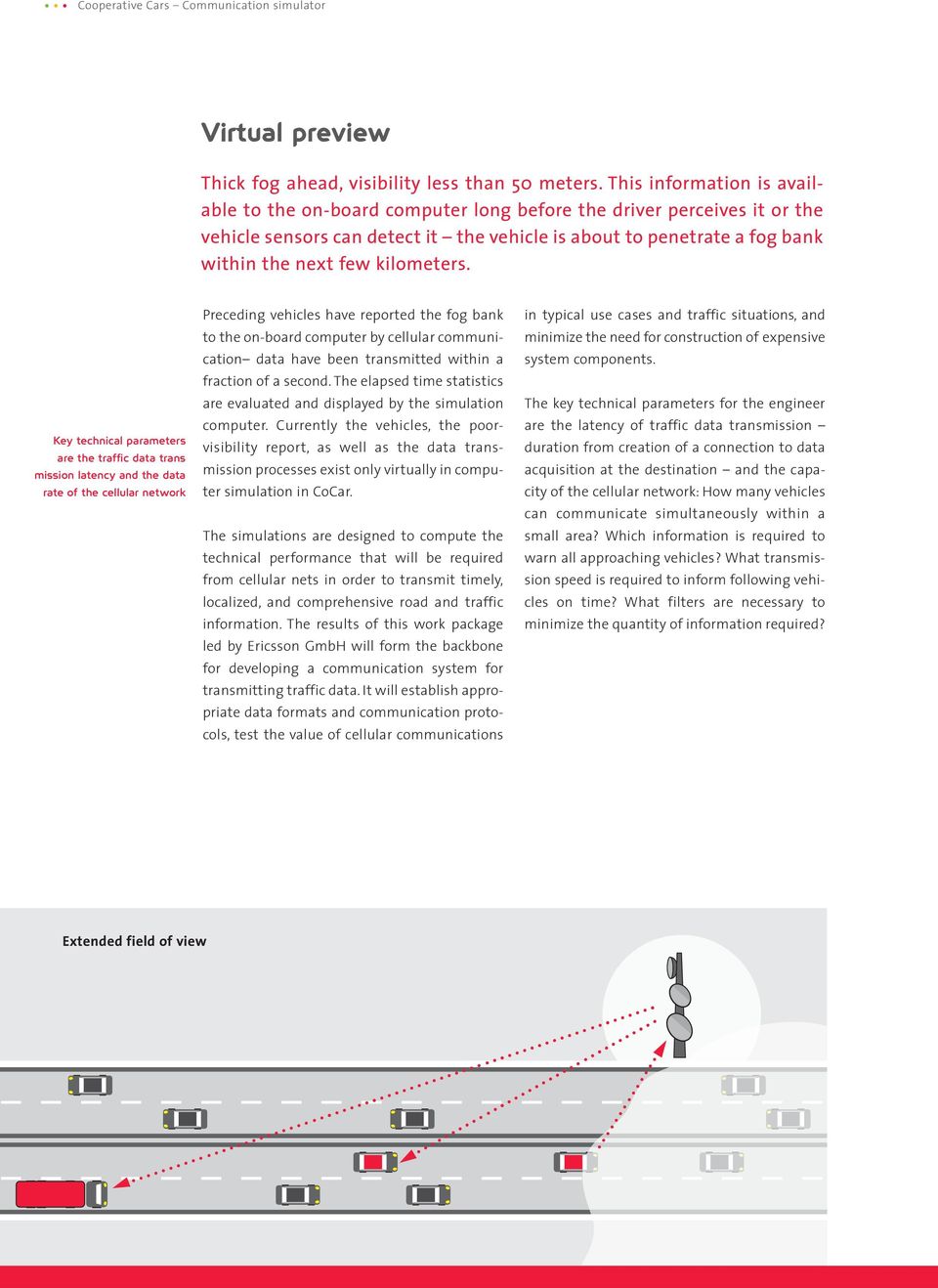
6 Cooperative Cars Communication simulator Virtual preview Thick fog ahead, visibility less than 50 meters. This information is available to the on-board computer long before the driver perceives it or the vehicle sensors can detect it the vehicle is about to penetrate a fog bank within the next few kilometers. Key technical parameters are the traffic data trans mission latency and the data rate of the cellular network Preceding vehicles have reported the fog bank to the on-board computer by cellular communication data have been transmitted within a fraction of a second. The elapsed time statistics are evaluated and displayed by the simulation computer. Currently the vehicles, the poorvisibility report, as well as the data transmission processes exist only virtually in computer simulation in CoCar. The simulations are designed to compute the technical performance that will be required from cellular nets in order to transmit timely, localized, and comprehensive road and traffic information. The results of this work package led by Ericsson GmbH will form the backbone for developing a communication system for transmitting traffic data. It will establish appropriate data formats and communication protocols, test the value of cellular communications in typical use cases and traffic situations, and minimize the need for construction of expensive system components. The key technical parameters for the engineer are the latency of traffic data transmission duration from creation of a connection to data acquisition at the destination and the capacity of the cellular network: How many vehicles can communicate simultaneously within a small area? Which information is required to warn all approaching vehicles? What transmission speed is required to inform following vehicles on time? What filters are necessary to minimize the quantity of information required? Extended field of view
7 6/7 Communication simulators 18,109 injury accidents slippery roads or in the year 2006 due to poor visibility in Germany! In order to obtain a thorough understanding of cellular network performance, information transmission, and driver behavior, the engineers are simulating a wide range of typical traffic situations. They focus on scenarios in which advanced driver assistance and traffic management systems support the driver. These include for example poor road conditions such as hydroplaning or poor visibility. The extensive simulation of traffic scenarios required here poses challenges even to specialists. Transmission of data between traffic management and driver assistance systems by cellular communication is being emulated for the first time in CoCar. In a nutshell, the challenge is to simulate a very large and spatially varying number of rapidly moving components: vehicles and traffic infrastructure components, which flexibly exchange data, as well as the dynamics and interactions of evolving traffic situations that continually generate new information. These reports must either be continuously transmitted, such as reports on moving road works, or triggered, such as tail-back or fog warnings. One can imagine a typical scene unfolding on the A8 Autobahn in Bavaria, on a stretch from the Irschenberg hills down to lake Chiemsee: Heavy traffic is rolling down from Irschenberg at 100 km/h. Five kilometers ahead, the first vehicles enter a thick fog and brake abruptly. Future vehicle sensors detect the fog, and the on-board systems report sharp braking from 100 down to 60 km/h. Now the task is to establish a connection to the cellular communication system within milliseconds, to send the information, and to warn the following vehicles. In the simulation, only a fraction of the vehicles are assumed to be equipped with a cellular communication unit capable of sending or receiving a report. Subsequently the report is also received by vehicles located kilometers behind the first vehicle entering the fog bank. Future vehicle sensors detect fog, and at the same time the on-board system reports strong braking

8 Cooperative Cars Basis scenario Supported in key traffic szenarios Technological jumps create new opportunities for innovation. Recent progress in cellular communications technologies will now enable novel, high-performance channels for traffic data transmission. cellular communication operator The potential of cellular communications for traffic management and vehicle driver assistance will be analyzed and tested using prototypes in the project CoCar. To this end, typical traffic situations known as scenarios will be simulated as a basis for analyzing the value of cellular communication for inter-vehicle traffic data transmission and for data exchange between vehicles and traffic guidance systems, using cellular infrastructure. Risk of congestion on a freeway In addition to other scenarios, the researchers have selected a classical situation occurring frequently on freeways, which requires simulation of many important processes and functions: Risk of congestion at the beginning of road works on a multilane freeway. Using these scenarios, the researchers will analyze applications in traffic and in vehicles as well as the resulting technical challenges for cellular communication: requirements for smooth information exchange between the vehicle computer, traffic infrastructure, and traffic centers; business models; and vehicle implementation.

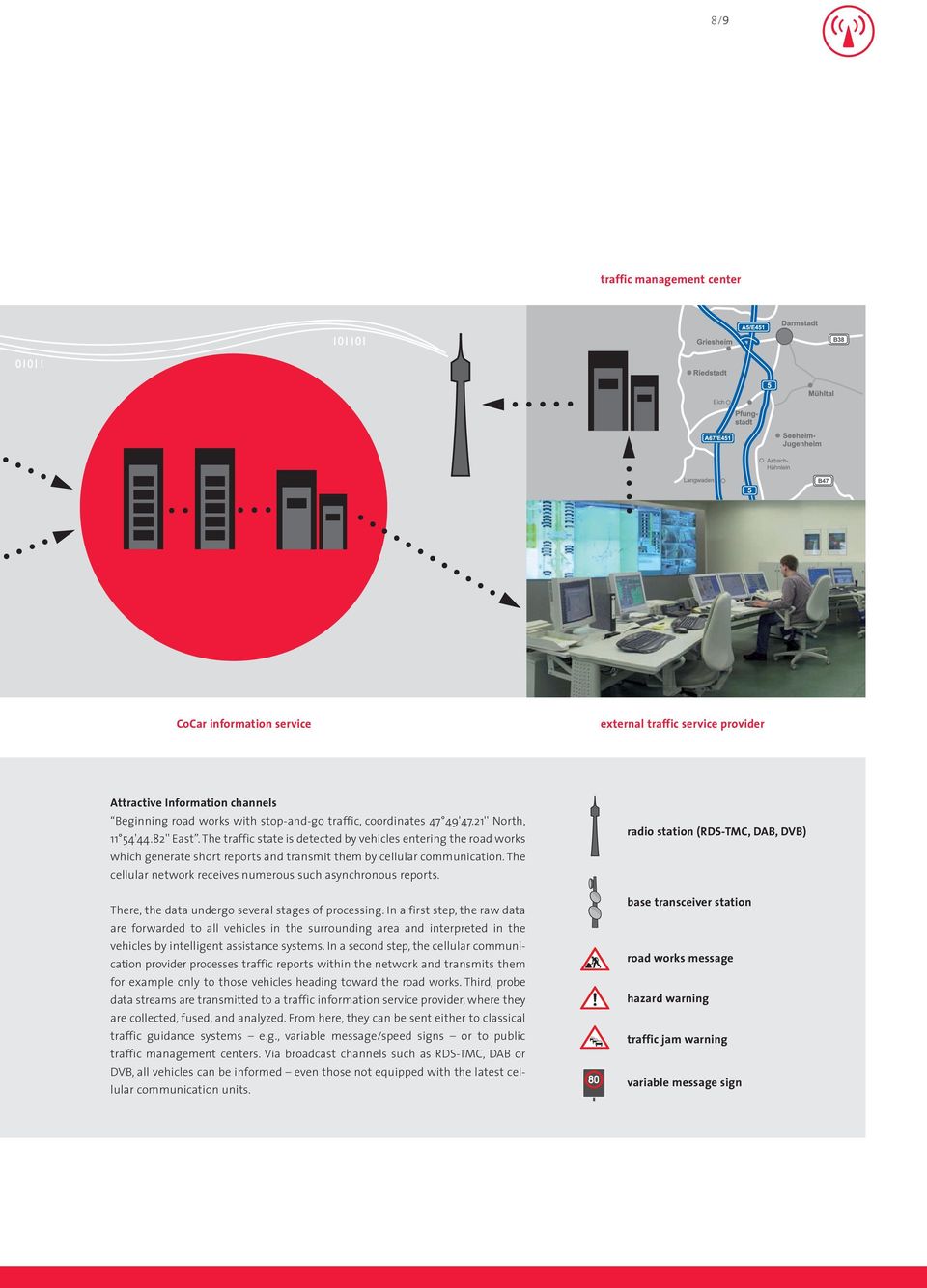
9 8/9 traffic management center CoCar information service external traffic service provider Attractive Information channels Beginning road works with stop-and-go traffic, coordinates 47 49'47.21'' North, 11 54'44.82'' East. The traffic state is detected by vehicles entering the road works which generate short reports and transmit them by cellular communication. The cellular network receives numerous such asynchronous reports. There, the data undergo several stages of processing: In a first step, the raw data are forwarded to all vehicles in the surrounding area and interpreted in the vehicles by intelligent assistance systems. In a second step, the cellular communication provider processes traffic reports within the network and transmits them for example only to those vehicles heading toward the road works. Third, probe data streams are transmitted to a traffic information service provider, where they are collected, fused, and analyzed. From here, they can be sent either to classical traffic guidance systems e.g., variable message/speed signs or to public traffic management centers. Via broadcast channels such as RDS-TMC, DAB or DVB, all vehicles can be informed even those not equipped with the latest cellular communication units. radio station (RDS-TMC, DAB, DVB) base transceiver station road works message hazard warning traffic jam warning variable message sign
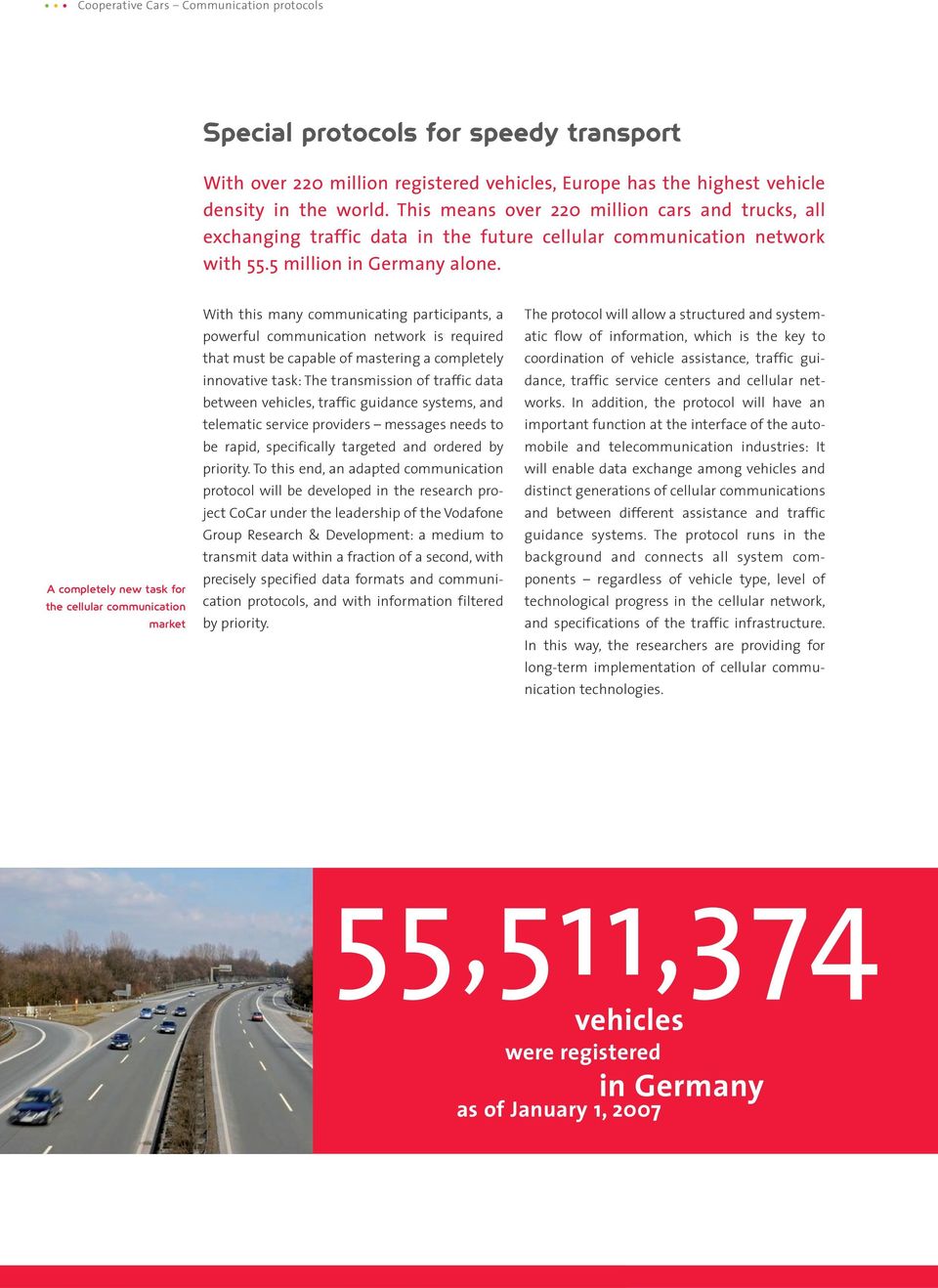
10 Cooperative Cars Communication protocols Special protocols for speedy transport With over 220 million registered vehicles, Europe has the highest vehicle density in the world. This means over 220 million cars and trucks, all exchanging traffic data in the future cellular communication network with 55.5 million in Germany alone. A completely new task for the cellular communication market With this many communicating participants, a powerful communication network is required that must be capable of mastering a completely innovative task: The transmission of traffic data between vehicles, traffic guidance systems, and telematic service providers messages needs to be rapid, specifically targeted and ordered by priority. To this end, an adapted communication protocol will be developed in the research project CoCar under the leadership of the Vodafone Group Research & Development: a medium to transmit data within a fraction of a second, with precisely specified data formats and communication protocols, and with information filtered by priority. The protocol will allow a structured and systematic flow of information, which is the key to coordination of vehicle assistance, traffic guidance, traffic service centers and cellular networks. In addition, the protocol will have an important function at the interface of the automobile and telecommunication industries: It will enable data exchange among vehicles and distinct generations of cellular communications and between different assistance and traffic guidance systems. The protocol runs in the background and connects all system components regardless of vehicle type, level of technological progress in the cellular network, and specifications of the traffic infrastructure. In this way, the researchers are providing for long-term implementation of cellular communication technologies. 55,511,374 vehicles Bit übertragen heutige UMTS-Netze pro Sekunde were registered as of January 1, 2007 in Germany
11 10/11 Communication protocols Thus, cellular communication faces new challenges: Up to now, the technology was used mainly for telephone conversations, transmission of short text messages, and for downloading large quantities of data from the internet. These transmission processes involve sending large quantities of data continuously over a relatively long period of time. In contrast, telematics applications require consolidation and high speed transmission of an enormous number of small data packets at high reliability. In order to provide rapid processing, the information is coded to reduce the messages to their core content. In addition, each message is assigned a sending order priority. Processes involving reactions within seconds have top priority for example a suddenly formed jam or an icy road segment. The second priority level comprises traffic flow and vehicle density data as processed in strategic route guidance. Sample protocol <tpeg_message> <originator country='de' originator_name='cocar'/> <summary xml:lang='en'>thick fog on the A8 between Irschenberg and Chiemsee interchanges affecting both inbound and outbound traffic.</summary> <road_traffic_message message_id='12345' version_number='3' message_generation_time=' t07:59:29+1' start_time=' t07:59:29+1' severity_factor='&rtm31_4;'> <location_container language="&loc41_40;"> <location_coordinates location_type="&loc1_3;"> <WGS84 latitude="47.828" longitude="11.915"/> <location_descriptor descriptor_type="&loc3_7;" descriptor="a8:e45/> <location_descriptor descriptor_type="&loc3_24;" descriptor="irschenberg"/> <location_descriptor descriptor_type="&loc3_25;" descriptor="rosenheim"/> <location_descriptor descriptor_type="&loc3_26;" descriptor="bayern"/> <location_descriptor descriptor_type="&loc3_27;" descriptor="deutschland"/> <WGS84 latitude="47.834" longitude="12.396"/> <location_descriptor descriptor_type="&loc3_7;" descriptor="a8:e45"/> <location_descriptor descriptor_type="&loc3_30;" descriptor="chiemsee"/> <location_descriptor descriptor_type="&loc3_25;" descriptor="rosenheim"/> <location_descriptor descriptor_type="&loc3_26;" descriptor="bayern"/> <location_descriptor descriptor_type="&loc3_27;" descriptor="deutschland"/> <direction direction_type="&loc2_2;"/> </location_coordinates> </location_container> <network_conditions> <restriction restriction="&rtm49_255;"/> </network_conditions> </road_traffic_message> </tpeg_message> The protocol links on-board computers, assistance systems, cellular networks, and traffic management Mbit/s

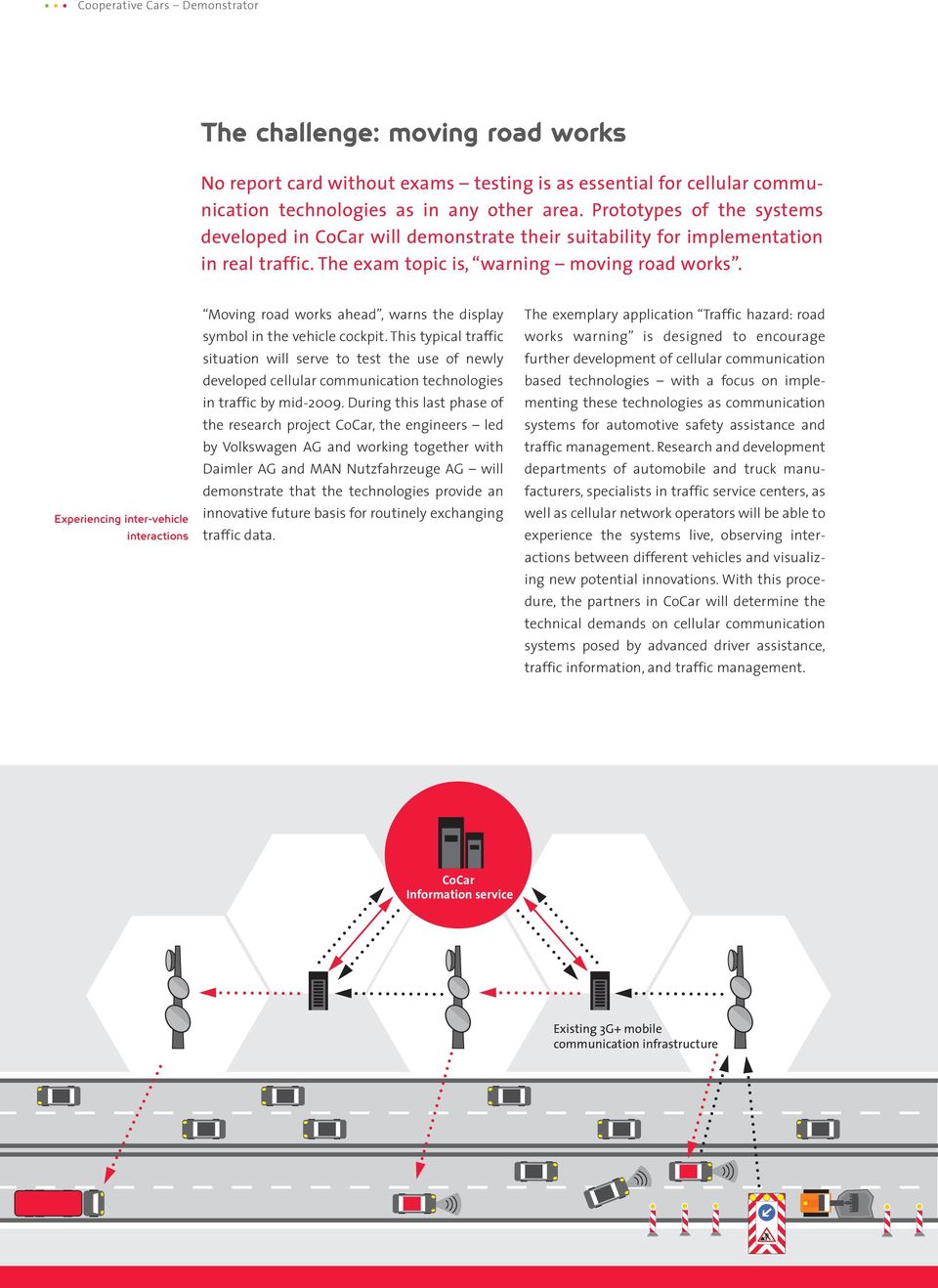
12 Cooperative Cars Demonstrator The challenge: moving road works No report card without exams testing is as essential for cellular communication technologies as in any other area. Prototypes of the systems developed in CoCar will demonstrate their suitability for implementation in real traffic. The exam topic is, warning moving road works. Experiencing inter-vehicle interactions Moving road works ahead, warns the display symbol in the vehicle cockpit. This typical traffic situation will serve to test the use of newly developed cellular communication technologies in traffic by mid During this last phase of the research project CoCar, the engineers led by Volkswagen AG and working together with Daimler AG and MAN Nutzfahrzeuge AG will demonstrate that the technologies provide an innovative future basis for routinely exchanging traffic data. The exemplary application Traffic hazard: road works warning is designed to encourage further development of cellular communication based technologies with a focus on implementing these technologies as communication systems for automotive safety assistance and traffic management. Research and development departments of automobile and truck manufacturers, specialists in traffic service centers, as well as cellular network operators will be able to experience the systems live, observing interactions between different vehicles and visualizing new potential innovations. With this procedure, the partners in CoCar will determine the technical demands on cellular communication systems posed by advanced driver assistance, traffic information, and traffic management. CoCar Information service Existing 3G+ mobile communication infrastructure
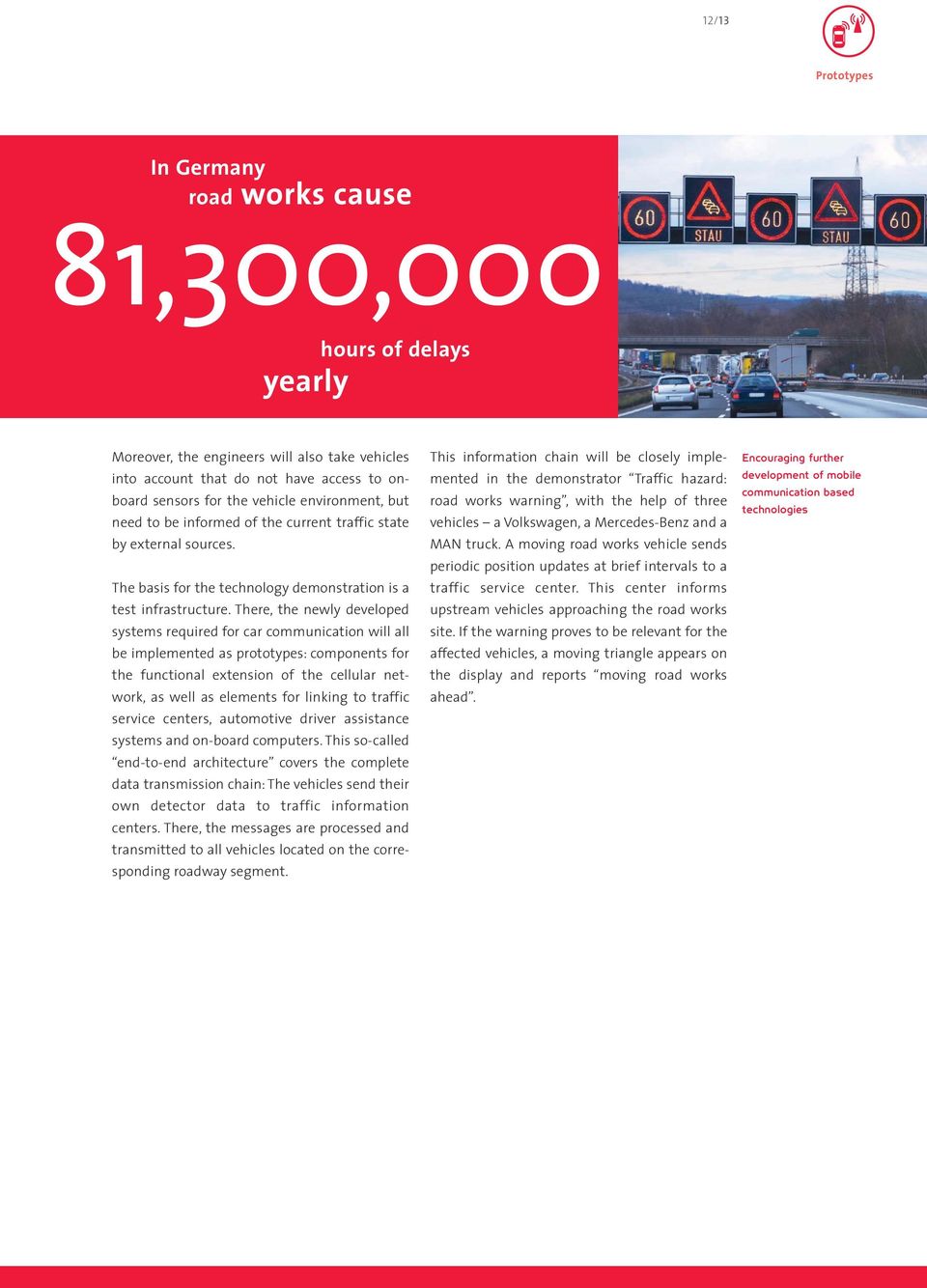
13 12/13 Prototypes In Germany road works cause 81,300,000 hours of delays yearly Moreover, the engineers will also take vehicles into account that do not have access to onboard sensors for the vehicle environment, but need to be informed of the current traffic state by external sources. The basis for the technology demonstration is a test infrastructure. There, the newly developed systems required for car communication will all be implemented as prototypes: components for the functional extension of the cellular network, as well as elements for linking to traffic service centers, automotive driver assistance systems and on-board computers. This so-called end-to-end architecture covers the complete data transmission chain: The vehicles send their own detector data to traffic information centers. There, the messages are processed and transmitted to all vehicles located on the corresponding roadway segment. This information chain will be closely implemented in the demonstrator Traffic hazard: road works warning, with the help of three vehicles a Volkswagen, a Mercedes-Benz and a MAN truck. A moving road works vehicle sends periodic position updates at brief intervals to a traffic service center. This center informs upstream vehicles approaching the road works site. If the warning proves to be relevant for the affected vehicles, a moving triangle appears on the display and reports moving road works ahead. Encouraging further development of mobile communication based technologies
14 Cooperative Cars Vision Vision - cellular communication prospects In the near future, vehicles will log into cellular networks autonomously and automatically. After downloading current traffic state information, they will warn the driver of local hazards such as obstacles. Concurrently, they will be integrated into powerful traffic management systems, continuously exchanging data on traffic flow and road conditions. By means of cellular communication, this vision is soon to become reality in Germany and perhaps even in the entire European roadway network. The key requirements are novel trendsetting cellular communication technologies as investigated in the Aktiv research initiative. Thus, cellular communication research has been targeted in the project CoCar, because of the immense innovation potential of this versatile technology for future generations of advanced driver assistance and driver information systems and for efficient solutions in traffic management. In order to exploit thoroughly the economic and research opportunities offered by cellular communications technologies, Aktiv is connecting different branches of industry: telecommunication network operators and terminal device manufacturers, automobile manufacturers and their suppliers, as well as traffic service providers. This interdisciplinary approach will open up entirely novel fields of application and models for global operation in cellular communications, with definite economic prospects. cellular communication will result in establishing safety assistance and services for the stakeholders in traffic. The partners enjoy the advantage of the excellent existing cellular infrastructure, which provides stable cellular communication coverage throughout Europe. With the development of cellular communication technologies for implementation in traffic, CoCar is enabling novel applications that previously were considered as a technical vacuum. CoCar will establish new economic and scientific standards in cellular communication and enhance the role of Germany as a leading technology country.
15 14/15 Small data packets - high performance These data packets are small; traffic warnings comprise only a few hundred bytes. However, these data packets will occur in large numbers: In congested traffic, the vehicle density can considerably exceed 100 vehicles per lane and kilometer. It takes powerful cellular networks to transmit such a large number of data packets sufficiently quickly. Third-generation cellular communication devices (3G+) currently provide the top performance attributes, with latencies of below one second and a data rate of up to 14 Mbit per second. CoCar will investigate the capacity of the cellular communication systems for driver assistance and traffic management applications. Potential extensions for future systems will be recommended and the implementation of such systems will be evaluated. Further information is available from the Aktiv office. WES-Office Walter E. Scholl Hülenbergstr Kirchheim unter Teck Tel.: / Fax: / [email protected]

16 As at december 2007
INTERNET FOR VANET NETWORK COMMUNICATIONS -FLEETNET-
 ABSTRACT INTERNET FOR VANET NETWORK COMMUNICATIONS -FLEETNET- Bahidja Boukenadil¹ ¹Department Of Telecommunication, Tlemcen University, Tlemcen,Algeria Now in the world, the exchange of information between
Automotive Communication via Mobile Broadband Networks
 Automotive Communication via Mobile Broadband Networks Dr. Joachim Sachs Ericsson Corporate Research, Aachen Contributors: René Rembarz, Mai-Anh Phan, Sabine Sories Where are we in telecommunications?
Traffic Management in Transport and Logistics VMTL
 A brief supplement to the INVENT brochure describing the project Traffic Management in Transport and Logistics VMTL Traffic Management in Transport and Logistics VMTL INVENT Driver Assistance Active Safety
The Future of the Automobile Vehicle Safety Communications. Stanford University ME302 Luca Delgrossi, Ph.D. April 1, 2014
 The Future of the Automobile Vehicle Safety Communications Stanford University ME302 Luca Delgrossi, Ph.D. April 1, 2014 About your lecturer Luca Delgrossi, Ph. D. Born in Italy, I live in the US since
Hybrid System for Driver Assistance
 International Journal of Information & Computation Technology. ISSN 0974-2239 Volume 4, Number 15 (2014), pp. 1583-1587 International Research Publications House http://www. irphouse.com Hybrid System
COMMUNICATIONS SYSTEMS USED FOR ITS
 COMMUNICATIONS SYSTEMS USED FOR ITS Index Purpose Description Technologies 1 of 5 Purpose The telecommunication system is the main element for the development of telematics in Transport field. It enables
Car2x From Research to Product Development
 Car2x From Research to Product Development How automotive OEMs and suppliers are successfully completing production Car2x projects Car2x systems present entirely new challenges for managers in product
The TomTom Manifesto Reducing Congestion for All Big traffic data for smart mobility, traffic planning and traffic management
 The TomTom Manifesto Reducing Congestion for All Big traffic data for smart mobility, traffic planning and traffic management Ralf-Peter Schäfer Fellow & VP Traffic and Travel Information Product Unit
22 nd ITS World Congress Towards Intelligent Mobility Better Use of Space. GPS 2: Big Data The Real Value of Your Social Media Accounts
 22 nd ITS World Congress Towards Intelligent Mobility Better Use of Space GPS 2: Big Data The Real Value of Your Social Media Accounts October 7, 2015 Kenneth Leonard Director, Intelligent Transportation
Acquisition of Novero. Investor presentation 18th December 2015
 Acquisition of Novero Investor presentation 18th December 2015 What Novero brings to Laird The acquisition of Novero and LSR rebalances our business, Wireless Systems will now be of a similar scale to
Adaptive Cruise Control
 IJIRST International Journal for Innovative Research in Science & Technology Volume 3 Issue 01 June 2016 ISSN (online): 2349-6010 Adaptive Cruise Control Prof. D. S. Vidhya Assistant Professor Miss Cecilia
Split Lane Traffic Reporting at Junctions
 Split Lane Traffic Reporting at Junctions White paper 1 Executive summary Split Lane Traffic Reporting at Junctions (SLT) from HERE is a major innovation in real time traffic reporting. The advanced algorithm
Analysis of Accidents by Older Drivers in Japan
 Analysis of Accidents by Older Drivers in Japan Kazumoto Morita 1, Michiaki Sekine 1 1 National Traffic Safety and Environment Laboratory, Japan Abstract Since Japan is a rapidly aging society, ensuring
USDOT Connected Vehicle Overview
 USDOT Connected Vehicle Overview RWM Stakeholder Meeting August 8, 2012 Dale Thompson, Intelligent Transportation Systems Joint Program Office, RITA, U.S. DOT 1 Overview NHTSA Decision Safety Pilot Policy-Architecture
SAMPLE VEHICLE FLEET SAFETY & USAGE POLICY
 SAMPLE VEHICLE FLEET SAFETY & USAGE POLICY Policy The purpose of this policy is to ensure the safety of those individuals who drive company vehicles and to provide guidance on the proper use of company
Implementation of CVIS ITS Application in a Driving Simulator Environment Kenneth Sørensen, [email protected] SINTEF
 Denne artikel er publiceret i det elektroniske tidsskrift Artikler fra Trafikdage på Aalborg Universitet (Proceedings from the Annual Transport Conference at Aalborg University) ISSN 1603-9696 www.trafikdage.dk/artikelarkiv
Heavy Truck Manufacturer Fleet Management Offerings. Industry Research Whitepaper www.berginsight.com
 Heavy Truck Manufacturer Fleet Management Offerings Industry Research Whitepaper www.berginsight.com BERG INSIGHT WHITEPAPER Tobias Ryberg, Senior Analyst ([email protected] Johan Fagerberg,
CELL PHONE TRACKING. Index. Purpose. Description. Relevance for Large Scale Events. Options. Technologies. Impacts. Integration potential
 CELL PHONE TRACKING Index Purpose Description Relevance for Large Scale Events Options Technologies Impacts Integration potential Implementation Best Cases and Examples 1 of 10 Purpose Cell phone tracking
TomTom HAD story How TomTom enables Highly Automated Driving
 TomTom HAD story How TomTom enables Highly Automated Driving Automotive World Webinar 12 March 2015 Jan-Maarten de Vries VP Product Marketing TomTom Automotive Automated driving is real and it is big Image:
ACEA PRINCIPLES OF DATA PROTECTION IN RELATION TO CONNECTED VEHICLES AND SERVICES
 ACEA PRINCIPLES OF DATA PROTECTION IN RELATION TO CONNECTED VEHICLES AND SERVICES September 2015 INTRODUCTION We, the member companies of ACEA, are committed to providing our customers with a high level
INTELLIGENT TRANSPORTATION SYSTEMS IN WHATCOM COUNTY A REGIONAL GUIDE TO ITS TECHNOLOGY
 INTELLIGENT TRANSPORTATION SYSTEMS IN WHATCOM COUNTY A REGIONAL GUIDE TO ITS TECHNOLOGY AN INTRODUCTION PREPARED BY THE WHATCOM COUNCIL OF GOVERNMENTS JULY, 2004 Whatcom Council of Governments 314 E. Champion
DEFENSIVE DRIVING. It s an Attitude
 DEFENSIVE DRIVING It s an Attitude RLI Design Professionals Design Professionals Learning Event DPLE 155 July 15, 2015 RLI Design Professionals RLI Design Professionals is a Registered Provider with The
Ahead of the Curve with Intelligent. Transportation
 Ahead of the Curve with Intelligent Transportation Advanced technologies to ensure the safe, efficient, and secure movement of passengers and freight. Intelligent transportation is changing the way America
l i X t o CASE STUDY Beyond electronic data interchange (EDI)
 l i X t o Automating transactions in logistics processes: Beyond electronic data interchange (EDI) CASE STUDY VOSS Automotive collects information about delivery requests automatically from web portals
Advanced Safety. Driver Vehicle Interface Collision Avoidance & Mitigation Vehicle Communications. Helping industry engineer safe vehicles
 SAE INTERNATIONAL Advanced Safety Standards & Resources Driver Vehicle Interface Collision Avoidance & Mitigation Vehicle Communications Helping industry engineer safe vehicles Driver Vehicle Interface,
CHAPTER 8: INTELLIGENT TRANSPORTATION STSTEMS (ITS)
 CHAPTER 8: INTELLIGENT TRANSPORTATION STSTEMS (ITS) Intelligent Transportation Systems (ITS) enables people and goods to move more safely and efficiently through a state-of-the-art multi-modal transportation
Measuring real-time traffic data quality based on Floating Car Data
 Measuring real-time traffic data quality based on Floating Car Data Jeroen Brouwer TomTom De Ruyterkade 154, 1011 AC Amsterdam, The Netherlands +31 20 75 75441, [email protected] Abstract Congestion
Technical and economical assessment of selected LTE-A schemes.
 Technical and economical assessment of selected LTE-A schemes. Heinz Droste,, Darmstadt Project Field Intelligent Wireless Technologies & Networks 1 Mobile Networks enabler for connected life & work. Textbox
Traffic information potential and necessary penetration rates
 390 Extended Floating Car Data Traffic information potential and necessary Susanne Breitenberger, Bernhard Grüber, Martina Neuherz and Ronald Kates, BMW Group Demands made on the quality of traffic information
Channels of Delivery of Travel Information (Static and Dynamic On-Trip Information)
 Channels of Delivery of Travel Information (Static and Dynamic On-Trip Information) Index Purpose Description Relevance for Large Scale Events Options Technologies Impacts Integration potential Implementation
Floating Car Data in the Netherlands
 Floating Car Data in the Netherlands Aad de Hoog Ministry of Transport, Public Works and Water Management The Netherlands 1 Overview Setting the scene Concept, technique and results Dutch policy Future
Bluetooth in Automotive Applications Lars-Berno Fredriksson, KVASER AB
 Bluetooth in Automotive Applications Lars-Berno Fredriksson, KVASER AB ABSTRACT There is a potential for 50-400 million per year Bluetooth nodes within the car market if Bluetooth can be integrated into
The Vision of Vehicle Infrastructure Integration (VII)
 The Vision of Vehicle Infrastructure Integration (VII) Ralph L. Robinson ITS Integration Office September, 2007 Cooperative Highways SAFETY MOBILITY Collision Avoidance Signal Control Emergency Alerts
Intelligent Transport Systems (ITS): Needs for accurate and updated map data from public authorities
 Intelligent Transport Systems (ITS): Needs for accurate and updated map data from public authorities Maxime Flament, ERTICO ITS Europe [email protected] 1 What is ITS? 2 What is ITS? Intelligent
September 8th 8:30 AM 10:00 AM PL1: Reinventing Policy to Support the New ITS
 September 8th 8:30 AM 10:00 AM PL1: Reinventing Policy to Support the New ITS September 8th 10:30 AM 12:00 PM AM01: Sustainable Transportation Performance Measures: Best Practices September 8th 10:30 AM
VARIABLE MESSAGE SIGNS
 VARIABLE MESSAGE SIGNS Index Purpose Description Relevance for Large Scale Events Options Technologies Impacts Integration potential Implementation Best Cases and Examples 1 of 10 Purpose Variable Message
A wireless sensor network for traffic surveillance
 A wireless sensor network for traffic surveillance Sing Yiu Cheung, Sinem Coleri, Ram Rajagopal, Pravin Varaiya University of California, Berkeley Outline Traffic measurement Wireless Sensor Networks Vehicle
Evaluation of traffic control policy in disaster case. by using traffic simulation model
 19th ITS World Congress, Vienna, Austria, 22/26 October 2012 AP-00345 Evaluation of traffic control policy in disaster case by using traffic simulation model DAISUKE OSHIMA 1*, SHINJI TANAKA 2, TAKASHI
Professional navigation solutions for trucks and fleets
 Professional navigation solutions for trucks and fleets are there tools that can get you through anything? Narrow roads, low bridges, no opportunities to turn around a lot of roads are not made for freight
M2M communications in future cellular networks
 M2M communications in future cellular networks Nadia Brahmi Ericsson Research VDE/ITG Fachtagung Mobilkommunikation Osnabrück, 21. - 22. Mai 2014 Wireless access generations The foundation of mobile telephony
TRANSPORT SERVICE. RFID Vehicle Outbound Logistics Management Case Study
 TRANSPORT SERVICE RFID Vehicle Outbound Logistics Management Case Study NV TRANSPORT SERVICE NV Transport Service (TS) a subsidiary of Hödlmayr International AG and Autologic Holding plc is the releasing
In-Vehicle Infotainment. A View of the European Marketplace
 In-Vehicle Infotainment A View of the European Marketplace In-Vehicle Infotainment: A View of the European Marketplace A number of trends are impacting the automotive industry, creating fertile ground
AUTONOMOUS CARS: 25 MEASURES FOR 2025
 AUTONOMOUS CARS: 25 MEASURES FOR 2025 Report Workshop 25 great minds towards 25 11/03/ 15 in Ghent In January 2015 Taxistop and Autopia participated in a workshop in the German Wremen with as subject the
On-Board Vehicle Systems. Hands Free Satellite Navigation Car Audio Parking Sensors Taxi Meters
 On-Board Vehicle Systems Hands Free Satellite Navigation Car Audio Parking Sensors Taxi Meters Contact: Car Communications 20 Meeting House Road Sixmilecross Northern Ireland BT79 9NQ Tel: 028 8075 7391
Crucial Role of ICT for the Reinvention of the Car
 Joint EC / EPoSS / ERTRAC Expert Workshop 2011 Electric Vehicle System Integration and Architecture Crucial Role of ICT for the Reinvention of the Car Karl-Josef Kuhn Siemens Corporate Research and Technologies
It s Mine. Yes To Mobility > Insight and Outlook 2015 Continental Mobility Study
 It s Mine. Yes To Mobility > Insight and Outlook 2015 Continental Mobility Study Five Questions for Dr. Elmar Degenhart > 2015 Continental Mobility Study > Continental AG Dr. Elmar Degenhart Chairman of
Intelligent Transportation System for Vehicular Ad-Hoc Networks
 Intelligent Transportation System for Vehicular Ad-Hoc Networks T. Sujitha 1, S. Punitha Devi 2 1,2 Department of CSE, P.A College of Engineering and Technology, Coimbatore, Tamilnadu Abstract - Vehicular
Road Traffic Management Strategy STRATEGIES OF THE FINNISH TRANSPORT AGENCY
 Road Traffic Management Strategy 03 2010 STRATEGIES OF THE FINNISH TRANSPORT AGENCY Road Traffic Management Strategy Strategies of the Finnish Transport Agency 3/2010 Finnish Transport Agency Helsinki
7.0 Transportation Management
 7.0 Transportation Management I. Introduction The Kansas City region has invested considerable effort and resources in the design and implementation of its regional multimodal transportation system. As
FutureWorks 5G use cases and requirements
 Nokia Networks FutureWorks 5G use cases and requirements White paper - 5G Use Cases and Requirements CONTENTS 1. What 5G will be and why it will come 3 2. Use cases 6 2.1 Mobile broadband 6 2.2 Automotive
Wireless M2M Communication and AMR Now in the second edition completely updated and revised
 Wireless M2M Communication and AMR Now in the second edition completely updated and revised What are the latest developments in AMR on the European market? In 2004 came the real breakthrough for solutions
The TrimTrac Locator: A New Standard in Practical and Affordable Asset Tracking
 The TrimTrac Locator: A New Standard in Practical and Affordable Asset Tracking By Bill Dussell Director, Integrated Products Trimble Navigation 15-December-2003 1997 2003, Trimble Navigation Limited.
The Telematics Application Innovation Based On the Big Data. China Telecom Transportation ICT Application Base(Shanghai)
 The Telematics Application Innovation Based On the Big Data China Telecom Transportation ICT Application Base(Shanghai) Big Data be the basis for Telematics Innovation Providing service s based on the
Wireless traffic Safety network between Cars. CoMoSeF TULEVAT TRENDIT AUTOJEN M2M KOMMUNIKAATIOSSA WISAFECAR JA COMOSEF PROJEKTIT
 TULEVAT TRENDIT AUTOJEN M2M KOMMUNIKAATIOSSA WISAFECAR JA COMOSEF PROJEKTIT WiSafeCar Particpants Mobisoft (Co-ordinator) Finnish Meteorological Institute VTT Infotripla Taipale Telematics Sunit University
Analysis of intersection accidents - An accident causation and prevention perspective
 Analysis of intersection accidents - An accident causation and prevention perspective Julia Werneke 1 & Mark Vollrath 2 1 Chalmers University of Technology, Goteborg, Sweden 2 TU Braunschweig, Braunschweig,
Le point de vue d un équipementier
 Systèmes coopératifs, automatismes et robotique Le point de vue d un équipementier Guillaume Devauchelle Group Innovation & Scientific Development VP en 197 Mai 213 2 I La vision technologique d aujourd
A WIDER SHARING ECOSYSTEM. The pivotal role of data in transport solutions
 A WIDER SHARING ECOSYSTEM The pivotal role of data in transport solutions October 2015 A MARKET ON THE MOVE CONTENTS 3 TRANSPORT TRENDS 4 THE ROAD AHEAD 5 TRANSPARENCY LEADS TO TRUST 6 DATA LOCATION AND
Investor Relations Release. March 6, 2013
 Investor Relations Release Intelligent networking makes it possible: real-time traffic information, internet radio and an emergency call system enhance safety and comfort for Mercedes-Benz customers March
APPENDIX A Dallas-Fort Worth Region Transportation System Management Strategies and Projects
 APPENDIX A Transportation System Management Strategies and Projects Transportation System Transportation System Management Projects Management Strategies Traffic Signalization and Control New Signal Installation
top issues An annual report
 top issues An annual report Volume 5 2013 Strategy: Reshaping auto insurance The insurance industry in 2013 FPO Strategy: Reshaping auto insurance Several factors aimed at road and vehicle safety are increasingly
Continental, A*STAR s Institute for Infocomm Research (I²R) & TUM CREATE collaborate in an Intelligent Transport Systems (ITS) Lab
 - 1 - Continental, A*STAR s Institute for Infocomm Research (I²R) & TUM CREATE collaborate in an Intelligent Transport Systems (ITS) Lab MOU to set up first tri-party ITS collaboration to research, study
automotive.elektrobit.com Driver assistance software EB Assist solutions
 automotive.elektrobit.com Driver assistance software EB Assist solutions From driver assistance systems to automated driving Automated driving leads to more comfortable driving and makes the road safer
A Case for Real-Time Monitoring of Vehicular Operations at Signalized Intersections
 White Paper A Case for Real-Time Monitoring of Vehicular Operations at Signalized Intersections 10 1 0 1 0 TRAFINFO.COM TrafInfo Communications, Inc. 556 Lowell Street Lexington, MA 02420 www.trafinfo.com
Driving Safety Support Systems Utilizing ITS Radio System
 FEATURED TOPIC Driving Safety Support Systems Utilizing ITS Radio System Yuichi TANIGUCHI*, Toshifumi OOTA, Masafumi KOBAYASHI, Hirofumi URAYAMA and Yoshiteru KOREEDA We are striving to develop the Driving
In the pursuit of becoming smart
 WHITE PAPER In the pursuit of becoming smart The business insight into Comarch IoT Platform Introduction Businesses around the world are seeking the direction for the future, trying to find the right solution
Model Fleet Safety Program Short
 TM Model Fleet Safety Program Short CORPORATE HEADQUARTERS 518 EAST BROAD STREET COLUMBUS, OHIO 43215 614.464.5000 STATEAUTO.COM TM Disclaimer: The information contained in this publication was obtained
Level 2 Award in Safe Driving at Work
 Level 2 Award in Safe Driving at Work Student notes (sample) www.britsafe.org Membership Training Qualifications Audit and Consultancy Audit and Policy Consultancy and Opinion Policy Awards and Opinion
USING THE MOBILE PHONE WHILE DRIVING. Using a mobile phone while driving can significantly impair a driver s:
 USING THE MOBILE PHONE WHILE DRIVING Is it dangerous to use the phone while driving? Driving is a complex task, requiring drivers to use and coordinate a number of skills. Any lapse in concentration increases
Providing drivers with actionable intelligence can minimize accidents, reduce driver claims and increase your bottom line. Equip motorists with the
 Providing drivers with actionable intelligence can minimize accidents, reduce driver claims and increase your bottom line. Equip motorists with the ability to make informed decisions based on reliable,
Analysis of Methods for Mobile Device Tracking. David Nix Chief Scientific Advisor
 Analysis of Methods for Mobile Device Tracking David Nix Chief Scientific Advisor October 2013 Table of Contents 1. Document Purpose and Scope 3 2. Overview 3 2.1 Mobile Device Penetration 3 2.2 Mobile
Traffic Management for a Smarter City:Istanbul Istanbul Metropolitan Municipality
 Traffic Management for a Smarter City:Istanbul Istanbul Metropolitan Municipality Traffic Management for a Smarter City: Istanbul There is no doubt for Traffic Management to be an issue in a crowded city
EB Automotive Driver Assistance EB Assist Solutions. Damian Barnett Director Automotive Software June 5, 2015
 EB Automotive Driver Assistance EB Assist Solutions Damian Barnett Director Automotive Software June 5, 2015 Advanced driver assistance systems Market growth The Growth of ADAS is predicted to be about
Testimony of Ann Wilson House Energy & Commerce Committee Subcommittee on Commerce, Manufacturing and Trade, October 21, 2015
 House Energy & Commerce Committee Subcommittee on Commerce, Manufacturing and Trade, October 21, 2015 Introduction Chairman Burgess, Ranking Member Schakowsky, members of the subcommittee: Thank you for
ACCIDENT INFORMATION SYSTEM USING ARM PROCESSOR, GPS AND GSM TECHNOLOGY
 I J I T E ISSN: 2229-7367 3(1-2), 2012, pp. 123-127 ACCIDENT INFORMATION SYSTEM USING ARM PROCESSOR, GPS AND GSM TECHNOLOGY S. VIVEK 1, A. RAMESH 2 AND S. BHARATHI 3 1, 3 M.E-Embedded Systems, EIE 2 Assistant
Tips and Technology For Bosch Partners
 Tips and Technology For Bosch Partners Current information for the successful workshop No. 04/2015 Electrics / Elektronics Driver Assistance Systems In this issue, we are continuing our series on automated
Possible Applications
 FRAUNHOFER Institute for integrated circuits iis DECT Wireless Voice and Data Communications DECT stands for Digital Enhanced Cordless Telecommunication and is an accepted standard in more than 100 countries.
Safety-conscious Drivers Prevent Crashes. Defensive Driving: Managing Visibility, Time and Space. Improve Your Defensive Driving Skills
 Defensive Driving: Managing Visibility, Time and Space Motor vehicle travel is the primary means of travel in the United States. With all the benefits that come along with mobility, there are thousands
Accelerating Complex Event Processing with Memory- Centric DataBase (MCDB)
 Accelerating Complex Event Processing with Memory- Centric DataBase (MCDB) A FedCentric Technologies White Paper January 2008 Executive Summary Events happen in real-time; orders are taken, calls are placed,
Ultimate Wireless Broadband End-to-end Solution for LTE Public Safety
 Ultimate Wireless Broadband End-to-end Solution for LTE Public Safety Today s leading wireless broadband technology can speed response times, enhance emergency management and help save more lives A growing
Fleet management system as actuator for public transport priority
 10th ITS European Congress, Helsinki, Finland 16 19 June 2014 TP 0226 Fleet management system as actuator for public transport priority Niels van den Bosch 1, Anders Boye Torp Madsen 2 1. IMTECH Traffic
siemens.com/mobility Travel smarter with electronic ticketing
 siemens.com/mobility Travel smarter with electronic ticketing Translated reprint from: Nahverkehrs-praxis, March 2013 Travel smarter with electronic ticketing In future, intelligent electronic ticketing
Track Your Fleet to Improve Fleet Driver Behavior (And Boost Productivity and Profitability)
 Track Your Fleet to Improve Fleet Driver Behavior (And Boost Productivity and Profitability) A state-of-the-art fleet telematics system can be a powerful tool for helping a business s fleet management
RTMS Solutions. Detection solutions to fit your city s needs.
 RTMS Solutions Detection solutions to fit your city s needs. Keeping your daily commute free of congestion - and maintenance. Behind the scenes in cities all over the world, RTMS radar detection solutions
More efficient logistics processes with FleetBoard Logistics Management.
 A Daimler company A Daimler company More efficient logistics processes with FleetBoard Logistics Management. About FleetBoard Daimler FleetBoard GmbH with headquarters in Stuttgart offers telematics-supported